
Dr. Seuss s ABC: An Amazing Alphabet Book!
|
|
|
- Amos Wade
- 9 years ago
- Views:
Transcription
1 Lesson 2: Dr. Seuss s ABC: An Amazing Alphabet Book! By Dr. Seuss / ISBN: Lesson Author Mary C. Suiter, Ph.D., Federal Reserve Bank of St. Louis Lesson Description In this lesson, students learn what goods and services are. They listen to the story Dr. Seuss s ABC: An Amazing Alphabet Book! They listen to the story again and identify letters and goods and services from the book that begin with those letters. They learn a song about goods and services, identify goods and services they use, and identify the first letter of their first or last names and draw a good or a service that starts with that letter. The extension activities provide opportunities for role-play and counting. Grade Level PreK-K Economic Concepts (Vocabulary) Goods Services School Readiness Skills Practice book awareness (reading front to back, recognizing title/author/illustrator) Understand and follow directions with at least two steps Participate in repeating a song Recognize letters in own name Attempt to write letters in own name Recognize 10 alphabet letter names Use writing and drawing tools educational purposes, provided the user credits the Federal Reserve Bank of St. Louis, 2.1
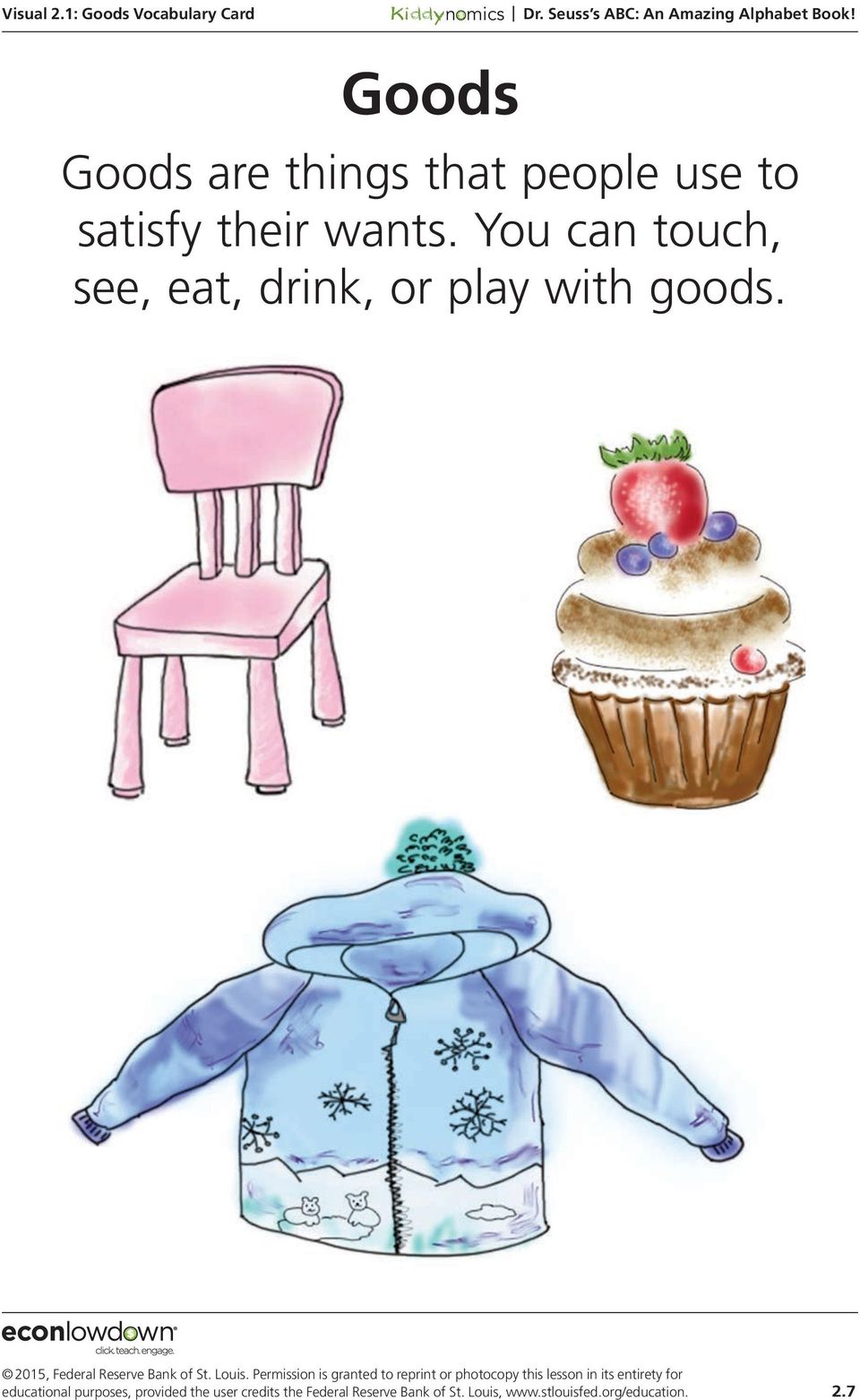
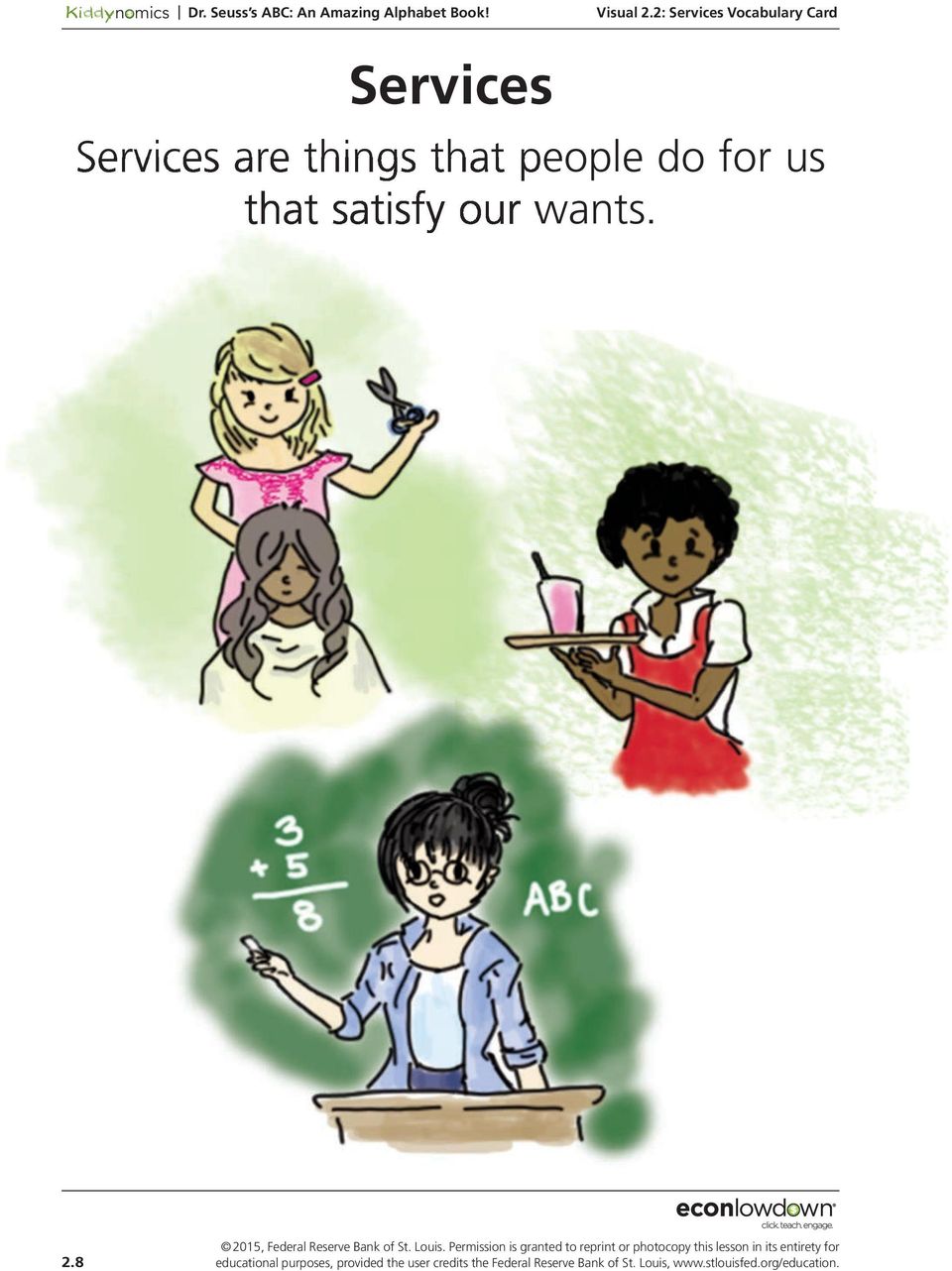
2 Dr. Seuss s ABC: An Amazing Alphabet Book! Time Required Approximately 45 minutes Materials One copy of Dr. Seuss s ABC: An Amazing Alphabet Book! by Dr. Seuss (ISBN ) Visuals 2.1 and 2.2 Handout 2.1, one copy for each student Crayon, piece of paper, book, and comb Crayons and/or markers for each student Procedure 1. Show the students the front of the book, Dr. Seuss s ABC: An Amazing Alphabet Book! Ask the following: Where is the title of the book? (On the front) Point to the title and read it aloud. What do you think the book is about? (Answers will vary, but they may say letters or the alphabet.) Who is pictured on the cover? (Answers will vary, but they may say funny looking animals and the Cat in the Hat.) 2. Explain that just like other books they may know about, such as the The Cat in the Hat or One Fish, Two Fish, Red Fish, Blue Fish, the book was written by Dr. Seuss. Dr. Seuss is also the illustrator. The illustrator is the person who draws the pictures for the book. 3. Display Visual 2.1: Goods Vocabulary Card. Tell the students that the pictures are called goods. Goods are things that people use to satisfy their wants. You can touch, see, eat, drink, or play with goods. Ask the students the following: If you were hungry, which good would you want? (The cupcake) If you want to sit down, which good would you want? (The chair) If you were cold, which good would you want? (The coat) What are some other examples of goods you use? (Answers will vary but may include crayons, markers, paint brushes, lunch boxes, toys, or candy.) 4. Display Visual 2.2: Services Vocabulary Card. Ask the students the following: What are the people in the pictures doing? (Giving/getting a haircut, delivering food, and teaching) 2.2 educational purposes, provided the user credits the Federal Reserve Bank of St. Louis,
3 Dr. Seuss s ABC: An Amazing Alphabet Book! 5. Tell the students that services are things that people do for us. Ask the students the following questions: What service is the beautician doing for the child? (Cutting the child s hair) What service is the waitress doing? (Bringing food) What service is the teacher doing? (Helping children learn) What are some other examples of services things people do for you? (Answers will vary but may include teaching, reading, cooking, driving, or fixing a broken bike or toy). 6. Read the book, Dr. Seuss s ABC: An Amazing Alphabet Book! 7. Tell the students that in the book there are goods and services. You are going to read through the book and ask them about the goods and services. 8. Read the story again. Point to each letter as you go, ask what the letter is, and then ask the noted question. A: What service is the alligator providing? (A ride) B: If you want to get your haircut, who on this page can provide that service? (The barber) C: What service could the camel provide? (Rides on the ceiling) D: What good did Donald dream of? (A donut) E: What good on the page could you and the elephant eat? (The egg) F: What fluffy good could you put on your hat? (Feathers) G: What good does the dog have on his face? (Goggles) H: What good does a hungry horse eat? (Hay) I: Ichabod can t reach his itchy back. What service could you provide for him? (Scratch his back) J: What good is in Jerry Jordan s jar? (Jelly) K: What good could you and the kangaroos use to play outside on a windy day? (The kite) L: What good is the lion licking? (A lollipop) M: If the mice make music for us, would they be providing us with a good or a service? (A service) N: What goods are the bears wearing? (Neckties and nightgown) O: What service does the ostrich provide for the owl? (He oils the owl.) P: What service is making the pajamas pink? (Painting) educational purposes, provided the user credits the Federal Reserve Bank of St. Louis, 2.3

4 Dr. Seuss s ABC: An Amazing Alphabet Book! Q: The queen is wearing a crown. Is a crown a good or a service? (A good) R: What service is the red rhino providing? (A ride) S: If you are thirsty, what good could satisfy your want? Careful, don t have too many like Sammy! (Soda pop) T: If you were tired, just like the 10 turtles, what good could you use to take a nap? (A bed, cot, sleeping bag, or pillow) U: If it s raining outside and you don t want to get wet, what good could you share with Uncle Ubb? (An umbrella) V: What good could you and Vera Violet Vinn use to make music? (The violin) W: What service is Willy providing for Waldo Woo? (Washing) X: What good is being used to make music? (An xylophone) Y: If the yak is tired and asks Young Yolanda Yorgenson to yell and wake him up, would she be providing a good or a service? (A service) Z: The Zizzer-Zazzer-Zuzz s hair looks too long. If you cut her hair for her, would you be providing a good a service? (A service) 9. Tell the students you are going to teach them a new song, Goods and Services. Ask them if they know the song Mary Had a Little Lamb. (Hopefully, many will say yes, but if not, sing the song for them.) Explain that the new song is called We Use Goods and Services and is sung to the same tune as Mary Had a Little Lamb. Sing each verse in turn and have the students repeat it. Goods and Services We use goods and services, services, services. We use goods and services each and every day. Goods are things that we can touch, we can touch, we can touch. Goods are things that we can touch when we work and play. People provide services, services, services. People provide services to help us through our day. 10. Next, sing the entire song as a class. At the end of the song, ask the following: What are some goods and services that you use throughout the day? (Answers will vary but may include the following: Services school (teaching), rides to and from school, dance lessons, mail delivery, computer service, service at a restaurant, a dental checkup, a medical checkup, soccer/baseball coaching, and so on. Goods food, clothing, crayons, glue, shoes, pencils, books, toys, tables, chairs, forks, spoons, and so on.) 2.4 educational purposes, provided the user credits the Federal Reserve Bank of St. Louis,

5 Dr. Seuss s ABC: An Amazing Alphabet Book! 11. Select four students. Give one student a crayon and one student a book. Complete the following: Tie a child s shoe and ask the rest of the class whether tying a shoe is a good or a service. (A service) Why? (Because it is something you do for someone else) Ask the student holding the crayon if the crayon is a good or a service. (A good) Why? (Because you can touch it and use it) Comb a child s hair and ask the rest of the class whether combing hair is a good or a service. (A service) Why? (Because it is something you do for someone else) Ask the child holding the book whether the book is a good or a service. (A good) Why? (Because you can touch it and use it) Ask the students whether you reading the Dr. Seuss s ABC book to the class was a good or a service. (A service) Why? (Because it was something you did for the class) Closure 12. Distribute a copy of Handout 2.1: Alphabet Goods to each student. Review the instructions. Allow time for students to work. 13. When students have completed their work, staple their completed work on a bulletin board or tape the pictures to the wall. Ask the students if posting their work on the bulletin board or wall is an example of you providing a good or a service. (A service) 14. Have students role-play providing services for one another using the following (or other) scenarios: Have one student pretend to be a doctor and another a patient who gets a checkup. Ask the rest of the class whether the doctor provides a good or a service. (A service) Have one student with a (stuffed) dog ask another student to take the dog for a walk. Ask the rest of the class whether the dog walker provides a good or a service. (A service) Have one student pretend to be a firefighter who rescues a (stuffed) cat from a tree. Ask the rest of the class whether the firefighter provides a good or a service. (A service) Have one child act as a bus driver. Have several other children be riders on the bus. Ask the rest of the class whether the bus driver is providing a good or a service. (A service) educational purposes, provided the user credits the Federal Reserve Bank of St. Louis, 2.5

6 Dr. Seuss s ABC: An Amazing Alphabet Book! Extension Activity Suggestions Literacy Read the story Little Nino s Pizzeria by Karen Barbour (ISBN ) and discuss which goods and services are illustrated in the book. Have students work together to create an alphabet book of goods and services. Assign each student a letter and have him or her write the letter and draw a picture of a good or service that starts with that letter. Assemble the book and have students practice reading the book to one another pointing out each letter and the good or service pictured. Math Have the students identify and count goods they use in the classroom. (Tables, chairs, pencils, markers, crayons, paper, books, paint, puzzles, play dough, milk, snacks, and so on) Have them create a pictogram of the goods. Social Identify people in the school who provide a service. (Teachers, the nurse, the school secretary/administrative assistant, bus or van drivers, and so on) 2.6 educational purposes, provided the user credits the Federal Reserve Bank of St. Louis,

7 Visual 2.1: Goods Vocabulary Card Kiddyn mics Dr. Seuss s ABC: An Amazing Alphabet Book! Goods Goods are things that people use to satisfy their wants. You can touch, see, eat, drink, or play with goods. educational purposes, provided the user credits the Federal Reserve Bank of St. Louis, 2.7
8 Dr. Seuss s ABC: An Amazing Alphabet Book! Visual 2.2: Services Vocabulary Card Services Services are things that people do for us that satisfy our wants. 2.8 educational purposes, provided the user credits the Federal Reserve Bank of St. Louis,
9 Handout 2.1: Alphabet Goods Kiddyn mics Dr. Seuss s ABC: An Amazing Alphabet Book! My name starts with the letter This is a picture of a good that starts with the same letter as my name. educational purposes, provided the user credits the Federal Reserve Bank of St. Louis, 2.9
10 2015, Federal Reserve Banks of St. Louis and Philadelphia. Permission is granted to reprint or photocopy this lesson in its entirety 2.10 for education purposes, provided the user credits the Federal Reserve Bank of St. Louis,

Erin A. Yetter, Ph.D., Federal Reserve Bank of St. Louis Louisville Branch
 Kiddyn mics Lesson 4: Just Saving My Money By Mercer Mayer / ISBN: 978-0-06-083557-6 Lesson Author Erin A. Yetter, Ph.D., Federal Reserve Bank of St. Louis Louisville Branch Lesson Description In this
A Note to Parents. 1. As you study the list, vary the order of the words.
 A Note to Parents This Wordbook contains all the sight words we will be studying throughout the year plus some additional enrichment words. Your child should spend some time each week studying this Wordbook
Preschool March Lessons. Dr. Seuss Day. One Day Free Sample
 Preschool March Lessons Dr. Seuss Day One Day Free Sample Kids R Learning Preschool Lesson Plans Letter R - Number 9 Dr. Seuss Day Circle Time: Left & Right Feet Read the story the Foot Book Explain to
Backseat A-B-See A CLEL Silver Bell Award Book for READ
 Backseat A-B-See by Maria Van Lieshout ISBN-13: 978-1452106649 Chronicle, 2012 From the backseat, what do you see? Backseat A-B-See showcases a different road sign for each letter of the alphabet as a
Simple Present Tense. Simple Present Tense in the Negative. Grammar Practice Worksheets
 Simple Present Tense Choose the correct verb from the list below to complete the following sentences. Use the correct form of the simple present tense. fix stand speak drink eat do wear have wash make
Family Child Care Home. Instructional Unit: LETTERS
 Family Child Care Home Instructional Unit: LETTERS Family Child Care Home Instructional Unit: LETTERS AUTHOR Dr. Janice Wood Crawford Early Literacy Faculty Fellow The Instructional Units presented here
Week 4 Lesson Plan. Pre-K. Animals in the Wild. Macmillan /McGraw-Hill. Extend. the Unit
 Lesson Plan Extend Unit the Unit Pre-K Animals in the Wild Alphabet Time.....................2-3 Book Time.........................-5 Retelling Puppets................... 6 Content Area......................7-8
My Game. Or I say, I m in the window. Or else, I m out the door. I m on top of the table, Or I m under the floor.
 My Game I have a little pretend game I play When Daddy calls to me. I say, I m right here, Daddy! I m under the sea! Or I say, I m in the window. Or else, I m out the door. I m on top of the table, Or
Andrew T. Hill, Ph.D., Federal Reserve Bank of Philadelphia
 By Peter H. Reynolds/ISBN: 076362623-6 Lesson by: Andrew T. Hill, Ph.D., Federal Reserve Bank of Philadelphia Lesson Description In this lesson, students learn about scarcity, alternatives, choices and
DIVERSE UNIVERSE ELEMENTARY LESSON PLAN
 DIVERSE UNIVERSE ELEMENTARY LESSON PLAN. NATIONAL ASSOCIATION OF STUDENTS AGAINST VIOLENCE EVERYWHERE 322 Chapanoke Rd., Suite 110, Raleigh, North Carolina 27603 (Toll free) 866-343-7283 * Fax 919-661-7777
Week 4 Lesson Plan. Pre-K. Our Neighborhood. Macmillan /McGraw-Hill. Extend. the Unit
 Lesson Plan Extend Unit the Unit Pre-K Our Neighborhood Alphabet Time.....................2-3 Book Time.........................-5 Retelling Puppets..................6-7 Content Area......................8-9
Ideas for Using Books to Support Social Emotional Development. I Can Share By Karen Katz
 Book Nook Ideas for Using Books to Support Social Emotional Development I Can Share By Karen Katz I Can Share is a Lift-the-Flap book geared for toddlers and young preschoolers which can be used to help
FEDERAL RESERVE BANKS OF ST. LOUIS AND PHILADELPHIA
 FEDERAL RESERVE BANKS OF ST. LOUIS AND PHILADELPHIA ECONOMIC EDUCATION By Mercer Mayer / ISBN: 978-0-06-083557-6 Lesson Author Amanda Hughey, University of Delaware Standards and Benchmarks (see page 19)
English Language Arts Materials Collections 2015-16 Instructionally Embedded Assessment Window
 English Language Arts Materials Collections 2015-16 Instructionally Embedded Assessment Window DLM testlets sometimes call for the use of specific materials or manipulatives. Materials are identified in
God is Eternal Lesson 1
 Preschool Curriculum (4K / 5K) August 15 th & 16 th, 2009 God is Eternal Lesson 1 Divine Attribute: Heart Response: God is Eternal Be Amazed Memory Verse: Jesus Christ is the same yesterday, today and
Portage Guide Birth to Six Preschool Indicator 7 Child Outcomes Crosswalk. Outcome 2 Acquisition & Use of Knowledge & Skills
 Portage Guide Birth to Six Preschool Indicator 7 Child Outcomes Crosswalk NPG Domains Outcome 1 Positive Social Emotional Skills Outcome 2 Acquisition & Use of Knowledge & Skills Outcome 3 Appropriate
LESSON PLAN Toddler Room WEEK OF: January 31-February 4, 2011. THEME: Pets
 LESSON PLAN Toddler Room WEEK OF: January 31-February 4, 2011 THEME: Pets Cats, Cats, Cats Puppy and Me If You See A Kitten Skippy Jones Up and Down Barbie the Bunny Six Little Pets B-I-N-G-O Rags Hickory
Homework Activities for Kindergarten
 Homework Activities for Kindergarten Listed below are several learning activities for your child to complete at home to reinforce skills being taught in school. The sight words are on the last page. Reading
Do Not Worry Lesson Aim: To know God takes care of everything.
 Teacher s Guide: Ages 4-5 Kings & Kingdoms Part 1: The Life of Jesus Unit 6, Lesson 30 Do Not Worry Lesson Aim: To know God takes care of everything. THE WORSHIP Who God is: The King Who Teaches THE WORD
My Family FREE SAMPLE. This unit focuses on sequencing. These extension
 Unit 5 This unit focuses on sequencing. These extension Unit Objectives activities give the children practice with sequencing beginning, middle, and end. As the learn to name family members and rooms children
Pre-K. Animals Around Us. Differentiated Resources. English Language Learners... 2 Three-Year-Olds...3-4 Small Groups...5-6
 Pre-K Differentiated Resources Animals Around Us English Language Learners.......... 2 Three-Year-Olds...................3-4 Small Groups......................5-6 Visit www.macmillanmh.com for online games
Parent Handouts: Language Intervention Activities
 Parent Handouts: Language Intervention Activities 12 Preverbal-Preintentional General Language Strategies Learning to Talk Children learn to talk by hearing others talk to them. You can help your child
Getting School Ready in Iowa
 Getting School Ready in Iowa I want to be ready for kindergarten. How can the kindergarten be ready for me? A guide for families and early care, health, and education providers caring for children who
flrhyme Riddles 2005 by Marla Lewis & Ken Jones
 I know a word that rhymes with star, Not a school bus, it s a car! Car, far, jar, guitar, So many words that rhyme with star! I know a word that rhymes with moon, Not a fork, it s a spoon! Spoon, soon,
Wise Men. Lesson At-A-Glance. Gather (10 minutes) Center Time Kids stamp stars, make play clay stars, and color Bible story pictures.
 Wise Men Lesson At-A-Glance Scripture Reference Matthew 2:2-12 Lesson Focus Follow the star. Gather (10 minutes) Center Time Kids stamp stars, make play clay stars, and color Bible story pictures. Circle
Teaching Children to Praise
 Teaching Children to Praise Thinking About Praise Discuss one or two of the following questions with a partner. When did you last praise God in a heartfelt way? What were you doing at the time? What effect
THE LITTLE RED HEN. Outcome: The students will learn about sharing, helping, and cooperation.
 Outcome: The students will learn about sharing, helping, and cooperation. Materials: Popsicle sticks, glue sticks, Animal Puppet worksheet, scissors, crayons One small and one large circular sponge, yellow
CATS HAVE KITTENS. Are You My Mother?, P.D. Eastman. (New York: Beginner Books, Inc. 1960).
 Alabama Department of Public Health Mother s Milk Education Package for Grades K-12 Level K Adapted from New York Department of Health Level K CATS HAVE KITTENS LEARNING OBJECTIVE FOR LEVEL K: Students
Female Child s date of birth: Last name: State/ Province: Home telephone number:
 60 Ages & Stages Questionnaires 57 months 0 days through 66 months 0 days Month Questionnaire Please provide the following information. Use black or blue ink only and print legibly when completing this
Theme 9. THEME 9: Spring Is Here
 Theme 9 64 CHALLENGE ACTIVITIES FOR Spring Is Here 65 WEEK 1 THEME 9/Week 1 1. What Season Is It? Think of some ways you can tell what season it is. You will make a picture riddle about a season. Choosing
The Chocolate Touch: Chapters 1-2
 Complete. The Chocolate Touch: Chapters 1-2 Review 1. What did John find unusual about the man inside the store? 2. Why didn't John make it to Susan's house? 3. Is this book written from a first or third
Little Blessings Bible Lessons Class Outline - 10
 Text Exodus 12:1-14, 26-36, Isaiah 53:4-7, 1 Peter 1:18-19 Focus Jesus is the Lamb of God Verse Acts 16:31... Believe on the Lord Jesus Christ, and you will be saved... NKJV Songs of Praise and Worship
California Treasures High-Frequency Words Scope and Sequence K-3
 California Treasures High-Frequency Words Scope and Sequence K-3 Words were selected using the following established frequency lists: (1) Dolch 220 (2) Fry 100 (3) American Heritage Top 150 Words in English
Fast Phrases. - Timed - PHRASES WITH FRY INSTANT WORDS
 Fast Phrases - Timed - PHRASES WITH FRY INSTANT WORDS Fry Instant Words are high-frequency words that occur in reading. By practicing reading these phrases containing these words, students can improve
Suggested Grade 1 2 Lesson Plan Students Rights and Responsibilities
 Suggested Grade 1 2 Lesson Plan Students Rights and Responsibilities Lesson 1 My Rights and Responsibilities Grade 1 st and 2 nd Objective: The students will discuss and summarize their rights and responsibilities
By Heather Forest. Outcome: Students will learn about farm animals and how the animals in this story adopt human traits.
 Outcome: Students will learn about farm animals and how the animals in this story adopt human traits. Materials: Blackboard or Whiteboard From Seeds to Cake Sequencing worksheet Hen Body Parts worksheet,
This hands-on activity incorporates observing, classifying, predicting, sequencing, formulating models, and drawing conclusions.
 SCIENCE Science and the Environment 4 th Grade FOOD CHAINS Overview: All organisms, or living things, depend on other organisms for nutrients. The movement of nutrients through an environment is visualized
Days. Day 1. Reflection Teacher Responsibilities. Lesson Plans
 Days Day 1 Lesson Plans Call the students to the carpet by the number of letters in their names. If your name has less than 5 letters, come to the carpet. If your name has more than 5 letters, come to
Tom had 5 toy cars. His dad gave him 3 more toy cars. How many toy cars did Tom have in all?
 How many and in all? How many more than? How many are left? Tom had 5 toy cars. His dad gave him 3 more toy cars. How many toy cars did Tom have in all? 7 birds were in a tree. 2 more birds flew to the
Noah and the Ark. Bible (also various supplies depending on activities chosen)
 Noah and the Ark Teacher Pep Talk: Noah and the Ark may be the best known Bible Story of all time! But, it s more than just a story about the world s first floating zoo Noah and his family (8 souls in
How many monkeys?: How many monkeys? One, one! How many monkeys? One monkey! Hello song: Hello, hello, hello *3
 Hello song: Hello, hello, hello *3 I am Sue Hello, hello, hello *3 I am Jack Goodbye song: Goodbye Jack and Sue. Goodbye Jack. Goodbye Sue. Goodbye Jack and Sue. Elephants and fishes: How many elephants/fishes?
AR State PIRC/ Center for Effective Parenting
 Helping Young Children Learn to Read What Parents Can Do Reading is one of the basic building blocks for your child s learning and school success. It is a skill on which most other learning is built. Children
Child s Communication Book
 Written by: Nadia Mia What is a Communication Book? A communication book can mean different things to different people. In some schools, parents and teachers use a communication book to share information
I CAN DO IT LYRICS. I put my heart and my mind to it And I can do it.
 I CAN DO IT LYRICS 1)ICAN DO IT Hello boys and girls, it s so good to see your face I love to come to this happy place Where we sing and laugh and learn and play Let s put one thumb up, two thumbs up Point
Lesson 7 I Can Do a Lot to Keep My Teeth Safe
 Lesson 7 I Can Do a Lot to Keep My Teeth Safe Main Lesson Plan Learning Objectives After this lesson children will be able to Identify three ways their teeth could be injured. Describe what they can do
Last name: State/ Province: Home telephone number:
 60 Ages & Stages Questionnaires 57 months 0 days through 66 months 0 days Month Questionnaire Please provide the following information. Use black or blue ink only and print legibly when completing this
Eat & Drink. It s time to eat, eat, eat What a treat Eat, eat, EAT I m all done now I wash it down with my favorite drink DRINK!
 Eat & Drink It s time to eat, eat, eat What a treat Eat, eat, EAT I m all done now I wash it down with my favorite drink DRINK! It s time to eat, eat, eat What a treat Eat, eat CRACKERS I m all done now
The Learning Environment
 2 The Learning Environment The second component of the Creative Curriculum framework is the learning environment the use and organization of the space in your classroom, the daily schedule and routines,
Preparing Your Child for School
 Preparing Your Child for School The Early Years Foundation Stage was developed from the Foundation Stage which was introduced in September 2000 for children aged three, and continues until the end of Foundation
King Solomon Asks to Be Wise Lesson Aim: To know we should ask God for wisdom.
 Teacher s Guide: Ages 4-5 Kings & Kingdoms Part 2: Judges through Esther Unit 9, Lesson 43 King Solomon Asks to Be Wise Lesson Aim: To know we should ask God for wisdom. THE WORSHIP Who God is: The King
Fry s Sight Word Phrases
 The people Write it down By the water Who will make it? You and I What will they do? He called me. We had their dog. What did they say? When would you go? No way A number of people One or two How long
DOMAIN Ill: Cognitive Development
 Purpose: To develop new skills, knowledge and the ability to acquire and process new information through play and interaction with others and the environment. The cognitive development domain includes
Have several sets of truck pieces (see below for list of truck pieces) cut out for the group.
 TEACHER S GUIDE III Grades: 3rd and 4th Grade The exercises below are meant to inspire greater creativity with more complex tasks and reasoning. Students are required to pay attention and follow instructions
Phonics. High Frequency Words P.008. Objective The student will read high frequency words.
 P.008 Jumping Words Objective The student will read high frequency words. Materials High frequency words (P.HFW.005 - P.HFW.064) Choose target words. Checkerboard and checkers (Activity Master P.008.AM1a
Math. Fraction Word Problems. Answers. Name: Solve each problem. Write your answer as a mixed number (if possible).
 1) Robin needed 3 2 3 feet of thread to finish a pillow she was making. If she has 2 times as much thread as she needs, what is the length of the thread she has? 2) A single box of thumb tacks weighed
The Birth of Jesus Christ Brought Joy to the Earth
 Lesson 7 The Birth of Jesus Christ Brought Joy to the Earth Purpose To help each child feel the joy that Jesus Christ s birth brought to the earth. Preparation 1. Prayerfully study Luke 2:1 20. 2. Bring
David and Jonathan Lesson Aim: To know God sends us friends.
 Teacher s Guide: Ages 4-5 Kings & Kingdoms Part 2: Judges through Esther Unit 8, Lesson 40 David and Jonathan Lesson Aim: To know God sends us friends. THE WORSHIP Who God is: The King Who Knows Our Hearts
Song Writing. Main Goal: Learn how to define and call functions. OVERVIEW: PREPARATION: VOCABULARY: OBJECTIVE: MATERIALS: LESSON NAME:
 12 LESSON NAME: Song Writing Lesson time: 45 60 Minutes : 5 minutes (With song intros over several days, if possible) Main Goal: Learn how to define and call functions. OVERVIEW: Reading lyrics is a pretty
Directions: Reading Skills Practice Tests
 Directions: Reading Skills Practice Tests Two Reading Skills Practice Tests can be found on pages 13-16 of this Teacher s Edition. You can photocopy them and use them all at once, or have students do just
Kindergarten Respect Unit Lesson Seven Respect The Environment
 Kindergarten Respect Unit Lesson Seven Respect The Environment PURPOSE/OBJECTIVE Students will learn that respect must also be shown to the environment. Students will identify specific ways care and concern
Understanding Ratios Grade Five
 Ohio Standards Connection: Number, Number Sense and Operations Standard Benchmark B Use models and pictures to relate concepts of ratio, proportion and percent. Indicator 1 Use models and visual representation
Silly Songs for Sight Words! By Joan Mancini
 Silly Songs for Sight Words! By Joan Mancini TABLE OF CONTENTS Introduction...3 Acknowledgements 4 Songs for Sight Words A.5 And.6 Are..7 Because...8 For...9 Have...10 He...11 Here....12 I.13 Like 14 Play.15
2nd Grade Language Arts Practice Test
 2nd Grade Language Arts Practice Name: Instructions: Copyright 2000-2002 Measured Progress, All Rights Reserved : 1. Which word in the paragraph below is used too much? My music teacher is nice. He plays
Understand numbers, ways of representing numbers, relationships among numbers, and number systems
 Equivalent Fractions and Comparing Fractions: Are You My Equal? Brief Overview: This four day lesson plan will explore the mathematical concept of identifying equivalent fractions and using this knowledge
Adam and Eve. Man Walked with God Man Disobeyed God Man was Sent Away from God God Promised a Savior (Jesus)
 Adam and Eve Teacher Pep Talk: Where did we come from? The origins of the Universe lie in God. He created all things and that includes the first human: Adam. Knowing God made us on purpose is a singularly
The Roman s Road. 1 By Tamarie Tigh copyright 2011 http://biblelessons.weebly.com. Lesson Legend Prepare Say Do o Note
 WELCOME STATION Student Arrival (5-10 minutes) Put on name tag. Say any verses memorized. Get one sticker for each verse quoted; five verses possible for the week. Get one sticker for attendance; five
STANDARDS ADDRESSED IN THIS UNIT
 The following instructional plan is part of a GaDOE collection of Unit Frameworks, Performance Tasks, examples of Student Work, and Teacher Commentary. Many more GaDOE approved instructional plans are
WHAT S IN OUR SHOPPING CART?
 Theme: Me and My Choices WHAT S IN OUR SHOPPING CART? Overview: In this series of activities, students will set up an imaginary grocery store. They will discuss food choices and create a shopping list
Family Child Care Home. Instructional Unit: LAND ANIMALS
 Family Child Care Home Instructional Unit: LAND ANIMALS Family Child Care Home Instructional Unit: LAND ANIMALS AUTHOR Dr. Janice Wood Crawford Early Literacy Faculty Fellow The Instructional Units presented
Get road maps for older children.
 TRAVEL ACTIVITIES Get road maps for older children. Have each child use a highlighter pen to mark your route as you go. See if children can predict the next city that you will pass. Are you going North,
Character Traits. Teacher Talk
 Character Traits Teacher Talk What: (What are character traits, emotions and motives?): Characters are the people or animals in a story. When looking at characters, notice details about how they look,
Related KidsHealth Links. Discussion Questions
 PreK to Grade 2 Personal Health Series KidsHealth.org/classroom Teacher s Guide This guide includes: Standards Related Links Discussion Questions Activities for Students Reproducible Materials Standards
Scrubby Bear Personal Hygiene Presentation Outline
 Scrubby Bear Personal Hygiene Presentation Outline Copyright 2004 by The American National Red Cross All rights reserved. No part of this publication may be reproduced, stored in a retrieval system, or
Kangourou Italia - British Institutes Gara del 2 marzo 2010 Categoria Joey Per studenti della classe quinta della Scuola Primaria
 Testi_Kang_10ENG.qxp 8-01-2010 22:38 Pagina 5 Kangourou Italia - British Institutes Gara del 2 marzo 2010 Categoria Per studenti della classe quinta della Scuola Primaria Choose the correct alternative
A Very Nice Thing Scripture: 2 Kings 4:8-11 Lesson Focus: Friends do nice things for each other. Memory Verse: Love is kind. 1 Corinthians 13:4
 LESSON 8 A Very Nice Thing Scripture: 2 Kings 4:8-11 Lesson Focus: Friends do nice things for each other. Memory Verse: Love is kind. 1 Corinthians 13:4 Teacher Devotional 1 Getting Ready for the Bible
Kindergarten, What Animals Need 2005 Colorado Summer Writing Institute 1
 What Animals Need Grade Level or Special Area: Kindergarten Written by: Karla Burkhalter, Lincoln Academy, Arvada, CO Length of Unit: Eight lessons (seven 20-minute lessons, one lesson with a varying time
James is a five year old boy and spends his days at the. spends time with each individually. One of activities James loves is to sit down on the
 Sarah Neuhalfen Case Study Child Development May 12, 2006 James is a five year old boy and spends his days at the Manchester Early Learning Center. He is the average size for his age and has blond hair
Objective: God is all Powerful! Bible Memory Verse: Matthew 19:26b With man this is impossible, but with God all things are THEME OVERVIEW
 Jesus the Magnificent Scripture: Luke 8:40-56 and Luke 18:35-43 Objective: God is all Powerful! Bible Memory Verse: Matthew 19:26b With man this is impossible, but with God all things are possible. THEME
Jesus Calms the Storm
 Jesus Calms the Storm Teacher Pep Talk: Sometimes in life, we feel as if we are on a little boat out in the middle of a great BIG storm. During those times it is important for us to remember that we serve
Self Help and Functional Skills Checklist
 Self Help and Functional Skills Checklist Please check the box that most appropriately describes your child s ability to perform the following Functional skills. When selecting skills to teach, start with
DIAGNOSTIC EVALUATION
 Servicio de Inspección Educativa Hezkuntzako Ikuskapen Zerbitzua 2 0 1 1 / 1 2 DIAGNOSTIC EVALUATION 4th YEAR of PRIMARY EDUCATION ENGLISH LITERACY Name / surname(s):... School:... Group:... City / Town:.
Step 1: Come Together
 THE STORY FOR LITTLE ONES: Preschool LESSON GUIDE: Lesson 2 5 ABRAHAM FOLLOWS GOD Bible Basis: Genesis 12:1 9, 17; 21:1 7 Bible Verse: Abram believed the Lord. The Lord accepted Abram because he believed.
Teachers Notes A YEAR ON OUR FARM
 Teachers Notes A YEAR ON OUR FARM Written by Penny Matthews Illustrated by Andrew McLean Teachers Notes written by Linnet Hunter OMNIBUS BOOKS Outline Category Picture Book Title A Year on Our Farm Author
Jesus Chooses His Disciples
 Jesus Chooses His Disciples Teacher Pep Talk: This is a great lesson about how Jesus began His ministry and chose His disciples. You will get to teach about the first disciples and how He told them He
Expressive Objective: Realize the importance of using polite expressions in showing respect when communicating with others
 QUARTER 4 - WEEK 1 Theme: My School and Friends TARGET SKILLS : At the end of the lesson the students should be able to: Expressive Objective: Realize the importance of using polite expressions in showing
First Grade Unit Plan: Civics and Government in Our Daily Lives
 First Grade Unit Plan: Civics and Government in Our Daily Lives Table of Contents: Unit Concepts/Generalizations and Overviews Introduction and Grade Level Content Expectations (GLCEs Addressed) KUDs/I
Before leaving the pew, what should you do with the hymnal and the missalette and your used tissues, bulletins, or other items?
 Before leaving the pew, what should you do with the hymnal and the missalette and your used tissues, bulletins, or other items? What do you do before you receive the Body and Blood of Christ? What do you
Lesson 5: School Bus Safety
 Time: approximately 40 minutes Lesson 5: School Bus Safety LESSON PLAN: Lesson 5 This curriculum does not cover every possible scenario that a child may encounter as a pedestrian, but instead addresses
gender doesn t limit you! A Research-Based Anti-Bullying Program for the Early Grades
 gender doesn t limit you! A Research-Based Anti-Bullying Program for the Early Grades Written by Lindsay Lamb (University of Texas at Austin), Rebecca Bigler (University of Texas at Austin), Lynn Liben
Lesson Plans Letter: H
 Lesson Plans Letter: H Teacher: Lauren Butler Week of: Room #: Objective-TSW identify what letter habitat starts with. TSW create an ocean habitat. Materials- Rainbow Fish, shoe box/small box, glue, crayons,
Last name: State/ Province: Home telephone number:
 54 Ages & Stages Questionnaires 51 months 0 days through 56 months 30 days Month Questionnaire Please provide the following information. Use black or blue ink only and print legibly when completing this
Field Trip Packet. The Plant Doctor Grades K- 1. National Park Service United States Department of the Interior
 National Park Service United States Department of the Interior Diamond, Missouri Field Trip Packet The Plant Doctor Grades K- 1 THE PROGRAM: The Plant Doctor S3, S4 G1.1,1.3, 2.3 George Washington Carver
PHRASAL VERBS INTRODUCTION. The Òsmall wordsó in phrasal verbs are important, because they completely change the meaning.
 PHRASAL VERBS INTRODUCTION Phrasal verbs have two parts: a verb (e.g.: put, take, get, give, go, etc) and one or sometimes two "small words" (e.g.: on, up, out, in, etc) which go with the verb. Compare:
Nick s Plan. My case study child is a young boy in the third grade. I will call him Nick. Nick is a
 Jamie Oliver Nick s Plan My case study child is a young boy in the third grade. I will call him Nick. Nick is a student who has cerebral palsy. He remains in a wheelchair all day long while in school.
Grade R Term 2 English Home Language Lesson Plan. Weeks 1-3 There are 30 worksheets in total for 3 weeks. These are the lesson plans for week 3.
 Grade R Term 2 English Home Language Lesson Plan Weeks 1-3 There are 30 worksheets in total for 3 weeks. These are the lesson plans for week 3. Name of topics: My family Who belongs to my family Activities
To help each child understand that happiness comes when we forgive others, as Jesus Christ did.
 I Can Forgive Others Lesson 40 Purpose To help each child understand that happiness comes when we forgive others, as Jesus Christ did. Preparation 1. Prayerfully study Luke 23:13 34 and John 18:12 14,
God Calls Abraham Bible Verse I will bless you. (Genesis 22:17)
 God Calls Abraham Bible Verse I will bless you. (Genesis 22:17) Bible Story Genesis 12:1-8 FaithPoint God wants us to be blessings to others. What You Need to Know Session 1 Abraham is the founder of the
A CHEESY BILL (Grade Levels 6-8) Civics/U.S. Government
 Unit Title: Animals Lesson Title: A Cheesy Bill Theme: Animals Content: Social Studies-Civics/U.S. Government Topic: How A Bill Becomes A Law Language: English Grant: Best Grade: Middle School A Brief