
Charging and Ignition Systems Ed Abdo
|
|
|
- Abner Lloyd
- 9 years ago
- Views:
Transcription
1 Study Unit Charging and Ignition Systems By Ed Abdo

2 iii Preview This study unit is the second of three study units devoted to motorcycle and ATV electrical systems. In the previous study unit, you learned about the basics of electricity, where electricity comes from, and how to measure it. In this study unit, you ll learn how to apply this electrical theory to understand motorcycle and ATV charging and other related electrical systems. We ll begin by describing the basics of a charging system. Next, we ll take a closer look at each of the components in the charging system and show you how they operate. After we ve discussed each of the components, we ll review the overall operation of the charging system and tell you how to maintain and troubleshoot charging systems. Finally, we ll take a look at some of the other electrical circuits found on motorcycles and ATVs. When you complete this study unit, you ll be able to Explain why motorcycles and ATVs use charging systems Describe the theory behind a basic charging system Visually identify the different types of charging systems found on motorcycles and ATVs from the wiring diagrams Describe how alternators generate AC power Describe how a charging system changes alternating current into direct current Explain the electrical system of motorcycles and ATVs that don t use a battery List the steps required for maintenance and minor troubleshooting of a charging system Read block diagrams for various DC electrical system circuits

3 v Contents NewINTRODUCTION Table of Contents Charging System Overview Charging System Components ALTERNATORS Permanent-Magnet Alternators Excited-Field Electromagnet Alternators Alternator Maintenance REGULATORS AND RECTIFIERS Rectifiers Voltage Regulators Regulator/Rectifier Inspection MOTORCYCLE AND ATV BATTERIES Conventional Batteries How Lead/Acid Batteries Work Maintenance-Free Batteries Inspecting Batteries Motorcycles and ATVs Without Batteries CHARGING SYSTEM OPERATION Types of Charging Systems Half-Wave Charging System Full-Wave Charging System 3-Phase Permanent-Magnet Charging System 3-Phase Electromagnet Charging System Charging Systems Summary MAINTAINING AND TROUBLESHOOTING CHARGING SYSTEMS Hand Tools for Electrical Work Battery Maintenance Rectifiers Voltage Regulators Alternator Inspection and Testing

4 vi Contents DC ELECTRICAL SYSTEM CIRCUITS Light Bulbs Switches Headlight Circuits Turn Signal/Hazard Relay Circuits Brake-Light Circuits Horn Circuits Neutral-Light Circuits Warning Lights ROAD TEST ANSWERS EXAMINATION

5 1 Charging and Ignition Systems INTRODUCTION A charging system is necessary in any motorcycle or ATV which has a battery for powering electrical components. As we mentioned in the previous study unit on basic electricity fundamentals, the first step to understanding electrical systems and how they work is to start with the basics. To understand how a charging system works, you must first understand what a charging system does. Then, you need to know the components that make up the charging system and how they work. Charging System Overview FIGURE 1 A simple block diagram of a charging system is shown here. The purpose of a charging system is to replenish the power in a battery as it s used. An alternator provides the electrical power source for the charging system (Figure 1). The alternator provides an alternating current (AC) output. In order to convert the AC output of the alternator to direct current (DC), which is needed by the battery, a rectifier is used. The rectifier converts the AC (which you ll remember alternately flows in one direction, then in the other direction) into DC, which flows in only one direction. This process is known as rectification. The voltage from the charging system to the battery is maintained within certain limits by a voltage regulator. By controlling the output of the charging system, the regulator prevents undercharging or overcharging the battery. Some racing machines use what is known as a total loss electrical system. This means that the electrical system doesn t have a charging system. The battery has enough power to complete the race without recharging. When the battery becomes discharged, the machine will no longer operate and the battery must be recharged using an

6 2 Charging and Ignition Systems external battery charger. This study unit, however, will focus on machines having charging systems. Charging System Components From small 50cc ATVs to large 1500cc touring motorcycles, all charging systems have the same common basic components as shown in Figure 1. These components may have different designs in various motorcycles and ATVs, but still provide the same functions in the charging system. Alternator An alternator is a generator that produces an AC voltage. The alternator is driven by the rotation of the engine crankshaft. Thus, it only produces an electrical output when the engine is running. The output from the alternator varies with the speed of the engine. Rectifier A rectifier converts the AC from the alternator into DC that is used by the battery. There are basically two types of rectifiers: half wave and full wave, which will be discussed later in this study unit. The rectifier uses a diode or diodes to convert the AC into DC by allowing current flow in one direction only. Voltage Regulator A voltage regulator may be a separate device or it may be contained with the rectifier as a single unit. There are many types of regulators. The newer solid-state types of regulators use thyristors (SCRs) and Zener diodes, which provide a current limiting function to control battery charging. Battery A battery is an electrical storage device which supplies DC power for the motorcycle or ATV electrical systems. As the battery is discharged from use, the charging system charges the battery as needed. In summary, the alternator generates AC voltage. The rectifier changes the AC into DC. The battery stores the DC voltage and the voltage regulator controls the voltage being sent to the battery. This is basically what a charging system does in a motorcycle or ATV (or an automobile, or lawn and garden tractor for that matter!). Now, let s begin by looking more closely at each of the components that make up the charging system. After we ve learned more about

7 Charging and Ignition Systems 3 ALTERNATORS each of these components, we ll look at the charging system operation in more detail. Depending on the manufacturer, there are many different terms used for an alternator including generator, dynamo, and magneto. For the purpose of this study unit, we ll simply refer to them as alternators. All alternators are actually AC generators which are driven from the engine. An alternator has two main components the rotor and the stator. The rotor has a series of magnets and rotates either inside (Figure 2A) or outside (Figure 2B) the stationary windings of the stator. The stator consists of several different coils which are used to produce power for the motorcycle or ATV electrical circuits and to charge the battery. FIGURE 2 This illustration shows two types of rotors. The rotor in Figure 2A rotates inside the stator. The rotor in Figure 2B rotates on the outside of the stator. (Copyright by American Honda Motor Co., Inc. and reprinted with permission) From the viewpoint of construction design, alternators used in the motorcycle and ATV industry can be divided into two general types permanent-magnet alternators and excited-field electromagnet alternators.

8 4 Charging and Ignition Systems Permanent-Magnet Alternators The permanent-magnet alternator is the most commonly used type of AC generating system found on motorcycles and ATVs. Permanent magnets are incorporated into the flywheel on the outside of the rotor as illustrated in Figure 2B. With this design, the flywheel is fitted onto a tapered crankshaft and is assured positioning by the use of a Woodruff key. The inner rotor permanent magnet pictured in Figure 2A isn t currently in use because of the high cost of the special permanent magnet that s required. Excited-Field Electromagnet Alternators Excited-field electromagnet alternators don t use a permanent magnet. Instead, they have a field coil which is energized with DC current. The field coil becomes a powerful magnet and magnetizes the rotor. Power is generated as the rotor spins past the stator. Excited-field electromagnets are located in different outside areas of the engine to help keep them cool. The rotor speed is generally multiplied by gears or chains to increase the rotor s speed of rotation. The excited-field alternator is potentially the most powerful AC generator available because of the high amount of magnetism that it can create. This type of alternator is primarily used on larger displacement motorcycles. There are two types of excited-field electromagnet alternators (Figure 3). The brush-type excited-field coil has the field coil placed within the rotor. Current flows through the brushes to the field-coil slip rings. When current is applied, the rotor is induced electromagnetically and becomes a very strong magnet. The brushless-type excited-field coil eliminates the maintenance factor of the excited-field coil design by placing a two-piece rotor around the inner field coil. When the field coil is energized, the magnetic field magnetizes the rotor core. The rotation of the magnetized core acts on the stator coils to produce AC current.

9 Charging and Ignition Systems 5 FIGURE 3 Brush-Type and Brushless-Type Excited-Field Coil Systems (Copyright by American Honda Motor Co., Inc. and reprinted with permission) Alternator Maintenance Problems seldom occur with alternators because they have few moving parts. Servicing is generally not required except on brush-type excited-field alternators. If a problem does occur on an alternator, the problem may be due to the stator coil. Stator coils are manufactured under very strict quality control and usually don t fail when they are new, but as a technician, you still need to be aware of possible coil failures such as the following. Open stator wire. If the stator wire is open, there is no AC output. In this case, an ohmmeter will indicate no continuity (infinite resistance) between the terminals.

10 6 Charging and Ignition Systems Shorted circuit. Diagnosis of a shorted circuit is a bit more difficult. The symptom may simply be poor AC output performance or low AC output when the engine is hot. Vibration or shock can be the cause of such problems. When checking the continuity of a stator, remember to isolate the stator from the rest of the electrical system. Road Test 1 At the end of each section of Charging and Ignition Systems, you ll be asked to check your understanding of what you ve just read by completing a Road Test. Writing the answers to these questions will help you review what you ve learned so far. Please complete Road Test 1 now. 1. What is used to produce AC in a motorcycle or ATV charging system? 2. Which type of alternator is the most popular system found on motorcycles and ATVs? 3. What are the two main components found in an alternator? 4. What are two problems that can occur in a stator coil? 5. Which type of alternator does not use permanent magnets? 6. Explain the difference between a permanent-magnet and an excited-field coil system. 7. On a permanent-magnet alternator, where are the magnets located? 8. True or False? It s unusual to see problems occur with the alternator portion of a charging system because it contains very few moving parts. Check your answers with those on page 45.

11 Charging and Ignition Systems 7 REGULATORS AND RECTIFIERS FIGURE 4 This is a picture of a typical regulator/ rectifier. The cooling fins help to remove the heat produced from the regulator when it sends current back to ground. Although they are two separate components, regulators and rectifiers are normally integrated into the same housing on modern motorcycles or ATVs (Figure 4). A simplified schematic of a charging system is shown in Figure 5. Note the dotted lines surrounding the regulator/rectifier. Inside the lines you can see six diodes and three SCRs. The diodes make up the rectifier while the SCRs are used as part of the regulator. We ll discuss the rectifier and regulator separately even though they re combined as one unit. FIGURE 5 Charging System Schematic Diagram (Copyright by American Honda Motor Co., Inc. and reprinted with permission)

12 8 Charging and Ignition Systems Rectifiers FIGURE 6 This simplified schematic shows a half-wave rectifier which blocks one-half of the AC waveform. (Copyright by American Honda Motor Co., Inc. and reprinted with permission) The purpose of a rectifier is to change the AC that s produced by the alternator into DC to charge the battery. A rectifier consists of as few as one or as many as six diodes, depending on the charging system. Remember that the diode serves as a one-way electrical valve. The basic principle behind a rectifier s function is that it allows current to pass through in only one direction kind of like a one-way gate. Because alternating current is continually reversing direction, the rectifier must change it to direct current so that it can be used by the battery, which is a DC device. A single diode rectifier wired in series into a circuit will block half of the AC current flowing into it and allow the other half of the current to flow to the battery as seen in Figure 6. This is known as half-wave rectification. In order to allow all of the current produced by the alternator to reach the battery, more diodes are used. Four diodes can be used to allow both waves of the AC current to pass as shown in Figure 7. This allows all of the current created by the alternator to be converted into DC. When four diodes are used, it s known as full-wave rectification. We ll discuss these systems in more detail in a later section of this study unit. When rectifiers are defective, they can t be repaired and must be replaced. You ll also learn how to test rectifiers later.

13 Charging and Ignition Systems 9 FIGURE 7 By using four diodes, both the upper and lower halves of the alternating current waveform are used and we have a full-wave rectification system. (Copyright by American Honda Motor Co., Inc. and reprinted with permission) Voltage Regulators The purpose of the voltage regulator is to control the voltage to prevent undercharging or overcharging the battery. There are two types of voltage regulators mechanical and electronic. Mechanical Voltage Regulators The mechanical voltage regulator was widely used on motorcycles until the mid-1970s, but now is all but extinct. In the mechanical voltage regulator, the alternator charges the battery through the adjustable contact points of the regulator (Figure 8). When the alternator output reaches approximately 15 volts on a 12-volt system, the relay coil is energized and pulls the armature down to open the contact points. Therefore, the regulator acts like a switch that opens or closes the circuit to control battery charging. FIGURE 8 This figure shows an internal view of a mechanical voltage regulator. This type of regulator is no longer being used on motorcycles or ATVs. (Copyright by American Honda Motor Co., Inc. and reprinted with permission)

14 10 Charging and Ignition Systems Regulator/Rectifier Inspection Electronic Voltage Regulators Electronic voltage regulators are commonly used on motorcycles and ATVs today. Electronic regulators contain no moving parts and never need to be adjusted. There are too many types of electronic regulators to try to discuss each and every type. Most electronic regulators, or current limiters as they are sometimes called, have a solid-state, transistorized arrangement of electronic devices, such as thyristors and Zener diodes. Because electronic voltage regulators are sealed units, they cannot be repaired. If tested and found to be defective, the unit must be replaced. One disadvantage of having both the regulator and the rectifier assembled as one complete unit is that if either the regulator or rectifier portion fails, the entire unit must be replaced. As we ve mentioned, electronic voltage regulators and rectifiers have no internal moving parts and must be replaced if found to be defective. The main symptoms of a faulty voltage regulator are the following: The battery discharges. The battery becomes overcharged. The lights in the electrical system burn out quickly. In most cases, to inspect a voltage regulator, you simply run the engine at the manufacturer s recommended engine speed and check for DC current at the battery. If the system is overcharging, the regulator is at fault and will require replacement. If the charging system is undercharging and all other charging system components have been proven to be in proper working order, the regulator is probably at fault. Rectifiers are relatively easy to test. An ohmmeter is used to test rectifiers as shown in Figure 9. Simply connect the ohmmeter to the ends of each of the diodes and check the resistance in both directions. The resistance should be low in one direction and very high in the opposite direction. The specification should be given in the appropriate service manual. A general guideline for testing most diodes is to have 5 40 ohms of resistance in the forward bias direction (where current is allowed to pass) and infinite resistance in the reverse bias direction (where current isn t allowed to pass). To test the rectifier in Figure 9, attach the black probe of the ohmmeter to the ground side of the rectifier (E) and the red probe to P1, P2, and P3. Record your measurements. Then swap the meter leads and take the three resistance readings again. You have now measured the ground side of the rectifier.

15 Charging and Ignition Systems 11 FIGURE 9 This illustration demonstrates how to test the diodes in a rectifier. (Courtesy Kawasaki Motor Corp.,U.S.A.) You can now test the battery side of the rectifier by attaching the meter probes to the battery (B) side of the rectifier and test the diodes in the same manner. When you have completed testing, you should have 12 readings consisting of forward and reverse-bias measurements for each of the six diodes.

16 12 Charging and Ignition Systems Road Test 2 1. True or False? Electronic voltage regulators are adjustable. 2. Generally speaking, how many ohms of resistance should a diode have in the forward-bias direction? 3. What are the three main symptoms of a faulty voltage regulator? 4. Generally speaking, how much resistance should a diode have in the reverse-bias direction? 5. True or False? Rectifiers and voltage regulators are contained as one complete unit on some motorcycles and ATVs. 6. True or False? A system that allows all of the AC current from the alternator to be rectified into DC current is called full-wave rectification. 7. What type of voltage regulator is adjustable? 8. What s another term used to describe a voltage regulator? Check your answers with those on page 45. MOTORCYCLE AND ATV BATTERIES Motorcycle and ATV batteries are called lead-acid batteries. They re also referred to as storage batteries because of their ability to store electricity. Most modern motorcycles and ATVs use 12-volt batteries. Conventional Batteries A conventional wet-cell motorcycle or ATV battery consists of a series of cells (Figure 10). Each cell has positive and negative metal plates and is capable of storing approximately 2 volts of electricity. The plates fit into a casing that s filled with an electrolyte solution (a mixture of distilled water and sulfuric acid). The battery produces electricity from a chemical change that takes place between these positive and negative plates in the electrolyte solution (Figure

17 Charging and Ignition Systems 13 11). The distilled water in the acid solution has the tendency to evaporate in a conventional battery. When it does, replenish the battery with distilled water only! If you use any other liquid, you ll shorten the life of the battery. Distilled water has had the impurities removed, which prevents contamination of the sulfuric acid and the lead plates in the battery. FIGURE 10 A Typical Wet-Cell Battery in an Exploded View

18 14 Charging and Ignition Systems FIGURE 11 The plates in a battery are separated from each other. (Copyright by American Honda Motor Co., Inc. and reprinted with permission) How Lead/Acid Batteries Work When you charge a lead-acid battery, electrolysis breaks the water down into its components hydrogen and oxygen gas. Because of the generation of these gases, you must remove the filler plugs while charging the battery (Figure 12). Conventional batteries have a vent, usually routed into a tube, to remove the gases produced during normal use. FIGURE 12 As a battery is charged, it causes a chemical reaction that will pressurize the battery. Be sure to remove the battery vent caps when charging a battery. (Copyright by American Honda Motor Co., Inc. and reprinted with permission) When excess current is supplied to the battery, the battery is said to be overcharged. When the battery is overcharged, gas is emitted from the plates, and electrolyte temperature increases. This increase in heat causes a rapid loss of water from the battery electrolyte if continued

19 Charging and Ignition Systems 15 over a long period of time. The loss of water and increased heat drastically reduces the life of the battery and, if left uncorrected, will damage the battery beyond repair. Because a battery is constantly subjected to charging and discharging cycles, the water in the electrolyte is slowly boiled off during normal use. When the water is evaporated to the point where the plates become exposed, a white crystalline deposit (lead sulfate) forms. This process is known as sulfation. This damages the battery and shortens the battery life. Sulfation can occur not only when the electrolyte level is low, but also when the battery is discharged for long periods of time. Remember, as the electrolyte level goes down when the water in the battery evaporates, replenish the battery with distilled water only. Maintenance-Free Batteries Maintenance-free batteries are very similar in design to conventional batteries. The difference is that the positive and negative lead plates in the maintenance-free battery allow for a chemical reaction internally that produces water as it s needed. Therefore, you don t need to add water to a maintenance-free battery. Unlike the conventional battery, maintenance-free batteries don t have a vent to allow for the escape of excess gases. Instead, they use a safety valve that s designed to open when extreme gas pressures are produced. The safety valve closes and seals the battery when the internal pressure returns to normal. Figure 13 shows a cutaway drawing of a typical maintenance-free battery and its internal components. FIGURE 13 The parts of a maintenance-free battery are shown in this cutaway drawing. (Copyright by American Honda Motor Co., Inc. and reprinted with permission)

20 16 Charging and Ignition Systems Inspecting Batteries Before doing any testing, you should always visually inspect the battery. If there are cracks in the casing, broken terminals, or other signs of severe damage, such as heavy white lead sulfate on the internal plates, the battery should be replaced. Next, check the battery cables and ensure they have good contact with the battery terminals. If the cables or terminals are corroded or loose, be sure to clean and tighten the connection. A bad battery connection can cause very high resistance, which will interfere with the flow of electrical current. This can cause many different problems in the electrical system. Clean the battery cables and terminals with a wire brush. A smear of dielectric grease on the cables and terminals will help prevent corrosion. The electrolyte in a battery is very caustic. The condition of a battery is determined by the specific gravity of the electrolyte. Specific gravity is measured by using a hydrometer (Figure 14), which is available from most automotive parts stores. When a battery is new or fully charged, you should get a specific gravity reading of to (depending on air temperature). As the battery is discharged, this reading will decrease. FIGURE 14 A hydrometer measures the specific gravity of the electrolyte in the battery. (Copyright by American Honda Motor Co., Inc. and reprinted with permission)

21 Charging and Ignition Systems 17 A battery provides direct current for operating the motorcycle or ATV. One way of knowing the amount of current that can be drawn out of a battery is to know its ampere-hour capacity. For example, a 12-amp/hour battery will discharge fully if one amp of current is drawn out continuously for a 12-hour period. Batteries are rated in ampere-hours. The larger the ampere-hour number, the stronger the battery. The voltage does not change in relation to ampere-hours of the battery. The ampere-hour rating of a battery is often indicated on its case. For example, a 12-amp/hour battery would have 12A printed on the case. Be very careful when working with a battery. Always wear safety glasses when working around batteries. Battery acid will destroy clothing, paint, etc., and could also cause severe burns if it gets on your skin. If you accidentally spill some battery acid, the spill should be washed quickly using water and baking soda to help neutralize the acid. One last note about batteries. Always use a fully-charged battery when performing any charging system electrical tests to prevent false meter readings. Motorcycles and ATVs Without Batteries Many of the smaller motorcycles and ATVs that have lighting systems and other electrical circuitry don t have batteries in their electrical systems. These machines use AC power to generate electricity for their electrical components (Figure 15). The alternator generates the electricity, which is controlled by an AC regulator. For components that use transistors which require DC current, a small rectifier (DC power unit) is used. FIGURE 15 This illustration shows a block diagram of a motorcycle or ATV electrical system that doesn t use a battery. AC Regulators To provide a stable current without the use of a battery, a high-output alternator that can generate sufficient current at low rpm must be used. If the alternator output is allowed to rise as the engine rpm is increased, the excessive current will burn out the lighting system bulbs. To prevent this from occurring, the AC regulator maintains a predetermined output voltage by shorting any excessive current to ground.
22 18 Charging and Ignition Systems An example of a type of AC voltage regulator is illustrated in Figure 16. The current from the alternator flows directly to the loads (lights, electric starters, etc.) at voltage levels lower than the voltage regulator value. As the engine rpm rises (increasing the AC voltage), the regulator directs the current to the thyristor, which in turn shorts the alternator output to ground. In this way, the voltage regulator cuts off the excess voltage to maintain a constant voltage output. FIGURE 16 This illustration shows a simplified schematic diagram of an AC voltage regulator. (Copyright by American Honda Motor Co., Inc. and reprinted with permission) DC Voltage Units Although most electrical components use AC power in electrical systems without a battery, there are a few systems that require DC current to operate. A compact DC voltage unit rectifies the AC into DC for these specific applications. The DC voltage unit will normally consist of a simple diode to change the AC power to DC.
23 Charging and Ignition Systems 19 Road Test 3 1. What is the solution called that s used in motorcycle and ATV batteries? 2. current is used to charge a battery. 3. What is a battery hydrometer used for? 4. What is the name of the white crystalline material that develops on exposed battery plates? 5. What does 14A stamped on a battery mean? 6. True or False? A motorcycle or ATV that doesn t use a battery can t use any DC-powered electrical components. 7. With a sulfuric acid spill, can be used to neutralize the acid. 8. What are some of the items to look for when visually inspecting a battery? 9. What type of battery doesn t require that you add water to it? 10. What should be put back into a conventional battery after the plates have been exposed? Check your answers with those on page 45. CHARGING SYSTEM OPERATION Now that you know the basic components of a motorcycle and ATV charging system, let s see how these components work together as a system. Later in this lesson, you ll learn how to perform various charging circuit tests. But first, let s look at an example of a complete schematic for a Kawasaki GPZ 500S, as shown in the Wiring Diagram included in this shipment. Note that all wires are color-coded and that a color-code chart is shown in the lower right corner of the schematic. At the bottom of the schematic, notice that the connections are shown for each position of the switches. The schematic may seem quite complex at first, but if you break down the individual electrical system that you re working with in a
24 20 Charging and Ignition Systems FIGURE 17 A block diagram of the charging system for the Kawasaki GPZ 500S is shown here. By separating the different electrical components from the complete wiring schematic, your job of working on the electrical system will become much easier. (Courtesy Kawasaki Motor Corp., U.S.A.) schematic, it becomes much easier to read and understand. You can break down a schematic by drawing a block diagram of the system as seen in Figure 17. Use this figure to follow along as we talk about the operation of a basic charging system. Find the alternator on the block diagram. The alternator produces electricity in the form of alternating current when the engine is running. Now locate the alternator on the actual schematic. As we refer to each of the charging system components on the block diagram, locate them on the actual schematic as well to see how the block diagram was derived from the schematic. Notice the three stator leads connected to the alternator. Current flows through these leads, which are color-coded and labeled Y (yellow). These wires carry AC current from the alternator to the regulator/rectifier as the alternator rotor spins past the stator windings. The AC current enters the rectifier and is changed to direct current, which leaves the rectifier through the W (white) wire. This white wire provides direct current to the battery for charging. The current in the BR (brown) wire travels from the ignition switch to the loads (lights, etc.) and to the regulator portion of the regulator/rectifier. The regulator is connected to the common ground system by the BK/Y (black with yellow tracer) wire. When the voltage reaches a predetermined level, the voltage regulator routes the excess rectified DC current to ground to prevent the battery from being overcharged. As you can see, by connecting individual components to work together as a system, direct current is provided for charging the battery and supplying power to the lighting system. The alternating current is changed into direct current by the rectifier. The amount of charging voltage is controlled by the voltage regulator. Each
25 Charging and Ignition Systems 21 component in the charging system must be kept in good working condition to allow the charging system to continue to function properly. This includes keeping all wiring connections clean and tight-fitting to prevent excessive resistance. Types of Charging Systems Now that you understand how a basic charging system operates and can identify the individual components in a charging system, we ll move on to a discussion of the various types of charging systems that are found on motorcycles and ATVs. We ll begin with the simplest charging system and then learn about the more complex systems. Remember, all charging systems operate in the same basic fashion; they just have different ways of producing AC current. One way that charging systems differ is related to the number of charging coils at the input. The charging system is also based on the needs of the electrical system. More electrical components require a larger output charging system. Half-Wave Charging System The half-wave charging system is the simplest charging system. This charging system uses only one grounded charging coil, and only one-half of the AC output is actually used. As shown in Figure 18, the alternator has two pairs of magnets; and it produces two cycles of AC for each rotation (360 degrees) of the rotor (flywheel). A single diode is used to rectify the AC output into DC to charge the battery. When the AC flows through the diode, the negative voltage wave of the AC is cut off and the positive voltage wave is passed to charge the battery. This type of charging system has a low output, and its small size is best suited for very small machines with small electrical loads. Because of its low-output potential, this charging system isn t used very much anymore. These low-output systems regulate the DC voltage by the use of a relatively simple half-wave regulating system as shown in Figure 19. In this system, the charging current from the alternator is rectified by diode D1 and charges the battery. When the AC voltage increases as the engine rpm increases, the AC wave rectified by diode D2 goes through the Zener diode (ZD) and allows the gate of the SCR to open. The SCR shorts the AC input from the alternator to ground. Therefore, the half-wave charging system with a voltage regulator is either fully charging the battery or not charging the battery at all! This is the major disadvantage of the half-wave charging system and the main reason that it s not used much any longer.
26 22 Charging and Ignition Systems FIGURE 18 A half-wave charging system uses a single grounded coil. (Copyright by American Honda Motor Co., Inc. and reprinted with permission) FIGURE 19 A Voltage Regulator in a Half-Wave Charging System (Copyright by American Honda Motor Co., Inc. and reprinted with permission)
27 Charging and Ignition Systems 23 One other type of voltage regulation found on some half-wave charging systems is known as the balanced charging system. In this system, the alternator is designed to allow a maximum amount of AC that won t overcharge the battery. The proper AC level is maintained independent of engine speed. Therefore, the balanced charging system needs no voltage regulator. The complete charging system consists of an alternator, a single diode, and a battery. Full-Wave Charging System FIGURE 20 This illustration shows how current flows through a full-wave rectifier. (Copyright by American Honda Motor Co., Inc. and reprinted with permission) A full-wave charging system also uses one charging coil similar to the half-wave system, but instead uses the full output potential of the charging coil. Full-wave charging systems are used on some medium-sized motorcycle and ATV engines. When comparing this system to the half-wave charging system, you ll notice that it s more efficient by using all of the alternator potential for charging the battery. The full-wave charging system uses four diodes to rectify the AC from the alternator into DC (Figure 20). When the AC input voltage is positive, current flows from the alternator through diode D1, to the battery, through diode D2, and back to the alternator as shown by the white arrows. When the AC input voltage reverses direction, current flows from the alternator, through diode D3, to the battery, through diode D4, and back to the alternator as shown by the black arrows. Operating in this fashion, the AC output of the alternator is converted into a full-wave DC waveform.
28 24 Charging and Ignition Systems The voltage regulation system used on a full-wave charging system normally has a voltage feedback line (Figure 21). The feedback line tells the voltage regulator when the battery no longer needs charging. The regulator then opens the gates on the SCRs. The SCRs short the AC input from the alternator to ground and cut off the current to the battery. FIGURE 21 A Voltage Regulator in a Full-Wave Charging System (Copyright by American Honda Motor Co., Inc. and reprinted with permission) 3-Phase Permanent-Magnet Charging System The 3-phase permanent-magnet charging system is the most widely used system on both motorcycles and ATVs because of the large charging potential to the electrical system. This system uses permanent magnets like the charging systems previously mentioned; however, the 3-phase system uses three charging coils instead of one (Figure 22). The rectifier in the 3-phase system consists of six diodes and is connected directly to the 3-phase alternator. The voltage regulation system is the same as the full-wave system except that it has the ability to change the charging system from 3-phase into a full-wave or a half-wave system as the battery approaches a full charge. This is done by independently controlling the gates to the three SCRs, which short the alternator output to ground. The waveform created by a 3-phase charging system more closely approximates a pure DC output because of the three AC waves that are produced in a single revolution of the alternator s rotor.
29 Charging and Ignition Systems 25 FIGURE 22 This illustration shows a typical 3-phase permanent-magnet charging system. (Copyright by American Honda Motor Co., Inc. and reprinted with permission) 3-Phase Electromagnet Charging System The 3-phase electromagnet charging system is used on many larger motorcycles and on motorcycles that have the alternator in a location that s not directly mounted on the crankshaft. The 3-phase electromagnet system differs from the 3-phase permanent-magnet system primarily because it uses an electromagnet instead of a permanent magnet in the alternator to produce the input AC (Figure 23). In the 3-phase electromagnet system, the charging rate is controlled by controlling the strength of the magnetic field in the alternator field coil and, therefore, the output of the alternator. The voltage regulator monitors the voltage at the battery and controls the base of the transistor. When the regulator turns the transistor on, the battery feeds current through the ignition switch, field coil, and transistor to ground. The field coils magnetize the rotor and the alternator generates AC current as the engine rotates. The charging system waveform is the same as for the 3-phase permanent-magnet system. When the charging system reaches a predetermined voltage, the voltage regulator turns the transistor off and cuts off the current to the field coil. This removes the magnetic field from the field coil and prevents the charging system from operating.
30 26 Charging and Ignition Systems FIGURE 23 The 3-phase electromagnet charging system can easily be identified by the use of a field coil, as this illustration shows. (Copyright by American Honda Motor Co., Inc. and reprinted with permission) Another voltage regulation system used with the 3-phase electromagnet charging system allows for the field-coil voltage to be altered to create a stronger or weaker electromagnet. By having more current pass through the field coil, a stronger electromagnetic field is created. Conversely, having less current pass through the field coil produces a weaker electromagnetic field. In this way, the output from the alternator can be varied rather than simply turned on and off. Charging Systems Summary As you can see, the charging systems used in motorcycles and ATVs can be very simple or somewhat complex. All you need to do is to recognize the type of system that you re working on. Then you should know how it regulates the AC and DC current to control charging the battery.
31 Charging and Ignition Systems 27 Road Test 4 1. Which type of charging system uses six diodes to rectify the AC input? 2. True or False? A balanced charging system is a type of half-wave charging system. 3. Which type of charging system uses a field coil instead of permanent magnets? 4. Which charging system is the most widely used system found on both motorcycles and ATVs? 5. Of all the charging systems discussed, the system is the most simple. 6. True or False? All charging systems operate in the same basic fashion; they just have different ways of producing AC current. 7. The half-wave charging system uses how many charging coils? 8. What is the difference between a half-wave charging system and a full-wave charging system? Check your answers with those on page 45. MAINTAINING AND TROUBLESHOOTING CHARGING SYSTEMS In the previous sections of this study unit, we ve briefly discussed how to inspect the different components of a motorcycle and ATV charging system. We re now going to combine that information and expand on it to help you understand how to maintain and troubleshoot problems found within the charging systems.
32 28 Charging and Ignition Systems Hand Tools for Electrical Work The basic hand tools you ll need for most electrical repairs are as follows: Soldering gun Diagonal cutters Needle-nose pliers Wire stripper/crimping pliers Electrical test equipment Most electrical tests can be performed with a multimeter. A multimeter is very useful because it s actually at least four meters in one. To check the electrical components and systems found on motorcycles and ATVs, a multimeter should have at least the following measuring capabilities: DC Amps DC Volts AC Volts Ohms Battery Maintenance The condition of the battery should be your first concern when working on the electrical system of a motorcycle or ATV. Always begin with a thorough visual inspection of the battery as previously described in this study unit. Also, be sure to check the battery cables for corrosion and tightness. If necessary, clean the terminals as we previously described and use dielectric grease on the cables to prevent corrosion. Measure the specific gravity of the electrolyte using a hydrometer. Batteries that are weak or have been out of service for a long period of time can be recharged using a battery charger (Figure 24). Batteries can be tested for their ability to hold a charge by using a battery load tester (Figure 25). The load tester tests the battery under a heavy electrical load condition while it s out of the motorcycle or ATV.
33 Charging and Ignition Systems 29 FIGURE 24 A battery charger provides DC current to recharge batteries. FIGURE 25 The technician is checking the battery under a predetermined load by pushing the button on the tester. This battery is satisfactory because the needle is in the good portion of the meter face. Remember the safety concerns we discussed earlier pertaining to batteries. Always wear safety glasses and be very careful when working around battery acid. Remember that the acid can cause burns and will destroy objects it comes in contact with. Use water and baking soda to clean up spills. Review the previous information in this study unit about the inspection, testing, and handling of batteries if necessary.
34 30 Charging and Ignition Systems Rectifiers When a rectifier is defective, it isn t repaired it s replaced. To determine if a rectifier is defective, you can do a couple of simple tests. The first test requires a 12-volt battery, two wires, and a light bulb. First, remove the rectifier from the circuit and from the motorcycle. Connect a wire from the positive terminal of the battery to the input side of the rectifier (Figure 26). Connect the other wire from the insulated part of the light bulb to the output side of the rectifier. Ground the light bulb to the negative battery post. The light bulb should light. Now, reverse the connection at the rectifier. The bulb shouldn t light. If the bulb doesn t light at all, or if it lights when the rectifier is reversed, the rectifier is defective and must be replaced. FIGURE 26 Rectifier Test Circuit Another way to test a rectifier is to use an ohmmeter or multimeter. Set the meter range to R1 and connect the test leads to the ends of the diode (Figure 27). Read the resistance of the diode. Reverse the test leads to the diode and again read the resistance. The resistance should be low in one direction and infinite in the other direction. Generally speaking, the lower reading should be from 5 40 ohms. If the diode shows low or high resistance in both directions, the diode is defective and the rectifier must be replaced.
35 Charging and Ignition Systems 31 FIGURE 27 Testing a rectifier in the forward bias should give a reading of 5 40 ohms. Voltage Regulators As we learned earlier in our discussion of voltage regulators, the main symptoms of a defective regulator are a battery that discharges, a battery that overcharges, a battery that requires water frequently, or lights that burn out at high speeds. Mechanical voltage regulators can be adjusted to correct some of these problems. Adjustments are made by increasing or decreasing the pressure of the springs that hold the points open. The pressure is adjusted by turning small screws located inside the regulator cover. Some regulators require that a cover be removed to gain access to the adjustment screws, while others have a rubber plug that can be removed to reveal the screws. When adjusting this type of regulator, the screws shouldn t be turned more than one complete turn in either direction. If more turns are required, the regulator is defective and must be replaced. Other problems with mechanical voltage regulators can usually be traced to one of the following faults: Dirty contact points Pitted or burned contact points Loose or bad wire connections Broken or shorted coils Bad ground connection
36 32 Charging and Ignition Systems FIGURE 28 This picture shows a technician performing a resistance test on an electronic regulator. (Courtesy Kawasaki Motor Corp., U.S.A.) These faults must be corrected before returning the regulator to use. Points can be cleaned with emery paper or a point file. Wire connections and grounding should be checked to be sure they re tight. Electronic voltage regulators are checked in different ways. Two common regulator tests are Checking for proper voltage output while the regulator is functioning in the motorcycle or ATV and the engine is operated at a specified rpm Removing the regulator from the motorcycle or ATV and using an ohmmeter to check the resistance between the various leads as shown in Figure 28. Alternator Inspection and Testing Always be sure to use the specifications and recommended testing procedures from the Factory Service Manual for the motorcycle or ATV you are repairing. The function of the alternator is to produce electricity which can be used to charge the battery or supply current for other electrical system components such as the lights, horn, etc. As you learned before, the principal parts of an alternator are the rotor and the stator. Permanent magnets or electromagnets are attached to (or part of) the rotor and rotate when the crankshaft rotates. Rotors are positioned so that the magnets closely pass the stator coils. As the magnets pass the coils, electricity is induced in the coils.
37 Charging and Ignition Systems 33 Rotors Rotors must not contact the stator coils as they turn. Therefore, care should be taken to ensure that the rotor is correctly positioned on the crankshaft. If the rotor is loose or crooked, it will wobble and damage the stator coils. Generally, a inch clearance between each stator coil and the rotor is recommended. Rotors don t require service; however, care should be taken to prevent the loss of magnetism, which can be caused in several ways, such as Accidentally dropping the rotor Hitting the rotor with a hammer (for example, to remove it) Allowing the rotor to come into contact with another magnetic field Incidentally, this is one reason an arc welder is never used on a motorcycle when the magneto or rotor is in place. Electric welding (arc welding) creates a magnetic field which can destroy or weaken permanent magnets on the rotor. Weakened rotor magnets can result in a low voltage output. Therefore, if you need to use an arc welder on any part of a motorcycle, be sure you first remove the rotor. Heat and aging are other factors that can cause rotors to lose their magnetism. If the magnets on the rotor are weakened for any reason, you should replace the rotor. Electromagnet Rotor Coil Inspection Electromagnetic rotor coils can be checked by measuring the rotor coil resistance. To measure the coil resistance, set an ohmmeter to the R1 range. Connect the test leads of the ohmmeter to the slip rings as shown in Figure 29. If the meter doesn t read as specified in the service manual, replace the rotor. Rotor coil resistance should normally be about 4 ohms. Stators The stator can be tested by isolating (disconnecting) the stator coil and measuring the coil resistance. Set an ohmmeter to the R1 range and connect the test leads between each of the sets of stator coil wires (Figure 30). The stator coil resistance should be less than 1 ohm for each coil. Next, set the ohmmeter to the highest ohmmeter range. Measure the resistance between the stator coil core and each coil winding. The reading should be infinity. If there s a short, the stator is defective and must be replaced.
38 34 Charging and Ignition Systems FIGURE 29 Measuring the Resistance of a Rotor Coil (Courtesy Kawasaki Motor Corp., U.S.A.) FIGURE 30 Measuring the Resistance of a Stator Coil (Courtesy Kawasaki Motor Corp., U.S.A.) Another test of the stator can be made with the engine running. Set your multimeter to measure AC voltage and connect the meter to the output of the alternator (Figure 31). Increase the engine speed to rpm. The voltage should be at least 20 volts AC.
39 Charging and Ignition Systems 35 FIGURE 31 Measuring the Stator Output Voltage Road Test 5 1. Generally, how much clearance should there be between the rotor and each stator coil? 2. What could happen to a rotor if it were dropped? 3. A multimeter used on a motorcycle or ATV should be able to measure what four types of electrical measurements? 4. When working on the electrical system, what s the first component that should be examined and tested? 5. True or False? A defective rectifier will have a low resistance in one direction and infinite resistance in the other direction. 6. Arc welding on a motorcycle or ATV can weaken the magnetism of what component if it isn t removed? (Continued)
40 36 Charging and Ignition Systems Road Test 5 7. What should the resistance be for a good stator coil? 8. What are some of the problems that can occur with mechanical voltage regulators? Check your answers with those on page 46. DC ELECTRICAL SYSTEM CIRCUITS When electric current leaves the battery in a motorcycle or ATV electrical system, some of the current travels to the ignition, and another portion of the current goes to other electrical components. In this section of your study unit, we re going to discuss the various DC electrical circuits found on motorcycles and ATVs. We ll give a brief description of each circuit and show how it can be thought of as a separate electrical subsystem! Each of the systems that we re about to discuss has four things in common. Each is powered by the battery Each is operated by a switching device Each must complete its circuit to operate Each has a load device to create resistance in the system (lights, horn, etc.) We ll begin by discussing the two most common problems in an electrical subsystem. Light Bulbs One common problem in an electrical system is burned-out light bulbs. Burned-out light bulbs must be replaced. To check a bulb that has been removed from a circuit, you can use a battery and two wires. Connect one wire to the negative side of the battery and to the ground on the light bulb. Connect the other wire to the positive side of the battery and to the insulated light bulb filament. If the bulb is good, it should light.
41 Charging and Ignition Systems 37 FIGURE 32 A technician is checking a headlight by testing for continuity. You can also use an ohmmeter to check light bulbs that have been removed (Figure 32). Connect one test lead from the meter to the ground side of the light bulb. Connect the other test lead from the meter to the insulated side of the bulb. The ohmmeter should show continuity (low resistance) if the bulb is good. The bases of some light bulbs having different wattages and voltages are the same size. Therefore, always be sure that the bulb you re replacing is of the same wattage and voltage as the one that you removed. Check the service manual if you aren t certain about the correct bulb size. Remember that a 12-volt system must use 12-volt bulbs and that a 6-volt system must use 6-volt bulbs. Headlight bulbs have two different designs sealed beam and bulb type (Figure 33). The sealed-beam headlight comes as a complete unit. A headlight may also consist of a lens with a replaceable bulb. As with other bulbs, headlights are made in various sizes. Be sure to use a light of the wattage called for in your service manual. A headlight may be labeled 12V-45W40W. This means that it s 12-volts and it uses 45 watts on high beam and 40 watts on low beam. A 12V-35W30W light uses less current because it has a lower wattage. Light bulbs often become defective because of the vibration of the motorcycle or ATV. Vibration causes the filament inside the light bulb to break. When this happens, the light bulb must be replaced.
42 38 Charging and Ignition Systems FIGURE 33 This picture shows a headlight and a replaceable headlight bulb. Other problems that you may encounter concerning light bulb failure include A faulty ground connection in the light bulb socket or circuit. Usually, this causes the light to flicker or get brighter and dimmer. To repair this problem, merely tighten the faulty connection. A light bulb with a lower voltage rating is used. If a light bulb with a lower voltage rating is used as a replacement bulb, it will burn brighter but will soon burn out. This problem is solved by using the correct light bulb. Switches Switches are designed to open and close an electrical circuit. If a switch is defective it must be replaced. You can check a switch using an ohmmeter. The ohmmeter should indicate continuity when the switch is in the On position and should indicate infinite resistance when the switch is in the Off position. Some switches have more switch positions and leads than the simple On/Off type of switch. These switches should have a switch matrix shown in the motorcycle or ATV electrical schematic similar to that shown in Figure 34.A switch matrix shows you the switch positions and the switch leads that should have continuity for each position. Look again at the sample motorcycle Wiring Diagram included in this shipment and note the switch matrices at the bottom of the schematic.
43 Charging and Ignition Systems 39 FIGURE 34 A typical switch matrix is pictured here. When the switch is in the L (left) position, the orange and gray wires are connected to complete the circuit. When the switch is in the R (right) position, the blue and gray wires are connected to complete the circuit. (Copyright by American Honda Motor Co., Inc. and reprinted with permission) Headlight Circuits The headlight is turned on whenever the ignition switch is in the On position, but is momentarily turned off as the electric starter motor is activated. The purpose of this is to allow maximum current flow from the battery to the starting circuit. The headlight is momentarily turned off during starting by the starter switch. When the starter button is pressed, the starter switch opens a set of contacts in the lighting circuit (Figure 35). FIGURE 35 The headlight is on when the starter switch is in the Free position. When the starter button is pressed ( Push position), the HL and HL1 contacts are opened and interrupt the current to the headlight. (Copyright by American Honda Motor Co., Inc. and reprinted with permission) Turn Signal/Hazard Relay Circuits A typical turn signal and hazard relay wiring diagram is illustrated in Figure 36. The diagram illustrates the system as it would be with the turn signal and hazard switches in the Off position. When the turn signal switch is turned on (either left or right), power flows from the battery, through the turn signal relay, through the L (left) or R (right) switch contacts, and through the left or right indicator and signal lights to ground.
44 40 Charging and Ignition Systems FIGURE 36 A Typical Turn-Signal and Hazard Light Wiring Diagram When the hazard switch is activated, power flows from the battery, through the hazard switch contacts, and through both the left and right indicator and signal lights to ground. The hazard relay and turn signal relay are special circuits that open and close to make the lights flash. Brake-Light Circuits A typical brake-light circuit is shown in Figure 37. Note that there are two separate brake-light switches one for the front brake and one for the rear brake. As either brake switch is activated (by applying the brakes) the circuit is completed and the brake light is illuminated. The ignition switch in the brake-light circuit keeps the brake light from operating except when the ignition switch is turned on.
45 Charging and Ignition Systems 41 FIGURE 37 A Typical Brake-Light Circuit (Copyright by American Honda Motor Co., Inc. and reprinted with permission) Horn Circuits Horn circuits are almost identical in design to the brake circuit just mentioned except that there s only one switching device (the horn button). A horn circuit may have its switching device located on the ground side of the horn instead of the positive side as the brakeswitch diagram illustrates. Neutral-Light Circuits FIGURE 38 A Typical Neutral-Light Circuit (Copyright by American Honda Motor Co., Inc. and reprinted with permission) When the ignition switch is turned on and the transmission is in neutral, the neutral indicator light turns on (Figure 38). The neutral switch is operated by the shift drum. When the transmission is in any gear other than neutral, the path to ground is broken and the neutral light is turned off.
46 42 Charging and Ignition Systems Warning Lights FIGURE 39 A Typical Oil-Pressure Warning-Light Circuit (Copyright by American Honda Motor Co., Inc. and reprinted with permission) A typical oil-pressure warning-light system used on a four-stroke engine is shown in Figure 39. If the engine oil pressure falls below a specified amount, the oil pressure switch senses it and turns on the warning light. When the oil pressure is too low, the switch provides a ground to turn on the indicator. When the oil pressure is satisfactory, the oil-pressure switch removes the ground connection and the light turns off.
47 Charging and Ignition Systems 43 Road Test 6 1. What are the two types of headlight designs? 2. Explain the meaning of a headlight that s labeled 12V-40W35W. 3. Why is the headlight momentarily turned off when the electric starter motor is activated? 4. Horn circuits are almost identical in design to what other electrical circuit? 5. What type of problem would cause a light bulb to flicker? 6. What is a switch matrix used for? Check your answers with those on page 46.
48 45 Road Test Answers 1 1. Alternator (also known as generator, dynamo, or magneto) 2. Permanent magnet 3. Rotor and stator 4. An open coil or a shorted coil 5. Excited-field electromagnet alternator 6. An excited-field system uses DC current to create a magnetic field. A permanent-magnet system uses permanent magnets. 7. On the outside of the rotor 8. True 1. False 2 2. Between 5 and 40 ohms 3. Overcharging the battery, undercharging the battery, and burned-out light bulbs 4. Infinite resistance 5. True 6. True 7. Mechanical voltage regulator 8. Current limiter 1. Electrolyte 3 2. DC (Direct Current) 3. To measure the specific gravity of the electrolyte solution 4. Sulfation 5. The battery is rated at 14 ampere-hours. 6. False 7. baking soda and water 8. Cracking, broken terminals, sulfation deposits 9. A maintenance-free battery 10. Distilled water 1. 3-phase permanent magnet or electromagnet 2. True 3. Electromagnet charging system 4. 3-phase permanent-magnet system 5. half-wave 6. True 7. One 4 8. The half-wave system uses only one-half of the AC input. The full-wave system uses both the forward and reverse phases of the AC input.
49 46 Road Test Answers inch 2. It could lose its magnetism. 3. AC volts, DC volts, ohms, DC amps 4. The battery and connections 5. False 6. Permanent-magnet rotor 7. Less than 1 ohm 8. Incorrect adjustment, dirty contact points, pitted or burned contact points, loose or bad connections, broken or shorted coils, bad ground connection 1. Sealed beam and replaceable bulb 6 2. The headlight is designed to operate on 12 volts and will use 40 watts on high beam, 35 watts on low beam. 3. To divert all possible current to the starter motor 4. Brake-light circuit 5. Bad ground 6. To show when continuity should exist at different points of the switch
50 Examination ONLINE EXAMINATION For the online exam, you must use this EXAMINATION NUMBER: When you re confident that you ve mastered the material in your studies, you can complete your examination online. Follow these instructions: 1. Write down the eight-digit examination number shown in the box above. 2. Click the Back button on your browser. 3. Click the Take an Exam button near the top of the screen. 4. Type in the eight-digit examination number.
The Charging System. Section 5. Charging System. Charging System. The charging system has two essential functions:
 The Charging System Charging System The charging system has two essential functions: Generate electrical power to run the vehicle s electrical systems Generate current to recharge the vehicle s battery
If you accidentally get battery acid on your skin, flush it with lots of water
 RV Battery Savvy To properly maintain and extend the life of your RV batteries you need to have a basic understanding of what a battery is and how it works. Batteries used in RVs are lead acid batteries.
TOYOTA STARTING SYSTEMS. General
 General Starting the engine is possibly the most important function of the vehicle's electrical system. The starting system performs this function by changing electrical energy from the battery to mechanical
The Starting System. Section 4. Starting System Overview. Starter. The starting system:
 The Starting System Starter The starter motor drives the engine through a pinion gear that engages the ring gear on the flywheel. Fig. 4-01 TL623f401c Starting System Overview The starting system: Uses
Understanding the Alternator
 http://www.autoshop101.com THIS AUTOMOTIVE SERIES ON ALTERNATORS HAS BEEN DEVELOPED BY KEVIN R. SULLIVAN PROFESSOR OF AUTOMOTIVE TECHNOLOGY AT SKYLINE COLLEGE SAN BRUNO, CALIFORNIA ALL RIGHTS RESERVED
Replace That Bad Diode
 Replace That Bad Diode A common problem in any restoration is fixing and replacing inoperative or missing electrical components. If the exact part cannot be located then the restorer is forced to improvise.
6 & 12 Volt Battery and Systems Tester with 100 Amp Load
 6 & 12 Volt Battery and Systems Tester with 100 Amp Load Form No. 841-731 -000 DESCRIPTION This Load Tester tests 6 or 12 volt automotive-size lead-acid batteries under load. It will also test 6 or 12
UNIT 3 AUTOMOBILE ELECTRICAL SYSTEMS
 UNIT 3 AUTOMOBILE ELECTRICAL SYSTEMS Automobile Electrical Structure 3.1 Introduction Objectives 3.2 Ignition System 3.3 Requirement of an Ignition System 3.4 Types of Ignition 3.4.1 Battery or Coil Ignition
BATTERY SERVICE. This Automotive Series BATTERY SERVICE has been developed by. Kevin R. Sullivan. Professor of Automotive Technology Skyline College
 BATTERY SERVICE This Automotive Series BATTERY SERVICE has been developed by Kevin R. Sullivan Professor of Automotive Technology Skyline College All Rights Reserved v1.1 Visit us on the web at: www.autoshop101.com
BATTERY CHARGER OWNER S MANUAL
 SAVE THESE INSTRUCTIONS This manual contains important safety and operating instructions for the automatic battery charger. Do not expose charger to rain or snow. Do not use and an attachment not recommended
TROUBLESHOOTING GUIDE
 TROUBLESHOOTING GUIDE LESTRONIC II BATTERY CHARGER FOR MOTIVE POWER BATTERIES PLEASE SAVE THESE IMPORTANT SAFETY AND OPERATING INSTRUCTIONS For correct operation of the equipment, it is important to read
A.Y. McDonald Mfg. Co. Troubleshooting Submersible and Jet Pumps
 A.Y. McDonald Mfg. Co. Troubleshooting Submersible and Jet Pumps Troubleshooting Submersible Pumps Fuse overload or circuit breaker trips when motor is started 1. Incorrect line voltage. Check the line
Windshield Wiper Motors
 Windshield Wiper Motors Originally posted by Dan Masters, [email protected] Also see http://www.advanceautowire.com/ WIPER OPERATION: There are three major components to a wiper motor: Motor Rotary to linear
SOLAR PV SYSTEM MAINTENANCE GUIDE
 SOLAR PV SYSTEM MAINTENANCE GUIDE GUYANA HINTERLANDS STAND-ALONE SOLAR PV INSTALLATIONS IMPROVING HEALTH FACILITY INFRASTRUCTURE (IHFI) GUYANA CONTRACT NO. EPP-I-00-03-00008-00, TASK ORDER 07 APRIL 2013
Rutland 913 Windcharger Fault Finding Guide
 Rutland 913 Windcharger Fault Finding Guide Document No. SM-133 Issue A LOW VOLTAGE CHARGE CURRENT? TE 4 REGULATOR TE 5 REG RETURN REG TO MANUFACTURER CHARGE CURRENT INTERMITTENT CHARGE CURRENT SUFFICIENT
12-Volt Negative Ground Installation Instructions
 12-Volt Negative Ground Installation Instructions For Part Number: 1141, 1164, 1165, 1181 CAUTION!!! Before installing, please read the following important information... 1. The Ignitor is designed for
Odyssey of the Mind Technology Fair. Simple Electronics
 Simple Electronics 1. Terms volts, amps, ohms, watts, positive, negative, AC, DC 2. Matching voltages a. Series vs. parallel 3. Battery capacity 4. Simple electronic circuit light bulb 5. Chose the right
Standard Operating Procedure (SOP) Car/Truck Battery Safety
 INTRODUCTION Lead-acid batteries contain sulfuric acid and only trained and authorized personnel should handle them. When talking about lead-acid batteries, people usually call sulfuric acid "battery acid"
OWNER S MANUAL. Model AE150/AE300/AE500 1.5AMP MULTI-USE SMART BATTERY CHARGER READ ENTIRE MANUAL BEFORE USING THIS PRODUCT
 Model AE150/AE300/AE500 MULTI-USE SMART BATTERY CHARGER Certified by Californiia BCS Regulations AE300E AE500E 5AMP MULTI-USE AUTOMOTIVE BATTERY CHARGER 3AMP MULTI-USE SMART BATTERY CHARGER AE500E 5AMP
SECTION 4 ELECTRIC MOTORS UNIT 17: TYPES OF ELECTRIC MOTORS
 SECTION 4 ELECTRIC MOTORS UNIT 17: TYPES OF ELECTRIC MOTORS UNIT OBJECTIVES After studying this unit, the reader should be able to Describe the different types of open single-phase motors used to drive
BATTERY BASICS. This Automotive Series 12-volt Lead Acid BATTERY BASICS has been developed by. Kevin R. Sullivan
 BATTERY BASICS This Automotive Series 12-volt Lead Acid BATTERY BASICS has been developed by Kevin R. Sullivan Professor of Automotive Technology Skyline College All Rights Reserved v1.1 Visit us on the
Single-Phase AC Synchronous Generator
 ST Series Single-Phase AC Synchronous Generator Instructions for Operation and Maintenance English to English translation by R.G. Keen, May 2004. ST Series of Single-Phase AC Synchronous Generators Description
EVANS ELECTRONIC TEMPERATURE CONTROL TROUBLESHOOTING GUIDE for systems equipped with electric coolant valve and external PC board.
 EVANS ELECTRONIC TEMPERATURE CONTROL TROUBLESHOOTING GUIDE for systems equipped with electric coolant valve and external PC board. This Troubleshooting Guide covers the electric coolant valve and control
Solar Wind Microhydro Water Pumping Inverters Batteries Professional system design and installation
 Solar Wind Microhydro Water Pumping Inverters Batteries Professional system design and installation BATTERY CHARGING GUIDELINES FOR GLOBAL/DAVIDSON TUBULAR PLATE BATTERIES Introduction Your Global/Davidson
ALTERNATOR & REGULATOR - HITACHI
 ALTERNATOR & REGULATOR - HITACHI 1990 Nissan 240SX 1990-91 ELECTRICAL Alternators & Regulators - Hitachi 1990 Axxess, Pulsar NX 1991 Maxima, NX, Pathfinder, Pickup, Sentra, Stanza, 240SX & 300ZX NOTE:
PENNTEX FOUR-STEP CHARGING SYSTEM TEST AND GENERAL INFORMATION FOR ANY PENNTEX SYSTEM EXCEPT 2009-UP FORDS WITH A PX-7000 VOLTAGE REGULATOR
 PENNTEX FOUR-STEP CHARGING SYSTEM TEST AND GENERAL INFORMATION FOR ANY PENNTEX SYSTEM EXCEPT 2009-UP FORDS WITH A PX-7000 VOLTAGE REGULATOR PennTex Industries, Inc. is a manufacturer of Heavy Duty Charging
Selenium Full-Wave Bridge Rectifier Testing
 Warning: Selenium is toxic. In England its rated as lethal. In the USA its rated as able to make you very sick. Handle rectifiers wearing rubber gloves. Do NOT breathe the smoke from a failing rectifier.
KTM AC to DC Stator Conversion Instructions (Floating the ground)
 KTM AC to DC Stator Conversion Instructions (Floating the ground) Overview: The following procedure is intended to convert AC (Alternating Current) electrical systems to DC (Direct Current). A qualified
AC generator theory. Resources and methods for learning about these subjects (list a few here, in preparation for your research):
 AC generator theory This worksheet and all related files are licensed under the Creative Commons Attribution License, version 1.0. To view a copy of this license, visit http://creativecommons.org/licenses/by/1.0/,
12 Volt 30 Amp Digital Solar Charge Controller
 12 Volt 30 Amp Digital Solar Charge Controller User s Manual WARNING Read carefully and understand all INSTRUCTIONS before operating. Failure to follow the safety rules and other basic safety precautions
ECEN 1400, Introduction to Analog and Digital Electronics
 ECEN 1400, Introduction to Analog and Digital Electronics Lab 4: Power supply 1 INTRODUCTION This lab will span two lab periods. In this lab, you will create the power supply that transforms the AC wall
AUTOMOTIVE ELECTRICAL CIRCUITS AND WIRING
 AUTOMOTIVE ELECTRICAL CIRCUITS AND WIRING INTRODUCTION CHARGING CIRCUIT BATTERY CONSTRUCTION BATTERY CASE, COYER, AND CAPS. BATTERY CAPACITY BATTERY CHARGING PLACING NEW BATTERIES IN SERVICE BATTERY MAINTENANCE
Installation and Operating Instructions (for chargers shown below)
 Installation and Operating Instructions (for chargers shown below) For additional information please call our Technical Support Group 800.742.2740 PRO CHARGING SYSTEMS, LLC 1551 Heil Quaker Boulevard,
Battery Handbook. By: RON SMITH
 Battery Handbook By: RON SMITH Information compiled from the Battery Charger Handbook and the Battery Handbook written by Alvin G. Graham, Chief Engineer, Ratelco Electronics Inc. Introduction The purpose
DC MOTOR ANALYSIS & TROUBLESHOOTING
 DC MOTOR ANALYSIS & TROUBLESHOOTING By Don Shaw Condition assessment of DC motors requires a basic understanding of the design and operating characteristics of the various types available: the series motor,
LESTRONIC DV AUTOMATIC 12 OR 24 VOLT DUAL OUTPUT DUAL MODE BATTERY CHARGER MODEL 16350 TYPE 12/24EL40-10ET
 LESTRONIC DV AUTOMATIC 12 OR 2 VOLT DUAL OUTPUT DUAL MODE BATTERY CHARGER MODEL 16350 TYPE 12/2EL0-10ET PLEASE SAVE THESE IMPORTANT SAFETY AND OPERATING INSTRUCTIONS For correct operation of the equipment,
THE PROPER CHARGING OF STATIONARY LEAD-ACID BATTERIES. (YOUR BATTERY IS ONLY AS GOOD AS HOW YOU CHARGE IT.)
 THE PROPER CHARGING OF STATIONARY LEAD-ACID BATTERIES. (YOUR BATTERY IS ONLY AS GOOD AS HOW YOU CHARGE IT.) J. Allen Byrne Engineering, Training and Tech Support Manager Interstate PowerCare, a Division
DIRECT CURRENT GENERATORS
 DIRECT CURRENT GENERATORS Revision 12:50 14 Nov 05 INTRODUCTION A generator is a machine that converts mechanical energy into electrical energy by using the principle of magnetic induction. This principle
POWER TO GET THE JOB DONE
 52720 1.5 AMP SLOW 12 VOLT BATTERY CHARGER OWNER S MANUAL KEEPS BATTERIES FULLY CHARGED IN STORAGE Automatic over-charging protection Short circuit protection Reverse hook-up protection Overheat protection
CHARGING SYSTEMS INTERNATIONAL
 CHARGING SYSTEMS INTERNATIONAL INSTALLATION AND OPERATING INSTRUCTIONS FOR THE FOLLOWING BATTERY CHARGING SYSTEMS: MODELS MAX AMPS/BANK NO. OF BANKS BATTERY SYSTEM PRO XL 6 1 12 DUAL PRO XL 6 2 12/24 PRO
Basic circuit troubleshooting
 Basic circuit troubleshooting This worksheet and all related files are licensed under the Creative Commons Attribution License, version 1.0. To view a copy of this license, visit http://creativecommons.org/licenses/by/1.0/,
Lab 3 - DC Circuits and Ohm s Law
 Lab 3 DC Circuits and Ohm s Law L3-1 Name Date Partners Lab 3 - DC Circuits and Ohm s Law OBJECTIES To learn to apply the concept of potential difference (voltage) to explain the action of a battery in
Amps Per Bank. Total Output. Battery System. Model Name. 6 amps 12 amps 10 amps 20 amps 30 amps 40 amps 15 amps 30 amps 45 amps
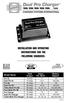 Model Name Total Output Amps Per Bank Battery System Pro XL Dual Pro XL Pro SE Dual Pro SE Three Bank Pro SE Four Bank Pro SE Pro Charger Dual Pro Charger Three Bank Pro Charger 6 amps 12 amps 10 amps
Installation and Operating Instructions (for chargers shown below)
 Installation and Operating Instructions (for chargers shown below) For additional information please call our Technical Support Group 800.742.2740 PRO CHARGING SYSTEMS, LLC 1551 Heil Quaker Boulevard,
Troubleshooting accelerometer installations
 Troubleshooting accelerometer installations Accelerometer based monitoring systems can be tested to verify proper installation and operation. Testing ensures data integrity and can identify most problems.
TROUBLESHOOTING, REPAIR, AND REPLACEMENT GUIDE FOR MODEL #19300 BATTERY CHARGER PLEASE SAVE THESE IMPORTANT SAFETY INSTRUCTIONS
 *35827* TROUBLESHOOTING, REPAIR, AND REPLACEMENT GUIDE FOR MODEL #19300 BATTERY CHARGER PLEASE SAVE THESE IMPORTANT SAFETY INSTRUCTIONS For correct operation of the equipment, it is important to read and
BATTERY CHARGING GUIDELINES FOR 6-VOLT DEEP CYCLE BATTERIES
 BATTERY CHARGING GUIDELINES FOR 6-VOLT DEEP CYCLE BATTERIES Introduction Your 6-volt deep cycle battery set has been specially formulated for long cycle life and has particular voltage and specific gravity
ELECTRICAL FUNDAMENTALS
 General Electricity is a form of energy called electrical energy. It is sometimes called an "unseen" force because the energy itself cannot be seen, heard, touched, or smelled. However, the effects of
Battery Tester. GxT Incorporated, Cheboygan MI, U.S.A. All Rights Reserved E040-01G. 40 & 42HD Operator s Manual
 Battery Tester GxT Incorporated, Cheboygan MI, U.S.A. All Rights Reserved E040-01G 40 & 42HD Operator s Manual SPECIFICATIONS Measurement Range...Ferret 40... Ferret 42HD Battery Volts... 4.0 to 19.99...
I. R. D. T INSTITUTE OF RESEARCH DEVELOPMENT AND TRAINING
 I. R. D. T INSTITUTE OF RESEARCH DEVELOPMENT AND TRAINING SYLLABUS SIX MONTHS FULL TIME Repair and Maintenance of Electrical gadgets EFFECTIVE FROM:- UNDER DEVELOPMENT Prepared By: Curriculum Development
********* ELECTRICAL ***********
 SECTION 9... ELECTRICAL Note. Major changes and/or additions are in bold face font. Contributions by web members are underlined with dots and credit given when known. Minor changes, usually just wording,
Essential Electrical Concepts
 Essential Electrical Concepts Introduction Modern vehicles incorporate many electrical and electronic components and systems: Audio Lights Navigation Engine control Transmission control Braking and traction
SYNCHRONOUS MACHINE TESTING WITH MOTOR CIRCUIT ANALYSIS INSTRUMENTATION
 SYNCHRONOUS MACHINE TESTING WITH MOTOR CIRCUIT ANALYSIS INSTRUMENTATION Introduction Howard W. Penrose, Ph.D., CMRP Vice President, Engineering and Reliability Services Dreisilker Electric Motors, Inc.
4 DEDICATED SINGLE PHASE LIMA MAC GENERATOR LIGHT TOWER DUTY MODELS 250MSL1278 AND 250MSL1299 SERVICE PROCEDURE ELECTRICAL COMPONENT TESTING
 HI POTENTIAL TESTS 4 DEDICATED SINGLE PHASE LIMA MAC GENERATOR LIGHT TOWER DUTY MODELS 250MSL1278 AND 250MSL1299 SERVICE PROCEDURE ELECTRICAL COMPONENT TESTING None of the windings, either rotating or
National- Spencer Inc.
 9-27-2010 National- Spencer Inc. 19.2V HEAVY DUTY GREASE GUN PRODUCT SPECIFICATION Charger Input Power 110 VAC Battery Output Power 19.2V Battery Capacity 1500 MAH Battery Pack Charge Time 1 Hour Maximum
BATTERIES. Battery Types. General. Battery Functions
 General The battery is the primary "source" of electrical energy on Toyota vehicles. It stores chemicals, not electricity. Two different types of lead in an acid mixture react to produce an electrical
3. SEISCO PARTS & SERVICE REMOVAL AND REPAIR GUIDE
 4 3. SEISCO PARTS & SERVICE REMOVAL AND REPAIR GUIDE A. Changing the Control Board B. Replacing a Heating Element C. Thermistor Replacement D. High Limit Switch Replacement E. Level Detector Replacement
SERVICE MANUAL FOR 12 VDC WALL THERMOSTAT AIR CONDITIONING SYSTEMS ROOF TOP UNITS ONLY
 RV Products Division SERVICE MANUAL FOR 12 VDC WALL THERMOSTAT AIR CONDITIONING SYSTEMS ROOF TOP UNITS ONLY Airxcel, Inc. RV Products Division P.O. Box 4020 Wichita, KS 67204 1976A376 (1-11) TABLE OF CONTENTS
RADIANT PLASMA 4700 Plasma Spark Generator
 RADIANT PLASMA 4700 Plasma Spark Generator Installation Guide / User Manual A S P A R K O F F R E S H A I R Aquapulser.com Contents 1 Introduction 2 1.1 About the Product....................................
CPL SYSTEMS / GROENEVELD AUTOMATIC GREASING SYSTEM COMPLETE SYSTEM CHECK PNEUMATIC PUMP
 CPL SYSTEMS / GROENEVELD AUTOMATIC GREASING SYSTEM COMPLETE SYSTEM CHECK PNEUMATIC PUMP Feb 5, 2003 1 CPL SYSTEMS / GROENEVELD AUTOMATIC GREASING COMPLETE SYSTEM CHECK - PNEUMATIC PUMP THE SYSTEM DOES
Hand Crank Generator (9 May 05) Converting a Portable Cordless Drill to a Hand Crank DC Generator
 Converting a Portable Cordless Drill to a Hand Crank DC Generator The unit is light weight (2.5 lb), portable, low cost ($10-$20) and can be used to recharge single cell batteries at from 1-3.5 amps. It
DC generator theory. Resources and methods for learning about these subjects (list a few here, in preparation for your research):
 DC generator theory This worksheet and all related files are licensed under the Creative Commons Attribution License, version 1.0. To view a copy of this license, visit http://creativecommons.org/licenses/by/1.0/,
400 Amp Rechargeable Jump Start System RAC-HP082
 400 Amp Rechargeable Jump Start System RAC-HP082 MAINTENANCE Always inspect the tool before use to ensure the cables are in good condition and the clamps are clean and free from corrosion. Keep clean by
Motor Fundamentals. DC Motor
 Motor Fundamentals Before we can examine the function of a drive, we must understand the basic operation of the motor. It is used to convert the electrical energy, supplied by the controller, to mechanical
COOL-01, Cooling Fan Operation and Troubleshooting
 COOL-01, Cooling Fan Operation and Troubleshooting Table of Contents Introduction Early 944s With Air Conditioning Cooling Fan Operation On Early 944s With Air Conditioning Testing Fan Relay One Early
ELECTRODYNAMICS 05 AUGUST 2014
 ELECTRODYNAMICS 05 AUGUST 2014 In this lesson we: Lesson Description Discuss the motor effect Discuss how generators and motors work. Summary The Motor Effect In order to realise the motor effect, the
Welcome to Linear Controls Quarterly Training
 Welcome to Linear Controls Quarterly Training Introduction to Power Generation Objectives Supply attendees with basic knowledge of power generators and voltage regulators and provide the fundamentals of
FUEL-16, Troubleshooting Fuel Supply Problems
 FUEL-16, Troubleshooting Fuel Supply Problems Introduction This procedure is used to troubleshooting fuel supply problems including failure of the fuel pump to start during engine cranking. Fuel Pump Not
How To Use A Power Supply Unit (Upu)
 BRAVER UPS (Uninterruptible Power System) User s Manual Safety CAUTION! This UPS utilizes voltages that may be hazardous. Do not attempt to disassemble the unit. The unit contains no user replaceable parts.
Type SA-1 Generator Differential Relay
 ABB Automation Inc. Substation Automation and Protection Division Coral Springs, FL 33065 Instruction Leaflet 41-348.11C Effective: November 1999 Supersedes I.L. 41-348.11B, Dated August 1986 ( ) Denotes
i ChatterBox! Motorcycle Security
 i Before you Start the Installation * Please read this manual to become familiar with the requirements necessary to complete the installation. * Use a high quality multi-meter to test all wires before
GROUND DETECTION CIRCUITS FOR STATIONARY APPLICATIONS (IN PLAIN DOWN TO EARTH LANGUAGE)
 GROUND DETECTION CIRCUITS FOR STATIONARY APPLICATIONS (IN PLAIN DOWN TO EARTH LANGUAGE) Matthew Theriault Designer Hindle Power Inc. Easton, PA SCOPE AND PURPOSE OF THE PAPER Why do we bother to monitor
POWER SUPPLY MODEL XP-15. Instruction Manual ELENCO
 POWER SUPPLY MODEL XP-15 Instruction Manual ELENCO Copyright 2013 by Elenco Electronics, Inc. REV-A 753020 All rights reserved. No part of this book shall be reproduced by any means; electronic, photocopying,
Understanding Generator Ripple Waveforms
 Understanding Generator Ripple Waveforms 2 Understanding Generator Ripple Waveforms Chapter Page Preliminary Information and Setup 3 Generator Theory 6 Generator Ripple Theory 15 Factors that Influence
SERVICE MANUAL 12VDC WALL THERMOSTAT AIR CONDITIONING SYSTEMS ROOFTOP UNITS ONLY
 SERVICE MANUAL 12VDC WALL THERMOSTAT AIR CONDITIONING SYSTEMS ROOFTOP UNITS ONLY! WARNING - SHOCK HAZARD! TO PREVENT THE POSSIBILITY OF SEVERE PERSONAL INJURY, DEATH, OR EQUIPMENT DAMAGE DUE TO ELECTRICAL
Automatic taper of charge rate for superior battery life through good equalization of cells and low water use rate.
 *00151* FEATURES Automatic taper of charge rate for superior battery life through good equalization of cells and low water use rate. Silicon diodes with inherent surge protection operated at a conservative
TOYOTA ELECTRONIC TRANSMISSION CHECKS & DIAGNOSIS
 Checks and Adjustments The transmission requires regular maintenance intervals if it is to continue to operate without failure. As we discussed in previous sections, transmission fluid loses certain properties
Single Channel Loop Detector
 Single Channel Loop Detector Model - LD100 Series The LD100 is a single channel inductive loop detector designed for parking and access control applications. The detector is connected to an inductive loop
CONSTRUCTING A VARIABLE POWER SUPPLY UNIT
 CONSTRUCTING A VARIABLE POWER SUPPLY UNIT Building a power supply is a good way to put into practice many of the ideas we have been studying about electrical power so far. Most often, power supplies are
ANALOG AND DIGITAL METERS ANALOG VS. DIGITAL METERS VOLTMETERS ANALOG AND DIGITAL
 ANALOG VS. DIGITAL METERS Ultimately, your diagnosis of vehicle electrical system problems will come down to using a voltmeter, ammeter, or ohmmeter to pinpoint the exact location of the problem. There
cbperformance.com Please read this entire brochure prior to installing your CB Performance Products MAGNASPARK II distributor.
 - Easy -wire installation with no external spark box necessary, but can be used with one. - Precision CNC machining and hand assembled construction. This is a premium product. - Accurate super hot spark
Oil and Coolant Circulating Heating System. Model - OCSM
 Oil and Coolant Circulating Heating System Model - OCSM Installation & Operation Manual 216280-000 REV 2 Identifying Your System The HOTSTART heating system is designed to heat fluids for use in marine
Service Guide 12/27/03 TESTING, SERVICE & REPAIR GUIDE (For SH Space Heating Models & RA Water Heating Models)
 TESTING, SERVICE & REPAIR GUIDE (For SH Space Heating Models & RA Water Heating Models) WARNING - HIGH VOLTAGE AC electrical circuits are connected to this heater. Do not attempt any service work on the
543-0032-00, 943-0032-00. User s Manual
 543-0032-00, 943-0032-00 User s Manual 1 Comfort Alert Diagnostics Faster Service And Improved Accuracy The Comfort Alert diagnostics module is a breakthrough innovation for troubleshooting heat pump and
4 LEAD DEDICATED SINGLE PHASE LIMA MAC GENERATOR MODELS 250MSL1185 AND 250MSL1152
 4 LEAD DEDICATED SINGLE PHASE LIMA MAC GENERATOR MODELS 250MSL1185 AND 250MSL1152 SERVICE PROCEDURE ELECTRICAL COMPONENT TESTING HI POTENTIAL TETS None of the windings, either rotating or stationary should
Single Phase Soft Starter
 Single Phase Soft Starter Installation & Operating Manual 6/02 Table of Contents Section 1 General Information................................................... 1 1 General Description................................................
PS-6.2 Explain the factors that determine potential and kinetic energy and the transformation of one to the other.
 PS-6.1 Explain how the law of conservation of energy applies to the transformation of various forms of energy (including mechanical energy, electrical energy, chemical energy, light energy, sound energy,
Companion Service Guide
 Companion Service Guide This Service Guide contains: Troubleshooting Replacement Instructions Contact Information Golden Technologies 401 Bridge Street Old Forge, PA 18518 Toll-free: 800-624-6374 Fax:
Diode Applications. by Kenneth A. Kuhn Sept. 1, 2008. This note illustrates some common applications of diodes.
 by Kenneth A. Kuhn Sept. 1, 2008 This note illustrates some common applications of diodes. Power supply applications A common application for diodes is converting AC to DC. Although half-wave rectification
ENGINE COOLING SYSTEM
 ENGINE COOLING SYSTEM 1988 Toyota Celica 1987-88 TOYOTA Engine Cooling Systems Celica DESCRIPTION The basic liquid cooling system consists of a radiator, water pump, thermostat, cooling fan, pressure cap,
Describe the procedure used to check for spark. Discuss what to inspect and look for during a visual inspection of the ignition system.
 CHAPTER 20 OBJECTIVES Describe the procedure used to check for spark. Discuss what to inspect and look for during a visual inspection of the ignition system. List the steps necessary to check and/or adjust
BC-5000 OPERATIONS MANUAL BATTERY CAPACITY TESTER COFKO LLC.
 BC-5000 BATTERY CAPACITY TESTER OPERATIONS MANUAL COFKO LLC. COPYRIGHT 2010 1 UNPACKING As you unpack your new BC-5000 battery capacity tester, inspect the tester for signs of shipping damage. If shipping
LEAD ACID BATTERY working LIFETIME STUDY
 LEAD ACID BATTERY working LIFETIME STUDY Valve Regulated Lead Acid (VRLA) Batteries Overview The most common type of battery used on UPS systems and for backup of telecommunications systems. VRLA batteries
Lead & Magnet Wire Connection Methods Using the Tin Fusing Method Joyal A Division of AWE, Inc.
 Lead & Magnet Wire Connection Methods Using the Tin Fusing Method Joyal A Division of AWE, Inc. Abstract The technology for connecting lead and magnet wires for electric motors and electro mechanical devices
LEAD CRYSTAL. User Manual. Valve-regulated lead-crystal batteries Energy storage Cells
 Engineering Production Sales LEAD CRYSTAL Valve-regulated lead-crystal batteries Energy storage Cells User Manual www.axcom-battery-technology.de [email protected] Chapter 1: 1. Introduction
BATTERY CHARGER OPERATOR'S MANUAL
 ASSOCIATED BATTERY CHARGER OPERATOR'S MANUAL IMPORTANT SAFETY INSTRUCTIONS 1. SAVE THESE INSTRUCTIONS. This manual contains important safety and operating instructions for models 9006, 9010, 9014, 9050,
Rotating Machinery Diagnostics & Instrumentation Solutions for Maintenance That Matters www.mbesi.com
 13 Aberdeen Way Elgin, SC 29045 Cell (803) 427-0791 VFD Fundamentals & Troubleshooting 19-Feb-2010 By: Timothy S. Irwin, P.E. Sr. Engineer [email protected] Rotating Machinery Diagnostics & Instrumentation
Sport Ice Elektro 124
 Sport Ice Elektro 124 Operation Manual 2007/4 V2.1 Introduction The Sport Ice Elektro 124 is an ice resurfacing machine designed to be used on small ice surfaces. The machine has been designed to produce
Chen. Vibration Motor. Application note
 Vibration Motor Application note Yangyi Chen April 4 th, 2013 1 Table of Contents Pages Executive Summary ---------------------------------------------------------------------------------------- 1 1. Table
Electronics and Soldering Notes
 Electronics and Soldering Notes The Tools You ll Need While there are literally one hundred tools for soldering, testing, and fixing electronic circuits, you only need a few to make robot. These tools