
Year 10 & 11. La Salle EDUCATION. Mathematics. Solved.
|
|
|
- Laura Young
- 9 years ago
- Views:
Transcription
1 Year 10 & 11 Scheme of Work This example shows our exemplification of Year 10 and 11. Complete Mathematics contains full exemplification for all year groups from Year 1 upwards. La Salle EDUCATION Mathematics. Solved. All rights reserved. Copyright La Salle Education Ltd No reproduction without permission - 'Complete Mathematics' and its logo are Trademarks of La Salle Education Ltd.

2 KEY STRAND # Curriculum Statement STRAND # Objective Topic Objective Description NON-STATUTORY Topic Structure STRAND NUMBER GEOMETRY AND MEASURES PROBABILITY AND STATISTICS Topic Fractions Expressing Relationships Geometry Probability Topic Fractions (Including Decimals) Using Equations and Functions Measures Interpreting Data Topic Fractions (Including Decimals and Percentages) Number and Place Value Position and Direction Properties of Shapes Powers and Roots Properties of Numbers Ratio and Proportion Ratio, Proportion and Rates of Change Page 2

3 NUMBER Proportion 14 GEOMETRY AND MEASURES Identify and work with fractions in ratio problems NUMBER 2 Ratios as Fractions Ratio and Proportion Solving Problems using Ratios as Fractions (including Geometrical) Ratio and Proportion The objective is for students to understand the meaning of ratio notation and interpret ratio as a fraction. Students should be able to solve simple problems representing ratios as fractions in context. For example: The ratio of right-handed to left-handed students is 18:2. What fraction of students is left-handed? The ratio of red counters to blue counters is 4:5. The number of blue counters is doubled. What fraction of the counters are now blue? If a line is divided in the ratio 1:3, what fraction of the whole line does the smaller part represent? A bag contains green and yellow counters in the ratio 4:5. What is the probability of randomly choosing a yellow counter? The objective is for students to solve problems involving ratios as fractions. Students should be able to represent ratios as fractions, including in the context of geometrical problems. For example: A bag contains 100 sweets that are either hard-boiled, chocolate, or chewy sweets. 3/5 are hard-boiled sweets. The ratio of chewy sweets to chocolates is 3:1. How many sweets are chocolate? Given similar shapes, students can identify the scale factor of enlargement. Given a scale drawing of a map, students can calculate distances between two cities. Compare lengths, areas and volumes using ratio notation and/or scale factors; make links to similarity GEOMETRY AND MEASURES 2 Comparing Lengths using Ratios and Scale Factors Measures The objective is for students to compare lengths using ratios and scale factors. Students should be able to draw and identify similar shapes using scale factors and ratio notation. For example: Given a 4cm x 3cm rectangle and a scale factor of 3.5, students can draw an enlarged rectangle and identify the ratio of the perimeters as 2:7. Given 2 similar shapes and a scale factor, students can calculate missing dimensions. Given the height of a student, estimate the height of a tree. Comparing Area and Volume of Similar Shapes Measures The objective is for students to compare area and volume of similar shapes. Students should be able to identify changes in area and volume of similar shapes using scale factors and ratio notation. For example: A triangle with an area of 15cm 2 is enlarged by a scale factor of 3. What is the area of the new triangle? Given the areas of 2 similar triangles, what is the ratio of the area of the smaller triangle to the area of the larger triangle? Given a solid with a volume of 20 cm 3 and a similar solid of volume 160 cm 3, what is the scale factor of enlargement? Given 2 similar solids, the dimensions of the larger and a ratio of the volumes, students can find the dimensions of the smaller solid. Page 3

4 Proportion NUMBER GEOMETRY AND MEASURES 14 Write equivalent ratios including unitary ratios and the use of the unitary method NUMBER 2 Equivalent & Simplifying Ratios Ratio and Proportion Solve Problems Using the ary Method Ratio and Proportion The objective is for students to solve problems involving ratios. Students should be able to use equivalent ratios, simplifying ratios and expressing ratios in the form 1:n as tools to solve problems. For example: A recipe calls for 30g of butter to make 10 scones. How much butter is needed to make 30 scones? Mrs Smith s class has 18 boys and 12 girls. Express the ratio of boys to girls in simplest form. Express the ratio 6:4 in the form 1:n On a map a length of 8 cm represents a real-life measurement of 24 km. What is the scale of the map in the form 1:n? The objective is for students to understand and use the unitary method to solve problems involving ratio and proportion. Students should be able to identify when the unitary method should be used and apply it. For example: A recipe calls for 120 g of butter to make 12 biscuits How much butter is needed to make 30 biscuits? Divide 80 in the ratio 2:3:5 Farhana and Susie divide 300 in the ratio 2:4. Susie gives 1/3 of her share to Keisha. Farhana gives 1/2 of her share to Keisha. How much money did Keisha receive? Understand that X is inversely proportional to Y is equivalent to X is proportional to Y1 ; {construct and} interpret equations that describe direct and inverse proportion NUMBER 2 Direct Proportion Ratio, Proportion and Rates of Change Inverse Proportion Ratio, Proportion and Rates of Change The objective is for students to understand that proportion represents a multiplicative relationship. Students should be able to understand that direct proportion can be represented as an equation of the form y=kx where k is the constant of proportionality (and k does not equal zero). Higher students should be able to construct and use the equation y=kx to solve problems involving direct proportion. They should be able to express a relationship as a proportion and deduce the constant of proportionality in order to write a formula that can be used to solve problems involving direct proportion. For example: Given that x is directly proportional to y, what happens to y when x is doubled? (Higher) 25 metres of ribbon costs 32, how much does 40 metres of the same ribbon cost? The objective is for students to understand that inverse proportion can be represented as an equation of the form y=k/x where k is the constant of proportionality and to use this fact to solve problems involving inverse proportion. Students should recognize the equivalence of y=k/x and x=k/y. For example, given that x is inversely proportional to y, what happens to y when x is doubled and what happens to x when y is doubled? Higher students should be able to express a relationship as a proportion and deduce the constant of proportionality in order to construct a formula that can be used to solve problems involving inverse proportion. For example: The number of hours, h, taken to build a wall is inversely proportional to n, the number of workers. If it takes 15 hours for 3 workers to build the wall, how long will it take 8 workers? Time=Distance/Speed. What happens to time if speed is doubled? Page 4

5 Proportion NUMBER GEOMETRY AND MEASURES 14 Interpret the gradient of a straight line graph as a rate of change; recognise and interpret graphs that illustrate direct and inverse proportion NUMBER 1 Ratios and Graphs Ratio, Proportion and Rates of Change The objective is for students to understand and use the gradient of a straight-line graph in relation to ratio. Students should be able to recognise the gradient of a straight-line graph as a rate of change. They should also be able to recognise, draw and interpret graphs of both direct and inverse proportion. For example, given a conversion graph, students can find the conversion factor using the gradient. Calculate percentage change including reverse percentage problems NUMBER 2 Percentage Change Fractions (Including Decimals and Percentages) The objective is for students to calculate percentage change. Students should be able to find both percentage increase and decrease. For example, students can calculate the new price of a sale item given its original price and the percentage discount. NON-STATUTORY Reverse Percentage Change Fractions (Including Decimals and Percentages) The objective is to build on students understanding of percentage change in order to calculate reverse percentage change. Students should be able to find the original value of a quantity given the percentage change. For example, given a sale price and the percentage discount, students can calculate the original price. Page 5

6 Proportion NUMBER GEOMETRY AND MEASURES 14 Work with repeated percentage change including compound interest NUMBER 2 Repeated Percentage Change Fractions (Including Decimals and Percentages) The objective is for students to be able to solve problems involving repeated percentage change. Students should be able to calculate repeated percentage increase and decrease. For example: Students can calculate the increasing value of a house over time. Students can calculate the depreciating value of a car over time. NON-STATUTORY Compound Interest Fractions (Including Decimals and Percentages) The objective is to build on students understanding of repeated percentage change to be able to calculate compound interest. Students should be able to use multipliers and the formula for compound interest. For example, given an opening account balance and interest rate, students can calculate the amount in the account after a given time period. Understand and use scale factors with length, area and volume GEOMETRY AND MEASURES 1 Scale Factors Measures The objective is for students to understand and use scale factors with length, area and volume. Students should be able to make the link between enlarged lengths, area and volume using the scale factor. For example, given a cuboid and a scale factor, students can calculate the new dimensions, surface area and volume of the enlarged cuboid. NON-STATUTORY Page 6

7 Sequences 4 Deduce expressions to calculate the nth term of linear sequences. 2 Generating sequences Expressing Relationships Finding the nth term Expressing Relationships The objective is to consolidate and build upon students skills in generating linear sequences. Students should be able to generate sequences from a term-to-term rule, nth term rule and given diagrams. They should also be able to find the value of any value number in the sequence when given its position in the sequence. For example: A sequence starts with 2 and has the term-to-term rule of double and add 3. Write the first 5 terms of the sequence. Given the first three patterns of a sequence, students can draw the next two patterns. Find the 100th term in the sequence 3n - 4. A sequence has nth term rule 4n-3. What term has the value of 77? The objective is for students to find nth term rules of a linear sequence. Students should be able to find the nth term rule for a given linear sequence in number or diagrammatical form. They should also be able to identify whether a given number belongs to a sequence of numbers, when only given the first few terms or when given the nth term; these can be described using basic number facts or shown algebraically. For example: Find the nth term of the sequence 5, 8, 11, 14,... A sequence begins 11, 15, 19, 23,... Is 42 in the sequence? Explain. Recognise and use sequences of triangular, square and cube numbers, simple arithmetic progressions, Fibonacci type sequences 2 Sequences involving Triangular, Square and Cube Numbers Expressing Relationships The objective is for students to recognise and use sequences of triangular, square and cube numbers. Students should be able to continue a given sequence and find a term given the nth term rule. For example: Write down the next two terms of the following sequence: 3, 12, 27, 48 Draw the first five diagrams of the triangular numbers and find the next two triangular numbers. Find the 8th term in the sequence with nth term rule 5n 3. Other Sequences Expressing Relationships The objective is to introduce students to other sequences. Students should be able to solve problems involving simple arithmetic progressions and Fibonacci-type sequences (with the rule given). They will be expected to continue sequences of this nature, when given the first few terms or the rule. For example: The terms of the Fibonacci sequence are found by summing the two previous terms. List the first 5 terms. An arithmetic progression starts with 2+b; 2+3b; 2+5b; 2+7b. The third term is 17. Work out the values of b and work out the nth term rule. Page 7

8 Probability calculations for more than one event PROBABILITY AND STATISTICS 12 Apply the property that the probabilities of an exhaustive set of mutually exclusive events sum to one PROBABILITY AND STATISTICS 1 Mutually Exclusive Events Probability The objective is for students to understand and use properties of mutually exclusive events. Students should be able to identify and give examples of mutually exclusive events. Students should also be able to calculate probabilities of mutually exclusive events by knowing and understanding that the sum of the probabilities of an exhaustive set of mutually exclusive events is 1. For example: A regular six-sided die is rolled. Are rolling a 2 and rolling a 4 mutually exclusive events? Is rolling a 2 and an even number mutually exclusive? A spinner has four sections that are red, green, yellow, and blue. P(red)=0.3, P(green)=0.2, P(yellow)=0.16. Find the probability of blue. The probability that Martin completes his maths homework is What is the probability that he does not complete his maths homework? Use a probability model to predict the outcomes of future experiments; understand that empirical unbiased samples tend towards theoretical probability distributions, with increasing sample size PROBABILITY AND STATISTICS 2 Making Estimations with Probability Probability The objective is for students to be able to estimate the likelihood of events using probability. Students should be able to calculate estimations of probability based on the frequency of outcomes and events. They should also understand that reliability of results increases with the size of the sample and that there is no element of memory in random events. For example, Frankie flips a coin 10 times. It lands on tails 8 times. Can she conclude that the coin is biased? How could she improve her experiment? Relative Frequency Diagrams Probability The objective is for students to be able to use and draw relative frequency diagrams. Students should be able to use these diagrams to solve problems involving estimations with probabilities. Students should understand that a relative frequency diagram may show a settling trend as sample size increases and understand how this is useful in estimating a probability. For example, given the results of an experimental trial, students can draw a relative frequency diagram and estimate the probability of an event from the diagram. Page 8

9 Probability calculations for more than one event PROBABILITY AND STATISTICS 12 Calculate the probability of independent and dependent combined events, including using tree diagrams and other representations, and know the underlying assumptions PROBABILITY AND STATISTICS 5 The Addition Rule Probability The objective is for students to understand and use the addition rule of probabilities. Students should be able to both use the addition rule and determine when its use is appropriate. For example, students can calculate the probability of rolling a five or a six on a fair six-sided die. The Multiplication Rule Probability The objective is for students to understand and use the multiplication rule of probabilities. Students should both be able to use the multiplication rule and determine when its use is appropriate. For example, students can calculate the probability of rolling a six twice when a single die is thrown 2 times. Dependent & Independent Events Probability The objective is for students to understand and be secure with the difference between dependent and independent events. Students should be able to calculate the probabilities of dependent events and should know what it means when an event is described as independent. They should understand the implications of problems with or without replacement. For example, students can calculate the probabilities as items are pulled from a bag both with and without replacement. Probability Tree Diagrams Probability The objective is for students to draw tree diagrams. Students should be able to draw tree diagrams to show the possible outcomes of independent or dependent events. For example, students can draw a tree diagram to show a train arriving late or on time at various points on its journey. Solving Probability Problems Probability The objective is to build on students ability of drawing tree diagrams to now to use them to calculate the probabilities. Students should be able to draw and use tree diagrams of independent or dependent events. For example, students can draw and use a tree diagram to show the probability of the train arriving on time or late to its first three stops and calculate the probability of the train arriving late to at least one stop. Page 9

10 Probability calculations for more than one event PROBABILITY AND STATISTICS 12 {Calculate and interpret conditional probabilities through representation using expected frequencies with two-way tables, tree diagrams and Venn diagrams}. PROBABILITY AND STATISTICS 2 Venn Diagrams and Probability Probability Probability in Two-Way Tables Probability The objective is for students to use Venn diagrams as a method for calculating conditional probabilities. Students should be able to construct a Venn diagram and then answer questions related to probabilities that may be calculated using the diagram. For example: In a survey of preferences between strawberry and chocolate ice cream, 80% of survey responders like chocolate ice cream and 35% like chocolate and strawberry ice cream. What is the probability that a person chosen at random who likes chocolate also likes strawberry? The objective is for students to use two-way tables as a method for calculating conditional probabilities. Students should be able to interpret and construct two-way tables. For example, given a two-way table of models and colours of cars, students can calculate the probability of selecting two cars of the same colour and calculate the probability of one colour given the model of the car. Apply systematic listing strategies, {including use of the product rule for counting} PROBABILITY AND STATISTICS 2 Listing Outcomes of Events Probability Probability Sample Spaces Probability The objective is for students to be able to systematically list the outcomes of exhaustive, independent events and to calculate probabilities. Students should be able to list all permutations and combinations of outcomes. Higher students should be able to know and understand why if there are x ways to do task 1 and y ways to do task 2, then there are xy ways to do both tasks in sequence. For example, A bag contains chocolates, hard-boiled sweets and chewy sweets. John selects two sweets at random. List the possible pairs and find the probability that the 2 sweets are chocolate. (Higher) A computer store sells 10 different computers, 4 different keyboards and 2 different mice. How many different combinations of a computer, a keyboard and a mouse are there? Janelle chooses a computer. How many combinations are there now? The objective is for students to construct and use probability sample spaces. Students should be able to complete sample spaces as a method for recording the possible outcomes of exhaustive, independent events and to calculate probabilities. They should be able to display all permutations and combinations. For example, students can complete a sample space to show the outcomes of throwing two fair dice and calculate the probability of rolling the same number on both dice. Page 10

11 Numbers and Accuracy NUMBER 16 Work to appropriate accuracy including rounding to decimal places and significant figures NUMBER 1 Identify and Round to Given Degrees of Accuracy Number and Place Value The objective is to work with appropriate degrees of accuracy. Students should be able to identify to how many significant figures a number has been given. Students should also be able to round a number to a given number of significant figures or decimal places. For example students should identify that 3500 has been written to 2 significant figures and be able to round 3410 to 1 significant figure. NON-STATUTORY Apply and interpret limits of accuracy when rounding or truncating, {including upper and lower bounds}. NUMBER 2 Identify and Round to Appropriate Degrees of Accuracy Number and Place Value The objective is to select and round to an appropriate degree of accuracy. Students should be able to interpret scales on a range of measuring instruments and identify or suggest an appropriate degree of accuracy for a measurement from the context of the situation. For example, if working with large masses, students should be able to understand that recording results to the nearest gram is unnecessary Accuracy of Measurements Number and Place Value The objective is to understand that measurements given to the nearest whole unit may be inaccurate by up to one half in either direction. Students should be able to find the largest and smallest possible values for the measurements. Higher students should be able to perform calculations taking into account the limits of accuracy of rounded numbers. For example, The length of a table is measured to be 1.2 metres. What is its largest and smallest possible length? (Higher) Ilham travels 2.1 km to school in 15 minutes. What is her minimum and maximum speed? Page 11

12 Numbers and Accuracy NUMBER 16 Calculate with roots, and with integer {and fractional} indices NUMBER 3 Calculations Involving Roots Powers and Roots The objective is for students to perform calculations with square and cube roots. Students should be able to recall the first fifteen square numbers, the first five cube numbers and their associated roots. Students should be able to calculate and recognise powers of 2, 3, 4, 5 and 10. Students should also understand that a square root has both positive and negative roots. For example, students should be able to calculate: 49 5 x 5 5* 3 Calculations Using Index Laws Powers and Roots The objective is for students to understand and use the index laws. Students should be able to use the index laws for multiplication, division and raising to a power in order to perform calculations involving indices. For example, students should be able to simplify (7 3 x 7 5 ) 2, writing the result as a single power of 7. Calculations with Fractional Indices Powers and Roots The objective is for students to be able to work with fractional indices. Students should know that the denominator of a fractional power is equivalent to a root. Students should be able to evaluate numbers with fractional indices. Students should also be able to perform calculations with numbers that include fractional indices. For example, students should be able to work out 8 (-2/3) {Estimate powers and roots of any given positive number} NUMBER 1 Estimate Powers and Roots of a Given Positive Number The objective is for students to estimate powers and roots of a positive number. Students should be able to identify between which two integers the square or cube root of a positive number lies in order to estimate the root. They should also be able to use powers of integers to estimate powers of rational numbers. For example: Estimate the square root of 110 Estimate Powers and Roots Page 12

13 Numbers and Accuracy NUMBER 16 Calculate with numbers in standard form A 10n, where 1 A < 10 and n is an integer NUMBER 3 Standard Form Powers and Roots Multiplying and Dividing Numbers in Standard Form The objective is to understand and use standard form. Students should be able to recognise numbers that are in standard form, convert numbers between standard and non-standard form and order numbers written in standard form. Students should also become comfortable interpreting their calculator display for standard form. For example: Express in standard form. Express 3.7x10⁻³ as an ordinary number Write the following in ascending order 1.34x10 3, 13.4x10 2, 135 The objective is to multiply and divide numbers in standard index form. Students should be able to multiply and divide numbers in standard index form. For example, calculating that (3x10 7 ) x (2x10 5 ) = 6x10 12 Powers and Roots Adding and Subtracting Numbers in Standard Form The objective is to add and subtract numbers in standard index form by writing them as equal powers of ten. Students should be able to add and subtract numbers in standard index form for example 3x x10 5 = 3x x10 7 = 3.02x10 7 Powers and Roots Page 13

14 Numbers and Accuracy NUMBER 16 Calculate exactly with fractions, {surds} and multiples of π; {simplify surd expressions involving squares [for example 12 = (4 3) = 4 3 =2 3 ] and rationalise denominators} NUMBER 6 Calculate with Fractions Fractions The objective is to perform arithmetic calculations with fractions. Students should be able to: identify equivalent fractions simplify fractions convert between mixed numbers and improper fractions compare fractions add, subtract, multiply and divide fractions. For example: Write the following fractions in ascending order 1/2, 1/4, 2/3, 1/8 Calculate 3/5 + 2/3 Calculate 1 2/3 * 3/4 Solving Problems involving Fractions Fractions The objective is for students to use their skills of calculating exactly with fractions to solve problems. Students should be able to use fractions in a variety of contexts. For example, Alicia is cycling a distance of 9 3/4 km. After 6 1/2 km she decides to walk the rest of the way. How far does she walk? Calculate with Multiples of Pi Properties of Numbers The objective is to perform calculations with multiples of Pi. Students should be able to find the circumference, area, radius or diameter of a circle, leaving their result in terms of Pi. For example, students can express the area of a circle with a radius of 4cm as 16π cm 2. Simplifying Surds Powers and Roots The objective is for students to use their knowledge of calculations with roots to simplify surds. Students should be able to write integers as products of prime factors in order to simplify surds. For example, students can simplify 32 to 4 2 Calculating with Surds Powers and Roots The objective is for students to calculate exactly with surds. Students should be able to simplify expressions using the rules of surds and perform calculations involving addition, subtraction, multiplication and division of surds. For example: Simplify fully 50 * 2 Show that ( 30+3)( 3-10) can be simplified to a 3 where a is an integer Rationalising Denominators Powers and Roots The objective is for students to rationalise the denominator of a fraction. Students should be able to rationalise the denominator when it has one or more terms. For example: Write 3/ 5 as 3 5/5 Write 1/(4+ 5) as (4-5)/11 Show that (8/(2 3))-((4 3)/5) simplifies to ((8 3)/15) Page 14

15 Linear Algebra 17 Simplify and manipulate algebraic expressions (including those involving surds {and algebraic fractions}) by simplifying expressions involving sums, products and powers, including the laws of indices 6 Manipulating Expressions Using Equations and Functions The objective is for students to re-write expressions in different forms. Students should be able to expand a term over a single bracket, simplify indices and collect like terms. For example, students can simplify: 3x (x + 5) 2x 2 (3x - y) 6x - 4x 4 (5-2x -3 ) x 16 x 4 Factorising Algebraic Expressions Using Equations and Functions The objective is for students to appreciate that factorising allows expressions to be re-written as products rather than polynomials. Students should be able to factorise algebraic expressions by taking out common factors. For example, students can factorise: 6x 2 + 2y 3x 2 y - 9y 4x 3 y 5 + 2xy 3 Manipulating Binomial Expressions Using Equations and Functions The objective is for students to multiply binomial terms of the form (ax±b). Students should be able to multiply 2 binomial expressions. Higher students should be able to multiply more than 2 binomial expressions and those including indices. For example, students can multiply out and simplify (x + 5)(x - 2) (4x + 5)(3x - 2) (Higher) (2x 3-1)(5x - 2) (Higher) (x + 2) 3 Factorising Quadratic Expressions Using Equations and Functions The objective is for students to re-write quadratic expressions of the form x 2 +bx+c as products by factorising. Students should be able to articulate the link is between the sum and product of c and d when (x + c)(x + d) are multiplied out. For example, students can factorise x 2 + 7x + 12 x 2 - x - 12 x 2-7x + 12 Factorise Quadratic Expressions Using Equations and Functions The objective is for students to extend their knowledge of factorising quadratic expressions. Students should be able to recognise the difference of two squares of the form x 2 -a 2 Higher students should be able to factorise quadratics of the form ax 2 +bx+c. For example: Factorise x 2-9 (Higher) Factorise 9x 2-4 (Higher) Factorise 2x 2 +11x+12 Algebraic Fractions Using Equations and Functions The objective is for students to apply their skills of factorisation and multiplying binomials to simplifying algebraic fractions. This includes cancelling common factors and adding/simplifying fractions. Higher students should be able to simplify a fraction with a quadratic expression in the numerator and denominator. For example, students should be able to simplify 25x/5 (Higher) (4x+6)/ (6x 2 +19x+15) Page 15

16 Linear Algebra 17 Translate simple situations or procedures into algebraic expressions or formulae; derive an equation, solve the equation and interpret the solution 2 Writing Expressions and Equations Using Equations and Functions The objective is for students to write expressions and equations in order to solve problems in context. Students should be able to set up, rearrange and solve simple linear equations. For example: Three siblings have the following age relationships: the oldest is three times the youngest; the middle is three years younger than the oldest; the sum of all three ages is 33 years. Write down expressions for the three ages and form an equation. Solve this equation to find the age of the youngest sibling. Using and Rearranging Formulae Using Equations and Functions The objective is for students to write and use formulae. Students should be able to form, use, substitute into, and re-arrange formulae. For example, students should be able to construct a formula to give earnings based on an hourly rate, hours worked and a fixed bonus. They should be able to re-arrange their formula to make the number of hours the subject. Page 16

17 Linear Algebra 17 Use the form y = mx c t+o identify parallel {and perpendicular} lines; find the equation of the line through two given points, or through one point with a given gradient 3 Finding the Equation of a Line The objective is for students to build on their previous knowledge of using y = mx + c. Students should be able to: Calculate the gradient of a straight-line given two points Work out the equation of a line, given two points on the line. For example, students should be able to write the equation of the line given the points (-5, 1) and (10, 10). Finding the Equation of a Line The objective is for students to build on their previous knowledge of using y=mx+c to find the equation of a line given one point and the gradient. Students should be able to substitute and manipulate y=mx+c or use y-y1=m(x-x1). For example, students can write the equation of the line in the form y=mx+c given the gradient of 2/3 and the point (6,8) Equations of Parallel & Perpendicular Lines The objective is for students to recognise and understand the properties of parallel and perpendicular lines on a coordinate grid. Students should be able to use their skills of substitution and manipulation on the form y = mx + c to tell whether lines are parallel or not. Higher students will also be able to work out the gradients of lines that are parallel and perpendicular to a given line and show that two lines are parallel or perpendicular using gradients. For example: Show that the lines 2x=3y-12 and 6y=4x-8 are parallel. (Higher) Show that the points (0,4) (2,3) (3,10) and (5,9) form a rectangle. Page 17

18 Linear Algebra 17 Translate simple situations or procedures into two simultaneous equations, solve the equation(s) and interpret the solution 3 Solving Simultaneous Linear Equations The objective is for students to solve simultaneous linear equations. Students should appreciate the difference between linear equations that have one variable and those that contain two variables and the link with the number of solutions. Students should be able to solve pairs of equations using substitution or simple elimination. For example, students can find the solutions to x+3y=10 and x-y=2. Solving Simultaneous Linear Equations The objective builds on students understanding of simultaneous linear equations to solve increasingly complex pairs of equations using substitution or elimination. Students should be able to solve pairs of linear equations where the coefficients are not the same on either variable. For example, students can solve pairs of equations such as: 2x + 3y = 11 and 5x - 2y = 18 Forming and Solving Simultaneous Linear Equations The objective builds on students skills of writing linear equations and solving simultaneous equations in order to now write and solve simultaneous equations for situations in context. Students should be able to translate problems into a pair of simultaneous linear equations, solve them and interpret the solutions. For example: It costs 23 to download 4 tunes and 5 Apps. It costs 20 to download 1 tune and 6 Apps. How much does 1 App cost? Solve two simultaneous equations in two variables (linear/linear) algebraically; find approximate solutions using a graph 1 Simultaneous Linear Equations - Graphical Solutions The objective is for students to find approximate solutions to simultaneous linear equations by using the point of intersection of two straight lines. Students should be able to link types of solutions to graphical representations: unique, infinite and impossible. For example, by plotting suitable values for the equations 4x - y = -1 and x + y = 5, students should be able to find solutions in the region of x = 0.8 and y = 4.2 Page 18

19 Linear Algebra 17 {Find approximate solutions to equations numerically using iteration} 2 Trial and Improvement Using Equations and Functions Recursive Formulae Using Equations and Functions The objective is for students to understand that where equations are not easily solved, a numerical method may be appropriate. Students should be able to use systematic trial and improvement to find approximate solutions of equations to a given degree of accuracy. For example, given that there is a solution between 5 and 6, they should be able to use trial and improvement to solve the equation 2x 3-3x = 400 to 1 decimal place. The objective is for students to work with recursive formulae. Students should be able to use suffix notation in recursive formulae and use such formulae to find approximate solutions. For example, using an initial value of x 1 = 1, students should be able to use the recursive formula x n+1 = 3-1/x n to solve the equation x = 3-1/x to 1 decimal place. Page 19

20 Functions GEOMETRY AND MEASURES 13 Where appropriate, interpret simple expressions as functions with inputs and outputs; {interpret the reverse process as the inverse function ; interpret the succession of two functions as a composite function } 4 Number Machines Using Equations and Functions Number Machines and Inverses Using Equations and Functions The objective is to consolidate and build upon students abilities in representing functions as number (function) machines. Students should be able to use and understand number machines and be comfortable in drawing them to represent an expression. They should also be able to form expressions when given number machines. For example: Complete a number machine to represent the function y = 3x - 1 Write down the function shown by a number machine x-->*8-->+3-->y The objective is for students to apply their knowledge of number machines and inverses to solve problems. Students should be able to work backwards using number machines to perform inverse operations and find values. Higher students should be able to articulate this process as the inverse function. For example, use the function machine x --> *4 --> +3 --> 23, to find the value of x. Using Function Notation Using Equations and Functions Composite and Inverse Function Notation Using Equations and Functions The objective introduces students to the notion of function notation, f(x). Students should be able to understand that a function is a relationship between two sets of values. They should be comfortable in using the correct mathematical notation to represent a function, substituting values into functions and solving equations that use function notation. For example: Given that f(x) = 5x + 4, find the value of f(4) Given that f(x) = 2x - 6, solve f(x) = 0. The objective introduces students to more complex notation associated with composite and inverse functions. Students should be able to understand the concept of function notation, use the notation to find the value of composite functions and write expressions for inverse functions. For example: f(x) = 3 + x and g(x) = x 2, find the value of fg(2) f(x) = 3x - 5, work out an expression for f -1 (x). Know the exact values of sinθ and cosθ for θ = 0º, 30º, 45º, 60º and 90º ; know the exact value of tanθ for θ=0º, 30º, 45º and 60º GEOMETRY AND MEASURES 1 Special Trig Angles Geometry The objective is to build on the students knowledge of special triangles to identify the exact values of sin cos and tan for 0, 30, 45 and 60 degrees. Students should be able to recall the exact values and should then be able to answer questions involving these angles, leaving their answers in an exact form, without the need of a calculator. For example calculating the missing sides in a right-angled triangle when given one side and one of the special angles. Page 20

21 Functions GEOMETRY AND MEASURES 13 Recognise, sketch and interpret graphs of linear functions, quadratic functions, simple cubic functions, the reciprocal function y = 1 with x = 0, {the exponential function y = k x for positive values of k, and the trigonometric functions (with arguments in degrees) y=sinx, y=cosx and y=tanx for angles of any size} 3 Sketching Quadratic and Cubic Functions The objective is for students to be able to recognise and sketch the shape of quadratic graphs and cubic graphs. They should be able to create a table of values and plot accurate graphs of cubic and quadratic functions. Additionally, students should be able to calculate values for a quadratic and draw the graph. Students should also be able to recognise simple translations of the graphs y=x 2 and y=x 3. Students should also be able to find a value of x for a given value of y using the graph. For example, students should be able to sketch the graph of y=x 3 +4 and use the graph to find y when x=2. Sketching Reciprocal and Exponential Graphs The objective is for students to be able to recognise and sketch reciprocal graphs. Higher students should be able to recognise and sketch exponential graphs of the form y=k x for positive values of k. They should be able to create a table of values, plot and interpret accurate graphs. Students should also be able to find a value of x for a given value of y using the graph. For example, students should be able to sketch the graph of y=1/(2x) and use the graph to find y when x=4. Sketching Trigonometric Graphs The objective is for students to be able to recognise and sketch the shape of sine, cosine and tangent graphs. Students should be able to complete a table of values and plot the graphs of sine, cosine and tangent. Students should understand the features of the graphs, such as periodicity, local maximums and minimums. Students should be able to identify the solutions of simple trig equations between 0 and 360 using symmetry. For example, students can draw a graph of y=cos(x) from 0 to 180 degrees and use it to find solutions to cos(x)=-0.5 between 0 and 360 degrees using symmetry. Page 21
22 Functions GEOMETRY AND MEASURES 13 Plot and interpret graphs (including reciprocal graphs {and exponential graphs}) and graphs of non-standard functions in real contexts, to find approximate solutions to problems such as simple kinematic problems involving distance, speed and acceleration 2 Plotting Real Life Reciprocal and Exponential Graphs The objective is for students to plot and interpret graphs of reciprocals and non-standard functions in context. Higher students will also be able to plot and interpret exponential graphs in context. Students should be able to plot a graph representing a real life problem from a given situation, a table of values or a formula. They should be able to interpret these graphs and answer questions concerning the graph. For example: Given a fixed charge and cost per day to hire a car, students can plot a graph to work out the cost of hiring the car for a given amount of days (Higher) Given a principal balance and compound interest rate, students can plot the graph and find the balance in the account after a given time period. Plotting Real Life Kinematic Graphs The objective is for students to plot and interpret graphs representing Kinematic problems involving distance, speed time. Students should be able to plot a graph representing a real life problem from a given situation, a table of values or a formula. They should be able to interpret these graphs and answer questions concerning the graph. For example, students can draw distance-time graph for a car journey and find the average speed of the journey. Page 22
23 Functions GEOMETRY AND MEASURES 13 {Sketch translations and reflections of the graph of a given function} 3 Translating Functions Reflecting Functions Translating and Reflecting Functions The objective is for students to sketch the image of a function after a translation in the y-direction, f(x)+a, and in the x-direction, f(x+b). They should be able to understand the translation in function notation and perform the translation when the instruction is given in both written and vector form. Students should also be able to recognise a translation and be able to write down the function of a transformation given the original function. For example: Translate the function of y = 2x + 4 three places left. Translate the function y = 3x - 4 by a given vector. Given the graph of y=x 3, students can sketch the graph of y=x Given the graph of y=f(x) and the graph of a transformation of y=f(x), students can write down the equation of the transformed function. The objective is for students to sketch images of functions after a reflection. They should be able to understand the reflection in function notation, -f(x) and f(-x) and reflect functions in the y-axis and x-axis when given the appropriate instruction. Students should also be able to recognise a reflection and be able to write down the function of a transformation given the original function. For example: Reflect the function y = 2x + 4 in the y-axis. Given the graph of y=cos(x), students can sketch the graph of y=-sin(x). Given the graph of y=f(x) and the graph of a transformation of y=f(x), students can write down the equation of the transformed function. The objective is for students to build upon previous experiences of sketching single transformations by combining transformations. Students should be able to sketch the image of a function when asked to perform two transformations. For example, sketch the image of the function of y = 4x - 5 after a reflection in the x-axis, followed by a translation 3 places down. Page 23
24 Circles GEOMETRY AND MEASURES 7 Identify and apply circle definitions and properties, including: centre, radius, chord, diameter, circumference, tangent, arc, sector and segment GEOMETRY AND MEASURES 1 Circle Definitions and Properties Properties of Shapes The objective is to recap and instil confidence in the vocabulary and properties of circles. Students should be able to recall the definition of a circle; identify, name and draw parts of the circle; and draw a circle given the radius or diameter. For example, students can draw a circle of radius 4 cm and draw and label a chord. {Apply and prove the standard circle theorems concerning angles, radii, tangents and chords, and use them to prove related results} GEOMETRY AND MEASURES 4 Circle Theorems: Angles Geometry Circle Theorems: Angles & Chords Geometry Circle Theorems: Tangents Geometry Circle Theorems Geometry The objective is for students to apply and prove the standard circle theorems concerning angles. Students should be able to recall and use: The angle subtended by an arc at the centre of a circle is twice the angle subtended at any point on the circumference. Angles in the same segment are equal. An angle subtended at the circumference by a semicircle is a right angle. For example, students can work out angles in an arc given an angle in the same arc. The objective is for students to apply and prove the standard circle theorems concerning chords. Students should be able to use congruent triangles to explain why the perpendicular form the centre to a chord bisects the chord. Students should understand that inscribed regular polygons can be constructed by equal division of a circle. Students should be able to prove and use the fact that opposite angles of a cyclic quadrilateral sum to 180 degrees. For example, given a cyclic quadrilateral and 2 angles, students can work out the missing angles and give reasons for their answers. The objective is for students to understand and apply the standard circle theorems concerning tangents. Students should be able to understand and use the fact that: The tangent at any point on a circle is perpendicular to the radius at that point. Tangents from an external point are equal in length. Students should be able to prove and use the alternate segment theorem. For example, given a circle, tangents, and an angle of length, students can find a missing angle or length and give reasons. The objective is to consolidate students understanding of the standard circle theorems. Students should be able to apply the standard circle theorems concerning angles, radii, tangents and chords to prove related results. For example, given a triangle drawn inside a circle and the angle on the arc, students can prove whether the opposite side is a diameter. Page 24
25 Circles GEOMETRY AND MEASURES 7 {Recognise and use the equation of a circle with centre at the origin; find the equation of a tangent to a circle at a given point} GEOMETRY AND MEASURES 2 Equation of a Circle Properties of Shapes Finding the Equation of the Tangent Properties of Shapes The objective is for students to be able to write and use the equation of a circle. Students should be able to recognise and write down the equation of a circle with centre (0,0) and radius r. They should also be able to find the points of intersection of a given circle and straight line. For example: Students can find the centre and exact value of the radius of the circle given the equation x 2 +y 2 =3. Given the centre (0,0) and radius 8, students can write the equation of the circle. Given the equation of a circle x 2 +y 2 =5 and the line y=x-1, students can find the points of intersection and the length of the chord between them. The objective is for students to find the equation of the tangent at a given point. Students should be able to use the fact that the radius is perpendicular to the tangent at a given point in order to work out the gradient of the tangent and use that to find the equation of the tangent. For example, given the point (2,2) and the equation x 2 +y 2 =8, students can find the equation of the tangent at point (2,2) Page 25
26 Trigonometry GEOMETRY AND MEASURES 15 Apply Pythagoras Theorem and trigonometric ratios to find angles and lengths in right-angled triangles {and, where possible, general triangles} in two {and three} dimensional figures GEOMETRY AND MEASURES 6 Pythagoras Theorem Geometry Sine Ratio Geometry Cosine Ratio Geometry Tangent Ratio Geometry Solving Problems Involving Pythagoras Theorem and the Trigonometric Ratios Geometry The objective is to instil confidence in understanding and using Pythagoras theorem in 2D problems. Higher students will build on their skills of Pythagoras theorem in 2D and be able to use Pythagoras theorem in 3D problems. Students should be able to find missing lengths of given right angled triangles. For example: Given two sides of a right triangle, students can work out the missing side. The objective is to instil confidence in understanding and using the sine ratio in 2D problems. Students should be able to use the sine ratio to find missing lengths or missing angles in right-angled triangles. For example: Students can use the sine ratio to find a missing angle given the length of the hypotenuse and opposite side. Given an angle and the length of either the hypotenuse or opposite side, students can find the missing side. The objective is to instil confidence in understanding and using the cosine ratio in 2D problems. Students should be able to use the cosine ratio to find missing lengths of missing angles in right-angled triangles. For example: Students can use the cosine ratio to find a missing angle given the length of the hypotenuse and adjacent side. Given an angle and the length of either the hypotenuse or adjacent side, students can find the missing side. The objective is to instil confidence in understanding and using the tangent ratio in 2D problems. Students should be able to use the tangent ratio to find missing lengths and missing angles in right-angled triangles. For example: Students can use the tangent ratio to find a missing angle given the length of the opposite and adjacent sides. Given an angle and the length of either the opposite or adjacent side, students can find the missing side. The objective is to combine students skills in using Pythagoras Theorem and Trigonometry in order to solve problems in 2D. Students should be able to identify when to use Pythagoras Theorem and which trigonometric ratio(s) to use in order to solve problems. For example: Given the height of a building and the angle between the ladder and the ground, students can work out the length of a ladder needed to reach the top of the building (Higher) Given a diagram of two right angled triangles joined by one common side, students can work out a missing length and find the area of the whole shape. Solving Problems Involving Pythagoras Theorem and the Trigonometric Ratios Geometry The objective is to combine students skills in using Pythagoras Theorem and Trigonometry in order to solve problems in 2D, including those involving bearings. Students should be able to identify when to use Pythagoras Theorem and which trigonometric ratio(s) to use. Higher students should build on these skills in order to solve problems in 3D, including finding the angles between a line and a plane. For example: Given a bearing that results in a right-angled triangle and distances travelled students can calculate the distance between 2 points (Higher) Given a cuboid, students can work out the length of a diagonal between a vertex at the base and at the top (Higher) Given a square based pyramid and 3 sides, students can work out the height and a missing angle. Page 26
27 Trigonometry GEOMETRY AND MEASURES 15 {Know and apply the sine rule, a / sina = b / sinb = c / sinc, and cosine rule, a^2 = b^2 + c^2 2bc cos A, to find unknown lengths and angles} GEOMETRY AND MEASURES 4 The Sine Rule Geometry The objective is for students to know and apply the sine rule. Students should be able to find missing lengths and angles. For example: Given 2 angles of a scalene triangle and the length of one opposite side, students can find the lengths of the other opposite side. Given the length of 2 sides of a scalene triangle and an opposite angle, students can find the other opposite angle The Cosine Rule Geometry The objective is for students to know and apply the cosine rule. Students should be able to find missing lengths and angles. For example: Given the lengths of all 3 sides of a scalene triangle, students can find the angles between them. Given 2 adjacent sides and the angle between them, students can find the missing side length. Solving Problems Involving the Sine and Cosine Rule Geometry The objective is for students to use the sine and cosine rules to solve problems. Students should be able to combine their knowledge of the sine and cosine rules to find missing lengths and angles. For example, given the lengths two adjacent sides an opposite angle, students can find the missing side length. Solving Problems Involving the Sine and Cosine Rule Geometry The objective is for students to use the sine and cosine rule to solve problems. Students should be able to combine their knowledge of the sine and cosine rules to find missing lengths and angles. For example, given distances and bearings, students can calculate the distance and bearing between two points. Page 27
28 Trigonometry GEOMETRY AND MEASURES 15 {Know and apply Area = 1/2 ab sin C to calculate the area, sides or angles of any triangle} GEOMETRY AND MEASURES 2 Finding the Area of a Triangle using Trigonometry The objective is for students to know and apply the area formula Area=1/2absinC to calculate the area of a triangle. Students should be able to calculate the area of a triangle given the length of 2 sides and the angle between them. For example, given a scalene triangle with side lengths of 3cm and 4cm and angle of 35 degrees between them, students can work out the area of the triangle. Geometry Solving Problems Involving the Area of a Triangle using Trigonometry The objective is to build on students knowledge of the area formula Area=1/2absinC to solve problems. For example, students should be able to work out the area of a parallelogram given the base, a slant height and the angle between them. Geometry Compare lengths, areas and volumes using ratio notation and/or scale factors making links to similarity including trigonometric ratios GEOMETRY AND MEASURES 2 The Trigonometric Ratios in Similar Shapes Geometry The objective is for students to make links to similarity using trigonometric ratios. Students should be able to apply their understanding of similarity and the trigonometric ratios to solve problems. For example, given two right-angle triangles with a common angle, students can find the unknown sides. The Trigonometric Ratios in Similar Shapes Geometry The objective is for students to make links to similarity using trigonometric ratios. Students should be able to apply their understanding of similarity and the trigonometric ratios to solve problems. For example, given a right-angled triangle, the value of the tangent ratio of an angle and the length of the opposite side, students can calculate the length of the side adjacent to the angle and use that to calculate a missing side length of an enlarged triangle. Page 28
29 Trigonometry GEOMETRY AND MEASURES 15 Interpret and use bearings GEOMETRY AND MEASURES 1 Bearings Position and Direction The objective is for students to interpret and use bearings. Students should be able to use three-figure bearings to specify direction, mark and work out points and bearings on scale drawings and diagrams given the bearing form another point. For example: Given the bearing to B from A, students can work out the bearing to A from B. Use accurate constructions to locate a point on a map or scale drawing. Page 29
30 Measures and s GEOMETRY AND MEASURES 5 Convert between common units of measure GEOMETRY AND MEASURES 1 Converting Measures Measures The objective is for students to convert between common units of measure. Students should be able to convert between metric measures for length, area, volume and capacity; time; and between metric and imperial units Convert between related compound units (speed, rates of pay, prices, density, pressure) in numerical and algebraic contexts GEOMETRY AND MEASURES 2 Converting Compound Measures Measures The objective is for students to convert between related compound units in numerical contexts. Students should be able to convert between compound measures involving metric and imperial units. For example, given a speed in km/h, students can calculate the speed in mph. Converting Compound Measures in Context Measures The objective is for students to convert compound measures. Students should be able to convert between related compound units in algebraic contexts. For example, given a situation in context of distance between two places in km and time taken in minutes, students can calculate the speed in mph. Use dimensions to identify whether a formula represents a length an area or a distance and derive a formula for a compound measure from its units GEOMETRY AND MEASURES Dimensional Analysis Measures The objective is for students to use dimensions to identify whether a formula represents a length, area, or volume. Students should recognise whether a formula will result in linear, squared, or cubed dimensions. For example, given that a, b, and c are lengths, students can explain why abc can represent a volume. Deriving Formulae for Compound Measures Measures The objective builds on students skills of dimensional analysis to derive formulae for a compound measure from its units. Students should be able to work backwards from the units to derive a formulae. For example, given a density in g/m 3, students can derive that the formula for density is mass/volume. Page 30
31 Quadratic Equations 18 Solve quadratic equations {including those that require rearrangement} algebraically by factorising, {by completing the square and by using the quadratic formula}; find approximate solutions using a graph Solving Quadratic Equations by Factorising Using Equations and Functions The objective builds on students skills of factorising quadratic expressions in order to now solve quadratic equations by factorising. Students should be able to recognise a quadratic equation and factorise it to solve. Higher students should be able to solve quadratic equations of the form ax 2 +bx+c. For example: Solve x 2 +7x+12=0. (Higher) Solve 3x 2-10x-8 Solving Quadratic Equations by Factorising Using Equations and Functions The objective builds on students skills of solving quadratic equations by factorising to now solve quadratic equations that require rearrangement by factorising. Students should be able to recognise a quadratic equation, rearrange it and use factorisation to solve it. Higher students should be able to solve quadratic equations of the form ax 2 +bx+c. For example, students can solve x 2 +10=7x. Approximating Solutions to Quadratic Equations by Graphing The objective builds on students skills of graphing quadratic equations in order to approximate solutions. Students should be able to approximate roots from a graph in order to solve equations of the type 0=ax 2 +bx+c. For example, students can solve 2x 2 +2x-4=0 by either plotting or being given the graph and finding the roots. Solving Quadratic Equations by Completing the Square The objective is for students to solve quadratic equations of the form x 2 +bx+c=0 by completing the square. Students should be able to understand the process of completing the square, then use algebra to solve quadratic equations by completing the square. For example, students can solve x 2-4x-3=1 by completing the square. Solving Quadratic Equations using the Quadratic Formula The objective is for students to solve quadratic equations using the quadratic formula. Students should be able to identify the values of a, b, and c from a quadratic equation, rearranging where necessary, and substitute those values into the quadratic formula in order to find solutions to the equation. Students should also be able to solve an algebraic equation with linear expressions in the denominators by manipulating the equation until it is of the form ax 2 +bx+c=0 and then use the quadratic formula to solve it. For example, students can solve 4x 2-3x-2=8 by using the quadratic formula. Page 31
32 Quadratic Equations 18 Solve quadratic equations {including those that require rearrangement} algebraically by factorising, {by completing the square and by using the quadratic formula}; find approximate solutions using a graph Solving Problems involving Quadratic Equations in Context The objective is for students to be able to solve quadratic equations in context, including geometry problems that lead to a quadratic equation. Students should be able to write and solve quadratic equations of various situations. Higher students should be able to write equations of the form ax 2 +bx+c=0 and solve by factorising, completing the square, or using the quadratic formula as appropriate. For example, given the perimeter of a rectangle and side lengths in x of a rectangle, students can work out the area of the rectangle. Identify and interpret roots, intercepts and turning points of quadratic functions graphically; deduce roots algebraically {and turning points by completing the square} Y-intercept of a Quadratic Function The objective is for students to understand that the constant term in a quadratic function is the y-intercept. Students should understand and be able to use this idea to interpret the y-intercept of a given graph. For example, given a graph representing parabolic motion, students can identify the starting height. Roots of a Quadratic Function The objective is for students to understand that the roots of a quadratic function are the x-intercepts. Students should understand and be able to use the idea that the roots are the solution to the equation ax 2 +bx+c=0 and interpret the roots given a graph. For example, given the graph representing the area of a rectangle with sides lengths in terms of x, students can identify the roots and thus the side lengths of the rectangle. Finding Roots of a Quadratic Function Algebraically The objective is for students to understand that the roots of a quadratic function are the solutions to f(x)=0. Students should be able to find the x-intercepts by finding the x-values of a quadratic function when y=0. For example, students can find the x-intercepts of the function y=x 2 +7x+10 by factorising to solve x 2 +7x+10=0. Page 32
33 Quadratic Equations 18 Identify and interpret roots, intercepts and turning points of quadratic functions graphically; deduce roots algebraically {and turning points by completing the square} Turning Points of a Quadratic Function The objective is for students to understand that the turning point of a quadratic function represents the maximum or minimum value that the function can take. Students should be able to use this idea to interpret the turning point of a given graph. For example, given a graph of parabolic motion, students can identify the maximum height reached. Finding Turning Points of a Quadratic Function Algebraically The objective is for students to understand that completing the square will give the turning points of a quadratic function. Students should be able to complete the square of a given function and explain how completing the square gives the coordinates of the maximum or minimum. For example, given the function y=x 2 +8x+13 students can complete the square to find the turning point. Sketching Quadratic Graphs The objective builds on students skills in finding the y-intercept, roots, (and turning points for higher students) of a quadratic function algebraically in order to now sketch graphs of quadratic functions. Students should be able to find the y-intercept, roots and turning point given a quadratic function and sketch it. For example, given the function y=x 2 +x-2, students can identify the y-intercept, find the roots by factorising and find the minimum by completing the square. Students can then sketch a graph of the function by plotting these points and using symmetry. Page 33
34 Quadratic Equations 18 Solve two simultaneous equations in two variables ({quadratic}) algebraically; find approximate solutions using a graph Approximating Solutions to Simultaneous Equations involving a Quadratic Graphically The objective is for students to find approximate solutions to two simultaneous equations where one is linear and the other quadratic given a graph. Students should understand that the intersection between the line and the parabola represent solutions to the simultaneous equations. Students should also be able to rearrange an equation in order to approximate solutions from a given graph. For example: Given a graph of y=x 2 -x-2 and y=2 students can approximate the solutions by reading the points of intersection off the graph. Given a graph of y=x 2 -x-2 students can approximate solutions to 5=x 2 -x by comparing the equation to the expression x 2 -x-2 and thus draw the line y=7 and finding the points of intersection. Approximating Solutions to Simultaneous Equations involving a Quadratic Graphically The objective is for students to find approximate solutions to two simultaneous equations where one is linear and the other quadratic by graphing. Students should understand that the intersection between the line and the parabola represent solutions to the simultaneous equations. Students should be able to graph the parabola and the line in order to approximate solutions to the simultaneous equations. For example, students can graph the pair of simultaneous equations y=x 2 +x-6 and y=2x+1 and find approximate solutions by reading the points of intersection off the graph. Solving Problems involving Quadratic and Linear Simultaneous Equations Graphically The objective is for students to graphically solve two simultaneous equations where one is linear and the other quadratic in context. Students should be able to interpret or plot a graph representing a situation and use it to solve two simultaneous equations where one is linear and the other quadratic. For example, given a graph representing the area of a given rectangle with sides in terms of x, students can use it to find the area given various values of x by drawing the appropriate line on the graph and finding the points of intersection. Solving Simultaneous Equations involving a Quadratic Algebraically The objective is for students to solve two simultaneous equations where one is linear and the other quadratic algebraically. Students should be able to rearrange and substitute the linear equation into the quadratic and solve the quadratic by factorising. For example, students can solve the pair of simultaneous equations y=x 2 -x-2 and y=x+1 by substituting and factorising. Page 34
35 Quadratic Equations 18 Solve two simultaneous equations in two variables ({quadratic}) algebraically; find approximate solutions using a graph Solving Simultaneous Equations involving a Quadratic Algebraically The objective is for students to solve two simultaneous equations where one is linear and the other quadratic algebraically. Students should be able to rearrange and substitute the linear equation in to the quadratic and solve by completing the square or using the quadratic formula. For example, students can solve the pair of simultaneous equations y=x 2 -x-2 and y=x-1 by substituting and either completing the square of using the quadratic formula. Solving Problems involving Quadratic and Linear Simultaneous Equations Algebraically The objective is for students to algebraically solve two simultaneous equations where one is linear and the other quadratic in context. Students should be able to write and solve a pair of simultaneous equations where one is linear and one is quadratic. For example, given the net of a cylinder and dimensions of a rectangle from which the cylinder is cut, students can write and solve a pair of simultaneous equations liking the radius and height in order to find the possible volumes of the cylinder. Page 35
36 Rates of Change NUMBER 9 {Calculate or estimate gradients of graphs and areas under graphs (including quadratic and other non-linear graphs), and interpret results in cases such as distance-time graphs, velocity-time graphs and graphs in financial contexts} Estimating the Gradient at a Point on Non-Linear Graphs The objective is for students to estimate and use the gradient at a point on a curve. Students should be able to calculate an estimate for the gradient and interpret the meaning of the gradient at a point on a curve. For example, given a distance-time graph, students can estimate the gradient and interpret the gradient as the velocity. Finding the Area under Non-Linear Graphs The objective is for students to calculate the area under a graph. Students should be able to calculate the area under a graph consisting of straight lines and use the areas of trapezia, triangle and rectangles to estimate the area under a curve. For example, given a distance-time graph, students can calculate the area under various parts of the graph using known formulae for areas. Solving Problems involving Gradients at a Point and Area under Graphs The objective is for students to interpret the meaning of the area under a graph and the gradient at a point. Students should interpret the meaning of the product of the units of the variable on the vertical and horizontal axis. Students should make the connection between positive and negative gradients as increasing and decreasing rates. For example, given a velocity-time graph with velocity on the y-axis, students should be able to: Estimate the acceleration at a given time by estimating the gradient Calculate the distance by finding the area under the graph Page 36
37 Rates of Change NUMBER 9 {Interpret the gradient at a point on a curve as the instantaneous rate of change; apply the concepts of instantaneous and average rate of change (gradients of tangents and chords) in numerical, algebraic and graphical contexts} NUMBER Rates of Change Ratio, Proportion and Rates of Change The objective is for students to understand the meaning of the gradient as a rate of change. Students should be able to interpret the gradient as the rate of change of the variable on the vertical axis compared to the horizontal axis. Students should understand the difference between positive and negative gradients as rates of change. For example, given a distance-time graph, students can interpret the gradient as the speed, recognise relative increases or decreases in speed, and calculate an average speed of a journey. Instantaneous Rate of Change Ratio, Proportion and Rates of Change The objective is for students to understand that the rate of change at a particular instant in time is represented by the gradient of the tangent to the curve a that point. Students should be able to draw a tangent at a point on a curve and measure its gradient. For example, given a graph of parabolic motion, students can find the speed of the object at a given time by drawing a tangent to the point and calculating its gradient. Solving Problems involving Instantaneous Rate of Change Ratio, Proportion and Rates of Change The objective builds on students understanding of both average and instantaneous rates of change in order to solve problems involving these in context. Students should be able to interpret the meaning of gradients and calculate both an average and instantaneous rate of change where applicable. For example, given a distance-time graph, students can calculate and average speed of the journey as well as the speed at a particular time. Page 37
38 Rates of Change NUMBER 9 Set up, solve and interpret the answers in growth and decay problems, including compound interest {and work with general iterative processes} NUMBER Repeated Proportional Change Ratio, Proportion and Rates of Change The objective is to instil confidence in methods of calculating repeated proportional change. Student should be able to use a calculator to examine repeated proportional change. Higher students should be able to write formulae in order to calculate repeated proportional change. For example, given the original value and percentage of depreciation, students can calculate the value of a car after a given number of years. Compound Interest Fractions (Including Decimals And Percentages) The objective is for students to set up, solve, and interpret problems involving compound interest. Students should be able to calculate balances and compare amounts. Higher students should be able to write formulae in order to calculate compound interest. For example, given an initial balance, one account with compound interest and another without, students can calculate the amount of interest in both accounts and compare them. Growth and Decay Fractions (Including Decimals And Percentages) The objective is for students to set up, solve, and interpret growth and decay problems. Students should be able to calculate amounts at various times and interpret changes. Higher students should be able to articulate assumptions and limitations to such models. For example, students can calculate the amount of fish in a pond given a percentage growth in population. Page 38
39 Further Sequences 8 Recognise and use quadratic sequences, and simple geometric progressions (r n where n is an integer, and r is a positive rational number {or a surd}) {and other sequences} Quadratic Sequences & nth Term Rule of the form an 2 Expressing Relationships The objective is for students to recognise quadratic sequences and to use nth term rules to solve problems. Students should be able to identify quadratic sequences by the second difference and find terms of a quadratic sequence given a rule. For example: Is the following sequence quadratic: 5, 8, 13, 20, 29...? Find the first five terms of the sequence with nth term rule 3n 2 +5n. The nth term rule of a sequence is 4n 2 +5n. Find the 6th term of the sequence and find the first term that is greater than 100. Geometric Progressions Expressing Relationships Further Geometric Progressions Expressing Relationships The objective is for students to recognise and use geometric progressions of the form r n where n is an integer and r is a positive rational number. Students should be able to recognise, use and write the nth term rule for a geometric progression. Higher students should be able to recognise and use geometric progressions when r is a surd. For example: Find the first five terms of the sequence with nth term rule 3 n. (Higher) Find the first five terms of the sequence with nth term rule ( 8) n and show that the fifth term is 128* 2 The objective builds on students understanding of geometric progressions to solve problems. Students should be able to write and use the nth term rule given a situation in context. For example: There are 1000 virus particles in a vial. The virus duplicates every hour. Write an expression representing the number of viruses after n hours. How many virus particles are there after 12 hours? Other Sequences Expressing Relationships The objective is to introduce students to other sequences and nth term rules. Students should be able to find terms from nth term rules and write nth term rules for other sequences. For example: Find the first five terms of the sequence with nth term rule (3n+1)/ n+2. Find the nth term rule of the sequence 1/5, 4/8, 9/11, 16/14, 25/17. Solving Problems involving Other Sequences Expressing Relationships The objective is to build on students confidence in other sequences in order to use nth term rules to solve problems involving other sequences. Students should be able to explain the pattern of a sequence in words and algebraically. For example: A sequence begins 10, 15, 21, 28, 36,... Write down the next two terms and describe a rule to continue the sequence The nth term rule of a sequence is 3n/(n+2). Show that the difference between the (n+1)th term and the nth term is 6/(n 2 +5n+6). Page 39
40 Further Sequences 8 Deduce expressions to calculate the nth term of {quadratic} sequences. Finding the nth term of Quadratic Sequences of the form an 2 The objective is for students to find the nth term rule of a quadratic sequence of the form an 2. Students should be able to find the second difference and write the nth term rule for a sequence of the form an 2. For example, write down an expression for the nth term of the following sequence: 3, 12, 27, 48, 75 Expressing Relationships Finding the nth term of Quadratic Sequences of the form an 2 +bn Expressing Relationships The objective is to build on students ability of finding the nth term rule of a quadratic sequence of the form an 2 to now be able to find the nth term rule o f a quadratic sequence in the form an 2 +bn. Students should be able to find the second difference to find the value of a and use that to find the value of b. For example, write down an expression for the nth term of the following sequence: 5, 8, 13, 20, 29, Finding the nth term of Quadratic Sequences of the form an 2 +bn+c The objective is to build on students ability to write nth term rules of the form an 2 +bn in order to now write nth term rules of the form an 2 +bn+c. Students should be able to find the second difference and the value of a in order to find the values of b and c. For example, write down an expression for the nth term of the sequence 5, 9, 15, 23, 33, Expressing Relationships Page 40
41 Grouped Frequency Data Representation PROBABILITY AND STATISTICS 12 {Construct and interpret diagrams for grouped discrete data and continuous data, i.e. histograms with equal and unequal class intervals and cumulative frequency graphs, and know their appropriate use} PROBABILITY AND STATISTICS 6 Cumulative Frequency Diagrams Interpreting Data The objective is for students to be able to construct cumulative frequency diagrams. Students should be able to construct a cumulative frequency diagram and interpret it. For example, given grouped data of the heights of students at a school, students can construct a cumulative frequency diagram and use it to estimate the number of students who are between two heights. Constructing Histograms with Equal Class Intervals Interpreting Data The objective is for students to be able to construct histograms with equal class intervals. Students should be able to identify the differences between a histogram and bar chart and draw histograms with equal class intervals. For example, given grouped data on the amount of time taken to complete a times table test, students can construct a histogram. Interpreting Histograms with Equal Class Intervals Interpreting Data The objective builds on students prior knowledge of constructing histograms to be able to interpret histograms with equal class intervals. Students should be able to draw conclusions about data given a histogram. For example, given a histogram showing the height of trees, students can identify which range has more or less trees. Constructing Histograms with Unequal Class Intervals Interpreting Data The objective builds on students prior knowledge of histograms in order to construct histograms with unequal class intervals. Students should understand and be able to work out frequency density in order to construct histograms with unequal class intervals. Students should also be able to group data into appropriate groups. For example, given data on the time taken to read a book grouped into unequal class intervals, students can work out the frequency densities of each class interval and construct a histogram. Interpreting Histograms with Unequal Class Intervals The objective builds on students skills in constructing histograms with unequal class intervals to now be able to interpret such diagrams. Students should be able to understand and calculate the area of the bars. For example, given a histogram of time taken to complete a puzzle, students can calculate the number of people within a given range by working out the area of the bar. Interpreting Data Page 41
42 Grouped Frequency Data Representation PROBABILITY AND STATISTICS 12 {Construct and interpret diagrams for grouped discrete data and continuous data, i.e. histograms with equal and unequal class intervals and cumulative frequency graphs, and know their appropriate use} PROBABILITY AND STATISTICS 6 Solving Problems involving Grouped Data Interpreting Data The objective is for students to consolidate their understanding of cumulative frequency diagrams and histograms in order to solve problems involving grouped data. Students should be able to choose an appropriate diagram, construct and interpret it in context. For example, given raw data of the time taken to complete an exercise, students can sort the data into appropriate class intervals and draw a cumulative frequency diagram in order to estimate to the percept of participants who completed the exercise in a given time. Interpret, analyse and compare the distributions of data sets from univariate empirical distributions through: appropriate graphical representation involving discrete, continuous and grouped data, {including box plots} appropriate measures of central tendency (including modal class) and spread {including quartiles and inter-quartile range} PROBABILITY AND STATISTICS 6 Examining & Grouping Data Interpreting Data Measures of Central Tendency in Grouped Data Interpreting Data The objective is to instil confidence in being able to discuss types of data and to calculate measures of central tendency and range from ungrouped data. Students should be able to decide whether data is quantitative or qualitative; discrete or continuous; and primary or secondary. They should also be able to calculate mean, median, mode and range of ungrouped data given as a list or in a frequency table. Higher students should also be able to calculate quartiles. Students should understand the difference between grouped and ungrouped data and be able to articulate advantages and disadvantages of grouping data. They should be able to group data into appropriate intervals. For example, given data on the height of plants, students can calculate mean, median, mode, and range (higher students will also calculate the quartiles) and group the data into appropriate intervals. The objective is for students to calculate measures of central tendency from grouped data. Students should be able to identify the interval containing the median, identify the modal class and calculate an estimate for the mean given grouped data. For example, given grouped data on the weight of fish sold in a market, students can find the mean, median, modal class and range. Measures of Spread Interpreting Data The objective is for students to examine measures of spread in data and consider outliers. Students should be able to calculate the range of a data set and look for any unusual values that do not seem to fit. Higher students should be able to calculate and discuss the meaning of inter-quartile range. For example, given race times, students can find the range (and inter-quartile range for higher students) and discuss any outliers. Page 42
43 Grouped Frequency Data Representation PROBABILITY AND STATISTICS 12 Interpret, analyse and compare the distributions of data sets from univariate empirical distributions through: appropriate graphical representation involving discrete, continuous and grouped data, {including box plots} appropriate measures of central tendency (including modal class) and spread {including quartiles and inter-quartile range} PROBABILITY AND STATISTICS 6 Displaying & Interpreting Data Interpreting Data The objective is for students to display and interpret data in a variety of formats. Students should be able to use lists, tables and diagrams to display data. Higher students should be able to use box plots and cumulative frequency diagrams to display data and be able to calculate quartiles, median and inter-quartile range from a box plot or cumulative frequency diagram. For example, given a cumulative frequency diagram of the price of cars, Higher students can find the median and inter-quartile range. Displaying & Interpreting Data Interpreting Data The objective is for students to display and interpret data in a variety of formats. Students should be able to use lists, tables and diagrams to display data. Higher students should be able to use histograms to display data and be able to estimate the median or other information from a histogram. For example, given a histogram representing the price of dresses, Higher students can estimate the median. Interpreting and Comparing Distributions Interpreting Data The objective is for students to compare distributions of data given in a variety of formats. Students should be able to display given data in lists, tables and diagrams in order to compare and interpret the data. For example, given marks on a test from 2 classes, students can calculate mean, median, mode and range and compare the data. Higher students can calculate quartiles and interquartile range and display the data on a box plot in order to compare the data. Page 43
44 Trends PROBABILITY AND STATISTICS 7 use and interpret scatter graphs of bivariate data; recognise correlation and know that it does not indicate causation; draw estimated lines of best fit; make predictions; interpolate and extrapolate apparent trends whilst knowing the dangers of so doing. PROBABILITY AND STATISTICS 2 Scatter Graphs Interpreting Data The objective is for students to interpret scatter graphs of bivariate data. Students should be able to read information off a given scatter graph and interpret its meaning. For example, given a scatter graph of the price of second-hand bicycles vs. their age, students can read off points indicating particular prices. Scatter Graphs Interpreting Data The objective is for students to draw scatter graphs of bivariate data. Students should be able to draw a scatter graph given data. For example, given data on mock vs. final exam grades, students can plot a scatter graph and begin to comment on a general trend in the data. Recognise correlation and know that it does not indicate causation PROBABILITY AND STATISTICS 1 Correlation Interpreting Data The objective is for students to recognise correlation. Students should be able to recognise and name strong, weak, moderate, positive, negative and no correlation. Students should understand that correlation does not equal causation. For example, given a scatter diagram of Maths and English test scores, students can say whether the correlation is strong, weak or moderate; positive, negative or no correlation; and interpret any correlation in context. Draw estimated lines of best fit; make predictions; interpolate and extrapolate apparent trends whilst knowing PROBABILITY AND STATISTICS 1 Lines of Best Fit Interpreting Data The objective is for students to draw and interpret lines of best fit. Students should be able to draw a line of best fit by eye for data with a strong correlation and understand the effect of outliers on drawing a line of best fit. They should also be able to interpolate and extrapolate trends using the line of best fit. For example, given a scatter diagram of height and weight, students can draw a line of best fit and estimate a weight given a particular height while identifying the possible dangers of doing so. Page 44
45 Trends PROBABILITY AND STATISTICS 7 Infer properties of populations or distributions from a sample, whilst knowing the limitations of sampling PROBABILITY AND STATISTICS 1 Sampling Interpreting Data The objective is for students to infer properties of populations from a sample. Students should be able to find patterns in data, look for unusual values and infer properties of populations from the data. They should understand that samples may or may not be representative of a population and understand the constraints of sampling. For example: Given the number of students who purchase school dinners in one class, students can estimate the number of students in the school who purchase school dinners Given data of the amount of wrapping paper purchased in December, students understand that is not indicative of a trend throughout the year. Interpret and construct tables and line graphs for time series data PROBABILITY AND STATISTICS 1 Time Series Data Interpreting Data The objective is for students to construct and interpret tables and line graphs for time series data. Students should understand the definition of time series; be ale to plot and interpret time-series graphs; and use a time-series graph to make predictions. For example, given data on sales of ice cream throughout the year, students can construct a table and a line graph for the data. Students can then comment on general trends and make general predictions of sales for the following year. Apply statistics to describe a population PROBABILITY AND STATISTICS 1 Describing Populations Interpreting Data The objective is for students to describe a population using statistics. Students should be able to use measures of central tendency and dispersion in addition to statistical diagrams in order to describe a population. For example, given data on percentage of male and female shoppers, their mean ages and the range, students can interpret the data and describe the population of shoppers. Page 45
46 Combining Transformations GEOMETRY AND MEASURES 9 Interpret and use fractional {and negative} scale factors for enlargements GEOMETRY AND MEASURES 4 Enlargement Measures Fractional Scale Factors Measures Negative Scale Factors Measures The objective is to instil confidence in enlargement on a grid using a centre of enlargement. Students should be able to enlarge a shape given a centre of enlargement and a scale factor that is a positive integer. Students should be able to make the link between the scale factor and the ratio of the enlargement. Students should recognise that enlargements are similar shapes. For example, given a triangle on a coordinate grid, the centre of enlargement and a scale factor of 2, students can draw the image on the grid and identify that the ratio of the object to its image is 1:2. The objective is for students to understand fractional scale factors. Students should be able to construct an enlargement on a grid given a centre of enlargement and a positive fractional scale factor. Students should make the link between a fractional scale factor and the ratio of enlargement. For example, given a rectangle on a coordinate grid, the centre of enlargement and a scale factor of 1/2, students can draw the image on the grid and articulate that the ratio of the object to its image is 2:1. The objective is to introduce students to negative scale factors. Students should be able to construct an enlargement on a grid given a negative scale factor. For example, given a trapezium on a coordinate grid, a centre of enlargement and a scale factor of -3, students can draw the image on the grid. Describing an Enlargement Measures The objective is for students to describe a given enlargement. Students should be able to find the scale factor and centre of enlargement. For example, given a triangle and its enlarged image on a coordinate grid, students can calculate the scale factor and find the centre of enlargement. Page 46
47 Combining Transformations GEOMETRY AND MEASURES 9 {Describe the changes and invariance achieved by combinations of rotations, reflections and translations} GEOMETRY AND MEASURES 3 Transformations Position and Direction Combining Transformations The objective is to recap and instil confidence in rotation, reflection and translation of shapes. Students should be able to reflect a shape given a mirror line; rotate a shape given the angel and centre of rotation; and translate a shape. They should also understand and use the term invariance for points, lines and shapes. For example, given a parallelogram on a coordinate grid, a centre of rotation and an angle of 90 degrees, students can draw the image on the coordinate grid and identify any points that did not change. The objective is for students to combine transformations. Students should be able to combine rotations, reflections and translations of shapes. For example, given a triangle on a grid, students can reflect then rotate the triangle and draw the image. Position and Direction Describing Transformations Position and Direction The objective is for students to describe a combination of transformations as a single transformation. Students should be able to recognise when a shape has been reflected, rotated, or translated. Students should be able to describe the transformation or combination of transformations that would map an image back to the object. For example, given L-shaped polygons on a grid, students can identify the transformations that have mapped the object to the image. Describe translations as 2D vectors GEOMETRY AND MEASURES 2 Translating Shapes using Vectors Position and Direction The objective is for students to understand that a vector can be used to specify the distance and direction of a translation. Students should be able to translate a shape given a vector. For example, given a shape on a coordinate grid and vector indicating a shift of +4 in the x-direction and -2 in the y-direction, students can draw the image of the shape. Describing Translations using Vectors Position and Direction The objective is for students to describe translations using vectors. Students should be able to recognise a translation, identify the distance and direction and express the translation as a vector. For example, given an object and its translated image, students can articulate the translation that has occurred as a vector. Page 47
48 Vectors GEOMETRY AND MEASURES 6 Apply addition and subtraction of vectors, multiplication of vectors by a scalar, and diagrammatic and column representations of vectors; {use vectors to construct geometric arguments and proofs}. GEOMETRY AND MEASURES 3 Representing Vectors Position and Direction Addition and Subtraction of Vectors Position and Direction The objective is for students to understand and use vector notation. Students should make the link between vectors used to describe translations and the idea that a vector describes movement in a fixed distance and direction. Students should be able to represent vectors diagrammatically and as columns. For example, given a shape drawn on isometric paper, students can identify the vectors between various points and express them using vector notation. The objective is for students to calculate and represent graphically the sum or difference of two vectors and to calculate the resultant vector. Students should understand the commutative and associative properties of vector addition. Students should be able to draw diagrams representing the sum or difference of given sums of vectors. They should also be able to represent a given diagram as the sum or difference of vectors. For example, given a rectangle, students can work out the vector that represents the diagonal. Multiplication of Vectors by a Scale Factor Position and Direction The objective is for students to calculate a scale multiple of a vector and represent it graphically. Students should understand that a scalar has magnitude but no direction and that scalar multiples of vectors are parallel. For example, given a diagram of points on a grid, students can express distances between the points as scalar multiples of a given vector. Combining Vectors Position and Direction The objective is to consolidate students understanding of sums and scalar multiples of vectors. Students should be able to combine sums and scalar multiples of vectors. For example, given two vectors a and b, students can draw 3a+4b and 3(a+b). Vectors in Geometry Position and Direction Proof using Vectors Position and Direction The objective is for students to identify vectors in geometry. Students should be able to identify vectors and combinations of vectors in shapes. Higher students should be able to solve simple geometrical problems using vector methods. For example, Given a quadrilateral ABCD and properties of its vectors, students can name the type of quadrilateral (Higher) Given a square ABCD with vectors between A and the midpoint e between AB and f between DA, students can express the diagonal AC in terms of the vectors. The objective builds on students understanding of vectors in geometry to be able to construct geometrical arguments and proofs using vectors. Students should be able to identify vectors and combinations of vectors in shapes in order to prove geometrical properties. Students should recognise and be able to show when lines are parallel and when points are collinear using vectors. For example, given a rectangle ABCD, students can prove that the line joining the midpoints of AB and BC is parallel to the diagonal AC. Page 48
49 11.7-3D Shapes GEOMETRY AND MEASURES 2 Construct and interpret plans and elevations of 3D shapes GEOMETRY AND MEASURES 1 Plans and Elevations of 3D Shapes Properties of Shapes The objective is for students to construct and interpret plans and elevations of 3D shapes. Students should be able to understand and draw front and side elevations and plans of shapes made from simple solids. For example, students can draw the plan, front and side elevations of a shape composed of small cubes. Understand and use coordinates in 3 dimensions GEOMETRY AND MEASURES 1 Coordinates in 3D Position and Direction The objective is for students to understand and use coordinates in 3D. Students should be able to plot a point given 3D coordinates and recognise the coordinates of a given point. For example, given the point (2,3,5), students can plot it on a 3D grid. NON-STATUTORY Page 49
50 Inequalities 6 Solve linear inequalities in one {or two} variable{s}, {and quadratic inequalities in one variable}; represent the solution set on a number line, {using set notation and on a graph} 6 Inequalities on a Number Line Expressing Relationships Solving Linear Inequalities Expressing Relationships Representing Inequalities Graphically The objective is for students to be able to represent inequalities on a number line. Students should know meaning of inequality symbols and be able to represent them using conventions of open and closed circles on a number line. Higher students should be able to express inequalities using set notation. For example: Students can show the inequality 3< x<7 on a number line with an open circles and indicate the values between 3 and 7. (Higher) Students can express the integer values of the inequality 3<x<7 as {4, 5, 6} The objective is for students to solve linear inequalities in one variable. Students should be able to solve simple inequalities and represent solutions on a number line. Higher students should be able to solve more advanced linear inequalities and represent solutions on a number line and using set notation. For example: Students can solve the inequality 2x+4<10 and represent the solutions on a number line. (Higher) Students can solve the inequality 2(x+4)<3(x-8) and represent the solutions on a number line The objective is for students to represent inequalities by shading regions on a graph. Students should be able to recognise the boundary line and shade the side that does not satisfy the inequality. Students should recognise and use the convention of dashed and solid lines for inequalities. For example, given the inequality y<2x+4, students can draw a dashed line at y=2x+4 and shade the region above the line. Solving Inequalities in Two Variables The objective is for students to solve inequalities in two variables. Students should be able to represent the solution set to inequalities in 2 variables on a graph. For example, students should be able to represent the set of solutions that satisfy the inequalities y<x+8, y>4 and x<2 on a graph. Solving Quadratic Inequalities The objective is for students to solve quadratic inequalities. Students should be able to represent the solution to a quadratic inequality on a graph and a number line. For example, students should be able to represent the set of solutions to x 2 +7x+12>0 on a graph and a number line. Solving Problems involving Inequalities Using Equations and Functions The objective is for students to be able to solve problems involving inequalities in context. Students should be able to write inequalities, solve them, and use appropriate methods to display their solutions. For example, given a rectangle with dimensions in x and restrictions for its perimeter, students can write an inequality, solve for possible values of x and represent them on a number line. Page 50
51 Proof NUMBER GEOMETRY AND MEASURES 6 Know the difference between an equation and an identity; argue mathematically to show algebraic expressions are equivalent, and use algebra to support and construct arguments {and proofs} 2 Equations and Identities Using Equations and Functions The objective is for students to understand the difference between an equation and an identity and to use identities including equating coefficients. Students should be able to show algebraically that expressions are equivalent. For example, students can work out the values of a and b in the identity 4(ax-1)+5(2x+b)=22x+6. Mathematical Arguments Expressing Relationships The objective is for students to make mathematical arguments. Students should be able to use algebra and algebraic expressions to construct arguments. Higher students should be able to construct rigorous proofs. For example, given that x is an odd number, students can explain why (x-1)(x+1) will be even. (Higher) Students can prove using algebraic expressions that the sum of two consecutive positive integers is always odd. Use algebraic and geometric understanding to construct and interpret mathematical proof GEOMETRY AND MEASURES 2 Geometric Proofs Geometry The objective is for students to understand and construct geometric proofs. Students should be able to apply their knowledge of angle facts and similarity in order to prove geometric properties. Students should be able to present their proofs with clear, logical steps and reasons. For example, students can understand and construct the proof that the angles in a triangle sum to 180 degrees. Algebraic Proofs Expressing Relationships The objective is for students to understand and construct algebraic proofs. Students should be able to use algebraic and numerical properties to prove statements. Higher students should be able to construct rigorous proofs. For example, given that x is an odd number, students can prove that the square of any odd number is always one more than a multiple of 8. Page 51
52 Proof NUMBER GEOMETRY AND MEASURES 6 {Change recurring decimals into their corresponding fractions and vice versa} NUMBER 2 Converting Recurring Decimals to Fractions The objective is for students to convert recurring decimals to fractions. Students should be able to use formal algebraic proof to convert recurring decimals into fractions. For example, students should be able to convert 0.39 (39 recurring) into a fraction. Fractions (Including Decimals) Converting Fractions to Recurring Decimals The objective is for students to convert fraction into recurring decimals. Students should be able to identify a fraction that will result in a recurring decimal and convert it. For example, students can convert 3/11 into a recurring decimal. Fractions (Including Decimals) Page 52
53 Advanced Area and Volume GEOMETRY AND MEASURES 6 Calculate arc lengths, angles and areas of sectors of circles GEOMETRY AND MEASURES 3 Arc Length Geometry The objective is for students to calculate the length of arcs. Students should be able to calculate an arc length given the angle subtended at the centre. They should also be able to calculate the angle subtended at the centre given the length of an arc and the circumference. For example, given an angle of 130 degrees and a radius of 5 cm, students can work out the length of the arc. Sector Area Geometry The objective is for students to calculate sector areas. Students should be able to calculate the area of sectors of circles. They should also be able to calculate the angle subtended at the centre given the sector area and area of the circle. For example, given the sector area of 130 cm 2 and the radius of 7 cm, students can calculate the angle subtended at the centre. Solving Problems involving Arc Length and Sector Area Geometry The objective is for students to solve problems involving arc length and sector area. Students should be able to apply their knowledge of arc length and sector area in context. For example, given an archway constructed from two circles, students can calculate the area of the arch given the angle subtended at the centre and the radii of the circles. Calculate surface areas and volumes of spheres, pyramids, cones and composite solids GEOMETRY AND MEASURES 3 Volume Properties of Shapes The objective is for students to calculate volume of solids. Students should be able to calculate the volume of spheres, pyramids, cones and composite solids. For example, students can calculate the volume of solid made up of a sphere and a cylinder. Surface Area Properties of Shapes The objective is for students to calculate surface area of solids. Students should be able to calculate the surface area of spheres, pyramids, cones and composite solids. For example, students can calculate the surface area of solid made up of a frustum and a cylinder. Frustums Properties of Shapes The objective is for students to calculate volume and surface area of frustums. Students should be able to calculate the volume and surface area of cones and apply this knowledge to finding the volume and surface area of frustums. For example, given a frustum with base radius 10 cm, top radius 5 cm and a height of 3 cm, students can calculate the volume and surface area. Page 53
54 Mathematics. Solved. All rights reserved. Copyright La Salle Education Ltd No reproduction without permission - 'Complete Mathematics' and its logo are Trademarks of La Salle Education Ltd.
Biggar High School Mathematics Department. National 5 Learning Intentions & Success Criteria: Assessing My Progress
 Biggar High School Mathematics Department National 5 Learning Intentions & Success Criteria: Assessing My Progress Expressions & Formulae Topic Learning Intention Success Criteria I understand this Approximation
Mathematics programmes of study: key stage 4. National curriculum in England
 Mathematics programmes of study: key stage 4 National curriculum in England July 2014 Contents Purpose of study 3 Aims 3 Information and communication technology (ICT) 4 Spoken language 4 Working mathematically
Mathematics. GCSE subject content and assessment objectives
 Mathematics GCSE subject content and assessment objectives June 2013 Contents Introduction 3 Subject content 4 Assessment objectives 11 Appendix: Mathematical formulae 12 2 Introduction GCSE subject criteria
MATHS LEVEL DESCRIPTORS
 MATHS LEVEL DESCRIPTORS Number Level 3 Understand the place value of numbers up to thousands. Order numbers up to 9999. Round numbers to the nearest 10 or 100. Understand the number line below zero, and
FOREWORD. Executive Secretary
 FOREWORD The Botswana Examinations Council is pleased to authorise the publication of the revised assessment procedures for the Junior Certificate Examination programme. According to the Revised National
In mathematics, there are four attainment targets: using and applying mathematics; number and algebra; shape, space and measures, and handling data.
 MATHEMATICS: THE LEVEL DESCRIPTIONS In mathematics, there are four attainment targets: using and applying mathematics; number and algebra; shape, space and measures, and handling data. Attainment target
Curriculum Overview YR 9 MATHS. SUPPORT CORE HIGHER Topics Topics Topics Powers of 10 Powers of 10 Significant figures
 Curriculum Overview YR 9 MATHS AUTUMN Thursday 28th August- Friday 19th December SUPPORT CORE HIGHER Topics Topics Topics Powers of 10 Powers of 10 Significant figures Rounding Rounding Upper and lower
National 5 Mathematics Course Assessment Specification (C747 75)
 National 5 Mathematics Course Assessment Specification (C747 75) Valid from August 013 First edition: April 01 Revised: June 013, version 1.1 This specification may be reproduced in whole or in part for
CAMI Education linked to CAPS: Mathematics
 - 1 - TOPIC 1.1 Whole numbers _CAPS curriculum TERM 1 CONTENT Mental calculations Revise: Multiplication of whole numbers to at least 12 12 Ordering and comparing whole numbers Revise prime numbers to
Key Topics What will ALL students learn? What will the most able students learn?
 2013 2014 Scheme of Work Subject MATHS Year 9 Course/ Year Term 1 Key Topics What will ALL students learn? What will the most able students learn? Number Written methods of calculations Decimals Rounding
Charlesworth School Year Group Maths Targets
 Charlesworth School Year Group Maths Targets Year One Maths Target Sheet Key Statement KS1 Maths Targets (Expected) These skills must be secure to move beyond expected. I can compare, describe and solve
Section 1: How will you be tested? This section will give you information about the different types of examination papers that are available.
 REVISION CHECKLIST for IGCSE Mathematics 0580 A guide for students How to use this guide This guide describes what topics and skills you need to know for your IGCSE Mathematics examination. It will help
Higher Education Math Placement
 Higher Education Math Placement Placement Assessment Problem Types 1. Whole Numbers, Fractions, and Decimals 1.1 Operations with Whole Numbers Addition with carry Subtraction with borrowing Multiplication
The Australian Curriculum Mathematics
 The Australian Curriculum Mathematics Mathematics ACARA The Australian Curriculum Number Algebra Number place value Fractions decimals Real numbers Foundation Year Year 1 Year 2 Year 3 Year 4 Year 5 Year
Math 0980 Chapter Objectives. Chapter 1: Introduction to Algebra: The Integers.
 Math 0980 Chapter Objectives Chapter 1: Introduction to Algebra: The Integers. 1. Identify the place value of a digit. 2. Write a number in words or digits. 3. Write positive and negative numbers used
Scope and Sequence KA KB 1A 1B 2A 2B 3A 3B 4A 4B 5A 5B 6A 6B
 Scope and Sequence Earlybird Kindergarten, Standards Edition Primary Mathematics, Standards Edition Copyright 2008 [SingaporeMath.com Inc.] The check mark indicates where the topic is first introduced
Bridging Documents for Mathematics
 Bridging Documents for Mathematics 5 th /6 th Class, Primary Junior Cycle, Post-Primary Primary Post-Primary Card # Strand(s): Number, Measure Number (Strand 3) 2-5 Strand: Shape and Space Geometry and
WORK SCHEDULE: MATHEMATICS 2007
 , K WORK SCHEDULE: MATHEMATICS 00 GRADE MODULE TERM... LO NUMBERS, OPERATIONS AND RELATIONSHIPS able to recognise, represent numbers and their relationships, and to count, estimate, calculate and check
Expression. Variable Equation Polynomial Monomial Add. Area. Volume Surface Space Length Width. Probability. Chance Random Likely Possibility Odds
 Isosceles Triangle Congruent Leg Side Expression Equation Polynomial Monomial Radical Square Root Check Times Itself Function Relation One Domain Range Area Volume Surface Space Length Width Quantitative
Mathematics. Programme of study for key stage 3 and attainment targets (This is an extract from The National Curriculum 2007)
 Mathematics Programme of study for key stage 3 and attainment targets (This is an extract from The National Curriculum 2007) Crown copyright 2007 Qualifications and Curriculum Authority 2007 Curriculum
of surface, 569-571, 576-577, 578-581 of triangle, 548 Associative Property of addition, 12, 331 of multiplication, 18, 433
 Absolute Value and arithmetic, 730-733 defined, 730 Acute angle, 477 Acute triangle, 497 Addend, 12 Addition associative property of, (see Commutative Property) carrying in, 11, 92 commutative property
SAT Subject Math Level 2 Facts & Formulas
 Numbers, Sequences, Factors Integers:..., -3, -2, -1, 0, 1, 2, 3,... Reals: integers plus fractions, decimals, and irrationals ( 2, 3, π, etc.) Order Of Operations: Arithmetic Sequences: PEMDAS (Parentheses
Number Sense and Operations
 Number Sense and Operations representing as they: 6.N.1 6.N.2 6.N.3 6.N.4 6.N.5 6.N.6 6.N.7 6.N.8 6.N.9 6.N.10 6.N.11 6.N.12 6.N.13. 6.N.14 6.N.15 Demonstrate an understanding of positive integer exponents
Algebra and Geometry Review (61 topics, no due date)
 Course Name: Math 112 Credit Exam LA Tech University Course Code: ALEKS Course: Trigonometry Instructor: Course Dates: Course Content: 159 topics Algebra and Geometry Review (61 topics, no due date) Properties
Primary Curriculum 2014
 Primary Curriculum 2014 Suggested Key Objectives for Mathematics at Key Stages 1 and 2 Year 1 Maths Key Objectives Taken from the National Curriculum 1 Count to and across 100, forwards and backwards,
GCSE (9-1) Mathematics
 GCSE (9-1) Mathematics Specification Pearson Edexcel Level 1/Level 2 GCSE (9-1) in Mathematics (1MA1) First teaching from September 2015 First certification from June 2017 Issue 2 Pearson Edexcel Level
Current Standard: Mathematical Concepts and Applications Shape, Space, and Measurement- Primary
 Shape, Space, and Measurement- Primary A student shall apply concepts of shape, space, and measurement to solve problems involving two- and three-dimensional shapes by demonstrating an understanding of:
Standards and progression point examples
 Mathematics Progressing towards Foundation Progression Point 0.5 At 0.5, a student progressing towards the standard at Foundation may, for example: connect number names and numerals with sets of up to
Common Core State Standards for Mathematics Accelerated 7th Grade
 A Correlation of 2013 To the to the Introduction This document demonstrates how Mathematics Accelerated Grade 7, 2013, meets the. Correlation references are to the pages within the Student Edition. Meeting
Parallel and Perpendicular. We show a small box in one of the angles to show that the lines are perpendicular.
 CONDENSED L E S S O N. Parallel and Perpendicular In this lesson you will learn the meaning of parallel and perpendicular discover how the slopes of parallel and perpendicular lines are related use slopes
Algebra 1 2008. Academic Content Standards Grade Eight and Grade Nine Ohio. Grade Eight. Number, Number Sense and Operations Standard
 Academic Content Standards Grade Eight and Grade Nine Ohio Algebra 1 2008 Grade Eight STANDARDS Number, Number Sense and Operations Standard Number and Number Systems 1. Use scientific notation to express
NEW MEXICO Grade 6 MATHEMATICS STANDARDS
 PROCESS STANDARDS To help New Mexico students achieve the Content Standards enumerated below, teachers are encouraged to base instruction on the following Process Standards: Problem Solving Build new mathematical
Numeracy and mathematics Experiences and outcomes
 Numeracy and mathematics Experiences and outcomes My learning in mathematics enables me to: develop a secure understanding of the concepts, principles and processes of mathematics and apply these in different
LESSON 4 Missing Numbers in Multiplication Missing Numbers in Division LESSON 5 Order of Operations, Part 1 LESSON 6 Fractional Parts LESSON 7 Lines,
 Saxon Math 7/6 Class Description: Saxon mathematics is based on the principle of developing math skills incrementally and reviewing past skills daily. It also incorporates regular and cumulative assessments.
Dear Accelerated Pre-Calculus Student:
 Dear Accelerated Pre-Calculus Student: I am very excited that you have decided to take this course in the upcoming school year! This is a fastpaced, college-preparatory mathematics course that will also
Geometry. Higher Mathematics Courses 69. Geometry
 The fundamental purpose of the course is to formalize and extend students geometric experiences from the middle grades. This course includes standards from the conceptual categories of and Statistics and
MINISTRY OF EDUCATION
 Republic of Namibia MINISTRY OF EDUCATION NAMIBIA SENIOR SECONDARY CERTIFICATE (NSSC) MATHEMATICS SYLLABUS ORDINARY LEVEL SYLLABUS CODE: 4324 GRADES 11-12 FOR IMPLEMENTATION IN 2006 FOR FIRST EXAMINATION
Geometry Notes PERIMETER AND AREA
 Perimeter and Area Page 1 of 57 PERIMETER AND AREA Objectives: After completing this section, you should be able to do the following: Calculate the area of given geometric figures. Calculate the perimeter
ALGEBRA. sequence, term, nth term, consecutive, rule, relationship, generate, predict, continue increase, decrease finite, infinite
 ALGEBRA Pupils should be taught to: Generate and describe sequences As outcomes, Year 7 pupils should, for example: Use, read and write, spelling correctly: sequence, term, nth term, consecutive, rule,
For examination in June and November 2016. Also available for examination in March 2016 for India only.
 SYLLABUS Cambridge IGCSE Mathematics 0580 For examination in June and November 2016. Also available for examination in March 2016 for India only. This syllabus is approved for use in England, Wales and
GEOMETRIC MENSURATION
 GEOMETRI MENSURTION Question 1 (**) 8 cm 6 cm θ 6 cm O The figure above shows a circular sector O, subtending an angle of θ radians at its centre O. The radius of the sector is 6 cm and the length of the
Prentice Hall Mathematics: Course 1 2008 Correlated to: Arizona Academic Standards for Mathematics (Grades 6)
 PO 1. Express fractions as ratios, comparing two whole numbers (e.g., ¾ is equivalent to 3:4 and 3 to 4). Strand 1: Number Sense and Operations Every student should understand and use all concepts and
MATH 60 NOTEBOOK CERTIFICATIONS
 MATH 60 NOTEBOOK CERTIFICATIONS Chapter #1: Integers and Real Numbers 1.1a 1.1b 1.2 1.3 1.4 1.8 Chapter #2: Algebraic Expressions, Linear Equations, and Applications 2.1a 2.1b 2.1c 2.2 2.3a 2.3b 2.4 2.5
Illinois State Standards Alignments Grades Three through Eleven
 Illinois State Standards Alignments Grades Three through Eleven Trademark of Renaissance Learning, Inc., and its subsidiaries, registered, common law, or pending registration in the United States and other
You must have: Ruler graduated in centimetres and millimetres, protractor, compasses, pen, HB pencil, eraser, calculator. Tracing paper may be used.
 Write your name here Surname Other names Pearson Edexcel Certificate Pearson Edexcel International GCSE Mathematics A Paper 4H Centre Number Monday 1 January 015 Afternoon Time: hours Candidate Number
South Carolina College- and Career-Ready (SCCCR) Pre-Calculus
 South Carolina College- and Career-Ready (SCCCR) Pre-Calculus Key Concepts Arithmetic with Polynomials and Rational Expressions PC.AAPR.2 PC.AAPR.3 PC.AAPR.4 PC.AAPR.5 PC.AAPR.6 PC.AAPR.7 Standards Know
Mathematics Scope and Sequence, K-8
 Standard 1: Number and Operation Goal 1.1: Understands and uses numbers (number sense) Mathematics Scope and Sequence, K-8 Grade Counting Read, Write, Order, Compare Place Value Money Number Theory K Count
Numeracy Targets. I can count at least 20 objects
 Targets 1c I can read numbers up to 10 I can count up to 10 objects I can say the number names in order up to 20 I can write at least 4 numbers up to 10. When someone gives me a small number of objects
Mathematics standards
 Mathematics standards Grade 6 Summary of students performance by the end of Grade 6 Reasoning and problem solving Students represent and interpret routine and non-routine mathematical problems in a range
PRE-CALCULUS GRADE 12
 PRE-CALCULUS GRADE 12 [C] Communication Trigonometry General Outcome: Develop trigonometric reasoning. A1. Demonstrate an understanding of angles in standard position, expressed in degrees and radians.
Everyday Mathematics GOALS
 Copyright Wright Group/McGraw-Hill GOALS The following tables list the Grade-Level Goals organized by Content Strand and Program Goal. Content Strand: NUMBER AND NUMERATION Program Goal: Understand the
Mathematics (Project Maths Phase 1)
 2011. S133S Coimisiún na Scrúduithe Stáit State Examinations Commission Junior Certificate Examination Sample Paper Mathematics (Project Maths Phase 1) Paper 2 Ordinary Level Time: 2 hours 300 marks Running
Core Maths C2. Revision Notes
 Core Maths C Revision Notes November 0 Core Maths C Algebra... Polnomials: +,,,.... Factorising... Long division... Remainder theorem... Factor theorem... 4 Choosing a suitable factor... 5 Cubic equations...
Secondary Mathematics Syllabuses
 Secondary Mathematics Syllabuses Copyright 006 Curriculum Planning and Development Division. This publication is not for sale. All rights reserved. No part of this publication may be reproduced without
6 EXTENDING ALGEBRA. 6.0 Introduction. 6.1 The cubic equation. Objectives
 6 EXTENDING ALGEBRA Chapter 6 Extending Algebra Objectives After studying this chapter you should understand techniques whereby equations of cubic degree and higher can be solved; be able to factorise
Algebra 2 Chapter 1 Vocabulary. identity - A statement that equates two equivalent expressions.
 Chapter 1 Vocabulary identity - A statement that equates two equivalent expressions. verbal model- A word equation that represents a real-life problem. algebraic expression - An expression with variables.
MATH 095, College Prep Mathematics: Unit Coverage Pre-algebra topics (arithmetic skills) offered through BSE (Basic Skills Education)
 MATH 095, College Prep Mathematics: Unit Coverage Pre-algebra topics (arithmetic skills) offered through BSE (Basic Skills Education) Accurately add, subtract, multiply, and divide whole numbers, integers,
with functions, expressions and equations which follow in units 3 and 4.
 Grade 8 Overview View unit yearlong overview here The unit design was created in line with the areas of focus for grade 8 Mathematics as identified by the Common Core State Standards and the PARCC Model
Level 1 - Maths Targets TARGETS. With support, I can show my work using objects or pictures 12. I can order numbers to 10 3
 Ma Data Hling: Interpreting Processing representing Ma Shape, space measures: position shape Written Mental method s Operations relationship s between them Fractio ns Number s the Ma1 Using Str Levels
Assessment Anchors and Eligible Content
 M07.A-N The Number System M07.A-N.1 M07.A-N.1.1 DESCRIPTOR Assessment Anchors and Eligible Content Aligned to the Grade 7 Pennsylvania Core Standards Reporting Category Apply and extend previous understandings
CURRICULUM FOR THE COMMON CORE SUBJECT OF MATHEMATICS
 CURRICULUM FOR THE COMMON CORE SUBJECT OF Dette er ei omsetjing av den fastsette læreplanteksten. Læreplanen er fastsett på Nynorsk Established as a Regulation by the Ministry of Education and Research
Paper Reference. Ruler graduated in centimetres and millimetres, protractor, compasses, pen, HB pencil, eraser, calculator. Tracing paper may be used.
 Centre No. Candidate No. Paper Reference 1 3 8 0 4 H Paper Reference(s) 1380/4H Edexcel GCSE Mathematics (Linear) 1380 Paper 4 (Calculator) Higher Tier Friday 11 June 2010 Morning Time: 1 hour 45 minutes
Prentice Hall Mathematics Courses 1-3 Common Core Edition 2013
 A Correlation of Prentice Hall Mathematics Courses 1-3 Common Core Edition 2013 to the Topics & Lessons of Pearson A Correlation of Courses 1, 2 and 3, Common Core Introduction This document demonstrates
Grade 5 Mathematics Curriculum Guideline Scott Foresman - Addison Wesley 2008. Chapter 1: Place, Value, Adding, and Subtracting
 Grade 5 Math Pacing Guide Page 1 of 9 Grade 5 Mathematics Curriculum Guideline Scott Foresman - Addison Wesley 2008 Test Preparation Timeline Recommendation: September - November Chapters 1-5 December
Glencoe. correlated to SOUTH CAROLINA MATH CURRICULUM STANDARDS GRADE 6 3-3, 5-8 8-4, 8-7 1-6, 4-9
 Glencoe correlated to SOUTH CAROLINA MATH CURRICULUM STANDARDS GRADE 6 STANDARDS 6-8 Number and Operations (NO) Standard I. Understand numbers, ways of representing numbers, relationships among numbers,
Additional Topics in Math
 Chapter Additional Topics in Math In addition to the questions in Heart of Algebra, Problem Solving and Data Analysis, and Passport to Advanced Math, the SAT Math Test includes several questions that are
Paper 2 Revision. (compiled in light of the contents of paper1) Higher Tier Edexcel
 Paper 2 Revision (compiled in light of the contents of paper1) Higher Tier Edexcel 1 Topic Areas 1. Data Handling 2. Number 3. Shape, Space and Measure 4. Algebra 2 Data Handling Averages Two-way table
Friday, January 29, 2016 9:15 a.m. to 12:15 p.m., only
 ALGEBRA /TRIGONOMETRY The University of the State of New York REGENTS HIGH SCHOOL EXAMINATION ALGEBRA /TRIGONOMETRY Friday, January 9, 016 9:15 a.m. to 1:15 p.m., only Student Name: School Name: The possession
Everyday Mathematics CCSS EDITION CCSS EDITION. Content Strand: Number and Numeration
 CCSS EDITION Overview of -6 Grade-Level Goals CCSS EDITION Content Strand: Number and Numeration Program Goal: Understand the Meanings, Uses, and Representations of Numbers Content Thread: Rote Counting
Mathematics Pre-Test Sample Questions A. { 11, 7} B. { 7,0,7} C. { 7, 7} D. { 11, 11}
 Mathematics Pre-Test Sample Questions 1. Which of the following sets is closed under division? I. {½, 1,, 4} II. {-1, 1} III. {-1, 0, 1} A. I only B. II only C. III only D. I and II. Which of the following
CSU Fresno Problem Solving Session. Geometry, 17 March 2012
 CSU Fresno Problem Solving Session Problem Solving Sessions website: http://zimmer.csufresno.edu/ mnogin/mfd-prep.html Math Field Day date: Saturday, April 21, 2012 Math Field Day website: http://www.csufresno.edu/math/news
Vocabulary checklist. Year 7. Applying mathematics and solving problems. Numbers and the number system
 Vocabulary checklist Year 7 This list contains the key words used in the Year 7 teaching programme and supplement of examples. Some words will be familiar to pupils in Year 7 from earlier work. For definitions
Big Ideas in Mathematics
 Big Ideas in Mathematics which are important to all mathematics learning. (Adapted from the NCTM Curriculum Focal Points, 2006) The Mathematics Big Ideas are organized using the PA Mathematics Standards
New York State Student Learning Objective: Regents Geometry
 New York State Student Learning Objective: Regents Geometry All SLOs MUST include the following basic components: Population These are the students assigned to the course section(s) in this SLO all students
Specification September 2007. The right formula for success. GCSE Maths GCSE
 Specification September 2007 GCSE Maths The right formula for success GCSE Edexcel GCSE in Mathematics (Linear) (1380) First examination June 2009 First certification June 2009 Edexcel, a Pearson company,
What are the place values to the left of the decimal point and their associated powers of ten?
 The verbal answers to all of the following questions should be memorized before completion of algebra. Answers that are not memorized will hinder your ability to succeed in geometry and algebra. (Everything
Geometry Enduring Understandings Students will understand 1. that all circles are similar.
 High School - Circles Essential Questions: 1. Why are geometry and geometric figures relevant and important? 2. How can geometric ideas be communicated using a variety of representations? ******(i.e maps,
NEW YORK STATE TEACHER CERTIFICATION EXAMINATIONS
 NEW YORK STATE TEACHER CERTIFICATION EXAMINATIONS TEST DESIGN AND FRAMEWORK September 2014 Authorized for Distribution by the New York State Education Department This test design and framework document
Key Stage 3 Mathematics Programme of Study
 Deeloping numerical reasoning Identify processes and connections Represent and communicate Reiew transfer mathematical across the curriculum in a ariety of contexts and eeryday situations select, trial
North Carolina Math 2
 Standards for Mathematical Practice 1. Make sense of problems and persevere in solving them. 2. Reason abstractly and quantitatively 3. Construct viable arguments and critique the reasoning of others 4.
Core Maths C1. Revision Notes
 Core Maths C Revision Notes November 0 Core Maths C Algebra... Indices... Rules of indices... Surds... 4 Simplifying surds... 4 Rationalising the denominator... 4 Quadratic functions... 4 Completing the
Indiana State Core Curriculum Standards updated 2009 Algebra I
 Indiana State Core Curriculum Standards updated 2009 Algebra I Strand Description Boardworks High School Algebra presentations Operations With Real Numbers Linear Equations and A1.1 Students simplify and
numerical place value additional topics rounding off numbers power of numbers negative numbers addition with materials fundamentals
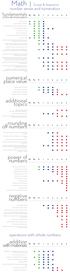 Math Scope & Sequence fundamentals number sense and numeration of the decimal system Count to 10 by units Associate number to numeral (1-10) KN 1 KN 1 KN 2 KN 2 Identify odd and even numbers/numerals and
Tennessee Mathematics Standards 2009-2010 Implementation. Grade Six Mathematics. Standard 1 Mathematical Processes
 Tennessee Mathematics Standards 2009-2010 Implementation Grade Six Mathematics Standard 1 Mathematical Processes GLE 0606.1.1 Use mathematical language, symbols, and definitions while developing mathematical
Common Core Unit Summary Grades 6 to 8
 Common Core Unit Summary Grades 6 to 8 Grade 8: Unit 1: Congruence and Similarity- 8G1-8G5 rotations reflections and translations,( RRT=congruence) understand congruence of 2 d figures after RRT Dilations
Chapter 8 Geometry We will discuss following concepts in this chapter.
 Mat College Mathematics Updated on Nov 5, 009 Chapter 8 Geometry We will discuss following concepts in this chapter. Two Dimensional Geometry: Straight lines (parallel and perpendicular), Rays, Angles
Angles and Quadrants. Angle Relationships and Degree Measurement. Chapter 7: Trigonometry
 Chapter 7: Trigonometry Trigonometry is the study of angles and how they can be used as a means of indirect measurement, that is, the measurement of a distance where it is not practical or even possible
Thnkwell s Homeschool Precalculus Course Lesson Plan: 36 weeks
 Thnkwell s Homeschool Precalculus Course Lesson Plan: 36 weeks Welcome to Thinkwell s Homeschool Precalculus! We re thrilled that you ve decided to make us part of your homeschool curriculum. This lesson
GCSE MATHEMATICS (8300)
 GCSE MATHEMATICS (8300) Specification For teaching from September 2015 onwards For exams in May/June 2017 onwards Version 1.0 12 September 2014 GCSE Mathematics (8300). For exams in May/June 2017 onwards.
Year 9 mathematics test
 Ma KEY STAGE 3 Year 9 mathematics test Tier 6 8 Paper 1 Calculator not allowed First name Last name Class Date Please read this page, but do not open your booklet until your teacher tells you to start.
Vocabulary Words and Definitions for Algebra
 Name: Period: Vocabulary Words and s for Algebra Absolute Value Additive Inverse Algebraic Expression Ascending Order Associative Property Axis of Symmetry Base Binomial Coefficient Combine Like Terms
Solving Simultaneous Equations and Matrices
 Solving Simultaneous Equations and Matrices The following represents a systematic investigation for the steps used to solve two simultaneous linear equations in two unknowns. The motivation for considering
How do you compare numbers? On a number line, larger numbers are to the right and smaller numbers are to the left.
 The verbal answers to all of the following questions should be memorized before completion of pre-algebra. Answers that are not memorized will hinder your ability to succeed in algebra 1. Number Basics
SAT Subject Math Level 1 Facts & Formulas
 Numbers, Sequences, Factors Integers:..., -3, -2, -1, 0, 1, 2, 3,... Reals: integers plus fractions, decimals, and irrationals ( 2, 3, π, etc.) Order Of Operations: Aritmetic Sequences: PEMDAS (Parenteses
Senior Phase Grade 8 Today Planning Pack MATHEMATICS
 M780636110236 Senior Phase Grade 8 Today Planning Pack MATHEMATICS Contents: Work Schedule: Page Grade 8 2 Lesson Plans: Grade 8 4 Rubrics: Rubric 1: Recognising, classifying and representing numbers...22
GRADES 7, 8, AND 9 BIG IDEAS
 Table 1: Strand A: BIG IDEAS: MATH: NUMBER Introduce perfect squares, square roots, and all applications Introduce rational numbers (positive and negative) Introduce the meaning of negative exponents for
Paper Reference. Ruler graduated in centimetres and millimetres, protractor, compasses, pen, HB pencil, eraser. Tracing paper may be used.
 Centre No. Candidate No. Paper Reference 1 3 8 0 3 H Paper Reference(s) 1380/3H Edexcel GCSE Mathematics (Linear) 1380 Paper 3 (Non-Calculator) Higher Tier Monday 18 May 2009 Afternoon Time: 1 hour 45
Year 9 set 1 Mathematics notes, to accompany the 9H book.
 Part 1: Year 9 set 1 Mathematics notes, to accompany the 9H book. equations 1. (p.1), 1.6 (p. 44), 4.6 (p.196) sequences 3. (p.115) Pupils use the Elmwood Press Essential Maths book by David Raymer (9H
Prentice Hall: Middle School Math, Course 1 2002 Correlated to: New York Mathematics Learning Standards (Intermediate)
 New York Mathematics Learning Standards (Intermediate) Mathematical Reasoning Key Idea: Students use MATHEMATICAL REASONING to analyze mathematical situations, make conjectures, gather evidence, and construct
Geometry and Measurement
 The student will be able to: Geometry and Measurement 1. Demonstrate an understanding of the principles of geometry and measurement and operations using measurements Use the US system of measurement for