
Shoulder and Related Upper Extremity Radiating Pain
|
|
|
- Erin Joseph
- 9 years ago
- Views:
Transcription
1 Shoulder and Related Upper Extremity Radiating Pain ICD-9-CM codes: Cervical brachial syndrome ICF codes: Activities and Participation Domain codes: d4301 Carrying in the hands (Taking or transporting an object from one place to another using the hands, such as when carrying a drinking glass or a suitcase.) d4452 Reaching (Using the hands and arms to extend outwards and touch and grasp something, such as when reaching across a table or desk for a book.) Body Structure code: s7208 Structure of shoulder region, other specified s7308 Structure of upper extremity, other specified Body Functions code: b28014 Pain in upper limb b2804 Radiating pain in a segment or region Common Historical Findings Paresthesias, pain, and numbness in upper extremity Symptoms aggravated by postures or activities that put stretch on neurovascular bundle (e.g., reaching tasks, sleeping with arms overhead) Common Impairment Findings - Related to the Reported Activity Limitation or Participation Restrictions: Symptoms reproduced with nerve tension test Symptoms reproduced with provocation of the peripheral entrapment site (e.g., scalenes, clavipectoral fascia, pectoralis minor) Physical Examination Procedures: Nerve Tension Test Median Nerve Stretch Test Performance Cues: Position patient with shoulder off edge of table and with the trunk and lower extremities diagonally on the table 1

2 Establish baseline level of symptoms and determine the change in symptoms as the following components are moved toward end range: Scapular depression Elbow extension Humeral external rotation Forearm supination Wrist, fingers, thumb extension Humeral abduction Attempt to alter symptoms by moving a component two segments proximally or distally (e.g., alter elbow pain with cervical side bending; alter shoulder pain with wrist flexion and extension) Nerve Tension Test Radial Nerve Stretch Test Performance Cues: Components: Scapular depression Elbow extension Humeral internal rotation Forearm pronation Wrist, finger, thumb flexion Humeral abduction Nerve Tension Test Ulnar Stretch Test 2

3 Performance Cues: Components: Scapular depression Elbow flexion (to 90 degrees) Humeral external rotation Forearm pronation Wrist, finger extension Elbow flexion (to available and range) Humeral abduction Shoulder and Related Upper Extremity Radiating Pain: Description, Etiology, Stages, and Intervention Strategies The below description is consistent with descriptions of clinical patterns associated with the vernacular term Thoracic Outlet Syndrome Description: Thoracic outlet syndrome (TOS) is a complex of signs and symptoms caused by compression or stretching of the nerves and vessels (portions of the brachial plexus, subclavian artery, and subclavian vein) to the upper limb where they pass through the interval between the scalene muscles, over the first rib, and down into the axilla. Patient complains of numbness, tingling, weakness of hands and arms and pain in the upper chest, back and neck. The location of paresthesias, pain, numbness, and muscle weakness in the shoulder, arm, and hand depend on what nerve is vulnerable to compression. The patient with TOS may also report vascular symptoms such as swelling of the fingers and hands, heaviness of the upper extremities, clumsiness and coldness of hands, and tiredness, heaviness on elevation of arms. TOS symptoms are worst with postures and ADLs that stress the neurovascular bundle, such as combing hair, driving, or carrying bags with strap on sore shoulder. TOS symptoms are also reproduced with activities such as lifting heavy objects, looking up (neck extension), arm overstretched or reaching and overhead activities for extended periods of time. Etiology: The cause of this disorder may be due to tight muscles, ligaments, fibrous bands or bony abnormalities in the thoracic outlet area. The two common precipitating factors of TOS are trauma (such as auto accidents that cause whiplash) and excessive strains from repetitive activities. Other conditions that can lead to TOS are paradoxical breathing patterns, poor posture, an extra cervical rib from the neck at birth, and tumors (such as upper lobe lung cancer). Acute Stage / Severe Condition: Physical Examinations Findings (Key Impairments) ICF Body Functions codes: b28014 SEVERE pain in upper limb Accentuated upper thoracic kyphosis and forward head posture leading to tightness around shoulder and neck musculature Excessive scapular abduction and medial rotation Weak cervical flexors, upper thoracic extensors, and scapular depressors/retractors Symptoms are reproduced with upper limb nerve tension testing 3

4 Symptoms are reproduced with palpatory provocation of peripheral entrapment site (e.g., scalene muscles palpation will cause tingling down the arm) Sensory and motor deficits may be present Sub Acute / Moderate Condition: Physical Examinations Findings (Key Impairments) ICF Body Functions codes: b28014 MODERATE pain in upper limb As above, except: Now (when less acute) examine patient for co-existing upper quadrant impairments such as cervical pathologies (extra cervical rib), assess scapular, thoracic malalignments and muscle flexibility and strength deficits For example: Shortened anterior chest musculature such as pectoralis, serratus anterior Shortened scalene muscles, and costoclavicular approximation Tight muscles that are pressed against the nerves causing compression such as subclavian artery or suprascapular nerve maybe affected. Paradoxical breathing patterns in which the scalenes and pectorals are used as the initiators of each breath, rather than assisting the diaphragm and lower intercostals during a deep inspiration Settled Stage / Mild Condition: Physical Examinations Findings (Key Impairments) ICF Body Functions codes: b28014 MILD pain in upper limb As above, except: Pain with repetitive activities such as arm elevation, hyperextension of neck or with overhead activities Intervention Approaches / Strategies Acute Stage / Severe Condition Goal: Reduce neurological and vascular symptoms Re-injury Prevention Instruction Limit any activity that aggravates the symptoms e.g., avoid sleeping on stomach with arms overhead Manual Therapy Soft tissue mobilization to restricted myofascia or fascia adjacent to relevant nerve and vascular entrapment sites e.g., scalene myofascia, clavipectoral fascia, subclavius myofascia 4

5 Joint mobilization to restricted joints adjacent to relevant nerve and vascular entrapment sites e.g., cervical articulations adjacent to lateral foramina, 1 st rib adjacent to C8 nerve root Soft tissue mobilization and manual stretching to address shortened musculature such as pectoralis minor, serratus anterior, scalene, levator scapulae Therapeutic Exercises Painfree, and symptom-free nerve mobility exercises Sub Acute Stage / Moderate Condition Goals: As above Improve strength of weak upper quarter musculature Approaches / Strategies listed above Therapeutic Exercises Stretching exercises for shortened myofascia causing symptoms, such as pectoralis minor, or anterior scalenes Strengthening exercises for upper thoracic extensors, scapular adductors and depressors, and neck flexors Diaphragmatic and lateral costal breathing exercises to decrease paradoxical breathing patterns Neuromuscular Reeducation Facilitate neutral thoracic cage and neutral scapular posture. Ergonomic Instruction Promote efficient, painfree, motor control of the trunk, scapulae and arm with overhead activities Modify activities to prevent re-injury Teach proper body mechanics and modify work-setting area as required to prevent symptoms Settled Stage / Mild Condition Goals: As above Progress activity tolerance Lessen predisposition to symptoms during active repeated movements Approaches / Strategies listed above Therapeutic Exercises 5

6 Muscular endurance exercises to maximize muscle performance of the relevant trunk, scapulae, shoulder girdle muscles required to perform the desired occupational or recreational activities Aerobic conditioning exercises such as progressive walking program with emphasizing correct breathing techniques and posture Ergonomic Instruction As above Add job/sport specific training Intervention for High Performance / High Demand Functioning in Workers or Athletes Goal: Return to desired occupational or leisure time activities Approaches / Strategies listed above Selected References Colby L, Kisner C. Foundations and Techniques of Therapeutic Exercise, 2 nd ed. F. A. Davis Company, Philadelphia, PA , 1990 Daskalakis M. Thoracic outlet compression syndrome: current concepts and surgical experience. Int Surg. 68: , 1983 Donatelli R. Orthopedic Physical Therapy. Churchill Livingstone Inc., Georgia, 1994 Donatelli R. Physical Therapy of the Shoulder, 3 rd edition, pp New York: Churchill Livingstone, 1997 Kelly M, Clark W. Orthopedic Therapy of the Shoulder, pp Philadelphia: J.B. Lippincott Company, 1995 Kenny R, Traynor G, Withington D, Keegan D. Thoracic outlet syndrome: a useful exercise treatment option. Am J Surg. Feb 165:282-4, 1993 Lindgren K, Leino E, Hakola M, Hamberg J. Cervical spine rotation and lateral flexion combined motion in examination of the thoracic outlet. Arch Phys Med Rehabil 71: , 1989 Lindgren K, Leino E, Manninen H. Cervical rotation lateral flexion test in brachialgia. Arch Phys Med Rehabil 73:735-7,

7 Lindgren K. Conservative treatment of thoracic outlet syndrome: a 2-year follow up. Arch Phys Med Rehabil Vol 78, April 1997 Magee D. Orthopedic Physical Assessment. W. B. Saunders Company, Philadelphia, PA , 1992 Novak CB, Mackinnon SE. Thoracic outlet syndrome. Orthopedic Clinics of North America 1996 Oct; 27(4): Rockwood C, Matsen F. The Shoulder, 2 nd edition, volume 2, pp Philadelphia: WB Saunders Company, 1998 Saidoff D, McDonough A. Critical Pathways in Therapeutic Intervention: Extremities and Spine, pp Mosby, Missouri,

THORACIC OUTLET SYNDROME
 THORACIC OUTLET SYNDROME The Problem The term thoracic outlet syndrome is used to describe a condition of compression of the nerves and/or blood vessels in the region around the neck and collarbone, called
Anatomy for Workers Compensation Attorneys
 Anatomy for Workers Compensation Attorneys Donato J. Borrillo MD JD Plant Medical Advisor Chrysler/Jeep Assembly Toledo Zoll, Kranz, and Borgess May 16, 2015 Imaging studies neck 1 Bulge and herniation
CUMMULATIVE DISORDERS OF UPPER EXTIMITY DR HABIBOLLAHI
 CUMMULATIVE DISORDERS OF UPPER EXTIMITY DR HABIBOLLAHI Definition Musculoskeletal disorder (MSD) is an injury or disorder of the muscles, nerves, tendons, joints, cartilage,ligament and spinal discs. It
SPINE. Postural Malalignments 4/9/2015. Cervical Spine Evaluation. Thoracic Spine Evaluation. Observations. Assess position of head and neck
 SPINE Observations Body type Postural alignments and asymmetries should be observed from all views Assess height differences between anatomical landmarks Figure 25-9 Figure 25-10 Figure 25-11 & 12 Postural
Ergonomics Monitor Training Manual
 Table of contents I. Introduction Ergonomics Monitor Training Manual II. Definition of Common Injuries Common Hand & Wrist Injuries Common Neck & Back Injuries Common Shoulder & Elbow Injuries III. Ergonomics
Basic techniques of pulmonary physical therapy (I) 100/04/24
 Basic techniques of pulmonary physical therapy (I) 100/04/24 Evaluation of breathing function Chart review History Chest X ray Blood test Observation/palpation Chest mobility Shape of chest wall Accessory
Disclosure: I have nothing to disclose
 Disclosure: I have nothing to disclose Pectoralis Minor Syndrome Definition Hand and arm symptoms due to Compression of Axillary neurovascular bundle by Pec Minor Muscle Pectoralis Minor Syndrome Short
Thoracic Spine Mobility Deficits
 Thoracic Spine Mobility Deficits ICD-9-CM: 847.1 thoracic sprain ICF codes: Activities and Participation Domain code: d4105 Bending (Tilting the back downward or to the side, at the torso, such as in bowling
THORACIC OUTLET SYNDROME & BRACHIAL PLEXUS INJURIES
 THORACIC OUTLET SYNDROME & BRACHIAL PLEXUS INJURIES I. THORACIC OUTLET SYNDROME TOS is a compression of nerves or blood vessels, or both, in the thoracic outlet region, which is the space between the collarbone
Rotator Cuff Pathophysiology. treatment program that will effectively treat it. The tricky part about the shoulder is that it is a ball and
 Rotator Cuff Pathophysiology Shoulder injuries occur to most people at least once in their life. This highly mobile and versatile joint is one of the most common reasons people visit their health care
Thoracic Cage Respiratory Mobility Deficits
 Thoracic Cage Respiratory Mobility Deficits ICD-9-CM: 733.6 costochondritis (Tietze's Disease) ICF codes: Activities and Participation Domain code: d498 Mobility, other specified (Expansion of the ribcage
Orthopaedic and Spine Institute 21 Spurs Lane, Suite 245, San Antonio, TX 78240 www.saspine.com Tel# 210-487-7463
 Phase I Passive Range of Motion Phase (postop week 1-2) Minimize shoulder pain and inflammatory response Achieve gradual restoration of gentle active range of motion Enhance/ensure adequate scapular function
Thoracic Region Pain. ICD-9-CM: 724.4 Thoracic or Lumbosacral neuritis or radiculitis, unspecified
 Thoracic Region Pain ICD-9-CM: 724.4 Thoracic or Lumbosacral neuritis or radiculitis, unspecified ICF codes: Activities and Participation Domain code: d4108 Changing basic body position, other specified
Symptoms and Signs of Irritation of the Brachial Plexus in Whiplash Injuries
 1 Symptoms and Signs of Irritation of the Brachial Plexus in Whiplash Injuries J Bone Joint Surg (Br) 2001 Mar;83(2):226-9 Ide M, Ide J, Yamaga M, Takagi K Department of Orthopaedic Surgery, Kumamoto University
CERVICAL DISC HERNIATION
 CERVICAL DISC HERNIATION Most frequent at C 5/6 level but also occur at C 6 7 & to a lesser extent at C4 5 & other levels In relatively younger persons soft disk protrusion is more common than hard disk
Hand and Upper Extremity Injuries in Outdoor Activities. John A. Schneider, M.D.
 Hand and Upper Extremity Injuries in Outdoor Activities John A. Schneider, M.D. Biographical Sketch Dr. Schneider is an orthopedic surgeon that specializes in the treatment of hand and upper extremity
Clarification of Terms
 Shoulder Girdle Clarification of Terms Shoulder girdle = scapula and clavicle Shoulder joint (glenohumeral joint) = scapula and humerus What is the purpose (or function) of the shoulder and entire upper
by joseph e. muscolino, DO photography by yanik chauvin
 by joseph e. muscolino, DO photography by yanik chauvin body mechanics palpation of the anterior neck ESOUCES For more information go to www.medlineplus.gov and search under anterior neck. The anterior
Pilates for Kyphosis A BASI Pilates program designed to help correct thoracic kyphosis
 Pilates for Kyphosis A BASI Pilates program designed to help correct thoracic kyphosis 1 Lucy Penrose 19/01/2014 Wimbledon UK, April 2013 Abstract Kyphosis refers to an exaggerated curve in the thoracic
Self-Range of Motion Exercises for Shoulders, Arms, Wrists, Fingers
 Self-Range of Motion Exercises for Shoulders, Arms, Wrists, Fingers These exercises will help keep your muscles strong and mobile, and your joints flexible. Other benefits of these exercises include: C
Lean-Ergonomic methods to reduce workers compensation costs (Part 2 of 2) Cumulative trauma disorders can be classified as: What is CTD?
 #425 Lean-ergonomic methods to reduce workers compensation costs, Part 2 of 2 Lean-Ergonomic methods to reduce workers compensation costs (Part 2 of 2) Govid Bharwani, Ph.D, Biomedical Engineering Thursday,
CONSTRUCTION WORK and CUMULATIVE TRAUMA DISORDERS
 Connecticut Department of Public Health Environmental and Occupational Health Assessment Program 410 Capitol Avenue MS # 11OSP, PO Box 340308 Hartford, CT 06134-0308 (860) 509-7740 http://www.ct.gov/dph
www.ghadialisurgery.com
 P R E S E N T S Dr. Mufa T. Ghadiali is skilled in all aspects of General Surgery. His General Surgery Services include: General Surgery Advanced Laparoscopic Surgery Surgical Oncology Gastrointestinal
Standard of Care: Cervical Radiculopathy
 Department of Rehabilitation Services Physical Therapy Diagnosis: Cervical radiculopathy, injury to one or more nerve roots, has multiple presentations. Symptoms may include pain in the cervical spine
Carpal Tunnel Pain. STRETCH YOUR: 1) Wrist Flexors 2) Wrist Extensors 3) Wrist Decompression 4) Neck (see other chapters for more examples)
 Carpal Tunnel Pain STRETCH YOUR: 1) Wrist Flexors 2) Wrist Extensors 3) Wrist Decompression 4) Neck (see other chapters for more examples) wrist flexors wrist extensors carpal tunnel Athletic Edge - www.athleticedge.biz
Ken Ross BSc ST, Nat Dip ST
 Ken Ross BSc ST, Nat Dip ST Trunk Most people will suffer from back pain at some point in their lives. Good spinal posture places minimal strain on the muscles which maintain the natural curve of the spine
Cervical Fusion Protocol
 REHABILITATION DEPARTMENT Cervical Fusion Protocol The following protocol for physical therapy rehabilitation was designed based on the typical patient seen at the Texas Back Institute for the procedure
WORKPLACE SAFETY AND INSURANCE APPEALS TRIBUNAL DECISION NO. 1602/11
 WORKPLACE SAFETY AND INSURANCE APPEALS TRIBUNAL DECISION NO. 1602/11 BEFORE: M. M. Cohen: Vice-Chair HEARING: August 16, 2011 at Toronto Written DATE OF DECISION: August 23, 2011 NEUTRAL CITATION: 2011
Muscle Energy Technique. Applied to the Shoulder
 Muscle Energy Technique Applied to the Shoulder MUSCLE ENERGY Theory Muscle energy technique is a manual therapy procedure which involves the voluntary contraction of a muscle in a precisely controlled
NDT Treatment Planning Worksheet
 Child s Name: Kalab DOB: 01/01/02 Diagnosis: CP-Right-sided Heimplegia DOE: May 29, 2009 Therapist s Name: Mary Rose Franjoine Discipline: PT Current Participation: Attends his neighborhood school with
Upper Limb QUESTIONS UPPER LIMB: QUESTIONS
 1 Upper Limb QUESTIONS 1.1 Which of the following statements best describes the scapula? a. It usually overlies the 2nd to 9th ribs. b. The spine continues laterally as the coracoid process. c. The suprascapular
Neck Pain Overview Causes, Diagnosis and Treatment Options
 Neck Pain Overview Causes, Diagnosis and Treatment Options Neck pain is one of the most common forms of pain for which people seek treatment. Most individuals experience neck pain at some point during
Biceps Tenodesis Protocol
 Department of Rehabilitation Services Physical Therapy The intent of this protocol is to provide the clinician with a guideline of the postoperative rehabilitation course of a patient that has undergone
Body Mechanics for Mammography Technologists
 Body Mechanics for Mammography Technologists Diane Rinella RT(R)(M)(BD)RDMS(BR)CDT Objectives Recognize causes and risk factors for Musculoskeletal Disorders (MSDs) for mammography technologists Understand
COMMON ROWING INJURIES
 COMMON ROWING INJURIES Prevention and Treatment Jo A. Hannafin, MD, PhD Professor of Orthopaedic Surgery Hospital for Special Surgery, Cornell University Medical College Team Physician, US Rowing FISA
Most active and intricate part of the upper extremity Especially vulnerable to injury Do not respond well to serious trauma. Magee, 2008. pg.
 PTA 216 Most active and intricate part of the upper extremity Especially vulnerable to injury Do not respond well to serious trauma Magee, 2008. pg. 396 28 bones Numerous articulations 19 intrinsic muscles
William J. Robertson, MD UT Southwestern Orthopedics 1801 Inwood Rd. Dallas, TX 75390-8882 Office: (214) 645-3300 Fax: (214) 3301 billrobertsonmd.
 Arthroscopic Rotator Cuff Repair Postoperative Rehab Protocol Starting the first day after surgery you should remove the sling 3-4 times per day to perform pendulum exercises and elbow/wrist range of motion
Cervical Whiplash: Considerations in the Rehabilitation of Cervical Myofascial Injury. Canadian Family Physician
 Cervical Whiplash: Considerations in the Rehabilitation of Cervical Myofascial Injury 1 Canadian Family Physician Volume 32, September 1986 Arthur Ameis, MD Dr. Ames practices physical medicine and rehabilitation,
Radiculopathy vs. Peripheral Neuropathy. What to do with arm pain? Defining Arm Pain. Arm Pain
 Radiculopathy vs. Peripheral Neuropathy What to do with arm pain? Miriana G. Popadich RN, MSN Clinical Care Coordinator Brachial Plexus Program Department of Neurosurgery University of Michigan Timing
Hemiplegic shoulder pain/shoulder subluxation
 UPPER LIMB NEUROMUSCULAR ELECTRICAL STIMULATION: Electrode positions Please note that the polarity (red and black leads) can be altered according to your clinical reasoning. The area in which you want
Repetitive Strain Injury (RSI)
 Carpal Tunnel Syndrome and Other Musculoskeletal Problems in the Workplace: What s the Solution? by Richard N. Hinrichs, Ph.D. Dept. of Kinesiology Arizona State University Repetitive Strain Injury (RSI)
Rehabilitation after shoulder dislocation
 Physiotherapy Department Rehabilitation after shoulder dislocation Information for patients This information leaflet gives you advice on rehabilitation after your shoulder dislocation. It is not a substitute
ARTHROSCOPIC ROTATOR CUFF REPAIR PROTOCOL (DR. ROLF)
 ARTHROSCOPIC ROTATOR CUFF REPAIR PROTOCOL (DR. ROLF) Phase I Immediate Post Surgical Phase (Weeks 1-4): Maintain integrity of repair Diminish pain and inflammation Prevent muscular inhibition Independent
WHIPLASH! Therapeutic Massage by Lucy Lucy Dean, LMT, NMT, MMT. Helpful and effective treatment with Neuromuscular Therapy. What does Whiplash mean?
 WHIPLASH! Helpful and effective treatment with Neuromuscular Therapy Therapeutic Massage by Lucy Lucy Dean, LMT, NMT, MMT What does Whiplash mean? Whiplash is a non-medical term used to describe neck pain
Fact Sheet: Occupational Overuse Syndrome (OOS)
 Fact Sheet: Occupational Overuse Syndrome (OOS) What is OOS? Occupational Overuse Syndrome (OOS) is the term given to a range of conditions characterised by discomfort or persistent pain in muscles, tendons
Temporo-Mandibular Joint Complex Exercise Suggestions
 Temporo-Mandibular Joint Complex Exercise Suggestions I. Exercise Generalizations: A. Patients with post-traumatic TMJ problems or with recent-onset dysfunction that is largely posture-related will generally
THE THERAPIST S MANAGEMENT OF THE STIFF ELBOW MARK PISCHKE, OTR/L, CHT NOV, 17, 2014
 THE THERAPIST S MANAGEMENT OF THE STIFF ELBOW MARK PISCHKE, OTR/L, CHT NOV, 17, 2014 ELBOW FUNCTION 1. Required to provide stability for power and precision tasks for both open and closed kinetic chain
Lymphedema and Early Retirement Cancer
 Early Education, Exercise and CDT Following Radiation Therapy for Breast Cancer By Linda Boyle, PT, DPT, CLT-LANA OUTLINE FOR CASE PRESENTATIONS I. Reason for presenting case Patients receiving external
Upper Extremity Special Tests. Cervical Tests. TMJ Dysfunction
 Upper Extremity Special Tests Cervical Tests Vertebral Artery Test: used to test for vertebral artery occlusion or insufficiency. The subject lies supine on the plinth with the examiner seated behind with
Spine Injury and Back Pain in Sports
 Spine Injury and Back Pain in Sports DAVID W. GRAY, MD 1 Back Pain Increases with Age Girls>Boys in Teenage years Anywhere from 15 to 80% of children and adolescents have back pain depending on the studies
Dr. Enas Elsayed. Brunnstrom Approach
 Brunnstrom Approach Learning Objectives: By the end of this lab, the student will be able to: 1. Demonstrate different reflexes including stimulus and muscle tone response. 2. Demonstrate how to evoke
Color Doppler and Duplex Sonography in 5 Patients With Thoracic Outlet Syndrome
 Case Series Color Doppler and Duplex Sonography in 5 Patients With Thoracic Outlet Syndrome Raju Wadhwani, DMRD, DNB, Nitin Chaubal, MD, Rajan Sukthankar, MD, Manu Shroff, MD, Sanjay Agarwala, MS Purpose.
Brachial Plexus Palsy
 Patient and Family Education Brachial Plexus Palsy A Therapy Guide for Your Baby Brachial Plexus Palsy is caused by trauma to the nerves of the arm. This trauma may have caused muscle weakness, lack of
Completing the Loop: Management of the Adolescent Sports Injury. Adam Thomas, PT, DPT, ATC
 : Management of the Adolescent Sports Injury Adam Thomas, PT, DPT, ATC https://www.youtube.com/watch?v=vbufpo 8s3As On field assessment can be the most efficient when the health care provider has observed
UHealth Sports Medicine
 UHealth Sports Medicine Rehabilitation Guidelines for Arthroscopic Rotator Cuff Repair Type 2 Repairs with Bicep Tenodesis (+/- subacromial decompression) The rehabilitation guidelines are presented in
COMPUTER-RELATED MUSCLE, TENDON, AND JOINT INJURIES
 CHAPTER ELEVEN COMPUTER-RELATED MUSCLE, TENDON, AND JOINT INJURIES To reduce the risk of pain in your neck and shoulders, stay within these recommended ranges of movement: Neck Flexion: 0 o -15 o (bending
Avoid The Dreaded Back Injury by Proper Lifting Techniques
 Avoid The Dreaded Back Injury by Proper Lifting Techniques If you ve ever strained your back while lifting something, you ll know the importance of lifting safely. Agenda Introduction About the Back The
Rehabilitation Program for Children With Brachial Plexus and Peripheral Nerve Injury
 Rehabilitation Program for Children With Brachial Plexus and Peripheral Nerve Injury Lorna E. Ramos and Joan P. Zell An aggressive and integrated physical and occupational therapy program is essential
Welcome to the July 2012 edition of Case Studies from the files of the Institute for Nerve Medicine in Santa Monica, California.
 Welcome to the July 2012 edition of Case Studies from the files of the Institute for Nerve Medicine in Santa Monica, California. In this issue, we focus on a 23-year-old female patient referred by her
Whiplash Associated Disorder
 Whiplash Associated Disorder The pathology Whiplash is a mechanism of injury, consisting of acceleration-deceleration forces to the neck. Mechanism: Hyperflexion/extension injury Stationary vehicle hit
Neck and Headache Pain
 Neck and Headache Pain ICD-9-CM code: 723.2 cervicocranial syndrome ICF codes: Activities and Participation Domain code: d4158 Maintaining a body position, other specified - specified as: maintaining the
Elbow and Forearm Radiating Pain
 1 Elbow and Forearm Radiating Pain ICD-9-CM code: 354.1 Other lesion of median nerve 354.3 Lesion of radial nerve 354.2 Lesion of ulnar nerve ICF codes: Activities and Participation Domain code: d4301
Carpal Tunnel Release
 1 Carpal Tunnel Release Surgical Indications and Considerations Description: A compression neuropathy of the median nerve at the level of the carpal tunnel, commonly associated with pain, numbness, weakness
Cervical Exercise: How important is it? What can be done? The Backbone of Spine Treatment. North American Spine Society Public Education Series
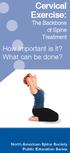 Cervical Exercise: The Backbone of Spine Treatment How important is it? What can be done? North American Spine Society Public Education Series Important: If you have had an accident that started your neck
Upper limb injuries. Traumatology RHS 231 Dr. Einas Al-Eisa
 Upper limb injuries Traumatology RHS 231 Dr. Einas Al-Eisa Pain in the limbs: May be classified under 4 headings: 1. Joint pain 2. Soft tissue pain 3. Neurogenic pain 4. Orthopaedic causes (fractures,
THE SHOULDER JOINT T H E G L E N O H U M E R A L ( G H ) J O I N T
 THE SHOULDER JOINT T H E G L E N O H U M E R A L ( G H ) J O I N T CLARIFICATION OF TERMS Shoulder girdle = scapula and clavicle Shoulder joint (glenohumeral joint) = scapula and humerus Lippert, p115
Mike s Top Ten Tips for Reducing Back Pain
 Mike s Top Ten Tips for Reducing Back Pain The following article explains ways of preventing, reducing or eliminating back pain. I have found them to be very useful to myself, my clients and my patients.
Closed Automobile Insurance Third Party Liability Bodily Injury Claim Study in Ontario
 Page 1 Closed Automobile Insurance Third Party Liability Bodily Injury Claim Study in Ontario Injury Descriptions Developed from Newfoundland claim study injury definitions No injury Death Psychological
PILATES Fatigue Posture and the Medical Technology Field
 PILATES Fatigue Posture and the Medical Technology Field Marybeth Kane May 2014 Course: 2014, Pacific Palisades, CA 1 ABSTRACT A medical laboratory scientist (MLS) (also referred to as a medical technologist
AMA Guides & California Code of Regulations P&S Report Checklist
 http://www.pdratings.com/ AMA Guides & California Code of Regulations P&S Report Checklist [L.C. 139.2 (J)-(2)&(3), (k)-(5), 4060(b)(1), 4062 (d)(2), 4068, 4620, 8 CCR WCAB 10606 & 8 CCR 9785] AMA Brachial
GALLAND/KIRBY UCL RECONSTRUCTION (TOMMY JOHN) POST-SURGICAL REHABILITATION PROTOCOL
 GALLAND/KIRBY UCL RECONSTRUCTION (TOMMY JOHN) POST-SURGICAL REHABILITATION PROTOCOL INTRODUCTION The ulnar collateral ligament reconstruction is a tendon transfer procedure. No muscles are transected during
Medical Report Checklist: Upper Extremities Peripheral Nerve Disorders Impairments (PND)
 http://www.pdratings.com/ Craig Andrew Lange [email protected] California Workers Compensation Certified AMA Guides Impairment & Disability Rating Specialists Voice: (415) 861-4040 / Fax: (415) 276-3741
Effects of Upper Extremity Mobilization Techniques on Fine-Motor Performance in Children with Neuromotor Disorders
 This program has been approved for CEUs by the American Occupational Therapy Association (AOTA), the Board of Certification (BOC), and is accepted for PDUs by the National Board of Certification of Occupational
Return to same game if sx s resolve within 15 minutes. Return to next game if sx s resolve within one week Return to Competition
 Assessment Skills of the Spine on the Field and in the Clinic Ron Burke, MD Cervical Spine Injuries Sprains and strains Stingers Transient quadriparesis Cervical Spine Injuries Result in critical loss
The Pilates Studio of Los Angeles / PilatesCertificationOnline.com
 Anatomy Review Part I Anatomical Terminology and Review Questions (through pg. 80) Define the following: 1. Sagittal Plane 2. Frontal or Coronal Plane 3. Horizontal Plane 4. Superior 5. Inferior 6. Anterior
International Standards for the Classification of Spinal Cord Injury Motor Exam Guide
 C5 Elbow Flexors Biceps Brachii, Brachialis Patient Position: The shoulder is in neutral rotation, neutral flexion/extension, and adducted. The elbow is fully extended, with the forearm in full supination.
Current Concepts of Low Back Pain. Terry L. Grindstaff, PhD, PT, ATC, SCS, CSCS
 Current Concepts of Low Back Pain Terry L. Grindstaff, PhD, PT, ATC, SCS, CSCS 28% population reports LBP in past 3 months (CDC 2010) 60% recurrence rate (Turner et al, 1992) Low Back Pain Low Back Pain
Elbow Examination. Haroon Majeed
 Elbow Examination Haroon Majeed Key Points Inspection Palpation Movements Neurological Examination Special tests Joints above and below Before Starting Introduce yourself Explain to the patient what the
Important rehabilitation management concepts to consider for a postoperative physical therapy rtsa program are:
 : General Information: Reverse or Inverse Total Shoulder Arthroplasty (rtsa) is designed specifically for the treatment of glenohumeral (GH) arthritis when it is associated with irreparable rotator cuff
Total Elbow Arthroplasty and Rehabilitation
 Total Elbow Arthroplasty and Rehabilitation Surgical Indications and Considerations Anatomical Considerations: There are three bones and four joint articulations that have a high degree of congruence in
For Deep Pressure Massage
 T H E R A C A N E O W N E R S M A N U A L For Deep Pressure Massage Thera Cane is a self massager used to apply pressure to sore muscles. The unique design of the Thera Cane lets you apply deep pressure
How To Know If You Can Get A Carpal Tunnel Injury Compensation
 U. S. DEPARTMENT OF LABOR Employees Compensation Appeals Board In the Matter of BARBARA SNYDER and DEPARTMENT OF THE TREASURY, INTERNAL REVENUE SERVICE, Germansville, PA Docket No. 03-1467; Submitted on
Cycling Injury Prevention Workshop
 Cycling Injury Prevention Workshop Focus on Thoracic-Shoulder & Associated Conditions Ian Wee Occupational Therapist / Cycle Coach Chris Thompson Physiotherapist / Cycle Coach/ Exercise Physiologist Workshop
HYPERLORDOSIS & PILATES TREATMENT
 HYPERLORDOSIS & PILATES TREATMENT Grace Tiangco 3/18/15 2012-2013 Abstract Sacramento/Mountain View Lordosis or Hyperlordosis is defined as a postural type in which the natural curves of the spine are
Temple Physical Therapy
 Temple Physical Therapy A General Overview of Common Neck Injuries For current information on Temple Physical Therapy related news and for a healthy and safe return to work, sport and recreation Like Us
Throwers Ten Exercise Program
 Throwers Ten Exercise Program The Thrower s Ten Program is designed to exercise the major muscles necessary for throwing. The Program s goal is to be an organized and concise exercise program. In addition,
McMaster Spikeyball Therapy Drills
 BODY BLOCKS In sequencing Breathing and Tempo Flexibility / Mobility and Proprioception (feel) Upper body segment Middle body segment Lower body segment Extension / Static Posture Office / Computer Travel
ITEC Level 5 Certificate in Sports Massage Therapy Unit 460 Provide Complex Massage Techniques for Sports Massage
 ITEC Level 5 Certificate in Sports Massage Therapy Unit 460 Provide Complex Massage Techniques for Sports Massage Recommended Learning Hours GLH 85 Credit Value 18 QCF Qualification Reference Number J/506/9016
UNDERSTANDING STRESS AND YOUR BODY
 UNDERSTANDING STRESS AND YOUR BODY Life s demands create stress and although some stress may be good, too much can cause health problems. Most people equate stress with high blood pressure, a heart attack
Injury Prevention for the Back and Neck
 Injury Prevention for the Back and Neck www.csmr.org We have created this brochure to provide you with information regarding: Common Causes of Back and Neck Injuries and Pain Tips for Avoiding Neck and
Westmount UCC 751 Victoria Street South, Kitchener, ON N2M 5N4 519-745-2273 Fairway UCC 385 Fairway Road South, Kitchener, ON N2C 2N9 519-748-2327
 K-W URGENT CARE CLINICS INC. Westmount UCC 751 Victoria Street South, Kitchener, ON N2M 5N4 519-745-2273 Fairway UCC 385 Fairway Road South, Kitchener, ON N2C 2N9 519-748-2327 OPEN Mon-Fri 8am-5pm, Sa
Elbow & Forearm H O W V I T A L I S T H E E L B O W T O O U R D A I L Y L I V E S?
 Elbow & Forearm H O W V I T A L I S T H E E L B O W T O O U R D A I L Y L I V E S? Clarification of Terms The elbow includes: 3 bones (humerus, radius, and ulna) 2 joints (humeroulnar and humeroradial)
THE LUMBAR SPINE (BACK)
 THE LUMBAR SPINE (BACK) At a glance Chronic back pain, especially in the area of the lumbar spine (lower back), is a widespread condition. It can be assumed that 75 % of all people have it sometimes or
Pathoanatomical Changes of the Brachial Plexus and of C5-C6 Following Whiplash-Type Injury: A Case Report
 Pathoanatomical Changes of the Brachial Plexus and of C5-C6 Following Whiplash-Type Injury: A Case Report 1 Journal Of Whiplash & Related Disorders Vol. 1, No, 1, 2002 Gunilla Bring, Halldor Jonsson Jr.,