
EDEXCEL INTERNATIONAL GCSE CHEMISTRY EDEXCEL CERTIFICATE IN CHEMISTRY ANSWERS SECTION B
|
|
|
- Jewel Ball
- 9 years ago
- Views:
Transcription
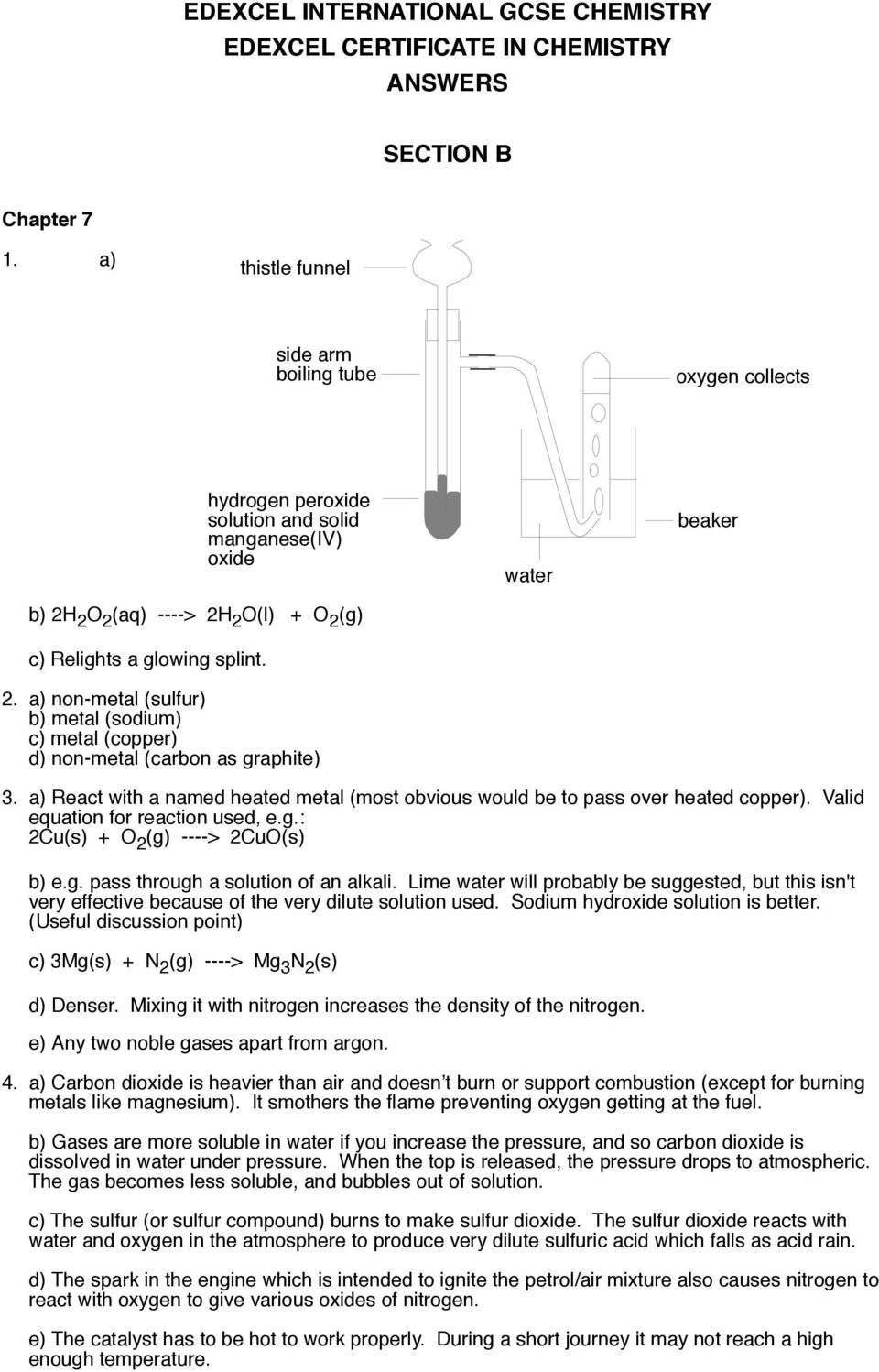
1 EDEXCEL INTERNATIONAL GCSE CHEMISTRY EDEXCEL CERTIFICATE IN CHEMISTRY ANSWERS SECTION B Chapter 7 1. a) thistle funnel side arm boiling tube oxygen collects b) 2H 2 O 2 (aq) ----> 2H 2 O(l) + O 2 (g) c) Relights a glowing splint. hydrogen peroxide solution and solid manganese(iv) oxide 2. a) non-metal (sulfur) b) metal (sodium) c) metal (copper) d) non-metal (carbon as graphite) water beaker 3. a) React with a named heated metal (most obvious would be to pass over heated copper). Valid equation for reaction used, e.g.: 2Cu(s) + O 2 (g) ----> 2CuO(s) b) e.g. pass through a solution of an alkali. Lime water will probably be suggested, but this isn't very effective because of the very dilute solution used. Sodium hydroxide solution is better. (Useful discussion point) c) 3Mg(s) + N 2 (g) ----> Mg 3 N 2 (s) d) Denser. Mixing it with nitrogen increases the density of the nitrogen. e) Any two noble gases apart from argon. 4. a) Carbon dioxide is heavier than air and doesn t burn or support combustion (except for burning metals like magnesium). It smothers the flame preventing oxygen getting at the fuel. b) Gases are more soluble in water if you increase the pressure, and so carbon dioxide is dissolved in water under pressure. When the top is released, the pressure drops to atmospheric. The gas becomes less soluble, and bubbles out of solution. c) The sulfur (or sulfur compound) burns to make sulfur dioxide. The sulfur dioxide reacts with water and oxygen in the atmosphere to produce very dilute sulfuric acid which falls as acid rain. d) The spark in the engine which is intended to ignite the petrol/air mixture also causes nitrogen to react with oxygen to give various oxides of nitrogen. e) The catalyst has to be hot to work properly. During a short journey it may not reach a high enough temperature.
2 Chapter 8 1. a) Na, Al, Fe, Cu b) (i) magnesium oxide, copper (ii) Mg(s) + CuO(s) ----> MgO(s) + Cu(s) (Include state symbols in all equations for preference.) (iii) CuO (iv) CuO c) (i) zinc (ii) A reducing agent is a substance which reduces something else. Zinc removes oxygen from the cobalt(ii) oxide. Removal of oxygen is reduction. (iii) zinc d) Al, Mn, Cr (Statement 1: Al is above Cr. Statement 2: Mn is below Al. Statement 3: Mn is above Cr. Putting this together gives the final list.) 2. a) oxidised; gain of oxygen b) reduced; loss of oxygen c) oxidised; loss of electrons d) reduced; gain of electrons 3. a) magnesium is above lead because it removes the oxygen from the lead(ii) oxide. b) Mg(s) + Pb 2+ (s) ----> Mg 2+ (s) + Pb(s) 4. a) Either: grey iron filings become coated with brown solid. Or: solution fades from blue to colourless (very pale green). b) iron c) Fe(s) + CuSO 4 (aq) ----> FeSO 4 (aq) + Cu(s) 5. a) Ni, Cu, Ag b) (i) Either: colour of solution changes from blue to green. Or: nickel becomes coated with brown solid. (ii) Ni(s) + CuSO 4 (aq) ----> NiSO 4 (aq) + Cu(s) (iii) Ni(s) + Cu 2+ (aq) ---->Ni 2+ (aq) + Cu(s) Nickel has been oxidised by loss of electrons. 6. a) X is between iron and hydrogen in the reactivity series. It displaces hydrogen from dilute hydrochloric acid, and copper from copper(ii) sulphate, and so must be above hydrogen and copper. It won't displace iron from iron(ii) sulphate, and so must be below iron. b) (i) Yes: X nitrate and silver (ii) No (iii) No (at least, not in the short term) (iv) Yes: X chloride and copper (v) Yes: X sulphate and hydrogen 7. a) hydrogen b) aluminium chloride c) 2Al(s) + 6HCl(aq) ----> 2AlCl 3 (aq) + 3H 2 (g) d) Aluminium is covered by a very thin, but very strong, layer of aluminium oxide which prevents the acid getting at the aluminium underneath. On heating, the acid reacts with the oxide and removes it. The aluminium then shows its true reactivity, and produces a vigorous reaction.
3 8. Drop a very small piece into cold water. If it reacts, judge its reactivity relative to K, Na, Ca or Mg. If it doesn't react, add a small piece to dilute hydrochloric acid and warm if necessary. Rapid reaction in the cold would place it as similar to magnesium. A few bubbles of hydrogen in the cold, but more on heating would place it as "similar to iron or zinc". If no reaction, then it is "below hydrogen". (A good student might mention that "no reaction" could also be caused by an effect similar to the oxide coating on aluminium. That would be worth some praise.) Note: Students might also suggest reacting the metal with steam. Point out that this is much more tedious than dropping a piece of metal into dilute hydrochloric acid, and that they should go for the easiest option available.
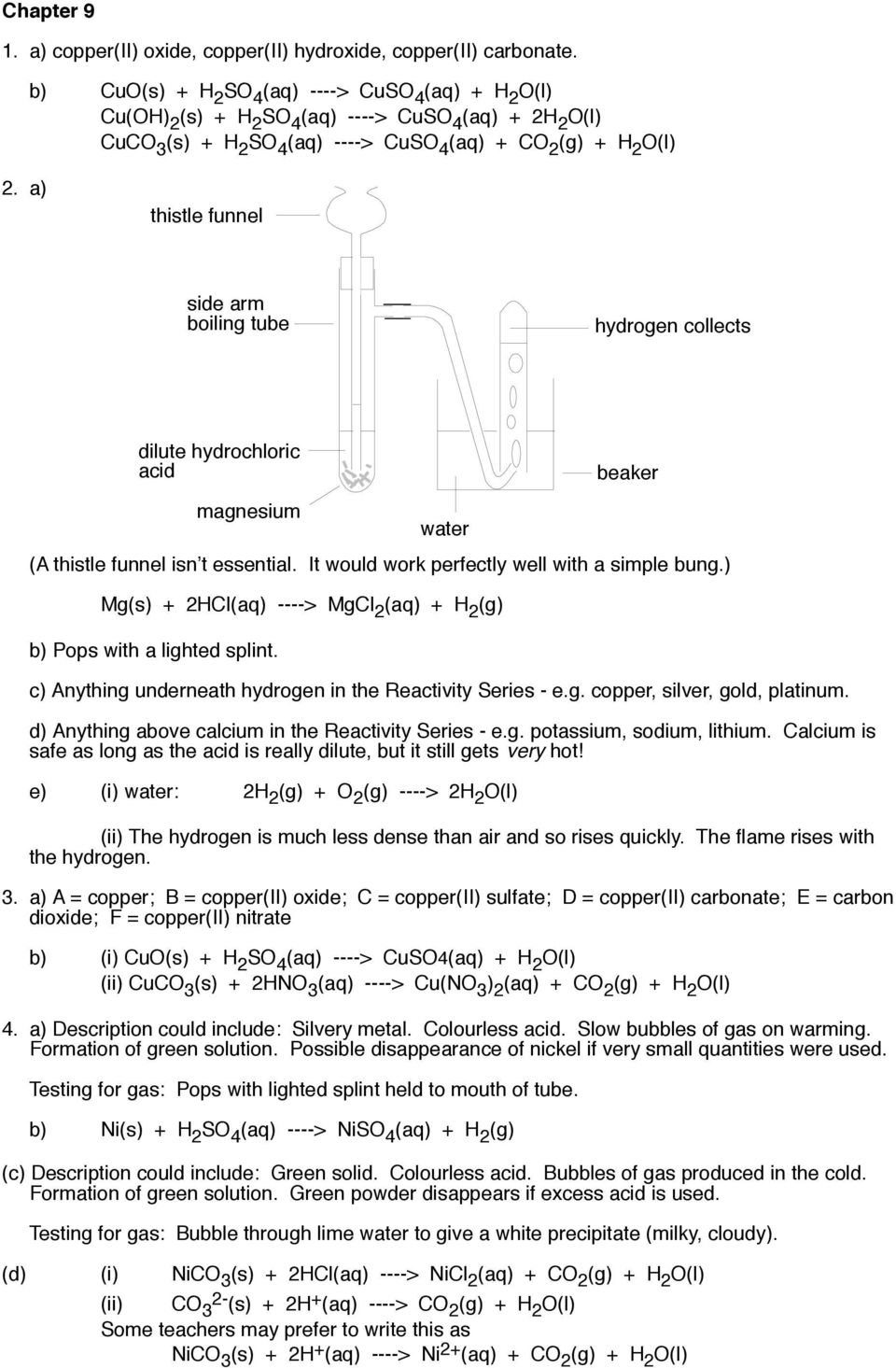
4 Chapter 9 1. a) copper(ii) oxide, copper(ii) hydroxide, copper(ii) carbonate. b) CuO(s) + H 2 SO 4 (aq) ----> CuSO 4 (aq) + H 2 O(l) Cu(OH) 2 (s) + H 2 SO 4 (aq) ----> CuSO 4 (aq) + 2H 2 O(l) CuCO 3 (s) + H 2 SO 4 (aq) ----> CuSO 4 (aq) + CO 2 (g) + H 2 O(l) 2. a) thistle funnel side arm boiling tube hydrogen collects dilute hydrochloric acid magnesium (A thistle funnel isn t essential. It would work perfectly well with a simple bung.) Mg(s) + 2HCl(aq) ----> MgCl 2 (aq) + H 2 (g) b) Pops with a lighted splint. water c) Anything underneath hydrogen in the Reactivity Series - e.g. copper, silver, gold, platinum. d) Anything above calcium in the Reactivity Series - e.g. potassium, sodium, lithium. Calcium is safe as long as the acid is really dilute, but it still gets very hot! e) (i) water: 2H 2 (g) + O 2 (g) ----> 2H 2 O(l) (ii) The hydrogen is much less dense than air and so rises quickly. The flame rises with the hydrogen. 3. a) A = copper; B = copper(ii) oxide; C = copper(ii) sulfate; D = copper(ii) carbonate; E = carbon dioxide; F = copper(ii) nitrate b) (i) CuO(s) + H 2 SO 4 (aq) ----> CuSO4(aq) + H 2 O(l) (ii) CuCO 3 (s) + 2HNO 3 (aq) ----> Cu(NO 3 ) 2 (aq) + CO 2 (g) + H 2 O(l) 4. a) Description could include: Silvery metal. Colourless acid. Slow bubbles of gas on warming. Formation of green solution. Possible disappearance of nickel if very small quantities were used. Testing for gas: Pops with lighted splint held to mouth of tube. b) Ni(s) + H 2 SO 4 (aq) ----> NiSO 4 (aq) + H 2 (g) beaker (c) Description could include: Green solid. Colourless acid. Bubbles of gas produced in the cold. Formation of green solution. Green powder disappears if excess acid is used. Testing for gas: Bubble through lime water to give a white precipitate (milky, cloudy). (d) (i) NiCO 3 (s) + 2HCl(aq) ----> NiCl 2 (aq) + CO 2 (g) + H 2 O(l) (ii) CO 2-3 (s) + 2H + (aq) ----> CO 2 (g) + H 2 O(l) Some teachers may prefer to write this as NiCO 3 (s) + 2H + (aq) ----> Ni 2+ (aq) + CO 2 (g) + H 2 O(l)
5 5. a) acid: H 2 SO 4 base: MgO b) acid: H + base: CO 2-3 c) not acid-base (actually a redox reaction) d) acid: HCl base: H 2 O e) not acid-base (another redox reaction) f) acid: HCl base: NH 3 g) acid: HCl base: NaOH 6. a) (i) Water: gives a hydrogen ion to a hydride ion. (ii) Hydride ion: accepts a hydrogen ion. b) sodium hydroxide, hydrogen c) Fizzing. Colourless gas. White solid dissolves in colourless liquid to give colourless solution. d) Accept any ph from reasonably to very alkaline. 7. The most obvious way of doing this would be to use an initial rate experiment, and measure the time taken for a small fixed volume (say 5 cm 3 ) of hydrogen to be produced. The apparatus should allow mixing of the zinc and acid without any possible loss of hydrogen. For example: cotton side arm flask small measuring cylinder dilute sulfuric acid + copper(ii) sulfate solution beaker of water weighing bottle containing very small zinc granules The reaction would be started by shaking the flask vigorously to upset the weighing bottle and mix all the reactants. Record how long it takes for a small fixed volume of hydrogen to be produced. The reason for choosing very small zinc granules is because it would otherwise be very difficult to get exactly the same mass and surface area of zinc from one reaction to the next. In each experiment, the mass of zinc should be the same, and the same volume of the same sulfuric acid should be used. It has to be assumed that the lab temperature doesn t change significantly during the practical session. To vary the amount of copper(ii) sulfate present, it would be easiest to start with, say, 10 cm 3 of copper(ii) sulfate solution for the first experiment. For the second experiment, use 9 cm 3 topped up with 1 cm 3 of water, and then continue diluting it in this way in subsequent experiments. In each case, the total volume of copper(ii) sulfate solution added to the sulfuric acid must be constant, otherwise the acid is being diluted by varying amounts throughout the experiments. Process the results by plotting rate (in terms of cm 3 of hydrogen per second) against the volume of copper(ii) sulfate solution used.

6 Chapter soluble insoluble sodium chloride lead(ii) sulfate zinc nitrate calcium carbonate iron(iii) sulfate lead(ii) chloride potassium sulfate copper(ii) carbonate aluminium nitrate silver chloride ammonium chloride barium sulfate magnesium nitrate calcium sulfate (almost insoluble) sodium phosphate nickel(ii) carbonate potassium dichromate(vi) chromium(iii) hydroxide 2. a) Dilute sulphuric acid in a beaker / flask. Heat gently. Add copper(ii) oxide a little at a time until no more reacts. Filter into an evaporating basin. Evaporate gently until a sample will crystallise on cooling. Leave to crystallise. Separate and dry crystals. (b) (i) CuO(s) + H 2 SO 4 (aq) ----> CuSO 4 (aq) + H 2 O(l) (ii) CuSO 4 (aq) + 5H 2 O(l) ----> CuSO 4.5H 2 O(s) 3. a) using a pipette: Need to be able to measure the volume of sodium carbonate solution accurately so that exactly the same volume can be used later without the indicator. few drops of methyl orange...: An indicator to show when the solution becomes neutral. (In fact the colour change happens around ph 4. The ph changes very quickly around the end point for the indicator, and the difference in volume of acid added to take the ph from the desired ph 7 to the actual ph 4 for the indicator will be a fraction of a drop.)... becomes orange: Exactly the right volume of acid has been added (the "neutral" colour for methyl orange). without the methyl orange: Otherwise the crystals would be contaminated by methyl orange. evaporated until...: Shows when the solution is sufficiently concentrated to crystallise on cooling. If a sample will crystallise, so will the bulk of the solution.... left to cool: Crystals form on cooling because the solubility of the sodium sulphate is lower in the cold. (b) (i) Na 2 CO 3 (aq) + H 2 SO 4 (aq) ----> Na 2 SO 4 (aq) + CO 2 (g) + H 2 O (l) (ii) Na 2 SO 4 (aq) + 10H 2 O(l) ----> Na 2 SO 4.10H 2 O(s) 4. a) A solution of any soluble silver salt (silver nitrate is always used) plus a solution of any soluble chloride including dilute hydrochloric acid. Ag + (aq) + Cl - (aq) ----> AgCl(s) b) A solution of any soluble calcium salt (calcium chloride or nitrate) plus a solution of a soluble carbonate (sodium, potassium or ammonium carbonate). Ca 2+ (aq) + CO 3 2- (aq) ----> CaCO 3 (s) c) A solution of a soluble lead(ii) salt (most commonly, lead(ii) nitrate) plus a solution of any soluble sulfate including dilute sulfuric acid. Pb 2+ (aq) + SO 4 2- (aq) ----> PbSO 4 (s) d) A solution of a soluble lead(ii) salt (most commonly, lead(ii) nitrate) plus a solution of any soluble chloride including dilute hydrochloric acid. Pb 2+ (aq) + 2Cl - (aq) ----> PbCl 2 (s) 5. Mix solutions of barium chloride or barium nitrate and sodium carbonate, potassium carbonate or ammonium carbonate. Filter, wash and dry the precipitate. Ba 2+ (aq) + CO 3 2- (aq) ----> BaCO 3 (s)
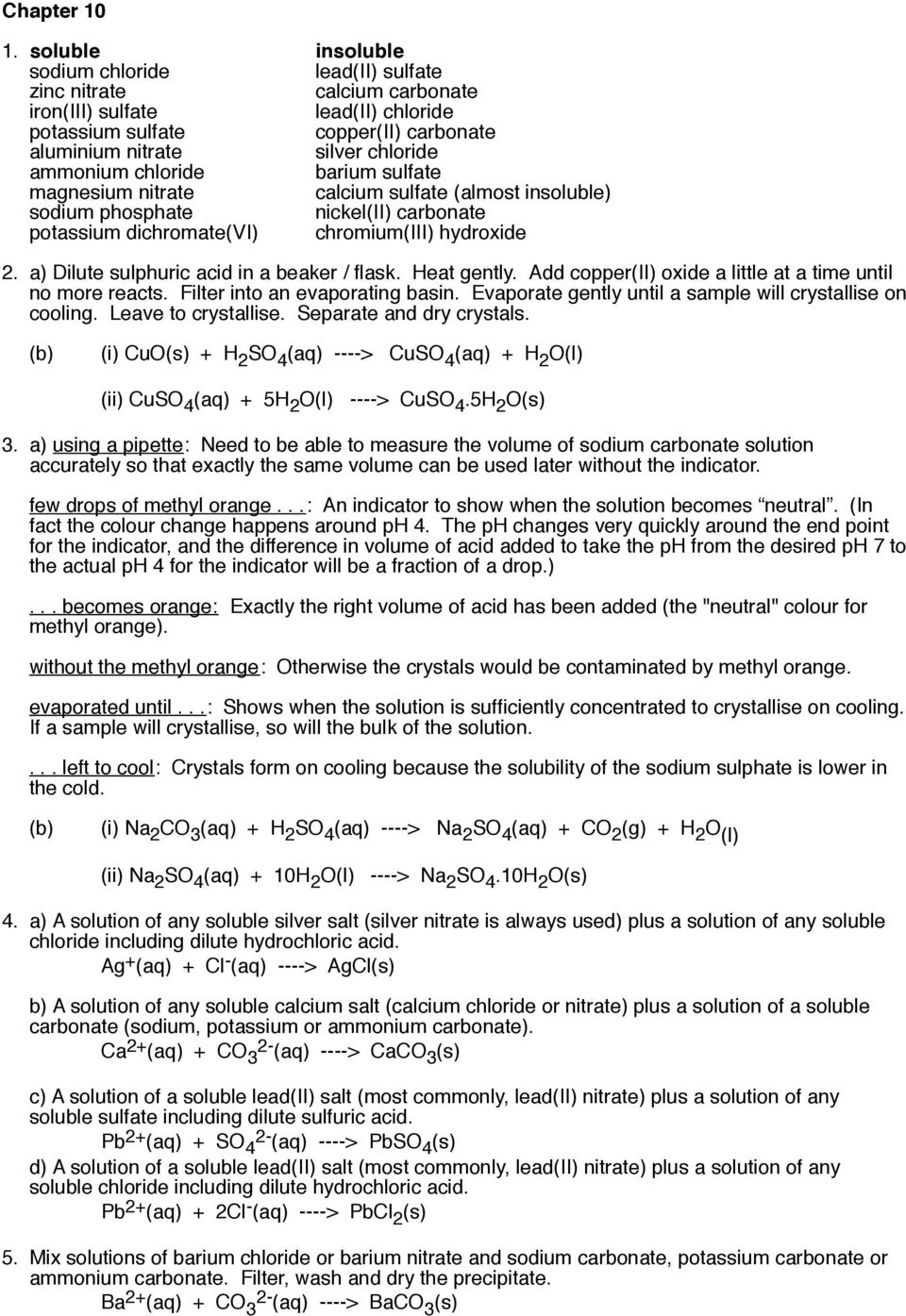
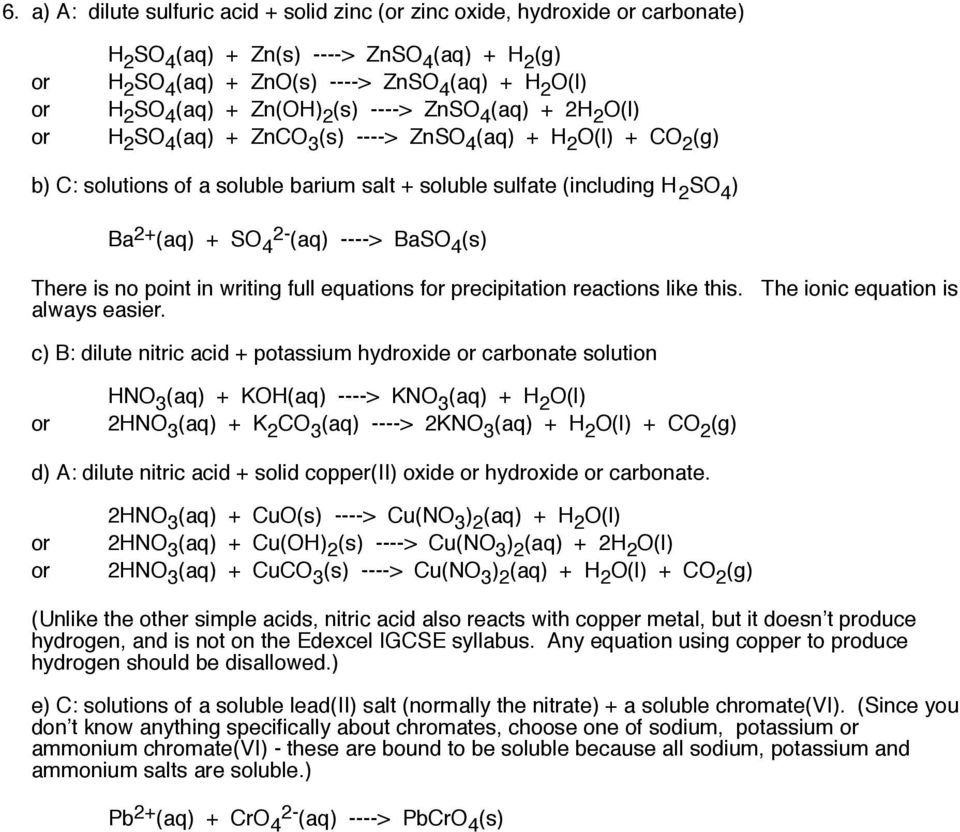
7 6. a) A: dilute sulfuric acid + solid zinc (or zinc oxide, hydroxide or carbonate) or or or H 2 SO 4 (aq) + Zn(s) ----> ZnSO 4 (aq) + H 2 (g) H 2 SO 4 (aq) + ZnO(s) ----> ZnSO 4 (aq) + H 2 O(l) H 2 SO 4 (aq) + Zn(OH) 2 (s) ----> ZnSO 4 (aq) + 2H 2 O(l) H 2 SO 4 (aq) + ZnCO 3 (s) ----> ZnSO 4 (aq) + H 2 O(l) + CO 2 (g) b) C: solutions of a soluble barium salt + soluble sulfate (including H 2 SO 4 ) Ba 2+ (aq) + SO 4 2- (aq) ----> BaSO 4 (s) There is no point in writing full equations for precipitation reactions like this. The ionic equation is always easier. c) B: dilute nitric acid + potassium hydroxide or carbonate solution or HNO 3 (aq) + KOH(aq) ----> KNO 3 (aq) + H 2 O(l) 2HNO 3 (aq) + K 2 CO 3 (aq) ----> 2KNO 3 (aq) + H 2 O(l) + CO 2 (g) d) A: dilute nitric acid + solid copper(ii) oxide or hydroxide or carbonate. or or 2HNO 3 (aq) + CuO(s) ----> Cu(NO 3 ) 2 (aq) + H 2 O(l) 2HNO 3 (aq) + Cu(OH) 2 (s) ----> Cu(NO 3 ) 2 (aq) + 2H 2 O(l) 2HNO 3 (aq) + CuCO 3 (s) ----> Cu(NO 3 ) 2 (aq) + H 2 O(l) + CO 2 (g) (Unlike the other simple acids, nitric acid also reacts with copper metal, but it doesn t produce hydrogen, and is not on the Edexcel IGCSE syllabus. Any equation using copper to produce hydrogen should be disallowed.) e) C: solutions of a soluble lead(ii) salt (normally the nitrate) + a soluble chromate(vi). (Since you don t know anything specifically about chromates, choose one of sodium, potassium or ammonium chromate(vi) - these are bound to be soluble because all sodium, potassium and ammonium salts are soluble.) Pb 2+ (aq) + CrO 4 2- (aq) ----> PbCrO 4 (s)
8 Chapter a) A b) D c) C d) B 2. For example: Stir with a large enough volume of cold water to dissolve all the sugar. Filter to leave the diamonds on the filter paper. Wash on the filter paper with more water to remove any last traces of sugar solution. Allow to dry. 3. a) chlorine b) ammonia c) carbon dioxide d) hydrogen e) oxygen 4. a) M b) R c) G and T d) P 5. a) Clean a nichrome or platinum wire by dipping it into concentrated hydrochloric acid and then into a flame until no colour shows. Moisten the wire with concentrated hydrochloric acid, dip it into the solid, and then back into flame. Lithium ions give a red flame colour. b) Warm the solid very gently with sodium hydroxide solution. Test any gases given off with a piece of damp red litmus paper. If it turns blue, ammonia is being given off from an ammonium compound. c) Make a solution in pure water. Add dilute hydrochloric acid + barium chloride solution. A white precipitate shows the sulfate ions. d) Drop the liquid onto blue cobalt chloride paper (which turns pink), or onto white anhydrous copper(ii) sulfate (which turns blue). e) Add dilute hydrochloric acid or dilute nitric acid. (Not sulfuric acid which forms an insoluble layer of calcium sulfate around the calcium carbonate, which stops the reaction.) Look for a colourless odourless gas turning lime water milky. (f) Make a solution in pure water. Add dilute nitric acid + silver nitrate solution. A yellow precipitate shows the iodide ions. 6. a) A = iron(iii) chloride; B = iron(iii) hydroxide; C = silver chloride b) B: Fe 3+ (aq) + 3OH - (aq) ----> Fe(OH) 3 (s) or: FeCl 3 (aq) + 3NaOH(aq) ----> Fe(OH) 3 (s) + 3NaCl(aq) C: Ag + (aq) + Cl - (aq) ----> AgCl(s) or 3AgNO 3 (aq) + FeCl 3 (aq) ----> 3AgCl(s) + Fe(NO 3 ) 3 (aq) 7. a) D = iron(ii) sulphate; E = iron(ii) hydroxide; F = barium sulphate b) E: Fe 2+ (aq) + 2OH - (aq) ----> Fe(OH) 2 (s) or: FeSO 4 (aq) + 2NaOH(aq) ----> Fe(OH) 2 (s) + Na 2 SO 4 (aq) F: Ba 2+ (aq) + SO 2-4 (aq) ----> BaSO 4 (s) or BaCl 2 (aq) + FeSO 4 (aq) ----> BaSO 4 (s) + FeCl 2 (aq) 8. a) G = potassium carbonate; H = potassium nitrate; I = carbon dioxide (Note: G could also be potassium hydrogencarbonate, but, because hydrogencarbonates haven t been covered in the course, a student is unlikely to come up with it.) b) CO 2-3 (s) + 2H + (aq) ----> CO 2 (g) + H 2 O(l) or K 2 CO 3 (s) + 2HNO 3 (aq) ----> 2KNO 3 (aq) + CO 2 (g) + H 2 O(l)

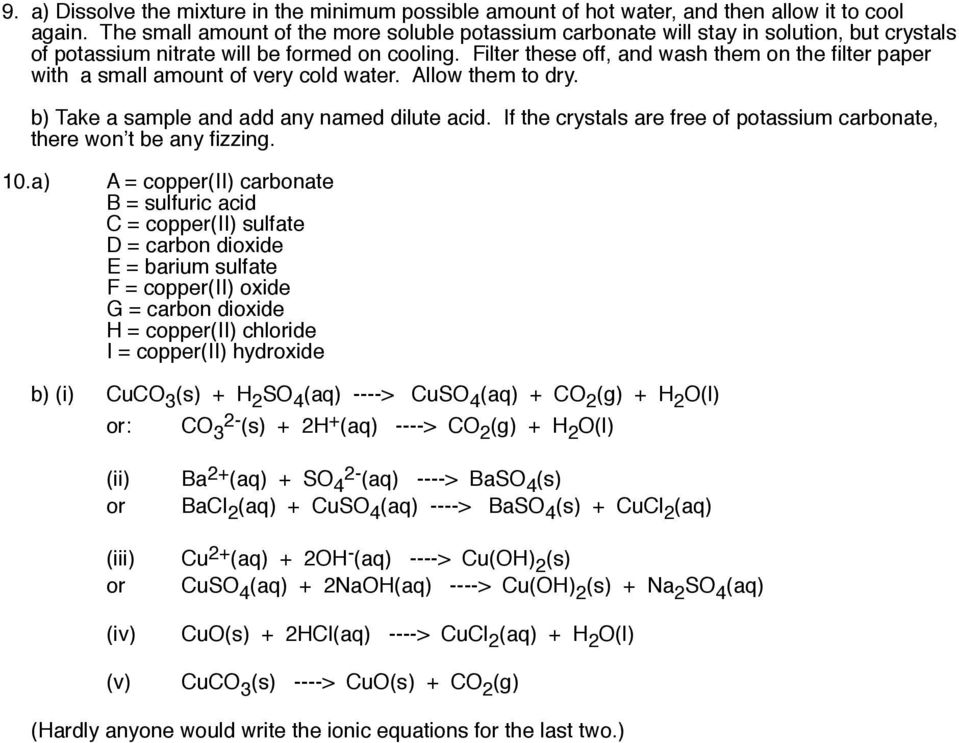
9 9. a) Dissolve the mixture in the minimum possible amount of hot water, and then allow it to cool again. The small amount of the more soluble potassium carbonate will stay in solution, but crystals of potassium nitrate will be formed on cooling. Filter these off, and wash them on the filter paper with a small amount of very cold water. Allow them to dry. b) Take a sample and add any named dilute acid. If the crystals are free of potassium carbonate, there won t be any fizzing. 10.a) A = copper(ii) carbonate B = sulfuric acid C = copper(ii) sulfate D = carbon dioxide E = barium sulfate F = copper(ii) oxide G = carbon dioxide H = copper(ii) chloride I = copper(ii) hydroxide b) (i) CuCO 3 (s) + H 2 SO 4 (aq) ----> CuSO 4 (aq) + CO 2 (g) + H 2 O(l) or: CO 3 2- (s) + 2H + (aq) ----> CO 2 (g) + H 2 O(l) (ii) or (iii) or (iv) (v) Ba 2+ (aq) + SO 2-4 (aq) ----> BaSO 4 (s) BaCl 2 (aq) + CuSO 4 (aq) ----> BaSO 4 (s) + CuCl 2 (aq) Cu 2+ (aq) + 2OH - (aq) ----> Cu(OH) 2 (s) CuSO 4 (aq) + 2NaOH(aq) ----> Cu(OH) 2 (s) + Na 2 SO 4 (aq) CuO(s) + 2HCl(aq) ----> CuCl 2 (aq) + H 2 O(l) CuCO 3 (s) ----> CuO(s) + CO 2 (g) (Hardly anyone would write the ionic equations for the last two.)
10 Chapter a) (i) strontium (ii) chlorine (iii) nitrogen b) (i) 2; (ii) 7; (iii) 5 c) metals: caesium, molybdenum, nickel, strontium, tin non-metals: chlorine, neon, nitrogen d) molybdenum and nickel e) (i) caesium (ii) neon 2. a) A = lithium 3. a) b) B = potassium; C = hydrogen; D = potassium hydroxide c) E = sodium; F = chlorine; G = sodium chloride d) (i) 2K(s) + 2H 2 O(l) ----> 2KOH(aq) + H 2 (g) (ii) 2Na(s) + Cl 2 (g) ----> 2NaCl(s) (You could easily justify (l) as the state symbol for both K and Na.) e) red turns blue; no change to the blue. b) Lots of heat evolved. Melting point of potassium is low. At At At At b) solid c) less atom ion molecule d) steamy gas; solution with a ph about 1 e) A white solid, soluble in water. It will be an ionic solid, because that s typical of compounds formed when Group 1 and Group VII elements combine. The other Group 1 halides are soluble in water. There isn t a transition element present, so it is unlikely to be coloured. f) 2At - (aq) + Cl 2 (aq) ----> At 2 (s) + 2Cl - (aq) A redox reaction is one in which reduction and oxidation occur. The astatide ions have lost electrons, and so have been oxidised. The chlorine molecules have gained electrons, and so have been reduced from: high melting point, high boiling point, high density, hard, good conductor of electricity, good conductor of heat, malleable and ductile, useful catalyst, compounds are coloured (+ anything else which seems sensible)

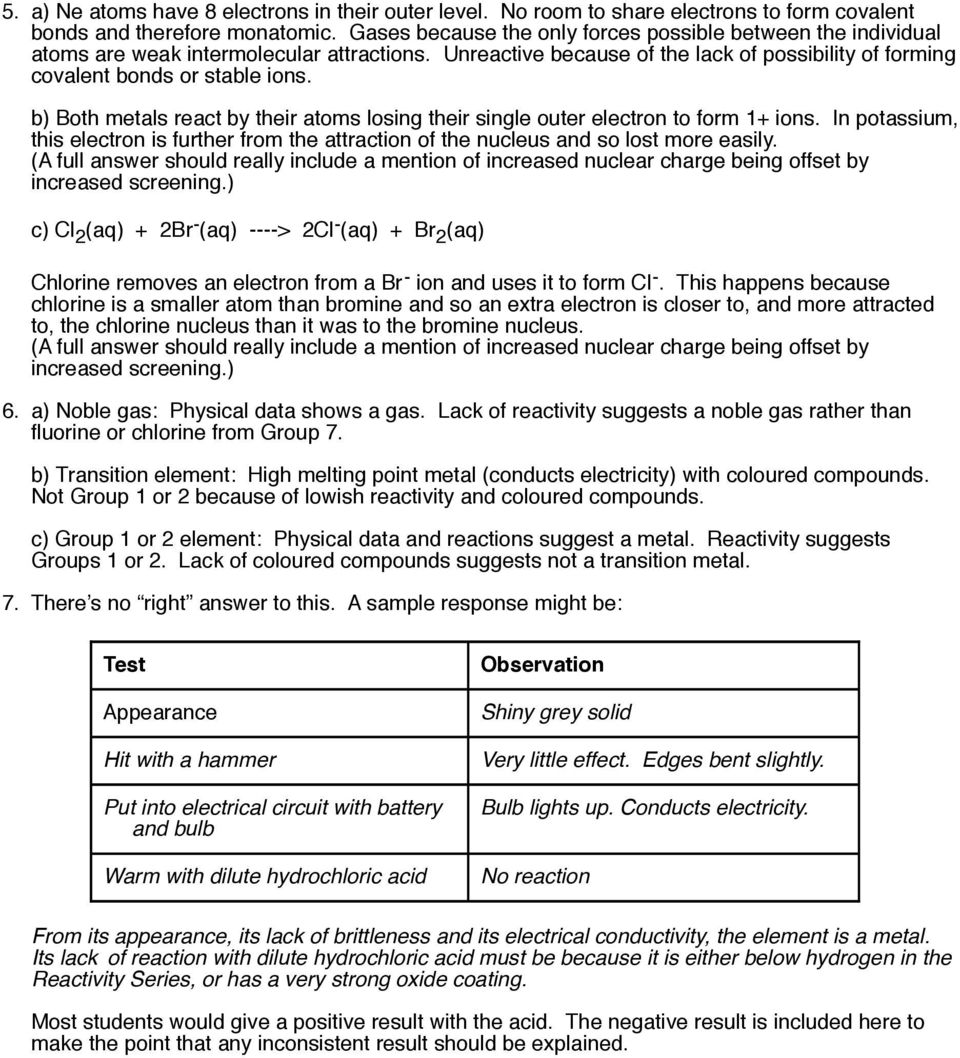
11 5. a) Ne atoms have 8 electrons in their outer level. No room to share electrons to form covalent bonds and therefore monatomic. Gases because the only forces possible between the individual atoms are weak intermolecular attractions. Unreactive because of the lack of possibility of forming covalent bonds or stable ions. b) Both metals react by their atoms losing their single outer electron to form 1+ ions. In potassium, this electron is further from the attraction of the nucleus and so lost more easily. (A full answer should really include a mention of increased nuclear charge being offset by increased screening.) c) Cl 2 (aq) + 2Br - (aq) ----> 2Cl - (aq) + Br 2 (aq) Chlorine removes an electron from a Br - ion and uses it to form Cl -. This happens because chlorine is a smaller atom than bromine and so an extra electron is closer to, and more attracted to, the chlorine nucleus than it was to the bromine nucleus. (A full answer should really include a mention of increased nuclear charge being offset by increased screening.) 6. a) Noble gas: Physical data shows a gas. Lack of reactivity suggests a noble gas rather than fluorine or chlorine from Group 7. b) Transition element: High melting point metal (conducts electricity) with coloured compounds. Not Group 1 or 2 because of lowish reactivity and coloured compounds. c) Group 1 or 2 element: Physical data and reactions suggest a metal. Reactivity suggests Groups 1 or 2. Lack of coloured compounds suggests not a transition metal. 7. There s no right answer to this. A sample response might be: Test Appearance Hit with a hammer Put into electrical circuit with battery and bulb Warm with dilute hydrochloric acid Observation Shiny grey solid Very little effect. Edges bent slightly. Bulb lights up. Conducts electricity. No reaction From its appearance, its lack of brittleness and its electrical conductivity, the element is a metal. Its lack of reaction with dilute hydrochloric acid must be because it is either below hydrogen in the Reactivity Series, or has a very strong oxide coating. Most students would give a positive result with the acid. The negative result is included here to make the point that any inconsistent result should be explained.
12 Chapter cathode anode a) lead bromine b) zinc chlorine c) hydrogen iodine d) sodium iodine e) copper chlorine f) hydrogen chlorine g) hydrogen oxygen h) hydrogen oxygen 2. a) Ions weren't free to move. b) anode c) iodine: 2I - (l) ----> I 2 (g) + 2e - d) K + (l) + e > K(l) e) Orange flashes around the cathode (sodium burning) and brown fumes (bromine) around the anode. f) cathode: Na + (l) + e > Na(l) anode: 2Br - (l) ----> Br 2 (g) + 2e - 3. a) (i) Pb 2+ (l) + 2e > Pb(l) (ii) 2Br - (l) ----> Br 2 (g) + 2e - (iii) Oxidised: bromide ions. Reduced: lead(ii) ions. b) (i) 2H + (aq) + 2e > H 2 (g) (ii) 2Cl - (aq) ----> Cl 2 (g) + 2e - (iii) Oxidised: chloride ions. Reduced: hydrogen ions. c) (i) 2H + (aq) + 2e > H 2 (g) (ii) 2Br - (aq) ----> Br 2 (aq or l) + 2e - (iii) Oxidised: bromide ions. Reduced: hydrogen ions. d) (i) Cu 2+ (aq) + 2e > Cu(s) (ii) 4OH - (aq) ----> 2H 2 O(l) + O 2 (g) + 4e - (iii) Oxidised: hydroxide ions. Reduced: copper(ii) ions. e) (i) 2H + (aq) + 2e > H 2 (g) (ii) 4OH - (aq) ----> 2H 2 O(l) + O 2 (g) + 4e - (iii) Oxidised: hydroxide ions. Reduced: hydrogen ions. f) (i) Mg 2+ (l) + 2e > Mg(s or l) (ii) 2I - (l) ----> I 2 (g) + 2e - (iii) Oxidised: iodide ions. Reduced: magnesium ions. g) (i) 2H + (aq) + 2e > H 2 (g) (ii) 2Cl - (aq) ----> Cl 2(g) + 2e - (iii) Oxidised: chloride ions. Reduced: hydrogen ions.

13 4. The melting point of S is too high to reach using a bunsen, and so you would have to test a solution in water. On the other hand, T would melt easily, and won t dissolve. Heat it until it melts. 6v DC power supply 6v DC power supply bulb bulb carbon electrodes S solution molten T small beaker pyrex dish or crucible heat (You could also do the electrolysis of the solution using the more complicated apparatus in the chapter, but since there is no need to collect anything, there isn t much point.) If the substances are electrolytes, the bulbs will light up, and there will be signs of activity around the electrodes (gases given off, solids deposited, etc).

14 Chapter a) A reaction in which heat energy is produced. Correctly balanced equations (including state symbols) for any two exothermic reactions - e.g. the obvious ones are any combustion reactions (metals, hydrogen, hydrocarbons, etc, in oxygen), neutralisation reactions involving oxides or hydroxides and acids, magnesium and acids. See chapter for specific examples. b) energy heptane and oxygen kj carbon dioxide + water c) Energy is needed to break the bonds in heptane and in oxygen. Energy is released when new bonds are made to produce the carbon dioxide and water. More energy is released when the new bonds are made than was used to break the old ones. 2. a) A reaction in which energy is absorbed. The chapter uses the effect of heat on carbonates as examples of endothermic reactions. It is easiest to choose any two of these. b) progress of reaction energy glucose and oxygen carbon dioxide + water kj 3. a) exothermic b) exothermic c) endothermic d) exothermic e) endothermic f) exothermic progress of reaction 4. The cans are double skinned - the gap between the skins containing calcium oxide and (kept separate) water. Pushing a button on the bottom of the can breaks a seal and allows the reactants into contact, and you get the reaction described in the chapter. CaO(s) + H 2 O(l) ----> Ca(OH) 2 (s) It is easy to find lots of information on this by an Internet search.

15 Chapter a) If a dynamic equilibrium is disturbed by changing the conditions, the reaction moves to counteract the change. b) (i) Dynamic means that the reactions are still continuing. Equilibrium means that the total amounts of the various things present are constant. This is because the forward and back reactions are happening at the same rates. (ii) An increase in pressure will produce more N 2 O 4. According to Le Chatelier, the equilibrium moves to reduce the pressure again by producing fewer molecules. (iii) A decrease in temperature will produce more N 2 O 4. According to Le Chatelier, the equilibrium moves to increase the temperature again by favouring the exothermic change. 2. a) Less carbon monoxide and hydrogen would be produced. (A high pressure favours the reaction producing fewer molecules.) b) Raising the temperature moves the equilibrium in the direction which would tend to reduce it again, and so a high temperature favours the endothermic change (in this case, the forward reaction). c) The reaction would be too slow in the absence of the catalyst. d) Increasing the proportion of steam will favour the forward reaction (Le Chatelier s Principle). Steam is also much cheaper than methane and an excess will help ensure the maximum conversion of the methane into products. 3. a) Adding extra hydrogen ions favours the back reaction as the equilibrium shifts to reduce their concentration again (Le Chatelier s Principle). This produces more HLit, which is red. b) The hydroxide ions react with the hydrogen ions in the equilibrium, reducing their concentration. The equilibrium moves to replace them again, producing extra Lit - ions which are blue. 4. a) A high pressure favours the reaction producing fewer molecules (Le Chatelier s Principle - fewer molecules produce a lower pressure) - in this case, the production of ammonia. b) Very high pressures are expensive to produce for two reasons: all the reaction vessels and pipework have to be built much more strongly, and it takes a lot more energy to drive the compressors producing the very high pressures. The extra ammonia produced isn t worth the extra cost. c) The forward reaction producing ammonia is exothermic. This is favoured by a low temperature according to Le Chatelier s Principle (the equilibrium moves in a direction to increase the temperature again). d) At low temperatures the reaction is extremely slow even in the presence of a catalyst. 450 C is chosen because it gives a reasonable percentage of ammonia in the equilibrium mixture reasonably quickly.
16 End of Section B Questions 1. a) (i) barium sulfate (1) (ii) Ba 2+ (aq) + SO 4 2- (aq) ----> BaSO 4 (s) (1) b) Add sodium hydroxide solution (1) and look for blue precipitate (1). c) (i) Brown precipitate (1). Solution fades from blue to colourless (1). (ii) zinc (1). Loss of electrons (1). d) (i) cathode (or negative) (1) (ii) Cu 2+ (aq) + 2e > Cu(s) (1) (iii) reduction (1). Gain of electrons (1). 2. a) (i) solid copper(ii) oxide (or hydroxide or carbonate) (1) (ii) sodium hydroxide (or carbonate) solution (1) (iii) silver nitrate solution (1) b) Add a measured volume of potassium hydroxide solution to a flask using a pipette (or measuring cylinder) (1). Add a named indicator (1). Add acid from a burette (1) until a correctly stated colour change (1). Note the volume of acid added (1). Mix the same volumes of acid and potassium hydroxide solution without the indicator (1). 3. a) (i) A = chlorine (1) (ii) B = hydrogen (1) (Allow one mark overall if reversed) b) (i) bleaches (1) damp litmus paper (1) (ii) pops (1) with lighted splint (1) (Consequential marking from part (a). e.g. If A was mis-named as oxygen, allow a correct test for oxygen.) c) (i) red / brown (1) solution (1) instead of colourless gas (ii) no change (1) d) copper(ii) (1) bromide (1) 4. a) (i) Cl 2 (g) + 2I - (aq) ----> 2Cl - (aq) + I 2 (s) (1) (ii) Colourless solution + green gas (1) gives dark grey precipitate (1) (allow red/brown solution). (iii) Oxidising agent (1) because it removes electrons (1) from the iodide ions. b) (i) iron(ii) (1) chloride (1) (ii) I = iron(ii) hydroxide (1). K = iron(iii) hydroxide (1) (iii) iron(iii) chloride (1) (iv) Fe 2+ (aq) + 2OH - (aq) ----> Fe(OH) 2 (s) (1) 5. a) Any sensible physical property (1) - e.g. solid rather than gas. b) Correct reagent (e.g. water or oxygen or chlorine) (1). Name products (1). Correctly balanced equation (2) c) (i) Dots-and-crosses diagrams showing all the electrons: Na 2,8,1; K 2,8,8,1 (2 x 1 = 2) (ii) Loss of outer electron (1) (iii) Potassium's electron is further from nucleus (1) and so experiences less attraction (1). Some mention of increased nuclear charge being offset by extra screening (1). d) A molecule consisting of a single atom (1). Argon's outer level contains 8 electrons (1). No room for sharing another electron to make the covalent bond needed to join other atoms to it. (1) 6. a) redox (1) b) thermal decomposition (1) c) neutralisation (1) d) precipitation (1) e) redox (1) f) redox (1)
17 7. a) ΔH shows the amount of heat evolved or absorbed during the reaction (1). The positive sign shows heat is absorbed (1). b) (i) increases (ii) decreases c) (i) N 2 (g) + O 2 (g) ----> 2NO(g) (1) (ii) acid rain (1). Any valid consequence of acid rain (e.g. death of trees, loss of life in lakes, corrosion of iron or limestone) (1) (iii) sulfur dioxide (1)
Chapter 16: Tests for ions and gases
 The position of hydrogen in the reactivity series Hydrogen, although not a metal, is included in the reactivity series because it, like metals, can be displaced from aqueous solution, only this time the
Balancing Chemical Equations Worksheet
 Balancing Chemical Equations Worksheet Student Instructions 1. Identify the reactants and products and write a word equation. 2. Write the correct chemical formula for each of the reactants and the products.
EDEXCEL INTERNATIONAL GCSE CHEMISTRY EDEXCEL CERTIFICATE IN CHEMISTRY ANSWERS SECTION C
 EDEXCEL INTERNATIONAL GCSE CHEMISTRY EDEXCEL CERTIFICATE IN CHEMISTRY ANSWERS SECTION C Chapter 16 1. Burn sulfur in air to give sulfur dioxide. S(s) + O 2 (g) ----> SO 2 (g) Pass this with more air over
Instructions Answer all questions in the spaces provided. Do all rough work in this book. Cross through any work you do not want to be marked.
 GCSE CHEMISTRY Higher Tier Chemistry 1H H Specimen 2018 Time allowed: 1 hour 45 minutes Materials For this paper you must have: a ruler a calculator the periodic table (enclosed). Instructions Answer all
Santa Monica College Chemistry 11
 Types of Reactions Objectives The objectives of this laboratory are as follows: To perform and observe the results of a variety of chemical reactions. To become familiar with the observable signs of chemical
Experiment 5. Chemical Reactions A + X AX AX A + X A + BX AX + B AZ + BX AX + BZ
 Experiment 5 Chemical Reactions OBJECTIVES 1. To observe the various criteria that are used to indicate that a chemical reaction has occurred. 2. To convert word equations into balanced inorganic chemical
80. Testing salts for anions and cations
 Classic chemistry experiments 203 80. Testing salts for anions and cations Topic Qualitative analysis. Timing Description 12 hours. Students attempt to identify the anions and cations present in a salt
Solution. Practice Exercise. Concept Exercise
 Example Exercise 8.1 Evidence for a Reaction Which of the following is experimental evidence for a chemical reaction? (a) Pouring vinegar on baking soda gives foamy bubbles. (b) Mixing two solutions produces
W1 WORKSHOP ON STOICHIOMETRY
 INTRODUCTION W1 WORKSHOP ON STOICHIOMETRY These notes and exercises are designed to introduce you to the basic concepts required to understand a chemical formula or equation. Relative atomic masses of
Cambridge International Examinations Cambridge International General Certificate of Secondary Education
 Cambridge International Examinations Cambridge International General Certificate of Secondary Education *0123456789* CHEMISTRY 0620/03 Paper 3 Theory (Core) For Examination from 2016 SPECIMEN PAPER 1 hour
Chapter 5. Chemical Reactions and Equations. Introduction. Chapter 5 Topics. 5.1 What is a Chemical Reaction
 Introduction Chapter 5 Chemical Reactions and Equations Chemical reactions occur all around us. How do we make sense of these changes? What patterns can we find? 1 2 Copyright The McGraw-Hill Companies,
Atomic Structure. Name Mass Charge Location Protons 1 +1 Nucleus Neutrons 1 0 Nucleus Electrons 1/1837-1 Orbit nucleus in outer shells
 Atomic Structure called nucleons Name Mass Charge Location Protons 1 +1 Nucleus Neutrons 1 0 Nucleus Electrons 1/1837-1 Orbit nucleus in outer shells The number of protons equals the atomic number This
Experiment 8 - Double Displacement Reactions
 Experiment 8 - Double Displacement Reactions A double displacement reaction involves two ionic compounds that are dissolved in water. In a double displacement reaction, it appears as though the ions are
Experiment 1 Chemical Reactions and Net Ionic Equations
 Experiment 1 Chemical Reactions and Net Ionic Equations I. Objective: To predict the products of some displacement reactions and write net ionic equations. II. Chemical Principles: A. Reaction Types. Chemical
Decomposition. Composition
 Decomposition 1. Solid ammonium carbonate is heated. 2. Solid calcium carbonate is heated. 3. Solid calcium sulfite is heated in a vacuum. Composition 1. Barium oxide is added to distilled water. 2. Phosphorus
6 Reactions in Aqueous Solutions
 6 Reactions in Aqueous Solutions Water is by far the most common medium in which chemical reactions occur naturally. It is not hard to see this: 70% of our body mass is water and about 70% of the surface
Aqueous Solutions. Water is the dissolving medium, or solvent. Some Properties of Water. A Solute. Types of Chemical Reactions.
 Aqueous Solutions and Solution Stoichiometry Water is the dissolving medium, or solvent. Some Properties of Water Water is bent or V-shaped. The O-H bonds are covalent. Water is a polar molecule. Hydration
Chapter 8 - Chemical Equations and Reactions
 Chapter 8 - Chemical Equations and Reactions 8-1 Describing Chemical Reactions I. Introduction A. Reactants 1. Original substances entering into a chemical rxn B. Products 1. The resulting substances from
Types of Reactions. CHM 130LL: Chemical Reactions. Introduction. General Information
 Introduction CHM 130LL: Chemical Reactions We often study chemistry to understand how and why chemicals (reactants) can be transformed into different chemicals (products) via a chemical reaction: Reactants
CHEMICAL REACTIONS OF COPPER AND PERCENT YIELD KEY
 CHEMICAL REACTIONS OF COPPER AND PERCENT YIELD Objective To gain familiarity with basic laboratory procedures, some chemistry of a typical transition element, and the concept of percent yield. Apparatus
General Chemistry Lab Experiment 6 Types of Chemical Reaction
 General Chemistry Lab Experiment 6 Types of Chemical Reaction Introduction Most ordinary chemical reactions can be classified as one of five basic types. The first type of reaction occurs when two or more
Q1. A student studied the reaction between dilute hydrochloric acid and an excess of calcium carbonate.
 Q. A student studied the reaction between dilute hydrochloric acid and an excess of calcium carbonate. calcium carbonate + hydrochloric acid calcium chloride + water + carbon dioxide The student measured
IB Chemistry. DP Chemistry Review
 DP Chemistry Review Topic 1: Quantitative chemistry 1.1 The mole concept and Avogadro s constant Assessment statement Apply the mole concept to substances. Determine the number of particles and the amount
Chapter 6 Notes Science 10 Name:
 6.1 Types of Chemical Reactions a) Synthesis (A + B AB) Synthesis reactions are also known as reactions. When this occurs two or more reactants (usually elements) join to form a. A + B AB, where A and
2. DECOMPOSITION REACTION ( A couple have a heated argument and break up )
 TYPES OF CHEMICAL REACTIONS Most reactions can be classified into one of five categories by examining the types of reactants and products involved in the reaction. Knowing the types of reactions can help
Chapter 7: Chemical Reactions
 Chapter 7 Page 1 Chapter 7: Chemical Reactions A chemical reaction: a process in which at least one new substance is formed as the result of a chemical change. A + B C + D Reactants Products Evidence that
David A. Katz Chemist, Educator, Science Communicator, and Consultant Department of Chemistry, Pima Community College
 WRITING CHEMICAL EQUATIONS 2004, 2002, 1989 by David A. Katz. All rights reserved. Permission for classroom used provided original copyright is included. David A. Katz Chemist, Educator, Science Communicator,
WRITING CHEMICAL FORMULA
 WRITING CHEMICAL FORMULA For ionic compounds, the chemical formula must be worked out. You will no longer have the list of ions in the exam (like at GCSE). Instead you must learn some and work out others.
Question Bank Electrolysis
 Question Bank Electrolysis 1. (a) What do you understand by the terms (i) electrolytes (ii) non-electrolytes? (b) Arrange electrolytes and non-electrolytes from the following substances (i) sugar solution
Syllabus OC18 Use litmus or a universal indicator to test a variety of solutions, and classify these as acidic, basic or neutral
 Chemistry: 9. Acids and Bases Please remember to photocopy 4 pages onto one sheet by going A3 A4 and using back to back on the photocopier Syllabus OC18 Use litmus or a universal indicator to test a variety
Chemical Equations. Chemical Equations. Chemical reactions describe processes involving chemical change
 Chemical Reactions Chemical Equations Chemical reactions describe processes involving chemical change The chemical change involves rearranging matter Converting one or more pure substances into new pure
EDEXCEL INTERNATIONAL GCSE CHEMISTRY EDEXCEL CERTIFICATE IN CHEMISTRY ANSWERS SECTION E
 EDEXCEL INTERNATIONAL GCSE CHEMISTRY EDEXCEL CERTIFICATE IN CHEMISTRY ANSWERS SECTION E (To save endless repetition, wherever they are included, comments are intended for homeschooling parents who may
Topic 4 National Chemistry Summary Notes. Formulae, Equations, Balancing Equations and The Mole
 Topic 4 National Chemistry Summary Notes Formulae, Equations, Balancing Equations and The Mole LI 1 The chemical formula of a covalent molecular compound tells us the number of atoms of each element present
Cambridge International Examinations Cambridge International General Certificate of Secondary Education
 ambridge International Examinations ambridge International General ertificate of Secondary Education *012345678* EMISTRY 0620/01 Paper 1 Multiple hoice (ore) For Examination from 2016 SPEIMEN PPER dditional
Physical Changes and Chemical Reactions
 Physical Changes and Chemical Reactions Gezahegn Chaka, Ph.D., and Sudha Madhugiri, Ph.D., Collin College Department of Chemistry Objectives Introduction To observe physical and chemical changes. To identify
C4 Revision Questions Bumper Pack
 C4 Revision Questions Bumper Pack You will need a Periodic Table to answer these questions!! C4a Atomic structure 1. Write down a definition of an element. 2. Write down: a) the approximate radius of an
Reactions in Aqueous Solution
 CHAPTER 7 1. Water is the most universal of all liquids. Water has a relatively large heat capacity and a relatively large liquid range, which means it can absorb the heat liberated by many reactions while
Solution a homogeneous mixture = A solvent + solute(s) Aqueous solution water is the solvent
 Solution a homogeneous mixture = A solvent + solute(s) Aqueous solution water is the solvent Water a polar solvent: dissolves most ionic compounds as well as many molecular compounds Aqueous solution:
EDULABZ. Na 2 + H 2 CO 3. O + CO 2 (b) CaO + H 2. + NaCl AgCl + NaNO 3 3. Which of the following reactions does not take place?
 4 TRANSFORMATION OF SUBSTANCE I. Multiple choice questions: (Tick the correct option). 1. The reaction between magnesium and oxygen is: (a) an endothermic reaction (b) an exothermic reaction (c) a catalysed
Electrochemistry - ANSWERS
 Electrochemistry - ANSWERS 1. Using a table of standard electrode potentials, predict if the following reactions will occur spontaneously as written. a) Al 3+ + Ni Ni 2+ + Al Al 3+ + 3e - Al E = -1.68
Lab #13: Qualitative Analysis of Cations and Anions
 Lab #13: Qualitative Analysis of Cations and Anions Objectives: 1. To understand the rationale and the procedure behind the separation for various cations and anions. 2. To perform qualitative analysis
Metals and Non-metals. Comparison of physical properties of metals and non metals
 Metals and Non-metals Comparison of physical properties of metals and non metals PHYSICAL PROPERTY METALS NON-METALS Physical State Metallic lustre (having a shining surface) Mostly solids (Liquid -mercury)
Redox and Electrochemistry
 Name: Thursday, May 08, 2008 Redox and Electrochemistry 1. A diagram of a chemical cell and an equation are shown below. When the switch is closed, electrons will flow from 1. the Pb(s) to the Cu(s) 2+
Chemical Equations and Chemical Reactions. Chapter 8.1
 Chemical Equations and Chemical Reactions Chapter 8.1 Objectives List observations that suggest that a chemical reaction has taken place List the requirements for a correctly written chemical equation.
Candidate Style Answer
 Candidate Style Answer Chemistry A Unit F321 Atoms, Bonds and Groups High banded response This Support Material booklet is designed to accompany the OCR GCE Chemistry A Specimen Paper F321 for teaching
Chemistry: Chemical Equations
 Chemistry: Chemical Equations Write a balanced chemical equation for each word equation. Include the phase of each substance in the equation. Classify the reaction as synthesis, decomposition, single replacement,
Exampro GCSE Chemistry
 Exampro GCSE Chemistry C2 Chapter 5 Higher Name: Class: Author: Date: Time: 73 Marks: 73 Comments: Page of 27 Q. (a) In this question you will be assessed on using good English, organising information
HOMEWORK 4A. Definitions. Oxidation-Reduction Reactions. Questions
 HOMEWORK 4A Oxidation-Reduction Reactions 1. Indicate whether a reaction will occur or not in each of following. Wtiring a balcnced equation is not necessary. (a) Magnesium metal is added to hydrochloric
EXPERIMENT 8: Activity Series (Single Displacement Reactions)
 EPERIMENT 8: Activity Series (Single Displacement Reactions) PURPOSE a) Reactions of metals with acids and salt solutions b) Determine the activity of metals c) Write a balanced molecular equation, complete
SCH 4C1 Unit 2 Problem Set Questions taken from Frank Mustoe et all, "Chemistry 11", McGraw-Hill Ryerson, 2001
 SCH 4C1 Unit 2 Problem Set Questions taken from Frank Mustoe et all, "Chemistry 11", McGraw-Hill Ryerson, 2001 1. A small pin contains 0.0178 mol of iron. How many atoms of iron are in the pin? 2. A sample
Chapter 8: Chemical Equations and Reactions
 Chapter 8: Chemical Equations and Reactions I. Describing Chemical Reactions A. A chemical reaction is the process by which one or more substances are changed into one or more different substances. A chemical
Cambridge International Examinations Cambridge International General Certificate of Secondary Education
 Cambridge International Examinations Cambridge International General Certificate of Secondary Education *0123456789* CHEMISTRY 0620/04 Paper 4 Theory (Extended) For Examination from 2016 SPECIMEN PAPER
Department of Chemical Engineering Review Sheet Chemical Reactions Prepared by Dr. Timothy D. Placek from various sources
 Department of Chemical Engineering Review Sheet Chemical Reactions Prepared by Dr. Timothy D. Placek from various sources Introduction This document is intended to help you review the basics of writing
Unit 6 The Mole Concept
 Chemistry Form 3 Page 62 Ms. R. Buttigieg Unit 6 The Mole Concept See Chemistry for You Chapter 28 pg. 352-363 See GCSE Chemistry Chapter 5 pg. 70-79 6.1 Relative atomic mass. The relative atomic mass
Steps for balancing a chemical equation
 The Chemical Equation: A Chemical Recipe Dr. Gergens - SD Mesa College A. Learn the meaning of these arrows. B. The chemical equation is the shorthand notation for a chemical reaction. A chemical equation
Atomic Structure. Same atomic number Different mass number
 Mass number Number of protons and neutrons Atomic number Number of protons Atomic Structure Cl 35 17 Atoms of the same element can have different numbers of neutrons - these atoms are called isotopes of
ATOMS. Multiple Choice Questions
 Chapter 3 ATOMS AND MOLECULES Multiple Choice Questions 1. Which of the following correctly represents 360 g of water? (i) 2 moles of H 2 0 (ii) 20 moles of water (iii) 6.022 10 23 molecules of water (iv)
Writing and Balancing Chemical Equations
 Name Writing and Balancing Chemical Equations Period When a substance undergoes a chemical reaction, chemical bonds are broken and new bonds are formed. This results in one or more new substances, often
Experiment 16-Acids, Bases and ph
 Definitions acid-an ionic compound that releases or reacts with water to form hydrogen ion (H + ) in aqueous solution. They taste sour and turn litmus red. Acids react with certain metals such as zinc,
Writing, Balancing and Predicting Products of Chemical Reactions.
 Writing, Balancing and Predicting Products of Chemical Reactions. A chemical equation is a concise shorthand expression which represents the relative amount of reactants and products involved in a chemical
Coimisiún na Scrúduithe Stáit State Examinations Commission
 2015. M33 Coimisiún na Scrúduithe Stáit State Examinations Commission LEAVING CERTIFICATE EXAMINATION, 2015 CHEMISTRY ORDINARY LEVEL TUESDAY, 16 JUNE AFTERNOON 2.00 TO 5.00 400 MARKS Answer eight questions
Chemistry Themed. Types of Reactions
 Chemistry Themed Types of Reactions 1 2 Chemistry in the Community-2015-2016 Types of Reactions Date In-Class Assignment Homework T 10/20 TEST on Reactivity of Metals and Redox None W 10/21 Late Start
Introduction to electrolysis - electrolytes and non-electrolytes
 Introduction to electrolysis - electrolytes and non-electrolytes Electrolysis is the process of electrically inducing chemical changes in a conducting melt or solution e.g. splitting an ionic compound
GCSE Chemistry. Making Salts Instructions and answers for teachers
 GCSE Chemistry Making Salts Instructions and answers for teachers The Activity: Learning Outcomes: To be able to recall the names and chemical formulae for commonly used acids To understand how salts can
Chemistry Assessment Unit AS 1
 Centre Number 71 Candidate Number ADVANCED SUBSIDIARY (AS) General Certificate of Education January 2011 Chemistry Assessment Unit AS 1 assessing Basic Concepts in Physical and Inorganic Chemistry [AC111]
EDEXCEL IGCSE chemistry (separate award)
 EDEXCEL IGCSE chemistry (separate award) Section 1: Principles of chemistry a) States of matter 1.1 understand the arrangement, movement and energy of the particles in each of the three states of matter:
1332 CHAPTER 18 Sample Questions
 1332 CHAPTER 18 Sample Questions Couple E 0 Couple E 0 Br 2 (l) + 2e 2Br (aq) +1.06 V AuCl 4 + 3e Au + 4Cl +1.00 V Ag + + e Ag +0.80 V Hg 2+ 2 + 2e 2 Hg +0.79 V Fe 3+ (aq) + e Fe 2+ (aq) +0.77 V Cu 2+
JUNIOR COLLEGE CHEMISTRY DEPARTMENT EXPERIMENT 21 SECOND YEAR PRACTICAL. Name: Group: Date: THE CHEMISTRY OF COPPER AND IRON
 JUNIOR COLLEGE CHEMISTRY DEPARTMENT EXPERIMENT 21 SECOND YEAR PRACTICAL Name: Group: Date: COPPER THE CHEMISTRY OF COPPER AND IRON 1. To a solution of Cu 2+ ions add aqueous sodium hydroxide and heat the
Periodic Table Questions
 Periodic Table Questions 1. The elements characterized as nonmetals are located in the periodic table at the (1) far left; (2) bottom; (3) center; (4) top right. 2. An element that is a liquid at STP is
TOPIC 7. CHEMICAL CALCULATIONS I - atomic and formula weights.
 TOPIC 7. CHEMICAL CALCULATIONS I - atomic and formula weights. Atomic structure revisited. In Topic 2, atoms were described as ranging from the simplest atom, H, containing a single proton and usually
The Periodic Table: Periodic trends
 Unit 1 The Periodic Table: Periodic trends There are over one hundred different chemical elements. Some of these elements are familiar to you such as hydrogen, oxygen, nitrogen and carbon. Each one has
100% ionic compounds do not exist but predominantly ionic compounds are formed when metals combine with non-metals.
 2.21 Ionic Bonding 100% ionic compounds do not exist but predominantly ionic compounds are formed when metals combine with non-metals. Forming ions Metal atoms lose electrons to form +ve ions. Non-metal
General Chemistry I (FC, 09-10) Lab #3: The Empirical Formula of a Compound. Introduction
 General Chemistry I (FC, 09-10) Introduction A look at the mass relationships in chemistry reveals little order or sense. The ratio of the masses of the elements in a compound, while constant, does not
Mark Scheme (Results) January 2012. International GCSE Chemistry (4CH0) Paper 2C
 Mark Scheme (Results) January 202 International GCSE Chemistry (4CH0) Paper 2C Edexcel and BTEC Qualifications Edexcel and BTEC qualifications come from Pearson, the world s leading learning company. We
Unit 10A Stoichiometry Notes
 Unit 10A Stoichiometry Notes Stoichiometry is a big word for a process that chemist s use to calculate amounts in reactions. It makes use of the coefficient ratio set up by balanced reaction equations
Stoichiometry Review
 Stoichiometry Review There are 20 problems in this review set. Answers, including problem set-up, can be found in the second half of this document. 1. N 2 (g) + 3H 2 (g) --------> 2NH 3 (g) a. nitrogen
MOLES AND MOLE CALCULATIONS
 35 MOLES ND MOLE CLCULTIONS INTRODUCTION The purpose of this section is to present some methods for calculating both how much of each reactant is used in a chemical reaction, and how much of each product
CHEMICAL REACTIONS AND REACTING MASSES AND VOLUMES
 CHEMICAL REACTIONS AND REACTING MASSES AND VOLUMES The meaning of stoichiometric coefficients: 2 H 2 (g) + O 2 (g) 2 H 2 O(l) number of reacting particles 2 molecules of hydrogen react with 1 molecule
4. Using the data from Handout 5, what is the standard enthalpy of formation of BaO (s)? What does this mean?
 HOMEWORK 3A 1. In each of the following pairs, tell which has the higher entropy. (a) One mole of liquid water or one mole of water vapor (b) One mole of dry ice or one mole of carbon dioxide at 1 atm
Formulae, stoichiometry and the mole concept
 3 Formulae, stoichiometry and the mole concept Content 3.1 Symbols, Formulae and Chemical equations 3.2 Concept of Relative Mass 3.3 Mole Concept and Stoichiometry Learning Outcomes Candidates should be
H 2 + O 2 H 2 O. - Note there is not enough hydrogen to react with oxygen - It is necessary to balance equation.
 CEMICAL REACTIONS 1 ydrogen + Oxygen Water 2 + O 2 2 O reactants product(s) reactant substance before chemical change product substance after chemical change Conservation of Mass During a chemical reaction,
UNIT (4) CALCULATIONS AND CHEMICAL REACTIONS
 UNIT (4) CALCULATIONS AND CHEMICAL REACTIONS 4.1 Formula Masses Recall that the decimal number written under the symbol of the element in the periodic table is the atomic mass of the element. 1 7 8 12
1. What is the molecular formula of a compound with the empirical formula PO and a gram-molecular mass of 284 grams?
 Name: Tuesday, May 20, 2008 1. What is the molecular formula of a compound with the empirical formula PO and a gram-molecular mass of 284 grams? 2 5 1. P2O 5 3. P10O4 2. P5O 2 4. P4O10 2. Which substance
Molarity of Ions in Solution
 APPENDIX A Molarity of Ions in Solution ften it is necessary to calculate not only the concentration (in molarity) of a compound in aqueous solution but also the concentration of each ion in aqueous solution.
CHEMICAL DETERMINATION OF EVERYDAY HOUSEHOLD CHEMICALS
 CHEMICAL DETERMINATION OF EVERYDAY HOUSEHOLD CHEMICALS Purpose: It is important for chemists to be able to determine the composition of unknown chemicals. This can often be done by way of chemical tests.
Number of moles of solute = Concentration (mol. L ) x Volume of solution (litres) or n = C x V
 44 CALCULATIONS INVOLVING SOLUTIONS INTRODUCTION AND DEFINITIONS Many chemical reactions take place in aqueous (water) solution. Quantities of such solutions are measured as volumes, while the amounts
APPENDIX B: EXERCISES
 BUILDING CHEMISTRY LABORATORY SESSIONS APPENDIX B: EXERCISES Molecular mass, the mole, and mass percent Relative atomic and molecular mass Relative atomic mass (A r ) is a constant that expresses the ratio
HIGHER TIER CHEMISTRY MINI-MOCK UNIT 2 [C2.1, C2.2&C2.3, C2.4, C2.5, C2.6 and C2.7] (a) Name particles X and Y.
![HIGHER TIER CHEMISTRY MINI-MOCK UNIT 2 [C2.1, C2.2&C2.3, C2.4, C2.5, C2.6 and C2.7] (a) Name particles X and Y.](/thumbs/40/21177375.jpg "HIGHER TIER CHEMISTRY MINI-MOCK UNIT 2 [C2.1, C2.2&C2.3, C2.4, C2.5, C2.6 and C2.7] (a) Name particles X and Y.") HIGHER TIER CHEMISTRY MINI-MOCK UNIT 2 [C2., C2.2&C2.3, C2.4, C2.5, C2.6 and C2.7] C2. Structure and Bonding Questions Q. The diagram shows a model of part of the giant lattice of a metal. (a) Name particles
HIGHER TIER CHEMISTRY MINI-MOCK UNIT 2 [C2., C2.2&C2.3, C2.4, C2.5, C2.6 and C2.7] C2. Structure and Bonding Questions Q. The diagram shows a model of part of the giant lattice of a metal. (a) Name particles
Moles. Moles. Moles. Moles. Balancing Eqns. Balancing. Balancing Eqns. Symbols Yields or Produces. Like a recipe:
 Like a recipe: Balancing Eqns Reactants Products 2H 2 (g) + O 2 (g) 2H 2 O(l) coefficients subscripts Balancing Eqns Balancing Symbols (s) (l) (aq) (g) or Yields or Produces solid liquid (pure liquid)
stoichiometry = the numerical relationships between chemical amounts in a reaction.
 1 REACTIONS AND YIELD ANSWERS stoichiometry = the numerical relationships between chemical amounts in a reaction. 2C 8 H 18 (l) + 25O 2 16CO 2 (g) + 18H 2 O(g) From the equation, 16 moles of CO 2 (a greenhouse
1. Read P. 368-375, P. 382-387 & P. 429-436; P. 375 # 1-11 & P. 389 # 1,7,9,12,15; P. 436 #1, 7, 8, 11
 SCH3U- R.H.KING ACADEMY SOLUTION & ACID/BASE WORKSHEET Name: The importance of water - MAKING CONNECTION READING 1. Read P. 368-375, P. 382-387 & P. 429-436; P. 375 # 1-11 & P. 389 # 1,7,9,12,15; P. 436
Chapter 4 Chemical Reactions
 Chapter 4 Chemical Reactions I) Ions in Aqueous Solution many reactions take place in water form ions in solution aq solution = solute + solvent solute: substance being dissolved and present in lesser
Science 20. Unit A: Chemical Change. Assignment Booklet A1
 Science 20 Unit A: Chemical Change Assignment Booklet A FOR TEACHER S USE ONLY Summary Teacher s Comments Chapter Assignment Total Possible Marks 79 Your Mark Science 20 Unit A: Chemical Change Assignment
B) atomic number C) both the solid and the liquid phase D) Au C) Sn, Si, C A) metal C) O, S, Se C) In D) tin D) methane D) bismuth B) Group 2 metal
 1. The elements on the Periodic Table are arranged in order of increasing A) atomic mass B) atomic number C) molar mass D) oxidation number 2. Which list of elements consists of a metal, a metalloid, and
Chemical Reactions in Water Ron Robertson
 Chemical Reactions in Water Ron Robertson r2 f:\files\courses\1110-20\2010 possible slides for web\waterchemtrans.doc Properties of Compounds in Water Electrolytes and nonelectrolytes Water soluble compounds
www.chemsheets.co.uk 10-Jan-15 Chemsheets AS 008 1
 www.chemsheets.co.uk 10-Jan-15 Chemsheets AS 008 1 1 - FORMULAS If you are serious about doing A level Chemistry, you MUST be able to write a formula without a second thought. It is the single most essential
CHAPTER 21 ELECTROCHEMISTRY
 Chapter 21: Electrochemistry Page 1 CHAPTER 21 ELECTROCHEMISTRY 21-1. Consider an electrochemical cell formed from a Cu(s) electrode submerged in an aqueous Cu(NO 3 ) 2 solution and a Cd(s) electrode submerged
CHEMICAL REACTIONS. Chemistry 51 Chapter 6
 CHEMICAL REACTIONS A chemical reaction is a rearrangement of atoms in which some of the original bonds are broken and new bonds are formed to give different chemical structures. In a chemical reaction,
GCSE Further Additional Science. Higher Tier. Unit 2 Chemistry 3H SPECIMEN MARK SCHEME V1
 GCSE Further Additional Science Higher Tier Unit 2 Chemistry 3H SPECIMEN MARK SCHEME V Copyright 202 AQA and its licensors. All rights reserved. The Assessment and Qualifications Alliance (AQA) is a company
REACTIONS OF SOME TRANSITION METAL IONS
 Transition Metals 2815 1 REACTIONS OF SOME TRANSITION METAL IONS COBALT Cobalt(II) aqueous solutions contain the pink, octahedral hexaaquacobalt(ii) ion. hexaaqua ions can also be present in solid samples