
THE PAGE FUNDAMENTAL DIET PLAN Starting Your Journey to Health
|
|
|
- Tobias Alexander
- 9 years ago
- Views:
Transcription
1 THE PAGE FUNDAMENTAL DIET PLAN Starting Your Journey to Health This diet plan is designed to assist your body in its ability to create and maintain balanced body chemistry. Dr. Melvin Page s Phase 1 and Phase 2 diet is not only extremely helpful, but in many cases essential to control blood sugar imbalances as well as all other types of imbalanced body chemistry. At the famous Page Clinic, blood chemistry panels were done every three to four days on all patients. Dr. Page based his diet plan on the research of Drs. Price and Pottenger, who showed the relationship of diet to health, both physical and emotional! The diet plan was proven true when blood chemistry panels of thousands of his patients normalized without any other intervention. Many of today s popular diets are based on Dr. Page s work. Dr. Page emphasized removing refined carbohydrates (such as sugar and processed flour) and cow s milk from the diet. On the food list sheet attached, notice the percentage of carbohydrates is indicated. Dr. Page felt that it was not only important to eat quality proteins and fats, but quality carbohydrates as well. The longer you are on this diet and the more closely you follow it, the easier it will be to stick to it. This will result in your feeling and looking so much better than you did on your old way of eating. As you become healthier, your cravings for those foods, which are not, the best choices for you will actually diminish. Old habits are hard to break though, so take your time in changing your diet habits so that you don t slip back into your old way of eating. However, if this happens, let us know as soon as possible so we can assist you in determining what is upsetting your body chemistry. Nutritional supplements may be needed to assist you to get back on track by reducing cravings, etc. Foods to Eat and Not Eat Proteins: Eat small amounts of proteins frequently. It is best if you have some protein at each meal. It need not be a large amount at any one time, in fact it is best if you stick to smaller amounts (less than 2 to 4 ounces of meat, fish, foul, or eggs at a time). Both animal and vegetarian sources of protein are beneficial. Choose a variety of meat products and try to find the healthiest options available, i.e. free range, antibiotic free and/or organic, whenever possible. Eggs for most people are an excellent source of protein. Eat the whole egg, the lecithin in the yolk is essential to lower blood fat and improve liver and brain function. With any protein, the way in which you prepare it is critical. The closer to raw or rare the better. Remember any time meats and vegetables are heated over 110º Fahrenheit, crucial enzymes are damaged and lost. Avoid frying. Grilled, boiled, steamed, soft boiled or poached is best. Vegetables: Eat more, more, more!!! This is the one area where most everyone can improve their diet, and it is an especially important area for you. Always look for a variety, although make the green leafy type your preference. This includes spinach, chard, beet greens, kale, broccoli, mustard greens, etc. As stated above for proteins the quality of your produce (fresh and organic preferred) and the method of preparation is critical. Raw is preferred with lightly steamed or sautéed as your second choice for all vegetables. Use only butter or olive oil to sauté. When eating salads, try not to eat iceberg lettuce, rather use lettuces with a rich green color, sprouts and raw nuts. Don t make salads your only choice for veggies.

2 2 Fruits: Most people wrongly try to drink their fruits. Fruit juice is loaded with simple sugar fructose, which is shunted into forming triglycerides and ultimately stored as fat. Without the fiber in the fruit, juice sends a rapid burst of fructose into the blood stream. When you do eat fruit, only eat one type of fruit at a time on an empty stomach; second, avoid the sweetest fruits/tropical fruits, except papaya which is very rich in digestive enzymes (fruits from colder climates are preferred); and third, eat only the highest quality, fresh and organic when possible. Carbohydrates: This is a very tricky area. Most people have one classification for carbohydrates when in reality there are really 3 different types complex, simple and processed. Unfortunately, for most patients suffering with imbalance problems, almost any carbohydrate is a no-no. It is a physiological fact that the more carbohydrates you eat, the more you will want. Craving carbohydrates is a symptom of an imbalance, so you can use this craving to monitor your progress. Overall, eat vegetables as your carbohydrate choice and limit grains (even the whole grains can be trouble). When you do eat whole grains, only have them in moderation, and only at dinner. If you start the day with carbohydrates, you are more likely to crave them throughout the day, and then you ll eat more and it s downhill from there. Absolutely stay away from white breads (100% rye only bread is the least of the evils), muffins, cookies, candies, crackers, pastas, white rice and most baked goods. There s another dark side to processed carbohydrates that isn t talked about much the connection to weight gain, elevated cholesterol and triglycerides, heart disease, and cancer. You don t even need to know the details to get the idea how much trouble carbohydrates can be. Wheat and Grains: There has been a tremendous amount of debate regarding grains. Whole unprocessed grains can be rich sources of vitamins and minerals, but with soil depletion and the special strains of grain that modern agriculture has developed, it isn t clear what nutrients remain. The two predominantly used grains in this country are genetically engineered and have 5 times the gluten content and only 1/3 of the protein content of the original wheat from which they were derived. This high gluten content is to blame for many patients; allergic reactions. When scholars have studied disease patterns and the decline of various civilizations, many of the degenerative diseases developed when cultivation of grains became a major part of their diet. Chemicals naturally found in certain grains, lack of the appropriate enzymes, and the carbohydrate content of grains make them a source of trouble for many individuals. My opinion at this time is to minimize grains such as wheat and barley. Unprocessed rye, rolled oats, and brown rice can be considered on occasion to give you more variety. Some of the Danish and German brown breads like pumpernickel seem to be nutritious. Sweeteners: Use only a small amount of raw Tupelo or Really Raw honey or Stevia as sweetener. Absolutely NO Nutra-Sweet, corn syrup, or table sugar. Although Dr. Page did not allow raw cane sugar, it does provide the nutrients to aid in its metabolism. If you cheat, be smart and use only small amounts with a meal. Fats: The bad news is you probably do not get enough of the right fats in your diet. So, please use olive oil (cold-pressed, extra virgin), walnut oil, flax seed and grapeseed oils. These are all actually beneficial, as long as they are cold-pressed. When cooking use only raw butter, olive oil, or unrefined coconut oil they are the safest oils safe to cook with. Avoid all hydrogenated and partially hydrogenated fats! They are poisons to your system! Never eat margarine again! Also, avoid peanut butter. Eat all the avocados and raw nuts you desire. If you think eating fat will make you fat, think again. When you eat fat, a chemical signal is sent to your brain to slow down the movement of food out of your stomach. As a result, you feel full. It is not surprising that recent research is showing that those who eat fat-free products tend to actually consume more calories than those who eat foods that have not had their fat content reduced (low fat usually means 2

3 3 high sugar/high calories). In addition, fats are used not only for energy, but also for building the membrane around every single cell in your body. Fats also play a role in the formation of hormones, which of course make you feel and function well. It is far worse to be hormone depleted from a low fat diet than it is to over eat fat. The sickest patients we see are the ones who have been on a fat-free diet for a long period of time. Like carbohydrates, choose your fats wisely this program is not suggesting fried or processed foods. Milk Products: Forget pasteurized cow milk products (milk, certain cheeses, sour cream, half & half, ice cream, cottage cheese and yogurt). If you only knew all the potential problems from pasteurized milk, you would swear it off forever. Dr. Page found out that milk was actually more detrimental than sugar for many people (man is the only mammal that continues to drink milk after weaning). Avoiding dairy will make it much easier for you to attain your optimal level of health and hormonal balance. Raw butter and kefir (liquid yogurt), however, are excellent sources of essential nutrients and vitamins. Raw goat and sheep cheeses and milk products are great alternatives because their genetic code and fat content is apparently more like humans. I d still be cautious with these, however. There has been a lot of hype about using soy milk and rice milk to replace dairy. While they sound like healthy alternatives, what they really are is highly processed foods that are primarily simple carbohydrates. You are better off doing without these as well. Of course Vitamite, Mocha Mix, and the other dairy substitutes are highly processed nutrient depleted products that honestly should not be considered a food. Liquids: Water is best, minimum one gallon a day, and herbal tea. Avoid all soda. No coffee until you are fully recovered, if then. Fruit juices are forbidden because of their high fructose content and dumping of sugar into the blood stream. An occasional small glass of vegetable juice with a meal is probably okay, BUT water really is best. If you enjoy wine or beer and still insist, there are some guidelines. First, drink only with meals. Red wine has less sugar and more of the beneficial polyphenols than white wines. Most of the good foreign beer is actually brewed and contains far more nutrients that the pasteurized chemicals called beer made by the large commercial breweries in the United States. Trader Joe s usually has a good selection. Less is better. Occasional rather than regular. Because coffee and alcohol force you to lose water, you will have to drink more water to compensate. The most important life-giving substance in the body is water. The daily routine of the body depends on a turnover of about 40,000 glasses of water per day. In the process, your body loses a minimum of 6 glasses per day, even if you don t do anything. With movement, exercise, and sugar intake (that s right), etc., you can require up to over 15 glasses of water per day. Consider this the concentration of water in your brain has been estimated to be 85% and the water content of your tissues like your liver, kidney, muscle, heart, intestines, etc. are 73% water. The concentration of water outside of the cells is about 94%. That means that water wants to move from the outside of the cell (dilute) into the cell (more concentrated) to balance out things. The urge water has to move is called hydroelectric power. That s the same electrical power generated at hydroelectric dams (like Hoover Dam). The energy made in your body is in part hydroelectric. I just know you wouldn t mind a little boost in energy. Eat Smaller Amounts More Frequently Eating a smaller amount reduces the stress of digestion on your energy supply. Eating small meals conserves energy. Give your energy generator a chance to keep up with digestion by not overwhelming it with a large meal (the average mealtime in the United States is 15 minutes. In Europe the average mealtime is 1 to 1 _ hours. Little wonder Americans suffer such a high rate of digestive disorders!). When digestion is impaired, yeast overgrowth, gas, inflammation, food reactions, etc. are the result. 3

4 4 Another reason for eating smaller meals is to prevent the ups and downs of your blood sugar level, so you end up craving less sugar. As mentioned earlier, you can overwhelm your digestive capacity. You can also overwhelm your body s ability to handle sugar in the blood. Since the body will not (or should not) allow the blood sugar level to get too high, insulin and other hormones are secreted to lower the blood sugar. Often times, the insulin response is too strong and within a short period of time insulin has driven the blood sugar level down. As a result of low blood sugar, you get a powerful craving for sugar or other carbohydrates. You then usually overeat, and the cycle of ups and downs, yo-yo blood sugar results (depression and the lack of energy are all part of this cycle). Eating a small meal again will virtually stop this cycle. By eating smaller amounts, the size of the reaction that occurs is small and inconsequential. A large meal, and thus a large assault of the immune system, could cause many symptoms of an activated immune system including fatigue, joint aces, flu-like symptoms, headaches, etc. This reaction was called the Metabolic Rejectivity Syndrome by the late nutritional pioneer, Arthur L. Kaslow, M.D. Through thousands of his patient s food diaries, he compiled a list of high-risk foods that is much the same as Dr. Page s. Important Note: When in doubt, don t eat it. If it isn t on the list, wait and ask your doctor or nutritionist on your next visit. The Page diet plan is designed to help you to optimal health just as it has for tens of thousands of Dr. Page s patients, many of whom are in their later years without signs of degenerative diseases such as heart disease, arthritis, cancer, osteoporosis, etc. It is not intended to make you suffer or sacrifice, in fact quite the opposite, as you will be delighted with the physical and emotional improvements you experience from the food your body was designed to run optimally on. What you eat or drink at the occasional party or evening out is not going to be significantly harmful to your nutritional balance in the long run, so you can enjoy it. Lastly, as with all things that are beneficial to your health, it s hard to start, but the longer you use this diet, the greater the benefits you will realize from it. Relax and enjoy the benefits!!! Each of your meals must include some protein. The easiest sources are meat, fish, poultry, or eggs (count 2 eggs as equal to 3 ounces). Vegetarians must combine proteins carefully and consistently using a different calculation! An easy way to calculate the amount of protein you need is to divide your ideal body weight (IBW) by 15 to get the number of ounces of protein to be consumed per day. This is not a high protein diet. Like many people you already eat this much protein during a day, but you eat it mostly in 1 or 2 meals instead of spreading it out evenly over 3 to 5 meals. If you are more physically active, eat more protein. 90 lb. IBW = 6 ounces a day or 1_ to lb. IBW = 7 ounces a day or 1_ to 2 1/3 120 lb. IBW = 8 ounces a day or 2 to 2 _ 135 lb. IBW = 9 ounces a day or 2_ to lb. IBW = 10 ounces a day or 3 to 3 1/3 165 lb. IBW = 11 ounces a day or 3 1/3 to 3_ 180 lb. IBW = 12 ounces a day or 3_ to lb. IBS = 13 ounces a day or 4 to 4 1/3 4

5 5 For more information regarding the Page Food Plan and other books by Dr. Page, including Health vs. Disease, and other works by such nutritional pioneers as Dr. Weston Price, Dr. Francis Pottenger and Dr. Royal Lee, please contact: International Foundation for Nutrition and Health 3963 Mission Boulevard San Diego, CA Phone (858) FAX (858) Website: 5

6 6 PHASE I FOOD PLAN FOR BALANCING BODY CHEMISTRY Meat (except pork) Fish Fowl Eggs Vegetables (No limit on vegetable serving size) Use organic, grass fed, and hormone and antibiotic free sources. 3% or less carbs 6% or less carbs 7-9% or less carbs MISCELLANEOUS In Limited Amounts Asparagus Bamboo Shoots Bean Sprouts Beet Greens Bok Choy Greens Broccoli Cabbages Cauliflower Celery Chard Chicory Collard Greens Cucumber Endive Escarole Garlic Kale Kohlrabi Lettuces Mushrooms Mustard Greens Parsley Radishes Raw Cob Corn Salad Greens Sauerkraut Spinach String Beans Summer Squashes Turnip Greens Watercress Yellow Squash Zucchini Squash Bell Peppers Acorn Squash Butter, raw Bok Choy Stems Artichokes Caviar Chives Avocado Celtic sea salt Eggplant Beets Dressing oil/raw cider vinegar only Green Beans Brussels Sprouts Jerky Green Onions Butternut Squash Okra Carrots Nuts, raw (except peanuts) Olives Jicama Oils unrefined olive, coconut, and Pickles Leeks flaxseed oil (do not heat) preferably Pimiento Onion cold-pressed, unrefined in dark bottles. Rhubarb Pumpkin No canola oil. Sweet Potatoes Rutabagas BEVERAGES Tomatoes Turnips Beef Tea Water Chestnuts Winter Squashes Bouillon-Beef, Chicken Yams Herbal (decaffeinated) Tea:Purple Lapacho, Banch Twig Reverse-osmosis filtered or spring water Each of your meals must include some protein. The easiest sources are meat, fish, poultry, or eggs (count 2 eggs as equal to 3 ounces). Vegetarians must combine proteins carefully and consistently using a different calculation! An easy way to calculate the amount of protein you need is to divide your ideal body weight (IBW) by 15 to get the number of ounces of protein to be consumed per day. This is not a high protein diet. Like many people you already eat this much protein during a day, but you eat it mostly in 1 or 2 meals instead of spreading it out evenly over 3 to 5 meals. If you are more physically active, eat more protein 90 lb. IBW=6 ounces a day or 1_ to ob. IBW=7 ounces a day or 1_ to 2 1/3 120 lb IBW=8 ounces a day or 2 to 2 _ 135 lb. IBS=9 ounces a day or 2_ to lb. IBW=10 ounces a day or 3 to 3 1/3 165 lb. IBW=11 ounces a day or 3 1/3 to 3_ 180 lb. IBW=12 ounces a day or 3_ to lb. IBW=13 ounces a day or 4 to 4 1/3 Foods eaten closest to their raw state have the best digestive enzyme ability. Take fluids more than one hour before or more than two hours after meals. Limit fluid intake with meals to no more than 4 ounces, avoiding ice & cold drinks. XX NO processed grains, white flour, sugar, or sugar substitutes 6

7 7 PHASE II FOOD PLAN FOR BALANCING BODY CHEMISTRY Meat (except pork) Fish Fowl Eggs Vegetables (No limit on vegetable serving size) Use organic, grass fed, hormone, and antibiotic free sources. 3% or less carbs Asparagus Bamboo Shoots Bean Sprouts Beet Greens Bok Choy Greens Broccoli Cabbages Cauliflower Celery Chard Chicory Collard Greens Cucumber Endive Escarole Garlic Kale Kohlrabi Lettuces Mushrooms Mustard Greens Parsley Radishes Raw Cob Corn Salad Greens Sauerkraut Spinach String Beans Summer Squashes Turnip Greens Watercress Yellow Squash Zucchini Squash 6% or less carbs 12-21% or less carbs MISCELLANEOUS In Limited Amounts Bell Peppers On Limited Basis Butter, raw Bok Choy Stems (Only 2 to 3 X/week) Caviar Celtic sea salt Chives Celeriac Cottage Cheese, raw Eggplant Chickpeas Dressing oil/cider vinegar only Green Beans Cooked Corn Jerky Green Onions Grains, sprouted Kefir, raw (liquid yogurt) Okra Horseradish Milk, raw Olives Jerusalem Artichoke Nuts, raw (except peanuts) Pickles Kidney Beans Oils unrefined olive, coconut oil, and Pimiento Lima Beans flaxseed oil (do not heat) preferably Rhubarb Lentils cold-pressed. No canola oil. Sweet Potatoes Parsnips BEVERAGES Tomatoes Peas Beef Tea Water Chestnuts Popcorn Bouillon-Beef, Chicken Yams Potatoes Herbal (decaffeinated) Tea: Purple Lapacho, Banch Twig Seeds, sprouted Reverse-osmosis filtered or spring water Soybeans (fermented) Red Wine only (1 glass maximum) 6% or less carbs Sunflower seeds Acorn Squash DESSERT Artichokes FRUITS Plain Gelatin only Avocado Limited Quantity Beets On Limited Basis Brussels Sprouts (Snacks Only) Butternut Squash Apples Carrots Berries Jicama Grapes Leeks Papaya Onion Pears Pumpkin Prunes, fresh Rutabagas Turnips Winter Squashes Foods eaten closest to their raw state have the best digestive enzyme ability Take fluids more than one hour before or more than two hours after meals Limit fluid intake with meals to no more than 4 ounces XX NO processed grains, white flour, sugar, or sugar substitutes 7

** In the beginning it is best to limit your food options. We have provided 3 examples for each meal. You will do best by sticking to this.
 Female Fat Loss Formula Diet: This is the diet you will follow. There are no foods that are off limits, but rather foods that are emphasized and those that are minimized. Here are the general rules you
Protein Values in Foods
 Protein Values in Foods This document is used as reference material to support the Alternative Health Improvement Center s Newsletter article: Eat your Protein! Stay Healthy! located at http://ahicatlanta.com/articles/eat-your-protein-to-stay-healthy.html.
When you have diabetes be careful about what you eat to help you control your blood sugar.
 PART 5 INTRO TO EATING WITH DIABETES When you have diabetes be careful about what you eat to help you control your blood sugar. Foods are in three main groups: Carbohydrates (Carbs) Higher Carbohydrates
Now that I have diabetes, do I have to give up my favorite foods?
 14 STAYIng HeALTHY with Diabetes: Simple Steps for HeALTHY Eating Eating healthy can keep your blood sugar in good control. Eating healthy also helps avoid weight gain. These simple steps will get you
DIABETES & HEALTHY EATING
 DIABETES & HEALTHY EATING Food gives you the energy you need for healthy living. Your body changes most of the food you eat into a sugar called glucose. (glucose) Insulin helps your cells get the sugar
Nutritional Glossary. Index of Contents
 Nutritional Glossary This glossary provides nutrition information about the nutrients commonly found in fruits, vegetables, and other plant foods Each glossary definition has a long and a short version.
Take Control Nutrition Tools for Diabetes. 50/50 plate Portions Servings
 Take Control Nutrition Tools for Diabetes 50/50 plate Portions Servings Eat more Vegetables Especially non starchy vegetables Choosing Foods to manage blood glucose Select a variety of colors and types
Healthy Eating for Diabetes
 Healthy Eating for Diabetes What is diabetes? Diabetes is when your blood sugar (glucose) levels are higher than normal. For some people, this is because the insulin in their body doesn t work as well
Making Healthy Food Choices. Section 2: Module 5
 Making Healthy Food Choices Section 2: Module 5 1 Nutrition For Health What is healthy Tips on planning meals Making a shopping list/ Bulk orders Using WIC foods Cook and freeze What foods to choose How
top 5 fat burning tips by steve dennis
 top 5 fat burning tips by steve dennis top 5 fat burning tips by steve dennis Are you frustrated about trying to lose body fat? Confused about what foods to eat? Do you often wonder why carbs are bad?
We want you to have the best results possible while doing our detox. If your goal is weight loss, then eating the right foods and exercising
 Detox Menu Guide We want you to have the best results possible while doing our detox. If your goal is weight loss, then eating the right foods and exercising moderately will help boost your results and
Nutrition Guidelines for Diabetes
 Nutrition Guidelines for Diabetes Eating healthy foods and keeping a healthy body weight are very important parts of a diabetes treatment plan. A healthy diet and weight helps to keep your blood sugar
Lee Haney s 60 Day Weight Loss Challenge
 I,, do agree with Lee Haney s 60 Day Loss Challenge that I will begin the following 60 Day Loss Challenge program as of 2014. 1. I will participate in an exercise program on Monday, Wednesday, and Friday
Low Oxalate Diet. Cereals and Cereal Products. Milk and Milk Products
 Low Oxalate Diet Oxalate can be found in healthy plant foods. What can become confusing for some patients is that they have already been put on dietary restrictions because of some other medical conditions
Nutritional Guidelines for Roux-en-Y, Sleeve Gastrectomy and Duodenal Switch. Gastric Restrictive Procedures. Phase III Regular Consistency
 Nutritional Guidelines for Roux-en-Y, Sleeve Gastrectomy and Duodenal Switch Gastric Restrictive Procedures Phase III Regular Consistency The University of Chicago Hospitals Center for the Surgical Treatment
The Five Food Groups and Nutrition Facts
 session 4 The Five Food Groups and Nutrition Facts (Note to the presenter: Comments in parentheses are instructions to follow while giving the presentation. Do not read the comments to participants. This
Nutrition and Chronic Kidney Disease
 Nutrition and Chronic Kidney Disease I have been told I have early kidney failure. What does this mean? What can I expect? This means that your kidneys are not doing as good a job as they should to help
Healthy Eating During Pregnancy
 Healthy Eating During Pregnancy Pregnancy is a time of great change. Your body is changing to allow your baby to grow and develop. Good nutrition will help you meet the extra demands of pregnancy while
Will the cholesterol in my diet raise my blood cholesterol?
 Healthy eating for your heart What does heart healthy eating mean to me? Heart healthy eating is an important part of a healthy lifestyle. Heart healthy eating, along with regular physical activity and
It is important to know that some types of fats, like saturated and trans fat, can raise blood cholesterol levels.
 Healthy Eating You are what you eat! So before you even shop for food, it is important to become a well informed, smart food consumer and have a basic understanding of what a heart healthy diet looks like.
Diet and coumarin anticoagulants: warfarin (Coumadin ), nicoumalone (Sintrom )
 NOTES \bookfoldsheets0\bookfoldsheets0\book Diet and coumarin anticoagulants: warfarin (Coumadin ), nicoumalone (Sintrom ) Leaflet prepared by Rita Uckardas, Dt.P., in collaboration with Stéphanie Caron,
My Diabetic Meal Plan during Pregnancy
 My Diabetic Meal Plan during Pregnancy When you have diabetes and are pregnant, you need to eat small meals and snacks throughout the day to help control your blood sugar. This also helps you get in enough
MEAL PLANNING FOR MECHANICAL SOFT DIET
 MEAL PLANNING FOR MECHANICAL SOFT DIET Definition of Terms Calories Protein Blenderized Pureed Units of energy. A nutrient used by your body for growth and repair. The best sources are milk, meats, fish,
Carbohydrate Counting (Quiz Number: Manatee3032009)
 Page 1 The goal of Carbohydrate Counting is to make clear to you which foods affect your blood glucose and then to spread these foods evenly throughout the day (or to match insulin peaks and durations).
33 yummy & healthy pregnancy snacks
 33 yummy & healthy pregnancy snacks (that won t spike your blood sugar or leave you hungry) Brought to you by The Pilates Nutritionist Page 1 of 7 Let s be real. When you re pregnant, healthy eating is
Understanding the Carbohydrate Portions in Gluten Free Foods 1 Portion/Exchange = 15g
 Understanding the Carbohydrate Portions in luten Free Foods 1 Portion/Exchange = 15g Know your Carbohydrate Foods Dairy Fruit Starchy vegetables Breads, cereals, rice, pasta/noodles, biscuits, flour(s)
Eat More, Weigh Less?
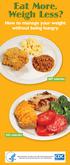 Eat More, Weigh Less? How to manage your weight without being hungry 607 calories 293 calories Department of Health and Human Services Centers for Disease Control and Prevention Can you weigh less without
Healthy Eating for Diabetes
 Healthy Eating for Diabetes What is diabetes and why is it important to manage it? Diabetes occurs when there is too much glucose in the blood. Learning how to manage your diabetes will help you feel better
Canada s Food Guide Jeopardy
 Canada s Food Guide Jeopardy Drafted: July 2008 Revised: December 2012 Eating Well with Canada s Food Guide Veg & Fruit Grain Products Milk & Alternatives Meat & Alternatives Physical Activity Miscellaneous
Ready, Set, Start Counting!
 Ready, Set, Start Counting! Carbohydrate Counting a Tool to Help Manage Your Blood Glucose When you have diabetes, keeping your blood glucose in a healthy range will help you feel your best today and in
Fibe. Fiber and water work together in bowel regulation. Be sure to drink eight to ten (8 ounce) glasses of
 r Fibe An important part of a healthy diet is eating a variety of fiber-rich foods, including whole-grain breads and cereals, fruits and vegetables, beans and nuts. Fiber is an important part of your diet.
Controlled Carbohydrate Nutrition
 Controlled Carbohydrate Nutrition The Atkins Lifestyle The following information is meant to be an overview of the high points of the Atkins Lifestyle. It is not meant to replace reading the books. Start
Carbohydrate Counting for Patients with Diabetes. Lauren Dorman, MS RD CDE Registered Dietitian & Certified Diabetes Educator
 Carbohydrate Counting for Patients with Diabetes Lauren Dorman, MS RD CDE Registered Dietitian & Certified Diabetes Educator Program Purpose To increase knowledge of carbohydrate counting skills for nurses
The Simple Smart Detox Diet
 The Simple Smart Detox Diet Phase 1 follow for the first three days This is the most intensive part of the detox diet. Because you are eating a mostly vegan diet, you will be eliminating a lot of toxins
D avid Berger, M.D. FAAP Melanie Wardle, ARNP, CPNP. Elimination Diet for Food Allergies and Sensitivities
 D avid Berger, M.D. FAAP Melanie Wardle, ARNP, CPNP 3405 W. Fletcher Avenue 813-960-3415 phone Tampa, FL 33618 www.wholisticfamilycare.com 813-960-3465 fax Elimination Diet for Food Allergies and Sensitivities
Bariatric Surgery: Step III Diet
 Bariatric Surgery: Step III Diet This diet is blended foods with one new solid food added daily. The portions are very small to help prevent vomiting. Warning: This diet does not have enough calories,
MINTO PREVENTION & REHABILITATION CENTRE CENTRE DE PREVENTION ET DE READAPTATION MINTO. Counting Fat Grams. About This Kit
 MINTO PREVENTION & REHABILITATION CENTRE CENTRE DE PREVENTION ET DE READAPTATION MINTO Counting Fat Grams About This Kit In previous kits you have learned Foods to Choose and Foods to Decrease/Avoid for
Fiber. What is fiber? Fiber is a part of plant food. There are two types of fiber:
 Fiber An important part of a healthy diet is eating fiber-rich foods. This handout will explain what fiber is, where it s found, and how to increase the amount of fiber in your diet. What is fiber? Fiber
Low Fat Diet after Cardiac Surgery With or Without Chyle Leak
 Low Fat Diet after Cardiac Surgery With or Without Chyle Leak What is chyle? Chyle (sounds like kyle) is a milky white fluid that contains protein, fat, cholesterol, lymphocytes, and electrolytes. It is
Super Green Tea Diet Insert
 Super Green Tea Diet Insert WELCOME TO A NEW YOU As the first choice among weight loss and fitness enthusiasts, Super Green Tea Diet is a popular alternative to many of the high-protein, low-carbohydrate
Ready, Set, Start Counting!
 Ready, Set, Start Counting! Carbohydrate Counting a Tool to Help Manage Your Blood Glucose When you have diabetes, keeping your blood glucose in a healthy range can help you feel your best today and in
1800 Calorie Meal Plan. Jessica Iannotta Department of Nutritional Sciences UMDNJ School of Health Related Professions
 1800 Calorie Meal Plan Meal Portion Food Calories DAY 1 Breakfast 1 cup Hot Oatmeal, cooked, unsweetened 150 1 banana 120 1 Amy s Bean & Rice Burrito 280 (in the frozen foods section of your grocery store
Gaining Weight for Athletes
 Gaining Weight for Athletes Prepared by Jenn Van Ness, ATC June 2008 Gain Weight the Healthy Way To gain one pound, you need to eat approximately 500 more calories a day. Approximately one pound of fat
Gastrointestinal (GI) Modified Diet for Malabsorption
 Gastrointestinal (GI) Modified Diet for Malabsorption Malabsorption of the gastrointestinal (GI) tract may occur when sections of the small intestine have been removed due to disease, surgical problems
Nutrition for Multiple Sclerosis. Presenter: Kari McDougall
 Nutrition for Multiple Sclerosis Presenter: Kari McDougall Nutrition & Multiple Sclerosis Several theories exist as to what causes MS, such as viruses, bacteria, autoimmunity & metabolic disorders, heredity,
Low Sugar & Low Starch Diet
 Low Sugar & Low Starch Diet AMG Libertyville, 847-566-5200 Jennifer C. DeBruler, M.D. This diet is a diet low in sugary and starchy foods. The diet consists of real food like meat, fish, cheese, eggs,
Healthy Foods for my School
 yum, yum, yum, yum, yum, yum, yum, yum, yum, yum, yum, yum, yum, yum, yum, yum, yum, yum, yum, yum, yum, Healthy Foods for my School Nutrition Standards for Saskatchewan Schools Schools are an ideal place
The Glycemic Index of Foods
 What is the Glycemic Index (GI)? It is a method used to classify carbohydrate containing foods, according to the effect that they may have on blood sugar levels. It is claimed that the higher the GI number,
Food Sources of Fibre
 Food Sources of Fibre Information About Fibre Fibre includes all parts of plant foods that your body can't digest or absorb. Fibre is also known as roughage or bulk. Insoluble fibre helps promote regularity
Dietary Fiber. Soluble fiber is fiber that partially dissolves in water. Insoluble fiber does not dissolve in water.
 Dietary Fiber Introduction Fiber is a substance in plants. Dietary fiber is the kind of fiber you get from the foods you eat. Fiber is an important part of a healthy diet. Fiber helps get rid of excess
Resources for Carbohydrate Counting
 Resources for Carbohydrate Counting The Diabetes Carbohydrate and Fat Gram Guide By LeaAnn Holzmeister, RD, CDE American Diabetes Association See contact information below The Doctor s Pocket Calorie,
Eggs: Whole eggs are permitted without restrictions.
 Lifestyle Medicine Clinic Duke University Medical Center This diet is found in the Appendix of the book Why We Get Fat by Gary Taubes and is an example of a low carbohydrate diet. "No Sugar, No Starch"
Personalized Meal Plans
 Personalized Meal Plans What 4 better choices will you make today? Making better, smarter choices is the key to managing your weight. The BodyKey program helps you do that every day, with delicious shakes,
Food Journal. 4 & 2 & 1 Plan
 Food Journal Welcome What could be one of the most important tools for weight loss? Tracking your meals in your Journal. It will keep you mindful and help you stay on plan every day. And remember: every
Carbohydrate Counting for Patients With Diabetes. Review Date 4/08 D-0503
 Carbohydrate Counting for Patients With Diabetes Review Date 4/08 D-0503 Program Objectives At the end of the session you will know how to: Define carbohydrate counting Identify the relationship between
Your child s diet with Dietary Fructose Intolerance (DFI)
 Your child s diet with Dietary Fructose Intolerance (DFI) What is Dietary Fructose Intolerance (DFI)? Dietary Fructose Intolerance is when your child has problems digesting and absorbing the fructose in
Nutrients: Carbohydrates, Proteins, and Fats. Chapter 5 Lesson 2
 Nutrients: Carbohydrates, Proteins, and Fats Chapter 5 Lesson 2 Carbohydrates Definition- the starches and sugars found in foods. Carbohydrates are the body s preferred source of energy providing four
UW MEDICINE PATIENT EDUCATION. PCOS Nutrition. Eat a Balanced Diet
 UW MEDICINE PATIENT EDUCATION PCOS Nutrition Eating for health when you have polycystic ovarian syndrome Eating to treat PCOS is not much different than how many people are advised to eat to be their healthiest.
LARGE GROUP PRESENTATION: PRESENTER S NOTES
 LARGE GROUP PRESENTATION: PRESENTER S NOTES Introduce yourself. Welcome! We are so glad you are here to learn about fruits and vegetables. Icebreaker Handout: Fruit or Vegetable: Parts of Many Words Read
Fat Facts That Can Help Your Heart. Most Common Risk Factors for Heart Disease
 Fat Facts That Can Help Your Heart Sally Barclay, MS RD LD Nutrition Clinic for Employee Wellness Most Common Risk Factors for Heart Disease High LDL (bad) cholesterol Smoking Low HDL (good) cholesterol
Meal Planning for a Mushy Soft Diet After Nissen Fundoplication
 Meal Planning for a Mushy Soft Diet After Nissen Fundoplication Name: Date: Dietitian: Telephone: Questions? CALL YOUR DIETITIAN! Patient Food and Nutrition Services University of Michigan Hospital 1500
Low-Fructose Food Choices
 Patient and Family Education Low-Fructose Food Choices For your child with fructose malabsorption Fructose is a kind of sugar. Fructose malabsorption happens when your child s body has problems breaking
Meal Planning for a Mushy Soft Diet After Laparoscopic Myotomy
 Meal Planning for a Mushy Soft Diet After Laparoscopic Myotomy Name: Date: Dietitian: Telephone: Why is it necessary to follow this diet? This diet is necessary for individuals who have had some types
Appendix A Food Sources of Vitamins and Minerals
 Appendix A Food Sources of Vitamins and Minerals Appendix A 229 Appendix A Food Sources of Vitamins and Minerals Vitamin A (Retinol) Food Amount IU* Liver 3 oz 45,400 Crab 2 cup,680 Egg medium 590 Fats
Heart healthy diet: 8 steps to prevent heart disease
 Heart healthy diet: 8 steps to prevent heart disease Changing your eating habits can be tough. Start with these eight strategies to kick start your way toward a heart healthy diet. By Mayo Clinic Staff
Food Sources of Fibre
 Information About Fibre Food Sources of Fibre Fibre includes all parts of plant foods that your body can't digest or absorb. Fibre is also known as roughage or bulk. Insoluble fibre helps promote regularity
HIGH FIBER DIET. (Article - Web Site) August 20, 2003
 HIGH FIBER DIET (Article - Web Site) August 20, 2003 Dietary fiber, found mainly in fruits, vegetables, whole grains and legumes, is probably best known for its ability to prevent or relieve constipation.
Heart Healthy Diet: Tips for Lowering Cholesterol and Fat in Your Diet
 Heart Healthy Diet: Tips for Lowering Cholesterol and Fat in Your Diet Cholesterol Saturated Fats Polyunsaturated and Mono-unsaturated Fats This fat-like substance is needed for good health. However, high
MEN'S FITNESS FAT TO FIT CHALLENGE - 1800 CALORIE MEAL PLAN WEEK 1
 Day 1 Tomato & Basil Omelet* (see recipe) 1 large egg 73.5 0.4 6.3 5 2 large egg whites 34.3 0.5 7.2 0.1 1/4 cup chopped tomato 8.1 1.8 0.4 0.1 2 Tbs grated parmesan cheese 43.1 0.4 3.9 2.9 2 Tbs chopped
MEN'S FITNESS FAT TO FIT CHALLENGE - 1800 CALORIE MEAL PLAN WEEK 2
 Day 1 1 egg + 3 egg whites scrambled 125 1.1 17.1 5.1 1/2 whole wheat english muffin, toasted 67 13.3 2.9 0.7 1 medium orange 61.6 15.4 1.2 0.2 TOTAL 253.6 29.8 21.2 6 2 Tbs dried cherries 48.8 12.8 0
Carbohydrate counting a pocket guide
 counting a pocket guide www.bayerdiabetes.ca Contents Starches 3 Vegetables 4 Fruit/Fruit juices 5 Milk/Yoghurt 5 Fast foods 6 Proteins (meat/meat substitutes) 6 Drinks 6 Sweets/Sugary foods 7 Combination
Eating Well with Diabetes. Cassie Vanderwall UW Health Nutrition Registered Dietitian Certified Personal Trainer Certified Diabetes Educator
 Eating Well with Diabetes Cassie Vanderwall UW Health Nutrition Registered Dietitian Certified Personal Trainer Certified Diabetes Educator Outline What is Diabetes? Diabetes Self-Management Eating Well
But what does my body need? (No...it is not just candy and soda!)
 Chapter 35: Page 349 In the last chapter, you learned how important your immune system is to your survival. This week, you are going to learn how to keep your immune system strong and ready to protect
Kidney Stones and Diet
 Kidney Stones and Diet What are kidney stones? Urine is made up of water and substances such as calcium, oxalate and uric acid. Crystals begin to form first in the kidney when: there are higher than normal
Snacking and Gestational Diabetes
 Snacking and Gestational Diabetes Note to the Health Care Provider: Topics in this handout are discussed in Chapter 6 of the American Dietetic Association Guide to Gestational Diabetes Mellitus (1). When
BEST & WORST FOODS FOR BELLY FAT
 Belly fat is worse for you than fat elsewhere on your body. Excess accumulation of belly fat is more dangerous than excess fat around your hips and thighs. Belly fat is associated with serious health problems,
Maintaining Nutrition as We Age
 SS-207-06 For more information, visit the Ohio Department of Aging web site at: http://www.goldenbuckeye.com and Ohio State University Extension s Aging in Ohio web site at: http://www.hec.ohio-state.edu/famlife/aging
14 Day Diet DIETARY GUIDELINES
 14 Day Diet DIETARY GUIDELINES The diet suggested for the Program is easy to follow and is vitally important for the success of this program. It consists of restricted, low fat, high protein daily intakes
Food Groups for Low Potassium and Low Phosphorus Diets
 Food Groups for Low Potassium and Low Phosphorus Diets When you have kidney disease, you may need to follow a diet low in sodium, potassium and phosphorus. This diet is sometimes called a renal diet. You
5 Day Low-Fat Diet Menu
 5 Day Low-Fat Diet Menu Meals in the following menu have fewer than 25 percent of calories from fat. Choose one of each meal and two snacks every day. Breakfasts Food (s) Cal. Fat Fat Carbs Special Instructions
Cancer Treatment Centers of America Healthy Diet & Lifestyle for Cancer
 Cancer Treatment Centers of America Healthy Diet & Lifestyle for Cancer Presented to: Juneau Community Presented by: Stephanie Paver, RD, CSO, CNSC Date: 7/15/13 Introduction Nutrition/Lifestyle matter
Carbohydrate Counting
 COOPERATIVE EXTENSION SERVICE UNIVERSITY OF KENTUCKY COLLEGE OF AGRICULTURE, FOOD AND ENVIRONMENT, LEXINGTON, KY, 40546 FCS3-546 Carbohydrate Counting Ingrid Adams, Dietetics and Human Nutrition What is
APPROVED FOOD LIST JAMIE EASON S LIVEFIT 12-WEEK TRAINER
 LEAN PROTEINS Sole Flounder Cod Halibut Mahi-mahi Red snapper Orange ruffy (Limit, high in mercury) Ahi tuna (Limit, high in mercury) Swordfish (Limit, high in mercury) Tilapia Grouper Corvina Cobia White
Nutrition and Chronic Kidney Disease
 Nutrition and Chronic Kidney Disease National Kidney Foundation s Kidney Disease Outcomes Quality Initiative (NKF-K/DOQI TM ) The National Kidney Foundation is developing guidelines for clinical care to
List of low carb (and low glycemic) Foods
 List of low carb (and low glycemic) Foods Very Low Carb 1-5 g (Not Artichokes Asparagus Baby corn Bamboo shoots Bean sprouts Bok choy Broccoli Brussels sprouts Cabbages Cauliflower Celery Chilies Chinese
Health Maintenance: Controlling Cholesterol
 Sacramento Heart & Vascular Medical Associates February 18, 2012 500 University Ave. Sacramento, CA 95825 Page 1 What is cholesterol? Cholesterol is a fatty substance. It has both good and bad effects
How to Increase Volume in Your Meals
 How to Increase Volume in Your Meals By adding certain types of food to your diet and drinking more water, you can actually increase the amount of food you eat, while staying within your fat gram and calorie
The following is the sample diet for the Bio-Type Thyroid. Thyroid BioType. Dominant gland: Thyroid. Physical Characteristics:
 As a Thyroid Bio-Type you have gained weight in the past by eating foods that over stimulate your thyroid: sweets such as candy and soft drinks, starches such as bread and pasta, and caffeine drink. The
Do children with diabetes need a special diet?
 Do children with diabetes need a special diet? No! The basic nutritional needs of a child or adolescent with diabetes is the same as their peers Healthy eating is important for all children Children with
Nutrition Information from My Plate Guidelines
 Nutrition Information from My Plate Guidelines Note: This information was compiled from the website: http://www.choosemyplate.gov/ for participants in the 4-H Food Prep Contest 1/12/16. The information
CARBS, FATS, FIBER & FADS FAD DIETS
 CARBS, FATS, FIBER & FADS FAD DIETS Carbohydrates The national recommendation for carbohydrate intake is 40% to 65% of our daily intake. Our requirements change depending on how active we are, our current
Importance of a Meal Plan Meal Plan Guidelines
 Importance of a Meal Plan Losing weight is a feat which has been proven to be easy for some, and very difficult for others. In many cases simply going to the gym does not live up to the expectations of
A Guide to Reducing Dietary Sodium Intake
 Salt and High Blood Pressure A Guide to Reducing Dietary Sodium Intake A Look at the DASH eating plan My Plate Basics Sodium is a mineral element most commonly found in salt (sodium chloride) Sodium occurs
NUTRITION AND HEMODIALYSIS
 NUTRITION AND HEMODIALYSIS www.kidney.org National Kidney Foundation's Kidney Disease Outcomes Quality Initiative Did you know that the National Kidney Foundation's Kidney Disease Outcomes Quality Initiative
STAGE 1: THE RAPID START PLAN: 14 DAYS OF SAMPLE MENUS
 54 \ T HE U LTIMATE W EIGHT S OLUTION F OOD G UIDE STAGE 1: THE RAPID START PLAN: 14 DAYS OF SAMPLE MENUS The Rapid Start menus supply an average of 1,100 to 1,200 calories a day, with approximately 30
Pediatrics. Specialty Courses for Medical Assistants
 Pediatrics Specialty Courses for Medical Assistants 7007 College Boulevard, Suite 385 Overland Park, Kansas 66211 www.ncctinc.com t: 800.875.4404 f: 913.498.1243 Pediatrics Specialty Certificate Course
1,200-Calorie, Low-Carb Diet Meal Plan
 1,200-Calorie, Low-Carb Diet Meal Plan Breakfast Breakfast One - Veggie Scrambled Eggs One whole egg, one egg white Chopped red pepper Chopped mushrooms Grated Swiss cheese Scrambled in non-stick pan Large
simple steps give you for good bowel health
 simple steps give you for good bowel health This booklet contains simple steps you can take to help achieve good bowel health. This is important to everyone, as these small changes will help your digestive
WEIGHT GAINER S NUTRITION GUIDE
 WEIGHT GAINER S NUTRITION GUIDE Gaining weight takes dedication! You must eat these meals everyday to stay on track. Included in this pack are the meal plan, supplement guide, fast food guide, and NCAA
Chef s recommendation for two
 Chef s recommendation for two Chilled vegetable soup Pickled tomato / Dried tomato skin / Powdered vegetables Additional ingredients used in this dish: cider vinegar, salt, beet sugar, tomatoes, bell peppers,