
14 Day Diet DIETARY GUIDELINES
|
|
|
- Alice Harmon
- 9 years ago
- Views:
Transcription
1 14 Day Diet DIETARY GUIDELINES The diet suggested for the Program is easy to follow and is vitally important for the success of this program. It consists of restricted, low fat, high protein daily intakes with low to moderate-low carbohydrates depending on the specific day. This diet is based on the measure, in grams, of protein and carbohydrates. The foods suggested in this diet are typically low in fat. This eliminates the need for counting fat intakes and prevents them from becoming a primary factor in this diet. Helpful Dietary Information: The following terms and methods are for your information and can help you better understand the Program diet. Metabolism The process of metabolism includes all of the chemical changes that nutrients undergo from the time they are absorbed until they become a part of the body or are excreted from the body. Metabolized nutrients can be used as energy or as building material for living tissue. Proper diet and exercise speed the process of metabolism, resulting in improved tone and quality of muscle tissue as well as the depletion of fat stores. Protein One of the most important substances for the maintenance of good health and vitality. Protein is the major source of building material for everything from blood and muscle to skin, hair, nails and internal organs. Not only does protein help to control the body s rate of metabolism and regulate water balance, but it is also extremely useful in preserving muscle tone and muscle mass in dieting individuals. 1 gram Protein = 4 calories Carbohydrates Carbohydrates (sugar and starches) are the main source of energy for all muscle and body functions. Carbohydrates or carbs are converted by the body to simple sugar called glucose Some of this glucose is used as fuel for the body. The rest is either converted to glycogen and stored in the muscles and liver, or converted to fat and stored through the body for later use. It is by short-term carb depletion and exercise that the glycogen stores can be depleted. In turn, stores of body fat are reconverted and used as energy, resulting in weight loss. 1 gram Carbohydrate = 4 calories CAUTION: Substantial carbohydrate depletion should never be done for more than a week at a time. The method suggested in this program should be followed carefully. Fruits & Sugars Although fruits and sugars are carbohydrates and are a normal part of a healthy diet, it is recommended that they be limited or excluded from your diet during this program. These simple carbs are high in calories and require little effort by the body for absorption. These foods do little to stimulate the metabolism and may be stored as fat. Wheat products Breads, cereals, and pastas made from processed wheat are also good source of carbohydrates, but are not included in this diet as they act much like simple carbs in the body. For this diet we recommend you use complex carbs such as potatoes, rice and oats as well as fibrous carbs including most green leafy vegetables. Fats These are also known as lipids. They are the most densely caloric source of energy in the diet. 1 gram Fat = 9 calories Fats are difficult to digest and are mostly stored throughout the body, rather than immediately used as energy. The foods recommended in this diet are typically very low in fat. Dairy Products Dairy products should also be excluded form your diet during this program. Many dairy products are high in fat and almost all are very high in sodium. This causes water retention under the skin and could cause you to appear slightly bloated, thus obscuring your level of condition. Caffeine Black coffee and tea are allowed (in moderation) during this program. NOTE: It is important to take into account any other stimulants or caffeine containing supplements used during this program contain caffeine. Additional consumption of caffeinated beverages could cause nervousness and it may therefore be wise to refrain from any additional caffeine intake during this program. Decaffeinated coffee or tea is acceptable throughout the program. However, your intake of fluids must be closely monitored, especially on days 13 through the final day 14.

2 THE PROGRAM DIET For Individuals Performing both Weight Training & Cardiovascular Exercise. Your Program diet is based o the amount of protein and carbohydrates consumed in a given day by way of five (5) meals eaten approximately 3 hours apart. Smaller, more frequent meals help the metabolism remain in constant motion. To formulate your 14-Day Diet you must first: Estimate what you believe your Ideal Body Weight to be (usually between 10 to 20 lbs. less than your present weight). Thus, your Ideal Body Weight is the only weight you will need to refer to for this diet plan. Although to simplify things, the amount of carbohydrates consumed on any given day will be the same for all Ideal Body Weights, your specific Ideal Body Weight will determine the exact amount of protein you will need for this diet. Here is the formula for protein intake during days 1 through 12 on the program: 1 ½ Grams Of Protein Per Pound Of Your Ideal Body Weight Per Day. (See Daily Protein Intake Key) Divide Your Daily Protein Intake (Gm) Into 5 Meals Per Day Eaten At 3 Hour Intervals. (See Daily Protein Intake Key) Daily Protein Intake Key Ideal Body Weight (lbs) Protein Per Day (gm) 120 (or less) (or more) Protein Per Meal (gm)* rounded to the nearest fifth If your Ideal Body Weight falls somewhere in between two of the numbers in the far left column use the larger of the two numbers as your protein intake guide. For the purpose of simplifying your diet we have rounded your Protein Per Meal intake to the nearest 5 grams. CARBOHYDRATE INTAKE The carbohydrate intake portion of the Program diet involves a precise schedule and method for staggering your daily carbohydrate amounts as the program unfolds. This constant depleting and replenishing of the carbohydrates stores ensures effective depletion of body fat with little or no loss of muscle. Here is the suggested carbohydrate intake schedule for days 1 through 12 of the program regardless of your Ideal Body Weight. A special carbohydrate loading procedure is suggested for day 13 of the program (see Carb Loading section to follow). Carbohydrate Schedule, Days 1 through 12 (Showing total number of carbohydrates to be eaten each day)

3 Day 1-90 gm. Carbs Day 2-90 gm. Carbs Day 3-40 gm. Carbs Day 4-40 gm. Carbs Day 5-90 gm. Carbs Day 6-90 gm. Carbs Day 7-40 gm. Carbs Day 8-40 gm. Carbs Day 9-90 gm. Carbs Day gm. Carbs Day gm. Carbs Day gm. Carbs Day 13 - (see Carb loading section) Day 14 - TARGET DAY For this diet, carbohydrates are divided into two catergories: Complex (oatmeal, potatoes & rice), and Fibrous (broccoli, cauliflower, green beans, lettuce, spinach, dell peppers, zucchini, tomato onions and asparagus). It is suggested that complex carbs be eaten only during the early hours of the day (1st and/or 2nd meals of the day). The fibrous carbs will be your primary source of carbs, since they are high in fiber and vitamins and low in calories. (See Preferred Foods and Values section for quantities and preparation). DAILY CONSUMPTION OF CARBOHYDRATES Unlike protein, which is distributed in equal amounts among the 5 meals per day, carbohydrates should be consumed in a descending fashion throughout the day. In other words, begin the day with the largest carbohydrate meal and consume fewer and fewer and fewer as the day progresses. For individuals capitalizing on this method for cutting up in preparation for competition, here are some example daily carbohydrate schedules for your 5 meals per day during days 1 through 12. Example 2: For days consisting of 90 grams of carbs Carbs (8:00 A.M.) Meal 1 30gm (11:00 A.M.) Meal 2 20 gm (2:00 P.M.) Meal 3 20 gm (5:00 P.M.) Meal 4 10 gm (8:00 P.M.) Meal 5 10 gm Example 1: For days consisting of 30 grams of carbs. Carbs (8:00 A.M.) Meal 1 20 gm (11:00 A.M.) Meal 2 10 gm (2:00 P.M.) Meal 3 5 gm (5:00 P.M.) Meal 4 5 gm (8:00 P.M.) Meal 5 0 gm CARB LOADING - DAY 13 (for individuals preparing for a contest or photo shoot)** Carb loading is the short-term process of consuming larger amounts of carbohydrates on a more frequent time schedule in order to fill the muscles with glycogen, thus creating bigger, fuller and more deeply cut muscles. This process, combined with short-term sodium and water depletion, can remarkably enhance your final appearance. (See Sodium Intake & fluid Intake sections). Carb Loading consists of some fundamental changes in the diet. They are as follows: Meals are now eaten every 2 hours (instead of every 2 1/2 hours) Meals consist of 40 grams of carbohydrates per meal (sweet potatoes, yams and regular potatoes are strongly suggested). Protein is now consumed every 4 hours and in only half the amount as your previous protein meals. (In other words, half of a protein meal with every other carb meal). Example Meal Schedule for Day 13: Carbs Protein (8:00 A.M.) Meal 1 40gm ½ protein meal (10:00 A.M.) Meal 2 40 gm (12:00 A.M.) Meal 3 40 gm ½ protein meal (2:00 P.M.) Meal 4 40 gm (4:00 P.M.) Meal 5 40 gm ½ protein meal (6:00 P.M.) Meal 6 40gm (8:00 P.M.) Meal 7 40 gm ½ protein meal (10:00 P.M.) Meal 8 40 gm

4 **For individuals NOT preparing for a contest or photo shoot, simply consume 90 gms od carbs on dday 13 and 40 gms of carbs on Day 14 Preparing Carbohydrates for Carb Loading Sweet potatoes, yams or regular potatoes such as Idaho or Red Bliss are universally known as the best food sources for carb loading; sweet potatoes and yams being the favorites. To prepare potatoes for individual carb meals first peel them. This will insure that any sodium or mineral content contained in the skin is removed, thus reducing the chances of water retention which could cause you to look smooth. Then, using a food scale that weighs food in ounces, weigh out 8 oz. of raw potatoes or yams, cutting a piece off or adding a piece from another potato to make 8 oz. if necessary. Although regular potatoes, sweet potatoes and yams have different grams of carbs per ounce values, use 8 oz. of raw potatoes per meal when using any one of them. Than, microwave or bake them. (You may also boil them as a last resort). Now, to simplify matters, individually wrap each 40 gram serving in foil for easy access later. If you do not have access to a food scale, than use the dimensions for estimating a 40 gram serving: 3 ½ in. long x 2 ½ in. wide - raw, peeled. SODIUM INTAKE (for individuals preparing for a contest or photo shoot) Because sodium is the mineral responsible for retaining water under the skin, this short-term sodium reduction plan can greatly improve your results. If you are preparing for an event or photo shoot, here is a sample procedure for sodium reduction during this 14-day program. Day 1 through 11 Your sodium intake should remain low to moderate throughout the first 11 days. Small amounts of sodium may be added to your diet through the use of condiments such as mustard, table salt, soy sauce or hot sauce and spice combinations containing sodium such as chili powder. Remember that these products should be used in small amounts and only on days 1 through 11 of the program. Days 12 & 13 During days 12 through 13, it is important to restrict the intake of sodium so that the body may flush out excess fluid from under the skin. Avoid all sauces, table salt and spice combinations containing sodium. Also beginning on day 11: DO NOT eat egg whites, canned tuna or any canned vegetables. FLUID INTAKE (for individuals preparing for a contest or photo shoot) The amount of water you drink during this program is going to play a key role in your success. When the body receives a constant and substantial flow of water, it releases the water frequently, knowing that it will soon be replenished. Therefore, individuals who do not regularly drink adequate amounts of fluid tend to retain water. If the body is conditioned not to expect to receive water, it will try to retain the water it has obtained. The body can be triggered into further water removal from under the skin by means of water loading and short-term reduction. Here is a simple and effective plan for accomplishing water reduction during this program: Fluid Intake Schedule (For individuals using the Weight Training Program only): Days 1 through 11: Drink 2 gallons of water per day. Day 12: Drink 1 gallon of water per day. Day 13: Drink 1 cup of water (approx. 8 oz.) every two hours. During carb loading on day, this conveniently adapts as 1 cup of water with every carb meal). Day 14: (See Day 14 TARGET DAY). During the first 12 days, it is highly recommended that you use a one-gallon jug to better monitor your water intake. Because regular tap water contains some sodium, you may want to use sodium-free spring water or distilled water for the final 3 days of the program. Caution: The symptoms of dehydration include: Prolonged headaches Dizziness Disorientation Extreme dryness of the mouth and throat. *If you experience one or more of these symptoms: Increase water intake until the symptom (s) subside. If symptoms persist Drink 8 oz. of fruit juice or tomato juice. If symptoms persist, Discontinue use of product and consult a physician.

5 Note: If you are using the program for physique repartitioning/fat loss but are not preparing for a specific day or event, you may choose to disregard the instructions for restricting your sodium intake (Day 12 thru 14) and the instructions for reducing your fluid intake (Day 12 thru 14). TARGET DAY (The Diet for Day 14) On the day of your big event, there are a few simple guidelines to follow to ensure that you look your best throughout the day. Monitor your fluid intake; it should remain low to moderate but still be enough so that you feel comfortable. It is acceptable to eat foods other than the ones suggested for this diet as long as you: Avoid foods high in sodium Do not eat so much at one time as to approach the point of feeling full. Competitive Bodybuilders: In preparation for a bodybuilding contest, you may choose to use the same diet and fluid intake suggestions for Contest Day as those described for Day 13. This will remove any guesswork and eliminate the chance of lessening your degree of definition due to the addition of different foods or beverages. Important: The Program should not be continued after the 14th day. A two week lay-off with moderately higher carbohydrates and normal fluid intake is necessary before using this program again. THE PROGRAM DIET For Individuals Performing Cardiovascular Exercise ONLY Your Program 14-Day diet is based on the amount of protein and carbohydrates consumed in a given day by way of five meals eaten approximately three hours apart. (These smaller, more frequent meals help the metabolism to remain in constant motion). Your protein intake will remain the same for every day of the program while your carbohydrate intake will be split into either Low Carb Days or High Carb Days. PROTEIN INTAKE To determine the amount of protein you will consume each day, estimate what you believe your ideal body weight should be (usually 10 to 30 lbs. less than your present body weight). If your ideal body weight is 150 lbs. or less, than your daily protein intake will equal 150 grams per day (most women fall into this category). If your ideal body weight is above 150 lbs., than your daily protein intake will equal 200 grams per day (most men fall into this category). Daily Protein Intake Key Ideal Body Weight (lbs) Protein Per Day (gm) Protein Per Meal (gm)* 150 (or less) More than 150 lbs *Refer to the Food Values and Preparation section for suggested protein foods and measurements. CARBOHYDRATE INTAKE The carbohydrate intake portion of the Program diet involves a precise schedule for staggering your daily carbohydrate intake (Low Carb Days & High Carb Days) as the program unfolds. This constant depleting and replenishing of the carbohydrate stores ensures effective depletion of body fat without a substantial loss of muscle. Here is the suggested carbohydrate intake schedule for the 14-Day Program regardless of your Ideal Body Weight.

6 Day 1 - Low Carb Day 2 - Low Carb Day 3 - High Carb Day 4 - High Carb Day 5 - Low Carb Day 6 - Low Carb Day 7 - High Carb Day 8 - High Carb Day 9 - Low Carb Day 10 - Low Carb Day 11 - Low Carb Day 12 - Low Carb Day 13 - Low Carb Day 14 - High Carb (TARGET DAY) *see target day section for details The amount of carbohydrates you consume each day will be determined by weather you are on a Low Carb Day (Days 1, 2, 5, 6, 9, 10, 11, 12, and 13) or a High Carb Day (Days 3, 4, 7, 8, and 14) Low Carb Days: 40 grams of carbs per day. High Carb Days: 70 grams of carbs per day. For this diet, carbohydrates are divided into two categories: Complex (Oatmeal, Potatoes & Rice), and Fibrous (Broccoli, Cauliflower, Green Beans, lettuce, Spinach, Bell Peppers, Zucchini, Tomato, Onions & Asparagus). *Refer to the Food Values & Preparation section for details. It is suggested that complex carbs be eaten only during the early hours of the day (1st and/or 2nd meals of the day). The fibrous carbs will be your primary source of carbs, since they are high in fiber and vitamins and low in calories. IMPORTANT: It is recommended that your daily diet not fall below 800 calories per day. The diet suggested here, which includes a naturally occurring amount of fat for added calories, meets this criteria and should be adhered to as the least amount of food to be eaten on a given day. DAILY CONSUMPTION OF CARBOHYDRATES Unlike protein, which is distributed in equal amounts among the 5 meals per day, carbohydrates should be consumed in a descending fashion throughout the day. In other words, begin the day with the largest carbohydrate meal and consume fewer and fewer as the day progresses. Here are some examples high & low carb day schedules for your 5 meals per day during the programs. For Low Carb Days consisting of 40 grams of carbs (8:00 A.M.) Meal 1 20gm Carbs OR 10gm Carbs (11:00 A.M.) Meal 2 10gm Carbs OR 10gm Carbs (2:00 P.M.) Meal 3 5gm Carbs OR 10gm Carbs (5:00 P.M.) Meal 4 5gm Carbs OR 5gm Carbs (8:00 P.M.) Meal 5 0gm Carbs OR 5gm Carbs For Low Carb Days consisting of 70 grams of carbs (8:00 A.M.) Meal 1 30gm Carbs OR 20gm Carbs (11:00 A.M.) Meal 2 20gm Carbs OR 20gm Carbs (2:00 P.M.) Meal 3 20gm Carbs OR 10gm Carbs (5:00 P.M.) Meal 4 10gm Carbs OR 10gm Carbs (8:00 P.M.) Meal 5 0gm Carbs OR 10gm Carbs EXAMPLE DIET CHARTS For an Ideal Body Weight of 150 lbs. or less Low Carb Day Diet (example) Total Protein = Approx. 150 grams Total Carbohydrates = Approx. 40 grams (8:00 A.M.) Meal 1 30 gm Protein 20 gm Carbs (11:00 A.M.) Meal 2 30 gm Protein 10 gm Carbs (2:00 P.M.) Meal 3 30 gm Protein 5 gm Carbs (5:00 P.M.) Meal 4 30 gm Protein 5 gm Carbs (8:00 P.M.) Meal 5 30 gm Protein 0 gm Carbs total= 150 gm total=40 gm

7 High Carb Day Diet (example) Total Protein = 150 grams Total Carbohydrates = 70 grams (8:00 A.M.)* Meal 1 30 gm Protein 20 gm Carbs (11:00 A.M.) Meal 2 30 gm Protein 20 gm Carbs (2:00 P.M.) Meal 3 30 gm Protein 10 gm Carbs (5:00 P.M.) Meal 4 30 gm Protein 10 gm Carbs (8:00 P.M.) Meal 5 30 gm Protein 10 gm Carbs total= 150 gm total=70 gm * This is an example starting time. You may begin meals at whatever time best fits your schedule. For an Ideal Body Weight Over 150 lbs. Low Carb Day Diet (example) Total Protein = 200 grams Total Carbohydrates = 70 grams (8:00 A.M.)* Meal 1 40 gm Protein 10 gm Carbs (11:00 A.M.) Meal 2 40 gm Protein 10 gm Carbs (2:00 P.M.) Meal 3 40 gm Protein 10 gm Carbs (5:00 P.M.) Meal 4 40 gm Protein 5 gm Carbs (8:00 P.M.) Meal 5 40 gm Protein 5 gm Carbs total= 200 gm total=40 gm High Carb Day Diet (example) Total Portein = 200 grams Total Carbohydrates = 70 Grams (8:00 A.M.)* Meal 1 40 gm Protein 30 gm Carbs (11:00 A.M.) Meal 2 40 gm Protein 20 gm Carbs (2:00 P.M.) Meal 3 40 gm Protein 10 gm Carbs (5:00 P.M.) Meal 4 40 gm Protein 10 gm Carbs (8:00 P.M.) Meal 5 40 gm Protein 0 gm Carbs total= 200 gm total=70 gm * This is an example starting time. You may begin meals at whatever time best fits your schedule. SODIUM INTAKE Because sodium is the element responsible for retaining water under the skin, this short-term sodium reduction plan can greatly improve your results. Here are the suggested procedures for sodium reduction during this 14-day program. Days 1 through 10: Your sodium intake should remain low to moderate throughout the first 10 days. Small amounts of sodium may be added to your diet through the use of condiments such as table salt, mustard, salsa, soy sauce or hot sauce and spicy combinations containing sodium such as chili powder. Remember that these products should be used in small amounts and only on days 1 through 10 of the program. Day 11 through 13: During days 11 through 13, it is important to restrict the intake of sodium so that the body may flush out excess fluid fro under the skin. Avoid all sauces, table salt and spice combinations containing sodium. Also beginning at day 11: DO NOT eat egg whites, canned tuna or any canned vegetables.(for DAY 14, SEE Target Day section) FLUID INTAKE The amount of water you drink during this program is going to play a key role in your success. When the body receives a constant and substantial flow of water, it releases the water frequently, knowing that it will soon be replenished. Therefore, individuals who so not regularly drink adequate amounts of fluid tend to retain water. If the body is conditioned not to expect to receive water, it will try to retain the water it has obtained. The body can be triggered into further water removal from under the skin by means of water loading and short-term reduction. Here is a simple and effective plan for accomplishing water reduction during this program:

8 Fluid Intake Schedule (For individuals using the Weight Training Program only): Days 1 through 10: Drink at least 1 gallon of water per day. Day 11 & 12: Drink 1/2 gallon of water per day. Day 13: Drink 1 cup of water (approx. 6 to 8oz.) with each of your 5 meals per day. During the first 12 days, it is highly recommended that you use a one-gallon jug to better monitor your water intake. During this time you may use a sugar-free powdered drink mix to flavor your water. Because regular tap water contains some sodium, you may want to use sodium-free spring water or distilled water for the final 3 days of the program. Caution: The symptoms of dehydration include: Prolonged headaches Dizziness Disorientation Extreme dryness of the mouth and throat. *If you experience one or more of these symptoms: Increase water intake until the symptom(s) subsides. If symptoms persist Drink 8 oz. of fruit juice or tomato juice. If symptoms persist, Discontinue use of product and consult a physician. Note: If you are using the Program for rapid weight loss but are not preparing for a specific day or event, you may choose to disregard the instructions on the restricting your sodium intake (Day 11 thru 14) and the instructions for reducing your fluid intake (Day 11 thru 14). TARGET DAY (The Diet for Day 14) On the day of your big event, it is suggested that you follow the diet for a normal High Carb Day along with the sodium and fluid intake suggestions as done on day 13. You may, however, choose to eat and drink at your own discretion as long as you follow a few simple directions to ensure that you look your best throughout the day. Monitor your fluid intake; it should remain low to moderate but still be enough so that you feel comfortable. It is acceptable to eat foods other than the ones suggested for this diet as long as you: Avoid foods high in sodium Do not eat so much at one time as to approach the point of feeling full. IMPORTANT: The Program should not be continued after the 14th day. A one to two week lay-off with moderately higher carbohydrates and normal fluid intake is necessary before using the system again.

Nutrition for Endurance: Cycling
 Nutrition for Endurance: Cycling Superior cycling ability comes from good training. However, without good food choices and the correct timing of meals, your training and performance will suffer. You need
Ready, Set, Start Counting!
 Ready, Set, Start Counting! Carbohydrate Counting a Tool to Help Manage Your Blood Glucose When you have diabetes, keeping your blood glucose in a healthy range will help you feel your best today and in
Take Control Nutrition Tools for Diabetes. 50/50 plate Portions Servings
 Take Control Nutrition Tools for Diabetes 50/50 plate Portions Servings Eat more Vegetables Especially non starchy vegetables Choosing Foods to manage blood glucose Select a variety of colors and types
top 5 fat burning tips by steve dennis
 top 5 fat burning tips by steve dennis top 5 fat burning tips by steve dennis Are you frustrated about trying to lose body fat? Confused about what foods to eat? Do you often wonder why carbs are bad?
The Five Food Groups and Nutrition Facts
 session 4 The Five Food Groups and Nutrition Facts (Note to the presenter: Comments in parentheses are instructions to follow while giving the presentation. Do not read the comments to participants. This
HIGH FIBER DIET. (Article - Web Site) August 20, 2003
 HIGH FIBER DIET (Article - Web Site) August 20, 2003 Dietary fiber, found mainly in fruits, vegetables, whole grains and legumes, is probably best known for its ability to prevent or relieve constipation.
Gaining Weight for Athletes
 Gaining Weight for Athletes Prepared by Jenn Van Ness, ATC June 2008 Gain Weight the Healthy Way To gain one pound, you need to eat approximately 500 more calories a day. Approximately one pound of fat
Ready, Set, Start Counting!
 Ready, Set, Start Counting! Carbohydrate Counting a Tool to Help Manage Your Blood Glucose When you have diabetes, keeping your blood glucose in a healthy range can help you feel your best today and in
My Diabetic Meal Plan during Pregnancy
 My Diabetic Meal Plan during Pregnancy When you have diabetes and are pregnant, you need to eat small meals and snacks throughout the day to help control your blood sugar. This also helps you get in enough
Carbohydrate Counting (Quiz Number: Manatee3032009)
 Page 1 The goal of Carbohydrate Counting is to make clear to you which foods affect your blood glucose and then to spread these foods evenly throughout the day (or to match insulin peaks and durations).
Fiber. What is fiber? Fiber is a part of plant food. There are two types of fiber:
 Fiber An important part of a healthy diet is eating fiber-rich foods. This handout will explain what fiber is, where it s found, and how to increase the amount of fiber in your diet. What is fiber? Fiber
Healthy Eating During Pregnancy
 Healthy Eating During Pregnancy Pregnancy is a time of great change. Your body is changing to allow your baby to grow and develop. Good nutrition will help you meet the extra demands of pregnancy while
Bariatric Surgery: Step III Diet
 Bariatric Surgery: Step III Diet This diet is blended foods with one new solid food added daily. The portions are very small to help prevent vomiting. Warning: This diet does not have enough calories,
Nutritional Glossary. Index of Contents
 Nutritional Glossary This glossary provides nutrition information about the nutrients commonly found in fruits, vegetables, and other plant foods Each glossary definition has a long and a short version.
What impacts blood glucose levels?
 What you eat and how much you eat has an impact on your blood glucose levels. Your blood glucose level reflects how well your diabetes is controlled. There are many aspects to eating for target BG (Blood
FITTEAM 5. Overview. Keys to Success
 Overview The is an approximately 1,200-calorie-a-day eating plan that incorporates our energy and fat loss beverage FITTEAM FIT. This 5-day program designed to provide you a jumpstart toward reaching your
Maintaining Nutrition as We Age
 SS-207-06 For more information, visit the Ohio Department of Aging web site at: http://www.goldenbuckeye.com and Ohio State University Extension s Aging in Ohio web site at: http://www.hec.ohio-state.edu/famlife/aging
Importance of a Meal Plan Meal Plan Guidelines
 Importance of a Meal Plan Losing weight is a feat which has been proven to be easy for some, and very difficult for others. In many cases simply going to the gym does not live up to the expectations of
DIABETES & HEALTHY EATING
 DIABETES & HEALTHY EATING Food gives you the energy you need for healthy living. Your body changes most of the food you eat into a sugar called glucose. (glucose) Insulin helps your cells get the sugar
Nutrients: Carbohydrates, Proteins, and Fats. Chapter 5 Lesson 2
 Nutrients: Carbohydrates, Proteins, and Fats Chapter 5 Lesson 2 Carbohydrates Definition- the starches and sugars found in foods. Carbohydrates are the body s preferred source of energy providing four
Diabetes Nutrition. Roseville & Sacramento Medical Centers. Health Promotion Department Nutritional Services
 Diabetes Nutrition Roseville & Sacramento Medical Centers Health Promotion Department Nutritional Services Agenda Blood sugar goals Factors that affect blood sugar Diet Options: Menus, Exchange Lists,
Presentation Prepared By: Jessica Rivers, BASc., PTS
 Presentation Prepared By: Jessica Rivers, BASc., PTS Presentation Outline Why should we care about our eating habits? Why is nutrition so important as we age? How do we know if we are eating healthy? What
Healthy Eating for Diabetes
 Healthy Eating for Diabetes What is diabetes? Diabetes is when your blood sugar (glucose) levels are higher than normal. For some people, this is because the insulin in their body doesn t work as well
Save Time and Money at the Grocery Store
 Save Time and Money at the Grocery Store Plan a Grocery List Making a list helps you recall items you need and also saves you time. Organize your list according to the layout of the grocery store. For
Carbohydrate Counting
 Carbohydrate Counting What is Carbohydrate Counting? Carbohydrate counting is a meal-planning tool that many people use to manage their blood sugar. Carbohydrate counting, or carb counting, is done by
Days 1 and 2: Bariatric Clear Liquids
 Gastric Bypass Diet Days 1 and 2: Bariatric Clear Liquids Duration: 2 days Food consistency: Bariatric clear liquids, which includes clear, non-carbonated, noncalorie, caffeine-free liquids such as: o
Now that I have diabetes, do I have to give up my favorite foods?
 14 STAYIng HeALTHY with Diabetes: Simple Steps for HeALTHY Eating Eating healthy can keep your blood sugar in good control. Eating healthy also helps avoid weight gain. These simple steps will get you
WEIGHT GAINER S NUTRITION GUIDE
 WEIGHT GAINER S NUTRITION GUIDE Gaining weight takes dedication! You must eat these meals everyday to stay on track. Included in this pack are the meal plan, supplement guide, fast food guide, and NCAA
No More Carb Confusion
 No More Carb Confusion Choosing carbs ( carbohydrates ) wisely helps you control your blood sugar and weight. What is low-carb dieting? What can it do for you when you're trying to control your blood sugar
BuyNuezdelaIndia.com
 BuyNuezdelaIndia.com The information provided in this guide is intended for your general knowledge only and is not a substitute for professional medical advice or treatment for specific medical conditions.
You may continue to use your old manuals by writing in the detailed changes below:
 STANFORD PATIENT EDUCATION RESEARCH CENTER: CHANGES TO THE DSMP LEADER MANUAL (2012 version to the 2015 version) Stanford has corrected the DSMP manuals with the new ADA guidelines. Call- out icons and
Do children with diabetes need a special diet?
 Do children with diabetes need a special diet? No! The basic nutritional needs of a child or adolescent with diabetes is the same as their peers Healthy eating is important for all children Children with
Dietary Fiber. Soluble fiber is fiber that partially dissolves in water. Insoluble fiber does not dissolve in water.
 Dietary Fiber Introduction Fiber is a substance in plants. Dietary fiber is the kind of fiber you get from the foods you eat. Fiber is an important part of a healthy diet. Fiber helps get rid of excess
Fibe. Fiber and water work together in bowel regulation. Be sure to drink eight to ten (8 ounce) glasses of
 r Fibe An important part of a healthy diet is eating a variety of fiber-rich foods, including whole-grain breads and cereals, fruits and vegetables, beans and nuts. Fiber is an important part of your diet.
But what does my body need? (No...it is not just candy and soda!)
 Chapter 35: Page 349 In the last chapter, you learned how important your immune system is to your survival. This week, you are going to learn how to keep your immune system strong and ready to protect
Snacking and Gestational Diabetes
 Snacking and Gestational Diabetes Note to the Health Care Provider: Topics in this handout are discussed in Chapter 6 of the American Dietetic Association Guide to Gestational Diabetes Mellitus (1). When
Level 3. Applying the Principles of Nutrition to a Physical Activity Programme Level 3
 MULTIPLE CHOICE QUESTION PAPER Paper number APNU3.0 Please insert this reference number in the appropriate boxes on your candidate answer sheet Title MOCK PAPER Time allocation 50 minutes Level 3 Applying
GAME DAY NUTRITION Eating to Win Harvard University Strength & Conditioning
 GAME DAY NUTRITION Eating to Win Harvard University Strength & Conditioning Game Day Nutrition Pre-Game: Pre-Game Meal: 4-6 hours before game High Complex/Low GI** foods; low protein and fat Hydrate well:
Lee Haney s 60 Day Weight Loss Challenge
 I,, do agree with Lee Haney s 60 Day Loss Challenge that I will begin the following 60 Day Loss Challenge program as of 2014. 1. I will participate in an exercise program on Monday, Wednesday, and Friday
The following is the sample diet for the Bio-Type Thyroid. Thyroid BioType. Dominant gland: Thyroid. Physical Characteristics:
 As a Thyroid Bio-Type you have gained weight in the past by eating foods that over stimulate your thyroid: sweets such as candy and soft drinks, starches such as bread and pasta, and caffeine drink. The
Carbohydrate Counting For Persons with Diabetes
 MINTO PREVENTION & REHABILITATION CENTRE CENTRE DE PRÉVENTION ET DE RÉADAPTATION MINTO Carbohydrate Counting For Persons with Diabetes About This Kit This kit focuses on basic carbohydrate counting. Remember
Resources for Carbohydrate Counting
 Resources for Carbohydrate Counting The Diabetes Carbohydrate and Fat Gram Guide By LeaAnn Holzmeister, RD, CDE American Diabetes Association See contact information below The Doctor s Pocket Calorie,
A Beginner s Guide to Carbohydrate Counting
 A Beginner s Guide to Carbohydrate Counting This slide show explains: What foods contain carbohydrates How much of these foods you can eat Where to look up the carb content of foods Pia has a Bachelors
D avid Berger, M.D. FAAP Melanie Wardle, ARNP, CPNP. Elimination Diet for Food Allergies and Sensitivities
 D avid Berger, M.D. FAAP Melanie Wardle, ARNP, CPNP 3405 W. Fletcher Avenue 813-960-3415 phone Tampa, FL 33618 www.wholisticfamilycare.com 813-960-3465 fax Elimination Diet for Food Allergies and Sensitivities
Making Healthy Food Choices. Section 2: Module 5
 Making Healthy Food Choices Section 2: Module 5 1 Nutrition For Health What is healthy Tips on planning meals Making a shopping list/ Bulk orders Using WIC foods Cook and freeze What foods to choose How
Sports Nutrition for the Youth & High School Athlete
 Sports Nutrition for the Youth & High School Athlete For young athletes (for example: ages 7 12) eating a healthy, balanced diet and getting proper rest are the two most important directives to support
Nutrition and Chronic Kidney Disease
 Nutrition and Chronic Kidney Disease I have been told I have early kidney failure. What does this mean? What can I expect? This means that your kidneys are not doing as good a job as they should to help
Frequently Asked Questions
 Frequently Asked Questions Introduction The content of this resource is based on focus groups with members of the South Asian community (n=53) and South Asian dietitians (n=8). The represented South Asian
How to Increase Volume in Your Meals
 How to Increase Volume in Your Meals By adding certain types of food to your diet and drinking more water, you can actually increase the amount of food you eat, while staying within your fat gram and calorie
Eat More, Weigh Less?
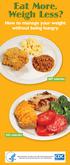 Eat More, Weigh Less? How to manage your weight without being hungry 607 calories 293 calories Department of Health and Human Services Centers for Disease Control and Prevention Can you weigh less without
WHOLE GRAINS FOR GOOD HEALTH
 WHOLE GRAINS FOR GOOD HEALTH Section 1: What are Whole Grains? Whole grains are nutritious, delicious, and are included in the WIC program! Whole grains contain the entire grain kernel. That means whole
Screening Tests for Gestational Diabetes
 Screening Tests for Gestational Diabetes 50 Gram glucose challenge test If you choose to be screened for gestational diabetes, you may have one of several different tests. The most commonly used screening
Oxford Bariatric Service Pre bariatric surgery diet Information for patients
 Oxford Bariatric Service Pre bariatric surgery diet Information for patients Why do I need to follow a pre-operative diet? Before obesity surgery, it is essential that you follow a strict calorie controlled
Carbohydrate Counting
 Carbohydrate Counting Carbohydrate When carbohydrates; sugars & starches are digested, they break down to form glucose in the blood stream. Your quick acting insulin dose can be based on how much carbohydrate
Nutrition Consultation Report
 Nutrition Consultation Report Name: M.G. Date of report: 9/2014 Age: 54 y.o. Female Occupation: Assistant Manager, Gym; Group Fitness Instructor Sport(s) of Choice: Running, Lifting Reason for nutrition
High Blood Pressure and Chronic Kidney Disease. For People With CKD Stages 1 4
 High Blood Pressure and Chronic Kidney Disease For People With CKD Stages 1 4 National Kidney Foundation s Kidney Disease Outcomes Quality Initiative (NKF-KDOQI ) The National Kidney Foundation s Kidney
Your 1-Month Meal Plan Our healthy meal plan will benefit more than your joints
 Your 1-Month Meal Plan Our healthy meal plan will benefit more than your joints Because carrying around extra weight is hard on your joints, eating healthfully can really benefit individuals with Rheumatoid
MEAL PLANNING FOR MECHANICAL SOFT DIET
 MEAL PLANNING FOR MECHANICAL SOFT DIET Definition of Terms Calories Protein Blenderized Pureed Units of energy. A nutrient used by your body for growth and repair. The best sources are milk, meats, fish,
Lesson 3 Assessing My Eating Habits
 Lesson 3 Assessing My Eating Habits Overview This lesson introduces the federal guidelines for healthy eating. Students assess their eating habits against these guidelines and make suggestions for improvement.
Why iron and haemoglobin are important
 Iron and haemoglobin Why iron and haemoglobin are important Meet Kylie Kylie is a blood donor. Kylie knows that having a healthy iron enriched diet will help restore the iron removed with blood donation.
Eating Healthy for Your Heart. Kelly Cardamone, MS, RD, CDE, CDN
 Eating Healthy for Your Heart Kelly Cardamone, MS, RD, CDE, CDN Do You Know? According to the Centers for Disease Control and Prevention, 70% of all deaths in the United States are due to chronic diseases.
Material AICLE. 5º de Primaria.: Food and nutrition (Solucionario)
 Material AICLE. 5º de Primaria.: Food and nutrition (Solucionario) 3 SOLUTIONS Activity 3. Listen to the following audio and complete this chart. Then, check your answers using the information in activity
Learning Objectives. ADA Diet vs. Medical Nutrition Therapy. In Diabetes, Food IS Medicine: Current Trends In Diabetes Nutrition Management
 In Diabetes, Food IS Medicine: Current Trends In Diabetes Nutrition Management Laurel Najarian RD, CDE, M.ED Learning Objectives 1. Discuss the rationale and importance for the use of carbohydrate counting
MEN'S FITNESS FAT TO FIT CHALLENGE - 1800 CALORIE MEAL PLAN WEEK 2
 Day 1 1 egg + 3 egg whites scrambled 125 1.1 17.1 5.1 1/2 whole wheat english muffin, toasted 67 13.3 2.9 0.7 1 medium orange 61.6 15.4 1.2 0.2 TOTAL 253.6 29.8 21.2 6 2 Tbs dried cherries 48.8 12.8 0
Nutrition Basics For Half Marathon Runners
 Nutrition Basics For Half Marathon Runners Paula Inserra, PhD, RD Sports Backers ½ Marathon Training Team Fluid and Electrolyte Balance Evaporation of sweat is the major mechanism for dissipating heat
Nutrition After Weight Loss Surgery
 Nutrition After Weight Loss Surgery Gastric Bypass Sleeve Gastrectomy Gastric Banding HOW YOU WILL USE YOUR NEW TOOL SUCCESSFULLY TEXAS CENTER FOR MEDICAL & SURGICAL WEIGHT LOSS What We ll Cover Today
Paediatric Diabetes: Carbohydrate counting
 Department of Nutrition and Dietetics Paediatric Diabetes: Carbohydrate counting Everyone with diabetes need to be careful about the foods they eat to ensure that their blood glucose levels stay as close
Florida Department of Health WIC Program. This institution is an equal opportunity provider. 1/2016 1
 Florida Department of Health WIC Program This institution is an equal opportunity provider. 1/2016 1 EBT stands for Electronic Benefits Transfer. EBT is a simple, secure, and convenient way to buy your
PAVING YOUR PATH TO DIABETES MANAGEMENT:
 African and Caribbean PAVING YOUR PATH TO DIABETES MANAGEMENT: Basic Carbohydrate Counting and The Glycemic Index What is carbohydrate? Carbohydrate is one of the three main nutrients found in foods. Starches,
February 2006. 23 Best Foods for Athletes
 23 Best Foods for Athletes February 2006 1. Beans Legumes a. Excellent source of fiber (important for keeping blood sugar and cholesterol levels under control). b. High in protein and a good source of
Nonalcoholic Fatty Liver Disease. Dietary and Lifestyle Guidelines
 Nonalcoholic Fatty Liver Disease Dietary and Lifestyle Guidelines Risk factors for NAFLD Typically, but not always seen in patients who are overweight. May have Diabetes and or insulin resistance high
We want you to have the best results possible while doing our detox. If your goal is weight loss, then eating the right foods and exercising
 Detox Menu Guide We want you to have the best results possible while doing our detox. If your goal is weight loss, then eating the right foods and exercising moderately will help boost your results and
How To Get Healthy
 Dietary Fiber and Alcohol Nana Gletsu Miller, PhD Fall 2-13 Dietary Fiber It is the complex carbohydrate in plants that can not be broken down by human digestive enzymes Sources Grains Fruits and Vegetables
LARGE GROUP PRESENTATION: PRESENTER S NOTES
 LARGE GROUP PRESENTATION: PRESENTER S NOTES Introduce yourself. Welcome! We are so glad you are here to learn about fruits and vegetables. Icebreaker Handout: Fruit or Vegetable: Parts of Many Words Read
WORKOUT AND NUTRITION GUIDE PULL-UPS DIPS PUSH-UPS SIT-UPS
 WORKOUT AND NUTRITION GUIDE PULL-UPS DIPS PUSH-UPS SIT-UPS IMPORTANT: Consult your physician before beginning this or any exercise program. WARNING: Fitness training can result in serious or fatal injury.
Carbohydrate Counting
 COOPERATIVE EXTENSION SERVICE UNIVERSITY OF KENTUCKY COLLEGE OF AGRICULTURE, FOOD AND ENVIRONMENT, LEXINGTON, KY, 40546 FCS3-546 Carbohydrate Counting Ingrid Adams, Dietetics and Human Nutrition What is
EMBRACE Your Journey Nutrition During Treatment
 Nutrition is an important part of your cancer treatment. As you prepare for treatment, it is important to focus on eating a well-balanced diet so that your body is as healthy as it can be. When your body
BAKED REGULAR. Nutrition Facts /Valeur nutritive. Nutrition Facts /Valeur nutritive
 Carb Counting Quiz Before you begin administering multiple daily injections of insulin (MDI) or using an insulin pump to manage diabetes, you will need to become comfortable with advanced carbohydrate
Gestational diabetes. Information to help you stay healthy during your pregnancy. What is gestational diabetes?
 Gestational diabetes Information to help you stay healthy during your pregnancy What is gestational diabetes? How gestational diabetes can affect my baby How to take care of myself and my baby during pregnancy
Melt Your Body Fat for Good!
 Melt Your Body Fat for Good! How to Boost Your Metabolism Naturally and Switch from Fat Storage to Fat Burning Before anything else, you must understand what is your metabolism s role in burning body fat
Participant Group Nutrition Education outline: Get the Skinny on Milk
 Participant Group Nutrition Education outline: Get the Skinny on Milk Lesson Plan adapted from California WIC This group NE outline uses a facilitated discussion format, including a tasting activity. Select
The Glycemic Index of Foods
 What is the Glycemic Index (GI)? It is a method used to classify carbohydrate containing foods, according to the effect that they may have on blood sugar levels. It is claimed that the higher the GI number,
Type 1 Diabetes Management Based on Glucose Intake www.utmem.edu/endocrinology click Patients (Revised 7/13/2007)
 Type 1 Diabetes Management Based on Glucose Intake www.utmem.edu/endocrinology click Patients (Revised 7/13/2007) The following is a system of insulin therapy, diet management, and blood glucose monitoring
Digestive System Why is digestion important? How is food digested? Physical Digestion and Movement
 Digestive System The digestive system is made up of the digestive tract a series of hollow organs joined in a long, twisting tube from the mouth to the anus and other organs that help the body break down
Diabetes 101. Lifestyle Recommendations to Manage Diabetes. Cassie Vanderwall. Licensed, Registered Dietitian Certified Personal Trainer
 Diabetes 101 Lifestyle Recommendations to Manage Diabetes Cassie Vanderwall Licensed, Registered Dietitian Certified Personal Trainer Diabetes 101- Outline What is Diabetes? What can I do to control Diabetes?
1.1 Nutritional Management of Chronic Obstructive Pulmonary Disease (COPD)
 Chronic Disease Network and Access Program 2009 Nutritional Management of COPD Guide for Health Professionals Tanya Cockburn RD Jetta Johnson RD Reviewed by: Rochelle Anthony RD CDM Dietitian, Saskatoon
UIW ATHLETICS WEIGHT GAIN NUTRITION GUIDE
 UIW ATHLETICS WEIGHT GAIN NUTRITION GUIDE SOME THINGS YOU SHOULD KNOW You are what you eat When training is strenuous and you are more active, you will need more food. Supplements will NEVER make up for
CALORIE NEEDS Minimum: Current weight (lb) x 20 = number of calories for males Current weight ( lb) x 15 = number of calories for females
 NUTRITION CONDITIONING GOALS FOR ATHLETES Leslie Bonci, M.P.H., R.D. (412)432-3674 or email: [email protected] Director- Sports Medicine Nutrition University of Pittsburgh Medical Center Health System
1800 Calorie Meal Plan. Jessica Iannotta Department of Nutritional Sciences UMDNJ School of Health Related Professions
 1800 Calorie Meal Plan Meal Portion Food Calories DAY 1 Breakfast 1 cup Hot Oatmeal, cooked, unsweetened 150 1 banana 120 1 Amy s Bean & Rice Burrito 280 (in the frozen foods section of your grocery store
Juice Cleanse 2014. Why do a juice cleanse?
 Why do a juice cleanse? Our world has become a toxic place, not only from our environment but also through the food and substances we put in our body. These toxins enter our body, accumulate over time,
High Blood pressure and chronic kidney disease
 High Blood pressure and chronic kidney disease For People with CKD Stages 1 4 www.kidney.org National Kidney Foundation's Kidney Disease Outcomes Quality Initiative Did you know that the National Kidney
Pediatrics. Specialty Courses for Medical Assistants
 Pediatrics Specialty Courses for Medical Assistants 7007 College Boulevard, Suite 385 Overland Park, Kansas 66211 www.ncctinc.com t: 800.875.4404 f: 913.498.1243 Pediatrics Specialty Certificate Course
High blood sugars caused by steroids
 High blood sugars caused by steroids Your blood sugars are high because you are taking a medication called steroids. Steroids are used to: decrease swelling decrease the natural response of your immune
Nutrition Guidelines for Diabetes
 Nutrition Guidelines for Diabetes Eating healthy foods and keeping a healthy body weight are very important parts of a diabetes treatment plan. A healthy diet and weight helps to keep your blood sugar
Here's how to include more fiber in your diet.
 July 1, 2012 Welcome to our first newsletter which will address the issue of fiber in your diet. If you are not regular or are having difficulty going to the bathroom then you should consider eating more
Carbohydrate s Role in Fat Loss by Cameron L. Martz, ACSM H/FI
 Carbohydrate s Role in Fat Loss by Cameron L. Martz, ACSM H/FI If you believe what you see on the bookshelves these days, you d think carbohydrates are the root of all nutrition evil. The Atkin s New Diet
chocolate milk Tasty Nutrition
 chocolate milk Tasty Nutrition Nutrition is everything. Good nutrition is vital to our children. Moms want it. Schools want it. Everyone agrees. But are they getting it? Many kids are still falling short
CARBS, FATS, FIBER & FADS FAD DIETS
 CARBS, FATS, FIBER & FADS FAD DIETS Carbohydrates The national recommendation for carbohydrate intake is 40% to 65% of our daily intake. Our requirements change depending on how active we are, our current
Nutrition Information from My Plate Guidelines
 Nutrition Information from My Plate Guidelines Note: This information was compiled from the website: http://www.choosemyplate.gov/ for participants in the 4-H Food Prep Contest 1/12/16. The information