
Annual Report If P&C Insurance Ltd,
|
|
|
- Kelly Cameron
- 9 years ago
- Views:
Transcription
1 Annual Report 2014 If P&C Insurance Ltd,

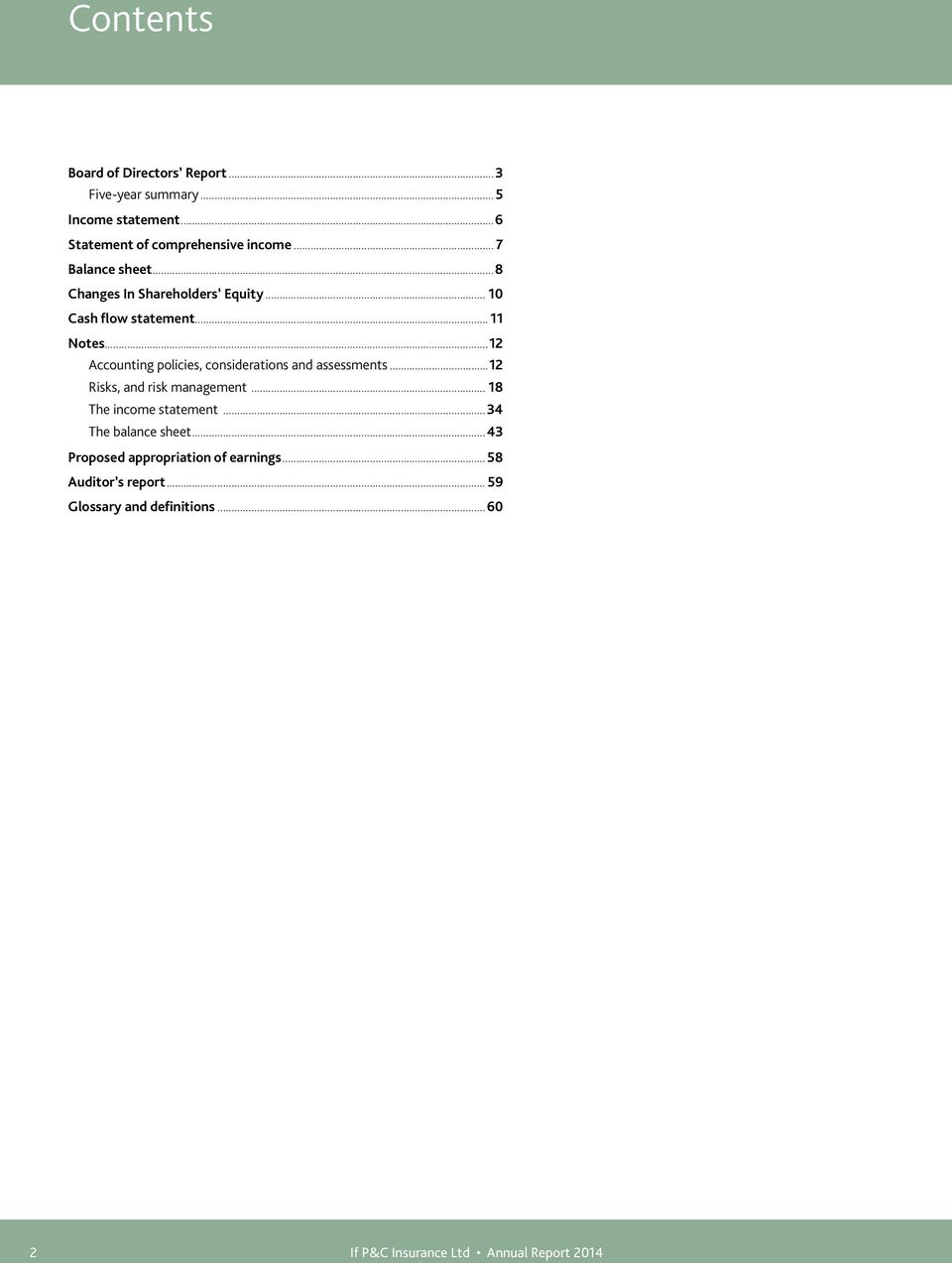
2 Contents Board of Directors Report...3 Five-year summary...5 Income statement...6 Statement of comprehensive income... 7 Balance sheet...8 Changes In Shareholders Equity Cash flow statement Notes...12 Accounting policies, considerations and assessments...12 Risks, and risk management The income statement...34 The balance sheet...43 Proposed appropriation of earnings...58 Auditor s report Glossary and definitions If P&C Insurance Ltd Annual Report 2014
3 Board of Directors Report The Board of Directors and the President of If P&C Insurance Ltd (publ), corporate registration number , hereby issue their Annual Report for the 2014 fiscal year. ORGANISATION If P&C Insurance Ltd (publ) is a wholly owned subsidiary to If P&C Insurance Holding Ltd (publ), corporate reg. no , whose headquarters is in Solna, Sweden. The consolidated accounts are prepared by If P&C Insurance Holding Ltd (publ). If P&C Insurance Holding Ltd (publ) in their turn is a wholly owned subsidiary of Sampo Abp, a Finnish listed company, whose registered office is in Helsinki. In addition to the property and casualty insurance operations conducted within If, the Sampo Group also conducts life insurance operations and has a substantial holding in Nordea Bank AB (publ). If s property and casualty insurance operations constitute an independent segment within Sampo. If P&C Insurance Ltd conducts property and casualty insurance operations in Sweden and in Norway, Denmark and partly in Finland and Latvia via branches. In addition, If has branch offices in France, the Netherlands, the United Kingdom and Germany for customers that conduct international operations. The insurance operation in the Nordic region is organizationally divided in accordance with customer segment into the business areas Private, Commercial and Industrial. Asset management is responsible for all investment assets within the Group. Support functions such as IT, Human Resources, Communication and Finance are organized as a support to the business. RESULTS FROM OPERATIONS Results The result before income taxes was 6,023 (5,555). The technical result of property and casualty insurance operations remained strong and amounted to 4,167 (4,007). Adjusted for exchange-rate effects the technical result increased by 4.0% compared with last year. Premiums written Gross written premiums for the year amounted to 31,428 (31,254). Adjusted for exchange-rate effects, the underlying increase in premium volumes was 1.2%. The increase is as a result of premium increases in the business area Private. Claims incurred and operating expenses Net claims incurred amounted to 21,230 (21,026), adjusted for the effect of exchange-rate changes, claims expenses increased by 1.0%. The claims ratio amounted to 71.1% (72.1). A mild winter in the beginning and end of the year explains the improvement, however slightly reduced by weather-related claims due to spring floods and storms in Sweden during the last quarter. The expense ratio decreased slightly and amounted to 16.8% (16.7). Operating expenses in the insurance operation totaled to 4,999 (4,884). Adjusted for the effect of exchange-rate changes, operating expenses in the insurance operation increased by 2.0%. The combined ratio improved and amounted to 87,9% (88.8). The improvement is due to a lower claims ratio. Investment result Earnings from asset management, measured at mark-to-market, were 3,457 (4,315). The return on investments for 2014 was 4.5% (5.8). A net return amounting to 2,900 (2,789) was recognized in the income statement and 557 (1,526) in other comprehensive income. The year entailed continued declining yields on European government bonds, which resulted in several cases of negative interest rates. The U.S. economy continued its positive trend, while concern for emerging countries grew. Perhaps the greatest surprise for the year was the sharp de- cline in oil prices. During autumn, the stock market was impacted by a relatively strong downward adjustment, but recovered forcefully by the end of the year. On the whole, this resulted in rising share prices and continued historically low interest rates. Taking this into account, the investment result for the year is deemed satisfactory. The year-on-year earnings decline was mainly due to slightly lower return from fixed income portfolios and equity portfolios. Most of the equity portfolios rose during the year except for some emerging countries that displayed downturns. The total return for the asset class was 17.7%, primarily thanks to an upswing of nearly 30% for Scandinavian small-cap companies. Interest rates on both risk-free investments and credit spreads (the difference between the risk-free interest rate and the non-risk-free interest rate) declined during the year. Overall, this led to a return on interest-bearing assets of 2.4%. The total portfolio return of 4.5% fell short of the corresponding return for the comparable index. Performance for the interest portfolio was weaker than the comparable index, while the equity portfolio surpassed its comparable index. The equity weight in the portfolio (including derivative instruments) varied during the year and was at its lowest of 13% in the third quarter of the year and its highest of 15% at the end of the year. The return was stable in the first half of the year, while the second half was characterized more by volatile market conditions and lower return. The duration for interest-bearing assets was 0.9 years (1.0) at the end of the year. Investment assets at year-end amounted to 72,523 (69,175). Net profit and tax costs Net profit was 4,686 (4,334). The effective tax rate for the year was 22.2% (22.0). Of total taxes, current tax expenses amounted to 1,389 (1,194) and the deferred tax income was 52 (expense 27). Solvency capital and cash flow The solvency ratio strengthened and amounted to 69.6% (67.2). Solvency capital increased to 20,900 (19,922). Cash flow from operating activities decreased and amounted to 3,606 (5,931). During the year, a dividend of 4,300 (5,300) was paid. Technical provisions (reserves) Gross provisions at year-end decreased to 60,531 (60,621). Currency effects arising from the conversion of provisions made in foreign currencies contributed to a higher provision with 577, mainly due to the strengthening of the Danish krona and US Dollar against the Swedish krona. After adjustments for exchange-rate effects the premium reserve increased by 165.The claims reserve decreased by 832. Reinsurers proportion of technical provisions decreased and was 2,093 (3,535). The decrease is mostly due to a decrease of ceded Property reserves due to settlement of a number of large claims from previous years and a favorable large claims result this year. CORPORATE GOVERNANCE STATEMENT The company is not listed, and does not comply with the Swedish Code of Corporate Governance. However, the company has subordinated loans listed for trading on the Luxembourg Stock Exchange. According to the Annual Accounts Act (1995:1560) for insurance companies, there are requirements stipulating that such insurance companies shall submit a limited Corporate Governance Statement, which shall also be reviewed by the company s auditors. The company has decided to allow the Corporate Governance Statement to be part of the Annual Report and thus be encompassed by the examination conducted by the auditors. If P&C Insurance Ltd Annual Report

4 Board of directors report As mentioned above, the company is a wholly owned subsidiary of If P&C Insurance Holding Ltd (publ), which in turn is a wholly owned subsidiary of the listed Finnish company, Sampo Abp. The shareholders rights to participate in company decisions are exercised at the Annual and Extraordinary General Meetings. The Articles of Association, which is the fundamental control document for the company, also states the operations to be conducted by the company, the size of the share capital, the number of Board members and auditors, as well as the period for these assignments, issues to be addressed at the Annual General Meeting and how the business of General Meetings shall be notified. According to the Articles of Association, the Board of Directors shall comprise not fewer than three and not more than nine elected members and the election shall apply for the period ending at the next Annual General Meeting. The Articles of Association contain no stipulations pertaining to amendments of the Articles of Association. The company s Articles of Association state that when voting at General Meetings, each share shall carry one vote and that the shareholder or shareholder s representative is entitled to vote for the full number of shares represented with no restrictions on voting entitlement. No General Meeting has granted any authorization to the Board of Directors to make decisions that the company shall issue new shares or acquire own shares. The Board of Directors and the President are ultimately responsible for all financial reporting. The central finance and accounting department is responsible in part for control systems, control, accounting and reporting in accordance with generally accepted accounting principles and in part for liquidity, funding and capital. By order of the Board of Directors assignment, the company s operations and systems for internal control are subject to independently conducted internal audit reviews according to an annually established plan. The head of the internal audit reports directly to the company s Board of Directors. The Compliance function provides advice to management and the business operations on issues pertaining to regulatory compliance. The function also monitors the internal processes for regulatory compliance with reference to the operations requiring licenses. The Compliance function reports to the President. On behalf of the Chief Risk Officer (CRO) the Risk Control unit within Risk Management is responsible for the collective internal reporting of all of the company s significant risks at an aggregated level. The responsibility comprises among others underwriting, market, credit, operational, liquidity, asset and liability management and concentration risk. The CRO reports to the If ORSA Committee and the Board of Directors. In addition, the company has a comprehensive system for monitoring risks in the business operations, as described in the section on Objectives and Policies for Financial Risk Management. OBJECTIVES AND POLICIES FOR FINANCIAL RISK MANAGEMENT The core of the company s insurance operations is the transfer of risk from the insured clients to the insurer. If s result depends on both the underwriting result and the return on investment assets. The main objectives with If s risk management are to ensure that sufficient return is obtained for the risks taken and that risks are taken into account in pricing decisions and other business decisions. This requires risks to be properly identified and monitored. The company s risks, exposures and risk management are described in Note 5. PERSONNEL During the year the number of employees decreased and amounted to 3,712 (3,791) at year-end. The average number of employees in 2014 was 3,745 (3,790), of whom 48% (49) were women. APPLIED ACCOUNTING POLICIES As of 2005, If P&C Insurance Ltd applies to the extent possible accounting policies that comply with International Financial Reporting Standards (IFRS) as adopted by the EU, known as IFRS restricted by law. For the 2014 fiscal year, there were no new or amended standards that caused any for If s accounting significant changes or new requirements. OUTLOOK The development of the global economy will be difficult to predict during Despite increased competition in the market, underlying profitability of the insurance operation is expected to remain on a good level. Precision in the pricing of new insurance contracts is a success factor, at the same time as efficiency-enhancement work is important in order to maintain sustainable profitability. 4 If P&C Insurance Ltd Annual Report 2014
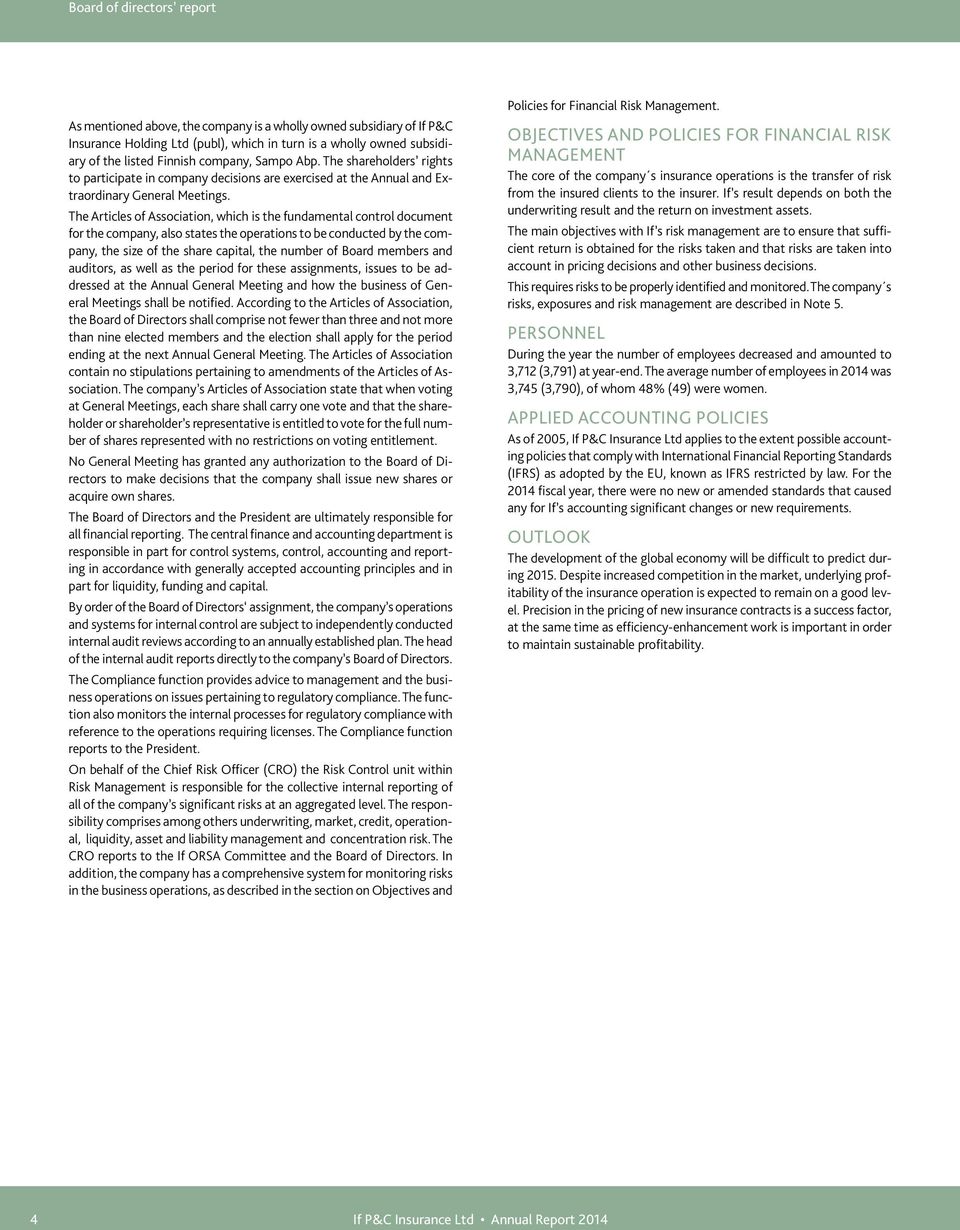
5 Board of directors report FIVE-YEAR SUMMARY Condensed income statement Premiums earned, net of reinsurance 29,840 29,169 28,964 28,043 28,048 Allocated investment return transferred from the non-technical account ,108 1,439 Other technical income Claims incurred, net of reinsurance -21,230-21,026-21,049-21,055-21,579 Operating expenses in insurance operations, net of reinsurance -4,999-4,884-4,936-4,779-4,698 Other operating expenses/other technical expenses Technical result from property and casualty insurance 4,167 4,007 3,879 3,340 3,219 Investment return 2,900 2,789 2,793 2,514 4,135 Allocated investment return transferred to the technical account ,214-1,564 Interest expense, subordinated debt Amortization goodwill Result before income tax 6,023 5,555 5,255 4,225 5,194 Income taxes -1,337-1,221-1,369-1,113-1,370 Net profit for the year 4,686 4,334 3,886 3,112 3,824 Balance sheet, December 31 Assets Intangible assets 1,308 1,622 2,068 2,310 2,591 Investment assets 72,523 69,175 71,297 70,828 72,996 Reinsurers share of technical provisions 2,093 3,535 4,727 4,475 4,250 Deferred tax assets Debtors 9,475 8,944 8,878 8,236 7,618 Other assets, prepayments and accrued income 2,857 2,879 3,371 3,509 3,177 Total assets 88,256 86,155 90,341 89,358 90,632 Shareholders equity, provisions and liabilities Shareholders equity 10,483 9,714 9,774 6,615 10,238 Untaxed reserves 7,056 7,101 7,385 7,341 7,342 Subordinated debt 2,433 2,292 2,218 2,302 3,131 Deferred tax liability Technical provisions 60,531 60,621 63,047 63,216 62,093 Creditors 4,601 3,431 5,309 7,441 4,965 Provisions, accruals and deferred income 2,224 2,181 2,152 2,053 2,023 Total shareholders equity, provisions and liabilities 88,256 86,155 90,341 89,358 90,632 Key data, property and casualty operations Claims ratio 71.1% 72.1% 72.7% 75.1% 76.9% Expense ratio 16.8% 16.7% 17.0% 17.0% 16.7% Combined ratio 87.9% 88.8% 89.7% 92.1% 93.7% Risk ratio 65.1% 65.9% 66.4% 68.7% 70.5% Cost ratio 22.8% 22.9% 23.3% 23.4% 23.2% Insurance margin 14.0% 13.7% 13.3% 11.8% 11.4% Key data, asset management Total return ratio 1) 4.5% 5.8% 5.9% 1.3% 8.5% Other key figures Capital base 2) 14,663 13,762 12,171 12,018 12,518 Solvency requirement 4,949 4,926 4,949 5,037 4,999 Solvency capital 20,900 19,922 19,833 16,649 21,551 Solvency ratio 69.6% 67.2% 67.4% 57.6% 75.2% 1) Calculations are made in accordance with the policies used internally within If for the valuation of asset management. 2) Calculations are made taking the proposed dividend into account. If P&C Insurance Ltd Annual Report
6 Income statement Note TECHNICAL ACCOUNT OF PROPERTY AND CASUALTY INSURANCE Premiums earned, net of reinsurance Premiums written, gross 7 31,428 31,254 Premiums ceded 7-1,396-1,613 Change in provision for unearned premiums and unexpired risks Reinsurers share of change in provision for unearned premiums and unexpired risks ,840 29,169 Allocated investment return transferred from the non-technical account Other technical income Claims incurred, net of reinsurance Claims paid Gross -22,256-22,551 Reinsurers share 1,708 1,546 Change in provision for claims outstanding Gross 887 1,026 Reinsurers share -1,569-1, ,230-21,026 Operating expenses Operating expenses in insurance operations, net of reinsurance Gross -5,112-5,023 Commission and profit participation in ceded reinsurance ,999-4,884 Other operating expenses/other technical expenses , 11, 12, 13-5,190-5,042 Technical result from property and casualty insurance 14 4,167 4,007 NON-TECHNICAL-ACCOUNT Investment result Investment income 3,524 3,077 Unrealized gains on investment assets - - Investment charges Unrealized losses on investment assets ,900 2,789 Allocated investment return transferred to the technical account Interest expense, subordinated debt Amortization, goodwill Result before income taxes 6,023 5,555 Tax 18-1,337-1,221 Net profit for the year 4,686 4,334 6 If P&C Insurance Ltd Annual Report 2014

7 Statement of comprehensive income Note Net profit for the year 4,686 4,334 Other comprehensive inome Items that will be reclassified subsequently to profit and loss when specific conditions are met Effects of changes in exchange rates, foreign operations Remeasuring of financial assets, available for sale 1,671 1,902 Value changes recognized in income statement on AFS assets -1, Taxes related to items which will be reclassified when specific conditions are met Total comprehensive income 5,069 5,240 If P&C Insurance Ltd Annual Report

8 Balance sheet ASSETS, DECEMBER 31 Note Intangible assets Goodwill 1,159 1,465 Other intangible assets ,308 1,622 Investment assets Land and buildings Other financial investment assets 21, 23 72,511 69,163 Deposits with ceding undertakings ,523 69,175 Reinsurers share of technical provisions Provisions for unearned premiums and unexpired risks Provisions for claims outstanding 1,743 3, ,093 3,535 Deferred tax assets - - Debtors Debtors arising out of direct insurance operations 25 8,032 7,757 Debtors arising out of reinsurance operations Other debtors 27 1, ,475 8,944 Other assets Tangible assets Cash and bank balances Securities settlement claims Prepayments and accrued income Accrued interest and rental income Deferred acquisition costs 29 1,083 1,198 Other prepayments and accrued income ,926 2,161 Total assets 88,256 86,155 8 If P&C Insurance Ltd Annual Report 2014

9 Balance sheet SHAREHOLDERS EQUITY, PROVISIONS AND LIABILITIES, DECEMBER 31 Note Shareholders equity Share capital Statutory reserve Fair value reserve 4,037 3,603 Profit carried forward 1,268 1,285 Net profit for the year 4,686 4,334 10,483 9,714 Untaxed reserves 31 7,056 7,101 Subordinated debt 32 2,433 2,292 Technical provisions (gross) Provisions for unearned premiums and unexpired risks 15,088 14,776 Provisions for claims outstanding 45,443 45, ,531 60,621 Provisions for other risks and charges Deferred tax liability Other provisions ,800 1,685 Deposits received from reinsurers - - Creditors Creditors arising out of direct insurance operations 36 1,158 1,078 Creditors arising out of reinsurance operations Derivatives 21, 22, Other creditors 37 2,916 1,767 4,601 3,431 Accruals and deferred income Reinsurers share of deferred acquisition costs Other accruals and deferred income 38 1,329 1,288 1,352 1,311 Total shareholders equity, provisions and liabilities 88,256 86,155 Memorandum items Assets and corresponding collateral pledged for own liabilities and as provisions for reported obligations 39 2,472 2,750 Assets covered by policyholders beneficiary rights 39 74,618 68,119 Contingent liabilities and other commitments If P&C Insurance Ltd Annual Report

10 Changes in shareholders equity Share capital Restricted equity Statutory reserve Fair value reserve Profit/loss brought forward Unrestricted equity Net profit for the year Total equity Equity at beginning of ,413 6,869-9,774 Total comprehensive income - - 1, ,334 5,240 Dividend , ,300 Equity at end of ,603 1,285 4,334 9,714 Equity at beginning of ,603 5,619-9,714 Total comprehensive income ,686 5,069 Dividend , ,300 Equity at end of ,037 1,268 4,686 10,483 The accumulated translation difference corresponded to -494 (-449). The share capital comprises 1,044,306 shares with a par value of SEK 100 each. 10 If P&C Insurance Ltd Annual Report 2014

11 Cash flow statement CASH FLOW FROM OPERATING ACTIVITIES Cash flow from insurance operations Premium flows, direct insurance 31,246 30,194 Claim payments, direct insurance -22,209-22,252 Reinsurance Costs of operations -4,979-4,689 4,382 3,125 Cash flow from asset management Current return, coupon interest income 2,090 2,241 Current return, dividends on shares Net investments in financial investment assets -1,628 1, ,170 Interest payment, subordinated debt Realized foreign exchange transactions Paid income tax -1,378-1,702 3,606 5,931 CASH FLOW FROM FINANCING ACTIVITIES Dividend paid -4,300-5,300 Group internal financing, net ,415-6,106 Cash flow for the year Cash and bank Cash and bank balances on January Effect of exchange rate changes Cash flow during the period Cash and bank balances on December Supplementary information on the company s cash flow is presented in Note 41 If P&C Insurance Ltd Annual Report

12 Notes NOTE 1 Accounting policies COMPANY INFORMATION This annual report for If P&C Insurance Ltd was prepared and authorized for publication by the Board of Directors and President on March 2, 2015 and will be presented to the 2015 Annual Meeting for approval. The company is a Swedish public company with its registered office in Stockholm and its headquarters in Solna, Sweden. The Companys s primary operations are described in the Report of the Board of Directors. STATEMENT OF COMPLIANCE WITH REGULATIONS APPLIED The annual report for If P&C Insurance Ltd was prepared in accordance with the Swedish Annual Accounts Act for Insurance Companies (ÅRFL), the Swedish Financial Supervisory Authority s regulations and general recommendations on Annual Accounts in Insurance Companies (FFFS 2008:26) and, with application from the second half of 2014, the Swedish Financial Supervisory Authority s recommendation on accounting for fees to Swedish Motor Insurers (FI Dnr ). In accordance with the Swedish Financial Supervisory Authority s general recommendations, general accepted international accounting standards and the Swedish Financial Reporting Board s recommendation RFR 2 Accounting for legal entities are applied to the extent that these do not contravene the law or other statutes or the said regulations and general recommendations. As of the 2014 fiscal year, If applies the revised standards for Consolidated Financial Statements and Joint Arrangements (IFRS 10-12) and consequential amendments to other standards. Application of these standards, as well as other new or amended standards, has only required a couple of changes in the disclosures. Issued, but not yet effective, international accounting standards are assessed not to cause any significant impact on the financial statements when first applied, except IFRS 9 Financial Instruments. IFRS 9 is still not adopted for use in the EU, but If has initiated an assessment of the expected effects from making a transition from IAS 39 to IFRS 9 (as published by the IASB). Since e.g. the notion of business model will be important and the Financial Instruments standard includes some optionality, If believes that there will be significant cross-influences to the not yet finalized standard Insurance Contracts phase II that need to be carefully assessed. MEASUREMENT BASES FOR THE PREPARATION OF THE ACCOUNTS The accounts are based on historical acquisition values with the exception of the totally dominant share of investment assets, which are reported at fair value. The financial reports and notes are presented in SEK millions (), unless otherwise stated. TRANSACTIONS, RECEIVABLES AND LIABILITIES IN FOREIGN CURRENCY AND TRANSLATION OF THE ACCOUNTS OF FOREIGN BRANCHES Income statement items in foreign currency are translated to SEK using the average exchange rate for the month during which they were reported. Asset and liabilities in foreign currency are translated at the closing date exchange rates. Any unrealized translation differences arising are reported net in the income statement as exchange-rate gains/losses under Investment result. Currency forward contracts used to hedge currency exposure in the balance sheet are fair valued and the effects are also reported in their entirety as exchange-rate gains/losses. In the case of If s foreign branches, the functional currency is the local currency in the country in which the branch is active. Translation into SEK is effected in line with IAS 21. Items in the balance sheets are translated using the exchange rate on the balance sheet date and items in the income statement are translated using the average exchange rates for the period in which the item arose. The translation difference that arises from different exchange rates being used for items in the balance sheet and income statement and from shareholders equity being translated at a year-end rate that differs from the rate used at the beginning of the year are reported in other comprehensive income. For If s most significant currencies, the following exchange rates were used as of December 31 to translate balance sheet items in foreign currency to SEK: US dollars Danish kroner Euro Nowegian kroner POLICIES APPLYING TO ITEMS IN THE BALANCE SHEET Intangible assets including goodwill Intangible assets consist of externally acquired rights etc., internally developed intangible assets and goodwill. Intangible assets are valued at their acquisition value less deductions for accumulated planned amortization. Internally developed intangible assets are measured at acquisition value, determined as the direct and indirect expenses for the development (programming and testing) of computer systems and so forth that are expected to provide financial benefits in the future. Only expenses linked to new development and major system changes decided in a special procedure by the Board are capitalized. Rights and similar assets are amortized from the day they are valid. Capitalized development expenses are amortized from the date the asset is put into production. Amortization is made over its estimated useful life. The useful life is determined individually by asset and may amount to a maximum of 10 years. The estimated useful life of goodwill in acquired companies and portfolios is generally 10 years. The goodwill associated with assets and liabilities resulting from the merger of Skandia s and Storebrand s property and casualty insurance portfolios is considered to have such a long-term value that the amortization period has been set at 20 years. If there is any indication on the closing date that the carrying amount of an intangible asset is higher than its recoverable amount, a calculation is made of the asset s recoverable amount. The recoverable amount is the higher of the asset s net realizable value and its value in use. If the determined recoverable amount is less than the carrying amount, the carrying amount of the asset is reduced to its recoverable amount. If, subsequently, a higher recoverable amount can be set, a previous impairment may be reversed, but this does not apply to impairment of goodwill. 12 If P&C Insurance Ltd Annual Report 2014

13 Notes Land and buildings/investment properties If reports all its properties as investment assets (investment properties), fair valued pursuant to IAS 40 and with changes in value reported in the income statement. This classification complies with the company s basic approach to these assets. If has concluded that a separation of such properties, which according to IAS 40 represent owner-occupied properties, would have only an insignificant effect on the particular asset and profit/loss item. The fair value consists of the net realizable value and is set annually by external surveyors using acknowledged and accepted valuation methods. Accepted methods consist of local sales-price method (current prices paid for comparable properties in the same location/area) or cash flow models applying current market interest rates for the calculation of the present value of the property. Since valuation is effected at fair value, there is no depreciation of properties. Valuation of other investments assets Financial investment assets are reported in the original currency and at fair value with as a main principle changes in value recognized in other comprehensive income until being realized. The presentation below describes the detailed valuation for each type of asset. The purchase and sale of money market and capital market instruments on the spot market as well as derivative transactions are reported in the balance sheet on the transaction date. The counterparty s receivable/liability is reported between the transaction date and payment date in gross form under the item Other assets or Other creditors. Business transactions whose receivables/liabilities are settled net via clearing are reported in the balance sheet with a net amount per counterparty. Shares Shares are fair valued, calculated as a sales value without deduction for sales costs. For shares listed on an authorized stock exchange or marketplace, the sales value normally refers to the latest bid price on the closing date or, in the case of shares listed on Nasdaq OMX, to the latest trade price. Unlisted securities included in private equity investments are valued using established valuation models. Interest-bearing securities Interest-bearing securities are fair valued and accounted for separating accrued acquisition value from change in value. The accrued acquisition value is the discounted present value of future payments, for which the discount rate consists of the effective rate of interest on the acquisition date. This means that acquired surplus and deficit values on coupon instruments are distributed over the period as interest during the bond s remaining time to maturity, in the case of loans with adjustable interest rates, to the next rate-adjustment occasion. For discount instruments, the reported interest income pertains only to distribution of deficit values in conjunction with the acquisition. The return on interest-bearing securities is divided up as interest income and changes in value. The change in value is calculated as the difference between the fair value (market value) of the securities holding and its accrued acquisition value. When valuing at fair value, the listed bid price or yield-curve models, based on listed mid prices, are used. Derivatives All derivative instruments are fair valued and are valued individually. Derivative transactions with a positive market value on the closing date are reported as Other financial investment assets and positions with a negative market value are reported on the liabilities side of the balance sheet under the heading Derivatives. Receivables Receivables are reported in the amount expected to be received. Provisions for doubtful receivables are normally posted on the basis of individual valuations of the receivable. Receivables pertaining to standard products are valued through a standard computation based on reported losses during prior periods. Tangible assets Tangible assets consist of machinery and equipment and are valued at acquisition value. Acquisition value includes not only the purchase price but also expenses directly attributable to the acquisition. Machinery and equipment are reported at historical acquisition value, less depreciation according to plan. These deductions are based on the historical acquisition value and the estimated useful life of the asset concerned. Acquisitions of assets financed through leasing agreements, but for which If is responsible for the financial risks and benefits associated with ownership (financial leasing), are reported as tangible assets at acquisition value. The financial obligation resulting from leasing agreements is reported as a liability that is calculated on the basis of future lease payments discounted to present value using the interest rate specified in the contracts. Machinery and equipment are reported at the historical acquisition value, less accumulated depreciation according to plan, based on the useful life of the assets. Current lease payments are divided among amortization and interest expense. Depreciation period Office equipment Computer equipment Vehicles Other fixed assets 3-10 years 3-5 years 5 years 4-10 years In the event that there is an indication at the reporting date that the scheduled value of a tangible asset is higher than its recoverable amount, a calculation is made of the asset s recoverable amount. The recoverable amount is the higher of the asset s net realizable value and value in use. If the determined recoverable amount is less than the carrying amount, the carrying amount of the asset is reduced to its recoverable amount. If, subsequently, a higher recoverable amount can be set, a previous impairment may be reversed. Cash and bank In addition to small petty cash amounts, cash and bank consists of bank balances in insurance operations and funds transferred to asset management that have not been invested in investment assets. Deferred acquisition costs Selling costs that have a clear connection with the writing of insurance contracts are reported as an asset, namely as deferred acquisition costs. Selling costs include operating expenses such as commission, marketing costs, salaries and overheads for sales personnel, which vary according to, and are directly or indirectly related to, the acquisition or renewal of insurance contracts. The selling cost is deferred in a manner that corresponds to the amortization of unearned premiums. The amortization period ordinarily does not exceed 12 months. Subordinated debt Issued subordinated loans are reported in their original currency at accrued acquisition value. The acquisition value includes surplus/deficit prices arising on the issue date and other external expenses attributable to borrowing. During the term of the loan, costs for subordinated loans If P&C Insurance Ltd Annual Report

14 Notes are reported using the accrued acquisition value, whereby surplus/deficit prices and capitalized borrowing expenses are distributed over the term of the loan; however, no later than the interest-adjustment date in the case of loans with adjustable interest rates. Outstanding loans are translated to SEK using the closing exchange rate. The effect arising from translation is reported as an exchange rate gain/loss and is included in the item investment result. Technical provisions Technical provisions consist of: Provision for unearned premiums and unexpired risks. Provision for claims outstanding. The provisions correspond to the liabilities pursuant to current insurance contracts. Provision for unearned premiums and unexpired risks The provision for unearned premiums is intended to cover anticipated claims costs and operating expenses during the remaining term of insurance contracts in force. In property and casualty insurance and reinsurance, the provision for unearned premiums is calculated on a strictly proportional basis over time for most products, i.e. calculated on a pro rata temporis basis. In the event that premiums levels are deemed to be insufficient to cover anticipated claims costs and operating expenses, the provision for unearned premiums is required to be augmented by a provision for unexpired risks. Calculation of the provision for unexpired risks must also take into account premium installments not yet due. Provisions for claims outstanding The provision for claims outstanding is intended to cover the anticipated future payments of all claims incurred, including claims not yet reported to the company (the IBNR provision). The provision for claims outstanding includes claim payments plus all costs of claim settlements. The provision for claims outstanding in direct property and casualty insurance and reinsurance is calculated with the aid of statistical methods or through individual assessments of individual claims. Often a combination of the two methods is used, meaning large claims are assessed individually while small claims and claims incurred but not reported (the IBNR provision) are calculated using statistical methods. The provision for claims outstanding is not discounted, with the exception of provisions for vested annuities, which are discounted to present value using standard actuarial methods, taking anticipated inflation and mortality into account. Pension costs and pension commitments The company s pension obligations comprise pension plans in several national systems that are regulated through local and collective bargaining agreements and national insurance laws and consist of both defined contribution and defined benefit pensions. The reporting of pension costs and obligations mainly complies with the policies applied locally in each particular country. The reporting policies for pensions in Sweden and Denmark resemble each other, in that the pension cost consists of the premium paid for securing pension obligations via insurance in a life insurance company. In Norway, however, other policies apply, which essentially entail that the booked cost of defined benefit pensions is calculated on the basis of assumptions regarding pensionable income at the retirement age and also taking into account the financial consequences arising from the pension plan s assets and obligations. The rules and regulations for pension reporting in Norway are undergoing a gradual alignment to IFRS and, given such a situation, If has decided until further notice to apply unchanged policies for the presentation of Norwegian pensions in the company s financial statements. POLICIES APPLYING TO ITEMS IN THE INCOME STATEMENT In the income statement, there is a division into the result of insurance operations the technical result and the non-technical result, which is primarily attributable to asset management. Items included in the technical result pertain overwhelmingly to the company s operations as an insurer, that is, the transfer of insurance risk pursuant to the definition in IFRS 4, Insurance Contracts. Only contracts that do not cover a significant transfer of insurance risk are attributable to other operations and are reported pursuant to IAS 18 Revenue. Reporting in the income statement complies with the principle for gross accounting of accepted and ceded insurance. Income statement items thus disclose the accounting effects of the underlying flow and the accrual of issued insurance contracts and the equivalent for reinsurance purchased. Premiums written The premium refers to the compensation that an insurance company receives from the policyholder in return for the transfer of risk. Premiums written are reported in the income statement at the inception of risk coverage in line with the insurance contract. When the contracted premium for the insurance period is divided into several amounts, the entire premium amount is still recognized at the beginning of the period. Premiums earned Premiums earned are reported as the share of premiums written that is attributable to the accounting period. The share of premiums written from insurance contracts pertaining to periods after the closing date is allocated to the premium reserve in the balance sheet. The provision posted in the premium reserve is normally calculated by distributing premiums written strictly on the basis of the underlying term of the insurance contract. For certain insurance products in particular those with terms longer than one year the attribution is risk adjusted, i.e. in relation to expected claims. Allocated investment return transferred from the non-technical account Total investment income is reported in the non-technical result. Part of the income is transferred from investment income to the technical result for insurance operations based on the net of the insurance operations average technical provisions and outstanding net receivables. When calculating this income, interest rates are used that for each currency match the interest rate for government bonds with a maturity that approximates with the technical provisions. Other technical income Other technical income consists of income in insurance operations that does not involve the transfer of insurance risk. Such income is primarily attributable to sales commission and services for administration, claims settlement, etc. in insurance contracts on behalf of other parties. Claims incurred Total claims incurred for the accounting period cover claims payments during the period and changes in provisions for unsettled claims. In addition to claims payments, claims incurred also include claims-adjustment expenses. Provisions for unsettled claims are divided into reported and claims not yet reported to the company (IBNR). 14 If P&C Insurance Ltd Annual Report 2014
15 Notes Operating expenses Operating expenses reported in the technical result in the income statement are divided into expenses arising from the handling of insurance contracts that include the transfer of insurance risk, and costs for other technical operations and other technical costs. Administrative expenses refer to direct and indirect costs and are distributed among the following functions: Acquisition, Claims settlement, Administration, Asset Management and Other. Claims settlement costs are included in the administrative expenses of insurance operations but are reported among claims incurred in the income statement. In addition to administrative expenses, the operating expenses of insurance operations include acquisition costs and accrual of acquisition costs. From the second half of the fiscal year, recognized cost for the fee to Swedish Motor Insurers is included in other technical costs. Investment result The investment result is distributed among four items in the income statement and specified in the disclosure notes. As a general rule, unrealized value changes are reported in Other comprehensive income until realized. Unrealized value changes constitute the difference between acquisition cost and fair value. At disposition, the unrealized changes in value are reversed so that the realized gains and losses comprise the difference between acquisition cost and sale price. The result also comprises impairment losses from Available-for-sale financial assets that were deemed necessary in accordance with the specific impairment requirements in IAS 39. In line with these paragraphs, If has assessed whether there is any objective evidence that an asset is impaired. In this assessment, If has chosen to use, in respect of interesting-bearing securities, criteria related to issuer default. In respect of shares, the assessment is also conducted on an individual basis but generally all shares with a significant (>20%) and/ or prolonged (12 months) decline in value in relation to the acquisition cost shall be impaired. For both asset categories, the carrying amount is reduced to current fair value. In the event of a subsequent recovery of a value decline, the recovery is presented as a reversed impairment loss in respect of interest-bearing securities but not in respect of shares. Taxes The company s tax expense is calculated in accordance with IAS 12 Income taxes. This entails that current as well as deferred tax is calculated and reported. Current taxis calculated individually for each branch in accordance with the tax rules in the country concerned. Current tax also includes nondeductible coupon taxes in respect of dividends received. If s foreign branch offices are taxed on their results in the country concerned. In Sweden, the company is liable for taxation on all income, including the results from the foreign branch offices. If the company pays tax in Sweden on its foreign income, with the aim of avoiding double taxation, a deduction for the taxes paid abroad is normally allowed. Income taxes abroad are attributable to taxes on foreign branch office income and withholding taxes on the return on foreign investments assets. In Sweden, the tax rate during the year was 22% of taxable income. In Norway, the tax rate was 27%, in Denmark 24.5% and in Finland 20%. In Denmark, the tax rate is to be gradually reduced during to 22%. This has been taken into account when calculating deferred tax assets and liabilities as of December 31, Deferred tax attributable to temporary differences between the amounts reported and the equivalent actual taxation is reported in the company s accounts. For income reported in the income statement for the period but which is not taxed until a later period, a deferred tax cost is charged, which results in a corresponding liability item, Deferred tax liabilities. Similarly, costs that will not result in tax deductions until a later period give rise to deferred tax revenue and a corresponding deferred tax asset. Examples of temporary differences include the depreciation of equipment, etc., impairments and unrealized gains. Unrealized gains on securities could, for example, be exempted from taxation until the gain is finally realized. Deferred tax assets and liabilities are reported net in those cases where they pertain to the same tax authority and can be offset against each other. The tax effect from tax loss carry-forwards are reported as deferred tax assets if it is considered likely that they can be used to offset taxable profits in the future. Appropriations and untaxed reserves Tax legislation in Sweden allows companies to reduce their taxable income for a specific year by making appropriations to untaxed reserves. Where applicable, the provision to untaxed reserves is offset against taxloss carry forwards or becomes taxable when it is reversed. If makes provisions to a contingency reserve, which is a voluntary consolidation reserve whose maximum provision is regulated under guidelines issued by the Swedish Financial Supervisory Authority. Access to the reserve is restricted to loss coverage. Other utilization requires the approval of the regulatory authorities. Changes in untaxed reserves are reported over the income statement, under Appropriations. The accumulated value of the provisions is reported under the heading Untaxed reserves. If P&C Insurance Ltd Annual Report
16 Notes NOTE 2 Significant considerations and assessments affecting the financial statements Preparing financial statements requires that the Board and executive management make judgments and assumptions that affect the application of the accounting policies and the reported amounts of assets, liabilities, revenue and expenses. The judgments and assumptions are based on experience and insight into the insurance business. The actual outcome may deviate from these assessments. Judgments made by the Board and executive management in the application of IFRS that have a significant effect on the financial statements for 2014 and assessments that may cause material adjustments in the financial statements in subsequent years are commented on below. VALUATION OF INVESTMENT ASSETS If has elected to apply a classification according to IAS 39 that means that almost all financial investment assets, apart from associated companies, are fair valued. Since the valuation of the assets is essentially based on observable market listings, the company believes that this accounting method offers a good presentation of the company s holdings of investments assets. The main part of the financial assets that are not derivatives has been classified as available-for-sale financial assets. Value changes on these assets are therefore normally recognized in other comprehensive income until being realized, unless the application of the specific impairment paragraphs in IAS 39 require an impairment loss to be recognized in the income statement. In line with these paragraphs, If has assessed whether there is any objective evidence that an asset is impaired. The company s assessment affects the reported profit of the year but not shareholders equity. The assessment criteria are presented in Note 1 (under the heading of Investment result). Additional information is provided in Notes 5, 15 and 21. TECHNICAL PROVISIONS The provision for unsettled claims is designed to cover anticipated future payments for all claims incurred, including claims not yet reported to If, referred to as IBNR provision. The provision is calculated using statistical methods or through individual assessments of claims. These provisions are significant in an assessment of the company s reported results and financial position, since any deviation from actual future payments gives rise to a prior-year result reported in future years. Additional comments on provision risk are provided in Note 5 and an account of the company s prior-year results in recent years is available in Note 33. The provision for unearned premiums and unexpired risk is designed to cover anticipated claims and operating expenses during the remaining term of the insurance contracts concluded. For most products, the provision is calculated strictly in proportion to time. If the premium level is deemed to be insufficient to cover the anticipated claims and operating expenses, they are strengthened with a provision for unexpired risks. This assessment includes estimates of future claims frequency and other factors affecting the need for a provision for unexpired risk. This provision is also commented on in Note 5. NOTE 3 Recognition of the effects of changed exchange rates In addition to the Nordic currencies, If underwrites insurance in the most frequently used international currencies. Moreover, asset management is characterized by a large degree of international diversification. Accordingly, assets and liabilities in currencies other than SEK account for considerable sums. According to If s Currency Policy, exchange-rate risks are to be limited by conducting specific hedging transactions when required. The Currency Policy set limits for currency exposure. As a result of the large amount of foreign currency business operations, financial reports in SEK are continuously impacted by effects attributable to exchange-rate changes. In the income statement, transactions in foreign currency are translated into SEK using the average exchange rate during the month when the transaction was incurred or reported. Normally, the accounting of insurance contracts matches the contracted currency. Accordingly exchange-rate effects that could have an impact on a specific reporting line in the income statement do not have a material impact on the technical result from property and causality insurance. Balance sheet items established in foreign currency are translated to SEK using the exchange rate on the balance sheet date. Currency exposure in the balance sheet is mainly controlled by means of the activity involving continuous allocations of currency investments in If s investment assets. On other occasions, the exposure that arises is cost effectively managed through the use of currency forward contracts. For 2014, a net exchange rate loss of -157 was recognized in the income statement. The loss arose as a result of the translation of the income statement and balance sheet items and from currency derivatives. Accordingly, exchange-rate result may be divided into: Conversion of items in the income statement and balance sheet -541 Realized effects of currency derivatives 29 Unrealized effects of currency derivatives 355 Total exchange rate loss If P&C Insurance Ltd Annual Report 2014

17 Notes NOTE 4 Information about related parties RELATIONS WITH IF The If Group pursues a joint Nordic reinsurance program. In 2014, the self-retention levels varied from 100 to 250 per risk, and 250 per event. There is essentially no reinsurance among the various legal entities in the Group with the exception of the Baltic and Russia operations, and If Livförsäkring AB that are incapable of maintaining a self-retention level corresponding to the Group-wide program. Instead, these companies have signed intra-group reinsurance contracts (XL) with If P&C Insurance Ltd. The scope of intra-group reinsurance is as follows: Premiums written received Current year claims reserves 0 0 Prior-year claims reserves If P&C Insurance sells services to the group company If Livförsäkring AB. If Livförsäkring AB conducts its entire business through If P&C Insurance Ltd. Payment for these services is governed by an agreement through which If Livförsäkring AB pays a calculated percentage cost based on newly written policies and renewals. Payments amounted to: Commission If s Nordic organization entails that costs for staff and management functions, for instance, must be distributed among companies in line with the prevailing rules for transfer pricing in order to achieve appropriate accounting and taxation. Based on an agreement between If P&C Insurance Ltd and the Finnish group company If P&C Insurance Company Ltd, the following expenses have been distributed: Invoiced from If P&C Insurance Ltd Invoiced from If P&C Insurance Company Ltd If P&C Insurance Holding Ltd (publ) is the primary account holder in a Group account structure that covers all transaction accounts in If P&C Insurance s insurance operations. The If Group s purchases of data-processing services and data production are conducted through If IT Services A/S If P&C Insurance s sister company which has monitoring and administrative responsibility for IT operations with suppliers/contracts. If P&C Insurance s costs for these services amount to: IT expenses RELATIONS WITH TOPDANMARK A/S Parent company If P&C Insurance Holding Ltd (publ) owns shares in Topdanmark A/S amounting to a share of 30.4 % (excluding own shares held by Topdanmark). RELATIONS WITH URZUS GROUP AS The Parent Company If P & C Insurance Holding Ltd (publ) owns a share of 28.6% of Urzus Group AS. RELATIONS WITH CONTEMI HOLDING AS The Parent Company If P & C Insurance Holding Ltd (publ) owns a share of 28.6% of Contemi Holding AS. RELATIONS WITH WATERCIRCLES SKANDINAVIA AS The Parent Company If P & C Insurance Holding Ltd (publ) owns a share of 39.6% of Watercircles Skandinavia AS. Subsidiaries to Watercircles Skandinavia AS convey insurance on behalf of the subsidiary If P&C Insurance Ltd (Sweden) for which they are paid commission. RELATIONS WITH SVITHUN ASSURANSE AS The parent company If P&C Insurance Holding Ltd (publ) owns a share of 33.0% of Svithun Assuranse AS. Svithun Assuranse AS conveys insurance on behalf of the subsidiary If P&C Insurance Ltd (Sweden) for which they are paid commission. RELATIONS WITH CAB GROUP AB (PREVIOUSLY CONSULTING AB LENNERMARK & ANDERSSON) The parent company If P&C Insurance Holding Ltd (publ) owns a share of 22.0% of CAB Group AB, which provides systems and services for calculations of costs of repairing vehicles. RELATIONS WITH SAMPO If P&C Insurance Ltd is included in the Sampo Group via its Parent Company, If P&C Insurance Holding Ltd (publ). The term closely related companies refers to all companies in this corporate group. Sampo Abp manages the main part of If s investment assets, based on contractual fees. Payment fixed commission based on the market value of the assets under management was disbursed from If P&C Insurance as follows: Asset management services RELATIONS WITH NORDEA Nordea is an associate company of Sampo and a closely related company to If. Nordea is If s banking partner in Sweden, Norway, Denmark, Finland, Latvia and the United Kingdom and agreements have been concluded covering the management of bank accounts and related services. Nordea distributes If s P&C insurance products through its banking offices in Sweden, Finland and the Baltics for which they are paid commission. In addition to the bank accounts included in the cash pool, and for which the Parent Company If P&C Insurance Holding Ltd (publ) is the primary account holder, If P&C Insurance Ltd has its own accounts with Nordea in the Nordic region. At year-end, the overall balance on own accounts totalled 76. During the year, interest was received by 1 and no interest was paid. In asset management, investments are made in bonds and other interest-bearing securities issued by companies in the Nordea Group. Nordea is also included among the market makers used for the general trading with securities. Further information on this matter is provided in Note 5, Table 17. Coupon income totalled 123 and interest from other interest-bearing securities amounted to 2 for the year. Nordea is also counterparty for transactions in interest rate and currency derivatives. At year-end, the company s mark-to-market value for interest rate derivatives amounted to -7 and for currency derivatives it amounted to 56. If P&C Insurance Ltd Annual Report

18 Notes NOTE 5 Risks and risk management DEVELOPMENTS DURING THE YEAR If continued to show positive results and a solid capital base. There were no major changes in the If risk profile.the risk management culture is assessed as strong based on the well-established risk appetite, a strong governance structure and extensive risk reporting and business follow-up as well as high risk awareness throughout the organisation. The global economy was characterized by low growth, declining inflation and interest rates, falling commodity prices and increased geopolitical tension. The portfolio strategy in If is characterized by a low equity level and short fixed income duration. If continuously develops its risk management system. This work is based both on internal needs and future Solvency II requirements. OVERVIEW OF IF S RISK MANAGEMENT Risk is an essential and inherent element of If s business activities and operating environment. A high-quality risk management process is a prerequisite for running the business and for assuring a stable result and the delivery of the long term return requirements, which are: A combined ratio of less than 95%. A return on equity higher than 17.5%. Risk Strategy If s risk strategy forms part of the governing principles for the operations. The risk management strategy is to: Ensure that risks affecting the profit and loss account and the balance sheet are identified, assessed, managed and monitored. Ensure that the riskiness of the insurance business is reflected in the pricing. Ensure adequate long term investment returns within set risk levels. Ensure that risk buffers, in the form of capital and foreseeable profitability, are adequate in relation to the current risks inherent in business activities and the existing market environment. Limit fluctuations in the economic values of Group companies. Ensure the overall efficiency, security and continuity of operations. Risk Management System The Risk Management System is part of the Internal Control System and spans across the Group covering both the legal and operational structure thereby giving an integrated approach to risk management throughout the Group. The objectives of the Risk Management System are to create value for If s stakeholders by securing its long-term solvency, minimising the risk of unexpected financial loss and giving input to business decisions by taking into account the effect on risk and capital. The key to fulfilling these objectives is to: Identify and, in accordance with internal and external requirements, aggregate the quantifiable risks and have effective processes for management of risks affecting If. Formalise and set up reporting routines to meet regulatory requirements as well as If s internal risk reporting requirements. Key risks affecting If, including those not covered by If s Internal Model, have a dedicated risk management process. Risk Governance and Reporting Structure The Board of Directors have the overall responsibility for internal control and risk control to ensure that the company has an appropriate risk management system and processes. The main risk-steering mechanism used by the Board of Directors is the policy framework. The Board of Directors approve the Risk Management Policy and other risk-steering documents, receive- risk reports and ensures that the management and follow-up of risks are satisfactory. FIGURE 1 If s risk management reporting structure Underwriting risk Board of Directors ORSAC CRO Risk Control and Reporting coordination, compilation and analysis Risk Management Committees Business areas including investments, experts, specialist functions Market risk Credit risk The Own Risk and Assessment Committee (ORSAC) assists the Chief Executive Officer in fulfilling his responsibilities pertaining to the risk management process. The ORSAC reviews and discusses reporting from If s other committees within the Risk Management System and from both corporate functions and the line organization. Furthermore, the OR- SAC monitors that If s short-term and long-term aggregated risk profile is aligned with If s risk strategy and capital adequacy requirements. The Risk Control and Reporting unit within the Risk Management department is responsible, on behalf of the Chief Risk Officer (CRO), for coordinating and analyzing the information reported to the ORSAC. There are separate committees in place for the key risk areas. These committees are responsible for monitoring the management and control of risks to ensure compliance with the instructions of the Board of Directors. The risk committees in If do not have a decision-making mandate. Policies are in place for each risk area specifying restrictions and limits chosen to reflect and ensure that the risk level at all times complies with If s overall risk appetite and capital adequacy constraints. The committees also monitor the effectiveness of policies and give input with respect to changes and updates, if needed. The responsibility for identifying, assessing, controlling and managing risks lies with the line organization. CEO Operational risk Other risks 18 If P&C Insurance Ltd Annual Report 2014

19 Notes Figure 2 shows If s risk categorization and each risk is described below FIGURE 2 Categorization of risks Underwriting Risk Market Risk Credit Risk Operational Risks Other Risks Premium Risk Interest rate Risk Counterparty Default Risk Operational Risk Strategic Risk Catastrophe Risk Reserve Risk Equity Risk Currency Risk Spread Risk Legal Risk Reputational Risk Compliance Risk Emerging Risk Liquidity Risk Group Specific Risks Asset and Liability Management Risk Concentration Risk CAPITAL MANAGEMENT If focuses on capital efficiency and sound risk management by keeping its capital resources at an appropriate level in relation to the risks taken over the business planning horizon. This means ensuring that the available capital exceeds the internal and regulatory capital requirements as well as maintaining an A rating from Standard & Poor s and Moody s. Capital management is based on If s risk appetite statement, which provides further details on risk preferences and risk tolerance. These are established through policies decided by the Board of Directors. If s risk profile, required capital and available capital are measured, analyzed and reported to the ORSAC and the Board of Directors on a quarterly basis, or more often when deemed necessary. In order to maintain a sufficient level of capital, If: Projects its risk and capital according to the financial plan. Allocates capital to business areas and lines of business, ensuring that a risk-based approach is used for target setting and profitability evaluation. Manages its debt-to-equity structure, enhancing the return to shareholders while maintaining reasonable financial flexibility. Assures its dividend capacity through the effective use of reinsurance, group synergies and diversification benefits. Capital Position The capital position is the relationship between available capital and required capital. To fulfill requirements from various stakeholders, different measures are used to describe the capital position: regulatory measures, internal economic measures and rating agency measures. If considers both a one-year and a multi-year perspective. REGULATORY MEASURES Insurance is a regulated business with formal national rules for the capital requirement and available capital. The regulatory capital requirement and the regulatory solvency capital are presented in Table 1. The company fulfilled the regulatory capital requirements during INTERNAL ECONOMIC MEASURES Economic capital is an internal measure showing the deviation from the expected result calculated at a confidence level corresponding to 99.5% on a one-year horizon. If s major quantifiable risks are included in the calculation of economic capital. The calculations are based on an economic, market-consistent valuation. If P&C Insurance Ltd Annual Report

20 Notes TABLE 1 Regulatory capital measures and internal economic measures Solvency requirement 4,949 4,936 Capital base 14,663 13,762 Economic capital (99,5%) 12,379 11,525 RATING AGENCY MEASURES If P&C Insurance Ltd is A rated by Standard & Poor s and A2 rated by Moody s. The objective is to retain a single A rating. The If Group s Enterprise Risk Management (ERM) is rated Strong by Standard & Poor s. Risk and Capital Modeling In order to assess the overall risk profile, it is necessary to consider the interrelationships between various risks, since some of these risks may develop in opposite directions creating diversification effects. For this purpose, If has used an internal model since 2003 to calculate market risk and underwriting risk. Through simulations of both investment and insurance operations, the effect of, for example, alternative reinsurance structures and investment allocations is analyzed. Operational risk and less material risks are quantified using the standard formula of the proposed Solvency II regulation. In addition to the calculation and reporting of economic capital for If and its subsidiaries, the internal model is used as a basis for decisions regarding: Allocation of capital to business areas and lines of business, ensuring that a risk-based approach is used for target setting and profitability evaluation. Evaluation of investment policy and limits. Evaluation of reinsurance programs. Evaluation of the effect on the risk profile for mergers, acquisitions or divestments. Estimation of the risk over the business planning horizon. Distribution of Economic Capital. The economic capital tied up in If P&C operations on December 31, 2014 amounted to 12,379 compared with 11,525 on December 31, The economic capital not only reflects the capital requirements for different kinds of risks, but also their mutual diversification effect and dependencies. This gives a more accurate view of the overall risk, since it is highly unlikely that all risks will materialize simultaneously. Figure 3 shows the distribution of economic capital between risks. FIGURE 3 Economic capital ,000 12,000 9,000 6,000 3, ,256 9,455 1,309 1,473-4,114 12,379 Underwriting Market Credit Operational Diversi- Total risk risk risk risks fication The amount for credit risk includes also non-credit related risks, such as concentration risk and lapse risk, calculated in accordance with the Solvency II standard formula. UNDERWRITING RISK Underwriting risk is the risk of loss or of adverse change, in the value of insurance liabilities, due to inadequate pricing and provisioning assumptions. Premium Risk and Catastrophe Risk Premium risk is the risk of loss, or of adverse change in the value of insurance liabilities, resulting from fluctuations in the timing, frequency and severity of insured events that have not occurred at the balance date. Catastrophe risk is the risk of loss, or of adverse change in the value of insurance liabilities, resulting from significant uncertainty of pricing and provisioning assumptions related to extreme or exceptional events. RISK MANAGEMENT AND CONTROL The Underwriting Policy (UW Policy) is the principal document for underwriting and sets general principles, restrictions and directions for the underwriting activities. The Board of Directors decides on the UW Policy at least once a year. The UW Policy is supplemented with guidelines outlining in greater detail how to conduct underwriting within each business area. These guidelines cover areas such as tariff and rating models for pricing, guidelines in respect of standard conditions and manuscript wordings, as well as authorities and limits. In accordance with the Instructions for the Underwriting Committee, the Committee monitors compliance with the established underwriting principles. The business areas manage the underwriting risk on a day-to-day basis. A crucial factor affecting the profitability and risk of P&C insurance operations is the ability to accurately estimate future claims and administrative costs and thereby correctly price insurance contracts. The premiums within the Private business area and the premiums for smaller risks within the Commercial business area are set through tariffs. The underwriting of risks in the Industrial business area and of more complex risks within the Commercial business area is based on genereal principles and individual underwriting. In general, pricing is based on statistical analyses of historical claims data and assessments of the future development of claims frequency and claims inflation. 20 If P&C Insurance Ltd Annual Report 2014

21 Notes The insurance portfolio is well diversified, given the fact that If has a large customer base and its business is underwritten in different geographical areas and across several lines of business. Depite the diversified portfolio, risk concentrations and consequently severe claims may arise through, for example, exposures to natural catastrophes such as storms and floods. In addition, single large claims could have an impact on the insurance operation s result. The economic impact of natural disasters and single large claims is managed using reinsurance and through diversification. If s Reinsurance Policy stipulates guidelines for the purchase of reinsurance. The need and optimal choice of reinsurance is evaluated by looking at the expected cost versus the benefit of the reinsurance, the impact on result volatility and decreased capital requirement. The main tool for this evaluation is If s Internal Model in which small claims, single large claims and natural catastrophes are modelled. A Group-wide reinsurance program has been in place in If since In 2014, retention levels were between 100 and 250 per risk and 250 per event. RISK PROFILE There is a risk, given the inherent uncertainty of P&C insurance, of losses due to unexpectedly high claims costs. Examples on what may lead to high claims costs include large fires, natural catastrophes such as severe storms, or an unforeseen increase in the frequency or the average size of small and medium-sized claims. If P&C mainly underwrites insurance policies in Norway, Sweden and Denmark. If also underwrites policies for Nordic clients with operations outside the Nordic region. The geographical distribution of premium income is shown in Figure 4. FIGURE 4 Premium income per country Norway Sweden Denmark 0 4,000 8,000 12,000 16,000 An analysis of how changes in the combined ratio, premium and claims level affect the result before tax is presented in Table 2. TABLE 2 Sensitivity analysis, premium risk Effect on result before tax Parameter Current level 2014 Change Combined ratio 87.9% +/- 1 percentage point +/ /- 292 Premium level 29,840 +/- 1% +/ /- 292 Claims level 21,230 +/- 1% +/ /-210 If P&C Insurance Ltd Annual Report
22 Notes Reserve Risk Reserve risk is the risk of loss, or of adverse change in the value of insurance liabilities, resulting from fluctuations in the timing and amount of claim settlements for events that have occurred at, or prior to, the balance date. Reserve risk includes revision risk, which is defined as the risk of loss, or of adverse change in the value of insurance and reinsurance liabilities, resulting from fluctuations in the level, trend, or volatility of revision rates applied to annuities, due to changes in the legal environment or in the state of health of the person insured. The technical provision for unearned premiums is intended to cover anticipated claim costs and operating expenses during the remaining term of insurance contracts in force. Since claims are paid after they have occurred, it is necessary to set provisions for claims outstanding. The technical provisions are the sum of the provisions for unearned premiums and provisions for claims outstanding. Technical provisions always include a degree of uncertainty since the provisions are based on estimates of the size and the frequency of future claim payments. The uncertainty of technical provisions is normally greater for new portfolios for which complete run-off statistics are not yet available, and for portfolios including claims that take a long time to settle. Workers Compensation (WC), Motor Third Party Liability (MTPL), Personal Accident, and Liability insurance are products with the latter characteristics. RISK MANAGEMENT AND CONTROL The Board of Directors decide on the guidelines governing the calculation of technical provisions. If s Chief Actuary is responsible for developing and presenting guidelines on how the technical provisions are to be calculated and for assessing whether the level of the total provisions is sufficient. The Chief Actuary issues a quarterly report on the adequacy of the technical provisions, which is submitted to the Board of Directors, the CEO, the CFO and the ORSAC. The Actuarial Committee is a preparatory and advisory board for the Chief Actuary. The committee makes recommendations concerning guidelines for calculating technical provisions. The committee also monitors the technical provisions and provides advice to the Chief Actuary regarding the adequacy of these provisions. The actuaries continuously monitor the level of provisions to ensure that they comply with the established guidelines. The actuaries also develop methods and systems to support these processes. The actuarial estimates are based on historical claims data and exposures that are available at the closing date. Factors that are considered include loss development trends, the level of unpaid claims, changes in legislation, case law and economic conditions. When setting provisions, the Chain Ladder and Bornhuetter-Fergusson methods are generally used, combined with projections of the number of claims and average claims costs. The anticipated inflation trend is taken into account when calculating the technical provisions and is of the utmost importance for claims settled over a long period of time, such as claims related to MTPL and WC business. The anticipated trend is based on external assessments of the inflation trend in various areas, such as the consumer price index and payroll index, combined with If s own estimation of costs for various types of claims. RISK PROFILE For lines of business such as MTPL and WC, legislation differs significantly between countries. Some of the provisions for these lines include annuities that are sensitive to changes in mortality assumptions and discount rates. In 2014, the proportion of technical provisions related to MTPL and WC was 63%. The amount of technical provisions broken down by product and country is shown in Table 3. TABLE 3 Technical provisions (net) per product and country Sweden Norway Denmark Motor and Motor Third Party Liability 23,765 23,212 6,221 6,587 1,344 1,253 Workers' Compensation - - 3,089 3,195 2,361 2,221 Liability 2,647 2,601 1,433 1, Accident 2,449 2,216 3,103 3, Property 3,998 3,593 4,722 4,450 1,088 1,114 Marine, air and transport Total 33,103 31,864 19,000 19,072 6,277 6,050 Excluding Other, total 58 (101). 22 If P&C Insurance Ltd Annual Report 2014
23 Notes The durations of technical provisions for various products are shown in Figure 5. FIGURE 5 Duration of technical provisions 2014 Years Weighted average duration 4.4 years Motor and Workers Liability Accident Property Marine, air Third Party Compensation and transport Liability The structure and duration of technical provisions are also sources of, for example, interest rate risk and inflation risk which are described more in detail under market risk. Sweden Norway Denmark A sensitivity analysis of the reserve risk is presented in Table 4. TABLE 4 Sensitivity analysis, reserve risk Portfolio Risk Change in risk parameter Nominal reserves Inflation increase Increase by 1 percentage point Country Sweden Denmark Norway 2014 Effect 1, Effect 1, Discounted reserves (annuities) Annuities and estimated share of claims reserves to future annuities Decrease in discount rate Decrease in mortality Decrease by 1 percentage point Life expectancy increase by 1 year Sweden Denmark Sweden Denmark The estimated share of claims reserves to future annuities are included in annuities portfolio from figures have been restated to reflect this change. If P&C Insurance Ltd Annual Report
24 Notes FINANCIAL ASSETS AND LIABILITIES The recognition of financial assets and liabilities depends on their classification. TABELL 5 Catagories of financial asset and financial liabilities Financial assets at fair value through profit and loss Financial assets, mandatory at fair value through profit and loss (trading) Financial assets, available for sale 70,527 67,375 Loans and receivables 1) 12,519 12,050 Total financial assets 83,428 79,463 Financial liabilities, mandatory at fair value through profit and loss (trading) Financial liabilities measured at amortised cost or at the amount expected to be settled 2) 7,422 5,992 Total financial liabilities 7,612 6,170 1) Loans and receivables consists of the following balance sheet items: loans and receivables, deposits with ceding undertakings, debtors, cash and bank, securities settlement claims and financial accrued income. 2) Financial liabilities measured at amortised cost or at the amount expected to be settled consists of the following balance sheet items: subordinated debt, creditors arising out of direct insurance and reinsurance operations, securities settlement liabilities and financial other creditors and accrued expenses. 24 If P&C Insurance Ltd Annual Report 2014
25 Notes TABLE 6 Investment assets categorized from an asset management perspective Investmet assets and derivative liabilities Assets under active managment Assets under active managment categorized from an asset management perspective Fixed income Equity Properties Land and buildings Financial assets, mandatory at fair value through profit and loss (trading) Derivatives 1) Financial assets, available for sale Shares and participations 12,723 11,760 12,723 11,760 1,559 1,500 11,164 10, Bonds and other interest-bearing securities 57,804 55,576 57,804 55,576 57,804 55,576 Loans Deposits with credit institutions Other loans 1,602 1,788 1,602 1,788 1,602 1, Total other financial investment assets 72,511 69,163 Deposits with ceding undertakings 10 9 Total investment assets 72,523 69,175 Other assets Cash and bank Securities settlement claims Accrued income Assets under active management 73,819 70,474 62,256 59,659 11,179 10, Financial liabilities valued at fair value through profit and loss Derivatives 2) Total derivative liabilities Financial liabilities valued at the amount expected to be settled Securities settlement liabilities Liabilites under active management Assets under active managment, net 73,629 70,296 62,234 59,651 11,179 10, ) Only fixed income and equity derivatives are included in the assets categorized from an asset management perspective. Excluded currency derivatives amounted to 382 (31). 2) Only fixed income and equity derivatives are included in the liabilities categorized from an asset management perspective. Excluded currency derivatives amounted to 168 (170). If P&C Insurance Ltd Annual Report
26 Notes MARKET RISK Market risk is the risk of loss, or of adverse change in financial situation resulting, directly or indirectly, from fluctuations in the level or in the volatility of market prices of assets, liabilities and financial instruments. RISK MANAGEMENT AND CONTROL If s investment strategy, given the financial market environment, is to maximize long term investmentreturns within the levels of risk appetite and the capital allocation while meeting solvency and rating requirements. The Board of Directors decides on the Investment Policy on an annual basis. The structure of the company s technical provisions, risk-bearing capacities, regulatory requirements and rating targets is taken into account when deciding limits and when setting return and liquidity targets. The Investment Policy also defines mandates and authorizations and set guidelines on the use of derivatives. RISK PROFILE If s investment operations generated a return of 4.5% in Investment assets amounted to 73,415. The major market risks comprise interest rate risk, equity risk and currency risk. The exposure towards market risk can be described through the allocation of investment assets and the sensitivity of values to changes in key risk factors. TABLE 7 Allocation of actively managed investment assets Carrying amount % Carrying amount % Fixed income 62, , Equities 11, , Properties Total 73, , During the year, the proportion of equity investments increased from 14.4% to 15.2% and the proportion of fixed income investments increased from 84.7% to 84.8%. Table 8 shows the sensitivity analysis of the fair values of financial assets and liabilities in different market scenarios. The effects represent the immediate impact of a nonrecurring change in the underlying market variable on the fair values as of December 31 each year. The sensitivity analysis includes the effects of derivative positions and is calculated before taxes. TABLE 8 Sensitivity analysis of the fair values of financial assets and liabilities Interest rate Equities Properties Interest rate Equities Properties 1% parallel shift down 1% parallel shift up 20% fall in prices 20% fall in prices 1% parallel shift down 1% parallel shift up 20% fall in prices 20% fall in prices Assets Short-term fixed income Interest-bearing securities Equities -2,236-2,036 Other financial assets Liabilities Subordinated loans Derivatives, net Total change in fair value , , If P&C Insurance Ltd Annual Report 2014
27 Notes Interest Rate Risk Interest rate risk refers to the sensitivity of the values of assets, liabilities and financial instruments to changes in the term structure of interest rates, or in the volatility of interest rates. RISK MANAGEMENT AND CONTROL In accordance with If s Investment Policy, the nature of the insurance commitments, with respect to interest rate risk and inflation risk is taken into account in the composition of investment assets. The interest rate risk is managed by sensitivity limits for instruments sensitive to interest rate changes. Since the technical provisions are predominantly stated in nominal terms in the balance sheet, If is mainly exposed to changes in future inflation. However, the economic value of these provisions, meaning the present value of future claims payments, is exposed to changes in interest rates. Furthermore, the provisions for annuities are discounted and potential changes in discount rates affect the level of technical provisions in the company s balance sheet. The discount rates could vary between countries mainly as a result of legislative differences, but also due to the prevailing interest rate environment. The duration of provisions and thus sensitivity to changes in interest rates are analyzed in greater detail in Figure 5 and Table 4, in the section concerning reserve risk. The cash flows of financial assets and liabilities are presented by maturities in Table 16, in the section concerning liquidity risks. RISK PROFILE The duration of fixed income investments was 0.9 years at year-end 2014 (1.0 ). The duration of fixed income investments is shown in Table 9. TABLE 9 Duration and breakdown of fixed income investments per instrument type Carrying amount % Duration Carrying amount % Duration Scandinavian government securities/credits 52, , Euro government securities/credits 5, , Swedish index-linked bonds 3, , Short-term fixed income 1, US government securities/credits Total 62, , Equity Risk Equity risk refers to the sensitivity of the values of assets, liabilities and financial instruments to changes in the level or in the volatility of market prices of equities. RISK MANAGEMENT AND CONTROL If s equity portfolio is actively managed with a long-term investment horizon.the equity risk is reduced by diversifying the investments across industry sectors and geographical regions. According to If s Investment Policy, equity investments may not exceed 15% of the total investment portfolio and the exposure towards an individual issuer is to be limited. RISK PROFILE The equity portfolio consists of Nordic shares and a diversified global fund portfolio. At year-end, If s exposure amounted to 11,179 and the proportion of equities in the investment portfolio was 15,2%. TABLE 10 Breakdown of equity investments by industry sectors TABLE 11 Breakdown of equity investments by geographical regions Carrying amount % Carrying amount % Household Durables 1, , Machinery 1, , Specialty Retail 1, , Construction and Engineering Telecommunication Services Electrical Equipment Health Care Others 1, , Total 9, , Carrying amount % Carrying amount % Scandinavia 9, , North America 1, , Far East Latin America Total 11, , The sector allocation of equity excludes investments made through mutual equity funds of 2,003 (1,868). If P&C Insurance Ltd Annual Report
28 Notes Currency Risk Currency risk refers to the sensitivity of the values of assets, liabilities and financial instruments to changes in the level or in the volatility of currency exchange rates. RISK MANAGEMENT AND CONTROL The currency risk is reduced by matching technical provisions with investment assets in the corresponding currencies and by using currency derivatives. The currency exposure in the insurance operations is hedged to the base currency on a frequent basis. The currency exposure in investment assets is controlled weekly and is hedged when the exposure reaches a specified level, which is set with respect to cost efficiency and minimum transaction size. In addition, If is also exposed to translation risk. Translation risk refers to currency risk that arises when consolidating the financial statements of foreign operations that have a different base currency than the Parent Company into the financial statements. The translation risk is not hedged. RISK PROFILE If s currency positions against the base currency and the sensitivity of the valuation to changes in exchange rates are shown in Table 12. TABLE 12 Currency risk Currency EUR NOK DKK LTL GBP USD JPY Other Open position (SEK), % depreciation of foreign currency against SEK, % depreciation of foreign currency against SEK, CREDIT RISK Credit risk means the risk of loss or of adverse change in the financial situation, resulting from fluctuations in the credit standing of issuers of securities, counterparties and any debtors to which insurance undertakings are exposed to in the form of counterparty default risk, spread risk, or market risk concentrations. Spread risk refers to the sensitivity of the values of assets, liabilities and financial instruments to changes in the level or in the volatility of credit spreads over the risk-free interest rate term structure. In general, credit risk refers to losses arising from occurred defaults of debtors or other counterparties or from increases in assumed probability of defaults. In the case of default, the final loss depends on the value of the asset less any collateral and recoveries at the time of default. Credit Risk in Investment Operations Credit risk in the investment operations can be measured as counterparty default risk and spread risk. In most cases, part of the credit risk is already reflected by higher spread and thereby the asset has a lower market value, even in the case of no default. Therefore, the spread is in essence the market price of credit risk. The additional risk, stemming either from lack of diversification in the asset portfolio or from large exposure to default risk by (i) a single issuer of securities or (ii) a group of related issuers not captured by the spread risk or counterparty default risk, is measured as concentration risk. RISK MANAGEMENT AND CONTROL Credit risk in the investment operations is managed by specific limits stipulated in If s Investment Policy. In the policy, limits are set for maximum exposures towards single issuers, type of debt category and per rating class. The spread risk is further limited by sensitivity restrictions for instruments sensitive to spread changes. Before investing, potential investments are analyzed thoroughly. The creditworthiness and future outlook of the issuer are assessed together with any security as well as structural details of the potential investment. Internal risk indicators are critical factors in the assessment; however, macroeconomic environment, current market trends and external opinions of analysts and credit ratings by rating agencies are also taken into account. In addition, portfolio performance and the counterparties credit standings are monitored continuously. The development of the portfolios with respect to credit risk is monitored at the company level, as well as at the Group level, and is reported to the Investment Control Committee on a regular basis. Credit exposures are reported by ratings, instruments and industry sectors. 28 If P&C Insurance Ltd Annual Report 2014
29 Notes RISK PROFILE If s most significant credit risk exposures arise from fixed income investments. The exposures are shown by sector, asset class and rating category in Table 13. TABLE 13 Exposures by sectors, asset classes and rating 2014 AAA AA+ - AA- A+ - A- Fixed income BBB+ - BBB- BB+ - C D Not rated Total 1) Equities Properties Derivatives (Counterparty Risk) Total 2) Change compared to Dec 31, 2013 Basic Industry , , Capital Goods ,924 4,275 1,063 Consumer Products ,196 3,344 4,540-1,000 Energy 775 2,274 3, , Financial Institutions 1,591 5,520 1, , , Governments 2,295 2,295 2,295 2,164 Government Guaranteed ,661 1,661-2,898 Health Care Insurance Media Municipal sector 7,941 1,170 9,111 9,111 5,893 Real Estate 82 4,291 4, , Services Technology and Electronics Telecommunications , , Transportation ,293 2, , Utilities 1, ,390 2, Others Covered Bonds 21, ,778 21,778-1,954 Funds 0 2,002 2, Total 32,306 5,097 7,890 4,045 2,244-10,674 62,256 11, ,668 3,225 Change compared to Dec 31, ,393 2, , ,605 1, ,225 1) Total fixed income exposure differs by 22 compared to corresponding financial assets and liabilities in Table 6 due to that derivatives are excluded. 2) Total exposure differs by 39 compared to corresponding financial assets and liabilities in Table 6 due to that derivatives which excluded, except for OTC derivatives where only the counterparty risk is taken into account. Credit Risk in Reinsurance Operations In addition to the credit risk associated with investment assets, credit risk arises from insurance operations, most importantly through ceded reinsurance. Credit risk related to reinsurers arises through reinsurance receivables and through the reinsurers portion of claims outstanding. Credit risk exposure towards policyholders is very limited, since non-payment of premiums generally results in the cancellation of insurance policies. RISK MANAGEMENT AND CONTROL To limit and control credit risk associated with ceded reinsurance, If has a Reinsurance Security Policy that sets requirements for the reinsurers minimum credit ratings and the maximum exposure to individual reinsurers. Credit ratings from rating agencies are used to determine the creditworthiness of reinsurance companies. If P&C Insurance Ltd Annual Report
30 Notes RISK PROFILE The distribution of reinsurance recoverables is presented in Table 14. In the table, 1,173 (1,203) is excluded, which mainly relates to captives and statutory pool solutions. TABLE 14 Reinsurance recoverables Rating (S&P) 2014 % 2013 % AAA AA , A BBB BB - CCC Not rated Total , The distribution of ceded treaty and facultative premiums per rating category is presented in Table 15. TABLE 15 Ceded treaty and facultative premiums per rating category Rating (S&P) 2014 % 2013 % AAA AA A BBB BB - CCC Not rated Total ASSET AND LIABILITY MANAGEMENT RISK Asset and Liability Management (ALM) risk means the risk of loss, or of adverse change in the financial situation resulting from a mismatch between the assets and the liabilities sensitivity to fluctuations in the level or in the volatility of market rates. RISK MANAGEMENT AND CONTROL The ALM risk in If is managed in accordance with Sampo s Group-wide principles. ALM is taken into account through the risk appetite framework and is governed by If s Investment Policy. In the accounts, most of the technical provisions are nominal, while a significant portion, namely the annuity and annuity IBNR reserves, is discounted using interest rates in accordance with the regulatory rules. Accordingly, from an accounting perspective, If is mainly exposed to changes in inflation and the regulatory discount rates. From an economic perspective, wherein the technical provisions are discounted using prevailing interest rates, If is exposed to changes in both inflation and nominal interest rates. To maintain the ALM risk within the overall risk appetite, the technical provisions may be matched by investing in fixed income instruments and by using currency derivatives. LIQUIDITY RISKS Liquidity risk is the risk that insurance undertakings are unable to realize investments and other assets in order to settle their financial obligations when they fall due. RISK MANAGEMENT AND CONTROL In P&C insurance, premiums are collected in advance and large claims payments are usually known long before they fall due, thus limiting the liquidity risk. The Cash Management function is responsible for liquidity planning. To identify liquidity risk, expected cash flows from investments assets and technical provisions are analyzed regularly, taking both normal market conditions and stressed conditions into consideration. Liquidity risk is reduced by having investments that are readily marketable in liquid markets. The available liquidity of financial assets, meaning the part of the assets that can be converted into cash at a specific point in time, is analyzed and reported to the ORSAC. RISK PROFILE The maturities of cash flows for technical provisions, financial assets and liabilities are presented in Table 16. In the table, financial assets and liabilities are divided into contracts with a contractual maturity profile, and other contracts. Only the carrying amount is shown for the other contracts. The table also shows expected cash flows for net technical provisions, which are inherently associated with a degree of uncertainty. TABLE 16 Maturities of cash flows for financial assets and liabilities and net technical provisions 2014 Carrying amount Cash flows With Carrying Without contractual amount maturity maturity Financial assets 83,428 14,165 69,263 24,688 13,679 9,714 10,130 9,428 8,271 - Financial liabilities 4,612-7,612 6, ,347 - Net technical provisions 58,438 23,776 6,039 4,091 3,161 2,538 13,119 7, If P&C Insurance Ltd Annual Report 2014
31 Notes CONCENTRATION RISK Concentration risk is all risk concentrations towards a single counterparty, industry sector or geographic region with a material loss potential that is not captured by any other risk type. RISK MANAGEMENT AND CONTROL In If s Underwriting Policy, Investment Policy and Reinsurance Security Policy, limits are set for maximum exposures towards single issuers and per rating class. Risk concentrations are actively monitored and controlled by the respective committee and reported quarterly to the ORSAC. RISK PROFILE Investments are mainly concentrated to the financial sector in the Scandinavian countries. There is an emphasis on covered bonds and shortterm money market investments. The ten largest individual reinsurance recoverable balances amounted to 1,518, representing 72% of the total reinsurance recoverables. If s largest reinsurer is Munich Re (AA-), which accounts for 23% of the total reinsurance recoverables. The largest market and credit risk concentrations related to individual counterparties are shown in Table 17. TABLE 17 Concentration of market and credit risks in individual counterparties and asset classes 2014 Fair value Equities Covered bonds Other longterm fixed income Short-term fixed income Positive fair values of derivatives Svenska Handelsbanken AB - 4, ,177 Nordea Bank AB - 2,640 1, ,814 DnB ASA - 1,839 1, ,258 Swedbank AB - 2, ,195 Kommuninvest i Sverige AB - 2, ,827 Landshypotek AB - 2, ,576 Kingdom of Norway - - 2, ,273 Skandinaviska Enskilda Banken, Stockholm - 1, ,020 Swedish National Housing Finance Corporation ,820 TeliaSonera AB ,579 Total top ten exposures ,808 8, ,539 Total OPERATIONAL RISK Operational risk is the risk of loss arising from inadequate or failed processes or systems, from personnel, or from external events (expected or unexpected). The definition includes legal risk that can be described as the risk of loss due to unpredictable or unknown legal development or uncertain interpretations of regulations as well as defective documentation. RISK MANAGEMENT AND CONTROL Operational risks are identified through different processes: Operational and Compliance Risk Assessment process: Self-assessments to identify operational risks are performed by the line organization and corporate functions at least semi-annually, supported by an operational risk coordinator network. Identified risks are assessed from a likelihood and impact perspective. The control status for each risk is assessed using a traffic light system: Green good control of risk, Yellow attention required, Red attention required immediately. The most severe risks with control status yellow or red are reported quarterly to the Operational Risk Committee (ORC). Trend analyses are performed on a yearly basis, during which the most important trends affecting the insurance industry are identified and the effects on If are assessed. In this process, the most severe external operational risks are identified. Incidents are reported via a web-based system. The reported incidents are forwarded to the line organization where analyses are performed. The ORC coordinates the operational risk process and ensures its continuity. The committee s task is to provide opinions, advice and recommendations to the ORSAC and report the current operational risk status. The committee also proposes changes or extensions to policies and instructions. In order to manage operational risks, If has issued a number of steering documents: Operational Risk Policy, Continuity Plans, Business Continuity Policy, Security Policy, Outsourcing Policy, Complaints Handling Policy, Claims Handling Policy, and other steering documents related to various parts of the organization. These documents are reviewed and updated at least yearly. If also has detailed processes and guidelines in order to manage possible external and internal cases of fraud. Internal training on ethical rules and guidelines is always on-going. Corporate Legal is responsible for identifying legal risks within the Group. In addition, Insurance Legal is responsible for remaining updated on legislation, case law and products related to the insurance business. The organization has appointed legal coordinators who report to the Chief Legal Counsel, who then reports semi-annually to the ORC. If P&C Insurance Ltd Annual Report
32 Notes OTHER RISKS Compliance Risk Compliance risk is the risk of legal or regulatory sanctions, material financial loss or loss to reputation that an undertaking may suffer as a result of not complying with laws, regulations and administrative provisions as applicable to its activities. RISK MANAGEMENT AND CONTROL The line organization and corporate functions own and manage their compliance risks in the daily activities and report to the Compliance unit. The Compliance unit gives support and advice regarding compliance issues and monitors the compliance activities undertaken. A compliance risk is often the consequence of a legal or operational risk. One example of compliance risk is therefore the risk of not abiding by new or amended external rules, known as practical risk. Another example is the risk of not organizing the Groups business in accordance with good practice in the insurance industry, known as structural risk. Practical compliance risks in the business are identified within the Operational and Compliance Risk Assessment process. The structural compliance risks, and overarching practical compliance risks, are identified by the Compliance unit through self-assessment and dialogue within the unit. Identified risks are assessed from a severity perspective, encompassing likelihood and impact. The control status for each risk is assessed using a traffic light system: Green good control of risk, Yellow attention required, Red attention required immediately. In the Compliance unit, compliance risks are analyzed and aggregated at the total Group level. The control status assessment is based on the assessments made by the line organization and the corporate functions, reported incidents and other additional risk information. The outcome of the processes, after analysis in the Compliance unit, is then reported to the Compliance Committee, which is a coordination forum and advisory body for the Chief Compliance Officer (CCO) regarding risk issues. The most severe compliance risks with control status yellow or red are reported at least semi-annually by the CCO to the ORSAC. A number of internal governing documents form the basis for the steering of compliance activities, including compliance risk: Sampo Group Compliance Principles, Compliance Policy, Policy on Conflicts of Interest, Internal Control Policy, Risk Management Policy, Compliance Plan, Working Routines for the Compliance Function and the Instruction for Compliance coordinators. The documents are reviewed and updated yearly or when necessary Reputational risk A reputational risk is often a consequence of a materialized operational or compliance risk and is defined as potential damage to the company through deterioration of its reputation among customers and other stakeholders. A good reputation is vital for an insurance company, which means that trust is an important factor in If s relationships with its customers, investors, employees and other stakeholders. If s reputation is determined by how stakeholders perceive each and every aspect of the company s performance. RISK MANAGEMENT AND CONTROL When assessing the operational and compliance risks, the reputational consequence of a materialized risk is taken into account. The reputational risk is also assessed by the Communication Department as a standalone risk. Workshops are held twice a year in order to identify and assess potential new risks. A risk overview is reported to the ORC twice a year. Since operational and other risks may evolve into reputational risks if not handled correctly, the Communication Department continuously works to ensure that all employees are aware of the importance of maintaining a good reputation and understand how to deal with potential reputational risks. One important part of this preventive work is to ensure that information about incidents in the organization that could lead to an increased reputational risk, are forwarded to the Communication Department without delay, a so-called early warning notification. Furthermore information about If in media, traditional as well as social, is followed closely as are possible customer complaints in order to act appropriately. Strategic Risk Strategic risk is defined as the risk of losses due to changes in the competitive environment, changes in the overall economic climate or internal inflexibility. RISK MANAGEMENT AND CONTROL In the assessment of strategic risk, If s internal characteristics are evaluated against the potential impact of economic, regulatory, and other environmental factors. The external factors include If s position compared to competitors, business partners and customers and their developments and opportunities for the entry of new competitors, products or technologies. If s strategy process includes setting strategic high-level objectives and translating these into detailed short-term business or operational plans. The Corporate Control and Strategy unit is responsible for coordinating and facilitating strategic risk assessments within the Group. An understanding of the competitive environment and effects of the macroeconomic climate is central for all parts of the organization. The strategy process is annual and includes an update of the risk assessment whenever larger changes occur. An overall assessment by the Corporate Control and Strategy unit is reported to the ORSAC. Emerging Risk Emerging risks are newly developing or changing risks that are difficult to quantify and which may have a major impact on the undertaking. RISK MANAGEMENT AND CONTROL The main principle is that each business area is responsible for managing and taking action with regard to potential emerging risk exposures in its portfolios. However, due to the large accumulation of potential emerging risks and thus the risk to the long-term solvency of the company, Risk Management has established a forum with representatives from each business area with the aim of adopting a Group level perspective on emerging risk exposures. The forum is headed by the CRO and meetings are held twice a year. The risks assessed as the largest risks are reported twice a year to the ORSAC by the emerging risk coordinator. RISK PROFILE The risks that are under extra observations are nano-technology, climate change, electromagnetic fields and hydraulic fracturing. 32 If P&C Insurance Ltd Annual Report 2014
33 Notes PREPARATIONS FOR SOLVENCY II Solvency II (SII) is a risk-based solvency regime, which aims to deepen the integration of the insurance and reinsurance market, enhance the protection of policyholders and beneficiaries, improve international competitiveness of EU insurers and reinsurers and promote better regulation. Compared with Solvency I, the regulatory capital requirements under SII will more closely reflect the specific risk profile of each undertaking. Following political agreement in November 2013 on a EU level, significant steps have been taken towards full implementation of SII, which is expected to be in force by January 1, The Delegated Acts published by the Commission in October 2014 entered into force on January 17, 2015 following approvals from the European Parliament and Council. During the year, EIOPA also launched a series of consultations for supplementary rules and guidelines, which will finalize the technical implementation of SII. January 1, 2014 saw the onset of the so-called Preparatory phase, which will last until SII is fully implemented. If Group participated in EIOPA s 2014 stress test in June and submitted its first Group ORSA (FLAOR) supervisory report in December. If is also preparing SII Pillar 3 reports, which will be submitted to supervisors for the first time during the Preparatory phase in June To meet the requirements of the Preparatory phase and those expected once SII has fully entered into force, If s work to ensure compliance continued during the year. If continued to make progress with its application for applying a partial internal model. If intends to have its internal model fully approved when the SII enters into force. The onset for the formal application is expected by mid If P&C Insurance Ltd Annual Report
34 Notes to the income statement NOTE 6 Performance analysis per line of insurance 2014 Accident and health Householders and home-owners Commercial and real estate Motor Motor, third party liability Premiums earned, net of reinsurance 874 1,969 1,494 5,109 1,663 Allocated investment return transferred from the non-technical account Other technical income Claims incurred, net of reinsurance ,637-1,298-3,762-1,703 Operating expenses Technical result from property and casuality insurance Prior-year claims result Provision for unearned premiums and unexpired risks 376 1, , Provision for claims outstanding 1,974 1,085 2, ,308 Technical provisions (gross) 2,350 2,177 3,227 4,513 19,167 Provision for unearned premiums and unexpired risks Provision for claims outstanding Reinsurers share of technical provisions Marine, air and transport Other Total Swedish direct insurance Direct insurance abroad Reinsurance accepted Premiums earned, net of reinsurance ,788 17, ,840 Allocated investment return transferred from the non techcal account Other technical income Claims incurred, net of reinsurance ,508-11, ,230 Operating expenses ,007-3, ,190 Technical result from property and casuality insurance , ,167 Prior-year claims result Total Provision for unearned premiums and unexpired risks ,385 7, ,088 Provision for claims outstanding ,674 19,088 1,681 45,443 Technical provisions (gross) ,059 26,539 1,933 60,531 Provision for unearned premiums and unexpired risks Provision for claims outstanding ,743 Reinsurers share of technical provisions ,093 SUPPLEMENTARY DISCLOSURES TO PERFORMANCE ANALYSIS Premiums earned, net of reinsurance Accident and health Householders and home-owners Commercial and real estate Motor Motor, third party liability Premiums written, gross 954 2,095 1,878 5,434 1,687 Premiums ceded Change in provision for unearned premiums and unexpired risks Reinsurers share of change in provision for unearned premiums and unexpired risks Total 874 1,969 1,495 5,108 1,663 Premiums earned, net of reinsurance Marine, air and transport Other Total Swedish direct insurance Direct insurance abroad Reinsurance accepted Premiums written, gross ,846 17, ,428 Premiums ceded ,396 Change in provision for unearned premiums and unexpired risks Reinsurers share of change in provision for unearned premiums and unexpired risks" Total ,790 17, ,840 Total 34 If P&C Insurance Ltd Annual Report 2014
35 Notes to the income statement SUPPLEMENTARY DISCLOSURES TO PERFORMANCE ANALYSIS, CONTINUATION Claims incurred, net of reinsurance Accident and health Householders and home-owners Commercial and real estate Motor Motor, third party liability Claims paid Gross ,521-1,594-3,776-1,565 Reinsurers share Change in provisions for claims outstanding Gross Reinsurers share Total ,638-1,299-3,762-1,704 Claims incurred, net of reinsurance Marine, air and transport Other Total Swedish direct insurance Direct insurance abroad Reinsurance accepted Claims paid Gross ,487-12, ,256 Reinsurers share , ,708 Total Change in provisions for claims outstanding Gross , Reinsurers share , ,569 Total ,508-11, ,230 The Claims incurred item includes portfolio premiums and claims-handling costs. The Change in provisions item also includes the change in the claims-handling reserve. NOTE 7 Premiums written Gross 1) Ceded Net Gross 1) Ceded Net Premiums written 31,428-1,396 30,032 31,254-1,613 29,641 1) Of which, insurance agreements for direct property and casualty insurance written in: Sweden 13,227 12,557 Rest of EEA 17,580 18,021 Total 30,807 30,578 NOTE 8 Allocated investment return transferred from the non-technical account The estimated return on the assets that correspond to the technical provisions is transferred from the finance operations (non-technical account) to the technical result. The return is calculated on the basis of the net of average technical provisions, deducting deferred acquisition costs, the technical result before the investment return and average balances outstanding. The interest rates used in the calculation for each currency match the interest rate for government bonds with a maturity that approximates with the technical provisions. The transferred investment return is divided into two parts, one part that adds the annuity result by means of a reduction of paid claims and one part that is reported separately as the allocated investment return. The following calculated interest rates have been used for the most important currencies: Swedish kronor 1.2% 1.7% Norwegian kroner 1.5% 1.7% Danish kroner 0.3% 0.7% Euro 0.5% 1.0% If P&C Insurance Ltd Annual Report
36 Notes to the income statement NOTE 9 Claims incurred Gross Ceded Net Gross Ceded Net Claims costs attributable to current-year operations Claims paid -11, ,243-11, ,165 Operating expenses for claims adjustment -1, ,810-1, ,791 Change in claims reserve for incurred and reported losses -5, ,064-5, ,996 Change in claims reserve for incurred but not reported losses (IBNR) -3, ,630-3, ,782 Change in annuities reserve Claims-settlement costs Claims costs attributable to prior-year operations Claims paid -8,724 1,583-7,141-9,048 1,380-7,668 Annuities Claims portfolios Change in claims reserve for incurred and reported losses 6,218-1,599 4,619 6,817-1,161 5,656 Change in claims reserve for incurred but not reported losses (IBNR) 4, ,010 2, ,510-21, ,230-21, ,026 Insurance claims paid Claims paid -20,093 1,708-18,385-20,380 1,546-18,834 Annuities paid Claims portfolios Operating expenses for claims adjustment -1, ,810-1, ,791-22,256 1,708-20,548-22,551 1,546-21,005 Change in provision for claims outstanding Change in claims reserve for incurred and reported losses 1,034-1, ,665-1, Change in claims reserve for incurred but not reported losses (IBNR) , ,272 Change in claims provision for annuities Claims-settlement costs , ,026-1, Total insurance claims -21, ,230-21, ,026 The general principles for the valuation of technical provisions are unchanged. The provision for annuities is calculated in accordance with normal actuarial principles taking inflation and mortality into consideration, and discounted to take the anticipated future investment return into acount. To cover costs for the upward adjustment of annuity provisions required for the gradual reversal of such discounting, an anticipaed return is added to annuity results, refer to Note If P&C Insurance Ltd Annual Report 2014
37 Notes to the income statement NOTE 10 Operating expenses Specification of operating expenses External acquisition costs 1) -1,297-1,314 Internal acquisition costs -2,175-2,218 Change in deferred acquisition costs, gross Administrative expenses, insurance -1,521-1,466 Total operating expenses in insurance operations, gross -5,112-5,023 Reinsurance commission and profit participation in ceded insurance Change in deferred acquisition costs, ceded 2 3 Total reinsurance commission and profit participation in ceded insurance Other operating expenses/other technical expenses 2) TOTAL -5,190-5, Distribution of operating expenses in income statement Claims-adjustment costs included in Claims paid -1,810-1,791 External and internal acquisition costs included in Operating expenses for insurance operations -3,472-3,532 Shared administration costs for insurance operations included in Operating expenses in insurance operations -1,521-1,466 Administration costs pertaining to other technical operations included in Other operating expenses/ Other technical expenses Investment costs included in Investment charges Total -7,102-7,055 1) Of which, commissions in direct insurance -1,260-1,265 2) Of which, provision for fee to Swedish Motor Insurers regarding second half of Summary of total operating expenses Salaries and remuneration -2,462-2,495 Social security costs Pension costs Other personnel costs Total personnel costs -3,728-3,780 Premises costs Depreciation External acquisition costs -1,297-1,314 Other administration costs -1,760-1,624 Total -7,102-7,055 NOTE 11 Average number of employees Average number Of whom, Average number of employees women % of employees Of whom, women % Sweden 1) 1, , Denmark France Netherlands Norway 1, , United Kingdom Germany Total 3, , ) Agents are not included. If has 53 (83) spare-time agents in Sweden. Percentage of women in executive management Board of Directors 0% 0% Other senior executives 9% 9% If P&C Insurance Ltd Annual Report
38 Notes to the income statement NOTE 12 Salaries and remuneration for senior executives and other employees Expensed salaries, remuneration, pension and social security fees Salaries and remuneration 2,462 2,495 Pension costs Social fees Summa 3,596 3,649 Expensed salaries and remuneration Senior executives 1) of which incentive programs and other variable compensation 2) Other employees 2,331 2,346 Total 2,462 2,495 1) Senior executives are defined as board members, presidents and vice president.the amounts for salary and remuneration also include severance pay of - (-). 2) Regardless of the earnings year. PRINCIPLES FOR DETERMINING REMUNERATION OF SENIOR EXECUTIVES Director fees are not paid to board members employed in If or other companies within the Sampo Group. Remuneration of the President and other senior executives consists of a basic salary, a yearly variable compensation, shares in multiyear incentive programs, pensions and other benefits. The maximum yearly variable compensation payable to the President is 75% of his basic salary. The maximum variable yearly compensation payable to other senior executives is 30-75% of the basic salary. The yearly variable compensation is based on the If Group s results, unit results and individual results. For senior executives who are members of the Sampo Group Executive Committee, the yearly variable compensation is also based on Sampo Group results. The major part of payments from variable compensation programs is deferred for at least three years. Thereafter, the Board shall evaluate and risk adjust the deferred compensation before any payment is made. On Ifs website if.se, If provides additional information on the company s remuneration. KSEK Remuneration and other benefits during the year KSEK Provision expensed during the year for disbursement during future years Basic salary/ Directors Fee Variable payments Payments pertaining to incentive programs 1) Other benefits Pension costs Total Chairman of the Board 5,398 3,086 11, ,445 22,232 President 3,359 1,238 7, ,515 13,551 Vice President 1, , ,256 Other Board members (2 individuals) 2, , ,782 Senior executives (7 individuals) 15,031 6,363 39,086 1,325 5,083 66,888 Total 27,253 11,618 67,329 2,174 10, ,709 1) For more information refer to Long-term incentive programs below. Variable compensation Incentive programs Chariman of the Board 3,593 10,301 13,894 President 2,221 8,206 10,427 Vice President 356 2,914 3,270 Other Board members (1 individual) 922 6,237 7,159 Senior executives (7 individuals) 7,480 36,528 44,008 Total 14,572 64,186 78,758 Total PENSIONS AND SEVERANCE PAY Alongside statutory retirement pension benefits, the Swedish and Norwegian senior executives are covered by local occupational retirement pension plans. Swedish senior executives are entitled to individually agreed temporary or lifetime defined-contribution pension or occupationally agreed pension according to FTP 2. The individually agreed defined-contribution premium corresponds to 38% of the fixed annual salary. The President is in addition entitled to a supplementary defined contribution pension plan where the contribution corresponds to 25% of yearly variable compensation paid. The age of retirement is 60. Norwegian senior executives are covered by both a defined benefit pension and a pension according to the company s allocation pension scheme. From age 67 the pension benefit corresponds on full vesting to 70 % of the pensionable salary up to 12 G (G = National Insurance basic amount) together with estimated statutory retirement pension benefits. The Norwegian pension legislation allows for a flexible retirement age between 62 and 75. For pensionable salary exceeding 12 G the Norwegian senior executives are covered by a temporary pension between age 67 and 82 according to the company s allocation pension scheme where the annual allocation is 24%. In the event of early termination of employment by the company, the President will be entitled to salary during a 12-month period of notice and severance pay amounting to 18 months salary. In the event of early termination of employment by the company, other senior executives are entitled to salary during a period of notice of six to 12 months, and in most cases, to severance pay amounting to a minimum of 12 months and a maximum of 24 months salary. 38 If P&C Insurance Ltd Annual Report 2014
39 Notes to the income statement LONG-TERM INCENTIVE PROGRAMS A number of senior executives at If are covered by incentive programs issued by the Sampo Group. In September 2011 and September 2014 programs covering about 50 employees each were issued. These incentive programs are multiyear variable compensation programs. The outcome of the programs is determined by Sampo s share-price trend over a period of approximately three years starting from the issue of the respective program. Each participant in the respective programs is issued a number of incentive units, each of which carries entitlement to a payment that is equal to the value appreciation of the Sampo share from one of three specified payment dates. The programs are subject to both thresholds, which mean that no variable compensation is paid unless the company achieves a significant degree of profitability, and ceilings that maximize the size of the payment. KSEK Outstanding units and their values Number of units Maximum amount Reserved amount Chairman of the Board 397,000 71,128 21,281 President 274,500 48,885 16,303 Vice President 102,000 18,283 6,050 Other Board members (1 individual) 191,000 34,258 13,030 Senior executives (7 individuals) 1,315, ,670 75,733 Summa 2,279, , ,397 NOTE 13 Auditors fees Audit fees Ernst & Young Total auditors' fees Audit fees outside assignment Ernst & Young - - Total audit fees outside assignment - - Tax consultancy fees Ernst & Young 1 1 Total tax consultancy fees 1 1 Other consultancy fees Ernst & Young 0 1 Total consultancy fees 0 1 If P&C Insurance Ltd Annual Report
40 Notes to the income statement NOTE 14 Performance analysis per class of insurance 2014 Accident and health Motor, third party liability Motor, other classes Marine, air and transport Fire and other damage to property Third party liability Premiums written, gross 4,246 3,981 9, ,475 1,445 Premiums earned, gross 4,177 3,982 9, ,576 1,436 Claims incurred, gross -2,648-3,216-6, , Operating expenses, gross 1) , , Profit/loss from ceded reinsurance Technical result before investment return transferred from the non-technical account , Legal expenses Assistance Miscellaneous Total direct insurance Reinsurance accepted Premiums written, gross , ,428 Premiums earned, gross , ,263 Claims incurred, gross , ,369 Operating expenses, gross 1) , ,122 Profit/loss from ceded reinsurance , ,172 Technical result before investment return transferred from the non-technical account , ,600 Total Allocated investment return transferred from the non-technical account 567 Technical result from property and casuality insurance 4, Accident and health Motor, third party liability Motor, other classes Marine, air and transport Fire and other damage to property Third party liability Premiums written, gross 4,103 4,009 9,548 1,016 9,537 1,421 Premiums earned, gross 3,993 4,007 9, ,506 1,375 Claims incurred, gross -2,757-3,067-6, , Operating expenses, gross 1) , , Profit/loss from ceded reinsurance Technical result before investment return transferred from the non-technical account , Legal expenses Assistance Miscellaneous Total direct insurance Reinsurance accepted Premiums written, gross , ,254 Premiums earned, gross , ,860 Claims incurred, gross , ,525 Operating expenses, gross 1) , ,008 Profit/loss from ceded reinsurance , ,053 Technical result before investment return transferred from the non-technical account , ,274 Total Allocated investment return transferred from the non-technical account 733 Technical result from property and casuality insurance 4,007 1) The item Operating expenses, gross includes other technical income of 180 (173) and other technical expense of -191 (-158). 40 If P&C Insurance Ltd Annual Report 2014
41 Notes to the income statement NOTE 15 Investment result INVESTMENT INCOME Operating surplus, land and buildings Rental income 2 2 Operating expenses -3-3 Dividend on shares and participations Interest income, etc. Bonds and other interest-bearing securities 1,775 2,137 Derivatives - 1 Other interest income Other interest income, Group companies 11 6 Exchange-rate gains, net - 45 Capital gains, net Land and buildings - 3 Shares and participations 1, Bonds and other interest-bearing securities Derivatives - 50 Total 3,524 3,077 INVESTMENT CHARGES Asset management costs Interest costs, etc. Other interest costs Other interest costs, Group companies -4-1 Exchange-rate losses, net Capital losses, net Derivatives Total UNREALIZED LOSSES ON INVESTMENT ASSETS Land and buildings - -3 Shares and participations of which, impairment losses Bonds and other interest-bearing securities of which, impairment losses Derivatives Total Reconcilation of financial assets available for sale Opening balance, financial assets available for sale 4,618 3,092 Unrealized losses, financial assets available for sale 1,671 1,902 Recognized in comprehensive income statement -1, Closing balance, financial assets available for sale 5,175 4,618 Net change, financial assets avaiable for sale recognized in comprehensive income 557 1,526 If P&C Insurance Ltd Annual Report
42 Notes to the income statement Fair value Dec 31, 2014 Fair value Dec 31, 2013 Return 2014 Return 2013 Return on investment assets 1) % % % % Interest-bearing securities 62, , , , Equities 11, , , , Currency (active positions) Currency (other) 2) Properties Other Total investment assets 73, , , , ) Accrued interst and the investment operations bank balances are reported above as part of interest-bearing securities. Derivative and securities settlement claims/liabilities have been reported under the relevant asset item above. The return on active investments has been calculated using a monthly capital-weighted calculation method. 2) In the asset category Currency (other), the fair value of held currency derivatives is presented. The reported return on the same line includes, in addition to the return from currency de rivatives, currency effects recognized in the income statement from the revaluation of items in the income statement and balance sheet. NOTE 16 Interest expense, subordinated debt Interest expense Interest rate Subordinated loan, issued in % Subordinated loan, issued in % Total NOTE 17 Goodwill amortization Amortization of goodwill attributable to assets and liabilities arising from the formation of If (Amortization is based on an useful life of 20 years) Total NOTE 18 Taxes Current tax -1,389-1,194 Deferred tax Total tax in the income statement -1,337-1,221 Specification of current taxes Swedish entities Non-Swedish entities -1, Total current tax -1,389-1,194 Specification of deferred tax Temporary differences pertaining to goodwill Other temporary differences Total deferred tax Specification of taxes related to other comprehensive income Related to financial assets available-for-sale Other Total current and deferred tax Difference between reported tax and tax based on current Swedish tax rate Profit before taxes 6,023 5,555 Tax according to current tax rate, 22% -1,325-1,222 Permanent differences, net -9-9 Adjustment of prior-year taxes -3-2 Changes in tax rates 0 12 Reported tax in the income statement -1,337-1, If P&C Insurance Ltd Annual Report 2014
43 Notes to the balance sheet NOTE 19 Intangible assets Goodwill Other intangible assets Accumulated acquisition value 6,124 6, Accumulated amortization -4,965-4, Closing planned residual value 1,159 1, NOTE 20 Land and buildings 1) The proportion of properties used in If s own business is 100% (100). Acquisition value, Carrying amount, Carrying amount per leasable sq. m., SEK Total area, sq.m. Vacancy rate Other properties Norway , % Total 1) , % Preceding year ,099 2, % NOTE 21 Other financial investment assets THE CLASSIFICATION OF OTHER FINANCIAL INVESTMENT ASSETS AND DERIVATIVE LIABILITIES The recognition of financial assets and liabilites depends on their classification. The classification of assets and liabilities categorized in accordance with IAS 39 is shown below. Acquisition value Fair value Carrying amount Financial assets, mandatory at fair value through profit or loss (trading) Derivatives Financial assets available for sale Shares and participations 10,168 10,205 12,723 11,760 12,723 11,760 Bonds and other interest-bearing securities 57,388 54,687 57,804 55,576 57,804 55,576 Total financial assets, at fair value 67,576 64,892 70,909 67,375 70,909 67,375 Loans 1) Deposits with credit institutions Other loans 1,602 1,788 1,642 1,602 1,788 Total financial investment assets 69,178 66,680 72,551 67,375 72,511 69,163 Financial liabilites, mandatory at fair value through profit or loss (trading) Derivatives Total derivative liabilites ) Loan are in accordance with the If s application of IAS 39 accounted for at amortized cost. The fair value as of December 31, 2014 is only shown for information. Financial instruments with fair value given for information are classified in three different hierarchy levels depending on their liquidity and valuation methods. Loans with a fair value amounting to 148 have been classified in level 2. The fair value of these loans are based on quoted prices in a market which is not considered to be active enough regarding frequency and volume to be classified in level 1. The remaining loans with a fair value amounting to 1,494 are classified in level 3 and the fair value of these loans are based on either quoted prices in an illiqiud market, external valuations/estimates or cash-flow valuations. If P&C Insurance Ltd Annual Report
44 Notes to the balance sheet SPECIFIKATION OF OTHER FINANCIAL INVESTMENT ASSETS AND DERIVATIVE LIABILITIES BONDS AND OTHER INTEREST-BEARING SECURITIES If s bonds and other interest-bearing securities by type of issuer are shown below. Type of issuer Nominal value Fair value Carrying amount Swedish government 1,616 3% 2,288 4% 2,288 4% Swedish municipal sector 6,549 12% 6,633 11% 6,633 11% Swedish mortgage companies 9,332 17% 9,695 17% 9,695 17% Swedish financial companies 9,328 16% 9,525 16% 9,525 16% Other Swedish companies 3,497 6% 3,673 6% 3,673 6% Foreign governments 1,565 3% 1,647 3% 1,647 3% Foreign municipal sector 2,467 4% 2,635 5% 2,635 5% Foreign financial companies 10,182 18% 10,174 18% 10,174 18% Other foreign companies 12,015 21% 11,534 20% 11,534 20% Total 56, % 57, % 57, % Years to maturity 1) < Total Fair value % ) The maturity period is not adjusted to take into account the possibility of premature redemption of bonds. DERIVATIVES DERIVATIVE ASSETS Fair value Carrying amount Nominal amount Fair value Carrying amount Nominal amount Equity derivatives Options Total equity derivatives Of which, cleared Fixed income derivatives Futures Swaps Total fixed income derivatives Of which, cleared Currency derivatives Options , Futures , ,441 Total currency derivatives , ,811 Of which, cleared Totall derivative assets If P&C Insurance Ltd Annual Report 2014
45 Notes to the balance sheet DERIVATIVE LIABILITIES Fair value Carrying amount Nominal amount Fair value Carrying amount Nominal amount Equity derivatives Fixed income derivatives Futures Swaps Total fixed income derivatives , Of which, cleared , Currency derivatives Options Futures , ,785 Total currency derivatives , ,785 Of which, cleared Totalt derivative liabilities OTHER FINANCIAL INVESTMENT ASSETS AND DERIVATIVE LIABILITIES BY CURRENCY Other financial investment assets by currency, carrying amount SEK NOK DKK EUR GBP USD Totalt Shares and participations 9,716 1, ,779 12,723 Bonds and other interest-bearing securities 34,120 22, ,804 Other loans 1, ,602 Deposits with credit institutions Derivatives Total Other financial investment assets 45,334 24, ,899 72,511 Share 63% 33% 0% 0% 4% 100% Derivative liabilities by currency, carrying amount SEK NOK DKK EUR GBP USD Totalt Derivatives Total derivative liabilities Share 100% 100% NOTE 22 Financial investment assets and derivative liabilities at fair value A careful process is followed and controls are performed in order to ensure correct fair values of financial assets and liabilities. For example, controls are made by several different external sources and assessments of abnormal price changes are performed when necessary. Different valuation methods are used to determine the fair value depending on the type of financial instruments and to what extent they are traded on active markets. In order to evaluate the activity in a market with respect to frequency and volume If uses information compiled by Bloomberg. Quoted shares are valued on the basis of last bid price. For shares quoted on Nasdaq OMX the last ask price is used. The prices are obtained from Bloomberg. The valuation of bonds is also usually based on prices from Bloomberg. Quoted bonds are valued on the basis of last bid price. For model-valued interest bearing instruments, yield curves based on last mid prices are used. If s financial instruments, which are measured at fair value, are classified in three different hierarchy levels depending on their liquidity and valuation methods. The control of hierarchy levels is done quarterly. If market conditions have changed for the existing level, the holding in question is moved to the correct hierarchy level in consent with the Risk Control unit. Level 1 Financial assets and liabilities with values based on quoted prices in active markets for identical assets or liabilities Quoted prices in active markets are considered the best estimate of an asset/liability s fair value. An active market is typically characterized by quoted prices that are easily and regularly available and that represent actual and regularly occurring transactions at arm s length distance. Assets and liabilities in the category include shares, listed funds (ETF), equity- and interest rate funds and interest-bearing assets that have noted prices on an active market at the time of valuation. The category also includes derivatives with a daily fixing. If P&C Insurance Ltd Annual Report
46 Notes to the balance sheet Level 2 Financial assets and liabilities with values based on quoted prices or valuation based on directly or indirectly observable market data. In the level 2 hierarchy all essential inputs are observable either directly or indirectly. The large majority of the instruments in level 2 are traded in a market with daily quoted prices and regularly occurring market transactions but where the market in not considered to be active enough regarding frequency and volume. A very limited part of the instruments are model valued with the help of market data that is indirectly observable, meaning that prices can be derived from observable markets where market interest rates and underlying rates normally are updated daily or, in exceptional cases, at least on a monthly basis. Instruments which are valued at level 2 include interest-bearing assets where the market is not active enough. Most OTC derivatives, standardized derivatives as well as currency derivatives are also included in this level. Level 3 Financial assets and liabilities which are traded on an illiquid market, with non-observable market data or indications of trading levels without any actual trade. When neither quoted prices in active markets nor observable market data is available, the fair value of financial instruments is based on valuation techniques which are based on non-observable market data. Level 3 comprises private equity, unlisted shares, certain high-yield assets and distressed assets encountering financial difficulties where the trade has more or less ceased to exist. The types of financial instruments classified as level 3 in the valuation hierarchy are discussed below with reference to type of securities and valuation method: Private equity is classified as level 3. The majority of If s investment in Private Equity is made in mutual funds. The fair values are based on prices and share-values obtained from the funds administrators. These quotations are based on the value in the underlying assets in accordance with market practice. The last obtained value is used. For some unlisted shares external evaluations are obtained, which are used for valuation. The external valuations are based on models that contain non-observable assumptions. Other assets in level 3 are normally valued at least yearly and the valuation is based either on external estimates, cash-flow valuations or last market transactions. For more information on the valuation of financial instruments, see Note 1. FINANCIAL INVESTMENT ASSETS AND LIABILITIES IN FAIR VALUE HIERARCHY The determination of fair values in fair value hierarchy are shown in the tables below. As an adaptation to prevailing industry practice, If made a detailed review of the subdivision into levels during The result of the review justified an adjustment of the classification of bonds and other interest-bearing securities. Debt securities amounting to 38,678 has thus been moved from level 2 to level 1, 501 has been moved from level 1 to level 2 and 4 has been moved from level 3 to level 2. The reclassification have not affected the value of the investment assets. The classification of fair values in fair value hierarchy Level 1 Level 2 Level 3 Total fair value Level 1 Level 2 Level 3 Total fair value Financial assets, mandatory at fair value through profit and loss (Trading) Derivatives Interest rate derivatives Foreign exchange derivatives Financial assets, available for sale Shares and participations 1) 11, ,568 12,723 10,135-1,624 11,759 Bonds and other interest-bearing securities 42,112 15, ,804 1,766 53, ,576 53,267 15,692 1,568 70,527 11,901 53,788 1,646 67,335 Total financial assets at fair value 53,267 16,074 1,568 70,909 11,909 53,819 1,646 67,374 Financial liabilities, mandatory at fair value through profit and loss (Trading) Derivatives Interest rate derivatives Foreign exchange derivatives Total financial liabilities at fair value ) Mutual equity funds recognized in the above balances totaled 2,002 (1,867) which was allocated to level If P&C Insurance Ltd Annual Report 2014
47 Notes to the balance sheet FINANCIAL INVESTMENT ASSETS AND LIABILITIES IN LEVEL 3 Financial assets presented in level 3 are included in financial instruments carried at fair value on the balance sheet. At December 31, 2014, the assets presented in level 3 amounted to 1,568 (1,646). These financial assets are categorized as available for sale, and unrealized market value changes are, therefore, recognized in other comprehensive income. As of December 31, 2014 there are no derivative liabilities presented in level Carrying amount Jan 1 incomestatement Net gains/losses recorded in comprehensive income Purchases Sales/ maturities Transfers into/out of level 3 Exchange rate differences Carrying amount Dec 31 Net gains/losses in income statement that are attributable to assets held at end of period Financial assets, available for sale Shares and participations 1, , Bonds and other interest-bearing securities , , Total financial assets at fair value 1, , Financial assets, available for sale Shares and participations , ,624 0 Bonds and other interest-bearing securities , , Total financial assets at fair value , , SENSITIVITY ANALYSIS OF THE FAIR VALUES OF FINANCIEL ASSETS AND LIABILITIES IN LEVEL 3 The sensitivity of the fair value of level 3 instruments to changes in key assumptions, by category and financial instrument is shown below. The following changes in key assumptions have been used: A 1% increase in the yield curve for bonds and other interest-bearing securities as well as for preference shares. A 20% decrease in prices for other equity related securities and real estate Effect of reasonably possible alternative Carrying amount assumptions Carrying amount Effect of reasonably possible alternative assumptions Financial assets, available for sale Shares and participations 1) 1, , Bonds and other interest-bearing securities Total financial assets at fair value 1, , ) Includes holding in equity funds. If P&C Insurance Ltd Annual Report
48 Notes to the balance sheet NOT 23 Financial instruments set off in the balance sheet or subject to netting agreements ASSETS Gross amount of recognized assets Gross amounts of recognized liabilities offset against assets Net amount presented in the balance sheet Amounts not set off but subject to master netting agreements and similar agreements 1) Financial instruments Cash collateral received Net amount Derivatives LIABILITIES Gross amount of recognized liabilities Gross amounts of recognized assets offset against liabilities Net amount presented in the balance sheet Amounts not set off but subject to master netting agreements and similar agreements 1) Financial instruments Cash collateral pledged Net amount Derivatives ) Subject to a legally binding agreement of offsetting, enforcable master netting arrangement or similar agreements. If has ISDA agreements with all derivative counterparties. Offset ting take place in case of the counterparty s bancruptcy but not in running business. 48 If P&C Insurance Ltd Annual Report 2014
49 Notes to the balance sheet NOTE 24 Reinsurers share of technical provisions CHANGE DURING THE YEAR Provision for unearned premiums and unexpired risks Provision for claims outstanding Provision for unearned premiums and unexpired risks Provision for claims outstanding Opening balance 349 3, ,297 Change in provision -27-1, ,047 Translation differences Closing balance 350 1, ,186 A specification of the reinsurers share of technical provisions is presented in Note 33 Technical provisions. NOTE 25 Debtors arising out of direct insurance Receivables from policyholders 8,305 7,994 Receivables from insurance brokers 0 0 Receivables from insurance companies Bad-debts provision Total1) 8,032 7,757 1) Of which, nothing is expected to be received later than 12 months after the balance-sheet date. Age analysis Not due and younger than six months Older than six months Total Debtors 7, ,320 Of which, provision Total 7, ,032 Generally, provision is made on a standard computation base, the amount includes individual provision of negative -4 (neg: 6). NOTE 26 Debtors arising out of reinsurance Receivables from reinsurers Bad-debts provision Total 1) ) Of which, nothing is expected to be received later than 12 months after the balance-sheet date. Age analysis Not due and younger than six months Older than six months Total Debtors Of which, provision Total Bad-debt provisions are entierly calculated on an individual basis. NOTE 27 Other debtors Receivable from Group companies 1, Bad-debt provision -4-2 Other Total 1) 1, ) Of which, 102 (69) is expected to be received later than 12 months after the balance-sheet date. If P&C Insurance Ltd Annual Report
50 Notes to the balance sheet NOTE 28 Tangible assets Closing accumulated acquisition value Closing accumulated depreciation Closing planned residual value Operational leasing agreements Total future minimum lease payments Due dates < 1 year years > 5 years Total 1,083 1,174 The company s operational leasing pertains mainly to premises and vehicles Total lease payments during the year Of which, minimum lease payments Of which, contingent rents Operational leasing for which If P&C Insurance Ltd is the lessor pertains to income from the leasing out of premises. Total lease payments during the year was a little over 1. NOTE 29 Deferred acquisition costs Opening balance 1,198 1,278 Net change during the year Exchange-rate difference 4-55 Closing balance 1,083 1,198 Acquisition expenditure during the year amounted to 3,472 (3,532). The item pertains to accrued sales costs that have a distinct connection to the writing of insurance contracts. The sales costs include operating expenses such as commission, marketing expenses, salaries and the cost of salespeople, which vary according to, and have a direct or indirect relationship with, the acquisition or renewal of insurance contracts. The sales costs are expensed in a manner that matches the amortization of unearned premiums, normally not more than one year. NOTE 30 Other deferred costs and accrued income Accrued income Deferred costs Total NOTE 31 Untaxed reserves Translation 2013 Change difference 2014 Contingency reserve 7, , If P&C Insurance Ltd Annual Report 2014
51 Notes to the balance sheet NOTE 32 Subordinated debt Original nominal value Maturity Interest rate Fair value 1) Carrying amount Fair value 1) Carrying amount Subordinated loan, issued 2005 MEUR 150 Perpetual 4.94% 1,428 1,408 1,361 1,326 Subordinated loan, issued 2011 MEUR years 6.00% 1,139 1, Total 2,567 2,433 2,352 2,292 1) Subordinated debt is according to If s application of IAS 39 carried at amortized cost. Fair value is only given for information. Financial instruments with fair value given for information are classified in three different hierarchy levels depending on their liquidity and valuation methods. All subordinated loans are classfied in level 3 and the fair value is based on cash-flow valuations. The loans are issued with fixed interest terms for the first ten years. Then they become subject to variable interest rate but they also include terms stating the right of redemption at this point in time. All loans and loan terms are approved by the supervisory authority to be utilized for solvency purposes. The loans are listed on the Luxembourg Exchange. NOTE 33 Technical provisions, gross CHANGE DURING THE YEAR Provision for Provision Provision for unearned premiums for claims unearned premiums and unexpired risks outstanding and unexpired risks Provision for claims outstanding Opening balance 14,776 45,845 15,017 48,030 Unwinding of discounted annuities Change in provision ,026 Translation differences ,246 Closing balance 15,088 45,443 14,776 45,845 TECHNICAL PROVISIONS AND REINSURERS SHARE Technical provisions, gross Unearned premiums and unexpired risks 15,088 14,776 Provision for incurred and reported claims 12,188 13,027 Provision for incurred but not reported claims 25,712 26,013 Provision for annuities 5,736 5,115 Provision for claims-settlement costs 1,807 1,690 Total 60,531 60,621 Reinsurers share of technical provisions Unearned premiums and unexpired risks Provision for incurred and reported claims 823 2,242 Provision for incurred but not reported claims Provision for annuities - - Provision for claims-settlement costs - - Total 2,093 3,535 Technical provisions for own account Unearned premiums and unexpired risks 14,738 14,427 Provision for incurred and reported claims 11,365 10,785 Provision for incurred but not reported claims 24,792 25,069 Provision for annuities 5,736 5,115 Provision for claims-settlement costs 1,807 1,690 Total 58,438 57,086 If P&C Insurance Ltd Annual Report
52 Notes to the balance sheet VALUATION OF TECHNICAL LIABILITIES Technical liabilities must reflect the liability If has for its insurance undertakings, meaning the insurance contracts underwritten. This may be divided into two parts; firstly, provisions for unearned premiums and, secondly, provisions for not settled claims. The provisions for unearned premiums pertains to current contracts for which the contractual period has not expired. The dominant component, provisions for not settled claims, pertains to future claims payments for the claims associated with all insurance contracts underwritten by If. PROVISIONS FOR UNEARNED PREMIUMS AND UNEXPIRED RISK Provisions for unearned premiums correspond to the value of the If s aggregate liability for current insurance policies and are calculated using a generally accepted method. This involves taking into consideration how large a share of the premium is attributable to the period following the accounting period. The provision is subsequently tested to ensure it is sufficient to cover anticipated claims and operating expenses. If the provision is deemed to be insufficient, a provision is made for the unexpired risk corresponding to the calculated deficit. PROVISIONS FOR UNSETTLED CLAIMS The provisions for not settled claims correspond to the value of all anticipated claims payments and related claims settlement costs, including those reported to If and those that have probably occurred but have not yet been reported. The provisions for not settled claims is calculated using statistical methods and/or through individual assessment of a particular claim. Usually, the cost of major claims is estimated individually. Minor claims that occur more frequently (frequent claims) as well as the provisions for claims that have yet to be reported are assessed using statistical methods. Apart from provisions for claims-related annuities and provisions for unknown but probable claims that pertain to Finnish annuities, the provisions for not settled claims are not discounted. Provisions for claims-related vested annuities are discounted in accordance with current practice, taking into account inflation and mortality. DESCRIPTION OF METHOD If uses a number of statistical methods to determine the final claims cost that If must pay. The most common methods are Chain-ladder and Bornhuetter-Ferguson. The Chain-ladder method may be based on various types of data such as outgoing payments, claims costs or number of claims. Historical claims trend factors and a selection of estimates of future development factors are analyzed. The selection of development factors is subsequently applied to the known costs to date for claims (which are not yet fully developed) for each claims year that is to be estimated. This provides an estimate is gained of the anticipated claims costs for each claims year. The Chain-ladder methodology is most suitable for insurance portfolios that have a relatively stable progression. The method is less applicable in cases that lack sufficient historical data, such as in the case of new insurance products or portfolios with a long lag in claims reporting. In the case of such portfolios, the Bornhuetter-Ferguson method is most frequently used. This is partly based on a combination of claims history and exposure data, such as the numbers of insured parties or premiums written. The actual claims history is given greater weight for older developed claims years while for more recent years, the known exposure is weighted to a greater degree towards experience from similar portfolios and product areas. ASSUMPTIONS AND SENSITIVITY The assumptions and parameters used in determining the provisions to be posted are adjusted each quarter. A more in-depth analysis is implemented on an annual basis. If is considerably exposed to personal claims primarily arising from obligatory Motor Third-party Liability and Workers Compensation policies. Of the total claims reserve, about 65% is attributable to these two insurance categories. If issues Motor Third-party Liability insurance throughout the Scandinavian countries. Workers Compensation is issued in Norway and Denmark. From a customer perspective, the scope of obligatory insurance is essentially similar. However, the portion covered by personal insurance and the portion financed through the state social security system differs among the various countries. There are a number of factors affecting reserves and uncertainty. The most important assumptions for portfolios dominated by personal claims are: inflation discount rate mortality effect of legislative amendments and court practices. Inflation The anticipated inflation trend is observed in all provisions, but is primarily important in claims settled over a long period of time. For longterm business, such as Motor Third-party Liability and Workers Compensation, assessments are made in-house regarding the future cost trend. This is based on external assessments of the future inflation trend in various areas, such as the consumer price index and payroll index, combined with If s own evaluation of cost increases for various types of compensation. Compensation can rise due to new or amended legislation or practices, for example. Various national rules mean that the sensitivity implications of the assumptions underlying inflation differ quite substantially among countries. A large share of the claims cost in obligatory insurance consists of compensation for loss of income, which in terms of legislation is usually associated with a pre-defined index for the value adjustment of compensation. In Sweden, compensation is paid out in the form of vested annuities over a long period and provisions must cover future value adjustments. The same also applies to Danish Workers Compensation insurance. This entails substantial sensitivity to changes in inflation. In Norway and in Danish Motor Third-party Liability insurance, compensation is paid as a lump sum. Since in this case, the duration is relatively short, the inflation risk is reduced. Refer to Note 5 Risks and risk management, for a sensitivity analysis of inflation. Discount rate With the exception of the compensation paid in the form of vested annuities, provisions for claims- and premium reserves are presented as nominal value (undiscounted). In Sweden and Denmark, the method for discounting has been changes so that the annuities are first inflation adjusted with estimated future indexing and then discounted using a nominal interest rate. 52 If P&C Insurance Ltd Annual Report 2014
53 Notes to the balance sheet The rates given below are the weighted averages for If s annuities. The discount rate was lowered from 2.5% to 2.0% in Finland in The presentation below shows discounted reserves and discount rate by country: Denmark Amount vested annuities 1,086 Discount rate 1.47% Finland Amount vested annuities 45 Amount IBNR 6 Discount rate 2.0% Sweden Amount vested annuities 4,601 Discount rate 1.75% Refer to Note 5 Risks and risk management for a sensitivity analysis of the discount interest rate. Mortality The provision risk for mortality is also related to vested annuities, since actual mortality may be lower than the mortality assumptions made in conjunction with the assessment of provisions. The model used for mortality complies with the practices observed in the various countries. It is usually based on population death rates and/or specific joint-company analyses. The assumptions for mortality are generally differentiated in terms of age and gender. Refer to note 5 Risks and risk management, for a sensitivity analysis of mortality. Effects of legislative amendments and court practices When setting provisions, it is virtually impossible to take into account amendments to legislation and practices that affect future costs. However, there are two methods for managing uncertainty. As noted earlier, firstly the inflation assumptions are adjusted to take into account historical experience of the various insurance categories. In cases where individual claims issues are subject to legal examination and for which there is a risk of a prejudicial decision that will affect other claims, the provisions for similar claims are adjusted. billion in reserves for Property insurance and a decrease of SEK 0.2 billion for Workers Compensation insurance. Claims provisions in the Danish operation decreased by SEK 0.3 billion, mostly due to a decrease of SEK 0.2 billion in reserves for Property insurance and a decrease of SEK 0.1 billion in reserves for Liability insurance. The reinsured share of the claims provision decreased by SEK 1.4 billion. The effect of changes in currency exchange rates was an increase of SEK 0.1 billion whence the real change after correcting for changes in exchange rates was a decrease in ceded claims provisions of SEK 1.6 billion. Ceded property reserves decreased by SEK 1.5 billion, with the largest decreases in Norway and Sweden, while ceded reserves for Workers Compensation insurance decreased by SEK 0.1 billion in Norway. SIGNIFICANT EVENTS This year s outcome for large claims was less than expected on a total level in particular due to a favorable outcome in Denmark. The largest claim in 2014 was a fire claim in Sweden estimated at about 0.1 billion SEK. CLAIMS COSTS TREND In addition to the sensitivity analysis, prior-year estimates of the claims costs for individual claims years also represent a measure of If s ability to foresee final claims costs. The tables below show the cost trend for the claims years , before and after reinsurance. For claims years 2004 and earlier, the information is aggregated to one column. The column for claims years 2004 and earlier only includes payments made after 2002, i.e. the starting point is the closing balance for claims provisions in 2002 as well as the complete claims years 2003 and The upper part of the table shows how an estimate of the total claims costs per claims year evolves annually. The lower section shows how large a share of this is presented in the balance sheet. Since If has operations in various countries, the portfolio is exposed to a number of currencies. To adjust for currency effects, the local reporting currency has been translated to SEK at the closing rate at December 31, Consequently, the table is not directly comparable with the corresponding table reported in previous years or with the income statement since all claims years contain translated data and closing rates are used throughout. CHANGES IN 2014 No significant changes in methods were implemented during the year. During the year, the reported decrease in gross claims provisions amounted to SEK 0.4 billion. Effects of exchange rate changes amounted to an increase of SEK 0.4 billion. The real change in gross claims reserve adjusted for currency effects was thus a decrease of SEK 0.8 billion. Despite the overall modest change, there were some major differences in the development by geographic area: Claims provisions in the Swedish operation, including branches of the Industrial business area, increased by SEK 0.1 billion. Reserves for Accident insurance increased by SEK 0.2 billion, reserves for Liability insurance decreased by SEK 0.2 billion, reserves for Property insurance decreased by SEK 0.1 billion while reserves for Motor Third Party Liability Insurance increased by SEK 0.2 billion mostly due to an increase of annuities. Claims provisions in the Norwegian operation decreases by SEK 0.6 billion. This overall change is a sum of an increase of SEK 0.1 billion in reserves for Accident insurance and a decrease of SEK 0.1 billion in reserves for Motor Third Party Liability insurance, a decrease of SEK 0.4 If P&C Insurance Ltd Annual Report
54 Notes to the balance sheet CLAIMS COST, GROSS Claims year 2004 and prior years Total Estimated claims cost at the close of the claims year 64,584 17,746 17,736 18,254 19,171 19,849 20,460 21,126 21,284 20,051 19,956 one year later 64,281 17,420 17,796 18,455 18,887 19,531 20,605 21,875 21,255 20,331 two years later 64,569 17,091 17,544 18,167 18,414 19,298 20,324 21,987 21,379 three years later 64,670 16,900 17,437 17,823 18,263 18,952 20,366 21,852 four years later 64,550 16,617 17,061 17,512 18,050 18,844 20,209 five years later 65,014 16,331 16,735 17,326 17,977 18,647 six years later 65,711 15,885 16,481 17,240 17,798 seven years later 65,594 15,689 16,372 17,070 eight years later 65,211 15,567 16,237 nine years later 64,905 15,378 ten years later 64,902 Current estimate of total claims costs 64,902 15,378 16,237 17,070 17,798 18,647 20,209 21,852 21,379 20,331 19,956 Total disbursed 51,008 14,160 14,799 15,427 16,076 16,567 17,946 18,951 18,041 16,032 11,118 Provision reported in the balance sheet 13,894 1,218 1,438 1,643 1,723 2,080 2,262 2,902 3,338 4,299 8,838 43,636 Of which annuities 4, ,736 Provision for claims-settlement costs 1,807 Total provision reported in the balance sheet 45,443 CLAIMS COST, NET OF REINSURANCE Claims year 2004 and prior years Total Estimated claims cost at the close of the claims year 58,944 16,590 16,973 17,505 18,340 18,819 19,222 19,734 19,517 19,606 19,610 one year later 58,538 16,193 16,913 17,605 18,165 18,639 19,420 20,160 19,461 19,887 two years later 58,709 15,869 16,649 17,400 17,738 18,395 19,234 20,193 19,582 three years later 58,704 15,744 16,655 17,062 17,590 18,177 19,228 20,114 four years later 58,595 15,476 16,306 16,763 17,414 18,082 19,108 five years later 58,581 15,196 15,978 16,585 17,350 17,888 six years later 59,410 14,870 15,735 16,520 17,183 seven years later 59,321 14,683 15,639 16,355 eight years later 59,060 14,576 15,520 nine years later 58,778 14,396 ten years later 58,847 Current estimate of total claims costs 58,847 14,396 15,520 16,355 17,183 17,888 19,108 20,114 19,582 19,887 19,610 Total disbursed 45,480 13,230 14,136 14,751 15,492 15,866 16,944 17,398 16,506 15,794 11,003 Provision reported in the balance sheet 13,367 1,167 1,384 1,604 1,691 2,022 2,164 2,716 3,077 4,093 8,607 41,892 Of which annuities 4, ,736 Provision for claims-settlement costs 1,807 Total provision reported in the balance sheet 43,699 Comments In 2014, If had reinsurance coverage with self-retention of 250 per event and between 100 and 250 per risk depending on the line of business. Provisions for fixed claims-related annuities and related payments are included in the distribution by claims year above. Of the total provisions for claims-related annuities of 5,736 4,862 applies to 2004 and previous years. 54 If P&C Insurance Ltd Annual Report 2014
55 Notes to the balance sheet NOTE 34 Deferred tax Deferred tax liability Valuation of investment assets at fair value Other temporary differences Deferred tax attributable to untaxed reserves Reported deferred tax liability NOTE 35 Other provisions Provision for pensions and similar commitments Other Total The provision for pensions pertains to unfunded pension obligations in the Norwegian branch, accounted for in accordance with the acounting policies applied since If was established. The Other item pertains to restructuring reserves for approved organizational changes in Sweden and Norway. It also includes provisions for premature pension benefits, in accordance with Swedish collective agreements, and for other commitments and uncertain obligations. NOTE 36 Creditors arising out of direct insurance Payables to policyholders 1, Payables to insurance brokers Payables to insurance companies Total 1) 1,158 1,078 1) Of which - (-) to be settled later than 12 months after the balance-sheet date. NOTE 37 Other creditors Taxes Accounts payable Payables to Group companies 1, Other Total 1) 2,916 1,767 1) Of which, 34 (22) matures later than 12 months after the balance-sheet date. NOTE 38 Other accruals and deferred income Accrued interest expense, subordinated debt Other accrued expenses 1,278 1,234 Deferred income 9 14 Total 1,329 1,288 Other accrued expenses consist mainly of personnel-related provisions, such as for vacation-pay liability, social security fees, commission and other variable compensations but also reserves for uninvoiced other operating expenses. If P&C Insurance Ltd Annual Report
56 Notes to the balance sheet NOTE 39 Pledged assets PLEDGED ASSETS AND EQUIVALENT SECURITIES Other financial investment assets 2,472 2,749 Cash and bank 0 1 Total 2,472 2,750 Of which, on behalf of Group companies - - The following assets are registered as assets covering technical provisions. In the event of an insolvency situation, policyholders have a beneficiary right in assets registered for coverage of technical provisions. In normal operating circumstances, If has the right to transfer assets in and out of the register as long as all insurance commitments are covered in accordance with the Insurance Business Act. PLEDGED ASSETS AND THE PLEDGING PURPOSES ARE DISTRIBUTED AS FOLLOWS: Financial investment assets Collateral for insurance undertakings 2,240 2,391 Collateral for futures trading Collateral for permission to conduct insurance operations - 0 Total 2,472 2,749 Cash and bank balances Security for rent 0 1 Total 2,472 2,750 ASSETS COVERED BY POLICYHOLDERS BENEFICIARY RIGHTS Bonds, governments or municipalities 16,796 11,653 Bonds, other 42,594 42,815 Equities in public companies 11,717 10,784 Real estate assets 3,511 2,867 Total 74,618 68,119 Technical provisions, net of reinsurance 58,438 57,086 Surplus of registered securities 16,180 11,033 Total 74,618 68,119 NOTE 40 Contingent liabilities Surety and guarantee undertakings Other commitments 0 - Total If P&C Insurance Ltd provides insurance with mutual undertakings within the Nordic Nuclear Insurers pool, the Norwegian Natural Perils Pool and the Dutch Terror Pool. Pursuant to the Swedish Traffic Damage Act and Traffic Damage Ordinance, If, which issues motor insurance in Sweden, is obligated to be a member of the association Swedish Motor Insurers (TFF) and is jointly and severally liable to finance the operations of TFF. This occurs in the form of annual settlement, whereby TFF s net deficit is divided among the member companies in relation to the various companies premium volume for motor insurance. Each year, If posts a provision for its anticipated share of TFF s estimated deficit for the year concerned. This joint and several responsibility also entails that If has an obligation to account for costs that could pertain to the cost shares of other member companies should such companies become insolvent. In connection with the transfer of property and casualty insurance business from the Skandia group to the If Group as of March 1, 1999, If P&C Insurance Ltd and If P&C Insurance Holding Ltd issued a guarantee for the benefit of Försäkringsaktiebolaget Skandia (publ) whereby the aforementioned companies in the If Group mutually guarantee that companies in the Skandia group will be indemnified against any claims or actions due to guarantees or similar commitments made by companies in the Skandia group within the property and casualty insurance business transferred to the If Group. If P&C Insurance Holding Ltd and If P&C Insurance Ltd have separately entered into contracts with Försäkringsaktiebolaget Skandia (publ) and Tryg-Baltica Forsikring AS whereby Skandia and Tryg-Baltica will be indemnified against any claims attributable to guarantees issued by Försäkringsaktiebolaget Skandia (publ) and Vesta Forsikring AS, on behalf of Skandia Marine Insurance Company (UK) Ltd (now Marlon Insurance Company Ltd) in favor of the Institute of London Underwriters. Marlon was sold during 2007, and the purchaser issued a guarantee in favor of If for the full amount that If may be required to pay under these guarantees. 56 If P&C Insurance Ltd Annual Report 2014
57 Notes to the balance sheet NOTE 41 Comments on the cash flow statement DESCRIPTION OF METHOD If defines cash and cash equivalents as the balance in ongoing transaction accounts in banks. Cash flow for the year thus consists of the net of inflows and outflows of cash and cash equivalents during the year, and, at the same time, settlement of the balance-sheet item Cash and bank balances is a reconciliation of the company s cash and cash equivalents. In the income statement of a property and casualty insurance company, all premiums written are accrued over the contractual period. Claims provisions are continuously generated using statistical models for anticipated claims, and the actual claims reserves are made when the claims occur. The claim is finally settled through payment to the policyholder. The cash flow arising from an insurance contract and a claim thus differs considerably from the procedure for recognizing income. The link between the income statement and cash flow is recognized in the insurance business s balance sheet, where accrual items are recognized in technical provisions (premium and claims provisions) and in the receivables and liabilities that comprise outstanding items attributable to insurance contracts. In insurance companies with extensive operations, the law of large numbers means that the effects of the underlying differences between accounting and real cash flow are reduced considerably. The cash flow statement shows separate items of the company s cash flow. The analysis has its foundation in the income statement items that are directly connected with external payment flows. These items are adjusted in the statement with the changes in the balance sheet during the period (counterparty receivables/assets) that are directly linked to the income statement items in question. The balance sheet items recognized by the company consist mainly of receivables/liabilities in foreign currency and are thus subject of continual revaluation at the exchange rate prevailing at each closing date. In the cash flow statement, the effect of this recalculation is eliminated and the individual cash flows shown in the analysis are therefore not directly evident as differences in the balance sheets and notes presented in other parts of the annual report. Reinsurance flow The reinsurance flow for the year was an inflow of 324 (outflow: 128). In the income statement reinsurance is accounted for as a net outflow of 1,284 (that is, net outflow of premiums for ceded reinsurance of 1,423 and the reinsurer s share of paid claims payments inflow of 139). Changes in receivables/liabilities in reinsurance operations had a positive impact on the flow. Cost of operations Cash flow for cost of operations, which is netted with the cash flow from other technical income, increased during the year and amounted to an outflow of 4,979 (outflow: 4,689). Operating expenses totaled to 5,190 and other technical income totaled 180. The primary adjustments to items in the income statement pertain to depreciation and changes in provisions for operating expenses. Cash flow from asset management Cash flow representing current return on investment assets decreased to an inflow of 2,438 (inflow: 2,536). Net investments during the year in investment assets were an cash outflow of 1,628 (inflow: 1,634). Investment assets may be reconfigured based on allocation changes in the investment policy or changes in market assessments. The cash flows per asset class that arose during the year were as follows: Net divestments in the equities portfolio amounted to 1,174, primarily equities in USD, NOK and SEK. Net investments in interest-bearing investments amounted to 2,802. COMMENTS ON CERTAIN ITEMS 2014 Cash flow from insurance operations Premium flows Cash flow from premiums increased during the year and amounted to an inflow of 31,246 (inflow: 30,194). The currency effect based primarily on the weakening of the SEK against DKK and EUR increased the net inflow of cash from premiums by 502. Adjusted for the currency effect, the increase in premiums amounted to 550. Claims payments Claims payments during the year decreased and amounted to an outflow of 22,209 (outflow: 22,252). The currency effect based on the weakened SEK deteriorated the cash flow by 343. Adjusted for the currency effect, the cash flow from claims payments improved by 386. If P&C Insurance Ltd Annual Report
58 Proposed appropriation of earnings Unrestricted funds in the company, including the Fair value reserve, amount to 9,991. No allocation to statutory reserves is proposed. The profits available for appropriation by the Annual General Meeting amount to 9,991, of which the net profit accounts for 4,686. The Board of Directors and the President propose that 4,700 be paid as a dividend, 1,254 be carried forward and that 4,037 be carried as Fair value reserve. We hereby certify that this Annual Report for the 2014 fiscal year has been prepared in accordance with generally accepted accounting principles, provides a true and fair view of the company s financial position and results and that the Board of Directors Report provides a true and fair overview of the development of the company s operations, financial position and result and describes the significant risks and uncertainties facing the company. Stockholm, March 2, 2015 Torbjörn Magnusson Chairman of the Board Patrick Lapveteläinen Board member Jouko Oksanen Board member Dag Rehme Board member Ingar Brotnov Board member Johan Sjöstedt Board member Ricard Wennerklint President Our audit report was issued on March 2, 2015 Ernst & Young AB Peter Strandh Authorized Public Accountant 58 If P&C Insurance Ltd Annual Report 2014
59 Auditor s report To the annual meeting of the shareholders of If P&C Insurance Ltd (publ), corporate identity number Report on the annual accounts We have audited the annual accounts of If P&C Insurance Ltd (publ) for the year Responsibilities of the Board of Directors and the President for the annual accounts The Board of Directors and the President are responsible for the preparation and fair presentation of these annual accounts in accordance with the Annual Accounts Act for Insurance Companies and for such internal control as the Board of Directors and the President determine is necessary to enable the preparation of annual accounts that are free from material misstatement, whether due to fraud or error. Auditor s responsibility Our responsibility is to express an opinion on these annual accounts based on our audit. We conducted our audit in accordance with International Standards on Auditing and generally accepted auditing standards in Sweden. Those standards require that we comply with ethical requirements and plan and perform the audit to obtain reasonable assurance about whether the annual accounts are free from material misstatement. An audit involves performing procedures to obtain audit evidence about the amounts and disclosures in the annual accounts. The procedures selected depend on the auditor s judgement, including the assessment of the risks of material misstatement of the annual accounts, whether due to fraud or error. In making those risk assessments, the auditor considers internal control relevant to the company s preparation and fair presentation of the annual accounts in order to design audit procedures that are appropriate in the circumstances, but not for the purpose of expressing an opinion on the effectiveness of the company s internal control. An audit also includes evaluating the appropriateness of accounting policies used and the reasonableness of accounting estimates made by the Board of Directors and the President, as well as evaluating the overall presentation of the annual accounts. We believe that the audit evidence we have obtained is sufficient and appropriate to provide a basis for our audit opinions. Opinions In our opinion, the annual accounts have been prepared in accordance with the Annual Accounts Act for Insurance Companies and present fairly, in all material respects, the financial position of If P&C Insurance Ltd (publ) as of 31 December 2014 and of its financial performance and its cash flows for the year then ended in accordance with the Annual Accounts Act for Insurance Companies. A corporate governance statement has been prepared. The statutory administration report and the corporate governance statement are consistent with the other parts of the annual accounts. We therefore recommend that the annual meeting of shareholders adopt the income statement and balance sheet. Report on other legal and regulatory requirements In addition to our audit of the annual accounts, we have also audited the proposed appropriations of the company s profit or loss and the administration of the Board of Directors and the President of If P&C Insurance Ltd (publ) for the year Responsibilities of the Board of Directors and the President The Board of Directors is responsible for the proposal for appropriations of the company s profit or loss, the Board of Directors and the President are responsible for administration under the Companies Act and the Insurance Business Act. Auditor s responsibility Our responsibility is to express an opinion with reasonable assurance on the proposed appropriations of the company s profit or loss and on the administration based on our audit. We conducted the audit in accordance with generally accepted auditing standards in Sweden. As a basis for our opinion on the Board of Directors proposed appropriations of the company s profit or loss, we examined the Board of Directors reasoned statement and a selection of supporting evidence in order to be able to assess whether the proposal is in accordance with the Companies Act. As a basis for our opinion concerning discharge from liability, in addition to our audit of the annual accounts, we examined significant decisions, actions taken and circumstances of the company in order to determine whether any member of the Board of Directors or the President is liable to the company. We also examined whether any member of the Board of Directors or the President has, in any other way, acted in contravention of the Companies Act, the Insurance Business Act, the Annual Accounts Act for Insurance Companies or the Articles of Association. We believe that the audit evidence which we have obtained is sufficient and appropriate to provide a basis for our opinions. Opinions We recommend to the annual meeting of shareholders that the profit be appropriated in accordance with the proposal in the statutory administration report and that the members of the Board of Directors and the President be discharged from liability for the financial year. Stockholm, March 2, 2015 Ernst & Young AB Peter Strandh Authorized Public Accountant If P&C Insurance Ltd Annual Report
60 Glossary and definitions ALLOCATED INVESTMENT RETURN TRANSFERRED FROM THE NON-TECHNICAL ACCOUNT Net return on average technical provisions, with deductions for deferred acquisition costs, the technical result before allocated interest and average outstanding balances. The allocated investment return is based on risk-free interest. ALLOCATED INVESTMENT RETURN TRANSFERRED TO THE TECHNICAL ACCOUNT Allocated investment return transferred from the non-technical account excluding the part added to the annuity result by means of a reduction of costs for the upward adjustment of the annuity provision. CAPITAL BASE Reported shareholders equity after proposed dividend less intangible assets surplus in funded pensions plans, plus untaxed reserves, subordinated debt (within some limits) and deferred tax liabilities. Major holdings of securities in financial institutions shall also be deducted when these securities constitute risk capital in the institution. The capital base must satisfy the solvency requirement. See solvency requirement. CAPTIVE An insurance company, owned by a non-insurance company, whose principal function is to reinsure part of the parent s risk, or risks of other units within the same group. CEDENT Direct insurance company that reinsures a part of its direct business with a reinsurer. CLAIMS FREQUENCY The observed relationship during a specific period between the number of claims and the number of policies in a certain category of insurance (a certain insurance portfolio). Does not include major claims. CLAIMS RATIO Total sum of claims incurred on own account including claims-adjustment costs in relation to premiums earned on own account, expressed as a percentage. COMBINED RATIO Sum total of claims incurred and operating expenses on own account in insurance operations in relation to premiums earned on own account, expressed as a percentage. COST OF INSURANCE OPERATIONS Sum total of operating expenses in insurance operations on own account and claims-adjustment costs. COST RATIO Sum total of operating expenses in insurance operations on own account and claims-adjustment costs in relation to premiums earned on own account expressed as a percentage. CREDIT RISK Credit risk is the risk of loss or of an adverse change in financial position resulting from fluctuations in the credit rating of issuers of securities, counterparties and other debtors to which the investment operations are exposed in the form of counterparty risk, issuer risk and concentration risk. Credit risk pertains to both reinsurance operations and derivative instruments. DEDUCTIBLE That part of the claims amount that the insured must account for himself, in accordance with the insurance terms, and which is thus deducted from insurance compensation. Special deductibles exist in certain type of insurance, whereby a distinction is made between compulsory and voluntary deductibles. The latter leads to a reduction in the premium. DIRECT INSURANCE Insurance business that relates to contracts concluded between insurers and insured. The insurance company is directly responsible in relation to the insured. DURATION The concept of duration has different definitions within the asset management and insurance operations. Within asset management, duration is the same as the interest-rate risk and denotes how sensitive a fixed-income portfolio is to changes in average interest rates. Duration may be expressed as number of years, in which case it shows the weighted average maturity of the portfolio, meaning the remaining until invested capital plus interest is returned to the investor. Within insurance operations, duration represents the period that starts when an insurance contract becomes effective and ends when it expires. ECONOMIC CAPITAL If uses Economic capital in internal management. It is an internal measure describing the amount of capital required in order to bear different kinds of risk. Economic Capital is defined as the amount of capital required to protect the economic solvency over a one year time horizon with a probability of 99.5%. EXPENSE RATIO Operating expenses in insurance operations on own account in relation to net premiums earned on own account, expressed as a percentage. GROSS BUSINESS Insurance business before deduction of the portion of business that is reinsured with other companies. GROSS PREMIUMS WRITTEN Total premiums received during the financial year or taken up as a receivable at the end of the year. In contrast to premiums earned, premiums written are not capitalized; i.e. they are unaffected by opening and closing provisions for unearned premiums. IBNR PROVISION Provision for the estimated value of the company s liability for claims that have occurred but are unknown or, in view of the extent of the claim, are insufficiently known. The provision is included in Provision for claims outstanding. IBNR = incurred but not reported. INSURANCE MARGIN Technical result less other technical income and other operating expense in relation to premiums earned on own account, expressed as a percentage. INVESTMENT ASSETS Assets that resemble a capital investment, including real estate and securities, such as shares and participations, bonds and other interest-bearing securities, loans and derivatives as well as all investments in group and associated companies. INVESTMENT RETURN Net of following income and costs: interest income/expense, dividend on shares and participations, surplus/deficits from own properties, realized and unrealized changes in fair value of real estate, shares and participations and interest-bearing securities, and exchange-rate gains/losses. Return pertaining to associated companies is not included. If recognizes the main part of unrealized value changes on shares and participations and interest-bearing securities in other comprehensive income. 60 If P&C Insurance Ltd Annual Report 2014
61 Glossary and definitions LIQUIDITY RISK Liquidity risk is the risk that an insurance undertaking will be unable to realize investments and other assets in order to settle its financial obligations when they fall due. Liquidity risk can be divided into refinancing risk and market liquidity risk. MARKET RISK Market risk is the risk of loss, or of an adverse change in financial position, resulting directly or indirectly from the level or volatility of market prices of assets, liabilities and financial instruments. Losses in the investment portfolio could occur due to adverse changes in the level or volatility of interest rates, equity prices, credit spreads, currencies, commodities and real estate. NET BUSINESS That part of the insurance business for which the insurance company assumes the risk and which is thus not reinsured with other companies. NET PREMIUMS WRITTEN Gross premiums written less ceded reinsurance premiums. OPERATING EXPENSES IN INSURANCE OPERATIONS Expenses related to the acquisition or renewal of insurance contracts plus corporate administration costs. OPERATING RESULT Profit/loss before appropriations and taxes. PREMIUMS EARNED That portion of gross premiums written that pertains to the fiscal year, meaning premiums written adjusted for changes in the provision for unearned premiums. PRIOR-YEAR CLAIMS RESULT Profit or loss that arises when claims originating from a prior year are either finally settled or revalued. PROPERTY AND CASUALTY INSURANCE Collective term for property insurance, liability insurance and reinsurance. Property insurance involves the type of insurance that covers the economic value of one or several objects (such as movable property in a home, car, boat, horse, factory building or warehouse). Other types of property and casualty insurance mainly cover various interests (such as, business interruption insurance or liability insurance), where only a specific economic interest is covered, not the economic value of one or several objects. PROVISION FOR UNEARNED PREMIUMS AND UNEXPIRED RISKS Liability item in the balance sheet corresponding to the portion of premiums written that, in the financial accounts, pertains to forthcoming periods, and that covers anticipated claims costs and operating expenses for policies in force at the accounting date and up to their next due date. PROVISION FOR CLAIMS OUTSTANDING Liability item in the balance sheet consisting of the estimated value of claims incurred but not yet paid and the expected operating expenses for the settlement of the claims. REINSURANCE A method of distributing risks whereby an insurance company purchases coverage for a part of its liability based on insurance or reinsurance contracts, so-called ceded reinsurance. Reinsurance accepted pertains to the business one insurance company accepts from other insurance companies in the form of reinsurance. RETENTION The highest insured or claims amount relating to the same risk that an insurer retains for its own account, meaning without reinsurance. RISK RATIO Sum total of insurance claims on own account, excluding claims-adjustment costs, in relation to premiums earned on own account, expressed as a percentage. RISK SELECTION The insurer s intentional selection of the type of risks to be included in his portfolio. RUN-OFF BUSINESS The liquidation of an insurance company or portfolio of insurance business which has been transferred to a separate administrative unit. SOLVENCY CAPITAL Shareholders equity less deferred tax assets plus untaxed reserves, subordinated debt and deferred tax liability. SOLVENCY RATIO Key ratio representing the relative size of solvency capital. The solvency ratio is calculated as solvency capital in relation to net premiums written, excluding portfolio premiums. SOLVENCY REQUIREMENT (REQUIRED SOLVENCY MARGIN) The lowest permissible capital required for insurance operations from the viewpoint of the supervisory authorities. The requirement is based on the historical claims outcome or gross premiums written, where the highest value is used. TECHNICAL PROVISIONS Provisions for unearned premiums, unexpired risks and claims outstanding. TECHNICAL RESULT Premiums earned on own account less claims costs and operating expenses on own account, plus the allocated investment return transferred from insurance operations and other technical income. TECHNICAL RESULT BEFORE INVESTMENT RETURN Item in the technical accounts comprising premiums earned on own account less claims and operating expenses on own account in the insurance operations. TOTAL INVESTMENT RETURN Sum total of direct return and realized and unrealized changes in value in relation to the investment assets, excluding associated companies, expressed as a percentage. The return has been calculated using the calculation methods used internally by If for the evaluation of asset management. UNDERWRITING Includes the risk assessment and pricing conducted when insurance contracts are drawn up. In accounting contexts, the term is also used more broadly to designate the operations of an insurance company that do not have the character of asset management. UNDERWRITING RISK Underwriting risk pertains to the risk of losses or unfavourable changes to the technical liabilities due to uncertainty in pricing and provisions. If P&C Insurance Ltd Annual Report
62 CONTACT: Sweden if.se Norway if.no Denmark if.dk Finland if.fi
Antigonish Farmers Mutual Insurance Company. Consolidated financial statements. December 31, 2014
 Consolidated financial statements Contents Page Management s statement of responsibility for financial reporting 1 Independent auditor s report 2 Consolidated statement of financial position 3 Consolidated
FOREX Bank AB. FOREX Annual Report 2011
 FOREX Bank AB Annual Report 2011 FOREX Annual Report 2011 1 2 FOREX Bank Annual Report 2011 Contents Contents 3 Statutory administration report 4 Consolidated income statement 10 Consolidated statement
Notes to Consolidated Financial Statements Note 1: Basis of Presentation
 NOTES TO CONSOLIDATED FINANCIAL STATEMENTS to Consolidated Financial Statements Note 1: Basis of Presentation Bank of Montreal ( the bank ) is a public company incorporated in Canada having its registered
Note 2 SIGNIFICANT ACCOUNTING
 Note 2 SIGNIFICANT ACCOUNTING POLICIES BASIS FOR THE PREPARATION OF THE FINANCIAL STATEMENTS The consolidated financial statements have been prepared in accordance with International Financial Reporting
FOREX Bank AB Annual Report 2010
 FOREX Bank AB Annual Report 2010 FOREX Bank Annual Report 2010 1 2 FOREX Bank Annual Report 2010 Contents Contents 3 Statutory administration report 4 The group s income statement 10 The group s statement
ACCOUNTING PRINCIPLES AND NOTES, CONSOLIDATED ACCOUNTS
 ACCOUNTING PRINCIPLES AND NOTES, CONSOLIDATED ACCOUNTS NOTE 1. Accounting principles for the Group GENERAL INFORMATION Wallenstam AB (publ) is a Swedish public limited company with its registered office
Carnegie Investment Bank AB (publ) Year-end report
 Carnegie Investment Bank AB (publ) (Corp. reg. no. 516406-0138) Year-end report 1 January 31 December 2009 Carnegie Investment Bank AB (publ) is a leading independent investment bank with Nordic focus.
$ 2,035,512 98,790 6,974,247 2,304,324 848,884 173,207 321,487 239,138 (117,125) 658,103
 FINANCIAL SECTION CONSOLIDATED BALANCE SHEETS Aioi Insurance Company, Limited (Formerly The Dai-Tokyo Fire and Marine Insurance Company, Limited) and March 31, and ASSETS Cash and cash equivalents... Money
Samsung Life Insurance Co., Ltd. Separate Financial Statements March 31, 2013 and 2012
 Separate Financial Statements Index Page(s) Report of Independent Auditors 1-2 Separate Financial Statements Statements of Financial Position 3 Statements of Comprehensive Income 4 5 Statements of Changes
Consolidated Financial Statements Notes to the Consolidated Financial Statements for Fiscal Year 2014
 171 The most important exchange rates applied in the consolidated financial statements developed as follows in relation to the euro: Currency Average rate Closing rate Country 1 EUR = 2014 2013 2014 2013
Consolidated financial statements 2014. Zurich Insurance Group Annual Report 2014
 Consolidated financial statements 2014 Annual Report 2014 2 Annual results 2014 Consolidated financial statements Contents Consolidated income statements 3 Consolidated statements of comprehensive income
(Amounts in millions of Canadian dollars except for per share amounts and where otherwise stated. All amounts stated in US dollars are in millions.
 Notes to the Consolidated Financial Statements (Amounts in millions of Canadian dollars except for per share amounts and where otherwise stated. All amounts stated in US dollars are in millions.) 1. Significant
AvivaSA Emeklilik ve Hayat Anonim Şirketi
 BALANCE SHEET AS OF 30 SEPTEMBER 2015 ASSETS Audited I- CURRENT ASSETS Note 31 December 2014 A- Cash and Cash Equivalents 14 431.210.641 394.414.565 1- Cash 14 603 142 2- Cheques Received - - 3- Banks
KOREAN AIR LINES CO., LTD. AND SUBSIDIARIES. Consolidated Financial Statements
 Consolidated Financial Statements December 31, 2015 (With Independent Auditors Report Thereon) Contents Page Independent Auditors Report 1 Consolidated Statements of Financial Position 3 Consolidated Statements
AvivaSA Emeklilik ve Hayat Anonim Şirketi BALANCE SHEET AS OF 31 MARCH 2015 (Amounts expressed in Turkish Lira ( TL) unless otherwise stated).
 BALANCE SHEET AS OF 31 MARCH 2015 ASSETS Audited I- CURRENT ASSETS Note 31 Mart 2015 31 Aralık 2014 A- Cash and Cash Equivalents 2.12, 14 410.052.299 394.414.565 1- Cash 14 799 142 2- Cheques Received
Annual report and consolidated financial statements for 2012 for FOREX BANK AB
 Annual report and consolidated financial statements for 2012 for FOREX BANK AB Org.nr 516406-0104 FOREX Annual report 2012 1 2 FOREX Bank Annual report 2012 CONTENTS Contents 3 Statutory administration
AvivaSA Emeklilik ve Hayat Anonim Şirketi
 BALANCE SHEET AS OF 31 DECEMBER 2015 ASSETS I- CURRENT ASSETS Notes 31 December 2015 31 December 2014 A- Cash and Cash Equivalents 14 447.814.449 394.414.565 1- Cash 14-142 2- Cheques Received 3- Banks
THE YARMOUTH MUTUAL FIRE INSURANCE COMPANY Financial Statements For the year ended December 31, 2014
 Financial Statements For the year ended Financial Statements For the year ended Table of Contents Page Independent Auditor's Report 2 Statement of Financial Position 3 Statement of Comprehensive Income
HARMONIC DRIVE SYSTEMS INC. AND CONSOLIDATED SUBSIDIARIES CONSOLIDATED FINANCIAL STATEMENTS MARCH 31, 2013
 HARMONIC DRIVE SYSTEMS INC. AND CONSOLIDATED SUBSIDIARIES CONSOLIDATED FINANCIAL STATEMENTS MARCH 31, 2013 HARMONIC DRIVE SYSTEMS INC. AND CONSOLIDATED SUBSIDIARIES CONSOLIDATED BALANCE SHEETS ASSETS
Shin Kong Investment Trust Co., Ltd. Financial Statements for the Years Ended December 31, 2014 and 2013 and Independent Auditors Report
 Shin Kong Investment Trust Co., Ltd. Financial Statements for the Years Ended, 2014 and 2013 and Independent Auditors Report INDEPENDENT AUDITORS REPORT The Board of Directors and stockholder Shin Kong
Notes to Consolidated Balance Sheet
 Notes to Consolidated Balance Sheet 1. Amounts less than one million yen have been omitted. 2. Standards for recognition and measurement of trading assets and liabilities are as follows: Recognition: Trading
SUMITOMO DENSETSU CO., LTD. AND SUBSIDIARIES. Consolidated Financial Statements
 SUMITOMO DENSETSU CO., LTD. AND SUBSIDIARIES Consolidated Financial Statements Report of Independent Public Accountants To the Board of Directors of Sumitomo Densetsu Co., Ltd. : We have audited the consolidated
Financial Statements
 Financial Statements Years ended March 31,2002 and 2003 Contents Consolidated Financial Statements...1 Report of Independent Auditors on Consolidated Financial Statements...2 Consolidated Balance Sheets...3
5N PLUS INC. Condensed Interim Consolidated Financial Statements (Unaudited) For the three month periods ended March 31, 2016 and 2015 (in thousands
 Condensed Interim Consolidated Financial Statements (Unaudited) (in thousands of United States dollars) Condensed Interim Consolidated Statements of Financial Position (in thousands of United States dollars)
INDUSTRIAL-ALLIANCE LIFE INSURANCE COMPANY. FIRST QUARTER 2000 Consolidated Financial Statements (Non audited)
 INDUSTRIAL-ALLIANCE LIFE INSURANCE COMPANY FIRST QUARTER 2000 Consolidated Financial Statements (Non audited) March 31,2000 TABLE OF CONTENTS CONSOLIDATED INCOME 2 CONSOLIDATED CONTINUITY OF EQUITY 3 CONSOLIDATED
Dumfries Mutual Insurance Company Financial Statements For the year ended December 31, 2010
 Dumfries Mutual Insurance Company Financial Statements For the year ended December 31, 2010 Contents Independent Auditors' Report 2 Financial Statements Balance Sheet 3 Statement of Operations and Unappropriated
Starr Insurance & Reinsurance Limited and Subsidiaries
 Starr Insurance & Reinsurance Limited and Subsidiaries Financial Statements Table of Contents Page Independent Auditors Report 1 Financial Statements Consolidated Balance Sheet 2 Consolidated Statement
FUNDY MUTUAL INSURANCE COMPANY CONSOLIDATED FINANCIAL STATEMENTS
 CONSOLIDATED FINANCIAL STATEMENTS INDEX Page INDEPENDENT AUDITORS' REPORT 1-2 CONSOLIDATED FINANCIAL STATEMENTS Statement 1 - Consolidated Balance Sheet 3 Statement 2 - Consolidated General Reserve and
Roche Capital Market Ltd Financial Statements 2009
 R Roche Capital Market Ltd Financial Statements 2009 1 Roche Capital Market Ltd, Financial Statements Reference numbers indicate corresponding Notes to the Financial Statements. Roche Capital Market Ltd,
Residual carrying amounts and expected useful lives are reviewed at each reporting date and adjusted if necessary.
 87 Accounting Policies Intangible assets a) Goodwill Goodwill represents the excess of the cost of an acquisition over the fair value of identifiable net assets and liabilities of the acquired company
Summary of Significant Differences between Japanese GAAP and U.S. GAAP
 Summary of Significant Differences between Japanese GAAP and U.S. GAAP The consolidated financial statements of SMFG and its subsidiaries presented in this annual report conform with generally accepted
The Kings Mutual Insurance Company Consolidated Financial Statements December 31, 2014
 Consolidated Financial Statements Contents Page Independent Auditor s Report 3 Consolidated Statement of Operations 5 Consolidated Statement of Comprehensive Income and Accumulated Other Comprehensive
1. Basis of Preparation. 2. Summary of Significant Accounting Policies. Principles of consolidation. (a) Foreign currency translation.
 Nitta Corporation and Subsidiaries Notes to Consolidated Financial Statements March 31, 1. Basis of Preparation The accompanying consolidated financial statements of Nitta Corporation (the Company ) and
CUNA Mutual Holding Company and Subsidiaries
 CUNA Mutual Holding Company and Subsidiaries Consolidated Financial Statements As of December 31, 2015 and 2014 and for the Three Years Ended December 31, 2015 And Independent Auditors Report Table of
The Wawanesa Life Insurance Company. Financial Statements December 31, 2011
 The Wawanesa Life Insurance Company Financial Statements February 21, 2012 Appointed Actuary s Report To the Shareholder and Policyholders of The Wawanesa Life Insurance Company I have valued the insurance
Audited Prior Period 31 December 2014
 As at ASSETS I- Current Assets A- Cash and Cash Equivalents 202.531.176 216.428.429 1- Cash 5.603 27.952 2- Cheques Received 3- Banks 49.703.075 87.301.020 4- Cheques Given and Payment Orders (31.536)
Anadolu Hayat Emeklilik Anonim Şirketi Consolidated Balance Sheet As At 31 December 2015 (Currency: Turkish Lira (TRY))
 Consolidated Balance Sheet As At ASSETS I- Current Assets A- Cash and Cash Equivalents 14 302,999,458 216,428,429 1- Cash 14 3,385 27,952 2- Cheques Received 3- Banks 14 145,598,543 87,301,020 4- Cheques
Summary of significant accounting policies
 1 (14) Summary of significant accounting policies The principal accounting policies applied in the preparation of Neste's consolidated financial statements are set out below. These policies have been consistently
Statement of Financial Condition
 Financial Report for the 14th Business Year 5-1, Marunouchi 1-Chome, Chiyoda-ku, Tokyo Citigroup Global Markets Japan Inc. Rodrigo Zorrilla, Representative Director, President and CEO Statement of Financial
Volex Group plc. Transition to International Financial Reporting Standards Supporting document for 2 October 2005 Interim Statement. 1.
 Volex Group plc Transition to International Financial Reporting Standards Supporting document for 2 October 2005 Interim Statement 1. Introduction The consolidated financial statements of Volex Group plc
Cathay Life Insurance Co., Ltd. Financial Statements For The Three Months Ended March 31, 2012 and 2011 With Independent Auditors Review Report
 Financial Statements For The Three Months Ended March 31, 2012 and 2011 With Independent Auditors Review Report The reader is advised that these financial statements have been prepared originally in Chinese.
Consolidated financial statements
 Summary of significant accounting policies Basis of preparation DSM s consolidated financial statements have been prepared in accordance with International Financial Reporting Standards (IFRS) as adopted
INTERIM REPORT Q1 2016 PROTECTOR FORSIKRING ASA
 INTERIM REPORT Q1 2016 PROTECTOR FORSIKRING ASA (UNAUDITED) APRIL 2016 Highlights Q1 2016 Growth 26% - First UK client on board Protector delivers a strong premium growth for the first quarter of 2016,
Year-end report 2014-12
 Year-end report -12 Results for the full year Business volume increased by 7 percent to bnsek 41.8 (38.9). Lending, including leasing, increased by 11 percent to bnsek 22.0 (19.8). Deposits increased by
Data Compilation Financial Data
 Data Compilation Financial Data CONTENTS 1. Transition of Significant Management Indicators, etc. Japan Post Group (Consolidated) 124 Japan Post Service Co., Ltd. (Non-consolidated) 125 Japan Post Holdings
The Prudential Assurance Company Limited
 The Prudential Assurance Company Limited Annual PRA Insurance Returns for the year ended 31 December 2015 IPRU(INS) Appendices 9.1, 9.2, 9.3, 9.4, 9.4A, 9.5, 9.6 Balance Sheet and Profit and Loss Account
In addition, Outokumpu has adopted the following amended standards as of January 1, 2009:
 1. Corporate information Outokumpu Oyj is a Finnish public limited liability company organised under the laws of Finland and domiciled in Espoo. The parent company, Outokumpu Oyj, has been listed on the
Halwell Mutual Insurance Company Financial Statements For the year ended December 31, 2014
 Financial Statements For the year ended Contents Independent Auditor's Report 2 Financial Statements Statement of Financial Position 3 Statement of Comprehensive Income 4 Statement of Members Surplus 5
VII. Consolidated financial statements Credit Suisse (Bank) 281 Report of the Group Auditors. 283 Consolidated statements of income
 VII Consolidated financial statements Credit Suisse (Bank) 281 Report of the Group Auditors 283 Consolidated statements of income 284 Consolidated balance sheets 286 Statements of changes in shareholder
Roche Capital Market Ltd Financial Statements 2012
 R Roche Capital Market Ltd Financial Statements 2012 1 Roche Capital Market Ltd - Financial Statements 2012 Roche Capital Market Ltd, Financial Statements Reference numbers indicate corresponding Notes
Consolidated financial statements 2011
 Consolidated financial statements 2011 Page 1 4.2 Consolidated financial statements 4.2.1 Consolidated income statement ( million) 2011 2010 Sales of goods and services 41,192 37,654 Sales financing revenues
Data Compilation Financial Data
 Data Compilation Financial Data CONTENTS 1. Transition of Significant Management Indicators, etc. Japan Post Group (Consolidated) 122 Japan Post Holdings Co., Ltd. (Non-consolidated) 122 Japan Post Co.,
We believe that the audit evidence we have obtained is sufficient and appropriate to provide a basis for our audit opinion.
 Financial Statements MNP INDEPENDENT AUDITOR'S REPORT To the Policyholders of Grenville Mutual Insurance Company We have audited the accompanying financial statements of Grenville Mutual Insurance Company,
Embedded Value 2014 Report
 Embedded Value 2014 Report Manulife Financial Corporation Page 1 of 13 Background: Consistent with our objective of providing useful information to investors about our Company, and as noted in our 2014
Finansinspektionen s Regulatory Code
 Finansinspektionen s Regulatory Code Publisher: Finansinspektionen, Sweden, www.fi.se ISSN 1102-7460 This document is furnished for informational purposes only and is not itself a legal document. Regulations
Consolidated Balance Sheets March 31, 2001 and 2000
 Financial Statements SEIKAGAKU CORPORATION AND CONSOLIDATED SUBSIDIARIES Consolidated Balance Sheets March 31, 2001 and 2000 Assets Current assets: Cash and cash equivalents... Short-term investments (Note
Western Energy Services Corp. Condensed Consolidated Financial Statements September 30, 2015 and 2014 (Unaudited)
 Condensed Consolidated Financial Statements September 30, 2015 and 2014 (Unaudited) Condensed Consolidated Balance Sheets (Unaudited) (thousands of Canadian dollars) Note September 30, 2015 December 31,
Management s Review. For more details, please see the Management s Review in the Consolidated Financial Statements.
 Management s Review Principal activities Arla Foods amba and its subsidiary enterprises operate dairy activities based on milk weighed in by its members in Denmark, Sweden, Germany and now also the United
Erie Mutual Fire Insurance Company Consolidated Financial Statements For the year ended December 31, 2015
 Consolidated Financial Statements For the year ended, 2015 Consolidated Financial Statements For the year ended, 2015 Table of Contents Page Independent Auditor's Report 2 Consolidated Statement of Financial
Cathay Life Insurance Co., Ltd. Financial Statements As of December 31, 2006 and 2007 With Independent Auditors Report
 Financial Statements With Independent Auditors Report The reader is advised that these financial statements have been prepared originally in Chinese. These financial statements do not include additional
GENWORTH MI CANADA INC.
 Condensed Consolidated Interim Financial Statements (In Canadian dollars) GENWORTH MI CANADA INC. Three and six months ended June 30, 2015 and 2014 Condensed Consolidated Interim Statements of Financial
 2014 Head office: Ballam Road, Lytham St.Annes, FY8 4JZ Annual PRA Insurance Returns for the year ended 31 December 2014 IPRU(INS) Appendices 9.1, 9.2, 9.3, 9.4, 9.4A, 9.5, 9.6 Balance Sheet and Profit
Starr Insurance & Reinsurance Limited and Subsidiaries
 Starr Insurance & Reinsurance Limited and Subsidiaries Consolidated Financial Statements December 31,2014 and 2013 Table of Contents December 31, 2014 and 2013 Page Independent Auditors' Report 1 Consolidated
Germania Mutual Insurance Company Financial Statements For the year ended December 31, 2014
 Germania Mutual Insurance Company Financial Statements For the year ended Financial Statements For the year ended Table of Contents Page Independent Auditor's Report 2 Statement of Financial Position 3
Controls and accounting policies
 Controls and accounting policies Controls and procedures Management s responsibility for financial information contained in this Annual Report is described on page 92. In addition, the Bank s Audit and
EXPLANATORY NOTES. 1. Summary of accounting policies
 1. Summary of accounting policies Reporting Entity Taranaki Regional Council is a regional local authority governed by the Local Government Act 2002. The Taranaki Regional Council group (TRC) consists
INSURANCE COMPANIES ORDINANCE (CAP. 41)... (Name of company making this application)
 Form IA-6G INSURANCE COMPANIES ORDINANCE (CAP. 41)... (Name of company making this application) Application for Authorization to carry on General Business in or from Hong Kong 1. We certify that we are
Interim report Q1 2013 KLP Banken AS Group
 Interim report Q1 2013 KLP Banken AS Group Contents Interim financial statement 1/2013 3-4 Income statement 5 Financial position statement 6 Statement of owners equity 7 Statement of cash flows 8 Notes
Acal plc. Accounting policies March 2006
 Acal plc Accounting policies March 2006 Basis of preparation The consolidated financial statements of Acal plc and all its subsidiaries have been prepared in accordance with International Financial Reporting
Summary of Significant Accounting Policies FOR THE FINANCIAL YEAR ENDED 31 MARCH 2014
 46 Unless otherwise stated, the following accounting policies have been applied consistently in dealing with items which are considered material in relation to the financial statements. The Company and
AL FUJAIRAH NATIONAL INSURANCE COMPANY P.S.C. Independent auditor s report and financial statements for the year ended 31 December 2014
 AL FUJAIRAH NATIONAL INSURANCE COMPANY P.S.C. Independent auditor s report and financial statements for the year ended 31 December 2014 Al Fujairah National Insurance Company P.S.C. Content Pages Independent
Transition to International Financial Reporting Standards
 Transition to International Financial Reporting Standards Topps Tiles Plc In accordance with IFRS 1, First-time adoption of International Financial Reporting Standards ( IFRS ), Topps Tiles Plc, ( Topps
THE EMPIRE LIFE INSURANCE COMPANY
 THE EMPIRE LIFE INSURANCE COMPANY Condensed Interim Consolidated Financial Statements For the nine months ended September 30, 2013 Unaudited Issue Date: November 6, 2013 These condensed interim consolidated
ANADOLU ANONİM TÜRK SİGORTA ŞİRKETİ DETAILED BALANCE SHEET. ASSETS Unaudited Current Audited Previous Dipnot I- Current Assets
 ASSETS Unaudited Current Audited Previous Dipnot I- Current Assets A- Cash and Cash Equivalents 14 2.364.314.943 2.304.904.212 1- Cash 14 38.784 18.864 2- Cheques Received 3- Banks 14 1.961.058.269 1.937.834.876
COACHMAN INSURANCE COMPANY. Annual Report 2013
 COACHMAN INSURANCE COMPANY Annual Report 2013 RESPONSIBILITY FOR FINANCIAL STATEMENTS The financial statements are the responsibility of Management and have been prepared in conformity with International
PRUCO LIFE INSURANCE COMPANY OF NEW JERSEY INDEX TO FINANCIAL STATEMENTS
 PRUCO LIFE INSURANCE COMPANY OF NEW JERSEY INDEX TO FINANCIAL STATEMENTS Statements of Financial Position - December 31, 2010 and 2009 B-1 Statements of Operations and Comprehensive Income Years ended
1. Accounting policies for consolidated financial statements
 1 1. Accounting policies for consolidated financial statements Corporate information The Sanoma Group comprises three reporting segments: Media, News and Learning. The Media segment consists of four strategic
Annual report for the financial year 2014-05-28-2014-12-31
 1 PZU Finance AB (publ) Org nr Office translation Annual report for the financial year 2014-05-28-2014-12-31 The Board of Directors presents the following annual report Contents Page - Administration Report
THE EMPIRE LIFE INSURANCE COMPANY
 THE EMPIRE LIFE INSURANCE COMPANY Condensed Interim Consolidated Financial Statements For the six months ended June 30, 2013 Unaudited Issue Date: August 9, 2013 These condensed interim consolidated financial
Finansinspektionen s Regulatory Code
 Finansinspektionen s Regulatory Code Publisher: Finansinspektionen, Sweden, www.fi.se ISSN 1102-7460 This document is furnished for informational purposes only and is not itself a legal document. Finansinspektionen
Condensed Consolidated Interim Financial Statements
 Condensed Consolidated Interim Financial Statements As at December 31, 2011 and for the three months ended December 31, 2011 and 2010 NOTICE OF NO AUDITOR REVIEW OF INTERIM FINANCIAL STATEMENTS Under National
PART III. Consolidated Financial Statements of Hitachi, Ltd. and Subsidiaries: Independent Auditors Report 47
 PART III Item 17. Financial Statements Consolidated Financial Statements of Hitachi, Ltd. and Subsidiaries: Schedule: Page Number Independent Auditors Report 47 Consolidated Balance Sheets as of March
QUINSAM CAPITAL CORPORATION INTERIM FINANCIAL STATEMENTS FOR THE THIRD QUARTER ENDED SEPTEMBER 30, 2015 (UNAUDITED AND EXPRESSED IN CANADIAN DOLLARS)
 INTERIM FINANCIAL STATEMENTS FOR THE THIRD QUARTER ENDED SEPTEMBER 30, (UNAUDITED AND EXPRESSED IN CANADIAN DOLLARS) NOTICE TO READER Under National Instrument 51-102, Part 4, subsection 4.3(3) (a), if
UNITED COOPERATIVE ASSURANCE COMPANY (A SAUDI JOINT STOCK COMPANY)
 FINANCIAL STATEMENTS AND INDEPENDENT AUDITORS REPORT FOR THE YEAR ENDED 31 DECEMBER 2013 FINANCIAL STATEMENTS AND INDEPENDENT AUDITORS REPORT FOR THE YEAR ENDED 31 DECEMBER 2013 INDEX PAGE Independent
SOUTHEASTERN MUTUAL INSURANCE COMPANY FINANCIAL STATEMENTS
 SOUTHEASTERN MUTUAL INSURANCE COMPANY FINANCIAL STATEMENTS INDEX Page INDEPENDENT AUDITORS' REPORT 1-2 FINANCIAL STATEMENTS Statement 1 - Financial Position 3 Statement 2 - Changes in Equity 4 Statement
TCS Financial Solutions Australia (Holdings) Pty Limited. ABN 61 003 653 549 Financial Statements for the year ended 31 March 2015
 TCS Financial Solutions Australia (Holdings) Pty Limited ABN 61 003 653 549 Financial Statements for the year ended 31 March 2015 Contents Page Directors' report 3 Statement of profit or loss and other
The statements are presented in pounds sterling and have been prepared under IFRS using the historical cost convention.
 Note 1 to the financial information Basis of accounting ITE Group Plc is a UK listed company and together with its subsidiary operations is hereafter referred to as the Company. The Company is required
West Japan Railway Company
 (Translation) Matters to be disclosed on the Internet in accordance with laws and ordinances and the Articles of Incorporation NOTES TO CONSOLIDATED FINANCIAL STATEMENTS NOTES TO NON-CONSOLIDATED FINANCIAL
Summary of Certain Differences between SFRS and US GAAP
 Summary of Certain Differences between and SUMMARY OF CERTAIN DIFFERENCES BETWEEN AND The combined financial statements and the pro forma consolidated financial information of our Group included in this
OMAN INSURANCE COMPANY P.S.C. AND SUBSIDIARIES. Consolidated financial statements and independent auditor s report for the year ended 31 December 2013
 OMAN INSURANCE COMPANY P.S.C. AND SUBSIDIARIES Consolidated financial statements and independent auditor s report for the year ended 31 December 2013 OMAN INSURANCE COMPANY P.S.C. AND SUBSIDIARIES Contents
CLOSED JOINT-STOCK COMPANY Eurobank. Financial Statements For the Year Ended 31 December 2009
 CLOSED JOINT-STOCK COMPANY Eurobank Financial Statements For the Year Ended CLOSED JOINT-STOCK COMPANY EUROBANK TABLE OF CONTENTS Page STATEMENT OF MANAGEMENT S RESPONSIBILITIES FOR THE PREPARATION AND
26 October 2005 Summary of Non-consolidated Financial Statements for the First Half of the Financial Year Ending 31 March 2006
 26 October 2005 Summary of Non-consolidated Financial Statements for the First Half of the Financial Year Ending 31 March 2006 Listed company s name: Shinko Securities Co., Ltd. Listing stock exchanges:
OJSC «OTP Bank» Financial Statements For the Year Ended December 31, 2009
 OJSC «OTP Bank» Financial Statements For the Year Ended OJSC «OTP Bank» TABLE OF CONTENTS Page STATEMENT OF MANAGEMENT S RESPONSIBILITIES FOR THE PREPARATION AND APPROVAL OF THE FINANCIAL STATEMENTS 1
Consolidated financial statements 2012
 Consolidated financial statements 2012 Page 1 4.2 Consolidated financial statements 4.2.1 Consolidated income statement ( million) 2012 2011 Revenues (note 4) 41,270 42,628 Cost of goods and services sold