
Chapter 3: Federalism. Reading Comprehension Quiz. Multiple Choice Questions
|
|
|
- Madeline Simmons
- 9 years ago
- Views:
Transcription
1 Chapter 3: Federalism Reading Comprehension Quiz Multiple Choice Questions 1) Under the Constitution, both the national and state governments A) are totally autonomous. B) do not share any powers. C) are accountable to the people. D) can regulate interstate commerce. E) are able to establish local governments. 2) A system of government where the local and regional governments derive all authority from a strong national government is known as a A) unitary system. B) federal system. C) confederate system. D) monarchy. E) presidential system. 3) The enumerated powers of the national government are found in A) the Declaration of Independence. B) the Preamble. C) Article I of the Constitution. D) Article III of the Constitution. E) Article VII of the Constitution. 4) In situations of conflict between state and national law, national law prevails due to A) federalism. B) the supremacy clause. C) the Tenth Amendment. D) judicial interpretation. E) the Bill of Rights. 5) The Tenth Amendment provides for A) states' reserve or police powers. B) states' implied powers. C) concurrent state and federal powers. D) enumerated federal powers. E) taking private property for public purposes.

2 6) A law declaring an a citizen or group of citizens guilty without a judicial trial is called A) an equity law. B) an ex post facto law. C) a writ of mandamus. D) an ex officio law. E) a bill of attainder. 7) The clause of the Constitution that ensures that judicial decrees and contracts made in one state will be binding and enforceable in another is called the clause. A) privileges and immunities B) full faith and credit C) equal protection D) supremacy E) elastic 8) "The power to tax is the power to destroy" comes from A) Alexander Hamilton's essay in The Federalist Papers. B) Thomas Paine's The Crisis. C) John Marshall's opinion in McCulloch v. Maryland. D) John Marshall's opinion in Gibbons v. Ogden. E) James Madison's essay in The Federalist Papers. 9) The belief that the national government should not exceed its enumerated powers and that all other powers should be reserved to the states or the people is known as A) the full faith and credit doctrine. B) the doctrine of implied powers. C) confederalism. D) dual federalism. E) the unitary political system. 10) Frustrated by the U.S. Supreme Court's opposition to many New Deal programs, President Franklin D. Roosevelt proposed A) impeaching the entire Supreme Court. B) reducing the pay of sitting Supreme Court justices. C) increasing the number of justices from nine to thirteen. D) packing Congress with his friends. E) reducing the number of justices from nine to seven. 11) Cooperative federalism has been likened to a cake. A) layer B) marble C) red velvet D) sheet E) pound

3 12) Categorical grants A) were most used during the Reagan administration. B) allocate federal dollars by a precise formula. C) have few restrictions or limitations. D) were commonplace during the era of New Federalism. E) were not used until after the 1960s. 13) The No Child Left Behind Act is an example of A) a block grant. B) returning power to the states as specified in the Contract with America. C) a funded mandate. D) preemption. E) a categorical grant. 14) The Supreme Court under Chief Justice John G. Roberts, Jr., appears to be deciding federalism cases A) similar to the Rehnquist Court. B) in strong favor of the states. C) without a strong inclination toward either federal or state rights. D) in favor of the powers of the federal government. E) following the trends of New Federalism. 15) In The Price of Federalism, political scientist Paul E. Peterson considered how governments should best divide policymaking responsibility, focusing mainly on policies. A) redistributive and developmental B) constructive and international C) state and local D) international and regulatory E) environmental and health care True/False Questions 1) The necessary and proper clause is the root of Congress's implied powers. 2) Setting the time, place, and manner of elections is a concurrent power. 3) Congress has attempted to make exceptions to the full faith and credit clause. 4) The Supreme Court ruled that the due process clause of the Fifth Amendment did not apply to the states in Barron v. Baltimore. 5) McCulloch v. Maryland effectively reduced the power of the states.

4 6) The Sixteenth Amendment granted states greater power over taxation. 7) The Supreme Court generally was supportive of President Franklin D. Roosevelt's early attempts to deal with the Great Depression. 8) President Lyndon B. Johnson's Great Society program altered the fragile balance between state and federal power. 9) Block grants are federal monies given to the states with few strings attached. 10) According to political scientist Paul E. Peterson, developmental programs are best left to state governments. 11) President George W. Bush promoted progressive federalism.

5 Chapter 3: Federalism Reading Comprehension Quiz Multiple Choice Questions 1) Under the Constitution, both the national and state governments A) are totally autonomous. B) do not share any powers. C) are accountable to the people. D) can regulate interstate commerce. E) are able to establish local governments. Answer: C 2) A system of government where the local and regional governments derive all authority from a strong national government is known as a A) unitary system. B) federal system. C) confederate system. D) monarchy. E) presidential system. Answer: A 3) The enumerated powers of the national government are found in A) the Declaration of Independence. B) the Preamble. C) Article I of the Constitution. D) Article III of the Constitution. E) Article VII of the Constitution. Answer: C
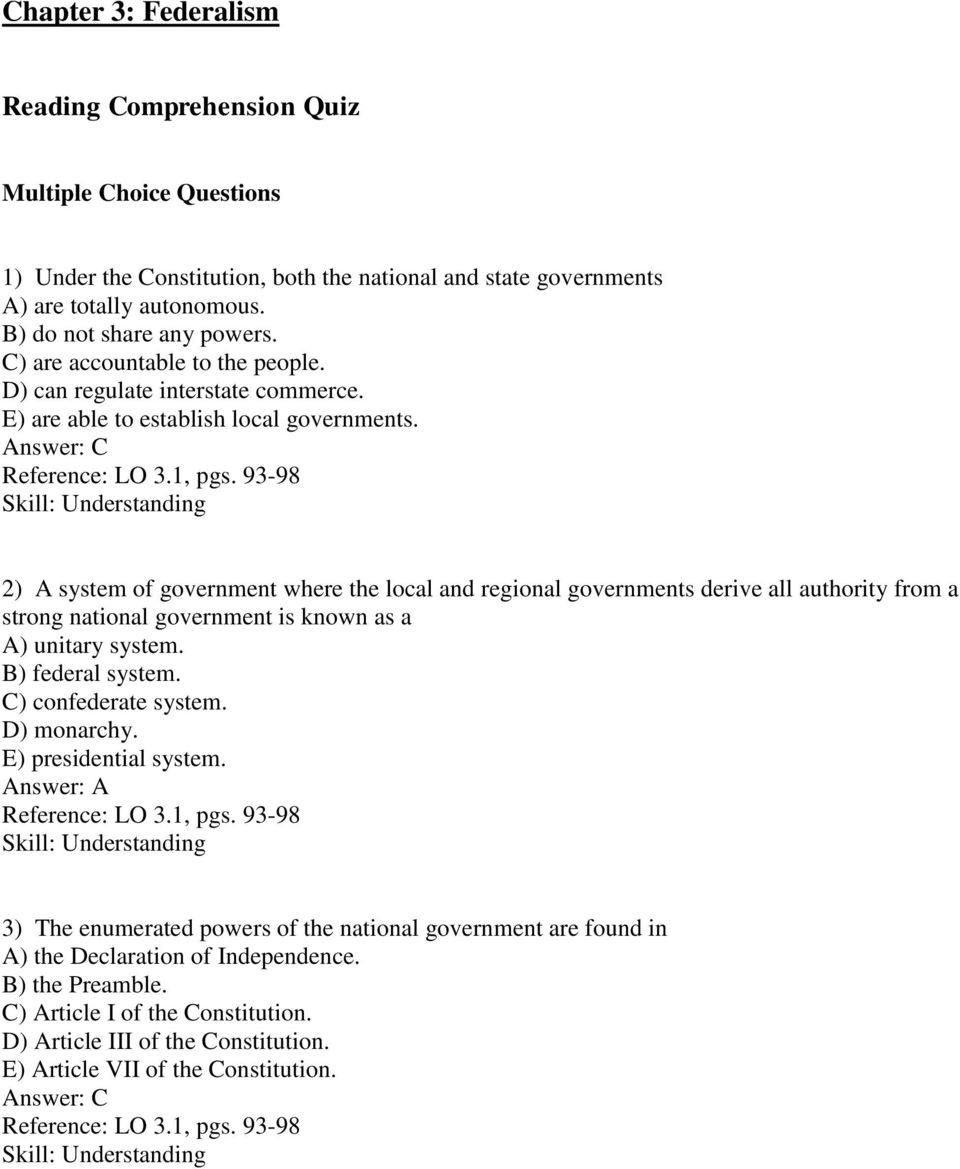
6 4) In situations of conflict between state and national law, national law prevails due to A) federalism. B) the supremacy clause. C) the Tenth Amendment. D) judicial interpretation. E) the Bill of Rights. Answer: B 5) The Tenth Amendment provides for A) states' reserve or police powers. B) states' implied powers. C) concurrent state and federal powers. D) enumerated federal powers. E) taking private property for public purposes. Answer: A 6) A law declaring an a citizen or group of citizens guilty without a judicial trial is called A) an equity law. B) an ex post facto law. C) a writ of mandamus. D) an ex officio law. E) a bill of attainder. Answer: E 7) The clause of the Constitution that ensures that judicial decrees and contracts made in one state will be binding and enforceable in another is called the clause. A) privileges and immunities B) full faith and credit C) equal protection D) supremacy E) elastic Answer: B 8) "The power to tax is the power to destroy" comes from

7 A) Alexander Hamilton's essay in The Federalist Papers. B) Thomas Paine's The Crisis. C) John Marshall's opinion in McCulloch v. Maryland. D) John Marshall's opinion in Gibbons v. Ogden. E) James Madison's essay in The Federalist Papers. Answer: C Reference: LO 3.2, pgs ) The belief that the national government should not exceed its enumerated powers and that all other powers should be reserved to the states or the people is known as A) the full faith and credit doctrine. B) the doctrine of implied powers. C) confederalism. D) dual federalism. E) the unitary political system. Answer: D Reference: LO 3.3, pgs ) Frustrated by the U.S. Supreme Court's opposition to many New Deal programs, President Franklin D. Roosevelt proposed A) impeaching the entire Supreme Court. B) reducing the pay of sitting Supreme Court justices. C) increasing the number of justices from nine to thirteen. D) packing Congress with his friends. E) reducing the number of justices from nine to seven. Answer: C Reference: LO 3.4, pgs ) Cooperative federalism has been likened to a cake. A) layer B) marble C) red velvet D) sheet E) pound Answer: B Reference: LO 3.4, pgs ) Categorical grants

8 A) were most used during the Reagan administration. B) allocate federal dollars by a precise formula. C) have few restrictions or limitations. D) were commonplace during the era of New Federalism. E) were not used until after the 1960s. Answer: B Reference: LO 3.4, pgs ) The No Child Left Behind Act is an example of A) a block grant. B) returning power to the states as specified in the Contract with America. C) a funded mandate. D) preemption. E) a categorical grant. Answer: D Reference: LO 3.5, pgs ) The Supreme Court under Chief Justice John G. Roberts, Jr., appears to be deciding federalism cases A) similar to the Rehnquist Court. B) in strong favor of the states. C) without a strong inclination toward either federal or state rights. D) in favor of the powers of the federal government. E) following the trends of New Federalism. Answer: C Reference: LO 3.5, pgs ) In The Price of Federalism, political scientist Paul E. Peterson considered how governments should best divide policymaking responsibility, focusing mainly on policies. A) redistributive and developmental B) constructive and international C) state and local D) international and regulatory E) environmental and health care Answer: A Reference: LO 3.6, pgs True/False Questions

9 1) The necessary and proper clause is the root of Congress's implied powers. 2) Setting the time, place, and manner of elections is a concurrent power. Answer: FALSE 3) Congress has attempted to make exceptions to the full faith and credit clause. 4) The Supreme Court ruled that the due process clause of the Fifth Amendment did not apply to the states in Barron v. Baltimore. Reference: LO 3.2, pgs ) McCulloch v. Maryland effectively reduced the power of the states. Reference: LO 3.2, pgs ) The Sixteenth Amendment granted states greater power over taxation. Answer: FALSE Reference: LO 3.3, pgs ) The Supreme Court generally was supportive of President Franklin D. Roosevelt's early attempts to deal with the Great Depression. Answer: FALSE Reference: LO 3.4, pgs

10 8) President Lyndon B. Johnson's Great Society program altered the fragile balance between state and federal power. Reference: LO 3.4, pgs ) Block grants are federal monies given to the states with few strings attached. Reference: LO 3.5, pgs ) According to political scientist Paul E. Peterson, developmental programs are best left to state governments. Reference: LO 3.6, pgs ) President George W. Bush promoted progressive federalism. Answer: FALSE Reference: LO 3.6, pgs
UNITARY STATES SOVEREIGNTY
 SOVEREIGNTY Systems of government are defined in terms of sovereignty: Fundamental governmental authority. The right to govern a particular people or territory. UNITARY STATES In a unitary state (or system)
Chapter 3: Federalism
 Chapter 3: Federalism 1. The main issue associated with the case of Alfonso Lopez and the Gun Free School Zones Act was (A) Lopez s guilt or innocence. (B) whether it was desirable to prohibit guns in
The Judiciary Quiz. A) I and IV B) II and III C) I and II D) I, II, and III E) I, II, III, and IV
 The Judiciary Quiz 1) Why did the Framers include life tenure for federal judges? A) To attract candidates for the positions B) To make it more difficult for the president and Congress to agree on good
CONSTITUTIONAL UNDERPINNINGS
 What Is Government? A government is composed of the formal and informal institutions, people, and used to create and conduct public policy. Public policy is the exercise doing those things necessary to
CONSTITUTIONFACTS.COM
 1. The length of term of members of the House of Representatives is: b. 6 years c. 4 years d. 5 years 2. The Constitutional Convention met in: a. New York b. Philadelphia c. Washington, D.C. d. Boston
Constitutions. It is a brief sketch of the structure of government. It limits government by setting boundaries.
 Constitutions What is a constitution? A constitution is the fundamental law of a state by which a system of government is created and from which it derives its power and authority. The fundamental law
DRAFT SOCIAL STUDIES Georgia Standards of Excellence (GSE) American Government/Civics
 DRAFT SOCIAL STUDIES American Government/Civics American Government/Civics The government course provides students with a background in the philosophy, functions, and structure of the United States government.
The Principle of Federalism: How Has The Commerce Clause Mattered?
 The Principle of Federalism: How Has The Commerce Clause Mattered? Overview The principle of federalism and the battle between the power of the federal government and state governments has been debated
How does the Constitution fix the problems of the Articles of Confederation? Problem #1. Solution to Problem #1. Problem #2 12/7/2012
 How does the Constitution fix the problems of the Articles of Confederation? Problem #1 Congress did not have enough power under the Articles Could not raise an army, collect taxes, regulate trade interstate
Federal, Confederal, and Unitary systems of government
 Federal, Confederal, and Unitary systems of government Standard 12.9.3: Discuss the advantages and disadvantages of federal, confederal, and unitary systems of government. The United States government
McCulloch v. Maryland 1819
 McCulloch v. Maryland 1819 Appellant: James William McCulloch Appellee: State of Maryland Appellant s Claim: That a Maryland state tax imposed on the Bank of the United States was unconstitutional interference
Quiz # 6 Chapter 16 The Judicial Branch (Supreme Court)
 Quiz # 6 Chapter 16 The Judicial Branch (Supreme Court) 1. The chief judicial weapon in the government s system of checks and balances is known as a. judicial activism. b. judicial interpretivism. c. judicial
4. There are three qualifications from becoming a member of the House of Representatives
 Article I Legislative Branch 1. The job of the legislative branch is to Make laws Name Period Federal Constitution Study Guide 2. The legislative branch is divided into two parts or two houses which are
Crete-Monee Middle School U.S. Constitution Test Study Guide Answers 2010-2011
 Crete-Monee Middle School U.S. Constitution Test Study Guide Answers 2010-2011 1. What is the more common name for the first ten amendments to the constitution? Bill of Rights 2. The introduction to the
Jefferson s letter objected to the omission of a Bill of Rights providing. clearly for freedom of religion, freedom of the press, protection against
 The Bill of Rights The Constitution of the United States was written by the delegates to the Constitutional Convention during the summer of 1787. Nine of the 13 states would have to ratify it before it
CHAPTER 16 THE FEDERAL COURTS CHAPTER OUTLINE
 CHAPTER 16 THE FEDERAL COURTS CHAPTER OUTLINE I. Politics in Action: Appealing to the Supreme Court (pp. 509 510) A. The Supreme Court has considerable power. B. The Supreme Court makes only the tiniest
Famous Americans on the Civics Test Portraits and Flash Cards
 Famous Americans on the Civics Test Portraits and Flash Cards Introduction Twelve Americans are highlighted on the civics test for naturalization. To introduce their roles and historical contributions,
AP U.S. Government and Politics Syllabus
 AP U.S. Government and Politics Syllabus Course Description: AP Government and Politics is an introduction course designed to provide students with a thorough understanding of the principles of government
Revolution and Independence d Life in colonial America Seven Years (French and Indian) War, 1756-6363 British demand for higher taxes to pay war debt
 The Constitution I. Revolution and Independence d II. Articles of Confederation III. Constitutional Convention IV. Constitutional Basics V. Ratification VI. Constitutional Change Revolution and Independence
COLUMBIA LAW SCHOOL PUBLIC LAW & LEGAL THEORY WORKING PAPER GROUP
 COLUMBIA LAW SCHOOL PUBLIC LAW & LEGAL THEORY WORKING PAPER GROUP PAPER NUMBER 14-423 THE SECOND COMMERCE CLAUSE PHILIP HAMBURGER NOVEMBER 2014 THE SECOND COMMERCE CLAUSE 2014 Philip Hamburger The Commerce
AP US Government & Politics Review Packet
 AP US Government & Politics Review Packet This packet is designed to assist you in preparing for your AP Final Exam; in no way should this packet be used as your only preparation method. You should use
3. addition of the elastic clause to the. 4. start of the first political parties
 1 of 5 2/8/2012 4:49 PM Name: The major role of political parties in the United States is to meet constitutional requirements nominate candidates and conduct political campaigns continue a tradition that
Four Key Constitutional Principles
 University of Virginia Center for Politics Four Key Constitutional Principles Purpose: Through this lesson, students will understand the four key principles of the Constitution: separation of powers, checks
I will check my email except during the times listed below due to family obligations:
 AP US Government & Politics Summer Assignment 2015 My email address: [email protected] I will check my email except during the times listed below due to family obligations: June 1-7, June
The Structure of the National Government
 The Structure of the National Government The first national framework of the United States government, the Articles of Confederation, took effect in 1781 and established only one branch of government.
Who Governs? CHAPTER 22 REVIEWING THE CHAPTER CHAPTER FOCUS STUDY OUTLINE
 CHAPTER 22 Who Governs? REVIEWING THE CHAPTER CHAPTER FOCUS This chapter provides an overview of American politics and central themes of the text, namely, Who Governs? To What Ends? A broad perspective
Constitution Study Guide
 Constitution Study Guide of the United States and the State of Illinois Published by the Illinois Community College Board Table of Contents Part One: The Declaration of Independence 1 Declaring Independence
17. WHO BECOMES PRESIDENT OF THE UNITED STATES IF THE PRESIDENT SHOULD DIE? 22. HOW MANY CHANGES OR AMENDMENTS ARE THERE TO THE CONSTITUTION?
 DEPARTMENT OF JUSTICE Immigration & Naturalization Service 100 Typical Questions 1. WHAT ARE THE COLORS OF OUR FLAG? 2. HOW MANY STARS ARE THERE IN OUR FLAG? 3. WHAT COLOR ARE THE STARS ON OUR FLAG? 4.
American Government/Civics
 American Government/Civics The government course provides students with a background in the philosophy, functions, and structure of the United States government. Students examine the philosophical foundations
Course Syllabus AP US Government and Politics
 Course Syllabus AP US Government and Politics Course Description According to the College Board, AP US Government and Politics is designed to give students an analytical perspective on government and politics
1.2.4 Compare and contrast direct and representative democracy. (See USHG F1.1; F1.2)
 Content Expectation High School Civics Content Expectations I Can statement 1.1 Nature of Civic Life, Politics, and Government Explain the meaning of civic life, politics, and government through the investigation
The Judiciary CHAPTER 16 REVIEWING THE CHAPTER CHAPTER FOCUS STUDY OUTLINE
 CHAPTER 16 The Judiciary REVIEWING THE CHAPTER CHAPTER FOCUS This chapter introduces you to the final and perhaps most unusual branch of American government: the courts. The chapter explains how courts,
AP US Government and Politics Course Syllabus 2007
 General Course Description Advanced Placement U.S. Government and Politics will give students an analytical perspective on government and politics in the United States. This course includes both the study
THE STUDENT S GUIDE TO UNDERSTANDING CONSTITUTIONAL LAW
 THE STUDENT S GUIDE TO UNDERSTANDING CONSTITUTIONAL LAW Online Companion John DeLeo Australia Canada Mexico Singapore Spain United Kingdom United States The Articles of Confederation and Madisonian Democracy
AP United States Government and Politics Miss Samuel Email: [email protected]
 Course Overview/Description AP United States Government and Politics Miss Samuel Email: [email protected] AP government and Politics is a semester long course that examines the formal and informal
Federalism CHAPTER 3 REVIEWING THE CHAPTER CHAPTER FOCUS STUDY OUTLINE
 CHAPTER 3 Federalism REVIEWING THE CHAPTER CHAPTER FOCUS The central purpose of the chapter is to introduce you to some of the complexities of government in the United States caused by the adoption of
OHIO S NEW LEARNING STANDARDS: AMERICAN GOVERNMENT - Quick Reference for Learning Targets + Item Specifications for State Summative Exams
 CS1 The content encompassed by this will not be assessed. N/A Stimulus Attributes N/A N/A Civic Involvement 1 Opportunities for civic engagement with the structures of government are made possible through
1965 Alabama Literacy Test
 1965 Alabama Literacy Test 1. Which of the following is a right guaranteed by the Bill of Rights? Public Education Employment Trial by Jury Voting 2. The federal census of population is taken every five
ASSESSMENT DATA BANK
 ASSESSMENT DATA BANK Assessing Constitutional Knowledge Traditionally, states and schools have measured student knowledge of the U.S. Constitution using a written test on objective facts and principles.
The Role of Government
 The Role of Government Imagine for a moment living under a government that possessed unlimited and undefined powers, such as Communist China or Nazi Germany. What rights do you have now that you think
4.7: Checks on Presidential Power AP U. S. Government
 4.7: Checks on Presidential Power AP U. S. Government Formal Checks Found in U. S. Constitution Presidential or Executive Power Appoint Cabinet Officers, Federal Judges, and Ambassadors But, had to be
The Constitution: A More Perfect Union
 The Constitution: A More Perfect Union 9.1 Introduction When the delegates left Independence Hall in September 1787, they each carried a copy of the Constitution. Their task now was to convince their states
Course Syllabus AP Government Syllabus
 Course Syllabus AP Government Syllabus Course Description: AP United States Government and Politics is a one-semester, college level course offered to students who wish to be academically challenged and
1. Knowledge of the principles expressed in documents shaping constitutional democracy in the United States
 Social Studies Grades 9-12 Ohio Missouri United States GOVERNMENT 2006 STANDARDS Principles of Constitutional Democracy 1. Knowledge of the principles expressed in documents shaping constitutional democracy
Powers of Congress. Expressed, Implied, and Non-Legislative
 Powers of Congress Expressed, Implied, and Non-Legislative What are the basic powers of Congress? w Under the Constitution, Congress has three (3) sets of powers: n n n Expressed Powers: Powers specifically
Standards Map - Basic Comprehensive Program Grade Twelve - History-Social Science Principles of American Democracy
 Pearson Prentice Hall Program Title: Civics: Government and Economics in Action 2007 Components: SE (Student Edition), TE (Teacher's Edition) Grade Level(s): 12 Intended Audience: High School s Map - Basic
Chapter 2, Section 4: Launching the New Nation
 Chapter 2, Section 4: Launching the New Nation With George Washington the first president, the United States begins creating a working government for its new nation. Opening Activity: In a paragraph discuss
AP United States Government & Politics Syllabus
 AP United States Government & Politics Syllabus Syllabus The AP Government course will be taught as a second semester course with about twenty-four students. Students will enroll during the second semester
The Constitution CHAPTER 2 REVIEWING THE CHAPTER CHAPTER FOCUS
 CHAPTER 2 The Constitution REVIEWING THE CHAPTER CHAPTER FOCUS The purpose of this chapter is to introduce you to the historical context within which the U.S. Constitution was written and in particular
Ch 1 Law exam. Name: Class: Date: True/False Indicate whether the statement is true or false.
 Name: Class: Date: Ch 1 Law exam True/False Indicate whether the statement is true or false. 1. Our law codes today are similar to those of civilizations thousands of years old. 2. A group of laws put
Three Branches of Government Webquest
 Name Three Branches of Government Webquest This Webquest has 4 parts: Part 1: Executive Branch Part 2: Legislative Branch Part 3: Judicial Branch Part 4: Branches of Power Game For Parts 1, 2, and 3, you
THE CONSTITUTION IN PLAIN ENGLISH
 THE CONSTITUTION IN PLAIN ENGLISH The Constitution consists of a preamble, 7 articles, and 27 amendments. The preamble explains why it was written. The seven articles lay out the three branches of government
Vital Supreme Court Cases to know for the. Government Regents. Created by Ms. Iacopelli and Mr. Gross
 Vital Supreme Court Cases to know for the U.S. History and Government Regents Created by Ms. Iacopelli and Mr. Gross Supreme Court of the United States The important court cases you should know for your
AP Government Free Response Questions 1988 2006
 AP Government Free Response Questions 1988 2006 1988 The Bureaucracy, Political Parties 1. To what extent does the United States federal bureaucracy stand above politics and administer impartially the
Commemorating the 200th Anniversary of. MARBURY v. MADISON THE SUPREME COURT S FIRST GREAT CASE FEBRUARY 1803
 Commemorating the 200th Anniversary of MARBURY v. MADISON THE SUPREME COURT S FIRST GREAT CASE FEBRUARY 1803 MARBURY V.MADISON is perhaps the most important opinion in Supreme Court history. It secured
Academic Standards for Civics and Government Pennsylvania Department of Education
 Academic Standards for Civics and Government Pennsylvania Department of Education 22 Pa. Code, Chapter 4, Appendix C (#006-275) Final Form-Annex A July 18, 2002 XIII. TABLE OF CONTENTS Introduction.. XIV.
Forming a More Perfect Union
 27 Lesson Two Forming a More Perfect Union Introduction By 1786, it was apparent that the weaknesses inherent in the Articles of Confederation had to be addressed. A Constitutional Convention was convened
Civics. Social Studies Curriculum Framework. Revised 2006
 Civics Social Studies Curriculum Framework Revised 2006 Course Title: Civics Course/Unit Credit: 1 Course Number: Teacher Licensure: Secondary Social Studies Civics Civics provides a study of the structure
U. S. Constitution [8th grade]
![U. S. Constitution [8th grade]](/thumbs/40/20655561.jpg "U. S. Constitution [8th grade]") Trinity University Digital Commons @ Trinity Understanding by Design: Complete Collection Understanding by Design 6-15-2006 U. S. Constitution [8th grade] Ben Altman Trinity University Follow this and
Trinity University Digital Commons @ Trinity Understanding by Design: Complete Collection Understanding by Design 6-15-2006 U. S. Constitution [8th grade] Ben Altman Trinity University Follow this and
Lesson 19 SLAVERY AND THE CONSTITUTION. Lesson Objectives: Unit 7 THE CONSTITUTION ON SLAVERY AND VOTING
 THE CONSTITUTION ON SLAVERY AND VOTING SLAVERY AND THE CONSTITUTION Lesson Objectives: When you complete Lesson 19, you will be able to: Understand that the term slave or slavery is not in the Constitution.
Within the pages of the Health-Care Reform Bill lies mandatory health insurance, a
 Within the pages of the Health-Care Reform Bill lies mandatory health insurance, a current topic of Constitutional debate. The specific part of the bill itself, referred to as the individual mandate, states
Chapter 6 The Constitution and Business. Laws that govern business have their origin in the lawmaking authority granted by the federal constitution.
 Chapter 6 The Constitution and Business Laws that govern business have their origin in the lawmaking authority granted by the federal constitution. The Constitutional Powers of Government The Constitution
The GED Ready Practice Test Social Studies Extended Response Prompts and Source Texts
 2014 GED Test Resources The GED Ready Practice Test Social Studies Extended Response Prompts and Source Texts The enclosed source texts are drawn directly from the Extended Response (ER) tasks on the GED
Teacher lecture (background material and lecture outline provided) and class participation activity.
 Courts in the Community Colorado Judicial Branch Office of the State Court Administrator Updated January 2010 Lesson: Objective: Activities: Outcomes: Implications and Impact of Court Decisions Students
Three Branches of Government. Lesson 2
 Three Branches of Government The Executive Branch The President of the United States is the leader of the executive branch. The President s duties are to: Enforce federal laws and recommend new ones Serve
Addendum: Civics and Economics
 Addendum: Civics and Economics This addendum reflects the alignment of the Civics and Economics Essential Standards to the content enumerated in The Founding Principles Act (SL 2011-273) that was passed
Chapter One: Our Laws. Lessons: 1-1 Our Laws & Legal System 1-2 Types of Laws
 Chapter One: Our Laws Lessons: 1-1 Our Laws & Legal System 1-2 Types of Laws Lesson 1-2 Goals Explain how constitutional, statutory, case and administrative laws are created Explain how to resolve conflicts
1. Title: The Organizational Structure and Powers of the Federal Government as Defined in Articles I, II, and III of the U.S. Constitution Grade 5
 Teacher s Name: Employee Number: School: SS.5.C.3.1 Describe the organizational structure (legislative, executive, judicial branches) and powers of the federal government as defined in Articles I, II,
ADVANCED PLACEMENT UNITED STATES GOVERNMENT AND POLITICS
 ADVANCED PLACEMENT UNITED STATES GOVERNMENT AND POLITICS TEXTBOOK: Government in America: People and Policy. (12 th Edition) Edwards, Wattenberg, and Lineberry SUPPLEMENTAL TEXT: American Government Readings
Basic Timeline 1776 Declaration of Independence 1781 Articles of Confederation 1787 U.S. Constitution 1861-1865 Civil War 1865-1877 Reconstruction
 Basic Timeline 1781 Articles of Confederation 1776 Declaration of Independence 1861-1865 Civil War 1787 U.S. Constitution 1865-1877 Reconstruction Historical Context: The Revolution The American Revolution
Government in America People, Politics, and Policy 16th Edition, AP Edition 2014
 A Correlation of 16th Edition, AP Edition 2014 Advanced Placement U.S. Government and Politics AP is a trademark registered and/or owned by the College Board, which was not involved in the production of,
Summary of the Decision by the U.S. Supreme Court on the Patient Protection and Affordable Care Act
 Summary of the Decision by the U.S. Supreme Court on the Patient Protection and Affordable Care Act Prepared by Harvard Law School s Center for Health Law and Policy Innovation The Patient Protection and
Democratic versus Republican Perspectives By Kristen Parla
 Democratic versus Republican Perspectives By Kristen Parla INTRODUCTION Despite still being a relatively young country, the United States of America has a long and colorful political history. Each of the
Appendix A: American History: The Founding Principles, Civics and Economics
 Appendix A: American History: The Founding Principles, Civics and Economics This appendix contains additions made to the North Carolina s for Civics and Economics pursuant to the North Carolina General
Republican Era. A07qW 10.1015
 Republican Era A07qW 10.1015 TOPIC OUTLINE A. Republican America in the early 1800s 1. Religion: Beginnings of the Second Great Awakening 2. Women: Republican motherhood & education for women 3. Cultural
Social Studies Lesson Plan- SS.4.C.3.1 Identify the three branches (Legislative, Judicial, Executive) of government in Florida and the powers of each
 Teacher s Name: Employee Number: School: Social Studies Lesson Plan- SS.4.C.3.1 Identify the three branches (Legislative, Florida and the powers of each 1. Title: Florida s Three Branches of Government-
About Constitution Day
 7/8 About Constitution Day In 1952, President Harry S. Truman signed a bill that moved I Am an American Day from the third Sunday in May to September 17 so that this holiday would coincide with the signing
Administration and Management in Criminal Justice. Chapter 4: Environmental Influences
 Administration and Management in Criminal Justice Chapter 4: Environmental Influences Criminal Justice as an Open System Criminal justice system organizations operate within a larger environment comprised
The Role of Congress in the Federal Regulatory Process. Thomas J. Spulak, Esq. March 24, 2011
 The Role of Congress in the Federal Regulatory Process Thomas J. Spulak, Esq. March 24, 2011 3 Branches of Government Under the U.S. Constitution, the three branches of government--legislative, Executive
FRQ PACKET. In this packet are all of the FRQs that the College Board has asked during the May AP Government & Politics Exam.
 AP United States Government and Politics FRQ PACKET In this packet are all of the FRQs that the College Board has asked during the May AP Government & Politics Exam. There is also a table of contents on
Chapter 9: The Policies of Alexander Hamilton and Thomas Jefferson
 Chapter 9: The Policies of Alexander Hamilton and Thomas Jefferson Department of State, Department of Treasury, Department of War, Attorney General, Postmaster General : 5 government departments established
A Brief Explanation of the Constitution of the United States
 A Brief Explanation of the Constitution of the United States The Constitution was adopted and signed by 39 of the 55 delegates to the Constitutional Convention in Philadelphia, Pennsylvania on September
BRADY MATTERS. Troy Rawlings, Davis County Attorney. April 10, 2014 UPC Spring Conference. Christmas Eve Shooting that Didn t Happen (Or did it?
 BRADY MATTERS Troy Rawlings, Davis County Attorney April 10, 2014 UPC Spring Conference I. Scenarios Christmas Eve Shooting that Didn t Happen (Or did it?): Get out of here; Don t tell the County Attorney;
APPENDIX A - CHARTER ORDINANCES
 APPENDIX A - CHARTER ORDINANCES NOTE: The charter ordinances included herein are for information only. Each of them contains the substance as adopted by the governing body but enacting clauses, publication
SOCIAL STUDIES CURRICULUM BASED ON MSDE STANDARDS AND GOALS. National, State, and Local Government. Functions and Powers
 SOCIAL STUDIES CURRICULUM BASED ON MSDE STANDARDS AND GOALS National, State, and Local 3UNIT THREE Functions and Powers EXECUTIVE, LEGISLATIVE, AND JUDICIAL Office of Curriculum and Instructional Programs
3. Private land ownership would become the cornerstone of American democracy? a. True
 A DVD History of the U.S. Constitution Blackline Master 1A Quiz Program One: The Seeds of the Constitution Circle the Correct Answer(s) 1. The first legislature in the colonies was a. The Virginia House
CORRELATION SUNSHINE STATE STANDARDS. 1 SE = Student Edition TE = Teacher Edition TR = Teacher Resources TECH = Technology
 CORRELATION SUNSHINE STATE STANDARDS SUBJECT: Social Studies SUBMISSION TITLE: Prentice Hall Civics: Government and Economics In Action 2005 PUBLISHER: Pearson Prentice Hall GRADE: Grade 6-8 M/J Civics/
CI FINANCIAL CORP. BOARD OF DIRECTORS MANDATE. As of August 4, 2016
 CI FINANCIAL CORP. BOARD OF DIRECTORS MANDATE As of August 4, 2016 The Board of Directors of CI Financial Corp. (the Company ) is responsible for the stewardship of the Company and in that regard has the
Constitutional Law - Judicial Review - Legalized Gambling - Louisiana State Racing Commission
 Louisiana Law Review Volume 16 Number 2 The Work of the Louisiana Supreme Court for the 1954-1955 Term February 1956 Constitutional Law - Judicial Review - Legalized Gambling - Louisiana State Racing Commission
Chapter 3. Justice Process at the County Level. Brooks County Courthouse
 Chapter 3 Justice Process at the County Level Brooks County Courthouse Chapter Three: Judice Process at the County Level Developmental Assets: Life Skills: TEKS: Objectives: 10. Safety 30. Responsibility
THE CRIMINAL JUSTICE RESPONSE TO CORRUPTION (IN THE CONTEXT OF NEPAL)
 139TH INTERNATIONAL TRAINING COURSE RESOURCE VISITING MATERIAL EXPERTS SERIES PAPERS No.79 THE CRIMINAL JUSTICE RESPONSE TO CORRUPTION (IN THE CONTEXT OF NEPAL) Rajan Prasad Bhattarai * I. HISTORICAL BACKGROUND
Landmark Rulings of the United States Supreme Court
 Landmark Rulings of the United States Supreme Court Marbury v. Madison, 1803 First Supreme Court decision to declare an act of Congress unconstitutional; established the Court s power of judicial review.