
I N F L AT I O N R E P O R T
|
|
|
- Millicent Norman
- 9 years ago
- Views:
Transcription
1 I N F L AT I O N R E P O R T S E P T E M B E R 15

2 ... wise is the man who can put purpose to his desires. Miklós Zrínyi: The Life of Matthias Corvinus

3 I N F L AT I O N R E P O R T S E P T E M B E R 15
4 Published by the Magyar Nemzeti Bank Publisher in charge: Eszter Hergár H-15 Budapest, Szabadság tér 9. ISSN -873 (print) ISSN -877 (on-line)

5 Pursuant to Act CXXXIX of 13 on the Magyar Nemzeti Bank, the primary objective of Hungary s central bank is to achieve and maintain price stability. Low inflation ensures higher long-term economic growth and a more predictable economic environment, and moderates the cyclical fluctuations that impact both households and companies. In the inflation targeting system in use since August 5, the Bank has sought to attain price stability by ensuring an inflation rate near the 3 per cent medium-term target. The Monetary Council, the supreme decision-making body of the Magyar Nemzeti Bank, performs a comprehensive review of expected developments in inflation every three months, in order to establish the monetary conditions consistent with achieving the inflation target. The Council s decision is the result of careful consideration of a wide range of factors, including an assessment of prospective economic developments, the inflation outlook, financial and capital market trends and risks to stability. In order to provide the public with a clear insight into how monetary policy works and to enhance transparency, the Bank publishes the information available at the time of making its monetary policy decisions. The Report presents the inflation forecasts prepared by the Directorate Economic Forecast and Analysis, the Directorate Monetary Policy and Financial Market Analysis, the Directorate for Fiscal and Competitiveness Analysis and the Directorate Financial System Analysis, as well as the macroeconomic developments underlying these forecasts. The forecast is based on the assumption of endogenous monetary policy. In respect of economic variables exogenous to monetary policy, the forecasting rules used in previous issues of the Report are applied. The analyses in this Report were prepared under the direction of Barnabás Virág, Executive Director of the Directorate Monetary Policy, Financial Stability and Lending Incentives. The Report was prepared by staff at the MNB's Directorate Economic Forecast and Analysis, Directorate Monetary Policy and Financial Market Analysis, Directorate for Fiscal and Competitiveness Analysis and Directorate Financial System Analysis. The Report was approved for publication by Márton Nagy, Deputy Governor. The Report incorporates valuable input from other areas of the MNB and the Monetary Council's comments. The projections are based on information available for the period ending 17 September 1.

6

7 THE MONETARY COUNCIL S STATEMENT ON MACROECONOMIC DEVELOPMENTS CONTENTS The Monetary Council s statement on macroeconomic developments Inflation and real economy outlook Inflation forecast Real economy forecast Labour market forecast Effects of alternative scenarios on our forecast Macroeconomic overview International environment Aggregate demand Production and potential output Employment and unemployment Cyclical position of the economy Costs and inflation.... Financial markets and interest rates Domestic financial market developments Credit conditions of the financial intermediary system The balance position of the economy External balance and financing Forecast for Hungary s net lending position Fiscal developments Special topics A possible exit and tightening strategy of the Fed Emerging market deceleration vs. growth and financial risks surrounding China Breakdown of the average consumer price index for 15 and List of charts and tables INFLATION REPORT SEPTEMBER 15 5

8 5 MAGYAR NEMZETI BANK LIST OF BOXES Box 1-1: Main external assumptions behind the projections Box 3-1: Reasons for the recent decline in commodity prices Box 3-: The saving rate of households Box 3-3: Development of the indicator capturing the underlying trends of economic activity... 1 Box -1: How does the level of central bank reserves influence the willingness to lend?... INFLATION REPORT SEPTEMBER 15

9 THE MONETARY COUNCIL S STATEMENT ON MACROECONOMIC DEVELOPMENTS THE MONETARY COUNCIL S STATEMENT ON MACROECONOMIC DEVELOPMENTS AND ITS MONETARY POLICY ASSESSMENT The three-month, fixed-rate central bank deposit will be the Magyar Nemzeti Bank s main policy instrument from 3 September 15, replacing the two-week deposit facility. Consequently on its meeting of September, the Monetary Council has made its policy decision on the interest rate on this facility. The three-month deposit facility will be available without limit, the maturity of the policy interest rate will be extended from two weeks to three months. The two-week central bank deposit will remain part of the Bank s instruments; however, the facility will be offered at auctions, with quantity limits. Quantitative limits will be placed on the stock of two-week deposits first on 3 September 15. Thereafter, the stock of deposits will fall gradually to the HUF 1, billion limit set by the end of the year. In the Monetary Council s assessment, persistently loose monetary conditions are consistent with the achievement of price stability. In the Council s assessment, the medium-term achievement of the Bank s inflation target and a corresponding support to the real economy point in the direction of maintaining loose monetary conditions for an extended period. In addition to the primary goal of meeting the inflation target, the Council also takes into account the condition of the real economy and incorporates financial stability considerations into its decisions. The performance of the global economy has continued to be subdued in recent months. Inflation around the world remains at low levels. Significant differences remain across the individual regions in terms of economic growth. Of the world s developed regions, growth in the euro area picked up slightly in the second quarter of 15. The US economy grew strongly in the period. Most major emerging market economies are decelerating. Reflecting low crude oil and commodity prices as well as subdued demand environment, global inflation trends and inflationary pressure in the global economy are likely to remain moderate looking ahead. The monetary policy stance of globally influential central banks remained unchanged although continues to be different in recent months: the ECB and the Bank of Japan continued their asset purchase programmes, while the US Fed was preparing for the appropriate timing and magnitude of its interest rate increase postponed to a later date than the market had expected. Monetary conditions remain loose overall and, consequently, global interest rate and liquidity conditions continue to be supportive. In the Council s assessment, inflation is likely to be below the inflation target this year and next, and is expected to rise to levels around 3 per cent only in the second half of 17. The Council expects inflation to be significantly below the inflation target over the short term. According to data becoming available in recent months, the underlying trends were in line overall with the projection in the June issue of the Inflation Report. The difference between the projection and the actual outcome for the consumer price index was mainly accounted for lower fuel prices. Inflation is likely to develop firmly into positive territory towards the end of the year. Core inflation is likely to pick up gradually as costs increase continuingly and slowly from low levels and as a result of an expansion in domestic demand and rises in wages. However, the horizon over which the inflation target is expected to be achieved has been extended by around two quarters relative to the previous projection, due to the persistently low cost environment and slightly lower underlying inflation looking ahead, and therefore inflation is expected to rise to levels around 3 per cent only in the second half of 17. The stabilisation of inflation expectations around the target is likely to support that price and wage-setting will be consistent with the inflation target over the medium term as domestic demand growth strengthens. Domestic economic growth is likely to continue, supported by a gradual rise in both external and domestic demand. Growth in the domestic economy has continued over recent period. Domestic demand is likely to make an increasing contribution to growth. Rising exports reflecting growth in Hungary s export markets are also expected to support domestic economic growth. The improvement in the labour market and the low inflation environment contribute to household real income growth, which in turn is expected to facilitate the expansion in household consumption. The conversion of foreign currency loans reduces the household sector s vulnerability, which may support the gradual easing INFLATION REPORT SEPTEMBER 15 7

10 5 MAGYAR NEMZETI BANK of consumers precaution. Household investment activity is expected to strengthen over the forecast horizon, due to the pick-up in the housing market and the extension of the housing subsidy system. Lower transfers from the EU are likely to have an opposite effect on growth. Economic growth is expected to slow in early 1 as EU transfers decline; however, economic performance is expected to improve from the second half of next year, supported by the improvement in lending activity and the resumption in EU funding. The negative output gap is expected to close at the end of the forecast horizon, and therefore it is likely to continue to have a disinflationary impact in the coming quarters. The economy s external vulnerability may continue to decrease. Hungary s external financing capacity increased further in early 15, with the surpluses on foreign trade and the transfer balance continuing to be the major contributing factors. Looking at the structure of external financing, the outflow of debt liabilities continued, the effect of which was mitigated by a fall in interest rates and exchange rate revaluation due to the appreciation of the US dollar. As a result, the country s external debt ratios remained broadly unchanged. Hungary s external financing capacity is likely to remain strong over the forecast horizon, exceeding 9 per cent of GDP this year. Net exports are expected to rise further in 15 1, reflecting the positive impact on the terms of trade of the decline in oil prices and the favourable external demand. In 1, the external financing capacity is likely to remain high, but is expected to fall slightly, due to lower transfers from the EU. The deficit on the income balance is likely to stabilise, reflecting the effect of the decline in interest expenses in addition to a declining debt trajectory and rising profits of companies as economic growth continues. In addition to the continuing very high level of net lending, the Bank s selffinancing programme and the conversion into forint of foreign currency loans are also likely to contribute to a further decline in the country s external debt ratios. Sentiment in international financial markets was volatile but unfavourable overall. During the period developments related to Greek government debt problems, concerns over growth in emerging economies and China, disturbances in Chinese capital markets and uncertainty about the interest rate increase by the US Fed were the main factors contributing to the negative investor sentiment. Of the domestic measures of risk, the CDS spread has risen slightly, while long-term forint bond yields have fallen since the publication of the June Inflation Report. The forint has remained broadly unchanged against the euro in the past quarter. In the Council s assessment, a cautious approach to monetary policy is still warranted due to uncertainty in the global financial environment. The macroeconomic outlook is surrounded by both upside and downside risks. The Monetary Council considered two alternative scenarios around the baseline projection in the September Inflation Report, which might influence significantly the future conduct of monetary policy. In the first alternative scenario, the persistently low cost environment and strengthening second-round effects pose an upside risk on economic growth and a downside risk on inflation. Consequently, the inflation target can be achieved with looser monetary conditions than assumed in the baseline projection. In the second alternative scenario, financial market turbulence leads to a sudden, sharp increase in the risk premium and a decline in external demand. For this alternative scenario, tighter monetary policy than assumed in the baseline projection ensures the achievement of the inflation target at the forecast horizon. In the Council s assessment, there continues to be a degree of unused capacity in the economy and inflationary pressures are likely to remain moderate. The negative output gap is expected to close only gradually over the policy horizon. In view of the projection in the September Inflation Report, the Monetary Council assesses that the current level of the base rate and maintaining loose monetary conditions for an extended period, over a longer horizon than expected, are consistent with the medium-term achievement of the inflation target and a corresponding degree of support to the economy. 8 INFLATION REPORT SEPTEMBER 15
11 Inflation (annual average) SUMMARY TABLE OF THE BASELINE SCENARIO (Forecast based on endogenous monetary policy) Actual Projection Core inflation Core inflation without indirect tax effects Inflation Economic growth External demand (GDP based) Household consumption expenditure Government final consumption expenditure Gross fixed capital formation Domestic absorption Export Import GDP External balance 1 Current account balance. 5.. External financing capacity Government balance 1,5 ESA balance (1 data is preliminary)... Labour market Whole-economy gross average earnings Whole-economy employment Private sector gross average earnings Private sector employment Unemployment rate Unit labour cost in the private sector Household real income As a percentage of GDP. According to the original HCSO data for full-time employees. 3 Private sector unit labour cost calculated with full time equivalent domestic employment. MNB estimate. 5 With complete cancellation of free reserves. INFLATION REPORT SEPTEMBER 15 9

12 5 MAGYAR NEMZETI BANK 1. INFLATION AND REAL ECONOMY OUTLOOK In the past period, the economy continued to expand, however, at a pace somewhat more moderate than in the previous quarters. Rising domestic demand was the main contributor to economic growth. Inflation remained subdued in the summer months as well. Underlying developments were in line with the June forecast, while the difference observed in the overall consumer price index was due to the lower fuel prices. Private sector employment continued to grow in Q, while wage dynamics remained subdued. Inflation may fall short of its medium-term target this year and next year as well, and achieving the 3 per cent target may be delayed further. The Hungarian economy is surrounded by a globally low-cost environment, with the large fall in oil prices also contributing significantly to this in recent months. Expectations indicate that the favourable cost environment may remain in place over the entire forecast horizon. The annual inflation rate may sink below positive levels in the coming month, before gradually increasing due to base effects around the end of the year. As for domestic factors, a continuing pick-up in household consumption and nominal wage dynamics may gradually lift underlying inflation trends. Although stronger consumption may expand companies pricing leeway, its inflationary effect may be lower than seen prior to the crisis, especially due to the moderate cost environment. Accordingly, compared to our June forecast, inflation may only approach the medium-term target two quarters later, in 17 H. The stabilisation and anchoring of inflation expectations contribute to the consistency of price- and wage-setting decisions with the inflation target over the medium term, in parallel with the pick-up in domestic demand. The balanced expansion of the Hungarian economy may continue in the coming years, but at a more moderate pace than during the previous period. Strong growth above 3 per cent is expected for this year. Nevertheless, as agricultural production shows persistent volatility over time, a negative outturn in crop yields may pose a downward risk to the annual growth rate. Growth may slow in early 1, due to base effects and funds originating from EU cohesion funds and the Funding for Growth Scheme run out. However, strengthening lending activity, the accelerating withdrawal of EU funds, and increasing external demand may all contribute to improving economic performance from 1 H. Compared to previous years, stronger domestic demand may play an increasingly dominant role in growth. The deteriorating growth prospects of emerging market economies may reduce the expected demand of Hungary s export markets, but these negative effects might be offset by the low commodity prices and increasing European growth. In addition to low commodity prices, the ECB s asset purchase programme also supports the economic performance of the euro area, Hungary s most important trading partner. In conjunction with this, exports may also continue to expand. Next year, low inflation and a further reduction in the income tax rate will increase the purchasing power of household incomes, in addition to improvement on the labour market. Household indebtedness has gradually decreased in recent years, and thus deleveraging is constraining the recovery in domestic consumption to a lesser and lesser degree. The conversion of FX loans into HUF-denominated loans may further reduce households sensitivity to the exchange rate, also contributing to a decline in precautionary considerations and an easing of balance sheet adjustment pressure. Moreover, in addition to rising real incomes, the gradually decline in the financial savings rate from its high level also facilitates the rebound in household consumption. In the coming years, the share of fixed investments in the national economy relative to output may remain consistently above per cent, but its structure will be substantially transformed. Public investment will decline in parallel with a sharp fall in the inflow of EU funds, while the expansion in private investment is expected to steadily recover. In addition to the strengthening of lending activity, improving demand prospects may also facilitate the expansion of corporate investment. At the same time, households investment activity may strengthen as a result of more stable longer-term income expectations and the historically low yield environment. Employment growth in the national economy may continue, supported by the expansion of public employment programmes and a growing workforce in the private sector. Corporate labour demand may continue to rise as a result of more favourable economic activity, and thus the unemployment rate will decline in parallel with expanding activity. Increasing labour market tightness, the improvement in corporate profitability and productivity all point to an increase in real wages. Due to inflation expectations adapting to the recent low inflation environment, we expect wages to remain moderate in the private sector over the first half of our forecast horizon. At the same time, with an increase in the inflation rate we expect private sector wage growth to rise to a level consistent with the inflation target in the second half of our forecast horizon 1 INFLATION REPORT SEPTEMBER 15
13 INFLATION AND REAL ECONOMY OUTLOOK The external financing capacity of the Hungarian economy may remain permanently consistently high in the coming years, contributing to the ongoing decline in net external debt. With prudent fiscal policy, the budget deficit may remain well below 3 per cent of GDP this year and per cent next year. Overall, disinflationary effects still remain in place in the real economy. The level of household consumption is significantly below its pre-crisis value, but the future increase in domestic demand will result in the closing of the output gap. The global output gap continues to be negative and may only slowly close. Inflation may rise towards the target only by 17 H, in parallel with the slow rise in commodity prices from depressed levels and an upswing in demand. INFLATION REPORT SEPTEMBER 15 11

14 MAGYAR NEMZETI BANK 1.1. Inflation forecast As a result of the significant decline in oil prices in recent months, inflation may remain subdued in the coming quarters. Core inflation may gradually increase, in line with a slow increase in costs as well as a pick-up in household consumption and wage dynamics. Although stronger consumption may expand companies pricing leeway, the effect of this on inflation may be lower compared to prior to the crisis. Accordingly, inflation may approach the medium-term target only in 17 H. Compared to our previous forecast, the horizon for achieving the inflation target has been delayed by nearly half a year. Chart 1-1: Fan chart of the inflation forecast Source: MNB Chart 1-: Monthly evolution of the near-term inflation forecast Inflation target Uncertainty band June forecast Tolerance band Note: Annual change. The uncertainty band shows the root mean squared error of previous years' near-term forecasts. Source: MNB CPI Inflation will fall short of the 3 per cent medium-term target this year and next year as well, and may approach the target only at the end of the forecast horizon. The significant decline in commodity prices in recent months will contribute to below-target inflation this year and next year as well. At the same time, a slow increase in costs is expected in the second half of the forecast horizon, which together with a pick-up in domestic demand will contribute to a gradual rise in core inflation excluding indirect taxes. In parallel with the increase in core inflation, inflation may only approach the medium-term target by the end of the horizon (Chart 1-1). Compared to our previous forecast, the horizon for achieving the inflation target has been delayed by nearly half a year. According to our near-term forecast, inflation may remain around zero per cent in the coming months, and at the end of the year the annual increase in consumer prices may be steadily in positive territory (Chart 1-). The base effect from the reduction in regulated prices last autumn will also result in rising inflation at the end of the year. Annual average inflation may be zero this year and 1.9 per cent next year. The path of inflation continues to be significantly influenced by restrained cost-side developments, but looking ahead, costs are expected to slowly increase. The ECB s asset purchase programme may contribute to an increase in inflation in the euro area, Hungary s most important trading partner. At the same time, by historical standards, imported inflationary pressure may remain subdued in the medium term. Core inflation excluding indirect taxes will gradually rise from its currently low value due to a slight increase in costs as well as recovering demand and improving labour market developments (Chart 1-3 and Table 1-1). The negative output gap gradually closes over the forecast horizon, and thus the disinflationary impact from the real economy will gradually fade. A pick-up in demand will augment economic agents pricing leeway, which may facilitate a gradual increase in inflation towards the central bank target. At the same time, the impact of the upturn in consumption on inflation may be more 1 INFLATION REPORT SEPTEMBER 15

15 INFLATION AND REAL ECONOMY OUTLOOK Chart 1-3: Decomposition of the inflation forecast 7 5 Percentage points Percentage points Tolerance band Core inflation excluding indirect taxes Non-core inflation excluding indirect taxes Indirect tax effect Inflation (per cent) Inflation target Source: MNB Table 1-1: Details of the inflation forecast Core inflation Contribution to inflation Non-core inflation Unprocessed food Fuel and market energy Regulated prices..8.8 Total.9..7 Contribution to inflation Inflation Note: The subgroups may not sum to the aggregate figure due to rounding. Source: MNB moderate than in the pre-crisis period. Accordingly, the pick-up in domestic demand may increase prices only to a slight extent. In parallel with a decline in free labour market capacities, as productivity rises the unit labour cost in the private sector may rise only moderately over the forecast horizon. Expectations near the inflation target may help maintain wage and price dynamics at levels consistent with the target. The price index of non-core items may remain at moderate levels (Chart 1-3 and Table 1-1). The recent major fall in euro-denominated oil prices points to a decline in the inflation of this product group. At the same time, as a result of the base effect of the earlier decline in fuel prices, a considerable increase is expected in the price index of this product group at the turn of 15 and 1, resulting in a rise in the consumer price index as well. The direct impact of government measures on inflation will remain subdued. The tax changes concerning tobacco products which come into force this year point to rising inflation, especially at the turn of 15 and 1 (Chart 1-3). However, next year this will be offset by the reduction of the VAT on fresh pork, which has a slightly disinflationary effect. We assume unchanged regulated energy prices over the entire forecast horizon. Furthermore, non-energy regulated prices are expected to rise moderately (Table 1-1). INFLATION REPORT SEPTEMBER 15 13

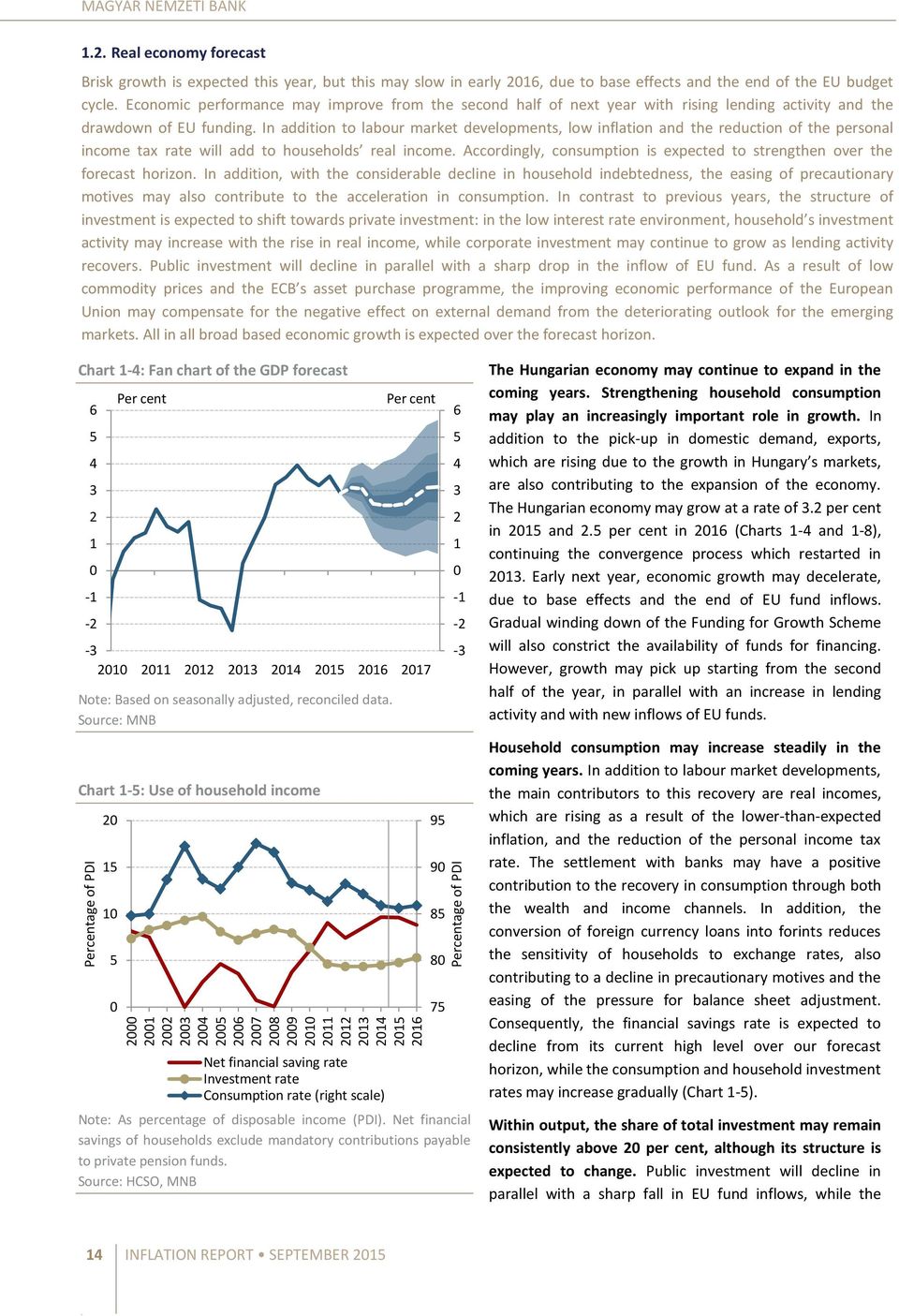
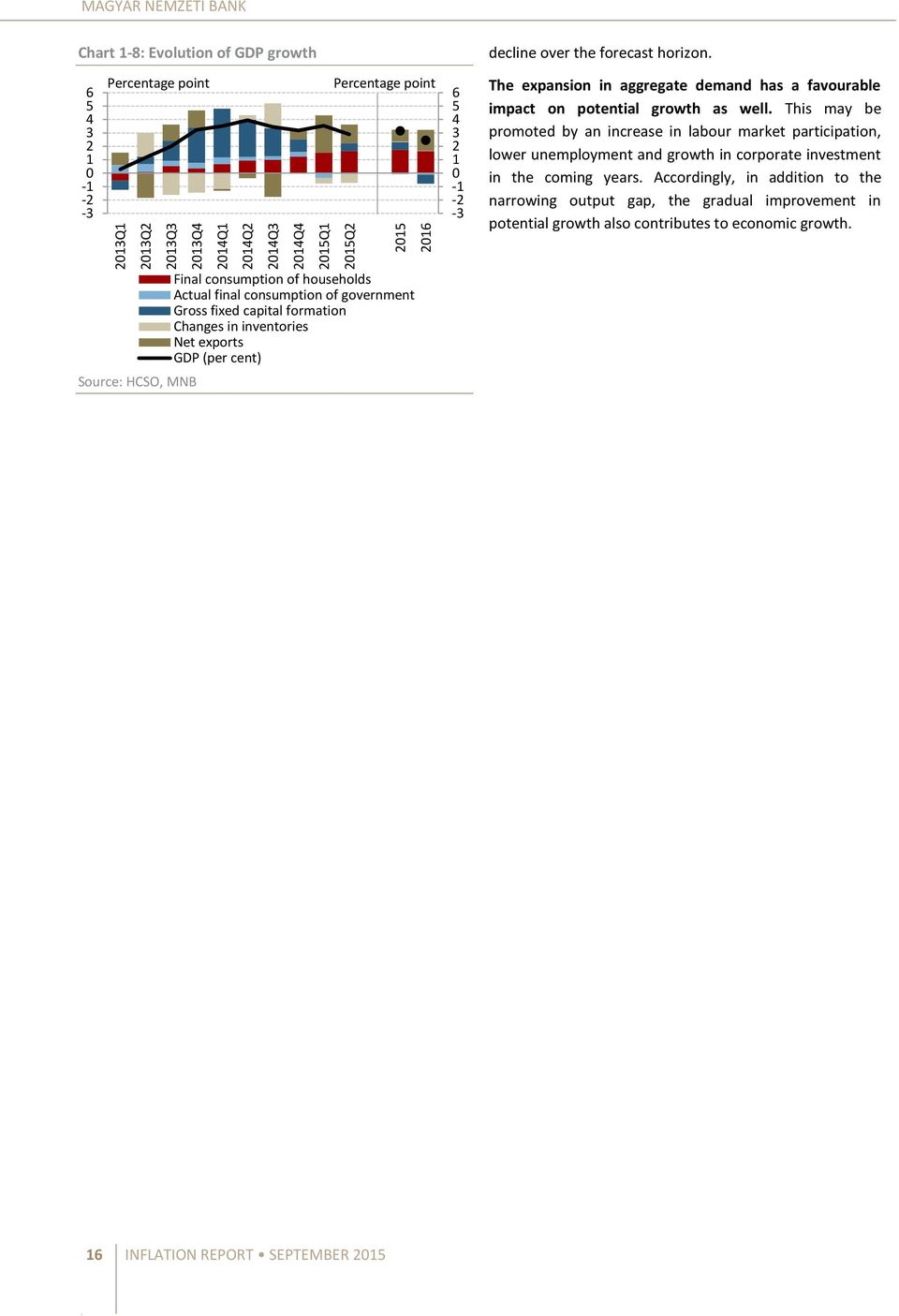
16 Percentage of PDI Percentage of PDI MAGYAR NEMZETI BANK 1.. Real economy forecast Brisk growth is expected this year, but this may slow in early 1, due to base effects and the end of the EU budget cycle. Economic performance may improve from the second half of next year with rising lending activity and the drawdown of EU funding. In addition to labour market developments, low inflation and the reduction of the personal income tax rate will add to households real income. Accordingly, consumption is expected to strengthen over the forecast horizon. In addition, with the considerable decline in household indebtedness, the easing of precautionary motives may also contribute to the acceleration in consumption. In contrast to previous years, the structure of investment is expected to shift towards private investment: in the low interest rate environment, household s investment activity may increase with the rise in real income, while corporate investment may continue to grow as lending activity recovers. Public investment will decline in parallel with a sharp drop in the inflow of EU fund. As a result of low commodity prices and the ECB s asset purchase programme, the improving economic performance of the European Union may compensate for the negative effect on external demand from the deteriorating outlook for the emerging markets. All in all broad based economic growth is expected over the forecast horizon. Chart 1-: Fan chart of the GDP forecast Note: Based on seasonally adjusted, reconciled data. Source: MNB Chart 1-5: Use of household income Net financial saving rate Investment rate Consumption rate (right scale) Note: As percentage of disposable income (PDI). Net financial savings of households exclude mandatory contributions payable to private pension funds. Source: HCSO, MNB The Hungarian economy may continue to expand in the coming years. Strengthening household consumption may play an increasingly important role in growth. In addition to the pick-up in domestic demand, exports, which are rising due to the growth in Hungary s markets, are also contributing to the expansion of the economy. The Hungarian economy may grow at a rate of 3. per cent in 15 and.5 per cent in 1 (Charts 1- and 1-8), continuing the convergence process which restarted in 13. Early next year, economic growth may decelerate, due to base effects and the end of EU fund inflows. Gradual winding down of the Funding for Growth Scheme will also constrict the availability of funds for financing. However, growth may pick up starting from the second half of the year, in parallel with an increase in lending activity and with new inflows of EU funds. Household consumption may increase steadily in the coming years. In addition to labour market developments, the main contributors to this recovery are real incomes, which are rising as a result of the lower-than-expected inflation, and the reduction of the personal income tax rate. The settlement with banks may have a positive contribution to the recovery in consumption through both the wealth and income channels. In addition, the conversion of foreign currency loans into forints reduces the sensitivity of households to exchange rates, also contributing to a decline in precautionary motives and the easing of the pressure for balance sheet adjustment. Consequently, the financial savings rate is expected to decline from its current high level over our forecast horizon, while the consumption and household investment rates may increase gradually (Chart 1-5). Within output, the share of total investment may remain consistently above per cent, although its structure is expected to change. Public investment will decline in parallel with a sharp fall in EU fund inflows, while the 1 INFLATION REPORT SEPTEMBER 15
17 Percentage of GDP INFLATION AND REAL ECONOMY OUTLOOK Chart 1-: Breakdown of gross fixed capital formation Households Corporate sector Government Source: HCSO, MNB Chart 1-7: Changes in export market share Note: Annual change. Source: MNB Export market share Export External demand expansion in private investment is expected to be subdued. In production and service sectors producing for domestic markets in particular, companies may initially react to the improvement in demand prospects by increasing capacity utilisation. Subsequently, the improving conditions may start to be reflected in lending activity and investment from the second half of next year. Households investment activity may strengthen as a result of more stable longer-term income expectations, lower indebtedness, and the historically low yield environment (Chart 1-). With rising demand for lending, outstanding corporate loans are expected to continue increasing over the forecast horizon. The Funding for Growth Scheme will gradually end in 1, and therefore the availability of funds from this channel will gradually taper off. At the same time, the low interest rate environment creates an opportunity for commercial banks to meet the strengthening demand with a larger proportion of marketbased loans. The gradual contraction in the outstanding debt of households may continue. Demand for consumers loans may remain subdued for years, but as a result of a pick-up in the housing market, there may be an increase in new property loans. Hungary s export market share may continue to increase. The economy of the euro area, Hungary s most important trading partner, may gradually pick up. At the same time, this may be somewhat offset by a slowdown in the emerging economies. The ECB s asset purchase programme and low oil prices may facilitate growth in Hungary s European trading partners, but this may be partly offset by the impact of the Russia-Ukraine conflict and economic sanctions. Depreciation of the euro may improve the competitiveness of euro-area exporters, which may support the performance of Hungarian suppliers. Looking ahead, in addition to the build-up of new capacities, the weaker real exchange rate may also support a further increase in Hungary s export market share (Chart 1-7). In parallel with that, net exports contribution to growth may gradually increase (Chart 1-8). The terms of trade are expected to improve due to the drop in oil prices in recent months. Output gradually approaches its potential level over the forecast horizon. Household consumption the most relevant factor in terms of domestic inflationary pressure may continue to accelerate, but will fall short of its precrisis level even in the years ahead. The output gap may close by the end of our forecast horizon, i.e. the disinflationary effect of the real economy will gradually INFLATION REPORT SEPTEMBER 15 15

18 5 13Q1 13Q 13Q3 13Q 1Q1 1Q 1Q3 1Q 15Q1 15Q 15 1 MAGYAR NEMZETI BANK Chart 1-8: Evolution of GDP growth decline over the forecast horizon Percentage point Percentage point The expansion in aggregate demand has a favourable impact on potential growth as well. This may be promoted by an increase in labour market participation, lower unemployment and growth in corporate investment in the coming years. Accordingly, in addition to the narrowing output gap, the gradual improvement in potential growth also contributes to economic growth. Source: HCSO, MNB Final consumption of households Actual final consumption of government Gross fixed capital formation Changes in inventories Net exports GDP (per cent) 1 INFLATION REPORT SEPTEMBER 15
19 Percentage point INFLATION AND REAL ECONOMY OUTLOOK 1.3. Labour market forecast Over our forecast horizon, both the participation rate and the employment rate may continue to increase, supported by the expansion of public employment programmes and a larger workforce in the private sector. By the end of the forecast horizon, the unemployment rate may be close to per cent. Labour market tightness and the improvement in corporate profitability and productivity all point to an increase in real wages. The stabilisation of inflation expectations may help wage and pricing developments to evolve in line with the inflation target over the monetary policy horizon. Chart 1-9: Employment, participation and unemployment rate in the national economy Participation rate Employment rate Unemployment rate (right scale) Source: MNB calculations based on HCSO data Chart 1-1: Decomposition of unit labour costs in the private sector A continued rise in the participation rate is expected over our forecast horizon. Since the crisis, the participation rate has increased rapidly as a result of measures aimed at increasing labour supply, which may have an impact in the coming years as well, albeit to a decreasing extent. In addition, in line with the improvement in the prospects for economic activity, the return of so-called discouraged workers to the labour market may also contribute to the increase in the participation rate (Chart 1-9). In addition to the expansion of public employment programmes, the rise in private sector employment also contributes to rising employment. Labour demand in the private sector may increase gradually over the forecast horizon. As part-time employment gains ground, the number of people employed may rise at a faster rate than the number of hours worked. The planned increase in the number of workers in public employment programmes will continue to play a major role in the increase in employment in the national economy in the years ahead as well. In our forecast, we assume that the number of people participating in public employment programmes may rise to nearly 3, by end Total labour cost Value added FTE employment Unit labour costs (per cent) Note: FTE Full-time equivalent. Source: MNB calculations based on HCSO data Against the background of a tighter labour market environment compared to previous years, both the improvement in corporate profitability and the further increase in productivity may contribute to a rise in real wages. In the first half of our forecast horizon, pay rises are expected to remain moderate in the private sector as a result of inflation expectations stabilising at a lower level due to the low inflation environment experienced in the past period, and thus wage dynamics in the private sector may remain restrained. However, in the second half of our forecast horizon, in line with an increase in real wages and inflation, stronger private sector wage growth is expected to a degree that is consistent with the inflation target (Chart 1-1). We project a subdued rise in public sector wages. The growth rate of the national economy wage index is also reduced by the expansion of the public employment programme through the composition effect, due to the low wages earned by participants. INFLATION REPORT SEPTEMBER 15 17

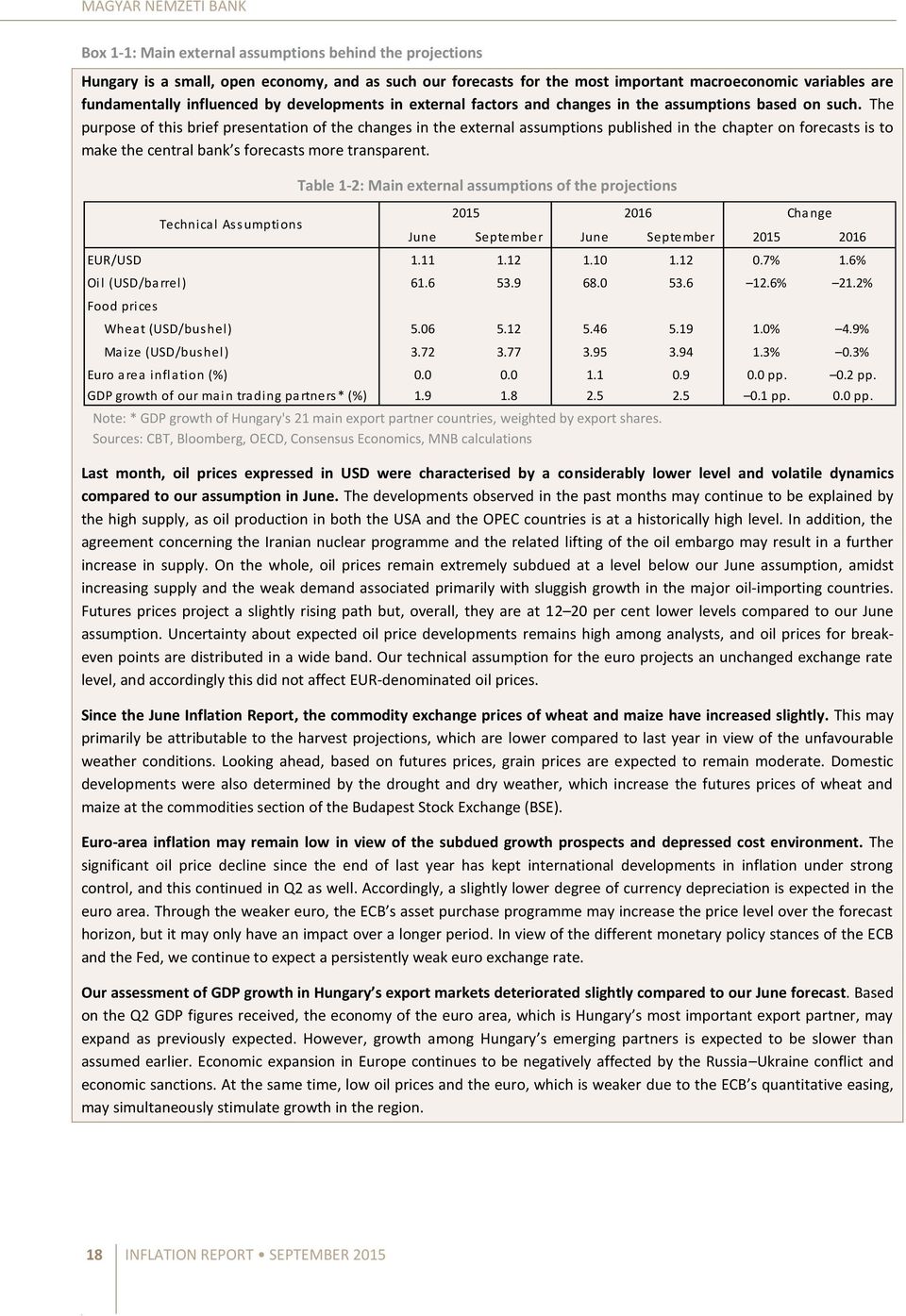
20 5 MAGYAR NEMZETI BANK Box 1-1: Main external assumptions behind the projections Hungary is a small, open economy, and as such our forecasts for the most important macroeconomic variables are fundamentally influenced by developments in external factors and changes in the assumptions based on such. The purpose of this brief presentation of the changes in the external assumptions published in the chapter on forecasts is to make the central bank s forecasts more transparent. Table 1-: Main external assumptions of the projections June September June September 15 1 EUR/USD % 1.% Oil (USD/barrel) % 1.% Food prices Technical Assumptions 15 1 Note: * GDP growth of Hungary's 1 main export partner countries, weighted by export shares. Sources: CBT, Bloomberg, OECD, Consensus Economics, MNB calculations Change Wheat (USD/bushel) %.9% Maize (USD/bushel) %.3% Euro area inflation (%) pp.. pp. GDP growth of our main trading partners* (%) pp.. pp. Last month, oil prices expressed in USD were characterised by a considerably lower level and volatile dynamics compared to our assumption in June. The developments observed in the past months may continue to be explained by the high supply, as oil production in both the USA and the OPEC countries is at a historically high level. In addition, the agreement concerning the Iranian nuclear programme and the related lifting of the oil embargo may result in a further increase in supply. On the whole, oil prices remain extremely subdued at a level below our June assumption, amidst increasing supply and the weak demand associated primarily with sluggish growth in the major oil-importing countries. Futures prices project a slightly rising path but, overall, they are at 1 per cent lower levels compared to our June assumption. Uncertainty about expected oil price developments remains high among analysts, and oil prices for breakeven points are distributed in a wide band. Our technical assumption for the euro projects an unchanged exchange rate level, and accordingly this did not affect EUR-denominated oil prices. Since the June Inflation Report, the commodity exchange prices of wheat and maize have increased slightly. This may primarily be attributable to the harvest projections, which are lower compared to last year in view of the unfavourable weather conditions. Looking ahead, based on futures prices, grain prices are expected to remain moderate. Domestic developments were also determined by the drought and dry weather, which increase the futures prices of wheat and maize at the commodities section of the Budapest Stock Exchange (BSE). Euro-area inflation may remain low in view of the subdued growth prospects and depressed cost environment. The significant oil price decline since the end of last year has kept international developments in inflation under strong control, and this continued in Q as well. Accordingly, a slightly lower degree of currency depreciation is expected in the euro area. Through the weaker euro, the ECB s asset purchase programme may increase the price level over the forecast horizon, but it may only have an impact over a longer period. In view of the different monetary policy stances of the ECB and the Fed, we continue to expect a persistently weak euro exchange rate. Our assessment of GDP growth in Hungary s export markets deteriorated slightly compared to our June forecast. Based on the Q GDP figures received, the economy of the euro area, which is Hungary s most important export partner, may expand as previously expected. However, growth among Hungary s emerging partners is expected to be slower than assumed earlier. Economic expansion in Europe continues to be negatively affected by the Russia Ukraine conflict and economic sanctions. At the same time, low oil prices and the euro, which is weaker due to the ECB s quantitative easing, may simultaneously stimulate growth in the region. 18 INFLATION REPORT SEPTEMBER 15
21 INFLATION AND REAL ECONOMY OUTLOOK Inflation (annual average) Table 1-3: Changes in our projections compared to the previous Inflation Report Actual Projection June Current June Current Core inflation Core inflation without indirect tax effects Inflation Economic growth External demand (GDP-based) Household consumer expenditure Government final consumption expenditure Gross fixed capital formation Domestic absorption Exports Imports GDP External balance 1 Current account balance External financing capacity Government balance 1,5 ESA balance (1 data is preliminary)..... Labour market Whole-economy gross average earnings Whole-economy employment Private sector gross average earnings Private sector employment Unemployment rate Private sector unit labour cost Household real income As a percentage of GDP. According to the HCSO data for full-time employees. 3 Private sector unit labour cost calculated with full-time equivalent domestic employment. MNB estimate. 5 With complete cancellation of free reserves. INFLATION REPORT SEPTEMBER 15 19
22 5 MAGYAR NEMZETI BANK Table 1-: MNB baseline forecast compared to other forecasts Consumer Price Index (annual average growth rate, %) 15 1 MNB (September 15). 1.9 Consensus Economics (September 15)¹ (.) European Commission (May 15)..5 IMF (April 15)..3 OECD (June 15) -..7 Reuters survey (September 15)¹ GDP (annual growth rate, %) MNB (September 15) 3..5 Consensus Economics (September 15)¹ European Commission (May 15).8. IMF (April 15).7.3 OECD (June 15) 3.. Reuters survey (September 15)¹ Current account balance³ MNB (September 15) 5.. European Commission (May 15) 5.5. IMF (April 15).8.1 OECD (June 15) Budget deficit (ESA 1 method) 3, MNB (September 15).. Consensus Economics (September 15)¹ European Commission (May 15).5. IMF (April 15).7.5 OECD (June 15).3. Reuters survey (September 15)¹ Forecasts on the size of Hungary's export markets (annual growth rate, %) MNB (September 15) 3.. European Commission (May 15)². 5. IMF (April 15)².7 5. OECD (June 15)². 5. Forecasts on the GDP growth rate of Hungary's trade partners (annual growth rate, %) MNB (September 15) European Commission (May 15)² IMF (July 15)² OECD (June 15)² For Reuters and Consensus Economics surveys, in addition to the average value of the analysed replies (i.e. the median value), we also indicate the lowest and the highest values to illustrate the distribution of the data. Values calculated by the MNB; the projections of the named institutions for the relevant countries are adjusted with the weighting system of the MNB, which is also used for the calculation of the bank s own external demand indices. Certain institutions do not prepare forecast for all partner countries. 3 As a percentage of GDP. With complete cancellation of free reserves. Source: Consensus Economics, European Commission, IMF, OECD, Reuters poll INFLATION REPORT SEPTEMBER 15
23 EFFECTS OF ALTERNATIVE SCENARIOS ON OUR FORECAST. EFFECTS OF ALTERNATIVE SCENARIOS ON OUR FORECAST In addition to the baseline projection in the September Inflation Report, the Monetary Council has identified two alternative scenarios which may have a tangible effect on the future conduct of monetary policy. Recently, the Hungarian economy was characterised by a highly favourable cost environment. If in contrast to the adjustment projected in the baseline scenario global commodity prices remain at a persistently low level in the years ahead as well, this may increase the probability of second-round effects through expectations. If this scenario materialises, achieving the inflation target could be ensured by looser monetary conditions than projected in the baseline scenario. Financial market turbulences may, inter alia, result in a protracted decline in external demand and a sudden, significant rise in the risk premium. Therefore, only a monetary policy that is tighter than assumed in the baseline scenario could ensure the achievement of the inflation target over the forecast horizon. Chart -1: Impact of the risk scenarios on our annual inflation forecast Base scenario Source: MNB Chart -: Impact of the risk scenarios on our GDP forecast Source: MNB Persistently low cost environment, increasing second-round effects Financial market turbulences Base scenario Persistently low cost environment, increasing second-round effects Financial market turbulences Persistently low cost environment, strengthening secondround effects Futures oil prices for next year project a slightly rising path. At the same time, compared to the assumptions in the June Inflation Report, they are at a 17 per cent lower level on average. On the whole, however, commodity prices remain subdued within the context of increased supply and the weak demand associated primarily with slowing growth in some major importing countries (e.g. China). If, in the baseline scenario, instead of a slow increase in costs, commodity prices remain at a level that is persistently lower than the current one, it may result in a further decline in companies production costs and an increase in households purchasing power. Second-round effects may also become stronger through a further decline in inflation expectations and the adjustment of wages. With the low inflation developments observed for a longer time and the decline in expectations, companies take account of these effects in their waging practices as well. Accordingly, wage-setting in the private sector may be more restrained. Households increasing purchasing power usually has a positive impact on importing countries growth, which may contribute to domestic growth through improving conditions in both external and domestic demand. At the same time, lower commodity prices have a downward effect on the price level in Hungary. In this alternative scenario, commodity prices persistently lower than assumed in the baseline scenario will reduce inflation, while the growth path may be more favourable. Due to the stronger disinflationary effects, in this scenario achieving the inflation target points to looser monetary conditions than the baseline scenario. INFLATION REPORT SEPTEMBER 15 1
24 Inflation (percentage points) 5 MAGYAR NEMZETI BANK Chart -3: Risk map: effect of alternative scenarios on the baseline forecast GDP growth (percentage points) Persistently low cost environment, increasing second-round effects Financial market turbulences Note: The risk map presents the average difference between the inflation and growth path of the alternative scenarios and the baseline forecast on the forecast horizon. The red marker means tighter and the green markers mean looser monetary policy than the baseline forecast. Source: MNB Financial market turbulences A rise in geopolitical tensions, a possible deviation of the Fed s behaviour from market expectations, a deterioration in growth expectations for emerging markets especially in the case of China may result in financial market turbulences. The continuous presence of geopolitical problems (Russia Ukraine conflict, disturbances in Iraq and Libya, instability in domestic politics in Greece) may affect the economy through various channels. In terms of the operation of financial markets and the risk appetite of international investors, it is of key importance that the general increase in distrust may result in increasing volatility in regional exchange rates, and may entail further unfavourable economic consequences through a rise in the risk premium. In addition, through the decline in their import demand, the growth slowdown in emerging economies (the Fragile Five, Russia, Ukraine and China) has a negative impact on Hungary s exports. Deterioration in the growth prospects of emerging market economies and the fall in Chinese stock market prices cause turbulences in emerging financial and capital markets. In this scenario, the deterioration in general investor sentiment is consistent with a higher risk premium path than the current one. According to the assumption of the risk path, the elevated risk premium results in higher costs of funds and a considerably weaker exchange rate, adding to inflationary pressure. In addition, via the decline in export demand, it represents a material downside risk in terms of developments in Hungary s external demand and exports. Overall, the achievement of the inflation target is ensured by a monetary policy that is tighter than the forecast in the baseline scenario. INFLATION REPORT SEPTEMBER 15
25 MACROECONOMIC OVERVIEW 3. MACROECONOMIC OVERVIEW 3.1. International environment Global economic growth continued in the second quarter as well, albeit at a moderate rate. There are significant differences between the regions in this regard. Growth in the euro area accelerated slightly quarter on quarter, and the US economy also showed perceivable acceleration. At the same time, the outlook for growth in emerging regions deteriorated. Inflation rates remained subdued. In most countries, inflation and capacity utilisation trends point to the maintenance of loose monetary conditions, while further easing is possible in certain countries. Chart 3-1: Quarterly GDP growth in euro area Note: Seasonally adjusted series. Source: Eurostat Chart 3-: Quarterly GDP growth in the periphery Euro area Germany France 1Q3 1Q 15Q1 15Q Greece Italy Portugal Spain 1Q3 1Q 15Q1 15Q Note: Seasonally adjusted series. Source: Eurostat Developments in global economic activity In 15 Q, global economic performance continued to be restrained, while there are still significant differences between regions. The economy of the euro area expanded slightly in 15 Q, and thus the moderate upward shift in economic performance continued. Based on the annualised quarterly rate, economic growth in the United States accelerated significantly. Looking ahead, in developed countries, growth is expected to accelerate further overall, but the prospects for emerging countries have worsened. With respect to the main emerging economies, several factors point to subdued growth both in China and in Russia. Amidst persistent regional disparities, global growth prospects deteriorated slightly compared to the previous quarter. Data reported for the second quarter indicate that economic activity in the euro area continued to improve (. per cent rise quarter on quarter), although the rate of growth slowed somewhat compared to the first quarter (Chart 3-1). Growth in Germany, Hungary's most important trading partner, expanded at a rate of. per cent compared to the previous quarter, but despite this moderate acceleration German economic activity may remain subdued. While the driver of Germany s economic growth is still domestic demand, and within this the rebound in consumption, the expansion of exports exceeded expectations, and thus the contribution of net exports to growth was also positive. In France, the.7 per cent acceleration recorded in the first quarter came to a halt and the economy relapsed into stagnation in the second quarter. Periphery countries registered economic growth in the second quarter. The economy of Spain continued to expand (by 1 per cent compared to the previous quarter) and, in contrast to its previous downturn and stagnation, Greece recorded substantial growth (.9 per cent). Growth picked up slightly in Portugal and Italy compared to 15 Q1 (Chart 3-). The rebound in euro-area internal demand in 15 may be boosted by further oil price declines and the falling cost of INFLATION REPORT SEPTEMBER 15 3
26 5 MAGYAR NEMZETI BANK Chart 3-3: Business climate indices for Germany and the euro area Source: European Commission, Ifo Chart 3-: Quarterly GDP growth in CEE countries Note: Seasonally adjusted series. Source: Eurostat Chart 3-5: Quarterly GDP growth in developed economies Note: Seasonally adjusted quarterly change. Source: OECD Ifo business climate EABCI (right scale) Czech Republic Points of standard deviation Slovakia Poland Romania 1Q3 1Q 15Q1 15Q USA Japan United Kingdom 1Q3 1Q 15Q1 15Q finance due to the expansion of the ECB s asset purchase programme. The ECB s July lending survey reported further easing in corporate credit conditions, and demand for corporate credit continues to recover gradually. Forward-looking indicators have exhibited a mixed pattern in recent months, but still point to positive economic performance across the euro area (Chart 3-3). Business confidence was volatile reflecting the uncertainty around the resolution of the Greek debt negotiations: after a sharp rise in July, there was a sizable drop in the business confidence indicator in August. Following a dip in the Ifo indicator in June, the outlook for the German economy improved further, with a perceivable effect on industrial production figures. Thus, looking ahead, the gradual improvement in economic activity may continue. The unemployment rate fell somewhat in the euro area compared to the first quarter, standing at 11.1 per cent in the second quarter. The performance of the Central and Eastern European region continues to be outstanding by European standards; average growth did not change noticeably compared to the previous quarter (Chart 3-). The Czech economy expanded further, but at a considerably slower pace compared to the robust growth registered in the previous quarter. Quarterly growth was primarily boosted by items of domestic demand. Similarly, Romania s quarterly growth decelerated significantly, mainly due to a fall in net exports. Poland saw continuing expansion, primarily owing to domestic demand items. Growth in Slovakia was supported both by domestic and external demand. Growth in the United Kingdom accelerated on a quarterly basis (Chart 3-5). On the output side, services and the construction sector made positive contributions to growth. On the consumption side, the rebound in consumption continued, and net exports contributed positively to growth once again. Based on the annualised quarterly rate, economic growth in the United States accelerated significantly. Incoming data for the second quarter confirm that weak growth in the first quarter was mainly due to transitory factors such as poor weather conditions and port strikes, and thus the performance of the economy picked up again in the second quarter. GDP growth primarily reflected an increase in household consumption and investment projects. The contribution of net exports to growth was also positive. Lower oil prices continue to impede the investment and production dynamics of the energy sector while increasing households' disposable income. Unemployment decreased INFLATION REPORT SEPTEMBER 15
27 MACROECONOMIC OVERVIEW Chart 3-: Unemployment and participation rate in the USA Source: Bureau of Labor Statistics (BLS) Chart 3-7: Quarterly GDP growth in China and Russia Note: Seasonally adjusted series. Source: OECD Chart 3-8: Changes in major commodity prices (USD) Source: IMF Unemployment rate Participation rate (right scale) Russia January = 1 China Food Metals Oil (aggregate) further to a rate of 5.1 per cent in August, while the labour force participation rate fell to. per cent (Chart 3-). Year-on-year growth was up.7 per cent in Japan, but this concealed a.3 per cent decline compared to the previous quarter. According to preliminary assessments, exports and consumption were likely to be subdued in the second quarter, and as a result, market reactions pointed to a possible need for further fiscal or monetary accommodation. Based on production indicators, the recovery of the Japanese economy from the recession is still fragile. Of the main emerging economies, the Chinese economy expanded at a rate of 7 per cent in 15 Q (Chart 3-7). Despite the improvement, Chinese economic growth remains at a six-year low. Down 8. per cent, the decline in exports exceeded expectations in July. The Chinese government expects economic growth to be around 7 per cent this year compared to 7.5 per cent last year. However, several factors such as the slowdown in industrial production, weakening investment dynamics and the expected pause in construction sector output indicate that growth may be weaker than expected. The Russian economy continued to show a decline in 15 Q. The sharp fall in wholesale and retail sales volume was also reflected in a considerable decline in consumption. Russia has been hit particularly hard by low commodity prices. In addition, the extension of sanctions by the European Union, the continuing outflows of capital and the geopolitical tensions between Russia and Ukraine point to an economic downturn. Accordingly, analysts project a pronounced contraction of per cent for Global inflation trends Commodity prices were generally decreasing in the recent period, oil prices descended considerably (Chart 3-8). The summer months saw a substantial decline in the Brent crude oil price, which may reflect both supply and demand factors. On the supply side, persistently robust production and the agreement on Iran s nuclear programme pointed to lower oil prices. In addition, the strengthening of the dollar, the uncertainty about the resolution of the Greek problem and developments on the Chinese stock market also contributed to the decline. As for the demand side, the deceleration of emerging economies may have weighed on global oil prices. In addition to supply and demand factors, oil prices also react to geopolitical events. The decline in industrial commodity prices continued in the past period. Except for a brief rise in April, the decline in world metal prices continued in 15 Q, against the INFLATION REPORT SEPTEMBER 15 5
28 5 MAGYAR NEMZETI BANK Chart 3-9: Inflation in developed economies Euro area USA Japan United Kingdom Note: Annual change. Source: OECD Chart 3-1: Inflation in CEE countries Czech Republic Poland Slovakia Romania Note: Annual change. Source: OECD, National Institute of Statistics of Romania backdrop of the Greek crisis, waning Chinese demand and expanding metal market supply. Agricultural prices also continued to fall in the second quarter, with particularly sharp declines in the prices of dairy products and vegetable oils in recent months. (For more details on the decline in commodity prices, see Box3-1). The rate of increase in consumer prices has remained below target in developed countries (Chart 3-9), and looking ahead, central bank forecasts expect the rate to remain below the target at the two-year horizon as well. Developed countries are still characterised by a negative output gap and moderate demand-pull inflation. Since commodity prices are persistently low, there is no perceivable inflationary pressure from the expenditure side. In the United States, the annual change in the consumer price index returned to the positive domain in the second quarter, rising to. per cent in August. The personal consumption expenditure price index (PCE) a measure relevant in terms of monetary policy rose to.3 per cent in July, a value comparable to that recorded in the first quarter. However, according to the September forecast of the FOMC achieving the price stability target may be postponed until 18. The annual growth rate of the consumer price index remained subdued in the euro area amidst the oil price slump. Inflation was.1 per cent in August. The declining trend can be also observed in the inflation of core countries, while periphery countries show a mixed picture: since the beginning of the year an upward trend was observed in inflation of Italy, Portugal and Spain, while in recent months inflation stagnated. Inflation in Greece has been around. and.1 per cent since February. In the United Kingdom, inflation has been low but remained in the positive domain in recent months. In Japan, inflation has been low and well below the target since April, after the effect of last April s VAT increase dropped out of the base. Inflation remained low and was below target levels in the Central and Eastern European region (Chart 3-1). Average inflation resided in the negative domain in the region. The rising path of inflation observed in Romania since the beginning of the year was broken by the VAT reduction in June, which pushed inflation deep into negative territory ( 1.9 per cent in August). In Poland, inflation rose slightly in the second quarter, but for lack of substantial cost pressures in the context of low commodity prices and wage moderation, the annual change in the consumer price index remains negative. In the Czech Republic, inflation has remained well below the target, despite a moderate rise INFLATION REPORT SEPTEMBER 15
29 MACROECONOMIC OVERVIEW Chart 3-11: Consumer and producer prices in China compared to the first quarter in 15 Q, because was a subsequent fall to.3 percent in August. Of the larger emerging countries, the rate of price increase is still moderate in China. At the same time, producer prices continued to fall and the producer price index was 5. per cent in July (Chart 3-11). Inflation in Russia edged up in July, after continuous deceleration since April in the context of a steep fall in consumer demand and the appreciation of the rouble. Based on the central bank's forecast, inflation may fall below 7 per cent by July 1 and reach the per cent central bank target by Note: Annual change. Source: National Bureau of Statistics of China Chart 3-1: Real interest rates in developed economies PPI Note: The real interest rate is annual average. The one-year ex ante real interest rates are calculated as difference of market actors' one-year inflation expectations and one-year bond yields. Source: Consensus Economics, Bloomberg CPI Euro area USA Japan United Kingdom Real interest rate Monetary policy and financial market developments The central banks which are monitored have not changed their monetary policy strategies in recent months. Most countries do not exhibit, for the time being, any inflation and capacity utilisation trends pointing to monetary tightening in the short run. Developed countries are still characterised by a negative output gap and moderate demand-pull inflation, with real interest rates staying in the negative domain (Chart 3-1). However, at the end of this year, the Fed may begin its gradual monetary tightening, while the interest rate increase and interest rate path of the Bank of England is still shrouded by significant uncertainty. The European Central Bank and the Bank of Japan continued their asset purchase programmes as planned, while the Swedish central bank decided to expand its quantitative easing programme. In addition, certain countries (Sweden, Norway, New Zealand, China and Russia) may consider easing their monetary stance further looking ahead. In some economies (New Zealand, Sweden and Norway), there are still risks related to household indebtedness and the real estate market, which may justify the broader application of macroprudential tools. In recent months, the Federal Reserve has not changed its policy rate (Chart 3-13), nor announced any new measures. The Fed s forward guidance did not change significantly in the past period, although its assessment of the economy in its July and September press releases appeared to be somewhat more positive. The paragraph outlining the Fed s monetary policy stance changed to the extent that the Federal Open Market Committee anticipates that it will be appropriate to raise the target range for the federal funds rate when it has seen some further improvement in the labour market and is reasonably confident that inflation will move back to its objective over the medium term. The change may have suggested that, since the objective of achieving maximum employment has been approached, the commencement INFLATION REPORT SEPTEMBER 15 7
30 5 MAGYAR NEMZETI BANK Chart 3-13: Central bank rates in developed economies Euro area USA Japan United Kingdom Source: Databases of central banks Chart 3-1: Central bank balance sheet total in developed countries (as a percentage of GDP) European Central Bank Bank of Japan Source: Databases of central banks, IMF, Eurostat Federal Reserve and pace of the interest rate increase now depend primarily on the inflation outlook and the inflation forecast. The inflation forecast was revised downwards, and the inflation target is expected to be achieved by 18; thus, the FOMC did not change the target range for the federal funds rate in September. The ECB did not change its forward guidance, according to which the policy rate may stay at the current level over the longer run; the extended asset purchase programme may continue until September 1 or until such time as inflation rises steadily above the target. Based on the latest data published by the ECB at the end of July, during the extended asset purchases launched on 9 March, the ECB and the central banks of the euro area purchased government securities roughly in accordance with the set target, i.e. in proportion to the ECB capital keys. From the start of the programme until the end of August, government bonds were purchased in the value of EUR 9 billion (Chart 3-1). Inflation expectations rose and approached the target following the extension of the asset purchase programme, but then dropped again in the second half of the quarter and began to depart from the price stability target. In September, the ECB raised its limit on individual bonds available under the quantitative easing programme from 5 per cent to 33 per cent. The continuous weakening of the euro against the US dollar since April 1 came to a halt and the exchange rate of the euro appreciated in May and June 15, reflecting the unfavourable macroeconomic releases and rising euro-area inflation expectations. During July and August, exchange rate movements were dominated by uncertainties surrounding the resolution of the Greek crisis and the Fed s interest rate increase, and thus the exchange rate was volatile during the period (Chart 3-15). The Bank of England maintained its monetary conditions. In its forward guidance, the central bank stressed that the interest rate would be raised only gradually, with the timing, extent and progress of the increase depending on economic conditions and various indicators linked primarily to capacity utilisation and the labour market. Based on market expectations, the first anticipated interest rate increase by the Bank of England may take place no earlier than the beginning of next year, but the timing is uncertain. The People s Bank of China (PBoC) responded to the recent fall in stock price indices and unfavourable macroeconomic releases with several measures. In June, the PBoC cut the one-year benchmark bank lending rate by 5 basis points, and at the end of August it lowered the lending and deposit rates by 5 basis points to reduce the 8 INFLATION REPORT SEPTEMBER 15
31 MACROECONOMIC OVERVIEW Chart 3-15: Changes in the EUR/USD exchange rate Note: * September 15 Consensus poll. Higher values mean euro appreciation. Source: ECB, Consensus Economics Chart 3-1: Central bank rates in CEE economies EUR/USD FX rate Source: Databases of central banks EUR/USD FX rate forecast* Czech Republic Poland Romania cost of finance for corporations. In addition, it lifted the upper limit on interest rates for fixed-term deposits of more than a year, and announced a reduction in the reserve requirement ratio by an additional 3 basis points for financial leasing companies with a view to supporting their role in boosting consumption. It also drastically reduced the reserve requirement for smaller banks by 5 basis points in order to ensure sufficient liquidity in the sector. Moreover, in the second half of August, the Chinese central bank injected, in several steps, a total of 1, billion yuan (USD 1 billion) in liquidity into the Chinese banking sector via seven-day reverse repo transactions, the sale of three-month treasury bills, under the MLF (Mediumterm Lending Facility) programme and under the SLO (Short-term Lending Operations) programme. After release of the poor exports data for July, in the middle of August the PBoC unexpectedly devalued the yuan several times, then the central bank adjusted the exchange rate merely slightly. According to analysts, the PBoC is attempting to counterweight decelerating Chinese growth by propping up the export sector. At its rate-setting meeting in June and July, the Russian central bank cut its key policy rate due to the persistent risks of considerable economic deceleration, and then in September kept the policy rate unchanged. In its forward guidance issued in June, the Bank of Russia indicated that it would be ready to continue cutting the key rate as consumer price growth declines further in line with the forecast, but the potential for monetary policy easing would be limited by inflation risks over the coming months. After the announcement, the central bank lowered its key rate by 5 basis points in July and indicated that, looking ahead, it would decide on the key rate depending on the balance of inflation risks and the risks to growth. In the press release following the September meeting, the Russian central bank warned that continued weakening of the economy may raise inflation concerns further. Central banks in the Central and Eastern European region maintained loose monetary conditions (Chart 3-1). At its rate-setting meeting in June, the Czech National Bank decided to maintain the key policy rate at.5 per cent, and confirmed the central bank s commitment to using the exchange rate of the Czech koruna as an additional monetary policy instrument for easing monetary conditions. As a result of continuous appreciation since early summer, the exchange rate of the koruna against the euro has approached the EUR/CZK 7 level set by the central bank, and for the first time since the announcement of the exchange rate cap in November 13, the Czech National Bank intervened in the foreign exchange market. INFLATION REPORT SEPTEMBER 15 9
32 5 MAGYAR NEMZETI BANK Chart 3-17: Leading stock exchange indices Note: 1st January 13 =. Source: Bloomberg Chart 3-18: 1-year periphery and German bond yields Source: Bloomberg FTSE DAX Index Dow Jones S&P 5 Nikkei Germany Italy Portugal Spain Greece (rhs) However, the central bank declined to comment on the extent of the intervention. The Polish central bank did not change the key policy rate after the announcement of the end of the easing cycle in March. According to policymakers, annual price growth may remain negative in the coming months; at the same time, the expected continuous acceleration of economic growth, the gradual recovery of the euro area and favourable developments in the domestic labour market reduce the risk of inflation remaining below the target in the medium term. Despite below-target inflation, the Romanian central bank has also decided to refrain from cutting the key policy rate further in recent months, with an eye to the situation in Greece, the uncertainty surrounding Romania s agreements with international institutions and the divergence between the monetary policy stances of major central banks worldwide. Global market sentiment deteriorated in the past period, which was primarily reflected in plummeting equity prices and the depreciation of emerging currencies outside of the CEE region. The negative sentiment was exacerbated at the beginning of the period primarily by events related to the Greek debt crisis and subsequently by concerns about emerging markets in general and China s growth in particular, stock market volatility, uncertainties about the Fed s expected interest rate increase and the oil price slump. Until the middle of August, major stock market indices managed to increase slightly both in Europe and Asia, before a global sell-off was sparked by Chinese stock market turbulences and the measures taken by the Chinese central bank. Despite a correction at the end of the period, the leading stock market indices have dropped by nearly 1 per cent during the past three months (Chart 3-17). Apart from a number of temporary increases resulting from growing risk aversion, developed bond yields decreased overall during the period. In Europe, the surge in Greek yields prompted by the Greek debt crisis slightly elevated the long-term bond yields of periphery countries as well, but as a result of the adjustment following the agreement on the financial assistance package, a correction in yields can be observed. (Chart 3-18). The dollar appreciated against the euro by about half a per cent during the period, while oil prices have fallen by nearly per cent since the middle of June. Markets continued to monitor the Fed s communications and the US data releases closely, but the information obtained leaves the expected date of the first interest rate hike uncertain. 3 INFLATION REPORT SEPTEMBER 15
33 MACROECONOMIC OVERVIEW Box 3-1: Reasons for the recent decline in commodity prices Commodity prices have decreased significantly in recent months. Oil prices in particular sustained one of the largest falls and were among the most volatile in the past few months. By mid-august, Brent crude oil price quotes dropped to a level close to USD 5 compared to USD at the end of June, and fluctuated around USD 5 in early September. At the same time, in addition to oil prices, metal prices have also fallen gradually during the past year, underpinned besides supply factors by subdued global demand. This box outlines the main factors behind the decline in commodity prices and their possible macroeconomic effects (Chart 3-19). Chart 3-19: Changes in aggregate commodity prices (USD) January = Source: IMF Oil prices Global oil prices are primarily determined by oil supply and demand, transportation and storage costs and financial market developments, in addition to supply and demand factors, oil prices also react to geopolitical events. In the past period, all of these factors pointed to a fall in oil prices. As regards the supply side, production remains at historically high levels in the USA and in the OPEC countries as well. In order to maintain their market share, OPEC countries are keeping their production levels close to historical peaks (production surged especially in Saudi Arabia and Iraq in the past period). Supply may be boosted further by the agreement on the Iranian nuclear programme. Under the agreement, Iran will impose restrictions on its nuclear programme in exchange for the gradual dismantling of economic sanctions against Iran starting from 1, including the prohibition on oil exports. As a result, Iranian crude oil exports may increase considerably in the coming quarters. (Iran s oil reserves are among the world s largest; before the sanctions, Iran was the second largest producer in the OPEC countries, with a global market share of around per cent). On demand side, global oil demand has been subdued in recent months, pointing to falling oil prices. The Chinese stock exchange has plunged lower in recent weeks and unfavourable macroeconomic data have been released in the meantime (a decline in the Purchasing Managers Index, industrial production and producer prices) in China. As a result, Chinese growth expectations were revised downward which, in turn, may curb demand for oil. The US dollar has appreciated substantially in recent months. As oil prices are typically denominated in USD, in the case of USD appreciation, oil prices denominated in other currencies would rise, which in turn causes a further decline in global oil demand. INFLATION REPORT SEPTEMBER 15 31
34 = 1 MAGYAR NEMZETI BANK Metal prices Metal prices have gradually declined in recent months. Metal prices may have been influenced considerably by the aforementioned global demand environment in particular China s growth rate (as well as worries about Greek events) and the rise in global metal supply (Chart 3-). Food prices Food prices also moved on a downward path recently (Chart 3-1). The FAO Food Price Index was close to a -year low. Dairy products were the main contributors to the decline, owing to a sharp fall in dairy demand in the Middle East and North Africa; on the other hand, the sugar price index has also fallen in recent years as crop yields exceeded demand. With respect to Hungary, it is still important to emphasise that the cancellation of dairy production quotas in the European Union contributed, to a large degree, to agricultural producer price developments. Chart 3-: Changes in metal prices (USD) =1 Source: IMF Forecast in August 15 Forecast in May 15 Chart 3-1: Changes in food prices (USD) Source: FAO Food Meat Dairy Cereal Oil Sugar Macroeconomic effects On the whole, commodity prices have declined significantly in recent months, presumably as a result of both supply and demand factors. The degree of macroeconomic effects depends on whether the change in commodity prices was caused mainly by temporary or permanent factors. If the downward movement in commodity prices is caused primarily by supply factors, the effect of lower oil prices will, on the one hand, be reflected in the price index immediately through fuel prices, on the other hand, it will also mitigate inflation by lowering production costs. With respect to growth effects, lower commodity prices may boost the performance of energy-importing countries through falling production costs and improving terms of trade and accordingly, these may contribute positively to domestic GDP growth. If the decrease of commodity prices is driven by a decline in global demand, a persistently lower price level may be probable. In this case, the Hungarian economy would face weaker external demand, which could be partly offset by the positive effect of improving terms of trade on domestic demand. 3 INFLATION REPORT SEPTEMBER 15
35 MACROECONOMIC OVERVIEW 3.. Aggregate demand In 15 Q, Hungary s GDP expanded at a year-on-year rate of.7 per cent. As observed in previous quarters, the structure of the growth was balanced. The recovery in domestic demand was primarily driven by consumption growth. Net exports also made a positive contribution to growth. The sectoral distribution of investments is characterised by significant heterogeneity. Investments by the government and quasi-fiscal sectors using EU funds expanded, while the performance of the corporate sector producing for domestic and export markets decreased in the second quarter, and households investment activity remained unchanged. Chart 3-: Contribution to annual GDP growth 8 Percentage point Percentage point Final household consumption Government consumption Gross fixed capital formation Changes in inventories Net exports GDP at market prices (per cent) Source: HCSO In 15 Q, Hungary s gross domestic product expanded by.7 per cent in annual terms. As in previous quarters, the structure of growth was balanced. Domestic demand was driven by consumption, while the growth contribution of net exports was also positive. GDP expanded by.5 per cent compared to 15 Q1 (Chart 3-) External trade Net exports continued to rise in the second quarter. Exports of both goods and services increased in annual terms. The growth in goods exports was still driven by machinery and transport equipment, while transportation and other services contributed to the largest extent to the expansion of services exports. In 15 Q, imports grew slower than exports. Based on incoming data, Hungary's trade surplus continued to increase (Chart 3-3). Chart 3-3: External trade in goods 75 EUR million EUR million 8 In the second quarter of 15, Hungary's terms of trade improved slightly compared to the same period of the previous year. Since Hungary's net energy imports are substantial, world prices of energy play a key role in shaping the terms of trade. The recent declines in oil prices contributed to the improvement in the terms of trade (Chart 3-) Trade balance (rhs) Export Import Source: HCSO 3... Household consumption Household consumption expenditures continued to grow in 15 Q. This can be mainly attributed to improving labour market conditions and dynamically increasing real wages in the low inflation environment. In addition, the volume of retail sales has shown stable growth in recent months. During the second quarter, the dynamics of retail sales accelerated compared to the first quarter. In recent quarters, retail sales rose significantly due to steady growth in household consumption and the whitening of the economy derived from the introduction of online cash registers (Chart 3-5). Similar to the end of 1, the saving rate remained high; however, precautionary savings may begin to ease gradually. This is supported by falling unemployment and the reduction of the exchange rate risk as a result of the conversion of households' foreign currency loans to forints. INFLATION REPORT SEPTEMBER 15 33
36 Annual change (per cent) Balance indicator MAGYAR NEMZETI BANK Chart 3-: Evolution of terms of trade and oil prices Note: Chart shows the six-month delay of oil prices on reverse scale. Annual change. Source: HCSO, IMF Chart 3-5: Developments in retail sales, income and the consumer confidence index Source: GKI, HCSO Chart 3-: New household loans in the credit institution sector Source: MNB Contribution of mineral fuels Contribution of other products Terms of trade Oil prices (rhs) Retail sales Real net wage bill Consumer confidence (rhs) HUF billion HUF billion Housing loans Home equity loans Other consumer loans Loan refinancing (early repayment scheme) -quarter average Household lending dynamics continued to decelerate, despite rising new disbursements of housing loans. Transactions reduced the household portfolio of the financial intermediary system by around HUF 11 billion. Although the annual rate of change decelerated regardless of the one-off effect of the settlement and the conversion of FX-loans in the second quarter, for the most part, this reflected the continued reduction of previously accumulated portfolios. The volume of new disbursements, however, picked up in the period under review, and in the case of housing loans new lending exceeded the value recorded in the same period of the previous year by 3 per cent. For the most part, banks have reported a pick-up in loan demand in the case of housing loans, despite the fact that credit conditions were eased mainly for consumer credit, while the conditions of housing loans remained unchanged. Presumably, the rising trend in housing loans primarily reflects historically low housing prices, increasing real wages and the current realisation of postponed projects (Chart 3-) Private investment In the second quarter, the volume of whole economy investment expanded compared to the subdued dynamics observed in the first quarter. With respect to the sectoral distribution, this rise concealed a significant extent of heterogeneity. The growth was driven mainly by an upswing in the investment projects of the government and quasi-fiscal sectors, which may reflect the investment effect of EU transfers. Corporations producing for the domestic and export markets demonstrated moderate performance, while the investment activity of households stagnated. The decline in corporate sector investment in 15 Q was mainly caused by export-oriented companies, and to a lesser extent by industries producing for domestic market. Declining investment performance by sectors producing for external markets was seen in a wide range of sectors. The slowdown was particularly salient in the manufacturing sector and agriculture. The downturn observed in the manufacturing sector may be explained by the waning spillover effect of large projects implemented in the previous period. In the case of agriculture, the slowdown reflects the high base resulting from projects implemented in previous years under the Funding for Growth Scheme. Investment declined across the sectors producing for domestic consumption. Investment activity by industries related to the public sector was determined by the absorption of EU funds. All subsectors of the general government (public 3 INFLATION REPORT SEPTEMBER 15
37 MACROECONOMIC OVERVIEW Chart 3-7: Contribution of main sectors to annual change in national investments Source: HCSO Chart 3-8: Annual growth rate of lending to nonfinancial corporates and SMEs Percentage point Corporate sector Quasi-fiscal sector Investments (per cent) Public sector Households Corporate loans total (financial intermediaries total) Corporate loans total (MFIs) SME loans (banking sector) Note: Data for corporate loans total are based on transactions. For SME loans, estimated transaction are applied as of Q 13. Source: MNB administration, education, healthcare) demonstrated improved performance in the period under review. The expansion also affected a broad range of quasi-fiscal sectors (transportation/storage, water management, energy), mainly as a result of the robust utilisation of EU transfers (Chart 3-7). Household investment decelerated slightly in the second quarter of the year, consistent with subdued home construction activity. The decline in home construction can be attributed to the seasonality of the sector; during the second half of the year, home construction may grow again in line with the vigorous increase in new orders. Consolidated housing market data for 15 Q point to a continuing upswing in turnover; the number of homes sold increased above per cent in annual terms. Although home prices are still below their pre-crisis level, in line with increased housing market turnover, the prices of new and used homes showed considerable growth in the recovering demand environment. Corporate lending developments were characterised by dual trends, according to corporate size. On the whole, the outstanding borrowing of non-financial enterprises from the entire financial intermediary sector declined by HUF billion in the second quarter of 15. The decline was almost entirely related to the portfolio of the credit institution sector, while outstanding loans only decreased by HUF 13 billion in the case of other financial intermediaries (Chart 3-8). As a result, the annual dynamics of corporate lending took a negative turn, with the total corporate loan portfolio reduced by 3. per cent on a transaction basis (Chart 3-9). A few high-volume corporate transactions had a significant impact on the rate of deceleration, but they should be interpreted as extraordinary shifts in the portfolio rather than long-term underlying trends. Indeed, lending to SMEs which captures Hungarian lending trends with less volatility continued to accelerate during the quarter, with a 1.8 per cent annual increase in the portfolio overall. The Funding for Growth Scheme played a significant role in this increase: in the first half of the year, utilisation of the programme exceeded the volumes seen in 1 H1. The decline in the costs of finance and the gradual easing of credit conditions point to a slow easing in supply, while the upswing in credit demand may also play a role through increasing the production activity of manufacturing and supplier firms in the vehicle industry and through the investment demand of agriculture. INFLATION REPORT SEPTEMBER 15 35
38 * MAGYAR NEMZETI BANK Chart 3-9: Transactions in loans to non-financial corporations from domestic financial intermediaries 5 HUF billion HUF billion Long-term MFI loans Short-term MFI loans Long-term non-mfi loans Short-term non-mfi loans Total transactions Note: Loans granted by credit institutions and other financial intermediaries. Seasonally unadjusted transactions. Source: MNB Chart 3-3: Annual volume changes in government consumption and investments Social transfers in kind Final consumption of government Government investment* (right scale) Note: *Annual change calculated for the first half of 15. Source: HCSO, MNB Government demand In the second quarter, government demand was determined by a fiscal policy focused on lowering the government deficit and by the slowdown following the peak in the absorption of current EU funds last year. There was a sharp increase in the investment demand of government-related sectors (public administration, education, healthcare). Public consumption continued to decrease in the second quarter, reflecting the deceleration that followed the peak in the absorption of current EU funds in the previous year. Government consumption, measured at 1.8 per cent as a proportion of GDP in 1, decreased to 1. per cent in the first half of 15 while the government investments grew from 5.3 per cent to 5.7 per cent as a proportion of GDP during the same period. Public consumption in the first half of this year was smaller by per cent than the same period of the previous year. Governmental transfers continued to grow in the second quarter of the year and thus in the first half of the year a. per cent increase was observed in the level of social transfers in kind (Chart 3-3) Changes in inventories In the second quarter, changes in the inventories of the national economy made a negative contribution to growth, which may be attributable to the deteriorating performance of agriculture and the slower pace at which gas storage capacities were filled up compared to the previous year (Chart 3-31). Chart 3-31: Changes in inventories and their contribution to GDP growth Percentage point Billion HUF Contribution to GDP growth Change in inventories at current prices (right scale) Note: National Accounts data. Source: HCSO 3 INFLATION REPORT SEPTEMBER 15
39 MACROECONOMIC OVERVIEW Box 3-: The saving rate of households There has been a marked turnaround in households consumption demand in recent years as household consumption has started to make an increasingly important contribution to GDP growth. In the past two years, consumption grew at a slower rate than incomes, which can be mainly associated with the high saving rates observed in recent periods. Numerous households taking on debt before the crisis have faced pressures for balance sheet adjustment for a long period of time, and the precautionary motives prevalent among households in the aftermath of the crisis may also have persisted, keeping the sector s saving rate at high levels. Balance sheet pressures and precautionary motives eased, however, as households shed outstanding, pre-crisis debts and their vulnerability declined after the substantial reduction of exposure to exchange rate risks by the phase-out of foreign currency loans. Thanks to these favourable developments, consumption levels increased significantly. At the same time the household s saving rate remained high. In the following, we provide an overview of the determinants of households consumption expenditure and net savings, and describe the factors behind the macroeconomic and savings developments that determine consumption. Pre-crisis data indicate that the long-term behaviour of Hungarian households was characterised by a strong preference for consumption and housing investment as opposed to savings. Credit supply played an important role in the evolution of this behaviour: the ample supply of credit gave rise to persistently low saving rates. Households propensity to save changed significantly after the crisis. Household consumption rates sank to levels around 8 per cent, which is a striking difference compared to the period preceding the crisis. Personal saving as a percentage of disposable income has risen to 9 per cent since the outbreak of the crisis. The net financial worth of households has increased steadily since 1 and reached historical highs in the past few years, while the indebtedness ratio, after sharp declines, returned to pre-crisis levels. Several factors contributed to the improvement observed in households propensity to save in recent years. Some of these factors are cyclical in nature and as such, manifest themselves over shorter time horizons; however, numerous structural shifts were also observed during the period. The fact that the debt accumulated in the pre-crisis period led to over-indebtedness for many households is the most important factor to consider. This, coupled with rising interest rates on foreign currency loans and the depreciation of the forint, increased their debt burden significantly. Since then, household debt has declined considerably, and the settlement of foreign currency loans contributed to further reductions in outstanding debt. As a cyclical phenomenon, willingness to save was also boosted by the uncertainties in relation to employment and income prospects during the crisis, which prompted households to accumulate precautionary savings. In recent periods, parallel to the pick-up in economic activity and consistently improving unemployment figures, precautionary considerations may have gradually subsided. At the same time, a number of structural factors suggest that the household saving rate may continue to increase over the long term compared to the pre-crisis period. The reform of the personal income tax regime lowered the tax burden on labour incomes, particularly in the case of groups with higher savings. In addition, some government measures (e.g. cutting the duration of unemployment benefits, tax relief on longterm savings) and demographic trends (gradual aging of the population) may also point to the strengthening of households saving motives. Although the monetary easing cycle contributed significantly to the reduction of the interest on loans, the premiums on household loans did not decline and actually remain at high levels, which restrains credit demand. Finally, the painful experiences of over-indebtedness during the crisis and changes in the regulatory environment (adoption of macroprudential rules) may dampen households appetite to borrow for a long time to come. Finally, households can increase the portion of retention in financing households' investments and purchases of higher value goods. Negative experiences from the crisis with over- indebtedness may lead to this direction, and INFLATION REPORT SEPTEMBER 15 37
40 MAGYAR NEMZETI BANK looking ahead to changes in the regulatory environment (introduction of prudential regulations) as well. The precautionary motives may lead to a permanently higher saving rate. Chart 3-3: Decomposition of fundamental factors of the financial saving rate 3. Percentage point Percentage point Net financial worth Unemployment rate Actual saving rate Note: Deviation from long-term average. Source: MNB, HCSO Household credit spread Residuum The increase in the net financing capacity of households is consistent with the fundamental factors discussed above, but recent decline in the unemployment rate and the sustained increase in households financial wealth would warrant lower saving rates by now. However, consumers credit risk appetite remains subdued, which restrains their demand for credit. Besides weak credit demand, the high premium on household loans and the sluggish easing of credit conditions point to the persistence of high saving rates from the side of credit supply as well. Given the segmented nature of the household sector, precautionary motives may persevere in some parts of the sector, suggesting that the saving rate may decline only slowly, over a protracted period of time as the process of balance sheet adjustment progresses. 38 INFLATION REPORT SEPTEMBER 15
41 MACROECONOMIC OVERVIEW 3.3. Production and potential output In 15 Q, the domestic economy continued to expand, supported by a wide range of industries except agriculture. Growth in industry was mainly due to the performance of manufacturing, in particular, the vehicle manufacturing segment. Growth in services was seen across a broad range of sectors. The contribution of agriculture remained negative in the second quarter, due to the high base arising from the outstanding harvest results in 1. Chart 3-33: Contribution of the output of the main sectors of the national economy to GDP growth 5 Percentage point Percentage point Agriculture Industry Construction Market services Public services Taxes less subsidies on products GDP at market prices (per cent) Source: HCSO Chart 3-3: Evolution of output in manufacturing subsectors = Food industry (1.7%) Light industry (.%) Chemical industry (%) Metal (.9%) Machinery (7.8%) Note: Seasonally adjusted data. Weights of sub-sectors in parenthesis. Source: HCSO In 15 Q, domestic output continued to expand in a wide range of industries in annual terms. Industrial production data from July also suggest ongoing growth in 15 Q3. In addition, the high level of new export orders observed in industry in recent months may also point to favourable developments looking ahead. The performance of industry continued to contribute significantly to GDP growth (Chart 3-33). The expansion was driven primarily by the manufacturing sector, in particular, the continued increase in the output of the vehicle manufacturing sector and the supplier network, but the performance of the rest of the sectors also improved (Chart 3-3). On the whole, forward-looking indicators indicate improving prospects over the short term. The value of the ESI index capturing the prospects of Hungarian industry, as well as the Eurocoin indicator gauging the economic activity of the euro area were both at favourable levels in the previous period. New Hungarian industrial orders increased in 15 Q. At the same time, the medium-term outlook for Hungarian industrial performance may be dampened by the subdued growth expectations in the emerging economies (Chart 3-35). Construction output continued to expand in the second quarter, but its dynamics slowed compared to the previous quarter. Despite a year and a half of declines, the number of outstanding orders increased in the first half of the year. Growth in this sector may be attributed primarily to the increase in state infrastructure projects financed from EU funds. Due to the decreasing volume of outstanding orders and the gradual exhaustion of funds provided in the 7 13 EU budget cycle, a slowdown in the sector's production dynamics can be expected in the second half of 15 (Chart 3-3). The estimated contribution of agriculture was negative in the second quarter again, due to the high base arising from last year's outstanding harvest result. Crops determining the fluctuations of the value added in agriculture, the harvest of autumn wheat fell slightly short of the performance of last year. At the same time, a sharp fall can be expected in corn yields as a result of the recent drought. INFLATION REPORT SEPTEMBER 15 39
42 5 MAGYAR NEMZETI BANK Chart 3-35: Industrial business climate indicators ESI confidence indicator New export orders of manufacturing* (right scale) Note: *Three-month backward-looking moving average. Source: European Commission, HCSO Chart 3-3: Annual changes in construction output, orders and new orders Balance Source: HCSO Annual change (per cent) Chart 3-37: Annual changes in tourism nights 1 8 Construction output (right scale) Total order book Monthly new orders Value added in the services sector continued to increase in the second quarter in annual terms across a broad range of sectors. Retail sales increased steadily in the previous period with buoyant growth registered in recent months. Sales of all three product groups (fuels, foodstuffs, durables) increased. Value added in the catering and tourism sectors continued to grow in the second quarter. The number of overnight stays was up per cent in annual terms. The upturn in tourism was supported by the improving income position of households and the increased utilisation of fringe benefits aimed at boosting domestic tourism. The number of overnight stays by non-residents also contributed to the expansion observed in the sector. The turnover of accommodation establishments continued to show a robust increase in the past period as well (Chart 3-37.) The output of the financial sector declined relative to the same period of the previous year, owing to the declining household and corporate credit portfolio in line with the conversion of foreign currency loans. The modest increase in the real estate sector may be attributable to the increase in home construction, accompanied by the recovery in used home turnover. In parallel with rising demand, potential growth may also have recovered in 15 H1 and remained at around per cent. Due to the improvement in the demand outlook, the strong expansion in investments contributed substantially to the increase in the economy's production capacity. In addition, improving employment prospects may have encouraged the return of the discouraged unemployed to the labour market, which may have contributed to the decline in long-term unemployment and eased the tensions between the labour demand and supply structure. Moreover, the improvement of productivity may have been supported by easing financial constraints Foreign Domestic Tourism nights Source: HCSO INFLATION REPORT SEPTEMBER 15
43 MACROECONOMIC OVERVIEW Box 3-3: Development of the indicator capturing the underlying trends of economic activity In the past period, generally speaking, several temporary effects influenced developments in economic activity, making it difficult to interpret the underlying trends. In addition, growth data are often available only with significant delays as a result of the late publication of GDP figures. The aforementioned factors impede the process of economic decisionmaking. Consequently, numerous international institutions such as EUROFRAME, the OECD and the Ifo Institute use different types of indicators to monitor the changes in economic activity in a given country. The professional literature recommends various kinds of indicators. One type of indicators intends to provide an estimate for the quarterly change in GDP itself, and its basic objective is to capture quarterly growth as a whole. Another type of indicators is designed to identify developments in the underlying trends of economic activity. The indicators belonging to the latter group consider the difference between the underlying trends and the developments in GDP as noise, and exclude it from the time series. Based on international examples, in order to facilitate the assessment of the recent and present performance of the Hungarian economy, the MNB also developed an economic activity indicator (HuCoin), 1 which intends to provide an estimate for the medium- and long-term component of the gross domestic product. The primary objective of the indicator is to provide economic decision-makers, analysts and other economic agents with information. The indicator follows economic changes in real time. HuCoin is produced with the help of a dynamic factor model taking several variables as a basis. The indicator composed this way has a number of advantageous features. It is made of a set of variables that have good forecasting ability and are available with a higher frequency than GDP (real economy indicators, confidence indicators, new orders and financial market information), which allows its production in real time, with little delay. Besides, stemming from its structure, it is not revised, i.e. it provides information for decision-makers in real time. In addition, one of the most useful characteristics of the indicator is that it is able to indicate turning points in growth with high efficiency. Following a temporary decline during the debt crisis in the euro area in 11 and 1, the indicator showed gradual strengthening. From early 13 until 1 H, the HuCoin indicator also pointed to improvement in the economic environment, in line with GDP growth, which was stronger but with a gradually changing structure, increasingly relying upon internal growth items. Approaching the end of the period, the indicator flattened, and then reversed, in parallel with the slowdown in growth that started in 1 H. At present, the indicator projects a slight slowdown in the underlying trends of economic activity. 1 Upon developing the HuCoin indicator, Kertész, Kucsera and Szentmihályi (15) took the methodology of Altissimo et al. (7) as a basis. The Eurocoin indicator published under the auspices of Banca d Italia provides an estimate for medium- and long-term developments in economic activity in the euro area. INFLATION REPORT SEPTEMBER 15 1
44 5 8Q 8Q 9Q 9Q 1Q 1Q 11Q 11Q 1Q 1Q 13Q 13Q 1Q 1Q 15Q MAGYAR NEMZETI BANK Chart 3-38: Evolution of HuCoin indicator HuCoin GDP Note: The HuCoin is not a revising indicator while the GDP is a seasonally and calendar effects adjusted and reconciled time series and revised by the HCSO. Source: HCSO, MNB calculations INFLATION REPORT SEPTEMBER 15
45 MACROECONOMIC OVERVIEW 3.. Employment and unemployment The number of persons employed increased further in 15 Q, due to the increase in the private sector workforce and the number of public workers. The unemployment rate stood at around 7 per cent in 15 Q. The labour market is still tighter than in previous years. Chart 3-39: Participation, employment and unemployment rate, total economy Source: HCSO Chart 3-: Evolution of employment in the private sector Thousand persons Participation rate Employment rate Unemployment rate (rhs) Thousand persons In line with the trend of recent quarters, labour market participation increased further in 15 Q. In the second quarter, the participation rate for the 15 7 age group was 59.8 per cent (Chart 3-39), while it stood at 8.5 per cent for the 15- age group. Groups with loose links to the labour market, but potentially willing to work (discouraged workers) continued to flow into the labour market, possibly prompted by improving employment prospects due to economic growth. During the second quarter, the number of employees in the national economy continued to increase further, reflecting, on the one hand, the rebound in private sector labour demand and, on the other hand, the rising number of public workers. The growth in employment was primarily related to market services, whereas the number of employees in the manufacturing sector did not change notably. Based on seasonally adjusted data, the full-time equivalent of private sector employment increased slightly (Chart 3-), due to the ratio of hours worked by part-time employees decreasing slightly. The unemployment rate was around 7 per cent in 15 Q. The number of non-subsidised vacancies rose in line with the rebound in labour demand, while the number of non-subsidised new jobs declined slightly compared to the first quarter of 15. The labour market has gradually become tighter since 13; the main limiting factor of production is labour shortage, according to industry and service sector operating businesses (Chart 3-1). Note: * Full-time equivalent without workers employed abroad. Source: HCSO Total private sector FTE domestic private sector* INFLATION REPORT SEPTEMBER 15 3
46 MAGYAR NEMZETI BANK Chart 3-1: Labour shortage as a factor limiting production Source: ESI survey Industry Services (right scale) INFLATION REPORT SEPTEMBER 15
47 MACROECONOMIC OVERVIEW 3.5. Cyclical position of the economy As unused capacities in the Hungarian economy may have remained substantial in the previous quarter, inflationary pressures stemming from the real economy may have continued to be moderate, despite the ongoing expansion of the economy. At the same time, capacity utilisation indicators continued to increase in 15 Q, suggesting that the output gap is gradually closing. Chart 3-: Output gap measures Uncertainty band (9%) Resource utilisation based output gap Output gap Note: The resource utilisation-based output gap consolidates the information content of various corporate capacity utilisation indicators into a single indicator. The uncertainty band reflects the uncertainty of that estimate. For a detailed description of the methodology, see: Rácz O. M. (1): Using confidence indicators for the assessment of the cyclical position of the economy, MNB Bulletin, June 1. Source: MNB According to our estimation, the output gap continues to be negative, which is consistent with the moderate underlying inflation developments (Chart 3-). The output of Hungary s export markets may fall short of their potential level and in addition to domestic disinflationary effects this may also signal unused capacities of the export sector. Based on corporate surveys, business climate indicators have approached their pre-crisis levels and typically reside above their historical average. The change in the indicators may underline the gradual decline in unused capacities. The values of the confidence indicators may point to a pick-up in demand. The indicator capturing demand prospects has improved significantly in the recent quarters, while a smaller number of respondents also identified demand as a production constraint. In addition, both in the manufacturing and in the services sectors an increasing number of corporations cited labour shortage as a limiting factor for their production. The higher level of the output gap indicator based on the utilisation of resources can be probably explained by the fact that improving capacity utilisation is typically seen in sectors with limited relevance to aggregate inflationary pressure. The assessment of the cyclical position of the Hungarian economy essentially corresponds to what was presented in the June Inflation Report. Underlying inflation developments were in line with expectations, and household consumption the most relevant factor in terms of inflationary pressure from the demand side also increased as expected. Rising private sector employment and continuing economic growth point to the gradual closing of the output gap. INFLATION REPORT SEPTEMBER 15 5
48 MAGYAR NEMZETI BANK 3.. Costs and inflation Inflation remained just barely in the positive domain during the past quarter, still below its 3 per cent target. Restrained inflation trends may reflect the decline in commodity prices, the disinflationary effects stemming from the real economy and stabilising inflation expectations. Wage dynamics remained moderate in the second quarter. Chart 3-3: Annual changes in gross average wages and development of labour market tightness 3 1 Source: HCSO, MNB calculation based on National Employment Service data Chart 3-: Annual changes and components of unit labour cost in private sector Note: * Full-time equivalent. Seasonally adjusted data. Source: MNB calculation based on HCSO data Non-subsidised vacancies / unemployment Filtered by minimum wage effect in 1 (rhs) Gross average wages (rhs) Labour cost per capita FTE* employment Value added FTE* unit labour cost Wages In 15 Q, gross average wages in the private sector rose by 3.8 per cent year-on-year, which still represents restrained wage dynamics (Chart 3-3). The level of bonus payments did not deviate substantially from the degree seen in previous years. Within the private sector, wage growth in the manufacturing sector exceeded the rate seen in market services. Changes in private sector wages are determined by the combined effect of recovering economic activity, tighter labour market and the low inflation environment. Unit labour cost dynamics calculated with full-time equivalent employment increased slightly relative to the last quarter, but remain below pre-crisis levels. (Chart 3-). Changes in the unit labour cost were mainly influenced by the deceleration in value added and, to a lesser degree, by the moderate increase in the annual dynamics of full-time equivalent employment Producer prices The past quarter saw a general decline in commodity prices. Agricultural producer prices remain at moderate levels, consistent with the declining price dynamics of seasonal products and the abolition of milk quotas in the European Union. Industrial producer prices show a moderate development in the previous period. Prices of the energy-producing sectors fell in year-on-year terms, possibly reflecting the drop in global oil prices. Producer prices of the sectors producing consumer goods declined moderately, while the price dynamics of the sectors producing intermediate goods increased slightly (Chart 3-5). Domestic producer prices were in line with trends observed in the euro area Consumer prices During the past quarter, inflation remained moderate and was below the 3 per cent target. Declining commodity prices, low imported inflation and the stabilisation of inflation expectations at a low level may have all contributed to moderate inflation. The underlying inflation indicators remained practically unchanged in the previous period, and continue to point to a moderate inflation environment (Chart 3-). INFLATION REPORT SEPTEMBER 15
49 Balance MACROECONOMIC OVERVIEW Chart 3-5: Annual change in industrial producer prices Prices of industrial goods remained moderate in the previous quarter, which was likely due to the pricedepressing effect of imported inflation. The prices of durable products edged up slightly, driven mainly by the price dynamics of pre-owned cars. There was no substantial shift in the prices of non-durable goods. Prices of market services slightly increased overall across a broad range of services. Within the product group, the most substantial changes were seen in the case of mobile telephone and internet prices. Consumer goods producer branches Energy producer branches (rhs) Intermediate goods producer branches (rhs) Source: MNB calculation based on HCSO data Chart 3-: Development of inflation and underlying inflation indicators The dynamics in prices of processed foods declined somewhat compared to the previous quarter in response to the abolition of milk quotas in the European Union. The price level of unprocessed foods increased compared to the previous quarter. Fuel prices fell in the wake of the decline in HUFdenominated oil prices. Lifting of the Iranian crude oil embargo, the surge in supply due to the historically high OPEC and US production and weak demand both pushed down Brent crude oil prices during the summer months. The inflation of regulated prices remained moderate in the past months. The substantial reduction of regulated energy prices in 1 had a significant effect on inflation in this product group. In addition, price developments were also moderate in the case of other regulated items. Core inflation excluding indirect tax effect Demand sensitive inflation Sticky Price Inflation Inflation Source: MNB calculation based on HCSO data Chart 3-7: Expected changes in retail sales prices in the next 3 months* and actual inflation Note: * Balance is the difference between the proportion of corporations expecting price increase and price decrease. Source: GKI and MNB calculation based on HCSO data Balance Change of 3 months average of CPI (right scale) Inflation figures released in the previous period were slightly lower than the forecast presented in the June Inflation Report. These lower values than expected are primarily related to oil price developments. Underlying inflation developments were in line with expectations Inflation expectations Inflation expectations of retail sales prices remained at extremely low levels, in line with the values recorded in the previous quarter. This may suggest that cost and demand-side factors still do not signal any significant price increase for the future months (Chart 3-7). In a regional comparison, Hungarian expectations are similar to the levels seen in countries characterised by persistently low inflation (the Czech Republic and Poland). In the recent months, Hungarian households' inflation expectations have not changed considerably. Inflation expectations fell further in Romania in the wake of the VAT reduction (Chart 3-8). INFLATION REPORT SEPTEMBER 15 7
50 MAGYAR NEMZETI BANK Chart 3-8: Inflation expectations in the region RO SK PL CZ HU Source: MNB calculations based on data of the European Commission 8 INFLATION REPORT SEPTEMBER 15
51 FINANCIAL MARKETS AND INTEREST RATES. FINANCIAL MARKETS AND INTEREST RATES.1. Domestic financial market developments Overall global market sentiment has been bearish recently, reaching its lowest point in mid-august when a major sell-off wave swept the international money and capital markets. The uncertainty regarding the Fed s policy, the renewed nosedive of the Chinese stock exchange coupled with local growth concerns, the rather quick drop in oil prices as well as the general negative outlook on emerging regions have all contributed to the deterioration in financial market sentiment. Risk indicators also pointed to tensions: at the peak of the market panic, the VIX hovered temporarily above 5 per cent, and the EMBI bond index also surged, on account of the loss of confidence in emerging regions. Following the international trend, Hungarian financial market developments showed a rather negative picture. However, our region proved quite resilient in the face of the souring climate that had a fairly adverse impact on other emerging areas. The risk indicators of Hungary have been varied, and the slight increase in CDS spreads was partially due to international effects. In the local region, the forint exchange rate showed an average performance: it has not changed against the euro and depreciated somewhat against the dollar. Chart -1: 5-year sovereign CDS spreads in the region 8 Basis points Basis points Risk assessment of Hungary Hungarian risk indicators have showed a mixed picture since the June Inflation Report. Compared to the beginning of the review period, the Hungarian 5-year sovereign CDS spread rose by approximately 15 basis points, but continued to fluctuate in a relatively low range, between 1 and 17 basis points. Yields on longer-term government securities, however, fell markedly, and the forint exchange rate reacted to the turbulences with subdued swings compared to the emerging areas outside the region. Neighbouring countries saw risk indicators moving in a similar direction as in Hungary. Hungary Romania Croatia Source: Bloomberg Chart -: Components of 5-year Hungarian CDS spreads 1 Basis ponits Basis points The rise in the CDS spreads in Hungary was primarily due to international factors. While the Greek crisis at the end of June only had a minor impact on Hungarian spreads, the global market wobbles in August affected regional and domestic CDS spreads severely. The Hungarian spread fluctuated around 15-1 basis points for most of the period. However, as a result of the worsening climate in the market, it rose to 17 basis points in the second half of August, and then after a temporary drop, it continued to fluctuate in that range until the end of the period. Regional spreads also rose in the second half of August, yet, by early September, they decreased slightly across the region, except in Hungary (Chart -1). Country-specific component External component Hungarian CDS spread (right scale) Note: The decomposition method used can be found in the MNB Bulletin: Variance decomposition of sovereign CDS spreads, Kocsis Nagy (11). Source: Bloomberg Based on the findings of our CDS decomposition methodology, the Hungarian risk premium rose mainly because of international factors, while the Hungarian component continued to work towards a lower spread. Yet, when the international mood started to worsen in August, and even after that, this factor also contributed to the rise in the spreads. In the whole period under review, the overall risk assessment of Hungary deteriorated slightly more than the regional average (Chart -). INFLATION REPORT SEPTEMBER 15 9
52 MAGYAR NEMZETI BANK Chart -3: Spreads of CEE sovereign euro bonds maturing in over appropriate German benchmark yields Basis points Source: Bloomberg Chart -: Exchange rates in the region 1% 1% 8% % % % % -% -% -% -8% -1% -1% Note: Changes compared to beginning of 1. Positive values mean an appreciation of the currency. Source: Thomson Reuters Chart -5: EUR/HUF exchange rate and 1-month skewness Note: Skewness = Risk reversal/volatility *1. Source: Bloomberg Basis points Hungary Romania Poland (right scale) EUR/CZK EUR/PLN EUR/HUF Skewness 1% 1% 8% % % % % -% -% -% -8% -1% -1% EUR/HUF 33 EUR/HUF(right scale) EUR-denominated Hungarian bond spreads decreased by around 5 basis points in the past three months. As regards other countries in the region, Romania experienced a larger fall of 1 basis points, while in Poland foreign exchange bond spreads contracted less than in Hungary, by 13 basis points (Chart -3)..1.. Developments in foreign exchange markets The EUR/HUF cross rate moved in a narrower band than in the previous quarter, albeit at a slightly lower level (EUR/HUF ). On the whole, the forint exchange rate did not change against the euro during the period. The forint exchange rate was mainly affected by international factors. The most prominent of these were the peak of the Greek crisis in early July, the uncertainty surrounding the Fed s interest rate policy and the worsening climate on the financial market in August. As regards forward-looking indicators, skewness increased marginally when tensions in Greece reached a boiling point, but then remained relatively subdued for the rest of the period. CEE exchange rates temporarily exhibited greater volatility in the more turbulent periods, but overall they proved more resilient to market tensions than in other emerging regions. The exchange rates of the Romanian leu and the Czech koruna appreciated against the euro, while the Polish zloty depreciated by. percent, due to country-specific reasons (Chart -). CEE exchange rates depreciated against the US dollar except for the Roman leu. In emerging countries outside the region several exchange rates depreciated markedly in the period. Swap spreads for short-term maturities (shorter than a month) showed some volatility during the period. They increased sharply primarily during the more strained, quarter-end period. In the period under review, the midterm (1, 3 and -month) spreads rose steadily. They reached their local peak in the second half of August at the time of the international turbulence, and after that they declined moderately. In the case of long-term securities, 1 to 3-year instruments showed a significant increase in spreads towards the end of the period, while securities with maturities of 5 to 1 years were not affected permanently by spread rises. Along with the drop in long-term yields, the proportion of government securities held by non-residents continued to slide. The stock of HUF government securities held by non-residents decreased further during the summer months to reach HUF, billion by the end of the period (Chart -). All in all, compared to mid-june, 5 INFLATION REPORT SEPTEMBER 15
53 FINANCIAL MARKETS AND INTEREST RATES Chart -: HUF-denominated government securities held by non-residents Note: The chart shows the stock of T-bills and T-bonds and the amount of government securities held by non-residents; retail securities are not included. Source: MNB Chart -7: Yields of benchmark government securities 1 8 Source: ÁKK HUF billions Forint denominated stock of non-residents Percentage of total amount outstanding (right scale) 3-month 3-year 1-year Chart -8: 1-year government benchmark yields in CEE countries non-residents stock of holdings tumbled by HUF 3 billion, and their share in HUF-denominated securities slipped from 35 to around 31 percent. The drop in the stock of government securities held by non-residents has not resulted in a yield rise, but it caused the HUF exchange rate to dip slightly. Compared to the beginning of the year, the stock of HUF-denominated government securities held by non-residents has shrunk by around HUF billion (Chart -7) Government securities market and changes in yields On the primary market for government securities, demand has picked up and a substantial drop in yields was observable. On average, auctions for 3-month securities were characterised by.5 times coverage, and towards the end of the period the issuer experienced ever stronger demand, while average yields sunk by almost 7 basis points. Intense bidding was observed for long-term securities as well: average demand for the 5-year and 1- year government securities was 3.5 to times the offered volume, while the average yields on these assets also dropped considerably. Floating rate securities saw mixed demand: in some cases the issuer reduced the accepted amount, but at period-end there was a pick-up in bidding for these instruments as well. Yields on government securities on the secondary market plunged for all maturities. A decline of around 5 basis points was observed on the market for HUF-denominated government securities, both long and short term. Hungarian yields moved in tandem with other countries in the region. 1-year benchmark yields in Poland declined less than in Hungary, by approximately 3 basis points, while in Hungary and other CEE countries yields fell by around 5 basis points (Chart -8) Hungary Poland Note: Thomson Reuters Czech Republic Slovakia INFLATION REPORT SEPTEMBER 15 51
54 Loosening Tightening 5 MAGYAR NEMZETI BANK.. Credit conditions of the financial intermediary system Costs of financing continued to decrease in both the corporate and household segments in 15 Q. In the Lending Survey, one fifth of responding banks reported an easing of corporate credit conditions, and the ratio of easing is expected to be similar in the second half of the year as well. The conditions of housing loans remained unchanged, while one third of the banks eased their consumer credit conditions. The one-year forward-looking real interest rate reached a historical low in the period under review, which is mainly attributable to a sharp increase in inflation expectations. Chart -9: Smoothed interest rates and spreads on corporate loans by denomination Interest rate of EUR-denominated loans Interest rate of HUF-denominated loans Interest rate spread of EUR-denominated loans (rhs) Interest rate spread of HUF-denominated loans (rhs) Note: Interest rates smoothed by the 3-month moving average. The spread on the moving average of the 3-month BUBOR and EURIBOR, respectively. Loans with floating interest rates or with up to 1-year initial rate fixation. Source: MNB Chart -1: Changes in credit conditions and factors contributing to the changes in the corporate segment Percentage points Capital position Economic outlook Industry-specific outlook Risk tolerance Liquidity position Competition Market share goals Changes in credit conditions Note: Net percentage balance of respondents tightening/easing credit conditions weighted by market share. Source: MNB lending survey Corporate credit conditions The costs of financing of HUF-denominated corporate loans declined In 15 Q. The interest rate level on new forint loans with floating interest rates or with up to 1- year initial rate fixation was at 3. per cent at the end of June (Chart -9), i.e. it declined by.1 percentage point compared to the previous period, mainly as a result of a decline in reference rates. The average spread on forint loans rose.3 percentage point in the period under review, attributable to the base effect from the previous quarter caused by high-amount loans. In the case of EURdenominated loans, similarly to the previous quarter, both the average interest rate level and the spread remained unchanged. For creditworthy small and medium-sized enterprises, the extended facility of the second phase of the Funding for Growth Scheme continues to grant favourable financing. Corporate lending conditions continued to ease. The Lending Survey 3 revealed that, in net terms, 17 per cent of banks eased credit conditions in Q. In line with European trends, this easing is primarily driven by market share goals and an increase in market competition, while economic prospects as well as an improvement in liquidity and capital positions create the appropriate environment for easing. Looking ahead, according to the banks responses, further easing of conditions is expected (as indicated by per cent of the banks participating in the survey), particularly for small and micro enterprises. In terms of standards, widespread easing is expected with regard to the maximum maturity and size of loan, the spread of interest rates over cost of funds as well as the collateralisation requirements (Chart -1).... Household credit conditions Interest rates on consumer and housing loans also continued to decline. In 15 Q, the annual percentage rate of charge (APR) on new disbursements declined by The majority of loans granted under the Funding for Growth Scheme are long-term loans; therefore, the interest rates reviewed mainly reflect lending developments outside of the programme. 3 For a detailed analysis of the findings of the Lending Survey, please refer to the MNB s Trends in Lending publication, available at: Difference between banks that tightened and eased credit conditions, weighted by market share. 5 INFLATION REPORT SEPTEMBER 15
55 H1 7 H 9 Q1 9 Q 1 Q3 11 Q 1 Q1 1 Q 13 Q3 1 Q 15 Q1 Loosening Tightening FINANCIAL MARKETS AND INTEREST RATES Chart -11: Smoothed annual percentage rate of charge (APRC) and spreads of housing and consumer loans Percentage points Housing loans Consumer loans Housing loans spread (rhs) Note: Interest rates and spread smoothed by the 3-month moving average. Prior to 9, HUF-denominated mortgage lending was marginal. Source: MNB Chart -1: Changes in credit conditions to the household sector Housing loans Consumer loans Note: Net percentage balance of respondents tightening/easing credit conditions weighted by market share. Source: MNB based on banks' responses percentage point and. percentage point in the case of consumer loans and housing loans, respectively (Chart -11). The decline in the APR is mainly the result of the decline in the reference rate in the case of both product types. The decline in the average interest rate on new housing loans was a result of heterogeneous developments: interest rates on variable-rate loans fell considerably, while fixed lending rates increased slightly. The average interest rate spread on housing loans increased by.1 percentage point to.5 percentage points, while the spread on consumer loans declined, by.8 percentage point in the case of home equity loans. The conditions of consumer loans eased, while banks left those of housing loans unchanged. Based on responses to the Lending Survey, in net terms, one third of the banks eased conditions on consumer loans, mainly in relation to the spreads and the minimum required credit score (Chart -1). In addition to the objectives of maintaining or increasing their respective market shares as well as the promising economic prospects, respondents indicated the increase in their own risk tolerance and the improvement in clients creditworthiness as the reasons for easing. However, based on banks expectations, easing will lose some of momentum, and a mere 11 per cent of banks are planning further easing in this segment. Housing loan conditions remained practically unchanged during the quarter under review, in spite of the fact that previously 15 per cent of banks had projected easing. Looking ahead, responding banks do not expect any changes in housing loan conditions for 15 H. Overall, the implementation of debt cap rules did not result in effective tightening in housing loan standards...3. Changes in real interest rates The one-year forward-looking real interest rate continued to decline in 15 Q. In July 15, on the basis of the yield estimated from the government securities market yields and on the basis of the deposit rates as well, the real interest rate level reduced by inflation expectations amounted to.8 per cent, which can be considered a historical low (Chart -13). The fall in the real interest rate in the past three months was mainly a result of an increase in inflation expectations, as the declining trend of the one-year forward-looking inflation expectation came to an end in March, before starting an intensive increase and reaching 1.7 per cent in July. INFLATION REPORT SEPTEMBER 15 53
56 5 MAGYAR NEMZETI BANK Chart -13: Forward-looking real interest rates year real interest rate based on zero coupon yield* 1-year real interest rate based on deposit rates** Note: * Based on the one-year forward-looking inflation expectations of analysts calculated by the MNB using the 1-year zero coupon yield and the Reuters poll. **Based on the one-year forward-looking inflation expectations of analysts calculated by the MNB using deposit rates with maturity up to 1 year and the Reuters poll. Source: MNB, Reuters poll INFLATION REPORT SEPTEMBER 15
57 THE BALANCE POSITION OF THE ECONOMY 5. THE BALANCE POSITION OF THE ECONOMY 5.1. External balance and financing In 15 Q1, the four-quarter net lending of the Hungarian economy increased further to 9 per cent of GDP. The high level of net lending developed in the context of a rising foreign trade surplus and a further increase in the absorption of EU transfers, while the deficit of the income balance stabilised at a relatively low level compared to previous years. Based on preliminary monthly data, Hungary s net lending increased further in the second quarter, supported by a further increase in the trade surplus. On the financing side, net foreign direct investment declined slightly as a result of foreign investments of residents, while debt liabilities decreased further. Nevertheless, due to revaluations, external debt ratios stabilised at the level recorded at the end of 1. The increase in the economy s net lending was supported by the decline in net borrowing of the general government, while households net savings increased as a result of the settlements related to foreign currency loans. Chart 5-1: Changes in net lending (cumulated four quarter values; as a percentage of GDP) Note: Cumulated four-quarter values. Source: MNB Chart 5-: Structure of external financing* Balance of goods and services Income balance Transfer balance Net lending Current account Non-debt generating financing Debt generating financing Transactions related to derivatives External financing need (financial account) External financing need (current and capital account) Note: The net borrowing calculated from financial account side corresponds to the total of the net lending and the net errors and omissions. Source: MNB Developments in Hungary s net lending position In 15 Q1, the four-quarter net lending from the real economy side rose to yet another historical high and reached 9 per cent of GDP (Chart 5-1). As a result of recovering external demand and the deceleration of import-intensive investment, Hungary s trade surplus rose further. In part, the export of goods was boosted by increased vehicle exports, while the balance of services also expanded further. Similarly, the contribution of the transfer balance to Hungary s net lending continued to increase. The utilisation of EU transfers amounted to EUR 1.3 billion in the first quarter, which represented an increase compared to the value recorded a year earlier. In the first quarter, the deficit of the income balance stabilised amidst declining interest on foreign borrowings, with its four-quarter value remaining close to per cent of GDP. Based on preliminary monthly data, the net lending of the economy may have increased further in the second quarter, reflecting, in part, the increasing trade surplus and the transfer balance Developments in financing Hungary s net lending calculated from the financing side amounted to EUR 1. billion in the first quarter of 15, far less than the value calculated from the side of the real economy (Chart 5-). The outflow of funds can be linked primarily to the decline in debt, but the moderation in non-debt liabilities also contributed to the process. In the first quarter, net foreign direct investment (FDI) by non-residents fell by EUR. billion due to the rising foreign investments of domestic participants. The moderate net FDI outflow emerged in the context of a substantial decline in inter-company loans and a modest increase in reinvested earnings. Based on preliminary monthly data, the decline in net FDI inflow was less pronounced in the second quarter compared to the previous year, especially in view of the fact that the INFLATION REPORT SEPTEMBER 15 55
58 5 MAGYAR NEMZETI BANK Chart 5-3: Breakdown of net lending by sectors (four quarter cumulation as percentage of GDP) Note: Four-quarter cumulation. Source: MNB Chart 5-: Breakdown of net external debt by sectors (values as a percentage of GDP) Households Government Corporate sector External financing capacity (financial account) Note: Excluding intercompany loans. Source: MNB Government Banking system Corporations Net external debt Gross external debt (rhs) acquisition of Budapest Bank by the state also reduced the data. The outflow of funds stemming from dividend payments in the second quarter and a number of one-off transactions were moderated by an increase in intercompany loans. In the first quarter, the EUR 1. billion decline in the net external debt of the Hungarian economy was linked to the general government, while private sector debt remained unchanged. The decline in government debt consolidated with the MNB was mainly due to the rise in central bank reserves resulting from the utilisation of EU transfers. Corporations slightly reduced their external debt in the first quarter, but this was offset by a moderate increase in banks debts. According to preliminary monthly data, the outflow of debt liabilities continued in 15 Q as well, with the contribution of all sectors. The decline in the external debt of the government was supported by the reduction of non-residents government paper holdings, while households and banks increased their government paper portfolio, encouraged, in part, by the self-financing programme of the MNB. The increase observed in Hungary s net lending in the first quarter can be attributed to the decreasing borrowing requirement of the government and increasing net lending of households (Chart 5-3). This decline reflects increasing tax revenues owing to rising wages and employment, as well as the improved efficiency of tax collection. As a result of the settlement linked to foreign currency loans, the net lending of financial institutions weakened in 15 Q1, while households net savings increased. Besides one-off effects, the latter was also boosted by rising real income and subdued credit demand shaped by precautionary motives. Based on preliminary data pertaining to the second quarter, the financial savings of households may have declined somewhat (mainly as a result of the diminishing number of settlements affecting foreign currency debtors), but remained high nevertheless. Developments in the net external debt of the economy were consistent with the decline seen in the previous quarter, with net external debt amounting to 33 per cent of GDP at the end of the first quarter (Chart 5-). Although the outflow of debt and GDP growth pointed to the reduction of Hungary s external debt ratio, it was offset by other one-off items. 5 INFLATION REPORT SEPTEMBER 15
59 THE BALANCE POSITION OF THE ECONOMY 5.. Forecast for Hungary s net lending position The external vulnerability of the Hungarian economy may continue to decrease in the coming years. This year, partly as a result of the improvement in the terms of trade, the trade surplus may continue to increase. Consequently, the net lending of the economy is expected to exceed 9 per cent of GDP. In 1, the net lending of the economy may remain high, although in accordance with the end of the previous EU budget period, it may decline to some 8 per cent of GDP. The decline in EU transfers is partly offset by the improvement in the terms of trade resulting from the declining oil prices and by the pick-up in external demand, which both contribute to a higher trade surplus. The deficit of the income balance is expected to stabilise in the coming years; the decline in interest expenditures will be offset by an increase in corporate profits. Looking at the savings positions of sectors, the borrowing of the general government continues to be moderate, and with the weakening of the precautionary motive, households fundamental net savings may decline slightly. Corporate net savings may decline in 15 as a result of the settlement, and in 1 they may be around last year s level in view of the drop in EU funding. In parallel with the still significant net lending, the gradual decrease in external debt indicators, which are especially important in terms of external vulnerability, may continue, with a possible contribution from the MNB s self-financing programme and the conversion of FX loans into forints. Chart 5-5: Evolution of net lending (as a percentage of GDP) Balance of goods and services Income balance Transfer balance* Net lending (current and capital account) Net lending (financial account) Note: * The sum of the balance of the current transfers and the capital account balance. Source: MNB Following the increase expected in 15, the net lending of the economy may decrease, but still remain high next year (Chart 5-5). Net lending of the economy may continue to increase this year, mainly as a result of a rise in the trade surplus. A further increase in the surplus of goods and services is supported by an improvement in the terms of trade and a pick-up in external demand. EU transfers may increase slightly in 15: the high transfer utilisation is mainly related to the use of the remaining funds of the previous, 7 13 budget period, and to a smaller extent to the use of the funds of the new cycle. In 1, following the deadline for utilisation of the funds of the previous cycle, the transfer balance may decline, which may only be offset partly by the further increase in the surplus on the trade balance. The deficit on the income balance may become stable over the forecast horizon: against the profit repatriations, which are increasing due to improving corporate profitability, the interest burdens of the decreasing external debt may decline. Overall, following an increase this year, the net lending of Hungary in 1 may be around the level observed last year. Looking at developments in the net lending from the aspect of the sectors savings, the high net lending expected for this year may be attained in parallel with increasing private sector savings and subdued net borrowing of the general government. On the other hand, the decline in net lending in 1 may primarily be explained by lower financial savings of the private sector (Chart 5-). Based on fundamental developments, households net financial savings may slightly decline in the coming years, after an increase resulting from the settlements this year. The settlement due to the unilateral interest rate hikes and the exchange rate margin will result in a INFLATION REPORT SEPTEMBER 15 57
60 MAGYAR NEMZETI BANK Chart 5-: Changes in savings of sectors (as a percentage of GDP) Augmented SNA-balance* Household sector** Corporations Net lending (current and capital account) Net lending (financial account)*** Note: * In addition to the central government, the augmented general government includes local governments, MNV Inc., institutions discharging quasi-fiscal duties (MÁV, BKK), and the MNB. The augmented SNA deficit takes into account private pension savings. ** Net financial saving of households consistent with the SNA deficit does not contain the pension savings of those who return to the public pension system. The official net saving (shown in the financial account) is different from the data in the chart. *** We expect that Net errors and omissions (NEO) will return to the historical average. Source: MNB considerable, but temporary rise in households net savings in 15. However, looking at the underlying trends, a slight decline in savings is expected: the conversion into forints will result in a lower exchange rate risk for households, and thus the effect of the precautionary motive that stimulates savings may decline. In 1, a decline in tax burdens (cutting the personal income tax rate, expansion of tax allowances for families) may facilitate households savings, as this measure may add to households savings as well, in parallel with a pickup in consumption. Corporate financial savings in net terms may decline due to the settlement this year, and due to a fall in EU funding it may be close to last year s level in 1. Corporate financial savings may slightly decline this year due to the one-off bank losses related to the settlement as well as due to slowing, but still growing investment. Following the drop-out of the one-off effect of the settlement, in 1 the decline in the utilisation of EU transfers may reduce the sector s financial savings, in addition to investment. The net borrowing of the general government may remain subdued in the coming years: the decrease on the revenue side (due to tax measures) will be offset by a decline in the government s interest expenditures as a proportion of GDP. The lower interest expenditure resulting from the remarkable decline in government securities yields and the decline in financial transfers (e.g. the pension expenditures due to raising the retirement age) entail a decrease in public expenditures. The balance may be improved by an increase in corporate tax revenue this year, and the sale of state-owned land in 1. In parallel with the historically high net lending, the adjustment of external debt indicators may also continue, which may be supported by the MNB s selffinancing programme as well. The central bank instruments, which are changing as a result of the expansion of the MNB s self-financing programme, may contribute to the decline in gross external debt through further strengthening of domestic agents demand for government securities. In addition, the programme may also reduce the FX ratio of external debt, which may also be favourable in terms of external vulnerability. The increase in dynamics observed again in households government securities purchases may also contribute to the decline in foreign currency debt. A further decline in gross external debt is facilitated by the conversion of FX loans as well. 58 INFLATION REPORT SEPTEMBER 15
61 THE BALANCE POSITION OF THE ECONOMY 5.3. Fiscal developments Over the forecast horizon, the ESA deficit of the government sector may be around per cent of GDP, and is expected to be in line with the deficit targets set out in the annual Budget Acts. According to our forecast, the ESA deficit may amount to. per cent in 15, and. per cent in 1 as a proportion of GDP. The decline in the deficit in 1 is the result of the reduction in interest expenditures as a percentage of GDP and the non-recurrent government land sales, in contrast to the tax reduction measures affecting the bank levy, personal income tax and VAT. The impact of fiscal policy on aggregate demand is projected to be nearly neutral in both years. Calculated at a constant, end-1 exchange rate, the debt ratio may decline only at a slower pace in 15 due to one-off effects, and then, as a result of the steadily low deficit, it may decrease to a greater extent, by more than per cent of GDP. Table 5-1: General government balance indicators (as a percentage of GDP) ESA balance*... Primary ESA balance Fiscal impulse**.3.. Note: * In 15, the use and in 1, the complete cancellation was assumed of the free reserves (Country Protection Fund) upon the calculation of the balance indicators. ** Change in the augmented (SNA) primary balance. Source: HCSO, MNB Chart 5-7: Decomposition of the ESA-balance as a percentage of GDP as a percentege of GDP Primary balance Net interest expenditures ESA-balance Note: From 1 due to the ESA 1 methodology the interest expenditure includes the imputed interest expenditures related to the reform of the pension system. Source: Eurostat, MNB Main balance indicators and the fiscal demand effect According to our forecast, the ESA deficit of the government sector may amount to. per cent of GDP in 15 and. per cent of GDP in 1 (Table 5-1). Compared to previous years, a further decline in the deficit is allowed by the primary surplus, which is stagnant at a favourable level, as well as by a strong fall in interest expenditures as a proportion of GDP (Chart 5-7). The decline in net interest expenditures is the result of the significant drop in market yields of government securities that took place in the past three years. Our forecast assumes the use of the Country Protection Fund for 15, and cancellation of the total amount of the Fund in 1 based on the fulfilment of the government deficit targets. Our forecast for the deficit is also based on the developments in the cash-based deficit this year. Based on monthly data for 15, developments in this year s deficit are favourable compared to previous years, even taking account of the fact that to date the prefinancing of EU funds has considerably increased this year s cashbased deficit. At the same time, the accrual-based balance is not affected by the delays in revenues from the EU related to this year, because according to the ESA methodology they are accounted in 15 even if the transfer is delayed. This is also reflected by the fact that on the basis of the 15 Q financial account data, the net financing requirement of the general government was around 1 per cent of GDP in the past four quarters. Fiscal policy may be nearly neutral for the aggregate demand, with a slightly demand-reducing effect in 15 and a slightly demand-increasing effect in 1 (Chart 5-1). 5 The slight demand-reducing effect in 15 is attributable to increasing corporate tax payment, the 5 The fiscal impact is quantified by the change in the augmented (SNA) primary balance, which gauges the impact of fiscal measures, fiscal developments and the automatic stabilisers on the income position of the other sectors. Based on the 1 corporate tax returns. INFLATION REPORT SEPTEMBER 15 59
62 5 MAGYAR NEMZETI BANK Chart 5-8: Government sector primary expenditures as a percentage of GDP Source: HCSO, MNB Chart 5-9: Composition of government sector investment expenditures (as a percentage of GDP) Source: HCSO, MNB Compensation of employees Intermediate consumption Social transfers, payable Government investment Social transfers in kind Government investment expenditures EU capital transfer to government Total government investment expenditures increase in VAT revenues due to the extension of the tax base and the decline in cash transfers as a proportion of GDP. The demand-boosting effect in 1 will mainly be the result of cutting the single personal income tax rate and reducing the bank levy. The expected decline in EU funding affects fiscal demand effect only through the change in co-financing related to the funding, as the decline in funding reduces both fiscal revenues and expenditures. 7 The improvement in the balance of the government sector is the joint result of the significant decline in expenditures as a proportion of GDP (Chart 5-8) and the overall moderate decrease in revenues. On the expenditure side, interest expenditures, government expenditures related to the incoming EU transfers, due to the shrinking amount of EU transfers, and social transfers are expected to decrease the most as a percentage of GDP. The reason for the latter is, on one hand, that the nominal value of transfers is linked to inflation and is lower than GDP growth, while on the other hand, in the case of pensions, it is also due to the number of beneficiaries increasing slowly (owing to the increase in the retirement age and stricter early retirement benefits). GDP-proportionate total revenues decrease in 1, because of the tax reduction measures and the decline in EU funds Budget balance in 15 In 15, according to our forecast, under the assumption of spending the Country Protection Fund, the ESA deficit of the general government may be. per cent of GDP. This projection corresponds to our previous forecast in the June Inflation Report, albeit with a different composition (Table 5-). The difference on the revenue side is mainly explained by the increase of our projection for payments by economic organisations. This is mainly attributable to the higher-than-expected corporate income tax liability of the previous year. Revenues from taxes and contributions on labour may exceed our earlier expectations by.1 percent of GDP, which is mainly the result of a more favourable increase in wages. This is partly offset by the shortfall in revenue from the tobacco industry health contribution suspended by the EU. As a result of the dynamic growth in this year s revenues originating from VAT payments, consumption-related taxes exceed our June projection by.1 percent of GDP. 7 However, the temporary decrease of the funds means significant loss of source for the whole national economy. INFLATION REPORT SEPTEMBER 15
63 THE BALANCE POSITION OF THE ECONOMY Chart 5-1: Fiscal impulse (as a percentage of GDP) Fiscal impulse Note: 1) The fiscal impulse corresponds to the change in the augmented (SNA) primary balance. ) In case of the fiscal impulse the positive prefix indicates demand expansion, while the negative prefix implies demand restraint. 3) Assuming the cancellation of the available free reserves in Source: MNB Table 5-: Decomposition of the change in the 15 ESA balance forecast (compared to the June Inflation Report, as a percentage of GDP) Macro data Measure Other I. Central government revenues.3.. Corporate income tax.1. Tax revenues related to consumption.1 PIT and SSC.1 II. Central government expenditures...3 Net expenditures of budgetary organisations.3 Net expenditures related to EU funding.1 III. Other effects...1 Use of Country Protection Fund.1 Total (I.+II.+III.).3.. Note: The positive and negative prefixes indicate deficit-reducing and deficit-increasing effects, respectively. The subgroups may not sum to the aggregate figure due to rounding. Source: MNB Augmented primary (SNA) balance On the expenditure side, the increase in net expenditures of budgetary institutions may impair the balance by.3 percent of GDP, which is attributable to two factors: our forecast for the financing needs of the Klebelsberg Institution Maintenance Centre was increased on the basis of the 1 final accounts and in our updated forecast no revenue is expected from the food chain inspection fee due to its suspension by the EU. The expenditures of the Investment Fund do not jeopardise the deficit goal, and therefore in the new forecast we do not include freezes on expenditures assumed earlier. It is also possible to spend the Country Protection Fund, as the deficit target is reachable. The ESA deficit target in the 15 Budget Act is. per cent of GDP, which matches our forecast, albeit in a different structure (Table 5-3). The primary reason for the difference is that in the case of consumption-related taxes this year s macroeconomic developments are more favourable than what could be expected when compiling the budget; accordingly, our projection is. percent of GDP higher than the appropriation. Corporate tax revenues may exceed the value planned in the budget by. percent of GDP. In view of the dynamic wage increases, revenues from taxes on labour may be. percentage point higher than planned. The favourable developments observed in the case of tax revenues are partly offset by the estimated shortfall of.5 percent of GDP in revenues related to state property. This results from the fact that, in the absence of detailed measures, the baseline scenario still does not include the HUF 19 billion revenue planned in the budget as revenues from other asset sales and utilisation (however we expect significant revenue from the planned sales of land in 1). According to our forecast, net expenditures of budgetary institutions may be higher than the budget appropriation, mainly because of the protracted effect of exceeding the 1 wage cost by the Klebelsberg Institution Maintenance Centre (as confirmed in the Final Accounts Act). In addition, our forecast assumes the spending of the Country Protection Fund, in line with Budget Act Budget balance in 1 According to our forecast, in 1 the ESA deficit of the general government may be. per cent of GDP in the case of the complete cancellation of the Country Protection Fund. This is. percentage point lower than our forecast prepared for the last Inflation Report in June (Table 5-). As in 15, the main factor behind the change appears on the revenue side. The primary reason INFLATION REPORT SEPTEMBER 15 1
64 5 MAGYAR NEMZETI BANK Table 5-3: Differences between our forecast and the appropriations set out in the 15 Budget Act (as a percentage of GDP) Difference from appropriation I. Central government revenues.3 Corporate income tax. Tax revenues related to consumption. PIT and SSC. Revenues from state property and related expenses.5 II. Central government expenditures.1 Net own expenditures of budgetary organisations.1 Net expenditures related to EU funding.1 Housing subsidies and pension related expenditures.1 III. Other effects.1 Other items.1 Total (I.+II.+III.). Note: The positive and negative prefixes indicate deficit-reducing and deficit-increasing effects, respectively, compared to appropriations. The subgroups may not sum to the aggregate figure due to rounding. Source: MNB Table 5-: Decomposition of the change in the 1 ESA balance forecast (compared to the June Inflation Report, as a percentage of GDP) Macro data Measure Other I. Central government revenues... Corporate income tax.1 Tax revenues related to consumption.1 Revenues from state property. II. Central government expenditures.1.. Net own expenditures of budgetary organisations. Pension related expenditures.1 III. Other effects..1.1 Renovation of M3 carriages.1 Other items.1 Total (I.+II.+III.)..3. Note: The positive and negative prefixes indicate deficit-reducing and deficit-increasing effects, respectively. The subgroups may not sum to the aggregate figure due to rounding. Source: MNB for the revision of our projection is the government s announcement in August concerning the revenues from other asset sales and utilisation related to state property included in the 1 Budget Act. According to this information, we expect the realisation of. per cent of GDP from the sale of state-owned lands. Payments by economic organisations and consumption-related tax revenues may each be.1 per cent higher than the figures projected in June, because of the base effect. Looking at the expenditure side, budgetary institutions net expenditures may exceed our earlier forecast by. per cent. Similarly to this year, the assumed increase in expenditures is explained by the wage cost of the Klebelsberg Institution Maintenance Centre, the loss of revenues from the food chain inspection fee and the estimated additional cost to be spent on clearing the debt of hospitals. In view of the MNB s forecast regarding lower inflation, pension expenditures may decline by.1 per cent of GDP. According to our projection, in 1 the cost of refurbishment of underground trains may amount to.1 per cent of GDP (most of the expenditures may arise in 17). 8 The ESA deficit target of the 1 Budget Act is. per cent of GDP. Our forecast corresponds to the government s deficit target, but with a different structure (Table 5-5). Similarly to 15, net expenditures of budgetary institutions exceed the values laid down in the Act mainly due to the higher-than-expected financial needs of the Klebelsberg Institution Maintenance Centre and the estimated costs of the higher health expenditures we have taken into account. This is offset by the surplus compared to the plan and resulting from the favourable developments in corporate tax revenues as well as by our assumption regarding cancellation of the Country Protection Fund Risks surrounding the baseline scenario The risks concerning the 15 balance are nearly symmetrical. Tax revenues may turn out more favourably than previously projected, as the expected effect of this year s revenue surplus according to 15 monthly data was included in the baseline scenario conservatively. The risk of losing funds because of the asphalt mixer case is symmetrical compared to the extent taken into account in the baseline scenario, and may amount to.1 per cent of GDP. It may have a balance-impairing effect if, 8 Government Resolution 15/15 (VII. 3.) on the government contribution to the debt-generating transaction of the Budapest Capital Local Government related to the refurbishment of the vehicles operating on the M3 underground line. INFLATION REPORT SEPTEMBER 15
65 THE BALANCE POSITION OF THE ECONOMY Table 5-5: Differences between our forecast and the appropriations set out in the 1 Budget Act (as a percentage of GDP) Difference from appropriation I. Central government revenues.1 Corporate income tax.1 II. Central government expenditures.3 Net own expenditures of budgetary organisations.3 Net expenditures of drugs budget.1 III. Other effects. Cancellation of the reserves. Total (I.+II.+III.). Note: The positive and negative prefixes indicate deficit-reducing and deficit-increasing effects, respectively, compared to appropriations. The subgroups may not sum to the aggregate figure due to rounding. Source: MNB referring to technical problems, the EU does not accept all of the financed projects, due to the violation of rules or depletion of the total amount that may be applied for. The negative risk stemming from the additional costs related to migration may further raise the deficit (or may be covered by the Country Protection Fund). Achievement of the 1 deficit target is surrounded by a considerable positive risk. The sale of state-owned land may bring a significant revenue surplus, in addition to the value of HUF 133 billion of the revenues from other asset sales and utilisation related to state property included in both the Budget Act and our baseline scenario. As a negative risk, spending on addressing immigration may cause additional budget expenditures in Expected developments in public debt Based on the MNB s preliminary financial accounts data, gross government debt amounted to 79. per cent of GDP at the end of 15 H1. This value is 3.1 percentage points more favourable than the level in the same period last year. At the same time it exceeds the end-1 reference value by.7 percentage points. The increase in the debt ratio in the first half of this year is mainly the result of one-off factors and ones that are exogenous in terms of debt management, while the underlying developments that determine the changes in trends have been favourable this year as well. The historically low four-quarter net financing needs of the general government amounting to a mere 1 per cent of GDP at the end of the first half of the year had a favourable impact on the changes in the debt ratio this year, which was also supported by economic growth in H1. By contrast, one-off factors resulted in an overall increase in the debt ratio by the end of H1: significant shortfalls in EU funding this year, the acquisition of Budapest Bank by the state, the debt assumption of BKV and the increase in margin deposits placed at the Government Debt Management Agency (ÁKK) due to the strong US dollar are worth mentioning. 9 The impact of the change in the exchange rate only slightly increased the debt in H1 as a whole. At the same time, due to the still significant foreign currency exposure, public debt continues to be highly sensitive to the exchange rate volatility. 9 More can be read about this topic in the MNB article: Actual trend and 15 H1 development of Hungarian public debt ( published 1 September 15, currently only available in Hungarian. INFLATION REPORT SEPTEMBER 15 3
66 MAGYAR NEMZETI BANK Chart 5-11: Gross public debt forecast from 15 calculated with unchanged (end-1) exchange rate Source: MNB as a percentage of GDP as a percentage of debt Public debt-to-gdp ratio Share of FX-denominated debt (right scale) Over the forecast horizon, calculating a constant, end- 1 level EUR/HUF exchange rate, a further decline in the public debt-to-gdp ratio is predicted, and we believe that the debt rule laid down in the Fundamental Law can also be observed (Chart 5-11). According to our forecast, only a small scale decline is expected in the gross debt ratio in 15. Next year, however, it may fall significantly below 75 per cent. The extent of this year s decline in debt, which is smaller than previously expected, is attributable to the above described one-off factors that have significantly increased the debt trajectory. At the same time, the primary balance surplus, the moderate financing costs and the expansion of the real economy may permanently contribute to the declining dynamics of the debt rate. As a result of negative net FX issuance, the share of foreign currency in government debt may fall to around 3 per cent by the end of the horizon. The decrease in the FX ratio is supported by the MNB s self-financing programme as well. Consequently, Hungary s macro financial vulnerability may continue to decline. INFLATION REPORT SEPTEMBER 15
67 SPECIAL TOPICS. SPECIAL TOPICS.1. A possible exit and tightening strategy of the Fed The expected monetary tightening by developed central banks is surrounded by uncertainty; in several cases, the expected date of the first interest rate hike was delayed multiple times. Market participants expect the first interest rate increase by the Bank of England by next February. In the case of the ECB, the interest rate is not expected to be raised until 18 at the earliest, which may be consistent with its current monetary policy stance. The ECB is expected to continue its quantitative easing programme until September 1. Among the globally influential central banks, the Federal Reserve (Fed) is expected to be the first to tighten its monetary policy. Based on communications by several policymakers and on the latest market expectations, the Fed may commence its monetary tightening as early as this year. The targeted federal funds rate will be raised from the extremely low level of.5 per cent. In addition to cutting the nominal interest rate to almost zero, the securities holdings of the Fed ballooned almost 5.5-fold in the last seven years, as part its quantitative easing measures. Consequently, the Fed may face several challenges in the course of monetary tightening, which may warrant the transformation of its monetary policy instruments to enhance the efficiency of monetary policy. The expected date of the rate increase was not the only issue of economic discussions. The alternative way in which central banks would shed the assets accumulated in their balance sheets and the possible effect of these steps on macroeconomic performance and the financial markets were also considered in the debate about the exit strategy of central banks. The concerns surrounding these issues can be traced back to the traditional, quantity theory of money: under the policy of quantitative easing, the reserves of commercial banks with the central bank increased excessively which, after the initial boom, may lead to excessive credit expansion and thus cause undesired inflation, unless the excessively high level of bank reserves are curtailed. By contrast, according to the endogenous money theory which captures the functioning of modern economies and banking systems more accurately the level of central bank reserves does not influence willingness to lend directly; consequently, the undesired inflationary effects mentioned above are not likely to materialise. This piece presents an overview of the Fed s possible exit and tightening strategies The Fed s interest rate path is surrounded by considerable uncertainty The date of the Fed s first interest rate hike and its subsequent interest rate path are surrounded by considerable uncertainty. The communications and statements of policymakers on the subject of the rate increase included conflicting information. Market expectations regarding the possible date of the first increase began to diverge widely toward the end of the summer, and financial market turbulences gave rise to expectations that do not even consider a hike likely before March 1 (Chart -1). Chart -1: Probability of a December Fed funds rate hike implied by market expectations from interest rate derivatives 1% 9% 8% 7% % 5% % 3% % 1% % hold 5 basis point hike 5 basis point hike 75 basis point hike Source: Bloomberg INFLATION REPORT SEPTEMBER 15 5
68 5 months months months 8 months 1 months 1 months 1 months 1 months 18 months months months months months 8 months 3 months 3 months 3 months 3 months MAGYAR NEMZETI BANK The slope of the interest rate path after the rate starts to increase is more important for tightening than the date of the first increase. However, both are rather uncertain. Due to the uncertainties about tightening, the interest rate path expected by Fed policymakers diverged significantly from the path derived from market rates (Chart -). In the projection presented at the Fed s June rate-setting meeting, the median of FOMC policymakers expectations was around 3 per cent by the end of 17, while the rate of Fed funds futures contracts indicated a rate of around 1.75 per cent. This divergence is likely to have increased volatility in financial markets over and above of the change in the global macroeconomic outlook. Chart -: Fed funds futures and the median of the predictions of Fed decision-makers on the US base rate Fed funds futures (1.1.15) Fed funds futures (17..15) Fed funds futures (.9.15) Forecast of Fed decision makers (15..15) Source: Bloomberg Box -1: How does the level of central bank reserves influence the willingness to lend? In the United States, the monetary base quadrupled between 8 and 1. Before shedding light on the concerns about the reduction of the increased monetary base, we give an overview of the relevant economic theories and their basis. According to the quantity money theory, a central bank determines the level of loans and deposits in the economy and implements its monetary policy by regulating the quantity of central bank reserves. Based on this theory, policymakers and analysts focus on the issue of downsizing central bank assets: indeed, during a period of monetary tightening central banks strive to shed sufficient central bank reserves to ward off excessive increases in lending activity, thereby preventing the emergence of a fast-paced, unintended inflation process in the economy. At the same time, this theory neglected aggregate demand as a variable in bank lending and in general, perceived the functioning of the modern banking system incorrectly. By contrast, according to the endogenous money theory which captures the functioning of modern economies and banking systems more accurately the level of central bank reserves does not influence willingness to lend directly. 1 This may help explain why the quantitative easing of the Fed did not lead to excessive lending and a substantial increase in inflation. The endogenous approach to the level of central bank reserves and money creation in general captures reality more accurately. According to this approach, banks first decide on their lending activity based on aggregate macroeconomic demand and the credit demand of economic participants. They can obtain the required funds subsequently from nonbank participants, other commercial banks or ultimately, the central bank. It should be noted that banks do not 1 The endogenous money theory was discussed in more detail in the quarterly bulletin of the Bank of England (McLeay et al., 1). INFLATION REPORT SEPTEMBER 15
69 SPECIAL TOPICS disburse central bank reserves when they extend loans to their customers. 11 Central bank reserves only have an indirect role in lending through general interbank financing conditions and the expectations about their evolution; the reserves do not play a direct role in lending. Monetary policy is capable of shaping lending activity primarily through the pricing of loans, i.e. by influencing the level of the interest rates. This is why there is no direct relationship between the level of interest rates and central bank reserves (Disyatat, 8). The central bank can set the key policy rate irrespective of the available reserves. Identical quantities of bank reserves may exist simultaneously with extremely different interest levels. As such, the level of central bank reserves can be treated separately from the setting of the key policy rate (Borio Disyatat, 9). Analyses advocating the traditional quantity theory of money have already had a hard time trying to explain why the ballooning volume of central bank reserves arising from years of unprecedented quantitative easing did not lead to a similarly unprecedented rise in inflation as the money multiplier would imply. The endogenous money theory offers an explanation to this question: if banks lending is endogenous for credit demand, in an economy where participants address excessive indebtedness by balance sheet adjustment (deleveraging) and even in spite of the significant quantitative easing the emergence of excessive inflationary pressures could not be observed. As opposed to the quantity theory, banks demand for reserves does not arise from a need to expand lending; they need reserves because, concerned by general uncertainties, their demand increases for assets providing immediate liquidity; i.e. their liquidity preference has changed..1.. Fed s tightening strategy begins with raising the interest rate rather than selling assets Before the crisis, raising the targeted federal funds rate led to a decline in economic activity as lending became more expensive as a result of tighter monetary conditions. Similarly, cutting the federal funds rate boosted economic activity through the easing of lending rates. Hitting the zero lower bound of interest rates and the change in the behaviour of economic agents during the crisis (balance sheet adjustments) called for quantitative easing in order to prevent deflation. After the recovery, it is important to decide whether the Fed should reduce its ballooning balance sheet first, or increase the targeted federal funds rate. In case of the latter, the excess liquidity remains in the economy, which calls for a transformation of the Fed s monetary policy instruments compared to the pre-crisis state. The press release issued by the Fed on 17 September 1 outlined the strategy for the rate increase and the main areas of policy normalisation (Fed, 1b). Policymakers stressed that the normalisation principles adopted in June 11 remain applicable until it becomes appropriate to begin the tightening of monetary conditions. They indicated that tightening would begin by raising the targeted federal funds rate rather than by reducing the balance sheet and changing its composition. This can be justified by the fact that selling the security holdings would be a time-consuming process with possible undesirable effects on financial markets, possibly giving rise to financial risks and financial market turbulences. It was also emphasised in the press release that, in light of the changes in the portfolio since 11, the FOMC would apply enhanced instruments more suitable to tackle the new circumstances (Fed, 1b). In the following, we present the instruments that Fed policymakers are likely to rely on during tightening Expected change in policy instruments In line with the Fed s pre-crisis practice, when economic conditions warranted a less accommodative policy, the FOMC would raise its target range for the federal funds rate. The Fed s federal funds rate will remain a federal funds target range even after the first interest rate increase. It is an important difference, however, that owing to the introduction of interest paid on the reserves and the increase in excess reserves during the crisis financial institutions need to manage their liquidity actively fell, which led to a decline in interbank market turnover (IMF, 1). This notwithstanding, the Fed believes that trading remained significant, and the interbank market continues to be a suitable measure of banks marginal cost of funding (Potter, 1). In order to ensure suitable flexibility, the FOMC wishes to continue to use a predetermined federal funds target range, which would be consistent with the approach applied in previous years. 11 The reserves comprise the liabilities of the central bank vis-à-vis commercial banks. These reserves may be used by banks for interbank payments; however, banks are not permitted to disburse these funds to economic agents without a reserve account with the central bank. When banks grant additional loans, the transaction entails the parallel opening of new deposit accounts, while the level of reserves remain unchanged. INFLATION REPORT SEPTEMBER 15 7
70 5 MAGYAR NEMZETI BANK The Fed has several monetary policy instruments at its disposal for the efficient implementation of its rate increases. It is an important element of the post-crisis set of instruments that, since the end of 8, the Fed has been paying interest on deposits placed by banks with the Fed, which could play an important role in the implementation of monetary tightening. The expected primary monetary instrument of the FOMC is the interest on excessive reserves (IOER). This instrument is intended to keep the targeted federal funds rate within the increased target band. The efficiency of this instrument would be supported by an overnight reverse repurchase agreement facility (ON RRP). These monetary policy instruments would be applied only to the extent necessary and would be phased out when they are no longer needed to help control the federal funds rate which, according to policymakers, may be achieved over the short term. The Fed intends to move the targeted federal funds rate into the target range primarily by adjusting the interest rate it pays on excess reserve balances. With this, theoretically, the Fed would determine a lower interest rate limit and no one would accept a lower rate on the overnight facility, knowing that the Fed would definitely offer them this rate. 1 This would require a comprehensive access on the part of market participants or, in the lack of that, frictionless competition which could ensure banks access to market funds with lower rates through their arbitrage activity. Banks would then deposit the funds thus obtained with the Fed, thereby elevating market rates to the vicinity of the IOER. Thus, ceteris paribus, raising the interest rate on excessive reserves would put upward pressure on market rates through arbitrage activity. However, not only banks have access to this instrument, and the need to comply with regulatory requirements and market transaction costs impede full competition. As a result, the IOER cannot always represent a real threshold for market rates. Depositing reserves with the Fed, however, is only available for financial institutions (banks); thus any excess liquidity accumulating outside of this segment may push money market interest rates below the interest rate on excessive reserves (the federal funds rate), and the resulting interest rate volatility may undermine the efficiency of monetary policy. 13 In recent years, the effective interbank interest rate level has occasionally fallen short of the IOER rate by more than 15 basis points. Therefore, the extent to which the Fed will be able to keep interbank rates under control after the first interest rate increase is debatable, and as a result, the degree of policy tightening may fall short of the desirable level. Downward shifts in interest rates may be restricted by an interest floor, which could be supported by the reverse repo facility. Under the reverse repo agreement, the Fed sells securities to members of a pre-defined range of partners, and simultaneously concludes a forward transaction for repurchasing the instrument the next day. The instrument represents a risk-free option for a wide range of bank and non-bank participants. Through the instrument, the Fed can drain off excess liquidity among participants with no direct access to IOER (e.g. money market funds, state-owned mortgage institutions). The overnight reverse repo transaction would support the raised federal funds rate from below, ensuring that market participants do not conclude contracts with each other at a lower rate. The FOMC began testing ON RRPs in September 13, and the results of the testing during the first year suggest that the operations have been successful in curbing unexpected fluctuations in the money market rate (Potter, 1). A valid concern for the FOMC is to define the level of supply of overnight reverse repos without distorting the functioning of financial markets. Banks decide whether to obtain liquidity in interbank markets or directly from the Fed depending on the level of the overnight reverse repo transaction. In order to avoid undesired interest rate fluctuations, the value of the IOER rate would be at the upper limit of the target range, while that of the ON RRP would be at the lower limit of the range. The 5 basis point spread between the two rates is expected to be sufficient to ensure that the liquidity of money markets remains unharmed, without giving rise to financial stability risks (Chart -3). 1 The Fed defined the rate for two types of reserves: one of them is the interest rate on excessive reserves, and the other one is the interest on the reserve requirement. Starting from 8, both rates have been adjusted to the level of the federal funds rate; consequently, the interest rate on excessive reserves and the rate applied in the case of the reserve requirement both stand at 5 basis points at present. While the two interest rates are currently identical, they may take two different values. 13 Compared to the euro area, non-bank participants (money market funds) with no access to reserve placement have a bigger weight among small deposit holders in the USA. 8 INFLATION REPORT SEPTEMBER 15
71 SPECIAL TOPICS Chart -3: The IOER and the ON RRP rates currently and the federal funds rate in the future Basis poins 5 5 IOER rate 5 bp FF target range 5 O/N RRP rate Today Note: IOER = interest on excessive reserves, ON RRP = overnight repurchase repo. Source: MNB, Ihring et al. (15) The Fed intends to apply the reverse repo and any additional instruments during the transitional period. The FOMC would apply the enhanced instruments only as long as necessary to help control the federal funds rate (Fed, 1b)..1.. Considerations regarding the reduction of the balance sheet In the future During the tightening of monetary conditions, in addition to the rate increase, the Fed intends to reduce its securities holdings at a later point, bringing down the level of its assets to the level warranted by long-term operations. Fed policymakers indicated that the securities holdings would be reduced in a gradual and predictable manner primarily by ceasing to reinvest maturing securities. The timing of this step will be revealed only after the commencement of the interest rate increases. During the period of quantitative easing, by July 15 the monetary base (the sum of vault cash and the reserves of commercial banks) rose to around USD, billion compared to USD 85 billion in 8. In addition to the surge in the Fed s balance sheet, the composition of the asset side underwent a substantial transformation. Previously, the bulk of the Fed s portfolio comprised short-term government securities. The asset purchase programmes, however, increased the share of long-term government paper, as well as asset or mortgage-backed securities (ABS, MBS). The Fed is likely to keep the purchased assets in its portfolio until maturity. The asset portfolio can be reduced if the Fed refrains from reinvesting the funds released after the expiry of its securities. 1 This means that normalisation of the portfolio both in terms of size and structure will be a lengthy process. While in the summer of 1, a five-year period for achieving this appeared realistic, the latest statements indicate a seven-year period (Williamson, 15). Phasing out the MBS portfolio may take much longer (3 years). Policymakers expressed concern about an early start of securities sales as it would be seen as if the FOMC was likely to tighten policy more rapidly than currently anticipated. Such a move could lead to unexpectedly large effects in certain market segments. An early move on securities sale could add complexity to the communications of the FOMC (Fed, 1a). In addition, since the purchases hinge on commercial banks, it may happen that they would be willing to buy the securities only at prices that would generate losses for the Fed. Finally, in the case of Japan the only precedent of quantitative easing with a completed exit the Bank of Japan allowed the treasury bills and bonds purchased to mature (Yamaoka Syed, 1); therefore, a sale of such a highvolume portfolio has been unprecedented so far. 1 According to the July survey, primary US dealers expect the completion of reinvestments by 1 Q. INFLATION REPORT SEPTEMBER 15 9
72 5 MAGYAR NEMZETI BANK.1.5. Summary In the United States, the timing of the first interest rate hike and the manner in which the assets accumulated in the Fed s balance sheet would be shed are subject to heated debates. Policymakers indicated that tightening would begin by raising the targeted federal funds rate, rather than by reducing the balance sheet and changing its composition. The primary monetary instrument of the FOMC to keep the targeted federal funds rate within the target band is expected to be the interest on excessive reserves (IOER), the efficiency of which would be supported by an overnight reverse repo facility. These instruments would be used on a temporary basis only. In addition to the rate increase, the Fed intends to reduce its securities holdings at a later point, in the context of which the level of its assets would be reduced, over time, to the level warranted by long-term operations. Fed policymakers indicated that the securities holdings would be reduced in a gradual and predictable manner primarily by ceasing to reinvest maturing securities. The timing of this step will be revealed only after the commencement of the interest rate increases. We may conclude, overall, that irrespective of the strategy chosen by the Fed for phasing out the measures applied during the crisis a potential threat of inflation will not depend on the volume of central bank reserves or whether the Fed manages to reduce the reserves rapidly enough with the instruments chosen. Indeed, according to the endogenous money theory, the level of central bank reserves does not directly influence willingness to lend. Monetary policy is capable of shaping lending activity primarily through the pricing of loans, i.e. by influencing the level of the interest rates. In consideration of the decline in risk tolerance that accompanied the shedding of debt in the aftermath of the crisis, the actual magnitude of the threat of inflation would much more likely be determined by an unwarranted increase in growth expectations or a surge in lending in response to heightened aggregate demand. Consequently, policymakers and analysts alike should focus on the determinants of these factors. References Blinder, A.S. (1): Quantitative Easing: Entrance and Exit Strategies. CEPS Working Paper Borio, C., P. Disyatat (9): Unconventional monetary policies: an appraisal. BIS Working Paper 9 Disyatat, Piti (8): Monetary policy implementation: Misconceptions and their consequences. BIS Working Papers 9 Fed (1a): Minutes of the Federal Open Market Committee. June Fed (1b): Policy Normalization Principles and Plans. Federal Reserve press release, 17 September 1. Ihrig, J.E., E.E. Meade and G.C. Weinbach (15). Monetary Policy 11: A Primer on the Fed s Changing Approach to Policy Implementation. Finance and Economics Discussion Series Washington: Board of Governors of the Federal Reserve System. IMF (13): IMF Country Report No. 13/37 United States 1 Article IV Consultation. IMF (1): The operational framework for monetary policy. In: United States Selected Issues, International Monetary Fund. McLeay, M., R. Amar and T. Ryland (1). Money creation in the modern economy. Quarterly Bulletin Q1, Bank of England, 1 7. Potter, S.M. (1): Interest rate control during normalization. Remarks at the SIFMA Conference on Securities Financing Transactions. New York City, 7 October 1. Williamson, S. (15): How Is Normalization of Monetary Policy Going to Work? Federal Reserve Bank of St. Louis, 3 August 3. Yamaoka, H. M. Syed (1): Managing the Exit: Lessons from Japan s Reversal of Unconventional Monetary Policy. IMF Working Paper 1/11. 7 INFLATION REPORT SEPTEMBER 15
73 SPECIAL TOPICS.. Emerging market deceleration vs. growth and financial risks surrounding China Over the past fifteen years, the potential output growth of certain regions has been subject to profound changes. While potential output growth accelerated in emerging regions before the crisis, it already showed a slight deceleration in advanced economies. After the crisis, this trend changed as potential output growth began to decline in emerging economies as well. This slowdown can be attributed to several factors, including lower total factor productivity growth, demographic factors, while real and financial cycles also diverged. The changes in the financial cycle and growth are particularly striking in China, where total outstanding debt rose above 8 per cent of GDP in the past eight years. The potential output growth of certain regions has been subject to profound changes in the past fifteen years. According to an IMF assessment, potential output growth decelerated by.5 percentage points in advanced economies, and by percentage points in emerging economies compared to the pre-crisis period. The most important factors restraining growth include ageing populations, a general decline in the working age labour force, weaker investment and lower total factor productivity growth. 15 The deceleration of advanced economies is considered to be partly temporary. According to the IMF, the downward shift in the potential output growth of advanced economies may have been strongly influenced by the crisis through reduced investment activity and hence, restrained capital growth. Among the more persistent reasons, potential employment growth primarily depends on demographics, which, however, have a moderating effect on growth. The deceleration of emerging economies may be more protracted. According to the IMF, owing to demographic trends, the ratio of the working age population to total population declines, which may reduce capacity utilisation (e.g. number of hours worked), while investment growth may be restrained by structural reasons. In addition, the contribution of total factor productivity to growth may decrease further as emerging economies catch up to the technological frontier. In addition to reasons explained by the growth theory, the financial cycle which differs from the real cycle should be also mentioned. Since the beginning of the crisis, a larger group of emerging countries have experienced similar financial cycles than those seen in developed economies before the outbreak of the crisis, which faced a substantial increase in public debt. The indebtedness was supported by countercyclical economic policies and historically cheap financing options, as well as a substantial amount of global liquidity released as a result of the quantitative easing of developed central banks. Although these emerging economies managed to achieve impressive growth rates for several years thanks to investment projects, the productivity of infrastructural projects and investment linked to the real estate market often falls short of the productivity of production capacities. Consequently, stimulating the growth rates by overshooting in the real estate sector proved to be unsustainable...1. Hungary may be vulnerable to the deceleration seen in emerging economies Despite their slight deceleration, emerging economies were considered to be the main drivers of the global economic growth in previous quarters. During the years following the crisis, emerging countries accounted for around two thirds of global growth. However, data released in the previous quarter may signal increasing downside risks. Being a small, open economy, external trade has a large share in Hungary: the ratio of external trade to GDP is as high as 9 per cent. The deceleration of emerging economies may also negatively affect the Hungarian economy. 15 IMF World Economic Outlook, April 15, INFLATION REPORT SEPTEMBER 15 71
74 5 MAGYAR NEMZETI BANK Chart -: Hungary's export share to emerging markets Chart -5: Export shares of Hungary's main export partners to emerging markets 3. as a percentage of exports 1 as a percentage of exports Brasil South Africa India China Russia Turkey Germany (7%) Austria (%) Romania (%) Italy (5%) Slovakia (5%) Brasil South Africa India China Russia Turkey Source: Eurostat Note: In parentheses the Hungarian export share to that country. Source: Eurostat Hungary has strong external trade relations (Chart -) with emerging countries (China, Russia, Brazil, South Africa, India, Turkey), as these economies are the destinations of 7 8 per cent of Hungary s exports. In addition, since our most important trading partners also have substantial exposures to emerging countries, the performance of the Hungarian export sector may be influenced by knock-on effects through this channel. On the whole, therefore, a more pronounced deceleration in emerging countries may affect the performance of the Hungarian economy both directly and indirectly.... Potential effects of Chinese deceleration Member States of the European Union account for the largest part of Hungarian exports (more than 8 per cent). By comparison, Hungary s exports to China account for only per cent of total exports. However, this effect may be amplified through our main trading partners. China accounts for 5 per cent of the exports of Hungary s largest trading partner, Germany. In addition, China has a significant weight among the export markets of Hungary s other important trading partners. As a result, the Chinese economic slowdown manifests itself through indirect channels as well. According to the results of Feldkircher Korhonen (1) calculated on the basis of a global VAR model, a 1 per cent growth in Chinese output increases GDP in Central and Eastern European countries by. per cent. Based on our own calculations relying on input-output tables, the effect is somewhat weaker,.1 per cent. At the same time, this calculation cannot take into account the indirect channels, e.g. the effects sustained through the channel of the financial system. Thus, we may conclude, overall, that a 1 per cent deceleration of the Chinese economy may reduce Hungarian output by.1. per cent. If the deceleration was far more substantial, companies may perform adjustments through additional channels (e.g. exploring new markets)...3. Accumulation of real economy and macroeconomic imbalances in China The Chinese economy has increased dynamically in recent decades, but its pattern of growth changed significantly in the past ten years. Previously, numerous foreign companies set up production units in China taking advantage of the cost benefit of the country, which contributed to the maintenance of high growth rates. Meanwhile, China became dependent on exports, and the sharp rise in wages deteriorated the export competitiveness of the country. Within seven years, by 7 exports exceeded 35 per cent of GDP, representing an increase of 15 percentage points. As a result of the 7 financial crisis, demand for Chinese products fell significantly, and the ratio of exports to GDP dropped to 1 per cent of GDP. This decline was offset primarily by increased investment. By 1, the investment rate increased by around 1 per 7 INFLATION REPORT SEPTEMBER 15
75 SPECIAL TOPICS cent, approaching 5 per cent of GDP. Meanwhile, despite its best intentions, the Chinese government failed to offset the downturn in exports by increasing private consumption. 1 The increase in investment led to a surge in Chinese corporate debt. Despite the dynamic economic growth, the debt of non-financial corporations in China soared to 15 per cent of GDP by the second half of 1, compared to 7 per cent in 7. Looking at the entire corporate sector, indebtedness rose to 19 per cent of GDP from 9 per cent in 7. Thus, total Chinese debt increased to 83 per cent of GDP by the second quarter of 1, a high ratio even by the standards of the most advanced market economies (Charts -, -7). 17 The corporate debt ratio soared, while the productivity of projects weakened. In addition, the level of indebtedness and the debt burden may force companies to engage in aggressive price competition or reduce export market prices in the context of subdued global demand. Chinese export prices have shown a slightly declining trend since the second half of Chart -: Structure and dynamics of the Chinese debt increase as a percentage of GDP 3 as a percentage of GDP Q Government Financial institutions Non-financial corporations Households Source: McKinsey and Company (15): Debt and (not much) deleveraging Chart -7: Debt levels in some advanced economies Canada Germany United States Australia South Korea China Government Non-financial corporations Source: McKinsey and Company (15): Debt and (not much) deleveraging Financial corporations Households Under the current global demand conditions, any further attempt to increase capacities through investment would only exacerbate the drag on the price of Chinese products. Production dynamics have been decelerating for years. The slowdown in production may have been caused by the ample demand stemming from the previous accumulation of capacities, as a result of which the producer price index has been on the decline since the end of 11, posing a severe risk to the Chinese financial system. The repercussions of the lending boom since the end of the s and the parallel expansion of the shadow banking sector pose financial stability risks looking ahead. Chinese policymakers may also attempt to support export market competitiveness by way of exchange rate policy (devaluation). However, according to a BIS article, 19 USD-denominated outstanding borrowing rose to USD 1, billion by 1 in China; Therefore, devaluation of the exchange rate may give rise to debt deflation risks. In recent years, China has implemented numerous real estate developments relying heavily on loans, which overheated the real estate markets in larger cities. The Chinese government tries to manage soaring real estate prices by a gradual reduction of investment growth in order to avoid the collapse of real estate prices and the depreciation of collateral. Looking ahead, ensuring sufficient growth which is required for recovering from the indebtedness and thus achieving the sustainability of debt may pose risks; at the same time, rising asset prices may impede future economic policy stimulus. 1 Source: World Bank 17 Source: McKinsey and Company (15): Debt and (not much) deleveraging 18 Trading Economics, National Bureau of Statistics of China 19 BIS Working Papers 83. McCauley, R. N., P. McGuire and V. Sushko (15): Global dollar credit: Links to US Monetary Policy and Leverage. INFLATION REPORT SEPTEMBER 15 73
76 5 annual change, per cent * annual change, per cent MAGYAR NEMZETI BANK Although consumption dynamics have remained robust in recent years with solid contributions to the increase in domestic demand, Chinese growth has moderated in recent quarters, and the annual growth targets set by the government are surrounded by risks. The People s Bank of China (PBoC) took several measures to stimulate the economy in the past period after further declines in the inflation rate and the continuing deceleration of the economy; moreover, the financial system faced liquidity problems. The PBoC attempted to boost economic activity and ease liquidity strains, among other things, by lowering the central bank base rates, reducing the reserve requirement, devaluing the exchange rate multiple times and by the injection of substantial amounts of liquidity into the economy.... Other indicators measuring the performance of the Chinese economy In addition to Chinese GDP, a number of other indicators may provide key information on the economic performance of the country, both in terms of production and consumption (Chart -8). Based on the data of recent years, there is a strong correlation between electricity consumption and economic performance, and electricity consumption data for the first half of the year suggest that the performance of the economy may have deteriorated significantly. China is the largest copper consumer of the world, and a sharp decline in Chinese demand may entail a fall in copper prices. Global copper prices have been falling since 1, but the decline was more pronounced in the first half of 15. The growth rate of vehicle sales has also slowed in recent years, which may also point to the deceleration of the Chinese economy. Chart -8: Chinese GDP and other indicators GDP Price of copper (right scale) Note: * 15 H1. Source: Bloomberg, IMF Electricity consumption Car sales (right scale)..5. Financial market imbalances and possible consequences The sustainability of Chinese growth at its current level is surrounded by numerous risks, the most important of which is the rapid build-up of financial imbalances. The structural changes seen since 7 (changes in export competitiveness; the surge in investment and outstanding debt; the real estate market situation) call into question the sustainability of the growth rates achieved in previous years. The surge in investment increased the balance sheet total of Chinese banks significantly, and, ranked by total assets, the world s 5 largest banks in terms of assets included Chinese banks in 15 (Table -1). According to analyses, the shadow banking sector has also gained ground in China. Falling stock exchange prices since June may exert a negative impact on the banking sector 1 through several channels, possibly jeopardising the In the second quarter the Chinese economy expanded by 7 per cent, faster than the expected.9 per cent. According to analysts, in view of betterthan-expected incoming macroeconomic data, the Chinese government may adopt fewer measures to stimulate the economy in the near future. 1 In China, banks invested a large portion of customers savings into shares and equity funds, and in view of the fall of stock market prices, an unprecedented number of customers may remove funds from banks. In addition, corporate shares are eligible collateral for corporate loans, and the value of these shares has also depreciated significantly in recent weeks. Moreover, the quality of the household loan portfolio may deteriorate significantly if customers lose large sums as a result of stock market investments. 7 INFLATION REPORT SEPTEMBER 15
77 SPECIAL TOPICS stability of the financial system. This may prompt the PBoC and Chinese authorities to take additional steps. In such a financial environment a significant deceleration of growth may exacerbate financial instability risks. If the profitability of the corporate sector deteriorates or the investment rate drops significantly with a sharp decline in asset prices, China may commence large-scale balance sheet reductions with possible repercussions for the international economic environment. All of these risks lead to several important conclusions for monetary policy. If Chinese companies continue to pursue similar price-setting practices in the export markets, the low global price dynamics of industrial goods may persist over the long run. On the other hand, the central bank s room for manoeuvre toward the easing of monetary conditions was restricted significantly by the accumulation of imbalances and the real estate prices. Finally, in consideration of the sharp increase in USD-denominated debt, the devaluation of the exchange rate may be a less efficient tool to increase the competitiveness of exports. References Table -1: Banks with the largest balance sheet in the world, USD billion (March 15) Bank Country Total assets (billion USD) 1 ICBC China China Construction Bank Corp. China Agricultural Bank of China China 71.1 Bank of China China HSBC United Kingdom Source: Relbank Feldkircher, M., I. Korhonen (1). The Rise of China and its Implications for Emerging Markets Evidence from a GVAR Model. BOFIT Discussion Papers /1. McKinsey and Company (15). Debt and (not much) Deleveraging. Relbank: McCauley, R.N., P. McGuire and V. Sushko (15). Global Dollar Credit: Links to US Monetary Policy and Leverage. BIS Working Papers 83. Timmer, M.P., E. Dietzenbacher, B. Los, R. Stehrer and G.J. de Vries (15). An Illustrated User Guide to the World Input Output Database: the Case of Global Automotive Production. Review of International Economics 3, Trading economics: INFLATION REPORT SEPTEMBER 15 75
78 5 MAGYAR NEMZETI BANK 7. BREAKDOWN OF THE AVERAGE CONSUMER PRICE INDEX FOR 15 AND 1 Table 7-1: Decomposition of inflation to carry-over and incoming effect Carry-over effect Effect on CPI in 15 Effect on CPI in 1 Incoming effect Yearly index Carryover effect Incoming effect Administered prices Market prices Indirect taxes and government measures Yearly index CPI Note: The tables show the decomposition of the yearly average change of the consumer price index. The yearly change is the sum of the so-called carry-over and incoming effects. The carry-over effect is the part of the yearly index, which can be explained by the preceding year's price changes, while the incoming effect reflects the changes in the recent year. We decomposed these indices to the sub-aggregates of the consumer price index and calculated the inflationary effects of changes in the indirect taxes, administered prices, and market prices (not administered prices excluding indirect tax effects). The subgroups may not sum to the aggregate figure due to rounding. Source: MNB Table 7-: Detailed decomposition of our inflation forecast to carry over and incoming effects 15 1 Average carry over effect Carry over indirect tax effect Average incoming effect Incoming indirect tax effect Yearly index Average carry over effect Carry over indirect tax effect Average incoming effect Incoming indirect tax effect Yearly index Food non-processed processed Traded goods durables non-durables Market services Market energy Alcohol and Tobacco Fuel Administered prices Inflation Core inflation Note: The tables show the decomposition of the yearly average change of the consumer price index. The yearly change is the sum of the so-called carry-over and incoming effects. The carry-over effect is the part of the yearly index, which can be explained by the preceding year's price changes, while the incoming effect reflects the changes in the recent year. We decomposed these indices to the sub-aggregates of the consumer price index and calculated the inflationary effects of changes in the indirect taxes, administered prices, and market prices (not administered prices excluding indirect tax effects). The subgroups may not sum to the aggregate figure due to rounding. Source: MNB 7 INFLATION REPORT SEPTEMBER 15
79 LIST OF CHARTS AND TABLES LIST OF CHARTS AND TABLES List of charts Chart 1-1: Fan chart of the inflation forecast... 1 Chart 1-: Monthly evolution of the near-term inflation forecast... 1 Chart 1-3: Decomposition of the inflation forecast Chart 1-: Fan chart of the GDP forecast... 1 Chart 1-5: Use of household income... 1 Chart 1-: Breakdown of gross fixed capital formation Chart 1-7: Changes in export market share Chart 1-8: Evolution of GDP growth... 1 Chart 1-9: Employment, participation and unemployment rate in the national economy Chart 1-1: Decomposition of unit labour costs in the private sector Chart -1: Impact of the risk scenarios on our annual inflation forecast... 1 Chart -: Impact of the risk scenarios on our GDP forecast... 1 Chart -3: Risk map: effect of alternative scenarios on the baseline forecast... Chart 3-1: Quarterly GDP growth in euro area... 3 Chart 3-: Quarterly GDP growth in the periphery... 3 Chart 3-3: Business climate indices for Germany and the euro area... Chart 3-: Quarterly GDP growth in CEE countries... Chart 3-5: Quarterly GDP growth in developed economies... Chart 3-: Unemployment and participation rate in the USA... 5 Chart 3-7: Quarterly GDP growth in China and Russia... 5 Chart 3-8: Changes in major commodity prices (USD)... 5 Chart 3-9: Inflation in developed economies... Chart 3-1: Inflation in CEE countries... Chart 3-11: Consumer and producer prices in China... 7 Chart 3-1: Real interest rates in developed economies... 7 Chart 3-13: Central bank rates in developed economies... 8 Chart 3-1: Central bank balance sheet total in developed countries (as a percentage of GDP)... 8 Chart 3-15: Changes in the EUR/USD exchange rate... 9 Chart 3-1: Central bank rates in CEE economies... 9 Chart 3-17: Leading stock exchange indices... 3 Chart 3-18: 1-year periphery and German bond yields... 3 Chart 3-19: Changes in aggregate commodity prices (USD) Chart 3-: Changes in metal prices (USD)... 3 Chart 3-1: Changes in food prices (USD)... 3 Chart 3-: Contribution to annual GDP growth Chart 3-3: External trade in goods Chart 3-: Evolution of terms of trade and oil prices... 3 Chart 3-5: Developments in retail sales, income and the consumer confidence index... 3 Chart 3-: New household loans in the credit institution sector... 3 Chart 3-7: Contribution of main sectors to annual change in national investments Chart 3-8: Annual growth rate of lending to non-financial corporates and SMEs Chart 3-9: Transactions in loans to non-financial corporations from domestic financial intermediaries... 3 Chart 3-3: Annual volume changes in government consumption and investments... 3 Chart 3-31: Changes in inventories and their contribution to GDP growth... 3 Chart 3-3: Decomposition of fundamental factors of the financial saving rate Chart 3-33: Contribution of the output of the main sectors of the national economy to GDP growth Chart 3-3: Evolution of output in manufacturing sub-sectors INFLATION REPORT SEPTEMBER 15 77
80 5 MAGYAR NEMZETI BANK Chart 3-35: Industrial business climate indicators... Chart 3-3: Annual changes in construction output, orders and new orders... Chart 3-37: Annual changes in tourism nights... Chart 3-38: Evolution of HuCoin indicator... Chart 3-39: Participation, employment and unemployment rate, total economy... 3 Chart 3-: Evolution of employment in the private sector... 3 Chart 3-1: Labour shortage as a factor limiting production... Chart 3-: Output gap measures... 5 Chart 3-3: Annual changes in gross average wages and development of labour market tightness... Chart 3-: Annual changes and components of unit labour cost in private sector... Chart 3-5: Annual change in industrial producer prices... 7 Chart 3-: Development of inflation and underlying inflation indicators... 7 Chart 3-7: Expected changes in retail sales prices in the next 3 months* and actual inflation... 7 Chart 3-8: Inflation expectations in the region... 8 Chart -1: 5-year sovereign CDS spreads in the region... 9 Chart -: Components of 5-year Hungarian CDS spreads... 9 Chart -3: Spreads of CEE sovereign euro bonds maturing in over appropriate German benchmark yields... 5 Chart -: Exchange rates in the region... 5 Chart -5: EUR/HUF exchange rate and 1-month skewness... 5 Chart -: HUF-denominated government securities held by non-residents Chart -7: Yields of benchmark government securities Chart -8: 1-year government benchmark yields in CEE countries Chart -9: Smoothed interest rates and spreads on corporate loans by denomination... 5 Chart -1: Changes in credit conditions and factors contributing to the changes in the corporate segment... 5 Chart -11: Smoothed annual percentage rate of charge (APRC) and spreads of housing and consumer loans Chart -1: Changes in credit conditions to the household sector Chart -13: Forward-looking real interest rates... 5 Chart 5-1: Changes in net lending (cumulated four quarter values; as a percentage of GDP) Chart 5-: Structure of external financing* Chart 5-3: Breakdown of net lending by sectors (four quarter cumulation as percentage of GDP)... 5 Chart 5-: Breakdown of net external debt by sectors (values as a percentage of GDP)... 5 Chart 5-5: Evolution of net lending (as a percentage of GDP) Chart 5-: Changes in savings of sectors (as a percentage of GDP) Chart 5-7: Decomposition of the ESA-balance Chart 5-8: Government sector primary expenditures as a percentage of GDP... Chart 5-9: Composition of government sector investment expenditures (as a percentage of GDP)... Chart 5-1: Fiscal impulse (as a percentage of GDP)... 1 Chart 5-11: Gross public debt forecast from 15 calculated with unchanged (end-1) exchange rate... Chart -1: Probability of a December Fed funds rate hike implied by market expectations from interest rate derivatives. 5 Chart -: Fed funds futures and the median of the predictions of Fed decision-makers on the US base rate... Chart -3: The IOER and the ON RRP rates currently and the federal funds rate in the future... 9 Chart -: Hungary's export share to emerging markets... 7 Chart -5: Export shares of Hungary's main export partners to emerging markets... 7 Chart -: Structure and dynamics of the Chinese debt increase as a percentage of GDP Chart -7: Debt levels in some advanced economies Chart -8: Chinese GDP and other indicators INFLATION REPORT SEPTEMBER 15
81 LIST OF CHARTS AND TABLES List of tables Table 1-1: Details of the inflation forecast Table 1-: Main external assumptions of the projections Table 1-3: Changes in our projections compared to the previous Inflation Report Table 1-: MNB baseline forecast compared to other forecasts... Table 5-1: General government balance indicators (as a percentage of GDP) Table 5-: Decomposition of the change in the 15 ESA balance forecast (compared to the June Inflation Report, as a percentage of GDP)... 1 Table 5-3: Differences between our forecast and the appropriations set out in the 15 Budget Act (as a percentage of GDP)... Table 5-: Decomposition of the change in the 1 ESA balance forecast (compared to the June Inflation Report, as a percentage of GDP)... Table 5-5: Differences between our forecast and the appropriations set out in the 1 Budget Act (as a percentage of GDP)... 3 Table -1: Banks with the largest balance sheet in the world, USD billion (March 15) Table 7-1: Decomposition of inflation to carry-over and incoming effect... 7 Table 7-: Detailed decomposition of our inflation forecast to carry over and incoming effects... 7 INFLATION REPORT SEPTEMBER 15 79
82 Mátyás Hunyadi (3 February 13 April 19) He ruled from 158 to 19 as King of Hungary, and had been Czech king from 19 and Prince of Austria from 18. Hungarian tradition regards him as one of the greatest Hungarian kings whose memory is preserved in many folk tales and legends. He is also known as Matthias Corvinus, King Matthias the Just or officially as Matthias I, but commonly he is simply denoted as King Matthias. His father, János Hunyadi, the regent of Hungary, was one of the most outstanding military leaders and strategists in the country s medieval history who triumphed at the Battle of Nándorfehérvár in 15. Matthias mother was Erzsébet Szilágyi, and he had an elder brother, László Hunyadi. The future king was brought up by his mother and nurse until the age of six, and was subsequently placed under the supervision of his tutors. János Hunyadi did not have a chivalrous education in mind for his son: first, it was a Polish humanist, Gergely Szánoki who introduced him to the realm of knowledge, then this task was assigned to János Vitéz. Mátyás was brought up and educated in a humanistic spirit to become a versatile and curious-minded person who had been taught canon and constitutional law, arts and Latin. In addition to Hungarian, he also spoke German and Czech. After the death of László V, his uncle, Mihály Szilágyi, and the armed forces supporting Hunyadi exercised pressure to have Matthias crowned as King of Hungary on January 158. Even in the early years of his reign Matthias had troubles both with the magnates of the country and Emperor Frederick III of the Holy Roman Empire. As the king was still a minor, parliament appointed Mihály Szilágyi to act as regent on his behalf. However, Matthias did not tolerate any guardianship and pushed his uncle to the background who devised a plot against the king in response. Returning from battle with the Turks, the king had the rebels captured and he imprisoned his uncle in the castle of Világos. Upon his ascension to the throne the annual income of the treasury hardly exceeded 11 to 1 thousand forints. During his rule spanning thirty-two years the king managed to multiple revenues from taxes. Considering the average of the taxes levied, less the revenues from the Czech and Austrian provinces, this yearly amount approximated 8, forints and may as well reached 9, gold forints in the most prosperous years. This was still much less than the annual revenue of the western powers of the age. In order to raise the low income of the treasury, reform-like and comprehensive financial actions were needed. Matthias recognised that a centralised, nationwide financial system was the only solution to the problem, and that the royal revenues had to be directed to a single person, the treasurer. The reforms of Matthias were adopted by parliament and his decrees were promulgated on 5 March 17. We can get a glimpse of the cultural life in the royal court, which represented the elite of European civilisation at the time, at the partly reconstructed Royal Palace in Visegrád. The most distinguished pieces of the cultural legacy of Matthias are the Corvinian books, richly illustrated volumes of the former royal library.
83 Inflation Report September 15 Print: Prospektus SPL consortium H-8 Veszprém, Tartu u..
84 O15 H-15 BUDAPEST, SZABADSÁG TÉR 9.
PROJECTION OF THE FISCAL BALANCE AND PUBLIC DEBT (2012 2027) - SUMMARY
 PROJECTION OF THE FISCAL BALANCE AND PUBLIC DEBT (2012 2027) - SUMMARY PUBLIC FINANCE REVIEW February 2013 SUMMARY Key messages The purpose of our analysis is to highlight the risks that fiscal policy
EUROSYSTEM STAFF MACROECONOMIC PROJECTIONS FOR THE EURO AREA
 EUROSYSTEM STAFF MACROECONOMIC PROJECTIONS FOR THE EURO AREA On the basis of the information available up to 22 May 2009, Eurosystem staff have prepared projections for macroeconomic developments in the
South African Reserve Bank. Statement of the Monetary Policy Committee. Issued by Lesetja Kganyago, Governor of the South African Reserve Bank
 South African Reserve Bank Press Statement Embargo Delivery 21 July 2016 Statement of the Monetary Policy Committee Issued by Lesetja Kganyago, Governor of the South African Reserve Bank The UK vote to
percentage points to the overall CPI outcome. Goods price inflation increased to 4,6
 South African Reserve Bank Press Statement Embargo on Delivery 28 January 2016 Statement of the Monetary Policy Committee Issued by Lesetja Kganyago, Governor of the South African Reserve Bank Since the
Strategy Document 1/03
 Strategy Document / Monetary policy in the period 5 March to 5 June Discussed by the Executive Board at its meeting of 5 February. Approved by the Executive Board at its meeting of 5 March Background Norges
South African Reserve Bank. Statement of the Monetary Policy Committee. Issued by Lesetja Kganyago, Governor of the South African Reserve Bank
 South African Reserve Bank PRESS STATEMENT EMBARGO DELIVERY 17 March 2016 Statement of the Monetary Policy Committee Issued by Lesetja Kganyago, Governor of the South African Reserve Bank Since the previous
INFLATION REPORT PRESS CONFERENCE. Thursday 4 th February 2016. Opening remarks by the Governor
 INFLATION REPORT PRESS CONFERENCE Thursday 4 th February 2016 Opening remarks by the Governor Good afternoon. At its meeting yesterday, the Monetary Policy Committee (MPC) voted 9-0 to maintain Bank Rate
Meeting with Analysts
 CNB s New Forecast (Inflation Report II/2015) Meeting with Analysts Petr Král Prague, 11 May, 2015 1 Outline Assumptions of the forecast The new macroeconomic forecast Comparison with the previous forecast
Ádám Banai, Zsuzsanna Hosszú, Gyöngyi Körmendi and Bence Mérő: Impact of base rate cuts on bank profitability*
 Ádám Banai, Zsuzsanna Hosszú, Gyöngyi Körmendi and Bence Mérő: Impact of base rate cuts on bank profitability* The adequate long-term earnings potential of the financial intermediary system is essential
March 2016 ECB staff macroeconomic projections for the euro area 1
 March 2016 ECB staff macroeconomic projections for the euro area 1 1 Euro area outlook: overview and key features The economic recovery in the euro area is expected to continue, albeit with less momentum
Monetary policy assessment of 13 September 2007 SNB aiming to calm the money market
 Communications P.O. Box, CH-8022 Zurich Telephone +41 44 631 31 11 Fax +41 44 631 39 10 Zurich, 13 September 2007 Monetary policy assessment of 13 September 2007 SNB aiming to calm the money market The
Svein Gjedrem: Prospects for the Norwegian economy
 Svein Gjedrem: Prospects for the Norwegian economy Speech by Mr Svein Gjedrem, Governor of Norges Bank (Central Bank of Norway), at Sparebank 1 SR-Bank Stavanger, Stavanger, 26 March 2010. The text below
PROJECTIONS FOR THE PORTUGUESE ECONOMY: 2015-2017. Box 1 Projection assumptions
 PROJECTIONS FOR THE PORTUGUESE ECONOMY: 2015-2017 Box 1 Projection assumptions Projections for the Portuguese economy: 2015-2017 7 Projections for the Portuguese economy: 2015-2017 1. Introduction Projections
X. INTERNATIONAL ECONOMIC DEVELOPMENT 1/
 1/ X. INTERNATIONAL ECONOMIC DEVELOPMENT 1/ 10.1 Overview of World Economy Latest indicators are increasingly suggesting that the significant contraction in economic activity has come to an end, notably
SEPTEMBER 2015 ECB STAFF MACROECONOMIC PROJECTIONS FOR THE EURO AREA 1
 SEPTEMBER 2015 STAFF MACROECONOMIC PROJECTIONS FOR THE EURO AREA 1 1. EURO AREA OUTLOOK: OVERVIEW AND KEY FEATURES The recovery in activity in the euro area is expected to continue, albeit at a somewhat
6. Economic Outlook. The International Economy. Graph 6.2 Terms of Trade Log scale, 2012/13 average = 100
 6. Economic Outlook The International Economy Growth of Australia s major trading partners is expected to be around its long-run average in 015 and 016 (Graph 6.1). Forecasts for 015 have been revised
Projections for the Portuguese economy: 2016-2018
 Projections for the Portuguese economy: 2016-2018 7 Projections for the Portuguese economy: 2016-2018 1. Introduction Projections for the Portuguese economy point to a moderate recovery in economic activity
ECONOMIC BULLETIN. June 2015
 ECONOMIC BULLETIN June 2015 ECONOMIC BULLETIN June 2015 Lisbon, 2015 www.bportugal.pt ECONOMIC BULLETIN June 2015 Banco de Portugal Av. Almirante Reis, 71 1150-012 Lisboa www.bportugal.pt Edition Economics
The current economic situation in Germany. Deutsche Bundesbank Monthly Report February 2015 5
 The current economic situation in Germany Deutsche Bundesbank 5 6 Overview Global economy German economy emerging from sluggish phase faster than expected The global economy looks to have expanded in the
Domestic Activity. Graph 6.2 Terms of Trade Log scale, 2013/14 average = 100
 6. Economic Outlook 6 The International Economy The outlook for GDP growth of Australia s major trading partners (MTPs) is unchanged from the November Statement. Over the next few years, growth is expected
Meeting with Analysts
 CNB s New Forecast (Inflation Report IV/) Meeting with Analysts Tibor Hlédik Prague, 7 November, Outline Assumptions of the forecast The new macroeconomic forecast Comparison with the previous forecast
Outlook for Economic Activity and Prices
 Not to be released until : p.m. Japan Standard Time on Saturday, January 3, 16. January 3, 16 Bank of Japan Outlook for Economic Activity and Prices January 16 (English translation prepared by the Bank's
5 Comparison with the Previous Convergence Programme and Sensitivity Analysis
 5 Comparison with the Previous Convergence Programme and Sensitivity Analysis 5.1 Comparison with the Previous Macroeconomic Scenario The differences between the macroeconomic scenarios of the current
Jarle Bergo: Monetary policy and the outlook for the Norwegian economy
 Jarle Bergo: Monetary policy and the outlook for the Norwegian economy Speech by Mr Jarle Bergo, Deputy Governor of Norges Bank, at the Capital markets seminar, hosted by Terra-Gruppen AS, Gardermoen,
Project LINK Meeting New York, 20-22 October 2010. Country Report: Australia
 Project LINK Meeting New York, - October 1 Country Report: Australia Prepared by Peter Brain: National Institute of Economic and Industry Research, and Duncan Ironmonger: Department of Economics, University
OVERVIEW. A cyclical upswing is underway favoured by several temporary tailwinds
 OVERVIEW A cyclical upswing is underway favoured by several temporary tailwinds whose strength underpins an upward revision to the growth forecast this year The outlook for economic growth in the EU has
Joint Economic Forecast Spring 2013. German Economy Recovering Long-Term Approach Needed to Economic Policy
 Joint Economic Forecast Spring 2013 German Economy Recovering Long-Term Approach Needed to Economic Policy Press version Embargo until: Thursday, 18 April 2013, 11.00 a.m. CEST Joint Economic Forecast
ANNEX 1 - MACROECONOMIC IMPLICATIONS FOR ITALY OF ACHIEVING COMPLIANCE WITH THE DEBT RULE UNDER TWO DIFFERENT SCENARIOS
 ANNEX 1 - MACROECONOMIC IMPLICATIONS FOR ITALY OF ACHIEVING COMPLIANCE WITH THE DEBT RULE UNDER TWO DIFFERENT SCENARIOS The aim of this note is first to illustrate the impact of a fiscal adjustment aimed
BANK OF ISRAEL Office of the Spokesperson and Economic Information. Report to the public on the Bank of Israel s discussions prior to deciding on the
 BANK OF ISRAEL Office of the Spokesperson and Economic Information September 7, 2015 Report to the public on the Bank of Israel s discussions prior to deciding on the General interest rate for September
Current account deficit -10. Private sector Other public* Official reserve assets
 Australian Capital Flows and the financial Crisis Introduction For many years, Australia s high level of investment relative to savings has been supported by net foreign capital inflow. This net capital
Monetary policy in Russia: Recent challenges and changes
 Monetary policy in Russia: Recent challenges and changes Central Bank of the Russian Federation (Bank of Russia) Abstract Increasing trade and financial flows between the world s countries has been a double-edged
Monetary Policy of CNB:
 43rd Eurobanking Meeting Prague 15 Monetary Policy of CNB: Czech FX Commitment Midterm Assessment Lubomír Lízal, Ph.D. Praha, June 1, 15 Situation of the Czech economy in 13: Inflation actual vs. targets
2013 2014e 2015f. www.economics.gov.nl.ca. Real GDP Growth (%)
 The global economy recorded modest growth in 2014. Real GDP rose by 3.4%, however, economic performance varied by country and region (see table). Several regions turned in a lackluster performance. The
The euro area economy, ECB monetary policy and its transmission in the euro area and Finland
 Suomen Pankki The euro area economy, ECB monetary policy and its transmission in the euro area and Finland Euro & talous, 9 June 2016 1 Euro area economic growth is broadly based, but inflation still slow.
The global economy Banco de Portugal Lisbon, 24 September 2013 Mr. Pier Carlo Padoan OECD Deputy Secretary-General and Chief Economist
 The global economy Banco de Portugal Lisbon, 24 September 213 Mr. Pier Carlo Padoan OECD Deputy Secretary-General and Chief Economist Summary of presentation Global economy slowly exiting recession but
Statement by. Janet L. Yellen. Chair. Board of Governors of the Federal Reserve System. before the. Committee on Financial Services
 For release at 8:30 a.m. EST February 10, 2016 Statement by Janet L. Yellen Chair Board of Governors of the Federal Reserve System before the Committee on Financial Services U.S. House of Representatives
Convergence Programme Denmark 2015
 Convergence Programme Denmark 2015 March 2015 Index 1. Challenges, Goals and Strategy towards 2020... 3 1.1 The macroeconomic scenario towards 2020... 3 1.2 Goals and strategy towards 2020... 6 2. The
BOFIT Forecast for Russia 2014 2016
 BOFIT Forecast for Russia BOFIT Russia Team BOFIT Forecast for Russia 2014 2016 Bank of Finland BOFIT Institute for Economies in Transition Bank of Finland BOFIT Institute for Economies in Transition PO
PERSONAL RETIREMENT SAVINGS ACCOUNT INVESTMENT REPORT
 PENSIONS INVESTMENTS LIFE INSURANCE PERSONAL RETIREMENT SAVINGS ACCOUNT INVESTMENT REPORT FOR PERSONAL RETIREMENT SAVINGS ACCOUNT () PRODUCTS WITH AN ANNUAL FUND MANAGEMENT CHARGE OF 1% - JULY 201 Thank
Main Economic & Financial Indicators Russian Federation
 Main Economic & Financial Indicators Russian Federation 02 NOVEMBER 201 NAOKO ISHIHARA ECONOMIST ECONOMIC RESEARCH OFFICE (LONDON) T +44-(0)20-777-2179 E [email protected] Overview The Bank of
COMMISSION OPINION. of XXX. on the Draft Budgetary Plan of ITALY
 EUROPEAN COMMISSION Brussels, XXX [ ](2013) XXX draft COMMISSION OPINION of XXX on the Draft Budgetary Plan of ITALY EN EN COMMISSION OPINION of XXX on the Draft Budgetary Plan of ITALY GENERAL CONSIDERATIONS
52 ARTICLE The relationship between the repo rate and interest rates for households and companies
 ARTICLE The relationship between the repo rate and interest rates for households and companies Figure A. Rates for new mortgage agreements for households and the repo rate 8 9 Average mortgage rate Short
Recent Developments in Economic Activity, Prices, and Monetary Policy
 June 23, 2016 Bank of Japan Recent Developments in Economic Activity, Prices, and Monetary Policy Speech at a Meeting with Business Leaders in Ishikawa Takahide Kiuchi Member of the Policy Board (English
Euro Zone s Economic Outlook and What it Means for the United States
 WELCOME TO THE WEBINAR WEBINAR LINK: HTTP://FRBATL.ADOBECONNECT.COM/ECONOMY/ DIAL-IN NUMBER (MUST USE FOR AUDIO): 855-377-2663 ACCESS CODE: 71032685 Euro Zone s Economic Outlook and What it Means for the
Economic Outlook for Europe and Finland
 Economic Outlook for Europe and Finland Finnish-British Chamber of Commerce 15 March 213 Seppo Honkapohja Member of the Board Bank of Finland 1 World economy: World industrial output improved, but international
Naturally, these difficult external conditions have affected the Mexican economy. I would stress in particular three developments in this regard:
 REMARKS BY MR. JAVIER GUZMÁN CALAFELL, DEPUTY GOVERNOR AT THE BANCO DE MÉXICO, ON THE MEXICAN ECONOMY IN AN ADVERSE EXTERNAL ENVIRONMENT: CHALLENGES AND POLICY RESPONSE, SANTANDER MEXICO DAY 2016, Mexico
Monetary Policy Report
 Monetary Policy Report February 15 S V E R I G E S R I K S B A N K Correction 15--13 Two figures on page 3 were switched around in the previous version of the report. This meant that references to Figures
MACROECONOMIC OVERVIEW
 MACROECONOMIC OVERVIEW MAY 20 Koç Holding CONTENTS Global Economy... 3 Global Financial Markets... 3 Global Economic Growth Forecasts... 3 Turkey Macroeconomic Indicators... Economic Growth... Industrial
Caucasus and Central Asia: Oil Price Decline and Regional Spillovers Darken the Outlook
 Caucasus and Central Asia: Oil Price Decline and Regional Spillovers Darken the Outlook Economic activity in the Caucasus and Central Asia (CCA) will continue to decelerate in 215 mainly as a consequence
CESEE DELEVERAGING AND CREDIT MONITOR 1
 DELEVERAGING AND CREDIT MONITOR 1 February 1, 1 BIS reporting banks continued to scale back their funding to Central, Eastern and South Eastern Europe () in Q3 13, at broadly the same pace as in Q 13,
THE STATE OF THE ECONOMY
 THE STATE OF THE ECONOMY CARLY HARRISON Portland State University Following data revisions, the economy continues to grow steadily, but slowly, in line with expectations. Gross domestic product has increased,
Forecasting Chinese Economy for the Years 2013-2014
 Forecasting Chinese Economy for the Years 2013-2014 Xuesong Li Professor of Economics Deputy Director of Institute of Quantitative & Technical Economics Chinese Academy of Social Sciences Email: [email protected]
GUIDELINES for the Single State Monetary Policy in 2016 and for 2017 and 2018. Moscow
 GUIDELINES for the Single State Monetary Policy in 2016 and for 2017 and 2018 Moscow Approved by the Bank of Russia Board of Directors on 10 November 2015 THE CENTRAL BANK OF THE RUSSIAN FEDERATION, 2015
UK Economic Forecast Q3 2014
 UK Economic Forecast Q3 2014 David Kern, Chief Economist at the BCC The main purpose of the BCC Economic Forecast is to articulate a BCC view on economic topics that are relevant to our members, and to
Report to the public on the Bank of Israel s discussions prior to deciding on. the interest rate for January 2015
 BANK OF ISRAEL Office of the Spokesperson and Economic Information January 12, 2015 Report to the public on the Bank of Israel s discussions prior to deciding on General the interest rate for January 2015
Why is inflation low?
 Why is inflation low? MONETARY POLICY REPORT 5 Inflation has been low in Sweden in recent years and fell further in the latter part of, mainly because the rate of price increase for services slowed down.
Fiscal policy and pension expenditure in Portugal
 Fiscal policy and pension expenditure in Portugal Cláudia Rodrigues Braz 1 1. Introduction From the end of the 1990s until 2005 (with a break in 2002), there was a gradual deterioration in the structural
Explanation beyond exchange rates: trends in UK trade since 2007
 Explanation beyond exchange rates: trends in UK trade since 2007 Author Name(s): Michael Hardie, Andrew Jowett, Tim Marshall & Philip Wales, Office for National Statistics Abstract The UK s trade performance
INTERNATIONAL MONETARY FUND. Russian Federation Concluding Statement for the 2012 Article IV Consultation Mission. Moscow, June 13, 2012
 INTERNATIONAL MONETARY FUND Russian Federation Concluding Statement for the 2012 Article IV Consultation Mission Moscow, June 13, 2012 The Russian economy has recovered from the 2008-09 crisis and is now
Monetary Policy Summary and minutes of the Monetary Policy Committee meeting ending on 3 February 2016
 Monetary Policy Summary and minutes of the Monetary Policy Committee meeting ending on 3 February 2016 Publication date: 4 February 2016 These are the minutes of the Monetary Policy Committee meeting ending
LEE BUSI N ESS SCHOOL UNITED STATES QUARTERLY ECONOMIC FORECAST. U.S. Economic Growth to Accelerate. Chart 1. Growth Rate of U.S.
 CENTER FOR BUSINESS & ECONOMIC RESEARCH LEE BUSI N ESS SCHOOL UNITED STATES QUARTERLY ECONOMIC FORECAST O U.S. Economic Growth to Accelerate ver the past few years, U.S. economic activity has remained
Japan s Economic Challenges
 Japan s Economic Challenges LUC EVERAERT ASIA PACIFIC DEPARTMENT INTERNATIONAL MONETARY FUND UNIVERSITY OF TOKYO JANUARY 18, 216 1 Global Overview I. Global outlook and risks II. Prospects for Japan III.
Guidelines for the Single State Monetary Policy in 2015 and for 2016 and 2017
 Draft as of 26.09.2014 The Central Bank of the Russian Federation (Bank of Russia) Guidelines for the Single State Monetary Policy in 2015 and for 2016 and 2017 Approved by the Bank of Russia Board of
Forecasts of Macroeconomic Developments, State Revenues from Taxes and Revenue from Other Sources, 2013-2014
 Ministry of Finance Chief Economist - Research, State Revenue and International Affairs June 2013 Forecasts of Macroeconomic Developments, State Revenues from Taxes and Revenue from Other Sources, 2013-2014
UK Economic Forecast Q1 2015
 UK Economic Forecast Q1 2015 David Kern, Chief Economist at the BCC The main purpose of the BCC Economic Forecast is to articulate a BCC view on economic topics that are relevant to our members, and to
Monetary Policy Summary and minutes of the Monetary Policy Committee meeting ending on 16 March 2016
 Monetary Policy Summary and minutes of the Monetary Policy Committee meeting ending on 16 March 2016 Publication date: 17 March 2016 These are the minutes of the Monetary Policy Committee meeting ending
44 ECB STOCK MARKET DEVELOPMENTS IN THE LIGHT OF THE CURRENT LOW-YIELD ENVIRONMENT
 Box STOCK MARKET DEVELOPMENTS IN THE LIGHT OF THE CURRENT LOW-YIELD ENVIRONMENT Stock market developments are important for the formulation of monetary policy for several reasons. First, changes in stock
Interest Rate Forecast
 Interest Rate Forecast Economics December Highlights Fed normalization begins More policy moves in China Canada s uneven economy BoC on hold, lower CAD Per cent 6 4 3 2 1 U.S. Federal Funds Rate A continuation
HIGH-LEVEL SYMPOSIUM Excess Capacity and Structural Adjustment in the Steel Sector
 HIGH-LEVEL SYMPOSIUM Excess Capacity and Structural Adjustment in the Steel Sector 18 April 216, Brussels, Belgium BACKGROUND NOTE NO. 1 LATEST GLOBAL STEEL MARKET DEVELOPMENTS This background document
Recent Developments and Outlook for the Mexican Economy Credit Suisse, 2016 Macro Conference April 19, 2016
 Credit Suisse, Macro Conference April 19, Outline 1 Inflation and Monetary Policy 2 Recent Developments and Outlook for the Mexican Economy 3 Final Remarks 2 In line with its constitutional mandate, the
The EMU and the debt crisis
 The EMU and the debt crisis MONETARY POLICY REPORT FEBRUARY 212 43 The debt crisis in Europe is not only of concern to the individual debt-ridden countries; it has also developed into a crisis for the
Adjusting to a Changing Economic World. Good afternoon, ladies and gentlemen. It s a pleasure to be with you here in Montréal today.
 Remarks by David Dodge Governor of the Bank of Canada to the Board of Trade of Metropolitan Montreal Montréal, Quebec 11 February 2004 Adjusting to a Changing Economic World Good afternoon, ladies and
Main trends in industry in 2014 and thoughts on future developments. (April 2015)
 Main trends in industry in 2014 and thoughts on future developments (April 2015) Development of the industrial sector in 2014 After two years of recession, industrial production returned to growth in 2014.
The Central Bank of the Russian Federation (Bank of Russia) Guidelines for the Single State Monetary Policy in 2015 and for 2016 and 2017
 The Central Bank of the Russian Federation (Bank of Russia) Guidelines for the Single State Monetary Policy in 2015 and for 2016 and 2017 Approved by the Bank of Russia Board of Directors on 6 November
Financing government s borrowing requirement
 7 Financing government s borrowing requirement In brief Government s net borrowing requirement is expected to be R173.1 billion in 2015/16, decreasing to R155.5 billion in 2017/18. South Africa s deep
World Economic Outlook
 World Economic Outlook Transitions and Tensions Rupa Duttagupta Deputy Division Chief Research Department, IMF United Nations, Project LINK Meetings, October 21, 213 1 Global growth dynamics are in transition
STABILITY AND GROWTH PROGRAMME
 PORTUGAL STABILITY AND GROWTH PROGRAMME Update for the period 2005-2007 December 2004 Stability and Growth Programme 2005-2007 TABLE OF CONTENTS I. INTRODUCTION...1 II. THE MACROECONOMIC SETTING...2 RECENT
Monetary Policy Outlook in a Negative Rates Environment Mr. Javier Guzmán Calafell, Deputy Governor, Banco de México J.P. Morgan Investor Seminar
 Mr. Javier Guzmán Calafell, Deputy Governor, Banco de México J.P. Morgan Investor Seminar Washington, DC, 15 April 2016 Outline 1 External Conditions 2 Macroeconomic Policy in Mexico 3 Evolution and Outlook
Agents summary of business conditions
 Agents summary of business conditions February Consumer demand had continued to grow at a moderate pace. Housing market activity had remained subdued relative to levels in H. Investment intentions for