
Convergence Programme Denmark 2015
|
|
|
- Kristina O’Neal’
- 10 years ago
- Views:
Transcription
1 Convergence Programme Denmark 2015 March 2015

2

3 Index 1. Challenges, Goals and Strategy towards The macroeconomic scenario towards Goals and strategy towards The Macroeconomic Scenario towards The outlook for the Danish economy in 2015 and Assumptions on the international economy and financial conditions Growth and employment towards Macroeconomic balances Appendix 1. Key figures for the Danish economy Budget balance and public debt towards The budget balance Structural budget balance Public expenditures and revenues Public finances by subsectors Public debt Sensitivity Analysis and Comparison with CP Sensitivity analyses Comparison with Convergence Programme Long Term Projection and Fiscal Sustainability The development after Fiscal sustainability Public Finances and institutional framework Institutional framework The Budget Law and improved expenditure control Annex tables... 69
4 Kapitel 1 1

5 Chapter 1 1. Challenges, Goals and Strategy towards 2020 Nyt kapitel The Danish economy is recovering. The positive development has been particularly clear in the labour market, and private employment has grown by more than persons since the middle of The progress is expected to continue, with accelerating growth in the coming years. The outlook for increasing growth in the international economy provides an opportunity for exports to be an important factor driving growth and domestic demand should also pick up speed, eventually. The foundation for economic recovery har been strengthened in recent years. Competitiveness has improved considerably, the economic situation of households is better balanced, and the housing market is improving again. Conditions for higher growth are supported by the number of reforms and growth initiatives which have been implemented. In the area of labour market policies, increased labour supply and improved framework conditions leads to a higher potential for employment growth. Fiscal policy is implemented within the overall goals of sustainable public finances and at least structural public balance in 2020, in combination with keeping public finances within the limits set out by the Budget Law and European Union rules. The responsible fiscal policy contributes to ensuring confidence in the Danish economy and thereby a low level of interest rates to the benefit of growth and employment. 1.1 The macroeconomic scenario towards 2020 The recovery of the Danish economy has been progressing for some time. Output grew steadily during 2014, and for the year as a whole GDP grew by 1 per cent. Progress has been stronger in the private sector (excluding mining and quarrying), where GVA grew by 1.4 per cent during This has led to clear improvement in the labour market. In the private sector over 38,000 persons more were employed in the fourth quarter of 2014 than in the second quarter of 2013, when the trend reversed. This corresponds to an increase of 2 per Denmark s Convergence Programme 2015 March
6 Chapter 1 Challenges, Goals and Strategy towards 2020 cent. Unemployment has fallen from 5.8 per cent in the middle of 2013 to 4.9 per cent in the beginning of The recovery is expected to pick up speed during this year and next in line with the outlook presented in Economic Survey, December Interest rates and oil prices have over the turn of the year and into 2015 shown extraordinary declines, which in particular strengthens private consumption and consequently the possibility of growth in the Danish economy. On that basis, a technical adjustment of the forecast has been made in comparison with Economic Survey, December 2014, cf. chapter 2. Overall, growth of 1.6 per cent is expected this year and 2.0 per cent next year, cf. figure 1.1. Thus, in comparison with the December forecast the growth forecast for 2015 has been adjusted up by 0.2 percentage points. Given the backdrop of increasing growth employment is expected to grow by around 25,000 persons in both 2015 and The progress in the labour market strengthens the basis for increasing private consumption. Consumption is also supported by the housing market. Housing prices are increasing, and the number of forced sales is low. At the same time, consumer confidence has risen to the same high level as in the mid-2000 s. Especially the assessment of the households own economic situation have improved, which should also be seen in the light of better balance of households. Prior to the crisis, consumption had risen to an unsustainable level compared with income. Now, however, consumption is at a level that allows for consumption to grow in line with incomes, which are supported by growing employment, lower interest rates and the fall in energy prices. The outlook for the Danish economy should also be viewed in light of the general improvement in the global economy, and in particular the continuation of the economic recovery in the euro area. The ability of Danish companies to benefit from growth abroad has been strengthened in recent years. Moderate wage increases and a favourable productivity development support the competitiveness of Danish companies, which is also strengthened by the recent weakening of the euro and consequently the krone. The competitiveness of businesses is also supported by lowering of taxes and duties as part of Growth Plan DK and Growth Package Denmarks Convergence Programme 2015 March 2015

7 Chapter 1 Challenges, Goals and Strategy towards 2020 Figure 1.1 GDP growth in Denmark Figure 1.2 Actual and Structural employment Per cent 3,0 Per cent 3, persons persons ,5 2, ,0 2, ,5 1,0 0,5 0,0 1,5 1,0 0,5 0, ,5-0, , , Employment Structural employment Source: Statistics Denmark and own calculations. However there continues to be considerable idle resources in the economy, and for 2015 the output gap is estimated to be around 2 per cent of GDP. For 2016 the output gap is projected to be 1½ per cent of GDP. The projection assumes a continued gradual economy recovery, so that the output gap is closed around In total, the business cycle recovery, underlying demographic trends together with new and earlier reforms will lift employment by around 190,000 persons from 2013 to 2020, of which approximately 105,000 are due to an increase in the structural level of employment, cf. figure 1.2. Private employment is projected to increase by approximately 180,000 persons. 1 Economic policy is planned within the framework of the Budget Law and in compliance with the common EU rules, including the 3 per cent of GDP deficit limit for the actual public deficit in the Stability and Growth Pact, cf. figure 1.3. During the crisis fiscal policy has been aimed at complying with the EU-recommendation for the period , which Denmark received in 2010, and subsequently to support growth and employment within the framework of the Budget Law. Expansive expenditure policies and the extraordinarily high level of public investment has, by itself, helped to support economic activity during the crisis years, cf. figure 1.4. As economic growth picks up, it will be necessary to gradually reduce fiscal policy stimulus and thereby ensure that fiscal policy is symmetric over the course of the business cycle. Fiscal policy is planned in order to ensure that the distance to the deficit limit in the Budget Law is gradually increase towards the goal of structural fiscal budget balance in The increase in employment of 190,000 persons from 2013 towards 2020 is measured as the number of persons according to the national accounts. Measured as the number of full-time persons this corresponds to 166,000 persons, of which 159,000 persons are employed in the private sector, cf. National Reform Programme Denmark Denmark s Convergence Programme 2015 March

8 Chapter 1 Challenges, Goals and Strategy towards 2020 Figure 1.3 Actual and structural budget balance Public Balance Structural Balance Figure 1.4 Expenditures on public consumption and investment Per cent of structural GDP Per cent of structural GDP Average Average Public investment Public consumption and R&D expenditures Note: The horisontal dashed lines in figure 1.3 show the limit of ½ per cent of GDP for the structural budget deficit and the limit of the Stability and Growth Pact of 3 per cent of GDP. Source: Statistics Denmark and own calculations. 1.2 Goals and strategy towards 2020 Fiscal policy is implemented in line with the general goal of sustainability and at least structural balance in 2020 and that public finances are kept within the limits which follow from the Budget Law and EU decisions. As part of the Stability and Growth Pact Member States have to determine a national medium term target for public finances, in the form of a target for the structural budget balance the so-called MTO (medium term objective). The MTO of Denmark has been determined at a level which ensures that the actual deficit in a normal business cycle downturn with a high probability will remain within the limit of 3 per cent of GDP. The main fiscal policy goals and instruments are described in more detail in box Denmarks Convergence Programme 2015 March 2015

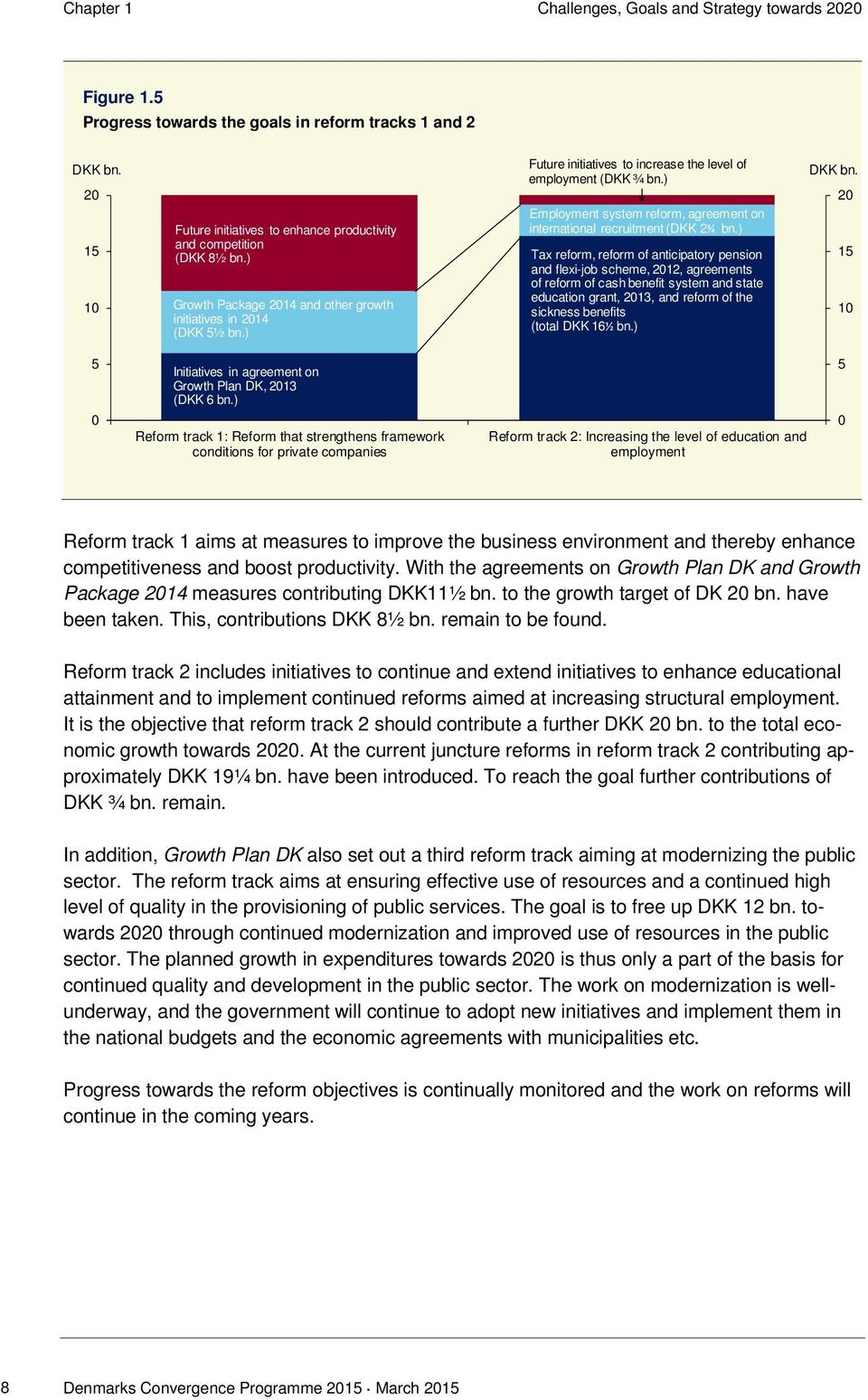
9 Chapter 1 Challenges, Goals and Strategy towards 2020 Box 1.1 Central fiscal policy goals and instruments The planning of fiscal policy is done within the overall framework which follows from the Budget Law and the 2020-plan. The goals and instruments in the fiscal policy planning are as follows: Sustainable public finances operationalized as at least structural public balance in The annual structural public balance must not exceed a deficit of a ½ per cent of GDP at the time of the budget proposal for a given year unless extraordinary circumstances are present, and is to be gradually reduced towards 2020 so that at least balance is obtained that year. Expenditure ceilings underpin that the overall targets for fiscal policy are met. The ceilings are adopted by Parliament and set legally binding limits for the expenditures in central government, municipalities and regions. Each year, in connection with the Government Budget, expenditure ceilings for the new fourth year are adopted, so that the expenditure ceilings cover a continuous four-year period. Measures towards improved budget management and economic sanctions supports compliance with the expenditure ceilings. The Danish Economic Council is to continually (annually) assess whether economic policy adheres to the target of structural public balance, complies with expenditure ceilings and whether the adopted expenditure ceilings are consistent with medium term projections for public finances. A major condition for the long-term sustainability of public finances is the indexation of the eligibility ages for early retirement and retirement that follows from the 2011 retirement reform. The reform states that new eligibility ages for early retirement and retirement that result from this indexation have to be adopted by Parliament. The first time for this to happen is in 2015, with effect from 2027 for the early retirement age and from 2030 for the retirement age, and subsequently for every five years. The adopted reforms provide a basis for expenditures on public consumption, research and development to grow on average by DKK 3 bn. annually in The growth target is to be fulfilled through initiatives in two reform tracks which were laid out in Growth Plan DK, and the government is with the already implemented reforms well underway towards achieving the growth target, cf. figure 1.5. Denmark s Convergence Programme 2015 March

10 Chapter 1 Challenges, Goals and Strategy towards 2020 Figure 1.5 Progress towards the goals in reform tracks 1 and 2 DKK bn Future initiatives to enhance productivity and competition (DKK 8½ bn.) Growth Package 2014 and other growth initiatives in 2014 (DKK 5½ bn.) Future initiatives to increase the level of employment (DKK ¾ bn.) Employment system reform, agreement on international recruitment (DKK 2¾ bn.) Tax reform, reform of anticipatory pension and flexi-job scheme, 2012, agreements of reform of cash benefit system and state education grant, 2013, and reform of the sickness benefits (total DKK 16½ bn.) DKK bn Initiatives in agreement on Growth Plan DK, 2013 (DKK 6 bn.) Reform track 1: Reform that strengthens framework conditions for private companies Reform track 2: Increasing the level of education and employment 5 0 Reform track 1 aims at measures to improve the business environment and thereby enhance competitiveness and boost productivity. With the agreements on Growth Plan DK and Growth Package 2014 measures contributing DKK11½ bn. to the growth target of DK 20 bn. have been taken. This, contributions DKK 8½ bn. remain to be found. Reform track 2 includes initiatives to continue and extend initiatives to enhance educational attainment and to implement continued reforms aimed at increasing structural employment. It is the objective that reform track 2 should contribute a further DKK 20 bn. to the total economic growth towards At the current juncture reforms in reform track 2 contributing approximately DKK 19¼ bn. have been introduced. To reach the goal further contributions of DKK ¾ bn. remain. In addition, Growth Plan DK also set out a third reform track aiming at modernizing the public sector. The reform track aims at ensuring effective use of resources and a continued high level of quality in the provisioning of public services. The goal is to free up DKK 12 bn. towards 2020 through continued modernization and improved use of resources in the public sector. The planned growth in expenditures towards 2020 is thus only a part of the basis for continued quality and development in the public sector. The work on modernization is wellunderway, and the government will continue to adopt new initiatives and implement them in the national budgets and the economic agreements with municipalities etc. Progress towards the reform objectives is continually monitored and the work on reforms will continue in the coming years. 8 Denmarks Convergence Programme 2015 March 2015
11

12 Kapitel 1 1

13 Chapter 2 2. The Macroeconomic Scenario towards 2020 Nyt kapitel The recovery of the Danish business cycle has been under way for some time. Production is increasing in large parts of the private sector, and private sector employment is up by 38,500 persons since the turnaround began in the second quarter of The foundation for a sustainable recovery is present. The correction of the Danish economy has come a long way following the overheating in the mid-00s and the global downturn in the world economy. The housing market shows progress, and households economies have become better balanced, while Danish competitiveness has strengthened considerably. A number of reforms have been enacted, which allows for improved economic conditions to translate into more jobs, without giving rise to pressure in the labour market. GDP growth is estimated to be 1.6 per cent in 2015 and 2 per cent in 2016 after growing around 1 per cent in The medium-term 2020-projection implies that growth may rise about 2¼ per cent on average in the years , and that the output gap is closed in In addition, under current policies, total employment is estimated to rise by around 190,000 persons from 2013 to The outlook for the Danish economy in 2015 and 2016 The improvement in the Danish economy is pronounced in the labour market, and in the private sector 38,500 more people were employed in the fourth quarter of 2014 than in the second quarter of 2013 when the trend reversed. This corresponds to an employment gain of 2 per cent. The improvement in the labour market strengthens the foundation for an increase in private consumption, and there are signs that consumption is on the rise. The improvement in the labour market reflects that production in large parts of the private sector is rising more than the development in GDP shows. For 2014 as a whole GDP grew 1 per cent, however, the increase was stronger in the private sector (excluding mining and Denmark s Convergence Programme 2015 March
14 Chapter 2 The Macroeconomic Scenario towards 2020 quarrying), where GVA rose by 1.4 per cent, cf. figure 2.1. The increase comes after several years of weak economic conditions and there are still considerable idle resources in the economy. The output gap is estimated to have been 2¼ per cent of GDP last year. The recovery of the business cycle is expected to gain momentum this year and the next. The decline in oil prices and monetary policy easing lends support to the recovery of the European and the Danish economy. Against this backdrop, GDP growth is expected to increase, from 1.6 per cent this year to 2.0 per cent next year. For 2015 this implies an upward revision of the growth forecast of 0.2 per cent compared to the latest assessment in Economic Survey, December The convergence programme takes into account that the extraordinarily large movements in oil prices and interest rates that have occurred over the turn of the year and into 2015, both affect the public balance directly and also strengthens the basis for growth in private consumption. Furthermore, a new collective bargaining agreement for public sector employees has been reached, which holds implications for public consumption. These changes of preconditions has, along with the new national accounts, lead to a number of technical adjustments to the economic stance compared to Economic Survey, December 2014, cf. box Denmark s Convergence Programme 2015 March 2015
15 Chapter 2 The Macroeconomic Scenario towards 2020 Box 2.1 The technically adjusted economic forecast for 2014 to 2016 in the Convergence Programme for 2015 Since the forecast in Economic Survey, December 2014, a number of extraordinary developments have been seen in oil prices, interest rates, etc., which influence the growth outlook and public finances. On this basis, a number of technical adjustments have been incorporated into the cyclical forecast in the Convergence Programme: - The forecast for the oil price has been adjusted downwards by around USD 25 both this year and next year. - The forecast for 10 year government bond rates has been adjusted downward by around 1 percentage point in both 2015 and National accounts for 2014 are incorporated in the forecast. Due to a higher level of employment at the end of 2014, employment growth has been revised upward by 5,000 persons in The effect form lower interest rates and oil prices has been included in household disposable real income in both 2015 and This has led to an upwards revision of private consumption growth by 0.3 percentage points in 2015 and 0.1 percentage point in Nominal public consumption has been revised down in 2015 and 2016, partly due to the new public sector collective bargaining agreement. On this basis, the forecast for real growth in public consumption expenditure has been revised down from 1,5percentage points in 2015 in the December survey to 1,0percentage point. A more detailed description of the changes in public consumption expenditure is found in chapter 3. - The overall change in the circumstances of the real economy and the direct effect of lower oil prices and interest rates on revenue from the North Sea and from the pension yield tax is incorporated into the forecast for public finances. Overall, these technical adjustments result in an upwards revision of 2015 GDP growth from 1.4 per cent in the December survey to 1.6 per cent, while growth in 2016 is unchanged at 2.0 per cent. A new forecast for the Danish economy will be prepared for the Economic Survey, May A significant surplus on the public finances is expected in 2014, primarily as a consequence of large one-off earnings from the tax on existing capital pensions and extraordinarily large revenue from the pension yield tax. In 2015 public finances are also expected to be affected by extraordinary revenue from the pension package from October 2014, and the estimated pubic deficit is expected to be around 1.7 per cent of GDP. In 2016, where temporary revenue is expected to cease, the public deficit is expected to be 2.6 per cent of GDP. The deficit these years reflects the fact that capacity utilisation in the Danish economy remains below normal levels. Fundamentally, public finances are sound, and fiscal policy is designed within the framework of the Budget Law and the Stability and Growth Pact with a target of long-term sustainability, which helps to ensure confidence in the Danish economy. This is reflected in Denmark sustaining its AAA-rating throughout the financial crisis. Also, the responsible and stabilityoriented fiscal policy contributes to the credibility of the fixed exchange rate policy, which supports continued low interest rates. Denmark s Convergence Programme 2015 March

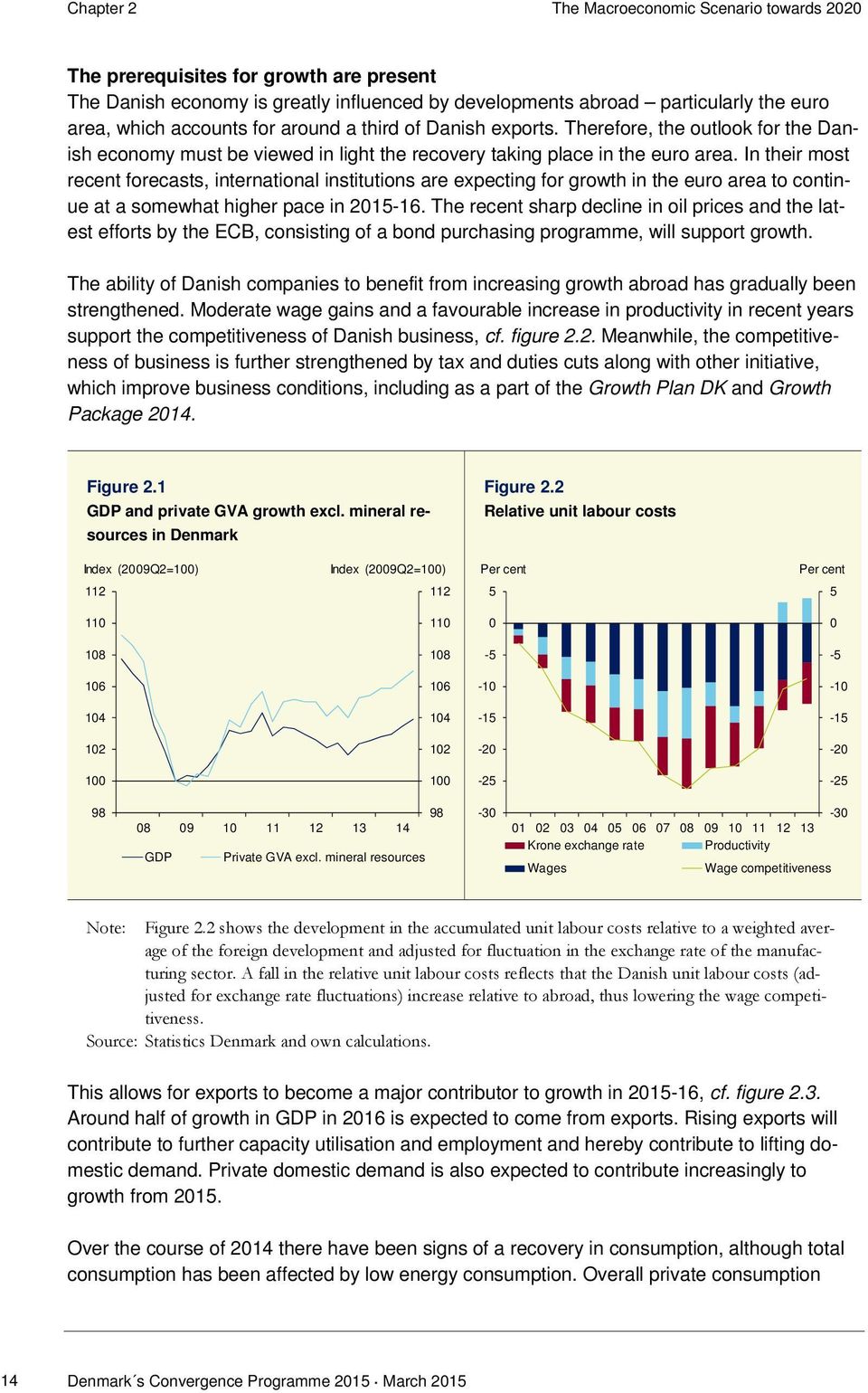
16 Chapter 2 The Macroeconomic Scenario towards 2020 The prerequisites for growth are present The Danish economy is greatly influenced by developments abroad particularly the euro area, which accounts for around a third of Danish exports. Therefore, the outlook for the Danish economy must be viewed in light the recovery taking place in the euro area. In their most recent forecasts, international institutions are expecting for growth in the euro area to continue at a somewhat higher pace in The recent sharp decline in oil prices and the latest efforts by the ECB, consisting of a bond purchasing programme, will support growth. The ability of Danish companies to benefit from increasing growth abroad has gradually been strengthened. Moderate wage gains and a favourable increase in productivity in recent years support the competitiveness of Danish business, cf. figure 2.2. Meanwhile, the competitiveness of business is further strengthened by tax and duties cuts along with other initiative, which improve business conditions, including as a part of the Growth Plan DK and Growth Package Figure 2.1 GDP and private GVA growth excl. mineral resources in Denmark Figure 2.2 Relative unit labour costs Index (2009Q2=100) Index (2009Q2=100) Per cent Per cent GDP Private GVA excl. mineral resources Krone exchange rate Productivity Wages Wage competitiveness -30 Note: Figure 2.2 shows the development in the accumulated unit labour costs relative to a weighted average of the foreign development and adjusted for fluctuation in the exchange rate of the manufacturing sector. A fall in the relative unit labour costs reflects that the Danish unit labour costs (adjusted for exchange rate fluctuations) increase relative to abroad, thus lowering the wage competitiveness. Source: Statistics Denmark and own calculations. This allows for exports to become a major contributor to growth in , cf. figure 2.3. Around half of growth in GDP in 2016 is expected to come from exports. Rising exports will contribute to further capacity utilisation and employment and hereby contribute to lifting domestic demand. Private domestic demand is also expected to contribute increasingly to growth from Over the course of 2014 there have been signs of a recovery in consumption, although total consumption has been affected by low energy consumption. Overall private consumption 14 Denmark s Convergence Programme 2015 March 2015
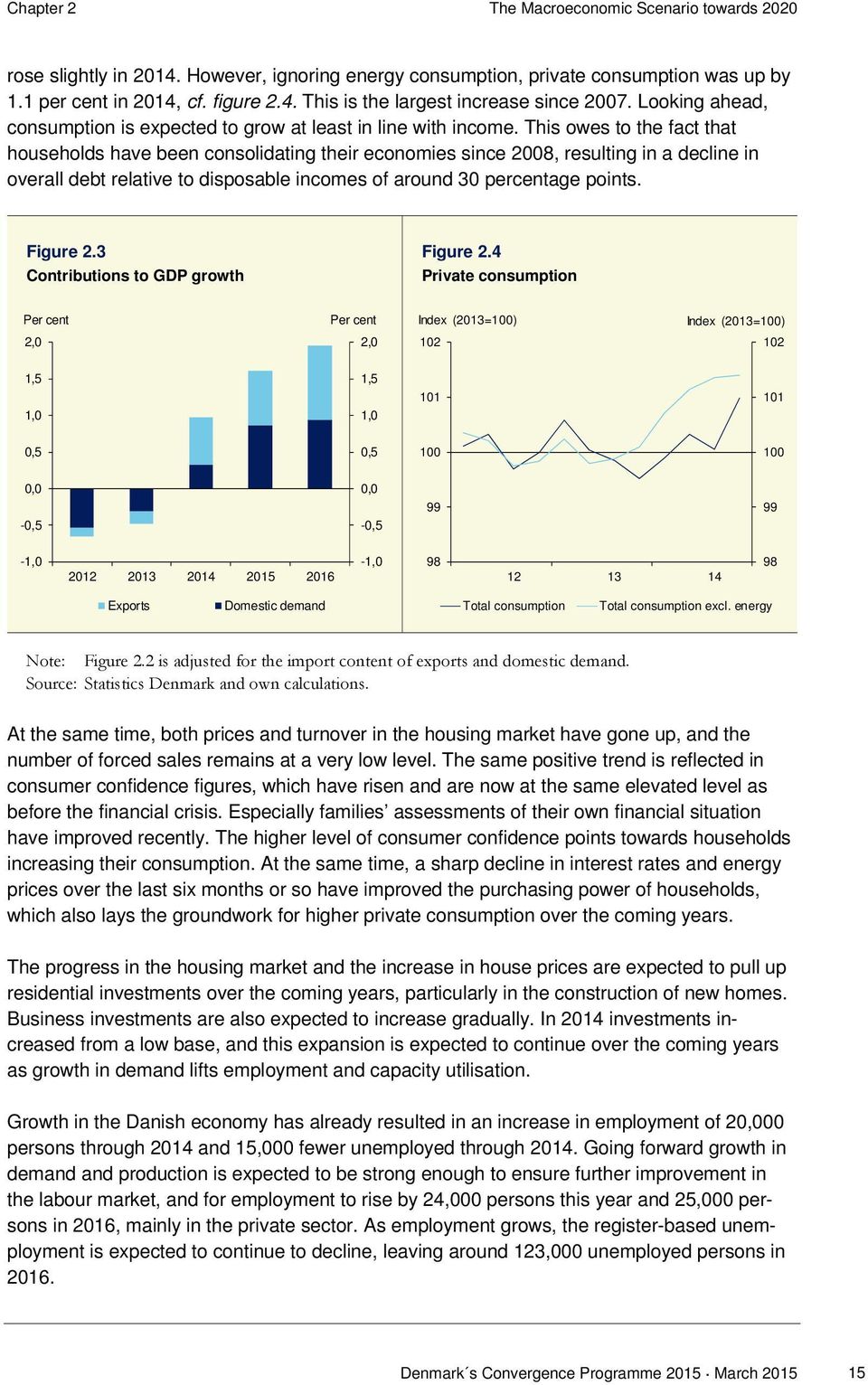
17 Chapter 2 The Macroeconomic Scenario towards 2020 rose slightly in However, ignoring energy consumption, private consumption was up by 1.1 per cent in 2014, cf. figure 2.4. This is the largest increase since Looking ahead, consumption is expected to grow at least in line with income. This owes to the fact that households have been consolidating their economies since 2008, resulting in a decline in overall debt relative to disposable incomes of around 30 percentage points. Figure 2.3 Contributions to GDP growth Figure 2.4 Private consumption Per cent 2,0 Per cent 2,0 Index (2013=100) Index (2013=100) ,5 1,0 1,5 1, ,5 0, ,0-0,5 0,0-0, , , Exports Domestic demand Total consumption Total consumption excl. energy Note: Figure 2.2 is adjusted for the import content of exports and domestic demand. Source: Statistics Denmark and own calculations. At the same time, both prices and turnover in the housing market have gone up, and the number of forced sales remains at a very low level. The same positive trend is reflected in consumer confidence figures, which have risen and are now at the same elevated level as before the financial crisis. Especially families assessments of their own financial situation have improved recently. The higher level of consumer confidence points towards households increasing their consumption. At the same time, a sharp decline in interest rates and energy prices over the last six months or so have improved the purchasing power of households, which also lays the groundwork for higher private consumption over the coming years. The progress in the housing market and the increase in house prices are expected to pull up residential investments over the coming years, particularly in the construction of new homes. Business investments are also expected to increase gradually. In 2014 investments increased from a low base, and this expansion is expected to continue over the coming years as growth in demand lifts employment and capacity utilisation. Growth in the Danish economy has already resulted in an increase in employment of 20,000 persons through 2014 and 15,000 fewer unemployed through Going forward growth in demand and production is expected to be strong enough to ensure further improvement in the labour market, and for employment to rise by 24,000 persons this year and 25,000 persons in 2016, mainly in the private sector. As employment grows, the register-based unemployment is expected to continue to decline, leaving around 123,000 unemployed persons in Denmark s Convergence Programme 2015 March
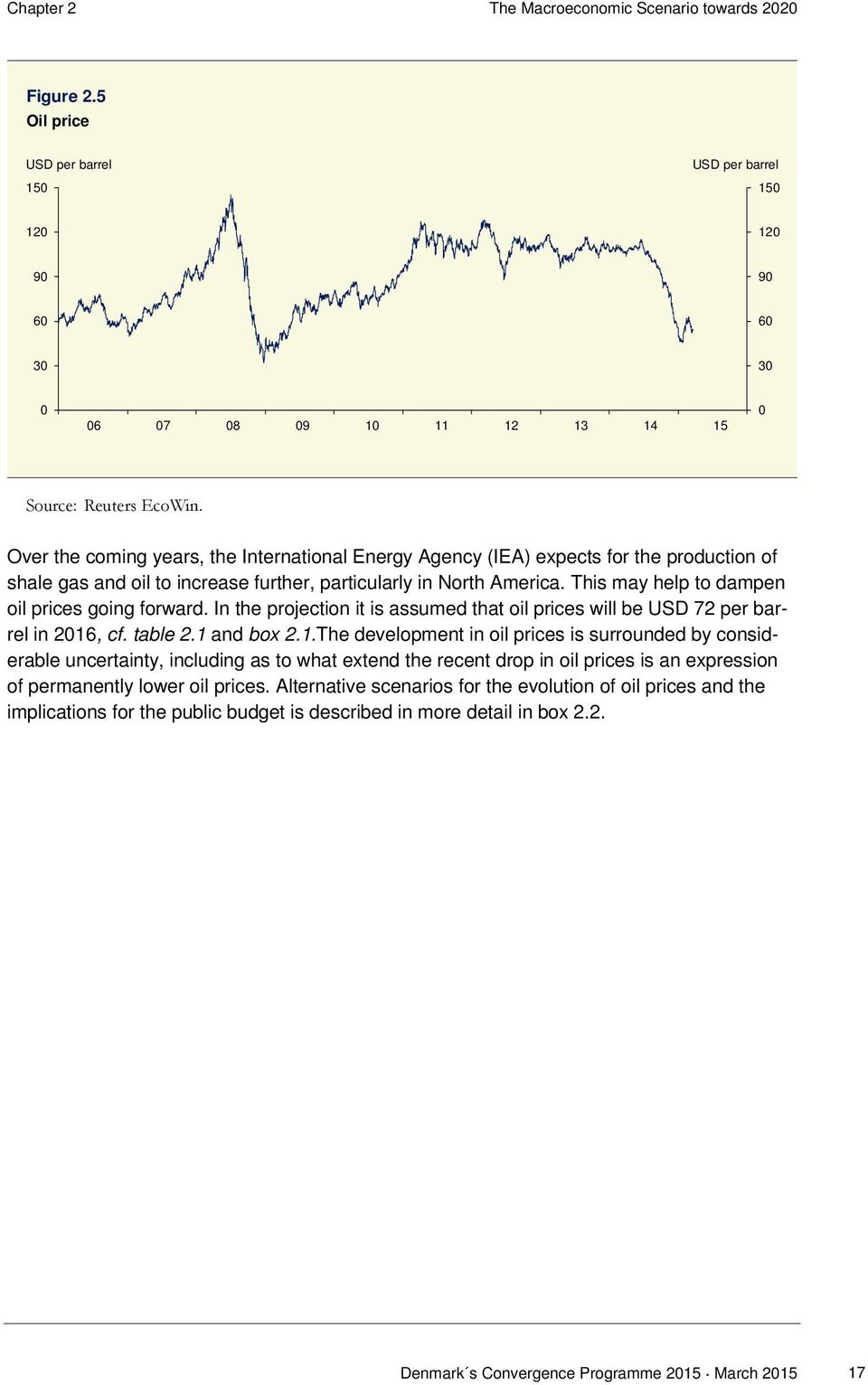
18 Chapter 2 The Macroeconomic Scenario towards Assumptions on the international economy and financial conditions The assumptions on developments in the international economy in 2015 and 2016 have been updated with the latest forecasts from the EU Commission and the IMF. Estimates for growth abroad are overall in line with the assumptions in Economic Survey, December 2014, thought the exact composition differs somewhat. Growth is now expected to be slightly higher in several EU countries, whereas the outlook for a number of emerging economies has been downgraded. In the years beyond 2016 towards 2020 the assumptions on international growth is based on the OECD s medium-term projection in Economic Outlook 95. The improvement in the global economy continued in 2014, and growth returned to the euro area following two consecutive years of decline. Growth in the euro area was largely driven by Germany where both exports and private consumption grew significantly faster than in the two previous years. At the same time the recovery gained momentum in the US and in the UK. Conversely, growth slowed in a number of emerging markets, particularly Russia and Brazil. Progress is expected to continue in the euro area this year and the next. This is partly attributed to the adjustment in competitiveness, which has taken place in a number of debtridden countries, along with the effect of recent years reform effort, a more neutral fiscal policy stance, and the restoration of confidence in a number of vulnerable euro countries, including as a consequence of progress in establishing a banking union and a single European banking supervision. Compared to the assessment in Economic Survey, December 2014, lower oil prices, monetary easing by the ECB and a weakening of the euro all contribute to further supporting growth in the euro area. However, growth still might be dampened by a potential need for further consolidation in both the private and the public sector and by weak investment growth. The overall picture is, however, one of stronger growth in Among other major trading partners, the US, Great Britain and Sweden, growth is expected to remain elevated, mainly supported by domestic demand. On the contrary, growth is expected to decelerate in China, albeit from a high level. This is mainly due to a weakening of investment growth, and has the potential of spill over effects to surrounding countries. Overall, export market growth is expected to be 5¼ per cent in 2015 and almost 6 per cent in Since the summer of 2014 oil prices have fallen considerably. Currently the price of North Sea oil (Brent) is at around 55 dollar per barrel, cf. figure 2.5. A main driver behind the decline in prices has been a continuous rise in global oil production. Particularly American production of both shale oil and liquid natural gas has risen, which has reduced American demand for imported oil considerably. Meanwhile, there a not yet signs that Saudi Arabia, or the OPEC a whole, will reduce oil production in order to curb the decline in prices. Relatively weak growth in Japan, China and some other emerging markets economies has contributed further to the recent weakening of demand for oil. 16 Denmark s Convergence Programme 2015 March 2015

19 Chapter 2 The Macroeconomic Scenario towards 2020 Figure 2.5 Oil price USD per barrel 150 USD per barrel Source: Reuters EcoWin. Over the coming years, the International Energy Agency (IEA) expects for the production of shale gas and oil to increase further, particularly in North America. This may help to dampen oil prices going forward. In the projection it is assumed that oil prices will be USD 72 per barrel in 2016, cf. table 2.1 and box 2.1.The development in oil prices is surrounded by considerable uncertainty, including as to what extend the recent drop in oil prices is an expression of permanently lower oil prices. Alternative scenarios for the evolution of oil prices and the implications for the public budget is described in more detail in box 2.2. Denmark s Convergence Programme 2015 March
20 Chapter 2 The Macroeconomic Scenario towards 2020 Box 2.2 Alternative scenarios for oil prices towards 2020 In the Economic Survey and in the Convergence Programme oil prices are normally projected based on current futures prices for (approximately) the first three months, followed by a gradual adjustment towards the International Energy Agency (IEA) forecast for oil prices in The IEA estimate is the traditional anchor for long-term prices because they are based on detailed assumptions on long-term supply and demand factors. The IEA take into account, among other things, the expected evolution of investments and technology, including how these depend on the expected development in prices. However, in recent months there have been sharp fluctuations in oil prices. The data processing behind IEAs most recent long-term forecast, published in November 2014, was largely finished before the scope of the oil price decline of the second half of 2014 was known. Hence, it is uncertain whether the IEA has incorporated the full effect of the recent large fluctuations in the oil market. Pending a new forecast from the IEA, more conservative assumptions for long-term oil prices are applied. In the Convergence Programme for 2015 the traditional method form the basis, but futures prices are given more weight in order to take the significant recent fluctuations into account, cf. figure a. In general, futures prices are not viewed as suitable for medium or long-term projections. One reason is that they are highly dependent on the current price level, and because there is only very limited turnover in contracts with a time horizon of more than approximately one year, cf. figure c and d. In the current situation futures prices could, however, complement the long-term assessment from the IEA. This method seeks to incorporate the sharp fall in oil prices into the medium-term projection for the Danish economy in the period towards the release of the IEAs annual long-term forecast in November This results in a more conservative estimate for North Sea revenue, implying a reduction in revenue in 2020 by around 0,3 per cent of GDP compared to a scenario based on the IEA alone, cf. figure b. A scenario based on futures prices alone would lead to a further reduction of revenue by ¼ per cent of GDP. However, as mentioned above, futures prices contain only little information on the medium term trend and are only included in order to capture information on the recent oil price decline. Figure a Oil price assumptions Figure b North Sea revenue in 2020, per cent of GDP USD per barrel USD per barrel KP15 IEA2020 Futures 0.0 KP15 IEA2020 Futures 18 Denmark s Convergence Programme 2015 March 2015

21 Chapter 2 The Macroeconomic Scenario towards 2020 Box 2.2 (continued) Alternative scenarios for oil prices towards 2020 Figure c Developments in futures prices Figure d Volume oil futures contracts, daily average 2014 USD per barrel USD per barrel Million barrels Million barrels Actual oil price Futures 31 December Pos 2-Pos 3-Pos 4-Pos 5-Pos 6-Pos 7-Pos 12-Pos 24-Pos 36-Pos ) After 2020 a further linear adaption towards the IEA forecasts for 2030 and 2040, beyond 2040 nominal oil prices are assumed to rise in line with inflation. Source: Reuters EcoWin, IEA, World Energy Outlook, November 2014, and own calculations. Since the end of December 2014, there has been a decline in interest rates in the euro area and Denmark. In Denmark, the drop in interest rates has been enhanced by Danmarks Nationalbank s lowering interest rates in end-january and early February through a series of unilateral rate cuts in order to defend the exchange rate peg. This was seen in the wake of rising demand for Danish Kroner in the beginning of the year, following the decision by the Swiss National Bank to abandon the price ceiling against the euro. Furthermore, the ECB has eased monetary policy further by announcing a programme for the purchase of DKK 8,500 bn. worth of securities in the period up to September This has influenced short-term interest rates, cf. figure 2.6. In this context, and in combination with falling interest rates in the euro area, Danish bond yields have gone down as well, cf. figure 2.7. In the Economic Survey, December 2014, it was not assumed that monetary policy would be eased to the extent that has been seen in the beginning of this year. The yield on 10-year government bonds has been revised down by around 1 percentage point compared to the assessment in December and is expected to remain very low in , cf. table 2.1. Denmark s Convergence Programme 2015 March
22 Chapter 2 The Macroeconomic Scenario towards 2020 Figure 2.6 Interest rate spreads against the euro area Figure 2.7 Danish mortgage rates Percentage points Percentage points 2,5 2,5 2,0 2,0 1,5 1,5 1,0 1,0 0,5 0,5 0,0 0,0-0,5-0,5-1,0-1, Deposits Lendings 3 months Per cent Per cent Short-term mortgage rate Long-term mortgage rate Average bond rate Note.: In figure 2.6 Deposits is the spread between Danmarks Nationalbank s Certificate of deposit rate and ECB s deposit facility rate, Lendings is the spread between Danmarks Nationalbank s lending rate and ECB s main refinancing operation rate, while 3 months is the spread between the Cibor- and Euribor rates with three months maturity. Source: Reuters EcoWin, Realkredit Danmark, Danmarks Nationalbank and own calculations. Table 2.1 External assumptions Annual growth, per cent Real GDP, main trading partners Oil price (Brent), USD per barrel, 2010 prices Dollar exchange rate, DKK per USD Interest rate 10-year Danish treasury bonds, per cent ) Covers the OECD countries and the emerging economies Brazil, Russia, India, China, South Africa, Turkey, Indonesia and Mexico. Source: Statistics Denmark, OECD and own calculations. 20 Denmark s Convergence Programme 2015 March 2015
23 Chapter 2 The Macroeconomic Scenario towards Growth and employment towards 2020 The forecast for is a technical projection, in which a gradual normalisation of the business cycle towards 2019 is assumed. The normalisation is closely linked to the recovery of the international economy, the euro area in particular. The economic outlook for involves a gradual recovery of the Danish economy, thus, closing the output and employment gap around 2019, cf. figure 2.8 and 2.9. In 2020 an onward it is assumed that growth in GDP and employment will correspond to structural growth rates. The assumptions are presented in box 2.3. Figure 2.8 Output gap Figure 2.9 Real and structural employment persons persons Employment Structural employment Note: Structural employment is a calculated estimate of the level of employment in a normal cyclical situation. Source: Statistics Denmark and own calculations. Denmark s Convergence Programme 2015 March
24 Chapter 2 The Macroeconomic Scenario towards 2020 Box 2.3 Assumptions in the medium-term projection towards 2020 Assumptions about economic policy: The projections follow a principle of caution. This implies that only reforms backed by a majority in the parliament are included. The governments education targets are assumed to be gradually met by 2020, see also the National Reform Program Fiscal policy is planned within the framework of the Budget Law, the Stability and Growth Pact and the target of structural balance in Within the framework of the budget law and the government s target of structural balance in the public finances in 2020 along with fiscal sustainability the medium-term projection allows for an average real annual in public consumption of 0.6 per cent from 2015 to Selected technical assumptions behind the projection: The output and employment gap is gradually closed towards Hourly productivity growth in the private non-agricultural sector of 1¼ percent (structurally) and for the whole economy close to 1¼ percent per year in Potential GVA growth towards 2020 is around 2 per cent per year, where reforms that increase labour supply is a main contributor to the extra growth. Including the business cycle normalization, GDP growth is around 2¼ per cent on average annually towards A higher level of education and fulfilment of the education targets will in isolation contribute to the structural productivity growth. However, the contribution will primarily take place after The structural gross unemployment is estimated at around 3¼ per cent of the labour force towards It is assumed that the current recovery period following the global downturn will take somewhat less than a decade. Historically, the recovery from a financial crisis lasts longer. The adjustment seen so far holds many similarities to the development seen after the overheating of the Danish economy in the mid-1980s. After a preceding period of rising private consumption, a rapid rise in credit issuance and a booming housing market, followed a prolonged downturn lasting until the beginning of the 1990s, when, among other things, the development in consumption was muted. Following this adjustment period came a period of renewed growth. In the period GDP grew by an annual average rate of 3.3 per cent, owing partly to labour market reforms and a considerable decline in unemployment. The strength of the recovery so far has just as the recovery of the 1980s been tempered by the evolution in private consumption, among other things. Much of the adjustment now seems to have occurred, and over the course of 2014 private consumption began to increase again. The adjustment seen since 2008 now implies that private consumption may again grow in line with rising income towards Hence, in the projection towards 2020 it is assumed that private consumption will grow in real terms by 2½ per cent annually from 2016 to This must be viewed in light of rising employment, wage growth and increased pension payments. In contrast, a normalisation of interest rates will weigh on disposable incomes. 22 Denmark s Convergence Programme 2015 March 2015
25 Chapter 2 The Macroeconomic Scenario towards 2020 Overall, this implies that private consumption as a share of GDP is roughly unchanged, cf. figure As the business cycle is normalised, there is a potential for business investments to contribute further to demand growth. This is supported by the fact that businesses have strengthened their financial resilience in recent years. In addition, the scope for investments is supported by economic policy, including through a gradual reduction of the corporate tax rate. In the trajectory towards 2020, it is assumed that gross fixed capital formation will rise from around 19¾ per cent of GDP in 2016 to almost 22 per cent of GDP in 2020, cf. figure This contributes to restore the total investment backlog (including in residential investments) that was created in the wake of the crisis. Figure 2.10 Private consumption expenditure (share of GDP) Figure 2.11 Gross fixed capital formation (share of GDP) Source: Statistics Denmark and own calculations. Based on the assumptions about international growth and developments in Danish market shares, etc., growth in total exports of goods and services is expected to average 4½ per cent annually in the years The increase in demand is expected to lead to import growth of 5¼ per cent a year. The strong growth in imports relative to exports should be seen in light of the expectation of relatively stronger growth in Danish domestic demand than in domestic demand abroad. The current account surplus is hereby reduced, but continues to post a solid surplus over the entire period. Given the assumed cyclical normalisation and the already agreed upon reforms, employment is expected to rise by 190,000 persons from 2013 to While demographic trends in isolation are expected to weigh on the work force, labour supply is expected to rise, and structural employment is estimated to grow by around 105,000 persons. This owes to already agreed upon reforms, including the pension reform of 2011 and reforms of taxation, anticipatory pensions and the flexi-jobs scheme, cash benefits and the state education grant system. Furthermore, the normalisation of the business cycle is expected to lift employment by 85,000 persons towards Denmark s Convergence Programme 2015 March
26 Chapter 2 The Macroeconomic Scenario towards 2020 In relation to the recovery to a normal business cycle stance, it is estimated that gross unemployment will decline to around 3¼ per cent of the labour force. In total, this leads to a forecast of average annual GDP growth of around 2¼ per cent in the period , cf. table 2.2. This growth rate reflects an average growth in production potential (as measured by GVA) of almost 2 per cent over the period. The increase in production potential reflects growth in structural hourly productivity, which, in light of the weak productivity growth in the 90s and 00s, is estimated at more than 1 per cent. Furthermore, the development in structural employment contributes by about ½ per cent annually, mainly due to a rise in the structural labour force. In addition, cyclical factors contribute by 0.3 per percentage points a year, reflecting the closing of the output gap towards Table 2.2 Contribution to growth in the potential production and in actual GVA (real terms) Average annual growth, per cent Potential production (GVA) Of this, contributions from - Hourly productivity (structural) Structural unemployment Structural work force Working hours (structural) Cyclical contribution Real GVA Net taxes Real GDP Source: Statistics Denmark and own calculations. 2.4 Macroeconomic balances In recent years, the current account has increased noticeably to around 7 per cent of GDP, cf. figure The moderation of private domestic demand has contributed to increasing financial savings in the private sector noticeably in the wake of the economic and financial crisis, cf. figure The level is now significantly above the historical average. The surplus on the trade balance (both goods and services) should be viewed in light of considerable energy exports due to the extraction of oil and gas in the North Sea and a lasting improvement in Danish terms of trade. Furthermore, wage and investment income has contributed greatly to the build-up of the current account surplus. This is partly because Denmark 24 Denmark s Convergence Programme 2015 March 2015
27 Chapter 2 The Macroeconomic Scenario towards 2020 has built a growing net foreign asset position as a result of consistent current account surpluses, and also due to the composition of Danish assets and liabilities contributing significantly to the surplus of investment incomes. A large proportion of Denmark s assets are placed in direct investments, which have historically yielded higher returns, while a large share of the liabilities are made up by debt, which has yielded very modest returns in recent years as a consequence of low interest rates. As a result of, among other things, increasing investments and consumption, along with a falling energy production in the North Sea, it is assumed that from 2016 and onward, a gradual decline in private savings as a share of GDP will take place, cf. table 2.3. The reduction in the private sector savings surplus will be partly offset by a declining public deficit towards balance in Throughout the period, the actual government deficit remains below the limit of 3 per cent of GDP following from the Stability and Growth Pact. The overall effect of the changes in the public and private sector savings surplus is dominated by the reduction in the private sector. Hence, the current account surplus is expected to decline towards The decline primarily reflects that the surplus on the trade balance is reduced from 5¼ per cent of GDP in 2014 to 3½ per cent of GDP in Table 2.3 Savings, investments, current account and net assets against other countries Investment ratio, private sector Savings ratio, private sector Private financial savings General government budget balance Current account Net assets, ultimo Source: Statistics Denmark and own calculations. Denmark s Convergence Programme 2015 March
28 Chapter 2 The Macroeconomic Scenario towards 2020 Figure 2.12 Balance of payments Figure 2.13 Net lending Current transfers Wage- and property income Goods and services Balance of payments General Government Firms Households Total Note: Total net lending equals (except from the normally small net capital transfers abroad) the balance of payments on the current account. Source: Statistics Denmark and own calculations. 26 Denmark s Convergence Programme 2015 March 2015
29 Chapter 2 The Macroeconomic Scenario towards 2020 Annex 1. Key figures for the Danish economy Table 2.a Key figures for the Danish economy Output gap and real growth rates (per cent) Medium-term scenario Short-term forecast 1) Recovery Potential growth ) ) Output gap (per cent of GDP) ) 0.0 GVA GDP Demand, real growth, per cent Private consumption Public consumption Gross fixed capital formation Change in inventories (per cent of GDP) ) 0.0 Export Import Labour market and productivity Growth in labour force (per cent) Growth in employment (per cent) Structural gross unemployment (per cent of labour force) ) 3.2 Registered (net) unemployment (per cent of labour force) ) 3.2 Hourly productivity, entire economy Growth in GVA per employed ) The forecast in is based on the technically adjusted economic forecast, cf. box ) Growth in is including the cyclical normalization. 3) From 2020 and onwards, GDP growth is expected to follow the historical trend. 4) Average in the period. Source: Statistics Denmark and own calculations. Denmark s Convergence Programme 2015 March
30 Kapitel 1 1
31 Chapter 3 3. Budget balance and public debt towards 2020 Nyt kapitel Denmark s EU recommendation concerning excessive deficits was lifted in June 2014, and for the coming years the actual budget balance is expected to comply with the 3 per cent of GDP limit given by the Stability and Growth Pact. Even though the Danish economy is improving, there are still idle resources. Against this background, fiscal policy is for the moment designed to support economic activity as much as possible within the framework given by the Danish Budget Law and the Stability and Growth Pact. As the economy gains further momentum a gradual normalisation of the current expansive fiscal policy stance is needed, including an adjustment of public investment levels. From an estimated deficit of ½ per cent of GDP in 2016 the structural budget balance is gradually improving towards 2020, where public revenues and expenditures are balancing. The public EMU debt is estimated at approx. 37 per cent of GDP in 2020 and thus keeps a broad safety margin against the 60 per cent of GDP limit of the Stability and Growth Pact. 3.1 The budget balance Denmark s EU recommendation concerning excessive deficits was lifted in June 2014, since it was assessed, that the actual budget deficit had been brought sustainably below the 3 per cent of GDP limit, which was the main requirement of the recommendation. Based on preliminary figures from Statistics Denmark the general government budget surplus amounted to almost DKK 24 bn. in 2014 corresponding to 1.3 per cent of GDP, cf. figure 3.1. It is the first surplus since 2008, but the surplus is related to significant one-off revenues stemming from the restructuring of capital pensions and extraordinarily large revenues from the pension yield tax. In 2015, where the actual budget deficit is estimated at 1.7 per cent of BNP, public finances are also affected by temporary revenues due to the pension package from October 2014, cf. box 3.1. In 2016 where the temporary revenues lapses a deficit of 2.6 per cent of GDP is estimated. Thus, for the period the actual budget balance is expected to develop in compliance with the requirements given by the Stability and Growth Pact. In these years the expected Denmark s Convergence Programme 2015 March
32 Chapter 3 Budget balance and public debt towards 2020 budget deficits (excl. temporary revenues) reflect, that the level of capacity utilisation in the Danish economy continues to be below normal. In the medium term projection from the actual budget balance is improving in line with the assumed economic recovery, cf. figure 3.2. Figure 3.1 Actual budget balance incl. and excl. specific temporary revenues in Stability and Growth Pact limit for actual balance Actual balance Actual balance excl. specific temporary revenues in Figure 3.2 Actual budget balance towards Actual balance Note: In figure 3.1 the budget balance excl. specific temporary revenues is corrected for one-off revenues due to restructuring of existing capital pensions, pay out and restructuring of savings in Lønmodtagernes Dyrtidsfond (LD), a reallocation in the pension sector from schemes with guaranteed yield to schemes based on market return, and advanced ordinary revenues from the taxation of capital pensions, cf. box 3.1. Source: Statististics Denmark and own calculations. 30 Denmark s Convergence Programme 2015 March 2015
33 Chapter 3 Budget balance and public debt towards 2020 Box 3.1 Temporary factors affecting public finances in In the actual budget balance in affected by both temporary revenues from the restructuring of capital pension to the new old-age savings scheme (DKK 28½ bn. in 2013, DKK 60 bn. in 2014 and estimated at DKK 6 bn. in 2015) and advanced ordinary revenues from the capital pension tax (DKK 5¼ bn. in 2013 and DKK 2¼ bn. in 2014) since people older than 60 years to a larger degree chooses to receive their capital pensions in these years, where the tax payment is lower. The advancement of ordinary revenues in 2013 and 2014 is assumed to take place uniformly from the period A further temporary effect on the actual budget balance derives from advanced taxation of LD deposits at almost DKK 9 bn. in Furthermore, the revenues in 2013 and 2014 are affected by temporary revenues from the pension yield tax of DKK 2 bn. due to a reallocation in the pension sector from schemes with guaranteed yield to schemes based on market return. DKK bn Actual budget balance Restructuring of capital pensions Advanced ordinary revenues from the capital pension tax Taxation of LD deposits 8.9 Reallocation in the pension sector 2 2 The outlook in Economic Survey, December 2014 is the starting point for the budget balance estimates in However, technical updates are taken into account, including adjusted oil price and interest rate assumptions, as well as new information concerning public finances. Compared to the December estimates the actual budget balance is improved by approx. DKK 16 bn. in 2015, but has remained largely unchanged for The improvement in 2015 mainly reflects higher expected revenues from the pension yield tax due to lower interest rates in 2015, cf. table 3.1. On the other hand North Sea revenues are revised downwards as a result of lower oil prices. The North Sea revenues are also lowered for 2016, where revenues from the pension yield tax also are revised downwards. In both 2015 and 2016 public consumption expenditures are revised downwards, cf. section 3.3 below. In line with the assessment in December the actual budget balance in 2016 is expected to keep a certain margin to the 3 per cent of GDP limit. Denmark s Convergence Programme 2015 March
34 Chapter 3 Budget balance and public debt towards 2020 Table 3.1 Actual budget balance in and changes since December Economic Survey DKK bn. Economic Survey, December New estimate for pension yield tax New estimate for North Sea revenues New estimate for public consumption 1) and investments Other factors Convergence Programme Economic Survey, December Convergence Programme ) Corrected for imputed costs concerning civil servant pensions and consumption of fixed capital (depreciations) which are budget balance neutral. Source: Own calculations. Due to the transition to new national account principles (ESA2010) introduced in September 2014 several changes have been made with respect to the general government budget balance, cf. box 3.2. However, in total the effect on the budget balance is rather limited. Among others, the changes imply that there no longer are differences between the budget balance based on national account and EDP principles, the latter being used when reporting as part of the excessive deficit procedure. Box 3.2 Statistics Denmark s main revision of national accounts: Effect on the budget balance Convergence Programme 2015 has been prepared according to the new international guidelines for national accounts (ESA2010). The ESA2010-revision implies a number of changes concerning public finances, both reflecting new international guidelines and improved data sources and methods. Among other things the revision includes a change in the delimitation of the general government sector, which the budget balance is measured for. Due to the revision the Danish Rail Network (Banedanmark), the Forest and Nature Agency (Skov- og Naturstyrelsen), A/S Øresund and Danish Broadcast Corporation (Danmarks Radio) has been integrated into the general government sector, while for instance private schools, boarding schools etc. are moved from the general government sector to the so called NPISH-sector, i.e. non-profit institutions serving households. In total, the revision has a relatively limited effect on the general government budget balance, cf. figure a. 32 Denmark s Convergence Programme 2015 March 2015
35 Chapter 3 Budget balance and public debt towards 2020 Box 3.2 (continued) Statistics Denmark s main revision of national accounts: Effect on the budget balance Furthermore the changes imply, that there no longer are differences between the budget balance based on national account and EDP principles, the latter being reported as part of the excessive deficit procedure. However, already before the revision the historical discrepancies due to the two different principles were rather limited and amounted to no more than 0.2 per cent of GDP. The previous deviations included a different treatment of revenues from the sale of UMTS licenses, the effect on interest flows as a result of SWAP arrangements and net interest expenditures related to infrastructure investment. Figure a General government budget balance After revision Before revision Note: In order to illustrate the isolated effect of the main revision (ESA2010) the budget balance figures are based on the relevant numbers at the time of publication by Statistics Denmark, i.e. September Source: Statistics Denmark. 3.2 Structural budget balance The structural budget balance is a better measure of the underlying development of public finances than the actual balance, since the structural budget balance is corrected for cyclical effects and other temporary factors affecting public finances, including developments in the financial markets and oil prices, which can give rise to large fluctuations in the actual budget balance. Thus fiscal policy is primarily planned on the basis of the structural budget balance, which also is the central fiscal target in the Budget Law. The Budget Law s structural deficit limit of ½ per cent of GDP essentially applies when presenting the draft budget bill for a given fiscal year. This does not imply that discretionary policy measures can be introduced in the period Denmark s Convergence Programme 2015 March
36 Chapter 3 Budget balance and public debt towards 2020 following the presentation of the draft budget bill in August, if they weaken the structural balance beyond the deficit limit. Table 3.2 Structural budget balance Actual balance Cyclical adjustment Correction for specific items corporate taxes vehicle registration tax pension yield tax net interest payments North Sea revenues special budget items other factors 1) Structural balance ( ) Memo item Weighted cyclical gap 2) ) Includes correction for one-off measures and a conversion of the structural budget balance in per cent of actual GDP to per cent of structural GDP. 2) The applied cyclical gap is a weighted average of the output- and employment gaps (the weights are 40 and 60 per cent respectively). 3) The structural balance in 2014 is roughly corrected for the effects of the preliminary figures for the actual balance in 2014 published by Statistics Denmark. Source: Statistics Denmark and own calculations. The structural deficit is estimated at 0.8 per cent of GDP in 2014 and 0.7 per cent of GDP in 2015, cf. table 3.2. However, in both years fiscal policy was planned within the framework given by the Budget Law, and the subsequent weakening reflects changes in estimates and assumptions, i.e. is not a result of changes in rules or policy decisions. Since the December estimates the structural deficit has been revised upwards by 0.3 per cent of GDP in 2014 and 0.1 per cent of GDP in The adjustment in 2014 primarily reflects the impact of preliminary account figures for the actual balance. Furthermore, the structural basis for North Sea revenues and the pension yield tax is weakened, which also affects 2015 and Based on technical assumptions concerning fiscal policy the structural budget balance is estimated at ½ per cent of GDP in 2016 corresponding to the Budget Law s deficit limit. Thus the deficit is unchanged compared to the assessment in December. This reflects that the structural weakening (also affecting 2014 and 2015) among other things is offset by lower estimated public consumption expenditures. 34 Denmark s Convergence Programme 2015 March 2015
37 Chapter 3 Budget balance and public debt towards 2020 The technical projection for the years after 2016 involves a gradual improvement of structural balance public finances from a deficit of 0.4 per cent of GDP in 2017 towards balance in Thus fiscal policy is planned gradually to create a margin vis-à-vis the Budget Law s deficit limit of ½ per cent of GDP towards the structural budget balance target in The projected actual budget balance deficits complies with the Stability and Growth Pact s 3 per cent of GDP limit, but are larger than the structural deficit until the economy is fully recovered. The structural deficit limit of ½ per cent of BNP is basically determined such that this level for the structural balance ensures that the actual budget balance in a normal recession with high probability complies with the 3 per cent of GDP limit. In order to comply with the target of balance between public expenditures and revenues in 2020 public investment has been reduced by approx. 0.1 per cent of GDP in 2020 compared to the previous medium term scenario. 3.3 Public expenditures and revenues Public expenditures Total public expenditures as a share of GDP is estimated to decline from approx. 56 per cent in 2014 to approx. 54 per cent of GDP in 2016, cf. table 3.3. Towards 2020 a further decrease in public expenditures share of GDP is projected. The decline should partially be seen in light of the cyclical normalisation, which increases GDP and reduces unemployment benefits etc. But it also reflects agreed reforms, including the retirement reform, which among other things reduces voluntary early retirement expenditures and increases the labour supply and GDP. Table 3.3 Public expenditures ESA Public expenditures Primary expenditures Public consumption P Public investment Of which building and installations etc Of which research and development Income transfers D Subsidies D Other primary expenditures Interest expenditures D Source: Statistics Denmark and own calculations. Denmark s Convergence Programme 2015 March
38 Chapter 3 Budget balance and public debt towards 2020 Public consumption Public consumption expenditures as a share of GDP is preliminary estimated at approx. 26¾ per cent in Towards 2020 the consumption expenditures share of GDP is expected to be reduced to approx. 25¼ per cent. This partly reflects the relatively significant increase in nominal GDP due to the recovery in the coming years. Nominal public consumption expenditures have been adjusted downwards by approx. DKK 3½ bn. in 2015 and approx. DKK 5¼ bn. in 2016 compared to estimates in Economic Survey, December The downward adjustment of nominal public consumption reflects a lower estimate of price and wage developments in 2015 compared to the assumptions behind the public sector budgets for In addition the public sector wage estimate for 2016 has been lowered compared to what was technically assumed in the December survey. Compared to the December estimate real growth in public consumption for 2015 has been revised downwards from 1.5 per cent to 1.0 per cent. The downward adjustment of real growth primarily reflects that the estimated nominal consumption expenditures has been lowered (compared to public sector budgets) as part of the preparation of the Convergence Programme 2015, while lower price and wage developments in 2015 was partly incorporated in the December survey. Concerning 2016 the technically assumed real growth in public consumption is in line with the December estimate of 0.1 per cent. If adjusting for refugee related expenditures etc. in 2015 the real growth in public consumption in 2016 would amount to approx. 0.6 per cent, cf. box 3.3. Box 3.3 Real growth in public consumption in 2016 Towards 2020 an annual real growth in public consumption (and research and development expenditures) of approx. DKK 3 bn. on average is assumed corresponding to DKK 20 bn. in total in However, the estimated real growth in public consumption in an individual year can be affected by technical factors. This applies to real growth in public consumption in 2016, since the estimate was revised downwards to 0.1 per cent in Economic Survey, December The relatively low growth in public consumption from 2015 to 2016 is primarily due to a higher estimate for public consumption expenditures in 2015 of approx. DKK 2½ bn. as a result of additional refugee related spending. The upward revision of estimated real growth in public consumption in 2015 is linked to the expenditure neutral reallocation of total foreign aid funds which was a part of the budget bill for The reallocation implied that increased refugee related expenditures, which are included in public consumption, primarily were financed through a reduction of foreign aid funds (related to the Ministry of Foreign Affairs), which are not part of public consumption. This reduces growth in public consumption in 2016, since it is technically assumed, that most of the increased refugee related expenditures basically are temporary and assumed to expire in This assumption reflects the fact, that the level for refugee related expenditures in 2015 following normal practice is budgeted one-year only in connection with the amendments to the budget bill proposal. If adjusting for refugee related expenditures etc. in 2015 the real growth in public consumption from 2015 to 2016 would amount to approx. 0.6 per cent. 36 Denmark s Convergence Programme 2015 March 2015
39 Chapter 3 Budget balance and public debt towards 2020 In the medium term projection an annual real growth in public consumption and research and development expenditures of just above DKK 3 bn. on average is assumed for the period , cf. figure 3.3. Thus towards resources for public consumption and research and development can increase by DKK 20 bn. in total (2015-prices) compared to the 2014-level. Figure 3.3 Real growth in public consumption resources and research and development etc. Figure 3.4 Public investments in buildings and installations, DKK bn. (2015 prices) 7 DKK bn. (2015 prices) Average Source: Statistics Denmark and own calculations. Public investment in buildings and installations Public investments in buildings and installations as a share of GDP are estimated to decline from 2.8 per cent in 2014 to 2.6 per cent in Thus a high level of public investment is maintained being significantly above the historical level for the period , cf. figure 3.3. Towards 2020 a continued high level of investment is planned, although a gradual reduction is assumed as economic growth picks up. The level of investment is inter alia a result of political decision to move forward and increase public investment partly due to Growth Plan DK from spring The high public investment has supported the economy in the crisis years. Since the previous medium term projection of the Danish economy 1 from August 2014 the estimated public investment level has been revised. The higher estimate for public investment compared to the August 2014 projection is primarily attributable to technical adjustments, including the effects of the main revision of national accounts in autumn 2014 carried out by Statistics Denmark. Furthermore, the planned and launched light rail projects will be included 1 The previous medium term projection is documented in Opdateret 2020-forløb, august 2014, (only available in Danish on which among others formed the basis for the expenditure ceilings for Denmark s Convergence Programme 2015 March
40 Chapter 3 Budget balance and public debt towards 2020 as public investment in the national accounts, and there are new estimates and information on the level of investment in self-governing educational institutions etc. Thus the public investment level for 2016 has fully financed been raised by DKK ½ bn. as part of Convergence Programme On the current basis this implies, that the level of public investment in 2016 is to be adjusted by around DKK ½-1 bn. in 2016 as part of the budget bill process for The projected adjustment in 2016 amounts to 1-2 per cent of total public investment in buildings and installations etc. Concerning the years 2017 onwards it is currently estimated that public investment is DKK 4-4½ bn. above the 2017 level stipulated in the Convergence Programme 2015 projection declining to almost DKK 1 bn. in Thus public investment in buildings and installation is expected to be approx. DKK 51½ bn. in 2017 (2015-prices). Particularly from 2017 onwards the estimated public investment levels are uncertain partly due to the opportunities for cost reduction and time lags in construction activity between individual years e.g. with respect to major infrastructure projects, the large hospital construction projects etc. Based on current estimates of project progress it might be necessary to adjust public investment levels when conducting fiscal policy for 2017 onwards. New investments towards 2020 have to be financed krone-by-krone. Income transfers Public income transfer expenditures are estimated at just above 18 per cent of GDP in 2014 and 2015, respectively. Towards 2020 the income transfers share of GDP is expected to be reduced to approx. 16 per cent. This is partly caused by the expected decrease in unemployment benefits in light of the assumed gradual cyclical improvement and falling voluntary early retirement pension (VERP) expenditures due to the retirement reform, since the voluntary early retirement age is gradually increased from 60 to 63 years in the period Other expenditures Subsidy expenditures are expected to be reduced from approx. 2¼ per cent of GDP in 2014 to approx. 2 per cent of GDP in 2016 and further to 1¾ per cent of GDP in The development partly reflects an expected reduction in expenditures for wage subsidies and job rotation etc. Other primary expenditures are estimated at approx. 3¼ per cent of GDP in Public interest expenditures are estimated to be reduced from 1½ per cent of GDP in 2014 to approx. 1¼ per cent of GDP in The development partly reflects the low interest rate level, which reduces the interest payments connected to raising new debt and the refinancing of existing debt. Composition of public expenditures by function The functional distribution of public expenditures shows that social protection by far is the largest expenditure for the period , cf. table 3.4. The social protection expenditures amount to approx. 25 per of GDP and cover among other things the majority of income transfers (state pension, disability pension, unemployment benefit, cash benefits etc.) as well as 38 Denmark s Convergence Programme 2015 March 2015
41 Chapter 3 Budget balance and public debt towards 2020 operating expenditures for day care etc. Expenditures concerning health care and education account for approx. 9 and 7 per cent of GDP, respectively, cf. table 3.4. Table 3.4 Distribution of public expenditures by function, General public services Military defence Public order and safety Economic affairs Environment protection Housing and community amenities Health Recreation, culture and religion Education Social protection Public expenditures in total 1) Note: The repayment of voluntary early retirement contributions in 2012 is included in expenditures for general public services. Numbers for reflect national account figures, while 2014 is based on preliminary national account figures. 1) Total public expenditures as a share of GDP as presented by Statistics Denmark (table 3.4) differ from the statement in table 3.3. This is due to differences in definitions and methods used (in table 3.3 imputed depreciation costs and revenues from sales of goods and services are included on the expenditure side, which is not the case in the Statistics Denmark s figures in table 3.4). Source: Statistics Denmark and own estimates and calculations. The medium term projections for the Danish economy do not include a distribution of expenditures by function (COFOG). The projection includes estimated developments in real economy sub-components, e.g. public consumption expenditures, income transfers and public investments, cf. above. The Government s targets within the areas of education and research imply that more public resources are prioritised to these areas towards The targets are described in further detail in the National Reform Programme, chapter 4. Compliance with the educational targets will furthermore reduce labour supply in the short run due to an increased number of students which will affect public finances. However, the reform of student grants reduces expenditures on education towards 2020 through an increasingly well-functioning and efficient system for student grants. The increasing number of elderly due to the demographic development ceteris paribus implies increasing pressure on expenditure concerning health, elderly care and state pensions Denmark s Convergence Programme 2015 March
42 Chapter 3 Budget balance and public debt towards 2020 etc. towards As a result of fewer pupils, the expenditure pressure related to elementary schools will on the contrary decrease. Public revenues Public revenues are reduced from 57¼ per cent of GDP in 2014 to approx. 51½ per cent of GDP in 2016, cf. table 3.7. The development in public revenues share of GDP primarily reflect a decline in the tax burden due to an expected normalisation of revenues from personal income taxes, which are affected by temporary revenues in , especially due to the restructuring of the capital pension taxation. Towards 2020 total public revenues are expected to decline further to approx. 51 per cent of GDP. This primarily reflects a reduction in personal income taxes share of GDP by almost ½ per cent of GDP from 2016 to Especially in 2013 and 2014 personal income taxes are affected by temporary revenues from the restructuring of existing capital pensions to the new old-age savings scheme. The Ministry of Taxation has calculated the revenues at DKK 29.2 bn. in In 2014 the temporary revenues are preliminary estimated at approx. DKK 60 bn. Additional temporary revenues due to advanced ordinary redemptions of capital pensions are estimated at somewhat above DKK 5 bn. in 2013 and DKK 2 bn. in Thus personal income tax revenues are temporarily increased by approx. 1.8 per cent of GDP in 2013 and 3.2 per cent of GDP in In 2015 the revenues from personal income taxes are also affected by temporary factors. The so called pension package from October 2014 implies a prolongation of the tax rebate linked to the restructuring of capital pensions and a similar tax rebate connected to pay out and restructuring of savings in Lønmodtagernes Dyrtidsfond (LD). In total the pension package is estimated to increase personal income tax revenues by approx. DKK 15 bn. in 2015 corresponding to approx. ¾ per cent of GDP. The revenues connected to the tax rebate on savings in LD are estimated at almost DKK 9 bn., while the revenues due to the prolongation of tax rebate linked to the restructuring of capital pensions with considerably uncertainty are estimated at DKK 6 bn., cf. box The historical data bank from Statistics Denmark, which is the basis for the 2013-figures, includes temporary revenues of DKK 28½bn. in 2013 from the restructuring of capital pensions, i.e. a little less than the latest figures from the Ministry of Taxation. 40 Denmark s Convergence Programme 2015 March 2015
43 Chapter 3 Budget balance and public debt towards 2020 Table 3.5 Public revenues ESA Public revenues Taxes and duties (tax burden) , Personal income taxes etc. 1) , of which property value tax Labour market contributions Pension yield tax Corporate taxes VAT Local property tax (land tax etc.) Excise duties 2) Social contributions Interest income D Other revenues Memo item - North Sea revenues 3) ) Personal taxes cover withholding taxes (including property value tax), motor vehicle fees paid by households, inheritance tax and other personal taxes. In the revenues from the restructuring of the capital pension schemes are included. 2) Revenues from excise duties include customs duties etc. to the EU. 3) North Sea revenues are the sum of tax on hydrocarbon, corporate tax on hydrocarbon manufacturing, duty on oil pipeline etc. (until 2013) and dividends from the Nord Sea Fund. North Sea revenues are included in corporate taxes, interest revenues and other revenues. Source: Statistics Denmark and own calculations. The revenues from the pensions yield tax amounted to 2¾ per cent of GDP in 2014, which is significantly larger than the calculated structural level at just above 1 per cent of GDP. Currently revenues are estimated at almost 2 per cent of GDP in Due to interest rate developments the pension companies return on bonds and derivatives was exceptionally high in 2014 and is also expected to be relatively high in 2015 in light of the interest rate development in the beginning of this year. The return on shares was also rather high in 2014 and is expected to be relatively high in 2015 based on stock markets developments so far this year and an assumed normal return for the remainder of the year. A part of the relatively high revenues from the pension yield tax in recent years (except for 2013) is caused by the fact that interest rates have fallen to historically low levels. As interest rates are expected to gradually normalize in the coming years, a period of relatively low revenues from the pension yield tax can be foreseen. In this way, fluctuations in interest rates move the tax proceeds between specific years. This may have a relatively large impact on Denmark s Convergence Programme 2015 March
44 Chapter 3 Budget balance and public debt towards 2020 the calculated tax burden and the actual budget balance in individual years, while the consequences for the real economy are of much more limited magnitude. The revenues from corporate taxes are (with considerable uncertainty) estimated to decrease from approx. 2¾ per cent of GDP in 2014 to 2½ per cent of GDP in The expected decline is mainly due to the reduction of the corporate tax rate as part of Growth Plan DK. VAT revenues are estimated at approx. 9¾ per cent of GDP in Excise duties primarily include energy and environmental duties, duties on tobacco and spirits etc., and PSOrevenues 3. Hertil kommer blandt andet indtægterne fra registreringsafgiften, motorafgifter, tinglysningsafgiften og lønsumsafgiften. The revenues from excise duties are estimated to decrease modestly as a share of GDP from approx 5¾ per cent in 2014 to approx. 5½ per cent in The falling trend is primarily a result of the lowering of excise duties due to Agreements on Growth Plan DK and the rollback of the supply-security-duty (forsyningssikkerhedsafgiften) and the lowering of PSO due to Agreements on Growth Package The local property taxes (land tax etc.) are estimated at approx. 1½ per cent of GDP from 2014 and onwards. The interest income is estimated to be reduced from somewhat above 1 per cent of GDP in 2014 to ¾ per cent of GDP in The development in public interest revenues (incl. dividends) is partly due to an expected decrease in the Social Pensions Fund s interest income and lower dividends from the North Sea. In addition, declining revenues from the Credit Package (Bank Package II) are expected in line with the banks ongoing repayment of capital provided by the state. The public revenues from oil and gas activities in the North Sea are (with considerable uncertainty) estimated to decrease gradually from a little below 1 per cent of GDP in 2014 to approx. 0.3 per cent of GDP in The development in central government revenues from North Sea activities are to a large degree affected by changes in the production and oil prices (in DKK). 4 The recent significant decline in oil prices (in USD) is the main reason behind the expected fall in North Sea revenues, while the strengthening of the USD against DKK pulls in the other direction. 3 PSO is an abbreviation for Public Service Obligation. PSO-revenues partly follow the development in electricity prices, since the PSO-tariff is adjusted quarterly to correspond to the PSO-subsidies. This implies that the estimated PSO-revenues are highly uncertain and vary from year to year. 4 As a rule of thumb, a rise or a fall in the oil price of 10 USD per barrel (corresponding to 55 DKK given the average exchange rate in 2014) in itself implies, respectively, an increase or a decrease in central government North Sea revenue in the order of DKK 2¾ bn. 42 Denmark s Convergence Programme 2015 March 2015
45 Chapter 3 Budget balance and public debt towards Public finances by subsectors The central government deficit is expected to amount to 1.7 per cent of GDP in 2015 and 2.6 per cent of GDP in 2016, cf. table 3.6. Towards 2020 the central government deficit is reduced in line with the assumed normalisation of cyclical conditions and the effect of reforms. In 2020, the central government finances are in balance. Table 3.6 Public finances by sub sectors Central government Local gov. (municipalities and regions) Social funds Source: Statistics Denmark and own calculations. The budget balance for local governments (municipalities and regions) is technically assumed to be in balance during the entire projection period. On cash basis local government finances basically has to balance, but based on national account principles they may show a certain surplus or deficit in individual years. The finances of social funds are also assumed to be in balance during the entire projection period. 3.5 Public debt The EMU debt, which is the gross public debt, amounted to approx. 45 per cent of GDP at the end of 2014 and is expected to decrease to 40 per cent of GDP in 2015, cf. table 3.7. The decline in the EMU debt partly reflects the decision taken on 31 January 2015 to stop the issuance of central government bonds until further notice. In addition, a general government surplus ceteris paribus basically implies a reduction in the EMU debt. However, large fluctuations in the central government s account at Danmarks Nationalbank and changes in government funds holdings of government bonds may result in an increasing EMU debt in spite of a budget balance surplus. This is due to the fact that the central government's account at Danmarks Nationalbank is not offset in the calculation of EMU debt, while the funds' holdings of government bonds are. Thus, in 2014 the nominal EMU debt (i.e. debt in DKK) increased in spite of an estimated budget surplus in the same year. The reverse is true in 2015 where the EMU debt is expected to decline despite an expected budget deficit. Towards 2020 the EMU debt ratio is expected to decrease to 37 per cent of GDP due to the nominal developments in GDP. Thus the EMU debt is keeping a broad safety margin to the requirement of the Stability and Growth Pact, which entails an EMU debt ratio limit of 60 per cent of GDP. Denmark s Convergence Programme 2015 March
46 Chapter 3 Budget balance and public debt towards 2020 Table 3.7 Gross debt (EMU debt) and net public debt EMU debt (end of year level) Change in EMU debt ratio Contribution to change in EMU debt ratio: - Primary budget balance Net interest payments Nominal GDP-growth Financial contributions etc. 1) Net public debt 2) Net debt central and local governments 2) Note: The sum of the contributions to change in EMU debt ratio does not necessary precisely reflect the overall change in EMU debt ratio due to rounding. 1) Financial contributions etc. reflect e.g. the Social Pension Fund s stock of government bonds which is deducted in the EMU debt. To this is added the effect on the EMU-debt of the restructuring of government assets and liabilities (privatisation etc.), payment changes in the tax area, issuance price losses, relending to state guaranteed entities etc. The declining EMU debt in 2015 partly reflects the decision taken on 31 January 2015 to stop the issuance of central government bonds until further notice. 2) The period is technically projected based on the development of the general government budget balance etc. and the development of the budget balance of central and local governments. Source: ADAM, Statistics Denmark and own calculations. Net public debt which in contrast to the gross EMU debt includes the public sector s financial assets amounted to approx. 4 per cent of GDP at the end of The net public debt is expected to increase to approx. 5 per cent of BNP by the end of 2016 as a consequence of the estimated budget balance deficits in 2015 and 2016, and to increase further to approx. 8 per cent of GDP in Denmark s Convergence Programme 2015 March 2015
47
48 Kapitel 1 1
49 Chapter 4 4. Sensitivity Analysis and Comparison with CP14 Nyt kapitel The drop in oil prices and monetary policy easing is helping to support the recovery of the European economy and the Danish economy. Consequently, the balance of risks has become more neutral than before, and the likelihood for a rise in growth and employment has improved. The risks concerning the growth prospects in Denmark especially concern the developments in the euro area. A speedier recovery of the European economy, where e.g. lower interest rates and oil prices feed through faster to both domestic demand in Denmark and demand from the rest of the world, will lead to higher growth and employment in the coming years. Conversely, the possibility for a slower recovery of the European economy than projected in this convergence program remains, which would weaken employment and public finances. The assumptions in this convergence program concerning the international economy and financial conditions are quite close to the external assumptions from the European Commission. If the assumptions of the European Commission are used in the growth forecast, the forecast for growth in Denmark is about the same, whereas public finances are slightly weaker in such a scenario. Public finances would continue to remain within the limits of the Budget Law and the rules of the Stability and Growth Pact. 4.1 Sensitivity analyses The Danish Economy is very sensitive to foreign developments. Higher growth in the international economy will in itself increase exports, but may also influence the expectations of businesses and consumers and lead to higher growth in private investment and consumption. Currently, the outlook is affected by the uncertainty surrounding the developments in oil prices and interest rates, also including the strength of the impact on inter alia private consumption. Below several scenarios are presented which illustrate the sensitivity of the Danish economy to altered assumptions regarding growth in the international economy, oil prices and other factors, in view of the requirements laid out by the Code of Conduct for the Stability and Convergence Programmes of EU-member states. The sensitivity is illustrated comparing the projections in the convergence programme (CP15) with projections based on the external Denmark s Convergence Programme 2015 March
50 Chapter 4 Sensitivity Analysis and Comparison with CP14 assumptions of the European Commission for 2015 and 2016 as well as projections based on respectively a more positive and negative scenario Scenario with the external assumptions of the European Commission As an alternate scenario to the assumptions of CP15 a projection has been made based on the European Commissions external assumptions from the Winter Forecast from February 2015, cf. table 4.1. The assumptions regarding export market growth are fully in line with the European Commission Forecast. With respect to oil prices, the assumptions of the European Commission are somewhat lower than CP15. Concerning interest rates, the two sets of assumptions are close, although the European Commission projects slightly higher long-term interest rates than used in CP15. The alternative scenario based on the external assumptions of the European Commission leads to approximately similar projection for GDP growth in 2015 and 2016 than CP15, cf. table The lower price oil in the European Commission forecast leads to lower revenues from the activities in the North Sea which to a high degree are influenced by changes to production and oil-prices. Furthermore, somewhat higher interest rates results in lower revenues from the taxation on the returns to pension funds. Overall, the government budget balance would be weakened by around 0.2 per cent of GDP. Table 4.1 External assumptions CP15 EU CP15 EU 1) Export-market growth Price of crude oil, USD per barrel Short-term interest rate, percentage points 2) Long-term interest rate, percentagepoints 2) Note: 1) Export-market growth for industrial goods, percentage real growth. 2) The table refers to European interest rates. The level of the corresponding Danish interest rates has been altered, so that the spread in interest rates vis-à-vis the euro area is unchanged relative to the assumptions in the Convergence Program. Source: Economic Survey, December 2014 and the European Commission European Economic Forecast, Winter Danmark s Convergence Programme 2015 March 2015
51 Chapter 4 Sensitivity Analysis and Comparison with CP14 Table 4.2 Alternative scenarios Convergence Programme 2015 GDP growth Unemployment, per cent of the workforce Public balance, per cent of GDP Gross debt (EMU definition), per cent of GDP Alternative scenario based on the external assumptions of the European Commission GDP growth Unemployment, per cent of the workforce Public balance, per cent of GDP Gross debt (EMU definition), per cent of GDP Note: The table shows the effect on registered gross unemployment. Source: Own calculations in ADAM A positive and negative scenario for the outlook The assumed gradual improvement in the Danish economy in CP15 should be viewed in light of the fact that the Euro area economy is growing again, and that external demand should increase going forward. At the same time, lower oil prices and lower interest rates increases the purchasing power of households and reduces the costs for business including investment costs. The Danish economy is very sensitive to foreign developments, especially that of the euro area. External growth may be stronger than assumed. This could e.g. be the result of a larger-than-expected pass-through of lower oil prices and the new monetary policy initiatives of the ECB, which leads to more a positive development in the markets for Danish exports and for business investment and private consumption. Conversely, the strength of the European recovery may prove weaker than expected, e.g. due to lower pass-through of lower oil prices and quantitative easing from the ECB, which would be a set-back to the Danish economy. Furthermore, in that situation the confidence of consumers and businesses would be weakened and growth in domestic demand lowered. The sensitivity to the altered assumptions is illustrated by comparing the main scenario in CP15 with two alternative scenarios. A positive scenario, where external developments increase Danish export-market growth by 1 percentage points in 2015 and 2016 compared with CP15. At the same time, Danish private investment increases by 2 percentage points in both years in order to accommodate an expected increase in demand. This corresponds to a slightly faster recovery in the investment rate towards historical levels than seen during previous business cycle recoveries. Denmark s Convergence Programme 2015 March
52 Chapter 4 Sensitivity Analysis and Comparison with CP14 A negative scenario, where export-market growth is assumed to be 1 percentage points lower in 2015 and 2016, e.g. due to a weaker pass-through from lower oil prices and quantitative easing of the ECB, which also weakens growth in domestic demand due to weaker confidence. Growth in Danish private consumption is assumed to be ½ percentage points lower in both years and business investment lower by 1 percentage points in both years, corresponding to a slower recovery in the consumption and investment rate towards historical levels. In the positive scenario, higher external growth and increased investment increases Danish GDP growth by 0.3 percentage points in both 2015 and Total growth over the two-year period would be 4¼ per cent, which would be the fastest pace of growth since At the same time, unemployment will be lower and experience sharper falls during both years. The public balance improves due to higher revenues and lower expenditures because of higher activity. In the negative scenario, GDP-growth in Denmark would decrease by about 0.3 percentage points in both 2015 and At the same time, unemployment will be higher and the public balance deteriorates, cf. table 4.3. In this situation Denmark would continue to implement fiscal policy in accordance with the requirements of the Budget Law and the Stability and Growth Pact. 50 Danmark s Convergence Programme 2015 March 2015
53 Chapter 4 Sensitivity Analysis and Comparison with CP14 Table 4.3 Alternative scenarios Convergence Programme 2015 GDP growth Unemployment, per cent of workforce Public balance, per cent of GDP Gross debt (EMU definition), per cent of GDP Positive scenario GDP growth Unemployment, per cent of workforce Public balance, per cent of GDP Gross debt (EMU definition), per cent of GDP Negative scenario GDP growth Unemployment, per cent of workforce Public balance, per cent of GDP Gross debt (EMU definition), per cent of GDP Note: The table shows the effect on registered gross unemployment. Source: Calculations in ADAM. 4.2 Comparison with Convergence Programme 2014 The growth outlook for 2015 and 2016 is roughly the same as expected in CP14, but the pace of growth is slightly weaker. Growth is projected to be around 1.6 per cent in per cent in 2016, which is around 0.3 per cent lower in 2015 and marginally lower in 2016 compared with CP14. Public finances were in surplus in 2014, compared with a projected deficit of around 1½ per cent in CP14. This should be seen in light of the fact, that the temporary revenues stemming from the taxation of conversion of Capital Pensions were higher than projected in 2014 combined with extraordinarily large revenues from the taxation on the returns to pension funds. The projection is also for a lower deficit in 2015, due to higher revenues from the taxation on the returns to pension funds due to lower interest rates and the Pension Package, which prolongs the option to convert capital pension schemes to 2015 and permits people above 60 years to recieve their funds in LD (Lønmodtagernes Dyrtidsfond) reimbursed with a tax rebate. In 2016 the temporary revenues from Pension Package and the conversion of capital Denmark s Convergence Programme 2015 March
54 Chapter 4 Sensitivity Analysis and Comparison with CP14 pensions will cease, and as in CP14 the public deficit is projected to be close to, but below, 3 per cent of GDP. All political agreements since CP14 was prepared have been adopted within the same framework for public finances as in CP14, cf. also section 5.2. Consequently, it does not lead to changes in the medium-term projections towards In both CP14 and CP15 there is balance on the public balance in 2020, cf. table 4.4. The change in estimated gross debt (EMU-definition) compared to CP14 mainly reflects the decision to cease issuing government bonds for the time being, and that the projected public balance in 2014 and 2015 is significantly improved in CP15 compared with CP14, cf. chapter 3. In 2020 the debt is estimated to be around 37 per cent of GDP with a good margin to the 60 per cent limit in the Stability and Growth Pact. Furthermore, following CP14 Statistics Denmark has published a main revision to the National Accounts, which reflects new international standards (ESA2010) and improved datasources and methodology. First and foremost the main revision implies a higher level of nominal GDP, whereas real growth is broadly unchanged, cf. Economic Survey, December The effects on the public balance and EMU-debt in per cent of GDP is similarly limited. The new set of national accounts following the main revision does not lead to significant changes in the assessments of the economic situation in Denmark, and among other things the assessment of the size of the output gap has only been adjusted marginally in view of new information and a number of model specific technical adjustments. The output gap is now projected to be marginally smaller than in Cp14 despite weaker growth in , which inter alia reflects a somewhat higher employment than projected in CP Danmark s Convergence Programme 2015 March 2015
55 Chapter 4 Sensitivity Analysis and Comparison with CP14 Table 4.4 Changes compared to Convergence Programme 2014 Real GDP-growth Annual percentage change CP CP Change Outputgap (per cent of GVA) CP CP Change Public balance 1) CP CP Change Public EMU-debt CP CP Change ) Including temporary revenues of from the conversion of Capital Pensions in 2013 and Note.: The fall in Gross Public Debt in 2015 to a large extent reflects that the Government financing is done by drawing on the balance of the Government with Danmarks Nationalbank. Source: Own calculations. Denmark s Convergence Programme 2015 March
56 Kapitel 1 1
57 Chapter 5 5. Long Term Projection and Fiscal Sustainability Nyt kapitel Economic policy is planned on the basis of long-term sustainability. Towards 2020, fiscal policy is planned such that it complies with central medium-term fiscal objectives, including at least structurally balanced public finances. In a technical projection for the development thereafter, economic policy could be maintained within a sustainable framework. Despite fiscal sustainability, in a period after 2030 the structural deficit is projected to exceed ½ per cent of GDP and gradually grow to 1½ per cent of GDP by around In the following years, public finances improve again under the given assumptions. The deterioration of the government balance until 2045 is partly due to the longer average retirement period for those who are retired from 2013 until mid-century than both earlier and later generations. The long-term projection is not indicative of planned policy, since the current medium-term planning period only goes to Economic policy will in future medium-term plans be designed to be in compliance with the Budget Law in the planning period. 5.1 The development after 2020 The medium-term projection in the Convergence Programme reflects a scenario that incorporates adopted policy and a gradual cyclical normalisation towards For the years after 2020 the projection is based on technical principles, including demographics and the gradual depletion of the Danish oil and gas resources in the North Sea, cf. Box 5.1. The economic policy towards 2020 is planned on the basis of long-term sustainability. Thus, planned economic policy could be maintained within a sustainable framework in the years after 2020, including an unchanged tax burden and unchanged public expenditure such that expenditures per person (at a given age) grow in line with wages (corrected for healthy ageing). Denmark s Convergence Programme 2015 March
58 Kapitel 5 Long Term Projection and Fiscal Sustainability The projection includes a gradual increase in the retirement age in line with developments in life expectancy as stipulated in the Welfare Agreement from 2006 and the Retirement Reform Agreement from Box 5.1 Principles for the projection after 2020 The principles used for projecting after 2020 generally reflect an extrapolation of the structures of the economy as they appear in 2020, with the addition of agreed initiatives that have an effect also after Nominal public consumption expenditures are projected based on an assumption that expenditures per user grow in line with wages while the number of users of public services evolves in line with the calculated impact of changing demographics. Public sector wages grow in line with private wages, and public net purchases of goods and services from the private sector make up a constant share of public consumption expenditures. Social benefits (income transfers) are assumed to rise in line with private sector wages so that replacement rates overall remain constant (e.g., in case of job loss or retirement). From the outset, labour participation rates, and the propensities at which various social benefits are received, are assumed to be constant across age, gender and origin. The ratios are adjusted, however, for the expected effects of the education targets as well as adopted reforms in particular in relation to retirement. The long-term projection of public investment is derived from the principle that the ratio between the gross public capital stock and public production of goods and services as a rule is constant after Public subsidies and net foreign transfers are constant relative to GDP. With the exception of adopted tax policy, the tax burden is projected to be unchanged after 2020, so tax rates in per cent remain constant, while excise duties etc. set in nominal terms are technically assumed to increase in line with price developments. Property taxes are assumed to follow the value of the total housing stock, corresponding to a roughly unchanged share of GDP from The revenues from taxation of North Sea activities are based on The Danish Energy Authority s longterm projection of oil and gas production. Long-term oil price assumptions are described in Chapter 2. A gradual improvement in energy efficiency is assumed for both consumption and production. This should be seen in light of ongoing improvements in energy efficiency as well as the 2012 energy agreement. A gradual normalization of interest rates is assumed. The 10-year yield on government bonds is thus assumed to increase to 3.9 per cent in 2020 and increase further to 4.5 per cent in 2025 and remain unchanged thereafter. 56 Denmark s Convergence Programme 2015 March 2015
59 Chapter 5 Long Term Projection and Fiscal Sustainability In the long-term projection, the structural deficits remain within the budget law limit of ½ per cent of GDP towards In the subsequent period, given unchanged economic policy the structural deficits are projected to gradually to increase to around 1½ per cent of GDP in 2045 and then decrease again - the so-called hammock-challenge, cf. Figure 5.1. The current fiscal planning period only goes up to 2020, and projected deficits do not reflect planned policy or expected deficits in excess of the limit in the budget law. Economic policy in future medium-term plans will be planned to be in compliance with the Budget Law in the planning period. Figure 5.1 Structural balance Figure 5.2 Public EMU debt CP15 CP14 CP15 CP14 Source: Statistics Denmarks and own calculations. The hammock challenge reflects, among other things, a longer average retirement period for those who retire from 2013 and towards the middle of the century, as compared to both earlier and later generations. With the Welfare Agreement from 2006, it was decided that increasing longevity for 60-year-olds should be reflected in more years of work, and the retirement age will therefore be regulated in line with life expectancy. The principle has been retained in Retirement Reform Agreement from The agreement implies that the early retirement age is raised by six months in each of the years and again in 2022 and 2023, so the early retirement age is 64 years in 2023, and that the retirement age is raised by six months in each of the years , so the retirement age is 67 years in From 2027 and 2030, respectively, age thresholds for early retirement and retirement are increased according to life expectancy for 60-year-olds (the socalled indexation) such that the expected retirement period gradually is reduced to 14½ years, cf. Box 5.2. As a result of the sharp rise in life expectancy after 1995, the alignment of retirement period by regulating the age thresholds for early retirement and retirement will only be fully phased in the long term. The regulation of the age thresholds implies that those who retire today and in the coming years can expect more retirement years than previous generations as well as future generations, who first retire after the middle of this century. As a result, a gradually increasing pressure on public finances will arise, as the number of retirees increases in proportion to the Denmark s Convergence Programme 2015 March
60 Kapitel 5 Long Term Projection and Fiscal Sustainability number of employees. Until the indexation is fully implemented, public debt will be incurred, which leads to an increase in interest expenses as a share of GDP. This increase implies a corresponding deterioration of the structural balance in the long-term projection. The structural balance is also deteriorated by declining oil and gas production and hence government revenue from the North Sea. Over time, an increase in revenue from net pension payments will pull in the opposite direction and thus help to stabilize the general government balance. Towards 2025, the public EMU debt is projected to decrease to a level around 35 per cent of GDP. Hereafter, the EMU debt is expected to increase again while it falls again in the very long term where public surpluses are projected. The EMU debt maintains a safety margin to the limit in the Stability and Growth Pact of 60 per cent of GDP throughout the projection period. Box 5.2 Significance of life expectancy indexation for fiscal sustainability The Retirement Reform Agreement and the indexation of retirement ages imply that the expected number of retirement years is gradually brought back to a level of around 14½ years. The purpose of the indexation is to ensure that better health and longer life expectancy lead to more years on the labour market and thus reduce the pressure on public finances, which would occur if increasing life expectancy only led to a longer retirement period. According to the agreement new early retirement and old age retirement ages as a result of indexation are to be decided by parliament. The first time this decision is to be made is in in 2015 with effect for the early retirement age in 2027 and old age retirement age in 2030 and then again every five years. The age threshold can only be raised by one year each time. The indexation mechanism contributes to strengthening fiscal sustainability by about 3 per cent of GDP, corresponding to just over DKK 60 billion compared to a situation where the early retirement age and retirement age only are raised to respectively 64 and 67 years. The structural balance on this basis will be improved by 1 percentage point in 2035 compared to a scenario without indexation of the age thresholds. The indexation mechanism thus provides a decisive contribution to the sustainability of public finances. 5.2 Fiscal sustainability The key medium-term fiscal objectives are that public finances must be at least structurally balanced in 2020, that the sustainability indicator (HBI) must always be positive, and that public debt must keep a safe distance to the limit of 60 per cent of GDP in the Stability and Growth Pact. 58 Denmark s Convergence Programme 2015 March 2015
61 Chapter 5 Long Term Projection and Fiscal Sustainability The estimate for the structural balance in 2020 and for the sustainability indicator (HBI) - which amounted to respectively 0.05 per cent of GDP and 0.0 per cent of GDP in CP14 - was updated in the Updated 2020 medium-term projection in August This led to a slightly weakening of the structural balance in 2020 and a strengthening of sustainability corresponding to 0.2 per cent of GDP, cf. Table 5.1. Since the medium-term projection of August 2014, the structural balance in 2020 and the sustainability indicator has in particular been affected by changed assumptions regarding oil prices and interest rates which have opposite effects on the structural balance in The implications of changed interest rate assumptions are outlined in Box 5.3. The assumptions on oil prices are described in Chapter 2. In addition to lower expected government revenues from the North Sea production, the structural balance in 2020 is weakened as a consequence of higher one-off revenues stemming from the restructuring of capital pensions than previously estimated. Correspondingly, revenues will be lover in Opposite, fewer early retirees and updated information concerning the employee's working hours over age groups imply a better balance in 2020 and is improving the long-term sustainability. In total, the updated assumptions imply a small weakening of the balance in 2020 (approximately 0.1 per cent of GDP). Against this background, the level of public investments in 2020 under the precautionary principle is adjusted downwards by approximately 0.1 per cent of GDP to ensure structural balance in The structural balance is with the updated assumptions calculated to be 0.0 per cent of GDP in 2020, while the sustainability indicator has improved by 0.2 per cent of GDP compared to the CP14. The development in public finances is therefore sustainable. Denmark s Convergence Programme 2015 March
62 Kapitel 5 Long Term Projection and Fiscal Sustainability Table 5.1 Changes to the sustainability indicator from CP14 to CP15 Structural balance in 2020 Sustainability indicator Convergence Programme Adjustments to the demographic projections, education behavior, oil and gas production, etc., August Updated 2020 projection, August Lower oil prices and North Sea revenues Changed interest rate assumptions Revenues from capital pensions brought forward to Updated information concerning the employee's working hours over age groups Fewer registered for early retirement Other Adjustment of the level of public investments Convergence Programme Source: CP14, Updated 2020 projection, August 2014 and own calculations. Despite a positive sustainability indicator, there will be a period of increasing pressure on public finances from 2020 to 2040 and hereafter an improvement given the projection assumptions. The recovery of the general government balance in the projection after 2040 is based among other things on the premise that the Danish parliament every five years in the rest of the century increases the retirement age in line with agreed upon indexation mechanism, and that this has the intended effects on labour supply and employment. 60 Denmark s Convergence Programme 2015 March 2015
63 Chapter 5 Long Term Projection and Fiscal Sustainability Box 5.3 The significance of changes in interest rate assumptions The recent decline in interest rates in recent years has continued and rates have fallen to a lower level than previously assumed. In the medium-term projection in CP14, a normalization of the 10 year government bond interest rate was assumed to reach a level of 4.75 per cent in 2020 and beyond. In CP15 a lower long-term interest at 4.5 per cent is assumed, and the adjustment to level is assumed to be more gradual. The 10-year yield on government bonds is assumed to rise to 3.9 per cent in 2020 and further to 4.5 per cent in 2025 and unchanged hereafter. The interest rate level of 4.5 per cent in the long term corresponds to the average for the 10-year government bonds in the period (4.4 per cent.) and implies a long-term excess real interest rate of 1¼ per cent compared to a nominal GDP growth of 3.2 per cent. This is in line with the average excess real interest rate in Denmark over the long period from 1950 amounting to 1-1¼ per cent. Changes in interest rates affect public finances partly through public interest payments and revenues, partly through positive and negative capital income of households (interest deductions etc.), partly through taxation on pension etc. Overall, the changes in interest assumptions imply that the government balance in 2020 will be improved by about 0.2 per cent of GDP. The positive effect is primarily due to the impact of lower public interest payments and smaller negative net capital income in households (lower interest deductions etc.) exceed the impact of lower tax revenues from the return on interest-bearing pension assets (including as a result of the fact that the pension yield tax of 15.3 per cent of interest income from bonds in pension portfolio is approximately half of the tax value of the same interest expense for the households that have issued debt). The sustainability indicator is reduced slightly by 0.1 per cent of GDP when both interest rates and the assumed return on pension assets over the long term are reduced in parallel. When the impact on the sustainability indicator is slightly negative, in contrast to the effect on the structural balance in 2020, this is, among other things, due to the fact that the lower rate of return on pension assets in the longer term reduces the private pension payments and thus tax revenues from it (while expenditure on earnings-related pension increases). This negative effect occurs mostly in the period after In addition, a lower interest rate implies greater emphasis on future development (less discounting) in the calculation of the sustainability indicator. Specifically, the deficits of the general government balance that occurs in the course of a long period from , weight more in the calculation. It is, however, encountered by the fact that the projected surplus in the very long term also has a greater weight in the calculation. Denmark s Convergence Programme 2015 March
64 Kapitel 1 1
65 Chapter 6 6. Public finances and institutional framework Nyt kapitel Economic policy is planned within the framework which follows form the Budget Law and the 2020-plan (including the latest medium-term projection) and the Stability and Growth Pact. The framework sets out concrete goals for public finances in the form of sustainable public finances and at least balance on the structural budget balance in The goals are supported by multi-annual expenditure ceilings, which are set for a continuous four year period for central government, municipalities and regions. The expenditure ceilings are based on a precautionary principle, and thus exclusively incorporate the impact of reforms and initiatives agreed upon by a majority in the Danish Parliament. In connection with the budget for 2015 expenditure ceilings for 2018, the new fourth year governed by the ceilings, were adopted. The adopted expenditure ceilings can be adjusted in case of for example changes in the division of costs and tasks between state, municipalities and regions. The expenditure ceilings are set in real terms, but will regularly be updated to the current fiscal year s price and wage levels. The ceilings are also subject to continuous evaluation and monitoring by both the government and the Danish Economic Council in order to ensure compliance. Economic sanctions support compliance with the ceilings, and budget compliance has improved in recent years. 6.1 Institutional framework With the Budget Law from 2012 it has been stated by law, that the structural budget balance is the key measure in planning and managing fiscal policy. The balance requirement of the Fiscal compact is with the Budget Law operationalized so that the annual structural deficit must not exceed ½ per cent of GDP, corresponding to Denmark's national MTO. The main elements of the Budget Law are shown in box 6.1. Denmark s Convergence Programme 2015 March
66 Chapter 6 Public finances and institutional framework Box 6.1 Key elements of the Danish Budget Law Within the framework of a sustainable fiscal policy, a budget balance requirement is introduced. The annual structural public balance must not exceed a deficit of a ½ per cent of GDP at the time of the budget proposal for a given year unless extraordinary circumstances are present. Moreover, an automatic correction mechanism is activated in case of a significant projected deviation in a given year from the budget balance requirement. Expenditure ceilings underpin that the overall targets for fiscal policy are met. The ceilings set legally binding limits for expenditures in central government, municipalities and regions respectively. The expenditure ceilings are to be adopted in parliament and cover a continuous period of 4 years. Improved budget management and economic sanctions are supporting compliance with the expenditure ceilings. The Danish Economic Council is to continually (annually) assess whether economic policy adheres to the target of the structural public balance, complies with expenditure ceilings and whether the adopted expenditure ceilings are consistent with medium term projections for public finances. The limit for structural deficits in the Budget Law is aimed at the estimated structural deficit based on the budget proposal for a given fiscal year. Political decisions which weaken the structural deficit beyond the budget balance requirement cannot be decided on following the budget proposal in august. A binding correction mechanism is initiated if there is prospect of a significant deviation (at least 0.5 per cent of GDP) from the medium term objective (i.e. a structural deficit of at least 1 per cent of GDP). Combined economic policies the fixed exchange rate policy and stability oriented fiscal poilcy has over many years resulted in a stable economic development. The key landmarks for economic policy are as follows: Since 1982 Denmark has pursued a fixed exchange rate policy, initially against the D-Mark and since 1999 the euro. With the fixed exchange rate policy monetary policy is solely aimed at maintaining a stable level of the krone vis-à-vis the euro. This creates stable conditions for citizens and businesses and ensures low and stable inflation expectations. The responsible and stability-oriented economic policy contributes to the credibility of the fixed exchange rate policy, which supports continued low interest rates. Fiscal policy should contribute to a stable economic development. It is planned to ensure that the annual structural public deficit remains below ½ per cent of GDP, and ensure at least structural budget balance in Fiscal policy is planned in order to achieve a sustainable development in public finances in the longer term (the sustainability indicator must always be positive), and public debt must keep a wide safety margin to the requirements set out in the EU Stability and Growth pact. With the Budget Law, fiscal policy is subject to a precautionary principle, which implies that the planned development of public spending can only be built on the reforms and initiatives that have found majority in the Danish Parliament. Denmark s Convergence Programme 2015 March 2015
67 Chapter 6 Public finances and institutional framework Expenditure policy supports compliance with the fiscal policy goals. Binding expenditure ceilings are implemented set for central government, municipalities and cover approximately ¾ of total public expenditures. The projected development in public expenditure towards 2020 ensures structural balance by The Budget Law with expenditure ceilings underpins that public expenditures comply with medium term targets and priorities. Tax policy is primarily based on the tax reform from June 2012, which lowers the tax on labour with a total of approximately DKK 14 billion towards 2022, and thereby strengthens labour supply and public finances. Agreements on Growth Plan DK from the spring of 2013 include a reduction in a number of taxes on businesses and a gradual reduction of the corporate tax towards Agreements in connection with Growth Package 2014 include a reduction in energy taxes in order to create a better environment for businesses. These tax reductions are fully funded through inter alia increases in personal taxes and reprioritisation of certain funds. 6.2 The Budget Law and improved expenditure control The Budget Law contributes to stronger expenditure controls, as binding expenditure ceilings for central government, municipalities and regions have been introduced since the beginning of This contributes to ensuring that sustainable financing is available for public expenditures going forward. At the present time, expenditure ceilings covering the period are in place. Compliance with the expenditure ceilings is supported by economic sanctions, which are detailed in box 6.2. For municipalities and regions the sanctions involve a reduction in the block grant from the central government, if the economic agreements and adopted budgets are not complied with. If the expenditure ceiling for the central government is breached, then the rule is that the expenditure ceiling for the following year is reduced correspondingly. Expenditure overruns at the municipal level was one of the main contributing factors which resulted in higher public expenditure than planned in the 1990 s and 2000 s. This trend has been broken in recent years, which indicates, that the new governance measures with the possibility of economic sanctions has been supporting budget compliance. The expenditure ceiling for the new fourth year has been determined based on the medium term projection for the Danish economy from August 2014, whereas the expenditure ceilings for the period similarly were based on the medium term projections, which was developed at the time of the development of the expenditure ceiling for the first time in Moreover the ceilings for have been adjusted corresponding to the marginal impact of Growth Package 2014 etc. The ceilings are set in accordance with the fiscal target in the Budget Law of an annual structural deficit of no more than ½ per cent of GDP and are based on the precautionary principle. Hence there is a link between public consumption growth, which is planned and financed in the medium term scenario, and expenditure policies given by the actual expenditure ceilings. Denmark s Convergence Programme 2015 March
68 Chapter 6 Public finances and institutional framework As a starting point, the expenditure ceilings are fixed. If further reforms or initiatives are decided the consequences can be incorporated in the medium term projections and thus allow for modifications of the specific ceilings. Similarly, discretionary tax changes can lead to adjustments in the expenditure ceilings. In those cases adjustments in the ceilings requires an amendment to the applicable bill on the current law, which has to be ratified by parliament. The specific ceilings for central government, municipalities and regions for the years are shown in table 6.1. The adopted expenditure ceilings can be adjusted in case of for example changes in the division of costs and tasks between central government, municipalities and regions. The expenditure ceilings are set in real terms as they will regularly be updated to the estimated price and wage levels in the current fiscal year. Within the central government sub-ceiling for income transfers a reserve of DKK 5 bn, corresponding to 2 per cent of the ceiling for income transfers, is implemented from 2018 in order to cover unforeseen expenditure fluctuations. The reserve of DKK 5 bn. is higher than the reserve of DKK 1 bn. which was set in the determination of the expenditure ceilings for The build-up of the reserve is in line with the Budget Law, which envisages a gradual build-up of reserves to cover unforeseen expenditures to income transfers etc. The size of the reserve in 2018 should be seen in connection with the follow-up to the expenditure ceilings which have been set for the period where expenditure projections have been revised down considerably since the ceilings were determined. As a starting point the growth in operating expenditures is placed under the sub-ceiling for central government, while the municipal and regional expenditure ceilings for are set at the same level as in In connection with the annual economic negotiations it is possible to allocate resources to municipalities and regions via cost-neutral reallocations within the established ceilings thereby take into account the prioritisation that is agreed in the annual economic agreements and the budget. Table 6.1 Expenditure ceilings for central government, municipalities and regions for the period DKK bn. (2015 prices) Central government sub-ceiling for operating expenditures Central government sub-ceiling for income transfers Municipal expenditure ceiling Regional sub-ceiling for health expenses Regional sub-ceiling for development Source: Budget Determining the ceilings is subject to projection uncertainty, particularly activity fluctuations and timing shifts in spending. If public finances show a weaker development than expected, measures of fiscal tightening are in general to be implemented in order to ensure compliance Denmark s Convergence Programme 2015 March 2015
69 Chapter 6 Public finances and institutional framework with the fiscal targets. It will depend on a specific political decision whether fiscal tightening will happen through lower costs, higher taxes or new reforms. If the structural balance is better than expected, it allows for a relaxation of fiscal policy in the future. The adopted expenditure ceilings are however fixed and thereby contribute to ensuring that expenditures do not rise in the short term, even though public finances improve more than expected. The annual budget laws and financial agreements with municipalities and regions must stay within the established ceilings. Moreover, accounted expenses covered by the expenditure ceilings for central government, municipalities and regions must not exceed the agreed ceilings. In case of non-compliance with the expenditure ceilings, sanctions can be set in motion with effect on both the central government, municipalities and regions, cf. box 6.2. In connection with the Budget proposal for 2016 in August 2015 proposals for expenditure ceilings for 2019 will be put forward. Expenditure ceilings for 2019 will be adopted in association with the adoption of the Budget Bill for For a more detailed description of the process regarding the development and updating of the expenditure ceiling see Box 6.3, Denmark s Convergence Programme Box 6.2 Sanction mechanisms associated with the expenditure ceilings The sanction mechanism for central government is associated with the follow-up on expenditure during the year and the subsequent expenditure control for the fiscal year. If the expenditure ceiling for central government is exceeded in a given year, the expenditure ceiling for the following year is as a starting point reduced correspondingly. The state sub-ceiling for income transfers contains a reserve to cover temporary additional expenditures (of DKK 1 billion annually in ). From 2018 this reserve is increased to DKK 5 bn. Permanent additional expenditures under the state sub-ceiling for income transfers must be redressed in the future. The sanction mechanism for municipalities and regions is related to compliance with both the agreement and the budget. Part of the agreed block grant (DKK 3 billion for municipalities and DKK 1 billion for regions) is conditioned upon municipalities and regions collectively budgeting within the framework of the agreement on their economies. Any reduction in the block grant will be made collectively with the possibility of individual sanctions. If the collective service costs of the municipalities exceed the budget, the block grant will be correspondingly reduced the following year as a combination of individual and collective reductions. In specific cases the accounts may be assessed in relation to the agreed expenditures rather than the budgets. Similar sanction mechanisms apply to the accounts on net operating expenses for the regions. Denmark s Convergence Programme 2015 March
70 Kapitel 1 1
71 Annex tables according to the EU s Code of Conduct Annex tables according to the EU s Code of Conduct Table 1a Macroeconomic prospects DKK bn. Rate of change, per cent Real GDP ) Nominal GDP Components of real GDP Private consumption ) Government consumption ) Gross fixed capital formation ) Changes in inventories 2) Export of goods and services ) Import of goods and services ) Contributions to real GDP growth Percentage points Final domestic demand Changes in inventories 2) External balance of goods and services ) Based on chained 2010-prices. Growth rates are also based on chained indices. 2) Contribution of change in stock to GDP growth Source: Statistics Denmark and own calculations Denmark s Convergence Programme 2015 March
72 Annex tables according to the EU s Code of Conduct Table 1b Price developments Level Rate of change, per cent GDP-deflator Private consumption deflator Consumer price index HICP Net price index Public consumption deflator Investment deflator Export price deflator Import price deflator Note: For all price indices 2010=100 1) From 2013 to 2014 the change in the deflator is based on the latest quarterly national accounts. Source: Statistics Denmark and own calculations. 70 Denmark s Convergence Programme 2015 March 2015
73 Annex tables according to the EU s Code of Conduct Table 1c Labour market development Level Rate of change, per cent Employment persons Employment. hours worked (mill. hours) Per cent Unemployment rate (per cent) 1). harmonized EU-definition Level Rate of change, per cent Labour productivity. persons (1.000 DKK) 2) Labour productivity. hours worked (DKK) 3) Compensation of employees (DKK bn.) 4) Compensation per employee 5) ) The number corresponds to the EU-harmonized unemployment in per cent of the labour force. The data is based on Statistics Denmark s Labour Force Survey (AKU). The structural unemployment is estimated to be nearly 3½ per cent in 2015 based on the national unemployment definition. 2) Calculated as real GDP per person employed where GDP is based on chained 2005-prices. 3) Calculated as real GDP per hour worked where GDP is based on chained 2005-prices. 4) Based on current prices, i.e. growth rates are in nominal terms. 5) Calculated as compensation per employed wage earner. Source: Statistics Denmark and own calculations. Denmark s Convergence Programme 2015 March
74 Annex tables according to the EU s Code of Conduct Table 1d Sectoral balances Net lending/borrowing vis-a-vis the rest of the world Of which: - Balance of goods and services Balance of primary incomes and transfers Capital account Net lending of the private sector Net lending of general government 1) Statistical discrepancy Source: Statistics Denmark and own calculations. 72 Denmark s Convergence Programme 2015 March 2015
75 Annex tables according to the EU s Code of Conduct Table 2a General government budgetary prospects (EDP-basis) DKK bn. Net lending (EDO B.9) by sub-sector General government (EDP-form) Central government Local government Social security funds General government (S13) Total revenue Total expenditure Net lending Interest expenditures Primary balance 1) One-off effects 2) Selected components of revenue Total taxes 3) Taxes on production and imports Current taxes on income and wealth etc Capital taxes Social contributions 4) Property income 5) Other (residual) 6) Total revenue p.m.: Tax burden 7) Denmark s Convergence Programme 2015 March
76 Annex tables according to the EU s Code of Conduct Table 2a (continued) General government budgetary prospects (EDP-basis) DKK bn. Selected components of expenditure Compensation of employees and intermediate consumption compensation of employees intermediate comsumption Total social transfers social transfers in kind 6) other than in kind Interest expenditures Subsidies Gross fixed capital formation Capital transfers Other (residual) 6) Total expenditure p.m.: Public consumption ) Defined as the EDP-definition the net lending plus EDP-definition of the interest expenditures. 2) Based on the calculation of the structural budget balance and includes temporary variations in revenues from pension yield taxation. North Sea activities, net interest, corporate taxes and other special items. The structural budget balance is not calculated on EDP-basis. The calculations of the structural budget balance are based on public finances according to national account principles. 3) Defined as the sum of taxes on production and imports, current taxes on income, wealth, etc., and capital taxes. Does not include compulsory social contributions, which are traditionally included in the tax burden. 4) Does not include voluntary and imputed social contributions, since these are not included in the tax burden. 5) Incl. interest income and dividends and land rent etc. 6) Statistic Denmark does not publish figures for all the subgroups (P.11+P.12+P.131+D.39+D.7+D.9 (other than D.91). D D D D.29+D.4 (other than D.41) +D.5+D.7+D.9+P.52+P.53+K.2+D.8), and no estimates are available for these individual components in the projections. 7) Defined as the sum of taxes on production and imports (incl. those collected by the EU), current taxes on income, wealth etc., and capital taxes and compulsory social contributions. Source: Statistics Denmark and own calculations. 74 Denmark s Convergence Programme 2015 March 2015
77 Annex tables according to the EU s Code of Conduct Table 2b No-policy change projections DKK bn. Total revenue at unchanged policies Total expenditure at unchanged policies Table 2c Amounts to be excluded from the expenditure benchmark DKK bn. Expenditure on EU programmes fully matched by EU funds revenue Cyclical unemployment benefit expenditure 1) Effect of discretionary revenue measures Revenue increases mandated by law ) The cyclical unemployment benefit expenditure consists of the cost of unemployment benefits and social assistance for unemployed. Source: Statistics Denmark and own calculations. Denmark s Convergence Programme 2015 March
78 Annex tables according to the EU s Code of Conduct Table 3 General government expenditure by function COFOG General public service Defence Public order and safety Economic affairs Environmental protection Housing and community amenities Health Recreation. culture and religion Education Social protection Total expenditures 1) TE Note: Short-term and longer-term projections do not include general government expenditures by function. The focus of both short-term and longer-term projections is public expenditures by type of transaction is based on accounting figures while 2014 is based on budget figures. 1) The estimate for the total expenditure-to-gdp ratio in Statistics Denmark s calculation deviates from the estimate in table 2a due to definitional differences in the approach of calculation (table 2a includes depreciations in public consumption. which is not the case in Statistics Denmark s approach). Source: Statistics Denmark and own calculations. 76 Denmark s Convergence Programme 2015 March 2015
79 Annex tables according to the EU s Code of Conduct Table 4 General government debt developments Gross debt Change in gross debt ratio 1) Change in gross debt 2) Contributions to change in gross debt Primary balance 3) Interest expenditure 4) Stock-flow adjustment 5) p.m. implicit interest rate on debt 6) Other relevant variables Central government account in Danmarks Nationalbank 7) Public net debt 8) Net debt in central and local governments 7) ) Change in gross debt ratio is defined as Dt/GDPt Dt-1/GDPt-1, where D is public debt measured in nominal terms (DKK). 2) Change in gross debt is defined as Dt/GDPt Dt-1/GDPt, where D is public debt measured in nominal terms (DKK). 3) As defined in table 2a. 4) As defined in table 2a. 5) At present information is not available to split stock-flow adjustment into subgroups. 6) Proxied by interest expenditures divided by the debt level of the previous year. 7) Technically it is assumed that the Danish government not will issue any additional government bonds in ) In the specification of public net debt and net debt in central and local governments the central government liquid assets in Danmarks Nationalbank as well as other assets are subtracted. Source: Statistics Denmark and own calculations. Denmark s Convergence Programme 2015 March
80 Annex tables according to the EU s Code of Conduct Table 5 Cyclical developments Per cent Real GDP growth General government balance Interest expenditure 1) One-off effects 2) Per cent Potential GDP growth 3) Percentage points Of which. contribution from: - Labour Of which labour force Capital Total factor productivity Output gap Cyclical component 4) Structural budget balance 5) Primary structural budget balance 5) ) As defined in table 2. 2) Based on the calculation of the structural budget balance and includes temporary variations in revenues from pension yield taxation. North Sea activities, net interest, corporate taxes and other special items. 3) Including a contribution from indirect taxes (in real terms). 4) The calculation of the cyclical component is based on the output gap. 5) The structural budget balance is not calculated on EDP-basis. The calculations of structural budget balance are based on public finances according to national account principles. The primary structural budget balance is based on an actual primary balance defined via net interest expenditures and not gross interest expenditures. Source: Statistics Denmark and own calculations. 78 Denmark s Convergence Programme 2015 March 2015
81 Annex tables according to the EU s Code of Conduct Table 6 Divergence from previous update Rate of change. per cent Real GDP growth - Previous update Current update Difference Output gab (per cent of GVA) - Previous update Current update Difference Actual budget balance 1) - Previous update Current update Difference Gross debt level - Previous update Current update Difference Source: Own calculations. Denmark s Convergence Programme 2015 March
82 Annex tables according to the EU s Code of Conduct Table 7 Long-term sustainability of public finances Total expenditure Of which: - Age-related expenditure Pension expenditure - Social security pension Old-age and early pensions Other pensions Occupational pensions Health care 1) Long-term care 1) Education expenditure Other age-related expenditures Interest expenditure Total Revenue Of which: - Property income 2) Revenue from pension payouts net Pension reserve fund assets Of which: - Public pension fund assets Denmark s Convergence Programme 2015 March 2015
83 Annex tables according to the EU s Code of Conduct Table 7 (continued) Long-term sustainability of public finances Per cent Assumptions Labour productivity growth Real GDP growth 3) Participation rate males (aged 20-64) Participation rate females (aged 20-64) Total participation rate (aged 20-64) Unemployment rate 4) Structural unemployment Population aged persons ) The cost of nursing homes is included in long-term care. 2) Includes public revenues from interest income and dividends. 3) In some years after 2025 GDP growth is effected by the regulation of early- and old age person ages in line with longevity. 4) Registered gross unemployment (including people in activation programmes). Source: Statistics Denmark and own calculations. Denmark s Convergence Programme 2015 March
84 Annex tables according to the EU s Code of Conduct Table 7a Contingent liabilities Public guarantees of which: linked to the financial sector Note: Does not include deposit guarantees. Public guarantees consist of statsforskrivninger, guarantees concerning loans and other guarantees. Guarantees linked to the financial sector consist of the Financial Stability Company. Source: Government accounts for the fiscal year Table 8 Basic assumptions Short term interest rate (annual average) Long term interest rate (annual average) Exchange rate USD/EUR (annual average) Nominal effective exchange rate (1980=100) World excluding EU. GDP growth 1) EU. GDP growth 1) Growth of relevant foreign markets 2) World import volumes. excluding EU Oil prices ) GDP growth weighted by trade and forward is based on OECD figures. 2) Includes OECD countries and emerging economies, i.e. Brazil, Russia, India, China, South Africa, Turkey, Indonesia and Mexico. Source: Statistics Denmark, The Winter 2015 European Economic Forecast, IMF s WEO Update, January 2015, OECD s Economic Outlook 95, May 2014, and own calculations. 82 Denmark s Convergence Programme 2015 March 2015
85 Convergence Programme Denmark /2015 : 17 In tables numbers do not necessarily sum to totals due to rounding Enquiries regarding the publication can be addressed to Ministry of Economic Affairs and the Interior Slotsholmsgade DK 1216 Copenhagen K [email protected] Phone : Electronic version Cover design e-types & e-types Daily Web The publication can be downloaded at
EUROSYSTEM STAFF MACROECONOMIC PROJECTIONS FOR THE EURO AREA
 EUROSYSTEM STAFF MACROECONOMIC PROJECTIONS FOR THE EURO AREA On the basis of the information available up to 22 May 2009, Eurosystem staff have prepared projections for macroeconomic developments in the
The EMU and the debt crisis
 The EMU and the debt crisis MONETARY POLICY REPORT FEBRUARY 212 43 The debt crisis in Europe is not only of concern to the individual debt-ridden countries; it has also developed into a crisis for the
X. INTERNATIONAL ECONOMIC DEVELOPMENT 1/
 1/ X. INTERNATIONAL ECONOMIC DEVELOPMENT 1/ 10.1 Overview of World Economy Latest indicators are increasingly suggesting that the significant contraction in economic activity has come to an end, notably
PROJECTION OF THE FISCAL BALANCE AND PUBLIC DEBT (2012 2027) - SUMMARY
 PROJECTION OF THE FISCAL BALANCE AND PUBLIC DEBT (2012 2027) - SUMMARY PUBLIC FINANCE REVIEW February 2013 SUMMARY Key messages The purpose of our analysis is to highlight the risks that fiscal policy
Strategy Document 1/03
 Strategy Document / Monetary policy in the period 5 March to 5 June Discussed by the Executive Board at its meeting of 5 February. Approved by the Executive Board at its meeting of 5 March Background Norges
5 Comparison with the Previous Convergence Programme and Sensitivity Analysis
 5 Comparison with the Previous Convergence Programme and Sensitivity Analysis 5.1 Comparison with the Previous Macroeconomic Scenario The differences between the macroeconomic scenarios of the current
NEWS FROM DANMARKS NATIONALBANK
 1ST QUARTER 2015 N0 1 NEWS FROM DANMARKS NATIONALBANK PROSPECT OF HIGHER GROWTH IN DENMARK Danmarks Nationalbank adjusts its forecast of growth in the Danish economy this year and next year upwards. GDP
STABILITY PROGRAMME 2014-2017
 STABILITY PROGRAMME 2014-2017 COUNCIL OF MINISTERS APRIL 30 2014 Stability Programme 2014-2017 The Council of Ministers has approved today the referral to Brussels of: The Stability Programme 2014-2017,
Monetary policy assessment of 13 September 2007 SNB aiming to calm the money market
 Communications P.O. Box, CH-8022 Zurich Telephone +41 44 631 31 11 Fax +41 44 631 39 10 Zurich, 13 September 2007 Monetary policy assessment of 13 September 2007 SNB aiming to calm the money market The
percentage points to the overall CPI outcome. Goods price inflation increased to 4,6
 South African Reserve Bank Press Statement Embargo on Delivery 28 January 2016 Statement of the Monetary Policy Committee Issued by Lesetja Kganyago, Governor of the South African Reserve Bank Since the
Meeting with Analysts
 CNB s New Forecast (Inflation Report IV/) Meeting with Analysts Tibor Hlédik Prague, 7 November, Outline Assumptions of the forecast The new macroeconomic forecast Comparison with the previous forecast
UK Economic Forecast Q1 2015
 UK Economic Forecast Q1 2015 David Kern, Chief Economist at the BCC The main purpose of the BCC Economic Forecast is to articulate a BCC view on economic topics that are relevant to our members, and to
ANNEX 1 - MACROECONOMIC IMPLICATIONS FOR ITALY OF ACHIEVING COMPLIANCE WITH THE DEBT RULE UNDER TWO DIFFERENT SCENARIOS
 ANNEX 1 - MACROECONOMIC IMPLICATIONS FOR ITALY OF ACHIEVING COMPLIANCE WITH THE DEBT RULE UNDER TWO DIFFERENT SCENARIOS The aim of this note is first to illustrate the impact of a fiscal adjustment aimed
Naturally, these difficult external conditions have affected the Mexican economy. I would stress in particular three developments in this regard:
 REMARKS BY MR. JAVIER GUZMÁN CALAFELL, DEPUTY GOVERNOR AT THE BANCO DE MÉXICO, ON THE MEXICAN ECONOMY IN AN ADVERSE EXTERNAL ENVIRONMENT: CHALLENGES AND POLICY RESPONSE, SANTANDER MEXICO DAY 2016, Mexico
Insurance Market Outlook
 Munich Re Economic Research May 2014 Premium growth is again slowly gathering momentum After a rather restrained 2013 (according to partly preliminary data), we expect growth in global primary insurance
Statement by. Janet L. Yellen. Chair. Board of Governors of the Federal Reserve System. before the. Committee on Financial Services
 For release at 8:30 a.m. EST February 10, 2016 Statement by Janet L. Yellen Chair Board of Governors of the Federal Reserve System before the Committee on Financial Services U.S. House of Representatives
Meeting with Analysts
 CNB s New Forecast (Inflation Report II/2015) Meeting with Analysts Petr Král Prague, 11 May, 2015 1 Outline Assumptions of the forecast The new macroeconomic forecast Comparison with the previous forecast
Project LINK Meeting New York, 20-22 October 2010. Country Report: Australia
 Project LINK Meeting New York, - October 1 Country Report: Australia Prepared by Peter Brain: National Institute of Economic and Industry Research, and Duncan Ironmonger: Department of Economics, University
PROJECTIONS FOR THE PORTUGUESE ECONOMY: 2015-2017. Box 1 Projection assumptions
 PROJECTIONS FOR THE PORTUGUESE ECONOMY: 2015-2017 Box 1 Projection assumptions Projections for the Portuguese economy: 2015-2017 7 Projections for the Portuguese economy: 2015-2017 1. Introduction Projections
Jarle Bergo: Monetary policy and the outlook for the Norwegian economy
 Jarle Bergo: Monetary policy and the outlook for the Norwegian economy Speech by Mr Jarle Bergo, Deputy Governor of Norges Bank, at the Capital markets seminar, hosted by Terra-Gruppen AS, Gardermoen,
Svein Gjedrem: Prospects for the Norwegian economy
 Svein Gjedrem: Prospects for the Norwegian economy Speech by Mr Svein Gjedrem, Governor of Norges Bank (Central Bank of Norway), at Sparebank 1 SR-Bank Stavanger, Stavanger, 26 March 2010. The text below
Joint Economic Forecast Spring 2013. German Economy Recovering Long-Term Approach Needed to Economic Policy
 Joint Economic Forecast Spring 2013 German Economy Recovering Long-Term Approach Needed to Economic Policy Press version Embargo until: Thursday, 18 April 2013, 11.00 a.m. CEST Joint Economic Forecast
Monetary Policy Report
 Monetary Policy Report February 15 S V E R I G E S R I K S B A N K Correction 15--13 Two figures on page 3 were switched around in the previous version of the report. This meant that references to Figures
The global economy Banco de Portugal Lisbon, 24 September 2013 Mr. Pier Carlo Padoan OECD Deputy Secretary-General and Chief Economist
 The global economy Banco de Portugal Lisbon, 24 September 213 Mr. Pier Carlo Padoan OECD Deputy Secretary-General and Chief Economist Summary of presentation Global economy slowly exiting recession but
OVERVIEW. A cyclical upswing is underway favoured by several temporary tailwinds
 OVERVIEW A cyclical upswing is underway favoured by several temporary tailwinds whose strength underpins an upward revision to the growth forecast this year The outlook for economic growth in the EU has
March 2016 ECB staff macroeconomic projections for the euro area 1
 March 2016 ECB staff macroeconomic projections for the euro area 1 1 Euro area outlook: overview and key features The economic recovery in the euro area is expected to continue, albeit with less momentum
Economic Outlook for Europe and Finland
 Economic Outlook for Europe and Finland Finnish-British Chamber of Commerce 15 March 213 Seppo Honkapohja Member of the Board Bank of Finland 1 World economy: World industrial output improved, but international
South African Reserve Bank. Statement of the Monetary Policy Committee. Issued by Lesetja Kganyago, Governor of the South African Reserve Bank
 South African Reserve Bank PRESS STATEMENT EMBARGO DELIVERY 17 March 2016 Statement of the Monetary Policy Committee Issued by Lesetja Kganyago, Governor of the South African Reserve Bank Since the previous
Fiscal policy and pension expenditure in Portugal
 Fiscal policy and pension expenditure in Portugal Cláudia Rodrigues Braz 1 1. Introduction From the end of the 1990s until 2005 (with a break in 2002), there was a gradual deterioration in the structural
ENGINEERING LABOUR MARKET
 ENGINEERING LABOUR MARKET in Canada Projections to 2025 JUNE 2015 ENGINEERING LABOUR MARKET in Canada Projections to 2025 Prepared by: MESSAGE FROM THE CHIEF EXECUTIVE OFFICER Dear colleagues: Engineers
The current economic situation in Germany. Deutsche Bundesbank Monthly Report February 2015 5
 The current economic situation in Germany Deutsche Bundesbank 5 6 Overview Global economy German economy emerging from sluggish phase faster than expected The global economy looks to have expanded in the
COMMISSION OPINION. of XXX. on the Draft Budgetary Plan of ITALY
 EUROPEAN COMMISSION Brussels, XXX [ ](2013) XXX draft COMMISSION OPINION of XXX on the Draft Budgetary Plan of ITALY EN EN COMMISSION OPINION of XXX on the Draft Budgetary Plan of ITALY GENERAL CONSIDERATIONS
Forecasts of Macroeconomic Developments, State Revenues from Taxes and Revenue from Other Sources, 2013-2014
 Ministry of Finance Chief Economist - Research, State Revenue and International Affairs June 2013 Forecasts of Macroeconomic Developments, State Revenues from Taxes and Revenue from Other Sources, 2013-2014
INFLATION REPORT PRESS CONFERENCE. Thursday 4 th February 2016. Opening remarks by the Governor
 INFLATION REPORT PRESS CONFERENCE Thursday 4 th February 2016 Opening remarks by the Governor Good afternoon. At its meeting yesterday, the Monetary Policy Committee (MPC) voted 9-0 to maintain Bank Rate
UK Economic Forecast Q3 2014
 UK Economic Forecast Q3 2014 David Kern, Chief Economist at the BCC The main purpose of the BCC Economic Forecast is to articulate a BCC view on economic topics that are relevant to our members, and to
RIA Novosti Press Meeting. Economic Outlook and Policy Challenges for Russia in 2012. Odd Per Brekk Senior Resident Representative.
 RIA Novosti Press Meeting Economic Outlook and Policy Challenges for Russia in 2012 Odd Per Brekk Senior Resident Representative January 26, 2012 This morning I will start with introductory remarks on
INTERNATIONAL MONETARY FUND. Russian Federation Concluding Statement for the 2012 Article IV Consultation Mission. Moscow, June 13, 2012
 INTERNATIONAL MONETARY FUND Russian Federation Concluding Statement for the 2012 Article IV Consultation Mission Moscow, June 13, 2012 The Russian economy has recovered from the 2008-09 crisis and is now
ECONOMIC BULLETIN. June 2015
 ECONOMIC BULLETIN June 2015 ECONOMIC BULLETIN June 2015 Lisbon, 2015 www.bportugal.pt ECONOMIC BULLETIN June 2015 Banco de Portugal Av. Almirante Reis, 71 1150-012 Lisboa www.bportugal.pt Edition Economics
Economic Review, April 2012
 Economic Review, April 2012 Author Name(s): Malindi Myers, Office for National Statistics Abstract This note provides some wider economic analysis to support the Statistical Bulletin relating to the latest
Labour market outlook, spring 2015 SUMMARY
 Labour market outlook, spring 2015 SUMMARY Ura 2015:4 Labour market outlook Spring 2015 Summary The next few years will be characterised both by continued improvements in job growth and more people entering
Adjusting to a Changing Economic World. Good afternoon, ladies and gentlemen. It s a pleasure to be with you here in Montréal today.
 Remarks by David Dodge Governor of the Bank of Canada to the Board of Trade of Metropolitan Montreal Montréal, Quebec 11 February 2004 Adjusting to a Changing Economic World Good afternoon, ladies and
PERSONAL RETIREMENT SAVINGS ACCOUNT INVESTMENT REPORT
 PENSIONS INVESTMENTS LIFE INSURANCE PERSONAL RETIREMENT SAVINGS ACCOUNT INVESTMENT REPORT FOR PERSONAL RETIREMENT SAVINGS ACCOUNT () PRODUCTS WITH AN ANNUAL FUND MANAGEMENT CHARGE OF 1% - JULY 201 Thank
Outlook for Economic Activity and Prices
 Not to be released until : p.m. Japan Standard Time on Saturday, January 3, 16. January 3, 16 Bank of Japan Outlook for Economic Activity and Prices January 16 (English translation prepared by the Bank's
Main Economic & Financial Indicators Russian Federation
 Main Economic & Financial Indicators Russian Federation 02 NOVEMBER 201 NAOKO ISHIHARA ECONOMIST ECONOMIC RESEARCH OFFICE (LONDON) T +44-(0)20-777-2179 E [email protected] Overview The Bank of
An Evaluation of the Possible
 An Evaluation of the Possible Macroeconomic Impact of the Income Tax Reduction in Malta Article published in the Quarterly Review 2015:2, pp. 41-47 BOX 4: AN EVALUATION OF THE POSSIBLE MACROECONOMIC IMPACT
Forecasting Chinese Economy for the Years 2013-2014
 Forecasting Chinese Economy for the Years 2013-2014 Xuesong Li Professor of Economics Deputy Director of Institute of Quantitative & Technical Economics Chinese Academy of Social Sciences Email: [email protected]
Statement to Parliamentary Committee
 Statement to Parliamentary Committee Opening Remarks by Mr Glenn Stevens, Governor, in testimony to the House of Representatives Standing Committee on Economics, Sydney, 14 August 2009. The Bank s Statement
SEPTEMBER 2015 ECB STAFF MACROECONOMIC PROJECTIONS FOR THE EURO AREA 1
 SEPTEMBER 2015 STAFF MACROECONOMIC PROJECTIONS FOR THE EURO AREA 1 1. EURO AREA OUTLOOK: OVERVIEW AND KEY FEATURES The recovery in activity in the euro area is expected to continue, albeit at a somewhat
Explanation beyond exchange rates: trends in UK trade since 2007
 Explanation beyond exchange rates: trends in UK trade since 2007 Author Name(s): Michael Hardie, Andrew Jowett, Tim Marshall & Philip Wales, Office for National Statistics Abstract The UK s trade performance
The euro area economy, ECB monetary policy and its transmission in the euro area and Finland
 Suomen Pankki The euro area economy, ECB monetary policy and its transmission in the euro area and Finland Euro & talous, 9 June 2016 1 Euro area economic growth is broadly based, but inflation still slow.
The Macroeconomic Situation and Monetary Policy in Russia. Ladies and Gentlemen,
 The Money and Banking Conference Monetary Policy under Uncertainty Dr. Sergey Ignatiev Chairman of the Bank of Russia (The 4 th of June 2007, Central Bank of Argentina, Buenos Aires) The Macroeconomic
Explaining Russia s New Normal
 Explaining Russia s New Normal Chris Weafer of Macro-Advisory This Op- Ed appeared on BNE.eu on September 11 2015 One of the slogans now regularly deployed to describe Russia s current economic condition
Domestic Activity. Graph 6.2 Terms of Trade Log scale, 2013/14 average = 100
 6. Economic Outlook 6 The International Economy The outlook for GDP growth of Australia s major trading partners (MTPs) is unchanged from the November Statement. Over the next few years, growth is expected
How To Write A Stability Programme For The Netherlands
 EUROPEAN COMMISSION Brussels, XXX COM(2012) 322 PROVISIONAL VERSION Recommendation for a COUNCIL RECOMMENDATION on the Netherlands 2012 national reform programme and delivering a Council opinion on the
WITH-PROFIT ANNUITIES
 WITH-PROFIT ANNUITIES BONUS DECLARATION 2014 Contents 1. INTRODUCTION 3 2. SUMMARY OF BONUS DECLARATION 3 3. ECONOMIC OVERVIEW 5 4. WITH-PROFIT ANNUITY OVERVIEW 7 5. INVESTMENTS 9 6. EXPECTED LONG-TERM
In recent years, fiscal policy in China has been prudent. Fiscal deficits
 1 Fiscal Policy in China STEVEN DUNAWAY AND ANNALISA FEDELINO* In recent years, fiscal policy in China has been prudent. Fiscal deficits have been lower than budgeted, because revenue overperformances
STABILITY AND GROWTH PROGRAMME
 PORTUGAL STABILITY AND GROWTH PROGRAMME Update for the period 2005-2007 December 2004 Stability and Growth Programme 2005-2007 TABLE OF CONTENTS I. INTRODUCTION...1 II. THE MACROECONOMIC SETTING...2 RECENT
South African Reserve Bank. Statement of the Monetary Policy Committee. Issued by Lesetja Kganyago, Governor of the South African Reserve Bank
 South African Reserve Bank Press Statement Embargo Delivery 21 July 2016 Statement of the Monetary Policy Committee Issued by Lesetja Kganyago, Governor of the South African Reserve Bank The UK vote to
An outlook on the Spanish economy Official Monetary and Financial Institutions Forum (OMFIF), London
 09.02.2016 An outlook on the Spanish economy Official Monetary and Financial Institutions Forum (OMFIF), London Luis M. Linde Governor I would like to thank OMFIF and Mr. David Marsh for the invitation
Insurance market outlook
 Munich Re Economic Research 2 May 2013 Global economic recovery provides stimulus to the insurance industry long-term perspective positive as well Once a year, MR Economic Research produces long-term forecasts
THE RETURN OF CAPITAL EXPENDITURE OR CAPEX CYCLE IN MALAYSIA
 PUBLIC BANK BERHAD ECONOMICS DIVISION MENARA PUBLIC BANK 146 JALAN AMPANG 50450 KUALA LUMPUR TEL : 03 2176 6000/666 FAX : 03 2163 9929 Public Bank Economic Review is published bi monthly by Economics Division,
Research. What Impact Will Ballooning Government Debt Levels Have on Government Bond Yields?
 Research What Impact Will Ballooning Government Debt Levels Have on Government Bond Yields? The global economy appears to be on the road to recovery and the risk of a double dip recession is receding.
Section 2 Evaluation of current account balance fluctuations
 Section 2 Evaluation of current account balance fluctuations Key points 1. The Japanese economy and IS balance trends From a macroeconomic perspective, the current account balance weighs the Japanese economy
BANK OF ISRAEL Office of the Spokesperson and Economic Information. Report to the public on the Bank of Israel s discussions prior to deciding on the
 BANK OF ISRAEL Office of the Spokesperson and Economic Information September 7, 2015 Report to the public on the Bank of Israel s discussions prior to deciding on the General interest rate for September
NEWS FROM NATIONALBANKEN
 1ST QUARTER 2016 NO. 1 NEWS FROM NATIONALBANKEN PROSPERITY IN DENMARK IS KEEPING UP Since the crisis in 2008, the Danish economy has generated an increase in prosperity, which is actually slightly higher
Why is inflation low?
 Why is inflation low? MONETARY POLICY REPORT 5 Inflation has been low in Sweden in recent years and fell further in the latter part of, mainly because the rate of price increase for services slowed down.
Recent crude oil price dynamics, PETRONAS and Malaysia
 Recent crude oil price dynamics, PETRONAS and Malaysia Lim Kim- Hwa [email protected] Tim Niklas Schoepp [email protected] 23 January 2015 Executive Summary Since PETRONAS contributed
FACTORS AFFECTING THE LOAN SUPPLY OF BANKS
 FACTORS AFFECTING THE LOAN SUPPLY OF BANKS Funding resources The liabilities of banks operating in Estonia mainly consist of non-financial sector deposits, which totalled almost 11 billion euros as at
Projections for the Portuguese economy: 2016-2018
 Projections for the Portuguese economy: 2016-2018 7 Projections for the Portuguese economy: 2016-2018 1. Introduction Projections for the Portuguese economy point to a moderate recovery in economic activity
Monetary Policy Outlook in a Negative Rates Environment Mr. Javier Guzmán Calafell, Deputy Governor, Banco de México J.P. Morgan Investor Seminar
 Mr. Javier Guzmán Calafell, Deputy Governor, Banco de México J.P. Morgan Investor Seminar Washington, DC, 15 April 2016 Outline 1 External Conditions 2 Macroeconomic Policy in Mexico 3 Evolution and Outlook
Agents summary of business conditions
 Agents summary of business conditions February Consumer demand had continued to grow at a moderate pace. Housing market activity had remained subdued relative to levels in H. Investment intentions for
Box 3.1: Business Costs of Singapore s Manufacturing and Services Sectors
 Economic Survey of Singapore 213 Box 3.1: Business Costs of Singapore s Manufacturing and Services Sectors Business costs in the manufacturing and services sectors have increased after a period of decline
Assessment of the 2015 Stability Programme for FINLAND
 EUROPEAN COMMISSION Directorate-General Economic and Financial Affairs Brussels, 27 May 2015 Assessment of the 2015 Stability Programme for FINLAND (Note prepared by DG ECFIN staff) CONTENTS 1. INTRODUCTION...
Greece Current trajectory & macroeconomic outlook
 Greece Current trajectory & macroeconomic outlook 2 η Διημερίδα Επίκαιρα Ζητήματα Φορολογικού Δικαίου 12-13 Δεκεμβρίου 2015 e-θέμις Dr. Platon Monokroussos Group Chief Economist Eurobank Ergasias S.A.
Report to the public on the Bank of Israel s discussions prior to deciding on. the interest rate for January 2015
 BANK OF ISRAEL Office of the Spokesperson and Economic Information January 12, 2015 Report to the public on the Bank of Israel s discussions prior to deciding on General the interest rate for January 2015
State budget borrowing requirements financing plan and its background
 Public Debt Department State budget borrowing requirements financing plan and its background September 2014 THE MOST IMPORTANT INFORMATION Monthly issuance calendar... 2 MoF comment... 8 Rating agencies
The President s Report to the Board of Directors
 The President s Report to the Board of Directors May 5, 2015 CURRENT ECONOMIC DEVELOPMENTS - May 5, 2015 Data released since your last Directors' meeting show that economic growth continued to slow in
Recommendation for a COUNCIL DECISION. abrogating Decision 2009/589/EC on the existence of an excessive deficit in Poland
 EUROPEAN COMMISSION Brussels, 13.5.2015 COM(2015) 243 final Recommendation for a COUNCIL DECISION abrogating Decision 2009/589/EC on the existence of an excessive deficit in Poland EN EN Recommendation