
KAMUSI YA KISWAHILI SANIFU IN TEST: A COMPUTER SYSTEM FOR ANALYZING DICTIONARIES AND FOR RETRIEVING LEXICAL DATA
|
|
|
- Dina Cummings
- 9 years ago
- Views:
Transcription
1 AAP 37 (1994) KAMUSI YA KISWAHILI SANIFU IN TEST: A COMPUTER SYSTEM FOR ANALYZING DICTIONARIES AND FOR RETRIEVING LEXICAL DATA ARVI HORSKAINEN The paper describes a computer system for testing the coherence and adequacy of dictionaries The system suits also well for retiieving lexical material in context from computerized text archives Results are presented from a series of tests made with Kamusi ya Kiswahlli Sanifu (KKS), a monolingual Swahili dictionary.. The test of the intemal coherence of KKS shows that the text itself contains several hundreds of such words, for which there is no entry in the dictionruy. Examples and frequency numbers of the most often occurring words are given The adequacy of KKS was also tested with a corpus of nearly one million words, and it was found out that 1.32% of words in book texts were not recognized by KKS, and with newspaper texts the amount was 2.24% The higher number in newspaper texts is partly due to numerous names occurring in news articles Some statistical results are given on frequencies of wordforms not recognized by KKS The tests shows that although KKS covers the modern vocabulary quite well, there are several ru eas where the dictionary should be improved The internal coherence is far from satisfactory, and there are more than a thousand such rather common words in prose text which rue not included into KKS The system described in this article is au effective tool for,,., detecting problems and for retrieving lexical data in context for missing words 1. Introduction Dictionary compilers have nowadays available a number of tools, which are of great help in searching for data and in arranging the material in a systematic way Various kinds of computer- based storing systems have been devised for making the management of information quick, comprehensive and rtliable Less common are, however, devices for testing the intemal coherence of dictionaries and their capability of covering certain types of texts In the following I shall describe a data searching system, which enables the automatic search of such lexical items in a running text, which ar e not included in a given dictionary Such a system is useful when there already exists a dictionary, but there is a need to test its adequacy It is also helpful when there is a need to update the existing dictionary, because it enables one to create an ordered database, where words not included in the dictionary appear in their natural contexts. Such a data searching system will in fact replace the traditional databases compiled manually and written on cards I I Still a few years ago Tumbo-Massabo (1989) doubted the feasibility of computerized data banks in developing countlies, due to the unavailability of suitable technology. There is no need to mamtam such

2 170 ARVI HURSKAINEN The following description is based on tests made with Kamusi ya Kiswahili Sanifu (hence KKS), the monolingual Swahili dictionaly, prepared by the Institute of Kiswahili Resealch, University of Dal-es-Salaam. It was first published in 1981, and although it is a useful dictionaly in many respects, it has weaknesses, which should be coiiected in future editions The requirements and problems of monolingual dictionaries in general, and of KKS in particulal, have been discussed elsewhere (KhaJnisi 1987; Chuwa 1987) I am not going to algue here on the structure of the dictionaly itself, because there al'e more than one good way to compile a useful dictionary Rather I shall pinpoint the obvious inadequacies, which the first edition of this dictionary contains Since KKS contains only single words as entries and does not pay attention to their etymology, I shall treat KKS strictly on the basis ofthis choice of the compilers. There would be an urgent need of other types of information also (Calzolali and Bindi 1990), which could be retrieved from a corpus with the tools available, but this has to be left to another context The first requirement of a monolingual dictionaly is that it should have those words as entries which ale used in explaining the meanings of the words given as headwords, and that under each headword sufficient information is given concerning the forms which the headword takes. The computer system under discussion is able to detect such inadequacies, and below, after having described the structure of the system, I shall present test material of two kinds: (1) the written text of KKS will be analyzed and the discrepancies in it detected, and (2) selected modem Swahili prose texts will be filtered to show how well the dictionaly covers the tenninology of different kinds of texts, and how these words can be retrieved in context into a lexical databank for fhrther use 2 The system is composed of the following set of programs, which are run consecutively: 1 Normalize the input text, e.g a fiction book, newspaper text etc so that upper case letters are converted to lower case, preserving the infmmation of a capital letter where the word is always initiated with a capital letter; place a blanc alound a word where preceded or followed by a diacritic or punctuation mark, etc. This can be accomplished by a rewriting program, e g a Beta program 3 2 Make a list of all wordforms in a text, and delete all additional occurrences of the same wordform 3 Filter out such wordforms, which are not included into the dictionaly concerned This phase requires the use of a morphological palser, which recognizes the wordforms of the dictionary only See a mme detailed description below doubts any more, although computers will probably never completely replace the traditional manual work in compiling dictionaries 2 Part of the material from modern texts was retrieved by my students in 1992 when practicing the use and production of retrieving programs I express my gratitude to them for their share in preparing this paper 3 Beta is a programming language, which rewrites text according to user-made rules based on context restrictions and state mechanism. It was first written by Benny Brodda from the University of Stockholm It has been further developed by him and Fred Karlsson and Kimmo Koskemtienti from the University of Helsinki, by using such programnting languages as Fortran, Pascal, InterLisp, MuLisp, and C-language See Brodda 1990

3 KAMUSJ YA KJSWAHILI SANIFU IN TEST Find the resulting wordforms in context fi:nm the text used for filtering, and possibly sort them according to the keyword Retrieving can be carried out e.. g with a Beta program, or any other suitable retrieving program For a language with a minimal amount of morphological variation, such as English, a wordform retrieving system could perhaps be built on the basis of a computerized lexicon with a straightforward list of lexical entries. For highly inflecting languages such as Swahili this is not possible The accurate recognition system requires a powerful morphological parser, which builds up words by combining morphemes according to defined rules. In the system described here I have used SW ATWOL, which has been described elsewhere in detail (Hurskainen 1992).. SWATWOL is a morphophonological parser, which uses a language-independent parsing module TWOL (Koskenniemi 1983), and takes a rule file and a dictionary, as well as a text file, as input, and processes the text in a number of modes. The rule file consists of a set of mmphophonological two-level rules, which define the deviant surface fmms of characters in certain phonological environments It is possible to define the environment for rule application accurately by referring to left and light contexts on lexical and surface levels.. This rule facility simplifies the structure of the lexicon a great deal and speeds up processing For this specific purpose I have prepared such a version of the lexicon, which recognizes and accepts only those wordfmms, for which there is a lexical entry in KKS, while all other strings of characters are considered unacceptable When mn in a filtering mode, SW A TWOL produces a list ofthose discarded wordforms 2. The internal test of KKS The first task was to test the whole text of KKS and find out its intemal inconsistencies and obvious weaknesses After having run the program with the full text ofkks we can make the observation that there are discrepancies in all parts of speech, nouns, however, dominating The most fi:equently occuning (and missing as entries in KKS) wordforms are maneno (279), 4 nyingi (108) and mbalimbali (108) Other commonly found forms are nyama (99), nywele (76), ujuzi (50), kike (49), mizigo (44), mzigo (23), kuni (24), and mwenendo (23) Those are wordforms occuning more than 20 times in KKS in the text, but not found as entries The word neno is as an entry in singular, but because the plural ma- is not indicated, all plural forms are rendered as missing in the dictionary (or interpreted as belonging to class 10) The word -ingine is given as an entry in KKS but not -ingi. When looking at the results in terms of word classes, nouns form the largest group The noun class 3/4 (m/mi) has such words as mzigo (23) and its plural mizigo ( 44), mwenendo (23), mwongozo (7), mvurugiko (5), mteremko (4), msukumo (4), msisitizo (4), mshikio (4), mwendeshaji (3), mtukutiko (3), msuguano (3), mshughuliko (3), mshikilio (3), mpangilio (3), mkao (3), and some less fiequently occurring nouns as mtutumko, mshikamano, msawazisho, msagiko, mbatilisho, mwujiza, mwonyeshaji, mwelekezo, mwangusho, 4 Numbers in parentheses mean the number of occurrences in the text concerned

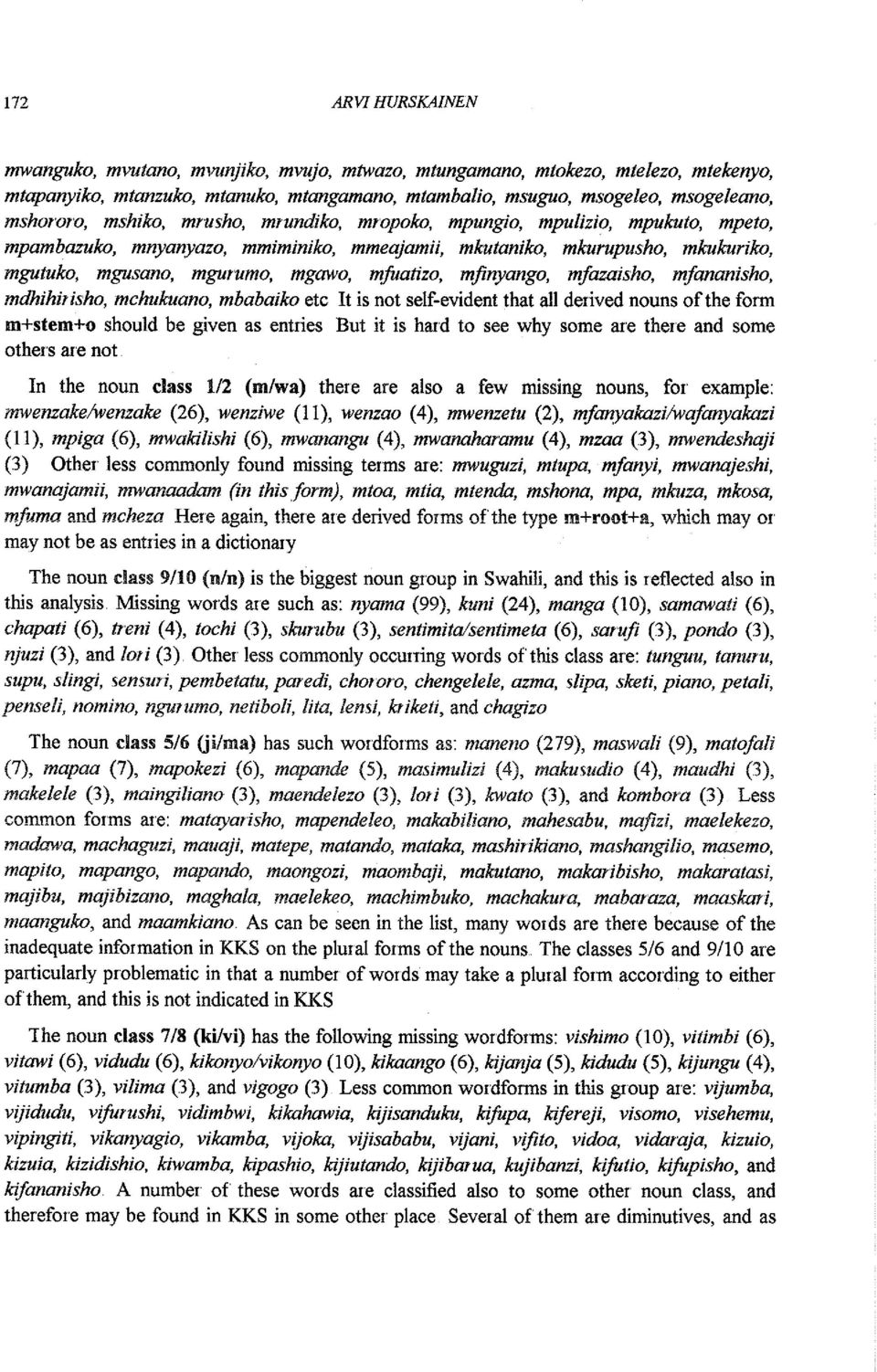
4 172 ARVI HURSKAINEN mwanguko, mvutano, mvunjiko, mvujo, mtwazo, mtungamano, mtokezo, mtelezo, mtekenyo, mtapanyiko, mtanzuko, mtanuko, mtangamano, mtambalio, msuguo, msogeleo, msogeleano, mshororo, mshiko, mrusho, mrundiko, mropoko, mpungio, mpulizio, mpukuto, mpeto, mpambazuko, mnyanyazo, mmiminiko, mmeajamii, mkutaniko, mkurupusho, mkukuriko, mgutuko, mgusano, mgurumo, mgawo, mfuatizo, mfinyango, mfazaisho, mfananisho, mdhihir isho, mchukuano, mbabaiko etc It is not self-evident that all deiived nouns of the form m+stem+o should be given as entries But it is hard to see why some ar e there and some others are not In the noun class 1/2 (m/wa) there are also a few missing nouns, for example: mwenzakelwenzake (26), wenziwe (11), wenzao (4), mwenzetu (2), mfanyakazilwafanyakazi (11), mpiga (6), mwakilishi (6), mwanangu (4), mwanaharamu (4), mzaa (3), mwendeshaji (3) Other less commonly found missing terms are: mwuguzi, mtupa, mfanyi, mwanajeshi, mwanajamii, mwanaadam (in thisform), mtoa, mtia, mtenda, mshona, mpa, mkuza, mkosa, mfuma and mcheza Here again, there are derived fmms of the type m+root+a, which may or may not be as entiies in a dictionary The noun class 9/10 (n/n) is the biggest noun group in Swahili, and this is reflected also in this analysis. Missing words are such as: nyama (99), kuni (24), manga (10), samawati (6), chapati (6), treni (4), tochi (3), skurubu (3), sentimitalsentimeta (6), sarufi (3), pondo (3), njuzi (3), and fori (3). Other less commonly occuning words of this class are: tunguu, tanuru, supu, slingi, sensuri, pembetatu, paredi, chororo, chengelele, azma, slipa, sketi, piano, petali, penseli, nomina, ngurumo, netiboli,!ita, lensi, hiketi, and chagizo The noun class 5/6 Gi/ma) has such wordforms as: maneno (279), maswali (9), matofali (7), mapaa (7), mapokezi (6), mapande (5), masimulizi (4), makusudio (4), maudhi (3), makelele (3), maingiliano (3), maendelezo (3), lori (3), kwato (3), and kombora (3) Less common forms are: matayarisho, mapendeleo, makabiliano, mahesabu, mafizi, maelekezo, madawa, machaguzi, mauaji, matepe, matando, mataka, mashirikiano, mashangilio, masemo, mapito, mapango, mapando, maongozi, maombaji, makutano, makaribisho, makaratasi, majibu, majibizano, maghala, maelekeo, machimbuko, machakum, mabamza, maaskari, maanguko, and maamkiano. As can be seen in the list, many words are there because of the inadequate information in KKS on the plural forms of the nouns.. The classes 5/6 and 9/10 are particularly problematic in that a number of words may take a plural form according to either ofthem, and this is not indicated in KKS The noun class 7/8 (kilvi) has the following missing wordforms: vishimo (10), vitimbi (6), vitawi (6), vidudu (6), kikonyolvikonyo (10), kikaango (6), kijanja (5), kidudu (5), kijungu (4), vitumba (3), vilima (3), and vigogo (3) Less common wordforms in this group are: vijumba, vijidudu, vifurushi, vidimbwi, kikahawia, kijisanduku, kifupa, kifereji, visomo, visehemu, vipingiti, vikanyagio, vikamba, vijoka, vijisababu, vijani, vifito, vidoa, vidaraja, kizuio, kizuia, kizidishio, kiwamba, kipashio, kijiutando, kijibarua, kujibanzi, kifutio, kifupisho, and kifananisho A number of these words are classified also to some other noun class, and therefore may be found in KKS in some other place Several of them are diminutives, and as
5 KAMUSI YA KISWAH!ll SANIFU IN TES1 173 such very productive forms It is not necessary to include them all in a dictionary, but some more common ones perhaps should The noun class 11 is quite problematic, because the nouns belonging to it may have different plural forms, or none at all Part of the following list may be explained by this fact: Missing words of this group include: nywele (76), ujuzi (50), uongozi (8), uendeshaji (6), ufupisho (5), ufalnyufa (5), utumishi (4), uelewano (4), utandu (3), unyong'onyevu (3), unyevunyevu (3), and umakanika (3) There ar e also a number of less common ones: uwezekano, uwendawazimu, utwezo, utumizi, utibabu, umilikaji, ulanzi, ukosekanaji, uhakikisho, uchukivu, ubaba, uzoroteshaji, uwekevu, uwajibikio, uvutio, uvamizi, utuuzima, utunzo, utunzi, utu/izo, utukuzo, utenganisho, utengano, utatanishi, utanguzi, utambulisho, usoshalisti, usomeshaji, ushindani, usemeaji, upunguzo, upokezi, upekee, upatano, upadre, uonyesho, ukubaliano, ukopeshaji, uketuzi, ukawio, ukaribiano, ukabiliano, uhakika, ufuniko, uduni, uchelewevu, uchakavu, ubishani, ubinafsi. Here again, there are words which may be classified under a different noun group.. There are also a number of derived wordforms which are not necessary in a dictionary In the gmup of verbs the number of missing entries is rather small There are some, however, such as: timka, timsha, tawaza, vurumisha, vungaza, vugumiza, topasa, toharisha, titimsha, titimka, sondea, pamua, pamaza, onyeza, nyong'onyeza, rendea, nyenyereka, kikisa, dabua, chusia, bonga, binikiza, and kura. Some of these are here due to their exceptional derived form Some of them ar e given in KKS as a cross reference, but no entry for them is found In the group of adverbials some common words as mbalimbali (108) and waziwazi (10) are missing. Another obvious mistake is the omission of kwani The group of adjectives contains some important wordforms, e g. kike (49), kiowevulviowevu (26), kienyeji (17), ungaunga (15), maarufu (12), makumi (10), machungu (10), chembechembe (7), mchungu (4), and o~yevu (3) Other less frequent forms are: mchoyo, kipuuzi, kijinga, vumilivu, vilemavu, tiifu, motomoto, kubalifu, fahamikivu, and kitropiki 3. Modem prose text and KKS The adequacy of KKS was also tested extensively with the help of the Helsinki Corpus of Swahili (HCT), 5 which contains presently words of Standard Swahili prose text The corpus is divided into two parts, the first one containing fiction texts (excerpts from books), and the second one texts from newspapers Among the writers of these texts are Shaaban Robert, Julius Nyerere, Said A Mohamed, Mohamed S Mohamed, E. Kezilahabi and others Also scientific texts, mainly from the field of linguistics, are included Newspaper texts are 5 In fact one could speak also about computerized text archives, because the contents of the corpus is not (yet) fixed, but it is being expanded all the time according to resources.. Selected parts of these archives can be treated as a corpus and used as representative text material for research purposes. Other parts are less useful for this purpose, such as new technical terms in Standard Swahili, wordlists of various languages and dialects, and transcriptions of taperecorded oral materials in Swahili dialects

6 174 ARVI HURSKAINEN from Uhuru, Mzalendo, Mfimyakazi, Kiongozi and Lengo, and they cover the period of In the selection of newspaper texts attention was paid to the wide coverage of different types of texts and topics 6 Tests were made so that all such words which are not included into KKS as entries were extracted from the cmpus This includes also the detection of often complicated verbfmms, which was made possible by the mmphological parser SW ATWOL To avoid the handling of some commonly occuning words (nevertheless missing in KKS), the program was made to ignore them Such words, some of which werf;l discussed above, are: ni, na, si, mbalimbali, mzigo, nyama, nywele, zljuzi, kike, kuni, mwenendo, and different fmms of the root -ingi. The findings are summarized in table I Table 1 Swahili words in the Helsinki Corpus of Standard Swahili not found in KKS Book text Newspaper text words words Occur,s at least once Occut'S more than 2 times Occurs more than 5 times Occurs more than 10 times Occurs more than 20 times Occur:s more than.50 times Total numbet of different wordforms Total number ofwmdfmm %of %of total total occurrences One has to note that not all filtered wordforms have been represented in the above table For example, there was a total of unrecognized wordforms found in book texts, and only 2180 of them are considered for inclusion into KKS In newspaper texts there was a total of 5819 umecognized wordforms, but only 830 could be accepted as candidates for inclusion into KKS The total number of wordforms (2180 in book texts and 830 in newspaper texts) is bigger than the number of actual words (1444 in book texts and 735 in newspaper texts), because, for example, verbs occuning in different verbforms are counted only once in word count. On the other hand, the number of words in the above table does not represent strictly 6 It would be also useful to test tbe coverage of KKS witb colloquial Swahili. There is quite an extensive selection of spoken Swahili texts in tbe Archives of Swahili Dialects, which was compiled as a joint effort between tbe Institute ofkiswahili Research (University of Dar-es-Salaam) and tbe Department of Asian and African Studies (University of Helsinki) in These texts are not, however, ideal for this kind of testing, because tbey contain substantially non-standard Swahili

7 KAMUSI YA KISWAHILI SANIFU IN TESI 175 the number of lexical entries, because some of the nouns are represented twice, in singular and in plural Some of the wordf01ms are there for the reason that they have a plural f01m which is not indicated in KKS.. A number of nouns may take altemative prefixes according to the noun class 5/6 (ji/ma) or 9/10 (n/n) At least frequent occunences of such nouns in the class 5/6 should be indicated in KKS The percentage of umecognized wordf01m occmrences has been calculated only from the total number of wordforms in the c01pus The percentage in book texts is 1 32, which means that in the average every 75th word in text is unrecognized In newspaper texts the percentage is much higher (2 24), which is at least partly due to the fact that newspaper texts include large numbers of names, which are not, and should not be, included in KKS On the other hand newspaper texts represent the latest development of standard written text and contain such new words which ar e not in the dictionary On the basis of the resulting word lists, which are too extensive to be reproduced here, we may make the following general observations Book texts and newspaper texts are treated together 1 There are more than 300 such nouns which have a plural according to the class 6 (ma), although not indicated in KKS Some are quite fiequent, as: maswali (180), madawa (173), masuala (154) mageuzi (137), madevu (129), makokoto (93), maamuzi (82), magonjwa (71), majibu (68), maudhui (63), mandevu (55), mapendeleo (38), maandalizi (36), makafara (34), mapozi (32), masimulizi (28), majohmi (28), mauaji (26), matope (25), majuzi (23), mashambulizi (22), makumbusho (21), makaratasi (21), mashule (21), maghala (19), maanguko (18), maelekezo (18), matofali (16), mapokezi (15), matayarisho (15), masaa (14), maudhi (13), mathibitisho (13) Others are less frequent in the corpus, but equally imp01tant in the dictionary 2 More than 250 words of the class 11 (u) were filtered out from the corpus. Among the most fiequent ones are the following: uongozi (273), umuhimu (196), utunzi (99), utumishi (86), ujumla (78), uwezekano (71), ukimwi (64), uhakika (66), upuzi 1 (47), uendeshaji (33), ushindani (31 ), ukimya (29), ukabila (25), utapiamlo (28), uharabu (20), uhamisho (19), umasikini (19), ugumba (18), ukwenzi (18), uasili (16), ubinafsi (16), usambe (16), utowezi (16), uwekevu (16), urais (15), ubaba (14), ujanajike (14), uzinduzi (14), ulanguzi (13), utaalam (13), ufedhuli (12), uonyeshaji (12), utibabu (12), uhusika (11), uhandisi (10), usoshalisti (10), utatanishi (10) Part of the words of this group are found in class 9/10 (n/n), like hakika, jumla, kabila, asili, rais~ and baba, but there is no indication that they may take also the u-prefix and have a different meaning 3 Among the words of class 9/10 (n/n) filtered out from the corpus are: tamthiliya (175), demokrasia (122), litamu (65), drama (71), rasilmali/raslimali (57) pingamizi (52), baisikeli ( 45), khanga (38), teknolojia (35), chapati (34), posho (34), sekta (30), changamoto (28), taxi 7 Note that the fonn 'upuuzi' is found in KKS, but not the fonn 'upuzi'

8 176 ARVI HURSKAINEN (28), taksi (14), ligi (26), milld (26), ngurumo (25), supu (25), shutuma (24), awamu (23), lori (22), pumziko (22), theluthi (20), ajira (19), menejimenti (19), akaunti (18), lishe (18), fundikira (17), burudani (16), dayosisi (16), radio (15), sarungi (15), dudu (12), operesheni (12), pigano (12), kumbukizi (12), /ita (11), olimpiki (11), sarufi (11), shurti (11), fedhuli (10), kapu (10), kontena (10), samawati (10) Part of these words may take plural forms according to the class 6 (ma) 4 A few words of the noun class 7/8 (ki/vi) should also be mentioned: kilabu (21 ), kipaumbele (13), kitandawili (8), kiinua (5), kianzio (3), kitega (3), kizinga (2) 5. As in the internal test of KKS (see above), it was found that delived nouns of the type m+r'oot+a frequent also in the corpus Such words belong to the noun class 112 (m/wa), and here are some commonly occuning filtered nouns: mfanya (61), mwenda (28), mpenda (27), mpiga (27), mhusika (22), muhusika (15), mfanyi (15), mtenda (15), mpanda (10), mzaa (10), mcheza (6) Also derived forms of the type m+root+aji/zi are quite frequent: mwongozi (25), mgombeaji (11), mjenzi (5), mchambuzi (4), muuzaji (4), mmilikaji (3), muigizaji, muungaji, muumbaji, mwendeshaji, mwonyeshaji, mwombolezaji, mwonqji. Other words of this noun class include: mfanyabiashara (73), mwakilishi (43), mfanyi (27) 6. 1he compound word constmction using the productive root 'mwana-' is rather poorly represented in KKS There are many more common constructions, such as: mwanakijijilwanavijiji (192), mwanakisole (37), mwanakisomo (37), mwanakamati (24), mwanasiasa (49), mwanamichezo (21), mwanajeshi (18), mwanandege (16), mwanariadha (16), mwanamuziki (13), mwanakwaya (11), mwanakwetu (10), mwanamgambo (10), mwanasheria (10), mwanavijiji (10) mwanasayansi (7), mwanataaluma (7) Other less commonly occuning constructions are: mwanaelimu, mwanafalsafa, mwanafasihi, mwanahalmashauri, mwanaharamu, mwanahistmia, mwanaisimu, mwanakikundi, mwanalugha, mwanamapokeo, mwanamji, mwanamwari, mwanasaikolojia, mwanaserere 7 The noun class 3/4 (m/mi) is represented in the list by e g the following examples: mwongozo (61), mkakati (50), mpangilio (49), mwelekeo (46), mvutano (39), msukumo (38), mshikamano (33), msisitizo (30), mswada (27), michuano (26), mwamko (12), mkanganyo (10) 8 There are some more rather common words, not belonging to any of the above categories, which deserve to be mentioned here Such are: maalum (205), maarufu (145), mojawapo (81), haramu (75), mwishowe (66), polepole (45), majuzi (33), makwao (31), kamala (10), kemkem (10). Also compound forms such as mwanangu, mwanawe, mwanao, babangu, mamangu etc are missing As they can be derived according to the known rules, it is not selfevident that they should be included But it is difficult to understand such an omission that all the weekdays except for Alhamisi and Ijumaa are missing 9. Verbs are the most difficult group to handle, because each verb may take so many different forms Derived forms also complicate the search, and it is not always clear whether the derived forms given in KKS really cover the actual use of each verb.. This would be another question to investigate in more detail Here are some of the verbs whit:h are not in KKS: chekelea, dekeza, ekea, ekwa, emesha, emewa, epukika, faharisha, fanikisha, fuatiliza,

9 KAMUSI YA KISWAHILI SANIFU IN TEST 177 fyeruka, gagamia, garagaza, gharamia, ghumiwa, goteza, gugubia, harakia, kakamua, epukika, kumbukika, kurubia, lega, lembusha, lundikia, ombeza, ondokozwa, pembeza, refuka, ripuka, roa, singiza, telemkia, teremkia, tengamaa, tengemea, vyagaza, zoeleka, zongoa. Some of the verbs are in the list because of a different spelling from that given in KKS Common vatiation in such phenomena should also be indicated 4. The acquisition of new lexical data in context The system described above allows the retrieval oflexical materials from the corpus in context By user-defined means it is possible to retrieve contents in various quantities and include background information into the findings, such as the author, page number etc Probably the most useful and convenient unit is the sentence It is possible to matk the findings in the way one wishes and also to sort the data according to the keyword Such an automatic sorting does not, however, bring always satisfactmy results, because many words, patticularly verbs, have many kinds of prefixes preceding the stem. A desired result may be obtained either through preceding each finding with a keyword in a stem form, or through a progratn which identifies the boundary between the stem and prefixes Tests with modem prose material show that KKS covers quite well the normal text found in fiction books and newspaper texts. There at e, however, a number of words, which have become or ate becoming common in modem Swahili, so that they should be considered to be included in KKS. Due to lirnitations of space, in the following I will give only some exatnples extracted from different texts These exatnples ate given in context to show how they are used Source.: Said A Mohatned, Tata za Asumini Nairobi: Longman Bila ya shaka baba'ako < <alidunguka> > sana kwa kuondoka kwako na hasa aliyokuwa akiyasikia. A sumini bila ya shaka < <a/iemewa> > na kuubana kimya Alizidi < <kuemewa> > Zaina Asumini aliizuia na Mke;el alipoona kazuiwa alitoa pumzi malo na kunywea kama <<bofu>> lililodungwa sindano Lakini <<bwanaarusi>> mwe~yewe nd'oyupi? Aliwatazama wanawake wenzake jinsi walivyojipamba kwa < <fensi> > na vituko Alinikuta sina <<khanga>> ya kujitanda, kanipiga vibaya vibaya Aliwahi kwenda kwenye <<kliniki>> ile mora nyingi na kukosa dawa Umejaa, umefura na < <kufufurika> > kupita kiasi Minazi na mivinje iliyo.simama pembezoni <<kuhemkwa>> na bahari, pepo zilipovuma na kupoa nayo pepo ziliposita, ilikuwa, mwisho wa ficho lake, kama minazi na mivinje ya bandia na ya kuchezea Asumini alichora <<mfunda>> ardhini na wale walijipanga kwenye mfunda huo Sheikh Mkejel kavaa surua/i ya < <mjjmro> > iliyom.fika hadi magotini Hakuvua hata ule < <mkanzu> > wake

10 178 ARVI HURSKAINEN Alitangaza Bi Fetuzi dhahiti, 11 Mimi nawaonea <<mushkeli>> waalimu wa aina hiyo Asumini alibaki kukodoa macho a/ipoona kifua cha <<mwanandege>> wa kike kinaparazaparaza mwi/i wa yule barubmu ambaye y~ye kamkimbia mbingu na ardhi Sewa a/iwazajuu ya maisha ya kundi kupiga <<mwijiku>> na kuzamia tena; Asumini alimwuliza Sewa kwa taathira i/ei/e ambayo Sewa a/iitumia kuuliza <<sua/i>> lake Iko wapi <<tochi>> yakoya kumu/ikia aki/i? Na hila ya shaka wakati mwingine a/icheza <<umeta>> ulipositawi uwanjani Source M M. Mulokozi and K K Kahigi, Kunga za ushairi na diwani yetu: Kizungumzwa ndicho kitu halisi ambacho kinazungumziwa na <<kifananishi>> kwa mafumbo Nani atayas'lkiya, mwema hanywi wazi wazi, Bia hunywewa ubiya, lango hutiwa <<komezi>> Wanywaji hugugumiya, nani atawamaizi? Tofauti kati ya <<konsonansi>> na tak1iri-konsonanti ni kwamba konsonansi ni marudimudio ya sauti za kikonsonanti katika maneno mbalimba/i Na <<marenfa>> yanabomoa njia zetu za udongol Oneni hirizi na <<midair:;; > za uwongo wa }ana na Ieo Katika shairi lake la "Kufua Mayo" Shaaban Robert haombolezi bali anashangi/ia matendo au matukio ya mashujaa ya kujitoa <<muhanga>> vitani Lugha bila <<ridhimu>> ingekuwa ni mfuatano wa muti tu usio na maana yoyote Usambamba ni <<takriri>> ya S'entensi au vifungu vya maneno vyerwe kufanana kimaana au kimuundo Sitiari ni <<tamatha/i>> ambayo athari yake hutegemea uhamishaji wa maana na hist kutoka katika kitu au dhana mo;a hadi kitu au dhana nyingine tofauti It can be seen ±Iom the examples given above that the words not recognized by KKS are of quite a different kind depending on the type of text I he words of Kunga za ushairi are ±Iom the field of literature studies, and it is not necessary to include all these words into KKS, because many of them do not belong to the basic vocabulary of the language. The words caught from I ata za Asumini are somewhat writer-specific and dependent on the subject dealt with in the book concerned 5. Summary The above discussion shows the power and accuracy of computerized information retrieval, particularly when language-specific tools can be utilized I have described ways how one presently relevant task, updating Kamusi ya Kiswahili Sanifu, can benefit from recent advances in computational linguistics The system helps in detecting weaknesses in the existing dictionary as well as in retrieving new lexical material ±Iom relevant texts. The examples of missing words given above give a superficial picture of the whole truth. Only the most often occurring examples were given And it is not at all clear that those are the only words, or even the most important ones, to be considered for inclusion into KKS From the viewpoint of the user, often the more rare words are the ones which one is likely to search from the dictionary

11 KAMUSJ YA KJSWAHILI SANJFU IN IESI 179 And if they are missing, the dictionary does not fulfil its task properly It is not practical, however, to list all those words here Rather they are matarial for the databank, preferably with sufficient amount of context included Although I have discussed only tests made with KKS, the system described above may be applied to dictionaries of any language. KKS is not a very difficult case, because its lexical entries are single words. The work becomes more complicated, if we have to deal with collocations, phrases, and other phenomena, which are represented in the lexicon with more than one word But also such a task is just a further challenge for developing programs to deal with such phenomena References Brodda, Benny 1990 "Corpus work with PC Beta" Papers presented to the 13th International Conference on Computational Linguistics.. Vol 3, ed by Hans Karlgren, p Calzolari, Nicoletta and Bindi, Remo 1990 "Acquisition of Lexical Information from a Large Textual Italian Corpus" Papers presented to the 13th International Conference on Computational Linguistics Vol3, ed by Hans Karlgren, p Chuwa, Albina 1987 "Uingizaji wa methali katika Kamusi ya Kiswahili Sanifu" Kiswahili 54,1-2: Hurskainen, Arvi "A Two-Level Computer Fmmalism for the Analysis of Bantu Morphology. An Application to Swahili " Nordic Journal ofafrican Studies 1, 1: Hurskainen, Arvi 1992 "Computer Archives of Swahili Language and Folklore - What is it?" Nordic Journal ofaftican Studies 1,1: Taasisi ya Uchunguzi wa Kiswahili Kamusi ya Kiswahili Sanifu. Arusha: Oxford University Press Khamisi, Abdu M 1987 "Trends in Swahili lexicography." Kiswahili 54,1-2: Koskenniemi, Kimmo "Two-level Morphology: A General Computational Model for Word-Form Recognition and Production" Department of General Linguistics University of Helsinki Publication No. 11 Mohamed, Said A 1990 Tata za Asumini Nairobi: Longman Mulokozi M M and Kahigi, KK 1979 Kunga za ushaili na diwani yetu Dar-es-Salaam: Tanzania Publishing House Iaasisi ya Uchunguzi wa Kiswahili Makala za Mkutano wa Kimataifa wa Usanijishaji wa Istilahi za Kiswahili. Dares Salaam: Chuo Kikuu cha Dares Salaam Tumbo-Massabo, Zubeida N 1989 "Jinsi ya Kuanzisha Benki ya Data ya Istilahi!Msamiati " Makala za Mkutano wa Kimataifa wa Usanijishaji wa Istilahi za Kiswahili p Dares Salaam: Taasisi ya Uchunguzi wa Kiswahili, Chuo Kikuu cha Dar es Salaam

12

THE UNITED REPUBLIC OF TANZANIA BILL SUPPLEMENT
 ISSN 0856-035X THE UNITED REPUBLIC OF TANZANIA BILL SUPPLEMENT No. 6 20 th February, 2015 to the Gazette of the United Republic of Tanzania No.8 Vol.96 dated 20 th February, 2015 Printed by the Government
Creation of a Speech to Text System for Kiswahili
 Creation of a Speech to Text System for Kiswahili Dr. Katherine Getao and Evans Miriti University of Nairobi Abstract The creation of a speech to text system for any language is an onerous task. This is
TANZANIA COFFEE BOARD VACANCIES ANNOUNCEMENT
 TANZANIA COFFEE BOARD VACANCIES ANNOUNCEMENT Tanzania Coffee Board is a government body established by the Tanzania Coffee Industry Act No. 23 of 2001. Its main function is to regulate the coffee industry
Efficient Techniques for Improved Data Classification and POS Tagging by Monitoring Extraction, Pruning and Updating of Unknown Foreign Words
 , pp.290-295 http://dx.doi.org/10.14257/astl.2015.111.55 Efficient Techniques for Improved Data Classification and POS Tagging by Monitoring Extraction, Pruning and Updating of Unknown Foreign Words Irfan
Reading Competencies
 Reading Competencies The Third Grade Reading Guarantee legislation within Senate Bill 21 requires reading competencies to be adopted by the State Board no later than January 31, 2014. Reading competencies
The Dictionary of the Common Modern Greek Language is being compiled 1 under
 THE DICTIONARY OF THE COMMON MODERN GREEK LANGUAGE OF THE INSTITUTE OF MODERN GREEK STUDIES (MANOLIS TRIANDAFYLLIDIS FOUNDATION) OF THE ARISTOTLE UNIVERSITY OF THESSALONIKI ANASTASSIA TZIVANOPOULOU Aristotle
Testing Data-Driven Learning Algorithms for PoS Tagging of Icelandic
 Testing Data-Driven Learning Algorithms for PoS Tagging of Icelandic by Sigrún Helgadóttir Abstract This paper gives the results of an experiment concerned with training three different taggers on tagged
How the Computer Translates. Svetlana Sokolova President and CEO of PROMT, PhD.
 Svetlana Sokolova President and CEO of PROMT, PhD. How the Computer Translates Machine translation is a special field of computer application where almost everyone believes that he/she is a specialist.
THE OIL AND GAS REVENUES MANAGEMENT ACT, 2015 ARRANGEMENT OF SECTIONS PART I PRELIMINARY PROVISIONS PART II ADMINISTRATIVE PROVISIONS
 ISSN 0856-035X THE UNITED REPUBLIC OF TANZANIA BILL SUPPLEMENT No. 10 29 th May, 2015 to the Gazette of the United Republic of Tanzania No. 22 Vol. 96 dated 29 th May, 2015 Printed by the Government Printer,
The Oxford Learner s Dictionary of Academic English
 ISEJ Advertorial The Oxford Learner s Dictionary of Academic English Oxford University Press The Oxford Learner s Dictionary of Academic English (OLDAE) is a brand new learner s dictionary aimed at students
Parsing Technology and its role in Legacy Modernization. A Metaware White Paper
 Parsing Technology and its role in Legacy Modernization A Metaware White Paper 1 INTRODUCTION In the two last decades there has been an explosion of interest in software tools that can automate key tasks
Towards Full Comprehension of Swahili Natural Language Statements for Database Querying
 6 Towards Full Comprehension of Swahili Natural Language Statements for Database Querying Lawrence Muchemi Natural language access to databases is a research area shrouded by many unresolved issues. This
Interpreting areading Scaled Scores for Instruction
 Interpreting areading Scaled Scores for Instruction Individual scaled scores do not have natural meaning associated to them. The descriptions below provide information for how each scaled score range should
UNIVERSITÀ DEGLI STUDI DELL AQUILA CENTRO LINGUISTICO DI ATENEO
 TESTING DI LINGUA INGLESE: PROGRAMMA DI TUTTI I LIVELLI - a.a. 2010/2011 Collaboratori e Esperti Linguistici di Lingua Inglese: Dott.ssa Fatima Bassi e-mail: [email protected] Dott.ssa Liliana
Morphology. Morphology is the study of word formation, of the structure of words. 1. some words can be divided into parts which still have meaning
 Morphology Morphology is the study of word formation, of the structure of words. Some observations about words and their structure: 1. some words can be divided into parts which still have meaning 2. many
Academic Standards for Reading, Writing, Speaking, and Listening June 1, 2009 FINAL Elementary Standards Grades 3-8
 Academic Standards for Reading, Writing, Speaking, and Listening June 1, 2009 FINAL Elementary Standards Grades 3-8 Pennsylvania Department of Education These standards are offered as a voluntary resource
Use the Academic Word List vocabulary to make tips on Academic Writing. Use some of the words below to give advice on good academic writing.
 Use the Academic Word List vocabulary to make tips on Academic Writing Use some of the words below to give advice on good academic writing. abstract accompany accurate/ accuracy/ inaccurate/ inaccuracy
DIFFICULTIES AND SOME PROBLEMS IN TRANSLATING LEGAL DOCUMENTS
 DIFFICULTIES AND SOME PROBLEMS IN TRANSLATING LEGAL DOCUMENTS Ivanka Sakareva Translation of legal documents bears its own inherent difficulties. First we should note that this type of translation is burdened
Lexico-Semantic Relations Errors in Senior Secondary School Students Writing ROTIMI TAIWO Obafemi Awolowo University, Ile-Ife, Nigeria
 Nordic Journal of African Studies 10(3): 366-373 (2001) Lexico-Semantic Relations Errors in Senior Secondary School Students Writing ROTIMI TAIWO Obafemi Awolowo University, Ile-Ife, Nigeria ABSTRACT The
Comparative Analysis on the Armenian and Korean Languages
 Comparative Analysis on the Armenian and Korean Languages Syuzanna Mejlumyan Yerevan State Linguistic University Abstract It has been five years since the Korean language has been taught at Yerevan State
Chapter 10 Paraphrasing and Plagiarism
 Source: Wallwork, Adrian. English for Writing Research Papers. New York: Springer, 2011. http://bit.ly/11frtfk Chapter 10 Paraphrasing and Plagiarism Why is this chapter important? Conventions regarding
COMPUTATIONAL DATA ANALYSIS FOR SYNTAX
 COLING 82, J. Horeck~ (ed.j North-Holland Publishing Compa~y Academia, 1982 COMPUTATIONAL DATA ANALYSIS FOR SYNTAX Ludmila UhliFova - Zva Nebeska - Jan Kralik Czech Language Institute Czechoslovak Academy
CALIFORNIA STATE UNIVERSITY, HAYWARD DEPARTMENT OF ENGLISH Assessment of Master s Programs in English
 CALIFORNIA STATE UNIVERSITY, HAYWARD DEPARTMENT OF ENGLISH Assessment of Master s Programs in English [Note: Program descriptions are given at the end of this document.] Student Learning Outcomes (SLOs):
CHARTES D'ANGLAIS SOMMAIRE. CHARTE NIVEAU A1 Pages 2-4. CHARTE NIVEAU A2 Pages 5-7. CHARTE NIVEAU B1 Pages 8-10. CHARTE NIVEAU B2 Pages 11-14
 CHARTES D'ANGLAIS SOMMAIRE CHARTE NIVEAU A1 Pages 2-4 CHARTE NIVEAU A2 Pages 5-7 CHARTE NIVEAU B1 Pages 8-10 CHARTE NIVEAU B2 Pages 11-14 CHARTE NIVEAU C1 Pages 15-17 MAJ, le 11 juin 2014 A1 Skills-based
Virginia English Standards of Learning Grade 8
 A Correlation of Prentice Hall Writing Coach 2012 To the Virginia English Standards of Learning A Correlation of, 2012, Introduction This document demonstrates how, 2012, meets the objectives of the. Correlation
Morphemes, roots and affixes. 28 October 2011
 Morphemes, roots and affixes 28 October 2011 Previously said We think of words as being the most basic, the most fundamental, units through which meaning is represented in language. Words are the smallest
Minnesota K-12 Academic Standards in Language Arts Curriculum and Assessment Alignment Form Rewards Intermediate Grades 4-6
 Minnesota K-12 Academic Standards in Language Arts Curriculum and Assessment Alignment Form Rewards Intermediate Grades 4-6 4 I. READING AND LITERATURE A. Word Recognition, Analysis, and Fluency The student
KINDGERGARTEN. Listen to a story for a particular reason
 KINDGERGARTEN READING FOUNDATIONAL SKILLS Print Concepts Follow words from left to right in a text Follow words from top to bottom in a text Know when to turn the page in a book Show spaces between words
Knowledge Discovery using Text Mining: A Programmable Implementation on Information Extraction and Categorization
 Knowledge Discovery using Text Mining: A Programmable Implementation on Information Extraction and Categorization Atika Mustafa, Ali Akbar, and Ahmer Sultan National University of Computer and Emerging
Language Modeling. Chapter 1. 1.1 Introduction
 Chapter 1 Language Modeling (Course notes for NLP by Michael Collins, Columbia University) 1.1 Introduction In this chapter we will consider the the problem of constructing a language model from a set
Discourse Markers in English Writing
 Discourse Markers in English Writing Li FENG Abstract Many devices, such as reference, substitution, ellipsis, and discourse marker, contribute to a discourse s cohesion and coherence. This paper focuses
MODERN WRITTEN ARABIC. Volume I. Hosted for free on livelingua.com
 MODERN WRITTEN ARABIC Volume I Hosted for free on livelingua.com TABLE OF CcmmTs PREFACE. Page iii INTRODUCTICN vi Lesson 1 1 2.6 3 14 4 5 6 22 30.45 7 55 8 61 9 69 10 11 12 13 96 107 118 14 134 15 16
DR. HAMISI O. BABUSA (PHD)
 DR. HAMISI O. BABUSA (PHD) School of Education Department of Educational Communication and Technology Kenyatta University P.O. Box 43844 Nairobi 00100 Kenya Mobile: +254 700 754 080 Email: [email protected]
Performance Indicators-Language Arts Reading and Writing 3 rd Grade
 Learning Standards 1 st Narrative Performance Indicators 2 nd Informational 3 rd Persuasive 4 th Response to Lit Possible Evidence Fluency, Vocabulary, and Comprehension Reads orally with Applies letter-sound
Year 1 reading expectations (New Curriculum) Year 1 writing expectations (New Curriculum)
 Year 1 reading expectations Year 1 writing expectations Responds speedily with the correct sound to graphemes (letters or groups of letters) for all 40+ phonemes, including, where applicable, alternative
Academic Standards for Reading, Writing, Speaking, and Listening
 Academic Standards for Reading, Writing, Speaking, and Listening Pre-K - 3 REVISED May 18, 2010 Pennsylvania Department of Education These standards are offered as a voluntary resource for Pennsylvania
Text-To-Speech Technologies for Mobile Telephony Services
 Text-To-Speech Technologies for Mobile Telephony Services Paulseph-John Farrugia Department of Computer Science and AI, University of Malta Abstract. Text-To-Speech (TTS) systems aim to transform arbitrary
Extraction of Legal Definitions from a Japanese Statutory Corpus Toward Construction of a Legal Term Ontology
 Extraction of Legal Definitions from a Japanese Statutory Corpus Toward Construction of a Legal Term Ontology Makoto Nakamura, Yasuhiro Ogawa, Katsuhiko Toyama Japan Legal Information Institute, Graduate
31 Case Studies: Java Natural Language Tools Available on the Web
 31 Case Studies: Java Natural Language Tools Available on the Web Chapter Objectives Chapter Contents This chapter provides a number of sources for open source and free atural language understanding software
Simple maths for keywords
 Simple maths for keywords Adam Kilgarriff Lexical Computing Ltd [email protected] Abstract We present a simple method for identifying keywords of one corpus vs. another. There is no one-sizefits-all
Sentiment analysis on news articles using Natural Language Processing and Machine Learning Approach.
 Sentiment analysis on news articles using Natural Language Processing and Machine Learning Approach. Pranali Chilekar 1, Swati Ubale 2, Pragati Sonkambale 3, Reema Panarkar 4, Gopal Upadhye 5 1 2 3 4 5
High-Performance, Language-Independent Morphological Segmentation
 High-Performance, Language-Independent Morphological Segmentation Sajib Dasgupta and Vincent Ng Human Language Technology Research Institute University of Texas at Dallas 1 Morphology Segmentation of words
Houghton Mifflin Harcourt StoryTown Grade 1. correlated to the. Common Core State Standards Initiative English Language Arts (2010) Grade 1
 Houghton Mifflin Harcourt StoryTown Grade 1 correlated to the Common Core State Standards Initiative English Language Arts (2010) Grade 1 Reading: Literature Key Ideas and details RL.1.1 Ask and answer
Some Reflections on the Making of the Progressive English Collocations Dictionary
 43 Some Reflections on the Making of the Progressive English Collocations Dictionary TSUKAMOTO Michihisa Faculty of International Communication, Aichi University E-mail: [email protected] 1939
National Quali cations SPECIMEN ONLY
 N5 SQ40/N5/02 FOR OFFICIAL USE National Quali cations SPECIMEN ONLY Mark Urdu Writing Date Not applicable Duration 1 hour and 30 minutes *SQ40N502* Fill in these boxes and read what is printed below. Full
Depth-of-Knowledge Levels for Four Content Areas Norman L. Webb March 28, 2002. Reading (based on Wixson, 1999)
 Depth-of-Knowledge Levels for Four Content Areas Norman L. Webb March 28, 2002 Language Arts Levels of Depth of Knowledge Interpreting and assigning depth-of-knowledge levels to both objectives within
Brill s rule-based PoS tagger
 Beáta Megyesi Department of Linguistics University of Stockholm Extract from D-level thesis (section 3) Brill s rule-based PoS tagger Beáta Megyesi Eric Brill introduced a PoS tagger in 1992 that was based
The Lexicon. The Lexicon. The Lexicon. The Significance of the Lexicon. Australian? The Significance of the Lexicon 澳 大 利 亚 奥 地 利
 The significance of the lexicon Lexical knowledge Lexical skills 2 The significance of the lexicon Lexical knowledge The Significance of the Lexicon Lexical errors lead to misunderstanding. There s that
Indiana Department of Education
 GRADE 1 READING Guiding Principle: Students read a wide range of fiction, nonfiction, classic, and contemporary works, to build an understanding of texts, of themselves, and of the cultures of the United
Listening Student Learning Outcomes
 Listening Student Learning Outcomes Goals for Learning Has sufficient vocabulary to comprehend an unsimplified academic lecture Can paraphrase academic discourse effectively in writing and discussion from
The Development of Multimedia-Multilingual Document Storage, Retrieval and Delivery System for E-Organization (STREDEO PROJECT)
 The Development of Multimedia-Multilingual Storage, Retrieval and Delivery for E-Organization (STREDEO PROJECT) Asanee Kawtrakul, Kajornsak Julavittayanukool, Mukda Suktarachan, Patcharee Varasrai, Nathavit
Uundaji wa Istilahi za Kiswahili Kileksikografia na Athari zake S.S. SEWANGI University of Dar-es-Salaam, Tanzania
 Nordic Journal of African Studies 16(3): 333 344 (2007) Uundaji wa Istilahi za Kiswahili Kileksikografia na Athari zake S.S. SEWANGI University of Dar-es-Salaam, Tanzania ABSTRACT The promotion of terminology
Types of meaning. KNOWLEDGE: the different types of meaning that items of lexis can have and the terms used to describe these
 Part 1 Lexis What is lexis? Lexis (or vocabulary) refers to single words, or sets of words, that have a specific meaning, for example: car, pick up, in the end. Unit 1 Types of meaning LEARNING OUTCOME
Ask your teacher about any which you aren t sure of, especially any differences.
 Punctuation in Academic Writing Academic punctuation presentation/ Defining your terms practice Choose one of the things below and work together to describe its form and uses in as much detail as possible,
Strand: Reading Literature Topics Standard I can statements Vocabulary Key Ideas and Details
 Strand: Reading Literature Topics Standard I can statements Vocabulary Key Ideas and Details Craft and Structure RL.5.1 Quote accurately from a text when explaining what the text says explicitly and when
LANGUAGE! 4 th Edition, Levels A C, correlated to the South Carolina College and Career Readiness Standards, Grades 3 5
 Page 1 of 57 Grade 3 Reading Literary Text Principles of Reading (P) Standard 1: Demonstrate understanding of the organization and basic features of print. Standard 2: Demonstrate understanding of spoken
How To Use The Correlog With The Cpl Powerpoint Powerpoint Cpl.Org Powerpoint.Org (Powerpoint) Powerpoint (Powerplst) And Powerpoint 2 (Powerstation) (Powerpoints) (Operations
 orrelog SQL Table Monitor Adapter Users Manual http://www.correlog.com mailto:[email protected] CorreLog, SQL Table Monitor Users Manual Copyright 2008-2015, CorreLog, Inc. All rights reserved. No part
SOUTH SEATTLE COMMUNITY COLLEGE (General Education) COURSE OUTLINE Revision: (Don Bissonnette and Kris Lysaker) July 2009
 SOUTH SEATTLE COMMUNITY COLLEGE (General Education) COURSE OUTLINE Revision: (Don Bissonnette and Kris Lysaker) July 2009 DEPARTMENT: CURRICULLUM: COURSE TITLE: Basic and Transitional Studies English as
Effective Data Retrieval Mechanism Using AML within the Web Based Join Framework
 Effective Data Retrieval Mechanism Using AML within the Web Based Join Framework Usha Nandini D 1, Anish Gracias J 2 1 [email protected] 2 [email protected] Abstract A vast amount of assorted
How To Write A Task For Ielts
 Sample Candidate Writing Scripts and Examiner Comments The General Training Writing Module consists of two tasks, Task 1 and Task 2. Each task is assessed independently. The assessment of Task 2 carries
How to Design and Interpret a Multiple-Choice-Question Test: A Probabilistic Approach*
 Int. J. Engng Ed. Vol. 22, No. 6, pp. 1281±1286, 2006 0949-149X/91 $3.00+0.00 Printed in Great Britain. # 2006 TEMPUS Publications. How to Design and Interpret a Multiple-Choice-Question Test: A Probabilistic
Grading Benchmarks FIRST GRADE. Trimester 4 3 2 1 1 st Student has achieved reading success at. Trimester 4 3 2 1 1st In above grade-level books, the
 READING 1.) Reads at grade level. 1 st Student has achieved reading success at Level 14-H or above. Student has achieved reading success at Level 10-F or 12-G. Student has achieved reading success at Level
Language Meaning and Use
 Language Meaning and Use Raymond Hickey, English Linguistics Website: www.uni-due.de/ele Types of meaning There are four recognisable types of meaning: lexical meaning, grammatical meaning, sentence meaning
Ohio Early Learning and Development Standards Domain: Language and Literacy Development
 Ohio Early Learning and Development Standards Domain: Language and Literacy Development Strand: Listening and Speaking Topic: Receptive Language and Comprehension Infants Young Toddlers (Birth - 8 months)
Author Gender Identification of English Novels
 Author Gender Identification of English Novels Joseph Baena and Catherine Chen December 13, 2013 1 Introduction Machine learning algorithms have long been used in studies of authorship, particularly in
Purposes and Processes of Reading Comprehension
 2 PIRLS Reading Purposes and Processes of Reading Comprehension PIRLS examines the processes of comprehension and the purposes for reading, however, they do not function in isolation from each other or
Unit: Fever, Fire and Fashion Term: Spring 1 Year: 5
 Unit: Fever, Fire and Fashion Term: Spring 1 Year: 5 English Fever, Fire and Fashion Unit Summary In this historical Unit pupils learn about everyday life in London during the 17 th Century. Frost fairs,
Cambridge English. Proficiency. Handbook for teachers for exams from 2015
 230 C2 220 210 200 Cambridge English Proficiency 190 180 170 160 150 140 130 120 110 100 Handbook for teachers for exams from 2015 90 80 Content and overview Paper/timing Content Test focus Part 1 Part
Text Analytics Illustrated with a Simple Data Set
 CSC 594 Text Mining More on SAS Enterprise Miner Text Analytics Illustrated with a Simple Data Set This demonstration illustrates some text analytic results using a simple data set that is designed to
Learning Translation Rules from Bilingual English Filipino Corpus
 Proceedings of PACLIC 19, the 19 th Asia-Pacific Conference on Language, Information and Computation. Learning Translation s from Bilingual English Filipino Corpus Michelle Wendy Tan, Raymond Joseph Ang,
MULTIFUNCTIONAL DICTIONARIES
 In: A. Zampolli, A. Capelli (eds., 1984): The possibilities and limits of the computer in producing and publishing dictionaries. Linguistica Computationale III, Pisa: Giardini, 279-288 MULTIFUNCTIONAL
TELT March 2014 Exa miners Report
 TELT March 2014 Exa miners Report 1. Introduction 101 candidates sat for the TELT March 2014 examination session. 53 candidates were awarded Pass grades or higher. This is the equivalent to 52.5 % pass
Noam Chomsky: Aspects of the Theory of Syntax notes
 Noam Chomsky: Aspects of the Theory of Syntax notes Julia Krysztofiak May 16, 2006 1 Methodological preliminaries 1.1 Generative grammars as theories of linguistic competence The study is concerned with
Crystal Tower 1-2-27 Shiromi, Chuo-ku, Osaka 540-6025 JAPAN. ffukumoto,simohata,masui,[email protected]
 Oki Electric Industry : Description of the Oki System as Used for MET-2 J. Fukumoto, M. Shimohata, F. Masui, M. Sasaki Kansai Lab., R&D group Oki Electric Industry Co., Ltd. Crystal Tower 1-2-27 Shiromi,
A Survey of Online Tools Used in English-Thai and Thai-English Translation by Thai Students
 69 A Survey of Online Tools Used in English-Thai and Thai-English Translation by Thai Students Sarathorn Munpru, Srinakharinwirot University, Thailand Pornpol Wuttikrikunlaya, Srinakharinwirot University,
Guide to Writing a Project Report
 Guide to Writing a Project Report The following notes provide a guideline to report writing, and more generally to writing a scientific article. Please take the time to read them carefully. Even if your
Meeting the Standard in North Carolina
 KINDERGARTEN 1.02 Demonstrate understanding of the sounds of letters and understanding that words begin and end alike (onsets and rhymes). 1.03 Recognize and name upper and lower case letters of the alphabet.
Comparing Methods to Identify Defect Reports in a Change Management Database
 Comparing Methods to Identify Defect Reports in a Change Management Database Elaine J. Weyuker, Thomas J. Ostrand AT&T Labs - Research 180 Park Avenue Florham Park, NJ 07932 (weyuker,ostrand)@research.att.com
Bilingual Education Assessment Urdu (034) NY-SG-FLD034-01
 Bilingual Education Assessment Urdu (034) NY-SG-FLD034-01 The State Education Department does not discriminate on the basis of age, color, religion, creed, disability, marital status, veteran status, national
A Survey on Product Aspect Ranking
 A Survey on Product Aspect Ranking Charushila Patil 1, Prof. P. M. Chawan 2, Priyamvada Chauhan 3, Sonali Wankhede 4 M. Tech Student, Department of Computer Engineering and IT, VJTI College, Mumbai, Maharashtra,
Doctoral School of Historical Sciences Dr. Székely Gábor professor Program of Assyiriology Dr. Dezső Tamás habilitate docent
 Doctoral School of Historical Sciences Dr. Székely Gábor professor Program of Assyiriology Dr. Dezső Tamás habilitate docent The theses of the Dissertation Nominal and Verbal Plurality in Sumerian: A Morphosemantic
ICAME Journal No. 24. Reviews
 ICAME Journal No. 24 Reviews Collins COBUILD Grammar Patterns 2: Nouns and Adjectives, edited by Gill Francis, Susan Hunston, andelizabeth Manning, withjohn Sinclair as the founding editor-in-chief of
McDougal Littell Bridges to Literature Level III. Alaska Reading and Writing Performance Standards Grade 8
 McDougal Littell Bridges to Literature Level III correlated to the Alaska Reading and Writing Performance Standards Grade 8 Reading Performance Standards (Grade Level Expectations) Grade 8 R3.1 Apply knowledge
Database Design For Corpus Storage: The ET10-63 Data Model
 January 1993 Database Design For Corpus Storage: The ET10-63 Data Model Tony McEnery & Béatrice Daille I. General Presentation Within the ET10-63 project, a French-English bilingual corpus of about 2 million
DAR ES SALAAM UNIVERSITY COLLEGE OF EDUCATION. A Constituent College of the University of Dar Es Salaam STAFF FUNERAL POLICY
 DAR ES SALAAM UNIVERSITY COLLEGE OF EDUCATION A Constituent College of the University of Dar Es Salaam STAFF FUNERAL POLICY JANUARY 2015 TABLE OF CONTENTS 1 BACKGROUND... 1 2 THE ROLE OF THE EMPLOYER...
Albert Pye and Ravensmere Schools Grammar Curriculum
 Albert Pye and Ravensmere Schools Grammar Curriculum Introduction The aim of our schools own grammar curriculum is to ensure that all relevant grammar content is introduced within the primary years in
Common Core Progress English Language Arts
 [ SADLIER Common Core Progress English Language Arts Aligned to the [ Florida Next Generation GRADE 6 Sunshine State (Common Core) Standards for English Language Arts Contents 2 Strand: Reading Standards
Grade 4 Writing Curriculum Map
 Curriculum Map BOE Approval November 2013 CURRICULUM MAP WRITING GRADE 4 SEPTEMBER OCTOBER NOVEMBER DECEMBER JANUARY Creating a Buzz About : It s All About Me! Tell Me A Story Realistic Fiction Tell Me
CINDOR Conceptual Interlingua Document Retrieval: TREC-8 Evaluation.
 CINDOR Conceptual Interlingua Document Retrieval: TREC-8 Evaluation. Miguel Ruiz, Anne Diekema, Páraic Sheridan MNIS-TextWise Labs Dey Centennial Plaza 401 South Salina Street Syracuse, NY 13202 Abstract:
stress, intonation and pauses and pronounce English sounds correctly. (b) To speak accurately to the listener(s) about one s thoughts and feelings,
 Section 9 Foreign Languages I. OVERALL OBJECTIVE To develop students basic communication abilities such as listening, speaking, reading and writing, deepening their understanding of language and culture
ELPS TELPAS. Proficiency Level Descriptors
 ELPS TELPAS Proficiency Level Descriptors Permission to copy the ELPS TELPAS Proficiency Level Descriptors is hereby extended to Texas school officials and their agents for their exclusive use in determining
Grade 4 Writing Assessment. Eligible Texas Essential Knowledge and Skills
 Grade 4 Writing Assessment Eligible Texas Essential Knowledge and Skills STAAR Grade 4 Writing Assessment Reporting Category 1: Composition The student will demonstrate an ability to compose a variety
Kindergarten Common Core State Standards: English Language Arts
 Kindergarten Common Core State Standards: English Language Arts Reading: Foundational Print Concepts RF.K.1. Demonstrate understanding of the organization and basic features of print. o Follow words from
Linking Adult Education with Formal Schooling in Tanzania: Mission Unfulfilled
 Linking Adult Education with Formal Schooling in Tanzania: Mission Unfulfilled Mohamed Salum Msoroka Faculty of Education School of Educational Leadership & Policy The University of Waikato Contact Address:
Beyond single words: the most frequent collocations in spoken English
 Beyond single words: the most frequent collocations in spoken English Dongkwang Shin and Paul Nation This study presents a list of the highest frequency collocations of spoken English based on carefully
SYNTAX: THE ANALYSIS OF SENTENCE STRUCTURE
 SYNTAX: THE ANALYSIS OF SENTENCE STRUCTURE OBJECTIVES the game is to say something new with old words RALPH WALDO EMERSON, Journals (1849) In this chapter, you will learn: how we categorize words how words
Language Arts Literacy Areas of Focus: Grade 6
 Language Arts Literacy : Grade 6 Mission: Learning to read, write, speak, listen, and view critically, strategically and creatively enables students to discover personal and shared meaning throughout their
Quality Assurance at NEMT, Inc.
 Quality Assurance at NEMT, Inc. Quality Assurance Policy NEMT prides itself on the excellence of quality within every level of the company. We strongly believe in the benefits of continued education and