
MACHINING NICKEL AND NICKEL ALLOYS (INCLUDING MONEL, KOVAR, INVAR, INCONEL, & INCOLOY
|
|
|
- Sandra Howard
- 9 years ago
- Views:
Transcription
1 MACHINING NICKEL AND NICKEL ALLOYS (INCLUDING MONEL, KOVAR, INVAR, INCONEL, & INCOLOY Machinability: Nickel alloys work harden rapidly, and the high pressures produced during machining cause a hardening effect that slows further machining and may also cause warping in small parts. Using cold-drawn stress-relieved material is preferable for machining. Hot-rolled is less desirable and annealed is least preferred for most applications. Careful machining practices are a must. Use sharp tools with positive rake angles (to cut the metal rather than push it). Sufficient feed rate and depth of cut are necessary and tools should not be allowed to rub the work. Even under the best conditions, stresses may be produced which may cause distortion of the work. For maximum dimensional stability, it is best to rough out the part almost to size, stress relieve it, and then finish it to size. Stress relieving has little effect on dimensions, but may affect mechanical properties. Classification of Alloys: For purposes of machining nickel alloys are classified in four groups and two subgroups: Group A: Consists of alloys containing 95% or more nickel. These alloys have moderate mechanical strength and high toughness. They are hardened only by cold work. The alloys are quite gummy in the annealed and the hot-worked condition, and cold-drawn material is recommended for best machinability and smoothest finish. These alloys include nickel 200, 20, 205, 22, 222. Group B: Consists of most of the nickel-copper alloys. The alloys in this group have higher strength and slightly lower toughness than those in group A. They are hardened only by cold work. Cold drawn or cold-drawn and stress-relieved material gives the best machinability and smoothest finish. These alloys include monel 400, 40, 450, ferry alloy, invar 36, 48, kovar, and inco alloy MS 250. Group C: Consists largely of the solid-solution nickel-chromium-iron alloys, which are similar to the austenitic stainless steels. They are hardened only by cold work and are machined most readily in the cold-drawn or cold-drawn and stress-relieved condition. These alloys include nickel 270, monel K-500 (unaged), inconel 600, 60, 690, nimonic 75, 86, incoloy 800, 800HT, 802, 825, DS, inco 330, 020. Group D: Consists primarily of the age-hardenable alloys, has two subgroups. Group D- consists of alloys in the unaged condition and includes duranickel 30 (unaged), incoloy 925, MA 956, and ni-span-c 902 (unaged). Group D-2 consists of the alloys of group D- in the aged condition, plus several other alloys in both the aged and unaged conditions and includes duranickel 30 (aged), monel K-500 (aged), inconel 67, 625, 706, 78, X-750, 75, MA 754, nimonic 80A, 8, 90, 05, 5, 263, 90, PE, PE6, PK50, incoloy 903, 907, 909 ni-span-c 902 (aged), inco G-3, C-276, HX. Group E: Contains Monel R-405 only. This alloy is designed for high production rates in automatic bar and chucking machines. Monel R-405 combines the toughness, strength, and corrosion resistance of Monel 400 with excellent machinability. However surface finish quality is not as good as Monel 400. Cutting Fluids: Almost any cutting fluid, or none, can be used in machining nickel alloys. In many applications, nickel alloys respond well to ordinary sulfurized mineral oil; sulfur imparts improved lubricity and antiweld properties. If the temperature of the oil and workpiece becomes high enough during machining to cause brown sulfur staining of the work, the stain can be readily removed with a cleaning solution of the sodium cyanide or chromic-sulfuric acid type. This should be done before any thermal treatment, including welding, because during further exposure to high temperature the staining may cause intergranular surface attack. To avoid intergranular corrosion, the parts should be immersed in cleaning solution only long enough to remove the stain. High-speed machining operations that create high temperatures might preclude the use of a sulfurized oil because of sulfur embrittlement of carbide tools. (Many sintered carbides have a nickel or cobalt matrix that is sensitive to sulfur attack at high temperature.) However, flooding the cutting area with cutting fluid generally cools the tool enough to avoid breakdown of the carbide bond.

2 Water-base fluids are preferred in high-speed turning, milling, and grinding because of their greater cooling effect. These may be soluble oils or chemical solutions. Except for grinding, which depends almost entirely on cooling and flushing, some chemical activity is always desired and is generally provided by chlorine, amines, or other chemicals. For slower operations, such as drilling, boring, tapping, and broaching, heavy lubricants and very rich mixtures of chemical solutions are needed. Oils should be used when drilling nickel 200 and inconel X-750. In the drilling and tapping of small-diameter holes and in other operations in which lubricant flow and chip flushing are restricted, solvents will improve performance. These less viscous fluids can be used alone or can be used for diluting mineral and lard oils. A cutting fluid of the spray-mist type is adequate for simple turning operations on all alloys. Turning: Single-point turning tools used for cutting nickel alloys must have positive rake angles so that the metal is cut instead of pushed, as would occur if negative rake angles were used. A secondary function of the rake angle is to guide the chip away from the finished surface. The side cutting edge angle is second in importance only to the rake angle. It must be large enough to provide clearance, but small enough to give adequate support to the cutting edge. The nose radius, which joins the end and side cutting edges, strengthens the tool nose and helps to dissipate the heat generated in cutting. Nose radii are given with other recommended tool angles. Chip Control: Nickel alloys present a minimum of chip disposal problems when cut with tools that have properly designed chip curlers or breakers. High-speed steel (HSS) tools require chip curlers, commonly referred to as lipped tools. The lip should include the proper rake angles for the alloy and should be wide and deep enough to cause the chip to curl and break but not to force it into a wad or tight knot. Carbide tools should have chip breakers. With these devices, tool rake angles are plane surfaces that terminate at the chip breaker wall. The radius joining the wall of the chip breaker and the rake angle plane must be kept very small. The angle between the two surfaces must be 25" to 35". A small radius and the proper angle will usually prevent the chip from welding in the chip breaker. Width and depth of the chip breaker depend on the feed rate used. Tool Material: Carbide tools permit the highest cutting rates ane are recommended for most turning operations involving uninterrupted cuts. Cast alloy tools are recommended for tuning group A alloys at optimum cutting rates. As with carbide tools, interrupted cutting is not include in this recommendation. High-speed steel tools should be used for interrupted cuts such as occur in the roughing of an uneven surface. They are also used for finishing to close tolerances, finishing to the smoothest surfaces, and cutting with the least work hardening. Planing and Shaping: The tools used for planing and shaping are similar to lathe tools. For rough planing, the top rake angle of the tool is the most important; it must be positive and of large magnitude to achieve good cutting action. The optimum chip, resulting from a suitable combination of side cutting edge angle and rake angle, is a small curl that curves over ahead of the tool and breaks as it hits the work. The gooseneck type of planer tool should be used for finishing. Its spring action makes smooth dusts. the cutting edge of a gooseneck tool should be behind the center line of the clapper-box pin so that the tool will spring away from the cut and not dig in. Cutting fluids are not essential for roughing, but sulfurized oil should be applied to the workpiece for smooth finishing cuts. Speeds are generally 80 to 85% of those used for turning. Heavy sections can be parted in a planer with the aid of a gooseneck finishing tool. Only light cuts 0.005"/stroke to 0.00"/stroke may be taken. Continuous soluble-oil lubrication should be provided. Practice for shaping operations is similar to that for planing. Broaching: Although group D alloys are broached more cleanly in the age-hardened condition, high pressures are required for these materials in either the aged or unaged condition. Sulfurized mineral oil is recommended as cutting fluid. Broaching speeds and angles are as follows: Alloy Group Speed (sfm) Face Angle A and B o - 8 o C and D o - 5 o D o - 0 o

3 Drilling: In drilling nickel alloys, steady feed rates should be used. If the drill is allowed to dwell, excessive work hardening of the metal at the bottom of the hole will make it difficult to resume cutting and may result in breaking of the drill when it does take hold. The setup should be as rigid as possible. Stub drills are recommended. Drill jigs should be used whenever possible. Standard highspeed steel drills are satisfactory for general-purpose drilling of group A and B alloys. Heavy-duty high-speed steel drills with a heavy web are recommended for drilling group C and D alloys. Cobalt-bearing high-speed steel drills give longer tool life. Cutting pressures are reduced and a positive effective rake maintained if the web is thinned at the chisel point. Increasing the point angle to 35 o is helpful. Crankshaft drills are useful for producing deep holes. These drills have a heavy web and a helix angle slightly higher than normal; the web is thinned at the chisel point. Cutting action with drills larger than ¾ in diameter will be improved by grinding several small grooves through the lip, extending back along the lip clearance. The spacing of the grooves should be staggered between the two cutting edges. The effect of this serration will be to produce narrow chips with less tendency to foul in the helical flutes. Spade drills are regularly used for deep-hole and heavy drilling ½ in diameter and greater. The drill is secured in a steel head, which is attached to a rigid bar, with bearing support between the work and tailstock. Spade drills are made of high-speed steel; the cutting edges should be tipped with carbide. Lead holes should be made with a drill having a point smaller than that of the spade drill. Gun drills are primarily used for producing deep holes up to and including 2" in diameter, but they are occasionally used for holes as large as 2½ in diameter. A highly sulfurized oil is recommended for gun drilling and other deep-hole drilling and finishing. Cutting fluid pressure should be about 800 psi for 3 /6" holes, decreasing to about 200 psi for 2" holes. Reaming: Fluted reamers for nickel alloys are produced as standard items and are characterized by high-speed steel tool material, righthand cut, right-hand helix (positive axial rake), and positive radial rake. The operating speed for reaming should be about two-thirds the speed for drilling the same material, but not so high as to cause chatter. Other factors contributing to chatter are lack of rigidity in the setup, misalignment, and dull tools. Reamer feed into the work should be 0.005" to 0.004" per flute per revolution. Too low a feed rate will result in glazing of the work and excessive wear of the tool. An excessive feed rate reduces the accuracy of hole dimensions and the quality of the finish. In reaming nickel alloys, sufficient stock must be removed so that nonwork-hardened or non-glazed material is being cut. Good starting points for stock removal are 0.00" for a ¼ hole, 0.05" for ½ hole, and up to 0.025" for a ½ hole. Reamers must be kept sharp. Honed reamers produce smoother surfaces and last longer between grinds. Flat (solid) reamers and built-up (inserted blade) reamers are used for holes ½ in diameter and larger. Blind holes are reamed with flat reamers, and through or stepped holes with built-up reamers. A reaming allowance of /6" to on the diameter should be provided for both types. Conventional fluted reamers, flat solid reamers, and insert tools for built-up reamers are made of high-speed steel (usually M2 and M0). Composite tools having steel shanks tipped with carbide are also used for all types of reamers and are recommended for group D-2 alloys. Grades C-2 and C-6 carbide give good results. Sulfurized or chlorinated oil should be used as cutting fluid. Because flat and built-up reamers constitute a specialized area of finishing inside diameters, cutting speeds and feeds must be developed for each job. Speeds of about two-thirds those listed for turning with similar tool material and feeds of 0.008" to 0.00" should be used as a starting point. Tapping and Threading: The most important factor in tapping is the selection of the proper drill size. The standard tap drill selection tables, in use for many years, are based on 75% of full thread depth and were established by experience with low-strength materials such as brass. Modern high-strength materials, however, provide adequate holding strength with less thread depth. For most requirements, 55% is sufficient, and more than 60% is seldom required. This is particularly true for holes tapped to a length of ½ times the bolt diameter. Tests of thread strength show that any increase in thread depth above 60% for the tapped member does not increase the static strength of a threaded joint. In general, the bolt will break first (before threads strip) in holes tapped to 55% of full thread.

4 Decreasing thread profile depth decreases the torque necessary to drive the tap and markedly decreases tap breakage. As a general rule, torque is doubled when thread depth is increased from 60 to 72% and tripled when thread depth is raised to 80%. For most applications, standard high-speed steel four-flute taps are readily obtained with a 7 o hook angle. The alloys of group D-2 are best tapped with serial taps, which are standard taps modified in diameter so that each successive tap increases the thread diameter proportionately. The age-hardenable alloys should be tapped in the unaged condition whenever possible. Ample cutting fluid is essential for both hand and machine tapping, with liquid chlorinated wax preferred. Lathe threading: Thread cutting lathe tools are ground according to the principles described for turning tools, but the angles on threading tools are smaller than those on turning tools so that the small nose of the threading tool is well supported. Because of the weakness of the tool nose and the small volume of tool available to dissipate the heat, single-point threading must be done at lower speeds and feeds than those used for turning. Conventional single-point lathe practices for threading steel are adequate for threading nickel alloys. The tool nose should be flooded with sulfurized oil during threading. If the machine is not equipped to pump oil on the work, the workpiece should be brushed with a sulfurized oil during the cutting operation The depth of cut will vary, decreasing as the work progresses and more of the tool cutting edge is engaged in removing metal. Die threading: Threading dies must be kept sharp and flooded with cutting fluid )sulfurized oi or a rich mixture of soluble oil or chemical solution) during use. A chamfer angle of 5 to 20 o is recommended for producing V-threads in which no shoulder is involved. The rake angle is 5 o for threading material of 30 HRC, and it is increased to 30 o for threading material as soft as 65 HRB. The workpiece diameter should be to ½% undersized to prevent binding in the die. The exact undersize required will vary with alloy and temper, but can be determined by one or two trials. Thread grinding: External threads can be produced in group D-2 alloys (any condition) by form grinding. Aluminum oxide (50 to 320 grit) vitrified bond grinding wheels (medium hard, open structure) are used. The recommended grinding fluid is an oil of about 300 SUS viscosity at 20 o C (70 o F); it should be filtered. Milling: The essential requirements of milling are accuracy and smooth finish; therefore, it is imperative to have sharp tools and rigid machines and fixtures. High-speed steel cutters (M2 and M0) are the most suitable because milling usually involves an interrupted cutting action. The right feed and speed are important as too light a feed, approximating rubbing, will cause an excessively workhardened layer. Because rubbing at the beginning of the cut is avoided by climb milling, this technique is preferred to conventional (up) milling. In addition, the downward motion of the cut assists rigidity and diminishes chatter. The disadvantage of climb milling is the need for positive control of backlash in the table drive. Face milling is preferable to slab milling because it reduces the work hardening and chatter. Chip problems in milling are the same as those in turning. Standard milling cutters provide adequate clearance for chips. Heavy-duty milling cutters with 2 o positive radial rake and 45 o axial rake are preferred for rough milling all alloys except those of group D-2. Light-duty cutters with 2 o positive radial rake and 8 o axial rake (helical flutes) are best for the high-strength alloys of this group. They require low cutting speeds (3 to 6 m/min) and light chip loads. The light-duty cutters operate at higher cutting rates for the cutting speeds allowed. Finishing cutters for all alloys should be of the high-helix type with 5 o positive radial rake and 52 to 65 o helical flutes (positive axial rake). Staggered-tooth cutters, with alternate teeth of opposite helix, are best for milling grooves. High-speed steel slitting saws with side chip clearance are recommended for narrow slotting. Face milling cutters with inserted teeth of high-speed steel should be designed so that the inserted teeth have positive rake and helix angles. A typical tool is made with cutters set into the head at a positive axial rake angle or helix of 7 o and a positive radial rake angle of 5 o. Primary relief angles should be 7 to 8 o ; secondary relief angles should be 2 to 4 o on all except end mills and small-diameter cutters. Sawing and Cutting Off: Nickel alloys can be sawed or cut off by conventional methods. Hand and power hacksaws are suitable for cutoff operations involving the alloys of groups A, B, C, and D-. Alloys of group D-2 are not readily cut by these tools. Hand hacksaw blades should be made of high-speed steel. Blades with 4 to 8 teeth per inch, raker set, are used for general work. Blades with 24 to 32 teeth per inch, wavy set, are used for sawing thin-wall tube. Power hacksaws can be operated at 90 strokes per minute for the alloys of groups A and B and about 60 strokes per minute for groups C and D-. High-speed steel blades give satisfactory service. Heavy-duty power hacksaw blades with 6 to 0 teeth per inch, raker set, should be used for cutting bar stock. The same type of blade with 4 to 8 teeth per inch, raker or wavy set, is suitable for cutting off tube with a /6" wall thickness is not generally cut off on power hacksaws, but if necessary a blade with at least 8 teeth per inch, wavy set, should be used. The work should be kept flooded with water-soluble or sulfurized cutting oil.

5 The best method for cold cutting heavy sections (such as forgings, ingots, and blooms) of the alloys of groups A, B, C, and D- is by circular saws with insert teeth. A typical installation uses a 44" diameter blade with 56 inserted high-speed steel teeth. The teeth are ground and set into the blade to give a 5 o rake angle. Square and round teeth alternate, with the round teth projecting about /6" beyond the cutting edge of the square teeth. his saw cuts alloys of groups A and B at a speed of 5 m/min with a feed of /min. A water-soluble cutting oil is used. Alloys of roup C and D- are cut at 7.5 m/min with the same feed, but sulfurized oil is used as cutting fluid. Band sawing can be used for cutting off all nickel alloys, although it is not recommended for group D-2 alloys of thick section. High-speed steel saws with flexible backs are recommended. Raker-set teeth are suggested for sawing all form of material other than light-gage sheet and thin-wall tube. Saws with wavy-set teeth are best for sawing thin sections. Medium feeding pressures should e used. The saw should constantly bite into the work; otherwise, the blade will work harden the material. The blade and workpiece should be flooded with a soluble oil. A sulfurized or sulfochlorinated oil can be brushed on the saw teeth to prevent chip welding. Rounds larger than can be cut more rapidly on cutoff lathes than by hacksawing. These lathes usually have two highspeed steel blades 3 /6 to ¼ thick, which should be set to give a positive rake. One tool should be set to give a positive rake. One tool should have a square nose, the other a rounded nose. Operating speeds are 5 to 8 m/min for alloys of groups A and B, and 9 to m/min for those of groups C and D-. Water soluble oil is adequate cutting fluid. Grinding: Methods of grinding nickel alloys do not differ greatly form the practices used for steel. When only a small amount of metal must be removed, the finishing operation can be done on a grinding machine, using a rough and then a fine grind. If an extremely accurate ground finish is required, particularly on material of hard temper, the work should be allowed to cool to room temperature after the final roughing cut or grind. This allows redistribution of internal stresses, and the resulting distortion, if any, can be corrected in the final grinding operation. For best results, the alloys should be ground wet. A solution of 25 gallons of water and lb of sal soda, or a solution of 50 parts water to part soluble oil, is a suitable grinding lubricant for operations other than crush form and thread grinding. A good grinding oil is the best lubricant for crush form and thread grinding. Sodium chromate can be added to sal soda solutions to inhibit corrosion of the equipment. In general, silicon carbide grinding wheels give best results on alloys of groups A, B, D- and E; aluminum oxide wheels are best for alloys of groups C and D-2. Grinding pressures should be great enough to cause slight wheel breakdown. Because of the many variables encountered in grinding, the wheel manufacturer should be consulted for information on specific applications. For surface grinding coarse grit (46 to 60) aluminum oxide wheels produce the best finishes in surface grinding. To avoid warping during grinding, the workpiece should be in the stress-equalized condition. Low wheel contact and low pressure help prevent distortion during grinding, especially with annealed material. Reciprocating tables are preferred to rotary tables. Reciprocating tables reduce wheel contact, generate less heat, and cause less distortion of the work. Centerless grinding should be done with a wheel having a face that will break down during operation and prevent the workpiece from becoming out of round. The breakdown of the wheel face depends on the diameter of the work, infeed per pass, and the angle and speed of the regulating wheel. Diamond-dressed wheels are more prone to cause ovality of the work than are wheels dressed on a Ross dressing device. This dresser produces a sharp wheel face similar to one that has been crushed-dressed. By taking light cuts on the material, finish grinding can be done without redressing the wheel after the roughing operation. For crush form grinding, vitrified-bond, medium-grade aluminum oxide wheels having medium-to-open structures produce good results. A high-grade grinding oil is recommended and should be continuously filtered through all operations. Abrasive belts (cloth belts coated with aluminum oxide) can be used for finishing group D alloys. One procedure used for the abrasive-belt finishing of precision-forged airfoil turbine blades consists of rough grinding with 80 grit, followed by semifinishing with 20 to 50 grit and final finishing with 80 to 220 grit. Rough grinding can be done dry or with a lubricant. A machine oil of high-flowing characteristic is suitable for rough grinding. Semifinish and finish grinding is done with a lubricant such as cottonseed oil. The addition of kerosene imparts a high-flowing characteristic to the oil. Honing is done with aluminum oxide vitrified bond honing stones of medium-to-soft grade. The honing stone must have uniform breakdown characteristics. Ample coolant must be supplied; proprietary honing oils, either as-supplied or diluted by 2 to 3 parts kerosene, are recommended. A mixture of 50% oleic acid, 35% kerosene, and 5% turpentine is also suitable. Surface speeds for rotation of the hone are between 45 and 75 m/min. Reciprocation surface speeds are between and 5 m/min. The lower speeds are used for roughing, and the higher speeds are for finishing. Honing pressure should be about 450 psi. The manufacturers of honing stones should be consulted for detailed recommendations on specific problems.

6 Design of Single-Point Tools for Turning Nickel Alloys: Angle Roughing Finishing Back Rake 0 o 8 o End Relief 6 o 8 o Side Relief 6 o 8 o End Cutting Edge 6 o 60 o Side Cutting Edge To 45 o * To 45 o * *Depending on job requirements and chip load Depth of Cut Nose Radius Ratio of Diameter to Length Nose Radius /32" 0.03" : " /6" 0.020" : " 3 /32" 0.03" : " /8" 0.035" :5 0.08" 3 /6" 0.040" : " /4" 0.062" : " Typical Depths and Widths of Chip Breakers: Feed Rate (in/min) Depth Width 0.005" 0.05" 0.060" 0.00" 0.020" 0.080" 0.020" 0.030" 0.50" Conditions for Turning Nickel Alloys with Single-Point Tools: High-Speed Steel Cast Alloy Hard- Depth Surface Surface Group (any ness, of Cut Speed Feed, Cutting Speed, Feed, Cutting condition) HRB (in.) (sfm) (in./rev) Material Fluid (a) (sfm) (in./rev) Fluid(a) A T-5 II (b) (b) (b) M-36 II, III II, III B T-5 II (b) (b) (b) M-36 II II C T-5 II (b) (b) (b) 30 HRC M-36 II (b) D T-5 II (b) (b) (b) 35 HRC M-36 II II D T-5 II (b) (b) (b) 45 HRC M-36 II (b) (b) (b) E T-5 II (b) (b) (b) M-36 II II

7 Conditions for Turning Nickel Alloys with Single-Point Tools (Continued): Carbide Surface Speed---- Hard- Brazed Throw- Group (any ness, Tool, away, Feed, Tool Cutting condition) HRB (sfm) (sfm) (in./rev) Material Fluid (a) A 45 (b) (b) (b) (b) (b) 95 (b) (b) (b) (b) (b) B C-6 II C-7 II C C-6 II 30 HRC C-2 II D C-6 II 35 HRC C-8 II D C-2 II 45 HRC C-2 II E C-6 II C-7 II (a) II, water base - oil emulsion or chemical solution; III, sulfurized or chlorinated oil or mixed oil. (b) Not recommended

Machining nickel alloys
 NiDl Nickel Development Institute Machining nickel alloys A Nickel Development Institute Reference Book, Series N o 11 008 Table of Contents Acknowledgments... i Abbreviation key... i Introduction... ii
Milling. COPYRIGHT 2008, Seco Tools AB 1/111
 Milling 1/111 2/111 Milling A simple choice! Experts required? No Just follow some basic rules. 3/111 Face milling 4/111 Square shoulder milling 5/111 Disc milling 6/111 Copy milling 7/111 Plunge milling
MACHINING OPERATIONS AND MACHINE TOOLS
 MACHINING OPERATIONS AND MACHINE TOOLS 1. Turning and Related Operations 2. Drilling and Related Operations 3. Milling 4. Machining & Turning Centers 5. Other Machining Operations 6. Shape, Tolerance and
Think precision, Think HSS REAMING
 Think precision, Think HSS REAMING SUMMARY REAMING TOOLS 2 Zoom on a reamer 3 Which HSS for maximum efficiency? 4 Coatings for the best performance 5 Vocabulary 6 Choose the right design 7 Types of bevel
CUTTING TOOL TECHNOLOGY. 1. Tool life 2. Tool Materials 3. Tool Geometry 4. Cutting fluids
 CUTTING TOOL TECHNOLOGY 1. Tool life 2. Tool Materials 3. Tool Geometry 4. Cutting fluids 1 Introduction Machining is accomplished by cutting tools. Cutting tools undergo high force and temperature and
Chapter 6 Machining Center Carbide Insert Fundamentals
 This sample chapter is for review purposes only. Copyright The Goodheart-Willcox Co., Inc. All rights reserved. N10G20G99G40 N20G96S800M3 N30G50S4000 N40T0100M8 N50G00X3.35Z1.25T0101 N60G01X3.25F.002 N70G04X0.5
AISI O1 Cold work tool steel
 T OOL STEEL FACTS AISI O1 Cold work tool steel Great Tooling Starts Here! This information is based on our present state of knowledge and is intended to provide general notes on our products and their
Introduction to JIGS AND FIXTURES
 Introduction to JIGS AND FIXTURES Introduction The successful running of any mass production depends upon the interchangeability to facilitate easy assembly and reduction of unit cost. Mass production
Three Key Elements of a Cutting Tool
 End Mill Training Three Key Elements of a Cutting Tool Geometry Cutting Tool 3 Elements Needed in a Good Cutting Tool Well Balanced For Best Performance Only Good as the Weakest Link End Mill Terms A -
Cutting Tool Materials
 Training Objectives After watching the video and reviewing this printed material, the viewer will gain knowledge and understanding of cutting tool metallurgy and specific tool applications for various
STAVAX SUPREME. Stainless tool steel
 STAVAX SUPREME Stainless tool steel General Demands placed on plastic mould tooling are increasing. Such conditions require mould steels that possess a unique combination of toughness, corrosion resistance
RAMAX S Prehardened stainless holder steel
 T O O L S T E E L F A C T S RAMAX S Prehardened stainless holder steel Wherever tools are made Wherever tools are used This information is based on our present state of knowledge and is intended to provide
PRELIMINARY BROCHURE. Uddeholm Corrax
 PRELIMINARY BROCHURE Uddeholm Corrax Uddeholm Corrax Uddeholm Corrax stainless moulds steel has a unique set of properties that makes it the ultimate choice in a large number of demanding applications.
GEOMETRY OF SINGLE POINT TURNING TOOLS
 GEOMETRY OF SINGLE POINT TURNING TOOLS LEARNING OBJECTIVES Introduction to Features of single point cutting tool. Concept of rake and clearance angle and its importance System of description of Tool geometry
UNITED STATES CUTTING TOOL INSTITUTE Product Groupings for Standards Activities CUTTING TOOL PRODUCTS
 CUTTING TOOL PRODUCTS 1. BORING ISO 5609 Boring bars for indexable inserts Dimensions ISO 6261 Boring bars (tool holders with cylindrical shank) for indexable inserts Designation JIS B 4128 Boring bars
High speed machining and conventional die and mould machining
 High speed machining and conventional die and mould machining Reprint from HSM - High Speed Machining There are a lot of questions about HSM today and many different, more or less complicated, definitions
Saw Tooth Design and Tipping Materials
 Saw Tooth Design and Tipping Materials Bruce Lehmann, P.Eng, Ph.D. Sr. Engineer, Thin Kerf Technologies Inc. British Columbia, Canada Introduction The purposes of a saw tooth are to: 1. Remove a chip from
ANSI APPROVED 04/11/2014 ANSI APPROVED 08/17/2011. 45 Reaffirmation ANSI APPROVED 02/28/2014. 45 Reaffirmation ANSI APPROVED 05/06/2013
 STANDARDS STATUS REPORT As of November 4, 2015 Note: Dates in RED indicate the last action taken; Highlighted Items Indicate New/Open Items; Grey items have been closed Document TC Status Comments ASME
AUSTENITIC STAINLESS DAMASCENE STEEL
 AUSTENITIC STAINLESS DAMASCENE STEEL Damasteel s austenitic stainless Damascene Steel is a mix between types 304L and 316L stainless steels which are variations of the 18 percent chromium 8 percent nickel
Lecture slides on rolling By: Dr H N Dhakal Lecturer in Mechanical and Marine Engineering, School of Engineering, University of Plymouth
 Lecture slides on rolling By: Dr H N Dhakal Lecturer in Mechanical and Marine Engineering, School of Engineering, University of Plymouth Bulk deformation forming (rolling) Rolling is the process of reducing
TechCut 4 Precision Low Speed Saw
 Product Brochure TechCut 4 Precision Low Speed Saw 3" - 6" Blade Range Digital Speed Display 1-Micron Sample Indexing Spring-Loaded Dressing Stick Attachment All Aluminum & Stainless Steel Construction
PRELIMINARY BROCHURE. Uddeholm Ramax HH
 PRELIMINARY BROCHURE Uddeholm Ramax HH Uddeholm Ramax HH Uddeholm Ramax HH provides several benefits: The product offers uniform hardness in all dimensions combined with excellent indentation resistance.
Lapping and Polishing Basics
 Lapping and Polishing Basics Applications Laboratory Report 54 Lapping and Polishing 1.0: Introduction Lapping and polishing is a process by which material is precisely removed from a workpiece (or specimen)
CNC Applications Speed and Feed Calculations
 CNC Applications Speed and Feed Calculations Photo courtesy ISCAR Metals. Turning Center Cutters What types of cutters are used on CNC turning Centers? Carbide (and other hard materials) insert turning
Sharpening Instructions. Straight blades Serrated blades Gut hooks Fish hooks and small, pointed objects Small tools
 Knife Sharpening Every knife needs sharpening from time to time. With the following instructions, you will be using the safest and most effective method of sharpening your knife. If you are looking for
THE INFLUENCE OF STEEL GRADE AND STEEL HARDNESS ON TOOL LIFE WHEN MILLING IN HARDENED TOOL STEEL
 THE INFLUENCE OF STEEL GRADE AND STEEL HARDNESS ON TOOL LIFE WHEN MILLING IN HARDENED TOOL STEEL S. Gunnarsson, B. Högman and L. G. Nordh Uddeholm Tooling AB Research and Development 683 85 Hagfors Sweden
MATERIALIZING VISIONS. Bohler-Uddeholm P20 Modified
 MATERIALIZING VISIONS Bohler-Uddeholm P20 Modified General Bohler-Uddeholm P20 Modified is a Cr-Mo-alloyed steel which is supplied in the hardened and tempered condition. P20 Modified offers the following
North American Stainless
 North American Stainless Flat Products Stainless Steel Grade Sheet 310S (S31008)/ EN 1.4845 Introduction: SS310 is a highly alloyed austenitic stainless steel designed for elevated-temperature service.
UDDEHOLM ELMAX SUPERCLEAN
 UDDEHOLM ELMAX SUPERCLEAN UDDEHOLMS AB No part of this publication may be reproduced or transmitted for commercial purposes without permission of the copyright holder. This information is based on our
Advantages and application of PCD and CBn tools
 PCD and CBN tools Advantages and application of PCD and CBn tools Powerful and economical Tools with PCD and CBN cutting edges are the ideal solution for difficult-to machine, highly abrasive materials.
Milling Milling milling cutter milling machines 1
 Milling Milling is a basic machining process by which a surface is generated progressively by the removal of chips from a workpiece as it is fed to a rotating cutter in a direction perpendicular to the
Tubing Data. Contents. Tubing Selection. Tubing Handling. Tubing Material. Tubing Outside Diameter Hardness. Tubing Wall Thickness
 www.swagelok.com Tubing Data Contents Tubing Selection... 1 Tubing Handling.... 1 Gas Service... 2 Tubing Installation.... 2 Suggested Allowable Working Pressure Tables Carbon Steel Tubing... 3 Stainless
Making Clock Wheel & Pinion Cutters
 Making Clock Wheel & Pinion Cutters When making hand made clocks or in repair work an odd size cutter is sometimes needed. Sometimes just one pinion is required and does not justify the cost of a commercial
North American Stainless
 North American Stainless Long Products Stainless Steel Grade Sheet 2205 UNS S2205 EN 1.4462 2304 UNS S2304 EN 1.4362 INTRODUCTION Types 2205 and 2304 are duplex stainless steel grades with a microstructure,
Technical Information
 tapping Technical Information Troubleshooting Guide 115 TAP DOES NOT START Program depth: Tap drill size: Tap sharpness: Compression stroke may use up the entire program depth. Check for tap drill size.
Table of contents BRAZED TURNING TOOLS. Toolholders H 2. Tips H 6. Rods H 8. Technical information H 9 H 1
 Table of contents BRAZED TURNING TOOLS Toolholders 2 Tips 6 Rods 8 9 1 ISO External holders General turning External Ordering Tip According to ISO243-1975 (DIN 4982-198) h b l 1 f 1 f 2 a p r ε γ 1) λ
INTRODUCTION UNDERSTANDING THE PRODUCT ABRASIVE TYPES
 INTRODUCTION From standard aluminum oxide bench wheels to premium ceramic abrasive surface grinding wheels, Norton offers high performance abrasive solutions that can maximise productivity in virtually
COLLEGE OF ENGINEERING AND APPLIED SCIENCE MACHINE SHOP TOOLS AND PRACTICES
 COLLEGE OF ENGINEERING AND APPLIED SCIENCE MACHINE SHOP TOOLS AND PRACTICES I. OBJECTIVE To provide an overview and basic knowledge of the University of Wyoming, College of Engineering, equipment, tools,
North American Stainless
 Introduction: North American Stainless Flat Products Stainless Steel Grade Sheet 309S (S30908)/ EN1.4833 SS309 is a highly alloyed austenitic stainless steel used for its excellent oxidation resistance,
HONING LATHE DUPLICATOR CUTTERS
 Lay the flat face of the cutter or bit on the flat top surface of the hone with the rest of the cutter overhanging the edge. Rub the cutter or bit up and down the hone (Figure 24-44). Be sure to hold the
Engine Bearing Materials
 Engine Bearing Materials Dr. Dmitri Kopeliovich (Research & Development Manager) The durable operation of an engine bearing is achieved if its materials combine high strength (load capacity, wear resistance,
COMPAX SUPREME Mold Quality Tool Steel
 T OOL STEEL FACTS COMPAX Mold Quality Tool Steel Great Tooling Starts Here! 2 This information is based on our present state of knowledge and is intended to provide general notes on our products and their
It's large enough to handle most welding job shop projects, yet small enough to make it a worth while home-workshop tool
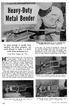 It's large enough to handle most welding job shop projects, yet small enough to make it a worth while home-workshop tool H Craft Print Project No. 272 ERE'S a metal bender that will enable you to bend
KNOCK OUT NAK80 INTRODUCING PLASTIC MOLDS RUBBER MOLDS JIGS & FIXTURES PRESS DIES. 40 HRC Pre-Hardened High Performance High Precision Mold Steel
 INTRODUCING NAK80 40 HRC Pre-Hardened High Performance High Precision Mold Steel KNOCK OUT THE COMPETITION PLASTIC MOLDS RUBBER MOLDS JIGS & FIXTURES PRESS DIES Features: Machines up to 20 percent faster
Technical Guide for Glass Cutting Section 1 - Two Basic Types of Cutting
 Section 1 - Two Basic Types of Cutting Part 1 Conventional Cutting Basic Principles of Glass Cutting This portion of Part 1 deals with those aspects of the basic principles of glass cutting that are common
Where to order engine kits The displacer cylinder CONTINUED
 By Harry Walton OCUS sunlight on this model engine, and it runs at full speed, fueled by Fthe biggest nuclear reactor in the solar system the sun. Power is ample to drive a midget water pump or spin a
COATED CARBIDE. TiN. Al 2 O 3
 COATED CARBIDE GENERAL INFORMATION CVD = Chemical Vapour Deposition coated grades GC2015, GC2025, GC2135, GC235, GC3005, GC3015, GC3020, GC3025, GC3115, GC4015, GC4025, GC4035, S05F, and CD1810. PVD =
How To Make A Spiral Fluted And Wire Wrapped Dagger Handle
 Making A Spiral Fluted and Wire Wrapped Dagger Handle By: Steve Culver, MS Part 1 Making A Spiral Fluted and Wire Wrapped Dagger Handle By: Steve Culver, MS After the rough handle material is drilled through
Specifications for Programs: 737, 747, 757, 767, 777, 787
 = Performed by GKN BAC 5000 AN General Sealing 6-262, 6-265, 6-267, 6-270 PSD for 787 Only: 6-242, 6-269, 6-271 PSD for 777 Only: 6-261,6-264, 6-266, 6-269, 6-271 BAC 5004 L Installation of Permanent Fasteners
U-Max Chamfering endmill SPMT-WL 0.17 (0.08-0.21) -WH 0.35 (0.10-0.42) R215.64. Long edge cutter 215.3 0.17 (0.10-0.20) R215.3 -AAH 0.12 (0.08-0.
 General Turning PROFILING Feed recommendations Feed per tooth, fz (mm/tooth) Insert geometry Insert size Starting value (min.- max.) U-Max Chamfering endmill SPMT-WL 0.17 (0.08-0.21) -WH 0.35 (0.10-0.42)
SS-EN ISO 9001 SS-EN ISO 14001
 This information is based on our present state of knowledge and is intended to provide general notes on our products and their uses. It should not therefore be construed as a warranty of specific properties
UDDEHOLM BALDER UDDEHOLM BALDER UDDEHOLM STEEL FOR INDEXABLE INSERT CUTTING TOOLS
 UDDEHOLM BALDER Reliable and efficient steel is essential for good results. The same goes for achieving high productivity and high availability. When choosing the right steel many parameters must be considered,
North American Stainless
 North American Stainless Long Products Stainless Steel Grade Sheet AISI 316 UNS S31600 EN 1.4401 AISI 316L UNS S31630 EN 1.4404 INTRODUCTION NAS provides 316 and 316L SS, which are molybdenum-bearing austenitic
X15TN TM. A high hardness, corrosion and fatigue resistance martensitic grade CONTINUOUS INNOVATION RESEARCH SERVICE.
 TM A high hardness, corrosion and fatigue resistance martensitic grade CONTINUOUS METALLURGICAL SPECIAL STEELS INNOVATION RESEARCH SERVICE DEVELOPMENT Enhancing your performance THE INDUSTRIAL ENVIRONMENT
LEADER IN CUTTING TECHNOLOGY
 LEADER IN CUTTING TECHNOLOGY FOR OVER 2 YEARS REASONS WHY TRONEX IS THE BEST IN THE WORLD 1 2 SUPERIOR CUTTING PERFORMANCE Cut hundreds of thousands of times before dulling. Cut hundreds of thousands of
Section 4: NiResist Iron
 Section 4: NiResist Iron Section 4 Ni-Resist Description of Grades...4-2 201 (Type 1) Ni-Resist...4-3 202 (Type 2) Ni-Resist...4-6 Stock Listings...4-8 4-1 Ni-Resist Description of Grades Ni-Resist Dura-Bar
Product Guide SaraDrill
 Product Guide SaraDrill SARADRILL / A QUICK GUIDE Drilling from solid - a proven technology to drill large diameter holes on low horse power machines. Drilling from 49mm to 270mm diameter holes from solid
Home"" """"> ar.cn.de.en.es.fr.id.it.ph.po.ru.sw
 Home"" """"> ar.cn.de.en.es.fr.id.it.ph.po.ru.sw Milling of Grooves, Elongated Slots and Break-throughs - Course: Techniques for machining of material. Trainees' handbook of lessons (Institut fr Berufliche
Manufacturing Tooling Cutting Tool Design. Elements of Machining. Chip Formation. Nageswara Rao Posinasetti
 Manufacturing Tooling Cutting Tool Design Nageswara Rao Posinasetti Elements of Machining Cutting tool Tool holding Guiding device Work piece Machine tool January 29, 2008 Nageswara Rao Posinasetti 2 Chip
Diamond and CBN grinding wheels for the perfect finish
 Diamond and CBN grinding wheels for the perfect finish The proven product range with maximum tool life A wide selection for the perfect finish The use of high performance abrasives has become an important
SHOP NOTES METAL SHAPER FOR YOUR SHOP
 SHOP NOTES METAL SHAPER FOR YOUR SHOP A METAL SHAPER is indispensable for certain machining operations where flat surfaces must be produced within very close limits, such as machining flats on castings,
North American Stainless
 North American Stainless Flat Products Stainless Steel Grade Sheet 430 (S43000)/ EN 1.4016 Introduction: SS430 is a low-carbon plain chromium, ferritic stainless steel without any stabilization of carbon
Handling Corrosive or Abrasive Liquids
 Handling Corrosive or Abrasive Liquids Defining abrasion and corrosion An abrasive liquid is one that has particles in it. Some, like inks, have very fine particles, while others, like some paints, contain
The "DAVID" Steam Engine By Alan Marconett Hobbit Engineering HTTP://WWW.HobbitEngineering.com Alan@HobbitEngineering.
 The "DAVID" Steam Engine By Alan Marconett Hobbit Engineering HTTP://WWW.HobbitEngineering.com [email protected] (c) 2/20/03 The David steam engine is a simple oscillating steam engine, many plans
Overview. Milling Machine Fundamentals. Safety. Shop Etiquette. Vehicle Projects Machine Shop
 Overview Milling Machine Fundamentals Wayne Staats, UW-Madison FSAE Safety Shop Etiquette Before Machining Indicating Calculating Feeds and Speeds Machining Maintenance Safety Respect the machines Common
Chapter 5 - Aircraft Welding
 Chapter 5 - Aircraft Welding Chapter 5 Section A Study Aid Questions Fill in the Blanks 1. There are 3 types of welding:, and, welding. 2. The oxy acetylene flame, with a temperature of Fahrenheit is produced
Wire Drawing Soap Lubrication: Principles And Factors Affecting Selection
 Wire Drawing Soap Lubrication: Principles And Factors Affecting Selection 1 Wire Products 2 Rod: The Starting Material 3 The tool: Wire Drawing machines Dry Draw Bench Courtesy of Lamnea Bruk, Ljusfallshammar,
Understanding the Wire EDM Process
 5 Understanding the Wire EDM Process 69 Accuracy and Tolerances Wire EDM is extremely accurate. Many machines move in increments of 40 millionths of an inch (.00004") (.001 mm), some in 10 millionths of
6.6 GEAR MANUFACTURING. Introduction. Gear forming
 Valery Marinov, Manufacturing Technology Gear Manufacturing 123 6.6 GEAR MANUFACTURING Introduction Because of their capability for transmitting motion and power, gears are among the most important of
Duplex Stainless Steel Fabrication. Gary M. Carinci TMR Stainless Consultant for International Molybdenum Association
 Duplex Stainless Steel Fabrication Gary M. Carinci TMR Stainless Consultant for International Molybdenum Association 1 Promoting molybdenum - as a material with superior properties and performance in a
Module 3 Machinability. Version 2 ME, IIT Kharagpur
 Module 3 Machinability Lesson 1 Cutting Tool Materials of common use Instructional Objectives At the end of this lesson, the students will be able to (i) Identify the needs and cite the chronological development
11 Machining, Cutting and Finishing
 11 Machining, Cutting and Finishing Safety Precautions Besides the standard safety rules for mechanical operations, machining, cutting and finishing of plastic parts, unlike metals, can lead to local heating
8.1 HPC for improved efficiency on standard machine tools by using new fluid-driven spindles
 8.1 HPC for improved efficiency on standard machine tools by using new fluid-driven spindles A. Schubert 1, O. Harpaz 2, B. Books 2, U. Eckert 1, R. Wertheim 1 1 Fraunhofer IWU, Reichenhainer Str. 88,
Milling Chuck Features
 Milling Chuck Features Since its first introduction into the industry in 1963, Nikken has sold over 2,000,000 worldwide and never stopped improving its original design. Featuring multi-roller bearings
Geometry and dimensional tolerances of engine bearings
 Geometry and dimensional tolerances of engine bearings Dr. Dmitri Kopeliovich (Research & Development Manager.) 1. Hydrodynamic lubrication Engine bearings operate mostly in the hydrodynamic regime of
This last dimension, the thread pitch diameter, is the most important as it is a reference from which all other thread measurements originate
 Training Objectives After watching the video and reviewing this printed material, the viewer will gain knowledge and understanding of the design and use of various thread types and how they are produced.
Two most common lock nut groups: 1-Prevailing Torque Type Lock Nuts:
 Two most common lock nut groups: 1. PREVAILING TORQUE a design feature of the lock nut produces friction between threads of mated components thereby increasing the force needed to tighten as well as loosen
GEAROLOGY 4-1 WORMS AND WORM GEARS WORMS AND WORM GEARS
 GEAROLOGY 4-1 4 4-2 GEAROLOGY COMMON APPLICATIONS: Worm and worm gear sets are used in many, everyday products including: electrical mixers, hubometers, right Now that you have an understanding of two
North American Stainless
 North American Stainless Flat Product Stainless Steel Grade Sheet 316 (S31600)/EN 1.4401 316L (S31603)/ EN 1.4404 INTRODUCTION NAS provides 316 and 316L SS, which are molybdenum-bearing austenitic stainless
1001 Business Center Drive Mount Prospect, IL 60056-2181 Toll Free: (800) 950-5202 Phone: (847) 635-0044 Fax: (847) 635-7866
 1001 Business Center Drive Mount Prospect, IL 60056-2181 oll Free: (800) 950-5202 Phone: (847) 635-0044 Fax: (847) 635-7866 http://www.sumicarbide.com Sumitomo offers advanced milling, drilling, and hard
Technical Data BLUE SHEET. Martensitic. stainless steels. Types 410, 420, 425 Mod, and 440A GENERAL PROPERTIES APPLICATIONS PRODUCT FORM
 Technical Data BLUE SHEET Allegheny Ludlum Corporation Pittsburgh, PA Martensitic Stainless Steels Types 410, 420, 425 Mod, and 440A GENERAL PROPERTIES Allegheny Ludlum Types 410, 420, 425 Modified, and
Radius Compensation G40, G41, & G42 (cutter radius compensation for machining centers, tool nose radius compensation for turning centers)
 Radius Compensation G40, G41, & G42 (cutter radius compensation for machining centers, tool nose radius compensation for turning centers) These features are commonly well covered in most basic CNC courses.
Die casting Figure M2.3.1
 Die casting Die casting is a moulding process in which the molten metal is injected under high pressure and velocity into a split mould die. It is also called pressure die casting. The split mould used
PROVEN SOLUTIONS FLIUD END MACHINING FLUID END MACHINING PROVEN SOLUTIONS & TOOLING
 PROVEN SOLUTIONS FLIUD END MACHINING FLUID END MACHINING PROVEN SOLUTIONS & TOOLING SECO PROVEN SOLUTIONS WILL IMPROVE YOUR PROCESS When you partner with Seco, our team of metalworking experts evaluate
UDDEHOLM VANADIS 30 SUPERCLEAN
 UDDEHOLM VANADIS 30 SUPERCLEAN UDDEHOLMS AB No part of this publication may be reproduced or transmitted for commercial purposes without permission of the copyright holder. This information is based on
Sheet Metal Stamping Dies & Processes
 Training Objectives After watching the program and reviewing this printed material, the viewer will gain knowledge and understanding of the stamping process and the die systems used to form sheet metal.
Uddeholm Dievar is a specially developed steel grade by Uddeholm, which provides the best possible performance.
 Uddeholm Dievar is a specially developed steel grade by Uddeholm, which provides the best possible performance. The chemical composition and the very latest in production technique make the property profile
Panel/Hand Saw Kit Assembly Instructions
 Panel/Hand Saw Kit Assembly Instructions PLEASE READ THE FOLLOWING INSTRUCTIONS BEFORE BEGINNING Brief Summary You will be performing the following Tasks: 1. Determining the degree of shaping laying out
UDDEHOLM IMPAX SUPREME
 UDDEHOLM IMPAX SUPREME Uddeholm Impax Supreme is a premium prehardened mould steel with very good polishing and texturing properties. Uddeholm Impax Supreme is available in a very wide dimensional range,
Common Mechanical Engineering Terms
 Common Mechanical Engineering Terms Ball and Detent (n) A simple mechanical arrangement used to hold a moving part in a temporarily fixed position relative to another part. The ball slides within a bored
indexable Center Drill
 Our innovative tooling design upgrades productivity and competitive capability while reducing production requirements in a range of industries. The tooling system is designed to benefit users of machining
LU6X-130 Instructions and Parts List (including LU6X Basic) Operating Instructions
 LORTONE LU6X-130 Item # 061-092 LU6X Basic Item # 061-090 LU6X-130 Instructions and Parts List (including LU6X Basic) Operating Instructions Introduction The LU6X is one the most versatile pieces of equipment
SHEET METAL DESIGN HANDBOOK
 SHEET METAL DESIGN HANDBOOK Forming Basics. 2 Critical Dimensions Embosses and Offsets Bend Radius Bend Relief Forming Near Holes Form height to thickness ratio Edge Distortion Laser cutting 5 Tolerances
Screw Thread Design. Rev. 3-4-09
 Screw Thread Design Screw Thread Fundamentals A screw thread is defined as a ridge of uniform section in the form of a helix on either the external or internal surface of a cylinder. Internal threads refer
The ACCU-LUBE Micro-Lubricating System for external and internal lubrication
 E -000 Information on our company The ACCU-LUBE Micro-Lubricating System for external and internal lubrication the environmentally safe Micro-Lubricating System eliminating waste disposal Development:
New in the PFERD Product Line 204
 COMBICLICK Fibre Discs COMBICLICK fibre discs Silicon carbide SiC D The silicon carbide SiC type is suitable for working on aluminium, copper, bronze, titanium, high-alloy steels and fibre reinforced plastics.
Sheet Metal Shearing & Bending
 Training Objective After watching the program and reviewing this printed material, the viewer will gain a knowledge and understanding of the principles and machine methods of shearing and bending sheetmetal
NEW INTERCHANGEABLE REAMING HEAD SYSTEM FAST
 August 2007 / NEW029.1 / PAGE 1 OF 7 NEW INTERCHANGEABLE REAMING HEA YTEM FAT ACCURATE GOO FINIH Ingersoll is introducing the QwikReam, a new high speed reaming system. The QwikReam consists of an interchangeable
Helical Gears K HG 1-20 R. Table of Contents. Catalog Number of KHK Stock Gears. Helical Gears. (Example) Direction of Helix (R) No.
 Table of Contents Special Characteristics, Points of Caution in Selecting and Using... page 130 KHG Ground... page 134 SH... page 144 Catalog Number of KHK Stock Gears The Catalog Number for KHK stock