
11 Machining, Cutting and Finishing
|
|
|
- Opal Simon
- 10 years ago
- Views:
Transcription
1 11 Machining, Cutting and Finishing Safety Precautions Besides the standard safety rules for mechanical operations, machining, cutting and finishing of plastic parts, unlike metals, can lead to local heating up to the melting point of the plastic or even to its decomposition. It is therefore recommended to follow similar safety work practices as used in the production of plastic parts; namely adequate ventilation of the working area. More detailed information concerning the specific plastic used can be obtained from the Safety Data Sheet of the plastic material. The waste generated generally may not be adequate for recycling due to its potential contamination. Machining HYTREL HYTREL engineering thermoplastic elastomer is normally made into useful parts by injection moulding, extruding or melt casting. However, prototypes or small production quantities can be machined from blocks or rods of HYTREL. Also, fabrication of complicated production parts can sometimes be simplified by post-moulding machining operation. This chapter presents some guide-lines for machining HYTREL. General Any method of machining will usually produce a matte finish on parts of HYTREL engineering thermoplastic elastomer. This finish does not affect the performance of the part unless sliding friction is a critical factor. Because HYTREL is elastomeric and highly resilient, high cutting pressure produces local deformation, which in turn can cause part distortion. Therefore, moderate pressure and cutting speeds should be used. Softer grades should be cut with less pressure than harder ones*. Parts should be held or supported to minimize distortion. HYTREL is a poor heat conductor; it does not readily absorb heat from cutting tools, as metals do. Frictional heat generated during machining may melt the cut surfaces. Melting can be prevented by cooling the cutting surface, either by directing a tiny jet of high pressure air at the cutting tool or by flooding the surface with water or a water-oil emulsion. Some guidelines for specific machining operations follow. Even if it is not specifically mentioned in the guidelines, keep in mind that cooling the cut surface will always improve machining. * Throughout this report, soft grades or soft polymers refers generally to the grades of HYTREL that have a flexural modulus below about 240 MPa while hard grades or hard polymers refers generally to those grades whose flexural modulus is above this value. However, there is no sharp transition point; machining conditions will vary gradually from type to type. Turning Standard high-speed steel tools can be used for turning operations. Tools should be very sharp, to minimize frictional heat. A positive rake of 10 on the tool bit is desirable. Cutting speeds of 2,0 to 2,5 m/s work best when no coolant is used. Heavy cuts can be made at slower speeds, but produce rougher finishes. Cuttings of HYTREL cannot be chip broken; they remain as one continuous string. When machining soft polymers at high speeds, the cuttings may be tacky on the surface due to frictional heat, and may adhere to or mar the finished surface. Rough cuts produce thicker strings which are less likely to stick to the surface. Harder polymers are easier to cut and yield reasonably good finishes. Finished sizes are generally achieved by sanding with emery cloth to the desired diameter. Dimensions can be held to 0,125 mm with the soft grades of HYTREL, and to 0,050 mm on the harder grades. Long, large diameter parts can be turned satisfacorily if the center is supported to prevent buckling. Milling HYTREL has been milled successfully using a sharp, single blade fly cutter having a 10 back rake and an end mill. With a 76 mm fly cutter, an operating speed of 10 m / s produced good cutting action. Blocks of HYTREL must be secured before milling. Use light pressure with a vise, or adhere the part to the table with doubleface tape. Blocks less than 9,5 mm thick are difficult to hold because of distortion. Drilling Parts made of HYTREL engineering thermoplastic elastomer can be drilled with standard high speed twist drills. Drill bits having an included angle of 118 have been used satisfactorily, but lesser angles should improve drilling ability. The drill must be very sharp to produce a clean, smooth hole. With the hard grades of HYTREL, good results have been obtained at drill speeds of 500 to 3500 rev/ min and cutting speeds of 0,13 to 3,6 m / s. The force required to feed the drill decreases with increasing speed. The softer grades, being more resilient, generally yield a poorer surface finish. Flooding with coolant improves the finish. However, even when using the softest grade of HYTREL without coolant, no surface melting was observed at a drill speed of 5160 rev/ min with drill sizes up to 25 mm diameter. 145

2 Tolerances may be difficult to hold. HYTREL has an elastic memory which causes it to close in on holes that are cut into it. As a result, finished dimensions of holes will generally be slightly smaller than the drill size, unless drill whip occurs. To meet exact dimensions, use slightly oversize drills, or hone the hole to size. In test drillings, finished hole size obtained with a 12,7 mm diameter drill bit ranged from 12 mm 5% undersize at low speed to 13 mm 3% oversize at high speed. Tapping or threading Because of the tendency of HYTREL to close in on holes (see Drilling), tapping threads is impossible with the softer grades and very difficult with the harder grades. Designs which require tapping of HYTREL should be avoided. External threads can be cut using a single point tool. However, binding and distortion are frequently encountered when threading parts of HYTREL. Band sawing The following types of blades have been used satisfactorily to saw HYTREL engineering thermoplastic elastomer: 1,6 teeth per cm, raker set; 1,6 teeth per cm, skip tooth, raker set; 4 teeth per cm, raker set. Cutting speeds ranging from 0,7 to 30 m/s have been used. At low speeds, cutting efficiency is reduced and more power is required. At high speeds, less force is needed to feed the stock. Optimum cutting speed with a 1,6-tooth raker blade is about 18 m /s. Slight melting has been observed when using a 4-tooth blade at 30 m /s, indicating that finer teeth cause more frictional heat at high speeds. Flooding the saw blade with coolant produces a good clean cut because little or no frictional heat is developed. When a saw that is not equipped with coolant is used, blades that have a wide tooth set are suggested to minimize frictional heat. Cutting can be improved by wedging the cut open to prevent binding of the blade. Machining chart for HYTREL engineering thermoplastic elastomer Machining Types of Preferred Optimum Suggestions Operation HYTREL Tools Cutting Speed Band Sawing All Grad 1,6 to 4 tooth per cm 18 m/s Wedge cut open to prevent binding. blade, raker set Flood saw blade with coolant. Turning All Grades Standard high-speed 2,0 to 2,5 m/s Tools should be very sharp. (Harder grades steel tools with positive when no coolant is used Sand with emery cloth to final are easier to work with) rake of 10 on the bit dimensions. Milling All Grades Single blade fly cutter 10 m/s Tools should be very sharp. having a 10 back rake Secure stock for milling. Drilling All Grades Standard high-speed 0,13 to 3,6 m/s Use slightly over-size drills or hone (Harder grades are twist drills for harder grades to final size. easier to drill) Use coolant for smoother finish. Tapping Hardest grades only Tapping of HYTREL is extremely diffcult because polymer tends to close in on holes cut into it. Avoid designs that require tapping. 146

3 Machining and Cutting of DELRIN DELRIN can be machined on standard machine shop equipment by sawing, milling, turning, drilling, reaming, shaping, threading and tapping. It is easier to perform these operations on DELRIN than on the most machinable brass or aluminium alloys. It is seldom necessary to use cutting oils, water or other cutting aids except in the common wet band sanding operation where water feed is normally used. Machinability is excellent at slow-speed / fast-feed and slowfeed / fast-speed using standing cutting tools. In most cases standard chip breakers on tools perform adequately. Sawing Standard power tools such as band saws, jig saws and table saws can be used without modification for sawing DELRIN. The speed of the saw blade is generally not critical; however, it is important that the teeth in the saw blades have a slight amount of set. DELRIN is a thermoplastic material and, therefore, frictional heat will cause it to melt so that it is necessary to provide tooth clearance when sawing. Drilling Standard twist drills are suitable for use with DELRIN. The long lead and highly polished lands of the so-called plastic drills are desirable when drilling DELRIN. However, the leading edges of these drills are usually ground flat and should be modified by changing the drill lip angle to cut rather than scrape. If the drilling is performed at very high rates, the use of a coolant such as water or a cutting oil to reduce the frictional heat generated may be desirable. Where coolants are not used, the drill should be occasionally withdrawn from the hole to clean out the chips and prevent overheating. Holes can be drilled on size providing the drills are kept cool. Turning DELRIN may be turned on any conventional metal working lathe. The tool bits should be ground as they normally are for working with free cutting brass. A back rake and a large chip breaker will be helpful in most cases to eliminate drag or interference. As with other materials, the best finish will be obtained with a high speed and a fine feed. In some cases where the length of the material to be turned is large and the diameter of the piece is small, it will be necessary to use steady rests to eliminate whipping of the material. If the rotational speed of the work is high, it will probably be necessary to supply a coolant to the steady rest to carry off the frictional heat generated thereby. Milling Standard milling machines and milling cutters may be used with DELRIN providing the cutting edges are kept very sharp. When using end mills, it has been found desirable to use single fluted mills which have greater chip clearance and generate less frictional heat. Shaping DELRIN can be used on standard shapers without any modification to the machinery or the tools. Excellent results can be obtained with this type of equipment. Fig Drilling Machining conditions: Cutting speed, 1500 rpm; 13 mm, std. 118 twist drill; medium feed. No coolant. Material DELRIN 500. Reaming DELRIN can be reamed with either hand or collar reamers to produce holes with good finish and accurate dimensions. In general, reamers of the expansion type are preferred. Due to the resiliency of DELRIN, cuts made with a fixed reamer tend to be undersize unless at least 0,15 mm is removed by the final reaming. Threading and tapping DELRIN can be threaded or tapped with conventional equipment. On automatic or semi-automatic equipment, self-opening dies with high-speed chasers can be used. The use of a lubricant or coolant has not been found necessary, but in some cases, on very high-speed operations, it may be of assistance. Threads may be cut in DELRIN on a lathe using conventional single-pointed tools. As with metals, several successive cuts of 0,15-0,25 mm should be made. Finish cuts should not be less than 0,15 mm because of the resiliency of DELRIN. When threading long lengths of rod stock, it is necessary to use a follow rest or other support to hold the work against the tool. 147

4 Blanking and punching Small flat parts such as washers, grommets and non-precision gears (1,5 mm or less in thickness) often can be produced more economically by punching or stamping from a sheet of DELRIN. Conventional dies are used in either hand- or power-operated punch presses. With wellmade dies, parts of DELRIN may be blanked or punched cleanly at high speeds. If cracking occurs, it can usually be avoided by pre-heating the sheet. Finishing of DELRIN Burr removal Although there are several ways of removing burrs, it is better to avoid forming them. This is best accomplished by maintaining sharp cutting edges on tools and providing adequate chip clearances. Where only a few parts are being made, it is often simplest to carve or scrape off burrs with hand tools. If burrs are not too large, they can also be removed with vapour blast or honing equipment. Care must be taken to avoid removing too much material. Still another method of removing burrs on parts of DELRIN is through the use of commercial abrasive tumbling equipment. The exact grit-slurry make-up and tumbling cycle are best determined by experimentation. Filing and grinding A mill file with deep, single, cut, coarse curved teeth, commonly known as a Vixen file, is very effective on DELRIN. This type of file has very sharp teeth and produces a shaving action that will remove DELRIN smoothly and cleanly. Power-driven rotary steel burrs or abrasive discs operating at high speeds are effective in finishing parts of DELRIN. Standard surface grinders and centreless grinding machines can also be used to produce smooth surfaces of DELRIN. Sanding and buffing DELRIN can be wet sanded on belt or disc sanding equipment. After sanding to a smooth finish, the surface may be brought to a high polish by the use of standard buffing equipment. Care should be used in these operations to avoid excessive feeds which tend to overheat the DELRIN. The buffing operation normally consists of three steps: ashing, polishing and wiping. The ashing is done with a ventilated wheel of open construction which can be made up of alternating layers of 30 cm and 15 cm diameter muslin discs. In this way, an ashing wheel of 10 to 12 cm in thickness may be built up. The ashing wheel is kept dressed with a slurry of pumice and water during the buffing operation. The part of DELRIN is held lightly against the wheel and kept in constant motion to prevent burning or uneven ashing. Speed of the wheel should be approximately 1000 rpm for best results. The polishing operation is performed in a similar manner and on a similarly constructed buffing wheel. The difference is that the wheel is operated dry and a polishing compound is applied to half the surface of the wheel. The other half remains untreated. The part of DELRIN is first held against the treated half of the wheel for polishing and then moved to the untreated side to wipe off the polishing compound. Optimum speeds for the polishing wheel range from 1000 to 1500 rpm. Safety precautions Fine shavings, turnings, chips, etc., should be cleaned up and not allowed to accumulate. DELRIN acetal resin will burn, and an accumulation of chips could create a fire hazard. Annealing of DELRIN Annealing is not generally required as a production step because of added cost and difficulty in predicting dimensions. If precision tolerances are required, parts should be moulded in hot moulds ( C) to closely approach the natural level of crystallinity and minimize post-mould shrinkage. Annealing is suggested as a test procedure in setting up moulding conditions on a new mould to evaluate postmould shrinkage and moulded-in stresses. The change in part dimensions during annealing will closely represent the ultimate change in part size in use as the part reaches its natural level of crystallinity. Most manufacturers of stock shapes anneal their product to relieve stresses. However, further annealing may be required during machining of parts with close tolerances to relieve machined-in stresses, especially following heavy machining cuts. Annealing of machined parts normally precedes final light finishing or polishing cuts. Air annealing Air annealing of DELRIN is best conducted in air-circulating ovens capable of maintaining a uniform air temperature controllable to ±2 C. In air, one hour at 160 C is required to reach the same degree of annealing as is achieved in 30 minutes in oil at 160 C because heat transfer takes place more slowly in air than in oil. Annealing time is 30 minutes for part heat up to 160 ± 2 C and then 5 minutes additional time per 1 mm of wall thickness. 148

5 Oil annealing Recommended oils are Primol 342* and Ondina 33* or other refined annealing oils. Parts may be annealed at a part temperature of 160 ±2 C. Annealing time at 160 C is 5 minutes per 1 mm of wall thickness after parts reach annealing bath temperature (15-20 min). Thorough agitation should be provided to assure uniform bath temperature and to avoid localized overheating of the oil. The latter condition may cause deformation or even melting of the parts. Parts should contact neither each other nor the walls of the bath. Cooling procedure When annealed parts are removed from the annealing chamber, they should be cooled slowly to room temperature in an undisturbed manner. Stacking or piling, which may deform the parts while they are hot, should be delayed until parts are cool to the touch. Machining and Cutting of ZYTEL ZYTEL can be machined using techniques normally employed with soft brass. Although the use of coolants, such as water or soluble oils, will permit higher cutting speeds, coolants are generally not necessary to produce work of good quality. Since ZYTEL is not as stiff as metal, the stock should be well supported during machining to prevent deflection and resultant inaccuracies. Parts should normally be brought to room temperature before checking dimensions. Tool design Cutting tools used for ZYTEL should be sharp and have plenty of clearance. The necessity of sharp cutting edges and easy elimination of chips cannot be emphasized too strongly. Dull tools, or tools having edges which scrape rather than cut, will cause excessive heat. Tools without sufficient clearances for ready removal of chips will cause the chips to bind and melt. Fig Sawing Machining conditions: Saw speed, 1200 m per min; blade, 6 mm wide, 4 teeth per cm; No coolant. Material ZYTEL mm thick. More frictional heat is developed when sawing ZYTEL than with most other plastics, so that ample tooth clearance should be provided to prevent binding and melting. Although ZYTEL can be sawed without coolant, the use of coolants will permit faster cutting rates. As in the case of metals, carbide and diamond tipped tools can be used to advantage when machining ZYTEL on long production runs. Turning tool A Cut-off tool 5 B Sawing Conventional power equipment, including band saws, jig saws and table saws can be used without modification for sawing ZYTEL. However, it is important that the teeth in all saw blades, bands, and circular saws have a slight amount of set. The socalled hollow ground plastic saws whose teeth have no set will not give satisfactory performance with ZYTEL A pos 20 Section A-A 7 7 B 0-5 pos Section B-B * SUPPLIERS OF ANNEALING OILS-EUROPE Primol 342 and Primol 355 (Esso) Ondina 33 (Shell) White Oil N 15 (Chevron). 149

6 Drilling ZYTEL can be drilled satisfactorily with conventional twist drills. The included point angle should be 118 with lip clearance angles. So-called plastic drills or brass drills will not perform satisfactorily with ZYTEL. Such drills have their leading edge ground flat in order to obtain a scraping action. In ZYTEL this results in overheating and possible seizing. However, the long lead and highly polished lands of the plastic drills permit chips to readily flow from deep holes. This is a very desirable feature when drilling ZYTEL. By modifying the drill lip angle to cut rather than scrape, these drills will work very well on ZYTEL. Heavy feeds should be used, consistent with desired finish, to prevent excessive heat resulting from scraping rather than cutting. hole will remain at the original dimension after the reamer is removed. At least 0,15 mm should be removed by the final reaming if a hole of correct size is to be produced. Threading and tapping ZYTEL can be threaded or tapped with conventional equipment. Though desirable, the use of a lubricant or coolant when threading or tapping ZYTEL is not always necessary. Threads may be cut in ZYTEL on a lathe using conventional single-pointed tools. As with metals, several successive cuts of 0,15-0,25 mm should be made. The finish cut should not be less than 0,15 mm, because of the resiliency of the material. When threading long lengths of rock stock, it is necessary to use a follow rest or other support to hold the work against the tool. In production tapping, it is freqently desirable to use a tap 0,15 mm oversize unless a self-locking thread is desired. Fig Coolants should be used where possible when drilling ZYTEL. Where coolants are not used, the drill should be frequently withdrawn from the hole to clean out the chips and prevent overheating. Holes can be drilled on size providing the drills are kept cool. Reaming Drilling Machining conditions: Drill size, 10 mm; Speed 1000 rpm; No coolant. Material ZYTEL mm thick. ZYTEL can be reamed with conventional types of reamers to produce holes with good finish and accurate dimension. Reamers of the expansion type are preferred. Because of the resiliency of ZYTEL, cuts made with a fixed reamer tend to be undersize. It is difficult to remove less than 0,05 mm when reaming ZYTEL. Although the reamer will pass through the hole, no stock will be removed, and the Fig Turning Turning Machining conditions: Lathe speed, 980 rpm; cutting speed 185 m/min; feed 0,15 mm; depth of cut, 2,5 mm; No coolant. Material ZYTEL mm diameter. ZYTEL can be turned easily on any standard or automatic metal working lathe. No special precautions need be observed, although, as in other machining operations, tools should be very sharp. Tool bits should be ground as for soft brass; with a back rake to give free removal of the continuous chip, and with a large clearance to eliminate drag or interference. Chip breakers are not generally effective with ZYTEL because of its toughness. A pick-off can be used as an aid in separating the turnings where desired. As with other materials, the best finish will be obtained with a high speed and fine feed. 150

7 Milling ZYTEL can be readily milled using conventional cutters providing the cutting edges are kept very sharp. Where possible, climb milling should be used to minimize burring the ZYTEL. Cutting speeds in excess of 30 m / min and heavy feeds in excess of 230 mm/min have been used successfully. Fig Milling Machining conditions: Cutting speed, 250 m/min; 100 mm cutter; 2,5 mm spindle; feed 150 mm/min. Depth of cut, 0,25 mm; No coolant. Material ZYTEL 101. Blanking and punching Small flat parts such as washers, grommets and non-precision gears, 2 mm or less in thickness, often can be produced more economically by punching or stamping from an extruded ZYTEL strip than by injection moulding. Conventional dies are used in either hand or power operated punch presses. With well-made dies, ZYTEL may be blanked or punched cleanly at high speed. If cracking occurs, it can usually be overcome by preheating the strip or by soaking it in water until approximately two percent moisture has been absorbed. Finishing of ZYTEL Burr removal Some machining operations tend to create burrs on the part. Although there are a number of ways to remove burrs, it is better to avoid forming them. This is best accomplished by maintaining sharp cutting edges and providing plenty of chip clearances. Where only a few parts are being made, it is often simplest to carve or scrape off the burrs with hand tools. If the burrs are not too large, they can be successfully removed by singeing or melting. In singeing, the burrs are burned off by playing an alcohol flame across the part. The burrs can be melted by directing hot nitrogen gas 290 C briefly across the part surface. The part should be exposed to the flame or gas very briefly so as not to affect the dimension of the part. Fine burrs can also be removed with vapour blast or honing equipment. Where dimensions are critical, care should be taken to avoid removing too much material. Commercial abrasive tumbling equipment is also used for deburring parts of ZYTEL but the tumbling cycle is normally much longer than with metal parts. Although the exact grit slurry make-up for a particular part can best be determined by experimenting. The grit content by volume is usually twice the volume of parts of ZYTEL. A detergent is also added to the watergrit mixture to prevent the parts from being discoloured by the grit. Filing and grinding Because of the toughness and abrasion-resistance of ZYTEL nylon resins, conventional files are not satisfactory. However, power-driven rotary steel burrs operating at high speeds are effective. Abrasive discs used on a flexible shaft or on a high-speed hand grinder will remove stock from ZYTEL parts quickly and efficiently. Use of a coolant is generally desired for this type of operation. A mill file with deep, single-cut, coarse, curved teeth (commonly known as a Vixen file), as is used for aluminium and other soft metals, is very effective on ZYTEL. This type of file has very sharp teeth and produces a shaving action that will remove ZYTEL smoothly and cleanly. Sanding and buffing ZYTEL can be wet sanded on belt or disc sanding equipment. After sanding to a smooth finish, the surface may be brought to a high polish by use of standard buffing equipment. The buffing operation is normally considered as three steps: ashing, polishing and wiping. Ashing is done with a ventilated wheel of open construction, made up of alternating layers of say 200 and 460 mm diameter muslin discs. In this way, an ashing wheel of some 100 to 130 mm in width may be built up. The ashing wheel is kept dressed with a slurry of pumice and water during the buffing operation. 151

8 The part of ZYTEL is held lightly against the wheel and kept in constant motion to prevent burning or uneven ashing. Speed of the wheel should be approximately rpm for wheels of 300 to 400 mm diameter. It is essential that the wheel be operated slowly enough to retain a charge of the slurry. The polishing operation is performed in a similar manner and on a similarly constructed buffing wheel, the difference being that the wheel is operated dry and a polishing compound is applied to half the surface of the wheel, the other half remaining untreated. The part of ZYTEL is first held against the treated half of the wheel for polishing and then moved to the untreated side to wipe off the polishing compound. Optimum speeds for the polishing wheel range from 1000 to 1500 rpm for a 400 mm diameter wheel. Annealing of ZYTEL When annealing of ZYTEL is required, it should be done in the absence of air, preferably by immersion in a suitable liquid. The temperature of the heat-treating liquid should be at least 28 C above the temperature to which the article will be exposed in use a temperature of 150 C is often used for general annealing. This will ensure against dimensional change caused by uncontrolled stress-relief occurring below this temperature. The annealing time required is normally 5 minutes for 1 mm of cross section. Upon removal from the heat-treating bath, the part should be allowed to cool slowly in the absence of drafts; otherwise, surface stresses may be set up. Placing the heated article in a cardboard container is a simple way of ensuring slow, even cooling. The choice of liquid to be used as the heat-transfer medium should be based on the following considerations: Its heat range and stability should be adequate. It should not attack ZYTEL. It should not give off noxious fumes or vapours. It should not present a fire hazard. High boiling hydrocarbons, such as oils or waxes, may be used as a heat-transfer medium if the deposit left on the surface of the moulded item is not objectionable, as in the case of parts which will be lubricated in use. Recommended oils are Ondine 33 (Shell) and Primol 342 (Esso). Experimental work has also shown the suitability of annealing in an oven using a nitrogen atmosphere, although this does require special equipment. The heat-treating bath should be electriccally heated and thermostatically controlled to the disired temperature. For best thermal control, heat should be supplied through the sidewalls as well as through the bottom of the vessel. A large number of small items is best handled by loading them into a wire basket equipped with a lid to prevent the parts from floating, and immersing the basket in the bath for the required period of time. For applications where the maximum temperature will be 70 C or less, acceptable stress-relief can be obtained by immersion in boiling water. This method also has the advantage that some moisture is absorbed by the ZYTEL, thus partially conditioning the piece. For stress-relief, 15 minutes per 3 mm of cross-section is sufficient. Longer times will be required if the piece is to be moisture-conditioned to or near equilibrium. Moisture-conditioning The most pratical method of moisture-conditioning for use in air, where 2,5% water is to be incorporated, is a simple immersion in boiling water. However, this method does not give true equilibrium, since excess moisture is taken on at the surface, and can only redistribute itself with time. One suggested procedure is to put about 3 to 4% water by weight into the parts. The excess will evaporate from the surface in time. Boiling times to 3% moisture are shown in Figure An excellent method for preparing a few parts for test is to heat in a boiling solution of potassium acetate (1250 g of potassium acetate per 1 l of water). A covered pot and a reflux condenser should be used to maintain the concentration of the solution. Density of solution 1,305-1,310 at 23 C. A maximum of 2,5% moisture is absorbed by the ZYTEL, no matter how long the treatment is continued. The time required varies from 4 hours, for a thickness of 2 mm, to 20 hours, for a thickness of 3 mm. Soaking in boiling water is a good method for moistureconditioning parts to be used in water or aqueous solutions. The part is exposed until saturation is essentially complete, as shown by the saturation line in Figure For thick sections (3 mm or more), it is more practical to condition the piece only partially, since absorption becomes very slow beyond 4 or 5%. Thickness, mm , Time, h To 3% moisture To saturation Fig Moisture conditioning of ZYTEL 101 (time of immersion in boiling water) 152

AISI O1 Cold work tool steel
 T OOL STEEL FACTS AISI O1 Cold work tool steel Great Tooling Starts Here! This information is based on our present state of knowledge and is intended to provide general notes on our products and their
A Guide to Thermoform Processing of Polypropylene. Introduction
 A Guide to Thermoform Processing of Polypropylene Introduction Thermoforming is the process of heating plastic sheet to a pliable state and forming it into shape. Thermoforming offers processing advantages
Injection molding equipment
 Injection Molding Process Injection molding equipment Classification of injection molding machines 1. The injection molding machine processing ability style clamping force(kn) theoretical injection volume(cm3)
UDDEHOLM VANADIS 30 SUPERCLEAN
 UDDEHOLM VANADIS 30 SUPERCLEAN UDDEHOLMS AB No part of this publication may be reproduced or transmitted for commercial purposes without permission of the copyright holder. This information is based on
Solid shape molding is not desired in injection molding due to following reasons.
 PLASTICS PART DESIGN and MOULDABILITY Injection molding is popular manufacturing method because of its high-speed production capability. Performance of plastics part is limited by its properties which
Think precision, Think HSS REAMING
 Think precision, Think HSS REAMING SUMMARY REAMING TOOLS 2 Zoom on a reamer 3 Which HSS for maximum efficiency? 4 Coatings for the best performance 5 Vocabulary 6 Choose the right design 7 Types of bevel
Additional requirements and conditions for abrasive products to be marked with the osa symbol
 Appendix of paragraph 3 of the Conditions of Use for the osa Trademark Additional requirements and conditions for abrasive products to be marked with the osa symbol Conformance with the European safety
The "DAVID" Steam Engine By Alan Marconett Hobbit Engineering HTTP://WWW.HobbitEngineering.com Alan@HobbitEngineering.
 The "DAVID" Steam Engine By Alan Marconett Hobbit Engineering HTTP://WWW.HobbitEngineering.com [email protected] (c) 2/20/03 The David steam engine is a simple oscillating steam engine, many plans
Saw Tooth Design and Tipping Materials
 Saw Tooth Design and Tipping Materials Bruce Lehmann, P.Eng, Ph.D. Sr. Engineer, Thin Kerf Technologies Inc. British Columbia, Canada Introduction The purposes of a saw tooth are to: 1. Remove a chip from
Chapter 6 Machining Center Carbide Insert Fundamentals
 This sample chapter is for review purposes only. Copyright The Goodheart-Willcox Co., Inc. All rights reserved. N10G20G99G40 N20G96S800M3 N30G50S4000 N40T0100M8 N50G00X3.35Z1.25T0101 N60G01X3.25F.002 N70G04X0.5
KALPANA INDUSTRIES LTD. TECHNICAL DATA SHEET
 1 KALPANA INDUSTRIES LTD. TECHNICAL DATA SHEET KI XL - 03 / KI-SC 10 TWO COMPONENT AMBIENT CURABLE POLYETHYLENE COMPOUND FOR INSULATION OF LOW VOLTAGE POWER CABLE DESCRIPTION : KI polyethylene compound
Coated Abrasives. Hand Sanding Sheets
 Hand Sanding Sheets 21 Hand Sanding Sheets Paper Sheets PB013 FLINT LIGHT PAPER SHEETS PB013 (flint light paper) Abrasive: Flint Backing Material: Light paper Economy product For use on paint, soft wood,
COLLEGE OF ENGINEERING AND APPLIED SCIENCE MACHINE SHOP TOOLS AND PRACTICES
 COLLEGE OF ENGINEERING AND APPLIED SCIENCE MACHINE SHOP TOOLS AND PRACTICES I. OBJECTIVE To provide an overview and basic knowledge of the University of Wyoming, College of Engineering, equipment, tools,
Product Information. Tel: 905.696.9900 x2426 or x2443 Fax: 905.696.9300 Email: [email protected]
 Tel: 905.696.9900 x2426 or x2443 Fax: 905.696.9300 Email: [email protected] Product Information 6320-2 Danville Rd. Mississauga, Ontario Canada L5T 2L7 TABLE OF CONTENTS Sheet Product Alusion Sheet Products.......................................................
INJECTION MOULD DESIGN: MARPLEX PVC RESINS
 MACHINE RECCOMENDATIONS PVC requires reciprocating screw injection moulding machine with a plasticising screw to produce homogeneous melt. It is recommended that a shot weight of the part should take two
Introduction to JIGS AND FIXTURES
 Introduction to JIGS AND FIXTURES Introduction The successful running of any mass production depends upon the interchangeability to facilitate easy assembly and reduction of unit cost. Mass production
MATERIALIZING VISIONS. Bohler-Uddeholm P20 Modified
 MATERIALIZING VISIONS Bohler-Uddeholm P20 Modified General Bohler-Uddeholm P20 Modified is a Cr-Mo-alloyed steel which is supplied in the hardened and tempered condition. P20 Modified offers the following
Injection Molding Design Guide. Table of Contents
 Injection Molding Design Guide 400 Injection Molding Design Guide Table of Contents Injection Mold Tooling Process Comparison...2 Size Limitations...3 Straight Pull Design...4 Other Geometric Considerations...5
Lapping and Polishing Basics
 Lapping and Polishing Basics Applications Laboratory Report 54 Lapping and Polishing 1.0: Introduction Lapping and polishing is a process by which material is precisely removed from a workpiece (or specimen)
PRELIMINARY BROCHURE. Uddeholm Ramax HH
 PRELIMINARY BROCHURE Uddeholm Ramax HH Uddeholm Ramax HH Uddeholm Ramax HH provides several benefits: The product offers uniform hardness in all dimensions combined with excellent indentation resistance.
Make your own glass jewellery, anyone can do it!
 User manual Make your own glass jewellery, anyone can do it! INTRODUCTION With the HotPot you can melt glass in a microwave to create jewellery or glass components for jewellery and other creative purposes.
FLEXIBLE CIRCUITS MANUFACTURING
 IPC-DVD-37 FLEXIBLE CIRCUITS MANUFACTURING Below is a copy of the narration for DVD-37. The contents of this script were developed by a review group of industry experts and were based on the best available
Advantages and application of PCD and CBn tools
 PCD and CBN tools Advantages and application of PCD and CBn tools Powerful and economical Tools with PCD and CBN cutting edges are the ideal solution for difficult-to machine, highly abrasive materials.
Cutting Tool Materials
 Training Objectives After watching the video and reviewing this printed material, the viewer will gain knowledge and understanding of cutting tool metallurgy and specific tool applications for various
ANSI APPROVED 04/11/2014 ANSI APPROVED 08/17/2011. 45 Reaffirmation ANSI APPROVED 02/28/2014. 45 Reaffirmation ANSI APPROVED 05/06/2013
 STANDARDS STATUS REPORT As of November 4, 2015 Note: Dates in RED indicate the last action taken; Highlighted Items Indicate New/Open Items; Grey items have been closed Document TC Status Comments ASME
STAVAX SUPREME. Stainless tool steel
 STAVAX SUPREME Stainless tool steel General Demands placed on plastic mould tooling are increasing. Such conditions require mould steels that possess a unique combination of toughness, corrosion resistance
Lecture slides on rolling By: Dr H N Dhakal Lecturer in Mechanical and Marine Engineering, School of Engineering, University of Plymouth
 Lecture slides on rolling By: Dr H N Dhakal Lecturer in Mechanical and Marine Engineering, School of Engineering, University of Plymouth Bulk deformation forming (rolling) Rolling is the process of reducing
The ACCU-LUBE Micro-Lubricating System for external and internal lubrication
 E -000 Information on our company The ACCU-LUBE Micro-Lubricating System for external and internal lubrication the environmentally safe Micro-Lubricating System eliminating waste disposal Development:
KNOCK OUT NAK80 INTRODUCING PLASTIC MOLDS RUBBER MOLDS JIGS & FIXTURES PRESS DIES. 40 HRC Pre-Hardened High Performance High Precision Mold Steel
 INTRODUCING NAK80 40 HRC Pre-Hardened High Performance High Precision Mold Steel KNOCK OUT THE COMPETITION PLASTIC MOLDS RUBBER MOLDS JIGS & FIXTURES PRESS DIES Features: Machines up to 20 percent faster
DO NOT OPERATE LANCELOT OR SQUIRE WITHOUT FIRST ADJUSTING THE SAFETY GUARD. ( See Below)
 Assembly Instructions - Lancelot and Squire King Arthur s Tools (KAT) is pleased to present the first tandem mounted saw chain accessories whereby differing combinations of Lancelot and Squire may be paired
High speed machining and conventional die and mould machining
 High speed machining and conventional die and mould machining Reprint from HSM - High Speed Machining There are a lot of questions about HSM today and many different, more or less complicated, definitions
Lathe Milling Attachment
 Lathe Milling Attachment By L C. MASON BY CLEVERLY stacking cold-rolled flat stock together, T-slots and slide for this lathe milling attachment are made without costly machinery. In fact, only two tools,
INTRODUCTION UNDERSTANDING THE PRODUCT ABRASIVE TYPES
 INTRODUCTION From standard aluminum oxide bench wheels to premium ceramic abrasive surface grinding wheels, Norton offers high performance abrasive solutions that can maximise productivity in virtually
Understanding the Wire EDM Process
 5 Understanding the Wire EDM Process 69 Accuracy and Tolerances Wire EDM is extremely accurate. Many machines move in increments of 40 millionths of an inch (.00004") (.001 mm), some in 10 millionths of
AUSTENITIC STAINLESS DAMASCENE STEEL
 AUSTENITIC STAINLESS DAMASCENE STEEL Damasteel s austenitic stainless Damascene Steel is a mix between types 304L and 316L stainless steels which are variations of the 18 percent chromium 8 percent nickel
CHAPTER 2 INJECTION MOULDING PROCESS
 CHAPTER 2 INJECTION MOULDING PROCESS Injection moulding is the most widely used polymeric fabrication process. It evolved from metal die casting, however, unlike molten metals, polymer melts have a high
Surface Decoration. Design techniques used to put on the surface of the pottery. Slip Oxides Glaze Embossed Incised Wax on wet Altered from the wheel
 Surface Decoration Design techniques used to put on the surface of the pottery. Slip Oxides Glaze Embossed Incised Wax on wet Altered from the wheel Slip How to apply slip Colored slip is intended to add
RAMAX S Prehardened stainless holder steel
 T O O L S T E E L F A C T S RAMAX S Prehardened stainless holder steel Wherever tools are made Wherever tools are used This information is based on our present state of knowledge and is intended to provide
It is an important tool to assess factors that affect the bioavailability of a drug from a solid preparartion.
 Quality control of tablets Dissolution It is an important tool to assess factors that affect the bioavailability of a drug from a solid preparartion. To ensure that the preparation comply with product
Pepper Mill Instructions by Fred Kachelhofer
 by Fred Kachelhofer I have seen Nick Cook turn a pepper mill twice and read his article posted at http://www.nickcookwoodturner.com/articles.htm (follow link and then click on Pepper Mill ). I have had
Making Clock Wheel & Pinion Cutters
 Making Clock Wheel & Pinion Cutters When making hand made clocks or in repair work an odd size cutter is sometimes needed. Sometimes just one pinion is required and does not justify the cost of a commercial
MOOG. MACHINING SUPPLIER WORKMANSHIP STANDARDS Issue: 1-APRIL- 2007
 INTRODUCTION Supported by valued suppliers, Moog has developed a reputation for quality, performance and delivery that has helped it to become a leading supplier of highly sophisticated control systems.
NetShape - MIM. Metal Injection Molding Design Guide. NetShape Technologies - MIM Phone: 440-248-5456 31005 Solon Road FAX: 440-248-5807
 Metal Injection Molding Design Guide NetShape Technologies - MIM Phone: 440-248-5456 31005 Solon Road FAX: 440-248-5807 Solon, OH 44139 [email protected] 1 Frequently Asked Questions Page What
PRELIMINARY BROCHURE. Uddeholm Corrax
 PRELIMINARY BROCHURE Uddeholm Corrax Uddeholm Corrax Uddeholm Corrax stainless moulds steel has a unique set of properties that makes it the ultimate choice in a large number of demanding applications.
PROPERTIES OF MATERIALS
 1 PROPERTIES OF MATERIALS 1.1 PROPERTIES OF MATERIALS Different materials possess different properties in varying degree and therefore behave in different ways under given conditions. These properties
Machining recommendation for AMPCO and AMPCOLOY-alloys Compared to steel 1.7225
 Machining recommendation for AMPCO and AMPCOLOY-alloys Compared to steel 1.7225 General guidelines The recommendations for the machining of AMPCO and AMPCOLOY materials are based on extensive tests made
Module 7 Screw threads and gear manufacturing methods
 Module 7 Screw threads and gear manufacturing methods Lesson 32 Manufacturing of Gears. Instructional objectives At the end of this lesson, the students will be able to (i) State the basic purposes of
Unit 6: EXTRUSION. Difficult to form metals like stainless steels, nickel based alloys and high temperature metals can also be extruded.
 1 Unit 6: EXTRUSION Introduction: Extrusion is a metal working process in which cross section of metal is reduced by forcing the metal through a die orifice under high pressure. It is used to produce cylindrical
Machine devices, jig devices
 Machine devices, jig devices 853 K0697 Rolled thread studs DIN 6379 Material: Tempered steel. KIPP Rolled thread studs DIN 6379 Order No. D L B1 B2 Approx. weight g Surface finish: Thread rolled. Class
The Bonelle Tool and Cutter Grinder
 The Bonelle Tool and Cutter Grinder The grinder was constructed about 1987 and exhibited at the 89th Model Engineering exhibition where it was awarded a bronze medal (see ME Vol164 No 3868 page 273). Subsequently
7 Bearings. Bearing Surface. Shaft Hardness and Finish
 7 Bearings Bearings and bushings of ZYTEL nylon resin and DELRIN acetal resin are used in numerous commercial applications. ZYTEL is uniquely suited to abrasive atmospheres such as in cement plants and
UDDEHOLM IMPAX SUPREME
 UDDEHOLM IMPAX SUPREME Uddeholm Impax Supreme is a premium prehardened mould steel with very good polishing and texturing properties. Uddeholm Impax Supreme is available in a very wide dimensional range,
SS-EN ISO 9001 SS-EN ISO 14001
 This information is based on our present state of knowledge and is intended to provide general notes on our products and their uses. It should not therefore be construed as a warranty of specific properties
Overview. Milling Machine Fundamentals. Safety. Shop Etiquette. Vehicle Projects Machine Shop
 Overview Milling Machine Fundamentals Wayne Staats, UW-Madison FSAE Safety Shop Etiquette Before Machining Indicating Calculating Feeds and Speeds Machining Maintenance Safety Respect the machines Common
MACHINING OPERATIONS AND MACHINE TOOLS
 MACHINING OPERATIONS AND MACHINE TOOLS 1. Turning and Related Operations 2. Drilling and Related Operations 3. Milling 4. Machining & Turning Centers 5. Other Machining Operations 6. Shape, Tolerance and
Gunite Disc Brake Rotors
 Gunite Disc Brake Rotors Maintenance Manual Gunite is the industry leader in the development of brake system components for heavy-duty truck applications including air disc brake rotors. Gunite was the
Duplex Stainless Steel Fabrication. Gary M. Carinci TMR Stainless Consultant for International Molybdenum Association
 Duplex Stainless Steel Fabrication Gary M. Carinci TMR Stainless Consultant for International Molybdenum Association 1 Promoting molybdenum - as a material with superior properties and performance in a
TECHNICAL DATA SHEET DURO HARD CHROME PLATING PROCESS
 TECHNICAL DATA SHEET Duro hard chrome plating process is a high-speed bath which employs a special mixed soluble catalyst and has been developed to meet the modern hard chrome plating requirements. Its
SHOP NOTES METAL SHAPER FOR YOUR SHOP
 SHOP NOTES METAL SHAPER FOR YOUR SHOP A METAL SHAPER is indispensable for certain machining operations where flat surfaces must be produced within very close limits, such as machining flats on castings,
PRESENTATION ON REPAIR AND REHABILITATION OF BUILDINGS DAMAGED IN EARTHQUAKE. By H P Gupta & D K Gupta
 PRESENTATION ON REPAIR AND REHABILITATION OF BUILDINGS DAMAGED IN EARTHQUAKE By H P Gupta & D K Gupta DIFFERENT TYPES OF DAMAGES 1.Minor cracks 0.5 to 5 mm wide in load or non-load bearing walls 2.Major
Permanent Magnetic Generator Construction Manual
 Permanent Magnetic Generator Construction Manual http://hojomotor.com Our Team Doing an On-site Assembly in Peru http://hojomotor.com Section 1) Introduction This manual describes how to build a 'permanent
HEAT TREATMENT OF STEEL
 HEAT TREATMENT OF STEEL Heat Treatment of Steel Most heat treating operations begin with heating the alloy into the austenitic phase field to dissolve the carbide in the iron. Steel heat treating practice
METAL-TURNING LATHE Built from Stock Parts
 by Frank Beatty USING STANDARD PARTS and stock materials that are available almost anywhere, you can build this metalworking lathe with only a few tools. Because of simplification of the assembly in order
LASER PRINTING PROBLEM SOLVER
 LASER PRINTING PROBLEM SOLVER Controllng Moisture Die Cutting & Sheeting Adhesive Contamination Laser Compatible Materials General Tips Other Common Problems Laser Label printing problems are primarily
PAAM COMMERCIAL PRIVATE LIMITED
 METAL PACKAGING We at Paam Group have been providing vast range of packaging products to our customers based on their preferences, needs and specifications. We provide all the materials required in metal
UNITED STATES CUTTING TOOL INSTITUTE Product Groupings for Standards Activities CUTTING TOOL PRODUCTS
 CUTTING TOOL PRODUCTS 1. BORING ISO 5609 Boring bars for indexable inserts Dimensions ISO 6261 Boring bars (tool holders with cylindrical shank) for indexable inserts Designation JIS B 4128 Boring bars
LU6X-130 Instructions and Parts List (including LU6X Basic) Operating Instructions
 LORTONE LU6X-130 Item # 061-092 LU6X Basic Item # 061-090 LU6X-130 Instructions and Parts List (including LU6X Basic) Operating Instructions Introduction The LU6X is one the most versatile pieces of equipment
HONING LATHE DUPLICATOR CUTTERS
 Lay the flat face of the cutter or bit on the flat top surface of the hone with the rest of the cutter overhanging the edge. Rub the cutter or bit up and down the hone (Figure 24-44). Be sure to hold the
FLAME CuTTIng te la P is utting B c
 FLAME CUTTING Both Oxy-LPG and Oxy-acetylene processes are acceptable for sectioning all thicknesses of BISPLATE. With these processes, the following techniques are recommended: Gas pressure to be the
Panel/Hand Saw Kit Assembly Instructions
 Panel/Hand Saw Kit Assembly Instructions PLEASE READ THE FOLLOWING INSTRUCTIONS BEFORE BEGINNING Brief Summary You will be performing the following Tasks: 1. Determining the degree of shaping laying out
Good Boards = Results
 Section 2: Printed Circuit Board Fabrication & Solderability Good Boards = Results Board fabrication is one aspect of the electronics production industry that SMT assembly engineers often know little about.
Bonded Abrasives. Precise cutting and grinding discs for many materials
 Bonded Abrasives Precise cutting and grinding discs for many materials 1 sia Abrasives Your key to a perfect surface Many materials hide a secret. They keep their real beauty hidden. Only a professional
Somos Materials. Injection Molding Using Rapid Tooling
 Somos Materials Injection Molding Using Rapid Tooling Introduction Testing a new design before costly tooling is created can save companies time and money. For many years, the only process available to
UDDEHOLM ELMAX SUPERCLEAN
 UDDEHOLM ELMAX SUPERCLEAN UDDEHOLMS AB No part of this publication may be reproduced or transmitted for commercial purposes without permission of the copyright holder. This information is based on our
2.810 Manufacturing Processes and Systems Quiz #1 Solutions
 2.80 Manufacturing Processes and Systems Quiz # Solutions October 9, 205 90 minutes Open book, open notes, calculators, computers with internet off. Please present your work clearly and state all assumptions.
NAN YA NYLON 66 Engineering Plastics. Flame Retardant.High Toughness.Heat Resistant. Impact Resistant.Moldability.Low Warpage
 NAN YA NYLON 66 Engineering Plastics Flame Retardant.High Toughness.Heat Resistant. Impact Resistant.Moldability.Low Warpage Introduction NAN YA FR-NYLON 66 has water absorption propertieslike other nylons.
Phenomenological aspects of a modified fragmentation of the ground material
 Phenomenological aspects of a modified fragmentation of the ground material Lucjan Dabrowski, Mieczyslaw Marciniak Warsaw University of Technology, Warsaw, Poland Summary: The main point of this paper
6.6 GEAR MANUFACTURING. Introduction. Gear forming
 Valery Marinov, Manufacturing Technology Gear Manufacturing 123 6.6 GEAR MANUFACTURING Introduction Because of their capability for transmitting motion and power, gears are among the most important of
6 Design of Gates. 6.1 The Sprue Gate
 6 Design of Gates 6.1 The Sprue Gate The sprue gate is the simplest and oldest kind of gate. It has a circular cross-section, is slightly tapered, and merges with its largest cross-section into the part.
Flex Circuit Design and Manufacture.
 Flex Circuit Design and Manufacture. Hawarden Industrial Park, Manor Lane, Deeside, Flintshire, CH5 3QZ Tel 01244 520510 Fax 01244 520721 [email protected] www.merlincircuit.co.uk Flex Circuit
Casting. Training Objective
 Training Objective After watching the program and reviewing this printed material, the viewer will learn the essentials of the various metal casting processes used in industry today. The basic principles
THE INFLUENCE OF STEEL GRADE AND STEEL HARDNESS ON TOOL LIFE WHEN MILLING IN HARDENED TOOL STEEL
 THE INFLUENCE OF STEEL GRADE AND STEEL HARDNESS ON TOOL LIFE WHEN MILLING IN HARDENED TOOL STEEL S. Gunnarsson, B. Högman and L. G. Nordh Uddeholm Tooling AB Research and Development 683 85 Hagfors Sweden
MACHINING MAGNESIUM DATASHEET 254 ADVANTAGES
 MACHINING MAGNESIUM DATASHEET 254 ADVANTAGES Magnesium is the lightest structural metal and exhibits excellent machinability. Some of the advantages of machining magnesium compared to other commonly used
HOW TO MAKE A MOTOR BRACKET
 HOW TO MAKE A MOUNTING BRACKET FOR AN ELECTRIC MOTOR Often, brackets supplied with purchased items (e.g. electric motors or servos) are not ideally suited for fitting into our models or they are not supplied
It's large enough to handle most welding job shop projects, yet small enough to make it a worth while home-workshop tool
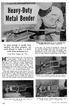 It's large enough to handle most welding job shop projects, yet small enough to make it a worth while home-workshop tool H Craft Print Project No. 272 ERE'S a metal bender that will enable you to bend
%Ï51,75,' 6=(56=È02. 'LDPRQG DQG &%1 WRROV
 82 TÖBB MINT VÁLASZTÉK DIAMOND CUT-OFF WHEELS Diamond cut-off wheels are excellently suitable for application of various stones and building materials. It is very important to choose the correct segmented
8.1 HPC for improved efficiency on standard machine tools by using new fluid-driven spindles
 8.1 HPC for improved efficiency on standard machine tools by using new fluid-driven spindles A. Schubert 1, O. Harpaz 2, B. Books 2, U. Eckert 1, R. Wertheim 1 1 Fraunhofer IWU, Reichenhainer Str. 88,
Metal Injection Molded Parts
 Metal Injection Molded Parts Metal Injection Molding (MIM) is a powder metallurgy process. he difference between MIM and conventional powder metallurgy is that in MIM, metal powder along with binders is
Module 3 Machinability. Version 2 ME, IIT Kharagpur
 Module 3 Machinability Lesson 1 Cutting Tool Materials of common use Instructional Objectives At the end of this lesson, the students will be able to (i) Identify the needs and cite the chronological development
SEMPEO2-54 - SQA Unit Code FP47 04 Carrying out heat treatment of engineering materials
 Overview This standard covers a broad range of basic competences that you need, to apply specified heat treatment processes to engineering materials/components. It will prepare you for entry into the engineering
Pilkington Reflite Handling and Processing Guidelines Solar Control
 Pilkington Reflite Handling and Processing Guidelines Solar Control Pilkington Reflite 1. Product description Pilkington Reflite is a hard, on-line coated, solar control glass, available in a range of
INSTRUCTION FOR ASSEMBLY. 150x180 v Traditional sauna cabin
 INSTRUCTION FOR ASSEMBLY 150x180 v Traditional sauna cabin 1. SAUNA PLAN 1800 LIGHT UNDER THE BENCH VENTILATION OUTLET UPPER BENCH 600 1500 LOWER BENCH 400 700 1656 956 HEATER 366 381 690 815 Light switch
Table of contents BRAZED TURNING TOOLS. Toolholders H 2. Tips H 6. Rods H 8. Technical information H 9 H 1
 Table of contents BRAZED TURNING TOOLS Toolholders 2 Tips 6 Rods 8 9 1 ISO External holders General turning External Ordering Tip According to ISO243-1975 (DIN 4982-198) h b l 1 f 1 f 2 a p r ε γ 1) λ
Sikaflex Sealant Installation. Sika Corporation
 Sikaflex Sealant Installation 1 Critical Success Factors Substrate preparation If done properly would probably eliminate 95% of all call backs Most common mode of sealant failure Must remove all weak material
1. (1) Random Orbital Sander 2. (1) Angle Polisher, (Rated at approx. 2500 RPM), with 4.75 inch diameter hook backup
 HEAVY DAMAGE REMOVAL KIT FINISHING PROCEDURES A. REQUIRED LEVEL OF SKILL: For use on non-pressurized aircraft: No specific training is required. For use on pressurized aircraft: Use should be restricted
Removing chips is a method for producing plastic threads of small diameters and high batches, which cause frequent failures of thread punches.
 Plastic Threads Technical University of Gabrovo Yordanka Atanasova Threads in plastic products can be produced in three ways: a) by direct moulding with thread punch or die; b) by placing a threaded metal
T A B L E T 1 T E S T S A N D I N S P E C T I O N C A B L E P C U T A N D P C U T - A
 T A B L E T 1 1 of 7 Tests & Inspection Cable PCUT & PCUT-A (Table T1) T E S T S A N D I N S P E C T I O N C A B L E P C U T A N D P C U T - A No. Test Scale MOC Requirements G 20:10:001:01 Defined Test
Tableting Punch Performance Can Be Improved With Precision Coatings
 Tableting Punch Performance Can Be Improved With Precision Coatings by Arnold H. Deutchman, Ph. D. Director of Research and Development (614) 873-4529 X 114 [email protected] Mr. Dale C. Natoli