
The Virtual Observatory: What is it and how can it help me? Enrique Solano LAEFF / INTA Spanish Virtual Observatory
|
|
|
- Pearl Stevens
- 10 years ago
- Views:
Transcription


1 The Virtual Observatory: What is it and how can it help me? Enrique Solano LAEFF / INTA Spanish Virtual Observatory

2 Astronomy in the XXI century The Internet revolution (the dot com boom ) has transformed the way we live

3 and work Astronomy in the XXI century The availability of huge amounts of on-line information has drastically transformed the astrophysical research.

4 Astronomy in the XXI century The advances in technology (telescope design and fabrication, large-scale detector arrays, ) are now permitting to explore the Universe in a multiparameter space. The advances in computational capabilities have provided the means to make, for the first time, direct comparisons between complex theoretical calculations and large, statistically significant observational databases. BUT

5 Astronomy in the XXI century (II) The progress in the scientific exploitation has not kept pace with the exponential growth of these vast new datasets. This new scenario is demanding changes in the classical methodology.

6 Astronomical research: the classical way I. Get the data New data Archive data II. Reduce and analyze the data locally.

7 VO: a complementary approach The classical method has demonstrated to be quite inefficient when dealing with problems that require either: Interoperability among data service and/or Management of large volumes of data.

8 Interoperability problems: Easy questions with non-easy answers Give me all objects in Vizier with V-Johnson. VizieR: Contains more than 4000 astronomical catalogues consisting of one or several tables. Problem: as the catalogues come from many different sources, the original descriptions are very heterogeneous: Give me all tables containing the V magnitude in the Johnson system: 144 different names for V Johnson.

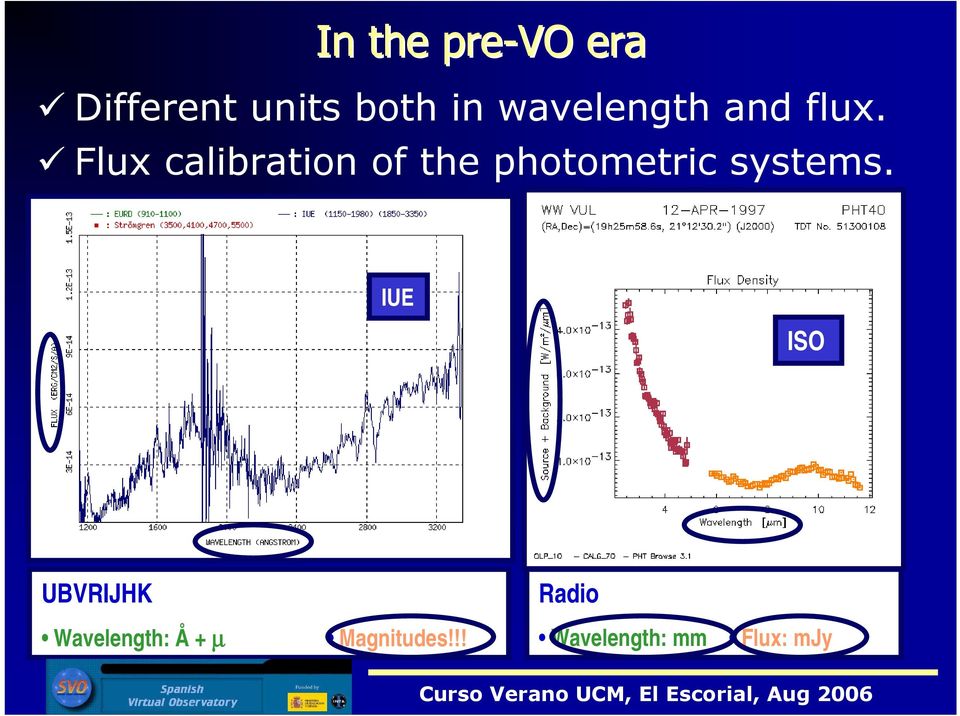
9 In the pre-vo era Different units both in wavelength and flux. Flux calibration of the photometric systems. IUE ISO UBVRIJHK Radio Wavelength: Å + µ Magnitudes!!! Wavelength: mm Flux: mjy
10 Using VO capabilities

11 The solutions provided by VO to solve the interoperability problem Agree and build standards. Standard semantic: UCDs Standard access protocols Standard output formats Standard data models Automated discovery tools (registries) Uptake of standards by the data services. Development of a federation of astronomical data centres ( data grid ).

12 VO: a complementary approach The classical method has demonstrated to be quite inefficient when dealing with problems that require either: Interoperability among data service and/or Management of large volumes of data.

13 large really means LARGE Archive data are dramatically increasing. ESO/ST-ECF ECF Science Archive Facility holdings (x100 increase in the next 7 years) LSST It will scan the visible sky every few nights. Few TB/night. A factor of 1000 larger than current surveys.

14 Is it necessary to work with all this amount of information? Criterio de filtrado: Detecciones solamente en z y J con z- J > 2.75 SDSS: 15M obj. 2MASS: 160M obj objetos en común.

15 How to solve the problem of the data avalanche? Move from download to service paradigm Leave the data where it is. Operations on data (search, cluster analysis, etc) as services. Ship the results not the data.

16 Requirements on data centres: computing Local resources: Supercomputers, PC farms Distributed computing: the GRID

17 Requirements on data centres: analysis tools Allow remote functionality as if they were local. Data mining: Key issue for VO and where the greatest scientific benefits are expected to come from.

18 How is the VO structured?

19 The Spanish Virtual Observatory More than 60 people from 17 centres.

20 Conclusions VO is not science-fiction. It s a reality. VO is an essential tool for multi-λ astronomy. VO is not only for people interested in handling large volumes of data. (e.g. give me all spectra of A-type stars in a given range and with resolution > R). VO has crossed the non-return point: The biggest data providers (NASA, ESA, ESO, ) have understood the importance of this initiative and are already adapting their contents to VO requirements. The successfulness of VO from the scientific point of view strongly depends on the interaction with the scientific community.

21 From Demo to Real Science Extragalactic case: Discovery of 30 type 2 QSOs. First refereed astronomical paper enabled via end-to-end use of VO tools and systems: UCM, El Escorial, Aug 2006
22 VO misconceptions
23 VO misconceptions
24 Discovering type 2 quasars Seyfert 2 s high-power counterparts. Characterized by narrow lines and hard X-ray emission ( Lx > 1e44 erg/s). Data: X-ray catalogue for the two GOODS fields (Alexander et al. 2003) Filtering: HR -0.2 for absorbed sources 294 found HR=(H+S) / (H-S); H = ( kev), S = ( kev) Cross-matching with the GOODS ACS catalogues to get the optical counterparts 168 matches. Data manipulation: X-ray power for unidentified sources derived from: Log L (2-10) = log f(2 10 kev) / f(r) (Fiore 2003). Results: 31 new QSOs 2 (only 9 sources previously known). UCM, El Escorial, Aug 2006
25 Scientific Demos: AGB stars to PNe Short transition times Few objects in this phase. GOAL: Stellar case for the AVO Demo 2005 (García Lario, Bayo, Sierra) Identification of new candidates in the transition source. Many are heavily obscured in the optical by thick CS envelopes consequence Late evolutionary of strong stages mass loss of low- Need and for intermediate systematic surveys mass stars. using IR data: MSX and IRAS catalogues.

26 AGB stars to PNe (II): Workflow Selection criteria: b 2 deg. Column manipulation Cross-matching with SIMBAD. Cross-matching with IRAS
27 AGB stars to PNe VO gain: Efficiency UCM, El Escorial, Aug 2006
and the VO-Science Francisco Jiménez Esteban Suffolk University
 The Spanish-VO and the VO-Science Francisco Jiménez Esteban CAB / SVO (INTA-CSIC) Suffolk University The Spanish-VO (SVO) IVOA was created in June 2002 with the mission to facilitate the international
Data Mining Challenges and Opportunities in Astronomy
 Data Mining Challenges and Opportunities in Astronomy S. G. Djorgovski (Caltech) With special thanks to R. Brunner, A. Szalay, A. Mahabal, et al. The Punchline: Astronomy has become an immensely datarich
How To Understand And Understand The Science Of Astronomy
 Introduction to the VO [email protected] ESAVO ESA/ESAC Madrid, Spain The way Astronomy works Telescopes (ground- and space-based, covering the full electromagnetic spectrum) Observatories Instruments
Organization of VizieR's Catalogs Archival
 Organization of VizieR's Catalogs Archival Organization of VizieR's Catalogs Archival Table of Contents Foreword...2 Environment applied to VizieR archives...3 The archive... 3 The producer...3 The user...3
The Astronomical Data Warehouse
 The Astronomical Data Warehouse Clive G. Page Department of Physics & Astronomy, University of Leicester, Leicester, LE1 7RH, UK Abstract. The idea of the astronomical data warehouse has arisen as the
ASKAP Science Data Archive: Users and Requirements CSIRO ASTRONOMY AND SPACE SCIENCE (CASS)
 ASKAP Science Data Archive: Users and Requirements CSIRO ASTRONOMY AND SPACE SCIENCE (CASS) Jessica Chapman, Data Workshop March 2013 ASKAP Science Data Archive Talk outline Data flow in brief Some radio
Lecture 5b: Data Mining. Peter Wheatley
 Lecture 5b: Data Mining Peter Wheatley Data archives Most astronomical data now available via archives Raw data and high-level products usually available Data reduction software often specific to individual
Astrophysics with Terabyte Datasets. Alex Szalay, JHU and Jim Gray, Microsoft Research
 Astrophysics with Terabyte Datasets Alex Szalay, JHU and Jim Gray, Microsoft Research Living in an Exponential World Astronomers have a few hundred TB now 1 pixel (byte) / sq arc second ~ 4TB Multi-spectral,
Canadian Astronomy Data Centre. Séverin Gaudet David Schade Canadian Astronomy Data Centre
 Canadian Astronomy Data Centre Séverin Gaudet David Schade Canadian Astronomy Data Centre Data Activities in Astronomy Features of the astronomy data landscape Multi-wavelength datasets are increasingly
MAST: The Mikulski Archive for Space Telescopes
 MAST: The Mikulski Archive for Space Telescopes Richard L. White Space Telescope Science Institute 2015 April 1, NRC Space Science Week/CBPSS A model for open access The NASA astrophysics data archives
Learning from Big Data in
 Learning from Big Data in Astronomy an overview Kirk Borne George Mason University School of Physics, Astronomy, & Computational Sciences http://spacs.gmu.edu/ From traditional astronomy 2 to Big Data
Undergraduate Studies Department of Astronomy
 WIYN 3.5-meter Telescope at Kitt Peak near Tucson, AZ Undergraduate Studies Department of Astronomy January 2014 Astronomy at Indiana University General Information The Astronomy Department at Indiana
LSST and the Cloud: Astro Collaboration in 2016 Tim Axelrod LSST Data Management Scientist
 LSST and the Cloud: Astro Collaboration in 2016 Tim Axelrod LSST Data Management Scientist DERCAP Sydney, Australia, 2009 Overview of Presentation LSST - a large-scale Southern hemisphere optical survey
Migrating a (Large) Science Database to the Cloud
 The Sloan Digital Sky Survey Migrating a (Large) Science Database to the Cloud Ani Thakar Alex Szalay Center for Astrophysical Sciences and Institute for Data Intensive Engineering and Science (IDIES)
Exploring the roles and responsibilities of data centres and institutions in curating research data a preliminary briefing.
 Exploring the roles and responsibilities of data centres and institutions in curating research data a preliminary briefing. Dr Liz Lyon, UKOLN, University of Bath Introduction and Objectives UKOLN is undertaking
The astronomical Virtual Observatory : lessons learnt, looking forward. Françoise Genova - Forum VO-PDC d après ADASS XXI, Paris, nov.
 The astronomical Virtual Observatory : lessons learnt, looking forward Examples taken from the European view, but other projects have followed similar paths The VO aim Enable seamless access to the wealth
CU9 Science Enabling Applications Development Work Package Software Requirements Specification (WP970)
 Science Enabling Applications Development Work Package Software Requirements Specification (WP970) prepared by: approved by: reference: issue: revision: 1 X. Luri, P.M. Marrese, F.Julbe, H. Enke, N. Walton,
Einstein Rings: Nature s Gravitational Lenses
 National Aeronautics and Space Administration Einstein Rings: Nature s Gravitational Lenses Leonidas Moustakas and Adam Bolton Taken from: Hubble 2006 Science Year in Review The full contents of this book
Top 10 Discoveries by ESO Telescopes
 Top 10 Discoveries by ESO Telescopes European Southern Observatory reaching new heights in astronomy Exploring the Universe from the Atacama Desert, in Chile since 1964 ESO is the most productive astronomical
Data-Intensive Science and Scientific Data Infrastructure
 Data-Intensive Science and Scientific Data Infrastructure Russ Rew, UCAR Unidata ICTP Advanced School on High Performance and Grid Computing 13 April 2011 Overview Data-intensive science Publishing scientific
Constructing the Subaru Advanced Data and Analysis Service on VO
 Constructing the Subaru Advanced Data and Analysis Service on VO Yuji Shirasaki on behalf of ADC National Astronomical Observatory of Japan Astronomy Data Center Contents Subaru Telescope and Instruments
Conquering the Astronomical Data Flood through Machine
 Conquering the Astronomical Data Flood through Machine Learning and Citizen Science Kirk Borne George Mason University School of Physics, Astronomy, & Computational Sciences http://spacs.gmu.edu/ The Problem:
Reduced data products in the ESO Phase 3 archive (Status: 15 May 2015)
 Reduced data products in the ESO Phase 3 archive (Status: 15 May 2015) The ESO Phase 3 archive provides access to reduced and calibrated data products. All those data are stored in standard formats. The
QUALITY CONTROL OF THE IUE FINAL ARCHIVE
 QUALITY CONTROL OF THE IUE FINAL ARCHIVE N. Loiseau 1, E. Solano 1,M.Barylak 2 1 INSA/ESA IUE Observatory, Apdo. 50727, Villafranca del Castillo, 28080 Madrid (Spain). 2 ESA IUE Observatory, Apdo. 50727,
RESULTS FROM A SIMPLE INFRARED CLOUD DETECTOR
 RESULTS FROM A SIMPLE INFRARED CLOUD DETECTOR A. Maghrabi 1 and R. Clay 2 1 Institute of Astronomical and Geophysical Research, King Abdulaziz City For Science and Technology, P.O. Box 6086 Riyadh 11442,
Multidimensional Data in the Virtual Observatory
 IX Reunión Científica de la SEA Madrid- 15/09/2010 Red Temática SVO Multidimensional Data in the Virtual Observatory José Enrique Ruiz Grupo AMIGA Instituto de Astrofísica de Andalucía CSIC Contextual
Data analysis of L2-L3 products
 Data analysis of L2-L3 products Emmanuel Gangler UBP Clermont-Ferrand (France) Emmanuel Gangler BIDS 14 1/13 Data management is a pillar of the project : L3 Telescope Caméra Data Management Outreach L1
Chapter 6 Telescopes: Portals of Discovery. How does your eye form an image? Refraction. Example: Refraction at Sunset.
 Chapter 6 Telescopes: Portals of Discovery 6.1 Eyes and Cameras: Everyday Light Sensors Our goals for learning:! How does your eye form an image?! How do we record images? How does your eye form an image?
J-PAS: low-resolution (R 50) spectroscopy over 8000 deg 2
 J-PAS: low-resolution (R 50) spectroscopy over 8000 deg 2 C. López-Sanjuan J. Cenarro, L. A. Díaz-García, J. Varela, K. Viironen, & the J-PAS team Centro de Estudio de Física del Cosmos de Aragón 10th
Galaxy Morphological Classification
 Galaxy Morphological Classification Jordan Duprey and James Kolano Abstract To solve the issue of galaxy morphological classification according to a classification scheme modelled off of the Hubble Sequence,
August, 2000 LIGO-G000313-00-D. http://www.ligo.caltech.edu/~smarka/sn/
 LIGO-G000313-00-D Proposal to the LSC for Entry of LIGO into the Supernova Nova Early Warning System (SNEWS) and Prototype Development of Real-Time LIGO Supernova Alert 1 Barry Barish, Kenneth Ganezer(CSUDH),
Rest optical spectroscopy of FeLoBALs and LoBALs at intermediate redshift
 Rest optical spectroscopy of FeLoBALs and LoBALs at intermediate redshift Kentaro Aoki Subaru Telescope, National Astronomical Observatory of Japan E-mail: [email protected] NLS1s and low-ionization
Solar System Observations contains two components: Planetary Astronomy and Near Earth Object Observations.
 C.6 SOLAR SYSTEM OBSERVATIONS 1. Scope of Program Solar System Observations supports both ground-based astronomical observations and suborbital investigations of our Solar System involving sounding rockets
on the establishment of a Brazilian Science Data Center (BSDC) General Guidelines
 on the establishment of a Brazilian Science Data Center (BSDC) General Guidelines 1 Introduction Since the entrance of Brazil in ICRANet a variety of projects have been started to be developed a) in the
Visualizing and Analyzing Massive Astronomical Datasets with Partiview
 Visualizing and Analyzing Massive Astronomical Datasets with Partiview Brian P. Abbott 1, Carter B. Emmart 1, Stuart Levy 2, and Charles T. Liu 1 1 American Museum of Natural History & Hayden Planetarium,
Are We Alone?! Exoplanet Characterization and Direct Imaging!
 From Cosmic Birth to Living Earths A Vision for Space Astronomy in the 2020s and Beyond Are We Alone?! Exoplanet Characterization and Direct Imaging! A Study Commissioned by the Associated Universities
Summary of Data Management Principles Dark Energy Survey V2.1, 7/16/15
 Summary of Data Management Principles Dark Energy Survey V2.1, 7/16/15 This Summary of Data Management Principles (DMP) has been prepared at the request of the DOE Office of High Energy Physics, in support
FRACTAL S.L.N.E. A private company for engineering of scientific projects. Instrumentation and Software for Astronomy
 FRACTAL S.L.N.E A private company for engineering of scientific projects Instrumentation and Software for Astronomy 1 Introducing FRACTAL FRACTAL S.L.N.E. is a private technological company funded in 2005.
Description of the Dark Energy Survey for Astronomers
 Description of the Dark Energy Survey for Astronomers May 1, 2012 Abstract The Dark Energy Survey (DES) will use 525 nights on the CTIO Blanco 4-meter telescope with the new Dark Energy Camera built by
VisIVO, an open source, interoperable visualization tool for the Virtual Observatory
 Claudio Gheller (CINECA) 1, Ugo Becciani (OACt) 2, Marco Comparato (OACt) 3 Alessandro Costa (OACt) 4 VisIVO, an open source, interoperable visualization tool for the Virtual Observatory 1: [email protected]
This work was done in collaboration with the Centre de Données astronomiques de Strasbourg (CDS) and in particular with F. X. Pineau.
 Chapter 5 Database and website This work was done in collaboration with the Centre de Données astronomiques de Strasbourg (CDS) and in particular with F. X. Pineau. 5.1 Introduction The X-shooter Spectral
How To Teach Data Science
 The Past, Present, and Future of Data Science Education Kirk Borne @KirkDBorne http://kirkborne.net George Mason University School of Physics, Astronomy, & Computational Sciences Outline Research and Application
Using Proxies to Accelerate Cloud Applications
 Using Proxies to Accelerate Cloud Applications Jon Weissman and Siddharth Ramakrishnan Department of Computer Science and Engineering University of Minnesota, Twin Cities Abstract A rich cloud ecosystem
UNIVERSITY OF HAWAI I AT MĀNOA ASTRONOMY & ASTROPHYSICS. The University of Hawai i is an equal opportunity/affirmative action institution.
 UNIVERSITY OF HAWAI I AT MĀNOA ASTRONOMY & The University of Hawai i is an equal opportunity/affirmative action institution. A M E SSAG E F R O M THE PROGRAM U N D E R G R A D U AT E P R O G R A M S I
Data Driven Discovery In the Social, Behavioral, and Economic Sciences
 Data Driven Discovery In the Social, Behavioral, and Economic Sciences Simon Appleford, Marshall Scott Poole, Kevin Franklin, Peter Bajcsy, Alan B. Craig, Institute for Computing in the Humanities, Arts,
EA-ARC ALMA ARCHIVE DATA USER GUIDEBOOK
 EA-ARC ALMA ARCHIVE DATA USER GUIDEBOOK Prepared by James O. Chibueze NAOJ Chile Observatory Purpose of this handbook: This handbook is aimed at providing fundamental information on how and where to access
Spectrophotometry of Ap Stars
 Spectrophotometry of Ap Stars ASTRA Status Report Barry Smalley Astrophysics Group Keele University Staffordshire United Kingdom [email protected] What is Spectrophotometry? Spectroscopy through a wide
The Minor Planet Center Status Report
 The Minor Planet Center Status Report Matthew J Holman Interim Director, Minor Planet Center Smithsonian Astrophysical Observatory Harvard-Smithsonian Center for Astrophysics 8 November 2015 MPC Organization
Data transport in radio astronomy. Arpad Szomoru, JIVE
 Data transport in radio astronomy Arpad Szomoru, JIVE Some acronyms EVN: European VLBI Network Consortium of radio telescopes Involving 14 different organizations around the world: Europe, China, Puerto
The Tonnabytes Big Data Challenge: Transforming Science and Education. Kirk Borne George Mason University
 The Tonnabytes Big Data Challenge: Transforming Science and Education Kirk Borne George Mason University Ever since we first began to explore our world humans have asked questions and have collected evidence
An Introduction to the MTG-IRS Mission
 An Introduction to the MTG-IRS Mission Stefano Gigli, EUMETSAT IRS-NWC Workshop, Eumetsat HQ, 25-0713 Summary 1. Products and Performance 2. Design Overview 3. L1 Data Organisation 2 Part 1 1. Products
College of Science George Mason University Fairfax, VA 22030
 College of Science George Mason University Fairfax, VA 22030 Dr. Sidney Wolff and the LSST Board of Directors LSST Corporation 933 N. Cherry Avenue Tucson, AZ 85721-0009 June 14, 2010 Dear Dr. Wolff and
AST 4723 Lab 3: Data Archives and Image Viewers
 AST 4723 Lab 3: Data Archives and Image Viewers Objective: The purpose of the lab this week is for you to learn how to acquire images from online archives, display images using a standard image viewer
Software Development for Virtual Observatories
 Software Development for Virtual Observatories BRAVO Workshop February 2007 Rafael Santos 1 Warning! This presentation is biased. I'll talk about VO software development, including some under the hood
A short history of telescopes and astronomy: Galileo to the TMT
 A short history of telescopes and astronomy: Galileo to the TMT Telescopes in the last 400 years Galileo 1608 Hans Lippershey applied for a patent for seeing things far away as if they were nearby 1609
Efficient data reduction and analysis of DECam images using multicore architecture Poor man s approach to Big data
 Efficient data reduction and analysis of DECam images using multicore architecture Poor man s approach to Big data Instituto de Astrofísica Pontificia Universidad Católica de Chile Thomas Puzia, Maren
arxiv:0903.4116v1 [astro-ph.im] 24 Mar 2009
![arxiv:0903.4116v1 [astro-ph.im] 24 Mar 2009](/thumbs/40/21774508.jpg "arxiv:0903.4116v1 [astro-ph.im] 24 Mar 2009") Astron. Nachr./AN xxx (xxxx) x, xxx xxx CTK - A new CCD Camera at the University Observatory Jena arxiv:0903.4116v1 [astro-ph.im] 24 Mar 2009 1. Introduction MARKUS MUGRAUER Astrophysikalisches Institut
Astron. Nachr./AN xxx (xxxx) x, xxx xxx CTK - A new CCD Camera at the University Observatory Jena arxiv:0903.4116v1 [astro-ph.im] 24 Mar 2009 1. Introduction MARKUS MUGRAUER Astrophysikalisches Institut
Astrophysical Techniques. C R Kitchin
 Astrophysical Techniques C R Kitchin University of Hertfordshire Observatory Third Edition SUB Gottingen 7 210 119 268 99 A 8843 Institute of Physics Publishing Bristol and Philadelphia Contents Preface
Breakthrough Listen Follow-up of a Transient Signal from the RATAN-600 Telescope in the Direction of HD 164595
 Breakthrough Listen Follow-up of a Transient Signal from the RATAN-600 Telescope in the Direction of HD 16595 Steve Croft, Andrew Siemion, David MacMahon, Matt Lebofsky, Howard Isaacson, Jack Hickish,