
A year of continued progress supported by increased investment
|
|
|
- Erin Green
- 9 years ago
- Views:
Transcription
1 Performance highlights Financial highlights This year saw strong growth in most of our emerging markets offset by a continued decline in Europe, though many European markets are showing signs of stabilisation. Our significant investment programme, Project Spring, has led to a sharp rise in our capital expenditure and we have increased our dividend per share. Our results this year include a full year of Vodafone Italy (consolidated from February 2014), our acquisitions of Ono, Hellas Online and Cobra Automotive and a full year of Kabel Deutschland. Organic movements in this report exclude the impact of recent acquisitions and disposals, movements in foreign exchange rates and certain other items. See page 212 for more information. More on financial performance: Page 38 A year of continued progress supported by increased investment Revenue Revenue increased by 10.1% over the year, mostly due to the inclusion of Vodafone Italy for a full year and the acquisition of Ono. On an organic basis, revenue declined by 0.8%* as strong growth in our emerging markets was more than offset by a decline in Europe. 11.9bn EBITDA EBITDA increased by 0.8 billion mainly through the inclusion of Vodafone Italy and the acquisition of Ono. On an organic basis EBITDA declined by 6.9%*, reflecting ongoing revenue declines in Europe and the growth in operating expenses as a result of Project Spring, partially offset by operating efficiencies. 9.2bn Capital expenditure Capital expenditure increased significantly during the year as we progressed with our Project Spring investment programme and from the inclusion of Italy and Ono. 2.0bn Operating profit Our operating profit, which is our profit for the year before interest and tax, was 2.0 billion. This compares with an operating loss of 3.9 billion last year, which included an impairment loss of 6.6 billion p Dividends per share We have announced a final dividend per share of 7.62 pence, giving total dividends per share of pence a 2.0% increase year-on-year. Overview Strategy review Performance Governance Financials Additional information Strategic highlights We have made significant progress this year, expanding our 4G coverage and customer base in Europe, increasing take-up of 3G in emerging markets and further developing our fixed business. More on our strategy: Page G customers We now have over 20 million 4G customers across 18 markets, helping data traffic grow by 80% across the Group. 446m Mobile customers We have grown our mobile customer base by 15 million over the year, with significant growth in our emerging markets. 19m 3G customers in India We have grown our 3G customer base from 7 million to 19 million in India, supported by the expansion of our 3G coverage. 12m Fixed broadband customers We have grown our fixed broadband base by 2.8 million over the year, through organic growth and the acquisitions of Ono and Hellas Online. 72% European 4G population coverage We now have 72% 4G coverage compared with 46% a year ago and will reach over 90% by next year. 01

2 Chairman s statement A year of significant investment We have achieved a lot in the last year. We have made strong progress on our strategy, while making a significant contribution to the economies in which we operate and providing substantial returns to our shareholders. 30 years of mobile, but the future is unified communications This year we celebrated 30 years since the first mobile phone call was made in the UK. Today, Vodafone is an industry leader with 446 million customers, mobile operations in 26 countries and fixed broadband operations in 17 countries. Vodafone is bringing the benefits of the mobile and digital revolution to consumers and businesses across the world, from offering 4G services in 18 countries to providing services such as machine-to-machine ( M2M ) technology and M-Pesa, the mobile payment service that provides financial freedom to millions of people. Today, I see two areas in which Vodafone can truly claim to be a leader: in our emerging markets operations, and in our services to the enterprise segment. In markets such as India and South Africa, and increasingly in Egypt and Turkey, we are building clear differentiation in network quality, the power of our brand, and the depth and breadth of our distribution. In enterprise, our international footprint and our investment in growth areas such as M2M and Cloud and Hosting services are making us a preferred partner to many major multinational businesses. However, in our core European mobile business, we have been under pressure for several years. Competition, regulation and the macroeconomic environment have all played a part, but in addition we have lacked clear differentiation in mobile, while also losing ground in some markets with the rapid adoption of unified communications. And this is where the future lies in the provision of high quality voice, data, business and entertainment services across multiple technologies and screens, in the home, in the office and on the move. 02

3 Over the last two years, our move into unified communications has taken significant steps forward, both through acquisition and organic investment. 25% of European service revenue now comes from fixed line services, and we have 12 million fixed broadband customers across the Group. On 4G we have more than doubled our footprint in Europe in the last 18 months, to 72% population coverage. In India, we now provide 3G services in over 90% of our target urban areas. Data traffic across the Group grew 80% during the year. These investments benefit businesses as much as consumers. Building on the Cable & Wireless Worldwide acquisition, which brought us global fibre infrastructure and points of presence in 62 countries, we are taking new services into new geographical areas to deepen customer relationships and grow revenue. Aligning management pay to value creation and customer perception Our remuneration policies continue to focus on rewarding long term value creation. The annual bonus this year was slightly higher than last year, reflecting improved performance against targets; but the failure to meet the three year threshold on free cash flow resulted in a zero pay-out on the longterm incentive plan. We have also made a number of changes to management incentives in recent years to limit total pay, such as the reduction of the maximum achievable pay-out on the longterm scheme and the payments made in lieu of pension contributions. This year we have made a significant change to the criteria for the annual bonus ( GSTIP ) scheme. The substantial investments in networks need to be supported by a clear step up in the customer experience and satisfaction, and the Board wants this to be reflected in short term incentives. 40% of the total GSTIP assessment will now be based on Customer Appreciation measures. The Board continues to consider the ordinary dividend to be the core element of shareholder returns, and believes in a consistent dividend policy. This year we raised the dividend per share by 2.0%, and we intend to raise it annually hereafter. A major economic contributor We have always invested at a high level to ensure we are a leader in the quality of service we deliver to customers. With Project Spring we are reinforcing that position, not only in Europe but across many emerging markets too. However, macroeconomic decline in Europe, combined with the consequences of past regulatory policies, has brought about a sharp reduction in return on capital over recent years. This has been exacerbated by market structures which remain fragmented both between and within member states. This year, we published a report highlighting our overall economic impact across the 12 EU countries in which we operate. In 2013/14 Vodafone contributed 23.7 billion to the EU economy (measured in GVA or Gross Value Added). In addition, Vodafone: provided employment for 170,000 people across its direct workforce and European supplier base, as of 31 March 2014; paid 2.4 billion to EU governments in direct taxation, spectrum costs and other fees, and an additional 4.4 billion in indirect tax payments in 2013/14; and since 2000, has paid EU governments a total of 20.8 billion for access to spectrum to roll out 3G and 4G networks across Europe. The new European Commission has identified as a priority the need to reboot Europe s digital strategy. We encourage the Commission to prioritise measures intended to ensure fair and sustainable competition based on a level playing field for all companies. It will also be important for the Commission to pursue harmonisation of rules on spectrum, data protection, copyright and other areas, as well as to adopt a principles-based approach to the open internet to support future innovation and investment. Our economic impact in emerging markets is no less strongly felt, yet there too we face continued pressures from regulatory and fiscal intervention. In South Africa, for example, the significant mobile termination rate ( MTR ) cuts of the last year had a material financial impact on our business. While India represents an excellent long term investment opportunity, the present regulatory challenges are hampering economic development. Spectrum auction structures combined with the piecemeal release of new spectrum, leaves less capital available for investment in bringing high quality services to more of the country, and this is exacerbated by other ongoing regulatory challenges. Changes to the Board In January, Stephen Pusey informed the Board of his intention to step down as Group CTO. His many achievements over eight years include the international expansion of Vodafone s 3G services, the launch of 4G in 18 countries and the development of global IT, procurement and cyber security functions. More recently, he has led the Project Spring investment programme, and has also played a leading role in developing the Group s convergence strategy. Stephen s successor, Johan Wibergh, was previously Executive Vice President and Head of the Networks segment at Ericsson. During the year there were a number of changes to the non-executive team and these are set out in my Governance statement on page 50. Gerard Kleisterlee Chairman Overview Strategy review Performance Governance Financials Additional information 03

4 About us We have come a long way 30 years ago, the first mobile phone call on our UK network was made. Since then we ve grown from a UK mobile company to a multinational telecommunications leader. How have we become one of the world s largest telecommunications companies, creating one of the world s most powerful brands in the process? By a relentless focus on providing high-quality services that allow our customers to get the most out of an increasingly connected world. The first mobile call The UK s first-ever mobile phone call was made 30 years ago on the newly-launched Vodafone network. Michael Harrison, the son of former Vodafone Chairman Sir Ernest Harrison, was the first to test the system, calling his father at midnight on 1 January,

5 Consumer Europe Drivers of change Increasing smartphone penetration High speed 3G and 4G technology How we are changing In recent years we have successfully evolved our business to address new growth opportunities. We now do much more than mobile. We are unifying communications. How we are changing Over the last few years we have seen a rapid transition in the telecoms industry, towards new areas of growth data, emerging markets, unified communications and total communications services for enterprise customers. As a result we now do much more than provide mobile to 446 million customers. With 12 million fixed broadband users, 9 million TV customers, 22 million M2M connections, and 20 million M-Pesa mobile money users we are unifying communications. Actions Vodafone Red plans with generous data allowances Provide content Invest in 4G networks Impact: percentage of customers in Europe using mobile data 35% % 2015 Unified Communications Drivers of change Competitors offering fixed and mobile bundles Fixed and mobile technology convergence Actions Grow fixed access via acquisition, investment or wholesale arrangements Launch bundles with fixed and mobile services Impact: percentage of service revenue from fixed line 8% % 2015 Overview Strategy review Performance Governance Financials Additional information Consumer Emerging Markets Drivers of change Rapid population and economic growth Growing demand for data and lack of fixed infrastructure Higher demand for mobile money services Actions Increase 3G/4G network capability Improve distribution Expand M-Pesa Enterprise Drivers of change Mobility becoming strategic Companies wanting a single source for all communication services Actions Invest in total communications solutions including Vodafone One Net, Cloud and Hosting, and M2M Impact: percentage of customers from emerging markets 66% 72% Impact: percentage of service revenue from enterprise 25% 27%

6 Project Spring Driving network and service differentiation Project Spring is our two-year, 19 billion investment programme designed to place Vodafone at the forefront of growth in mobile data and the increasing trend towards the convergence of fixed and mobile services. We are now just over one year through the programme and are making great progress. Progress so far In Europe, we have increased 4G coverage to 72% and aim to get this to over 90% by next year. We have further modernised our network to improve voice and data quality, with 83% of our radio sites connected with high capacity backhaul and 81% with Single Radio Access Network ( RAN ) technology. All this means a significantly improved experience for our customers, including more reliable connections, faster data speeds, greater coverage and fewer dropped calls. We now reach 28 million homes with our owned cable and fibre infrastructure as a result of acquisitions and fibre builds in Italy, Spain and Portugal. In our Africa, Middle East and Asia Pacific ( AMAP ) region, we have increased 3G and 4G coverage (excluding India) to 82% and aim to grow this further next year. In India we now cover 90% of the population in targeted urban areas with 3G and aim to increase this to 95% by next year. Total capital expenditure billion Total build since September March 2014 March 2015 March 2016 target New 2G sites 7,000 33,000 47,000 New 3G sites 13,000 42,000 73,000 New 4G sites 7,000 35,000 77,000 New single RAN installations 20,000 73, ,000 New high capacity backhaul sites 17,000 63,000 87,000 European 4G population coverage 20% % % 2015 European households passed with owned cable/fibre Data not available Over 90% 2016 target million More on Project Spring: Pages 22 to 27 88% of data sessions in Europe are now delivered at the speeds required to enjoy a high definition video experience 06 Note: 1 Next-generation network ( NGN ) technology, which includes fibre-tothe-home, cable and very-high-bit-rate digital subscriber lines from the cabinet or central office. 2 Data shown to the nearest thousand.
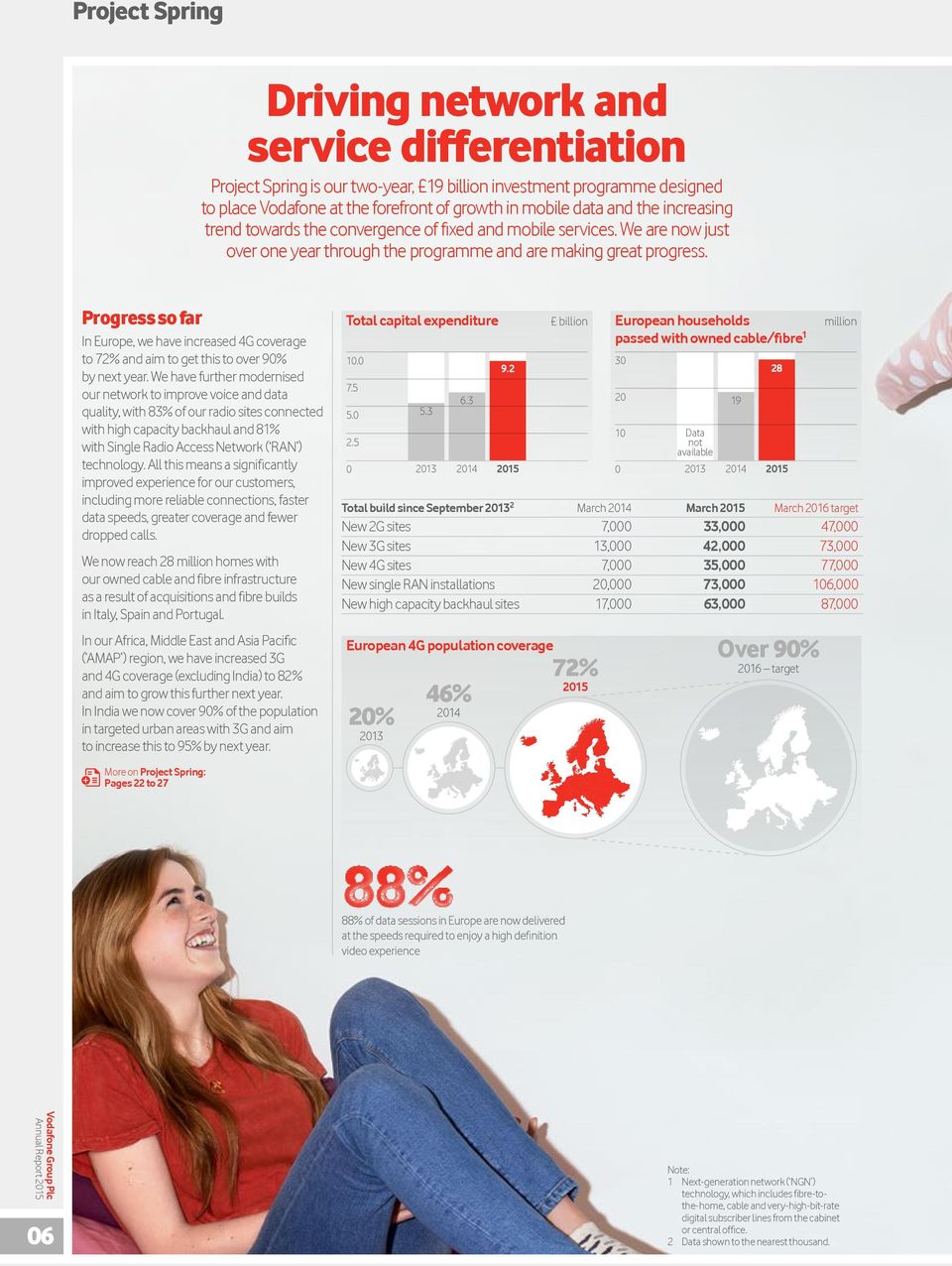
7 Consumer Europe 4G population coverage, increased from 32% in September 2013 and is expected to increase to over 90% by March 2016 Dropped call rate, improved from 0.9% in September 2013 More on Consumer Europe: Page 22 Consumer Emerging Markets Unified Communications Homes reached in Europe with high-speed internet from our owned infrastructure We have over five million next-generation network ( NGN ) broadband customers More on Unified Communications: Page 24 Enterprise Overview Strategy review Performance Governance Financials Additional information 3G coverage in India (targeted urban areas), expected to increase to 95% by March 2016 Countries where we offer IP-VPN services 3G/4G coverage across AMAP (excluding India), increasing to 84% by March 2016 Countries where we offer M2M services More on Consumer Emerging Markets: Page 22 More on Enterprise: Page 27 07

8 Our business model What we offer We provide a wide range of services including voice, messaging and data across mobile and fixed networks. The services we provide Group service revenue Fixed 20% Other 2 4% 38.5bn Mobile 76% Notes: 1 Excludes 3.7 billion of other revenue that mainly relates to the sale of equipment. 2 Other service revenue includes revenue from mobile virtual network operators ( MVNOs ) and from our partner markets. Mobile Mobile services We provide a range of mobile services to our customers, enabling them to call, text, access the internet, stream music and watch videos wherever they are at home, on the move or even abroad with our roaming services. 40% of our customers now use mobile data Our mobile assets We provide these services through our network of over 283,000 base station sites providing near nationwide voice coverage and extensive data coverage across Europe and extensive coverage across our AMAP region. Mobile customers (million) and active data users (%) % % Mobile customers Active data users 40% Mobile network population coverage 72% 94% 100% 82% 97% We have over 283,000 base station sites across our markets Over 1.2 trillion minutes of voice calls carried over our network last year Over 290 billion text messages sent and received by our network last year 982 petabytes of data were sent across our mobile network alone last year, nearly double the amount handled in the previous year Note: 3 Excludes India. Fixed Fixed services We provide a range of fixed services in most of our major markets including voice, broadband and TV services to consumers and a wider range of services to our enterprise customers, including Cloud and Hosting and IP-VPN. We are also one of the world s largest carrier services business, providing voice and data services to other operators using our network of cable and fibre assets across the world. Europe 4G Europe 3G Europe 2G AMAP 3G/4G 3 Our fixed line assets We provide these services through a combination of owned and leased copper, cable and fibre assets. Our focus is on next-generation networks (fibre or cable) and we cover 28 million homes with our own infrastructure and 50 million homes including wholesale arrangements. We have over nine million TV customers across six markets AMAP 2G 3 Fixed broadband customers million High-speed broadband coverage 08 More on Strategy: Page million households passed with cable or fibre across Europe (owned or leased)

9 Our reach and scale Group revenue 2015 UK Europe We are the number one or two mobile operator in most of our countries with market shares ranging from around 20% to over 40%. We are typically smaller in fixed line, with market shares ranging from low single-digit up to 20%. Albania Czech Republic # Germany # Greece # Hungary Ireland # Italy # Where we operate Our business is split across two geographic regions Europe, and Africa, Middle East and Asia Pacific ( AMAP ), which includes our emerging markets. Malta # Netherlands # Portugal # Romania # Spain # UK # AMAP We are the number one or two mobile operator in most of our countries with market shares ranging from around 20% to over 50%. We have a small but growing share in fixed line. Australia (joint venture) Egypt # Ghana # India Kenya (associate) Europe 66% AMAP 32% Germany Europe Italy Spain Vodacom AMAP 42.2bn India Other Europe Other AMAP Other (includes partner markets and common functions) 1 2% Note: 1 Common functions includes revenue from services provided centrally or offered outside our operating company footprint, including some markets where we have a licensed network operation, for example offering IP-VPN services in Singapore. New Zealand # Qatar # Turkey # Vodacom Group #2 Notes: # Fixed broadband markets. 2 Democratic Republic of Congo ( DRC ), Lesotho, Mozambique, South Africa and Tanzania. Our markets Partner markets Joint ventures and associates Our markets We provide mobile services in these 24 countries and fixed services in 17 of these. Together they account for 98% of our revenue. Our main markets Germany 8.5bn revenue 30.9m mobile customers Italy 4.6bn revenue 25.2m mobile customers Vodacom Group 4.3bn revenue 68.5m mobile customers Joint ventures and associates We also provide mobile services in Australia and Kenya, taking our total markets to 26. We also part-own the tower company Indus Towers in India. 33% mobile market share 3 20% fixed market share 3 32% mobile market share 3 6% fixed market share 3 53% mobile market share 3 (South Africa) Notes: 3 Vodafone estimates for the quarter ended 31 March Source: Telecom Regulatory Authority of India, December UK 6.4bn revenue 18.4m mobile customers Spain 3.7bn revenue 14.2m mobile customers India 4.3bn revenue 183.8m mobile customers Partner markets These are the 55 markets where we hold no equity interest but have partnership agreements with local mobile operators for them to use our products and services and in some cases our brand. 24% mobile market share 3 4% fixed market share 3 30% mobile market share 3 11% fixed market share 3 23% mobile market share 4 Overview Strategy review Performance Governance Financials Additional information 09

10 Our business model (continued) How we make money We invest in superior telecommunications networks so that we can sustain high levels of cash generation, reward shareholders and reinvest in the business thus creating a virtuous circle of investment, revenue, strong cash conversion and reinvestment. Spectrum, network and IT infrastructure We use our spectrum licences to provide the radio frequencies needed to deliver communications services. We combine our base station sites and our expertise in network management to transmit signals for mobile services. Through our fixed broadband assets (cable, fibre and copper) and wholesale agreements with other operators, we provide broadband, voice and TV services. Our IT estate provides our data centres, customer relationship capability, customer billing services and online resources. Revenue The majority of our revenue comes from selling mobile voice, text and data. Mobile users pay either monthly via fixed term contracts (typically up to two years in length) or prepay by topping up their airtime in advance of usage. Enterprise customers are typically on contracts that last between two to three years. Over 90% of our mobile customers are individual consumers and the rest are enterprise customers. A growing share of mobile revenue arises from monthly fees rather than metered access, which is much more vulnerable to competitive and economic pressures. Fixed customers typically pay via one to two year contracts, and as a result fixed revenue streams are more stable than mobile. Cash flow Our track record of converting revenue into cash flow is strong with some 11.2 billion generated over the last three years. We achieve this by operating efficient networks where we seek to minimise costs, thus supporting our gross margin. We also have strong local market share positions as we are typically the first or second largest mobile operator in each of our markets with a share of more than 20%. This provides in-market scale efficiencies to support our EBITDA margin, which in turn provides healthy cash flow. Reinvestment Our cash flow helps us to maintain a high level of investment to give our customers a superior network experience, which over time should enable us to secure a premium positioning in most of our markets. We also continue to participate in spectrum auctions to secure a strong portfolio of spectrum. Over the last three years we have committed 21 billion in capital investment in networks, IT and distribution, a further 4 billion on the renewal and acquisition of spectrum and 13 billion on acquiring new fixed line businesses. Shareholder returns The cash generated from operations allows us to sustain generous shareholder returns while also investing in the future prosperity of the business. In the 2014 calendar year we were the fifth largest dividend payer in the FTSE 100. Over the last three years we have returned almost 13 billion to shareholders, in the form of ordinary dividends, excluding share buy backs and the Verizon Wireless Return of Value. In addition we have increased the dividend per share every year for more than 15 years. Beyond financial value towards a sustainable business Our core business is founded on a powerful social good: we help millions of customers communicate, share, create, learn and grow, and the rapid expansion of our networks is having a profound impact on the way people manage their daily lives. Everyone we deal with, from our customers, shareholders, partners and suppliers, to our employees, regulators and NGOs, rightly expect everyone at Vodafone to act responsibly and with integrity at all times. The beliefs, aspirations and concerns of this diverse range of stakeholders consequently shape our performance and success, influencing the way we make decisions. We know that financial results alone are not enough: the societies and communities within which we operate want companies to focus on enhancing lives and livelihoods and overlooking that expectation would risk undermining our prospects for longterm value creation. 10 More on Sustainable business: Page 30

11 Network quality We aim to have the best mobile network in each of our markets, combined with competitive fixed networks in our main markets. This means giving our customers broad coverage, a reliable connection, and increasing speeds and data capacity. Key differentiators: We are one of the world s largest mobile operators with 283,000 base station sites We have the best or co-best mobile data networks in 16 out of 20 markets 1 We have a leading holding of spectrum in most of our key markets We own the largest cable companies in Germany and Spain Project Spring, our 19 billion investment programme, aims to strengthen further our network and service differentiation Service design The mobile services we provide are carefully designed to meet the needs of targeted customer segments. For example, SIM-only plans which do not include a handset for customers focused on value, shared data plans for families, and bundles including generous data allowances, content, roaming, cloud storage and internet security for those wanting worry-free solutions. We can also design bespoke solutions to meet the needs of our business customers, whatever their size. The majority of our fixed revenue is from home and office broadband solutions, including TV and calls over a landline. The remainder arises from carrying other operators international traffic across sub-sea cable systems. Notes: 1 P3 communications Brand Finance Global 500. How we set ourselves apart We aim to differentiate ourselves from our competitors by offering a leading network, leveraging the benefits of our large scale, global reach and international brand; by our leading position in enterprise; and by training and developing the best people. Key differentiators: We are typically either number one or number two in mobile enterprise in most of our markets We have a comprehensive portfolio of total communication services including mobile, fixed, Cloud and Hosting, and M2M business solutions Branding and marketing We communicate our services to customers through clear and effective branding and marketing. The strength of our brand is a major driver of purchasing decisions for consumers and enterprise customers alike. For example, in only 30 months, Vodafone Red, our globally branded pricing plan (providing bundles of unlimited voice, text and generous data allowances) has over 20 million customers. Key differentiators: Vodafone is the UK s most valuable brand with an attributed worth of US$27 billion 2 Sales We sell our mobile services through a variety of distribution channels. Our shops comprise exclusive branded stores, distribution partners and third party retailers. Our branded stores enable customers to test our products and services before they buy, obtain advice from sales advisors, and top-up their price plans. Online channels, whether accessed through a mobile device or PC, are becoming much more important and we are upgrading our IT estate to meet this growing demand. Branded channels (including online and telesales) account for around 60% of new consumer contract customers and around 90% of contract renewals in Europe. Third party channels account for around 40% of acquisitions. Our large corporate customers are served by a direct sales team; small and medium-sized companies are managed through a network of around 2,000 indirect partners, and sole traders are serviced via our retail stores and telesales capabilities. The transition towards unified communications is changing how we reach customers and our fixed line businesses use door-to-door selling and more telesales than our other services. Our mobile money service M-Pesa, enables users to top up their airtime as well as providing access to financial services. Read more about M-Pesa on pages 26 and 30. Key differentiators: We have over 16,000 exclusive branded shops across the globe In India, we supplement our branded stores with 1.8 million small-scale outlets for top-ups, significantly more than our nearest competitor In our established M-Pesa markets of Kenya and Tanzania we are the market leaders for mobile money services Customer service We have over 17,000 employees dedicated to providing customer service, supported by contractors and third parties. All call centres are available 24 hours a day, seven days a week in all our European markets, and this is now being rolled out across our remaining markets outside Europe. In an increasingly digital age we also offer live webchat capability, and selfcare, either via a handset, tablet or laptop, to enable customers to self-diagnose and resolve their own queries. Key differentiators: We are both a multinational and a multicultural company, and our diverse workforce helps us better understand and meet the needs of our customers We employ people from over 130 countries, with 24 nationalities among our Senior Leadership Team. For more information on our people see page 28 Overview Strategy review Performance Governance Financials Additional information 11

12 Market overview The telecommunications industry today The telecommunications industry is a large one, generating around US$1.5 trillion of revenue annually, from seven billion mobile phone customers and one billion fixed line customers. The global mobile market Scale and structure The mobile industry has 7.2 billion users, generating around one trillion US dollars of annual service revenue every year. Around 60% of revenue comes from traditional calls. However, over the last few years the demand for mobile data services, such as watching videos and internet browsing on a smartphone, has accelerated, and today around 40% of revenue is from data, up from around 30% in The majority of mobile users, around 76%, are in emerging markets, such as India and Africa. This reflects the typical combination of large populations and the lack of fixed line infrastructure, which means that the mobile internet is often the only connection to the internet for people in these regions. It is estimated that in 2014 over half of the world s mobile internet users came from emerging markets 1. In contrast, the reported proportion of the population with a phone or mobile penetration tends to be high in mature markets (usually over 100%) as some people have more than one device. Mobile penetration is usually lower in emerging markets, particularly in rural areas, due mainly to lower incomes and less network coverage. Growth The demand for mobile services continues to grow strongly. In the last three years the number of users increased by 20%. In 2011 global mobile penetration was only 87%, and by 2014 it had risen to 101%. Most of the increase in users has been from emerging markets due to favourable growth drivers young and expanding populations, faster economic growth, low but rising mobile penetration, and less fixed line infrastructure. The other key area of growth is data, which is being driven by increasing smartphone and tablet penetration, better mobile networks, and an increased choice of internet content and applications ( apps ). Competition The mobile industry is highly competitive, with many alternative providers. In each country there are typically at least three to four mobile network operators ( MNOs ) such as Vodafone. Across Europe there are more than 100 MNOs. In addition, there can be numerous mobile virtual network operators ( MVNOs ) suppliers that rent capacity from mobile operators to sell on to their customers. There is also competition from other communication providers using internetbased rather than cellular services such as WiFi calling or instant messaging. Regulation The mobile industry is heavily regulated by national and regional authorities. Regulators continue to lower mobile termination rates ( MTRs ) which are the fees mobile companies charge for calls received from other companies networks, and to limit the amount that operators can charge for mobile roaming services. These two areas represent around 11% of service revenue for Vodafone. See page 195 for more on regulation. Revenue trends In an environment of intense competition and significant regulatory pressures, the average global price per minute of a mobile call has fallen by over a third in the last three years to five US cents 2. However, with both more mobile phone users, and more usage of mobile services, global mobile revenue remains on a positive trend and expanded by 9% over the same period. The global fixed market The fixed communications market generates around US$500 billion of revenue annually. Over the last three years, revenue from voice services has declined as the demand for traditional fixed line calls has remained static at around one billion users. In contrast, revenue from fixed broadband or internet usage is growing with an estimated 690 million customers worldwide an increase of 21% over the last three years. This growth has been spread across all forms of broadband copper, cable and fibre and within this, there is a growing preference for the high speed capability provided by cable and fibre. Telecommunications revenue 3 1,500 1, Fixed broadband Fixed voice Mobile Mobile customers by market 3 China: 19% India: 13% 2014: 7.3 billion (2013: 6.8 billion) Emerging Asia: 15% Middle East: 5% North America: 6% US$bn Europe: 16% Africa: 12% Mature Asia: 4% South America: 10% Mobile phone penetration % by market World Germany UK India Kenya Mature markets Emerging markets

13 Growing importance of data, emerging markets and other new revenue areas Traditional revenue sources mobile voice and texts have reached maturity in a number of markets. Therefore, to deliver future growth opportunities, we are investing in newer revenue areas such as data. It is estimated that between 2014 and 2018 mobile data revenue will grow by 18%, compared to a 7% decline in voice revenue over the same period. The demand for data will continue to be driven by rising smartphone and tablet penetration and usage, and improvements in mobile network capability. Already 95% of the world s total traffic on mobile networks is data. The data services most used are video streaming and internet browsing which require high speed networks. Therefore, operators are investing more in 4G in European markets and a combination of 4G and 3G in emerging markets to provide much faster data speeds. Emerging markets have significant potential for customer and revenue growth driven by rising populations, strong economic growth, lower mobile penetration and a lack of alternative fixed line infrastructure. By 2018 it is expected that there will be 1.5 billion new mobile users in emerging markets, taking their share of global users to 79%. Other new revenue streams are being pursued which extend the use of mobile beyond everyday communication. These include money transfers and payments using a handset, and M2M services such as smart metering and the location monitoring of vehicles, through a SIM card embedded in the vehicle. Convergence of fixed and mobile into unified communications We expect a continued trend towards unified communications or bundled mobile, fixed and TV services so that customers can use data services wherever they are and on whatever device they want. Notes: 1 ITU Telecommunication Development Bureau. 2 Merrill Lynch. 3 Strategy analytics. Where the industry is heading The pace of change in the industry is expected to remain significant the demand for data is accelerating, there is an ongoing shift towards fixed and mobile bundles, networks are improving, and the market environment is becoming more positive. The demand for bundled services has been a feature of the enterprise market for several years and is becoming more visible in the consumer market. We believe that this demand, combined with technological advances delivering easier connection of multiple data devices, will support strong data growth in the future. Therefore this will need to be managed by access to nextgeneration fixed networks, principally cable or fibre, to support increased speed and meet capacity requirements. Continued network innovation The pace of innovation and development in the networks is increasing. For example, 4G, which we only launched in 2010 already accounts for 30% of data traffic on Vodafone s European networks. Standard 4G provides speeds of up to 150 Mbps, which is more than three times the highest 3G speeds. The next stage of 4G development is 4G+, which bonds together multiple spectrum blocks to provide typical peak speeds of up to 450 Mbps. High-Definition voice is another new mobile technology which provides customers with crystal clear call quality. In the fixed broadband sector operators are investing more in fibre which provides data speeds typically up to 300 Mbps to 1 Gbps, compared with up to 24 Mbps on copper broadband. Continued high level of competition The high level of competitive intensity in the communications industry is expected to continue between established MNOs, MVNOs, fixed operators and internet- based services providers. MVNOs and smaller mobile operators are often attractive to value seekers. However, the high level of investment in 4G and unified communications by larger MNOs, such as Vodafone, enables differentiation through higher network and service quality. Fixed operators often bundle their services with mobile, leading Vodafone to acquire fixed capability to bundle with mobile, through investment in fibre networks, acquisitions and wholesale agreements. Internet-based providers often offer free calls and texts services, so mobile operators increasingly sell unlimited voice and text bundles, and combine this with a fixed fee for data usage. While we expect the level of competition to remain robust, we have seen some encouraging signs of consolidation among European telecoms operators which is supportive of further investment. Improving business environment in Europe As Europe represents the majority of our revenue, the environment is important to us. The economic recession in Europe over the last few years has been a key driver of the declining revenue trends in the region for many operators. However, the return to GDP growth in 2014 bodes well for the future. The regulatory environment in Europe remains challenging, as a result of ongoing cuts to regulated revenues such as roaming and MTRs. The European Commission has recently announced a new Digital Single Market package of legislative measures. While this emphasises the need to improve the investment climate, it still needs to translate into specific legislative measures which if rapidly adopted would have a positive impact. Share of industry % mobile service revenue Data/Text Voice Share of industry mobile users 3 % Mature markets Emerging markets Overview Strategy review Performance Governance Financials Additional information 13

14 Chief Executive s strategic review Making substantial strategic progress It has been a year of continued progress, with increasing signs of stabilisation in a number of European markets and continued good growth in emerging markets. Our strategic investment in Project Spring and unified communications is delivering a clear improvement in our commercial performance. We expect these trends to shape our industry Growing importance of data and other new revenue areas Increasing demand for unified communications Strong demand from emerging markets High level of competition Improving business environment in Europe More on Where the industry is heading: Page 13 As a result our strategy will focus on Consumer Europe Demand for data is rapidly accelerating. We are focused on providing the best fixed and mobile data experience, outstanding customer service and a range of worry-free price plans and additional services. Unified Communications More and more businesses and consumers are seeking unified communications converged fixed and mobile services and we are adapting to meet these demands. Consumer Emerging Markets It s easy to conceive of Vodafone as a Europe-centric company, but an increasing amount of our revenue now comes from countries outside Europe, and most of this in fast-growing emerging markets where demand for data is taking off. Enterprise We want to become the leading communications provider for businesses across the world, large or small. We provide a range of services including mobile, fixed, Cloud and Hosting and M2M that are easy to use, worry-free and cost-effective. Supported by An excellent network experience Customer-focused and cost-efficient business model and operations Each of which is accelerated by Project Spring Investing 19 billion in mobile and fixed networks, products, services and our retail platform 14

15 Review of the year It has been a year of continued strong growth in most of our emerging markets, and signs of stabilisation in many European ones. A slight easing of aggressive price competition in some countries, combined with a clear inflection point in the growth of data usage, has underpinned our performance. In addition, the increased commercial investments which we began to make in the prior year have translated into an improved performance relative to our competitors in Europe, with revenue trends improving in each of the last three quarters. We have also made excellent progress on the core pillars of our strategy data, unified communications and enterprise for both European and emerging markets as I outline below. Across our markets we have witnessed an acceleration in consolidation both within the mobile sector and between fixed and mobile, as operators look to gain scale and position themselves to seize the opportunity to deliver customers an enhanced experience as demand for high speed data takes off. This mirrors our own important strategic moves with the acquisitions of Kabel Deutschland ( KDG ) and Grupo Corporativo Ono, S.A. ( Ono ), and our continued fixed infrastructure build in a number of markets. In our core European markets, we are increasingly positioning Vodafone as a top tier, fully integrated provider of high speed fixed and mobile communications to consumers and businesses. Overview Strategy review Performance Governance Financials Additional information Continues on next page 15

16 Chief Executive s strategic review (continued) Project Spring First communicated in detail in November 2013, Project Spring is our two-year, 19 billion investment programme designed to place Vodafone at the forefront of the growth in mobile data and the increasing trend towards the convergence of fixed and mobile services. The key elements of the Spring infrastructure build are: building 4G to over 90% of the population in our European markets and 3G to up to 95% of the population in targeted areas of India; modernising our mobile network, with high speed backhaul giving us the capacity to provide a consistently good network experience to our customers; making calls more reliable still the number one priority for most customers; upgrading our retail presence, to offer customers modern shops focused on service as well as sales; increasing our next-generation fixed line infrastructure in Spain, Italy and Portugal; and enhancing our suite of Enterprise products and services, and taking them into new geographical areas. We have made significant progress on all of these elements during the year, and are on track to hit our key March 2016 targets. Highlights of our progress include: extending our European 4G footprint to 72% population coverage, up from 32% in September 2013; adding a further 33,000 2G and 42,000 3G sites, to deepen our existing coverage and improve voice reliability; reaching 90% of the population in targeted urban areas with 3G in India; and covering an additional 3.9 million homes across Europe with our own fibre. These investments have already seen the customer experience improve significantly, with 88% of customers data sessions in Europe now at 3 Mbps or better (the level required to watch uninterrupted highdefinition video), and dropped call rates in Europe falling by 34%. Data We have witnessed exceptional demand for data this year, whether 4G in Europe or 3G in emerging markets, with data growth totalling 80% for the full year, and accelerating every quarter in Europe. As video and music services proliferate, and data coverage widens and becomes more consistent, customers are increasingly using their smartphones and tablets for entertainment, work and social interaction. We now provide 4G services in 18 countries, with a further four countries launched during the year. Our 4G customer base has quadrupled to 20.2 million. While progress has been rapid, still only 13% of our European customer base is on 4G, providing us with a very substantial opportunity for future growth. With quicker network response times, better in-building penetration and higher peak speeds, 4G is stimulating significant growth in data, with usage typically doubling when customers migrate from 3G to 4G. In addition, our successful commercial approach of bundling content packages with 4G in a number of European markets is boosting data consumption further, and enabling us to introduce larger data bundles to customers. Our ability to translate this strong data demand into revenue growth will be a key driver of our financial performance in the years ahead. In emerging markets, the data story is equally positive. In India, for example, we already have 19 million 3G customers (up from 7 million a year ago), smartphone penetration in urban areas is already 44%, and 3G data usage per customer is at similar levels to Europe. For many, their first experience of the internet will be on mobile, given the lack of fixed line infrastructure. Our rapid roll-out of 3G networks this year is generating a rapid payback, with 3G browsing revenues growing at 140% during the year. Unified communications We are well on the way to becoming a full service, integrated operator in our main markets. Through organic investment and acquisition, we now cover 28 million households (and thousands of businesses) across Europe with our own fibre or cable infrastructure. In addition, we can reach a further 22 million households by accessing the incumbent operators networks. In the 2015 financial year, 25% of our service revenue in Europe came from fixed line, compared to just 10% five years ago. We now have 11.3 million broadband customers and 9.1 million TV customers in Europe. During the year we completed the acquisition of Ono, Spain s number one cable operator covering seven million homes. We made strong progress on the integration of both Ono and KDG in Germany, combining our fixed and mobile networks and beginning to migrate Vodafone broadband customers to our new infrastructure. We are also demonstrating strong commercial momentum. We increased our European broadband customer base by over 850,000 (excluding acquisitions) during the year, with revenue trends improving through the year. In the coming weeks, we will launch our consumer broadband proposition in the UK, with TV to follow later in 2015, and as a result will be offering integrated fixed and mobile services in all of our major European markets. 16

17 Enterprise Services to business comprise around 27% of our Group service revenue, and 32% in Europe. Vodafone has a strong position in mobile enterprise, leveraging our trusted brand and network reliability. We are increasingly using this strong platform to win more international business and move more deeply into fixed line, which is a rapidly growing trend within Enterprise as well. Half of all new proposal requests in Vodafone Global Enterprise ( VGE ) ask for converged solutions, and fixed is now 25% of Enterprise service revenue. At the same time, through Project Spring, we are investing in strategic growth areas such as Cloud and Hosting and M2M, which promise to be significant growth drivers in the future. VGE, which provides services to our biggest international customers, achieved revenue growth of 1.8%*, as multi-national corporations continued their trend of seeking a single provider of services across borders. In M2M, we increased the number of connections to 21.5 million from 16.1 million last year, and acquired Cobra Automotive, a provider of value-added security and telematics services to the automotive industry. M2M revenue grew 24.7%*. Unified communications continues to be a rapidly growing trend within Enterprise. Vodafone One Net, our cloud-based integrated fixed/mobile service, now has 3.9 million users across 11 markets up 13% year-on-year. Outlook There are strong reasons for optimism over the future of the telecoms industry and Vodafone s position within it. We are leading the way in increasing investment, which will significantly enhance the quality of service to customers. Ongoing consolidation in the sector will lead to fewer, healthier companies, and competition increasingly based on service differentiation rather than price alone. On the regulatory front, headwinds in Europe are easing, although India continues to introduce new measures that will limit growth in the short term. The coming year will be another very important one for execution, as we complete the Project Spring build programme and continue the integration of KDG and Ono. At the same time, we will take further measures to stabilise average revenue per user ( ARPU ) as usage continues to grow strongly. Our priority is to ensure that we give customers whether individuals or businesses, mobile or fixed the best possible service. This is not just about providing the best coverage and connectivity, but also about making everything about being a Vodafone customer easier, clearer and more reliable. Signing a contract, adding more services, understanding or challenging a bill, seeking help and advice online, over the phone or in one of our shops: we aim to improve every aspect of the customer relationship with Vodafone. By the end of the coming financial year we expect that the clear improvements in network performance delivered by Project Spring, combined with a more consistent customer service experience, will begin to be reflected in stronger customer satisfaction. This in turn should reduce churn and, combined with continued strong growth in data usage, stabilise ARPU. Although cash flow will continue to be depressed in the coming year given the high levels of investment, our intention to continue to grow dividends per share annually demonstrates our confidence in strong future cash flow generation. Vittorio Colao Chief Executive Overview Strategy review Performance Governance Financials Additional information Dividend per share pence Growth in dividend per share We increased the dividend per share by 2.0% this year and we intend to grow this annually

18 Key performance indicators Monitoring our strategic progress We track our performance against strategic, financial and operational key performance indicators ( KPIs ) which we judge to be the best indicators of how we are doing. Europe 4G coverage % Achieved Expanding our 4G coverage is a key objective of Project Spring as it provides customers with a better experience and stimulates higher data usage and improved monetisation Europe 4G customers million Achieved We previously reported smartphone penetration as a KPI, which is now 52% and above our 50% target for the year. While this metric remains crucial, we are increasingly focused on ensuring as many our customers experience data on 4G Europe average 1 smartphone data usage 1 MB Achieved A key goal of our strategy in Europe is to get customers to use more data as this should, with successful monetisation, support revenue growth in the years ahead We have now reached 72% coverage across our European markets and expect this to be over 90% by March We increased the number of 4G customers by 12.6 million in the year and we expect this number to grow significantly in the coming year as the majority of new contract connections are now on 4G. 345 The average smartphone usage has doubled over the last two years, helped by our worry-free Red plans and the uptake of 4G and content packages. We expect this average to continue to increase next year and beyond. More on data usage: Pages 22 and Europe NGN coverage (owned assets) million homes passed 2 Achieved Europe fixed broadband customers million 2 Achieved As part of our evolution to a unified communications provider, we are expanding our high-speed As we expand our broadband coverage we are successfully growing our broadband base. broadband coverage through a combination of cable and fibre assets, through both acquisitions and self building programmes. Emerging markets active data users 2 million 3 Achieved Data is a huge opportunity in our emerging markets and we are increasing our data coverage across them all. Around half our customers still only experience data on 2G so a key goal for us is to increase the number of customers using 3G and 4G Data not available We now cover 28 million homes across Europe with owned infrastructure, equivalent to 19% of our European footprint. We expect this total to increase next year as we continue our building programmes. The total coverage increases to 50 million (35% of households) when including our wholesale access deals. The total number of customers has been boosted by the acquisitions of Kabel Deutschland (added 2.1 million) in the 2014 financial year and Ono (added 1.6 million) and Hellas Online (added 0.5 million) during this year. In addition to this, we added 853,000 customers over the year across Europe and expect to continue to grow our base next year and beyond. Our active data customer base continues to grow significantly with nearly 20 million added in the year, half of which were in India. More and more of our data users are now using 3G, with 19 million 3G customers in India alone. We also currently offer 4G services in South Africa, Kenya, Lesotho and Qatar and expect this to expand in the future.

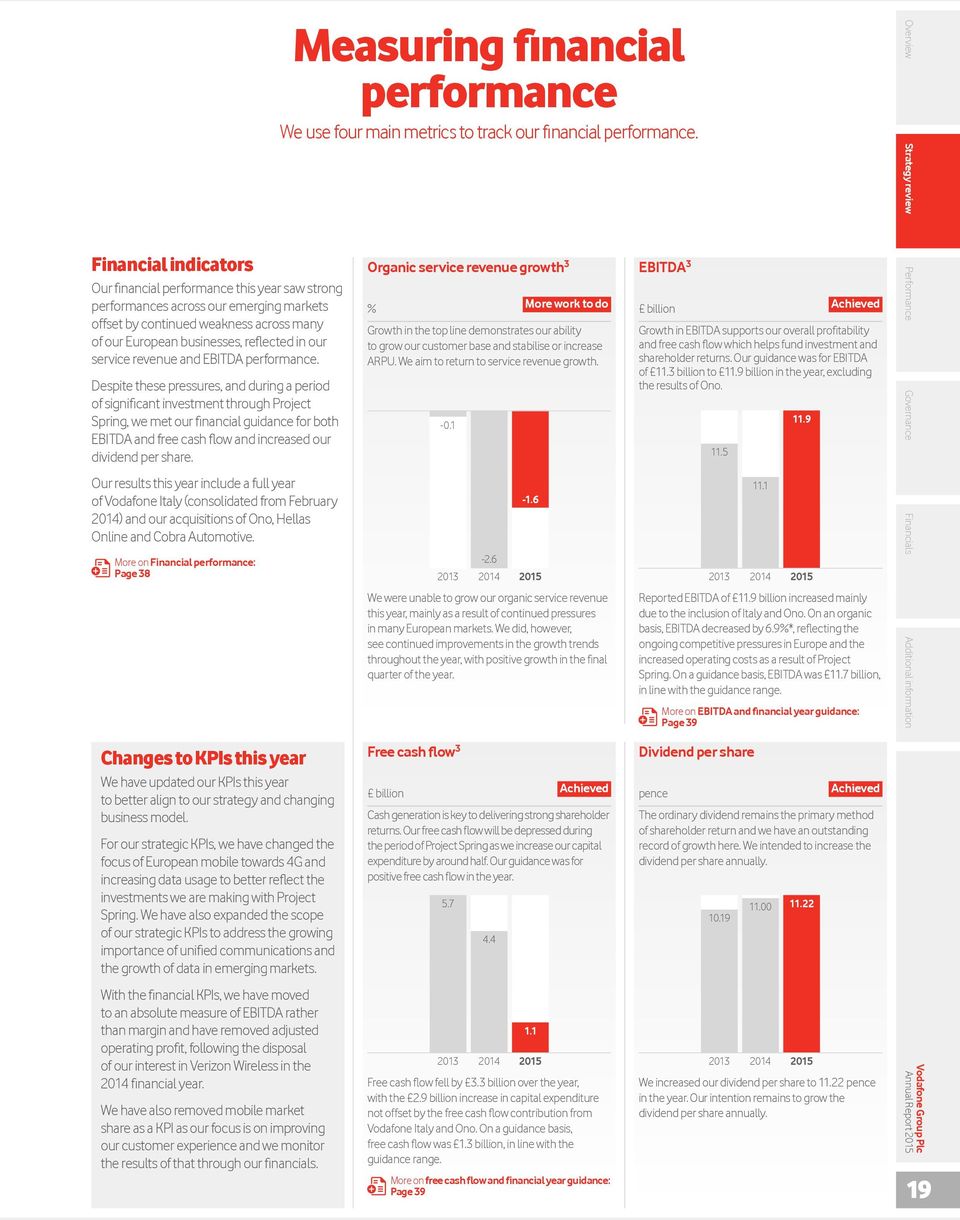
19 Financial indicators Our financial performance this year saw strong performances across our emerging markets offset by continued weakness across many of our European businesses, reflected in our service revenue and EBITDA performance. Despite these pressures, and during a period of significant investment through Project Spring, we met our financial guidance for both EBITDA and free cash flow and increased our dividend per share. Our results this year include a full year of Vodafone Italy (consolidated from February 2014) and our acquisitions of Ono, Hellas Online and Cobra Automotive. More on Financial performance: Page 38 Measuring financial performance We use four main metrics to track our financial performance. Organic service revenue growth 3 % More work to do Growth in the top line demonstrates our ability to grow our customer base and stabilise or increase ARPU. We aim to return to service revenue growth We were unable to grow our organic service revenue this year, mainly as a result of continued pressures in many European markets. We did, however, see continued improvements in the growth trends throughout the year, with positive growth in the final quarter of the year. EBITDA 3 billion Achieved Growth in EBITDA supports our overall profitability and free cash flow which helps fund investment and shareholder returns. Our guidance was for EBITDA of 11.3 billion to 11.9 billion in the year, excluding the results of Ono Reported EBITDA of 11.9 billion increased mainly due to the inclusion of Italy and Ono. On an organic basis, EBITDA decreased by 6.9%*, reflecting the ongoing competitive pressures in Europe and the increased operating costs as a result of Project Spring. On a guidance basis, EBITDA was 11.7 billion, in line with the guidance range. More on EBITDA and financial year guidance: Page 39 Overview Strategy review Performance Governance Financials Additional information Changes to KPIs this year We have updated our KPIs this year to better align to our strategy and changing business model. For our strategic KPIs, we have changed the focus of European mobile towards 4G and increasing data usage to better reflect the investments we are making with Project Spring. We have also expanded the scope of our strategic KPIs to address the growing importance of unified communications and the growth of data in emerging markets. With the financial KPIs, we have moved to an absolute measure of EBITDA rather than margin and have removed adjusted operating profit, following the disposal of our interest in Verizon Wireless in the 2014 financial year. We have also removed mobile market share as a KPI as our focus is on improving our customer experience and we monitor the results of that through our financials. Free cash flow 3 billion Achieved Cash generation is key to delivering strong shareholder returns. Our free cash flow will be depressed during the period of Project Spring as we increase our capital expenditure by around half. Our guidance was for positive free cash flow in the year Dividend per share pence Achieved The ordinary dividend remains the primary method of shareholder return and we have an outstanding record of growth here. We intended to increase the dividend per share annually Free cash flow fell by 3.3 billion over the year, with the 2.9 billion increase in capital expenditure not offset by the free cash flow contribution from Vodafone Italy and Ono. On a guidance basis, free cash flow was 1.3 billion, in line with the guidance range. More on free cash flow and financial year guidance: Page 39 We increased our dividend per share to pence in the year. Our intention remains to grow the dividend per share annually. 19
20 Key performance indicators (continued) Measuring operational performance We track our operational performance against three key metrics that cover the experience we offer our customers and the engagement and diversity of our employees. Consumer mobile net promoter score Employee engagement out of 21 markets Achieved index Achieved % We use net promoter scores ( NPS ) to measure the extent to which our customers would recommend us to friends and family. We aim to increase or maintain the number of markets where we are ranked number one by NPS. The employee engagement score measures employees level of engagement a combination of pride, loyalty and motivation. Our goal here is to retain our top quartile position. Percentage of women in senior management More work to do Diversity increases the range of skills and styles in our business and increased female representation across our senior management (top c.1,600 employees) is one measure of diversity. Our goal is simple, to increase the proportion each year This year we increased the number of markets where we are ranked number one and our goal is to continue to increase this number every year. We are now ranked first or joint first in mobile in four of our top six markets (Italy, Spain, India and South Africa) while we lag behind in the UK and Germany. Our employee engagement score remains broadly stable and we retained a top quartile position. More on Our people: Pages 28 and 29 We have not made progress on this metric this year, with the proportion falling slightly. To help improve gender diversity further, we launched a new maternity policy in the year. More on Our people: Pages 28 and 29 Notes: 1 Based on Android and iphone devices. 2 Emerging markets comprise DRC, Egypt, Ghana, India, Lesotho, Mozambique, Qatar, South Africa, Tanzania and Turkey. 3 Financials for 2013 and 2014 are shown on the current statutory basis, including the results of the Group s joint ventures using the equity accounting basis. Free cash flow excludes restructuring costs in all periods. 20 out of 13 KPIs achieved versus 9 out of 12 in 2014 Paying for performance The incentive plans used to reward the performance of our Directors and our senior managers, with some local variances, include measures linked to our key performance indicators. The annual bonus ( GSTIP ) pay-out for the 2015 financial year was dependent upon our performance across three financial measures (service revenue, EBITDA, and adjusted free cash flow) and one strategic measure (Competitive Performance assessment), with each having an equal 25% weighting. The Competitive Performance assessment was based on a market-by-market assessment of measures including NPS performance and relative revenue market share. We are making two changes for the year ahead to underline the importance of providing the best possible customer experience. We will rebalance the weightings of the performance measures with 60% being equally split across the financial measures and 40% weighted to the strategic measures. In light of this increase in weighting the Competitive Performance assessment will be replaced by Customer Appreciation KPIs which will continue to include an assessment of NPS and we will add in Brand Consideration along with other customer measures. More on rewards for performance in the Remuneration report: Pages 75 to 91

21 Measuring our economic impact in the EU Our substantial operations and investments in Europe have a positive impact on the EU economy as a whole, with our digital networks and services enabling businesses to enhance productivity and competitiveness, while helping public institutions enhance efficiency in delivering public services. For every 1 we add to the EU economy directly, we generate just under another 1 indirectly, through the purchase of goods and services from suppliers. Overview Strategy review Performance Governance Financials Additional information Better productivity We provide jobs and the potential for a high skills career path for our 54,000 employees in Europe. Our employees are 40% more productive than the average across the telecommunications sectors in the 12 EU countries in which we operate 1. For every full time equivalent Vodafone job we generate an average of 2.2 full time employment opportunities among our European suppliers. For more information see our EU Economic Impact report online at vodafone.com/policy. Note: 1 KPMG analysis based on data from Eurostat. 21
22 Our strategy Consumer Europe While voice and messaging remain crucial to our customers, the demand for data continues to grow, both through mobile and through fixed. This growth provides a great opportunity for Vodafone and for our customers as we work towards providing the best data experience to more and more customers. 1 41% of service revenue from consumers in Europe Context More and more of our customers are using data, increasingly on 4G Average smartphone data usage is accelerating, increasing 60% over the year Customers want simplicity and worryfree bills We are now a major fixed broadband and TV provider Where we are going We are encouraging more customers to switch to data and to use more data We are expanding our 4G network to over 90% population coverage by March 2016 We continue to enable worry-free usage through our Vodafone Red and roaming plans We are stimulating data usage through bundling content We are increasingly providing mobile and fixed services together We are improving the experience we offer customers through modernising our stores and investing in better customer service Growing data penetration Voice and messaging remain crucial to all of our customers and we have improved voice quality dramatically, with only around 1 in 170 calls dropped on average compared with 1 in 110 in September However, the rise of smartphones and other connected devices is leading more and more of our customers to use data on the move. Already over half of our customers use data, with 52% smartphone penetration across our base, and we have a great opportunity to extend this further. To help data reach more and more people we provide low-priced entry level plans with small allowances, and combine these with affordable handsets, such as our Vodafone branded devices. During the year, we sold over 3.4 million Vodafone branded smartphones across Europe. 4G driving increased usage The arrival of 4G in Europe has had a significant impact both on our business and on the experience our customers enjoy. 4G is attractive because it offers much faster speeds and a more reliable experience, enabling customers to watch videos, stream music and enjoy the internet better than ever before. European smartphone penetration % We have 15.9 million 4G customers across Europe, compared to only 3.3 million a year ago. 4G is driving an increase in data usage, both in absolute and per-user terms. On average our 4G customers use twice as much data as our 3G customers and that has helped average smartphone usage increase from 473MB to 755MB during the year. This is supported by the large increase in video streaming, which now accounts for 48% of data traffic. Bundling content with our 4G plans is also helping to increase data usage, as discussed on page 23. Monetising increased usage As customers use more and more data it is important that we monetise this. Higher usage has helped drive higher revenues per customer in some markets, especially in the UK where 4G data usage trends are particularly strong. In some markets, average revenue per user ( ARPU ) has continued to fall as the benefit of increased data usage has not offset the fall in market prices. 3G vs. 4G average monthly data usage GB 30 0 Netherlands Spain 22 Project Spring achievements Taking 4G coverage to 72% Reducing dropped calls to 0.6% Increasing average smartphone data usage to 755MB Modernising around 3,250 retail stores Video as a % of data traffic % Note: 1 Based on 3G to 4G cohort analysis Roamers registered on Daily offer million
23 Expanding our worry-free propositions A crucial part of our strategy to encourage greater data usage is to remove the concern many customers have about using data. The main way we have done this is through our Vodafone Red plans. Vodafone Red offers unlimited calls and texts with generous data allowances letting our customers use their phones without worrying about their bill. We now have 16.4 million Red customers across all our European markets, improving customer satisfaction and reducing the level of customers deciding to leave us. We have extended worry-free usage even further for some customers with integrated European roaming, Secure Net (our mobile security software) and cloud storage offered with many high-value plans. Vodafone Red also helps protect our business against over-the-top voice and messaging services that let customers use their data allowance rather than their voice and messaging allowances. We now have 62% of our mobile service revenue in Europe coming from customers committed bundles, up from 58% a year ago. Expanding worry-free roaming We have continued to take the concern out of roaming for our customers with our daily offer, which allows customers to take their home tariff abroad for a small fee. We now have 20 million customers who have registered for this offer compared with 14 million a year ago, accounting for 33% of consumer roamers. We now also offer 4G roaming in all our 4G markets, letting our customers enjoy 4G abroad in up to 54 countries. Customers using our daily offer typically use their phone more and generate higher roaming ARPU than those on standard tariffs. A major fixed operator The story is not just about mobile data. As a result of recent acquisitions and our organic strategy, we now have 11.3 million fixed broadband customers and 9.1 million TV customers across Europe. As we become a larger fixed operator, we are increasingly providing customers with both mobile and fixed services. Consumers increasingly want one plan that includes their fixed, mobile and TV packages and we are making progress towards providing this across our markets. Our unified communications strategy is discussed in detail on the next two pages. Customer experience While our strategy across Europe is focused on providing a great data experience, it is important that we work on our everyday interactions with customers. As part of Project Spring we are upgrading around 8,000 of our stores to enhance the experience we offer customers. We have upgraded around 3,250 so far. We are also upgrading our customer service, with 24/7 telephone support available in all markets and significant increases in the use of our mobile and online based care products. We now have 12.5 million My Vodafone App users who can check their balance and usage, and access help and support, wherever they are. Overview Strategy review Performance Governance Financials Additional information Bundling content encouraging data usage We have also increased average data usage by offering customers content packages as part of their price plans. We include services such as Netflix, Spotify and Napster within selected plans across eight European markets. Customers who sign up to these content packages typically use at least twice as much data as similar customers who do not have bundled content. Mobile customers with bundled price plans in Europe 23
24 Our strategy (continued) Unified Communications Our customers increasingly expect to connect to friends, information and entertainment wherever they are, irrespective of the underlying technology. We are growing our next-generation fixed capability to meet their needs. 2 20% of service revenue from fixed services Context Customers increasingly want access to their content photos, videos, music, internet wherever they are, and on whatever device they are using phone, tablet, laptop or TV screen Customers are agnostic about using fixed or mobile networks the most important requirement is a reliable connection We are seeing a growing demand for both combined fixed and mobile bundles and pay TV and broadband packages The growing demand for data requires a strong backhaul network with high speed fixed fibre or microwave capability linked to the mobile radio network Where we are going We expect fixed revenue to become more important to us over time as we aim to increase our market share We aim to increase the number of fixed broadband users We expect to pass more households with high speed fibre or cable We aim to have the best in class converged services including TV and all services on one single bill What is unified communications? More and more customers are consuming bundled fixed and mobile services which often provide better value for money, and increasingly, one single bill and one single point of contact. To meet this evolving demand requires seamless high speed connectivity through the integration of multiple technologies such as 3G, 4G, WiFi, cable and fibre which we call unified communications. The market opportunity We are well established in mobile, with a market share in Europe of over 20%. In the fixed market, where we are building our presence, our share is currently around 10%, giving us a real opportunity to grow in this space. The bundling of fixed and mobile services has been a feature of the enterprise market for several years and it is becoming increasingly important for consumers too. In a number of key European markets, a large share of households already take combined fixed and mobile bundles including 50% in Spain and 25% in Portugal and we see clear signs of this expanding to other countries. During the year our competitors launched new convergent offers in several key European markets and we started to respond with our own offers. Therefore, it is critical for us to continue to develop fixed broadband services alongside our established mobile assets so that we can compete in this growing segment. Our fixed strategy Our goal is to secure access to high speed fixed broadband infrastructure in all our major European markets. We will continue to do this either through building our own fibre, wholesaling (renting) from incumbent fixed operators or acquisitions. We decide which approach to adopt on a market-bymarket basis, taking into account the cost of building our own fibre, the economics of the wholesale terms on offer, the speed of market development, and the availability of good quality businesses to acquire. We have made good progress on our strategy. During the year we completed the purchase of two fixed companies Ono, Spain s largest cable company, and Hellas Online, a leading provider of fixed telecom services in Greece. We are progressing well on the building of our own fibre networks in Italy, Spain and Portugal, with preparations underway in Ireland. 24 Project Spring achievements Increasing our next-generation fixed line infrastructure to 28 million households Increasing fixed broadband customers to 12 million Providing five million customers with high speed fibre or cable broadband Fixed service revenue % percentage of total service revenue Fixed broadband and million TV customers Fixed broadband customers TV customers
25 In the coming weeks we will launch residential broadband services in the UK, using the infrastructure acquired with Cable & Wireless Worldwide ( CWW ). Over 2,200 mobile base station sites in the UK have been connected to the CWW network, which significantly increases both the amount and speed of data we can carry. We remain on track to achieve the financial synergy targets we set when we acquired CWW. We have made good progress on the integration of both Ono in Spain and KDG in Germany, combining our fixed and mobile networks and beginning to migrate Vodafone broadband customers to our new infrastructure. For example, in Germany we have created one national backbone and 70% of all traffic has already been migrated onto a single network. Read more about the integration process on page 39. In emerging markets we are also building high speed fibre capability to serve targeted urban areas. In South Africa we have launched fibre to business services and begun to trial fibre to the home. In India we laid around 16,000 kilometres of fibre to business areas during the year taking the total to nearly 150,000 kilometres. Our subsidiary, Vodacom, is awaiting regulatory approval to acquire Neotel, the second largest provider of fixed telecommunications services in South Africa. According to external estimates 1 an increasing number of households in Europe take bundles of pay TV and broadband packages. To ensure we can offer the best in class unified communications solutions we also provide TV services. We already have nine million TV customers in six markets through wholesale arrangements, and we aim to expand this to several new markets this year. Our fixed broadband assets and performance The successful execution of our strategy has given us a strong unified communications footprint in Europe. We now pass 28 million households with our own high speed fixed fibre or cable infrastructure. In addition, we can reach a further 22 million households via wholesale agreements with fixed operators. This strategy is supporting good commercial performance. During the year our fixed broadband base in Europe increased by nearly 2.8 million (including acquisitions) to 11.3 million making us one of the largest providers of fixed broadband services in Europe. The number of customers taking our high speed fibre or cable broadband increased to five million. Our ambition is to expand our broadband coverage further. Our converged solution for business customers, Vodafone One Net, combines fixed and mobile services and a full suite of cloud-based unified communications and collaboration services in one easy to use package. During the year we expanded the service to more markets and the number of users increased by 400,000 to 3.9 million. Overview Strategy review Performance Governance Financials Additional information Note: 1 Analysys Mason. Ono acquisition We spent 7.2 billion ( 5.8 billion) during the year acquiring Ono in Spain, a leading provider of telecommunications services including fixed telephony, broadband, pay-tv, and mobile services. Ono has the largest cable network in Spain with 7.4 million homes passed (around 40% of Spanish households). It serves 1.9 million customers and is the market leader in ultrafast broadband, offering superior speeds in excess of 200 Mbps. In April 2015 we launched our fully converged offer, Vodafone One, which utilises the best of Vodafone and Ono to give customers in Spain the nextgeneration converged service with the fastest 4G mobile network, landline (fixed), internet and TV. 25
26 Our strategy (continued) 26 3 Context Our emerging markets are India, South Africa, Turkey, Egypt, Ghana, Kenya, Qatar, Tanzania and several other southern African countries These markets are growing quickly reflected in a 20% growth in customers to 321 million in just three years The demand for mobile data in emerging markets is growing rapidly with data volumes doubling this year There is strong demand for mobile money services as many people in these markets have little or no access to banking services Where we are going We are increasing and upgrading our base station sites to improve network coverage and quality We are managing the growing demand for data through the deployment of high speed mobile networks and fibre based services to enterprise customers We are continuing to invest in market leading distribution and value for money offers We are enhancing our leading mobile money service, M-Pesa, by increasing the range of mobile financial services it provides Project Spring achievements Extending our AMAP 3G/4G footprint (excluding India) to 82% population coverage (2016 target 84%) Growing 3G coverage in targeted urban areas in India to 90% (2016 target 95%) Taking 4G to Kenya, Lesotho and Qatar, with more emerging markets to follow Increasing M-Pesa to 19.9 million users Consumer Emerging Markets Today, fast growing emerging markets in Asia and Africa generate a third of our revenue. We believe that these markets provide a significant future growth opportunity, driven by rising wealth, expanding populations and growing demand for mobile services. 23% of service revenue from consumers in emerging markets (and a further 6% from enterprise customers) Increasing our network quality We are delivering strong growth in emerging markets, reflected in a 7% rise in customers over the year to 321 million, representing 72% of the total. However, mobile penetration is still less than 100%, compared with nearly 140% in Europe, so we expect to see a lot more growth going forward. To support and drive this growth opportunity we have made significant progress on upgrading and further extending our mobile network, with 24,000 2G and 30,000 3G radio sites added in AMAP since Project Spring commenced. As an example of progress, our 3G coverage in targeted urban areas across India is now 90%, and customers are experiencing a 44% gain in download speeds. In addition we have launched 4G networks in four emerging markets and in selected countries we also provide even faster fixed fibre services to urban areas. Driving the data opportunity Data usage in emerging markets is expanding rapidly (doubling in the year) due to the growth in customers, the expanding network and the greater range and affordability of handsets. During the year we made good progress. We increased the number of data users by 21% to 114 million, which is two thirds of the total across the Company; we trebled the number of 3G data users in India to 19 million; Vodacom delivered a 16% increase in active data users to 26 million or 39% of total customers; and smartphone penetration in Turkey rose to 46% from 34% last year. Mobile customers in emerging markets million Enhancing customer experience We have a significant distribution footprint in emerging markets with 10,000 branded or franchised stores. We have modernised nearly 1,300 of these stores and are targeting to reach around 2,300 by In India we have the largest footprint of 1.8 million recharge outlets, significantly more than our nearest competitor. In South Africa we introduced webchat, so customers can resolve their queries online, and enhanced the MyVodacom app for smartphones, which allows customers to view their account balance or top up their account, with new features such as data top-ups. To ensure we provide value for money in our emerging markets we offer targeted price plans based on customers usage patterns, and in South Africa we reduced prepaid prices by 18%, leading to a significant uplift in usage. M-Pesa: increasing access to mobile financial services Our mobile money transfer and payment service, M-Pesa, enables people who have access to a mobile phone, but limited or no access to a bank account, to send and receive money, purchase goods, pay bills, and in some markets save money and receive short-term loans. M-Pesa is available in nine countries via a network of 273,000 agents. We now have 19.9 million active M-Pesa customers, an increase of 18% over last year. It represents around 20% of the service revenue and over half of the mobile customer base in established M-Pesa markets such as Kenya and Tanzania. During the year we launched our first international money transfer corridor between Tanzania and Kenya; we also relaunched M-Pesa in South Africa and completed the national roll-out in India. Data users in emerging markets million
27 4 Context 27% of service revenue from Enterprise Businesses of every size are facing the same challenges and opportunities as the boundary between mobile and fixed communications and IT blurs They and their employees expect to be confidently connected to people, customers, data and applications wherever they are and whenever they want Where we are going We are building a comprehensive total communications portfolio, rooted in our core strength in mobile Our strategy is focused around three market segments small and mediumsized enterprises, large and multinational corporates and carriers Investment is concentrated on three high-growth markets unified communications, Cloud and Hosting and M2M Project Spring achievements Extending our global IP-VPN footprint to 62 countries via 256 points of presence Launching our Cloud and Hosting services in Germany Securing a US mobile virtual network operator partner Expanding our M2M footprint to a further four markets Enterprise As businesses increasingly look for more than just mobile services, and make mobility a central part of their strategies, we are becoming a leading total communications provider. Our portfolio includes a range of mobile, fixed, unified communications, Cloud and Hosting and M2M services. Moving to Total Communications While the majority of our revenue comes from mobile, we are increasingly moving to total communications providing many services beyond mobile. Vodafone One Net, our flagship converged fixed and mobile communications offer, is available for both large and multinational companies and for small and mediumsized companies. Vodafone s IP-VPN network provides private Wide Area Network capability to connect our customers sites, assets and people together securely. The Vodafone IP-VPN network is extensive, connecting 62 countries directly. We also offer national fixed networks in many countries around the world. The majority of our Enterprise business is managed in our country operations, with the remainder managed by units that operate across geographies (VGE, M2M and Cloud and Hosting). These account for 26% of all Enterprise service revenue. Vodafone Global Enterprise Vodafone Global Enterprise ( VGE ) delivers Total Communications services to around 1,700 of the world s largest multinational companies in over 100 countries. VGE simplifies operations for our customers by providing them with a single account and service team, a single multi-country contract, single pricing structures and a single portfolio of products and services. These are underpinned by our fully integrated fixed and mobile networks, cloud-based hosting platforms, M2M capability and other business services. Fixed as a percentage of % enterprise service revenue M2M M2M is driving the Internet of Things by connecting people, places and things to the Internet, turning them into intelligent assets that communicate. Our M2M business serves customers globally, across all sectors, with a focus on the high growth areas of automotive, utilities and consumer electronics. We have expanded the number of connections to 21.5 million from 16.2 million a year ago. In August 2014 we acquired Cobra Automotive to move up the M2M value chain in the automotive industry and create a world leading Connected Car services provider. Cloud and Hosting By combining our secure mobile and fixed connectivity strength with our Cloud and Hosting services, we help organisations move their data and applications to the Cloud and transform the way they do business, reducing costs and increasing flexibility. Our Cloud and Hosting business serves more than 1,200 public sector and enterprise customers globally using our 18 data centres in the UK, Ireland, Germany and Africa, complemented by a partner network of data centre facilities. Carrier Services Our Carrier Services division manages the commercial relationships with around 1,000 communication service providers globally and offers a broad portfolio of fixed and mobile connectivity and other services. We are the world s largest international voice carrier and one of the world s largest investors in submarine cables that reach more than 100 countries. Split of enterprise service % revenue 2015 VGE/M2M /Cloud and Hosting 26% Managed in our country operations 74% Overview Strategy review Performance Governance Financials Additional information 27
28 Our people The people behind our business Our people are behind every aspect of our strategy so it is important that we attract, develop and retain exceptional people so we can always deliver the best experience for our customers. During the year we employed an average of 101,443 1 people and had 105,970 employees as of March 2015, as well as 25,267 contractors. The number of people in our business increased during the year following our acquisitions of Ono in Spain, Cobra Automotive in Italy and Hellas Online in Greece, plus the purchase of over 130 Phones 4u stores in the UK. The following sections highlight our progress in the key areas behind our people strategy. Increasing employee engagement For our strategy to work we need our employees to believe in us. Every year all our employees are invited to participate in a global survey which allows us to measure engagement levels, compare ourselves with other large companies and help us identify ways to improve how we do things. Our employee engagement index measures how committed our employees are, their desire to continue working for us and their willingness to recommend Vodafone as an employer. The index remained stable this year at 77 points, still in the top quartile. Our employee turnover rate, measuring the rate at which employees leave us, increased to 18% reflecting the increased level of acquisitions and integration in the business. We provide information to our employees in a variety of ways, including our intranet sites, , text and video messages, as well as through individual teams. We also provide online platforms for employees to feedback their comments. Valuing diversity We believe that a diverse workforce helps us achieve our goals by helping us better understand and meet the needs of our customers. We are both a multinational and a multicultural company and employ people from 130 countries, with 24 nationalities in our Senior Leadership Team (our top 224 managers). Gender diversity is a key goal for us. At the end of the year we employed 67,657 men (64%) and 38,313 women (36%). We have seen a slight decrease in the proportion of women in senior management (top c.1,600 managers), now 23% compared with 24% a year ago, while the proportion in our Senior Leadership Team has remained stable at 22%. To help push our progress in gender diversity, we launched a new maternity policy in March 2015 that provides mandatory minimum maternity benefits as standard across all our markets, including 16 weeks full pay followed by full pay for a 30-hour week for the first six months after employees return to work. We believe this will help redress the gender balance in our business. We believe in treating all employees equally and offer equal opportunities in all aspects of employment and advancement regardless of race, nationality, gender, age, marital status, sexual orientation, disability, religion or political beliefs. This year s people survey showed that 88% of employees believe that Vodafone treats people fairly. Improving our customer focus All of our employees are expected to work in the The Vodafone Way. This is about ensuring that we work with speed, simplicity and trust so that we can be customerobsessed at all times. We have run development workshops for all our senior management for the fourth consecutive year and will hold further workshops in the coming year. Training our people We want people to grow their careers at Vodafone and develop the skills and talent needed to grow our business. We do this through formal training, on the job experience and regular coaching from managers. We have global training academies for key areas such as marketing, technology, enterprise sales, retail, finance and supply chain. Employees by location % Other 34% Spain 5% Italy 6% Vodacom 7% Germany 14% Average number of employees 120,000 90,000 91,272 92, ,443 60,000 Employee engagement index 30, India 18% UK 16% Employee turnover rates % Nationalities in top senior % leadership roles Women in senior management %
29 During the year we trained around 18,000 people in our Technology Academy, around 13,000 people in our Retail Academy and over 8,000 in our Enterprise Sales Academy. Next year we will introduce a Customer Experience Academy to help transform our customer service. Developing future leaders We conduct regular talent reviews to identify high-potential future leaders and accelerate the progress of high-potential managers through our Inspire programme, which offers development and executive coaching and may include an assignment to another Vodafone market or function. Our Discover programme for graduates accelerates the careers of high performing graduates, with over 600 people recruited onto this programme during the year. We also have an international assignment programme, Columbus which gives recent Discover graduates an international assignment. Recognising performance We maintained our approach of rewarding people based on their performance, potential and contribution to our success. We benchmark roles regularly to ensure competitive, fair remuneration in every country in which we operate. We also offer competitive retirement and other benefit provisions which vary depending on conditions and practices in local markets. Global short-term incentive plans are offered to a large percentage of employees and global long-term incentive plans are offered to our senior managers. Our incentive arrangements are subject to company performance measures, comprising both financial and strategic metrics, and individual performance measures. This ensures that variable pay is demonstrably linked to both company and individual performance, and that poor performance is not rewarded. Note: 1 Employee numbers are shown on a full time employee basis. A statutory view is provided on page 157. An ownership mentality is also a cornerstone of our reward programme and senior executives are expected to build up and maintain a significant holding of Vodafone shares. Simplifying and improving our business We continue to move transactional and back office activities to our shared service centres in Egypt, India, Hungary and Romania, with 16,800 employees and contractors in these centres, compared with 13,300 a year ago. These centres allow us to standardise many of our support functions and deliver a more consistent and improved experience to our customers. These centres also support our cost reduction goal as we benefit from lower labour costs. Doing what s right We have a Code of Conduct that sets out our business principles and what we expect from employees to ensure they protect themselves as well as the Company s reputation and assets. We communicate these through our Doing What s Right campaign which covers topics including health and safety, antibribery, privacy, security and competition law to ensure that people know what s expected of them and managers know what is expected of their teams. Around 7,500 employees integrated in Germany and Spain this year Creating a safe place to work We know from experience that failing to follow basic health and safety standards can lead to our employees, the people we work with and the people exposed to our activities being seriously injured or killed. We believe that accidents and injuries are preventable and we do our utmost to prevent them by promoting a culture where safety is an integral part of every business decision across the Group. Our Absolute Rules help employees follow best practice for safety and we focus on our top five risks: road safety, working with electricity, working at height, working with underground cables and working with contractors (where we have less control over safety). The safety culture in Vodafone continues to improve with the results of our latest people survey showing that 91% of employees believe that our Absolute Rules are taken seriously compared with 89% last year. Despite these measures, we greatly regret to report that ten people died while undertaking work on behalf of Vodafone last year. Vehicle-related incidents involving subcontractors in emerging markets remain our main cause of fatalities and we continue to implement safe driving programmes in all of our markets. Integrating our acquisitions As we develop our business towards unified communications we need to combine with the companies we acquire and ensure that all of our employees have the new skills that we increasingly need, such as cable engineering and door-to-door selling. During the year we integrated around 5,000 Kabel Deutschland employees in Germany and around 2,500 Ono employees in Spain as well as employees from our acquisitions of Cobra Automotive in Italy, Hellas Online in Greece and our purchase of over 130 stores from Phones 4u in the UK. When we acquire a company we look to include all new employees within Vodafone as soon as possible. Just two months after the acquisition of Ono, all their employees had the same tools as Vodafone employees and within six months we had moved all of Ono s headquarter employees into Vodafone s main offices in Spain so we all sit under one roof. Within eight months we had combined the management structure so we are now truly one organisation. Overview Strategy review Performance Governance Financials Additional information 29
30 Sustainable business Sustainable business Our significant global footprint combined with the power of our communications technology can help transform people s lives. This enables us to align our business growth with our goal to be a sustainable business. Communications technology is acknowledged to be transformative in improving people s lives and livelihoods, as well as driving economic growth and development. Estimates show that a 10% increase in mobile penetration in emerging markets leads to a 4.2% rise in long-term productivity 1. Vodafone contributes to the socio-economic development of our customers by using technology to tackle some of the most pressing challenges faced by society today, with significant contributions in the areas of education and skills development, access to financial services and resource efficiency. How we achieve our goals is critical to the long-term success of the business. Our approach is driven by a commitment to operate in an ethical and responsible manner in all we do. This report highlights our progress in four critical areas. Saving energy and reducing our carbon footprint Though we continue to extend the reach of our network to more customers, who are using ever-increasing amounts of data, our own carbon footprint has remained relatively stable, despite significant acquisitions. Tonnes of carbon emissions per base station The efficiency of our operations has greatly improved, with emissions per base station at 9.9 tonnes of carbon dioxide equivalent ( CO 2 e ), 33% lower than in Our total carbon emissions in 2015 were 2.8 million tonnes of CO 2 e, an increase on 2014 due to newly acquired operations and the expansion of our network. We remain committed to reduce our energy consumption as far as possible, through energy efficiency measures and renewable investments. As a market leader in M2M solutions, we have a great opportunity to help our enterprise customers to cut their carbon emissions, while delivering them significant cost savings. Real-time tracking of vehicles, for example, helps fleet managers revise routes, saving fuel and emissions. By March 2015, we had approximately nine million active M2M connections with carbonreducing potential in the smart metering, fleet management and automotive sectors. We estimate that we delivered savings of 3.5 million tonnes of CO 2 e for our customers from our M2M products and services, call conferencing and cloud and hosting solutions, in 2015 almost a million tonnes higher than our total emissions. Carbon emissions millions of tonnes CO 2 e 0 Scope 1 (direct greenhouse gas ( GHG ) emissions) Scope 2 (indirect GHG emissions) We are now working towards a new goal for our carbon footprint: within three years we aim to enable our customers to reduce their carbon emissions by twice the amount of carbon we generate through our own activities. Financial inclusion M-Pesa continues to evolve beyond a traditional money transfer service. It now enables people to save and borrow money, receive salaries and benefits, send and receive money from overseas, and pay for goods and services, regardless of whether they have a bank account. Launched two years ago in Kenya, Lipa Na M-Pesa enables customers to make cash-free payments for goods and services on a day-to-day basis, whether they are paying a supplier, or shopping in a retail environment, with over 80 million worth of transactions enacted just in March Our M-Pesa international money transfer service continues to expand and it is now possible for people to send and receive money between Kenya and Tanzania. Providing senders of cross-border money transfers with more choice gives our customers a cheaper, more convenient way to send and receive money. Vodafone Foundation: mobilising the community, mobilising social change We believe that our communications technologies can help to address some of the world s most pressing humanitarian challenges and thus improve people s lives. To achieve this, the Vodafone Foundation invests in projects in the communities within the countries in which Vodafone operates, and is the centre of a network of global and local social investment programmes. 30 Notes: 1 Deloitte and the GSMA. 2 Calculated using local market actual or estimated data sourced from invoices, purchasing requisitions, direct data measurement and estimations. Carbon emissions calculated in line with DEFRA guidance. For full methodology see our Sustainability Report KDG and Ono data included for 2015 only. The total amount donated to the Vodafone Foundations in 2015 was 48.2 million. Since its inception, Vodafone has donated over 520 million to the charitable programmes led by our Foundations.
31 M-Pesa is at the heart of many of our transformational solutions in other areas, particularly in agriculture and health. A new collaboration with the National Rural Health Mission and Rural Employment Guarantee uses M-Pesa to disburse government benefits in the states of Bihar and Jharkhand in India. In Tanzania, our collaboration with the Commercial Bank of Africa, enables M-Pesa customers to access interest-bearing savings accounts and small loans. Enhancing our enterprise customers sustainability efforts Our enterprise customers expect us to support their commitment to operate in a sustainable way. In the 2015 financial year, over 1.5 billion worth of commercial bids and contracts included a sustainability performance assessment. We are piloting and scaling mobile solutions through the agriculture value chain with three of our largest enterprise customers. Together, we are exploring how mobile money and data, and M-Pesa specifically, can help to mobilise distribution channels and create jobs, as well as how it can improve the efficiency and affordability of water distribution in rural India. We are also rolling out a mobile solution to enable Anglo American, an international mining company, to engage directly with local communities on a monthly basis, in order to gain real-time feedback on the impact of their operations. Privacy and human rights The amount of data and personal information transmitted over our networks continues to increase. Our commitment to protecting that information and respecting our customers right to privacy and freedom of expression remains critical in retaining their trust. We are one of the first communications operators in the world to provide a country-by-country analysis of demands received for access to our customers data by law enforcement authorities, through the publication of our Law Enforcement Disclosure report. This report explains our principles and approach, as well as the policies and processes we follow when responding to demands from government agencies and authorities. It also sets out the framework within which we believe governments should act. For more information see vodafone.com/sustainability. During 2014, Vodafone chaired the Telecommunications Industry Dialogue on Freedom and Privacy of Expression, which continues to work in collaboration with the Global Network Initiative ( GNI ) to address the issues of privacy and freedom of expression as they relate to the telecommunications sector. Wherever we operate, we work to ensure that we do not infringe human rights through our operations or business relationships. We continue to work with our suppliers and others in our industry to raise ethical, labour and environmental standards in our supply chain. We now enable some of our suppliers workers to give direct, anonymous feedback on their working conditions, using their mobile phones, in collaboration with Good World Solutions. Responses to the surveys are aggregated anonymously and provided directly to Vodafone and the supplier to identify areas for improvement. Overview Strategy review Performance Governance Financials Additional information JustTextGiving JustTextGiving by Vodafone is the headline programme of the Vodafone Foundation in the UK. It enables individuals and charities to collect donations via text and is available to all mobile customers on any UK network. Donors simply use a unique code to send donations via text and 100% of the amount donated goes to the UK registered charity. JustTextGiving is now being used by around 207,900 fundraisers and 21,600 charities and has helped raise more than 27 million since its inception in May Instant Classroom launched During 2015 the Vodafone Foundation launched Instant Classroom, a digital school in a box that can be set up in a matter of minutes, helping to give children and young people in some of the world s largest and most poorly resourced refugee camps the opportunity to continue their education. The Instant Classroom is shipped in a case which is equipped with a laptop, 25 tablets pre-loaded with educational software, a projector, a speaker and a hotspot modem with 3G connectivity. The Instant Classroom was developed to support the continued roll-out of the Vodafone Foundation s Instant Network Schools programme in partnership with the United Nations High Commissioner for Refugees. These schools are solar powered centres which provide access to digital educational content and the internet via tablets. So far, 16 Instant Network Schools have been established in Kenya, DRC and South Sudan, benefiting over 26,000 children and 500 teachers. Over the next two years the Instant Network Schools programme will be extended to support additional schools in refugee camps in Kenya, DRC and Tanzania with the aim of reaching 60,000 students. Our Instant Network Schools programme in Kenya, DRC and South Sudan have benefitted over 26,000 children 31
32 Risk management Identifying and managing our risks We have a clear framework for identifying and managing risk, both at an operational and strategic level. Our risk identification and mitigation processes have been designed to be responsive to the ever-changing environments in which we operate. Our risk management approach Vodafone recognises that effective risk management is critical to enable us to meet our strategic objectives. The Board has overall responsibility for the Group s risk management and internal controls system. The Audit and Risk Committee, under delegation from the Board, monitors the nature and extent of risk exposure against risk appetite for our principal risks. Details of the activities of the Audit and Risk Committee are set out on pages 63 to 68 of this report. At an operational level, risks are reviewed and managed by the Executive Committee and through its delegated sub-committee, the Risk and Compliance Committee. Details of the activities of the Risk and Compliance Committee are set out on page 71 of this report. Identifying our principal risks Vodafone identifies its principal risks through annual bottom up and top down exercises. The bottom up exercise is conducted by each majority-owned subsidiary company in 25 markets, together with three major central companies responsible for shared service centres, roaming and enterprise services. Each of these 28 entities identifies their top ten risks together with their tolerance for these risks. The top down exercise includes interviews with around 30 senior executives. The output from the aggregated results of the top down and bottom up exercises produces a list of principal risks that are reviewed and agreed by the Executive Committee, prior to review by the Audit and Risk Committee. Each principal risk is assigned to a senior executive who is responsible for managing the risk and reporting on progress to the Executive Committee. Our principal risks Vodafone s principal risks are relatively similar to those reported last year, although with some movement on the relative ranking of these risks and two new risks added: (i) major Enterprise contracts and (ii) superior customer experience. The risks are each classified as financial, operational, compliance, strategic or reputational. Vodafone s decentralised operations and global scale reduces the impact of many of its operational risks. Board/Audit & Risk Committee a Overall responsibility for Group s risk management and internal controls system a Monitors nature and extent of risk exposure against risk appetite for principal risks 32 Top down Group level Bottom up Entity level Risk & Compliance Committee (sub-committee of the Executive Committee) Decides on principal risks Determines risk appetite Decides risk response for risks that exceed tolerance Monitors risk management Sets cultural tone Local Chief Executives & Executive Committee Operational level Risk and Compliance Director Responsible for global risk management framework Monitors Group level risks, controls and actions Supports the Executive Committee in monitoring risk exposure versus appetite Manages global risk community Aligns risks to assurance Group risk owners Identify relevant controls Manage global remediation programmes Report on progress to Risk and Compliance Director Set local objectives and risk appetite in line with Group guidance Overall responsibility for culture, local risk management and controls Local risk owners key functional owner for a principal local or global risk, responsible for local programme to measure, manage, monitor and report on the risk Local risk coordinators main point of contact in each market on risk, help to coordinate all activities including enterprise risk management exercise and reporting to the local Chief Executive on overall risk management Local audit committees track remedial actions for principal risks in market Internal audit Supports Group/ local audit committees in reviewing the effectiveness of the risk management framework
33 Operational risk 1. Malicious attack on the network/it infrastructure Risk description Assessment Mitigation A successful cyber-attack on our network could result in us not being able to deliver service to our customers, resulting in serious damage to our reputation, consequential customer and revenue loss and the risk of financial penalties. This risk is possible in all markets in which we operate and has the potential for significant impact. Certain systems operate at a Group level and as such, a single attack on one of these systems has the potential to impact multiple markets simultaneously, further magnifying the impact. This risk has been separated from non-malicious network failure to recognise the greater crossmarket impact a malicious attack could have on the business. Operational risk 2. Customer data misuse or leakage Risk description Assessment Mitigation Our networks carry and store large volumes of confidential personal and business voice traffic and data. Failure to protect or correctly use this data could result in unintentional loss of, or unauthorised access to, customer data. This could adversely affect our reputation and potentially lead to legal action. This risk is possible in all markets in which we operate. The impacts of this risk have the potential to be major in mature markets with robust data protection regulations covering personal information, voice traffic and data. Furthermore, we generally hold a greater volume of confidential personal information in our mature markets, due to the higher proportion of customers paying their bills by automated bank transfer or credit card. Relative movement within Group principal risks: Increased We have a well-established global security community; with our Group security function working closely with our local market security teams We work closely with a variety of security communities of interest which include relevant government bodies, commercial groups, suppliers and enterprise customers We are continually assessing our security policies, standards and procedures and adjusting them so they are commensurate to the threat profile we face. These assessments are used to create a focused security investment programme that ensures that the required security controls are in place and are effective Each year we run security programmes to identify and deliver additional activities with the aim of further strengthening our control environment. Our aim is to ensure that our critical infrastructure is enhanced to reduce the likelihood of unauthorised access and to reduce the impact of any successful attack We manage the risk of malicious attacks on our infrastructure using our global security operations centre that provides 24/7 proactive monitoring of our global infrastructure We have multiple layers of assurance in place. Our activities include regular technical assurance and audit activities including vulnerability scanning and ethical hacking programmes Relative movement within Group principal risks: Increased We have a data privacy programme aimed at ensuring we use data in our possession appropriately. The programme is based on existing regulations and internationally recognised standards We closely monitor the data privacy regulatory environment in relevant markets and implement changes to our processes and procedures as appropriate Both the hardware and software applications which hold or transmit confidential personal and business voice and data traffic include appropriate security features Security related reviews are conducted according to our policies and security standards, focused on the highest risk applications and processes Our data centres are managed to international information security standards Security governance and compliance is managed and monitored through software tools that are deployed to all local markets We have an ongoing awareness communications campaign in place that includes providing security and privacy awareness training to all Vodafone employees, prior to granting access to customer data We have an assurance programme in place that incorporates both internal reviews and reviews of third parties that hold data on our behalf We are implementing data access management tools to monitor any unauthorised access and leakage of our confidential data Overview Strategy review Performance Governance Financials Additional information 33
34 Risk management (continued) External risk 3. Adverse political pressure Relative movement within Group principal risks: Increased Risk description Assessment Mitigation We face a range of political pressures that could potentially lead to adverse legislation or regulation for the business. For example, increased financial pressures on governments may lead them to target foreign investors for further licence fees, directly impacting profitability. Furthermore, changes in local or international tax rules, for example prompted by the OECD s emerging recommendations on Base Erosion and Profit Shifting (a global initiative to improve the fairness and integrity of tax systems), or new challenges by tax or competition authorities, may expose us to significant additional tax liabilities or impact the carrying value of our deferred tax assets, which would affect the results of the business. In all markets where we are present, political decisions can be made that can have an adverse effect on our business, in relation to a range of issues, from retail price regulation to access to nextgeneration networks. Additionally, disputes in regards to the level of tax payable and any related penalties could be significant, as reflected in our ongoing dispute in India. We monitor political developments in our existing and potential markets closely, identifying risks in our current and proposed commercial propositions Regular reports are made to our Executive Committee on current political risks. These risks are considered in our business planning process Authoritative and timely intervention is made at both national and international level in respect of legislative, fiscal and regulatory proposals which we feel are disproportionate and not in the interests of the Group We have regular dialogue with trade groups that represent network operators and other industry bodies to understand underlying political pressures We maintain constructive but robust engagement with the tax authorities and relevant government representatives, as well as active engagement with a wide range of international companies and business organisations with similar issues Where appropriate we engage advisors and legal counsel to obtain opinions on tax legislation and principles Strategic risk 4. Convergence Relative movement within Group principal risks: Unchanged Risk description Assessment Mitigation We face competition from providers who have the ability to sell converged services (combinations of fixed line, broadband, public Wi-Fi, TV and mobile) on their existing infrastructure which we either cannot replicate or cannot provide at a similar price point potentially leading to higher customer churn and/ or significant downward pressure on our prices. Our own convergence strategy may be compromised if we are unable to obtain regulated or equivalent access to infrastructure and content, or acquire, rent or build the right assets, or if we are unable to integrate effectively those businesses we do acquire into our existing operations. This risk is more likely in mature markets where more competitors have the assets to offer converged services. In key European and some non-european markets we are providing fixed line telecommunication services (voice and broadband) In all markets we actively look for opportunities to provide services beyond mobile through organic investment, acquisition, partnerships, or joint ventures As part of Project Spring, we have increased investment in our next-generation fixed line infrastructure For all significant transactions we develop and implement a structured integration plan, led by a senior business leader Integration plans ensure that cost synergies and revenue benefits are delivered and that the acquired businesses are successfully integrated through the alignment of policies, processes and systems Timely and coordinated intervention with regulatory and competition authorities to ensure that dominant infrastructure access and content providers cannot discriminate or restrict competition 34
35 Reputational risk 5. EMF related health risks Risk description Assessment Mitigation Concerns have been expressed that electromagnetic signals emitted by mobile telephone handsets and base stations may pose health risks. Authorities including the World Health Organization ( WHO ) agree there is no evidence that convinces experts that exposure to radio frequency fields from mobile devices and base stations operated within guideline limits has any adverse health effects. A change to this view could result in a range of impacts from a change to national legislation, to a major reduction in mobile phone usage or to major litigation. This is an unlikely risk; however, it would have a major impact on services used by our customers in all our markets particularly in countries that have a very low tolerance for environmental and health related risks. Operational risk 6. Major Enterprise contracts Risk description Assessment Mitigation We have a number of highvalue, ongoing contracts with corporate customers, including some government agencies and departments. Successful delivery is dependent on complex technologies deployed across multiple geographies, as well as relative stability in the requirements, strategies or businesses of our customers, Failure to deliver these enterprise services may lead to a reduction in our expected revenue and could impact our credibility to deliver on large, complex deals. This risk is most evident across our multi-national corporate and public sector customers. Delivery challenges for any national critical service would have a particularly adverse impact on our reputation to provide enterprise services. Relative movement within Group principal risks: Unchanged We have a global health and safety policy that includes standards for electromagnetic fields ( EMF ) that are mandated in all our operating companies. Compliance to this policy is monitored and overseen by the Risk and Compliance Committee We have a Group EMF Board that manages potential risks through cross sector initiatives and which oversees a coordinated global programme to respond to public concern, and develop appropriate advocacy related to possible precautionary legislation We monitor scientific developments and engage with relevant bodies to support the delivery and transparent communication of the scientific research agenda set by the WHO Relative movement within Group principal risks: New We have created consistent and coordinated KPI reporting, which we believe will enhance our ability to identify readily and act upon potential enterprise delivery challenges Work is currently being undertaken to simplify and improve our delivery capabilities for our largest corporate customers We carry out regular reviews with key enterprise customers to identify areas for improvement A single sales governance process has been developed and will be implemented across Vodafone Global Enterprise and the local markets during the 2016 financial year. This process will interlock with a single governance board for design, deliver, operate and billing teams to support the business in identifying and mitigating relevant enterprise delivery risks a a We have launched a standardised design methodology with appropriate training. This will reduce inefficiencies and delays during the delivery cycle, thereby decreasing the likelihood of financial penalties and dissatisfied enterprise customers Overview Strategy review Performance Governance Financials Additional information 35
36 Risk management (continued) External risk 7. Unstable economic conditions Relative movement within Group principal risks: Unchanged Risk description Assessment Mitigation Economic conditions in many of the markets we operate in, especially in Europe, remain unstable while many markets continue to stagnate or show nominal levels of growth. These conditions have resulted in lower levels of disposable income and may result in significantly lower revenues as customers give up their mobile phones or move to cheaper tariffs. There is also a possibility of unstable economic conditions impacting on currency exchange rates in countries where the Group has operations, with potential adverse implications for our profitability and the value of our financial and nonfinancial assets. This risk is evident across a number of our markets and in particular within our southern European markets where it may continue to have a significant impact. Furthermore, the potential for Eurozone instability may lead to further economic instability and subsequent reductions in corporate and consumer confidence and spending. Another potential consequence of Eurozone instability would be a prolonged impact on capital markets that could restrict our refinancing requirements. We are closely monitoring economic and currency situations in both our AMAP and European markets. We have developed detailed business continuity plans to allow us to respond effectively to a country economic crisis leading to a banking system freeze and/or a range of Eurozone or EU exits We have minimised our exposure to Euro denominated monetary assets since the end of 2008 and continue to do so Given that we have operations in both Northern and Southern Europe, we have a natural offset position in terms of the translation of Euro revenue into Sterling should the Eurozone break up (with either Northern Europe or the Southern European countries leaving the Euro) We have credit facilities with 29 relationship banks that are committed for a minimum of five years and which total 5.5bn. Such facilities could be used in the event of a prolonged disruption to the capital markets Strategic risk 8. Disadvantaged by existing and emerging technology players Relative movement within Group principal risks: Unchanged Risk description Assessment Mitigation The development of messaging and voice applications which make use of the internet as a substitute for some of our more traditional services erode our revenue. Reduced demand for our core services of voice and messaging, and the development of services by over the top (OTT) competition, could significantly impact on our future profitability. A limited number of suppliers of operating systems, terminals, IT and network infrastructure, could lead to commercial exploitation and subsequent increased costs of maintaining and extending our networks. The threat from OTT competition is relevant for all markets where alternative services are commonly available (e.g. VoIP), and has the potential for major impact on service revenues. Regarding supplier concentration, this risk is relevant across all our markets, with there being a limited number of global suppliers from which we are able to purchase operating systems, devices and our IT and network infrastructure. We have developed strategies which strengthen our relationships with customers by accelerating the introduction of integrated voice, messaging and data price plans to avoid customers reducing their out of bundle usage through internet/wi-fi based substitution The loss of voice and messaging revenue is partially offset by the increase in data revenue We regularly review the performance of key suppliers, both operationally and financially, across individual markets and from the Group perspective We are continually assessing and testing potential new suppliers Driven by Project Spring we have been able to further consolidate demand across our core and partner markets to manage our cost base effectively 36
37 Operational risk 9. Superior customer experience Risk description Assessment Mitigation We operate in highly competitive markets and failure to deliver a differentiated and superior experience to our customers in store, online and on the phone, could diminish our brand and reputation, and leave us vulnerable to aggressive pricing from competitors and potentially a weakened relationship with our customers. This risk is relevant to all our markets, and particularly to our consumer business. Differentiating based on a superior customer experience will involve a number of areas. Clear and transparent communication with all our customers Managing roaming charges and bill shocks Delivering clear, understandable tariffs Suitable complaint handling Providing a leading online and app customer experience Operational risk 10. Network/IT infrastructure failure Risk description Assessment Mitigation We are dependent on the continued operation of our networks. Multiple network or IT infrastructure failures (caused by non-malicious means including end of life failure, natural disasters and weather-related failures) may result in voice, video or data transmissions being significantly interrupted. This could result in serious damage to our reputation, a consequential customer and revenue loss and the risk of financial penalties. This risk is possible in all markets in which we operate and has the potential for significant impact. For the majority of such network and IT infrastructure failures, the associated impacts would be confined to a single market. There are however some exceptions where data centres and critical network sites serve multiple markets. Relative movement within Group principal risks: New Customer experience has been prioritised as a key component of our strategy. The Chief of Staff, supported by a programme office, is leading a programme to improve customer experience related activities across Vodafone We have detailed plans in place across the business to deliver a range of system and capability improvements to support an enhanced customer experience We track and monitor our performance in delivering a superior customer experience through a range of KPIs; the most critical being our NPS and Brand Consideration metrics We have restructured our incentivisation programme to strengthen the importance of key customer experience related metrics Relative movement within Group principal risks: Decreased Specific back-up and resilience policy and requirements are built into our networks and IT infrastructure. Conformance with these requirements is monitored continually We monitor our ability to replace strategic equipment quickly in the event of end-of-life or failure, and for high risk components, we maintain dedicated back-up equipment ready for use Network and IT contingency plans are linked with our business continuity and disaster recovery plans which are in place to cover the residual risks that cannot be mitigated A crisis management team and escalation processes are in place both nationally and internationally. Crisis simulations are conducted annually Overview Strategy review Performance Governance Financials Additional information Strengthening our risk management approach Vodafone is in the process of making a number of changes aimed at strengthening its Enterprise risk management. These include: transferring responsibility for risk from the Group Audit Director to the Group Compliance Director (now Group Risk and Compliance Director); creating a new Head of Risk role to report to the Group Risk and Compliance Director; amending the terms of reference of the former Policy and Compliance Committee to make it a Risk and Compliance Committee; improving accountability for, and tracking of, principal risks across functions and local markets; ensuring our global risk community is better connected and therefore better placed to share best practices; and developing an integrated assurance plan to help identify any gaps and overlaps in the management of our principal risks across the three lines of defence in accordance with best practice risk management. 37
38 Chief Financial Officer s review Our financial performance The increased commercial investments we began to make in the prior year have translated into better performance with revenue trends improving in each of the last three quarters. My priorities When I became CFO last April, I highlighted three clear priorities which I believe will have a significant impact on our future financial performance: the execution of Project Spring according to the financial plan; the integration of acquisitions, most notably KDG and Ono; and a continued focus on cost efficiency. On all three, we are on track to deliver, but there is still much more to do. Our results are reviewed in more detail on pages 40 to 48 of this report, but overall I am satisfied that we have made important progress in stabilising the financial performance of the business. Project Spring execution Our 19 billion, two-year investment programme began in earnest early in From both a logistical and financial perspective, we believe this is the biggest and most intensive programme ever undertaken by any telecoms operator. Vittorio has covered many aspects of the execution in his review on page 16, demonstrating the clear progress we have made to date. I am satisfied overall with deployment against plan. We are a little ahead on our network rollout in AMAP, particularly India, and we are in line in Europe, with a couple of exceptions. Our 4G build and network modernisation in the UK is slightly behind schedule, hampered by the complexity of site access and planning restrictions. In Italy, our fibre to the cabinet ( FTTC ) roll-out started late, as a result of negotiations with other operators in the market which were eventually aborted. However, we are now making very rapid progress. Capital spend is on target, with total capex for the year of 9.2 billion up 46% year-onyear. Cash flow generation was, as expected, depressed by the level of spending. I remain very confident that, once Project Spring is completed, we will return to a more normal level of capital intensity and generate strong and growing cash flows. 38
39 Acquisition integration We commenced integration of KDG in April 2014 and of Ono in August In total we expect to generate combined annual cost and capex synergies of approximately 540 million in the 2018 financial year, mainly from migrating fixed and mobile customers onto our own infrastructure and combining backhaul and core networks. In terms of standalone business performance, KDG has continued to grow strongly and even showed some acceleration through the year, supported by firm pricing and improved subscriber growth. Ono s performance has been a little below expectations, with ARPU coming under more pressure than anticipated as a result of aggressive pricing at the premium end of the market. The teams have made solid progress on all aspects of integration. In Germany, we have started to connect Vodafone base station sites to KDG fibre backhaul, and have migrated 77,000 customers to date off our DSL platform (on which we pay high monthly fees) onto KDG s cable infrastructure. 70% of IP traffic has now been combined, and we have launched our combined fixed/mobile proposition, All in One. In Spain, we have so far connected over 500 mobile base station sites to Ono s fibre to save on backhaul costs. We also signed an agreement with Telefónica, the host of Ono s MVNO, to accelerate the migration of traffic to our own network. We are launching a truly integrated, single-billed, fixed/mobile proposition this summer. Cost efficiency Progress on costs was good this year, with operating costs in Europe flat in organic terms, despite the cost growth driven by the Project Spring network roll-out. Savings came from further development of our shared services platform, increased centralised procurement, headcount reductions and other efficiencies. Looking ahead, for a relatively lean organisation such as Vodafone, a pure focus on cost cutting can be an over-simplistic approach that could compromise the quality of service we provide to customers, which would clearly be self-defeating. Instead, we are looking at cost in two ways which can make a significant long term difference to our overall efficiency. First, we are focusing on productivity improvements doing the same things better at a lower cost, by developing cross-functional programmes and benchmarking more forensically between different parts of the business. In some cases, this will require us to invest more in the short term for example, in new, standardised IT systems to deliver transformational efficiencies longer term. Second, we are embedding a stronger cost-conscious culture at an individual level throughout the business, including personal objectives on efficiency targets for senior management incentives. Both of these elements will be underpinned by more granular and consistent cost and productivity reporting across markets and functions. We have instigated a programme called Fit for Growth to encompass both of these objectives, and to develop an organisation with improved competitiveness and agility for the long term. Performance against 2015 financial year guidance Based on guidance foreign exchange rates, our EBITDA was 11.7 billion, within our guidance range of 11.3 billion to 11.9 billion set in May 2014, and our range of 11.6 billion to 11.9 billion set in November On the same basis our free cash flow was 1.3 billion, in line with our guidance of positive free cash flow. Looking ahead The key goals for the year ahead are to build on the improving commercial execution evident last year, and to complete the second half of the Project Spring programme as successfully as the first half. We expect EBITDA to be in the range of 11.5 billion to 12.0 billion 1, with further tight control on costs and good progress on the integration of our cable acquisitions. We expect free cash flow to be positive 1 even after the second year of elevated Project Spring capex, giving us confidence that we will return to a dividend that is comfortably covered by free cash flow when capex returns to more normal levels in future years. Nick Read Chief Financial Officer Overview Strategy review Performance Governance Financials Additional information EBITDA billion Free cash flow and billion ordinary dividends paid Note: 1 Guidance for the 2016 financial year is based on our current assessment of the global macroeconomic outlook and assumes foreign exchange rates of 1: 1.37, 1:INR 95.2, 1:ZAR It excludes the impact of licences and spectrum purchases, material one-off tax-related payments, restructuring costs and any fundamental structural changes to the eurozone. It also assumes no material change to the current structure of the Group Free cash flow Dividend 39
40 Operating results Group 1 Our financial performance This section presents our operating performance, providing commentary on how the revenue and the EBITDA performance of the Group and its operating segments within the Europe and AMAP regions, together with Common Functions, have developed over the last year. See pages 175 to 179 for commentary on the 2014 financial year. The results in this section are presented on a statutory basis, in accordance with IFRS accounting principles, as this is assessed as being the most insightful presentation and is how the Group s operating performance is reviewed by management. Europe AMAP Other 2 Eliminations % change Organic Revenue 28,071 13, (80) 42,227 38, (0.8) Service revenue 25,972 12, (79) 38,497 35, (1.6) Other revenue 2,099 1, (1) 3,730 3,156 EBITDA 7,924 4,097 (106) 11,915 11, (6.9) Adjusted operating profit 1,763 1,813 (69) 3,507 4,310 (18.6) (24.1) Adjustments for: Impairment loss (6,600) Restructuring costs (157) (355) Amortisation of acquired customer bases and brand intangible assets (1,269) (551) Other income and expense (114) (717) Operating profit/(loss) 1,967 (3,913) Non-operating income and expense (19) (149) Net financing costs (853) (1,208) Income tax credit 4,765 16,582 Profit for the financial year from continuing operations 5,860 11,312 Profit for the financial year from discontinued operations 57 48,108 Profit for the financial year 5,917 59,420 Notes: results reflect average foreign exchange rates of 1: 1.28, 1:INR and 1:ZAR Common Functions primarily represent the results of the partner markets and the net result of unallocated central Group costs. Revenue Group revenue increased by 10.1% to 42.2 billion and service revenue increased 9.4% to 38.5 billion. Reported growth rates reflect the acquisitions of KDG in October 2013 and of Ono in July 2014, as well as the consolidation of Italy after we increased our ownership to 100% in February In Europe, organic service revenue declined by 4.7%* as growing demand for 4G and data services continues to be offset by challenging competitive and macroeconomic pressures and the impact of MTR cuts. In AMAP, organic service revenue increased by 5.8%* driven by continued growth in India, Turkey, Ghana, Qatar and Egypt, partially offset by declines in Vodacom and New Zealand. EBITDA Group EBITDA rose 7.5% to 11.9 billion, with organic EBITDA down 6.9%*, mainly affected by revenue declines in Europe. The Group EBITDA margin fell 0.7 percentage points to 28.2%, or 1.8* percentage points on an organic basis. This reflects ongoing revenue declines in Europe and the growth in operating expenses as a result of Project Spring, partially offset by operating efficiencies. H2 EBITDA fell 3.6%*, with the improved trend supported by the better revenue performance and continued good cost control. Operating profit Adjusted operating profit excludes certain income and expenses that we have identified separately to allow their effect on the results of the Group to be assessed (see page 202). The items that are included in operating profit but are excluded from adjusted operating profit are discussed below. No impairment losses were recognised in the current financial year (2014: 6,600 million). Further detail is provided in note 4 to the Group s consolidated financial statements. Restructuring costs of 157 million (2014: 355 million) have been incurred to improve future business performance and reduce costs. 40
41 Amortisation of intangible assets in relation to customer bases and brands are recognised under accounting rules after we acquire businesses and amounted to 1,269 million (2014: 551 million). Amortisation charges increased in the year as a result of the acquisitions of KDG, Vodafone Italy and Ono. Other income and expense decreased by 0.6 billion due to the inclusion in the prior year of 0.7 billion loss arising from our acquisition of a controlling interest in Vodafone Italy. Including the above items, operating profit increased to 2.0 billion from a 3.9 billion loss primarily as a result of the 6.6 billion impairment charge in the year ended 31 March Net financing costs Investment income Financing costs (1,736) (1,554) Net financing costs (853) (1,208) Net financing costs includes 526 million of foreign exchange gains (2014: 21 million gain), 134 million of mark-to-market losses (2014: 118 million gain) and in the prior year, a 99 million loss on US bond redemption. Excluding these items, net financing costs decreased by 7.4% primarily due to the impact of lower average net debt levels following the disposal of the Group s investment in Verizon Wireless and the acquisition of Ono. Taxation Income tax Continuing operations before recognition of deferred tax 703 2,736 Recognition of additional deferred tax continuing operations (5,468) (19,318) Total income tax credit continuing operations (4,765) (16,582) Tax on adjustments to derive adjusted profit before tax Recognition of deferred tax asset for losses in Germany and Luxembourg 3,341 19,318 Deferred tax recognised on additional losses in Luxembourg 2,127 Tax liability on US rationalisation and reorganisation (2,210) Deferred tax on use of Luxembourg losses (439) 113 Adjusted income tax expense Share of associates and joint ventures tax Adjusted income tax expense for calculating adjusted tax rate 686 1,102 Profit/(loss) before tax Continuing operations 1,095 (5,270) Adjustments to derive adjusted profit before tax (see earnings per share on page 42) 1,122 8,450 Adjusted profit before tax 2,217 3,180 Share of associates and joint ventures tax and non-controlling interest Adjusted profit before tax for calculating adjusted effective tax rate 2,334 3,353 Adjusted effective tax rate 29.4% 32.9% Overview Strategy review Performance Governance Financials Additional information 41
42 Operating results (continued) The adjusted effective tax rate for the year ended 31 March 2015 was 29.4%. The rate is in line with our expectation of a high twenties tax rate. The adjusted effective tax rate includes a 185 million impact from foreign exchange losses for which we are unable to take a tax deduction. Excluding this impact the adjusted effective tax rate would be 27.2%. The adjusted effective tax rate is expected to remain in the high twenties over the medium term. This tax rate does not include the impact of the recognition of an additional 3,341 million deferred tax asset in respect of the Group s historical tax losses in Luxembourg. The losses have been recognised as a consequence of the financing arrangements for the acquisition of Ono. The rate also excludes the deferred tax impact of the use of Luxembourg losses in the year ( 439 million) and an additional asset in the year of 2,127 million arising from the revaluation of investments based upon the local GAAP financial statements. The adjusted effective tax rate for the year ended 31 March 2014 has been restated to exclude the results and related tax expense of Verizon Wireless and to show the adjusted tax rate as calculated on the same basis as the current year. The rate excludes the recognition of an additional deferred tax asset in respect of the Group s historical tax losses in Germany of 1,916 million and Luxembourg of 17,402 million, the US tax liability of 2,210 million relating to the rationalisation and reorganisation of our non-us assets prior to the disposal of our interest in Verizon Wireless and excludes the deferred tax impact of the use of Luxembourg losses in the year ( 113 million). Discontinued operations On 2 September 2013 the Group announced it had reached an agreement with Verizon Communications Inc. to dispose of its US group whose principal asset was its 45% interest in VZW. The Group ceased recognising its share of results in VZW on 2 September 2013, and classified its investment as a held for sale asset and the results as a discontinued operation. The transaction completed on 21 February Earnings per share Adjusted earnings per share from continuing operations, which excludes the results and related tax charge of the Group s former investment in Verizon Wireless in the prior year and the recognition of deferred tax assets in both years, was 5.55 pence, a decrease of 27.8% year-on-year, reflecting the Group s lower adjusted operating profit. Basic earnings per share decreased to pence (2014: pence) due to the prior year impact of the disposal of the Group s investment in Verizon Wireless and the recognition of a higher deferred tax asset in the prior year compared to the current year, as described above, both of which have been excluded from adjusted earnings per share Profit attributable to owners of the parent 5,761 59, Adjustments: Impairment loss 6,600 Amortisation of acquired customer base and brand intangible assets 1, Restructuring costs Other income and expense Non-operating income and expense Investment income and financing costs (see net financing costs on page 41) (437) 78 1,122 8,450 Taxation (5,334) (17,511) Discontinued operations (57) (48,108) Non-controlling interests (21) (50) Adjusted profit attributable to owners of the parent 1,471 2,035 Million Million Weighted average number of shares outstanding basic 26,489 26,472 Weighted average number of shares outstanding diluted 26,629 26,682 42
43 Europe Germany Revenue increased 15.9%. M&A activity, including KDG, Ono and the consolidation of Vodafone Italy, contributed a 26.6 percentage point positive impact, while foreign exchange movements contributed a 6.5 percentage point negative impact. On an organic basis, service revenue declined 4.7%*, driven primarily by price competition and the impact of MTR cuts. EBITDA increased 16.2%, including a 35.5 percentage point positive impact from M&A activity and a 7.0 percentage point negative impact from foreign exchange movements. On an organic basis EBITDA declined 12.3%*, reflecting the weak organic revenue trend. Organic change % Other activity 1 pps Foreign exchange pps Reported change % Revenue Europe (4.2) 26.6 (6.5) 15.9 Service revenue Germany (3.2) 11.9 (7.5) 1.2 Italy (9.7) (126.1) UK (1.2) Spain (10.5) 22.5 (7.6) 4.4 Other Europe (2.1) 0.8 (7.3) (8.6) Europe (4.7) 26.1 (6.4) 15.0 EBITDA Germany (10.9) 17.2 (7.3) (1.0) Italy (15.2) (123.5) UK (12.5) 8.4 (4.1) Spain (29.5) 36.3 (7.3) (0.5) Other Europe (2.8) 0.5 (7.0) (9.3) Europe (12.3) 35.5 (7.0) 16.2 Europe adjusted operating profit (40.2) 20.4 (4.6) (24.4) Note: 1 Other activity includes the impact of M&A activity. Refer to Organic growth on page 203 for further detail. Italy UK Spain Other Europe Eliminations Europe 2014 % change Organic Year ended 31 March 2015 Revenue 8,467 4,641 6,414 3,664 5,007 (122) 28,071 24, (4.2) Service revenue 7,829 4,116 6,109 3,371 4,664 (117) 25,972 22, (4.7) Other revenue (5) 2,099 1,630 EBITDA 2,670 1,537 1, ,574 7,924 6, (12.3) Adjusted operating profit ,763 2,333 (24.4) (40.2) EBITDA margin 31.5% 33.1% 21.2% 21.4% 31.4% 28.2% 28.2% Germany Service revenue decreased 3.2%* excluding KDG. Q4 service revenue was down 3.1%*. Mobile service revenue fell 3.5%*, mainly as a result of price reductions in the prior year continuing to penetrate the consumer customer base. The contract customer base grew, supported by a stronger commercial performance as we look to increase our focus on direct, branded channels, falling churn and the ongoing substantial investment in network infrastructure. We increased our 4G coverage to 77% of the population and significantly improved voice coverage and reliability, as evidenced in independent tests. At the end of the period we had 5.0 million 4G customers. Fixed service revenue excluding KDG fell 2.1%*, reflecting ongoing declines in our Vodafone DSL customer base, in part from migrations to KDG cable infrastructure. The rate of decline eased during the year (H1-2.9%*; H2-1.2%*), with an improving rate of gross customer additions and increasing demand for high speed broadband ( VDSL ), as well as stronger growth in carrier services. KDG maintained its strong rate of growth, contributing 1,492 million to service revenue and 676 million to EBITDA, and adding 0.4 million broadband customers (excluding migrations from Vodafone DSL) during the year. The integration of KDG has continued, including the launch of a combined fixed/mobile proposition in H2. EBITDA declined 10.9%*, with a 3.1* percentage point decline in EBITDA margin, driven by lower service revenue and a higher level of customer investment year-on-year, partially compensated by a year-on-year reduction in operating expenses. Italy Service revenue declined 9.7%*. Trends in both mobile and fixed line improved in H2, and Q4 service revenue declined 3.7%*. Mobile service revenue fell 12.1%* as a result of a decline in the prepaid customer base and lower ARPU following last year s price cuts. We took a number of measures to stabilise ARPU during the year, and in Q4, consumer prepaid ARPU was up 6% year-on-year. We also began to take a more active stance on stabilising the customer base in the second half of the year, in what remains a very competitive market. Enterprise performed strongly, returning to growth in H2. We now have 4G coverage of 84%, and 2.8 million 4G customers at 31 March Fixed service revenue was up 4.5%*. Broadband revenue continued to grow and we added 134,000 broadband customers over the year, but overall growth was partially offset by an ongoing decline in fixed voice usage. We accelerated our fibre roll-out plans in H2, and by March 2015 we had installed more than 5,000 cabinets. EBITDA declined 15.2%*, with a 2.6* percentage point decline in EBITDA margin. The decline in service revenue was partially offset by continued strong cost control, with operating expenses down 3.1%* and customer investment down 3.0%*. Overview Strategy review Performance Governance Financials Additional information 43
44 Operating results (continued) 44 UK Service revenue fell 1.2%* as a good performance in consumer mobile was offset by a decline in fixed line. The UK returned to service revenue growth in H2. Q4 service revenue was up 0.6%*. Mobile service revenue grew 0.5%*. Consumer contract service revenue grew strongly, supported by customer growth and a successful commercial strategy bundling content with 4G. Enterprise mobile revenue returned to growth in H2, as a result of growing data demand. During the year we acquired 139 stores from the administrator of Phones 4U, taking our total portfolio to over 500 and accelerating our direct distribution strategy. 4G coverage reached 63% at 31 March 2015 (or 71% based on the OFCOM definition), and we had 3.0 million 4G customers at the year end. Fixed service revenue declined 5.8%*, excluding the one-off benefit of a settlement with another network operator in Q4. Underlying performance improved from -10.4%* in H1 to -1.3%* in H2, driven by a strong pick-up in carrier services revenue and improving enterprise pipeline conversion. We plan to launch our consumer fibre broadband proposition in the coming weeks. EBITDA declined 12.5%*, with a 2.5* percentage point decline in EBITDA margin due mainly to a reclassification of some central costs to the UK business. Reported EBITDA benefited from one-off settlements with two network operators. Spain Service revenue declined 10.5%* excluding Ono, as growth in fixed line continued to be offset by price pressure in mobile and converged services. Q4 service revenue growth was -7.8%*. Ono Q4 local currency revenue growth was -1.9% excluding wholesale. Mobile service revenue fell 12.7%*, although there was some improvement in H2 with the contract customer base stabilising year-onyear. However, ARPU continued to be under pressure throughout the year as a result of aggressive convergence offers. During H2, we saw an increase in the take-up of handset financing arrangements as a result of a change in the commercial model. We reduced handset subsidies in Q4 and introduced bigger data allowances at slightly higher price points. Our 4G network roll-out has now reached 75% population coverage, and we had 2.9 million 4G customers at March We continue to lead the market in net promoter scores ( NPS ) in both consumer and enterprise. Fixed service revenue rose 8.7%* excluding Ono, supported by consistently strong broadband net additions. Since its acquisition in July 2014, Ono contributed 698 million to service revenue and 267 million to EBITDA. Including our joint fibre network build with Orange, we now reach 8.5 million premises with fibre. We have made good progress with the integration of Ono, and launched in April 2015 a fully converged service, Vodafone One, a new ultra high-speed fixed broadband service with Ono Fibre, home landline, 4G mobile telephony and Vodafone TV. EBITDA declined 29.5%* year-on-year, with a 5.0* percentage point decline in EBITDA margin. The margin was impacted by falling mobile service revenue and growth in lower margin fixed line revenue, partially offset by lower direct costs and operating expenses, and the change in the commercial model described above. Other Europe Service revenue declined 2.1%* due to price competition, the generally weak macroeconomic environment and MTR cuts. Again, we saw a recovery in H2, with Q3 service revenue -1.0%* and Q4 service revenue -0.8%*. Hungary grew by 8.6%* for the full year, the Netherlands and Czech Republic returned to growth in H2, and Greece and Ireland showed a clear improvement in trends over the year. In the Netherlands, we have nationwide 4G coverage, and the return to growth has been driven by continued contract customer growth, stabilising ARPU and growth in fixed revenue. In Portugal, we continue to see a decline in mobile service revenue driven by convergence pricing pressure reflecting a prolonged period of intense competition, partially offset by strong fixed revenue growth. We now reach 1.6 million homes with fibre, including our network sharing deal with Portugal Telecom. In Ireland, 4G coverage has reached 87%, and we have begun trials on our FTTH roll-out, with a commercial launch planned for later in In Greece, the steady recovery in revenue trends through the year stalled in Q4 as a result of the worsening macroeconomic conditions. The integration of Hellas Online is continuing in line with expectations. EBITDA declined 2.8%*, with a 0.1* percentage point increase in EBITDA margin, as the impact of lower service revenue was largely offset by strong cost control.
45 Africa, Middle East and Asia Pacific India Vodacom Other AMAP Eliminations AMAP 2014 % change Organic Year ended 31 March 2015 Revenue 4,324 4,341 4,828 (11) 13,482 13, Service revenue 4,306 3,489 4,251 (11) 12,035 12,130 (0.8) 5.8 Other revenue ,447 1,343 EBITDA 1,281 1,527 1,289 4,097 4,145 (1.2) 5.8 Adjusted operating profit 457 1, ,813 1,947 (6.9) EBITDA margin 29.6% 35.2% 26.7% 30.4% 30.8% Revenue grew 0.1% as a result of a 7.4 percentage point adverse impact from foreign exchange movements, particularly with regards to the Indian rupee, South African rand and the Turkish lira. On an organic basis service revenue was up 5.8%* driven by a growth in the customer base, increased voice usage, strong demand for data and continued good commercial execution. Overall growth was offset by MTR cuts, particularly in South Africa. Excluding MTRs, organic growth was 7.1%. EBITDA declined 1.2%, including a 7.1 percentage point adverse impact from foreign exchange movements. On an organic basis, EBITDA grew 5.8%* driven by growth in India, Turkey, Qatar and Egypt, offset by Vodacom and New Zealand. Organic change % Other activity 1 pps Foreign exchange pps Reported change % Revenue AMAP (7.4) 0.1 Service revenue India 12.6 (2.9) 9.7 Vodacom (1.0) (8.8) (9.8) Other AMAP (9.2) (2.0) AMAP (7.2) (0.8) EBITDA India 16.3 (3.4) 12.9 Vodacom (2.1) (8.9) (11.0) Other AMAP (7.3) (0.4) AMAP (7.1) (1.2) AMAP adjusted operating profit (6.9) (6.9) Note: 1 Other activity includes the impact of M&A activity. Refer to Organic growth on page 203 for further detail. India Service revenue increased 12.6%*, driven by continued customer base growth, an acceleration in 3G data uptake and stable voice pricing. Q4 service revenue grew 12.1%*. We added 17.2 million mobile customers during the year, taking the total to million. Voice yields were relatively flat after a period of improvement, but we saw a decline in average minutes of use in H2 as competition increased in some circles. Customer demand for data services has been very strong. Total data usage grew 86% year-on-year, with the active data customer base increasing 23% to 64 million. Within this, the 3G customer base increased to over 19 million, reflecting the significant investment in our 3G network build. During the year we added 12,585 new 3G sites, taking the total to over 35,000 and our coverage of target urban areas to 90%. 3G internet revenue rose 140%. In March 2015 we successfully bid for spectrum in 12 telecom circles for a total cost of INR billion ( 2.78 billion). This included spectrum in all six of our 900MHz circles due for extension in December We also successfully bid for new 3G spectrum in seven circles, allowing us to address 88% of our revenue base with 3G services. We have continued to expand our M-Pesa mobile money transfer service, and now have 89,000 agents, with a nationwide presence. At March 2015 we had 3.1 million registered customers and 378,000 active users. Our strategy is to focus on building scale on specific migratory corridors. EBITDA grew 16.3%*, with a 0.9* percentage point improvement in EBITDA margin as economies of scale from growing service revenue were partly offset by the increase in operating costs related to the Project Spring network build and higher acquisition costs. Vodacom Vodacom Group service revenue declined 1.0%*, as the negative impact of MTR cuts and a more competitive environment in South Africa offset growth in Vodacom s operations outside South Africa. Q4 service revenue was -0.2%*, reflecting some easing of competition in South Africa. In South Africa, organic service revenue declined -2.7%*. Excluding the impact of MTR cuts, service revenue grew 1.4%*. Strong growth in smartphone penetration and data adoption drove 23.4% growth in local currency data revenue, although this was offset by aggressive voice price competition. We have increased our 3G footprint to 96% population coverage and 4G to 35% coverage as part of the Project Spring programme, with 81% of sites now connected to high capacity backhaul. During the year we began to trial our first fibre to the business services, and fibre to the home. The regulatory authorities continue to review our proposed acquisition of Neotel, a fibre-based fixed line operator. Service revenue growth in Vodacom s operations outside South Africa was 4.8%*, driven by customer base growth, data take-up and M-Pesa, Active M-Pesa customers totalled 5.6 million, with M-Pesa now representing 23% of service revenue in Tanzania. Vodacom Group EBITDA fell 2.1%*, with a 1.1* percentage point decline in EBITDA margin. The significant negative impact of MTR cuts on the EBITDA margin was substantially offset by good cost control. Overview Strategy review Performance Governance Financials Additional information 45
46 Operating results (continued) Financial position and resources Other AMAP Service revenue increased 5.5%*, with growth in Turkey, Egypt, Qatar and Ghana partially offset by a decline in New Zealand. Service revenue in Turkey was up 9.4%*, reflecting continued strong growth in consumer contract and enterprise revenue, including higher ARPU and data usage, partly offset by a 1.8 percentage point negative impact from voice and SMS MTR cuts. In Egypt, service revenue grew 2.8%* as a result of an increase in data and voice usage and a more stable economic environment. In New Zealand, service revenue was down 2.6%* as a result of aggressive competition, but the contract mobile base grew 4.6% year-on-year and the fixed base benefited from continued uptake of VDSL, TV and unlimited broadband. Service revenue in Ghana grew 18.9%* driven by growth in customers, voice bundles and data. Total revenue growth in Qatar was 16.0%*, but slowed in H2 due to significantly increased price competition. EBITDA grew 6.6%* with a 0.4* percentage point decline in EBITDA margin. Associates Vodafone Hutchison Australia ( VHA ), in which Vodafone owns a 50% stake, continued its good recovery, returning to local currency service revenue growth in Q4 as a result of improving trends in both customer numbers and ARPU, supported by significant network enhancements. Safaricom, Vodafone s 40% associate which is the number one mobile operator in Kenya, saw local currency service revenue growth of 12.9% for the year, with local currency EBITDA up 16.8%. The total value of deposits, customer transfers, withdrawals and other payments handled through the M-Pesa system grew 26% to KES 4,181 billion in the 2015 financial year. Indus Towers, the Indian towers company in which Vodafone has a 42% interest, achieved local currency revenue growth of 4.3%. Indus owns 116,000 towers, with a tenancy ratio of 2.19x. Our shares of Indus Towers EBITDA and adjusted operating profit were 285 million and 19 million respectively. Consolidated statement of financial position The consolidated statement of financial position is set out on page 106. Details on the major movements of both our assets and liabilities in the year are set out below: Assets Goodwill and other intangible assets Our total intangible assets decreased to 43.5 billion from 46.7 billion. The increase primarily arose as a result of 2.6 billion additions as a result of the Group s acquisitions, primarily Ono, and other additions of 2.3 billion, including 0.5 billion of spectrum acquired in India, Italy, Greece, Hungary and New Zealand. This was offset by a reduction of 3.6 billion as a result of unfavourable movements in foreign exchange rates and 4.5 billion of amortisation. Property, plant and equipment Property, plant and equipment increased to 26.6 billion from 22.9 billion, principally as a result of 7.4 billion of additions and 3.4 billion arising from Group acquisitions. This was partially offset by 5.0 billion of depreciation charges and 1.9 billion of adverse foreign exchange movements. Other non-current assets Other non-current assets increased by 5.1 billion to 32.6 billion, mainly due to a 3.2 billion increase in recognised deferred tax assets, primarily in respect of tax losses in Luxembourg (see note 6 for details) and a 1.5 billion increase in the value of derivative financial instruments. Total equity and liabilities Total equity Total equity decreased by 4.0 billion to 67.7 billion mainly due to the total comprehensive expense for the year of 0.8 billion and dividends paid to equity shareholders and non-controlling interests of 3.2 billion. Borrowings Total borrowings increased to 35.1 billion from 29.2 billion, primarily as the result of an increase in the level of commercial paper to 5.1 billion (2014: 1.0 billion). A net debt reconciliation is provided on page 47. Other current liabilities Other current liabilities decreased to 16.3 billion (2014: 17.3 billion). Trade payables at 31 March 2015 were equivalent to 35 days (2014: 40 days) outstanding, calculated by reference to the amount owed to suppliers as a proportion of the amounts invoiced by suppliers during the year. It is our policy to agree terms of transactions, including payment terms, with suppliers and it is our normal practice that payment is made accordingly. 46
47 Contractual obligations and commitments A summary of our principal contractual financial obligations and commitments is shown below. Payments due by period Contractual obligations and commitments 1 Total < 1 year 1 3 years 3 5 years >5 years Borrowings 2 40,373 13,366 7,297 4,859 14,851 Operating lease commitments 3 6,378 1,339 1,627 1,205 2,207 Capital commitments 3,4 4,957 2, ,440 Purchase commitments 5 8,302 4,064 3, Total 60,010 21,538 12,938 6,724 18,810 Notes: 1 This table includes commitments in respect of options over interests in Group businesses held by non-controlling shareholders (see Potential cash outflows from option agreements and similar arrangements on page 150) and obligations to pay dividends to non-controlling shareholders (see Dividends from associates and to non-controlling shareholders on page 151). The table excludes current and deferred tax liabilities and obligations under post employment benefit schemes, details of which are provided in notes 6 Taxation and 26 Post employment benefits respectively. The table also excludes the contractual obligations of associates and joint ventures. 2 See note 21 Borrowings. 3 See note 29 Commitments. 4 Primarily related to spectrum and network infrastructure. 5 Primarily related to device purchase obligations. Dividends We provide returns to shareholders through equity dividends and historically have generally paid dividends in February and August in each year. The Directors expect that we will continue to pay dividends semi-annually. The 2.9 billion equity dividend in the current year comprises 2.0 billion in relation to the final dividend for the year ended 31 March 2014 and 0.9 billion for the interim dividend for the year ended 31 March This has decreased from total dividends of 5.1 billion in the prior year following the 6 for 11 share consolidation effective from 24 February The interim dividend of 3.60 pence per share announced by the Directors in November 2014 represented an 2.0% increase over last year s interim dividend. The Directors are proposing a final dividend of 7.62 pence per share. Total dividends for the year increased by 2.0 % to pence per share. At 31 March 2015, had profits available for distribution of approximately 20 billion. Further disclosures in relation to profits available for distribution are set out on page 184. Liquidity and capital resources Our liquidity and working capital may be affected by a material decrease in cash flow due to a number of factors as outlined in Principal risk factors and uncertainties on pages 32 to 37. We do not use non consolidated special purpose entities as a source of liquidity or for other financing purposes. In addition to the commentary on the Group s consolidated statement of cash flows below, further disclosure in relation to the Group s objectives, policies and processes for managing its capital; its financial risk management objectives; details of its financial instruments and hedging activities; and its exposures to credit risk and liquidity risk can be found in Borrowings, Liquidity and capital resources and Capital and financial risk management in notes 21, 22 and 23 respectively to the consolidated financial statements. Cash flows A reconciliation of cash generated by operations to free cash flow, a non-gaap measure used by management shown on pages 202 and 203. The reconciliation to net debt is shown below EBITDA 11,915 11,084 Working capital (883) 1,181 Other Cash generated by operations (excluding restructuring and other costs) 1 11,120 12,357 Cash capital expenditure (8,435) (5,857) Capital expenditure (9,197) (6,313) Working capital movement in respect of capital expenditure Disposal of property, plant and equipment Operating free cash flow 1 2,863 6,579 Taxation (758) (3,449) Dividends received from associates and investments 224 2,842 Dividends paid to non-controlling shareholders in subsidiaries (247) (264) Interest received and paid (994) (1,315) Free cash flow 1 1,088 4,393 Licence and spectrum payments (443) (862) Acquisitions and disposals (7,040) 27,372 Equity dividends paid (2,927) (5,076) Special dividend (14,291) Purchase of treasury shares (1,033) Foreign exchange 895 2,423 Income dividend from Verizon Wireless 2,065 Other 2 (144) (3,337) Net debt (increase)/decrease (8,571) 11,654 Opening net debt (13,700) (25,354) Closing net debt (22,271) (13,700) Overview Strategy review Performance Governance Financials Additional information 47
48 Financial position and resources (continued) 48 Notes: 1 Cash generated by operations, operating free cash flow and free cash flow have been redefined to exclude restructuring costs for the year ended 31 March 2015 of 336 million (2014: 210 million). Cash generated by operations for the year ended 31 March 2015 also excludes 387 million of other movements including a 365 million UK pensions contribution payment and 116 million of KDG incentive scheme payments in respect of liabilities assumed on acquisition. See also note 2 below. 2 Other amounts for the year ended 31 March 2015 include 336 million of restructuring costs (2014: 210 million), a 365 million UK pensions contribution payment, 359 million of Verizon Wireless tax distributions received after the completion of the disposal, 328 million of interest paid on the settlement of the Piramal option, 116 million of KDG incentive scheme payments in respect of liabilities assumed on acquisition, 176 million tax refund (2014: 2,372 tax payment) relating to the rationalisation and reorganisation of our non-us assets prior to the disposal of our stake in Verizon Wireless and a 100 million (2014: 100 million) payment in respect of the Group s historical UK tax settlement. Other amounts for the year ended 31 March 2014 also includes a 1,387 million outflow relating to payment obligations in connection with the purchase of licences and spectrum, principally in India. Cash generated by operations Cash generated by operations excluding restructuring costs decreased 10.0% to 11.1 billion, primarily driven by working capital movements which more than offset the higher EBITDA. Capital expenditure Capital expenditure increased 2.9 billion to 9.2 billion primarily driven by investments in the Group s networks as a result of Project Spring. Taxation Payments for taxation decreased 78.0% to 0.8 billion primarily as a result of the Group s disposal of its 45% interest in Verizon Wireless. Dividends received from associates and investments Dividends received from associates and investments, decreased by 2.6 billion to 0.2 billion principally as a result of the disposal of our interests in Verizon Wireless in the prior year. Dividends received from associates and investments excludes 0.4 billion of tax distributions from Verizon Wireless received in the 2015 financial year after the completion of the disposal (included in other cash flows) and the 2.1 billion prior year income dividend from Verizon Wireless. Free cash flow Free cash flow decreased to 1.1 billion compared to 4.4 billion in the prior year as lower payments for taxation were offset by higher cash capital expenditure and lower dividends received from associates and investments. Licence and spectrum payments Cash payments for licences and spectrum totalled 0.4 billion in respect of the renewal and acquisition of spectrum in India, Italy, Greece, Hungary and New Zealand. References to Q4 are to the quarter ended 31 March 2015 unless otherwise stated. References to the second half of the year are to the six months ended 31 March 2015 unless otherwise stated. References to the year or financial year are to the financial year ended 31 March 2015 and references to the prior financial year are to the financial year ended 31 March 2014 unless otherwise stated. References to the 2015 financial year, 2016 financial year, 2017 financial year, 2018 financial year and the 2020 financial year are to the financial years ending 31 March 2015, 2016, 2017, 2018 and 2020, respectively. References to calendar Q are to the quarter ended 30 September 2015, unless otherwise stated. All amounts marked in this document with an * represent organic growth which presents performance on a comparable basis, both in terms of merger and acquisition activity and movements in foreign exchange. See page 202 Non-GAAP information for further details. Acquisitions and disposals During the year, we made a 2,945 million payment in relation to the acquisition of the entire share capital of Ono plus 2,858 million of associated net debt acquired, a 131 million payment in relation to the acquisition of the entire share capital of Cobra plus 40 million of associated debt acquired and a 563 million payment in relation to the acquisition of the remaining non-controlling interests in Vodafone India Limited. Further details on the assets and liabilities acquired are outlined in note 28 Acquisitions and disposals. In the prior year we disposed of our US Group whose principal asset was its 45% interest in Verizon Wireless for consideration which included net cash proceeds of 34.9 billion. Equity dividends paid Equity dividends paid during the year decreased by 42% following the 6 for 11 share consolidation effective from 24 February Special dividend In the prior year, B share payments formed part of the return of value to shareholders following the disposal of the Group s interest in Verizon Wireless. Purchase of treasury shares Prior year cash payments of 1.0 billion relate to the completion of a 1.5 billion share buyback programme that commenced following the receipt of a US$3.8 billion ( 2.4 billion) income dividend from VZW in December Foreign exchange A foreign exchange gain of 0.9 billion was recognised on net debt due to favourable exchange rate movements resulting primarily from the weakening of the euro and the Indian rupee against pounds sterling. This year s report contains a strategic report on pages 1 to 48, which includes an analysis of our performance and position, a review of the business during the year, and outlines the principal risks and uncertainties we face. The strategic report was approved by the Board and signed on its behalf by the Chief Executive and Chief Financial Officer. Vittorio Colao Chief Executive Nick Read Chief Financial Officer 19 May 2015
Unifying communications
 Unifying communications Vodafone Power to you Contents Welcome to our 2015 report The Overview, Strategy Review and Performance sections constitute the Strategic Report and these are based on an assessment
Vodafone announces results for the year ended 31 March 2015 19 May 2015
 news release Vodafone announces results for the year ended 31 March 2015 19 May 2015 Highlights Group revenue up 10.1% to 42.2 billion; full year organic service revenue declined 1.6%* Return to growth
news release Interim management statement for the quarter ended 31 December 2014 5 February 2015
 news release Interim management statement for the quarter ended 31 December 2014 5 February 2015 Highlights Q3 Group organic service revenue declined 0.4%*; Europe -2.7%*, AMAP 5.9%* Steady recovery in
Empowering everybody to be confidently connected
 Registered Office: Vodafone House The Connection Newbury Berkshire RG14 2FN England Registered in England No. 1833679 Telephone: +44 (0) 1635 33251 Fax: +44 (0) 1635 238080 vodafone.com Contact details:
A defining year for the Group
 12 Vodafone Group Plc Annual Report Chief Executive s review A defining year for the Group Our emerging markets are performing well, although our mature European markets continue to face challenging conditions.
Key Performance Indicators
 Vodafone Performance Key Performance Indicators The Board and the Executive Committee monitor Group and regional performance against budgets and forecasts using financial and non-financial metrics. In
news release Trading update for the quarter ended 30 June 2016 22 July 2016
 news release Trading update for the quarter ended 30 June 2016 22 July 2016 Highlights Q1 Group organic service revenue grew 2.2%*; Europe 0.3%*, AMAP 7.7%* Europe remains stable despite lower roaming
The way ahead. introducing Vodafone 2015. vodafone.com. vodafone.com/ar2013. Vodafone Group Plc. Annual Report for the year ended 31 March 2013
 Annual Report for the year ended 31 March 2013 Registered Office: Vodafone House The Connection Newbury Berkshire RG14 2FN England Registered in England No. 1833679 Telephone: +44 (0) 1635 33251 Fax: +44
O2 Czech Republic January to September 2014 Financial Results
 Interim report O2 Czech Republic January to September 2014 Financial Results November 12, 2014 O2 Czech Republic a. s. announces its unaudited financial results for January to September 2014. These results
Transformational transaction positioning Vodafone for the future. 3 September 2013
 Transformational transaction positioning Vodafone for the future 3 September 2013 0 Disclaimer Disclaimer This presentation has been prepared by Vodafone Group Plc ( Vodafone or the Company ). It has been
SUB-SAHARAN AFRICA ERICSSON MOBILITY REPORT
 SUB-SAHARAN AFRICA ERICSSON MOBILITY REPORT NOVEMBER 2015 Market Overview Key figures: Sub-Saharan Africa 2015 2021 CAGR 2015 2021 Mobile subscriptions (million) 690 1,020 7% Smartphone subscriptions (million)
Mobile in-market consolidation in Western Europe: impact of recent mergers on margins and market share
 About Analysys Mason 1 Mobile in-market consolidation in Western Europe: impact of recent mergers on margins and market share August 2013 Pablo Iacopino Executive summary Mobile in-market consolidation
UK : implementing Convergence
 UK : implementing Convergence Bernard Ghillebaert Executive VP, Orange UK agenda 1 2 3 market background our strategy in mobile and broadband summary and outlook 2 the UK telecoms market : one of the most
CUSTOMER ? #1 HOW WE VE PERFORMED AGAINST OUR STRATEGIES STRATEGY 1. Clear NPS leadership. Best. Best service. value. Best.
 32 Vodacom Group Limited Integrated Report for the year ended 31 March 2015 HOW WE VE PERFORMED AGAINST OUR STRATEGIES STRATEGY 1 CUSTOMER Clear NPS leadership Customer pillars: Best value Best service
Vodafone Global Supplier Management
 Vodafone Global Supplier Management Vodafone Global Enterprise One global communications supplier for streamlined processes, reduced costs and fully centralised management. Vodafone Power to you 78% of
Q4 2012 Results Conference Call
 Q4 2012 Results Conference Call February 28, 2013 at 16:00 CET Good afternoon, everybody, and welcome to Magyar Telekom s fourth quarter 2012 results conference call. I am Chris Mattheisen, Magyar Telekom
Postal Operators. Delivering Success through Telecom Strategies
 Postal Operators Delivering Success through Telecom Strategies By Mike Greening, Michael Dargue, Hsing-Ren Chiam and Scott Appleton With the rise of digital communications, mail volumes have declined and
Consumer 2015. 34% of our customers use data. 48% Strategy
 24 Strategy Consumer 2015 1 2 3 4 Data We are reconfiguring our company to meet the growing demand for data services. We will differentiate our data services from our competitors through ongoing investment
Speech at the annual press conference on the 2010 financial year Bonn, February 25, 2011
 The spoken word shall prevail Speech at the annual press conference on the 2010 financial year Bonn, February 25, 2011 Timotheus Höttges Chief Financial Officer Deutsche Telekom AG Thank you, René Obermann!
The International Communications Market 2014. 6 Telecoms and networks
 The International Communications Market 24 6 Telecoms and networks 227 Contents 6. Key market developments in telecoms and networks 23 6.. Overview 23 6..2 Introduction 23 6..3 Next generation access
Vodafone 2015 - Strategy update Q&A 3.1
 Vodafone Group Plc Interim Results For the 6 months ended 30 September 2012 13 November 2012 Disclaimer Information in the following communication relating to the price at which relevant investments have
1. Half-yearly highlights Arun Sarin, Chief Executive. 2. Financial review Andy Halford, Chief Financial Officer
 Vodafone Group Plc Half-Yearly Results Arun Sarin, Chief Executive 13 November 2007 Disclaimer The following presentations are being made only to, and are only directed at, persons to whom such presentations
France Telecom Orange investor day conquests 2015
 France Telecom Orange investor day conquests 2015 France Delphine Ernotte Senior Executive Vice-President, France May 31 st, 2011 1 investor day Conquests 2015 cautionary statement This presentation contains
EUROPE ERICSSON MOBILITY REPORT
 EUROPE ERICSSON MOBILITY REPORT NOVEMBER 2015 Market Overview Key figures: Europe 2015 2021 CAGR 2015 2021 Mobile subscriptions (million) 1,140 1,250 1% Smartphone subscriptions (million) 550 880 10% Data
STRATEGY UPDATE 2 MARCH 2016
 STRATEGY UPDATE 2 MARCH 2016 Portfolio Focus on Attractive Growth and Margin Opportunities André Lacroix, CEO Intertek Group plc, is today announcing a strategic update outlining the Group s plan to deliver
Vodafone Group Plc Open Office - Enterprise. 27 September 2012
 Vodafone Group Plc Open Office - Enterprise 27 September 2012 1 Disclaimer Information in the following presentation relating to the price at which relevant investments have been bought or sold in the
Vodafone differentiation. Paolo Bertoluzzo Group Chief Commercial and Operations Officer
 Vodafone differentiation Paolo Bertoluzzo Group Chief Commercial and Operations Officer Disclaimer Information in the following presentation relating to the price at which relevant investments have been
LATIN AMERICA AND THE CARIBBEAN ERICSSON MOBILITY REPORT APPENDIX NOVEMBER
 LATIN AMERICA AND THE CARIBBEAN ERICSSON MOBILITY REPORT APPENDIX NOVEMBER MARKET OVERVIEW Key figures: Latin America and the Caribbean M Mobile subscriptions (million) Smartphone subscriptions (million)
Orange Spain: the alternative
 Orange Spain: the alternative Belarmino Garcia Spain CEO agenda 1 2 3 4 5 market background our integrated strategy our strengths focus on value conclusion 2 the Spanish telecom market a buoyant market
Tuning in to Mobile TV
 WHITEPAPER Tuning in to Mobile TV This whitepaper is an extract from: Mobile TV Applications, Services & Opportunities 2010-2015... information you can do business with Tuning in to Mobile TV 1. Introduction
Food & Coffee Offers New Ideas to Drive Non Fuel Income
 RPS Energy is part of RPS Group, a FTSE 250 company with a turnover of $700m. RPS Energy is one of the world s leading suppliers of independent commercial advisory services, project management support,
Orange Polska reports strong commercial performance in mobile post-paid and satisfactory financial results in 2Q 2015 2Q 2015 highlights:
 Current Report (38/) Orange Polska S.A., Warsaw, Poland July 27, Pursuant to art. 56, clause 1, item 1 of the Law of July 29, 2005 on public offering and the conditions for introducing financial instruments
net income 110 140-21.4% 407 505-19.4% organic cash flow 2 (guidance definition) 302 369-18.2% 833 851-2.1%
 Current Report (53/) Orange Polska S.A., Warsaw, Poland October 21, Pursuant to art. 56, clause 1, item 1 of the Law of July 29, 2005 on public offering and the conditions for introducing financial instruments
Mobile business: 15% market share just three years after launch
 2014 RESULTS Paris, March 12, 2015 16 million subscribers (landline and mobile) Mobile business: 15% market share just three years after launch Revenues of 4.2 billion, topping the 4 billion mark for the
European Mobile Market: Beyond Price-based Strategies. Laura Allen Phillips, Research Analyst, Parks Associates
 European Mobile Market: Beyond Price-based Strategies Laura Allen Phillips, Research Analyst, Parks Associates A Paradigm Shift Italy The European Mobile Industry European Mobile Market: Beyond Price-based
SOUTH EAST ASIA AND OCEANIA ERICSSON MOBILITY REPORT JUNE
 SOUTH EAST ASIA AND OCEANIA ERICSSON MOBILITY REPORT JUNE Market Overview Key figures: South East Asia and Oceania 2021 CAGR 2021 Mobile subscriptions (million) 990 1,250 4% Smartphone subscriptions (million)
Wireless network traffic worldwide: forecasts and analysis 2014 2019
 Research Forecast Report Wireless network traffic worldwide: forecasts and analysis 2014 2019 October 2014 Rupert Wood 2 About this report This report presents 5-year forecasts of wireless data traffic
Dizz mobile phone case
 2010 CASE STUDY Dizz mobile phone case Market overview Since mobile telephony was introduced in Europe in 1985, the market has grown at a far higher pace than was originally expected. Furthermore, mobile
China Telecom Corporation Limited. Edited Transcript of 2012 Annual Results Analyst Presentation
 China Telecom Corporation Limited Edited Transcript of 2012 Annual Results Analyst Presentation Speaker: Mr. Wang Xiaochu, Chairman and CEO Good afternoon, ladies and gentlemen. I am very pleased to meet
our commitment to europe
 14 by 2018, all countries where we operate a fixed network will migrate to IP: Germany, Greece, Croatia, Montenegro, Romania, and Hungary. by the end of 2017, at least 50 percent of Europe will have LTE
Analyst and Investor Conference Call 19 May 2015
 Vodafone Group plc Preliminary Results Analyst and Investor Conference Call 19 May 2015 Information in the following communication relating to the price at which relevant investments have been bought or
Deutsche Telekom wins droves of customers in the second quarter
 MEDIA INFORMATION Bonn, August 8, 2013 Deutsche Telekom wins droves of customers in the second quarter 1.38 million mobile contract net additions Group-wide Net total of 688,000 new branded postpaid customers
Group overview Veli-Matti Mattila CEO
 Group overview Veli-Matti Mattila CEO Content 1 2 3 4 5 Performance update Market environment Strategy execution Mid-term targets CEO priorities 2 22 October 2014 Elisa CMD 2014 Group overview Performance
FIRST QUARTER REPORT 2008-04-25
 FIRST QUARTER REPORT This presentation contains forward looking statements. Such statements are based on our current expectations and are subject to certain risks and uncertainties that could negatively
A Case Study: Vodacom Group and Redknee
 A Case Study: Vodacom Group and Redknee Driving Growth in the Roaming Market and Improving the Customer Experience Summary > How Redknee enabled Vodacom to address the increasing market competition and
T-Mobile USA Reports Third Quarter 2012 Financial Results Net Customer Growth in the Third Quarter; Continued Year-on-Year Churn Improvements
 Reports Third Quarter Financial Results Net Customer Growth in the Third Quarter; Continued Year-on-Year Churn Improvements BELLEVUE, Wash., November 8, --, Inc. ( T-Mobile ) today reported its third quarter
I know it s a busy day as HSBC are also reporting. and we re doing the same again today. with the equivalent period in 2008
 Barclays Interim Management Statement 10 November 2009 Chris Lucas Good morning and thanks for joining us I know it s a busy day as HSBC are also reporting so I m going to talk for about fifteen minutes
DIGITAL SMEs: OPPORTUNITIES FOR CSPs PROVIDING SOCIAL, MOBILE, ANALYTICS AND CLOUD SERVICES
 RESEARCH STRATEGY REPORT DIGITAL SMEs: OPPORTUNITIES FOR CSPs PROVIDING SOCIAL, MOBILE, ANALYTICS AND CLOUD SERVICES CHRIS NICOLL and SANDRA O BOYLE Analysys Mason Limited 2015 analysysmason.com About
France Telecom Orange investor day conquests 2015
 France Telecom Orange investor day conquests 2015 adapt to conquer Stéphane Richard Chairman & CEO May 31 st, 2011 cautionary statement This presentation contains forward-looking statements about France
Colt to focus on core strengths and drive free cash flow. Business Plan to refocus Colt and improve financial performance
 Colt to focus on core strengths and drive free cash flow Business Plan to refocus Colt and improve financial performance 30 J une 2015 Colt Business Plan 1 Forward Looking Statements This presentation
Creating Value in Russia
 Creating Value in Russia Mikhail Slobodin Group Executive Vice President and Head of Russia London, January 28-29, 2014 Strong free cash flow generation Good quality mobile network Strong mobile data revenue
LIVE BROADCAST CONTENT FOR SOUTH KOREAN IPTV SERVICE: WILL IT TAKE OFF? Asia Pacific Market Insights. By: Min Cho, Industry Analyst
 2009 LIVE BROADCAST CONTENT FOR SOUTH KOREAN IPTV SERVICE: WILL IT TAKE OFF? By: Min Cho, Industry Analyst Asia Pacific s Frost & Sullivan s commentary on the Asia Pacific ICT industry, addressing opportunities,
The Bangladesh Telecoms Sector: Challenges And Opportunities
 The Bangladesh Telecoms Sector: Challenges And Opportunities Ifty Islam, Asian Tiger Capital Partners November 2010 www.at-capital.com Key themes Bangladesh Telecoms Overview Rapid Growth: The Bangladesh
The Connected Consumer Survey 2015: fixed broadband customer retention
 Research Report The Connected Consumer Survey 2015: fixed broadband customer retention February 2015 Patrick Rusby and Martin Scott 2 About this report This report focuses on aspects of Analysys Mason
The Connected Consumer Survey 2015: mobile customer retention
 Research Report The Connected Consumer Survey 2015: mobile customer retention March 2015 Patrick Rusby and Stephen Sale 2 About this report This report focuses on aspects of Analysys Mason s annual Connected
Over the Top. Operator Threat and Opportunity
 Over the Top Operator Threat and Opportunity By Michael Dargue and William Wadsworth Recent years have seen the rapid consumer adoption of over-the-top applications for voice and messaging communications.
Chairman s statement. Sir John Bond Chairman
 Chairman s statement Your company is driven by strong cash generation, a sound liquidity position and a diverse and geographically spread customer base. Sir John Bond Chairman This year your Company has
Kabel Deutschland reports 7.3% revenue growth for the second quarter
 INVESTOR RELATIONS RELEASE Kabel Deutschland reports 7.3% revenue growth for the second quarter Unterfoehring, November 9, 2015 Kabel Deutschland Holding AG ( Kabel Deutschland, KDH or the Company ), Germany
How To Improve Profits At Bmoi
 Bank of America Merrill Lynch Banking and Insurance CEO Conference London, 29 September 2009 Good morning. I d like to thank Bank of America Merrill Lynch for letting us speak this morning. Before I talk
Trends in the Telecom industry Drivers for our connected age Gabrielle Gauthey President, Government and Public Sector Global Forum- Geneva-17
 Trends in the Telecom industry Drivers for our connected age Gabrielle Gauthey President, Government and Public Sector Global Forum- Geneva-17 november 2014 1 COPYRIGHT 2011 ALCATEL-LUCENT. ALL RIGHTS
Fourth Quarter and Annual Results 2014
 Fourth Quarter and Annual Results 2014 KPN ends transformational year 2014 with another quarter of good progress. Strong customer base growth in The Netherlands in Q4 2014 Good uptake Consumer fixed-mobile
Preliminary results for the year ended 31 March 2015
 Preliminary results for the year ended 31 March 2015 Highlights Second phase of our transformational journey Performance in line with expectations; progress across all key focus areas Pre-exceptional operating
China Telecom Corporation Limited 中 国 电 信 股 份 有 限 公 司
 Hong Kong Exchanges and Clearing Limited and The Stock Exchange of Hong Kong Limited take no responsibility for the contents of this announcement, make no representation as to its accuracy or completeness
gives Pelephone the business flexibility to stay at the forefront of evolving customer needs and expectations. Amdocs DORON KURTZ
 AMDOCS CUSTOMER success story PELEPHONE SPEEDS THE DELIVERY OF NEW SERVICES ACROSS MULTIPLE MOBILE NETWORKS WITH THE AMDOCS COMPACT SERVICE PLATFORM Amdocs gives Pelephone the business flexibility to stay
WHITE PAPER DON T REACT ACT! HOW PROACTIVE REVENUE MANAGEMENT CAN PAY OFF BIG IN TODAY S MARKETS
 WHITE PAPER DON T REACT ACT! HOW PROACTIVE REVENUE MANAGEMENT CAN PAY OFF BIG IN TODAY S MARKETS CONTENTS EXECUTIVE SUMMARY 1 INTRODUCTION 2 REACTING TO A POOR CUSTOMER EXPERIENCE IS TOO LATE AND LEADS
YOUR GLOBAL M2M PARTNER
 YOUR GLOBAL M2M PARTNER The Global M2M Association (GMA) brings together leading mobile operators to make it easier for enterprises to launch global M2M services. We help enterprises reduce time-to-market,
WIND Telecomunicazioni First Half 2014 Results
 WIND Telecomunicazioni First Half 2014 Results August 7, 2014 H1 2014 Highlights Revenues EBITDA Op. FCF (EBITDA CAPEX) NFI Debt Optimization WIND continues to outperform the market with total revenue
Studies on Market and Technologies for IMT in the Next Decade CJK-IMT Working Group
 Studies on Market and Technologies for IMT in the Next Decade CJK-IMT Working Group Dr. LEE, HyeonWoo ([email protected]) ITU-R Working Party 5D Workshop IMT for the Next Decade March 21 st 2011, Bangkok
SELECTED FINANCIAL DATA
 VERIZON COMMUNICATIONS INC. AND SUBSIDIARIES SELECTED FINANCIAL DATA (dollars in millions, except per share amounts) 2012 2011 2010 2009 2008 Results of Operations Operating revenues $ 115,846 $ 110,875
SOUTH EAST ASIA AND OCEANIA ERICSSON MOBILITY REPORT APPENDIX NOVEMBER
 SOUTH EAST ASIA AND OCEANIA ERICSSON MOBILITY REPORT APPENDIX NOVEMBER 214 Market overview Key figures: South East Asia and Oceania M 214 995 224 35 22 1,33 81 2,7 CAGR 214 22 5% 25% 4% Mobile subscriptions
Business Review. Customer-oriented High Quality Customer Service Better Returns to Shareholders. China Mobile (Hong Kong) Limited
 18 Customer-oriented High Quality Customer Service Better Returns to Shareholders China Mobile (Hong Kong) Limited 19 The table below summarizes selected operating data of the Group for the period from
China Telecom Corporation Limited. Edited Transcript of 2014 Interim Results Investor Presentation
 China Telecom Corporation Limited Edited Transcript of 2014 Interim Results Investor Presentation Speaker: Mr. Wang Xiaochu, Chairman and CEO Good afternoon, ladies and gentlemen. I am very pleased to