
Lecture 2 Binomial and Poisson Probability Distributions
|
|
|
- Lisa Jennings
- 9 years ago
- Views:
Transcription
1 Lecture 2 Binomial and Poisson Probability Distributions Binomial Probability Distribution l Consider a situation where there are only two possible outcomes (a Bernoulli trial) H Example: u flipping a coin + head or tail u rolling a dice + 6 or not 6 (i.e. 1, 2, 3, 4, 5) H Label the possible outcomes by the variable k + find the probability P(k) for event k to occur H Since k can take on only 2 values we define those values as: k = 0 or k = 1 u let P(k = 0) = q (remember 0 q 1) u something must happen + P(k = 0) + P(k = 1) = 1 + P(k = 1) = p = 1 - q u write the probability distribution P(k) as: P(k) = p k q 1-k (Bernoulli distribution) u coin toss: define probability for a head as P(1) + P(1) = 0.5 u dice rolling: define probability for a six to be rolled as P(1) + P(1) = 1/6 + P(0) = 5/6 (not a six) K.K. Gan L2: Binomial and Poisson 1

2 l What is the mean (m) of P(k)? m = 1 ÂkP(k) = 1 Â P(k) k=0 k=0 0 q +1 p q + p = p l What is the Variance (s 2 ) of P(k)? s 2 = 1 Âk 2 P(k) - m 2 = 0 2 P(0)+1 2 P(1) - m 2 = p - p 2 = p(1- p) = pq 1 Â P(k) k=0 k=0 l Suppose we have trials (e.g. we flip a coin times) + what is the probability to get m successes (= heads)? l Consider tossing a coin twice. The possible outcomes are: H no heads: P(m = 0) = q 2 H one head: P(m = 1) = qp + pq (toss 1 is a tail, toss 2 is a head or toss 1 is head, toss 2 is a tail) = 2pq two outcomes because we don't care which of the tosses is a head H two heads: P(m = 2) = p 2 H P(0) + P(1) + P(2) = q 2 + 2pq + p 2 = (q + p) 2 = 1 l We want the probability distribution function P(m,, p) where: m = number of success (e.g. number of heads in a coin toss) = number of trials (e.g. number of coin tosses) p = probability for a success (e.g. 0.5 for a head) K.K. Gan L2: Binomial and Poisson 2

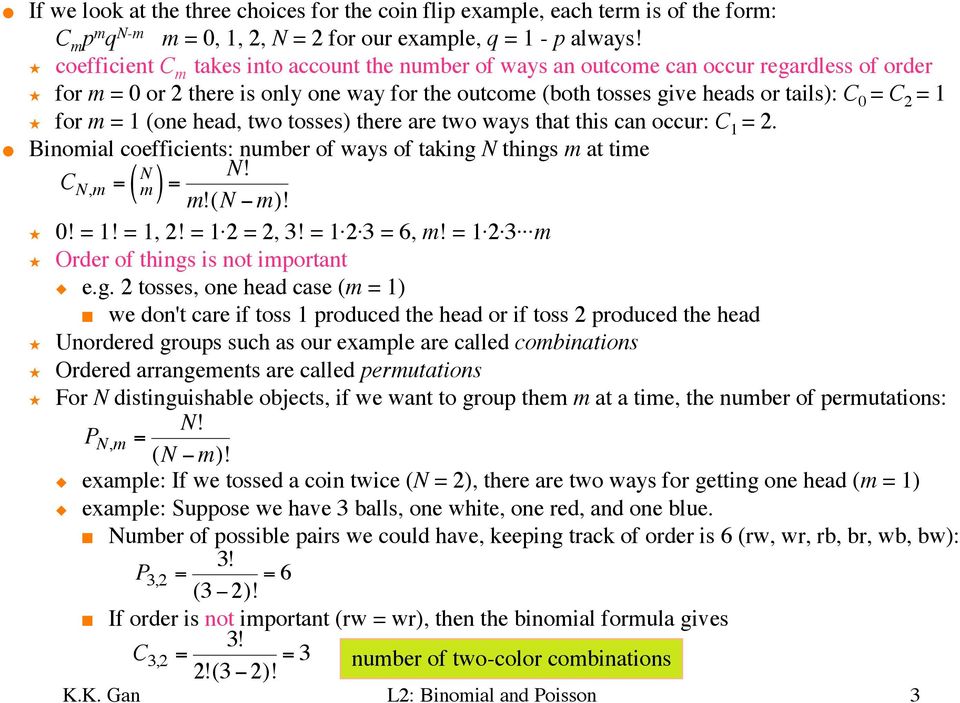
3 l If we look at the three choices for the coin flip example, each term is of the form: C m p m q -m m = 0, 1, 2, = 2 for our example, q = 1 - p always! H coefficient C m takes into account the number of ways an outcome can occur regardless of order H for m = 0 or 2 there is only one way for the outcome (both tosses give heads or tails): C 0 = C 2 = 1 H for m = 1 (one head, two tosses) there are two ways that this can occur: C 1 = 2. l Binomial coefficients: number of ways of taking things m at time C,m = m ( ) =! m!( - m)! H 0! = 1! = 1, 2! = 1 2 = 2, 3! = = 6, m! = m H Order of things is not important u e.g. 2 tosses, one head case (m = 1) n we don't care if toss 1 produced the head or if toss 2 produced the head H Unordered groups such as our example are called combinations H Ordered arrangements are called permutations H For distinguishable objects, if we want to group them m at a time, the number of permutations:! P,m = ( - m)! u example: If we tossed a coin twice ( = 2), there are two ways for getting one head (m = 1) u example: Suppose we have 3 balls, one white, one red, and one blue. n umber of possible pairs we could have, keeping track of order is 6 (rw, wr, rb, br, wb, bw): 3! P 3,2 = (3-2)! = 6 n If order is not important (rw = wr), then the binomial formula gives 3! C 3,2 = 2!(3-2)! = 3 number of two-color combinations K.K. Gan L2: Binomial and Poisson 3
4 l Binomial distribution: the probability of m success out of trials: P(m,, p) = C,m p m q -m = ( m ) pm q -m! = m!( - m)! pm q -m u p is probability of a success and q = 1 - p is probability of a failure u Consider a game where the player bats 4 times: H probability of 0/4 = (0.67) 4 = 20% H probability of 1/4 = [4!/(3!1!)](0.33) 1 (0.67) 3 = 40% H probability of 2/4 = [4!/(2!2!)](0.33) 2 (0.67) 2 = 29% H probability of 3/4 = [4!/(1!3!)](0.33) 3 (0.67) 1 = 10% H probability of 4/4 = [4!/(0!4!)](0.33) 4 (0.67) 0 = 1% H probability of getting at least one hit = 1 - P(0) = 0.8 P (k, 7, 1/3) Expectation Value m = np = 7 * 1/3 = P (k, 50, 1/3) Expectation Value m = np = 50 * 1/3 = k K.K. Gan L2: Binomial and Poisson k
 1 (0.67) 3 = 40% H probability of 2/4 = [4!/(2!2!)](0.33) 2 (0.67) 2 = 29% H probability of 3/4 = [4!/(1!3!)](0.33) 3 (0.67) 1 = 10% H probability of 4/4 = [4!/(0!4!)](0.33) 4 (0.](/docs-images/47/20833761/images/page_4.jpg "67) 0 = 1% H probability of getting at least one hit = 1 - P(0) = 0.8 P (k, 7, 1/3) 0.40 0.30 0.20 0.10 Expectation Value m = np = 7 * 1/3 = 2.333... P (k, 50, 1/3) 0.14 0.12 0.10 0.08 0.06 0.04 0.")
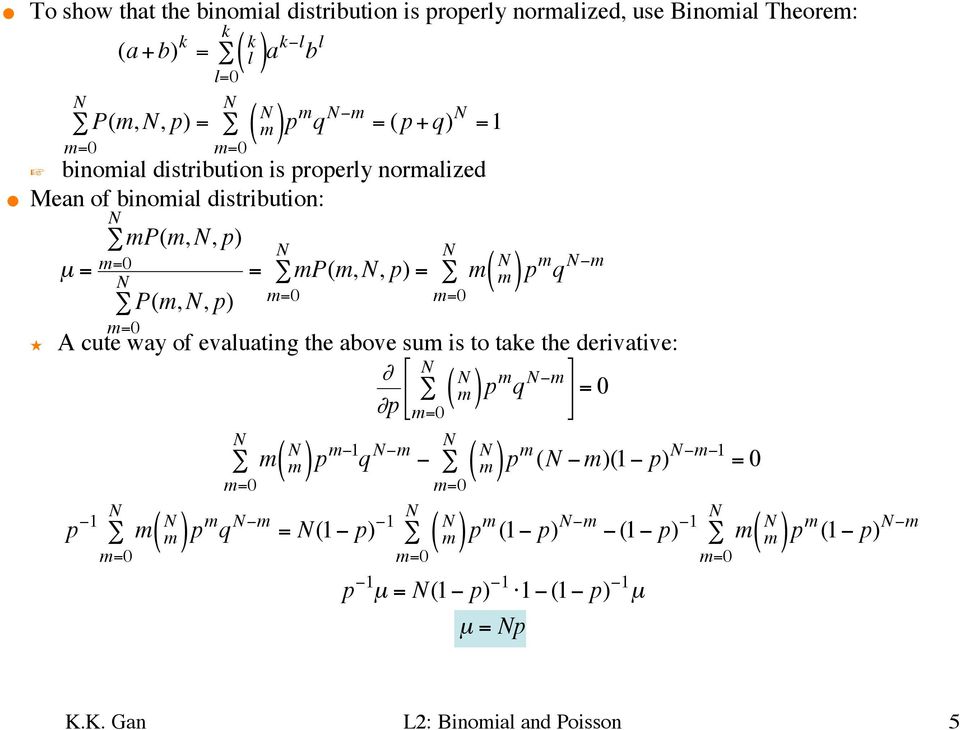
5 l To show that the binomial distribution is properly normalized, use Binomial Theorem: + binomial distribution is properly normalized l Mean of binomial distribution: m = ÂmP(m,, p) =  mp(m,, p) =  m m  P(m,, p) ( ) pm q -m H A cute way of evaluating the above sum is to take the derivative: È Â ( m ) p pm q -m Í Î = 0 p -1 m m k l=0( ) (a + b) k =  l k m m ( ) pm q -m a k-l b l  P(m,, p) =  m p m q -m = (p+ q) =1 ( ) ( ) pm-1 q -m ( ) pm ( - m)(1- p) -m-1  -  m = 0 ( ) pm (1- p) -m  = (1- p) -1  m - (1- p) -1  m m p -1 m = (1- p) (1- p) -1 m m = p ( ) pm (1- p) -m K.K. Gan L2: Binomial and Poisson 5
6 l Variance of binomial distribution (obtained using similar trick): s 2 = Â(m - m) 2 P(m,, p) = pq  P(m,, p) H Example: Suppose you observed m special events (success) in a sample of events u measured probability ( efficiency ) for a special event to occur: e = m u error on the probability ("error on the efficiency"): s e = s m = pq = e(1-e) = e(1-e) + sample () should be as large as possible to reduce uncertainty in the probability measurement H Example: Suppose a baseball player's batting average is 0.33 (1 for 3 on average). u Consider the case where the player either gets a hit or makes an out (forget about walks here!). probability for a hit: p = 0.33 probability for no hit : q = 1 - p = 0.67 u On average how many hits does the player get in 100 at bats? m = p = = 33 hits u What's the standard deviation for the number of hits in 100 at bats? s = (pq) 1/2 = ( ) 1/2 4.7 hits + we expect 33 ± 5 hits per 100 at bats K.K. Gan L2: Binomial and Poisson 6

7 Poisson Probability Distribution l A widely used discrete probability distribution l Consider the following conditions: H p is very small and approaches 0 u example: a 100 sided dice instead of a 6 sided dice, p = 1/100 instead of 1/6 u example: a 1000 sided dice, p = 1/1000 H is very large and approaches u example: throwing 100 or 1000 dice instead of 2 dice H product p is finite l Example: radioactive decay H Suppose we have 25 mg of an element + very large number of atoms: H Suppose the lifetime of this element l = years 5x10 19 seconds + probability of a given nucleus to decay in one second is very small: p = 1/l = 2x10-20 /sec + p = 2/sec finite! + number of counts in a time interval is a Poisson process l Poisson distribution can be derived by taking the appropriate limits of the binomial distribution! P(m,, p) = m!( - m)! pm q -m! ( -1) ( - m +1)( - m)! = = m ( - m)! ( - m)! q -m = (1- p) -m =1- p( - m)+ p2 ( - m)( - m -1) 2! + ª 1- p + (p)2 2! + ª e - p K.K. Gan L2: Binomial and Poisson 7

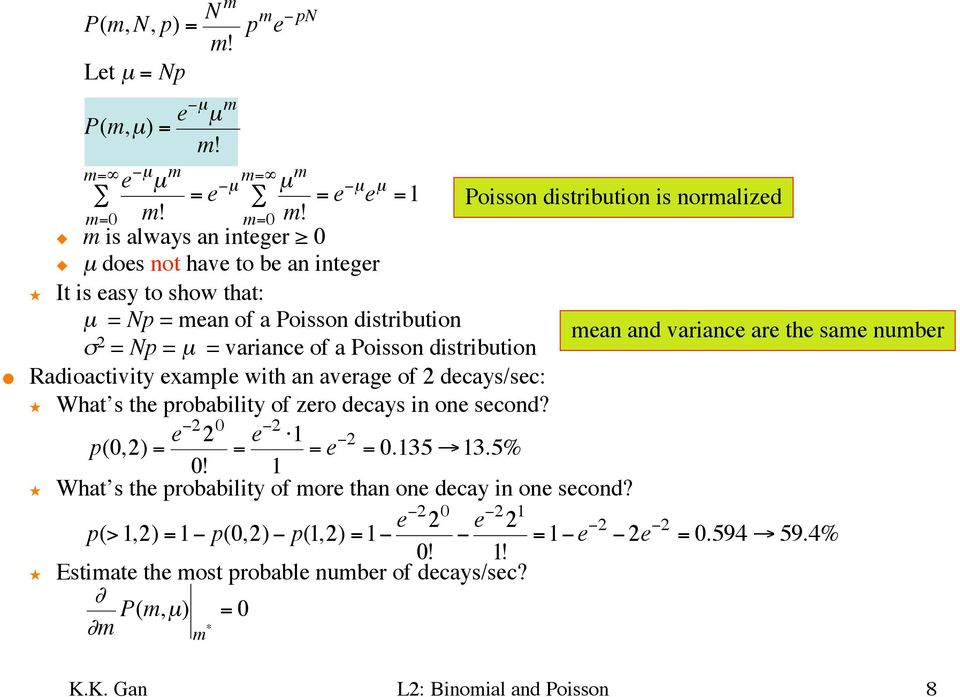
8 P(m,, p) = m Let m = p P(m,m) = e-m m m m! m! pm e - p m= e -m m m  = e -m m= m m  = e -m e m =1 m! m! u m is always an integer 0 Poisson distribution is normalized u m does not have to be an integer H It is easy to show that: m = p = mean of a Poisson distribution s 2 = p = m = variance of a Poisson distribution mean and variance are the same number l Radioactivity example with an average of 2 decays/sec: H What s the probability of zero decays in one second? p(0,2) = e = e-2 1 = e -2 = Æ13.5% 0! 1 H What s the probability of more than one decay in one second? p(> 1,2) =1- p(0,2) - p(1,2) =1- e e =1- e -2-2e -2 = Æ 59.4% 0! 1! H Estimate the most probable number of decays/sec? m P(m,m) = 0 m K.K. Gan L2: Binomial and Poisson 8
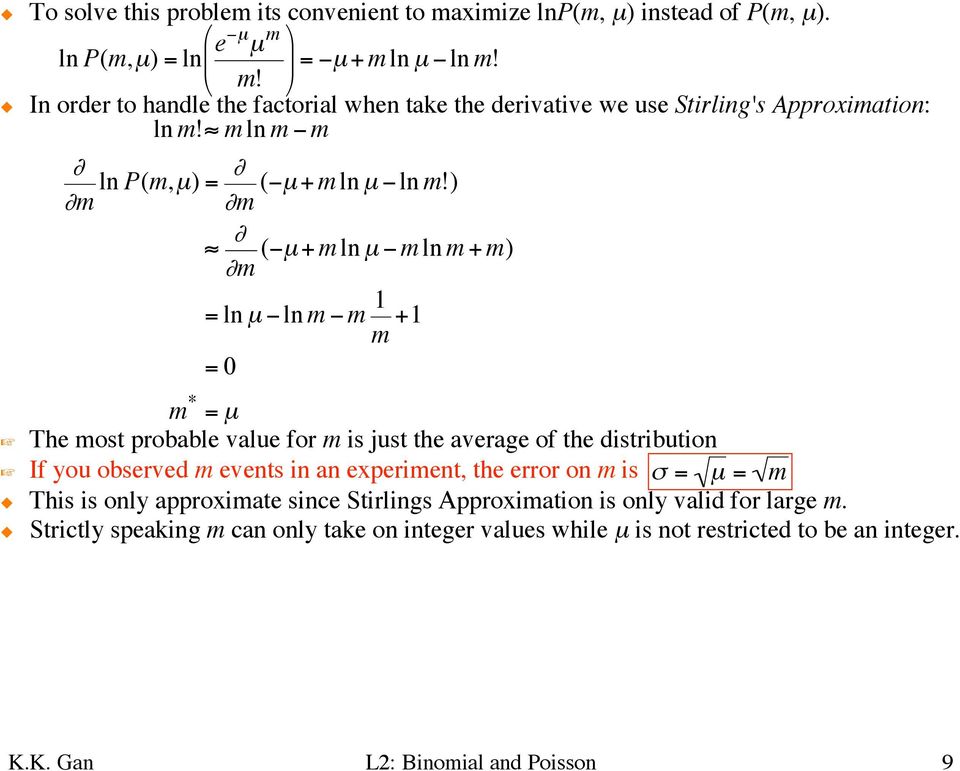
9 u To solve this problem its convenient to maximize lnp(m, m) instead of P(m, m). Ê ln P(m,m) = ln e-m m m ˆ Á = -m + m ln m - ln m! Ë m! u In order to handle the factorial when take the derivative we use Stirling's Approximation: ln m!ª m ln m - m ln P(m,m) = (-m + m ln m - ln m!) m m ª (-m + m ln m - m ln m + m) m = ln m - ln m - m 1 m +1 = 0 m * = m + The most probable value for m is just the average of the distribution + If you observed m events in an experiment, the error on m is s = m = m u This is only approximate since Stirlings Approximation is only valid for large m. u Strictly speaking m can only take on integer values while m is not restricted to be an integer. K.K. Gan L2: Binomial and Poisson 9
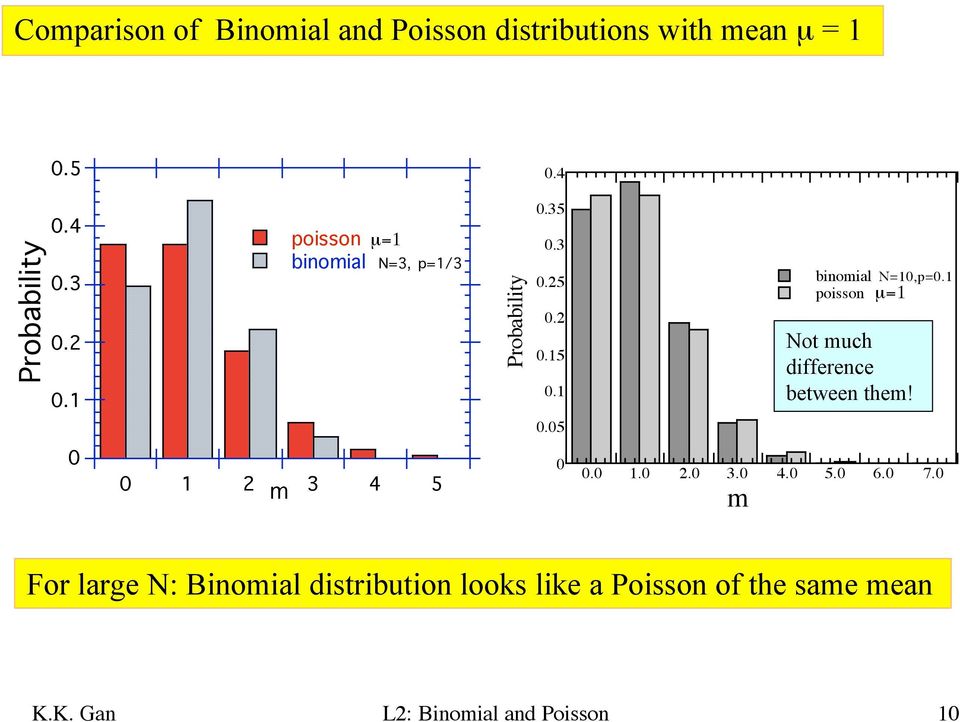
10 Comparison of Binomial and Poisson distributions with mean m = Probability poisson m=1 binomial =3, p=1/3 Probability binomial =10,p=0.1 poisson m=1 ot much difference between them! m m For large : Binomial distribution looks like a Poisson of the same mean K.K. Gan L2: Binomial and Poisson 10
Question: What is the probability that a five-card poker hand contains a flush, that is, five cards of the same suit?
 ECS20 Discrete Mathematics Quarter: Spring 2007 Instructor: John Steinberger Assistant: Sophie Engle (prepared by Sophie Engle) Homework 8 Hints Due Wednesday June 6 th 2007 Section 6.1 #16 What is the
Chapter 4 Lecture Notes
 Chapter 4 Lecture Notes Random Variables October 27, 2015 1 Section 4.1 Random Variables A random variable is typically a real-valued function defined on the sample space of some experiment. For instance,
WHERE DOES THE 10% CONDITION COME FROM?
 1 WHERE DOES THE 10% CONDITION COME FROM? The text has mentioned The 10% Condition (at least) twice so far: p. 407 Bernoulli trials must be independent. If that assumption is violated, it is still okay
FEGYVERNEKI SÁNDOR, PROBABILITY THEORY AND MATHEmATICAL
 FEGYVERNEKI SÁNDOR, PROBABILITY THEORY AND MATHEmATICAL STATIsTICs 4 IV. RANDOm VECTORs 1. JOINTLY DIsTRIBUTED RANDOm VARIABLEs If are two rom variables defined on the same sample space we define the joint
REPEATED TRIALS. The probability of winning those k chosen times and losing the other times is then p k q n k.
 REPEATED TRIALS Suppose you toss a fair coin one time. Let E be the event that the coin lands heads. We know from basic counting that p(e) = 1 since n(e) = 1 and 2 n(s) = 2. Now suppose we play a game
Binomial Sampling and the Binomial Distribution
 Binomial Sampling and the Binomial Distribution Characterized by two mutually exclusive events." Examples: GENERAL: {success or failure} {on or off} {head or tail} {zero or one} BIOLOGY: {dead or alive}
Discrete Mathematics and Probability Theory Fall 2009 Satish Rao, David Tse Note 13. Random Variables: Distribution and Expectation
 CS 70 Discrete Mathematics and Probability Theory Fall 2009 Satish Rao, David Tse Note 3 Random Variables: Distribution and Expectation Random Variables Question: The homeworks of 20 students are collected
Binomial Probability Distribution
 Binomial Probability Distribution In a binomial setting, we can compute probabilities of certain outcomes. This used to be done with tables, but with graphing calculator technology, these problems are
2 Binomial, Poisson, Normal Distribution
 2 Binomial, Poisson, Normal Distribution Binomial Distribution ): We are interested in the number of times an event A occurs in n independent trials. In each trial the event A has the same probability
ST 371 (IV): Discrete Random Variables
 ST 371 (IV): Discrete Random Variables 1 Random Variables A random variable (rv) is a function that is defined on the sample space of the experiment and that assigns a numerical variable to each possible
Probabilistic Strategies: Solutions
 Probability Victor Xu Probabilistic Strategies: Solutions Western PA ARML Practice April 3, 2016 1 Problems 1. You roll two 6-sided dice. What s the probability of rolling at least one 6? There is a 1
Homework 4 - KEY. Jeff Brenion. June 16, 2004. Note: Many problems can be solved in more than one way; we present only a single solution here.
 Homework 4 - KEY Jeff Brenion June 16, 2004 Note: Many problems can be solved in more than one way; we present only a single solution here. 1 Problem 2-1 Since there can be anywhere from 0 to 4 aces, the
Math 55: Discrete Mathematics
 Math 55: Discrete Mathematics UC Berkeley, Fall 2011 Homework # 7, due Wedneday, March 14 Happy Pi Day! (If any errors are spotted, please email them to morrison at math dot berkeley dot edu..5.10 A croissant
WEEK #23: Statistics for Spread; Binomial Distribution
 WEEK #23: Statistics for Spread; Binomial Distribution Goals: Study measures of central spread, such interquartile range, variance, and standard deviation. Introduce standard distributions, including the
Chapter 3: DISCRETE RANDOM VARIABLES AND PROBABILITY DISTRIBUTIONS. Part 3: Discrete Uniform Distribution Binomial Distribution
 Chapter 3: DISCRETE RANDOM VARIABLES AND PROBABILITY DISTRIBUTIONS Part 3: Discrete Uniform Distribution Binomial Distribution Sections 3-5, 3-6 Special discrete random variable distributions we will cover
2. Discrete random variables
 2. Discrete random variables Statistics and probability: 2-1 If the chance outcome of the experiment is a number, it is called a random variable. Discrete random variable: the possible outcomes can be
AMS 5 CHANCE VARIABILITY
 AMS 5 CHANCE VARIABILITY The Law of Averages When tossing a fair coin the chances of tails and heads are the same: 50% and 50%. So if the coin is tossed a large number of times, the number of heads and
E3: PROBABILITY AND STATISTICS lecture notes
 E3: PROBABILITY AND STATISTICS lecture notes 2 Contents 1 PROBABILITY THEORY 7 1.1 Experiments and random events............................ 7 1.2 Certain event. Impossible event............................
Sums of Independent Random Variables
 Chapter 7 Sums of Independent Random Variables 7.1 Sums of Discrete Random Variables In this chapter we turn to the important question of determining the distribution of a sum of independent random variables
4. Continuous Random Variables, the Pareto and Normal Distributions
 4. Continuous Random Variables, the Pareto and Normal Distributions A continuous random variable X can take any value in a given range (e.g. height, weight, age). The distribution of a continuous random
Probability. Sample space: all the possible outcomes of a probability experiment, i.e., the population of outcomes
 Probability Basic Concepts: Probability experiment: process that leads to welldefined results, called outcomes Outcome: result of a single trial of a probability experiment (a datum) Sample space: all
Hoover High School Math League. Counting and Probability
 Hoover High School Math League Counting and Probability Problems. At a sandwich shop there are 2 kinds of bread, 5 kinds of cold cuts, 3 kinds of cheese, and 2 kinds of dressing. How many different sandwiches
Lesson 1. Basics of Probability. Principles of Mathematics 12: Explained! www.math12.com 314
 Lesson 1 Basics of Probability www.math12.com 314 Sample Spaces: Probability Lesson 1 Part I: Basic Elements of Probability Consider the following situation: A six sided die is rolled The sample space
The Binomial Distribution
 The Binomial Distribution James H. Steiger November 10, 00 1 Topics for this Module 1. The Binomial Process. The Binomial Random Variable. The Binomial Distribution (a) Computing the Binomial pdf (b) Computing
Lecture 2: Discrete Distributions, Normal Distributions. Chapter 1
 Lecture 2: Discrete Distributions, Normal Distributions Chapter 1 Reminders Course website: www. stat.purdue.edu/~xuanyaoh/stat350 Office Hour: Mon 3:30-4:30, Wed 4-5 Bring a calculator, and copy Tables
AP Statistics 7!3! 6!
 Lesson 6-4 Introduction to Binomial Distributions Factorials 3!= Definition: n! = n( n 1)( n 2)...(3)(2)(1), n 0 Note: 0! = 1 (by definition) Ex. #1 Evaluate: a) 5! b) 3!(4!) c) 7!3! 6! d) 22! 21! 20!
Random variables, probability distributions, binomial random variable
 Week 4 lecture notes. WEEK 4 page 1 Random variables, probability distributions, binomial random variable Eample 1 : Consider the eperiment of flipping a fair coin three times. The number of tails that
MAS108 Probability I
 1 QUEEN MARY UNIVERSITY OF LONDON 2:30 pm, Thursday 3 May, 2007 Duration: 2 hours MAS108 Probability I Do not start reading the question paper until you are instructed to by the invigilators. The paper
Combinatorial Proofs
 Combinatorial Proofs Two Counting Principles Some proofs concerning finite sets involve counting the number of elements of the sets, so we will look at the basics of counting. Addition Principle: If A
MA 1125 Lecture 14 - Expected Values. Friday, February 28, 2014. Objectives: Introduce expected values.
 MA 5 Lecture 4 - Expected Values Friday, February 2, 24. Objectives: Introduce expected values.. Means, Variances, and Standard Deviations of Probability Distributions Two classes ago, we computed the
IEOR 6711: Stochastic Models I Fall 2012, Professor Whitt, Tuesday, September 11 Normal Approximations and the Central Limit Theorem
 IEOR 6711: Stochastic Models I Fall 2012, Professor Whitt, Tuesday, September 11 Normal Approximations and the Central Limit Theorem Time on my hands: Coin tosses. Problem Formulation: Suppose that I have
Chapter 5. Discrete Probability Distributions
 Chapter 5. Discrete Probability Distributions Chapter Problem: Did Mendel s result from plant hybridization experiments contradicts his theory? 1. Mendel s theory says that when there are two inheritable
4.1 4.2 Probability Distribution for Discrete Random Variables
 4.1 4.2 Probability Distribution for Discrete Random Variables Key concepts: discrete random variable, probability distribution, expected value, variance, and standard deviation of a discrete random variable.
Lecture Note 1 Set and Probability Theory. MIT 14.30 Spring 2006 Herman Bennett
 Lecture Note 1 Set and Probability Theory MIT 14.30 Spring 2006 Herman Bennett 1 Set Theory 1.1 Definitions and Theorems 1. Experiment: any action or process whose outcome is subject to uncertainty. 2.
Probability, statistics and football Franka Miriam Bru ckler Paris, 2015.
 Probability, statistics and football Franka Miriam Bru ckler Paris, 2015 Please read this before starting! Although each activity can be performed by one person only, it is suggested that you work in groups
Binomial random variables
 Binomial and Poisson Random Variables Solutions STAT-UB.0103 Statistics for Business Control and Regression Models Binomial random variables 1. A certain coin has a 5% of landing heads, and a 75% chance
Lecture 1 Introduction Properties of Probability Methods of Enumeration Asrat Temesgen Stockholm University
 Lecture 1 Introduction Properties of Probability Methods of Enumeration Asrat Temesgen Stockholm University 1 Chapter 1 Probability 1.1 Basic Concepts In the study of statistics, we consider experiments
Remarks on the Concept of Probability
 5. Probability A. Introduction B. Basic Concepts C. Permutations and Combinations D. Poisson Distribution E. Multinomial Distribution F. Hypergeometric Distribution G. Base Rates H. Exercises Probability
Lecture 5 : The Poisson Distribution
 Lecture 5 : The Poisson Distribution Jonathan Marchini November 10, 2008 1 Introduction Many experimental situations occur in which we observe the counts of events within a set unit of time, area, volume,
DETERMINE whether the conditions for a binomial setting are met. COMPUTE and INTERPRET probabilities involving binomial random variables
 1 Section 7.B Learning Objectives After this section, you should be able to DETERMINE whether the conditions for a binomial setting are met COMPUTE and INTERPRET probabilities involving binomial random
People have thought about, and defined, probability in different ways. important to note the consequences of the definition:
 PROBABILITY AND LIKELIHOOD, A BRIEF INTRODUCTION IN SUPPORT OF A COURSE ON MOLECULAR EVOLUTION (BIOL 3046) Probability The subject of PROBABILITY is a branch of mathematics dedicated to building models
Discrete mathematics
 Discrete mathematics Petr Kovář [email protected] VŠB Technical University of Ostrava DiM 470-2301/01, Winter term 2015/2016 About this file This file is meant to be a guideline for the lecturer. Many
Probability: Terminology and Examples Class 2, 18.05, Spring 2014 Jeremy Orloff and Jonathan Bloom
 Probability: Terminology and Examples Class 2, 18.05, Spring 2014 Jeremy Orloff and Jonathan Bloom 1 Learning Goals 1. Know the definitions of sample space, event and probability function. 2. Be able to
Betting systems: how not to lose your money gambling
 Betting systems: how not to lose your money gambling G. Berkolaiko Department of Mathematics Texas A&M University 28 April 2007 / Mini Fair, Math Awareness Month 2007 Gambling and Games of Chance Simple
Math 3C Homework 3 Solutions
 Math 3C Homework 3 s Ilhwan Jo and Akemi Kashiwada [email protected], [email protected] Assignment: Section 2.3 Problems 2, 7, 8, 9,, 3, 5, 8, 2, 22, 29, 3, 32 2. You draw three cards from a standard
For a partition B 1,..., B n, where B i B j = for i. A = (A B 1 ) (A B 2 ),..., (A B n ) and thus. P (A) = P (A B i ) = P (A B i )P (B i )
 Probability Review 15.075 Cynthia Rudin A probability space, defined by Kolmogorov (1903-1987) consists of: A set of outcomes S, e.g., for the roll of a die, S = {1, 2, 3, 4, 5, 6}, 1 1 2 1 6 for the roll
Section 6-5 Sample Spaces and Probability
 492 6 SEQUENCES, SERIES, AND PROBABILITY 52. How many committees of 4 people are possible from a group of 9 people if (A) There are no restrictions? (B) Both Juan and Mary must be on the committee? (C)
Random variables P(X = 3) = P(X = 3) = 1 8, P(X = 1) = P(X = 1) = 3 8.
 Random variables Remark on Notations 1. When X is a number chosen uniformly from a data set, What I call P(X = k) is called Freq[k, X] in the courseware. 2. When X is a random variable, what I call F ()
MATH 140 Lab 4: Probability and the Standard Normal Distribution
 MATH 140 Lab 4: Probability and the Standard Normal Distribution Problem 1. Flipping a Coin Problem In this problem, we want to simualte the process of flipping a fair coin 1000 times. Note that the outcomes
6 PROBABILITY GENERATING FUNCTIONS
 6 PROBABILITY GENERATING FUNCTIONS Certain derivations presented in this course have been somewhat heavy on algebra. For example, determining the expectation of the Binomial distribution (page 5.1 turned
Section 5 Part 2. Probability Distributions for Discrete Random Variables
 Section 5 Part 2 Probability Distributions for Discrete Random Variables Review and Overview So far we ve covered the following probability and probability distribution topics Probability rules Probability
PROBABILITY AND SAMPLING DISTRIBUTIONS
 PROBABILITY AND SAMPLING DISTRIBUTIONS SEEMA JAGGI AND P.K. BATRA Indian Agricultural Statistics Research Institute Library Avenue, New Delhi - 0 0 [email protected]. Introduction The concept of probability
Binomial random variables (Review)
 Poisson / Empirical Rule Approximations / Hypergeometric Solutions STAT-UB.3 Statistics for Business Control and Regression Models Binomial random variables (Review. Suppose that you are rolling a die
STAT 315: HOW TO CHOOSE A DISTRIBUTION FOR A RANDOM VARIABLE
 STAT 315: HOW TO CHOOSE A DISTRIBUTION FOR A RANDOM VARIABLE TROY BUTLER 1. Random variables and distributions We are often presented with descriptions of problems involving some level of uncertainty about
 ÓÒØÖÓÐ ËÝ Ø Ñ Ò Ò Ö Ò ÖÓÙÔ Ò ÙØÓÑ Ø ÓÒ Ì ÒÓÐÓ Ý ÖÓÙÔ Ö¹ÁÒ Ò Ö ÂÓ Ñ ÔÙØݵ Ø ØÖ ½ ¼ ¼ À Ò È ÓÒ ¼¾ ½¹ ¹½½¼¼ Ü ¼¾ ½¹ ¹ ¹Å Ð Ò Ö Ó Ñ ÖÒÙÒ ¹ Ò Ñ Ø «È ÓÒ ÓÒØÖÓÐ ËÝ Ø Ñ Ò Ò Ö Ò ÖÓÙÔ ÔйÁÒ Ò Ö Ó«Ö¹ÁÒ ÍÐÖ ÓÖ ÓÐØ
Section 6.2 Definition of Probability
 Section 6.2 Definition of Probability Probability is a measure of the likelihood that an event occurs. For example, if there is a 20% chance of rain tomorrow, that means that the probability that it will
Lecture 7: Continuous Random Variables
 Lecture 7: Continuous Random Variables 21 September 2005 1 Our First Continuous Random Variable The back of the lecture hall is roughly 10 meters across. Suppose it were exactly 10 meters, and consider
CHAPTER 7 SECTION 5: RANDOM VARIABLES AND DISCRETE PROBABILITY DISTRIBUTIONS
 CHAPTER 7 SECTION 5: RANDOM VARIABLES AND DISCRETE PROBABILITY DISTRIBUTIONS TRUE/FALSE 235. The Poisson probability distribution is a continuous probability distribution. F 236. In a Poisson distribution,
CA200 Quantitative Analysis for Business Decisions. File name: CA200_Section_04A_StatisticsIntroduction
 CA200 Quantitative Analysis for Business Decisions File name: CA200_Section_04A_StatisticsIntroduction Table of Contents 4. Introduction to Statistics... 1 4.1 Overview... 3 4.2 Discrete or continuous
Lesson Plans for (9 th Grade Main Lesson) Possibility & Probability (including Permutations and Combinations)
 Lesson Plans for (9 th Grade Main Lesson) Possibility & Probability (including Permutations and Combinations) Note: At my school, there is only room for one math main lesson block in ninth grade. Therefore,
Session 8 Probability
 Key Terms for This Session Session 8 Probability Previously Introduced frequency New in This Session binomial experiment binomial probability model experimental probability mathematical probability outcome
Math 425 (Fall 08) Solutions Midterm 2 November 6, 2008
 Math 425 (Fall 8) Solutions Midterm 2 November 6, 28 (5 pts) Compute E[X] and Var[X] for i) X a random variable that takes the values, 2, 3 with probabilities.2,.5,.3; ii) X a random variable with the
Section 6.1 Discrete Random variables Probability Distribution
 Section 6.1 Discrete Random variables Probability Distribution Definitions a) Random variable is a variable whose values are determined by chance. b) Discrete Probability distribution consists of the values
Discrete Math in Computer Science Homework 7 Solutions (Max Points: 80)
 Discrete Math in Computer Science Homework 7 Solutions (Max Points: 80) CS 30, Winter 2016 by Prasad Jayanti 1. (10 points) Here is the famous Monty Hall Puzzle. Suppose you are on a game show, and you
Law of Large Numbers. Alexandra Barbato and Craig O Connell. Honors 391A Mathematical Gems Jenia Tevelev
 Law of Large Numbers Alexandra Barbato and Craig O Connell Honors 391A Mathematical Gems Jenia Tevelev Jacob Bernoulli Life of Jacob Bernoulli Born into a family of important citizens in Basel, Switzerland
Sample Questions for Mastery #5
 Name: Class: Date: Sample Questions for Mastery #5 Multiple Choice Identify the choice that best completes the statement or answers the question.. For which of the following binomial experiments could
Chapter 6. 1. What is the probability that a card chosen from an ordinary deck of 52 cards is an ace? Ans: 4/52.
 Chapter 6 1. What is the probability that a card chosen from an ordinary deck of 52 cards is an ace? 4/52. 2. What is the probability that a randomly selected integer chosen from the first 100 positive
The Math. P (x) = 5! = 1 2 3 4 5 = 120.
 The Math Suppose there are n experiments, and the probability that someone gets the right answer on any given experiment is p. So in the first example above, n = 5 and p = 0.2. Let X be the number of correct
Chicago Booth BUSINESS STATISTICS 41000 Final Exam Fall 2011
 Chicago Booth BUSINESS STATISTICS 41000 Final Exam Fall 2011 Name: Section: I pledge my honor that I have not violated the Honor Code Signature: This exam has 34 pages. You have 3 hours to complete this
 Ø Ö ØÒ ÓÑÔ Ð Â Ú ÈÖÓ º ÓÒÒ Ø ÔÖÓÚ º Ø Þº µ ÔÖ Ð ¾ ¾¼¼½ ØÖ Ø ÓÖ ÕÙ Ø ÓÑ Ø Ñ ÒÓÛ Ñ Ö Ó Â Ú Î ÖØÙ Ð Å Ò ÂÎÅ µ ÓÒ Â٠عÁÒ¹Ì Ñ ÂÁ̵ Ò ¹Ç ¹Ì Ñ Ç̵ ÓÑÔ Ð Ö Û Ø Óҹع Ý ÓÔØ Ñ Þ Ø ÓÒ Ú Ò ÙÒØ Ò Ø Ö ÈÖÓ ÙØ ÖÙÒÒ Ò
Probability: The Study of Randomness Randomness and Probability Models. IPS Chapters 4 Sections 4.1 4.2
 Probability: The Study of Randomness Randomness and Probability Models IPS Chapters 4 Sections 4.1 4.2 Chapter 4 Overview Key Concepts Random Experiment/Process Sample Space Events Probability Models Probability
Math 431 An Introduction to Probability. Final Exam Solutions
 Math 43 An Introduction to Probability Final Eam Solutions. A continuous random variable X has cdf a for 0, F () = for 0 <
Expected Value and the Game of Craps
 Expected Value and the Game of Craps Blake Thornton Craps is a gambling game found in most casinos based on rolling two six sided dice. Most players who walk into a casino and try to play craps for the
Expected Value and Variance
 Chapter 6 Expected Value and Variance 6.1 Expected Value of Discrete Random Variables When a large collection of numbers is assembled, as in a census, we are usually interested not in the individual numbers,
Lecture 10: Depicting Sampling Distributions of a Sample Proportion
 Lecture 10: Depicting Sampling Distributions of a Sample Proportion Chapter 5: Probability and Sampling Distributions 2/10/12 Lecture 10 1 Sample Proportion 1 is assigned to population members having a
Ch. 13.3: More about Probability
 Ch. 13.3: More about Probability Complementary Probabilities Given any event, E, of some sample space, U, of a random experiment, we can always talk about the complement, E, of that event: this is the
Feb 7 Homework Solutions Math 151, Winter 2012. Chapter 4 Problems (pages 172-179)
 Feb 7 Homework Solutions Math 151, Winter 2012 Chapter Problems (pages 172-179) Problem 3 Three dice are rolled. By assuming that each of the 6 3 216 possible outcomes is equally likely, find the probabilities
Normal Distribution as an Approximation to the Binomial Distribution
 Chapter 1 Student Lecture Notes 1-1 Normal Distribution as an Approximation to the Binomial Distribution : Goals ONE TWO THREE 2 Review Binomial Probability Distribution applies to a discrete random variable
SCHOOL OF ENGINEERING & BUILT ENVIRONMENT. Mathematics
 SCHOOL OF ENGINEERING & BUILT ENVIRONMENT Mathematics Probability and Probability Distributions 1. Introduction 2. Probability 3. Basic rules of probability 4. Complementary events 5. Addition Law for
36 Odds, Expected Value, and Conditional Probability
 36 Odds, Expected Value, and Conditional Probability What s the difference between probabilities and odds? To answer this question, let s consider a game that involves rolling a die. If one gets the face
 Ì ÍÆÁÎ ÊËÁÌ ÌÁË ÆÁ ˵ Ë Öº Ð º Ò Ö º ÚÓк ½ ÆÓº ½ ÔÖ Ð ¾¼¼¾ ½ ¹ ½ ÐÓ Ò Ò ÅÙÐØ ¹ ÀÞ ÒÚ ÖÓÒÑ ÒØ ÎÓ Ò º Ç ÐÓ Þ ÁÒÚ Ø È Ô Ö ØÖ Ø Ò ÓÚ ÖÚ Û Ó ÐÓ Ò Ò Ò Ó ÐÓ ØÓÖ Ð Ñ ÒØ ÔÖ ÒØ º ËÝ Ø Ñ Ø Ò Ó Ô¹ ÓÔ ÜÔÐ Ò Û ÐÐ Ø
Lecture 3 Gaussian Probability Distribution
 Lecture 3 Gussin Probbility Distribution Introduction l Gussin probbility distribution is perhps the most used distribution in ll of science. u lso clled bell shped curve or norml distribution l Unlike
Thursday, October 18, 2001 Page: 1 STAT 305. Solutions
 Thursday, October 18, 2001 Page: 1 1. Page 226 numbers 2 3. STAT 305 Solutions S has eight states Notice that the first two letters in state n +1 must match the last two letters in state n because they
Practice problems for Homework 11 - Point Estimation
 Practice problems for Homework 11 - Point Estimation 1. (10 marks) Suppose we want to select a random sample of size 5 from the current CS 3341 students. Which of the following strategies is the best:
Ch5: Discrete Probability Distributions Section 5-1: Probability Distribution
 Recall: Ch5: Discrete Probability Distributions Section 5-1: Probability Distribution A variable is a characteristic or attribute that can assume different values. o Various letters of the alphabet (e.g.
Universitat Autònoma de Barcelona
 Universitat Autònoma de Barcelona ÙÐØ Ø Ò Ë Ó ³ Ò ÒÝ Ö ÁÒ ÓÖÑ Ø ÇÒ Ø Ò Ò ÓÒ ØÖÙØ ÓÒ Ó ÒØ¹Ñ Ø ÁÒ Ø ØÙØ ÓÒ Å Ñ ÓÖ ÔÖ ÒØ Ô Ö Ò ÂÙ Ò ÒØÓÒ Ó ÊÓ Ö Ù Þ Ù Ð Ö Ô Ö ÓÔØ Ö Ð Ö Ù ÓØÓÖ Ò ÒÝ Ö Ò ÁÒ ÓÖÑ Ø ÐÐ Ø ÖÖ Å ¾¼¼½
A Simple Pseudo Random Number algorithm
 Lecture 7 Generating random numbers is a useful technique in many numerical applications in Physics. This is because many phenomena in physics are random, and algorithms that use random numbers have applications
Definition: Suppose that two random variables, either continuous or discrete, X and Y have joint density
 HW MATH 461/561 Lecture Notes 15 1 Definition: Suppose that two random variables, either continuous or discrete, X and Y have joint density and marginal densities f(x, y), (x, y) Λ X,Y f X (x), x Λ X,
Math 202-0 Quizzes Winter 2009
 Quiz : Basic Probability Ten Scrabble tiles are placed in a bag Four of the tiles have the letter printed on them, and there are two tiles each with the letters B, C and D on them (a) Suppose one tile
 Ê ÔÓÒ Ú Ì ÒÛ Ö Î Ù Ð Þ Ø ÓÒ Ó Ä Ö Ó Ö Ô Ø Ø Ý Ã ÒÒ Ø Ò ÖØ Ø ÓÒ Ù Ñ ØØ Ò Ô ÖØ Ð ÙÐ ÐÐÑ ÒØ Ó Ø Ö ÕÙ Ö Ñ ÒØ ÓÖ Ø Ö Ó ÓØÓÖ Ó È ÐÓ ÓÔ Ý Ô ÖØÑ ÒØ Ó ÓÑÔÙØ Ö Ë Ò Æ Û ÓÖ ÍÒ Ú Ö ØÝ Ë ÔØ Ñ Ö ¾¼¼¾ ÔÔÖÓÚ Ô Ã ÒÒ Ø Ò
13.0 Central Limit Theorem
 13.0 Central Limit Theorem Discuss Midterm/Answer Questions Box Models Expected Value and Standard Error Central Limit Theorem 1 13.1 Box Models A Box Model describes a process in terms of making repeated
Question of the Day. Key Concepts. Vocabulary. Mathematical Ideas. QuestionofDay
 QuestionofDay Question of the Day What is the probability that in a family with two children, both are boys? What is the probability that in a family with two children, both are boys, if we already know
Probability and Statistics Vocabulary List (Definitions for Middle School Teachers)
 Probability and Statistics Vocabulary List (Definitions for Middle School Teachers) B Bar graph a diagram representing the frequency distribution for nominal or discrete data. It consists of a sequence
1 Combinations, Permutations, and Elementary Probability
 1 Combinations, Permutations, and Elementary Probability Roughly speaking, Permutations are ways of grouping things where the order is important. Combinations are ways of grouping things where the order
6. Let X be a binomial random variable with distribution B(10, 0.6). What is the probability that X equals 8? A) (0.6) (0.4) B) 8! C) 45(0.6) (0.
 Name: Date:. For each of the following scenarios, determine the appropriate distribution for the random variable X. A) A fair die is rolled seven times. Let X = the number of times we see an even number.
 Ò Ñ Ö Ð ÓÙÒ Ø ÓÒ ÓÖ ÙØÓÑ Ø Ï ÁÒØ Ö Ú ÐÙ Ø ÓÒ Ý Å ÐÓ Ý Ú ØØ ÁÚÓÖÝ ºËº ÈÙÖ Ù ÍÒ Ú Ö Øݵ ½ ź˺ ÍÒ Ú Ö ØÝ Ó Ð ÓÖÒ Ø Ö Ð Ýµ ½ ÖØ Ø ÓÒ Ù Ñ ØØ Ò ÖØ Ð Ø Ø ÓÒ Ó Ø Ö ÕÙ Ö Ñ ÒØ ÓÖ Ø Ö Ó ÓØÓÖ Ó È ÐÓ Ó Ý Ò ÓÑÙØ Ö
Contemporary Mathematics Online Math 1030 Sample Exam I Chapters 12-14 No Time Limit No Scratch Paper Calculator Allowed: Scientific
 Contemporary Mathematics Online Math 1030 Sample Exam I Chapters 12-14 No Time Limit No Scratch Paper Calculator Allowed: Scientific Name: The point value of each problem is in the left-hand margin. You
Chapter 16: law of averages
 Chapter 16: law of averages Context................................................................... 2 Law of averages 3 Coin tossing experiment......................................................