
Perspectives of the Human Experience
|
|
|
- Godwin Stanley
- 9 years ago
- Views:
Transcription
1 Title: Perspectives of the Human Experience: Integrating ancient medical disciplines Authors: Zachary Allen, N.D. Helfgott Research Institute National College of Natural Medicine Portland, OR Laurie Menk-Otto, N.D. Postdoctoral Research Fellow University of Arizona Tucson, Arizona Heather Zwickey, Ph.D. Helfgott Research Institute National College of Natural Medicine Portland, OR Corresponding Author: Zachary Allen, N.D. Helfgott Research Institute National College of Natural Medicine Portland, OR Tel: Fax: Keywords: psychoneuroimmunology, personality and health, naturopathic medicine, Chinese medicine, elemental medicine, ayurveda, Greek humors, temperaments, enneagram, ancient medical disciplines

2 Personality and Health The consideration of personality and emotional states in diagnosing, understanding and treating patients has fallen out of favor in today s high tech medical environment. Personality is the pattern of collective character, behavioral, temperamental, emotional, and mental traits of a person (answers.com, 2009). As evidenced by the clinical experience of a good homeopath, and by the disciplines analyzed, personality contributes to health and disease. The western model of the mind-body connection has been explored in recent years through a scientific investigation called psychoneuroimmunology (PNI). This field of research studies the correlation between physiological changes and mental processes. In this manner, our state of mind creates our experience of health and disease, and our quality and degree of health or disease influences our state of mind. This article explores the connection of mind, body and health in a format that can be used as a practice manual for the clinical application of PNI, enriched with a worldly and interdisciplinary perspective. An individual who is high strung, authoritative, always busy, with a strong drive to succeed might be labeled Type A in popular culture, which suggests risk for heart attack. As it turns out, this person would probably have a lot of fire element in his or her constitution and would be at high risk for pathology of the organs related to fire in Chinese medicine. Clinically, this would present as signs and symptoms in the endocrine and cardiovascular systems. This patient would likely fall into the category of the pitta dosha in Ayurveda, the choleric temperament in Greek medicine and the challenger, number eight in the Enneagram system. While modern day naturopathic doctors may subconsciously take a patient s disposition into account, the direct assessment of personality may aid diagnosis and treatment. Naturopathic doctors who develop an understanding of the three Ayurvedic doshas, the Chinese five elements, the four Greek temperaments and the nine personalities of the Enneagram will gain insight into the processes that underlie the true condition of the patient. This analysis sheds light on how each of these ancient systems considers the role of personality in health and discusses their shared origins, insights and relevance to contemporary natural medicine. Ayurveda Ayurveda is a 5000 year-old system of natural healing that has its origins in the Vedic culture of India. A Sanskrit word meaning the science or knowledge (veda) of life (ayu), Ayurveda, like naturopathic medicine, is a holistic, whole-body system of healing. Tibetan medicine and traditional Chinese medicine both have their roots in Ayurveda. Early Greek medicine also embraced many concepts originally described in the classical Ayurvedic medical texts dating back thousands of years (Chopra, 2009). Ayurveda considers that the universe is made up of combinations of the five elements (pancha mahabhutas). These are akasha (ether or space), vayu (air), teja (fire), aapa (water) and prithvi (earth). The five elements can be seen to exist in the material universe at all scales of life and in both organic and inorganic things. In biological 2 of 16

3 systems, such as human beings, elements are coded into three forces, which govern all life processes. These three forces (kapha, pitta and vata) are known as prakriti, the three doshas or simply the tridosha. Each of the doshas is composed of one or two elements. Vata is composed of space and air, pitta of fire, and kapha of water and earth. Vata dosha has the mobility and quickness of space and air; pitta dosha the metabolic qualities of fire; kapha dosha the fluidity and stability of water and earth. Vata s worries and insecurities stand out by comparison against the canvas of kapha s stoic endurance and pitta s dramatic activities (Tiwari, 1995). In the human body, Vata is responsible for respiration and control of movement. Pitta is responsible for maintenance of body heat and Kapha is responsible for maintenance of body form and structure (Sundar, 2008). The tridosha regulates every physiological and psychological process in the living organism. The interplay among them determines the qualities and conditions of the individual. A harmonious state of the three doshas creates balance and health; an imbalance, which might be an excess (vriddhi) or deficiency (kshaya), manifests as a sign or symptom of disease (Patwardhan, et al, 2005). Conventional western science refers to this balance as homeostasis, naturopathic medicine calls it the vis and the equivalent in Chinese medicine is the flow of qi between yin and yang. Although everyone possesses some characteristics of all three doshas, each person is born with a primary dosha that is most influential in his or her life. The amount of each dosha that we possess in relation to the others then creates our complete personality (Freed, 2001). The key to optimal health in the Ayurvedic system is to balance the three doshas. When the doshas are in harmony, the body and emotions function normally. General eating tips for a life of balance include eating slowly, in a peaceful environment, when relaxed, only when hungry, finishing when your stomach is still partially empty, and avoiding cold drinks (Freed, 2001). The focus of Ayurveda is on healthful lifestyle habits, so there is a natural focus on the diet and exercise that is appropriate for each dosha. Ayurveda describes each type from both a balanced and imbalanced point of view, as characteristics of the other types may emerge when one is stressed. Using this system, naturopathic doctors can better provide customized lifestyle counseling to their patients. 3 of 16

4 Elemental Medicine Several holistic healing systems use a simple system of two, three, four, or five elements, qualities or humors to form the basis of diagnosis and treatment in traditional holistic medicine. Chinese medicine uses the yin/yang system and the 5-elements although this term is actually a misnomer, from a classical perspective. Ayurvedic medicine uses the three doshas and the five elements. Greek medicine uses the four elements, qualities, humors, and temperaments, while American Indian medicine acknowledges four to seven directions (Rolfe, 2002; Wood, 2004). Many ancient philosophies used a set of archetypal classical "elements" to explain patterns in nature. The word "element" in this context either refers to a state of matter (e.g. solid/earth, liquid/water, gas/air, plasma/warmth) or a type of energy or force (as in the Chinese five phases), rather than the chemical elements of modern science. The Greek classical elements include earth, water, air, fire, and aether or idea. They date from pre-socratic times and persisted throughout the Middle Ages and into the Renaissance, deeply influencing European thought and culture (Rolfe, 2002). The Hindu and Japanese also had essentially the same five elements: the four states-of-matter, plus a fifth element to describe that which was beyond the material world (non-matter). The concept is far older in Asia, and was widely disseminated in India and China, where it forms the basis of both Buddhism and Hinduism, particularly in an esoteric context. The modern scientific states-of-matter, and, to a lesser extent, also the periodic table of the elements and the concept of combustion (fire) can be considered successors to such early models. The Chinese had a different series of elements than the scientific and periodic sort, namely fire, earth, water, metal and wood. These were understood as different types of energy in a state of constant interaction and flux with one another. A comparison between the Chinese and Greek systems reveals that Chinese wood correlates to Greek air and Greek earth includes Chinese metal (Arikha, 2007). In Buddhism, the four great elements, to which two others are sometimes added, are not viewed as substances, but as categories of sensory experience, which can be assessed by the feelings invoked when observing and interacting with the patient. The Greeks may have been referring to the 4 of 16

5 same sensory experience of the elements, as this term is just a conceptual abstraction. What comes first is the experience of the element, and then one connects it with a concept (Kalnins, 2009). The term 5-elements is actually a mistranslation, which poses a limitation to comparisons between Chinese medicine and elemental theory (Kalnins, 2009). According to Classical Chinese texts, the term is wu xing, which translates roughly as 5-movements or 5-phases or even 5-rhythms. Thus, on a profound level, they are quite distinct from the Greek and Islamic 4-elements. However, meaningful correlations between the systems still exist, despite this conceptual discrepancy. Chinese Medicine Classical Chinese Medicine considers the human at the center of the universe as an antenna between celestial and earthly phases. Water, earth, metal, wood and fire are the five phases of the material world. Each refers to a specific process, rotation, revolution or movement that operates within the network of organ meridians. This creates a chronobiological rhythm that transforms with time, both within the human body (microcosm) and in the greater external environment (macrocosm). For this reason, attuning one s body and consciousness to the cycles of the external environment facilitates personal cultivation and an understanding of internal processes. Likewise, internal development attracts us to positive and appropriate situations and opportunities for growth, due to this parallel between microcosm and macrocosm. As naturopathic doctors, we have the opportunity to improve our patient s outlook on life, by intervening from a perspective that honors the power of nature, and treats the whole person. It is the spontaneous generative force of life that fuels the ascension of qi from water up to fire along the sheng cycle as the seasons change from the winter to the summer solstice. Externally, this process may be viewed as ascension of being, as the ten thousand things manifest in the world. However, on an internal level this rise may symbolize the fall from original nature as we move away from the dao, which is the true source of self as symbolized by the water element and winter. The season associated with the metal element is termed the fall in English. On an external level, it is a fall from the height of life back into the void and barrenness of winter. On an inner level, however, this may be seen not as a fall, but a return to origin in a more highly evolved state (Jarrett, 2004). The rhythm of metal in Chinese medicine is like the breath cycle (lung) of the seasons. Each meridian tells a mythological story of progression. Lung governs the rhythm of time, planning and punctuality. The first month of the agricultural year is February, when the wind blows, and the lung predominates, from the perspective of Chinese cosmology (Fruehauf, 2009). Each of the twelve organ meridians is assigned a month, and February belongs to the lung. When wind blows, rain follows. Important for the fertility of spring, the lung also provides the upper water source in the human body, which is necessary for conception to occur. The lung is said to be wood within metal, and the equivalent of wood in Greek medicine is the air that blows in the branches. 5 of 16

6 During spring, yang surges, creating an exhalation that allows life to flourish through summer. When the season changes to fall, this outpouring of qi shifts inward as yin and the inhalation phase predominates through winter. This cycle is governed by metal. The Tao Te Ching refers to the metal cycle in chapter five: The space between heaven and earth is like a bellows. The shape changes but not the form; The more it moves, the more it yields. More words count less. Hold fast to the center. -Lao Tsu The world is a single unit and its movement gives rise to yin and yang, the two main antithetic aspects. The actual meaning of the term yin and yang is opposites, such as the positive and the negative. However, traditional and classical Chinese practitioners believe that yin and yang is not absolute but relative. Consistent with the modern view of homeostasis, yin and yang are interchanged to meet the view that yang declines and yin rises or yang is raised to produce a decline of yin. The four bodily humors (qi, blood, moisture and essence) and internal organ systems (zang fu) play an important role in balancing the yin and yang in the human body. Proper formation, maintenance and circulation of these energies are essential for health. When the two energies fall out of harmony, disease develops. The astute holistic physician takes into account this concept when treating patients. From the Chinese perspective, the organs generate the psychological state and the experience of emotion, with no clear distinction between mind and body. The mind is essentially buried within the body. When there are changes in the psychological state of a patient, they are addressed by treating the imbalance in the organ meridian network. The predominant emotional state implicates a particular organ meridian that contains excess or deficient qi. Sometimes referred to as vital air, qi is more than energy, as it contains information, and tends to guide the blood, which carries life supporting components such as immune modulators, hormones, neurotransmitters and nutrients throughout the body. Chinese medicine practitioners use acupuncture and herbs to reinstate balance within the organ meridian network, which simultaneously addresses both the physiology and psychology of the patient. The interplay between toxic emotions and the body is depicted in Table 1. Element Organs Emotion Toxic Behavior Display Water Bladder, Kidney Fear Paranoia Secrecy Intimidating Wood Liver, Gallbladder Anger Resentment Passive Aggressive Seething Fire Heart, Sm Intestine, Pericardium,* Triple Warmer,** Joy Bitterness Lying Sarcastic/Teasing Earth Stomach, Spleen Sympathy Disgust Ingratiation Complaining Metal Lung, Lg Intestine Grief Disdain Pontification Snide Table 1 * circulation/sex, adrenal gland association ** thermoregulatory, thyroid gland association 6 of 16

7 In Chinese medicine, the emperor and the shen reside in the heart. It is a heart-based paradigm, wherein the mind and body are inseparable. The shen is the spirit or personality of a person. When the shen is disturbed, an imbalance in the heart meridian may result in insomnia, anxiety, mania, depression or bipolar disorder. These are psychological symptoms related to an imbalance of joy, the emotion of the heart. This emotional disturbance can be treated through the involved organ or the organ can be addressed by working with the associated emotion. The liver is commonly affected in today s population due to our high-stress society. When stress causes liver imbalance, as in the heart, this can contribute to depression, but when the liver is stressed, it creates anger and frustration as well. Physical exercise moves qi through the liver meridian, often relieving these liver-related emotional disturbances. Worry damages the spleen, creating an excess or deficiency of the associated meridian. Chinese therapy would be aimed at draining or tonifying the spleen meridian to balance the network. Physical symptoms related to the spleen include heartburn, gas, bloating and inflammatory bowel syndrome (IBS). Worry stresses the body, which shunts blood away from the gut, thus impeding digestion. The spleen is central to the digestive process, from the perspective of Chinese medicine. It is responsible for drawing the good from the blood and passing it through the heart and lungs to be distributed around the rest of the body. Supporting the spleen can resolve fatigue, by increasing the clarity of the body s qi, and cleansing the blood. Psychological stress is known to create imbalance of the liver and the spleen. These meridians are commonly affected together when a person is excessively stressed. Kidney imbalance results when one operates from a fear-based perspective of the world. The kidney meridian acts like a battery that stores essence, in the form of qi from both prenatal (nature) and postnatal (nurture) origin. Fear drains the battery, and living in fear constantly pulls qi from the kidney meridian, making it unavailable to the rest of the body. Emotional freedom technique (EFT) combines stimulation of the fear-related meridians, including kidney, while holding toxic emotions or traumatic memories in mind (Craig, 2008). This is one of many methods designed to release fear and thus balance the associated meridians. Other modalities that naturopathic doctors can utilize to address emotional states include energy psychology (Feinstein, Eden and Craig, 2005) thought field therapy (Callahan, Trubo, 2001) neuro-emotional technique ( 2009) and encoded memory technique, from applied kinesiology ( 2009). Like Naturopathic medicine, Chinese medicine seeks to find and treat the root cause, or the disturbed underlying process, rather than aim the treatment at specific symptoms. This is done primarily with acupuncture and herbs, based on the findings of pulse and tongue diagnosis, extensive history, and assessment of emotional status. 7 of 16

8 Ayurveda and Chinese medicine have many commonalities. The focus of these systems is on the patient rather than the disease. Like naturopathic medicine, both systems fundamentally aim to promote health and enhance the quality of life, with therapeutic strategies for treatment of specific diseases in a holistic fashion. The two disciplines have many botanical medical sources in common and have similar philosophies geared toward the classification of individuals, materials and diseases. The Four Greek Humors and Temperaments Galen (AD ) was a Greek physician who developed the concept of the four humors, based on the four Greek elements: earth, water, air, fire. Galen wrote that the idea of humors originally came from Hippocrates (ca. 460 BC ca. 370 BC) and that he was simply elaborating on the older works. The doctrine of the four humors dominated Western medicine up until the middle of the 17 th century, when humoralism began to fade as the increasingly favorable cellular perspective became predominant. The body as a machine became the mainstream notion, as the vitalistic manner of seeing nearly died in medicine. The ideas of Galen were lost to the Western world after the fall of the Roman Empire, but became an active part of Arabic medicine, where humoral medicine was further developed. These ideas eventually returned to the Western world and became central to Western medicine until the advent of cellular pathology in 1858 (Arikha, 2007). According to Galen, each element corresponds to a humor within the human body. The predominance of a certain humor determines one s temperament (Arikha, 2007, Rolfe, 2002). The early Greeks tuned into their feelings when around a patient, using modes of knowing other than reductionism. Gestures such as dry, damp and watery were determined using this sensory-based approach. Humors were also thought to correlate with specific seasons, qualities and personality traits, as depicted in Table 2. Element Humor Temperament Season Qualities Personality traits Earth Black Bile Melancholic Autumn Cold/dry Despondent, sleepless, irritable Water Phlegm Phlegmatic Winter Cold/moist Calm, unemotional Air Blood Sanguine Spring Hot/moist Courageous, hopeful, amorous, social Fire Yellow Bile Choleric Summer Hot/dry Easily angered, eager, passionate Table 2 The Enneagram While the Enneagram is not based on elemental philosophy, it is a prominent ancient medical system and represents the stages and movements of a person s inner development. According to those who studied under G. I. Gurdjieff ( ), the Greek-Armenian spiritual teacher, this nine pointed geometric form came to Gurdjieff from the Naqshbandi Sufis, one of the most profoundly mystical schools of Sufism, an esoteric sect of Islam. Everything in the universe has a place in a scale, Gurdjieff said. He called the Enneagram the fundamental hieroglyph of a universal language (Shirley, 2004). According to the Enneagram, there are nine types of people, each with a unique way of seeing the world and interacting with it (Freed 2001). Influenced by the Greek, with ancient roots in the Middle East, the word begins with ennea meaning nine, then 8 of 16

9 grammos meaning diagram (Bennett, 1984). The nine-pointed star within a circle represents the nine personality types. Each person has a number that reflects the principal characteristics of his or her personality. However, the enneagram is unique in that it recognizes the malleability of personality, and people move within the enneagram depending on whether they are relaxed or stressed. This overlap and interplay is similar to that of meridian therapy. Each point in the Enneagram is connected to two others by internal arrows. When a person is relaxed, he or she takes on the positive qualities of the number to which his or her type points; when a person is stressed, he or she takes on the negative qualities of the number that points to his or her type (Freed, 2001). When people move with the arrows, creative energy is unleashed, bringing new options into focus as they develop the best qualities of the number to which their type points. The Enneagram has this overlapping quality in common with the Ayurvedic prakriti, and the Chinese elements, which transform and interact in a predictable manner, much like the four seasons. The Enneagram personalities are based on an emotion or passion that dominates the personality. In some cases, the emotion guides the development of the personality but may not be evident on the surface. However, this passion influences our thoughts, feelings and behaviors. The enneagram offers insider information, about people s deepest motivations and tendencies (Freed, 2001). This system could benefit any doctor or patient who uses homeopathy, flower essences or botanical medicine. Indeed, the enneagram reveals energetic patterns, which are just what we aim to treat with these remedies. The nine-pointed enneagram symbolizes how it is necessary that processes should lock together, each one supporting the other in order that anything stable should be achieved. This gives us, for example, the stability of a living organism such as the body of man (Bennett, 1984). Table 3 depicts the relationships among personality types of the Enneagram, Ayurveda, Chinese elements, Greek elements and temperaments. 9 of 16

10 Enneagram Dosha Chinese Greek Temperament Element Element 1. Perfectionist Pitta Fire, Wood Fire, Air Choleric, Sanguine 2. Helper Kapha Metal, Earth Earth, Melancholic Aether* 3. Achiever Pitta Wood Air Sanguine 4. Individualist Vata Water Water Phlegmatic 5. Investigator Vata Wood Air Sanguine 6. Loyalist Kapha Water, Metal Water, Earth Phlegmatic, Melancholic 7. Enthusiast Vata Wood, Water Air, Water Sanguine, Phlegmatic 8. Challenger Pitta Fire Fire Choleric 9. Moderator Kapha Water, Earth Water, Phlegmatic Aether* Table 3 * also known as Idea, Void, or "quintessence (derived from "quint" meaning "fifth") Pitta Personalities Chinese Fire and Wood The brilliance of a raging fire dragon in the city of sparkling gems such is the nature of Pitta (Tiwari, 1995). A dynamic force with a lofty intellect and noble presence, Pittas are represented by the fire element in both Ayurveda and Traditional Chinese Medicine (TCM), the sun and the ram. They are energetic and ambitious, but also aggressive and angry. Driven by the solar force, they are focused but short tempered and must remember to be considerate of others. These people can grasp profound knowledge if they discipline excesses, indulgence and arrogance by quelling the ego. Pittas like to occupy center stage. Good leaders who may be judgmental of others, Pittas desire material conquest, fame, purpose and individuality (Tiwari, 1995). Enneagram types similar to Pitta personalities One: Perfectionist Ones are hardworking and organized. They value punctuality and don t like the rules to be broken. They plan ahead as much as possible, but never have enough time to relax. Although they wish to make the world a better place, they are also characterized by anger and resentment. Good teammates, Ones are ethical, good problem solvers and bring out the best in others. Under stress, Ones may be critical, self-righteous, judgmental, dogmatic, rigid, petty, and tense (Freed, 2001). These people have the Pitta ambition and are powered for success. They have the brilliant intellectual qualities of Pitta, and are disturbed by the inefficiency of others. Three: Achiever 10 of 16

11 Threes are successful, optimistic and always busy. Letting nothing stand in the way of their ultimate goals, Threes get frustrated with incompetence and inadequacy. Always aiming to get promoted, they don t like when people say no to them. These are the charismatic Pittas who love to stay active and earn recognition. These Pittas are often arrogant, excessive and vain. Qualities that enable Threes to achieve include an upbeat, positive attitude and ambitious, competitive tendencies. When their confidence is overemphasized, Threes may seem narcissistic, defensive, shallow, impatient, image conscious, hostile, uptight or workaholic. The enthusiastic nature of Threes keeps them in shape. Their challenge is to nurture and tonify the inner self, not just the physical body. Health risks include the side effects that accompany plastic surgery, steroids and diet drugs, all of which are popular with Threes (Freed, 2001). Eight: Challenger Eight is the asserter: proud, powerful, opinionated and having no trouble making decisions. They are the bosses, fighting for what s right and loving a good argument. The strength of the Eight is in their tough, enterprising, self-confident, decisive, and courageous behavior. These qualities become weaknesses when the Eight acts exploitative, egomaniacal, authoritative, aggressive, combative, domineering, and territorial (Freed, 2001). Vata Personalities Chinese Wood and Water Swift as a deer, cold as ice. The coldness of the harsh winds against the variegated sands of the desert nights such is the nature of Vata (Tiwari, 1995). Represented by the air element of the Ayurvedic system, which corresponds to water, wood earth and metal in Chinese medicine, Vatas are usually thin, cool, rough and dry and are animated by the mobile force of the universe. They sleep lightly and eat quickly. Their energy is inconsistent, as is their digestion, and they tend to be anxious and creative. They are often bloated or constipated. Spiritually, Vatas are delicate, aware and sensitive. They avoid norms and have a sublime nature. They may be the heart and guts of an organization, but usually not the leader (Tiwari, 1995). Although they are quick, agile, and active, they can be fearful, undependable and may appear scattered or awkward (Freed, 2001). Enneagram types similar to Vata personalities Four: Individualist Fours are the romantics, often waiting for the love of their life to come along. Highly sensitive, they cry easily and sometimes feel that no one really understands them. They appreciate creativity and the arts literature, film, theater, museums, and avoid doing anything ordinary or mundane. Fours can be highly intuitive, expressive and passionate, but may become melancholic, withdrawn and self absorbed. They love to be fit, because a beautiful body looks better, aesthetically. While exercising, Fours may listen to classical music and jog amidst the beauty of nature. Their fitness challenge is commitment to a regular routine. The Four s diet is often rich with gourmet foods; enjoying them in small doses is key (Freed, 2001). 11 of 16

12 Five: Investigator Five is an observer, always wanting to know and understand everything that is going on. Fives value solitude, avoid big groups of people, and are often asked what they are thinking. They may get irritated when they have to repeat things or explain themselves. Gifted with profound insight, fives may become paranoid, cynical, self-pitying, emotionally remote, arrogant, and detached. For fives, the mind, not the body is the first priority. For optimal health, this preoccupation with thinking must be balanced with a regimen of body-centered diet and exercise. Fives benefit more from physical activity that engages the mind, like yoga and dance. As finicky eaters, fives need a variety of interesting food choices to ensure they eat a balanced diet (Freed, 2001). Seven: Enthusiast Seven is the adventurer, enjoying life and craving excitement. Restless and active, they like when people cut straight to the chase. As idealists and optimists, they want to make the world a better place and try to get people to see the bright side of things. The upside of the Seven is their enthusiasm, motivation, generosity, accomplishments, sensuality, inspirational nature and multiple talents. They show their downside by acting superficial, infantile, addictive, evasive, excessive and manic (Freed, 2001). Kapha Personalities ChineseWater and Metal Solid as a rock, cool as a glimmering stream in the white moonlight; such is the essence of Kapha (Tiwari, 1995). Ruled by earth and water, Kapha is the force that balances the masculine and the feminine, and is the essence of creation. Kapha is the opposite of Vata, and is balanced by Pitta. Of the three, Kapha is best attuned for earthly survival, and is represented by Mother Earth in the Ayurvedic system, which corresponds to earth, metal and water in Chinese medicine. As the maternal bosom of the planet, Kapha people value home, children and family. Oriented toward taste and smell, Kapha may have trouble with excess in food and possessions and must detach from hoarding. Kaphas may find they only need one fourth of their possessions, but are unlikely to downsize. Robust and strong, these people must keep themselves moving. They are hard working and very fertile with good stamina. As homemakers, Kaphas do well with familial responsibilities. The salt of the earth, Kaphas tend to smother with wasteful generosity in an effort to nourish and support loved ones (Tiwari, 1995). Enneagram types similar to Kapha personalities Two: Helper Twos are givers: they like when people come to them for help and need to feel needed. More comfortable giving than receiving, they may have trouble asking for what they want and have a hard time saying no to others. Twos hate to be lonely, but often are. When balanced, the two is compassionate, sensitive, nurturing, empathetic and concerned. Unbalanced twos may be dependent, needy, possessive, intrusive, and manipulative. Twos are so busy taking care of others, they tend to neglect their own 12 of 16

13 bodies. They commonly eat too much or get too little exercise. It may be helpful to remind Twos to treat their own bodies the way they would treat the bodies of the people they love (Freed, 2001). Six: Loyalist Like Ones, Sixes are good teammates, but for a different reason. They are committed to the team, so long as the sport emphasizes harmony and cooperation rather than pressure to be the absolute best. Sixes are prone to injuries because they often push themselves for the good of the whole. In the kitchen, Ones are drawn toward hearty meats and pastas, so it is important for them to balance with yin foods such as green, leafy vegetables (Freed, 2001)). The Loyalist may also carry some Vata characteristics, as they are often plagued by doubt. Loyal and devoted to friends and family, sixes prefer to have others set rules and boundaries. They tend to procrastinate and identify with the underdog. Responsible and dutiful on the one hand, sixes may be dependent, childishly rebellious, fanatical, fearful, negative, defensive, and paranoid, on the other (Freed, 2001). Nine: Moderator Nine is the peacemaker, preferring to walk away from confrontation. Nines are indecisive and dislike change. They are sensitive, enjoy listening to others and don t like to be criticized. Their strengths include receptivity, responsiveness, a nurturing tendency, flexibility, patience and stability. Nines tend to be spaced out, passive or passiveaggressive, painfully self-effacing, complacent, and disengaged. They can improve these faults by developing their self-awareness, confidence and the power of their own convictions. Nines may be sluggish, sedentary and infrequent exercisers. They are best off to get their heart pumping with regular cardiovascular exercise. Nines are drawn to an escapist s high when eating and exercising. Foods like chocolate provide the desired euphoria, but spicier foods that warm up the body will help them to stay alert (Freed, 2001). Integrative Analysis The following table depicts the relationships among the Enneagram, the Ayurvedic doshas and the Chinese five elements, along with their associated organs and the traditional naturopathic concepts of temperament and tissue state. Enneagram Dosha Chinese Temperament Associated Organs Tissue State Element 1. Perfectionist Pitta Fire, Wood Choleric, Heart, Sm Intestine, Pericardium,* Irritation, constriction Sanguine Triple Warmer,** Liver, G. Bladder 2. Helper Kapha Metal, Earth Melancholic Lung, Lg Intestine, Stomach, Spleen Depression 3. Achiever Pitta Wood Sanguine Liver, Gallbladder Excitation 4. Individualist Vata Water Phlegmatic Kidney, Bladder Atrophy 5. Investigator Vata Wood Sanguine Liver, Gallbladder Constriction 6. Loyalist Kapha Water, Metal Phlegmatic, Melancholic Kidney, Bladder, Lung, Lg. Intestine Torpor (water stagnant), Depression 7. Enthusiast Vata Wood, Water Sanguine, Phlegmatic Liver, Gallbladder, Kidney, Bladder Excitation, relaxation (water flowing) 8. Challenger Pitta Fire Choleric Heart, Sm Intestine, Pericardium,* Triple Warmer** Excitation 13 of 16

14 9. Moderator Kapha Water, Earth Phlegmatic Kidney, Bladder, Stomach, Spleen Torpor (water stagnant), Constriction Table 4 * circulation/sex, adrenal gland association ** thermoregulatory, thyroid gland association Each of the traditional modalities is aimed at providing access to one s essence, or true nature. The common ground elucidated by this analysis lies among the nine personality types of the Enneagram, the psychospiritual qualities embodied by the tridosha of Ayurveda, and the personality traits of the Chinese five element and the four Greek temperament systems. The tissue state gives information about the qualities and conditions seen in the involved organs with the associated psychological processes. The characteristics of personality carry physiological implications. For example, choleric and melancholic people tend toward acute medical conditions, whereas sanguine and phlegmatic people are more chronic (Rolfe, 2002). Integrate this information with the correlated Chinese organs and Enneagram personalities to ascertain further information about the person s risk for particular conditions. A number seven may be at higher risk for hepatitis or anger management problems, due to his/her tendency toward overextension (enthusiasm), and the likelihood of a chronic condition involving excitation (inflammation) of the liver and gallbladder (Chinese wood). As a doctor assessing this patient, one may notice cool, dry skin, and a changeable but courageous personality (vata dosha, Greek air). Another seven may tend toward fear and relaxation of the bladder, because the water element, and phlegmatic tendencies are more pronounced, leading to stress incontinence. Naturopathic doctors aim to treat the underlying process of the whole person s condition, in a holistic manner. With a strong foundation in Ayurveda, the five Chinese elements, the four Greek temperaments and the Enneagram, naturopathic doctors can enhance their ability to uphold this ideal. For those doctors who weren t already using this approach to medicine, the information presented here is an introduction and a foundation for further study. For others, who already have an established interest in the relationship between personality and health, this article may act as a clinical guide that pulls together familiar concepts in a useful format. Through this analysis, the goal is to make clear that there is indeed a correlation between personality and health. Any doctors who are interested in furthering their learning on this topic would enjoy exploring some of the referenced materials. Further clinical investigation or substantive research connecting this field with specific immunological processes would promote a better understanding of the mechanisms involved with mindbody-personality dynamic. All naturopathic doctors and their patients would benefit from taking personality into account when diagnosing and treating patients, in an effort to treat the whole person. After all, Naturopathic medicine is a modern day version of the disciplines discussed. Understanding the human being from the perspectives of these ancient medical traditions empowers naturopathic doctors to better align themselves with the principles of their own medicine. 14 of 16

15 References Answers.com. (2009). Arikha, Noga. Passions and Tempers: A History of the Humors. 2007, Ecco Publishers. Baron, Renee and Elizabeth Wagele. Are You My Type, Am I Yours?: Relationships Made Easy Through the Enneagram. San Francisco, 1995, Harper. Bennett, J.G. Gurdjieff: A Very Great Enigma: Three Lectures by J.G. Bennett. Given at Denison House, Summer, Ann Arbor, MI, 1984, McNaughton & Gunn, pp 40. Callahan, Roger and Richard Trubo. Tapping the Healer Within : Using Thought-Field Therapy to Instantly Conquer Your Fears, Anxieties, and Emotional Distress. New York, NY, 2001, McGraw-Hill. Chopra, Dr. Deepak, MD. (2009). Craig, Gary. EFT Manual. Available at (2009). Feinstein, Eden and Craig. The Promise of Energy Psychology: Revolutionary Tools for Dramatic Personal Change. New York, NY, 2005, Penguin. Freed, Jennifer M.A, M.F.T. and Debra Birnbaum. The Ultimate Personality Guide. New York, 2001, Penguin Putnam, pp Fruehauf, Heiner. Correlative Cosmology in Chinese Medicine: The 12 Organ Systems and their Relationship to the 12 Months of the Year, the 24 Seasonal Nodes (jieqi), and the 72 Material Manifestations (wuhou). Lecture at NCNM on May 9 th, Hurley, Kathleen and Theodore Dobson. What s my Type?: Use the Enneagram of Nine Personality Types to Discover Your Best Self. San Francisco, 1991, Harper. International College of Applied Kinesiology. Available at Jarrett, Lonny, M. AC. Nourishing Destiny. Stockbridge, , Spirit Path Press. Kalnins, Paul, ND LAc. Chinese Organ Phenomenology lecture notes. 2007, NCNM. Special thanks to Dr. Kalnins for his guidance and contributions to this work. Neuro-EmotionalTechnique (NET). Available at Patwardhan, Bhushan and Dnyaneshwar Warude, et al. Ayurveda and Traditional Chinese Medicine: A comparative Overview. 2005, Oxford University Press. Rolfe, Randy J.D., M.A. The Four Temperaments: A Rediscovery of the Ancient way of Understanding Health and Character. 2002, Marlow & Company, pp of 16

16 Shirley, John. Gurdjieff: An Introduction to His Life and Ideas. New York, 2004, Tarcher/Penguin, pp. 107, Sundar, Dr. K.M. Shyam. (2009). Tiwari, Maya. A Life of Balance. Rochester, 1995, Healing Arts Press, pp Tsu, Lao. Tao Te Ching. Translated by Gia-Fu Feng and Jane English. New York, 1972, Vintage Books, Random House. Vagbhata and Prof. K. R. Srikantha Murthy. Astanga Hrdayam, English Translation. Maidagin, reprint 2007, Oriental Publishers and Distributers. Wood, Matthew. The Practice of Traditional Western Herbalism. Berkeley, 2004, North Atlantic Books, pp of 16

Here are some of the requirements for a perfect stool:
 The Perfect Stool By Dr. John Douillard April 2015 Here are some of the requirements for a perfect stool: One complete elimination in the morning A brown color A banana shape Does not stick to the toilet
INTEGRATING AND UNDERSTANDING CLASSICAL AND TCM THEORY
 INTEGRATING AND UNDERSTANDING CLASSICAL AND TCM THEORY Aims To integrate TCM and Classical approaches. To aid study for NCCAOM exam. The NCCAOM exam is greatly based upon TCM but also draws on a number
Internal Chi Breathing
 Internal Chi Breathing By Michael Winn Note: This article is adapted from a transcript of the audio course Chi Kung Fundamentals #3: Internal Chi Breathing. If you wish to learn the breathing method only,
HEALTH 4 DEPRESSION, OTHER EMOTIONS, AND HEALTH
 HEALTH 4 DEPRESSION, OTHER EMOTIONS, AND HEALTH GOALS FOR LEADERS To talk about the connection between certain emotions (anger, anxiety, fear, and sadness and health) To talk about ways to manage feelings
Enneagram Types. Basketball Analogy: Referees. Basketball Analogy: Lebron James. Basketball Analogy: Kevin Durant. Basketball Analogy: Kobe Bryant
 Enneagram Types Type One in Brief 1 s The Reformer Ones are conscientious and ethical, with a strong sense of right and wrong. They are teachers, crusaders, and advocates for change: always striving to
Dr.M.SHOBITHA, H.O.D PHYSIOLOGY, HIMSR, JAMIA HAMDARD
 Dr.M.SHOBITHA, H.O.D PHYSIOLOGY, HIMSR, JAMIA HAMDARD What is stress? Physiological events during stress. Symptoms during stress Self help for treating stress. Meditation- Definition Techniques of meditation
qüé= RJjfkrqb=mboplk^ifqv=qbpqÒ=
 qüé= RJjfkrqb=mboplk^ifqv=qbpqÒ= Below are ten horizontal lines with four words on each line, one in each column. In each line, put the number 4 next to the word that best describes you in that line; a
Sister Science Beyond Asana. Your Perfect Pranayama Practice Module 2: Lesson 2
 Sister Science - Beyond Asana Course Your Perfect Pranayama Practice Module 2: Lesson 2 Hi There, This is Andy here, co-founder of Yoga Veda Institute & Director of the Sacred Breath Self Healing retreat
What Is CAM? What is CAM? Are complementary medicine and alternative medicine different from each other? What is integrative medicine?
 What Is CAM? There are many terms used to describe approaches to health care that are outside the realm of conventional medicine as practiced in the United States. This fact sheet explains how the National
Ayurveda. Wisdom of Life for Vibrant Health and Divine Longevity
 Ayurveda Wisdom of Life for Vibrant Health and Divine Longevity By Rhonda Egidio, PhD - Ayurveda Educator and Consultant RadiantLifeAyurveda.com [email protected] 269-345-2991 Ayurveda is
OUR MISSION. WE HELP YOU TO ACHIEVE WELLBEING. Your Wellbeing.
 OUR MISSION. Your Wellbeing. WE HELP YOU TO ACHIEVE WELLBEING 01 OUR FOCUS. Develop employee s total potential. HELP EMPLOYEES GET FIT, GET WELL, GET INSPIRED TO EXPERIENCE ULTIMATE BLISS IN LIFE. 02 WORK-RELATED
PowerPoint Lecture Outlines prepared by Dr. Lana Zinger, QCC CUNY Complementary and Alternative Medicine
 PowerPoint Lecture Outlines prepared by Dr. Lana Zinger, QCC CUNY 17 Complementary and Alternative Medicine Complementary and Alternative Medicine: What Is It and Who Uses It?! Complementary Medicine Used
The Four True Colors. Blue Relationship Oriented. Gold Structure Oriented. Green Cognitive Oriented. Orange Impulse Oriented
 True Colors What is True Colors? True Colors is an inventory designed to help you better understand yourself and others. True Colors is an activity used to promote the appreciation of individual differences.
True Colors Personality Quiz
 True Colors Personality Quiz Describe Yourself: In the boxes below are groups of word clusters printed horizontally in rows. Look at all the choices in the first box (A,B,C,D). Read the words and decide
Dr. Fabio Boylan. Introduction to Herbalism: TCM, Ayurvedic and Western Phytotherapy.
 Introduction to Herbalism: TCM, Ayurvedic and Western Phytotherapy. 3. Western Medical Herbalism - Phytotherapy based on physicomedicalistic theory or on theory of humours. Dr. Fabio Boylan HERBALISM 1.
Stress Management. Agenda CAUSES OF STRESS STRESS SYMPTOMS THE ART OF RESILIENCY MINDSET AND ATTITUDES HABITS AND ACTIONS
 Stress Management 1 Stress Management Agenda CAUSES OF STRESS STRESS SYMPTOMS THE ART OF RESILIENCY MINDSET AND ATTITUDES HABITS AND ACTIONS CONNECTIONS AND RELATIONSHIPS Stress Management 2 How Would
Chinese Medicine & Acupuncture
 Chinese Medicine & Acupuncture Deirdre Orceyre, ND, MSOM, LAc The Center for Integrative Medicine 908 New Hampshire Ave, Suite 200 Washington DC 20037 Acupuncture: Improving Your Health with Chinese Medicine
Healing Depression Naturally
 Healing Depression Naturally By Peter Bongiorno ND, LAc and Pina LoGiudice ND, LAc Directors of Inner Source Health (www.innersourcehealth.com) While everyone experiences the blues from time to time, depression
Naturopathic Medicine & Acupuncture By Peter B. Bongiorno ND, LAc
 nmlkj nmlkji Article Archives Find Acupuncture and Herbs in Your Area Get Powerful Body, Peaceful Mind, The Alternative Medicine Book of the Decade Teleseminars and MP3 audio of Brian Carter's Messages
helps lung to breath last stage of transformation of qi Defensive Qi circulates outside the vessels moistens skin and hair readjusts body temperature
 Types of Qi Qi English Translation location function Qing Qi Air Qi Lung inhaled by the Lung Gu Qi Food Qi Spleen and Stomach Zong Qi Gathering Qi stored in chest air qi + food qi produced by Spleen and
Thinking About Complementary & Alternative Medicine
 Thinking About Complementary & Alternative Medicine A guide for people with cancer PATIENT & family EDUCATION U.S. DEPARTMENT OF HEALTH AND HUMAN SERVICES National Institutes of Health National Cancer
Frequently Asked Questions: Ai-Detox
 What is Ai-Detox? Frequently Asked Questions: Ai-Detox Ai-Detox is a Chinese herbal medicinal formula, produced using state of the art biotechnology, which ensures the utmost standards in quality and safety.
The Role of Complementary and Alternative Medicine
 The Role of Complementary and Alternative Medicine By Leslie Mendoza Temple, MD and Cynthia A. Holmes, PhD According to Dr. Andrew Weil, Director of the Integrative Medicine program at the University of
Coping With Stress and Anxiety
 Coping With Stress and Anxiety Stress and anxiety are the fight-and-flight instincts that are your body s way of responding to emergencies. An intruder crawling through your bedroom window in the dark
Homeopathy Naturopathy Osteopathy Chiropractic Ayurveda and Conventional
 Credit: The image of Chinese medicine bottles from http://www.flickr.com/photos/moriza/49897087/ Homeopathy Naturopathy Osteopathy Chiropractic Ayurveda and Conventional Russell A. Faust, PhD, MD, FAAP
This presentation deals with ten important Mudras that can result in amazing health benefits. Your health is, quite literally, in your hands.
 This presentation deals with ten important Mudras that can result in amazing health benefits. Your health is, quite literally, in your hands. A mudrā (Sanskrit: म, lit. "seal") is a symbolic or ritual
Burnout. Learn the signs and symptoms of burnout, as well as some tips of how to deal with it! Sponsored by
 Burnout Learn the signs and symptoms of burnout, as well as some tips of how to deal with it! Sponsored by Burnout In 1974, Herbert Freudenberger wrote a book entitled, Burnout: The High Cost of High Achievement.
Six Feng Shui Steps To A Nursery Full Of Health, Happiness & Harmony A webbybites Video
 Six Feng Shui Steps To A Nursery Full Of Health, Happiness & Harmony A webbybites Video Presented by Ann Bingley Gallops, Open Spaces Feng Shui, NYC http://openspacesfengshui.com [email protected]
What Is Complementary and Alternative Medicine (CAM)?
 What Is Complementary and Alternative Medicine (CAM)? There are many terms used to describe approaches to health care that are outside the realm of conventional medicine as practiced in the United States.
Positive Affirmations For The New Mom
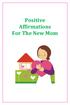 Positive Affirmations by Laura J. Rude www.postpartum-living.com Copyright Postpartum Living All rights reserved How Positive Affirmations Can Help You I sn t it great to know you are doing everything
PERSONALITY STYLES ASSESSMENT
 PERSONALITY STYLES ASSESSMENT Each of us has a dominant personality style that reflects our individual values and principles and affects our relationship with others. There are four basic personality styles
Yogi Tea Bag Inspirations received from all the Yogi Tea Debby has consumed over the last year
 Yogi Tea Bag Inspirations received from all the Yogi Tea Debby has consumed over the last year A Act selfless, you will be infinite. Appreciate yourself and honor your soul. As a plant can t live without
Understanding the Differences between Conventional, Alternative, Complementary, Integrative and Natural Medicine
 AYURVEDIC HOSPITAL - Nugegoda, Sri Lanka. FOR INFERTILITY TREATMENTS Call Dr. R. A. R. P. Susantha on +94 (0)77 307 3621 for Free Consultancy www.ayurvedic-hospital.com [email protected] Understanding
DOSHA PRAKRITI [BODY CONSTITUTION]
![DOSHA PRAKRITI [BODY CONSTITUTION]](/thumbs/40/20825125.jpg "DOSHA PRAKRITI [BODY CONSTITUTION]") DOSHA PRAKRITI [BODY CONSTITUTION] Doshaja prakriti is useful in understanding the entire makeup of an individual, what their strengths and weaknesses are, how they respond to different foods or environments,
DOSHA PRAKRITI [BODY CONSTITUTION] Doshaja prakriti is useful in understanding the entire makeup of an individual, what their strengths and weaknesses are, how they respond to different foods or environments,
Age Developmental Characteristics:
 6 Year Old: 1. Good supply of energy. 2. Muscular control becoming more effective with large objects. 3. There is a noticeable change in the eye-hand behavior. 4. Legs lengthening rapidly. 5. Big muscles
400,000 people in the United States die every year due to smoking-related illnesses.
 How To Stop Smoking Ugly Facts about Smoking: 52 million Americans smoke cigarettes. 400,000 people in the United States die every year due to smoking-related illnesses. Every cigarette you smoke shortens
Making Your Best Right Decisions
 Making Your Best Right Decisions Making Decisions By Dr. Margaret Paul Do you ever have trouble making decisions? Do you get stuck behind your fear and anxiety? Does the fear of failure and of making a
ALIGNMENT WITH THE HIGHER SELF & MEETING SPIRIT GUIDES
 ALIGNMENT WITH THE HIGHER SELF & MEETING SPIRIT GUIDES Experiencing Spiritual Connection This becomes more and more obvious to you with practice you will get a distinct feeling and knowing when you are
Eating For Your Constitution
 Eating For Your Constitution The food we eat affects our body in profound ways and is an essential tool for regulating energy levels and maintaining balance between the mind, body, and spirit. The old
30 Scripts for Relaxation, Imagery & Inner Healing - Vol. 2
 30 Scripts for Relaxation, Imagery & Inner Healing - Vol. 2 Julie Lusk Whole Person Press Table of Contents Becoming Relaxed The cornerstone of all guided imagery work lies in the ability to relax the
YOGA MUDRAS FOR HEALTH BENEFITS
 YOGA MUDRAS FOR HEALTH BENEFITS Edited by Campbell M Gold (2009) (This material was compiled from various unverified sources) CMG Archives http://campbellmgold.com IMPORTANT The health information contained
North Pacific Epilepsy Research 2311 NW Northrup Street Suite #202 Portland, Oregon 97210 Tel: 503-291-5300 Fax: 503-291-5303
 North Pacific Epilepsy Research 2311 NW Northrup Street Suite #202 Portland, Oregon 97210 Tel: 503-291-5300 Fax: 503-291-5303 Post-Traumatic Stress Disorder (PTSD) Post-traumatic stress disorder (PTSD)
A P C T. 3. lighthearted industrious. 5. talkative a listener. 6. quick methodical. 9. relaxed conscientious. 10. generalist detailed
 PERSONALITY AUDIT By Susan Vogt, MA, CFLE Before entering into any healthy, intimate relationship, you need to know yourself. One important aspect of identity is personality. Generally one s personality
Postpartum Depression and Post-Traumatic Stress Disorder
 Postpartum Depression and Post-Traumatic Stress Disorder Emotional Recovery: Postpartum Depression and Post-Traumatic Stress Disorder By: Lisa Houchins Published: July 23, 2013 Emotions vary widely after
WHAT EVERY PSYCHOLOGIST SHOULD KNOW ABOUT GUIDED IMAGERY
 WHAT EVERY PSYCHOLOGIST SHOULD KNOW ABOUT GUIDED IMAGERY by David E. Bresler, Ph.D., L.Ac. Associate Clinical Professor, UCLA School of Medicine Executive Director, The Bresler Center, Los Angeles, California
IMPROVE YOUR LEARNING SKILLS
 IMPROVE YOUR LEARNING SKILLS Riitta Aikkola Vaasa University of Applied Sciences 1 IMPROVE YOUR LEARNING SKILLS Learning is a skill and it can be improved. Everyone has the opportunity to develop their
ATTUNEMENT INFORMATION
 ATTUNEMENT INFORMATION www.reiki-attunement-courses.com 1 ABOUT REIKI Reiki is a wonderful healing energy that we can all use in our daily lives. Not only can it help us heal from different ailments and
What Are the Symptoms of Depression?
 Lately, Lindsay hasn t felt like herself. Her friends have noticed it, too. Kia was surprised when Lindsay turned down her invitation to go shopping last Saturday (she always loves to shop). There was
WELCOME TO GOD S FAMILY
 WELCOME TO GOD S FAMILY To all who received him, to those who believed in his name, he gave the right to become children of God children born not of natural descent, nor of human decision or a husband
My Doctor Says Stress is Bad for My Diabetes... What Can I Do About It? BD Getting Started. Stress and Diabetes
 My Doctor Says Stress is Bad for My Diabetes... What Can I Do About It? BD Getting Started Stress and Diabetes Doesn t Everyone Have Stress? It s true that stress is part of everyday life for everyone.
Meditation for Stress Management
 What is? Meditation is the focusing of attention on one thing to the exclusion of all other thoughts. Often, people are able to relieve their stress through meditation, because by focusing on only one
Finding Balance in Your Grieving. Dr. Jo Christner, Psy.D. The death of your spouse most likely turned your whole world upside down
 Finding Balance in Your Grieving Dr. Jo Christner, Psy.D. The death of your spouse most likely turned your whole world upside down out of balance. Everything seemed to change in your life especially you.
a way of Teaching Wellness without injury be Shiva, train Buddhist Yoga
 Yoga Therapy for Wellness Using Lord Shiva Alignment found in Buddhist Yoga aligned energetic dance of DNA a way of Teaching Wellness without injury be Shiva, train Buddhist Yoga Yoga Therapy for Wellness
Short-form Enneagram Screening Initial Indicator for Enneagram Type Copyright 1997, Lori Ohlson MA, LPC and Dee Marcotte MS, MA, LPC
 Short-form Enneagram Screening Initial Indicator for Enneagram Type Copyright 1997, Lori Ohlson MA, LPC and Dee Marcotte MS, MA, LPC This short survey of your characteristics or tendencies will give you
Stress can become a problem when you are not sure how to handle it. Worry sets in, and you feel stressed.
 Stress Reduction Patient Education Improving Health Through Education What is Stress? Stress is a normal emotional and physical reaction to the demands of life. Stress comes from both the good and bad
San Diego. Short Term, Comprehensive Mental Health Treatment. Part of
 San Diego Short Term, Comprehensive Mental Health Treatment Part of Helix, The Upward Spiral. The spiral shape of the Helix is one of the oldest spiritual symbols known to man. The Helix reflects the
LILLIAN PITAWANAKWAT LESSON PLAN 2006 All Rights Reserved 4D Interactive Inc. 416-530-2752 1
 Elder Lillian Pitawanakwat Nation Ojibwe/Potawotami Lesson Plan Grade Level Junior (Grades 1-6) Time Required 3 4 hours Subject Strand Links Geography Natural Science Astronomy Traditional Teachings The
D I S C II Temperament Assessment
 D I S C II Temperament Assessment Assessment on: Sample Sample Phone: Email: Agency: Profile Dynamics Assessment Date: 7/15/2006 For More Information Please Contact: John Cocoris Profile Dynamics 972-529-4483
YOU are more POWERFUL than your STRESS response.
 YOU are more POWERFUL than your STRESS response. Nancy Forrester MBA, B.Ed., B.Sc., Psychotherapist, Accredited Master EFT Trainer of Trainers (AAMET International) Executive Director, NeftTI January 2015
Ordinary Moments of Grace
 Ordinary Moments of Grace To everything there is a time and a season for every purpose under heaven. A time to be born and a time to die. A time to sow and a time to reap. A time to laugh and a time to
Working Smarter, Not Harder Time Management for Graduate Students
 Working Smarter, Not Harder Time Management for Graduate Students Angel Johnson LPC, NCC January 24, 2011 Keeping Time Goals of Program: Focus on clarifying goals and rewarding accomplishments PRIORITIZE
PUSD High Frequency Word List
 PUSD High Frequency Word List For Reading and Spelling Grades K-5 High Frequency or instant words are important because: 1. You can t read a sentence or a paragraph without knowing at least the most common.
THE HARTMAN PERSONALITY PROFILE Name:
 THE HARTMAN PERSONALITY PROFILE Name: Directions: Mark an "X" by the one word or phrase that best describes what you are like most of the time. Choose only one response from each group. After you've finished
Satir Transformational Systemic Therapy (in Brief)
 Satir Transformational Systemic Therapy (in Brief) What happens when a human being appears on the professional radar and, without directly challenging the prevailing system, provides new possibilities
Comprehensive Resilience Module
 Resilience And Risk Reduction Comprehensive Resilience Module Spiritual Dimension Meditation Meditation Overview There are many types of meditation that can help you develop your human spirit and build
Acupuncture Treatment for Post Traumatic Stress Disorder
 Force Health Protection Conference Acupuncture Treatment for Post Traumatic Stress Disorder August, 2008 Alaine D. Duncan, M.Ac., L.Ac., Dipl.Ac. Disclaimer Statement The views expressed in this presentation
Three Treasures Circle Qigong
 Three Treasures Circle Qigong Introduction We practice this process to remind ourselves of what is true now In this moment, and beyond all time. We are separate, individual and unique, And there is no
The Seven Levels of Leadership Consciousness
 The Seven Levels of Leadership Consciousness By Richard Barrett Leaders grow and develop by learning to master the Seven Levels of Personal Consciousness and the Seven levels of Organisational Consciousness.
Please Do Not Call 911
 The Last Hours of Life - What to Expect Names and Phone Numbers You May Need Name Phone Family Dr. Palliative Dr. After Hours Access Centre Visiting Nurse Hospice Clergy Funeral Contact Please Do Not Call
The Transpersonal (Spiritual) Journey Towards Leadership Excellence Using 8ICOL
 The Transpersonal (Spiritual) Journey Towards Leadership Excellence Using 8ICOL Travelling from Ego Based Leadership to Transpersonal Leadership where the focus is beyond the ego to the needs of ALL the
Insomnia affects 1 in 3 adults every year in the U.S. and Canada.
 Insomnia What is insomnia? Having insomnia means you often have trouble falling or staying asleep or going back to sleep if you awaken. Insomnia can be either a short-term or a long-term problem. Insomnia
HOLISTIC HEALTH MALDIVES RANGALI ISLAND
 HOLISTIC HEALTH MALDIVES RANGALI ISLAND NATUROPATHY SERVICES MALDIVES RANGALI ISLAND Holistic Health incorporates the principles of Naturopathy or Natural Healing and combines modern science with nature
The Link Between Hypnosis & Thai Yoga Bodywork
 The Link Between Hypnosis & Thai Yoga Bodywork By: Terry Ann Wohl When Trilby, the beautiful model-singer in the infamous 1931 movie, tells Svengali that she is unable to work all day because she has had
What is emotional intelligence?
 What is emotional intelligence? Emotional intelligence is the ability to identify, use, understand, and manage your emotions in positive and constructive ways. It's about recognizing your own emotional
Encourage and develop each child s unique interests and curiosity. Help the children discover their own unique gifts & talents
 Adoption: Adoption is the legal process by which a person becomes a lawful member of a family different from their birth family. Adoption is a permanent lifelong commitment to a child. Becoming a parent
Health Tourism. Lecture 1. Introduction
 1 Health Tourism Lecture 1 Historical overview (health services,, and their relation to tourism) Introduction 2 What we anticipate in our destinations is not holiness or divine visions, but something even
NEUROPSYCHOLOGY QUESTIONNAIRE. (Please fill this out prior to your appointment and bring it with you.) Name: Date of appointment: Home address:
 NEUROPSYCHOLOGY QUESTIONNAIRE (Please fill this out prior to your appointment and bring it with you.) Name: Date of appointment: Date of birth: Age: _ Home address: _ Home phone: Cell phone: Work phone:
(( Typical Personality in University Lecturer ))
 (( Typical Personality in University Lecturer )) Prof. Yousif Hama Salih Mustafa Ph.D. in psychology (personality and mental health) Salahaddin university E-mail: [email protected] Mob: 07504514924 June
Anxiety and depression in men
 Anxiety and depression in men Summary Anxiety and depression in men are common and treatable. Anxiety and depression are illnesses, not weaknesses, and effective treatments are available. Taking action
Compassion Fatigue December 2009
 Compassion Fatigue December 2009 by Gary Shunk and Megan Wells Financial Advisor Magazine, Private Wealth Magazine Web: www.compassionfatigue.org www.facebook.com/compassionfatigue Media Contact for www.compassionfatigue.org:
Anxiety, Panic and Other Disorders
 Methodist Assistance Program Anxiety, Panic and Other Disorders Anxiety, panic and other disorders such as agoraphobia, social phobia, compulsive disorder and posttraumatic stress disorder are all very
Engage: Brainstorming Body Systems. Record the structures and function of each body system in the table below.
 Engage: Brainstorming Body s Record the structures and function of each body system in the table below. Body Nervous Circulatory Excretory Immune Digestive Respiratory Skeletal Muscular Endocrine Integumentary
Dr Sarah Blunden s Adolescent Sleep Facts Sheet
 Dr Sarah Blunden s Adolescent Sleep Facts Sheet I am Sleep Researcher and a Psychologist. As a Sleep Researcher, I investigate the effects of poor sleep on young children and adolescents. I also diagnose
Psychological treatments for bipolar disorder
 Psychological treatments for bipolar disorder Medication is the mainstay treatment, but psychological support is crucially important Get a counsellor Learn all you can about the illness Develop a stay-well
Integrative Medicine: Train to be a Doctor in the Future of Health Care MUM. Maharishi University of Management in collaboration with AUIS.
 Integrative Medicine: Train to be a Doctor in the Future of Health Care MUM Maharishi University of Management in collaboration with AUIS. TRACK OPTIONS 1. BS IN PRE-INTEGRATIVE MEDICINE The BS in pre-integrative
Brought To You By Free-Ebooks-Canada.com If you would like to pass on this ebook to others, please refer them to original download blog post.
 Brought To You By Free-Ebooks-Canada.com If you would like to pass on this ebook to others, please refer them to original download blog post. - 1 - Terms and Conditions LEGAL NOTICE The Publisher has strived
Post Acute Withdrawal Syndrome
 Post Acute Withdrawal Syndrome SupportNet Recovery Learning Series - Believe that Recovery is Possible John Craven MD I get stressed out - and flustered - by things that didn t bother me before. S upport
CONSULTATION & CONSENT FORMS p. 1 of 5 C J HERBAL REMEDIES, INC. ********************************************************************************
 CONSULTATION & CONSENT FORMS p. 1 of 5 ******************************************************************************** List your full name, age, sex, and today's date List your complete address List your
THE REQUIREMENTS OF COMMITTED MEMBERS Part 2
 THE REQUIREMENTS OF COMMITTED MEMBERS Part 2 We need to give strong support. We cannot give strong support unless we become mighty men. None of us should fail because this is God s plan. God wants us to
inner peace Easy Practices to Increase Life Balance
 inner peace Easy Practices to Increase Life Balance Often, we define peacefulness by the absence of stress a neutral, inactive state. However, is peace really just a passive state? For most people, adopting
Workbook for: Rapid Planning Method (RPM)
 Workbook for: Rapid Planning Method (RPM) There is one tool above all others that influences the quality of life: the capacity to take a vision of what you want and make it real. The key to this game of
Depression. Introduction Depression is a common condition that affects millions of people every year.
 Depression Introduction Depression is a common condition that affects millions of people every year. Depression has an impact on most aspects of everyday life. It affects eating and sleeping routines,
Amphetamines Addiction
 Introduction Amphetamines, which are classified as stimulants, work by using the dopamine reward system of the brain. When these drugs are used, the user s central nervous system is simulated which causes
Complementary, Alternative, or Integrative Health: What s In a Name?
 Complementary, Alternative, or Integrative Health: What s In a Name? Complementary and alternative medicine, complementary medicine, alternative medicine, integrative medicine we have all seen these terms
Your Go-to COPD Guide
 Your Go-to COPD Guide Learning how to live with chronic obstructive pulmonary disease (COPD) Inside, you ll learn: COPD facts COPD symptoms and triggers How to talk with your doctor Different treatment
The Social Cognitive perspective and Albert Bandura
 LP 11D Social Cog/Trait 1 The Social Cognitive perspective and Albert Bandura For more information on Albert Bandura and the Social Cognitive Perspective, see Chapter 5: Learning and Chapter 8: Motivation
Establishing Healthy Boundaries in Relationships (Adapted by C. Leech from Tools for Coping with Life s Stressors from the Coping.
 Establishing Healthy Boundaries in Relationships (Adapted by C. Leech from Tools for Coping with Life s Stressors from the Coping.org website) Introduction People with low self-esteem have their major
Mindfulness in adults with autism spectrum disorders
 Mindfulness in adults with autism spectrum disorders Introduction Autism is a lifelong developmental disorder that affects functioning in multiple areas. Recent studies show that autism is often accompanied