
Standard 1(Making): The student will explore and refine the application of media, techniques, and artistic processes.
|
|
|
- Chad Morton
- 9 years ago
- Views:
Transcription
1 Lesson 9 Picasso and Cubism: Self-Portraits How are many sides of an object expressed at once? How is a subject reconstructed into planes, forms and colors? LESSON OVERVIEW/OBJECTIVES This lesson focuses on Cubism, a revolutionary style of modern art, and on its co-founder, Pablo Picasso, one of the world s most famous artists. Cubist art depicts real people, places or objects, from an array of viewpoints. In the Cubist style, students will create self-portraits focusing on shape, viewpoint and composition. KEY IDEAS THAT CONNECT TO VISUAL ARTS CORE CURRICULUM: Based on Utah State Visual Arts Core Curriculum Requirements (3rd Grade) Standard 1(Making): The student will explore and refine the application of media, techniques, and artistic processes. Objective 1: Explore a variety of art materials while learning new techniques and processes. a. Practice using skills for beginning drawings. b. Use simplified forms, such as cones, spheres, and cubes, to begin drawing more complex form. h. Explore the design possibilities of a 3-D object by examining views of it from many angles. Objective 3: Handle art materials in a safe and responsible manner. a. Ventilate the room to avoid inhaling fumes from art materials. b. Dispose and/or recycle waste art materials properly. c. Clean and put back to order art making areas after projects. d. Respect other students artworks as well as one s own. Standard 2 (Perceiving): The student will analyze, reflect on, and apply the structures of art. Objective 1: Analyze and reflect on works of art by their elements and principles a. Determine how artists create dominance in their work; e.g., size, repetition, and contrast. b. Examine significant works of art and point out how the artists have created an illusion or feeling of depth. Objective 2: Create works of art using the elements and principles. a. Identify dominant elements in significant works of art. b. Group some significant works of art by a common element or visual characteristic. c. Discover how an artist has thoughtfully used all of the space within an artwork. e. Create a work of art that uses contrast to create a focal point. Use that to convey the most important idea or part of the work. Kimball Art Center LESSON 9 Picasso & Cubism Page 1
2 Standard 3 (Expressing): The student will choose and evaluate artistic subject matter, themes, symbols, ideas, meanings, and purposes. Objective 1: Explore possible content and purposes in significant works of art. a. Explain possible meanings or interpretations of some significant works of art. b. Invent possible stories that may explain what is going on in these same works of art Objective 2: Discuss, evaluate, and choose symbols, ideas, subject matter, meanings, and purposes for their own artworks. a. Group significant works of art according to theme or subject matter. d. Create a work of art that uses a similar subject matter, sumbol, idea, and/or meaning found in a significant work of art. INSTRUCTIONAL OBJECTIVES: Students will: Learn about the work of Pablo Picasso. Understand Cubism. Learn about self portraiture..create a self portrait in the style of Cubism. Working in the style of Cubism, learn to show many parts of a subject at one time, viewed from different angles, and reconstructed into a composition of planes, forms and colors. SUPPLIES Print samples of Pablo Picasso s artwork specifically those from his Cubist period. Power Point presentation of Pablo Picasso and his work (optional) Information about face proportions Pencils Erasers Scratch paper for drawing initial ideas Air dry clay Paints - watercolor or acrylic Embellishments to enhance portraits such as beads, pipe cleaners etc. Kimball Art Center LESSON 9 Picasso & Cubism Page 2

3 VOCABULARY Pattern - Is a combination of elements or shapes repeated in a recurring and regular arrangement. Unity - Refers to the visual quality of wholeness or oneness that is achieved through effective use of the elements or art and principles of design. Variety is achieved when the art elements are combined in various ways to increase visual interest. Cubism - Cubism an early 20th-century style and movement in art, especially painting, in which perspective with a single viewpoint was abandoned and use was made of simple geometric shapes, interlocking planes, and, later, collage. Composition - In the visual arts in particular painting, graphic design, photography, and sculpture composition is the placement or arrangement of visual elements or ingredients in a work of art, as distinct from the subject of a work. Self-Portrait - In s a representation of an artist that is drawn, painted, photographed, or sculpted by that artist. INSTRUCTIONAL PLAN Lesson Introduction: Before beginning the lesson, introduce Cubism and the artist Pablo Picasso. Talk about the various art periods in Picasso s life ending with Cubism, the style for which he is most famous. Show images of Picasso s Cubist artwork and focus in on faces, portraits and figures he created. Talk about how many viewpoints are represented all at once. Cubist artwork shows many parts of the subject at one time, viewed from different angles, and reconstructed into a composition of planes, forms and colors. The whole idea of space is reconfigured: the front, back and sides of the subject become interchangeable elements in the design of the work. About Cubism Cubism was a truly revolutionary style of modern art developed by Pablo Picasso and Georges Braques. It was the first style of abstract art which evolved at the beginning of the 20th century in response to a world that was changing with unprecedented speed Cubism was an attempt by artists to revitalise the tired traditions of Western art which they believed had run their course. The Cubists challenged conventional forms or representation, such as perspective, which had been the rule since the Renaissance. Their aim was to develop a new way of seeing which reflected the modern age. In the four decades from , western society witnessed more technological progress than in the previous four centuries. During this period, inventions such as photography, cinematography, sound recording, the telephone, the motor car and the airplane heralded the dawn of a new age. The problem for artists at this time was how to reflect the modernity of the era using the tired and trusted traditions that had served art for the last four centuries. Artists needed a more radical approach - a new way of seeing that expanded the possibilities of art in the same way that technology was extending the boundaries of communication and travel. This new way of seeing was called Cubism - the first abstract style of modern art. The limitations of perspective were also seen as an obstacle to progress by the Cubists. The fact that a picture drawn in perspective could only work from one viewpoint restricted their options. Cubists wanted to make pictures that reached beyond the rigid geometry of perspective. When we look at objects, our eyes scan it, stops to register on a certain detail before moving on to the next point of interest and so on. You can also change your viewpoint in relation to the object allowing you to look at it from above, below or from the side. Therefore, the Cubists proposed that your sight of an object is the sum of many different views Kimball Art Center LESSON 9 Picasso & Cubism Page 3
4 INSTRUCTIONAL PLAN CONTINUED and your memory of an object is not constructed from one angle, as in perspective, but from many angles selected by your sight and movement. Cubist painting was an attempt of a more realistic way of seeing. A typical Cubist painting depicts real people, places or objects, but not from a fixed viewpoint. Instead it will show you many parts of the subject at one time, viewed from different angles, and reconstructed into a composition of planes, form and colors. The whole idea of space is reconfigured: the front, back and sides of the subject become interchangeable elements in the design of the work. artyfactory.com (source) About Pablo Picasso Pablo Picasso (October 25, April 8, 1973), was a Spanish painter, sculptor, printmaker, ceramicist, stage designer, poet and playwright who spent most of his adult life in France. Regarded as one of the greatest and most influential artists of the 20th century, he is known for co-founding the Cubist movement, the co-invention of collage, and for the wide variety of styles that he helped develop and explore. Among his most famous works are the Cubist Les Demoiselles d Avignon (1907), and Guernica (1937), a portrayal of the Bombing of Guernica by the German and Italian airforces at the behest of the Spanish nationalist government during the Spanish Civil War. Picasso demonstrated extraordinary artistic talent in his early years, painting in a naturalistic manner through his childhood and adolescence. During the first decade of the 20th century, his style changed as he experimented with different theories, techniques, and ideas. His work is often categorized into periods namely Blue Period ( ), the Rose Period ( ), the African-influenced Period ( ), Analytic Cubism ( ), and Symthetic Cubism ( ), also referred to as the Crystal Period. Exceptionally prolific throughout the course of his long life, Picasso achieved universal renown and immense fortune for his revolutionary artistic accomplishments, and became one of the best known figures in 20th century art. wikipedia (source) Lesson Start by looking at some of Picasso s Cubist works. Talk about how many viewpoints are represented and discuss how that occurs. Look at the way the image is reconstructed to be represented by planes, forms and colors. Compare Cubist style to realistic portraiture or self portraits and ask students to compare. Have some samples on hand and/or have a diagram of a face and the breakdown of proportions of how a face is rendered. Explain that selfportraits can look just like the artist creating it or it can be abstracted, made into anime, a cartoon, 3D etc. These ideas may be new to your students but you have the visual art pieces to help explain the concepts. Show how to draw a face in correct proportions. Have kids follow along with you as you draw on the board. They will draw all their guide lines and portrait in pencil. Be sure to use and explain words and concepts such as balance, symmetry, harmony and proportion. In a Cubist style, talk with students about how they can represent all the viewpoints of their faces in one art project. Talk about what shapes they may use and how they can combine them to make their self-portrait incorporate many aspects or perspectives.. Kimball Art Center LESSON 9 Picasso & Cubism Page 4
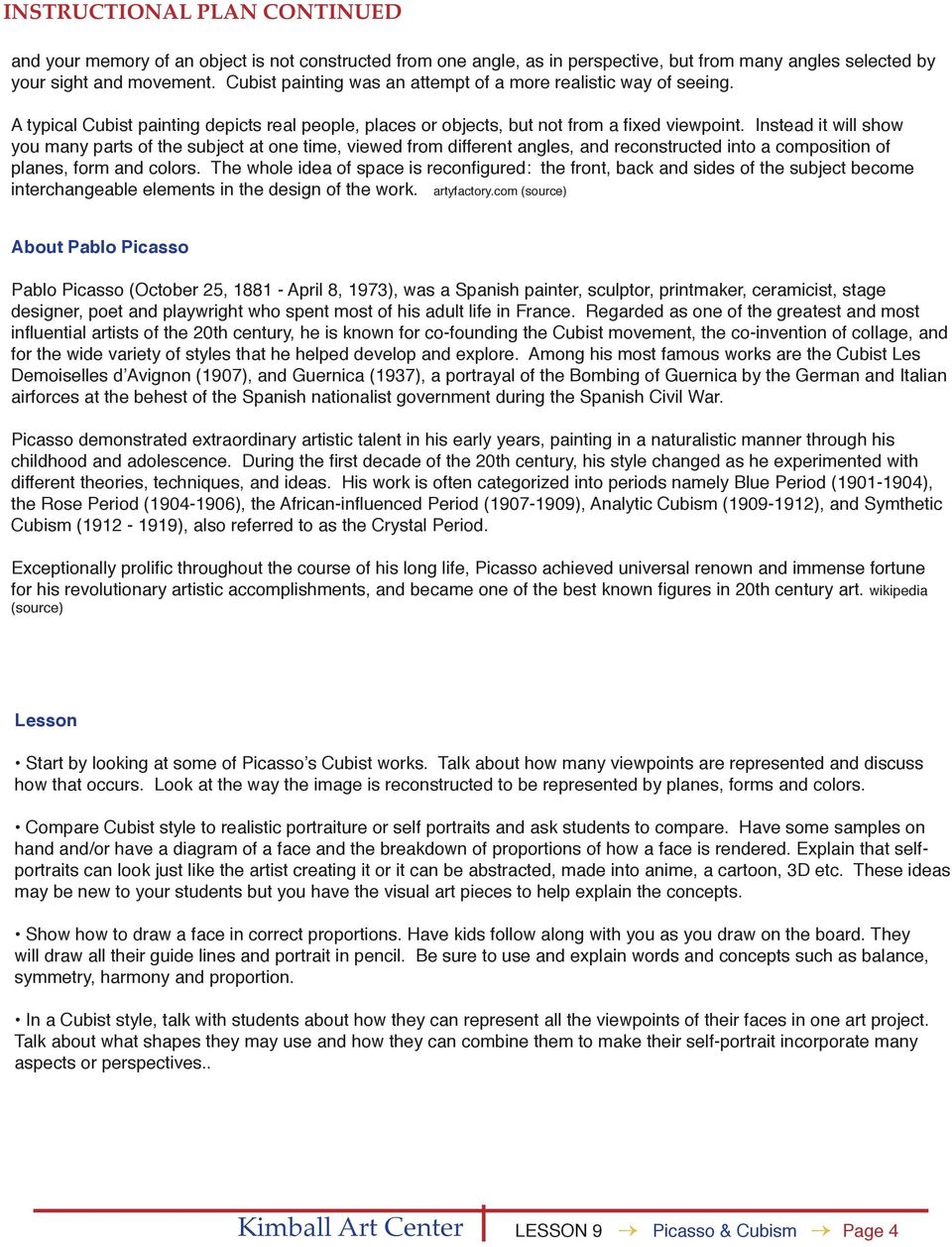
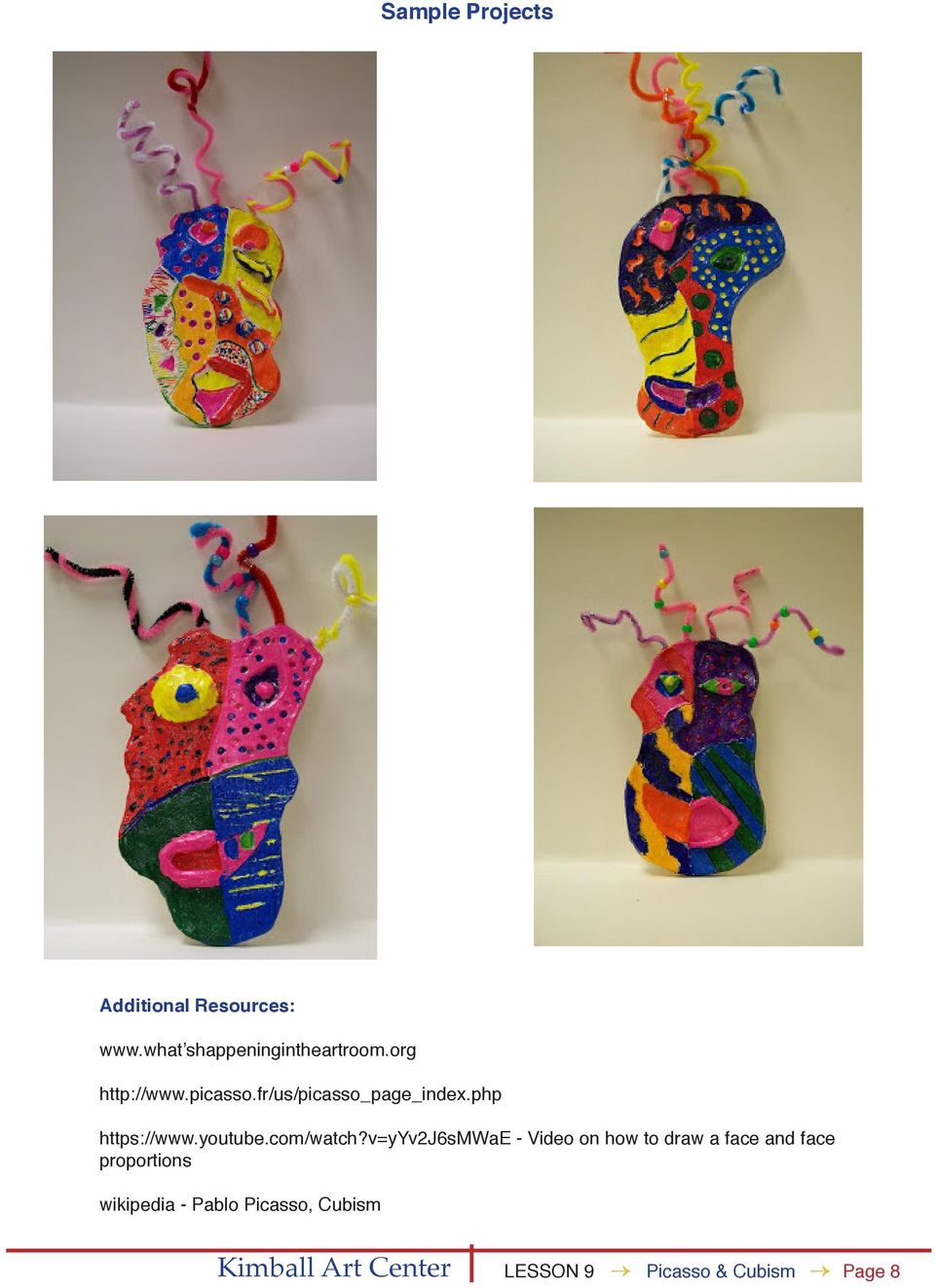
5 Lesson continued On copy/scratch paper, have students draw their Cubist self-portrait ideas. When ready, give students air dry clay to create their Cubist self-portraits. Be sure to reinforce the idea that the front, sides and backs of their heads can be represented all in one piece. (Optional: If air dry clay is not available, you can have students draw and paint their Cubist self-portraits). When finished with their compositions, students can paint the clay whilst it is still wet. Provide accessories such as buttons, beads and pipe cleaners to add to their composition. Invite students to share their creations with one another! inspired by: what shappeningintheartroom Famous Picasso Cubist Painting Samples Kimball Art Center LESSON 9 Picasso & Cubism Page 5
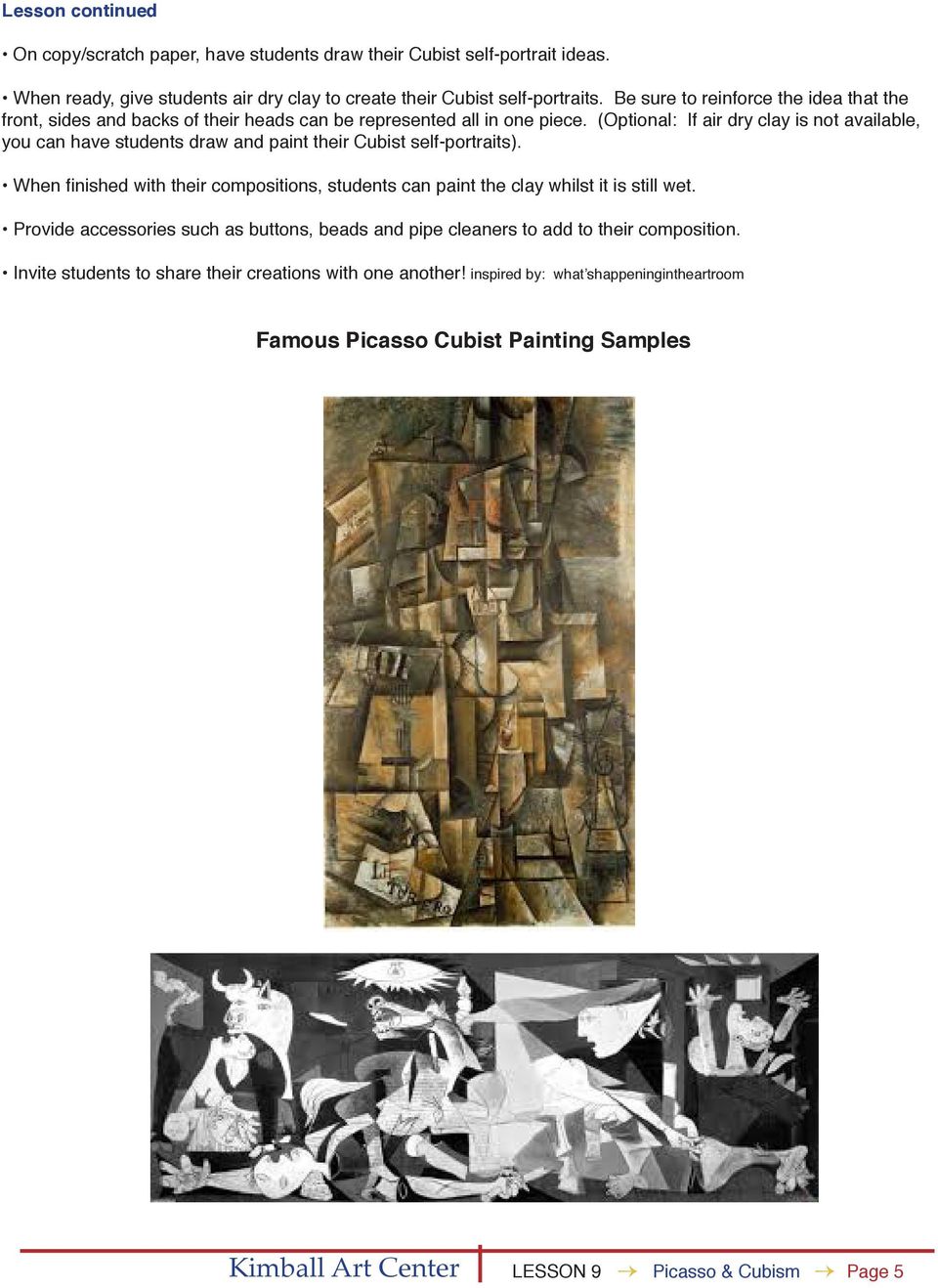
6 Famous Picasso Cubist Painting Samples Kimball Art Center LESSON 9 Picasso & Cubism Page 6

7 Face Proportions Kimball Art Center LESSON 9 Picasso & Cubism Page 7

8 Sample Projects Additional Resources: shappeningintheartroom.org Video on how to draw a face and face proportions wikipedia - Pablo Picasso, Cubism Kimball Art Center LESSON 9 Picasso & Cubism Page 8
PABLO PICASSO PRE-READING QUESTIONS. 1. What kind of art do you like? 2. Do you have a favorite artist?
 Pablo Picasso PABLO PICASSO PRE-READING QUESTIONS 1. What kind of art do you like? 2. Do you have a favorite artist? 3. Have you seen a painting by Picasso? 4. Have you heard of a style of painting called
Realistic Art & Proportion
 Notes 9/8 Name: Period: Date: Realistic Art & Proportion Realistic art is art that shows recognizable objects; just like things you would see in real life. Sometimes, realistic art looks so real, it almost
Graphic Design: Introduction to Typography
 Lesson 6 Graphic Design: Introduction to Typography What is Design? What is Graphic Design? How is Graphic Design different from Fine Art? LESSON OVERVIEW/OBJECTIVES Students will learn about design and
PORTRAIT. Pablo Picasso. Self-Portrait, 1907
 PORTRAIT Pablo Picasso Self-Portrait, 1907 Picasso - Background Information Born Spain 1881, died 1973 aged 92. Flamboyant and extrovert character Larger than life with a great need to be creative and
Contextual Relevancy
 North Carolina s Kindergarten Visual Arts Note on Numbering/Strands: V - Visual Literacy, CX Contextual Relevancy, CR Critical Response Visual Literacy K.V.1 Use the language of visual arts to communicate
Earth Art: Creating Patterns in Nature
 Earth Art: Creating Patterns in Nature SEASONS: SUBJECTS: PREP TIME: EXT. SUBJECT: LESSON TIME: X MATERIALS For the class: computer with Internet access, camera (optional), outdoor space with a variety
Mount Laurel Township Schools Visual & Performing Arts Curriculum Grades Pre-K-8. Adopted by the Mount Laurel Board of Education on August 25, 2009
 Mount Laurel Township Schools Visual & Performing Arts Curriculum Grades Pre-K-8 Adopted by the Mount Laurel Board of Education on August 25, 2009 Contents in this Curriculum (Art) Pre-K Curriculum Kindergarten
VISUAL ARTS VOCABULARY
 VISUAL ARTS VOCABULARY Abstract Artwork in which the subject matter is stated in a brief, simplified manner; little or no attempt is made to represent images realistically, and objects are often simplified
Standard 1: Learn and develop skills and meet technical demands unique to dance, music, theatre/drama and visual arts.
 ART CONTENT STANDARDS FOR VISUAL ARTS Grades K-5 Note: Each standard requires the application of the elements of art and principles of design. Strand: Visual Arts Standard 1: Learn and develop skills and
HIGH SCHOOL COURSE OUTLINE
 OFFICE OF CURRICULUM, INSTRUCTION AND PROFESSIONAL DEVELOPMENT HIGH SCHOOL COURSE OUTLINE Department Visual/Performing Arts Course Title Digital Art & Imaging Course Code 1046 Grade Level 9-12 Course Length
SCULPTURAL CUBISM IN PRODUCT DESIGN: USING DESIGN HISTORY AS A CREATIVE TOOL
 INTERNATIONAL CONFERENCE ON ENGINEERING AND PRODUCT DESIGN EDUCATION 3 & 4 SEPTEMBER 2015, LOUGHBOROUGH UNIVERSITY, DESIGN SCHOOL, LOUGHBOROUGH, UK SCULPTURAL CUBISM IN PRODUCT DESIGN: USING DESIGN HISTORY
*Supply students with paper and art materials when necessary.
 Reflections/Refractions: Self-Portraiture in the Twentieth Century A lesson compiled by the National Portrait Gallery, Smithsonian Institution, for the exhibition Reflections/Refractions: Self-Portraiture
TExES Art EC 12 (178) Test at a Glance
 TExES Art EC 12 (178) Test at a Glance See the test preparation manual for complete information about the test along with sample questions, study tips and preparation resources. Test Name Art EC 12 Test
Self-Portrait Painting
 SUBJECT: VISUAL ART GRADE: 8TH TEACHER: CHRISTINA LOVERING Unit Overview: Self-Portrait Painting Introduction Students will engage in a 2-3 week unit in which the end result will be a self-portrait using
What makes it necessary to have rituals in the Art room?
 FOURTH GRADE QUARTER ONE - LINE Why is it important to have Rules What makes it necessary to have rituals in the Art room? rituals and routines in the art room? routines Rituals & Routines: Teacher establishes
VAPA (Visual Arts) VISUAL ARTS
 VISUAL ARTS VAPA (Visual Arts) ART 1-2 This course will introduce the student to the various ways of producing artistic pieces in the areas of drawing, design, color, painting, three-dimensional, and printmaking.
Visual Arts Scope and Sequence
 ART PRODUCTION Visual Arts Scope and Sequence LINE Recognize lines and line characteristics in the environment I R R R Identify and explore tools that make lines (pencils, crayons, markers, paint brushes)
HACKETTSTOWN, NEW JERSEY. Computer Animation Grades 10-12 CURRICULUM GUIDE FINAL DRAFT. July 2014
 HACKETTSTOWN, NEW JERSEY Computer Animation Grades 10-12 CURRICULUM GUIDE FINAL DRAFT July 2014 Mr. David C. Mango, Superintendent Ms. Nadia Inskeep, Director of Curriculum & Instruction Developed by:
PROGRAM FOR LICENSING ASSESSMENTS FOR COLORADO EDUCATORS (PLACE ) OBJECTIVES FIELD 028: ART
 PROGRAM FOR LICENSING ASSESSMENTS FOR COLORADO EDUCATORS (PLACE ) OBJECTIVES Subareas Art Materials and Processes Composition and Unity Art and Culture ART MATERIALS AND PROCESSES Identify techniques,
Studio Art. Introduction and Course Outline
 Studio Art Introduction and Course Outline PACE High School An Independent Ohio Community School Welcome to the Studio Art course. During this semester you will learn to use the basic materials and techniques
Picasso Style Abstract Portraits
 Picasso Style Abstract Portraits Pablo Picasso created more styles of art than any artist before or after him. Many of his abstract portraits are in a split portrait style, meaning that half of the face
Progression of Skills in Art and Design National Curriculum 2014 Age Related Expectations. Strand Year 1 Year 2 Year 3 Year 4 Year 5 Year 6
 Progression of Skills in Art and Design National Curriculum 2014 Age Related Expectations Strand Year 1 Year 2 Year 3 Year 4 Year 5 Year 6 Generic skills Record and explore ideas from first hand observations
ART/VCDMA PORTFOLIO TIPS
 ART/VCDMA PORTFOLIO TIPS What is a portfolio? A portfolio represents your skills as an artist, including craftsmanship, technique, creativity, and the ability to communicate visual ideas. High school seniors
Envision Visual Arts (EVA) Classes. Drawing and Design is the foundation course for all other Digital and Fine Art courses,
 Envision Visual Arts (EVA) Classes Drawing and Design is the foundation course for all other Digital and Fine Art courses, and is a wonderful class for those just getting starting in arts classes or for
2012 VISUAL ART STANDARDS GRADES K-1-2
 COGNITIVE & K Critical and Creative Thinking: Students combine and apply artistic and reasoning skills to imagine, create, realize and refine artworks in conventional and innovative ways. The student will
The Painter s Eye Grades: 2 4 45 minutes This tour replaces Learning to Look at Art. Please disregard all older tour plans.
 The Painter s Eye Tour 1 The Painter s Eye Grades: 2 4 45 minutes This tour replaces Learning to Look at Art. Please disregard all older tour plans. Procedures As with all tours, timing is critical. Therefore
Four Points of View about Picasso s Maquette for Guitar, 1912. Margaret Munger. Art 1B. Dr. Elaine O Brien
 Four Points of View about Picasso s Maquette for Guitar, 1912 Margaret Munger Art 1B Dr. Elaine O Brien November 22, 2011 Munger 1 PABLO PICASSO, Maquette for Guitar, 1912, The Museum of Modern Art, New
Keywords for the study of Junior Cert art
 able abstract acrylic activity aesthetic/aesthetics analyze ancient animation applied arch arches architect architectural architecture art art process artist artistic artists arts artwork artworks assemble
Programme of Study Year 7 9 Art framework
 Programme of Study Year 7 9 Art framework Time Theme In lessons students will learn: Big ideas/constructs (overview of the key learning questions) YEAR 7 Balance We introduce our Year 7 students to the
PATTERN: A two-dimensional decorative visual repetition. A pattern has no movement and may or may not have rhythm.
 Project: Elements of Design - NAME Elements: Line, Color, Value, Shape, Space, Texture Principles: Consider what principles you may have used based on the definition of each. Artist to Remember: Research
Clay Animation A Interdisciplinary Lesson
 Clay animation combines the high tech equipment kids love to use with their ageless, timeless love for the tactile qualities of clay. It encourages teamwork and gives students the opportunity to learn
Created by Elizabeth Rossi, Valley View Middle School Art Teacher
 Odili Donald Odita, Flow Abstracted Architecture Multimedia Drawings Created by Elizabeth Rossi, Valley View Middle School Art Teacher Age Adaptable Visual Arts 2-3 Lessons On-Site Lesson Plan About the
INTERIOR DESIGN. Total Credits: 70 Studio Credits: 46 Academic Credits: 24. SEMESTER I Credits: 18 Studio Credits: 12 Academic Credits: 6
 DELAWARE COLLEGE OF ART AND DESIGN 600 N MARKET ST WILMINGTON DELAWARE 19801 302.622.8000 INTERIOR DESIGN Total Credits: 70 Studio Credits: 46 Academic Credits: 24 SEMESTER I Drawing I 3 2D Design I: Black
ARTS & CRAFTS PRIMARY
 ARTS & CRAFTS PRIMARY 2013 CONTENTS ByME 2 Arts and Crafts ByME 3 Contents Levels 1 to 6 4 Student s Book 10 Teacher s Material 34 Online Resources 40 ByME THE BEST IS YET TO COME ARTS AND CRAFTS ByME
School District of the Chathams Curriculum Profile
 Program of Study: Fine Arts Course Title: Drawing Grade Level: 9-12 PURPOSE/ COURSE DESCRIPTION School District of the Chathams Curriculum Profile Drawing focuses on black and white or monochromatic rendering
Design Elements & Principles
 Design Elements & Principles I. Introduction Certain web sites seize users sights more easily, while others don t. Why? Sometimes we have to remark our opinion about likes or dislikes of web sites, and
ELEMENTS AND PRINCIPLES OF DESIGN
 APPENDIX A1 4 T T ELEMENTS AND PRINCIPLES OF DESIGN Groups: 1. Select an advertisement. 2. Examine the advertisement to find examples of a few elements and principles of design that you are familiar with.
Basic Shapes. Most paintings can be broken down into basic shapes. See how this famous painting by Cézanne can be broken down into basic shapes.
 Basic Shapes Squares, rectangles, triangles, cones, cylinders, circles, ovals...these are the basic shapes that will aid you in drawing objects more accurately. This technique can be used when doing a
ART A. PROGRAM RATIONALE AND PHILOSOPHY
 ART A. PROGRAM RATIONALE AND PHILOSOPHY Art education is concerned with the organization of visual material. A primary reliance upon visual experience gives an emphasis that sets it apart from the performing
Of Pencil Drawing and Fine Art by George Max
 I N T H I S I S S U E Of Pencil Drawing and Fine Art Featured Product Questions From Our Website Of Pencil Drawing and Fine Art by George Max Although my artwork has not been continuous since I first entered
K-12 Visual Arts Unpacked Content
 This document is designed to help North Carolina educators teach the Essential Standards (Standard Course of Study). NCDPI staff are continually updating and improving these tools to better serve teachers.
Art Masterpiece: Fallingwater, 1937 by Frank Lloyd Wright
 Art Masterpiece: Fallingwater, 1937 by Frank Lloyd Wright Pronounced: Frank Loyd Right Keywords: Line, Repetition, Organic Architecture, Two point perspective Line - An element of art; a continuous path
Art Programs. Art Associate in Arts Degree*
 Art Programs The Art Department offers both an Associate in Arts Degree and Certificates of Achievement programs. Various required and elective courses focus on individual creative development and provide
Contemporary Triptych Art Inspired by Gustav Klimt s Tree of Life
 Contemporary Triptych Art Inspired by Gustav Klimt s Tree of Life A triptych is defined as a work of art in three sections. The history of triptychs dates back to the Middle Ages. Originally designed and
2009-2010 CURRICULUM MAPPING
 Unit/duration: Introduction to Drawing 2 days (Unit 1) Formative Summative What is the purpose of drawing? Knowledge; Comprehension Define drawing Define medium Explain reasons for drawing Describe ways
FASHION DRAWING AND ILLUSTRATION GRADES 9-12 [LEVEL 2] EWING PUBLIC SCHOOLS 1331 Lower Ferry Road Ewing, NJ 08618. BOE Approval Date: 6/27/05
![FASHION DRAWING AND ILLUSTRATION GRADES 9-12 [LEVEL 2] EWING PUBLIC SCHOOLS 1331 Lower Ferry Road Ewing, NJ 08618. BOE Approval Date: 6/27/05](/thumbs/40/20600474.jpg "FASHION DRAWING AND ILLUSTRATION GRADES 9-12 [LEVEL 2] EWING PUBLIC SCHOOLS 1331 Lower Ferry Road Ewing, NJ 08618. BOE Approval Date: 6/27/05") FASHION DRAWING AND ILLUSTRATION GRADES 9-12 [LEVEL 2] EWING PUBLIC SCHOOLS 1331 Lower Ferry Road Ewing, NJ 08618 BOE Approval Date: 6/27/05 Written by: Anne Benedetti Kristy DeFlores-Elliott Raymond Broach
FASHION DRAWING AND ILLUSTRATION GRADES 9-12 [LEVEL 2] EWING PUBLIC SCHOOLS 1331 Lower Ferry Road Ewing, NJ 08618 BOE Approval Date: 6/27/05 Written by: Anne Benedetti Kristy DeFlores-Elliott Raymond Broach
KS3 Art & Design. Project 1: Still Life Introduction and Stimuli. 14 slides, 6 Flash activities
 Project 1: Still Life Introduction and Stimuli 14 slides, 6 Flash activities What a still life is. What often appears in a still life. What composition is. Project 1: Still Life Materials and 21 slides,
Pablo Picasso Pablo Diego José Francisco de Paula Juan Nepomuceno María de los Remedios Cipriano de la Santísima Trinidad Clito Ruiz y Picasso
 Pablo Picasso Pablo Diego José Francisco de Paula Juan Nepomuceno María de los Remedios Cipriano de la Santísima Trinidad Clito Ruiz y Picasso known as Pablo Ruiz Picasso (25 October 1881 8 April 1973)
Norman Public Schools VISUAL ART ASSESSMENT GUIDE FOR GRADE 7
 Norman Public Schools VISUAL ART ASSESSMENT GUIDE FOR GRADE 7 2013-2014 VISUAL ART NPS ARTS ASSESSMENT GUIDE Grade 7 This guide is to help teachers incorporate the Arts into their core curriculum. Students
Photography (ART221, 222, 225, 226) Curriculum Guide
 Photography (ART221, 222, 225, 226) Curriculum Guide December, 2014 Visual Arts Curriculum, Instruction, and Assessment 2323 Grand Avenue Des Moines, Iowa 50312 P: 515-242-7619 visualarts.dmschools.org
Expressionism, Fauvism, Futurism, Cubism
 Expressionism, Fauvism, Futurism, Cubism 1900 1945 Time Line The Foundation EXPRESSIONISM FAUVISM FUTURISM CUBISM Expressionism - Originated from Germany in 1905 - explores the inner emotions and spirituality
art new media Graphic Design Certificate Art New Media Degree Illustration Certificate
 Area: Fine & Applied Arts Dean: Dr. David Newnham Phone: (916) 484-8433 Counseling: (916) 484-8572 Art New Media Degree The Art New Media program emphasizes visual arts produced in a digital environment.
Elementary Curriculum Map Visual Art First Grade
 Unit: Line Learning Goal: The student will create an artwork by using a variety of line types. Essential Questions/Understandings: Why do lines have meaning? Why do we associate horizontal lines with being
WWHS Visual Arts Program Tips
 WWHS Visual Arts Program Tips Visualize a school that has a passion for the arts and the academics and you will see Walt Whitman HS. We offer a wide range of visual art experiences and the Art Department
For this project, you will be using TORN PAPER to create a COLLAGE!
 Torn Paper Collage For this project, you will be using TORN PAPER to create a COLLAGE! You can use virtually any kind of paper you can find. Magazines, newspapers, junk mail Artwork, sheet music, pages
Davis Publications Communicating Through Graphic Design 2010 correlated to Oklahoma s Visual Art Standards High School with Media Arts
 with Media Arts VISUAL ART Standard 1: Language of Visual Art: Presenting The student will identify and communicate using a variety of visual art terms. 1. Compare and contrast works which are similar
My Favourite Room: One-Point Perspective Drawing
 Visual Arts Lesson Plan 2 Year level: Year 3 (AusVELS Level 3) Lesson duration (mins.): 4 x 40 minute sessions My Favourite Room: One-Point Perspective Drawing Learning Outcomes and specific purpose: Adaption
El Arte. Spanish 4. Por: Paige, Laura. Kailyn, Quayree, & Christian
 El Arte Spanish 4 Por: Paige, Laura. Kailyn, Quayree, & Christian Welcome to Spanish 4 El Arte section of the year. In this unit you will be exploring the different aspects of art. You will get to look
ACALANES UNION HIGH SCHOOL DISTRICT Adopted: 3/2/05 Visual and Performing Arts Subject Area COURSE TITLE: Digital Design 1
 ACALANES UNION HIGH SCHOOL DISTRICT Adopted: 3/2/05 Visual and Performing Arts Subject Area COURSE TITLE: Digital Design 1 COURSE CODE: V0981e GRADE LEVEL: Grades 9-12 COURSE LENGTH: PREREQUISITE: CREDIT:
artist credit: Melba Cooper
 What s Write About Art? Art Criticism is a field of study within the arts that is based in various philosophy of how we can gain insight and meaning from art works and arts experiences. The process leads
NORTHERN VALLEY SCHOOLS Office of Curriculum and Instruction Technology Education Department Demarest and Old Tappan HYPERMEDIA II GRADES 10 12
 NORTHERN VALLEY SCHOOLS Office of Curriculum and Instruction Technology Education Department Demarest and Old Tappan HYPERMEDIA II GRADES 10 12 Philosophy Statement...2 UNIT I Computer Use Policy, Plagiarism
Lesson Plans - Early Birds
 Lesson Plans - Early Birds Each week children will read appropriate books about the themes. Alongside each main project there will be a 3D component, either clay, paper maiche, or playdough. Free art at
Drawing Portraits. Instructional Modifications
 Drawing Portraits Instructional Modifications Focus on Grade Six Indiana Art Standards Cathy Bullington Visual Arts Instructor Bedford Middle School Dear Teacher: I am an art teacher at Bedford Middle
CREATIVE COMPUTER GRAPHICS II
 CREATIVE COMPUTER GRAPHICS II Description This course provides experiences with a variety of computer technologies and Art related software programs, such as Photoshop and Illustrator, which are part of
MyGraphicsLab ADOBE ILLUSTRATOR CC COURSE FOR GRAPHIC DESIGN & ILLUSTRATION Curriculum Mapping to ACA Objectives
 ADOBE ILLUSTRATOR CC COURSE FOR GRAPHIC DESIGN & ILLUSTRATION Curriculum Mapping to ACA Domain Domain 1.0 Setting Project Requirements 1.1 Identify the purpose, audience, and audience needs for preparing
Course Description Graphic Design Department
 Course Description Graphic Design Department Free drawing : 1021705 / 3 Credit Hours This course introduces the student to basic drawing skills and techniques. The emphasis is on traditional approaches
The National Arts Education Standards: Curriculum Standards <http://artsedge.kennedy-center.org/teach/standards/standards.cfm>
 Discipline-Based Art Education: Theoretical Curriculum Model Discipline-Based Art Education (DBAE) is an approach to arts education developed and formalized in the early 1980s by the Getty Center for Arts
CERTIFICATION EXAMINATIONS FOR OKLAHOMA EDUCATORS (CEOE )
 CERTIFICATION EXAMINATIONS FOR OKLAHOMA EDUCATORS (CEOE ) FIELD 74: OKLAHOMA GENERAL EDUCATION TEST (OGET ) Subarea Range of Competencies I. Critical Thinking Skills: Reading and Communications 01 05 II.
HIGH SCHOOL COURSE OUTLINE
 OFFICE OF CURRICULUM, INSTRUCTION AND PROFESSIONAL DEVELOPMENT HIGH SCHOOL COURSE OUTLINE Department Visual/Performing Arts Course Title Art & Animation 1-2 Course Code 1044 Grade Level 9-12 Course Length
Advanced Placement (AP) 2D Design Portfolio
 Advanced Placement (AP) 2D Design Portfolio Susan Fink (Digital Photography) Room 118 Qualifications Students who have already taken Creative Digital Photography and a Computer Graphics class or yearbook
Elements of Art Name Design Project!
 Elements of Art Name Design Project! 1. On the Project paper Lightly & Largely sketch out the Hollow letters of your first name. 2. Then Outline in Shaprie. 3. Divide your space into 7 sections (any way
Skills Inventory: Art/Media Communications. 1. Pre-employment Training/Career Development. A. Formal; e.g., certificates. Date Description Location
 Skills Inventory: Art/Media Communications 1. Pre-employment Training/Career Development A. Formal; e.g., certificates Date Description Location Art/Design and Communication Skills Inventory: Art/Media
THE VISUAL ARTS Head of Department: Dawn Clarke
 THE VISUAL ARTS Head of Department: Dawn Clarke Year 7 VISUAL ARTS - Core Subject One Term This is a general art program where students will explore aspects from the following practical areas; painting,
Game Design Project. STEP ONE: REVIEW the various Game Templates/Exemplars on the school network K Drive://Mr. Arnett/ASM 3M4M/UNIT 3/Game Templates
 Game Design Project A video game is an electronic game that involves human interaction with a user interface to generate visual feedback on a video device. The word video in video game traditionally referred
How To Learn Art
 Spring 2009 Falmouth Public Schools School: FALMOUTH HIGH SCHOOL Content Area: Visual Art Grade Level: 3-4 WHAT IS IT WE WANT ALL STUDENTS TO KNOW OR BE ABLE TO DO? Description of course The Art Program
PRESCHOOL ART EDUCATION PROGRAM
 PRESCHOOL ART EDUCATION PROGRAM PROGRAM RECOMMENDATIONS This program is currently not offered by the art department. It is our recommendation that the following model be adopted and taught by certified
Ware Public Schools VISUAL ARTS Grades 5-7
 Ware Public Schools VISUAL ARTS Grades 5-7 SUBJECT MATTER: Visual Arts Grade: 5 Unit/Theme Vales, Shapes, Forms Cartooning Color Theory Abstract Art Shapes vs. Forms The illusion of 3-D from 2-D Is Cézannes
Art History as seen thru a Self-Portrait
 Art History as seen thru a Self-Portrait October Commercial Art Project #3 1st & 2nd Year Students Assignment: One observation drawing of your self-portrait; using a mirror not a picture. The first self-portrait
DRAWING, PAINTING, 2-D ART CURRICULUM GUIDE
 DRAWING, PAINTING, 2-D ART CURRICULUM GUIDE Seminole County Public Schools Curriculum Services Department 2003 SEMINOLE COUNTY PUBLIC SCHOOLS 400 East Lake Mary Boulevard Sanford, Florida 32773-7127 THE
ART & BOOKS by Shannon Christensen TEACHING KINDERGARTEN
 ART & BOOKS by Shannon Christensen TEACHING KINDERGARTEN LESSON #1 LINES CONCEPT THE DOT by Peter H. Reynolds TEACHING KINDERGARTEN LESSON #1 LINES & THE DOT OBJECTIVE The student should be able to 1)
Roselle Public Schools Visual & Performing Arts Curriculum Units of Study K-12. Unit Length: 2 weeks. New Jersey Core Curriculum Content Standards
 Unit/Chapter Title: Unit 1 Shape Unit Length: 2 weeks Course/Grade: Visual Art Grade 8 Interdisciplinary Connection: Language Arts Unit Overview: In this unit, students will learn how to use highlights
2016-2017 Assessment Guidelines
 Visual Arts Visual Arts program teaches students think and work creatively; teach the visual values that will help define our students aesthetic philosophies; help students become familiar with the art
Graphic Design. Location: Patterson Campus - Bldg. K. Program Information. Occupational Choices. Average Full-Time Wage.
 Graphic Design 178 Graphic Design Location: Patterson Campus - Bldg. K Program Information Graphic Design is a vital component of the communications people receive each day. Personal, professional, business,
Why is it important to do use your hands and traditional tools to create simple designs before jumping on to the computer?
 Intro to Graphic Design Essential Questions Unit 1: Traditional Tools Why is it important to sketch your ideas away from the computer instead of sketching on the computer and believing your solution is
How To Learn To Be A Creative Artist
 Grades 9 12 Visual Arts Introduction Building on the educational outcomes of Visual Arts in elementary and middle school education, high school art prepares students for personal development in the arts,
Course: Art/Crafts. Introduction Content Skills Resources Standards
 Course: Art/Crafts Introduction define crafts vocabulary examples and images of a variety of crafts materials problem solving resources craft books problem solving subject knowledge resource list resources
ART. Art. Art Computer Graphic Art Photography
 Art Art Computer Graphic Art Photography 93 CERTIFICATE OF ACHIEVEMENT Computer Graphic Art Certificate of Achievement The program is designed to prepare students for entry level positions in various graphic
Cartooning and Animation MS. Middle School
 Cartooning and Animation Middle School Course Title Cartooning and Animation MS Course Abbreviation CART/ANIM MS Course Code Number 200603 Special Notes General Art is a prerequisite, or department permission
BUILDING THREE-DIMENSIONAL (3D) STRUCTURES
 Activities Grades 6 8 www.exploratorium.edu/geometryplayground/activities BUILDING THREE-DIMENSIONAL (3D) STRUCTURES Draw a 3D structure in two dimensions. [60 minutes] Materials: Six cubes (any cubes,
Wallingford Public Schools - HIGH SCHOOL COURSE OUTLINE
 Wallingford Public Schools - HIGH SCHOOL COURSE OUTLINE Course Title: Art Foundations Course Number: 5213 Department: Art Grade(s): 9-12 Level(s): Academic Credit: 1 Course Description Art Foundations
VISUAL AND PERFORMING ARTS
 VISUAL AND PERFORMING ARTS Visual Arts In Visual Arts a wide range of coursework is designed to develop an understanding of art, art history, art production, and creative problem solving. The courses are
Imagine the Next Generation of Creative Tech Savvy Artists: Middle Schoolers are SO Ready!
 Imagine the Next Generation of Creative Tech Savvy Artists: Middle Schoolers are SO Ready! Suzanne Owens, Coordinator of Art, AACPS Eleni Dykstra, Art Resource Teacher, AACPS Leo Hylan Art Teacher, Performing
Copyright 2013 Steven Bradley All Rights Reserved
 Copyright 2013 Steven Bradley All Rights Reserved Vanseo Design Boulder, Colorado http://vanseodesign.com Version 1.0 Contents 1 Introduction 9 Chapter 1: VisualGrammar Objects Structures Activities Relations
Rhode Island Arts Grade Span Expectations K-12 Visual Arts & Design
 About the Rhode Island K-12 Grade Span Expectations in the Arts Rhode Island Arts Grade Span Expectations K-12 The document, the Rhode Island K-12 Grade Span Expectations in the Arts, has been developed
LESSON PLAN. Katie Dow 1
 LESSON PLAN Katie Dow 1 Title of Lesson: Op Art Inquiry Lesson (Patters & Repetition) Estimated Class Time: 2 x 1 hour Course: Visual Arts for Elementary Teachers Grades 3-5 Curriculum Objectives 1. Explore