
NBT4-1 Place Value Ones, Tens, Hundreds, Page 24
|
|
|
- Sara Sylvia Allen
- 9 years ago
- Views:
Transcription
1 NBT4-1 Place Value Ones, Tens, Hundreds, Page 24 and Thousands STANDARDS 4.NBT.A.2 Goals Students will identify the place value of digits in 2-, 3-, and 4-digit numbers. Vocabulary hundreds ones place value tens thousands PRIOR KNOWLEDGE REQUIRED The number words one, ten, hundred, and thousand, and their corresponding numerals (1, 10, 100, 1,000) MATERIALS BLM Place Value Cards (p. C-81) Review the place value words. Photocopy BLM Place Value Cards and cut out the four cards. Write the number 5,321 on the board, leaving extra space between all the digits, and hold the ones card under the 3. ASK: Did I put the card in the right place? Is 3 the ones digit? Have a volunteer put the card below the correct digit. Invite volunteers to position the other cards correctly. Cards can be affixed to the board temporarily using tape or sticky tack. Now erase the 5 and take away the thousands card. ASK: Are these cards still in the right place? Write the 5 back in, put the thousands card back beneath the 5, erase the 1, and remove the ones card. ASK: What number do we have now? Are these cards still in the right place? Have a volunteer reposition the cards correctly. Repeat this process with (erase the 3) and (erase the 2). Write 3,989 on the board and ask students to identify the place value of the underlined digit. (NOTE: If you give each student a copy of BLM Place Value Cards, individuals can hold up their answers. Have students cut out the cards before you begin.) Repeat with several numbers that have an underlined digit. Vary the question slightly by asking students to find the place value of a particular digit without underlining it. Exercises: Find the place value of the digit 4 in these numbers: 2,401, 4,230, 5,432, 3,124, 3,847. Answers: hundreds, thousands, hundreds, ones, tens. Continue until students can identify place value correctly and confidently. Include examples where you ask for the place value of the digit 0. Notice that, although the digit 0 always has a value of 0, its place value changes with position the same as any other digit. Introduce the place value chart. Have students write the digits from the number 231 in the correct column: Number and Operations in Base Ten 4-1 C-1

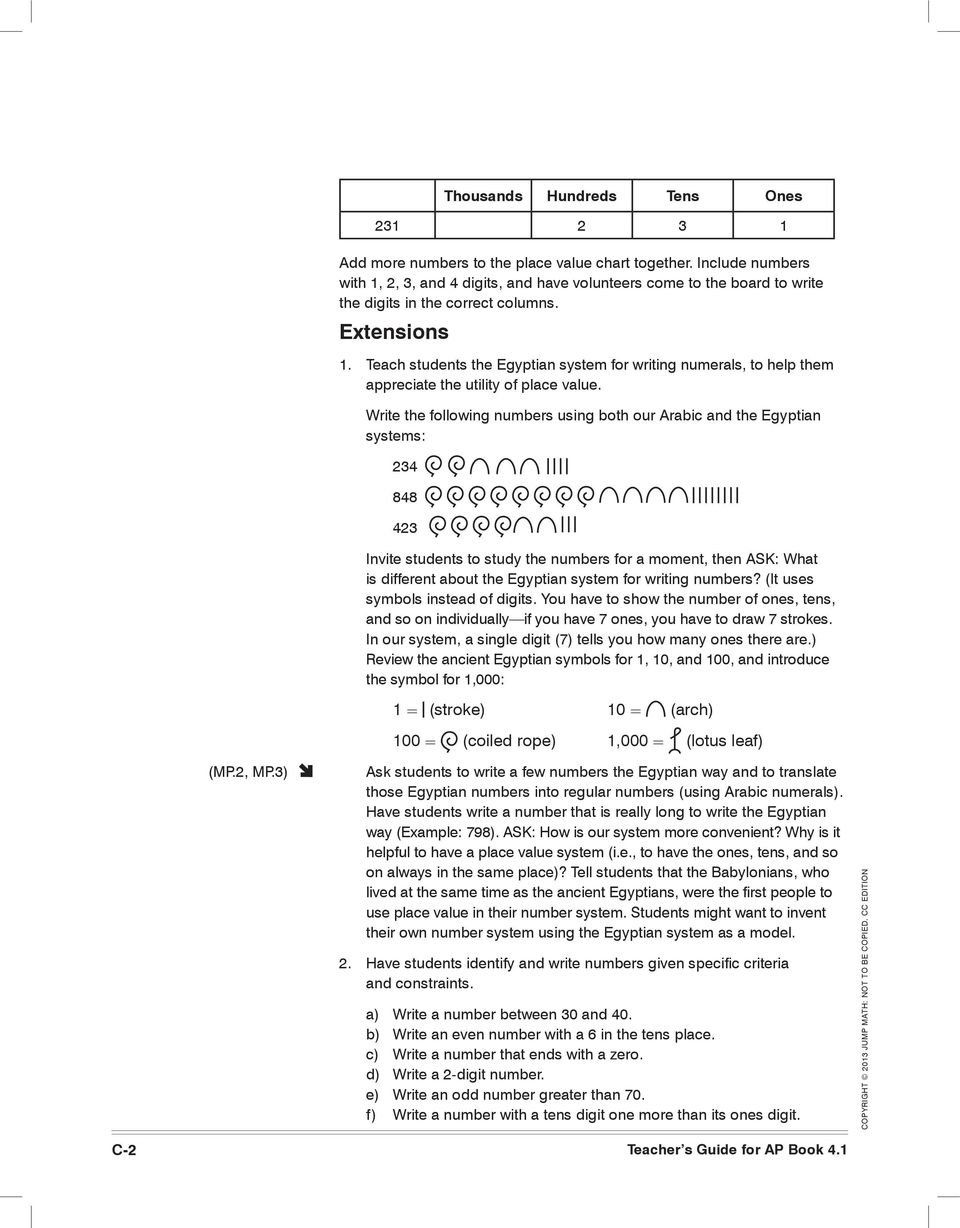
2 Thousands Hundreds Tens Ones Add more numbers to the place value chart together. Include numbers with 1, 2, 3, and 4 digits, and have volunteers come to the board to write the digits in the correct columns. Extensions 1. Teach students the Egyptian system for writing numerals, to help them appreciate the utility of place value. Write the following numbers using both our Arabic and the Egyptian systems: Invite students to study the numbers for a moment, then ASK: What is different about the Egyptian system for writing numbers? (It uses symbols instead of digits. You have to show the number of ones, tens, and so on individually if you have 7 ones, you have to draw 7 strokes. In our system, a single digit (7) tells you how many ones there are.) Review the ancient Egyptian symbols for 1, 10, and 100, and introduce the symbol for 1,000: 1 = (stroke) 10 = (arch) 100 = (coiled rope) 1,000 = (lotus leaf) (MP.2, MP.3) Ask students to write a few numbers the Egyptian way and to translate those Egyptian numbers into regular numbers (using Arabic numerals). Have students write a number that is really long to write the Egyptian way (Example: 798). ASK: How is our system more convenient? Why is it helpful to have a place value system (i.e., to have the ones, tens, and so on always in the same place)? Tell students that the Babylonians, who lived at the same time as the ancient Egyptians, were the first people to use place value in their number system. Students might want to invent their own number system using the Egyptian system as a model. 2. Have students identify and write numbers given specific criteria and constraints. a) Write a number between 30 and 40. b) Write an even number with a 6 in the tens place. c) Write a number that ends with a zero. d) Write a 2-digit number. e) Write an odd number greater than 70. f) Write a number with a tens digit one more than its ones digit. C-2 Teacher s Guide for AP Book 4.1
3 Advanced: g) Which number has both digits the same: 34, 47, 88, 90? Write a number between 50 and 60 with both digits the same. h) Find the sum of the digits in each of these numbers: 37, 48, 531, 225, 444, 372 Write a 3-digit number where the digits are the same and the sum of the digits is 15. i) Which number has a tens digit one less than its ones digit? 34, 47, 88, 90 Write a 2-digit number with a tens digit eight less than its ones digit. j) Write a 3-digit number where all three digits are odd. k) Write a 3-digit number where the ones digit is equal to the sum of the hundreds digit and the tens digit. Make up more such questions, or have students make up their own. Number and Operations in Base Ten 4-1 C-3

4 NBT4-2 Place Value Pages STANDARDS 4.NBT.A.2, 4.NBT.A.1 Goals Students will identify the place value of digits in 2-, 3-, 4-, 5-, and 6-digit numbers. Vocabulary expanded form has a value of hundred thousands hundreds is short for ones place value stands for ten thousands tens thousands (MP.7) PRIOR KNOWLEDGE REQUIRED Understands place value for ones, tens, hundreds, and thousands Understands the phrase times as many The value of a digit. Write 2,836 on the board. SAY: The number 2,836 is a 4-digit number. What is the place value of the digit 2? (If necessary, point to each digit as you enumerate them aloud from the right: ones, tens, hundreds, thousands.) SAY: The 2 is in the thousands place, so it stands for 2,000. What does the digit 8 stand for? (800) The 3? (30) The 6? (6) Expanded form. Explain that 2,836 is just a short way of writing 2, The 2 actually has a value of 2,000, the 8 has a value of 800, the 3 has a value of 30, and the 6 has a value of 6. Another way to say this is that the 2 stands for 2,000, the 8 stands for 800, and so on. ASK: What is 537 short for? 480? 2,035? 9,601? (Write out the expanded form for each number.) What is the value of the 6 in 2,608? In 306? In 762? In 6,504? In the number 6,831, what does the digit 3 stand for? The digit 6? The 1? The 8? What is the value of the 0 in 340? In 403? In 8,097? Write out the expanded form for each number so that students see that 0 always has a value of 0, no matter what position it is in. Include the 0 in the expanded form for now. For example, 340 = ASK: In the number 7,856, what is the tens digit? The thousands digit? Ones? Hundreds? Repeat for 3,050; 5,003; 455; 7,077; 8,028. Introduce 6-digit numbers. Write a 6-digit number on the board. Example: 584,769. Say the names of the place values, reading from right to left, for the 5 rightmost digits: ones, tens, hundreds, one thousands, ten thousands. Ask students to predict what the place value name for the 5 is. Exercises: Have students write the place value for the digit 5 in these numbers: a) 643,502 b) 452,004 c) 512,083 d) 435,604 e) 602,050 Bonus Tell students that millions is the next place value after hundred thousands. Have students use the pattern to predict the place value names for the next two place values over (ten millions, hundred millions), and then write down the place value names for the digit 5 in these numbers: a) 5,607,412 b) 352,706,118 c) 28,534,006,829 Exercises: Have students write how much the 8 is worth in these numbers: a) 382,405 b) 708,530 c) 523,089 d) 842,560 e) 600,853 f) 642,018 C-4 Teacher s Guide for AP Book 4.1

5 Bonus g) 68,034,612 h) 385,432,219 i) 321,058,956,430 Comparing the value of digits. Write the following numbers on the board: 2,350 5,031 1,435 4,573 (MP.6) Ask students to identify which digit, the 5 or the 3, is worth more in each number. Students should be using the phrases introduced in the lesson stands for, has a value of, is short for. (Example: In 2,350, the 5 stands for 50 and the 3 stands for 300, so the digit 3 is worth more.) Exercise: Have students copy and complete the table with rows added for parts b) through f): Number How much is the 5 worth? How much is the 3 worth? Which is worth more, the 3 or 5? a) 3, ,000 3 b) 4,053 c) 52,439 d) 735,412 e) 4,035 f) 3,251 Bonus: 452,809,316 ASK: How can you tell when the 3 is worth more than the 5 without even completing the chart? (When the 3 is to the left of the 5, it is worth more.) How many times as much as one number is another number worth? Exercise: Have students copy and complete the table with rows added for parts b) through f): First Number Second Number How many times as much? a) 3, b) 5,000 and 50 c) 500,000 and 5,000 d) 800,000 and 8 e) 70,000 and 70 f) 600,000 and 60 Bonus: 80,000,000 and 800 (MP.8) ASK: How can you tell from the number of zeros in both numbers how many times as much as the second number the first number is worth? (Look at how many more zeros the first number has than the second, then write that many zeros after the 1. Students do not have to answer so precisely. Suggest that they answer with an example, then summarize for them with the general statement. For example, in part a), 3,000 has two more zeros than 30, so 3,000 is with two zeros times as much as 30.) How many times as much? ASK: What is the value of the first 1 in the number 1,312? What is the value of the second 1? How many times as much as the second 1 is the first 1 worth? Repeat with more numbers in which the digit 1 is repeated. Repeat the questioning for how many times as much as the second 3 the first 3 is worth in 3,436. Exercises: Have students copy and complete the table, with rows added for parts b) through f), and then determine how many times as much as the second 3 the first 3 is worth. Number and Operations in Base Ten 4-2 C-5

6 a) 3,235 Value of First 3 Value of Second 3 How many times as much? b) 2,334 c) 32,935 d) 23,063 e) 302,347 f) 832,341 Bonus: 234,806,432 Continue with numbers in which different digits are repeated: g) 7,275 Value of First Bold Digit Value of Second Bold Digit How many times as much? h) 8,398 i) 87,476 j) 452,853 k) 406,236 l) 206,423 Bonus: 841,806,482 Extensions (MP.8) 1. Tell students that there is a way to determine how many times as much as the second digit the first digit is worth without determining the value of each digit. Draw the following table on the board: How many times as much? How many places apart are the two digits? a) 3, Show that the 3s are 2 places apart as follows: 3, Have volunteers find how many places apart the 3s are in these numbers: a) 43,326 b) 325,431 c) 8,324,013 d) 32,134,761 Answers: a) 1, b) 4, c) 5, d) 3 Exercises: Add to the chart above all the numbers from the previous two tables, for which you have already determined how many times as much as the second digit the first digit is worth. Complete the last column for each number, then look for a pattern to see how you can get the values in the how many times as much column from those in the how many places apart column. b) 2,334 c) 32,935 d) 23,063 e) 302,347 f) 832,341 g) 7,275 h) 8,398 i) 87,476 j) 452,853 k) 406,236 l) 206,423 Bonus: m) 234,806,432 n) 841,806,482 C-6 Teacher s Guide for AP Book 4.1

7 Answer: In all cases, to find how many times apart, write 1 with that many zeros; for example, if the two digits are 3 places apart, the first one is worth 1,000 times as much as the second because 1,000 has 3 zeros. (MP.1, MP.7) 2. a) Which is worth more in the following numbers, the 3 or the 6? How many times more? i) 63 (the 6; 20 times more) ii) 623 iii) 6,342 iv) 36 v) 376 vi) 3,006 vii) 6,731 viii) 7,362 ix) 9,603 x) 3,568 xi) 3,756 xii) 3,765 xiii) 6,532 If students need help, ask them how they could turn each problem into one that they already know how to solve. For example, if ii) was 323 instead of 623, you would know how to solve it (the first 3 is worth 100 times more than the second 3). How is 623 different from 323? (6 is twice as much as 3, so the 6 is worth 200 times more than the 3) b) How many times more is the 2 worth than the 5 in: i) 25 ii) 253 iii) 2,534 iv) 25,347 v) 253,470 vi) 2,534,708 vii) 2,345 viii) 23,457 ix) 234,576 x) 2,345,768 Students will discover through playing with the numbers that they can reduce to the case where the 5 is the ones digit even when that s not the case. (MP.8) c) How many times more is the 2 worth than the 5 in: i) 25 ii) 235 iii) 2,465 iv) 27,465 Students will see that the answer multiplies by 10 each time so they can pretend the numbers are right next to each other and then add a zero for each place they have to move over. (MP.1) 3. a) The tens digit of a 2-digit number is worth 6 times as much as the ones digit. The tens digit is 3. What is the number? (35) b) The hundreds digit of a 3-digit number is worth 4 times as much as the tens digit. The tens digit is halfway between the ones digit and the hundreds digit. What is the number? (258) Number and Operations in Base Ten 4-2 C-7

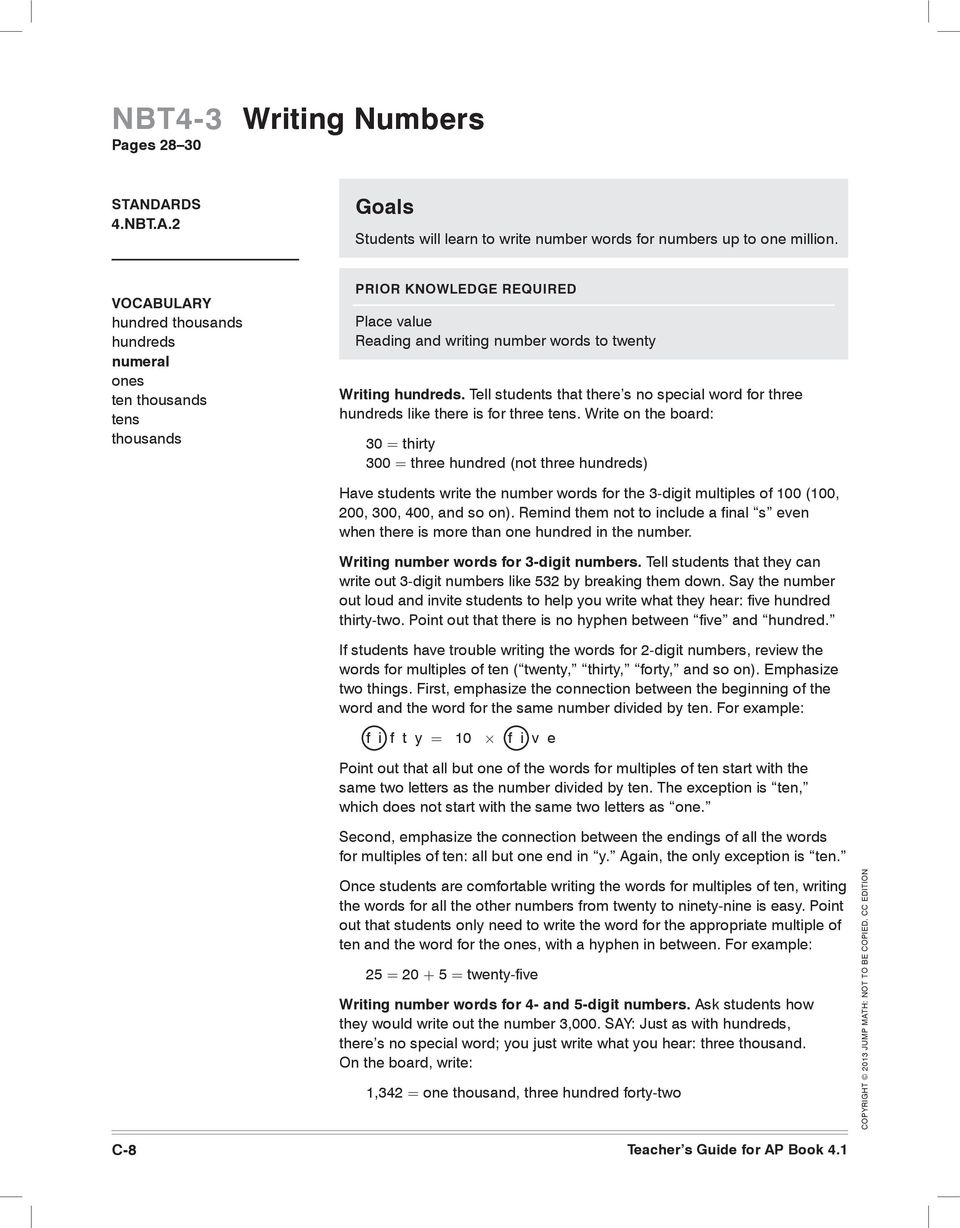
8 NBT4-3 Writing Numbers Pages STANDARDS 4.NBT.A.2 Goals Students will learn to write number words for numbers up to one million. Vocabulary hundred thousands hundreds numeral ones ten thousands tens thousands PRIOR KNOWLEDGE REQUIRED Place value Reading and writing number words to twenty Writing hundreds. Tell students that there s no special word for three hundreds like there is for three tens. Write on the board: 30 = thirty 300 = three hundred (not three hundreds) Have students write the number words for the 3-digit multiples of 100 (100, 200, 300, 400, and so on). Remind them not to include a final s even when there is more than one hundred in the number. Writing number words for 3-digit numbers. Tell students that they can write out 3-digit numbers like 532 by breaking them down. Say the number out loud and invite students to help you write what they hear: five hundred thirty-two. Point out that there is no hyphen between five and hundred. If students have trouble writing the words for 2-digit numbers, review the words for multiples of ten ( twenty, thirty, forty, and so on). Emphasize two things. First, emphasize the connection between the beginning of the word and the word for the same number divided by ten. For example: f i f t y = 10 f i v e Point out that all but one of the words for multiples of ten start with the same two letters as the number divided by ten. The exception is ten, which does not start with the same two letters as one. Second, emphasize the connection between the endings of all the words for multiples of ten: all but one end in y. Again, the only exception is ten. Once students are comfortable writing the words for multiples of ten, writing the words for all the other numbers from twenty to ninety-nine is easy. Point out that students only need to write the word for the appropriate multiple of ten and the word for the ones, with a hyphen in between. For example: 25 = = twenty-five Writing number words for 4- and 5-digit numbers. Ask students how they would write out the number 3,000. SAY: Just as with hundreds, there s no special word; you just write what you hear: three thousand. On the board, write: 1,342 = one thousand, three hundred forty-two C-8 Teacher s Guide for AP Book 4.1
9 Have students write the number words for more 4- and 5-digit numbers. (Exercises: 5,653; 4,887; 1,320; 17,340; 28,512; 11,006) Writing number words for 6-digit numbers. Write down a 6-digit number, such as 312,407. Then ASK: How many thousands are in this number? Explain that you can cover the last three digits to see how many thousands there are: 312, SAY: There are 312 thousands. We write that almost exactly the way we say it: three hundred twelve thousand (write the words on the board). Emphasize that we don t put an s at the end of thousand when there is more than one the same way we don t put an s at the end of hundred when there is more than one (Examples: three hundred, five thousand). Have students write the value shown by the first three digits. Students can cover the last three digits if it helps them. a) 714,508 (seven hundred fourteen thousand) b) 607,390 (six hundred seven thousand) c) 390,607 (three hundred ninety thousand) Uncover the last three digits and finish writing the number: 312, three hundred twelve thousand becomes 312,407 three hundred twelve thousand, four hundred seven Explain that we can write the number of thousands and then we can write the rest. As long as we know how to write numbers in the hundreds, we can write 6-digit numbers too! Have volunteers finish writing these numbers: a) 324,512 = three hundred twenty-four thousand, b) 704,690 = seven hundred four thousand, c) 320,005 = three hundred twenty thousand, Ask two volunteers to each think of a number between 1 and 999. Example: Student 1 thinks of 412; Student 2 thinks of 99. Have all students individually write the number words for those two numbers on a blank sheet of paper. Then tell students to put the numbers together, so that the first number is the number of thousands and the other is the number of ones: 412,099. Have students write the number in words. Repeat by reversing the roles of 99 and 412, i.e., now make the number 99,412. Then have students individually think of a number between 1 and 999. Each student writes the number word for their number. Then students pair up. They will now have two numbers with at most three digits each. Each student writes the number with their number of thousands and their partner s number of ones, so partners each end up with two different numbers. Number and Operations in Base Ten 4-3 C-9

10 Students discuss in pairs how their number words are the same and how they are different. Repeat for other choices of numbers. Point out that commas are put in the same place in the number words as in the numeral. Exercises: Have students write the number words for these numbers: a) 800,430 (eight hundred thousand, four hundred thirty) b) 62,300 (sixty-two thousand, three hundred) c) 532,007 (five hundred thirty-two thousand, seven) d) 708,090 (seven hundred eight thousand, ninety) Bonus Tell students that after thousands come millions. Challenge them to write these numbers using the same pattern: a) 630,000,000 (six hundred thirty million) b) 630,400,000 (six hundred thirty million, four hundred thousand) c) 603,040,000 (six hundred three million, forty thousand) d) 603,040,025 (six hundred three million, forty thousand, twenty-five) (MP.6) Write the following number words on the board and ask the whole class which number words are incorrectly written and why. When the number words have been corrected, have students write the correct numerals individually in their notebooks. a) One thousand, zero hundred twenty (shouldn t write "zero hundred") b) Five thousand, thirty-two (correct) c) Zero thousand, four hundred sixty-four (should start with four hundred ) d) Eight-thousand, three-hundred seventy (should be no dashes) e) Two thousand, nine hundred ninety-zero (shouldn t write zero ) f) Seven thousand, four hundred seventy three (dash missing between "seventy" and "three") g) Twenty-eight thousand, ninety-three (correct) h) Five hundred three thousands, twenty-five ( thousands should be thousand ) Connection Real World Write some typical text from street signs and have students replace any number words with numerals and vice versa. Exercises: a) Fourteenth Avenue b) Pittsburgh 181 miles c) Seventy-Eight King Street d) Highway 61 Writing one million. ASK: What number comes after 999,999? Have a volunteer write the number on the board: 1,000,000. Ask if anyone knows the name for the number. (one million) Write on the board: ,000 10, ,000 1,000,000 C-10 Teacher s Guide for AP Book 4.1

11 Point to each number in turn and, as students say the number, write it on the board in words. Then tell students that now they know how to write the numbers from one to one million! Write various numbers on the board using numerals, and have students write the corresponding number words. Include numbers up to one million. Extensions 1. Tell students that sometimes a number in the thousands is expressed in terms of hundreds. SAY: I want to know how many hundreds there are in 1,900. How many hundreds are in 1,000? How many are there in 900? So how many hundreds are in 1,900? When students say 19, tell them 1,900 can be written out as one thousand, nine hundred or nineteen hundred. Invite students to help you write 2,400, 3,800, and 7,900 in terms of hundreds. ASK: Which way uses fewer syllables, the old way (using thousands and hundreds) or the new way (using only hundreds)? Challenge students to find a number that has more syllables the new way (Example: "twenty hundred" instead of "two thousand"). ASK: How many hundreds are in a thousand? So what would a thousand be in terms of hundreds? (ten hundred) How many syllables are there each way? Are there any other numbers like this? Tell students that we don t usually write thirty hundred or seventy hundred (numbers that are a multiple of ten hundred), but we often express other numbers in the thousands in terms of hundreds only. Have students practice writing the year they were born both ways. Which way is shorter? What if they write the year their older or younger siblings were born? Tell students that years are usually written in terms of hundreds instead of thousands, unless the hundreds digit is 0. Usually, the word hundred is omitted, so that 1927 is written as nineteen twenty-seven, but 2007 is written as two thousand seven. For homework, have students research the correct year for an event of their choice and write both the numeral and the number word. Possible topics could be sports, history, their family tree, etc. Examples: Connection Real World (MP.1) My favorite team last won the championship in Our city was founded in My grandmother was born in 2. Show students a copy of a cheque and explain why it s important to write the amount using both words and numerals. Show them how easy it is to change a number such as to 1, by adding the digit 1. On the other hand, it would be an obvious forgery if someone then tried to add one thousand before three hundred forty-eight. 3. Have students find a number word whose spelling has the letters in alphabetical order. Students should not do this problem by guessing! Rather, they should eliminate possibilities intelligently. Hint: If the words from one to nine are not alphabetical, can any word containing those words be alphabetical? Number and Operations in Base Ten 4-3 C-11

12 Answer: forty Solution: First, check all numbers up to twelve individually. Second, eliminate any number words in the teens. (Why can you do this?) Third, eliminate any number word that has a 1-digit number word in it. For example, twenty-seven cannot be alphabetical since seven is not; one hundred thirty-four cannot be alphabetical because one and four are not. The only numbers this leaves are multiples of 10! Check these individually: twenty, thirty, forty. When you reach forty, you are done! (MP.1, MP.3) 4. Project idea: Have students predict and then search for these facts about the Empire State Building and write their answers as both numerals and words: How many floors does the building have? How many steps are there to the top of the building? How many days did it take to build? How many man-hours did it take to build? How much did it cost to build? How many people worked on the building at one time? How many tons of steel did it take to construct the frame? How many feet of telephone wire service the building? How many feet tall is the Empire State Building? How many meters tall is the Empire State Building? In what year was the Empire State Building built? Before doing the research, have students estimate which numbers will be in the tens, hundreds, thousands, or larger, and then order their estimates. You can hand out strips of paper with all these questions on them and have students write their estimates on the strips and sort them into four piles: tens, hundreds, thousands, larger than thousands. Be sure that all students understand that the number of meters tall will be fewer than the number of feet tall. ASK: Are there any others that you can order automatically by logic? (The number of man-hours should be more than the number of days because hours are shorter than days and many people can work many hours on the same day. The number of steps should be more than the number of floors.) When students have individually sorted the questions and estimates, have them work in pairs to compare their sorting and come to an agreement about which pile each question belongs in. Then have groups of four do the same. Once each group is happy with the sorting, each group member orders the questions in one pile from least predicted number to greatest predicted number. When each group of four has a predicted order, they can search the answers on the Internet. Be sure they write their answers in words and numerals. C-12 Teacher s Guide for AP Book 4.1

13 NBT4-4 Representation with Base Ten Materials Pages STANDARDS 4.NBT.A.2 Goals Students will practice representing numbers with base ten materials. Vocabulary digit hundreds block ones block tens block PRIOR KNOWLEDGE REQUIRED Place value Base ten materials MATERIALS base ten blocks The standard way to represent numbers using blocks. As students group and manipulate base ten materials throughout the lesson, monitor the models they create on their desks and/or have students sketch their answers on paper so that you can verify their understanding. Emphasize that their sketches can be basic, without a lot of detail. not not not Hundreds block Tens block Ones block Give each student 3 tens blocks and 9 ones blocks. Ask them to make the number 17 and to explain how their choice represents that number. PROMPTS: How many tens blocks do you have? (1) How many ones are in a tens block? (10) How many ones are there altogether? (17) Repeat with more 2-digit numbers. (Exercises: 14, 19, 28, 34, 32, 25) Then give each student 3 hundreds blocks and have them make 3-digit numbers. (Exercises: 235, 129, 316) Use prompts, if needed, to help students break down their representations. For 235, ASK: How many ones are in the hundreds blocks? (200) The tens blocks? (30) The ones blocks? (5) How many ones are there altogether? ( = 235) (MP.1) Using blocks to represent numbers in different ways. Have students work in pairs to make the following: 12 using exactly 12 blocks, 22 using 13 blocks, 25 using 16 blocks, and 31 using 13 blocks. These representations will be non-standard. (Example: 22 using 13 blocks is 1 tens block and 12 ones blocks, instead of the standard 2 tens blocks and 2 ones blocks.) Encourage students to make a standard representation first and then to ask themselves whether they need more blocks or fewer blocks. (They will need more blocks because the standard representation always uses the least number of blocks.) Which blocks can they trade to keep the value the same but increase the number of blocks? Make sure each student has exactly 5 hundreds blocks, 25 tens blocks, and 15 ones blocks. Ask what number this represents and how they know. (765 = ) Ask how many blocks they have in total (45). Now Number and Operations in Base Ten 4-4 C-13

14 have them work with a partner to meet the following challenge: One partner has to make the number 765 using exactly 54 blocks and the other has to make the number using 36 blocks. Partners will have to trade blocks. ASK: Do you and your partner have enough blocks to do this? (yes, because = 90, and each person has 45) Have students record their solution. When they are done, ask them to find a different solution with the same number of blocks. Students who finish early should find and list as many ways as they can to make 765 using different numbers of blocks. When all students are done, have students write on the board various ways of making 765 using base ten blocks. Then challenge them to do these harder questions on their own: make 54 using exactly 27 blocks, 76 using 31 blocks, 134 using 17 blocks, 247 using 40 blocks, 315 using 36 blocks. Guide students by suggesting that they start with the standard base ten representation, and then trade one block worth ten times as much for ten of the smaller blocks (for example, trade 1 hundreds block for 10 tens blocks to get 9 more blocks). ACTIVITY (MP.1, MP.3, MP.8) NOTE: This is an open-ended activity. There are many possible answers. Give students ones and tens blocks. ASK: Which numbers have standard base ten representations that can be arranged as rectangles of width at least 2? That is, if tens blocks are arranged horizontally, there are at least 2 rows. Remind students that a standard base ten model uses fewer than 10 of each type of block. For example, 35 = 3 tens + 5 ones is standard; 35 = 2 tens + 15 ones is not. Sample answers: 60 = All numbers with identical digits except any multiple of 3 up to 39 (33, 36, 39) Note that any number can be represented as a rectangle of width 1, hence the restriction in the width above. Examples: 11 = 35 = Write a number in expanded form on the board. Can students tell, just by looking at the number, whether its base ten representation can be arranged in a rectangle with width at least 2? Ask them to explain how they know. Numbers in the 60s are especially interesting to consider because 2, 3, and 6 divide evenly into the tens digit (6); if the ones digit is any multiple of these factors, the number can be represented by a rectangle with width at least 2. Example: 68 C-14 Teacher s Guide for AP Book 4.1

15 A good hint, then, is to first arrange just the tens blocks into a rectangle with at least 2 rows. This is necessary since the (at most 9) ones blocks cannot rest on top of the tens blocks. The numbers 60, 62, 63, 64, 66, 68, and 69 can all be modeled this way, but 61, 65, and 67 cannot. Allow students time to make these discoveries on their own. (MP.6) (MP.1) Extensions 1. Ask students to explain and show with base ten blocks the meaning of each digit in a number with all digits the same (Example: 3,333). 2. Have students solve these puzzles using base ten blocks: a) I am greater than 20 and less than 30. My ones digit is one more than my tens digit. b) I am a 2-digit number. Use 6 blocks to make me. Use twice as many tens blocks as ones blocks. c) I am a 3-digit number. My digits are all the same. Use 9 blocks to make me. d) I am a 2-digit number. My tens digit is 5 more than my ones digit. Use 7 blocks to make me. e) I am a 3-digit number. My tens digit is one more than my hundreds digit and my ones digit is one more than my tens digit. Use 6 blocks to make me. (MP.1) 3. Have students solve these puzzles by only imagining the base ten blocks. These questions have more than one answer emphasize this by asking students to share their answers. a) I have more tens than ones. What number could I be? b) I have the same number of ones and tens blocks. What number could I be? (MP.3) c) I have twice as many tens blocks as ones blocks. What 2-digit number could I be? d) I have six more ones than tens. What number could I be? 4. a) You have one set of blocks that makes the number 13 and one set of blocks that makes the number 22. Can you have the same number of blocks in both sets? b) You have one set of blocks that makes the number 23 and one set of blocks that makes the number 16. Can you have the same number of blocks in both sets? Number and Operations in Base Ten 4-4 C-15

16 NBT4-5 Representation in Expanded Form Pages STANDARDS 4.NBT.A.2 Goals Students will replace a number with its expanded form and vice versa. Vocabulary digit expanded form placeholder PRIOR KNOWLEDGE REQUIRED Place value (ones, tens, hundreds, thousands) MATERIALS BLM Representing Numbers (Review) (p. C-82) Review expanded form. ASK: How much is the 4 worth in 459? The 5? The 9? Have a volunteer write the expanded form of 459 on the board. Have students write the following numbers in expanded form in their notebooks: 352, 896, 784. Ensure that all students have written at least the first one correctly. Then ask a volunteer to write 350 in expanded form on the board. (350 = ) Have another volunteer write the expanded form of 305. Then have students write the following numbers in expanded form in their notebooks: a) 207 b) 270 c) 702 d) 720 e) 403 f) 304 g) 430 h) 340 Encourage students to refer to the board if necessary. Then proceed to 4-digit numbers: 6,103; 7,064; 8,972; 1,003; 8,000. Finally, do 5- and 6-digit numbers: 62,000; 60,200; 60,002; 500,003; 500,300; 500,030. Expanded form with words and numerals. Write on the board: 2,427 = thousands + hundreds + tens + ones Have a volunteer fill in the blanks. Repeat with 4,589; 3,061; 5,770; 6,804. Bonus Provide questions where the place values are not in order from largest to smallest. Example: 3,891 = ones + hundreds + tens + thousands. Expanded form with words and numerals for 5- and 6-digit numbers. Now write these on the board, and have volunteers fill in the blanks: 364,928 = hundred thousands + ten thousands + thousands + hundreds + tens + ones 804,008 = hundred thousands + ten thousands + thousands + hundreds + tens + ones C-16 Teacher s Guide for AP Book 4.1

17 Explain that we don t need to write the place values that have zero in them. This is because expanded form writes the number as a sum of its place values, and zero doesn t add anything to a sum. Write on the board: 804,008 = 8 hundred thousands + 4 thousands + 8 ones Have students tell you the names of the place values they need to write for this number: 60,420. Then write on the board: 60,420 = ten thousands + hundreds + tens Have a volunteer fill in the blanks. Exercises: Have students identify and write only the place value names required to write these numbers. a) 34,002 (ten thousands, thousands, ones) b) 200,400 (hundred thousands, hundreds) c) 208,050 (hundred thousands, thousands, tens) (MP.6) Then have students write out the expanded form, using numerals and words, for various numbers. Examples: 30,400; 200,030; 36,004; 890,000. Writing the number given the expanded form. Exercises: Have students do the following sums in their notebooks to write the number. (Invite volunteers to do the first two.) a) b) c) d) e) f) Repeat with 3-digit numbers that have no 0 digit. (Examples: , , ) Bonus ASK: What is ? Is there a 0 in the number? How do you know? What would happen if we didn t write the 0 digit because we thought the 0 didn t matter, and we just wrote the 5 and the 7 as 57? Does = 57? Emphasize that in expanded form we don t need to write the 0 because expanded form is an addition (or sum) and the 0 doesn t add anything, but in multi-digit numerals, it means something. It makes sure that each digit s place value is recorded properly. Mathematicians call 0 a placeholder because of this. Exercises: Add the following 3- to 6-digit sums: a) b) c) d) e) f) 4, g) 5, h) 7, i) 50, , j) 60, k) 700, l) 800, , Bonus m) ,000 n) ,000 Number and Operations in Base Ten 4-5 C-17

18 Exercises: Give students the expanded form for 3- to 6-digit numbers (addition equations) with a blank to fill in. a) = 253 b) 3, = 3,427 c) 500, = 502,004 d) = 800,340 Bonus e) ,000 + = 63,050 For extra practice, you can assign BLM Representing Numbers (Review). (MP.1) Extensions 1. Some of the following problems have multiple solutions. a) i) In the number 2,735, what is the sum of the tens digit and the thousands digit? ii) Find a number whose tens digit and thousands digit add to 11. b) i) Write a number whose hundreds digit is twice its ones digit. ii) In the number 4,923, find a digit that is twice another digit. How much more is the larger digit worth? iii) Make up a problem like the one above and solve it. 2. Which of the following are correct representations of 352? A B. 1 hundred + 20 tens + 2 ones C. 2 hundreds + 15 tens + 2 ones D. 34 tens + 12 ones Make up more problems of this sort and have students make up problems of their own. (MP.1) 3. a) Use ones, tens, hundreds, and thousands blocks. Model as many numbers as you can that use exactly 4 blocks. In each case, what is the sum of the digits? Why? (MP.6) b) A palindrome is a number that looks the same written forwards or backwards (Examples: 212, 3,773). Find as many palindromes as you can where the sum of the digits is 10. (Be sure students understand that the sum of the digits is also the number of blocks.) 4. Have students write about zero in their notebooks. Is writing 0 necessary when we write numbers like 702? How would the meaning change if we didn t write it? Is 0 necessary when we write addition equations like = 17? Would the meaning change if we didn t write it? C-18 Teacher s Guide for AP Book 4.1

19 NBT4-6 Comparing and Ordering Numbers Pages STANDARDS 4.NBT.A.2 Goals Students will use base ten materials to determine which number is larger. Vocabulary greater than (>) hundreds less than (<) PRIOR KNOWLEDGE REQUIRED Naming numbers from base ten materials Modeling numbers with base ten materials MATERIALS base ten blocks: ones and tens in different colors (MP.3) Comparing numbers that do not have the same number of digits (Example: 350 and 1,433). Challenge students to explain why any 4-digit number is always greater than any 3-digit number. (All 4-digit numbers are at least 1,000; all 3-digit numbers are less than 1,000.) PROMPT: Is any 2-digit number always greater than any 1-digit number? (yes) How do you know? (2-digit numbers are at least 10; 1-digit numbers are at most 9) Repeat for why 3-digit numbers are always greater than 2-digit numbers. Comparing numbers that differ by only one digit using blocks. Make the numbers 25 and 35 using drawings of base ten materials. Have students name the numbers. ASK: Which number is bigger? How can we explain which number is bigger using base ten blocks? Explain that 3 tens blocks is more than 2 tens blocks and 5 ones blocks is the same as 5 ones blocks, so 35 is more than 25. Exercise: Have students identify the bigger number in the following pairs using base ten materials or models drawn on paper: a) 352 or 452 b) 405 or 401 c) 398 or 358 d) 541 or 241 (MP.7) Comparing numbers that differ by only one digit using expanded form. Show students how, instead of looking at the base ten blocks, you can look at the expanded form of a number and see the same thing. In the following example, 200 = 200, 20 is less than 30, 5 = 5, so 225 is less than = = Number and Operations in Base Ten 4-6 C-19

20 Write on the board: 346 = = ASK: Which number is bigger? How do you know? Demonstrate circling the place in the expansion where the numbers differ: 346 = = Then ask students to compare the numbers and circle the digit that is different: Repeat with several pairs of 3- and 4-digit numbers that differ by only one digit. Include numbers with zeros (Examples: 302 or 312; 4,003 or 4,007), but do not compare a 3-digit number to a 4-digit number yet. Repeat with 5- and 6-digit numbers. (Examples: 54,120 and 54,123; 706,530 and 905,530; 613,200 and 643,200.) Now continue with examples where two or more digits are different, but the larger number has all digits larger than the smaller number. (Examples: 75 and 34; 64 and 89; 324 and 569; 402,345 and 706,547). Comparing 2-digit numbers that differ by more than one digit. Bring out the base ten materials and have students compare 43 to 26. SAY: Which has more tens blocks? Which has more ones blocks? Hmmm, 43 has more tens blocks, but 26 has more ones blocks how can we know which one is bigger? If you have two colors of tens and ones blocks (for example, red and blue), you can use red to make 43 and blue to make 26. Then demonstrate how the blue blocks can fit directly on top of the red blocks (the two blue tens blocks fit directly on top of two of the red tens blocks, and the six blue ones blocks fit directly on top of the third red tens block). Emphasize that because 43 has more tens, 43 is more than 26 it doesn t matter which one has more ones. Provide each pair of students with 9 each of red ones and tens blocks and blue ones and tens blocks. Have one student make 56 from red blocks and the other make 39 from blue blocks. Together, partners predict which color of blocks will fit on top of the other and then check their prediction. Have students write a concluding sentence individually in their notebooks: 56 is more than 39. Exercises: Repeat for other pairs of numbers. a) 27 and 64 b) 48 and 29 c) 57 and 60 C-20 Teacher s Guide for AP Book 4.1

21 Explain that the number with more tens is always more; at most 9 ones will fit on top of one of the extra tens blocks. Now tell students that there is another way to compare 43 to 26. Remind students that the only problem in comparing these numbers is that 26 has more ones than 43. Show students how trading a tens block for more ones blocks can help them compare the two numbers: 43 = 4 tens + 3 ones = 3 tens + 13 ones 26 = 2 tens + 6 ones Now, it is clear that 43 is more than has more tens and more ones. Exercises: Decide which number is greater. a) 74 or 68 b) 35 or 52 c) 63 or 29 Comparing 3-digit numbers that differ by more than one digit. Tell students you want to compare 342 and 257. ASK: Which number has more hundreds? More tens? More ones? Which number do you think is bigger, the one with the most hundreds, the most tens, or the most ones? Why? Then write on the board: 342 = = Since any 3-digit number is bigger than any 2-digit number, 142 is more than 57. If you picture an extra hundreds block for 342, all of the tens and ones from 357 will fit onto the extra hundreds block; even if there were 9 tens and 9 ones, which is the most possible, they would still fit onto the extra hundreds block. Exercises: Compare more 3-digit numbers. a) 731 and 550 b) 642 and 713 c) 519 and 382 Comparing 3-digit numbers with the same number of hundreds. Look at a pair in which the hundreds digit is the same (Example: 542 and 537). Point out that students just have to compare the 2-digit numbers, which they already know how to do. Comparing 4-digit numbers. Now look at a pair of 4-digit numbers and split the thousands: 7,432 = 6, ,432 3,913 = 3, Since any 4-digit is bigger than any 3-digit number, comparing columns in the expansion shows that the number with more thousands is bigger. Have students compare more 4-digit numbers. Review the greater than and less than signs. If students have a hard time remembering which is which, draw a face as shown in the margin. Number and Operations in Base Ten 4-6 C-21
22 SAY: This hungry person can have only one pile of bananas. Which pile should he take: bananas bananas Have a volunteer draw the face with the Erase the face and leave mouth opening toward the most bananas. only the mouth: 34 > 27. SAY: 34 is greater than 27 (write: 34 > 27), and 27 is less than 34 (write: 27 < 34). Exercises: Write the correct sign, < or >. a) 342 and 716 b) 2,815 and 5,146 c) 7,684 and 5,396 Extensions 1. Write on the board: 2 < 4 ASK: What digits can we put in the boxes to make this statement true? Take more than one answer. Encourage students to look for more possibilities. Record their answers on the board for all to see. Now write on the board: 2 < 9 ASK: Are there any digits that will make this statement true? PROMPTS: How many hundreds are in the second number? Can a number with no hundreds be greater than a number that has hundreds? Remind students that we do not write 0 at the beginning of a number. Example: First Number Second Number Connection Real World 2. Create base ten models of a pair of 2-digit numbers. Ask students to say how they know which number is greater. You might make one of the numbers in non-standard form, as shown for the first number at the left. To compare the numbers, students could remodel the first number in standard form by regrouping ones blocks as tens blocks. 3. Ask students to create base ten models of two numbers, in which one of the numbers a) is 30 more than the other. b) is 50 less than the other. c) has hundreds digit equal to 6 and is 310 more than the other. 4. Ask students where they tend to see many numbers in increasing order (houses, mailboxes, lineups when people need to take a number tag, apartment numbers). C-22 Teacher s Guide for AP Book 4.1
23 NBT4-7 Differences of 1, 10, 100, 1,000, 10,000, Page 39 and 100,000 STANDARDS 4.NBT.A.2 Vocabulary expanded form less than more than Goals Students will recognize differences of 1 or higher powers of 10 up to 100,000 (10, 100, 1,000, 10,000, 100,000) in numbers that differ by only one digit. Students will add and subtract 1 or a higher power of 10 when doing so will change a number by only one digit. PRIOR KNOWLEDGE REQUIRED Can compare and order numbers up to 1,000,000 Can write numbers up to 1,000,000 in expanded form Knows the names of the place values up to hundred thousands Understands the relationship between adding and more Understands the relationship between subtracting and less MATERIALS play money Comparing numbers that differ by one digit to determine how much more. ASK: Which is more, 70 or 60? How much more? (70 is 10 more than 60) PROMPT: How many tens are there in 70? In 60? Repeat for 20 or 30, 600 or 900, 500 or 400, 8,000 or 5, = = Then write 745 and 735 on the board and have a volunteer write both numbers in expanded form. Have another volunteer circle the numbers in the expansion that are different. Which number is larger? (40) How much more is it than the smaller number? (40 is 10 more than 30) Conclude that 745 is 10 more than 735. Repeat with more pairs of 3-digit numbers that differ by one, ten, or a hundred, but that do not change by more than one digit (Examples: 456 or 556; 207 or 208; 349 or 339; but not 193 or 203). Continue with 4-digit numbers that differ by one, ten, a hundred, or a thousand, but that do not change by more than one digit (Examples: 4,379 or 4,479; 2,017 or 3,017; but not 2,799 or 2,809). Repeat with 5- and 6-digit numbers that again do not differ by more than one digit. Comparing numbers using more and less. Remind students of the relationship between addition and the word more and subtraction and the word less. ASK: What number is 10 more than 846? How can we write an addition equation to show this? ( = 856) Repeat for 100 less than 846 and a subtraction equation ( = 746), 1 less than 846 (846-1 = 845), and 100 more than 846 ( = 946). Exercises: Write how much more or less. a) 50 is than 60 b) 53 is than 63 c) 253 is than 263 d) 530 is than 630 e) 2,530 is than 2,630 f) 2,530 is than 1,530 g) 2,530 is than 2,540 h) 2,530 is than 2,520 Number and Operations in Base Ten 4-7 C-23
24 i) 3,512 is than 3,612 j) 3,512 is than 2,512 k) 3,512 is than 3,502 Answers: a) 10 less, b) 10 less, c) 10 less, d) 100 less, e) 100 less, f) 1,000 more, g) 10 less, h) 10 more, i) 100 less, j) 1,000 more, k) 10 more Exercises: Have students solve some sums and differences. a) b) c) d) 4, e) 5, ,000 f) g) h) 6, SAY: Let s work with bigger numbers now. ASK: What number is 1,000 more than 892,735? What equation can we write to show this? (892, ,000 = 893,735) Repeat for 10,000 less than 892,735 (892,735-10,000 = 882,735) and 100,000 less than 892,735 (892, ,000 = 792,735). When students are comfortable with this, have them find what they need to add or subtract to get the answers in new equations. Exercises: a) = 437 b) 762 = 752 c) 7,602 = 7,502 d) 45,928 + = 55,928 e) 968,857 + = 978,857 f) 739,827 + = 839,827 If you make up more questions, don t cross multiples of 100 or 1,000 yet! Example: not = 509 ACTIVITY 1. Give each student 5 dollar bills and 10 dimes in play money. a) Tell students that they have 5 dollar bills. They buy a toy that costs 1 dime. Have them show how much money they have left. b) Tell students that they have 2 dollar bills and 9 dimes. This is 2 dollars and 90 cents, written as $2.90 (the dollars are written before the dot and the cents after). Have them show in dollar bills how much money they would have if they were given a dime. (MP.7) c) Discuss the connection between money and base ten blocks. ASK: How many pennies are in a dollar? If pennies are ones blocks, what is a tens block? (a dime) What is a hundreds block? (a dollar) Extensions 1. Subtract 1,010 from each number below. Students who have difficulty with this problem can do each subtraction in two steps: 8,549-1,000 = 7,549, then 7, = 7,539. a) 4,938 b) 36,479 c) 53,493 d) 286, For more advanced work, students can complete BLM Differences (Advanced) (pp. C-83 C-85). C-24 Teacher s Guide for AP Book 4.1
25 NBT4-8 Counting by 10s, 100s, and 1,000s Page 40 STANDARDS 4.NBT.A.2 Goals Students will identify and continue patterns that increase or decrease by powers of 10 (to 1,000s). Vocabulary decrease decreasing increase increasing term PRIOR KNOWLEDGE REQUIRED Can add and subtract powers of 10 across multiples of one higher power of ten (e.g., add and subtract 10 across multiples of 100) Understands the relationships between counting on or back by powers of 10 (up to 1,000) to adding or subtracting the same power of 10 Increasing by 10s, 100s, and 1,000s. Write this sequence on the board: 20, 30, 40,,, ASK: What do these numbers increase by? How could we write addition statements to show that? How would we find the next term in the pattern? Repeat for more 2-digit patterns that increase by 10s. Example: 26, 36, 46,,, Then look at 3-digit patterns that increase by 10s. Example: 513, 523, 533,,, Look at some 3-digit patterns that increase by 100s. Example: 119, 219, 319,,, Finally, provide a mix of 3-digit patterns some that increase by 10s, some by 100s so that students have to choose between the two. Look at some 4-digit patterns that increase by 1,000s. Example: 1,345, 2,345, 3,345,,, Then mix the patterns up again, so that some increase by 10s, some by 100s, and some by 1,000s. Exercises a) 785, 795,, 815, b) 675, 685,,, 715 c) 365, 375, 385,,, d) 500, 600, 700,,, e) 2,525, 2,625, 2,725,,, f) 23,122, 23,132, 23,142,,, g) 56,134, 66,134, 76,134,,, h) 373,324, 374,324, 375,324,,, Bonus 12,795, 12,895,,, 13,195 Repeat with patterns that decrease (Example: 362, 352, 342,, ). Number and Operations in Base Ten 4-8 C-25
26 Exercises a) 3,900, 3,800, 3,700,,, b) 45,730, 44,730, 43,730,,, Bonus Create a pattern that either increases or decreases by 10s, 100s, or 1,000s, and have a partner extend the pattern. Extension These patterns change in more than one way. Have students continue the patterns: a) 100, 100, 200, 200, 300, 300,,, b) 351, 351, 451, 451, 551, 551, 651, 651,,, c) 859, 859, 869, 879, 879, 889, 899, 899,,, d) 20, 30, 130, 140, 240, 250, 350,,, e) 30, 20, 120, 110, 210, 200,,, f) 1,453, 2,453, 2,454, 3,454, 3,455, 4,455,,, g) 3,570, 3,569, 4,569, 4,568, 5,568,,, Answers: a) 400, 400, 500, b) 751, 751, 851, c) 909, 919, 919, d) 360, 460, 470, e) 300, 290, 390, f) 4,456, 5,456, 5,457, g) 5,567, 6,567, 6,566 C-26 Teacher s Guide for AP Book 4.1
27 NBT4-9 Comparing Numbers (Advanced) Pages STANDARDS 4.NBT.A.2 Goals Students will order sets of two or more numbers and will find the greatest and least number possible when given particular digits. Vocabulary greater than (>) less than (<) PRIOR KNOWLEDGE REQUIRED Comparing pairs of numbers MATERIALS dice (MP.7) Forming the least and greatest numbers from different digits. ASK: What is the smallest 3-digit number? PROMPT: What is the first 3-digit number you get to when counting? (100) What is the largest 3-digit number? PROMPT: What is the last 3-digit number you say when counting before you get to 4-digit numbers? (999) Write on the board: 1, 4, 7. Tell students that you want to make a 3-digit number using these digits. Have two students volunteer answers. Write their answers on the board. ASK: Which is greater? Then tell students you want the greatest 3-digit number they can think of that uses these 3 digits. ASK: How do you know it s the greatest? Wait for an answer before giving any hints. Emphasize that the greatest number has the most hundreds possible, and then the most tens possible. Ask students to make the least 3-digit number possible with the same digits and to explain how they know it s the least. ASK: Can you make a lesser, or smaller, number with those digits? Repeat with several examples of 3-digit numbers and then move on to 4-digit numbers. Point out that to make the least 3-digit number possible with 0, 3, and 9, since we do not start a number with 0, the hundreds digit must be 3, then the tens digit can be 0, and the ones digit needs to be 9. Comparing and ordering 2- and 3-digit numbers. SAY: I want to compare two 2-digit numbers. ASK: If the number of tens is different, how can you tell which number is greater? If the number of tens is the same, how can you tell which number is greater? Have students practice putting groups of three 2-digit numbers in order, from least to greatest. Do examples in the following order: The tens digit is always the same: 27, 24, 29 35, 33, 30 48, 49, 44 90, 92, 91 The ones digit is always the same: 41, 71, 51 69, 99, 89 50, 20, 30 83, 53, 63 The tens digit is always different, but the ones digit can be the same or different: 49, 53, 29 57, 43, 60 43, 50, 29 30, 25, 63 Number and Operations in Base Ten 4-9 C-27
28 Exactly two numbers have the same tens digit: 39, 36, 43 53, 50, 62 79, 84, 76 34, 29, 28 When students are comfortable comparing 2-digit numbers, ask them how they would compare two 3-digit numbers. ASK: Which digit should you look at first, the ones digit, the tens digit, or the hundreds digit? Why? Have students practice putting sequences of 3-digit numbers in order from least to greatest. Exercises: a) 134, 127, 198 b) 354, 350, 357 c) 376, 762, 480 d) 412, 214, 124, 142, 421, 241 e) 931, 319, 913, 193, 391, 139 (MP.1) Two ways of forming the least and greatest numbers with different digits. Write the digits 3, 5, and 8. Ask students to make all the possible 3-digit numbers from these digits. Tell them to try to do it in an organized way. Take suggestions for how to do that. (Start with the hundreds digit: write all the numbers that have hundreds digit 3 first, then work on the numbers with hundreds digit 5, and then 8.) How many numbers are there altogether? (6 2 starting with each digit) Which of these numbers is greatest? Which is least? Have students reflect: Could they have found the greatest number using these digits without listing all the possible numbers? (Yes, write the digits in order from greatest to least.) Why does this work? (because to make the number as large as possible, we want to use the larger digits in the place values that are worth more) Write the digits 2, 9, 4, and 7. Ask students to write the greatest number possible using these digits. (9,742) Give all students time to finish writing their answer before continuing. Provide the answer and ask a student to explain how to obtain this answer. Now ask students to write the least number possible with these digits. Continue as above. Ask students to find the greatest and least possible numbers they can create using the following digits that you write on the board: 3, 2, 6, 8, 5. Bonus Find the greatest and least possible numbers you can create using each of the digits 2, 4, 5, 7, 8, and 9 only once. Bonus Challenge students to make all the 4-digit numbers possible using the digits 1, 3, 5, and 8. Have them start by finding those that start with 1. Which is the greatest? The least? Ordering groups of 4-digit numbers. Have students order these groups of three 4-digit numbers: 3,458, 3,576, 3,479 4,987, 6,104, 6,087 4,387, 2,912, 3,006 Finally, combine 3-digit and 4-digit numbers and have students order them (Example: 3,407, 410, 740). C-28 Teacher s Guide for AP Book 4.1
29 ACTIVITIES Students work in groups of three to find a specific 3-digit number (the least, the greatest, the closest to ). The goal changes in each round. Materials: 3 dice Instructions: Have a volunteer roll the dice in front of the class. (If you have big foam dice, this is a good place to use them; if not, write the numbers rolled on the board for everyone to see.) In Round 1, groups have one minute to find the least number they can make with the numbers rolled. When group members have agreed on an answer, students should somehow signal that they are ready. (Decide how students will do this beforehand. For example, group members could all stand up or raise their hands.) When all students are ready or the time has elapsed, have students reveal their answers in such a way that only you can see them (e.g., by writing them on an index card and holding it up). Reveal the correct answer. Have students explain the reasoning for their answers. Keep playing until all teams get the correct answer in the allotted time. These are the numbers students should find in subsequent rounds of the game: Round 2: the greatest number Round 3: the number closest to an exact number of hundreds (Example: 500) Round 4: the number closest to an exact number of tens (Example: 740) Round 5: the number closest to a number that includes ones (Example: 637) Variation: Use more dice and have students find 4- and 5-digit numbers. (MP.1) 2. Allow minutes for this activity before lunch or whenever you need students to line up for something. Give each student a card with a 3-, 4-, 5-, or 6-digit number on it. Ask students to organize themselves into groups according to the number of digits in their numbers and then to order themselves within their groups from the least number to the greatest number. As students work, circulate to make sure that progress is being made. When each group is ready, they should stand quietly and wait for you to check their answer. Once all groups are ready, call out the groups in order (3-digit numbers, 4-digit numbers, and so on), and point out how all students (numbers) are now in order, given that 3-digit numbers come before 4-digit numbers, and so on. Variation 1: Students line up from greatest to least. Variation 2: Students do this activity without talking. Variation 3: Use only 5- and 6-digit numbers, so that the groups formed will be larger and hence more challenging to organize. Number and Operations in Base Ten 4-9 C-29
30 Extensions 1. Use the digits 5, 6, and 7 to create as many 3-digit numbers as you can (use each digit only once when you create a number). Then write your answers in descending order. 2. List 4 numbers that come between a) 263 and 527 b) 4,289 and 8,921 c) 12,855 and 54,372 d) 752,344 and 941,256 NOTE: Some students will show off using numbers as different as possible (Example: 217, 304, 416, 523), while others will show off by being organized (Example: 264, 265, 266, 267). Both of these solutions show excellent mathematical thinking. Connection Real World (MP.7) 3. How many whole numbers are greater than 4,000 but less than 4,350? (4,349-4,000 = 349) 4. Name 2 places where you might see more than 1,000 people. 5. Say whether you think there are more or fewer than 1,000 a) hairs on a dog b) fingers and toes in a class c) students in the school d) grains of sand on a beach e) left-handed students in the school 6. Two of the numbers in each increasing sequence are out of order. Circle each pair. a) 28, 36, 47, 42, 95, 101 b) 286, 297, 310, 307, 482 c) 87, 101, 99, 107, 142, 163 d) 2,725, 2,735, 2,755, 2,745, 2,765 e) 53,244, 53,444, 53,344, 53,544, 53,644 f) 238,374, 239,374, 240,374, 242,374, 241, Create 6 different 4-digit numbers and write them in increasing order (from least to greatest). 8. Place the numbers in decreasing order (from greatest to least). a) 252, 387, 257 b) 8,752, 3,275, 9,801 c) 10,325, 10,827, 10,532 d) 298, 407, 369, 363, 591, 159 e) 8,790, 7,809, 9,078, 9,807, 7,908, 7,089 f) 65,789, 13,769, 57,893, 65,340, 13,108, 56,617, 65, Write the number 98,950 on the board, and challenge students to find all the numbers that use the same digits and are greater. 10. Write the number 75,095 on the board. Have each student find a number that differs from it in only one digit. Have them ask a partner whether their number is greater or less than 75,095. Whose number is greatest? Have students work in groups of 4, 5, or 6 to order all the numbers they made. C-30 Teacher s Guide for AP Book 4.1
31 NBT4-10 Counting Coins Pages STANDARDS preparation for 4.NBT.B.4 Goals Students will count the value of any combination of coins up to a dollar. Vocabulary denomination dime nickel penny quarter skip counting PRIOR KNOWLEDGE REQUIRED Skip counting Count to 100 MATERIALS play money coins Review coins. Begin by reviewing the names and values of pennies, nickels, dimes, and quarters. Try asking the class, What coin has an eagle on it? What is its value? etc. Hold up each coin and list its name and value on the board. It s also a good idea to have pictures of the coins on the classroom walls at all times while studying money. Different ways to make 5 and 10. Explain that different coins can add up to the same amount. Ask students how you could make 5 using different coins. (5 pennies or 1 nickel) Then ask how you could make 10. (10 pennies, 2 nickels, 1 dime, or 1 nickel and 5 pennies) Skip counting by the same denomination. Complete p. 43 of AP Book 4.1 together. Review using the finger counting technique to keep track of your counting (see Lesson OA4-1). It might help to point to a large number line when skip counting with numbers over 100. It s a good idea to keep this large number line on the wall while studying money. Let students continue working on pages in AP Book 4.1 independently. Stop them after Question 11. Skip counting by different denominations. Give each student a handful of play money coins. Ask students to sort them by denomination put all the pennies together, all the nickels together, etc. Once they are sorted, demonstrate how to find the value of all the coins by skip counting in different units starting with the dimes. Do some examples on the board. (Example: If you had 3 dimes, 2 nickels, and 3 pennies, you would count 10, 20, 30, 35, 40, 41, 42, 43.) Have students practice counting up the play money they have. They can trade some coins with other classmates to make and count different amounts. Counting different unsorted denomination. Allow students to practice this skill by completing Questions 12 and 13 on p. 45 in AP Book 4.1. They can use play money coins to do so. Do not move on until all students can add up any combination of coins up to a dollar. Show struggling students how to cross out coins as they count them in Question 13. Number and Operations in Base Ten 4-10 C-31
32 Exercises Count the given coins and write the total amount: a) b) ACTIVITIES Place 10 to 15 play money coins that total less than $1 on a table. Ask students to estimate the amount of money and then count the value of the coins. (Students could play in pairs, with partners taking turns placing the money and counting the money.) 2. Ask students to estimate the total value of a particular denomination (Example: quarters) that would be needed to cover their hand or book. Students could use play money to test their predictions. Extension How many coins could this be? Have students form pairs and give each pair a list of values (Example: 25, 15, 10 ). Have students find as many ways as possible to make up the value using different coins. This activity might be used to develop systematic search techniques. (MP.1) Example: Use a table to find all the possible ways to make 14. Dimes Nickles Pennies Start with a blank table. Point out that you ve written the denominations in order from the largest value (dimes) to the smallest value (pennies). SAY: Let s start with the largest coin we can use dimes. (Why not quarters?) What is the largest number of dimes we can use? (1) If we have 1 dime, how many cents are left? (4) How can we make 4? Fill in the first row of the table. Now, suppose we have no dimes. A nickel is the next largest coin we can use. What is the largest number of nickels we can use? (2. Why not 3?) What is the value of 2 nickels? How much more do we need? (4 ) How do we do that? Continue to 1 and 0 nickels, and fill in the rest of the table. C-32 Teacher s Guide for AP Book 4.1
33 Students might start with 0 of the largest denomination, and then list the possible numbers of coins in ascending order (Example: no dimes, then one dime, and so on). Students might find it helpful to add a Total column to their table: Total = = = = 14 If students are having trouble with this exercise, you might limit the number of denominations available. For instance, you might ask students to find all the ways they can make 25 using only nickels and dimes. Number and Operations in Base Ten 4-10 C-33
34 NBT4-11 Which Coins Are Missing? Pages STANDARDS 4.MD.A.2, preparation for 4.NBT.B.4 Goals Students will identify how many coins of any particular denomination are needed to make a certain total. Vocabulary cent dime dollar nickel penny quarter skip counting PRIOR KNOWLEDGE REQUIRED Coin names and values Skip counting by 5s and 10s from any number MATERIALS play money coins BLM Food Sale (pp. C-86 C-87) Review skip counting by 5s and 10s. Begin by reviewing how to skip count by 10s and 5s from numbers not divisible by 10 or 5. Example: Count by 5s from 3. Count by 10s from 28. Have students practice writing out skip counting sequences in their notebooks. Assign starting points and what to count by. Exercises: a) Count up by 10s from 33 b) Count up by 10s from 47 c) Count up by 5s from 7 d) Count up by 5s from 81 (MP.8) Have students notice the number patterns: When counting by 10s, all the numbers will end in the same digit. When counting by 5s, all the numbers will end in one of two digits. ACTIVITY Give each student a handful of play coins of all denominations. Have students count up their change. How much money (in cents) do they have? Divide the class into pairs and give each pair a copy of BLM Food Sale. Students cut out the items for sale and take turns being the cashier and the customer. Customers have to pay for their purchases in exact change. Variation: Students try to buy a balanced meal (one item from each of the four food groups). Finding the missing coin. Give students some play coins and let them play the following game in pairs: Player 1 takes 3 or 4 coins, counts the money, tells Player 2 the total, and gives Player 2 all but one of the coins. Player 2 has to figure out which coin is missing. Students can trade roles. C-34 Teacher s Guide for AP Book 4.1
35 Next, give students additional coins to play a modified version of the game: Player 1 holds back more than one coin (but they must all be of the same denomination) and tells Player 2 the total value of all the coins and the denomination of the missing coins. Player 2 has to figure out how many coins are missing. Draw the following coins and total amounts on the board, and ask students to individually draw the coins needed to make the total. SAY: You may add only 1 or 2 coins for each question. Can you find more than one solution for part a)? a) Total amount = 81 b) Total amount = 97 Answers: a) a dime or two nickels, b) a quarter and a nickel Extension Each week, Sheila is given an allowance. She is allowed to select four coins to a maximum value of 85. What coins should she choose to get the most money? Answer: 3 quarters and 1 dime Number and Operations in Base Ten 4-11 C-35
36 NBT4-12 Least Number of Coins Pages STANDARDS 4.MD.A.2, preparation for 4.NBT.B.4 Goals Students will make specific amounts of money using the least number of coins. Vocabulary cent dime dollar nickel penny quarter PRIOR KNOWLEDGE REQUIRED Creating amounts of money using a variety of coins MATERIALS some real coins (see below) play money coins The need for fewer coins. Begin with a demonstration. Bring in $2 worth of each type of coin (4 rolls of pennies, 20 dimes, etc.). Let students pick up each $2 amount to compare how heavy the coins are. Explain that it is important to figure out how to make amounts from the least number of coins, because then you can avoid carrying large amounts of extra coins. Making an amount using the least number of coins. Tell the class that the easiest way to make an amount with the least number of coins is to start with the largest possible denomination and then move to smaller ones. Ask students how they could make exactly 10 with the least number of coins. (use a dime) Next, ask them to make up 17. Can you use a quarter? (no) Why not? (a quarter is 25, and we only need to make 17 ) Can you use a dime? (yes) Set a dime aside. Should we use another dime? (no) Why not? (two dimes make 20, more than 17 ) Can we use pennies next? Are there other coins we could try? (a nickel) Add a nickel to the combination. How much money have we set aside now? (15 ) Can we use another nickel? (no) Why not? (a dime and two nickels will make 20 ) Finally, add pennies one by one, until you reach 17. Repeat the exercise with 35. Ask students how to make 35 using dimes, nickels, and pennies, but no quarters. Compare the arrangements and the number of coins used in each. Which way produced the least number of coins? (a quarter and a dime) Point out that to find that arrangement you used the largest possible coin (you started with a quarter, and when you could not add another quarter, added a dime, etc.) Have students use this method to make the following amounts using the least number of coins: 15, 19, 30, 34, 37, 50, 75, 80, 95. If possible, have all students work with play money to start. Eventually they should be able to just imagine the coins. To check the answers, try to use as many volunteers as possible: ask the first volunteer to lay out only the necessary quarters, the next volunteer to lay out only the dimes, etc. C-36 Teacher s Guide for AP Book 4.1
37 Show a couple of examples with incorrect numbers of coins, like 30 with three dimes, 45 with four dimes and a nickel, 35 with a quarter and two nickels. Ask if you laid the least number of coins in the right way. Let students correct you. Have students do AP Book 4.1 p Students can use the activity below to prepare for Questions 7 and 8. Struggling students could use play money to do these questions. ACTIVITY Give each student 20 pennies and 8 nickels. Have pairs trade coins so that Player 1 ends up with 20 coins and Player 2 ends up with 36 coins. Students must trade coins worth the same amount (e.g., 5 pennies for 1 nickel) so that they have the same amount of money at all times. Encourage students to count their money after each trade to verify that the amount is unchanged. Players have different goals, but will have to cooperate to achieve them. (Solution: Player 2 gives Player 1 two nickels in exchange for 10 pennies.) Repeat with different numbers: Give each student 17 pennies and 3 nickels. Player 1 s goal: 12 coins. Player 2 s goal: 28 coins. (Solution: Player 2 gives Player 1 two nickels in exchange for 10 pennies.) Connection Literature Read the poem Smart by Shel Silverstein (in Where the Sidewalk Ends). Stop after each stanza and ask students how much money the boy has. Give students play money before you begin, so that they can make and manipulate the amounts described in the poem. This exercise will clearly demonstrate that having more coins does not necessarily mean having more money! Extension Here are the weights of some US coins rounded to the nearest gram: Nickel: 5 grams Dime: 2 grams Quarter: 6 grams Penny: 3 grams a) Which is heavier, a quarter or 2 dimes and a nickel? b) Which is heavier, a quarter and a nickel or 3 dimes? c) How can you make 50 using the lightest combination of coins possible? The heaviest combination? Number and Operations in Base Ten 4-12 C-37
38 NBT4-13 Making Change Using Mental Math Pages STANDARDS 4.MD.A.2, preparation for 4.NBT.B.4 Goals Students will make change for amounts less than $1 using mental math. PRIOR KNOWLEDGE REQUIRED Vocabulary cent change dime dollar nickel penny quarter skip counting Counting by 1s and 10s Subtraction MATERIALS play money coins Count up by 1s to find change. ASK: You would like to buy a pen that costs 18, but you only have a quarter to pay with. How much change should you get back? Rather than starting with a complicated subtraction question that includes decimals and carrying, show students how to count up to make change. Demonstrate that you can first count up by 1s to the amount. In this case, you would start at 18 and count: 19, 20, 21, 22, 23, 24, 25. You would get 7 in change. Review the finger counting technique (keeping track of the number counted using fingers). Model more such questions, getting increasingly more volunteer help from the class as you go along. Have students practice this skill with play money. They should complete several problems of this kind before moving on. Exercises: a) Price of an orange = 39 Amount paid = 50 b) Price of a hairband = 69 Amount paid = 75 c) Price of a sticker = 26 Amount paid = 30 Count by 10s to find change. Now ASK: You would like to buy a flower that costs 80, but you only have a dollar bill to pay with. How many cents is a dollar bill worth? (100 ) How much change should you get back? If students start to count by 1s to 100, tell them that you will show them a faster way to do this. Explain that instead of counting up by 1s, you can count up by 10s to 100. Starting at 80 you would count: 90, 100 ($1). Tell students that the amount of one dollar is often written as $1.00. The two zeros help us remember that there are 100 cents in one dollar. Give students several problems to solve for practice. Exercises: a) Price of a newspaper = 50 Amount paid = $1.00 b) Price of a milk carton = 80 Amount paid = $1.00 c) Price of a paper clip = 10 Amount paid = $1.00 C-38 Teacher s Guide for AP Book 4.1
39 (MP.4) Count up by different denominations to find change. ASK: You would like to buy a postcard that costs 55, but you only have a dollar bill to pay with. How much change should you get back? Explain that you can count up by 1s to the nearest 10, then you can count by 10s to $1 (or the amount of money paid). In this case, you start at 55 and count up to 60: 56, 57, 58, 59, 60. Then you count up by 10s: 70, 80, 90, 100. In the end, you will have counted five 1s and four 10s, so the change is 45. Demonstrate the solution for the above problem using the finger counting technique. Explain to students that this can be clumsy, because it is easy to forget how many 1s or how many 10s you counted by. ASK: How could you use this method to solve the problem without the risk of forgetting? Model another example. You would like to buy a candy bar that costs 67, but you only have a dollar bill to pay with. Step 1: Count up by 1s to the nearest multiple of 10. (Count 68, 69, 70 on fingers.) Step 2: Write the amount that you have counted for and also the number that you are now at. (Write 3 at 70.) Step 3: Count up by 10s to $1.00. Write the amount that you have counted. (Count 80, 90, 100, and write 30.) Step 4: Add the amounts to find out how much change is owing. ( = 33 ) Let a couple of volunteers model this method with sample problems. Then have students complete more problems in their notebooks. Exercises: a) Price of a bowl of soup = 83 Amount paid = $1.00 b) Price of a stamp = 52 Amount paid = $1.00 c) Price of a soda = 87 Amount paid = $1.00 d) Price of an eraser = 45 Amount paid = $1.00 e) Price of a candy = 9 Amount paid = $1.00 f) Price of a pencil = 77 Amount paid = $1.00 g) Price of a chocolate bar = 62 Amount paid = $1.00 h) Price of a candy = 17 Amount paid = $1.00 Connection Real World Bonus i) Price of an action figure = $9.99 Amount paid = $10.00 j) Price of a book = $4.50 Amount paid = $5.00 ACTIVITY Play Shopkeeper Set up the classroom like a store, with items set out and their prices clearly marked. The prices should be under $1.00. Number and Operations in Base Ten 4-13 C-39
40 Tell students that they will all take turns being the cashiers and the shoppers. Explain that making change (and checking that you ve received the right change!) is one of the most common uses of math that they will encounter in life. Allow students to explore the store and select items to buy. Give the shoppers play money to spend and give the cashiers play money to make change with. Ask the shoppers to calculate the change in their heads at the same time as the cashiers when paying for the item. This way, students can double-check and help each other. Reaffirm that everyone needs to work together and should encourage the success of their peers. Allow at least 30 minutes for this activity. C-40 Teacher s Guide for AP Book 4.1
41 NBT4-14 Regrouping Pages STANDARDS 3.NBT.A.2, 4.NBT.B.4 Goals Students will regroup to write numbers as sums of ones, tens, hundreds, and thousands in different ways. Vocabulary place value regroup PRIOR KNOWLEDGE REQUIRED Base ten materials Place value Regrouping ones to form tens. Draw on the board: ASK: How many ones blocks are there altogether? (34) Do we have enough to trade for a tens block? How do you know? How many tens blocks can we trade for? How do you know? Have a volunteer group sets of 10. Where do you see the number of tens in 34? (the 3 represents the number of tens) What does the 4 tell you? (the number of ones left over) Draw base ten representations with more than ten ones and have students practice trading ten ones blocks for a tens block. They should draw pictures to record their trades in their notebooks. Example: 4 tens + 19 ones = 5 tens + 9 ones Repeat for trading ten tens blocks for one hundreds block. Examples: 3 hundreds + 14 tens, 24 tens + 5 ones, 2 hundreds + 25 tens. ASK: What number is 6 tens + 25 ones? How can we regroup the 25 ones to solve this question? PROMPT: We need less than 10 of each place value. 25 = 2 tens + 5 ones = , so 6 tens + 25 ones = tens 25 ones This means 6 tens + 25 ones = 8 tens + 5 ones, as summarized in this table: Tens Ones = = 5 Number and Operations in Base Ten 4-14 C-41
42 Students can practice using such a table to regroup numbers. Then have students regroup numbers (to get less than 10 of each place value) without using the table: 3 tens + 42 ones = tens + ones Continue with problems that require regrouping tens as hundreds. 2. regrouping ones as tens and tens as hundreds. Include numbers in which you don t see that you can regroup tens to hundreds until after you regroup the ones. Use this to explain the importance of grouping the ones first. You can only tell if there are enough tens to make a hundred after you have grouped all the ones into tens. Exercises a) 2 hundreds, 9 tens, and 14 ones b) 4 hundreds, 9 tens, and 18 ones c) 3 hundreds, 8 tens, and 21 ones d) 6 hundreds, 7 tens, and 52 ones 3. regrouping hundreds as thousands. Exercises a) 4 thousands and 21 hundreds b) 8 thousands and 37 hundreds c) 5 thousands and 53 hundreds 4. regrouping hundreds as thousands, tens as hundreds, and ones as tens. Again, include examples with 9 hundreds and more than 10 tens, or 9 hundreds, 9 tens, and more than 10 ones. Exercises (MP.2) a) 3 thousands, 9 hundreds, 9 tens, and 31 ones b) 7 thousands, 7 hundreds, 9 tens, and 74 ones c) 2 thousands, 8 hundreds, 74 tens, and 98 ones d) 4 thousands, 58 hundreds, 7 tens, and 83 ones Regrouping so that there are less than 10 of each place value allows you to write the number. Write on the board: 3 tens + 5 ones = Point out that the number can be written by writing the digits from left to right. Write 35 in the blank. Write on the board: 3 tens + 15 ones = Point out that we cannot simply read this number from left to right the number is not 315! We have to regroup the ones before we can find the answer. Demonstrate the solution: C-42 Teacher s Guide for AP Book 4.1
43 3 tens + 15 ones = 3 tens + 1 ten + 5 ones = 4 tens + 5 ones = 45 Continue with larger numbers. Write on the board: 6 hundreds + 4 tens + 22 ones = Take students answers. Allow several students to answer, as long as their answer is different from one already given. Then have students vote on which answer is correct. Ask a volunteer to regroup the ones: 6 hundreds + 4 tens + 22 ones = 6 hundreds + 4 tens + 2 tens + 2 ones = 6 hundreds + 6 tens + 2 ones Point out that the number can now be written by writing the place values from left to right, because all the place values are less than 10. The number is 662. Exercises: Regroup to find the number represented. a) 5 tens + 32 ones (8 tens + 2 ones = 82) b) 3 tens + 45 ones (7 tens + 5 ones = 75) c) 2 hundreds + 76 tens + 3 ones (9 hundreds + 6 tens + 3 ones = 963) d) 2 hundreds + 28 tens + 9 ones (4 hundreds + 8 tens + 9 ones = 489) Extensions (MP.3) 1. When only the largest place value needs regrouping. Write on the board: 83 hundreds + 7 tens + 5 ones = thousands + hundreds + tens + ones Have a volunteer fill in the blanks. Point out that now we can write the number by writing the digits from left to right. ASK: What would happen if we did that with the original representation, 83 hundreds + 7 tens + 5 ones. Would we still get the same answer? (yes!) Discuss why that is the case. Emphasize that because hundreds are the largest place value, regrouping the hundreds won t affect how we write the number. 2. Regroup: a) 6 thousands, 821 hundreds, 433 tens, and 583 ones b) 4 ten thousands, 33 thousands, 7 hundreds, 12 tens, and 42 ones c) 15 ten thousands, 6 thousands, 18 hundreds, 0 tens, and 367 ones d) 5 hundred thousands, 42 ten thousands, 2 thousands, 81 hundreds, 4 tens, and 25 ones 3. If you taught your students Egyptian writing (see Extension 1 in Lesson NBT4-1: Place Value Ones, Tens, Hundreds, Thousands), you could ask them to show regrouping using Egyptian writing. Example: Number and Operations in Base Ten 4-14 C-43
44 NBT4-15 Adding 2-Digit Numbers Page 55 STANDARDS 3.NBT.A.2, 4.NBT.B.4 Goals Students will add 2-digit numbers without regrouping. Vocabulary standard algorithm PRIOR KNOWLEDGE REQUIRED Base ten materials Adding 1-digit numbers Use base ten models to teach adding. Have volunteers draw base ten representations of the numbers 15 and 43 on the board. Students can draw sticks for tens and dots for ones. If students have trouble representing 15 (or 43), ASK: Which digit is the ones digit, the 1 or the 5? How many ones do we have? How many tens? Tell students you want to add these two numbers. Write the following sum on the board: ASK: If we add 15 and 43, how much do we have in total? Prompt students to break the problem down into smaller steps and to refer to the base ten models: How many tens are there altogether? How many ones are there altogether? What number has 5 tens and 8 ones? What is ? Now draw a tens block and five ones: Ask students to count all the little squares, or ones, including those in the tens block. Tell students that we use tens blocks because it s easier to count many objects when we put them in groups of 10. ASK: When would we use hundreds blocks? Thousands blocks? In their notebooks, have students draw base ten models to add more 1- and 2-digit numbers where regrouping is not required (Examples: , , , , ). Demonstrate using a chart to do this, as on AP Book 4.1 p. 55. When students have mastered this, write on the board: ASK: How many ones are in 57? How many ones are in 21? Do we need base ten models to find out how many there are in total? (No, there are 8 in total. We can just add the 7 and the 1.) How many tens are in 57? How many tens are in 21? How many are there altogether? There are 7 tens and 8 ones altogether what number is that? As students answer your questions, write the digits in the correct position beneath the line to demonstrate the standard algorithm for addition: C-44 Teacher s Guide for AP Book 4.1
45 Add more 2-digit numbers without using base ten drawings, always asking how many ones, then how many tens, and finally how many altogether. Have students copy and complete the following table in their notebooks: Tens Ones Altogether = Bonus Add three 2-digit numbers (Examples: , , ). Extension (MP.2) Have students use base ten materials to add 2- and 3-digit numbers. Include only questions that do not involve regrouping, such as , , , and Example: Find the sum: Step 1: Create base ten models for 132 and = 45 = Step 2: Count the base ten materials you used to make both models: 132 and 45 = 1 hundred, 7 tens, 7 ones Step 3: Now that you know the total number of base ten materials in both numbers, you have the answer to the sum: = 177 (since 1 hundred + 7 tens + 7 ones = 177) Step 4: Check your base ten answer by solving the question using the standard algorithm for addition (line up the two numbers and add one pair of digits at a time) Remind students that when they use the standard algorithm for addition, they are simply combining the ones, tens, and hundreds as they did when they added up the base ten materials above. Number and Operations in Base Ten 4-15 C-45
46 NBT4-16 Adding with Regrouping Pages STANDARDS 3.NBT.A.2, 4.NBT.B.4 Goals Students will add 2-digit numbers without regrouping. Vocabulary carrying regrouping PRIOR KNOWLEDGE REQUIRED Adding 2-digit numbers without regrouping MATERIALS BLM Adding with Money (p. C-88) Use base ten blocks to represent regrouping. Tell students you want to add 27 and 15. Begin by drawing base ten pictures of 27 and 15 on the board: 27 = 15 = Then write the addition and combine the two pictures to represent the sum: = ASK: How many ones do we have in the total? How many tens? Replace 10 ones with 1 tens block. ASK: Now how many ones do we have? How many tens? How many do we have altogether? = Use a tens and ones table to summarize how you regrouped the ones: Tens Ones After combining the base ten materials After regrouping 10 ones blocks as 1 tens block Have students draw the base ten materials and the tens and ones tables for: Bonus C-46 Teacher s Guide for AP Book 4.1
47 Ask students if they really need to draw the base ten materials or if they can add without them. Use a table to add 37 and 46: Tens Ones Add each digit separately Regroup 10 ones as 1 ten: = = SAY: When you use a table, you can add the tens and ones first and then regroup. When you do the sum directly, you regroup right away: = 13, which is 1 ten + 3 ones, so you put the 3 in the ones column and add the 1 to the tens column. Demonstrate this: Ask students how many ones there are when you add the ones digits and how many there are after you regroup the ones. Tell them that when we regroup ten ones as a ten, we put the 1 on top of the tens column. Mathematicians call this process regrouping ten ones. Ask students for reasons why this name is appropriate for the notation. Have students do the first step for several problems. Then demonstrate the second step: (MP.1, MP.7) Then have students do problems where they need to do both steps. Some students may need to have the first step done for them at first, so that they can focus only on completing the second step. Include examples where the numbers add up to more than 100 (Examples: , ). For extra practice, students can complete BLM Adding with Money. Extension Fill in the missing numbers to make each sum correct. Part c) has more than one answer. How many can you find? a) b) c) Number and Operations in Base Ten 4-16 C-47
48 NBT4-17 Adding 3-Digit Numbers Pages STANDARDS 4.NBT.B.4 Goals Students will add 3-digit numbers with and without regrouping. Vocabulary standard algorithm PRIOR KNOWLEDGE REQUIRED Adding 2-digit numbers Place value Base ten materials MATERIALS dice erasers pencils scratch paper Adding with base ten models. Have volunteers draw base ten models for 152 and 273 on the board and tell students that you want to add these numbers. ASK: How many hundreds, tens, and ones are there altogether? Do we need to regroup? How do you know? How can we regroup? (Since there are 12 tens, we can trade 10 of them for 1 hundred.) After regrouping, how many hundreds, tens, and ones are there? What number is that? Write out and complete the following statements to add 152 and 273: 152 hundred + tens + ones hundreds + tens + ones hundreds + tens + ones After regrouping: hundreds + tens + ones Have students add more pairs of 3-digit numbers in the following sequence: either the ones or the tens need to be regrouped (Examples: , ) both the ones and the tens need to be regrouped (Examples: , ) you have to regroup the tens, but you don t realize it until you regroup the ones (Examples: , ) Adding with the standard algorithm. Now show students the standard algorithm alongside a hundreds, tens, and ones table for the first example you did together ( ): C-48 Teacher s Guide for AP Book 4.1
49 Hundreds Tens Ones = = In the standard algorithm, point out that after regrouping the tens to get 1 hundred, you add that 1 hundred to the other hundreds, so you get hundreds. Have students add more 3-digit numbers, first using both the table and the algorithm, and then using only the algorithm. Use the same progression as above: Either the ones or the tens need to be regrouped. Examples: , , Both the ones and the tens need to be regrouped. Examples: , , The tens need to be regrouped after the ones have been regrouped. Examples: , , Do not assume that students will be so familiar with the method that you can skip steps in the process. Use a table alongside the algorithm to start. Then provide sums in which other combinations of digits need to be regrouped. ACTIVITY (MP.7) Game for two players: Each player makes a copy of these grids: + Players take turns rolling a die and writing the number rolled in the 6 boxes at left. Then, without looking at each other s grids, each player arranges those numbers in the boxes at right to create different sums of 3-digit numbers: Player 1 tries to create the greatest sum possible and Player 2 tries to create the least sum possible. The pair wins if Player 1 s sum is in fact larger than Player 2 s sum. Players switch roles and repeat. Number and Operations in Base Ten 4-17 C-49
50 Variations: They win if Player 1 s sum is larger than Player 2 s sum by at least 400. (This may not be possible, depending on the numbers students rolled. There is some luck involved.) Add a 3-digit number and a 2-digit number. Both players, without looking at each other s grids, try to make a sum as close as possible to 400. They win if their resulting numbers differ by less than 100 (or less than 50, to make it harder). Extensions 1. If you taught your students Egyptian writing (see Extension 1 in Lesson NBT4-1: Place Value Ones, Tens, Hundreds, Thousands) you could ask them to show adding and regrouping using Egyptian writing. Example: = = 2. Have students add more than 2 numbers at a time. Example: a) Fill in the missing numbers to make each sum correct. + i) ii) b) Ask students to make puzzles like the ones in part a). (MP.8) 4. a) Look for a pattern b) Use the pattern you observed above to guess the sum of 5, ,555 without adding. C-50 Teacher s Guide for AP Book 4.1
51 NBT4-18 Adding Larger Numbers Pages STANDARDS 4.NBT.B.4 Goals Students will add 4-, 5- and 6-digit numbers with and without regrouping. Vocabulary algorithm palindrome PRIOR KNOWLEDGE REQUIRED Adding 3-digit numbers without regrouping Place value Base ten materials Show students how to line up 4-digit numbers on a grid when doing additions. Explain that, when combining numbers that consist of different numbers of digits, ones have to be lined up with ones, tens with tens, and so on Have students add several pairs of numbers with different numbers of digits. Examples: , 7, Have students add 4-, 5- and 6-digit numbers, using both a table and the algorithm at first, and then using only the algorithm. Do examples in the same sequence as before: either the ones or tens need to be regrouped both the ones and tens need to be regrouped the tens need to be regrouped after the ones have been regrouped Do not assume that students will be so familiar with the method that you can skip steps in the process. Use a table alongside the algorithm to start, and then do sums in which hundreds, thousands, and/or other place values need to be regrouped, in any order. Finally, include 4-, 5- and 6-digit numbers as addends in the same sum. Example: 32, ,736. Include adding 3 or more numbers. Palindromes. When students are comfortable adding large numbers, introduce palindromes by writing several numbers on the board and telling the students whether or not they are palindromes: 343 (yes), 144 (no), 23,532 (yes), 2,332 (yes), 4,332 (no), 12,334,321 (no). Then write several more numbers on the board and have students guess whether or not the number is a palindrome. When all students are guessing correctly and confidently, ask a volunteer to articulate what the rule is for determining whether or not a number is a palindrome (a palindrome is a number whose digits are in the same order when written from right to left as when written from left to right). Number and Operations in Base Ten 4-18 C-51
52 When students are comfortable with the new terminology, ask them what the 2-digit palindromes are. (11, 22, 33, and so on to 99) Tell them that you re going to show them how to turn any number into a palindrome by using addition. Write the number 13 on the board and ask students to find numbers you can add to 13 to make a palindrome. (9, 20, 31, 42, 53, 64, 75, 86) Tell students that one of these numbers can be obtained from the original 13 in a really easy way. Which number is that? (31) How can we obtain 31 from 13? (use the same digits, but in reverse order) Have students add each of these numbers to its reverse: 35, 21, 52. Do students always get a palindrome? (yes) Challenge students to find a 2-digit number for which you don t get a palindrome by adding it to its reverse. Tell them to do the same process with their resulting number. For example, if they started with 69, they will see that = 165 is not a palindrome, so they could repeat the process with 165 ( = 726). Ask how many have palindromes now. Have students continue repeating the process until they end up with a palindrome. Starting with 69 (or 96), the sequence of numbers they get will be 69 (or 96), 165, 726, 1,353, 4,884. Have students repeat the process starting with various 2-digit numbers (Examples: 54, 74, 37, 38, 56, 28) and then with multiple-digit numbers (Examples: 341, 576, 195, 197, 8,903, 9,658, 18,271). Tell students that most numbers will eventually become palindromes but that mathematicians have not proven whether all numbers will or not. Over 2,000,000 steps have been tried (using a computer of course) on the number 196 and mathematicians have still not found a palindrome. Extensions 1. Have students add more than 2 numbers at a time: a) 15, , ,209 b) 17, , , Fill in the missing numbers to make each sum correct. (MP.1) (MP.1, MP.7) a) 3 b) Systematically list all palindromes from 100 to 200 (it s easy to give a rule for these) or from 100 to 1, Have students investigate: When you add two palindromes, do you always get a palindrome? When you add two palindromes whose digits are all less than 5, do you always get another palindrome? 5. Have students try to find numbers for which adding each to its reverse results in the following numbers: a) 584 b) 766 c) 1,251 d) 193 NOTE: Multiple answers are possible! Students will have to regroup in some cases, and students should discover that part d) is not possible. C-52 Teacher s Guide for AP Book 4.1
53 Sample answers: a) 292 ( = 584), 193 ( = 584), b) 383, 185, 581, c) 477, 378, d) not possible 6. Introduce the concept of word palindromes (words that are spelled the same backward as forward) by writing the following words on the board and asking students what rule they all follow. Examples: mom, dad, did, noon, racecar, level, nun, toot When students see the pattern, have students find more examples of words that are palindromes and words that are not. Introduce the concept of palindromic sentences (sentences where the letters written in reverse order are the same as the letters in the correct order). You can use these examples: Madam, I m Adam. Senile felines. Noel saw I was Leon. Euston saw I was not Sue. Norma is as selfless as I am, Ron. Was it a bar or a bat I saw? Have students verify that these are all palindromic sentences and then attempt to build their own palindromic sentences. To help students do this, ASK: What do two of these sentences have in common? PROMPT: What combination of words appears in two sentences? (Two sentences both use the phrase saw I was. Suggest to students that they use parts of the sentences given here in building new examples.) Number and Operations in Base Ten 4-18 C-53
54 NBT4-19 Subtraction Pages STANDARDS 3.NBT.A.2, 4.NBT.B.4 Goals Students will subtract without regrouping. Vocabulary standard algorithm PRIOR KNOWLEDGE REQUIRED Subtraction as taking away Base ten materials Place value Writing numbers in expanded form Subtracting with base ten blocks. Tell students that you want to subtract using base ten materials. Have a volunteer draw a base ten representation of 48 on the board. SAY: I want to take away 32. How many tens blocks should I remove? (3) Demonstrate crossing them out. ASK: How many ones blocks should I remove? (2) Cross those out, too. ASK: What do I have left? How many tens? How many ones? What is 48 32? Have student volunteers do other problems with no regrouping on the board (Examples: 97-46, 83-21, 75-34). Have classmates explain the steps the volunteers are taking. Then have students do similar problems individually in their notebooks. Give students examples of base ten drawings that show subtraction and have them complete tens and ones tables. Example: Tens Ones Have students subtract more 2-digit numbers (no regrouping) using both the table and base ten drawings. Exercises a) b) c) d) e) f) When students have mastered this, have them subtract by writing out the tens and ones: 46 = 4 tens + 6 ones - 13 = 1 ten + 3 ones = 3 tens + 3 ones = 33 C-54 Teacher s Guide for AP Book 4.1
55 Then have students separate the tens and ones using only numerals: 36 = = = = 12 Now ask students to subtract the following using any strategy they like: Compare methods of subtraction. ASK: Which strategy did you use? Is there a quick way to subtract without using base ten materials, or a tens and ones table, or separating the tens and ones? (Yes subtract each digit from the one above.) Point out that by subtracting each digit from the one above, they are really subtracting the ones from the ones and the tens from the tens, and putting the resulting digits in the right places. Have students draw a base ten picture of 624 and show how to subtract 310. Have them subtract using the standard algorithm (by lining up the digits) and check to see if they got the same answer both ways. Repeat with 4-digit numbers that do not require regrouping (Example: 4,586-2,433). (MP.1) Extensions 1. Write on the board: Ask: How is this problem different from problems you have seen so far? Challenge students to change it to a problem they already know how to do. After letting them work for a few minutes, suggest that they think of a number close to 100 that does have enough tens and ones to subtract directly and then adjust their answer. (Students can use any of 96, 97, 98, or 99; for example, = 62, so = 64.) 2. Teach students to subtract numbers like by counting the number of tens in each number: 10 tens - 3 tens = 7 tens = 70 Give several practice problems of this type and then ASK: What is ? What is 40-36? (students can count up to find this answer) How does this help to find ? (show a number line to help students see the addition they need to do) 3. Have students subtract by changing each problem to a problem they already know how to do and then adjusting their answer: a) b) c) Sample solution: = 30, so = = 33 Number and Operations in Base Ten 4-19 C-55
56 NBT4-20 Subtraction with Regrouping Pages STANDARDS 4.NBT.B.4 Vocabulary regrouping standard algorithm Goals Students will subtract with regrouping using base ten materials and using the standard algorithm, but they will be limited to questions where regrouping from zero is not required. PRIOR KNOWLEDGE REQUIRED Subtraction without regrouping Base ten materials MATERIALS base ten materials Introduce subtractions that require regrouping. Ask students how they learned to subtract Have a volunteer demonstrate on the board. Ask the class if you can use the same method to subtract What goes wrong? Should you be able to subtract 28 from 46? If you have 46 things, does it make sense to take away 28 of them? Sure it does! Challenge students to think of a way to change the problem to one that looks like a problem they ve done before. Tell them that they are allowed to change one of the numbers and then adjust their answer. Have them work in pairs. Possible answers include: find 46-26, then subtract 2 more because you didn t subtract enough find 48-28, then subtract 2 because you added 2 to get 48 find 46-20, then subtract 8 because you didn t subtract enough (you can find 26-8 by counting back) Have volunteers come to the board and show their strategies and how they needed to adjust their answer. Restate, add to, or correct students explanations when necessary. Then have all students solve similar problems in their notebooks (Examples: 36-19, 23-14, 57-39). Students should solve each one in at least two ways. Subtract with regrouping: 2-digit numbers. Now change the rules: Tell students they are not allowed to adjust their answers at the end. They are only allowed to adjust the number of tens and ones (by trading or regrouping) in each number. Have pairs work on using these new rules. Give them a few minutes to think about the problem, and then have volunteers share their strategies with the group. ASK: Which number required regrouping: the larger number or the smaller number? Why does it help to have more ones blocks in the number 45? Use base ten materials to make a standard representation of 45 and then regroup 1 ten as 10 ones: C-56 Teacher s Guide for AP Book 4.1
57 Tens Ones Tens Ones Tens Ones Regroup Calculate SAY: Now there are 15 ones, so we can take away 8 of them. Since we didn t change the value of 45 we just traded blocks there is no need to adjust the answer. Removing the crossed out blocks (2 tens and 8 ones), we are left with 1 ten and 7 ones, so = 17. Show students how to note their regrouping: Have students show this notation alongside a base ten model for several problems (Examples: 53-37, 66-39, 52-27). Tell them that it is the beginning of the standard algorithm. Then have them actually do the subtraction for problems where you have already done the regrouping for them. ASK: How is this subtraction more like the problems we did in the last lesson? (Now we can just subtract the ones from the ones and the tens from the tens.) What did we have to do to make the problem more like the problems we did in the last lesson? (We had to make sure the larger number had more ones than the smaller number, and to get it that way, we had to trade a ten for ten ones.) Tell students that this is called regrouping because now a ten is grouped with the ones. Subtracting with regrouping: 3-digit numbers. Exercises: Have students use base ten materials and tables to regroup the larger number in these problems: 3 15 a) a) b) c) Demonstrate the standard notation for regrouping in part a), and then have students show the standard notation for parts b) and c). Explain that, once the regrouping is done, the subtraction is easy: just subtract one place value at a time. Demonstrate the subtraction for part a) and have students do the subtraction for parts b) and c). Then have students regroup and subtract to solve these problems: a) 3,514-2,423 b) 52,356-21,247 c) 652, ,125 Some students may find it easier to do the regrouping for all the problems before doing the subtracting for all the problems. Number and Operations in Base Ten 4-20 C-57
58 Subtracting with regrouping: a (not so) special case. Write this problem on the board: ASK: How is this different from problems we have seen so far? (The greater number has a zero in it.) Do you think it will be harder? Tell students that sometimes zeros can make a problem look harder, but really it isn t at all. Point out that we use the same method of regrouping for this question as we did for previous questions. Use base ten materials to show how regrouping is done in this case. NOTE: In the next lesson, students will need to borrow from zero. This is different from the present case, where there is a zero in the greater number but we are not borrowing from it. Tens Ones Tens Ones Tens Ones Regroup Calculate Do another example (such as 70-26), but this time, prompt students to tell you what to do at each step. Exercises: Have students solve the following 2-digit problems individually: a) b) c) d) Continue with 3- and 4-digit problems that require subtracting from 0, but not regrouping from 0. Do part a) together as a class and have students solve the rest individually: a) b) c) 3,057-1,242 d) 5,608-2,357 Then continue with problems that require regrouping in two non-consecutive place values. Again, do part a) together and have students solve the rest individually: a) 3,456-2,718 b) 62,703-28,421 c) 352, ,428 Bonus 6,042,750,628-34,327,514 Regrouping multiple times. Now write the following problem on the board: ASK: How is this problem different from the problems we have done before? (there are two digits right next to each other that need regrouping) C-58 Teacher s Guide for AP Book 4.1
59 Demonstrate how to regroup in this case: Point out that the subtraction looks different because we had to regroup the same place value twice, but we are really doing the same thing. Once all the regrouping is done, subtracting is easy just subtract one place value at a time: Have students solve more such problems individually, using grid paper. Exercises: a) b) c) d) 4,523-2,641 e) 759, ,154 f) 630, ,136 Bonus 32,147-15,264 (three consecutive places require regrouping) Give students several subtraction problems and ask them to determine whether regrouping is required. Ask how they know. Emphasize that if, in any place value, they don t have as many in the larger number as in the smaller number, they will need to regroup. Then have students solve a mix of problems in which some require regrouping and some do not. (MP.1) ACTIVITY Give students base ten materials and an individual 2-digit number with both digits at least 2 (Examples: 82, 63, 52, 23, 46, 87). Ask students to make base ten representations of their number and then find as many numbers as they can by taking away exactly 3 blocks. Students should make a poster to share their results. They can draw the base ten models and show how they organized their answers. You can repeat the activity on another day with 3-digit numbers. Number and Operations in Base Ten 4-20 C-59
60 Extensions 1. Make a 2-digit number using consecutive digits (Example: 23). Reverse the digits of your number to create a different number, and subtract the smaller number from the larger one (Example: 32-23). Repeat this several times. What do you notice? Create a 3-digit number using consecutive digits (Example: 456). Reverse the digits of your number to create a different number, and subtract the smaller number from the larger one. Repeat this several times. What do you notice? (The result is always 9 for 2-digit numbers and 198 for 3-digit numbers). Have students find the result for 4-digit numbers (the result is always 3,087) and predict whether there will be a constant answer for 5-digit numbers. Some students may wish to investigate what happens when we don t use consecutive digits (Example: = 18, = 27, = 54; the result in this case is always from the 9 times table). (MP.4) 2. Have students determine which season is the longest if the first day of each season (in the northern hemisphere) is as follows: Spring: March 21 Summer: June 21 Fall: September 23 Winter: December 22 Assume non-leap years only. Students will need to be organized and add several numbers together as well as use some subtraction. The total number of days in spring is the sum of the number of spring days in each month: March: = 11 (since the first 20 days are not part of spring) April: 30 May: 31 June: 20 To find the total, students can add If they notice that replacing 11 with the subtraction leads to adding and subtracting 20, they can simply add Either way, the answer is 92 days. Summer has = 94 days, fall has = 90 days, and winter has = 89 days, so the seasons in order from longest to shortest are summer, spring, fall, winter. Encourage students to check their answers by totaling the number of days in each season. Do they get 365 days? Students may wish to examine this question for their own region and the current year. The beginning dates of each season may differ from those listed above. NOTE: The longest season is summer and the shortest season is winter. There are scientific reasons for this, but students are not expected to understand them at this point. COPYRIGHT 2012 JUMP MATH: NOT TO BE COPIED. CC EDITION C-60 Teacher s Guide for AP Book 4.1
61 NBT4-21 Subtraction with Regrouping (Advanced) Page 69 STANDARDS 4.NBT.B.4 Goals Students will subtract from 100 and from 1,000. Vocabulary regrouping regrouping from zero PRIOR KNOWLEDGE REQUIRED Subtraction with regrouping Review deciding which place value needs regrouping. Write the problems below vertically, in a grid, if students need help identifying the correct place value. Exercises: Have students name the place value that needs to be regrouped in order to subtract: a) 43,217 36,111 b) 53,028 42,516 c) 517, ,202 Answers: a) thousands, b) hundreds, c) ten thousands Subtracting from 100. Write on the board: ASK: Do we need to regroup the ones? (yes) How do you know? (7 is greater than 0) Point out that we need to regroup from the tens. That means we need to take one away from the tens digit and add ten to the ones digit. ASK: What problem do we run into when we try to take one away from the tens digit? (the tens digit is 0, so we can t take one away) SAY: We can t replace one of the tens with 10 ones, because there are no tens to replace! So what do we do? We regroup from the hundreds first. Draw on the board: hundreds tens ones hundreds tens ones 9 COPYRIGHT 2012 JUMP MATH: NOT TO BE COPIED. CC EDITION SAY: Now we can subtract one place value at a time, just as we did before. Complete the subtraction as shown below Number and Operations in Base Ten 4-21 C-61
62 Exercises: Copy these questions onto grid paper and subtract: a) b) c) d) e) f) Answers: a) 38, b) 44, c) 17, d) 74, e) 7, f) 85 Verifying the regrouping. SAY: We regrouped 100 as 9 tens and 10 ones. Write on the board: 100 = 9 tens + 10 ones ASK: Does this make sense? PROMPT: What number is 9 tens? (90) What number is 10 ones? (10) Does 100 = ? (yes) (MP.7) A shortcut for regrouping from 100. Tell students that looking back over a solution can sometimes help you to find a shorter way to solve the problem. SAY: Now that we know that 100 can be regrouped as 9 tens and 10 ones, we can do the regrouping in one step instead of two: hundreds tens ones Exercises: Subtract from 100 using the shortcut for regrouping. a) b) c) d) e) f) (MP.8) Answers: a) 87, b) 46, c) 53, d) 14, e) 29, f) 84 Subtracting from 100 by subtracting from 99 first. Exercises: Subtract from 99. a) b) c) d) e) f) Answers: a) 86, b) 45, c) 52, d) 13, e) 28, f) 83 Direct students attention to the answers to the previous two sets of exercises. ASK: How does the answer for a) compare to the answer for a) 99 13? (it is one more) Repeat for b) and c). (the answers are still one more) ASK: Why is this the case? (because 100 is 1 more than 99) ASK: Was subtracting from 99 easier or harder than subtracting from 100? (easier) C-62 Teacher s Guide for AP Book 4.1
63 Why? PROMPT: Did you need to regroup? (no) Point out that because subtracting from 99 doesn t require regrouping, it is easier than subtracting from 100, so to subtract from 100, you can subtract from 99 and then add 1. Exercises: Subtract from 100 by subtracting from 99 first. Use grid paper to align the place values. a) = so = b) = so = c) = so = d) = so = Answers: a) 61, 62, b) 33, 34, c) 18, 19, d) 40, 41 Point out the similarities between the two ways of subtracting from 100. In both cases, you are changing to a problem that allows you to subtract one place value at a time. You either subtract from 9 tens + 9 ones and then add 1 to your answer, or you subtract from 9 tens + 10 ones. (MP.1) Subtracting from 1,000. SAY: To subtract from 100, we can first subtract from 99. What can we do to subtract from 1,000? PROMPTS: Why was 99 easy to use? (we don t need to regroup when subtracting from 99, and 99 is really close to 100 we can just add 1 to our answer) What number is really close to 1,000 that we don t have to regroup from when subtracting? (999) Note that students can subtract from 999 by subtracting each digit from 9. Exercises: Have students subtract from 1,000 by first subtracting from 999 and then adding 1 to their answer. a) 1, b) 1, c) 1, d) 1, Answers a) = 685, so 1, = 686 b) = 213, so 1, = 214 c) = 506, so 1, = 507 d) = 947, so 1, = 948 Point out the similarities between the two ways of subtracting from 1,000. In both cases, you are changing to a problem that allows you to subtract one place value at a time. You either subtract from 9 hundreds + 9 tens + 9 ones and then add 1 to your answer, or you subtract from 9 hundreds + 9 tens + 10 ones. Extensions 1. Subtracting from any multiple of 10, 100, 1,000, and so on. a) Show students a shortcut for regrouping when only the first digit of the greater number is not zero: Number and Operations in Base Ten 4-21 C-63
64 Demonstrate that the regrouping is correct by writing on the board: 1, = 1, = 1, ,000 = 2,000 Have students verify the regrouping in these numbers: i) ii) iii) b) Subtract 2,000 1,843 (157) using the regrouping above, then have students use the other regroupings to complete the following subtractions: i) 8,000 6,902 ii) 60,000 32,084 iii) 500,000 86,314 Answers: i) 1,098, ii) 27,916, iii) 413,686 Bonus a) 500,000,000,000,000 b) 80,000,000, ,537,642,183,347 5,643, On BLM Regrouping (Advanced) (p. C-89 C-90), students regroup different place values in numbers with several zero digits, and they verify their regrouping by adding the regrouped place values to ensure that they add to the original number. For example, students would regroup the tens in 5,008 as follows: Then students would verify this regrouping by adding: 1 4, ,008 Students also learn a more general shortcut for regrouping from a zero digit. C-64 Teacher s Guide for AP Book 4.1
65 NBT4-22 Parts and Totals Pages STANDARDS 3.OA.D.8, preparation for 4.OA.A.3 Goals Students will use pictures and tables to solve word problems. PRIOR KNOWLEDGE REQUIRED Vocabulary altogether difference how many more than total Equivalent addition and subtraction equations Subtraction as take away Subtraction as comparison (how much more than, how much shorter than, and so on) Addition as how much altogether, or how many altogether, or how long altogether Using bars on grid paper to represent quantities. Write on the board: Red apples Green apples Tell students that each square represents one apple and ASK: How many red apples are there? How many green apples? Are there more red apples or green apples? How many more? (PROMPT: If we pair up red apples with green apples, how many apples are left over?) How many apples are there altogether? Label the total and the difference on the diagram, using words and numerals: Difference: 4 apples Red apples Green apples Total: 8 apples Do more examples using apples or other objects. You could also have students count and compare the number of males and females in the class. (If yours is a single-gender class, you can divide the class by age instead of by gender). ASK: How many girls are in the class? How many boys? Are there more boys or girls? How many more? What subtraction equation could you write to express the difference? How many children are there altogether in the class? What addition equation could you write to express the total? Have students represent the problem using bars on grid paper. Draw the table shown on the next page and have volunteers fill in the blanks. To do so, students should draw pictures like the one you drew at the beginning of the lesson (see also AP Book 4.1 p. 70, Question 2). Number and Operations in Base Ten 4-22 C-65
66 Red Apples Green Apples Total Number of Apples How many more of one color of apple? 3 6 more green than red 5 3 more red than green 9 2 more green than red 7 1 more red than green Then ask students to fill in the columns of the table for this information: a) 3 red apples, 5 green apples b) 4 more red apples than green apples, 5 green apples c) 4 more red apples than green apples, 5 red apples d) 11 apples in total, 8 green apples e) 12 apples in total, 5 red apples Using a picture is inconvenient for large numbers. Now write the following on the board: 83 apples in total, 48 red apples ASK: Would you use a picture on grid paper to complete a row in the table for this information? How would it be harder to use a picture? (counting the grid squares would take too long) Introduce parts. Tell students that they can think of the red apples and green apples as parts, and all the apples as the total of all the parts. Write on the board: 4 green marbles 5 red marbles 9 marbles altogether ASK: What are the parts? (the green marbles and the red marbles) Label the items on the board: 4 green marbles Part 1 5 red marbles Part 2 9 marbles altogether Total ASK: What is the difference between the two parts how many more of one color than the other? (1 more red than green) C-66 Teacher s Guide for AP Book 4.1
67 Draw a table on the board similar to the table in Question 4 on p. 71 of AP Book 4.1: a) Part 1 Part 2 Total Difference Between Parts Write the following information on the board: a) Tom has 5 green marbles and 8 red marbles. ASK: What are we given the parts, the total, or the difference? (the two parts) Insert these into the table. Tell students that they can find both the total and the difference from this. ASK: How many marbles are there in total? (5 + 8 = 13) How many more red marbles are there than green marbles? (8 5 = 3) Write the answers in the table. Then have students copy the table in their notebooks, leaving room for three more rows. Write the following information on the board, leaving room under each problem to write a question: b) Gus has 12 red marbles and 5 green marbles. c) A sandwich costs 4 dollars and a drink costs 2 dollars. d) A sticker costs 5 cents and a candy costs 7 cents. Have students add the pieces of information above to their table and complete the rows. Now finish writing the word problems by adding a question: b) Gus has 12 red marbles and 5 green marbles. How many more red marbles are there than green marbles? c) A sandwich costs 4 dollars and a drink costs 2 dollars. How much do the sandwich and drink cost together? d) A sticker costs 5 cents and a candy costs 7 cents. How much more does the candy cost than the sticker? Tell students that they have already answered the questions they just have to find their answer! Have students circle the number in their table that answers each question. Bonus Write a new question for each problem above, using the same given information. To answer the new question, you should have to use a different operation than the one you used to answer the original question. Deciding what is relevant. Write the following problems on the board: a) Helen has 11 green marbles and 7 red marbles. How many more green marbles than red marbles does she have? b) Helen has 12 marbles and Ahmed has 8 marbles. How many marbles do they have altogether? Number and Operations in Base Ten 4-22 C-67
68 c) A sticker costs 8 cents and a candy costs 3 cents. How much more does the sticker cost than the candy? d) A truck is 5 m long and a car is 2 m long. How long are they end to end? e) Helen has 11 marbles and 7 of them are green. How many are not green? Ask a volunteer to underline the relevant phrases in part a): a) Helen has 11 green marbles and 7 red marbles. How many more green marbles than red marbles does she have? (MP.1) Tell students that they can copy down just the underlined phrases to get all the information they need to answer the question. Have students copy into their notebooks just the important information. Have students use the information they copied to find all the information they can in a table similar to the one shown earlier. Then students should look at the question to see which information they wrote in the table will answer the question. When students finish, go through each problem and ASK: What operation did you use to answer the question, addition or subtraction? Was the answer the total, a part, or the difference? Point out that students should add to get the total and subtract to get a part or the difference. Write on the board: A truck is 482 cm long and a car is 176 cm long. How long are they end to end? Have students discuss why this would be difficult to solve by drawing tables on grid paper. Sample answer: Grid paper has fewer than 482 squares, so each grid square would need to represent many centimeters. ASK: How would you solve this instead? (add the two lengths) Have students do so individually. C-68 Teacher s Guide for AP Book 4.1
69 NBT4-23 Parts and Totals (Advanced) Page 72 STANDARDS 4.OA.A.3 Goals Students will solve two-step word problems. PRIOR KNOWLEDGE REQUIRED Can solve one-step word problems Understands subtraction as take away Understands subtraction as how many more Understands addition as how many altogether Comparing problems. Write the following problems on the board. 1. There are 7 green grapes. There are 5 purple grapes. a) How many grapes are there altogether? b) How many more green grapes are there than purple grapes? 2. There are 8 boys and 12 girls on the hockey team. a) How many children are on the team? b) How many more girls than boys are on the team? Have students solve the problems, then discuss similarities and differences. (they use different situations and different numbers, but the method of solving them is identical) Word problems where you need the answer to part a) in order to do part b). Tell students that in some problems, in order to do part b), they will need to use their answer to part a). Demonstrate with the following problem: There are 4 more green grapes than purple grapes. There are 6 purple grapes. a) How many green grapes are there? b) How many grapes are there altogether? Have students do part a). Then point out that they can now solve part b), but only because they know the answer to part a). SAY: There are 6 purple grapes and 10 green grapes. How many grapes are there altogether? (16) Exercises 1. There are 8 green grapes. There are 15 grapes altogether. a) How many purple grapes are there? b) How many more green grapes are there than purple grapes? 2. There are 19 green grapes. There are 8 fewer purple grapes than green grapes. a) How many purple grapes are there? b) How many grapes are there altogether? Number and Operations in Base Ten 4-23 C-69
70 (MP.4) Deciding which information is necessary to solve a problem. Write the following problem on the board: There are 12 girls in a class. There are 3 fewer boys than girls in the class. There are 9 boys in the class. How many children are in the class altogether? Tell students that they don t need all the information to answer the question. Have students decide which information they should use. PROMPT: If I know how many girls are in the class, what else do I need to know if I want to find out how many children are in the class? (how many boys are in the class) Have students decide which two pieces of information they can use right away, without figuring anything else out, to solve these problems: a) There are 5 more green grapes than purple grapes. There are 7 purple grapes and 12 green grapes. How many grapes are there altogether? Answer: Use the number of purple grapes and the number of green grapes to find how many there are altogether. ( = 19) b) There are 13 girls in a class. There are 8 boys in the class. There are 21 students altogether. How many more girls than boys are in the class? Answer: Use the number of girls and the number of boys, and subtract 13-8 = 5. c) There are 17 girls in a class. There are 40 students in the class. There are 6 more boys than girls in the class. How many boys are in the class? Answer: In this case, students can use either the number of girls and the number of students (40-17 = 23) or students can use the number of girls and how many more boys than girls there are ( = 23). Suggest to students that they solve the problem both ways and make sure they get the same answer both times. Bonus: Which pieces of information about a classroom (A, B, C, D) do you need to answer each question? (MP.3) A. There are 12 girls in the class. B. There are 7 boys in the class. C. 3 boys in the class have red hair. D. 4 girls in the class have red hair. a) How many students are in the class? (A and B) b) How many girls do not have red hair? (A and C) c) How many students have red hair? (C and D) d) How many students do not have red hair? (A, B, C, and D) Two-step word problems. Now tell students that you are only going to give them part b) and they have to decide which problem they should solve in part a) in order to solve part b). Students should think of a problem that the information given will help them solve, and that they can use to solve part b). C-70 Teacher s Guide for AP Book 4.1
71 Exercises 1. There are 8 dogs in a shelter. There are 5 more cats than dogs in the shelter. a) b) How many cats and dogs are there altogether? 2. There are 18 people on a soccer team and 11 of them are boys. a) b) How many more boys than girls are on the team? Answers 1. How many cats are in the shelter? 2. How many are girls? Now have students answer all the questions. Exercises: Solve these problems. a) There are 7 red apples. There are 2 fewer green apples than red apples. How many apples are there altogether? b) There are 12 raspberry bushes in Jenny s backyard. There are 3 more blueberry bushes than raspberry bushes. How many berry bushes are in the backyard altogether? c) Ron pulled out 12 knives and forks from his kitchen drawer. If he pulled out 5 knives, how many more forks than knives does he have? Bonus: Ron has knives, forks, and spoons in his kitchen drawer. He pulled out 16 objects without looking, and he needs 6 forks and 7 knives. He counted 8 knives and 3 spoons. Does he have enough forks? Number and Operations in Base Ten 4-23 C-71
72 NBT4-24 Fact Families Pages STANDARDS 4.OA.A.3 Vocabulary equation fact family Goals Students will write fact families for a given addition or subtraction equation. Students will solve one-step addition and subtraction word problems by using fact families. PRIOR KNOWLEDGE REQUIRED Can add and subtract numbers to 10 Understands subtraction as take away Understands subtraction as the difference between two numbers MATERIALS pre-made cards (see below) Introduce the word equation. Write an equation on the board (such as = 7) and tell students that it is called an equation because there is an equal sign. Write the words equal and equation on the board, and underline the first four letters of each to emphasize the similarity. Write on the board: = = = Tell students that these are all equations because they have an equal sign showing two quantities that are equal. Explain that = means is the same number as. ASK: Is the same number as 10? (yes) Is 8 5 the same number as 3? (yes) Is the same number as 5 + 5? (yes) Explain that this means we can write an equal sign between them and so have an equation. Write addition and subtraction equations in words. Write on the board: = = 2 5 = = Point to the first equation and SAY: Here, I am starting with 5 objects, adding 3 more, and ending up with 8. Point to the second equation and ASK: How many objects am I starting with? Am I adding or subtracting? How many am I subtracting? How many do I end up with? Repeat the questioning for the next two equations as well. Exercises: Write what the equation tells you to start with, how many to add or subtract, and what you end up with. a) = 7 Start with, add more, end up with. b) 8 7 = 1 Start with, take away, end up with. c) = 11 d) 3 = 9-6 e) 10 = C-72 Teacher s Guide for AP Book 4.1
73 Using pictures to write two addition equations. Draw on the board: = = 8 Point to the first equation and explain that you can start with the 3 big circles and add the 5 small circles. Then point to the second equation and explain that you can start with the 5 small circles and add the 3 big circles. Draw more similar pictures on the board with one equation (be sure that the pictures do not have equal numbers of big and small circles) and ASK: Did I start with the big circles and then add the small circles, or did I start with the small circles and then add the big circles? Examples: = = 7 Then have students write two addition equations for more pictures. Again, be sure that the pictures do not have equal numbers of big and small circles. Using pictures to write two subtraction equations. Repeat the above with subtraction. When given a picture of big and small circles, a subtraction equation can be written for taking away the big circles or for taking away the small circles. Writing addition and subtraction equations from the same picture. Point out that for any picture with big and small circles, you can write two additions and two subtractions. Then draw on the board several pictures of big and small circles, and have students write the four equations. Example: (For this example, students should write = 5, = 5, 5 3 = 2, and 5 2 = 3.) ASK: What is the same about all these equations? (they all use the same numbers) What is different? (what numbers you start and end with, whether you add or subtract, how many you add or subtract) Using one equation to find the other three. Tell students that if they know any one of the four equations, they can figure out all the others. Write on the board: = 9 ASK: What picture with big and small circles might this come from? Have a volunteer draw an answer on the board. Have another volunteer provide a different answer. (The two possible answers are shown on the next page) Number and Operations in Base Ten 4-24 C-73
74 or Then have all students choose one of the pictures and write the other three equations from the same picture. Then write on the board: = 6 Have students draw a picture to go with it, and then write the three other equations they could get from the same picture. Repeat the progression above starting with a subtraction equation instead of an addition equation. Examples: 8-3 = 5, 6-5 = 1, 7-2 = 5. Introduce the term fact family. Write on the board a fact family, such as: = = = = 7 Explain that because you can start with any one of these equations and get all the others, we think of them as being in the same family of equations. We call the four equations a fact family. Writing the fact family without drawing a picture. Tell students that you saw someone write the fact family for = 8 like this: = = = = = = 8 (MP.2) SAY: Fact families have only four equations, but this one has six. Challenge students to identify the two equations that do not belong. (2 8 = 6 and 6 2 = 8) ASK: How do you know that 2 8 = 6 does not belong? (because you can t take away 8 objects if you have only 2) How do you know that 6 2 = 8 does not belong? (because 6 2 is 4, not 8) Emphasize that you can t just rearrange the numbers in an equation any which way you want to get the fact family. To write the correct fact family, you have to write equations that use the same three numbers and that are true. Write the following three equations on the board: = = = 7 ASK: Which equation is missing from this fact family? (10 7 = 3) PROMPT: Is it an addition or a subtraction? (subtraction) How do you know it s subtraction that s missing and not addition? (because there are supposed C-74 Teacher s Guide for AP Book 4.1
75 to be two of each) Point out that in fact families, it is always the two smaller numbers that can be switched. For example, in the addition = 6, you can switch the 2 and 4 to get = 6, but you can t switch the 4 and 6 to get = 4. This is because is more than 6, so you can t get 4. In the subtraction 6 2 = 4, you can switch the 2 and 4 to get 6 4 = 2, but you can t switch the 2 and the 6 to get 2 6 = 4, or the 4 and the 6 to get 4 2 = 6. In a subtraction, the largest number has to be the number you take away from. You can t take 6 away from 2, and you can t get 6 if you take something away from 4. Point out that in an addition equation, it is the two numbers being added that can be switched; in a subtraction equation, it is the number being taken away and the answer that can be switched. Write on the board: = 34 Have a volunteer switch the two numbers that can be switched to make another true subtraction equation. (87 34 = 53) Then ASK: If we write an addition equation with these three numbers, which number will be the total? (87) How do you know? (it is the largest) Why does the largest number have to be the total? (because when you add two numbers, you get a number bigger than both of them) Write the following on the board and have volunteers fill in the blanks: + = 87 + = 87 Exercises: Have students write the fact family for each equation. a) = 80 b) = 15 c) = 35 d) = 69 Bonus e) = 652 f) 1, = 549 g) = 84 h) 32, = 31,856 Selected answers: a) = 80, = 80, = 32, = 48 f) 1, = 549, 1, = 857, = 1,406, = 1,406 Some fact families have only two equations. Write on the board: = 10 Have students write the fact family for this equation. ASK: What is different about this fact family compared to the other ones you have seen so far? (it has only two equations) Why is that the case? (because of the two 5s) Have students write more addition equations that only have two equations in their fact family. Then have students tell you some subtraction equations that have only two equations in their fact family (Example: 6 3 = 3). Number and Operations in Base Ten 4-24 C-75
76 Including fact families in a table. Put the following table on the board. Green Grapes Purple Grapes Total Number of Grapes Fact Family = = = = 7 How Many More of One Type of Grape? 5 more green than purple 3 more purple than green 3 more green than purple Look at the completed first row together, and review what the numbers in the fact family represent. Demonstrate replacing the numbers in each equation with words. For example: = 9 becomes and green grapes + purple grapes = total number of grapes 9-7 = 2 becomes total number of grapes - green grapes = purple grapes Complete the table together as a class. Ask students to individually write out one of the fact families using words. Writing fact families for how many more with words. Look at the last column together and write an addition sentence that corresponds to the first entry, using both numerals and words = 7 becomes purple grapes + how many more green than purple = green grapes Then have students individually write in their notebooks the other equations in the fact family, again using both numerals and words. Deciding what operation to use. Make cards labeled: # of green grapes # of purple grapes C-76 Teacher s Guide for AP Book 4.1
77 Total number of grapes How many more purple than green How many more green than purple Stick the cards to the board to create different equations. Include the equal sign, but leave out the other sign. Example: # green grapes # purple grapes = how many more green than purple Have students identify the missing operation and write in the correct sign ( + or - ). For variety, you might put the equal sign on the left of the equation instead of on the right. Be sure to create only valid equations. For example, How many more purple than green # purple grapes = # green grapes is invalid, since neither addition nor subtraction can make this equation true. Identifying what is given and what you need to find out. Have students underline the information they are given and circle the information they need to find out. For example: Cari has 15 marbles. 6 of them are red. How many are not red? Teach students to use fact families to write an equation for what they have to find out in terms of what they are given. Example: red marbles + not red marbles = total marbles so not red marbles = Have a volunteer finish writing the equation. (total marbles - red marbles) Then students only need to write the appropriate numbers and subtract. (15-6 = 9) Now do a simple word problem together. Prompt students to identify what is given, what they are being asked to find, and which operation they have to use. Encourage students to draw bars on a grid, as in Question 1 on p. 70 of AP Book 4.1. Example: Sera has 11 pencils and Thomas has 3 pencils. How many more pencils does Sera have? I know: # of pencils Sera has (11), # of pencils Thomas has (3) I need to find out: How many more pencils Sera has than Thomas # of pencils Sera has 11 - # of pencils Thomas has - 3 How many more Sera has 8 Number and Operations in Base Ten 4-24 C-77
78 NBT4-25 Sums and Differences NBT4-26 Larger Numbers (Review) NBT4-27 Concepts in Number Sense Pages STANDARDS 4.NBT.B.4 Goals Students will reinforce the number sense concepts learned so far. PRIOR KNOWLEDGE REQUIRED Ordering numbers Addition and subtraction Standard algorithm for addition and subtraction MATERIALS dice of different colors Exercises (MP.7) 1. a) Find the greatest 3-digit number that you can subtract from 7,315 without regrouping. (315) b) Find the greatest 6-digit number you can add to 124,429 without regrouping. (875,570) c) Find the least number you can add to 5,372 so you will have to regroup the tens, hundreds, and thousands. (4,628) 2. Create a 6-digit number such that a) the ones digit is 1 more than the tens digit. b) all but one of the digits is odd. (MP.7) 3. Use each of the digits 2, 3, 4, 5 once to create a) the greatest number possible. b) the smallest even number possible. c) a number between 3,270 and 3,460. d) the closest possible number to 4, Carl has 24 pennies. He has three times as many pennies as nickels. He has 64 pennies, nickels, and dimes altogether. How many of each denomination does he have? ACTIVITY Give each student a pair of dice, one red and one blue. Have students copy the following diagram into their notebooks:, <, C-78 Teacher s Guide for AP Book 4.1
79 Each student rolls their dice and places the number from the red die in a box to the left of the less-than sign and the number from the blue die in a box to the right. The boxes do not have to be filled from left to right. If, after 5 rolls, the statement is true (the number on the left is less than the number on the right), the student wins. Allow students to play for several minutes, then stop to discuss strategies. Allow students to play again. Extensions 1. What is the number halfway between 99,420 and 100,000? (MP.8) 2. a) Write out the place value words for numbers with up to 12 digits: ones tens hundreds thousands ten thousands hundred thousands millions ten millions hundred millions billions ten billions hundred billions Point out that after the thousands, there is a new word every 3 place values. This is why we put commas between every 3 digits in our numbers so that we can see when a new word will be used. This helps us to identify and read large numbers quickly. Demonstrate this using the number 3,456,720,603, which is read as three billion four hundred fifty-six million seven hundred twenty thousand six hundred three. Then write another large number on the board 42,783,089,320 and ASK: How many billions are in this number? (42) How many millions? (783) How many thousands? (89) Then read the whole number together. Have students practice reading more large numbers, then write a large number without any commas and ASK: What makes this number hard to read? Emphasize that when the digits are not grouped in 3s, you can t see at a glance how many hundreds, thousands, millions, or billions there are. Instead, you have to count the digits to identify the place value of the leftmost digit. ASK: How can you figure out where to put the commas in this number? Should you start counting from the left or the right? (From the right, otherwise you have the same problem you don t know what the leftmost place value is, so you don t know where to put the commas. You always know the rightmost place value is the ones place, so start counting from the right.) Write more large numbers without any spaces, and have students rewrite them the correct way and then read them (Example: becomes 87,301,984,387). b) If students are engaged in the lesson and time permits, tell them about the Japanese system of naming numbers. In Japanese, there is a new word every 4 places. The place value names are something like: Number and Operations in Base Ten 4-25, 4-26, 4-27 C-79
80 ones tens hundreds thousands mans ten mans hundred mans thousand mans okus ten okus hundred okus thousand okus chos ten chos hundred chos thousand chos In the Japanese system, would be read as thirty-four okus five thousand six hundred seventy-two mans six hundred three. ASK: How could we write the number with commas so that it is easier to read using the Japanese system? (Answer: 34,5672,0603) Have students practice writing and reading other numbers using the Japanese system. 3. Choose a number less than 10 and greater than 0. Example: 9 If the number is even, halve it and add one. If the number is odd, double it. Example: 9 18 Again, if the number is even, halve it and add one. If the number is odd, double it. Example: a) Continue the number snake for the example. What happens? b) Investigate which 1-digit number makes the longest number snake before repeating. c) Which number makes the shortest number snake? d) Try starting a number snake with a 2-digit number. What happens? Answers a) The last three terms repeat. b) 9 and 8 c) 2 d) At some point the number becomes a 1-digit number and the pattern will start repeating soon after. 4. Use the numbers 2, 3, 4, 5, 6, 7 once each: (MP.1) Answer: Since the largest sum that can be made with 3 of the digits is 18 ( ), which has ones digit 8 and not the required 9, the right column must add to exactly 9 and not 19 (which would require regrouping). The digits that add to 9 and that therefore go into the right column are 2, 3, and 4. To finish solving the puzzle, we only need to fill in 5, 6, and 7 in the 3 left-hand squares. We can do this by trial and error to see that 6 goes in the sum whereas 5 and 7 belong to the addends. C-80 Teacher s Guide for AP Book 4.1
Unit 2 Number and Operations in Base Ten: Place Value, Addition, and Subtraction
 Unit 2 Number and Operations in Base Ten: Place Value, Addition, and Subtraction Introduction In this unit, students will review the place value system for reading and writing numbers in base ten. Students
Unit 6 Number and Operations in Base Ten: Decimals
 Unit 6 Number and Operations in Base Ten: Decimals Introduction Students will extend the place value system to decimals. They will apply their understanding of models for decimals and decimal notation,
OA3-10 Patterns in Addition Tables
 OA3-10 Patterns in Addition Tables Pages 60 63 Standards: 3.OA.D.9 Goals: Students will identify and describe various patterns in addition tables. Prior Knowledge Required: Can add two numbers within 20
NF5-12 Flexibility with Equivalent Fractions and Pages 110 112
 NF5- Flexibility with Equivalent Fractions and Pages 0 Lowest Terms STANDARDS preparation for 5.NF.A., 5.NF.A. Goals Students will equivalent fractions using division and reduce fractions to lowest terms.
OA4-13 Rounding on a Number Line Pages 80 81
 OA4-13 Rounding on a Number Line Pages 80 81 STANDARDS 3.NBT.A.1, 4.NBT.A.3 Goals Students will round to the closest ten, except when the number is exactly halfway between a multiple of ten. PRIOR KNOWLEDGE
Unit 1 Number Sense. In this unit, students will study repeating decimals, percents, fractions, decimals, and proportions.
 Unit 1 Number Sense In this unit, students will study repeating decimals, percents, fractions, decimals, and proportions. BLM Three Types of Percent Problems (p L-34) is a summary BLM for the material
Unit 7 The Number System: Multiplying and Dividing Integers
 Unit 7 The Number System: Multiplying and Dividing Integers Introduction In this unit, students will multiply and divide integers, and multiply positive and negative fractions by integers. Students will
Using Proportions to Solve Percent Problems I
 RP7-1 Using Proportions to Solve Percent Problems I Pages 46 48 Standards: 7.RP.A. Goals: Students will write equivalent statements for proportions by keeping track of the part and the whole, and by solving
2 Mathematics Curriculum
 New York State Common Core 2 Mathematics Curriculum GRADE GRADE 2 MODULE 3 Topic C: Read and Write Three Digit Numbers Within 1000 in Unit, Numeral, Expanded, and Word Forms 2.NBT.3, 2.NBT.1 Focus Standard:
EE6-5 Solving Equations with Balances Pages 77 78
 EE6-5 Solving Equations with Balances Pages 77 78 STANDARDS 6.EE.B.5, 6.EE.B.6 Goals Students will use pictures to model and solve equations. Vocabulary balance equation expression sides (of an equation)
5 Mathematics Curriculum
 New York State Common Core 5 Mathematics Curriculum G R A D E GRADE 5 MODULE 1 Topic B Decimal Fractions and Place Value Patterns 5.NBT.3 Focus Standard: 5.NBT.3 Read, write, and compare decimals to thousandths.
MD5-26 Stacking Blocks Pages 115 116
 MD5-26 Stacking Blocks Pages 115 116 STANDARDS 5.MD.C.4 Goals Students will find the number of cubes in a rectangular stack and develop the formula length width height for the number of cubes in a stack.
NS6-50 Dividing Whole Numbers by Unit Fractions Pages 16 17
 NS6-0 Dividing Whole Numbers by Unit Fractions Pages 6 STANDARDS 6.NS.A. Goals Students will divide whole numbers by unit fractions. Vocabulary division fraction unit fraction whole number PRIOR KNOWLEDGE
2 Mathematics Curriculum
 New York State Common Core 2 Mathematics Curriculum GRADE GRADE 2 MODULE 3 Topic E: Model Numbers Within 1000 with Place Value Disks 2.NBT.A Focus Standard: 2.NBT.A Understand place value. Instructional
Unit 2 Number and Operations Fractions: Multiplying and Dividing Fractions
 Unit Number and Operations Fractions: Multiplying and Dividing Fractions Introduction In this unit, students will divide whole numbers and interpret the answer as a fraction instead of with a remainder.
Grade 6 Math Circles. Binary and Beyond
 Faculty of Mathematics Waterloo, Ontario N2L 3G1 The Decimal System Grade 6 Math Circles October 15/16, 2013 Binary and Beyond The cool reality is that we learn to count in only one of many possible number
2 Mathematics Curriculum
 New York State Common Core 2 Mathematics Curriculum GRADE GRADE 2 MODULE 3 Topic G: Use Place Value Understanding to Find 1, 10, and 100 More or Less than a Number 2.NBT.2, 2.NBT.8, 2.OA.1 Focus Standard:
1 ST GRADE COMMON CORE STANDARDS FOR SAXON MATH
 1 ST GRADE COMMON CORE STANDARDS FOR SAXON MATH Calendar The following tables show the CCSS focus of The Meeting activities, which appear at the beginning of each numbered lesson and are taught daily,
Version 01 7540004661. Part 1 Addition
 Version 01 7540004661 Part 1 Addition Survive Math 5 Part 1 Addition Survive Math 5 Addition and Subtraction i This content is Copyright 2005 Open School BC, all rights reserved. Open School BC content
Pre-Algebra Lecture 6
 Pre-Algebra Lecture 6 Today we will discuss Decimals and Percentages. Outline: 1. Decimals 2. Ordering Decimals 3. Rounding Decimals 4. Adding and subtracting Decimals 5. Multiplying and Dividing Decimals
An Introduction to Number Theory Prime Numbers and Their Applications.
 East Tennessee State University Digital Commons @ East Tennessee State University Electronic Theses and Dissertations 8-2006 An Introduction to Number Theory Prime Numbers and Their Applications. Crystal
Pushes and Pulls. TCAPS Created June 2010 by J. McCain
 Pushes and Pulls K i n d e r g a r t e n S c i e n c e TCAPS Created June 2010 by J. McCain Table of Contents Science GLCEs incorporated in this Unit............... 2-3 Materials List.......................................
A Concrete Introduction. to the Abstract Concepts. of Integers and Algebra using Algebra Tiles
 A Concrete Introduction to the Abstract Concepts of Integers and Algebra using Algebra Tiles Table of Contents Introduction... 1 page Integers 1: Introduction to Integers... 3 2: Working with Algebra Tiles...
Introduction to Whole Numbers
 Section 1.1 PRE-ACTIVITY PREPARATION Introduction to Whole Numbers Annette has just landed a terrific job as a middle school teacher. Instead of renting an apartment, she decides to buy a small condominium.
Accuplacer Arithmetic Study Guide
 Accuplacer Arithmetic Study Guide Section One: Terms Numerator: The number on top of a fraction which tells how many parts you have. Denominator: The number on the bottom of a fraction which tells how
Area and Perimeter: The Mysterious Connection TEACHER EDITION
 Area and Perimeter: The Mysterious Connection TEACHER EDITION (TC-0) In these problems you will be working on understanding the relationship between area and perimeter. Pay special attention to any patterns
Level 2 6.4 Lesson Plan Session 1
 Session 1 Materials Materials provided: image of 3R symbol; 4 environment images; Word Map; homework puzzle. Suggested additional materials: examples of compostable and non-compostable waste, i.e., apple
Place Value of Whole Numbers Through One Million
 Place Value of Whole Numbers Through One Million Brief Overview: This learning unit develops and reviews place value concepts through millions. It involves the utilization of manipulatives. The lessons
Sunny Hills Math Club Decimal Numbers Lesson 4
 Are you tired of finding common denominators to add fractions? Are you tired of converting mixed fractions into improper fractions, just to multiply and convert them back? Are you tired of reducing fractions
Planning Guide. Grade 6 Factors and Multiples. Number Specific Outcome 3
 Mathematics Planning Guide Grade 6 Factors and Multiples Number Specific Outcome 3 This Planning Guide can be accessed online at: http://www.learnalberta.ca/content/mepg6/html/pg6_factorsmultiples/index.html
10-4-10 Year 9 mathematics: holiday revision. 2 How many nines are there in fifty-four?
 DAY 1 Mental questions 1 Multiply seven by seven. 49 2 How many nines are there in fifty-four? 54 9 = 6 6 3 What number should you add to negative three to get the answer five? 8 4 Add two point five to
Produce legible text. Use a capital letter for proper nouns. Order and compare numbers up to 10, including zero
 Teacher s notes Skills and curriculum references Wt/E1.1 & Wt/E2.1 Use written words and phrases to record or present information Ws/E1.2 Punctuate a simple sentence with a capital letter and a full stop
Five daily lessons. Page 8 Page 8. Page 12. Year 2
 Unit 2 Place value and ordering Year 1 Spring term Unit Objectives Year 1 Read and write numerals from 0 to at least 20. Begin to know what each digit in a two-digit number represents. Partition a 'teens'
Saving Money. Grade One. Overview. Prerequisite Skills. Lesson Objectives. Materials List
 Grade One Saving Money Overview Students share the book A Chair for My Mother, by Vera B. Williams, to learn about counting and saving money. They complete worksheets on coin counting and saving. Prerequisite
6. the result you get when you divide fifteen by four times a number. Hk 2, 105 Written problems
 Hk 2, 105 Written problems The simplest written problems just say something about some numbers,and ask what the numbers are. First we need to be able to translate words into algebraic expressions. For
Unit 11 Fractions and decimals
 Unit 11 Fractions and decimals Five daily lessons Year 4 Spring term (Key objectives in bold) Unit Objectives Year 4 Use fraction notation. Recognise simple fractions that are Page several parts of a whole;
Has difficulty with counting reliably in tens from a multiple of ten
 Has difficulty with counting reliably in tens from a multiple of ten Opportunity for: looking for patterns 5 YR / 100-square Tens cards (Resource sheet 24) Multiples of ten (10 100) written on A5 pieces
Tasks to Move Students On
 Maths for Learning Inclusion Tasks to Move Students On Part 1 Maths for Learning Inclusion (M4LI) Tasks to Move Students On Numbers 1 10 Structuring Number Maths for Learning Inclusion (M4LI) Tasks to
Fractions as Numbers INTENSIVE INTERVENTION. National Center on. at American Institutes for Research
 National Center on INTENSIVE INTERVENTION at American Institutes for Research Fractions as Numbers 000 Thomas Jefferson Street, NW Washington, DC 0007 E-mail: [email protected] While permission to reprint this
Current California Math Standards Balanced Equations
 Balanced Equations Current California Math Standards Balanced Equations Grade Three Number Sense 1.0 Students understand the place value of whole numbers: 1.1 Count, read, and write whole numbers to 10,000.
Year 2 Summer Term Oral and Mental Starter Activity Bank
 Year 2 Summer Term Oral and Mental Starter Activity Bank Objectives for term Recall x2 table facts and derive division facts. Recognise multiples of 5. Recall facts in x5 table. Recall x10 table and derive
Measuring with a Ruler
 Measuring with a Ruler Objective To guide children as they measure line segments to the nearest inch, _ inch, _ inch, centimeter, _ centimeter, and millimeter. www.everydaymathonline.com epresentations
Progressing toward the standard
 Report Card Language: The student can add and subtract fluently within 20. CCSS: 2.OA.2 Fluently add and subtract within 20 using mental strategies, by end of grade, know from memory all sums of two one-digit
Decomposing Numbers (Operations and Algebraic Thinking)
 Decomposing Numbers (Operations and Algebraic Thinking) Kindergarten Formative Assessment Lesson Designed and revised by Kentucky Department of Education Mathematics Specialists Field-tested by Kentucky
Mathematics Navigator. Misconceptions and Errors
 Mathematics Navigator Misconceptions and Errors Introduction In this Guide Misconceptions and errors are addressed as follows: Place Value... 1 Addition and Subtraction... 4 Multiplication and Division...
FIRST GRADE MATH Summer 2011
 Standards Summer 2011 1 OA.1 Use addition and subtraction within 20 to solve word problems involving situations of adding to, taking from, putting together, taking apart, and comparing, with unknowns in
Counting Change and Changing Coins
 Grade Two Counting Change and Changing Coins Content Standards Overview Students share the book The Penny Pot, by Stuart J. Murphy, to learn about choices, producers and consumers, and counting money.
Commutative Property Grade One
 Ohio Standards Connection Patterns, Functions and Algebra Benchmark E Solve open sentences and explain strategies. Indicator 4 Solve open sentences by representing an expression in more than one way using
Session 7 Fractions and Decimals
 Key Terms in This Session Session 7 Fractions and Decimals Previously Introduced prime number rational numbers New in This Session period repeating decimal terminating decimal Introduction In this session,
Five daily lessons. Page 9 Page 11. Page 17
 Unit 2 Ordering, estimating and rounding Year 2 Spring term Unit Objectives Year 2??Read and write whole numbers to at least 100 in figures and words.??compare two given two-digit numbers, say which is
Math Games For Skills and Concepts
 Math Games p.1 Math Games For Skills and Concepts Original material 2001-2006, John Golden, GVSU permission granted for educational use Other material copyright: Investigations in Number, Data and Space,
Money: Week 1 of 2. Beginning Level (CASAS reading scores of 181-200)
 The Minnesota Literacy Council created this curriculum with funding from the MN Department of Education. We invite you to adapt it for your own classrooms. Beginning Level (CASAS reading scores of 181-200)
4 Mathematics Curriculum
 New York State Common Core 4 Mathematics Curriculum G R A D E GRADE 4 MODULE 1 Topic F Addition and Subtraction Word Problems 4.OA.3, 4.NBT.1, 4.NBT.2, 4.NBT.4 Focus Standard: 4.OA.3 Solve multistep word
WSMA Decimal Numbers Lesson 4
 Thousands Hundreds Tens Ones Decimal Tenths Hundredths Thousandths WSMA Decimal Numbers Lesson 4 Are you tired of finding common denominators to add fractions? Are you tired of converting mixed fractions
ALGEBRA. sequence, term, nth term, consecutive, rule, relationship, generate, predict, continue increase, decrease finite, infinite
 ALGEBRA Pupils should be taught to: Generate and describe sequences As outcomes, Year 7 pupils should, for example: Use, read and write, spelling correctly: sequence, term, nth term, consecutive, rule,
Exercise 4. Converting Numbers To Words And Words To Numbers. (This will help you to write cheques, stories and legal papers)
 Exercise 4 Converting Numbers To Words And Words To Numbers. (This will help you to write cheques, stories and legal papers) At the end of this exercise you will: Be able to convert numbers to the written
Volume of Pyramids and Cones
 Volume of Pyramids and Cones Objective To provide experiences with investigating the relationships between the volumes of geometric solids. www.everydaymathonline.com epresentations etoolkit Algorithms
First Grade Exploring Two-Digit Numbers
 First Grade Exploring Two-Digit Numbers http://focusonmath.files.wordpress.com/2011/02/screen-shot-2011-02-17-at-3-10-19-pm.png North Carolina Department of Public Instruction www.ncdpi.wikispaces.net
Pocantico Hills School District Grade 1 Math Curriculum Draft
 Pocantico Hills School District Grade 1 Math Curriculum Draft Patterns /Number Sense/Statistics Content Strands: Performance Indicators 1.A.1 Determine and discuss patterns in arithmetic (what comes next
Maths Targets for pupils in Year 2
 Maths Targets for pupils in Year 2 A booklet for parents Help your child with mathematics For additional information on the agreed calculation methods, please see the school website. ABOUT THE TARGETS
POINTS FOR QUICK REVISION
 CHAPTER 1 Knowing Our Numbers POINTS FOR QUICK REVISION l Natural Numbers: To count and calculate we use numbers 1, 2, 3, 4,... which are called counting numbers or natural numbers. l There is no greatest
FIRST GRADE Number and Number Sense
 FIRST GRADE Number and Number Sense Hundred Chart Puzzle Reporting Category Number and Number Sense Topic Count and write numerals to 100 Primary SOL 1.1 The student will a) count from 0 to 100 and write
Math vocabulary can be taught with what Montessorians call the Three Period Lesson.
 Full Transcript of: Montessori Mathematics Materials Presentations Introduction to Montessori Math Demonstrations ( Disclaimer) This program is intended to give the viewers a general understanding of the
Permission is given for the making of copies for use in the home or classroom of the purchaser only.
 Copyright 2005 Second Edition 2008 Teresa Evans. All rights reserved. Permission is given for the making of copies for use in the home or classroom of the purchaser only. Part 1 Math Card Games to Play
1 ENGAGE. 2 TEACH and TALK GO. Round to the Nearest Ten or Hundred
 Lesson 1.2 c Round to the Nearest Ten or Hundred Common Core Standard CC.3.NBT.1 Use place value understanding to round whole numbers to the nearest 10 or 100. Lesson Objective Round 2- and 3-digit numbers
6 The Hindu-Arabic System (800 BC)
 6 The Hindu-Arabic System (800 BC) Today the most universally used system of numeration is the Hindu-Arabic system, also known as the decimal system or base ten system. The system was named for the Indian
Summer Math Reinforcement Packet Students Entering into 2 nd Grade
 1 Summer Math Reinforcement Packet Students Entering into 2 nd Grade Our first graders had a busy year learning new math skills. Mastery of all these skills is extremely important in order to develop a
GRADE 5 SUPPLEMENT. Set A2 Number & Operations: Primes, Composites & Common Factors. Includes. Skills & Concepts
 GRADE 5 SUPPLEMENT Set A Number & Operations: Primes, Composites & Common Factors Includes Activity 1: Primes & Common Factors A.1 Activity : Factor Riddles A.5 Independent Worksheet 1: Prime or Composite?
Translating between Fractions, Decimals and Percents
 CONCEPT DEVELOPMENT Mathematics Assessment Project CLASSROOM CHALLENGES A Formative Assessment Lesson Translating between Fractions, Decimals and Percents Mathematics Assessment Resource Service University
Level I Math Black Line Masters Toolkit
 Level I Math Black Line Masters Toolkit NSSAL (Draft) C. David Pilmer 2012 (Last Updated: February, 2013) This resource is the intellectual property of the Adult Education Division of the Nova Scotia Department
Mathematics Success Grade 6
 T276 Mathematics Success Grade 6 [OBJECTIVE] The student will add and subtract with decimals to the thousandths place in mathematical and real-world situations. [PREREQUISITE SKILLS] addition and subtraction
Part 1 Expressions, Equations, and Inequalities: Simplifying and Solving
 Section 7 Algebraic Manipulations and Solving Part 1 Expressions, Equations, and Inequalities: Simplifying and Solving Before launching into the mathematics, let s take a moment to talk about the words
Counting Money and Making Change Grade Two
 Ohio Standards Connection Number, Number Sense and Operations Benchmark D Determine the value of a collection of coins and dollar bills. Indicator 4 Represent and write the value of money using the sign
NS3-1: Place Value Ones, Tens, and Hundreds page 33
 NS3-1: Place Value Ones, Tens, and Hundreds page 33 1. Write the place value of the underlined digit. a) 17 ones b) 98 REMEMBER: 3 7 5 c) 24 d) 63 e) 381 f) 972 g) 457 h) 79 i) 261 j) 8 2. Give the place
Barter vs. Money. Grade One. Overview. Prerequisite Skills. Lesson Objectives. Materials List
 Grade One Barter vs. Money Overview Students share the book Sheep in a Shop, by Nancy Shaw, to learn about choice, making decisions, trade, and the barter system. They complete worksheets on comparing
DECIMAL COMPETENCY PACKET
 DECIMAL COMPETENCY PACKET Developed by: Nancy Tufo Revised: Sharyn Sweeney 2004 Student Support Center North Shore Community College 2 In this booklet arithmetic operations involving decimal numbers are
Subject: Math Grade Level: 5 Topic: The Metric System Time Allotment: 45 minutes Teaching Date: Day 1
 Subject: Math Grade Level: 5 Topic: The Metric System Time Allotment: 45 minutes Teaching Date: Day 1 I. (A) Goal(s): For student to gain conceptual understanding of the metric system and how to convert
FRACTIONS: EASY AS PIE! Grade Level: 4th Grade Presented by: Sue Gill, Clegern Elementary School, Edmond, Oklahoma Length of Unit: 7 lessons
 FRACTIONS: EASY AS PIE! Grade Level: 4th Grade Presented by: Sue Gill, Clegern Elementary School, Edmond, Oklahoma Length of Unit: 7 lessons I. ABSTRACT This unit, "Fractions: Easy as Pie! is intended
Math Workshop October 2010 Fractions and Repeating Decimals
 Math Workshop October 2010 Fractions and Repeating Decimals This evening we will investigate the patterns that arise when converting fractions to decimals. As an example of what we will be looking at,
WRITING PROOFS. Christopher Heil Georgia Institute of Technology
 WRITING PROOFS Christopher Heil Georgia Institute of Technology A theorem is just a statement of fact A proof of the theorem is a logical explanation of why the theorem is true Many theorems have this
Binary Numbers Kristin Labby
 Binary Numbers Kristin Labby 2120 Campus Drive, Evanston IL 60208 Ph: 1-847-467-7655 F: 1-847-491-8999 http://ciera.northwestern.edu/gk12 Adapted from Computer Science Unplugged Activity 1: Count Dots-
Day One: Least Common Multiple
 Grade Level/Course: 5 th /6 th Grade Math Lesson/Unit Plan Name: Using Prime Factors to find LCM and GCF. Rationale/Lesson Abstract: The objective of this two- part lesson is to give students a clear understanding
SCOPE & SEQUENCE. Kindergarten, First Grade, and Second Grade. Skills and Activities
 SCOPE & SEQUENCE Kindergarten, First Grade, and Second Grade Skills and Activities INNOVATIVE LEARNING CONCEPTS INC. creators of TOUCHMATH TouchMath materials were first published in 1975. Innovative Learning
Tasks in the Lesson. Mathematical Goals Common Core State Standards. Emphasized Standards for Mathematical Practice. Prior Knowledge Needed
 Mathematical Goals Common Core State Standards Emphasized Standards for Mathematical Practice Prior Knowledge Needed Vocabulary Lesson 2.4 Five Numbers Bingo Overview and Background Information By the
Fraction Tools. Martin Kindt & Truus Dekker. ------------ 3n 4 -----
 Fraction Tools - + - 0 - n + n Martin Kindt & Truus Dekker 0 Section A Comparing Fractions - Parts and pieces (). Of each figure, color part. Be as precise as possible.. Of each figure, color part. Each
One million, eight hundred forty-five thousand, twenty-seven dollars. 1, 8 4 5, 0 2 7
 Section 1.1 Place Value Whole numbers appear in everyday situations. We encounter whole numbers in ATM machines when we withdraw money, conduct an inventory, carry out a census count, and when counting
Perfect! A proper factor of a number is any factor of the number except the number itself. You can use proper factors to classify numbers.
 Black Prime Factorization Perfect! A proper factor of a number is any factor of the number except the number itself. You can use proper factors to classify numbers. A number is abundant if the sum of its
Decimal Notations for Fractions Number and Operations Fractions /4.NF
 Decimal Notations for Fractions Number and Operations Fractions /4.NF Domain: Cluster: Standard: 4.NF Number and Operations Fractions Understand decimal notation for fractions, and compare decimal fractions.
Judi Kinney, Author Jo Reynolds, Illustrations and Graphic Design
 Judi Kinney, Author Jo Reynolds, Illustrations and Graphic Design An Attainment Company Publication 2003 Attainment Company, Inc. All rights reserved. Printed in the United States of America ISBN 1-57861-479-1
EXTRA ACTIVITy pages
 EXTRA FUN ACTIVITIES This booklet contains extra activity pages for the student as well as the tests. See the next page for information about the activity pages. Go to page 7 to find the Alpha tests. EXTRA
26 Integers: Multiplication, Division, and Order
 26 Integers: Multiplication, Division, and Order Integer multiplication and division are extensions of whole number multiplication and division. In multiplying and dividing integers, the one new issue
NUMBERS AND THE NUMBER SYSTEM
 NUMBERS AND THE NUMBER SYSTEM Pupils should be taught to: Know the number names and recite them in order, from and back to zero As outcomes, Year 1 pupils should, for example: Join in rhymes like: One,
Session 6 Number Theory
 Key Terms in This Session Session 6 Number Theory Previously Introduced counting numbers factor factor tree prime number New in This Session composite number greatest common factor least common multiple
Multiplication Rules! Tips to help your child learn their times tables
 Multiplication Rules! Tips to help your child learn their times tables 1. Have fun! We want relaxed kids and plenty of giggles. 2. Go slowly and relax. 3. Do the preliminary review, all the preliminary
Mathematics Task Arcs
 Overview of Mathematics Task Arcs: Mathematics Task Arcs A task arc is a set of related lessons which consists of eight tasks and their associated lesson guides. The lessons are focused on a small number
5 Mathematics Curriculum
 New York State Common Core 5 Mathematics Curriculum G R A D E GRADE 5 MODULE 1 Topic C Place Value and Rounding Decimal Fractions 5.NBT.4 Focus Standard: 5.NBT.4 Use place value understanding to round
Understand numbers, ways of representing numbers, relationships among numbers, and number systems
 Equivalent Fractions and Comparing Fractions: Are You My Equal? Brief Overview: This four day lesson plan will explore the mathematical concept of identifying equivalent fractions and using this knowledge
Chapter 11 Number Theory
 Chapter 11 Number Theory Number theory is one of the oldest branches of mathematics. For many years people who studied number theory delighted in its pure nature because there were few practical applications
MATHEMATICS: REPEATING AND GROWING PATTERNS First Grade. Kelsey McMahan. Winter 2012 Creative Learning Experiences
 MATHEMATICS: REPEATING AND GROWING PATTERNS Kelsey McMahan Winter 2012 Creative Learning Experiences Without the arts, education is ineffective. Students learn more and remember it longer when they are
Dear Mr. President. Estimated Time: 40 minutes
 Dear Mr. President Estimated Time: 40 minutes I. Objectives As a result of this lesson, students will: identify the parts of a friendly letter. write a friendly letter to the president. II. Materials and