
Part 2: Community Detection
|
|
|
- Nathaniel Higgins
- 9 years ago
- Views:
Transcription
1 Chapter 8: Graph Data Part 2: Community Detection Based on Leskovec, Rajaraman, Ullman 2014: Mining of Massive Datasets Big Data Management and Analytics
2 Outline Community Detection - Social networks - Betweenness - Girvan-Newman Algorithm - Modularity - Graph Partitioning - Spectral Graph Partitioning - Trawling Big Data Management and Analytics 2

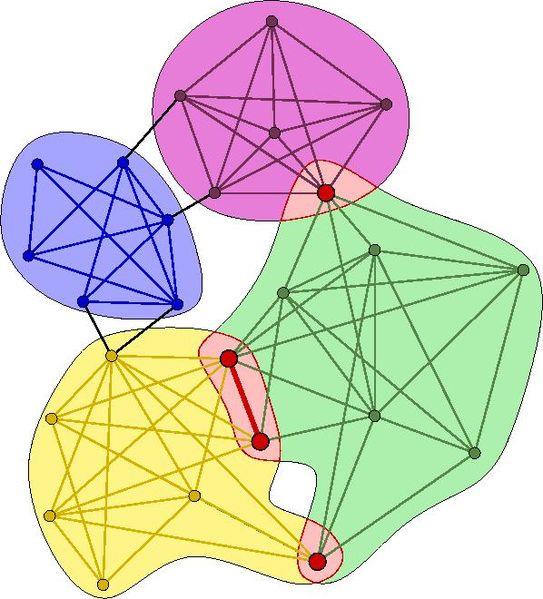
3 Networks & Communities: Think of networks being organized into: Modules Cluster Communities Goal: Find densely linked clusters Big Data Management and Analytics 3

4 What is a Social Network? Characteristics of a social network: - Collection of entities participating in the network (entities might be individuals, phone numbers, addresses, ) - At least one relationship between entities of the network. (Facebook: friend ). Relationship can be all-or-nothing or specified by a degree (e.g. fraction of the average day that two people communication to each other) - Assumption of nonrandomness or locality, i.e. relationships tend to cluster. (e.g. A is related to B and C higher probability that B is related to C) Big Data Management and Analytics 4
5 How to find communities? Here we will work with undirected (unweighted networks) We need to resolve 2 questions: How to compute betweenness? How to select the number of clusters? Big Data Management and Analytics 5

6 Outline Community Detection - Social networks - Betweenness - Girvan-Newman Algorithm - Modularity - Graph Partitioning - Spectral Graph Partitioning - Trawling Big Data Management and Analytics 6

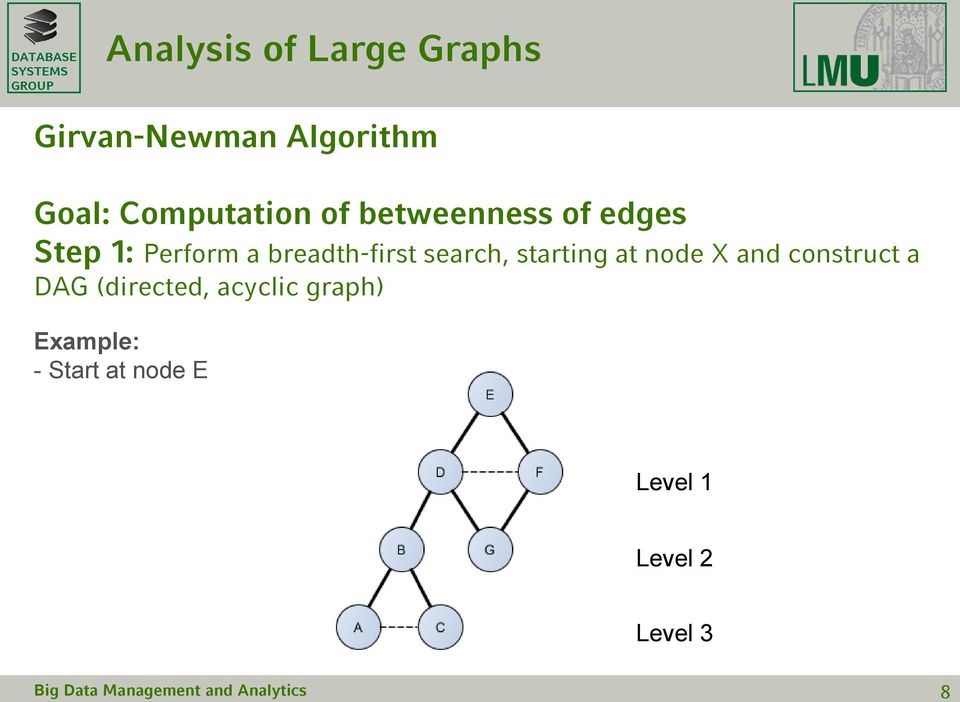
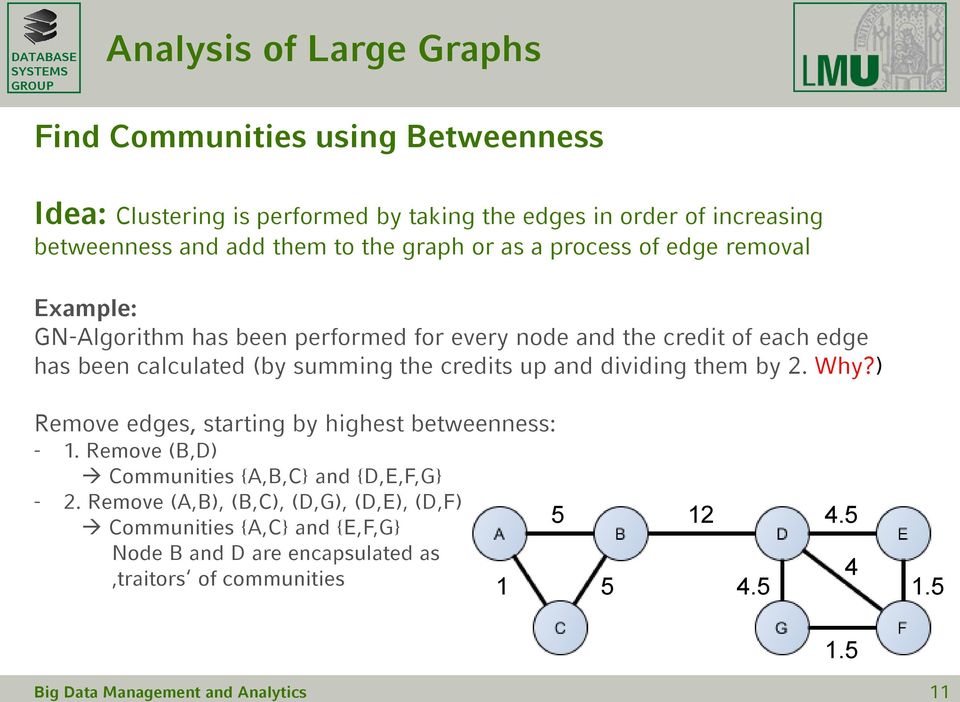
7 Betweenness Definition: The betweenness of an edge (a,b) is the number of pairs of nodes x and y such that (a,b) lies on the shortest-path between x and y. Example: Edge (B,D) has highest betweenness (shortest path of A,B,C to any of D,E,F,G) Betweenness of (B,D) aggregates to: 3 x 4 = 12 Betweenness of edge (D,F)? Big Data Management and Analytics 7

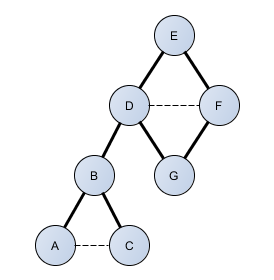
8 Girvan-Newman Algorithm Goal: Computation of betweenness of edges Step 1: Perform a breadth-first search, starting at node X and construct a DAG (directed, acyclic graph) Example: - Start at node E Level 1 Level 2 Level 3 Big Data Management and Analytics 8
9 Girvan-Newman Algorithm Goal: Computation of betweenness of edges Step 2: label each node by the number of shortest paths that reach it from the root. Label of root = 1, each node is labeled by the sum of its parents. Example: Level 1 Level Level 3 Big Data Management and Analytics 9

10 Girvan-Newman Algorithm Goal: Computation of betweenness of edges Step 3: calculate for each edge e the sum over all nodes Y the fraction of shortest paths from the root X to Y: In Detail: 1. Each leaf gets a credit of Non-leaf nodes gets a credit of 1 plus the sum of its children 3. A DAG edge e entering node Z from the level above is given a share of the credit of Z proportional to the fraction of shortest paths from the root to Z. Formally: let Y 1,, Y k be the parent nodes of Z with p i, 1 i k, be the number of shortest path to Y i. The credit k for edge (Y i, Z) is given by: Z p i / j=1 p j Level 1 Level 2 Level 3 Big Data Management and Analytics 10
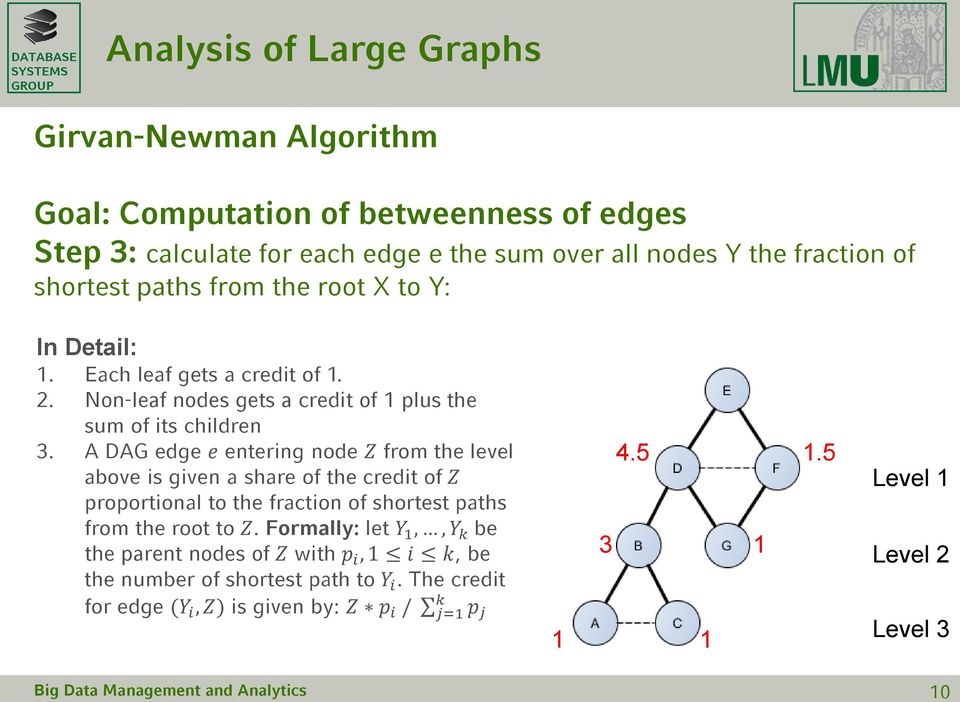
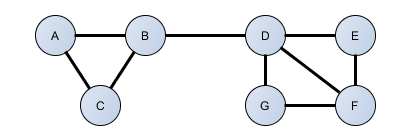
11 Find Communities using Betweenness Idea: Clustering is performed by taking the edges in order of increasing betweenness and add them to the graph or as a process of edge removal Example: GN-Algorithm has been performed for every node and the credit of each edge has been calculated (by summing the credits up and dividing them by 2. Why?) Remove edges, starting by highest betweenness: - 1. Remove (B,D) Communities {A,B,C} and {D,E,F,G} - 2. Remove (A,B), (B,C), (D,G), (D,E), (D,F) Communities {A,C} and {E,F,G} Node B and D are encapsulated as traitors of communities Big Data Management and Analytics

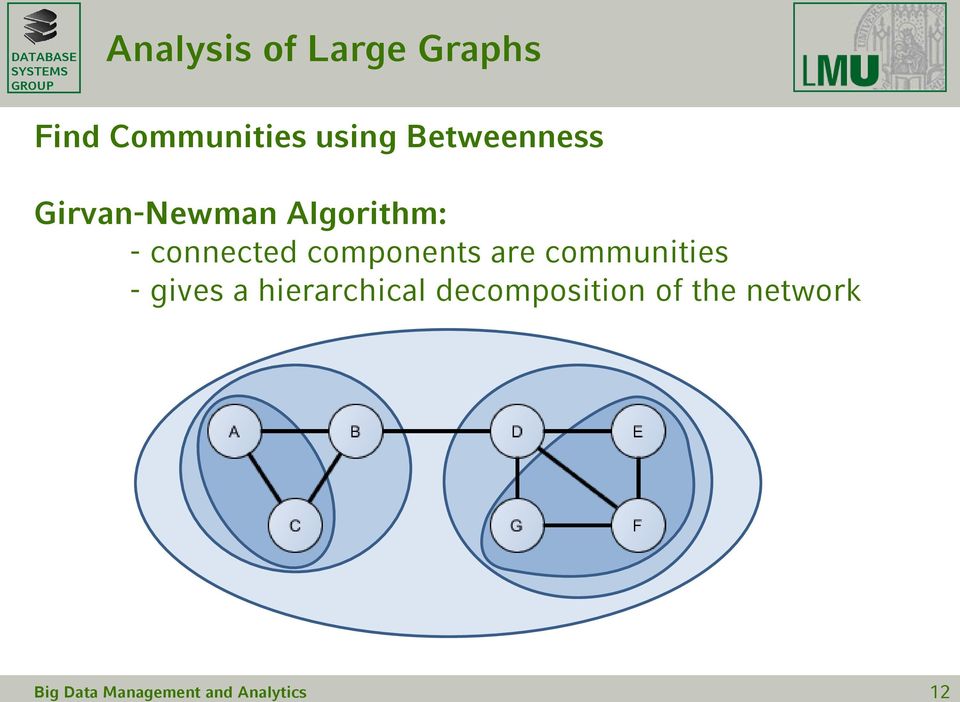
12 Find Communities using Betweenness Girvan-Newman Algorithm: - connected components are communities - gives a hierarchical decomposition of the network Big Data Management and Analytics 12
13 Outline Community Detection - Social networks - Betweenness - Girvan-Newman Algorithm - Modularity - Graph Partitioning - Spectral Graph Partitioning - Trawling Big Data Management and Analytics 13

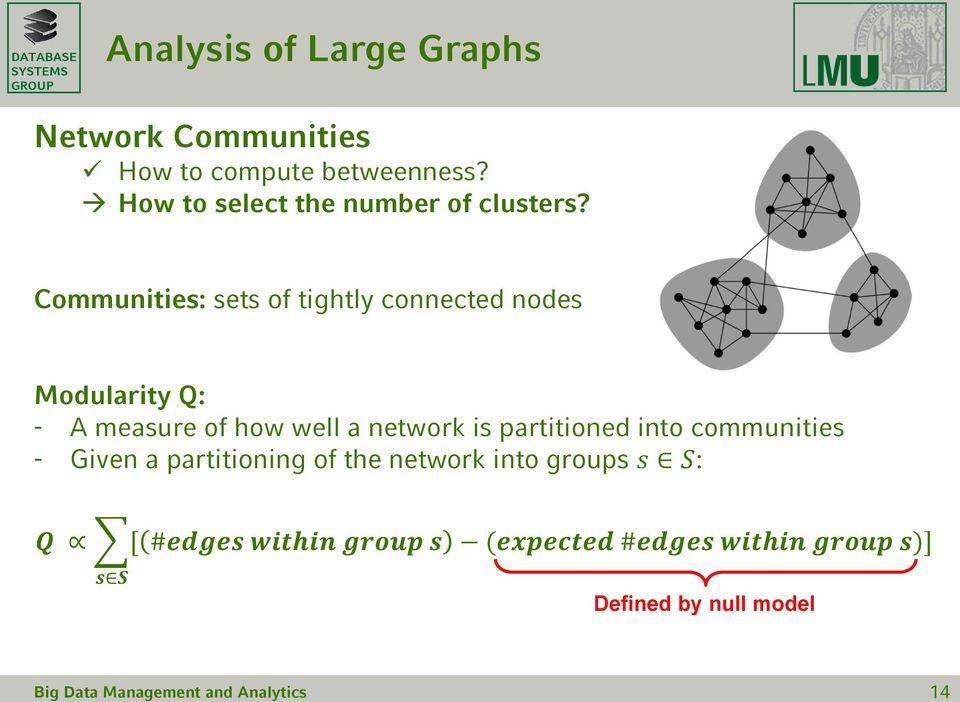
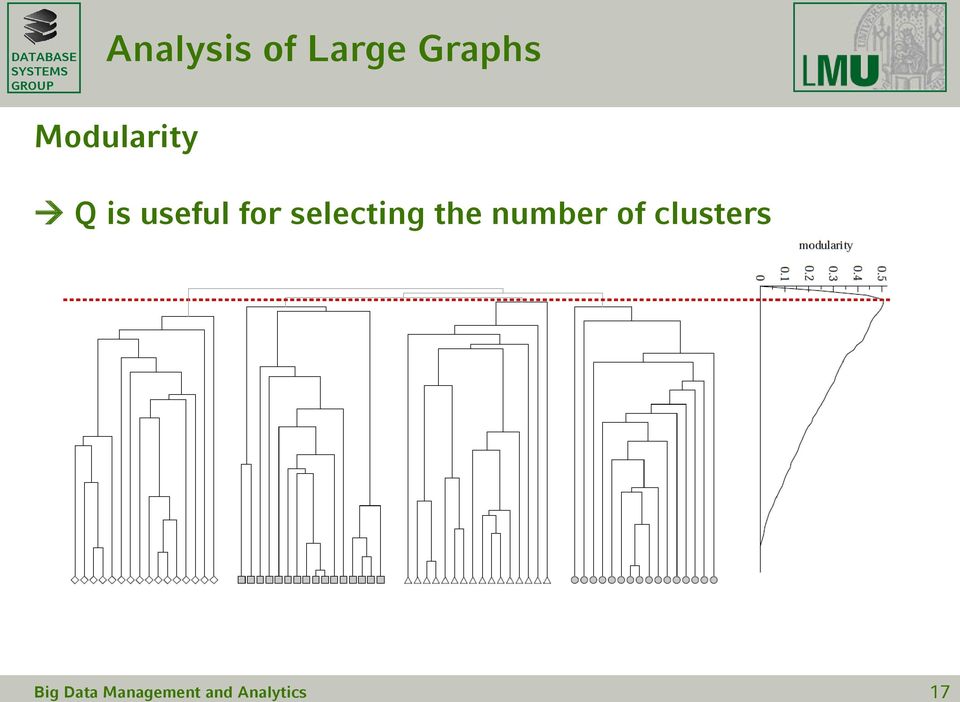
14 Network Communities How to compute betweenness? How to select the number of clusters? Communities: sets of tightly connected nodes Modularity Q: - A measure of how well a network is partitioned into communities - Given a partitioning of the network into groups s S: Q s S [ #edges within group s (expected #edges within group s)] Defined by null model Big Data Management and Analytics 14
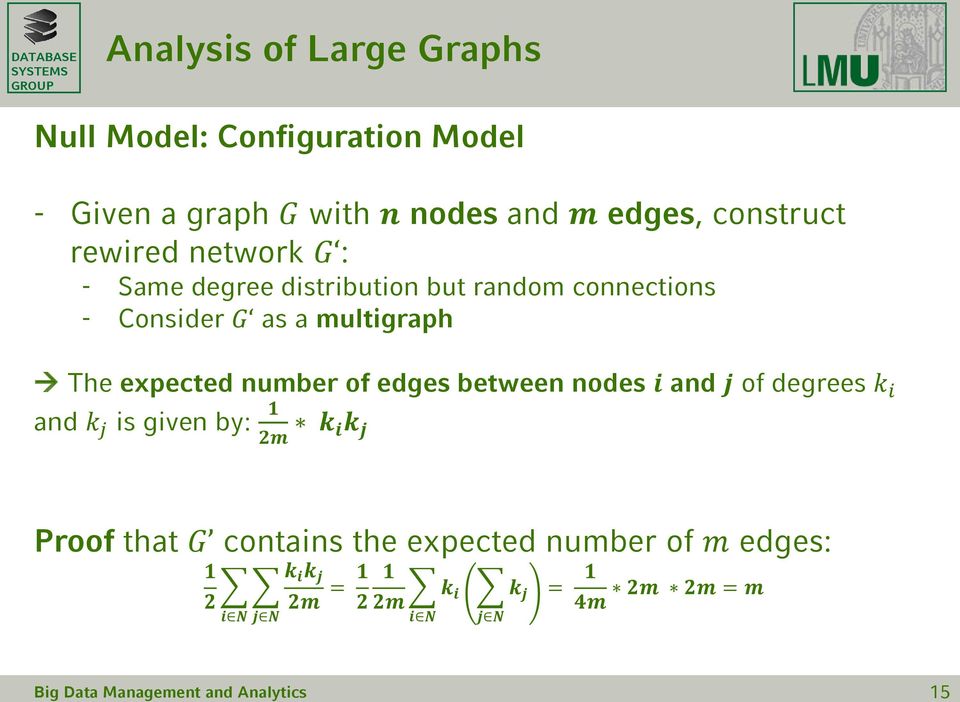
15 Null Model: Configuration Model - Given a graph G with n nodes and m edges, construct rewired network G : - Same degree distribution but random connections - Consider G as a multigraph The expected number of edges between nodes i and j of degrees k i and k j is given by: 1 2m k ik j Proof that G contains the expected number of m edges: 1 k i k j 2 2m = 1 1 k 2 2m i i N j N i N j N k j = 1 2m 2m = m 4m Big Data Management and Analytics 15
16 Modularity Modularity of partitioning S of graph G: Q s S [ #edges within group s (expected #edges within group s)] Q G, S = 1 2m s S i s j s (a ij k ik j 2m ) Normalizing: 1 < Q < 1 Modularity values take range [ 1, 1]: - Positive if the number of edges within groups exceeds the expected number < Q means significant community structure Big Data Management and Analytics 16
![Modularity values take range [ 1, 1]: - Positive if the number of edges within groups exceeds](/docs-images/47/20624658/images/page_16.jpg "the expected number - 0. 3 0.")
17 Modularity Q is useful for selecting the number of clusters Big Data Management and Analytics 17
18 Outline Community Detection - Social networks - Betweenness - Girvan-Newman Algorithm - Modularity - Graph Partitioning - Spectral Graph Partitioning - Trawling Big Data Management and Analytics 18

19 Partitioning of Graphs Given an undirected Graph G(V, E): Bi-partitioning task: - Divide vertices into two disjoint groups A, B A B Questions: - How can we define good partition of G? - How can we efficiently identify such a partition? Big Data Management and Analytics 19

20 Partitioning of Graphs What makes a good partition? Maximize the number of within-group connections Minimize the number of between-group connections Example: A B Big Data Management and Analytics 20
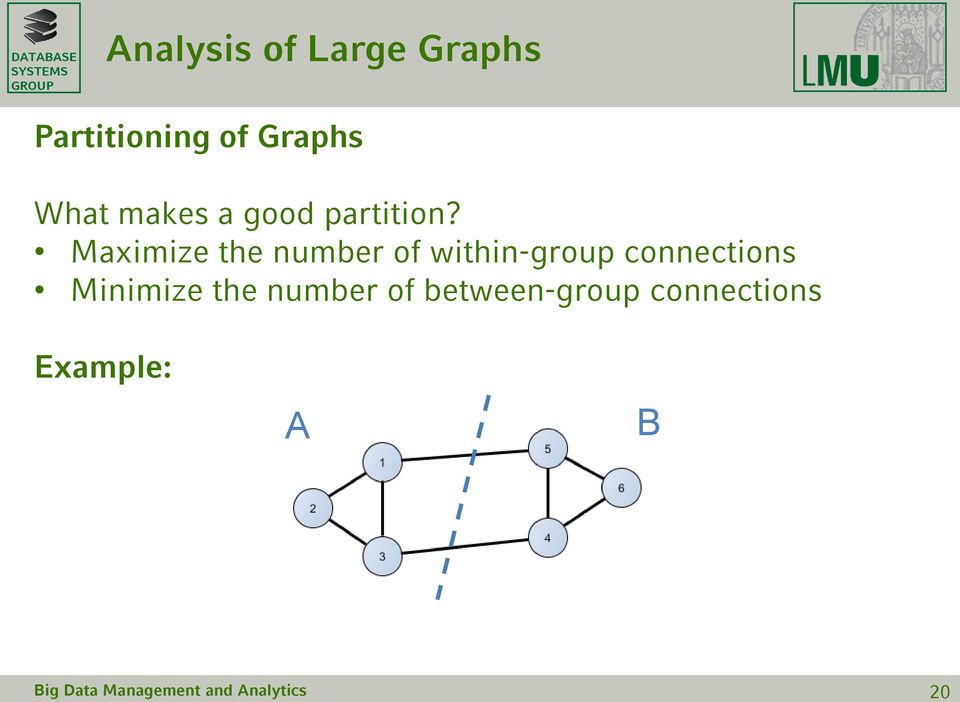

21 Partitioning of Graphs Graph Cuts Express partitioning objectives as a function of the edge cut of the partition Cut: Set of edges with only one vertex in a group: Example: A cut A, B = i A,j B w ij B cut A, B = 2 Big Data Management and Analytics 21

22 Partitioning of Graphs Minimum-cut Minimize weight of connections between groups: arg min cut(a, B) A,B Example: Optimal Cut Minimum Cut Problem: Only considers external cluster connections Does not consider internal cluster connectivity Big Data Management and Analytics 22
23 Partitioning of Graphs - Graph Cuts Normalized-cut: Connectivity between groups relative to the density of each group cut(a, B) cut(a, B) ncut A, B = + vol(a) vol(b) vol(x): total weight of edges with at least one endpoint in X: vol X = i A k i Produces more balanced partitions How to find a good partition efficiently? Problem: Computing optimal cut is NP-hard! Big Data Management and Analytics 23
24 Spectral Graph Partitioning - Adjacency matrix of an undirected Graph G a ij = 1 if (i, j) exist in G, else 0 - Vector x R n with components x 1,, x n Think of it as a label/value of each node of G What is the meaning of A x? a 11 a 1n a n1 a nn x 1 x n = y 1 y n y i = n j=1 a ij x j = (i,j) E x j Entry y i is a sum of labels / values x j of neighbors of i Big Data Management and Analytics 24
25 Spectral Graph Partitioning What is the meaning of A x? a 11 a 1n a n1 a nn x 1 x n = y 1 y n a 11 a 1n a n1 a nn x 1 x n = λ x 1 x n A x = λ x Eigenvalue Problem Spectral Graph Theory: Analyze the spectrum of matrix representing G Spectrum: Eigenvectors x i of a graph, ordered by the magnitude (strength) of their corresponding eigenvalues λ i Λ = λ 1,, λ n with λ 1 λ n Big Data Management and Analytics 25
26 Spectral Graph Partitioning Intuition Suppose all nodes in G have degree d and G is connected What are some eigenvalues/vectors of G? Eigenvalue Problem: A x = λ x find λ and x Let s try x = (1,, 1) Then A x = d,, d = λ x λ = d Remember: y i = a ij x j = j=1 (i,j) E Big Data Management and Analytics 26 n x j
27 Spectral Graph Partitioning Intuition What if G is not connected? A G has 2 components, each d-regular What are some eigenvectors? x = put all 1s on A and 0s on B or vice versa x = (1,, 1, 0,, 0), then A x = (d,, d, 0,, 0) x = (0,, 0, 1,, 1), then A x = (0,, 0, d,, d) in both cases the corresponding λ = d B A B A B λ n = λ n 1 λ n λ n nd largest eigval. λ n 1 now has value very close to λ n Big Data Management and Analytics 27
28 Spectral Graph Partitioning Intuition A B A B λ n = λ n 1 λ n λ n nd largest eigval. λ n 1 now has value very close to λ n If the graph is connected (right example) then we already know that x n = (1,, 1) is an eigenvector Since eigenvectors are orthogonal then the components of x n 1 sum to 0 Why? Because i x n [i] i x n 1 i = 0 General Idea: we can look at the eigenvector of the 2nd largest eigenvalue and declare nodes with positive label in A and negative label in B Big Data Management and Analytics 28
29 Spectral Graph Partitioning - Adjacency matrix A: n x n matrix A = a ij, a ij = 1 if there is an edge between node i and j Big Data Management and Analytics 29
30 Spectral Graph Partitioning - Degree matrix D: n x n diagonal matrix D = d ii, d ii = degree of node i Big Data Management and Analytics 30
31 Spectral Graph Partitioning - Laplacian Matrix L: n x n symmetric matrix L = D A Trivial eigenpair? X = (1,, 1), then L x = 0 and so λ 1 = Big Data Management and Analytics 31
32 Spectral Clustering Algorithms Three basic stages: 1. Pre-processing Construct a matrix representation of the graph 2. Decomposition Compute eigenvalues and eigenvectors of the matrix Map each point point to a lower-dimensional representation on one or more eigenvectors 3. Grouping Assign points to two or more clusters, based on the new representation Big Data Management and Analytics 32
33 Spectral Clustering Algorithms 1. Pre-processing: Build Laplacian matrix L of the graph Decomposition: Find eigenvalues λ and eigenvectors x of the matrix L = X = Map vertices to lower-dimensional representation How do we now find the clusters? Big Data Management and Analytics 33
34 Spectral Clustering Algorithms 3. Grouping: Sort components of reduced 1-dimensional vector Identify clusters by splitting the sorted vector in two (threshold ε) By choosing m vectors, there are max. 2 m clusters How to choose a splitting point, i.e threshold ε? Naive approaches: Split at ε = 0 or median value More expensive approaches: Attempt to minimize normalized cut in 1-dimension (sweep over ordering of nodes induces by the eigenvector) Split at ε = 0: Cluster A: Positive points Cluster B: Negative points A B Big Data Management and Analytics
35 Spectral Clustering Algorithms Value of x 2 Rank in x 2 Big Data Management and Analytics
36 Spectral Clustering Algorithms Components of x 2 Value of x 2 Rank in x 2 Big Data Management and Analytics
37 Spectral Clustering Algorithms Components of x 3 Big Data Management and Analytics
38 Outline Community Detection - Social networks - Betweenness - Girvan-Newman Algorithm - Modularity - Graph Partitioning - Spectral Graph Partitioning - Trawling Big Data Management and Analytics 38
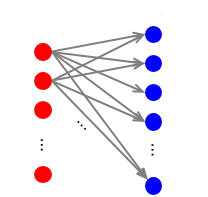
39 - Trawling Trawling Goal: find small communities in huge graphs E.g. how to describe community/discussion in a Web Example: E.g. people talking about the same things or visited web pages Big Data Management and Analytics 39
40 - Trawling Problem definition: Enumerate complete bipartite subgraphs K s,t : All vertices in K s,t can be partitioned in two sets. Each vertex in the first set of size s is linked to each vertex in second set of size t Where K s,t : s nodes on the left where each links to the same t other nodes on the right X = s = 3 Y = t = 4 X Y Big Data Management and Analytics 40
41 - Trawling Frequent Itemset Analysis Market Basket Analysis Market: Universe U of n items Baskets: subsets of U: S 1, S 2,, S m U (S i is a set of items one person bought) Support: frequency threshold Goal: Find all subsets T s.t. T S i of at least f sets S i (items in T were bought together at least f times) Frequent itemsets = complete bipartite graphs i a b c d S i ={a,b,c,d} View each node i as a set S i of nodes i points to K s,t = a set Y of size t that occurs in s sets S i j i k a b c d Big Data Management and Analytics 41
42 - Trawling E.g. Bipartite subgraph K 3,4 a frequent itemset Y={a,b,c} of supp s. So, there are s nodes that link to all of {a,b,c}: x a b c y a b c z a b c x y z a b c We found K s,t! K s,t = a set Y of size t that occurs in s sets S i Big Data Management and Analytics 42
43 - Trawling a c e f d b Itemsets: a = {b,c,d} b = {d} c = {b,d,e,f} d = {e,f} e = {b,d} f = {} Frequent itemsets support > 1 {b,d}: support 3 {e,f}: support 2 a c d b c e f d e Big Data Management and Analytics 43
Mining Social-Network Graphs
 342 Chapter 10 Mining Social-Network Graphs There is much information to be gained by analyzing the large-scale data that is derived from social networks. The best-known example of a social network is
DATA ANALYSIS II. Matrix Algorithms
 DATA ANALYSIS II Matrix Algorithms Similarity Matrix Given a dataset D = {x i }, i=1,..,n consisting of n points in R d, let A denote the n n symmetric similarity matrix between the points, given as where
Mining Social Network Graphs
 Mining Social Network Graphs Debapriyo Majumdar Data Mining Fall 2014 Indian Statistical Institute Kolkata November 13, 17, 2014 Social Network No introduc+on required Really? We s7ll need to understand
B490 Mining the Big Data. 2 Clustering
 B490 Mining the Big Data 2 Clustering Qin Zhang 1-1 Motivations Group together similar documents/webpages/images/people/proteins/products One of the most important problems in machine learning, pattern
NETZCOPE - a tool to analyze and display complex R&D collaboration networks
 The Task Concepts from Spectral Graph Theory EU R&D Network Analysis Netzcope Screenshots NETZCOPE - a tool to analyze and display complex R&D collaboration networks L. Streit & O. Strogan BiBoS, Univ.
Social Media Mining. Graph Essentials
 Graph Essentials Graph Basics Measures Graph and Essentials Metrics 2 2 Nodes and Edges A network is a graph nodes, actors, or vertices (plural of vertex) Connections, edges or ties Edge Node Measures
Social Media Mining. Network Measures
 Klout Measures and Metrics 22 Why Do We Need Measures? Who are the central figures (influential individuals) in the network? What interaction patterns are common in friends? Who are the like-minded users
USING SPECTRAL RADIUS RATIO FOR NODE DEGREE TO ANALYZE THE EVOLUTION OF SCALE- FREE NETWORKS AND SMALL-WORLD NETWORKS
 USING SPECTRAL RADIUS RATIO FOR NODE DEGREE TO ANALYZE THE EVOLUTION OF SCALE- FREE NETWORKS AND SMALL-WORLD NETWORKS Natarajan Meghanathan Jackson State University, 1400 Lynch St, Jackson, MS, USA [email protected]
Discrete Mathematics & Mathematical Reasoning Chapter 10: Graphs
 Discrete Mathematics & Mathematical Reasoning Chapter 10: Graphs Kousha Etessami U. of Edinburgh, UK Kousha Etessami (U. of Edinburgh, UK) Discrete Mathematics (Chapter 6) 1 / 13 Overview Graphs and Graph
USE OF EIGENVALUES AND EIGENVECTORS TO ANALYZE BIPARTIVITY OF NETWORK GRAPHS
 USE OF EIGENVALUES AND EIGENVECTORS TO ANALYZE BIPARTIVITY OF NETWORK GRAPHS Natarajan Meghanathan Jackson State University, 1400 Lynch St, Jackson, MS, USA [email protected] ABSTRACT This
Complex Networks Analysis: Clustering Methods
 Complex Networks Analysis: Clustering Methods Nikolai Nefedov Spring 2013 ISI ETH Zurich [email protected] 1 Outline Purpose to give an overview of modern graph-clustering methods and their applications
Practical Graph Mining with R. 5. Link Analysis
 Practical Graph Mining with R 5. Link Analysis Outline Link Analysis Concepts Metrics for Analyzing Networks PageRank HITS Link Prediction 2 Link Analysis Concepts Link A relationship between two entities
Strong and Weak Ties
 Strong and Weak Ties Web Science (VU) (707.000) Elisabeth Lex KTI, TU Graz April 11, 2016 Elisabeth Lex (KTI, TU Graz) Networks April 11, 2016 1 / 66 Outline 1 Repetition 2 Strong and Weak Ties 3 General
5.1 Bipartite Matching
 CS787: Advanced Algorithms Lecture 5: Applications of Network Flow In the last lecture, we looked at the problem of finding the maximum flow in a graph, and how it can be efficiently solved using the Ford-Fulkerson
Analysis of Algorithms, I
 Analysis of Algorithms, I CSOR W4231.002 Eleni Drinea Computer Science Department Columbia University Thursday, February 26, 2015 Outline 1 Recap 2 Representing graphs 3 Breadth-first search (BFS) 4 Applications
Protein Protein Interaction Networks
 Functional Pattern Mining from Genome Scale Protein Protein Interaction Networks Young-Rae Cho, Ph.D. Assistant Professor Department of Computer Science Baylor University it My Definition of Bioinformatics
SCAN: A Structural Clustering Algorithm for Networks
 SCAN: A Structural Clustering Algorithm for Networks Xiaowei Xu, Nurcan Yuruk, Zhidan Feng (University of Arkansas at Little Rock) Thomas A. J. Schweiger (Acxiom Corporation) Networks scaling: #edges connected
Graph Theory and Complex Networks: An Introduction. Chapter 06: Network analysis. Contents. Introduction. Maarten van Steen. Version: April 28, 2014
 Graph Theory and Complex Networks: An Introduction Maarten van Steen VU Amsterdam, Dept. Computer Science Room R.0, [email protected] Chapter 0: Version: April 8, 0 / Contents Chapter Description 0: Introduction
CIS 700: algorithms for Big Data
 CIS 700: algorithms for Big Data Lecture 6: Graph Sketching Slides at http://grigory.us/big-data-class.html Grigory Yaroslavtsev http://grigory.us Sketching Graphs? We know how to sketch vectors: v Mv
A Tutorial on Spectral Clustering
 A Tutorial on Spectral Clustering Ulrike von Luxburg Max Planck Institute for Biological Cybernetics Spemannstr. 38, 7276 Tübingen, Germany [email protected] This article appears in Statistics
Nimble Algorithms for Cloud Computing. Ravi Kannan, Santosh Vempala and David Woodruff
 Nimble Algorithms for Cloud Computing Ravi Kannan, Santosh Vempala and David Woodruff Cloud computing Data is distributed arbitrarily on many servers Parallel algorithms: time Streaming algorithms: sublinear
3. The Junction Tree Algorithms
 A Short Course on Graphical Models 3. The Junction Tree Algorithms Mark Paskin [email protected] 1 Review: conditional independence Two random variables X and Y are independent (written X Y ) iff p X ( )
1. Then f has a relative maximum at x = c if f(c) f(x) for all values of x in some
 Section 3.1: First Derivative Test Definition. Let f be a function with domain D. 1. Then f has a relative maximum at x = c if f(c) f(x) for all values of x in some open interval containing c. The number
Split Nonthreshold Laplacian Integral Graphs
 Split Nonthreshold Laplacian Integral Graphs Stephen Kirkland University of Regina, Canada [email protected] Maria Aguieiras Alvarez de Freitas Federal University of Rio de Janeiro, Brazil [email protected]
MATRIX ALGEBRA AND SYSTEMS OF EQUATIONS. + + x 2. x n. a 11 a 12 a 1n b 1 a 21 a 22 a 2n b 2 a 31 a 32 a 3n b 3. a m1 a m2 a mn b m
 MATRIX ALGEBRA AND SYSTEMS OF EQUATIONS 1. SYSTEMS OF EQUATIONS AND MATRICES 1.1. Representation of a linear system. The general system of m equations in n unknowns can be written a 11 x 1 + a 12 x 2 +
Graph Theory and Complex Networks: An Introduction. Chapter 06: Network analysis
 Graph Theory and Complex Networks: An Introduction Maarten van Steen VU Amsterdam, Dept. Computer Science Room R4.0, [email protected] Chapter 06: Network analysis Version: April 8, 04 / 3 Contents Chapter
CSE 326, Data Structures. Sample Final Exam. Problem Max Points Score 1 14 (2x7) 2 18 (3x6) 3 4 4 7 5 9 6 16 7 8 8 4 9 8 10 4 Total 92.
 Name: Email ID: CSE 326, Data Structures Section: Sample Final Exam Instructions: The exam is closed book, closed notes. Unless otherwise stated, N denotes the number of elements in the data structure
Structural and functional analytics for community detection in large-scale complex networks
 Chopade and Zhan Journal of Big Data DOI 10.1186/s40537-015-0019-y RESEARCH Open Access Structural and functional analytics for community detection in large-scale complex networks Pravin Chopade 1* and
Approximation Algorithms
 Approximation Algorithms or: How I Learned to Stop Worrying and Deal with NP-Completeness Ong Jit Sheng, Jonathan (A0073924B) March, 2012 Overview Key Results (I) General techniques: Greedy algorithms
NEW VERSION OF DECISION SUPPORT SYSTEM FOR EVALUATING TAKEOVER BIDS IN PRIVATIZATION OF THE PUBLIC ENTERPRISES AND SERVICES
 NEW VERSION OF DECISION SUPPORT SYSTEM FOR EVALUATING TAKEOVER BIDS IN PRIVATIZATION OF THE PUBLIC ENTERPRISES AND SERVICES Silvija Vlah Kristina Soric Visnja Vojvodic Rosenzweig Department of Mathematics
Data Mining. Cluster Analysis: Advanced Concepts and Algorithms
 Data Mining Cluster Analysis: Advanced Concepts and Algorithms Tan,Steinbach, Kumar Introduction to Data Mining 4/18/2004 1 More Clustering Methods Prototype-based clustering Density-based clustering Graph-based
LABEL PROPAGATION ON GRAPHS. SEMI-SUPERVISED LEARNING. ----Changsheng Liu 10-30-2014
 LABEL PROPAGATION ON GRAPHS. SEMI-SUPERVISED LEARNING ----Changsheng Liu 10-30-2014 Agenda Semi Supervised Learning Topics in Semi Supervised Learning Label Propagation Local and global consistency Graph
Section 6.1 - Inner Products and Norms
 Section 6.1 - Inner Products and Norms Definition. Let V be a vector space over F {R, C}. An inner product on V is a function that assigns, to every ordered pair of vectors x and y in V, a scalar in F,
Simplified External memory Algorithms for Planar DAGs. July 2004
 Simplified External Memory Algorithms for Planar DAGs Lars Arge Duke University Laura Toma Bowdoin College July 2004 Graph Problems Graph G = (V, E) with V vertices and E edges DAG: directed acyclic graph
Triangle deletion. Ernie Croot. February 3, 2010
 Triangle deletion Ernie Croot February 3, 2010 1 Introduction The purpose of this note is to give an intuitive outline of the triangle deletion theorem of Ruzsa and Szemerédi, which says that if G = (V,
LINEAR-ALGEBRAIC GRAPH MINING
 UCSF QB3 Seminar 5/28/215 Linear Algebraic Graph Mining, [email protected] 1/22 LLNL-PRES-671587 New Applications of Computer Analysis to Biomedical Data Sets QB3 Seminar, UCSF Medical School, May 28
COMBINATORIAL PROPERTIES OF THE HIGMAN-SIMS GRAPH. 1. Introduction
 COMBINATORIAL PROPERTIES OF THE HIGMAN-SIMS GRAPH ZACHARY ABEL 1. Introduction In this survey we discuss properties of the Higman-Sims graph, which has 100 vertices, 1100 edges, and is 22 regular. In fact
MATRIX ALGEBRA AND SYSTEMS OF EQUATIONS
 MATRIX ALGEBRA AND SYSTEMS OF EQUATIONS Systems of Equations and Matrices Representation of a linear system The general system of m equations in n unknowns can be written a x + a 2 x 2 + + a n x n b a
Walk-Based Centrality and Communicability Measures for Network Analysis
 Walk-Based Centrality and Communicability Measures for Network Analysis Michele Benzi Department of Mathematics and Computer Science Emory University Atlanta, Georgia, USA Workshop on Innovative Clustering
A scalable multilevel algorithm for graph clustering and community structure detection
 A scalable multilevel algorithm for graph clustering and community structure detection Hristo N. Djidjev 1 Los Alamos National Laboratory, Los Alamos, NM 87545 Abstract. One of the most useful measures
Conductance, the Normalized Laplacian, and Cheeger s Inequality
 Spectral Graph Theory Lecture 6 Conductance, the Normalized Laplacian, and Cheeger s Inequality Daniel A. Spielman September 21, 2015 Disclaimer These notes are not necessarily an accurate representation
Scheduling Shop Scheduling. Tim Nieberg
 Scheduling Shop Scheduling Tim Nieberg Shop models: General Introduction Remark: Consider non preemptive problems with regular objectives Notation Shop Problems: m machines, n jobs 1,..., n operations
Linear Algebra Review. Vectors
 Linear Algebra Review By Tim K. Marks UCSD Borrows heavily from: Jana Kosecka [email protected] http://cs.gmu.edu/~kosecka/cs682.html Virginia de Sa Cogsci 8F Linear Algebra review UCSD Vectors The length
5 Directed acyclic graphs
 5 Directed acyclic graphs (5.1) Introduction In many statistical studies we have prior knowledge about a temporal or causal ordering of the variables. In this chapter we will use directed graphs to incorporate
Solutions to Homework 6
 Solutions to Homework 6 Debasish Das EECS Department, Northwestern University [email protected] 1 Problem 5.24 We want to find light spanning trees with certain special properties. Given is one example
Performance of Dynamic Load Balancing Algorithms for Unstructured Mesh Calculations
 Performance of Dynamic Load Balancing Algorithms for Unstructured Mesh Calculations Roy D. Williams, 1990 Presented by Chris Eldred Outline Summary Finite Element Solver Load Balancing Results Types Conclusions
SHARP BOUNDS FOR THE SUM OF THE SQUARES OF THE DEGREES OF A GRAPH
 31 Kragujevac J. Math. 25 (2003) 31 49. SHARP BOUNDS FOR THE SUM OF THE SQUARES OF THE DEGREES OF A GRAPH Kinkar Ch. Das Department of Mathematics, Indian Institute of Technology, Kharagpur 721302, W.B.,
Data Structures and Algorithms Written Examination
 Data Structures and Algorithms Written Examination 22 February 2013 FIRST NAME STUDENT NUMBER LAST NAME SIGNATURE Instructions for students: Write First Name, Last Name, Student Number and Signature where
4. How many integers between 2004 and 4002 are perfect squares?
 5 is 0% of what number? What is the value of + 3 4 + 99 00? (alternating signs) 3 A frog is at the bottom of a well 0 feet deep It climbs up 3 feet every day, but slides back feet each night If it started
Francesco Sorrentino Department of Mechanical Engineering
 Master stability function approaches to analyze stability of the synchronous evolution for hypernetworks and of synchronized clusters for networks with symmetries Francesco Sorrentino Department of Mechanical
1 Introduction. Dr. T. Srinivas Department of Mathematics Kakatiya University Warangal 506009, AP, INDIA [email protected]
 A New Allgoriitthm for Miiniimum Costt Liinkiing M. Sreenivas Alluri Institute of Management Sciences Hanamkonda 506001, AP, INDIA [email protected] Dr. T. Srinivas Department of Mathematics Kakatiya
Social Networks and Social Media
 Social Networks and Social Media Social Media: Many-to-Many Social Networking Content Sharing Social Media Blogs Microblogging Wiki Forum 2 Characteristics of Social Media Consumers become Producers Rich
! E6893 Big Data Analytics Lecture 10:! Linked Big Data Graph Computing (II)
 E6893 Big Data Analytics Lecture 10: Linked Big Data Graph Computing (II) Ching-Yung Lin, Ph.D. Adjunct Professor, Dept. of Electrical Engineering and Computer Science Mgr., Dept. of Network Science and
Problem Set 7 Solutions
 8 8 Introduction to Algorithms May 7, 2004 Massachusetts Institute of Technology 6.046J/18.410J Professors Erik Demaine and Shafi Goldwasser Handout 25 Problem Set 7 Solutions This problem set is due in
CMPSCI611: Approximating MAX-CUT Lecture 20
 CMPSCI611: Approximating MAX-CUT Lecture 20 For the next two lectures we ll be seeing examples of approximation algorithms for interesting NP-hard problems. Today we consider MAX-CUT, which we proved to
SPANNING CACTI FOR STRUCTURALLY CONTROLLABLE NETWORKS NGO THI TU ANH NATIONAL UNIVERSITY OF SINGAPORE
 SPANNING CACTI FOR STRUCTURALLY CONTROLLABLE NETWORKS NGO THI TU ANH NATIONAL UNIVERSITY OF SINGAPORE 2012 SPANNING CACTI FOR STRUCTURALLY CONTROLLABLE NETWORKS NGO THI TU ANH (M.Sc., SFU, Russia) A THESIS
1 Definitions. Supplementary Material for: Digraphs. Concept graphs
 Supplementary Material for: van Rooij, I., Evans, P., Müller, M., Gedge, J. & Wareham, T. (2008). Identifying Sources of Intractability in Cognitive Models: An Illustration using Analogical Structure Mapping.
1 Introduction to Matrices
 1 Introduction to Matrices In this section, important definitions and results from matrix algebra that are useful in regression analysis are introduced. While all statements below regarding the columns
Asking Hard Graph Questions. Paul Burkhardt. February 3, 2014
 Beyond Watson: Predictive Analytics and Big Data U.S. National Security Agency Research Directorate - R6 Technical Report February 3, 2014 300 years before Watson there was Euler! The first (Jeopardy!)
Part 1: Link Analysis & Page Rank
 Chapter 8: Graph Data Part 1: Link Analysis & Page Rank Based on Leskovec, Rajaraman, Ullman 214: Mining of Massive Datasets 1 Exam on the 5th of February, 216, 14. to 16. If you wish to attend, please
Linear Programming I
 Linear Programming I November 30, 2003 1 Introduction In the VCR/guns/nuclear bombs/napkins/star wars/professors/butter/mice problem, the benevolent dictator, Bigus Piguinus, of south Antarctica penguins
Lecture 15 An Arithmetic Circuit Lowerbound and Flows in Graphs
 CSE599s: Extremal Combinatorics November 21, 2011 Lecture 15 An Arithmetic Circuit Lowerbound and Flows in Graphs Lecturer: Anup Rao 1 An Arithmetic Circuit Lower Bound An arithmetic circuit is just like
Big Data Analytics of Multi-Relationship Online Social Network Based on Multi-Subnet Composited Complex Network
 , pp.273-284 http://dx.doi.org/10.14257/ijdta.2015.8.5.24 Big Data Analytics of Multi-Relationship Online Social Network Based on Multi-Subnet Composited Complex Network Gengxin Sun 1, Sheng Bin 2 and
Graphs without proper subgraphs of minimum degree 3 and short cycles
 Graphs without proper subgraphs of minimum degree 3 and short cycles Lothar Narins, Alexey Pokrovskiy, Tibor Szabó Department of Mathematics, Freie Universität, Berlin, Germany. August 22, 2014 Abstract
Well-Separated Pair Decomposition for the Unit-disk Graph Metric and its Applications
 Well-Separated Pair Decomposition for the Unit-disk Graph Metric and its Applications Jie Gao Department of Computer Science Stanford University Joint work with Li Zhang Systems Research Center Hewlett-Packard
Least-Squares Intersection of Lines
 Least-Squares Intersection of Lines Johannes Traa - UIUC 2013 This write-up derives the least-squares solution for the intersection of lines. In the general case, a set of lines will not intersect at a
Institut für Informatik Lehrstuhl Theoretische Informatik I / Komplexitätstheorie. An Iterative Compression Algorithm for Vertex Cover
 Friedrich-Schiller-Universität Jena Institut für Informatik Lehrstuhl Theoretische Informatik I / Komplexitätstheorie Studienarbeit An Iterative Compression Algorithm for Vertex Cover von Thomas Peiselt
IE 680 Special Topics in Production Systems: Networks, Routing and Logistics*
 IE 680 Special Topics in Production Systems: Networks, Routing and Logistics* Rakesh Nagi Department of Industrial Engineering University at Buffalo (SUNY) *Lecture notes from Network Flows by Ahuja, Magnanti
Introduction to Matrix Algebra
 Psychology 7291: Multivariate Statistics (Carey) 8/27/98 Matrix Algebra - 1 Introduction to Matrix Algebra Definitions: A matrix is a collection of numbers ordered by rows and columns. It is customary
Network Algorithms for Homeland Security
 Network Algorithms for Homeland Security Mark Goldberg and Malik Magdon-Ismail Rensselaer Polytechnic Institute September 27, 2004. Collaborators J. Baumes, M. Krishmamoorthy, N. Preston, W. Wallace. Partially
ON THE DEGREES OF FREEDOM OF SIGNALS ON GRAPHS. Mikhail Tsitsvero and Sergio Barbarossa
 ON THE DEGREES OF FREEDOM OF SIGNALS ON GRAPHS Mikhail Tsitsvero and Sergio Barbarossa Sapienza Univ. of Rome, DIET Dept., Via Eudossiana 18, 00184 Rome, Italy E-mail: [email protected], [email protected]
SGL: Stata graph library for network analysis
 SGL: Stata graph library for network analysis Hirotaka Miura Federal Reserve Bank of San Francisco Stata Conference Chicago 2011 The views presented here are my own and do not necessarily represent the
Application of Graph Theory to
 Application of Graph Theory to Requirements Traceability A methodology for visualization of large requirements sets Sam Brown L-3 Communications This presentation consists of L-3 STRATIS general capabilities
THE NUMBER OF GRAPHS AND A RANDOM GRAPH WITH A GIVEN DEGREE SEQUENCE. Alexander Barvinok
 THE NUMBER OF GRAPHS AND A RANDOM GRAPH WITH A GIVEN DEGREE SEQUENCE Alexer Barvinok Papers are available at http://www.math.lsa.umich.edu/ barvinok/papers.html This is a joint work with J.A. Hartigan
Hadoop SNS. renren.com. Saturday, December 3, 11
 Hadoop SNS renren.com Saturday, December 3, 11 2.2 190 40 Saturday, December 3, 11 Saturday, December 3, 11 Saturday, December 3, 11 Saturday, December 3, 11 Saturday, December 3, 11 Saturday, December
V. Adamchik 1. Graph Theory. Victor Adamchik. Fall of 2005
 V. Adamchik 1 Graph Theory Victor Adamchik Fall of 2005 Plan 1. Basic Vocabulary 2. Regular graph 3. Connectivity 4. Representing Graphs Introduction A.Aho and J.Ulman acknowledge that Fundamentally, computer
CS 598CSC: Combinatorial Optimization Lecture date: 2/4/2010
 CS 598CSC: Combinatorial Optimization Lecture date: /4/010 Instructor: Chandra Chekuri Scribe: David Morrison Gomory-Hu Trees (The work in this section closely follows [3]) Let G = (V, E) be an undirected
Cluster Analysis: Advanced Concepts
 Cluster Analysis: Advanced Concepts and dalgorithms Dr. Hui Xiong Rutgers University Introduction to Data Mining 08/06/2006 1 Introduction to Data Mining 08/06/2006 1 Outline Prototype-based Fuzzy c-means
Statistical and computational challenges in networks and cybersecurity
 Statistical and computational challenges in networks and cybersecurity Hugh Chipman Acadia University June 12, 2015 Statistical and computational challenges in networks and cybersecurity May 4-8, 2015,
Exploratory Factor Analysis and Principal Components. Pekka Malo & Anton Frantsev 30E00500 Quantitative Empirical Research Spring 2016
 and Principal Components Pekka Malo & Anton Frantsev 30E00500 Quantitative Empirical Research Spring 2016 Agenda Brief History and Introductory Example Factor Model Factor Equation Estimation of Loadings
Network (Tree) Topology Inference Based on Prüfer Sequence
 Network (Tree) Topology Inference Based on Prüfer Sequence C. Vanniarajan and Kamala Krithivasan Department of Computer Science and Engineering Indian Institute of Technology Madras Chennai 600036 [email protected],
OPTIMAL DESIGN OF DISTRIBUTED SENSOR NETWORKS FOR FIELD RECONSTRUCTION
 OPTIMAL DESIGN OF DISTRIBUTED SENSOR NETWORKS FOR FIELD RECONSTRUCTION Sérgio Pequito, Stephen Kruzick, Soummya Kar, José M. F. Moura, A. Pedro Aguiar Department of Electrical and Computer Engineering
Chapter 6. Orthogonality
 6.3 Orthogonal Matrices 1 Chapter 6. Orthogonality 6.3 Orthogonal Matrices Definition 6.4. An n n matrix A is orthogonal if A T A = I. Note. We will see that the columns of an orthogonal matrix must be
8. Matchings and Factors
 8. Matchings and Factors Consider the formation of an executive council by the parliament committee. Each committee needs to designate one of its members as an official representative to sit on the council,
Cpt S 223. School of EECS, WSU
 The Shortest Path Problem 1 Shortest-Path Algorithms Find the shortest path from point A to point B Shortest in time, distance, cost, Numerous applications Map navigation Flight itineraries Circuit wiring
Discrete Mathematics Problems
 Discrete Mathematics Problems William F. Klostermeyer School of Computing University of North Florida Jacksonville, FL 32224 E-mail: [email protected] Contents 0 Preface 3 1 Logic 5 1.1 Basics...............................
Exponential time algorithms for graph coloring
 Exponential time algorithms for graph coloring Uriel Feige Lecture notes, March 14, 2011 1 Introduction Let [n] denote the set {1,..., k}. A k-labeling of vertices of a graph G(V, E) is a function V [k].
Big Data Analytics CSCI 4030
 High dim. data Graph data Infinite data Machine learning Apps Locality sensitive hashing PageRank, SimRank Filtering data streams SVM Recommen der systems Clustering Community Detection Web advertising
Home Page. Data Structures. Title Page. Page 1 of 24. Go Back. Full Screen. Close. Quit
 Data Structures Page 1 of 24 A.1. Arrays (Vectors) n-element vector start address + ielementsize 0 +1 +2 +3 +4... +n-1 start address continuous memory block static, if size is known at compile time dynamic,
Orthogonal Diagonalization of Symmetric Matrices
 MATH10212 Linear Algebra Brief lecture notes 57 Gram Schmidt Process enables us to find an orthogonal basis of a subspace. Let u 1,..., u k be a basis of a subspace V of R n. We begin the process of finding
Warshall s Algorithm: Transitive Closure
 CS 0 Theory of Algorithms / CS 68 Algorithms in Bioinformaticsi Dynamic Programming Part II. Warshall s Algorithm: Transitive Closure Computes the transitive closure of a relation (Alternatively: all paths
Midterm Practice Problems
 6.042/8.062J Mathematics for Computer Science October 2, 200 Tom Leighton, Marten van Dijk, and Brooke Cowan Midterm Practice Problems Problem. [0 points] In problem set you showed that the nand operator
Graph Mining and Social Network Analysis
 Graph Mining and Social Network Analysis Data Mining and Text Mining (UIC 583 @ Politecnico di Milano) References Jiawei Han and Micheline Kamber, "Data Mining: Concepts and Techniques", The Morgan Kaufmann
Tools and Techniques for Social Network Analysis
 Tools and Techniques for Social Network Analysis Pajek Program for Analysis and Visualization of Large Networks Pajek: What is it Pajek is a program, for Windows and Linux (via Wine) Developers: Vladimir
Manifold Learning Examples PCA, LLE and ISOMAP
 Manifold Learning Examples PCA, LLE and ISOMAP Dan Ventura October 14, 28 Abstract We try to give a helpful concrete example that demonstrates how to use PCA, LLE and Isomap, attempts to provide some intuition
How To Cluster Of Complex Systems
 Entropy based Graph Clustering: Application to Biological and Social Networks Edward C Kenley Young-Rae Cho Department of Computer Science Baylor University Complex Systems Definition Dynamically evolving
Improving Experiments by Optimal Blocking: Minimizing the Maximum Within-block Distance
 Improving Experiments by Optimal Blocking: Minimizing the Maximum Within-block Distance Michael J. Higgins Jasjeet Sekhon April 12, 2014 EGAP XI A New Blocking Method A new blocking method with nice theoretical
Approximated Distributed Minimum Vertex Cover Algorithms for Bounded Degree Graphs
 Approximated Distributed Minimum Vertex Cover Algorithms for Bounded Degree Graphs Yong Zhang 1.2, Francis Y.L. Chin 2, and Hing-Fung Ting 2 1 College of Mathematics and Computer Science, Hebei University,