
AN GreenChip TEA1731(L)TS fixed frequency flyback controller. Document information
|
|
|
- Phillip Turner
- 9 years ago
- Views:
Transcription
1 Rev April 2012 Application note Document information Info Keywords Abstract Content GreenChip, TEA1731(L)TS, SMPS, flyback, adapter, notebook, LCD monitor The TEA1731(L)TS is a low-cost member of the GreenChip family in a very small package. It is a fixed-frequency flyback controller intended for power supplies up to 75 W for applications such as notebooks, printers and LCD monitors.

2 Revision history Rev Date Description v first issue Contact information For more information, please visit: For sales office addresses, please send an to: All information provided in this document is subject to legal disclaimers. NXP B.V All rights reserved. Application note Rev April of 49

3 1. General description The TEA1731(L)TS is a fixed-frequency flyback controller that can be used for Discontinuous Conduction Mode (DCM) and Continuous Conduction Mode (CCM). Despite the very small TSOP6 package it almost has the full functionality of the TEA1738 series. 1.1 Scope This application note describes the functionality of the TEA1731(L)TS series. Fixed-frequency flyback fundamentals and calculation of transformer and other large signal parts are not dealt with in this document. 1.2 Features SMPS controller IC enabling low-cost applications Small low-cost TSOP6 package Large input voltage range (12 V to 30 V, 35 V peak allowed for 100 ms) Very low supply current during start and restart (10 A typical) Low supply current during normal operation (580 A typical at no load) Overpower compensation (high/low line compensation) 60 ms overpower time-out Overpower restart timer for low average input power at overload Fixed frequency with frequency jitter to reduce ElectroMagnetic Interference (EMI) Frequency reduction with fixed minimum peak current at low-power operation to maintain high efficiency at low output power levels Frequency increase during peak power (for more output power from same core) Slope compensation for CCM operation Low and adjustable OverCurrent Protection (OCP) trip level Adjustable soft start Two independent general-purpose protection inputs combined on a single pin; for example, for OverTemperature Protection (OTP) and output OverVoltage Protection (OVP) Internal overvoltage protection; triggers latched protection mode if pin VCC exceeds 30 V Internal OverTemperature Protection (OTP) 1.3 Applications The TEA1731(L)TS is intended for applications that require an efficient and cost-effective power supply solution up to 75 W: Notebook LCD monitors Printers All information provided in this document is subject to legal disclaimers. NXP B.V All rights reserved. Application note Rev April of 49

4 1.4 Differences between the TEA1731 and the TEA1738 series Smaller package (TSOP6): Pin VINSENSE has been removed. The functionality has been partly integrated: Maximum duty cycle protection serves as brownout protection Overpower protection obtains its input voltage information by measuring dv/dt on pin ISENSE (NXP patent: EP01 Pin OPTIMER has been removed. The functionality has been integrated: Internal 60 ms overpower time-out; external timing components no longer required Internal restart timer; extra external components for time constant no longer required Increased rating of the VCC clamp (1 ma instead of 730 A) Extra filtering on latched protections: Latched protection can only be triggered if a fault condition lasts at least four consecutive switching cycles Low-pass filtering provides immunity against high-frequency signals, for example, from mobile phones Improved power control curves (switching frequency and peak current as functions of CTRL voltage) for high efficiency at low load as in TEA1738 series. But lower gain variation over the control range improving the stability Maximum duty cycle protection modified: In the TEA1738 series, the maximum on-time protection is only active during peak power conditions (V ISENSE > 400 mv). This restriction has been removed because of the new frequency control implementation 1.5 Differences between the TEA1731 and the TEA1733 series Smaller package (TSOP6): Pin VINSENSE has been removed. The functionality has been partly integrated: Maximum duty cycle protection serves as brownout protection Overpower protection obtains its input voltage information by measuring dv/dt on pin ISENSE The mains OVP function does not exist anymore in the TEA1731(L)TS Pin OPTIMER has been removed. The functionality has been integrated: Internal 60 ms overpower time-out; external timing components no longer required Internal restart timer; extra external components for time constant no longer required Internal OverVoltage Protection (OVP) added; triggers latched protection mode if pin VCC exceeds 30 V Increased rating of the VCC clamp (1 ma instead of 240 A) Extra filtering on latched protections: Latched protection can only be triggered if a fault condition lasts at least four consecutive switching cycles All information provided in this document is subject to legal disclaimers. NXP B.V All rights reserved. Application note Rev April of 49

5 Low-pass filtering provides immunity against high-frequency signals; for example, from mobile phones Maximum duty cycle protection added, ensuring a well-defined restart at mains dip and serving as brownout protection Improved power control curves. Switching frequency and peak current as functions of CTRL voltage for high efficiency at low load as in TEA1738 series. But lower gain variation over the control range improving the stability Increased switching frequency during peak load allowing more output power with the same core Latch version (TEA1731LTS) only: UnderVoltage LockOut (UVLO) has changed to latched protection. This ensures that a shorted output always triggers the latched protection when V CC drops below V th(uvlo) before the overpower protection has a chance to respond. 1.6 Latch and safe restart version The TEA1731(L)TS is available in a restart version and a latch version. The only difference between the two versions is how the OverPower Protection (OPP) and UnderVoltage LockOut (UVLO) events are handled: TEA1731TS: OPP or UVLO event initiates safe restart TEA1731LTS: OPP or UVLO event sets the IC to latched off-state See Section 3.4 for more detailed information about these protection features. All information provided in this document is subject to legal disclaimers. NXP B.V All rights reserved. Application note Rev April of 49

6 Application note Rev April of 49 All information provided in this document is subject to legal disclaimers. NXP B.V All rights reserved. Fig 1. xxxxxxxxxxxxxxxxxxxxx xxxxxxxxxxxxxxxxxxxxxxxxxx xxxxxxx x x x xxxxxxxxxxxxxxxxxxxxxxxxxxxxxx xxxxxxxxxxxxxxxxxxx xx xx xxxxx xxxxxxxxxxxxxxxxxxxxxxxxxxx xxxxxxxxxxxxxxxxxxx xxxxxx xxxxxxxxxxxxxxxxxxxxxxxxxxxxxxxxxxx xxxxxxxxxxxx x x xxxxxxxxxxxxxxxxxxxxx xxxxxxxxxxxxxxxxxxxxxxxxxxxxxx xxxxx xxxxxxxxxxxxxxxxxxxxxxxxxxxxxxxxxxxxxxxxxxxxxxxxxx xxxxxxxx xxxxxxxxxxxxxxxxxxxxxxxxx xxxxxxxxxxxxxxxxxxxx xxx 1.7 Application diagram L N R kω RT1 TTC kω F A 250 V LF1 C7 100 nf 35 V ZD1 option BZX84J-B27 CX1 220 nf 275 V U1 VCC 1 TEA1731(L)TS application diagram GND TEA1731(L)TS 2 5 ISENSE TSOP6 PROTECT C nf 3 BD1b BD1a R1 1.5 MΩ BD1 KPM206G C11 4.7μF 35 V BD1d BD1c R2 1.5 MΩ 6 4 DRIVER CTRL L1 6.8 μh C1 82 μf 400 V R Ω C7 100 pf C9 1 nf R13 1 kω C2 3.3 nf 500 V D3 BAS21W D2 1N4148W R14 10 Ω R9 47 kω R10 47 kω D1 SA1M R12 18 kω C5 220 nf U2-1 PC357N2 R26 C18 option option T1 C3 3 fly1 2.2 nf 10 turns 630 V A fly2 58 turns 1 RM8 Lp = 710 μh turns 10 Q1 2SK3569 R Ω D9 MBR20100 D10 CY1 470 pf 400 V C19 option U2-2 PC357N2 C4 option (100 pf, 1 kv) U3 AP431SR R Ω C μf 25 V C16 10 nf R21 option C15 option R22 10 kω C μf 25 V LF2 R kω 1 % R kω 1 % aaa V 2.05 A GND R25 option C17 option NXP Semiconductors

7 2. Pinning 2.1 Pinning diagram VCC 1 6 DRIVER GND 2 TEA1731TS 5 ISENSE PROTECT 3 4 CTRL aaa Fig 2. Pinning diagram 2.2 Pin description Table 1. Pin number Pin description Pin name Description 1 VCC Supply voltage Start-up: At mains switch-on, an external start-up circuit (usually a passive resistor network) charges the capacitor connected to this pin. When V CC exceeds V startup (= 21.3 V typical), the IC wakes up from Power-down mode and checks if all other conditions are met to start switching. Undervoltage lockout: When the voltage on the pin drops below the 12.5 V (typical; the stop voltage (V th(uvlo) )), the IC stops switching and restarts (TEA1731TS) or latches (TEA1731LTS). Latch reset and clamp: During latched protection this pin is internally clamped to just above the 4.5 V latch reset voltage (V rst(latch) ). This enables fast latch reset after unplugging the mains. Internal overvoltage protection: An internal OVP sets the IC to latched off-state when the voltage on pin VCC exceeds 30 V (typical) for four consecutive switching cycles. Absolute maximum rating: V CC = 30 V (35 V for 100 ms) 2 GND Ground 3 PROTECT General-purpose protection input Two independent protection features can be connected to this pin. An internal current source attempts to keep the pin at 0.65 V. This current source can sink 107 A and source 32 A. If more current is required to keep the voltage at 0.65 V, the voltage rises above 0.8 V or drops below 0.5 V for at least four switching cycles, the IC enters the Latched protection mode. All information provided in this document is subject to legal disclaimers. NXP B.V All rights reserved. Application note Rev April of 49

8 Table 1. Pin number Pin description Pin name Description 4 CTRL Power control input General: The voltage on pin CTRL controls both the switching frequency and the peak current. Input configuration: The input is internally connected to 5.4 V via a 7 k resistor. Range: The active range of pin CTRL is from 1.2 V (no load) to 3.9 V (maximum peak load). 5 ISENSE Current sense input General: This pin senses the primary coil current across an external resistor. It compares this coil current to an internal control voltage which is proportional to the voltage on pin CTRL. Overpower protection: When the internal control voltage exceeds 400 mv, the overpower timer is started. When this condition lasts longer than 60 ms, the IC triggers a long restart (TEA1731TS) or enters the Latched protection mode (TEA1731LTS). Overcurrent protection: The internal control voltage is limited to 500 mv, which limits the primary peak current and thus the input power. Leading-edge blanking: The first 325 ns of each switching cycle, the ISENSE input is internally blanked to prevent that spikes, due to parasitic capacitance, prematurely trigger the peak current comparator. Propagation delay: The delay time from detecting the level to actually switching off the driver is approximately 146 ns. Overpower compensation (high/low line compensation): Integrated overpower compensation senses the dv/dt on pin ISENSE. It compensates the OPP and OCP levels to keep the maximum power equal for high and low mains. Soft start: An adjustable soft start function slowly enables the primary peak current to grow. Slope compensation: Amount of slope compensation (related to pin ISENSE): 20 mv/ s. The slope compensation is only active at duty cycles higher than 45 %. 6 DRIVER Gate driver output for MOSFET Driver capability: The driver can source and sink 0.3 A at 2 V. It can sink 0.75 A at 10 V. Frequency modulation: The switching frequency is modulated over a range of 4 khz at a rate of 280 Hz to improve EMI behavior. All information provided in this document is subject to legal disclaimers. NXP B.V All rights reserved. Application note Rev April of 49

9 3. Functional description 3.1 General The TEA1731(L)TS has been designed for fixed-frequency flyback power supplies. The TEA1731(L)TS uses peak current control. The output voltage is measured and transferred back via an optocoupler to pin CTRL. This chapter describes how the controller works. See Section 4 for specific application issues. 3.2 Start-up Charging the VCC capacitor A resistor charges capacitor C11 (see Figure 1) on pin VCC to provide the start-up power. When V CC is below V startup (21.3 V typical), the IC current consumption is low (10 A typical). When the capacitor is charged above V startup (21.3 V typical) and all other conditions have been met, the controller starts to switch. When the supply has started, the TEA1731(L)TS is supplied by the auxiliary winding. Connect the resistor in front of the bridge rectifier for fast latch reset 1. from mains (before bridge rectifier) 30 V OVP 21.3 V VCCstart Aux winding D3 BAS21W R μh C μf 35 V VCC C7 100 nf V 4.5 V VCCstop LatchReset VCC GND 2 switched on during latched protection switched on during long restart for VCC capacitor discharge 2.5 ma 5.4 V max. 1 ma aaa Fig 3. Pin VCC A low-cost and efficient implementation for the start-up circuit is using two resistors to L and N. This also discharges the X-cap (CX1) after unplugging the mains (see Figure 1). See Section 5 for more information about start-up circuits. 1. The only way to reset the latched protection is to bring pin VCC below 5 V. During latched protection, the supply current is only 10 A. If the start-up resistor is connected after the bridge rectifier, the bulk capacitor continues to feed it for a long time after unplugging the mains. All information provided in this document is subject to legal disclaimers. NXP B.V All rights reserved. Application note Rev April of 49

10 3.2.2 Start-up conditions When pin VCC reaches V startup (21.3 V typical), the controller wakes up from Power-down mode and checks if the PROTECT voltage exceeds 0.5 V. If not, the controller does not switch. Due to the increased power consumption when the IC is switched on, the voltage on pin VCC eventually drops to below V th(uvlo) and the IC enters Power-down mode. The start-up circuit charges the VCC capacitor and the cycle repeats itself. V startup V th(uvlo) V CC soft start soft start ISENSE V det(h)(protect) PROTECT V det(l)(protect) maximum load Output load Output voltage charging VCC capacitor starting converter normal operation overpower time-out restart delay restart aaa Fig 4. Start-up sequence, normal operation and restart sequence Soft start When all start-up conditions have been met, the IC charges the soft start capacitor by switching on a 55 A current source on pin ISENSE. When pin ISENSE reaches the internal control voltage (0.5 V when the output is still low), the current source is switched off and the controller starts to switch. At start-up the output capacitors are still empty and the control input asks for the maximum peak current, increasing the primary duty cycle until V ISENSE reaches 0.5 V 2. But because of the charged soft start capacitor, the voltage on V ISENSE is already 0.5 V. As the soft start resistor discharges the soft start capacitor, the peak current slowly increases. The purpose of the soft start feature is to avoid audible noise at start-up. Increasing the peak current instantly from 0 A to maximum is audible. A soft start period of 4 ms is a good value for most applications. 2. The voltage to which the soft start capacitor is charged is not fixed to 0.5 V but depends on the voltage on pin CTRL. See Figure 8 for the relationship between V CTRL and V ISENSE. For standard applications the CTRL voltage clips to 5.4 V during start-up. The soft start capacitor is then charged to 0.5 V. Check if the CTRL voltage is always high during start-up when using non-standard applications. All information provided in this document is subject to legal disclaimers. NXP B.V All rights reserved. Application note Rev April of 49

11 Q1 55 μa R12 V ctrl(ipeak) ISENSE 5 ESD R13 1 kω C pf 18 kω C5 220 nf R Ω 0.5 V V ISENSE 55 μa current source charges capacitor aaa capacitor discharged by resistor 019aaa167 Fig 5. a. Soft start circuit b. Soft start waveform Soft start circuit and waveform The purpose of the extra series resistor R13 and capacitor C13 is to filter out negative spikes. Otherwise, the internal ElectroStatic Discharge (ESD) protection diode must rectify these spikes, which charge capacitor C5 and cause a positive offset voltage on pin ISENSE. At high input voltages, the peak current can show a short peak at start-up. The empty output capacitors behave like a short circuit. The supply immediately enters Continuous conduction mode. During this peak, the minimum on-time limits the power Clamp The 5.4 V clamp on pin VCC is only active during the latched off-state. The purpose of this clamp is to keep pin VCC just above the 4.5 V latch reset level. This ensures a fast latch reset after unplugging the mains. 3.3 Power control General Pin CTRL controls the amount of output power. This is done by changing both the peak current and the switching frequency (see Figure 6). All information provided in this document is subject to legal disclaimers. NXP B.V All rights reserved. Application note Rev April of 49

12 MODULATION OSCILLATOR Set DutyMax stop S R Q 6 DRIVER R Ω R14 10 Ω D2 Q1 U2-1 CTRL C9 1 nf SLOPE COMPENSATION 5.4 V 7 kω frequency reduction V ctrl(ipeak) LEADING EDGE BLANKING 4 ANALOG OPP 5 ISENSE R13 PROCESSING compensation 1 kω C pf V ctrl(ipeak) (to overpower protection) soft start 55 μa 1N4148W switched on just before start-up until ISENSE pin reaches 0.5 V R12 18 kω C5 220 nf R Ω aaa Fig 6. Pin CTRL, pin ISENSE and pin DRIVER Input biasing An internal 7 k resistor connected to 5.4 V enables direct connection of an optocoupler transistor. External components to convert the output current of the optocoupler to the control voltage are not required. The relationship between the current and the voltage on pin CTRL can be calculated with Equation 1 (see Figure 7). V CTRL = 5.4 V I OCTRL (1) V CTRL (V) l O(CTRL) (ma) aaa Fig 7. V CTRL as a function of I O(CTRL) All information provided in this document is subject to legal disclaimers. NXP B.V All rights reserved. Application note Rev April of 49

13 3.3.3 Peak current control Pin CTRL controls the primary peak current. Figure 8 shows the relationship between the voltage and the peak current on pin CTRL. The DRIVER output is switched on by each oscillator pulse. The voltage on pin CTRL controls the oscillator frequency. It is switched off when the primary peak current measured on pin ISENSE exceeds the peak current set by pin CTRL or if the duty cycle exceeds 80 % Frequency control The voltage on pin CTRL controls the switching frequency. The frequency curve (see Figure 8) can be split into four areas: Peak power At peak power, the switching frequency is increased to 80 khz to enable a higher output power from the same core. This also increases the switching losses but is irrelevant during temporary peak loads. For the maximum benefit of the frequency increase, the supply must operate (mainly) in DCM (in CCM, the frequency increase does not have much influence). Peak power can only be delivered during the 60 ms overpower time-out. High power At high power, the switching frequency is fixed to 65 khz. Only the peak current is controlled. Medium power At medium power, the switching frequency is first reduced to decrease the switching losses. It is not reduced below 26.5 khz to prevent audible noise. Low power The peak current is not reduced below 25 % of its maximum value to ensure efficient operation at low output power. Instead, to reduce the output power, the switching frequency is reduced. The frequency now enters the audible spectrum but does not become audible because of the low peak current. This part of the frequency curve is also referred to as Voltage Controlled Oscillator (VCO) mode. All information provided in this document is subject to legal disclaimers. NXP B.V All rights reserved. Application note Rev April of 49

14 160 f switch (khz) aaa V ctrl(peak) (mv) low power medium power (1) (2) high power peak power V CTRL (V) 5.0 (1) V ctrl(ipeak) (2) f sw Fig 8. V ctrl(ipeak) and f sw as a function of V CTRL It is important to use the entire pin CTRL input range. If the chosen current sense resistor value is too low, only the lower part of the control curve is used. This means that frequency reduction already starts at a relatively high peak current which can result in audible noise Switch-off delay The primary peak current does not immediately stop when it passes the threshold level because there is some internal and external delay. During this delay, the primary current still continues to grow. The exact increase depends on the delay, the primary inductance and the bulk voltage. The OPP compensation largely compensates this dependency on the bulk voltage. The switch-off delay can be split into three delays: External filter delay The filter on pin ISENSE (resistor R13 and capacitor C7) also causes delay. This delay approximately equals R C. Propagation delay The internal delay from passing the threshold level on pin ISENSE to actually switching off pin DRIVER is approximately 146 ns. MOSFET switch-off delay The MOSFET does not immediately switch off when pin DRIVER switches off. The MOSFET switch-off delay is defined as the delay from the moment the voltage on pin DRIVER starts to drop until the drain of the MOSFET reaches the bulk voltage. This must be measured in the application. All information provided in this document is subject to legal disclaimers. NXP B.V All rights reserved. Application note Rev April of 49

15 3.3.6 Leading-Edge Blanking (LEB) The ISENSE input is internally blanked for the first 325 ns of each switching cycle. This prevents that spikes caused by parasitic capacitance (gate-source capacitance of the MOSFET and the parasitic capacitance of the transformer) trigger the peak current comparator prematurely. t leb V sense(max) V ISENSE t 014aaa932 Fig 9. Leading edge blanking 3.4 Overview protections General Depending on which protection is triggered and on the version of the IC, the protection causes a safe restart or latches the converter to an off-state. Table 2 shows an overview of the protection features. See Section and Section for explanation of safe restart and latched off-state. Table 2. Protection handling TEA1731(L)TS Protection TEA1731TS TEA1731LTS Comment OPP slow restart latch 60 ms overpower time-out maximum duty cycle restart restart 8 consecutive switching cycles OVP latch latch 4 consecutive switching cycles (pin PROTECT = HIGH) OTP latch latch 4 consecutive switching cycles (pin PROTECT = LOW) internal OVP latch latch 4 consecutive switching cycles internal OTP latch latch 4 consecutive switching cycles UVLO restart latch OCP cycle-by-cycle cycle-by-cycle Restart protection Regular restart (short) If one of the protections triggers a restart, the TEA1731(L)TS immediately stops switching and the supply current of the IC quickly discharges the VCC capacitor. When V CC drops below the undervoltage lockout level, the IC enters Power-down mode. The supply current drops to approximately 10 A and a normal start-up sequence follows OPP restart (long restart, not in TEA1731LTS) If the OPP triggers a restart, the regular restart delay is insufficient to keep the average input power below an acceptable level (usually 5 W) in a continuous overload. The TEA1731TS first carries out a regular restart sequence, but instead of starting up when All information provided in this document is subject to legal disclaimers. NXP B.V All rights reserved. Application note Rev April of 49

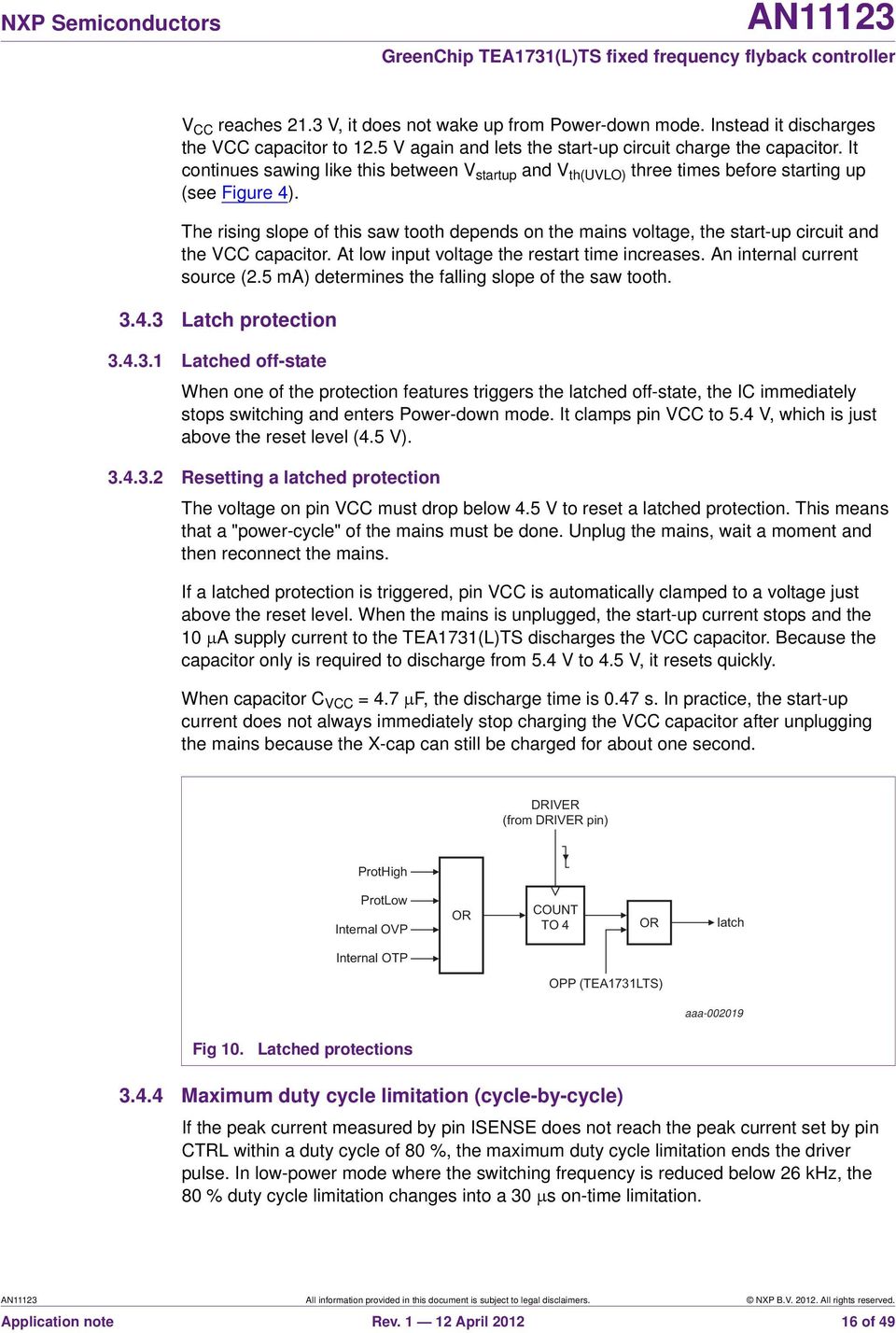
16 V CC reaches 21.3 V, it does not wake up from Power-down mode. Instead it discharges the VCC capacitor to 12.5 V again and lets the start-up circuit charge the capacitor. It continues sawing like this between V startup and V th(uvlo) three times before starting up (see Figure 4). The rising slope of this saw tooth depends on the mains voltage, the start-up circuit and the VCC capacitor. At low input voltage the restart time increases. An internal current source (2.5 ma) determines the falling slope of the saw tooth Latch protection Latched off-state When one of the protection features triggers the latched off-state, the IC immediately stops switching and enters Power-down mode. It clamps pin VCC to 5.4 V, which is just above the reset level (4.5 V) Resetting a latched protection The voltage on pin VCC must drop below 4.5 V to reset a latched protection. This means that a "power-cycle" of the mains must be done. Unplug the mains, wait a moment and then reconnect the mains. If a latched protection is triggered, pin VCC is automatically clamped to a voltage just above the reset level. When the mains is unplugged, the start-up current stops and the 10 A supply current to the TEA1731(L)TS discharges the VCC capacitor. Because the capacitor only is required to discharge from 5.4 V to 4.5 V, it resets quickly. When capacitor C VCC =4.7 F, the discharge time is 0.47 s. In practice, the start-up current does not always immediately stop charging the VCC capacitor after unplugging the mains because the X-cap can still be charged for about one second. DRIVER (from DRIVER pin) ProtHigh ProtLow Internal OVP OR COUNT TO 4 OR latch Internal OTP OPP (TEA1731LTS) aaa Fig 10. Latched protections Maximum duty cycle limitation (cycle-by-cycle) If the peak current measured by pin ISENSE does not reach the peak current set by pin CTRL within a duty cycle of 80 %, the maximum duty cycle limitation ends the driver pulse. In low-power mode where the switching frequency is reduced below 26 khz, the 80 % duty cycle limitation changes into a 30 s on-time limitation. All information provided in this document is subject to legal disclaimers. NXP B.V All rights reserved. Application note Rev April of 49
17 3.4.5 Maximum duty cycle protection (brownout protection) Purpose The main purpose of the maximum duty cycle protection is to ensure a well-defined response to mains supply dips. However, it can also serve as a brownout protection Implementation If the peak current measured by pin ISENSE does not reach the peak current set by pin CTRL within a duty cycle of 80 %, the maximum duty cycle limitation ends the driver pulse. If this happens during eight consecutive cycles, the maximum duty cycle protection triggers a restart. In low-power mode where the switching frequency is reduced to below 26 khz, the maximum duty cycle protection changes to a maximum on-time protection. The maximum on-time is 30 s (typical) Brownout When the mains voltage is too low and at full load, the primary current increases, causing increased losses in many of the primary components. The purpose of the brownout protection is to protect the supply against overheating at input voltages that are too low. The TEA1731(L)TS has no input voltage sensing pin, but the maximum duty cycle protection serves as a kind of brownout protection. At low input voltage (and significant load), the duty cycle becomes an indicator for the input voltage. When the duty cycle reaches 80 %, the IC triggers a restart. At very low input voltages, the start-up circuit cannot provide enough current to charge the VCC capacitor to V startup again Internal OverTemperature Protection (OTP) When the temperature in the chip exceeds 140 C, the internal OTP sets the controller to the latched off-state (in all TEA1731 versions) OverPower Protection (OPP) When the rated output power is continuously exceeded for an adjustable duration, the OPP is activated. The controller immediately stops switching and performs a safe restart (TEA1731TS) or enters the latched-off state (TEA1731LTS). See Section 3.5 for more information about overpower protection Internal output OverVoltage Protection (OVP) An internal overvoltage protection sets the IC to latched-off state when the voltage on pin VCC exceeds 30 V for four consecutive switching cycles. The internal OVP measures on the falling edge of the DRIVER signal. It is also possible to implement an external OVP with a lower threshold value by adding a circuit to pin PROTECT, for example, a Zener diode from pin VCC to pin PROTECT. All information provided in this document is subject to legal disclaimers. NXP B.V All rights reserved. Application note Rev April of 49

18 3.4.9 External output OverVoltage Protection (OVP) The purpose of the overvoltage protection is to protect the devices connected to the output. It also protects the supply itself against output voltages that are too high, for example, when the voltage feedback loop is disturbed. If an overvoltage at the output occurs, the application pulls pin PROTECT above 0.8 V and the OVP is activated. The controller immediately stops switching and enters the latched-off state (in all TEA1731 versions). See Section 4.5 for more information on applying pin PROTECT. Connection of an external OVP application is only required if the threshold voltage must be lower than 30 V or extra filtering is required. Without external OVP application, the fixed internal OVP latches the IC when the voltage on pin VCC exceeds 30 V External OverTemperature Protection (OTP) When the temperature in the supply exceeds the rated level, the application pulls pin PROTECT below 0.5 V and the OTP is activated. The controller immediately stops switching and enters the latched-off state (in all TEA1731 versions). See Section 4.5 for how to apply pin PROTECT UnderVoltage LockOut (UVLO) Restart version (TEA1731TS) When during normal operation the voltage on pin VCC drops below the undervoltage lockout threshold (V th(uvlo) = 12.5 V typical), the IC stops switching and enters Power-down mode. The start-up circuit charges the VCC capacitor and a normal start-up sequence follows Latch version (TEA1731LTS) When during normal operation VCC drops below the undervoltage lockout threshold, the IC is set to the Latched protection mode. This ensures that a shorted output always triggers the Latched protection mode, including if V CC drops below V th(uvlo) before the OPP has a chance to respond OverCurrent Protection (OCP) See Section 3.5 for more information about overcurrent protection. See Section 4.4 for more information about configuring the OCP. All information provided in this document is subject to legal disclaimers. NXP B.V All rights reserved. Application note Rev April of 49

19 3.5 Overpower protection and overcurrent protection Continuous and temporary output power limitation The TEA1731(L)TS incorporates two mechanisms to protect against overload: Overpower protection Overpower protection performs a safe restart or enters the Latched protection mode in the latched version if the rated power is continuously exceeded. OPP is delayed by 60 ms to allow temporary overloads. Cycle-by-cycle primary inductor current limitation Peak current limitation prevents that the core enters saturation and as a consequence the MOSFET from currents that are too high How OPP operates When the internal control voltage exceeds the overpower threshold (400 mv on pin ISENSE), the internal overpower timer is activated (See Figure 11 and Figure 12). If the overpower condition lasts long enough for the timer to reach 60 ms, the controller carries out an OPP restart (TEA1731TS) or enters Latched protection mode (TEA1731LTS). If the internal control voltage drops below 400 mv again before the timer reaches 60 ms, the counter is immediately reset. OPP (to restart//latch logic) TEA1731TS : OPP restart (3 cycles VCC discharge/charge) TEA1731LTS : latch Q1 OPP TIMER 60 ms S R Q 6 DRIVER R Ω R14 10 Ω D2 V th(sense)opp 400 mv V ctrl(ipeak) from CTRL pin (via slope compensation and analog processing) X blanking OPP COMPENSATION - + dv dt 5 ISENSE R13 1 kω C pf 1N4148W R12 18 kω C5 220 nf R Ω 38.5 mv/μs no compensation for V ctrl(ipeak) < 150 mv 60 mv compensation for V ctrl(ipeak) = 400 mv 91 mv compensation for V ctrl(ipeak) = 500 mv substracts fixed offset so no compensation below 90 V (AC) aaa Fig 11. Overpower protection and compensation All information provided in this document is subject to legal disclaimers. NXP B.V All rights reserved. Application note Rev April of 49

20 Output load Output voltage V ISENSE 400 mv Time-out level Internal timer high load normal load high load protection aaa Fig 12. Overpower time-out Peak current limitation (OCP) When the voltage on pin ISENSE exceeds 500 mv, the current switching cycle is immediately ended. When the OCP limits the peak current, the output voltage can no longer be maintained. The converter continues to switch until the OPP is triggered or until V CC has dropped below V th(uvlo) Input voltage compensation Purpose In fixed-frequency DCM, the peak current limitation can also act as overpower protection because the maximum output power is independent of the input voltage. In fixed-frequency CCM, the maximum amount of power that can be transferred to the output not only depends on the primary peak current. It also depends on the duty cycle and therefore on the input voltage as well Implementation TEA1731(L)TS has built-in input voltage compensation to ensure accurate overpower protection, independent of the input voltage. TEA1731(L)TS has no dedicated pin for sensing the input voltage, so it has another way to sense the input voltage. The rising slope of the current through the primary winding is proportional to the input voltage. Pin ISENSE not only measures the primary current but also determines its slope (see Figure 11). The relationship between the dv/dt slope on pin ISENSE and the resulting compensation on the internal control voltage (V ctrl(ipeak) ) is shown in Figure 13. the internal control voltage controls the gain of the compensation. All information provided in this document is subject to legal disclaimers. NXP B.V All rights reserved. Application note Rev April of 49

21 Low load At low load (V ctrl(ipeak) below 150 mv), no compensation is done, ensuring that the low-load efficiency is not affected by decreasing the minimum V ctrl(ipeak) (125 mv). Imagine a third, horizontal line at any level below 150 mv in Figure 13. Maximum continuous load Around the threshold of the overpower protection (V ctrl(ipeak) = 400 mv), the compensation has been optimized for equal power at low and high mains. V ctrl(ipeak) is reduced from 400 mv at low-bulk voltage to 340 mv at high-bulk voltage to achieve this. Maximum peak load During temporary peak loads, more compensation is required to make the peak power independent of the input voltage. At the highest expected bulk voltage, the maximum V ctrl(ipeak) is reduced from 500 mv to 409 mv. (V) V sense(max) with compensation V sense(opp) with compensation ΔV ISENSE /Δt (mv/μs) aaa Fig 13. Overpower compensation: V th(sense)opp as function of dv/dt on pin ISENSE Although the compensation is fixed, overcompensation can (within certain limits) be corrected by adding capacitance on pin ISENSE (see Section 4.4.3). All information provided in this document is subject to legal disclaimers. NXP B.V All rights reserved. Application note Rev April of 49
22 Figure 14 shows the power at which the OPP triggers as a function of the mains voltage measured in an application with 650 H inductance, a 0.21 current sense resistor and a 220 pf capacitor on ISENSE. 90 aaa P o(max) (W) V i (V (AC)) Fig 14. Maximum continuous output power as a function of mains voltage Figure 15 shows the power at which the OCP starts to limit the peak output power as a function of the mains voltage. Measured in the same application as in Figure 14 but with continuous load of 1 A with 50 ms peaks. At each mains voltage setting, the peak load is slowly increased until the output voltage starts to drop. 135 P o(m)(max) (W) 125 aaa V i (V (AC)) Fig 15. Maximum peak output power as a function of mains voltage All information provided in this document is subject to legal disclaimers. NXP B.V All rights reserved. Application note Rev April of 49
23 3.5.5 Overpower time-out When the internal control voltage exceeds the overpower threshold of 400 mv, the overpower timer is activated (see Figure 12). An internal counter is started. When the overpower condition lasts long enough for the counter to reach 60 ms, the controller carries out a safe restart procedure (or enters Latched protection mode in the latched version). If the internal control voltage drops below 400 mv before the counter reaches 60 ms, the counter is immediately reset Restart delay (TEA1731TS only) When the OPP triggers a safe restart procedure, the TEA1731TS immediately stops switching, discharges V CC to below V th(uvlo) and enters Power-down mode. The start-up circuit charges the VCC capacitor to V startup but instead of starting up, the VCC capacitor is discharged again. This is repeated for three cycles to obtain a longer restart time. The restart time of one restart cycle consists of two periods: Discharging the VCC capacitor by an internal current source (2.5 ma). The discharge time is independent of the mains voltage 3. Charging the capacitor from V th(uvlo) to V startup by the external start-up circuit of typically 111 A at 230V(AC). The discharge current is much higher than the charge current. So the mains voltage and the start-up circuit mainly determine the restart time. The discharge time is approximately: C t VCC V startup V th UVLO 4.8 F 21.3 V 12.5 V dch = = = 17 ms 2.5 ma I CC restart (2) Where: C VCC is the total capacitance on pin VCC I CC(restart) is the current discharged by the internal current source The charge time is approximately 4 : C t VCC V startup V th UVLO ch = 4.8 F 21.3 V 12.5 V = = 0.38 s 111 A I ch (3) Where: I ch is the charge current into the VCC capacitor (see Equation 16) For worst case (= shortest) t ch, calculate I ch for high mains and for V CC =V th(uvlo). I ch =111 A for V mains = 230 V (AC) and R1 = 1.5 M. 3. The first discharge differs somewhat from the following ones. The starting voltage can be lower or higher (depending on the load) and the discharge current source is not yet switched on. The operating supply current (= 0.58 ma) discharges The VCC capacitor. 4. I ch also flows during the discharge. But usually I ch << I dch so this can be neglected. All information provided in this document is subject to legal disclaimers. NXP B.V All rights reserved. Application note Rev April of 49
24 The total restart delay for the start-up circuit with two resistors approximately equals: t restart = 3 t dch + t ch = s s = 1.2 s (4) Ratio OPP time-out/restart delay In a continuous overload, the supply keeps switching on and off (only valid for the non-latched version). At high mains, the ratio of the on-time and off-time is approximately 1:20. This is sufficient to keep the average input power during a continuous overload below 5 W in most applications. The average input power during a continuous overload is: t to OV P iav t restart + t to OV P om max 60 ms = = s + 60 ms 90 W (5) Where: P i(av) is the average input power during an overload t to(ov) is the overpower protection time-out time, the time from exceeding the overpower threshold to triggering the protection. This time is fixed to 60 ms in the IC. t restart is the restart delay, the time from triggering the protection until the next start-up attempt P o(m)(max) is the maximum peak output power, the maximum power that the supply can deliver during the overpower protection time-out time. The restart delay depends on the input voltage, the start-up circuit and the VCC capacitor. The restart delay can be changed by changing the values of the start-up circuit or the VCC capacitor, but this also influences the start-up time. The input power at continuous overload can be decreased in the following way: 1. Increase the restart delay by increasing the start-up resistors or capacitor C VCC. 2. Decrease the maximum output power by increasing the current sense resistor (if possible). 3.6 External overvoltage protection and overtemperature protection General Two protection features can be implemented on pin PROTECT using only a minimum number of components: Output OverVoltage Protection (OVP) OverTemperature Protection (OTP) The protection features on pin PROTECT are always latched (also in the non-latched version). All information provided in this document is subject to legal disclaimers. NXP B.V All rights reserved. Application note Rev April of 49
25 3.6.2 Circuit description An internal current source attempts to keep the voltage on pin PROTECT equal to 0.65 V. It has a range of 107 A to +32 A (that is, it can sink 107 A and source 32 A). If the internal current source is out of range, the pin can no longer be kept within the 0.5 V to 0.8 V window. Latched protection is triggered if the voltage on pin PROTECT drops below 0.5 V or exceeds 0.8 V for at least four consecutive switching cycles. Θ VCC ROVP (option) ZD1 (option) BZX84J-B27 R17 1,8 kω 1 % NTC 470 kω at 25 C 11.2 kω at 110 C PROTECT 6 C nf 0.65 V LOW-PASS FILTER 4.1 V current source sinks up to 107 μa or sources up to 32 μa to keep PROTECT pin close to 0.65 V 0.8 V 0.5 V ProtHigh ProtLow V PROTECT (V) I O(PROTECT) (ma) aaa Fig 16. Pin PROTECT Filtering Due to internal filtering, pin PROTECT does not respond to HF signals. The PROTECT pin has two kinds of internal filtering: Pulses shorter than 3 s are ignored The fault condition has to last for at least four consecutive switching cycles Pin PROTECT becomes immune to false triggering by disturbances from for example, GSM. In extreme cases, such as exposure to very strong electromagnetic fields, pin PROTECT can pick up a disturbance with an amplitude of several volts. The internal ESD protection diode can rectify such high amplitude disturbances, which can unintentionally trigger the OVP. If so, a 10 resistor between pin PROTECT and the external capacitor (as close as possible to the pin) can be very effective External output overvoltage protection The output OVP is activated if the VCC voltage exceeds the Zener voltage by 0.8 V. An external OVP application is optional. It is only required when the OVP level must be lower than the fixed 30 V level of the internal OVP protection or if extra filtering of the auxiliary winding voltage is required External overtemperature protection The OTP is triggered when the voltage on pin PROTECT drops below 0.5 V. This happens when the resistance of the NTC with series resistor R17 has dropped below 0.5 V / 32 A = 15.6 k. VCC variations do not influence the OTP because pin PROTECT is internally biased. All information provided in this document is subject to legal disclaimers. NXP B.V All rights reserved. Application note Rev April of 49
26 3.6.6 Clamp An internal clamp keeps the voltage on pin PROTECT at 4.1 V to prevent damage to the pin in case of spikes. The clamp voltage is specified at a 200 A input current (the exact voltage depends on the current). In Power-down mode, the clamp voltage drops to approximately 2.0 V. 3.7 Slope compensation The TEA1731(L)TS has built-in slope compensation to prevent subharmonic oscillation in CCM mode at duty cycles above 50 %. The slope compensation is internally added to the CTRL input signal (see Figure 17). The slope compensation is 20 mv/ s referred to pin ISENSE. The slope compensation is only active on duty cycles higher than 45 %. oscillator slope compensation t / T (%) 019aaa170 Fig 17. Slope compensation waveforms 3.8 Driver The driver circuit has a current sourcing capability of 250 ma typical and a current sink capability of 750 ma typical. This permits fast turn-on and turn-off of the power MOSFET for efficient operation. See Figure 6 for DRIVER pin control. 3.9 Frequency modulation The switching frequency and its harmonics are responsible for a large part of the conducted EMI problems. Modulation of the switching frequency spreads all frequency peaks that are related to the switching frequency over wider bands, significantly decreasing the so-called "average measurement". See Figure 6 for the location of oscillator and frequency modulation. The oscillator is continuously modulated at a rate of 280 Hz and a range of 6 % ( 4 khz at 65 khz). For example, the third harmonic of 65 khz is spread over a frequency band of 3 8 = 24 khz. f sw (khz) / T = 280 Hz t aaa Fig 18. Frequency modulation All information provided in this document is subject to legal disclaimers. NXP B.V All rights reserved. Application note Rev April of 49
27 4. Application (pin-by-pin) 4.1 Pin VCC Start-up circuits A low-cost start-up circuit that also takes care of the X-cap discharge is the two resistor start-up circuit. See Section 5 for a full explanation of the various start-up circuits VCC capacitor The VCC capacitor must be as small as possible to make the start-up time (and the latch reset time) as short as possible. First of all the value of the capacitor must be sufficient to supply the TEA1731(L)TS until the auxiliary winding takes over. This depends on the configured soft start time, the load on the output and the values of the secondary capacitors. Other factors determine the minimum value of the capacitor. Some worst case tests to determine the minimum value of the VCC capacitor are: No load operation The supply runs at low frequency so there is a long interval between two consecutive charge pulses from the auxiliary winding. V CC must not drop to too close to V th(uvlo) (< 2 V) before the next cycle. Transient from full load to no load A transient from full load to no load can cause a small overshoot on the output voltage. It can take a long time for the output capacitor to discharge to the level at which the supply starts to switch again because of the absence of any external load. During this time, the auxiliary winding does not charge the VCC capacitor. This overshoot can be limited by modifying the loop. Add resistor R25 and capacitor C17 at for example, 3.9 k and 1 nf respectively (see Figure 1). Low ESR type The VCC capacitor must be a low Equivalent Series Resistance (ESR) type. Under low load or no load conditions, the switching frequency can be very low, for example, 250 Hz. The auxiliary voltage, which can have a duty cycle of only 0.1 %, must charge the VCC capacitor. It is only present for a few s per cycle and the time between two cycles can be a few ms. So, the VCC capacitor charge current at no load is roughly equal to the current consumption of the IC multiplied by 1000: ma = 0.5 A. Use a low ESR capacitor because the relatively high ESR of a regular electrolytic capacitor limits the charge current and can cause the VCC to drop below V th(uvlo). If this happens, the IC keeps restarting under no load conditions Auxiliary winding or take-over winding The optimal voltage of the auxiliary winding is approximately 20 V: Not much lower because during a no load operation it has to be able to keep the V CC above the V th(uvlo). Keep a margin of 2 V above the maximum V th(uvlo) value to have some margin for disturbances and component spread. Not much higher because at maximum load the V CC must not trigger the OVP. All information provided in this document is subject to legal disclaimers. NXP B.V All rights reserved. Application note Rev April of 49
28 The purpose of the series inductor L1 is to prevent that the ringing at the start of the secondary stroke is rectified. It charges the VCC capacitor to above the OVP level. L1 is not always required. It depends on the coupling between the windings. Sometimes a resistor of approximately 4.7 is good enough Maximum start-up current The maximum current that can be supplied by the start-up circuit must not exceed 1 ma. This means that the start-up circuit must not be able to deliver more than 1 ma at maximum mains voltage. During latched protection, VCC is clamped to 5.4 V. The clamp can sink at least 1 ma over the entire operating temperature range. Above 1 ma the clamp holding VCC below its maximum rating cannot be guaranteed 5. If a charge current higher than 1 ma is required, a 30 V Zener diode from pin VCC to pin GND can be used to protect the IC. In that case, the internal OVP cannot work anymore because the Zener keeps the VCC below 30 V. An external OVP at a slightly lower voltage, for example 27 V, must replace the internal OVP. If a charge pump is used (see Section 5.4), the VCC voltage can be limited by replacing one of the charge pump diodes (D dch ) by a 30 V Zener diode. If the Zener diode is placed at this position, it does not influence the internal OVP. Also, during no load operation, the maximum current that can be supplied by the start-up circuit must not exceed the current into pin VCC (0.58 ma supply current + approximately 0.5 ma optocoupler transistor current 1.08 ma) PCB layout Pin VCC must not be treated as a small signal pin because the relatively high current to charge the gate of the MOSFET also passes through this pin. Keep the loop from the positive terminal of the VCC capacitor to pin VCC, via pin DRIVER, to the gate of the MOSFET, and via the source of the MOSFET back to the negative terminal of the VCC capacitor, as small as possible. 4.2 Pin CTRL A capacitor of 1 nf on pin CTRL is a good value for most applications. If the capacitor is much larger, it responds too slowly to load transients. Especially from full load to no load this can result in UVLO. If the capacitor is much smaller, the control loop can become unstable and sensitive to disturbances. 4.3 Pin DRIVER The source and sink currents on pin DRIVER can be high. The source current also rushes through pin VCC and the sink current through pin GND. This means that the PCB layout requires extra attention to avoid large loops. 5. Above a certain current, the clamp behaves like a current source. The voltage increases and the current remains constant. All information provided in this document is subject to legal disclaimers. NXP B.V All rights reserved. Application note Rev April of 49
29 4.4 Pin ISENSE Configuring the current sense resistor Calculate the maximum primary peak current before the correct value of the current sense resistor is calculated. This is done with Equation 6 or Equation 7. In DCM mode: 2 P omax = L f sw I peak max (6) In CCM mode: P omax I peak max = V i V i + NV o 1 NV o V i NV o 2 L f sw V i + NV o (7) Where: I peak(max) is the maximum continuous primary peak current, the peak current at which the OPP triggers P o(max) is the maximum continuous output power, the output power at which the OPP triggers is the expected efficiency of the flyback at maximum output power V i is the minimum rectified mains voltage (= 2 the minimum mains voltage) at which the supply must be able to deliver the maximum continuous output power 6. N is the winding ratio of the transformer V o is the output voltage f sw is the switching frequency, in this case 65 khz (the "high power" area of the frequency curve, see Figure 8) Now the (maximum) current sense resistor value can be calculated with Equation 8: R ISENSE V th sense opp I peak max 400 mv = = I peak max (8) Where: V th(sense)opp is the overpower protection threshold voltage on pin ISENSE I peak(max) is the maximum continuous primary peak current, the peak current at which the OPP triggers Another way to determine the correct value for the sense resistor is by trial and error: 1. Connect a load to the output and set the load to the rated maximum continuous output power of the application. 6. The peak current is larger during the valley of the mains ripple. During normal operation, the OPP threshold can already be exceeded during the valleys of the ripple on the bulk capacitor voltage. But this does not trigger the OPP. As long as the threshold is not exceeded during the tops of the bulk capacitor ripple voltage, the OPP time-out counter is reset each 8.33 ms or 10 ms. It never reaches the 60 ms OPP time-out. The OPP can only trigger if the OPP threshold is exceeded throughout the entire mains cycle. All information provided in this document is subject to legal disclaimers. NXP B.V All rights reserved. Application note Rev April of 49
30 2. Apply the minimum mains voltage at which the supply must be able to deliver the maximum continuous output power. 3. Increase the current sense resistor until the supply triggers the overpower protection. Then reduce the current sense resistor by about 5 % to keep some margin for normal operation. The sense resistor must be accurate (1 %) and have a low inductance. Splitting the sense resistance into two or three parallel resistors not only makes it easier to implement the desired resistance and power rating but it also helps to reduce the inductance Calculating the maximum temporary peak output power The maximum instantaneous primary peak current can now be calculated with Equation 9: V I sense max peak M max R ISENSE = = 500 mv R ISENSE (9) Where: V sense(max) is the maximum sense voltage on pin ISENSE Now the maximum temporary peak output power can be calculated 7. In DCM mode: P om max V i NV o = V i + NV o L I peak M max 2 f sw (10) In CCM mode: P om max V i NV o V I i NV = V i + NV o peak M max o L f sw V i + NV o (11) Where: is the expected efficiency of the flyback at maximum output power I peak(m)(max) is the maximum instantaneous primary peak current, limited by the OCP f sw is the switching frequency, in this case 80 khz, the "peak power" area of the frequency curve, see Figure 8 V i is the value of the rectified mains voltage during the valley of the ripple This is the maximum temporary peak output power at which the output voltage remains intact. If the temporary peak output power is not high enough, it can only be increased by decreasing the current sense resistor value. This also increases the maximum continuous output power. 7. Calculating the maximum temporary output power is complicated because it depends on the mains ripple on the bulk capacitor, which itself depends on the output power. All information provided in this document is subject to legal disclaimers. NXP B.V All rights reserved. Application note Rev April of 49
31 4.4.3 Low-pass filter (C7 and R13) The low pass filter consisting of capacitor C7 and resistor R13 has two purposes: It prevents negative spikes, which cause a DC offset across capacitor C5, from reaching the pin. The internal ESD protection diode can rectify these. The inductance of the current sense resistor and the PCB tracks cause the negative spikes. See Section for more information about trimming the OPP compensation by influencing the delay Tuning the OPP compensation (C7 and R13) The amount of overpower compensation is fixed inside the IC. It has been optimized for a typical 65 W application with a primary inductance of 650 H, a current sense resistor of 0.2 and a 100 pf + 1 k filter on pin ISENSE. It is still possible to trim the compensation for other configurations within certain limits. The compensation depends on the current sense resistor, so the current sense resistor must be chosen first. Steps for trimming the overpower compensation: 1. Start with a 100 pf capacitor on pin ISENSE. 2. Apply the minimum mains voltage at which the supply must be able to operate. 3. Measure the maximum output power by slowly increasing the load until the OPP is triggered. 4. Apply the maximum mains voltage at which the supply must be able to operate. 5. Measure the maximum output power by slowly increasing the load until the OPP is triggered. 6. Increase the capacitor on pin ISENSE (but not above 470 pf) if the maximum output power at high input voltage is lower than the maximum output power at low input voltage (overcompensated). Decrease the capacitor on pin ISENSE (but not below 47 pf) if the maximum output power at high input voltage is higher than the maximum output power at low input voltage (undercompensated). 7. Repeat steps 2 to 6 until the maximum output power at high and low input voltage is equal. Remarks: The output power as a function of the input voltage is not a linear function (see Figure 14). When the maximum output power has been tuned to be equal for both the absolute minimum input voltage (90 V (AC)) and the absolute maximum input voltage (264 V (AC)), the actual maximum output power is slightly higher between these limits. Another method to configure the compensation is tuning it in such a way that the maximum output power at nominal low mains (115 V (AC)) equals the maximum output power at high mains (230 V (AC)). In that case, the maximum output power is slightly lower at the minimum and maximum input voltage and slightly higher between the high and low nominal input voltages. Do not reduce the capacitance below 47 pf. Some capacitance is required to prevent that negative spikes from the current sense resistor reach pin ISENSE. All information provided in this document is subject to legal disclaimers. NXP B.V All rights reserved. Application note Rev April of 49
32 Do not increase the capacitance above 470 pf because this increases the minimum peak current which can lead to audible noise. Resistor R13 must not be too high because it influences the soft start behavior. It reduces the voltage to which the soft start capacitor is charged. 1 k is a good value for most applications. Mount the resistor as close as possible to pin ISENSE Calculating the effect of the OPP compensation The compensation offset on the OPP threshold can be calculated with Equation 12. The equation is valid for dv/dt > 38.5 mv/ s. In a typical application, this corresponds with an input voltage > 90 V (AC). V bulk V ctrl Ipeak = R L ISENSE (12) The resulting peak current reduction can be calculated with Equation 13: I peak = V ctrl Ipeak R ISENSE (13) Where: I peak is the peak current reduction V ctrl(ipeak) is the offset on V ctrl(ipeak) caused by the OPP compensation (see Equation 12). R ISENSE is the value of the current sense resistor (R11 in Figure 1) Section describes how to calculate the peak current and the resulting output power without input voltage compensation. I peak must be subtracted from the peak current before calculating the maximum output power. This is required to calculate the output power with input voltage compensation Disabling the overpower protection Unlike in the TEA1733 series or the TEA1738 series, the overpower protection in the TEA1731(L)TS cannot be disabled because it is fully integrated in the IC. If this is not appreciated, for example, because a secondary IC handles it, it can be shifted to a higher power by lowering the current sense resistor. It is not recommended to make it too low: Controlling a relatively high power using only a fraction of the CTRL range results in a very high gain and can cause instability. Skipping part of the peak current reduction means that it is not sufficiently reduced before entering the VCO mode. This can cause audible noise. Normally, the peak current is first reduced by a factor 3 before the frequency enters the audible spectrum Configuring the soft start resistor and capacitor The duration of the soft start can be configured by changing the values of the soft start capacitor and resistor. The duration of the soft start roughly equals: t start soft = R start soft C start soft (14) A soft start time of 4 ms is recommended, for example, R12 = 18 k and C5 = 220 nf. All information provided in this document is subject to legal disclaimers. NXP B.V All rights reserved. Application note Rev April of 49
33 The value of the total soft start resistance (the sum of resistors R12 and R13) must not be lower than 12 k. Otherwise, the 55 A current source cannot charge the soft start capacitor to 0.5 V and the controller does not start switching. Remarks: Do not choose a soft start time that is too long. The slower the supply starts up, the longer it takes before the auxiliary winding recharges the VCC capacitor. If this takes too long, V CC drops below V th(uvlo) before the output voltage is in regulation. Changing the soft start resistor value slightly also influences the maximum output power at absolute minimum input voltage. So, after configuring R start(soft), check if it is required to retune the current sense resistor. 4.5 Pin PROTECT Specifications Table 3. Specifications pin PROTECT Description Min Typ Max bandwidth khz - source current 30 A 32 A 34 A sink current 87 A 107 A 127 A low detection voltage 0.47 V 0.5 V 0.53 V high detection voltage 0.75 V 0.8 V 0.85 V OverVoltage Protection (OVP) An external OVP is only required if the voltage of the internal OVP (30 V) is too high or if it has to be more accurate than 1 V. Lowest cost implementation of an external OVP is a Zener diode from pin VCC to pin PROTECT. But it is also possible to implement a separate filter between the auxiliary winding and pin PROTECT. The OVP triggers when the current through the Zener exceeds 107 A (typical). The voltage of the Zener diode is often specified at a higher current. This means that the OVP triggers at a slightly lower voltage than the nominal Zener voltage. The OVP can be tuned by placing a resistor (R OVP in Figure 16) in series with the Zener diode. A series resistor of 10 k increases the OVP voltage by approximately 1 V ( V =R OVP 107 A). The accuracy of the OVP depends on the coupling between the secondary winding and the auxiliary winding. The best coupling can be obtained when these windings are wound directly on top of each other OverTemperature Protection (OTP) The OTP can trigger if the resistance from pin PROTECT to pin GND is lower than 0.53 V / 30 A =17.7k. The OTP must trigger if the resistance from pin PROTECT to pin GND is lower than 0.47 V / 34 A =13.8k. All information provided in this document is subject to legal disclaimers. NXP B.V All rights reserved. Application note Rev April of 49
34 Select the NTC resistance as high as possible to obtain best accuracy (see Table 4). Table 4. Suggested NTC values Valid for Epcos B57164 series (other manufacturers offer comparable values) Target temperature ( C) Suggested NTC (R at 25 C) Series resistor (k ) (k ) 66 to to to to to to to to If a series resistor higher than 5 k is required to tune the OTP to the desired temperature, consider choosing a higher NTC value. The NTC is often placed near the hottest component on the PCB, which is not always close to the IC. The long PCB track from NTC to pin PROTECT can act as an antenna and pick up disturbances. A filter against such disturbances can be constructed without additional components by placing the series resistor (which is required anyway) between the NTC and pin PROTECT and as close as possible to the pin What to do when pin PROTECT is not used Connect a 10 nf capacitor from pin PROTECT to pin GND to prevent that external disturbances can trigger pin PROTECT. Also, connect a 470 k resistor from pin PROTECT to pin GND to prevent that external leakage currents before start-up can charge pin PROTECT. 4.6 Pin GND Do not treat pin GND as a small signal ground because the DRIVER discharge current also flows through this pin. All information provided in this document is subject to legal disclaimers. NXP B.V All rights reserved. Application note Rev April of 49
35 5. Start-up circuits 5.1 Two-resistor circuit This is a low-cost solution that not only starts up but also takes care of X-cap discharge. L BD1b BD1d CX1 N BD1a BD1c C1 L R1 R2 C11 + C7 VCC 019aaa156 VCC N R1 C11 + C7 R2 BD1b BD1a BD1d C1 BD1c 019aaa157 a. Start-up circuit with two resistors b. Simplified representation Fig 19. Start-up circuit with two resistors Figure 19 (b) shows the circuit shown in Figure 19 (a) but drawn to show more clearly how the VCC capacitor is charged. Once the bulk capacitor C1 is fully charged, diodes BD1c and BD1d stop conducting. During the positive half mains cycle, diode BD1a conducts and the current through resistor R1 charges the VCC capacitor (C11 + C7). During this positive half cycle, part of the charge current leaks away into resistor R2. The worst case current that leaks into resistor R2 occurs when the VCC capacitor is almost charged: I leak V startup 21.3 V = = = 14 A R2 1.5 M (15) The charge current into the VCC capacitor (leakage current already taken into account) approximately equals 8 : V mains 2 V CC I ch = I R1 CC startup (16) Where: V mains is the effective mains voltage I CC(startup) is the supply current of the IC in Power-down mode The values of resistors R1 and R2 must be low enough to ensure the required discharge time of the X-cap (RC < 1 s) and to obtain an acceptable start-up time at low mains voltage. But it must also be as high as possible to keep the no load power consumption as low as possible. Some examples of start-up times for different resistors are shown in Table Use V CC =V startup = 21.3 V for calculating the start-up time. Use V CC =V clamp(vcc) = 5.4 V for calculating the maximum current into clamp during latched protection. All information provided in this document is subject to legal disclaimers. NXP B.V All rights reserved. Application note Rev April of 49
36 Table 5. Start-up times for different start-up resistor values VCC capacitance: 4.7 F nf = 4.8 F Resistor R1 = R2 Start-up time at Start-up time at Power at 230 V (AC) [1] 90 V (AC) 115 V (AC) 680 k 1.6 s 1.1 s 70 mw 820 k 2.0 s 1.4 s 59 mw 1M 2.5 s 1.75 s 48 mw 1.2 M 3.1 s 2.1 s 40 mw 1.5 M 4.15 s 2.75 s 33 mw [1] Power consumption of the combined X-cap discharge and start-up circuit at 230 V (AC) aaa start-up resistors (MΩ) V (AC) 90 V (AC) start-up time (s) Fig 20. Start-up resistor value as a function of start-up time (VCC capacitance 4.8 F) aaa159 power at 230 V (AC) (mw) V (AC) V (AC) start-up time (s) Fig 21. Power consumption of start-up circuit at 230 V (AC) as a function of start-up time (VCC capacitance 4.8 F) All information provided in this document is subject to legal disclaimers. NXP B.V All rights reserved. Application note Rev April of 49
37 Figure 21 shows the power consumption by the combined start-up and X-cap discharge circuit as a function of the start-up time. The graph shows how to save power: More than 10 mw no load power can be saved by increasing the start-up time at 115 V (AC) from 2 s to 3 s. Approximately 17 mw no load power can be saved by specifying the start-up time at 115 V (AC) instead of 90 V (AC). The voltage rating of most 1206 resistors is only 200 V. For 230 V (AC) applications the voltage across the start-up resistors can become nearly 400 V. This means that if SMD type resistors are used, R1 and R2 must each be split into two resistors in series. 5.2 Measuring start-up time Capacitance across the bridge diodes changes the wave shape of the voltage before the bridge rectifier with respect to the primary ground. This can significantly decrease the start-up time. Connecting the ground clip of an oscilloscope to the primary ground of the flyback converter can add a few nf across the bridge diodes. This depends on the capacitance of the mains supply to ground. Make sure that the board has no capacitive coupling to primary ground, so the correct worst case start-up time is measured: Use a current probe in the mains input cable to detect mains switch-on. The same current probe in the mains input cable can also be used to detect when the supply starts switching. The time, from the moment the supply starts to switch until it reaches 90 % of the output voltage, is only a few milliseconds. It can be ignored with respect to the total start-up time. If it is required to measure the output voltage with an oscilloscope, remove the Y-cap so that there is no capacitive coupling to primary ground. Use a resistor load instead of an electronic load. Remove the Y-cap if electronic load must be used. Also important when measuring the start-up time: Make sure that the VCC capacitor is entirely discharged before starting a measurement. Do not connect a probe or multimeter to the VCC. Even a 10 M impedance influences the measurement. 5.3 Start-up circuit with diodes As explained in Section 3.2.1, the start-up circuit with two resistors also has a disadvantage. Some current does not flow into the VCC capacitor but is lost in one of the resistors. This can be prevented by placing diodes in series with the resistors (see Figure 22). Figure 22 (a) requires two resistors and two low voltage diodes. Figure 22 (b) saves one resistor but requires two high-voltage diodes. At 90 V (AC), adding the diodes reduces the start-up time by approximately 20 % without increasing the no load power consumption. The start-up time reduction is approximately 10 % at 115 V (AC). All information provided in this document is subject to legal disclaimers. NXP B.V All rights reserved. Application note Rev April of 49
38 L L CX1 CX1 N C1 N C1 R1 R2 R1 C11 + C7 VCC 019aaa160 C11 + C7 VCC 019aaa161 Fig 22. a. Diodes at low side b. Diodes at high side (requires high-voltage diodes but it saves one resistor Start-up circuits using diodes in series The diodes do not block the X-cap discharge path. The discharge of the X-cap takes place via resistors R1 or R2 through the series diode to pin VCC. From pin VCC, there are several paths to ground. Even when the IC is in Power-down mode a clamp on pin VCC is active. From ground, it can find its return path to the X-cap through one of the bridge diodes. The charge current into the VCC capacitor approximately equals 9 : V mains V CC I ch = I R1 CC startup (17) 5.4 Start-up circuit with charge pump If the no load power requirements cannot be combined with the start-up time requirements, a more efficient way to decrease the start-up time is to use the charge pump circuit illustrated in Figure 23 (a). During the positive half of each mains cycle, current flows from L via capacitor C pump and diode D ch to the VCC capacitor. This process stops when capacitor C pump is fully charged. During the negative half mains cycle, capacitor C pump is discharged: From capacitor C pump via capacitor C1 to ground and from ground via diode D dch back to capacitor C pump. Unlike in the resistor start-up circuit, no significant power is lost in the circuit itself. 9. Use V CC =V startup = 21.3 V for calculating the start-up time. Use V CC =V clamp(vcc) = 5.4 V for calculating the maximum current into clamp during latched protection. All information provided in this document is subject to legal disclaimers. NXP B.V All rights reserved. Application note Rev April of 49
39 L L CX1 CX1 C1 C1 N N Cpump 10 nf Dcharge VCC Rinrush 20 kω Cpump 10 nf R1 3 MΩ R2 3 MΩ VCC Ddischarge C11 + C7 C11 + C7 019aaa aaa163 Fig 23. a. Basic charge pump start-up circuit b. Practical charge pump start-up circuit with inrush current limiter and X-cap discharge Start-up circuit with charge pump The charge pump circuit does not provide a discharge path for the X-cap. An efficient way to provide the X-cap discharge path is to use the resistor start-up circuit because it not only discharges the X-cap but also helps to charge the VCC capacitor (see Figure 23 (b)). Choose values for resistors R1 and R2 that are as high as possible but low enough to comply with the X-cap discharge requirement: R C<1s: For a 330 nf X-cap: R < 3 M For a 220 nf X-cap: R < 4.5 M The value chosen for capacitor C pump must be high enough to reach the start-up time target. Start with 10 nf and increase or decrease for a correct start-up value. It must be a high-voltage capacitor. The purpose of resistor R inrush is to limit the inrush current when the supply is plugged in at the top of the sine wave. The value must be as low as possible to minimize losses but high enough to comply with the pulsed power rating of the resistor to survive the inrush current. Any low-voltage type diode with a breakdown voltage higher than 30 V can be used (breakdown voltage > 30 V). If the average start-up current at maximum input voltage exceeds the maximum current of the clamp on pin VCC (1 ma), a 27 V Zener diode must replace diode D dch. This Zener diode must not be higher because the charge pump can trigger the internal OVP. It must not be lower because power is wasted during normal operation. CAUTION The rated maximum voltage of the high-voltage bulk capacitor can be exceeded if it is overcharged by the charge pump. Remark: This can occur in the latched off-state when the power consumption is very low. In that case, the charge pump not only charges the VCC capacitor. It also very slowly charges the high-voltage bulk capacitor (C1) on the other side of the bridge rectifier. All information provided in this document is subject to legal disclaimers. NXP B.V All rights reserved. Application note Rev April of 49
40 Check at maximum input voltage that in Latched protection mode the charge pump does not charge the high-voltage bulk capacitor above its rated voltage. There are three ways to solve the problem: Increase the load on the rectified mains voltage. Even if some load has to be added to the rectified mains voltage to prevent that the charge pump damages the high-voltage bulk capacitor, the charge pump remains a more efficient solution than the resistor circuit. Another solution is to add an identical charge pump but connect its input to N instead of L (see Figure 23 (a) and Figure 24). In this case, the value of C pump can be divided by two. Same as above but only add the capacitor to N. This saves two diodes. Now capacitor C pump cannot be divided by two (see Figure 23 and Figure 24 (b)). L L CX1 CX1 C1 C1 N N 20 kω 20 kω R1 3 MΩ R2 3 MΩ 20 kω R1 3 MΩ R2 3 MΩ 4.7 nf 4.7 nf 4.7 nf 4.7 nf VCC VCC C11 + C7 C11 + C7 019aaa164 aaa Fig 24. a. Symmetric charge pump circuit b. Balanced charge pump circuit Symmetrical charge pump circuits that prevent that capacitor C1 is charged Charge pump in combination with PFC If Power Factor Correction (PFC) is used, the voltage on the bulk capacitor can be (much) higher than the rectified mains voltage. Under these circumstances, the start-up current provided by the charge pump can be reduced or even entirely stopped. If a restart occurs during this condition, the start-up time can be very long. This can be solved by using a symmetrical charge pump. All information provided in this document is subject to legal disclaimers. NXP B.V All rights reserved. Application note Rev April of 49
41 6. Ways to reduce no load power This section describes how the no load power can be minimized in any TEA1731-based flyback converter. 6.1 Remove power LED Some adapters have an LED connected to the output to indicate that the power is present. An LED current of 2.5 ma supplied from a 20 V output voltage adds 50 mw to the no load power. A high-efficiency LED in series with the LED of the optocoupler does not add to the power consumption but its brightness varies slightly with the load. Another option is to supply the LED from a separate low voltage winding. 6.2 Change the primary RDC clamp to a Zener clamp The advantage of the Zener clamp is that it only conducts when required. It is independent of the switching frequency. Compared to a Resistor Diode Capacitor (RDC) clamp it reduces no load power but increases cost and EMI. 019aaa176 Fig 25. Zener clamp 6.3 Modify RDC clamp with a Zener diode A Zener diode in series with the resistor of the RDC clamp prevents that the capacitor almost entirely discharges at each switching cycle when running at low frequency during no load. Adding the Zener diode increases cost and can also increase EMI (but not as much as a Zener clamp). Replacing resistor R9 (Figure 1) by a 100 V Zener diode saves 5 mw at 230 V (AC). 019aaa177 Fig 26. RDC clamp with Zener diode All information provided in this document is subject to legal disclaimers. NXP B.V All rights reserved. Application note Rev April of 49
42 6.4 Reconsider start-up time specification Usually the maximum start-up time of a power supply is specified at a low nominal mains voltage (115 V (AC)). But occasionally the maximum start-up time is specified at the absolute minimum mains voltage (90 V (AC)). In this case, it is worth reconsidering this requirement. 90 V (AC) is probably encountered in less than 1 % of the field. However, to achieve a 2 s start-up time at 90 V (AC) requires 17 mw extra start-up power at 230 V (AC) 10. Another 11 mw can be saved by allowing a maximum start-up time of 3 s instead of 2 s (see Figure 21). 6.5 Reduce VCC capacitor value The efficiency of the start-up circuit can be significantly improved with a smaller VCC capacitor. Charging only half the VCC capacitor in the same time requires only half the power. A maximum start-up time of 2 s at 115 V (AC), reducing the VCC capacitance from 4.8 F to 2.3 F and doubling the start-up resistor values, saves approximately 20 mw. 6.6 X-cap quality Use a good quality X-cap. A poor quality X-cap (330 nf) can dissipate as much as 25 mw at 230 V (AC)/60 Hz. A good quality X-cap dissipates less than 2 mw. 6.7 X-cap value Reducing the value of the X-cap also decreases the X-cap losses. It is better to solve EMI problems at the source than by solving them with a very large X-cap. Reducing the X-cap value not only reduces the losses in the X-cap itself but also in the required X-cap discharge circuit. 6.8 Active X-cap discharge Replace a passive X-cap discharge (resistor) by an active discharge circuit (requires a high-voltage transistor). 6.9 Active start-up circuit Replace a passive start-up circuit (resistors) by an active charge circuit that is only active during start-up (requires a high-voltage transistor) Increase the impedance of the output voltage divider Doubling the impedance of the voltage divider on the output (resistors R23 and R24 in Figure 1) saves approximately 5 mw. In this case, also adapt capacitor C16 and resistor R22 to keep the same loop response. How much the impedance can be increased depends on the layout of the PCB and the input current of the shunt regulator. 10. If the two resistor start-up circuit is used and the VCC capacitance is 4.8 F (4.7 F nf). All information provided in this document is subject to legal disclaimers. NXP B.V All rights reserved. Application note Rev April of 49
43 6.11 Replacing the integrated shunt regulator (TL431) by a discrete shunt regulator The widely available integrated TL431 shunt regulator versions usually require 1 ma for proper regulation. Some manufacturers specify 0.5 ma or 0.6 ma. It is not difficult to make a low (temperature stable) discrete alternative (see Figure 27). 330 Ω 1 MΩ 1 MΩ 100 pf 68 kω 1 MΩ 8.2 V 019aaa178 Fig 27. Discrete shunt regulator Remark: If the power consumption on the secondary side is too low, it is possible that the controller does not switch enough to keep V CC above V th(uvlo). All information provided in this document is subject to legal disclaimers. NXP B.V All rights reserved. Application note Rev April of 49
44 7. Layout recommendations 7.1 Input section Keep the mains tracks (L and N) low ohmic and close to each other to avoid loops. Position common-mode chokes away from the power section (MOSFET and transformer) and from each other to prevent magnetic coupling to any of the other components. Keep tracks from the bridge rectifier to capacitor C1 low ohmic and close to each other. 7.2 Power section The connection from the negative terminal of the bridge rectifier to the current sense resistor R11 must go via capacitor C1. The connection from the positive terminal of the bridge rectifier to the transformer must go via capacitor C1. Keep the cross section of the loop from capacitor C1 via the transformer, MOSFET Q1 and current sense resistor R11 back to capacitor C1 as small as possible. Place capacitor C2 close to capacitor C1. Place peak clamp circuit consisting of resistors R9 and R10, capacitor C3 and diode D1 close to the transformer and away from the TEA1731(L)TS. If MOSFET Q1 has a metal tab, insulate it from the heatsink. Connect the heatsink to the primary power ground. 7.3 Auxiliary winding Place rectifier diode D3, resistor R18 and VCC capacitor C11 close to the auxiliary winding. The connection of the ground of the auxiliary winding to the central signal ground point must go via capacitor C11. Use a separate track to avoid the noise in this ground causing noise in pin PROTECT, pin ISENSE, etc. Connect the central signal ground with a low ohmic track to the central power ground (capacitor C1). Keep the cross section of the loop from the auxiliary winding (via diode D3 and resistor R18) to VCC capacitor C11 and back to the auxiliary winding as small as possible. All information provided in this document is subject to legal disclaimers. NXP B.V All rights reserved. Application note Rev April of 49
45 7.4 Flyback controller Place the TEA1731(L)TS away from the transformer and MOSFET Q1. Keep the connection from current sense resistor R11 to the TEA1731(L)TS close to the ground track. Place VCC decoupling capacitor C7 close to pin VCC. The connection from pin VCC to VCC capacitor C11 must go via VCC decoupling capacitor C7. The connection from pin GND to the central signal ground must go via VCC decoupling capacitor C7. Place resistor R13 close to pin ISENSE. Place capacitor C10 and resistor R17 close to pin PROTECT. The other terminal of capacitor C10 must have a short connection to pin GND. Place capacitor C9 close to pin CTRL. 7.5 Mains insulation Keep at least 6 mm distance between the copper tracks of the primary and the secondary side. Place Y-cap CY1 close to the transformer. 7.6 Secondary side Heatsink secondary diodes D9 and D10: Connect the metal tab (which is internally connected to the cathode) directly to the heatsink. Connect the heatsink to the positive output track. Keep the cross section of the loop from the transformer via diodes D9 and D10 and capacitors C13 and C14 back to the transformer as small as possible. Keep output tracks close to each other. Use a separate signal ground for resistor R24 and shunt regulator U3. Connect the signal ground from resistor R24 and shunt regulator U3 via capacitor C19 to the power ground at capacitors C13 and C14. Place capacitor C19 close to resistors R20 and R23. The connection of resistors R20 and R23 to the positive output voltage must go via capacitor C19 to capacitors C13 and C14. Place the shunt regulator U3 and surrounding components away from transformer. All information provided in this document is subject to legal disclaimers. NXP B.V All rights reserved. Application note Rev April of 49
46 8. Abbreviations Table 6. Acronym CCM DCM EMI LEB NTC OCP OPP OTP OVP PFC SMPS UVLO VCO Abbreviations Description Continuous Conduction Mode Discontinuous Conduction Mode ElectroMagnetic Interference Leading-Edge Blanking Negative Temperature Coefficient OverCurrent Protection OverPower Protection OverTemperature Protection OverVoltage Protection Power Factor Corrector Switched Mode Power Supply UnderVoltage LockOut Voltage Controlled Oscillator All information provided in this document is subject to legal disclaimers. NXP B.V All rights reserved. Application note Rev April of 49
47 9. Legal information 9.1 Definitions Draft The document is a draft version only. The content is still under internal review and subject to formal approval, which may result in modifications or additions. NXP Semiconductors does not give any representations or warranties as to the accuracy or completeness of information included herein and shall have no liability for the consequences of use of such information. 9.2 Disclaimers Limited warranty and liability Information in this document is believed to be accurate and reliable. However, NXP Semiconductors does not give any representations or warranties, expressed or implied, as to the accuracy or completeness of such information and shall have no liability for the consequences of use of such information. NXP Semiconductors takes no responsibility for the content in this document if provided by an information source outside of NXP Semiconductors. In no event shall NXP Semiconductors be liable for any indirect, incidental, punitive, special or consequential damages (including - without limitation - lost profits, lost savings, business interruption, costs related to the removal or replacement of any products or rework charges) whether or not such damages are based on tort (including negligence), warranty, breach of contract or any other legal theory. Notwithstanding any damages that customer might incur for any reason whatsoever, NXP Semiconductors aggregate and cumulative liability towards customer for the products described herein shall be limited in accordance with the Terms and conditions of commercial sale of NXP Semiconductors. Right to make changes NXP Semiconductors reserves the right to make changes to information published in this document, including without limitation specifications and product descriptions, at any time and without notice. This document supersedes and replaces all information supplied prior to the publication hereof. Suitability for use NXP Semiconductors products are not designed, authorized or warranted to be suitable for use in life support, life-critical or safety-critical systems or equipment, nor in applications where failure or malfunction of an NXP Semiconductors product can reasonably be expected to result in personal injury, death or severe property or environmental damage. NXP Semiconductors and its suppliers accept no liability for inclusion and/or use of NXP Semiconductors products in such equipment or applications and therefore such inclusion and/or use is at the customer s own risk. Applications Applications that are described herein for any of these products are for illustrative purposes only. NXP Semiconductors makes no representation or warranty that such applications will be suitable for the specified use without further testing or modification. Customers are responsible for the design and operation of their applications and products using NXP Semiconductors products, and NXP Semiconductors accepts no liability for any assistance with applications or customer product design. It is customer s sole responsibility to determine whether the NXP Semiconductors product is suitable and fit for the customer s applications and products planned, as well as for the planned application and use of customer s third party customer(s). Customers should provide appropriate design and operating safeguards to minimize the risks associated with their applications and products. NXP Semiconductors does not accept any liability related to any default, damage, costs or problem which is based on any weakness or default in the customer s applications or products, or the application or use by customer s third party customer(s). Customer is responsible for doing all necessary testing for the customer s applications and products using NXP Semiconductors products in order to avoid a default of the applications and the products or of the application or use by customer s third party customer(s). NXP does not accept any liability in this respect. Export control This document as well as the item(s) described herein may be subject to export control regulations. Export might require a prior authorization from competent authorities. Safety of high-voltage evaluation products The non-insulated high voltages that are present when operating this product, constitute a risk of electric shock, personal injury, death and/or ignition of fire. This product is intended for evaluation purposes only. It shall be operated in a designated test area by personnel that is qualified according to local requirements and labor laws to work with non-insulated mains voltages and high-voltage circuits. The product does not comply with IEC based national or regional safety standards. NXP Semiconductors does not accept any liability for damages incurred due to inappropriate use of this product or related to non-insulated high voltages. Any use of this product is at customer s own risk and liability. The customer shall fully indemnify and hold harmless NXP Semiconductors from any liability, damages and claims resulting from the use of the product. 9.3 Trademarks Notice: All referenced brands, product names, service names and trademarks are the property of their respective owners. GreenChip is a trademark of NXP B.V. All information provided in this document is subject to legal disclaimers. NXP B.V All rights reserved. Application note Rev April of 49
48 10. Contents 1 General description Scope Features Applications Differences between the TEA1731 and the TEA1738 series Differences between the TEA1731 and the TEA1733 series Latch and safe restart version Application diagram Pinning Pinning diagram Pin description Functional description General Start-up Charging the VCC capacitor Start-up conditions Soft start Clamp Power control General Input biasing Peak current control Frequency control Switch-off delay Leading-Edge Blanking (LEB) Overview protections General Restart protection Regular restart (short) OPP restart (long restart, not in TEA1731LTS) Latch protection Latched off-state Resetting a latched protection Maximum duty cycle limitation (cycle-by-cycle) Maximum duty cycle protection (brownout protection) Purpose Implementation Brownout Internal OverTemperature Protection (OTP) OverPower Protection (OPP) Internal output OverVoltage Protection (OVP) External output OverVoltage Protection (OVP) External OverTemperature Protection (OTP) UnderVoltage LockOut (UVLO) Restart version (TEA1731TS) Latch version (TEA1731LTS) OverCurrent Protection (OCP) Overpower protection and overcurrent protection Continuous and temporary output power limitation How OPP operates Peak current limitation (OCP) Input voltage compensation Purpose Implementation Overpower time-out Restart delay (TEA1731TS only) Ratio OPP time-out/restart delay External overvoltage protection and overtemperature protection General Circuit description Filtering External output overvoltage protection External overtemperature protection Clamp Slope compensation Driver Frequency modulation Application (pin-by-pin) Pin VCC Start-up circuits VCC capacitor Auxiliary winding or take-over winding Maximum start-up current PCB layout Pin CTRL Pin DRIVER Pin ISENSE Configuring the current sense resistor Calculating the maximum temporary peak output power Low-pass filter (C7 and R13) Tuning the OPP compensation (C7 and R13) Calculating the effect of the OPP compensation Disabling the overpower protection Configuring the soft start resistor and capacitor Pin PROTECT Specifications continued >> All information provided in this document is subject to legal disclaimers. NXP B.V All rights reserved. Application note Rev April of 49
49 4.5.2 OverVoltage Protection (OVP) OverTemperature Protection (OTP) What to do when pin PROTECT is not used Pin GND Start-up circuits Two-resistor circuit Measuring start-up time Start-up circuit with diodes Start-up circuit with charge pump Charge pump in combination with PFC Ways to reduce no load power Remove power LED Change the primary RDC clamp to a Zener clamp Modify RDC clamp with a Zener diode Reconsider start-up time specification Reduce VCC capacitor value X-cap quality X-cap value Active X-cap discharge Active start-up circuit Increase the impedance of the output voltage divider Replacing the integrated shunt regulator (TL431) by a discrete shunt regulator Layout recommendations Input section Power section Auxiliary winding Flyback controller Mains insulation Secondary side Abbreviations Legal information Definitions Disclaimers Trademarks Contents Please be aware that important notices concerning this document and the product(s) described herein, have been included in section Legal information. NXP B.V All rights reserved. For more information, please visit: For sales office addresses, please send an to: [email protected] Date of release: 12 April 2012 Document identifier:
HV start-up DCM/QR flyback controller with integrated DCM/QR PFC controller
 HV start-up DCM/QR flyback with integrated DCM/QR PFC Rev. 1.1 13 March 2015 Product data sheet 1. General description The GreenChip is the latest generation of green Switched Mode Power Supply (SMPS)
UM10390. HF-TL ballast with UBA2021 for TLD58W Lamp. Document information
 Rev. 01 11 October 2009 User manual Document information Info Keywords Abstract Content UBA2021, HF-TL ballast, TLD58W Lamp A low cost electronic TL ballast has been designed, which is able to drive a
UNISONIC TECHNOLOGIES CO., LTD UC3863 LINEAR INTEGRATED CIRCUIT
 UNISONIC TECHNOLOGIES CO., LTD UC3863 LOW COST POWER-SAVING MODE PWM CONTROLLER FOR FLYBACK CONVERTERS DESCRIPTION The UC3863 is a high performance current mode PWM controller ideally suited for low standby
UNISONIC TECHNOLOGIES CO., LTD
 UPS61 UNISONIC TECHNOLOGIES CO., LTD HIGH PERFORMANCE CURRENT MODE POWER SWITCH DESCRIPTION The UTC UPS61 is designed to provide several special enhancements to satisfy the needs, for example, Power-Saving
SD4840/4841/4842/4843/4844
 CURRENT MODE PWM CONTROLLER WITH BUILT-IN HIGH VOLTAGE MOSFET DESCRIPTION SD4840/4841/4842/4843/4844 is a current mode PWM controller with low standby power and low start current for power switch. In standby
TDA4605 CONTROL CIRCUIT FOR SWITCH MODE POWER SUPPLIES USING MOS TRANSISTORS
 CONTROL CIRCUIT FOR SWITCH MODE POWER SUPPLIES USING MOS TRANSISTORS Fold-Back Characteristic provides Overload Protection for External Diodes Burst Operation under Short-Circuit and no Load Conditions
AN11401. TEA1720/TEA1705 5 W to 12.5 W power supply/usb charger. Document information
 Rev. 1 5 December 2013 Application note Document information Info Keywords Abstract Content ultra low standby power, constant output voltage, constant output current, primary sensing, Integrated emitter
FPAB20BH60B PFC SPM 3 Series for Single-Phase Boost PFC
 FPAB20BH60B PFC SPM 3 Series for Single-Phase Boost PFC Features UL Certified No. E209204 (UL1557) 600 V - 20 A Single-Phase Boost PFC with Integral Gate Driver and Protection Very Low Thermal Resistance
LM5001 High Voltage Switch Mode Regulator
 High Voltage Switch Mode Regulator General Description The LM5001 high voltage switch mode regulator features all of the functions necessary to implement efficient high voltage Boost, Flyback, SEPIC and
Input and Output Capacitor Selection
 Application Report SLTA055 FEBRUARY 2006 Input and Output Capacitor Selection Jason Arrigo... PMP Plug-In Power ABSTRACT When designing with switching regulators, application requirements determine how
LD7550-B. Green-Mode PWM Controller. General Description. Features. Applications. Typical Application. REV: 01a 12/22/2006 LD7550-B
 12/22/2006 REV: 01a Green-Mode PWM Controller General Description The LD7550-B is a low cost, low startup current, current mode PWM controller with green-mode power-saving operation. The integrated functions
FSL128MRT Green-Mode Fairchild Power Switch (FPS ) for High Input Voltage
 FSL128MRT Green-Mode Fairchild Power Switch (FPS ) for High Input Voltage Features Internal Avalanched Rugged 800V SenseFET Advanced Soft Burst-Mode Operation for Low Standby Power and Low audible noise
DC/DC power modules basics
 DC/DC power modules basics Design Note 024 Ericsson Power Modules General Abstract This design note covers basic considerations for the use of on-board switch mode DC/DC power modules, also commonly known
Simple PWM Boost Converter with I/O Disconnect Solves Malfunctions Caused when V OUT <V IN
 Simple PWM Boost Converter with I/O Disconnect Solves Malfunctions Caused when V OUT
High Frequency True PWM Dimming White LED Driver MP3304 and MP3305
 The Future of Analog IC Technology AN021 High Frequency True PWM Dimming White LED Driver MP3304 and MP3305 High Frequency True PWM Dimming White LED Driver MP3304 and MP3305 Prepared by Zhijun Ye and
FAN5346 Series Boost LED Driver with PWM Dimming Interface
 FAN5346 Series Boost LED Driver with PWM Dimming Interface Features Asynchronous Boost Converter Drives LEDs in Series: FAN5346S20X: 20V Output FAN5346S30X: 30V Output 2.5V to 5.5V Input Voltage Range
Push-Pull FET Driver with Integrated Oscillator and Clock Output
 19-3662; Rev 1; 5/7 Push-Pull FET Driver with Integrated Oscillator General Description The is a +4.5V to +15V push-pull, current-fed topology driver subsystem with an integrated oscillator for use in
1ED Compact A new high performance, cost efficient, high voltage gate driver IC family
 1ED Compact A new high performance, cost efficient, high voltage gate driver IC family Heiko Rettinger, Infineon Technologies AG, Am Campeon 1-12, 85579 Neubiberg, Germany, [email protected]
AND8147/D. An Innovative Approach to Achieving Single Stage PFC and Step-Down Conversion for Distributive Systems APPLICATION NOTE
 An Innovative Approach to Achieving Single Stage PFC and Step-Down Conversion for Distributive Systems APPLICATION NOTE INTRODUCTION In most modern PFC circuits, to lower the input current harmonics and
AP3125A/V/L/R. Description. Pin Assignments NEW PRODUCT. Features. Applications. A Product Line of. Diodes Incorporated GREEN MODE PWM CONTROLLER
 Description Pin Assignments GREEN MODE PWM CONTROLLER The is a current mode PWM controller which is optimized for high performance, low standby power and cost effective offline flyback converters. (Top
UC3842/UC3843/UC3844/UC3845
 SMPS Controller www.fairchildsemi.com Features Low Start up Current Maximum Duty Clamp UVLO With Hysteresis Operating Frequency up to 500KHz Description The UC3842/UC3843/UC3844/UC3845 are fixed frequencycurrent-mode
UM10689. SSL2109ADB1121 4-channel DC-to-DC LED driver demo board. Document information
 UM0689 SSL09ADB 4-channel DC-to-DC LED driver demo board Rev.. May 0 User manual Document information Info Keywords Abstract Content SSL09T, SSL09AT, SSL09ADB, buck, controller, reference board, LED driver,
MP2259 1A, 16V, 1.4MHz Step-Down Converter
 MP59 1A, 1V, 1.MHz Step-Down Converter TM The Future of Analog IC Technology DESCRIPTION The MP59 is a monolithic integrated stepdown switch mode converter with an internal power MOSFET. It achieves 1A
AN ISOLATED GATE DRIVE FOR POWER MOSFETs AND IGBTs
 APPLICATION NOTE AN ISOLATED GATE DRIVE FOR POWER MOSFETs AND IGBTs by J.M. Bourgeois ABSTRACT Power MOSFET and IGBT gate drives often face isolation and high voltage constraints. The gate drive described
28V, 2A Buck Constant Current Switching Regulator for White LED
 28V, 2A Buck Constant Current Switching Regulator for White LED FP7102 General Description The FP7102 is a PWM control buck converter designed to provide a simple, high efficiency solution for driving
LDS8720. 184 WLED Matrix Driver with Boost Converter FEATURES APPLICATION DESCRIPTION TYPICAL APPLICATION CIRCUIT
 184 WLED Matrix Driver with Boost Converter FEATURES High efficiency boost converter with the input voltage range from 2.7 to 5.5 V No external Schottky Required (Internal synchronous rectifier) 250 mv
SG6520 FEATURES DESCRIPTION TYPICAL APPLICATION. Product Specification. PC Power Supply Supervisors
 FEATURES Two 12V sense input pins: VS12 and VS12B Over voltage protection (OVP) for 3.3V, 5V and two 12V Over current protection (OCP) for 3.3V, 5V and two 12V Under voltage protection (UVP) for 3.3V,
A3968. Dual Full-Bridge PWM Motor Driver
 Dual Full-Bridge PWM Motor Driver Features and Benefits ±650 ma continuous output current 30 V output voltage rating Internal fixed-frequency PWM current control Satlington sink drivers Brake mode User-selectable
29V High Voltage LED Driver
 29V High Voltage LED Driver SP7601 FEATURES Wide Input Voltage Range 4.5V 29V 1.2MHz Constant Frequency Operation Low 0.2V Reference Voltage Adjustable Overcurrent Protection PWM Dimming and Power sequencing
AND8480/D. CrM Buck LED Driver Evaluation Board APPLICATION NOTE
 CrM Buck LED Driver Evaluation Board Prepared by: Fabien Franc ON Semiconductor Introduction This document describes the CrM Buck LED driver evaluation board. This board provides a step down converter
Agenda. Introduction: NCP1631: a novel controller for interleaved PFC. Experimental results and performance. Conclusion
 Interleaved PFC Introduction: Basics of interleaving Main benefits Agenda NCP1631: a novel controller for interleaved PFC Out-of-phase management The NCP1631 allows the use of smaller inductors Main functions
AN2872 Application note
 Application note Super wide-range buck converter based on the VIPer16 1 Introduction This document describes the STEVAL-ISA010V1 demonstration board, which is designed as an example of a simple non-isolated
AN2228 APPLICATION NOTE
 AN2228 APPLICATION NOTE STD1LNK60Z-based Cell Phone Battery Charger Design Introduction This application note is a Ringing Choke Converter (RCC)-based, step-by-step cell phone battery charger design procedure.
AC/DC Power Management Devices. 2015 Product Guide. AC/DC Control ICs with integrated MOSFETs in LLC, QR & PWM Topologies
 AC/DC Power Management Devices 2015 Product Guide AC/DC Control ICs with integrated MOSFETs in LLC, QR & PWM Topologies About Us Headquarters Japan Sanken Electric Co., Ltd. is a Japanese company who s
Power Management & Supply. Design Note. Version 1.0, Nov. 2001 DN-EVALMF2ICE2A265-1. CoolSET 35W DVD Power Supply with ICE2A265.
 Version 1.0, Nov. 2001 Design Note DN-EVALMF2ICE2A265-1 CoolSET 35W DVD Power Supply with ICE2A265 Author: Harald Zöllinger Published by Infineon Technologies AG http://www.infineon.com Power Management
0.9V Boost Driver PR4403 for White LEDs in Solar Lamps
 0.9 Boost Driver for White LEDs in Solar Lamps The is a single cell step-up converter for white LEDs operating from a single rechargeable cell of 1.2 supply voltage down to less than 0.9. An adjustable
High Performance Current Mode PWM Controller Cycle Turning + POWER FROM LIEMIC. For, 2008 LIEMIC Semiconductor Co.,Ltd. LN3C63AD REV: 1.0.
 LN3C63 High Performance Current Mode PWM Controller Cycle Turning + POWER FROM LIEMIC For, Adaptor & Charger Offline Power Supply Open Frame Power DVD&DVB Player Auxiliary Power for PC etc..... 2008 LIEMIC
DRIVE CIRCUITS FOR POWER MOSFETs AND IGBTs
 DRIVE CIRCUITS FOR POWER MOSFETs AND IGBTs by B. Maurice, L. Wuidart 1. INTRODUCTION Unlike the bipolar transistor, which is current driven, Power MOSFETs, with their insulated gates, are voltage driven.
SELF-OSCILLATING HALF-BRIDGE DRIVER
 Data Sheet No. PD60029 revj I2155&(PbF) (NOTE: For new designs, we recommend I s new products I2153 and I21531) SELF-OSCILLATING HALF-BIDGE DIE Features Floating channel designed for bootstrap operation
AP331A XX G - 7. Lead Free G : Green. Packaging (Note 2)
 Features General Description Wide supply Voltage range: 2.0V to 36V Single or dual supplies: ±1.0V to ±18V Very low supply current drain (0.4mA) independent of supply voltage Low input biasing current:
UM10520. TEA1721 isolated 3-phase universal mains flyback converter demo board. Document information
 TEA1721 isolated 3-phase universal mains flyback converter demo board Rev. 1.2 15 May 2013 User manual Document information Info Keywords Abstract Content TEA1721, isolated, 3-phase universal mains, AC/DC
IR1168S DUAL SMART RECTIFIER DRIVER IC
 Datasheet No PD97382 September 26, 2011 IR1168S DUAL SMART RECTIFIER DRIVER IC Features Secondary-side high speed controller for synchronous rectification in resonant half bridge topologies 200V proprietary
DC/DC Converter 9 to 18Vdc and 18 to 36Vdc and 36 to 75Vdc input, 20 Watt Output Power; 3.3 to 15Vdc Single Output and ±12Vdc to ±15Vdc Dual Output
 THN 20 Series Application Note DC/DC Converter 9 to 18Vdc and 18 to 36Vdc and 36 to 75Vdc input, 20 Watt Output Power; 3.3 to 15Vdc Single Output and ±12Vdc to ±15Vdc Dual Output Pending Applications Wireless
UM10155. Discrete Class D High Power Audio Amplifier. Document information
 Rev. 02 5 September 2006 User manual Document information Info Keywords Abstract Content Class D Audio Amplifier, Universal Class D, UcD, PWM Audio Amplifier, High Power Audio. This user manual describes
LM 358 Op Amp. If you have small signals and need a more useful reading we could amplify it using the op amp, this is commonly used in sensors.
 LM 358 Op Amp S k i l l L e v e l : I n t e r m e d i a t e OVERVIEW The LM 358 is a duel single supply operational amplifier. As it is a single supply it eliminates the need for a duel power supply, thus
IEC 1000-4-2 ESD Immunity and Transient Current Capability for the SP72X Series Protection Arrays
 IEC 00-4-2 ESD Immunity and Transient Current Capability for the SP72X Series Protection Arrays Application Note July 1999 AN9612.2 Author: Wayne Austin The SP720, SP721, SP723, and SP724 are protection
28 V, 56 m, Load Switch with Programmable Current Limit and Slew Rate Control
 28 V, 56 m, Load Switch with Programmable Current Limit and Slew Rate Control OPERATION DESCRIPTION SiP32419 and SiP32429 are load switches that integrate multiple control features that simplify the design
AN11075. Driving I 2 C-bus signals over twisted pair cables with PCA9605. Document information
 Rev. 1 19 August 2011 Application note Document information Info Keywords Abstract Content I2C-bus, 2-wire bus, twisted pair cables, LED lighting, communication cables, Cat5e, Cat6, Fast-mode, Fast-mode
NCP1612. Enhanced, High-Efficiency Power Factor Controller
 Enhanced, High-Efficiency Power Factor Controller The NCP1612 is designed to drive PFC boost stages based on an innovative Current Controlled Frequency Fold back (CCFF) method. In this mode, the circuit
SWITCH-MODE POWER SUPPLY CONTROLLER PULSE OUTPUT DC OUTPUT GROUND EXTERNAL FUNCTION SIMULATION ZERO CROSSING INPUT CONTROL EXTERNAL FUNCTION
 SWITCH-MODE POWER SUPPLY CONTROLLER. LOW START-UP CURRENT. DIRECT CONTROL OF SWITCHING TRAN- SISTOR. COLLECTOR CURRENT PROPORTIONAL TO BASE-CURRENT INPUT REERSE-GOING LINEAR OERLOAD CHARACTERISTIC CURE
FAN7930 Critical Conduction Mode PFC Controller
 FAN7930 Critical Conduction Mode PFC Controller Features PFC Ready Signal Input Voltage Absent Detection Circuit Maximum Switching Frequency Limitation Internal Soft-Start and Startup without Overshoot
How to design SMPS to Pass Common Mode Lightning Surge Test
 Application Note, V1.0, September 2006 How to design SMPS to Pass Common Mode Lightning Surge Test Power Management & Supply N e v e r s t o p t h i n k i n g. Edition 2006-09-06 Published by Infineon
Inrush Current. Although the concepts stated are universal, this application note was written specifically for Interpoint products.
 INTERPOINT Although the concepts stated are universal, this application note was written specifically for Interpoint products. In today s applications, high surge currents coming from the dc bus are a
css Custom Silicon Solutions, Inc.
 css Custom Silicon Solutions, Inc. CSS555(C) CSS555/ PART DESCRIPTION The CSS555 is a micro-power version of the popular 555 Timer IC. It is pin-for-pin compatible with the standard 555 timer and features
SG6516 PC Power Supply Supervisors
 SG6516 PC Power Supply Supervisors Features Two 12V Sense Input Pins: VS12 and VS12B Over-Voltage Protection (OVP) for 3.3V, 5V, and two 12V Over-Current Protection (OCP) for 3.3V, 5V, and two 12V Under-Voltage
LM2704 Micropower Step-up DC/DC Converter with 550mA Peak Current Limit
 Micropower Step-up DC/DC Converter with 550mA Peak Current Limit General Description The LM2704 is a micropower step-up DC/DC in a small 5-lead SOT-23 package. A current limited, fixed off-time control
AN10658. Sending I 2 C-bus signals via long communications cables. Document information
 Rev. 01 26 February 2008 Application note Document information Info Keywords Abstract Content I2C-bus, twisted pair cables, Cat5e, high speed, Fast-mode, Fast-mode Plus, Fm+, inter-ic, SDA, SCL, P82B96,
APPLICATION NOTE. A printer adapter power supply for 90 Watt peak with TEA1532 AN10316_1. Philips Semiconductors TRAD TP97036.
 APPLICATION NOTE A printer adapter power supply for 90 Watt peak with TEA1532 Philips Semiconductors TP97036.2/W97 TRAD Abstract This application te describes a typical printer / tebook adapter power supply,
Theory of Operation. Figure 1 illustrates a fan motor circuit used in an automobile application. The TPIC2101. 27.4 kω AREF.
 In many applications, a key design goal is to minimize variations in power delivered to a load as the supply voltage varies. This application brief describes a simple DC brush motor control circuit using
TDA8026. 1. General description. 2. Features and benefits. Multiple smart card slot interface IC
 Rev. 1 9 March 2010 Product data sheet 1. General description 2. Features and benefits The is a cost-effective, analog interface for addressing multiple smart card slots in a Point Of Sales (POS) terminal.
Features. V PP IN V CC3 IN V CC5 IN (opt) EN0 EN1 MIC2562
 MIC2562A /CardBus Socket Power Controller General Description The MIC2562A (Personal Computer Memory Card International Association) and CardBus power controller handles all PC Card slot power supply pins,
NTE2053 Integrated Circuit 8 Bit MPU Compatible A/D Converter
 NTE2053 Integrated Circuit 8 Bit MPU Compatible A/D Converter Description: The NTE2053 is a CMOS 8 bit successive approximation Analog to Digital converter in a 20 Lead DIP type package which uses a differential
EST7502B PC Power Supply PWM with Supervisor
 GENERAL DESCRIPTION The EST7502B is a pulse width modulation (PWM) control circuit with complete protection circuits for used in the SMPS (Switched Mode Power Supply). It contains various functions, which
Application Note AN4107
 www.fairchildsemi.com Application Note AN4107 Design of Power Factor Correction Using FAN7527 1. Introduction The FAN7527 is an active power factor correction(pfc) controller for boost PFC application
Programmable Single-/Dual-/Triple- Tone Gong SAE 800
 Programmable Single-/Dual-/Triple- Tone Gong Preliminary Data SAE 800 Bipolar IC Features Supply voltage range 2.8 V to 18 V Few external components (no electrolytic capacitor) 1 tone, 2 tones, 3 tones
FSEZ1307 Primary-Side-Regulation PWM with Power MOSFET Integrated
 January 2014 FSEZ1307 Primary-Side-Regulation PWM with Power MOSFET Integrated Features Low Standby Power: Under 30 mw High-Voltage Startup Few External Components Constant-Voltage (CV) and Constant-Current
Constant Current Control for DC-DC Converters
 Constant Current Control for DC-DC Converters Introduction... Theory of Operation... Power Limitations... Voltage Loop Stability...2 Current Loop Compensation...3 Current Control Example...5 Battery Charger
TM MP2305 2A, 23V SYNCHRONOUS RECTIFIED, STEP-DOWN CONVERTER
 The Future of Analog IC Technology TM TM MP305 A, 3 Synchronous Rectified Step-Down Converter DESCRIPTION The MP305 is a monolithic synchronous buck regulator. The device integrates 30mΩ MOSFETS that provide
TEA1024/ TEA1124. Zero Voltage Switch with Fixed Ramp. Description. Features. Block Diagram
 Zero Voltage Switch with Fixed Ramp TEA04/ TEA4 Description The monolithic integrated bipolar circuit, TEA04/ TEA4 is a zero voltage switch for triac control in domestic equipments. It offers not only
Low power offline switched-mode power supply primary switcher. 60kHz OSCILLATOR PWM LATCH Q R4 S FF R3 R1 R2 + BLANKING + OVERVOLTAGE LATCH
 Low power offline switched-mode power supply primary switcher Features Fixed 60 khz switching frequency 9 V to 38 V wide range V DD voltage Current mode control Auxiliary undervoltage lockout with hysteresis
AN11060. TEA172X 5 W to 11 W Power Supply/USB charger. Document information
 Rev. 1.2 8 June 2012 Application note Document information Info Keywords Abstract Content Ultra-low standby power, constant output voltage, constant output current, primary sensing, integrated high-voltage
MEETING TRANSIENT SPECIFICATIONS FOR ELECTRICAL SYSTEMS IN MILITARY VEHICLES
 MEETING TRANSIENT SPECIFICATIONS FOR ELECTRICAL SYSTEMS IN MILITARY VEHICLES By Arthur Jordan Sr. Applications Engineer, Vicor Electrical systems in military vehicles are normally required to meet stringent
MPM3810. 6V Input, 1.2A Module Synchronous Step-Down Converter with Integrated Inductor DESCRIPTION FEATURES APPLICATIONS
 The Future of Analog IC Technology MPM3810 6 Input, 1.2A Module Synchronous Step-Down Converter with Integrated Inductor DESCRIPTION The MPM3810 is a step-down module converter with built-in power MOSFETs
Power Supplies. 1.0 Power Supply Basics. www.learnabout-electronics.org. Module
 Module 1 www.learnabout-electronics.org Power Supplies 1.0 Power Supply Basics What you ll learn in Module 1 Section 1.0 Power Supply Basics. Basic functions of a power supply. Safety aspects of working
MIC4451/4452. General Description. Features. Applications. Functional Diagram V S. 12A-Peak Low-Side MOSFET Driver. Bipolar/CMOS/DMOS Process
 12A-Peak Low-Side MOSFET Driver Bipolar/CMOS/DMOS Process General Description MIC4451 and MIC4452 CMOS MOSFET drivers are robust, efficient, and easy to use. The MIC4451 is an inverting driver, while the
Single-Stage High Power Factor Flyback for LED Lighting
 Application Note Stockton Wu AN012 May 2014 Single-Stage High Power Factor Flyback for LED Lighting Abstract The application note illustrates how the single-stage high power factor flyback converter uses
MP2456 0.5A, 50V, 1.2MHz Step-Down Converter in a TSOT23-6
 MP2456 0.5A, 50V, 1.2MHz Step-Down Converter in a TSOT23-6 DESCRIPTION The MP2456 is a monolithic, step-down, switchmode converter with a built-in power MOSFET. It achieves a 0.5A peak-output current over
FEBFL7701_L30U003A. 2.4W LED Ballast Using FL7701. Featured Fairchild Product: FL7701
 User Guide for FEBFL7701_L30U003A 2.4W LED Ballast Using FL7701 Featured Fairchild Product: FL7701 Direct questions or comments about this evaluation board to: Worldwide Direct Support Fairchild Semiconductor.com
Design and Applications of HCPL-3020 and HCPL-0302 Gate Drive Optocouplers
 Design and Applications of HCPL-00 and HCPL-00 Gate Drive Optocouplers Application Note 00 Introduction The HCPL-00 (DIP-) and HCPL-00 (SO-) consist of GaAsP LED optically coupled to an integrated circuit
3-Phase Synchronous PWM Controller IC Provides an Integrated Solution for Intel VRM 9.0 Design Guidelines
 3-Phase Synchronous PWM Controller IC Provides an Integrated Solution for Intel VRM 9.0 Design Guidelines Odile Ronat International Rectifier The fundamental reason for the rapid change and growth in information
TDA1085C. http://onsemi.com MARKING DIAGRAM ORDERING INFORMATION. Figure 1. Representative Block Diagram and Pin Connections AWLYYWW
 The TDA1085C is a phase angle triac controller having all the necessary functions for universal motor speed control in washing machines. It operates in closed loop configuration and provides two ramp possibilities.
AN-8019 Reliable USB Modem Design Using the Combination of an Integrated Load Switch and a Buck Converter
 www.fairchildsemi.com AN-8019 Reliable USB Modem Design Using the Combination of an Integrated Load Switch and a Buck Converter Introduction In the portable electronics market, a wireless network allows
Datasheet. 2A 380KHZ 20V PWM Buck DC/DC Converter. Features
 General Description Features The is a 380 KHz fixed frequency monolithic step down switch mode regulator with a built in internal Power MOSFET. It achieves 2A continuous output current over a wide input
2.5 A Output Current IGBT and MOSFET Driver
 VO. A Output Current IGBT and MOSFET Driver 9 DESCRIPTION NC A C NC _ The VO consists of a LED optically coupled to an integrated circuit with a power output stage. This optocoupler is ideally suited for
AC/DC Power Supply Reference Design. Advanced SMPS Applications using the dspic DSC SMPS Family
 AC/DC Power Supply Reference Design Advanced SMPS Applications using the dspic DSC SMPS Family dspic30f SMPS Family Excellent for Digital Power Conversion Internal hi-res PWM Internal high speed ADC Internal
8-bit synchronous binary down counter
 Rev. 5 21 April 2016 Product data sheet 1. General description The is an 8-bit synchronous down counter. It has control inputs for enabling or disabling the clock (CP), for clearing the counter to its
Application Examples
 ISHAY SEMICONDUCTORS www.vishay.com Optocouplers and Solid-State Relays Application Note 2 INTRODUCTION Optocouplers are used to isolate signals for protection and safety between a safe and a potentially
INTRODUCTION VAC VCC IPS101 ISENSE GND OPOUT PKCAP
 IN-PLUG IPS0 Datasheet Rev.0 - High Efficiency Power Factor Correction Controller IN-PLUG series: IPS0 Low Cost, High Efficiency Power Factor Correction Controller INTRODUCTION REVISION 0 - DESCRIPTION
AN1046/D. Two Chip Solution for Brushless Motor Controller Design APPLICATION NOTE
 Two Chip Solution for Brushless Motor Controller Design APPLICATION NOTE Motor control designers who wish to take advantage of the brushless DC motor s unique attributes are faced with a difficult task.
18 W CFL lamp design using UBA2024 application development tool and application examples
 AN073 8 W CFL lamp design using UBA04 application development tool and application examples Rev. 4 February 0 Application note Document information Info Keywords Abstract Content UBA04, CFL, CCFL, integrated
Supply voltage Supervisor TL77xx Series. Author: Eilhard Haseloff
 Supply voltage Supervisor TL77xx Series Author: Eilhard Haseloff Literature Number: SLVAE04 March 1997 i IMPORTANT NOTICE Texas Instruments (TI) reserves the right to make changes to its products or to
VIPer22A-E VIPer22ADIP-E, VIPer22AS-E
 VIPer22A-E VIPer22ADIP-E, VIPer22AS-E Low power OFF-line SMPS primary switcher Features Fixed 60 khz switching frequency 9 V to 38 V wide range V DD voltage Current mode control Auxiliary undervoltage
TS555. Low-power single CMOS timer. Description. Features. The TS555 is a single CMOS timer with very low consumption:
 Low-power single CMOS timer Description Datasheet - production data The TS555 is a single CMOS timer with very low consumption: Features SO8 (plastic micropackage) Pin connections (top view) (I cc(typ)
Designing DC/DC Converters to Meet CCITT Specifications for ISDN Terminals
 Designing DC/DC Converters to Meet CCITT Specifications for ISDN Terminals AN704 Integrated Services Digital Network (ISDN) standards are a major step towards the realization of a worldwide information
AS2815. 1.5A Low Dropout Voltage Regulator Adjustable & Fixed Output, Fast Response
 1.5A Low Dropout oltage Regulator Adjustable & Fixed Output, Fast Response FEATURES Adjustable Output Down To 1.2 Fixed Output oltages 1.5, 2.5, 3.3, 5.0 Output Current of 1.5A Low Dropout oltage 1.1 Typ.
A3967. Microstepping Driver with Translator
 Features and Benefits ±750 ma, 30 V output rating Satlington sink drivers Automatic current-decay mode detection/selection 3.0 to 5.5 V logic supply voltage range Mixed, fast, and slow current-decay modes
Application Note AN-1073
 Application Note AN-073 Analysis of Different Solutions and Trade-off Cost vs. Power Factor Performance for Electronic Ballasts By Cecilia Contenti Table of Contents Page I. Introduction II. Low Power
On/Off Controller with Debounce and
 19-4128; Rev ; 5/8 On/Off Controller with Debounce and General Description The is a pushbutton on/off controller with a single switch debouncer and built-in latch. It accepts a noisy input from a mechanical
L6384E. High voltage half-bridge driver. Description. Features. Applications
 High voltage half-bridge driver Description Datasheet - production data Features High voltage rail up to 600 V dv/dt immunity ± 50 V/nsec in full temperature range Driver current capability 400 ma source