
FRS 103 Insurance (Ireland) Limited.
|
|
|
- Julia Elliott
- 9 years ago
- Views:
Transcription


1 FRS 103 Insurance (Ireland) Limited. FRS 103 Insurance (Ireland) Limited Illustrative financial statements and selected disclosures for the financial year ended 31 December September Leading business advisers Page 1
2 Page 2
3 FOREWORD The purpose of this document is to illustrate example disclosures typically expected to be found within a set of financial statements for a non life general insurance company reporting under Irish GAAP (FRS 102 & 103). The disclosures are not model disclosures but rather an indication of the type of disclosure required. The aim is not to cover every potential disclosure, but to illustrate the more commonly applicable ones and not purely standards derived formats but those typically adopted by Irish insurance companies. But users must proceed with caution. This document is not, and does not purport to be, a complete set of financial statements rather it aims to illustrate disclosures specific to a non life general insurance company, in particular those relating to insurance contracts and financial instruments. Other general disclosures are illustrated in the FRS 102 Company (Ireland) Limited statements. Companies preparing financial statements under FRS 102/103 also need to be mindful of the impact of the Companies Act which comes into effect on 1 June. The key impacts on preparation of and presentation in financial statements include terminology and citation changes, information in the Directors Report and Directors responsibility statement, comparative disclosures, audit report wording and disclosures of Directors remuneration and transactions with the company. These financial statements do not intend to cover all requirements of the Companies Act. One criticism of current reporting is that companies are providing generic descriptions rather than incisive bespoke commentary in areas such as reporting risks and uncertainties, accounting policies and discussing the future outlook for the business. Preparers should adapt disclosures to their own specific circumstances. Consequently, the following illustrative Irish GAAP disclosures are included by way of example only and do not necessarily represent the only disclosures, nor an exhaustive set, which may be appropriate for particular insurance contracts and financial instruments and do not cover all that may be used in practice. Furthermore, disclosures derived from local laws or regulation are not exhaustively shown. However, for reference, typical accounting policies are shown. Owing to the pervasive nature of the reporting standard for insurance contracts (FRS 103), financial instruments (Sections 11 & 12 of FRS 102) and disclosures thereof, a number of disclosures will be affected throughout a set of financial statements. The amount of disclosure will depend on the underlying business, the extent and complexity of financial instruments and insurance contracts, and how they are managed. to the underlying regulation and reporting standards will be required in most situations. The reader is directed to the relevant paragraph/section within the reporting standards by way of reference. The wording used is derived by reference to financial statements of Irish insurance companies and is purely illustrative. It will need to be modified to reflect the particular circumstances of an entity. The disclosures are based on standards in force as at 1 January which are effective for financial years beginning on or after 1 January. Given the ongoing revision of IFRS standards, in particular IFRS 4, there may be further changes to FRS 102 & 103 which require consideration for December 2016 financial year ends and onwards. In addition, the interpretation of the standards will continue to evolve over time. Glenn Gillard September Page 3
4 Abbreviations Examples of abbreviations are: App BC FRS Appendix Basis for Conclusions Reporting Standard 94 Regs European Communities (Non-Life Insurance) Framework Regulations, (S.I. 359/1994) 15 Regs European Union (Insurance Undertakings: Statement) Regulations, (S.I. 262/) ED IAS NS Exposure Draft International Accounting Standard Not Shown Page 4
5 Points To Note: As noted in the foreword, these draft financial statements do not purport to be a full set of financial statements. Sections of FRS 102/103 dealt with in these financial statements include: Insurance contracts Instruments Related Party Disclosures Investments in Subsidiaries Goodwill Tangible Fixed Assets (excluding Land & Buildings) Leases Sections of FRS 102 excluded from these financial statements include: Share Based Payments Consolidation Discontinued Activities Defined Benefit Pension Schemes Business Combinations Investment Properties External Borrowings Land & Buildings Page 5
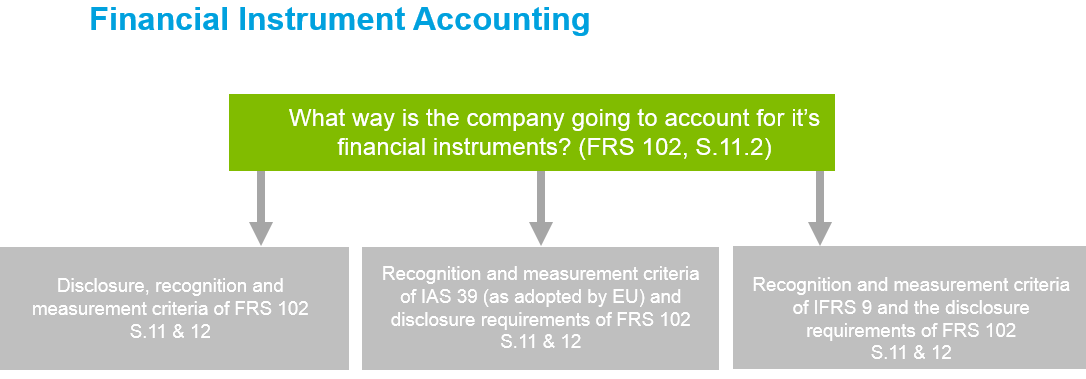
6 Getting Started- Required Decisions: Page 6
7 FRS 103 Insurance (Ireland) Limited Contents Technical Profit and Loss Account Non Life Insurance 9 Non Technical Profit and Loss Account 10 Balance Sheet 11 Statement of Cash Flows 13 Statement of Changes in Equity The following list of notes in this publication is included for ease of reference 1. General information Significant Accounting Policies Critical accounting judgments and key sources of estimation uncertainty Segmental Information Net Investment Return Net Operating Expenses Directors Remuneration Tax on profit on ordinary activities Profit for the financial year Employee Information Goodwill and Other Intangible Assets Tangible Fixed Assets Movement in Shareholders Funds Investment in Subsidiaries Instruments Derivative Instruments Debtors arising out of Insurance operations Debtors arising out of Reinsurance operations Other Debtors Technical Provisions Provisions Creditors arising out of Insurance Operations Creditors arising out of Reinsurance Operations Other Creditors Called up share capital and reserves Retirement benefit schemes Notes to the cash flow statement Capital Management Equalisation Provision risk management Insurance risk management Explanation of Transition to FRS102 and Subsequent Events Related Party Transactions Lease commitments 59 Page 7
8 Appendix 1 Technical Account General Business For the financial year ended 31 December Presentation of financial statements FRS 102 & 103 are Irish GAAP Standards. As such accounts prepared in accordance with FRS 102/103 must be compliant with Irish Company legislation. The presentation of the balance sheet and profit and loss accounts of Irish insurance companies is guided by SI 262/ European Union (Insurance Undertakings: Statements) Regulations. The format of the profit and loss accounts and balance sheet is set out in Schedule 1, of SI 282/. The regulations require the profit and loss account to be split between a technical and non technical account with separate layouts for general and life assurance technical accounts. Format of accounts 6. (1) Subject to the provisions of this Regulation: (a) every balance sheet of an undertaking shall show the items listed in the balance sheet format set out in Chapter 2 of Part I of the Schedule, and (b) every profit and loss account of an undertaking shall show the items listed in the profit and loss account format so set out, in the order and under the headings and sub-headings given in the format concerned. There are other headings within Chapter 2 of the regulations which are not shown in these accounts due to the nature of the company s business. Reduced Disclosures As set out in Section 1.8 of FRS 102 a qualifying entity which is not a financial institution may take advantage of the disclosure exemptions set out in paragraph A qualifying entity is defined in the Glossary to FRS 102 as A member of a group where the parent of that group prepares publicly available consolidated financial statements which are intended to give a true and fair view (of the assets, liabilities, financial position and profit or loss) and that member is included in the consolidation. A financial institution is defined in the Glossary of FRS 102. As per point (e) of the definition, insurance/reinsurance entities clearly meet the definition of financial institutions and therefore cannot avail of the full exemptions contained in paragraph 1.12 of FRS 102. Paragraph 1.9 of FRS 102 goes on to state, a qualifying entity which is a financial institution may take advantage in its individual financial statements of the disclosure exemptions set out in paragraph 1.12, except for the disclosure exemptions from Section 11 and Section 12 Other Instruments Issues. In effect this means insurance/reinsurance entities, who meet the criteria of a qualifying entity set out above, have to make the disclosures required by sections 11 & 12 of FRS however they may take advantage of the following disclosure exemptions (set out in paragraph 1.12): (a) The requirements of Section 4 Statement of Position paragraph 4.12(a) (iv). (b) The requirements of Section 7 Statement of Cash Flows and Section 3 Statement Presentation paragraph 3.17(d). (c) The requirements of Section 26 Share-based Payment paragraphs 26.18(b), to and 26.23, provided that for a qualifying entity that is: (i) a subsidiary, the share-based payment arrangement concerns equity instruments of another group entity; (ii) an ultimate parent, the share-based payment arrangement concerns its own equity instruments and its separate financial statements are presented alongside the consolidated financial statements of the group; and, in both cases, provided that the equivalent disclosures required by this FRS are included in the consolidated financial statements of the group in which the entity is consolidated. (d) The requirement of Section 33 Related Party Disclosures paragraph Page 8
9 Technical Profit and Loss Account Non Life Insurance For the financial year ended 31 December SI 262/ Chapter 2 Earned Premiums, net of reinsurance Notes Year ended Gross written premiums 4 27,800 FRS 102 Outwards reinsurance premiums 4 (21,871) S.5.1 Net premiums written 5,929 Year ended Change in the gross provision for unearned premiums 20 (1,840) Change in the provision for unearned premiums, reinsurers share 20 1,412 Change in the net provision for unearned premiums (428) Earned premiums, net of reinsurance 5,501 Allocated investment return transferred from the non-technical account 702 Other technical income, net of reinsurance 27 Total technical income 6,230 Claims incurred, net of reinsurance Claims paid 4 - Gross amount (9,456) - Reinsurers share 7,541 (1,915) Change in the provision for claims 20 - Gross amount (3,832) - Reinsurers share 3,012 (820) Claims incurred, net of reinsurance (2,735) Net operating expenses 6 (1,599) Other technical charges net of reinsurance (200) Change in equalisation provision 20,29 (423) Balance on the technical account for non-life insurance business 1,273 Page 9
10 Non Technical Profit and Loss Account For the financial year ended 31 December Notes Year ended FRS 102 S.5 Balance on the technical account- non life insurance business 1,273 Year ended Investment income 5 - Income from other investments Gains on the realisation of investments 98 Unrealised gains on investments Investment charges 5 - Investment management expenses (103) Allocated investment return transferred to the insurance technical account (702) Foreign Exchange Loss (116) Profit or loss on ordinary activities before tax 1,391 Taxation on profit on ordinary activities 8 (184) Profit or Loss for the financial year 1,207 All amounts arise from continuing activities. There were no recognised gains or losses other than those included in the profit and loss account. The accompanying notes form an integral part of the financial statements. The financial statements were approved by the Board of Directors and authorised for issue on [date]. Statement of Comprehensive Income ( SOCI ) FRS 102 S 5.2 In this Company, the financial instruments follow Section 11 Basic Instruments and Section 12 Other Instruments of FRS 102. As a result of the accounting policies elected, this company has no items that go through Other Comprehensive Income. However, if a company elected to adopt IAS 39 Instruments: Recognition and Measurement and had available-for-sale investments, then it would need to consider the impact on Other Comprehensive Income and the presentation would need to reflect the requirements of Section 5.2 of FRS 102 and Section 52.1 Fair Value Reserve of Statutory Instrument No.262/ European Union (Insurance Undertakings: Statements) Regulations. Page 10
11 Balance Sheet as at 31 December : Year Year FRS 102 ASSETS Notes ended ended S.4.1 Intangible assets Goodwill and other intangible assets 11 12,043 Investments Investment in Subsidiaries 14 5,000 Other financial investments Shares and other variable yield securities and units in unit trusts 15 9,854 Debt securities and other fixed income securities 15 8,623 Derivative assets 16 1,232 Loans and receivables 15 4,927 24,636 Reinsurer s share of technical provisions Provision for unearned premiums 20 13,561 Claims outstanding 20 30,834 Equalisation provision 20,29-44,395 Debtors Debtors arising out of insurance operations 17 3,045 Debtors arising out of reinsurance operations 18 5,421 Other debtors 19 1,546 10,012 Other assets Tangible fixed assets Cash at bank and in hand 3,986 Deferred Tax Asset 35 5,004 Prepayments and accrued income Accrued interest 58 Deferred Acquisition costs 2,238 Other prepayments and accrued income 345 2,641 Total Assets 103,731 Page 11
12 Balance Sheet as at 31 December EQUITY AND LIABILITIES Notes Year ended Year ended Capital and reserves Called up share capital presented as equity 25 10,000 Share premium account 3,000 Profit and loss account brought forward 5,672 Profit and loss account for the financial year 707 Shareholder s funds 19,379 Technical provisions Provision for unearned premiums 20 17,859 Claims outstanding 20 39,281 Equalisation provision 20,29 2,300 59,440 Provisions for other risks and charges Provisions for taxation 200 Other provisions 21 1,834 2,034 Deposits received from reinsurers 5,436 Creditors Creditors arising out of direct insurance operations 22 5,400 Creditors arising out of reinsurance operations 23 7,118 Other creditors including taxation and social welfare 24 1,248 Derivative liabilities 16 1,023 14,789 Accruals and deferred income 2,653 Total liabilities and Shareholders equity 103,731 The accompanying notes form an integral part of the financial statements. The financial statements were approved by the Board of Directors and authorised for issue on [date]. They were signed on its behalf by: [Signature] [Signature] Director Director Page 12
13 Statement of Cash Flows as at 31 December Year Year Notes ended ended FRS 102 Net cash from operating activities 27 S 7.4 FRS 102 Cash flows from investing activities S 7.5 Proceeds from sale of equipment Purchase of equipment Dividend received Interest received Disposal of subsidiary Purchase of investments Acquisition of subsidiary Net cash flows from investing activities FRS 102 Cash flows from financing activities S 7.6 Dividends paid Interest paid Repayments of obligations under finance lease New bank loans raised Net cash flows from financing activities Net increase/(decrease) in cash and cash equivalents Cash and cash equivalents at beginning of financial year FRS 102 Effect of foreign exchange rate changes S 7.13 Cash and cash equivalents at end of financial year Reconciliation to cash at bank and in hand Cash at bank and in hand at end of financial year Cash equivalents Cash and cash equivalents at end of financial year Page 13
14 Statement of cash flows FRS 102 S7.1 The basic requirement of section 7 of FRS 102 is that a statement of cash flows should be presented providing information about the changes in cash and cash equivalents of an entity for a reporting period, showing separately changes from operating, investing and financing activities. The sub-headings under which operating, investing and financing activities should be broken out into is set out in Sections 7.4, 7.5 and 7.6 respectively. The above example statement of cash flows has been prepared in accordance with the Indirect method set out in S7.8. Guidance around the direct method is included in S7.9 As noted at the start of these financial statements, an insurance entity which meets the definition of a Qualifying Entity may avail of the exemption from having to prepare a statement of cash flows as set out in para 1.12(b) of FRS 102. Page 14
15 Statement of Changes in Equity as at 31 December : FRS 102 S 6.23 Called-up share capital Share Premium Account Profit and loss account Total At 31 December 2013 as previously stated Changes on transition to FRS 102/103 (Note 32) At 1 January as restated Profit for the financial year Issue of share capital Dividends paid on equity shares At 31 December 10,000 3,000 5,672 18,672 Profit for the financial year - - 1,207 1,207 Issue of share capital Dividends paid on equity shares - - (500) (500) At 31 December 10,000 3,000 6,379 19,379 Reconciliation of changes in Equity FRS 102 S35 As set out in section 35.13(b) of FRS 102 a reconciliation of equity determined in accordance with its previous financial reporting framework to its equity determined in accordance with FRS 102 is required as of the date of transition to FRS 102 and the end of the latest period presented in the entity s most recent annual financial statements determined in accordance with its previous financial reporting framework. This reconciliation is included in note 32 to the financial statements. Page 15
16 Notes to the consolidated financial statements At 31 December 1. General information FRS 103 Insurance (Ireland) Limited is a company incorporated in Ireland authorised by the Central Bank of Ireland to carry out non life insurance business. The address of the registered office is given on page ns. The nature of the Company s operations and its principal activities are set out in the operating and financial review on pages ns to ns. 2. Significant accounting policies (: FRS 102, S(10)) The following are examples of the types of accounting policies that might be disclosed in this entity s financial statements. Section 10 of FRS 102 sets out the principles to be applied when companies are setting their accounting policies and also the disclosures required. (: FRS ) If an FRS or FRC Abstract specifically addresses a transaction, other event or condition, an entity shall apply that FRS or FRC Abstract. However, the entity need not follow a requirement in an FRS or FRC Abstract if the effect of doing so would not be material. (: FRS ) If an FRS or FRC Abstract does not specifically address a transaction, other event or condition, an entity s management shall use its judgment in developing and applying an accounting policy that results in information that is: a) relevant to the economic decision-making needs of users; and b) reliable, in that the financial statements: i) represent faithfully the financial position, financial performance and cash flows of the entity; ii) reflect the economic substance of transactions, other events and conditions, and not merely the legal form; iii) are neutral, i.e. free from bias; iv) are prudent; and v) are complete in all material respects. (: FRS ) In making the judgment described in paragraph 10.4, management shall refer to and consider the applicability of the following sources in descending order: a) the requirements and guidance in an FRS or FRC Abstract dealing with similar and related issues; b) where an entity s financial statements are within the scope of a Statement of Recommended Practice (SORP) the requirements and guidance in that SORP dealing with similar and related issues; and c) the definitions, recognition criteria and measurement concepts for assets, liabilities, income and expenses and the pervasive principles in Section 2 Concepts and Pervasive Principles. In making the judgment described in paragraph 10.4, management may also consider the requirements and guidance in EU-adopted IFRS dealing with similar and related issues. Paragraphs 1.4 to 1.7 require certain entities to apply IAS 33 Earnings per Share (as adopted in the EU), IFRS 8 Operating Segments (as adopted in the EU) or IFRS 6 Exploration for and Evaluation of Mineral Resources. (: FRS ) Entities are required to disclose in the summary of significant accounting policies (a) the measurement basis (or bases) used in preparing the financial statements; and (b) the other accounting policies used that are relevant to an understanding of the financial statements. An accounting policy may be significant because of the nature of the entity s operations even if amounts for the current and prior periods are not material. Paragraph 2.3 of FRS103 permits entities to change their accounting policies, either on adoption of this FRS or subsequently, providing the new accounting policies meet certain criteria. Entities that are setting accounting policies in relation to insurance contracts, or other financial instruments with discretionary participation features, for the first time, shall first consider the requirements of Section 3 of FRS 103, the Regulations and any relevant parts of FRS 102, as a means of establishing current practice as a benchmark before assessing whether to set accounting policies that differ from those benchmark policies in accordance with paragraph 2.3. The Implementation Guidance accompanying FRS 103 also provides guidance. 2.1 Basis of accounting The financial statements have been prepared under the historical cost convention, modified to include certain items at fair value, and in accordance with Reporting Standards 102 & 103 (FRS 102 & 103) issued by the Reporting Council, and promulgated for use in Ireland by Chartered Accountants Ireland. The company is also subject to the requirements of the Companies Acts and the European Union (Insurance Undertakings: Statements) Regulations,. The prior financial year financial statements were restated for material adjustments on adoption of FRS 102 & 103 in the current financial year. For more information see note XX. In accordance with FRS 103, the Company has applied existing accounting policies for insurance contracts. Page 16
17 At 31 December The Company s business activities, together with the factors likely to affect its future development, performance and position are set out in the Business Review which forms part of the directors report. The directors report also describes the financial position of the Company; its cash flows, liquidity position and borrowing facilities; the Company s objectives, policies and processes for managing its capital; its financial risk management objectives; details of its financial instruments and hedging activities; and its exposure to credit risk and liquidity risk. The directors have a reasonable expectation that the Company has adequate resources to continue in operational existence for the foreseeable future. Thus they continue to adopt the going concern basis of accounting in preparing the annual financial statements. The company has availed of the exemption under section 299 (300) of the Companies Act from the obligation to prepare group financial statements. These financial statements represent the results of the company only and do not contain consolidated information as a parent of a group. The company is consolidated into the Group Accounts of its ultimate parent company, XYZ Holdings Limited, incorporated in Ireland. 2.2 Foreign currencies The presentation currency of the Company is Euro. The financial statements of the company are presented in the currency of the primary economic environment in which it operates (its functional currency). (: FRS 102, section 30.2) In preparing the financial statements, transactions in currencies other than the entity s functional currency (foreign currencies) are recorded at the rates of exchange prevailing on the dates of the transactions. At each balance sheet date, monetary assets and liabilities that are denominated in foreign currencies are retranslated at the rates prevailing on the balance sheet date. Non-monetary items carried at fair value that are denominated in foreign currencies are translated at the rates prevailing at the date when the fair value was determined. Non-monetary items that are measured in terms of historical cost in a foreign currency are not retranslated. Exchange differences are recognised in profit or loss in the period in which they arise except when they relate to items for which gains and losses are recognised in equity. (: FRS 102, section 30) The following additional factors are considered in determining the functional currency of a foreign operation, and whether its functional currency is the same as that of the reporting entity (the reporting entity, in this context, being the entity that has the foreign operation as its subsidiary, branch, associate or joint venture): a) Whether the activities of the foreign operation are carried out as an extension of the reporting entity, rather than being carried out with a significant degree of autonomy. An example of the former is when the foreign operation only sells goods imported from the reporting entity and remits the proceeds to it. An example of the latter is when the operation accumulates cash and other monetary items, incurs expenses, generates income and arranges borrowings, all substantially in its local currency. b) Whether transactions with the reporting entity are a high or a low proportion of the foreign operation s activities. c) Whether cash flows from the activities of the foreign operation directly affect the cash flows of the reporting entity and are readily available for remittance to it. d) Whether cash flows from the activities of the foreign operation are sufficient to service existing and normally expected debt obligations without funds being made available by the reporting entity. The results of overseas operations are translated at the average rates of exchange during a period and their balance sheets at the rates ruling at the balance sheet date. At each balance sheet date, monetary assets (e.g. investments) and liabilities (e.g. outstanding claims) that are denominated in foreign currencies are retranslated at the rates prevailing on the balance sheet date. Non-monetary items (e.g. unearned premium reserves and reinsurers share of unearned premium reserves and deferred expenses) that are measured in terms of historical cost in a foreign currency are not retranslated. Hence, a mismatch occurs and results and loss ratios of foreign currency denominated portfolios of business may be distorted by movements in exchange rates. (: FRS 102, section 30.5) For the purposes of applying the requirements of Section 30 Foreign Currency Translation of FRS 102 an entity shall treat all assets and liabilities arising from an insurance contract as monetary items. (: FRS ) 2.3 Insurance classification The Company s contracts are classified at inception, for accounting purposes, as insurance contracts. A contract that is classified as an insurance contract remains an insurance contract until all rights and obligations are extinguished or expire. Insurance contracts are those contracts that transfer significant insurance risk, if and only if, an insured event could cause an insurer to make significant additional benefits in any scenario, excluding scenarios that lack commercial substance. Such contracts may also transfer financial risk. (: FRS , 4.5) Page 17
18 At 31 December 2.4 Revenue recognition Premiums Written premiums for non-life (general) insurance business comprise the premiums on contracts incepting in the financial year. Estimates are included for premiums not yet notified by the financial year end. Written premiums are stated gross of commissions payable to intermediaries and exclusive of taxes and duties levied on premiums. (: FRS , 4.5) Unearned premiums are those proportions of the premium which relate to periods of risk after the balance sheet date. Unearned premiums are calculated on the basis of the estimated risk profile of the business written. (: FRS ) Investment return Investment return consists of dividends, interest, movements in amortised cost on debt securities and other loans and receivables, realised gains and losses, and unrealised gains and losses on fair value assets. (: FRS 102 S23.28) Unrealised gains and losses Unrealised gains or losses represent the difference between the carrying value at the financial year end and the carrying value at the previous financial year end or purchase value during the financial year, less the reversal of previously recognised unrealised gains and losses in respect of disposals during the financial year. 2.5 Taxation Deferred tax shall be recognised when income or expenses from a subsidiary, associate, branch, or interest in joint venture have been recognised in the financial statements, and will be assessed to or allowed for tax in a future period, except where: a) the reporting entity is able to control the reversal of the timing difference; and b) it is probable that the timing difference will not reverse in the foreseeable future. Such timing differences may arise, for example, where there are undistributed profits in a subsidiary, associate, branch or interest in a joint venture. (: FRS ) Allocated investment return transferred from the nontechnical account A transfer of investment return is made from the nontechnical account to the technical account of the estimated share of investment income arising from investments and cash supporting the insurance technical provisions. This calculation is based on the ratio of net technical provisions to shareholder's equity. Interest income Interest income is recognised by applying the effective interest rate, except for short-term receivables when the recognition of interest would be immaterial. (: FRS (c)) Interest income is accrued on a time basis, by reference to the principal outstanding and at the effective interest rate applicable, which is the rate that exactly discounts estimated future cash receipts through the expected life of the financial asset to that asset s net carrying amount. (: FRS 102 S23.29(a)) Current tax including Irish Corporation tax and foreign tax is provided at amounts expected to be paid (or recovered) using the tax rates and laws that have been enacted or substantively enacted by the balance sheet date. The tax expense represents the sum of the tax currently payable and deferred tax. The tax currently payable is based on taxable profit for the financial year. Taxable profit differs from net profit as reported in the income statement because it excludes items of income or expense that are taxable or deductible in other financial years and it further excludes items that are never taxable or deductible. The Company s liability for current tax is calculated using tax rates that have been enacted or substantively enacted by the balance sheet date. (: FRS ) Deferred tax is recognized in respect of all timing differences that have originated but not reversed at the balance sheet date where transactions or events that result in an obligation to pay more tax in the future or a right to pay less tax in the future have occurred at the balance sheet date. Dividend income Dividend income from investments is recognised when the shareholders rights to receive payment have been established. (: FRS ) Realised gains and losses The realised gain or loss on disposal of an investment is the difference between the proceeds received, net of transaction costs, and its original cost or amortised cost as appropriate. (: FRS (b)) Unrelieved tax losses and other deferred tax assets are recognized only to the extent that, on the basis of all available evidence, it can be regarded as more likely than not that there will be suitable taxable profits from which the future reversal of the underlying timing differences can be deducted. The carrying amount of deferred taxation assets is reviewed at each balance sheet date and reduced to the extent that it is no longer probable that sufficient taxable profits will be available to allow all or part of the asset to be recovered. Page 18
19 At 31 December Deferred tax is calculated at the tax rates that are expected to apply in the period when the liability is settled or the asset is realised. Deferred tax is charged or credited in the income statement, except when it relates to items charged or credited directly to equity, in which case the deferred tax is also dealt with in equity. (: FRS ) Deferred tax relating to property, plant and equipment is measured using the revaluation model and investment property is measured using the tax rates and allowances that apply to sale of the asset. Current tax assets and liabilities are offset only when there is a legally enforceable right to set off the amounts and the Company intends either to settle on a net basis or to realize the asset and settle the liability simultaneously. Deferred tax assets and liabilities are offset only if: a) the Company has a legally enforceable right to set off current tax assets against current tax liabilities; and b) the deferred tax assets and deferred tax liabilities relate to income taxes levied by the same taxation authority and the Company intends to settle its current tax assets and liabilities on a net basis, or to realize the assets and settle the liabilities simultaneously, in each future period in which significant amounts of deferred tax liabilities or assets are expected to be settled or recovered. (: FRS ) 2.6 Goodwill and other intangible assets Goodwill Goodwill arising on the acquisition of subsidiary undertakings and businesses, representing any excess of the fair value of the consideration given over the fair value of the identifiable assets and liabilities acquired, is capitalised and written off on a straight line basis over its useful economic life, which is x financial years. Provision is made for any impairment. If the company is unable to make a reliable estimate of the useful life of goodwill, the life shall not exceed five financial years. Negative goodwill is similarly included in the balance sheet and is credited to the profit and loss account in the periods in which the acquired non-monetary assets are recovered through depreciation or sale. Negative goodwill in excess of the fair values of the non-monetary assets acquired is credited to the profit and loss account in the periods expected to benefit. (: FRS ) In accordance with Section 35 of FRS 102, Section 19 of FRS 102 has not been applied in these financial statements in respect of business combinations affected prior to the date of transition. Software expenditure An internally-generated intangible asset arising from the Company s software development is recognised only if all of the following conditions are met: an asset is created that can be identified (such as software and new processes); it is probable that the asset created will generate future economic benefits; and the development cost of the asset can be measured reliably. (: FRS H) It is amortised on a straight-line basis over its estimated useful life which typically varies between 3 and 5 financial years. (: FRS ) Where no internally-generated intangible asset can be recognised, development expenditure is recognised as an expense in the period in which it is incurred. Impairment policy is set out in note 3.15 below. (: FRS K) 2.7 Tangible Fixed Assets Tangible fixed assets are stated at cost or valuation, net of depreciation and any provision for impairment. Depreciation is provided on all tangible fixed assets, other than investment properties and freehold land, at rates calculated to write off the cost or valuation, less estimated residual value, of each asset on a [straight line/reducing balance] basis over its expected useful life, as follows: Company occupied buildings 4% Vehicles 20% - 25% Fixtures and equipment 10% - 30% (: FRS ) Revaluation of properties [(Where the company adopts a policy of revaluation) Individual freehold and leasehold properties [other than investment properties] are revalued to fair value ever financial year with the surplus or deficit on book value being transferred to the revaluation reserve, except that a deficit which is in excess of any previously recognized surplus over depreciated cost relating to the same property, or the reversal of deficit, is charged (or credited) to the profit of loss account.] (: FRS ) Depreciation on revalued buildings is charged as an expense to income. On the subsequent sale or retirement of a revalued property, the attributable revaluation surplus remaining in the properties revaluation reserve is transferred directly to retained earnings. (: FRS ) Page 19
20 At 31 December 2.8 Retirement benefit costs Payments to defined contribution retirement benefit schemes are charged as an expense as they fall due. Payments made to state-managed retirement benefit schemes are dealt with as payments to defined contribution schemes where the Company s obligations under the schemes are equivalent to those arising in a defined contribution retirement benefit scheme. (: FRS 102 S.25.2) 2.9 Impairment of assets Assets, other than those measured at fair value, are assessed for indicators of impairment at each balance sheet date. If there is objective evidence of impairment, an impairment loss is recognised in profit or loss as described below. Non-financial assets An asset is impaired where there is objective evidence that, as a result of one or more events that occurred after initial recognition, the estimated recoverable value of the asset has been reduced. The recoverable amount of an asset is the higher of its fair value less costs to sell and its value in use. The recoverable amount of goodwill is derived from measurement of the present value of the future cash flows of the cash-generating units ( CGU ) of which the goodwill is a part. Any impairment loss in respect of a CGU is allocated first to the goodwill attached to that CGU, and then to other assets within that CGU on a pro-rata basis. Where indicators exist for a decrease in impairment loss, the prior impairment loss is tested to determine reversal. An impairment loss is reversed on an individual impaired asset to the extent that the revised recoverable value does not lead to a revised carrying amount higher than the carrying value had no impairment been recognised. Where a reversal of impairment occurs in respect of a CGU, the reversal is applied first to the assets (other than goodwill) of the CGU on a pro-rata basis and then to any goodwill allocated to that CGU. (: FRS ) assets For financial assets carried at amortised cost, the amount of an impairment is the difference between the asset s carrying amount and the present value of estimated future cash flows, discounted at the financial asset s original effective interest rate. For financial assets carried at cost less impairment, the impairment loss is the difference between the asset s carrying amount and the best estimate of the amount that would be received for the asset if it were to be sold at the reporting date. (: FRS ) Where indicators exist for a decrease in impairment loss, and the decrease can be related objectively to an event occurring after the impairment was recognised, the prior impairment loss is tested to determine reversal. An impairment loss is reversed on an individual impaired financial asset to the extent that the revised recoverable value does not lead to a revised carrying amount higher than the carrying value had no impairment been recognised. (: FRS ) 2.10 assets and liabilities An entity shall choose to apply either: a) the provisions of both Section 11 and Section 12 in full; or b) the recognition and measurement provisions of IAS 39 Instruments: Recognition and Measurement (as adopted for use in the EU), the disclosure requirements of Sections 11 and 12 and the presentation requirements of paragraphs 11.38A or 12.25B; or c) the recognition and measurement provisions of IFRS 9 Instruments and/or IAS 39 (as amended following the publication of IFRS 9) the disclosure requirements of Sections 11 and 12 and the presentation requirements of paragraphs 11.38A or 12.25B; to account for all of its financial instruments. Where an entity chooses (b) or (c) it applies the scope of the relevant standard to its financial instruments. An entity s choice of (a), (b) or (c) is an accounting policy choice. Paragraphs 10.8 to contain requirements for determining when a change in accounting policy is appropriate, how such a change should be accounted for and what information should be disclosed about the change. (: FRS ) For the purposes of these financial statements, option a) has been selected. Please refer to IFRS model financial statements at for guidance on measurement options b) and c). The Company s investments comprise of debt and equity investments, derivatives, cash and cash equivalents, loans and receivables and investment in subsidiaries. Recognition assets and liabilities are recognised when the Company becomes a party to the contractual provisions of the instrument. liabilities and equity instruments are classified according to the substance of the contractual arrangements entered into. An equity instrument is any contract that evidences a residual interest in the assets of the Company after deducting all of its liabilities. (: FRS ) Initial measurement All financial assets and liabilities are initially measured at transaction price (including transaction costs), except for those financial assets classified as at fair value through profit or loss, which are initially measured at fair value (which is normally the transaction price excluding transaction costs), unless the arrangement constitutes a financing transaction. If an arrangement constitutes a finance transaction, the Page 20
21 At 31 December financial asset or financial liability is measured at the present value of the future payments discounted at a market rate of interest for a similar debt instrument. (: FRS ) Subsequent measurement Non-current debt instruments which meet the following conditions are subsequently measured at amortised cost using the effective interest method: (: FRS (a)) a) Returns to the holder are (i) a fixed amount; or (ii) a fixed rate of return over the life of the instrument; or (iii) a variable return that, throughout the life of the instrument, is equal to a single referenced quoted or observable interest rate; or (iv) some combination of such fixed rate and variable rates, providing that both rates are positive. b) There is no contractual provision that could, by its terms, result in the holder losing the principal amount or any interest attributable to the current period or prior periods. c) Contractual provisions that permit the issuer to prepay a debt instrument or permit the holder to put it back to the issuer before maturity are not contingent on future events, other than to protect the holder against the credit deterioration of the issuer or a change in control of the issuer, or to protect the holder or issuer against changes in relevant taxation or law. d) There are no conditional returns or repayment provisions except for the variable rate return described in (a) and prepayment provisions described in (c). (: FRS ) Debt instruments that are classified as payable or receivable within one financial year and which meet the above conditions are measured at the undiscounted amount of the cash or other consideration expected to be paid or received, i.e. net of impairment. (: FRS (a)) Other debt instruments not meeting these conditions are measured at fair value through profit or loss. Commitments to make and receive loans which meet the conditions mentioned above are measured at cost (which may be nil) less impairment. (: FRS (c)) Investments in non-convertible preference shares and nonputtable ordinary shares or preference shares shall be measured at fair value with changes in fair value recognised in profit or loss, if the shares are publicly traded or their fair value can otherwise be measured reliably; and all other such investments shall be measured at cost less impairment. (: FRS (d)) Realised and unrealised gains and losses arising from changes in the fair value of investments are presented in the non-technical profit and loss account in the period in which they arise. Dividend and interest income is recognised when earned. Investment management and other related expenses are recognised when incurred. (: FRS (a)) Derecognition of financial assets and liabilities assets are derecognised when and only when a) the contractual rights to the cash flows from the financial asset expire or are settled, b) the Company transfers to another party substantially all of the risks and rewards of ownership of the financial asset, or c) the Company, despite having retained some significant risks and rewards of ownership, has transferred control of the asset to another party and the other party has the practical ability to sell the asset in its entirety to an unrelated third party and is able to exercise that ability unilaterally and without needing to impose additional restrictions on the transfer. (: FRS ) liabilities are derecognised only when the obligation specified in the contract is discharged, cancelled or expires. (: FRS ) Fair value measurement The best evidence of fair value is a quoted price for an identical asset in an active market. When quoted prices are unavailable, the price of a recent transaction for an identical asset provides evidence of fair value as long as there has not been a significant change in economic circumstances or a significant lapse of time since the transaction took place. If the market is not active and recent transactions of an identical asset on their own are not a good estimate of fair value, the company estimates the fair value by using a valuation technique. See note 3 for further information on the Company s valuation techniques. (: FRS ) An entity shall apply the guidance on fair value in FRS 102 section to to fair value measurements, and if applicable the guidance in FRS 102 section to Impairment of financial instruments measured at amortised cost or cost For financial assets carried at amortised cost, the amount of an impairment is the difference between the asset s carrying amount and the present value of estimated future cash flows, discounted at the financial asset s original effective interest rate, i.e. using the effective interest method. (: FRS (a)) For financial assets carried at cost less impairment, the impairment loss is the difference between the asset s carrying amount and the best estimate of the amount that would be Page 21
22 At 31 December received for the asset if it were to be sold at the reporting date. (: FRS (b)) Where indicators exist for a decrease in impairment loss, and the decrease can be related objectively to an event occurring after the impairment was recognised, the prior impairment loss is tested to determine reversal. An impairment loss is reversed on an individual impaired financial asset to the extent that the revised recoverable value does not lead to a revised carrying amount higher than the carrying value had no impairment been recognised. The amount of the reversal is recognised in profit and loss immediately. (: FRS ) Cash and cash equivalents Cash and cash equivalents comprise cash on hand and demand deposits, and other short-term highly liquid investments that are readily convertible to a known amount of cash and are subject to an insignificant risk of changes in value. Investments in subsidiaries In the Company balance sheet, investments in subsidiaries are measured at cost less impairment. (: FRS ) 2.11 Leasing Leases are classified as finance leases whenever the terms of the lease transfer substantially all the risks and rewards incidental to ownership to the lessee. All other leases are classified as operating leases. (: FRS ) Assets held under finance leases are depreciated over their expected useful lives on the same basis as owned assets or, where shorter, over the term of the relevant lease. The gain or loss arising on the disposal or retirement of an asset is determined as the difference between the net sales proceeds and the carrying amount of the asset and is recognised in income. (: FRS ) Assets held under finance leases, hire purchase contracts and other similar arrangements, which confer the rights and obligations similar to those attached to owned assets are capitalised as tangible fixed assets at the fair value of the leased asset (of, if lower, the present value of the minimum lease payments as determined at the inception of the lease) and are depreciated over the shorter of the lease terms and their useful lives. (: FRS ) A parent shall select and adopt a policy of accounting for its investments in subsidiaries, associates and jointly controlled entities either: (a) at cost less impairment; (b) at fair value with changes in fair value recognised in other comprehensive income in accordance with FRS 102 sections 17.15E and 17.15F; or (c) at fair value with changes in fair value recognised in profit or loss (s to provide guidance on fair value). The capital elements are recorded of future lease obligations are recorded as liabilities, while the interest elements are charged to the profit and loss account over the period of the lease to produce a constant periodic rate of interest on the remaining balance of the liability. (: FRS ) Rentals payable under operating leases are charged to income on a straight-line basis over the term of the relevant lease. (: FRS ) For the purposes of these model financial statements, option a) has been selected. Derivative financial instruments The Company uses derivative financial instruments to reduce exposure to foreign exchange risk and interest rate movements. The Company does not hold or issue derivative financial instruments for speculative purposes. Derivatives are initially recognised at fair value at the date a derivative contract is entered into and are subsequently remeasured to their fair value at each reporting date. The resulting gain or loss is recognised in profit or loss immediately unless the derivative is designated and effective as a hedging instrument, in which event the timing of the recognition in profit or loss depends on the nature of the hedge relationship. (: FRS ) In accordance with the transitional provisions of FRS 102, lease incentives on leases which were in existence prior to the date of transition have been spread over the shorter of the lease term and the period to the first review date on which the rent is first expected to be adjusted to the prevailing market rate. (: FRS ) 2.12 Provisions Provisions for restructuring costs, legal claims and levies are recognised when the Company has a present obligation as a result of a past event, and it is probable that the Company will be required to settle that obligation. Provisions are measured at the directors best estimate of the expenditure required to settle the obligation at the balance sheet date, and are discounted to present value where the effect is material. Provisions are not recognised for future operating losses. (: FRS ) Page 22
23 At 31 December 2.13 Insurance contracts An insurer may continue the following practices, but the introduction of any of them does not satisfy paragraph 10.8(b) of FRS 102: a) unless otherwise required by the Regulations (or other legal framework that applies to the entity), measuring insurance liabilities on an undiscounted basis. b) measuring contractual rights to future investment management fees at an amount that exceeds their fair value as implied by a comparison with current fees charged by other market participants for similar services. It is likely that the fair value at inception of those contractual rights equals the origination costs paid, unless future investment management fees and related costs are out of line with market comparables. c) as an exception to paragraph 9.17 of FRS 102, using non-uniform accounting policies for the insurance contracts (and related deferred acquisition costs and related intangible assets, if any) of subsidiaries, except as permitted by paragraph 2.5. If those accounting policies are not uniform, an insurer may change them if the change does not make the accounting policies more diverse and also satisfies the other requirements in this FRS. (: FRS ) Claims Claims consists of claims paid to policyholders, changes in the valuation of the liabilities arising on policyholder contracts and internal and external claims handling expenses, net of salvage and subrogation recoveries. (: FRS , 4.5) Acquisition costs Commission income consists of fees and commissions paid to brokers and are directly related to the acquisition and renewal of policies. (: FRS ) Reinsurance commissions receivable are deferred in the same way as acquisition costs. All other fee and commission income is recognised as the services are provided. (: FRS ) Provision for outstanding claims Provision for the liabilities of non-life insurance contracts is made for outstanding claims and settlement expenses incurred at the balance sheet date including an estimate for the cost of claims incurred but not reported (IBNR) at that date. Included in the provision is an estimate of the internal and external costs of handling the outstanding claims. Material salvage and other recoveries including reinsurance recoveries are presented as assets. Significant delays are experienced in the notification and settlement of certain types of general insurance claims, particularly in respect of liability business, environmental and pollution exposures, the ultimate cost of which may vary from the original assessment. Adjustments to the amounts of claim provisions established in prior financial years are reflected in the financial statements for the period in which the adjustments are made and disclosed separately, if material. (: FRS , 4.5) There are a small number of areas where IFRS 4 conflicts with the requirements of the Insurance Undertakings Regulations ( Regulations ), and therefore in developing FRS 103 amendments have been made to the text from IFRS 4 to ensure compliance with company law. These include: Equalisation provisions provisions for future claims arising under insurance contracts that are not in existence at the end of the reporting period are prohibited under IFRS 4, but may be a requirement under a regulatory framework that applies to the entity with separate presentation required by the Regulations. An amendment has been made in paragraph 2.13(a) of FRS 103 to reflect these legal and regulatory requirements. [Paragraph 2.13 (a) of FRS 103 states that unless otherwise required by the regulatory framework that applies to the entity, the entity shall not recognise as a liability any provisions for possible future claims, if those claims arise under insurance contracts that are not in existence at the end of the reporting period (such as catastrophe provisions and equalisation provisions). The presentation of any such liabilities shall follow the requirements of the Regulations (or other legal framework that applies to the entity)]. In addition, a consequential amendment to FRS 101 is made to ensure consistent accounting by insurers applying either FRS 101 or FRS 103. Discounting IFRS 4 permits an entity to continue measuring insurance liabilities on an undiscounted basis but does not allow an entity to choose a new policy without discounting. However, the Regulations state when discounting is permitted or prohibited. An amendment has been made in paragraph 2.6 to reflect this legal requirement and would not restrict a new entrant s ability to apply discounting where it is required by the Regulations. (: FRS103 paragraph 38) Provision for unearned premiums The provision for unearned premiums represents that part of written premiums, gross of commission payable to intermediaries, that is estimated to be earned in subsequent periods. The change in the provision is recorded in the income statement to recognise revenue over the period of the risk. (: FRS , 4.5) Page 23
24 At 31 December Liability adequacy At each reporting date the Company performs a liability adequacy test on its insurance liabilities less related deferred acquisition costs and intangible assets to ensure that the carrying value is adequate, using current estimates of future cash flows, taking into account the relevant investment return. If that assessment shows that the carrying amount of the liabilities is inadequate, any deficiency is recognised as an expense to the profit and loss account initially by writing off the intangible assets and subsequently by recognising an additional liability for claims provisions or recognising a provision for unexpired risks. The unexpired risks provision is assessed in aggregate for business classes which are managed together. (: FRS (b), 2.14) (: FRS ) Gains or losses on buying reinsurance are recognised in income at the date of purchase and are not amortised. (: FRS (a)ii)) 2.16 Insurance receivables and payables Receivables and payables arising under insurance contracts are recognised when due and measured at amortised cost, using the effective interest rate method. A provision for impairment is established when there is objective evidence that, as a result of one or more events that occurred after the initial recognition, the estimated future cash flows have been impacted. (: FRS ) 2.14 Deferred acquisition costs Acquisition costs including both incremental acquisition costs and other indirect costs of acquiring and processing new business are deferred (deferred acquisition costs). (: FRS ) 2.17 Equalisation policy The company calculates an equalization reserve provision in line with its requirements under the EU Directive 2005/68/EC, which was brought into force in Ireland on July 14 th, Deferred acquisition costs are amortised systematically over the life of the contracts and tested for impairment at each balance sheet date. Any amount not recoverable is expensed. They are derecognised when the related contracts are settled or disposed of. (: FRS ) 2.15 Reinsurance The Company enters into reinsurance contracts in the normal course of business in order to limit the potential for losses arising from certain exposures. Outwards reinsurance premiums are accounted for in the same period as the related premiums for the direct or inwards reinsurance business being reinsured. Reinsurance liabilities comprise premiums payable for outwards reinsurance contracts and are recognised as an expense when due. Reinsurance assets include balances due from reinsurance companies for paid and unpaid losses. Reinsurance assets are measured consistently with the amounts associated with the underlying insurance contract and in accordance with the terms of the reinsurance contract. Reinsurance is recorded as an asset unless a right of set-off exists, in which case the associated liabilities are reduced to take account of reinsurance. (: FRS (a)) Reinsurance assets are subject to impairment testing and the carrying amount is reduced to its recoverable amount. The impairment loss is recognised as an expense in the income statement. The asset is impaired if objective evidence is available to suggest that it is probable that the Company will not be able to collect the amounts due from reinsurers. 3. Critical accounting judgments and key sources of estimation uncertainty The following are examples of the types of disclosures that might be required in this area. The matters disclosed will be dictated by the circumstances of the individual entity, and by the significance of judgments and estimates made to the results and financial position of the entity. Instead of disclosing this information in a separate note, it may be more appropriate to include such disclosures in the relevant asset and liability notes or as part of the relevant accounting policy disclosures. In the application of the Company s accounting policies, which are described in note 2, the directors are required to make judgments, estimates and assumptions about the carrying amounts of assets and liabilities that are not readily apparent from other sources. The estimates and associated assumptions are based on historical experience and other factors that are considered to be relevant. Actual results may differ from these estimates. The estimates and underlying assumptions are reviewed on an ongoing basis. Revisions to accounting estimates are recognised in the period in which the estimate is revised if the revision affects only that period, or in the period of the revision and future periods if the revision affects both current and future periods. Critical judgements in applying the Company s accounting policies The following are the critical judgements, apart from those involving estimations (which are dealt with separately below), that the directors have made in the process of applying the Company s accounting policies and that have Page 24
25 At 31 December the most significant effect on the amounts recognised in financial statements. (: FRS ) Deferred taxation Deferred tax is recognised in respect of all timing differences that have originated but not reversed at the balance sheet date where transactions or events that result in an obligation to pay more tax in the future or a right to pay less tax in the future have occurred at the balance sheet date, as set out in the accounting policy stated in note 2.5. Unrelieved tax losses and other deferred tax assets are recognized only to the extent that, on the basis of all available evidence, it can be regarded as more likely than not that there will be suitable taxable profits from which the future reversal of the underlying timing differences can be deducted. The carrying amount of deferred taxation assets is reviewed at each reporting date and reduced to the extent that it is no longer probable that sufficient taxable profits will be available to allow all or part of the asset to be recovered. Reinsurance assets Reinsurance assets include balances due from reinsurance companies for paid and unpaid losses. Reinsurance assets are measured in accordance with the accounting policy stated in note Reinsurance assets are subject to impairment testing and the carrying amount is reduced to its recoverable amount. The asset is impaired if objective evidence is available to suggest that it is probable that the Company will not be able to collect the amounts due from reinsurers. Key sources of estimation uncertainty The key assumptions concerning the future, and other key sources of estimation uncertainty at the balance sheet date, that have a significant risk of causing a material adjustment to the carrying amounts of assets and liabilities within the next financial year, are discussed below. (: FRS ) Valuation of liabilities of non-life insurance contracts Estimates are made for both the expected ultimate cost of claims reported and claims incurred but not reported (IBNR) at the balance sheet date. The estimate of IBNR is generally subject to a greater degree of uncertainty than that for reported claims. In calculating the estimated liability, the Company uses a variety of estimation techniques based upon statistical analyses of historical experience which assumes past trends can be used to project future developments. The carrying amount for non-life insurance contract liabilities at the balance sheet is x million (: y million). (: FRS ,4.5 & Regs, Schedule 1, Part IV) Valuation of financial instruments (: FRS ) The directors use their judgement in selecting an appropriate valuation technique. Where possible, financial instruments are marked at prices quoted in active markets. In certain instances, such price information is not available for all instruments and the Company uses valuation techniques to measure such instruments. These techniques use market observable inputs where available, derived from similar assets in similar and active markets, from recent transaction prices for comparable items or from other observable market data. For positions where observable reference data are not available for some or all parameters the Company estimates the non-market observable inputs used in its valuation models. For derivative financial instruments, assumptions are made based on quoted market rates adjusted for specific features of the instrument. Other financial instruments are valued using a discounted cash flow analysis based on assumptions supported, where possible, by observable market prices or rates although some assumptions are not supported by observable market prices or rates. FRS 102 section 11.27, establishes a fair value hierarchy that prioritises the inputs to valuation techniques used to measure fair value. The hierarchy gives the highest priority to unadjusted quoted prices in active markets for identical asset or liabilities (Level A) and the lowest priority to unobservable inputs (Level C). The three levels of the fair value hierarchy are as follows: - Level A Quoted prices for an identical asset in an active market. Quoted in an active market in this context means quoted prices are readily and regularly available and those prices represent actual and regularly occurring market transactions on an arm s length basis. - Level B When quoted prices are unavailable, the price of a recent transaction for an identical asset provides evidence of fair value as long as there has not been a significant change in economic circumstances or a significant lapse of time since the transaction took place. If it can be demonstrated that the last transaction price is not a good estimate of fair value (e.g. because it reflects the amount that an entity would receive or pay in a forced transaction, involuntary liquidation or distress sale), that price is adjusted. - Level C If the market for the asset is not active and recent transactions of an identical asset on their own are not a good estimate of fair value, the fair value is estimated by using a valuation technique. The objective of using a valuation technique is to estimate what the transaction price would have been on the measurement Page 25
26 At 31 December date in an arm s length exchange motivated by normal business considerations. (: FRS ) The Accounting Council has advised that those familiar with IAS 39 will need to take care to ensure compliance with FRS 102, as the hierarchy to be used in determining the fair value of an asset set out in section of FRS 102 is not the same as the fair value hierarchy set out in IAS 39. The key point to note is that levels 1, 2, 3 under IFRS are not fully equivalent to levels A, B, C under Section 11 and companies should therefore be cautious when making their fair value disclosures. (: FRS 102 Accounting Council s Advice to the FRC paragraph 55) Inputs are used in applying the various valuation techniques and broadly refer to the assumptions that market participants use to make valuation decisions, including assumptions about risk. Inputs may include price information, volatility statistics, yield curves, credit spreads, liquidity statistics and other factors. The use of different valuation techniques could lead to different estimates of fair value. The carrying amount of financial assets at the balance sheet date is x million (: y million). Deferred acquisition costs Deferred acquisition costs are amortised systematically over the life of the contracts and tested for impairment at each balance sheet date, in accordance with the accounting policy stated in note The deferred acquisition costs asset at the balance sheet date is x million (: y million). Page 26
27 At 31 December 4. Segmental information 4(a) Analysis of gross premium written by geographic location Year ended Year ended Regs European Union 14,300 Schedule 1 United States of America 12,286 Part V, 84 Rest of World 1,214 Total 27,800 4(b) Analysis of gross premium written, gross premium earned, gross claims incurred, gross operating expenses and reinsurance balance by class of business Gross Gross Gross Gross Premiums written Premiums earned claims incurred operating expenses Reinsurance balance Motor third party liability 6,672 1,320 3, ,224 Marine, aviation and transport 5,560 1,100 2, ,853 Fire and other damage to property 5, , ,668 Third-party liability 3, , ,205 Credit and suretyship 6,950 1,375 3, ,317 Total 27,800 5,500 13,288 2,239 9,267 Page 27
28 At 31 December 4. Segmental information (Continued) Gross Gross Gross Gross Premiums written Premiums earned claims incurred operating expenses Reinsurance balance Motor third party liability Marine, aviation and transport Fire and other damage to property Third-party liability Credit and suretyship Total FRS 102 does not specifically address Operating Segments. The disclosures above are driven by the European Regulations, specifically paragraph 84 of Part V of Schedule 1 which deals with the notes to supplement the profit and loss account. If the company has branches in foreign jurisdictions they must show the split of gross premium written between the geographic location of the underwriting office. The disclosures set out above for revenue are based on industry practice and the requirements of the 262/ EU Regs and FRS103 to disclose items of a material nature to enable users of the financial statements to understand the amount, timing and uncertainty of future cash flows from those insurance contract Page 28
29 At 31 December 5. Net investment return Net Net Net realised Net investment investment gains and Changes in investment income expense losses fair value Impairment result Year ended Year ended Year ended Year ended Year ended Year ended FRS 102 S Equities 182 (15) Bonds 96 (10) (43) Unit Trusts 55 (5) Loans and receivables Investment in Subsidiaries Derivatives 10 (5) Cash and cash equivalents 5 (10) (5) Other investment income Other investment expense - (58) (58) 396 (103) Net Net Net realised Net investment investment gains and Changes in investment income expense losses fair value Impairment result Year ended Year ended Year ended Year ended Year ended Year ended FRS 102 S Debt securities Equities Bonds Unit Trusts Loans and receivables Investment in Subsidiaries Derivatives Cash and cash equivalents Other investment income Other investment expense Page 29
30 At 31 December 6. Net operating expenses Year ended FRS , 4.5, 4.6 Acquisition costs 1,420 Chapter 2 Change in acquisition costs (237) Section B Administration expenses 1,056 Note 6 Gross operating expenses 2,239 Year ended Reinsurance commissions and profit participaion (640) Net operating expenses 1,599 The disclosures set out above for fees, commissions and other acquisition expenses are based on industry practice and the requirements of 262/ EC Regs and FRS103 to disclose items of a material nature to enable users of the financial statements to understand the amount, timing and uncertainty of future cash flows from those insurance contracts. 7. Directors Remuneration The directors salaries and payments analysed under the headings required by company law are set out below: Section 305 CA Emoluments For services as director For other services Year ended Year ended Pensions For services as director For other services Pensions above refer to pensions paid by the company via its payroll to past directors (as opposed to those paid by a pension fund); employer s pensions contribution paid by the company for serving directors are included within emoluments. For periods commencing on or after 1 June, additional disclosures are now required for Director s Remuneration. Refer to S.305(1) of Companies Act for further information. Page 30
31 At 31 December 8. Tax on profit on ordinary activities The tax charge comprises: FRS 102, S29.26 Year ended Current tax on profit on ordinary activities Irish corporation tax 140 Year ended Adjustments in respect of prior financial years Irish corporation tax 18 Total current tax 158 Deferred tax Deferred tax movement 26 Total deferred tax 26 Total current and deferred tax charge 184 [Include details of any expiry dates on timing differences, unused tax losses and unused tax credits.] [If relevant, include an explanation of the nature of the potential income tax consequences that would result from the payment of dividends to its shareholders.] The differences between the total tax charge shown above and the amount calculated by applying the standard rate of Irish corporation tax to the profit before tax is as follows: FRS 102, S29.27 Year ended Profit on ordinary activities before tax 1,391 Tax on profit on ordinary activities at standard Irish corporation tax rate of 12.5% 174 Effects of: - Expenses not deductible for tax purposes 24 - Income not taxable in determining taxable profit (58) Adjustments to tax change in respect of previous periods 18 Year ended Total tax charge for the financial year 158 Page 31
32 At 31 December 9. Profit for the financial year Profit of the financial year has been arrived at after charging/(crediting) CA Part 6 Net foreign exchange losses/(gains) Investment return Depreciation of tangible assets Impairment of tangible assets Amortisation of intangible assets Defined contribution pension plan expense Amortisation of goodwill Impairment of other intangible assets Impairment of goodwill Staff costs and other expenses Auditors remuneration Dividends paid Lease obligations Impairment on investments held at amortised cost Income tax and other taxation on profits Year ended Year ended The above are illustrative examples of items which may be included. The analysis of the auditor s remuneration is as follows: Year ended Year ended CA Audit of individual company accounts 85 Part 6 Other assurance services - Section 322 Tax advisory 15 Other non-audit services Note: the definition of Auditor s remuneration now includes the reimbursement of auditor s expenses: Section 322(1) Companies Act. 10. Employee Information The average monthly number of people employed during the financial year (including directors) was as follows: Underwriting 146 Claims 54 Operations 52 Finance 30 IT 22 Total 304 Page 32
33 At 31 December 11. Goodwill and Other Intangible Assets Software Development Costs Goodwill Total FRS 102 S Cost 18.27(e) & At 1 January 3,548 15,700 19, Additions At 31 December 3,802 15,700 19,502 Amortisation At 1 January Charge for the financial year Impairment Foreign exchange At 1 January 905 4,710 5,615 Charge for the financial year 248 1,570 1,818 Impairment Foreign exchange At 31 December 1,179 6,280 7,459 Carrying amount 18.27(c) & At 31 December 2,623 9,420 12, (e) At 31 December FRS 102 (Section 18 Intangible Assets other than Goodwill) does not apply to the accounting for intangibles arising from contracts in the scope of FRS103 except for the disclosure requirements in FRS102. (: FRS102 S 18.1A) Sections 18 and 27 of FRS 102 apply to customer lists and customer relationships reflecting the expectation of future contracts that are not part of the contractual insurance rights and contractual insurance obligations that existed at the date of a business combination or portfolio transfer. (: FRS103 S 2.29) Company Law While not included above (or for TFA below), it should be noted that a comparative table is now required for movements in fixed assets (tangible/intangible/financial), reserves and provisions (Para 5, Schedule 3 CA ). Page 33
34 At 31 December 12. Tangible Fixed Assets Furniture and Computer Leasehold Fittings Equipment Improvements Total FRS 102 Cost or valuation S17.31 At 1 January ,215 Additions Disposals (6) (13) - (19) Revaluations At 31 December ,296 Depreciation At 1 January Charge for the financial year Disposals (2) (5) - (7) Impairment losses Adjustments on revaluation At 31 December Net book value At 31 December At 31 December Leased assets included above: Net book value At 31 December At 31 December The company has not entered into any contractual commitments in respect of property, plant and equipment as at 31 December (: None). Page 34
35 At 31 December 13. Movement in Shareholders Funds Share Capital Profit and Loss Account Share Premium Total S.321 CA At the beginning of the 10,000 5,672 3,000 18,672 financial year Profit for the financial year - 1,207-1,207 Dividends paid - (500) - (500) At end of the financial year 10,000 6,379 3,000 19,379 Share Capital Profit and Loss Account Share Premium Total At the beginning of the financial year Profit for the financial year Dividends paid At end of the financial year 14. Investment in subsidiaries The Company has the following investment in subsidiaries: : CA, S. 314 Investment in Subsidiaries 5,000 5,000 Subsidiary undertakings Country of Incorporation Nature of Business Holding % ABC Limited 1 Accounting Street, Dublin 2 Ireland Treasury 5,000 Ordinary Shares of 1,000 each 100 For the year ended 31 December, ABC Limited made a profit of 121,000 (:XX) and had Net Assets of 6,500,000 (: XX) as of that date. Page 35
36 At 31 December 15. Instruments The carrying values of the Company s financial assets and liabilities are summarised by category below: : FRS assets Measured at fair value through profit or loss Year ended Shares and other variable yield securities in unit trusts 9,854 Debt securities and other fixed income securities 8,623 18,477 Year ended Measured at fair value and designated in an effective hedging relationship Derivative financial assets 1,232 Measured at amortised cost Loans and receivables 4,927 Investment in subsidiaries 5,000 9,927 Measured at cost Cash and cash equivalents 3,986 Measured at undiscounted amount receivable Other debtors 1,546 Total financial assets 35,168 liabilities Measured at fair value and designated in an effective hedging relationship Derivative financial liabilities (1,023) Measured at undiscounted amount payable Other creditors (1,238) Total financial liabilities (2,261) Page 36
37 At 31 December 16. Derivative financial instruments Derivatives that are designated and effective as hedging instruments carried at fair value Assets Forward foreign currency contracts 603 Interest rate swaps 629 1,232 Liabilities Forward foreign currency contracts (573) Interest rate swaps (450) (1,023) Forward foreign currency contracts are valued using quoted forward exchange rates and yield curves derived from quoted interest rates matching maturities of the contracts. Interest rate swaps are valued at the present value of future cash flows estimated and discounted based on the applicable yield curves derived from quoted interest rates. Forward foreign currency contracts The following table details the forward foreign currency contracts outstanding as at the financial year-end: Outstanding contracts Average contractual Notional value Fair value exchange rate [Rate] [Rate] Sell [Currency B] Less than 3 months Page 37
38 At 31 December 16. Derivative financial instruments (continued) The Company has entered into forward foreign currency contracts to hedge the exchange rate risk arising from foreign investment transactions, which are designated as hedges of foreign exchange risk in a highly probable forecast transaction. The hedged cash flows are expected to occur and to affect profit or loss within the next financial year. Gains of x (: gains of y) in relation to change in fair value and gains of x (: gains of y) in excess of the fair value of hedging instruments over the change in the fair value of expected cash flows were recognised in profit or loss. Interest rate swap contracts The following table details the notional principal amounts and remaining terms of interest rate swap contracts outstanding as at the reporting date: Outstanding receive floating pay fixed Average contract fixed Notional value Fair value contracts interest rate % % Less than 1 financial year 1 to 2 financial years 2 to 5 financial years 5 financial years + The interest rate swaps settle on a quarterly basis. The floating rate on the interest rate swaps is three months LIBOR. The Company will settle the difference between the fixed and floating interest rate on a net basis. All interest rate swap contracts are designated as hedges of variable interest rate risk of the Company s floating rate borrowings. The hedged cash flows are expected to occur and to affect profit or loss over the period to maturity of the interest rate swaps. Gains of x (: gains of y) gains of x (: gains of y) in excess of the fair value of hedging instruments over the change in the fair value of expected cash flows were recognised in profit or loss. 17. Debtors arising out of Insurance operations FRS (a) Due from policyholders 1,832 Due from intermediaries 1,213 3,045 Page 38
39 At 31 December 18. Debtors arising out of Reinsurance operations FRS (a) Due from intermediaries 2,138 Deposits with ceding undertakings 1,337 Due from reinsurers 1,946 5,421 If the insurer is a cedant, it shall disclose: (i) gains and losses recognised in profit or loss on buying reinsurance; and (ii) if the cedant defers and amortises gains and losses arising on buying reinsurance, the amortisation for the period and the amounts remaining unamortised at the beginning and end of the period. (: IFRS (a)) 19. Other Debtors FRS (a) Amounts falling due within one year: Accrued interest 218 Prepaid expenses 50 Receivables from investments sold 912 1,180 FRS (a) Amounts falling after more than one year: Accrued interest 300 Prepaid expenses 66 Receivables from investments sold Page 39
40 At 31 December 20. Technical Provisions Provision for Unearned Claims Equalisation Premium Outstanding Provision Total FRS (a) Gross Amount FRS (d) As at 31 December 15,863 35,101 1,723 52,687 Movement in provision 1,840 3, ,095 Foreign exchange As at 31 December 17,859 39,281 2,300 59,440 Reinsurance Amount As at 31 December 12,265 28,081-40,346 Movement in provision 1,412 3,012-4,424 Foreign exchange (116) (259) - (375) As at 31 December 13,561 30,834-44,395 Net Technical Provision As at 31 December 4,298 8,447 2,300 15,045 As at 31 December 21. Provisions Regulatory levies Other Total FRS 102 S21.14 At 31 December 1, ,711 Additional provision in the financial year Utilisation of provision - (64) (64) At 31 December 1, ,834 The provision for levies arises from a statutory obligation to pay fees to a compensation fund and to contribute to the local regulators running costs based on estimates of amounts to be billed. The amounts of the levies are based on a proportion of premiums written. Other provisions include litigation provisions, the payment of which is dependent upon legal processes. Page 40
41 At 31 December 22. Creditors arising out of Insurance operations FRS (a) Due to policyholders Due to intermediaries 3,643 1,757 5, Creditors arising out of Reinsurance operations FRS (a) Due to intermediaries 3,853 Due from reinsurers 1,942 Deposits from ceding undertakings 1,323 7, Other Creditors FRS (a) Tax and social security 302 Other Creditors 946 1,248 All creditors are due within one year. 25. Called up share capital and reserves Allotted, called-up and fully paid 10,000 ordinary shares of 1,000 each 10,000 10,000 The company has one class of ordinary shares which carry no right to fixed income. [Include a reconciliation of the number of shares outstanding at the beginning and at the end of the period, if relevant. Qualifying entities can take an exemption from this requirement]. 26. Retirement benefit schemes The company operates defined contribution retirement benefit scheme for all qualifying employees. The total expense charged to profit and loss in the period ended 31 December was XXX (: XXX). Page 41
42 At 31 December 27. Notes to the cash flow statement FRS 102, S7.7 & 7.8 Profit before tax Realised gains/(losses) on investment Fair value gains/(losses) on investments Finance costs Income tax expense Depreciation Amortisation of intangible assets Impairment of goodwill Gain on disposal of property, plant and equipment Increase/(decrease) in provisions Foreign currency exchange Operating cash flows before movements in working capital Decrease/(increase) in reinsurance assets (Increase)/decrease in deferred acquisition costs Decrease/(increase) in insurance contract liabilities Purchases of financial investments Decrease/(increase) in receivables Increase/(decrease) in payables Cash generated by operations S7.17 Income taxes paid S7.14 Interest paid Net cash from operating activities The above disclosure is based on the indirect method. An indicative disclosure based on the direct method is set out below. FRS 102, S7.7 & 7.9 Insurance premiums received Reinsurance premiums paid Insurance claims and benefits paid Reinsurance recoveries Investment contracts received Investment contracts withdrawals Acquisition costs paid Cash paid to employees Investment income Net realised gains Other cash flows Cash generated by operations Income taxes paid Interest paid Net cash operating activities Page 42
43 At 31 December 28. Capital management A financial institution shall disclose information that enables users of its financial statements to evaluate the entity s objectives, policies and processes for managing capital. A financial institution shall disclose the following: (a) Qualitative information about its objectives, policies and processes for managing capital, including: (i) a description of what it manages as capital; (ii) when an entity is subject to externally imposed capital requirements, the nature of those requirements and how those requirements are incorporated into the management of capital; and (iii) how it is meeting its objectives for managing capital. The following are examples of the types of disclosure that might be required in this area. The matters disclosed will be dictated by the circumstances of the individual entity, and by the significance of judgements and estimates made to the results and the financial position. (b) Summary quantitative data about what it manages as capital. Some entities regard some financial liabilities (eg some forms of subordinated debt) as part of capital. Other entities regard capital as excluding some components of equity (eg components arising from cash flow hedges). (c) Any changes in (a) and (b) from the previous period. (d) Whether during the period it complied with any externally imposed capital requirements to which it is subject. (e) When the entity has not complied with such externally imposed capital requirements, the consequences of such noncompliance. (: FRS 102, section 34.31) The following are examples of the types of disclosure that might be required in this area. The matters disclosed will be dictated by the circumstances of the individual entity, and by the significance of judgements and estimates made to the results and the financial position. In practice, a more extensive description than that illustrated below should be given dealing with the Company s particular circumstances- it s important that each company considers the requirements of paragraph (a) above on an individual entity basis and then prepares its disclosures accordingly. From 2016 onwards we would expect Companies to align the wording of their financial statement capital management disclosures with the information disclosed in their Regular Supervisory Report (RSR) and their Solvency and Condition Report (SFCR) as required by Solvency II. The objective of the Company in managing its capital is to ensure that it will be able to continue as a going concern and comply with the regulators capital requirements of the markets in which the Company operates, while maximising the return to stakeholders through the optimisation of the debt and equity balance. The capital structure of the Company consists of equity attributable to equity holders of the parent, comprising issued capital, reserves and retained earnings as disclosed in notes XX, XX and XX. Reinsurance is also used as part of capital management. Other capital such as subordinated debt, preference shares and borrowings are also considered by the Company. The Company was in compliance with capital requirements imposed by regulators throughout the financial year. The capital requirement of the Company is determined by its exposure to risk and the solvency criteria established by management and statutory regulations. The table below sets out the statutory minimum capital requirement and the Company s available capital. Statutory minimum capital requirement 12,600 Total available capital resources 19,379 Solvency Cover % 154% Page 43
44 At 31 December 28. Capital management (continued) The Company is subject to externally imposed capital requirements in all the countries in which it issues insurance contracts. In most cases the required capital is determined by the application of percentages to premiums, claims, reserves and expenses. The Company fully complied with all externally imposed capital requirements throughout the financial year. There were no changes made to the capital base nor to the objectives, policies and processes for managing capital. The table below sets out the capital that is managed by the Company on an FRS and regulatory basis: FRS Shareholders equity 19,379 Dividends (500) Adjustments for goodwill and other inadmissible assets - Unallocated divisible surplus - Capital resources on a regulatory basis 18,879 A financial institution may manage capital in a number of ways and be subject to a number of different capital requirements. For example, a conglomerate may include entities that undertake insurance activities and banking activities and those entities may operate in several jurisdictions. When an aggregate disclosure of capital requirements and how capital is managed would not provide useful information or would distort a financial statement user s understanding of the financial institution s capital resources, the financial institution shall disclose separate information for each capital requirement to which the entity is subject. (: FRS 102, section 34.32) 29. Equalisation provision EC Directive Opening Balance 1,723 Foreign Exchange impact 154 Increase in provision 423 Closing Balance 2,300 The Company s technical result, for the financial year ended 31 December for its Credit Business was XX. Net written premium for the credit business was XX. An increase in the provision was booked of XX (: XX). The provision is calculated in accordance with Method 1 of the Methods set out in point D of the Annex to the Non-Life Insurance Business Directive. Page 44
45 At 31 December 30. risk management The following are examples of the types of disclosure that might be required in this area. The matters disclosed will be dictated by the circumstances of the individual entity, and by the significance of judgements and estimates made to the results and the financial position. As required by FRS 102, section 34.24, a Company shall disclose qualitative information about its objectives, policies and processes for managing credit risk, liquidity risk and market risk. In practice, a more extensive description than that illustrated below should be given dealing with the Company s particular circumstances. From 2016 onwards we would expect Companies to align the wording of their financial statement risk disclosures with the information required under Solvency II, in particular drawing from the documentation included in their ORSA, RSR and SFCR. (: FRS ). The Company monitors and manages the financial risks relating to the operations of the Company through internal risk reports which analyse exposures by degree and magnitude of risks. These risks include market risk (currency risk, interest rate risk and price risk), credit risk and liquidity risk. The Company may seek to minimise the effects of these risks by using derivative financial instruments to hedge risk exposures. The Company does not enter into or trade financial instruments, including derivative financial instruments, for speculative purposes. 30(a) Fair value For financial instruments held at fair value in the statement of financial position, a financial institution shall disclose for each class of financial instrument, an analysis of the level in the fair value hierarchy (as set out in FRS 102 paragraph 11.27) into which the fair value measurements are categorised. The comment and table below is an example of the type of disclosure based on a fair value hierarchy that might be required in this area. (: FRS ). Fair value is the amount for which an asset or liability could be exchanged between willing parties in an arm s length transaction. Fair values are determined at prices quoted in active markets. In some instances, such price information is not available for all instruments and the Company applies valuation techniques to measure such instruments. These valuation techniques make maximum use of market observable data but in some cases management estimate other than observable market inputs within the valuation model. There is no standard model and different assumptions would generate different results. Fair values are subject to a control framework designed to ensure that input variables and output are assessed independent of the risk taker. These inputs and outputs are reviewed and approved by a valuation committee. The Company has minimal exposure to financial assets or liabilities which are valued at other than quoted prices in an active market. The table below shows financial assets and liabilities carried at fair value through profit or loss (as disclosed in note XX) grouped into the level in the fair value hierarchy into which each fair value measurement is categorized. Level A Level B Level C assets Shares and other variable yield securities in unit trusts 7,243 2,611-9,854 Debt securities and other fixed income securities 3,622 5,001-8,623 Derivative assets - 1,232-1,232 Total 10,865 8,844-19,709 liabilities - 1,023-1,023 Derivative liabilities - 1,023-1,023 Page 45
46 At 31 December 30. risk management (continued) Level A Level B Level C assets Shares and other variable yield securities in unit trusts Debt securities and other fixed income securities Derivative assets Total liabilities Derivative liabilities In relation to the sensitivity analysis provided below, we note that while we have included typical sensitivity analysis used by IFRS reporters, we expect the sensitivity analysis of insurance entities will be in line with the stresses and scenarios used for Solvency II and SFCR purposes and 30(b) Market risk Market risk is the risk of adverse financial impact as a consequence of market movements such as currency exchange rates, interest rates and other price changes. Market risk arises due to fluctuations in both the value of assets held and the value of liabilities. The objective of the Company in managing its market risk is to ensure risk is managed in line with the Company s risk appetite. The Company has established policies and procedures in order to manage market risk and methods to measure it. There were no changes in the Company s market risk exposure in the financial year nor to the objectives, policies and processes for managing market risk. ( FRS ) i) Foreign currency risk management The Company undertakes certain transactions denominated in foreign currencies. Hence, exposures to exchange rate fluctuations arise. The Company has minimal exposure to currency risk as the Company s financial assets are primarily matched to the same currencies as its insurance contract liabilities. As a result, foreign exchange risk arises from other recognised assets and liabilities denominated in other currencies. Carrying amounts of the Company s foreign currency denominated assets and liabilities: GBP GBP US Dollars US dollars Assets Liabilities Page 46
47 At 31 December 30. risk management (continued) The following table details the Company s sensitivity to a 10% increase and decrease in the Euro against the relevant foreign currencies. A 10% sensitivity rate is used when reporting foreign currency risk internally to key management personnel and represents management s assessment of the reasonably possible change in foreign exchange rates. For each sensitivity the impact of change in a single factor is shown, with other assumptions unchanged. GBP GBP US Dollars US dollars 10% increase Pre tax profit Shareholders equity 10% decrease Pre tax profit Shareholders equity The Company s method for sensitivity to currency rate fluctuations has not changed significantly over the financial year. 30(b) Market risk (continued) ii) Interest rate risk management Interest rate risk is the risk that the value of future cash flows of a financial instrument will fluctuate because of changes in market interest rates. The Company is exposed to interest rate risk as entities in the Company invest in long term debt at both fixed and floating interest rates. The risk is managed by the Company by maintaining an appropriate mix between fixed and floating rate borrowings and by limited use of interest rate swap contracts and forward interest rate contracts. Hedging activities are evaluated regularly to align with interest rate views and defined risk appetite. Interest rate risk also exists in products sold by the Company. The Company has no significant concentration of interest rate risk. The Company manages this risk by adopting close asset/liability matching criteria, to minimise the impact of mismatches between asset and liability values arising from interest rate movements. The sensitivity analyses below have been determined based on the exposure to interest rates for both derivative and nonderivative instruments at the balance sheet date. A 0.5% increase or decrease is used when reporting interest rate risk internally to key management personnel and represents management s assessment of the reasonably possible change in interest rates. 0.5% increase Pre tax profit Shareholders equity 0.5% decrease Pre tax profit Shareholders equity The Company s method for sensitivity to interest rate fluctuations has not changed significantly over the financial year. Page 47
48 At 31 December 30. risk management (continued) iii) Other price risk management The Company is exposed to price risk arising from fluctuations in the value of financial instruments as a result of changes in the market prices and the risks inherent in all investments. The Company has no significant concentration of price risk. The risk is managed by the Company by maintaining an appropriate mix of investment instruments. The Company s sensitivity to a 0.5% increase and decrease in market prices is as follows: 0.5% increase Movement in fair value of shares and other variable yield securities in unit trusts Movement in fair value of debt securities and other fixed income securities Movement in fair value of derivative instruments 0.5% decrease Movement in fair value of shares and other variable yield securities in unit trusts Movement in fair value of debt securities and other fixed income securities Movement in fair value of derivative instruments The Company s method for sensitivity to interest rate fluctuations has not changed significantly over the financial year. 30(c) Credit risk ( FRS ) Credit risk refers to the risk that a counterparty will default on its contractual obligations resulting in financial loss to the Company. The key areas of exposure to credit risk for the Company are in relation to its investment portfolio, reinsurance programme and to a lesser extent amounts due from policyholders and intermediaries. The objective of the Company in managing its credit risk is to ensure risk is managed in line with the Company s risk appetite. The Company has established policies and procedures in order to manage credit risk and methods to measure it. There were no changes in the Company s credit risk exposure in the financial year nor to the objectives, policies and processes for managing credit risk. The Company has adopted a policy of only dealing with creditworthy counterparties and obtaining sufficient collateral where appropriate, as a means of mitigating the risk of financial loss from defaults. The Company only transacts with entities that are rated the equivalent to investment grade and above. This information is supplied by independent rating agencies where available and if not available the Company uses other publicly available financial information and its own trading records to rate its major policyholders and reinsurers. The Company s exposure and the credit ratings of its counterparties are continuously monitored and the aggregate value of transactions concluded is spread amongst approved counterparties. Credit exposure is controlled by counterparty limits that are reviewed and approved by the risk management committee annually. Furthermore, in certain instances, the company receives deposits from its reinsurers which it holds under the terms of the reinsurance agreements. Receivables consist of a large number of policyholders, spread across diverse industries and geographical areas. Ongoing credit evaluation is performed on the financial condition of accounts receivable. The Company does not have any significant credit risk exposure to any single counterparty or any company of counterparties. Concentration of credit did not exceed 5% of gross monetary assets at any time during the financial year. The credit risk on liquid funds and derivative financial instruments is limited because the counterparties are banks with high credit-ratings assigned by international credit-rating agencies. Except as detailed in the following table, the carrying amount of financial assets and reinsurance assets recorded in the financial statements, which is net of impairment losses, represents the Company s maximum exposure to credit risk without taking account of the value of any collateral obtained ( FRS a): Maximum credit risk Letters of credit provided by banks on behalf of reinsurers Page 48
49 At 31 December 30. risk management (continued) 30(c) Credit risk (continued) The Company monitors the credit risk in relation to its investment portfolio and reinsurance programme by monitoring external credit ratings for the investments and resinsurance assets held by the Company on a monthly basis. The following table shows aggregated credit risk exposure for assets with external credit ratings. ( FRS d) The majority of debt securities are investment grade and the Company has very limited exposure to sub-prime or alt-a. Reinsurance assets are reinsurers share of outstanding claims and IBNR and reinsurance receivables. They are allocated below on the basis of ratings for claims paying ability. Loans and receivables from policyholders, agents and intermediaries generally do not have a credit rating. The following table shows aggregated credit risk exposure for assets with external credit ratings. Carrying AAA AA A Not Rated amount Debt securities Other investments Reinsurers share of outstanding claims and IBNR and reinsurance receivables Loans and receivables Insurance receivables Deposits Cash and cash equivalents Carrying AAA AA A Not Rated amount Debt securities Other investments Reinsurers share of outstanding claims and IBNR and reinsurance receivables Loans and receivables Insurance receivables Deposits Cash and cash equivalents Page 49
50 At 31 December 30. risk management (continued) 30(c) Credit risk (continued) The following table shows the carrying value of assets that are neither past due nor impaired, the ageing of assets that are past due but not impaired and assets that have been impaired. The factors considered in determining that the value of the assets have been impaired were: analysis of impairment, ageing of balances, past loss experience, current economic conditions and other relevant circumstances. ( FRS a-b) Neither past due Past due Past due Past due nor less than Past due 31 Past due 61 more than and Carrying impaired 30 days to 60 days to 90 days 90 days impaired amount Debt securities Other investments Reinsurers share of outstanding claims and IBNR and reinsurance receivables Loans and receivables Insurance receivables Neither past due Past due Past due Past due nor less than Past due 31 Past due 61 more than and Carrying impaired 30 days to 60 days to 90 days 90 days impaired amount Debt securities Other investments Reinsurers share of outstanding claims and IBNR and reinsurance receivables Loans and receivables Insurance receivables Page 50
51 At 31 December 30. risk management (continued) 30(d) Liquidity risk management ( FRS ) Liquidity risk is the risk that the Company cannot meet its obligations associated with financial liabilities as they fall due. The Company has adopted an appropriate liquidity risk management framework for the management of the Company s liquidity requirements. The Company manages liquidity risk by maintaining banking facilities and reserve borrowing facilities by continuously monitoring forecast and actual cash flows and matching the maturity profiles of assets and liabilities. The Company is exposed to liquidity risk arising from clients on its insurance and investment contracts. In respect of catastrophic events there is liquidity risk from a difference in timing between claim payments and recoveries thereon from reinsurers. Liquidity management ensures that the Company has sufficient access to funds necessary to cover insurance claims, surrenders, withdrawals and maturing liabilities. In practice, most of the Company s assets are marketable securities which could be converted in to cash when required. There were no changes in the Company s liquidity risk exposure in the financial year nor to the objectives, policies and processes for managing liquidity risk. The following table shows details of the expected maturity profile of the Company s undiscounted obligations with respect to its financial liabilities and estimated cash flows of recognised insurance and participating investment contract liabilities. Unearned premiums are excluded from this analysis. The table includes both interest and principal cash flows. Less than months to month months 1 year 1 5 years 5+ years Total Insurance contract liabilities Unallocated divisible surplus Derivative liabilities Trade and other liabilities Less than months to month months 1 year 1 5 years 5+ years Total Insurance contract liabilities Unallocated divisible surplus Derivative liabilities Trade and other liabilities Page 51
52 At 31 December 30. risk management (continued) 30(d) Liquidity risk management (continued) The following table details the Company s expected maturity for its non-derivative assets. The tables below have been drawn up based on the undiscounted contractual maturities of the assets including interest that will be earned on those assets except where the Company anticipates that the cash flow will occur in a different period. Less than months to month months 1 year 1 5 years 5+ years Total Debt securities Equities Other investments Reinsurance assets Loans and receivables Insurance receivables Cash and cash equivalents Less than months to month months 1 year 1 5 years 5+ years Total Debt securities Equities Other investments Reinsurance assets Loans and receivables Insurance receivables Cash and cash equivalents Although the Company has access to financing facilities, the Company expects to meet its other obligations from operating cash flows and proceeds of maturing financial assets. Page 52
53 At 31 December 31. Insurance risk management The following are examples of the type of disclosures that might be required in this area. The matters disclosed will be dictated by the circumstances of the individual entity, and by the significance of judgements and estimates made to the results and financial position. From 2016 onwards we would expect Companies to align the wording of their financial statement risk disclosures with the information required under Solvency II, in particular drawing from the documentation included in their ORSA, RSR and SFCR. The Company accepts insurance risk through its insurance contracts where it assumes the risk of loss from persons or organisations that are directly subject to the underlying loss. The Company is exposed to the uncertainty surrounding the timing, frequency and severity of claims under these contracts. ( FRS ) The Company manages its risk via its underwriting and reinsurance strategy within an overall risk management framework. Pricing is based on assumptions which have regard to trends and past experience. Exposures are managed by having documented underwriting limits and criteria. Reinsurance is purchased to mitigate the effect of potential loss to the Company from individual large or catastrophic events and also to provide access to specialist risks and to assist in managing capital. Reinsurance policies are written with approved reinsurers on either a proportional or excess of loss treaty basis. Regulatory capital is also managed (though not exclusively) by reference to the insurance risk to which the Company is exposed. ( FRS (a)) Concentration The Company writes property, liability and motor risks primarily over a twelve month duration. The most significant risks arise from natural disasters, climate change and other catastrophes (i.e. high severity, low frequency events). A concentration of risk may also arise from a single insurance contract issued to a particular demographic type of policyholder, within a geographical location or to types of commercial business. The relative variability of the outcome is mitigated if there is a large portfolio of similar risks. ( FRS (a)) The concentration of non-life insurance by the location of the underlying risk is summarised below by reference to liabilities. ( FRS (b)ii) Gross Reinsurance Net UK Europe US Other The concentration of non-life insurance by type of contract is summarised below by reference to liabilities. ( FRS (b)ii) Gross Reinsurance Net Accident and health Motor third party liability Motor other classes Marine, aviation and transport Fire and other damage to property Third-party liability Credit and suretyship Legal expenses Assistance Miscellaneous Total Page 53
54 At 31 December 31. Insurance risk management (continued) Assumptions and sensitivities The risks associated with the non-life insurance contracts are complex and subject to a number of variables which complicate quantitative sensitivity analysis. The Company uses several statistical and actuarial techniques based on past claims development experience. This includes indications such as average claims cost, ultimate claims numbers and expected loss ratios. The key methods used by the Company for estimating liabilities are: chain ladder; expected loss ratio; benchmarking; and Bornhuetter-Ferguson. Included within the insurance contract liabilities are provisions for asbestos and environmental related claims arising from policies written many years ago. The Company has minimal exposure to these risks, the exposure of which is determined by the number of claims filed and the Court process. The Company considers that the liability for non-life insurance claims recognised in the balance sheet is adequate. However, actual experience will differ from the expected outcome. ( FRS (b)i) and ( FRS ) Some results of sensitivity testing are set out below, showing the impact on profit before tax and shareholders equity gross and net of reinsurance. For each sensitivity the impact of a change in a single factor is shown, with other assumptions unchanged. ( FRS ) and ( FRS (a)) Pre tax profit Shareholders equity 5% increase in loss ratios Gross Net 5% decrease in loss ratios Gross Net Weather event in UK industry loss x million Gross Net 5% increase in expenses Gross Net 5% decrease in expenses Gross Net The Company s method for sensitivity testing has not changed significantly from the prior financial year. The above sensitivities could be provided by line of business e.g. property, liability and motor etc. Page 54
55 At 31 December 31. Insurance risk management (continued) Claims development tables The following tables show the development of claims over a period of time on both a gross and net of reinsurance basis. FRS 103 requires that claims development shall go back to the period when the earliest material claim arose for which there is still uncertainty about the amount and timing of the claims payment, but need not go back more than ten years. The top half of the table shows how the estimates of total claims for each accident year develop over time. The lower half of the table reconciles the cumulative claims to the amount appearing in the balance sheet. The cumulative claims estimates and payments for each accident year are translated into pounds sterling at the year rates that applied at the end of each accident year. ( FRS (b)iii) Analysis of claims development - gross Total Estimate of ultimates: End of accident year One year later Two years later Three years later Four years later Five years later Six years later Seven years later Current estimate of ultimate claims Cumulative payments In balance sheet Provison for prior financial years Liability in balance sheet Page 55
56 At 31 December 31. Insurance risk management (continued) Analysis of claims development - net Total Estimate of ultimates: End of accident year One year later Two years later Three years later Four years later Five years later Six years later Seven years later Current estimate of ultimate claims Cumulative payments In balance sheet Provision for prior financial years Liability in balance sheet FRS 103 states that an entity need not disclose information about claims development that occurred earlier than five years before the end of the first financial year in which it applies this FRS. If it is not practicable, when an entity first applies this FRS, to prepare information about claims development that occurred before the beginning of the earliest period for which the entity presents full comparative information that complies with FRS 103, the entity must disclose this fact. Page 56
57 Notes to the consolidated financial statements At 31 December 32. Explanation of Transition to FRS 102 and 103 FRS 102 S This is the first financial year that the Company has presented its financial statements under Reporting Standard 102 and 103 (FRS 102 & 103) issued by the Reporting Council. The following disclosures are required in the year of transition. The last financial statements under previous Irish GAAP were for the financial year ended 31 December and the date of transition to FRS 102 was therefore 1 January. As a consequence of adopting FRS 102 & 103, a number of accounting policies have changed to comply with these standards. [Describe the nature of each change in accounting policy.] Reconciliation of equity Note At 1 January At 31 December Equity reported under previous Irish GAAP 18,716 19,397 Adjustments to equity on transition to FRS102/ Adjustment 1 2. Adjustment 2 3. Adjustment 3 (87) (32) (854) 245 (908) 215 Equity reported under FRS 102 & ,020 18,672 Notes to the reconciliation of equity at 1 January 2013 Appropriate notes should be given to the reconciliation of equity to explain how the transition from previous GAAP to FRS 102& 103 affected the financial position of the entity. Sufficient detail should be given to enable users to understand the material adjustments. Reconciliation of profit or loss for Note At 31 December Profit for the entire financial year under previous Irish GAAP Adjustment 1 2. Adjustment 2 (54) (30) 3. Adjustment 3 (55) Profit for the financial year under FRS 102/ Appropriate notes should be given to the reconciliation of profit or loss to explain how the transition from previous GAAP to FRS 102& 103 affected the financial performance of the entity. Sufficient detail should be given to enable users to understand the material adjustments. If an entity becomes aware of errors made under its previous financial reporting framework, the reconciliations required by paragraph FRS (b) and (c) must distinguish the correction of those errors from changes in accounting policies. Page 57
58 Notes to the consolidated financial statements At 31 December 33. Subsequent events FRS 102 S 32.9 There are no subsequent events which require adjustment or disclosure in the financial statements. The financial statements were authorised for issue by the Board of Directors on DD/MM/YYYY. 34. Related party transaction FRS 102 S The total remuneration for key management personnel for the period totaled XX (: XX), being remuneration disclosed in Note XX of XX (: XX). The company s immediate and ultimate partner is XYZ Holdings Limited, 123 World Street, Cape Town, South Africa, which produces consolidated financial statements which are publicly available on its website ABC Limited is a sister company within the XYZ Holdings Limited Group. Intercompany balances with XYZ and ABC are unsecured and free from guarantees. They are settled periodically, typically on a quarterly basis. Intergroup Reinsurance Arrangements The company cedes existing and new business to its parent, XYZ Holdings Limited, under an 80% quota share agreement. Amounts included in the technical profit and loss account, for the financial years ended 31 December and, in respect of this Quota Share agreement were as follows: Net premiums written Net premiums earned Claims paid Movement in claims provisions Acquisition costs Amounts included in the balance sheet, for the financial years ended 31 December and, in respect of this Quota Share agreement were as follows: Reinsurers share of provision for unearned premium Reinsurers share of claims outstanding Debtors arising out of reinsurance operations Deposits received from reinsurers Creditors arising out of reinsurance operations Amounts due to/from related parties The company has amounts due from and payable to the following group companies as at 31 December and Amounts due to/from related parties are included within other liabilities/debtors: Included in Loans and Recievables: Amounts due from XYZ Holdings Limited Included in Creditors arising out of direct insurance operations: Amounts due to ABC Limited Page 58
59 Notes to the consolidated financial statements At 31 December 35. Lease commitments Total future minimum lease payments under non-cancellable operating leases are as follows: FRS Within one year Between one and five years After five years Page 59
60 For more details please contact a member of our editorial team: Glenn Gillard Audit Partner T: E: [email protected] Shane Guckian Audit Director T: E: [email protected] Susan Rice Audit Manager T: E: [email protected] Carla Young Audit Manager T: E: [email protected] Karen Dunne Audit Manager T: E: [email protected] Contacts Dublin Deloitte Deloitte & Touche House Earlsfort Terrace Dublin 2 T: F: Cork Deloitte No.6 Lapp s Quay Cork T: F: Limerick Deloitte Deloitte & Touche House Charlotte Quay Limerick T: F: Deloitte refers to one or more of Deloitte Touche Tohmatsu Limited, a private company limited by guarantee, and its network of member firms, each of which is a legally separate and independent entity. Please see for a detailed description of the legal structure of Deloitte Touche Tohmatsu Limited and its member firms. With nearly 2,000 people in Ireland, Deloitte provide audit, tax, consulting, and corporate finance to public and private clients spanning multiple industries. With a globally connected network of member firms in more than 150 countries, Deloitte brings world-class capabilities and high-quality service to clients, delivering the insights they need to address their most complex business challenges. With over 210,000 professionals globally, Deloitte is committed to becoming the standard of excellence. This publication contains general information only, and none of Deloitte Touche Tohmatsu Limited, Deloitte Global Services Limited, Deloitte Global Services Holdings Limited, the Deloitte Touche Tohmatsu Verein, any of their member firms, or any of the foregoing s affiliates (collectively the Deloitte Network ) are, by means of this publication, rendering accounting, business, financial, investment, legal, tax, or other professional advice or services. This publication is not a substitute for such professional advice or services, nor should it be used as a basis for any decision or action that may affect your finances or your business. Before making any decision or taking any action that may affect your finances or your business, you should consult a qualified professional adviser. No entity in the Deloitte Network shall be responsible for any loss whatsoever sustained by any person who relies on this publication. Deloitte & Touche. All rights reserve
Transition to International Financial Reporting Standards
 Transition to International Financial Reporting Standards Topps Tiles Plc In accordance with IFRS 1, First-time adoption of International Financial Reporting Standards ( IFRS ), Topps Tiles Plc, ( Topps
Acal plc. Accounting policies March 2006
 Acal plc Accounting policies March 2006 Basis of preparation The consolidated financial statements of Acal plc and all its subsidiaries have been prepared in accordance with International Financial Reporting
The statements are presented in pounds sterling and have been prepared under IFRS using the historical cost convention.
 Note 1 to the financial information Basis of accounting ITE Group Plc is a UK listed company and together with its subsidiary operations is hereafter referred to as the Company. The Company is required
Recent years have seen considerable changes to the reporting regime for insurers. The pattern has continued in light of the current economic
 Illustrative financial statements and selected disclosures for the year ended 31 December 2008 Recent years have seen considerable changes to the reporting regime for insurers. The pattern has continued
The consolidated financial statements of
 Our 2014 financial statements The consolidated financial statements of plc and its subsidiaries (the Group) for the year ended 31 December 2014 have been prepared in accordance with International Financial
Volex Group plc. Transition to International Financial Reporting Standards Supporting document for 2 October 2005 Interim Statement. 1.
 Volex Group plc Transition to International Financial Reporting Standards Supporting document for 2 October 2005 Interim Statement 1. Introduction The consolidated financial statements of Volex Group plc
G8 Education Limited ABN: 95 123 828 553. Accounting Policies
 G8 Education Limited ABN: 95 123 828 553 Accounting Policies Table of Contents Note 1: Summary of significant accounting policies... 3 (a) Basis of preparation... 3 (b) Principles of consolidation... 3
Summary of Significant Accounting Policies FOR THE FINANCIAL YEAR ENDED 31 MARCH 2014
 46 Unless otherwise stated, the following accounting policies have been applied consistently in dealing with items which are considered material in relation to the financial statements. The Company and
SIGNIFICANT GROUP ACCOUNTING POLICIES
 SIGNIFICANT GROUP ACCOUNTING POLICIES Basis of consolidation Subsidiaries Subsidiaries are all entities over which the Group has the sole right to exercise control over the operations and govern the financial
Preliminary Final report
 Appendix 4E Rule 4.3A Preliminary Final report AMCOR LIMITED ABN 62 000 017 372 1. Details of the reporting period and the previous corresponding period Reporting Period: Year Ended Previous Corresponding
EXPLANATORY NOTES. 1. Summary of accounting policies
 1. Summary of accounting policies Reporting Entity Taranaki Regional Council is a regional local authority governed by the Local Government Act 2002. The Taranaki Regional Council group (TRC) consists
Note 2 SIGNIFICANT ACCOUNTING
 Note 2 SIGNIFICANT ACCOUNTING POLICIES BASIS FOR THE PREPARATION OF THE FINANCIAL STATEMENTS The consolidated financial statements have been prepared in accordance with International Financial Reporting
Accounting and reporting by charities EXPOSURE DRAFT
 10. Balance sheet Introduction 10.1. All charities preparing accruals accounts must prepare a balance sheet at the end of each reporting period which gives a true and fair view of their financial position.
ACCOUNTING POLICY 1.1 FINANCIAL REPORTING. Policy Statement. Definitions. Area covered. This Policy is University-wide.
 POLICY Area covered ACCOUNTING POLICY This Policy is University-wide Approval date 5 May 2016 Policy Statement Intent Scope Effective date 5 May 2016 Next review date 5 May 2019 To establish decisions,
TCS Financial Solutions Australia (Holdings) Pty Limited. ABN 61 003 653 549 Financial Statements for the year ended 31 March 2015
 TCS Financial Solutions Australia (Holdings) Pty Limited ABN 61 003 653 549 Financial Statements for the year ended 31 March 2015 Contents Page Directors' report 3 Statement of profit or loss and other
Principal Accounting Policies
 1. Basis of Preparation The accounts have been prepared in accordance with Hong Kong Financial Reporting Standards ( HKFRS ). The accounts have been prepared under the historical cost convention as modified
Large Company Limited. Report and Accounts. 31 December 2009
 Registered number 123456 Large Company Limited Report and Accounts 31 December 2009 Report and accounts Contents Page Company information 1 Directors' report 2 Statement of directors' responsibilities
STATEMENT BY THE BOARD
 Financial Statements 1 FINANCIAL STATEMENTS STATEMENT BY THE BOARD In our opinion, (a) the accompanying consolidated financial statements of Info-communications Development Authority of Singapore (the
RELIANCE INDUSTRIES (MIDDLE EAST) DMCC 1. Reliance Industries (Middle East) DMCC Reports and Financial Statements for the year ended 31 December 2014
 RELIANCE INDUSTRIES (MIDDLE EAST) DMCC 1 Reliance Industries (Middle East) DMCC Reports and Financial Statements for the year ended 31 December 2014 2 RELIANCE INDUSTRIES (MIDDLE EAST) DMCC Independent
IFRS Illustrative Consolidated Financial Statements 2014
 IFRS Illustrative Consolidated Financial Statements 2014 1 PKF International Limited administers a network of legally independent member firms which carry on separate businesses under the PKF Name. PKF
Summary of Certain Differences between SFRS and US GAAP
 Summary of Certain Differences between and SUMMARY OF CERTAIN DIFFERENCES BETWEEN AND The combined financial statements and the pro forma consolidated financial information of our Group included in this
ANNUAL FINANCIAL RESULTS FOR THE YEAR ENDED 31 JULY 2014 FONTERRA ANNUAL FINANCIAL RESULTS 2014 A
 ANNUAL FINANCIAL RESULTS FOR THE YEAR ENDED 31 JULY 2014 FONTERRA ANNUAL FINANCIAL RESULTS 2014 A CONTENTS DIRECTORS STATEMENT 1 INCOME STATEMENT 2 STATEMENT OF COMPREHENSIVE INCOME 3 STATEMENT OF FINANCIAL
ACCOUNTING POLICIES. for the year ended 30 June 2014
 ACCOUNTING POLICIES REPORTING ENTITIES City Lodge Hotels Limited (the company) is a company domiciled in South Africa. The group financial statements of the company as at and comprise the company and its
ANNUAL FINANCIAL RESULTS
 ANNUAL FINANCIAL RESULTS For the year ended 31 July 2013 ANNUAL FINANCIAL RESULTS 2013 FONTERRA CO-OPERATIVE GROUP LIMITED Contents: DIRECTORS STATEMENT... 1 INCOME STATEMENT... 2 STATEMENT OF COMPREHENSIVE
Example FRS 101 financial statements.
 Example FRS 101 financial statements. (Reflecting the Companies Acts, 1963 to 2012) October 2013 Leading business advisers FRS 101 Example financial statements The background Developing a replacement for
VASSETI (UK) PLC CONSOLIDATED FINANCIAL STATEMENTS FOR THE SIX MONTHS ENDED 30 JUNE 2013
 CONSOLIDATED FINANCIAL STATEMENTS FOR THE SIX MONTHS ENDED 30 JUNE 2013 INTERIM MANAGEMENT REPORT (UNAUDITED) FOR THE 6 MONTHS ENDED 30 JUNE 2013 1. Key Risks and uncertainties Risks and uncertainties
ARABIAN SCANDINAVIAN INSURANCE COMPANY P.L.C.
 ARABIAN SCANDINAVIAN INSURANCE COMPANY P.L.C. Financial statements and independent auditor s report for the year ended 31 December 2012 ARABIAN SCANDINAVIAN INSURANCE COMPANY P.L.C. Contents Pages Independent
Abbey plc ( Abbey or the Company ) Interim Statement for the six months ended 31 October 2007
 Abbey plc ( Abbey or the Company ) Interim Statement for the six months ended 31 October 2007 The Board of Abbey plc reports a profit before taxation of 18.20m which compares with a profit of 22.57m for
Notes to the Consolidated Financial Statements
 1. General The Company is a public limited company incorporated in Hong Kong and its shares are listed on The Stock Exchange of Hong Kong Limited (the Stock Exchange ). The address of the registered office
NOTES TO THE COMPANY FINANCIAL STATEMENTS
 FINANCIAL S 78 79 80 81 82 CONSOLIDATED INCOME CONSOLIDATED OF COMPREHENSIVE INCOME CONSOLIDATED OF FINANCIAL POSITION CONSOLIDATED OF CONSOLIDATED OF CHANGES IN EQUITY 83 NOTES TO THE CONSOLIDATED FINANCIAL
International Accounting Standard 39 Financial Instruments: Recognition and Measurement
 EC staff consolidated version as of 18 February 2011 FOR INFORMATION PURPOSES ONLY International Accounting Standard 39 Financial Instruments: Recognition and Measurement Objective 1 The objective of this
FRS 102 LIMITED. Example Financial Statements For the year ended 31 December 2015
 Example Financial Statements Introduction These illustrative financial statements are an example of a group and parent company financial statements prepared for the first time in accordance with FRS 102
Türkiye İş Bankası A.Ş. Separate Financial Statements As at and for the Year Ended 31 December 2015
 Türkiye İş Bankası A.Ş. Separate Financial Statements As at and for the Year Ended 2015 29 April 2016 This report includes 93 pages of separate financial statements together with their explanatory notes.
The Effects of Changes in Foreign Exchange Rates
 STATUTORY BOARD FINANCIAL REPORTING STANDARD SB-FRS 21 The Effects of Changes in Foreign Exchange Rates SB-FRS 21 The Effects of Changes in Foreign Exchange Rates was operative for Statutory Boards financial
AL FUJAIRAH NATIONAL INSURANCE COMPANY P.S.C. Independent auditor s report and financial statements for the year ended 31 December 2014
 AL FUJAIRAH NATIONAL INSURANCE COMPANY P.S.C. Independent auditor s report and financial statements for the year ended 31 December 2014 Al Fujairah National Insurance Company P.S.C. Content Pages Independent
The Effects of Changes in Foreign Exchange Rates
 Indian Accounting Standard (Ind AS) 21 The Effects of Changes in Foreign Exchange Rates (This Indian Accounting Standard includes paragraphs set in bold type and plain type, which have equal authority.
ANNUAL FINANCIAL RESULTS
 ANNUAL FINANCIAL RESULTS Directors Statement The directors of Air New Zealand Limited are pleased to present to shareholders the Annual Report* and financial statements for Air New Zealand and its controlled
Sri Lanka Accounting Standard-LKAS 7. Statement of Cash Flows
 Sri Lanka Accounting Standard-LKAS 7 Statement of Cash Flows CONTENTS SRI LANKA ACCOUNTING STANDARD-LKAS 7 STATEMENT OF CASH FLOWS paragraphs OBJECTIVE SCOPE 1 3 BENEFITS OF CASH FLOW INFORMATION 4 5 DEFINITIONS
SAMPLE MANUFACTURING COMPANY LIMITED CONSOLIDATED FINANCIAL STATEMENTS. Year ended December 31, 2011
 SAMPLE MANUFACTURING COMPANY LIMITED CONSOLIDATED FINANCIAL STATEMENTS Year ended SAMPLE MANUFACTURING COMPANY LIMITED CONSOLIDATED FINANCIAL STATEMENTS For the year ended The information contained in
International Accounting Standard 12 Income Taxes. Objective. Scope. Definitions IAS 12
 International Accounting Standard 12 Income Taxes Objective The objective of this Standard is to prescribe the accounting treatment for income taxes. The principal issue in accounting for income taxes
Consolidated Statement of Financial Position
 18 Consolidated Statement of Financial Position As at December 31, 2010 and 2009 Notes SAR 000 SAR 000 Assets Cash and balances with SAMA 4 11,997,395 10,457,455 Due from banks and other financial institutions
Residual carrying amounts and expected useful lives are reviewed at each reporting date and adjusted if necessary.
 87 Accounting Policies Intangible assets a) Goodwill Goodwill represents the excess of the cost of an acquisition over the fair value of identifiable net assets and liabilities of the acquired company
1. Accounting policies for consolidated financial statements
 1 1. Accounting policies for consolidated financial statements Corporate information The Sanoma Group comprises three reporting segments: Media, News and Learning. The Media segment consists of four strategic
Rabobank Group. Consolidated Financial Statements 2005. prepared in accordance with International Financial Reporting Standards
 Rabobank Group Consolidated Financial Statements 2005 prepared in accordance with International Financial Reporting Standards Rabobank Group Consolidated Financial Statements 2005 This publication, the
 Consolidated statement of total comprehensive income For the Years Ended 31 December 2013 and 2012 2013 2012 Note w 000 w 000 Revenue 4 71,514 46,007 Cost of sales 5 (31,273) (21,926) Gross profit 40,241
POLICY MANUAL. Financial Management Significant Accounting Policies (July 2015)
 POLICY 1. Objective To adopt Full Accrual Accounting and all other applicable Accounting Standards. 2. Local Government Reference Local Government Act 1995 Local Government (Financial Management) Regulations
Acerinox, S.A. and Subsidiaries. Consolidated Annual Accounts 31 December 2014. Consolidated Directors' Report 2014. (With Auditors Report Thereon)
 Acerinox, S.A. and Subsidiaries Consolidated Annual Accounts 31 December 2014 Consolidated Directors' Report 2014 (With Auditors Report Thereon) (Free translation from the original in Spanish. In the event
Statutory Financial Statements
 Statutory Financial Statements for the year ended December 31, 2007 by Kardan NV, Amsterdam, the Netherlands Consolidated IFRS Financial Statements Consolidated IFRS Balance Sheet 54 Consolidated IFRS
462 IBN18 (MAURITIUS) LIMITED. IBN18 (Mauritius) Limited
 462 IBN18 (MAURITIUS) LIMITED IBN18 (Mauritius) Limited IBN18 (MAURITIUS) LIMITED 463 Independent Auditors Report Independent Auditors Report to the member of IBN18 (Mauritius) Limited Report on the Financial
MATRIX IT LTD. AND ITS SUBSIDIARIES CONSOLIDATED FINANCIAL STATEMENTS
 CONSOLIDATED FINANCIAL STATEMENTS AS OF DECEMBER 31, 2013 CONSOLIDATED FINANCIAL STATEMENTS AS OF DECEMBER 31, 2013 NIS IN THOUSANDS INDEX Page Auditors' Reports 2-4 Consolidated Statements of Financial
Financial Instruments: Recognition and Measurement
 STATUTORY BOARD FINANCIAL REPORTING STANDARD SB-FRS 39 Financial Instruments: Recognition and Measurement This version of the Statutory Board Financial Reporting Standard does not include amendments that
How To Account In Indian Accounting Standards
 Indian Accounting Standard (Ind AS) 39 Financial Instruments: Recognition and Measurement Contents Paragraphs Objective 1 Scope 2 7 Definitions 8 9 Embedded derivatives 10 13 Recognition and derecognition
Indian Accounting Standard (Ind AS) 12. Income Taxes
 Indian Accounting Standard (Ind AS) 12 Contents Income Taxes Paragraphs Objective Scope 1 4 Definitions 5 11 Tax base 7 11 Recognition of current tax liabilities and current tax assets 12 14 Recognition
(Amounts in millions of Canadian dollars except for per share amounts and where otherwise stated. All amounts stated in US dollars are in millions.
 Notes to the Consolidated Financial Statements (Amounts in millions of Canadian dollars except for per share amounts and where otherwise stated. All amounts stated in US dollars are in millions.) 1. Significant
AL FUJAIRAH NATIONAL INSURANCE COMPANY P.S.C. Independent auditor s report and financial statements for the year ended 31 December 2013
 AL FUJAIRAH NATIONAL INSURANCE COMPANY P.S.C. Independent auditor s report and financial statements for the year ended 31 December 2013 Al Fujairah National Insurance Company P.S.C. Independent auditor
CSCBANK S.A.L. (FORMERLY CREDITCARD SERVICES COMPANY S.A.L.)
 CSCBANK S.A.L. (FORMERLY CREDITCARD SERVICES COMPANY S.A.L.) CONSOLIDATED FINANCIAL STATEMENTS AND INDEPENDENT AUDITORS REPORT YEAR ENDED DECEMBER 31, 2010 CSCBANK S.A.L. (FORMERLY CREDITCARD SERVICES
CONSOLIDATED INCOME STATEMENT for the year ended 31st December
 CONSOLIDATED INCOME STATEMENT for the year ended 31st December HK$ million Notes 2012 2011 Group turnover 5 4,105 3,493 Share of turnover of jointly controlled entities 5 1,644 1,532 5,749 5,025 Group
IFRS IN PRACTICE. IAS 7 Statement of Cash Flows
 IFRS IN PRACTICE IAS 7 Statement of Cash Flows 2 IFRS IN PRACTICE - IAS 7 STATEMENT OF CASH FLOWS TABLE OF CONTENTS 1. Introduction 3 2. Definition of cash and cash equivalents 4 2.1. Demand deposits 4
1. Parent company accounting policies
 Financial Statements Notes to the parent company financial statements 1. Parent company accounting policies Basis of preparation The separate financial statements of the Company are presented as required
Accounting policies. General information. Comparatives for 2011. Summary of significant accounting policies. Changes in accounting policies
 Accounting policies General information This document constitutes the Annual Report and Financial Statements in accordance with UK Listing Rules requirements and the Annual Report on Form 20-F in accordance
Small Company Limited. Abbreviated Accounts. 31 December 2007
 Registered number 123456 Small Company Limited Abbreviated Accounts 31 December 2007 Abbreviated Balance Sheet as at 31 December 2007 Notes 2007 2006 Fixed assets Intangible assets 2 Tangible assets 3
Summary of significant accounting policies
 1 (14) Summary of significant accounting policies The principal accounting policies applied in the preparation of Neste's consolidated financial statements are set out below. These policies have been consistently
Global Value Fund Limited A.B.N. 90 168 653 521. Appendix 4E - Preliminary Financial Report for the year ended 30 June 2015
 A.B.N. 90 168 653 521 Appendix 4E - Preliminary Financial Report for the year ended 30 June 2015 Appendix 4E - Preliminary Financial Report For the year ended 30 June 2015 Preliminary Report This preliminary
NOTES TO THE FINANCIAL STATEMENTS
 NOTES TO THE FINANCIAL STATEMENTS 1 SIGNIFICANT ACCOUNTING POLICIES (a) Statement of compliance These financial statements have been prepared in accordance with all applicable Hong Kong Financial Reporting
Indian Accounting Standard (Ind AS) 7 Statement of Cash Flows
 Contents Indian Accounting Standard (Ind AS) 7 Statement of Cash Flows Paragraphs OBJECTIVE SCOPE 1 3 BENEFITS OF CASH FLOW INFORMATION 4 5 DEFINITIONS 6 9 Cash and cash equivalents 7 9 PRESENTATION OF
KARDAN N.V. AMSTERDAM, THE NETHERLANDS. IFRS Financial Statements. For the year ended December 31, 2007
 KARDAN N.V. AMSTERDAM, THE NETHERLANDS IFRS Financial Statements For the year ended December 31, 2007 CONTENTS Consolidated financial statements Consolidated balance sheet 1-2 Consolidated profit and loss
Consolidated financial statements
 Rexam Annual Report 83 Consolidated financial statements Consolidated financial statements: Independent auditors report to the members of Rexam PLC 84 Consolidated income statement 87 Consolidated statement
Statement of Recommended Practice (SORP) Accounting by registered social housing providers
 Statement of Recommended Practice (SORP) Accounting by registered social housing providers Contents Page 1. Introduction and Scope 5 2. Concepts and pervasive principles 7 3. Financial statement presentation
Tax implications on application of New UK GAAP, FRS 101. FRS 101 Overview Paper. Tax implications
 FRS 101 Overview Paper Tax implications Date of publication: 22 January 2014 Contents INTRODUCTION 1 BACKGROUND 2 Summary of the changes to the accounting standards 2 Interaction of these changes with
International Financial Reporting Standard 7 Financial Instruments: Disclosures
 EC staff consolidated version as of 21 June 2012, EN EU IFRS 7 FOR INFORMATION PURPOSES ONLY International Financial Reporting Standard 7 Financial Instruments: Disclosures Objective 1 The objective of
Income Taxes STATUTORY BOARD SB-FRS 12 FINANCIAL REPORTING STANDARD
 STATUTORY BOARD SB-FRS 12 FINANCIAL REPORTING STANDARD Income Taxes This version of the Statutory Board Financial Reporting Standard does not include amendments that are effective for annual periods beginning
FRS 102 TECHNOLOGY, MEDIA & TELECOMMUNICATIONS
 FRS 102 TECHNOLOGY, MEDIA & TELECOMMUNICATIONS THE MAIN NEW IRISH GAAP STANDARD: IMPLICATIONS FOR THE TMT SECTOR November 2014 1 TECHNOLOGY, MEDIA & TELECOMMUNICATIONS The long awaited replacement for
Consolidated financial statements
 Summary of significant accounting policies Basis of preparation DSM s consolidated financial statements have been prepared in accordance with International Financial Reporting Standards (IFRS) as adopted
NAS 09 NEPAL ACCOUNTING STANDARDS ON INCOME TAXES
 NAS 09 NEPAL ACCOUNTING STANDARDS ON INCOME TAXES CONTENTS Paragraphs OBJECTIVE SCOPE 1-4 DEFINITIONS 5-11 Tax Base 7-11 RECOGNITION OF CURRENT TAX LIABILITIES AND CURRENT TAX ASSETS 12-14 RECOGNITION
Accounting policies for the year ended 31 March 2009
 Accounting policies for the year ended 31 March 2009 A. Basis of preparation of consolidated financial statements under IFRS National Grid s principal activities involve the transmission and distribution
KOREAN AIR LINES CO., LTD. AND SUBSIDIARIES. Consolidated Financial Statements
 Consolidated Financial Statements December 31, 2015 (With Independent Auditors Report Thereon) Contents Page Independent Auditors Report 1 Consolidated Statements of Financial Position 3 Consolidated Statements
The acquisition method of accounting is used to account for business combinations by the group.
 ABN 79 114 456 781 Summary of Significant Accounting Policies Basis of Preparation Huon produce general purpose financial statements which are been prepared in accordance with the Corporations Act 2001,
EKO FAKTORİNG A.Ş. FINANCIAL STATEMENTS AT 31 DECEMBER 2013 TOGETHER WITH INDEPENDENT AUDITOR S REPORT
 FINANCIAL STATEMENTS TOGETHER WITH INDEPENDENT AUDITOR S REPORT FINANCIAL STATEMENTS CONTENTS PAGES BALANCE SHEET (STATEMENT OF FINANCIAL POSITION)... 1 STATEMENT OF COMPREHENSIVE INCOME... 2 STATEMENT
CONSOLIDATED PROFIT AND LOSS ACCOUNT For the six months ended June 30, 2002
 CONSOLIDATED PROFIT AND LOSS ACCOUNT For the six months ended June 30, 2002 Unaudited Unaudited Note Turnover 2 5,576 5,803 Other net losses (1) (39) 5,575 5,764 Direct costs and operating expenses (1,910)
ILLUSTRATIVE FINANCIAL STATEMENTS YEAR ENDED 31 DECEMBER 2013 International Financial Reporting Standards
 ILLUSTRATIVE FINANCIAL STATEMENTS YEAR ENDED 31 DECEMBER 2013 International Financial Reporting Standards 2 A Layout (International) Group Ltd Annual report and financial statements For the year ended
VITAFOAM NIGERIA PLC UNAUDITED INTERIM IFRS FINANCIAL STATEMENTS AS AT 30 JUNE 2015
 UNAUDITED INTERIM IFRS FINANCIAL STATEMENTS AS AT 30 JUNE 2015 1 UNAUDITED INTERIM IFRS FINANCIAL STATEMENTS AS AT 30 JUNE 2015 C O N T E N T S Page Statement of Financial Position Group & Company 3 Statement
NOTES TO THE UK GAAP PARENT COMPANY FINANCIAL STATEMENTS FOR THE YEAR ENDED 31 DECEMBER 2008
 1. SIGNIFICANT ACCOUNTING POLICIES BASIS OF PREPARATION The Company s fi nancial statements are prepared on the historical cost basis, except for derivative fi nancial instruments which are stated at their
International Accounting Standard 12 Income Taxes
 EC staff consolidated version as of 21 June 2012, EN IAS 12 FOR INFORMATION PURPOSES ONLY International Accounting Standard 12 Income Taxes Objective The objective of this Standard is to prescribe the
Deferred tax A Finance Director's guide to avoiding the pitfalls
 Deferred tax A Finance Director's guide to avoiding the pitfalls Understanding deferred tax under IAS 12 Income Taxes August 2009 Contents Page Executive Summary 1 Introduction 4 1 Calculating a deferred
SAMPLE MANUFACTURING COMPANY LIMITED CONSOLIDATED FINANCIAL STATEMENTS. Year ended December 31, 2012
 SAMPLE MANUFACTURING COMPANY LIMITED CONSOLIDATED FINANCIAL STATEMENTS Year ended SAMPLE MANUFACTURING COMPANY LIMITED CONSOLIDATED FINANCIAL STATEMENTS For the year ended The information contained in
Significant Accounting Policies
 Apart from the accounting policies presented within the corresponding notes to the financial statements, other significant accounting policies are set out below. These policies have been consistently applied
Financial statements: contents
 Section 5 Financial statements 115 Financial statements: contents Consolidated financial statements Independent auditors report to the members of Pearson plc 116 Consolidated income statement 123 Consolidated
NEPAL ACCOUNTING STANDARDS ON BUSINESS COMBINATIONS
 NAS 21 NEPAL ACCOUNTING STANDARDS ON BUSINESS COMBINATIONS CONTENTS Paragraphs OBJECTIVE 1 SCOPE 2-14 Identifying a business combination 5-10 Business combinations involving entities under common control
In addition, Outokumpu has adopted the following amended standards as of January 1, 2009:
 1. Corporate information Outokumpu Oyj is a Finnish public limited liability company organised under the laws of Finland and domiciled in Espoo. The parent company, Outokumpu Oyj, has been listed on the
SSAP 24 STATEMENT OF STANDARD ACCOUNTING PRACTICE 24 ACCOUNTING FOR INVESTMENTS IN SECURITIES
 SSAP 24 STATEMENT OF STANDARD ACCOUNTING PRACTICE 24 ACCOUNTING FOR INVESTMENTS IN SECURITIES (Issued April 1999) The standards, which have been set in bold italic type, should be read in the context of
Shin Kong Investment Trust Co., Ltd. Financial Statements for the Years Ended December 31, 2014 and 2013 and Independent Auditors Report
 Shin Kong Investment Trust Co., Ltd. Financial Statements for the Years Ended, 2014 and 2013 and Independent Auditors Report INDEPENDENT AUDITORS REPORT The Board of Directors and stockholder Shin Kong
Samsung Life Insurance Co., Ltd. Separate Financial Statements March 31, 2013 and 2012
 Separate Financial Statements Index Page(s) Report of Independent Auditors 1-2 Separate Financial Statements Statements of Financial Position 3 Statements of Comprehensive Income 4 5 Statements of Changes
IFRS. Disclosure checklist. August 2012. kpmg.com/ifrs
 IFRS Disclosure checklist August 2012 kpmg.com/ifrs Contents About this publication 1 What s new? 2 The Checklist 3 1. General presentation 3 1.1 Presentation of financial statements 3 1.2 Changes in equity
Opening doors to new ideas. Interim Report 2007/08
 Opening doors to new ideas Interim Report 2007/08 SPG Media Group Plc Interim Report 2007/08 Contents 2 Chairman s Statement 4 Consolidated Interim Income Statement 5 Consolidated Interim Balance Sheet
136 ST ENGINEERING / ABOVE & BEYOND
 136 ST ENGINEERING / ABOVE & BEYOND Independent auditors report Members of the Company Singapore Technologies Engineering Ltd Report on the financial STATEMENTS We have audited the accompanying financial
Notes to the financial statements Year ended 31 December 2011
 These notes form an integral part of the financial statements. The financial statements were authorised for issue by the Board of Directors on 12 March 2012. 1 Domicile and activities City Developments
DESIGNIT OSLO A/S STANDALONE FINANCIAL STATEMENTS AS OF AND FOR THE YEAR ENDED MARCH 31, 2016
 DESIGNIT OSLO A/S STANDALONE FINANCIAL STATEMENTS AS OF AND FOR THE YEAR ENDED MARCH 31, 2016 Payables include balances due to Micro & Small Enterprises ` NIL as on 31 st March 2016. *Trade 1. Company
Roche Capital Market Ltd Financial Statements 2009
 R Roche Capital Market Ltd Financial Statements 2009 1 Roche Capital Market Ltd, Financial Statements Reference numbers indicate corresponding Notes to the Financial Statements. Roche Capital Market Ltd,
Financial Statements 2014
 Financial Statements 2014 This financial statement is part of Heijmans annual report 2014. The complete English version of the annual report will be published a number of weeks after the publication of