
Pile Foundation Design: A Student Guide
|
|
|
- Daniel Poole
- 9 years ago
- Views:
Transcription
1 Pile Foundation Design: A Student Guide Ascalew Abebe & Dr Ian GN Smith School of the Built Environment, Napier University, Edinburgh (Note: This Student Guide is intended as just that - a guide for students of civil engineering. Use it as you see fit, but please note that there is no technical support available to answer any questions about the guide!)

2 PURPOSE OF THE GUIDE There are many texts on pile foundations. Generally, experience shows us that undergraduates find most of these texts complicated and difficult to understand. This guide has extracted the main points and puts together the whole process of pile foundation design in a student friendly manner. The guide is presented in two versions: text-version (compendium from) and this web-version that can be accessed via internet or intranet and can be used as a supplementary self-assisting students guide. STRUCTURE OF THE GUIDE Introduction to pile foundations Pile foundation design Load on piles Single pile design Pile group design Installation-test-and factor of safety Pile installation methods Test piles Factors of safety Chapter 1 Introduction to pile foundations 1.1 Pile foundations

3 1.2 Historical 1.3 Function of piles 1.4 Classification of piles Classification of pile with respect to load transmission and functional behaviour End bearing piles Friction or cohesion piles Cohesion piles Friction piles Combination of friction piles and cohesion piles Classification of pile with respect to type of material Timber piles Concrete pile Driven and cast in place Concrete piles Steel piles Composite piles Classification of pile with respect to effect on the soil Driven piles Bored piles 1.5 Aide to classification of piles 1.6 Advantages and disadvantages of different pile material 1.7 Classification of piles - Review Chapter 2 Load on piles 2.1 Introduction 2.2 Pile arrangement Chapter 3 Load Distribution 3.1 Pile foundations: vertical piles only 3.2 Pile foundations: vertical and raking piles 3.3 Symmetrically arranged vertical and raking piles Example on installation error Chapter 4 Load on Single Pile 4.1 Introduction 4.2 The behaviour of piles under load 4.3 Geotechnical design methods The undrained load capacity (total stress approach) Drained load capacity (effective stress approach) Pile in sand 4.4 Dynamic approach Chapter 5 Single Pile Design 5.1 End bearing piles 5.2 Friction piles 5.3 Cohesion piles 5.4 Steel piles 5.5 Concrete piles Pre-cast concrete piles 5.6 Timber piles (wood piles) Simplified method of predicting the bearing capacity of timber piles Chapter 6 Design of Pile Group 6.1 Bearing capacity of pile groups Pile group in cohesive soil Pile groups in non-cohesive soil Pile groups in sand Chapter 7 Pile Spacing and Pile Arrangement

4 Chapter 8 Pile Installation Methods 8.1 Introduction 8.2 Pile driving methods (displacement piles) Drop hammers Diesel hammers Pile driving by vibrating 8.3 Boring methods (non-displacement piles) Continuous Flight Auger (CFA) Underreaming C.H.P Chapter 9 Load Tests on Piles 9.1 Introduction CRP (constant rate of penetration) MLT, the maintained increment load test Chapter 10 Limit State Design 10.1 Geotechnical category GC Geotechnical category GC Geotechnical category GC Conditions classified as in Eurocode The partial factors γ m, γ n, γ Rd Introduction to pile foundations Objectives: Texts dealing with geotechnical and ground engineering techniques classify piles in a number of ways. The objective of this unit is that in order to help the undergraduate student understand these classifications using materials extracted from several sources, this chapter gives an introduction to pile foundations. 1.1 Pile foundations Pile foundations are the part of a structure used to carry and transfer the load of the structure to the bearing ground located at some depth below ground surface. The main components of the foundation are the pile cap and the piles. Piles are long and slender members which transfer the load to deeper soil or rock of high bearing capacity avoiding shallow soil of low bearing capacity The main types of materials used for piles are Wood, steel and concrete. Piles made from these materials are driven, drilled or jacked into the ground and connected to pile caps. Depending upon type of soil, pile material and load transmitting characteristic piles are classified accordingly. In the following chapter we learn about, classifications, functions and pros and cons of piles. 1.2 Historical Pile foundations have been used as load carrying and load transferring systems for many years.

5 In the early days of civilisation[2], from the communication, defence or strategic point of view villages and towns were situated near to rivers and lakes. It was therefore important to strengthen the bearing ground with some form of piling. Timber piles were driven in to the ground by hand or holes were dug and filled with sand and stones. In 1740 Christoffoer Polhem invented pile driving equipment which resembled to days pile driving mechanism. Steel piles have been used since 1800 and concrete piles since about The industrial revolution brought about important changes to pile driving system through the invention of steam and diesel driven machines. More recently, the growing need for housing and construction has forced authorities and development agencies to exploit lands with poor soil characteristics. This has led to the development and improved piles and pile driving systems. Today there are many advanced techniques of pile installation. 1.3 Function of piles As with other types of foundations, the purpose of a pile foundations is: to transmit a foundation load to a solid ground to resist vertical, lateral and uplift load A structure can be founded on piles if the soil immediately beneath its base does not have adequate bearing capacity. If the results of site investigation show that the shallow soil is unstable and weak or if the magnitude of the estimated settlement is not acceptable a pile foundation may become considered. Further, a cost estimate may indicate that a pile foundation may be cheaper than any other compared ground improvement costs. In the cases of heavy constructions, it is likely that the bearing capacity of the shallow soil will not be satisfactory, and the construction should be built on pile foundations. Piles can also be used in normal ground conditions to resist horizontal loads. Piles are a convenient method of foundation for works over water, such as jetties or bridge piers. 1.4 Classification of piles Classification of pile with respect to load transmission and functional behaviour End bearing piles (point bearing piles)

6 Friction piles (cohesion piles ) Combination of friction and cohesion piles End bearing piles These piles transfer their load on to a firm stratum located at a considerable depth below the base of the structure and they derive most of their carrying capacity from the penetration resistance of the soil at the toe of the pile (see figure 1.1). The pile behaves as an ordinary column and should be designed as such. Even in weak soil a pile will not fail by buckling and this effect need only be considered if part of the pile is unsupported, i.e. if it is in either air or water. Load is transmitted to the soil through friction or cohesion. But sometimes, the soil surrounding the pile may adhere to the surface of the pile and causes "Negative Skin Friction" on the pile. This, sometimes have considerable effect on the capacity of the pile. Negative skin friction is caused by the drainage of the ground water and consolidation of the soil. The founding depth of the pile is influenced by the results of the site investigate on and soil test Friction or cohesion piles Carrying capacity is derived mainly from the adhesion or friction of the soil in contact with the shaft of the pile (see fig 1.2). Figure 1-1 End bearing piles Figure 1-2 Friction or cohesion pile Cohesion piles These piles transmit most of their load to the soil through skin friction. This process of driving such piles close to each other in groups greatly reduces the porosity and compressibility of the soil within and around the groups. Therefore piles of this category are some times called compaction piles. During the process of driving the pile into the ground, the soil becomes moulded and, as a

7 result loses some of its strength. Therefore the pile is not able to transfer the exact amount of load which it is intended to immediately after it has been driven. Usually, the soil regains some of its strength three to five months after it has been driven Friction piles These piles also transfer their load to the ground through skin friction. The process of driving such piles does not compact the soil appreciably. These types of pile foundations are commonly known as floating pile foundations Combination of friction piles and cohesion piles An extension of the end bearing pile when the bearing stratum is not hard, such as a firm clay. The pile is driven far enough into the lower material to develop adequate frictional resistance. A farther variation of the end bearing pile is piles with enlarged bearing areas. This is achieved by forcing a bulb of concrete into the soft stratum immediately above the firm layer to give an enlarged base. A similar effect is produced with bored piles by forming a large cone or bell at the bottom with a special reaming tool. Bored piles which are provided with a bell have a high tensile strength and can be used as tension piles (see fig.1-3) Figure 1-3 under-reamed base enlargement to a bore-and-cast-in-situ pile Classification of pile with respect to type of material Timber Concrete Steel Composite piles Timber piles

8 Used from earliest record time and still used for permanent works in regions where timber is plentiful. Timber is most suitable for long cohesion piling and piling beneath embankments. The timber should be in a good condition and should not have been attacked by insects. For timber piles of length less than 14 meters, the diameter of the tip should be greater than 150 mm. If the length is greater than 18 meters a tip with a diameter of 125 mm is acceptable. It is essential that the timber is driven in the right direction and should not be driven into firm ground. As this can easily damage the pile. Keeping the timber below the ground water level will protect the timber against decay and putrefaction. To protect and strengthen the tip of the pile, timber piles can be provided with toe cover. Pressure creosoting is the usual method of protecting timber piles Concrete pile Pre cast concrete Piles or Pre fabricated concrete piles : Usually of square (see fig 1-4 b), triangle, circle or octagonal section, they are produced in short length in one metre intervals between 3 and 13 meters. They are pre-caste so that they can be easily connected together in order to reach to the required length (fig 1-4 a). This will not decrease the design load capacity. Reinforcement is necessary within the pile to help withstand both handling and driving stresses. Pre stressed concrete piles are also used and are becoming more popular than the ordinary pre cast as less reinforcement is required. Figure 1-4 a) concrete pile connecting detail. b) squared pre-cast concert pile The Hercules type of pile joint (Figure 1-5) is easily and accurately cast into the pile and is quickly and safely joined on site. They are made to accurate dimensional tolerances from high grade steels.

9 Figure 1-5 Hercules type of pile joint Driven and cast in place Concrete piles Two of the main types used in the UK are: West s shell pile : Pre cast, reinforced concrete tubes, about 1 m long, are threaded on to a steel mandrel and driven into the ground after a concrete shoe has been placed at the front of the shells. Once the shells have been driven to specified depth the mandrel is withdrawn and reinforced concrete inserted in the core. Diameters vary from 325 to 600 mm. Franki Pile: A steel tube is erected vertically over the place where the pile is to be driven, and about a metre depth of gravel is placed at the end of the tube. A drop hammer, 1500 to 4000kg mass, compacts the aggregate into a solid plug which then penetrates the soil and takes the steel tube down with it. When the required depth has been achieved the tube is raised slightly and the aggregate broken out. Dry concrete is now added and hammered until a bulb is formed. Reinforcement is placed in position and more dry concrete is placed and rammed until the pile top comes up to ground level Steel piles

10 Steel piles: (figure 1.4) steel/ Iron piles are suitable for handling and driving in long lengths. Their relatively small cross-sectional area combined with their high strength makes penetration easier in firm soil. They can be easily cut off or joined by welding. If the pile is driven into a soil with low ph value, then there is a risk of corrosion, but risk of corrosion is not as great as one might think. Although tar coating or cathodic protection can be employed in permanent works. It is common to allow for an amount of corrosion in design by simply over dimensioning the cross-sectional area of the steel pile. In this way the corrosion process can be prolonged up to 50 years. Normally the speed of corrosion is mm/year and, in design, this value can be taken as 1mm/year a) X- crosssectiosection b) H - cross- c) steel pipe Figure 1-6 Steel piles cross-sections Composite piles Combination of different materials in the same of pile. As indicated earlier, part of a timber pile which is installed above ground water could be vulnerable to insect attack and decay. To avoid this, concrete or steel pile is used above the ground water level, whilst wood pile is installed under the ground water level (see figure 1.7).

11 Figure 1-7 Protecting timber piles from decay: a) by pre-cast concrete upper section above water level. b) by extending pile cap below water level Classification of pile with respect to effect on the soil A simplified division into driven or bored piles is often employed Driven piles Driven piles are considered to be displacement piles. In the process of driving the pile into the ground, soil is moved radially as the pile shaft enters the ground. There may also be a component of movement of the soil in the vertical direction.

12 Figure 1-8 driven piles Bored piles Bored piles(replacement piles) are generally considered to be nondisplacement piles a void is formed by boring or excavation before piles is produced. Piles can be produced by casting concrete in the void. Some soils such as stiff clays are particularly amenable to the formation of piles in this way, since the bore hole walls do not requires temporary support except cloth to the ground surface. In unstable ground, such as gravel the ground requires temporary support from casing or bentonite slurry. Alternatively the casing may be permanent, but driven into a hole which is bored as casing is advanced. A different technique, which is still essentially non-displacement, is to intrude, a grout or a concrete from an auger which is rotated into the granular soil, and hence produced a grouted column of soil. There are three non-displacement methods: bored cast- in - place piles, particularly pre-formed piles and grout or concrete intruded piles. The following are replacement piles: Augered Cable percussion drilling Large-diameter under-reamed Types incorporating pre caste concrete unite

13 Drilled-in tubes Mini piles 1.5 Aide to classification of piles Figure 1-8. for a quick understanding of pile classification, a hierarchical representation of pile types can be used. Also advantages and disadvantages of different pile materials is given in section 1.6.

14 Figure 1-9 hierarchical representation of pile types 1.6 Advantages and disadvantages of different pile material

15 Wood piles + The piles are easy to handle + Relatively inexpensive where timber is plentiful. + Sections can be joined together and excess length easily removed. -- The piles will rot above the ground water level. Have a limited bearing capacity. -- Can easily be damaged during driving by stones and boulders. -- The piles are difficult to splice and are attacked by marine borers in salt water. Prefabricated concrete piles (reinforced) and pre stressed concrete piles. (driven) affected by the ground water conditions. + Do not corrode or rot. + Are easy to splice. Relatively inexpensive. + The quality of the concrete can be checked before driving. + Stable in squeezing ground, for example, soft clays, silts and peats pile material can be inspected before piling. + Can be re driven if affected by ground heave. Construction procedure unaffected by ground water. + Can be driven in long lengths. Can be carried above ground level, for example, through water for marine structures. + Can increase the relative density of a granular founding stratum. -- Relatively difficult to cut. -- Displacement, heave, and disturbance of the soil during driving. -- Can be damaged during driving. Replacement piles may be required. -- Sometimes problems with noise and vibration. -- Cannot be driven with very large diameters or in condition of limited headroom.

16 Driven and cast-in-place concrete piles Permanently cased (casing left in the ground) Temporarily cased or uncased (casing retrieved) + Can be inspected before casting can easily be cut or extended to the desired length. + Relatively inexpensive. + Low noise level. + The piles can be cast before excavation. + Pile lengths are readily adjustable. + An enlarged base can be formed which can increase the relative density of a granular founding stratum leading to much higher end bearing capacity. + Reinforcement is not determined by the effects of handling or driving stresses. + Can be driven with closed end so excluding the effects of GW -- Heave of neighbouring ground surface, which could lead to re consolidation and the development of negative skin friction forces on piles. -- Displacement of nearby retaining walls. Lifting of previously driven piles, where the penetration at the toe have been sufficient to resist upward movements. -- Tensile damage to unreinforced piles or piles consisting of green concrete, where forces at the toe have been sufficient to resist upward movements. -- Damage piles consisting of uncased or thinly cased green concrete due to the lateral forces set up in the soil, for example, necking or waisting. Concrete cannot be inspected after completion. Concrete may be weakened if artesian flow pipes up shaft of piles when tube is withdrawn. -- Light steel section or Precast concrete shells may be damaged or distorted by hard driving. -- Limitation in length owing to lifting forces required to withdraw casing, nose vibration and ground displacement may a nuisance or may damage adjacent structures. -- Cannot be driven where headroom is limited. -- Relatively expensive.

17 -- Time consuming. Cannot be used immediately after the installation. -- Limited length. Bored and cast in -place (non -displacement piles) + Length can be readily varied to suit varying ground conditions. + Soil removed in boring can be inspected and if necessary sampled or in- situ test made. + Can be installed in very large diameters. + End enlargement up to two or three diameters are possible in clays. + Material of piles is not dependent on handling or driving conditions. + Can be installed in very long lengths. + Can be installed with out appreciable noise or vibrations. + Can be installed in conditions of very low headroom. + No risk of ground heave. -- Susceptible to "waisting" or "necking" in squeezing ground. -- Concrete is not placed under ideal conditions and cannot be subsequently inspected. -- Water under artesian pressure may pipe up pile shaft washing out cement. -- Enlarged ends cannot be formed in cohesionless materials without special techniques. -- Cannot be readily extended above ground level especially in river and marine structures. -- Boring methods may loosen sandy or gravely soils requiring base grouting to achieve economical base resistance. -- Sinking piles may cause loss of ground I cohesion-less leading to settlement of adjacent structures. Steel piles (Rolled steel section)

18 + The piles are easy to handle and can easily be cut to desired length. + Can be driven through dense layers. The lateral displacement of the soil during driving is low (steel section H or I section piles) can be relatively easily spliced or bolted. + Can be driven hard and in very long lengths. + Can carry heavy loads. + Can be successfully anchored in sloping rock. + Small displacement piles particularly useful if ground displacements and disturbance critical. -- The piles will corrode, -- Will deviate relatively easy during driving. -- Are relatively expensive. 1.7 Classification of piles - Review Task 1. Describe the main function of piles 2. In the introduction, it is stated that piles transfer load to the bearing ground. State how this is achieved. 3. Piles are made out of different materials. In short state the advantages and disadvantages of these materials. 4. Piles can be referred as displacement and non-displacement piles. State the differences and the similarities of these piles 5. Piles can be classified as end-bearing piles cohesive or friction piles. Describe the differences and similarity of these piles. 6. Piles can be classified as bored or driven state the differences. LOAD ON PILES 2.1 Introduction This section of the guide is divided into two parts. The first part gives brief summary on basic pile arrangements while part two deals with load distribution on individual piles. Piles can be arranged in a number of ways so that they can support load imposed

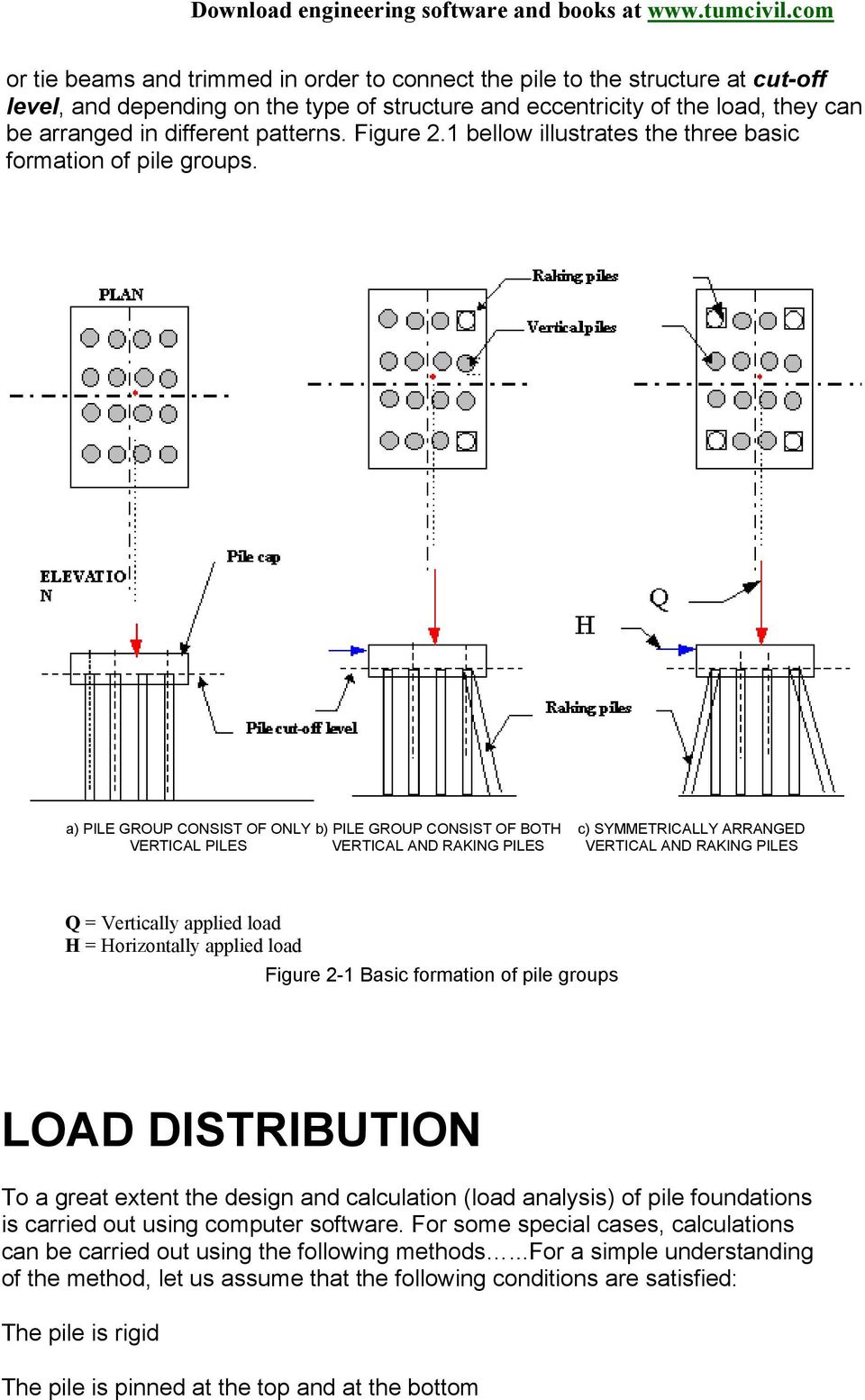
19 on them. Vertical piles can be designed to carry vertical loads as well as lateral loads. If required, vertical piles can be combined with raking piles to support horizontal and vertical forces. often, if a pile group is subjected to vertical force, then the calculation of load distribution on single pile that is member of the group is assumed to be the total load divided by the number of piles in the group. However if a group of piles is subjected to lateral load or eccentric vertical load or combination of vertical and lateral load which can cause moment force on the group which should be taken into account during calculation of load distribution. In the second part of this section, piles are considered to be part of the structure and force distribution on individual piles is calculated accordingly. Objective: In the first part of this section, considering group of piles with limited number of piles subjected to vertical and lateral forces, forces acting centrally or eccentrically, we learn how these forces are distributed on individual piles. The worked examples are intended to give easy follow through exercise that can help quick understanding of pile design both single and group of piles. In the second part, the comparison made between different methods used in pile design will enable students to appreciate the theoretical background of the methods while exercising pile designing. Learning outcome When students complete this section, they will be able to: Calculate load distribution on group of piles consist of vertical piles subjected to eccentric vertical load. Calculate load distribution on vertically arranged piles subjected to lateral and vertical forces. Calculate load distribution on vertical and raking piles subjected to horizontal and eccentric vertical loads. Calculate load distribution on symmetrically arranged vertical and raking piles subjected to vertical and lateral forces 2.2 Pile arrangement Normally, pile foundations consist of pile cap and a group of piles. The pile cap distributes the applied load to the individual piles which, in turn,. transfer the load to the bearing ground. The individual piles are spaced and connected to the pile cap

20 or tie beams and trimmed in order to connect the pile to the structure at cut-off level, and depending on the type of structure and eccentricity of the load, they can be arranged in different patterns. Figure 2.1 bellow illustrates the three basic formation of pile groups. a) PILE GROUP CONSIST OF ONLY b) PILE GROUP CONSIST OF BOTH VERTICAL PILES VERTICAL AND RAKING PILES c) SYMMETRICALLY ARRANGED VERTICAL AND RAKING PILES Q = Vertically applied load H = Horizontally applied load Figure 2-1 Basic formation of pile groups LOAD DISTRIBUTION To a great extent the design and calculation (load analysis) of pile foundations is carried out using computer software. For some special cases, calculations can be carried out using the following methods...for a simple understanding of the method, let us assume that the following conditions are satisfied: The pile is rigid The pile is pinned at the top and at the bottom
21 Each pile receives the load only vertically (i.e. axially applied ); The force P acting on the pile is proportional to the displacement U due to compression P = k.u 3.1 Since P = E.A E.A = k.u where: P = vertical load component k = material constant U = displacement E = elastic module of pile material A = cross-sectional area of pile Figure 3-1 load on single pile The length L should not necessarily be equal to the actual length of the pile. In a group of piles, If all piles are of the same material, have same cross-sectional area and equal length L, then the value of k is the same for all piles in the group.
22 Let us assume that the vertical load on the pile group results in vertical, lateral and torsion movements. Further, let us assume that for each pile in the group, these movements are small and are caused by the component of the vertical load experienced by the pile. The formulae in the forthcoming sections which are used in the calculation of pile loads, are based on these assumptions. 3.1 Pile foundations: vertical piles only Here the pile cap is causing the vertical compression U, whose magnitude is equal for all members of the group. If Q (the vertical force acting on the pile group) is applied at the neutral axis of the pile group, then the force on a single pile will be as follows : 3.4 where: P v = vertical component of the load on any pile from the resultant load Q n = number of vertical piles in the group (see fig3.4) Q = total vertical load on pile group If the same group of piles are subjected to an eccentric load Q which is causing rotation around axis z (see fig 3.1); then for the pile i at distance r xi from axis z: 3.5 θ is a small angle tanθ θ see figure3.4.) P i = force (load on a single pile i U i = displacement caused by the eccentric force (load) Q r xi = distance between pile and neutral axis of pile group; r xi positive measured the same direction as e and negative when in the opposite direction. e = distance between point of intersection of resultant of vertical and horizontal loading with underside of pile (see figure 3.8) The sum of all the forces acting on the piles should be zero
23 3.6 Figure 3-2 Moment If we assume that the forces on the piles are causing a moment M about axis z-z then the sum of moments about axis z-z should be zero (see figure 3.1 a& b)
24 3.7 from e.q. 3.2 we see that M Z = M Z..3.8 applying the same principle, in the x direction we get equivalent equation.if we assume that the moment M X and M Z generated by the force Q are acting on a group of pile, then the sum of forces acting on a single pile will be as follows: 3.9 if we dividing each term by the cross-sectional area of the pile, A, we can establish the working stream σ : Example 3.1 As shown in figure 3.2, A group of Vertical piles are subjected to an eccentric force Q, magnitude of 2600kN. Determine the maximum and the minimum forces on the piles. Q is located 0.2 m from the x-axis and 0.15 m from the z-axis.
25 Figure 3-3 Worked example Solution 1. Calculate Moment generated by the eccentric force M x = 2600 (0.2) = 520 KN M z = 2600 (0.15) = 390 KN 2.Calculate vertical load per pile: = 2600/12 = 217 kn DIST. PILE r xi r 2 xi m 2 r zi m r 2 zi m 2 M X kn M Z knm m
26 a1, * * a2, * * c1, * * c2, * * b1, * b2, * PILE Q/n k N M x r zi / r 2 zi ( 520 r zi )/ M z r xi / r 2 xi ( 390* r xi )/ 6.48 P i k N a = 105** Minimum load 105 KN, carried by pile a1 a = 144 a = 182 a = 221 b = 157 b = 157 b = 236 b = 275 c = 221 c = 252 c =290 c = 329*** Maximum load 329 KN, carried by pile c4 Example 3.2 A pile trestle shown on figure 3-3 consists of four vertical piles surmounted by a 1.2m thick pile cap. It carries a horizontal load applied to the surface of the cap of 400kN. The only vertical load exerted on the pile group is the weight of the pile cup. Determine the loads on the piles.
27 Figure 3-4 Example 3.2 Solution: 1. Determine the magnitude of the vertical force: For a pile cape 4.000m square, weight of pile cap is: 4 x 4 x 12 x 4 = 461kN vertical load = 461kN 2. Determine the location of the N.A. for the vertical piles: 3. resultant of vertical load and horizontal load cuts the underside of the pile cup at a point 1.06m from N.A. pile group. This can be achieved graphically. E.g. On a millimetre paper, in scale, draw the pile cup. Taking the top of the pile cup draw the vertical component downward as shown in figure 2-3 then taking the tip of the vertical component as reference point draw the horizontal component perpendicular to the vertical component. By joining the two components establish the resultant force R. Measure the distance from the N.A to the cutting point of R at the underside of the pile cup. 4. Using the following formula, calculate the load on each pile:
28 =202kN max and 28kN minimum 3.2 Pile foundations: vertical and raking piles To resist lateral forces on the pile group, it is common practice to use vertical piles combined with raking piles (see figure3-5) The example below illustrates how the total applied load is distributed between the piles and how the forces acting on each pile are calculated.
29 Figure 3-5 Load distribution for combined vertical and raking piles To derive the formulae used in design, we first go through the following procedures:- 1. Decide the location of the N.A of the vertical and the raking piles in plan position. (see example below). 2. Draw both N.A till they cross each other at point c, this is done in Elevation and move the forces Q, H& M to point c (see fig.3.5 elevation). 3. Let us assume that the forces Q &M cause lateral and torsional movements at point c. 4. Point c is where the moment M is zero. Y is the moment arm (see fig. 3.5) Figure 3.6 shows that the resultant load R (in this case Q) is only affecting the vertical piles. Figure 3-6 n = number of vertical piles m = number of raking piles P v = As shown in figure 3.6 the lateral force, H, is kept in equilibrium by the vertical and the raking piles. H = 0: H-m P r sinα = 0 V = 0: m P r cosineα - n P v = 0 where: P r = H/(m sinα) P v = H/(n tanα )
30 Figure 3-7 NB : The horizontal force, H, imposes a torsional force on the vertical piles. Sum of forces on a single pile = Q + H + M as a result of Q: P vi = Q/n as a result of H: P vi = - H/(n tanα ) as a result of H: P ri = + H/(m sinα ) as a result of moment M: r i measured perpendicular to the N.A of both the vertical and raking piles Example 3.3 Figure 3.7 shows a pile group of vertical and raking piles subjected to vertical load Q = 3000 kn and lateral load H = 250 kn. Determine the forces acting on each pile. The raking piles lie at an angle of 4:1. Solution: First we determine the location of the neutral axis, N.A, of both the vertical piles and the raking piles. From figure 3.7 we see that the number of vertical piles = 8 and the number of raking piles = 4 1. N.A for the vertical piles is determined as follows:
31 Here we assume through piles a1, a2, a3, a4 as a reference point and start measuring in the positive direction of the X axis, where it is denoted on figure 3.10 as X-X (4) 0 m + (2) 1m + (2)2 m = n n e o, n e o = = 0.75 m The neutral axis for the vertical piles is located at 0.75 m from the line of pile a1, a2, a3, a4. ( )m = 0.25m X = 0.25 m, the distance to the vertical load Q. where: n e o = 8 e O and the numbers 4, 2, 2 are number of piles in the same axis 2. N.A for the raking piles: Here we can assume that the for the raking piles b1and b4 as a reference line and calculate the location of the neutral axis for the raking piles as follows: (2) 0 m + (2)1m = (m)e 1 where: (m )e 1 = 4 e 1, 4 is the total number of raking piles. 4 e 1 e 1 = = 0.5 m the location of neutral axis of raking piles at a distance of ( ) m = 0.75m from e o or from the N.A Of the vertical piles.
32 Figure 3-8 calculated positions of N.A 3. Draw both neutral axis till they cross each other at point c. (see figure 3.9) and establish the lever arm distance, Y, so that we can calculate the moment M, about C. Pile inclination 4:1 Y = (0.75)4-0.6 = 2.4m where 0.75 m is the location of N.A of raking piles from e o or from the N.A Of the vertical piles. M =0 Q(X) - H(Y) = 3000(0.25) - 250(2.4) = 150kNm 4. Establish the angle α and calculate sin, cos, and tangent of the angle α The inclination 4:1 α = tanα = 0.25 sinα = 0.24
33 cos.α = 0.97 cos 2 α = 0.94 Figure 3-9 Example 3.3
34 5. Calculate the forces acting on each pile: Raking piles r i measured perpendicular to the neutral axis Figure 3-10 b,b, r i = -0.5(0.97) = m c,c, r i = 0.5(0.97) = Vertical Piles r i measured perpendicular to the neutral axis b,b, r i = 0.25 c2,c3, r i = 1.25m a, a, a, a, r i = -0.75m PILE (k N) a b2, b3 c2, c3 b1, b4 c1, c4
35 r i m 0.25 m 1.25 m m m Q (kn) H (kn) M (kn) 23.29( = (0.25) = (1.25) = (0.485) = (0.485) = force per pile Q + H + M 233kN* 256kN 279kN* 249 kn 27kN *As we can see the maximum load 279kN will be carried by pile c1 and the minimum load 233kN is carried by piles in row a1 3.3 Symmetrically arranged vertical and raking piles Just as we did for the previous cases, we first decide the location of the neutral axis for both the vertical and raking piles. Extend the two lines till they intersect each other at point c and move the forces Q & H to point C. (see fig.11)
36 Figure 3-11symmetrically arranged piles In the case of symmetrically arranged piles, the vertical pile I is subjected to compression stress by the vertical component P v and the raking pile P r is subjected to tension (see figure )
37 Figure 3-12 Figure 3-13 P v = k (U) p r = k (U cos.α ) = P V cos.α V = 0 Q - n P v - m P r cos.α = 0 P r = P v cos.α P v = The symmetrical arrangement of the raking piles keeps the lateral force, H, in equilibrium and it s effect on the vertical piles is ignored. With reference to figure 3.13 Horizontal projection of forces yield the following formulae. H = 0 Figure 3-14 NB the lateral force H imposes torsional stress on half of the raking piles. Example3.4 Symmetrically arranged piles: Determine the force on the piles shown in figure The inclination on the raking piles is 5:1, the vertical load, Q =3600 kn the horizontal load, H =200 kn and is located 0.6 m from pile cutting level.
38 Figure 3-15 Example 3.4 Solution 1. NA for the raking piles : 4 (0)+2 (0.9) = 6e e r = 0.3 m 2. NA for the vertical piles: 2 (0)+2 (1) = 4e e v = 0.5 m 3. Establish moment arm Y Inclination 5:1 Y = 5 ( ) -0.6 = 4.9 m
39 M = Q (X) - H(Y) = 3600(0.2) - 200(4.9) = -260 knm 4. Establish the angle α and the perpendicular distance r, of the piles from the neutral axis. slope 5:1 α = 11.3 sinα = cos α = 0.98 cos 2α = 0.96 tanα = 0.20 Raking piles For raking piles laying on axis a, -r i = 0.3 (cos α ) +r i = 0.6 (cos α ) = (0.3 2 cos 2α ) r 2 I = ( ) 4 = m 2 For raking piles laying on axis b and b, = (0.6 2 cos 2α ) = ( ) 2 (two piles) = m 2 = ( ) 2 = 2.07 m 2 Vertical piles r i = ± 0.5 m vertical piles laying on axis b and c ( ) = 1.0 m 2 = vertical and raking piles = = 3.07 m 2 5. Calculate load distribution on individual piles:
40 Q P V = P r = P v cosα = = 227kN H P r = ± M PILE a r b r b v c v c r d r Q (kn) H (kn) M = -85 ( ) = 25-50*** 43** -43** 50*** -25 force on P i (kn) a r = -85 ( ) = 25 b r = -85 ( ) = -50.0*** b v 2, b v 3 = -85 (-0.5) = 42.5** c v 2, c v 3 = -85 (0.5) = where: a r, b r, b v, c v, c r, d r represent raking and vertical piles on respective axis Example on installation error Until now we have been calculating theoretical force distribution on piles. However during installation of piles slight changes in position do occur and piles may miss their designed locations. The following example compares theoretical and the actual load distribution as a result of misalignment after pile installation.
41 Figure 3-16 Example on installation error Before installation (theoretical position) see fig.3-16 Q = 500 kn M X = = 150 M Z = = 0 Q/n = 500/6 = 83.3 kn P i = Q/n ± ( M z r xi )/ r 2 xi r 2 xi = = = 2.94 m 2 P i = (150/2.94) r xi P 1,2,3 = (150/2.94) 0.7 = 47.6 kn
42 P 4,5,6 = (150/2.94) 0.7 = 119 kn After installation Displacement of piles in the X-X direction measured, left edge of pile cap as reference point (see figure 3.17) Figure 3-17 piles after installation The new neutral axis (N A) for the pile group: ( ) 1 = 6 e e = 1.22 m The new position of Q = 0.29 m M = 500 (0.29) = 145 knm Measured perpendicular to the new N.A, pile distance, r i, of each pile: r i1 = = 0.72 r i2 = = r i3 = = 0.62 r i4 = = r i5 = = 0.82 r i6 = = r 2 xi = = 3.2 m
43 pile Q/N (kn) 45.3 (r xi ) sum of forces on each pile P i = Q/n ± ( M z r xi )/ r 2 xi (-0.72) (0.79) (-0.62) (0.88) (-0.82) (0.49) 105 LOAD ON SINGLE PILE 4.1 Introduction In this section, considering pile/soil interaction, we learn to calculate the bearing capacity of single piles subjected to compressive axial load. During pile design, the following factors should be taken into consideration: pile material compression and tension capacity deformation area of pile, bending moment capacity condition of the pile at the top and the end of the pile eccentricity of the load applied on the pile soil characteristics ground water level..etc. Nevertheless, calculation method that can satisfy all of these conditions will be complicated and difficult to carry out manually, instead two widely used
44 simplified methods are presented. These two methods are refereed as geotechnical and dynamic methods. This section too has worked examples showing the application of the formulae used in predicting the bearing capacity of piles made of different types of materials. Learning outcome When students complete this section, they will be able to understand the theoretical back ground of the formulae used in pile design carry out calculation and be able to predict design bearing capacity of single piles appreciate results calculated by means of different formulae 4.2 The behaviour of piles under load Piles are designed that calculations and prediction of carrying capacity is based on the application of ultimate axial load in the particular soil conditions at the site at relatively short time after installation. This ultimate load capacity can be determined by either: the use of empirical formula to predict capacity from soil properties determined by testing, or load test on piles at the site Fig.4-1, When pile is subjected to gradually increasing compressive load in maintained load stages, initially the pile-soil system behaves in a linear-elastic manner up to point A on the settlement-load diagram and if the load is realised at any stage up to this point the pile head rebound to its original level. When the load is increase beyond point A there is yielding at, or close to, the pile-soil interface and slippage occurs until point B is reached, when the maximum skin friction on the pile shaft will have been mobilised. If the load is realised at this stage the pile head will rebound to point C, the amount of permanent settlement being the distance OC. When the stage of full mobilisation of the base resistance is reached ( point D), the pile plunges downwards with out any farther increase of load, or small increases in load producing large settlements. No end-bearing is mobilised up to this point. The whole of the load is carried by the skin friction on the pile shaft see figure 4-1 I) The pile shaft is carrying its maximum skin friction and the pile toe will be carrying some load At this point there is no further increase in the load transferred in skin friction but the base load will have reached its maximum value.
45 Figure -1 axial compression of pile 4.3 Geotechnical design methods
46 In order to separate their behavioural responses to applied pile load, soils are classified as either granular/noncohesive or clays/cohesive. The generic formulae used to predict soil resistance to pile load include empirical modifying factors which can be adjusted according to previous engineering experience of the influence on the accuracy of predictions of changes in soil type and other factors such as the time delay before load testing. (Fig 4-1II) the load settlement response is composed of two separate components, the linear elastic shaft friction R s and non-linear base resistance R b. The concept of the separate evaluation of shaft friction and base resistance forms the bases of "static or soil mechanics" calculation of pile carrying capacity. The basic equations to be used for this are written as: Q = Q b + Q s - W p or R c = R b + R s - W p R t = R s + W p Where: Q = R c = the ultimate compression resistance of the pile Q b = R b = base resistance Q s = R s = shaft resistance W p = weight of the pile R t = tensile resistance of pile In terms of soil mechanics theory, the ultimate skin friction on the pile shaft is related to the horizontal effective stress acting on the shaft and the effective remoulded angle of friction between the pile and the clay and the ultimate shaft resistance R s can be evaluated by integration of the pile-soil shear strength τ a over the surface area of the shaft: τ a = C a + σ n tanφ a Where: σ n = K s σ v (refer geotechnical notes) τ a = C a + K S σ v tanφ a and where: p = pile perimeter L = pile length
47 Download engineering software and books at φ = angle of friction between pile and soil K s = coefficient of lateral pressure the ultimate bearing capacity, R b, of the base is evaluated from the bearing capacity theory: A b = area of pile base C = undrained strength of soil at base of pile N C = bearing capacity factor Nevertheless, in practise, for a given pile at a given site, the undrained shear strength C a varies considerably with many factors, including, pile type, soil type, and methods of installations. Ideally, C a should be determined from a pile-load test, but since this is not always possible, C a is correlated with the undrained cohesion C u by empirical adhesion factor α so that the general expression in e.q. (4-1) could be simplified to the following expression: Where: W s = weight of soil replaced by the pile =average value of shear strength over the whole shaft length The undrained load capacity (total stress approach) For piles in clay, the undrained load capacity is generally taken to be the critical value unless the clay is highly over consolidated. If the undrained or short-term ultimate load capacity is to be computed, the soil parameters C, θ,α, γ should be appropriate to undrained conditions and σ v and σ vb should be the total
48 stresses. If the clay is saturated, the undrained angle of friction φ u is zero, and φ a (angle of friction between pile and soil) may also be taken as zero. In addition, N q = 1, Nγ = 1, so that the eq in(4-1) reduces to: 4.3 Where: N c, N q, Nγ,= bearing capacity factors and are functions of the internal angle of friction φ of the soil, the relative compressibility of the soil and the pile geometry Drained load capacity (effective stress approach) For piles installed in stiff, over consolidated clays, the drained load capacity is taken as design criterion. If the simplified assumption is made that the drained pile-soil adhesion C a is zero and that the term in eq (4-1) involving N c, Nγ ignoring the drained ultimate bearing capacity of the pile may be expressed as : 4.4 Where: s v, and s vb = effective vertical stress at depth z respective at pile base f a,= effective angle of friction between pile/soil and implied can be taken as f, N q which is dependant up on the values of f may be taken to be the same as for piles in sand, and can be decided using table 10-5 & Pile in sand If the pile soil adhesion C a and term N c are taken as zero in e.q (4-1) and the terms 0.5γ d Nγ is neglected as being small in relation to the term involving Nγ, the ultimate load capacity of a single pile in sand may be expressed as follows: 4.5 Where: s v, and s vb = effective vertical stress at depth z respective at pile base F w = correction factor for tapered pile ( = 1 for uniform diameter) 4.4 Dynamic approach
49 Most frequently used method of estimating the load capacity of driven piles is to use a driving formula or dynamic formula. All such formulae relate ultimate load capacity to pile set (the vertical movement per blow of the driving hammer) and assume that the driving resistance is equal to the load capacity to the pile under static loading they are based on an idealised representation of the action of the hammer on the pile in the last stage of its embedment. Usually, pile-driving formulae are used either to establish a safe working load or to determine the driving requirements for a required working load. The working load is usually determined by applying a suitable safety factor to the ultimate load calculated by the formula. However, the use of dynamic formula is highly criticised in some pile-design literatures. Dynamic methods do not take into account the physical characteristics of the soil. This can lead to dangerous miss-interpretation of the results of dynamic formula calculation since they represent conditions at the time of driving. They do not take in to account the soil conditions which affect the long- term carrying capacity, reconsolidation, negative skin friction and group effects. specified load acting on the head of the pile SINGLE PILE DESIGN 5.1 End bearing piles If a pile is installed in a soil with low bearing capacity but resting on soil beneath with high bearing capacity, most of the load is carried by the end bearing. In some cases where piles are driven in to the ground using hammer, pile capacity can be estimated by calculating the transfer of potential energy into dynamic energy. When the hammer is lifted and thrown down, with some energy lose while driving the pile, potential energy is transferred into dynamic energy. In the final stage of the pile s embedment,on the bases of rate of settlement, it is able to calculate the design capacity of the pile. For standard pile driving hammers and some standard piles with load capacity (F Rsp, ), the working load for the pile can be determined using the relationship between bearing capacity of the pile, the design load capacity of the pile described by: F Rsp γ n F Sd and table 5-1 where: F Sd = design load for end baring.
50 The data is valid only if at the final stage, rate of settlement is 10 mm per ten blow. And pile length not more than 20 m and geo-category 2. for piles with length m respective m the bearing capacity should be reduced by 10 res. 25%. Table 5-1 Baring capacity of piles installed by hammering hammer DROP HAMMER (released by trigger) drop hammer (activated by rope and friction winch cross-sectional area of pile cross-sectional area of pile fall height 0.055m m 2 fall height 0.055m m kn 450 kn kn 420 kn 3 TON TON TON Example 5.1 A concrete pile with length 26 m and cross-sectional area (235) (235) is subjected to a vertical loading of 390 kn (ultimate) load. Determine appropriate condition to halt hammering. Type of hammer Drop hammer activated by rope and friction winch. Class 2, GC 2, pile length 20 m solution: F Rsp γ n. F sd γ n = 1.1 (table 10-3) vertical load 390 kn F Rsp (1.1)390/0.9***= 477kN Pile cross-sectional area = m 2
51 type of hammer: Drop hammer activated by rope and friction winch ***For piles 20m - 30m length, the bearing capacity should be reduced by 10% Table value (table 5-1): Hammer weight = 4 ton fall height 0.45m (interpolation) Hammer weight = 3 ton fall height 0.54 m 4 ton hammer with fall height 0.45m is an appropriate choice. 5.2 Friction piles Load on piles that are driven into friction material, for the most part the weight is carried by friction between the soil and the pile shaft. However considerable additional support is obtained form the bottom part. In designing piles driven into friction material, the following formulas can be used 5.1 where: q ci = consolidation resistance *α can be decided using table 10-4 A b = end cross-sectional area of the pile A mi = shaft area of the pile in contact with the soil. should be 1.5 for piles in friction material q cs = end resistance at the bottom of the pile within 4 pile diameter from the end of the pile
52 Figure 5-1 Friction Pile Example 5.2 Pile length 22 m, steel pile, friction pile, external diameter 100 mm, GC2, Determine the ultimate bearing capacity of the pile solution: q c Z m( depth measured from ground level to bottom of pile) MPa 0 m - 5 m m 8.0 The values are slightly scattered then the usual while the rest of the condition is favourable.
53 γ Rd = 1.5 (the lowest value) γ n = 1.1 At the base where condition is unfavourable we get : α s = 0.5 α m = Design bearing capacity of the pile is 62 KN. 5.3 Cohesion piles Piles installed in clay: The load is carried by cohesion between the soil and the pile shaft. Bearing capacity of the pile can be calculated using the following formula for pile installed in clay. 5.2 Where: a i = adhesion factor for earth layer c udci = undrained shear strength of clay. A mi = area of pile shaft in contact with the soil. The adhesion factor α is taken as 0 for the firs three meters where it is expected hole room and fill material or week strata. For piles with constant crosssectional area the value of α can be taken as 1.0 and for piles with uniform cross-sectional growth the value of α can be taken as 1.2.
54 Figure 5-2 Cohesion Pile Example m wood pile is installed small end down in clay. Pile diameter is 125 mm at the end and 10 mm/m increase in diameter. The undrained shear strength of the soil, measured from the pile cut-off level is: 0-6 m = 12 kp 6-12 m = 16 kpa m = 19 kpa. Determine the ultimate load capacity of the pile. Pile cut-off level is 1.5m from the ground level. γ Rd = 1.7 Figure 5-3 Example 5-3 solution decide the values for α α = 0 for the first 3.0 meters α = 1.2 for the rest of the soil layer
55 divided the pile into 3 parts (each 6.0 m in this case) calculate Average diameter at the middle of each section: Average diameter : Bottom (section) = (0.01) = 0.15 Middle (section) = = 0.21 Top (section) = (3+2.25) (0.01) = = Ultimate bearing capacity of the pile is 117kN 5.4 Steel piles Because of the relative strength of steel, steel piles withstand driving pressure well and are usually very reliable end bearing members, although they are found in frequent use as friction piles as well. The comment type of steel piles have rolled H, X or circular cross-section(pipe piles). Pipe piles are normally, not necessarily filled with concrete after driving. Prior to driving the bottom end of the pipe pile usually is capped with a flat or a cone-shaped point welded to the pipe. Strength, relative ease of splicing and sometimes economy are some of the advantages cited in the selection of steel piles. The highest draw back of steel piles is corrosion. Corrosive agents such as salt, acid, moisture and oxygen are common enemies of steel. Because of the corrosive effect salt water has on steel, steel piles have restricted use for marine installations. If steel pile is supported by soil with shear strength greater than 7kPa in its entire length then the design bearing capacity of the pile can be calculated using the following formulas. Use both of them and select the lowest value of the two: 5.3
56 5.4 Where:µ m = correction factor E SC = elasticity module of steel I = fibre moment f yc characteristic strength of steel A = pile cross-sectional area C uc = characteristic undrained shear strength of the soil. Example 5.4 Determine the design bearing capacity of a Steel pile of external diameter 100 mm, thickness of 10 mm. Treated against corrosion. pile. Consider failure in the pile material. C c of the soil is 18 kpa, favourable condition. S2 Steel BS 2172 solution : γ n = 1.1 µ m = 0.9 E sc = 210 Gpa for BS 2172 f yc = 320 MPa = = = The first formula gives us lower value, therefore, the design bearing capacity of the pile is 0.3 MN
57 If we consider corrosion of 1mm/year 5.5 Concrete piles = = Relatively, in comparable circumstances, concrete piles have much more resistance against corrosive elements that can rust steel piles or to the effects that causes decay of wood piles, furthermore concrete is available in most parts of the world than steel. Concrete piles may be pre-cast or cast-in place. They may be are reinforced, pre-stressed or plain Pre-cast concrete piles These are piles which are formed, cast to specified lengths and shapes and cured at pre casting stations before driven in to the ground. Depending up on project type and specification, their shape and length are regulated at the prefab site. Usually they came in square, octagonal or circular cross-section. The diameter and the length of the piles are mostly governed by handling stresses. In most cases they are limited to less than 25 m in length and 0.5 m in diameter. Some times it is required to cut off and splice to adjust for different length. Where part of pile is above ground level, the pile may serve as column. If a concrete pile is supported by soil with undrained shear strength greater than 7 MPa in its entire length, the following formula can be used in determining the bearing capacity of the pile : Where: N u = bearing capacity of the pile, designed as concrete column E sc = characteristic elasticity module of concrete I c = fibre moment of the concrete cross-section ignoring the reinforcement C uc = characteristic undrained shear strength of the soil in the loose part of the soil within a layer of 4.0 m
58 Example 5.5 Concrete pile (0.235) (0.235) cross-section installed in clay with characteristic undrained shear strength of 12 kpa. In favourable condition. C50. Determine design load of the pile. Consider failure in the material. Solution: ϕ ef = 1.3 l c /h = 20 k c = 0.6, kϕ = 0.24, k s = 0.62 f cc = 35.5 /( ) = 21.5 MPa f st = 410/( ) = 324 MPa Effective reinforced area: F Rd = µ m N U µ m = 0.9 F Rd = (0.9)0.769 = MN
59 Failure checking using the second formula: E cc = 34 GPa The lowest value is MN Design capacity =0.63 M 5.6 Timber piles (wood piles) Timber piles are frequently used as cohesion piles and for pilling under embankments. Essentially timber piles are made from tree trunks with the branches and bark removed. Normally wood piles are installed by driving. Typically the pile has a natural taper with top cross-section of twice or more than that of the bottom. To avoid splitting in the wood, wood piles are sometimes driven with steel bands tied at the top or at the bottom end. For wood piles installed in soil with undrained shear strength greater than 7kPa the following formula can be used in predicting the bearing capacity of the pile: 5.7 Where: = reduced strength of wood A = cross-sectional area of the pile If the wood is of sound timber, (e.g. pinewood or spruce wood with a diameter > 0.13m), then (reduced strength) of the pile can be taken as 11MPa. Increase in load per section of pile is found to be proportional to the diameter of the pile and shear strength of the soil and can be decided using the following formula: 5.8 where: A m, = area of pile at each 3.5 m section mid point of pile
60 C m = shear strength at each 3.5m section mid point of pile d m = diameter of pile at each 3.5 m section mid point of pile P mi = pile load at the middle of each section Example 5.6 Determine the design bearing capacity of a pile 12m pile driven in to clay with characteristic undrained shear strength 10KPa and 1.0kPa increase per metre depth. Piling condition is assumed to be favourable and the safety class 2. The pile is cut at 1.5m below the ground level. Top diameter of the pile is 180mm and growth in diameter is 9mm/m. Figure 5-4 Example 5.6 *Often it is assumed that cohesive strength of the soil in the fires three meters is half the values at the bottom. solution: First decide which part of the pile is heavily loaded. To do so, divide the pile which is in contact with the soil in three parts or sections (see fig.4.1) in this example the pile is divided into three 3.5m parts Calculate and decide diameter of the pile at the mid point of each 3.5m section ( (y i ) ; y i growth per meter from the end point. Calculate the shear strength of the soil at the mid point of each 3.5m section C mi = (22-1(y i ) ). Shear strength at the end of the pile = (10MPa + 1MPa (12m))=22 MPa
61 Decide the values of the partial coefficients from table ( ) Part ymi(see fig. 5.4) m d mi = ( y i m C mi = (22-1 (y i ) T(top) section M(middle) section B(bottom) section P ti = pile load at the top of each section Part yti m m T(top) this part of the pile is highly loaded M(middle) B(bottom) = stress at the top of the pile The bearing capacity of the pile is 55.1kN Now using the equation in (6-7), we will check the pile for failure f Red = 11MPa (see section 5.6)
62 µ n = 0.9 γ n = 1.1 = In consideration of failure in the pile material, the pile can be loaded up to 9.0 MPa In consideration of cohesion force, the pile can be loaded up to 55 MPa the bearing capacity of the pile is therefore, 55 MPa Simplified method of predicting the bearing capacity of timber piles Consider the previous case and use the following formula : 5.9 regarded the pile in its full length calculate average diameter of the pile calculate average shear strength of the pile 3. decide the values of γ Rd, γ m and α (table ) : γ Rd, = 1.7 γ m = 1.8 (0.8) = 1.44 α = 1.2
63 the bearing capacity of the pile is 56 kn DESIGN OF PILE GROUP Introduction Group action in piled foundation: Most of pile foundations consists not of a single pile, but of a group of piles, which act in the double role of reinforcing the soil, and also of carrying the applied load down to deeper, stronger soil strata. Failure of the group may occur either by failure of the individual piles or as failure of the overall block of soil. The supporting capacity of a group of vertically loaded piles can, in many cases, be considerably less than the sum of the capacities the individual piles comprising the group. Grope action in piled foundation could result in failure or excessive settlement, even though loading tests made on a single pile have indicated satisfactory capacity. In all cases the elastic and consolidation settlements of the group are greater than those of single pile carrying the same working load as that on each pile within the group. This is because the zone of soil or rock which is stressed by the entire group extends to a much greater width and depth than the zone beneath the single pile (fig.6-1) Figure 6-1 Comparison of stressed zone beneath single pile and pile group
64 Learning out come When students complete this section, they will be able: o to calculate and predict design bearing capacity of pile group in different soil types o to appreciate the governing factors in design of group of piles o to design pile groups with appropriate pile spacing 6.1 Bearing capacity of pile groups Pile groups driven into sand may provide reinforcement to the soil. In some cases, the shaft capacity of the pile driven into sand could increase by factor of 2 or more. But in the case of piles driven into sensitive clays, the effective stress increase in the surrounding soil may be less for piles in a group than for individual piles. this will result in lower shaft capacities. Figure 6-2 Under axial or lateral load, In a group, instead of failure of individual piles in the group, block failure (the group acting as a block) may arise. Figure 6-2 Block failure In general,the bearing capacity of pile group may be calculated in consideration to block failure in a similar way to that of single pile, by means of equation 4-1,but hear A s as the block surface area and A b as the base area of the block or by rewriting the general equation we get:
65 ...(6.1) where: A s, surface area of block A b = base area of block (see fig.6-3) C b, C s = average cohesion of clay around the group and beneath the group. N c = bearing capacity factor. For depths relevant for piles, the appropriate value of N c is 9 W p and W s = weight of pile respective weight of soil In examining the behaviour of pile groups it is necessary to consider the following elements: a free-standing group, in which the pile cap is not in contact with the underlying soil. a "piled foundation," in which the pile cap is in contact with the underlying soil. pile spacing independent calculations, showing bearing capacity of the block and bearing capacity of individual piles in the group should be made. relate the ultimate load capacity of the block to the sum of load capacity of individual piles in the group ( the ratio of block capacity to the sum of individual piles capacity) the higher the better. In the case of where the pile spacing in one direction is much greater than that in perpendicular direction, the capacity of the group failing as shown in Figure 6-2 b) should be assessed Pile groups in cohesive soil For pile groups in cohesive soil, the group bearing capacity as a block may be calculated by mans of e.q. 4-5 with appropriate N c value Pile groups in non-cohesive soil For pile groups in non-cohesive soil, the group bearing capacity as a block may be calculated by means of e.q Pile groups in sand In the case of most pile groups installed in sand, the estimated capacity of the block will be well in excess of the sum of the individual pile capacities. As a conservative approach in design, the axial capacity of a pile group in sand is usually taken as the sum of individual pile capacities calculated using formulae in 4-8.
66 Worked Example 6-1 Calculate the bearing capacity and group efficiency of pile foundation installed in uniform clay of bulk unit weight, γ of 20kN/m 3 and undrained shear strength of C u of 50kN/m 2. The foundation consists of 25 piles each 18m long,0.4m in diameter and weight 60kN. The weight of the pile cap is 600kN and founded 1m below the ground level. The adhesion factor α for the soil/pile interface has a value of 0.8 Figure 6-3 Worked Example 6-1 SOLUTION Calculate single pile bearing capacity: R s = α C s A s = π (0.4) = 904kN
67 R b = N c C b A b = 9 50 π (0.2) 2 = 56.6kN R ci = R si + R bi = = 960 (W p +W cap ) - W s = (60 25+( )) - (20 18 π (0.2) 2 25 = 469kN total load capacity of 25 piles = R uc25 = (R ci = R si + R bi ) 25 - {(W p +W cap ) - W s } = = 23531kN calculate block load capacity : = 4 ( ) = 25650kN surface area of pile group weight of soil replaced by pile cap Pile spacing and pile arrangement In certain types of soil, specially in sensitive clays, the capacity of individual piles within the a closely spaced group may be lower than for equivalent isolated pile. However, because of its insignificant effect, this may be ignored in design. Instead the main worry has been that the block capacity of the group may be less than the sum of the individual piles capacities. As a thumb rule, if spacing is more than 2-3 pile diameter, then block failure is most unlikely. It is vital importance that pile group in friction and cohesive soil arranged that even distribution of load in greater area is achieved. Large concentration of piles under the centre of the pile cap should be avoided. This could lead to load concentration resulting in local settlement and failure in
68 the pile cap. Varying length of piles in the same pile group may have similar effect. For pile load up to 300kN, the minimum distance to the pile cap should be 100 mm for load higher than 300kN, this distance should be more than 150 mm. In general, the following formula may be used in pile spacing: End-bearing and friction piles: S = 2.5 (d) L where: Cohesion piles: S = 3.5 (d) L d = assumed pile diameter L = assumed pile length S = pile centre to centre distance (spacing) Example 7-1 A retaining wall imposing a weight of 120kN/m including self-weight of the pile cap is to be constructed on pile foundation in clay. Timber piles of 250mm in diameter and each 14m long with bearing capacity of 90kN/st has been proposed. Asses suitable pile spacing and pile arrangement. Solution: 1. recommended minimum pile spacing: S = 3.5 (d) L = 3.5 (0.25) = 1.16 m 2. try arranging the piles into two rows: vertical load = 120kN/M single pile load capacity = 90kN/st = 1.33m spacing in the two rows
69 minimum distance to the edge of the pile = 0.1m B = = 1.55m here because of the descending nature of the pile diameter a lesser value can be taken, say 1.10m PILE INSTALATION METHODS 8.1 Introduction The installation process and method of installations are equally important factors as of the design process of pile foundations. In this section we will discuss the two main types of pile installation methods; installation by pile hammer and boring by mechanical auger. In order to avoid damages to the piles, during design, installation Methods and installation equipment should be carefully selected. If installation is to be carried out using pile-hammer, then the following factors should be taken in to consideration: the size and the weight of the pile the driving resistance which has to be overcome to achieve the design penetration the available space and head room on the site the availability of cranes and the noise restrictions which may be in force in the locality. 8.2 Pile driving methods (displacement piles)
70 Methods of pile driving can be categorised as follows: 1. Dropping weight 2. Explosion 3. Vibration 4. Jacking (restricted to micro-pilling) 5. Jetting Drop hammers A hammer with approximately the weight of the pile is raised a suitable height in a guide and released to strike the pile head. This is a simple form of hammer used in conjunction with light frames and test piling, where it may be uneconomical to bring a steam boiler or compressor on to a site to drive very limited number of piles. There are two main types of drop hammers: Single-acting steam or compressed-air hammers Double-acting pile hammers 1. Single-acting steam or compressed-air comprise a massive weight in the form of a cylinder (see fig.8-1). Steam or compressed air admitted to the cylinder raises it up the fixed piston rod. At the top of the stroke, or at a lesser height which can be controlled by the operator, the steam is cut off and the cylinder falls freely on the pile helmet. 2. Double-acting pile hammers can be driven by steam or compressed air. A pilling frame is not required with this type of hammer which can be attached to the top of the pile by leg-guides, the pile being guided by a timber framework. When used with a pile frame, back guides are bolted to the hammer to engage with leaders, and only short leg-guides are used to prevent the hammer from moving relatively to the top of the pile. Double-acting hammers are used mainly for sheet pile driving.
71 Figure 8-1 Pile driving using hammer Diesel hammers Also classified as single and double-acting, in operation, the diesel hammer employs a ram which is raised by explosion at the base of a cylinder. Alternatively, in the case of double-acting diesel hammer, a vacuum is created in a separate annular chamber as the ram moves upward, and assists in the
72 return of the ram, almost doubling the output of the hammer over the singleacting type. In favourable ground conditions, the diesel hammer provide an efficient pile driving capacity, but they are not effective for all types of ground Pile driving by vibrating Vibratory hammers are usually electrically powered or hydraulically powered and consists of contra-rotating eccentric masses within a housing attaching to the pile head. The amplitude of the vibration is sufficient to break down the skin friction on the sides of the pile. Vibratory methods are best suited to sandy or gravelly soil. Jetting: to aid the penetration of piles in to sand or sandy gravel, water jetting may be employed. However, the method has very limited effect in firm to stiff clays or any soil containing much coarse gravel, cobbles, or boulders. 8.3 Boring methods ( non-displacement piles) Continuous Flight Auger (CFA) An equipment comprises of a mobile base carrier fitted with a hollow-stemmed flight auger which is rotated into the ground to required depth of pilling. To form the pile, concrete is placed through the flight auger as it is withdrawn from the ground. The auger is fitted with protective cap on the outlet at the base of the central tube and is rotated into the ground by the top mounted rotary hydraulic motor which runs on a carrier attached to the mast. On reaching the required depth, highly workable concrete is pumped through the hollow stem of the auger, and under the pressure of the concrete the protective cap is detached. While rotating the auger in the same direction as during the boring stage, the spoil is expelled vertically as the auger is withdrawn and the pile is formed by filling with concrete. In this process, it is important that rotation of the auger and flow of concrete is matched that collapse of sides of the hole above concrete on lower flight of auger is avoided. This may lead to voids in filled with soil in concrete. The method is especially effective on soft ground and enables to install a variety of bored piles of various diameters that are able to penetrate a multitude of soil conditions. Still, for successful operation of rotary auger the soil must be reasonably free of tree roots, cobbles, and boulders, and it must be selfsupporting. During operation little soil is brought upwards by the auger that lateral stresses is maintained in the soil and voiding or excessive loosening of the soil minimise. However, if the rotation of the auger and the advance of the auger is not matched, resulting in removal of soil during drilling-possibly leading to collapse of the side of the hole.
73 Figure 8-2 CFA Process Underreaming A special feature of auger bored piles which is sometimes used to enable to exploit the bearing capacity of suitable strata by providing an enlarged base. The soil has to be capable of standing open unsupported to employ this technique. Stiff and to hard clays, such as the London clay, are ideal. In its closed position, the underreaming tool is fitted inside the straight section of a pile shaft, and then expanded at the bottom of the pile to produce the underream shown in fig. 8-3.Normally, after installation and before concrete is casted, a man carrying cage is lowered and the shaft and the underream of the pile is inspected.
74 Figure 8-3 a)hydraulic rotary drilling equipment b) C.F.A, c)undrreaming tool open position C.H.D.P Figure 8-4, Continuous helical displacement piles: a short, hollow tapered steel former complete with a larger diameter helical flange, the bullet head is fixed to a hallow drill pipe which is connected to a high torque rotary head running up and down the mast of a special rig. A hollow cylindrical steel shaft sealed at the lower end by a one-way valve and fitted with triangular steel fins is pressed into the ground by a hydraulic ram. There are no vibrations. Displaced soil is compacted in front and around the shaft. Once it reaches the a suitably resistant stratum the shaft is rotated. The triangular fins either side of its leading edge carve out a conical base cavity. At the same time concrete is pumped down the centre of the shat and through the one-way valve. Rotation of
75 the fins is calculated so that as soil is pushed away from the pile base it is simultaneously replaced by in-flowing concrete. Rates of push, rotation and concrete injection are all controlled by an onboard computer. Torque on the shaft is also measured by the computer. When torque levels reach a constant low value the base in formed. The inventors claim that the system can install a\ typical pile in 12 minute. A typical 6m long pile with an 800mm diameter base and 350mm shaft founded on moderately dense gravel beneath soft overlaying soils can achieve an ultimate capacity of over 200t. The pile is suitable for embankments, hard standing supports and floor slabs, where you have a soft silty layer over a gravel strata. Figure 8-4 C.H.D.P. LOAD TEST ON PILES 9.1 Introduction Pile load test are usually carried out that one or some of the following reasons are fulfilled: To obtain back-figured soil data that will enable other piles to be designed. To confirm pile lengths and hence contract costs before the client is committed to over all job costs. To counter-check results from geotechnical and pile driving formulae To determine the load-settlement behaviour of a pile, especially in the region of the anticipated working load that the data can be used in prediction of group settlement. To verify structural soundness of the pile. Test loading: There are four types of test loading: compression test uplift test
76 lateral-load test torsion-load test the most common types of test loading procedures are Constant rate of penetration (CRP) test and the maintained load test (MLT) CRP (constant rate of penetration) In the CRP (constant rate of penetration) method, test pile is jacked into the soil, the load being adjusted to give constant rate of downward movement to the pile. This is maintained until point of failure is reached. Failure of the pile is defined in to two ways that as the load at which the pile continues to move downward without further increase in load, or according to the BS, the load which the penetration reaches a value equal to one-tenth of the diameter of the pile at the base. Fig.9-2, In the cases of where compression tests are being carried out, the following methods are usually employed to apply the load or downward force on the pile: A platform is constructed on the head of the pile on which a mass of heavy material, termed "kentledge" is placed. Or a bridge, carried on temporary supports, is constructed over the test pile and loaded with kentledge. The ram of a hydraulic jack, placed on the pile head, bears on a cross-head beneath the bridge beams, so that a total reaction equal to the weight of the bridge and its load may be obtained MLT, the maintained increment load test Fig.9-1, the maintained increment load test, kentledge or adjacent tension piles or soil anchors are used to provide a reaction for the test load applied by jacking(s) placed over the pile being tested. The load is increased in definite steps, and is sustained at each level of loading until all settlements has either stop or does not exceed a specified amount of in a certain given period of time.
77 Figure 9-1 test load arrangement using kentledge Figure 9-2 test being carried out Limit State Design Introduction Traditionally, design resistance of foundations has been evaluated on an allowable stress basis that piles were designed with ultimate axial capacity between 2 and 3 times than working load. However structural design is now using a limit state design (LSD) bases whereby partial factors are applied to various elements of the design according to the reliability with which the parameters are known or can be calculated. LSD approach is the base of all the Eurocodes, including that for foundations design. It is believed that Limit state design has many benefits for the economic design of piling. The eurocode
78 approach is particularly rigorous, and this guide adopts the partial factors presented in the codes. Eurocode 7 divides investigation, design and implementation of geoconstructions into three categories. It is a requirement of the code that project must be supervised at all stages by personnel with geotechnical knowledge. In order to establish minimum requirements for the extent and quality of geotechnical investigation, deign and construction three geotechnical categories defined. These are: Geotechnical Category 1, 2, Goetechnical category 1, GC 1 this category includes small and relative simple structures: -for which is impossible to ensure that the fundamental requirements will be satisfied on the basis of experience and qualitative geotecnical investigation; -with negligible risk for property and life. Geotechnical Category 1 procedures will be only be sufficient in ground conditions which are known from comparable experience to be sufficiently straight-forward that routine methods may be used for foundation design and construction. Qualitative geotechnical investigations 10.2 Geotechnical Category, GC 2 This category includes conventional types of structures and foundations with no abnormal risks or unusual or exceptionally difficult ground or loading conditions. Structures in Geotechnical category 2 require quantitative geotechnical data and analysis to ensure that the fundamental requirements will be satisfied, but routine procedures for field and laboratory testing and for design and execution may be used. Qualified engineer with relevant experience must be involved Geotechnical Category, GC 3 This category includes structures or parts of structures which do not fall within the limits of Geotechnical Categories 1and 2. The following are examples of structures or parts of structures complying with geotechnical category 2: conventional type of : spread foundations; raft foundations; piled foundations; walls and other structures retaining for supporting soil or water; excavations;
79 bridge piers and abutments; embankment and earthworks; ground anchors and other tie-back systems; tunnels in hard, non-fractured rock and not subjected to special water tightness or other requirement. Geotechnical Category 3 includes very large or unusual structure. Structures involving abnormal risks or unusual or exceptionally difficult ground or loading conditions and highly seismic areas. Qualified geotechnical engineer must be involved. The following factors must be considered in arriving at a classification of a structure or part of a structure: Nature and size of the structure Local conditions, e.g. traffic, utilities, hydrology, subsidence, etc. Ground and groundwater conditions Regional seismicity Conditions classified as in Eurocode 7 In the code, conditions are classified as favourable or unfavourable. Favourable conditions are as such: + if experience shows that the material posses limited spreading characteristic + if large scale investigation was carried out and test results are reliable + the existence of well documented investigation carried out using reliable methods which can give reproducible results + if additional tests, investigations and supervisions are recommend + high certainty in defining test results + failure is plastic Unfavourable conditions are as such: -- if experience shows that the material posses spreading characteres -- if test results shows large spreading than the normal conditions -- if the extent of investigation is limited -- limited experience and methods lucking reproducibility
80 -- where there is no recommendation for additional test, investigations and supervision -- uncertainty in analysing test results -- if failure is brittle Eurocode 7 refers to foundation loadings as action. The se can be permanent as In the case of weights of structures and installations, or variable as imposed loading, or wind and snow loads. They can be accidental, e.g. vehicle impact or explosions. Actions can vary spatially, e.g. self-weights are fixed (fixed actions), but imposed loads can vary in position (free actions). The duration of actions affections affects the response of the ground. It may cause strengthening such as the gain in strength of a clay by long-term loading, or weakening as in the case of excavation slopes in clay over the medium or long term. To allow for this Eurocode 7 introduces a classification related to the soil response and refers to transient actions (e.g. wind loads), short-term actions (e.g. construction loading) and long-term actions. In order to allow for uncertainties in the calculation of he magnitude of actions or combinations of actions and their duration and spatial distribution, Euorcode requires the design values of actions F d to be used for the geotechnical design either to be assessed directly or to be derived from characteristic values F k : F d = F k 10.4 The partial factors γ m, γ n, γ Rd The partial factor γ m : this factor is applied as a safety factor that the characteristic values of the material is divided by this factor. (m = material index) and covers : unfavourable deviation from the material product property inaccuracies in the conversion factors: and uncertainties in the geometric properties and the resistance model. In ultimate limit state, depending upon a given conditions, for Geotechnical Category 2, the values of the γ m may be decided using table 10-1& The partial co-efficient γ n : in order to ensure stability and adequate strength in the structure and in the ground, in the code, cases A, B, and C have been introduced. Values of γ n is given in table 10-3 Partial co-efficient γ Rd : this co-efficient is applied in consideration of deviation between test results and future construction. Values of the γ n should be between Table 10-1 partial factors on material properties for conventional design situations for ultimate limit states
81 Material property Partial factor γ m tanφ modules other properties Table 10-2 partial factors on material properties for conventional design situations for service limit state Material property Partial factor γ m modules other properties Normally the design values, d, E d, tanφ, can be decided using the following formulae: f d = f k /(γ n γ m ) E d = E k /(γ n γ m ) tanφ d = tanφ k /(γ n γ m ) Where: f = reaction force φ = internal angle of friction E = elastic module Table 10-3 partial factor γ n Class γ n A 1.0 B 1.1 C 1.2 Table 10-4 adhesion factor α pile α b α s
82 Concrete piles Steel piles timber piles (wood piles) The table is used for q c 10 Mp a Table 10-5 Bearing factors Nγ, N q, N C φ d Nγ N C N q
PILE FOUNDATIONS FM 5-134
 C H A P T E R 6 PILE FOUNDATIONS Section I. GROUP BEHAVIOR 6-1. Group action. Piles are most effective when combined in groups or clusters. Combining piles in a group complicates analysis since the characteristics
ALLOWABLE LOADS ON A SINGLE PILE
 C H A P T E R 5 ALLOWABLE LOADS ON A SINGLE PILE Section I. BASICS 5-1. Considerations. For safe, economical pile foundations in military construction, it is necessary to determine the allowable load capacity
METHOD OF STATEMENT FOR STATIC LOADING TEST
 Compression Test, METHOD OF STATEMENT FOR STATIC LOADING TEST Tension Test and Lateral Test According to the American Standards ASTM D1143 07, ASTM D3689 07, ASTM D3966 07 and Euro Codes EC7 Table of Contents
PDCA Driven-Pile Terms and Definitions
 PDCA Driven-Pile Terms and Definitions This document is available for free download at piledrivers.org. Preferred terms are descriptively defined. Potentially synonymous (but not preferred) terms are identified
Safe & Sound Bridge Terminology
 Safe & Sound Bridge Terminology Abutment A retaining wall supporting the ends of a bridge, and, in general, retaining or supporting the approach embankment. Approach The part of the bridge that carries
TECHNICAL SPECIFICATION SERIES 8000 PRECAST CONCRETE
 TECHNICAL SPECIFICATION SERIES 8000 PRECAST CONCRETE TECHNICAL SPECIFICATION PART 8000 - PRECAST CONCRETE TABLE OF CONTENTS Item Number Page 8100 PRECAST CONCRETE CONSTRUCTION - GENERAL 8-3 8101 General
Local Authority Building Control Technical Information Note 3 Driven and In-situ Piled Foundations
 Local Authority Building Control Technical Information Note 3 Driven and In-situ Piled Foundations Cambridge City Council - East Cambridgeshire District Council - Fenland District Council, Huntingdonshire
Module 7 (Lecture 24 to 28) RETAINING WALLS
 Module 7 (Lecture 24 to 28) RETAINING WALLS Topics 24.1 INTRODUCTION 24.2 GRAVITY AND CANTILEVER WALLS 24.3 PROPORTIONING RETAINING WALLS 24.4 APPLICATION OF LATERAL EARTH PRESSURE THEORIES TO DESIGN 24.5
BUTE Department of Construction Management and Technology
 BUTE Department of Construction Management and Technology 02.10.2012 Definition 1: Foundation: The structure, that transmits the load of the building to the soil Definition 2: Load bearing soil (strata):
REINFORCED CONCRETE. Reinforced Concrete Design. A Fundamental Approach - Fifth Edition. Walls are generally used to provide lateral support for:
 HANDOUT REINFORCED CONCRETE Reinforced Concrete Design A Fundamental Approach - Fifth Edition RETAINING WALLS Fifth Edition A. J. Clark School of Engineering Department of Civil and Environmental Engineering
DESIGNING STRUCTURES IN EXPANSIVE CLAY
 DESIGNING STRUCTURES IN EXPANSIVE CLAY A GUIDE FOR A RCHITECTS AND E NGINEERS Table of Contents 1. Introduction Page 1 2. Common Foundation Systems Page 2 3. Drilled Piers Page 3 a. Skin Friction Piers
Comprehensive Design Example 2: Foundations for Bulk Storage Facility
 Comprehensive Design Example 2: Foundations for Bulk Storage Facility Problem The project consists of building several dry product storage silos near an existing rail siding in an open field presently
USE OF CONE PENETRATION TEST IN PILE DESIGN
 PERIODICA POLYTECHNICA SER. CIV. ENG. VOL. 47, NO. 2, PP. 189 197 (23) USE OF CONE PENETRATION TEST IN PILE DESIGN András MAHLER Department of Geotechnics Budapest University of Technology and Economics
Design and Construction of Auger Cast Piles
 Design and Construction of Auger Cast Piles 101 th Annual Road School 2015 3/11/2015 Malek Smadi, Ph.D., P.E. Principal Engineer - GEOTILL - Fishers, IN [email protected] - www.geotill.com CONTENTS 1.
Geotechnical Measurements and Explorations Prof. Nihar Ranjan Patra Department of Civil Engineering Indian Institute of Technology, Kanpur
 Geotechnical Measurements and Explorations Prof. Nihar Ranjan Patra Department of Civil Engineering Indian Institute of Technology, Kanpur Lecture No. # 13 (Refer Slide Time: 00:18) So last class, it was
CE-632 Foundation Analysis and Design
 CE-63 Foundation Analysis and Design Pile Foundations 1 Indian Standards on Piles IS 911 : Part 1 : Sec 1 : 1979 Driven cast in-situ concrete piles IS 911 : Part 1 : Sec : 1979 Bored cast-in-situ piles
Figure A-1. Figure A-2. continued on next page... HPM-1. Grout Reservoir. Neat Cement Grout (Very Flowable) Extension Displacement Plate
 Addendum HELICAL PULLDOWN Micropile (HPM) Introduction The HPM is a system for constructing a grout column around the shaft of a standard Helical Screw Foundation (see Figure A1). To begin the process,
Module 1 : Site Exploration and Geotechnical Investigation. Lecture 4 : In-situ tests [ Section 4.1: Penetrometer Tests ] Objectives
![Module 1 : Site Exploration and Geotechnical Investigation. Lecture 4 : In-situ tests [ Section 4.1: Penetrometer Tests ] Objectives](/thumbs/26/8734290.jpg "Module 1 : Site Exploration and Geotechnical Investigation. Lecture 4 : In-situ tests [ Section 4.1: Penetrometer Tests ] Objectives") Lecture 4 : In-situ tests [ Section 4.1: Penetrometer Tests ] Objectives In this section you will learn the following Penetrometer Tests Standard penetration test Static cone penetration test Dynamic cone
Lecture 4 : In-situ tests [ Section 4.1: Penetrometer Tests ] Objectives In this section you will learn the following Penetrometer Tests Standard penetration test Static cone penetration test Dynamic cone
Soil Mechanics SOIL STRENGTH page 1
 Soil Mechanics SOIL STRENGTH page 1 Contents of this chapter : CHAPITRE 6. SOIL STRENGTH...1 6.1 PRINCIPAL PLANES AND PRINCIPAL STRESSES...1 6.2 MOHR CIRCLE...1 6.2.1 POLE METHOD OF FINDING STRESSES ON
GLOSSARY OF TERMINOLOGY
 GLOSSARY OF TERMINOLOGY AUTHORIZED PILE LENGTHS - (a.k.a. Authorized Pile Lengths letter) Official letter stating Engineer's recommended length of concrete piles to be cast for construction of foundation.
ENGINEERING SCIENCE H1 OUTCOME 1 - TUTORIAL 3 BENDING MOMENTS EDEXCEL HNC/D ENGINEERING SCIENCE LEVEL 4 H1 FORMERLY UNIT 21718P
 ENGINEERING SCIENCE H1 OUTCOME 1 - TUTORIAL 3 BENDING MOMENTS EDEXCEL HNC/D ENGINEERING SCIENCE LEVEL 4 H1 FORMERLY UNIT 21718P This material is duplicated in the Mechanical Principles module H2 and those
How to Design Helical Piles per the 2009 International Building Code
 ABSTRACT How to Design Helical Piles per the 2009 International Building Code by Darin Willis, P.E. 1 Helical piles and anchors have been used in construction applications for more than 150 years. The
Highly flexible couplings
 Construction and operation 8.03.00 Instructions for installation 8.03.00 Types of stress 8.04.00 Diagrams for static deformation of the coupling ring 8.05.00 Coupling size 8.07.00 Examples of combinations
MECHANICS OF SOLIDS - BEAMS TUTORIAL 2 SHEAR FORCE AND BENDING MOMENTS IN BEAMS
 MECHANICS OF SOLIDS - BEAMS TUTORIAL 2 SHEAR FORCE AND BENDING MOMENTS IN BEAMS This is the second tutorial on bending of beams. You should judge your progress by completing the self assessment exercises.
vulcanhammer.net This document downloaded from
 This document downloaded from vulcanhammer.net since 1997, your source for engineering information for the deep foundation and marine construction industries, and the historical site for Vulcan Iron Works
SUPPLEMENTAL TECHNICAL SPECIFICATIONS BI-DIRECTIONAL STATIC LOAD TESTING OF DRILLED SHAFTS
 July 14, 2015 1.0 GENERAL BI-DIRECTIONAL STATIC LOAD TESTING OF DRILLED SHAFTS This work shall consist of furnishing all materials, equipment, labor, and incidentals necessary for conducting bi-directional
GUIDELINE FOR HAND HELD SHEAR VANE TEST
 GUIDELINE FOR HAND HELD SHEAR VANE TEST NZ GEOTECHNICAL SOCIETY INC August 2001 CONTENTS Page 1.0 Introduction 2 2.0 Background 2 3.0 Recommended Practice 3 4.0 Undrained Shear Strength 3 5.0 Particular
Design of pile foundations following Eurocode 7-Section 7
 Brussels, 18-20 February 2008 Dissemination of information workshop 1 Workshop Eurocodes: background and applications Brussels, 18-20 Februray 2008 Design of pile foundations following Eurocode 7-Section
Soil Mechanics. Outline. Shear Strength of Soils. Shear Failure Soil Strength. Laboratory Shear Strength Test. Stress Path Pore Pressure Parameters
 Soil Mechanics Shear Strength of Soils Chih-Ping Lin National Chiao Tung Univ. [email protected] 1 Outline Shear Failure Soil Strength Mohr-Coulomb Failure Criterion Laboratory Shear Strength Test
DESIGN OF SLABS. 3) Based on support or boundary condition: Simply supported, Cantilever slab,
 DESIGN OF SLABS Dr. G. P. Chandradhara Professor of Civil Engineering S. J. College of Engineering Mysore 1. GENERAL A slab is a flat two dimensional planar structural element having thickness small compared
STRUCTURES. 1.1. Excavation and backfill for structures should conform to the topic EXCAVATION AND BACKFILL.
 STRUCTURES 1. General. Critical structures may impact the integrity of a flood control project in several manners such as the excavation for construction of the structure, the type of foundation, backfill
NEGATIVE SKIN FRICTION AND SETTLEMENT OF PILES. Dr. Bengt H. Fellenius, P. Eng. University of Ottawa, Canada
 Fellenius, B. H., 1984. Negative skin friction and settlement of piles. Second International Seminar, Pile Foundations, Nanyang Technological Institute, Singapore, November 28-30, 12 p. NEGATIVE SKIN FRICTION
System. Stability. Security. Integrity. 150 Helical Anchor
 Model 150 HELICAL ANCHOR System PN #MBHAT Stability. Security. Integrity. 150 Helical Anchor System About Foundation Supportworks is a network of the most experienced and knowledgeable foundation repair
EN 1997-1 Eurocode 7. Section 10 Hydraulic Failure Section 11 Overall Stability Section 12 Embankments. Trevor L.L. Orr Trinity College Dublin Ireland
 EN 1997 1: Sections 10, 11 and 12 Your logo Brussels, 18-20 February 2008 Dissemination of information workshop 1 EN 1997-1 Eurocode 7 Section 10 Hydraulic Failure Section 11 Overall Stability Section
Eurocode 7 - Geotechnical design - Part 2 Ground investigation and testing
 Brussels, 18-20 February 2008 Dissemination of information workshop 1 Eurocode 7 - Geotechnical design - Part 2 Ground investigation and testing Dr.-Ing. Bernd Schuppener, Federal Waterways Engineering
The advantages and disadvantages of dynamic load testing and statnamic load testing
 The advantages and disadvantages of dynamic load testing and statnamic load testing P.Middendorp & G.J.J. van Ginneken TNO Profound R.J. van Foeken TNO Building and Construction Research ABSTRACT: Pile
CHAPTER 9 LONG TERM MONITORING AT THE ROUTE 351 BRIDGE
 CHAPTER 9 LONG TERM MONITORING AT THE ROUTE 351 BRIDGE 9.1 INTRODUCTION An important reason that composite piles have not gained wide acceptance in the civil engineering practice is the lack of a long
INSITU TESTS! Shear Vanes! Shear Vanes! Shear Vane Test! Sensitive Soils! Insitu testing is used for two reasons:!
 In-situ Testing! Insitu Testing! Insitu testing is used for two reasons:! To allow the determination of shear strength or penetration resistance or permeability of soils that would be difficult or impossible
Forensic engineering of a bored pile wall
 NGM 2016 Reykjavik Proceedings of the 17 th Nordic Geotechnical Meeting Challenges in Nordic Geotechnic 25 th 28 th of May Forensic engineering of a bored pile wall Willem Robert de Bruin Geovita AS, Norway,
SPECIFICATION FOR DYNAMIC CONSOLIDATION / DYNAMIC REPLACEMENT
 SPECIFICATION FOR DYNAMIC CONSOLIDATION / DYNAMIC REPLACEMENT 1.0 SOIL IMPROVEMENT 1.1 General Soil Investigation Information are provided in Part B1 annex as a guide to the Contractor for his consideration
FOUNDATION DESIGN. Instructional Materials Complementing FEMA 451, Design Examples
 FOUNDATION DESIGN Proportioning elements for: Transfer of seismic forces Strength and stiffness Shallow and deep foundations Elastic and plastic analysis Foundation Design 14-1 Load Path and Transfer to
Structural Axial, Shear and Bending Moments
 Structural Axial, Shear and Bending Moments Positive Internal Forces Acting Recall from mechanics of materials that the internal forces P (generic axial), V (shear) and M (moment) represent resultants
METHOD STATEMENT HIGH STRIAN DYNAMIC TESTING OF PILE. Prepared by
 METHOD STATEMENT HIGH STRIAN DYNAMIC TESTING OF PILE Prepared by Infratech ASTM CO., LTD. Contents Chapter Description Page Contents...... 1 List of Appendix. 1 1. Introduction.. 2 2. Test Method..2 3.
INTRODUCTION TO SOIL MODULI. Jean-Louis BRIAUD 1
 INTRODUCTION TO SOIL MODULI By Jean-Louis BRIAUD 1 The modulus of a soil is one of the most difficult soil parameters to estimate because it depends on so many factors. Therefore when one says for example:
Optimum proportions for the design of suspension bridge
 Journal of Civil Engineering (IEB), 34 (1) (26) 1-14 Optimum proportions for the design of suspension bridge Tanvir Manzur and Alamgir Habib Department of Civil Engineering Bangladesh University of Engineering
DIRECT SHEAR TEST SOIL MECHANICS SOIL MECHANICS LABORATORY DEPARTMENT OF CIVIL ENGINEERING UNIVERSITY OF MORATUWA SRI LANKA
 DIRECT SHEAR TEST SOIL MECHANICS SOIL MECHANICS LABORATORY DEPARTMENT OF CIVIL ENGINEERING UNIVERSITY OF MORATUWA SRI LANKA DIRECT SHEAR TEST OBJEVTIVES To determine the shear strength parameters for a
June 2007 CHAPTER 7 - CULVERTS 7.0 CHAPTER 7 - CULVERTS 7.1 GENERAL
 7.0 7.1 GENERAL For the purpose of this manual, culverts are defined as structures that are completely surrounded by soil and located below the surface of the roadway parallel to the general direction
Technical Notes 3B - Brick Masonry Section Properties May 1993
 Technical Notes 3B - Brick Masonry Section Properties May 1993 Abstract: This Technical Notes is a design aid for the Building Code Requirements for Masonry Structures (ACI 530/ASCE 5/TMS 402-92) and Specifications
Design of Steel Structures Prof. S.R.Satish Kumar and Prof. A.R.Santha Kumar. Fig. 7.21 some of the trusses that are used in steel bridges
 7.7 Truss bridges Fig. 7.21 some of the trusses that are used in steel bridges Truss Girders, lattice girders or open web girders are efficient and economical structural systems, since the members experience
Dimensional and Structural Data for Elliptical Pipes. PD 26 rev D 21/09/05
 Dimensional and Structural Data for Elliptical Pipes 21/09/05 Page 1 of 15 1. Foreword This document details a method for the structural design of Stanton Bonna Elliptical pipes for the common conditions
Drained and Undrained Conditions. Undrained and Drained Shear Strength
 Drained and Undrained Conditions Undrained and Drained Shear Strength Lecture No. October, 00 Drained condition occurs when there is no change in pore water pressure due to external loading. In a drained
The elements used in commercial codes can be classified in two basic categories:
 CHAPTER 3 Truss Element 3.1 Introduction The single most important concept in understanding FEA, is the basic understanding of various finite elements that we employ in an analysis. Elements are used for
PROVA DINAMICA SU PALI IN ALTERNATIVA ALLA PROVA STATICA. Pile Dynamic Load test as alternative to Static Load test
 PROVA DINAMICA SU PALI IN ALTERNATIVA ALLA PROVA STATICA Pile Dynamic Load test as alternative to Static Load test Gorazd Strnisa, B.Sc.Civ.Eng. SLP d.o.o. Ljubljana ABSTRACT Pile Dynamic test is test
New approaches in Eurocode 3 efficient global structural design
 New approaches in Eurocode 3 efficient global structural design Part 1: 3D model based analysis using general beam-column FEM Ferenc Papp* and József Szalai ** * Associate Professor, Department of Structural
Step 11 Static Load Testing
 Step 11 Static Load Testing Test loading is the most definitive method of determining load capacity of a pile. Testing a pile to failure provides valuable information to the design engineer and is recommended
INDIRECT METHODS SOUNDING OR PENETRATION TESTS. Dr. K. M. Kouzer, Associate Professor in Civil Engineering, GEC Kozhikode
 INDIRECT METHODS SOUNDING OR PENETRATION TESTS STANDARD PENETRATION TEST (SPT) Reference can be made to IS 2131 1981 for details on SPT. It is a field edtest to estimate e the penetration e resistance
Hilti HIT-HY 150 MAX with rebar
 Hilti HIT-HY 150 MAX Injection mortar system Hilti HIT- HY 150 MAX 330 ml foil pack (also available as 500 ml and 1400 ml foil pack) Static mixer rebar BSt 500 S Benefits - suitable for non-cracked and
ENCE 4610 Foundation Analysis and Design
 This image cannot currently be displayed. ENCE 4610 Foundation Analysis and Design Shallow Foundations Total and Differential Settlement Schmertmann s Method This image cannot currently be displayed. Strength
Draft Table of Contents. Building Code Requirements for Structural Concrete and Commentary ACI 318-14
 Draft Table of Contents Building Code Requirements for Structural Concrete and Commentary ACI 318-14 BUILDING CODE REQUIREMENTS FOR STRUCTURAL CONCRETE (ACI 318 14) Chapter 1 General 1.1 Scope of ACI 318
SPECIFICATIONS FOR PRECAST MODULAR BLOCK RETAINING WALL SYSTEM (revised 11/5/13)
 Page 1 of 7 STONE STRONG SYSTEMS SPECIFICATIONS FOR PRECAST MODULAR BLOCK RETAINING WALL SYSTEM (revised ) PART 1: GENERAL 1.01 Description A. Work includes furnishing and installing precast modular blocks
Figure 2.31. CPT Equipment
 Soil tests (1) In-situ test In order to sound the strength of the soils in Las Colinas Mountain, portable cone penetration tests (Japan Geotechnical Society, 1995) were performed at three points C1-C3
High Strain Dynamic Load Testing of Drilled Shafts
 Supplemental Technical Specification for High Strain Dynamic Load Testing of Drilled Shafts SCDOT Designation: SC-M-712 (9/15) September 3, 2015 1.0 GENERAL This work shall consist of performing high-strain
Stability. Security. Integrity.
 Stability. Security. Integrity. PN #MBHPT Foundation Supportworks provides quality helical pile systems for both new construction and retrofit applications. 288 Helical Pile System About Foundation Supportworks
Page 1 of 18 28.4.2008 Sven Alexander Last revised 1.3.2010. SB-Produksjon STATICAL CALCULATIONS FOR BCC 250
 Page 1 of 18 CONTENT PART 1 BASIC ASSUMPTIONS PAGE 1.1 General 1. Standards 1.3 Loads 1. Qualities PART ANCHORAGE OF THE UNITS.1 Beam unit equilibrium 3. Beam unit anchorage in front..1 Check of capacity..
INSTRUCTIONS FOR USE
 2/2013 ANCHOR BOLTS INSTRUCTIONS FOR USE - Threaded rebars ATP, AHP, AJP - Threaded high strength steel bolts ALP-L, ALP-P, AMP ATP AHP ALP-L ALP-P AMP Eurocode design according to EN1993-1-8 (2005) &
King Post Wall Information
 King Post Wall Information DAWSON-WAM specialise in the installation of piled retaining wall systems including steel sheet piling, concrete piled walls and king post walls. This document is our guide to
Appendix A Sub surface displacements around excavations Data presented in Xdisp sample file
 Appendix A Sub surface displacements around excavations Data presented in Xdisp sample file Notation B1 = lowest level of basement slab c = cohesion E = drained Young s Modulus Eu = undrained Young s Modulus
Design, Testing and Automated Monitoring of ACIP Piles in Residual Soils
 Design, Testing and Automated Monitoring of ACIP Piles in Residual Soils Stephen W. Lacz 1, M. ASCE, P.E. and Richard C. Wells 2, F. ASCE, P.E. 1 Senior Professional, Trigon Kleinfelder, Inc., 313 Gallimore
Emergency repair of Bridge B421
 Emergency repair of Bridge B421 over the Olifants River after fl ood damage INTRODUCTION AND BACKGROUND Bridge B421 is located on the R555 at km 5.03 on Section 01E between Witbank (now known as emalahleni)
Lymon C. Reese & Associates LCR&A Consulting Services Tests of Piles Under Axial Load
 Lymon C. Reese & Associates LCR&A Consulting Services Tests of Piles Under Axial Load Nature of Services The company has a long history of performance of tests of piles and pile groups under a variety
A study on the Effect of Distorted Sampler Shoe on Standard Penetration Test Result in Cohesionless soil
 ISSN: 319-53 (An ISO 39: 00 Certified Organization) A study on the Effect of Distorted Sampler Shoe on Standard Penetration Test Result in Cohesionless soil Utpal Kumar Das Associate Professor, Department
Tremie Concrete CM 420 CM 420 CM 420 CM 420. Temporary Structures. Tremie Concrete
 Tremie Concrete Underwater concrete plays an important role in the construction of offshore structures. It may be used to tie together various elements in composite action (i.e., to tie piling to the footing).
SEISMIC DESIGN. Various building codes consider the following categories for the analysis and design for earthquake loading:
 SEISMIC DESIGN Various building codes consider the following categories for the analysis and design for earthquake loading: 1. Seismic Performance Category (SPC), varies from A to E, depending on how the
Specification Guidelines: Allan Block Modular Retaining Wall Systems
 Specification Guidelines: Allan Block Modular Retaining Wall Systems The following specifications provide Allan Block Corporation's typical requirements and recommendations. At the engineer of record's
Up-Down Construction Utilizing Steel Sheet Piles and Drilled Shaft Foundations
 Up-Down Construction Utilizing Steel Sheet Piles and Drilled Shaft Foundations Nathan A. Ingraffea, P.E., S.E. Associate, KPFF Consulting Engineers, Portland, Oregon, USA Abstract The use of steel sheet
Chapter 18 Static Equilibrium
 Chapter 8 Static Equilibrium 8. Introduction Static Equilibrium... 8. Lever Law... Example 8. Lever Law... 4 8.3 Generalized Lever Law... 5 8.4 Worked Examples... 7 Example 8. Suspended Rod... 7 Example
Detailing of Reinforcment in Concrete Structures
 Chapter 8 Detailing of Reinforcment in Concrete Structures 8.1 Scope Provisions of Sec. 8.1 and 8.2 of Chapter 8 shall apply for detailing of reinforcement in reinforced concrete members, in general. For
product manual HS-4210 HS-4210_MAN_09.08 Digital Static Cone Penetrometer
 HS-4210_MAN_09.08 product manual HS-4210 Digital Static Cone Penetrometer Introduction This Manual covers the measurement of bearing capacity using the Humboldt Digital Static Cone Penetrometer (DSCP).
EVALUATION OF SEISMIC RESPONSE - FACULTY OF LAND RECLAMATION AND ENVIRONMENTAL ENGINEERING -BUCHAREST
 EVALUATION OF SEISMIC RESPONSE - FACULTY OF LAND RECLAMATION AND ENVIRONMENTAL ENGINEERING -BUCHAREST Abstract Camelia SLAVE University of Agronomic Sciences and Veterinary Medicine of Bucharest, 59 Marasti
PLANE TRUSSES. Definitions
 Definitions PLANE TRUSSES A truss is one of the major types of engineering structures which provides a practical and economical solution for many engineering constructions, especially in the design of
Laterally Loaded Piles
 Laterally Loaded Piles 1 Soil Response Modelled by p-y Curves In order to properly analyze a laterally loaded pile foundation in soil/rock, a nonlinear relationship needs to be applied that provides soil
Hilti HIT-HY 200 with rebar
 Hilti HIT-HY 200 Injection mortar system Benefits Hilti HIT- HY 200-A 500 ml foil pack (also available as 330 ml) Hilti HIT- HY 200-R 500 ml foil pack (also available as 330 ml) Static mixer rebar BSt
TECHNICAL NOTE Lining of Casings with SaniTite HP Pipe
 TECHNICAL NOTE Lining of Casings with SaniTite HP Pipe TN 5.18 October 2015 In sanitary sewer, it is often necessary to use trenchless technology methods to install a casing pipe under high volume roads,
Trench Rescue by Buddy Martinette
 Trench Rescue by Buddy Martinette SOIL TYPE AND TESTING It is imperative that rescue personnel understand soil types and testing procedures if the want to be competent at trench rescue operations. Determining
c. Borehole Shear Test (BST): BST is performed according to the instructions published by Handy Geotechnical Instruments, Inc.
 Design Manual Chapter 6 - Geotechnical 6B - Subsurface Exploration Program 6B-2 Testing A. General Information Several testing methods can be used to measure soil engineering properties. The advantages,
EDEXCEL NATIONAL CERTIFICATE/DIPLOMA MECHANICAL PRINCIPLES AND APPLICATIONS NQF LEVEL 3 OUTCOME 1 - LOADING SYSTEMS
 EDEXCEL NATIONAL CERTIFICATE/DIPLOMA MECHANICAL PRINCIPLES AND APPLICATIONS NQF LEVEL 3 OUTCOME 1 - LOADING SYSTEMS TUTORIAL 1 NON-CONCURRENT COPLANAR FORCE SYSTEMS 1. Be able to determine the effects
Solid Mechanics. Stress. What you ll learn: Motivation
 Solid Mechanics Stress What you ll learn: What is stress? Why stress is important? What are normal and shear stresses? What is strain? Hooke s law (relationship between stress and strain) Stress strain
Objectives. Experimentally determine the yield strength, tensile strength, and modules of elasticity and ductility of given materials.
 Lab 3 Tension Test Objectives Concepts Background Experimental Procedure Report Requirements Discussion Objectives Experimentally determine the yield strength, tensile strength, and modules of elasticity
DISTRIBUTION OF LOADSON PILE GROUPS
 C H A P T E R 7 DISTRIBUTION OF LOADSON PILE GROUPS Section I. DESIGN LOADS 7-1. Basic design. The load carried by an individual pile or group of piles in a foundation depends upon the structure concerned
1 Mobilisation and demobilisation 1 Deep boring sum 2 Cone penetration tests sum 3 Miscellenous tests sum
 Malaysian Civil Engineering Standard Method of Measurement (MyCESMM) CLASS D: SITE INVESTIGATION WORK Measurement covered under other classes: Excavation not carried out for the purpose of soil investigation
Module 5 (Lectures 17 to 19) MAT FOUNDATIONS
 Module 5 (Lectures 17 to 19) MAT FOUNDATIONS Topics 17.1 INTRODUCTION Rectangular Combined Footing: Trapezoidal Combined Footings: Cantilever Footing: Mat foundation: 17.2 COMMON TYPES OF MAT FOUNDATIONS
KWANG SING ENGINEERING PTE LTD
 KWANG SING ENGINEERING PTE LTD 1. INTRODUCTION This report represents the soil investigation works at Aljunied Road / Geylang East Central. The objective of the soil investigation is to obtain soil parameters
LEGACY REPORT ER-5110. www.icc-es.org. ICC Evaluation Service, Inc. Reissued November 1, 2003. Legacy report on the 1997 Uniform Building Code
 LEGACY REPORT Reissued November 1, 2003 ICC Evaluation Service, Inc. www.icc-es.org Business/Regional Office # 5360 Workman Mill Road, Whittier, California 90601 # (562) 699-0543 Regional Office # 900
8.2 Elastic Strain Energy
 Section 8. 8. Elastic Strain Energy The strain energy stored in an elastic material upon deformation is calculated below for a number of different geometries and loading conditions. These expressions for
Designed and Engineered to Perform
 History EARTH CONTACT PRODUCTS, L.L.C., is a family owned company, based in Olathe, Kansas. This company was built upon Don May s U.S. Patented fourth-generation Steel Piering System that has led to the
Micropiles Reduce Costs and Schedule for Merchant RR Bridge Rehabilitation
 Micropiles Reduce Costs and Schedule for Merchant RR Bridge Rehabilitation Jeff R. Hill, P.E. Hayward Baker Inc. 111 W. Port Plaza Drive Suite 600 St. Louis, MO 63146 314-542-3040 [email protected]
EDEXCEL NATIONAL CERTIFICATE/DIPLOMA MECHANICAL PRINCIPLES AND APPLICATIONS NQF LEVEL 3 OUTCOME 1 - LOADING SYSTEMS TUTORIAL 3 LOADED COMPONENTS
 EDEXCEL NATIONAL CERTIICATE/DIPLOMA MECHANICAL PRINCIPLES AND APPLICATIONS NQ LEVEL 3 OUTCOME 1 - LOADING SYSTEMS TUTORIAL 3 LOADED COMPONENTS 1. Be able to determine the effects of loading in static engineering
How To Model A Shallow Foundation
 Finite Element Analysis of Elastic Settlement of Spreadfootings Founded in Soil Jae H. Chung, Ph.D. Bid Bridge Software Institute t University of Florida, Gainesville, FL, USA Content 1. Background 2.
Dynamic Load Testing of Helical Piles
 Dynamic Load Testing of Helical Piles ANNUAL KANSAS CITY SPECIALTY SEMINAR 2014 JANUARY 10, 2014 Jorge Beim JWB Consulting LLC Pile Dynamics, Inc. Main Topics Brief description of the Dynamic Load Test