
Step-by-Step Insertion Instructions
|
|
|
- Lee Golden
- 9 years ago
- Views:
Transcription
1 Step-by-Step Insertion Instructions

2 Please read these instructions carefully and please visit LILETTAHCP.com for the full Prescribing Information. You may also visit LILETTAhcp.com/video for a video demonstration. NOTE: LILETTA demonstration IUS is reloadable. For complete insertion instructions, please refer to the full Prescribing Information for LILETTA at LILETTAHCP.com. Follow the instructions exactly as described to ensure proper insertion. Use aseptic technique during the entire insertion procedure. First, get to know the LILETTA IUS with inserter: IUS A B D INSERTION TUBE A Levonorgestrel reservoir with membrane B Lateral arms C Blue removal threads D Knobs C E F E Flange F Centimeter markings ROD G Thickened mark J I H G H First indent (top) I Second indent (bottom) J Ring

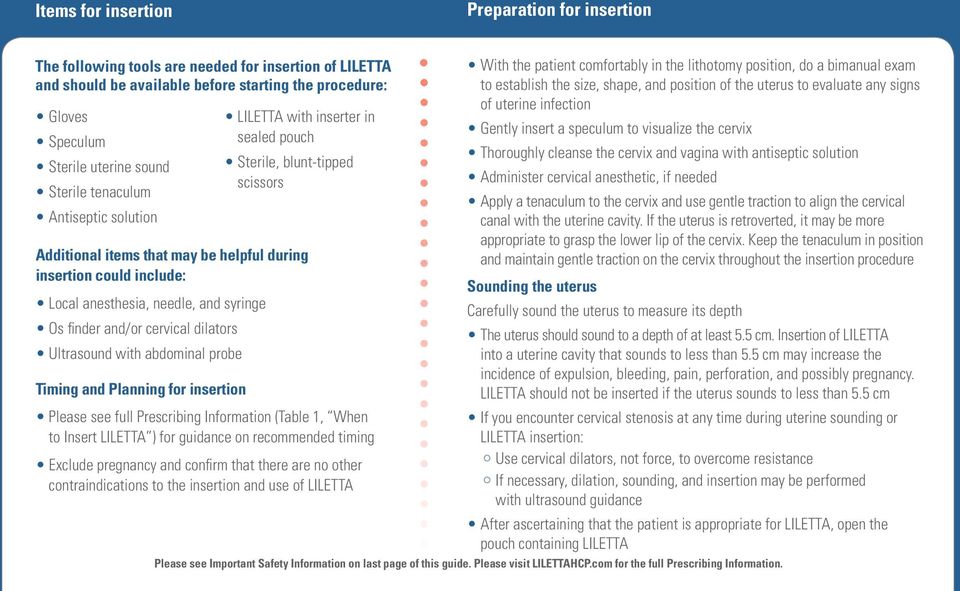
3 Items for insertion Preparation for insertion The following tools are needed for insertion of LILETTA and should be available before starting the procedure: Gloves Speculum Sterile uterine sound Sterile tenaculum Antiseptic solution LILETTA with inserter in sealed pouch Sterile, blunt-tipped scissors Additional items that may be helpful during insertion could include: Local anesthesia, needle, and syringe Os finder and/or cervical dilators Ultrasound with abdominal probe Timing and Planning for insertion Please see full Prescribing Information (Table 1, When to Insert LILETTA ) for guidance on recommended timing Exclude pregnancy and confirm that there are no other contraindications to the insertion and use of LILETTA With the patient comfortably in the lithotomy position, do a bimanual exam to establish the size, shape, and position of the uterus to evaluate any signs of uterine infection Gently insert a speculum to visualize the cervix Thoroughly cleanse the cervix and vagina with antiseptic solution Administer cervical anesthetic, if needed Apply a tenaculum to the cervix and use gentle traction to align the cervical canal with the uterine cavity. If the uterus is retroverted, it may be more appropriate to grasp the lower lip of the cervix. Keep the tenaculum in position and maintain gentle traction on the cervix throughout the insertion procedure Sounding the uterus Carefully sound the uterus to measure its depth The uterus should sound to a depth of at least. cm. Insertion of LILETTA into a uterine cavity that sounds to less than. cm may increase the incidence of expulsion, bleeding, pain, perforation, and possibly pregnancy. LILETTA should not be inserted if the uterus sounds to less than. cm If you encounter cervical stenosis at any time during uterine sounding or LILETTA insertion: Use cervical dilators, not force, to overcome resistance If necessary, dilation, sounding, and insertion may be performed with ultrasound guidance After ascertaining that the patient is appropriate for LILETTA, open the pouch containing LILETTA
4 cm 1 Place the LILETTA pouch on a flat surface 2 and open from the bottom Release the threads from the flange and insert the rod Open the sterile LILETTA pouch from the bottom (end with the rod ring) approximately one-third of the way until the lower ends of the threads, the rod, and the insertion tube are exposed If using sterile gloves, you can open the pouch completely before putting on the sterile gloves OPEN HERE cm Pull back the blue threads to dislodge them from the flange. Be careful to not pull the IUS down at the same time Hold the exposed end of the insertion tube containing the IUS and threads with HAND B while keeping the end of the insertion tube with the IUS inside the packaging Remove the rod from the pouch with. Do not touch the end of the rod that will go into the insertion tube With, place the rod into the insertion tube (alongside the IUS threads) to about the cm marking Arms of T-frame are parallel to flange FLANGE Open pouch to one-third from the bottom HAND B Note: Instructions employ a right-handed method.

5 cm cm 3 Load the IUS into the inserter 4 While holding the insertion tube and the rod firmly between your fingers and your thumb of, pull downward on both blue threads with HAND B to draw the IUS into the insertion tube The arms of the IUS should be kept in a horizontal plane, parallel to the flat side of the flange Do not pull the IUS all of the way through the insertion tube; only pull the thread until the IUS is loaded at the top of the insertion tube. Note: If you accidentally remove the IUS completely out of the insertion tube, do not use or attempt to re-load Once loaded, pinch to maintain position and adjust the flange to the uterine depth MAINTAIN FIRM PINCH of the insertion tube and rod with With the other hand, adjust the position of the flange (through the sterile packaging if not using sterile gloves) by moving the tube to correspond to the sound measurement The top end of the flange should be at the measurement corresponding to the sounded depth of the uterus Hand A To maintain position after loading the IUS, firmly pinch and hold with at the bottom end of the insertion tube where it meets the rod Uterine Depth depth Pull threads down HAND B Adjust the position of the flange (through the sterile packaging if not using sterile gloves) to correspond to the sound measurement

6 cm Final IUS positioning Check that the IUS is correctly loaded Position the IUS in the tube so that the knobs of the lateral arms are opposed to each other and protrude slightly above the tip of the insertion tube to form a hemispherical dome When the IUS tips are in the correct position, PINCH AND HOLD the bottom end of the tube FIRMLY to maintain rod position The proximal end of the insertion tube will be approximately at the top of the first indent on the rod Maintain a FIRM PINCH with at the bottom of the insertion tube and remove the loaded IUS insertion tube from the pouch The hemispherical dome facilitates passage through the cervical os IUS arms should end in a closed position The IUS is completely within the insertion tube with the knobs of the arms forming a hemispherical dome at the top of the tube The top of the rod is touching the bottom of the IUS The blue threads are hanging through the end of the insertion tube The flange is marking the length of the uterus based on pre-insertion sounding When the IUS is in the correct position, the lower end of the tube should be aligned with the first (top) indent of the rod HAND B PINCH FIRMLY TO MAINTAIN THE INSERTION TUBE AND ROD POSITIONS

7 cm cm Insert IUS into the uterus Deploy the IUS Maintain a FIRM PINCH with at the bottom of the insertion tube With HAND B, apply gentle traction on the tenaculum to straighten the alignment of the cervical canal with the uterine cavity Slide the loaded insertion tube through the cervical canal until the upper edge of the flange is approximately 1. cm-2 cm from the cervix STOP, DO NOT advance flange to the cervix at this step Hold the insertion tube with the fingers of and the rod with the fingers of HAND B HOLD THE ROD STILL with HAND B Relax the firmness of the pinch on the tube, AND PULL THE INSERTION TUBE BACK with to the edge of the second (bottom) indent of the rod Wait 10-1 seconds for the arms of the IUS to fully open Release hold on the tenaculum STOP 1. cm-2 cm prior to the cervix to allow the arms of LILETTA to open A FIRM PINCH of the tube and rod holds the hemispherical dome in place and prevents the rod from falling out of the tube Hand A HOLD THE ROD STILL, AND PULL BACK ON THE insertion TUBE Wait 10-1 seconds for the arms of the IUS to fully open HAND B STOP

8 cm cm Advance IUS to fundus 10 Release the IUS and withdraw the inserter Apply gentle traction with tenaculum before advancing IUS. With still holding the bottom end of the tube, gently advance both the insertion tube and rod simultaneously up to the uterine fundus You will feel slight resistance when the IUS is at the fundus The flange should be touching the cervix when the IUS reaches the uterine fundus Hold the rod still with HAND B while pulling the insertion tube back with to the ring on the rod While holding the inserter tube with, withdraw the rod from the insertion tube all of the way out to prevent the rod from catching on the knot at the lower end of the IUS Completely remove the insertion tube Removing the rod first and then the tube prevents the IUS from being pulled out of the uterus Fundal positioning is important to prevent expulsion STOP Hand A HAND B Note: Ensure the insertion tube is held firmly in place until the rod is completely pulled outside of the tube as there will be some slight resistance while removing the rod from the tube

9 11 Cut the threads Important information to consider during and after insertion Use blunt-tipped sharp scissors to cut the IUS threads perpendicular to the thread length, leaving about 3 cm outside of the cervix. Cutting threads at an angle may leave sharp ends Do not apply tension or pull on the threads when cutting to prevent displacing the IUS Do not apply tension or pull on the threads when cutting Insertion of LILETTA is now complete Keep a copy of the consent form and LILETTA lot number for your records Counsel the patient on what to expect following LILETTA insertion. Give her the Patient Information Booklet and website address ( to assist with registration for sign-up reminders and product information Discuss expected bleeding patterns with LILETTA use. Review the signs and symptoms of LILETTA expulsion Prescribe analgesics, if indicated 3 cm If you suspect the IUS is not in the correct position: Check insertion with an ultrasound or other appropriate radiologic test If incorrect insertion is suspected, remove LILETTA A removed LILETTA must not be re-inserted If insertion is difficult because the uterus cannot be appropriately instrumented, the following measures can be considered: Use of cervical anesthesia to make sounding and manipulation more tolerable Use of dilators to dilate the cervix if needed to allow passage of the sound Abdominal ultrasound guidance during dilation and/or insertion If there is clinical concern, exceptional pain, or bleeding during or after insertion, take appropriate steps, such as physical examination and ultrasound, immediately to exclude perforation Timing of removal of LILETTA IUS LILETTA can be removed at any time If pregnancy is not desired, a contraceptive method should be started prior to removal of LILETTA Counsel your patient that if she has intercourse the week prior to removal without a backup contraceptive method, she is at risk of pregnancy LILETTA should not remain in the uterus after 3 years. LILETTA can be replaced at the time of removal with a new LILETTA if continued contraceptive protection is desired

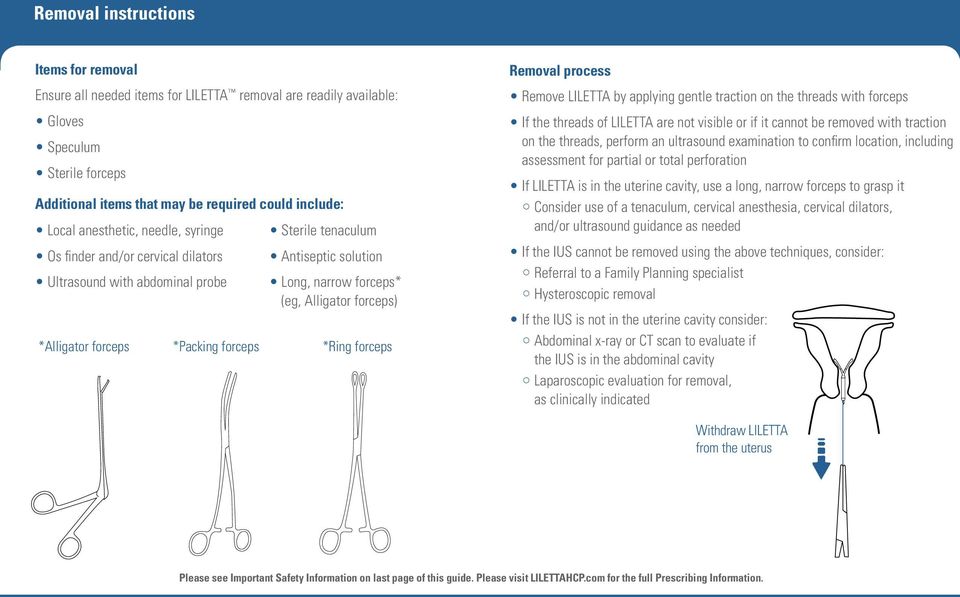
10 Removal instructions Items for removal Ensure all needed items for LILETTA removal are readily available: Gloves Speculum Sterile forceps Additional items that may be required could include: Local anesthetic, needle, syringe Sterile tenaculum Os finder and/or cervical dilators Antiseptic solution Ultrasound with abdominal probe Long, narrow forceps* (eg, Alligator forceps) *Alligator forceps *Packing forceps *Ring forceps Removal process Remove LILETTA by applying gentle traction on the threads with forceps If the threads of LILETTA are not visible or if it cannot be removed with traction on the threads, perform an ultrasound examination to confirm location, including assessment for partial or total perforation If LILETTA is in the uterine cavity, use a long, narrow forceps to grasp it Consider use of a tenaculum, cervical anesthesia, cervical dilators, and/or ultrasound guidance as needed If the IUS cannot be removed using the above techniques, consider: Referral to a Family Planning specialist Hysteroscopic removal If the IUS is not in the uterine cavity consider: Abdominal x-ray or CT scan to evaluate if the IUS is in the abdominal cavity Laparoscopic evaluation for removal, as clinically indicated Withdraw LILETTA from the uterus
11 Continuation of contraception after removal If pregnancy is not desired and if a woman wishes to continue using LILETTA, a new system can be inserted immediately after removal at any time during the cycle If a patient with regular cycles wants to start a different birth control method, time the removal and initiation of the new method to ensure continuous contraception. Either remove LILETTA during the first days of the menstrual cycle and start the new method or start the new method at least days prior to removing LILETTA if removal is to occur at other times during the cycle If LILETTA is removed but no other contraceptive method has already been started, the new contraceptive method can be started on the day LILETTA is removed. The patient should use a backup barrier method of contraception or abstain from vaginal intercourse for days to prevent pregnancy Please see Important Safety Information on last page of this guide. Please visit LILETTAHCP.com for the full Prescribing Information.
12 LILETTA IMPORTANT SAFETY INFORMATION Who is not appropriate for LILETTA Use of LILETTA is contraindicated in women with: known or suspected pregnancy and cannot be used for post-coital contraception; congenital or acquired uterine anomaly, including fibroids if they distort the uterine cavity; known or suspected breast cancer or other progestin-sensitive cancer, now or in the past; known or suspected uterine or cervical neoplasia; liver disease, including tumors; untreated acute cervicitis or vaginitis, including lower genital tract infections (eg, bacterial vaginosis) until infection is controlled; postpartum endometritis or infected abortion in the past 3 months; unexplained uterine bleeding; current IUD; acute pelvic inflammatory disease (PID) or history of PID (except with later intrauterine pregnancy); conditions increasing susceptibility to pelvic infection; or hypersensitivity to any component of LILETTA. Clinical considerations for use and removal of LILETTA Use LILETTA with caution after careful assessment in patients with coagulopathy or taking anticoagulants; migraine, focal migraine with asymmetrical visual loss, or other symptoms indicating transient cerebral ischemia; exceptionally severe headache; marked increase of blood pressure; or severe arterial disease such as stroke or myocardial infarction. Consider removing the intrauterine system if these or the following arise during use: uterine or cervical malignancy or jaundice. If LILETTA is displaced (eg, expelled or perforated the uterus), remove it. Pregnancy related risks with LILETTA If pregnancy should occur with LILETTA in place, remove the intrauterine system because leaving it in place may increase the risk of spontaneous abortion and preterm labor. Removal or manipulation may result in pregnancy loss. Evaluate women for ectopic pregnancy because the likelihood of a pregnancy being ectopic is increased with LILETTA. Tell women about the signs of ectopic pregnancy and associated risks, including loss of fertility. Women with a history of ectopic pregnancy, tubal surgery, or pelvic infection carry a higher risk of ectopic pregnancy. Educate her about PID IUDs have been associated with an increased risk of PID, most likely due to organisms being introduced into the uterus during insertion. Inform women about the possibility of PID and that PID can cause tubal damage leading to ectopic pregnancy or infertility, or infrequently can necessitate hysterectomy, or cause death. PID is often associated with sexually transmitted infections (STIs); LILETTA does not protect against STIs, including HIV. Expect changes in bleeding patterns with LILETTA Spotting and irregular or heavy bleeding may occur during the first 3 to months. Periods may become shorter and/or lighter thereafter. Cycles may remain irregular, become infrequent, or even cease. Consider pregnancy if menstruation does not occur within weeks of the onset of previous menstruation. Be aware of other serious complications and most common adverse reactions Some serious complications with IUDs like LILETTA are expulsion, sepsis, and perforation. Perforation may reduce contraceptive efficacy. The risk of perforation is higher if inserted in lactating women and may be higher if inserted in women who are postpartum or when the uterus is fixed retroverted. Ovarian cysts may occur and are generally asymptomatic, but may be accompanied by pelvic pain or dyspareunia. Evaluate persistent ovarian cysts. In the clinical trial of LILETTA the most common adverse reactions ( % users) were vaginal infections (13.%), vulvovaginal infections (13.3%), acne (12.3%), headache or migraine (.%), nausea or vomiting (.%), dyspareunia (.0%), abdominal pain or discomfort (.%), breast tenderness or pain (.%), pelvic discomfort or pain (.1%), depression or depressed mood (.4%), mood changes (.2%). Teach patients to recognize and immediately report signs or symptoms of the aforementioned conditions. Evaluate patients 4 to weeks after insertion of LILETTA and then yearly or more often if clinically indicated. Please visit LILETTAHCP.com for the full Prescribing Information. LILETTA and its design are trademarks of Odyssea Pharma SPRL, an Actavis affiliate. 201 Actavis Pharma, Inc., Parsippany, NJ 004 All rights reserved. LLT221 03/1 Printed in the USA.
LILETTA CODING UPDATE
 Considerations before submitting claims Considerations after submitting claims LILETTA CODING UPDATE BEGINNING JANUARY 1, 2016, THE HCPCS* CODE (J-CODE) APPROPRIATE FOR LILETTA IS CHANGING FROM J7302 TO
Medical criteria for IUCD s Based on the WHO MEC (2004- Annexure 3) system a woman s eligibility for IUCD insertion falls in 4 categories. These categ
 CLIENT ASSESSMENT Ensure that the woman is not pregnant Determine the length and direction of uterus. Ensure that she does not have gonorrhea and chlamydia, and is not a high risk case of STI s Identify
LIPPES LOOP TRADEMARK. your intrauterine contraceptive
 LIPPES LOOP TRADEMARK your intrauterine contraceptive LIPPES LOOP Patient Information This brochure provides information on the use of In trauterine Contraceptive Devices (lud s). There are other birth
This is Jaydess. Patient Information. What is Jaydess? How does Jaydess work?
 , Patient Information This is Jaydess We hope that this brochure will answer your questions and concerns about Jaydess. What is Jaydess? Jaydess is an intrauterine device consisting of a hormone capsule
Birth Control Options
 1 of 5 6/2/2014 9:46 AM Return to Web version Birth Control Options What is contraception? Contraception means preventing pregnancy, also called birth control. Most people know about options such as birth
MHRI IUD Protocol. Migraine with aura Current DVT or PE History of or current breast cancer Active viral hepatitis Severe cirrhosis or liver tumors
 Table of Contents A. Indications B. Contraindications C. Prior to Insertion D. Insertion E. Follow-Up Visit F. Removal G. Re-Insertion H. Complications/Side Effects I. Appendices MHRI IUD Protocol A. Indications
Effective long-lasting strategy to prevent unintended pregnancy. The intrauterine system for contraception after abortion.
 Effective long-lasting strategy to prevent unintended pregnancy. The intrauterine system for contraception after abortion. After the abortion I started re-thinking my birth control method. I am looking
PATIENTS SHOULD BE COUNSELED THAT THIS PRODUCT DOES NOT PROTECT AGAINST HIV INFECTION (AIDS) AND OTHER SEXUALLY TRANSMITTED DISEASES
 Mirena (levonorgestrel-releasing intrauterine system) PATIENTS SHOULD BE COUNSELED THAT THIS PRODUCT DOES NOT PROTECT AGAINST HIV INFECTION (AIDS) AND OTHER SEXUALLY TRANSMITTED DISEASES Rx only DESCRIPTION
HIGHLIGHTS OF PRESCRIBING INFORMATION
 HIGHLIGHTS OF PRESCRIBING INFORMATION These highlights do not include all the information needed to use MIRENA safely and effectively. See full prescribing information for MIRENA. MIRENA (levonorgestrel-releasing
Fadwa Almanakly, Pharm.D. Associate Director, Advertising and Promotions Bayer HealthCare Pharmaceuticals Inc. 6 West Belt Wayne, NJ 07470-6806
 DEPARTMENT OF HEALTH & HUMAN SERVICES Public Health Service Food and Drug Administration Silver Spring, MD 20993 TRANSMITTED BY FACSIMILE Fadwa Almanakly, Pharm.D. Associate Director, Advertising and Promotions
A Guide to Hysteroscopy. Patient Education
 A Guide to Hysteroscopy Patient Education QUESTIONS AND ANSWERS ABOUT HYSTEROSCOPY Your doctor has recommended that you have a procedure called a hysteroscopy. Naturally, you may have questions about
STANDARD APRN PROTOCOL FOR IUD INSERTION: Levonorgestrel (LNG) Releasing Intrauterine System
 STANDARD APRN PROTOCOL FOR IUD INSERTION: Levonorgestrel (LNG) Releasing Intrauterine System DEFINITION The LNG-releasing intrauterine systems (Mirena, Liletta and Skyla ) are on the market. The LNG-releasing
Uterine fibroids (Leiomyoma)
 Uterine fibroids (Leiomyoma) What are uterine fibroids? Uterine fibroids are fairly common benign (not cancer) growths in the uterus. They occur in about 25 50% of all women. Many women who have fibroids
PILLS & RING INFORMATION AND INSTRUCTIONS ON COMBINED HORMONAL CONTRACEPTION INCLUDING BIRTH CONTROL PILLS & NUVA RING
 PILLS & RING INFORMATION AND INSTRUCTIONS ON COMBINED HORMONAL CONTRACEPTION INCLUDING BIRTH CONTROL PILLS & NUVA RING What is combined hormonal contraception? Birth control which contains two hormones
Safe & Unsafe. abortion
 Safe & Unsafe Facts About abortion WHAT IS THE DIFFERENCE BETWEEN UNSAFE AND SAFE ABORTION? What is unsafe abortion? Unsafe abortion is a procedure for terminating an unplanned pregnancy either by a person
Copper-Bearing Intrauterine Device
 CHAPTER 9 Copper-Bearing Intrauterine Device This chapter describes primarily the TCu-380A intrauterine device (for the Levonorgestrel Intrauterine Device, see p. 157). Key Points for Providers and Clients
WOMENCARE A Healthy Woman is a Powerful Woman (407) 898-1500. Birth Control Pills
 Birth Control Pills WOMENCARE A Healthy Woman is a Powerful Woman (407) 898-1500 Birth control pills (also called oral contraceptives or "the pill") are used by millions of women in the United States to
This Protocol is adapted from the University of Colorado Protocol dated August 26, 2009.
 Protocol for Post-Placental IUD insertion July 14, 2010 This Protocol is adapted from the University of Colorado Protocol dated August 26, 2009. Background Post-placental intrauterine device (IUD) insertion
Abnormal Uterine Bleeding
 Abnormal Uterine Bleeding WOMENCARE A Healthy Woman is a Powerful Woman (407) 898-1500 Abnormal uterine bleeding is one of the most common reasons women see their doctors. It can occur at any age and has
Combination Birth Control Pills - FAQ
 Combination Birth Control Pills - FAQ How does the birth control pill work? prevents ovulation thickens cervical mucus, which makes it hard for sperm to enter the uterus thins the lining of the uterus,
Abnormal Uterine Bleeding FAQ Sheet
 Abnormal Uterine Bleeding FAQ Sheet What is abnormal uterine bleeding? Under normal circumstances, a woman's uterus sheds a limited amount of blood during each menstrual period. Bleeding that occurs between
FDA-Approved Patient Labeling IMPLANON (etonogestrel implant) Subdermal Use
 FDA-Approved Patient Labeling IMPLANON (etonogestrel implant) Subdermal Use IMPLANON does not protect against HIV infection (the virus that causes AIDS) or other sexually transmitted diseases. Read this
EARLY PREGNANCY LOSS A Patient Guide to Treatment
 EARLY PREGNANCY LOSS A Patient Guide to Treatment You have a pregnancy that has stopped growing, or you have started to miscarry and the process has not completed. If so, there are four ways to manage
Laparoscopy and Hysteroscopy
 AMERICAN SOCIETY FOR REPRODUCTIVE MEDICINE Laparoscopy and Hysteroscopy A Guide for Patients PATIENT INFORMATION SERIES Published by the American Society for Reproductive Medicine under the direction of
All methods of birth control are MUCH SAFER than being pregnant! If 100 women use each method for a year, how many of them get pregnant?
 The Correct Use of Birth Control: In order for any method of birth control to be effective, it must be used correctly ALL THE TIME. This means: One condom every time you have sex One pill every day One
Heavy menstrual bleeding and what you can do about it!
 Heavy menstrual bleeding and what you can do about it! The intrauterine system as an alternative to hysterectomy. What is heavy menstrual bleeding? Do I have it? A woman s menstrual periods are considered
Young Women and Long-Acting Reversible Contraception. Safe, Reliable, and Cost-Effective Birth Control
 ISSUES AT A GLANCE Young Women and Long-Acting Reversible Contraception Safe, Reliable, and Cost-Effective Birth Control In 2012, the American College of Obstetricians and Gynecologists (ACOG) revised
Information for you Abortion care
 Information for you Abortion care Published in February 2012 This information is for you if you are considering having an abortion. It tells you: how you can access abortion services the care you can expect
Copper intra-uterine device (IUD)
 Oxford University Hospitals NHS Trust Copper intra-uterine device (IUD) Page What is an inter-uterine device? 3 How does it work? 4 Would an IUD be suitable for me? 5 Are there any risks or complications?
implant contraceptiv contraceptive contraceptive raceptiv contraceptive implant contraceptive contraceptive ontraceptive implant ontraceptive im
 your guide to the contraceptive implant Helping you choose the method of contraception that is best for you contra ontraceptive im contraceptive implant mpl ceptive contraceptive contracepti ntraceptive
Hysterosalpingography
 Scan for mobile link. Hysterosalpingography Hysterosalpingography uses a real-time form of x-ray called fluoroscopy to examine the uterus and fallopian tubes of a woman who is having difficulty becoming
Treating heavy menstrual bleeding caused by fibroids or polyps
 Treating heavy menstrual bleeding caused by fibroids or polyps With today s medical advances the outlook for successful treatment of fibroids and polyps has never been better. You don t have to live with
Clinical Interruption of Pregnancy (Medical/Surgical Abortion)
 Clinical Interruption of Pregnancy (Medical/Surgical Abortion) Approximately one fifth of all pregnancies in the United States end in abortion (Ventura et al., 2009). According to the CDC (2011a), there
About the Uterus. Hysterectomy may be done to treat conditions that affect the uterus. Some reasons a hysterectomy may be needed include:
 Hysterectomy removal of the uterus is a way of treating problems that affect the uterus. Many conditions can be cured with hysterectomy. Because it is major surgery, your doctor may suggest trying other
NORTHAMPTONSHIRE INTEGRATED SEXUAL HEALTH SERVICES IUD/IUS PROTOCOL
 NORTHAMPTONSHIRE INTEGRATED SEXUAL HEALTH SERVICES IUD/IUS PROTOCOL Policy Details NHFT document reference MMPr005 Version Final Date Ratified 19.01.16 Ratified by Medicines Management Committee Implementation
Anatomy and Physiology of Human Reproduction. Module 10a
 This work is licensed under a Creative Commons Attribution-NonCommercial-ShareAlike License. Your use of this material constitutes acceptance of that license and the conditions of use of materials on this
Heavy periods (menstrual bleeding)
 Heavy periods (menstrual bleeding) This information sheet has been given to you to help answer some of the questions you may have about heavy periods and the treatments that are available. This leaflet
Specimen collection and transport for Chlamydia trachomatis and Neisseria gonorrhoeae testing
 Specimen collection and transport for Chlamydia trachomatis and Neisseria gonorrhoeae testing Overview Chlamydia trachomatis (CT) and Neisseria gonorrhoeae (NG) infections are two of the most common sexually
MULTILOAD Radio-Opaque Intrauterine Contraceptive Devices
 NEW ZEALAND DATA SHEET MULTILOAD Radio-Opaque Intrauterine Contraceptive Devices Presentation MULTILOAD consists of a small plastic rod wound with copper wire and provided with two flexible arms and a
IUD training principles 2013
 IUD training principles 2013 Introduction These principles were developed in 2011 2012 by representatives and members of the following organisations: Sexual Health and Family Planning Australia (SHFPA)
Acute pelvic inflammatory disease: tests and treatment
 Acute pelvic inflammatory disease: tests and treatment Information for you Information for you Published August 2010 Published in August 2010 (next review date: 2014) Acute What is pelvic inflammatory
Emergency Contraceptive Pills
 There are many different forms of birth control available in Canada, many of which we will discuss in this booklet. There is no way to determine which is the best form of birth control, because each person
THE WELL. Intrauterine Contraceptive Devices WOMAN CENTRE
 THE WELL WOMAN CENTRE Intrauterine Contraceptive Devices INTRAUTERINE CONTRACEPTIVE DEVICES How does the Mirena work? How effective is the Mirena? What are the advantages of the Mirena? What are the disadvantages
Facts for Women Termination of pregnancy, abortion, or miscarriage management
 Patient Education Facts for Women Termination of pregnancy, abortion, or miscarriage management This handout answers common questions about miscarriage management and the termination of a pregnancy, also
vagina vaginal r vaginal ring vaginal vaginal ring aginal ring vaginal ring vaginal ring vaginal ring the contraceptive vaginal rin vaginal ring
 your guide to the contraceptive vaginal ring Helping you choose the method of contraception that is best for you vagina vaginal ring vaginal r vaginal ring vaginal ring vaginal rin vaginal aginal ring
The intrauterine contraceptive
 The Practitioner Le praticien The occasional intrauterine contraceptive device insertion Peter Hutten-Czapski, MD Haileybury, Ont. James Goertzen, MD Thunder Bay, Ont. Correspondence to: Dr. Peter Hutten-Czapski,
contraception contraception contraception contracepti contraception contraception contraception aception contraception contraception contraception
 your guide to Helping you choose the method of that is best for you raception aception contracept contracepti contracep contracepti Your guide to This leaflet shows the available contraceptive methods,
Women s Health Laparoscopy Information for patients
 Women s Health Laparoscopy Information for patients This leaflet is for women who have been advised to have a laparoscopy. It outlines the common reasons doctors recommend this operation, what will happen
NovaSure: A Procedure for Heavy Menstrual Bleeding
 NovaSure: A Procedure for Heavy Menstrual Bleeding The one-time, five-minute procedure Over a million women 1 have been treated with NovaSure. NovaSure Endometrial Ablation (EA) is the simple, one-time,
Ovarian Cyst. Homoeopathy Clinic. Introduction. Types of Ovarian Cysts. Contents. Case Reports. 21 August 2002
 Case Reports 21 August 2002 Ovarian Cyst Homoeopathy Clinic Check Yourself If you have any of the following symptoms call your doctor. Sense of fullness or pressure or a dull ache in the abdomen Pain during
MULTILOAD cu 250 / cu 375
 MULTILOAD cu 250 / cu 375 CE 0336 Read all of this leaflet carefully before you decide to have Multiload Radiopaque inserted. This leaflet provides information that may help you in your decision to start
WOMENCARE A Healthy Woman is a Powerful Woman (407) 898-1500. Endometriosis
 Endometriosis WOMENCARE A Healthy Woman is a Powerful Woman (407) 898-1500 The lining of the uterus is called the endometrium. Sometimes, endometrial tissue grows elsewhere in the body. When this happens
Gynecology Abnormal Pelvic Anatomy and Physiology: Cervix. Cervix. Nabothian cysts. cervical polyps. leiomyomas. Cervical stenosis
 Gynecology Abnormal Pelvic Anatomy and Physiology: (Effective February 2007) pediatric, reproductive, and perimenopausal/postmenopausal (24-28 %) Cervix Nabothian cysts result from chronic cervicitis most
% of Women Experiencing an Accidental Pregnancy within. Depo Provera 0.3 0.3 70 Norplant
 ParaGard T 80A INTRAUTERINE COPPER CONTRACEPTIVE P/N 101700 Rev. /14 Rx only PRESCRIBING INFORMATION Patients should be counseled that this product does not protect against HIV infection (AIDS) and other
Objective. Indications for IUDs. IUDs 3 types. ParaGard IUD. Mirena IUD. Sonographic Evaluation of Intrauterine Devices (IUDs) Inert
 Sonographic Evaluation of Intrauterine Devices (IUDs) Anna S. Lev-Toaff, MD FACR Department of Radiology Hospital of the University of Pennsylvania Philadelphia, Pennsylvania Leading Edge in Diagnostic
Glossary. amenorrhea, primary - from the beginning and lifelong; menstruation never begins at puberty.
 Glossary amenorrhea - absence or cessation of menstrual periods. amenorrhea, primary - from the beginning and lifelong; menstruation never begins at puberty. A amenorrhea, secondary - due to some physical
abortion your questions answered
 abortion your questions answered About Marie Stopes International Marie Stopes International is a specialist reproductive healthcare organisation and a registered charity working in both the UK and overseas.
Outpatient hysteroscopy
 Women s & Children s Outpatient hysteroscopy Information for patients Welcome to King s gynaecology service. The doctor who saw you in the outpatient clinic recently has recommended that you have a procedure
OVARIAN CYSTS. Types of Ovarian Cysts There are many types of ovarian cysts and these can be categorized into functional and nonfunctional
 OVARIAN CYSTS Follicular Cyst Ovarian cysts are fluid-filled sacs that form within or on the ovary. The majority of these cysts are functional meaning they usually form during a normal menstrual cycle.
WHAT YOU SHOULD KNOW ABOUT ABORTION
 WHAT YOU SHOULD KNOW ABOUT ABORTION It is the public policy of the state of Idaho to prefer live childbirth over abortion: "The Supreme Court of the United States having held that the states have a "profound
the abortion pill by David Hager, M.D.
 the abortion pill by David Hager, M.D. A positive pregnancy test is one of the most life-changing moments for a woman. Never is it more important to base your decisions on accurate information. Try to
abortion abortion abortion abortion abortion abortion abortion on abortio abortion ortion abortion abortion abortion abortion abortio
 Abortion Your questions answered abortio bortion ion ortion on abortio 2 Are you pregnant but not sure you want to have the baby? Do you need more information about your pregnancy choices? Unplanned pregnancy
What Athletic Trainers Need to Know About Gynecology
 What Athletic Trainers Need to Know About Gynecology Mona M. Shangold,, M.D. Director The Center for Women s Health and Sports Gynecology Philadelphia, PA Main Topics Normal development and function Effects
WHAT YOU SHOULD KNOW ABOUT ABORTION
 WHAT YOU SHOULD KNOW ABOUT ABORTION It is the public policy of the state of Idaho to prefer live childbirth over abortion: "The Supreme Court of the United States having held that the states have a "profound
CHAPTER 10 Uterine Synechiae
 CHAPTER 10 Uterine Synechiae Uterine synechiae are intrauterine adhesions. They may involve small focal areas of the endometrium (Figures 10.1a e), or they can be so extensive that they obliterate the
Mirena prescribing information
 Mirena prescribing information This provides medical and scientific information on Mirena in general. Please refer to the local Summary of Product Characteristics for the information applicable in your
Out-patient hysteroscopy. Information for patients
 Out-patient hysteroscopy Information for patients Important If there is any chance you may be pregnant please tell a member of the team immediately. We will not be able to perform a hysteroscopy if you
Artificial insemination with donor sperm
 Artificial insemination with donor sperm Ref. 123 / 2009 Reproductive Medicine Unit Servicio de Medicina de la Reproducción Gran Vía Carlos III 71-75 08028 Barcelona Tel. (+34) 93 227 47 00 Fax. (+34)
Preventing unsafe abortion
 Preventing unsafe abortion Fact sheet N 388 March 2014 Key facts Around 22 million unsafe abortions are estimated to take place worldwide each year, almost all in developing countries. Deaths due to unsafe
Combined Oral Contraceptives
 CHAPTER Combined Oral Contraceptives Key Points for Providers and Clients y Take one pill every day. For greatest effectiveness a woman must take pills daily and start each new pack of pills on time. y
the IUD the IUD the IUD the IUD the IUD the IUD the IUD the IUD the IUD the IUD the IUD the IUD the IUD your guide to
 your guide to Helping you choose the method of contraception that is best for you IUD IUD the e IUD IU IUD the IUD 2 The intrauterine device (IUD) An IUD is a small plastic and copper device that is put
progestog progestogen stogen-only pill progestogen progestogen-only pill he progestogen-only pill progestogen-onl progestogen-o the progestogenonly
 your guide to the progestogenonly pill Helping you choose the method of contraception that is best for you the progestogen rogestogen-only the progestogen-only pill progestogen-only pill stogen-only progestoge
7 Intrauterine devices
 7 Intrauterine devices Meera Kishen Chapter contents Types of intrauterine device 111 Framed copper devices 112 Frameless copper devices 112 Mode of action 113 Effectiveness 114 Advantages 114 Compliance
Ask us about LARC. LARC stands for Long Acting Reversible Contraception. Types of LARC are: Contraceptive implant IUS IUD Contraceptive injection
 Ask us about LARC LARC stands for Long Acting Reversible Contraception. Types of LARC are: Contraceptive implant IUS IUD Contraceptive injection visit our website Long Acting Reversible Contraception (LARC)
CONSUMER INFORMATION IMPORTANT: PLEASE READ
 CONSUMER INFORMATION Pr MICRONOR norethindrone tablets, USP This leaflet is designed specifically for Consumers. This leaflet is a summary and will not tell you everything about MICRONOR. Contact your
OUTPATIENT HYSTEROSCOPY SERVICES JASMINE SUITE
 OUTPATIENT HYSTEROSCOPY SERVICES JASMINE SUITE Information Leaflet Your Health. Our Priority. Page 2 of 6 This information is for patients having a hysteroscopy (diagnostic or operative). It explains what
IUD Complications: Management Strategies
 IUD Complications: Management Strategies Contraceptive Technology April 19, 2013 Mark Hathaway MD, MPH Dept of Ob/Gyn Washington Hospital Center Washington DC Learning Objectives Learn IUD placement techniques
Ovarian Cystectomy / Oophorectomy
 Cystectomy and Ovarian Cysts Ovarian cysts are sacs filled with fluids or pockets located on or in an ovary. In some cases, these cysts need to be removed surgically. Types of Cysts Ovarian cysts are quite
Hysterectomy. What is a hysterectomy? Why is hysterectomy done? Are there alternatives to hysterectomy?
 ROBERT LEVITT, MD JESSICA BERGER-WEISS, MD ADRIENNE POTTS, MD HARTAJ POWELL, MD, MPH COURTNEY LEVENSON, MD LAUREN BURNS, MSN, RN, WHNP OBGYNCWC.COM What is a hysterectomy? Hysterectomy Hysterectomy is
Post-Coital Hormonal Contraception Instructions for Use of Plan B, Plan B One-Step, Next Choice One Dose, My Way, Generic Levonorgestrel and Ella
 Post-Coital Hormonal Contraception Instructions for Use of Plan B, Plan B One-Step, Next Choice One Dose, My Way, Generic Levonorgestrel and Ella Several options for emergency birth control exist for women
injections injections injections injections injections injection injections injections injections tions njections injections injections injections
 your guide to contraceptive Helping you choose the method of contraception that is best for you ions ections injection njections injection tions 2 Contraceptive Contraceptive contain a progestogen hormone
Intrauterine Device (IUD) THE FACTS
 Intrauterine Device (IUD) Quick Facts Effectiveness in Preventing Pregnancy: Use: Of 100 women using IUDs for a year, about one may become pregnant. IUDs are better at preventing pregnancy than condoms,
VOLUNTARY ABORTION. Follow us on
 VOLUNTARY ABORTION Follow us on TABLE OF CONTENT 1. INTRODUCTION... 4 2. STAGES OF PROCESS... 5 2.1 Pre-procedure... 5 2.2 The procedure... 5 2.3 Post-procedure rest... 7 3. RISKS AND POSSIBLE COMPLICATIONS...
FEMALE ANATOMY. the Functions of the Female Organs
 FEMALE ANATOMY the Functions of the Female Organs An educational video for every woman who is told she needs pelvic surgery, including exploratory surgery or removal of the uterus, fallopian tubes, or
Family Planning for Women and Couples following Fistula Repair
 Family Planning for Women and Couples following Fistula Repair Fistula Care at EngenderHealth 440 Ninth Avenue, 13th Floor New York, NY, USA 10001 Tel: 212-561-8000 E-mail: [email protected]
Uterine Fibroid Symptoms, Diagnosis and Treatment
 Fibroids and IR Uterine Fibroid Symptoms, Diagnosis and Treatment Interventional radiologists use MRIs to determine if fibroids can be embolised, detect alternate causes for the symptoms and rule out misdiagnosis,
A potential treatment for your abnormal uterine bleeding
 TRUCLEAR System A potential treatment for your abnormal uterine bleeding Do You Suffer from Abnormal Uterine Bleeding? What is a Hysteroscopy? What is the TRUCLEAR Procedure? What Happens Before Your
ency emergency contra-
 your guide to emergency contraception Helping you choose the method of contraception that is best for you emergency cont gency contrace emergency contraception ency emergency contra- emergen mergency contraception
Transvaginal Endoscopy TVE GYN 18 7.0 02/2015-E
 Transvaginal Endoscopy TVE GYN 18 7.0 02/2015-E TRANSVAGINAL ENDOSCOPY Leuven Institute for Fertility and Embryology Prof. Dr. S. Gordts, Dr. R. Campo, Dr. P. Puttemans, Prof. Em. Dr. I. Brosens 2 Transvaginal
Sterilisation for women and men: what you need to know
 Sterilisation for women and men: what you need to know Published January 2004 by the RCOG Contents Page number Key points 1 About this information 2 What are tubal occlusion and vasectomy? 2 What do I
FDA-Approved Patient Labeling
 FDA-Approved Patient Labeling Guide for Using Lo Loestrin Fe WARNING TO WOMEN WHO SMOKE Do not use Lo Loestrin Fe if you smoke cigarettes and are over 35 years old. Smoking increases your risk of serious