
IPC/WHMA-A-620B. Requirements and Acceptance for Cable and Wire Harness Assemblies. Final Draft for Industry Review February 2012
|
|
|
- Barry Walters
- 9 years ago
- Views:
Transcription
1 IPC/WHMA-A-620B Requirements and Acceptance for Cable and Wire Harness Assemblies Final Draft for Industry Review February 2012 Illustrations and text are copyright IPC and may be copied only for use in development of IPC/WHMA-A-620 Revision B. 1-1

2

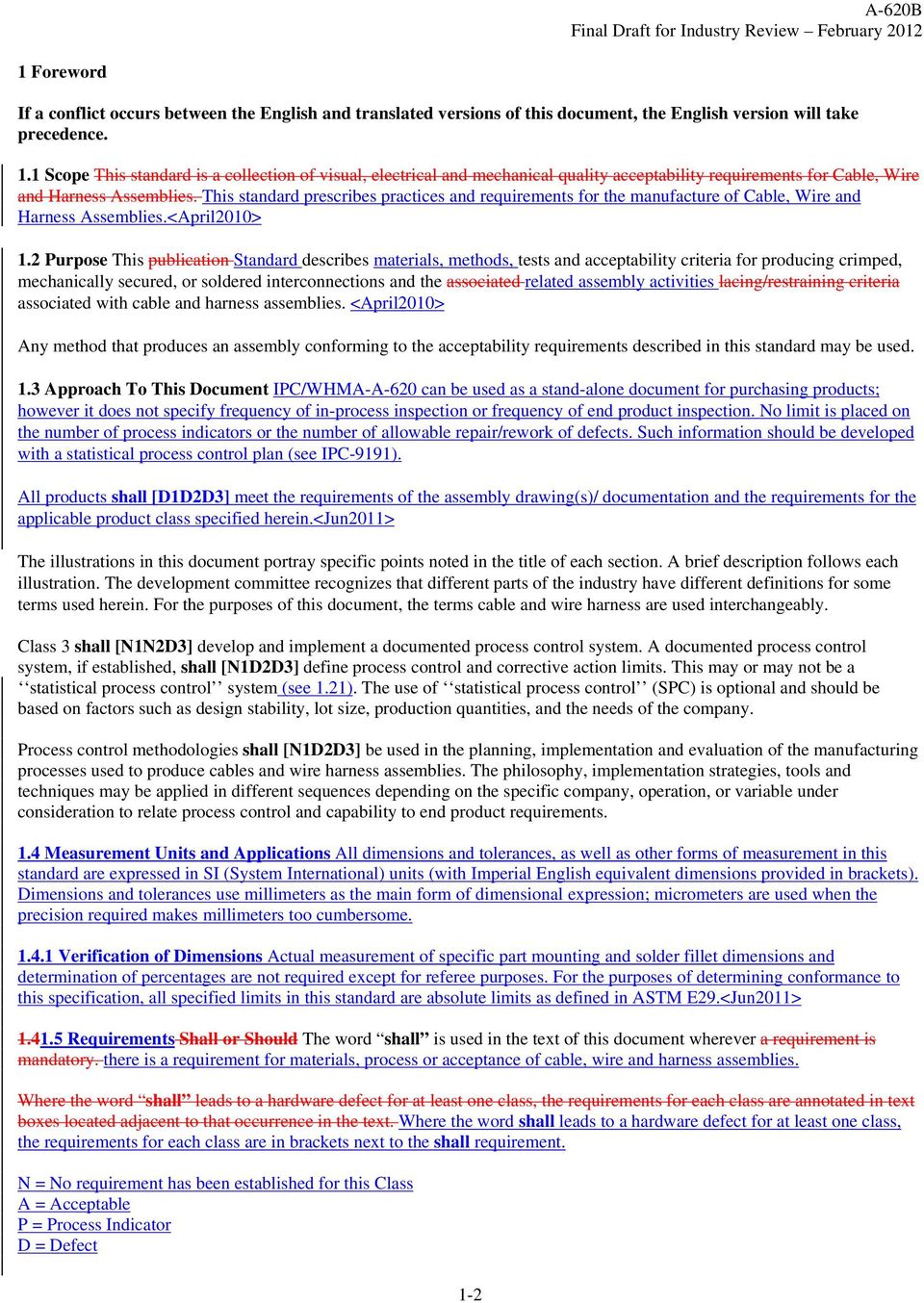
3 1 Foreword If a conflict occurs between the English and translated versions of this document, the English version will take precedence. 1.1 Scope This standard is a collection of visual, electrical and mechanical quality acceptability requirements for Cable, Wire and Harness Assemblies. This standard prescribes practices and requirements for the manufacture of Cable, Wire and Harness Assemblies.<April2010> 1.2 Purpose This publication Standard describes materials, methods, tests and acceptability criteria for producing crimped, mechanically secured, or soldered interconnections and the associated related assembly activities lacing/restraining criteria associated with cable and harness assemblies. <April2010> Any method that produces an assembly conforming to the acceptability requirements described in this standard may be used. 1.3 Approach To This Document IPC/WHMA-A-620 can be used as a stand-alone document for purchasing products; however it does not specify frequency of in-process inspection or frequency of end product inspection. No limit is placed on the number of process indicators or the number of allowable repair/rework of defects. Such information should be developed with a statistical process control plan (see IPC-9191). All products shall [D1D2D3] meet the requirements of the assembly drawing(s)/ documentation and the requirements for the applicable product class specified herein.<jun2011> The illustrations in this document portray specific points noted in the title of each section. A brief description follows each illustration. The development committee recognizes that different parts of the industry have different definitions for some terms used herein. For the purposes of this document, the terms cable and wire harness are used interchangeably. Class 3 shall [N1N2D3] develop and implement a documented process control system. A documented process control system, if established, shall [N1D2D3] define process control and corrective action limits. This may or may not be a statistical process control system (see 1.21). The use of statistical process control (SPC) is optional and should be based on factors such as design stability, lot size, production quantities, and the needs of the company. Process control methodologies shall [N1D2D3] be used in the planning, implementation and evaluation of the manufacturing processes used to produce cables and wire harness assemblies. The philosophy, implementation strategies, tools and techniques may be applied in different sequences depending on the specific company, operation, or variable under consideration to relate process control and capability to end product requirements. 1.4 Measurement Units and Applications All dimensions and tolerances, as well as other forms of measurement in this standard are expressed in SI (System International) units (with Imperial English equivalent dimensions provided in brackets). Dimensions and tolerances use millimeters as the main form of dimensional expression; micrometers are used when the precision required makes millimeters too cumbersome Verification of Dimensions Actual measurement of specific part mounting and solder fillet dimensions and determination of percentages are not required except for referee purposes. For the purposes of determining conformance to this specification, all specified limits in this standard are absolute limits as defined in ASTM E29.<Jun2011> Requirements Shall or Should The word shall is used in the text of this document wherever a requirement is mandatory. there is a requirement for materials, process or acceptance of cable, wire and harness assemblies. Where the word shall leads to a hardware defect for at least one class, the requirements for each class are annotated in text boxes located adjacent to that occurrence in the text. Where the word shall leads to a hardware defect for at least one class, the requirements for each class are in brackets next to the shall requirement. N = No requirement has been established for this Class A = Acceptable P = Process Indicator D = Defect 1-2
4 Examples: [A1P2D3] is Acceptable Class 1, Process Indicator Class 2 and Defect Class 3 [N1D2D3] is Requirement Not Establish Class 1, Defect Classes 2 and 3 [A1A2D3] is Acceptable Classes 1 and 2, Defect Class 3 [D1D2D3] is Defect for all Classes. 1-3 A-620B A defect for a Class 1 product means that the characteristic is also a defect for Class 2 and 3. A defect for a Class 2 product means that the characteristic is also a defect for a Class 3 product, but may not be a defect for a Class 1 product where less demanding criteria may apply. When this standard doesn t provide acceptance criteria for a specific class, the text box will note Not Est. for that class; see 1.5. The word should reflects recommendations and is used to reflect general industry practices and procedures for guidance only Uncommon or Specialized Designs IPC/WHMA-A-620, as an industry consensus document, cannot address all of the possible product design combinations. However, the standard does provide criteria for commonly used technologies. Where uncommon or specialized technologies are used, it may be necessary to develop unique acceptance criteria. The development of unique criteria should include user involvement or consent and the criteria developed should include an agreed upon definition for acceptance of each characteristic.the development should include user involvement. The acceptance criteria shall [N1N2D3] have user agreement. Requirements for specialized processes and/or technologies not specified herein shall [N1D2D3] be performed in accordance with documented procedures which are available for review.<april2010> Whenever possible, new criteria or criteria on specialized products should be submitted, using the Standard Improvement Form included in this standard, to the IPC Technical Committee to be considered for inclusion in upcoming revisions of this standard Terms And Definitions Terms are consistent with the definitions provided by IPC-T-50. For the understanding of this document, selected definitions pertaining specifically to cable and wire harness manufacturing are listed below and in Appendix A. Inspection An evaluation of quality characteristics relating to a standard, specification, or design drawing.<jun2011> Manufacturer (Assembler) - The individual, organization, or company responsible for the assembly process and verification operations necessary to ensure full compliance of assemblies to this standard. Objective Evidence - Documentation in the form of hard copy, computer data, video, or other media. Process Control - A system or method to continually steer an operation in reducing variation in the processes or products to meet or exceed the goal in quality and performance. Supplier - The individual, organization or company which provides to the manufacturer (assembler) components (cables, wire harnesses, electronic, electromechanical, mechanical, printed boards, etc.) and/or materials (solder, flux, cleaning agents, etc.). User The individual, organization, company, contractually designated authority or agency responsible for the procurement of electrical/ electronic hardware, cables and wire harnesses, etc. and having the authority to define the class of product and any variation or restrictions to the requirements of this standard (i.e., the originator/custodian of the contract detailing these requirements). Wire Diameter (D) In this document, the outside diameter of the wire, including insulation if present Classes of Product Use of this standard requires agreement on the class to which the product belongs. If the user and manufacturer do not establish and document the acceptance class, the manufacturer may do so. Thus, Accept and/or reject decisions must shall [D1D2D3] be based on applicable documentation such as contracts, drawings, specifications, standards and reference documents. Criteria defined in this standard reflect three Product Classes, which are as follows:

5 Class 1 General Electronic Products Includes products suitable for applications where the major requirement is the function of the completed assembly. Class 2 Dedicated Service Electronic Products Includes products where continued performance and extended life is required, and for which uninterrupted service is desired but not critical. Typically, the end-use environment would not cause failures. Class 3 High Performance Electronic Products Includes products where continued performance or performance-on-demand is critical, equipment downtime cannot be tolerated, end-use environment may be uncommonly harsh, and the equipment must function when required, such as life support systems and other critical systems Order of Precedence Document Hierarchy In the event of conflict, the following order of precedence applies: 1. Procurement as agreed between user and manufacturer. 2. Master drawing or master assembly drawing reflecting the user s detailed requirements. 3. When invoked by the user or per contractual agreement, IPC/WHMA-A Other documents to extent specified by the user. The developing committee recognizes that some requirements in IPC/WHMA-A-620 differ from those in other industry standards such as IPC-A-610 and J-STD-001. When IPC/WHMA-A-620 is cited or required by contract as a stand-alone document for inspection and/or acceptance, the requirements of J-STD-001 Requirements for Soldered Electrical and Electronic Assemblies or IPC-A-610 Acceptability of Electronic Assemblies do not apply unless separately and specifically required. When IPC/WHMA-A-620, J-STD-001, IPC-A-610 and/or other related documents are cited, the order of precedence is to be defined in the procurement documents. The user (customer) has the opportunity to specify alternate acceptance criteria Requirements Flowdown <Apr2010>When this standard is contractually required, the applicable requirements of this standard (including product class - see 1.3) shall [D1D2D3] be imposed on all applicable subcontracts, assembly drawing(s), documentation and purchase orders. Unless otherwise specified the requirements of this standard are not imposed on the procurement of commercial-off-the-shelf (COTS or catalog) assemblies or subassemblies. When a part is adequately defined by a specification, then the requirements of this standard should be imposed on the manufacture of that part only when necessary to meet end-item requirements. When it is unclear where flowdown should stop, it is the responsibility of the manufacturer to establish that determination with the user. When an assembly is procured, that assembly should meet the requirements of this standard. If the assembly is manufactured by the same manufacturer, the solder requirements are as stated in the contract for the entire assembly Personnel Proficiency All instructors, operators, and inspection personnel shall [N1D2D3] be proficient in the tasks to be performed. Objective evidence of that proficiency shall [N1D2D3] be maintained and available for review. Objective evidence should include records of training to the applicable job functions being performed, work experience, testing to the requirements of this standard, and/or results of periodic reviews of proficiency. Supervised on-the-job training is acceptable until proficiency is demonstrated.<jun2011> 1.12 Facilities Work areas shall [D1D2D3] be maintained at levels that prevent contamination or deterioration of tools, materials, and work surfaces. Eating, drinking, and/or use of tobacco products shall [D1D2D3] be prohibited in the work area. When processing ESD sensitive assemblies, the manufacturer shall [N1D2D3] verify that electrostatic discharge control is adequate when humidity decreases to a level of 30% or lower, see For operator comfort, solderability maintenance or to help mitigate red plague (see XXX), the temperature should be maintained between 18 C [64.4 F] and 30 C [86 F] and the relative humidity should not exceed 70%. For process control, more restrictive temperature and humidity limits may be required. 1-4

6 Note: The use of some materials and processes used to meet the requirements of this standard may be hazardous, or may cause injury. To provide for personnel and environmental safety, follow the applicable plant requirements and government regulations Field Assembly Operations In field Assembly operations where the controlled environmental conditions required by this standard cannot be effectively achieved, precautions shall [N1D2D3] be taken to minimize the effects of the uncontrolled environment on the operation being performed on the hardware Tools and Equipment Control<Mar2011> Each manufacturer shall [D1D2D3]: a. Select tools to be used for crimping, cabling, wiring, measuring, soldering, inspecting and in work preparation areas appropriate to the intended function. b. Clean and properly maintain all tools and equipment. c. Examine all elements of tools for physical damage. d. Prohibit unauthorized, defective, or uncalibrated tools in the work area. e. Document detailed operating procedures and maintenance schedules for tools and equipment requiring calibration or setups. f. Maintain records of tool and equipment calibration and functional testing. g. Assure test fixtures, test adapters, and test equipment are maintained to assure the integrity of the test. h. Assure process tooling and process equipment are maintained to assure acceptability of the product. i. Assure lead/wire cutting tools do not impart shock that causes damage.<jun2011> Soldering irons, equipment, and systems shall [D1D2D3] be chosen and employed to provide temperature control and isolation from electrical overstress or ESD when ESD sensitive parts or assemblies are involved. <Jun2011> Calibration Torque tools, measuring equipment, and mechanical and electrical test equipment (including contact retention testers) shall [N1D2D3] be calibrated. Crimping tools shall [N1D2D3] be calibrated or validated using a documented process.<jun2011> The manufacturer shall [D1D2D3] have a documented calibration system in accordance with ANSI/NCSL Z540-1 or other National or International standard. The minimum standard shall [D1D2D3] be assure: a. Measurement standards used for calibrating tools are traceable to National Institute of Standards and Technology (NIST) or other National or International standard. Calibration of tools is performed in an environment compatible with the environmental requirements of the tools. b. Calibration intervals are based on the type of tool and records of the tool's calibration. Intervals may be lengthened or shortened on the basis of stability demonstrated over previous calibration periods. c. Procedures are generated and utilized for the calibration of all tooling stated herein. Procedures include, as a minimum, standards to be used, parameters to be measured, accuracy, tolerances, environmental factors, and steps in the calibration process. The procedures may be the supplier s specifications if judged adequate, and need not therefore be rewritten, but are documented. d. Records are maintained that document calibration. e. Tools are labeled to indicate, as a minimum: (1) Date of calibration. (2) Calibration due date. (3) Any limitation of use. If not practical to place the label directly on the tool, then the label is affixed to the tool container or other location as documented in the procedures. (4) Tool identification Materials and Processes The materials and processes used to assemble/manufacture cable and wire harness assemblies shall [D1D2D3] be selected such that their combinations produce products acceptable to this standard. When major elements of the proven processes are changed (e.g., flux, cleaning media or system, soldering system, tooling, marking, etc.) validation of the acceptability of the change(s) shall [N1N2D3] be performed and documented. Limited shelf life items shall [D1D2D3] be stored and controlled in accordance with material manufacturer s recommendations, or in accordance with the Supplier s documented procedures for controlling shelf life and shelf life 1-5
![1 Field Assembly Operations In field Assembly operations where the controlled environmental conditions required by this standard cannot be effectively achieved, precautions shall [N1D2D3] be taken to](/docs-images/44/20035771/images/page_6.jpg "minimize the effects of the uncontrolled environment on the operation being performed on the hardware. 1.9 1.13 Tools and Equipment 1.13.1 Control<Mar2011> Each manufacturer shall [D1D2D3]: a.")
7 extensions. The material specification or other documented procedure shall [D1D2D3] be followed for mixing and curing. Material shall [D1D2D3] be used within the pot life (working time) specified by the material supplier or used within the time period indicated by a documented system. When curing conditions (temperature, time, infrared (IR) intensity, etc.) vary from the material manufacturer s recommended instructions, they shall [D1D2D3] be documented and available for review. Equipment used for measuring viscosity, mixing, applying and curing silicone material shall not [D1D2D3] be used for processing other material Figures and Illustrations Many of the examples (figures) shown are grossly exaggerated to clearly depict the condition being described. In the case of a discrepancy, the written description or written criteria always takes precedence over the illustrations Defects and Process Indicators Characteristics or conditions that do not conform to the requirements of this standard that are detectable by inspection or analysis are classified as either defects or process indicators. Not all process indicators are specified by this standard. Process indicators should be monitored but the hardware needs not be dispositioned, see It is the responsibility of the user to define unique defect categories applicable to the product. It is the responsibility of the manufacturer to identify defects and process indicators that are unique to the assembly process Inspection Conditions For each section of this document, target, acceptable and defect conditions are listed for each product class. Where applicable, process indicator conditions are also listed. The inspector shall not [D1D2D3] select the product class for the assembly under inspection. Documentation that specifies the applicable class for the assembly under inspection shall [D1D2D3] be provided to the inspector. The descriptions of these conditions follow Target A condition that is close to perfect (in the past has sometimes been labeled as "preferred ). It is a desirable condition, not always achievable, and may not be necessary to ensure reliability of the assembly in its service environment Acceptable This characteristic indicates a condition that, while not necessarily perfect, will maintain the integrity and reliability of the assembly in its service environment Process Indicator A process indicator is a condition (not a defect) that identifies a characteristic that does not affect the form, fit, function or reliability of a product. Such condition is a result of material, design and/or operator/machine related causes that create a condition that neither fully meets the acceptance criteria nor is a defect. Process indicators should be monitored as part of the process control system. If the number of process indicators indicates an abnormal variation in the process, identifies an undesirable trend, or displays other conditions that indicate the process is (or is approaching) out of control, the process shall [N1N2D3] be analyzed. This may result in action to reduce the variation and improve yields. Disposition of individual process indicators is not required and affected product should be used as is. Not all process indicators are specified by this standard. It is the responsibility of the manufacturer to identify process indicators that are unique to the assembly process Defect A defect is a condition that fails to meet the acceptance criteria of this document and negatively affects the form, fit or function, of the assembly in its end use environment. The manufacturer shall [DN1D2D3] document and disposition each defect. <Jun2011> It is the responsibility of the manufacturer to identify defects that are unique to the assembly process. It is the responsibility of the user to define unique defect categories applicable to the product Disposition Disposition is the determination of how defects should be treated. Dispositions include, but are not limited to, rework, use as is, scrap or repair. User concurrence shall [N1D2D3] be required for use-as-is and shall [N1N2D3] be required for repair dispositions. 1-6
![When curing conditions (temperature, time, infrared (IR) intensity, etc.) vary from the material manufacturer s recommended instructions, they shall [D1D2D3] be documented and available for review.](/docs-images/44/20035771/images/page_7.jpg "Equipment used for measuring viscosity, mixing, applying and curing silicone material shall not [D1D2D3] be used for processing other material. 1.101.")
8 Product Classification Implied Relationships A defect for a Class 1 product means that the characteristic is also a defect for Class 2 and 3. A defect for a Class 2 product means that the characteristic is also a defect for a Class 3 product, but may not be a defect for a Class 1 product where less demanding criteria may apply Conditions Not Specified Conditions that are not specified as defective or as a process indicator are considered acceptable unless it can be established that the condition affects end user defined form, fit, function or reliability Electrical Clearance Electrical clearance spacing between conductors should be maximized whenever possible. The minimum spacing between conductors and between conductive materials (such as conductive markings or mounting hardware) and conductors should be defined on the applicable drawings or documentation. When mixed voltages appear on the same assembly, the specific areas and appropriate clearances should be identified on the drawings. Failure to adhere to this criteria can cause equipment operating problems, and in the case of high voltages or high power applications, potential severe damage/fire. Although minimum electrical clearance distances are normally fixed by the design/drawing (e.g. minimum spacing between two terminal studs), it is possible to violate the minimum spacing by the installation method. For example, improper orientation of an uninsulated terminal lug or an excessively long wire wrap/solder connection pigtail with orientation that places the connections closer to non-electrically common conductors could violate the minimum spacing. Violation of minimum electrical clearance isshall [D1D2D3] be a defect. condition for all classes.<april2010><jun2011> Electrical clearance distance is defined as the shortest point-to-point distance between uninsulated energized parts or between an energized part and ground. The minimum electrical clearance distance depends on the circuit voltage rating and the normal volt-ampere rating. In cases where no minimum electrical clearance value is otherwise defined, the criteria in Table 1-1may be used as a guideline. Table 1-1 Electrical Clearance Voltage Set* Clearance Up to 64 Over Over A B C A B C A B C 1.6 mm [0.062 in] 3.2 mm [0.125 in] 3.2 mm [0.125 in] 1.6 mm [0.062 in] 3.2 mm [0.125 in] 6.4 mm [0.25 in] 3.2 mm [0.125 in] 6.4 mm [0.25 in] 12.7 mm [ 0.5 in] Over C 50 mm [2 in] Over C 75 mm [3 in] *Set A = Normal operating volt-ampere rating up to 50. *Set B = Normal operating volt-ampere rating of 50 to *Set C = Normal operating volt-ampere rating over Visual Inspection Sampling Manufacturers shall [N1D2D3] define a sampling inspection program as part of a documented process control plan. If there is no documented process control plan the manufacturer shall [N1D2D3] perform 100% inspection (see 1.21).<Jun2011> Visual Inspection Lighting Illumination at the surface of workstations should be at least 1000 lm/m2 (approximately 93 foot candles). Supplemental lighting may be necessary to assist in visual inspection. Light sources should be selected to prevent shadows on the item being inspected except those caused by the item being inspected. 1-7

9 Note: In selecting a light source, the color temperature of the light is an important consideration. Light ranges from K enable users to distinguish various metal and plating features and contaminants with increased clarity Magnification Aids and Lighting When required, magnification power for assembly inspection shall [A1P2D3] be at least the minimum inspection power specified in Table 1-2. Other magnification powers within the inspection range may be used. The magnification power requirement is based on the gauge of the wire being inspected. For assemblies with mixed wire sizes, the greater magnification may be used for the entire assembly. If the presence of a defect cannot be determined at the inspection power, the item is acceptable. The referee magnification power is intended for use only after a defect has been determined but is not completely identifiable at the inspection power. The tolerance for magnification aids is ± 15% of the selected magnification power. Magnification aids should be maintained and calibrated as appropriate (see IPC-OI-645). Supplemental lighting may be necessary to assist in visual assessment. Table 1-2 Magnification Aids 1 <Jun2011> Magnification Power Wire Size AWG Diameter mm [inch] larger than 14 AWG 2 mm [0.081 in] 14 to 22 AWG mm [0.064 to in] smaller than > <22 to 28 AWG <0.63mm [<0.025 in] Inspection Range Maximum Referee N/A 1.75X 1.5X - 3X 4X 3 7.5X 10X Smaller than 28 AWG 10X 20X <0.xx to Note 1: Referee magnification power is to be used only to verify a product rejected at the inspection magnification. For assemblies with mixed wire size, the greater magnification may be (but is not required to be) used for the entire assembly Electrostatic Discharge (ESD) Protection Assemblies that contain components or parts sensitive to ESD shall [D1D2D3] be protected in accordance with either ANSI/ESD-S20.20, MIL-STD-1686 or equivalent.<jun2011> Note: This includes selection and use of devices such as connector covers, etc Contamination Assemblies produced in accordance with this Standard shall [D1D2D3] be free of all extraneous matter (including but not limited to: wire clippings, insulation slugs, strands of shielding braid or any other item not required to be present). See 4.2 for cleanliness criteria specific to soldered assemblies. Handling of cleaned assemblies shall [N1N2D3] preclude recontamination.<jun2011> 1.20 Rework/Repair In the event a rework or repair action takes place, any tests/inspections that were previously performed shall [D1D2D3] be repeated in their entirety for the portion of the product that was affected by the rework or repair Rework Rework for Classes 1 or 2 should and for Class 3 shall [N1N2D3] be documented. Rework shall [D1D2D3] meet all applicable requirements of this standard. Rework does not include a second application of a soldering iron during a hand soldering operation on a single connection Repair Repairs shall [N1D2D3] be conducted in accordance with a documented procedure. The repair method shall [N1N2D3] be determined by agreement between the manufacturer and the user.<jun2011> Statistical Process Control When a statistical process control system is used, it shall [D1D2D3] include the following elements as a minimum: 1-8
![.17.2.2 Magnification Aids and Lighting When required, magnification power for assembly inspection shall [A1P2D3] be at least the minimum inspection power specified in Table 1-2.](/docs-images/44/20035771/images/page_9.jpg "Other magnification powers within the inspection range may be used. The magnification power requirement is based on the gauge of the wire being inspected.")
10 a. Training is provided to personnel with assigned responsibilities in the development, implementation, and utilization of process control and statistical methods that are commensurate with their responsibilities. b. Quantitative methodologies and evidence is maintained to demonstrate that the process is capable and in control. Improvement strategies define initial process control limits and methodologies leading to a reduction in the occurrence of process indicators in order to achieve continuous process improvement. c. Criteria for switching to sample based inspection is defined. When processes exceed control limits, or demonstrate an adverse trend or run, the criteria for reversion to higher levels of inspection (up to 100%) is also defined. d. When defect(s) are identified in the lot sample, and the number exceeds the limit allowed by the sampling plan, the entire lot is 100% inspected for the occurrence(s) to the defect(s). e. A system is in place to initiate corrective action for the occurrence of process indicators, out-of-control process(es), and/or discrepant assemblies. f. A documented audit plan is defined to monitor process characteristics and/or output at a prescribed frequency. g. Objective evidence of process control may be in the form of control charts or other tools and techniques of statistical process control derived from application of process parameter and/or product parameter data. SECTION 2 REFERENCED DOCUMENTS WILL BE ADDED AT PUBLICATION 1-9

11 3 Preparation This section provides requirements and acceptance criteria for preparation of wires that will be used in the cable/wire harness fabrication process. The following topics are addressed in this section: <to be added at publication> 3.1 Stripping Wire Insulation may be removed using chemical, thermal or mechanical strippers. Chemical insulation stripping agents shall [D1D2D3]: Be used only for solid wires. Be neutralized or removed prior to tinning or soldering. 3.2 Strand Damage and End Cuts Strand damage can lead to degraded performance. The number of damaged (scraped, nicked or severed) strands in a single wire shall not [D1D2D3] exceed the limits of Table 3-1. As an exception to Table 3-1: Partial or incomplete cuts of strand groups shall not [A1A2D3] be in the crimp contact area. Partial cuts of a strand group shall not [A1A2D3] be in a solder connection area or prevent contact of the strand group for the full length of the required wrap.<apr2011> Conductors shall not [D1D2D3] be cut or modified in any manner to reduce circular mil area to fit a termination. <7 Apr 10> Damaged wires that do not exceed the limits specified in Table 3-1 are considered process indicators for Classes 2 & 3. Note: See 13.1 and for shield strand damage criteria. Tools utilized to accomplish wire cuts shall [N1D2D3] be selected and used to provide repetitive and consistent wire cut terminations that meet the following criteria. The process of wire cutting shall [N1D2D3] be performed such that the cut ends are uniform and all strands are the same length. Figure A Fig Target Class 1, 2, 3 Wire conductor ends are cut perpendicular to the wire longitudinal axis. All of the strands of the strand group are the same length. Wires are not scraped, nicked, cut, flattened, scored, or otherwise damaged. 3-1
![Chemical insulation stripping agents shall [D1D2D3]: Be used only for solid wires. Be neutralized or removed prior to tinning or soldering. 3.](/docs-images/44/20035771/images/page_11.jpg "2 Strand Damage and End Cuts Strand damage can lead to degraded performance.")
12 Figure A Fig Acceptable - Class 1, 2, 3 Strand groups cut approximately perpendicular to the wire end. All of the strands of the strand group are approximately the same length. There are attached burrs that will not be dislodged during process or operation. Acceptable - Class 1 Process Indicator - Class 2,3 Strands cut, broken, scraped or severed if the number of damaged or broken strands in a single wire does not exceed the limits in Table 3-1. Figure A Fig Defect - Class 1, 2, 3 Variation in strand length within a strand group that prevents installation to the full depth of the crimp contact area. Damaged strands exceed the limits specified in Table 3-1.<Apr2011> Acceptable Class 1,2 Defect - Class 3 As an exception to Table 3-1, partial or incomplete cuts of strand groups that are in the crimp contact area. As an exception to Table 3-1, partial cuts of a strand group that are in a solder connection area or could prevent contact of the strand group for the full length of the required wrap. length. Damaged strands exceed the limits specified in Table 3-1. Number of Strands Maximum allowable strands scraped, nicked or severed for Class 1,2 Table 3-1 Allowable Strand Damage 1,2,3 Maximum allowable strands scraped, nicked or severed for Class 3 for wires that will not be tinned before installation Maximum allowable strands scraped, nicked or severed for Class 3 for wires that will be tinned prior to installation 1 No damage in excess of 10% of conductor diameter<sep2011> Less than or more 6% 5% 5% Note 1: No damaged strands for wires used at a potential of 6 kv or greater. Note 2: For plated wires, a visual anomaly that does not expose basis metal is not considered to be strand damage. Note 3: Nicks or scrapes less than 10% of conductor diameter are not considered to be strand damage.<sep2011> 3-2

13 3.3 Conductor Deformation/Birdcaging Disturbed wire strands should be restored to approximate their original lay. Figure A Fig Target Class 1, 2, 3 Strands are not flattened, untwisted, buckled, kinked or otherwise deformed. Original lay of strands is not disturbed. Figure A Fig Acceptable Class 1, 2, 3 Wire strands have separation (birdcaging, shown by arrow) and do not extend beyond wire insulation outside diameter. Wire strands have separation (birdcaging, shown by arrow) but: do not exceed one strand diameter. do not extend beyond wire insulation outside diameter. Where strands were straightened during the wire insulation removal, they have been restored to approximate the original spiral lay of the wire. Wire strands are not kinked. Figure A Fig Acceptable Class 1 Process Indicator Class 2 Defect Class 3 Wire strands have separation exceeding 1 strand diameter but do not extend beyond wire insulation outside diameter. Acceptable Class 1 Defect Class 2,3 The general spiral lay of the strands has not been maintained. Figure 03-7 REPLACE 620A 3-7 WITH 610E-6-45? Acceptable Class 1 Defect Class 2,3 Wire strands extend beyond wire insulation outside diameter. Defect Class 1,2,3 Wire strands are kinked. 3-3

14 3.4 Twisting of Wires These criteria apply to all cable or harness bundles, whether they are twisted pairs of the same wire type and size, or cables incorporating various wire types and sizes. The length of lay (or "twist") as measured from the midpoint of wire's crossover through a complete spiral to the next crossover midpoint of the same wire shall [D1D2D3] be 8 to 16 times the outer diameter of the bundle (Figure 3-9). Figure A Fig Acceptable Class 1,2,3 The length of lay for each twist is 8 to 16 times the outer diameter of the bundle. Figure A Fig Defect Class 1,2,3 The length of lay for each twist is less than 8 or more than 16 times the outer diameter of the bundle. 3-4
![The length of lay (or "twist") as measured from the midpoint of wire's crossover through a complete spiral to the next crossover midpoint of the same wire shall [D1D2D3] be 8 to](/docs-images/44/20035771/images/page_14.jpg "16 times the outer diameter of the bundle (Figure 3-9).")
15 3.5 Insulation Damage - Stripping Coatings added over insulation base material such as resin coatings over polyimide are not considered to be part of the insulation and these criteria are not intended to be applicable to those coatings. These criteria are also applicable to post-assembly acceptance. Additional criteria for insulation damage as a result of soldering operations are provided in Figure A Fig Target - Class 1,2,3 Insulation has been trimmed neatly with no signs of pinching, pulling, fraying, discoloration, charring or burning. Figure A Fig Acceptable - Class 1,2,3 A slight, uniform impression in the insulation from the gripping of mechanical strippers. Chemical solutions, paste, and creams used to strip solid wires do not cause degradation to the wire. Slight discoloration of insulation resulting from thermal processing is permissible, provided it is not charred, cracked or split. 3-5

16 Figure A Fig Defect Class 1,2,3 Any cuts, breaks, cracks or splits in insulation (not shown). Insulation thickness is reduced by more than 20% (Figures 3-12, 3-13). Uneven or ragged pieces of insulation (frays, tails, and tags) are greater than 50% of the insulation outside diameter or 1 mm [0.039 in] whichever is more (Figure 3-14). Insulation is charred (Figure 3-15). Figure A Fig Figure A Fig Figure A Fig

17 4 Soldered Terminations Soldered terminations can be used in cable/harness assembly and for that reason may merit special consideration. Criteria for forming soldered splices are provided in Section 8. Criteria for heat shrinkable solder sleeves are provided in Sections 8 (Splices) and 15 (Shield Terminations). The following topics are addressed in this section: <to be added at publication> 4.1 Material, Components and Equipment Material, Components and Equipment - Materials The materials and processes used to assemble/manufacture cable and wire harness assemblies shall [D1D2D3] be selected such that their use, in combination, produce products acceptable to this standard. When major elements of the proven processes are changed, (e.g., flux, cleaning media or system, solder alloy or soldering system) validation of the acceptability of the change(s) shall [N1N2D3] be performed and documented Material, Components and Equipment - Materials - Solder Solder alloys shall [D1D2D3] be in accordance with J-STD-006 or equivalent. Solder alloys other than Sn60A, Pb36B, and Sn63A which Sn60Pb40, Sn62Pb36Ag2, and Sn63Pb37 that <Sep2011> provide the required electrical and mechanical attributes may be used if all other conditions of this standard are met and objective evidence of such is available for review. Flux that is part of flux-cored solder wire [D1D2D3] meet the requirements of Flux percentage is optional. Solder alloys less than 0.1% lead by weight not listed by J-STD-006 may be used when such use is agreed upon by the manufacturer and the user Material, Components and Equipment - Materials - Flux Flux shall [D1D2D3] be in accordance with J-STD-004 or equivalent. Flux shall [N1N2D3] conform to flux activity levels L0 and L1 of flux materials rosin (RO), resin (RE), or organic (OR), except organic flux activity level L1 shall not [N1N2D3] be used for no-clean soldering. When other activity levels or flux materials are used, data demonstrating compatibility shall [N1N2D3] be available for review. Note: Flux or soldering process combinations previously tested or qualified in accordance with other specifications do not require additional testing. Type H or M fluxes shall not [D1D2D3] be used for tinning of stranded wires. When an external flux is used in conjunction with flux cored solders, the fluxes shall [D1D2D3] be compatible Material, Components and Equipment - Materials - Adhesives Electrically nonconductive adhesive materials used for attachment of components should conform to an acceptable document or standard, e.g., IPC-SM- 817, or as otherwise specified. The adhesives selected shall not [D1D2D3] be detrimental to the component or assembly they are used on. The material shall [D1D2D3] be cured. 4-1

18 Material, Components and Equipment - Materials - Solderability Electronic/mechanical components (including terminals) and wires to be soldered shall [D1D2D3] meet the solderability requirements of J-STD-002 or equivalent. When a solderability inspection operation or pretinning and inspection operation is performed as part of the documented assembly process, that operation may be used in lieu of solderability testing. The manufacturer should establish procedures to minimize part solderability degradation. A wire or terminal not conforming to the solderability requirements may be reworked (e.g., by dipping in hot solder) before soldering Material, Components and Equipment - Materials - Tools and Equipment Tools and equipment used shall [D1D2D3] be selected and maintained such that no damage or degradation that would be detrimental to the designed function of parts or assemblies results from their use. Soldering irons, equipment, and systems shall [D1D2D3] provide appropriate temperature control and isolation from electrical overstress or ESD.<Apr2010> Material, Components and Equipment - Gold Removal Gold shall [N1P2D3] be removed from the surface to be soldered. when the thickness of gold exceeds 2.5 um ( in).<jun2011> <DLF This differs from uses thickness.> A double tinning process or dynamic solder wave may be used for gold removal. These requirements may be eliminated if there is documented objective evidence available for review that there are no gold related solder embrittlement problems associated with the soldering process being used. 4.2 Cleanliness IPC-CH-65 Guidelines for Cleaning of Printed Boards and Assemblies and IPC-AJ-820 Assembly and Joining Handbook provide additional information about cleaning processes and materials.<jun2011> Cleanliness - Presoldering The assembly should be clean of any matter that will inhibit compliance to the requirements of this standard Cleanliness - Postsoldering Solder connections produced using processes and materials that are required to be cleaned, e.g., rosin/resin fluxes, shall [D1D2D3] <DLF differs from 001E section 8> be cleaned in a manner that assures removal of residual flux and activators. Flux residue can degrade product performance over time based upon environmental conditions. Methods and materials that are used to clean soldered assemblies shall [D1D2D3] be compatible with the product and assembly materials so that the cleaning process does not adversely affect performance characteristics. Solder connections produced using no-clean processes need only be cleaned when required. 4-2

19 Cleanliness - Postsoldering - Particulate Matter Target - Class 1,2,3 No visible particulate matter. Defect - Class 1,2,3 Dirt and particulate matter on assembly, e.g., solder splatter, solder balls, dirt, lint, dross, metallic particles, etc. <DLF3: Differs from of 610 but agrees with talks about if they are entrapped. Recommend leave as is> Cleanliness - Postsoldering - Flux Residue Cleanliness - Postsoldering - Flux Residue - Cleanable Flux Acceptable Class 1, 2, 3 No visible flux residue. Defect Class 1,2,3 Visible flux residue Cleanliness - Postsoldering - Flux Residue No-Clean Process Flux residue may be present if it is flux residue that is not intended to be cleaned. (No illustrations.) Acceptable Class 1 Process Indicator Class 2,3 <DLF calls this A1,2,3 recommend leave as is.> Flux residue does not inhibit visual inspection. Flux residue does not inhibit access to test points of the assembly. Defect - Class 1,2,3 <DLF has this as D2,3 recommend leave as is> Wet, tacky, or excessive flux residues that may spread onto other surfaces. No-clean flux residue on any electrical mating surface. 4.3 Solder Connection These connection criteria apply regardless of which methods of soldering have been utilized. There are specialized soldering finishes, (e.g., immersion tin, palladium, gold, etc.) that require the creation of special acceptance criteria other than as stated in this document. The criteria should be based on design, process capability and performance requirements. 4-3

20 Wetting cannot always be judged by surface appearance. The wide range of solder alloys in use may exhibit from low or near zero degree contact angles to nearly 90º contact angles as typical. The acceptable solder connection must indicate evidence of wetting and adherence where the solder blends to the soldered surface. The solder connection wetting angle (solder to lead and solder to terminal) is not to exceed 90º (Figure 4-1, A, B). The solder connection wetting angle (solder to lead and solder to terminal) shall not (D1D2D3) exceed 90º (Figure 4-1, A, B).<Apr2010> As an exception, the solder connection to a termination may exhibit a wetting angle exceeding 90º (Figure 4-1, C, D) when it is created by the solder contour extending over the edge of the solderable termination area. <DLF Not sure D applies. Recommend leave D out of text and change pix> Figure A Fig 4-1 IPC ACTION TO MAKE THIS LARGER The primary difference between the solder connections created with processes using tin-lead alloys and processes using lead free alloys is related to the visual appearance of the solder. This standard provides visual criteria for inspection of both tinlead and lead-free connections. Figures specific to lead-free connections will be identified with the symbol: Acceptable lead-free and tin-lead connections may exhibit similar appearances but lead free alloys are more likely to have: Surface roughness (grainy or dull). Greater wetting contact angles. All other solder fillet criteria are the same. Typical tin-lead connections have from a shiny to a satin luster, generally smooth appearance and exhibit wetting as exemplified by a concave meniscus between the objects being soldered. High temperature solders may have a dull appearance. Touch-up (rework) of soldered connections is performed with discretion to avoid causing additional problems, and to produce results that exhibit the acceptability criteria of the applicable class. Undesirable wetting conditions are typically nonwetting and dewetting. Nonwetting is characterized as partial adherence of solder to a surface that it has contacted and basis metal remains exposed. Dewetting is a condition where molten solder coats a surface and then recedes to leave irregularly shaped mounds of solder on the surface that are separated by areas covered with a thin film of solder and without leaving basis metal exposed. Some solders may have a dull appearance (e.g., high temperature, some lead free alloys). These should not be considered defective based upon their surface appearance. Rework (touch-up) of soldered connection defects should only be performed if required by disposition (see ) Solder Connection - General Requirements The following general requirements are applicable to all terminals unless there is a specific requirement for a given terminal., e.g.,

21 Figure A Fig 4-2 Target - Class 1,2,3 Solder fillet appears generally smooth and exhibits good wetting of the solder to the parts/wires being joined. Outline of the part/wire is discernible. Solder at the part/wire being joined has a feathered edge. Fillet is concave in shape. No blowholes, pinholes or voids.<jan2012> Acceptable - Class 1,2,3 The acceptable solder connection indicates evidence of wetting and adherence when the solder blends to the soldered surface, forming a contact angle of 90 or less, except when the quantity of solder results in a contour which is limited by the edge of the attached surfaces. Solder wicking allows the wire to remain flexible in required areas. Acceptable - Class 1 Process Indicator Class 2,3 Blowholes/pinholes/voids, etc., providing the solder connection meets minimum requirements. Defect - Class 1,2,3 Solder has not wetted to the termination where solder is required (nonwetting, dewetting).<jan2012> Solder coverage does not meet requirements for the termination type. Nonsoldered. Disturbed solder. Cold solder. Overheated solder Fractured. Insufficient. Inclusions (foreign material). Solder that violates minimum electrical clearance (e.g., bridges, solder splashes, solder balls, solder peaks). Lead or wire extensions that violate minimum electrical clearance. Contaminated solder connections (e.g., flux residues after cleaning). Solder wicking inhibits required flexibility where required. Solder wicking inhibits flexibility where required. <Apr2010> 4-5
22 4.3.2 Solder Connection - Soldering Anomalies Solder Connection - Soldering Anomalies - Exposed Basis Metal Exposed basis metal is acceptable on wire or lead ends Solder Connection - Soldering Anomalies - Exposed Surface Finishes Exposed surface finish on wires, leads or terminals is acceptable provided it is not part of the required fillet area. <Apr2010> Solder Connection - Soldering Anomalies - Partially Visible or Hidden Solder Connections Partially visible or hidden solder connections are acceptable provided that the following conditions are met: a. The design does not restrict solder flow to any connection element. b. The visible portion, if any, of the connection is acceptable. c. Process controls are maintained in a manner assuring repeatability of assembly techniques. 4.4 Wire/Lead Preparation, Tinning In this document, the term pretinning and tinning have the same meaning, as defined in IPC-T-50: The application of molten solder to a basis metal in order to increase its solderability. Tinning is primarily performed to assure that the wire/lead to be soldered has a uniform and readily solderable surface. Tinning of stranded wire has the added benefit of bonding the individual wire strands together, thereby allowing the wire to be formed to terminals or attachment points without separation of the individual strands. Limited solder wicking during tinning or soldering of wire is permissible as long as the solder does not extend to a portion of the wire that is required to remain flexible. MOVED TO THE HANDBOOK <Apr2010> When wires are tinned using alloys other than those listed in section , the solder used for tinning shall [D1D2D3] be the same alloy used in the subsequent soldering process. <Apr2010> <DLF The tinning or not tinning here agrees with but is not in 610> Stranded wires shall [N1D2D3] be tinned when: Wires will be formed for attachment to solder terminals. Wires will be formed into splices (other than mesh) and optional when heat shrinkable solder devices are used. Stranded wires shall not [D1D2D3] be tinned when: Wires will be used in crimp terminations. Wires will be used in threaded fasteners.` Wires will be used in forming mesh splices. The following criteria are applicable if tinning is required: 4-6
23 Figure A Fig 4-3 Target Class 1,2,3 Stranded wire is uniformly coated with a thin coat of solder with the individual strands of the wire easily visible. Untinned length of strands from end of wire insulation is not greater than 1 wire diameter (D). Acceptable Class 1,2,3 The solder wets the tinned portion of the wire and penetrates to the inner strands of stranded wire. Solder wicks up wire provided the solder does not extend to a portion of the wire that is required to remain flexible. The tinning leaves a smooth coating of solder and the outline of the strands are discernible. Process Indicator Class 2,3 Strands are not discernible but excess solder does not affect form, fit or function. Solder does not penetrate to the inner strands of the wire. Figure A Fig 4-4 Acceptable Class 1 Process Indicator Class 2 Defect Class 3 Tinned wire pinholes, voids, dewetting/nonwetting exceeding 5% of the area required to be tinned. Length of untinned strands from end of wire insulation is greater than 1 wire diameter (D). Note: J-STD-002 Solderability Tests for Component Leads, Terminations, Lugs, Terminals and Wires provides additional information for assessing this requirement. Process Indicator Class 2,3 Strands are not discernible.<jan2012> Defect Class 2,3 Solder does not wet the tinned portion of the wire. Stranded wire is not tinned prior to attachment to terminals or forming splices (other than mesh). Figure A Fig 4-5 Defect Class 1,2,3 Solder build-up or icicles within the usable wire area that affect subsequent assembly steps. Heavy tinning interferes with form, fit or function. Solder wicking extends into the portion of wire that is required to remain flexible after soldering. 4-7
24 4.5 Wire Insulation Wire Insulation - Clearance Figure A Fig 4-6 Target - Class 1,2,3 There is an insulation clearance (C) of 1 wire diameter (D) between the end of the wire insulation and the top of the solder fillet. Figure A Fig 4-7 Acceptable - Class 1,2,3 The insulation clearance (C) is 2 wire diameters or less including insulation or 1.5mm [0.060 in] (whichever is greater). Insulation clearance (C) does not permit violation of minimum electrical clearance to adjacent conductors. The wire insulation is in contact with the solder but does not interfere with formation of an acceptable connection. Figure A Fig
25 Figure A Fig 4-9 Acceptable Class 1 Exposed bare wire providing there is no danger of violating minimum electrical clearance to adjacent circuitry when the wire is moved. Acceptable Class 1 Process Indicator - Class 2 Defect Class,3 The insulation clearance is greater than 2 wire diameters or 1.5 mm [0.060 in], whichever is greater., but does not permit shorting to adjacent conductor. Defect - Class 1,2,3 The clearance between the end of the insulation and the connection violates minimum electrical clearance between noncommon conductors. Insulation interferes with formation of the solder connection Wire Insulation Postsolder Damage Figure A Fig 4-10 Target - Class 1,2,3 Insulation is not melted, charred or otherwise damaged. 4-9
26 Figure A Fig 4-11 Acceptable - Class 1,2,3 Slight melting of insulation. Figure A Fig 4-12 Defect Class 1,2,3 Insulation charred. 4-10
27 4.6 Insulation Sleeving Cleaning, if required, shall [D1D2D3] be accomplished prior to shrinking of the sleeving. Heating processes used to shrink sleeve insulation shall not [D1D2D3] damage the connector, wire, sleeving, adjacent components, nor reflow the solder connection. Figure A Fig 4-13 Target Class 1,2,3 Insulation sleeving overlaps the connector terminal and extends over the wire insulation 4 wire diameters (D). Insulation sleeving is 1 wire diameter (D) from the point where the connector terminal enters the connector insert (1). Figure A Fig 4-14 Acceptable Class 1,2,3 Insulation sleeving overlaps the connector terminal and the wire insulation by a minimum of 2 wire diameters. Insulation sleeving is more than 50% wire diameter and not more than 2 wire diameters from the point where the connector terminal enters the connector insert. Acceptable Class 1 <DLF Do we need to add--this is what has> Sleeving/tubing is tight on terminal, but not tight on wire/cable. Acceptable Class 2,3 Sleeving/tubing is tight on terminal. Sleeving/tubing is tight on wire/cable. Multiple pieces of sleeving overlap each other by at least 3 cable diameters, or 13 mm [0.5 inch], whichever is larger. 4-11
28 Figure A Fig 4-15 Defect Class 2,3 <DLF has it as D1,2,3> < Only the first two bullets are in 001.> Insulation sleeving is damaged, i.e., split (A), charred (not shown). Insulation sleeving overlaps the wire insulation by less than 2 wire diameters (B). Insulation sleeving is more than 2 wire diameters from the point where the connector terminal enters the connector insert (C). Insulation sleeve is loose on the terminal (could slide or vibrate off, exposing more than the allowed amount of conductor or terminal) (D). Insulation sleeving prevents movement of floating contact in the insert, when movement is required. insulation overlap defect is 2D, but splice overlap defect is 1D. Defect Class 1,2,3 Required sleeving is missing. 4.7 Birdcaged Wire (Soldered) Figure A Fig 4-16 Target - Class 1,2,3 No birdcaging. Acceptable Class 1,2,3 Wire strands have separation (birdcaging) (see Figure 4-17) but it does not exceed 1 strand diameter and does not extend beyond wire insulation outside diameter. Wire strands have separation (birdcaging, shown by arrow) but: o do not exceed one strand diameter. o do not extend beyond wire insulation outside diameter.<jun2011> 4-12
29 Figure A Fig 4-17 Acceptable - Class 1 Process Indicator - Class 2 <DLF calls class 2 a defect. 610 agrees with what is written in 620.> Defect - Class 3 Wire strands have separation exceeding 1 strand diameter but do not extend beyond wire insulation outside diameter. Defect - Class 2, 3 Wire strands are birdcaged beyond wire insulation outside diameter. 4.8 Connection RequirementsTerminals General Requirements The terminal wire wrap summarized in Table 6-3 apply equally to wires and component leads. The criteria associated with each terminal type or connection in clauses 6.8 through 6.15 apply only to that connection. Wire Overwrap When a wire/lead that is wrapped more than 360 and remains in contact with the terminal post, Figure 6-64 (A). Wire Overlap When a wire/lead that is wrapped more than 360 and crosses over itself, i.e., does not remain in contact with the terminal post, Figure 6-64 (B). Table 6-3 Terminal Lead/Wire Placement Terminal Type Class 1 Class 2 Class 3 Turret & Straight Pin <90 Defect Bifurcated Defect <90 Hook <90 Defect <90 Defect 90 to 180 Process Indicator <90 Defect 90 to 180 Process Indicator Pierced/Perforated Makes Contact with Terminal Surface Defect <90 Defect <180 Defect <180 These criteria apply to both wires and component leads. The preferred wrap conditions achieve a mechanical connection between the lead/wire and the terminal sufficient to assure that the lead/wire does not move during the soldering operation. Typically the mechanical connection includes a 180º mechanical wrap to effect mechanical connection. For Class 2 and 3, attachments should be positioned on the base of the solder termination area or previous attachment consistent with the thickness of the wire insulation. When practical, wires should be placed in ascending order with the largest on the bottom. Connection wraps shall [N1D2D3] be in contact with the post termination area for the full curvature of the wrap. As an exception to the wrap conditions described above, under certain circumstances, leads/wires attached to some terminal types may be routed straight through. See the specific terminal type for requirements. Wires connected to terminals shall [D1D2D3] have stress relief. For additional stress relief criteria see 4.8.7, 6.2.6, 6.2.7, , and <Jun2011> 4-13
30 Terminals shall not [N1D2D3] be modified to accept oversize conductors.<sep2011> Wires shall not [N1D2D3] be modified to fit terminals.<jan2012> Attachments to terminals that require a wrap may be wrapped clockwise or counterclockwise (consistent with the direction of potential stress application). The lead or wire shall [A1P2D3] continue the curvature of the dress of the lead/wire (see Figure 17-17) and shall not [A1D2D3] interfere with the wrapping of other leads or wires on the terminal or overlap itself or each other.<sep2011> The criteria in this section are grouped together in subsections. Not all combinations of wire/lead types and terminal types can possibly be covered explicitly, so criteria is typically stated in general terms to apply to all similar combinations. For example, a solid wire and a multistrandedstranded wire connected to turret terminals have the same wrap and placement requirements, but only the multistrandedstranded wire could be subject to birdcaging. Unless otherwise stated for a specific terminal type, the following are general requirements for all terminals: Figure A Fig 4-46 Target - Class 1,2,3 100% solder fillet around wire/lead and terminal interface (full extent of wrap). Solder wets the wire/lead and terminal and forms a discernible fillet feathering out to a smooth edge. Wire/lead is clearly discernible in the solder connection. Solder fillet flows to 100% of the wire/lead and terminal interface (full extent of wrap). Height (climb on wire) of solder is greater than 75% of wire diameter. Solder wets the wire/lead and terminal and forms a discernible fillet feathering out to a smooth edge. Wire/lead is clearly discernible in the solder connection.<jan2012> Acceptable - Class 1,2,3 Solder fillet is at least 75% of the circumference of the wire/lead and terminal interface. Height of solder is greater than 75% of wire diameter in the wire to post contact area. Solder fillet at least 75% of the wire/lead and terminal interface. Height (climb on wire) of solder is greater than 50% of wire diameter. Wire/lead is discernible in solder.<jan2012> Acceptable - Class
31 Figure A Fig 4-47 Process Indicator Class 2,3 Wire/lead not discernible in solder connection. Defect Class 1,2 Depression of solder between the post and the wrap of the wire is greater thandeeper than 50% of wire radius (r). Height (climb on wire) of solder is less than 25% of wire diameter (D).<Jan2012> Process Indicator - Class 2 Defect Class 3 Height (climb on wire) of solder greater than 25% but less than 50% of wire diameter (D). <Jan2012> Defect Class 3 Depression of solder between the post and the wrap of the wire is greater thandeeper than 25% of wire radius (r). <Jan2012> Defect - Class 1,2,3 Solder fillet is less than 75% of the circumference of the wire/lead and terminal interface Connection Requirements - Turret TerminalsTerminals Turrets and Straight Pins The requirements of 4.3 and 4.8 also apply to this terminal.<jan2012> Terminals Turrets and Straight Pins Lead/Wire Placement Table 6-4 is applicable to leads and wires attached to turret and straight pin terminals. TABLE 6-4 Turret and Straight Pin Terminal Lead/Wire Placement Criteria Class 1 Class 2 Class 3 <90 contact between the lead/wire and terminal post Defect 90 to <180 contact between the lead/wire and terminal post. Accept Process Indicator Defect 180 Contact between lead/wire and post Accept >360 and overlaps itself. 1 Accept Defect Wire violates minimum electrical clearance. Defect Note 1: A wire that is wrapped more than 360 and remains in contact with the terminal post is considered an overwrap or spiral wrap, Figure 6-64A. A wire/lead that is wrapped more than 360 and crosses over itself, i.e., does not remain in contact with the terminal post, is considered an overlap, Figure 6-64B. Note 2: See for criteria AWG 30 and smaller wires. 4-15
32 Figure A Fig 4-18 Target Class 1,2,3 Wraps parallel to each other and to the base. Wire mounted against terminal base or previously installed wire. On straight pins, the top wire on terminal is 1 wire diameter below the top of the terminal. Wraps are a minimum of 180 and a maximum of 270. Wires and leads mechanically secure to terminals before soldering. Figure A Fig 4-19 Acceptable - Class 1,2,3 Wires and leads wrapped a minimum of 180 and do not overlap. 1. Upper guide slot 2. Lower guide slot 3. Base Figure A Fig 4-20 Acceptable - Class 1 Process Indicator - Class 2 Defect Class 2,3<Jan2012> Wire end overlapswire overlaps<jan2012> itself. Process Indicator - Class 2 Wrap for round posts 90º to less than 180º of contact between the wires and the terminal. Defect Class 1,2 Wrap for round posts has less than 90º of contact between the wires and the terminal. Defect - Class 3 Wrap for round posts has less than 180 of contact between the wires and the terminal. Defect - Class 1,2,3 Wire end violates minimum electrical clearance. 4-16
33 4.9.1 Solder Connection - Turret Terminals Terminals Turrets and Straight Pins Solder Figure A Fig 4-48 Target - Class 1,2,3 Lead outline is discernible, smooth flow of solder on wire and terminal. Solder fillet at all points of wire/lead and terminal interface. Acceptable Class 1,2 Solder is wetted to 100% of the contact area between the wire/lead and terminal interface for leads wrapped less than 180º. Figure A Fig 4-49 Acceptable Class 1,2,3 Solder is wetted to at least 75% of the contact area between the wire/lead and terminal interface for leads wrapped 180º or more. Solder is wetted to 100% of the contact area between the wire/lead and terminal interface for leads wrapped less than 180º. Figure A Fig 4-50 Defect - Class 1,2,3 Poor wetting. Less than 100% fillet of the lead to terminal contact when the wrap is less than 180º. Less than 75% fillet of the lead to terminal contact when the wrap is 180º or more. Defect Class 1,2<Jan2012> Solder is wetted less than 100% of the lead to terminal contact area when the wrap is more than 90 and less than 180. Depression of solder between the post and the wrap of the wire is deeper than 50% of wire radius. Defect Class 3 Depression of solder between the post and the wrap of the wire is deeper than 25% of wire radius. Defect - Class 1,2,3 Less than 75% fillet of the lead to terminal contact when the wrap is 180º or more. 4-17
34 4.8.2 Terminals BifurcatedConnection Requirements - Bifurcated Terminals The requirements of 4.3 and 4.8 also apply to this terminal.<jan2012> A-620B Connection Requirements - Bifurcated Terminals Terminals - Bifurcated Lead/Wire Placement - Side Route Attachments Table 6-5 is applicable to leads and wires attached to side-route bifurcated terminals. TABLE 6-5 Bifurcated Terminal Lead/Wire Placement Side Route Criteria Class 1 Class 2 Class 3 <90 O wrap Defect Defect Defect 90 O wrap Accept Accept Accept >360 and wire overlaps<jan2012> itself Accept Defect Violates Minimum Electrical Clearance Defect Defect Defect Figure A Fig 4-21 Target - Class 1,2,3 The wire or lead contacts 2 parallel faces (180 bend) of the terminal post. The cut end of the wire contacts the terminal. No overlapping of wraps. Wires placed in ascending order with largest on the bottom. Multiple wire attachments alternate terminal posts. 4-18
35 Figure A Fig 4-22 Acceptable - Class 1,2,3 Wire end extends beyond the base of the terminal provided minimum electrical spacing is maintained. Wire passes through the slot and makes positive contact with at least 1 corner of the post. No portion of the wrap extends beyond the top of the terminal post. If required, wire wrap is at least 90. Acceptable - Class 1,2 Wires/leads 0.75 mm [ in] or larger in diameter are routed straight through the posts. Acceptable Class 3 Wires/leads 0.75 mm [ in] or larger in diameter are routed straight through the posts and staked (see ). Figure A Fig 4-23 Acceptable - Class 1 Process Indicator - Class 2 Defect - Class 3 Any portion of the wrap extends above the terminal post. Wire/lead < 0.75 mm [ in] in diameter is wrapped around a post less than 90º. Acceptable - Class 1 Defect - Class 2,3 Wire overlaps<jan2012> itself. <Jan2012> Figure A Fig 4-24 Defect Class 3 Wire/lead 0.75 mm [ in] in diameter is wrapped less than 90º and is not staked (see ). Defect - Class 1,2,3 Wire does not pass through slot. Wire end violates minimum electrical clearance. Wire/lead < 0.75 mm [ in] in diameter is wrapped around a post less than 90º.<Jan2012> 4-19
36 Connection Requirements - Bifurcated Terminals Terminals - Bifurcated Lead/Wire Placement - Bottom and Top Route Attachments Table 6-6 is applicable to leads and wires attached to bottom-route bifurcated terminals. Top route wires do not have a wrap.<jan2012> Table 6-6 Bifurcated Terminal Lead/Wire Placement Bottom Route Criteria Class 1 Class 2 Class 3 <90 O wrap Accept Process Indicator Defect 90 O to 180 O wrap Accept Figure A Fig 4-25 Target - Class 1,2,3 Wire insulation does not enter base or posts of terminal. Bottom route wire wrap contacts 2 parallel sides of post (180 ). Wire is against base of terminal. Top route wire has space between posts filled by bending the wire double or using separate filler (Figure 4-26, B, C). Figure A Fig
37 Figure A Fig 4-27 Acceptable - Class 1 Process Indicator - Class 2 Defect - Class 3 Wire insulation enters base or posts of terminal. Top route wire is not supported with filler. Bottom route wire not wrapped to terminal base or post with a minimum 90 bend Connection Requirements - Bifurcated Terminals Terminals - Bifurcated Lead/Wire Placement - Staked Wires As an alternative to wrap requirements of , the following criteria apply to wires/leads/components that are staked, bonded or otherwise constrained to provide support for the solder connection. Figure A Fig 4-28 Target - Class 1,2,3 Wire is permanently staked or constrained by a permanent mounting device. Wire contacts base of terminal or the previous wire. Wire extends through posts of bifurcated terminal. Wire extends beyond the eye of the pierced/perforated terminals. Wire contacts 2 sides of pierced/perforated terminals. <Sept 2011> Acceptable Class 1,2 Wires or leads 0.75 mm [ in] and wrapped less than 90º are not staked. Acceptable Class 1 Process Indicator Class 2 Wires or leads < 0.75 mm [ in] and wrapped less than 90º are not staked. 4-21
38 Figure A Fig 4-29 Acceptable Class 1 Process Indicator Class 2 Defect Class 3 Any straight through wire less than 90 wrap is not staked. Defect - Class 1,2,3 When required, the wire is not staked or component body not bonded to board or adjacent surface or retained by a mounting device Solder Connection - Bifurcated Terminals Terminals - Bifurcated Solder Figure A Fig 4-51 Target - Class 1,2,3 Lead outline is discernible; smooth flow of solder on wire and terminal. Solder fillet at all points of wire/lead and terminal interface. Figure A Fig
39 Figure A Fig 4-53 Acceptable - Class 1,2,3 Solder is wetted to at least 75% of the contact area between the wire/lead and terminal interface for leads wrapped 180º or more. Solder is wetted to 100% of the contact area between the wire/lead and terminal interface for leads wrapped less than 180º. Solder is 75% of the height of the terminal post for top-route wires. Figure A Fig 4-54 Figure A Fig
40 Figure A Fig 4-56 Defect Class 1,2,3 Solder is less than 75% of the height of the terminal post for top-route wires. Less than 100% fillet of the lead to terminal contact when the wrap is less than 180º. Less than 75% fillet of the lead to terminal contact when the wrap is 180º or more Connection Requirements Terminals - Slotted Terminals The requirements of 4.3 and 4.8 also apply to this terminal.<jan2012> Terminals - Slotted Lead/Wire Placement Figure A Fig E-6-90 Target Class 1,2,3 Lead or wire extends completely through slot and is visible on the exit side. Wire is in contact with base of terminal area or previously installed wire. Figure A Fig E-6-91 Acceptable Class 1,2,3 Lead or wire end is discernible on the exit side of terminal. No portion of the wire termination extends above the tip of the terminal post.<jan2012> Note: Wrap is not required on a slotted terminal. 4-24
41 Figure A Fig E-6-92 Acceptable - Class 1 Process Indicator - Class 2 Defect - Class 3 Lead end not discernible on exit side of terminal. Wire termination extends above the top of the terminal post. Defect - Class 1,2,3 Lead end is not flush or does not extend beyond the exit side of terminal. Defect Class 1,2,3 Wire end violates minimum electrical clearance Terminals - Slotted Solder Solder should form a fillet with that portion of the lead or wire that is in contact with the terminal. Solder may completely fill the slot but should not be built up on top of the terminal. The lead or wire should be discernible in the terminal. Figure A Fig 4-57 Target Class 1,2,3 Solder forms a fillet with that portion of the lead or wire that is in contact with the terminal. There is visible insulation clearance. Figure A Fig 4-58 Acceptable Class 1,2,3 Solder fills terminal slot. Lead or wire end is discernible in the solder on the exit side of terminal. Acceptable - Class 1 Process Indicator - Class 2 Defect - Class 3 Lead end not discernible on exit side of terminal <Sept2011>. 4-25
42 Figure A Fig 4-59 Defect Class 1,2,3 <Sept 2011> Lead or wire end is not discernible. Fillet not formed with 100% of the portion of the wire that is in contact with the terminal (not shown). Lead end not discernible on exit side of terminal <Jan2012> Connection Requirements Terminals Pierced/Perforated/Punched Terminals The requirements of 4.3 and 4.8 also apply to this terminal.<jan2012> Terminals Pierced/Perforated/Punched Lead/Wire Placement Table 6-8 is applicable to leads and wires attached to pierced or perforated terminals. TABLE 6-8 Pierced or Perforated Terminal Lead/Wire Placement Criteria Class 1 Class 2 Class 3 <90 O wrap Accept Defect 90 O wrap Accept Wire overlaps<jan2012> itself Accept Defect Wire does not pass through the eye and contact two sides of the terminal Accept Defect Figure A Fig 4-33 Target - Class 1,2,3 Wire passes through the eye of the terminal. Wire wrapped to contact opposite sides of the terminal. 4-26
43 Figure A Fig 4-34 Figure 4-49 J-STD-001E FIGURE 5-13 Figure A Fig 4-35 Acceptable - Class 1 Defect - Class 2,3 Wire wrap less than 90 and wire does not contact 2 nonadjacent sides of the terminal.wire does not contact 2 nonadjacent sides of the terminal when wire wrap is less than 90 o.<sep2011> Wire does not pass through the eye of the terminal (not shown). Acceptable - Class 1 DefectProcess Indicator - Class 2,3 Wire end overlapswire overlaps<jan2012> itself. Defect Class 2,3 Terminal altered to accept oversize wire or wire group. Strands not in conformance with Table 3-1. Defect - Class 1,2,3 Wire end violates minimum electrical clearance to noncommon conductor (not shown). Strands not in conformance with Table 3-1.<Jan2012> 4-27
44 Terminals Pierced/Perforated/Punched Solder Figure A Fig 4-60 Target - Class 1,2,3 Lead outline is discernible; smooth flow of solder on wire and terminal. Solder fillet at all points of wire/lead and terminal interface. Figure A Fig 4-61 Acceptable - Class 1,2,3 Solder fillet joins the wire to the terminal for at least 75% of the wire and terminal interface for wraps of 180º or more. Solder fillet joins the wire to the terminal for 100% of the wire and terminal interface for wraps <180º. Acceptable Class 1 Process Indicator Class 2,3 Wire/lead not discernible in solder connection. Defect - Class 1,2,3 Solder dewetted from terminal. Solder contact angle greater than 90. Less than 100% fillet of the lead to terminal contact when the wrap is less than 180º. Less than 75% fillet of the lead to terminal contact when the wrap is 180º or more. Figure A Fig 4-62 Defect Class 1,2 Depression of solder between the terminal and the wrap of the wire is deeper than 50% of wire radius. Defect - Class 1,2,3 Less than 100% fillet of the lead to terminal contact when the wrap is less than 180º. Less than 75% fillet of the lead to terminal contact when the wrap is 180 º or more. Defect Class 3 Depression of solder between the terminal and the wrap of the wire is deeper than 25% of wire radius. 4-28
45 4.8.5 Connection RequirementsTerminals - Hook Terminals The requirements of 4.3 and 4.8 also apply to this terminal.<jan2012> Terminals - Hook Lead/Wire Placement Table 6-9 is applicable to leads and wires attached to hook terminals. TABLE 6-9 Hook Terminal Lead/Wire Placement Criteria Class 1 Class 2 Class 3 <90 contact between the lead/wire and terminal post. Defect 90 to <180 contact between the lead/wire and terminal post. Accept Process Indicator Defect 180 contact between the lead/wire and terminal post. Accept Wire overlaps<jan2012> itself. Accept Defect Distance less than one wire diameter from end of hook to closest wire. Wire attached outside the arc of the hook and less than two lead diameters or 1 mm [0.039 in], whichever is greater, from the terminal base. Accept Process Indicator Defect Accept Process Indicator Defect Figure A Fig 4-36 Target - Class 1,2,3 Wire wrap contacts terminal for a minimum of 180. Minimum of 1 wire diameter space from end of hook to the closest wire. Wires attached within the 180 arc of the hook. Wires do not overlap. Insulation clearance 1 wire diameter. 4-29
46 Figure A Fig 4-37 Acceptable - Class 1,2,3 Wire contacts and wraps terminal at least 180. No overlap of wire turns. Minimum of 1 wire diameter space from end of hook to the closest wire. Figure A Fig 4-38 Acceptable - Class 1 Process Indicator - Class 2 Defect - Class 3 Wire is wrapped less than 1 wire diameter from end of hook. Wire wrap is less than 180. Wire is attached outside the arc of the hook and is less than 2 lead diameters or 1.0 mm [0.039 in], whichever is greater, from the base of the terminal. Acceptable - Class 1 DefectProcess Indicator - Class 2,3 < Wire end overlapswire overlaps<jan2012> itself. Defect Class 1,2 Wire wrap is less than 90º. Defect - Class 1,2,3 Wire end violates minimum electrical clearance to noncommon conductor. 4-30
47 Terminals - Hook Solder Figure A Fig 4-63 Target - Class 1,2,3 Lead outline is discernible; smooth flow of solder on wire and terminal. Solder fillet at all points of wire/lead and terminal interface. Figure A Fig 4-64 Acceptable - Class 1,2,3 Solder is wetted to at least 75% of the contact area between the wire/lead and terminal interface for leads wrapped 180º or more.< Jan2012> Acceptable - Class 1,2 Solder is wetted to 100% of the contact area between the wire/lead and terminal interface for leads wrapped less than 180º. <Jan2012> Acceptable Class 1 Process Indicator Class 2,3 Wire/lead not discernible in solder connection Figure A Fig 4-65 Defect - Class 1,2,3 Solder contact angle greater than 90. Less than 100% fillet of the lead to terminal contact when the wrap is less than 180º. Less than 75% fillet of the lead to terminal contact when the wrap is 180º or more. Defect Class 1,2 Depression of solder between the post and the wrap of the wire is deeper than 50% of wire radius. Less than 100% fillet of the lead to terminal contact when the wrap is less than 180º. 4-31
48 Defect Class 3 Depression of solder between the post and the wrap of the wire is deeper than 25% of wire radius. Defect - Class 1,2,3 Less than 75% fillet of the lead to terminal contact when the wrap is 180 º or more Connection RequirementsTerminals - Cup Terminals The requirements of 4.3 and 4.8 also apply to this terminal.<jan2012> Terminals - Cup Lead/Wire Placement Figure A Fig 4-39 Target - Class 1,2,3 Solder cups having the wire(s) inserted straight in and contact the back wall or other inserted wires for the full depth of the cup. Figure A Fig 4-40 Acceptable - Class 1,2,3 Wire(s) inserted for full depth of cup. Wire in contact with back wall. Wire does not interfere with subsequent assembly operations. Conductor strands not cut or modified to fit into the terminal.<jan2012> Multiple conductors are not twisted together. Acceptable Class 1 Process Indicator - Class 2,3 Wire does not contact the back wall for the full depth of the insertion. Acceptable - Class 1 Defect - Class 2,3 Solder cup altered to accept oversized wire or wire group. Acceptable Class 1 Process Indicator - Class 2 Defect - Class 3 Wire not inserted to the full depth of the cup. (Not visually inspectable; determined through process control.)<jan2012> 4-32
49 Defect - Class 1,2,3 Strand damage exceeds allowance of Table 3-1. Wire strands outside of the cup. Wire placement interferes with subsequent assembly operations. Multiple conductors are twisted together. Wire not inserted to the full depth of the cup. (Not visually inspectable; determined through process control.) Terminals - Cup Solder These criteria are applicable to either solid or stranded wire, single or multiple wires. Figure A Fig 4-66 Target - Class 1,2,3 Solder wets the entire inside of the cup. Solder fill is 100%. Outside of cup is free of solder. Figure A Fig 4-67 Acceptable - Class 1,2,3 Thin film of solder on the outside of the cup. Solder fill 75% or more. Solder buildup on the outside of the cup that does not affect form, fit, function. or reliability. 4-33
50 Figure A Fig 4-68 Figure A Fig 4-69 Defect - Class 2,3 Solder buildup on the outside of the cup affects form, fit, function or reliability. Solder vertical fill less than 75%. Figure A Fig 4-70 Defect - Class 1,2,3<Jan2012> Solder vertical fill less than 75%. Solder buildup on outside of the cup negatively affects form, fit or function. Solder not visible in the inspection hole (if one is provided). Defect Class 1,2 Depression of solder between the cup and the wire is deeper than 50% of wire radius. Defect Class 3 Depression of solder between the cup and the wire is deeper than 25% of wire radius. 4-34
51 Figure A Fig Connection Requirements - Series Connected Terminals The requirements of 4.3 and 4.8 also apply to this terminal.<jan2012> When a common bus wire connects 3 or more terminals, the end terminals shall [D1D2D3] meet the required wrap for individual terminals. Solder criteria are based on the individual terminal attachment. Figure A Fig 4-41 Target - Class 1,2,3 Stress relief provided between each terminal. Turrets - Wire contacts base of terminal or a previously installed wire, and wraps around or interweaves each terminal. Hooks - Wire wraps 360 around each intermediate terminal. Bifurcated - Wire passes between posts or wraps around posts and contacts base of terminal or previously installed wire.<jan2012> Pierced/Perforated - Wire contacts 2 nonadjacent sides of each terminal. Acceptable - Class 1 Process Indicator - Class 2 Defect - Class 3 Turret terminals - Wire does not wrap 360 around each intermediate terminal or is not interwoven between terminals. Hook terminals - Wire wraps less than 360 around intermediate terminal. Bifurcated - Wire does not pass between the posts or is not in contact with the terminal base or a previously installed wire. Pierced/Perforated - Wire does not contact 2 nonadjacent sides of each intermediate terminal. 4-35
52 Figure A Fig 4-42 <MOVED DOWN, add arrows pointing to no stress relief, key A> Defect - Class 1,2,3 No stress relief between any 2 terminals (arrows) Connection Requirements - Lead/Wire Placement - AWG 30 and Smaller Diameter Wires Figure A Fig 4-43 Target - Class 1,2,3 Wire has 2 wraps (720 ) around terminal post. Wire does not overlap or cross over itself or other wires terminated on the terminal. Figure A Fig 4-44 Acceptable - Class 1,2,3 Wire has more than 1 wrap but less than 3. Figure A Fig 4-45 Defect - Class 2 Wire has less than 180 wrap. Process Indicator - Class 2 Defect - Class 3 Wire has less than 1 wrap around terminal. 4-36
53 5 Crimp Terminations (Contacts and Lugs) For the purposes of this section, the term terminal includes both lugs and contacts. A critical element of any wire termination is the connection between the wire and the terminal. Crimping of terminals is 1 method of achieving this connection. The importance of a good termination ensures mechanical integrity and meets electrical requirements for the application. In addition to the basic requirements outlined in this section, there should also be no damage to plating or finish, no contact deformation that would cause friction or increase force to insert or load the contact into the connector body, and no contact deformation that does not allow all contact locking tabs or wings to fully engage and lock into the connector body. Contact deformation shall not [D1D2D3] interfere with form, fit or function of the connector. Conductor strands shall not [D1D2D3] be cut or modified in any manner to reduce circular mil area to fit a termination. Contacts shall not [D1D2D3] be altered to accept oversized wire or an excessive number of conductors.<sep2010> Conductors shall not [D1D2D3] be tinned prior to termination, unless otherwise specified. Solid wire shall not [D1D2D3] be crimped except as allowed in Terminals shall not [D1D2D3] be re-crimped, or double-crimped (see Appendix A), unless required as part of a documented process for the specific terminal. <Sep2010> Electrical terminations or connector contacts shall not [D1D2D3] be double crimped unless otherwise specified.<sep2010> Shrinkable sleeving shall not [N1D2D3] be applied as insulation support filler unless required by the drawing. <Sep2010> Any material used for CMA buildup shall [N1D2D3] be specified on the drawing.<sep2010> All crimping needs to comply with the terminal manufacturers published requirements, e.g. crimp height, pull test, etc., without regard to the specific tooling used. For complete understanding, refer to applicable connector or terminal manufacturer s requirements and instructions. The quality <Sep2010>requirements of the manufacturer of the terminals supersede this document. All crimped terminations need to meet applicable industry requirements, such as EIA, IEC, NEMA, UL or other as designated. The tooling identified on a terminal manufacturer s documentation shall [D1D2D3] be used. If alternate tooling is used, there shall [D1D2D3] be objective evidence available to show validity of the alternate process. As an exception, if a terminal is manufactured in accordance with an industry specification, e.g. military, medical, automotive, the tool called out in that specification shall [N1N2D3] be used to crimp the terminal.<sep2011> The terminal manufacturer s recommended tooling should be used to crimp the terminal. If a terminal is manufactured in accordance with an industry specification, e.g. military, medical, automotive, the tool called out in that specification shall [N1N2D3] be used to crimp the terminal. Alternate tooling may be used if there is objective evidence available to show validity of the alternate process. <Sep2010> Process Controls Crimp tools may be either manually (hand) or automatically operated. All hand tools should employ some form of an integral mechanism to control the crimping operation to the extent that, once the crimping operation has been started, the crimp tool 5-1
54 Draft January 2012 cannot be opened until the crimping cycle has been completed (full-cycle/ratcheting tools). Full-cycle tools shall [N1N2D3] be used for Class 3 crimping. The following topics are addressed in this section: <to be added at publication> 5.1 Stamped and Formed - Open Barrel Circular mil area (CMA) shall not [D1D2D3] be built up unless specified on design drawings. There are different configurations for insulation support and conductor crimp. When designed for a specific terminal configuration, insulation support tabs may overlap or bypass. <Sep2010> Figure 5-1 identifies the component parts of a typical stamped and formed open barrel terminal. When attaching multiple wires to a single terminal, each wire shall [D1D2D3] meet the same acceptability criteria as a single wire termination. When attaching single or multiple wires to a terminal the combined circular mil area of the wires shall [D1D2D3] comply with the circular mil area range for the terminal. Figure A Insulation inspection window 2. Entry bellmouth 3. Brush end bellmouth 4. Brush inspection window 5. Locking tab/tang 6. Insulation crimp area 7. Conductor crimp area 8. Terminal mating area 9. Cut off tab (may be at either end of terminal) 10. Terminal stop ear 5-2
55 Draft January Stamped and Formed - Insulation Support Crimp Figure A Target Class 1,2,3 Insulation fully enters and extends past the insulation crimp tabs. If multiple wires are used insulation from all wires extend past the insulation crimp tabs. Insulation crimp does not cut or break insulation. Insulation crimp tabs fully wrap and support insulation. Figure A Figure A Acceptable Class 1,2,3 Minor deformation of the insulation surface as long as the insulation crimp tabs do not cut, break, penetrate or puncture the surface of the wire insulation. Insulation crimp tabs provide a minimum side support of 180 to the wire insulation and both tabs contact the top of the wire insulation. Insulation crimp tabs do not meet at the top, but encircle the wire leaving an opening of 45 or less at the top. 5-3
56 Draft January 2012 Figure A-05-5 Defect Class 1,2,3 The insulation crimp tabs pierce the insulation (Figure 5-5). The insulation crimp tabs do not provide support at least 180º around the insulation (Figure 5-5). Both insulation crimp tabs are not in contact with the top of the insulation (Figure 5-6). Conductors are in insulation crimp area of the contact (Figure 5-6). Insulation crimp tabs that encircle the wire, but leave an opening of more than 45 at the top (Figure 5-7). Figure A Figure A
57 Draft January Stamped and Formed Open Barrel - Insulation Inspection Window Stamped and Formed Open Barrel Insulation Support Crimp - Insulation Inspection Window Figure 5-8 identifies the insulation inspection window. Figure A Target Class 1,2,3 Insulation and conductor transition line centered within the inspection window. Figure A Acceptable Class 1 Process Indicator Class 2,3 Insulation is flush with but does not enter the wire crimp area (1). Insulation is flush with the end of the insulation crimp tabs and does not enter the inspection window area (2). Figure A Acceptable Class 2,3 Both insulation and conductor are visible within the inspection window. 5-5
58 Draft January 2012 Figure A Defect Class 1,2,3 Insulation extends into conductor crimp area (Figure 5-11, arrow points to end of insulation within the crimp area). Insulation and conductor transition line is within insulation crimp area (Figure 5-12, arrow points to end of insulation within the crimp area). Figure A Stamped and Formed Open Barrel No Insulation Support Crimp - Insulation Clearance Figure 5-13 new Open barrel conductor crimpno insul support Target VU crop right side Target Class 1,2,3 Less than 50% overall wire diameter (D) clearance (C) between the insulation and contact barrel. Acceptable Class 2,3 Conductor is visible between the insulation and contact barrel but no greater than 1 wire diameter. Acceptable Class 1 Process Indicator Class 2,3 Insulation is flush to the end of the contact barrel. Insulation is greater than 1 but less than 2 wire diameters from the end of the contact barrel. Insulation is flush with but does not enter the wire crimp area. Defect Class 2,3 Insulation is greater than 2 wire diameters from the end of the contact barrel. 5-6
59 Draft January Stamped and Formed Open Barrel - Conductor Crimp These criteria apply to stamped and formed contact with insulation support (Figure 5-14) or without (Figure 5-15). Figure 5-14 identifies the conductor crimp area. Figure A Figure 5-15 new Open barrel conductor crimp-no insul support Target VU Target Class 1,2,3 No insulation in the conductor crimp area. Conductor extends to the middle of the brush inspection window. No conductor strands broken, folded back into crimp area, or not captured by the conductor crimp tabs. Crimp centered on the conductor crimp area with correct bellmouth. Crimp indentations uniform and meet manufacturer s requirements. No deformation of contact such as a banana shape after crimping. Locking tabs in place with no signs of deformation or damage. Conductor strands not twisted, cut or modified to fit into the terminal. Acceptable Class 1,2 Process Indicator Class 3 Minor deforming of the contact does not alter its form, fit, function or reliability. Note: A trial mating may be required for final acceptance. Figure A Acceptable Class 1 Process Indicator Class 2,3 Crimp indentations not uniform but do not affect form, fit, function or reliability. 5-7
60 Draft January 2012 Figure A A moved to conductor brush Defect Class 1,2,3 Insulation extends into conductor crimp area (Figure , arrow points to end of insulation within the crimp area). Conductor end does not meet requirements of (Figure 5-16). Deformation (banana) of the contact/terminal that affects form, fit, function or reliability (Figure ). Any loose conductor strands that are outside the crimp area, trapped strands, folded back strands (Figure ). Figure A Figure A Stamped and Formed Open Barrel - Crimp Bellmouth The bellmouth areas identified in Figure are considered to be part of the conductor crimp area. Figure A Target Class 1,2,3 Bellmouth at each end of the conductor crimp area. Bellmouth height at the conductor entry end is 2X the thickness of the contact/terminal metal. 1. Entry bellmouth 2. Brush-end bellmouth 5-8
61 Draft January 2012 Figure A Acceptable -Class 1,2,3 Bellmouth only at the conductor entry end (1) and not at the conductor brush end of the crimp (2). Bellmouth at conductor entry is visible but less than 2X the thickness of the contact/terminal metal. Figure 5-22 no insul support accept insul clrnc & bellmouth Figure A Defect Class 1,2,3 No visible bellmouth at the conductor entry end of the crimp (1). Excessive bellmouth indicating over crimping or undersize wire gauge (2) Stamped and Formed Open Barrel - Conductor Brush Figure identifies the conductor brush area. Figure A Target Class 1,2,3 The conductor strands protrude slightly past the end of the conductor crimp forming a conductor brush. The conductor strands forming the brush are kept together as a group and not flared out. 5-9
62 Draft January 2012 Figure A Acceptable Class 1,2,3 The conductor end is flush to the end of the bellmouth conductor crimp area (Figure (1)). Conductor strands do not extend into the mating area of the terminal. Conductor strands are flared but do not extend beyond the outer perimeter of the crimp barrel (Figure (2)). 620A delete pix, not open barrel contact Figure A Defect Class 1,2,3 Wire end is less than flush to the end of the bellmouthconductor crimp area (Figure 5-26). Any conductor strands extending beyond the outer perimeter of the crimp barrel (Figures 5-27, , 5-26). The conductor strands extend into the mating area of the contact (Figure 5-29).Figures 5-27, 5-28.). Figure A Figure A Figure A A Not open barrel contact 5-10
63 Draft January Stamped and Formed Open Barrel - Carrier Cutoff Tab Figure identifies a carrier cutoff tab (1) at the wire entry end. It is located at the mating end of some terminal types. Note: The criteria in this section may also apply to Stamped and Formed Closed Barrel Terminals. Figure A Figure A Acceptable Class 1,2,3 No damage to contact or terminal. Cutoff does not prevent complete mating of the contact/terminal. Process Indicator Class 2,3 Cutoff tab length at mating end is greater than 2X its thickness but does not impede mating. Cutoff tab length at wire entry end is greater than 2X its thickness but does not protrude when inserted into connector body. Figure A Defect Class 1,2,3 Removal of cutoff tab has damaged contact or terminal. Cutoff tab protrudes from connector body when contact has been inserted. Mating end cutoff tab interferes with complete mating. Contact/terminal is damaged. Note: Contact/terminal needs to meet form, fit, function and reliability requirements. A trial mating may be required for final acceptance. 5.2 Stamped and Formed - Closed Barrel These criteria are also applicable to insulated and uninsulated closed barrel stamped terminals. For uninsulated closed barrel crimp terminals the insulation clearance requirements of section apply.<sep2010> There are different configurations for insulation support and crimp areas and for the conductor crimp. Figure identifies the component parts of a typical insulated terminal. When attaching multiple wires to a single terminal, each wire shall [D1D2D3] meet the same acceptability criteria as a single wire termination. When attaching single or multiple wires to a terminal the combined circular mil area of the wires shall [D1D2D3] comply with the circular mil area range for the terminal. 5-11
64 Draft January 2012 Soldering crimp connections is normally not an approved method. However, soldering may be required when a lower resistance connection needs to be made to assure proper operation of electrical circuitry. Soldering a crimp connection may be done only when specified by engineering documentation. When the crimped connection is required to be soldered, the stranded wire shall not [D1D2D3] be tinned prior to the crimping process. When CMA buildup is required, the conductor foldback or filler shall [D1D2D3] be visible in the brush inspection area and the cut end shall [D1D2D3] be visible in the entry bellmouth. Figure A IPC ACTION TO ADJUST #5 TO FULL CRIMP INCL BELLMOUTHS, NOT JUST MIDDLE 1. Entry bellmouth (not visible) 2. Brush end bellmouth 3. Brush inspection window 4. Insulation crimp area 5. Conductor crimp area 6. Terminal mating area Stamped and Formed Closed Barrel Insulation Clearance <Jun201> The following criteria are applicable to uninsulated closed barrel contacts. Acceptable Class 1,2,3 Insulation is flush to less than 1 wire diameter from the entry bellmouth. Process Indicator Class 2,3 Insulation is greater than 1 but less than 2 wire diameters from the entry bellmouth. Defect Class 1,2,3 Insulation is greater than 2 wire diameters from the entry bellmouth. Insulation enters barrel of terminal. 5-12
65 Draft January Stamped and Formed Closed Barrel Insulation Support Crimp Figure A Target Class 1,2,3 Wire insulation extends into the insulation crimp barrel (A, B). Insulation crimp is evenly formed and contacts the wire insulation providing support without damage to wire insulation (A). The terminal insulation is secure to the terminal, not shown. Outer terminal insulation is not damaged (C). Figure A Acceptable Class 1,2,3 Irregular shaped insulation crimp contacts the wire insulation providing support (A, B, C). Wire insulation crimp has been deformed by the crimping tool (and may not contact/grip the wire insulation).<apr2011> No damage to wire insulation. No damage to terminal insulation. Terminal insulation is secure to the terminal. Filler wire (D) is within the insulation crimp and does not extend beyond the outer lug insulation. Figure A Defect Class 1,2,3 The wire insulation is not within the insulation crimp area. (A) Wire insulation damage exceeds the criteria of 3.5. (B) Outer insulation of terminal is not secure on the terminal. (C) Filler wire extends beyond the terminal insulation. (D) No evidence of deformation of the insulation support crimp.<apr2011> Insulation support crimp (with metal support) does not support the wire. (E) Wire strands folded back or visible in the insulation crimp. (F) 5-13
66 Draft January Stamped and Formed - Closed Barrel - Conductor Crimp and Bellmouth The bellmouth area identified in Figure is considered to be part of the conductor crimp barrel when tooling is intended to form a bellmouth. Figure A Figure A Figure A Figure A Target Class 1,2,3 Conductor strands (and filler if specified) protrude slightly past the end of the conductor crimp. All conductor strands are contained in the conductor crimp area. Crimp centered on the conductor crimp area. Bellmouth is evident at each end of the conductor crimp area. No damage to terminal insulation. Multiple leads extending past the bellmouth are even. Acceptable Class 1,2,3 The conductor (and filler if specified) is flush to the end of the bellmouth. Conductor strands do not extend into the mating area of the terminal. Bellmouth is evident at each end of the conductor crimp area. Multiple leads extend past the bellmouth but may not be equal in length. Acceptable Class 1,2 Process Indicator Class 3 Terminal insulation damaged not exposing metal nor affecting its intended application. Minor deforming of the terminal does not alter its form, fit, function or reliability. Conductor crimp not centered but located on crimp barrel. Crimp indentations not uniform but do not affect form, fit, function or reliability. Defect Class 1,2,3 Wire end is less than flush to the end of the bellmouth. Bellmouth not evident at each end of the conductor crimp area when tooling is intended to form a bellmouth (not shown). Terminal insulation damaged exposing metal (A). Conductor extends into the mating area of the terminal (B). 5-14
67 Draft January Machined Contacts When attaching multiple wires to a single terminal, each wire shall [D1D2D3] meet the same acceptability criteria as a single wire termination. When attaching single or multiple wires to a terminal the combined circular mil area of the wires shall [D1D2D3] comply with the circular mil area range for the terminal Machined Contacts - Insulation Clearance Figure defines the parts of a machined crimp contact. See for machined crimp contacts insulation support style criteria. Figure A Insulation clearance 2. Conductor crimp area 3. Inspection window Figure A Target Class 1,2,3 Less than 50% overall wire diameter (D) clearance (C) between the insulation and contact barrel. Figure A Acceptable Class 2,3 Conductor is visible between the insulation and contact barrel but no greater than 1 wire diameter. Acceptable Class 1 Process Indicator Class 2,3 Insulation is flush to the end of the contact barrel. Figure A Acceptable Class 1 Process Indicator Class 2,3 Insulation is greater than 1 but less than 2 wire diameters from the end of the contact barrel. 5-15
68 Draft January 2012 Figure A Defect Class 2,3 Insulation is greater than 2 wire diameters from the end of the contact barrel. Figure A Defect Class 1,2,3 Exposed conductor violates minimum electrical clearance. Insulation enters barrel of terminal. Figure A Machined Contacts - Insulation Support Style Figure defines the parts of an insulation support style machined crimp contact. Figure A Insulation support barrel 2. Insulation funnel 3. Inspection window 5-16
69 Draft January 2012 Figure A Target Class 1,2,3 Wire insulation seated in the insulation support entry funnel. Figure A Acceptable Class 1,2,3 Wire insulation enters insulation support barrel. Figure A Defect Class 1,2,3 Wire insulation not inserted into the insulation support barrel of the contact Machined Contacts - Conductor Location This section is applicable to all machined crimp contacts. Figure A Target Class 1,2,3 Conductor bottomed in the contact. Conductor strands fill the inspection window. No conductor strands outside of the contact. Figure A Acceptable Class 1,2,3 Conductor partially visible in the inspection window. No conductor strands outside of the contact. 5-17
70 Draft January 2012 Figure A Defect Class 1,2,3 Conductor strands not visible in the inspection window of the contact (Figure ). Insulation visible in the inspection window of the contact (Figure ). Conductors twisted together before insertion into the contact (Figure ). Any conductor strands outside of the conductor crimp area (Figure ). Figure A Figure A Figure A
71 Draft January Machined Contacts - Crimping The crimp area is defined as the area between the wire entry end of the contact and the closest edge of the inspection window. Figure A Target Class 1,2,3 Crimp indent is centered between the inspection window and the wire entry end of the barrel. Crimp indents around the contact barrel are evenly spaced and of equal depth. No loose wire strands. Contact has no visible fractures, cracks, or exposed base metal. Figure A Acceptable Class 2, 3 The crimp is not centered and the inspection window is not deformed. The wire entry end of the barrel is not deformed by the crimp. Figure A Acceptable Class 1 Defect Class 2,3 Wire entry end of the barrel is deformed by the crimp. The crimp indent is outside the crimp area. Figure A Figure A Defect Class 2,3 The crimp deforms the inspection window. Contact has exposed base metal. 5-19
72 Draft January 2012 Figure A Defect Class 1,2,3 Wire is not secured by crimp. Contact has visible fracture or cracks. Double crimping of electrical terminations or connector contacts unless otherwise specified.<moved to intro Sep2010> Contact barrel is deformed or bent. Figure A Machined Contacts - CMA Buildup Figure A Figure A Target - Class 1,2,3 The circular mil area of the conductor is built up so that it falls within the minimum and maximum CMA range of the contact. The CMA range is built up using 1 of the methods listed below: The conductor is folded or bent back to achieve the correct CMA buildup. The conductor area is increased by the use of bare (non-insulated) filler conductors as needed to achieve the correct CMA buildup. A combination of both the foldback and the filler method are used to achieve the correct CMA buildup. Special CMA Adapter Bushings are used when called out on the assembly documentation. (Use of these adapters will usually require special additional insulating coverage requirements.) The filler is visible at the wire entry end of the barrel. 5-20
73 Draft January 2012 Figure 5-67-new <Sep2010> Acceptable - Class 1,2,3 The filler conductors and/or the wire conductor are visible in the inspection window of the contact. The filler conductor is of the same type conductor as the wire being crimped into the contact. (Gauge can be different as needed but the base metal and the plating if any, needs to be the same.) Fill conductor extends beyond the contact a maximum of one wire diameter of the primary wire.<sep2010> The flair or splay of any conductor used extends past or exceeds the contact diameter. Figure 5-66 Figure A Defect - Class 1,2,3combined into below July2011 Solid conductors used to build up the CMA. The filler conductors and/or the wire conductor are not visible in the inspection window. Defect - Class 2,3 Fill conductor extends beyond the contact more than one wire diameter of the primary wire. <Sep2010> Fill conductor extends beyond the insulation of the primary wire. Fill conductor or foldback are not visible at wire entry end. Fill conductor not the same type as primary conductor. Figure A Defect - Class 1,2,3 Solid conductors used to build up the CMA. The filler conductors and/or the wire conductor are not visible in the inspection window. The flair or splay of any filler conductor used extends past or exceeds the contact diameter. Exposed conductor violates minimum electrical clearance. Figure A
74 5.4 Termination Ferrule Crimp Target - Class 1,2,3 Ferrule cavity completely filled by the conductor. Conductor insulation fully seated into insulation sleeve. Crimp shape is symmetrical. Acceptable Class 1 Process Indicator Class 2 Defect Class 3 Conductor recessed or protruding more than 0.5 mm [0.020 in]. Non-symmetrical crimp shape. Defect - Class 1,2,3 Cracks or splits in ferrule conductor. Individual wire(s) protrude from the insulation sleeve. Conductor insulation not in the insulation sleeve. Ferrule bent. Dog ear on the lateral edge of the crimp. Insulation sleeve damaged. 5-22
75 6 Insulation Displacement Connection (IDC) Insulation displacement connection (IDC), sometimes referred to as insulation displacement termination (IDT) is a method for terminating an insulated wire to a connector or terminal without pre-stripping the insulation from the conductor. However, this method may be used for an uninsulated wire as well. It is recognized that this technology is utilized by a significant number of different connector types. This section attempts to define common acceptance criteria regardless of the connector type. It is extremely important to assure that the wire, the connector, and the assembly process are compatible, as normally specified by the connector manufacturer. Variations in wire gauge, wire-to-wire spacing (for multiple conductor flat or ribbon cable), insulation thickness, insulation type, application tooling, or alignment of the cable to the connector may result in an unreliable connection or in an electrical open or short circuit. It is also recognized that in some insulation displacement products, visual inspection of the wire/termination connection is not possible without destructive analysis. The following topics are addressed in this section: <to be added at publication> 6.1 Mass Termination, Flat Cable Mass Termination, Flat Cable End Cutting Figure A Target - Class 1,2,3 The cable is cut perpendicular to the cable edge. Cable is cut straight with no visible variation (wave or unevenness). No conductor strands protrude beyond the insulation of the cable. Acceptable - Class 1,2,3 The cable end is cut so that it allows compliance to all other assembly requirements. Process Indicator Class 2,3 Conductor strand protrusion from the end of the cable 50% cable thickness. Figure A Defect - Class 1,2,3 Uneven or wavy cutting of the cable end precludes compliance to any other assembly requirement. Conductor strand protrusion from the end of the cable >50% cable thickness or violates minimum electrical clearance. 6-1
76 6.1.2 Mass Termination, Flat Cable - Notching Figure A Target - Class 1,2,3 The connector mounting notches are cut parallel to the conductors and do not reduce the wire insulation. The notch length and width allows correct connector mounting including strain relief clips or covers if used. Acceptable - Class 1,2,3 Variations in the notch cuts do not interfere with the mounting and crimping of the connector or reduce conductor insulation. Tooling marks do not break the surface of the insulation. Figure A Defect - Class 1,2,3 Notching that cuts, nicks or exposes the conductors. Variations in the notch cuts interfere with the mounting and crimping of the connector or reduce conductor insulation. Tooling marks break the surface of the insulation Mass Termination, Flat Cable - Planar Ground Plane Removal Figure A Target - Class 1,2,3 Planar ground screen removed prior to installing and crimping an IDC connector to the cable. No insulation damage such as cuts or nicks. Acceptable - Class 1,2,3 Minor tooling marks that do not break the surface of the insulation. 6-2
77 Figure A Defect - Class 1,2,3 Planar ground screen not removed from connector crimp area. Nicked or cut insulation after removal of the planar ground screen layer. Connector crimped on any portion of the cable that does not have the planar ground screen removed Mass Termination, Flat Cable - Connector Position Figure A Note: Locking cap removed for clarity. Figure A Target - Class 1,2,3 Cut end of the cable is flush with the outside edge of the connector body. The connector cover is fully compressed to the connector body along its entire length. Cover hold down latches are fully engaged and latched. Cable foldback inside radius, if applicable, is 2 cable thicknesses. Ribbon cable wires are aligned with the center of the piercing terminals. Color reference stripe (or lowest number conductor) on ribbon cable aligned with pin 1 unless otherwise specified. Figure A Acceptable - Class 1,2,3 The cable end is flush or extends beyond the outside edge of the connector 1 cable thickness or less and does not violate minimum electrical clearance. Minor tooling marks that do not break the surface of the insulating material of the connector or cable. Cable foldback inside radius, if applicable, is flush with connector body and does not interfere with installation of the connector. 6-3
78 Figure A Acceptable Class 1 Defect Class 2,3 Cable extends beyond the edge of the connector greater than 1 thickness of cable (Figure 6-10). Figure A Figure A IPC ACTION TO ADD ARROWS AND KEYS AS SHOWN A B Defect - Class 1,2,3 Cover hold down latches are not fully engaged and latched (Figure 6-11). Any broken cover hold down latches or barbs (not shown). Cable does not extend into IDC contacts for all wires (not shown). Exposed wires violate minimum electrical clearance (not shown). Cable foldback, if applicable, interferes with mechanical fit of the connector, Figure 6-12(A). Strain relief (cover) installed backwards, Figure 6-12(B).<Sep2010> Ribbon cable wires are misaligned with the piercing terminals (figure 6-13). Wires are shorted together via piercing terminals. Color reference stripe (or lowest number conductor) on ribbon cable not aligned with pin 1 Strain relief (cover) installed backwards (Figure 6-12).<Sep2010> Figure A
79 6.1.5 Mass Termination, Flat Cable - Connector Skew & Lateral Position Figure A Target - Class 1,2,3 Connector is aligned perpendicular to the edge of the flat cable. Cable end is flush along the entire length of the outside edge of the connector. All conductors are centered within the v-notch of the connector contacts. Acceptable - Class 1,2,3 Connector is aligned so that all conductors are centered in their respective v-notches of the cable.<sep2010> Figure 6-15 Figure A A Defect - Class 1,2,3 Connector misalignment precludes contact of all wires to the IDC contacts (Figure 6-15, arrow). Connector misalignment permits shorting of conductors in the IDC contact area. Connector misalignment precludes assembly of connector cover. Connector misalignment causes wire damage during crimping. Face of the cable is not parallel to the face of the connector (Figure 6-16). 6-5
80 6.1.6 Mass Termination, Flat Cable - Retention Figure A Acceptable Class 1,2,3 Wires are retained in the connector. Strain relief features of the connector, if applicable, are utilized. Where present, connector-locking tabs are properly engaged. Figure A Defect Class 1,2,3 Wires are not retained in the connector (Figure 6-18). Strain relief features of the connector, if applicable, are not utilized. Where present, connector-locking tabs are not engaged (Figure 6-19). Figure A Discrete Wire Termination Discrete Wire Termination - General Figure 6-20 shows the parts of an insulation displacement connector. Only accepted materials and appropriate equipment and methods shall [D1D2D3] be used in insulation displacement connections. Insulation displacement connections shall not [D1D2D3] be mechanically stressed after making the connection, e.g., the connection shall not [D1D2D3] be reworked afterwards by moving the wire or the mechanics of the slot. 6-6
81 Figure A Dual cantilever contact 2. Electrical slot 3. Mechanical slot 4. Insulation crimp tabs Discrete Wire Termination - Position of Wire Figure A Target - Class 1,2,3 Connection area of the wire is in the center in the connection area of the slot. Acceptable Class 1,2,3 Connection area of the wire is completely in the connection area of the slot. 1. Wire connection area 2. Slot connection area Figure A Defect Class 1,2,3 Connection area of the wire is not completely in the connection area of the slot in both the front and back wire slots of a dual slot contact. Conductor is not completely within the connection area of the slot. 6-7
82 6.2.3 Discrete Wire Termination - Overhang (Extension) These criteria are not applicable to pass-through IDC connectors. Figure 6-23 Figure A A Target Class 1,2,3 Length (L) of the wire extends to the far edge of the IDC connectors. Acceptable- Class 1 Wire end is flush with electrical (second) contact. Acceptable Class 2,3 Length (L) of the wire past the electrical (second) contact is equal or greater than 50% overall wire diameter. Defect Class 1,2,3 Wire does not pass through both IDC contacts (Figure 6-24, arrow). Exposed conductors violate minimum electrical clearance (not shown). Figure A Figure A Figure 6-27 Defect Class 2,3 Length (L) of the wire past the electrical (second) contact is less than 50% overall wire diameter (Figure 6-26, arrow). Wire is deformed and extends out of the connector (Figure 6-27). 620A
83 6.2.4 Discrete Wire Termination - Wire Holder The requirements of (Insulation Support Crimp) also apply. Figure A Target Class 1,2,3 Both holders bent snug to insulation. Maximum height of the holders is below the top of the housing. Figure A Acceptable Class 1,2,3 Wire is contained (space is permitted between insulation and holders). Figure A Defect - Class 2,3 Both insulation crimp tabs are not crimped to prevent the wire escaping the holders. Insulation crimp tabs pierce insulation. Defect - Class 1,2,3 Insulation crimp tabs violate minimum electrical clearance. Figure A
84 6.2.5 Discrete Wire Termination - Damage in Connection Area Figure A Target Class 1,2,3 There is no damage in the construction of the slot(s) on the circled area shown in Figure Figure A Acceptable Class 1,2,3 Minor deformation not piercing wire insulation on both sides of the slots. Minor damage in the slots does not affect functionality. Figure A Defect Class 2,3 Corrosion damage or other detrimental impurities on the surface of the slot. Plating damage that exposes base metal. Side beams (Figure 6-34, arrows) of the wire slot are not parallel with each other. Defect Class 1,2,3 Slot(s) twisted, bent or otherwise damaged. 6-10
85 6.2.6 Discrete Wire Termination - End Connectors Figure A Target - Class 1,2,3 Wire fully seated into the contact. Wire extends to the back wall of the connector. Figure A Acceptable - Class 1,2,3 Wire touches back wall with slight deformation but the top of the wire does not rise above the back wall. Portions of bare conductor are visible but no bare conductor extends outside the connector body. Exposed conductors do not violate minimum electrical clearance.<sep2011> Wire extends at least 50% of the distance between the contact edge and the back wall of the connector. Figure 6-37 Figure A A Defect - Class 1,2,3 Wire stripped or partially stripped before being inserted into the connector. Wire not within retaining tabs. 2 wires into a single contact unless the contact or connector specifications indicate that this is acceptable. Deformation of the connector body due to wires with oversize insulation. Insufficient stress relief on wires entering connector. Wire size does not meet match connector sizeparameters.<sep2011> Wire not fully seated in both sets of v-notches of the IDC contact. The wire extends less than 1 wire diameter out of the rear contact. Length (L) of the wire past the electrical (second) contact is equal or greater than 50% overall wire diameter. Broken retaining tab(s) on the connector. 6-11
86 6.2.7 Discrete Wire Termination Pass Through Connectors<Sep2011> Figure 6-39 PASS-THROUGH_IDC 004.jpg Target - Class 1,2,3 Wire fully seated into the contact. Wire passes through the connector uninterrupted. Bare conductor not visible. Acceptable - Class 1,2,3 Portions of bare conductor are visible but no bare conductor extends beyond either side of the connector body. Figure 6-40 PASS-THROUGH_IDC 002.jpg Defect - Class 1,2,3 Wire stripped or partially stripped before being inserted into the connector. Wire not within retaining tabs. 2 wires into a single contact unless specified. Deformation of the connector body due to wires with oversize insulation. Wire size does not match connector. Wire not fully seated in both sets of v-notches of the IDC contact. 2 wires spliced together mechanically by IDC contact. 6-12
87 6.2.7 Discrete Wire Termination - Wiremount Connectors Figure A Target - Class 1,2,3 Connector perpendicular in relation to the cable/wire centerline. Figure A Acceptable - Class 1,2,3 Contact not at 90 in relation to the wire centerline and this position does not cause any wire stress. Wire position is within the wire connection area (see 6.2.2). 1. Wire connection area Figure A Defect - Class 1,2,3 Wire stripped or partially stripped before being inserted into the connector (not shown). Wire not retained. Wire not fully seated in both sets of v-notches of the IDC contact. Wire size does not meet connector parameters (not shown). 2 wires into a single contact unless the contact or connector specifications indicate that this is acceptable (not shown). Deformation of the connector body. Insufficient stress relief on wires entering connector (not shown). Broken retaining barbs on the connector. 6-13
88 6.2.8 Discrete Wire Termination - Subminiature D-Connector (Series Bus Connector) Figure A Target Class 1,2,3 Wire ends flush with termination cover plates (1) or extend less than 0.5 mm [0.02 in]. 1. Termination cover plate Figure A Acceptable Class 1,2,3 Wire may extend to the end of free space. 6-14
89 Figure 6-46 Figure A A Defect Class 1,2,3 Wire recessed (Figure ). Wire is bent upwards in the free space over the top of the connector body (Figure ). Termination cover plate is broken or deformed (Figures 6-48, , 47). Contact base metal is exposed (not shown). Contact is bent after termination and does not fit within the termination cover slots (not shown). Covers are not fully seated against connector housing at cover ends or cover is clearly convex at the center (not shown). Figure A Figure A
90 6.2.9 Discrete Wire Termination - Modular Connectors (RJ Type) The following criteria apply to Type RJ telecommunications connectors with or without loading bar: Figure A Target Class 1,2,3 All wires are bottomed in connector and visible through the front of the connector. The primary strain relief is crimped tightly against the cable jacket. The cable jacket extends past the point of the strain relief. For connector without a loading bar, the secondary strain relief is crimped so that it is in contact with the insulation. The contacts are crimped so that no parts of the contacts are above the plane created by the top of the plastic dividers between the contacts. 1. Loading bar 2. Wire end clearance 3. Secondary strain relief 4. Primary strain relief 5. Terminal Acceptable Class 1,2,3 Wires are not bottomed but all are within 0.5 mm [0.02 in] or less of the end wall and all are inserted at least past the terminal. Contacts meet the connector manufacturer s crimp height specification. Defect Class 1,2,3 The primary strain relief is not in tight contact against the cable jacket or is not latched. The cable jacket does not extend past the primary strain relief. Wire ends are not within 0.5 mm [0.02 in] or less of the contact end wall or are not inserted past the terminal. All wire ends are not visible through the face of the connector. Connector without loading bar the secondary strain relief is not in contact with the wires or is not latched. The contacts are not crimped sufficiently and extend above the plane created by the top of the plastic dividers between the contacts. 6-16
91 7 Ultrasonic Welding In multiple wire applications, the operator should place smaller wires on the side of the bundle away from the welding horn. The following topics are addressed in this section: <to be added at publication> 7.1 Insulation Clearance Figure A Acceptable Class 1,2,3 End of Insulation is between 1 and 2 wire diameters from weld nugget. Figure A Defect Class 1,2,3 Insulation is embedded in weld nugget. Insulation gap is so large that it causes the conductor to violate minimum electrical spacing. Figure A Defect Class 2,3 End of insulation is less than 1 wire diameter or more than 2 wire diameters from weld nugget. 7-1
92 7.2 Weld Nugget Figure A Target Class 1,2,3 Nugget width to height ratio is 1.5 to 1. Individual wire strands are not distinguishable on compression surfaces (top & bottom) of nugget. Figure A Acceptable Class 1,2,3 Nugget width to height ratio is at least 1 to 1 but does not exceed 2 to 1. Figure A Acceptable Class 1 Process Indicator Class 2,3 Individual wire strands are distinguishable on compression surfaces and there are no loose strands. 7-2
93 Figure A Defect Class 1,2,3 Any loose wire strands. Defect Class 1,2,3 Any discoloration of the conductors. Nugget width to height ratio is less than 1 to 1 or exceeds 2 to 1. Figure A
94 8 Splices Using Splices shall not [N1D2D3] be used to repair broken or damaged conductors is not permitted for Classes 2 and 3 without end-user concurrence prior to the repair.<sep2010> For the purposes of this section, the word sleeving is used to describe heat shrinkable tubing, tape, or any other insulation added to cover the spliced connection. Additional criteria for sleeving damage are provided in Section 16 (Cable/Wire Harness Protective Coverings). Sleeving length should be sufficient to extend over the wire insulation on both sides of the spliced area as specified throughout this section. The recovered (shrunk) sleeve shall [D1D2D3] be snug (no lateral movement) to the wire splice and wire insulation maintaining sufficient sleeving thickness over the wire splice. Position appropriate sleeving/tubing/wire designations over 1 end of the wires to be spliced for later use. Wire splicing is used when replacing the entire length of a damaged wire is not feasible or when a self-lead component (inductor, transformer, choke, etc.), is installed (either during assembly or as a replacement for a failed component). If possible, replace 1 end of the wire to limit the splice to just 1 splice. If necessary, replace 1 section of the wire, which may require 2 splices. Splices shall [N1N2D3] be staggered within specified design limits.<sep2010> There shall [N1N2D3] be no splices within two harness diameters of a breakout.<sep2010> Splices shall not [N1N2D3] be placed where they may be exposed to tension, flexure, or other stresses.<sep2010> Heat shrinkable solder devices should not be used near optic or other sensor devices. Remaining flux residues can contaminate these devices, e.g. from outgassing.<sep2010> Wire bulges will not pierce the sleeving under normal circumstances. Wire peaks may pierce the sleeving under normal circumstances. Users of this section should also refer to the following sections and clauses as applicable: 3 (Wire) Preparation 4.2 Cleanliness 4.4 Wire/Lead Preparation, Tinning Wire Insulation Postsolder Damage 4.9 Solder Connection 16.2 Sleeving/Shrink Tubing The following topics are addressed in this section: <to be added at publication> 8.1 Soldered Splices Stranded wires shall [N1D2D3] be tinned when wires will be formed into splices (other than mesh) and optional (following device manufacturer s recommendations) <Sep2010>when heat shrinkable solder devices are used. Sleeving shall [D1D2D3] conform to the splice contour and have a snug fit over the wire splice area and wire insulation. Sleeving shall [D1D2D3] cover wire insulation on both ends of the spliced area by a minimum of 1 diameter of the wire group. Solder used for tinning shall [N1N2D3] be the same alloy that will be used in subsequent soldering processes (see 4.4).<Sep2010> Solder shall [D1D2D3] wet all required elements of the termination. Individual wire strands should remain discernible.<sep2010> 8-1
95 8.1.1 Soldered Splices - Mesh Meshed splices use the least amount of wire. Each wire should have insulation removed exposing from 3 to 5 wire diameters of the stranded wire (see Figure 8-1). Splice shall [D1D2D3] be insulated with appropriate sleeving/tubing. Wire strands shall not [D1D2D3] be pretinned. Wire strands shall [D1D2D3] be meshed together so the strands interlace evenly and are of equal length. Figure A Fig Figure A Fig Figure A Fig Acceptable Class 1,2,3 Interlocking of conductor strands into a smooth joined section for a minimum of 3 but not more than 5 wire diameters. Solder is wetted forming a visible solder fillet joining the wires for the length of the splice contact area. Individual wire strands are discernible. Conductor strands form a smooth joined section. Conductor strands are covered with sleeving. Sleeving is snug to the splice and wire insulation.. No conductor strands piercing the sleeving. Sleeving covers wire insulation on both ends of the spliced area by a minimum of 1 wire diameter. Sleeve or wire insulation is slightly discolored but not burned or charred. Process Indicator Class 2,3 Wire bulges the sleeving but does not pierce it. Figure A Fig Figure A Fig Defect Class 1,2,3 Conductor strands interlock less than 3 wire diameters. Insufficient solder fillet. Wire splice area is exposed. Sleeving is loose (not shown). There are sharp points or projections covered by sleeving. Conductor strands pierce the sleeving. Sleeving does not overlap wire insulation (on both ends) a minimum of 1 wire diameter. Sleeve or wire insulation is burned/charred. Sleeving is split or damaged. 8-2
96 8.1.2 Soldered Splices - Wrap Wrapped splices require a longer amount of wire to complete the splice. Strip wire to allow a minimum of 3 wraps (not twists) of each wire around the other. Figure A Fig Figure A Fig Acceptable Class 1,2,3 Interlocking of 2 wires into a smooth joined section for a minimum of 3 wraps of each conductor. Solder is wetted forming a visible solder fillet joining the wires for the length of the splice contact area. Individual wire strands are discernible. Conductor strands form a smooth joined section. Conductor strands are covered with sleeving. Sleeving is snug to the splice and wire insulation.. No conductor strands piercing the sleeving. Sleeving is not split or damaged. Sleeving covers wire insulation on both ends of the spliced area by a minimum of 1 wire diameter. Sleeve or wire insulation is slightly discolored but not burned or charred. Process Indicator Class 2,3 Wire bulge in the sleeving does not pierce it. Figure A Fig Figure A Fig Defect Class 1,2,3 Less than 3 wraps of each conductor. Insufficient solder fillet. Wire splice area is exposed. Sleeving is loose (not shown). There are sharp points or projections covered by sleeving. Conductor strands pierce the sleeving. Sleeving does not overlap wire insulation (on both ends) a minimum of 1 wire diameter. Sleeve or wire insulation is burned/charred. Sleeving is split or damaged. 8-3
97 8.1.3 Soldered Splices - Hook Figure A Fig Acceptable Class 1,2,3 Interlocking of 2 conductors into a smooth joined section for a minimum of 3 wraps (arrows). Solder is wetted forming a visible solder fillet joining the wires for the length of the splice contact area. Individual wire strands are discernible. Conductor strands form a smooth joined section Conductor strands are covered with sleeving. Sleeving is snug to the splice and wire insulation.. No conductor strands piercing the sleeving. Sleeving is not split or damaged. Sleeving covers wire insulation on both ends of the spliced area by a minimum of 1 wire diameter. Sleeve or wire insulation is slightly discolored but not burned or charred. Figure A Fig Process Indicator Class 2,3 Wire bulges the sleeving but does not pierce it. Figure A Fig Figure A Fig Defect Class 1,2,3 Less than 3 wraps of each conductor. Insufficient solder fillet. Wire splice area is exposed. Sleeving is loose (not shown). There are sharp points or projections covered by sleeving. Conductor strands pierce the sleeving. Sleeving does not overlap wire insulation (on both ends) a minimum of 1 wire diameter. Sleeve or wire insulation is burned/charred. Sleeving is split or damaged. 8-4
98 8.1.4 Soldered Splices - Lap The criteria in this section are applicable to hand soldered in-line lap splices, where 2 or more conductors overlap, are parallel and soldered. See for splices formed with heat shrinkable solder devices. This type of splice requires a minimal amount of wire. Wire ends shall [D1D2D3] be stripped so the wires overlap a minimum of 3 wire conductor diameters (see Figure 8-14). Conductors should be in full contact and parallel (no twisting of the conductors). Conductors shall not [N1D2D3] overlap the insulation of the other wire. While overwrapping of a lap splice with a smaller diameter wire (Figure 8-16), sometimes referred to as a lash splice, does not provide a significant increase in strength to the connection, it may facilitate forming the splice. The number and spacing of turns used to hold the lapped wires in place during soldering is optional. For Class 3 products, the option to wrap a lap splice or not is at the design level. Lash splices shall [N1N2D3] be performed only as required on the drawing.<sep2010> Solder shall [D1D2D3] wet all elements of the required termination forming a visible solder fillet. joining the wires for the length of the overlapped area of the splice. Individual wire strands should remain discernible.<sep2010> Soldered Splices - Lap Two or More Conductors Figure A Fig Figure A Fig Figure A Fig Acceptable - Class1, 2, 3 Wires overlap at least 3 wire conductor diameters. If required, splice is overwrapped with smaller diameter wire. Conductor strands form a smooth joined section. Solder is wetted forming a visible solder fillet joining the conductors for the length of the splice contact area. Individual wire conductor strands are discernible. Conductor strands form a smooth joined section. Conductor strands are covered with sleeving. Sleeving is snug to the splice and wire insulation. No conductor strands piercing the sleeving. Sleeving is not split or damaged. Sleeve or wire insulation is slightly discolored but not burned or charred. Sleeving overlaps the wire insulation on both ends of the spliced area by a minimum of 1 wire group (largest group) diameter. The sleeving or insulation may be discolored but not burned or charred. 8-5
99 Figure A Fig Process Indicator - Class 2,3 Wire bulges the sleeving but does not pierce it.<sep2010> Figure A Fig Process Indicator Class 2 Defect Class 3 Conductors are not in full contact or are not parallel. Figure A Fig Defect Class 1 No evidence of solder wetting. Defect Class 2 Solder fillet less than 75% of the length of the overlap interface. Defect Class 3 Solder fillet less than 100% of the length of the overlap interface. Figure A Fig Figure A Fig Defect - Class 1,2, 3 Wires do not overlap a minimum of 3 conductor diameters of the largest wire. Conductor overlaps insulation of the other wire. Bulges in the sleeving. Sharp points or projections. Conductor strands pierce the sleeving. Sleeving is burned/charred, split or damaged (not shown). Conductor overlaps insulation of the other wire. Insufficient solder fillet. Wire splice area is exposed. Sleeving is loose (not shown). There are sharp points or projections covered by sleeving. Conductor strands pierce the sleeving. Sleeving is split or damaged (not shown). Sleeving does not overlap the insulation on both ends of the spliced area by a minimum of 1 wire group (largest group) diameter. Sleeve or wire insulation is burned/charred. Sleeving is split or damaged. 8-6
100 Soldered Splices - Lap - Insulation Opening (Window) This splice is accomplished by removing a section of wire insulation creating an opening (window) in the insulation. When a shrink-sleeve is used, the solder preform (ring) and pickoff wire should be centered in the wire insulation opening (window) then shrunk in place. Self sealing heat shrinkable solder devices are exempt from cleaning requirements.<sep2010> Figure A Fig Acceptable Class 1,2,3<Sep2010> The wire opening (window) is slightly larger than the stripped portion of the pickoff wire. Conductor is not damaged beyond the limits of 3.2. Insulation is not damaged beyond the limits of 3.5. Solder preform (ring) is fully melted with a visible fillet between the wire and pickoff wire. Conductor contour is discernible. Meltable sealing rings, if present, have flowed. No wire strands are exposed. Sleeve is not split or damaged. Sleeve or wire insulation may show slight discoloration. Defect Class 1,2,3 The wire opening (window) is shorter in length than the stripped portion of the pickoff wire. Conductor is damaged beyond the limits of 3.2. Insulation is damaged beyond the limits of 3.5. Figure Meltable Sealing Ring(s) 2. Pickoff Wire 3. Solder Preform (solder ring) Figure 8-24 Figure 8-25 Figure 8-26 Defect Class 1,2,3 Conductor overlaps insulation of the other wire (Figures 8-25, 26). The solder preform (ring) is not fully melted (Figures 8-25, 26). No visible fillet between the wire and pickoff lead (not shown). Conductor contour is not discernible(not shown). Meltable sealing rings, if present, have not flowed (not shown). Wire stands are exposed (not shown). Sleeve or wire insulation burnt or charred (not shown). The sleeve does not meet minimum overlap requirements (not shown). 8-7
101 8.1.5 Soldered Splices Heat Shrinkable Solder Devices When heat shrinkable soldering devices are used the solder preform (ring) shall [D1D2D3] be completely melted and a solder fillet shall [D1D2D3] wet to the wires in the connection. Wire contour should be visible in the solder fillet. Terminations made using heat shrinkable solder devices are exempt from the cleaning requirements. When heat shrinkable soldering devices are used, the solder preform (ring) and pickoff wire should be centered in the wire insulation opening (window) then shrunk in place. Self sealing heat shrinkable solder devices are exempt from cleaning requirements. A thermal indicator (if provided) is an aid for deciding when to stop heating. Its presence or absence in the installed part is not reason for rejection of the installation.<jan2011> Figure A Fig Meltable Sealing Ring(s) 2. Pickoff Wire 3. Solder Preform (solder ring) Figure A Fig Figure A Fig Acceptable Class 1,2,3 Wires overlap for at least 3 conductor diameters and are approximately parallel. The solder preform (ring) is centered over the splice. Solder preform has fully melted and forms a fillet joining both wires. Conductor contour is discernible. Sleeving covers wire insulation on both ends of the spliced area by a minimum of 1 wire diameter. No conductor strands piercing the sleeving. Sleeve is discolored but not burned or charred. Meltable sealing ring does not interfere with formation of required solder connection. Meltable sealing ring provides 360º of seal at both ends. Solder preform (ring) is fully melted with a visible fillet between the wire and pickoff wire. No wire strands are exposed. Sleeve is not split or damaged. Sleeve conforms to the contour of the lead and the cable. Process Indicator Class 2,3 Wire bulges the sleeving but does not pierce it. 8-8
102 Figure A Fig Figure A Fig Figure A Fig Figure A Fig Defect Class 1,2,3 Solder fillet not wetted to both wires. The solder preform ring is not fully melted,. (Figures 8-25, 26). There are sharp points or projections. Conductor strands pierce the sleeving. Wires do not overlap at least 3 conductor diameters. Sleeving does not cover wire insulation on both ends at least 1 wire diameter (not shown). Meltable sealing ring interferes with formation of required solder connection. Meltable sealing ring does not provide 360º of seal at either end. Sleeving or wire insulation is burned or charred. (not shown). Conductor overlaps insulation of the other wire (Figures 8-25, 26). No visible fillet between the wire and pickoff lead (not shown). Conductor contour is not discernible(not shown). Wire stands are exposed (not shown). Solder has flowed beyond the meltable sealing rings or has extruded beyond the end of the heat shrinkable sleeving. Sleeve does not conform to the contour of the lead and the cable. Figure A Fig
103 8.2 Crimped Splices When attaching multiple wires to a single terminal, each wire shall [D1D2D3] meet the same acceptability criteria as a single wire termination. When attaching single or multiple wires to a terminal, the combined circular mil area of the wires shall [D1D2D3] comply with the circular mil area range for the terminal Crimped Splices Barrel Section 16.3 provides criteria for shrink sleeving. Figure A Fig Target Class 1,2,3 Wire insulation is flush against end of barrel splice (A). Bare wire ends are flush with barrel splice, bellmouth is evident (B). Crimp is centered and properly formed to retain wires (C). Barrel splice is not cracked. Sleeving, if required, is centered on the barrel splice and overlaps wire insulation on both sides of the spliced area at least a distance of 1 wire/bundle diameter. If applicable, meltable sealing rings have flowed. Figure A Fig Figure A Fig Acceptable Class 1,2,3 Wire insulation gap is within 2 wire diameters (A). Bare wire end is less than flush, but is visible and included in crimp indentation (B). Crimp slightly offset but properly formed, bellmouth is evident (C). Barrel splice is not cracked. Sleeving, if required, overlaps the wire insulation at least 1 wire/bundle diameter on both sides of the barrel splice (not shown). Does not violate minimum electrical clearance. Acceptable Class 1,2<Sep2010> Wire insulation gap is within 2 wire diameters (A). Conductor ends extend no more than 2 wire diameters beyond crimp barrel. 8-10
104 Process Indicator Class 3 Wire insulation gap is more than 1 but less than two wire diameters (A). Conductor ends extend more than 1 but less than 2 wire diameters beyond crimp barrel.<sep2010> Acceptable Class 1 Process Indicator Class 2,3 Heat shrinkable sleeve is not centered yet sleeve ends fit snugly to the wire insulation. Figure A Fig Acceptable Class 1,2 Process Indicator Class 3 Crimp not centered but bellmouth is evident and ends of all conductors are visible..<sep2010>. Defect Class 2,3 Heat shrinkable sleeve does not overlap wire insulation on both ends at least 1 wire/bundle diameter (not shown). Figure A Fig Figure A Fig Defect Class 1,2,3 Insulation gap exceeds 2 wire diameters (not shown). Conductors extend greater than 2 wire diameters beyond crimp barrel. Wire insulation extends into barrel splice crimp. (not shown). Barrel splice is cracked (Figure 8-36 arrow). Crimp indentation is off the end of the barrel splice, bellmouth is not evident. Wires are not contained in the crimp. Conductors twisted together before insertion into the contact. Ends of all conductors are not visible..<sep2010> 8-11
105 8.2.2 Crimped Splices Double Sided Figure A Fig Figure A Fig Target Class 1,2,3 Ends of wires are visible through the inspection window and are flush to the wire stop (Figure 8-37 (A)). Bellmouth is evident (Figure 8-37, B). Wire insulation is flush with ends of splice. Crimp is centered and properly formed to retain wires. Sleeving, if required, is centered on ferrule and overlaps wire insulation a minimum of 1 wire diameter (Figure 8-38). If present, the color-code on heat shrinkable sleeve matches color code on contact, Figure 8-38 (A). Meltable sealing rings when present.<sep2010>have flowed. Acceptable Class 1,2 Wire insulation gap is less than 2 wire diameters at both ends.<sep2010>. 8-12
106 Figure A Fig Figure A Fig Acceptable Class 1,2,3 Ends of wires are visible through the inspection window and are flush to the wire stop (Figure 8-39, arrows).<sep2010> Wire insulation gap is less than 2 wire diameters including insulation. Bellmouth is evident. Wire insulation gap is within 2 wire diameters including insulation on both ends, (not shown). Heat shrinkable sleeve ends are sealed to the wire insulation (no wire strands are exposed). when heat shrinkable sleeving has sealing rings..<sep2010>. Crimp indents on seamless splices are rotated (Figure 8-41) (seamless splices only). Figure A Fig Figure A Fig Acceptable Class 1 Process Indicator Class 2,3 Heat shrinkable sleeve with sealing rings is not centered yet sleeve ends are sealed to the wire insulation.<sep2010> Process Indicator Class 3 Wire insulation gap is greater than 1 but less than 2 wire diameters at either ends.<sep2010>. 8-13
107 Figure A Fig Figure A Fig Defect Class 1,2,3 Wire insulation extends into the wire crimp barrel (Figure 8-43, A). Crimp indent is off the end of the splice (Figure 8-43, B). Wire end(s) are not visible through the inspection window(s) (Figure 8-43, C). Wire insulation gap is greater than 2 wire diameters including insulation (Figure 8-43, D). Sleeving, if required, does not overlap wire insulation at least 1 wire diameter on both ends (not shown). Wire strands extend out of inspection window (Figure 8-44). Wire strands have pierced the heat shrinkable sleeve (Figure 8-45). Multiple conductors twisted together before insertion into the contactcrimp barrel.<sep2010> Figure A Fig Wire In-Line Junction Devices (Jiffy Junctions) Wire in-line junction devices, sometime referred to as Jiffy Junctions, are essentially feed through environmentally resistant disconnect components for joining wires. Crimp contacts are terminated onto conductors (Figure 8-46) and then inserted into the in-line junction device as it would be with a rear-entry machined contact connector (Figure 8-47, shown in cross-section). The tooling, tooling verification, crimping processes, and completed terminations shall [?1?2?3] comply with the requirements for tool control and machined contact crimped terminations in Chapters 1 (general), 5 (crimp) and 19 (testing) of this addendum. When the circular mil area of the conductor needs to be built up so that it falls within the minimum and maximum CMA range of the contact, CMA buildup shall [?1?2?3] be in accordance with As an exception to 9.5.2, when a sealing plug is required it shall [?1?2?3] be inserted shaft first. 8-14
108 Figure 8-46 SAME AS 620AS-8-1 Figure 8-47 SAME AS 620AS-8-1 Defect Multiple wire attachments, when used, do not meet the requirements of 5.3. Insulation clearance does not meet the requirements of The conductor location does not meet the requirements of Crimping does not meet the requirements of Circular mil area (CMA) buildup, when used, does not meet the requirements of Contact installation does not meet the requirements of 9.5. Qualification of crimped connection fails Pull Force/Tensile Test per Mated assembly fails Pull Test Contact Retention Verification Test per Ultrasonic Weld Splices Refer to Section 7 for ultrasonic splice requirements. 8-15
109 9 Connectorization When torque requirements are established, see 17.2.<Sep2010> The following topics are addressed in this section: <to be added at publication> 9.1 Hardware Mounting Hardware Mounting - Jackpost - Height This section covers the height relationship of the face of the jackpost to the associated connector face. This is critical to obtain maximum connector pin contact. Hardware stack-up for mounted connectors may be varied in order to locate the face of the jackpost flush to ±0.75 mm [0.030 in] below with the face of the connector. Figure A Fig Acceptable Class 1,2,3 Jackpost face is flush to ±0.75 mm [0.030 in] below with the face of the connector. Height is obtained by adding or removing washers (supplied with jackpost). Figure A Fig Defect Class 1,2,3 Jackpost face extends above the connector face (620A Figure 9-2). Face of jackpost is greater than ±0.75 mm [0.030 in] below with the connector face (620A Figure 9-3). Figure A Fig
110 9.1.2 Hardware Mounting - Jackscrews - Protrusion Figure A Fig Acceptable Class 1,2,3 On jackscrew hardware the minimum thread protrusion (A) is one and one half screw diameter (B) but does not extend beyond the face of the connector. Defect Class 1,2,3 On jackscrew hardware the minimum thread protrusion (A) is less than one and one half screw diameter (B) or extends beyond the face of the connector Hardware Mounting Retaining Clips <Sep2010> Figure 9-5-NEW1 IPC ACTION TO CLEAN UP PIX A A Acceptable Class 1,2,3 Retaining clip (620A Figure 9-NEWE1 A) is properly oriented (Figure 9-NEWE1 B). Screw is completely through threaded portion of the clip. Retaining clip (620A Figure 9-NEWE2 A) is properly oriented IPC ACTION TO ADD THREADS TO THE DRAWING <JUNE2011> B A. Connector retaining clip B. Flat-side of clip 9-2
111 Figure 9-6 NEW2 IPC ACTION TO CLEAN UP PIX A A. Connector retaining clip Figure 9-7 NEW3 IPC ACTION TO CLEAN UP PIX Defect Class 1,2,3 Retaining clip is improperly oriented o Threaded side of clip is on the mating side of connector flange. o Flat side of retaining clip is not oriented on the mating side of the connector (Figure 9-NEW3). o Upside down (620A Figure 9-NEW4) Screw is not completely through the threaded device. 9-3
112 Figure 9-8 NEW4 IPC ACTION TO CLEAN UP PIX 9.2 Strain Relief Strain Relief Clamp Fit Clamps, as specified on the drawing, shall [D1D2D3] support cables, harnesses or individual wires to prevent wire movement that may place strain on the wire/connector terminations. Split lock washers incorporated as part of the backshell or strain relief clamp shall [D1D2D3] be fully compressed. If the number of wires terminating into the connector is insufficient to allow the strain relief clamp to grip the wires properly, then insulating tape, sleeving or a grommet of an approved material shall [D1D2D3] be used to build-up the bundle diameter to provide contact and support between the cable and the strain relief clamp. The build-up material may also be required to provide protection of the insulated wires from damage caused by the connector clamp. Build-up material is referred to as sleeving in the following criteria. The sleeving criteria apply only when such material is applied to the wire bundle. Build-up material, when used, shall [D1D2D3] be as specified on engineering documentation.<sep2010> Spacers, when used, shall [N1D2D3] be as specified on engineering documentation.<jan2011> Figure A Fig Target Class 1,2,3 Sleeving is visible between the clamp and the connector. The split-lock washers are collapsed. There is space between at least 1 of the inner surfaces of the clamps (1) and the connector backshell ears/tongs (2) on both sides. Space between the inner surfaces of the clamps and the connector backshell ears is approximately equal. 9-4
113 Figure A Fig Acceptable Class 1,2,3 Sleeving is flush with the end of clamp (arrow). There is space between at least 1 of the inner surfaces of a clamp and the backshell ear on 1 side. Spacers, if present, are mounted under the same adapter clamp on both sides of the cable.<sep2010> Figure A Fig Figure 9-12 new IPC ACTION Greek out identifying numbers Defect Class 1,2,3 Sleeving extension beyond clamp causes stress on the wires (A). The split lock washers are not collapsed (B). Clamps do not captivate and support the cable. Clamps do not prevent movement of the cable. Damage to sleeving that exposes the harness or other protected material (not shown). Spacers, if required, are not present or are not mounted under the same adapter clamp on both sides of the cable. <Sep2010>,3 Splice or ferrule located under the backshell clamp.<sep2010> Note: Some end-use environments, e.g., high vibration, may require the use of buildup spacers to eliminate any gaps. Such requirements will be noted on the documentation. 9-5
114 9.2.2 Strain Relief Wire Dress Wire dress depends on the connector design, direction that wires are required to exit, and the amount of movement that may be required in the connector. The following criteria are general in nature with examples of potential high-stress areas identified Strain Relief Wire Dress - Straight Approach Figure A Fig Target Class 1,2,3 Wires exit perpendicular to the face of the connector (1). Bundle tie point is located sufficiently away from the connector to prevent wire stress. 1. High stress areas Figure A Fig Acceptable Class 1,2,3 Wires exit approximately perpendicular to connector. Wires are not stressed. 9-6
115 Figure A Fig Process Indicator Class 2,3 Defect Class 3<Sep2010> Wire length is excessive (A). Defect Class 2,3 Wire exits connector at a sharp angle (B). Defect Class 1,2,3 Wire is stressed (no freedom of movement) (C). Note: See for criteria related to contact not seated (D) Strain Relief Wire Dress Side Approach Figure A Fig Target Class 1,2,3 Wires exit connector perpendicular before bending in the wire bundle. Wires are not stressed. Ties do not stress wires. Figure A Fig Acceptable Class 1,2,3 Wires exit approximately perpendicular to connector. 1. High stress areas 9-7
116 Figure A Fig Process Indicator Class 2,3 Wire length is excessive (A). Defect Class 2,3 Wire exits connector at a sharp angle (B). Defect Class 1,2,3 Wire is stressed (no freedom of movement) (C, D). Note: See for criteria related to contact not seated (E). 9.3 Sleeving and Boots Sleeving and Boots - Position Criteria apply to both adhesive and nonadhesive lined boots. Figure Actronix 01.jpg Target Class 1,2,3 Boot is securely shrunk on the rear of connector adapter (crimp ring area). Boot does not cover threaded adapter ring. Boot overlap of cable sleeving or jacket is at least 3 cable diameters in length to prevent exposed wires or braid when flexed. Boot overlap does not interfere with operation of locking ring. Figure A Fig Acceptable Class 1,2,3 Boot is shrunk over threaded adapter ring. Boot does not interfere with locking ring. Not Established Class 1 Process Indicator Class 2 Defect Class 3 Boot does not extend to the end of the first accessory attachment area.<sep2011> 9-8
117 Figure A Fig Defect Class 2,3 Boot overlap of cable sleeving or jacket is insufficient to prevent exposure of wires or braid when flexed. Defect Class 1,2,3 Boot interferes with locking ring Sleeving and Boots Bonding When conductive adhesive is required in the assembly process, separate testing shall [D1D2D3] be accomplished to assure that the resultant conductive path is acceptable. Figure A Fig Target Class 1,2,3 The boot is bonded to the connector on all sides with minimal adhesive buildup. The structural adhesive (typically black) fillet is visible. The boot is parallel with the face of the connector in both axes. There is no conductive adhesive, when used, (typically silver) outside the boot. Figure Actronix 01.jpg Figure Actronix 02.jpg 9-9
118 Figure A Fig Figure A Fig Acceptable Class 1,2,3 The boot is parallel within 10º to the connector face in both axes. The boot is bonded to the connector on all sides, and the structural adhesive is visible; pin-holes with a visible bottom are acceptable. There is conductive adhesive, if used, outside the boot within the structural adhesive. Boot and adhesive buildup does not exceed 3 mm [0.12 in] from connector surface (620A Figure 9-18, arrow). Sleeving/boot is bonded to the sleeving, voids or separations are not evident (620A Figure 9-19). Figure 9-27 NEW ACTRONIX CROPPED Figure Actronix 03.jpg 9-10
119 Figure A Fig Acceptable Class 1 Defect Class 2,3 Void or separation between the boot and connector. Nonparallelism of boot and connector face exceeds 10º in either axis. Figure Actronix 04.jpg Figure A Fig Figure Actronix 06.jpg Defect Class 1,2,3 Boot and adhesive buildup exceeds 3 mm [0.12 in] from the connector surface (620A Figure 9-21 & renumbered Adhesive interferes with subsequent assembly steps (620A Figure 9-22). Adhesive is not fully cured. When required, conductive adhesive does not provide the specified conductive path. When required, conductive adhesive does not provide the specified conductivity. Adhesive is excessive and flowed beyond the boundaries of the joint (620A Figure 9-23). Adhesive has not adhered to sleeving or boot Figure Voids or separation in the adhesive between the boot and sleeving. Figure A Fig
120 Figure A Fig Figure Actronix 07.jpg 9-12
121 9.4 Connector Damage Connector Damage - Criteria Figure A Fig Target Class 1,2,3 Shell surface is clean, unmarked and undamaged. Key or keyways are not distorted or damaged or mispositioned. Figure A Fig Acceptable - Class 1,2,3 Scuff marks that do not expose base metal. Key or keyways are not distorted but do show signs of normal wear. Figure A Fig Defect Class 2,3 Damage such as scratches or burrs (A) that exposes base metal. Defect Class 1,2,3 Deformed or distorted inner or outer ring (out-of-round condition) (B). Key width or height has been reduced (C). Key is mispositioned (not shown). Connector shell or body is cracked, fractured or otherwise damaged. 9-13
122 9.4.2 Connector Damage - Limits - Hard Face - Mating Surface Figure A Fig Target Class 1,2,3 Connector face is intact with no evidence of chipping, cracks or other damage. Figure A Fig Acceptable Class 1 Process Indicator Class 2,3 Connector face has been chipped but dielectric between seals is intact. Chipping does not extend from 1 cavity to the outer diameter of any adjacent cavity. Figure A Fig Defect Class 1,2,3 Chipping of the dielectric extends from cavity to the outside diameter of any adjacent cavity. Crack extends from 1 cavity to another. Defect Class 3 Any evidence of chipping or cracks in any contact cavity. <Sep2010> 9-14
123 9.4.3 Connector Damage - Limits - Soft Face - Mating Surface or Rear Seal Area A-620B Figure A Fig Target Class 1,2,3 Connector face is intact, with no evidence of cracks, chips, or damage. Figure A Fig Acceptable Class 1 Process Indicator Class 2,3 Material is missing with no damage to dielectric between cups (A). Cut, fracture or tear that does not extend beyond cup diameter (B). Cut, fracture or tear in dielectric face does not extend into the cup area (C). Figure A Fig Defect Class 1,2,3 Cut, fracture or tear is in both the dielectric face and the extends beyond cup diameter. Cut, fracture or tear that extends from cup through dielectric face or from 1 cup into another. <JUN2011> 9-15
124 9.4.4 Connector Damage Contacts Figure A Fig Target Class 1,2,3 No contact damage. Acceptable Class 1,2,3 Contact plating damage does not expose basis metal. Pin contact is bent less than 1 pin diameter (not shown) and does not affect form, fit or function. Figure A Fig Defect Class 1,2,3 Damaged contact. Contact is bent more than 1 pin diameter. Basis metal exposed. 9.5 Installation of Contacts and Sealing Plugs into Connectors Contacts should be installed with the manufacturer s recommended tooling.<sep2010> Contacts retention (seating/locking) shall [D1D2D3] be verified on all contacts with a nondestructive process appropriate to the connector in use, such as visually through an inspection window (see ). Verification shall [D1D2D3]be accomplished prior to addition of any restraining devices, including potting or molding. <Sep2010> Unused contact locations shall [D1D2D3]be filled with contacts and/or plugs if specified on the documentation. The contacts are not crimped unless required for insertion. Exceptions to retention verification include: Prewired molded connectors. Potted or molded connectors after molding/potting. Solder cup connectors. Connector contact lead ends that are soldered into position. Connector contact locking device that is visible through an inspection window. 9-16
125 9.5.1 Installation of Contacts Figure A Fig Acceptable Class 1,2,3 All connector contacts are seated and locked into position. All locations in connector have been filled (if required). Figure A Fig Defect Class 1,2,3 Contact is not seated as visible through inspection window, Figure Pin or socket is not seated and locked, Figure Defect - Class 1,2,3 Contact(s) missing when unused positions are required to be filled, Figure Figure A Fig Figure A Fig
126 9.5.2 Installation of Sealing Plugs Figure A Fig Target - Class 1,2,3 Sealing plugs featuring a head are installed with the head end first. Sealing plug head is captured by the wire seal (head is not visible). 1. Shaft 2. Head Figure A Fig Figure A Fig Defect Class 1,2,3 Missing sealing plug(s) where required. Sealing plug head is not captured (head is visible). Figure A Fig
127 10 Over-Molding/Potting The requirements in this section are imposed primarily to give confidence in the reliability of the wire, cable or harness assembly. This section addresses two distinct types of component encapsulation, over-molding (injection molding) and potting, using thermoplastic, thermoset or elastomeric materials. Over-molding is a single or multi-step process in which a component is introduced into a mold die and injected with an encapsulating material Over-molding typically uses thermoplastic material but can also use a thermoset or elastomeric material. Injection molding equipment provides the necessary high temperatures and pressures required to soften and subsequently inject the thermoplastic materials into the die cavities. Thermoplastic over-molding is a common solution in benign medical, industrial, commercial, communications, IT infrastructure and other electronics environments where flexibility, strain relief and environmental stability are important. Potting is typically a single step, relatively low pressure and low temperature process in which the component is introduced into a mold die and is selectively encapsulated. Potting typically uses thermoset materials that are applied by hand or by injecting into a mold using low pressure application. The cure may be done by heat, through a chemical reaction (e.g., twopart epoxy) or irradiation. Thermoset potting is widely used in extremely harsh environments and operating conditions such as the modern battlefield. Cosmetic anomalies are typically process indicators that should be used to adjust the process. Some anomalies will not affect form, fit or function. Opaque materials preclude visual inspection for internal anomalies. Use of any other inspection technologies shall [D1D2D3] be specified by the user. See for additional material requirements.<jan2012> The following topics are addressed in this section: <to be added at publication> 10-1
128 10.1 Molding Molding Mold Fill InitialInner This is step one of a multistep molding process. Figure A Figure Target Class 1,2,3 No sink marks, bubbles or physical abnormalities. No exposed wire, foil, insulation, ferrules, braid, etc. Molding has no voids or rough edges. No flow lines.<jan2011> Figure 10-2 Good Inner Mold 7b.jpg 620A Figure DELETE FROM B Figure A Figure Acceptable Class 1,2,3 Exposed (float) insulation, sleeve, jacket, braid, foil, ferrules, etc. 620A Voids equal to or less than 3 mm [0.12 in] length or 2 mm [0.08 in] width or 1.5 mm [0.06 in] depth. Voids do not have sharp edges. Cracked mold material. Surface roughness/markings. 620A Braid float 2. Wire float 10-2
129 Figure 10-4 IMG-4702 Figure A Figure Figure A Figure Braid float 2. Sleeve float 10-3
130 Figure 10-7 Incomplete Inner Fill 1b.jpg Defect Class 1,2,3 Incomplete material fill (short shot). Voids greater than 3 mm [0.12 in] length or 2 mm [0.08 in] width or 1.5 mm [0.06 in] depth. Figure 10-8 Good Inner Mold 2.jpg. Defect Class 2,3 Voids with sharp edges when shielding will be applied over the inner mold (not shown). <Jan2011> 10-4
131 Molding Mold Fill FinalOuter Figure A Figure Target Class 1,2,3 Mold filled completely with no recessions, bubbles, blow-through, voids or other cosmetic or functional abnormalities. Smooth surfaces. Uniform color. Part lines discernible but not raised, Figure Uniform texture. No flash. Figure Good Outer Fill 1b.jpg Figure Good Outer Fill 2b.jpg Figure A Figure Acceptable Class 1,2,3 Part has all features required by the drawing or specification. All required marking is legible. Cosmetic anomalies do not affect form, fit or function, Figure Complete fill. Part line raised no greater than 0.75 mm [0.03 in]. Streaking, Figure Sink marks in material without cracks, Figure
132 Figure A Figure remove keys & arrows, leave circle 1. Part line 2. Streaks Figure A Figure Figure A Figure Acceptable Class 1,2 Defect Process Indicator Class 3 Air marks. Note: Air marks are created when gasses are trapped in the mold during molding. Integrity is not compromised. This is not the same condition as incomplete fill. 10-6
133 Figure A Figure Defect Class 1,2,3 Voids where molding material should be present. Marking is incomplete or not legible. Incomplete material fill, Figure Exposed insulation, sleeving, jacket, braid or foil. Sink marks in material with cracks, Figure Figure Molding Bad Outer Sink 1b.jpg Figure Molding Bad Outer Sink 2b.jpg Figure A Figure Foil float 2. Wire float 10-7
134 Molding Mold Fill FinalOuter - Mismatch Figure A Figure Acceptable - Class 1,2,3 Mismatch part lines measuring 0.75mm [0.030] inch or less. Figure A Figure Defect - Class 1,2,3 Mismatch part lines measuring greater than 0.75 mm [0.03 in]. 10-8
135 Molding Mold Fill FinalOuter - Fit Figure A Figure Target Class 1,2,3<Jan2011> Cable jacket, insulation, sleeve, boot is round with has no deformations or damage, Figure Molded material adheres conforms to the entire circumference contour of the wire, sleeving, cable jacket or connector, Figure when required by drawing or specification. Molded material completely captures the connector body and wire, sleeving or cable jacket. Figure Picture4.jpg Figure A Figure Acceptable Class 1 Molding captures 75% of the circumference of the wire or cable jacket. 10-9
136 Figure A Figure Acceptable Class 2,3 Molding captures conforms to the entire circumference contour of the cable jacket, insulation, sleeve or boot. When specified, molded material adheres to the entire contour of the cable jacket. Defect Class 1 Molding captures conforms to less than 75% of the circumference of the wire or cable jacket. Defect Class 2,3 Molding captures less than the entire circumference contour of the wire, or cable jacket or connector.. molding material that does not adhere to the entire circumference of the connector body. Any gaps between molded material and cable jacket, insulation, sleeve, boot or connector that expose any material or components that are required to be fully encapsulated. Figure Figure A Figure Defect Class 1,2,3 Molded material does not adhere to the circumference of the wire, or cable jacket or connector body when required by drawing or specification, Figure Wire, sleeving or cable jacket pulled out (popout) of molding. Any gaps between molded material and cable jacket, insulation, sleeve or boot. Figure Figure A Figure
137 Molding Mold Fill FinalOuter - Cracks, Flow Lines, Chill Marks (Knit Lines), or Weld Lines Figure A Figure Target Class 1,2,3 No cracks, flow lines, chill marks (knit lines) and weld lines. Figure A Figure Acceptable Class 1,2,3 Surface chill mark (knit line) is visible but does not penetrate greater than 20% of molding material thickness.<jan2011> Flow lines at injection gate. Figure A Figure
138 Figure A Figure Defect Class 1,2,3 Cracks. Knit lines (flow front). Chill marks/knit lines (flow front) if the depth exceeds 20% of the mold material thickness.<jan2011> Figure A Figure Figure A Figure ,4 Molding Mold Fill FinalOuter - Color Not illustrated. Acceptable Class 1,2,3 Color is uniform and in accordance with drawing or specification. Defect Class 2,3 Color across the surface(s) is not uniform or is not in accordance with drawing or specification
139 Molding Blow Through Figure A Figure Acceptable Class 1 Process Indicator Class 2,3<Jan2011> Blow through that is not on an electrical mating surface or does not prevent proper mating or function of the connector. Figure A Figure Defect Class 1,2,3<Jan2011> Blow through present on an electrical mating surface or prevents proper mating or function of the connector. Defect Class 3<Jan2011> Blow through is present. Figure A Figure
140 Molding - Terminal /Contact Position Figure A Figure Target Class 1,2,3 Terminals fully inserted and aligned as required by drawing or specification. Molding aligned as specified with connector or terminal(s). (Not illustrated.) Figure A Figure Figure A Figure Acceptable Class 1,2,3 Any variation in contact height or alignment that does not compromise the electrical or physical function of the connector, meets requirements of drawing or specification.<jan2011> Unless otherwise specified, the connector or terminal(s) is within 10º of perpendicular with molding material. <Jan2011> No impact on intended form, fit or function. Figure A Figure
141 Figure Actronix picture2.jpg Defect Class 1,2,3 Terminals not fully seated or aligned as required by drawing or specification, Figure A Figure Any variation in contact height or alignment that does not meet requirements of drawing or specification, Figure <<Jan2011> Picture8.jpg If not otherwise specified, the connector or terminal misalignment is greater than 10º from perpendicular.<jan2012> Impacts form, fit or function. Figure A Figure Figure Picture8.jpg Figure Picture3.jpg 10-15
142 Figure A Figure Defect Class 1,2,3 Connector insert misaligned. 1. Insert properly aligned 2. Insert is misaligned (pins angled) 10-16
143 Molding - Flashing The manufacturer shall [N1D2D3] establish a process to determine if flash will break loose in the normal service environment. If there is flash at the connector/mold interface, it shall not [D1D2D3] interfere with the mechanical or electrical function. Surface anomalies that result from removal of flash are typically acceptable.<jan2011> Figure Figure A Figure Target Class 1,2,3 No flashing. 620A Figure DELETE THIS FIGURE Figure Picture5.jpg Acceptable Class 1,2,3 Flashing is not present on electrical mating surfaces. No exposed sharp edges. Part line (flash) raised no greater than 0.75 mm [0.03 in]. Flashing does not interfere with mating of the connector. Flash at the connector/mold interface that does not interfere with the mechanical or electrical function. Textured surface after the removal of flash. Flash at the cable/wire interface. <Jan2011> 620A Figure DELETE THIS FIGURE 620A Figure 10-38DELETE THIS FIGURE Figure A Figure Modify picture to remove key 1, change 2 to #1 and key changed to just part line <JUNE2011> 1. Part line (flash) 10-17
144 Figure A Figure Defect Class 1,2,3 Flash present at the connector, cable/wire mold interface that interferes with the mechanical or electrical function. Flashing that may break loose. Flashing present on electrical mating surfaces. Exposed Sharp edges. Figure A Figure Molding - Wire Insulation, Jacket or Sleeving Damage Figure A Figure Target Class 1,2,3 No wire insulation, jacket or sleeving damage. No solder wicking beyond limits. Acceptable Class 1,2,3 The molding process has not damaged the wire insulation beyond criteria listed in
145 Figure A Figure Defect Class 1,2,3 Wire insulation is damaged beyond the insulation damage criteria listed in 3.5. Cable jacket, sleeve or boot damaged exposing wire, braid, insulation or conductor. Solder wicking exceeds maximum criteria. Figure A Figure Figure A Figure Figure A Figure Figure A Figure Figure A Figure NOTE: This view shows the solder wicked up the wire. The wire insulation was removed for viewing purposes
146 Molding Curing Acceptable Class 1,2,3 Molding material has hardened and is tack free to the touch after curing. Acceptable Class 3 Molding material is within the specified hardness range after curing. Defect Class 1,2,3 Molding material is tacky after curing. Defect Class 3 Molding material is not within the specified hardness range after curing Molding Rework<Jan2012> Acceptable Class 1,2,3 Minute discontinuities indicating blending or filling of surface imperfections that do not affect form, fit or function. Figure A Figure Defect Class 1,2,3 Discontinuities extend over excessive surface area, or affect form, fit or function. Figure A Figure
147 10.2 Potting (Thermoset Molding) Potting Filling Figure Actronix 01.jpg Figure Actronix 02.jpg Target Class 1,2,3 Potting material extends over and surrounds insulation of encapsulates all wires. Uniform texture, color. Part lines discernible but not raised. Complete fill. No potting material on the mating surfaces of the connector. No bubbles or entrapped air. No spillage. No: Sink marks Bubbles Flash Recessions Blow-through Rough edges Spillage Cosmetic or functional abnormalities
148 Figure Actronix 04.jpg move to PI Figure Actronix 07.jpg Acceptable Class 1,2,3 No bubbles or cavities that bridge between conductors. No spillage present or potting material that interferes with the electrical or physical function of the connector. No potting material on the mating surfaces of the connector. All required marking is legible. Part line (Figure 10-62) raised no greater than 0.75 mm [0.03 ]. NEED SOME KIND OF BULLET ABOUT TABS HAVE TO BE REMOVED ACTRONIX-07 PHOTOSHOP OUT THE Tabs must be removed Figure Actronix 08.jpg 10-22
149 Figure Actronix 09b.jpg Acceptable Class 1 Process Indicator Class 2,3 Cosmetic anomalies that do not affect form, fit or function, e.g. streaking, rough edges, Figure 10-63, air marks; Figure 10-64, sink marks without cracks. Figure Actronix 03.jpg MOVE TO PI 10-23
150 Defect Class 2,3 Bubbles, voids or cavities that bridge conductors. Figure Actronix 05.jpg PUT CIRCLE AROUND SPILL ON THE METAL RING Defect Class 1,2,3 Potting material present on electrical mating surfaces of connector. Any Spillage or potting material that interferes with the physical function of the connector, (Figure 10-68). Exposed parts (insulation, sleeving, jacket, conductors, braid (Figure 10-70), foil, tape, wire, ferrules, etc.). Sharp edges. Required marking is incomplete or not legible. Incomplete material fill, Figure Figure Actronix 06.jpg Figure Actronix 10.jpg 10-24
151 Potting - Fit to Wire or Cable Figure Actronix 01.jpg Target Class 1,2,3 Potting material provides intimate contact with the wire(s) or cable jacket for entire circumference of the wire(s) or cable. Cable jacket, insulation sleeve or boot does not have deformations or damage. Figure Actronix 02.jpg Figure Actronix 03.jpg Acceptable Class 1 Potting material adheres to at least 75% of the circumference of the wire(s) or cable jacket when the drawing or specification requires the potting material to bond to the wire(s) or cable jacket. No exposed conductors. Acceptable Class 2,3 No exposed inner wires for multiwire cables. No gaps between the cured potting material and wire(s) or cable jacket. Potting material adheres to the entire circumference of the wire(s) or cable jacket when the drawing or specification requires the potting material to bond to the wire(s) or cable jacket. No exposed conductors
152 Figure Actronix 04.jpg Defect Class 1 Potting material that does not adhere to at least 75% of the circumference of the wire or cable jacket when the drawing or specification requires the potting material to bond to the wire or cable jacket. Any exposed conductors. Defect Class 2,3 Any exposed inner wires for multiwire cables. Any gaps between the cured potting material and wire or cable jacket. Potting material that does not adhere to the entire circumference of the wire or cable jacket when the drawing or specification requires the potting material to bond to the wire or cable jacket. Any exposed conductors. Defect Class 1,2,3<Jan2011> Any exposed conductors Potting - Curing Target Class 1,2,3 Potting material is within specified hardness range and tack free to the touch after curing. Acceptable Class 1,2,3 Potting material has hardened and is tack free to the touch after curing. Acceptable Class 3 Potting material is within the specified hardness range after curing. Defect Class 1,2,3 Potting material is tacky after curing. Defect Class 3 Potting material is not within the specified hardness range after curing. This may be verified through lot or test sample testing
153 11 Measuring Cable Assemblies and Wires The following topics are addressed in this section: <to be added at publication> 11.1 Cable Measuring Cable and Wire Length Tolerance Cable assembly and wire length measurement tolerance shall [D1D2D3] be as shown in Table 11-1 unless otherwise defined on the drawing/documentation. Table 11-1 Cable/Wire Length Measurement Tolerance Metric Imperial English 0.3 m +25 mm 0 mm 1 ft + 1 in 0 in >0.3 m 1.5 m +50 mm 0 mm > 1 ft 5 ft + 2 in 0 in >1.5 m 3 m +100 mm 0 mm > 5 ft 10 ft + 4 in 0 in >3 m 7.5 m +150 mm 0 mm > 10 ft 25 ft +6 in 0 in >7.5 m +5% 0 % > 25 ft +5% 0% Cable Measuring Reference SurfacesMeasuring Cable Cable Measuring Measuring Cable Reference Surfaces Straight/Axial Connectors Figure 11-1 identifies the points on a cable that are to be used as the reference surfaces. Figure A Cable Measuring Measuring Cable Reference Surfaces Right-Angle Connectors Figure 11-2 identifies the points on a cable that are to be used as the reference surfaces. Figure A
154 Cable Measuring Measuring Cable Length The length of a cable is measured from one end of the cable assembly to the other end. If reference surfaces are not specified on documentation, the reference surfaces are to be as specified in AND and Cable length measurement tolerance shall [D1D2D3] be as shown in Table 11-1 unless otherwise defined on the drawing/documentation. Table 11-1 Cable Length Measurement Tolerance <moved to front of section> Figure A-11-3 Target Class 1,2,3 Cable length meets specified nominal drawing length. Figure A-11-4 Acceptable Class 1,2,3 Cable length is within specified tolerances. Figure A-11-5 Defect Class 1,2,3 Cable length is not within specified tolerances Cable Measuring Measuring Cable Breakout Breakout length is measured from the breakout point to the end of the breakout. If reference locations are not specified on documentation, use reference surfaces specified in AND and Cable length measurement tolerance is provided in Table Target Class 1, 2, 3 Breakout length meets specified drawing nominal length. Acceptable Class 1, 2, 3 Breakout length is within the specified tolerance of the drawing nominal length. Defect Class 1, 2, 3 Breakout length is not within the specified tolerance of the drawing nominal length. 11-2
155 Wire Measuring - Wire Single wires used as a finished assembly or product generally consists of an insulated wire with one or both ends of the wire installed into electrical terminal(s). Wire length measurement tolerance shall [D1D2D3] be as shown in Table 11-1 unless otherwise defined on the drawing/documentation. <Jan2011> If reference locations are not specified on documentation, use the reference surfaces specified in and Wire Measuring - Wire - Electrical Terminal Reference Location Figure 11-6 illustrates the dimensional reference location (RL) or surface (RS) for several types of insulated and uninsulated electrical terminals. For ring (A), hook (B) and fork (C) terminals the fastener hole center is the reference location (RL). For quick-disconnect (D) and bullet (E) terminals the end of the terminal is the reference surface (RS). Figures 11-7, 11-8 and 11-9 illustrate the dimensional reference location for wires and cables without terminations. Figure A
156 Wire Measuring - Wire - Length The overall wire length, as an assembly, of a wire includes all or a portion of the electrical terminal(s) from their reference location or reference surface. Figure A-11-7 Target Class 1,2,3 The wire lengths from 1 wire end reference location or reference surface to the other are equal to the nominal wire length (nom). Figure A-11-8 Acceptable Class 1,2,3 Wire length is within specified tolerances. Figure A-11-9 Defect Class 1,2,3 Wire length is not within specified tolerances. 11-4
157 12 Marking/Labeling Note: For the purposes of this section, marking and labeling are referred to as marking, as applied by the manufacturer. Marking is not required unless specified on the controlling document. If a marking method has not been specified by the controlling document, any marking method that meets the requirements of this section is acceptable. Regardless of the marking method used, markings shall [D1D2D3] contain the required information, be legible, be permanent in the intended application, and shall not [D1D2D3] damage the product nor impair its function. Marking inspection is to be performed without magnification. Note: Additional (non-required) information may be marked onto the product for internal purposes. This marking is not subject to the provisions of this section, provided that: The marking does not conflict with, and is separated from, required information; and, Prior to delivery non-permanent internal markings should be removed for Class 2 and shall [N1N2D3] be removed for Class 3 products. Criteria with obvious understanding may not have illustrations. Tie wraps/lacing used to install markers shall [D1D2D3] meet the criteria of 14.1.<June2011> The following topics are addressed in this section. <to be added at publication> 12.1 Content These criteria are applicable when content marking is required. Acceptable Class 1,2,3 Markings include the content specified by the controlling document. Defect - Class 1,2,3 Marking content incorrect. Marking missing. 12-1
158 Draft January Legibility These criteria are applicable when legible marking is required. Figure A-12-1 Target Class 1,2,3 Markings legible when viewed without magnification. Markings are distinct, of uniform height, and of a color that contrasts with the background. Machine-readable markings (bar codes) are of the specified industry standard format. Bar codes can be read successfully with one attempt using either a wand or laser type scanner. Figure A Acceptable Class 1,2,3 Marking legible but blurred. Bar codes can be successfully read with three or fewer attempts using a wand type scanner. Bar codes can be successfully read with two or fewer attempts using a laser scanner. Figure A Defect - Class 1,2,3 Marking not legible. Bar codes cannot be successfully read with three or fewer attempts using a wand type scanner. Bar codes cannot be successfully read with two or fewer attempts using a laser scanner. 12-2
159 12.3 Permanency These criteria are applicable when permanent marking is required. Acceptable Class 1,2,3 Markings remain legible after exposure to handling, assembly and required environmental testing. Defect Class 1,2,3 Markings not legible or present after exposure to handling, assembly and required environmental testing Location and Orientation These criteria are applicable when marking is required. Target Class 1,2,3 Marking present in location(s) designated by controlling document. Figure A Acceptable Class 1,2,3 If marking is required and the location is not specified, the marking is less than 300 mm [12 in] from the breakout, end of wire (where the end product is unterminated wire or wires), or the rearmost connector accessory; e.g. backshell, boot, ferrule, etc.). The marker sleeve is positioned on the boot. Color coded marking (bands) read away from the connector. Marker orientation meets requirements if specified. Acceptable Class 1 Defect Class 2,3 Marking not in specified location(s). If marking is required and the location is not specified the marking is more than 300 mm [12 in] from the breakout, end of wire (where the end product is unterminated wire or wires), or the rearmost connector accessory; e.g. backshell, boot, ferrule, etc.). Color coded marking (bands) does not read away from the connector. 12-3
160 Draft January 2012 Defect Class 3 Marking is placed over spot ties/wraps. <June2011> Defect Class 1,2,3 Marker orientation does not meet specified requirements Functionality These criteria are applicable when marking is required. Figure A Target Class 1,2,3 The marking does not impair the function of the product in its intended application. The marking process has not damaged the product. Figure A Acceptable Class 1,2,3 Insulation exhibits slight discoloration as a result of marking. Insulation deformation does not reduce insulating properties to less than the minimum dielectric requirements. Figure A Defect Class 1,2,3 Insulation thickness reduced by more than 20%. Insulation scorched, charred, melted, or brittle as a result of the marking process. Marking present on exposed (uninsulated) conductor in region where conductor will connect to mating surface or hardware. 12-4
161 Draft January Marker Sleeve Marker Sleeve Wrap Around These criteria are applicable when wrap around sleeve marking is required. Figure A Target Class 1,2,3 The marker sleeve wraps around the cable 1.5 times and is secure. The overlap of the marker sleeve is aligned at the edges. The marker sleeve is smooth. Figure A Acceptable Class 1,2,3 The marker sleeve wraps around the cable a minimum of 1.25 times to a maximum of 2 times and is secure and does not obscure any required marking.. The marker sleeve is wrinkled or misaligned but remains legible and does not affect further assembly steps.<jan2011> The marker sleeve is slightly wrinkled and skewed. The identification legibility is maintained. Defect Class 2,3 For marker sleeves with a clear section, the clear section does not extend beyond the marking by at least 25% of the wire/wire bundle diametercircumference.<jan2011> For marker sleeves with a clear section, the clear section renders the marking illegible. 12-5
162 Draft January 2012 Figure A Figure A Defect Class 1,2,3 The marker sleeve is improperly wrapped, severely wrinkled, or skewed (Figure 12-10).Any wrinkles or misalignment that affects legibility or further assembly steps (Figure 12-10). <Jan2011> The marker sleeve overlap is not secure (Figure 12-11). The marker sleeve overlap is less than 1.25 times the cable circumference (Figure 12-12). <Jan2011> The wrap covers required marking. <Jan2011> Figure A
163 Draft January Marker Sleeve - Tubular These criteria are applicable when tubular sleeve marking is required. Figure A Target Class 1,2,3 The marker sleeve is completely shrunk and secure. Figure A Acceptable Class 1,2,3 The marker sleeve is sufficiently shrunk to remain secure (no sliding). Figure A Defect Class 2,3<Jan2011> Any split. s orany holes greater than 3 mm [0.12 in]. Defect Class 1,2,3 Any splits or holes that render marking illegible. The marker sleeve is not sufficiently shrunk to remain secure. 12-7
164 Draft January Flag Markers These criteria are applicable when flag marking is required Adhesive Flag Markers Target Class 1,2,3 The flag marker is wrapped smoothly and attaches to itself evenly. Defect Class 2,3 The flag marker side or end misregistration exceeds 25% of the width of the marker Tie Wrap Markers See 14.1 for tie wrap installation requirements. 12-8
165 13 Coaxial and TwinaxialBiaxial Cable Assemblies For coaxial and twinaxialbiaxial assemblies to function properly, it is critical to follow all assembly instructions provided by the connector manufacturer. In general, the pieces of the connectors must remain as concentric as possible. The relationship of the outside diameter (OD) of the cable center conductor/connector contact, the thickness of the dielectric, and the inside diameter (ID) of the connector body and cable shielding are critical to electrical and mechanical function of the assembly. Insulation integrity is important to preclude shorting of shields to each other or shorting of shields to the center conductor. Criteria for sleeving damage are provided in 16 (Cable/Wire Harness Protective Coverings). The following topics are addressed in this section: <to be added at publication> 13.1 Stripping Coaxial cable is manufactured using different shield configurations that give different percentage of coverage values. The majority of cable fits into just a few groups. Some cable is identified as double shield. When the double shield has a foil wrap rather than a second braid, the foil is not used during mechanical attachment and would be assembled as a single-braid cable. Tolerance of a shield configuration to missing strands depends on the shield coverage percentage required. Table 13-1 provides the damaged or missing braid allowances. Table 13-1 Coaxial and Biaxial Shield and Center Conductor Damage 1,2 Maximum Allowable Strands 1 Scraped, Nicked or Severed Class Classes 1,2,3 Number of Strands Center Conductor Shield Braid Crimped Terminations Soldered Terminations Less than or more 6% 5% 5% Note 1: For plated wires, a visual anomaly that does not expose basis metal is not considered to be strand damage. Note 2: The effects of nicks or scrapes vary with the applied signal frequency and will require engineering determination for acceptability.<sep2011> Figure A Target Class 1,2,3 Smooth, clean cut; no jagged edges. No burn marks or damage on insulation or dielectric. Braid/shield cut even; no long strands. Braid lies smooth and flat after cut with no damaged or loose pieces. Trim angle is perpendicular to the center conductor. 13-1
166 Figure A Figure 13-3 new drawing Acceptable Class 1,2,3 Slight marks on dielectric. Minor unraveling of braid. Slight discoloration on dielectric from thermal stripping. Trim area offset does not exceed 10% of the cable diameter (D) beyond the perpendicular angle to the center conductor. ACTION TO BRING IN LISA S DRAWINGS Acceptable- Class 1 Process Indicator- Class 2,3 Damaged or missing braid does not exceed allowance of Table Not Established Class 1 Defect Class 2,3 Trim area offset exceeds 10% of the cable diameter (D) beyond the perpendicular angle to the center conductor. Figure 13-4 new drawing ACTION TO BRING IN LISA S DRAWINGS Defect Class 1,2<Apr2011> Missing or damaged braid exceeds the allowance of Table 13-1 (2, 4). Defect Class 3<Apr2011> Scraped or nicked shield braid exceeds the allowance of Table As an exception to Table 13-1, any severed shield strands. 13-2
167 Figure A Defect Class 1,2,3 Braid twisted/birdcaged (1). Missing or damaged braid exceeds the allowance of Table 13-1 (2, 4). Any cuts or breaks in outer jacket (not shown). Outer jacket thickness is reduced greater than 20% (3). Uneven or ragged pieces (frays, tails, tags) of outer jacket are greater than 50% of the outer jacket thickness or 1 mm whichever is more (3). Internal dielectric damaged (5). Uneven cut on braid; any long strands (6). Discernible nicks or cuts in center conductor are greater than allowance of Table 13-1.(not shown).<apr2011> Burns or melted areas on dielectric. Damage to center dielectric reducing insulation diameter by more than 10% (not shown). 1. Braid twisted 2. Braid scored 3. Outer jacket frayed 4. Unwoven braid, missing strands 5. Ragged dielectric, tool marks 6. Incomplete removal of strands 13.2 Center Conductor Termination Center Conductor Termination - Crimp As an exception to crimping criteria of Chapter 5 introduction, crimping of solid wire is acceptable when the connector is designed for solid wire and the connection is performed in accordance with the connector manufacturer s procedures. Figure A Target Class 1,2,3 Crimp is centered on crimp area of terminal. No damage to terminal or dielectric. Equal compression on all crimp surfaces. Acceptable Class 1,2,3 Crimp not centered on crimp area of terminal but does not cause damage to terminal. Dielectric does not enter barrel of terminal. Gap between dielectric and terminal meets manufacturer's requirements. In the absence of manufacturer s specs, there is no gap. 13-3
168 Figure A Figure A Defect Class 1,2,3 Crimp is not centered in crimp area of terminal and causes damage to terminal (Figure 13-5). Conductor strand(s) not captured in terminal (Figure 13-6). Terminal damaged by crimp (Figures 13-5, 7 and 8). Pin shows dog ear of excess material (Figure 13-7). Crimp loose - does not hold terminal (not shown). Braid strand(s) caught in terminal (not shown). Gap between terminal and dielectric exceeds manufacturer s requirements. Figure A Figure A
169 Center Conductor Termination - Solder Figure A Target Class 1,2,3 During assembly center conductor visible across full diameter of inspection window. The inspection window is filled with solder. No solder on outside of terminal. Solder in inspection window does not protrude beyond terminal barrel. Solder is wetted to both the terminal and the conductor. No melt/damage to dielectric or terminal. No residue when connection is required to be clean. Terminal is flush against dielectric. Figure A Acceptable Class 1,2,3 Solder slightly protrudes from inspection window, but will not interfere with assembly. Minor flare of dielectric due to heat from solder does not interfere with assembly of connector. Gap between dielectric and terminal meets manufacturer's requirements. In the absence of manufacturer s specs, there is no gap. Figure A Figure A Defect Class 1,2,3 Braid extends into barrel of terminal (not shown). Strand(s) of center conductor not captured in terminal (not shown). Solder not visible in inspection window (Figure 13-11). No discernible solder fillet or wetting between terminal and conductor (Figure 13-11). Prior to soldering, center conductor not visible in inspection window (not shown). Excess solder prevents proper assembly of connector and electrical impedance of the connector (Figure 13-12). Damage to dielectric due to heat from solder (Figure 13-12). Residue remains when connection is required to be clean. Terminal embedded into dielectric. Gap between terminal and dielectric exceeds manufacturer s requirements. Solder on mating surface of contact. 13-5
170 13.3 Solder Ferrule Pins Solder Ferrule Pins - General Figure A Target Class 1,2,3 Solder fillet is evident in inspection holes. Shield weave pattern is intact. 1. Wire inspection hole 2. Shield inspection hole Figure A Acceptable Class 1,2,3 Wire twist form is disturbed. Solder fillet is evident in inspection holes. Film of solder on outside of terminal that does not interfere with subsequent assembly operations. Figure A Defect Class 1,2,3 Shield strand is protruding through sleeving or out of inspection hole. Solder ring is improperly flowed. Solder buildup on outside surface of contact. Film of solder on outside of terminal interferes with subsequent assembly operations. Figure A
171 Solder Ferrule Pins - Insulation Figure A Target Class 1,2,3 Pin tip insulation shows no evidence of melting. Insulation in inspection hole is flush with outside pin surface. Figure A Acceptable Class 1,2 Process Indicator Class 3 Pin tip insulation has melted flush to the surface of contact, and contact hole is free of insulation obstruction. Insulation in inspection hole is protruding beyond the pin surface. Does not prevent contact mating. Figure A Defect Class 1,2,3 Insulation has melted beyond the outside surface of contact, and contact hole is obstructed (not shown). Insulation in inspection hole is protruding beyond the pin surface, prevents contact mating. 13-7
172 13.4 Coaxial Connector- Printed Wire Board Mount Figure A Target Class 1,2,3 Wire is positioned and centered between the four connector leads. Shield weave pattern is intact. Solder fillet is evident between shield and connector. Sleeve completely covers shield. Figure A Acceptable Class 1,2,3 Wire is positioned 0.75 mm [0.03 in] or less from center (1) of the 4 connector leads. Solder fillet is evident between shield and connector. Shield weave pattern is slightly disturbed. Figure A Acceptable Class 1 Process Indicator Class 2 Defect Class 3 Shield extends beyond sleeving (A). Shield is piercing sleeving (B). Defect Class 1,2,3 Shield is piercing sleeving (B).<Jan2012> Solder fillet is not evident between shield and connector. Wire is positioned greater than 0.75 mm [0.03 in] from the center (C) of the four connector leads. 13-8
173 13.5 Coaxial Connector - Center Conductor Length - Right Angle Connector Figure A Target Class 1,2,3 Center conductor is flush with edge of the slotted terminal. End of dielectric is flush with inside of connector cavity (not shown). Figure A Acceptable Class 1,2,3 Center conductor extends beyond the edge of the slotted terminal no greater than 1 center conductor diameter. Center conductor does not contact connector housing. Dielectric extends into connector cavity. Air gap is maintained between slotted terminal and dielectric. Figure A Acceptable Class 1 Process Indicator Class 2 Defect Class 3 Center conductor is not flush, or visible beyond the edge of the slotted terminal. Figure A Acceptable Class 1 Process Indicator Class 2,3 Dielectric extends into connector cavity and touches the slotted terminal. Defect Class 1,2,3 Center conductor extends beyond the edge of the slotted terminal greater than 1 center conductor diameter. Center conductor contacts connector housing. 13-9
174 13.6 Coaxial Connector - Center Conductor Solder Figure A Target Class 1,2,3 Conductor extends completely through slot and is visible on the exit side. Conductor is in contact with base of terminal area. Acceptable Class 1,2,3 Conductor end is discernible on the exit side of terminal. 620A Figure deleted Figure A Acceptable - Class 1 Process Indicator - Class 2 Defect - Class 3 Lead end not discernible on exit side of terminal.<apr2011> Acceptable Class 1 Process Indicator Class 2,3 Any pinholes/blowholes
175 Figure A Defect Class 1,2,3 Solder splash or spillage on sides of contact, inside walls of cavity or the terminal cover area (Figure 13-30). Any solder balls inside cavity (Figure 13-31). Excess solder on top of contact (Figures 13-31, 32) or solder peaks/icicles (Figure 13-30). Figure A Figure A
176 13.7 Coaxial Connector - Terminal Cover Terminal covers may be intended for either solder (13.7.1) or press fit (13.7.2) attachment Coaxial Connector - Terminal Cover - Soldering Figure A Target Class 1,2,3 Continuous solder fillet between connector body and cover. No solder buildup on cover. Figure A Acceptable Class 1 Cumulative solder fillet(s) 330º around connector body and cover. Acceptable Class 2,3 360 º solder fillet between connector body and cover. Figure A Acceptable Class 1,2,3 Solder buildup over entire cover, but does not interfere with subsequent assembly steps. Figure A Defect Class 1 Solder fillet is less than 330º around connector body and cover. Defect Class 2,3 Solder fillet is less than 360º around connector body and cover Coaxial Connector - Terminal Cover Press Fit The completed press fit connector cover shall [D1D2D3] comply with the connector manufacturer *s published requirements and instructions
177 13.8 Shield Termination Shield Termination Clamped Ground Rings Figure A Target Class 1,2,3 Braid/shield evenly distributed around the ground ring. Shield strands are close to, but not in contact with, the outer shoulder flange of the shield ground ring. Shield ground strands hold the shield ground ring in tight contact with the cable outer jacket. 1. Braid 2. Ground ring (only base is visible) Acceptable- Class 1,2,3 Shield strands not uniformly distributed around the ground ring. Shield strands contact outer shoulder flange of the shield ground ring but do not impede assembly of the connector. Figure A Defect- Class 1,2,3 Shield strands do not hold the shield ground ring in tight contact with the cable outer jacket. Cable is displaced from position on ferrule and/or connector after crimping Shield Termination Crimped Ferrule Figure A Target Class 1,2,3 Crimp on ferrule located tight against connector body. Ferrule butted up tight to connector body. Connector and/or ferrule do not turn or move on cable after crimping
178 Figure A Acceptable Class 1,2,3 Gap between connector body and ferrule is less than 0.75 mm [0.030 in]. Distance between connector body and start of crimp is less than 0.75 mm [0.030 in]. Connector meets the test criteria of <Apr2011> No wire strands protrude from the gap between the connector body and ferrule.<apr2011> Note: Figure shows cross-section of a ferrule with uniform crimp. Figure A Figure A Figure A Defect Class 1,2,3 Crimp extends over the cable. Double crimps. Connector does not meet the criteria of <Apr2011> Gap between ferrule crimp and connector body is more than 0.75 mm [0.030 in]. Distance between connector body and crimp is more than the maximum allowed. Ferrule shows dog ear of excess material; cross section example of dog ear shown in Figure Wire strand protrudes from the gap between the connector body and ferrule.<apr2011> 1. Dog ears 2. Dielectric deformation 13-14
179 13.9 Center Pin Center Pin Position The location of the center conductor's connector contact is critical to meeting the electrical signal's integrity requirements. In the case of "fixed" coaxial cable center conductor contacts, the position of the center contact is determined by the design of the connector, and the assembly process generally minimally affects the position of the center conductor's contact. The position of "floating" center conductor contacts is greatly affected by the assembly, primarily due to shield termination and wire preparation cut/trim lengths. Refer to manufacturer s assembly specifications. Figure A Target Class 1,2,3 Center pin fully seated. into housing of connector.<apr2011> Figure A Defect Class 1,2,3 Center pin not fully seated. into housing of connector. <Apr2011> Center pin is bent (not shown).<sep2011> Center pin extends beyond proper height (not shown) Center Pin Damage<Sep2011> Figure NEW Acceptable Class 1,2 Cuts, nicks, or scrapes in the center conductor <10% Conductor diameter and/or surface area, and do not expose basis metal. Note: The effects of nicks or scrapes vary with the applied signal frequency and will require engineering determination for acceptability. Acceptable Class 3 No cuts, nicks, or scrapes in the center conductor contact area
180 Defect Class 1,2 Damage >10% Diameter of the center conductor. Defect Class 3 Any damage to the surface of the center conductor contact area that exposes basis metal. Defect Class 1,2,3 Center pin is bent (not shown) Semirigid Coax These criteria are applicable to rigid, semirigid, conformable and similar types of coaxial cable.<jan2012> The acceptability of semirigid cable assemblies is greatly affected by three factors. Application - Bends radii and or deformation of a cable assembly have a greater or lesser effectwill affect characteristic impedance (operation) of the assembly. depending upon the frequency the cable will carry. After forming, the cable shall [N1D2D3] be normalized through a process of thermal conditioning prior to termination. See MIL-STD-202 Method 107 for more information. <Jan2012> Cleanliness - Mating surfaces, including test equipment shall [D1D2D3] be free of all foreign material (i.e. flux residue, metallic or other particles). Tooling - Proper tooling will prevent cable deformation and surface damage. The criteria that follow will establish acceptance conditions for the most common applications. The criteria of 13.1 are applicable.<jan2012> Visual inspection of the cable cannot in all cases determine its fitness for use. With the exception of obvious damage or improper solder connections, the correct function of the cable assembly will be the determining factor of acceptance Semirigid Coax - Bending and Deformation Figure A Target Class 1,2,3 Bend is uniform and has an inside radius greater than 3.5 times the cable diameter. Diameter of cable is constant and does not deform in the bend area. No evidence of wrinkles. Distance from back of connector to start of bend is at least 2 diameters (D). <IPC ACTION TO ADD DWG FROM COMMENT> 13-16
181 Figure A Acceptable Class 1,2,3 Inside bend radius is equal to or greater than the material manufacturer s specifications. No obvious wrinkles. Distance from back of connector to start of bend is at least 1 diameter (D). No physical damage to outer cable. Figure A Acceptable Class 1,2 Process Indicator Class 3 Deformation (eccentricity) of the cable is within the limits of Table Table 13-2 Nominal Cable Diameter Cable Eccentricity Limits in any Dimension Maximum Minimum in in in in in in in in in Note: Hard metric dimensions are not provided. Figure A Figure A Defect Class 1,2,3 Cable bend is distorted and not uniform. Minimum bend radius is less than the material manufacturer s requirements. Deformation (out-of-round) is beyond the limits of Table13-2. Cable jacket has obvious wrinkles. Crack in semirigid cable. Distance from back of connector to start of bend is less than 1 diameter (D). Visible damage to the outer cable, (e.g. wrinkling, tool marks, scratches, cuts, cracks, exposed basis metal, damaged braid strands, bulges, etc.)
182 Semirigid Coax Surface Condition Figure A Target Class 1,2,3 Outside surface of the cable is smooth. No tooling marks, scratches or abrasions. Figure A Acceptable Class 1,2,3 Outside surface of the cable has minor tooling marks, scratches or abrasions. If plated, base metal is not exposed in an area to be soldered. Figure A Defect Class 1,2,3 If plated, base metal (Figure 13-55) is exposed in an area to be soldered. Bulge in semirigid cable. Figure A Figure A
183 Semirigid Coax Dielectric Cutoff Figure A Target Class 1,2,3 Dielectric is flush with connector face (Figure 13-57). No air gap between dielectric and cable shield. Figure A IPC ACTION ADD KEY POINTING TO CONNECTOR FACE, CENTER PIN & DIELECTRIC SURFACES<Apr2011> Figure A Acceptable Class 1,2,3 Dielectric position is within interface connector manufacturer s specificationrequirements. Center conductor is perpendicular to dielectric/connector face. Trim area offset does not exceed 10% of the cable diameter (D) beyond the perpendicular angle to the center conductor. Shield roll over is minimal. Distance from the edge of the center conductor to the shield, shown as (A) in Figure 13-58, is equal to, or greater the values in Table Table 13-3 Minimum Distance Nominal Cable Diameter 1 Edge of Center Conductor to Shield in 0.75 mm [0.03 in] in 0.50 mm [0.02 in] in 0.25 mm [0.01 in] 1. Nominal cable diameters are industry-defined using only the Imperial measurements shown
184 Figure A Figure A Defect Class 1,2,3 Dielectric position is not within interface requirements connector manufacturer s specification (Figure 13-59). Air gap between dielectric and cable shield (Figure 13-60). Dielectric protrudes above connector face (Figure 13-61). Center conductor is bent (Figure 13-61). Shield roll over reduces the distance from the edge of the center conductor to the shield less than the limits of Table 13-3 (Figures 13-62, 63). Figure A Figure A Figure A
185 Semirigid Coax Dielectric Cleanliness Figure A Acceptable Class 1,2,3 Dielectric material has no foreign particles (metallic or non metallic) embedded in or on its surface. Figure A Defect Class 1,2,3 Dielectric material is contaminated with foreign particles Semirigid Coax Center Conductor Pin Point Figure IPC TO PHOTOSHOP CONDUCTOR TO MAKE SHINEY AND CLEAR OF BLEMS Target Class 1,2,3 Point located on center conductor centerline. Center conductor is free of burrs, nicks, cuts or scrapes
186 Figure IPC CLEAN UP CONDUCTOR TO REMOVE BLEMS, SHOWS CENTER POINT SLIGHTLY OFF CENTER Acceptable Class 1,2,3 Point flat diameter 0.38 mm (0.015") or less. Point slightly off center but within 50% of centerline of the conductor diameter. Center conductor surface cuts, scrapes, and nicks do not expose under-plating or basis metal (except center point). Light blemishes in plating due to test mating or burr removal. Smooth edge at the base of the pin point Figure add three arrows at steel core, at copper layer and lower on silver plating Defect Burrs. Pin point greater than 0.38 mm [0.015 in] diameter. Pin point center more than 50% off conductor centerline. Exposed under-plating or basis metal on the center conductor (except center point) (Figure 13-xx) Semirigid Coax Solder Figure A Target Class 1,2,3 Solder fillet 100% around the connector body and cable. No solder outside joint region. No residue when connection is required to be clean. No voids or separation between connector body and cable. No solder on connector body. Shield inserted in connector body. Acceptable Class 1,2,3 Solder film/build-up on connector body but will not interfere with subsequent assembly steps
187 Figure A Acceptable Class 1 Defect Class 2,3 Insufficient solder.<sep2011> Solder fillet greater than 270º but less than 360º. Solder fillet is not continuous around connector.<apr2011> Solder fillet has voids (not shown). Figure A Defect Class 1 Solder fillet is less than 270º. Figure A Defect Class 2,3 Solder fillet is less than 360. Figure A Defect Class 1,2,3 Excess solder onto cable or connector impedes subsequent assembly operations. Residue when connection is required to be clean. Solder is nonwetted or dewetted. Shield strand is not contained in connector barrel (not shown). Insufficient solder.<sep2011> 13-23
188 13.11 Swage-Type Connector Figure A Acceptable Class 1,2,3 Swage ferrule is compressed into the connector body. Gap between ferrule shoulder and nut face does not exceed 0.5 mm [0.02 in]. Figure A Defect Class 1,2,3 Gap (G) between ferrule shoulder and nut face exceeds 0.5 mm [0.02 in]. Swage ferrule is not compressed into connector body
189 13.12 Soldering and Stripping of Biaxial/Multi-Axial Shielded Wire Soldering and Stripping of Biaxial/Multi-Axial Shielded Wire - Jacket and Tip Installation Figure shows the parts of this connector. All adjacent parts need to contact each other to insure the stability of connector. These criteria apply to both male and female connectors. Figure A IPC ACTION TO ADD DOTTED LINES SHOWING CONE THAT IS UNDER THE INSULATION<Apr2011> 9 1. Center Contact (tip) 2. Cone 3. Shield 4. Nut 5. Jacket 6. Dielectric 7. Conductors 8. Ring 9. Cone Figure A Target Class 1,2,3 Cone is under shield and jacket. Shield is flush with edge of cone (A). Tip conductor insulation is extended more than 50% of window length in notched insert (B). No exposed tip conductor wire in window (B). Solder in the tip inspection window is flush to slightly concave (C). NOTE: Complete connector assembly not shown. Acceptable Class 1,2,3 Tip conductor exposed wire is less than 50% of window length (B). Ring conductor insulation is more than 50% of window length (B)
190 Figure A Acceptable Class 1 Process Indicator Class 2,3 Shield and jacket extends over more than 50% of cone (A). Tip conductor exposed wire is less than 50% of window length (notched insert) (B). A thin film of solder is on the outside solder section of tip surface (C). (Solder film is not allowed on contacts mating surface). Figure A IPC ACTION TO MOVE A ARROW LEFT TO FRONT OF CONE AS SHOWN<APR2011> Defect - Class 1,2,3 Shield and jacket extends less than 50% over cone as required securing nut (A). Tip conductor exposed wire is greater than 50% of window length (B). Insulation on both ring conductors is less than 50% of window length (notched insert) (B). Solder buildup on solder section of tip (C). Solder film on the mating surface (D). Insulation is melted or charred (not shown). A 13-26
191 Soldering and Stripping of Biaxial/Multi-Axial Shielded Wire - Ring Installation Figure A Target Class 1,2,3 Wire, Insulation, or solder does not extend above ring profile. Figure A Acceptable Class 1,2,3 Process Indicator Class 3<Apr2011> The ring (A) has a thin film of solder on the outside surface. No solder film is not on mating surface (B). Conductor is in contact with surface to be soldered for entire wrap distance (not shown). Process Indicator Class 3<Apr2011> The ring (A) has a thin film of solder on the outside surface. Figure A Defect Class 1,2,3 Solder is on mating surface.<apr2011> Wire, insulation, or solder extends above ring profile. Conductor does not contact the entire surface to be soldered for entire wrap distance. Insulation is melted or charred (not shown)
192 14 Securing These criteria are applicable to cable and wire harness fabrication. They are not intended to be applied to installation of cables or wire harnesses (see Section 17 Installation). Temporary holding devices, e.g., spot ties, plastics straps and lacing, shall [N1D2D3] be removed prior to completion.<jan2012> The following topics are addressed in this section: <to be added at publication> 14.1 Tie Wrap/Lacing Application Figures 14-1, 14-2 and 14-3 are provided as guidance for applying lacing. The ends start and finish with clove-hitches that are secured with square knots. Figure also shows running lock stitches. Figure 14-3 is an example of a surgeons knot. Continuous lacing shall not [N1N2D3] be used unless specified on the engineering drawing.<jan2011> Processing cut ends to prevent fraying of lacing is optional; frayed cut ends are not cause for rejection.<jan2012> Beeswax impregnated lacing tape shall not [N1N2D3] be used for Class 3 products. Note: Do not subject Wax impregnated lacing tape shall not [N1N2D3] be subjected to cleaning solvents.<jan2011> Figure A Figure Figure A Figure Figure A Figure TRY TO ADD A CLOVE HITCH UNDER THE SURGEON KNOT 14-1
193 Figure A Figure <DELETE UPPER LEFT CORNER INSET OF LENGTH COVERED LATER> Target Class 1,2,3 Lacing: The Spot ties, or the <Jan2012>first and last stitch of continuous lacing is tied with a lock stitch such as clove hitchclove hitch or equivalent and secured with a square knot, surgeons knot, or other approved lock <June2011>knot (1). Continuous lacing is done with lock stitches (2). Continuous lacing utilizes a double lock stitch before and after each breakout of 4 or more wires (3). Continuous branch lacing is started on the trunk. Lacing is heat-seared to prevent fraying 10 mm [0.40 in] after the knot (4).<Jan2012> Tie wraps/straps: Restraining devices are locking. (They should remain secure for the expected service life of the product.)<jan2012> Cut end of tie wrap is square and flush to the face of the tie wrap. Figure A Figure Acceptable - Class 1,2,3 The end of the tie wrap is cut off not greater than 1 tie wrap thickness and is reasonably square to the face of the tie wrap. Acceptable Class 1 Process Indicator Class 2 Defect Class 3 Cut end protrusion (1) greater than tie wrap thickness. Cut end of lacing has not been heatseared.<jan2011><jan2012> Figure 14-6 NEW PIX FROM L
194 Figure A Figure Acceptable - Class 1,2,3 Cable lacing begins and ends with a locking knot. Lacing is tight and wires are kept secure in a neat bundle. Figure A Figure Acceptable Class 2,3 Continuous lacing may utilize a single lock stitch on a branch after a double lock stitch. Figure A Figure Defect Class 2,3 Double lock stitch not used where required. Branch lacing not started on trunk (1). Excess Lacing trimmed either too close to knot (less than 6 mm [0.25 in]) (2), or too far from knot (greater than 13 mm [0.5 in]) (3). 14-3
195 Figure A Figure <DELETE BOTTOM HALF OF THIS FIGURE> Figure A Figure Defect Class 1,2,3 Lacing or spot tie is loose, leaving wires loose in the wire bundle (1). Lacing or spot tie is too tight, cutting into insulation (2). Continuous lacing does not use lock stitches. Wires not constrained securely and uniformly or are birdcaged. Cable tied with a bowknot or other non-locking knot (Figure 14-10). This tie may eventually loosen. Tie wraps/straps are inverted or not locked.<jan2011> The first and last stitch of continuous lacing is not tied with a clove hitch or equivalent and secured with a square knot, surgeons knot, or other lock knot.<jan2012> Spot ties do not start with a clove hitch or equivalent and finish with a square knot, surgeons knot, or other lock knot.<jan2012> Tie Wrap/Lacing Application - Tightness Figure A Figure Target Class 1,2,3 Restraining devices do not move. Restraining devices do not cause noticeable indentation or distortion of the wires of the assembly. Acceptable Class 2,3 Restraining device does not have any longitudinal movement, but may rotate. Figure A Figure Defect Class 1,2,3 Bundle is distorted by the restraining devices. Insulation is compressed b more than 20% (see 3.5) or damaged by the restraining device. Tie wraps/straps are inverted or not locked.<jan2011> Restraining devices move longitudinally. 14-4
196 Tie Wrap/Lacing Application - Damage Figure A Figure Target Class 1,2,3 Restraining devices are not worn, frayed, nicked, or broken in any location. Restraining devices do not have sharp edges that may be a hazard to personnel or equipment. Figure A Figure Acceptable Class 1,2 Defect - Class 3<Jan2011> Restraining devices exhibit minor fraying, nicks, or wear of less than 25% of the device thickness. Defect Class 1,2,3 Damage or wear to restraining device (1). <Jan2011> Sharp edges that are a hazard to personnel or equipment (2). Broken lacing ends are not tied off using a square knot, surgeons knot, or other approved knot (3). Defect Class 1,2<Jan2011> Damage or wear to restraining devices exceeding 25% of the device thickness. Defect Class 3<Jan2011> Damage or wear to restraining device (1) Tie Wrap/Lacing Application - Spacing Figure A Figure Target Class 1,2,3 Spacing (S) of restraining devices from the rearmost connector accessory or between each other is 3 diameters of the wire bundle or 10 cm [4 in] whichever is less. Spacing of restraining devices is uniform. Acceptable Class 1 Process Indicator Class 2,3 Restraining devices are irregularly spaced. Acceptable Class 2,3 Unless otherwise specified, spot ties or tie wraps/straps are spaced evenly and at an increment that maintains the bundle s desired form. Defect Class 1,2,3 Spacing of restraining devices does not maintain bundle s desired form. 14-5
197 14.2 Breakouts Breakouts Individual Wires Figure A Figure Acceptable Class 1,2,3 A restraining device is used prior to each breakout. If continuous lacing is used, the first wire breakout in a series is double lock stitched (not shown). A double lock stitch is used before and after any breakout of 4 or more wires. Figure A Figure Defect Class 2,3 Restraining device not used prior to an individual wire breakout (1) or a group of up to 3 individual wires in proximity to each other. 14-6
198 Breakouts Spacing Figure A Figure Acceptable Class 1,2,3 Restraining devices are placed before, after, and on each breakout. Restraining devices are placed in a manner that maintains the desired form and location and do not stress wires at the breakout. Restraining devices are not more than 3 bundle diameters from a breakout. Note: Restraining devices may be placed on the main bundle between the breakout points. <Jan2011> Figure A Figure Note: For these criteria, the bundle diameter is referenced to the specific bundle section that the restraining device is placed on. Note: Figures through provide examples of typically acceptable restraining configurations. Figure A Figure Figure A Figure Figure A Figure Single lock stitch 2. Double lock stitch Figure A Figure Inset shows how to form tie. 14-7
199 Figure A Figure Acceptable Class 1 Process Indicator Class 2 Defect Class 3 Spacing of first restraint from the breakout is more than 3 diameters of the breakout wire bundle. Figure A Figure Defect Class 1,2,3 Restraining device imparts stress on any wires in the bundle by deforming the radius (2, 3). Continuous lacing does not use lock stitches. Wires are stressed at the breakout. Defect Class 2,3 Restraining device not used at each branch (1). Branch lacing is not snug and moves on the branch, see (4) Routing Routing Wire Crossover Figure A Figure Target - Class 1,2,3 Wire lay is essentially parallel to the axis of the bundle with no crossover. Coaxial cable secured with tie wraps/straps. Acceptable Class 1, 2, 3 Wires twist and crossover, but bundle is essentially uniform in diameter (not shown). Figure A Figure Acceptable - Class 1 Process Indicator Class 2 Defect Class 3 Wires twist and crossover underneath a restraining device. 14-8
200 Figure A Figure Acceptable - Class 1 Defect - Class 2,3 Any kinks that violate minimum bend radius (see Table 14-1). <Jan2011> Bundle is not uniform in diameter. Excessive crossover. Defect - Class 1,2,3 Wire insulation is damaged (see 3.5). Any kinks that violate minimum bend radius (see Table 14-1). <Jan2011> Routing Bend Radius Bend radius is measured along the inside curve of the wire or wire bundles. Table 14-1 Minimum Bend Radius Requirements Cable Type Class 1 Class 2 Class 3 Coaxial Fixed Cable, Note 2 5X OD 1 5X OD 1 5X OD 1 Coaxial Flexible Cable, Note 3 10X OD 1 10X OD 1 10X OD 1 Unshielded Wires No Requirement Established 3X OD for =/< AWG 10 5X ODfor >AWG 10 Shielded Wires and Cables No Requirement Established 5X OD 1 Polyimide Insulated Wires (Shielded or Unshielded) No Requirement Established 10X OD 1 Semi-rigid Coax Not less than manufacturer s stated minimum bend radius, see Note 1: OD is the outer diameter of the wire or cable, including insulation. Note 2: Coaxial Fixed Cable Coaxial cable that is secured to prevent movement; not expected to have the cable repeatedly flexed during operation of the equipment. Note 3: Coaxial Flexible Cable Coaxial cable that is or may be flexed during operation of the equipment. The minimum bend radius of a harness assembly shall not [D1D2D3] be less than whichever wire/cable in the assembly has the largest bend radius defined in Table 14-1.<Jan2011> Acceptable Class 1, 2, 3 Minimum bend radius meets requirements of Table Defect Class 1, 2, 3 Bend radius does not meet the requirements of Table
201 Routing Coaxial Cable Figure A Figure Acceptable - Class 1,2,3 Inside bend radii meets the criteria of Table Figure A Figure Defect - Class 1,2,3 Inside bend radii does not meet the criteria of Table Defect - Class 3 Spot ties or tie wraps that cause any deformation of coaxial cables Routing Unused Wire Termination Routing Unused Wire Termination Shrink Sleeving Figure A Figure Target - Class 1,2,3 Sleeving extends 3 wire diameters past end of wire. Unused wire is folded back and tied into the wire bundle. Figure A Figure Acceptable - Class 1,2,3 Wire may extend straight down length of bundle (Figure 14-32) or be folded back (Figure 14-31). Shrink sleeving extends at least 2 wire diameters beyond end of wire. Shrink sleeving extends on to the wire insulation for a minimum of 4 wire diameters or 6 mm [0.24 in], whichever is greater. Unused wire is tied into the wire bundle
202 Figure A Figure Defect - Class 1,2,3 Ends of unused wires are exposed. Unused wire is not tied into the wire bundle. Any part of the terminal is exposed. Acceptable - Class 1 Process Indicator - Class 2 Defect - Class 3 Insulating shrink sleeving extends beyond end of wire less than 2 wire diameters. Insulating shrink sleeving extends onto wire insulation less than 4 wire diameters. or 6 mm [0.24 in], whichever is greater. Shrink sleeving is not secure to the wire Routing Unused Wire Termination Flexible Sleeving Target - Class 1,2,3 Unused wire is folded back and tied into the wire bundle. Acceptable - Class 1,2,3 Wire may extend straight down length of bundle (Figure 14-32) or be folded back (Figure 14-31). Flexible sleeving is folded back and restrained. Defect - Class 1,2,3 Ends of unused wires are exposed. Unused wire is not tied into the wire bundle. Any part of the terminal is exposed. Acceptable - Class 1 Process Indicator - Class 2 Defect - Class 3 Flexible sleeving is not folded back and is not restrained Routing Ties over Splices and Ferrules Figure A Figure Acceptable - Class 1,2,3 Spot ties or tie wraps/straps are placed near splices or solder ferrules contained in the wire bundle. No stress on wires exiting splices. Acceptable - Class 1 Process Indicator Class 2 Defect Class 3 Spot tie or tie wraps/straps are placed over splices or solder ferrules contained in the wire bundle
203 Figure A Figure Defect-Class 1,2, 3 Spot tie or tie wrap is placing stress on the wire(s) exiting the splice or ferrule. Figure A Figure Broom Stitching Broom stitch ties can be used to secure wires or cables together. Each group shall [D1D2D3] be tied with a clove hitch or equivalent. The end of the run shall [D1D2D3] be tied with a securing knot. The position and quantity of ties are as specified on the engineering drawing, but shall [D1D2D3] be of a quantity necessary to assure that the finished harness complies with the requirements of this specification and retains its shape. If not otherwise specified, the criteria of 14.1, 14.2 and 14.3 are applicable. See Figure Figure A Figure
204 15 Harness/Cable Electrical Shielding The following topics are addressed in this section: <to be added at publication> 15.1 Braided Metal braid shielding can either be woven directly over a core or obtained in prefabricated form and installed by sliding it over the wire bundle. All breakouts need to be properly secured prior to applying the braid. Figure 15-1 shows using tape to provide the breakouts. Lacing or cable ties may also be used (see Section 14 (Securing)). To prevent potential damage, (e.g., cold flow or shorting) of the underlying wire, a separator such as the tape shown in Figure 15-2 needs to be applied over the wire bundle. Figure A Figure Figure A Figure Directly applied braid shall [D1D2D3] be back braided to lock the weave. Prewoven braids shall [D1D2D3] be secured at the ends. When using cable straps or spot ties, fold the braid over itself, secure, and cover the end with heat shrink tubing or tape. Depending on final usage, prewoven metallic braid may need to be cleaned to remove contamination prior to installation over the harness. Temporary holding devices, e.g. spot ties, plastics straps and lacing, shall [N1D2D3] be removed from wire bundles prior to braid application. Flat tapes may be left under braid if the tape has a low profile.
205 Draft January Braided - Direct Applied Acceptable Class 1,2,3 Braid coverage meets drawing requirements.<sep2011> Braiding is not to be so tight as to cause indention or distortion to the wires of the assembly. Braid is free of loops. All loose strands are trimmed flush and terminated with solder or tape. No fraying or unraveling of braid ends. There is no visible wire or shield braid through the fabric braid. Braid strands smooth and evenly placed. 38 mm [1.5 in] overlap of material at branches and breakouts. Back braid lock stitch is a minimum of 13 mm [0.5 inch]. Braid damage meets requirements of Table Figure A Figure Defect Class 2 Braiding at breakouts and branches does not overlap. Defect Class 2,3 Braid strands bunched (excess overlap). Braid coverage does not meet drawing requirements. Wire or shield braid visible through top braid. Defect Class 3 Braiding overlap less than 13 mm [0.5 in] at breakouts and branches. Figure A Figure Defect Class 1,2,3 Braid has loops. Ends not secured, frayed or unraveling. Tears and/or cuts of braiding. Broken/end strands not trimmed. Braid damage is more than allowed in Table Figure A Figure
206 Braided - Prewoven A-620B Target Class 1,2,3 Braid is smooth with firm contact against the wires. Free of ballooning or bunching. Ends secured with no fraying or unraveling. Multiple braids overlap at least 2 bundle diameters. Braid damage meets requirements of Table Acceptable Class 1,2,3<Sep2011> Braid damage meets requirements of Table Process Indicator Class 2,3 Braid overlap exceeds 3 bundle diameters. Defect Class 1,2,3 Ends not secured. Tears and/or cuts of braiding. Overlap is less than 1 bundle diameter where multiple braids meet. Braid damage is more than allowed in Table Defect Class 2,3 Ends frayed or unraveling. Loose ends protruding from potting or shrink sleeving. Defect Class 3 Braid ballooned or bunched Shield Termination Shield Termination Shield Jumper Wire Note: Shield terminations may be located under strain relief clamps as long as protection is provided under the clamp, i.e. tape, sleeving or grommet Shield Termination Shield Jumper Wire Attached Lead Shield should terminate as close as possible to inner conductor termination point. Terminations made with self-sealing heat shrinkable devices are exempt from the cleaning requirements. Heat shrinkable solder devices, including those supplied with an integral shield wire, may be changed 1 size up or down to achieve correct fit when size is not called out on the engineering drawing.<jan2011>
207 Draft January Shield Termination Shield Jumper Wire Attached Lead - Solder/Heat Shrinkable Solder Device A thermal indicator (if provided) is an aid for deciding when to stop heating. Its presence or absence in the installed part is not reason for rejection of the installation.<jan2011> Note: To enable viewing of strands and solder fillets, some of the illustrations in this section were made with the sleeving removed. Figure A Figure Figure A Figure Target - Class 1,2,3 The solder preform (ring) is melted and a fillet is visible between shield and shield wire. Shield and shield wire lead contour is tinned and discernible (A). Shield and shield wire strip length are the same length and are lined up (B). Meltable sealing rings have flowed. Sleeve and wire insulation shows no discoloration due to excessive heat. Shield weave pattern is intact. Mechanical barrier, e.g. sleeving, is placed between the sharp ends of the soldered shield and inner wires.<jan2011> Note: Sleeving removed Figure A Figure Acceptable - Class 1,2,3 Sufficient Solder fillet has formed between the shield and shield wire, solder joint indicates minimum flow.<jan2011> Shield and shield wire is discernible. Figure A Figure Note: Sleeving removed 15-4
208 Draft January 2012 Figure A Figure Figure A Figure Acceptable - Class 1,2,3 Strip length on braid and shield wire is greater than 3 mm [0.15in] and does not exceed 6 mm ([0.25 in]..) and is greater than 3 mm (0.15 in).<jan2011> Plastic sleeve is slightly discolored but not burned or charred. Sleeve conforms to the contour of the lead and the cable.<jan2011> Shield weave pattern is disturbed but a smooth concave solder fillet is visible. Minimum solder fillet has formed between shield and shield wire. Note: Sleeving removed Figure A Figure Acceptable - Class 1,2,3 Meltable sealing ring has flowed over the outside of the solder fillet but is not affecting the solder fillet. Figure A Figure Figure A Note: Sleeving removed Defect - Class 1,2,3 Shield wire is not aligned with the stripped portion of the shield. Solder fillet is not wetted between shield wire and shield, Figure is insufficient.<jan2011> Meltable sealing ring precludes formation of acceptable solder connection (not shown). Solder has flowed out of the solder connection area onto wire insulation.<apr2011> Defect - Class 1,2,3 Shield wire extends beyond stripped surface of shield preventing wire from contacting shield (Figure 15-15, A). Shield wire has pierced the insulation sleeving (Figure 15-15, B). Solder joint is insufficient (Figure 15-16).<Jan2011> Figure A Figure
209 Draft January 2012 Figure A Figure Defect - Class 1,2,3 Shield strand, (Figure 15-17, A), is protruding from end of insulation sleeving. Shield strand, (Figure 15-17, B), has pierced the insulation sleeving. Figure A Figure Defect - Class 1,2,3 Insufficient solder flow, contour of solder preform is discernible. Figure A Figure Note: Sleeving removed Figure A Figure Defect - Class 1,2,3 Plastic sleeve burned/charred. Discoloration of sleeving obscures the solder connection. Figure A Figure Defect - Class 1,2,3 Heat shrinkable solder device/protective sleeving is not properly positioned on the shield and bare shield is exposed. Sleeve does not conform to the contour of the lead and the cable.<jan2011> 15-6
210 Draft January Shield Termination Shield Jumper Wire Attached Lead - Crimp Figure new Add Brent Call pictures for graphic group review Accept(1) Acceptable Class 1,2,3 Inner and outer ferrules are centered over each other. Exposed shield is less than 3 mm [0.12 in] in length. Shield wire is located on a flat of the hex crimp. Sleeving overlaps 6 mm [0.25 in] minimum beyond the exposed shield in each direction. No loose strands of shield or shield wire outside ferrules. Figure new Insulated Figure new Defect Defect Class 1,2,3 Inner and outer ferrule is not centered over each other. Exposed shield is more than 3 mm [0.12 in] on either side. Shield wire is located in a corner of the hex crimp. Sleeving overlap is less than 6 mm [0.25 in] on either side. Loose strands of shield or shield wire outside ferrule Shield Termination Shield Jumper Wire Shield Braid Shield Termination Shield Jumper Wire Shield Braid - Woven Figure A Figure Acceptable - Class 1,2,3 Shield used as a shield wire, shield weave pattern is intact. Less than 10% of shield strands broken. Defect Class 2, 3 10% or more shield strands broken. 15-7
211 Draft January Shield Termination Shield Jumper Wire Shield Braid - Combed and Twisted Figure A Figure Acceptable - Class 1,2,3 Shield used as a shield wire is combed out and retwisted. After retwist strands have been trimmed to an equal length. Defect Class 2,3 After retwist, unequal trimming precludes capture of all twisted strands in the crimp or solder termination Shield Termination Shield Jumper Wire Daisy Chain Figure A Figure Target - Class 1,2,3 When specified by design, shield terminations in a daisy chain application are staggered within the specified limits from the end of the wire (to minimize buildup). Figure A Figure Acceptable - Class 1,2,3 Shield terminations are staggered within the specified design limits from end of wire. Defect Class 2,3 Shield terminations are not staggered within the specified design limits from end of wire. 15-8
212 Draft January Shield Termination No Shield Jumper Wire When the braid is not terminated it shall [D1D2D3] be covered with heat shrink sleeving Shield Termination No Shield Jumper Wire Shield Not Folded Back Figure A Figure Target - Class 1,2,3 Exposed shield (A) is less than 3 mm [0.12 in] in length. Sleeving overlaps 1 wire or bundle diameter, whichever is greater, beyond the exposed shield (B) in each direction. Loose strands are not evident under the sleeving. No discoloration on sleeving or wire insulation. Shield terminations are staggered within the specified limits from end of wire. Figure A Figure Figure A Figure Acceptable - Class 1,2,3 Exposed shield is equal to or less than 3 mm [0.12 in]. Sleeving or wire insulation may be discolored but may not be burned or charred. Process Indicator - Class 1,2,3 Stripped shield length exceeds 3mm [0.12 in]. 15-9
213 Draft January 2012 Figure A Figure Acceptable - Class 1 Defect - Class 2,3 Sleeving overlap is less than 1 wire or bundle diameter, whichever is greater, in each direction. Sleeve or wire insulation is burned or charred. Any split in sleeving. Figure A Figure Figure A Figure Defect - Class 1,2,3 Sleeving is loose. Sleeving pierced by wire strand (not shown) Shield Termination No Shield Jumper Wire Shield Folded Back<Sep2011> Acceptable Class 1,2,3 Shield strands are folded back over the outer jacket. Shrink sleeving extends two wire diameters past both ends of the shield strands. Defect Class 1,2,3 Shield strands not folded back over the outer jacket prior to covering with shrink sleeving. Shrink sleeving extends less than two wire diameters past both ends of the shield strands
214 Draft January Shield Termination - Connector Shield Termination Connector Shrink and Crimp Figure A Figure Target Class 1,2,3 Shrinkable ring is shrunk (A). No movement of the ring or shield is evident. (Ring has lost its original color). Shield is visible between shrinkable ring and the backshell (B). Shield is approximately 3 mm [0.12 in] from backshell (C). Shield weave pattern is intact. Figure A Figure Acceptable - Class 1,2,3 Shrinkable ring is shrunk, Figure 15-33(A). No movement of the ring or shield is evident. (Ring has lost its original color). Shield is visible between shrinkable ring and the backshell, Figure 15-33(B). Shield weave pattern is disturbed (not shown). Acceptable - Class 1,2,3 Shield is against backshell and is visible between backshell and ring, Figure
215 Draft January 2012 Figure A Figure Defect - Class 1,2,3 Shield is not visible between shrinkable ring and backshell. Shrinkable ring is not shrunk, movement of the ring and shield is evident. (Ring has retained its original color.) Shield Termination Connector Shrink and Crimp Figure A Figure Target Class 1,2,3 Band-It Clamp is wrapped around the shield twice and clinched (A). No movement of the ring or shield is evident. Sharp edges of the band cut off area have been removed (B) or covered, e.g. with epoxy. Shield is approximately 3 mm [0.12 in] from backshell (C). Shield is visible between band and the backshell (D). Shield weave pattern is intact. Figure A Figure Acceptable - Class 1,2,3 Shield weave pattern is disturbed; gaps in weave pattern are present (A). Shield is visible between ring and the backshell (B). Crimp ring is crimped. No movement of the ring or shield is evident. Shield strands not contained prior to the crimp ring are trimmed and do not exceed 10% of total strands
216 Draft January 2012 Figure A Figure Figure A Figure Defect - Class 1,2,3 Crimp ring extends greater than 10% of the crimp ring length beyond backshell, Figure 15-38(A). Defect - Class 1,2,3 Shield extends beyond backshell crimp area, Figure 15-39(A). Sharp edges are present in the band cut off area, Figure 15-39(B). Shield strands not contained within crimp ring have not been trimmed, Figure 15-39(C). Band-It Clamp is not wrapped around backshell 2 times. 10% or more shield strands broken. Defect - Class 1,2,3 Backshell is damaged, Figure 15-40(A). Shield is not visible at edge of crimp ring, Figure 15-40(B). Figure A Figure
217 Draft January Shield Termination Connector - Shield Jumper Wire Attachment See for additional clamp fit requirements. <Jan2011> In the absence of specified length requirements, the shield jumper wire shall [N1N2D3] be as short as possible without violating other requirements, e.g., bend radius, stress relief. <Jan2011> When torque requirements are established, see 17.2.<Jan2012><if 17.2 changes are not accepted delete this. Figure A Figure Acceptable Class 1,2,3 Shield jumper wire (A) is short, has stress relief and is routed within the connector envelope (C) where possible. The terminal lug (B) is secured. Figure A Figure Figure A Figure Acceptable Class 1,2 <Jan2011> A spacer (A) is used to prevent the cable from being crushed. Terminal lug is secured. Shield jumper (B), wire is not within envelope dimension of the connector, where it is possible to do so. Spacers are mounted under the same adapter clamp on both sides of the cable. Defect Class 1,2,3 Shield jumper wire length is excessive. <Jan2011> Terminal lug is not secured. Shield jumper wire is taut causing stress on the solder or crimp connections. Defect Class 3 Shield jumper wire is not within the envelope dimension of the connector (where possible). Figure A Figure
218 Draft January Shield Termination Splicing When prewoven metal shielding is applied over a cable/harness all overlap locations may should be tack soldered, tied, taped or otherwise secured to prevent the overlap junction from pulling apart during subsequent operations and handling. Typically the shield is tack soldered on 2 adjacent sides and When completed, the junction should remain flexible. <Jan2011> Shield Termination Splicing - Soldered Figure A Figure Target - Class 1,2,3 Tack solder is attaching all breakouts (arrows). The spliced area is flexible. Shield overlap is 2 times the diameter of the large (combined) wire bundle. Shield weave pattern is undisturbed. Figure A Figure Acceptable - Class 1,2,3 Tack solder is attaching all breakouts with sufficient solder flow. Shield overlap is from 1 to 3 times the diameter of the large (combined) wire bundle. Figure A Figure Process Indicator - Class 2,3 A solder fillet is present around the entire shield overlap area (arrow) and shield overlap area is still flexible. Shield weave pattern is disturbed but does not exceed the limits of 15.1.<Apr2011> Shield overlap is greater than 3 wire bundle diameters
219 Draft January 2012 Figure A Figure Defect - Class 1,2,3 Tack solder has not flowed to inner shields (arrows). Shield overlap is less than 1 times the diameter of the large (combined) wire bundle (not shown). Solder flow in the shield overlap area is excessive with no flexibility. Shield weave pattern is disturbed and exceeds the limits of 15.1.<Apr2011> Figure A Figure Shield Termination Splicing - Tie/Tape On Figure A Figure Acceptable Class 1 25% or greater overlap of tape width. Acceptable Class 2,3 50% or greater overlap of tape width. Acceptable Class 1,2,3 Initial shield on legs are secured. Shield mesh tape conforms to bundle. Shield tape is secured on each leg. Process Indicator Class 2,3 Tape overlap is less than 50%. Figure A Figure Defect Class 1 No tape overlap. Defect Class 2,3 Tape overlap is less than 25%. Defect Class 1,2,3 Shield not secured. Tape ends not secured
220 Draft January Tapes Barrier and Conductive, Adhesive or Nonadhesive Figure A Figure Target Class 1,2,3 50% overlap of tape width. Conforms to bundle. Tape ends secured. Acceptable Class 1 25% overlap of tape width. Acceptable Class 2,3 Minimum overlap is >25% but <50% of tape width. Figure A Figure Process Indicator Class 2,3 Tape does not conform to bundle. Defect Class 1 No tape overlap. Defect Class 2,3 Tape overlap less than 25%. Defect Class 1,2,3 Tape loose or unraveling. Ends not secure Conduit (Shielding) Not illustrated. Target Class 1,2,3 Conduit is free of dents, kinks or cracks. No sharp edges or burrs at conduit ends. If conduit is plated no base metal exposed. Acceptable Class 1 Cracks that do not expose wire bundle. Acceptable Class 2 Dents that do not compress or restrict passage of wire bundle. Acceptable Class 1 Cracks that expose wire bundle. Defect Class 2,3 Any cracks. Exposed base metal when plating is required. Any kinks. Sharp edges or burrs at conduit ends
221 Draft January 2012 Defect Class 3 Any dents or deformation Shrink Tubing Conductive Lined Not illustrated. Target Class 1,2,3 Tubing is tight on cable and connector/cable connector accessories. No cracks or tears. No overlapping of tubing. Multiple pieces electrically connected. Acceptable Class 1 Tubing tight on connector/cable connector accessories, but not tight on cable. Defect Class 1,2,3 Tubing not tight on connector/cable connector accessory. Cracks or tears in the tubing. Multiple pieces not electrically connected. Defect Class 2,3<Jan2011> Tubing is not tight on cable
222 16 Cable/Wire Harness Protective Coverings Protective coverings can take several forms and they may completely cover a cable harness or only selected portions. The primary purpose is abrasion resistance to protect internal wires. If woven, they can either be woven directly over a core or obtained in prefabricated form and installed by sliding it over the wire bundle. Other types of protective covering include heat shrink tubing, extruded jacket, spiral wrap sleeving, and taping. The following topics are addressed in this section: <to be added at publication> 16.1 Braid Braid - Direct Applied Fabric braids woven directly on interconnecting harnesses or cables may be loose or tight, as necessary to produce the degree of flexibility required. The braid should be smooth and should be free of gaps through which wires can be seen. No frayed ends should be visible. All pigtails should be secured. Braids applied tightly should not terminate so close to connectors that they stress wires attached to solder cups or open connector sealing grommets. Temporary holding devices, e.g. spot ties, plastic straps and lacing, shall [D1D2D3] be removed from wire bundles prior to braid application. Figure 16-1 Figure 16-2 Acceptable Class 1,2,3 Braiding is not so tight as to cause indention or distortion to the wires of the assembly. No fraying or unraveling of braid ends. Braid strands smooth and evenly placed. 40 mm [1½ inch] overlap of material at branches and breakouts. Back braid lock stitch is a minimum of 13 mm [0.5 in]. 16-1
223 Figure 16-3 Defect Class 1,2,3 Ends not secured. Tears and/or cuts of braiding. Broken/end strands not trimmed. Defect Class 2,3 Ends frayed or unraveling. Defect Class 2 Braiding at breakouts and branches does not overlap. Defect Class 3 Gap or absence of braid where coverage is required. Braiding overlap less than 13 mm [0.5 in] at breakouts and branches Braid Prewoven Pre-woven braid or sleeving is to be secured at the ends by spot ties, clamps, tape or heat shrink tubing. When secured, the covering will not slide freely. The mesh may be folded under, adhesive bonded, hot knife seared or other process is used to prevent end fraying. For breakouts and branches the sleeving is not to be cut to allow passage of the wire. Depending on the weave the strands may be separated to allow wires to pass through. The number of wires is not to cause deformation or bunching of the sleeving. Figure 16-4 Acceptable Class 1,2,3 Braid is smooth with firm contact against the wires. Free of ballooning or bunching. Ends secured with no fraying or unraveling. Multiple braids overlap at least two bundle diameters. Free of pulled loops. Figure 16-5 Process Indicator Class 2,3 Braid overlap exceeds three bundle diameters. 16-2
224 Figure 16-6 Defect Class 2,3 Ends frayed or unraveling. Pulled loops. Damage to mesh strands 5%. Figure 16-7 Figure 16-8 Defect Class 3 Braid ballooned or bunched. Figure 16-9 Defect Class 1,2,3 Ends not secured. Damage to braiding, i.e., tears, cuts, melting. Overlap is less than one bundle diameter where multiple braids meet Sleeving/Shrink Tubing (Not illustrated.) Criteria for boots can be found in 9.3.<Jan2012> Target Class 1,2,3 Sleeving/tubing is tight on cable and connector/cable accessories. No cracks, tears or pinholes. Multiple pieces overlapped by at least 3 cable diameters, or 13 mm [0.5 inch], whichever is larger. 16-3
225 Acceptable Class 1 Sleeving/tubing is tight on connector/cable connector accessories, but not tight on cable. <Jan2011> Defect Class 1 Sleeving/tubing is not tight on connector/cable connector accessories. <Jan2011> Defect Class 2,3 Sleeving/tubing is not tight on cable and, the connector/cable connector accessoriesy.<jan2011> Overlap is less than 13 mm [0.5 inch], or less than 3 cable diameters, if 3 cable diameters exceed 13 mm. Defect Class 1,2,3 Cracks, tears or pinholes in the tubing. Sleeving/tubing is burned/charred Sleeving/Shrink Tubing Sealant <Jan2011> These criteria are applicable if sealant is required. The criteria of 16.2 are also applicable. (Not illustrated.) Acceptable Class 1,2,3 Sleeving has been shrunk before curing the sealant. Sealant is cured to the sealant manufacturer s specifications. Sealant is visible at the ends of the sleeving. Defect Class 2,3 Sleeving not shrunk before curing the sealant. Sealant is not cured to the sealant manufacturer s specifications. Sealant is not visible at the ends of the sleeving Spiral Plastic Wrap (Spiral Wrap Sleeving) Spiral wrap sleeving is used for two purposes. One is to contain a group of wires/cables. Another is for abrasion protection. The sleeving may be butted or applied as an open spiral and frequently the inner cables and wires are visible. The ends of spiral wrap sleeving need to be trimmed to eliminate sharp edges or points that might damage the insulation. When spiral sleeving is applied, the ends of the wire bundle sleeving need to be secured. There are no illustrations for these criteria. 16-4
226 Acceptable Class 1,2,3 Spiral sleeving makes firm contact with the bundle. Ends trimmed to eliminate sharp edges or points. The sleeving is applied butt or open spiral. The ends of the wrap are secured. Defect Class 2,3 Ends not secured. Ends have sharp edges or points Conduit (Containment Loom)Wire Loom Tubing Split and Unsplit Not illustrated. Target Class 1,2,3 Free of kinks, dents and cracks. No sharp edges or burrs at ends. Ends secured and there is no movement. Acceptable Class 1,2,3 Dents or kinks that do not interfere with wire bundle installation. Defect Class 2,3 Cracks. Dents or kinks interfere with wire bundle installation. Sharp edges or burrs at ends. Ends not secure Tapes, Adhesive and Nonadhesive The taping criteria in 15.5 are also applicable when tape is used as a protective covering. 16-5
227 17 Finished Assembly Installation A finished assembly is a harness, cable or wire(s) that may be covered or uncovered. The following topics are addressed in this section: <to be added at publication> 17.1 General In many cases cable and wire harness assemblies are manufactured at 1 facility and shipped with or without end termination as a completed harness assembly to another facility where the harnesses are installed into an end-item (e.g., chassis, drawer or enclosure). This section provides acceptance criteria for installation of a harness. Mechanical assembly refers to mounting of assemblies requiring the use of any of the following: screws, bolts, nuts, washers, fasteners, clips, component studs, adhesives, tie downs, rivets, connector pins, etc. This section covers visual criteria. Compliance to torque requirements is to be verified as specified by customer documentation. The verification procedure ensures that no damage to components or assembly occurs. Where torque requirements are not specified, follow standard industry practices. Process documentation (drawings, prints, parts list, build process) will specify what to use; deviations need to have prior customer approval. Note: Criteria in this section do not apply to attachments with self-tapping screws. Where the criteria are self-explanatory, no illustrations are provided. When no specific requirements have been established by other documentation, the following criteria apply. Acceptable - Class 1,2,3 Wires and cables are positioned or protected to avoid contact with rough or irregular surfaces and sharp edges and to avoid damage to conductors or adjacent parts. Minimum electrical clearance is maintained. Installation hardware including accessories is tight, including applicable torque if required. Wiring connections to ground are free of any protective finishes (e.g., paint, anodized coating, etc.) that can preclude an adequate ground connection. Wire routing meets requirements for drip loops, no mechanical interference, etc. Soldered connections meet the requirements of Section 4 (Soldered Terminations). Crimping meets the requirements of Section 5 (Crimp Terminations). Splice connections meet the requirements of Section 8 (Splices). Wiring is terminated at the destination specified by the wire marker/documentation. Wire is not routed through keep out zones, e.g., hot surfaces or mechanical interference areas. Adhesives are applied at the required location and properly cured. Cable wire/harness bend radius maintained as specified. If not otherwise specified, the minimum bend radius shall [D1D2D3] be in accordance with Table The harness is supported with mounting hardware to preclude stress. Cable restraints do not compress or damage wire insulation. If required, a service loop is provided to allow at least 1 field repair. The harness shall [D1D2D3] be installed to meet required form, fit and function. Defect - Class 1,2,3 Product that does not conform to requirements or the above criteria. 17-1
228 Draft January Hardware Installation This section illustrates several types of mounting hardware. All components must be assembled in accordance with the manufacturer's specifications Process documentation will specify what to use (drawings, prints, parts list, build process); deviations need to have prior user approval.<jan2012> Visual inspection is performed in order to verify the following conditions: a. Correct parts and hardware. b. Correct sequence of assembly. c. Correct security and tightness of parts and hardware. d. No discernible damage. e. Correct orientation of parts and hardware. f. Existence and correct application of materials to the fastener system. Threaded fasteners which have been over-torqued shall [N1D2D3] be removed and discarded.<jan2012> Torque tool settings/values shall [N1D2D3] be adjusted to compensate for additions to the torque tool, e.g., extensions, adapters, etc.<jan2012> Compounds applied to fasteners (thread-lock, torque identification/witness/anti-tampering stripes, corrosion protection, sealants, adhesives, staking, etc.) shall [N1D2D3] be mixed and cured following manufacturers instructions. See <Jan2012> Threaded fasteners that have been retained by the use of locking compounds shall not [N1D2D3] be reused unless cleaned and inspected.<jan2012> Fasteners requiring torque stripe (witness/anti-tampering stripe) shall [N1D2D3]: Be continuous. Extend from the top of the fastener onto the adjacent substrate (at minimum).<jan2012> Fasteners requiring staking shall [N1D2D3] be retained with a minimum of 50% circular coverage (either one continuous bead for 50% of the circumference, or two beads each with at least 25% of the circumference).<jan2012> 17-2
229 Draft January Hardware Installation - Threaded Fasteners A minimum of one and one half threads need shall [A1D2D3]to extend beyond the threaded hardware, (e.g., nut) unless otherwise specified by engineering drawing. Bolts or screws may be flush with the end of the threaded hardware only where threads could interfere with other components or wires and when locking mechanisms are used.<jan2012> Thread extension should shall not [A1D2D3] be more than 3 mm [0.12 in] plus one and one-half threads for bolts or screws up to 25 mm [0.984 in] long or more than 6.3 mm [0.248 in] plus one and one-half threads for bolts or screws over 25 mm [0.984 in].. This is providing that the extension does not interfere with any adjacent part and that the designed electrical clearance requirements are met.<jan2012> Figure A Figure Acceptable - Class 1,2,3 Proper hardware sequence. Slot is covered with flat washer. Hole is covered with flat washer. 1. Lock washer 2. Flat washer 3. Nonmetal 4. Metal (not conductive pattern or foil) = Figure A Figure Slot or hole 2. Lock washer 3. Flat washer 17-3
230 Draft January 2012 Figure A Figure Defect - Class 1,2,3 Thread extension interferes with adjacent component. Hardware material or sequence not in conformance with drawing. Lock washer against nonmetal/laminate. Flat washer missing. Hardware missing or improperly installed. Hardware is not seated. Fasteners are damaged (burrs, cross-threading, rounding, etc.).<jan2012> 1. Lock washer 2. Nonmetal 3. Metal (not conductive pattern or foil) Figure A Figure Slot or hole 2. Lock washer 17-4
231 Draft January Hardware Installation - Threaded Fasteners Minimum Torque for Electrical Connections When connections are made using threaded fasteners they need to be sufficiently tight to ensure the reliability of the connection. When required, fasteners are tightened to the specified minimum torque value. Torque tool settings may need to be adjusted to compensate for tooling in use, e.g., extensions, crowsfoot, etc. Figure A Figure Acceptable - Class 1,2,3 Fasteners are tight and split-ring lock washers, when used, are fully compressed. Proper torque applied when torque is a requirement. Figure A Figure Defect - Class 1,2,3 Lock washer not compressed. Proper torque not applied when torque is a requirement Hardware Installation Threaded Fasteners - Wires When the use of terminal lugs is not required, wires are wrapped around screw type terminals in a manner that precludes loosening when the screw or other wire termination devices are tightened, and the ends of the wire are kept short to preclude shorting to ground or other current carrying conductors. If a washer is used, the wire/lead is to be mounted under the washer. Unless otherwise noted, all requirements apply to both stranded and solid wires. 17-5
232 Draft January 2012 Figure A Figure Target Class 1,2,3 Strands of wire tightly twisted together (stranded wire). Wire wrapped a minimum of 270 around the screw body. Wire end secured under screw head. Wire wrapped in the correct direction. All strands are under screw head. Figure A Figure Figure A Figure Acceptable - Class 1,2,3 Wire wrapped around the screw body in the correct direction, but a few strands have unraveled in tightening the screw. Less than 1/3 of the wire diameter protrudes from under the screw head. Wire extending outside the screw head does not violate minimum electrical clearance. Mechanical attachment of the wire is in contact between the screw head and the contact surface for a minimum of 180 around the screw head. No insulation in the contact area. Wire does not overlap itself. Figure A Figure Defect - Class 1,2,3 Wire not wrapped around screw body (A). Wire is overlapped (B). Solid wire wrapped in wrong direction (C). Stranded wire wrapped in wrong direction (tightening the screw unwinds the twisted wire) (D). Insulation in the contact area (E). Stranded wire was tinned (not shown).<jan2011> 17-6
233 Draft January Hardware Installation - Threaded Fasteners - High Voltage Applications This section provides the unique requirements of mechanical assemblies that are subject to high voltages. Figure A Figure Acceptable - Class 1,2,3 There is no evidence of burrs or frayed edges on the hardware. Figure A Figure Defect - Class 1,2,3 Hardware has burrs or frayed edges Wire/Harness Installation Wire/Harness Installation - Stress Relief Figure A Figure Acceptable - Class 1,2,3 The wire approaches the terminal with a loop or bend sufficient to relieve any tension on the connection during thermal/vibration stress. Figure A Figure Acceptable - Class 1 Process Indicator - Class 2 Defect - Class 3 There is insufficient stress relief. The wire is under stress at the wrap. 17-7
234 Draft January Wire/Harness Installation Wire Dress Figure A Figure Acceptable - Class 1,2,3 The direction of the stress-relief bend places no strain on the mechanical wrap or the solder connection. Stress relief bend radius (R) is a minimum of 2 wire diameters (D). Figure A Figure Acceptable - Class 1,2,3 Bends are not kinked. Figure A Figure Acceptable - Class 1 Process Indicator Class 2<Sep2011> Defect - Class 2,3 The wire is formed around the terminal opposite to the feed-in direction. Figure A Figure Defect - Class 1,2,3 Bends are kinked. 17-8
235 Draft January Wire/Harness Installation Service Loops Figure A Figure Acceptable - Class 1,2,3 Sufficient service loop is provided to allow 1 field repair to be made. Figure A Figure Acceptable - Class 1 Process Indicator - Class 2 Defect - Class 3 When a service loop is required, wire does not have sufficient length to allow at least 1 field repair.<jan2010> the wire is too short to allow an additional wrap if repair is necessary. FOLLOWING IS IN THIS DRAFT FOR REVIEW; THIS HAS NOT YET BEEN ACCEPTED <AUG2011> Wire/Harness Installation Clamping Harnesses shall be firmly supported to prevent undue strain on conductors or terminals. Clamps shall be used as specified on the engineering drawing. The clamp shall restrict wire movement without pinching or deforming the lead insulation. Figure new Acceptable: <NEED CLASSES> Clamp ends together. Wires not pinched. Wires held securely. Defect: <NEED CLASSES> Wires loose. Excess number of wires for clamp size. Wires pinched in clamp. 17-9
236 Draft January 2012 Figure new Install adjustable clamps as follows: Adjustable clamps shall be limited to wire bundles 31.8 mm (1.25 inch) or less in diameter. a. Select clamp size according to applicable drawing. b. Clamps shall be secured using a drawing approved restraining device, which is drawn through the holes in the clamp ears. c. The clamp shall not completely close around the wire bundle, but shall have a 3.3 mm (0.13) inch minimum gap between the ears. See Figure 17-X below. Figure new Drawing approved filler rods may be used to provide the proper support of the conductors in the clamp. The filler rod shall extend 1 mm (0.04 inch) minimum to 19 mm (0.75 inch) maximum on either side of the clamp. The filler rod shall be of the smallest practical diameter. For adjustable clamps, the filler rod shall be located on the gap side of the clamp. See reference picture Figure 17-X. Pre-insulated Terminal Bending: Pre-insulated terminals (size only) may be bent to a maximum of 90 degrees providing there is sufficient clearance between the terminal shank and the mounting stud to allow installation and removal without further bending. On terminal boards the terminal may be bent a maximum of 30 degrees. Terminals shall only be bent once. See Figure Wire/Harness Installation Intersecting When intersecting wire bundles or cables are secured to each other, the tie wrap and lacing requirements of Chapter 14 are applicable.<jan2012> 17-10
237 18 Solderless Wrap This section establishes visual acceptability criteria for connections made by the solderless wrap method. It is assumed that the terminal/wire combination has been designed for this type of connection. It is also assumed that a monitoring system exists using test connections to verify that the operator/tooling combination is capable of producing wraps that meet strip force requirements. Depending on the service environment, the connecting instructions will specify whether the connection will be conventional or modified. Once applied to the terminal, an acceptable solderless wrap connection should not be subjected to excessive heat nor have any mechanical operations performed on it. The reliability and maintainability advantages of the solderless wrap connection method are such that no repair of a defective wrap by soldering is to be made. The defective connections must be unwrapped using a special tool (not stripped off the terminal) and then a new wire wrapped. New wire shall [D1D2D3] be used for each rewrap, but the terminal post may be rewrapped if it is not damaged. The following topics are addressed in this section: <to be added at publication> 18-1
238 18.1 Number of Turns For this requirement, countable turns are those turns of bare wire in intimate contact with the corners of the terminals starting at the first contact of bare wire with a terminal corner and ending at the last contact of bare wire with a terminal corner (see Table 18-1). A modified wrap is required for Class 3. It has an additional amount of insulated wire wrapped to contact at least 3 corners of the terminal. Figure A Figure Target - Class 1,2,3 One half (50%) more turn than the minimum shown in Table Acceptable - Class 1,2 Countable turns meet the requirements of Table Acceptable - Class 3 Countable turns meet the requirements of Table 18-1 and there is an additional amount of insulated wire wrapped to contact at least 3 corners of the terminal. Table 18-1 Minimum Turns of Bare Wire Wire Gauge (AWG) Turns Note: Maximum turns of bare and insulated wire is governed only by tooling configuration and space available on the terminal. Defect - Class 1,2,3 Number of countable turns does not comply with Table Defect Class 3 Insulation of modified wrap does not contact at least 3 corners of the post. 18-2
239 18.2 Turn Spacing Figure A Figure Target - Class 1,2,3 No space between any turns. Figure A Figure Acceptable - Class 1 No space over 1 wire diameter. Acceptable - Class 2 No space over 50% diameter of wire within countable turns; no space over 1 wire diameter elsewhere. Acceptable - Class 3 No more than 3 turns spaced apart, not more than 50% wire diameter apart. Figure A Figure Defect - Class 1,2 Any space over 1 wire diameter. Defect - Class 2 Any space over half wire diameter within countable turns. Defect - Class 3 Any space more than half wire diameter. More than 3 spaces any size. 18-3
240 18.3 End Tails, Insulation Wrap Figure A Figure Target Class 1,2,3 No wire clippings present. Target - Class 1,2 End tail does not extend beyond outer surface of wrap. Insulation reaches terminal. Target - Class 3 End tail does not extend beyond outer surface of wrap with insulation modified wrap. Figure A Figure Acceptable - Class 1 Insulation back and end tail any distance from outer surface, but does not violate clearance requirements to other circuitry. Acceptable - Class 2 Insulation end meets clearance requirements to other circuitry and is not over 3 mm [0.12 inch] from outer surface wrap. 1. Insulation clearance 2. Wire Diameter Acceptable - Class 3 End tail projects no more than 1 wire diameter from outer surface of wrap. Insulation contacts a minimum of 3 corners of post. Figure A Figure Acceptable - Class 1 Defect - Class 2,3 End tail is greater than 3 mm [0.12 inch]. Defect - Class 3 End tail is greater than 1 wire diameter. 18-4
241 Figure A Figure Defect - Class 1,2,3 End tail violates minimum electrical clearance requirements. Any wire clippings Raised Turns Overlap Raised turns are squeezed out of the helix and are no longer in contact with the terminal corners. Raised turns may overlap or override other turns. Figure A Figure Target - Class 1,2,3 No raised turns. Figure A Figure Acceptable - Class 1 Raised turns anywhere provided remaining total turns still in contact meet minimum turn s requirement. Acceptable - Class 2 No more than half turn raised within countable turns, any amount elsewhere. Acceptable - Class 3 No raised turns within countable turns, any amount elsewhere. Figure A Figure Defect - Class 1,2,3 Remaining total turns still in contact do not meet minimum turn requirements. More than half of a raised turn within countable turns. Defect - Class 3 Any raised turns within countable turns. 18-5
242 18.5 Connection Position Figure A Figure Target - Class 1,2,3 All turns of each connection on working length of terminal, visible separation between each connection. Figure A Figure Acceptable - Class 1,2 Extra turns of bare wire or any turns of insulated wire (whether or not for modified wrap) beyond end of working length of terminal. Acceptable - Class 1 Extra turns of bare wire or any turns of insulated wire overlap a preceding wrap. 1. Wrap extends above contact length 2. Insulation turn overlaps previous wrap Acceptable - Class 2 Turns of insulated wire only overlap a preceding wrap. Acceptable - Class 3 Wraps may have an insulated wire overlap the last turn of uninsulated wire. No turns of bare or insulated wire beyond either end of working length. Figure A Figure Defect - Class 1,2,3 Any countable turns of bare wire off either end of working length. Any countable minimum turns of bare wire overlapping wire turns of a preceding connection. Figure A Figure
243 18.6 Wire Dress Figure A Figure Acceptable - Class 1,2,3 The dress of wire needs to be so orientated that force exerted axially on the wire will not tend to unwrap the connection, or to relieve the bite of wire on the corners of the terminal post. This requirement is satisfied when the wire is routed so as to cross the 45º line as shown. 1. Direction of turns 2. Proper radius Figure A Figure Defect - Class 1,2,3 Axially applied external forces on the wrap will cause the wrap to unwind or loosen the wire bite at the post corners. 1. Direction of turns 2. Sharp bend 18.7 Wire Slack Figure A Figure Acceptable - Class 1,2,3 Wiring needs to have sufficient slack so that it will not pull around corners of the other terminal posts or bridge and load other wires. Figure A Figure Defect - Class 1,2,3 Insufficient wire slack causing: Abrasion between wire insulation and wrap post. Tension on wires between wrap post and possible distortion of posts. Causing pressure on wires that are crossed by a taut wire. 1. Wire crossing 18-7
244 18.8 Plating Tin or silver plating on the wire enhances the reliability of the connection. Copper wire used for solderless wrap is normally plated with tin or silver to improve joint reliability and minimize subsequent corrosion. Figure A Figure Target - Class 1,2,3 After wrapping, uninsulated wire has no exposed copper. Acceptable - Class 1 Countable turns may show exposed copper. Acceptable - Class 1,2 Up to 50% of countable turns show exposed copper. Defect - Class 2 More than 50% of countable turns show exposed copper. Defect - Class 3 Any exposed copper (last half end turn and wire end excluded).<apr2011> 18.9 Solderless Wrap Damage Solderless Wrap Damage - Insulation Figure A Figure Acceptable - Class 1,2,3 After initial contact with post: Insulation damage. Splits. Cut and fraying on the wrap. 1. Initial corner 18-8
245 Figure A Figure Figure A Figure Defect - Class 1,2,3 Minimum electrical spacing requirements are violated. Defect - Class 2,3 Splits, cuts or fraying of insulation between wrap terminals (prior to initial corner of post). Spacing requirements are violated. 1. Initial corner 2. Split insulation, etc., between wrap terminal. Conductor is exposed Damage Wires and Terminals Figure A Figure Target Class 1,2,3 Wire finish is not burnished or polished, nicked, scraped, gouged or otherwise damaged. Wire wrap terminals are not burnished, scraped or otherwise damaged. Acceptable - Class 1,2,3 Finish on the wire is burnished or polished (slight tool marks) (A). The top or last turn damaged from the wrap tool such as nicks, scrapes, gouges, etc., not exceeding 25% of wire diameter (B). Damage to terminal caused by tool such as burnishing, scraping, etc. (C). Acceptable - Class 1,2 Defect - Class 3 Base metal is exposed on terminal. 18-9
246 19 Testing This section covers both in-process and final acceptance requirements for electrical and mechanical testing that are not covered elsewhere in this standard. It is not intended to address the various types of environmental and other testing performed to qualify a product for its intended end-use application. Note: Testing to this standard does not guarantee or imply compliance with applicable local, state, national, or international laws, regulations or safety standards. The following topics are addressed in this section: <to be added at publication> 19.1 Nondestructive Tests Nondestructive tests (procedure/parameters/stimuli/fixtures) shall [D1D2D3] be selected and applied in a manner that does not cause damage to the unit under test Testing After Rework or Repair In the event a rework or repair action takes place, any tests/inspections that were previously performed shall [D1D2D3] be repeated in their entirety for the portion of the product that was affected by the rework or repair Intended Table Usage Tables 19-1 and 19-9 give overviews of the electrical and mechanical tests respectively that are required by default when agreement has not otherwise been made between the manufacturer and the user to specific test requirements. The Requirement Decision column in these tables identifies default test requirements that may vary by class or other factors that are more specifically explained in a referenced Clause or table. Tables 19-2 to 19-8 and Tables to are tables for each test where relevant parameters are identified. The default requirements are identified in either a requirements column or where these requirements vary by class, in columns identified by class. Where specific values for these parameters have been agreed upon between the manufacturer and user that deviate from the default requirements, the Other Defined Value column is given as a means to communicate these changes (i.e., fill in the blank with the agreed upon value(s)) Electrical Test This section discusses electrical conformance testing Electrical Test - Selection Table 19-1 is a listing of cable/wire harness testing options that may be agreed upon between the user and the manufacturer. The tests are defined in 19.1 through 19.8 and Tables 19-2 through 19-8 are used to specify test parameters when a test is required. Appendix C is a summary of test requirements as a convenient form for passing information between user and manufacturer and can be copied freely. User or manufacturer defined tests should consider the range of possible defects. For example, when testing cables with mixed wire types (i.e., thermocouple cables or coaxial cable with their center conductors and drains, twisted pairs etc.), a simple comparison against a continuity maximum resistance limit will not suffice to determine whether the cable was wired correctly. Examples of errors that can occur from this type of comparison test are swapping center conductors with drains, splitting pairs in twisted pairs, using wrong wire gauges, etc. Assembly class and production processes, including inspection, need to be evaluated for possible missed defects/errors and the justification of further tests. Such tests as lower limits for continuity resistance, measurement of capacitance between wires, and/or cross talk would be appropriate. In the absence of specific agreed on test requirements between manufacturer and user, or an agreement by the user to accept the manufacturer s documented test requirements, the requirements of Table 19-1 shall [D1D2D3] apply to 100% of multiconductor assemblies including all shielded assemblies. 10-1
247 Draft January 2012 Table 19-1 Electrical Test Requirements Clause Test Requirements Requirement Decision Continuity Test Parameters Required (see Table 19-2) [ ] Not Required Shorts Test (low voltage isolation) Parameters Dielectric Withstanding Voltage (DWV) Test Parameters Insulation Resistance (IR) Test Parameters Required unless DWV or IR tests performed (see Table 19-3) Required for Class 3 and some Class 2 (see Table 19-4) Required for Class 3 and some Class 2 (see Table 19-5) [ ] Required [ ] Not Required [ ] Required [ ] Not Required [ ] Required [ ] Not Required Voltage Standing Wave Ratio (VSWR) Test Parameters User Specified [ ] Required Insertion Loss Test Parameters User Specified [ ] Required Reflection Coefficient Test User Specified [ ] Required User Defined Electrical Tests User Specified [ ] Required 19.5 Electrical Test Methods Electrical Test Methods - Continuity Continuity testing verifies that the point-to-point electrical connections conform to the assembly drawing, wire list or schematic. When a limit is specified and included in the Other Defined Value column of Table 19-2, the continuity test shall [D1D2D3] verify the resistance measurement does not exceed that limit. In the absence of specific agreed on test requirements between manufacturer and user or an agreement by the user to accept the manufacturer s documented test requirements, the requirements of Table 19-2 shall [D1D2D3] apply. Table 19-2 Continuity Test Minimum Requirements Parameter Class 1 Class 2 Class 3 Other Defined Value Max Resistance Tester Default 2 ohms or 1 ohm plus the maximum specified resistance of wire whichever is greater<apr2011> Ohms Max Current Tester Default ma Max Voltage Tester Default Volts 19-2
248 Draft January Electrical Test Methods - Shorts Testing for shorts is a low voltage test used to detect unintended connections. When a limit is specified and included in the Other Defined Value column of Table 19-3, the shorts test shall [D1D2D3] verify that the measurement is not below that limit. In the absence of specific agreed on test requirements between manufacturer and user or an agreement by the user to accept the manufacturer s documented test requirements, the requirements of Table 19-3 shall [D1D2D3] apply. Table 19-3 Shorts Test (low voltage isolation) Minimum Requirements 1 Parameter Class 1 1 clearance/creepage distances (air gaps) Class 2 with 2 mm [0.079 in] Class 2 2 with clearance/creepage distances (air gaps) <2 mm [0.079 in] Class 3 1 Other Defined Value Min Resistance Tester Default Ohms Max Current Tester Default NA NA ma Max Voltage 2 Tester Default Volts Note 1: Shorts Test (low voltage isolation) is not required when Dielectric Withstanding Test or Insulation Resistance Test has been performed. Note 2: A maximum voltage and or current should be specified when components within an assembly may be damaged by these tests Electrical Test Methods - Dielectric Withstanding Voltage (DWV) The dielectric withstanding voltage test is a high voltage test, either AC or DC, which is used to validate that the components can operate safely at rated voltage and withstand momentary spikes in voltage due to switching, surges and other similar phenomena. It assures that insulating materials and spacing in the component part are adequate. When a component part is faulty in these respects, application of the test voltage will result in either disruptive discharge (arc-over) or deterioration (dielectric breakdown). The assembly fails when the measured current exceeds the specified value or the test equipment detects an electrical discharge. Use of AC is usually chosen over DC tests when an assembly is used in applications requiring operating voltages over 90VAC or where performance under AC stresses is a concern. AC test frequency is 60 Hz unless otherwise specified. When a total leakage current above 2 ma is expected, the test limits should be defined in terms of real current. On points to be tested, harnesses shall [N1D2D3] be tested for DWV for all isolated continuity paths as defined in continuity tests. Conductive connector shells and unused contact positions shall [N1D2D3] be included where a risk of a short exists.<apr2011> When a limit is specified and included in the Other Defined Value column of Table 19-4, the DWV test shall [D1D2D3] verify the DWV measurement does not exceed that limit. In the absence of specific agreed on test requirements between manufacturer and user or an agreement by the user to accept the manufacturer s documented test requirements, the requirements of Table 19-4 shall [N1D2D3] apply. Parameter Class 1 Voltage Level 1 Table 19-4 Dielectric Withstanding Voltage Test (DWV) Minimum Requirements Test Not Required Class 2 with clearance distances (air gaps or creepage) 2 mm [0.079 in] and not coaxial/biaxial/triaxial assemblies Test Not Required Class 2 with clearance distances (air gaps or creepage) <2 mm [0.079 in] or coaxial/biaxial/triaxial assemblies 1000 VDC or equivalent peak AC voltage, Note 2 Class VDC or equivalent peak AC voltage, Note 2 Other Defined Value VDC or VAC 19-3
249 Draft January 2012 Max Leakage Current 1 ma 1 ma ma Dwell time 0.1 Seconds 1 Second Second(s) Note 1: See 19.1 Note 2: Voltage Level is applicable when clearance distance tested is.58 mm [0.019 in]. When clearance distances are <.58 mm [0.019 in] an agreement between the user and manufacturer to de-rate these test levels would be expected Electrical Test Methods - Insulation Resistance (IR) The insulation resistance test is a high voltage test used to verify the resistance offered by the insulating materials. Failure occurs when the measured resistance value is lower than the specified value or the test equipment detects an electrical discharge. For the IR test, the duration of the test may be reduced to the time required for steady state current to be established. If a DC test potential is used for the dielectric withstanding voltage test, the insulation resistance required by may be measured simultaneously. If both DWV and IR tests are performed independently, the IR test shall [D1D2D3] be conducted after the DWV. On points to be tested, harnesses shall [N1D2D3] be tested for IR for all isolated continuity paths as defined in continuity tests. Conductive connector shells and unused contact positions shall [N1D2D3] be included where a risk of a short exists.<apr2011> When a limit is specified and included in the Other Defined Value column of Table 19-5, the IR test shall [D1D2D3] verify that the measured IR is not below that limit. In the absence of specific agreed on test requirements between manufacturer and user or an agreement by the user to accept the manufacturer s documented test requirements, Table 19-5 shall [N1D2D3] apply. Table 19-5 Insulation Resistance (IR) Test Minimum Requirements Parameter Class 1 Voltage Level 1 Class 2 with clearance distances (air gaps or creepage) 2 mm [0.079 in] Class 2 with clearance distances (air gaps or creepage) <2 mm [0.079 in] Class 3 DC DWV Voltage or tester default Other Defined Value VDC Minimum Insulation Resistance 2 Test Not Required Test Not Required 100M ohms for assemblies 3 meters [118 in] 10M ohms for assemblies > 3 meters [118 in] 500 Meg ohms for coaxial cable of any length M Ohms Max Dwell Time 10 Seconds Seconds Note 1: See 19.1 Note 2: IR levels specified applicable at less than 80% relative humidity. When relative humidity exceeds 80% an agreement between user and manufacturer to de-rate these tests levels would be expected Electrical Test Methods - Voltage Standing Wave Ratio (VSWR) VSWR is one method used to evaluate reflective energy in high frequency coax cables. The result is a ratio of the reflected power to the input power. This test is not required unless specified by the user. If Voltage Standing Wave Ratio (VSWR) testing is specified, then the parameters of Table 19-6 shall [D1D2D3] be used in these tests and these tests shall [D1D2D3] be performed. If VSWR Testing is specified, the tests shall [D1D2D3] be performed to parameter values of Table 19-6, as agreed between User and Manufacturer.<Apr2011> Table 19-6 Voltage Standing Wave Ratio (VSWR) Test Parameters Parameter Defined Value 19-4
250 Draft January 2012 Frequency Range Ratio of input power to reflected power MHz : Electrical Test Methods - Insertion Loss A measurement of signal loss across a high frequency coax cable at specified frequencies or over a frequency range. This test is not required unless specified by the user. If insertion loss testing is specified, then the parameters of Table 19-7 shall [D1D2D3] be used in these tests and these tests shall [D1D2D3] be performed. If insertion loss testing is specified, the tests shall [D1D2D3] be performed to parameter values of Table 19-7, as agreed between User and Manufacturer.<Apr2011> Table 19-7 Insertion Loss Test Parameters Parameter Frequency Range Max Loss Defined Value MHz Decibels Electrical Test Methods - Reflection Coefficient Reflection coefficient is one straightforward method used to evaluate reflective energy in high frequency coax cables. The result is the ratio of the reflected wave to the incident wave. This test is not required unless specified by the user. If Reflection Coefficient testing is specified, then the parameters of Table 19-8 shall [D1D2D3] be used in these tests and these tests shall [D1D2D3] be performed. If reflection coefficient testing is specified, the tests shall [D1D2D3] be performed to parameter values of Table 19-8, as agreed between User and Manufacturer.<Apr2011> Table 19-8 Reflection Coefficient Test Parameters Parameter Frequency Range Max Loss Defined Value MHz Decibels Electrical Test Methods - User Defined The user may require additional electrical testing, or otherwise modify the testing parameters and/or methods specified herein. If such additional testing is required, then these tests shall [D1D2D3] be performed. 19-5
251 Draft January Mechanical Tests This section discusses mechanical conformance testing Mechanical Test - Selection In the absence of specific agreed on test requirements between manufacturer and user, or an agreement by the user to accept the manufacturer s documented test requirements, the requirements of Table 19-9 shall [D1D2D3] apply to 100% of assemblies. If the manufacturer has a documented process control program in place (see 1.3 and 1.8), supported by objective evidence, for maintaining crimp tooling and validating crimped connections, that program may be used in lieu of and/or , as applicable. However, crimp tools shall not [D1D2D3] be used for longer than 30 days between verification testing. Table 19-9 Mechanical Test Requirements Clause Test Requirement 1 Requirement Decision Crimp Height Testing Required for Class 1 and 2 if Pull Force Testing not Performed (see ) (Table 19-10) [ ] Required for each new setup and again every: [ ] parts [ ] shift(s), [ ] workday(s) [ ] Not Required Pull Force/Tensile Testing Required for Class 3 Required for Class 1 and 2 if Crimp Height Testing not Performed (see ) (Table 19-11) [ ] Required for each new setup and again every: [ ] parts [ ] shift(s), [ ] workday(s) [ ] Not Required Crimp Force Monitoring User Specified [ ] Required Contact Retention In-Process requirement for Classes 1, 2, and 3 [ ] Not Required Coaxial Shield Pull Test User Specified [ ] Required Torsion Test User Specified [ ] Required User Defined Mechanical Tests User Specified [ ] Required Note 1: In the absence of specific agreed on test requirements between manufacturer and user or an agreement by the user to accept the manufacturer s documented test requirements, Table 19-9 defines minimum test requirements for each class. 19-6
252 Draft January Mechanical Test Methods Mechanical Test Methods - Crimp Height (Dimensional Analysis) Crimp height testing verifies that the terminal crimp height is within the manufacturer s specifications. Each crimp terminal and conductor combination will have unique crimp height criteria. This is an optional test for all classes if pull force testing is implemented. Where pull force testing is not implemented, in the absence of specific agreed on test requirements between manufacturer and user or an agreement by the user to accept the manufacturer s documented test requirements, crimp height testing shall [D1D2 (not applicable 3)] be performed to the parameters specified in Table Table Crimp Height Testing Parameter Requirement Other Defined Value Max Flash Height 0.5x material stock thickness mm [ in] True Crimp Height Use terminal supplier s specification 1 mm [ in] Width (noncircular crimp, i.e., Lugs) mm [ in] Note 1: If the user or manufacturer has objective evidence indicating that the terminal supplier s specification is not sufficient, other values may be agreed upon between user and manufacturer. It is critical to ensure that crimp height measurements are taken correctly. Crimp height measurement tools have a flat blade on one side and a pointed contact on the other. The purpose of the pointed contact is to avoid the flash that may form on some terminals during the crimping process. Excessive flash may be a sign that the crimp anvils are worn (see Figure 19-1). Figure 620a Incorrect height measurement (using calipers) 2. Flash 3. Correct (true) height measurement (using crimp height micrometer) 19-7
253 Draft January Mechanical Test Methods - Crimp Height (Dimensional Analysis) - Terminal Position As shown in Figure 19-2, the terminal is positioned so that the rolled side of the crimp is perpendicular to and lays flat on the micrometer anvil blade edge. If the terminal is angled the measurement may be incorrect. The upper point contact (micrometer pin/spindle) is positioned in the center of the crimped area to measure the tallest part of the crimp. If the upper contact is not in the center of the crimp, then the crimp height measurement may be wrong. The terminal is at a right angle to the anvil (in the horizontal plane). Figure 620a Crimp area 2. Micrometer anvil blade edge 3. Micrometer anvil 4. Rolled side of crimp laying flat on micrometer anvil 5. Micrometer spindle positioned in the center of the crimp area Mechanical Test Methods - Pull Force (Tensile) Axial (longitudinal) force is applied to evaluate the mechanical integrity of the crimped connection. If the contact has a wire insulation support it shall [D1D2D3] be rendered mechanically ineffective by either manually opening the insulation crimp or by making an extra-long strip so that the uninsulated wire extends past the insulation crimp. For Class 3 and when crimp height testing has not been performed for Classes 1 and 2, in the absence of specific agreed on test requirements between manufacturer and user or an agreement by the user to accept the manufacturer s documented test requirements, pull force testing shall [D1D2D3] be performed using the parameters of Table Where specific values for pull force have not been agreed upon between the User and the Manufacturer, the values used shall [D1D2D3] equal or exceed the values of Table For crimped multiple-wire applications, pull tests shall [D1D2D3] be performed on the smallest wire in the crimp. Unless otherwise agreed between the User and Manufacturer, Tables and shall [D1D2D3] be applied accordingly for the specific wire size that is being pulled.<apr2011> Samples used for pull testing shall not [D1D2D3] be used for deliverable product. Some examples of destructive pull force test methods are: Pull and Break Increasing axial force is applied to the connection until either the terminal and wire separate or the wire breaks. Pull and Return The terminal is pulled to a specified force. Once the specified force is achieved the force is removed. Pull and Hold The terminal is pulled to a specified force and held for a specified period of time then the force is decreased to zero. Pull, Hold and Break - The terminal is pulled to a specified force and held for a specified period of time then the terminal is pulled until either the terminal is separated from the wire or the wire breaks. 19-8
254 Draft January Mechanical Test Methods - Pull Force - Without Documented Process Control In the absence of a documented process control program (see ): When using hand crimp tools and a testing interval is not defined in the contract, the testing interval shall [D1D2D3] be once per day for each combination of tool, wire and contact. When using machine crimping and the testing interval is not defined in the contract, the testing interval shall [D1D2D3] be at least once per applicator set up and monthly. Monthly testing is not required when the machine is not in use but shall [D1D2D3] be performed when placed back in service. Table Pull Force Testing Minimum Requirements Parameter Class 1 Class 2 Class 3 Other Defined Value Pull Force Appropriate Industry Standard (UL, IEC, SAE, Table 19-12) 1 Table N Kp Pounds Pull-Rate 2 Not Specified Controlled Rate 1 inch/minute /minute Method Not Specified Not Specified Not Specified [ ] Pull & Break [ ] Pull & Return [ ] Pull & Hold [ ] Pull, Hold & Break Hold Time 3 Not Specified Not Specified Not Specified )_ Seconds Note 1: It is the responsibility of the harness manufacturer and/or the user to determine which set of tensile test values is appropriate. Note 2: Controlled rate indicates a specified pull rate that is held constant throughout the pull. Note 3: The Hold Time parameter is relevant only if the Pull & Hold or Pull, Hold & Break method is used. Table provides pull-force acceptance values for crimps on stranded copper wire. Where the Crimp Pull Force values are not established, the tensile strength of the crimp connection shall [D1D2D3] be no less than 60% of the tensile strength of the wire. 19-9
255 Table Pull Test Force Values Machined Connector Contacts<Apr2011> Crimp Splices Stamped and Formed Contacts and Terminals Lugs<Apr2011> Conductor Size AWG (mm2) Silver/Tin Plated Wire Nickel Plated Wire Pounds (N) Pounds (N) Lbs (N) Lbs (N) * 6.7* * 8.9* NE NE NE NE NE NE NE NE / / / NE NE NE NE / NE NE NE NE NE NE NE NE NE NE NE NE NE NE NE NE NE NE NE NE NE NE NE NE NE NE NE NE NE NE NE NE NE NE NE NE NE NE NE NE NE NE * Value per UL 486A specification and established only for Class 1 assemblies A-620B Draft January
256 Draft January Mechanical Test Methods - Crimp Force Monitoring Crimp force monitoring is a method to electronically monitor the crimping process by comparing crimp force signatures to a known reference. This test is not required in any class unless specified by the user. The Crimp Force monitor is typically part of the automated crimping equipment that learns the reference signature by analyzing acceptable crimps and creates a time/force curve signature. Each subsequent crimp is compared to the reference signature to detect potential defects. When crimp force monitoring is included as an integral part of the crimping equipment, either crimp height or pull force testing shall [D1D2D3] be used to verify an acceptable crimp before referencing the crimp force monitor Mechanical Test Methods - Crimp Tool Qualification See 1.9d Mechanical Test Methods - Contact Retention Verification See 9.5 This in-process verification is required for Classes 1, 2 and 3. If test requirements are not otherwise established, the push-click-pull method of pushing a contact into the insert until the retaining mechanism clicks and then pulling on the attached lead until it is taut shall [D1D2D3] be used. While taut is a subjective measure, the force is expected to be well above the force required to insert the contact (pull harder than you pushed for contact insertion) Mechanical Test Methods - Coaxial Shield Pull Force (Tensile) Axial force is applied to evaluate the mechanical integrity of the shield connection. The following pull force test methods are destructive and the material is not suitable for use after testing: Pull and Break Increasing axial force is applied to the connection until either the connector and shield separate or the shield breaks. Pull and Return A specified force is applied to the connection. Once the specified force is achieved, the force is removed. Pull and Hold A specified force is applied to the connection and held without maintaining that peak value for a specified period of time then the force is decreased to zero. <Apr2011> Pull, Hold and Break - The connection is pulled to a specified force and held for a specified period of time, then the connection is pulled until either the terminal or contact is separated from the wire or the wire breaks. If RF Connector Shield Pull Force Testing is specified, then the parameters of Table shall [D1D2D3] be used in these tests and these tests shall [D1D2D3] be performed.if RF Connector Shield Pull Force Testing is specified, the tests shall [D1D2D3] be performed to parameter values of Table 19-13, as agreed between User and Manufacturer.<Apr2011> Table RF Connector Shield Pull Force Testing Parameter Defined Value Pull Force Pull-Rate 1 Method Hold Time N Kp Pounds /minute [ ] Pull & Break [ ] Pull & Return [ ] Pull & Hold [ ] Pull, Hold & Break Seconds Note 1: Controlled rate indicates a specified pull rate that is held constant throughout the pull. Note 2: The Hold Time parameter is relevant only if the Pull & Hold or Pull, Hold & Break method is used.
257 Draft January Mechanical Test Methods - RF Connector Shield Ferrule Torsion Hold the connector body or ferrule in a fixed position and grip the cable at 2 inches or 10 cable diameters (whichever is greater) from the end of the connector termination and rotate (twist) the cable 45 maximum in one direction only. The point where the cable is gripped is where the angle of twist to the body is determined. The cable shall [D1D2D3] twist but not rotate at the connector Mechanical Test Methods - User Defined The user may require additional mechanical testing or otherwise modify the testing parameters and/or methods specified herein. If such additional testing is required, these tests shall [D1D2D3] be performed. A table is available in Appendix C for conveying this information
258 APPENDIX A Terms and Definitions Definitions marked with an * are from IPC-T-50 Terms and Definitions for Interconnecting and Packaging Electronic Circuits. Additional terms and definitions applicable to cables and wire harnesses may be found in: SAE ARP 914A SAE ARP 1931A ISO 8815 American Wire Gage(AWG) Annealed Wire Applicator Armored Cable AWG Equivalent Bellmouth Binder Birdcaging Blow Through Boot Braid Braid Angle Braid Carrier Braid Ends Braid Fold Back Breakdown Voltage Breakout Bubbles BusBar Wire Butt Splice Cable Cable, Assembly Cable, Camber Glossary of Electrical Connection Terms Glossary of Terms with Specific Reference to Electrical Wire and Cable Aircraft Electrical Cables and Cable Harnesses - Vocabulary, 1st Edition A standard system for designating wire diameter. Primarily used in the United States. Wire which, after final drawdown, has been heated and slowly cooled to remove the effects of cold working. A mechanism used in a crimping press with strip-form terminals including a feeding mechanism and tooling specific to the terminal. The mechanism will simultaneously feed the strip of terminals and crimp one or more terminals onto the end of one or more wires. A cable provided with a wrapping of metal, usually steel wires or tapes, primarily for the purpose of mechanical protection. The American Wire Gauge (AWG) round-conductor number that is used to designate a flat conductor with an equal cross-sectional area. The raised portion at the front and/or back of the wire barrel crimp that provides a gradual entrance and exit for the wire strands without causing damage. A spirally served tape or thread used for holding assembled cable components in place awaiting subsequent manufacturing operations. (The IPC-T-50 binder definition is not applicable to this document.) Wire strands that have separation from the normal lay of the wire. Any location where the mold material migrates through the connector insert or contacts. A form placed around wire termination of a connector to contain the liquid potting compound before it hardens. Also, a protective housing usually made from a resilient material to prevent entry of moisture into a connector. Can also be preformed, heat shrinkable and can be purchased with self-adhesive or bonded with an adhesive. Woven bare metallic or tinned copper wire used as shielding for wires and cables and as ground wire for batteries or heavy industrial equipment. Also, a woven fibrous protective outer covering over a conductor or cable. The smaller of the two angles formed by the shielding strand the axis of the cable being shielded. A spool or bobbin on a braider which holds one group of strands or filaments consisting of a specific number of ends. The carrier revolves during braiding operations. The number of strands used to make up one carrier. The strands are wound side by side on the carrier bobbin and lie parallel in the finished braid. That portion of the braid that is folded back to allow a solder connection between the braid and the foil. The voltage at which the insulation between two conductors ruptures. The point at which a conductor or group of conductors is separated from a multiconductor cable or wiring harness to complete circuits at other points. Spherical voids on the surface of a molded component. Uninsulated tinned copper wire used as a common lead. Device for joining conductors by butting them end to end. A group of individually insulated conductors in twisted or parallel configuration under a common sheath. A cable with plugs or connectors attached. *The planar deflection of a flat cable or flexible laminate from a straight line.
259 Cable, Clamp Cable, Coaxial Cable, Flat Cable, Flat Conductor Cable, Flat, Margin Cable, Reference Edge Cable, Ribbon Cable, Transmission Cable/Harness, Indoor Use Cable/Harness, Outdoor Use Camber Char/Charred Circular Mil Circular Mil Area Circumferential Crimp Closing CMA Cold Flow Compression Connector Concentricity Conductor Conductor, Flat Conduit Connector Connector Insert Connector/Mold Interface Contact Contact Angle (Bonding) Contact Angle (Soldering) Contact Area A device used to give mechanical support to the wire bundle or cable at the rear of a plug or receptacle. (1) A cable consisting of two cylindrical conductors with a common axis separated by a dielectric. (2) *A cable in the form of a central wire surrounded by a conductor tubing or sheathing that serves as a shield and return. (1) Any cable with two smooth or corrugated but essentially flat surfaces. (2) *Two or more parallel, round or flat, conductors that are contained in the same plane of a flat insulating base material. A planar construction with two or more flat conductors. *The distance between the reference edge of a flat cable and the nearest edge of the first conductor. *The edge of a cable or conductor from which measurements are made. (1) A flat cable of individually insulated conductors lying parallel and held together by means of adhesive film laminate. (2) *A flat cable with round conductors. *Two or more transmission lines in the form of an interconnection-wiring cable. (Also Harness) Product intended and designed for indoor use only. (Also Harness) Outdoor Use Cables/Harnesses: Product expected to withstand exposure to the elements of weather. *The planar deflection of a flat cable or flexible laminate from a straight line. Result of excess heat causing a charcoal/carbon residue. The area of a circle one mil [0.001 in] in diameter; x 10-7 sq. in. Used in expressing wire cross sectional area. Cross-sectional area of a current carrying portion of a conductor expressed in circular mils. Final configuration of a terminal barrel made when crimping dies completely surround the barrel and form symmetrical indentations. An operation where all leads are to be covered and the jacket insulation is captured by a type of hood or cover. See Circular Mil Area Deformation of the insulation as a result of mechanical force or pressure (not due to heat softening). Connector crimped by an externally applied force; the conductor is also crimped by such force inside the tube-like connector body. Compression connectors are in very intimate contact with the two ends of the conductors being spliced. In a wire or cable, concentricity is the measurement of the location of the center of the conductor with respect to the geometric center of the surrounding insulation. An uninsulated wire or the conductor of an insulated wire suitable for carrying electrical current. *A rectangular conductor that is wider than it is high. A tube in which insulated wires and cables are passed. (1) A device used to physically and electrically join two or more conductors. (2) *A device used to provide mechanical connect/disconnect service for electrical terminations. Usually the plastic piece inside the vendor supplied connector that holds electrical contacts in a specific field pattern. The location where the connector is in contact with the mold. The conducting part of a connector that acts with another such part to complete or break a circuit. *The angle between the bonding lead or wire and the bonding land. *The angle of a solder fillet that is enclosed between a plane that is tangent to the solder/basismetal surface and a plane that is tangent to the solder/air interface. *The common area between a conductor and a connector through which the flow of electricity
260 Contact Length Contact Resistance Contact Retention Contact Retention Force Contact Size Continuity Core Corona Coupling Ring Crack, Molding Creep Crimp Crimp Height Current takes place. *The distance of travel made by a contact in touch with another during the insertion and removal of a connector. *The electrical resistance of metallic surfaces, under specified conditions, at their interface in the contact area. The maximum axial load in either direction that a contact must withstand while remaining firmly fixed in its normal position within the connector insert or housing. *The minimum axial load in either direction that a contact withstands while it is in its normal position in a connector insert. Defines the largest size wire that can be used with the specific contact. By specification dimensioning, it also defines the diameter of the engagement end of the pin. (1) A continuous path for the flow of current in an electrical circuit. (2) *An uninterrupted path for the flow of electrical current in a circuit. In cables, a component or assembly of components over which additional components (shield, sheath, etc.) are applied. A discharge due to ionization of air around a conductor due to a potential gradient exceeding a certain critical value. A device used on cylindrical connectors to lock a plug and receptacle together. A location where the molded material has visible separation. (1) The dimensional change with time of a material under load. (2) *Time-dependent strain occurring under stress. Final configuration of a terminal or contact barrel formed by the compression of terminal barrel and wire. A measurement taken of the overall wire barrel height after the terminal or contact has been crimped. AC DWV Total Current Total Current is the combination of resistive and capacitive currents. Resistive current is present in both AC and DC DWV tests. The capacitive current is present only with fluctuations in applied voltage i.e., AC testing. The capacitive current is proportional to capacitance between wires, which is mostly a function of proximity and length of parallel wire paths. Cut Off Tab Daisy Chain Dielectric Dielectric Breakdown Dielectric Strength Dielectric Withstanding Voltage Discolor/Discoloration Discontinuity Dot Coding AC DWV Real Current Real current is the industry term for resistive currents derived by test equipment by removing the capacitive current from the total current measured. The small tabs that remain on the front and back of a terminal after it has been applied. Connections in series that render all of the connections common. (1) Any insulating medium that intervenes between two conductors. (2) *A material with a high resistance to the flow of direct current, and which is capable of being polarized by an electrical field. *The complete failure of a dielectric material that is characterized by a disruptive electrical discharge through the material that is due to deterioration of material or due to an excessive sudden increase in applied voltage. *The maximum voltage that a dielectric can withstand under specified conditions without resulting in a voltage breakdown, usually expressed as volts per unit dimension. Also called Disruptive Gradient of Electric Strength. Maximum potential gradient that a dielectric material can withstand without failure. A permanent color change in a material resulting from a manufacturing process. (1) A broken connection, or the loss of a specific connection characteristic. Process of tool imprinting a AWG PIDG terminal. Dot coding indicates whether the proper tool has been used.
261 Double Crimp Drain Wire Drip Loop Electromagnetic Compatibility (EMC) Electromagnetic Interference (EMI) EMC EMI End Bell End Cap Splice Ferrule Filler Finished Assembly Flash Float Flow Lines Gas-Tight Grommet Harness Harness, Indoor Use Harness, Outdoor Use Hipot Test Hood Hook-Up Wire Hot Stamping Hygroscopic The process of two or more mechanical crimping operations on the same location in a single terminal. In a cable, the wire in intimate contact with a shield to provide for easier termination of such a shield. A loop or wire bend formed to direct condensation or accumulated moisture to a noncritical area; e.g. prevents accumulated moisture from following the span of a cable path into a moisture sensitive area. Describes a device s ability to function properly in the customer s environment without causing electromagnetic interference to other equipment, or itself being susceptible to external interference. (1) The Undesirable electromagnetic emissions from a product, which can interfere with the proper operation of other devices. (2) *Unwanted radiated electromagnetic energy that couples into electrical conductors. See electromagnetic compatibility. See electromagnetic interference. An accessory similar to a cable clamp that attaches to the back of a plug or receptacle. It serves as an adaptor for the rear of connectors. An insulated splice in which two or more wires overlap and enter the splice from the same end of the barrel. (1) A short tube. Used to make solderless connections to shielded or coaxial cable. (2) An item molded into the plastic inserts of multiple contact and fiber optic connectors to provide strong, wear-resistant shoulders on which contact retaining springs can bear. (3) A terminal crimped onto stranded wire to allow insertion into terminal blocks. (1) A material used in multiconductor cables to occupy voids formed by the assembled conductors. (2) An inert substance added to plastics to improve properties or decrease cost. (3) *A substance that is added to a material to improve its solidity, bulk, or other properties. In this document, finished assembly is a harness, cable or wire(s) that may be covered or uncovered. Seepage of mold material along parting lines, and/or mating surfaces (i.e., thin surplus of material, which is forced between mating mold surfaces during molding operation). Any internal component that is visible at the surface of the mold material. Marks that are visible on the finished item that indicate the direction of flow in the plastic. (1) The characteristic of a contact that is impervious to ingress by corrosive gases. (2) *The common area between mated-metal surfaces from which gas vapors and impurities are excluded. A rubber seal used on the cable side of a connector to seal the connector against moisture, dirt or air. A group of wires and cables, usually made with breakouts, which are tied together or pulled into a rubber or plastic sheath. A harness provides interconnection of an electric circuit. (Also Cable) Product intended and designed for indoor use only. (Also Cable) Outdoor Use Cables/Harnesses: Product expected to withstand exposure to the elements of weather. (1) A test designed to verify the integrity of a wire s insulation when subjected to high AC or DC voltage. (2) *A method in which the unit under test is subjected to a high alternating current (AC) voltage. A type of cover used to enclose wires that are assembled into a connector. A single insulated conductor used for low current, low voltage (usually under 1000 volts) applications within enclosed electronic equipment. Permanent markings in letters or numbers that are stamped by heat under pressure onto wire. The characteristic of a material to absorb moisture from the air.
262 IDC Injection gate Insert, Connector Insert Retention Insertion Force Insertion Tool Insulation Insulation Crimp Insulation Displacement Connector (IDC) Insulation Resistance Insulation Support Insulation Thickness Insulator Interconnection Interface, Wire/Cable and Mold Interstices Jacket Jackscrew Keying Keying Plug Contact Kinked Knit Line (Weld line) Lacing Cord or Twine Lanyard Lap Joint Lead Locator Lug Mastic Mate See insulation displacement connector. The location on the mold where the molding is injected into the mold cavity. *The element that holds connector contacts in their proper arrangement and electrically insulates the contacts from one another and from the connector shell. Axial load in either direction that an insert must withstand without being dislocated from its normal position in the connector shell. The effort, usually measured in ounces, required to engage mating components. A small, hand-held tool used to insert contacts into a connector. A material that offers high electrical resistance making it suitable for covering components, terminals and wires to prevent the possible future contact of adjacent conductors resulting in a short circuit. Area of a terminal, splice or contact that has been formed around the insulation of the wire. A mass termination connector for flat cable with contacts that displace the conductor insulation to establish simultaneous contact with all conductors. *The electrical resistance of an insulating material that is determined under specific conditions between any pair of contacts, conductors, or grounding devices in various combinations. An extension of the rear portion of the contact that gives the wire side support, but not longitudinal support. This section is not crimped. The wall thickness of the applied insulation. *A material with a high resistance to the flow of electrical current. (See also Dielectric. ) Mechanically joining devices together to complete an electrical circuit. The location where the cable enters into the molded connector. Voids or valleys between individual strands in a conductor or between insulated conductors in a multiconductor cable during extreme flexing. An outer covering, usually nonmetallic, mainly used for protection against the environment. A screw attached to one half of a two-piece, multiple-contact connector and used to draw both halves together and to separate them. Mechanical arrangement of guide pins and sockets, keying plugs, contacts, bosses, slots, keyways, inserts or grooves in a connector housing shell or insert that allows connectors of the same size and type to be lined up without the danger of making a wrong connection. A component that is inserted into a cavity of a connector housing or insert to assure engagement of identically matched components. An abrupt bend from which a wire strand is not easily restored to its original condition. A location where two flow fronts meet during the injection mold process. Used for lacing and tying cable forms, hook-up wires, cable ends, cable bundles and wire harness assemblies. Available in various materials and impregnants. A device attached to certain connectors that permits uncoupling and separation of connector halves by a pull on a wire or cable. (1) When a piece of foil is positioned to lie on top of another conductive surface (i.e., connector, other foil etc). (2) Two conductors joined by placing them side by side so that they overlap. See Parallel Splice. (1) A wire, with or without terminals, that connects two points in a circuit. (2) *A length of insulated or uninsulated metallic conductor that is used for electrical interconnections. Device for positioning terminals, splices or contacts in crimping dies. A wire terminal. A meltable coating used on the inside of some shrink products which, when heated, flows to encapsulate the interstitial air voids. To join two connector halves in a normal engaging mode.
263 MCM Mismatch Multiple-Conductor Cable Nest O Crimp Parallel Splice Part line Pick Pitch Plenum Plenum Cable Plug Polarization Polarizing Pin Polarizing Slot Positioner Potting Potting Compound Potting Cup Potting Mold Pullout (Pop-out) Ratchet Control Ratchet Hand Tool Recovered Diameter Reference Edge Repair Rework One thousand circular mils. Is where matched mold parts are not properly aligned. A combination of two or more conductors cabled together and insulated from one another and from sheath or armor where used. Part of a crimping die set, the nest provides the location and support for the terminal barrel as it is being deformed into the desired crimp configuration by the indentor. Also called Anvil. An insulation support crimp for open barrel terminals with a crimped form resembling an O. It conforms to the shape of round wire insulation. A parallel splice is a device for joining two or more conductors in which the conductors lie parallel and adjacent. See Lap Joint. The split line between the two halves of a matched mold. Distance between two adjacent crossover points of braid filaments. The measurement in picks per inch indicates the degree of coverage. (1) In flat cable, the nominal distance between the index edges of two adjacent conductors. (2) *The nominal center-to-center distance of adjacent conductors. (When the conductors are of equal size and their spacing is uniform, the pitch is usually measured from the reference edge of the adjacent conductors.) The air return path of a central air handling system, either ductwork or open space over a dropped ceiling. Cable approved by Underwriters Laboratories for installation in plenums without the need for conduit. The part of the two mating halves of a connector that is free to move when not fastened to the other mating half. A mechanical arrangement of inserts and/or shell configuration (referred to as clocking in some instances) that prohibits the mating of mismatched plugs and receptacles. This is to allow connectors of the same size to be lined up, side by side, with no danger of making the wrong connection. A pin located on one half of a two-piece connector in such a position that, by mating with an appropriate hole on the other half during assembly of the connector, will assure that only related connector halves can be assembled. *A slot in the edge of a printed board that is used to assure the proper insertion and location of the board in a mating connector. A device attached to the crimping tool to position conductor barrel between the indentors. Sealing of a component (e.g., the cable end of a multiple contact connector) with a plastic compound or material to exclude moisture, prevent short circuits and provide strain relief. *A material, usually organic, that is used for the encapsulation of components and wires. An accessory that, when attached to the rear of a plug or receptacle, provides a pouring form for potting the wires and the wire entry end of the assembly. An item, solid or split, designed to be used as a hollow form into which potting compound is injected and allowed to cure or set to seal the back of an electrical connector. Where the sleeve, cable jacket or insulation is pulled out of the molded connector. A ratchet control is a device to ensure the full crimping cycle of a crimping tool. Tool designed with ratchet device to insure completion of the crimping cycle. Diameter of shrinkable products after heating has caused it to return to its extruded diameter. *The edge of a cable or conductor from which measurements are made. * The act of restoring the functional capability of a defective article in a manner that precludes compliance of the article with applicable drawings or specifications. * The act of reprocessing noncomplying articles, through the use of original or alternate equivalent processing, in a manner that assures compliance of the article with applicable drawings or specifications.
264 RF Connector RFI RG/U Ribbon Cable Ring Tongue Terminal Sealing Plug Sheath Shell Shield Shield Adapter Shield Coverage Shielding, Electronic Short Shot Sink Marks Solder Terminal Solder Terminal, Bifurcated Solder Terminal, Cup Solder Terminal, Hook Solder Terminal, Perforated (Pierced) Solder Terminal, Turret Solder Wicking Solderless Contact Solderless Wrap Splice Strain Relief Strain Relief Clamp Strain Relief Connector Strand Group Strands, Nicked Connector used for connecting or terminating coaxial cable. Abbreviation for radio frequency interference. Abbreviation for Radio Government Universal, RG is the military designation of coaxial cable in MIL-C-17 and U stands for general utility. See cable, ribbon. Round-end tongue terminal with hole to accommodate screw or stud. A plug that is inserted to fill an unoccupied contact aperture in a connector insert. Its function is to seal, especially in environmental connectors. The outer covering or jacket of a multiconductor cable. The outside case of connector into which the insert and contacts are assembled. (1) A metallic layer placed around a conductor or group of conductors to prevent electrostatic interference between the enclosed wires and external fields. (2) *The material around a conductor or group of conductors that limits electromagnetic and/or electrostatic interference. An intermediate device that allows the termination of the cable shield to the connector shell. The physical area of a cable that is covered by the shielding material and is expressed in percent. *A physical barrier, that is usually electrically conductive, that reduces the interaction of electric or magnetic fields upon devices, circuits, or portions of circuits. Insufficient filling of the mold tool during the molding process. A depression in the molded material that is caused by uneven cooling/solidification of the molded part. *An electrical/mechanical connection device that is used to terminate a discrete wire or wires by soldering. *A solder terminal with a slot or slit opening through which one or more wires are placed prior to soldering. *A cylindrical solder terminal with a hollow opening into which one or more wires are placed prior to soldering. *A solder terminal with a curved feature around which one or more wires are wrapped prior to soldering. *A flat-metal solder terminal with an opening through which one or more wires are placed prior to soldering. *A round post-type stud (stand-off) solder terminal with a groove or grooves around which one or more wires are wrapped prior to soldering. *Capillary movement of solder between metal surfaces, such as strands of wire. A contact with a back portion that is a hollow cylinder which allows it to accept a wire. After a bared wire is inserted, a crimping tool is applied to crimp the contact metal firmly against the wire. Usually called a crimp contact. *The connecting of a solid wire to a square, rectangular, or V-shaped terminal by tightly wrapping a solid-conductor wire around the terminal with a special tool. (1) A joint connecting conductors with good mechanical strength and which provides good conductivity. (2) A termination that permanently joins two or more wires. A technique or item which reduces the transmission of mechanical stresses to the conductor termination. An adjustable collar, usually secured by a nut and bolt, that clamps the wire or cable attached to the connector so as to relieve the strain on the contact terminations. See Cable Clamp. *A receptacle connector device that prevents the disturbance of the contact and cable terminations. A bundle or collection of strands that make up a single conductor or wire. Nicked strands have been partially cut or broken but are still attached. Severed strands have been
265 Strands, Scraped Streaking Stress Relief Supplier Surface Imperfections Tab Tensile Tensile Strength Terminal Thermocouple Tinned Copper Tinning Tracer Stripe Tray Cable Tubing User Void Wetting, Solder Wire Wire Assembly Wire Diameter Wire Wrap cut or broken to where they are no longer attached. Strands have been damaged due to a stripping instrument. Discoloration of the part usually fanning out from the injection gate. (1) A predetermined amount of slack to relieve tension in component or lead wires. (2) *The portion of a component lead or wire lead that is formed in such a way as to minimize mechanical stresses after the lead is terminated. The individual, organization or company which provides to the manufacturer (assembler) components (cables, wire harnesses, electronic, electromechanical, mechanical, printed boards, etc.) and/or materials (solder, flux, cleaning agents, etc.). Rough surfaces on the molded component. (1) The flat blade portion of certain terminals. (2) On strip terminals, the projection that results when the point-of-shear is not flush with the terminal body (i.e., cut-off tab). Amount of axial load required to break or pull a wire from the crimped barrel of a terminal, splice or contact. The pull stress required to break a given specimen. (1) A device designed to terminate a conductor that is to be affixed to a post, stud, chassis, another conductor, etc., to establish an electrical connection. Some types of terminals include ring, tongue, spade, flag, hook, blade, quick-connect, offset and flanged. (2) *A metallic device that is used for making electrical connections. (See also Solder Terminal. ) A device consisting of two dissimilar metals in physical contact, which when heated will develop an EMF output. Tin coating added to copper to aid in soldering and inhibit corrosion. *The application of molten solder to a basis metal in order to increase its solderability. When more than one color-coding stripe is required, the first (widest) stripe is the base stripe, the others usually narrower stripes, being termed tracer stripes. A factory-assembled multiconductor or multi-pair control, signal or power cable specifically approved under the National Electrical Code for installation in trays. A tube of extruded nonsupported plastic or metallic material. The individual, organization, company, contractually designated authority or agency responsible for the procurement of electrical/electronic hardware, and having the authority to define the class of equipment and any variation or restrictions to the requirements of this standard (i.e., the originator/custodian of the contract detailing these requirements). The absence of mold material in a localized area. *The formation of a relatively uniform, smooth, unbroken, and adherent film of solder to a basis metal. A wire is a slender rod or filament of drawn metal. A wire with one or both ends installed into electrical terminal(s). The outside diameter of the wire, including insulation if present. See solderless wrap.
IPC/WHMA-A-620B This redline document is to help users see significant changes from Revision A.
 IPC/WHMA-A-620B This redline document is to help users see significant changes from Revision A. New or changed text are shown in blue and underlined like this. Deleted or moved text is shown in red and
Through-Hole Solder Joint Evaluation
 Demo Only Version This is a promotional sample of the IPC Training and Reference Guide DRM-PTH-E. Please do not use this SAMPLE for training or reference purposes. IPC is a not-for-profit association for
Training & Reference Guide
 Version This is a promotional sample of the IPC Training and Reference Guide DRM-PTH-D. Please do not use this SAMPLE for training or reference purposes. IPC is a not-for-profit association for the electronics
DVD-PTH-E Through-Hole Solder Joint Workmanship Standards
 DVD-PTH-E Through-Hole Solder Joint Workmanship Standards Below is a copy of the narration for the DVD-PTH-E video presentation. The contents for this script were developed by a review group of industry
IPC DRM-SMT-F. Area Array Components Chip Components J-Lead Components Gull Wing Components Class 1 Class 2 Class 3 Photos
 1 IPC 2015 3000 Lakeside Drive, Suite 309-S Bannockburn, IL 60015-1219 +1 847.615.7100 (tel.) +1 847.615.7105 (fax) www.ipc.org email: [email protected] Association Connecting Electronics Industries All
IPC J-STD-001E This redline document is to help users see significant changes from Revision D.
 IPC J-STD-001E This redline document is to help users see significant changes from Revision D. New or changed text are shown in blue and underlined like this. Deleted or moved text is shown in red and
Application Note. Soldering Methods and Procedures for 1st and 2nd Generation Power Modules. Overview. Analysis of a Good Solder Joint
 Soldering Methods and Procedures for 1st and 2nd Generation Power Modules Overview This document is intended to provide guidance in utilizing soldering practices to make high quality connections of Vicor
J-STD-001F. Requirements for Soldered Electrical and Electronic Assemblies. Redline comparison of revision E to F
 J-STD-001F Requirements for Soldered Electrical and Electronic Assemblies Redline comparison of revision E to F This comparison is primarily to show technical changes, deletions and additions. Not all
Acceptability of Printed Circuit Board Assemblies
 Section No.: 12I.2.3, Sheet 1 of 9 Rev Level: 16 Additional Distribution: PCB Assembly Subcontractors 1.0 Purpose 2.0 Scope Acceptability of Printed Circuit Board Assemblies 1.1 The purpose of this standard
PROMOTIONAL COPY Has Low Resolution Images For Quicker Download and is
 This DRM-56 Has Low Resolution Images For Quicker Download and is NOT FOR REPRODUCTION 2002 2215 Sanders Road Northbrook, IL 60062-6135 Telephone: 847.509.9700 FAX: 847.509.9798 www.ipc.org e-mail: [email protected]
The Alphabet soup of IPC Specifications. 340 Raleigh Street Holly Springs, NC 27540
 The Alphabet soup of IPC Specifications 340 Raleigh Street Holly Springs, NC 27540 http://www.circuittechnology.com (919) 552 3434 About the IPC IPC-the electronics industry standard Founded in 1957 as
Figure 1 (end) Updated document to corporate requirements Added text to Paragraph 2.4
 This specification covers the requirements for application of ELCON Drawer Series Connectors: True Hot Plug, Blind Mating Mixed Signal and Power Connectors. These connectors are designed for use in pluggable
Figure F-1. Foreign Object Debris (FOD) Logo
 WP-016 FOREIGN OBJECT DEBRIS (FOD) CONTROL TECHNICAL BACKGROUND Most Foreign Object Damage / Foreign Object Debris (FOD) issues can be attributed to poor housekeeping, facilities deterioration, improper
WIRE, TERMINAL AND CONNECTOR REPAIR CONDUCTORS
 CONDUCTORS Conductors are needed to complete the path for electrical current to flow from the power source to the working devices and back to the power source. Special wiring is needed for battery cables
IPC-A-610E This redline document is to help users see significant changes from Revision D.
 IPC-A-610E This redline document is to help users see significant changes from Revision D. New or changed text are shown in blue and underlined like this. Deleted or moved text is shown in red and strikethrough
THE 7 SINS OF WIRE HARNESS ASSEMBLY TRAINING CERTIFICATION TEST (DVD-60C)
 This test consists of twenty multiple-choice questions. All questions are from the video: The 7 Sins of Wire Harness Assembly (DVD-60C). Each question has only one most correct answer. Circle the letter
Copies of this document shall be classified either as Controlled or Uncontrolled, and shall be identified as such on the cover sheet.
 INTRODUCTION This document describes an inspection system broken down into four separate levels. When Inspection Level IV is invoked, this system meets the requirements of former MIL-I-45208A. The primary
L-3 Communications Corporation AMI Purchase Order Supplement No. 3 Quality Assurance
 Q10 QUALITY SYSTEM REQUIREMENTS Q10A Q10B ISO 9001:2008 Seller s quality system shall be in compliance with the requirements of ISO 9001, Model for in Design, Development, Production, Installation and
SOLDERING TERMINALS TRAINING CERTIFICATION TEST (DVD-18C)
 This test consists of twenty multiple-choice questions. All questions are from the video: Soldering Terminals (DVD-18C). Each question has only one most correct answer. Use the Answer Sheet and circle
AMPSEAL* Automotive Plug Connector and Header Assembly
 AMPSEAL* Automotive Plug Connector and Header Assembly Application Specification 24 SEP 97 Rev E All dimensions are given in millimeters unless otherwise specified. All dimensional tolerances are +0.2
DVD-60C The Seven Sins of Wire Harness Assembly
 DVD-60C The Seven Sins of Wire Harness Assembly Below is a copy of the narration for DVD-60C. The contents for this script were developed by a review group of industry experts and were based on the best
IPC-SM-840C. Qualification and Performance of Permanent Solder Mask IPC-SM-840C. The Institute for. Interconnecting. and Packaging Electronic Circuits
 The Institute for Interconnecting and Packaging Electronic Circuits Qualification and Performance of Permanent Solder Mask January 1996 A standard developed by the Institute for Interconnecting and Packaging
How to Build a Printed Circuit Board. Advanced Circuits Inc 2004
 How to Build a Printed Circuit Board 1 This presentation is a work in progress. As methods and processes change it will be updated accordingly. It is intended only as an introduction to the production
SURFACE MOUNT SOLDER JOINT WORKMANSHIP STANDARDS CLASS 3 TRAINING CERTIFICATION TEST (DVD-SMT-E) v.3
 This test consists of thirty multiple-choice questions. All questions are from the video: Surface Mount Solder Joint Workmanship Standards (DVD-SMT-E). Use the supplied Answer Sheet and circle the letter
INSPECTION IN-PROCESS AND FINAL QUALITY ASSURANCE
 INSPECTION IN-PROCESS AND FINAL QUALITY ASSURANCE 1.0 SCOPE: The purpose of this procedure is to document mandatory to ensure compliance to Project Requirements. inspection points and 2.0 REFERENCE DOCUMENTS:
Lead-free Hand-soldering Ending the Nightmares
 Lead-free Hand-soldering Ending the Nightmares Most issues during the transition seem to be with Hand-soldering As companies transition over to lead-free assembly a certain amount of hand-soldering will
IHSS-N1 WELDED HONEYCOMB CORE SPECIFICATION. Generated: Sergiy Papyshev Engineering. Approved: Don Prysi Manufacturing. Approved: Merzuk Ramic Quality
 IHSS-N1 WELDED HONEYCOMB CORE SPECIFICATION Generated: Sergiy Papyshev Engineering Approved: Don Prysi Manufacturing Approved: Merzuk Ramic Quality Approved: Steven Barnett Administrative DATE DATE DATE
MOOG. MACHINING SUPPLIER WORKMANSHIP STANDARDS Issue: 1-APRIL- 2007
 INTRODUCTION Supported by valued suppliers, Moog has developed a reputation for quality, performance and delivery that has helped it to become a leading supplier of highly sophisticated control systems.
PCB Quality Inspection. Student Manual
 PCB Quality Inspection Student Manual Unit 2: Inspection Overview Section 2.1: Purpose of Inspection What Is The Purpose of Inspection? There are 2 reasons why Inspection is performed: o To verify the
Lead-free Wave Soldering Some Insight on How to Develop a Process that Works
 Lead-free Wave Soldering Some Insight on How to Develop a Process that Works Author: Peter Biocca, Senior Market Development Engineer, Kester, Des Plaines, Illinois. Telephone: 972.390.1197; email [email protected]
BGA - Ball Grid Array Inspection Workshop. Bob Willis leadfreesoldering.com
 BGA - Ball Grid Array Inspection Workshop Bob Willis leadfreesoldering.com Mixed Technology Assembly Processes Adhesive Dispensing Component Placement Adhesive Curing Turn Boar Over Conventional Insertion
PPI/TZ Standard Quality Requirements for Suppliers -SQRS-
 PPI/TZ Standard Quality Requirements for Suppliers -SQRS- AS9100, ISO 13485 and ISO 9001 Revision: November 16, 2015 For questions concerning Standard Quality Requirements for Supplier (SQRS), please contact
SOLDERING ELECTRICAL AND ELECTRONIC EQUIPMENT
 Sheet 1 of 6 SOLDERING OF ELECTRICAL AND ELECTRONIC EQUIPMENT EXPORT CONTROLLED - WARNING This document may contain information that is subject to the International Traffic in Arms Regulations (ITAR) or
RoHS-Compliant Through-Hole VI Chip Soldering Recommendations
 APPLICATION NOTE AN:017 RoHS-Compliant Through-Hole VI Chip Soldering Recommendations Ankur Patel Associate Product Line Engineer Contents Page Introduction 1 Wave Soldering 1 Hand Soldering 4 Pin/Lead
Supplier Quality Requirements and Clauses
 Supplier Quality Requirements and Clauses Supplier Quality Requirements General The following Quality Notes (QN01 through QN19) apply to and form a part of all Purchase Orders issued by Advanced Conversion
PRODUCT PROFILE. ELECTROLOY in partnership with FCT Asia Pte Limited. in manufacturing. Nihon Superior Lead Free Solder Bar.
 PRODUCT PROFILE ELECTROLOY in partnership with FCT Asia Pte Limited in manufacturing Nihon Superior Lead Free Solder Bar SN100C Product Name Product Code LEAD FREE BAR LEAD FREE BAR ( TOP UP ALLOY ) SN100C
Power Supply Cables and Connectors
 Power Supply Cables and Connectors Often during the excitement of designing a challenging new system, some of the more mundane engineering aspects get overlooked. This is especially true of connections
How do you create a RoHS Compliancy-Lead-free Roadmap?
 How do you create a RoHS Compliancy-Lead-free Roadmap? When a company begins the transition to lead-free it impacts the whole organization. The cost of transition will vary and depends on the number of
Supplier Quality. Assurance Provisions. Manual. SQAP-001 Rev. E
 9060 WINNETKA AVENUE NORTHRIDGE, CA 91324 USA Supplier Quality Assurance Provisions Manual SQAP-001 Revision E Page 1 of 14 Table of Contents 1 General Requirements... 4 1.1 Supplier Control... 4 1.2 Supplier
CHAPTER 13 LOAD HOOKS
 CHAPTER 13 LOAD HOOKS This chapter provides safety standards for the inspection, testing, and maintenance of load hooks installed on cranes or hoists and implements the requirements of ASME B30.10, Chapter
00.037.701 Rigid Printed Circuit Board Requirements
 00.037.701 Rigid Printed Circuit Board Requirements Issued by: Engineering Effective Date: 10/8/2015 Rev. D Pg. 1 of 9 Approved: 10/8/2015 8:10 AM - Christy King, Quality Engineer 2.0 OBJECTIVE & SCOPE:
Specification for Electroless Nickel/ Electroless Palladium/ Immersion Gold (ENEPIG) Plating for Printed Circuit Boards
 Specification for Electroless Nickel/ Electroless Palladium/ Immersion Gold (ENEPIG) Plating for Printed Circuit Boards Developed by the Plating Processes Subcommittee (4-14) of the Fabrication Processes
Workmanship Standards Personnel Training and Certification Explained. Jeannette Plante. NASA Workmanship Standards Program Manager
 Workmanship Standards Personnel Training and Certification Explained Jeannette Plante NASA Workmanship Standards Program Manager Personnel training and certification is the most recurrent compliance audit
Technical Note Recommended Soldering Parameters
 Technical Note Recommended Soldering Parameters Introduction Introduction The semiconductor industry is moving toward the elimination of Pb from packages in accordance with new international regulations.
Self-Audit Checklist
 Page 1 Company Name: Date of audit: Date of last audit performed: Name of person performing self-audit: Signature: Name of person responsible for quality system: Signature: Number of non-compliances: Page
APPLICATION NOTES for THROUGH-HOLE LEDs
 APPLICATION NOTES for THROUGH-HOLE s STORAGE CONDITIONS 1. Avoid continued exposure to the condensing moisture environment and keep the product away from rapid transitions in ambient temperature. 2. s
Customer Service Note Lead Frame Package User Guidelines
 Customer Service Note Lead Frame Package User Guidelines CSN30: Lead Frame Package User Guidelines Introduction Introduction When size constraints allow, the larger-pitched lead-frame-based package design
DIVISION 26 - ELECTRICAL SECTION 26 05 20 CABLES FOR INSTRUMENTATION
 DIVISION 26 - ELECTRICAL PART 1 - GENERAL 1.01 SUMMARY A. Section Includes 1. Instrumentation Cables 1.02 SUBMITTALS A. Submit in accordance with requirements of Section 01 33 00. B. Product Data: Submit
IPC Certification Centre
 A DVANCED REWORK TECHNOLOGY LTD IPC Certification Centre IPC-A-610D Training and Certification Programme (Revision D Training) Certified Trainer Application Specialist IPC J-STD-001D Training and Certification
Good Boards = Results
 Section 2: Printed Circuit Board Fabrication & Solderability Good Boards = Results Board fabrication is one aspect of the electronics production industry that SMT assembly engineers often know little about.
Soldering Methods and Procedures for Vicor Power Modules
 APPLICATION NOTE Soldering Methods and Procedures for Vicor Power Modules LEAD-FREE PINS (ROHS); TIN / LEAD PINS see page 6 OVERVIEW The following pages contain soldering information for the following
MICRO-COAX Space Grade Cable Assembly Integration Manual
 MICRO-COAX Space Grade Cable Assembly Integration Manual Connector Care and Mating Microwave cable assemblies are precision components that require proper use, routine inspection and regular cleaning of
Compliant Terminal Technology Summary Test Report
 Engineering Report ER04100 October 5th, 2004 Revision A Copyright Autosplice Inc., September 2004 Table of Contents Summary Overview 3 Compliant Terminal Specifications 3 Test Plan 4 Test Conditions 4
DVD-15C Soldering Iron Tip Care
 DVD-15C Soldering Iron Tip Care Below is a copy of the narration for DVD-15C. The contents for this script were developed by a review group of industry experts and were based on the best available knowledge
Video Camera Installation Guide
 Video Camera Installation Guide The intent of this guide is to provide the information needed to complete or modify a video camera installation to avoid lightning and induced power surge damage. This guide
SPECIFICATION Aluminum Module Frames. Allowed anodization before fabrication for clear frames.
 SPECIFICATION Allowed anodization before fabrication for clear frames. Page 2 of 9 1. SCOPE 1.1. This document provides general requirements for aluminum frames used in the assembly of photovoltaic modules.
TRAINING SERVICES. Training Courses Curriculum Development Highly Skilled Staff. Training Courses Curriculum Development Highly Skilled
 TRAINING SERVICES Training Courses Curriculum Development Highly Skilled Staff Training Courses Curriculum Development Highly Skilled Staff 256-705-5528 www.stielectronicsinc.com Training Courses Hands-on
WIRE AND CABLE ENGINEERING GUIDE
 DC Hi Pot Testing Excerpt from PRYSMIAN S WIRE AND CABLE ENGINEERING GUIDE (FOR INFORMATIONAL PURPOSES ONLY) Page 1 of 6 DC HIGH POTENTIAL TESTING DC Hi-Pot testing can be applied as a withstand test (a
WSD130 SOLDERING STATION
 NOTES S2032ACH 8/98 Rev. 11/01 WSD130 SOLDERING STATION 1. Power Switch 2. Digital Display 3. UP Button 4. DOWN Button 5. Optical Regulator, Right 6. Connection for Soldering Iron, Right 7. Selection Switch
DVD-71C IPC-A-610E Common Inspection Errors
 DVD-71C IPC-A-610E Common Inspection Errors Below is a copy of the narration for DVD-71C. The contents for this script were developed by a review group of industry experts and were based on the best available
Mounting Instructions for SP4 Power Modules
 Mounting Instructions for SP4 Power Modules Pierre-Laurent Doumergue R&D Engineer Microsemi Power Module Products 26 rue de Campilleau 33 520 Bruges, France Introduction: This application note gives the
PCB Assembly Guidelines for Intersil Wafer Level Chip Scale Package Devices
 Assembly Guidelines for Intersil Wafer Level Chip Scale Package Devices Introduction There is an industry-wide trend towards using the smallest package possible for a given pin count. This is driven primarily
2.1.1. Distributors In addition to the requirements noted herein, Distributors shall have a Quality System
 1. Purpose This document defines requirements for suppliers providing aerospace and defense materials, products and services to Electromech Technologies. Supplier acceptance of a purchase order from Electromech
Auditing Contract Manufacturing Processes
 Auditing Contract Manufacturing Processes Greg Caswell and Cheryl Tulkoff Introduction DfR has investigated multiple situations where an OEM is experiencing quality issues. In some cases, the problem occurs
Wave Soldering Problems
 Wave Soldering Problems What is a good joint? The main function of the solder is to make electrical interconnection, but there is a mechanical aspect: even where parts have been clinched or glued in position,
White paper. SACE Tmax XT Circuit-Breaker Terminals and Connection
 White paper SACE Tmax XT Circuit-Breaker Terminals and Connection Circuit-Breaker Terminals and Connections Index Introduction... 2 1. Components used for wiring... 3 1.1. Electrical...3 1.2. Flexibility
Application Note AN-1080. DirectFET Technology Inspection Application Note
 Application Note AN-1080 DirectFET Technology Inspection Application Note Table of Contents Page Inspection techniques... 3 Examples of good assembly... 3 Summary of rejection criteria... 4 Types of faults...
INSTALLATION PROCEDURES FOR PRINTED CIRCUIT BOARD TERMINATORS D-607-XX
 Page: 1 of 9 INSTALLATION PROCEDURES FOR PRINTED CIRCUIT BOARD TERMINATORS D-607-XX 1. SCOPE This engineering standard contains the termination procedures and inspection requirements for the printed circuit
General Guidelines for Butt, Saddle, and Socket Fusion of Unlike Polyethylene Pipes and Fittings TN-13/2007
 General Guidelines for Butt, Saddle, and Socket Fusion of Unlike Polyethylene Pipes and Fittings TN-13/2007 105 Decker Court, Suite 825, Irving, TX 75062 P: 469-499-1044 F: 469-499-1063 www.plasticpipe.org
Lead & Magnet Wire Connection Methods Using the Tin Fusing Method Joyal A Division of AWE, Inc.
 Lead & Magnet Wire Connection Methods Using the Tin Fusing Method Joyal A Division of AWE, Inc. Abstract The technology for connecting lead and magnet wires for electric motors and electro mechanical devices
UNCONTROLLED COPY FOR REFERENCE ONLY
 CLOVER MACHINE AND MFG. 800 MATHEW ST. #101 SANTA CLARA, CA 95050 727-3380 727-7015 fax REVISION: DATE: PAGE 1 OF 45 QUALITY POLICY MANUAL DISTRIBUTION LIST: President Purchasing Manager Vice President
Soldering. Resources and methods for learning about these subjects (list a few here, in preparation for your research):
 Soldering This worksheet and all related files are licensed under the Creative Commons Attribution License, version 1.0. To view a copy of this license, visit http://creativecommons.org/licenses/by/1.0/,
Directory chapter 04
 M Directory chapter 04 D-Sub Mixed subminiature D connectors New Page D-Sub mixed connector system general information................... 04.02 Contact arrangements............................................
AN114. Scope. Safety. Materials H AND SOLDERING TUTORIAL FOR FINE PITCH QFP DEVICES. Optional. Required. 5. Solder flux - liquid type in dispenser
 H AND SOLDERING TUTORIAL FOR FINE PITCH QFP DEVICES Scope This document is intended to help designers create their initial prototype systems using Silicon Lab's TQFP and LQFP devices where surface mount
Q&A. Contract Manufacturing Q&A. Q&A for those involved in Contract Manufacturing using Nelco Electronic Materials
 Q&A Q&A for those involved in Contract Manufacturing using Nelco Electronic Materials 1. Do Nelco laminates have any discoloration effects or staining issues after multiple high temperature exposures?
Application Specification SIAMEZE * Standard and 114-13166 Fine Range Terminals 18 Mar 11 Rev C
 Application Specification SIAMEZE * Standard and 4-66 Fine Range Terminals 8 Mar Rev C NOTE i All numerical values are in metric units [with U.S. customary units in brackets]. Dimensions are in millimeters
LED Wiring and Connections
 LED Wiring and Connections A Handbook of How-to Manuals 2009 usledsupply. All Rights Reserved. Index These step by step how to manuals will give you the foundation necessary to use your new LED lights.
Lapping and Polishing Basics
 Lapping and Polishing Basics Applications Laboratory Report 54 Lapping and Polishing 1.0: Introduction Lapping and polishing is a process by which material is precisely removed from a workpiece (or specimen)
Lead-free Defects in Reflow Soldering
 Lead-free Defects in Reflow Soldering Author: Peter Biocca, Senior Development Engineer, Kester, Des Plaines, Illinois. Telephone 972.390.1197; email [email protected] February 15 th, 2005 Lead-free Defects
RAUFOSS EXPLOSIVE COMPRESSION FITTINGS
 INSTRUCTION MANUAL FOR RAUFOSS EXPLOSIVE COMPRESSION FITTINGS Box 7 2831 Raufoss Norway Tlf.: +47 61 15 17 87 Fax: +47 61 15 25 56 25 January 2013, rev 2 Available on www.vpmetall.no Page 1 CONTENTS GENERAL
12 Volt 30 Amp Digital Solar Charge Controller Installation & Operation Manual
 12 Volt 30 Amp Digital Solar Charge Controller Installation & Operation Manual This 30Amp charge controller is designed to protect your 12Volt Lead-acid or Gel-cell battery from being overcharge by solar
12 Volt 30 Amp Digital Solar Charge Controller
 12 Volt 30 Amp Digital Solar Charge Controller User s Manual WARNING Read carefully and understand all INSTRUCTIONS before operating. Failure to follow the safety rules and other basic safety precautions
Standard Specification for Polyvinyl Chloride (PVC) and Other Organic Polymer-Coated Steel Chain-Link Fence Fabric 1
 Designation: F 668 07 Standard Specification for Polyvinyl Chloride (PVC) and Other Organic Polymer-Coated Steel Chain-Link Fence Fabric 1 This standard is issued under the fixed designation F 668; the
NDT Procedure for Liquid Penetrant Inspection TRINITY NDT. An ISO 9001:2008 Certified Company
 NDT Procedure for Liquid Penetrant Inspection A Nondestructive testing (NDT) Procedure suitable for General Liquid/Dye Penetrant Inspections. This is a sample LPT procedure and may be required to be modified
Termination Procedure for No. 12 Series Soldertacts Contacts for Coaxial Cable: D-602-16, D-602-17
 Page: 1 of 12 Termination Procedure for No. 12 Series Soldertacts Contacts for Coaxial Cable: D-602-16, D-602-17 1. Scope 1.1 This standard contains the termination procedure, inspection requirements,
3M Scotchcast Mine and Portable Cable Splice Kit 8096-4
 3M Scotchcast Mine and Portable Cable Splice Kit 8096-4 Installation Instructions 1.0 Kit Contents: 2 Funnels 3 EPDM Rubber Cold Shrink Cold Shrink Insulator 1 Wrap-around Mold Assemblies 2 Rubber Mold
Surface Mount Multilayer Ceramic Chip Capacitors for Automotive Applications
 Surface Mount Multilayer Ceramic Chip Capacitors for Automotive Applications FEATURES AEC-Q200 qualified with PPAP available Available in 0402 to 1812 body size Three dielectric materials AgPd termination
Structural Bolting. Notice the Grade 5 has a much smaller head configuration and a shorter shank then the A325 structural bolt. Rev.
 Structural Bolting ASTM A325 and ASTM A490 are the two U.S. standard structural bolts. When looking at the mechanical requirements of bolts it appears that an ASTM A325 and SAE J429 Grade 5 are identical
Electronics and Soldering Notes
 Electronics and Soldering Notes The Tools You ll Need While there are literally one hundred tools for soldering, testing, and fixing electronic circuits, you only need a few to make robot. These tools
Guide to the electrical parameter classifications of IEC 60950 and IEC 62368 safety standards
 Guide to the electrical parameter classifications of IEC 60950 and IEC 62368 safety standards Abstract This Guide is an informative listing of selected terms and definitions found in IEC Glossary entry
FLEXIBLE CIRCUITS MANUFACTURING
 IPC-DVD-37 FLEXIBLE CIRCUITS MANUFACTURING Below is a copy of the narration for DVD-37. The contents of this script were developed by a review group of industry experts and were based on the best available
PERFORMANCE EXCELLENCE Procurement Standards
 PERFORMANCE EXCELLENCE Procurement Standards AEROSPACE PRODUCTS Agile Revision: D Sparton Quality Policy: It is the goal of Sparton Corporation and it subsidiaries ( Sparton ) to deliver value through
SURFACE FINISHING FOR PRINTED CIRCUIT BOARDS
 SURFACE FINISHING FOR PRINTED CIRCUIT BOARDS In a world of ever-increasing electronic component complexity and pin count requirements for component packaging, focus is once again on the age-old question
ALL PRODUCTS MFG & SUPPLY
 ALL PRODUCTS MFG & SUPPLY 618 ANDERSON DRIVE ROMEOVILLE, IL 60446 PHONE: 877-255-8700 FAX: 877-255-8701 WWW. APGASKET.COM QUALITY MANAGEMENT SYSTEM MANUAL DATE: 11/20/12 REVISION 9.1 UNCONTROLLED COPY
Bearing Failure: Causes and Cures
 Bearing Failure: Causes and Cures bearing.ppt Page 1 Excessive loads usually cause premature fatigue. Tight fits, brinelling and improper preloading can also bring about early fatigue failure. The solution