
Catalog of Approved. High School Courses
|
|
|
- Meredith Hines
- 10 years ago
- Views:
Transcription
1 Catalog of Approved High School Courses

2 Members of the Board of Education of Howard County Sandra H. French, Chairman Frank J. Aquino, Esq., Vice Chairman Allen Dyer, Esq. Ellen Flynn Giles Brian J. Meshkin Janet N. Siddiqui, M.D. Cynthia L. Vaillancourt Cole T. Rosenberg (Student member for ) Renee A. Foose, Ed.D. Superintendent of Schools

3 Dear Student: The Howard County Public School System offers a wide variety of courses for high school students. The purpose of the Catalog of Approved High School Courses is to help you and your parents select the courses that are best for you. Choosing the courses for your high school program is an extremely important task and one that you should do thoughtfully with your parents. You should consider: What courses are required for graduation? When will you take each required course? What are your interests and areas in which you wish to develop? What courses are best suited to your goals? Teachers, school counselors and administrators are available to help you make wise choices. Take full advantage of the help and support they offer. Be sure to schedule an appointment with your school counselor to help you with the important task of developing your Four-Year High School Plan. Also, meet with your school counselor each year to review your plan and to select courses for the upcoming school year. High school is an exciting time of life. You can design a program of studies that is uniquely suited to helping you grow and develop into the person you want to be. Plan your academic program to move you toward the future you want for yourself. On behalf of our entire school system, I wish you much success. Sincerely, Renee A. Foose, Ed.D. Superintendent of Schools Clarksville Pike Ellicott City, Maryland

4 Central Office Personnel Linda T. Wise Deputy Superintendent Curriculum, Instruction, and Administration David A. Bruzga Director Secondary School Administration Daniel J. Michaels Director Secondary School Administration William Ryan Executive Director School Improvement and Administration Clarissa B. Evans Executive Director School Improvement and Curricular Programs Patricia Daley Executive Director Special Education and Student Services Marie DeAngelis Director Elementary Curricular Programs Diane B. Martin Director Student, Family and Community Services Secondary Curricular Programs Carol Fritts Coordinator Career and Technology Education and Library Media Laura Hook Coordinator ESOL Mark Coates Coordinator Fine Arts Julie Wray Coordinator Instructional Technology Zeleana Morris Coordinator Language Arts William Barnes Coordinator Mathematics Linda Rangos Coordinator Physical Education and Health Mary Weller Coordinator Science Lisa Boarman Coordinator School Counseling and Related Services Mark Stout Coordinator Advanced Programs and Social Studies Judy Pattik Coordinator Special Education Debbie Espitia Coordinator World Languages IV

5 Graduation Requirements 1 Credit Requirements 2 Career Preparation Requirements 3 Student Service Requirements 3 High School Assessments 4 Maryland High School Assessments 4 Assessment Outcomes 4 Interventions and Retaking Assessments 5 Maryland State Department of Education Online Assistance 5 AP Substitute Exams for the Maryland HSA 5 General Information 9 Attendance 10 Release Time: Qualifications and Procedures 10 Grading and Reporting 10 Weighted GPA and Class Rank 11 Promotion 11 Academic Eligibility 12 NCAA Eligibility 13 Diploma Endorsements: HCPSS Certificate of Merit 13 Maryland High School Certificate 13 Course Levels -- 5 Levels 13 Special Education 14 Career Academies - General Information 21 Accounting Academy 24 Allied Health Academy 25 Architectural Design Academy 27 Automotive Technology Academy 28 Biotechnology Academy 29 Business Management Academy 31 Career Research and Development 32 Certified Nursing Assistant 33 Child Development Academy 34 Computer Programming Academy 35 Construction Management Academy 36 Culinary Science Academy 37 Course Descriptions 58 Course Description Diagram 59 Advanced Research 60 Career and Technology Education (CTE) 62 Business and Computer Management Systems 63 Career Research and Development 66 Family and Consumer Sciences 66 Technology Education 68 Centralized Academy Courses 70 JROTC 76 English 77 ESOL 84 TABLE OF CONTENTS Graduation Requirements General Information Career Academies Course Descriptions Bridge Plan for Academic Validation 5 Courses Meeting the Fine Arts and Technology Education Requirements 6 Fine Arts Course List 6 Technology Education Course List 6 Program Choices 7 Program Option 1 7 Program Option 2 7 Program Option 3 A 8 Program Option 3 B Teen Parenting 14 ESOL 14 JROTC 14 Advanced Research Courses 15 Alternative Sources of Credit 15 Alternatives to Four-Year Enrollment 16 Guidelines for Students Planning to Attend College or Technical School 17 SAT II Subject Tests 18 Fee Waivers 20 Cybersecurity Networking Academy 39 Emergency Medical Technician Academy Finance, Academy of 42 Government, Law and Public Administration 43 Health Professions, Academy of 45 Homeland Security and Emergency Management Academy 48 Hotel and Restaurant Management Academy 50 Marketing Academy 52 Pre-Engineering: Project Lead the Way (PLTW) Academy 53 Systems and Project Engineering Academy 54 Teacher Academy of Maryland 55 Visual Communications 57 Fine Arts 88 Art 89 Dance Education 92. Music 94 Theatre Arts 99 Health Education 102 Student Services 102 Mathematics 103 Media 109 Physical Education 111 Reading 113 Science 115 Social Studies 121 Special Education 128. World Languages 131 Appendix Course Index i Four-Year High School Plan iii

6 VI

7 Graduation Requirements 1

8 Graduation Requirements Credit Requirements: Students must earn a minimum of 2s to graduate. Credits can be earned in the following areas: CORE REQUIREMENTS OTHER REQUIREMENTS Subject Area Current Specific Credit Requirements HSA Subject Area Current Specific Credit Requirements English 4 credits, including: in English 9 in English 10 in English 11 in English 12 English Fine Arts Physical Education See course list on page 6. 1/2 credit, including: Lifetime Fitness Mathematics 3 credits*, including: in Common Core Algebra I in Common Core Geometry Algebra/ Data Analysis Health Technology Education 1/2 credit, including: Health Education or Current Health Issues See course list on page 6. Science 3 credits, including: in Biology 2 additional credits including laboratory experience, in any or all of the following areas:»» Earth Science»» Environmental Science»» Life Science»» Physical Science Biology Program Choice 2 credits in World Language** OR 2 credits in American Sign Language*** OR 2 credits in an approved Advanced Technology Program (see Program Choices on page 7) OR 4 credits in a Career Academy (State-approved Career and Technology Education Completer Program) Social Studies 3 credits, including: in U.S. History in Local, State and National Government in World History Government**** Electives 1-3 credits to include courses beyond requirements. *Students who successfully completed high school level mathematics in middle school still need to earn 3 credits in mathematics, preferably in higher level courses. The University System of Maryland has changed its admission policy to require four years of high school math for students who entered Grade 9 in fall 2011 or later. **Students who received credit for Spanish I or French I based on work in middle school still need to earn at least 2 credits in World Language for this program choice option. ***Students must complete both ASL I and II to meet the requirement. These courses may not meet all colleges entrance requirements. ****This exam will count as a graduation requirement for students who enter Grade 9 in school year and beyond. 2

9 Graduation Requirements Career Preparation Requirements* The Howard County Public School System requires that all students be given the opportunity to complete the following three instructional activities in Career Preparation: Develop and update an individual career plan for at least two consecutive years. Participate in a job interview simulation. Complete a qualifications brief or résumé acceptable for seeking employment. Career preparation activities in the junior year include an opportunity to participate in a junior interview clinic. By the end of September of their senior year, students should have documentation on file in the Counseling Center that they have completed a career plan, a résumé, and an interview. Student Service Requirements* The Maryland State Board of Education stipulates that all students in Maryland public schools must complete student service requirements in order to earn a high school diploma. Most Howard County public school students or Maryland public school transfer students complete the service requirement at the middle school level. Those students who do not, or who transfer into Howard County Public Schools from out-of-state or nonpublic schools, will be required to perform service learning as follows: Grade Level of First Enrollment into HCPSS Between Grades th, 7th or 8th grade 9th grade 10th grade 11th grade (first semester) 11th grade (second semester) 12th grade (first semester) 12th grade (second semester) Maximum of Number of Hours Required 75 hours 75 hours 50 hours 40 hours 30 hours 15 hours 10 hours * See the school counselor for more information on how to fulfill these requirements. 3

10 High School Assessments Maryland High School Assessments The High School Assessments (HSAs) are challenging tests in English 10, algebra/data analysis, biology, and government that students must pass* to earn a Maryland high school diploma. The tests ensure that graduates have mastered the basic skills they need to succeed in life after high school. The HSAs measure student achievement of the state s Core Learning Goals (CLG), which are identified by MSDE as the skills and knowledge necessary to show understanding of each course s content and which are embedded in the Howard County Public School System (HCPSS) essential curriculum. The four courses associated with the HSAs are typically taken during freshman and sophomore years. The American Government assessment was suspended in 2011, but was restored in the spring of 2012 by Maryland legislative mandate. The Government HSA will return as a graduation requirement for students who enter Grade 9 in school year and beyond. * To receive the Maryland High School Diploma, students entering Grade 9 in must take and pass all four HSAs or use the combined score option with a score of 1602 to meet the requirement. The charts that follow illustrate the options now in place for all students to meet the HSA requirement. Entering Grade 9 in Combined Score of 1208 Combined Score of 1602 School Year or BEFORE School Year and BEYOND MAY take 3 HSAs, English, Algebra/ Data Analysis, and Biology and earn a combined score of OR MAY take 4 HSAs, English, Algebra/Data Analysis, Biology, and Government and earn a combined score of MUST take 4 HSAs, English, Algebra/Data Analysis, Biology, and Government and earn a combined score of Entering Grade 9 In... Government HSA Needed? No, but 1602 MAY be used as a combined score option No, but 1602 MAY be used as a combined score option No, but 1602 MAY be used as a combined score option No, but 1602 MAY be used as a combined score option and beyond Yes Assessment Outcomes The following chart lists possible outcomes after taking the Maryland High School Assessment. HSA Course + MD HS Assessment = Outcome Pass Pass On track to receive Maryland High School Diploma Pass FAIL Assistance and Re-take exam FAIL Pass Re-take course FAIL FAIL Re-take course and exam 4

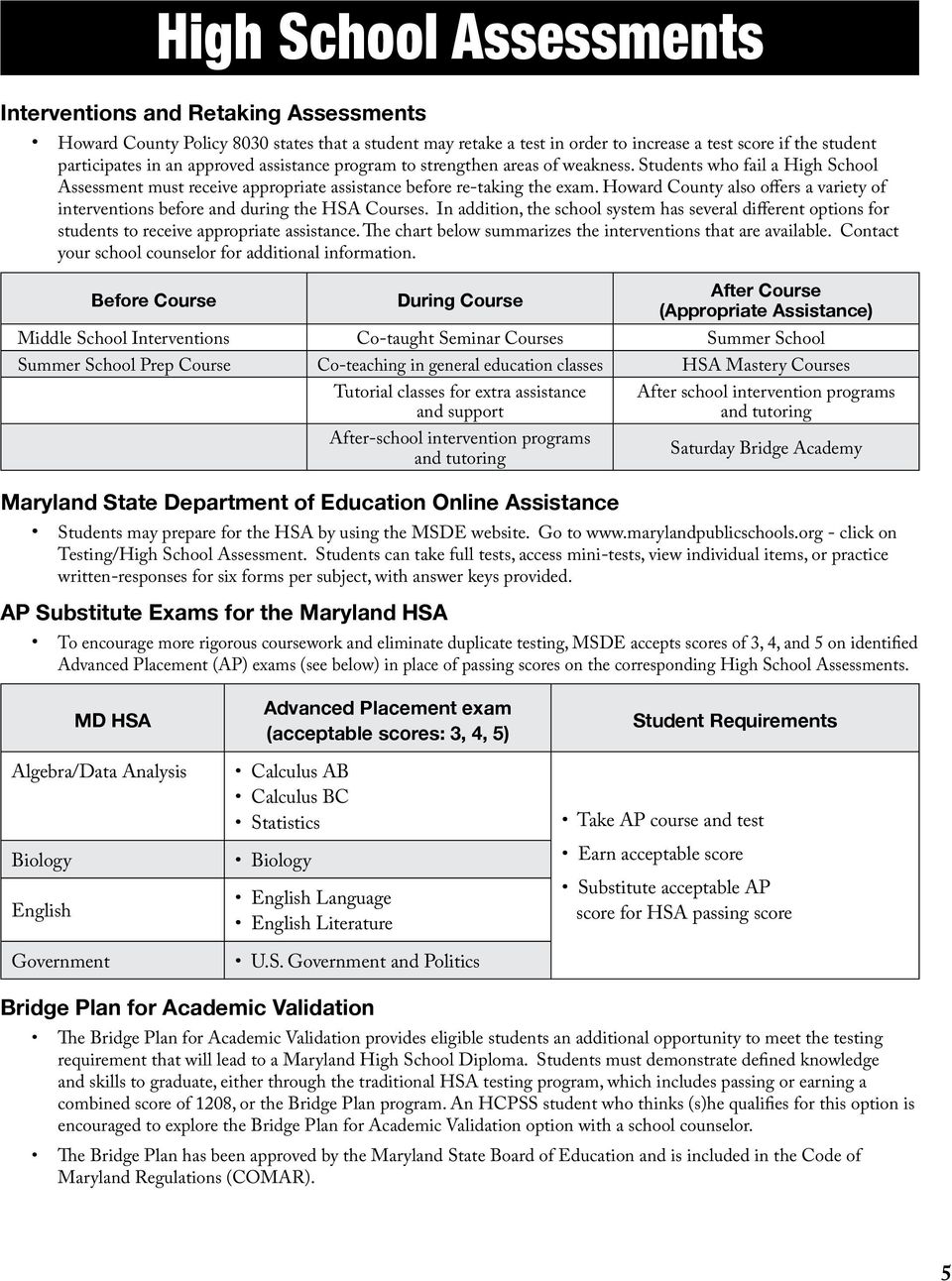
11 High School Assessments Interventions and Retaking Assessments Howard County Policy 8030 states that a student may retake a test in order to increase a test score if the student participates in an approved assistance program to strengthen areas of weakness. Students who fail a High School Assessment must receive appropriate assistance before re-taking the exam. Howard County also offers a variety of interventions before and during the HSA Courses. In addition, the school system has several different options for students to receive appropriate assistance. The chart below summarizes the interventions that are available. Contact your school counselor for additional information. Before Course During Course After Course (Appropriate Assistance) Middle School Interventions Co-taught Seminar Courses Summer School Summer School Prep Course Co-teaching in general education classes HSA Mastery Courses Tutorial classes for extra assistance and support After-school intervention programs and tutoring After school intervention programs and tutoring Saturday Bridge Academy Maryland State Department of Education Online Assistance Students may prepare for the HSA by using the MSDE website. Go to - click on Testing/High School Assessment. Students can take full tests, access mini-tests, view individual items, or practice written-responses for six forms per subject, with answer keys provided. AP Substitute Exams for the Maryland HSA To encourage more rigorous coursework and eliminate duplicate testing, MSDE accepts scores of 3, 4, and 5 on identified Advanced Placement (AP) exams (see below) in place of passing scores on the corresponding High School Assessments. MD HSA Algebra/Data Analysis Biology English Government Advanced Placement exam (acceptable scores: 3, 4, 5) Calculus AB Calculus BC Statistics Biology English Language English Literature U.S. Government and Politics Student Requirements Take AP course and test Earn acceptable score Substitute acceptable AP score for HSA passing score Bridge Plan for Academic Validation The Bridge Plan for Academic Validation provides eligible students an additional opportunity to meet the testing requirement that will lead to a Maryland High School Diploma. Students must demonstrate defined knowledge and skills to graduate, either through the traditional HSA testing program, which includes passing or earning a combined score of 1208, or the Bridge Plan program. An HCPSS student who thinks (s)he qualifies for this option is encouraged to explore the Bridge Plan for Academic Validation option with a school counselor. The Bridge Plan has been approved by the Maryland State Board of Education and is included in the Code of Maryland Regulations (COMAR). 5
12 Courses Meeting the Fine Arts and Technology Education Requirements Fine Arts Course List: Any of these courses meet the Fine Arts requirement for graduation. Art -- Fine Art Courses Art I: Foundations of Studio Art Art II: Developing Ideas in Media Art II: Developing Ideas in Media - G/T Art III: Portfolio Development - AP Art III: Portfolio Development - Honors Art IV: Personal Directions in Art Studio - AP Art IV: Personal Directions in Art Studio - Honors New Forms in Art Photography I Photography II - Honors Photography II - AP Photography III - Honors Photography III - AP Dance -- Fine Art Courses Dance I, II, III, IV, IV - G/T Junior Dance Company - G/T Dance Company - G/T Family and Consumer Sciences -- Fine Art Courses Foundations of Fashion and Interior Design Media -- Fine Art Courses Television Music -- Fine Art Courses Band - Symphonic/Marching Band - Symphonic Winds/Marching Band - Wind Ensemble/Marching Band - Concert Chorus Piano I, II Piano III - Honors Piano IV - Honors Chamber Choir Chamber Choir - G/T Concert Choir Guitar I, II Guitar III - Honors Guitar IV - Honors Instrumental Ensemble Jazz Ensemble Music and Society Music Technology I, II Music Theory I Music Theory II - AP Percussion Ensemble String Ensemble String Orchestra String Orchestra - G/T Vocal Ensemble Theatre -- Fine Art Courses Theatre I, II, III, III - G/T, IV, IV - G/T Musical Theatre I, II, III Stage Craft I, II, III Technology Education Course List: (for students who entered grade 9 before 2013) Computer Science I -- Designing Technology Solutions -- Honors 450M Engineering Design 684M Foundations of Technology 6751 Principles of Engineering G/T (For students in Pre-Engineering: Project Lead the Way (PLTW) Academy) 680M 6 Technology Education Course List: (for students who enter grade 9 in 2013 and beyond) Computer Science I -- Designing Technology Solutions -- Honors 450M Engineering Design 684M Foundations of Technology 6751 Introduction to Engineering Design - Honors (For students in Pre-Engineering: Project Lead the Way (PLTW) Academy) 681M

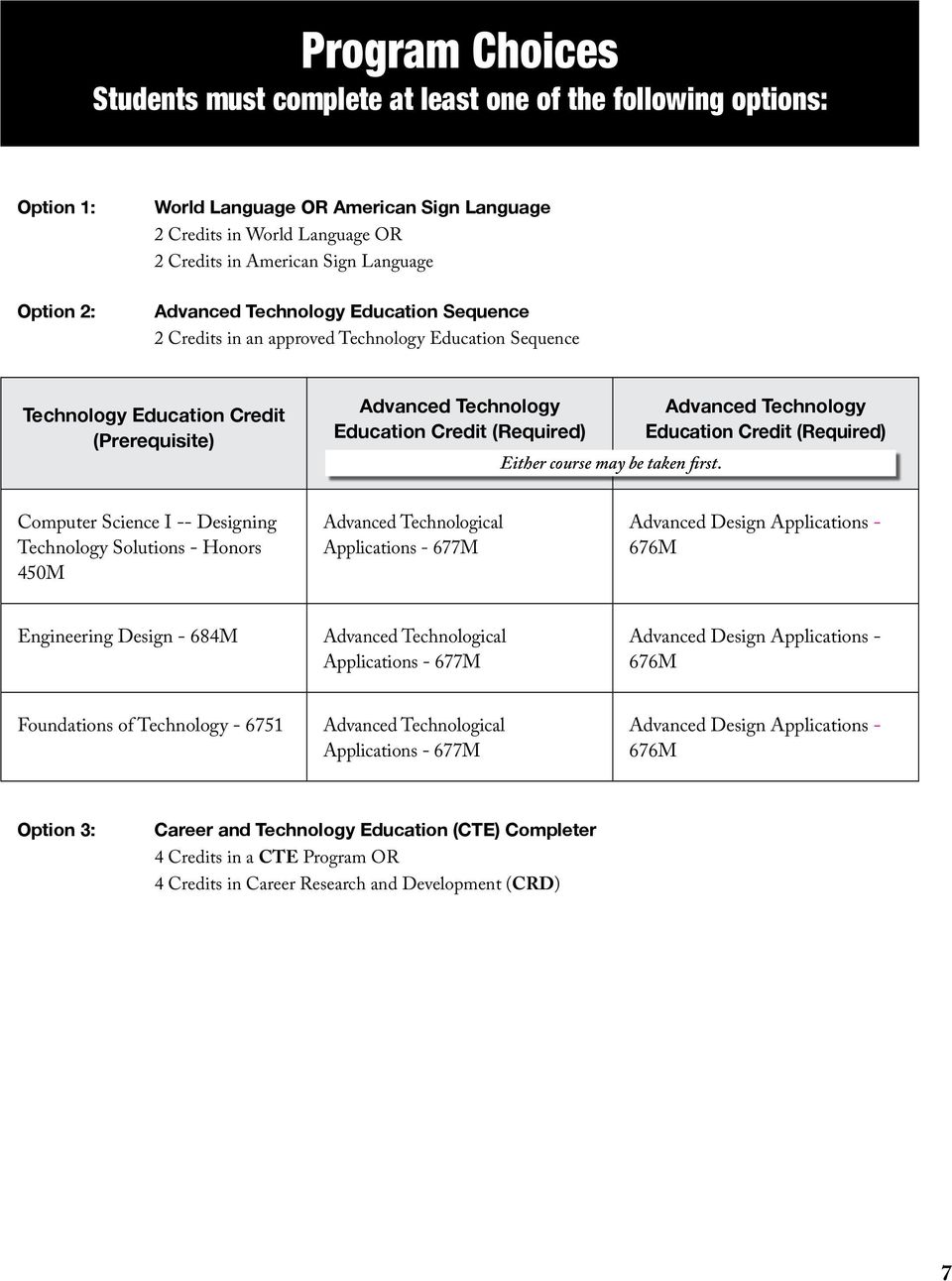
13 Program Choices Students must complete at least one of the following options: Option 1: World Language OR American Sign Language 2 Credits in World Language OR 2 Credits in American Sign Language Option 2: Advanced Technology Education Sequence 2 Credits in an approved Technology Education Sequence Technology Education Credit (Prerequisite) Advanced Technology Education Credit (Required) Either course may be taken first. Advanced Technology Education Credit (Required) Computer Science I -- Designing Technology Solutions - Honors 450M Advanced Technological Applications - 677M Advanced Design Applications - 676M Engineering Design - 684M Advanced Technological Applications - 677M Advanced Design Applications - 676M Foundations of Technology Advanced Technological Applications - 677M Advanced Design Applications - 676M Option 3: Career and Technology Education (CTE) Completer 4 Credits in a CTE Program OR 4 Credits in Career Research and Development (CRD) 7
14 Program Option 3 Career and Technology Education Completer A. CTE -- Career and Technology Education Career Academies encompass a range of careers based on essential economic activities, similar interests, common skills, and training required by those in the field. It is a way to organize teaching and learning to meet the specific needs and resources in broad career areas, grouping similar occupations. Each academy meets all graduation requirements and prepares students either for post-secondary education and/or the world of work. Academy students may participate in special activities and events that provide greater awareness of the specific career area and opportunities within that area. Students will be part of a small group of students with similar interests completing courses together. The section of this Catalog of Approved High School Courses entitled Career Academies provides guidance regarding course selection, academy prerequisites, special requirements, and information needed to complete each Career Academy Program. Arts, Media and Communication Cluster Visual Communications Academy with pathways in Graphic Design and Animation Business, Management and Finance Cluster Academy of Finance Business Management Academy Accounting Academy Marketing Academy Construction and Development Cluster Architectural Design Academy Construction Management Academy Consumer Services, Hospitality and Tourism Cluster Culinary Science Academy Hotel and Restaurant Management Academy Allied Health Academy Biotechnology Academy Academy of Health Professions (for students entering grade 11 in 2013 or later) Career Academy Clusters Health and Biosciences Cluster Human Resource Services Cluster Child Development Academy Government, Law, and Public Administration Academy* Homeland Security and Emergency Management Academy Teacher Academy of Maryland Information Technology Cluster Computer Programming Academy Cybersecurity Networking Academy with pathways in Computer Networking and PC Systems Manufacturing, Engineering and Technology Cluster Pre-engineering: Project Lead the Way (PLTW) Academy Systems and Project Engineering Academy Transportation Technologies Cluster Automotive Technology Academy Certified Nursing Assistant Academy Emergency Medical Technician Academy *This academy is not a completer program for graduation. See page 43 for more information. ARL-based for 11th and 12th grade academy courses. All courses are offered at the local high school. B. CRD -- Career Research and Development Career Research and Development empowers students to create a vision of their future through quality academic coursework, progressive career development and appropriate work opportunities. Students identify their interests, aptitudes and abilities, and apply that knowledge to investigate careers and higher education. Students participating in the Career Research and Development program focus on demonstrating competency in 21st century learning skills. Students who successfully complete the program demonstrate mastery of learning, thinking, communication, technology and interpersonal skills. Students will develop an individualized portfolio containing examples of completed assignments and/or special projects. Career Research and Development I 1 Credit Career Research and Development II 1 Credit Site-Based Work Experience 2-4 Credits 8

15 General Information 9
16 General Information Note: Information in this section summarizes HCPSS policies. Although deemed accurate, this information does NOT supersede policy. See the Board of Education (BOE) section of the HCPSS website ( for access to full copies of Board of Education policies. Attendance All students are expected to attend school regularly in accordance with the Public School Laws of Maryland, Sections 7-301, 7-302, and of the Courts and Judicial Proceedings Article, and may be excused from class or school only for reasons as specified in the Code of Maryland Regulations, 13A , 13A , 13A , and 13AA (A-B). Note: Any high school student with unlawful absences constituting 5% of a semester or yearlong course may have his or her name submitted to the principal via the teacher for consideration of denial of credit. A teacher also may submit the name of a student for whom lawful and/or unlawful absences constitute 5% of a semester or yearlong course if the student has not made up missed work or is not meeting expected levels of performance. For more information on the Attendance Policies see the HCPSS High School Student Handbook. Release Time: Qualifications and Procedures Any senior who wishes to leave school early for employment should enroll in Career Research and Development I prior to the senior year. This course provides students the opportunity to experience career, interest, and aptitude inventories to assist them in making career and/or higher education choices. Students will also have the opportunity to earn a Passport to the Future certificate, which is recognized by the Howard County Chamber of Commerce as a valuable credential in the hiring of entry-level student employees. To qualify for Early Release Time, approval must be granted through the school counselor and an administrator. In addition, the following conditions apply: Applicants must complete an Early Release-Time form available from the counseling center. The school counselor and principal must indicate their approval on this form. If the conditions upon which approval was granted change (the student changes jobs, quits job, or drops class, etc.), it is the responsibility of the student to inform the school of this change. Students who are on Early Release Time must leave the school premises after their last class. Parents assume all responsibility for students during Early Release Time. In order to be eligible for release time, students must have passed all high school assessments, and they must have completed their student service hours and the Career Preparation requirements. Release time approval requires proof of employment during school hours or attendance at a local college. Grading and Reporting Reporting Student Progress Attending school regularly is the first step toward academic excellence! 1. School staff shall communicate to students and parents on a regular basis the student s level of academic performance in the essential curriculum. 2. The interim/progress report reflects the progress of the student through the date of issuance and does not represent the marking period or final grade. 3. Report cards are issued to parents at the conclusion of each marking period. 10

17 General Information Determining Final Grades and Credit Full-Year Courses Multiply the quality points for each marking period grade by two. Add the quality points for each examination grade. Compute the sum and divide by ten. For reporting purposes, the quotient will be converted to a letter grade using the following scale: A = B = C = D = E = Below 0.75 (no credit) Note: The average for a D must be 0.75 (not.50) to 1.49 in order for credit to be awarded. Semester courses (half-credit courses) Multiply the quality points for each marking period grade by two and compute their sum. Add the quality points for the examination grade and divide by five. For reporting purposes, the quotient will be converted to a letter grade using the following scale: A = B = C = D = E = Below 0.75 (no credit) Final grades are determined by translating the letter grade for each quarter and each examination using the following quality points scale: A = 4 B = 3 C = 2 D = 1 E = 0 Weighted Grade Point Average (GPA) and Class Rank Weighted class rank/gpa may only be used for the purpose of college admission and/or scholarship applications. It will not be used for athletic eligibility, National Honor Society, honor roll, or for any other activity requiring the reporting of the grade point average. Both weighted and non-weighted class rank/gpa will appear on the high school transcript. Students receive weighted quality points if they earn a grade of A or B or C in Advanced Placement (AP), in Gifted and Talented (G/T), and in Honors courses. Weighted classes are designated in the catalog with the symbol. Students earn 1.0 additional quality points for GT and AP courses and.5 additional quality point for Honors courses. Promotion To be promoted to grade 9 students must have: Passed all courses. Received a final grade of C or better in the core subjects. Ninth Grade Intervention Courses Weighted Quality Points Grade AP and G/T Honors Regular A B C D E Any student performing below grade level in reading and/or mathematics at the end of 8th grade is required to participate in appropriate interventions (Policy 8010) in order to be promoted to Grade 9. Students and parents are encouraged to talk with middle school teachers, counselors, and administrators to understand how prescribed courses improve preparation for high school. 11

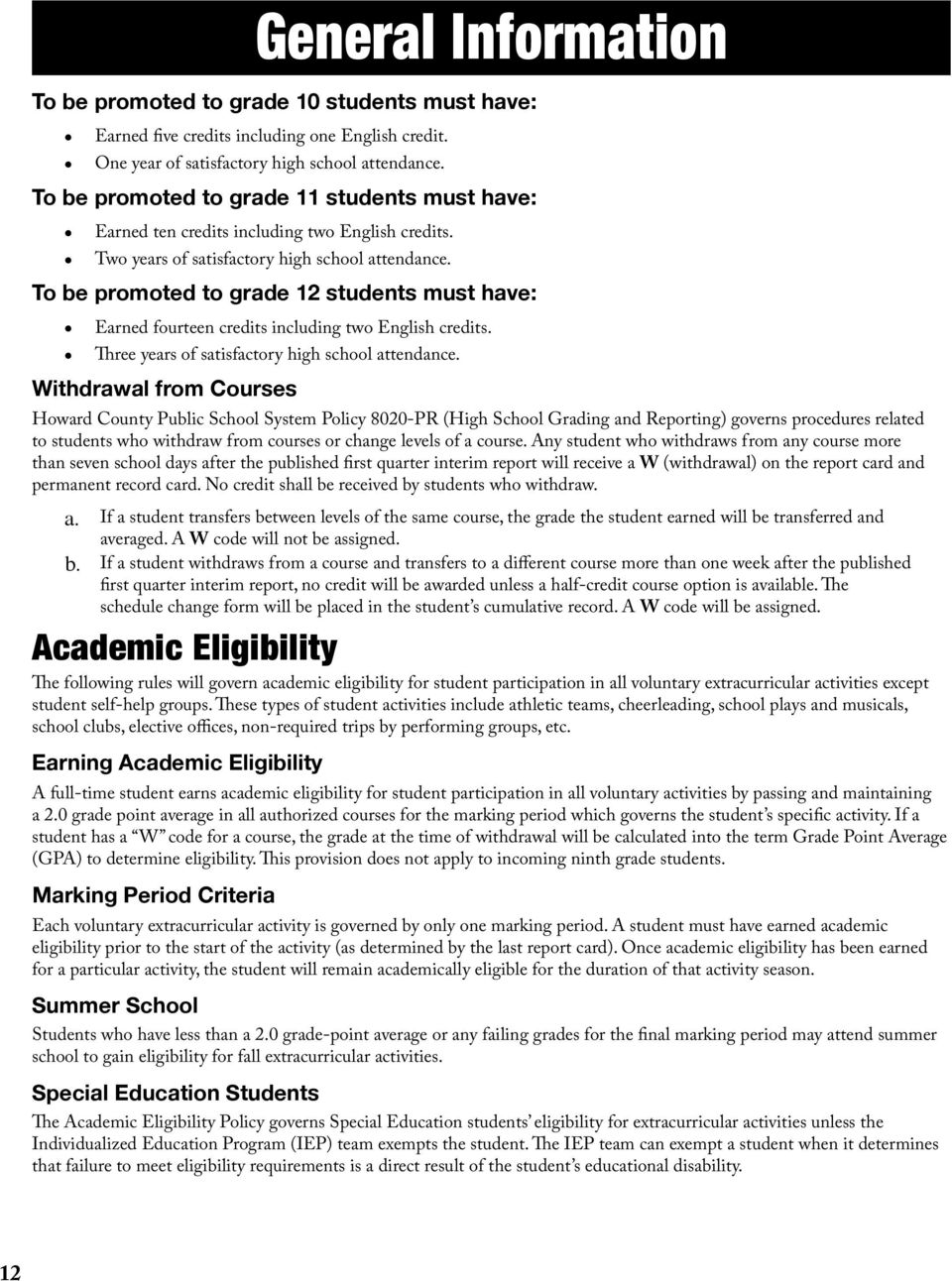
18 To be promoted to grade 10 students must have: Earned five credits including one English credit. One year of satisfactory high school attendance. To be promoted to grade 11 students must have: Earned ten credits including two English credits. Two years of satisfactory high school attendance. To be promoted to grade 12 students must have: Earned fourteen credits including two English credits. Three years of satisfactory high school attendance. Withdrawal from Courses General Information Howard County Public School System Policy 8020-PR (High School Grading and Reporting) governs procedures related to students who withdraw from courses or change levels of a course. Any student who withdraws from any course more than seven school days after the published first quarter interim report will receive a W (withdrawal) on the report card and permanent record card. No credit shall be received by students who withdraw. a. If a student transfers between levels of the same course, the grade the student earned will be transferred and averaged. A W code will not be assigned. b. If a student withdraws from a course and transfers to a different course more than one week after the published first quarter interim report, no credit will be awarded unless a half-credit course option is available. The schedule change form will be placed in the student s cumulative record. A W code will be assigned. Academic Eligibility The following rules will govern academic eligibility for student participation in all voluntary extracurricular activities except student self-help groups. These types of student activities include athletic teams, cheerleading, school plays and musicals, school clubs, elective offices, non-required trips by performing groups, etc. Earning Academic Eligibility A full-time student earns academic eligibility for student participation in all voluntary activities by passing and maintaining a 2.0 grade point average in all authorized courses for the marking period which governs the student s specific activity. If a student has a W code for a course, the grade at the time of withdrawal will be calculated into the term Grade Point Average (GPA) to determine eligibility. This provision does not apply to incoming ninth grade students. Marking Period Criteria Each voluntary extracurricular activity is governed by only one marking period. A student must have earned academic eligibility prior to the start of the activity (as determined by the last report card). Once academic eligibility has been earned for a particular activity, the student will remain academically eligible for the duration of that activity season. Summer School Students who have less than a 2.0 grade-point average or any failing grades for the final marking period may attend summer school to gain eligibility for fall extracurricular activities. Special Education Students The Academic Eligibility Policy governs Special Education students eligibility for extracurricular activities unless the Individualized Education Program (IEP) team exempts the student. The IEP team can exempt a student when it determines that failure to meet eligibility requirements is a direct result of the student s educational disability. 12
19 General Information National Collegiate Athletic Association (NCAA) Eligibility ( ) All students who intend to participate in interscholastic athletics in a Division I or Division II postsecondary institution must register with the NCAA Initial-Eligibility Clearinghouse. The purpose of this registration is to determine whether or not the student is a qualifier and can practice, compete, and receive athletic scholarships as a freshman. Part of that determination is based upon the student s completion of a required number of core courses as approved by the NCAA. The courses designated with have been approved by the NCAA for Howard County Public Schools for the upcoming school year. Because the approved list of courses is updated every year, students must maintain contact with their school counselors to assure that courses selected during the winter registration process are still accepted by the NCAA for the subsequent school year. Students are also encouraged to see their counselors to receive more complete information on NCAA eligibility requirements, or go to their website - Keep your GPA high and take G/T and AP classes to be on the track for a HCPSS Certificate of Merit! Diploma Endorsements: HCPSS Certificate of Merit Diploma endorsements are granted by the Howard County Public School System to students who, while meeting graduation requirements, successfully complete a rigorous program of study as defined below: 1. The Howard County Public School System Certificate of Merit is granted to students who earn a minimum of 12 credits in merit courses and who achieve an un-weighted cumulative grade point average of at least 3.0 on a 4.0 scale. 2. The Howard County Public School System Certificate of Merit with Honors is granted to students who earn a minimum of 15 credits in merit courses, at least one of which is a GT or AP level course, and who achieve an un-weighted cumulative grade point average of at least 3.4 on a 4.0 scale. 3. The Howard County Public School System Certificate of Merit with Distinction is granted to students who earn a minimum of 15 credits in merit courses, at least three of which are GT or AP level course, and who achieve an un-weighted cumulative grade point average of at least a 3.75 on a 4.0 scale. Note: Merit courses are designated with the letter M. Maryland High School Certificate The Maryland High School Certificate is awarded only to students with disabilities who have an Individualized Education Program (IEP) and who do not meet the requirements for a diploma but who meet one of the following standards: The student is enrolled in an education program for at least four years beyond grade eight or its age equivalent, and is determined by an Individualized Education Program (IEP) team to have developed appropriate skills for entering the world of work, acting responsibly as a citizen, and enjoying a fulfilling life. Career Preparation shall include (but not be limited to) gainful employment, work activity centers, sheltered workshops, and supported employment. The student has been enrolled in an education program for four years beyond grade eight or its age equivalent and has reached age 21. Course Levels As long as students meet the course prerequisites, they may enroll in any level of a course (regular, honors, or G/T) whether or not they were enrolled in that level the previous year. Review Courses are designed to assist those students who are performing below grade level in reading and/or mathematics. Review-level classes may not be scheduled at all schools because some schools use tutorials, seminars, or small groups in a regular class to assist students performing below grade level in reading and/or mathematics. Both regular and review designate an instructional level, are not part of the course title, and will not appear on report cards or transcripts. The courses prepare students with the knowledge and skills required to meet state content standards. 13

20 General Information Regular Courses are designed for students who have grade level skills. The courses prepare students with the knowledge and skills required to meet state content standards. Honor Courses are designed for students who are capable of and interested in progressing through course material with more depth and rigor than the regular course. Honors courses meet the criteria specified for the Certificate of Merit. The courses prepare students with the knowledge and skills required to meet state content standards. Gifted and Talented (G/T) Courses are offered for students with exceptional ability. Included in the Gifted and Talented course selections are all Be sure to challenge yourself. Consider enrolling in appropriate honors, G/T and AP classes. Advanced Placement courses. Gifted and Talented courses meet the criteria specified for the Certificate of Merit. The courses prepare students with the knowledge and skills required to meet state content standards. Advanced Placement (AP) Courses are taught at a college level with curriculum determined by The College Board. Students successfully completing AP courses should plan to take the Advanced Placement Tests in May. Students who score well on these tests may attain advanced standing or be awarded credit in many colleges and universities. Advanced Placement courses meet the criteria specified for the Certificate of Merit. Special Education Special Education services are designed to meet the needs of students with disabilities who have been found eligible for services through the Individualized Education Program (IEP) process. An IEP is developed through an IEP Team and reflects special education instruction, supports, related services, and least restrictive environment guidelines in accordance with the Individuals with Disabilities Education Act (IDEA-R). NOTE: All diploma seeking students, including students with IEPs and 504 plans, must complete graduation requirements. 504 Students become eligible for a 504 plan due to a documented disability that limits one or more major life functions. A multidisciplinary 504 team develops the 504 plan that reflects appropriate accommodations and modifications in accordance with Section 504 of the Rehabilitation Act. NOTE: All diploma seeking students, including students with IEPs and 504 plans, must complete graduation requirements. Teen Parenting Pregnant and parenting teens may enroll in the Teen Parenting Program, which may provide day care for infants, health care for babies and mothers, and an all-day instructional program. This program is located at Wilde Lake High School. Students enrolled in this program retain their status in the comprehensive high school from which they will graduate. English, mathematics, social studies, and science are provided within the instructional program. ESOL All eligible students must be notified of these courses at registration. Names of recommended students should be submitted to the Curriculum Coordinator for ESOL. An evaluation of foreign transcripts and credits will be conducted to determine credits earned toward a Maryland High School Diploma. The ESOL program is located at the following high schools: Centennial Hammond Howard Long Reach Mt. Hebron Oakland Mills Reservoir River Hill Wilde Lake JROTC Army JROTC is only offered at Atholton and Howard High Schools. Air Force JROTC is only offered at Oakland Mills High School. Students may request a transfer to a school offering a JROTC program. Such transfers will be granted on condition that students provide their own transportation and remain enrolled in the program at all times. Students who do not remain enrolled must return to their district high school. Students retain full athletic eligibility. 14

21 General Information Advanced Research Courses The Advanced Research courses listed below can be used to meet elective credit requirements for graduation. Intern/Mentor Program (G/T) Acceptance via application, intake interview, and teacher recommendation. Students demonstrate prerequisite knowledge or advanced-level skills in the mentor s area of work. Students must maintain a grade of B or above in the area of study. Students must have two above average recommendations from professionals who have taught or worked with them in the related area of study that demonstrate task commitment, responsibility, independence, and the ability to get along with adults. Students must commit to their academic mentorship experience as a priority in the year they elect to participate. Internships, mentorships and research courses are great ways to explore careers and enhance your academic program! Transportation: Students meet with their mentors at the mentor s place of work. Therefore, students must provide their own transportation to the work site. Independent Research I, II (G/T) (Grades 9-12) The eligibility criteria is as follows: Acceptance via application, intake interview, and teacher recommendation. Alternative Sources of Credit Besides attending regular school classes, students may earn extra credits in a number of ways. Many require prior authorization from the school principal. Summer School Howard County s summer school program offers courses on a tuition basis when twenty or more students register. Original credit classes, review credit classes, and other noncredit classes are offered. See the school counselor for more information. Howard County Public Schools recognize summer school work completed at state-approved public institutions in or outside of Maryland. Students must secure the principal s authorization in advance before attending summer school for credit outside the county. Tutoring for Credit Extenuating circumstances may necessitate the assistance of tutors for certain students. However, tutoring will be considered for credit only after all the resources of the school system have been used fully and when it is determined that the best interests of the students are being served. If tutoring is recommended by the school and approved by the school system for credit to be applied toward minimum graduation requirements, then the tutor, the program of study, and the examination shall be financed by the local school system (COMAR 13A ). This tutoring may be provided for a portion of the school year or for the entire year with a prescriptive program from the student s regular teacher. All tutoring programs must be approved in advance by the Assistant Superintendent. Approval is based on need, the principal s recommendation, the curriculum coordinator s review of the proposed syllabus, and the proposed tutor s credentials. These tutoring procedures do not apply to the Home and Hospital Teaching Program or to the Home Instruction Program. 15
22 16 General Information College Courses Credit towards high school graduation may be given for approved courses taken at an accredited college, provided prior approval is obtained by the high school principal. One high school credit will be awarded for completion of each college course which is equivalent to (or beyond) a course in the Catalog of Approved High School Courses. The tuition for approved courses is the responsibility of the student. Those credits awarded toward high school graduation should be recorded as transfer credits on the transcript. Articulated Credits Students who successfully complete one of the Career Academies have the option of receiving credit in identified colleges. The number of credits range from 3 to 12, depending on the Academy and the College. Credit by Examination Only those courses so designated in the Catalog of Approved High School Courses are eligible for credit by examination: Software Applications I. Students who have met all graduation requirements except for earning a credit in either Algebra II or English 12 (not both) may earn the credit for the course by taking a state-approved examination and achieving a passing score as defined by MSDE. Contact the school counselor for more details. Online Courses Student may earn high school credit for the completion of an approved online course. The Maryland State Department of Education (MSDE) requires that the course be approved and completed through the Maryland Virtual Learning Opportunities Program (MVLO). A student requesting permission to take an online course should complete the following: Taking college courses while in high school is another way to challenge yourself and prepare for a rigorous college experience. 1. A formal meeting with his/her school counselor to discuss the appropriateness of taking an online course and the appropriateness of the specific course to be taken. 2. A written request to the high school principal requesting permission to earn high school credit for the online course. 3. Registration and enrollment with the Maryland Virtual Learning Opportunities Program ( 4. An official transcript from MVLO indicating satisfactory completion of the course sent to the high school for evaluation and addition to the high school transcript. Contact your school counselor for information. Alternatives to Four-Year Enrollment Students are expected to enroll in a full schedule of courses each year that they are in attendance, unless they have special permission to do otherwise. A full schedule may include credits earned through employment as part of a Career Research and Development program. In recognition of the fact that four-year enrollment in a public high school may not serve the best interests of some students, these alternatives are made available: Early College Admission Program. Early Admission to Approved Vocational, Technical, or other Postsecondary School. Request for Early Graduation. For all alternatives, students must meet the graduation requirements in addition to submitting a written request to their principal along with a portfolio that contains: A résumé. A written statement of career plans which includes how this option will enhance career plans. A written request from parents or guardians stating their agreement with the student s request. An academic package, which includes a transcript, test scores, and attendance records. See your school counselor for more details and forms.
23 General Information Guidelines for Students Planning to Attend College or Technical School This section includes general guidelines that may help students plan a high school program of studies to prepare for admission to postsecondary school. However, college admissions requirements, curriculum, and majors change from one year to the next; therefore, students are encouraged to make use of the more specific information on particular colleges available in the counseling center or on the college s web site. Public Two-Year Colleges in Maryland Maryland s public community colleges, such as Howard Community College, have an open door admission policy. This means that students who are graduates of accredited Maryland high schools are admitted to at least a general program of studies. Most of these schools also require the students to take a placement test as part of the admissions process, usually in English and mathematics. Results of these placement tests may require students to enroll in developmental noncredit courses until they meet basic proficiency levels. Technical Schools, Private Junior Colleges and Out-of-State 2-Year Colleges Many of these institutions, especially the technical schools, have an open door admission policy, which means that a student with a GED or a diploma from an accredited Maryland high school will be admitted. However, these admission standards do vary, and it is best to contact the individual school directly or check its web site for specific requirements. Other Colleges and Universities Admission requirements vary greatly depending on the academic standing of the school and/or a student s intended major. For most of these schools a student needs at least to meet the University System of Maryland requirements (see below). The higher the admissions standards, the more likely the school will have increased course requirements and would expect the student to take courses at the honors and/or GT level. The best way to plan a curriculum for these schools is to check current sources of information from the school s guidance office or from the college itself. The University System of Maryland The high school coursework requirements below are the minimum standards for students seeking admission to the following University System of Maryland institutions: Bowie State University Towson University Coppin State College University of Baltimore University of Maryland, Eastern Shore Frostburg State University University of Maryland, Baltimore University of Maryland, University College Salisbury University University of Maryland, Baltimore County University of Maryland, College Park University System of Maryland Required Coursework Subject Number of Course Credits English 4 Lab Science 3 Mathematics (Algebra I, Geometry and Algebra II) Requirement for high school graduating class of 2015 and beyond 3 4 Social Studies 3 World Language or Advanced Technology Credit (Varies by school) 2 Academic Electives 6 Information about additional requirements for individual campuses and/or programs may be obtained directly from each of the 11 institutions of the University System of Maryland or by consulting resources available in the counseling center. 17
24 General Information SAT II Subject Tests Many colleges use the SAT II Subject Tests for admission, for course placement, and to advise students about course selection. Some colleges specify the SAT II Subject Tests they require for admission or placement; others allow applicants to choose which tests to take. All SAT II Subject Tests are one hour, multiple-choice tests. However, some of these tests have unique formats. The tests are designed to measure students knowledge and skills in particular subject areas, as well as their ability to apply that knowledge. Students take the SAT II Subject Tests to demonstrate to colleges their mastery of specific subjects. The tests are independent of any particular textbook or method of instruction. Students have found that they are more successful on the SAT II Subject Tests if they are taken after completion of the most closely related high school course. Use the following information to assist you in knowing the optimal time to take the test if you may attend a college that requires a SAT II Subject Test. Name of SAT II Test Information Related High School Course English Literature U.S History World History Mathematics Level 1 Mathematics Level 2 The Literature subject test measures how well you have learned to read and interpret literature. There is no reading list for this test. The best way to prepare for the test is through close critical reading of English and American literature to become skilled in understanding and analyzing literary text. The United States History subject test assesses your knowledge of and ability to use material commonly taught in U.S. History and social studies courses in high school. The World History Subject Test uses the chronological designations B.C.E. (before Common Era) and C.E. (Common Era). These labels correspond to B.C. (before Christ and A.D. (anno Domini), which are used in some world history textbooks. Questions on the World History Subject Test may be presented as separate items or in sets based on quotes, maps, pictures, graphs or tables. Please note that this test reflects what is commonly taught in high school. Due to differences in high school classes, it s likely that most students will find questions on topics they re not familiar with. Many students do well despite not having studied every topic covered. Mathematics Level 1 is a broad survey test intended for students who have taken three years of college preparatory mathematics, including two years of algebra and one year of geometry. Mathematics Level 2 is a broad survey test intended for students who have taken college preparatory mathematics for more than three years, including two years of algebra, one year of geometry, and pre-calculus and/ or trigonometry. It is recommended that if the student has had these courses and attained grade of B or better and knows when and how to use a scientific or graphing calculator, he or she should select Mathematics Level 2. Best taken after having completed English 11. Best taken after having completed U.S. History AP/GT in grade 11. Best taken after having completed Modern World History in grade 11. Best taken after having completed Algebra II or Trigonometry or Mathematical Analysis, Pre- Calculus G/T. Best taken after having completed Trigonometry or Mathematical Analysis, Pre-Calculus G/T. 18
25 General Information Name of SAT II Test Information Related High School Course Biology Chemistry Physics This test contains a common core of 60 generalknowledge multiple-choice questions, followed by 20 multiple-choice questions that emphasize either ecological (Biology E) or molecular (Biology M) subject matter. After completing the core questions, test takers choose the section for which they feel most prepared. Take Biology E if you are more comfortable answering questions pertaining to biological communities, populations and energy flow. Take Biology M if you are more comfortable answering questions pertaining to biochemistry, cellular structure and processes such as respiration and photosynthesis. The chemistry test assesses the understanding of general chemistry at the college preparatory level. The onehour test contains 85 multiple-choice questions with approximately five questions on equation balancing and/ or predicting the product of a reaction interspersed throughout the test. Topics tested include: Structure of Matter Atomic Structure, Molecular Structure, and Bonding States of Matter Gases, Liquids and Solids, and Solutions Reaction Types Acids and Bases, Oxidation-Reduction, and Precipitation Stoichiometry Moles and Chemical Equation Equilibrium and Reaction Equilibrium Systems and Rates of Reactions Thermochemistry Laboratory Skills and Processes The physics test assesses the understanding of physics at the college preparatory level. The one-hour test contains 75 multiple-choice questions with some problem solving using basic algebra. Calculator use is not permitted during the test. Topics tested include: Mechanics Kinematics, Dynamics, Energy and Momentum, Circular Motion, Simple Harmonic Motion, and Gravity Electricity and Magnetism Electric Fields, Forces, and Potentials, Capacitance, Circuit Elements and DC Circuits, and Magnetism Waves and Optics General Wave Properties, Reflection and Refraction, Ray Optics, and Physical Optics Heat and Thermodynamics Thermal Properties and Laws of Thermodynamics Modern Physics Quantum Phenomena, Atomic, Nuclear and Particle Physics, and Relativity Best taken after having completed Biology or Anatomy and Physiology or Biology AP. Best taken after having completed Chemistry. Best taken after having completed Physics. Information taken from the College Board ( and compiled by the Office of School Counseling. 19
26 General Information Name of SAT II Test Information Related High School Course World Language Tests: French, German, Modern Hebrew, Italian, Japanese, Korean, Latin, Spanish and Chinese These tests are intended for students who have studied the language for at least two years in high school. Generally, the more years of study the student has, the better his or her language test score is likely to be. In considering whether to take a reading test or a listening test in the language, there is no difference in difficulty between the two tests. However, the tests with listening can provide a more complete picture of a student s skills. For this reason, colleges may prefer the listening test to the reading only test for placement purposes. Native speaker scores are grouped with those students who have had less exposure to the language. This means that even students with high grades in language courses may not score as high as native speakers. College admission staffs take this into account when they review scores. Best taken after having completed Level III or IV of the language. Information taken from the College Board ( and compiled by the Office of School Counseling. Fee Waivers Participation in the Free and Reduced Meals Program qualifies students for: Reduced Tuition for HCPSS Summer School Reduced Registration for Advanced Placement Exams Free Registration for two SAT I and two SAT Subjects Tests Free Registration for two ACT Tests Four Free College Applications Qualification for the Guaranteed Access Grant (full tuition at a Maryland College) Free Registration for the NCAA Eligibility Center for students considering Division I or Division II Athletics See the National School Lunch Program/School Breakfast Program Application for income eligibility guidelines. Applications can be mailed to the address on the back of the form or returned to school with your student. See your school counselor to access any of the above resources. 20
27 Career Academies 21
28 Introduction Career Academies General Information The Howard County Public School System offers a path for students interested in studying specific career areas while in high school. This section of the Catalog of Approved High School Courses will provide guidance regarding course selection, academy prerequisites, special requirements, and information needed to complete each Career Academy Program. What is a Career Cluster? Career Clusters encompass a range of careers based on essential economic activities, similar interests, common skills, and training required by those in the field. It is a way to organize teaching and learning to meet the specific needs and resources in broad career areas, grouping similar occupations. Essential knowledge and skills are taught to students in order to graduate fully prepared for further education and careers in the 21st-century global economy. For example, within the Health and Biosciences Cluster, you will find four different Career Pathways all centered around health careers. What is a Career Academy? A Career Academy provides an opportunity for a group of students to enroll in a specific set of courses associated with a designated career area. Each Career Academy has the following components: A recommended sequence of courses. A capstone project, a work site experience, a research project studying careers in the academy area, or some other experience in which students learn more about the career cluster with which the academy is affiliated. A demonstrated need for employees within the Career Cluster. An advisory board consisting of business leaders in the Career Cluster. Specific rules established by the school system. What are the benefits of joining a Career Academy? Students participating in a Career Academy have a clear path for graduation. Each academy meets all graduation requirements and prepares students for post-secondary education and/or the world of work. While in the academy, students have an opportunity to participate in special activities and events that provide greater awareness of the specific career area and opportunities within that area. Academy participants are part of a small group of students with similar interests completing courses together. An advisor and business mentor is provided to answer questions and help each student as they complete their high school experience. Students completing the requirements for the academy receive a certificate and student transcripts also identify the student as an academy completer. How do I become a member of a Career Academy? Any student may be part of a single Career Academy. To become a member of an academy, meet with the school counselor to discuss your decision. This can be done at any time or during the course registration process. When completing the Course Registration form for the upcoming school year, indicate the name of the Career Academy you would like to join by filling in the portion of the form that asks for your intended Program Choice(s). The school counselor will work with you to develop or revise your four-year plan so that you will be able to successfully complete all requirements listed in this catalog for the Career Academy. Where are the Career Academies located? As you read through the academy information, you will notice that some academies are located in each local high school, while others are located at the Applications and Research Lab (ARL). If the Career Academy is located at each high school, all coursework will be taught there. Students who participate in an academy located at the ARL will complete all academic and prerequisite coursework at their local high school and will complete the junior and senior level academy courses at the ARL. Bus transportation will be provided daily to and from the ARL. 22
29 Career Academies General Information Which academy is right for me? Career Academies have been created to provide all high school students with a unique opportunity for in-depth exploration of an area of interest. If you are unsure if a Career Academy is right for you, you may want to enroll in Career Research and Development I (CRD I), where you will be able to learn more about your interests and aptitudes. You may also want to speak with your school counselor, the teacher at your school who teaches the academy courses, or the Career Academy Instructional Team Leader at your high school. What is articulation and industry certification? Many of the Career Academies are articulated with specific postsecondary institutions in the area. If you successfully complete a specific Career Academy, you may earn college credits and start your college education with advanced standing. In addition, many of the Career Academies prepare students to sit for industry certification examinations affiliated with the industry. By successfully passing these examinations, you will be better prepared to enter the world of work ready to succeed. What do I do next? If you are entering grades 9 or 10, you must make sure that the courses associated with your Career Academy of choice are part of your four-year high school plan and you must be sure to complete the required prerequisites by the end of grade 10. If you are entering grade 11, you must make sure that you have successfully completed the required prerequisites and that you are registered for the courses associated with the career academy of your choice. Contact your school counselor for additional information. Can I enroll in other elective classes, such as Band, and still be in a Career Academy? Each Career Academy has space for students to sign up for other electives. There is room in every Academy suggested schedule for any student to take classes such as Band, Art or Music. Whom do I contact if I have other questions? Start with your school counselor. If you have other questions, call the Office of Career and Technology Education at
30 Accounting Academy Location: All academy coursework is taught at the high school. Summary The Accounting Academy is designed for students who have an interest in expanding their understanding and skills related to accounting and financial management. Coursework will provide students the opportunity to study and apply the fundamental accounting principles in a variety of business settings. Students will work in a lab setting utilizing current accounting software. Benefits to Accounting Academy students include a focused course of study, connections with the local professional accounting community, and opportunities to participate in activities created exclusively for academy members. Recommended Electives Computer Science I -- Designing Technology Solutions -- Honors E-Commerce and Entrepreneurship Principles of Marketing - Honors Prerequisites Completion of Common Core Algebra I prior to enrollment in academy coursework. Successful Academy Students: Maintain a C average in all academy coursework. Complete a large-scale accounting simulation during the senior year. 9th Grade 10th Grade 11th Grade 12th Grade English 9 English 10 English 11 English 12 Common Core Algebra I or above Common Core Geometry or above Algebra II or above Science Biology* Science Elective U.S. History American Government World History Elective Lifetime Fitness/Health Elective Elective Elective Fine Arts Elective Elective Mathematics Elective Principles of Business 551M Technology Education Financial Management 563M Accounting I Honors 561M Accounting II Honors 560M * Some students may take Biology G/T in 9th grade. Shaded areas designate completer coursework. College Articulation Students who successfully complete the Accounting Academy program sequence, with a grade of B or higher in academy courses, may be eligible for credits at The Community College of Baltimore County (CCBC). Sample Career Options < 4-Year Degree 4-Year Degree > 4-Year Degree Accounting Clerk Auditor Certified Public Accountant Bookkeeper Budget Analyst Chief Financial Officer Payroll Clerk Controller Financial Advisor Risk Manager Tax Accountant 24
31 Allied Health Academy For students who enter grade 12 in Location: Junior and senior-level academy courses are taught at the ARL. Summary Students will focus on the broad spectrum of health careers by identifying and demonstrating the necessary skills and behaviors needed to succeed in the technologically advanced world of medicine. Students will explore various career opportunities through hands-on training in basic medical skills, medical equipment use, and patient contact and communication. Areas of study include: Professional behaviors of healthcare workers. Ethical and legal considerations of healthcare providers. Human body structure and function. Human development and basic needs. Students will rotate through various health sites and sample specialized health fields to help choose a specific direction in a health-related career. Recommended Electives Anatomy and Physiology is highly recommended as a concurrent science. Additionally, Advanced Placement Biology is beneficial as a science elective in 12th grade for students in this academy. Prerequisites Biology Corequisite Chemistry Successful Academy Students: Maintain a C average in all academy coursework. Complete senior level coursework through a work-site experience (students must provide their own transportation) OR by participating in the on-campus (ARL) course of advanced skills, which includes a capstone project. Senior Level Coursework Requirements: Complete at least 6-8 hours of work-site experience per week OR daily attendance at the Applications and Research Lab. Attend weekly senior seminars at the Applications and Research Lab. Choose a real world problem to research. Write and submit a research proposal, abstract, and reflection paper based on research Maintain and submit a journal and portfolio of senior work. Present a culminating multimedia presentation for the final grade. 9th Grade 10th Grade 11th Grade 12th Grade English 9 English 10 English 11 English 12 Common Core Algebra I or above Common Core Geometry or above Algebra II Mathematics Elective Science Requirement Biology* Chemistry Elective U.S. History American Government World History Elective Technology Education Fine Arts Requirement Allied Health I 870M Lifetime Fitness/Health Elective Allied Health II 874M Elective Elective Elective * Some students may take Biology G/T in 9th grade. Shaded areas designate completer coursework. College Articulation Students who successfully complete the Allied Health Academy coursework with a grade of B or higher in academy courses may be eligible for credits at Howard Community College. 25
32 Industry Certifications Allied Health Academy Students will become certified in First Aid, Cardiopulmonary Resuscitation (CPR), and the Health Insurance Portability and Accountability Act (HIPAA) by the end of their junior year. Sample Career Options < 4-Year Degree 4-Year Degree > 4-Year Degree Home Health Care Provider EKG Technician/EEG Tech. Medical Assistant Medical Lab Technician Medical Office Manager Personal Trainer Pharmacy Technician Physical Therapy Assistant Radiographer Surgical Technologist Dietician/Nutritionist Health Educator Occupational Therapist Physician Assistant Registered Nurse Social Worker Audiologist Chiropractor Dentist Genetic Counselor Health Administrator Nurse Practitioner Pharmacist Physical Therapist Physician Speech and Language Pathologist 26
33 Architectural Design Academy Location: Academy coursework is taught at the ARL. Summary This program will introduce the basic principles and methods of design as applied to architecture. Basic design theories and strategies related to the development of spatial concepts in architectural design, including composition, color, form, and relationship of elements will be applied in the development of 2-D and 3-D design projects. This course further emphasizes the architectural design process while relating these principles to general construction practices. Recommended Electives Students who would benefit from additional support for making career academic choices and preparing for college and employment should enroll in Career Research and Development I (CRD I) as early as possible. Students seeking postsecondary education are advised to take at least two years of World Language. Students seeking degrees in Architectural Design are also advised to enroll in Physics and Chemistry as science electives. Prerequisites Architectural Design Academy students must take the Foundations of Technology course in the ninth grade. Students should be enrolled in Common Core Algebra I as a minimum level mathematics course in the 9th grade. Successful Academy Students: Maintain a C average in all academy coursework. Complete senior level coursework through a work-site experience (students must provide their own transportation) OR by participating in the on-campus (ARL) course of advanced skills, which includes a capstone project. 9th Grade 10th Grade 11th Grade 12th Grade English 9 English 10 English 11 English 12 Common Core Algebra I or above Common Core Geometry or above Algebra II or above Science Science Science Elective U.S. History American Government World History Elective Fine Arts Elective Elective Elective Lifetime Fitness/Health Elective Architectural Design Technology Education Elective 678M Mathematics Elective Advanced Architectural Design 679M Shaded areas designate completer coursework. College Articulation Students who successfully complete the Architectural Design Academy program sequence, with a grade of B or higher in academy courses, may be eligible for credits at Howard Community College. Sample Career Options < 4-Year Degree 4-Year Degree > 4-Year Degree Building Codes Inspector Architect Urban and Regional Planner CADD Technician Civil Engineer Construction Manager Engineer (all types) Drafter Land Surveyor Real Estate Manager 27
34 Automotive Technology Academy Location: Junior and senior-level academy courses are taught at the ARL. Summary The Automotive Technology academy combines technical, academic and workplace skills in an integrated curriculum in accordance with all National Automotive Technicians Education Foundation, Inc. (NATEF) guidelines. This academy prepares students for further education and careers in automotive technology and consists of four required areas of study for program certification: suspension and steering, brakes, electrical/electronic systems, and engine performance. Each area provides the student with the knowledge and skills necessary to pass the NATEF end-of-course assessments and immediately enter a career in this area and/or attend postsecondary education and/or training. Students develop diagnostic, technical and academic skills through classroom instruction and hands-on maintenance applications. Through theory and real-world experiences, students master the concepts and the ability to identify and perform necessary troubleshooting and repair tasks. Recommended Electives It is recommended that students complete Algebra II as part of their mathematics requirements in preparation for automotive technology coursework. Prerequisites None Successful Academy Students: Maintain a C average in all academy coursework. Complete 40 clock hours of a work-based learning experiences at a certified automotive facility during the summer prior to senior year. Students will complete hours after school or in the summer depending on mentor and student schedules. Students are required to provide their own transportation to and from the internship site. College Articulation 9th Grade 10th Grade 11th Grade 12th Grade English 9 English 10 English 11 English 12 Common Core Algebra I or above Common Core Geometry or above Algebra II or above Mathematics Elective Science Biology* Science Elective U.S. History American Government World History Elective Lifetime Fitness/Health Fine Arts Automotive Technology I 856M Automotive Technology II Technology Education Elective 857M Elective Elective Elective Students who successfully complete the Automotive Technology Academy program sequence, with a grade of B or higher in academy courses, may be eligible for credits at The Community College of Baltimore County (CCBC) or Pennsylvania College of Technology. Industry Certification Students have the opportunity to complete NATEF certification assessments in the four areas offered in this program: Brakes, Steering and Suspension, Electrical and Electronic Systems, and Engine Performance. Sample Career Options < 4-Year Degree 4-Year Degree Automobile Lead Technician Automobile Service Technician Upper-Level Automobile Position Automobile Master Mechanic Automobile Speciality Technician Automobile Service Advisor Automobile Team Leader 28
35 Biotechnology Academy Location: Junior and senior-level academy courses are taught at the ARL. Summary Biotechnology is the use of cells and molecular biology to manufacture products or solve scientific problems. Biotechnology is one of the fastest growing fields in today s scientific community and is used by biologists, forensics scientists, and doctors. Biotechnology is laboratory and math intense, and requires critical thinking. The Biotechnology Academy gives students a solid academic foundation and necessary laboratory skills for future scientific pursuits. Students use modern laboratory equipment at the Applications and Research Laboratory to perform cutting edge experiments. Recommended Electives Students seeking a four-year postsecondary institution are advised to enroll in Advanced Placement Biology, Chemistry and advanced mathematics electives. Prerequisites Biology Corerequisites Chemistry Algebra II Successful Academy Students: Maintain a C average in all academy coursework. Complete a senior level coursework through a work-site experience (students must provide their own transportation) OR by participating in the on-campus (ARL) course of advanced skills, which includes a capstone project. Senior Level Coursework Requirements: Complete at least 8-10 hours of work-site experience per week OR daily attendance at the Applications and Research Lab. Attend weekly senior seminars at the Applications and Research Lab. Choose a real world problem to research. Write and submit a research proposal, abstract, and reflection paper based on research. Maintain and submit a journal and portfolio of senior work. 9th Grade 10th Grade 11th Grade 12th Grade English 9 English 10 English 11 English 12 Common Core Algebra I or above Common Core Geometry or above Algebra II or above Mathematics Elective Science Biology* Chemistry Science Elective U.S. History American Government World History Elective Technology Education Fine Arts Biotechnology I G/T 835M Lifetime Fitness/Health Elective Biotechnology II G/T 839M Elective Elective Elective * Some students may take Biology G/T in 9th grade. Shaded areas designate completer coursework. 29
36 Biotechnology Academy College Articulation Students who successfully complete the Biotechnology Academy program sequence, with a grade of B or higher in academy courses, may be eligible for credits at The Community College of Baltimore (CCBC) or Montgomery Community College. Sample Career Options < 4-Year Degree 4-Year Degree > 4-Year Degree Animal Technician Bench Technician Biotechnology Laboratory Assistant Document Specialist Medical Lab Technician Process Engineer Production Technician Quality Control Specialist Research Assistant Biochemist Biomedical Engineer Chemical Engineer Laboratory Technician Medical Technologist Microbiologist Pharmaceutical Sales Rep. Quality Manager/Technician Research Technician Technical Writer Agricultural Bioengineer Bioinformatics Analyst/Engineer Biostatistician Forensic Scientist Geneticist Medical Review Officer Pharmacist Physician Plant Pathologist Quality Control Director Research Scientist Veterinarian 30
37 Business Management Academy Location: All academy coursework is taught at the high school. Summary Students in the Business Management Academy will focus on the broad spectrum of careers in business by completing a sequence of courses that provide exposure to a variety of business areas. Student experiences will be project-based using applicable technology. All aspects of managing a business will be explored, including business communication and financial management. A student who completes this program will be able to develop and manage a business plan for a small company and will apply accounting, marketing, and management concepts to realistic business scenarios. Additionally, Business Management Academy students will be provided opportunities to participate in activities created exclusively for academy members. Recommended Electives Computer Science I -- Designing Technology Solutions -- Honors Accounting II - Honors Principles of Marketing - Honors Prerequisites Completion of Common Core Algebra I prior to enrollment in academy coursework. Successful Academy Students: Maintain a C average in all academy coursework. Complete a large-scale entrepreneurship project during their senior year. 9th Grade 10th Grade 11th Grade 12th Grade English 9 English 10 English 11 English 12 Common Core Algebra I or above Common Core Geometry or above Algebra II or above Science Biology* Science Elective U.S. History American Government World History Elective Lifetime Fitness/Health Elective Elective Elective Fine Arts Elective Elective Technology Education Financial Management 563M Accounting I Honors 561M Mathematics Elective Principles of Business 551M E-Commerce and Entrepreneurship 579M College Articulation Students who successfully complete the Business Management Academy program sequence, with a grade of B or higher in academy courses, may be eligible for credits at Howard Community College. Sample Career Options < 4-Year Degree 4-Year Degree > 4-Year Degree Commercial Banker Small Business Owner Chief Operating Officer Real Estate Agent or Broker Entrepreneur Sales Representative Retail Manager Risk Manager 31
38 Career Research and Development Location: All coursework is taught at the high school. Summary Career Research and Development is an approved Career and Technology Education program and will meet the CTE graduation requirement if taken in the sequence of CRD I, CRD II, and Site-Based Work Experience. Any interested student may take CRD I as a general elective. NOTE: Students may enroll in CRD I in the sophomore year. Career Research and Development empowers students to create a vision of their future through quality academic coursework, progressive career development, and appropriate work opportunities. After a battery of interest, aptitude, and personality assessments, students identify their assets and strengths and apply that knowledge as they investigate Howard County Public School System academy programs, careers, and postsecondary options. Students participating in the Career Research and Development program focus on demonstrating competency in 21st century learning skills. Students who successfully complete the program demonstrate mastery of learning, thinking, communication, technology and interpersonal skills. Students will develop an individualized portfolio containing examples of completed assignments and/or special projects. Recommended Electives Principles of Business Financial Management Special Requirements Students taking the CRD program sequence as a completer for graduation must work during their senior year. Students must concurrently enroll in Career Research and Development II while in Site-Based Work Experience. Students must provide their own transportation to the work site. College Articulation Students who successfully complete the Career Research and Development program sequence, with a grade of B or higher in academy courses, may be eligible for credits at Howard Community College. 9th Grade 10th Grade 11th Grade 12th Grade English 9 English 10 English 11 English 12 Common Core Algebra I or above Common Core Geometry or above Algebra II or above Mathematics Elective Earth Science Biology* Science Elective U.S. History American Government World History Elective Technology Education Elective Elective CRD II 6881 Lifetime Fitness/Health Elective Elective Site-Based Work Experience credits Fine Arts Elective CRD I credits credits * Some students may take Biology G/T as 9th graders. Shaded areas designate completer coursework. Industry Certification The Howard County Chamber of Commerce offers students the opportunity to apply for a Passport to the Future, a countywide certificate which endorses students as workforce ready. Students who earn the Passport may have access to career incentive programs, scholarships, and entrance to higher education and certification programs. Sample Assessments/Inventories Myers-Briggs Personality Inventory Multiple Intelligences Bridges/CX online Holland Self-Directed Search Armed Services Vocational Assessment Battery 32
39 Certified Nursing Assistant Academy For students who enter grade 12 in Location: Academy coursework is taught at the ARL. Summary The Certified Nursing Assistant (CNA) Academy will prepare students to function as a nursing assistant in a variety of health care settings. This academy has been approved by the Maryland Board of Nursing and provides training in life span development, vital signs, basic patient care skills, etc. Certified Nursing Assistant Theory and Clinical I must be successfully completed to receive a Howard Community College Certificate of Completion. Upon successful completion of the theory and clinical coursework, students are eligible to take the State Geriatric Examination to become a CNA with a specialty in geriatrics (GNA). The knowledge and competencies learned in this academy are valuable in pursuing any health care career. Immunizations, literacy screening, and criminal investigation are required prior to clinical placement. Recommended Electives Students who would benefit from additional support for making career academic choices and preparing for college and employment should enroll in Career Research and Development I (CRD I) as early as possible. Prerequisites Completion of Common Core Algebra I with a C average or higher Completion of Biology with a C average or higher Successful Academy Students: Maintain a C average in all academy coursework. Only students who have successfully completed classroom goals and objectives will be recommended for clinical experience. Complete state-mandated attendance and performance standards during the program. Complete 60 hours of clinical experience during the school year. Clinical hours will be completed on weekends. Students receive for clinicals. Are 16 years or older prior to participation in clinical experiences. Complete criminal background check prior to participation in clinical experiences. Maintain up-to-date immunizations before participation in clinical expereinces. Provide own transportation to all clinical experiences. 9th Grade 10th Grade 11th Grade 12th Grade English 9 English 10 English 11 English 12 Common Core Algebra I or Common Core above Geometry or above Mathematics Elective Science Biology* Science Elective U.S. History American Government World History Elective Technology Education Fine Arts Elective CNA I 6894 and CNA Lifetime Fitness/Health Elective Elective Clinical 6895 Elective Elective Elective * Some students may take Biology G/T in 9th grade. Shaded areas designate completer coursework. Industry Certification Students will become certified in First Aid, Cardiopulmonary Resuscitation (CPR), and the Health Insurance Portability and Accountability Act (HIPPA) by the end of their academy course. Upon completion of CNA coursework and clinical experiences with a grade of 70 or better, students can receive a CNA certificate. Students seeking GNA certification will be required to complete a state examination for a fee. This career path provides students with a foundation for any health career. See Allied Health Academy careers. Sample Career Options < 4-Year Degree 4-Year Degree > 4-Year Degree Certified Nursing Assistant Licensed Practical Nurse Nurse Practitioner Geriatric Nursing Assistant Registered Nurse 33
40 Child Development Academy Location: All academy coursework is taught at the high school. Summary: The Child Development Academy is designed for students who intend to pursue a career working with young children. Academy students have the opportunity to conduct formal observations, develop and deliver lesson plans, and participate in special events and activities with either an on-site or nearby childcare or preschool facility. Academy coursework focuses on development and learning theory, positive and effective discipline, methods for guiding children to reach physical, social, and emotional benchmarks, and the creation of developmentally appropriate curriculum and learning environments. Students in the Child Development Academy will have the opportunity to participate in pre-professional development activities including visits to preschools, pediatric medical settings, and recreation programs designed for young children, partnering with community organizations serving young children, and attending conferences and workshops sponsored by and designed for early childhood educators. Recommended Electives Child Development Academy students are advised to take at least two years of Spanish as preparation for working in diverse preschool and childhood development settings. In addition to enrolling in the 9th grade in Art I to satisfy the Fine Arts graduation requirement, Child Development students should pursue additional Fine Arts electives such as Introductory Dance, Musical Theatre, Stage Craft, Chorus/Concert Choir and Piano. Prerequisites Although no specific courses are required as prerequisites, students should seek volunteer or paid experience working with young children as confirmation of their career academy choice. Successful Academy Students: Maintain a C average in all academy coursework. Complete a portfolio documenting academic and work-based skills and achievements. 9th Grade 10th Grade 11th Grade 12th Grade English 9 English 10 English 11 English 12 Common Core Algebra I Common Core or above Geometry or above Algebra II or above Mathematics Elective Science Biology* Science Elective U.S. History American Government World History Elective Technology Education Elective Elective Elective Lifetime Fitness/Health Food and Nutrition Technology 6510 Elective Elective Fine Arts Field Experience in Education Child Development - Foundations of Curriculum (Child Development Academy) Honors 658M and Instruction * Some students may take Biology G/T in 9th grade. Shaded areas designate completer coursework. College Articulation Students who successfully complete the Child Development Academy program sequence, with a grade of B or higher in academy courses, may be eligible for credits at Howard Community College. To receive credit, students must enroll in one of the following: Associate in Arts; Associate of Arts in Teaching transfer degree programs in Early Childhood or Elementary Education; or certificate program in Early Childhood Development. Industry Certification During their field placement all Academy students will be encouraged to take the ParaPro, a nationally recognized examination required by the state of Maryland for employment as a highly qualified instructional assistant. 34 Sample Career Options < 4-Year Degree 4-Year Degree > 4-Year Degree Childcare Center Owner/Director Children s Author Child Psychologist Family Day Care Provider Early Childhood Teacher Guidance Counselor Instructional Assistant Elementary Teacher Pediatric/Obstetrics Nurse Childcare Worker Classroom Aide Parent Educator Social Worker Speech Therapist
41 Computer Programming Academy Location: All academy coursework is taught at the high school. Summary The Computer Programming Academy is designed for students that have an interest in expanding their understanding and skills of computer science and computer programming concepts. Coursework will expose students to the fundamental principles and technology of object-oriented programming. Students will work in a computer lab to gain hands-on programming experience on both individual and team programming projects. Benefits to academy students include a focused course of study, connections with the local professional computer science community, participation in local, national, and international programming events, and opportunities to participate in activities created exclusively for academy members. The academy course sequence includes one AP Computer Science course. Recommended Electives Financial Management Principles of Business E-Commerce and Entrepreneurship Prerequisites Completion of Common Core Algebra I prior to enrollment in academy coursework. Successful Academy Students: Maintain a C average in all academy coursework. Complete a large-scale group programming project during the senior year. Upon completion of Computer Science III, students are encouraged to take the AP Computer Science A exam. 9th Grade 10th Grade 11th Grade 12th Grade English 9 English 10 English 11 English 12 Common Core Geometry Algebra II or above College Algebra, Pre-calculus or above Mathematics Elective Science Biology* Science Elective U.S. History American Government World History Elective Lifetime Fitness/Health Elective Elective Elective Fine Arts Elective Elective Computer Science IV G/T 471M Computer Science I -- Designing Technology Solutions -- Honors 450M Computer Science II G/T 460M Computer Science III AP 465M Advanced Object Oriented Design G/T 472M * Some students may take Biology G/T in 9th grade. Shaded areas designate completer coursework. Sample Career Options < 4-Year Degree 4-Year Degree > 4-Year Degree Computer Operator Computer Engineer Computer Forensics Specialist Database Analyst Database Developer Computer Scientist Database Tester Software Architect Cryptanalyst Software Programmer Intelligence Specialist Software Tester Project Manager Virtual Reality Developer Robotics Engineer 35
42 Construction Management Academy Location: Junior and senior-level academy courses are taught at the ARL. Summary The Construction Management Academy focuses on industry-compliant methods, technology and safety standards. Students design, plan, direct, coordinate and budget a variety of projects, including the construction of a residential building. Students will gain the knowledge and skills to prepare them for various careers in construction including project management and supervision, project engineering, contract administration, and safety coordination. In addition to carpentry, students in this program also explore a variety of construction trade areas, such as electrical and plumbing. Participation in an internship that reflects students interests in the field of construction provides real-world applications of the knowledge and skills learned in the classroom. This National Center for Construction Education Research (NCCER) certified program affords students the opportunity to earn national recognition. The Construction Management Academy provides students with an excellent foundation for continuing education in the building industry. Recommended Electives Students who would benefit from additional support for making career academic choices and preparing for college and employment should enroll in Career Research and Development I (CRD I) as early as possible. Students planning to attend a four-year, postsecondary institution are advised to take at least two years of World Language. Prerequisites Foundations of Technology Successful Academy Students: Maintain a C average in all academy coursework. Complete senior level coursework through a work-site experience (students must provide their own transportation) OR by participating in the on-campus (ARL) course of advanced skills, which includes a capstone project. Senior Level Coursework Requirements: Complete at least 6-8 hours of work-site experience per week OR daily attendance at the Applications and Research Lab. Attend weekly senior seminars at the Applications and Research Lab Choose a real world problem to research. Maintain and submit a journal and portfolio of senior work. 9th Grade 10th Grade 11th Grade 12th Grade English 9 English 10 English 11 English 12 Common Core Common Core Geometry Algebra II or Mathematics Algebra I or above or above Elective Mathematics Elective Science Biology* Science Elective U.S. History American Government World History Elective Fine Arts Elective Construction Technology I 854M Construction Lifetime Fitness/Health Elective Technology II 858M Elective Technology Education Elective * Some students may take Biology G/T in 9th grade. Shaded areas designate completer coursework. College Articulation Students who successfully complete the Construction Management Academy program sequence, with a grade of B or higher in academy courses, may be eligible for credits at Howard Community College or The Community College of Baltimore County (CCBC). Industry Certification Students can pursue a construction apprenticeship in postsecondary programs or complete NCCER certification. 36 Sample Career Options < 4-Year Degree 4-Year Degree > 4-Year Degree Building Codes Inspector Civil Engineer Urban and Regional Planner Carpenter Cost Estimator Civil Engineering Technician Environmental Engineer Construction Manager Land Surveyor Electrician Project Manager
43 Culinary Science Academy Location: All academy coursework is taught at the high school. Summary Employing an estimated 12 million people, the restaurant industry is the largest and fastest growing private-sector employer in the United States. Culinary Science Academy students will receive a broad introduction to this dynamic industry through hands-on instruction using ProStart, an industry-directed curriculum. Students in the Culinary Science Academy will have opportunities to participate in industry sponsored events and competitions and will receive individual mentoring from restaurant and hospitality professionals. Upon successful completion of the program, students will have the opportunity to take a national certification examination and to apply for National Restaurant Association Education Foundation scholarships toward postsecondary study. Recommended Electives The industry advisory committee recommends students complete at least two years of Spanish in preparation to enter the culinary industry. Students who would benefit from additional support for making career academic choices and preparing for college and employment should enroll in Career Research and Development (CRD I) as early as possible. Prerequisites While no specific courses are required as prerequisites, students should seek food service and hospitality work experiences to confirm their career academy choice. Successful Academy Students: Maintain a C average in all academy coursework. Complete a capstone project integrating culinary skills with knowledge of customer service and business practices. Pass Year One and Year Two ProStart Examinations and complete 400 hours of mentored industry experience, 250 of which must be paid (required for students pursuing ProStart Certification). 9th Grade 10th Grade 11th Grade 12th Grade English 9 English 10 English 11 English 12 Common Core Algebra I or above Common Core Geometry or above Algebra II or Mathematics Requirement Science Biology* Science Elective U.S. History American Government World History Elective Technology Education Elective Elective Elective Lifetime Fitness/Health Elective Culinary Sciences 6525 Elective Fine Arts Food and Nutrition Technology 6510 Business Course** Mathematics Elective Advanced Culinary Science and Restaurant Operations 657M * Some students may take Biology G/T in 9th grade. Shaded areas designate completer coursework. ** Choose from Principles of Business (551M), Accounting I Honors (561M), Principles of Marketing Honors (565M), E-commerce and Entrepreneurship (579M), or Financial Management (563M). College Articulation With a passing score on the ProStart Examination, Culinary Academy students may be eligible for articulated credit from local institutions including Anne Arundel Community College, Baltimore City Community College, Howard Community College, Montgomery College, Baltimore International College, L Academie de Cuisine, and Morgan State University. Nationally renowned institutions such as Johnson & Wales, The Culinary Institute of America Hyde Park (CIA), Cornell University, the Art Institutes International, and Florida International University also award college credit for passage of the ProStart examination. This list of postsecondary institutions awarding credit is always growing. Please visit the National Restaurant Association Educational Foundation website, for recently added colleges and universities. 37
44 Industry Certification Culinary Science Academy Upon completion of the capstone course, Culinary Academy students will be eligible to take examinations for ProStart and for ServSafe, the food safety and sanitation certification required for entry-level employment. Sample Career Options < 4-Year Degree 4-Year Degree > 4-Year Degree Dining Room Manager Food and Beverage Sales Food Supplier Host/Server Kitchen Manager Pastry Chef Sous Chef Catering Director Corporate Trainer Executive Chef Food and Beverage Director Menu Planner Nutritionist Restaurant General Manager 38
45 Cybersecurity Networking Academy Location: Junior and senior-level academy courses are taught at the ARL. Summary The Cybersecurity Networking Academy is designed for students who have an interest in expanding their knowledge and skills related to computer hardware, software, operating systems, fundamental and advanced networking, and cybersecurity related threats and mitigation techniques. Students will gain practical hands-on experience in these fields. Students will demonstrate their ability to analyze cyber threats by using networking devices, simulation tools, software, and competitions. These courses prepare students to obtain a wide variety of industry recognized IT certifications. The Computer Networking pathway provides fundamental computer networking concepts and theory needed to build home and medium-sized business networks. It also provides awareness of cybersecurity related issues and provides an overview of risks and vulnerabilities and focuses on understanding network defense techniques. It also covers protecting and securing confidentiality, integrity and availability of sensitive information on networks and systems. This pathway prepares students for Cisco CCENT certification. The PC Systems pathway provides an introduction to the computer hardware, software, and networks as well as in-depth coverage of cybersecurity concepts and techniques needed to help meet the growing demand for entry-level IT professionals. Students learn to describe the internal components of a PC, install Windows XP/Windows 7, assemble and fix laptops and desktops. It also focuses on identifying various cybersecurity threats and implementing layers of defense mechanisms against these threats. This pathway prepares students for CompTIA A+ certification and provides an internship/mentorship option. Recommended Electives Computer Science I -- Designing Technology Solutions -- Honors Financial Management Foundations of Technology Prerequisites Common Core Algebra I prior to enrollment in academy coursework. Successful Academy Students: Maintain a C average in all academy coursework. Participate in student conferences and job shadowing Complete a large-scale networking project during the senior year. Consider taking the CISCO Certified Network Associate Exam. Practice making responsible decisions to be better prepared for security clearance and background checks required in cybersecurity and computer networking career fields. 9th Grade 10th Grade 11th Grade 12th Grade English 9 English 10 English 11 English 12 Common Core Algebra I Common Core Geometry or above or above Algebra II Elective Science Requirement Biology* Chemistry Elective U.S. History American Government World History Elective Technology Education Fine Arts Requirement Computer Networking I G/T 4562 OR Computer Networking II G/T Lifetime Fitness/Health Elective PC Software and 456M OR Hardware 4561 Networking Essentials-4563 Elective Elective Honors Elective * Some students may take Biology G/T in 9th grade. Shaded areas designate academy coursework. Senior Level Coursework Options: Computer Networking Pathway Students will complete CISCO certified coursework and take the Cisco Certified Network Engineer Technician (CCENT) exam and have the option to take the Cisco Certified Network Administrator (CCNA) certification exams. Students will complete Cyber Watch coursework. 39
46 Cybersecurity Networking Academy Senior Level Coursework Options: PC Systems Pathway Students will complete CISCO certified coursework and take the Comp TIA A+ certification exam. Students will also have the option to take the Cisco Certified Network Engineer Technician (CCENT) and CompTIA, Security + certification exams. Students will have the option of completing a worksite experience in a computer repair or networking field. College Articulation Students who successfully complete all Computer Networking pathway (4562 and 456M) coursework with a grade B or higher, are eligible for credits at Howard Community College. Students who successfully complete all PC Systems pathway (4561 and 4563) coursework with a grade of B or higher, are eligible for credits at Howard Community College. Industry Certifications Upon completion of the Computer Networking pathway experience, students will be prepared to take the Cisco Certified Network Engineer Technician (CCENT) and Cisco Certified Network Administrator (CCNA) certification exams. Upon completion of the PC Systems pathway experience, students will be prepared to take the CompTIA A+, Cisco Certified Network Engineer Technician (CCENT) and CompTIA Security + certification exam. Sample Career Options < 4-Year Degree 4-Year Degree > 4-Year Degree Cabling Technician Network Administrator Network Maintenance Technician PC Help Desk/Operator Data Center Technician Help Desk Operator PC Support Technician CISCO Routing Engineer LAN Specialist Network Design Specialist WAN Specialist PC Service Engineer Project Manager Software Tester Technical Support Engineer Chief Security Officer Network Engineer Network Systems Analyst Security Analyst Computer Design Engineer Operations System Engineer Systems Architect 40
47 Emergency Medical Technician Academy For students who enter grade 12 in Location: EMT-B is taught at the ARL. Summary Emergency Medical Technician will prepare students to have the emergency skills to assess a patient s condition and manage respiratory, cardiac and trauma emergencies. The classes provide classroom and clinical experiences. The Emergency Medical Technician Academy is the result of a three-way partnership between Howard County Public Schools, Howard County Department of Fire and Rescue Services, and Howard Community College (HCC). This academy serves as a prerequisite for coursework in the Emergency Medical Services Program at Howard Community College. Recommended Electives Students who would benefit from additional support for making career academic choices and preparing for college and employment should enroll in Career Research and Development I (CRD I) as early as possible. Anatomy and Physiology is highly recommended as a basis for the EMT skills set. Students seeking postsecondary education are advised to take at least two years of World Language. Prerequisites Maintain a C average in English. Completed application to EMT Academy and interview by Fire and Rescue staff. (Note: EMT Academy is limited to 25 students per year/class.) Physical examination prior to acceptance. Successful Academy Students: Complete state-mandated attendance and performance standards during the program. To meet the 165 hours of required content level classwork, students will need to participate in additional scheduled class sessions. Are 16 years or older prior to participation in clinical experiences. Complete criminal background check prior to participation in clinical experiences. Maintain up-to-date immunizations prior to participation in clinical experiences. Complete a minimum of 10 clinical hours and 5 pre-hospital calls after school and on weekends. Students receive 2 credits for clinicals. 9th Grade 10th Grade 11th Grade 12th Grade English 9 English 10 English 11 English 12 Common Core Algebra I or above Common Core Geometry or above Algebra II Mathematics Elective Science Biology* Science Elective U.S. History American Government World History EMT - B 6892, and Technology Education Fine Arts Elective EMT - B Clinical 6893 Lifetime Fitness/Health CRD I Elective Elective Elective Elective Elective Elective * Some students may take Biology G/T in 9th grade. Shaded areas designate completer coursework. Provide own transportation to all clinical experiences. College Articulation Upon graduation and successful completion of EMT-B certification requirements, students may begin college level coursework at HCC and will have earned 7 credits. The Emergency Medical Services Program at HCC is a two-year, Associates of Applied Science Paramedic curriculum. Industry Certification Students will become certified in Cardiopulmonary Resuscitation (CPR), Health Insurance Portability and Accountability Act (HIPPA) OSHA Infection Control, Maryland Emergency Medical Technician - Basic. Opportunities will be provided for Firefighter I and Rescue Technician after graduation. Sample Career Options < 4-Year Degree 4-Year Degree > 4-Year Degree Certified Nursing Assistant Tactical Paramedic (Law) Nurse Practitioner Geriatric Nursing Assistant Disaster Preparedness and Management Physician Assistant Firefighter Paramedic MS Educator Occupational Safety and Health 41
48 Finance, Academy of Location: Junior and senior-level academy courses are taught at the ARL. Summary Established in Howard County in 1999, the Academy of Finance (AOF) is a member program of the National Academy Foundation. The AOF introduces students to the broad career opportunities in the business and financial services industries and, in the process, equips them to make sound post-secondary and career choices. The AOF curriculum is a comprehensive, standardsbased sequence of courses addressing industry-specific knowledge and general workplace competencies. Academy students will have the opportunity to develop relationships with local business leaders and to apply their skills in an internship experience. Students will be paired with a business professional who will serve as a mentor throughout their junior and senior year. Recommended Electives Students planning to attend a four-year, postsecondary institution are advised to take at least two years of World Language. Prerequisites Completion of Common Core Algebra I prior to enrollment in academy coursework. A 2.75 GPA upon enrollment in the academy. Successful Academy Students: Maintain a 3.0 GPA in academy coursework. Participate in job shadowing and student workshops. Complete a semester internship during the spring of their senior year. Successfully complete a pre-selected college-level course during their senior year. 9th Grade 10th Grade 11th Grade 12th Grade English 9 English 10 English 11 English 12 Common Core Algebra I or above Common Core Geometry or above Algebra II or above Mathematics Elective Science Biology* Science Elective U.S. History American Government World History Elective Lifetime Fitness/Health Elective Elective Fine Arts Elective Academy of Finance II Academy of Finance I G/T G/T 567M Technology Education Elective 566M * Some students may take Biology G/T in 9th grade. Shaded areas designate completer coursework. Sample Career Options < 4-Year Degree 4-Year Degree > 4-Year Degree Accounts Clerk Bank Branch Manager Actuary Bank Teller Contract Underwriter Campaign Manager Brokerage Clerk Financial Advisor Chief Financial Officer Collector Financial or Budget Analyst Chief Operating Officer Loan Officer Comptroller Portfolio Administrator Economist Stockbroker Statistician 42
49 Government, Law and Public Administration Academy Location: All academy coursework is taught at the high school. Note: This academy is not a completer pathway for graduation. See below for Program Choice. Summary Public concerns over public safety, security and emergency response and the increased demand for legal intervention and governmental services will continue to drive the growth of legal and court services and government interventions. At the same time, government agencies face increased competition from private business in recruiting new workers. A deep understanding of American and international political systems, the global economy, law, sociological and geographic changes and leadership models will be necessary for government employees of the future. These demands, along with mounting pressures to control costs, will lead to the reinvention of government services at the federal, state and local levels. Government, Law and Public Administration will focus on legislative, administrative and judicial services to carry out general-purpose government functions at the federal, state and local levels and to provide for national security. Recommended Electives Speech, Leadership and World Language are recommended for students planning on pursuing a career in this area as well as attending a four-year college or university. Students are also encouraged to complete 4 years of mathematics. Prerequisite All students must complete the Intern/Mentor Program I course in their senior year if they chose to complete an internship. Successful Academy Students: Maintain a C average in all academy coursework. Maintain a B average in all academy coursework in order to participate in Intern/Mentor Program I program during the Senior Year. All students must complete either a capstone project in their Leadership or Political Science course, or an internship in their Intern/Mentor Program I course. Capstone project options include service learning projects, research projects, community involvement, mock trial or Model UN competitions, speech and debate, or Simulated Congressional Hearings. Internship opportunities will be supervised by an on site program coordinator, in collaboration with the on site Gifted and Talented Resource Teacher. Examples of internship opportunities include the States Attorney Office, the County Council, the Howard County Police, the Columbia Council, or private law or consulting firms. 9th Grade 10th Grade 11th Grade 12th Grade English 9 English 10 English 11 English 12 Common Core Algebra I or above Common Core Geometry or above Algebra II or above Elective Science Biology* Science Elective U.S. History OR G/T US History American Government OR AP Government and Politics World History OR AP World History Speech Communication I*** (Recommended) Technology Education Elective Law and the Citizen*** 285M OR AP Comparative Governments 224M Sociology** OR AP Micro/Macro Economics** OR AP Human Geography** Lifetime Fitness/Health Fine Arts Leadership*** (Recommended) Political Science** (Recommended) Intern/Mentor Program I 191M Program Choice Program Choice Program Choice Requirement or 193M (Students involved in Requirement Requirement internships) * Some students may take Biology G/T in 9th grade. *** Indicates a course that may be taken at grades 10, 11, or 12. Program Choice The academy is not a program option for graduation. Students much complete either 2 credits of World Languages, 2 credits in an approved Advanced Technology Sequence or the Career Research and Development Program. See page 7 in catalog. 43
50 Government, Law and Public Administration Academy College Articulation Advanced Placement courses are transferable as entry-level classes in many institutions of higher learning. Students in this program will have opportunities to intern with state and local government officials. Partnerships with several state and local government institutions will be explored. Sample Career Options < 4-Year Degree 4-Year Degree > 4-Year Degree Armed Forces Auditor Accountant Court Reporter Budget Analyst Attorney Law Enforcement Campaign Manager Financial Management Specialist Paralegal Policy Researcher Public Affairs Assistant Public Records Financial Administrator Government Official Policy Analyst Public Affairs/Information Specialist Program Manager 44
51 Health Professions, Academy of For students who enter grade 11 in or after Location: Junior and senior-level academy courses are taught at the ARL. Summary Students will focus on the broad spectrum of health careers by identiofying and demonstrating the necessary skills and behaviors needed to succeed in the technologically advanced world of medicine. Students will explore various career opportunities through hands-on training in basic medical skills, medical equipment use, and patient contact and communication. Areas of study include: Professional behaviors of healthcare workers Ethical and legal considerations of healthcare providers Human body structure and function Human development and basic needs Students will rotate through various health sites and sample specialized health fields to help choose a specific direction in a health-related career. Recommended Science Courses and Electives Chemistry (grade 11) and Anatomy and Physiology (grade 12) are highly recommended. Additionally, Advanced Placement Biology is beneficial as a science elective in grade 12 for students in this academy. Prerequisites Biology and Common Core Algebra I NOTE: Students interested in Certified Nursing Assistant must have a C average or higher in both Biology and Common Core Algebra I. Successful Academy Students: Maintain a C average in all academy coursework. Complete senior level coursework through a work-site or clinical experience (students must provide their own transportation) 9th Grade 10th Grade 11th Grade 12th Grade English 9 English 10 English 11 English 12 Common Core Algebra I or above Common Core Geometry or above Algebra II Elective Science Requirement Biology* Science Elective U.S. History American Government World History Elective Lifetime Fitness/Health Elective Elective Clinical Research in Allied Foundations of Health (3) 875 M Medicine and Or Technology Education Fine Arts Health Honors Certified Nursing Assistant: 840 M (1) Theory and Clinical (3) 6896 Structure and Or Functions of the Emergency Medical Elective Elective Human Body Technician: Basic and Honors 842 M (1) Clinical (2) 6888 * Some students may take Biology G/T in 9th grade. Shaded areas designate academy coursework ** Students in the Emergency Medical Technician pathway must select one additional elective. 45
52 46 Health Professions, Academy of Senior Level Coursework Options: After completion of junior level academy courses students have the option of enrolling in one of three pathways: Clinical Research in Allied Health Offers students a clinical worksite experience in an allied health field of their interest. Students will have the opportunity to work with an allied health professional in their chosen field while completing a real world research project and presentation to a panel of experts. Students also have the option of completing advanced skills training at the Applications and Research Laboratory. Successful Academy Students: Maintain a C average in all academy coursework. Complete at least 6-8 hours of work-site experience per week OR daily attendance at the Applications and Research Lab. Attend weekly senior seminars at the Applications and Research Lab. Choose a real world problem to research. Write and submit a research proposal, abstract, and reflection paper based on research. Maintain and submit a journal and portfolio of senior work. Present a culminating multimedia presentation for the final grade. Certified Nursing Assistant (CNA) Will prepare students to function as a nursing assistant in a variety of health care settings. This academy has been approved by the Maryland Board of Nursing and provides training in life span development, vital signs, basic patient care skills, etc. All coursework must be successfully completed to receive a Howard County Community College Certificate of Completion. Upon successful completion of the theory and clinical coursework, students are eligible to take the State Geriatric Examination to become a CNA with a specialty in geriatrics (GNA). The knowledge and competencies learned in this academy are valuable in pursuing any health care career. Immunizations, literacy screening, and criminal investigation are required prior to clinical placement. Successful Academy Students: Maintain a C average in all academy coursework. Only students who have successfully completed classroom goals and objectives will be recommended for clinical experience. Complete state-mandated attendance and performance standards during the program. Attend an orientation session during May of the junior year. Complete 60 hours of clinical experience during the school year. Clinical hours will be completed on weekends. Are 16 years or older prior to participation in clinical experiences. Complete criminal background check prior to participation in clinical experiences. Maintain up-to-date immunizations before participation. Provide own transportation to all clinical experiences. Successfully complete HCC Literacy screening assessment. Emergency Medical Technician Will prepare students to have the emergency skills to assess a patient s condition and manage respiratory, cardiac and trauma emergencies. The classes provide classroom and clinical experiences. The Emergency Medical Technician Academy is the result of a three-way partnership between Howard County Public Schools, Howard County Department of Fire and Rescue Services, and Howard Community College (HCC). This academy serves as a prerequisite for coursework in the Emergency Medical Services Program at Howard Community College. Prior to admission to the academy, students must complete an application to the EMT academy and interview by Fire and Rescue staff. A physical examination must also be completed prior to acceptance. (Note: EMT is limited to 25 students per year/class.) Successful Academy Students: Complete state-mandated attendance and performance standards during the program. To meet the 165 hours of required content level classwork, students will need to participate in additional scheduled class sessions. Are 16 years or older prior to participation in clinical experiences. Complete criminal background check prior to participation in clinical experiences. Maintain up-to-date immunizations prior to participation in clinical experiences. Complete a minimum of 10 clinical hours and 5 pre-hospital calls after school and on weekends. Provide own transportation to all clinical experiences.
53 Health Professions, Academy of Industry Certifications All Academy of Health Professions students will become certified in First Aid, Cardiopulmonary Resuscitation (CPR), Health Insurance Portability and Accountability Act (HIPAA) and Blood and Airborne Pathogens by the end of their junior year. Students in the Emergency Medical Technician Academy earn Occupational Safety and Health Administration (OSHA) Infection Control certification. Upon completion of CNA coursework and clinical experiences with a grade of 70 or better, students can receive a CNA certificate. Students seeking GNA certification will be required to complete a state examination for a fee. College Articulation Students who successfully complete the Clinical Research in Allied Health program sequence, with a grade of B or higher in academy courses, may be eligible for credits at Howard Community College. Upon graduation and successful completion of EMT-B certification requirements, students will begin college level coursework at HCC. Upon graduation, students will have completed 7 credits at HCC. The Emergency Medical Services Program at HCC is a two-year, Associates of Applied Science -- Paramedic curriculum. Sample Career Options < 4-Year Degree 4-Year Degree > 4-Year Degree Home Health Care Provider EKG Technician/EEG Tech. Medical Assistant Medical Lab Technician Medical Office Manager Personal Trainer Pharmacy Technician Physical Therapy Assistant Dietician/Nutritionist Health Educator Occupational Therapist Physician Assistant Licensed Practical Nurse Registered Nurse Tactical Paramedic (Law) Disaster Preparedness and Management Audiologist Chiropractor Dentist Genetic Counselor Health Administrator Nurse Practitioner Pharmacist Physical Therapist Radiographer Social Worker Physician Surgical Technologist MS Educator Speech and Language Pathologist Certified Nursing Assistant Geriatric Nursing Assistant Emergency Medical Technician Flight Medic Firefighter Paramedic Occupational Safety and Health Nurse Practitioner 47
54 Homeland Security and Emergency Management Academy Location: Junior and senior-level academy courses are taught at the ARL. Summary The Homeland Security and Emergency Management Academy outlines the essential characteristics of national and international acts of terrorism and the roles, functions of, and interdependency between local, federal and international law enforcement, intelligence and military agencies. Students will learn how effective strategies are developed to generate information necessary for intelligence and law enforcement organizations to make timely, effective and efficient decisions for homeland security policies and operations. The curriculum will focus on examining the global and national issues and policies concerning terrorism and homeland security and how different technologies are employed for general and critical legal research, writing and case management. Additionally, students will demonstrate proficiency in communication, problem solving, and team building skills and explore career opportunities in the areas of homeland security. Recommended Electives Students would benefit from taking at least two years or more of World Languages. Successful Academy Students: Maintain a C average in all academy coursework. Complete senior level coursework through a capstone project and sit for Spatial Technology and Remote Sensing (S.T.A.R.S.) certification exam. Practice making responsible decisions to be better prepared for security clearance and background checks required in homeland security career fields. 48
55 Homeland Security and Emergency Management Academy 9th Grade 10th Grade 11th Grade 12th Grade English 9 English 10 English 11 English 12 Common Core Common Core Algebra I or above Geometry or above Algebra II Elective Science Requirement Biology* Chemistry Elective U.S. History American Government World History Elective Technology Education Fine Arts Requirement Elective Advanced Geographic Foundations of Homeland Information Systems and Security and Emergency Remote Sensing 823M Preparedness 821M Lifetime Fitness/Health Elective Elective Elective Geographic Information Systems and Remote Sensing 822M Geospatial Applications Worksite Experience 824M * Some students may take Biology G/T in 9th grade. Shaded areas designate academy coursework. Industry Certification Upon successful completion of all geographic information systems and remote sensing coursework students take the Spatial Technician and Remote Sensing (S.T.A.R.S.) exam to earn an Entry-level Geographic Information Systems (GIS) Technician certification. College Articulation Students who successfully complete the Homeland Security and Emergency Management Academy program sequence with a grade of B or higher in academy courses may be eligible for credits at the Community College of Baltimore County (CCBC). Sample Career Options < 4-Year Degree 4-Year Degree > 4-Year Degree GIS Technician Surveying and Mapping Technician Computer Support Specialist Database Administrator Emergency Management Technician Transportation, Storage, and Distribution Manager Network Systems and Data Communications Analyst Computer Information Systems Manager Computer Systems Analyst Security Analyst 49
56 Hotel and Restaurant Management Academy Location: Junior and senior-level academy courses are taught at the ARL. Summary The Hotel and Restaurant Management Academy prepares students for professional careers in the third largest retail industry in the United States and one of the country s largest employers. One out of every eight Americans is employed either directly or indirectly to meet the needs of travelers to and within the United States, and these guests spend an average of $1.64 billion daily on lodging, food, and leisure. This exciting industry includes career ladders in lodging, travel and tourism, airlines and cruise lines, sport and recreation, resorts and theme parks, and restaurants and food services. Students in the Hotel and Restaurant Management Academy will have opportunities to participate in industry-sponsored events and competitions and will receive individual mentoring from professionals in the hospitality industry. Recommended Electives The industry advisory committee recommends students enroll in a business elective and complete at least two years of Spanish in preparation to enter the hospitality industry. Prerequisites While no specific courses are required as prerequisites, students should seek hospitality work experiences to confirm their career academy choice. Successful Academy Students: Maintain a C average in all academy coursework. Pass Year One and Year Two Lodging Management examinations and complete a minimum of 30 days of employment in the lodging industry (required for students pursuing the Certified Rooms Division Specialist (CRDS) designation). Pass Year One and Year Two ProStart Examinations and complete 400 hours of mentored industry experience, 250 of which must be paid (required for students pursuing ProStart Certification). 9th Grade 10th Grade 11th Grade 12th Grade English 9 English 10 English 11 English 12 Common Core Algebra I or above Common Core Geometry or above Algebra II or above Science Science Science Elective U.S. History American Government World History Elective Mathematics Elective Technology Education Elective Introduction to the Hotel and Restaurant Management Management and Leadership Lifetime Fitness/Health Elective Industry 877M in Hotels and Restaurants 880M Fine Arts Elective Elective Shaded areas designate completer coursework. 50
57 Hotel and Restaurant Management Academy College Articulation Students with passing scores on both Year One and Year Two ProStart Examinations and successful completion of coursework and industry hours may be eligible for articulated credit from a range of local and national colleges and universities including Howard Community College, Anne Arundel Community College, Widener University, and Johnson and Wales. The list of postsecondary institutions awarding credit is always growing. Industry Certification Upon completion of the second year course, students will be eligible to take the ProStart and Lodging Management examinations to document the skills and knowledge required for pursuit of a professional career path in the hospitality industry. Students will also have the opportunity to earn ServSafe certification. Sample Career Options < 4-Year Degree 4-Year Degree > 4-Year Degree Concierge Food Service Manager Food Service Manager Convention Services Outdoor/Nature Guide Front Desk Supervisor Director of Security Reservations Agent/Manager General Manager Event Planner Resort Professional Executive Housekeeper Shift Supervisor Front Desk Employee Travel Counselor Tour Guide/Operator 51
58 Marketing Academy Location: All academy coursework is taught at the high school. Summary Marketing Academy students will have the opportunity to focus their studies on the fundamental principles of marketing. Students will develop marketing plans by analyzing customer needs and the market environment. Product development and pricing strategies, advertising and promotion planning, product distribution, and strategies for conducting market research will be explored in depth. Students will have the opportunity to investigate and analyze current marketing trends and campaigns including the recent introduction of e-marketing. Benefits for Academy students include a focused course of study, connections with the local professional marketing community, and opportunities to participate in activities created exclusively for academy members. Recommended Electives Computer Science I -- Designing Technology Solutions -- Honors E-Commerce and Entrepreneurship Accounting I - Honors Accounting II - Honors Prerequisites Completion of Common Core Algebra I prior to enrollment in academy coursework. Successful Academy Students: Maintain a C average in all academy coursework. Complete a large-scale marketing project during the senior year. 9th Grade 10th Grade 11th Grade 12th Grade English 9 English 10 English 11 English 12 Common Core Algebra I or above Common Core Geometry or above Algebra II or above Science Biology* Science Elective U.S. History American Government World History Elective Lifetime Fitness/Health Elective Elective Elective Mathematics Elective Fine Arts Elective Elective Principles of Business 551M Technology Education Financial Management 563M Principles of Marketing Honors 565M Advanced Marketing - Honors 564M College Articulation Students who successfully complete the Marketing Academy program sequence, with a grade of B or higher in academy courses, may be eligible for credits at Howard Community College. Sample Career Options < 4-Year Degree 4-Year Degree > 4-Year Degree Customer Service Representative Marketing Producer Advertising and Promotions Manager Sales Representative International Marketing Specialist Brand Manager Telemarketer Marketing Research Analyst Field Marketing Manager Online Marketing Specialist Product Manager Public Relations Specialist Promotions Manager 52
59 Pre-Engineering: Project Lead the Way (PLTW) Academy Location: Academy coursework is taught at the high school. Summary The High School Pre-Engineering Academy is a four-year sequence of five courses which, when combined with traditional mathematics and science courses, introduces students to the scope, rigor and discipline of engineering prior to entering college. In grades 9, 10 and 11, students build a foundation of pre-engineering knowledge and skills. In the senior year, students take Engineering Design and Development, where they design and build solutions to authentic engineering problems. These selfdirected projects are mentored by engineers. For more information go to Recommended Electives Students who would benefit from additional support for making career academic choices and preparing for college and employment should enroll in Career Research and Development I (CRD I) as early as possible. Students seeking postsecondary education are advised to take at least two years of World Language. Students seeking degrees in Engineering are also advised to enroll in Physics and Chemistry. Prerequisites Pre-Engineering Academy students must enter the program in the ninth grade. Students will take Introduction to Engineering Design and must be concurrently enrolled in Algebra I/Data Analysis as a minimum level mathematics course. Successful Academy Students: Maintain a C average in all academy coursework. Maintain a C average in mathematics. In the senior year Engineering Design and Development course, students work in teams to research, design and construct a solution to an open-ended engineering problem. Students apply principles developed in the four preceding courses and are guided by a mentoring engineer. They must present progress reports, submit a final written report and defend their solutions to a panel of outside reviewers at the end of the school year. Students are required to take four years of mathematics. College Articulation In this program, students may be eligible for articulated credit with many four-year colleges and universities. See the PLTW website for current articulation agreements. ( 9th Grade 10th Grade 11th Grade 12th Grade English 9 English 10 English 11 English 12 Common Core Algebra I or above Common Core Geometry or above Algebra II or above Mathematics Elective Science Science Science Science Elective U.S. History American Government World History Elective Fine Arts Elective Elective Elective Lifetime Fitness/Health Elective Digital Electronics G/T 686M Elective Introduction to Engineering Principles of Engineering Computer Integrated Engineering Design and Design Honors 681M G/T 680M (Technology Manufacturing G/T 685M Development G/T 687M (Technology Education Credit)* Education Credit)* * See page 6 for information about the Technology Education Credit in the Pre-Engineering: Project Lead the Way Academy. Shaded areas designate completer coursework. Industry Certification There are no formal certification tests given, however, students who have taken high school pre-engineering courses and/or received transcripted college credit have demonstrated their commitment to a rigorous, challenging program. They are prime candidates for a college or university engineering program. Students are encouraged to interview with the head of college programs to discuss what they have learned in high school and what college courses would be appropriate. Sample Career Options < 4-Year Degree 4-Year Degree > 4-Year Degree Scientist Nuclear Engineer Engineering Technician Chemical Engineer Civil Engineer Electrical Engineer Industrial Engineer Manufacturing Engineer Materials Engineer Mechanical Engineer Process Engineer Quality Engineer Software Engineer 53
60 Systems and Project Engineering Academy Location: Junior and senior-level academy courses are taught at the ARL. Summary Students in this academy will focus on technical concepts including mechanical drawing, practical fabrication, electronics, mechanics, data acquisition, and analysis. Students will follow the engineering design process to work in teams to design, build, and test a single passenger electrically powered racecar or all-terrain wheelchair. Students will use computer-based design and modeling software when appropriate. Students will also learn practical fabrication skills, such as basic MIG welding and machining as necessary, to construct their portion of the experimental vehicle. Initially, vehicle prototypes will be tested and benchmarked through data collection. Recommended Electives Students planning to attend a four-year postsecondary institution are advised to take at least two years of World Language. Prerequisite Foundations of Technology, Engineering Design or Principles of Engineering. Successful Academy Students: Maintain a C average in all academy coursework. Complete senior level coursework through a work-site experience (students must provide their own transportation) OR by participating in the on-campus (ARL) course of advanced skills, which includes a capstone project. 9th Grade 10th Grade 11th Grade 12th Grade English 9 English 10 English 11 English 12 Common Core Algebra I or above Common Core Geometry or above Algebra II Elective Science Requirement Biology* Chemistry Elective U.S. History American Government World History Elective Technology Education Fine Arts Requirement Systems Management Lifetime Fitness/Health Elective Solutions G/T 860M Elective Elective Elective Systems Engineering Innovation G/T 864M * Some students may take Biology G/T in 9th grade. Shaded areas designate completer coursework. Senior Level Coursework Requirements: Complete at least 6-8 hours of work-site experience per week OR daily attendance at the Applications and Research Lab. Attend weekly senior seminars at the Applications and Research Lab. Choose a real world problem to research. Write and submit a research proposal, abstract, and reflection paper based on research. Maintain and submit a journal and portfolio of senior work. Present a culminating multimedia presentation for the final grade. College Articulation Students who successfully complete the Systems and Project Engineering Academy program sequence, with a grade of B or higher in academy courses, may be eligible for credits at Howard Community College. Sample Career Options < 4-Year Degree 4-Year Degree > 4-Year Degree Draftsperson/CAD Operator Electrician Equipment Operator Laboratory Technician Machinist/Tool and Die Maker Aerospace Engineer Design Engineer Electrical Engineer Mechanical Engineer Materials Scientist Physicist Quality Engineer Systems Designer/Engineer Program Managers/Test Engineer 54
61 Teacher Academy of Maryland Location: All academy coursework is taught at the high school. Summary The Teacher Academy of Maryland is designed for students who intend to pursue a career as a elementary, middle, or high school teacher. Over the next decade America is projected to need at least 2.4 million new teachers. As a system, Howard County Public Schools welcomes our own graduates back to begin their new careers as educators in our schools. Academy students have the opportunity to conduct formal observations, develop and deliver lesson plans in a K-12 setting, and participate in special events and activities with other future educators. Academy coursework focuses on development and learning theory, positive and effective classroom management and discipline, curriculum delivery models, and the creation of developmentally appropriate curriculum and learning environments. Students in the Teacher Academy of Maryland will have the opportunity to participate in pre-professional development activities including visits to classrooms at the elementary through high school levels, internship experiences providing interaction with students of multiple age levels and in multiple subjects, and conferences and workshops sponsored by and designed for educators. Recommended Electives Teacher Academy of Maryland students are advised to take at least two years of a World Language; Spanish being recommended. Students who are preparing for a career teaching middle/high school should pursue additional courses in the subject area they are planning to teach (e.g. Mathematics, Science, Social Sciences, Humanities/Arts). Prerequisites Although no specific courses are required as prerequisites, students should seek volunteer or paid experience working with children as confirmation of their career academy choice. Successful Academy Students: Maintain a C average in all academy coursework. Complete a portfolio documenting academic and work-based skills and achievements. 9th Grade 10th Grade 11th Grade 12th Grade English 9 English 10 English 11 English 12 Common Core Algebra I Common Core Geometry or above or above Algebra II or above Mathematics Elective Science Biology* Science Elective U.S. History American Government World History Elective Technology Education Elective Elective Elective Lifetime Fitness/Health Elective Foundations of Curriculum and Instruction 6535 Elective Fine Arts Field Experience in Education Child Development - Teaching as a Profession - (Teacher Academy) - G/T Honors 658M G/T 659M 660M, 661M, 662M * Some students may take Biology G/T in 9th grade. Shaded areas designate completer coursework. College Articulation Students who are preparing for a career in Early Childhood or Elementary Teaching who earn a grade of B or higher in Child Development, Foundations of Curriculum and Instruction, and Teaching as a Profession may be eligible for up to 6 credits at Howard Community College. To receive this credit, students must enroll in one of the Associate in Arts transfer degree programs in Early Childhood or Elementary Education or in an Associate of Applied Science or certificate career program in Early Childhood Development. Students who are preparing for a career teaching in a secondary setting may earn 3 college credits for receiving a grade of B or higher in Teaching as a Profession. To receive this credit, students must enroll in a Secondary Education Associate of Arts degree. Students who are preparing for a career in Early Childhood, Elementary or Secondary Teaching, who earn grades of B or higher in all four required Academy courses, may earn college credits from Towson University. 55
62 Teacher Academy of Maryland Industry Certification Upon completion of the four required Academy courses including the internship, students may choose to take the ParaPro, a nationally recognized examination required by the state of Maryland for employment as a highly qualified instructional assistant. Sample Career Options < 4-Year Degree 4-Year Degree > 4-Year Degree Childcare Worker Early Childhood Teacher Child Psychologist Daycare Center Owner/Director Elementary Teacher Guidance Counselor Family Day Care Provider High School Teacher Pediatric/Obstetrics Nurse Instructional Assistant/Aide Parent Educator School Administrator Preschool Director Preschool Teacher Social Worker Recreation Program Director Speech Therapist 56
63 Visual Communications Academy Location: Junior and senior-level academy courses are taught at the ARL. Summary The Visual Communications Academy, which contains two pathways Graphic Design and Animation, is designed for students who have an interest in the elements of design and techniques related to the field of visual communications. Students in both pathways have the opportunity to combine creative abilities with technical skills and knowledge and develop skills in the areas of problem solving, team building, collaboration, portfolio development, and artistic promotion. The Graphic Design pathway emphasizes publication design, web design and other digital design (illustration, digital imaging, and videography). The Animation pathway emphasizes architectural, mechanical, and forensic modeling techniques and how these techniques can be applied to the entertainment and videography industries. Recommended Electives Students interested in the Visual Communications industry may also consider enrolling in Art II, Photography, and/or Physics. Prerequisite Art I Successful Academy Students: Maintain a C average in all academy coursework Senior Level Coursework Requirements: Graphic Design pathway only - complete at least 6-8 hours of work-site experience per week (students must provide their own transportation) and attend weekly senior seminars at the Applications and Research Lab OR daily attendance at the Applications and Research Lab Choose a real world problem to research Maintain and submit a journal and portfolio of senior work 9th Grade 10th Grade 11th Grade 12th Grade English 9 English 10 English 11 English 12 Common Core Common Core Algebra I or above Geometry or above Algebra II or above Mathematics Elective Science Biology* Science Elective U.S. History American Government World History Elective Lifetime Fitness/Health Elective Graphic Design I G/T 845M Advanced Graphic Design G/T Technology Education Art I 6000 or Animation I 810M 849M or Advanced Animation Elective Elective Elective 811M * Some students may take Biology G/T in 9th grade. Shaded areas designate completer coursework. College Articulation Students who successfully complete the Visual Communications Academy program sequence, with a grade of B or higher in academy courses, may be eligible for credits at Howard Community College. Industry Certification Students in the Visual Communications pathway have the opportunity to complete PrintEd certification. Sample Career Options < 4-Year Degree 4-Year Degree > 4-Year Degree Desktop Publisher Animator Animation Director Graphic Designer Art Director/Creative Director Graphic Design Firm CEO Illustrator Game Designer Lead Designer Web Page Designer Motion Graphics Pre-press Technician Production Artist Video Editor Video/TV Producer 57
64 58 Course Descriptions
65 Course Description Diagram Course Number Course Identifiers - M M - Certificate of Merit - Weighted Class - High School Assessment Course - NCAA Approved Course Certificate of Merit - M Weighted Class - High School Assessment Course - NCAA Approved Course M English 10 Honors Number of Credits - 1 Course Level - Honors Course Title - English M Algebra II Grades 10, 11, 12 Prerequisite: Common Core Algebra I/Data Analysis or Common Core Geometry. This course extends the study of topics introduced in Common Core Algebra I. The emphases on linear, quadratic, exponential, logarithmic, polynomial, and rational functions are motivated by data investigations. Graphing calculators are an integral part of this course. Grade Eligible for Course - 10, 11, 12 Prerequistes - Course(s) a student is required to successfully complete before registering for a course. Course Description - Describes the content of a course. 59
66 60 Advanced Research
67 Advanced Research The courses listed below are credit courses. They can be used to meet elective credit requirements for graduation. They are listed in this section because they are not directly related to a single content area. In some instances, several content areas satisfy course objectives. 195M - I 196M - II Independent Research I, II - G/T Grades 9, 10, 11, 12 Prerequisites: Teacher recommendations; intake interview with G/T resource teacher. Independent Research is a college-level course in which students design an original research study or creative production in self-selected areas of interest. Students learn advanced-level research methodologies and college-level writing and oral presentation skills. Under the guidance of the G/T resource teacher, each student identifies a problem and formulates a research question. Student researchers address identified problems, answer research questions, and communicate the results of their achievements to professionals in their selected areas of study. 191M - ( - grade 11 or 12) 192M - (2 credits - grade 11 or 12) 193M - ( - grade 12) 194M - (2 credits - grade 12) Intern/Mentor Program I, II - G/T 1-2 credits Prerequisites: Grade of B or better in related area of study; above average recommendation(s) from teacher or other professional in the field of interest; application; interview with G/T resource teacher; access to reliable transportation. Student participation is subject to mentor availability. Students in this college-level course design an original research study or creative production intended to contribute new knowledge to the field of study. Students study offcampus (five to ten hours per week) with a professional mentor in a self-selected area of interest. The G/T resource teacher facilitates the experience and provides instruction in research methodologies, advanced writing skills, and oral presentation skills. At the mentor s worksite, students apply their knowledge and skills. Applications are available from the G/T resource teacher. M - Certificate of Merit - Weighted Class - High School Assessment Course - NCAA Approved Course 61
68 62 Career & Technology Education (CTE)
69 Career & Technology Education (CTE) Career and Technology Education (CTE) offers an opportunity to explore career pathways while still in high school. CTE programs satisfy the following pathways that students may select for graduation: Career Academy (CTE Completer Program), Career Research and Development Program (CTE Completer Program), and Advanced Technology Program. Students may also take CTE courses as elective courses within their four-year high school plan. The CTE program provides coursework that focuses on career exploration and development of the skills needed for success in postsecondary and workplace experiences. Many CTE courses are offered at the local high school and others are offered only at the Applications and Research Laboratory. Course descriptions for courses offered at the local high school are organized by discipline: Business and Computer Management Systems; Career Research and Development; Family and Consumer Science; and Technology Education. Those courses which are offered only at the Applications and Research Laboratory are listed alphabetically. All CTE programs are articulated with local postsecondary institutions. Please see your school counselor for specific course and program articulated credits. Business & Computer Management Systems (BCMS) The courses offered within Business and Computer Management Systems (BCMS) provide students the opportunity to develop the knowledge and skills necessary for working in the technology-based environments of today. The Career Academies Program includes one BCMS Academy which is affiliated with the National Academy Foundation (NAF). This academy is the Academy of Finance, which is offered only at the Applications and Research Laboratory. Course descriptions for this Centralized Career Academy are located in the Centralized Career Academies section of this catalog. In addition, the Career Academies Program includes four academies which are offered at the home high schools. These are the Accounting Academy, the Business Management Academy, the Computer Programming Academy, and the Marketing Academy. Course descriptions for courses that make up the four school-based academies follow. 561M Accounting I - Honors Grades 10, 11, 12 Accounting I is an introductory course that covers the basic principles of accounting for personal and professional use. The course consists of learning experiences designed to enable students to set up accounts and prepare qualitative records, to verify accuracy of data by applying auditing principles, and to prepare budgets and final reports. The entire accounting cycle is presented with application problems to simulate authentic business experiences. Current accounting software is integrated throughout the course. 560M Accounting II - Honors Prerequisite: Accounting I Accounting II is an advanced level course that provides students with a comprehensive study of accounting principles and the application of these principles to a wide range of business situations. Topics to be explored include the accounting cycle; accounting for assets, liabilities, and equity; understanding business information; accounting for other forms of organization; special accounting systems; and accounting for business decisions. 564M Advanced Marketing - Honors Prerequisite: Principles of Marketing Advanced Marketing is an advanced level course that provides students with a comprehensive study of marketing, management, sales and merchandising. Students will approach the content from the perspective of a marketing professional, gaining experiences related to merchandising, sales promotion, marketing research and organizing and implementing a large-scale marketing plan. Additional topics include marketing in a global economy. M - Certificate of Merit - Weighted Class - High School Assessment Course - NCAA Approved Course 63
70 Business & Computer Management Systems (BCMS) 472M Advanced Object-Oriented Design - G/T Prerequisite: Computer Science III AP This course explores advanced components of objectoriented programming. Topics include Graphic User Interfaces (GUIs), effective web-page design, and advanced aspects of software development. The Java programming language, the use of Java applets, JavaScript, and HTML will be emphasized. 450M Computer Science I - Designing Technology Solutions - Honors Grades 9, 10, 11, 12 (Technology Education Credit) Prerequisite: Common Core Algebra I This challenging course provides an introduction to engineering design and development with a focus on software engineering through the use of two computer programming languages Alice and Java. In addition, students will develop understanding of technological issues of the designed world. Topics will include energy and power, construction, manufacturing and communication. 460M Computer Science II - G/T Grades 9, 10, 11, 12 Prerequisite: Common Core Algebra I This mid-level course extends the study of objectoriented programming. Topics include data types, control statements, looping structures, functions, arrays, and classes. An emphasis will be placed on computer science skills, problem solving, algorithm design, modularization, and documentation. 465M Computer Science III - AP [AP Computer Science] Grades 10, 11, 12 Prerequisite: Computer Science II Computer Science III is a fast-paced advanced level course that extends the study of the fundamental principles and technology of object-oriented programming using the Java language. Topics include classes, objects, data types, variables, Boolean expressions, methods, looping, input, and output. Advanced topics will include searching, sorting, GUI components and event handling. It is recommended that students in this course take the AP Exam when it is offered in May. 471M Computer Science IV - G/T Prerequisite: Computer Science III AP This fast-paced advanced level course involves the in-depth exploration of data structures using the Java language. Topics include dynamic allocation, stacks, queues, linked lists, trees, templates, information hiding, inheritance, encapsulation, and polymorphism. 579M E-Commerce and Entrepreneurship This fast-paced course is designed to introduce students to the world of e-business. Topics will include online research, analysis of the global market place, development of a business plan, cost analysis, current legal and ethical issues, payment methods, security measures, and global marketing techniques. Students will approach the course from the perspective of an entrepreneur seeking to enter the e-business market. Appropriate technologies will be integrated into the course. 64 M - Certificate of Merit - Weighted Class - High School Assessment Course - NCAA Approved Course
71 Business & Computer Management Systems (BCMS) 563M Financial Management Grades 9, 10, 11, 12 Financial management provides students with the knowledge and practice they need to make informed financial decisions. Students will learn to successfully manage financial resources. Banking, investing, borrowing, and risk management are core content areas of this course. Students will gain knowledge and understanding of revenue, expenses, credit and money management to enable them to make informed decisions in a highly technical and competitive society Laboratory Assistant BCMS 1 elective credit Prerequisite: Approval of BCMS Instructor Under the direction of the teacher, students gain experience working in a computer lab. Students will assist in lab maintenance including troubleshooting, software installation and basic networking. They will provide routine assistance to students enrolled in the course and create materials designed by the teacher. Students must be able to work independently. Only one credit can be earned as a student assistant; credit may only be awarded after the 20th graduation credit has been recorded. 551M Principles of Business Grades 10, 11, 12 This course is designed to introduce students to topics related to current business practices. Students examine business trends including consumer economics, marketing, finance, international business, business law, and entrepreneurship. This introductory level course prepares students for entry-level positions in business upon graduation from high school or continuing studies in business at the college level. The student may earn credits at Howard Community College after successfully completing this course with a grade of B or higher. 565M Principles of Marketing - Honors This course introduces students to marketing principles, including market analysis, forecasting, segmenting, product strategy, pricing, distribution, promotion strategy, and international marketing. Experiences will include the investigations and analysis of the marketing strategies of various companies and the development of individual marketing plans Software Applications I Grades 9, 10, 11, 12 An introductory course intended for students who are interested in learning computer operations, Software Applications I contains topics including keyboarding, word processing, database management, spreadsheets, desktop presentations, use of the Internet, and software integration. The students will apply these skills to both business and personal use. Note: Credit by exam is available for this course Software Applications II Grades 9, 10, 11, 12 Prerequisite: Software Applications I Students enrolled in this course will gain hands-on experiences related to computer-based office technologies and personal financial literacy. Students will apply software applications to manage and complete authentic, office-related tasks. Communication, decision-making, problem solving, and personal career development skills will be emphasized. 453M Software Applications III Grades 10, 11, 12 Prerequisite: Software Applications II or staff recommendation This course is designed to continue exploration of topics included in Software Applications I and II. Students gain experience using a variety of multimedia tools. Topics include advanced MS Office applications, web page design and development using HTML and Dreamweaver, basic animation, editing digital still images, and creating and editing digital video. The students will apply this technology to authentic projects. M - Certificate of Merit - Weighted Class - High School Assessment Course - NCAA Approved Course 65
72 Career Research & Development Career Research and Development (CRD) is an approved Career and Technology Education Program that meets the CTE graduation requirement if taken in the sequence of CRD I, CRD II, and Site-Based Work Experience. Students who successfully complete the CRD program, with a grade of B or higher in the CRD course sequence, may be eligible for up to three credits at Howard Community College. CRD I may also be taken as a general elective for those students not pursuing a CTE graduation pathway Career Research and Development I Grades 10, 11, 12 Students will demonstrate an understanding of how accurate, current and unbiased career information is necessary for successful career planning and management using Maryland s career clusters and pathways. In addition, students will be introduced to basic concepts of financial literacy to help them manage their personal finances. Course content will include topics such as: identifying interests and aptitudes; investigating careers; setting goals and planning to achieve them; finding, applying for, and maintaining employment; communicating effectively; understanding choices and challenges in the world of work; applying reading and mathematic skills to the world of work; and using appropriate technology. Students will complete a career portfolio with the opportunity to earn a Passport to the Future, a partnership with the Howard County Chamber of Commerce Career Research and Development II Grade 12 Prerequisites: Career Research and Development I; Concurrent enrollment in Site-Based Work Experience Students will continue to explore career options and develop workplace readiness skills. Course content will include topics such as: meeting the expectations of an employer; teamwork; assessing progress towards career goals; using interpersonal skills on the job; following health and safety rules at work; communicating effectively in the workplace; applying reading and mathematic skills on the job; using computers/technology at the workplace; becoming an entrepreneur/leader in the world of work; and financial literacy and money management (2 credits) (3 credits) (4 credits) Site-based Work Experience Grade credits Prerequisite: Career Research and Development I; Concurrent enrollment in Career Research and Development II The CRD teacher/coordinator will coach and assist students as they secure placement based on the results from career research, interest inventories, and aptitude assessments taken in CRD I. The workplace component is a mentored experience with a written, personalized work-based training plan. Students will sign a student placement contract. The student s work hours must overlap the afternoon work hours of the CRD teacher. Special education students who require more direct support to be successful at the worksite, may receive services through the Work-Study teacher at their school as determined by the IEP team. Students must provide their own transportation to the work site. Family & Consumer Sciences Family and Consumer Sciences is an interdisciplinary study providing students hands-on activities to develop the technical, critical thinking, problem solving, decision-making, and interpersonal skills that will empower them to manage the challenges of living and working in a diverse society. Four high school Career Academy Programs are offered under Family and Consumer Sciences: Child Development, Culinary Science, Hotel and Restaurant Management, and the Teacher Academy of Maryland (TAM). Course descriptions for the Hotel and Restaurant Management Academy are included in the ARL-based academy section of this catalog. Course descriptions for courses that make up the three school-based academies follow. 657M Advanced Culinary Science and Restaurant Operations Prerequisite: Culinary Sciences The final course in the Culinary Academy is designed for the student who is pursuing college study and/or immediate entry into the professional restaurant and hospitality industries. Providing advanced training, the course focuses on the practices and skills required of professionals in food production, food services, and hospitality. Students who complete the course will finish the second level of the ProStart program and will be eligible to take the final examination for ProStart certification. 66 M - Certificate of Merit - Weighted Class - High School Assessment Course - NCAA Approved Course
73 Family & Consumer Sciences 658M Child Development - Honors Grades 10, 11, 12 The first course for students in the Child Development or Teacher Academies, Child Development is designed for students interested in working with children in a variety of careers. It focuses on the major theories of child development and learning. Practical experience is gained by observation of and interaction with young children. Students must be in at least the 10th grade. Students who complete Child Development and Foundations of Curriculum and Instruction with a B or higher may be eligible for college credits at Howard Community College Culinary Sciences Prerequisite: Food and Nutrition Technology This Academy course is for the student who is pursuing a professional career in either the restaurant or hospitality industry. Through a hands-on, project-oriented approach, student teams will develop advanced food preparation, safety, and sanitation skills. Students will learn to use professional equipment and techniques. Culinary Sciences students will finish the first level of the ProStart program, the National Restaurant Association curriculum, and be eligible to take year one of the national examination () (2 credits) (3 credits) Field Experience in Education (Child Development Academy) Grade credits Prerequisite: Successful completion of or concurrent enrollment in Foundations of Curriculum and Instruction. Required for the Child Development Academy, this sitebased course offers individual placement in a school, childcare center, or other setting related to the care and education of children. Students will have the opportunity to apply and extend their knowledge of children s physical, intellectual, emotional and social development under the supervision of a professional in the field of childcare and development. At the culmination of this course, students will present for juried review a portfolio that includes reflection and documentation of their growing knowledge and skills. Students must provide their own transportation to the work site. 660M - () 661M - (2 credits) 662M - (3 credits) Field Experience in Education - G/T (Teacher Academy only) Grade credits Prerequisite: Successful completion of Child Development and either Teaching as a Profession or Curriculum and Instruction. Concurrent enrollment in Field Experience and the remaining course required to complete the Teacher Academy. This course is the capstone experience for the Teacher Academy of Maryland. Students will have the opportunity to apply and extend their knowledge about teaching in a K-10 classroom setting under the supervision of a mentor teacher. During their placement, students will examine what makes an effective teacher, the importance of family and caregivers in the learning process, and methods for creating and maintaining an effective learning environment. Students will also collaborate with the mentor teacher to develop and implement lesson plans that address diverse student needs and learning styles. Once placed, students are supervised by the Teacher Academy of Maryland teacher and must scheduled a portion of their placement hours during the Teacher Academy teacher s afternoon work hours to allow for monitoring and evaluation. Students must provide their own transportation to the work site Food and Nutrition Technology Grades 9, 10, 11, 12 Practical activities in the laboratory provide the student with in-depth experiences in cooking techniques and principles of basic food preparation. This introductory experience is combined with instruction in management, consumerism, and nutrition. This course offers students the opportunity to choose and prepare healthy meals either as an individual or as a first step in preparation for a career in the restaurant and hospitality industries Foundations of Curriculum and Instruction Prerequisite: Grade of C or higher in Child Development The second course in the Child Development and Teacher Education Academies, Foundations of Curriculum and Instruction, focuses on curriculum delivery models in response to the developmental needs of children and adolescents. Emphasis is placed on the development of instructional materials and activities to promote learning, classroom management strategies, and a supportive classroom environment. Students will explore basic theories of motivation that increase learning. Students will participate in guided observations and field experiences to critique classroom lessons in preparation for developing and implementing their own. Students will continue to develop the components of a working portfolio to be assembled upon completion of the internship. Students who complete Child Development and Foundations of Curriculum and Instruction with a B or higher may be eligible for college credits at Howard Community College. M - Certificate of Merit - Weighted Class - High School Assessment Course - NCAA Approved Course 67
74 Family & Consumer Sciences 6556 Foundations of Fashion and Interior Design Grades 9, 10, 11, 12 This Fine Arts course is designed for students who are interested in pursuing careers in either Fashion or Interior Design. It provides a foundation in the elements and principles of design, an overview of both the Fashion and Interior Design fields, and encourages the development of creative problem solving and drawing skills. Students may enroll in this course to fulfill the one-credit Fine Arts graduation requirement. 659M Teaching as a Profession - GT Prerequisite: Child Development or permission of Child Development instructor Required for all Teacher Academy students, this course is for the student interested in a teaching career in any grade level from Early Childhood through high school. Class discussion and assignments will focus on the profession of teaching its history, purposes, issues, ethics, laws, roles, and qualifications. Students will participate in guided observations and field experiences outside of class to identify characteristics of an effective classroom teacher and to reflect upon their personal career goals. Technology Education In a society that is dependent upon technology, it is important that all students develop technological literacy. The National Standards for Technological Literacy (2001) define a body of knowledge for the study of technology. This includes the study of topics such as: The Nature of Technology, Technology and Society, Design, Abilities for a Technological World, and The Designed World. In order to meet or exceed these standards along with the Maryland state outcomes for Technology Education, Howard County offers a comprehensive program in Technology Education. Certain combinations of these courses will also satisfy the Advanced Technology credit option for graduation. The following courses meet the Technology Education Graduation Requirement: 684M Engineering Design Grades 10, 11, 12 (Technology Education Credit) This course provides a foundation for a variety of engineering and technical career fields, such as mechanical, electrical, civil, and aerospace engineering. Topics may include simple and complex machines, electricity and electronics, structural design and analysis, and thermodynamics. Students will solve engineering problems through mechanical drawing, prototype construction, and testing in a multi-sensory laboratory setting Foundations of Technology Grades 9, 10, 11, 12 (Technology Education Credit) This course prepares students to understand and apply technological concepts and processes that are the cornerstone of the high school technology education program. Students study the nature and technological issues of the designed world. Group and individual activities engage students in creating ideas, developing innovations, design, fabricating, and engineering practical solutions. Technology content, resources, and laboratory/classroom activities allow students to apply science, mathematics, and other school subjects in authentic situations. The following courses meet the Advanced Technology Education Credit: 676M Advanced Design Applications Grades 10, 11, 12 (Advanced Technology Education Credit) Prerequisite: Foundations of Technology or Computer Science I This is a standards-based, technological design course that provides a deeper understanding of the designed world consisting of four separate learning units, each nine weeks in length: Manufacturing Technologies, Energy and Power Technologies, Construction Technologies and Transportation Technologies. Group and individual activities engage students in creating ideas, developing innovations, design, fabricating, and engineering practical solutions to a variety of problems. 68 M - Certificate of Merit - Weighted Class - High School Assessment Course - NCAA Approved Course
75 Technology Education 677M Advanced Technological Applications Grades 10, 11, 12 (Advanced Technology Education Credit) Prerequisite: Foundations of Technology or Computer Science I This is a standards-based, technological design course that provides a deeper understanding of the designed world consisting of four separate learning units, each nine weeks in length: Information and Communication Technologies, Medical Technologies, Agriculture and Related Biotechnologies, and Entertainment and Recreation Technologies. Group and individual activities engage students in creating ideas, developing innovations, design, fabricating, and engineering practical solutions to a variety of problems. 685M Computer Integrated Manufacturing (CIM) - G/T Course is part of the Pre-Engineering: Project Lead the Way (PLTW) Academy Grades 10, 11, 12 Prerequisites: Principles of Engineering or staff recommendation; Algebra II (330M) is the minimum mathematics requirement Computer Integrated Manufacturing (CIM) is a course that applies principles of robotics and automation. The course builds on computer solid modeling skills developed in Introduction to Engineering Design and uses computercontrolled equipment to produce actual models of threedimensional designs. Fundamental concepts of robotics used in automated manufacturing and design analysis are included. 686M Digital Electronics (DE) - G/T Course is part of the Pre-Engineering: Project Lead the Way (PLTW) Academy Grades 10,11, 12 Prerequisite: Principles of Engineering or staff recommendation; Algebra II (330M) is the minimum mathematics requirement Students use computer simulations to learn about the logic of electronics while they design, test, and actually construct circuits and devices. Students apply logic that encompasses the application of electronic circuits and devices. 687M Engineering Design and Development (EDD) - G/T Course is part of the Pre-Engineering: Project Lead the Way (PLTW) Academy Grade 12 Prerequisites: Computer Integrated Manufacturing; Digital Electronics Teams of students, guided by community mentors and professional engineers, work together to research, design, and construct solutions to open-ended engineering problems. Students apply principles developed in the four preceding courses. They must present progress reports, submit a final written report, and defend their solutions to a panel of outside reviewers at the end of the school year. Some of these activities may take place outside the school day. 681M Introduction to Engineering Design (IED)-Honors Course is part of the Pre-Engineering: Project Lead the Way (PLTW) Academy Grades 9, 10 (Technology Education Credit for students in Project Lead the Way who entered grade 9 in or after 2013) Prerequisites: Must be concurrently enrolled in Common Core Algebra I/Data Analysis as a minimum mathematics requirement. Students use computer modeling software, such as AutoDesk Inventor, to study and apply the engineering design process. Models of product solutions are created, analyzed and communicated using solid modeling computer design software. 680M Principles of Engineering (POE) - G/T Course is part of the Pre-Engineering: Project Lead the Way (PLTW) Academy Grades 10, 11 (Technology Education Credit for students in Project Lead the Way who entered grade 9 before 2013) Prerequisite: Intro. to Engineering Design Honors; Common Core Geometry is the minimum math requirement Principles of Engineering is a hands-on course that helps the student understand the field of engineering and engineering technology. Students design, construct, test and evaluate various projects that apply knowledge and skills. Students explore various technology systems and manufacturing processes to learn how engineers and technicians apply math, science and technology in an engineering problem-solving process. M - Certificate of Merit - Weighted Class - High School Assessment Course - NCAA Approved Course 69
76 Centralized Academy Courses Offered ONLY at the Applications and Research Laboratory (ARL) 566M Academy of Finance I G/T Grade 11 2 credits Academy of Finance I teaches students a diverse set of skills and knowledge in the field of business and finance. Through exploration and application of financial planning, investment strategies, and accounting and economic principles, students will create financial plans and investment portfolios. Students will also apply accounting principles to a small business cycle using accounting software. Units of study include: Principles of Finance, Principles of Accounting, Business Economics, Financial Planning and Applied Finance. (Academy of Finance) 567M Academy of Finance II G/T Grade 12 3 credits Prerequisite: Academy of Finance I G/T Students will have the opportunity to combine theory and innovation into real world application through a semester based internship in the business environment, a threecredit college level business course, and in the creation of business strategic plans. Units of study include: Managerial Accounting, Entrepreneurship, and the Global Business Economy. (Academy of Finance) 811M Advanced Animation Grade 12 3 credits Prerequisite: Animation I Students learn advanced level animation skills and techniques based on successfully completed Animation I projects. Realism and its application to stylized works are stressed. Cloth, collisions, and other physics-based scenarios are explored, as well as character and mechanical rigging, camera techniques, lighting systems, and hair. Cinematic topics discussed may include advanced special effects, video compositing, green screen technology, titles, transitions, audio, and sound effects. Students will continue to build their portfolios. Advanced Animation is conducted entirely on-site at the ARL through projects that are a collection of instructor, student, and industry activities and are designed to create real world experiences. (Visual Communications Academy) 679M Advanced Architectural Design Grade 12 3 credits Prerequisite: Architectural Design In this advanced course, students will deepen and apply their understanding of architectural design by designing several different types and styles of residential buildings using selected 3D modeling software. Students will develop complete sets of construction documents, electronic renderings, 3D animations and architectural models. Utilizing architectural specific software, students will create a full set of residential and or commercial plan cost estimates and prepare presentations in electronic format. (Architectural Design Academy) 849M Advanced Graphic Design G/T Grade 12 3 credits Prerequisite: Graphic Design I Students learn advanced level graphic skills and techniques based on successfully completed projects in Graphic Design I. All students are required to choose real world problems to research and must complete a portfolio of their work. Graphic Design students have the opportunity to acquire Print ED certification, which is a national certification recognized by colleges and industry alike. Students may participate in an internship related to their career interests or may elect to remain on-campus to complete the advanced course curriculum. Students who participate in an internship are required to complete at least 6-8 hours per week at their internship site and must provide their own transportation to the internship site. (Visual Communications Academy) 823M Advanced Geographic Information Systems and Remote Sensing Grade 12 Prerequisites: Foundations of Homeland Security and Emergency Preparedness and Geographic Information Systems and Remote Sensing In this course students continue to learn the skills required to work on and/or build a Geographic Information Systems/Remote Sensing project. Students will learn and apply Spatial Analyst and 3D Analyst to gain a different perspective on their environment by modeling surfaces three dimensionally. Students will also learn methods of integrating external hardware to incorporate real time data from GPS units in order to accurately survey their community. This is the fourth and final course in the STARS Certification series. Students will use the Project Management Model to complete a capstone project and achieve a 70% or higher on the written STARS exam to become STARS certified. (Homeland Security and Emergency Management Academy) 70 M - Certificate of Merit - Weighted Class - High School Assessment Course - NCAA Approved Course
77 Centralized Academy Courses 874M - For students entering Grade 12 in 2013 Allied Health II Grade 12 3 credits Prerequisite: Allied Health I This is the final required course to complete the Allied Health Academy. Students participate in an internship related to their career interests. Students are required to complete at least 6-8 hours per week at the mentor site, attend weekly senior seminars, and submit research abstracts on real world problems, and write reflection papers based on their project work. Students provide their own transportation or on-campus placements at ARL are available. (Allied Health Academy) 810M Animation I 2 credits Prerequisite: Art I Students work with industry standard software to simulate 3D environments and apply 3D effects to create realistic still images and animations. Each lesson is a building block for future projects of increasing complexity. As students progress through the course, they will create products that can be integrated into other media types using familiar compositing and editing techniques. Projects will culminate in the production of products from the following areas: broadcast, animated films, visual effects, video games graphics, visualizations, webbased media, mechanical modeling, forensic modeling, and architectural studies. (Visual Communications Academy) 678M Architectural Design 2 credits Prerequisite: Foundations of Technology This course will introduce the basic principles and methods of design as applied to architecture. Basic design theories and strategies related to the development of spatial concepts in architectural design including composition, color, form and relationship of elements will be applied in the development of 2D and 3D design projects. This course further emphasizes the architectural design process while relating these principles to general construction practices. (Architectural Design Academy) 856M Automotive Technology I 2 credits Students will receive training covering every system of the automobile, related tools, and industry equipment. Emphasis is on diagnostics, troubleshooting skills, safe use of equipment, suspension and steering, and brake systems. Course content provides students with the knowledge and skills required for entry-level employment as a repair technician in any modern shop. Curriculum is developed from the National Automotive Technology Education Foundation (NATEF) task lists. Students will take the National Automotive Student Skills Standards Assessments (NA3SA). (Automotive Technology Academy) 857M Automotive Technology II Grade 12 3 credits Prerequisite: Automotive Technology I Students will continue to study the components of the automobile technology curriculum. Topics include diagnostics, troubleshooting skills, safe use of equipment, electrical and electronic systems, and engine performance. Course content provides students with the knowledge and skills required for entry-level employment as a repair technician in any modern shop. Curriculum is developed from the National Automotive Technology Education Foundation (NATEF) task lists. Students will take the National Automotive Student Skills Standards Assessments (NA3SA). (Automotive Technology Academy) 835M Biotechnology I G/T 2 credits Prerequisites: Biology; completion of or concurrent enrollment in Chemistry and Algebra II Students will develop a strong foundation in molecular biology including genetics, microbiology, and cell biology. This course will introduce students to procedures and instruments used in biotechnology laboratories. Students will connect biological processes to medical diagnostics, forensic science, agricultural biology, genetics and genetic counseling, and bioethics. Safety protocols and maintenance of written records will be emphasized. Students will integrate molecular biology concepts with lab procedures, mathematics and technical writing. (Biotechnology Academy) 839M Biotechnology II G/T Grade 12 3 credits Prerequisite: Biotechnology I G/T This course completes the Biotechnology Academy series. Students participate in laboratory research-based internships. Students complete at least 8-10 hours per week of work-site experience, attend weekly seminars, submit research papers and share findings in culminating end-of-year presentations. Off-campus students provide their own transportation to site-based placements. Students who remain on campus apply skills and knowledge from Biotechnology I to advanced topics in biotechnology. Topics include: toxicology, agriculture and industry, cancer research, pharmacogenetics, tissue culturing, and bioinformatics. Students complete a semester long research project and share findings in a culminating end-ofyear presentations. (Biotechnology Academy) M - Certificate of Merit - Weighted Class - High School Assessment Course - NCAA Approved Course 71
78 Centralized Academy Courses For students entering Grade 12 in 2013 Certified Nursing Assistant I Grade 12 3 credits 6895 Certified Nursing Assistant I - Clinical Grade 12 s Prerequisites: Successful completion of Biology and Common Core Algebra I This course prepares students to function as nursing assistants in various healthcare settings. This academy is approved by the Maryland Board of Nursing and provides training in lifespan development, vital signs, basic patient care, etc. Upon successful completion, students are eligible to take the State Geriatric Examination to become a CNA with a specialty in geriatrics (GNA). The knowledge and competencies learned in this course are valuable in pursuing any career in healthcare. (Certified Nursing Assistant Academy) For students entering Grade 11 in 2013 or later. Certified Nursing Assistant: Theory and Clinical Grade 12 3 credits Prerequisite: Foundations of Medicine and Health Science and Structure and Functions of the Human Body. This course prepares students to function as nursing assistants in various healthcare settings. This academy is approved by the Maryland Board of Nursing and provides training in lifespan development, vital signs, basic patient care, etc. Upon successful completion, students are eligible to take the State Geriatric Examination to become a CNA with a specialty in geriatrics (GNA). The knowledge and competencies learned in this course are valuable in pursuing any career in healthcare. (Academy of Health Professions) 875M - For students entering Grade 11 in 2013 or later. Clinical Research in Allied Health Grade 12 3 credits Prerequisite: Foundations of Medicine and Health Science and Structure and Functions of the Human Body. Students will apply the knowledge and skills acquired in previous courses to clinical settings by participating in a clinical work-based learning experience in an allied health-related career field. Students are required to complete at least 6-8 hours per week at the mentor site, attend weekly seminars, submit research abstracts on real world problems, and write reflection papers based on their project work. Students provide their own transportation to a mentor site or an on-campus placement at the ARL is available. (Academy of Health Professions) 454M Computer Networking I G/T 2 credits Prerequisites: Common Core Algebra I Computer Networking I provides a framework for understanding the why, where and how of the components of a personal computer and its operating system. Students learn the fundamentals of computer networking through the use of the CISCO CCNA Discovery 1 and 2 curriculums, which cover the range of small home networks through medium sized business networks. This course prepares students for the globally recognized CISCO CCENT certification. In addition, students develop skills related to cybersecurity and are prepared to continue to CCNA Discovery 3 and 4 to earn full CCNA certification. (Cybersecurity Networking Academy) 456M Computer Networking II G/T Grade 12 3 credits Prerequisites: Computer Networking I G/T Computer Networking II provides students with the knowledge of cybersecurity-related issues necessary to implement system security in a wide variety of networks. Students learn in-depth information about the risks and vulnerabilities of networks and focus on network defense techniques. In addition, students become skilled at protecting and securing sensitive information on networks and systems. This course offers handson, interactive problem-solving activities that allow students to analyze the latest cyber-related threats and mitigation techniques. Students have the option to continue study of CCNA Discovery 3 and 4 to earn full CCNA certification. (Cybersecurity Networking Academy) 854M Construction Technology I 2 credits Prerequisites: Foundations of Technology Students apply architectural engineering, construction technology, and management principles to practical projects within residential and commercial construction. In addition to carpentry, students in this course also explore a variety of construction trade areas, such as electrical and plumbing. Current software solutions, machines, material usage, and design techniques are employed. Students will work in teams to construct models and full-scale projects appropriate to the solution of design, management, and construction problems. (Construction Management Academy) 72 M - Certificate of Merit - Weighted Class - High School Assessment Course - NCAA Approved Course
79 Centralized Academy Courses 858M Construction Technology II Grade 12 3 credits Prerequisite: Construction Technology I This is the final required course to complete the Construction Technology Academy. Students participate in an internship related to their career interests. Students are required to complete at least 6-8 hours per week at the mentor site, attend weekly senior seminars, choose a real world problem to research and complete a senior project. Students provide their own transportation, or on-campus placements at the ARL are available. (Construction Management Academy) For students entering Grade 11 in 2013 and beyond. Emergency Medical Technician: Basic and Clinical Grade 12 2 credits Prerequisites: Foundations of Medicine and Health Science and Structure and Functions of the Human Body. The Emergency Medical Technician Basic (EMT-B) class will prepare students with the emergency skills to assess a patient s condition and manage respiratory, cardiac, and trauma emergencies. The class provides classroom and clinical experiences. A minimum of 10 clinical hours and 5 pre-hospital calls, as well as additional scheduled class sessions, is completed after school and weekends. If students do not complete clinical, they may still pass the class but not receive the completer. This is the first course in the high school Paramedic/Firefighter pathway. It serves as a prerequisite for coursework in the Emergency Medical Services Program at Howard Community College. (Academy of Health Professions) For students entering Grade 12 in Emergency Medical Technician Basic Grade 12 2 credits Prerequisites: C average in English The Emergency Medical Technician Basic (EMT-B) class will prepare students with the emergency skills to assess a patient s condition and manage respiratory, cardiac, and trauma emergencies. The class provides classroom and clinical experiences. This is the first course in the high school Paramedic/ Firefighter pathway. It serves as a prerequisite for coursework in the Emergency Medical Services Program at Howard Community College. (Emergency Medical Technician Academy) For students entering Grade 12 in Emergency Medical Technician Basic - Clinical Grade 12 2 credits Students enrolled in EMT-B complete both skills training and clinical experience in one year. A minimum of 10 clinical hours and 5 pre-hospital calls, as well as additional scheduled class sessions, are completed after school and weekends. If students do not complete clinical, they could still pass the class but not receive the completer. (Emergency Medical Technician Academy) 821M Foundations of Homeland Security and Emergency Preparedness This course introduces students to Homeland Security and Emergency Preparedness guidelines, concepts, and action plans. Emphasis is placed on unique aspects of public safety and public health. The course explores the various methodologies for intelligence gathering and dissemination and introduces students to various local, state, and federal assets. Students will prepare an action plan that includes initial notification, emergency response (on and off scene), and recovery. (Homeland Security and Emergency Management Academy) 840M Foundations of Medicine and Health Science - Honors Grade 11 Prerequisites: Biology This course is designed to provide students with an overview of the therapeutic, diagnostic, environmental and information systems of the healthcare industry. Students will learn about ethical and legal responsibilities, as well as the history and economics of healthcare. Students will engage in processes and procedures that are used in the delivery of essential healthcare services. As students learn to use medical terminology within a variety of medical and healthcare environments, they will develop the Skills for Success, academic, and technical skills necessary to function as a health professional. (Academy of Health Professions) 822M Geographic Information Systems and Remote Sensing This class introduces students to Geographic Information System (GIS) and Remote Sensing (RS) technology through academic study and applied instruction. This course is the foundation of the STARS Entry-Level GIS Technician Certification. Students learn the skills required to work on and/or build a Geographic Information Systems/Remote Sensing project. Students are introduced to each skill with a real world application and led in the problem solving process. Follow-up applied practice application will direct the student to apply acquired skills to cases in the local community using the supplied data. (Homeland Security and Emergency Management Academy) M - Certificate of Merit - Weighted Class - High School Assessment Course - NCAA Approved Course 73
80 Centralized Academy Courses 824M Geospatial Applications Worksite Experience Grade 12 2 credits Prerequisites: Foundations of Homeland Security and Emergency Preparedness and Geographic Information Systems and Remote Sensing Students participate in an internship related to their career interests within geographic information systems career fields. Students are required to complete at least 6-8 hours per week at the mentor site, attend weekly senior seminars, submit research abstracts on real world problems, and write reflection papers based on their project work. Students provide their own transportation or on-campus placements at ARL are available. (Homeland Security and Emergency Management Academy) 845M Graphic Design I G/T Grade 11, 12 2 credits Prerequisites: Art I This course introduces students to advanced digital publishing techniques used by professional graphic designers. Topics include: publication design, digital illustration, digital image editing, videography, typography, printing processes, web design, 2D animation, and advertising. Creative design solutions will be explored through individual and team projects. Students will also be able to demonstrate proficiency in the use of various processes, graphic design, and related software. An emphasis is placed on the development of a professional portfolio. (Visual Communications Academy) 877M Introduction to the Hotel and Restaurant Management Industry 2 credits This course introduces students to the career pathways within the rapidly growing Hospitality industry. Students will explore and develop the basic skills and knowledge needed for first level professional careers in hotels and resorts, restaurants and food services, parks and recreation, and travel and tourism. This course is only offered at the ARL. (Hotel and Restaurant Management Academy) 880M Management and Leadership in Hotels and Restaurants Grade 12 3 credits Prerequisite: Introduction to the Hospitality and Tourism Industry This course provides a comprehensive overview of hotel and lodging operations including the organizational structures, divisions and functions. These functions include human resources, sales and marketing, housekeeping, guest services and banquet management. Upon successful completion of the Hospitality Academy, students will be eligible to sit for the nationally recognized Certified Rooms Division Specialist Certification examination and may also receive articulated college credit from a growing list of local and national colleges and universities. (Hotel and Restaurant Management Academy) 457M Networking Essentials - Honors Grade 12 3 credits Prerequisite: PC Software and Hardware The Networking Essentials curriculum provides in-depth coverage of small-to-medium or ISP network knowledge and current cybersecurity risks and threats to an organization s data, combined with a structured way of addressing the safeguarding of these critical electronic assets. This course offers a hands-on approach to learning with interactive tools and labs to help students develop greater understanding of the general theory needed to build networks. Students acquire the knowledge necessary for protecting network services, devices, traffic and data. Additionally, students are prepared for further study in other specialized security fields. Students who complete the course will have working knowledge of globally recognized CISCO CCENT certification. (Cybersecurity Networking Academy) 4561 PC Software and Hardware 2 credits Prerequisite: Common Core Algebra I The PC Software and Hardware course provides an introduction to the computer hardware and software and fundamental networking skills needed to help meet the growing demand for entry-level IT professionals. The curriculum covers the fundamentals of PC technology, networking, and systems security, and also provides an introduction to advanced concepts. Students who complete this course will be able to describe the internal components of a PC, install Windows XP/ Windows 7, assemble and fix laptops and desktops. Hands-on labs and e-learning tools help students develop critical thinking and complex problemsolving skills in a network environment. This course prepares students for CompTIA A+ certifications as well as offers a learning pathway to the Networking Essentials and CCNA Discovery curricula. (Cybersecurity Networking Academy) 74 M - Certificate of Merit - Weighted Class - High School Assessment Course - NCAA Approved Course
81 Centralized Academy Courses 842M Structure and Functions of the Human Body - Honors Grade 11 Prerequisite: Biology Students in this course study the structure and functions of the human body, including cellular biology and histology. Systematic study involves homeostatic mechanisms of the integumentary, skeletal, muscular, circulatory, nervous systems and special senses. Students will investigate the body s responses to the external environment, maintenance of homeostasis, electrical interactions, transport systems, and energy processes. Students will conduct laboratory investigations and fieldwork, use scientific methods during investigations to solve problems and make informed decisions. Students will learn the medical terminology related to body systems. (Academy of Health Professions) 864M Systems Engineering Innovation G/T Grade 12 3 credits Prerequisite: Systems Management Solutions G/T This course includes components that address community and environmental responsibility, project-based engineering technology solutions and project management principles (possible industry certification) including energy conservation, green technology (LEEDS certification), and solutions for the future. Students have the option to participate in an internship related to their career interests. Students are required to complete at least 6-8 hours per week at the mentor site, attend weekly senior seminars, choose real world problems to research and submit research abstracts, and write reflection papers based on their project work. Students provide their own transportation to the mentor site or an on-campus placement at the ARL is available. (Systems and Project Engineering Academy) 860M Systems Management Solutions G/T 2 credits Prerequisite: Foundations of Technology, Engineering Design, or Principles of Engineering Students completing this course will develop their ability to analyze technical systems, apply basic principles of force, rate, work and mechanics to multiple energy systems, including mechanical, fluid, thermal and electrical. Students explore activities that provide them with the initial preparation necessary for successful careers in multiple engineering industries, including program/project management and various technical service disciplines. This course includes project-based engineering technology solutions and project management principles including energy conservation, green technology and solutions for the future. (Systems and Project Engineering Academy) M - Certificate of Merit - Weighted Class - High School Assessment Course - NCAA Approved Course 75
82 Junior Reserve Officers Training Corp The Junior Reserve Officers Training Corps ( JROTC) is a cooperative effort between the school system, the U.S. Army (at Atholton and Howard High Schools), and the U.S. Air Force (at Oakland Mills High School) to produce successful leaders, citizens and students. The JROTC Program emphasizes character education, student achievement, wellness, leadership, and diversity, as well as provides a career pathway for students interested in careers in the military. The program can be taken for four years of high school. Cadets are involved in community service and outside leadership programs. Many cadets also participate in related extracurricular activities such as drill team, color guard, or other team competitions. The program includes citizenship, leadership, communication skills, historical perspectives, and other topics to help cadets in high school and after graduation. The program is designed so that learning progresses as cadets develop at each grade level JROTC Army I - Grades 9, 10, 11, JROTC Army II - Grades 10, 11, 12 (Must have successfully completed JROTC Army I) 7503 JROTC Army III - (Must have successfully completed JROTC Army I and II) 7504 JROTC Army IV - Grade 12 (Must have successfully completed JROTC Army I, II, and III) 7505 JROTC Army Advanced - Grade 12 Army Junior Reserve Officer Training Corps Army JROTC s mission is To Motivate Young People to Be Better Citizens. It provides means for cadets to: Develop citizenship, character, and leadership Communicate effectively Serve their school and community Improve physical fitness Live drug-free Strengthen positive self-motivation and esteem Learn the historical perspective of military service Work as team members and learn to treat others with respect Graduate and pursue meaningful careers Opportunities are provided to go on weekend trips and summer camps conducted at local training facilities. Cadets wear Army provided uniforms one day a week and are provided with all learning materials. As students progress through the Army JROTC program, they gain more specific knowledge in the area of intermediate and applied leadership development. Additionally, students will learn extensive first aid, improve physical fitness levels, understand financial management, and will gain an appreciation for the contributions of the military to the history of our nation. No military obligation is incurred. Each JROTC course fulfills the service learning requirement as a service learning project is required JROTC Air Force I - Grades 9, 10, 11, JROTC Air Force II - Grades 10, 11, 12 (Must have successfully completed JROTC Air Force I) 7508 JROTC Air Force III - (Must have successfully completed JROTC Air Force I and II) 7509 JROTC Air Force IV - Grade 12 (Must have successfully completed JROTC Air Force I, II, and III) 7510 JROTC Air Force Advanced - Grade 12 Air Force Junior Reserve Officer Training Corps Air Force JROTC s mission is to Develop citizens of character dedicated to serving their nation and community. The objectives of Air Force JROTC are to educate and train high school cadets in citizenship, promote community service, instill responsibility, character, and self-discipline, and provide instruction in air and space fundamentals. Air Force JROTC is a 3- or 4-year program offered to high school students in grades The curriculum includes the following: Aerospace Science: acquaints students with the elements of aerospace and the aerospace environment. It introduces them to the principles of aircraft flight, the history of aviation, development of air power, contemporary aviation, human requirements of flight, cultural and global awareness, the space environment, space programs, space technology, rocketry, propulsion, the aerospace industry, astronomy, survival, and policy and organization. Leadership Education: develops leadership skills and acquaints students with the practical application of life skills. The leadership education curriculum emphasizes discipline, responsibility, leadership, followership, citizenship, customs and courtesies, cadet corps activities, study habits, time management, communication skills, and drill and ceremonies. Wellness Program: motivates cadets to lead healthy, active lifestyles beyond program requirements and into their adult lives. Opportunities are provided to go on weekend trips and summer camps conducted at local training facilities. Cadets wear Air Force provided uniforms one day a week and are provided with all learning materials. As students progress through the Air Force JROTC program they gain more specific knowledge in the area of intermediate and applied leadership development. No military obligation is incurred. Each JROTC course fulfills the service learning requirement as a service learning project is required. 76 M - Certificate of Merit - Weighted Class - High School Assessment Course - NCAA Approved Course
83 English 77
84 English The high school English program is designed to fulfill the Maryland State Department of Education s requirement that each student earns four credits in English. All students must earn one credit each in English 9, 10, 11, and 12. In addition, all students enrolled in English 10, regardless of level, must pass the English 10 High School Assessment English 9 Review Level Students receive comprehensive and explicit language, writing, and reading skill instruction. The class s structure allows for one-on-one instructional opportunities. Students explore the same units and materials as students enrolled in English 9. Students read, synthesize, analyze and respond in written and spoken modes to thematically connected complex literary and informational texts representative of diverse media and formats such as poems, short stories, historical documents, novels, speeches, and essays. Students must meet the Senior Writing Project requirement, a task that they begin as freshmen. English 9 Review may not be scheduled in all high schools English 9 Students read, synthesize, analyze, and respond to complex literary and informational texts thematically connected, exploring such themes and fate and reflections. The course allows students to build on the eighth grade exposure to Shakespearean drama and provides opportunities for students to make connections to Aristotle s Poetics, Greek drama, and world literature. Specifically, students study a Greek tragedy, a Shakespearean tragedy, and other texts representative of diverse media and formats. Additionally, within this course, students explore the theme Reflection: Past to Present by studying an autobiography or memoir that recounts the challenges and opportunities faced by a young protagonist. Students develop an understanding of why reflecting on the past is essential to the growth and development of a society and its individual members. Students examine rhetorical devices and author language used to engage audiences. Finally, attention is given to United States historical documents and their thematic connections to anchor texts. Students must meet the Senior Writing Project requirement, which they begin as freshmen English 9 Seminar 1 elective credit Prerequisite: Teacher recommendation Corequisite: Enrollment in English 9 English 9 Seminar is an elective course for selected students who are reading no more than two years below grade level. This course supports the students understanding of skills and concepts taught in the English 9 class by providing students with additional instructional time for explicit instruction in strategic reading, writing, vocabulary development, and language skills to ensure academic success in English 9. Instruction is provided in small group settings with a high degree of one-on-one interaction with co-teachers. 101M English 9 Honors Although somewhat less rigorous than 9 G/T, English 9 Honors requires students to have a commitment to academic pursuits, while demonstrating self-motivation and independency when addressing the demands of this accelerated course. Students read, synthesize, analyze, and respond to complex literary and informational texts thematically connected, exploring such themes and fate and reflections. The course allows students to build on the eighth grade exposure to Shakespearean drama and provides opportunities for students to make connections to Aristotle s Poetics, Greek drama, and world literature. Specifically, students study a Greek tragedy, a Shakespearean tragedy, and other texts representative of diverse media and formats. Additionally, within this course, students explore the theme Reflection: Past to Present by studying an autobiography or memoir that recounts the challenges and opportunities faced by a young protagonist. Students develop an understanding of why reflecting on the past is essential to the growth and development of a society and its individual members. Students examine rhetorical devices and author language used to engage audiences. Finally, attention is given to United States historical documents and their thematic connections to anchor texts. Students must meet the Senior Writing Project requirement, which they begin as freshmen. This is a Certificate of Merit course. 102M English 9 G/T This class offers an enriched, differentiated, and accelerated version of English 9. Students in English 9 G/T exhibit strong reading and writing skills. In addition to meeting the requirements for English 9, students also receive preparation for the College Board English Language and Composition AP examination. In this course, students read, synthesize, analyze, and respond to thematically connected complex literary and informational texts. Students must meet the Senior Writing Project requirement, which they begin as freshmen. This is a Certificate of Merit course. 78 M - Certificate of Merit - Weighted Class - High School Assessment Course - NCAA Approved Course
85 English 1110 English 10 Review Level The teacher provides comprehensive and explicit instruction when teaching language, writing, and reading skills. The class size is capped, allowing for one-on-one instructional opportunities. Students explore the same units and materials as students enrolled in English 10. Students must meet the Senior Writing Project requirement. Students enrolled in this course must take and pass the English 10 High School Assessment in order to graduate. English 10 Review may not be scheduled in all high schools English 10 Students explore the actions and reactions of individuals to the world in which they live and construct oral and written analytical responses to diverse text formats such as 1) novels: George Orwell s 1984, William Golding s Lord of the Flies; 2) poetry: Robert Frost s Out Out, Paul Laurence Dunbar s We Were the Mask ; 3) speech, President Barack Obama s Hope is not Blind Optimism ; and 4) Art Norman Mailer s Freedom From Fear. Students must meet the Senior Writing Project requirement. As critical readers and writers, students construct explanatory and argument responses to thematically connected texts. Students enrolled in this course must take and pass the English 10 High School Assessment in order to graduate English 10 Seminar Grades 10 1 elective credit English 10 Seminar is an elective course for selected students. This course supports the students understanding of skills and concepts taught in the English 10 class by providing students with additional instructional time for explicit instruction in strategic reading, writing, vocabulary development, and language skills to ensure academic success in English 10. Instruction is provided in small group settings with a high degree of one-on- one interaction with the co-teachers. Students enrolled in this course must take and pass the English 10 High School Assessment in order to graduate. 111M English 10 Honors Students read, synthesize, analyze, and respond in written and spoken modes to complex literary and informational texts from a thematic approach, exploring such themes as 1) The Individual in Society and 2) Fate. Students respond in written and spoken modes to diverse media and formats inclusive of novels, essays, plays, poetry, short stories, art, music, and multimedia. Although somewhat less rigorous than 10 G/T, English 10 Honors requires students to have a commitment to academic pursuits, while demonstrating self-motivation and independency when addressing the demands of this accelerated course. Students must meet the Senior Writing Project requirement. Students enrolled in this course must take and pass the English 10 High School Assessment in order to graduate. This is a Certificate of Merit course. 112M English 10 G/T In this course, students read, synthesize, analyze, and respond in written and spoken modes to thematically connected complex literary and informational texts reflective of diverse media and formats use as novels, essays, plays, poetry, short stories, art, music, and multimedia. This class offers an enriched, differentiated, and accelerated version of English 10. Students in English 10 G/T exhibit strong reading and writing skills. In addition to meeting the requirements for English 10, students also receive preparation for the College Board English Language and Composition AP examination. Students must meet the Senior Writing Project requirement. This is a Certificate of Merit course Semester I 1/2 credit Semester II 1/2 credit Year Preparing for Standardized Assessments Grades 10 1/2- This course provides additional assistance to students for developing critical reading and writing skills for success on standardized assessments such as the English 10 HSA and the SAT. Required areas of study include brief and extended constructed responses in preparation for the high school assessment and the SAT, as well as multiple choice/selected responses about literature and language Semester I Semester II English High School Assessment (HSA) Mastery Grades 10, 11, 12 1/2 elective credit Prerequisite: English 10 English HSA Mastery is an elective semester course for students who have taken English 10 and who have failed the English High School Assessment. These students may or may not have passed English 10. The goal of this course is to build self-esteem while engaging students in whole class, small group, and one-on-one instruction based upon student data. Student progress will be closely monitored and documented. The course fulfills the requirement for appropriate assistance to HSA non-masters. Students will take the English HSA during the administration closest to the end of the course. M - Certificate of Merit - Weighted Class - High School Assessment Course - NCAA Approved Course 79
86 English 1215 English 11 As critical readers, students explore the development of American Literature and observe how societal, philosophical, personal, and political influences affected both what and how writers expressed themselves. Through analytical study, students make connections between and among time periods and writers. Student respond in written and spoken modes to diverse media and formats use as novels, essays, plays, poetry, short stories, art, music, and multimedia. Students must meet the Senior Writing Project requirement. 121M English 11 Honors Although somewhat less rigorous than 11 G/T, English 10 Honors requires students to have a commitment to academic pursuits, while demonstrating self-motivation and independency when addressing the demands of this accelerated course Students read, synthesize, analyze, and respond in written and spoken modes to complex literary and informational texts. Student respond in written and spoken modes to diverse media and formats use as novels, essays, plays, poetry, short stories, art, music, and multimedia. Instructional units: A Meeting of Traditions, Emerging American Visions, American Frontiers, and Modern and Contemporary American Literature. Students must meet the Senior Writing Project requirement. This is a Certificate of Merit course. 122M English 11 - AP [AP English Language and Composition] This class offers an enriched and accelerated version of English 11. Students in English 11 AP exhibit strong reading and writing skills. It is recommended that students in this course take the AP Exam when it is offered in May English 12 Students enhance critical reading, writing, and thinking skills as seniors, analyzing complex works of major world authors, their styles, and their contributions to the literary field and society as a whole. Units include 1) Themes in Literature and Life, 2) The English Literary Tradition, and 3) Social Issues in Literature and Life. Students compose explanatory and argumentative responses to diverse media and formats reflective of time periods, genres, and purposes. Students complete the Senior Writing Project, a personal reflection of growth as writers from grades M English 12 Honors Although somewhat less rigorous than 12 G/T, English 12 Honors requires students to have a commitment to academic pursuits, while demonstrating self-motivation and independency when addressing the demands of this accelerated course. Students study the works of major world authors, their styles, and their contributions to the literary field and society as a whole. Units include 1) Themes in Literature and Life, 2) The English Literary Tradition, and 3) Social Issues in Literature and Life. Students compose explanatory and argumentative responses to diverse media and formats reflective of time periods, genres, and purposes. Students read, synthesize, analyze, and respond in written and spoken modes to diverse media and formats use as novels, essays, plays, poetry, short stories, art, music, and multimedia. Students complete the Senior Writing Project, a personal reflection of growth as writers from grades This is a Certificate of Merit course. 132M English 12 AP [AP English Literature and Composition] Students in English 12 AP exhibit strong reading and writing skills. It is recommended that students in this course take the AP Exam when it is offered in May. This is a Certificate of Merit course. 141M - Semester I 142M - Semester II Year 140M Advanced Composition 1/2-1 elective credit Throughout this elective course students write papers in each of the four traditional rhetorical modes of description, narration, persuasion, and exposition. In addition, students may have opportunities to write creative pieces in four genres: poetry, short fiction, one-act plays, and memoir/creative nonfiction. Analysis of literature, vocabulary development, selfassessment, journaling, and revision are emphasized. This course supplements but does not replace English 11 or English Semester I Semester II Year African American Literature 1/2- This course exposes students to African American writers and their contributions to the development of American literature. The chronological, thematic approach helps to foster an appreciation of African-American writers from the Post-Civil War era to the present. Students will be expected to reflect on their readings both creatively and critically. 80 M - Certificate of Merit - Weighted Class - High School Assessment Course - NCAA Approved Course
87 English Semester I Semester II College Readiness Grade 12 1/2 credit Prerequisites: English 9, 10, 11 This course is designed especially for students whose placement scores on the College Board Accuplacer Examination, which was administered to students as juniors in their home schools, indicate the need for additional skill development to ensure success in college courses. This course is tailored to each individual student s needs. Reading comprehension, which measures a student s ability to understand what he or she has read when identifying main ideas, understanding direct statements/secondary ideas, making inferences and applications is a major component of the course. Sentence skills which measure student understanding of sentence structure when recognizing complete sentences, coordination, and clear sentence logic is also a major focus of the course. In addition, study and test-taking strategies, time management, and student identification of their specific learning styles are course foci. Upon completing this course, students will take an Accuplacer Examination, on which their actual college placement will be based if entering Howard Community College or other participating institutes. 181M Humanities I - G/T (English) Grade 9 Prerequisite: Teacher recommendation Corequisite: Concurrent enrollment in 281M Humanities I G/T (Social Studies) Humanities I integrates the study of United States History or Modern World History and Cultures with literature of the cultures and time periods. The course is structured around the United States History or World History curriculum and literature which illustrates the various time periods. Because students are concurrently enrolled in 281M, they receive two credits, one for English and one for Social Studies, (United States History or Modern World History). 182M Humanities II - G/T (English) Grade 10 Prerequisite: Recommendation from G/T English and Social Studies Corequisite: Concurrent enrollment in 282M Humanities II G/T (Social Studies) This course integrates the study of Advanced Placement Government and Politics with literature that complements the study of government. Connections between the literature read in this course and the major political concepts of the time are discussed. Because students are concurrently enrolled in 282M, they receive two credits, one for English and one for Social Studies (American Government). At the end of the course, students must take the High School Assessment for English M Humanities III - AP (English) [AP English Language and Composition] Grade 11 Prerequisite: Recommendation from G/T English and Social Studies Corequisite: Concurrent enrollment in 283M Humanities III G/T (Social Studies) This course integrates the study of Advanced Placement World History or Advanced Placement U.S. History with American literature. Students receive credit for Advanced Placement World History or Advanced Placement U.S. History and are recommended to take the Advanced Placement Examination. Students are also prepared for and recommended to take the English Language and Composition AP Exam when it is offered in May. This course requires a historical research paper and a literary research paper. Because students are concurrently enrolled in 283M, they receive two credits, one for English and one for Social Studies, (United States History or World History). 184M Humanities IV - AP (English) [AP English Literature and Composition] Grade 12 Prerequisite: Recommendation from G/T English and Social Studies Corequisite: Concurrent enrollment in 284M Humanities IV G/T (Social Studies) Humanities IV integrates the study of twentieth century history and literature as well as current issues. To enhance the non-western component of the course, students are required to complete a research paper on an aspect of a developing country. It is recommended that students in this course take the Literature and Composition AP Exam when it is offered in May. Because students are concurrently enrolled in 284M, they receive two credits, one for English and one elective credit for social studies. M - Certificate of Merit - Weighted Class - High School Assessment Course - NCAA Approved Course 81
88 English 1500 Journalism I Grades 9, 10, 11, 12 A practical, hands-on introduction to journalism, Journalism I exposes students to skills necessary for writing, designing, distributing, financing, and evaluating a newspaper. Units are sequenced to parallel the publication schedule of the school newspaper. Students use print and nonprint news sources, interact with the media as consumers, and interpret the news critically. Some assignments may include tasks outside of class. Level I students may expect to invest 1-2 hours of out-of-class time each week. 150M Journalism II Grades 10, 11, 12 Prerequisite: Journalism I Students learn the practical experience of producing the school newspaper. This experience includes forming a staff, an editorial board, and a business organization. Students gain experience with all tasks necessary for desktop publishing, including article writing, editing, layout design, the use of graphics, the use of photography, and paste-up techniques. Some assignments may include tasks outside of class. Level II students may expect to invest 2-3 hours of out-of-class time each week. 151M Journalism III Honors Prerequisite: Journalism II Students continue to obtain practical experience in journalism through the production of the school newspaper. Students further develop the skills in writing and in technical areas of newspaper production learned in Journalism II. In addition, students assume greater responsibility for various assignments and tasks related to production. Some assignments may include tasks outside of class. Level III students may expect to invest approximately 4 hours of out-of-class time each week. 152M Journalism IV Honors Grade 12 Prerequisite: Journalism III Students refine journalistic skills and assume major responsibilities for the production of the school newspaper. In addition, they assist in the orientation and training of less experienced staff. Some assignments may include tasks outside of class time. Level IV students may expect to invest approximately 4 hours of out-of-class time each week Semester I Semester II Year 1957 SAT Preparation Course Grades 10, 11, 12 1/2-1 elective credit Prerequisite: It is recommended that students have completed Algebra I and Geometry prior to taking this course. This course provides strategy-based instruction designed to improve students test-taking skills and to increase their potential for success on both the PSAT and SAT tests. This course focuses on the teaching and the application of proven mathematics and verbal strategies as recommended by the College Board. Students are expected to register and take the SAT upon completing the course Semester I Semester II Year Speech Communication I Grades 10, 11, 12 1/2- The student learns to speak effectively in both formal and informal situations, develops insight into the structure and purpose of the basic speech process, and appreciates the importance that speech plays in daily living. Skills developed include discussion, group dynamics, audience analysis, speech delivery, listening, and oral interpretation. Students may elect to participate in outside oratory events Semester I Semester II Year Speech Communication II 1/2- Prerequisite: Speech Communication I or consent of instructor This course provides students with the opportunity to polish and refine some of the basic speech skills introduced in Speech Communication I. Experiences with formal debate, oral interpretation, reader s theatre and interpersonal communication provide the content of the program. Students may elect to participate in outside oratory events. 82 M - Certificate of Merit - Weighted Class - High School Assessment Course - NCAA Approved Course
89 English 1530 Yearbook I Grades 9, 10, 11, 12 Students receive a practical, hands-on introduction to yearbook production. Students learn the tasks necessary for writing, designing, and evaluating a yearbook. Units are sequenced to parallel the publication deadlines of the school s yearbook. Students learn the techniques of business operation, advertising, promotion, and management. Students may be expected to produce a literary magazine. Some assignments may include tasks outside of class. Level I students may expect to invest 1-2 hours of out-of-class time each week Yearbook II Grades 10, 11, 12 Prerequisite: Yearbook I Students continue practical experiences in publications through the production of a yearbook, developing their skills in photography, layout, business operation, advertising, promotion, and management. In addition, students assume greater responsibility for various assignments and tasks related to yearbook production. Some assignments may include tasks outside of class. Level II students may expect to invest 2-3 hours of out-of-class time each week. 153M Yearbook III Honors Prerequisite: Yearbook II Students refine publication skills and assume major management responsibilities for the production of the yearbook. In addition, they assist in the orientation and training of less experienced staff. Some assignments may include tasks outside of class time. Level III students may expect to invest approximately 4 hours of out-of-class time each week. 154M Yearbook IV Honors Grade 12 Prerequisite: Yearbook III Students polish their publication skills and assume leadership responsibilities for the production of the school yearbook. In addition, they continue to assist in the orientation and training of less experienced staff. Some assignments may include tasks outside of class. Level IV students may expect to invest approximately 4 hours of out-of-class time each week Laboratory Asst. English Language Arts 1 elective credit Working under the direction of the teacher, student assistants help distribute, collect, and store the materials of instruction; type and duplicate materials designed by the teacher; provide routine assistance to students during the administration of exercises and tests; and provide occasional tutorial assistance to students under the guidance of the teacher. Only one elective credit can be earned as a student assistant; credit may only be awarded after the 20th required graduation credit has been recorded. Students do not have access to student grades or personal data. M - Certificate of Merit - Weighted Class - High School Assessment Course - NCAA Approved Course 83
90 84 ESOL
91 ESOL The English for Speakers of Other Languages Program (ESOL) is an appropriate assistance program for English language learners who need direct and intense study in English in order to participate successfully in content area classes. Instruction is provided at selected high schools by ESOL teachers and instructional assistants. Course selection is based on staff recommendation, achievement in previous ESOL or English language development courses, and scores on English language proficiency assessments. Newcomer ESOL Program These course offerings are designed for English language learners with little or no proficiency in the English language. They provide an intense level of English language instruction in order to accelerate readiness for ESOL English I and related courses. The Newcomer courses are provided as full or half credit options to accommodate students who enroll in the school system first or second semester. Some English language learners may benefit from participation in the Transitional ESOL Mathematics and Seminar courses as precursors to Algebra I Newcomer ESOL English I 9517 Newcomer ESOL English IA 1/2 credit 9518 Newcomer ESOL English IB 1/2 credit Grade 9 The goal of Newcomer ESOL English I is to provide students with intensive instruction in English by focusing on vocabulary development, reading skills and writing skills. Students earn one World Language Credit Newcomer ESOL Reading 1 elective credit 9520 Newcomer ESOL Reading A 1/2 elective credit 9521 Newcomer ESOL Reading B 1/2 elective credit Grade 9 The goal of Newcomer ESOL Reading is to provide reading instruction to students learning English as a second language. It includes instruction in the English sound system, decoding, vocabulary development, fluency, and comprehension strategies. Specific objectives are differentiated for the needs of individual students and the cohort of learners. The course is open to students who are classified as English Learners Newcomer ESOL Transitional Mathematics 1 elective credit 9523 Newcomer ESOL Transitional Mathematics A 1/2 elective credit 9524 Newcomer ESOL Transitional Mathematics B Grade 9 1/2 elective credit The goal of Newcomer ESOL Transitional Mathematics is to provide intensive vocabulary development and content instruction to English language learners who do not have the prerequisite mathematics skills Newcomer ESOL Transitional Mathematics Seminar Corequisite: Enrollment in Newcomer ESOL Transitional Math Newcomer ESOL Transitional Mathematics Seminar A 1/2 credit Corequisite: Enrollment in Newcomer ESOL Transitional Math A Newcomer ESOL Transitional Mathematics Seminar B 1/2 credit Grade 9 Corequisite: Enrollment in Newcomer ESOL Transitional Math B 9524 Newcomer ESOL Transitional Mathematics Seminar is to be taken in conjunction with Newcomer ESOL Transitional Mathematics. It provides students with additional instructional time to master mathematics concepts and develop English language skills. M - Certificate of Merit - Weighted Class - High School Assessment Course - NCAA Approved Course 85
92 ESOL ESOL Level I Program These course offerings are designed for English language learners with high beginning or low intermediate level proficiency in the English language. They provide a level of language instruction that builds on beginning English language development. Some of the courses are provided as full or half credit options to accommodate students who enroll in the HCPSS first or second semesters ESOL English Literature & Composition I Corequisite: Enrollment in English Language Development I ESOL English Literature & Composition IA 1/2 credit Corequisite: Enrollment in ESOL English Language Development IA ESOL English Literature & Composition IB Grade 9 1/2 credit Corequisite: Enrollment in ESOL English Language Development IB-9528 This course is appropriate for students with high beginning or low intermediate level proficiency in English. Listening, speaking, reading, and writing skills are emphasized through the analysis and interpretation of literary genres. Students earn English credit ESOL English Language Development I Corequisite: Enrollment in ESOL English Literature and Composition I ESOL English Language Development IA 1/2 credit Corequisite: Enrollment in ESOL English Literature and Composition IA ESOL English Language Development IB Grade 9 1/2 credit Corequisite: Enrollment in ESOL English Literature and Composition IB-9526 This course for ESOL I students provides additional instruction in listening, speaking, reading, and writing English. The course is a skills-based class using mostly informational text to develop reading and writing strategies. Vocabulary development, language structures, academic language, and oral language development are stressed. Students earn World Language credit. Note: Course may not meet all colleges entrance requirements ESOL Introduction to US History Grades 9, 10, 11, 12 1 elective credit This course introduces beginning English language learners to US History. The course emphasizes significant events in US History, basic geography skills, and academic skills related to social studies. The course also includes information on significant holidays and celebrations and cultural norms as related to American historical events ESOL Tutorial I 9509 ESOL Tutorial IA 1/2 credit 9513 ESOL Tutorial IB 1/2 credit Grades 9, 10, 11, 12 This course offers beginning English language learners additional practice in all four skill areas of language learning. Brief oral presentations and practical problem solving situations allow students to improve their communicative competence and build their speaking confidence. A variety of topics and instructional methods prepare students to successfully participate in general education classes. ESOL Level II Program These course offerings are designed for English language learners with intermediate level proficiency in the English language. They provide a level of language instruction that continues English language development gained through prior English language instruction ESOL English Literature & Composition II Grades 9, 10 Corequisite: Enrollment in English Language Development II ESOL English Literature & Composition IIA 1/2 credit Corequisite: Enrollment in ESOL English Language Development IIA ESOL English Literature & Composition IIB 1/2 credit Corequisite: Enrollment in ESOL English Language Development IIB-9538 This course is appropriate for students with intermediate level proficiency in English. Listening, speaking, reading, and writing skills are emphasized through the analysis and interpretation of literary genres. Students earn English credit. 86 M - Certificate of Merit - Weighted Class - High School Assessment Course - NCAA Approved Course
93 9511 ESOL English Language Development II Grades 9, 10 Corequisite: Enrollment in ESOL English Literature and Composition II ESOL English Language Dev II A 1/2 credit Corequisite: Enrollment in ESOL English Literature and Composition II A ESOL English Language Dev II B 1/2 credit Corequisite: Enrollment in ESOL English Literature and Composition II B-9536 This course for ESOL II students provides additional instruction in listening, speaking, reading, and writing English. The course is a skills-based class using mostly informational text to develop reading and writing strategies. Vocabulary development, language structures, academic language, and oral language development are stressed. Students earn World Language credit. Note: Course may not meet all colleges entrance requirements ESOL United States History Grades 9, 10, 11, 12 This course presents a comprehensive study of United States history from 1877 to the present. Emphasis is placed on study habits, reading for comprehension and interpretation, written and oral expression, as well as social studies skills. Note: This course fulfills the United States History graduation requirements ESOL Tutorial II Grades 9, 10, 11, 12 1 elective credit This course provides English language learners additional language practice. Conversational activities and group projects help students develop greater confidence in listening and speaking. A variety of topics and instructional methods prepare students to successfully participate in general education classes once they leave the ESOL program. Preparation for the English High School Assessment is offered for any student who has not yet met the test requirements. ESOL Advanced Level Program These course offerings are designed for English language learners with advanced proficiency in the English language. They provide a level of language instruction that supports participation in general education classes. ESOL 9504 ESOL American Government Grades 10, 11, 12 This course presents a comprehensive study of national, state, and local government. Additional topics of study include current issues, law, and economics. Students practice library research skills by completing a research paper. Note: This course fulfills the American Government graduation requirement ESOL English Language Development III Grades 9, 10, 11, 12 Corequisite: Enrollment in English 9 or English ESOL English Language Development III A 1/2 credit Corequisite: Enrollment in English 9 or English ESOL English Language Development III B 1/2 credit Corequisite: Enrollment in English 9 or English 10 This course provides additional instruction in listening, speaking, reading, and writing for English language learners. The course is a skills-based class using mostly informational text to develop strategic reading, technical, and creative writing skills. Vocabulary development, language structures, academic language, and oral language development are stressed. Students earn World Language credit. Note: Course may not meet all colleges entrance requirements ESOL Health Grades 9, 10, 11, 12 Focusing on the goals of Maryland s health education curriculum, this course s instruction provides support for students with limited English language skills. Topics include alcohol, tobacco, and other drugs; nutrition and fitness; mental health; disease prevention; safety, first aid, and injury prevention; and family life and human sexuality. In accordance with Maryland s education bylaws, parents have the option of excusing students from discussion of human sexuality and AIDS prevention, and optional health education curriculum is available ESOL Modern World History Grade 9, 10, 11, 12 This course is designed to survey the history of the human experience from the late middle ages to the present. Significant events, concepts, and understandings from both the Western and non-western world traditions are explored. Emphasis is placed upon study habits, reading for comprehension and interpretation, and written and oral expression. Note: This course fulfills the World History graduation requirement. M - Certificate of Merit - Weighted Class - High School Assessment Course - NCAA Approved Course 87
94 88 Fine Art Arts
95 Art The art program is designed to develop creative problem solving and studio skills in the visual arts at the highest possible level. Objectives relating to aesthetics, history and culture, and criticism are sequenced with regard for developmentally appropriate behavioral characteristics of the studio learner. All art courses satisfy the Fine Arts graduation requirement except History of Art. Art Course Sequence 9th Grade 10th Grade 11th Grade 12th Grade English 9 English 10 English 11 English 12 Math Requirement Math Requirement Math Requirement Elective Earth Science Biology Science Requirement Elective U.S. History American Government World History Elective World Language World Language Elective Elective PE/Health Tech. Ed. Requirement Elective Art History AP/GT Art I Art II, Art II - G/T or Photo I Art III, Art III - AP, Photo II or Photo II - AP Art IV, Art IV - AP, Photo III or Photo III - AP A four-year comprehensive program in visual art allows the opportunity to build a portfolio and resume for college applications, incorporate reading and writing through criticism, brainstorming, sketchbook idea generation and art history, and allows the student to embrace personal ideas and concepts. Students who are preparing a portfolio in studio art or photography that will be used for admission to college have the option to take Art III/IV and Photo II/III for double credit. For students taking AP level studio and photography courses, this provides additional studio time to prepare their portfolios. Art II may be taken for Honors credit, and both Art III/IV and Photo II/III may be taken for AP credit Art I: Foundations of Studio Art Grades 9, 10, 11, 12 As the foundation course, Art I: Foundations of Studio Art is the prerequisite course for the comprehensive high school art program and fulfills the one-credit Fine Arts graduation requirement. Studio problems are designed to build creative and critical thinking skills through practice in drawing, painting, printmaking, sculpture, crafts, and other art disciplines Art II: Developing Ideas in Media Grades 10, 11, 12 Prerequisite: Art I This course challenges students who continue at this level to refine their skills in fine arts media and creative problem solving. These problems become increasingly complex and require students to draw upon knowledge of both traditional and contemporary art from diverse cultures. Works of art that reflect a personal aesthetic and exhibit breadth and quality become the basis for a cumulative portfolio including a sketchbook/journal. 608M Art II: Developing Ideas in Media - G/T Grades 10, 11, 12 Prerequisites: Art I This course challenges students who continue at this level to refine their skills in fine arts media and creative problem solving. These problems become increasingly complex and require students to draw upon knowledge of both traditional and contemporary art from diverse cultures. This course is recommended for students who have demonstrated an ability to work successfully at a demanding pace. Emphasis is placed on creative problem solving, independent research, and task commitment. 602M - () 603M - (2 credits) Art III: Portfolio Development Honors 1-2 credits Prerequisite: Art II or Art II - G/T This course challenges students to take risks, experiment with new art media, and explore new ideas through researching traditional and contemporary art from diverse cultures. Each student is expected to handle visual arts media with a sense of quality, breadth, and concentration on a particular interest or problem as evidenced in a cumulative portfolio including a sketchbook/journal. Each student will clearly articulate his/her intent in a written artist s statement. M - Certificate of Merit - Weighted Class - High School Assessment Course - NCAA Approved Course 89
96 Art 604M - () 605M - (2 credits) Art III: Portfolio Development - AP [AP Studio Art: Drawing, 2-D Design, and 3-D Design] 1-2 credits Prerequisite: Art II or Art II - G/T The course begins the development of the body of work leading to the Advanced Placement Examination. It is recommended for students who have demonstrated an ability to complete challenging work successfully at a demanding pace. Emphasis is placed on creative problem solving, independent research and learning, task commitment and special topics. It is recommended that students in this course take the AP Exam when it is offered in May. 600M - () 601M - (2 credits) Art IV: Personal Directions in Art Studio Honors Grade credits Prerequisites: Art III or Art III - AP In this course, students develop a body of work informed by research of contemporary and master artists, cultural exemplars, and peer dialogue. Students maintain a sketchbook/ journal to accumulate and investigate ideas, themes, and media. The portfolio reflects a breadth of experiences, concentration on a specific theme and the quality execution of artworks and is defended by a personal artist s statement. 606M - () 607M - (2 credits) Art IV: Personal Directions in Art Studio - AP [AP Studio Art: Drawing, 2-D Design and 3-D Design] Grade credits Prerequisites: Art III or Art III - AP In this course, students develop a body of work informed by research of contemporary and master artists, cultural exemplars and peer dialogue. The portfolio reflects a breadth of experiences, concentration on a specific theme, and quality execution of artworks. Each student defends the portfolio in a personal artist s statement. The course continues the development of the body of work begun in Art III: Portfolio Development (AP). It is recommended that students in this course take the AP Exam when it is offered in May. 690M Art History - AP Prerequisite: Art I The Advanced Placement offering in History of Art is designed to provide the same benefits to high school students as those provided by an introductory college course in art history. In this course, students examine major forms of artistic expression from the past as well as the present and from a variety of cultures. It is recommended that students in this course take the AP Exam when it is offered in May New Forms in Art Prerequisite: Art I Students will research the work of contemporary artists employing studio processes such as collaboration, digital technology, installation, inter-arts, mixed-media, performance and site-specific works. The search for personal meaning and student artists intentions provides a thematic center for making works of art based upon the themes of celebration and community, both local and global Photography I: Introduction to Photography Grades 10, 11, 12 Prerequisite: Art I In this course, students apply the language of art in producing fine art photographs. Primary experiences will center around the use of a 35mm single lens reflex camera, film processing, darkroom techniques, print manipulation, and the presentation of work. Technical skills evolve through the introduction of pinhole photography and contact printing. Experiences throughout the course will include composing, exposing, processing, enlarging images in the darkroom, and basic experiences in digital imaging. 691M - () 698M - (2 credits) Photography II: Portfolio Development - Honors 1-2 credits Prerequisite: Photography I In this course, students refine and master technical skills as well as experiment with alternative approaches and materials as they compose unique photographs. Additionally, students will develop a photographic portfolio that demonstrates quality, shows breadth of formal, technical, and expressive experiences and concentrates on a specific theme or problem. Through collaboration with peers and instructors students will develop a personal aesthetic viewpoint. In-class and independent problems further the development of skills and techniques. 90 M - Certificate of Merit - Weighted Class - High School Assessment Course - NCAA Approved Course
97 Art 696M - () 697M - (2 credits) Photography II: Portfolio Development AP [AP Studio Art: 2-D Design] 1-2 credits Prerequisite: Photo I This course begins the development of a body of work leading to the Advanced Placement Examination. Students will refine and master technical skills as well as experiment with alternative approaches and materials as they compose photographs. Additionally, students will develop a photographic portfolio that demonstrates quality, shows breadth of formal, technical, and expressive experiences and concentrates on a specific theme or problem. Through collaboration with peers and instructors students will develop a personal aesthetic viewpoint that will be demonstrated through the AP Portfolio. It is recommended that students in this course take the AP Exam when it is offered in May. 692M - () 693M - (2 credits) Photography III: Personal Directions in Photography - AP [AP Studio Art: 2-D Design] Grade credits Prerequisite: Photography II or Photography II - AP In this course each student will develop a thematic body of work that can be used for the Advanced Placement portfolio, college admissions, scholarships, and student exhibitions. As students move from the second to the third level in photo studio, the content sharpens its focus upon self-assessment and evaluation. Students continue working in a sketchbook/journal to refine personal imagery based on the study of master artists. It is recommended that students in this course take the AP Exam when it is offered in May. 694M - () 695M - (2 credits) Photography III: Personal Directions in Photography - Honors Grade credits Prerequisite: Photography II or Photography II - AP In this course students will develop a thematic body of work that can be used for college admissions, scholarships and student exhibitions. As students move from the second to the third level in photo studio, the content sharpens in focus upon self-assessment and evaluation. Students continue working in a sketchbook/journal to refine personal imagery based on the study of master artists. M - Certificate of Merit - Weighted Class - High School Assessment Course - NCAA Approved Course 91
98 7120 Dance I Grades 9, 10, 11, 12 In this Fine Arts course, students are introduced to a basic working knowledge of performance concepts that they can apply to all dance forms. Experiences are based on fundamentals of ballet, modern and jazz dance. This course fulfills the graduation requirement for the Fine Arts elective as it provides instruction in aesthetics, dance history, anatomy, choreographic techniques, and performance components. The number of required non-school practices, events and performances during a school year may not exceed Dance II Grades 9, 10, 11, 12 Prerequisites: Dance I In this Fine Arts course students are challenged in sessions of dance technique that use a working knowledge of performance concepts that students will apply to all dance forms. Experiences are based on further developing principles and techniques of Dance Education Dance education promotes aesthetic sensitivity and provides an opportunity for students to experience intellectual, physical, emotional and social growth. Students observe, respond, create and perform using the body as an instrument to communicate feelings, thoughts and ideas. Through exploring dance concepts, students demonstrate critical thinking skills and core values as well as develop personal integrity. Dance education fosters positive student interaction and an appreciation for diverse points of view, while establishing strong human bonds which transcend racial, ethnic and socioeconomic barriers. The sequentially developed program presents a broad cultural and historical perspective, providing unique opportunities for crosscurricular connection. All dance courses satisfy the Fine Arts Graduation requirement. Dance Education Course Sequence 9th Grade 10th Grade 11th Grade 12th Grade English 9 English 10 English 11 English 12 Math Requirement Math Requirement Math Requirement Elective Earth Science Biology Science Requirement Elective U.S. History American Government World History Elective World Language World Language Elective Elective PE/Health Tech. Ed. Requirement Elective Dance I or Junior Dance Company or Dance Company* * By audition only Dance II or Junior Dance Company or Dance Company* Dance III or Dance III - G/T or Junior Dance Company or Dance Company* Dance IV or Dance IV - G/T Junior Dance Company or Dance Company* G/T Mentor Program - Dance Teaching Assistant A four-year comprehensive program in dance allows students to discover their own inherent aptitude for the communication of ideas, thoughts, and feelings through the art of dance. Students interested in pursuing dance in college should plan on building their performance portfolio as soon as possible. Students in need of additional performance opportunities have the option to audition for one of two performance ensembles offered: Junior Dance Company or Dance Company. By auditioning into Junior Company or Dance Company, students have the opportunity to perform at a challenging pace. Both groups have opportunities to perform at various venues locally and nationally. A student that participates in the Dance Company GT receives Merit Credit. The G/T Resource program offers advanced students desiring a more rigorous and challenging experience to mentor under the dance teachers in the capacity of a teaching assistant. ballet, modern and jazz dance. This course fulfills the graduation requirement for the Fine Arts elective as it provides instruction in aesthetics, dance history, anatomy, and choreographic techniques. Performance components beyond the regular school day are required. The number of required non-school practices, events and performances during a school year may not exceed Dance III Grades 9, 10, 11, 12 Prerequisites: Dance II In this Fine Arts course, students are challenged in sessions of dance techniques that use their maximum movement range. Various styles of dancing are explored. Individuality of artistic expression is encouraged through improvisation and composition, using specific choreographic forms. This course fulfills the Fine Arts elective requirement as it provides instruction in aesthetics, dance history, anatomy, and choreographic techniques. Performance components beyond the regular school day are required. The number of required non-school practices, events and performances during a school year may not exceed M - Certificate of Merit - Weighted Class - High School Assessment Course - NCAA Approved Course
99 Dance Education 714M Dance IV Grades 9, 10, 11, 12 Prerequisites: Dance III In this Fine Arts course, students are challenged in sessions of dance techniques that enhance their maximum movement range. Various styles of dancing are explored. Individuality of artistic expression is encouraged through improvisation and composition, using specific choreographic forms. The majority of the class time will be dedicated to providing opportunities to utilize production components and further develop choreographic skills. Performance components beyond the regular school day are required. The number of required nonschool practices, events and performances during a school year may not exceed M Dance IV - G/T Grades 9, 10, 11, 12 Prerequisites: Dance III In this Fine Arts course, students are challenged in sessions of dance techniques that enhance their maximum movement range. Emphasis is placed on original creation, portfolio development, independent research, task commitment and special topics. Various styles of dancing are explored and individuality of artistic expression is required. The majority of the class time will be dedicated to providing opportunities to utilize production components and further develop choreographic skills. Performance components beyond the regular school day are required. The number of required non-school practices, events and performances during a school year may not exceed M Dance Company - G/T Grades 10, 11, 12 Prerequisite: Audition Only In this Fine Arts course, students are accelerated in rigorous sessions of dance techniques that use their maximum movement range. Students will have opportunities to master set and student choreography. Production and performance are the major components and foci of this elite performance ensemble. Additionally, students will refine a performance portfolio that demonstrates originality, quality and breadth of formal, technical and expressive experiences. Performance components beyond the regular school day are required. The number of required non-school practices, events and performances during a school year may not exceed M Junior Dance Company - G/T Grades 9, 10, 11, 12 Prerequisite: Audition Only In this Fine Arts course, students are challenged in rigorous sessions of dance techniques that use their maximum movement range. Various styles of dancing will be reviewed and performed. The majority of the class time will be dedicated to the learning of set choreography to enhance performance qualities through production. Additionally, students will develop and refine a performance portfolio that demonstrates originality, quality, shows breadth of formal, technical, and expressive experiences. Performance components beyond the regular school day are required. The number of required non-school practices, events and performances during a school year may not exceed 30. M - Certificate of Merit - Weighted Class - High School Assessment Course - NCAA Approved Course 93
100 Music Each course in the music program is designed to develop skills, understanding, and musicality at the highest possible level. Inherent in the musical experience is a simultaneious combination of visual, auditory, and kinesthetic learning, as well as the emotional connection to the art form. Additionally, the process of musical study enhances the development of creative and critical thinking skills, affords opportunity to build individual and group discipline, and increases achievement through both individual and collective effort. Students enrolling in the performance-based courses, such as those in band, chorus, and orchestra, should be aware that attendance at rehearsals, sectional practices, and performances is an integral part of the course. Every effort is made by directors to arrange sectional and pre-concert rehearsals and to schedule concerts within the context of the school s master schedule. Prior to registration for these classes, music students and their parents should carefully review Board of Education Policies concerning requirements. All music courses satisfy the Fine Arts graduation requirement. 9th Grade 10th Grade 11th Grade 12th Grade English 9 English 10 English 11 English 12 Math Requirement Math Requirement Math Requirement Elective Earth Science Biology Science Requirement Elective U.S. History American Government World History Elective World Language World Language Elective Elective PE/Health Tech. Ed. Requirement Music Theory I, Music Technology or another music course music course Music (courses in Band, Chorus, Orchestra)* * May be taken for G/T credit Music (courses in Band, Chorus, Orchestra)* Music Course Sequence Music (courses in Band, Chorus, Orchestra)* Music Theory I or II AP, Music Technology or another Music (courses in Band, Chorus, Orchestra)* A four-year comprehensive music education program with a focus in performance allows students the opportunity to develop the requisite musical skills necessary to build a portfolio and resume required for college applications. Students may be able to participate in multiple music courses during the same year if scheduling can be arranged. Music courses Wind Ensemble G/T, Chamber Choir G/T, and String Orchestra G/T may be taken for G/T credit based on an audition. Music Theory II AP is for AP credit Music Theory I is a prerequisite. 6280, M, 656M Band - Concert Grades 9, 10, 11, 12 Students perform a variety of band literature, with an emphasis placed on building a foundation of individual and ensemble performance skills. The band may participate in concerts and performance assessments. After-school activities and practices are integral to the course, and grades may reflect such participation. The number of required non-school hour performances and practices during a school year may not exceed 25. Previous band experience or director approval is required. 6201, M, 621M Band - Symphonic/Marching Grades 9, 10, 11, 12 Students perform band literature representing a variety of styles and historical periods in concerts, annual local and state performance assessments, some athletic events, and parades. Emphasis is on both individual and ensemble skill development. After-school activities and rehearsals are integral to the course, and grades may reflect such participation. The number of required non-school hour performances and practices during a school year may not exceed 40. Audition or director selection is required. 94 M - Certificate of Merit - Weighted Class - High School Assessment Course - NCAA Approved Course
101 Music 6480, M, 654M Band - Symphonic Winds/Marching Grades 9, 10, 11, 12 Students perform band literature from a variety of styles and historical periods in concerts, in performance assessments, athletic events, and parades. The band performs more difficult music than Symphonic/Marching Band (if it is offered). After-school activities and rehearsals are integral to the course, and grades may reflect such participation. The number of required non-school hour performances and practices during a school year may not exceed 40. Audition or director selection is required. 6400, M, 652M Band - Wind Ensemble/Marching Grades 9, 10, 11, 12 Students perform band literature from a variety of styles and historical periods and from the highest level of difficulty in concerts, performance assessments, athletic events, and community programs. Emphasis is on increased skill development. After-school activities and rehearsals are integral to the course, and grades may reflect such participation. The number of required non-school hour performances and practices during a school year may not exceed 40. Audition or director selection is required. 638M, 639M 640M, 641M Band - Wind Ensemble/Marching - G/T Grades 9, 10, 11, 12 Prerequisite: Application and audition are required. Students perform with and meet the curricular requirements of the WE/Marching. In addition, students will prepare an e-portfolio consisting of individual performances of solo literature from difficulty levels V-VI (on a scale of VI) and written assignments including research, analysis, and reflection of performances. The number of required nonschool hour performances and practices during a school year may not exceed , M, 650M Percussion Ensemble Grades 9, 10, 11, 12 Students perform various percussion ensemble and/or band music. The ensemble may perform in concerts, local and state performance assessments, athletic events, and parades. Both individual and ensemble skill development are emphasized. After-school activities and rehearsals are integral to the course, and grades may reflect such participation. The number of required non-school hour performances and practices during a school year may not exceed 25. Audition or director selection is required. 6284, M, 633M Jazz Ensemble Grades 9, 10, 11, 12 Students perform a variety of traditional and popular jazz, investigating jazz theory, improvisation, performance techniques, styles, and literature, both individually and in the ensemble. Students may perform in concerts and performance assessments. After-school activities and practices are integral to the course, and grades may reflect such participation. The number of required non-school hour performances and practices during a school year may not exceed 25. Audition or director selection is required. 6220, , 6235 Instrumental Ensemble Grades 9, 10, 11, 12 1/2- Students perform a variety of music representing various styles and genres in small ensemble experiences. Students may perform in concerts and recitals. After-school activities and practices are integral to the course, and grades may reflect such participation. The number of required non-school hour performances and practices during a school year may not exceed 15. Audition or director approval is required. M - Certificate of Merit - Weighted Class - High School Assessment Course - NCAA Approved Course 95
102 Music 6380, , 6395 Vocal Ensemble Grades 9, 10, 11, 12 1/2- Students perform choral literature representing a variety of styles and genres in small ensemble experiences. Performances may include concerts, performance assessments, and community programs. After-school activities and practices are integral to the course, and grades may reflect such participation. The number of required non-school hour performances and practices during a school year may not exceed 15. Audition or director approval is required. 6351, , 6354 Chorus Grades 9, 10, 11, 12 Students perform a variety of choral literature representing various styles and historical periods, for soprano, alto, tenor, and bass voices. The Chorus may perform in concerts and performance assessments. After-school activities and practices are integral to the course, and grades may reflect such participation. The number of required non-school hour performances and practices during a school year may not exceed 25. All students with an interest in group singing may participate. 6301, M, 631M Concert Choir Grades 9, 10, 11, 12 Students perform choral literature representing various styles and historical periods, for soprano, alto, tenor, and bass voices. The Concert Choir may perform in concerts, performance assessments, and community programs. After-school activities and practices are integral to the course, and grades may reflect such participation. The number of required non-school hour performances and practices during a school year may not exceed 40. An audition may be required if Chorus is also offered. 6361, M, 637M Chamber Choir Grades 9, 10, 11, 12 Students perform a variety of choral literature emphasizing singing in four or more parts as well as solo singing. Performances may include concerts, performance assessments, and community programs. After-school activities and practices are integral to the course, and grades may reflect such participation. The number of required non-school hour performances and practices during a school year may not exceed 40. Audition or director selection is required and the local school may require concurrent enrollment/ participation in Concert Choir. 623M, 624M 625M Chamber Choir - G/T Grades 10, 11, 12 Prerequisite: Application and audition are required. Students perform with and meet the curricular requirements of the Chamber Choir. In addition, students will prepare an e-portfolio consisting of individual performances of solo literature from difficulty levels V-VI (on a scale of VI) and written assignments including research, analysis, and reflection of performances. The number of required nonschool hour performances and practices during a school year may not exceed Semester I Semester II Year Music Technology I Grades 9, 10, 11, 12 1/2- Students learn basic compositional techniques and apply them using notation and sequencing software programs. Students utilize, analyze, describe, assess and discuss various compositional techniques using original compositions. Students also develop multimedia presentations to describe and accompany their original music compositions, and present those compositions in a classroom or concert setting. All students interested in music technology may participate Music Technology II Grades 10, 11, 12 Students learn advanced compositional techniques and apply them using professional level notation and sequencing software programs. Emphasis is on more complex manipulation and editing of audio and video, as well as advanced study and usage of notational typesetting techniques. Completion of Music Technology I or teacher approval is required. 96 M - Certificate of Merit - Weighted Class - High School Assessment Course - NCAA Approved Course
103 Music 6462, , 6471 String Ensemble Grades 9, 10, 11, 12 1/2- Students will perform a variety of orchestral literature while developing individual and ensemble skills in concerts, performance assessments, and community programs. Afterschool activities and rehearsals are integral to the course, and grades may reflect such participation. The number of required non-school hour performances and practices during a school year may not exceed 40. Previous orchestra experience or director approval is required. 6410, M, 646M String Orchestra Grades 9, 10, 11, 12 Students perform orchestral literature from a variety of styles and historical periods in concerts, performance assessments, and community programs. Emphasis is on skill development, both individual and in the ensemble. Afterschool activities and rehearsals are integral to the course, and grades may reflect such participation. The number of required non-school hour performances and practices during a school year may not exceed 40. Previous orchestra experience or director approval is required. 626M, 627M 628M, 629M String Orchestra - G/T Grades 9, 10, 11, 12 Prerequisite: Application and audition are required. Students perform with and meet the curricular requirements of the String Orchestra. In addition, students will prepare an e-portfolio consisting of individual performances of solo literature from difficulty levels V-VI (on a scale of VI) and written assignments including research, analysis, and reflection of performances. The number of required nonschool hour performances and practices during a school year may not exceed Semester I Semester II Year Guitar I Grades 9, 10, 11, 12 1/2- Students develop basic guitar techniques through performing solo and ensemble guitar literature from difficulty levels I and II (on a scale of VI). Skills emphasized include (1) tuning and proper tone production, (2) note reading using traditional notation and guitar tablature, and (3) utilizing current technology to assist in developing basic improvisational and compositional techniques. Previous guitar experience is not required Guitar II Grades 9, 10, 11, 12 Prerequisite: Completion of previous level(s) or teacher permission Students develop intermediate guitar techniques through performing solo and ensemble guitar literature from difficulty levels III and IV (on a scale of VI). Skills emphasized include (1) identifying and analyzing musical elements and structural characteristics of various styles and genres and (2) utilizing current technology to assist in further development of improvisational and compositional techniques. After-school activities, such as recitals and performances, may be required, and grades may reflect such participation. The number of required non-school hour performances and practices during a school year may not exceed Guitar III/IV - Honors Grades 9, 10, 11, 12 Prerequisite: Completion of previous level(s) or teacher permission Students develop advanced guitar techniques through performing solo and ensemble guitar literature from difficulty levels V and VI (on a scale of VI). Skills emphasized include (1) performing with alternate tunings and more sophisticated chord progressions and (2) developing advanced improvisational and compositional techniques. After-school activities, such as recitals and performances, may be required, and grades may reflect such participation. The number of required non-school hour performances and practices during a school year may not exceed 10. M - Certificate of Merit - Weighted Class - High School Assessment Course - NCAA Approved Course 97
104 Music Semester I Semester II Year Piano I Grades 9, 10, 11, 12 1/2- Students develop basic piano techniques through performing a variety of piano literature representing various styles and genres from difficulty levels I and II (on a scale of VI). Skills emphasized include (1) performing with independent parts for right and left hands, (2) note reading using traditional notation, and (3) utilizing current technology to assist in developing basic improvisational and compositional techniques. Previous piano experience is not required Piano II Grades 9, 10, 11, 12 Prerequisite: Completion of previous level(s) or teacher permission Students develop intermediate piano techniques through performing a variety of piano literature representing various styles and genres from difficulty levels III and IV (on a scale of VI). Skills emphasized include (1) identifying and analyzing musical elements and structural characteristics of various styles and genres and (2) utilizing current technology to assist in further development of improvisational and compositional techniques. After-school activities, such as recitals and performances, may be required, and grades may reflect such participation. The number of required nonschool hour performances and practices during a school year may not exceed Piano III/IV - Honors Grades 9, 10, 11, 12 Prerequisite: Completion of previous level(s) or teacher permission Students develop advanced piano techniques through performing a variety of piano literature representing various styles and genres from difficulty levels V and VI (on a scale of VI). Skills emphasized include (1) performing scales and arpeggios in all keys and (2) developing advanced improvisational and compositional techniques. After-school activities, such as recitals and performances, may be required, and grades may reflect such participation. The number of required non-school hour performances and practices during a school year may not exceed Music Theory I Grades 9, 10, 11, 12 Students learn the basic elements of music and their applications in elementary composition. Aural development is stressed throughout the year through rhythmic and melodic dictation and sight-singing. Music technology will be used as a resource to develop aural and compositional skills. A student with limited experiences in music must seek teacher approval. 612M Music Theory II - AP [AP Music Theory] Grades 10, 11, 12 Prerequisite: Music Theory I or its equivalent Students learn more advanced concepts in music theory as well as twentieth-century compositional techniques. Aural development will continue through sight-singing and rhythmic and melodic dictation. Music technology will be used as a resource to develop aural and compositional skills. It is recommended that students in this course take the AP Exam when it is offered in May Semester I Semester II Year Music and Society Grades 9, 10, 11, 12 1/2- Students learn about music and its relationship to society through investigation of music from a variety of styles, genres, and historical periods. This study enables students to make connections with art, dance, and drama, as well as with other content areas. This is a non-performance music course. 98 M - Certificate of Merit - Weighted Class - High School Assessment Course - NCAA Approved Course
105 1690 Theatre Arts I Grades 9, 10, 11, 12 Theatre Arts 1 is a performance-based course which offers students an introduction to the process and production of theatre. Students will use critical thinking and problem solving to create personal meaning through collaborative performances. Students will use theatre practices to create, perform, and reflect in social and historical contexts. An expectation is that students will attend live theatrical productions during after-school hours. The number of required non-school events during a school year may not exceed Theatre Arts II Grades 10, 11, 12 Prerequisite: Theatre Arts I In Theatre Arts II, students continue to enrich and expand their knowledge of theatre. This course provides a more in depth experience with acting, production elements, American theatre forms, and the connections among artistic disciplines. Students in all advanced levels of Theatre Arts are expected to participate in the performances offered by the Theatre Arts department. The number of required non-school practices, events, and performances during a school year may not exceed 25. Theatre Arts The Theater Arts Program is designed to develop performance and production skills, creative collaboration, and aesthetic appreciation of Theatre at the highest possible level. The process of Theatre Arts study enhances the development of creative and critical thinking skills, affords opportunities to build individual and group work ethics, and increases achievement through both individual and collective efforts. All Theatre Arts courses satisfy the Fine Arts graduation requirement. The Theatre Arts Program affords opportunities in co-curricular productions that allow for mastery and application of performance and production skills taught in Theatre Arts courses. Theatre Arts Course Sequence 9th Grade 10th Grade 11th Grade 12th Grade English 9 English 10 English 11 English 12 Math Requirement Math Requirement Math Requirement Elective Earth Science Biology Science Requirement Elective U.S. History American Government World History Elective World Language World Language Elective Elective PE/Health Tech. Ed. Requirement Elective Elective Theatre Arts I Theatre Arts II, Musical Theatre I or Stagecraft I Theatre Arts III, Theatre Arts III - GT, Musical Theatre II or Stagecraft II Theatre Arts IV, Theatre Arts IV - GT, Musical Theatre III or Stagecraft III A four-year comprehensive program in Theatre Arts allows the opportunity to build a performance-based skill set, portfolio, and resume for college applications, and incorporate persuasive communication skills, text analysis, critical reading and writing through criticism in performance and/or technical theatre. Students may further enhance this experience via participation in the co-curricular, after-school main stage production program. 169M Theatre Arts III Prerequisite: Theatre Arts II In Theatre Arts III, students continue to enrich and expand their knowledge of world theatre history, classical and contemporary acting techniques, and textual and performance analysis. Students will identify and utilize conventions of different theatrical periods and styles. Students in all advanced levels of Theatre Arts are expected to participate in the performances offered by the Theatre Arts department. The number of required non-school practices, events, and performances during a school year may not exceed M Theatre Arts III - GT Prerequisite: Theatre Arts II or Stagecraft I In Theatre Arts III GT, students continue to enrich and synthesize their knowledge of world theatre history, classical and contemporary acting techniques, and textual and performance analysis. For the purpose of college and career readiness, students begin to develop a body of work with emphasis placed on creative problem solving, independent research and learning, task commitment and special topics. Students in all advanced levels of Theatre Arts are expected to participate in the performances offered by the Theatre Arts department. The number of required non-school practices, events, and performances during a school year may not exceed 25. M - Certificate of Merit - Weighted Class - High School Assessment Course - NCAA Approved Course 99
106 Theatre Arts 170M Theatre Arts IV Grade 12 Prerequisite: Theatre Arts III or Theatre Arts III - G/T In Theatre Arts IV students integrate art forms, acquired performance and production techniques, and knowledge of theatre in social, cultural, and historical context to create original devised works. Students will compare the works of a variety of theatre artists including artists traditionally underrepresented. Students in all advanced levels of Theatre Arts are expected to participate in the performances offered by the Theatre Arts department. The number of required nonschool practices, events, and performances during a school year may not exceed M Theatre Arts IV - GT Grade 12 Prerequisite: Theatre Arts III or III - GT In Theatre Arts IV GT, students continue to develop a body of work informed by research of contemporary and master theatre practitioners, cultural exemplars and peer leadership. The portfolio reflects a breadth of performance experiences, concentration on various theatrical conventions, critical analysis of dramatic texts and performances, and quality execution of scripted and original devised works. Each theatre student will reflect on the portfolio in a cumulative artistic statement. Students in all advanced levels of Theatre Arts are expected to participate in the performances offered by the Theatre Arts department. The number of required non-school practices, events, and performances during a school year may not exceed Musical Theatre I Grades 10, 11, 12 Prerequisite: Theatre Arts I In this performance-based course, the student receives training in the specialized skills of performing and producing Musical Theatre. Students in all advanced levels of Theatre Arts are expected to participate in some way in the performances offered by the Theatre Arts department. The number of required non-school practices, events and performances during a school year may not exceed Musical Theatre II Prerequisite: Musical Theatre I With primary emphasis on performance, students continue to enrich and expand their knowledge of the areas emphasized in Musical Theatre I. Students in all advanced levels of Theatre Arts are expected to participate in some way in the performances offered by the Theatre Arts department. The number of required non-school practices, events and performances during a school year may not exceed Musical Theatre III Grade 12 Prerequisite: Musical Theatre II With primary emphasis on performance, students continue to enrich and expand their knowledge of the areas emphasized in Musical Theatre II. Students in all advanced levels of Theatre Arts are expected to participate in some way in the performances offered by the Theatre Arts department. The number of required non-school practices, events and performances during a school year may not exceed Stagecraft I Grades 10, 11, 12 Prerequisite: Theatre Arts I This course provides students with theory and practice in various technical and management aspects of theatre production. The number of required non-school practices, events and performances during a school year may not exceed Stagecraft II Prerequisite: Stagecraft I Students further develop the skills learned in Stagecraft I and further hone their design skills. Students may assume major technical roles in production areas. The number of required non-school practices, events and performances during a school year may not exceed Stagecraft III Grade 12 Prerequisite: Stagecraft II Students further develop the skills learned in Stagecraft II and further hone their design skills. Students may assume major technical roles in production areas. The number of required non-school practices, events and performances during a school year may not exceed M - Certificate of Merit - Weighted Class - High School Assessment Course - NCAA Approved Course
107 Guidance/Health Education/ Student Education Services 101
108 Health Education/Student Services HEALTH EDUCATION Health Education helps students develop the knowledge, attitudes, and skills they need to avoid risky behavior and maintain and improve their health. Health instruction gives students opportunities to practice skills that result in healthpromoting behaviors. The standards for health education are designed to help students become health literate, obtain, interpret, and understand basic health information and services, and use such information and services in ways that enhance health. All students must earn one half credit in Health Education Semester I 7003 Semester II Health Grade 9 (required for graduation) 1/2 credit This course will focus on the health standards of the Maryland state curriculum which include: alcohol, tobacco and other drugs; nutrition and fitness; social and emotional health; disease prevention and control; safety, first aid, and injury prevention; family life and human sexuality; and personal and consumer health. In accordance with Maryland s education regulations, parents have the option of having their children excused from instruction in family life and human sexuality and HIV/AIDS prevention education. Note: This course should be taken sequentially with lifetime fitness in Grade Semester I 7252 Semester II 7253 Year Current Health Issues Grades 10, 11, 12 1/2 This course is designed to develop skills for living healthy lifestyles among adolescents preparing to enter college and the world of work. The course is organized around the Health Education National Standards placing a greater emphasis on personal skills. Students will discuss and apply a variety of skills to everyday situations they may face. Skills include how to determine the validity of health resources and services, analyzing internal and external influences on personal health behaviors, verbal and nonverbal skills to develop and maintain healthy personal relationships, making healthy decisions, setting personal health goals and advocating for personal, family and community health. In accordance with Maryland s education regulations, parents have the option of having their children excused from instruction in family life and human sexuality and HIV/ AIDS prevention education. STUDENT SERVICES 1900 Student Services Office Assistant/Tutor Grade 12 1 elective credit Under the direction of the School Counseling Team Leader, students will gain experience working in a high school counseling center. Students will collect and distribute materials, operate equipment, assist students, locate career and college information, process materials, perform clerical duties, and other duties as assigned. Students will be required to take a mid-term and final exam as with other credit bearing courses. Only one elective credit may be earned as a student assistant. Students have the option of earning a credit only or earning a credit AND up to 75 student service learning hours. If a student wishes to earn service learning hours using this option, pages 1 and 2 of an Individual Service Learning Project Proposal should be completed and submitted to the School Counseling Team Leader and Principal for approval. The student must prepare for additional projects, mediation or tutoring assignments beyond the duties of other office assistants in order to be approved for service learning hours. Upon completion of the course, the student must complete the Service Learning Validation Form in order to be awarded the 75 service learning hours. 102 M - Certificate of Merit - Weighted Class - High School Assessment Course - NCAA Approved Course
109 Mathematics 103
110 Mathematics The need for all students to study mathematics is becoming more evident as society becomes increasingly technology dependent. In all mathematics courses communication, connections, reasoning, problem solving, and technology are major strands. Courses in mathematics are worthwhile not only for students who plan to continue their education in college, but also for those students who plan to enter the work force immediately upon completion of high school. Coursework Prior to Algebra Common Core Algebra I Seminar Common Core Algebra I Common Core Algebra I G/T Common Core Geometry Seminar Common Core Geometry Common Core Geometry G/T Algebra II Algebra II - G/T Advanced Algebra and Functions AND Trigonometry Calculus AB - AP Mathematical Analysis Business Calculus - G/T Financial Literacy Statistics - AP Precalculus - G/T Calculus AB - AP Calculus C - Multivariate Calculus - AP Discrete Mathematics - G/T Statistics - AP Differential Equations - G/T Note 1: Common Core Algebra I Seminar is an elective credit to be taken together with Common Core Algebra I. Note 2: Common Core Geometry Seminar is an elective credit to be taken together with Common Core Geometry. Note 3: A student may enroll in the one-semester, SAT Prep in any sequence after completion of Common Core Geometry. Note 4: Financial Literacy will be offered as a mathematics credit for the last time in school year Beginning in school year , Financial Literacy can be taken as an elective credit. Note 5: Differential Equations - G/T is an option for advanced mathematics students who are concurrently enrolled in or have completed Calculus C/Multivariate Calculus AP Common Core Algebra I Grades 9, 10, 11 This course focuses on the mastery of five critical areas: (1) developing understanding and investigating relationships between quantities and reasoning with equations; (2) developing understanding and applying linear and exponential relationships; (3) investigating trends and modeling with descriptive statistics; (4) performing arithmetic operations on polynomial expressions, solving equations, inequalities, and systems of equations; and (5) using properties of rational and irrational numbers to develop an understanding of quadratic functions Common Core Algebra I Seminar Co-requisite: Concurrent enrollment in Common Core Algebra I 3041 Grades 9, 10, 11 1 elective credit Common Core Algebra I Seminar is an elective course for students concurrently enrolled in Common Core Algebra I. The course provides students with additional instructional time to master content, engage in applications-based problem solving, and develop the behaviors defined by the Standards for Mathematical Practices. 104 M - Certificate of Merit - Weighted Class - High School Assessment Course - NCAA Approved Course
111 Mathematics Semester I Semester II Algebra I/Data Analysis High School Assessment (HSA) Mastery Grades 10, 11, 12 1/2 elective credit Prerequisite: Common Core Algebra I Algebra HSA Mastery is an elective course for students who have not passed the Algebra I/Data Analysis High School Assessment. The course fulfills the requirement for appropriate assistance before a student can re-take the Algebra I/Data Analysis HSA. Instruction is offered in small group settings with a high degree of one-on-one interaction with the teacher. Students take the Algebra I/Data Analysis High School Assessment during the administration closest to the end of the course Common Core Geometry Grades 9, 10, 11, 12 Prerequisite: Common Core Algebra I This course focused on the development of transformational, Euclidean, and coordinate geometry with extensive real-world application. Students will study logic, inductive and deductive reasoning, geometric definitions, postulates, and the proofs of theorems. Course requirements are rigorous with an emphasis on mathematical reasoning and communication Common Core Geometry Seminar Grades 10, 11 1 elective credit Co-requisite: Concurrent enrollment in Common Core Geometry 3202 Common Core Geometry Seminar is an elective course for students concurrently enrolled in Common Core Geometry. The course provides students with additional instructional time to master content, engage in applications-based problem solving, and develop the behaviors defined by the Standards for Mathematical Practices. 322M Common Core Geometry - G/T Grade 9 Prerequisite: Common Core Algebra I 3041 In this gifted-and-talented course, students will develop an understanding of transformational, Euclidean, and coordinate geometry with extensive real-world application. Students will study logic, inductive and deductive reasoning, geometric definitions, postulates, and the proofs of theorems. Other topics include an introduction to trigonometry and vectors. Course requirements are rigorous with an emphasis on mathematical reasoning and communication Semester I Semester II Year SAT Preparation Course Grades 10, 11, 12 1/2-1 elective credit Prerequisite: Common Core Algebra I and Common Core Geometry This course provides strategy-based instruction designed to improve students test-taking skills and to increase their potential for success on both the PSAT and SAT tests. This course focuses on the teaching and application of proven mathematics and verbal strategies as recommended by the College Board. Students are expected to register for and take the SAT upon completing the course. 330M Algebra II Grades 9, 10, 11, 12 Prerequisite: Common Core Algebra I and Common Core Geometry This course extends the study of topics introduced in Common Core Algebra I. The emphases on linear, quadratic, exponential, logarithmic, polynomial, and rational functions are motivated by data investigations. Graphing calculators are an integral part of this course. This course may be taken concurrently with Common Core Geometry. This course will become Common Core Algebra II in Note: Credit by exam is available for this course. Contact the school s counselor for details Common Core Algebra II Seminar (Pilot) Grades elective credit Prerequisite: Common Core Algebra I, Common Core Algebra I Seminar, Common Core Geometry, Common Core Geometry with Seminar. Algebra II Seminar is an elective course for students concurrently enrolled in Algebra II. It provides students with additional instructional time to master essential algebraic content, applications-based problem solving, communication of mathematical ideas, and reasoning and proof. This course provides the opportunity for students to improve study skills and build mathematical foundations for future mathematical study. As an integral component of the course, technology facilitates investigation and deepens understanding. M - Certificate of Merit - Weighted Class - High School Assessment Course - NCAA Approved Course 105
112 Mathematics 331M Algebra II G/T Grades 9, 10 Prerequisite: Common Core Geometry - G/T This course is for students capable of and interested in progressing through the concepts of Algebra II and enrichment topics at an accelerated rate and in more depth. Course requirements are rigorous, with an emphasis on mathematical reasoning and communication. Graphing calculators are an integral part of this course. This course will become Common Core Algebra II - G/T in Advanced Algebra and Functions Prerequisite: Algebra II This course is designed to further student understanding of the content initially presented in Algebra II. This course, collaboratively developed with Howard Community College, is designed to prepare students for entry into a college level, credit-bearing mathematics course. In addition to college level learning strategies, topics include linear, quadratic, radical, rational, exponential, and logarithmic functions, as well as applications of algebraic functions. Graphing calculators are an integral part of this course Financial Literacy Prerequisites: Common Core Algebra I and Common Core Geometry. This course is intended to provide students with the skills necessary to be financially literate consumers and citizens. The content includes units on earning income, banking, credit and loans, housing, transportation, taxes, budgeting, investments, and retirement. This course will be offered as a mathematics credit for the last time in school year M Mathematical Analysis Grades 10, 11, 12 Prerequisite: Algebra II or Algebra II - G/T This course serves as a foundation for students who will be taking calculus. It focuses on graphical analysis through the study of sequence and series; polynomials, rational, radical, exponential, logarithmic, and logistic functions; continuity and limits; vectors; and absolute value, greatest integer, and piecewise functions. This course emphasizes the use of graphing calculator. 345M Trigonometry Grades 10, 11, 12 Prerequisite: Algebra II or Algebra II - G/T This course serves as a foundation for students who will be taking calculus. It focuses on right triangle trigonometry; circular functions; graphs of trigonometric functions inverse trigonometric functions; trigonometric identities; trigonometric equations; coordinate geometry; oblique triangles; conic sections; parametric equations; and polar coordinates. 343M Precalculus - G/T Grades 9, 10, 11 Prerequisite: Algebra II - G/T This course extends the concepts of algebra and includes topics in trigonometry; statistics; parametric, polar, trigonometric, and rational functions; data analysis; and sequences and series. This course is for students capable of and interested in progressing through the concepts of precalculus and enrichment topics at an accelerated rate and in more depth. Course requirements are rigorous, with an emphasis on mathematical reasoning and communication. Graphing calculators are an integral part of this course. 363M Statistics AP Grades 9, 10, 11, 12 Prerequisite: Algebra II or Algebra II - G/T Statistics AP offers students an opportunity to learn college level, non-calculus based statistics that focuses on four major topics: data exploration, study planning, probability as it relates to distributions of data and simulations, and inferential reasoning. The course content prepares students to meet the rigor and the calculator requirements of the Advanced Placement examination. Graphing calculators are an integral part of this course. It is recommended that students in this course take the AP Exam when it is offered in May. 341M Discrete Mathematics G/T Grade 11, 12 Co-requisite: Precalculus - G/T This course is an introduction to the study of Discrete Mathematics, a branch of contemporary mathematics that develops reasoning and problem-solving abilities, with an emphasis on proof. Topics include logic, mathematical reasoning and proof, set theory, combinatorics, probability cryptology, and graph theory. Course requirements are rigorous with an emphasis on mathematical reasoning and communication. This course is intended for students interested in mathematics and/or the computer sciences. Graphing calculators are an integral part of this course. 106 M - Certificate of Merit - Weighted Class - High School Assessment Course - NCAA Approved Course
113 Mathematics 369M Business Calculus - G/T Grade 11, 12 Prerequisite: Mathematical Analysis or Precalculus - G/T Business Calculus - G/T is an applications-based calculus course. Concepts of rate of change and differentiation of functions are applied to such topics as motion, optimization, and average cost. Concepts of accumulation of change and integration of functions are applied to such topics as present and future value and population growth. The content of this course is not intended to prepare students for the Advanced Placement exam. Graphing calculators are an integral part of this course. 365M Calculus AB AP Grades 9, 10, 11, 12 Prerequisite: Precalculus - G/T or Mathematical Analysis and Trigonometry. This course is fundamental to the study of all advanced mathematics, science, and engineering. The content includes the study of limits, derivatives, algebraic and transcendental functions, differentials, indefinite integrals, applications of derivatives and definite integrals, and methods of integration. The course content prepares students to meet the rigor and the calculator requirements of the Advanced Placement examination, AB Level. It is recommended that students in this course take the AP Exam when it is offered in May. 380M Differential Equations - G/T Co-requisite: Calculus C/Multivariate Calculus - AP The course content includes a study of standard types of elementary differential equations, linear equations, systems of linear equations, series solutions, numerical methods, stability, elementary partial differential equations, boundary value problems, applications, and other selected topics Laboratory Assistant Mathematics 1 elective credit Prerequisite: Approval of the mathematics instructional team leader Working under the direction of the teacher, students gain work experience in the paraprofessional aspects of teaching in the developmental mathematics classes. Student assistants will distribute, collect, and store materials of instruction, provide routine assistance to students, and provide occasional tutorial assistance to students under the guidance of the teacher. Only one elective credit can be earned as a student assistant; credit may be awarded only after the 20th required graduation credit has been recorded. 370M Calculus C/Multivariate Calculus AP [AP Calculus BC] Grades 10, 11, 12 Prerequisite: Calculus AB - AP Calculus C/Multivariate Calculus continues concepts studied in Calculus AB. Topics include hyperbolic functions, sequences and series, parametric and vector-value functions, partial derivatives, improper integrals, directional directives, multiple integration, and applications. Optional topics include Green s Theorem, Stokes Theorem, and the Divergence Theorem. This course is designed to meet the rigor and calculator requirements of the Advanced Placement examination, BC Level. It is recommended that students in this course take the AP Exam when it is offered in May. M - Certificate of Merit - Weighted Class - High School Assessment Course - NCAA Approved Course 107
114 108
115 Media 109
116 Media The study of television production provides students with the theoretical background and hands-on experience necessary to produce television broadcasts and videos for instructional purposes. Lectures and student productions are interwoven to produce a comprehensive understanding of the television medium. Students will work individually and in small groups as they plan, design, and produce video programs that are consistent with the basic principles of instructional design and which demonstrate an understanding of the concepts of video production Television In this course, students receive instruction and experience in various technical and artistic aspects of television production. Topics covered include principles of communications, camera operation, lighting, storyboarding, script writing, graphic design, audio mixing, technical direction, and editing. Students will create and direct their own productions based on class assignments. Enrollment is limited and based on permission of the instructor Laboratory Assistant - Media 1 elective credit Under the direction of the media specialist, students gain experience in working in a high school media center. Students will collect and distribute materials, operate equipment, assist students, process materials, perform clerical duties, and create audiovisual productions. Students must be able to work independently. Enrollment is limited and based on permission of the instructor. Only one elective credit can be earned as a student assistant; credit may only be awarded after the 20th required graduation credit has been recorded. 110 M - Certificate of Merit - Weighted Class - High School Assessment Course - NCAA Approved Course
117 Physical Education 111
118 Semester I Semester II Lifetime Fitness 9 (required for graduation) Grade 9 1/2 credit This course is designed to help students apply health-related fitness concepts to lifelong physical education activities. Students will set short and long-term fitness goals based on physiological assessments. Individual, dual, and team activities will provide students opportunities to meet their individual fitness goals. Periodic assessments will assist students with activity selection and provide feedback for goal attainment. This course should be taken sequentially with Health Education in Grade Aerobic Conditioning and Weight Training I Grades 10, 11, 12 This course introduces students to aerobic fitness concepts such as calorie burn, body composition, target heart rates, and proper nutrition. Students will participate in aerobic dance, step aerobics, rope jumping, and cardio respiratory machines. Students will experience gains in muscular endurance through circuit and pyramid weight training Aerobic Conditioning and Weight Training II Grades 10,11, 12 Prerequisite: Aerobic Conditioning and Weight Training I This course reinforces and expands the concepts learned in Aerobic Conditioning and Weight Training I. Student goals include developing and maintaining optimal health and fitness. Students will be required to monitor caloric intake, identify types of calories, establish a nutritional plan, and determine body composition. Students will use their knowledge of basic exercise physiology to design a circuit weight program Semester I Semester II Year Specialty Sports Grades 10, 11, 12 1/2- This course includes instruction in three or fewer selected individual, dual, or team sports. Students from beginning levels through advanced levels will develop an in-depth knowledge of strategies, coaching techniques, officiating procedures, and progressive skill development. Individual schools will select the sport activities that meet the needs of their student populations. Students may take this course more than once. Physical Education Physical Education helps students develop skills, knowledge, and attitudes for healthy, physically active, and productive lives. Physical Education provides students with opportunities to participate in activities that help them pursue physically active lifestyles while understanding that activity provides enjoyment, challenge, self-expression, and social interaction Semester I Semester II Year Sport for Life Grades: 10, 11, 12 1/2- Prerequisite: Lifetime Fitness This course will provide students with the knowledge, confidence, and skills to enjoy participation in team, dual, individual, and lifetime activities. Students will learn through quality participation and social interaction. Instruction is provided to students at all levels of skill. Individual schools will select the activities that meet the needs of their student populations. Students may take this course more than once Strength and Conditioning I Grades 10, 11, 12 This course is an introduction to weight training. Students receive a basic working knowledge of human anatomy, physical fitness concepts, nutrition, principles of weight training (circuit, pyramid, supersets, and power cycles), proper technique, and all safety aspects. Students will be introduced to cardio-respiratory exercise machines and learn how to reach target heart rates Strength and Conditioning II Grades 10, 11, 12 Prerequisite: Strength and Conditioning I This course reinforces the concepts taught in Strength and Conditioning I to strengthen students working knowledge of the weight room. Students will be able to identify all forms of weight training, muscle groups, muscle articulation, and they will determine body composition and daily caloric intake. Building on their knowledge of nutrition and cardiorespiratory fitness, students will be required to design a nutritional and cardio respiratory workout plan Strength and Conditioning III Prerequisite: Strength and Conditioning II or Aerobic Conditioning and Weight Training II This course is designed for the competitive athlete. Students will be challenged in the rigorous aspects of strength and advanced conditioning. Physiology of exercise and kinesiology will be introduced, as well as fundamental conditioning and plyometric activities. 112 M - Certificate of Merit - Weighted Class - High School Assessment Course - NCAA Approved Course
119 Reading 113
120 Reading The high school reading program is supported by the collaborative efforts of English, reading, special education, and ESOL staff members to ensure the success of students as they advance toward proficiency in reading. 7306, 7330, 7331, 7332 Reading Grades 9, 10, 11, 12 This course is designed to provide reading instruction to students who need to continue or begin a specialized reading intervention that is not available in the Strategic Reading course to address their needs in decoding and comprehension. The course incorporates a multi-sensory approach and uses reading programs such as Wilson or Project Read to meet the needs of students. This course is available at all the high schools and is open to students with or without IEPs Grade Grade 10 Strategic Reading Grades 9, 10 Students entering 9th grade who are marked Below Level in reading on their fourth quarter grade 8 report card and who are two or more years below grade level in reading would be eligible for enrollment in this program. The high school reading specialist and special educator or ESOL teacher co-teach the program. Together they provide students with explicit reading instruction in the following areas: phonemic awareness, phonics, vocabulary, fluency, and comprehension related to all content areas. Students are taught in a small group setting utilizing research-based instructional strategies. The goal of the program is to support the student in becoming a functional reader across all content areas as a basis for moving toward reading proficiency. Students may continue the program in Grade 10 with the recommendation of the reading specialist English 9 Seminar 1 elective credit Prerequisite: Teacher recommendation Co-requisite: Enrollment in English 9 English 9 Seminar is an elective course for selected students who are reading no more than two years below grade level. This course supports the students understanding of skills and concepts taught in the English 9 class by providing students with additional instructional time for explicit instruction in strategic reading, writing, vocabulary development, and language skills to ensure academic success in English 9. Instruction is provided in small group settings with a high degree of one-on-one interaction with co-teachers. 114 M - Certificate of Merit - Weighted Class - High School Assessment Course - NCAA Approved Course
121 Science 115
122 Science The high school science program is designed to integrate the practices of science and engineering with core concepts within the major disciplines of science. The crosscutting, or big ideas, of science are regularly emphasized so that students have the opportunity to construct a deep understanding of the interconnectedness of science. The primary goal within the science program is science literacy among all students. However, numerous and varied opportunities are available to students who wish to study science at deeper levels. The learning environment within science promotes logical thinking, honesty, and curiosity. Disciplinary literacy is emphasized throughout the program. At the high school level, each student must earn a minimum of three science credits. One credit must be in Biology, the stateassessed course. Two additional credits may be earned in any combination of earth, life, physical, or environmental science. It is recommended that students pursue a course of study that provides a broad array of experiences in science. Laboratory experiences are integral within every science class offered. Students must pass the High School Assessment in Biology (or earn a combined passing score on the Algebra/Data Analysis, Biology, and English HSA in order to graduate.) Course Options 9th Grade 10th Grade 11th Grade 12th Grade Introduction to Ecological Systems Earth Science Review Earth Science Earth Science - G/T* Biology - G/T* Biology Review Biology Biology Honors Biology - G/T* Chemistry - G/T* Electives Introduction to Chemistry and Physics Chemistry Chemistry - G/T* Physics - G/T* Electives Physics Physics - G/T* Electives *Note: This is a quantitatively rigorous sequence of science courses. Please carefully note the course descriptions Earth and Space Science Review Level Grades 9, 10 This course builds on the foundations of science established in middle school and includes the study of oceanography, geology, astronomy, meteorology, and geography. Students will engage in the practices of science and engineering to construct their understanding of the natural environment, the processes that bring about change, and the impact of earth and space science on society. The course emphasizes the mastery of basic skills, study habits, reading and vocabulary building, and writing. Students will be expected to demonstrate the ways of thinking and acting that are inherent in the practice of science Earth and Space Science Grades 9, 10 This course builds on the foundations of science established in middle school and includes the study of oceanography, geology, astronomy, meteorology, and geography. Students will engage in the practices of science and engineering to construct their understanding of the natural environment, the processes that bring about change, and the impact of earth and space science on society. Students will be expected to demonstrate the ways of thinking and acting that are inherent in the practice of science and to apply their knowledge of relevant principles to everyday life. 400M Earth and Space Science G/T Grades 9, 10 This course builds on the foundations of science established in middle school and includes the study of oceanography, geology, astronomy, meteorology, and geography. Students will engage in the practices of science and engineering to construct their understanding of the natural environment, the processes that bring about change, and the impact of earth and space science on society. Students will be expected to demonstrate the ways of thinking and acting that are inherent in the practice of science and to apply their knowledge of relevant principles to everyday life. Students will be expected to conduct research related to earth and space science and to share their findings with peers or members of the scientific community. 116 M - Certificate of Merit - Weighted Class - High School Assessment Course - NCAA Approved Course
123 Science 4401 Introduction to Ecological Systems Grades 9, 10 This course prepares students for Biology and further study of science by building on the foundations of science established in middle school and introducing students to ecological systems. Students will engage in the practices of science and engineering to construct their understanding of cellular processes, energy and matter cycles, and the interdependence of organisms as they apply to the Chesapeake Bay watershed. The course emphasizes the mastery of basic skills, study habits, reading and vocabulary building, and writing. This course is especially designed for students who are English language learners or who have educational needs for science skill reinforcement. Students will be expected to demonstrate the ways of thinking and acting that are inherent in the practice of science. Note: Animals may be dissected in this course. Alternatives to dissection are available Biology Review Level Grades 10, 11 This course includes the study of cellular structure, function, and energy transfer; genetics; evolution, diversity and classification; and ecology. Students engage in the practices of science and engineering to construct their understanding of life processes, to explain how organisms adapt to meet the challenges of living in their environment, and to demonstrate the relationships between structure and function and change over time. The course emphasizes the mastery of basic skills, study habits, reading and vocabulary building, and writing. Students will be expected to demonstrate the ways of thinking and acting that are inherent in the practice of science. Note: Animals may be dissected in this course. Alternatives to dissection are available Biology Grades 10, 11 This course includes the study of cellular structure, function, and energy transfer; genetics; evolution, diversity and classification; and ecology. Students will engage in the practices of science and engineering to construct their understanding of life processes, to explain how organisms adapt to meet the challenges of living in their environment, and to demonstrate the relationships between structure and function and change over time. Students will be expected to demonstrate the ways of thinking and acting that are inherent in the practice of science. Note: Animals may be dissected in this course. Alternatives to dissection are available Semester I Semester II Biology High School Assessment (HSA) Mastery Grades 10, 11, 12 1/2 elective credit Prerequisite: Biology Biology HSA Mastery is an elective course for students who have not passed the Biology High School Assessment. The course fulfills the requirement for appropriate assistance before a student can re-take the Biology HSA. Instruction is offered in small group settings with a high degree of one-on-one interaction with the teacher. Students take the Biology HSA during the administration that is closest to the end of the course. 410M Biology Honors Grade 10 This course includes the study of cellular structure, function, and energy transfer; genetics; evolution, diversity and classification; and ecology. Students engage in the practices of science and engineering to construct their understanding of life processes, to explain how organisms adapt to meet the challenges of living in their environment, and to demonstrate the relationships between structure and function and change over time. Students will be expected to demonstrate the ways of thinking and acting that are inherent in the practice of science. Students will be expected to research and report on biology-related issues that affect society. Note: Animals may be dissected in this course. Alternatives to dissection are available. 411M Biology G/T Grades 9, 10 This course includes the study of cellular structure, function, and energy transfer; genetics; evolution, diversity and classification; and ecology. Students engage in the practices of science and engineering to construct their understanding of life processes, to explain how organisms adapt to meet the challenges of living in their environment, and to demonstrate the relationships between structure and function and change over time. Students will be expected to design and conduct research related to the biological science and to share their findings with peers or members of the scientific community. This is a quantitatively rigorous course, and students will be expected to apply concepts of Algebra. Note: Animals may be dissected in this course. Alternatives to dissection are available. M - Certificate of Merit - Weighted Class - High School Assessment Course - NCAA Approved Course 117
124 Science 413M Biology - AP This course builds on the foundations of Biology and is designed to be the equivalent of a college-level introductory biology course. Students engage in the practices of science and engineering to construct their understanding of the process of evolution and its relationship to the diversity and unity of life; the use of free energy by biological systems to grow, reproduce, and maintain homeostasis; the storage, retrieval, transmission, and response of living systems to information essential to life processes; and the interaction of biological systems. Active and extensive engagement in laboratory work including the design of experiments is fundamental to the course. It is recommended that students in this course take the AP Exam when it is offered in May. Completion of Biology and Chemistry and concurrent enrollment in or completion of Physics are recommended. Note: Animals may be dissected in this course. Alternatives to dissection are available. 420M Chemistry Grades 10, 11, 12 This course includes the study of the periodic table, bonding, gases, solutions, organic molecules, and acids and bases. Students will engage in the practices of science and engineering to construct an understanding of the characteristics and quantitative relationships associated with matter. Technology is used extensively to collect and analyze data. Algebraic skills will be applied to solve problems. Principles of chemistry as they relate to our everyday lives will be emphasized. 421M Chemistry - G/T Grades 10, 11 This course includes the study of the periodic table, bonding, gases, solutions, organic molecules, and acids and bases. Students will engage in the practices of science and engineering to construct an understanding of the characteristics and quantitative relationships associated with matter. Technology is used extensively to collect and analyze data. This is a quantitatively rigorous course and advanced algebra and other mathematics principles will be applied in solving problems. Students will examine principles of chemistry as they relate to our everyday lives. Students will be expected to conduct research related to chemistry and to share their findings with peers or members of the scientific community. 423M Chemistry - AP This course builds on the foundations of Chemistry and is designed to be the equivalent of a college-level introductory chemistry course. Students will engage in the practices of science and engineering to construct a deep understanding of the structure of matter, the kinetic theory of gases, chemical equilibrium, chemical kinetics, and thermodynamics. Descriptive and experimental laboratory investigations will emphasize detailed observation, data collection, and data analysis including the application of statistics. It is recommended that students in this course take the AP Exam when it is offered in May. Completion of Chemistry and concurrent enrollment in or completion of Physics is recommended. 412M Anatomy and Physiology This elective course builds on the foundations of Biology and is designed to help students understand the anatomic and physiological basis of life. The course covers cytology, histology, and the human body systems. Students will engage in the practices of science and engineering to construct their understanding of the interdependence of structure and function in biological systems. Students will be expected to integrate relevant information and acquired skills in the exploration of careers in the medical science. Completion of Biology and completion of or concurrent enrollment in Chemistry are recommended. Note: Animals may be dissected in the course. Alternatives to dissection are available. 440M Astronomy This elective course builds on the foundations of Earth and Space Science. Students will engage in the practices of science and engineering to construct an understanding of the historical development of astronomic models and the contributions of the early astronomers; the characteristics of light; the solar system; constellations; stellar compositions, energy sources, and life cycles; and theories related to the origin of the solar system and the universe. Applications of a variety of astronomic instruments will support descriptive and experimental laboratory experiences. Detailed observation, data recording, data interpretation including statistical analysis will be emphasized. Completion of Earth and Space Science is recommended. 118 M - Certificate of Merit - Weighted Class - High School Assessment Course - NCAA Approved Course
125 Science 4400 Environmental Science This elective course builds on the foundations of Biology and Earth and Space Science. It is designed for students to experience the interdisciplinary nature of environmental science. Students will engage in the practices of science and engineering to construct their understanding of the interdependence of organisms, populations, and natural resources; renewable and nonrenewable energy resources; and man s impact on the environment. Students will participate in frequent descriptive and field investigations, service projects, and research related to environmental law. They will also have the opportunity to explore environmental careers. Completion of Biology and Earth Science are recommended. 446M Environmental Science - AP This course builds on the foundations of Biology and Earth and Space Science and is designed to be the equivalent of a college-level introductory environmental science course. Students will engage in the practices of science and engineering to construct an understanding of the interrelationships among elements of the natural world, environmental problems, and the relative risks associated with them. Descriptive laboratory field investigations will emphasize detailed observation, data recording, data interpretation, and statistical analysis. Completion of Earth Science, Biology, and Chemistry are recommended. Concurrent enrollment in or completion of Physics is also recommended. It is recommended that students in this course take the AP Exam when it is offered in May. Animals may be dissected in this course. Alternatives to dissection are available. 425M Forensic Science Grades 11,12 This elective course builds on the foundations of Biology and Chemistry and is designed to help students understand the principles of Forensic Science. Students will engage in the practices of science and engineering to construct an understanding of forensic methodologies, the identification of human evidence, and the importance of proper collection and handling of specimens to ensure the integrity of evidence collected at crime scenes. Students will regularly engage in laboratory investigations where an interdisciplinary approach incorporates principles of chemistry, biology, physics, geology, and various medical sciences. Completion of Introduction to Chemistry and Physics or completion of or concurrent enrollment in Chemistry are recommended. Note: Animals may be dissected in this course. Alternatives to dissection are available Introduction to Chemistry and Physics This elective course is designed to help students understand the fundamental concepts of the physical sciences. The course includes a semester of chemistry concepts: atomic structure, the periodic table, bonding, chemical reactions, and acids and bases. The course also includes one semester of physics topics: mechanics, electricity, and magnetism. Students will engage in the practices of science and engineering to construct their understanding and to solve authentic problems related to these topics. Students will be expected to apply concepts from Algebra and Geometry throughout the course. 415M Marine Science This elective course builds on the foundations of Biology and Earth and Space Science and is designed to help students understand oceanography and marine biology. The course includes the history and methodology of marine science, oceanography, marine biology, and the physical and human factors that influence marine ecology. Students will engage in the practices of science and engineering to construct their understanding of the adaptations in marine life organisms, the characteristics of the oceans, and the interactions and relationships within marine ecosystems. Completion of Earth Science and Biology and concurrent enrollment in or completion of Chemistry are recommended. Note: Animals may be dissected in this course. Alternatives to dissection are available. 430M Physics Grades 11,12 This course develops student understanding of forces, motion, and gravity; energy and momentum; electricity and magnetism; and waves. Students will engage in the practices and engineering of science to construct their understanding of the conceptual and quantitative relationships associated with matter and energy. Technology will be used extensively to collect and analyze data. Students will apply concepts from Algebra and Geometry to solve problems. Principles of physics as they relate to our everyday lives will be emphasized. M - Certificate of Merit - Weighted Class - High School Assessment Course - NCAA Approved Course 119
126 Science 431M Physics - G/T This course develops in-depth student understanding of forces, motion, and gravity; energy and momentum; electricity and magnetism; and waves. Students will engage in the practices of science and engineering to construct an understanding of the conceptual and quantitative relationships associated with matter and energy. This is a mathematically rigorous course, and students will apply advanced Algebra and Geometry to solve complex problems. Principles of physics as they relate to our everyday lives will be emphasized. Students will participate in a project that uses applied Physics. 432M Physics C: Mechanics - AP This course builds on the foundations of Physics and is designed to be the equivalent of a college-level introductory physics course. Students will engage in the practices of science and engineering to construct a deep understanding of Newtonian mechanics using Algebra, trigonometry, and Calculus. Extensive laboratory experiences are integral to the course and emphasize detailed observation, data recording, data interpretation, and statistical analysis. It is recommended that students in this course take the AP Exam when it is offered in May. Completion of or concurrent enrollment in Calculus is recommended Laboratory Assistant - Science 1 elective credit Prerequisites: Biology; Chemistry; teacher recommendation This elective course trains students in generalized laboratory techniques and safety procedures. The course emphasizes practicality and is designed to develop individual facility and dexterity while performing common laboratory practices. Students must be able to work independently. Only one assistant credit may be applied toward graduation. Only one elective credit can be earned as a student assistant, and credit may only be awarded after the 20th required graduation credit has been recorded. 434M Physics C: Electricity and Magnetism - AP Prerequisites: Completion of AP Physics C: Mechanics. This course builds on the foundations of Physics and is designed to be the equivalent of a college-level introductory physics course for physics and/or engineering majors. Students will engage in the practices of science and engineering to construct an understanding of electricity and magnetism using Algebra, Trigonometry, and Calculus. Extensive laboratory experiences are integral to the course and emphasize detailed observation, data recording, data interpretation, and statistical analysis. It is recommended that students in this course take the AP Exam when it is offered in May. Completion of or concurrent enrollment in Calculus is recommended. 120 M - Certificate of Merit - Weighted Class - High School Assessment Course - NCAA Approved Course
127 Social Studies 121
128 Social Studies The high school social studies program is designed to integrate knowledge and skills from history and the social sciences into a comprehensive instructional sequence. The overall goal is to prepare students for the responsibilities of citizenship. The content includes knowledge of democratic government, the dignity and self worth of the individual, and equality of opportunity. The curriculum reinforces specific social studies skills introduced at the elementary and middle school years. Among these are geographic skills, social science research skills, critical thinking skills, historiography, and both individual and group problem solving skills. At the high school level, each student must earn a minimum of three credits in social studies (one credit in US History, one credit in American Government, and one credit in World History). In addition to required courses, students may choose electives that focus on history, global studies, the social science disciplines, and related behavioral sciences. SPECIAL NOTE: Advanced Placement Government and Politics, Advanced Placement World History and Advanced Placement United States History may be substituted for the American Government, World History or United States History graduation requirement. Advanced Placement Government and Politics, Advanced Placement World History and Advanced Placement United States History may be taken as electives beyond the American Government, World History or United States History graduation requirements. Social Studies Course Sequence 9th Grade 10th Grade 11th Grade 12th Grade U.S. History American Government Modern World History Social Studies Elective(s) U.S. History (H) American Government (H) Modern World History (H) Social Studies Elective(s) U.S. History (G/T) American Government (AP) World History (AP) Social Studies Elective(s) 2208 United States History Review Level Grades 9, 10, 11, 12 Prerequisite: Staff recommendation This course presents a comprehensive study of United States history from 1877 to the present. Although the content and themes of the course is consistent with the United States History course described below, emphasis is placed on the mastery of skills. These skills include reading complex primary and secondary source text for comprehension and interpretation, written and oral expression, study skills, problem solving, and critical thinking skills. Students will learn skills and content that will help prepare them for future course work and assessments in secondary social studies. This course is recommended for students who have demonstrated a need for skill improvement as indicated by previous social studies coursework. This course fulfills the United States history graduation requirement. United States History Review may not be scheduled in all high schools United States History Grades 9, 10, 11, 12 This course presents a comprehensive study of United States history from 1877 to the present. Students will learn major concepts and themes in United States history, with a strong emphasis on the reading and interpretation of primary and secondary source documents, and on the application of knowledge through argument and explanatory writing using multiple sources. Students will be exposed to many seminal documents in American history, and will be expected to closely read and analyze complex text. Students will learn skills and content that will help prepare them for future course work and assessments in secondary social studies. This course fulfills the United States history graduation requirement. 219M United States History Honors Grades 9, 10, 11, 12 This course presents a comprehensive study of United States history from 1877 to the present. Students will learn major concepts and themes in United States history, with a strong emphasis on the reading and interpretation of primary and secondary source documents, and on the application of knowledge through argument and explanatory writing using multiple sources. Students will be exposed to many seminal documents in American history, and will be expected to closely read and analyze complex text. Honors is an enriched course with more challenging expectations than United States History. Students will complete at least one extended historical research investigation. This course requires students to have a commitment to academic pursuits, while demonstrating self-motivation and independency. Students will learn skills and content that will help prepare them for future course work and assessments in secondary social studies. The recommendation of a student s current social studies teacher and consistently high achievement in previous social studies course work is desirable. This course fulfills the United States history graduation requirement. 122 M - Certificate of Merit - Weighted Class - High School Assessment Course - NCAA Approved Course
129 220M United States History G/T Grade 9 This course presents a comprehensive study of United States history from 1877 to the present. Students will learn major concepts and themes in United States history, with a strong emphasis on the reading and interpretation of primary and secondary source documents, and on the application of knowledge through argument and explanatory writing. Students will be exposed to many seminal documents in American history, and will be expected to closely read and analyze complex text. United States History G/T is an enriched course with more challenging expectations than the honors course, including at least two historical research investigations or participation in National History Day. This course requires students to have a commitment to academic pursuits, while demonstrating self-motivation and independency. Students will learn skills and content that will help prepare them for future course work and assessments in secondary social studies. The recommendation of a student s current social studies teacher and consistently high achievement in previous social studies course work is desirable. This course fulfills the United States history graduation requirement. 213M United States History AP This course examines United States history through a chronological approach that emphasizes the major themes in the nation s past. Students are expected to complete at least one major written historical investigation and to participate in several seminar meetings. This course may be taken as an elective or as the United States History graduation requirement. Students electing this course may be given optional summer or pre-course readings. It is recommended that students in this course take the AP Exam when it is offered in May American Government Review Level Grades 10, 11, 12 This course presents a comprehensive study of national, state, and local government. Additional topics of study include law, economics, financial literacy, and current issues. Although the content and themes of the course is consistent with the American Government course described below, emphasis is placed on the mastery of skills. These skills include reading complex primary and secondary source text for comprehension and interpretation, written and oral expression, study skills, problem solving, and critical thinking skills. Students will learn skills and content that will help prepare them for future course work and assessments in secondary social studies. This course is recommended for students who have demonstrated a need for skill improvement as indicated by previous social studies Social Studies coursework. This course fulfills the government graduation requirement. American Government Review may not be scheduled in all high schools American Government Grades 10, 11, 12 This course presents a comprehensive study of national, state, and local government. Additional topics of study include law, economics, financial literacy, and current issues. Students will learn and apply content and skills through reading complex primary and secondary source text for comprehension and interpretation, written and oral expression, study skills, problem solving, and critical thinking skills. Students will be will be expected to closely read and analyze many seminal documents in American history, important Supreme Court cases, laws and statutes, graphs and charts, as well as news articles and political cartoons. Students will learn skills and content that will help prepare them for future course work and assessments in secondary social studies. This course is recommended for students who have demonstrated a need for skill improvement as indicated by previous social studies coursework. This course fulfills the government graduation requirement. American Government Review may not be scheduled in all high schools. 211M American Government Honors Grades 10, 11, 12 This course presents a comprehensive study of national, state, and local government. Additional topics of study include law, economics, financial literacy, and current issues. Students will learn and apply content and skills through reading complex primary and secondary source text for comprehension and interpretation, written and oral expression, study skills, problem solving, and critical thinking skills. Students will be will be expected to closely read and analyze many seminal documents in American history, important Supreme Court cases, laws and statutes, graphs and charts, as well as news articles and political cartoons. American Government Honors is an enriched course with more challenging expectations than American Government. Students will complete at least one research investigation about a historical or current topic in government. This course requires students to have a commitment to academic pursuits, while demonstrating selfmotivation and independency. Students will learn skills and content that will help prepare them for future course work and assessments in secondary social studies. The recommendation of a student s current social studies teacher and consistently high achievement in previous social studies course work is desirable. This course fulfills the United States history graduation requirement. M - Certificate of Merit - Weighted Class - High School Assessment Course - NCAA Approved Course 123
130 Social Studies 223M Government and Politics AP [AP United States Government and Politics] Grades 10, 11, 12 This course covers politics and government in the United States and other nations, as well as general concepts used to interpret American and international politics and analysis of specific case studies. It requires familiarity with the various institutions, beliefs, and ideas that define American and international politics. This course meets the American Government graduation requirement or the elective requirement. Students may be given optional summer or pre-course readings. It is recommended that students in this course take the AP Exam when it is offered in May Modern World History This course is designed to survey the history of the human experience from the late Middle Ages to the present. Students will learn major events, concepts, and themes from the Western and non-western traditions. Strong emphasis is placed on the reading and interpretation of primary and secondary source documents, maps, and data, and on the application of knowledge through argument and explanatory writing using multiple sources. Students will be exposed to many seminal documents in world history, and will be expected to closely read and analyze complex text. Students will learn skills and content that will help prepare them for future course work in secondary social studies. This course fulfills the World History graduation requirement. 203M Modern World History Honors This course is designed to survey the history of the human experience from the late Middle Ages to the present. Students will learn major events, concepts, and themes from the Western and non-western traditions. Strong emphasis is placed on the reading and interpretation of primary and secondary source documents, maps, and data, and on the application of knowledge through argument and explanatory writing using multiple sources. Students will be exposed to many seminal documents in world history, and will be expected to closely read and analyze complex text. Modern World History Honors is an enriched course with more challenging expectations than Modern World History. Students will complete at least one extended historical research investigation. This course requires students to have a commitment to academic pursuits, while demonstrating self-motivation and independency. Students will learn skills and content that will help prepare them for future course work in secondary social studies. This course fulfills the World History graduation requirement. 205M World History AP The purpose of this course is to develop greater understandings about the evolution of global processes and contacts in interaction with different types of human societies over time. Students learn key concepts in world history through a thematic approach. Content is drawn from various time periods across five geographic regions: Africa, the Americas, Asia, Europe, and Oceania. This course may be taken as an elective or to meet the World History graduation requirement. Students electing this course may be given summer or precourse readings. It is recommended that students in this course take the AP Exam when it is offered in May. 256M - Semester I 257M - Semester II 255M - Year African-American Studies Grades 10, 11, 12 1/2- This course is a comprehensive study of the history of the African-American experience. Topics include the origin of civilizations in Africa, the evolution of the slave system in the United States, the issues facing African Americans in the post-civil War Era, and the progress of and problems faced by African Americans in the 20th and 21st Centuries. 291M - Semester I 292M - Semester II 290M - Year Ancient and Medieval History Grades 10, 11, 12 1/2- This course presents a survey of the human experience from 5000 BC/BCE to 1300 AD/CE. The course will focus on the major intellectual, social, political, historical, economic, and geographic themes from both the western and nonwestern traditions. Major units of study include History as an Academic Discipline, the Ancient World, the Inheritors of the Roman World, and the World Beyond Europe. This course will NOT fulfill the World History graduation requirement. 242M - Semester I 243M - Semester II 241M - Year Anthropology 1/2- This course provides an opportunity for studying human culture. It is divided into two broad areas, physical anthropology and cultural anthropology. Physical anthropology is concerned with the evolution of human beings, where students explore archaeology, skull structure, and evolution. Cultural anthropology examines mankind s interaction with the environment and covers ancient culture, problems of cultural change, art, mythology, and language. 124 M - Certificate of Merit - Weighted Class - High School Assessment Course - NCAA Approved Course
131 Social Studies 224M Comparative Government and Politics AP The instructional purpose of this course is to help students gain knowledge of the world s diverse political structures and practices, including the study of both specific countries (Great Britain, France, Russia, and China) and general concepts key to understanding relationships found in all national politics. Students electing this course may be given summer or pre-course readings. This course will NOT fulfill the American Government graduation requirement. It is recommended that students in this course take the AP Exam when it is offered in May. 230M European History AP The instructional purpose of this course is the study of European civilization from the Renaissance period to present day. Students are expected to complete at least one major written historical investigation and to participate in several seminar meetings. Students electing this course may be given summer or pre-course readings. This course will NOT fulfill the World History graduation requirement. It is recommended that students in this course take the AP Exam when it is offered in May. 293M Far Eastern Studies This interdisciplinary course focuses on the history, literature, philosophy, art, and religions of China, Korea, Japan, Cambodia, and Vietnam. In addition to the historical perspective, the course emphasizes the current role of this part of the world. This requires that students have a strong understanding of twentieth century events or express a willingness to do outside reading to become familiar with these events. Students will read novels and works of literature to support classroom activities. 206M Human Geography AP This course introduces students to the systematic study of the patterns and processes that have shaped human understanding of Earth s surface, and how it is used and altered. Students employ spatial concepts and landscape analysis to analyze human social organization and its environmental consequences. They also learn about the methods and tools geographers use in their science and practice. It is recommended that students in this course take the AP Exam when it is offered in May. 281M Humanities I - G/T (Social Studies) Grade 9 Prerequisite: Teacher recommendation Co-requisite: Concurrent enrollment in 181M Humanities I G/T (English) Humanities I integrates the study of United States History or Modern World History and Cultures with literature of the cultures and time periods. The course is structured around the United States History or World History curriculum and literature which illustrates the various time periods. Because students are concurrently enrolled in 181M, they receive 2 credits, one for English and one for Social Studies (United States History or Modern World History). 282M Humanities II/Government and Politics - AP (Social Studies) [AP Government and Politics] Grade 10 Prerequisite: Recommendation from G/T English and Social Studies Co-requisite: Concurrent enrollment in 182M Humanities II G/T (English) This course integrates the study of Advanced Placement Government and Politics with literature that complements the study of government. Students receive credit for Advanced Placement Government and Politics and are recommended to take the AP Exam. Connections between the literature read in this course and the major political concepts of the time are discussed. Because students are concurrently enrolled in 182M, they receive 2 credits, one for English and one for Social Studies, (American Government). At the end of this course, students must take the High School Assessment for English M Humanities III/World History - AP or United States History - AP (Social Studies) [AP World History or AP United States History] Grade 11 Prerequisite: Recommendation from G/T English and Social Studies Co-requisite: Concurrent enrollment in 183M Humanities III G/T (English) This course integrates the study of Advanced Placement World History or Advanced Placement U.S. History with American literature. Students receive credit for Advanced Placement World History or Advanced Placement U.S. History and are recommended to take the AP Exam. Students are also prepared for and are expected to complete a historical research paper and a literary research paper. Because students are concurrently enrolled in 183M, they receive 2 credits, one for English and one for Social Studies, (United States History or World History). M - Certificate of Merit - Weighted Class - High School Assessment Course - NCAA Approved Course 125
132 Social Studies 284M Humanities IV - G/T (Social Studies) Grade 12 Prerequisite: Recommendation from G/T English and Social Studies Co-requisite: Concurrent enrollment in 184M Humanities IV G/T (English) Humanities IV integrates the study of twentieth century history and literature as well as current issues. To enhance the non-western component of the course, students are required to complete a research paper on an aspect of a developing country. Students in this class are recommended to take the Literature and Composition AP Exam. Because students are concurrently enrolled in 184M, they receive 2 credits, one for English and one elective credit for Social Studies. 295M - Semester I 296M - Semester II 297M - Year Latin American Studies Grades 10, 11, 12 1/2- This Latin American Studies course focuses on the historic influences that have led to the evolution of modern Latin America. This course identifies the geographic regions of Latin America and traces the social, political, economic, and international factors that have contributed to the development of this racially, ethnically, politically and economically diverse part of the Western Hemisphere. 286M - Semester I 287M - Semester II 285M - Year Law and the Citizen Grades 10, 11, 12 1/2 This course is designed to enable students to explore issues related to law, justice, and the American legal system. The following topics are included in this course: introduction to the law and the legal system, criminal law and the juvenile justice system, torts, consumer law, family law, housing law, and individual rights and liberties. 270M - Semester I 272M - Semester II Leadership I Grades 10, 11, 12 1/2 credit This semester course emphasizes the acquisition of skills needed to become an effective leader. Topics include intrapersonal and interpersonal skills, an examination of organizational structure and operations, and judgmental skills. This course is recommended for students who wish to explore and develop leadership potential. 273M - Semester I 271M - Semester II Leadership II/Community Service Grades 10, 11, 12 1/2 credit (Fulfills Student Service Learning Requirement) Prerequisite: Completion of Leadership I or similar experience This semester course is designed to give students practical opportunities to demonstrate leadership skills in various settings. Topics for study include organizational structure and operational techniques, application of interpersonal skills, and appropriate problem-solving and decision-making skills. Participation in a service learning project is required of all students. 268M - Semester I 269M - Semester II 294M - Year Leadership I/II Grades 10, 11, 12 1/2 This course combines many of the activities and course outcomes from the Leadership I and Leadership II courses (see descriptions), but is designed to accommodate students who need either a year or a semester option. This course will fulfill the Service Learning requirement as a service learning project is required. 280M Microeconomics/Macroeconomics AP Students receive in-depth instruction in both microeconomics and macroeconomics. Major areas of study include economic concepts, product and factor markets, the role of government, management of economic performance, national income and price determination, and international economics and growth. Students electing this course may be given optional summer or pre-course readings provided by the instructor. It is recommended that students in this course take the Microeconioics and Macroeconomics AP Exams when it is offered in May. 288M Microeconomics AP Students receive instruction in microeconomics in greater depth and complexity than the combined course listed above. Microeconomics is the study of economics as it relates to the behavior of individuals, families, and businesses. In addition to learning content required for the AP Exam in microeconomics, students may be expected to participate in academic competitions related to economics. Students electing this course may be given optional summer or precourse readings provided by the instructor. It is recommended that students in this course take the AP Microeconomics Exam when it is offered in May. 126 M - Certificate of Merit - Weighted Class - High School Assessment Course - NCAA Approved Course
133 Social Studies 289M Macroeconomics AP Students receive instruction in macroeconomics in greater depth and complexity than the combined course. Macroeconomics is the study of economics as it relates to entire economic systems. In addition to learning content required for the AP Exam in microeconomics, students may be expected to participate in academic competitions related to economics. Students electing this course may be given optional summer or pre-course readings provided by the instructor. It is recommended that students in this course take the AP Macroeconomics Exam when it is offered in May. 261M - Semester I 262M - Semester II 260M - Year Native American Cultures Grades 10, 11, 12 1/2- This course examines cultural traits and societal forms of specific North American indigenous peoples prior to the settlement of Europeans. Students explore the changes in the lifestyles of indigenous peoples as a result of the historical clash of cultures from the 15th century to the present. 240M Political Science Grades 10, 11, 12 This course provides for the study of politics and various political systems throughout the world, with special emphasis given to the United States political experience. This course will NOT fulfill the American Government graduation requirement. 246M - Semester I 247M - Semester II 245M - Year Psychology 1/2- This course involves the study of individual human behavior. Topics include learning, intelligence, personality, patterns of behavior, growth and development, interpersonal relationships, and social issues. 248M Psychology AP The instructional purpose of this course is to introduce students to the systematic and scientific study of the behavior and mental processes of human beings and other animals. Students explore the psychological facts, principles, and phenomena associated with each of the major subfields within psychology. Students electing this course may be given optional summer or pre-course readings. It is recommended that students in this course take the AP Exam when it is offered in May. 251M - Semester I 252M - Semester II 250M - Year Sociology 1/2- This course examines human behavior in society and institutions, as well as the roles and relationships of individuals and groups. Topics of study include culture, societal norms, roles, socialization, social stratifications, group dynamics, and pertinent social problems. 277M - Semester I 278M - Semester II 276M - Year Studies In Nonviolence 1/2 This course analyzes the use of nonviolent methods to solve conflicts throughout history and around the world. Students examine historical case studies, such as the Solidarity Movement in Eastern Europe, Satyagraha in South Africa and India, and the Civil Rights Movement in the United States. Students compare the use of force with the use of nonviolence to solve problems on a local and global scale and examine the role of the individual in solving conflicts. 265M - Semester I 266M - Semester II 267M - Year World Religions 1/2- This course investigates the various forms and values of several ancient and contemporary religious groups. Students are asked to compare major and minor religious movements including Hinduism, Buddhism, Confucianism, Taoism, Judaism, Christianity and Islam. M - Certificate of Merit - Weighted Class - High School Assessment Course - NCAA Approved Course 127
134 128 Special Education
135 Special Education Special education services in each Howard County high school are designed to provide instruction, related services, and support for students who have been determined to be eligible through the Individualized Education Program (IEP) process. An IEP is developed for each student with a disability by the IEP team and reflects special education and related services in accordance with least restrictive environment guidelines. All students must complete graduation requirements as described in Section A of this catalog. Academic/Life Skills 7320 Academic Life Skills English 7321 Academic Life Skills Social Studies 7322 Academic Life Skills Math 7323 Academic Life Skills Science 7324 Academic Life Skills Tutorial 7325 Academic Life Skills Enclave Academic Life Skills Enclave credits 7353 Academic Life Skills Enclave credits 7354 Academic Life Skills Enclave credits 7355 Academic Life Skills Work Experience These courses are options for students who are identified as being in need of special education services, are working towards a Maryland Certificate of Program Completion, and the IEP team has determined this to be the least restrictive environment for the student Braille This tutorial aligns with the IEP of a student who is blind or visually impaired. Instruction is provided in the reading and writing of the literary Braille code and the Nemeth code for math and science. Instruction in the following specialized Braille codes is provided as appropriate: foreign language, music, computer, and chemical codes. Additional areas of instruction include tactile graphics, textbook format, and the use of specialized technology to access and produce written work. Resource Classes Students who are eligible may receive instructional services in the general education classroom or a resource classroom according to the student s Individualized Education Program (IEP) and least restrictive environment determinations. Instruction provided in a resource class follows the Essential Curriculum that is offered in a general education classroom setting. Students with IEPs in regional programs may receive their course credit in a resource class. All other students with IEPs will receive elective credit for resource classes. For example, a student will enroll in the English 9 course in the general education setting for an English credit. In addition, the student may also sign up for a Resource English class for additional support and would receive an elective credit. Resource English 7300 Resource English Resource English Resource English Resource English 12 Resource Math 7312 Resource Math 1 elective credit Resource Science 7343 Resource Earth and Space Science 7344 Resource Biology 7345 Resource Environmental Science 7346 Resource Intro. to Chemistry & Physics Resource Social Studies 7340 Resource World History 7341 Resource American Government 7342 Resource U.S. History M - Certificate of Merit - Weighted Class - High School Assessment Course - NCAA Approved Course 129
136 Special Education 7335 Peer Assistant/Tutor Special Education: Grades 11,12 1 elective credit (Fulfills Student Service Learning Requirement) Prerequisites: Successful completion of all courses taken previous year; permission of Special Education Instructional Team Leader This course is designed to provide experience for general education students in working with students with disabilities. Only one elective credit can be earned as a peer assistant. Credit may only be awarded after the 20th required graduation credit has been recorded. Students have the option of earning a credit only or earning a credit AND up to 75 student service learning hours. If a student wishes to earn service learning hours using this option, pages 1 and 2 of an Individual Service Learning Project Proposal should be completed and submitted to the School Counseling Team Leader and Principal for approval. The student must prepare for additional projects, mediation or tutoring assignments beyond the duties of other student assistants in order to be approved for service learning hours. Upon completion of the course, the student must complete the Service Learning Validation Form in order to be awarded the 75 service learning hours. Work Study Semester I 1/2 credit Semester II 1/2 credit credits credits credits 1/2-4 credits The Work Study program is a supervised, hands-on work experience program in a community-based setting. Students are introduced to a variety of half-day training sites beginning in the third year or later of high school. Students engage in work activities aligned with their employment and independent living IEP goals related to transition. Work Study may be taken for elective credit. It may not be used in place of the Career Research and Development completer. Tutorial Semester I 1/2 credit Semester II 1/2 credit Year Prerequisite: Students must have an IEP, a 504, and/or an academic action plan. This course is designed to help students improve their organizational, test-taking and self-advocacy skills. Students who receive special education services will have the opportunity to work on mastering their IEP goals and objectives. Instruction is offered in small group settings with a high degree of interaction by the instructor. 130 M - Certificate of Merit - Weighted Class - High School Assessment Course - NCAA Approved Course
137 World Languages 131
138 World Languages The study of world languages uses a proficiency-based approach, which focuses on what students can do with the language and to what degree they are able to function in the language. World language study enhances the integration of communication skills with higher order thinking skills and creativity. The study of culture is an integral part of the curriculum; it sets the stage for language use and heightens students sensitivity to and appreciation for diverse groups of people, environments, and customs. Students also develop broader knowledge of and facility in their native languages and tend to increase their verbal performance. The study of world languages contributes to positive self-esteem, builds on individual strengths, and accommodates a variety of learning styles. Additional world language courses taken outside of HCPSS may be used for credit toward graduation requirements if course content has been approved by the Coordinator of World Language and prior approval to take the course has been given by the principal. World Language Course Sequence Program 7th Grade 8th Grade 9th Grade 10th Grade 11th Grade 12th Grade 7th Grade Level I-A Level I-B Level II Level III Level IV Level V 9th Grade Level I Level II Level III Level IV 10th Grade Level I Level II Level III 11th Grade Level I Level II 12th Grade Level I Alternative preparation and experiences in the languages may substitute for grade level designations and prerequisite courses. American Sign Language 5350 American Sign Language I Grades 9, 10, 11, 12 This class is designed to introduce students to American Sign Language. Students will begin developing skills needed to communicate with deaf persons such as fingerspelling, signed words, mime, and gestures. Students will have the opportunity to use the skills learned in class to communicate with deaf persons. Note: Course may not meet all colleges entrance requirements American Sign Language II Grades 10, 11, 12 Prerequisite: American Sign Language I Students will continue to build skills learned in Sign Language I. New vocabulary will be added as students learn to increase their speed of expressive and receptive signing. Films and fieldtrips will provide opportunities for students to learn about deaf people and their culture. Note: Course may not meet all colleges entrance requirements. Chinese 5560 Chinese I Grades 9, 10, 11, 12 Chinese I introduces students to the Chinese language and culture with an overview of Chinese history, people, current affairs, politics, economics, science, technology, arts, and literature. Students explore pronunciation and common terms and may expect experiences in all four of the traditional language acquisition skills with an emphasis on listening and speaking. Chinese I highlights the evolution and Romanization of Chinese and a study of tone, an extremely important aspect of the Chinese language Chinese I Honors Grades 9, 10, 11, 12 Though the content is the same as Chinese I, this course is designed for the student capable of and interested in progressing through the material at an accelerated rate and exploring it in more depth. Students learn additional applications of vocabulary and grammar concepts within a cultural context. Course requirements are more rigorous. 132 M - Certificate of Merit - Weighted Class - High School Assessment Course - NCAA Approved Course
139 World Languages 5602 Chinese II Grades 10, 11, 12 Prerequisite: Chinese I This course continues the study of the Chinese language and culture, including Chinese history, people, current affairs, politics, economics, science, technology, arts, and literature. Students may expect language-learning experiences in all four of the traditional language acquisition skills. Study of the evolution and the Romanization of the Chinese language is also included. Tone, an extremely important aspect of the Chinese language, is an important aspect of study in this course Chinese II Honors Grades 10, 11, 12 Prerequisite: Chinese I / Chinese I - Honors Though the content is the same as Chinese II, this course is designed for the student capable of and interested in progressing through the material at an accelerated rate and exploring it in more depth. Students learn additional applications of vocabulary and grammar concepts within a cultural context. Course requirements are more rigorous. 555M Chinese III Prerequisite: Chinese II Chinese III reinforces basic communication skills and expands to include more sophisticated reading, writing and grammar. Prevailing vocabulary is introduced for conversational purposes. Reading skills are emphasized at this level, and grammatical structures are studied in more detail. Students continue to study Chinese culture through readings, lectures, discussions in the language and the use of media and technology. 554M Chinese III Honors Prerequisite: Chinese II / Chinese II - Honors Though the content is the same as Chinese III, this course is designed for the student capable of and interested in progressing through the material at an accelerated rate and exploring it in more depth. Students learn additional applications of vocabulary and grammar concepts within a cultural context. Course requirements are more rigorous. 556M Chinese IV Grades 12 Prerequisite: Chinese III Chinese IV continues to refine and expand communication skills with emphasis on oral, reading and writing proficiency. The study of culture emphasizes the history, literature and fine arts of the Chinese-speaking world. At the end of this course, students will be able to communicate in Chinese on basic social topics and current events. 559M Chinese IV - AP Chinese Language and Culture Grades 12 Prerequisite: Chinese III / Chinese III - Honors The Chinese IV class in Advanced Placement Chinese Language and Culture prepares students to demonstrate their level of Mandarin Chinese proficiency across the three communicative modes (Interpersonal, Interpretive, and Presentational) and the five goal areas (Communication, Cultures, Connections, Comparisons, and Communities). Its aim is to provide students with ongoing and varied opportunities to further develop their proficiencies across the full range of language skills within a cultural frame of reference reflective of the richness of Chinese language and culture. It is recommended that students in this course take the AP Exam when it is offered in May. French These course offerings provide a possible five-year sequence of the study of French. The major goal of the courses is communication in three modes-interpersonal, interpretive, and presentational-that reinforce the skills of listening, reading, speaking, and writing in French. In addition, students gain knowledge and understanding of other cultures, make connections with other disciplines, develop insight into the nature of language and culture, and explore opportunities to use the language in the classroom setting and beyond French I Grades 9, 10, 11, 12 This course is an introduction to the French language and francophone culture. In French I, students communicate on a variety of topics, such as exchanging greetings, identifying classroom objects, describing family members, telling time, describing weather conditions and seasons, locating places around town, and ordering foods in a café. Students explore the francophone and examine the differences and similarities between francophone and American cultures. M - Certificate of Merit - Weighted Class - High School Assessment Course - NCAA Approved Course 133
140 World Languages 5005 French I Honors Grades 9, 10, 11, 12 Though the content is the same as French I, this course is designed for the student capable of and interested in progressing through the material at an accelerated rate and exploring it in greater depth. Students learn additional applications of vocabulary and grammar concepts within a cultural context. Course requirements are more rigorous French II Grades 9, 10, 11, 12 Prerequisite: French I This course emphasizes what students are able to do in the language. Students communicate regarding a variety of topics in the past, present and future. Students continue to study francophone culture through reading, lectures, discussions, and the use of media and technology French II Honors Grades 9, 10, 11, 12 Prerequisite: French I / French I - Honors Though the content is the same as French II, this course is designed for the student capable of and interested in progressing through the material at an accelerated rate and exploring it in greater depth. Students learn additional applications of vocabulary and grammar concepts within a cultural context. Course requirements are more rigorous. 503M French III Grades 10, 11, 12 Prerequisite: French II French III reinforces basic communication skills and expands to include more sophisticated writing and spontaneous speaking. Events are discussed in the present, past, and future tenses. Students continue to study the culture of the French speaking world through readings, lectures, discussions and the use of varied media and technology. 504M French III Honors Grades 10, 11, 12 Prerequisite: French II /French II - Honors Though the content is the same as French III, this course is designed for the student capable of and interested in progressing through the material at an accelerated rate and exploring it in greater depth. Students learn additional applications of vocabulary and grammar concepts within a cultural context. Course requirements are more rigorous. 505M French IV Prerequisite: French III French IV continues to refine and expand communication skills in the three modes: Interpretive (Listening and Reading), Interpersonal (Speaking and Writing), and Presentational (Speaking and Writing). There is a review of key language structures with an expansion to more advanced grammar. The course is structured around six themes: Global Challenges, Science and Technology, Contemporary Life, Personal and Public Identities, Families and Communities, and Beauty and Aesthetics. These themes provide the context for developing proficiency in the language and exploration of French-speaking cultures. 506M French IV Honors Prerequisite: French III /French III - Honors Though the content is the same as French IV, this course is designed for the student capable of and interested in progressing through the material at an accelerated rate and exploring it in greater depth.. Students learn additional applications of vocabulary and grammar concepts within a cultural context. Course requirements are more rigorous. 507M French V AP French Language and Culture Grade 12 Prerequisite: French IV /French IV - Honors The AP French Language and Culture course provides students with opportunities to demonstrate their proficiency at the advanced level in each of the three modes of communication (Interpersonal, Interpretive, and Presentational). The course strives to promote both fluency and accuracy in language use. The course engages students in an exploration of culture in both contemporary and historical contexts and is structured around six themes: Global Challenges, Science and Technology, Contemporary Life, Personal and Public Identities, Families and Communities, and Beauty and Aesthetics. These themes provide the context for developing advanced proficiency and refining communication skills in the language. It is recommended that students in this course take the AP Exam when it is offered in May. 134 M - Certificate of Merit - Weighted Class - High School Assessment Course - NCAA Approved Course
141 509M Intermediate Special Topics in French Honors Prerequisite: French III Intermediate Special Topics in French is designed for the continuing study of French though a contentbased approach to world language study. Content-based instruction in French integrates the performance objectives and language structures with other curricular areas, using French as the vehicle for instruction. 510M Advanced Special Topics in French Honors Prerequisite: French IV, Intermediate Special Topics in French Advanced Special Topics in French is designed for the continuing study of French though a content-based approach to world language study. Content-based instruction in French integrates the performance objectives and language structures with other curricular areas, using French as the vehicle for instruction. World Languages German These course offerings provide a possible four-year sequence of the study of German. The major goal of the courses is communication in three modes interpersonal, interpretive, and presentational which reinforce the skills of listening, reading, speaking, and writing in German. In addition, students gain knowledge and understanding of other cultures, make connections with other disciplines, develop insight into the nature of language and culture, and explore opportunities to use the language in the classroom setting and beyond German I Grades 9, 10, 11, 12 This course introduces students to the language and cultures of the German-speaking world. In German I, students communicate about various topics such as exchanging greetings, identifying classroom objects, describing family members, telling time, describing weather conditions and seasons, and identifying rooms in a house. Students explore the German- speaking world, focusing on the geography of Germany and neighboring countries. They also compare relevant aspects of the culture of the United States and Germany German I Honors Grades 9, 10, 11, 12 Though the content is the same as German I, this course is designed for the student capable of and interested in progressing through the material at an accelerated rate and exploring it in greater depth with more application of vocabulary and grammar concepts within a cultural context. Course requirements are more rigorous German II Grades 10, 11, 12 Prerequisite: German I This course emphasizes what students are able to do in the language. Students communicate on a variety of topics in the past, present and future. Students continue to study the German-speaking world through readings, lectures, discussions, and the use of media and technology. M - Certificate of Merit - Weighted Class - High School Assessment Course - NCAA Approved Course 135
142 German II Honors Grades 10, 11, 12 Prerequisite: German I / German I - Honors Though the content is the same as German II, this course is designed for the student capable of and interested in progressing through the material at an accelerated rate and exploring it in greater depth with more application of vocabulary and grammar concepts within a cultural context. Course requirements are more rigorous. 512M German III Prerequisite: German II German III reinforces communication skills and expands to include more sophisticated writing and spontaneous speaking. Events are discussed in the past, present and future tenses. Students continue to study the culture of the German-speaking world through readings, lectures, discussions, and the use of varied media and technology. 515M German III Honors Prerequisite: German II /German II - Honors Though the content is the same as German III, this course is designed for the student capable of and interested in progressing through the material at an accelerated rate and exploring it in greater depth with more application of vocabulary and grammar concepts within a cultural context. Course requirements are more rigorous. 513M German IV Grade 12 Prerequisite: German III German IV continues to refine and expand communication skills in the three modes: Interpretive (Listening and Reading), Interpersonal (Speaking and Writing), and Presentational (Speaking and Writing). There is a review of key language structures with an expansion to more advanced grammar. The course is structured around six themes: Global Challenges, Science and Technology, Contemporary Life, Personal and Public Identities, Families and Communities, and Beauty and Aesthetics. These themes provide the context for developing proficiency in the language and exploration of German-speaking cultures. World Languages 514M Advanced Special Topics in German Honors Grade 12 Prerequisite: German IV Advanced Special Topics in German is designed for the continuing study of German through a contentbased approach to world language study. Content-based instruction in German integrates the performance objectives and language structures with other curricular areas, using German as the vehicle for instruction. 517M German IV AP German Language and Culture Grade 12 Prerequisite: German III /German III - Honors The AP German Language and Culture course provides students with opportunities to demonstrate their proficiency at the advanced level in each of the three modes of communication (Interpersonal, Interpretive, and Presentational). The course strives to promote both fluency and accuracy in language use. The course engages students in an exploration of culture in both contemporary and historical contexts and is structured around six themes: Global Challenges, Science and Technology, Contemporary Life, Personal and Public Identities, Families and Communities, and Beauty and Aesthetics. These themes provide the context for developing advanced proficiency and refining communication skills in the language. It is recommended that students in this course take the AP Exam when it is offered in May. Italian These course offerings provide a possible four-year sequence of the study of Italian. The major goal of the courses is communication in three modes interpersonal, interpretive, and presentational which reinforce the skills of listening, reading, speaking, and writing in Italian. In addition, students gain knowledge and understanding of other cultures, make connections with other disciplines, develop insight into the nature of language and culture, and explore opportunities to use the language in the classroom setting and beyond Italian I Grades 9, 10, 11, 12 This course is an introduction to the Italian language and culture. In Italian I, students communicate on a variety of topics such as exchanging greetings, identifying classroom objects, describing family members, telling time, describing weather conditions and seasons, locating places around town, and ordering foods in a restaurant. Students explore the Italian-speaking world with a focus on the geography of Italy and examine the differences and similarities between Italian and American cultures. M - Certificate of Merit - Weighted Class - High School Assessment Course - NCAA Approved Course
143 World Languages 5201 Italian I Honors Grades 9, 10, 11, 12 Though the content is the same as Italian I, this course is designed for the student capable of and interested in progressing through the material at an accelerated rate and exploring it in greater depth with more application of vocabulary and grammar concepts within a cultural context. Course requirements are more rigorous Italian II Grades 10, 11, 12 Prerequisite: Italian I In this course, there is still an emphasis on what students are able to do in the language. Students communicate on a variety of topics in the past, present and future. Students continue to study the Italian culture through readings, lectures, discussions, and the use of varied media and technology Italian II Honors Grades 9, 10, 11, 12 Prerequisite: Italian I / Italian I - Honors Though the content is the same as Italian II, this course is designed for the student capable of and interested in progressing through the material at an accelerated rate and exploring it in greater depth with more application of vocabulary and grammar concepts within a cultural context. Course requirements are more rigorous. 522M Italian III Prerequisite: Italian II Italian III reinforces basic communication skills and expands to include more sophisticated writing and spontaneous speaking. Events are discussed in the past, present and future tenses. Students continue to study the Italian culture through readings, lectures, discussions, and the use of media and technology. 524M Italian III Honors Prerequisite: Italian II / Italian II - Honors Though the content is the same as Italian III, this course is designed for the student capable of and interested in progressing through the material at an accelerated rate and exploring it in greater depth with more application of vocabulary and grammar concepts within a cultural context. Course requirements are more rigorous. 523M Italian IV Grade 12 Prerequisite: Italian III Italian IV continues to refine and expand communication skills in the three modes: Interpretive (Listening and Reading), Interpersonal (Speaking and Writing), and Presentational (Speaking and Writing). There is a review of key language structures with an expansion to more advanced grammar. The course is structured around six themes: Global Challenges, Science and Technology, Contemporary Life, Personal and Public Identities, Families and Communities, and Beauty and Aesthetics. These themes provide the context for developing proficiency in the language and exploration of Italian culture. 525M Italian IV - AP Italian Language and Culture Grade 12 Prerequisite: Italian III / Italian III - Honors The AP Italian Language and Culture course provides students with opportunities to demonstrate their proficiency at the advanced level in each of the three modes of communication (Interpersonal, Interpretive, and Presentational). The course strives to promote both fluency and accuracy in language use. The course engages students in an exploration of culture in both contemporary and historical contexts and is structured around six themes: Global Challenges, Science and Technology, Contemporary Life, Personal and Public Identities, Families and Communities, and Beauty and Aesthetics. These themes provide the context for developing advanced proficiency and refining communication skills in the language in preparation for the Advanced Placement examination. It is recommended that students in this course take the AP Exam when it is offered in May. M - Certificate of Merit - Weighted Class - High School Assessment Course - NCAA Approved Course 137
144 Latin These course offerings provide a possible four-year sequence of the study of Latin. The major goal of the courses is communication in three modes interpersonal, interpretive, and presentational which reinforce the skills of listening, reading, speaking, writing, and translation in Latin. In addition, students gain knowledge and understanding of other cultures, make connections with other disciplines, develop insight into the nature of language and culture, and explore opportunities to use the language in the classroom setting and beyond Latin I Grades 9, 10, 11, 12 Latin I covers the fundamentals of Latin grammar and develops a basic working vocabulary. The aims include the ability to translate Latin on a first-year level, recognition and understanding of English derivatives, an understanding of English and Latin grammar, an appreciation of the development and structure of language, and an appreciation of Roman culture Latin I Honors Grades 9, 10, 11, 12 Though the content is the same as Latin I, this course is designed for the student capable of and interested in progressing through the material at an accelerated rate and exploring it in greater depth with more application of vocabulary and grammar concepts within a cultural context. Course requirements are more rigorous Latin II Grades 10, 11, 12 Prerequisite: Latin I Latin II covers more complicated grammatical structures. It seeks to develop increased facility in translation and knowledge of Roman history Latin II Honors Grades 10, 11, 12 Prerequisite: Latin I / Latin I - Honors Though the content is the same as Latin II, this course is designed for the student capable of and interested in progressing through the material at an accelerated rate and exploring it in greater depth with more application of vocabulary and grammar concepts within a cultural context. Course requirements are more rigorous. World Languages 527M Latin III Prerequisite: Latin II Latin III will build on the instruction provided in Latin II. Students will receive a more comprehensive study of Roman mythology, Latin poetry, and Roman history and culture with special emphasis on Cicero. 526M Latin III Honors Prerequisite: Latin II / Latin II - Honors Though the content is the same as Latin III, this course is designed for the student capable of and interested in progressing through the material at an accelerated rate and exploring it in greater depth with more application of vocabulary and grammar concepts within a cultural context. Course requirements are more rigorous. 528M Latin IV Grade 12 Prerequisite: Latin III In alternate years, Latin IV will build on the instruction provided in Latin III. Students will receive a more comprehensive study of Roman mythology, Latin poetry, and Roman history and culture with special emphasis on Cicero. 530M Latin IV AP [AP Latin: Virgil] Grade 12 Prerequisite: Latin III / Latin III - Honors Latin IV - AP develops students ability to read, translate, analyze, and interpret Latin text. It follows one of two syllabi, determined by the instructor: Virgil s Aeneid or Latin Literature (Cicero, Horace, or Ovid). Students practice translating passages, explicating contextual words or phrases, identifying an excerpt s context and significance, discussing and comparing themes among passages, identifying features of a poem s or argument s construction, determining meter, and sight reading. It is recommended that students in this course take the AP Exam when it is offered in May. 138 M - Certificate of Merit - Weighted Class - High School Assessment Course - NCAA Approved Course
145 World Languages 529M Advanced Special Topics in Latin Honors Grade 12 Prerequisite: Latin IV Advanced Special Topics in Latin is designed for the continuing study of Latin though a content-based approach. Students practice translating passages, explicating contextual words or phrases, identifying an excerpt s context and significance, discussing and comparing themes among passages, identifying features of a particular text, and exploring evidence of Latin s continued influence on modern society. Russian These course offerings provide a possible four-year sequence of the study of Russian. The major goal of the courses is communication in three modes interpersonal, interpretive, and presentational that reinforce the skills of listening, reading, speaking, and writing in Russian. In addition, students gain knowledge and understanding of other cultures, make connections with other disciplines, develop insight into the nature of language and culture, and explore opportunities to use the language in the classroom setting and beyond Russian I Grades 9, 10, 11, 12 This course is an introduction to the Russian language and culture. In Russian I, students communicate on a variety of topics including exchanging greetings, identifying classroom objects, describing family members, telling time, describing weather conditions and seasons, locating places around town, and ordering foods in a restaurant. Students explore the Russian-speaking world with a focus on geography and examine the differences and similarities between Russian and American cultures Russian I Honors Grades 9, 10, 11, 12 Though the content is the same as Russian I, this course is designed for the student capable of and interested in progressing through the material at an accelerated rate and exploring it in greater depth with more application of vocabulary and grammar concepts within a cultural context. Course requirements are more rigorous Russian II Grades 10, 11, 12 Prerequisite: Russian I In this course, there is still an emphasis on what students are able to do in the language. Students communicate on a variety of topics in the past, present and future. Students continue to study the Russian culture through readings, lectures, discussions, and the use of varied media and technology Russian II Honors Grades 10, 11, 12 Prerequisite: Russian I / Russian I - Honors Though the content is the same as Russian II, this course is designed for the student capable of and interested in progressing through the material at an accelerated rate and exploring it in greater depth with more application of vocabulary and grammar concepts within a cultural context. Course requirements are more rigorous. 532M Russian III Prerequisite: Russian II Russian III reinforces basic communication skills and expands to include more sophisticated writing and spontaneous speaking. Events are discussed in the present, past, and future tenses. Students continue to study the cultures of the Russian-speaking world through readings, lectures, discussions, and the use of media and technology. 534M Russian III Honors Prerequisite: Russian II / Russian II - Honors Though the content is the same as Russian III, this course is designed for the student capable of and interested in progressing through the material at an accelerated rate and exploring it in greater depth with more application of vocabulary and grammar concepts within a cultural context. Course requirements are more rigorous. 533M Russian IV Grade 12 Prerequisite: Russian III Russian IV continues to refine and expand communication skills. There is review of key grammar structures, expanding on previously learned items to more advanced structures. The study of culture emphasizes the history, literature, and fine arts of the Russian-speaking world. M - Certificate of Merit - Weighted Class - High School Assessment Course - NCAA Approved Course 139
146 World Languages Spanish These course offerings provide a possible five-year sequence of the study of Spanish. The major goal of the courses is communication in three modes interpersonal, interpretive, and presentational which reinforce the skills of listening, reading, speaking, and writing in Spanish. In addition, students gain knowledge and understanding of other cultures, make connections with other disciplines, develop insight into the nature of language and culture, and explore opportunities to use the language in the classroom setting and beyond Spanish I Grades 9, 10, 11, 12 This course introduces students to the language and cultures of the Spanish-speaking world. In Spanish I, students communicate about various topics, such as exchanging greetings, identifying classroom objects, describing family members, telling time, describing weather and seasons, locating places around town, and shopping for clothing. Students explore the Spanish-speaking world, focusing on the geography of Spain and Latin America. They compare relevant aspects of the cultures of the Americas and Spain Spanish I Honors Grades 9, 10, 11, 12 Though the content is the same as Spanish I, this course is designed for the student capable of and interested in progressing through the material at an accelerated rate and exploring it in greater depth with more application of vocabulary and grammar concepts within a cultural context. Course requirements are more rigorous Spanish II Grades 9, 10, 11, 12 Prerequisite: Spanish I This course emphasizes what students are able to do in the language. Students communicate about a variety of topics in past, present and future. Students study the culture of the Spanish-speaking world through readings, lectures, discussions, and the use of media and technology Spanish II Honors Grades 9, 10, 11, 12 Prerequisite: Spanish I / Spanish I - Honors Though the content is the same as Spanish II, this course is designed for the student capable of and interested in progressing through the material at an accelerated rate and exploring it in greater depth with more application of vocabulary and grammar concepts within a cultural context. Course requirements are more rigorous. 543M Spanish III Grades 10, 11, 12 Prerequisite: Spanish II Spanish III reinforces communication skills and expands to include more sophisticated writing and spontaneous speaking. Events are discussed in the present, past, and future tenses. Students continue to study the culture of the Spanish-speaking world through readings, lectures, discussions, and the use of media and technology. 544M Spanish III Honors Grades 10, 11, 12 Prerequisite: Spanish II / Spanish II - Honors Though the content is the same as Spanish III, this course is designed for the student capable of and interested in progressing through the material at an accelerated rate and exploring it in greater depth with more application of vocabulary and grammar concepts within a cultural context. Course requirements are more rigorous. 545M Spanish IV Prerequisite: Spanish III Spanish IV continues to refine and expand communication skills in the three modes: Interpretive (Listening and Reading), Interpersonal (Speaking and Writing), and Presentational (Speaking and Writing). There is a review of key language structures with an expansion to more advanced grammar. The course is structured around six themes: Global Challenges, Science and Technology, Contemporary Life, Personal and Public Identities, Families and Communities, and Beauty and Aesthetics. These themes provide the context for developing proficiency in the language and exploration of Spanish-speaking cultures. 140 M - Certificate of Merit - Weighted Class - High School Assessment Course - NCAA Approved Course
147 World Languages 546M Spanish IV Honors Prerequisite: Spanish III / Spanish III - Honors Though the content is the same as Spanish IV, this course is designed for the student capable of and interested in progressing through the material at an accelerated rate and exploring it in greater depth with more application of vocabulary and grammar concepts within a cultural context. Course requirements are more rigorous. 547M Spanish V AP Spanish Language Grade 12 Prerequisite: Spanish IV / Spanish IV - Honors The Spanish V class in Advanced Placement Spanish Language is a rigorous course which develops the individual student s interest and competencies in Spanish literature, history, politics, civilization, and culture. These content areas provide the context for developing advanced proficiency and refining communication skills in the language. It is recommended that students in this course take the AP Exam when it is offered in May. 548M Spanish V AP Spanish Literature Grade 12 Prerequisite: Spanish IV / Spanish IV - Honors The Spanish V class in Advanced Placement Spanish Literature familiarizes students with literary selections and develops their ability to read, write, and speak critically and intelligently about literature. The course provides students the opportunity to identify and interpret the relationships among the various elements of the composition of a literary text, where they acquire a fuller understanding and appreciation of the art and meaning of a literary work. It is recommended that students in this course take the AP Exam when it is offered in May. 549M Intermediate Special Topics in Spanish Honors Prerequisite: Spanish III Intermediate Special Topics in Spanish is designed for the continuing study of Spanish though a contentbased approach to world language study. Content-based instruction in Spanish integrates the performance objectives and language structures with other curricular areas, using Spanish as the vehicle for instruction. 550M Advanced Special Topics in Spanish Honors Prerequisite: Spanish IV, Intermediate Special Topics in Spanish Advanced Special Topics in Spanish is designed for the continuing study of Spanish though a contentbased approach to world language study. Content-based instruction in Spanish integrates the performance objectives and language structures with other curricular areas, using Spanish as the vehicle for instruction Laboratory Assistant - World Languages 1 elective credit Working under the direction of the teacher, student assistants with language skills gain experience in the development of second language acquisition. Laboratory Assistants type and duplicate materials designed by the teacher; provide assistance to students in World Language classes or to English language learners during the administration of exercises, activities, projects, and tests; and provide tutorial assistance to students under the guidance of the teacher. Only one elective credit can be earned as a student assistant; credit may only be awarded after the 20th required graduation credit has been recorded. Students do not have access to student grades or personal data. M - Certificate of Merit - Weighted Class - High School Assessment Course - NCAA Approved Course 141
148 142
149 ADVANCED RESEARCH Independent Research I, II - G/T 61 Intern/Mentor Program I, II - G/T 61 CAREER AND TECHNOLOGY EDUCATION Business and Computer Management Systems 63 Accounting I, II - Honors 63 Advanced Marketing - Honors 63 Advanced Object-Oriented Design - G/T 64 Computer Science I - Designing Technology Solutions - Honors 64 Computer Science II - G/T 64 Computer Science III - AP 64 Computer Science IV - G/T 64 E-Commerce and Entrepreneurship 64 Financial Management 65 Laboratory Assistant - BCMS 65 Principles of Business 65 Principles of Marketing - Honors 65 Software Applications I, II, III 65 Career Research and Development 66 Career Research and Development I, II 66 Site-based Work Experience 66 Family and Consumer Sciences 66 Advanced Culinary Science and Restaurant Operations 66 Child Development - Honors 67 Culinary Sciences 67 Field Experience in Education 67 Field Experience in Education - G/T 67 Food and Nutrition Technology 67 Foundations of Curriculum and Instruction 67 Foundations of Fashion and Interior Design 68 Teaching as a Profession - G/T 68 Technology Education 68 Advanced Design Applications 68 Advanced Technological Applications 69 Computer Integrated Manufacturing - G/T 69 Digital Electronics (DE) - G/T 69 Engineering Design 68 Engineering Design and Development (EDD) - G/T 69 Foundations of Technology 68 Introduction to Engineering Design (IED) - Honors 69 Principles of Engineering (POE) - G/T 69 CENTRALIZED ACADEMY COURSES (Offered only at the ARL) Academy of Finance I G/T 70 Academy of Finance II G/T 70 Advanced Animation 70 Advanced Architectural Design 70 Advanced Graphic Design G/T 70 Advanced Geographic Information Systems and Remote Sensing 70 Allied Health II 71 Course Index Animation I 71 Architectural Design 71 Automotive Technology I, II 71 Biotechnology I, II G/T 71 Certified Nursing Assistant I, Clinical 72 Certified Nursing Assistant: Theory and Clinical 72 Clinical Research in Allied Health 72 Computer Networking I, II G/T 72 Construction Technology I 72 Construction Technology II 73 Emergency Medical Technician: Basic and Clinical 73 Emergency Medical Technician Basic 73 Emergency Medical Technician Basic - Clinical 73 Foundations of Homeland Security and Emergency Preparedness 73 Foundations of Medicine and Health Science - Honors 73 Geographic Information Systems and Remote Sensing 73 Geospatial Applications Worksite Experience 74 Graphic Design I G/T 74 Introduction to the Hotel and Restaurant Management Industry 74 Management and Leadership in Hotels and Restaurants 74 Networking Essentials - Honors 74 PC Software and Hardware 74 Structure and Functions of the Human Body - Honors 75 Systems Engineering Innovation - G/T 75 Systems Management Solutions - G/T 75 Junior RESERVE Officers TRAINING CORP ( JROTC) JROTC Air Force I, II, III, IV, Advanced 76 JROTC Army I, II, III, IV, Advanced 76 ENGLISH Advanced Composition 80 African American Literature 80 College Readiness 81 English 9 Courses 78 English 10 Courses 79 English High School Assessment (HSA) Mastery 79 English 11 Courses 80 English 12 Courses 80 Humanities I - G/T (English) 81 Humanities II - G/T (English) 81 Humanities III - AP (English) [AP English Language and Composition] 81 Humanities IV - AP (English) [AP English Literature and Composition] 81 i Journalism I, II, III -Honors, IV - Honors 82 Laboratory Asst. - English Language Arts 83 Preparing for Standardized Assessments 79 SAT Preparation Course 82 Speech Communication I, II 82 Yearbook I 82 Yearbook II, III - Honors, IV - Honors 83 ENGLISH FOR SPEAKERS OF OTHER LANGUAGES PROGRAM (ESOL) ESOL American Government 87 ESOL English Language Development I, IA, IB 86 ESOL English Language Development II, II A, II B 87 ESOL English Language Development III, III A, III B 87 ESOL English Literature and Composition I, IA, IB 86 ESOL English Literature and Composition II, IIA, IIB 86 ESOL Health 87 ESOL Introduction to US History 86 ESOL Modern World History 87 ESOL Tutorial I, IA, IB 86 ESOL Tutorial II 87 ESOL United States History 87 Newcomer ESOL English I, IA, IB 85 Newcomer ESOL English II, IIA, IIB 85 Newcomer ESOL Transitional Mathematics, A, B 85 Newcomer ESOL Transitional Mathematics, Seminar, A, B 85 Fine ARTs ART Art I: Foundations of Studio Art 89 Art II: Developing Ideas in Media 89 Art II: Developing Ideas in Media - G/T 89 Art III: Portfolio Dev. Honors 89 Art III: Portfolio Dev. AP [AP Studio Art: Drawing, 2-D Design, and 3-D Design] 90 Art IV: Personal Directions in Art Studio - Honors 90 Art IV: Personal Directions in Art Studio - AP [AP Studio Art: Drawing, 2-D Design, and 3-D Design] 90 Art History - AP 90 New Forms in Art 90 Photography I: Introduction to Photography 90 Photography II: Portfolio Development - Honors 90 Photography II: Portfolio Development - AP [AP Studio Art: 2-D Design] 91 Photography III: Personal Directions in Photography - Honors 91
150 Photography III: Personal Directions in Photography - AP [AP Studio Art: 2-D Design] 91 DANCE EDUCATION Dance I, II, III 92 Dance IV, G/T 93 Dance Company, G/T 93 Junior Dance Company, G/T 93 MUSIC Band - Concert 94 Band - Symphonic/Marching 94 Band - Symphonic Winds/Marching 95 Band - Wind Ensemble/Marching 95 Band - Wind Ensemble/Marching - G/T 95 Chamber Choir, G/T 96 Chorus 96 Concert Choir 96 Guitar I, II, III/IV - Honors 97 Instrumental Ensemble 95 Jazz Ensemble 95 Music Technology I, II 96 Music Theory I, II - AP 98 Music and Society 98 Percussion Ensemble 95 Piano I, II, III/IV - Honors 98 String Ensemble 97 String Orchestra, G/T 97 Vocal Ensemble 96 THEATRE ARTS Musical Theatre I, II, III 100 Stagecraft I, II, III 100 Theatre Arts I, II, III, III G/T 99 Theatre Arts IV, IV G/T 100 HEALTH EDUCATION Current Health Issues 102 Health 102 Student Services Student Services Office Assistant/Tutor 102 MATHEMATICS Advanced Algebra and Functions 106 Algebra I/Data Analysis High School Assessment (HSA) Mastery 105 Algebra II 105 Algebra II G/T 106 Business Calculus - G/T 107 Calculus AB - AP 107 Calculus C/Multivariate Calculus - AP [AP Calculus BC] 107 Common Core Algebra I 104 Course Index Common Core Algebra I Seminar 104 Common Core Algebra II Seminar (Pilot) 105 Common Core Geometry 105 Common Core Geometry Seminar 105 Common Core Geometry - G/T 105 Differential Equations G/T 107 Discrete Mathematics G/T 106 Financial Literacy 106 Laboratory Assistant Mathematics 107 Mathematical Analysis 106 Precalculus - G/T 106 SAT Preparation Course 105 Statistics - AP 106 Trigonometry 106 MEDIA Laboratory Assistant Media 110 Television 110 PHYSICAL EDUCATION Aerobic Conditioning and Weight Training I, II 112 Lifetime Fitness Specialty Sports 112 Sport for Life 112 Strength and Conditioning I, II, III 112 READING English 9 Seminar 114 Reading 114 Strategic Reading 114 SCIENCE Anatomy and Physiology 118 Astronomy 118 Biology Courses 117 Biology - AP 118 Chemistry Courses 118 Earth and Space Science Courses 116 Environmental Science Courses 119 Forensic Science 119 Introduction to Chemistry and Physics 119 Introduction to Ecological Systems 117 Laboratory Assistant - Science 120 Marine Science 119 Physics 119 Physics C: Mechanics - AP 120 Physics C: Electricity and Magnetism - AP 120 Physics - G/T 120 SOCIAL STUDIES African-American Studies 124 American Government Courses 123 Ancient and Medieval History 124 Anthropology 124 Comparative Government and Politics - AP 125 European History - AP 125 Far Eastern Studies 125 Government and Politics - AP [AP United States Government and Politics] 124 Human Geography - AP 125 Humanities I - G/T (Social Studies) 125 Humanities II/Government and Politics - AP (Social Studies) [AP Government and Politics] 125 Humanities III/World History - AP or U.S. History - AP (Social Studies) [AP World History or AP United States History] 125 Humanities IV - G/T (Social Studies) 126 Latin American Studies 126 Law and the Citizen 126 Leadership I 126 Leadership II/Community Service 126 Leadership I/II 126 Macroeconomics - AP 127 Microeconomics/Macroeconomics - AP 126 Microeconomics - AP 126 Modern World History Courses 124 Native American Cultures 127 Political Science 127 Psychology Courses 127 Sociology 127 Studies in Nonviolence 127 United States History Courses 122 World History AP 124 World Religions 127 SPECIAL EDUCATION Academic /Life Skills 129 Braille 129 Peer Assistant/Tutor 130 Resource Classes 129 Tutorial 130 Work Study 130 WORLD LANGUAGES American Sign Language Courses 132 Chinese Courses 132 French Courses 133 German Courses 135 Italian Courses 136 Lab Assistant - World Languages 141 Latin Courses 138 Russian Courses 139 Spanish Courses 140 ii
151 Cut along dotted line. Four Year High School Plan Graduation Requirements English 4 Credits Program Choice: Social Studies Mathematics Science Physical Education Health Fine Arts Technology Education Program Choice Electives Total Credits 3 Credits 3 Credits 3 Credits 1/2 Credit 1/2 Credit 1 Credit 1 Credit 2-4 Credits 1-3 Credits 21 Credits World Language (2 Credits) OR American Sign Language (2 Credits) OR Advanced Technology (2 Credits) OR Career Academy (Advanced Technology Completer) (4 Credits) Additional Requirements: Service Learning Career Preparation High School Assessment Requirements Grade 9 Grade 10 English 9 English 10 U.S. History American Government Mathematics Mathematics Science Science Fitness for Life/Health I Summer School Credits Earned Summer School Credits Earned Grade 11 Grade 12 English 11 English 12 Modern World History Mathematics Science Summer School Credits Earned Summer School Credits Earned Student Name: iii
152 iv
153 Atholton 6520 Freetown Road Columbia, MD Jennifer Clements, Principal (school) (counseling) Centennial 4300 Centennial Lane Ellicott City, MD Carl Perkins, Principal (school) (counseling) Glenelg Burntwoods Road Glenelg, MD Karl Schindler, Principal (school) (counseling) Hammond 8800 Guilford Road Columbia, MD Marcia Leonard, Principal (school) (counseling) Applications and Research Lab Clarksville Pike Ellicott City, MD Edmund Evans, Principal (school) Directory of High Schools Howard 8700 Old Annapolis Road Ellicott City, MD Gina Massella, Principal (school) (counseling) Long Reach 6101 Old Dobbin Lane Columbia, MD David Burton, Principal (school) (counseling) Marriotts Ridge Woodford Drive Marriottsville, MD Adrian Kaufman, Principal (school) (counseling) Mt. Hebron 9440 Old Frederick Road Ellicott City, MD Scott Ruehl, Principal (school) (counseling) Special Schools/Centers Cedar Lane School Scaggsville Road Fulton, MD Paul Owens, Principal (school) Central Office Oakland Mills 9410 Kilimanjaro Road Columbia, MD Frank Eastham, Principal (school) (counseling) Reservoir Scaggsville Road Fulton, MD Patrick Saunderson, Principal (school) (counseling) River Hill Clarksville Pike Clarksville, MD Nick Novak, Principal (school) (counseling) Wilde Lake 5460 Trumpeter Road Columbia, MD James LeMon, Principal (school) (counseling) Homewood Center Clarksville Pike Ellicott City, MD Tina Maddox, Principal (school and counseling) Howard County Public School System Clarksville Pike Ellicott City, MD
154 10910 Clarksville Pike Ellicott City, MD The Howard County Public School System does not discriminate on the basis of race, color, creed, national origin, religion, physical or mental disability, age, gender, marital status, or sexual orientation in matters affecting employment or in providing access to programs. For more information, contact the Equity Assurance Office of the Howard County Public School System at Clarksville Pike, Ellicott City, MD or call IFAS # SCP 11.12
Catalog of Approved. High School Courses 2014-2015
 Catalog of Approved High School Courses 2014-2015 Members of the Board of Education of Howard County Frank J. Aquino, Esq., Chairman Brian J. Meshkin, Vice Chairman Ann De Lacy Sandra H. French Ellen Flynn
CATALOG OF APPROVED HIGH SCHOOL COURSES 2010-2011
 CATALOG OF APPROVED HIGH SCHOOL COURSES 2010-2011 Members of the Board of Education of Howard County Frank J. Aquino, Chairman Ellen Flynn Giles, Vice Chairman Lawrence H. Cohen Allen Dyer Sandra H. French
Howard County. Public School System. Catalog of Approved High School Courses 2015-2016
 Howard County Public School System Catalog of Approved High School Courses 2015-2016 Members of the Board of Education of Howard County Ellen Flynn Giles Chairman Ann De Lacy Vice Chairman Frank J. Aquino,
Catalog of Approved. High School Courses 2016-17
 Catalog of Approved High School Courses 2016-17 Members of the Board of Education of Howard County Janet N. Siddiqui, M.D. Chairman Ann De Lacy Vice Chairman Bess Altwerger, Ed.D. Sandra H. French Ellen
POLICY 8030 GRADUATION REQUIREMENTS. I. Policy Statement
 GRADUATION REQUIREMENTS BOARD OF EDUCATION Effective: July 1, 2014 I. Policy Statement The Board of Education is committed to ensuring that each student in the Howard County Public School System meets
Within the context of this policy, the following definitions apply:
 GRADUATION REQUIREMENTS BOARD OF EDUCATION Effective: July 1, 2015 I. Policy Statement The Board of Education is committed to ensuring that each student in the Howard County Public School System (HCPSS)
Within the context of this policy, the following definitions apply: B. Code A letter used to reflect the academic history of a student.
 BOARD OF EDUCATION POLICY 8020 GRADING AND REPORTING: HIGH SCHOOL Effective: April 14, 2016 I. Policy Statement The Board of Education of Howard County is committed to ensuring that all students meet or
High School Registration Graduation Requirements
 High School Registration Graduation Requirements Beginning with the class of 2013, students will complete the Future-Ready course of study. These courses are designed so that all students graduate prepared
GRADUATION REQUIREMENTS
 GRADUATION REQUIREMENTS The Virginia Board of Education of the Commonwealth of Virginia establishes graduation requirements for all Virginia public schools. The Board of Education of the Chesapeake Public
Miami-Dade County Public Schools
 Please note that the information included in this document may be revised, pending legislative changes resulting from the 2016 legislative session. The changes would be in effect for the 2016-2017 school
OFFERINGS GUIDE HIGH SCHOOL COURSE SPOTSYLVANIA COUNTY PUBLIC SCHOOLS CHANCELLOR HIGH 2014-2015 COURTLAND HIGH MASSAPONAX HIGH RIVERBEND HIGH
 SPOTSYLVANIA COUNTY PUBLIC SCHOOLS HIGH SCHOOL COURSE 2014-2015 OFFERINGS GUIDE CHANCELLOR HIGH COURTLAND HIGH MASSAPONAX HIGH RIVERBEND HIGH SPOTSYLVANIA HIGH CAREER & TECH CENTER WWW.SPOTSYLVANIA.K12.VA.US
Review your plan of study each year after adjusting to the current course schedule.
 Develop a Four-Year Plan of Study Your School Counselor will help you plan your four years of high school in such a manner that your course selections will meet graduation requirements and help you in
HOME INSTRUCTION. HOWARD COUNTY PUBLIC SCHOOL SYSTEM Student Services and Special Education Office of Pupil Personnel.
 HOME INSTRUCTION HOWARD COUNTY PUBLIC SCHOOL SYSTEM Student Services and Special Education Office of Pupil Personnel Revised 10/12 Home Instruction Philosophy The Howard County Public School System recognizes
GUIDELINES RELATED TO SCHEDULING
 GUIDELINES RELATED TO SCHEDULING SENIOR PRIVILEGE AM/ SENIOR PRIVILEGE PM Seniors who can meet ALL graduation requirements with a shortened schedule, and who have confirmation that personal transportation
The Ohio Core. Purpose of the Ohio Core The stated purposes of the Ohio Core are:
 Purpose of the Ohio Core The stated purposes of the Ohio Core are: The Ohio Core To establish the Ohio Core as the standard expectation for all students graduating from high school; To prepare Ohioans
South Brunswick High School PATHWAYS TO GRADUATION. Understanding Option II: A Guide for Students and Parents
 South Brunswick High School PATHWAYS TO GRADUATION Understanding Option II: A Guide for Students and Parents Table of Contents Graduation Requirements. Page 2 Options. Page 2 Option II: Course Registration.
COURSE SELECTION PROCESS
 COURSE SELECTION PROCESS Franklin Central High School Our vision is to have the most sought after graduates by colleges, universities, and the world of work! Diploma Options Class of 2016+ Core 40 Requirements
Admissions Standards for the Massachusetts State University System and the University of Massachusetts. Guidance Document. Updated April 2015
 Admissions Standards for the Massachusetts State University System and the University of Massachusetts Guidance Document Updated April 2015 Massachusetts Department of Higher Education One Ashburton Place,
QUESTIONS AND ANSWERS MassCore Updated October 16, 2015
 GENERAL QUESTIONS 1. What is? is a recommended, rigorous course of study based on standards in Massachusetts s curriculum frameworks that aligns high school coursework with college and career expectations.
TABLE OF CONTENTS DEPARTMENT COURSES:
 TABLE OF CONTENTS Mission Statement of Educational Apostolate 02 Beckman System Exit Standards 03 Semester Hour Credit 04 Graduation Requirements 04 Graduation Ceremony Participation 04 Postsecondary Requirements
Godley High School Class of 2019 Course Selection Guide
 Godley High School Class of 09 Course Selection Guide 0-06 Plan for the future because that s where you are going to spend the rest of your life. ~Mark Twain~ TO THE STUDENTS Students: This Course Catalog
EDEN PRAIRIE HIGH SCHOOL REGISTRATION GUIDE. 2015-2016 School Year
 EDEN PRAIRIE HIGH SCHOOL REGISTRATION GUIDE 2015-2016 School Year INTRODUCTION This registration packet and the annual Course Offerings Guide have been prepared to assist students with making important
2015-2016 Articulation Manual
 2015-2016 Articulation Manual Ringling College of Art and Design For more information please visit: www.ringling.edu Mission Ringling College of Art and Design recognizes that artists and designers play
UNIVERSITY, TECHNICAL COLLEGE/ APPRENTICESHIP, AND MILITARY ENTRANCE REQUIREMENTS. University of Wisconsin System: Preparing for College
 UNIVERSITY, TECHNICAL COLLEGE/ APPRENTICESHIP, AND MILITARY ENTRANCE REQUIREMENTS University of Wisconsin System: Preparing for College UW-Colleges (13 WI freshman/sophomore campuses) offer smaller classes
Prince George s County Public Schools HIGH SCHOOL COURSE OFFERINGS. Courses and Programs of Study HIGH SCHOOL (GRADES 9-12) Fall 2015
 Prince George s County Public Schools HIGH SCHOOL COURSE OFFERINGS Courses and Programs of Study Fall 2015 HIGH SCHOOL (GRADES 9-12) PGCPS COURSES AND PROGRAMS OF STUDY Courses listed in this publication
Coastal Carolina University Catalog 2004/2005 ADMISSIONS
 ADMISSIONS 25 ADMISSION INFORMATION The Office of Admissions is committed to marketing the University and attracting students who seek to attend a comprehensive liberal arts institution. As a team, we
Diploma Requirements Procedure (up to the Class of 2016) Hoover City Schools September 2013
 Note: These requirements apply to students who enrolled in the ninth (9 th ) grade before the 2013-14 school year. Graduation Credential Options The following sections describe the various options for
SOUTH HARDIN HIGH SCHOOL
 SOUTH HARDIN HIGH SCHOOL GRADUATION REQUIREMENTS There are minimum requirements* established by the State of Iowa and the local Board of Education. South Hardin requires a minimum* of 50 credits for graduation.
Michigan Merit Curriculum
 Michigan Merit Curriculum East Grand Rapids Public Schools Educating and inspiring each student to navigate successfully in a global community East Grand Rapids Public Schools 2915 Hall Street SE Grand
ASSOCIATE IN ARTS DEGREE GENERAL EDUCATION 2010-2011
 ASSOCIATE IN ARTS DEGREE GENERAL EDUCATION 2010-2011 Revised 2.23.11 Graduation from Santa Monica College with the Associate in Arts degree is granted upon successful completion of a program of study of
T.C. WILLIAMS HIGH SCHOOL SCHOOL COUNSELOR S HANDBOOK 2011-2012 FULFILL THE PROMISE.
 T.C. WILLIAMS HIGH SCHOOL SCHOOL COUNSELOR S HANDBOOK 2011-2012 FULFILL THE PROMISE. T.C. Williams High School 3330 King Street Alexandria, VA 22302-3099 (703) 824-6800 Non-Discrimination Compliance The
EDEN PRAIRIE HIGH SCHOOL REGISTRATION GUIDE for the 2013-2014 School Year
 EDEN PRAIRIE HIGH SCHOOL REGISTRATION GUIDE for the 2013-2014 School Year Class of 2015/2016/2017 INTRODUCTION This registration packet and the annual Course Offerings Guide have been prepared to assist
8 TH GRADE PARENT COLLEGE INFORMATION PROGRAM
 8 TH GRADE PARENT COLLEGE INFORMATION PROGRAM Amy Skinner, MJHS Counselor Pam Tackett, MHS Counselor, Grades 9-10 Amanda Leszczuk, MHS Counselor, Grades 11 12 LEARNING TARGETS 1. Familiarize yourself with
t^iqebo=`eofpqf^k=^`^abjv=
 t^iqebo=`eofpqf^k=^`^abjv= FOUR YEAR CURRICULUM REQUIREMENTS AND ELECTIVES - 2015-2016 Revised 3/11/15 The following requirements have been adopted in order to ensure that our students are prepared for
SECONDARY CHESAPEAKE PUBLIC SCHOOLS CATALOG A STUDENT HANDBOOK & COURSE OF STUDY GUIDE. Secondary Student Catalog 1
 CHESAPEAKE PUBLIC SCHOOLS A STUDENT HANDBOOK & COURSE OF STUDY GUIDE SECONDARY CATALOG 2013 REVISED 2/2013 Secondary Student Catalog 1 Secondary Student Catalog 2 The most current revisions to this publication
DoDEA Administrators Guide April 2010 8. GRANTING MIDDLE SCHOOL AND HIGH SCHOOL CREDIT
 8. GRANTING MIDDLE SCHOOL AND HIGH SCHOOL CREDIT DoDEA Administrators Guide References: (a) DoDEA Regulation 2000.1, High School Graduation Requirements, July 29, 2004 (b) DoD Instruction 1342.12, Provision
Michigan Merit Curriculum High School Graduation Requirements
 Michigan Merit Curriculum High School Graduation Requirements 45 Understanding Michigan s graduation requirements will enable you to help your child obtain a high school diploma and ultimately succeed
Anne Arundel County Public Schools
 2012 2013 Anne Arundel County Public Schools A B C D Contents Graduation Requirements Overview A 1 Graduation Requirements A 2 Assessments A 3 Magnet and Signature Programs A 5 International Baccalaureate
SOPHOMORE GUIDE to Successful College Planning
 SOPHOMORE GUIDE to Successful College Planning Artwork by: Jose O. Vigil Bell Multicultural Senior High School Class of 2000 Graduate COPYRIGHT 2003 DISTRICT OF COLUMBIA COLLEGE ACCESS PROGRAM. ALL RIGHTS
Michigan s High School Graduation requirements Guide for Parents
 D i c k i n s o n - I r o n I n t e r m e d i a t e S c h o o l D i s t r i c t Michigan s High School Graduation requirements Guide for Parents Important Notice Information is subject to change. For the
Santa Fe High School 2013-2014 Programs of Study
 Santa Fe High School 2013-2014 Programs of Study Graduation Requirements - Class of 2017 Credits: 24.5 units 4 units English 4 units Math (One Unit = or > Algebra II) 3 units Science (2 w/lab) 3.5 units
INDIANA S NEW HIGH SCHOOL COURSE AND CREDIT REQUIREMENTS
 Updated 6/15/06 Indiana State Board of Education FREQUENTLY ASKED QUESTIONS REGARDING INDIANA S NEW HIGH SCHOOL COURSE AND CREDIT REQUIREMENTS June 2006 TABLE OF CONTENTS General Information and Brief
Requirements for Admission
 Requirements for Admission 25 Requirements for Admission Admissions Office Cope Administration Building 208 Application Filing Deadlines The deadline for Fall Semester applications is July 1. The deadline
Iowa Valley Community College District. Dual Credit Student Manual Policies & Procedures 2015-2016
 Iowa Valley Community College District Dual Credit Student Manual Policies & Procedures 2015-2016 Introduction Welcome to Iowa Valley Community College District, which operates Marshalltown Community College,
OFFERINGS GUIDE HIGH SCHOOL COURSE SPOTSYLVANIA COUNTY PUBLIC SCHOOLS CHANCELLOR HIGH 2015-2016 COURTLAND HIGH MASSAPONAX HIGH RIVERBEND HIGH
 SPOTSYLVANIA COUNTY PUBLIC SCHOOLS HIGH SCHOOL COURSE 2015-2016 OFFERINGS GUIDE CHANCELLOR HIGH COURTLAND HIGH MASSAPONAX HIGH RIVERBEND HIGH SPOTSYLVANIA HIGH CAREER & TECH CENTER WWW.SPOTSYLVANIA.K12.VA.US
Florida s Guide to Public High School Graduation
 Florida s Guide to Public High School Graduation It s a Major Opportunity! For Students Entering Ninth Grade in 2007-2008 Florida Department of Education 2007 High School Graduation Programs Overview If
Twelfth Grade Student Intervention and Support Courses AP Courses: AP Independent Study: Concurrent Enrollment Courses GTI Career Courses
 Cyprus High School As a 12 th grade student, you are almost ready to graduate! It s time to review your first three years and make sure you are online to graduate and prepared for college and/or a career
THE MISSION OF CHESAPEAKE PUBLIC SCHOOLS TABLE OF CONTENTS
 The most current revisions to this publication may be located on the Chesapeake Public Schools website www.cpschools.com. The copy may be found under the handbook/guidelines tab. THE MISSION OF CHESAPEAKE
2005-2007. Admission. View from main gate
 Admission View from main gate 23 Wofford College admits, on a competitive basis, men and women of good character who demonstrate the potential for successful academic work at Wofford. The college seeks
How To Get A College Degree In North Carolina
 HIGH SCHOOL OPTIONS FAQ s High School Options - Quick Glance: pg 1 International Baccalaureate Program: pg 2 Health Sciences Academy: pg 3 Phoenix STEM Academy: pg 4 Rockingham Early College High: pg 5
Florida s Guide to Public High School Graduation
 Florida s Guide to Public High School Graduation It s a Major Opportunity! For Students Entering Ninth Grade in 2008-2009 Florida Department of Education 2008 1 High School Graduation Programs Overview
Oh, that explains it. Michigan Merit Curriculum High School Graduation Requirements
 Oh, that explains it Michigan Merit Curriculum High School Graduation Requirements November 2006 Table of Contents Introduction... 1 Overview... 2 Non-Public and Home School Requirements... 4 Earning Credit...
Admission to the College
 Admission to the College Admission of Curriculum Students College of The Albemarle follows the open door admissions policy of the State Board of Community Colleges. This policy provides for the admission
PGCPS Courses and Programs of Study
 Prince George s County Public Schools HIGH school course offerings PGCPS Courses and Programs of Study FALL 2010 HIGH SCHOOL (Grades 9-12) Board of Education: Verjeana M. Jacobs, Esq., Chair Donna Hathaway
TENNESSEE STATE BOARD OF EDUCATION
 TENNESSEE STATE BOARD OF EDUCATION HIGH SCHOOL POLICY 2.103 ELEMENTS OF SCHOOL-WIDE REFORM The following policy will be effective beginning with the ninth grade class entering high school during the 2009-2010
Welcome to the Sioux Falls School District High Schools!
 Welcome to the Sioux Falls School District High Schools! Dear Students, We welcome you and your parents/guardians to the Sioux Falls School District High Schools. We believe that high school can be full
TITLE 133 PROCEDURAL RULE WEST VIRGINIA HIGHER EDUCATION POLICY COMMISSION
 TITLE 133 PROCEDURAL RULE WEST VIRGINIA HIGHER EDUCATION POLICY COMMISSION SERIES 23 STANDARDS AND PROCEDURES FOR UNDERGRADUATE ADMISSIONS AT FOUR-YEAR COLLEGES AND UNIVERSITIES 133-23-1. General. 1.1.
CMCSS Academic Catalog 2012-2013 Table of Contents
 CMCSS Academic Catalog 2012-2013 Table of Contents Planning for High School and Future Careers Introduction..ii EXPLORE, PLAN, ACT Readiness Benchmark Scores.......ii Graduation Requirements.....iii Focused
Section 4 GRADUATION AND DEGREE REqUIREMENTS
 Section 4 GRADUATION and DEGREE Requirements 42 Catalog Rights marin.edu Catalog Rights The catalog sets forth graduation requirements for achieving an associate degree, and these requirements may change
Graduation Toolkit. Texas Education Agency. Foundation High School Program. Information for Planning Your High School Years & Beyond
 Texas Education Agency Graduation Toolkit Information for Planning Your High School Years & Beyond including information about the new Foundation High School Program Overview Benefits Choices Checklists
Prince George s County Public Schools HIGH SCHOOL COURSE OFFERINGS. PGCPS Courses and Programs of Study HIGH SCHOOL (GRADES 9-12) Fall 2013
 Prince George s County Public Schools HIGH SCHOOL COURSE OFFERINGS PGCPS Courses and Programs of Study Fall 2013 HIGH SCHOOL (GRADES 9-12) PGCPS COURSES AND PROGRAMS OF STUDY Courses listed in this publication
GRADUATION REQUIREMENTS
 SOUTH LYON COMMUNITY SCHOOLS 5460/page 1 of 8 GRADUATION REQUIREMENTS Credits Twenty-three (23) credits in grades 9-12 are required for graduation. One-half (1/2) credit will be awarded for successful
House Bill 5 and High School Graduation Requirements
 House Bill 5 and High School Graduation Requirements Foundation High School Program HB 5 gives the SBOE decision-making authority in a number of areas related to the new high school graduation requirements.
Admissions. Office of Admissions. Admission. When to Apply. How to Apply. Undergraduate Admission Directly from High School
 Iowa State University 2015-2016 1 Admissions Office of Admissions Director Katharine Johnson Suski Admission When to Apply Applicants for the fall semester are encouraged to apply during the fall of the
TENNESSEE STATE BOARD OF EDUCATION EDUCATOR LICENSURE 5.502
 Educator Licensure Policy The purpose of educator licensure is to ensure that individuals who serve in Tennessee classrooms and schools meet minimum standards. In order to earn, advance or renew a license
FULTON COUNTY BOARD OF EDUCATION
 FULTON COUNTY BOARD OF EDUCATION Alpharetta High School 3595 Webb Bridge Road, Alpharetta, GA 30005 Phone: 470-254-7640 FAX: 470-254-7653 http://school.fultonschools.org/hs/alpharetta Home of the Raiders
Texas Private High School Certification. Admission to a Texas Public University Top 10 Percent Scholarship
 Texas Private High School Certification Admission to a Texas Public University Top 10 Percent Scholarship UPDATED 4-2014 - EFFECTIVE FALL 2014 Certification of Course Completion Equivalent BACKGROUND INFORMATION
2012-13 Indian Creek High School Curriculum Guide
 2012-13 Indian Creek High School Curriculum Guide March 1, 2012 Prepared for Indian Creek High School Students, Parents, and Family by Mr. Steve N. Cowser, Principal Table of Contents A Letter to Parents...
High School Academic Guide. 2015-16 Shelby County Schools. updated 12-16-15
 High School Academic Guide 2015-16 Shelby County Schools updated 12-16-15 FOREWORD This publication is designed as a guide for parents, students, counselors, teachers and administrators to assist in planning
How To Get A College Degree In Michigan
 Conditional Payment Q #1 A #1 May the district require a pupil to successfully complete the college course prior to tuition and fees being paid by the district? No. The language in MCL 388.514(4) and MCL
NORWIN SCHOOL DISTRICT 105. CURRICULUM PROCEDURES OPTIONS TO ACHIEVING CREDITS
 NORWIN SCHOOL DISTRICT 105. CURRICULUM PROCEDURES OPTIONS TO ACHIEVING CREDITS The Board recognizes the need to allow students flexibility to accelerate through courses and has established the following
Courses and Programs of Study
 Prince George s County Public Schools HIGH school course offerings Courses and Programs of Study Fall 2014 HIGH SCHOOL (Grades 9-12) PGCPS Courses and Programs of Study Courses listed in this publication
Iowa Valley Community College District. Dual Credit Student Manual Policies & Procedures 2015-2016
 Iowa Valley Community College District Dual Credit Student Manual Policies & Procedures 2015-2016 Introduction Welcome to Iowa Valley Community College District, which operates Marshalltown Community College,
CURRICULUM. Texas Association of School Administrators
 HB 5 Aycock Accountability, Assessment, and Curriculum Requirements Due to the dense content of HB 5, the following summary is organized into four broad categories: (1) curriculum, (2) assessment, (3)
Admission Standards 2011-2012 FIRST-TIME ENTERING STUDENTS
 FIRST-TIME ENTERING STUDENTS Minimum High School Performance Criteria for Admission of First-Time-Entering Students Option 2 Option 3 Option 1 Minimum GPA and Minimum GPA 1 in the Minimum ACT/ SAT Class
Meeting with Counselors & Counselor Support
 Meeting with Counselors & Counselor Support When does my student meet with their counselor, how can a parent set up a meeting, How does the counselor work with my student? Counselors are always available
Graduation Plans Students who entered 9 th grade before the 2014-2015 school year
 Graduation Plans Students who entered 9 th grade before the 2014-2015 school year All students should plan to graduate on the Recommended or Distinguished Achievement Program. Students should take rigorous
Earning College Credit in High School Katy ISD offers three methods by which students may obtain college credit while in high school.
 Earning in High School Katy ISD offers three methods by which students may obtain college credit while in high school. The Advanced Placement Program (page 18) The Program (page 19) Articulated Credit
SCHEDULING PRESENTATION
 SCHEDULING PRESENTATION Class of 2017 Credits Earn 1 credit for every semester class you pass. Passing is a D- Should have 20 by end of soph. year to be on track for Core 40 Need to make up credits? Summer
Graduate Programs in Education and Human Development
 Graduate Programs in Education and Human Development Department of Curriculum and Instruction Two master s degree options and a doctorate degree are offered in Curriculum and Instruction. The Master of
Course Selection for 2016-17
 Course Selection for 2016-17 You can access Course Planner through the district website www.slcs.us select South Lyon East High School. The link Career Cruising/Course Planner is under Career Cruising
High School Curricular Requirements for Admission to Oklahoma Colleges and Oklahoma s Promise (Oklahoma Higher Learning Access Program)
 High School Curricular Requirements for Admission to Oklahoma Colleges and Oklahoma s Promise (Oklahoma Higher Learning Access Program) Guidelines for High Schools and Postsecondary Institutions College
Graduation Toolkit. Graduation Program - Overview. Distinguished Level of Achievement - Benefits. Texas High School Diploma - Steps
 Texas Education Agency Graduation Toolkit Graduation Program - Overview Distinguished Level of Achievement - Benefits Texas High School Diploma - Steps Endorsements - Choices Graduation Program - Checklists
CLARK COUNTY SCHOOL DISTRICT REGULATION HIGH SCHOOL GRADUATION REQUIREMENTS R-5127
 CLARK COUNTY SCHOOL DISTRICT REGULATION HIGH SCHOOL GRADUATION REQUIREMENTS R-5127 I. Graduation Requirements To receive a diploma signifying graduation from a Clark County School District high school,
VHS Dual Enrollment Procedures and Guidelines
 VHS Dual Enrollment Procedures and Guidelines Steps you need to take in order to become a dual enrollment student: 1. You need to meet with your counselor to discuss all of the aspects of dual enrollment.
Undergraduate Admissions Policy
 Undergraduate Admissions Policy STATEMENT OF POLICY: Winston-Salem State University (WSSU) is committed to equality of educational opportunity. Admission to the university is based on merit and there is
GRADUATION REQUIREMENT WORKSHEET CLASS OF 2015-2020. Credits
 EARNING A HIGH SCHOOL DIPLOMA Edmonds School District Graduation Requirements: GRADUATION REQUIREMENT WORKSHEET CLASS OF 2015-2020 Graduation Requirement Credits Art 1.0 Use this space to check off courses
Glossary for ASPIRE Advisors, Students and Families
 Glossary for ASPIRE Advisors, Students and Families Academic Records Academic information kept on file by the school. This record includes a transcript of grades, test scores, and related academic materials.
Admission Standards 2015-2016 FIRST-TIME ENTERING STUDENTS
 Oklahoma State University Oklahoma State Regents for Higher Education FIRST-TIME ENTERING STUDENTS Minimum High School Performance Criteria for Admission of First-Time-Entering Students Minimum ACT/ SAT
THE WORLD IS YOUR CLASSROOM.
 THE WORLD IS YOUR CLASSROOM. GO AHEAD. WHAT IS FLVS? Florida Virtual School (FLVS ) is a fully accredited public school district with an established history of successfully educating students. An award-winning,
CURRICULUM FRAMEWORK,
 ` CURRICULUM FRAMEWORK, SCHOOLS OF STUDY, AND MAJORS SMAJORS Wando High School 1000 Warrior Way Mount Pleasant, South Carolina 29466 (843) 881-8200 www.wandohigh.com Sherry M. Eppelsheimer, Interim Principal
Shelby County Board of Education GRADUATION REQUIREMENTS
 Shelby County Board of Education GRADUATION REQUIREMENTS 5004 Issued Date: 08/26/10 Revised: 05/28/13 Effective: 07/01/13 I. PURPOSE To identify requirements for graduation for Shelby County Schools. II.
Graduation & Promotion
 NOTICE OF Graduation & Promotion Hampton City Schools School Year 2015-2016 REQUIREMENTS Updated August 2015 Penny W. Petersen Director of School Counseling One Franklin Street Hampton, Virginia 23669
Class of 2016. Finding Success at Hellgate
 Class of 2016 Finding Success at Hellgate Learning Goals Understand graduation requirements and number of credits needed Learn about classes offered through Hellgate Learn about Q (formerly Zangle) Understand
High School & College Resources
 High School & College Resources Year-by-Year CHECKLIST! 9 th Grade Talk with your counselor and inform them that you want to attend a 4-yr college or university and that you need to schedule college prep
Clay High School Graduation Requirements for the Graduating Classes of 2012 & 2013
 Clay High School Graduation Requirements for the Graduating Classes of 2012 & 2013 There are testing requirements and curriculum requirements connected with the Ohio diploma; students must meet both requirements
Welcome to your Junior Year Class of 2017. Make it Matter
 Welcome to your Junior Year Class of 2017 Make it Matter Halfway Point of your High School Career 2 years ago TODAY 2 years from now Incoming Freshman Graduating Senior Now what? You have some decisions