
RiverSource Variable Universal Life Insurance III
|
|
|
- Judith Johnston
- 10 years ago
- Views:
Transcription
1 April 29, 2013 RiverSource Variable Universal Life Insurance III This wrapper contains a prospectus. visit ameriprise.com/paperless S-6189 AF (4/13) Issued by: RiverSource Life Insurance Company
2 From the Executive Vice President Thank you for taking an important step by turning to RiverSource Life Insurance Company to help you protect income, grow assets, and give to loved ones or charities. Having appropriate financial protection in place can bring you a feeling of added confidence. We are proud of our over 115-year heritage of honoring our commitments to clients. Jon S. Stenberg Executive Vice President and General Manager Insurance RiverSource Life Insurance Company RiverSource» variable life insurance provides a death benefit that is an income-tax-free way to transfer wealth from one generation to the next. It can also provide a source of potentially incometax-free retirement income through cash value accumulation. Consult with your financial advisor periodically to help ensure your coverage continues to provide the benefits you need as your life changes. At RiverSource Life Insurance Company, we also want to help make your life insurance as simple and convenient as possible. That s why we re pleased to offer paperless delivery for many of your financial documents, including this prospectus. When you choose paperless delivery, we will: Mail you less paper Securely organize and store your documents Help protect your financial documents from fraud, fire and other unexpected events Using less paper also is a simple, yet meaningful way to help conserve natural resources. If you are not yet enjoying the benefits of paperless delivery, you can learn more or sign up when you visit ameriprise.com/paperless. Thank you for your business. We at RiverSource Life Insurance Company look forward to continuing to meet your financial needs. Sincerely, Jon S. Stenberg Executive Vice President and General Manager Insurance RiverSource Life Insurance Company RiverSource Distributors, Inc. (Distributor), Member FINRA. Insurance and annuity products are issued by RiverSource Life Insurance Company. Both companies are affiliated with Ameriprise Financial Services, Inc RiverSource Life Insurance Company. All rights reserved. This page is not part of the prospectus.
3 Prospectus April 29, 2013 RiverSource Variable Universal Life Insurance III AN INDIVIDUAL FLEXIBLE PREMIUM VARIABLE LIFE INSURANCE POLICY New policies are not currently being offered. Issued by: RiverSource Life Insurance Company (RiverSource Life) Ameriprise Financial Center Minneapolis, MN Telephone: (Home Office) Website address: riversource.com/lifeinsurance RiverSource Variable Life Separate Account This prospectus contains information about the life insurance policy that you should know before investing in RiverSource Variable Universal Life Insurance III (VUL III). The purpose of the policy is to provide life insurance protection on the life of the insured and to potentially build policy value. The policy is a long-term investment that provides a death benefit that we pay to the beneficiary upon the insured s death. You may direct your net premiums or transfers to: A fixed account to which we credit interest. Subaccounts that invest in underlying funds. Prospectuses are available for the funds that are investment options under your policy. Please read all prospectuses carefully and keep them for future reference. The policy may not be available in all jurisdictions. This prospectus constitutes an offering or solicitation only in those jurisdictions where such offering or solicitation may lawfully be made. State variations are covered in a special policy form used in that state. This prospectus provides a general description of the policy. Your actual policy and any riders or endorsements are the controlling documents. RiverSource Life has not authorized any person to give any information or to make any representations regarding the policy other than those contained in this prospectus or the fund prospectuses. Do not rely on any such information or representations. Please note that your investments in a policy and its underlying funds: Are NOT deposits or obligations of a bank or financial institution; Are NOT insured or guaranteed by the Federal Deposit Insurance Corporation (FDIC) or any other government agency; and Are subject to risks including loss of the amount you invested and the policy ending without value. The Securities and Exchange Commission (SEC) has not approved or disapproved these securities or passed upon the accuracy or adequacy of this prospectus. Any representation to the contrary is a criminal offense. RIVERSOURCE VARIABLE UNIVERSAL LIFE III PROSPECTUS 1

4 Table of Contents Fee Tables... 3 Transaction Fees... 3 Charges Other than Fund Operating Expenses Annual Operating Expenses of the Funds... 5 Policy Benefits and Risks... 9 Policy Benefits... 9 Policy Risks...12 Fund Risks...14 Loads, Fees and Charges...15 Premium Expense Charge...15 Monthly Deduction...15 Surrender Charge...16 Partial Surrender Charge...16 Mortality and Expense Risk Charge...17 Annual Operating Expenses of the Funds...17 Effect of Loads, Fees and Charges...17 Other Information on Charges...17 RiverSource Life...17 The Variable Account and the Funds Relationship Between Funds and Subaccounts Substitution of Investments...27 Voting Rights The Fixed Account...28 Purchasing Your Policy...28 Application...28 Premiums...29 Limitations on Use of the Policy...29 Policy Value...30 Fixed Account...30 Subaccounts...30 Keeping The Policy in Force...31 No Lapse Guarantee...31 Grace Period...31 Reinstatement...31 Exchange Right...32 Proceeds Payable Upon Death...32 Change in Death Benefit Option Changes in Specified Amount...33 Misstatement of Age or Sex...34 Suicide...35 Beneficiary...35 Transfers Between the Fixed Account and Subaccounts..35 Restrictions on Transfers...35 Fixed Account Transfer Policies...37 Minimum Transfer Amounts...37 Maximum Transfer Amounts...37 Maximum Number of Transfers Per Year...37 Automated Transfers...37 Automated Dollar-Cost Averaging...38 Asset Rebalancing...38 Portfolio Navigator Program...38 Policy Loans...39 Minimum Loan Amounts...39 Maximum Loan Amounts Allocation of Loans to Accounts...39 Repayments...39 Overdue Interest...39 Effect of Policy Loans...39 Policy Surrenders...39 Total Surrenders...40 Partial Surrenders...40 Two Ways to Request a Transfer, Loan or Surrender...40 Payment of Policy Proceeds...40 Payment Options...41 Deferral of Payments...41 Federal Taxes RiverSource Life s Tax Status...42 Taxation of Policy Proceeds...42 Modified Endowment Contracts...43 Other Tax Considerations...44 Split Dollar Arrangements...46 Distribution of the Policy Legal Proceedings...49 Policy Illustrations...49 Key Terms...53 Financial Statements RIVERSOURCE VARIABLE UNIVERSAL LIFE III PROSPECTUS

5 Fee Tables The following tables describe the fees and expenses that you will pay when buying, owning and surrendering the policy. The first table describes the fees and expenses that you will pay at the time that you buy the policy or surrender the policy. TRANSACTION FEES CHARGE WHEN CHARGE IS DEDUCTED AMOUNT DEDUCTED Premium Expense Charge When you pay premium. 5% of each premium payment. Surrender Charge (a) Partial Surrender Charge Accelerated Benefit Rider for Terminal Illness Charge When you surrender your policy for its full cash surrender value, or the policy lapses, during the first ten years and for ten years after requesting an increase in the specified amount. When you surrender part of the value of your policy. Upon payment of Accelerated Benefit. Rate per $1,000 of initial specified amount: Minimum: $5.11 Female, Standard, Age 1. Maximum: $47.51 Male, Smoker, Age 85. Representative Insured: $10.42 Male, Preferred Nonsmoker, Age 40. The lesser of: $25; or 2% of the amount surrendered. Guaranteed: The greater of $300 or 1% of the Initial Accelerated Benefit per payment. Current: $0 per payment. Fees for Express Mail and Electronic Fund Transfers of Loan or Surrender Proceeds When you take a loan or surrender and proceeds are sent by express mail or electronic fund transfer. $25 United States. $35 International. (a) This charge varies based on individual characteristics. The charges shown in the table may not be representative of the charge you will pay. For information about the charge you would pay, contact your sales representative or RiverSource Life at the address or telephone number shown on the first page of this prospectus. RIVERSOURCE VARIABLE UNIVERSAL LIFE III PROSPECTUS 3

6 The next table describes the fees and expenses that you will pay periodically during the time that you own the policy, not including fund fees and expenses. CHARGES OTHER THAN FUND OPERATING EXPENSES CHARGE WHEN CHARGE IS DEDUCTED AMOUNT DEDUCTED Cost of Insurance Charge (a) Monthly. Monthly rate per $1,000 of net amount at risk: Minimum: $.055 Female, Standard, Age 10: Duration 1. Maximum: $ Male, Smoker, Attained Insurance Age 99. Representative Insured: $.1975 Male, Preferred Nonsmoker, Age 40. Policy Fee Monthly. Guaranteed: $7.50 per month. Current: $7.50 per month for initial specified amounts below $250,000; and $5.00 per month for initial specified amounts of $250,000 and above. Mortality and Expense Risk Charge Interest Rate on Loans Interest Rate on Payments under Accelerated Benefit Rider for Terminal Illness (ABRTI) Daily. Charged daily and due at the end of the policy year. Annually, payable at the end of each policy year. Guaranteed:.90% of the average daily net asset value of the subaccounts for all policy years. Current:.90% for policy years 1-10; and.45% for policy years 11+. Guaranteed: 6% per year. Current: 6% for policy years 1-10; 4% for policy years 11+. Guaranteed: As set forth immediately above for that part of the accelerated benefit which does not exceed the policy value available for loan when an accelerated benefit is requested. For that part of an accelerated benefit which exceeds the policy value available for loan when the accelerated benefit is requested, the greater of the current yield on 90 day Treasury bills, the current maximum statutory adjustable policy loan interest rate expressed as an annual effective rate or if the policy has a loan provision, the policy loan interest rate expressed as an effective annual rate. Accidental Death Benefit Rider (ADB) (a) Monthly. Monthly rate per $1,000 of accidental death benefit amount: Minimum: $.04 Female, Age 5. Maximum: $.16 Male, Age 69. Representative Insured: $.08 Male, Preferred Nonsmoker, Age 40. Automatic Increase Benefit Rider (AIBR) No charge. No charge for this rider, however, the additional insurance added by the rider is subject to monthly cost of insurance charges. (a) This charge varies based on individual characteristics. The charges shown in the table may not be representative of the charge you will pay. For information about the charge you would pay, contact your sales representative or RiverSource Life at the address or telephone number shown on the first page of this prospectus. 4 RIVERSOURCE VARIABLE UNIVERSAL LIFE III PROSPECTUS
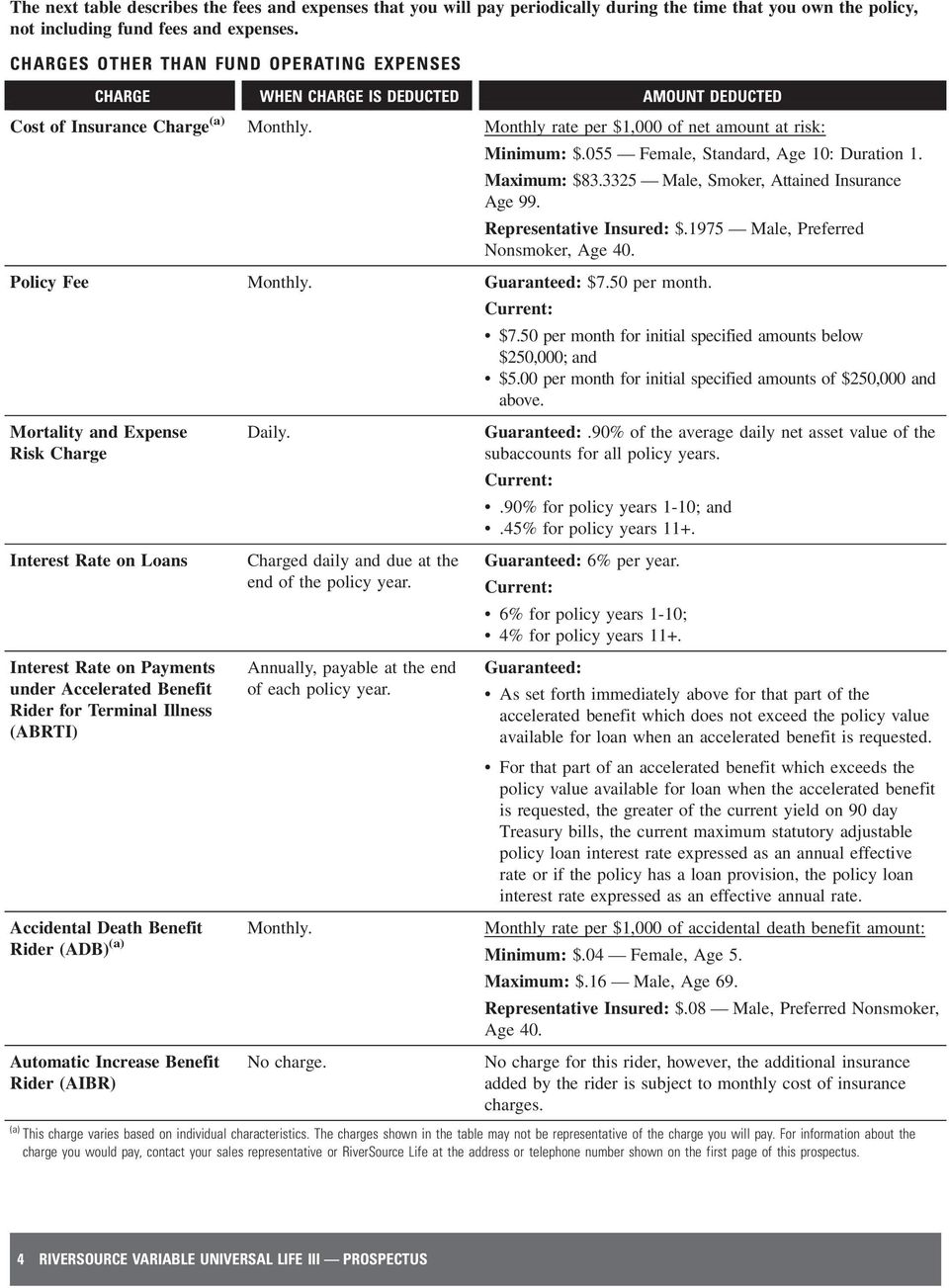
7 CHARGE WHEN CHARGE IS DEDUCTED AMOUNT DEDUCTED Children s Insurance Rider (CIR) Monthly. Monthly rate per $1,000 of CIR specified amount: $.58. Other Insured Rider (OIR) (a),(b) Monthly. Monthly rate per $1,000 of OIR specified amount: Minimum: $.055 Female, Standard, Age 10. Maximum: $ Male, Smoker, Age 99. Representative Insured: $.1975 Male, Preferred Nonsmoker, Age 40. Waiver of Monthly Deduction Rider (WMD) (a) Monthly. Monthly rate per $1,000 of net amount at risk plus the OIR specified amounts if applicable: Minimum: $.01 Female, Standard, Age 5. Maximum: $.2775 Male, Smoker, Age 59. Representative Insured: $.0225 Male, Preferred Nonsmoker, Age 40. Waiver of Premium Rider (WP) (a) Monthly. Monthly rate multiplied by the greater of the monthlyspecified premium selected for the rider or the monthly deduction for the policy and any other riders attached to the policy. Minimum: $ Male, Nonsmoker, Age 20. Maximum: $ Female, Smoker, Age 59. Representative Insured: $ Male, Preferred Nonsmoker, Age 40. (a) This charge varies based on individual characteristics. The charges shown in the table may not be representative of the charge you will pay. For information about the charge you would pay, contact your sales representative or RiverSource Life at the address or telephone number shown on the first page of this prospectus. (b) OIR is no longer available for purchase. Any OIR currently in force on a policy cannot be increased. ANNUAL OPERATING EXPENSES OF THE FUNDS The next two tables describe the operating expenses of the funds that you may pay periodically during the time that you own the policy. These operating expenses are for the fiscal year ended Dec. 31, 2012, unless otherwise noted. The first table shows the minimum and maximum total operating expenses charged by the funds. The second table shows the total annual operating expenses charged by each fund. More detail concerning each fund s fees and expenses is contained in the prospectus for each fund. Minimum and maximum total annual operating expenses for the funds (a) (Including management fee, distribution and/or service (12b-1) fees and other expenses) Minimum Maximum Total expenses before fee waivers and/or expense reimbursements 0.45% 1.71% (a) Each fund deducts management fees and other expenses from fund assets. Fund assets include amounts you allocate to a particular fund. Funds may also charge 12b-1 fees that are used to finance any activity that is primarily intended to result in the sale of fund shares. Because 12b-1 fees are paid out of fund assets on an on-going basis, you may pay more if you select subaccounts investing in funds that have adopted 12b-1 plans than if you select subaccounts investing in funds that have not adopted 12b-1 plans. The fund or the fund s affiliates may pay us and/or our affiliates for promoting and supporting the offer, sale and servicing of fund shares. In addition, the fund s distributor and/or investment adviser, transfer agent or their affiliates may pay us and/or our affiliates for various services we or our affiliates provide. The amount of these payments will vary by fund and may be significant. See The Variable Account and the Funds for additional information, including potential conflicts of interest these payments may create. For a more complete description of each fund s fees and expenses and important disclosure regarding payments the fund and/or its affiliates make, please review the fund s prospectus and Statement of Additional Information (SAI). Total annual operating expenses for each fund* (Before fee waivers and/or expense reimbursements, if applicable, as a percentage of average daily net assets) Acquired fund fees and expenses*** Gross total annual expenses Fund name** Management fees 12b-1 fees Other expenses AllianceBernstein VPS Growth and Income Portfolio (Class B) 0.55% 0.25% 0.05% % 0.85% AllianceBernstein VPS International Value Portfolio (Class B) AllianceBernstein VPS Large Cap Growth Portfolio (Class B) RIVERSOURCE VARIABLE UNIVERSAL LIFE III PROSPECTUS 5
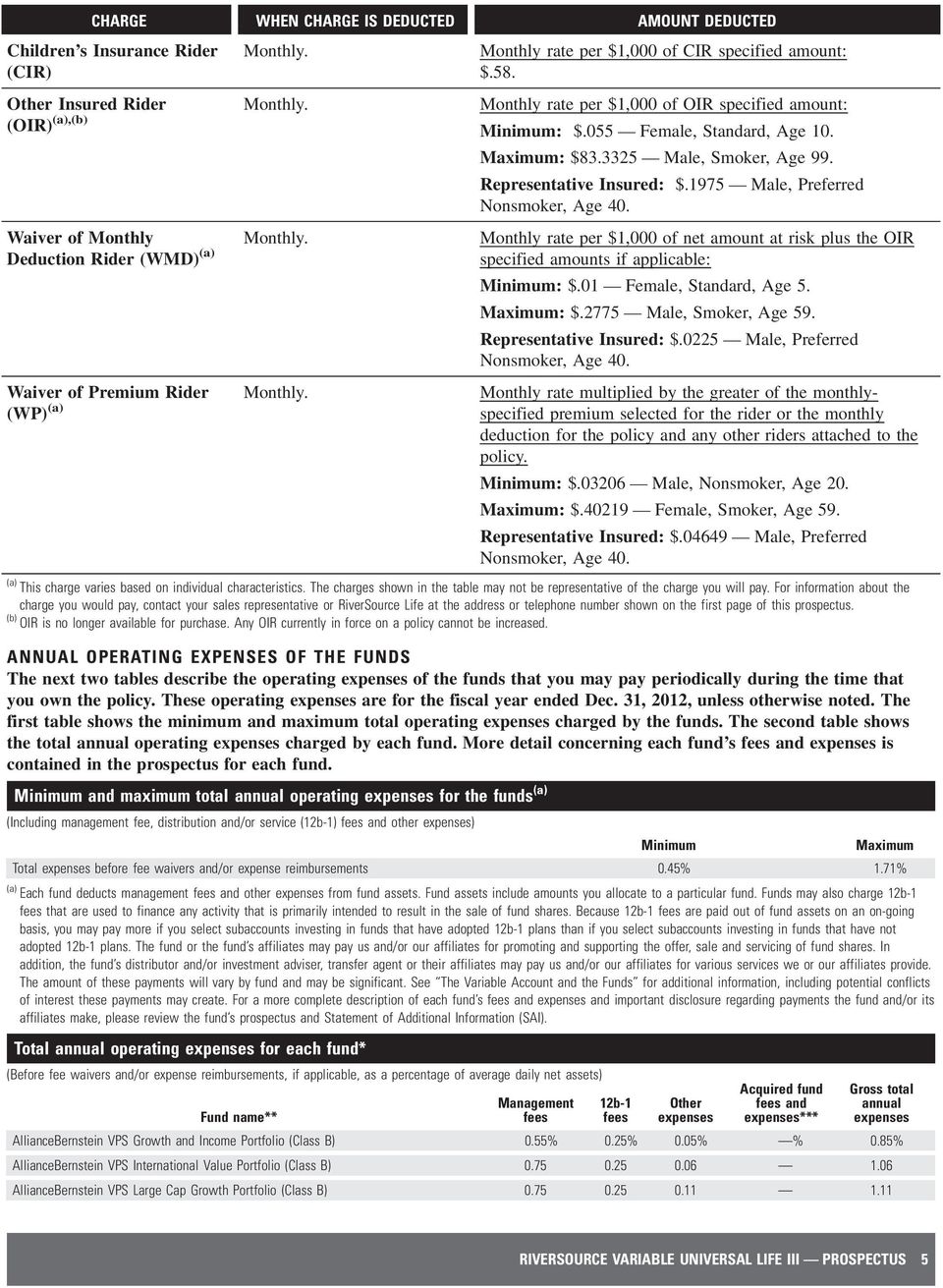
8 Total annual operating expenses for each fund* (continued) (Before fee waivers and/or expense reimbursements, if applicable, as a percentage of average daily net assets) Acquired fund fees and expenses*** Gross total annual expenses Fund name** Management fees 12b-1 fees Other expenses American Century VP International, Class I 1.41% % 0.02% % 1.43% American Century VP Value, Class I Calvert VP SRI Balanced Portfolio Columbia Variable Portfolio Balanced Fund (Class 3) Columbia Variable Portfolio Cash Management Fund (Class 3) (1) Columbia Variable Portfolio Diversified Bond Fund (Class 3) Columbia Variable Portfolio Dividend Opportunity Fund (Class 3)** Columbia Variable Portfolio Emerging Markets Fund (Class 3)** (1) Columbia Variable Portfolio Global Bond Fund (Class 3) Columbia Variable Portfolio High Yield Bond Fund (Class 3) (1) Columbia Variable Portfolio Income Opportunities Fund (Class 2) Columbia Variable Portfolio Income Opportunities Fund (Class 3) Columbia Variable Portfolio International Opportunity Fund (Class 3) Columbia Variable Portfolio Large Cap Growth Fund (Class 3) (1) Columbia Variable Portfolio Large Core Quantitative Fund (Class 3)** Columbia Variable Portfolio Mid Cap Growth Opportunity Fund (Class 3) (1) Columbia Variable Portfolio Mid Cap Value Opportunity Fund (Class 3) (1) Columbia Variable Portfolio S&P 500 Index Fund (Class 3) Columbia Variable Portfolio Select Large-Cap Value Fund (Class 3) (1) Columbia Variable Portfolio Select Smaller-Cap Value Fund (Class 3) (1) Columbia Variable Portfolio U.S. Government Mortgage Fund (Class 3)** Credit Suisse Trust Commodity Return Strategy Portfolio (2) Eaton Vance VT Floating-Rate Income Fund Fidelity VIP Contrafund Portfolio Service Class Fidelity VIP Growth & Income Portfolio Service Class Fidelity VIP Mid Cap Portfolio Service Class Fidelity VIP Overseas Portfolio Service Class FTVIPT Franklin Global Real Estate Securities Fund Class FTVIPT Franklin Small Cap Value Securities Fund Class FTVIPT Mutual Shares Securities Fund Class Goldman Sachs VIT Mid Cap Value Fund Institutional Shares (3) Goldman Sachs VIT Structured Small Cap Equity Fund Institutional Shares (4) Goldman Sachs VIT Structured U.S. Equity Fund Institutional Shares (5) Invesco V.I. American Franchise Fund, Series I Shares** (6) Invesco V.I. Comstock Fund, Series II Shares** (7) Invesco V.I. Core Equity Fund, Series I Shares Invesco V.I. Diversified Dividend Fund, Series I Shares Invesco V.I. International Growth Fund, Series II Shares Invesco V.I. Mid Cap Growth Fund, Series I Shares** (6) Invesco V.I. Technology Fund, Series I Shares Janus Aspen Series Enterprise Portfolio: Service Shares Janus Aspen Series Global Technology Portfolio: Service Shares Janus Aspen Series Janus Portfolio: Service Shares Janus Aspen Series Overseas Portfolio: Service Shares MFS Investors Growth Stock Series Service Class RIVERSOURCE VARIABLE UNIVERSAL LIFE III PROSPECTUS

9 Total annual operating expenses for each fund* (continued) (Before fee waivers and/or expense reimbursements, if applicable, as a percentage of average daily net assets) Acquired fund fees and expenses*** Gross total annual expenses Fund name** Management fees 12b-1 fees Other expenses MFS New Discovery Series Service Class 0.90% 0.25% 0.07% % 1.22% MFS Utilities Series Service Class Morgan Stanley UIF Global Real Estate Portfolio, Class II Shares (8) Morgan Stanley UIF Mid Cap Growth Portfolio, Class II Shares (8) Oppenheimer Global Fund/VA, Service Shares** Oppenheimer Global Strategic Income Fund/VA, Service Shares (9) Oppenheimer Main Street Small Cap Fund /VA, Service Shares** (10) PIMCO VIT All Asset Portfolio, Advisor Class (11) Putnam VT Global Health Care Fund Class IB Shares Putnam VT High Yield Fund Class IB Shares Putnam VT International Equity Fund Class IB Shares Putnam VT Multi-Cap Growth Fund Class IA Shares Putnam VT Multi-Cap Growth Fund Class IB Shares Royce Capital Fund Micro-Cap Portfolio, Investment Class Third Avenue Value Portfolio Variable Portfolio Aggressive Portfolio (Class 2) Variable Portfolio Aggressive Portfolio (Class 4) Variable Portfolio BlackRock Global Inflation-Protected Securities Fund (Class 3)** Variable Portfolio Conservative Portfolio (Class 2) Variable Portfolio Conservative Portfolio (Class 4) Variable Portfolio Moderate Portfolio (Class 2) Variable Portfolio Moderate Portfolio (Class 4) Variable Portfolio Moderately Aggressive Portfolio (Class 2) Variable Portfolio Moderately Aggressive Portfolio (Class 4) Variable Portfolio Moderately Conservative Portfolio (Class 2) Variable Portfolio Moderately Conservative Portfolio (Class 4) Variable Portfolio Partners Small Cap Value Fund (Class 3) (1) Variable Portfolio Sit Dividend Growth Fund (Class 3)** (1) Variable Portfolio Victory Established Value Fund (Class 3)** (1) Wanger International Wanger USA Wells Fargo Advantage VT International Equity Fund Class (12) Wells Fargo Advantage VT Opportunity Fund Class (12) Wells Fargo Advantage VT Small Cap Growth Fund Class * The Funds provided the information on their expenses and we have not independently verified the information. ** The previous fund names can be found in The Variable Account and the Funds section of the prospectus. *** Includes fees and expenses incurred indirectly by the Fund as a result of its investment in other investment companies (also referred to as acquired funds). (1) Advisers, LLC and certain of its affiliates have contractually agreed to waive and/or to reimburse expenses (excluding certain fees and expenses, such as transaction costs and certain other investment related expenses, interest, taxes, acquired fund fees and expenses, and extraordinary expenses) until April 30, 2014, unless sooner terminated at the sole discretion of the Fund s Board of Trustees. Under this agreement, the Fund s net operating expenses, subject to applicable exclusions, will not exceed the annual rate of 0.575% for Columbia Variable Portfolio Cash Management Fund (Class 3), 1.375% for Columbia Variable Portfolio Emerging Markets Fund (Class 3), 0.845% for Columbia Variable Portfolio High Yield Bond Fund (Class 3), 0.915% for Columbia Variable Portfolio Large Cap Growth Fund (Class 3), 0.995% for Columbia Variable Portfolio Mid Cap Growth Opportunity Fund (Class 3), 0.995% for Columbia Variable Portfolio Mid Cap Value Opportunity Fund (Class 3), 0.875% for Columbia Variable Portfolio Select Large-Cap Value Fund (Class 3), 1.055% for Columbia Variable Portfolio Select Smaller-Cap Value Fund (Class 3), 1.005% for Variable Portfolio Partners Small Cap Value Fund (Class 3), 0.895% for Variable Portfolio Sit Dividend Growth Fund (Class 3) and 1.015% for Variable Portfolio Victory Established Value Fund (Class 3). (2) Credit Suisse will waive fees and reimburse expenses so that the Portfolio s annual operating expenses will not exceed 1.05% of the Portfolio s average daily net assets. Waivers and expense reimbursements or credits are voluntary and may be discontinued at any time. RIVERSOURCE VARIABLE UNIVERSAL LIFE III PROSPECTUS 7

10 (3) The Investment Adviser agreed to waive a portion of its management fee in order to achieve an effective net management rate of 0.77%. Other expenses include transfer agency fees equal on an annualized basis to 0.02% of the average daily net assets of the Fund s Institutional Shares, plus all other ordinary expenses not detailed above. The Investment Adviser has voluntarily agreed to reduce or limit other expenses (excluding management fees, distribution and service fees, transfer agent fees and expenses, taxes, interest, brokerage fees and litigation, indemnification, shareholder meetings and other extraordinary expenses, exclusive of any custody and transfer agent fee credit reductions) to the extent such expenses exceed, on an annual basis, 0.054% of the average daily net assets of the Fund. These arrangements will remain in effect through at least April 29, 2014 and prior to such date the Investment Adviser may not terminate the arrangement without the approval of the trustees. After fee waivers and reimbursements, net expenses would be 0.84%. (4) The Investment Adviser agreed to waive a portion of its management fee in order to achieve an effective net management rate of 0.70%. Other expenses include transfer agency fees equal on an annualized basis to 0.02% of the average daily net assets of the Fund s Institutional Shares, plus all other ordinary expenses not detailed above. The Investment Adviser has voluntarily agreed to reduce or limit other expenses (excluding management fees, distribution and service fees, transfer agent fees and expenses, taxes, interest, brokerage fees and litigation, indemnification, shareholder meetings and other extraordinary expenses, exclusive of any custody and transfer agent fee credit reductions) to the extent such expenses exceed, on an annual basis, 0.094% of the average daily net assets of the Fund. These arrangements will remain in effect through at least April 29, 2014 and prior to such date the Investment Adviser may not terminate the arrangement without the approval of the trustees. After fee waivers and reimbursements, net expenses would be 0.81%. (5) Other expenses include transfer agency fees equal on an annualized basis to 0.02% of the average daily net assets of the Fund s Institutional Shares, plus all other ordinary expenses not detailed above. The Investment Adviser has voluntarily agreed to reduce or limit other expenses (excluding management fees, distribution and service fees, transfer agent fees and expenses, taxes, interest, brokerage fees and litigation, indemnification, shareholder meetings and other extraordinary expenses, exclusive of any custody and transfer agent fee credit reductions) to the extent such expenses exceed, on an annual basis, 0.004% of the average daily net assets of the Fund. These arrangements will remain in effect through at least April 29, 2014 and prior to such date the Investment Adviser may not terminate the arrangement without the approval of the trustees. After fee waivers and reimbursements, net expenses would be 0.64%. (6) The Adviser has contractually agreed, through at least June 30, 2014, to waive advisory fees and/or reimburse expenses of Series I shares to the extent necessary to limit total annual fund operating expenses after fee waivers and/or expense reimbursements (excluding interest, taxes, dividend expense on short sales, extraordinary or non-routine items, including litigation expenses and expenses that the Fund has incurred but did not actually pay because of an expense offset arrangement) of Series I shares to 0.90% for Invesco V.I. American Franchise Fund, Series I Shares and 1.09% for Invesco V.I. Mid Cap Growth Fund, Series I Shares of average daily net assets. Unless the Board of Trustees and Invesco Advisers, Inc. mutually agree to amend or continue the fee waiver agreement, it will terminate on June 30, (7) The Adviser has contractually agreed, through at least June 30, 2014, to waive advisory fees and/or reimburse expenses of Series II shares to the extent necessary to limit total annual fund operating expenses after fee waivers and/or expense reimbursements (excluding interest, taxes, dividend expense on short sales, extraordinary or non-routine items, including litigation expenses and expenses that the Fund has incurred but did not actually pay because of an expense offset arrangement) of Series II shares to 1.03% of average daily net assets. Unless the Board of Trustees and Invesco Advisers, Inc. mutually agree to amend or continue the fee waiver agreement, it will terminate on June 30, (8) The Portfolios Adviser, Morgan Stanley Investment Management Inc., has agreed to reduce its advisory fee and/or reimburse the Portfolio so that total annual portfolio operating expenses, excluding certain investment related expenses, taxes, interest and other extraordinary expenses (including litigation), will not exceed 1.40% for Morgan Stanley UIF Global Real Estate Portfolio, Class II Shares and 1.15% for Morgan Stanley UIF Mid Cap Growth Portfolio, Class II Shares. In addition, the Portfolios Distributor, Morgan Stanley Distribution Inc., has agreed to waive 0.10% for Morgan Stanley UIF Global Real Estate Portfolio, Class II Shares and 0.25% for Morgan Stanley UIF Mid Cap Growth Portfolio, Class II Shares of the 0.35% 12b-1 fee that it may receive. These fee waivers and/or expense reimbursements will continue for at least one year or until such time as the Fund s Board of Directors acts to discontinue all or a portion of such waivers and/or reimbursements when it deems that such action is appropriate. (9) The Manager has contractually agreed to waive fees and/or reimburse Fund expenses in an amount equal to the indirect management fees incurred through the Fund s investments in Oppenheimer Institutional Money Market Fund, Oppenheimer Short Duration Fund and the Master Funds. This fee waiver and/or expenses reimbursement may not be amended or withdrawn for one year from the date of the Fund s prospectus, unless approved by the board. After fee waivers, net expenses would be 0.97%. (10) The Manager has voluntarily agreed to limit the Fund s expenses after payments, waivers and/or reimbursements and reduction to custodian expenses, excluding expenses incurred directly or indirectly by the Fund as a result of investments in other investment companies, wholly-owned subsidiaries and pooled investment vehicles; so that those expenses, as percentages of daily net assets, will not exceed the annual rate of 1.05%. (11) PIMCO has contractually agreed, through May 1, 2014, to reduce its advisory fee to the extent that the Underlying PIMCO Fund Expenses attributable to advisory and supervisory and administrative fees exceed 0.64% of the total assets invested in Underlying PIMCO Funds. PIMCO may recoup these waivers in future periods, not exceeding three years, provided total expenses, including such recoupment, do not exceed the annual expense limit. The fee reduction is implemented based on a calculation of Underlying PIMCO Fund Expenses attributable to advisory and supervisory and administrative fees that is different from the calculation of Acquired Fund Fees and Expenses listed in the table above. After fee waivers, net expenses would be 1.34%. (12) The Adviser has committed through April 30, 2014 to waive fees and/or reimburse expenses to the extent necessary to cap the Fund s total annual fund operating expenses after fee waiver at 0.94% for Wells Fargo Advantage VT International Equity Fund Class 2 and 1.00% for Wells Fargo Advantage VT Opportunity Fund Class 2. Brokerage commissions, stamp duty fees, interest, taxes, acquired fund fees and expenses and extraordinary expenses are excluded from the cap. After this time, the cap may be increased or the commitment to maintain the cap may be terminated only with the approval of the Board of Trustees. 8 RIVERSOURCE VARIABLE UNIVERSAL LIFE III PROSPECTUS

11 Policy Benefits and Risks This summary describes the policy s important benefits and risks. The sections in the prospectus following this summary discuss the policy s benefits, risks and other provisions in more detail. For your convenience, we have defined certain words and phrases used in this prospectus in the Key Terms section. POLICY BENEFITS POLICY BENEFIT WHAT IT MEANS HOW IT WORKS Death Benefit We will pay a benefit to the beneficiary of the policy when the insured dies. Before the insured s attained insurance age 100, your policy s death benefit can never be less than the specified amount unless you change that amount or your policy has outstanding indebtedness. The amount payable is the death benefit amount minus any indebtedness as of the death benefit valuation date. You may choose either of the following death benefit options: Option 1 (level amount): If death is prior to the insured s attained insurance age 100, the death benefit amount is the greater of the following as determined on the death benefit valuation date: the specified amount; or a percentage of the policy value. Option 2 (variable amount): If death is prior to the insured s attained insurance age 100, the death benefit amount is the greater of the following as determined on the death benefit valuation date: the policy value plus the specified amount; or a percentage of the policy value. You may change the death benefit option or specified amount within certain limits, but doing so generally will affect policy charges. We reserve the right to limit any decrease to the extent necessary to qualify the policy as life insurance under the Internal Revenue Code of 1986, as amended (Code). Under both Option 1 and Option 2, if death is on or after the insured s attained insurance age 100, the amount payable is the cash surrender value on the death benefit valuation date. No Lapse Guarantee (NLG)* * In Illinois, referred to as Death Benefit Guarantee (DBG) Flexible Premiums Your policy will not lapse (end without value) if the NLG is in effect, even if the cash surrender value is less than the amount needed to pay the monthly deduction. You choose when to pay premiums and how much premium to pay. No Lapse Guarantee: The policy has the NLG option, which guarantees the policy will not lapse before the insured s attained insurance age 70 (or 5 years, if later). The NLG remains in effect if you meet certain premium requirements and indebtedness does not exceed the policy value minus surrender charges. State restrictions may apply. When you apply for your policy, you state how much you intend to pay and whether you will pay quarterly, semiannually or annually. You may also make additional, unscheduled premium payments subject to certain limits. You cannot make premium payments on or after the insured s attained insurance age 100. We may refuse premiums in order to comply with the Code. Although you have flexibility in paying premiums, the amount and frequency of your payments will affect the policy value, cash surrender value and the length of time your policy will remain in force as well as affect whether the NLG remains in effect. RIVERSOURCE VARIABLE UNIVERSAL LIFE III PROSPECTUS 9

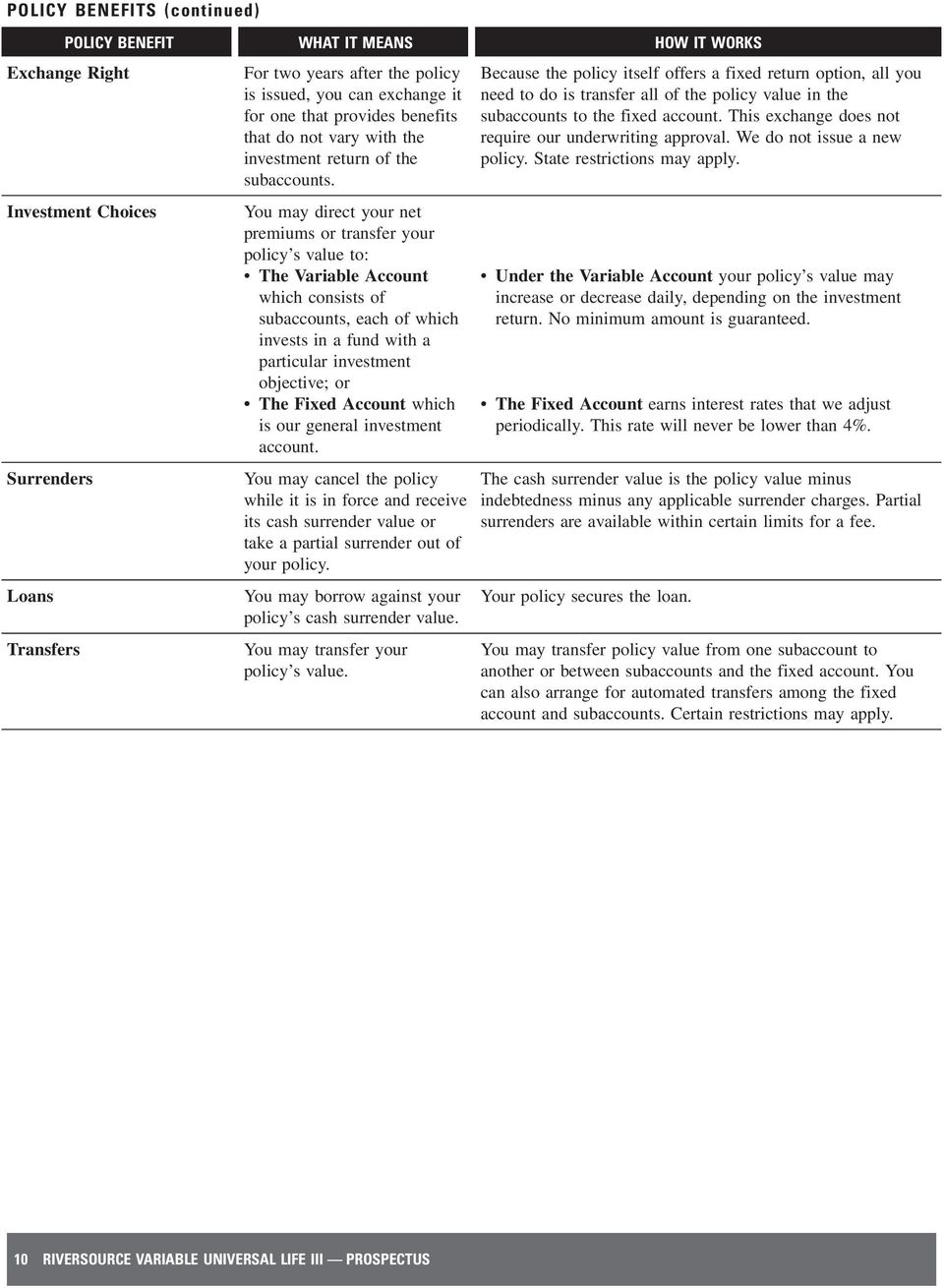
12 POLICY BENEFITS (continued) POLICY BENEFIT WHAT IT MEANS HOW IT WORKS Exchange Right Investment Choices Surrenders Loans Transfers For two years after the policy is issued, you can exchange it for one that provides benefits that do not vary with the investment return of the subaccounts. You may direct your net premiums or transfer your policy s value to: The Variable Account which consists of subaccounts, each of which invests in a fund with a particular investment objective; or The Fixed Account which is our general investment account. You may cancel the policy while it is in force and receive its cash surrender value or take a partial surrender out of your policy. You may borrow against your policy s cash surrender value. You may transfer your policy s value. Because the policy itself offers a fixed return option, all you need to do is transfer all of the policy value in the subaccounts to the fixed account. This exchange does not require our underwriting approval. We do not issue a new policy. State restrictions may apply. Under the Variable Account your policy s value may increase or decrease daily, depending on the investment return. No minimum amount is guaranteed. The Fixed Account earns interest rates that we adjust periodically. This rate will never be lower than 4%. The cash surrender value is the policy value minus indebtedness minus any applicable surrender charges. Partial surrenders are available within certain limits for a fee. Your policy secures the loan. You may transfer policy value from one subaccount to another or between subaccounts and the fixed account. You can also arrange for automated transfers among the fixed account and subaccounts. Certain restrictions may apply. 10 RIVERSOURCE VARIABLE UNIVERSAL LIFE III PROSPECTUS
13 POLICY BENEFITS (continued) POLICY BENEFIT WHAT IT MEANS HOW IT WORKS Optional Insurance Benefits You may add optional benefits to your policy at an additional cost, in the form of riders (if you meet certain requirements). The amounts of these benefits do not vary with investment experience of the variable account. Certain restrictions and conditions apply and are clearly described in the applicable rider. These riders may not be available in all states. Available riders you may add: Accelerated Benefit Rider for Terminal Illness (ABRTI): If the insured is terminally ill and death is expected to occur within six months, the rider provides that you can withdraw a portion of the death benefit prior to death. Accidental Death Benefit Rider (ADB): ADB provides an additional death benefit if the insured s death is caused by accidental injury. Automatic Increase Benefit Rider (AIB): AIB provides an increase in the specified amount at a designated percentage on each policy anniversary until insured s attained insurance age 65. Children s Insurance Rider (CIR): CIR provides level term coverage on each eligible child. Waiver of Monthly Deduction Rider (WMD): Under WMD, we will waive the monthly deduction if the insured becomes totally disabled before attained insurance age 60. Waiver of Premium Rider (WP): Under WP, if total disability begins before attained insurance age 60, prior to attained insurance age 65 we will add the specified premium shown under Policy Data in the policy to the policy value or waive the monthly deduction if higher. On or after attained insurance age 65, we will waive the monthly deduction. In addition: If total disability begins on or after attained insurance age 60 but before attained insurance age 65, the monthly deduction will be waived for a limited period of time; and WP also includes a waiver for involuntary unemployment benefit where monthly deductions may be waived up to 12 months. RIVERSOURCE VARIABLE UNIVERSAL LIFE III PROSPECTUS 11

14 POLICY RISKS Investment Risk POLICY RISK WHAT IT MEANS WHAT CAN HAPPEN Risk of Limited Policy Values in Early Years Lapse Risk You direct your net premiums or transfer your policy s value to a subaccount that drops in value. You transfer your policy s value between subaccounts. The policy is not suitable as a short-term investment. Your policy has little or no cash surrender value in the early policy years. Your ability to take partial surrenders is limited. You do not pay the premiums needed to maintain coverage. Your policy may lapse due to surrender charges. You take a loan against your policy. Your policy can lapse due to poor investment performance. You can lose cash values due to adverse investment experience. No minimum amount is guaranteed under the subaccounts of the variable account. Your death benefit under Option 2 may be lower due to adverse investment experience. Your policy could lapse due to adverse investment experience if the NLG is not in effect and you do not pay the premiums needed to maintain coverage. The value of the subaccount from which you transferred could increase. The value of the subaccount to which you transferred could decrease. If you are unable to afford the premiums needed to keep the policy in force, your policy could lapse with no value. Surrender charges apply to this policy for the first ten policy years. Surrender charges can significantly reduce policy value. Poor investment performance can also significantly reduce policy values. During early policy years the cash surrender value may be less than the premiums you pay for the policy. You cannot take partial surrenders during the first policy year. We will not pay a death benefit if your policy lapses. Also, the lapse may have adverse tax consequences. (See Tax Risk. ) Surrender charges affect the surrender value, which is a measure we use to determine whether your policy will enter a grace period (and possibly lapse, which may have adverse tax consequences). A partial surrender will reduce the policy value, will reduce the death benefit and the specified amount, and may terminate the NLG. Taking a loan increases the risk of: policy lapse (which may have adverse tax consequences); a permanent reduction of policy value; reducing the death benefit. Taking a loan may also terminate the NLG. Your policy could lapse due to adverse investment experience if the NLG is not in effect and you do not pay the premiums needed to maintain coverage. The lapse may have adverse tax consequences. 12 RIVERSOURCE VARIABLE UNIVERSAL LIFE III PROSPECTUS

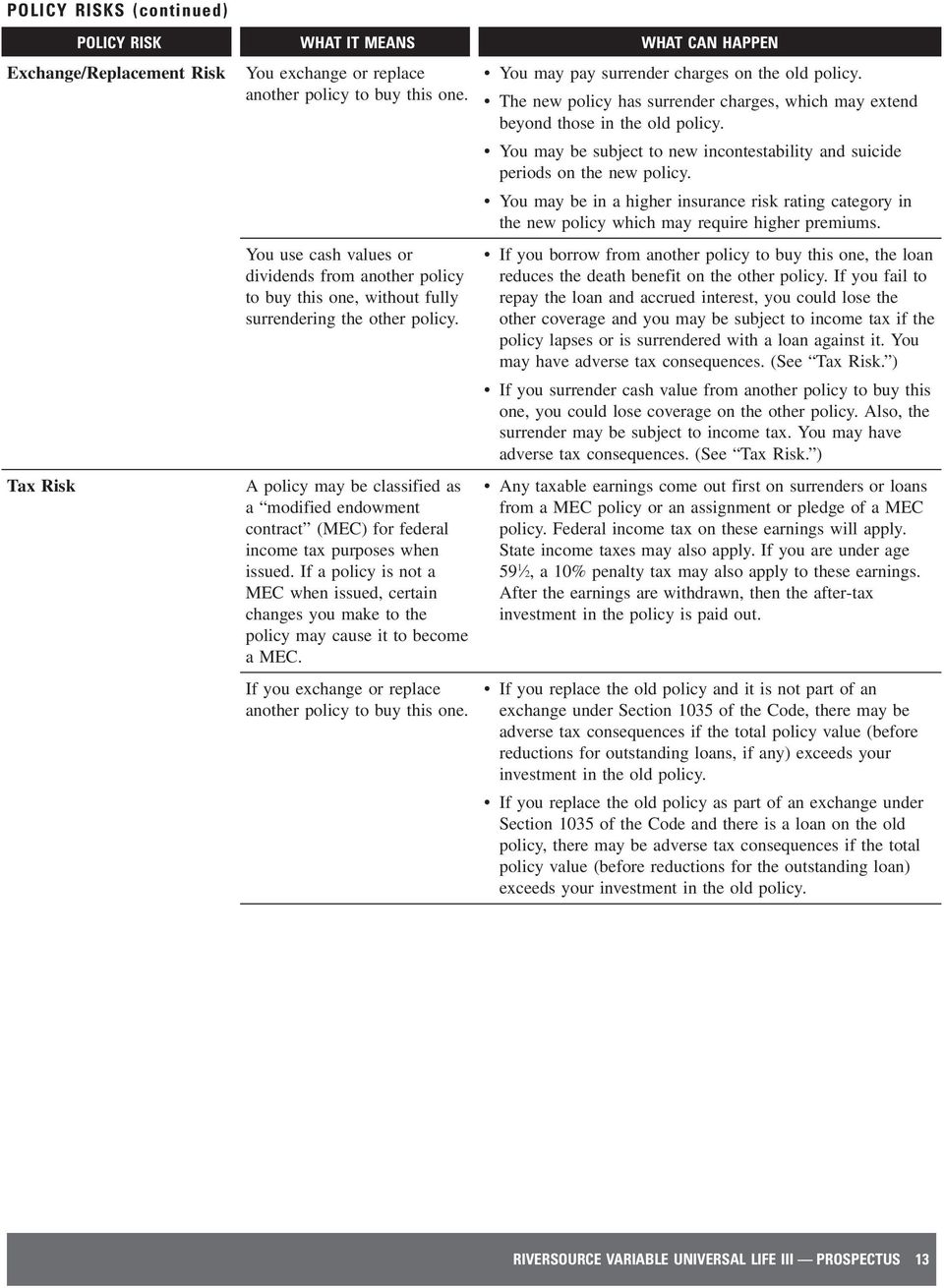
15 POLICY RISKS (continued) POLICY RISK WHAT IT MEANS WHAT CAN HAPPEN Exchange/Replacement Risk Tax Risk You exchange or replace another policy to buy this one. You use cash values or dividends from another policy to buy this one, without fully surrendering the other policy. A policy may be classified as a modified endowment contract (MEC) for federal income tax purposes when issued. If a policy is not a MEC when issued, certain changes you make to the policy may cause it to become a MEC. If you exchange or replace another policy to buy this one. You may pay surrender charges on the old policy. The new policy has surrender charges, which may extend beyond those in the old policy. You may be subject to new incontestability and suicide periods on the new policy. You may be in a higher insurance risk rating category in the new policy which may require higher premiums. If you borrow from another policy to buy this one, the loan reduces the death benefit on the other policy. If you fail to repay the loan and accrued interest, you could lose the other coverage and you may be subject to income tax if the policy lapses or is surrendered with a loan against it. You may have adverse tax consequences. (See Tax Risk. ) If you surrender cash value from another policy to buy this one, you could lose coverage on the other policy. Also, the surrender may be subject to income tax. You may have adverse tax consequences. (See Tax Risk. ) Any taxable earnings come out first on surrenders or loans from a MEC policy or an assignment or pledge of a MEC policy. Federal income tax on these earnings will apply. State income taxes may also apply. If you are under age , a 10% penalty tax may also apply to these earnings. After the earnings are withdrawn, then the after-tax investment in the policy is paid out. If you replace the old policy and it is not part of an exchange under Section 1035 of the Code, there may be adverse tax consequences if the total policy value (before reductions for outstanding loans, if any) exceeds your investment in the old policy. If you replace the old policy as part of an exchange under Section 1035 of the Code and there is a loan on the old policy, there may be adverse tax consequences if the total policy value (before reductions for the outstanding loan) exceeds your investment in the old policy. RIVERSOURCE VARIABLE UNIVERSAL LIFE III PROSPECTUS 13
16 POLICY RISKS (continued) POLICY RISK WHAT IT MEANS WHAT CAN HAPPEN Tax Risk (continued) If your policy lapses or is fully surrendered with an outstanding policy loan, you may experience a significant tax risk, especially if your policy is not a MEC. You may buy this policy to fund a tax-deferred retirement plan. The investments in the subaccount are not adequately diversified. Congress may change how a life insurance policy is taxed at any time. The interpretation of current tax law is subject to change by the Internal Revenue Service (IRS) or the courts at any time. The IRS may determine that you are the owner of the fund shares held by our Variable Account. You will be taxed on any earnings in the policy. Earnings will be calculated as follows: For non-mec policies, this includes earnings included in the policy s cash surrender value and earnings previously taken via existing loans. It could be the case that a policy with a relatively small existing cash value could have significant as yet untaxed earnings that will be taxed upon lapse or surrender of the policy. For MEC policies, earnings are the remaining earnings (any earnings that have not been previously taxed) in the policy, which could be a significant amount depending on the policy. The policy will not provide any necessary or additional tax deferral if it is used to fund a tax-deferred retirement plan. If a policy fails to qualify as a life insurance policy because it is not adequately diversified, the policyholder must include in gross income the income on the contract (as defined in Section 7702(g) of the Code). You could lose any or all of the specific federal income tax attributes and benefits of a life insurance policy including tax-deferred accrual of cash values and income tax free death benefits. For non-mec policies you could lose your ability to take non-taxable distributions or loans from the policy. Typically, changes of this type are prospective only, but some or all of the attributes could be affected. You may be taxed on the income of each subaccount to the extent of your interest in the subaccount. Variable life insurance is a complex vehicle that is subject to market risk, including the potential loss of principal invested. Before you invest, be sure to ask your sales representative about the policy s features, benefits, risks and fees, and whether it is appropriate for you based upon your financial situation and objectives. Your sales representative may or may not be authorized to offer you several different variable life insurance policies in addition to the policy described in this prospectus. Each policy has different features or benefits that may be appropriate for you based on your financial situation and needs, your age and how you intend to use the policy. The different features and benefits may include investment and fund manager options, variations in interest rate amounts and guarantees and surrender charge schedules. The fees and charges may also be different among the policies. Be sure to ask your sales representative about all the options that are available to you. FUND RISKS A comprehensive discussion of the risks of each portfolio in which the subaccounts invest may be found in each fund s prospectus. Please refer to the prospectuses for the funds for more information. The investment advisers cannot guarantee that the funds will meet their investment objectives. 14 RIVERSOURCE VARIABLE UNIVERSAL LIFE III PROSPECTUS

17 Loads, Fees and Charges Policy charges primarily compensate us for: providing the insurance benefits of the policy; issuing the policy; administering the policy; assuming certain risks in connection with the policy; and distributing the policy. We deduct some of these charges from your premium payments. We deduct others periodically from your policy value in the fixed account and/or subaccounts. We may also assess a charge if you surrender your policy or the policy lapses. We may profit from one or more of the charges we collect under the policy. We may use these profits for any corporate purpose. PREMIUM EXPENSE CHARGE We deduct this charge from each premium payment. We credit the amount remaining after the deduction, called the net premium, to the accounts you have selected. The premium expense charge is 5% of each premium payment. The premium expense charge, in part, compensates us for expenses associated with administering and distributing the policy, including agents commissions, advertising and printing of prospectuses and sales literature. (The surrender charge, discussed under Surrender Charge below, also may partially compensate us for these expenses.) The premium expense charge also may compensate us for paying taxes imposed by certain states and governmental subdivisions on premiums received by insurance companies. All policies in all states are charged the same premium expense charge even though state premium taxes vary. MONTHLY DEDUCTION On each monthly date we deduct from the value of your policy in the fixed account and/or subaccounts an amount equal to the sum of: 1. the cost of insurance for the policy month; 2. the policy fee shown in your policy; and 3. charges for any optional insurance benefits provided by rider for the policy month. We explain each of the three components below. You specify, in your policy application, what percentage of the monthly deduction from 0% to 100% you want us to take from the fixed account and from each of the subaccounts. You may change these percentages for future monthly deductions by writing to us. We will take monthly deductions from the fixed account and the subaccounts on a pro rata basis if: you do not specify the accounts from which you want us to take the monthly deduction; or the value in the fixed account or any subaccount is insufficient to pay the portion of the monthly deduction you have specified. If the cash surrender value of your policy is not enough to cover the monthly deduction on a monthly anniversary, the policy may lapse. However, the policy will not lapse if the NLG is in effect. (See No Lapse Guarantee; also Grace Period and Reinstatement at the end of this section on policy costs.) Components of the monthly deduction: 1. Cost of Insurance: primarily, the cost of providing the death benefit under your policy. It depends on: the amount of the death benefit; the policy value; and the statistical risk that the insured will die in a given period. The cost of insurance for a policy month is calculated as: [a (b c)] + d where: a is the monthly cost of insurance rate based on the insured s attained insurance age, sex (unless unisex rates are required by law), and risk classification and election of WMD. Generally, the cost of insurance rate will increase as the insured s attained insurance age increases. We set the rates based on our expectations as to future mortality experience. We may change the rates from time to time; any change will apply to all individuals of the same rate classification. However, rates will not exceed the RIVERSOURCE VARIABLE UNIVERSAL LIFE III PROSPECTUS 15
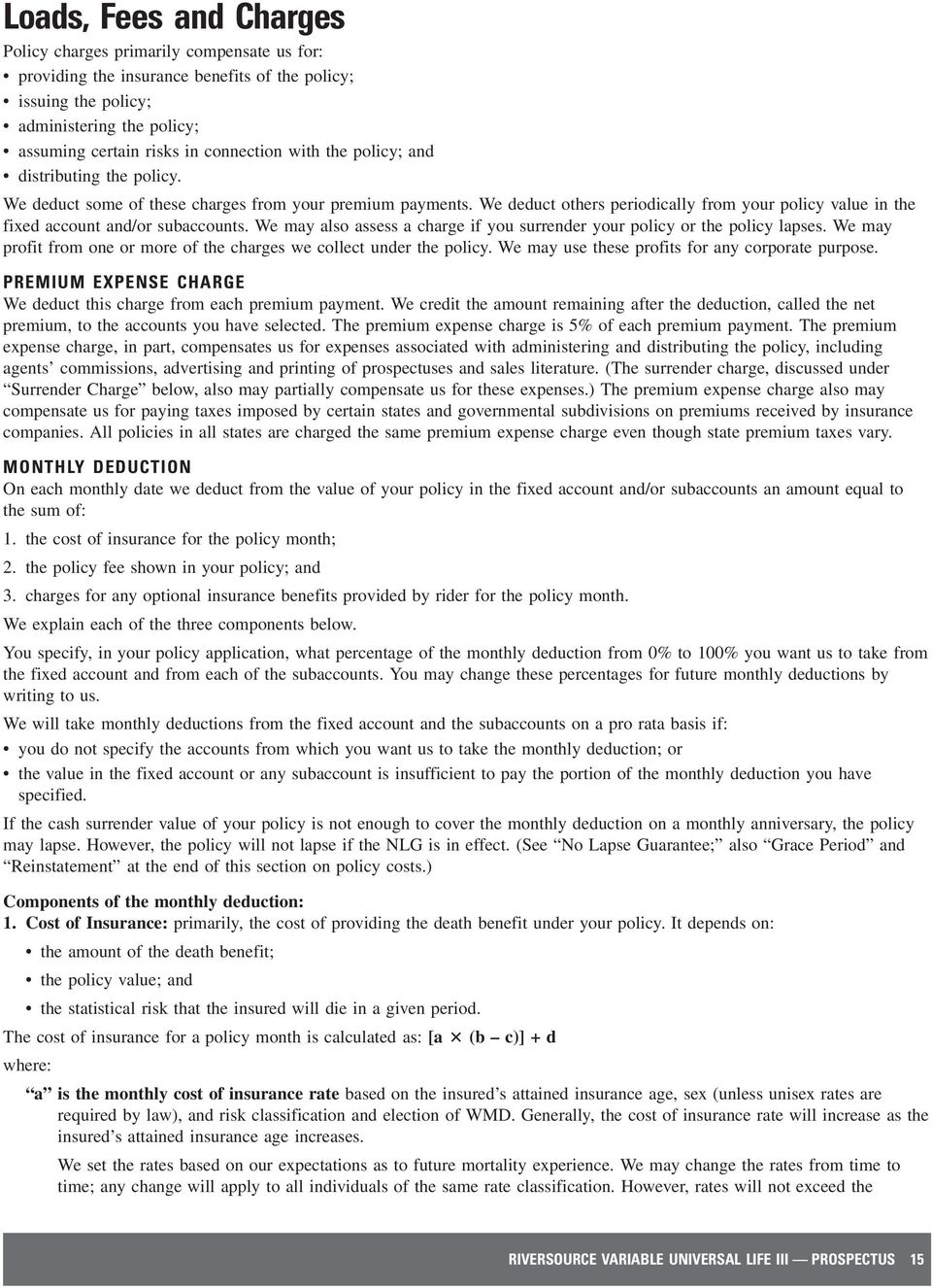
18 Guaranteed Maximum Monthly Cost of Insurance Rates shown in your policy, which are based on the 1980 Commissioners Standard Ordinary (CSO) Smoker and Nonsmoker Mortality Tables, Age Last Birthday. b is the death benefit on the monthly date divided by (which reduces our net amount at risk, solely for computing the cost of insurance, by taking into account assumed monthly earnings at an annual rate of 4%). c is the policy value on the monthly date. At this point, the policy value has been reduced by the policy fee, and any charges for optional riders with the exception of the WMD as it applies to the base policy. d is any flat extra insurance charges we assess as a result of special underwriting considerations. 2. Policy fee: $7.50 per month for initial specified amounts below $250,000 and $5.00 per month for initial specified amounts of $250,000 and above. This charge reimburses us for expenses associated with issuing the policy, such as processing the application (primarily underwriting) and setting up computer records; and associated with administering and distributing the policy, such as processing claims, maintaining records, making policy changes and communicating with owners. We reserve the right to change the charge in the future, but guarantee that it will never exceed $7.50 per month. 3. Optional insurance benefit charges: charges for any optional benefits you add to the policy by rider. (See Fee Tables Charges Other than Fund Operating Expenses. ) Note for Montana residents: Please disregard all policy provisions in this prospectus that are based on the sex of the insured. The policy will be issued on a unisex basis. Also disregard references to mortality tables; the tables will be replaced with an 80% male, 20% female blend of the 1980 CSO Smoker and Nonsmoker Mortality Tables, Age Last Birthday. SURRENDER CHARGE If you surrender your policy or the policy lapses during the first 10 policy years and in the 10 years following an increase in specified amount, we will reduce your policy value, minus indebtedness, by the applicable surrender charge. The surrender charge primarily reimburses us for costs of issuing the policy, such as processing the application (mostly underwriting) and setting up computer records. It also partially pays for commissions, advertising and printing the prospectus and sales literature. The maximum surrender charge for the initial specified amount is shown in your policy. It is based on the insured s insurance age, sex, risk classification and initial specified amount. The maximum surrender charge for the initial specified amount will remain level during the first five policy years and then decrease monthly until it is zero at the end of ten policy years. If you increase the specified amount, an additional maximum surrender charge will apply. The additional maximum surrender charge in a revised policy will be based on the insured s attained insurance age, sex (unless unisex rates are required by law), risk classification and the amount of the increase. It will remain level during the first five years following the effective date of the increase and then decrease monthly until it is zero at the end of the tenth year following the increase. The following table illustrates the maximum surrender charge for a male, insurance age 40 qualifying for preferred nonsmoker rates. We assume the specified amount to be $300,000. Lapse or surrender at beginning of year Maximum Surrender Charge 1 $3, , , , , , , , , From the beginning of year six to the end of year ten, the amounts shown decrease on a monthly basis. PARTIAL SURRENDER CHARGE If you surrender part of the value of your policy, we will charge you $25 (or 2% of the amount surrendered, if less). We guarantee that this charge will not increase for the duration of your policy. 16 RIVERSOURCE VARIABLE UNIVERSAL LIFE III PROSPECTUS

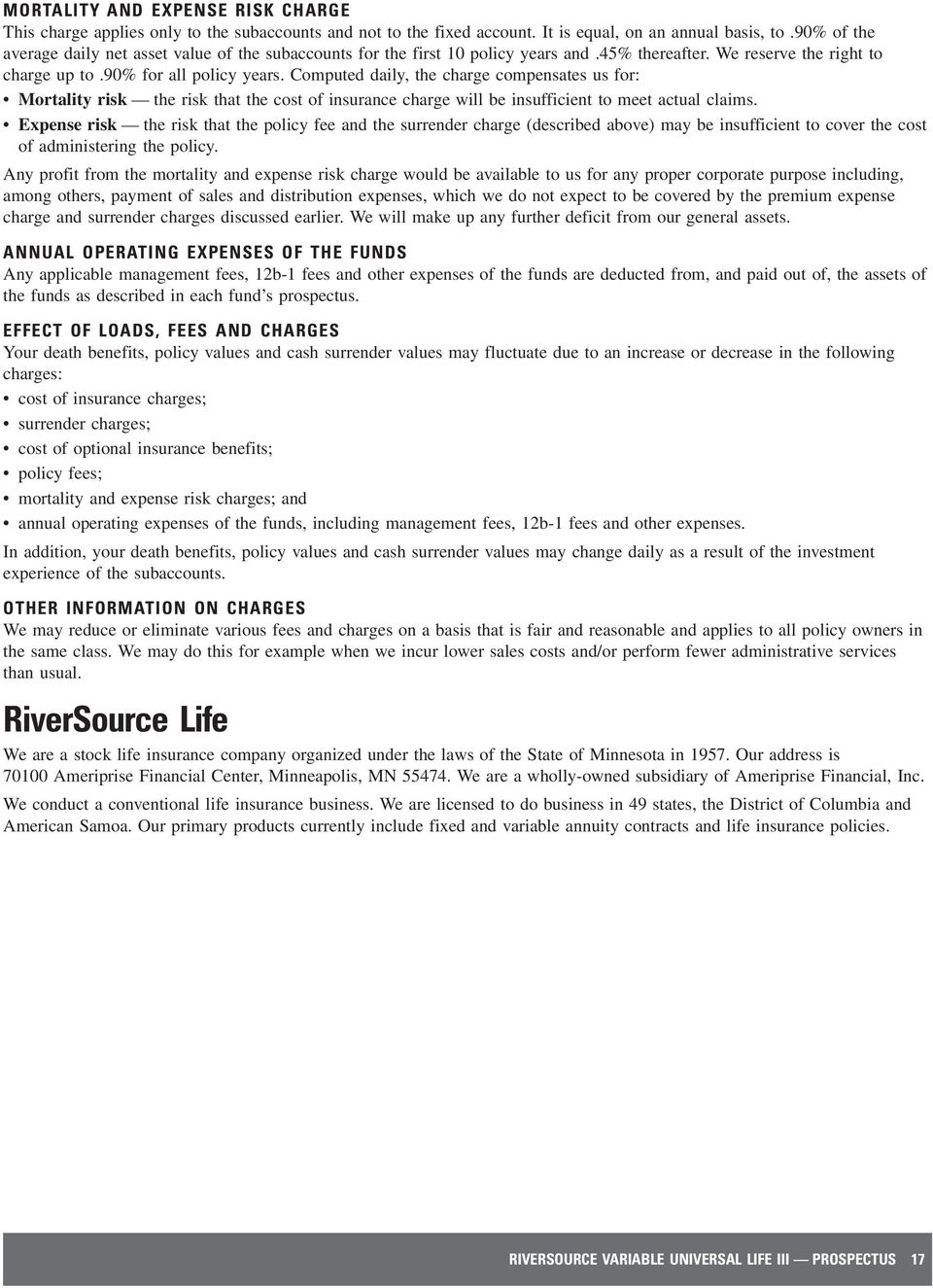
19 MORTALITY AND EXPENSE RISK CHARGE This charge applies only to the subaccounts and not to the fixed account. It is equal, on an annual basis, to.90% of the average daily net asset value of the subaccounts for the first 10 policy years and.45% thereafter. We reserve the right to charge up to.90% for all policy years. Computed daily, the charge compensates us for: Mortality risk the risk that the cost of insurance charge will be insufficient to meet actual claims. Expense risk the risk that the policy fee and the surrender charge (described above) may be insufficient to cover the cost of administering the policy. Any profit from the mortality and expense risk charge would be available to us for any proper corporate purpose including, among others, payment of sales and distribution expenses, which we do not expect to be covered by the premium expense charge and surrender charges discussed earlier. We will make up any further deficit from our general assets. ANNUAL OPERATING EXPENSES OF THE FUNDS Any applicable management fees, 12b-1 fees and other expenses of the funds are deducted from, and paid out of, the assets of the funds as described in each fund s prospectus. EFFECT OF LOADS, FEES AND CHARGES Your death benefits, policy values and cash surrender values may fluctuate due to an increase or decrease in the following charges: cost of insurance charges; surrender charges; cost of optional insurance benefits; policy fees; mortality and expense risk charges; and annual operating expenses of the funds, including management fees, 12b-1 fees and other expenses. In addition, your death benefits, policy values and cash surrender values may change daily as a result of the investment experience of the subaccounts. OTHER INFORMATION ON CHARGES We may reduce or eliminate various fees and charges on a basis that is fair and reasonable and applies to all policy owners in the same class. We may do this for example when we incur lower sales costs and/or perform fewer administrative services than usual. RiverSource Life We are a stock life insurance company organized under the laws of the State of Minnesota in Our address is Ameriprise Financial Center, Minneapolis, MN We are a wholly-owned subsidiary of Ameriprise Financial, Inc. We conduct a conventional life insurance business. We are licensed to do business in 49 states, the District of Columbia and American Samoa. Our primary products currently include fixed and variable annuity contracts and life insurance policies. RIVERSOURCE VARIABLE UNIVERSAL LIFE III PROSPECTUS 17
20 The Variable Account and the Funds The variable account: The variable account consists of a number of subaccounts, each of which invests in shares of a particular fund. Income, gains and losses of each subaccount are credited to or charged against the assets of that subaccount alone. Therefore, the investment performance of each subaccount is independent of the investment performance of our company assets. We will not charge a subaccount with the liabilities of any other subaccount or with the liabilities of any other business we conduct. We are obligated to pay all amounts promised to you under the policies. The funds: The policy currently offers subaccounts investing in shares of the funds listed in the table below. Investment objectives: The investment managers and advisers cannot guarantee that the funds will meet their investment objectives. Please read the funds prospectuses for facts you should know before investing. These prospectuses are available by contacting us at the address or telephone number on the first page of this prospectus. Fund name and management: A fund underlying your policy in which a subaccount invests may have a name, portfolio manager, objectives, strategies and characteristics that are the same or substantially similar to those of a publicly-traded retail mutual fund. Despite these similarities, an underlying fund is not the same as any publicly-traded retail mutual fund. Each underlying fund will have its own unique portfolio holdings, fees, operating expenses and operating results. The results of each underlying fund may differ significantly from any publicly-traded retail mutual fund. Eligible purchasers: All funds are available to serve as the underlying investments for variable annuities and variable life insurance policies. The funds are not available to the public (see Fund name and management above). Some funds also are available to serve as investment options for tax-deferred retirement plans. It is possible that in the future for tax, regulatory or other reasons, it may be disadvantageous for variable annuity accounts and variable life insurance accounts and/or taxdeferred retirement plans to invest in the available funds simultaneously. Although we and the fund providers do not currently foresee any such disadvantages, the boards of directors or trustees of each fund will monitor events in order to identify any material conflicts between annuity owners, policy owners and tax-deferred retirement plans and to determine what action, if any, should be taken in response to a conflict. If a board were to conclude that it should establish separate funds for the variable annuity, variable life insurance and tax-deferred retirement plan accounts, you would not bear any expenses associated with establishing separate funds. Please refer to the funds prospectuses for risk disclosure regarding simultaneous investments by variable annuity, variable life insurance and tax-deferred retirement plan accounts. Each fund intends to comply with the diversification requirements under Section 817(h) of the Code. Funds available under the policy: We seek to provide a broad array of underlying funds taking into account the fees and charges imposed by each fund and the policy charges we impose. We select the underlying funds in which the subaccounts initially invest and when there is a substitution (see Substitution of Investments ). We also make all decisions regarding which funds to retain in a policy, which funds to add to a policy and which funds will no longer be offered in a policy. In making these decisions, we may consider various objective and subjective factors. Objective factors include, but are not limited to, fund performance, fund expenses, classes of fund shares available, size of the fund, and investment objectives and investing style of the fund. Subjective factors include, but are not limited to, investment sub-styles and process, management skill and history at other funds, and portfolio concentration and sector weightings. We also consider the levels and types of revenue, including but not limited to expense payments and non-cash compensation that a fund, its distributor, investment adviser, subadviser, transfer agent or their affiliates pay us and our affiliates. This revenue includes, but is not limited to compensation for administrative services provided with respect to the fund and support of marketing and distribution expenses incurred with respect to the fund. Revenue we receive from the funds may create potential conflicts of interest: We or our affiliates receive from each of the funds, or the funds affiliates, varying levels and types of revenue, including but not limited to expense payments and non-cash compensation. The amount of this revenue and how it is computed varies by fund, may be significant and may create potential conflicts of interest. The greatest amount and percentage of revenue we and our affiliates receive comes from assets allocated to subaccounts investing in the funds that are managed by our affiliates Columbia Management Investment Advisers, LLC ( Advisers) and Columbia Wanger Asset Management, LLC (Columbia Wanger Asset Management) (affiliated funds). Employee compensation and operating goals at all levels are tied to the success of Ameriprise Financial, Inc. and its affiliates, including us. Certain employees may receive higher compensation and other benefits based, in part, on policy values that are invested in the affiliated funds. We or our affiliates receive revenue which ranges up to 0.69% of the average daily net assets invested in the underlying funds through this policy and other policies and contracts that we and our affiliate life insurance company issue. We or our affiliates may also receive revenue which ranges up to 0.04% of aggregate, net or anticipated sales of underlying funds through this policy and other policies and contracts that we and our affiliates issue. Please see the Statement of Additional Information (SAI) for a table that ranks the underlying funds according to total dollar amounts that their affiliates paid us or our affiliates in the prior calendar year. 18 RIVERSOURCE VARIABLE UNIVERSAL LIFE III PROSPECTUS
21 Expense payments, non-cash compensation and other forms of revenue may influence recommendations your sales representative makes regarding whether you should invest in the policy and whether you should allocate premiums or policy value to a subaccount that invests in a particular fund (see Distribution of the Policy ). The revenue we and/or our affiliates receive from a fund or its affiliates is in addition to revenue we receive from the charges you pay when buying, owning and surrendering the policy (see Fee Tables ). However, the revenue we and/or affiliates receive from a fund or its affiliates may come, at least in part, from the fund s fees and expenses you pay indirectly when you allocate policy value to the subaccount that invests in that fund. Why revenues are paid to us: In accordance with applicable laws, regulations and the terms of the agreements under which such revenue is paid, we or our affiliates may receive these revenues, including, but not limited to expense payments and non-cash compensation for various purposes including: Compensating, training and educating sales representatives who sell the policies. Granting access to our employees whose job it is to promote sales of the policies by authorized selling firms and their sales representatives, and granting access to sales representatives of our affiliated selling firms. Activities or services we or our affiliates provide that assist in the promotion and distribution of the policies including promoting the funds available under the policies to prospective and existing policy owners, authorized selling firms and sales representatives. Providing sub-transfer agency and shareholder servicing to policy owners. Promoting, including and/or retaining the fund s investment portfolios as underlying investment options in the policies. Advertising, printing and mailing sales literature, and printing and distributing prospectuses and reports. Furnishing personal services to policy owners, including education of policy owners, answering routine inquiries regarding a fund, maintaining accounts or providing such other services eligible for service fees as defined under the rules of the Financial Industry Regulatory Authority (FINRA). Subaccounting, transaction processing, recordkeeping and administration. Sources of revenue received from affiliated funds: The affiliated funds are managed by Columbia Management Investment Advisers. The sources of revenue we receive from these affiliated funds, or from affiliates of these funds, may include, but are not necessarily limited to, the following: Assets of the fund s adviser and transfer agent or an affiliate of these. The revenue resulting from these sources may be based either on a percentage of average daily net assets of the fund or on the actual cost of certain services we provide with respect to the fund. We may receive this revenue either in the form of a cash payment or it may be allocated to us. Compensation paid out of 12b-1 fees that are deducted from fund assets and disclosed in the 12b-1 fees column of the Annual Operating Expenses of the Funds table. Sources of revenue received from unaffiliated funds: The unaffiliated funds are not managed by an affiliate of ours. The sources of revenue we receive from these unaffiliated funds, or the funds affiliates, may include, but are not necessarily limited to, the following: Assets of the fund s adviser, subadviser, transfer agent or an affiliate of these and assets of the fund s distributor or an affiliate. The revenue resulting from these sources usually is based on a percentage of average daily net assets of the fund but there may be other types of payment arrangements. Compensation paid out of 12b-1 fees that are deducted from fund assets and disclosed in the 12b-1 fees column of the Annual Operating Expenses of the Funds table. RIVERSOURCE VARIABLE UNIVERSAL LIFE III PROSPECTUS 19
22 You can direct your net premiums and transfers to any or all of the subaccounts of the variable account that invest in shares of the following funds: Investing In Investment Objective and Policies Investment Adviser AllianceBernstein VPS Growth and Income Portfolio (Class B) AllianceBernstein VPS International Value Portfolio (Class B) AllianceBernstein VPS Large Cap Growth Portfolio (Class B) American Century VP International, Class I American Century VP Value, Class I Calvert VP SRI Balanced Portfolio Columbia Variable Portfolio Balanced Fund (Class 3) Columbia Variable Portfolio Cash Management Fund (Class 3) Columbia Variable Portfolio Diversified Bond Fund (Class 3) Columbia Variable Portfolio Dividend Opportunity Fund (Class 3) (previously Columbia Variable Portfolio Diversified Equity Income Fund (Class 3)) Columbia Variable Portfolio Emerging Markets Fund (Class 3) (previously Columbia Variable Portfolio Emerging Markets Opportunity Fund (Class 3)) Seeks long-term growth of capital. Seeks long-term growth of capital. Seeks long-term growth of capital. Seeks capital growth. Seeks long-term capital growth. Income is a secondary objective. Seeks to achieve a competitive total return through an actively managed portfolio of stocks, bonds and money market instruments which offer income and capital growth opportunity and which satisfy the investment criteria, including financial, sustainability and social responsibility factors. Seeks maximum total investment return through a combination of capital growth and current income. Seeks maximum current income consistent with liquidity and stability of principal. Seeks high level of current income while attempting to conserve the value of the investment for the longest period of time. Seeks high level of current income and, as a secondary goal, steady growth of capital. Seeks long-term capital growth. AllianceBernstein L.P. AllianceBernstein L.P. AllianceBernstein L.P. American Century Investment Management, Inc. American Century Investment Management, Inc. Calvert Investment Management, Inc., adviser. New Amsterdam Partners LLC, subadviser on equity portion; no subadviser on fixed-income portion. Advisers, LLC Advisers, LLC Advisers, LLC Advisers, LLC Advisers, LLC 20 RIVERSOURCE VARIABLE UNIVERSAL LIFE III PROSPECTUS
23 Investing In Investment Objective and Policies Investment Adviser Columbia Variable Portfolio Global Bond Fund (Class 3) Columbia Variable Portfolio High Yield Bond Fund (Class 3) Columbia Variable Portfolio Income Opportunities Fund (Class 2) Columbia Variable Portfolio Income Opportunities Fund (Class 3) Columbia Variable Portfolio International Opportunity Fund (Class 3) Columbia Variable Portfolio Large Cap Growth Fund (Class 3) Columbia Variable Portfolio Large Core Quantitative Fund (Class 3) (previously Columbia Variable Portfolio Dynamic Equity Fund (Class 3)) Columbia Variable Portfolio Mid Cap Growth Opportunity Fund (Class 3) Columbia Variable Portfolio Mid Cap Value Opportunity Fund (Class 3) Columbia Variable Portfolio S&P 500 Index Fund (Class 3) Columbia Variable Portfolio Select Large- Cap Value Fund (Class 3) Columbia Variable Portfolio Select Smaller- Cap Value Fund (Class 3) Non-diversified fund that seeks high total return through income and growth of capital. Seeks high current income, with capital growth as a secondary objective. Seeks high total return through current income and capital appreciation. Seeks high total return through current income and capital appreciation. Seeks capital appreciation. Seeks long-term capital growth. Seeks capital appreciation. Seeks growth of capital. Seeks long-term growth of capital. Seeks long-term capital appreciation. Seeks long-term growth of capital. Seeks long-term capital growth. Advisers, LLC Advisers, LLC Advisers, LLC Advisers, LLC Advisers, LLC, adviser; Threadneedle International Limited, an indirect wholly-owned subsidiary of Ameriprise Financial, sub-adviser. Advisers, LLC Advisers, LLC Advisers, LLC Advisers, LLC Advisers, LLC Advisers, LLC Advisers, LLC RIVERSOURCE VARIABLE UNIVERSAL LIFE III PROSPECTUS 21
24 Investing In Investment Objective and Policies Investment Adviser Columbia Variable Portfolio U.S. Government Mortgage Fund (Class 3) (previously Columbia Variable Portfolio Short Duration U.S. Government Fund (Class 3)) Credit Suisse Trust Commodity Return Strategy Portfolio Eaton Vance VT Floating- Rate Income Fund Fidelity» VIP Contrafund» Portfolio Service Class 2 Fidelity» VIP Growth & Income Portfolio Service Class Fidelity» VIP Mid Cap Portfolio Service Class Fidelity» VIP Overseas Portfolio Service Class FTVIPT Franklin Global Real Estate Securities Fund Class 2 FTVIPT Franklin Small Cap Value Securities Fund Class 2 FTVIPT Mutual Shares Securities Fund Class 2 Seeks high level of current income and safety of principal consistent with investment in U.S. government and government agency securities. The fund is designed to achieve positive total return relative to the performance of the Dow Jones-UBS Commodity Index Total Return ( DJ-UBS ). Seeks high level of current income. Seeks long-term capital appreciation. Normally invests primarily in common stocks. Invests in securities of companies whose value it believes is not fully recognized by the public. Invests in either growth stocks or value stocks or both. The fund invests in domestic and foreign issuers. Seeks high total return through a combination of current income and capital appreciation. Normally invests a majority of assets in common stocks with a focus on those that pay current dividends and show potential for capital appreciation. Invests in domestic and foreign issuers. The Fund invests in either growth stocks or value stocks or both. Seeks long-term growth of capital. Normally invests primarily in common stocks. Normally invests at least 80% of assets in securities of companies with medium market capitalizations. May invest in companies with smaller or larger market capitalizations. Invests in domestic and foreign issuers. The Fund invests in either growth or value common stocks or both. Seeks long-term growth of capital. Normally invests primarily in common stocks allocating investments across different countries and regions. Normally invests at least 80% of assets in non-u.s. securities. Seeks high total return. Under normal market conditions, the fund invests at least 80% of its net assets in investments of companies located anywhere in the world that operate in the real estate sector. Seeks long-term total return. Under normal market conditions, the fund invests at least 80% of its net assets in investments of small capitalization companies. Seeks capital appreciation, with income as a secondary goal. Under normal market conditions, the fund invests primarily in U.S. and foreign equity securities that the investment manager believes are undervalued. Advisers, LLC Credit Suisse Asset Management, LLC Eaton Vance Management Fidelity Management & Research Company (FMR) is the fund s manager. FMR Co., Inc. (FMRC) and other investment advisers serve as sub-advisers for the fund. FMR is the fund s manager. FMRC and other investment advisers serve as sub-advisers for the fund. FMR is the fund s manager. FMRC and other investment advisers serve as sub-advisers for the fund. FMR is the fund s manager. FMRC and other investment advisers serve as sub-advisers for the fund. Franklin Templeton Institutional, LLC Franklin Advisory Services, LLC Franklin Mutual Advisers, LLC 22 RIVERSOURCE VARIABLE UNIVERSAL LIFE III PROSPECTUS
25 Investing In Investment Objective and Policies Investment Adviser Goldman Sachs VIT Mid Cap Value Fund Institutional Shares Goldman Sachs VIT Structured Small Cap Equity Fund Institutional Shares Goldman Sachs VIT Structured U.S. Equity Fund Institutional Shares Invesco V.I. American Franchise Fund, Series I Shares (previously Invesco Van Kampen V.I. American Franchise Fund, Series I Shares) Invesco V.I. Comstock Fund, Series II Shares (previously Invesco Van Kampen V.I. Comstock Fund, Series II Shares) Invesco V.I. Core Equity Fund, Series I Shares Invesco V.I. Diversified Dividend Fund, Series I Shares Invesco V.I. International Growth Fund, Series II Shares Invesco V.I. Mid Cap Growth Fund, Series I Shares (previously Invesco Van Kampen V.I. Mid Cap Growth Fund, Series I Shares) Invesco V.I. Technology Fund, Series I Shares Janus Aspen Series Enterprise Portfolio: Service Shares Janus Aspen Series Global Technology Portfolio: Service Shares Janus Aspen Series Janus Portfolio: Service Shares Janus Aspen Series Overseas Portfolio: Service Shares Seeks long-term capital appreciation. Seeks long-term growth of capital. Seeks long-term growth of capital. Seeks capital growth. Seeks capital growth and income through investments in equity securities, including common stocks, preferred stocks and securities convertible into common and preferred stocks. Seeks long-term growth of capital. Seeks to provide reasonable current income and longterm growth of income and capital. Seeks long-term growth of capital. Seeks capital growth. Seeks long-term growth of capital. Seeks long-term growth of capital. Seeks long-term growth of capital. Seeks long-term growth of capital. Seeks long-term growth of capital. Goldman Sachs Asset Management, L.P. Goldman Sachs Asset Management, L.P. Goldman Sachs Asset Management, L.P. Invesco Advisers, Inc. Invesco Advisers, Inc. Invesco Advisers, Inc. Invesco Advisers, Inc. Invesco Advisers, Inc. Invesco Advisers, Inc. Invesco Advisers, Inc. Janus Capital Management LLC Janus Capital Management LLC Janus Capital Management LLC Janus Capital Management LLC RIVERSOURCE VARIABLE UNIVERSAL LIFE III PROSPECTUS 23
26 Investing In Investment Objective and Policies Investment Adviser MFS» Investors Growth Stock Series Service Class MFS» New Discovery Series Service Class MFS» Utilities Series Service Class Morgan Stanley UIF Global Real Estate Portfolio, Class II Shares Morgan Stanley UIF Mid Cap Growth Portfolio, Class II Shares Oppenheimer Global Fund/VA, Service Shares (previously Oppenheimer Global Securities Fund/VA, Service Shares) Oppenheimer Global Strategic Income Fund/VA, Service Shares Oppenheimer Main Street Small Cap Fund»/VA, Service Shares (previously Oppenheimer Main Street Small- & Mid-Cap Fund»/VA, Service Shares) PIMCO VIT All Asset Portfolio, Advisor Class Putnam VT Global Health Care Fund Class IB Shares Putnam VT High Yield Fund Class IB Shares Putnam VT International Equity Fund Class IB Shares Putnam VT Multi-Cap Growth Fund Class IA Shares Seeks capital appreciation. Seeks capital appreciation. Seeks total return. Seeks to provide current income and capital appreciation. Seeks long-term capital growth by investing primarily in common stocks and other equity securities. Seeks long-term capital appreciation by investing a substantial portion of its assets in securities of foreign issuers, growth-type companies, cyclical industries and special situations that are considered to have appreciation possibilities. Seeks a high level of current income principally derived from interest on debt securities. Seeks capital appreciation. Seeks maximum real return consistent with preservation of real capital and prudent investment management. Seeks capital appreciation. Seeks high current income. Capital growth is a secondary goal when consistent with achieving high current income. Seeks capital appreciation. Seeks long-term capital appreciation. MFS» Investment Management MFS» Investment Management MFS» Investment Management Morgan Stanley Investment Management Inc., adviser; Morgan Stanley Investment Management Limited and Morgan Stanley Investment Management Company, subadvisers. Morgan Stanley Investment Management Inc. OFI Global Asset Management, Inc., adviser; OppenheimerFunds, Inc., subadviser. OFI Global Asset Management, Inc., adviser; OppenheimerFunds, Inc., subadviser. OFI Global Asset Management, Inc., adviser; OppenheimerFunds, Inc., subadviser. Pacific Investment Management Company LLC (PIMCO) Putnam Investment Management, LLC, adviser; Putnam Advisory Company, LLC, sub-adviser; and Putnam Investments Limited Putnam Investment Management, LLC, adviser; Putnam Investments Limited, sub-adviser Putnam Investment Management, LLC, adviser; Putnam Advisory Company, LLC, sub-adviser; and Putnam Investments Limited Putnam Investment Management, LLC, adviser; Putnam Investments Limited, sub-adviser 24 RIVERSOURCE VARIABLE UNIVERSAL LIFE III PROSPECTUS
27 Investing In Investment Objective and Policies Investment Adviser Putnam VT Multi-Cap Growth Fund Class IB Shares Royce Capital Fund Micro-Cap Portfolio, Investment Class Third Avenue Value Portfolio Variable Portfolio Aggressive Portfolio (Class 2) Variable Portfolio Aggressive Portfolio (Class 4) Variable Portfolio BlackRock Global Inflation-Protected Securities Fund (Class 3) (previously Columbia Variable Portfolio Global Inflation Protected Securities Fund (Class 3)) Variable Portfolio Conservative Portfolio (Class 2) Variable Portfolio Conservative Portfolio (Class 4) Seeks long-term capital appreciation. Seeks long-term growth of capital. Seeks long-term capital appreciation by acquiring common stocks of well-financed companies (meaning companies with high quality assets and conservative levels of liabilities) at a discount to what the Adviser believes is their intrinsic value. Seeks high level of total return that is consistent with an aggressive level of risk. This is a fund of funds and seeks to achieve its objective by investing in a combination of underlying funds. The fund invests primarily in underlying funds that invest in equity securities and also invests a small amount in underlying funds that invest in fixed income securities. Seeks high level of total return that is consistent with an aggressive level of risk. This is a fund of funds and seeks to achieve its objective by investing in a combination of underlying funds. The fund invests primarily in underlying funds that invest in equity securities and also invests a small amount in underlying funds that invest in fixed income securities. Non-diversified fund that seeks total return that exceeds the rate of inflation over the long term. Seeks high level of total return that is consistent with a conservative level of risk. This is a fund of funds and seeks to achieve its objective by investing in a combination of underlying funds. The fund invests primarily in underlying funds that invest in fixed income securities. Seeks high level of total return that is consistent with a conservative level of risk. This is a fund of funds and seeks to achieve its objective by investing in a combination of underlying funds. The fund invests primarily in underlying funds that invest in fixed income securities. Putnam Investment Management, LLC Royce & Associates, LLC Third Avenue Management LLC Advisers, LLC Advisers, LLC Advisers, LLC, adviser; BlackRock Financial Management, Inc., subadviser. Advisers, LLC Advisers, LLC RIVERSOURCE VARIABLE UNIVERSAL LIFE III PROSPECTUS 25
28 Investing In Investment Objective and Policies Investment Adviser Variable Portfolio Moderate Portfolio (Class 2) Variable Portfolio Moderate Portfolio (Class 4) Variable Portfolio Moderately Aggressive Portfolio (Class 2) Variable Portfolio Moderately Aggressive Portfolio (Class 4) Variable Portfolio Moderately Conservative Portfolio (Class 2) Variable Portfolio Moderately Conservative Portfolio (Class 4) Variable Portfolio Partners Small Cap Value Fund (Class 3) Seeks high level of total return that is consistent with a moderate level of risk. This is a fund of funds and seeks to achieve its objective by investing in a combination of underlying funds. The fund invests primarily in a balance of underlying funds that invest in fixed income securities and underlying funds that invest in equity securities. Seeks high level of total return that is consistent with a moderate level of risk. This is a fund of funds and seeks to achieve its objective by investing in a combination of underlying funds. The fund invests primarily in a balance of underlying funds that invest in fixed income securities and underlying funds that invest in equity securities. Seeks high level of total return that is consistent with a moderately aggressive level of risk. This is a fund of funds and seeks to achieve its objective by investing in a combination of underlying funds. The fund invests primarily in underlying funds that invest in equity securities and also invests a moderate amount in underlying funds that invest in fixed income securities. Seeks high level of total return that is consistent with a moderately aggressive level of risk. This is a fund of funds and seeks to achieve its objective by investing in a combination of underlying funds. The fund invests primarily in underlying funds that invest in equity securities and also invests a moderate amount in underlying funds that invest in fixed income securities. Seeks high level of total return that is consistent with a moderately conservative level of risk. This is a fund of funds and seeks to achieve its objective by investing in a combination of underlying funds. The fund invests primarily in underlying funds that invest in fixed income securities and also invests a moderate amount in underlying funds that invest in equity securities. Seeks high level of total return that is consistent with a moderately conservative level of risk. This is a fund of funds and seeks to achieve its objective by investing in a combination of underlying funds. The fund invests primarily in underlying funds that invest in fixed income securities and also invests a moderate amount in underlying funds that invest in equity securities. Seeks long-term capital appreciation. Advisers, LLC Advisers, LLC Advisers, LLC Advisers, LLC Advisers, LLC Advisers, LLC Advisers, LLC, adviser; Barrow, Hanley, Mewhinney & Strauss, Inc., Denver Investment Advisors LLC, Donald Smith & Co., Inc., River Road Asset Management, LLC and Turner Investment Partners, Inc., subadvisers. 26 RIVERSOURCE VARIABLE UNIVERSAL LIFE III PROSPECTUS
29 Investing In Investment Objective and Policies Investment Adviser Variable Portfolio Sit Dividend Growth Fund (Class 3) (previously Variable Portfolio Davis New York Venture Fund (Class 3)) Variable Portfolio Victory Established Value Fund (Class 3) (previously Variable Portfolio Goldman Sachs Mid Cap Value Fund (Class 3)) Seeks long-term capital growth. Seeks long-term growth of capital. Advisers, LLC, adviser; Sit Investment Associates, Inc., subadviser. Advisers, LLC, adviser; Victory Capital Management, Inc., subadviser. Wanger International Seeks long-term capital appreciation. Columbia Wanger Asset Management, LLC Wanger USA Seeks long-term capital appreciation. Columbia Wanger Asset Management, LLC Wells Fargo Advantage VT International Equity Fund Class 2 Wells Fargo Advantage VT Opportunity Fund Class 2 Wells Fargo Advantage VT Small Cap Growth Fund Class 2 Seeks long-term capital appreciation. Seeks long-term capital appreciation. Seeks long-term capital appreciation. Wells Fargo Funds Management, LLC, adviser; Wells Capital Management Inc., sub-adviser. Wells Fargo Funds Management, LLC, adviser; Wells Capital Management Inc., sub-adviser. Wells Fargo Funds Management, LLC, adviser; Wells Capital Management Inc., sub-adviser. Please refer to the prospectuses for the funds for more information. These prospectuses are available by contacting us at the address or telephone number on the first page of this prospectus. RELATIONSHIP BETWEEN FUNDS AND SUBACCOUNTS Each subaccount buys shares of the appropriate fund at net asset value without a sales charge. Dividends and capital gain distributions from a fund are reinvested at net asset value without a sales charge and held by the subaccount as an asset. Each subaccount redeems fund shares without a charge (unless the fund imposes a redemption fee) to the extent necessary to make death benefit or other payments under the policy. SUBSTITUTION OF INVESTMENTS We may substitute the funds in which the subaccounts invest if: laws or regulations change; the existing funds become unavailable; or in our judgment, the funds no longer are suitable (or are no longer the most suitable) for the subaccounts. If any of these situations occur, and if we believe it is in the best interest of persons having voting rights under the policy, we have the right to substitute a fund currently listed in this prospectus (existing fund) for another fund (new fund). The new fund may have higher fees and/or operating expenses than the existing fund. Also, the new fund may have investment objectives and policies and/or investment advisers which differ from the existing fund. We will notify you of any substitution or change. If we notify you that a subaccount will be eliminated or closed, you will have a certain period of time to tell us where to reallocate premiums or policy value currently allocated to that subaccount. If we do not receive your reallocation instructions by the due date, we automatically will reallocate to the subaccount investing in the Columbia Variable Portfolio Cash Management Fund. You may then transfer this reallocated amount in accordance with the transfer provisions of your policy. A reallocation and subsequent transfer for this purpose will not count against any maximum number of transfers per year we may impose under the policy. (See Transfers Between the Fixed Account and Subaccounts. ) RIVERSOURCE VARIABLE UNIVERSAL LIFE III PROSPECTUS 27
30 If the Columbia Variable Portfolio Cash Management Fund liquidates, we will delay payments of any transfer, surrender, loan or death benefit from the fund until the fund is liquidated. In the event of any such substitution or change, we may, without the consent or approval of owners, amend the policy and take whatever action is necessary and appropriate. However, we will not make any substitution or change without any necessary approval of the SEC or state insurance department. VOTING RIGHTS As a policy owner with investments in any subaccount, you may vote on important fund matters. We are the legal owner of all fund shares and therefore hold all voting rights. However, to the extent required by law, we will vote the shares of each fund according to instructions we receive from owners. If we do not receive timely instructions from you, we will vote your shares in the same proportion as the shares for which we do receive instructions. We also will vote fund shares for which we have voting rights in the same proportion as those shares in that subaccount for which we receive instructions. We will send you notice of each shareholder meeting, together with any proxy solicitation materials and a statement of the number of votes for which you are entitled to give instructions. The Fixed Account You can allocate net premiums to the fixed account or transfer policy value from the subaccounts to the fixed account (with certain restrictions, explained in Transfers Between the Fixed Account and Subaccounts ). Amounts allocated to the fixed account become part of our general account. The general account includes all assets we own other than those in the variable account and other separate accounts. Subject to applicable law, we have sole discretion to decide how assets of the fixed account will be invested. The assets held in our general account support the guarantees under your policy, including the death benefits. You should be aware that our general account is exposed to the risks normally associated with a portfolio of fixedincome securities including interest rate, option, liquidity and credit risk. You should also be aware that we issue other types of insurance policies and financial products as well, and we also pay our obligations under these products from assets in our general account. Our general account is not segregated or insulated from the claims of our creditors. The financial statements contained in the SAI include a further discussion of the risks inherent within the investments of the general account. Placing policy value in the fixed account does not entitle you to share in the fixed account s investment experience, nor does it expose you to the account s investment risk. Instead, we guarantee that the policy value you place in the fixed account will accrue interest at an effective annual rate of at least 4%, independent of the actual investment experience of the account. Keep in mind that this guarantee is based on our continued claims-paying ability. We are not obligated to credit interest at any rate higher than 4%, although we may do so at our sole discretion. Rates higher than 4% may change from time to time, at our discretion, and will be based on various factors including, but not limited to, the interest rate environment, returns earned on investments backing these policies, the rates currently in effect for new and existing policies, product design, competition and our revenues and expenses. We will not credit interest in excess of 4% on any portion of policy value in the fixed account against which you have a policy loan outstanding. Because of exemptive and exclusionary provisions, interests in the fixed account have not been registered under the Securities Act of 1933 and the fixed account has not been registered as an investment company under the Investment Company Act of Accordingly, neither the fixed account nor any interests in it are subject to the provisions of these Acts and the staff of the SEC has not reviewed the disclosures in this prospectus relating to the fixed account. Disclosures regarding the fixed account may, however, be subject to certain generally applicable provisions of the federal securities laws relating to the accuracy and completeness of statements made in prospectuses. Purchasing Your Policy APPLICATION Your sales representative will help you complete an application and send it along with your initial premium payment to our home office. We are required by law to obtain personal information from you which we will use to verify your identity. If you do not provide this information, we reserve the right to refuse to issue your policy or take other steps we deem reasonable. When you apply, you: select a specified amount of insurance; select a death benefit option; designate a beneficiary; and state how premiums are to be allocated among the fixed account and/or the subaccounts. 28 RIVERSOURCE VARIABLE UNIVERSAL LIFE III PROSPECTUS
31 Insurability: Before issuing your policy, we require satisfactory evidence of the insurability of the person whose life you propose to insure (yourself or someone else). Our underwriting department will review your application and any medical information or other data required to determine whether the proposed individual is insurable under our underwriting rules. We may decline your application if we determine the individual is not insurable and we will return any premium you have paid. Age limit: We generally will not issue a policy where the proposed insured is over the insurance age of 85. We may, however, do so at our sole discretion. Risk classification: The risk classification is based on the insured s health, occupation or other relevant underwriting standards. This classification will affect the monthly deduction and may affect the cost of certain optional insurance benefits. (See Loads, Fees and Charges. ) Other conditions: In addition to proving insurability, you and the insured must also meet certain conditions, stated in the application form, before coverage will become effective and your policy will be delivered to you. The only way the policy may be modified is by a written agreement signed by our President, or one of our Vice Presidents, Secretaries or Assistant Secretaries. Incontestability: We will have two years from the effective date of your policy or from reinstatement of your policy (see Keeping the Policy in Force Reinstatement ) to contest the truth of statements or representations in your application. After the policy has been in force during the insured s lifetime for two years from the policy date, we cannot contest the truth of statements or representations in your application. PREMIUMS Payment of premiums: In applying for your policy, you decided how much you intend to pay and how often you will make payments. During the first several policy years until the policy value is sufficient to cover the surrender charge, we require that you pay premiums sufficient to keep the NLG in effect in order to keep the policy in force. You may schedule payments annually, semiannually or quarterly. (We must approve payment at any other interval.) We show this premium schedule in your policy. You may also pay premiums by bank authorization on a monthly or quarterly basis under our current company practice. The scheduled premium serves only as an indication of your intent as to the frequency and amount of future premium payments. You may skip scheduled premium payments at any time if your cash surrender value is sufficient to pay the monthly deduction or if you have paid sufficient premiums to keep the NLG in effect. You may also change the amount and frequency of your payments by written request. We reserve the right to limit the amount of such changes. Any change in the premium amount is subject to applicable tax laws and regulations. Although you have flexibility in paying premiums, the amount and frequency of your payments will affect the policy value, cash surrender value and length of time your policy will remain in force, as well as affect whether the NLG remains in effect. Premium limitations: You may make unscheduled premium payments at any time and in any amount of at least $25. We reserve the right to limit the number and amount of unscheduled premium payments. No premium payments, scheduled or unscheduled, are allowed on or after the insured s attained insurance age 100. Allocation of premiums: Until the policy date, we hold premiums, if any, in the fixed account and we credit interest on any net premiums (gross premiums minus premium expense charge) at the current fixed account rate. As of the policy date, we will allocate the net premiums plus accrued interest to the accounts you have selected in your application. At that time, we will begin to assess the monthly deduction and other charges. Additional premiums: We credit additional premiums you make to your accounts on the valuation date we receive them. If we receive an additional premium at our home office before the close of business, we will credit any portion of that premium allocated to the subaccounts using the accumulation unit value we calculate on the valuation date we received the premium. If we receive an additional premium at our home office at or after the close of business, we will credit any portion of that premium allocated to the subaccounts using the accumulation unit value we calculate on the next valuation date after we received the premium. LIMITATIONS ON USE OF THE POLICY If mandated by applicable law, including, but not limited to, federal anti-money laundering laws, we may be required to reject a premium payment. We may also be required to block an owner s access to policy values or to satisfy other statutory obligations. Under these circumstances we may refuse to implement requests for transfers, surrenders or death benefits until instructions are received from the appropriate government authority or a court of competent jurisdiction. RIVERSOURCE VARIABLE UNIVERSAL LIFE III PROSPECTUS 29
32 Policy Value The value of your policy is the sum of values in the fixed account and each subaccount of the variable account. We value your accounts as follows: FIXED ACCOUNT We value the amounts you allocated to the fixed account directly in dollars. The fixed account value equals: the sum of your net premiums and transfer amounts (including loan transfers) allocated to the fixed account; plus interest credited; minus the sum of amounts surrendered (including any applicable surrender charges) and amounts transferred out (including loan transfers); minus any portion of the monthly deduction for the coming month that is allocated to the fixed account. SUBACCOUNTS We convert amounts you allocated to the subaccounts into accumulation units. Each time you allocate a net premium or transfer into one of the subaccounts, we credit a certain number of accumulation units to your policy for that subaccount. Conversely, each time you take a partial surrender, transfer amounts out of a subaccount, or we assess a charge, we subtract a certain number of accumulation units from your policy value. Accumulation units are the true measure of investment value in each subaccount. They are related to, but not the same as, the net asset value of the fund in which the subaccount invests. The dollar value of each accumulation unit can rise or fall daily depending on the variable account expenses, performance of the fund and on certain fund expenses. Here is how we calculate accumulation unit values: Number of units: To calculate the number of accumulation units for a particular subaccount, we divide your investment by the current accumulation unit value. Accumulation unit value: The current accumulation unit value for each subaccount equals the last value times the subaccount s current net investment factor. We determine the net investment factor by: adding the fund s current net asset value per share, plus the per share amount of any accrued income or capital gain dividends, to obtain a current adjusted net asset value per share; then dividing that sum by the previous adjusted net asset value per share; and subtracting the percentage factor representing the mortality and expense risk fee from the result. Factors that affect subaccount accumulation units: Accumulation units may change in two ways in number and in value. Here are the factors that influence those changes: The number of accumulation units you own may fluctuate due to: additional net premiums allocated to the subaccounts; transfers into or out of the subaccounts; partial surrenders and partial surrender fees; surrender charges; and/or monthly deductions. Accumulation unit values will fluctuate due to: changes in underlying fund net asset value; fund dividends distributed to the subaccounts; fund capital gains or losses; fund operating expenses; and mortality and expense risk charges. When valuations occur: We calculate all policy values allocated to subaccounts and all transactions in good order under the policy on any normal business day, Monday through Friday, on which the New York Stock Exchange (NYSE) is open, up to the close of business. At the close of business, the next valuation date begins. Valuation dates do not occur when the NYSE is closed as, for example, on Saturdays, Sundays and national holidays. 30 RIVERSOURCE VARIABLE UNIVERSAL LIFE III PROSPECTUS
33 Transactions include: premium payments; loan requests and repayments; surrender requests; and transfers. We calculate the accumulation unit value of each subaccount on each valuation date. If we receive your transaction request at our home office before the close of business, we will process your transaction using the accumulation unit value we calculate on the valuation date we received your transaction request in good order. On the other hand, if we receive your transaction request in good order at our home office at or after the close of business, we will process your transaction using the accumulation unit value we calculate on the next valuation date. If you make a transaction request by telephone (including by fax), you must have completed your transaction by the close of business in order for us to process it using the accumulation unit value we calculate on that valuation date. If you were not able to complete your transaction before the close of business for any reason, including telephone service interruptions or delays due to high call volume, we will process your transaction using the accumulation unit value we calculate on the next valuation date. Keeping The Policy in Force NO LAPSE GUARANTEE The NLG provides that your policy will remain in force until the insured s attained insurance age 70 or five policy years, if later, even if the cash surrender value is insufficient to pay the monthly deduction. The NLG will stay in effect as long as: the sum of premiums paid; minus partial surrenders; minus outstanding indebtedness; equals or exceeds the minimum monthly premiums due since the policy date. The minimum monthly premium is shown in the policy. If, on a monthly date, you have not paid enough premiums to keep the NLG in effect, the NLG will terminate. In addition, your policy will lapse (terminate) if the cash surrender value is less than the amount needed to pay the monthly deduction. The NLG may be reinstated within two years of its termination only if the policy has not lapsed. Please note: In Massachusetts, New Jersey and Texas, the NLG provides that the policy will remain in effect for five years from the policy date if the conditions stated above are met. In Illinois, all references in this prospectus to the NLG are deleted and replaced with DBG. GRACE PERIOD If on a monthly date the cash surrender value of your policy is less than the amount needed to pay the next monthly deduction and the NLG is not in effect, you will have 61 days to pay the required premium amount. If you do not pay the required premium, the policy will lapse. We will then mail a notice to your last known address, requesting payment of the premium needed so that we can make the next three monthly deductions. If we receive this premium before the end of the 61-day grace period, we will use the payment to cover all monthly deductions and any other charges then due. We will add any remaining balance to the policy value and allocate it in the same manner as other premium payments. If the insured dies during the grace period, we will deduct any overdue monthly deductions from the death benefit. REINSTATEMENT Your policy may be reinstated within five years after it lapses, unless you surrendered it for cash. To reinstate, we will require: a written request; evidence satisfactory to us that the insured remains insurable; payment of the required reinstatement premium; and payment or reinstatement of any indebtedness. The effective date of a reinstated policy will be the monthly date on or next following the day we accept your application for reinstatement. The suicide period (see Proceeds Payable upon Death ) will apply from the effective date of reinstatement (except in Georgia, Nebraska, Oklahoma, Pennsylvania, South Carolina, Tennessee, Utah and Virginia.) Surrender charges will also be reinstated. The NLG cannot be reinstated. RIVERSOURCE VARIABLE UNIVERSAL LIFE III PROSPECTUS 31
34 We will have two years from the effective date of reinstatement to contest the truth of statements or representations in the reinstatement application. EXCHANGE RIGHT During the first two years after we issue the policy, if it has not lapsed or been surrendered in full, you can exchange it for one that provides benefits that do not vary with the investment return of the subaccounts. Because the policy itself offers a fixed return option, all you need to do is transfer all of the policy value in the subaccounts to the fixed account. We will automatically credit all future premium payments to the fixed account unless you request a different allocation. A transfer for this purpose will not count against any maximum number of transfers per year we may impose under the policy. Also, we will waive any restrictions on transfers into the fixed account for this type of transfer. A transfer for this purpose has no effect on the policy s death benefit, specified amount, net amount at risk, risk classification or issue age. Only the options available for allocating your policy value will be affected. Before you exercise the exchange right, be sure to ask your sales representative about all the options that are available to you. We may offer other fixed account policies with maximum fees and charges, and minimum guaranteed rate(s) of interest, which differ from the maximum fees and charges and the minimum guaranteed rate(s) of interest in the exchange policy. Other fixed account policies we offer require evidence that the insured is insurable according to our underwriting rules. We will not require evidence of insurability. We will require that: 1. this policy is in force; and 2. your request is in writing; and 3. you repay any existing indebtedness. The new policy will have the same initial death benefit, policy date and issue age as this policy. The premium for the new policy will be based on our rates in effect on its policy date for the same class of risk as under this policy. We will inform you of the premium for the new policy and any extra sum required or allowance to be made for a cash surrender value adjustment that takes appropriate account of the values under both the exchange policy and the new policy. If the cash surrender value of this policy exceeds the cash surrender value of the new policy, the excess will be sent to you. If the cash surrender value of this policy is less than the cash surrender value of the new policy, you will be required to send us the shortage amount for this exchange to be completed. Note to Connecticut residents: In Connecticut, during the first 18 months after the policy is issued, in addition to the above, you have the right to exchange the policy for a policy of permanent fixed benefit life insurance we are then offering. Proceeds Payable Upon Death We will pay a benefit to the beneficiary of the policy when the insured dies. The amount payable is the death benefit amount minus any indebtedness as of the death benefit valuation date. Option 1 (level amount): Under the Option 1 death benefit, if death is prior to the insured s attained insurance age 100, the death benefit amount is the greater of the following as determined on the death benefit valuation date: the specified amount; or a percentage of the policy value. The percentage is designed to ensure that the policy meets the provisions of federal tax law, which require a minimum death benefit in relation to policy value for your policy to qualify as life insurance. 32 RIVERSOURCE VARIABLE UNIVERSAL LIFE III PROSPECTUS
35 Option 2 (variable amount): Under the Option 2 death benefit, if death is prior to the insured s attained insurance age 100, the death benefit amount is the greater of the following as determined on the death benefit valuation date: the policy value plus the specified amount; or a percentage of policy value. The percentage is designed to ensure that the policy meets the provisions of federal tax law, which require a minimum death benefit in relation to policy value for your policy to qualify as life insurance. Example Option 1 Option 2 Specified amount $100,000 $100,000 Policy value $ 5,000 $ 5,000 Death benefit $100,000 $105,000 Policy value increases to $ 8,000 $ 8,000 Death benefit $100,000 $108,000 Policy value decreases to $ 3,000 $ 3,000 Death benefit $100,000 $103,000 If you want to have premium payments and favorable investment performance reflected partly in the form of an increasing death benefit, you should consider Option 2. If you are satisfied with the specified amount of insurance protection and prefer to have premium payments and favorable investment performance reflected to the maximum extent in the policy value, you should consider Option 1. Under Option 1, the cost of insurance is lower because our net amount at risk is generally lower; for this reason the monthly deduction is less and a larger portion of your premiums and investment returns is retained in the policy value. Under both Option 1 and Option 2, if death is on or after the insured s attained insurance age of 100, the amount payable is the cash surrender value on the death benefit valuation date. CHANGE IN DEATH BENEFIT OPTION You may make a written request to change the death benefit option once per policy year. A change in the death benefit option also will change the specified amount. You do not need to provide additional evidence of insurability. If you change from Option 1 to Option 2: The specified amount will decrease by an amount equal to the policy value on the effective date of the change. You cannot change from Option 1 to Option 2 if the resulting death benefit amount would fall below the minimum amount shown in the policy. If you change from Option 2 to Option 1: The specified amount will increase by an amount equal to the policy value on the effective date of the change. An increase or decrease in specified amount resulting from a change in the death benefit option will affect the following: Monthly deduction because the cost of insurance charges depends upon the specified amount. Minimum initial premium. Charges for certain optional insurance benefits. The surrender charge will not be affected. CHANGES IN SPECIFIED AMOUNT Subject to certain limitations, you may make a written request to increase or decrease the specified amount. Increases: If you increase the specified amount, we may require additional evidence of insurability that is satisfactory to us. The effective date of the increase will be the monthly anniversary on or next following our approval of the increase. The increase may not be less than $10,000, and we will not permit an increase after the insured s attained insurance age 85. We will have two years from the effective date of an increase in specified amount to contest the truth of statements or representations in the application for the increase in specified amount. An increase in the specified amount will have the following effect on policy costs: Your monthly deduction will increase because the cost of insurance charge depends upon the specified amount. Charges for certain optional insurance benefits may increase. The minimum monthly premium will increase if the NLG is in effect. The surrender charge will increase. At the time of the increase in specified amount, the cash surrender value of your policy must be sufficient to pay the monthly deduction on the next monthly date. The increased surrender charge will reduce the cash surrender value. If the remaining cash surrender value is not sufficient to cover the monthly deduction, we will require you to pay additional premiums within RIVERSOURCE VARIABLE UNIVERSAL LIFE III PROSPECTUS 33
36 the 61-day grace period. If you do not, the policy will lapse unless the NLG is in effect. Because the minimum monthly premium will increase, you may also have to pay additional premiums to keep the NLG in effect. Decreases: After the first policy year, you may decrease the specified amount, subject to all the following limitations: Only one decrease per policy year is allowed. We reserve the right to limit any decrease to the extent necessary to qualify the policy as life insurance under the Code. After the decrease, the specified amount may not be less than the minimum amount shown in the policy. In policy years 2-10, the specified amount remaining after the decrease may not be less than 50% of the initial specified amount. In policy years 11-15, the specified amount remaining after the decrease may not be less than 25% of the initial specified amount. In policy years 16+, the specified amount remaining after the decrease must be at least $1,000. The effective date of any decrease in specified amount is the monthly date on or next following the date we receive your request. Each increase in specified amount is treated as a new policy for purposes of applying the limitations on decreases. Thus, the first policy year for an increase is measured from the effective date of the increase. Example This example assumes an initial specified amount of $100,000. In policy year 11, you increase the initial specified amount by $100,000. The current specified amount after this increase is $200,000. In policy year 12, and ten months after the effective date of the increase, you request an $85,000 decrease in the current specified amount. The maximum decrease permitted under these assumptions is limited to $75,000, and the reduced specified amount after this decrease is $125,000, computed as follows: Maximum reduction in initial specified amount in policy year 12: $100, = $ 75,000 Maximum reduction in increase in specified amount during first policy year of increase: +0 Maximum permitted reduction in current specified amount: $ 75,000 Current specified amount before reduction: $ 200,000 Minus maximum permitted reduction in current specified amount: 75,000 Specified amount after reduction: $ 125,000 A decrease in specified amount will affect your costs as follows: Your monthly deduction will decrease because the cost of insurance charge depends upon the specified amount. Charges for certain optional insurance benefits may decrease. The minimum monthly premium will decrease if the NLG is in effect. The surrender charge will not change. No surrender charge is imposed when you request a decrease in the specified amount. We will deduct decreases in the specified amount from the current specified amount in this order: First from the portion due to the most recent increase; Next from portions due to the next most recent increases successively; and Then from the initial specified amount when the policy was issued. This procedure may affect the cost of insurance if we have applied different risk classifications to the current specified amount. We will eliminate the risk classification applicable to the most recent increase in the specified amount first, then the risk classification applicable to the next most recent increase, and so on. MISSTATEMENT OF AGE OR SEX If the insured s age or sex has been misstated, the proceeds payable upon death will be: the policy value on the date of death; plus the amount of insurance that would have been purchased by the cost of insurance deducted for the policy month during which death occurred, if that cost had been calculated using rates for the correct age and sex; minus the amount of any outstanding indebtedness on the date of death. 34 RIVERSOURCE VARIABLE UNIVERSAL LIFE III PROSPECTUS
37 SUICIDE Suicide by the insured, whether sane or insane, within two years from the policy date is not covered by the policy. If suicide occurs, the only amount payable to the beneficiary will be the premiums paid, minus any indebtedness and partial surrenders. In Colorado and North Dakota, the suicide period is shortened to one year. In Missouri, we must prove that the insured intended to commit suicide at the time he or she applied for coverage. If the insured commits suicide while sane or insane within two years from the effective date of an increase in specified amount, the amount payable for the additional specified amount will be limited to the monthly deductions for the additional specified amount. BENEFICIARY Initially, the beneficiary will be the person you designate in your application for the policy. You may change the beneficiary by giving us written notice, subject to requirements and restrictions stated in the policy. If you do not designate a beneficiary, or if the designated beneficiary dies before the insured, the beneficiary will be you, if living. If you are not living, the beneficiary will be your estate. Transfers Between the Fixed Account and Subaccounts You may transfer policy values from one subaccount to another or between subaccounts and the fixed account. (Certain restrictions apply to transfers involving the fixed account.) We will process your transfer on the valuation date we receive your request. If we receive your transfer request at our home office in good order before the close of business, we will process your transfer using the accumulation unit value we calculate on the valuation date we received your transfer request. If we receive your transfer request at our home office at or after the close of business, we will process your transfer using the accumulation unit value we calculate on the next valuation date after we received your transfer request. Before making a transfer, you should consider the risks involved in changing investments. We may suspend or modify transfer privileges at any time. RESTRICTIONS ON TRANSFERS Market timing can reduce the value of your investment in the policy. If market timing causes the returns of an underlying fund to suffer, policy value you have allocated to a subaccount that invests in that underlying fund will be lower too. Market timing can cause you, any joint owner of the policy and your beneficiary(ies) under the policy a financial loss. We seek to prevent market timing. Market timing is frequent or short-term trading activity. We do not accommodate short-term trading activities. Do not buy a policy if you wish to use short-term trading strategies to manage your investment. The market timing policies and procedures described below apply to transfers among the subaccounts within the policy. The underlying funds in which the subaccounts invest have their own market timing policies and procedures. The market timing policies of the underlying funds may be more restrictive than the market timing policies and procedures we apply to transfers among the subaccounts of the policy, and may include redemption fees. We reserve the right to modify our market timing policies and procedures at any time without prior notice to you. Market timing may hurt the performance of an underlying fund in which a subaccount invests in several ways, including but not necessarily limited to: diluting the value of an investment in an underlying fund in which a subaccount invests; increasing the transaction costs and expenses of an underlying fund in which a subaccount invests; and preventing the investment adviser(s) of an underlying fund in which a subaccount invests from fully investing the assets of the fund in accordance with the fund s investment objectives. Funds available as investment options under the policy that invest in securities that trade in overseas securities markets may be at greater risk of loss from market timing, as market timers may seek to take advantage of changes in the values of securities between the close of overseas markets and the close of U.S. markets. Also, the risks of market timing may be greater for underlying funds that invest in securities such as small cap stocks, high yield bonds, or municipal securities, that may be traded infrequently. RIVERSOURCE VARIABLE UNIVERSAL LIFE III PROSPECTUS 35
38 In order to help protect you and the underlying fund from the potentially harmful effects of market timing activity, we apply the following market timing policy to discourage frequent transfers of policy value among the subaccounts of the variable account: We try to distinguish market timing from transfers that we believe are not harmful, such as periodic rebalancing for purposes of an asset allocation, dollar-cost averaging or an asset rebalancing program that may be described in this prospectus. There is no set number of transfers that constitutes market timing. Even one transfer in related accounts may be market timing. We seek to restrict the transfer privileges of a policy owner who makes more than three subaccount transfers in any 90 day period. We also reserve the right to refuse any transfer request, if, in our sole judgment, the dollar amount of the transfer request would adversely affect unit values. If we determine, in our sole judgment, that your transfer activity constitutes market timing, we may modify, restrict or suspend your transfer privileges to the extent permitted by applicable law, which may vary based on the state law that applies to your policy and the terms of your policy. These restrictions or modifications may include, but not be limited to: requiring transfer requests to be submitted only by first-class U.S. mail; not accepting hand-delivered transfer requests or requests made by overnight mail; not accepting telephone or electronic transfer requests; requiring a minimum time period between each transfer; not accepting transfer requests of an agent acting under power of attorney; limiting the dollar amount that you may transfer at any one time; suspending the transfer privilege; or modifying instructions under an automated transfer program to exclude a restricted fund if you do not provide new instructions. Subject to applicable state law and the terms of each policy, we will apply the transfer policy described above to all policy owners uniformly in all cases. We will notify you in writing after we impose any modification, restriction or suspension of your transfer rights. We cannot guarantee that we will be able to identify and restrict all market timing activity. Because we exercise discretion in applying the restrictions described above, we cannot guarantee that we will be able to restrict all market timing activity. In addition, state law and the terms of some policies may prevent us from stopping certain market timing activity. Market timing activity that we are unable to identify and/or restrict may impact the performance of the underlying funds and may result in lower policy values. In addition to the market timing policy described above, which applies to transfers among the subaccounts within your policy, you should carefully review the market timing policies and procedures of the underlying funds. The market timing policies and procedures of the underlying funds may be materially different than those we impose on transfers among the subaccounts within your policy and may include mandatory redemption fees as well as other measures to discourage frequent transfers. As an intermediary for the underlying funds, we are required to assist them in applying their market timing policies and procedures to transactions involving the purchase and exchange of fund shares. This assistance may include, but not be limited to, providing the underlying fund upon request with your Social Security Number, Taxpayer Identification Number or other United States government-issued identifier and the details of your policy transactions involving the underlying fund. An underlying fund, in its sole discretion, may instruct us at any time to prohibit you from making further transfers of policy value to or from the underlying fund, and we must follow this instruction. We reserve the right to administer and collect on behalf of an underlying fund any redemption fee imposed by an underlying fund. Market timing policies and procedures adopted by underlying funds may affect your investment in the policy in several ways, including but not limited to: Each fund may restrict or refuse trading activity that the fund determines, in its sole discretion, represents market timing. Even if we determine that your transfer activity does not constitute market timing under the market timing policies described above which we apply to transfers you make under the policy, it is possible that the underlying fund s market timing policies and procedures, including instructions we receive from a fund, may require us to reject your transfer request. For example, while we disregard transfers permitted under any asset allocation, dollar-cost averaging or asset rebalancing program that may be described in this prospectus, we cannot guarantee that an underlying fund s market timing policies and procedures will do so. Orders we place to purchase fund shares for the variable account are subject to acceptance by the fund. We reserve the right to reject without prior notice to you any transfer request if the fund does not accept our order. Each underlying fund is responsible for its own market timing policy, and we cannot guarantee that we will be able to implement specific market timing policies and procedures that a fund has adopted. As a result, a fund s returns might be adversely affected, and a fund might terminate our right to offer its shares through the variable account. 36 RIVERSOURCE VARIABLE UNIVERSAL LIFE III PROSPECTUS
39 Funds that are available as investment options under the policy may also be offered to other intermediaries who are eligible to purchase and hold shares of the fund, including without limitation, separate accounts of other insurance companies and certain retirement plans. Even if we are able to implement a fund s market timing policies, we cannot guarantee that other intermediaries purchasing that same fund s shares will do so, and the returns of that fund could be adversely affected as a result. For more information about the market timing policies and procedures of an underlying fund, and the risks that market timing pose to that fund and to determine whether an underlying fund has adopted a redemption fee, see that fund s prospectus. FIXED ACCOUNT TRANSFER POLICIES You must make transfers from the fixed account during a 30-day period starting on a policy anniversary, except for automated transfers, which can be set up for monthly, quarterly or semiannual transfer periods. If we receive your request to transfer amounts from the fixed account within 30 days before the policy anniversary, the transfer will become effective on the anniversary. If we receive your request on or within 30 days after the policy anniversary, the transfer will be effective on the day we receive it. We will not accept requests for transfers from the fixed account at any other time. If you have made a transfer from the fixed account to one or more subaccounts, you may not make a transfer from any subaccount back to the fixed account until the next policy anniversary. We will waive this limitation once during the first two policy years if you exercise the policy s right to exchange provision. (See Exchange Right. ) MINIMUM TRANSFER AMOUNTS From a subaccount to another subaccount or the fixed account: For mail and telephone transfers $250 or the entire subaccount balance, whichever is less. For automated transfers $50. From the fixed account to a subaccount: For mail and telephone transfers $250 or the entire fixed account balance minus any outstanding indebtedness, whichever is less. For automated transfers $50. MAXIMUM TRANSFER AMOUNTS From a subaccount to another subaccount or the fixed account: None. From the fixed account to a subaccount: Entire fixed account balance minus any outstanding indebtedness. MAXIMUM NUMBER OF TRANSFERS PER YEAR You may make transfers by mail or telephone. However, we reserve the right to limit transfers by mail or telephone to five per policy year. In addition to transfers by mail or telephone, you may make automated transfers subject to the restrictions described below. AUTOMATED TRANSFERS In addition to written and telephone requests, you can arrange to have policy value transferred from one account to another automatically. Your sales representative can help you set up an automated transfer. Automated transfer policies Only one automated transfer arrangement can be in effect at any time. You can transfer policy values to one or more subaccounts and the fixed account, but you can transfer from only one account. You can start or stop this service by written request. You must allow seven days for us to change any instructions that are currently in place. You cannot make automated transfers from the fixed account in an amount that, if continued, would deplete the fixed account within 12 months. If you made a transfer from the fixed account to one or more subaccounts, you may not make a transfer from any subaccount back to the fixed account until the next policy anniversary. RIVERSOURCE VARIABLE UNIVERSAL LIFE III PROSPECTUS 37
40 If you submit your automated transfer request with an application for a policy, automated transfers will not take effect until the policy is issued. If the value of the account from which you are transferring policy value is less than the $50 minimum, we will stop the transfer arrangement automatically. The balance in any account from which you make an automated transfer must be sufficient to satisfy your instructions. If not, we will suspend your entire automated arrangement until the balance is adequate. If we must suspend your automated transfer arrangement for six months, we reserve the right to discontinue the arrangement in its entirety. Automated transfers are subject to all other policy provisions and terms including provisions relating to the transfer of money between the fixed account and the subaccounts. (Exception: The maximum number of transfers per year provision does not apply to automated transfers.) You may make automated transfers by choosing a schedule we provide. AUTOMATED DOLLAR-COST AVERAGING You can use automated transfers to take advantage of dollar-cost averaging investing a fixed amount at regular intervals. For example, you might have a set amount transferred monthly from a relatively conservative subaccount to a more aggressive one, or to several others. This systematic approach can help you benefit from fluctuations in accumulation unit values caused by fluctuations in the market values of the underlying fund. Since you invest the same amount each period, you automatically acquire more units when the market value falls, fewer units when it rises. The potential effect is to lower your average cost per unit. There is no charge for dollar-cost averaging. How dollar-cost averaging works By investing an equal number of dollars each month... Month Amount invested Accumulation unit value Number of units purchased Jan $100 $ Feb you automatically buy Mar more units when the per unit market price is low Apr May June July and fewer units Aug when the per unit market price is high Sept Oct You have paid an average price of only $17.91 per unit over the ten months, while the average market price actually was $ Dollar-cost averaging does not guarantee that any subaccount will gain in value, nor will it protect against a decline in value if market prices fall. Because this strategy involves continuous investing, your success with dollar-cost averaging will depend upon your willingness to continue to invest regularly through periods of low price levels. Dollar-cost averaging can be an effective way to help meet your long-term goals. You may make dollar-cost averaging transfers by choosing a schedule we provide. ASSET REBALANCING Subject to availability, you can ask us in writing to reallocate the variable subaccount portion of your policy value according to the percentages (in whole percentage amounts) that you choose. The policy value must be at least $2,000 at the time of the rebalance. Asset rebalancing does not apply to the fixed account. We automatically will rebalance the variable subaccount portion of your policy value either quarterly, semiannually or annually. The period you select will start to run on the date we record your request. On the first valuation date of each of these periods, we automatically will rebalance your policy value so that the value in each subaccount matches your current subaccount percentage allocations. We rebalance by transferring policy value between subaccounts. Transfers for this purpose are not subject to the maximum number of transfers provisions above. 38 RIVERSOURCE VARIABLE UNIVERSAL LIFE III PROSPECTUS
41 You can change your percentage allocations or your rebalancing period at any time by contacting us in writing. We will restart the rebalancing period you selected as of the date we record your change. You also can ask us in writing to stop rebalancing your policy value. You must allow 30 days for us to change any instructions that currently are in place. There is no charge for asset rebalancing. For more information on asset rebalancing, contact your sales representative. Policy Loans You may borrow against your policy by written or telephone request. (See Two Ways to Request a Transfer, Loan or Surrender for the address and telephone numbers for your requests.) Generally, we will process your loan within seven days after we receive your request in good order at our home office (for exceptions see Deferral of Payments, under Payment of Policy Proceeds ). We will mail loan payments to you by regular mail. If you request express mail delivery or an electronic fund transfer to your bank, we will charge a fee. For instructions, please contact your sales representative. MINIMUM LOAN AMOUNTS $500 ($200 for Connecticut residents) or the remaining loan value, whichever is less. MAXIMUM LOAN AMOUNTS In Texas, 100% of the fixed account value and 85% of the variable account value, minus a pro rata portion of surrender charges. In Alabama, 100% of the policy value minus surrender charges. In all other states, 90% of the policy value minus surrender charges. For phone requests, the maximum loan amount is $100,000. The amount available at any time for a new loan is the maximum loan value less any existing indebtedness. When we compute the amount available, we reserve the right to deduct from the loan value interest for the period until the next policy anniversary and monthly deductions that we will take until the next policy anniversary. ALLOCATION OF LOANS TO ACCOUNTS Unless you specify otherwise, we will make the loan from the fixed account and the subaccounts in proportion to their values at the end of the valuation period during which we receive your request. When we make a loan from a subaccount, we redeem accumulation units and transfer the proceeds into the fixed account. In determining these proportions, we first subtract the amount of any outstanding indebtedness from the fixed account value. REPAYMENTS We will allocate loan repayments to subaccounts and/or the fixed account using the premium allocation percentages in effect unless you tell us otherwise. Repayments must be in amounts of at least $25. OVERDUE INTEREST If you do not pay accrued interest when it is due, we will increase the amount of indebtedness in the fixed account to cover the amount due. Interest added to a policy loan will be charged the same interest rate as the loan itself. We will take that interest from the fixed account and the subaccounts with value on a pro-rata basis. If the value in the fixed account or any subaccount is not enough to pay the interest allocated, we will take all of the interest from all of the accounts in proportion to their value, minus indebtedness. EFFECT OF POLICY LOANS A policy loan, whether or not repaid, affects cash value over time because the loan amount is subtracted from the subaccounts and/or fixed account as collateral. The loan collateral does not participate in the investment performance of the subaccounts. The loan collateral earns interest at the minimum rate guaranteed of 4% in the fixed account. A loan reduces the policy surrender value. If the loan causes the cash surrender value to drop to zero, the policy will lapse. The death benefit is reduced by loan indebtedness. A loan may also cause the NLG to terminate. Policy Surrenders You may take a full or a partial surrender by written request. We may, but are not required to, accept a full or partial surrender request from you by phone. (See Two Ways to Request a Transfer, Loan or Surrender for address and telephone numbers for your requests.) We will process your surrender request on the valuation date we receive it. If we receive your surrender request at our home office before the close of business, we will process your surrender using the accumulation unit value we calculate on the valuation date we received your surrender request. If we receive your surrender request at our home office in good order at or after the close of business, we will process your surrender using the accumulation unit value we calculate on the RIVERSOURCE VARIABLE UNIVERSAL LIFE III PROSPECTUS 39
42 next valuation date after we received your surrender request. We may require you to return your policy. Generally, we will process your payment within seven days (for exceptions see Deferral of Payments under Payment of Policy Proceeds ). We will mail surrender payments to you by regular mail. If you request express mail delivery, we will charge a fee. You may also request that payment be wired to your bank. We will charge a fee if you request an electronic fund transfer to your bank. For instructions, please contact your sales representative. TOTAL SURRENDERS If you surrender your policy, you receive its cash surrender value, which is the policy value minus outstanding indebtedness and applicable surrender charges. (See Loads, Fees and Charges. ) PARTIAL SURRENDERS After the first policy year, you may take any amount from $500 up to 90% of the policy s cash surrender value. Partial surrenders by telephone are limited to $100,000. We will charge you a partial surrender fee, as described under Loads, Fees and Charges. Unless you specify otherwise, we will make partial surrenders from the fixed account and subaccounts in proportion to their values at the end of the valuation period during which we receive your request. In determining these proportions, we first subtract the amount of any outstanding indebtedness from the fixed account value. Effect of partial surrenders A partial surrender will reduce the policy value by the amount of the partial surrender and the partial surrender charge. (See Fee Tables and Loads, Fees and Charges. ) A partial surrender will reduce the death benefit by the amount of the partial surrender and charge, or, if the death benefit is based on the applicable percentage of policy value, by an amount equal to the applicable percentage times the amount of the partial surrender. A partial surrender may terminate any of the NLG options. We deduct the surrender amount from total premiums you paid, which may reduce the total below the level required to keep the NLG in effect. If Option 1 is in effect, a partial surrender will reduce the specified amount by the amount of the partial surrender and charge. We will deduct this decrease from the current specified amount in this order: 1. First from the specified amount provided by the most recent increase; 2. Next from the next most recent increases successively; 3. Then from the initial specified amount when the policy was issued. Because they reduce the specified amount, partial surrenders may affect the cost of insurance. We will not allow a partial surrender if it would reduce the specified amount below the required minimum. (See Decreases under Proceeds Payable Upon Death. ) If Option 2 is in effect, a partial surrender does not affect the specified amount. Two Ways to Request a Transfer, Loan or Surrender Provide your name, policy number, Social Security Number or Taxpayer Identification Number* when you request a transfer, loan or partial surrender. 1 By mail Regular mail: RiverSource Life Insurance Company Ameriprise Financial Center Minneapolis, MN Express mail: RiverSource Life Insurance Company Ameriprise Financial Center Minneapolis, MN * Failure to provide a Social Security Number or Taxpayer Identification Number may result in mandatory income tax withholding on the taxable portion of the distribution. 40 RIVERSOURCE VARIABLE UNIVERSAL LIFE III PROSPECTUS
43 2 By phone (toll free) We answer telephone requests promptly, but you may experience delays when call volume is unusually high. If you are unable to get through, use the mail procedure as an alternative. We will honor any telephone transfer, loan or partial surrender requests believed to be authentic and will use reasonable procedures to confirm that they are. These include asking identifying questions and recording calls. As long as these procedures are followed, neither we nor our affiliates will be liable for any loss resulting from fraudulent requests. We make telephone transfers, loans and partial surrenders available automatically. If you do not want telephone transfers, loans and partial surrenders to be made from your account, please write and tell us. Payment of Policy Proceeds We will pay proceeds when: you surrender the policy; or the insured dies. We pay all proceeds by check (unless the beneficiary has chosen to have death benefit proceeds directly deposited into another Ameriprise Financial, Inc. account). We will compute the amount of the death benefit and pay it in a lump sum unless you select one of the payment options below. We will pay interest at the rate not less than 4% per year (8% in Arkansas, 11% in Florida) on lump sum death proceeds, from the date of the insured s death to the settlement date (the date on which proceeds are paid in a lump sum or first placed under a payment option). PAYMENT OPTIONS During the insured s lifetime, you may request in writing that we pay policy proceeds under one or more of the three payment options below. The beneficiary may also select a payment option, unless you say that he or she cannot. You decide how much of the proceeds will be placed under each option (minimum: $5,000). We will transfer any such amount to our general investment account. You may also make a written request to change a prior choice of payment option or, if we agree, to elect a payment option other than the three listed below. Unless we agree otherwise, payments under all options must be made to a natural person. Option A Interest Payments: We will pay interest on any proceeds placed under this option at a rate of 3% per year compounded annually, at regular intervals and for a period that is agreeable to both you and us. At the end of any payment interval, you may withdraw proceeds in amounts of at least $100. At any time, you may withdraw all of the proceeds that remain or you may place them under a different payment option approved by us. Option B Payments for a specified period: We will make fixed monthly payments for the number of years you specify. We will furnish monthly amounts for payment periods at your request, without charge. Option C Lifetime income: We will make monthly payments for the life of the person (payee) who is to receive the income. We will guarantee payment for 5, 10 or 15 years. We will furnish settlement rates for any year, age, or any combination of year, age and sex at your request, without charge. DEFERRALOFPAYMENTS We reserve the right to defer payments of cash surrender value, policy loans or variable death benefits in excess of the specified amount if: the payment includes a premium payment check that has not cleared; the NYSE is closed, except for normal holiday and weekend closings; trading on the NYSE is restricted, according to SEC rules; an emergency, as defined by SEC rules, makes it impractical to sell securities or value the net assets of the accounts; or the SEC permits us to delay payments for the protection of security holders. the Columbia Variable Portfolio Cash Management Fund suspends payments of redemption proceeds in connection with a liquidation of the fund. In that case we will delay payment of any transfer, surrender, loan or death benefit from the fund until the fund is liquidated. We may delay payment of any loans or surrenders from the fixed account up to six months from the date we receive the request in good order. If we postpone the payment of the surrender proceeds by more than 30 days, we will pay you interest on the amount surrendered at an annual rate of 3% for the period of postponement. RIVERSOURCE VARIABLE UNIVERSAL LIFE III PROSPECTUS 41
44 Federal Taxes The following is a general discussion of the policy s federal income tax implications. It is not intended as tax advice. Because the effect of taxes on the value and benefits of your policy depends on your individual situation, YOU SHOULD CONSULT A TAX ADVISOR TO FIND OUT HOW THESE GENERAL CONSIDERATIONS APPLY TO YOU. The discussion is based on our understanding of current federal income tax laws and of how the IRS currently interprets them. Both the laws and their interpretation may change. You should make the decision as to who the owner and the beneficiary will be after consultation with your tax and legal advisors. These decisions may significantly affect the amount due for income tax, gift tax and estate or inheritance tax and also your ownership rights to the policy. The policy is intended to qualify as a life insurance policy for federal income tax purposes. To that end, the provisions of the policy are to be interpreted to ensure or maintain this tax qualification. We reserve the right to change the policy in order to ensure that it will continue to qualify as life insurance for tax purposes. We will send you a copy of any changes. Federal income tax reporting and withholding: If any amounts are (or are deemed to be) current taxable income to the policy owner, such amounts will generally be subject to federal income tax and possibly a tax penalty, and may be subject to withholding pursuant to the Code. (See Taxation of Policy Proceeds. ) Such amounts will also be subject to tax reporting. Reporting may also be required in the event of a policy exchange or other distributions from the policy even if no amounts are currently subject to tax. State income tax reporting and withholding may also apply. Diversification and investor control: A variable life insurance policy must meet a diversification test under Section 817(h) of the Code and is subject to an investor control rule. Failure to meet either of these tests means that a life insurance policy fails to qualify as a life insurance policy for federal income tax purposes. The diversification test requires the underlying funds to be invested in a diversified portfolio of assets based on IRS rules. The investor control rule has been established in a number of published rulings issued by the IRS. According to the IRS, determining whether the policy owner has sufficient incidents of ownership over assets invested in the subaccounts to be considered the owner of those assets depends on all of the relevant facts and circumstances. The IRS has provided guidance on several factors that, if present, would suggest investor control exists, or, alternatively, would indicate that investor control does not exist. The IRS has to date not yet ruled on several other issues. We reserve the right to modify the policy, as necessary, so that the owner will not be subject to current taxation as the owner of the subaccounts assets. RIVERSOURCE LIFE S TAX STATUS We are taxed as a life insurance company under the Code. For federal income tax purposes, the subaccounts are considered a part of our company, although their operations are treated separately in accounting and financial statements. Investment income is reinvested in the fund in which the subaccount invests and becomes part of the subaccount s value. This investment income, including realized capital gains, is not subject to any withholding for federal or state income taxes. We reserve the right to make such a charge in the future if there is a change in the tax treatment of variable life insurance policies or in our tax status as we then understand it. TAXATION OF POLICY PROCEEDS Death benefit proceeds: The death benefit paid to the beneficiary generally is not considered income to the beneficiary and is not subject to federal income taxes. When the proceeds are paid on or after the insured s attained insurance age 100, if the amount received plus any indebtedness exceeds your investment in the policy, the excess may be taxable as ordinary income. Death benefit proceeds under Payment Option A: The death benefit proceeds are not subject to income tax, but payments of interest are taxable and may be reported to the IRS. Death benefit proceeds under Payment Options B and C: A portion of each payment will be taxed as ordinary income and a portion will be considered a return of the beneficiary s investment in the policy and will not be taxed. The beneficiary s investment in the policy is the death benefit proceeds applied to the payment options. Under Option C only, any payments made after the investment in the policy is fully recovered will be subject to tax. Any taxable earnings may be reported to the IRS. Pre-death proceeds (See the following table.): Generally, part or all of any pre-death proceeds received through full surrender, lapse, partial surrender, policy loan, assignment of policy value, or payment options may be subject to federal income tax as ordinary income to the extent of any earnings in the contract. It is possible that the amount of taxable income generated at the lapse or surrender of a policy with a loan may exceed the actual amount of cash received. In some cases, the tax liability depends on whether the policy is a modified endowment contract (explained in the following table). The taxable amount may also be subject to an additional 10% IRS penalty tax if the policy is a modified endowment contract and you are younger than age (See Penalty tax under Modified Endowment Contracts. ) 42 RIVERSOURCE VARIABLE UNIVERSAL LIFE III PROSPECTUS
45 Source of Proceeds Taxable Portion of Pre-death Proceeds Non-Modified Endowment Contracts: Taxable portion of pre-death proceeds: Full surrender: You will be taxed on the amount received, plus any indebtedness, minus your investment in the policy. (1) You will be taxed on any earnings generated in the policy earnings in policy cash value and earnings previously taken via existing loans. It could be the case that a policy with a relatively small existing cash surrender value could have significant earnings that will be taxed upon surrender of the policy. Lapse: You will be taxed on any indebtedness minus your investment in the policy. (1) You will be taxed on any earnings generated in the policy earnings in policy cash value and earnings previously taken via existing loans. It could be the case that a policy with a relatively small existing cash surrender value could have significant earnings that will be taxed upon lapse of the policy. Partial Surrenders: Generally, if the amount received is greater than your investment in the policy, (1) the amount in excess of your investment is taxable. However, during the first 15 policy years, a different amount may be taxable if the partial surrender results in or is necessitated by a reduction in benefits. Policy loans and assignments and pledges: None. (2) Modified Endowment Contracts: (3) Full surrender: Lapse: Partial Surrenders: Policy loans and assignments and pledges: Payment Options: Pre-death proceeds (applicable to non-modified endowment contracts and modified endowment contracts): Taxable portion of pre-death proceeds: You will be taxed on the amount received, plus any indebtedness, minus your investment in the policy. (1) You will be taxed on any earnings generated in the policy earnings in policy cash value and earnings previously taken via existing loans. You will be taxed on any indebtedness minus your investment in the policy. (1) You will be taxed on the lesser of: the amount received; or policy value minus your investment in the policy. (1) You will be taxed on the lesser of: the amount of the loan/assignment; or policy value minus your investment in the policy. (1) Option A: Treated as a full surrender; earnings are taxed and may be subject to an additional 10% penalty tax for modified endowment contracts. Interest is taxed (but not subject to an additional 10% IRS penalty tax). Options B and C: A portion of each payment is taxed and a portion is considered a return on investment in the policy (1) and not taxed. Any indebtedness at the time the option is elected is treated as a partial surrender and earnings are taxed (and may be subject to an additional 10% penalty tax for modified endowment contracts). Payments made after the investment in the policy (1) is fully recovered are taxed (and may be subject to an additional 10% penalty tax for modified endowment contracts). (1) Investment in the policy is equal to premiums paid, minus the nontaxable portion of any previous partial surrenders, plus taxable portion of any previous policy loans (for non-modified endowment contracts, it is unlikely that any previous policy loans were taxable). (2) However, should the policy later be surrendered or lapse with outstanding indebtedness, see discussion related to full surrender or lapse under Source of Proceeds in the Non-Modified Endowment Contracts section shown above for the explanation of tax treatment. (3) Any taxable portion of pre-death proceeds may be subject to a 10% IRS penalty tax (exceptions apply see Penalty tax under Modified Endowment Contracts. ) MODIFIED ENDOWMENT CONTRACTS Your policy is a modified endowment contract if the premiums you pay in the first seven years of the policy, or the first seven years following a material change, exceed certain limits. RIVERSOURCE VARIABLE UNIVERSAL LIFE III PROSPECTUS 43
46 If you exchanged a policy that is a modified endowment contract, your new policy also will be a modified endowment contract. If you exchanged a policy that is a non-modified endowment contract, your new policy may become a modified endowment contract. We have procedures for monitoring whether your policy becomes a modified endowment contract. We calculate modified endowment contract limits when we issue the policy. We base these limits on the benefits we provide under the policy and on the risk classification, sex and age of the insured. We recalculate these limits later if certain increases or reductions in benefits occur. If you pay a premium that causes your policy to become a modified endowment contract under the Code, we will notify you in writing. If you do not want your policy to remain a modified endowment contract, you can choose one of the following options within the time period stated in the notice: ask us to refund the excess premium that caused the policy to become a modified endowment contract, plus interest; or ask us to apply the excess premium to your policy at a later date when it would not cause the policy to become a modified endowment contract. You do not have to choose either of these options. If you do not choose one of these options, your policy will remain a modified endowment contract for the life of the policy. (See Modified Endowment Contracts in the table under Taxation of Policy Proceeds. ) Increases in benefits: We recalculate limits when an increase is a material change. Almost any increase you request, such as an increase in specified amount, the addition of a rider benefit or an increase in an existing rider benefit, (1) is a material change. An automatic increase under the terms of your policy, such as an increase in death benefit due to operation of the applicable percentage table described in the Proceeds Payable upon Death section or an increase in policy value growth under Option 2, generally is not a material change. A policy becomes a modified endowment contract if premiums you pay in the first seven years following a material change exceed the recalculated limits. Reductions in benefits: When you reduce benefits within seven years after we issue the policy or after the most recent material change, we recalculate the limits as if the reduced level of benefits had been in effect for the entire applicable sevenyear period. In most cases, this recalculation will further restrict the amount of premiums that you can pay without exceeding modified endowment contract limits. If the premiums you have already paid exceed the recalculated limits, the policy will become a modified endowment contract with applicable tax implications even if you do not pay any further premiums. Distributions affected: Modified endowment contract rules apply to distributions in the year the policy becomes a modified endowment contract and in all subsequent years. In addition, the rules apply to distributions taken two years before the policy becomes a modified endowment contract because the IRS presumes that you took a distribution in anticipation of that event. Serial purchase of modified endowment contracts: The IRS treats all modified endowment contracts issued by the same insurer (or possibly affiliated companies of the insurer) to the same owner during any calendar year as one policy for purposes of determining the amount of any loan or distribution that is taxable. Penalty tax: If a policy is a modified endowment contract, the taxable portion of pre-death proceeds from a full surrender, lapse, partial surrender, policy loan or assignment of policy value or certain payment options may be subject to a 10% penalty tax unless: the distribution occurs on or after the date that the owner attains age ; the distribution is attributable to the owner becoming disabled (within the meaning of Section 72(m)(7) of the Code); or the distribution is part of a series of substantially equal periodic payments made at least once a year over the life (or life expectancy) of the owner or over the joint lives (or life expectancies) of the owner and the owner s beneficiary. (See Taxation of Policy Proceeds Pre-death proceeds and accompanying table.) (1) Please note that any Base Insured Rider (BIR) or Other Insured Rider (OIR) currently in force on a policy cannot be increased. Also, these riders are no longer available for purchase. OTHER TAX CONSIDERATIONS Interest paid on policy loans: Generally, no deduction is allowed for interest paid or accrued on any indebtedness with respect to life insurance policies. However, a deduction is allowed under Section 264(e) of the Code for interest (subject to certain interest rate limitations) on policy loans of a business with respect to certain key person insurance. The aggregate amount of indebtedness that can be borrowed on that key individual (who must be an officer or 20-percent owner of the business) may not exceed $50,000. The amount of key persons is limited to a maximum of 20 with respect to any controlled group of companies. A business that falls within the exception of Section 264(e) and is allowed a deduction for interest with respect to key-person insurance up to $50,000 nonetheless must also not fall within the either of the prohibitions of Sections 264(a)(2) (with respect to certain single premium policies), and (a)(3) (indebtedness incurred or continued to 44 RIVERSOURCE VARIABLE UNIVERSAL LIFE III PROSPECTUS
47 purchase or carry a life insurance contract pursuant to a plan of purchase which contemplates the systematic borrowing of part or all of the increases in the cash value). Policy changes: Changing ownership, exchanging or assigning the policy may have income, gift and/or estate tax consequences, depending on the circumstances exchanges: See Exchange/Replacement Risk under Policy Risk for potential risks associated with 1035 exchanges. Section 1035 of the Code permits nontaxable exchanges of certain insurance policies, endowment contracts, annuity contracts and qualified long-term care insurance contracts while providing for continued tax deferral of earnings. In addition, Section 1035 permits the carryover of the investment in the contract from the old policy or contract to the new policy or contract. In a 1035 exchange one policy or contract is exchanged for another policy or contract. The following are nontaxable exchanges: (1) the exchange of a life insurance policy for another life insurance policy or for an endowment, annuity or qualified long-term care insurance contract, (2) the exchange of an endowment contract for an annuity or qualified long-term care insurance contract, or for an endowment contract under which payments will begin no later than payments would have begun under the contract exchanged, (3) the exchange of an annuity contract for another annuity contract or for a qualified long-term care insurance contract, and (4) the exchange of a qualified long-term care insurance contract for a qualified longterm care insurance contract. Additionally, other tax rules apply. Depending on the issue date of your original policy or contract, there may be tax or other benefits that are given up to gain the benefits of the new policy or contract. Consider whether the features and benefits of the new policy or contract outweigh any tax or other benefits of the old policy or contract. If the life insurance policy has an outstanding loan, there may be tax consequences. Currently, partial exchanges of life insurance policies are not allowed under the Code. Other taxes: Federal estate tax, state and local estate or inheritance tax, federal or state gift tax and other tax consequences of ownership or receipt of policy proceeds will also depend on the circumstances. All of these laws are subject to change. Tax-deferred retirement plans: The policy may be used in conjunction with certain retirement plans that are already taxdeferred under the Code. Since the rules governing such use are complex, a purchaser should consult a competent pension consultant, tax advisor and legal advisor prior to purchasing a policy in conjunction with a retirement plan, and consider, without limitation, (i) the deductibility to the employer and the inclusion in gross income to the employee of amounts used to purchase insurance in conjunction with a qualified retirement plan, (ii) the taxation of insurance proceeds upon death for insurance in conjunction with a qualified retirement plan, (iii) any limitation on the amount of life insurance that is allowed to be purchased by a qualified plan in order for a plan to maintain its qualified status, and (iv) the tax treatment of the policy should the policy be distributed by a qualified plan to a participant in the qualified plan. The policy will not provide any necessary or additional tax deferral if it is used to fund a tax-deferred retirement plan. On July 6, 1983, the Supreme Court held in Norris v. Arizona Governing Committee that optional annuity benefits provided under an employee s deferred compensation plan could not, under Title VII of the Civil Rights Act of 1964, vary between men and women on the basis of sex. Since the policy s cost of insurance rates and purchase rates for certain settlement options distinguish between men and women, employers and employee organizations should consult with their legal advisors before purchasing the policy for any employment-related insurance or benefit program. Employer-owned life insurance: The Pension Protection Act (PPA) of 2006 amended Section 101 of the Code by adding a new Section 101(j) that addresses the tax treatment of employer-owned life insurance (EOLI). Unless one of four specified conditions is met and the notice and consent requirements are met, any death benefits in excess of the premiums paid are taxed. In general, an EOLI contract is any life insurance contract owned by a person engaged in a trade or business and under which such person or any related person is directly or indirectly a beneficiary under the contract and that covers the life of an employee of the employer (or certain related persons). Additionally, an applicable policyholder owning 1 or more employerowned life insurance contracts is required to file a Form 8925 with the IRS. The applicable policyholder is required to keep records necessary to determine whether the requirements of the reporting rule and the income inclusion rule are met. The four specified conditions are: The insured was an employee at any time during the 12-month period before the insured s death; The insured is, at the time the contract is issued a director, a highly compensated employee as defined by reference to the qualified plan rules in Section 414(q) or one of the 35% most highly compensated individuals within the meaning of selfinsured health plans; The death benefits are paid to a member of the family of the insured, any individual who is the designated beneficiary of the insured under the contract (other than the employer), a trust established for the benefit of any such member of the family or designated beneficiary, or the estate of the insured; or The amount is used to purchase an equity (or capital or profits) interest in the employer from a family member of the insured, an individual who is a designated beneficiary, a trust established for the benefit of a family member or designated beneficiary, or the estate of the insured. RIVERSOURCE VARIABLE UNIVERSAL LIFE III PROSPECTUS 45
48 The notice and consent requirements are met if, before the issuance of the policy, the employee: Is notified in writing that the applicable policyholder intends to insure the employee s life and of the maximum face amount for which the employee could be insured at the time the contract was issued; Provides written consent to being insured under the contract and that such coverage may continue after the insured terminates employment; and Is informed in writing that an applicable policyholder will be a beneficiary of any proceeds payable upon the death of the employee. SPLIT DOLLAR ARRANGEMENTS The following is a general discussion of the federal income tax implications of a split dollar arrangement entered into or materially modified after Sept. 17, You should consult your legal and tax advisors before developing or entering into a split dollar arrangement. A typical split-dollar life insurance agreement is an arrangement under which two parties agree to share the costs and benefits of a permanent life insurance contract which provides both a death benefit and cash values. The arrangement divides or splits between two parties the death benefit and the cash value of the policy or other economic benefits under the contract. The objective of a split dollar arrangement is to join together the life insurance needs of one party with the premium paying ability of another. The typical split dollar arrangement is between an employer and an employee, but the arrangement may be used in other relationships, such as between a corporation-shareholder, a parent and a child, or a donor and a charity. Traditionally, there have been two types of split dollar arrangements. In the endorsement system, the employer owns the policy and is responsible for the payment of the annual premiums. The employee is then required to reimburse the employer for his or her share, if any, of the premiums. The collateral assignment system is described as a system in which the employee in form owns the policy and pays the entire premium. The employer in form makes annual loans (sometimes without interest or below the fair rate of interest), to the employee of amounts equal to the yearly increases in the cash surrender value, but not exceeding the annual premiums. The employee executes an assignment of the policy to the employer as collateral security for the loans. The loans are generally payable at the termination of employment or the death of the employee. In a reverse split dollar plan, the payor of the premiums retains the life insurance protection and another party owns the rights to the cash value of the policy. The Treasury regulations define a split dollar life insurance arrangement as any arrangement between an owner of a life insurance contract and a non-owner of the contract under which either party to the arrangement pays all or part of the premiums, and one of the parties paying the premiums is entitled to recover (either conditionally or unconditionally) all or any portion of those premiums and such recovery is to be made from, or is secured by, the proceeds of the contract. The definition is not intended to include life insurance plans where only one party has all the rights to the policy such as group-term plans (Section 79 of the Code), executive bonus arrangements or key-person plans. Under a special rule, any arrangement between an owner and a non-owner of a life insurance contract is treated as a splitdollar life insurance arrangement (regardless of whether the criteria set forth above are satisfied) if the arrangement is entered into in connection with the performance of services and is not part of a group-term life insurance plan described in Section 79, the employer or service recipient pays, directly or indirectly, all or any portion of the premiums; and either (1) the beneficiary of all or any portion of the death benefit is designated by the employee or service provider or is any person whom the employee or service provider would reasonably be expected to designate as the beneficiary; or (2) the employee or service provider has any interest in the policy cash value of the life insurance contract. For example, in a compensatory context in which the employer owns the contract, the employee must include in gross income the value of any interest in the cash surrender value of the contract provided to the employee during a taxable year. Another special rule provides that an arrangement is a split-dollar arrangement (regardless of whether the criteria set forth above are satisfied) if the arrangement is entered into between a corporation and another person in that person s capacity as a shareholder in the corporation; the corporation pays, directly or indirectly, all or any portion of the premiums; and either (1) the beneficiary of all or any portion of the death benefit is designated by the shareholder or is any person whom the shareholder would reasonably be expected to designate as the beneficiary; or (2) the shareholder has any interest in the policy cash value of the life insurance contract. Mutually Exclusive Regimes The regulations provide for two mutually exclusive regimes for taxing split-dollar life insurance arrangements. The regulations apply for purposes of income tax, gift tax, FICA, FUTA, RRTA, SECA, and wage withholding. The regulations require both the owner and non-owner of a life insurance contract to fully account for all amounts under the arrangement under the rules that apply to the regime under which the arrangement is taxed. 46 RIVERSOURCE VARIABLE UNIVERSAL LIFE III PROSPECTUS
49 Economic Benefit Split Dollar: As a general rule for split-dollar life insurance arrangements that are taxed under the economic benefit regime, the owner of the life insurance contract is treated as providing economic benefits to the nonowner of the contract. The economic benefit regime generally will govern the taxation of endorsement arrangements. Also, a special rule requires the economic benefit regime to apply (and the loan regime not to apply) to any split-dollar life insurance arrangement if: (i) the arrangement is entered into in connection with the performance of services, and the employee or service provider is not the owner of the life insurance contract; or (ii) the arrangement is entered into between a donor and a donee (for example, a life insurance trust) and the donee is not the owner of the life insurance contract. The value of the economic benefits, reduced by any consideration paid by the non-owner to the owner, is treated as transferred from the owner to the non-owner. The possible economic benefits provided to the non-owner can include the value of current life insurance coverage, any portion of the cash surrender value available to the non-owner, and any other economic benefit. The tax consequences of that transfer will depend on the relationship between the owner and the nonowner. Thus, the transfer may constitute a payment of compensation, a dividend distribution, a gift, or a transfer having a different tax character. Further, depending on the relationship between or among a non-owner and one or more other persons (including a non-owner or non-owners), the economic benefits may be treated as provided from the owner to the non-owner and as separately provided from the non-owner to such other person or persons (for example, as a payment of compensation from an employer to an employee and as a gift from the employee to the employee s child). Loan (Collateral Assignment) Split Dollar: Under loan regime, the non-owner of the life insurance contract is treated as loaning premium payments to the owner of the contract. Except for specified arrangements, the loan regime applies to any split-dollar loan. A payment made pursuant to a split-dollar life insurance arrangement is a split-dollar loan and the owner and non-owner are treated, respectively, as borrower and lender if (i) the payment is made either directly or indirectly by the non-owner to the owner; (ii) the payment is a loan under general principles of Federal tax law or, if not a loan under general principles of Federal tax law, a reasonable person would expect the payment to be repaid in full to the non-owner (whether with or without interest); and (iii) the repayment is to be made from, or is secured by, either the policy s death benefit proceeds or its cash surrender value, or both. A borrower generally may not deduct any interest on a split-dollar. If the split-dollar loan provides for sufficient interest, then the loan generally is subject to the general rules for debt instruments. If a split-dollar loan is a below-market loan, then, in general, the loan is recharacterized as a loan with interest at the applicable Federal rate (AFR), coupled with an imputed transfer by the lender to the borrower. The timing, amount, and characterization of the imputed transfers between the lender and borrower of the loan will depend upon the relationship between the lender and the borrower (for example, the imputed transfer is generally characterized as a compensation payment if the lender is the borrower s employer), and whether the loan is a demand loan or a term loan. EOLI Requirements May Apply A contract that is subject to a split dollar arrangement is an employer-owned life insurance contract if the contract is owned by a person engaged in a trade or business and is otherwise described in Section 101(j) of the Code. However, the general rule of Section 101(j) does not apply to the extent any amount received by reason of the death of the insured is paid to a family member of the insured, an individual who is a designated beneficiary, a trust established for the benefit of a family member or designated beneficiary. Notice provides guidance regarding the application of Sections 101(j) to life insurance contracts that are subject to split-dollar life insurance arrangements. Taxation Determined by Policy ownership The regulations provide rules for determining the owner and the non-owner of the life insurance contract. The general rule is that the owner is the person named as the policy owner. If two or more persons are designated as the policy owners, the firstnamed person generally is treated as the owner of the entire contract. If two or more persons are named as the policy owners and each such person has at all times, all the incidents of ownership with respect to an undivided interest in the contract, however, those persons are treated as owners of separate contracts. The general rule that the person named as the policy owner is treated as the owner of the life insurance contract is subject to two exceptions involving situations in which the only benefit available under the split-dollar life insurance arrangement is the value of current life insurance protection (that is, non-equity arrangements). The regulations add attribution rules to determine the owner of a policy. Under these rules, if a split-dollar life insurance arrangement is entered into in connection with the performance of services, the employer or service recipient is treated as the owner of the life insurance contract if the owner under the split-dollar life insurance arrangement is: (a) a trust described in Section 402(b); (b) A grantor trust that is treated as owned by either the employer or the service recipient; (c) a welfare benefit fund within the meaning of Section 419(e)(1); or (d) certain related parties. If you are considering a split dollar arrangement, you should consult your legal and tax advisor. RIVERSOURCE VARIABLE UNIVERSAL LIFE III PROSPECTUS 47
50 Section 409A The Section 409A regulations explain that a split-dollar life insurance arrangement may provide for deferred compensation, as determined through application of the general rules defining deferred compensation and a nonqualified deferred compensation plan. Notice was issued concurrently with the regulations under Section 409A to provide guidance regarding the application of Section 409A to split-dollar life insurance arrangements. The Notice confirms that many split-dollar arrangements are not subject to Section 409A and provides that certain modifications of these arrangements necessary to comply with, or avoid application of, Section 409A will not be treated as material modifications under the split dollar rules. The Notice further clarifies that a split-dollar arrangement generally provides for deferred compensation if the service provider has a legally binding right during a taxable year to compensation that is payable to or on behalf of the provider in a later year. In addition, the regulations under Section 409A provide additional categories of plans for purposes of the aggregation rules, including a separate category for split-dollar arrangements. Distribution of the Policy RiverSource Distributors, Inc. (RiverSource Distributors), our affiliate, serves as the principal underwriter and general distributor of the policy. Its office is located at Ameriprise Financial Center, Minneapolis, MN RiverSource Distributors is a wholly-owned subsidiary of Ameriprise Financial, Inc. Although we no longer offer the policy for sale, you may continue to make premium payments if permitted under the terms of your policy. We paid commissions to an affiliated selling firm of up to 95% of the initial target premium (annualized) when the policy was sold, plus we pay up to 3.5% of all premiums in excess of the target premium. We determine the target premium, according to age, gender and risk classification of the insured at the time of issue as well as by the specified amount of the policy for as long as the policy remains in effect. At the end of policy years one through ten, we pay our sales representatives a service fee of up to.125% of the policy value, less indebtedness. We pay additional commissions to our representatives if an increase in coverage occurs. The above commissions and service fees compensate our sales representative for selling and servicing the policy. These commissions do not change depending on which subaccounts you choose to allocate your premium. We also may pay additional commissions to help compensate the field leadership and pay for other distribution expenses and benefits noted below. Our sales representative may be required to return sales commissions under certain circumstances including, but not limited to, if you return the policy under the free look period. From time to time and in accordance with applicable laws and regulations, we may also pay or provide the selling firm with various cash and non-cash promotional incentives including, but not limited to bonuses, short-term sales incentive payments, marketing allowances, costs associated with sales conferences and educational seminars and sales recognition awards. A portion of the payments made to the selling firm may be passed on to its sales representatives in accordance with its internal compensation programs. Those programs may also include other types of cash and non-cash compensation and other benefits. Ask your sales representative for further information about what your sales representative and the selling firm for which he or she works may receive in connection with your policy. We pay the commissions and other compensation described above from our assets. Our assets include: revenues we receive from fees and expenses that you will pay when buying, owning and surrendering the policy (see Fee Tables ); compensation we or an affiliate receive from the underlying funds in the form of distribution and services fees (see The Variable Account and the Funds The funds ); compensation we or an affiliate receive from a fund s investment adviser, subadviser, distributor or an affiliate of any of these (see The Variable Account and the Funds The funds ); and revenues we receive from other contracts and policies we sell that are not securities and other businesses we conduct. You do not directly pay the commissions and other compensation described above as the result of a specific charge or deduction under the policy. However, you may pay part of all of the commissions and other compensation described above indirectly through: fees and expenses we collect from policy owners, including surrender charges; and fees and expenses charged by the underlying funds in which the subaccounts you select invest, to the extent we or one of our affiliates receive revenue from the funds or an affiliated person. 48 RIVERSOURCE VARIABLE UNIVERSAL LIFE III PROSPECTUS
51 Legal Proceedings Life insurance companies have been the subject of increasing regulatory, legislative and judicial scrutiny. Numerous state and federal regulatory agencies have commenced examinations and other inquiries of insurance companies regarding sales and marketing practices (including sales to older consumers and disclosure practices), claims handling, and unclaimed property and escheatment practices and procedures. With regard to an industry-wide investigation of unclaimed property and escheatment practices and procedures, RiverSource Life is responding to regulatory audits, market conduct examinations and other inquiries (including inquiries from the State of Minnesota). RiverSource Life has cooperated with and will continue to cooperate with the applicable regulators regarding their inquiries. RiverSource Life is involved in the normal course of business in a number of other legal and arbitration proceedings concerning matters arising in connection with the conduct of its business activities. RiverSource Life believes that it is not a party to, nor are any of its properties the subject of, any pending legal, arbitration or regulatory proceedings that would have a material adverse effect on its consolidated financial condition, results of operations or liquidity. However, it is possible that the outcome of any such proceedings could have a material adverse impact on results of operations in any particular reporting period as the proceedings are resolved. Policy Illustrations The following tables illustrate how policy values, cash surrender values and death benefits can change over time based on specific assumptions about investment returns, expenses, risk classification of the insured, death benefit, premiums, loans and partial surrenders. A change in any of the assumptions will change the illustrated results. You may obtain illustrations like those shown below based on the particular characteristics of the person you want to insure by contacting us at the address or telephone number on the first page of the prospectus. If you purchase a policy, we will provide you with a projection of future death benefits and policy values upon written request. This projection will be based on assumptions to which we agree as to specified amount, death benefit option and future premium payments. UNDERSTANDING THE ILLUSTRATIONS Rates of return: The illustrations uniformly assume gross rates of return 0%, 6% or 12% for each policy year. These gross rates of return do not reflect the deduction of charges and expenses of the funds. Expenses: The policy values illustrated reflect the deduction of the following expenses: Premium expense charges; Cost of insurance charges; Policy fees; Mortality and expense risk charges; and Annual operating expenses of the funds. We show the impact of the cost of insurance charges, policy fees and the mortality and expense risk charges under two different scenarios: Current charges in all years illustrated; and Guaranteed charges in all years illustrated. All charges reflected in the illustrated policy values below are described in detail in the sections entitled Fee Tables and Loads, Fees and Charges. These sections describe the charges reflected in the illustrated policy values. These sections also describe the various charges that are deducted. The illustrated policy values reflect the timing of these deductions, however, they do not reflect charges for optional insurance benefits. Adding optional insurance benefits which have charges (see Fee Tables ), would result in additional charges, which would reduce the illustrated policy values. We show the impact of the annual operating expenses of the funds by using the arithmetic average of annual operating expenses (including management fees, 12b-1 fees and other expenses) of all funds listed in the fee tables. The arithmetic average of all fund operating expenses used in the following illustrations is 1.01% of average daily net assets. Actual policy values would reflect the annual operating expenses of each fund in which policy values were invested and therefore may be higher or lower than those illustrated using the arithmetic average of all fund operating expenses. Risk classification of the insured: The illustration assumes the insured is a male, age 40, in our preferred nonsmoker risk classification. Illustrated policy values would be lower if this assumed insured did not qualify as a preferred nonsmoker risk. Death benefit: The death benefit illustrated is Option 1, a level death benefit. If Option 2 were selected, illustrated policy values would be lower and the death benefit would be greater than what is illustrated. RIVERSOURCE VARIABLE UNIVERSAL LIFE III PROSPECTUS 49
52 Premiums: The illustrations assume that a premium of $4,500 is paid in full at the beginning of each policy year. Results would differ if: Premiums were not paid in full at the beginning of each policy year; Premium amounts paid were different. Loans and partial surrenders: The policy values illustrated assume no loans or partial surrenders are taken. If loans or partial surrenders were taken, illustrated policy values would be lower. 50 RIVERSOURCE VARIABLE UNIVERSAL LIFE III PROSPECTUS
53 Illustration Initial specified amount $300,000 Death benefit Option 1 End of policy year Male age 40 Preferred nonsmoker Current costs assumed Annual premium $4,500 Premium (1) accumulated with annual interest Death benefit assuming hypothetical gross annual investment return of Policy value assuming hypothetical gross annual investment return of Cash surrender value assuming hypothetical gross annual investment return of at 5% 0% 6% 12% 0% 6% 12% 0% 6% 12% 1 4, , , ,000 3,687 3,927 4, , , , , ,000 7,301 8,013 8,754 4,175 4,887 5, , , , ,000 10,826 12,245 13,784 7,700 9,119 10, , , , ,000 14,272 16,641 19,312 11,146 13,515 16, , , , ,000 17,624 21,190 25,374 14,498 18,064 22, , , , ,000 20,886 25,901 32,026 18,385 23,400 29, , , , ,000 24,034 30,756 39,306 22,159 28,880 37, , , , ,000 27,089 35,780 47,297 25,839 34,529 46, , , , ,000 30,045 40,974 56,068 29,420 40,348 55, , , , ,000 32,880 46,324 65,681 32,880 46,324 65, , , , ,000 46,212 77, ,491 46,212 77, , , , , ,791 56, , ,128 56, , , , , , ,721 61, , ,181 61, , , , , , ,127 59, , ,799 59, , , , , ,576 1,286,805 45, ,847 1,202,621 45, ,847 1,202, , , ,893 2,092,790 4, ,279 1,993,133 4, ,279 1,993, , ,660 3,424, ,629 3,261, ,629 3,261, , ,633 5,525, ,269 5,262, ,269 5,262, ,288, ,371 8,788, ,782 8,369, ,782 8,369, ,670, ,841 13,565, ,496 13,430, ,496 13,430,923 (1) This information is for comparative purposes only. There is no such option available under your policy. The above hypothetical investment results are illustrative only and you should not consider them to be a representation of past or future investment results. Actual investment results may be more or less than those shown. The death benefit, policy value and cash surrender value would be different from those shown if returns averaged 0%, 6% and 12% over a period of years, but fluctuated above and below those averages for individual policy years. We do not represent that these hypothetical rates of return can be achieved for any one year or sustained over any period of time. RIVERSOURCE VARIABLE UNIVERSAL LIFE III PROSPECTUS 51
54 Illustration Initial specified amount $300,000 Death benefit Option 1 End of policy year Male age 40 Preferred nonsmoker Guaranteed costs assumed Annual premium $4,500 Premium (1) accumulated with annual interest Death benefit assuming hypothetical gross annual investment return of Policy value assuming hypothetical gross annual investment return of Cash surrender value assuming hypothetical gross annual investment return of at 5% 0% 6% 12% 0% 6% 12% 0% 6% 12% 1 4, , , ,000 3,412 3,643 3, , , , ,000 6,715 7,391 8,096 3,589 4,265 4, , , , ,000 9,911 11,249 12,700 6,785 8,123 9, , , , ,000 12,996 15,214 17,720 9,870 12,088 14, , , , ,000 15,963 19,286 23,192 12,837 16,160 20, , , , ,000 18,809 23,461 29,159 16,308 20,960 26, , , , ,000 21,535 27,747 35,676 19,660 25,871 33, , , , ,000 24,138 32,143 42,795 22,888 30,892 41, , , , ,000 26,613 36,648 50,576 25,988 36,023 49, , , , ,000 28,955 41,263 59,088 28,955 41,263 59, , , , ,000 38,233 65, ,393 38,233 65, , , , , ,000 42,142 91, ,833 42,142 91, , , , , ,258 37, , ,490 37, , , , , , ,470 18, , ,750 18, , , , ,000 1,019, , , , , , ,000 1,617, ,532 1,540, ,532 1,540, , ,000 2,569, ,909 2,447, ,909 2,447, ,169 3,993,900 3,803,714 3,803, ,288,567 6,045,112 5,757,249 5,757, ,670,683 8,742,843 8,656,280 8,656,280 (1) This information is for comparative purposes only. There is no such option available under your policy. The above hypothetical investment results are illustrative only and you should not consider them to be a representation of past or future investment results. Actual investment results may be more or less than those shown. The death benefit, policy value and cash surrender value would be different from those shown if returns averaged 0%, 6% and 12% over a period of years, but fluctuated above and below those averages for individual policy years. We do not represent that these hypothetical rates of return can be achieved for any one year or sustained over any period of time. 52 RIVERSOURCE VARIABLE UNIVERSAL LIFE III PROSPECTUS
55 Key Terms These terms can help you understand details about your policy. Accumulation unit: An accounting unit used to calculate the policy value of the subaccounts prior to the insured s death. Attained insurance age: The insured s insurance age plus the number of policy anniversaries since the policy date. Attained insurance age changes only on a policy anniversary. Cash surrender value: Proceeds received if you surrender the policy in full, or the amount payable if the insured s death occurs on or after the insured has attained insurance age 100. The cash surrender value equals the policy value minus indebtedness and any applicable surrender charges. Close of business: The time the New York Stock Exchange (NYSE) closes, 4 p.m., Eastern time unless the NYSE closes earlier. Code: The Internal Revenue Code of 1986, as amended. Death benefit valuation date: The date of the insured s death when death occurs on a valuation date. If the insured does not die on a valuation date, then the death benefit valuation date is the next valuation date following the date of the insured s death. Duration: The number of years a policy is in force. For example, Duration 1 is the first year the policy is in force and Duration 15 is the 15th year the policy is in force. Fixed account: The general investment account of RiverSource Life. The fixed account is made up of all of RiverSource Life s assets other than those held in any separate account. Fixed account value: The portion of the policy value that you allocate to the fixed account, including indebtedness. Funds: Mutual funds or portfolios, each with a different investment objective. (See The Variable Account and the Funds. ) Each of the subaccounts of the variable account invests in a specific one of these funds. Good order: We cannot process your transaction request relating to the policy until we have received the request in good order at our home office. Good order means the actual receipt of the requested transaction in writing, along with all information, forms and supporting legal documentation necessary to effect the transaction. To be in good order, your instructions must be sufficiently clear so that we do not need to exercise any discretion to follow such instructions. This information and documentation generally includes your completed request; the policy number; the transaction amount (in dollars); the names of and allocations to and/or from the subaccounts and the fixed account affected by the requested transaction; the signatures of all policy owners, exactly as registered on the policy, if necessary; Social Security Number or Taxpayer Identification Number; and any other information, forms or supporting documentation that we may require. With respect to purchase requests, good order also generally includes receipt of sufficient payment by us to effect the purchase. We may, in our sole discretion, determine whether any particular transaction request is in good order, and we reserve the right to change or waive any good order requirements at any time. Indebtedness: All existing loans on the policy plus interest that has either been accrued or added to the policy loan. Insurance age: The insured s age, based upon his or her last birthday on the date of the application. Insured: The person whose life is insured by the policy. Lapse: The policy ends without value and no death benefit is paid. Minimum monthly premium: The premium required to keep the NLG in effect. We show the minimum monthly premium in your policy. Monthly date: The same day each month as the policy date. If there is no monthly date in a calendar month, the monthly date is the first day of the next calendar month. Net amount at risk: A portion of the death benefit, equal to the total current death benefit minus the policy value. This is the amount to which we apply cost of insurance rates in determining the monthly cost of insurance. Net premium: The premium paid minus the premium expense charge. No lapse guarantee (NLG): A feature of the policy guaranteeing that the policy will not lapse before the insured has attained insurance age 70 (or five policy years, if later) (always five policy years if the policy is purchased in New Jersey, Massachusetts or Texas). The guarantee is in effect if you meet certain premium payment requirements. Owner: The entities to which, or individuals to whom, we issue the policy or to whom you subsequently transfer ownership. In the prospectus you and your refer to the owner. Policy anniversary: The same day and month as the policy date each year the policy remains in force. RIVERSOURCE VARIABLE UNIVERSAL LIFE III PROSPECTUS 53
56 Policy date: The date we issue the policy and from which we determine policy anniversaries, policy years and policy months. Policy value: The sum of the fixed account value plus the variable account value. Proceeds: The amount payable under the policy as follows: Upon death of the insured prior to the date the insured has attained insurance age 100, proceeds will be the death benefit in effect as of the date of the insured s death, minus any indebtedness. Upon death of the insured on or after the insured has attained insurance age 100, proceeds will be the cash surrender value. On surrender of the policy, the proceeds will be the cash surrender value. Risk classification: A group of insureds that RiverSource Life expects will have similar mortality experience. RiverSource Life: In this prospectus, we, us, our and RiverSource Life refer to RiverSource Life Insurance Company. Scheduled premium: A premium you select at the time of application, of a level amount, at a fixed interval of time. Specified amount: An amount we use to determine the death benefit and the proceeds payable upon death of the insured prior to the insured s attained insurance age 100. We show the initial specified amount in your policy. Subaccounts: One or more of the investment divisions of the variable account, each of which invests in a particular fund. Surrender charge: A charge we assess against the policy value at the time of surrender, or if the policy lapses, during the first ten years of the policy and for ten years after an increase in coverage. Valuation date: Any normal business day, Monday through Friday, on which the New York Stock Exchange (NYSE) is open, up to the close of business. At the close of business, the next valuation date begins. Valuation period: The interval that commences at the close of business on each valuation date and goes up to the close of business on the next valuation date. Variable account: RiverSource Variable Life Separate Account consisting of subaccounts, each of which invests in a particular fund. The policy value in each subaccount depends on the performance of the particular fund. Variable account value: The sum of the values that you allocate to the subaccounts of the variable account. Financial Statements You can find our audited financial statements and the audited financial statements of the divisions, which are comprised of subaccounts, in the SAI. The SAI does not include audited financial statements for divisions that are new (if any) and have no activity as of the financial statement date. 54 RIVERSOURCE VARIABLE UNIVERSAL LIFE III PROSPECTUS
57 This page left blank intentionally
58 This page left blank intentionally
59 This page left blank intentionally
60 RiverSource Life Insurance Company Ameriprise Financial Center Minneapolis, MN Additional information about RiverSource Variable Life Separate Account (Registrant) is included in the SAI. The SAI and personal illustrations of death benefits, cash surrender values, and policy values are available, without charge, upon request. To request the SAI or a personal illustration, or for other inquiries about the policies, contact your sales representative or RiverSource Life Insurance Company at the telephone number and address listed below. The SAI dated the same date as this prospectus, is incorporated by reference into this prospectus. RiverSource Life Insurance Company Ameriprise Financial Center, Minneapolis, MN riversource.com/lifeinsurance You may review and copy information about the Registrant, including the SAI, at the SEC s Public Reference Room in Washington, D.C. (for information about the public reference room call ). Reports and other information about the Registrant are available on the EDGAR Database on the SEC s Internet site at Copies of this information may be obtained, after paying a duplicating fee, by electronic request at the following address: [email protected], or by writing to the Public Reference Section of the SEC, 100 F Street, N.E., Washington, D.C Investment Company Act File # RiverSource Distributors, Inc. (Distributor), Member FINRA. Insurance and annuity products are issued by RiverSource Life Insurance Company. Both companies are affiliated with Ameriprise Financial Services, Inc RiverSource Life Insurance Company. All rights reserved. S-6189 AF (4/13)
RiverSource Variable Universal Life IV RiverSource Variable Universal Life IV Estate Series
 April 29, 2013 RiverSource Variable Universal Life IV RiverSource Variable Universal Life IV Estate Series This wrapper contains: Combined prospectus for RiverSource» Variable Universal Life IV and RiverSource»
RiverSource Variable Universal Life IV RiverSource Variable Universal Life IV Estate Series
 April 29, 2013 RiverSource Variable Universal Life IV RiverSource Variable Universal Life IV Estate Series This wrapper contains: Combined prospectus for RiverSource» Variable Universal Life IV and RiverSource»
RiverSource Variable Universal Life Insurance III
 May 1, 2016 RiverSource Variable Universal Life Insurance III This wrapper contains a prospectus and a prospectus supplement dated May 1, 2016. S-6189 CA (5/16) Issued by: RiverSource Life Insurance Company
CENTURY II VARIABLE UNIVERSAL LIFE PROSPECTUS INDIVIDUAL FLEXIBLE PREMIUM VARIABLE LIFE INSURANCE CONTRACT
 CENTURY II VARIABLE UNIVERSAL LIFE PROSPECTUS INDIVIDUAL FLEXIBLE PREMIUM VARIABLE LIFE INSURANCE CONTRACT KANSAS CITY LIFE VARIABLE LIFE SEPARATE ACCOUNT OF KANSAS CITY LIFE INSURANCE COMPANY Street Address:
KANSAS CITY LIFE INSURANCE COMPANY. Kansas City Life Variable Life Separate Account
 KANSAS CITY LIFE INSURANCE COMPANY Kansas City Life Variable Life Separate Account Supplement dated May 1, 2015 to the Prospectus dated May 1, 2015 for the Century II Variable Universal Life Insurance
Variable Universal Life Insurance Policy
 May 1, 2015 State Farm Life Insurance Company P R O S P E C T U S Variable Universal Life Insurance Policy prospectus PROSPECTUS DATED MAY 1, 2015 INDIVIDUAL FLEXIBLE PREMIUM VARIABLE UNIVERSAL LIFE INSURANCE
RiverSource RAVA 5 Advantage Variable Annuity RAVA 5 Select Variable Annuity RAVA 5 Access Variable Annuity
 May 1, 2015 RiverSource RAVA 5 Advantage Variable Annuity RAVA 5 Select Variable Annuity RAVA 5 Access Variable Annuity (Offered for contract applications signed on or after April 30, 2012 but prior to
Statement of Additional Information. May 1, 2013. New York Life Legacy Creator Single Premium Variable Universal Life Insurance
 Statement of Additional Information dated May 1, 2013 for New York Life Legacy Creator Single Premium Variable Universal Life Insurance from NEW YORK LIFE INSURANCE AND ANNUITY CORPORATION ( NYLIAC ) This
Excel Performance Variable Universal Life Prospectus May 1, 2016
 Excel Performance Variable Universal Life Prospectus May 1, 2016 Ameritas Life Insurance Corp. LI 1253 5-16 PROSPECTUS: May 1, 2016 Excel Performance VUL Individual Flexible Premium Variable Universal
Ameritas Life Insurance Corp. of New York ("Ameritas Life of NY")
 Ameritas Life Insurance Corp. of New York ("Ameritas Life of NY") Ameritas Life of NY Separate Account VUL Ameritas Life of NY Separate Account VA ("Separate Accounts") Supplement to: Overture Encore!
19801NY 12/01/12 Exp. 01/15/13 '2012 Genworth Financial, Inc. All rights reserved. Page 1 of 13
 as of November 30, 2012 For contracts issued on or after May 1, 2003 RetireReady SM Choice NY 19801NY 12/01/12 Exp. 01/15/13 '2012 Genworth Financial, Inc. All rights reserved. Page 1 of 13 IMPORTANT INFORMATION
Variable Deferred Annuity
 May 1, 2015 State Farm Life Insurance Company P R O S P E C T U S Variable Deferred Annuity profile Profile Dated May 1, 2015 STATE FARM VARIABLE DEFERRED ANNUITY POLICY STATE FARM LIFE INSURANCE COMPANY
Thrivent Financial Variable Universal Life Insurance II
 Thrivent Financial Variable Universal Life Insurance II Prospectuses April 30, 2015 Thrivent Variable Life Account I Thrivent Series Fund, Inc. How Do You Want to Hear From Us? Choose email, U.S. mail
Advisor s Edge Variable Annuity Prospectus May 2015
 Advisor s Edge Variable Annuity Prospectus May 2015 Advisor s Edge Variable Annuity Prospectus VAE0515 Annuities issued in all states except New York by Transamerica Premier Life Insurance Company, Cedar
RetireReady SM Legacy - joint life and last survivor variable life insurance issued by Genworth Life and Annuity Insurance Company
 as of November 30, 2012 RetireReady SM Legacy - variable life insurance 17424 12/01/12 Exp. 01/15/13 '2012 Genworth Financial, Inc. All rights reserved. Page 1 of 10 IMPORTANT INFORMATION The following
RetireReady SM Selections NY a variable annuity issued by Genworth Life Insurance Company of New York
 as of November 30, 2012 RetireReady SM Selections NY 19807NY 12/01/12 Exp. 01/15/13 '2012 Genworth Financial, Inc. All rights reserved. Page 1 of 14 IMPORTANT INFORMATION The following information is designed
RetireReady SM Accumulator NY joint life and last survivor variable life insurance issued by Genworth Life Insurance Company of New York
 as of November 30, 2012 RetireReady SM Accumulator NY variable life insurance 18427NY 12/01/12 Exp. 01/15/13 '2012 Genworth Financial, Inc. All rights reserved. Page 1 of 10 IMPORTANT INFORMATION The following
RELIASTAR LIFE INSURANCE COMPANY
 RELIASTAR LIFE INSURANCE COMPANY and its SELECT*LIFE SEPARATE ACCOUNT RELIASTAR SELECT VARIABLE ACCOUNT Supplement Dated June 14, 2010 This supplement updates and amends certain information contained in
Lincoln ChoicePlus SM Design variable annuity
 FOR INCOME Prospectus Lincoln ChoicePlus SM Design variable annuity May 1, 2012 This document and many others can be read online by signing up for edelivery! Make a positive environmental impact by signing
RiverSource Retirement Advisor 4 Advantage Variable Annuity. RiverSource Retirement Advisor 4 Select Variable Annuity
 May 1, 2015 RiverSource Retirement Advisor 4 Advantage Variable Annuity RiverSource Retirement Advisor 4 Select Variable Annuity RiverSource Retirement Advisor 4 Access Variable Annuity This wrapper contains
Strategic Group Variable Universal Life
 Strategic Group Variable Universal Life Issued by Massachusetts Mutual Life Insurance Company Massachusetts Mutual Variable Life Separate Account I This prospectus describes a variable rider issued in
RiverSource RAVA 5 Advantage Variable Annuity. RAVA 5 Select Variable Annuity RAVA 5 Access Variable Annuity. May 1, 2016
 May 1, 2016 RiverSource RAVA 5 Advantage Variable Annuity RAVA 5 Select Variable Annuity RAVA 5 Access Variable Annuity (Offered for contract applications signed on or after April 29, 2013) This wrapper
Thrivent Financial Variable Universal Life Insurance
 Thrivent Financial Variable Universal Life Insurance Issued by Aid Association for Lutherans between 1998 and 2003 and by Thrivent Financial between 2003 and 2004. Prospectuses April 30, 2016 Thrivent
Prospectus. Sign up for edelivery! Principal Variable Universal Life Income SM. May 1, 2015 2012. www.principal.com, Your Profile, and sign up under
 Principal Variable Universal Life Income SM Prospectus May 1, 2015 2012 Sign up for edelivery! www.principal.com, Your Profile, and sign up under - For Life products, call 1-800-247-9988. For Annuity products,
Ameritas Life Insurance Corp. of New York ("Ameritas Life of NY")
 Ameritas Life Insurance Corp. of New York ("Ameritas Life of NY") Ameritas Life of NY Separate Account VUL Ameritas Life of NY Separate Account VA ("Separate Accounts") Supplement to: Overture Encore!
Sentinel Advantage Variable Annuity P R O S P E C T U S Dated May 1, 2011
 Sentinel Advantage Variable Annuity P R O S P E C T U S Dated May 1, 2011 National Life Insurance Company Home Office: National Life Drive, Montpelier, Vermont 05604 1-800-732-8939 The Contracts described
Delaware VIP International Value Equity Series Goldman Sachs Capital Growth Fund Goldman Sachs Core Fixed Income Fund
 ALLMERICA FINANCIAL LIFE INSURANCE AND ANNUITY COMPANY Worcester, Massachusetts This Prospectus provides important information about the Allmerica Advantage variable annuity contracts issued by Allmerica
RetireReady SM Variable Income Provider an immediate variable annuity issued by Genworth Life and Annuity Insurance Company
 as of November 30, 2012 RetireReady SM Variable Income Provider an immediate variable annuity issued by 41781 12/01/12 Exp. 01/15/13 '2012 Genworth Financial, Inc. All rights reserved. Page 1 of 10 IMPORTANT
MML Series Investment Fund II MML Blend Fund MML Equity Fund MML Managed Bond Fund MML Money Market Fund
 Massachusetts Mutual Life Insurance Company Massachusetts Mutual Variable Annuity Separate Account 1 (For Tax-Qualified Arrangements) Massachusetts Mutual Variable Annuity Separate Account 2 (For Non-Tax
SUPPLEMENT DATED MAY 19, 2015 FIRST INVESTORS INCOME AND EQUITY FUNDS PROSPECTUS DATED JANUARY 31, 2015
 SUPPLEMENT DATED MAY 19, 2015 FIRST INVESTORS INCOME AND EQUITY FUNDS PROSPECTUS DATED JANUARY 31, 2015 FIRST INVESTORS LIFE SERIES FUNDS PROSPECTUS DATED MAY 1, 2015 1. In The Funds Summary Section for
AFAdvantage Variable Annuity
 AFAdvantage Variable Annuity from May 1, 2013 AFAdvantage Variable Annuity issued by American Fidelity Separate Account B and American Fidelity Assurance Company PROSPECTUS May 1, 2013 American Fidelity
Advisor s Edge Variable Annuity Product Guide
 Advisor s Edge Variable Annuity Product Guide Advisor s Edge Product Guide Annuities issued by: Monumental Life Insurance Company Cedar Rapids, IA Underwritten and distributed by Transamerica Capital,
Guaranteed Income for Life (GIFL) Rollover Variable Annuity IRA
 GIFL_Prospectus Cvr_Prdt 0414:Layout 1 4/29/14 10:36 AM Page 2 Guaranteed Income for Life (GIFL) Rollover Variable Annuity IRA PROSPECTUS Exclusively available for 401(k) plan participants with the John
How To Choose A Gmwb Rider
 Principal Investment Plus Variable Annuity SM Prospectus Prospectus (FOR APPLICATIONS SIGNED ON OR AFTER AUGUST 1, 2013) May 1, 2013 2012 November August 1, 2, 2013 2015 Sign up for edelivery! principal.com,
Ameritas Life Insurance Corp. of New York ("Ameritas Life of NY")
 Ameritas Life Insurance Corp. of New York ("Ameritas Life of NY") Ameritas Life of NY Separate Account VUL Ameritas Life of NY Separate Account VA ("Separate Accounts") Supplement to: Overture Encore!
TRANSAMERICA LIFE INSURANCE COMPANY Home Office: [4333 Edgewood Road NE, Cedar Rapids, IA 52499] A Stock Company
![TRANSAMERICA LIFE INSURANCE COMPANY Home Office: [4333 Edgewood Road NE, Cedar Rapids, IA 52499] A Stock Company](/thumbs/18/707690.jpg "TRANSAMERICA LIFE INSURANCE COMPANY Home Office: [4333 Edgewood Road NE, Cedar Rapids, IA 52499] A Stock Company") TRANSAMERICA LIFE INSURANCE COMPANY Home Office: [4333 Edgewood Road NE, Cedar Rapids, IA 52499] A Stock Company Subject to the provisions of this Certificate and receipt of due proof of the Insured s
TRANSAMERICA LIFE INSURANCE COMPANY Home Office: [4333 Edgewood Road NE, Cedar Rapids, IA 52499] A Stock Company Subject to the provisions of this Certificate and receipt of due proof of the Insured s
Allianz Vision SM Prospectus
 Allianz Life Insurance Company of New York www.allianzlife.com/newyork/ Allianz Vision New York Variable Annuity Allianz Vision SM Prospectus New York Variable Annuity Individual flexible-payment deferred
Advisor s Edge Variable Annuity Product Guide Effective July 1, 2015
 Advisor s Edge Variable Annuity Product Guide Effective July 1, 2015 Advisor s Edge Product Guide Annuities issued by Transamerica Premier Life Insurance Company Cedar Rapids, IA. Annuities are underwritten
NATIONAL LIFE INSURANCE COMPANY NATIONAL VARIABLE LIFE INSURANCE ACCOUNT VARITRAK VARIABLE UNIVERSAL LIFE INSURANCE POLICY
 NATIONAL LIFE INSURANCE COMPANY NATIONAL VARIABLE LIFE INSURANCE ACCOUNT VARITRAK VARIABLE UNIVERSAL LIFE INSURANCE POLICY STATEMENT OF ADDITIONAL INFORMATION OFFERED BY NATIONAL LIFE INSURANCE COMPANY
Allstate ChoiceRate Annuity
 Allstate ChoiceRate Annuity Allstate Life Insurance Company P.O. Box 80469 Lincoln, NE 68501-0469 Telephone Number: 1-800-203-0068 Fax Number: 1-866-628-1006 Prospectus dated May 1, 2008 Allstate Life
Investment Protector. Allianz Vision SM Variable Annuity. Get protection with growth potential. Allianz Life Insurance Company of North America
 Allianz Life Insurance Company of North America Investment Protector Get protection with growth potential. Allianz Vision SM Variable Annuity VSN-103 Page 1 of 12 Build it. Use it. Pass it on. This brochure
PHOENIX EXECUTIVE VUL. Variable Universal Life
 PHOENIX EXECUTIVE VUL Variable Universal Life PHLVIC VARIABLE UNIVERSAL LIFE ACCOUNT December 1, 2008 PROSPECTUS PHLVIC Variable Universal Life Account Phoenix Benefit Choice VUL Phoenix Joint Edge VUL
Hy7hn MONUMENT ADVISOR JEFFERSON NATIONAL LIFE ANNUITY ACCOUNT G. May 1, 2015 PROSPECTUS
 Hy7hn MONUMENT ADVISOR JEFFERSON NATIONAL LIFE ANNUITY ACCOUNT G May 1, 2015 PROSPECTUS Monument Advisor Individual Variable Annuity Issued by: JEFFERSON NATIONAL LIFE ANNUITY ACCOUNT G AND JEFFERSON NATIONAL
A guide to buying insurance
 A guide to buying insurance What you should know before you buy Is life insurance right for you? Life insurance policies are designed for people who: Want to replace income that is lost due to death Seek
Freedom Global IUL II SM Freedom Index Universal Life II SM Index Universal Life Insurance Offered by WRL Agent Guide
 Freedom Global IUL II SM Freedom Index Universal Life II SM Index Universal Life Insurance Offered by WRL Agent Guide AG05113-01/12 Western Reserve Life Assurance Co. of Ohio Thank you for your interest
WRL Financial Foundation IUL SM
 WRL Financial Foundation IUL SM Index Universal Life Insurance Agent Guide AG06113-07/13 Western Reserve Life Assurance Co. of Ohio Thank you for your interest in the WRL Financial Foundation IUL offered
Protection That Offers Selection To Fit Your Lifestyle! More Choices More Control!
 Protection That Offers Selection To Fit Your Lifestyle! More Choices More Control! Consumer Brochure A Flexible Premium Life Insurance Policy with Equity Index Options Policy Form 01-1143-07 and state
RELIASTAR LIFE INSURANCE COMPANY
 RELIASTAR LIFE INSURANCE COMPANY and its SELECT*LIFE SEPARATE ACCOUNT RELIASTAR SELECT VARIABLE ACCOUNT Supplement Dated June 14, 2010 This supplement updates and amends certain information contained in
SECURITY LIFE OF DENVER INSURANCE COMPANY IMPORTANT INFORMATION ABOUT THE PRINCIPAL EXECUTIVE OFFICE OF SECURITY LIFE OF DENVER INSURANCE COMPANY
 SECURITY LIFE OF DENVER INSURANCE COMPANY and its Security Life Separate Account L1 and Security Life Separate Account S-L1 Supplement Dated July 31, 2015 This supplement amends certain information contained
The Lincoln National Life Insurance Company (the "Company") A Stock Company
 Lincoln MoneyGuard II Sample Interstate Compact policy Issue State Alabama The Lincoln National Life Insurance Company (the "Company") A Stock Company Home Office: Service Office: State of Issue Department
Advanced Markets Success Strategy Life Insurance in Retirement Planning Plus
 Success Strategy Life Insurance in Retirement Planning Plus Life insurance protection is the foundation of a family s future, providing cash to: replace income for surviving family, pay off family debt,
Variable Life Plus (VLP), a Flexible Premium Variable Whole Life Insurance Policy*
 Variable Life Plus (VLP), a Flexible Premium Variable Whole Life Insurance Policy* Issued by MML Bay State Life Insurance Company MML Bay State Variable Life Separate Account I This prospectus describes
Ameritas Life Insurance Corp. ("Ameritas Life") Ameritas Variable Separate Account VL and Ameritas Variable Separate Account VA ("Separate Accounts")
 Ameritas Life Insurance Corp. ("Ameritas Life") Ameritas Variable Separate Account VL and Ameritas Variable Separate Account VA ("Separate Accounts") Supplement to: Executive Select, Regent 2000, and Allocator
A Technical Guide for Individuals. The Whole Story. Understanding the features and benefits of whole life insurance. Insurance Strategies
 A Technical Guide for Individuals The Whole Story Understanding the features and benefits of whole life insurance Insurance Strategies Contents 1 Insurance for Your Lifetime 3 How Does Whole Life Insurance
MEMBERS Variable Annuity Series
 MEMBERS Variable Annuity Series Prospectus May 2015 edelivery from Transamerica Less paper conserves natural resources No waiting for the mail Receive documents electronically Store documents securely
Pacific Life Insurance Company [45 Enterprise Aliso Viejo, CA 92656] [www.pacificlife.com (800) 347-7787]
![Pacific Life Insurance Company [45 Enterprise Aliso Viejo, CA 92656] [www.pacificlife.com (800) 347-7787]](/thumbs/35/17264831.jpg "Pacific Life Insurance Company [45 Enterprise Aliso Viejo, CA 92656] [www.pacificlife.com (800) 347-7787]") Pacific Life Insurance Company [45 Enterprise Aliso Viejo, CA 92656] [www.pacificlife.com (800) 347-7787] READ YOUR POLICY CAREFULLY. This is a legal contract between you, the Owner, and us, Pacific Life
Pacific Life Insurance Company [45 Enterprise Aliso Viejo, CA 92656] [www.pacificlife.com (800) 347-7787] READ YOUR POLICY CAREFULLY. This is a legal contract between you, the Owner, and us, Pacific Life
Sales Strategy Life Insurance in Retirement Planning Plus
 Sales Strategy Life Insurance in Retirement Planning Plus Life insurance protection is the foundation of a family s future, providing cash to: replace income for surviving family, pay off family debt,
THE EMPIRE LIFE INSURANCE COMPANY TRILOGY. Policy Summary
 Policy Summary This Policy Summary is dated June 1, 2012. When you make a change to your Contract, we will issue a new version of these pages. The Policy Summary with the most recent date replaces any
Ameriprise Certificates
 PROSPECTUS Ameriprise Certificates Prospectus April 29, 2015 Cash strategies to manage your financial future Ameriprise Cash Reserve Certificate Ameriprise Flexible Savings Certificate Ameriprise Step-Up
Lincoln ChoicePlus Assurance SM
 2015 Prospectus for Lincoln ChoicePlus Assurance SM variable annuity B share May 1, 2015 This document and many others can be read online by signing up for edelivery! Make a positive environmental impact
A guide to buying insurance from Wells Fargo Advisors
 A guide to buying insurance from Wells Fargo Advisors What you should know before you buy Is life insurance right for you? Life insurance policies are designed for investors who: Seek liquidity to cover
Schwab Select Annuity
 Schwab Select Annuity Prospectus May 1, 2012 Detailed information about the Schwab Select Annuity Issued by Great-West Life & Annuity Insurance Company Rule 497(e) File Nos. 333-01153 and 811-07549 SCHWAB
JEFFERSON NATIONAL LIFE INSURANCE COMPANY JEFFERSON NATIONAL LIFE ANNUITY ACCOUNT H JEFFERSON NATIONAL LIFE ANNUITY ACCOUNT I
 JEFFERSON NATIONAL LIFE INSURANCE COMPANY JEFFERSON NATIONAL LIFE ANNUITY ACCOUNT H JEFFERSON NATIONAL LIFE ANNUITY ACCOUNT I Rule 497 (e) 333-90737, 333-53836 SUPPLEMENT DATED DECEMBER 16, 2008 TO PROSPECTUS
Guaranteed solutions. Life and disability income insurance offering security, stability and flexibility.
 Guaranteed solutions Life and disability income insurance offering security, stability and flexibility. 291333 D C (12/10) (9/12) Clients financial priorities change at every life stage. What meets their
American Legacy Fusion variable annuity
 American Legacy Fusion variable annuity May 1, 2015 Product Prospectus This document and many others can be read online by signing up for edelivery! Make a positive environmental impact by signing up today!
Prospectus. Retirement Advantage. May 1, 2015. Group Variable Annuity. Group Variable Annuity The Ohio National Life Insurance Company
 Group Variable Annuity Retirement Advantage Prospectus Group Variable Annuity The Ohio National Life Insurance Company May 1, 2015 This page is not part of the prospectus. Prospectus Retirement Advantage
Transamerica Variable Annuity Series Prospectus May 2015
 Transamerica Variable Annuity Series Prospectus May 2015 edelivery from Transamerica Less paper conserves natural resources No waiting for the mail Receive documents electronically Store documents securely
Allianz Life Insurance Company of North America www.allianzlife.com. A flexible-payment deferred variable annuity: Allianz Life Variable Account B
 Allianz Life Insurance Company of North America www.allianzlife.com Allianz Vision Variable Annuity Allianz Vision SM Prospectus Variable Annuity A flexible-payment deferred variable annuity: Allianz Life
Variable Universal Life Permanent Life Insurance. Flexible premiums and potential cash value
 Variable Universal Life Permanent Life Insurance Flexible premiums and potential cash value Why consider a Variable Universal Life Policy? Permanent life insurance protection, plus potential cash value
No-Load Variable Annuity
 May 1, 2008 P ROSPECTUS T. ROWE PRICE No-Load Variable Annuity ISSUED BY SECURITY BENEFIT LIFE INSURANCE COMPANY VARIABLE ANNUITY PROSPECTUS T. Rowe Price No-Load Variable Annuity An Individual Flexible
Variable Annuity Investment Options
 Variable Annuity Investment Options Commonwealth Annuity offers a comprehensive range of investment options to help you build a diversified portfolio. Our investment options at a glance. Commonwealth Annuity
Commonwealth Variable Universal Life variable life insurance issued by Genworth Life and Annuity Insurance Company
 as of November 30, 2012 Commonwealth Variable Universal Life variable life insurance issued by 14609 12/01/12 Exp. 01/15/13 '2012 Genworth Financial, Inc. All rights reserved. Page 1 of 7 IMPORTANT INFORMATION
SUMMARY REVIEW COLORADO COUNTY OFFICIALS AND EMPLOYEES RETIREMENT ASSOCIATION 457 DEFERRED COMPENSATION PLAN FOR THE
 SUMMARY REVIEW FOR THE COLORADO COUNTY OFFICIALS AND EMPLOYEES RETIREMENT ASSOCIATION 457 DEFERRED COMPENSATION PLAN TABLE OF CONTENTS INTRODUCTION... i HIGHLIGHTS... 2 PARTICIPATION... 2 Eligibility to
Commonwealth VL Flex - Single-Pay variable life insurance issued by Genworth Life and Annuity Insurance Company
 as of November 30, 2012 Commonwealth VL Flex - Single-Pay variable life insurance issued by 13874 12/01/12 Exp. 01/15/13 '2012 Genworth Financial, Inc. All rights reserved. Page 1 of 7 IMPORTANT INFORMATION
LIFE INSURANCE KEY FACTS
 GENERAL INSURANCE CONCEPTS LIFE INSURANCE KEY FACTS A condition that could result in a loss is known as an EXPOSURE. An insurer is responsible for all acts of their agents as long as the agent operates
Investment Expenses and Indirect Compensation
 Investment s and Indirect Compensation The chart below shows the components of the investment expenses for the non-fixed interest funds available under your plan as well as the revenue paid to Voya Financial,
INTEREST SENSITIVE WHOLE LIFE SM
 INTEREST SENSITIVE WHOLE LIFE SM SERIES 149 PRODUCT GUIDE IU47357 (ADL) (12/08) Catalog #142094 INCENTIVE SENSITIVE WHOLE LIFE SM PRODUCT GUIDE T A B L E O F C O N T E N T S INTEREST SENSITIVE WHOLE LIFE
Merrill Lynch Investor Choice Annuity - IRA Series B Class
 Merrill Lynch Investor Choice Annuity - IRA Series B Class The performance quoted represents past performance and does not guarantee future results; and current performance may be lower or higher than
Guide to buying annuities
 Guide to buying annuities Summary of the key points contained in this disclosure document Before you purchase your annuity contract, make sure that you read and understand this guide. While reading this
The Hartford Saver Solution SM A FIXED INDEX ANNUITY DISCLOSURE STATEMENT
 The Hartford Saver Solution SM A FIXED INDEX ANNUITY DISCLOSURE STATEMENT THE HARTFORD SAVER SOLUTION SM FIXED INDEX ANNUITY DISCLOSURE STATEMENT This Disclosure Statement provides important information
Prospectus issued by: Hartford Life Insurance Company or Hartford Life and Annuity Insurance Company
 Prospectus issued by: Hartford Life Insurance Company or Hartford Life and Annuity Insurance Company May 2, 2016 Dear Valued Annuity Contract Owner, Found within is the updated May 2, 2016 product prospectus
Transamerica Landmark SM ML Variable Annuity
 Transamerica Landmark SM ML Variable Annuity The performance quoted represents past performance and does not guarantee future results; and current performance may be lower or higher than the performance
Diversified Growth SM Variable Universal Life. Protection and accumulation that adjust with your life. A better way of life
 Diversified Growth SM Variable Universal Life Protection and accumulation that adjust with your life A better way of life Add to your peace of mind, while adding to your assets You want and need to protect
Banner Life Insurance Company. 3275 Bennett Creek Avenue. Frederick, Maryland 21704. 800-638-8428. [Jane Doe], or subsequently changed by the Owner
![Banner Life Insurance Company. 3275 Bennett Creek Avenue. Frederick, Maryland 21704. 800-638-8428. [Jane Doe], or subsequently changed by the Owner](/thumbs/27/9868659.jpg "Banner Life Insurance Company. 3275 Bennett Creek Avenue. Frederick, Maryland 21704. 800-638-8428. [Jane Doe], or subsequently changed by the Owner") RENEWABLE AND CONVERTIBLE TERM LIFE INSURANCE. Banner Life Insurance Company. 3275 Bennett Creek Avenue. Frederick, Maryland 21704. 800-638-8428 Insured - [John Doe] Face Amount - [$1,000,000] Policy Number
RENEWABLE AND CONVERTIBLE TERM LIFE INSURANCE. Banner Life Insurance Company. 3275 Bennett Creek Avenue. Frederick, Maryland 21704. 800-638-8428 Insured - [John Doe] Face Amount - [$1,000,000] Policy Number
How To Get A Free Look At A Contract From A Mutual Fund
 NEA Valuebuilder Select SM Prospectus dated May 1, 2013 A Modified Single Premium Deferred Variable Annuity Contract Issued by Nationwide Life Insurance Company Through its Nationwide Variable Account
Guide to buying annuities
 Guide to buying annuities Summary of the key points contained in this disclosure document Before you purchase your annuity contract, make sure that you read and understand this guide. While reading this