
SUPPLEMENT DATED MAY 19, 2015 FIRST INVESTORS INCOME AND EQUITY FUNDS PROSPECTUS DATED JANUARY 31, 2015
|
|
|
- Dwight Garrison
- 10 years ago
- Views:
Transcription
1 SUPPLEMENT DATED MAY 19, 2015 FIRST INVESTORS INCOME AND EQUITY FUNDS PROSPECTUS DATED JANUARY 31, 2015 FIRST INVESTORS LIFE SERIES FUNDS PROSPECTUS DATED MAY 1, In The Funds Summary Section for the First Investors Growth & Income Fund and the First Investors Life Series Growth & Income Fund, under the heading Portfolio Manager, the following is added after the description of Mr. Miska: Evan Snyder has served as Assistant Portfolio Manager of the Fund since May In the Fund Management In Greater Detail section, the following is added immediately before the heading The Subadvisers. : Evan Snyder has worked with Mr. Miska as the Assistant Portfolio Manager of the Growth & Income Fund since joining FIMCO in 2015 and also serves as the Assistant Portfolio Manager to another First Investors Fund. Prior to joining FIMCO, Mr. Snyder was an equity analyst with Invesco ( ) and served in earlier roles at IBM Corporation and Credit Suisse First Boston. * * * * * Please retain this Supplement for future reference. IEFLSFP0515

2 Insured Series Policy A Level Premium Variable Life Insurance Policy Offered by First Investors Life Insurance Company This booklet contains two prospectuses. The first prospectus is for our Level Premium Variable Life Insurance Policy, which we call Insured Series Policy ( ISP ). The second prospectus is for the First Investors Life Series Funds, which provides the underlying investment options for the policy. May 1, 2015
3

4 The Insured Series Policy A Level Premium Variable Life Insurance Policy Offered By First Investors Life Insurance Company Through First Investors Life Separate Account B 40 Wall Street, New York, New York / 1(800) This prospectus describes an individual Level Premium Variable Life Insurance Policy (the "Policy") formerly offered by First Investors Life Insurance Company ("First Investors Life," "We," "Us" or "Our") through First Investors Life Separate Account B ( Separate Account B ). We call the Policy Our "Insured Series Policy" or "ISP." New Policies are not currently being offered for sale. Existing Contractowners ( You ) may continue to make additional payments under their respective Policy. Please read this prospectus and keep it for future reference. It contains important information that You should know. The premiums under this Policy are invested in Subaccounts of Separate Account B that invest in corresponding Funds of the First Investors Life Series Funds ( Funds ). This prospectus is valid only when attached to the current prospectus for the First Investors Life Series Funds ( Life Series Funds ). The Securities and Exchange Commission ("SEC") has not approved or disapproved these securities or passed judgment on the adequacy of this prospectus. Any representation to the contrary is a criminal offense. First Investors Life does not guarantee the performance of the segregated investment options under the Separate Account B that correspond to the Funds. The Policy is not a deposit or obligation of, or guaranteed or endorsed by, any bank or depository institution, or federally Insured by the Federal Deposit Insurance Corporation, the Federal Reserve Board or any other agency. The Policy involves investment risk, including possible loss of principal amount invested. This prospectus does not constitute an offering in any state or jurisdiction in which such offering may not lawfully be made. First Investors Life does not authorize any information or representations regarding the offering described in this prospectus other than as contained in this prospectus or any supplement thereto or in any supplemental sales material authorized by First Investors Life. The date of this prospectus is May 1, 2015.

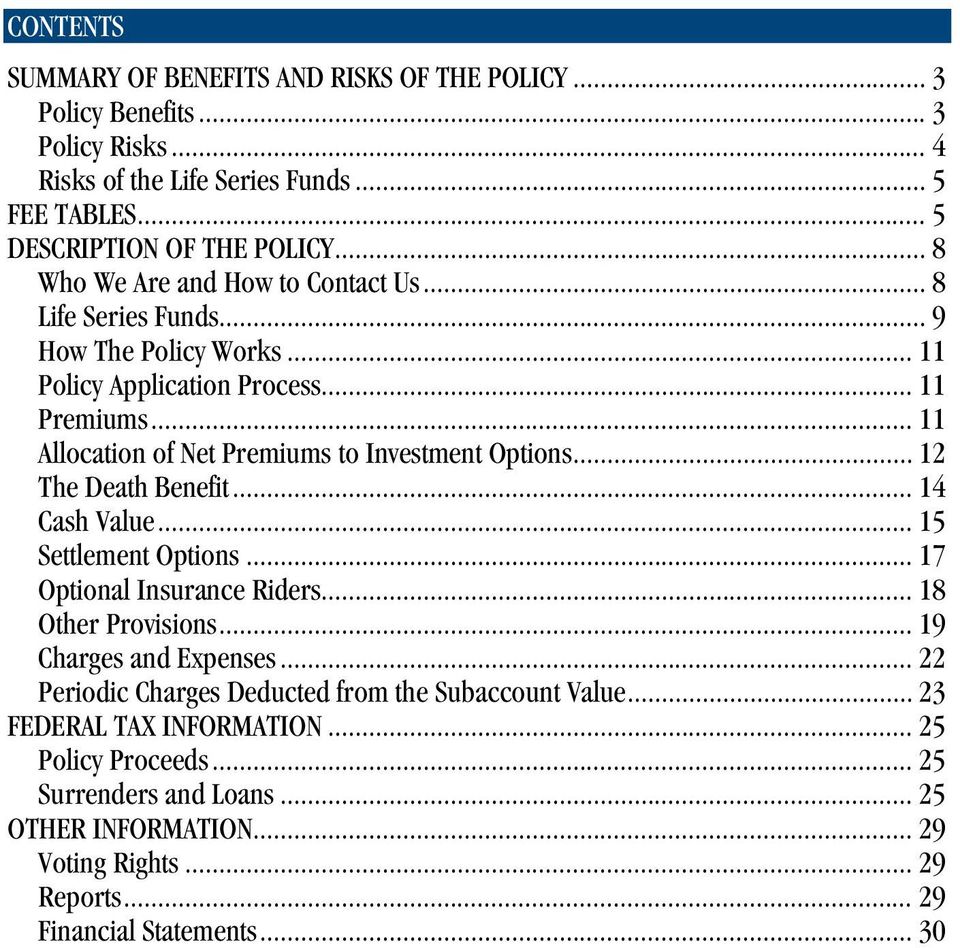
5 CONTENTS SUMMARY OF BENEFITS AND RISKS OF THE POLICY... 3 Policy Benefits... 3 Policy Risks... 4 Risks of the Life Series Funds... 5 FEE TABLES... 5 DESCRIPTION OF THE POLICY... 8 Who We Are and How to Contact Us... 8 Life Series Funds... 9 How The Policy Works Policy Application Process Premiums Allocation of Net Premiums to Investment Options The Death Benefit Cash Value Settlement Options Optional Insurance Riders Other Provisions Charges and Expenses Periodic Charges Deducted from the Subaccount Value FEDERAL TAX INFORMATION Policy Proceeds Surrenders and Loans OTHER INFORMATION Voting Rights Reports Financial Statements... 30
6 SUMMARY OF BENEFITS AND RISKS OF THE POLICY This summary outlines the important benefits and risks associated with the Policy. More detailed information about the Policy follows the summary. POLICY BENEFITS Under the Policy, You pay a fixed premium amount each year for 12 years. The premium amount is based upon the guaranteed minimum death benefit, the Insured s underwriting classification, premium payment frequency, and other factors. We guarantee that You will not pay premiums beyond 12 years and that Your premium payment will not increase. If You change Your premium payment schedule after Your Policy has been issued, the premium amount will be adjusted to correspond with Your new schedule. The net amount of each premium remaining after deduction of the costs of insurance and other Policy charges is invested in one or more Subaccounts which, in turn, invest in corresponding Funds of the Life Series Funds. Permanent Insurance Protection The Policy is designed to provide You with permanent insurance protection. You pay Your premiums for 12 years. After that, the Policy remains in force for the life of the Insured unless You choose to surrender Your Policy, or You borrow against it to the extent that it lapses. Upon the death of the Insured, the Policy s death benefit will be paid to the named beneficiary. The amount of the death benefit may increase above the Policy s guaranteed insurance amount (usually known as face amount ) based upon the investment experience of the Subaccounts You select. However, the death benefit is guaranteed never to be less than the Policy s guaranteed insurance amount (reduced by any outstanding Policy loans, accrued interest, partial surrenders and unpaid premiums). The death benefit may also be increased by purchasing an optional rider for an additional premium amount. 3 Tax Benefits Under current tax law, any growth in the Policy s cash value is not subject to federal income tax until You withdraw it from the Policy; the death benefit paid to the named beneficiary is generally free of federal income tax; reallocations among Subaccounts are not taxable events for purposes of federal income tax; and Policy loans are generally not taxable. Investment Options You may allocate Your net premiums among any of the thirteen (13) Subaccounts We offer under the Policy as long as each allocation is at least 10% of the premium. Each Subaccount invests in an underlying Fund that is professionally managed and has different investment objectives, policies and risks. Your cash value and variable insurance amount will fluctuate based on the performance of the Funds You select. Twice each Policy year, You may change Your Subaccount allocations. If You do so, both Your existing cash value and Your future premium payments will be allocated according to the new percentages, unless You direct Us otherwise. Policy Loans You may borrow up to 75% of the cash value during the first three Policy years and up to 90% of the cash value thereafter, if You assign Your Policy to Us as sole security. While the receipt of the principal of a Policy loan is generally not taxable, the loan amount may become taxable under certain circumstances. Surrenders You may surrender the Policy at any time while the Insured is living. A surrender is a taxable event. The amount payable will be the cash value less any outstanding loans, accrued interest and unpaid premium. You may surrender a portion of the Policy s cash

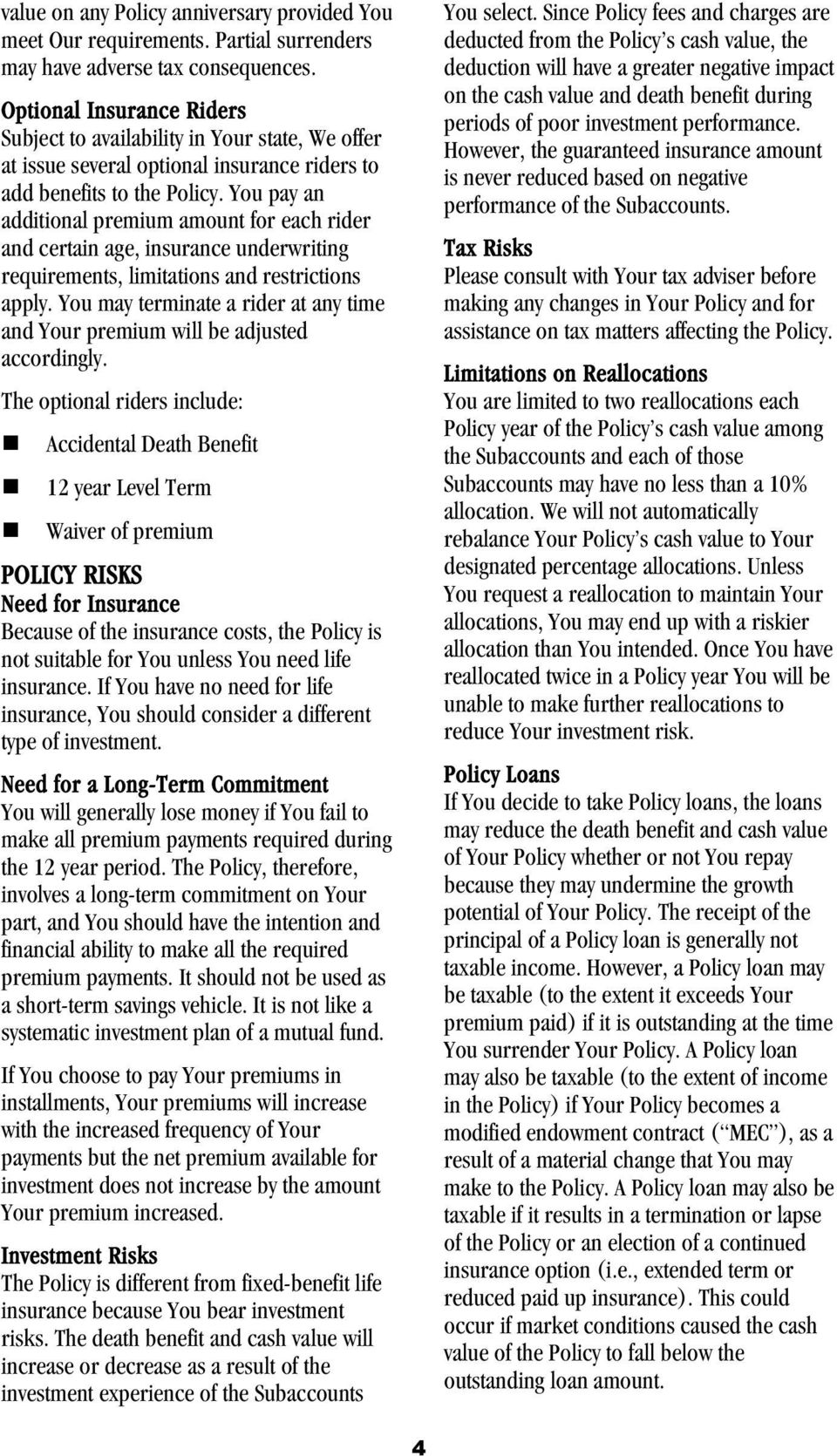
7 value on any Policy anniversary provided You meet Our requirements. Partial surrenders may have adverse tax consequences. Optional Insurance Riders Subject to availability in Your state, We offer at issue several optional insurance riders to add benefits to the Policy. You pay an additional premium amount for each rider and certain age, insurance underwriting requirements, limitations and restrictions apply. You may terminate a rider at any time and Your premium will be adjusted accordingly. The optional riders include: Accidental Death Benefit 12 year Level Term Waiver of premium POLICY RISKS Need for Insurance Because of the insurance costs, the Policy is not suitable for You unless You need life insurance. If You have no need for life insurance, You should consider a different type of investment. Need for a Long-Term Commitment You will generally lose money if You fail to make all premium payments required during the 12 year period. The Policy, therefore, involves a long-term commitment on Your part, and You should have the intention and financial ability to make all the required premium payments. It should not be used as a short-term savings vehicle. It is not like a systematic investment plan of a mutual fund. If You choose to pay Your premiums in installments, Your premiums will increase with the increased frequency of Your payments but the net premium available for investment does not increase by the amount Your premium increased. Investment Risks The Policy is different from fixed-benefit life insurance because You bear investment risks. The death benefit and cash value will increase or decrease as a result of the investment experience of the Subaccounts You select. Since Policy fees and charges are deducted from the Policy s cash value, the deduction will have a greater negative impact on the cash value and death benefit during periods of poor investment performance. However, the guaranteed insurance amount is never reduced based on negative performance of the Subaccounts. Tax Risks Please consult with Your tax adviser before making any changes in Your Policy and for assistance on tax matters affecting the Policy. Limitations on Reallocations You are limited to two reallocations each Policy year of the Policy s cash value among the Subaccounts and each of those Subaccounts may have no less than a 10% allocation. We will not automatically rebalance Your Policy s cash value to Your designated percentage allocations. Unless You request a reallocation to maintain Your allocations, You may end up with a riskier allocation than You intended. Once You have reallocated twice in a Policy year You will be unable to make further reallocations to reduce Your investment risk. Policy Loans If You decide to take Policy loans, the loans may reduce the death benefit and cash value of Your Policy whether or not You repay because they may undermine the growth potential of Your Policy. The receipt of the principal of a Policy loan is generally not taxable income. However, a Policy loan may be taxable (to the extent it exceeds Your premium paid) if it is outstanding at the time You surrender Your Policy. A Policy loan may also be taxable (to the extent of income in the Policy) if Your Policy becomes a modified endowment contract ( MEC ), as a result of a material change that You may make to the Policy. A Policy loan may also be taxable if it results in a termination or lapse of the Policy or an election of a continued insurance option (i.e., extended term or reduced paid up insurance). This could occur if market conditions caused the cash value of the Policy to fall below the outstanding loan amount. 4
8 Surrenders and Other Material Changes You should only purchase the Policy if You have the financial ability to keep it in force for the 12 years in which Your premiums are payable. You should not purchase the Policy if You foresee surrendering all or part of the Policy s cash value. We generally do not recommend that You take a partial surrender of Your Policy or make other material changes to the Policy within the first seven years. If You take a partial surrender from Your Policy, reduce the face amount of the Policy, eliminate a rider, or make any other material change in the Policy after it is issued, this may convert the Policy into a MEC. This can have adverse tax consequences to You. Risk of Lapse Your Policy may lapse if You fail to pay Your premiums or Your loans exceed the cash value. However, if You do not elect one of the continued insurance options, We will automatically purchase continued insurance with the Policy s cash value. This may delay but not avoid the lapse of Your Policy. General Account Risk The assets of the General Account support Our insurance obligations and are subject to general liabilities from Our business operations and to claims by Our general creditors. Any guarantees under Your Policy that exceed Your Policy cash value (such as those that may be associated with the death benefit), are paid from the General Account. Any such amounts that We are obligated to pay in excess of Your Policy cash value are subject to Our financial strength and claimspaying ability. RISKS OF THE LIFE SERIES FUNDS You bear the investment risk of the Funds underlying the Subaccounts You select. The investment objectives, principal investment strategies, and principal risks of the Funds are described in the attached Life Series Funds prospectus. There is no guarantee that any of the Funds will achieve its stated investment objective. FEE TABLES The following tables describe the fees and expenses that You will pay when buying, owning, and surrendering the Policy. The optional rider premiums and cost of insurance charges shown may not be representative of what You will pay because these charges are based on the Insured s age, sex and underwriting class (standard or non-standard class). Your Policy will be accompanied by an illustration based on Your annual premium and guaranteed insurance amount as determined by the Insured s age, sex, underwriting classification, payment frequency and optional riders You selected. This hypothetical illustration shows the potential future benefits using assumed rates of investment return. The table below describes the transaction fees and expenses that You will pay for the 12 years You pay premiums. The minimum charge indicated is based on the lowest rate for Our standard underwriting class. The maximum charge indicated is based on the highest possible charge at issue for Our nonstandard underwriting class (unless otherwise specified) up to Our maximum issue age for this class. 5

9 Transaction Fees Charge When Charge is Deducted (1) Amount Deducted Maximum Sales Charge Imposed Upon premium payment Year 1 30% of premium on Premiums (Load) Years 2 to 4 10% of premium Years 5 to 12 6% of premium Premium Tax Charge Upon premium payment 2% of premiums Maximum Deferred Sales Charge (Load) Not Charged NONE Other Surrender Fees Not Charged NONE Transfer Fees Not Charged NONE First Year Charge Upon payment of first year premium $5 per $1,000 of the guaranteed insurance amount (GIA) Annual Administrative Charge Upon premium payment $30 standard class $45 non-standard class Risk Charge Upon premium payment 1.5% of premiums Installment Payment Premium (2) Upon premium payment Annual: 0% increase in premium Semi-annual: 2% increase in premium Optional Rider Premiums (3) Quarterly: 4% increase in premium Monthly: 5.96% increase in premium Per $1,000 face amount of rider: Accidental Death (4) Upon premium payment Minimum: $1.75 Maximum: $2.63 Standard case (5) : $ Year Level Term without Premium Waiver 12 Year Level Term (6) with Premium Waiver Upon premium payment Minimum: $0.68 Maximum: $16.39 Standard case (5) : $1.02 Upon premium payment Minimum: $0.83 Maximum: $12.70 Standard case (5) : $1.12 Premium Waiver Upon premium payment Minimum: $0.04 Maximum: $6.00 Standard case (5) : $0.09 (1) The table assumes that premiums are paid at issue and then on each Policy anniversary. If You pay Your premium on an installment basis over the course of a Policy year, the charges which are premium-based will be prorated over those payments. (2) This charge is added to the base premium then deducted. A portion of this charge is allocated under Your Policy to Your selected Subaccounts so that We can match Our assumptions about Your premiums to provide the guaranteed insurance amount of Your death benefit. (3) The amount of the added premium is determined by the applicable insurance rates based upon the Insured s age, sex and underwriting classification. The premiums disclosed above may not be representative of the premium You will actually pay. You may obtain more information about the premiums You will incur by contacting Your registered representative. (4) The benefit may not exceed $200,000 less all of the Insured s accidental death benefit coverage in all companies. (5) The standard case is based on Our representative Insured which has been identified as Our most frequent Policy purchaser is a male, age 25 at the time the Policy is issued, and is in Our standard underwriting class. (6) The 12 year level term rider is not available to those in a non-standard underwriting class. 6

10 The next table describes the fees and expenses that We deduct from Your cash value. Periodic Charges Other Than Fund Operating Expenses (1) Charge When Charge is Deducted Amount Deducted Cost of Insurance (2) Last Day of Policy Year Minimum: $0.68 per $1,000 on the net amount at risk (NAR) Maximum: $14.38 per $1,000 on the NAR (3) Mortality and Expense Risks Charge Daily Standard case (4) with $51,908 GIA: $1.75 per $1,000 NAR Effective annual rate of 0.50% of Your Subaccount asset value Policy Loan Interest Policy Anniversary 6% of the outstanding loan (5) Income tax charge (6) Not charged None deducted (1) Does not include operating fees and expenses of the Funds. (2) Your cost of insurance charges will be determined by the insurance rates applicable to Your Policy based upon the Insured s age and sex, as well as the net amount of the insurance that is at risk (NAR). As a result, the charges disclosed above may not be representative of the charges You will actually pay. You may obtain more information about the charges You will incur by contacting Your registered representative. (3) The charge indicated is the maximum rate We can deduct for the first year cost of insurance charge. (4) The standard case is based on Our representative Insured, which has been identified as Our most frequent Policy purchaser. This is a male, age 25 at the time the Policy is issued, and is in Our standard underwriting class. There is no difference in the cost of insurance between the standard and non-standard class. (5) Because We transfer from the Separate Account to Our General Account an amount equal to the amount of the loan, while the loan is unpaid, We credit You into Your chosen Subaccount(s) interest at an effective annual rate of 4% for the amount maintained in the General Account. As a result, the net interest rate as a cost to You is 2%. (6) We reserve the right to impose this charge if We incur taxes attributable to Separate Account B. The next table below describes the range of fees and expenses for the Funds that You will indirectly pay during the time that You own the Policy. The table shows the minimum and maximum Total Annual Fund Operating Expenses as of December 31, These expenses may be higher or lower in the future. More detail concerning each Fund s fees and expenses is contained in the attached prospectus for the Funds. Total Annual Fund Operating Expenses Range of expenses that are deducted from Fund assets, including management fees and other expenses. Minimum Maximum (1) 0.78% 1.62% (1) The maximum total annual fund operating expenses have been restated to reflect current operating expenses. 7

11 DESCRIPTION OF THE POLICY WHO WE ARE AND HOW TO CONTACT US First Investors Life First Investors Life Insurance Company, with its home office located at 40 Wall Street, New York, New York 10005, is a stock life insurance company incorporated under the laws of the State of New York in We write life insurance and annuity policies. First Investors Life is part of First Investors Consolidated Corporation ("FICC"), a holding company, which owns all of the voting common stock of First Investors Life. Other affiliates of First Investors Life include: First Investors Corporation ("FIC"), the distributor of the Policies; First Investors Management Company, Inc. ("FIMCO"), the investment adviser of the Life Series Funds; and Administrative Data Management Corp., the transfer agent for the Life Series Funds. For information or service concerning a Policy, You can contact Us in writing at Our Administrative Office located at Raritan Plaza 1, Edison, NJ You can also call Us at between the hours of 9:00 a.m. to 6:00 p.m., Eastern Time, or fax Us at You can also contact Us through Our Website at You should send any premium or loan interest payments, loan repayments, notices, elections, or requests that You make, as well as any other documentation that We require for any purpose in connection with Your Policy, to Our Administrative Office. No such payment, notice, election, request or documentation will be treated as having been received by Us until We have received it, as well as any related items that We require, all in complete and Good Order (i.e., in form and substance acceptable to Us) at Our Administrative Office. To meet Our requirements for processing transactions, We may require that You use Our forms. We will notify You and provide You with an address if We designate another office for receipt of information, payments and documents. 8 Separate Account B We established Separate Account B on June 4, 1985, under the provisions of the New York Insurance Law. Separate Account B is registered with the SEC as a unit investment trust under the Investment Company Act of 1940, as amended (the "1940 Act"). We segregate the assets of Separate Account B from the assets in Our General Account (the General Account ). The assets of Separate Account B fall into two categories: (1) assets equal to Our reserves and other liabilities under the Policies and (2) additional assets derived from expenses that We charge to Separate Account B. The assets equal to Our reserves and liabilities support the Policy. We cannot use these assets to satisfy any of Our other liabilities. The assets We derive from Our charges do not support the Policy, and We can transfer these assets in cash to Our General Account. Before making a transfer, We will consider any possible adverse impact that the transfer may have on Separate Account B. All the income, gains and losses (realized or unrealized) resulting from assets allocated to Separate Account B are credited to or charged against Separate Account B without regard to Our other business. We are obligated to pay all amounts promised to Policyowners under the Policies even if these amounts exceed the assets in Separate Account B. Any guarantees under Your Policy that exceed Your Policy cash value (such as those that may be associated with the death benefit) are paid from Our General Account. Any such amounts that We are obligated to pay in excess of Your Policy cash value are subject to Our financial strength and claimspaying ability. Assets allocated to Separate Account B support the benefits under the Policy. The assets are in turn invested by each Subaccount of Separate Account B into a corresponding Fund at net asset value. Therefore, We own the shares of the underlying Funds, not You.

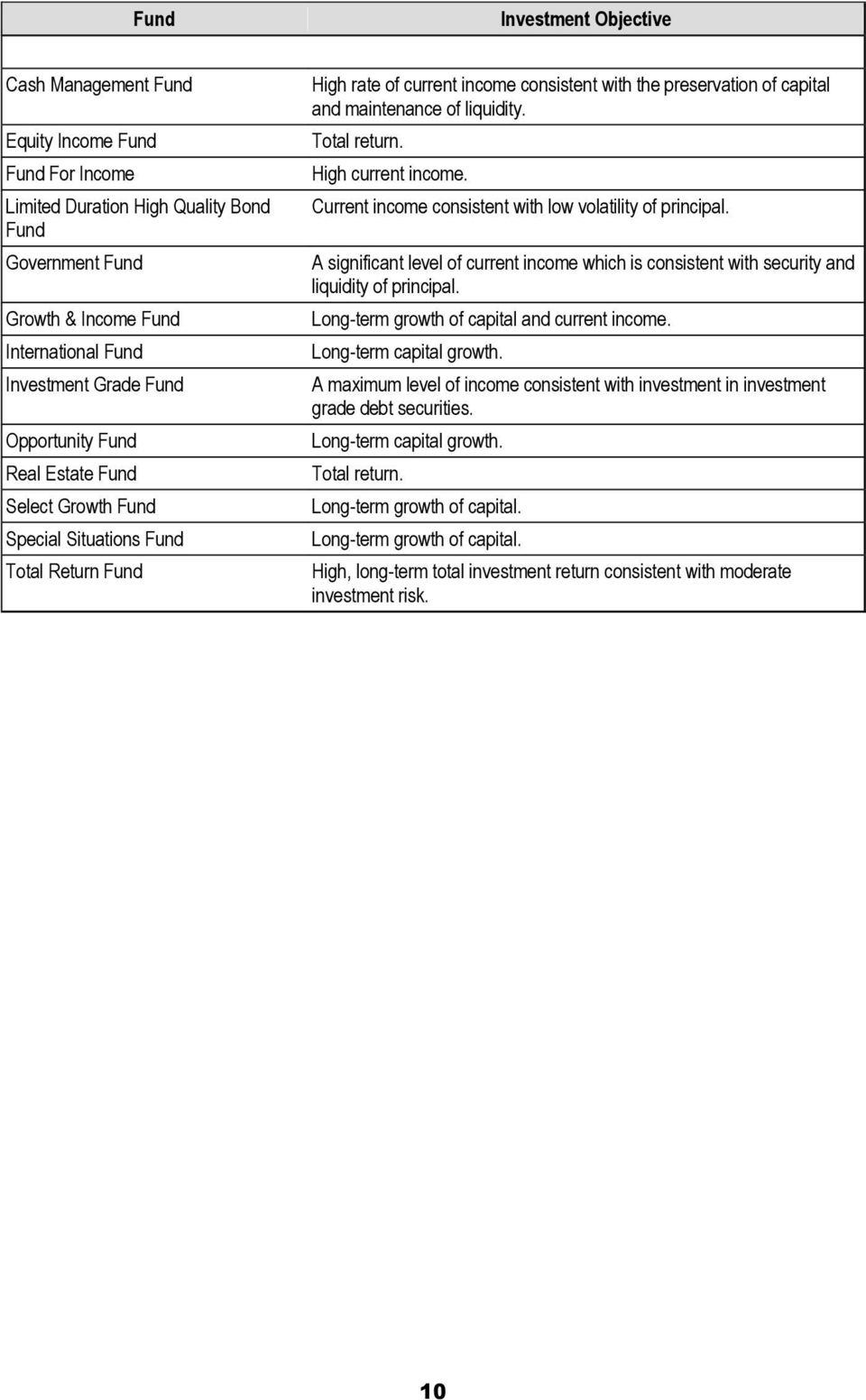
12 Each Subaccount reinvests any distributions it receives from a Fund by purchasing additional shares of the distributing Fund at net asset value. Accordingly, We do not expect to pay You any capital distributions from the Policies. LIFE SERIES FUNDS The Life Series Funds is an open-end management investment company registered with the SEC under the 1940 Act. The Life Series Funds consist of fourteen (14) separate series ( Funds ), thirteen (13) of which are available to Policyowners of Separate Account B. Each of the Funds offers its shares only through the purchase of a Policy or another variable life or variable annuity Contract issued by First Investors Life or other insurance companies. The Life Series Funds reserves the right to offer shares to other separate accounts or directly to Us. Although some of the Funds have similar names, the same portfolio manager and same investment objectives as other publicly available mutual funds, they are separate and distinct from these mutual funds. The Funds will have different portfolio holdings and fees, so their performances will vary from the other mutual funds. FIMCO, the investment adviser of the Life Series Funds, is a New York Corporation located at 40 Wall Street, New York, New York FIMCO and the Life Series Funds have retained the Smith Asset Management Group, L.P., 100 Crescent Court-Suite 1150, Dallas, Texas 75201, to serve as subadviser of the Select Growth Fund, Vontobel Asset Management Inc., 1540 Broadway, New York, New York to serve as the subadviser of the International Fund and Muzinich & Co., Inc., 450 Park Avenue, New York, New York 10022, to serve as subadviser for the Fund For Income. See the Life Series Funds prospectus for more information about the investment adviser and subadvisers. The following table includes the investment objective for each Fund that is available under the Policy. There is no guarantee that any of the Funds will achieve its stated objective. There is a Subaccount with the same name as its corresponding underlying Fund. You bear the entire investment risks of the Funds You select. The degree of investment risk You assume will depend on the Subaccounts You select. You should consider Your allocation carefully. The investment objectives, principal investment strategies, principal risks and management of the Funds are described in the attached Life Series Funds prospectus, which You should read carefully before investing. 9

13 Fund Investment Objective Cash Management Fund Equity Income Fund Fund For Income Limited Duration High Quality Bond Fund Government Fund Growth & Income Fund International Fund Investment Grade Fund Opportunity Fund Real Estate Fund Select Growth Fund Special Situations Fund Total Return Fund High rate of current income consistent with the preservation of capital and maintenance of liquidity. Total return. High current income. Current income consistent with low volatility of principal. A significant level of current income which is consistent with security and liquidity of principal. Long-term growth of capital and current income. Long-term capital growth. A maximum level of income consistent with investment in investment grade debt securities. Long-term capital growth. Total return. Long-term growth of capital. Long-term growth of capital. High, long-term total investment return consistent with moderate investment risk. 10
14 HOW THE POLICY WORKS The Policy is described as "variable" because the amount of Your death benefit, cash value and loan value (the amount You can borrow) may increase or decrease depending on, among other things, the investment performance of the Subaccount(s) that You select. You bear the entire investment risk with respect to the Policy's cash value, which could decline to zero. However, the death benefit will never be less than the guaranteed insurance amount (adjusted for loans, loan interest and partial surrenders), if You pay all Your premiums. We offer thirteen Subaccounts, from which You may select.. The discussion generally assumes that premiums have been duly paid and there have been no Policy loans. The death benefit and cash value are affected if premiums are not duly paid or if a Policy loan is made. POLICY APPLICATION PROCESS To purchase a Policy, You must submit a completed life insurance application to Us and provide Us with evidence of insurability that is satisfactory to Us. Before approving an application, We conduct underwriting to determine the proposed Insured's insurability. If Your application is approved, We will credit Your Policy with the initial premium on the date that the Policy is issued. Until such time, Your initial premium is held in the General Account. If a Policy is not issued, We will return Your premium without interest. We reserve the right to reject any applications for any reason. The Insured will be covered under the Policy as of the Policy s issue date. PREMIUMS The Policy premiums are "level" because You pay the same amount each year for 12 years. We cannot increase the amount of Your premiums or extend the premium payment period. If You change Your premium payment schedule after Your policy has been issued, the premium amount will be adjusted to correspond with Your new schedule, as discussed below. After You have 11 made the scheduled payments for 12 years, the Policy will stay in force for the life of the Insured unless You decide to surrender it or You borrow against it to the extent that it lapses. The Amount of Your Premiums The premium You pay is determined by the amount of guaranteed insurance, the underwriting classification of the Insured, the frequency of Your payments and any riders You have selected. We cannot increase this premium amount. However, there is an additional premium charge if You ask Us to accept Your premiums on an installment basis. We have a $600 minimum annual premium requirement for issue ages 15 and over (which does not include additional premiums for any riders that You may select other than Waiver of Premium) and a $300 minimum annual premium requirement for issue ages We allocate assets to Our General Account to accumulate as a reserve for the contingency that the Insured will die when the guaranteed insurance amount exceeds the death benefit payable without such guarantee. In setting premium rates, We took into consideration actuarial estimates of projected death and surrender benefit payments, lapses, expenses, investment returns, and a contribution to Our surplus. The Frequency of Your Payments You pay premiums under the Policy for 12 years. Premium payments are due on or before the due dates at Our Administrative Office. If You pay early, We will place Your premium payment in Our General Account and, on the day that it is due, We will allocate the premium to the Subaccount(s) that You have selected. If Your annual premium is $600 or more, You may choose to pay Your premiums on an installment basis - - i.e., on a semiannual, quarterly or monthly basis. If You do not pay Your premiums on an annual basis, You will be subject to an additional premium charge to pay in installments. As a result, Your premium amounts will be higher, but

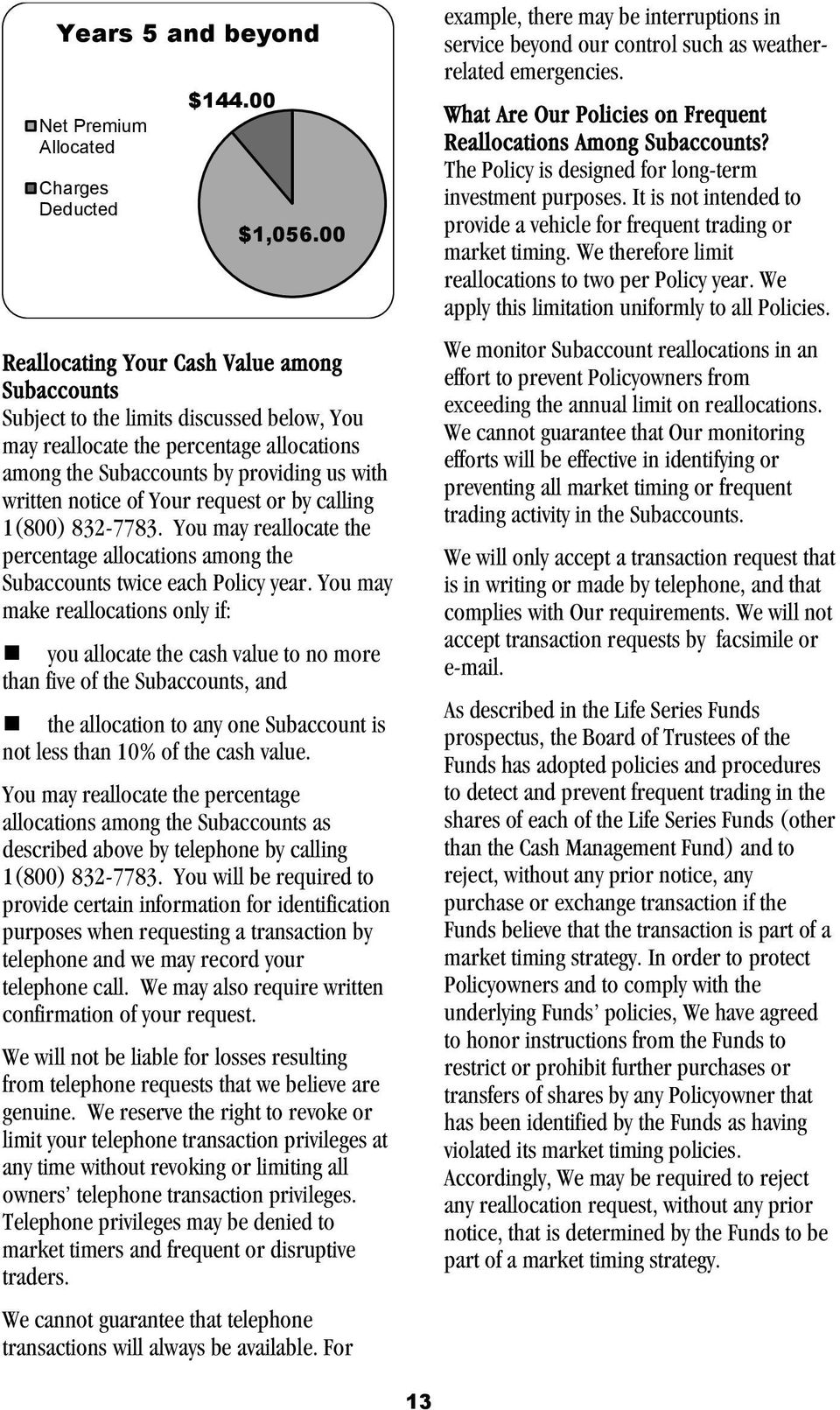
15 the net amount allocated to Subaccounts will not increase by the amount the premium increases. If You select to pay premiums monthly, You will pre-authorize Us to electronically deduct premiums from Your bank account ( Lifeline ). We are not liable for any bank charges You may incur if You fail to maintain a sufficient balance in Your bank account to pay the premiums. To change the frequency of Your premium payment, You must notify Us prior to Your next premium due date, which coincides with the new frequency premium due date. We will then recompute Your premium amount and bill You accordingly. Automatic Premium Loans to Pay Premiums You may elect in a written request to Our Administrative Office to have the premium paid by an automatic loan against the Policy. Under the automatic premium loan provision, any premium not paid before the end of the grace period (31 days after a missed premium due date) is paid by an automatic loan against the Policy. You may elect the automatic loan provision only if Your premium is not in default and the resulting Policy loan and loan interest to the next premium due dates do not exceed the maximum loan value of Your Policy (see "Policy Loans"). You may revoke the automatic premium loan provision at any time by written request. The revocation is effective when We receive it at Our Administrative Office. ALLOCATION OF NET PREMIUMS TO INVESTMENT OPTIONS When You purchase a Policy, You select the percentage of the net premium (premium less deductions) (see "The Charges And Expenses") to allocate among the Subaccounts of Separate Account B. However, You must allocate at least 10% of the net premium to each Subaccount You select. Subsequent premiums will be allocated according to this allocation unless You request a reallocation of the assets attributable to Your Policy. The net premium is credited to Your Policy on the Policy's issue date and on each premium due date thereafter, whether or not You have paid a premium by its due date. Your net premiums buy units of the Subaccounts and not shares of the Funds in which the Subaccounts invest. The net amount which is invested in the Subaccounts You select will generally increase over time, as charges and expenses decline. Thus, as time goes by, more of Your premium will be invested. As an example, the following charts illustrate the amount We would allocate to the Subaccount(s) for a 25-year-old male (standard class) with a guaranteed insurance amount of $51,908 and a gross annual premium of $1,200 over 12 years: Net Premium Allocated Charges Deducted Net Premium Allocated Charges Deducted Year 1 Years 2-4 $ $ $1,

16 Years 5 and beyond Net Premium Allocated Charges Deducted $ $1, Reallocating Your Cash Value among Subaccounts Subject to the limits discussed below, You may reallocate the percentage allocations among the Subaccounts by providing us with written notice of Your request or by calling 1(800) You may reallocate the percentage allocations among the Subaccounts twice each Policy year. You may make reallocations only if: you allocate the cash value to no more than five of the Subaccounts, and the allocation to any one Subaccount is not less than 10% of the cash value. You may reallocate the percentage allocations among the Subaccounts as described above by telephone by calling 1(800) You will be required to provide certain information for identification purposes when requesting a transaction by telephone and we may record your telephone call. We may also require written confirmation of your request. We will not be liable for losses resulting from telephone requests that we believe are genuine. We reserve the right to revoke or limit your telephone transaction privileges at any time without revoking or limiting all owners telephone transaction privileges. Telephone privileges may be denied to market timers and frequent or disruptive traders. We cannot guarantee that telephone transactions will always be available. For example, there may be interruptions in service beyond our control such as weatherrelated emergencies. What Are Our Policies on Frequent Reallocations Among Subaccounts? The Policy is designed for long-term investment purposes. It is not intended to provide a vehicle for frequent trading or market timing. We therefore limit reallocations to two per Policy year. We apply this limitation uniformly to all Policies. We monitor Subaccount reallocations in an effort to prevent Policyowners from exceeding the annual limit on reallocations. We cannot guarantee that Our monitoring efforts will be effective in identifying or preventing all market timing or frequent trading activity in the Subaccounts. We will only accept a transaction request that is in writing or made by telephone, and that complies with Our requirements. We will not accept transaction requests by facsimile or . As described in the Life Series Funds prospectus, the Board of Trustees of the Funds has adopted policies and procedures to detect and prevent frequent trading in the shares of each of the Life Series Funds (other than the Cash Management Fund) and to reject, without any prior notice, any purchase or exchange transaction if the Funds believe that the transaction is part of a market timing strategy. In order to protect Policyowners and to comply with the underlying Funds policies, We have agreed to honor instructions from the Funds to restrict or prohibit further purchases or transfers of shares by any Policyowner that has been identified by the Funds as having violated its market timing policies. Accordingly, We may be required to reject any reallocation request, without any prior notice, that is determined by the Funds to be part of a market timing strategy. 13
17 What Are the Risks to Policyowners of Frequent Reallocations? To the extent that Our policies are not successful in detecting and preventing frequent trading in the Subaccounts, frequent trading may: (a) interfere with the efficient management of the underlying Funds by, among other things, causing the underlying Funds to hold extra cash or to sell securities to meet redemptions; (b) increase portfolio turnover, brokerage expenses, and administrative costs; and (c) harm the performance of the Funds, particularly for long-term shareholders who do not engage in frequent trading. These risks may in turn adversely affect Policyowners who invest in the Funds through Our Subaccounts. In the case of the Subaccounts that invest indirectly in high yield bonds and stocks of small and/or mid-sized companies, the risk of frequent trading includes the risk that investors may attempt to take advantage of the fact that these securities may trade infrequently and therefore their prices may be slow to react to information. This could cause dilution in the value of the shares held by other shareholders. In the case of the Subaccounts that invest indirectly in foreign securities, the risks of frequent trading include the risk of time zone arbitrage. Time zone arbitrage occurs when shareholders attempt to take advantage of the fact that the valuation of foreign securities held by a Fund may not reflect information or events that have occurred after the close of the foreign markets on which such securities principally trade but before the close of the NYSE. This could cause dilution in the value of the shares held by other shareholders. THE DEATH BENEFIT The death benefit is the amount We pay to the named beneficiary at the death of the person whom You name as the Insured. It is the sum of the guaranteed insurance amount plus, if positive, a variable insurance amount that is based upon the performance of the 14 Subaccounts that You have selected. We increase the death benefit to reflect (1) any insurance on the life of the Insured that You may have added by rider and (2) any premium You have paid that applies to a period of time after the Insured's death. We reduce the death benefit to reflect (1) any outstanding Policy loan and loan interest, (2) any unpaid premium that applies to a period before the Insured's death and (3) partial surrenders. Generally, We pay the death benefit within seven days after We receive all claim requirements in a form satisfactory to Us at Our Administrative Office. If no settlement option is elected, We pay interest on death benefit proceeds from the date of death until We pay the death benefit. The interest rate is guaranteed to be at least 2½%. There are several settlement options available, as discussed later. The Policyowner may reserve the right to change any selected settlement option prior to the Insured s death. At the Insured s death, if the Policyowner did not make an election, the beneficiary may apply the proceeds to one of the settlement options. We must receive an election of, or a change to, a settlement option in writing at Our Administrative Office in a form acceptable to Us. The Guaranteed Face Amount We guarantee that the death benefit on Your Policy will never be less than the Policy's Face Amount, which is the guaranteed insurance amount (reduced for loans, loan interest and partial surrenders). During the first Policy year, the death benefit is equal to the guaranteed insurance amount. Thereafter, We determine the death benefit on each Policy anniversary for the next Policy year by adjusting the death benefit by the change in the variable insurance amount on the Policy anniversary. This is the death benefit payable if the Insured dies during the following Policy year. We allocate assets to Our General Account to accumulate as a reserve for the contingency that the Insured will die when the guaranteed
18 insurance amount exceeds the death benefit payable without such guarantee. The Variable Insurance Amount The variable insurance amount is based upon the investment results of the Subaccounts that You have selected. We set the variable insurance amount on each Policy anniversary and do not change it until the next Policy anniversary. During the first Policy year, the variable insurance amount is zero. On the first Policy anniversary, and on each anniversary thereafter, We determine the change in Your variable insurance amount by comparing the net investment return of Your Subaccounts with an assumed investment return of 4%, which We call the "assumed interest rate." The net investment return of Your Subaccounts is the gross rate of return on the underlying investments less Fund expenses and mortality and expense risk charges. Your variable insurance amount does not change if the actual investment return on all of Your Subaccounts is exactly equal to the assumed interest rate. Your variable insurance amount increases if the actual net investment return is greater than the assumed interest rate and decreases if the actual net investment return is less than the assumed interest rate. We set the variable insurance amount on each Policy anniversary and do not change it until the next Policy anniversary. The amount by which Your variable insurance amount will increase or decrease during any Policy year is determined by dividing the Excess Investment Return for a Policy year by the applicable net single premium rate that is specified in Your Policy. The Excess Investment Return for a Policy Year is equal to the Total Benefit Base on the anniversary (the sum of all values in Your subaccounts and Your outstanding loan balance) less the assumed benefit base on the anniversary (the Total Benefit Base at the beginning of the Policy Year increased by any 15 net premiums received and increased by interest at the Assumed Interest Rate to the end of the Policy Year). Your Policy includes a table of the applicable net single premium rates per $1.00 from ages 0 to 99. The net single premium increases as the Insured grows older, meaning that the Insured will receive less variable insurance per dollar of differential investment return as the Insured grows older. The net single premium will be lower for a Policy that We issue to a female than for a Policy that We issue to a male of the same age. The variable insurance amount is calculated on a cumulative basis. This means that the amount reflects the accumulation of increases and decreases from past Policy years. The cumulative amount may be positive or negative, depending on the investment performance of the Subaccounts that You have selected. If the variable insurance amount is negative, the death benefit is the guaranteed insurance amount. In other words, the death benefit is never less than the guaranteed insurance amount. CASH VALUE Determining Your Cash Value There is no minimum guaranteed cash value. The cash value varies daily and on any day within the Policy Year equals the cash value as of the end of the prior Policy Year, plus the net premiums that You have paid since that date, plus the actual net investment return of the Subaccounts You have selected, plus the interest credited to Policy loans if You have any outstanding loans, adjusted for the cost of insurance protection and surrenders. The Policy offers the possibility of increased cash value due to good investment performance and decreased cash value due to poor investment performance. You bear all of the investment risks. Deduction of Cost of Insurance Protection from Cash Value Your cash value reflects a charge for the cost of insurance protection. We issue variable

19 life insurance policies to (1) persons with standard mortality risks and (2) persons with higher mortality risks, as Our underwriting rules permit. We charge a higher gross premium for the person with the higher mortality risk. We guarantee that the cost of insurance rates will not be higher than rates based on the 1980 Commissioners' Standard Ordinary Mortality Table, which We use to compute the cost of insurance protection for each Policy. For mortality rates for extended term insurance, We use the Commissioners' 1980 Extended Term Table. For Policies issued prior to 1989, We use the 1958 Commissioners' Standard Ordinary Mortality Table to compute the cost of insurance protection for each Policy and the Commissioners' 1958 Extended Term Table for mortality rates for extended term insurance. In all cases, We base the cost of insurance protection on the net amount of insurance at risk (the Policy's guaranteed insurance amount, plus the variable insurance amount, minus the cash value) and the person's sex and attained age. The cost of insurance protection generally increases each year because the probability of death increases as a person's age increases. The net amount of insurance at risk may decrease or increase each year depending on the investment experience of the Subaccount(s) that You have selected. Policy Surrenders - You may fully surrender the Policy for its cash value less any outstanding Policy loans and loan interest ( surrender value ) at any time while the Insured is living. The amount payable will be the cash value that We next compute after We receive the surrender request at Our Administrative Office. A full surrender will be effective on the date that We receive both the Policy and a written request in a form acceptable to Us. You may partially surrender Your Policy on any Policy anniversary. We permit a partial surrender only if You (1) have no 16 outstanding Policy loan and (2) have paid the premium due on that Policy anniversary. In addition, Your premiums after the partial surrender must still meet the Policy s minimum annual premium requirement. A partial surrender will be effective only if We receive all requirements for a partial surrender at Our Administrative Office on or before the Policy anniversary. The partial surrender will be effective on the Policy anniversary. When You make a partial surrender, the guaranteed insurance amount, death benefit, and cash value for the Policy each will be reduced in the same proportion as the partial surrender relates to the surrender value. The premium will also be reduced. We will pay the portion of the cash value of the original Policy that exceeds the cash value of the reduced Policy to You as a partial surrender. We will allocate the cash value of the reduced Policy among the Subaccounts in the same proportion as the allocation of the cash value of the original Policy. We will usually pay the surrender value within seven days. However, We may delay payment for the following reasons: a recent payment that You made by check has not yet cleared the bank, We are not able to determine the amount of the payment because the New York Stock Exchange is closed for trading or the SEC determines that a state of emergency exists, or for such other periods as the SEC may by order permit for the protection of security holders. We will pay interest if We delay payment of the surrender value beyond 30 days from the effective date of the surrender. The interest rate paid will be at least 3%. (a) While We do not assess a charge for full or partial surrenders, You should be aware that any surrender will have tax consequences and that a partial surrender within the first seven years

20 may convert the Policy into a MEC. See "FEDERAL TAX INFORMATION." We may deduct withholding taxes from the surrender value. Policy Loans - You may borrow up to 75% of the cash value during the first three Policy years, or 90% of the cash value after the first three Policy years, if You assign Your Policy to Us as sole security. We charge daily interest on the outstanding loan amount at an effective annual rate of 6% compounded on each Policy anniversary. In general if We approve the loan, We send the loan amount within seven days of receipt of the request. We will not permit a new loan unless it is at least $100 or You use it to pay premiums. You may repay all or a portion of any loan and accrued interest at any time while the Insured is living and the Policy is in force. When You take out a loan, We transfer a portion of the cash value equal to the loan from the Subaccount(s) that You have selected to Our General Account. We charge the loan to each Subaccount in the proportion which the value of each Subaccount bears to the cash value of the Policy as of the date of the loan. A Policy loan does not affect the amount of the premiums due. A Policy loan does, however, reduce the death benefit and cash value by the amount of the loan. A Policy loan may also permanently affect the variable insurance amount and the cash value, whether or not You repay the loan in whole or in part. This occurs because We will not credit net investment return that the Subaccount(s) earn to the amount that We maintain in the General Account during the period that the loan is outstanding. Instead, We credit the amount in the General Account at the assumed interest rate of 4%, in accordance with the tabular cash value calculations that We have filed with the state insurance departments. Even if it is repaid, a Policy loan will have a negative impact on the variable insurance amount and the cash value if the actual investment returns of the Subaccounts You 17 have selected exceed the assumed investment return of 4%. The longer the loan is outstanding, the greater the impact is likely to be. If You do not pay the loan and interest when it is due on each Policy anniversary, We will increase Your loan by the amount of any unpaid interest, and We will transfer an equivalent amount of cash value from the Subaccount(s) to the General Account. We will credit loan repayments to each Subaccount in proportion to Your allocation to each Subaccount. We subtract the amount of any outstanding loan plus interest from any death benefit or any surrender value that We pay. If Your outstanding loan with accrued interest ever equals or exceeds the cash value, We will mail notice of such event to You and any assignee at the assignee's last known address. The Policy terminates 31 days after We mail such notice. This may be a taxable event. The Policy does not terminate if You make the required repayment within that 31 day period. While the receipt of the principal of a Policy loan is generally not taxable, it may be taxable if the loan is outstanding when the Policy is surrendered, exchanged, lapsed or converted to continued insurance, or the Policy has been converted into a MEC. A Policy loan may also cause a Policy to terminate if the cash value of the Policy falls below the total amount borrowed due to fluctuation in the values of the Subaccounts selected or other factors. In such case, the entire amount of the loan is immediately taxable to the extent it exceeds Your cost basis in the Policy. You should, therefore, consult with a qualified tax adviser before taking Policy loans. SETTLEMENT OPTIONS You or Your beneficiary may elect to apply all or a portion of the proceeds of a surrender or death benefit payment, as applicable, under any one of the following fixed benefit settlement options rather than receive a single payment of Policy proceeds.
21 However, the Policy proceeds must be at least $1,000 and the settlement option chosen must result in a minimum annual payment of $50. The amount of the payment under life income options will depend on the age and sex of the person whose life determines the duration of payments. Tax consequences may vary depending on the settlement option chosen. The options are as follows: Proceeds Left at Interest - Proceeds left with Us to accumulate, with interest payable at a rate of 2½% per year, which may be increased by additional interest. Payment of a Designated Amount - Payments in installments until proceeds applied under the option and interest on unpaid balance at a rate of 2½% per year and any additional interest are exhausted. Payment for a Designated Number of Years - Payments in installments for up to 25 years, including interest at a rate of 2½% per year. Payments may increase by additional interest, which We would pay at the end of each installment year. Life Income, Guaranteed Period - Payments guaranteed for 10 or 20 years, as You elect, and for life thereafter. During the guaranteed period of 10 or 20 years, the payments may be increased by additional interest, which We would pay at the end of each installment year. Life Income, Guaranteed Return - The sum of the payments made and any payments due at the death of the person on whose life the payments are based, never to be less than the proceeds applied. Life Income Only - Payments made only while the person on whose life the payments are based is alive. OPTIONAL INSURANCE RIDERS The following optional insurance provisions may have been included in a Policy at issue but not thereafter, in states where available, subject to the payment of an additional premium, certain age and insurance 18 underwriting requirements, and the restrictions and limitations that apply to the Policy, as described above. The summaries below are not complete. Additional terms and conditions are set out in the form of each rider. You may obtain additional information in this regard from Your sales representative. Accidental Death Benefit You may have elected to obtain an accidental death benefit rider if the Insured's age is 0 to 60. The rider provides for an additional fixed amount of death benefit in the event the Insured dies from accidental bodily injury while the Policy is in force and before the Policy anniversary when the Insured attains age 70. The amount of the benefit is equal to the Face Amount of the Policy, but cannot exceed an amount equal to $200,000 minus the sum of the Insured's accidental death benefit coverage in all companies. 12 Year Level Term Rider You may have elected to obtain a 12 year level term insurance rider where the Insured is age 18 to 58 for an amount equal to (1) the Policy face amount or (2) two times the Policy face amount or (3) three times the Policy face amount. The rider is convertible, without evidence of insurability, to a new Policy or other permanent plan of insurance. The amount of the insurance under the new Policy may be any amount up to the face amount of the rider. The conversion may occur at any time during the 12 years of rider coverage, but not later than the Policy anniversary when the Insured reaches age 65. Waiver of Premium You may have chosen to obtain a waiver of premium rider where the Insured is age 15 to 55. Under the rider, We will waive all premiums falling due after the date of commencement of the disability and for as long as the disability continues. Disability, for this purpose, means a total disability (as defined in the rider) of the Insured which continues for at least six months. The waiver of premium only applies to disabilities that
22 commence before the Policy anniversary when the Insured reaches age 60. OTHER PROVISIONS Age and Sex If You have misstated the age or sex of the Insured, the benefits available under the Policy are those that the premiums paid would have purchased for the correct age and sex. Assignment You may transfer ownership of Your Policy from yourself to someone else. However, the assignment is not binding on Us, unless it is in writing and filed with Us at Our Administrative Office. We assume no responsibility for the validity or sufficiency of any assignment. Unless otherwise provided in the assignment, the interest of any revocable beneficiary is subordinate to the interest of any assignee, regardless of when You made the assignment. The assignee receives any sum payable to the extent of his or her interest. Beneficiary This is the person You designate in the Policy to receive death benefits upon the death of the Insured. You may change this designation, during the Insured's lifetime, by filing a written request with Our Administrative Office in a form acceptable to Us. Right to Examine You have a period of time to review Your Policy and cancel it for a return of premiums paid. The duration and terms of the "right to examine" period vary by state, and are stated on the cover of Your Policy. At a minimum, You can cancel Your Policy at any time within 45 days of completing Part I of the application or within 10 days after You receive Your Policy. You must return Your Policy along with a written request for cancellation to Us at Our Administrative Office. Default and Options on Default A premium is in default if You do not pay it on or before its due date. There is a grace 19 period of 31 days after the due date during which the insurance continues in force. If the Insured dies during the grace period, We deduct from the death benefit the portion of the premium applicable to the period from the premium due date to the end of the Policy month in which death occurs. If You have elected the automatic premium loan provision, and You do not pay a premium by its due date, the premium will automatically be borrowed from the cash value of the Policy. If You have not elected the automatic premium loan provision and You do not surrender a Policy within 60 days after the date of default, We apply the Policy's cash value minus any loan and interest to purchase continued insurance. You may choose either extended-term insurance or reduced paid-up whole life insurance for the continued insurance. If the Insured is rated as standard class, You automatically have the extended-term insurance if You make no choice. If We rated the Policy for extra mortality risks, You automatically receive the reduced paid-up whole life insurance option. Both options are for fixed life insurance, and neither option requires the further payment of premiums. The extended term insurance option provides a fixed and level amount of term insurance equal to the death benefit (minus any indebtedness) as of the date the option becomes effective. The insurance coverage under this option continues for as long a period as the surrender value on such date purchases. The reduced paid-up whole life insurance option provides a fixed and level amount of paid-up whole life insurance. The amount of coverage is the amount that the surrender value purchases on the date the option becomes effective. You may surrender a Policy continued under either option for its cash value while the Insured is living. You may take a loan under the reduced paid-up whole life insurance
23 option, but not under the extended term insurance option. For example, for a male issue age 25, and assuming 0% and 12% hypothetical gross annual investment returns, if default insurance option became effective at the end of Policy year 5, the fixed insurance coverage under these Policies would be as follows: 0% 12% Cash Value of the Policy $3,992 $5,535 Reduced Paid-up Whole Life Insurance $18,406 for life $25,521 for life Extended Term Insurance $51,908 for 25 years $55,994 for 29 years 20
24 Exchange Privilege The exchange privilege allows You to exchange the Policy for a permanent fixed life insurance policy that We issue on the Insured's life. The exchange privilege is available: within the first 18 months after the Policy's issue date, if You have duly paid all premiums, or if any Fund changes its investment adviser or makes a material change in its investment objectives or restrictions. You do not need to provide evidence of insurability to exercise this privilege. The new policy has a level face amount equal to the face amount of the Policy. It also has the same benefit riders, issue date, and risk classification for the Insured as the Policy does. We base premiums for the new policy on the premium rates for the new policy that were in effect on the Policy issue date. You may elect either a continuous-premium policy or a limited-payment policy for Your exchanged policy. In some cases, We may adjust the cash value on exchange. The adjustment equals the Policy's surrender value minus the new policy's tabular cash value. If the result is positive, We pay that amount to You. If the result is negative, You pay that amount to Us. We will determine the amount of a cash adjustment as of the date We receive the Policy and written request at Our Administrative Office. Grace Period With the exception of the first premium, We allow a grace period of 31 days for payment of each premium after it is due. The Policy continues in force during the grace period unless You surrender it. Incontestability Except for nonpayment of premiums, We do not contest the validity of the Policy and its riders after it has been in force during the lifetime of the Insured for two years from the date of issue. Changes to the Policy We have the right to change the terms of the Policy without Your consent where necessary to comply with applicable law. State Variations Where required by state law, there may be variations in the Policy which are covered by a special form of the Policy for Your state. Your Policy, as a result, may differ from those described in this prospectus. Your actual Policy, with any endorsements, amendments and riders, is the controlling document. Payment and Deferment We will usually pay the death benefit, surrender value, or loan proceeds within seven days after We receive all documents required for such payments. However, We may delay payment if (1) a recent payment by check has not yet cleared the bank, (2) We cannot determine the amount because the New York Stock Exchange is closed for trading, or (3) the SEC determines that a state of emergency exists. Under a Policy continued as paid-up or extended term insurance, We may defer the payment of the surrender value or loan proceeds for up to six months. If We postpone the payment more than 30 days, We will pay interest at a rate of not less than 3% per year on the surrender value. We will pay the interest from the date of surrender to the date We make payment. Payment of Dividends The Policies do not provide for dividend payments. Therefore, they are "nonparticipating" in the earnings of First Investors Life. Policy Years and Anniversaries We measure Policy years and anniversaries from the date of issue of the Policy, which will generally be the date on which We approve the application. The date of issue may be backdated on Your request to save age. However, the date of issue cannot be earlier than either: (1) the date You sign the application or (2) a date 15 days before the 21
25 date on which We approve the application. Each Policy year will commence on the anniversary of the date of issue. Reinstatement You may request reinstatement of a Policy that You did not surrender for its cash value within five years from the date of default, in accordance with the Policy. To reinstate, You must present evidence of insurability acceptable to Us, and You must pay to Us the greater of: (1) all premiums from the date of default with interest to the date of reinstatement, plus any Policy debt (plus interest to the date of reinstatement) in effect when You continued the Policy as reduced paidup insurance or extended term insurance; or (2) 110% of the increase in cash value resulting from reinstatement. To reinstate, You must also pay Us any Policy debt that arose after the continuation of the Policy as reduced paid-up insurance. We calculate interest on any such debt at the rate of 6% per year compounded annually. Suicide If the Insured commits suicide within two years from the Policy's date of issue, Our liability under the Policy is limited to all premiums paid less any indebtedness. Valuation of Assets We determine the unit value for each Subaccount at the close ( close of business ) of the New York Stock Exchange ( NYSE ), on each day the NYSE is open for regular trading ( Business Day ). The NYSE is closed on most national holidays and Good Friday. We value shares of each Fund at the net asset value per share as determined by the Fund. Each Fund determines the net asset value of its shares as described in the Life Series Funds prospectus. Processing Transactions Generally, Your transaction requests (such as loan repayments or reallocation requests) will be processed as of the Business Day We receive them, if We receive them before the close of business on that day (generally, 4:00 P.M., Eastern Time) in a manner meeting Our requirements. Otherwise, they will be processed as of the next Business Day. To meet Our requirements for processing transactions, We may require that You use Our forms. CHARGES AND EXPENSES We describe below the fees and charges that You are required to pay to purchase and maintain the Policy. We guarantee that once You have purchased Your Policy, We will not increase the amount of Your premium payments, the charges that We deduct from Your premiums, or the charges that We deduct from Your Subaccount(s) for mortality and expense risks. Transaction Fees We deduct from Your premiums the fees and charges listed below. The resulting net premium amount is allocated to the Subaccount(s) that You have selected. Sales Charge. We impose a sales charge on each annual premium for Our sales expenses. The charge does not correspond to Our actual sales expenses for any particular year. The sales charge is a percentage of the actual annual premium payment. The percentage declines based upon the following schedule: Years Maximum Percentages 1 30% % 5 and later 6% Premium Tax Charge. This charge is 2% of the premium to cover the costs We expect to incur in paying premium taxes for all policies and administrative expenses related 22
26 to certain other state filings. Premium taxes vary from state to state and currently range up to 4%. We impose this charge regardless of the premium tax rate in effect in any state. First Year Charge. We impose a charge in the first Policy year which is an addition to other applicable fees and charges at the rate of $5 per $1,000 of the guaranteed insurance amount for Our administrative expenses in issuing the Policy, including expenses for (1) medical examinations, (2) insurance underwriting costs, and (3) processing applications and establishing permanent Policy records. If You pay Your annual premium in multiple payments, this charge will be deducted from Your payments on a pro rata basis. Annual Administrative Charge. We annually impose on a standard class Policy a $30 annual charge for Our administrative expenses including (1) premium billing and collection, (2) recordkeeping, (3) processing benefit claims, (4) cash surrenders, (5) Policy changes, and (6) reporting and other communications to Policyowners. If You do not meet Our standard coverage requirements, this annual charge is $45. Risk Charge. We impose a risk charge of 1.5% of the premium. The charge is intended to partially cover Our guarantee that the death benefit will always at least equal the guaranteed minimum death benefit. Installment Payment Premium. When You pay premiums on other than an annual basis, the premium amount for a Policy year will increase to compensate for Our loss of interest and additional billing and collection expenses. A portion of this premium increase is credited under Your Policy to Your selected Subaccounts so that We can match Our assumptions about Your premiums to provide the guaranteed insurance amount of Your death benefit. Your premiums will increase according to the following schedule: 23 Increased Premiums for Installment Payment of Premiums (as a percentage of an annual payment) Payment Frequency Increase in Premium Annual 0% Semi-annual 2% Quarterly 4% Pre-authorized monthly 5.96% Optional Insurance Rider Premiums. If You choose any optional insurance riders, We will increase Your premiums by the amount associated with the rider s costs to You. Premium charges applicable to Your Policy for optional riders will be indicated in Your Policy. Our current minimum and maximum premium rates, as well as the rate for Our representative Policyowner, for each of the optional insurance riders are: Optional Rider Premium per $1,000 face amount of Rider Accidental Death Minimum: $1.75 Maximum: $2.63 Standard case: $ Year Level Term without Waiver of premium 12 Year Level Term with Waiver of premium Minimum: $0.68 Maximum: $16.39 Standard case: $1.02 Minimum: $0.83 Maximum: $12.70 Standard case: $1.12 Waiver of premium Minimum: $0.04 Maximum: $6.00 Standard case: $0.09 The amount of the added premium for a rider is determined by the applicable age, sex and underwriting classification. The above premiums may not be representative of the premium You will actually pay. PERIODIC CHARGES DEDUCTED FROM THE SUBACCOUNT VALUE Cost of Insurance Protection We deduct a charge from the Subaccount assets attributable to Your Policy for the cost of insurance protection. This amount is determined by the insurance rates applicable
27 to Your Policy based upon Your age, sex and the net amount of insurance that is at risk. (See "Deduction of Cost of Insurance Protection from Cash Value"). Your premium will also reflect Your mortality rating. In short, Your premium will be higher if You are rated as having a higher than average mortality risk. Our current minimum and maximum cost of insurance rates, as well as the rate for Our representative Policyowner, based on the net amount at risk are: minimum: $0.68 per $1,000; maximum: $14.38 per $1,000; standard case with $51,908 guaranteed insurance amount: $1.75 per $1,000. Mortality and Expense Risks Charge We deduct from the Subaccount assets attributable to Your Policy a daily charge for the mortality and expense risks that We assume. We compute the charge at an effective annual rate of 0.50% of the Subaccount assets attributable to Your Policy. The mortality risk that We assume is that the person named as the Insured under the Policy will live for a shorter time than We have estimated and/or that the guaranteed minimum death benefit will be payable. The expense risk We assume is that the expenses We incur in issuing and administering the Policies will be greater than We have estimated. Policy Loan Interest If You have an outstanding Policy loan, We charge interest that accrues daily at an effective annual rate of 6% compounding on each Policy anniversary. The loan and loan interest are due on each Policy anniversary. If You do not pay the interest when it is due, it will be added to the loan amount and We will transfer an equivalent amount from the Subaccounts to the General Account. Income Tax Charge We do not expect to incur any federal income tax as the result of the net earnings or realized net capital gains of Separate Account B. However, if We did incur such tax, We reserve the right to charge the Separate Account for the amount of the tax. We may also impose charges for other applicable tax attributable to the Separate Account. Deductions from the Funds Each Fund makes daily deductions from its assets to cover management fees and other expenses. Because this impacts the Subaccount assets attributable to Your Policy, You bear these charges indirectly. The highest and lowest gross annual Fund operating expenses as of December 31, 2014 were 1.62% and 0.78% respectively. The highest gross annual Fund operating expenses have been restated to reflect current operating expenses. Annual fund expenses for all Funds are more fully described in the attached Life Series Funds prospectus. We begin to accrue and deduct all of the above charges and premiums on a Policy's issue date. 24
28 FEDERAL TAX INFORMATION This section provides an overview of federal tax law as it pertains to the Policy. It assumes that the Policyowner is a natural person who is a U.S. citizen or U.S. resident. The tax law applicable to corporate taxpayers, non-u.s. citizens, and non-u.s. residents may be different. We do not discuss state or local taxes herein, except as noted. The tax laws described herein could change, possibly retroactively. The discussion is general in nature. We do not intend it as tax advice, for which You should consult a qualified tax adviser. POLICY PROCEEDS We believe that the Policy qualifies as a life insurance Contract for federal income tax purposes because it meets the definition of a life insurance Contract in Section 7702 of the Internal Revenue Code of 1986, as amended (Code), and the investments of each Subaccount satisfies the investment diversification requirements of Section 817(h) of the Code. Consequently: the death benefit will, if and when paid, be excluded from the gross income of the beneficiary for federal income tax purposes; the growth of the cash value of the Policy, if any, that is attributable to the investments in the Subaccounts (known as the "inside build-up") will not be subject to federal income tax, unless and until there is a full or partial surrender of the Policy; and, transfers among Subaccounts are not taxable events for purposes of federal income tax. SURRENDERS AND LOANS The federal tax treatment of surrenders and loans depends upon whether a Policy is a MEC under Section 7702A of the Code. A MEC is a Contract that meets the definition of a life insurance Contract but fails to meet the "seven-pay" test of Section 7702A(b). Under the seven-pay test, the total premiums paid cannot, at any time during the first seven years of a Contract, exceed the total 25 premiums that would have been paid by that time under a similar fixed-benefit life insurance policy designed to provide for paid-up future benefits after the payment of seven equal annual premiums. The Policy offered by this prospectus has been designed so that it will not be a MEC at the time it is issued. However, under the MEC rules, a Policy may become a MEC after it has been issued if the Policyowner decreases the face amount, takes a partial surrender, terminates a rider, allows the Policy to lapse into extended term or reduced paid-up insurance, or makes any other material change to the Policy. If a Policy becomes a MEC, any Policy that is issued in exchange for it will also be a MEC. Furthermore, all MECs that are issued by Us to an owner in any calendar year will be treated as one Policy under the MEC rules. Because MECs are taxed differently, You should consult with a qualified tax expert before making any change to Your policy that might cause it to be treated as a MEC. Policies that are not MECs If Your Policy is not a MEC, a total surrender of the Policy will subject You to federal income tax on the amount (if any) by which the cash surrender value exceeds Your basis in the Policy (premiums paid less previous distributions that were not taxable). If You elect to receive Your payment in installments, depending upon the option selected, You may be taxed on all or a portion of each installment until the income in the Policy has been paid; only after all Your basis in the Policy has been paid; or on a portion of each payment. If You make a partial surrender after the first 15 Policy years, the distribution will not be subject to federal income tax unless the amount of the partial surrender exceeds Your basis in the Policy. In other words, partial surrenders after 15 Policy Years will be treated as from basis first and income second. During the first 15 PolicyYears, the portion of the partial surrender that is
29 subject to federal income tax will depend upon the ratio of Your death benefit to the cash value and the age of the Insured at the time of the surrender. If Your Policy is not a MEC, Policy loans are not considered distributions and are not subject to current federal income tax as long as the Policy remains in force. Nor is the interest paid on such loans deductible for federal income tax purposes. If You surrender or exchange Your Policy while a loan is outstanding, the amount of the loan will be treated as a distribution and may be taxable. Moreover, under certain circumstances, if You exchange Your Policy while a loan is outstanding, the amount of the loan may be taxed on an income first basis. If the cash value of Your Policy falls below the aggregate amount of the loan balance as the result of the fluctuation in the value of the underlying Funds or for any other reason, the Policy may terminate (see "Cash Value"). In that case, all outstanding loans will be immediately taxable to the extent they exceed premiums paid. You should consult with a qualified tax expert before taking a policy loan. Policies that are MECs A Policy that is classified as a MEC continues to be a life insurance policy for purposes of the tax treatment of the death benefit and inside build-up. However, distributions are treated differently. Distributions from a Policy that is classified as a MEC are taxed on an "income first" basis. If a Policy is a MEC, distributions include partial and full surrenders. Also, Policy loans from a MEC may be taxable. Furthermore, if a Policy becomes a MEC, distributions that occur prior to the date on which it became a MEC may also be subject to the MEC rules. Finally, subject to certain exceptions, taxable withdrawals that are made from a MEC prior to age 59½ are subject to an additional 10% penalty. Tax Withholding Regardless of whether Your Policy is a MEC, whenever there is a taxable distribution from the Policy, the amount of the gain is subject to federal income tax withholding and reporting. We will not withhold income tax, if You so request in writing, before the payment date. However, in such event, You are subject to any potential tax penalties that may result from Our failure to withhold taxes. Estate and Generation Skipping Taxes Because of the complex nature of the federal tax law, we recommend that you consult with a qualified tax adviser about the estate tax implications associated with purchasing a Policy. The American Taxpayer Relief Act of 2012 (the Act ), which was enacted on January 2, 2013, provides an exemption for purposes of the federal estate tax of $5 million (adjusted for inflation for calendar years after2011, with a 2015 exemption of $5.43 million) and a top estate tax rate of 40% for deaths that occur after December 31, An unlimited marital deduction may be available for assets left to a U.S. citizen spouse. The marital deduction defers estate and gift taxes until the death of the surviving spouse. Under the Act, portability is made permanent, so that any unused exemption in one spouse s estate will be available in most cases to the surviving spouse. When the Insured dies, the death benefit payable under The Insured s Policy will generally be included in the Insured s estate for purposes of the federal estate tax if (1) the Insured and the Policyowner are the same or (2) the Insured held any incident of ownership in the Policy at the death or at any time within three years of death. An incident of ownership is, in general, any right that may be exercised by the Policyowner, such as the right to borrow from the Policy or to name a new beneficiary. If a Policyowner (whether or not he or she is the Insured) transfers ownership of the 26
30 Policy to another person, such transfer may be subject to federal gift tax. In addition, if a Policyowner transfers the Policy to someone two or more generations younger than the Policyowner, the transfer may be subject to the federal generation-skipping transfer tax ( GSTT ). Similarly, if the beneficiary is two or more generations younger than the Insured, the payment of the death benefit to the beneficiary may be subject to the GSTT. The Act provides an exemption for purposes of the GSTT of $5 million (adjusted for inflation for calendar years after 2011, with a 2015 exemption of $5.43 million) and a GSTT tax rate of 40% for transfers made after December 31, Other Tax Issues We are taxed as a "life insurance company" under the Code. We do not expect to incur any federal income tax as a result of the net earnings or realized net capital gains attributable to Separate Account B, and no charge is currently assessed against Separate Account B for such tax. If We incur such tax in the future, We may assess a charge for such tax against Separate Account B. We may incur state and local taxes (in addition to premium taxes) attributable to the Separate Account B in several states. At present, these taxes are not significant and We do not impose any charge for such taxes against Separate Account B. We may assess Separate Account B for such taxes in the future. If any charges for federal, state or local taxes are assessed against Separate Account B in the future, they could reduce the net investment performances of the Subaccounts. In order for a Policy to be treated as a life insurance contract for federal income tax purposes, the investments of each Subaccount to which premiums under the Policy are allocated must be adequately diversified in accordance with the Code and Treasury Department regulations. The investment adviser of the Funds monitors their investment portfolios to ensure that the diversification requirements are met, because, for purposes thereof, a Fund s assets are treated as if they are owned by 27 each Subaccount that invests therein. If any Subaccount to which premiums under Your Policy are allocated failed to satisfy these requirements, Your Policy would not receive tax treatment as a life insurance contract for the period of the failure and any subsequent period. As a result, You could be taxed on the earnings of the Subaccount(s) in which You were indirectly invested. This is a risk that is common to all variable life insurance policies. Each of the Funds sells its shares not only to Separate Account B but also to other separate accounts which fund variable life and annuity contracts. We do not anticipate any disadvantage resulting from this arrangement. However, it is possible that a material conflict of interest could arise between the interests of Policyowners and Contractowners which invested in the same Fund. If such a conflict were to arise, We would take whatever steps were necessary to protect the interests of Policyowners and Contractowners, including potentially substituting a different Fund for the Fund. It is also possible that the failure of one separate account to comply with the federal tax law requirements could cause all of the separate accounts to lose their tax-deferred status. This is a risk that is common to many variable life insurance policies and variable annuities. Under certain circumstances, a Policyowner s control of the investments of Separate Account B may cause the Policyowner, rather than Us, to be treated as the owner of the assets in Separate Account B for tax purposes, which would result in the current taxation of the income on those assets to the Policyowner. Based upon current IRS guidance, We do not believe that the ownership rights of a Policyowner under the Policy would result in the Policyowner s being treated as the owner of the assets of the Policy. However, We do not know whether additional guidance will be provided by the IRS on this issue and what standards may be contained in such guidance. Therefore, We reserve the right to modify the
31 Policy as necessary to attempt to prevent a Policyowner from being considered the owner of a pro rata share of the assets of the Policy. 28
32 OTHER INFORMATION VOTING RIGHTS Because the Funds of the Life Series Funds are not required to have annual shareholder meetings, Policyowners generally will not have an occasion to vote on matters that pertain to the Funds. In certain circumstances, one or more of the Funds may be required to hold a shareholders meeting or may choose to hold one voluntarily. For example, a Fund may not change fundamental investment policies without the approval of a majority vote of that Fund s shareholders in accordance with the 1940 Act. If a Fund holds a meeting at which shareholders are entitled to vote, Policyowners will have the opportunity to provide voting instructions for shares of the Fund held by a Subaccount in which their Policy invests. We will vote the shares at any such meeting as follows: shares attributable to Policyowners for which We have received instructions, in accordance with the instructions; shares attributable to Policyowners for which We have not received instructions, in the same proportion that We voted shares held in the Subaccount for which We received instructions; and shares not attributable to Policyowners, in the same proportion that We have voted shares held in the Subaccount attributable to Policyowners for which We have received instructions. We will vote Fund shares that We hold directly in the same proportion that We vote shares held in any corresponding Subaccounts that are attributable to Policyowners and for which We receive instructions. However, We will vote Our own shares as We deem appropriate where there are no shares held in any Subaccount. We will present all the shares of any Fund that We hold through a Subaccount or directly at any Fund shareholders meeting for purposes of determining a quorum. As a result of proportional voting, the votes cast by a small number of Policyowners may determine the outcome of a vote. We will determine the number of Fund shares held in a corresponding Subaccount that is attributable to each Policyowner by dividing the value of the Subaccount by the net asset value of one Fund share. We will determine the number of votes that a Policyowner has the right to cast as of the record date established by the Funds. We will solicit instructions by written communication before the date of the meeting at which votes will be cast. We will send meeting and other materials relating to the Fund to each Policyowner having a voting interest in a Subaccount. The voting rights that We describe in this prospectus are created under applicable laws. If the laws eliminate the necessity to submit such matters for approval by persons having voting rights in separate accounts of insurance companies or restrict such voting rights, We reserve the right to proceed in accordance with any such changed laws or regulations. We specifically reserve the right to vote shares of any Fund in Our own right, to the extent permitted by law. REPORTS Our variable life insurance is offered through broker-dealers that are registered with the SEC and are members of the Financial Industry Regulatory Authority ( FINRA ). At least twice each year, We will send a report to You that contains financial information about the Funds, as required by applicable law. In addition, unless otherwise agreed, we will send You a confirmation on behalf of the broker-dealers through which the variable life insurance transaction is processed, after each transaction that affects the value of Your Policy, and at least once each year We will send a statement that gives You financial information about Your Policy, including, to 29
33 the extent applicable, Your scheduled fixed premium payments. If several members of the same household each own a Policy, We may send only one such report or prospectus to that address, unless You instruct Us otherwise. You may receive additional copies by calling or writing Us. FINANCIAL STATEMENTS The financial statements of First Investors Life and Separate Account B are in the Statement of Additional Information. 30
34 Please read this prospectus and keep it for future reference. It contains important information that You should know before buying a Policy. We filed a Statement of Additional Information ( SAI ), dated May 1, 2015 with the Securities and Exchange Commission. We incorporate the SAI by reference into this prospectus. You can get a free SAI, request other information about the Policy or make other inquiries by contacting Us at First Investors Life Insurance Company, Raritan Plaza 1, Edison, New Jersey 08837, calling Us toll free at 1(800) or by visiting Our website You can review and copy Our documents (including reports and SAIs) at the Public Reference Room of the SEC in Washington, D.C. You can also obtain copies of Our documents after paying a duplicating fee (i) by writing to the Public Reference Section of the SEC, Washington, D.C. (202) or (ii) by electronic request at [email protected]. You can obtain information on the operation of the Public Reference Room, including information about duplicating fee charges, by calling (202) Textonly versions of documents can be viewed online or downloaded from the EDGAR database on the SEC s Internet website at SEC file number: /
35 This page intentionally left blank. 32
36 Life Series Funds TICKER SYMBOLS Cash Management - - Equity Income - - Fund For Income - - Government - - Growth & Income - - International - - Investment Grade - - Limited Duration High Quality Bond Opportunity - - Real Estate - - Select Growth - - Special Situations - - Target Maturity Total Return - - This prospectus should be read in conjunction with the prospectus for the variable annuity contract and/or life insurance policy that you purchase. The shares of the Funds described above are available and are being marketed exclusively as a pooled funding vehicle for life insurance companies writing all types of variable annuity contracts and life insurance policies. The Securities and Exchange Commission has not approved or disapproved these securities or passed upon the accuracy or adequacy of this prospectus. Any representation to the contrary is a criminal offense. THE DATE OF THIS PROSPECTUS IS MAY 1,
37
38 TABLE OF CONTENTS THE FUNDS SUMMARY SECTION... 1 Cash Management Fund... 1 Equity Income Fund... 4 Fund For Income... 7 Government Fund Growth & Income Fund International Fund Investment Grade Fund Limited Duration High Quality Bond Fund Opportunity Fund Real Estate Fund Select Growth Fund Special Situations Fund Target Maturity 2015 Fund Total Return Fund Other Important Information THE FUNDS IN GREATER DETAIL Cash Management Fund Equity Income Fund Fund For Income Government Fund Growth & Income Fund International Fund Investment Grade Fund Limited Duration High Quality Bond Fund Opportunity Fund Real Estate Fund Select Growth Fund Special Situations Fund Target Maturity 2015 Fund Total Return Fund FUND MANAGEMENT IN GREATER DETAIL SHAREHOLDER INFORMATION How and when do the Funds price their shares?... 96
39 How do I buy and sell shares? Do the Funds pay compensation to intermediaries? Can I exchange my shares for the shares of other Funds? What are the Funds policies on frequent trading in the shares of the Funds? What about dividends and other distributions? What about taxes? FINANCIAL HIGHLIGHTS Cash Management Fund Equity Income Fund Fund For Income Government Fund Growth & Income Fund International Fund Investment Grade Fund Limited Duration High Quality Bond Fund Opportunity Fund Real Estate Fund Select Growth Fund Special Situations Fund Target Maturity 2015 Fund Total Return Fund
40 THE FUNDS SUMMARY SECTION CASH MANAGEMENT FUND Investment Objective: The Fund seeks to earn a high rate of current income consistent with the preservation of capital and maintenance of liquidity. Fees and Expenses of the Fund: This table describes the fees and expenses that you may pay if you buy and hold shares of the Fund. Investments in the Fund can only be made through a variable annuity contract or life insurance policy offered by a participating insurance company. This table does not reflect the fees and expenses that are or may be imposed by a variable annuity contract or life insurance policy for which the Fund is an investment option. For information regarding those fees and expenses, please refer to the applicable variable annuity contract or life insurance policy prospectus. If those fees and expenses were included, the overall fees and expenses shown in the table would be higher. Shareholder Fees (fees paid directly from your investment) Maximum sales charge (load) imposed on purchases (as a percentage of offering price) Maximum deferred sales charge (load) (as a percentage of the lower of purchase price or redemption price) Annual Fund Operating Expenses (expenses that you pay each year as a percentage of the value of your investment) Management Fees 0.75% Distribution and Service (12b-1) Fees None Other Expenses 0.24% Total Annual Fund Operating Expenses 0.99% Example The Example is intended to help you compare the cost of investing in the Fund with the cost of investing in other mutual funds. The Example assumes that you invest $10,000 in the Fund for the time periods indicated and then redeem all of your shares at the end of those periods. The Example also assumes that your investment has a 5% return each year and that the Fund s operating expenses remain the same. The table below does not include the fees or expenses that are or may be imposed by a variable annuity contract or life insurance policy for which the Fund is an investment option. If they were included, the expenses shown in the table below would be higher. Although your actual costs may be higher or lower, based on these assumptions your costs would be: 1 year 3 years 5 years 10 years Cash Management Fund $101 $315 $547 $1,213 N/A N/A 1
41 Principal Investment Strategies: The Fund invests primarily in high-quality money market instruments that are determined by the Fund s investment adviser, First Investors Management Company, Inc., to present minimal credit risk, including but not limited to commercial paper, short-term corporate bonds and notes, floating and variable rate notes, U.S. Treasury securities and short-term obligations of U.S. Government-sponsored enterprises (some of which are not backed by the full faith and credit of the U.S. Government). The Fund s portfolio is managed to meet regulatory requirements that permit the Fund to maintain a stable net asset value ( NAV ) of $1.00 per share. These include requirements relating to the credit quality, maturity, liquidity and diversification of the Fund s investments. In buying and selling securities, the Fund will consider its own credit analysis as well as ratings assigned by ratings services. Principal Risks: You could lose money by investing in the Fund. Although the Fund seeks to preserve the value of your investment at $1.00 per share, it cannot guarantee it will do so. An investment in the Fund is not insured or guaranteed by the Federal Deposit Insurance Corporation or any other government agency. The Fund s sponsor has no legal obligation to provide financial support to the Fund, and you should not expect that the sponsor will provide support to the Fund at any time. There is no guarantee that the Fund will meet its investment objective. Here are the principal risks of investing in the Fund: Credit Risk. There is a risk that the value of a money market instrument will decline if there is a default by or a deterioration in the credit quality of the issuer or a provider of a credit enhancement or demand feature. This could cause the Fund s NAV to decline below $1.00 per share. Credit risk also applies to securities issued by the U.S. Government and by U.S. Governmentsponsored enterprises that are not backed by the full faith and credit of the U.S. Government. The securities issued by U.S. Governmentsponsored enterprises are supported only by the credit of the issuing agency, instrumentality or corporation. Interest Rate Risk. Like the values of other debt instruments, the market values of money market instruments are affected by changes in interest rates. When interest rates rise, the market values of money market instruments generally decline. The Fund may be subject to a greater risk of rising interest rates during periods of historically low interest rates. This could cause the Fund s NAV to decline below $1.00 per share. As of the date of this prospectus, interest rates are at or near historic lows, which may increase the Fund s exposure to the risks associated with rising interest rates. Liquidity Risk. The Fund may be unable to sell a security at a time or price most favorable to the Fund, which could have the effect of decreasing the overall level of the Fund s liquidity. Market developments may cause the Fund s investments to become less liquid and subject to erratic price movements, which may have an adverse effect on the Fund s ability to maintain a $1.00 share price. Market Risk. The prices of the money market instruments held by the Fund may decline in response to certain events, such as general economic and market conditions, regional or global economic instability, interest rate fluctuations, and those events directly involving the issuers. Adverse market events may lead to increased redemptions, which could cause the Fund to experience a loss when selling securities to meet redemption requests by shareholders. Regulatory Risk. The SEC recently adopted amendments to the money market fund rules. The amendments may require changes to the Fund s investment strategies and operations and/or may negatively affect the Fund s expenses, liquidity, yield and return potential. 2
42 Yield Risk. The yields received by the Fund on its investments will generally decline as interest rates decline. Although the Fund seeks to preserve the value of your investment at $1.00 per share, it is possible to lose money by investing in the Fund. Performance: The following bar chart and table provide some indication of the risks of investing in the Fund. The bar chart shows changes in the Fund s performance from year to year. The table shows the Fund s average annual returns for 1, 5, and 10 years. The Fund s past performance is not necessarily an indication of how the Fund will perform in the future. The bar chart and table do not reflect fees and expenses that may be deducted by the variable annuity contract or variable life insurance policy through which you invest. If they were included, the returns would be less than those shown. Total Annual Returns For Calendar Years Ended December % 4.62% % 2.03% % 0.00% 0.00% 0.00% 0.00% 0.00% During the periods shown, the highest quarterly return was 1.16% (for the quarter ended September 30, 2006) and the lowest quarterly return was 0.00% (for each quarter ended since December 31, 2009). Average Annual Total Returns For Periods Ended December 31, Year 5 Years 10 Years Cash Management Fund 0.00% 0.00% 1.33% Investment Adviser: First Investors Management Company, Inc. is the Fund s investment adviser. Other Important Information About The Fund: For important information about the Purchase and Sale of Fund Shares, Tax Information and Payments To Insurance Companies and Other Financial Intermediaries, please refer to the section Other Important Information on page 49 of this prospectus. 3
43 EQUITY INCOME FUND Investment Objective: The Fund seeks total return. Fees and Expenses of the Fund: This table describes the fees and expenses that you may pay if you buy and hold shares of the Fund. Investments in the Fund can only be made through a variable annuity contract or life insurance policy offered by a participating insurance company. This table does not reflect the fees and expenses that are or may be imposed by a variable annuity contract or life insurance policy for which the Fund is an investment option. For information regarding those fees and expenses, please refer to the applicable variable annuity contract or life insurance policy prospectus. If those fees and expenses were included, the overall fees and expenses shown in the table would be higher. Shareholder Fees (fees paid directly from your investment) Maximum sales charge (load) imposed on purchases N/A (as a percentage of offering price) Maximum deferred sales charge (load) (as a percentage of the lower of N/A purchase price or redemption price) Annual Fund Operating Expenses (expenses that you pay each year as a percentage of the value of your investment) Management Fees 0.75% Distribution and Service (12b-1) Fees None Other Expenses 0.06% Total Annual Fund Operating Expenses 0.81% Example The Example is intended to help you compare the cost of investing in the Fund with the cost of investing in other mutual funds. The Example assumes that you invest $10,000 in the Fund for the time periods indicated and then redeem all of your shares at the end of those periods. The Example also assumes that your investment has a 5% return each year and that the Fund s operating expenses remain the same. The table below does not include the fees or expenses that are or may be imposed by a variable annuity contract or life insurance policy for which the Fund is an investment option. If they were included, the expenses shown in the table below would be higher. Although your actual costs may be higher or lower, based on these assumptions your costs would be: 1 year 3 years 5 years 10 years Equity Income Fund $83 $259 $450 $1,002 4
44 Portfolio Turnover: The Fund pays transaction costs, such as commissions, when it buys and sells securities (or turns over its portfolio). A higher portfolio turnover may indicate higher transaction costs. These costs, which are not reflected in annual fund operating expenses or in the Example, affect the Fund s performance. During the most recent fiscal year, the Fund s portfolio turnover rate was 25% of the average value of its portfolio. Principal Investment Strategies: The Fund invests, under normal market conditions, primarily in dividend-paying stocks of companies that the Fund believes are undervalued in the market relative to their long term potential. Under normal circumstances, the Fund will invest at least 80% of its net assets (including any borrowings for investment purposes) in equities. For purposes of this 80% policy, equities may include common stock, preferred stock, equity-based ETFs and instruments that are convertible into common stock, or other instruments that represent an equity position in an issuer. The Fund normally will diversify its assets among dividend-paying stocks of large-, mid- and small-size companies. The Fund may also invest in stocks of companies of any size that do not pay dividends, but have the potential of paying dividends in the future if they appear to be undervalued. The Fund generally uses a bottom-up approach in attempting to identify stocks that are undervalued. This means that the Fund generally identifies potential investments through fundamental research and analysis which includes, among other things, analyzing a company s balance sheet, cash flow statements and competition within a company s industry. The Fund also assesses a company s corporate strategy and whether the company is operating in the interests of shareholders, as well as, analyzing economic trends, interest rates, and industry diversification. The Fund may sell a security if it becomes fully valued, its fundamentals have deteriorated or 5 alternative investment opportunities become more attractive. Principal Risks: You can lose money by investing in the Fund. There is no guarantee that the Fund will meet its investment objective. Here are the principal risks of investing in the Fund: Dividend Risk. At times, the Fund may not be able to identify dividend-paying stocks that are attractive investments. The income received by the Fund will also fluctuate due to the amount of dividends that companies elect to pay. The Fund may not have sufficient income to pay its shareholders regular dividends. Market Risk. Stock prices may decline over short or even extended periods not only because of company-specific developments, but also due to an economic downturn, adverse political or regulatory developments, a change in interest rates or a change in investor sentiment. Adverse market events may lead to increased redemptions, which could cause the Fund to experience a loss when selling securities to meet redemption requests by shareholders. While dividend-paying stocks are generally considered less volatile than other stocks, there can be no guarantee that the Fund s overall portfolio will be less volatile than the general stock market. Mid-Size and Small-Size Company Risk. The market risk associated with stocks of mid- and small-size companies is generally greater than that associated with stocks of larger, more established companies because stocks of midand small-size companies tend to experience sharper price fluctuations. At times, it may be difficult for the Fund to sell mid-to small-size company stocks at reasonable prices. Security Selection Risk. Securities selected by the portfolio manager may perform differently than the overall market or may not meet the portfolio manager s expectations. Undervalued Securities Risk. The Fund seeks to invest in stocks that are undervalued and that will rise in value due to anticipated events
45 or changes in investor perceptions. If these events do not occur or investor perceptions about the securities do not improve, the market price of these securities may not rise as expected or may fall. An investment in the Fund is not a bank deposit and is not insured or guaranteed by the Federal Deposit Insurance Corporation or any other government agency. Performance: The following bar chart and table provide some indication of the risks of investing in the Fund. The bar chart shows changes in the Fund s performance from year to year. The table shows how the Fund s average annual returns for 1, 5, and 10 years compare to those of a broad measure of market performance. The Fund s past performance is not necessarily an indication of how the Fund will perform in the future. The bar chart and table do not reflect fees and expenses that may be deducted by the variable annuity contract or variable life insurance policy through which you invest. If they were included, the returns would be less than those shown. Total Annual Returns For Calendar Years Ended December % 21.43% 21.03% 6.09% 14.32% 11.20% 1.53% 8.26% -0.66% % During the periods shown, the highest quarterly return was 14.39% (for the quarter ended September 30, 2009) and the lowest quarterly return was % (for the quarter ended December 31, 2008). Average Annual Total Returns For Periods Ended December 31, Year 5 Years 10 Years Equity Income Fund 8.26% 12.77% 7.15% S&P 500 Index (reflects no deduction for fees, expenses or taxes) 13.69% 15.45% 7.67% Investment Adviser: First Investors Management Company, Inc. is the Fund s investment adviser. Portfolio Manager: Sean Reidy has served as Portfolio Manager of the Fund since Other Important Information About The Fund: For important information about the Purchase and Sale of Fund Shares, Tax Information and Payments To Insurance Companies and Other Financial Intermediaries, please refer to the section Other Important Information on page 49 of this prospectus. 6
46 FUND FOR INCOME Investment Objective: The Fund seeks high current income. Fees and Expenses of the Fund: This table describes the fees and expenses that you may pay if you buy and hold shares of the Fund. Investments in the Fund can only be made through a variable annuity contract or life insurance policy offered by a participating insurance company. This table does not reflect the fees and expenses that are or may be imposed by a variable annuity contract or life insurance policy for which the Fund is an investment option. For information regarding those fees and expenses, please refer to the applicable variable annuity contract or life insurance policy prospectus. If those fees and expenses were included, the overall fees and expenses shown in the table would be higher. Shareholder Fees (fees paid directly from your investment) Maximum sales charge (load) imposed on purchases N/A (as a percentage of offering price) Maximum deferred sales charge (load) (as a percentage of the lower of N/A purchase price or redemption price) Annual Fund Operating Expenses (expenses that you pay each year as a percentage of the value of your investment) Management Fees 0.75% Distribution and Service (12b-1) Fees None Other Expenses 0.10% Total Annual Fund Operating Expenses 0.85% Example The Example is intended to help you compare the cost of investing in the Fund with the cost of investing in other mutual funds. The Example assumes that you invest $10,000 in the Fund for the time periods indicated and then redeem all of your shares at the end of those periods. The Example also assumes that your investment has a 5% return each year and that the Fund s operating expenses remain the same. The table below does not include the fees or expenses that are or may be imposed by a variable annuity contract or life insurance policy for which the Fund is an investment option. If they were included, the expenses shown in the table below would be higher. Although your actual costs may be higher or lower, based on these assumptions your costs would be: 1 year 3 years 5 years 10 years Fund For Income $87 $271 $471 $1,049 7
47 Portfolio Turnover: The Fund pays transaction costs, such as commissions, when it buys and sells securities (or turns over its portfolio). A higher portfolio turnover may indicate higher transaction costs. These costs, which are not reflected in annual fund operating expenses or in the Example, affect the Fund s performance. During the most recent fiscal year, the Fund s portfolio turnover rate was 41% of the average value of its portfolio. Principal Investment Strategies: The Fund primarily invests in high yield, below investment grade corporate bonds (commonly known as high yield or junk bonds ). High yield bonds include both bonds that are rated below Baa3 by Moody s Investors Service, Inc. or below BBB- by Standard & Poor s Ratings Services as well as unrated bonds that are determined by the Fund to be of equivalent quality. High yield bonds generally provide higher income than investment grade bonds to compensate investors for their higher risk of default (i.e., failure to make required interest or principal payments). The Fund may also invest in other high yield debt securities, such as assignments of syndicated bank loans (also known as floating rate loans ). Although the Fund will consider ratings assigned by ratings agencies in selecting high yield bonds, it relies principally on its own research and investment analysis. The Fund may sell a bond when it shows deteriorating fundamentals or it falls short of the portfolio manager s expectations. It may also decide to continue to hold a bond (or related securities) after its issuer defaults or is subject to a bankruptcy. Principal Risks: You can lose money by investing in the Fund. There is no guarantee that the Fund will meet its investment objective. Here are the principal risks of investing in the Fund: Credit Risk. This is the risk that an issuer of bonds and other debt securities, including syndicated bank loans, will be unable to pay interest or principal when due. The price of 8 bonds and other debt securities are affected by the credit quality of the issuer. Floating Rate Loan Risk. The value of any collateral securing a floating rate loan may decline, be insufficient to meet the obligations of the borrower, or be difficult or costly to liquidate. In the event of a default, the Fund may have difficulty collecting on any collateral and a floating rate loan can decline significantly in value. The Fund s access to collateral may also be limited by bankruptcy or other insolvency laws. If a floating rate loan is acquired through an assignment, the Fund may not be able to unilaterally enforce all rights and remedies under the loan and with regard to any associated collateral. In addition, high yield floating rate loans usually are more credit sensitive than interest rate sensitive, although the value of these instruments may be affected by interest rate swings in the overall fixed income market. High Yield Securities Risk. High yield bonds and other types of high yield debt securities, including syndicated bank loans, have greater credit risk than higher quality debt securities because the companies that issue them are not as financially strong as companies with investment grade ratings. High yield securities, commonly referred to as junk bonds, are considered to be inherently speculative due to the risk associated with the issuer s continuing ability to make principal and interest payments. During times of economic downturn, issuers of high yield debt securities may not have the ability to access the credit markets to refinance their bonds or meet other credit obligations. Interest Rate Risk. In general, when interest rates rise, the market value of a debt security declines, and when interest rates decline, the market value of a debt security increases. As of the date of this prospectus, interest rates are at or near historic lows, which may increase the Fund s exposure to the risks associated with rising interest rates. Securities with longer maturities are generally more sensitive to interest rate changes as are securities with higher credit ratings.
48 Liquidity Risk. High yield debt securities tend to be less liquid than higher quality debt securities, meaning that it may be difficult to sell high yield debt securities at a reasonable price or at a particular time. Assignments of syndicated bank loans may be less liquid at times, because of potential delays in the settlement process or restrictions on resale. Market Risk. The prices of the bonds held by the Fund may decline in response to certain events, such as general economic and market conditions, regional or global economic instability, interest rate fluctuations, and those events directly involving the issuers. The entire high yield bond market can experience sharp price swings due to a variety of factors, including changes in economic forecasts, stock market volatility, large sustained sales of high yield bonds by major investors, highprofile defaults or the market s psychology. This degree of volatility in the high yield market is usually associated more with stocks than bonds. Adverse market events may lead to increased redemptions, which could cause the Fund to experience a loss when selling securities to meet redemption requests by shareholders. Security Selection Risk. Securities selected by the portfolio manager may perform differently than the overall market or may not meet the portfolio manager s expectations. An investment in the Fund is not a bank deposit and is not insured or guaranteed by the Federal Deposit Insurance Corporation or any other government agency. Performance: The following bar chart and table provide some indication of the risks of investing in the Fund. The bar chart shows changes in the Fund s performance from year to year. The table shows how the Fund s average annual returns for 1, 5, and 10 years compare to those of a broad measure of market performance. The Fund s past performance is not necessarily an indication of how the Fund will perform in the future. In addition, on April 24, 2009, Muzinich & Co., Inc. ( Muzinich ) became the Fund s subadviser. The bar chart and table do not reflect fees and expenses that may be deducted by the variable annuity contract or variable life insurance policy through which you invest. If they were included, the returns would be less than those shown. 9
49 Total Annual Returns For Calendar Years Ended December % % 9.77% 1.06% 13.71% 5.66% 13.51% 6.88% 0.79% % During the periods shown, the highest quarterly return was 15.22% (for the quarter ended June 30, 2009) and the lowest quarterly return was % (for the quarter ended December 31, 2008). Average Annual Total Returns For Periods Ended December 31, Year 5 Years 10 Years Fund For Income 0.79% 8.00% 5.07% BofA Merrill Lynch BB-B US Cash Pay High Yield Constrained Index (reflects no deduction for fees, expenses or taxes) 3.48% 8.70% 7.08% Investment Adviser: First Investors Management Company, Inc. is the Fund s investment adviser and Muzinich serves as the Fund s subadviser. Portfolio Manager: The Fund has been managed by Muzinich since 2009 by a team of investment professionals who have active roles in managing the Fund. Clinton Comeaux has served as Portfolio Manager of the Fund since 2009 and Bryan Petermann has served as Portfolio Manager of the Fund since Other Important Information About The Fund: For important information about the Purchase and Sale of Fund Shares, Tax Information and Payments To Insurance Companies and Other Financial Intermediaries, please refer to the section Other Important Information on page 49 of this prospectus. 10
50 GOVERNMENT FUND Investment Objective: The Fund seeks to achieve a significant level of current income which is consistent with security and liquidity of principal. Fees and Expenses of the Fund: This table describes the fees and expenses that you may pay if you buy and hold shares of the Fund. Investments in the Fund can only be made through a variable annuity contract or life insurance policy offered by a participating insurance company. This table does not reflect the fees and expenses that are or may be imposed by a variable annuity contract or life insurance policy for which the Fund is an investment option. For information regarding those fees and expenses, please refer to the applicable variable annuity contract or life insurance policy prospectus. If those fees and expenses were included, the overall fees and expenses shown in the table would be higher. Shareholder Fees (fees paid directly from your investment) Maximum sales charge (load) imposed on purchases N/A (as a percentage of offering price) Maximum deferred sales charge (load) (as a percentage of the lower of N/A purchase price or redemption price) Annual Fund Operating Expenses (expenses that you pay each year as a percentage of the value of your investment) Management Fees 0.75% Distribution and Service (12b-1) Fees None Other Expenses 0.14% Total Annual Fund Operating Expenses 0.89% Example The Example is intended to help you compare the cost of investing in the Fund with the cost of investing in other mutual funds. The Example assumes that you invest $10,000 in the Fund for the time periods indicated and then redeem all of your shares at the end of those periods. The Example also assumes that your investment has a 5% return each year and that the Fund s operating expenses remain the same. The table below does not include the fees or expenses that are or may be imposed by a variable annuity contract or life insurance policy for which the Fund is an investment option. If they were included, the expenses shown in the table below would be higher. Although your actual costs may be higher or lower, based on these assumptions your costs would be: 1 year 3 years 5 years 10 years Government Fund $91 $284 $493 $1,096 11
51 Portfolio Turnover: The Fund pays transaction costs, such as commissions, when it buys and sells securities (or turns over its portfolio). A higher portfolio turnover may indicate higher transaction costs. These costs, which are not reflected in annual fund operating expenses or in the Example, affect the Fund s performance. During the most recent fiscal year, the Fund s portfolio turnover rate was 103% of the average value of its portfolio. Principal Investment Strategies: Under normal circumstances, the Fund invests at least 80% of its net assets (plus any borrowings for investment purposes) in securities issued or guaranteed as to payment of principal and interest by the U.S. Government, its agencies or instrumentalities ( U.S. Government Securities ). The Fund invests in all types of U.S. Government Securities, which may include (a) U.S. Treasury obligations, (b) securities that are issued or guaranteed by U.S. Government agencies or instrumentalities that are backed by the full faith and credit of the U.S. Government, such as mortgage-backed securities that are guaranteed by the Government National Mortgage Association ( GNMA ), and (c) securities that are issued or guaranteed by agencies or instrumentalities that are sponsored by Congress but whose securities are not guaranteed by the U.S. Government and are backed solely by the credit of the issuing agency or instrumentality and the right to borrow from the U.S. Treasury, such as mortgage-backed securities issued by the Federal National Mortgage Association ( Fannie Mae ) and Federal Home Loan Mortgage Corporation ( Freddie Mac ). The Fund may also invest in U.S. Treasury futures and options on U.S. Treasury futures to hedge against changes in interest rates. The Fund uses a top down approach in making investment decisions based on its assessment of interest rates, economic and market conditions, and the relative values of different types of U.S. Government securities. In selecting investments, the Fund considers, 12 among other factors, maturity, yield, relative value and, in the case of mortgage-backed securities, coupon and weighted average maturity. The Fund will usually sell an investment when there are changes in the interest rate environment that are adverse to the investment. Principal Risks: You can lose money by investing in the Fund. While the Fund invests in obligations that are issued or guaranteed by the U.S. Government, its agencies or instrumentalities, your investment in the Fund is not insured or guaranteed by the U.S. Government. There is no guarantee that the Fund will meet its investment objective. Here are the principal risks of investing in the Fund: Credit Risk. This is the risk that an issuer of bonds will be unable to pay interest or principal when due. The prices of bonds are affected by the credit quality of the issuer and, in the case of mortgage-backed securities, the credit quality of the underlying mortgages. Credit risk applies to securities issued by the U.S. Government and by U.S. Governmentsponsored enterprises (such as Fannie Mae and Freddie Mac mortgage-backed securities) that are not backed by the full faith and credit of the U.S. Government. The securities issued by U.S. Government-sponsored enterprises are supported only by the credit of the issuing agency, instrumentality or corporation. Derivatives Risk. Investments in U.S. Treasury futures and options on U.S. Treasury futures involve risks, such as potential losses if interest rates do not move as expected and the potential for greater losses than if these techniques had not been used. Investments in derivatives can increase the volatility of the Fund s share price and may expose the Fund to significant additional costs. Derivatives may be difficult to sell, unwind, or value. High Portfolio Turnover Risk. High portfolio turnover could increase the Fund s transaction costs and possibly have a negative impact on its performance.
52 Interest Rate Risk. In general, when interest rates rise, the market value of a debt security declines, and when interest rates decline, the market value of a debt security increases. As of the date of this prospectus, interest rates are at or near historic lows, which may increase the Fund s exposure to the risks associated with rising interest rates. Securities with longer maturities are generally more sensitive to interest rate changes. Market Risk. The prices of the debt securities held by the Fund may decline in response to certain events, such as general economic and market conditions, regional or global economic instability, interest rate fluctuations, and those events directly involving the issuers. Adverse market events may lead to increased redemptions, which could cause the Fund to experience a loss when selling securities to meet redemption requests by shareholders. Prepayment and Extension Risk. The Fund is subject to prepayment and extension risk since it invests in mortgage-backed securities. When interest rates decline, borrowers tend to refinance their mortgages. When this occurs, the mortgages that back these securities suffer a higher rate of prepayment. This could cause a decrease in the Fund s income and share price. Extension risk is the flip side of prepayment risk. When interest rates rise, borrowers tend to repay their mortgages less quickly, which will generally increase the Fund s sensitivity to interest rates and its potential for price declines. Security Selection Risk. Securities selected by the portfolio manager may perform differently than the overall market or may not meet the portfolio manager s expectations. An investment in the Fund is not a bank deposit and is not insured or guaranteed by the Federal Deposit Insurance Corporation or any other government agency. Performance: The following bar chart and table provide some indication of the risks of investing in the Fund. The bar chart shows changes in the Fund s performance from year to year. The table shows how the Fund s average annual returns for 1, 5, and 10 years compare to those of a broad measure of market performance. The Fund s past performance is not necessarily an indication of how the Fund will perform in the future. The bar chart and table do not reflect fees and expenses that may be deducted by the variable annuity contract or variable life insurance policy through which you invest. If they were included, the returns would be less than those shown. 13
53 Total Annual Returns For Calendar Years Ended December % 3.80% 6.55% 6.93% 4.28% 4.82% 5.41% 1.95% 3.14% % During the periods shown, the highest quarterly return was 3.83% (for the quarter ended December 31, 2008) and the lowest quarterly return was -2.27% (for the quarter ended June 30, 2013). Average Annual Total Returns For Periods Ended December 31, Year 5 Years 10 Years Government Fund 3.14% 2.53% 3.66% Citigroup U.S. Government/Mortgage Index (reflects no deduction for fees, expenses or taxes) 5.32% 3.72% 4.53% Investment Adviser: First Investors Management Company, Inc. is the Fund s investment adviser. Portfolio Manager: Clark D. Wagner, Director of Fixed Income, serves as Co- Portfolio Manager of the Fund and has served as Portfolio Manager or Co-Portfolio Manager of the Fund since Rodwell Chadehumbe has served as Co- Portfolio Manager of the Fund since December Other Important Information About The Fund: For important information about the Purchase and Sale of Fund Shares, Tax Information and Payments To Insurance Companies and Other Financial Intermediaries, please refer to the section Other Important Information on page 49 of this prospectus. 14
54 GROWTH & INCOME FUND Investment Objective: The Fund seeks long-term growth of capital and current income. Fees and Expenses of the Fund: This table describes the fees and expenses that you may pay if you buy and hold shares of the Fund. Investments in the Fund can only be made through a variable annuity contract or life insurance policy offered by a participating insurance company. This table does not reflect the fees and expenses that are or may be imposed by a variable annuity contract or life insurance policy for which the Fund is an investment option. For information regarding those fees and expenses, please refer to the applicable variable annuity contract or life insurance policy prospectus. If those fees and expenses were included, the overall fees and expenses shown in the table would be higher. Shareholder Fees (fees paid directly from your investment) Maximum sales charge (load) imposed on purchases N/A (as a percentage of offering price) Maximum deferred sales charge (load) (as a percentage of the lower of N/A purchase price or redemption price) Annual Fund Operating Expenses (expenses that you pay each year as a percentage of the value of your investment) Management Fees 0.74% Distribution and Service (12b-1) Fees None Other Expenses 0.04% Total Annual Fund Operating Expenses 0.78% Example The Example is intended to help you compare the cost of investing in the Fund with the cost of investing in other mutual funds. The Example assumes that you invest $10,000 in the Fund for the time periods indicated and then redeem all of your shares at the end of those periods. The Example also assumes that your investment has a 5% return each year and that the Fund s operating expenses remain the same. The table below does not include the fees or expenses that are or may be imposed by a variable annuity contract or life insurance policy for which the Fund is an investment option. If they were included, the expenses shown in the table below would be higher. Although your actual costs may be higher or lower, based on these assumptions your costs would be: 1 year 3 years 5 years 10 years Growth & Income Fund $80 $249 $433 $966 15
55 Portfolio Turnover: The Fund pays transaction costs, such as commissions, when it buys and sells securities (or turns over its portfolio). A higher portfolio turnover may indicate higher transaction costs. These costs, which are not reflected in annual fund operating expenses or in the Example, affect the Fund s performance. During the most recent fiscal year, the Fund s portfolio turnover rate was 21% of the average value of its portfolio. Principal Investment Strategies: The Fund primarily invests in common stocks that offer the potential for capital growth, current income or both. The Fund primarily seeks to invest in common stocks of large-, mid-, and small-size companies that have a history of paying dividends. When the Fund cannot identify dividend-paying stocks that it finds attractive, it may invest in non-dividend-paying stocks. The Fund generally uses a bottom-up approach to selecting investments. This means that the Fund generally identifies potential investments through fundamental research and analysis and thereafter focuses on other issues, such as economic trends, interest rates, industry diversification and market capitalization. In deciding whether to buy or sell securities, the Fund considers, among other things, the issuer s financial strength, management, earnings growth or potential earnings growth and history (if any) of paying dividends. The Fund may sell a security if it becomes fully valued, its fundamentals have deteriorated or alternative investments become more attractive. Principal Risks: You can lose money by investing in the Fund. There is no guarantee that the Fund will meet its investment objective. Here are the principal risks of investing in the Fund: Dividend Risk. At times, the Fund may not be able to identify dividend-paying stocks that are attractive investments. The income received by the Fund will also fluctuate due to the amount of dividends that companies elect to pay. The Fund may not have sufficient income to pay its shareholders regular dividends. Market Risk. Stock prices may decline over short or even extended periods not only because of company-specific developments, but also due to an economic downturn, adverse political or regulatory developments, a change in interest rates or a change in investor sentiment. Adverse market events may lead to increased redemptions, which could cause the Fund to experience a loss when selling securities to meet redemption requests by shareholders. While dividend-paying stocks are generally considered less volatile than other stocks, there can be no guarantee that the Fund s overall portfolio will be less volatile than the general stock market. Mid-Size and Small-Size Company Risk. The market risk associated with stocks of mid- and small-size companies is generally greater than that associated with stocks of larger, more established companies because stocks of midand small-size companies tend to experience sharper price fluctuations. At times, it may be difficult for the Fund to sell mid- to small-size company stocks at reasonable prices. Security Selection Risk. Securities selected by the portfolio manager may perform differently than the overall market or may not meet the portfolio manager s expectations. An investment in the Fund is not a bank deposit and is not insured or guaranteed by the Federal Deposit Insurance Corporation or any other government agency. Performance: The following bar chart and table provide some indication of the risks of investing in the Fund. The bar chart shows changes in the Fund s performance from year to year. The table shows how the Fund s average annual returns for 1, 5, and 10 years compare to those of a broad measure of market performance. The Fund s past performance is not necessarily an indication of how the Fund will perform in the future. In 16
56 addition, prior to October 18, 2006, the Fund was known as the Growth Fund and was managed pursuant to a different strategy. The bar chart and table do not reflect fees and expenses that may be deducted by the variable annuity contract or variable life insurance policy through which you invest. If they were included, the returns would be less than those shown. Total Annual Returns For Calendar Years Ended December % 28.05% 14.35% 16.19% 17.45% 7.20% 1.98% 2.37% 7.65% % During the periods shown, the highest quarterly return was 17.42% (for the quarter ended June 30, 2009) and the lowest quarterly return was % (for the quarter ended December 31, 2008). Average Annual Total Returns For Periods Ended December 31, Year 5 Years 10 Years Growth & Income Fund 7.65% 15.73% 7.97% S&P 500 Index (reflects no deduction for fees, expenses or taxes) 13.69% 15.45% 7.67% Investment Adviser: First Investors Management Company, Inc. is the Fund s investment adviser. Portfolio Manager: Edwin D. Miska, Director of Equities, has served as Portfolio Manager of the Fund since Other Important Information About The Fund: For important information about the Purchase and Sale of Fund Shares, Tax Information and Payments To Insurance Companies and Other Financial Intermediaries, please refer to the section Other Important Information on page 49 of this prospectus. 17
57 INTERNATIONAL FUND Investment Objective: The Fund primarily seeks long-term capital growth. Fees and Expenses of the Fund: This table describes the fees and expenses that you may pay if you buy and hold shares of the Fund. Investments in the Fund can only be made through a variable annuity contract or life insurance policy offered by a participating insurance company. This table does not reflect the fees and expenses that are or may be imposed by a variable annuity contract or life insurance policy for which the Fund is an investment option. For information regarding those fees and expenses, please refer to the applicable variable annuity contract or life insurance policy prospectus. If those fees and expenses were included, the overall fees and expenses shown in the table would be higher. Shareholder Fees (fees paid directly from your investment) Maximum sales charge (load) imposed on purchases N/A (as a percentage of offering price) Maximum deferred sales charge (load) (as a percentage of the lower of N/A purchase price or redemption price) Annual Fund Operating Expenses (expenses that you pay each year as a percentage of the value of your investment) Management Fees 0.75% Distribution and Service (12b-1) Fees None Other Expenses 0.17% Total Annual Fund Operating Expenses 0.92% Example The Example is intended to help you compare the cost of investing in the Fund with the cost of investing in other mutual funds. The Example assumes that you invest $10,000 in the Fund for the time periods indicated and then redeem all of your shares at the end of those periods. The Example also assumes that your investment has a 5% return each year and that the Fund s operating expenses remain the same. The table below does not include the fees or expenses that are or may be imposed by a variable annuity contract or life insurance policy for which the Fund is an investment option. If they were included, the expenses shown in the table below would be higher. Although your actual costs may be higher or lower, based on these assumptions your costs would be: 1 year 3 years 5 years 10 years International Fund $94 $293 $509 $1,131 18
58 Portfolio Turnover: The Fund pays transaction costs, such as commissions, when it buys and sells securities (or turns over its portfolio). A higher portfolio turnover may indicate higher transaction costs. These costs, which are not reflected in annual fund operating expenses or in the Example, affect the Fund s performance. During the most recent fiscal year, the Fund s portfolio turnover rate was 28% of the average value of its portfolio. Principal Investment Strategies: The Fund primarily invests in a portfolio of common stocks and other equity securities of companies that are located outside of the United States. To a limited degree, the Fund may also invest in companies based in the United States. The Fund typically invests in the securities of medium to large size companies, but will also invest in smaller companies. The Fund s holdings may be limited to the securities of 40 to 60 different issuers and may focus its investments in companies located in or tied economically to particular countries or regions. The Fund generally invests in securities that are traded in the foreign securities markets, though it may invest significantly in emerging or developing markets. The subadviser selects investments by screening a universe of stocks that meet its quality growth criteria, which include high return on equity and low to moderate leverage, among others. It then further narrows that universe by using a bottom-up stock and business analysis approach to identify companies whose businesses are highly profitable, have consistent operating histories and financial performance and enjoy possible long-term economic prospects. The subadviser also seeks to generate greater returns by investing in securities at a price below the company s intrinsic worth. In making sell decisions, the subadviser considers, among other things, whether a security s price target has been met, whether 19 there has been an overvaluation of the issuer by the market, whether there has been a clear deterioration of future earnings power and whether, in the subadviser s opinion, there has been a loss of long-term competitive advantage. The Fund may enter into spot currency trades (i.e., for cash at the spot rate prevailing in the foreign currency market) in connection with the settlement of transactions in securities traded in foreign currency. Principal Risks: You can lose money by investing in the Fund. There is no guarantee that the Fund will meet its investment objective. Here are the principal risks of investing in the Fund: Emerging Markets Risk. The risks of investing in foreign securities are heightened when investing in emerging or developing markets. The economies and political environments of emerging or developing countries tend to be more unstable than those of developed countries, resulting in more volatile rates of returns than the developed markets and substantially greater risk to investors. Foreign Securities Risk. There are special risk factors associated with investing in foreign securities, including the risks of fluctuations in the exchange rates between the U.S. dollar and foreign currencies, potential political and economic instability, differing accounting and financial reporting standards or inability to obtain reliable financial information regarding a company s financial condition, less stringent regulation and supervision of foreign securities markets, custodians and securities depositories, and potential restrictions in the flow of capital. The use of spot transactions does not reduce or eliminate these risks. To the extent the Fund invests a significant portion of its assets in securities of a single country or region, it is more likely to be affected by events or conditions of that country or region. As a result, it may be more volatile than a more geographically diversified fund.
59 Limited Holdings Risk. The Fund s assets may be invested in a limited number of issuers. This means that the Fund s performance may be substantially impacted by the change in value of even a single holding. Liquidity Risk. The Fund is also susceptible to the risk that certain securities may be difficult or impossible to sell at a time or price most favorable to the Fund. This risk is particularly acute in the case of foreign securities that are traded in smaller, lessdeveloped or emerging markets. Market Risk. Stock prices may decline over short or even extended periods not only because of company-specific developments, but also due to an economic downturn, adverse political or regulatory developments, a change in interest rates or a change in investor sentiment. Adverse market events may lead to increased redemptions, which could cause the Fund to experience a loss when selling securities to meet redemption requests by shareholders. Mid-Size and Small-Size Company Risk. The market risk associated with the securities of mid- and small-size companies is generally greater than that associated with securities of larger companies because such securities tend to experience sharper price fluctuations than those of larger companies. At times, it may be difficult for the Fund to sell mid- to small-size company stocks at reasonable prices. Sector Risk. Sector risk is the risk associated with the Fund holding a significant amount of investments in similar businesses, which could be affected by the same economic or market conditions. Security Selection Risk. Securities selected by the portfolio manager may perform differently than the overall market or may not meet the portfolio manager s expectations. An investment in the Fund is not a bank deposit and is not insured or guaranteed by the Federal Deposit Insurance Corporation or any other government agency. Performance: The following bar chart and table provide some indication of the risks of investing in the Fund. The bar chart shows changes in the Fund s performance from year to year. The table shows how the Fund s average annual returns for 1, 5, and 10 years compare to those of a broad measure of market performance. The Fund s past performance is not necessarily an indication of how the Fund will perform in the future. In addition, on June 27, 2006, the Fund changed subadvisers and its investment objectives and strategies. The bar chart and table do not reflect fees and expenses that may be deducted by the variable annuity contract or variable life insurance policy through which you invest. If they were included, the returns would be less than those shown. 20
60 Total Annual Returns For Calendar Years Ended December % 27.79% 20.99% 23.24% 13.45% 0.64% 20.85% 6.77% 2.39% % During the periods shown, the highest quarterly return was 19.05% (for the quarter ended June 30, 2009) and the lowest quarterly return was % (for the quarter ended September 30, 2008). Average Annual Total Returns For Periods Ended December 31, Year 5 Years 10 Years International Fund 2.39% 8.57% 6.20% MSCI EAFE Index (Gross) -4.48% 5.81% 4.91% (reflects no deduction for fees, expenses or taxes) MSCI EAFE Index (Net) (reflects the deduction of foreign withholding taxes on dividends) -4.90% 5.33% 4.43% Investment Adviser: First Investors Management Company, Inc. is the Fund s investment adviser and Vontobel Asset Management, Inc. ( Vontobel ) serves as the subadviser of the Fund. Portfolio Manager: Rajiv Jain, Co-Chief Executive Officer, Chief Investment Officer, Managing Director and Portfolio Manager International Equities for Vontobel, has served as Portfolio Manager of the Fund since Other Important Information About The Fund: For important information about the Purchase and Sale of Fund Shares, Tax Information and Payments To Insurance Companies and Other Financial Intermediaries, please refer to the section Other Important Information on page 49 of this prospectus. 21
61 INVESTMENT GRADE FUND Investment Objective: The Fund seeks to generate a maximum level of income consistent with investment in investment grade debt securities. Fees and Expenses of the Fund: This table describes the fees and expenses that you may pay if you buy and hold shares of the Fund. Investments in the Fund can only be made through a variable annuity contract or life insurance policy offered by a participating insurance company. This table does not reflect the fees and expenses that are or may be imposed by a variable annuity contract or life insurance policy for which the Fund is an investment option. For information regarding those fees and expenses, please refer to the applicable variable annuity contract or life insurance policy prospectus. If those fees and expenses were included, the overall fees and expenses shown in the table would be higher. Shareholder Fees (fees paid directly from your investment) Maximum sales charge (load) imposed on purchases N/A (as a percentage of offering price) Maximum deferred sales charge (load) (as a percentage of the lower of N/A purchase price or redemption price) Annual Fund Operating Expenses (expenses that you pay each year as a percentage of the value of your investment) Management Fees 0.75% Distribution and Service (12b-1) Fees None Other Expenses 0.09% Total Annual Fund Operating Expenses 0.84% Example The Example is intended to help you compare the cost of investing in the Fund with the cost of investing in other mutual funds. The Example assumes that you invest $10,000 in the Fund for the time periods indicated and then redeem all of your shares at the end of those periods. The Example also assumes that your investment has a 5% return each year and that the Fund s operating expenses remain the same. The table below does not include the fees or expenses that are or may be imposed by a variable annuity contract or life insurance policy for which the Fund is an investment option. If they were included, the expenses shown in the table below would be higher. Although your actual costs may be higher or lower, based on these assumptions your costs would be: 1 year 3 years 5 years 10 years Investment Grade Fund $86 $268 $466 $1,037 22
62 Portfolio Turnover: The Fund pays transaction costs, such as commissions, when it buys and sells securities (or turns over its portfolio). A higher portfolio turnover may indicate higher transaction costs. These costs, which are not reflected in annual fund operating expenses or in the Example, affect the Fund s performance. During the most recent fiscal year, the Fund s portfolio turnover rate was 45% of the average value of its portfolio. Principal Investment Strategies: Under normal circumstances, the Fund will invest at least 80% of its net assets (plus any borrowings for investment purposes) in investment grade debt securities. The Fund defines investment grade debt securities as those that are rated within the four highest ratings categories by Moody s Investors Service, Inc. ( Moody s ) or Standard & Poor s Ratings Services ( S&P ) or that are unrated but determined by the Fund s investment adviser, First Investors Management Company, Inc., to be of quality equivalent to those within the four highest ratings of Moody s or S&P. The Fund may invest in a variety of different types of investment grade securities, including corporate bonds, securities issued or guaranteed by the U.S. Government or U.S. Government-sponsored enterprises (some of which are not backed by the full faith and credit of the U.S. Government), and mortgagebacked and other asset-backed securities. The Fund may also invest in U.S. Treasury futures and options on U.S. Treasury futures to hedge against changes in interest rates. In making investment decisions, the Fund considers the outlook for interest rates, economic forecasts and market conditions, credit ratings, and its own analysis of an issuer s financial condition. The Fund will not necessarily sell an investment if its rating is reduced and it may hold securities that have been downgraded below investment grade (commonly known as high yield or junk bonds). Principal Risks: You can lose money by investing in the Fund. There is no guarantee that the Fund will meet its investment objective. Here are the principal risks of investing in the Fund: Credit Risk. This is the risk that an issuer of bonds and other debt securities will be unable to pay interest or principal when due. The prices of bonds and other debt securities are affected by the credit quality of the issuer and, in the case of mortgage-backed and assetbacked securities, the credit quality of the underlying loans. Credit risk also applies to securities issued by the U.S. Government and by U.S. Government-sponsored enterprises that are not backed by the full faith and credit of the U.S. Government. The securities issued by U.S. Government-sponsored enterprises are supported only by the credit of the issuing agency, instrumentality or corporation. Derivatives Risk. Investments in U.S. Treasury futures and options on U.S. Treasury futures involve risks, such as potential losses if interest rates do not move as expected and the potential for greater losses than if these techniques had not been used. Investments in derivatives can increase the volatility of the Fund s share price and may expose the Fund to significant additional costs. Derivatives may be difficult to sell, unwind, or value. Interest Rate Risk. In general, when interest rates rise, the market value of a debt security declines, and when interest rates decline, the market value of a debt security increases. As of the date of this prospectus, interest rates are at or near historic lows, which may increase the Fund s exposure to the risks associated with rising interest rates. Securities with longer maturities are generally more sensitive to interest rate changes. Liquidity Risk. High yield debt securities tend to be less liquid than higher quality debt securities, meaning that it may be difficult to sell high yield debt securities at reasonable prices. 23
63 Market Risk. The prices of the debt securities held by the Fund may decline in response to certain events, such as general economic and market conditions, regional or global economic instability, interest rate fluctuations, and those events directly involving the issuers. Adverse market events may lead to increased redemptions, which could cause the Fund to experience a loss when selling securities to meet redemption requests by shareholders. Prepayment and Extension Risk. The Fund is subject to prepayment and extension risk since it invests in mortgage-backed and other asset-backed securities. When interest rates decline, borrowers tend to refinance their loans. When this occurs, the loans that back these securities suffer a higher rate of prepayment. This could cause a decrease in the Fund s income and share price. Extension risk is the flip side of prepayment risk. When interest rates rise, borrowers tend to repay their loans less quickly, which will generally increase the Fund s sensitivity to interest rates and its potential for price declines. Sector Risk. Sector risk is the risk associated with the Fund holding a significant amount of investments in similar businesses, which could be affected by the same economic or market conditions. Security Selection Risk. Securities selected by the portfolio manager may perform differently than the overall market or may not meet the portfolio manager s expectations. An investment in the Fund is not a bank deposit and is not insured or guaranteed by the Federal Deposit Insurance Corporation or any other government agency. Performance: The following bar chart and table provide some indication of the risks of investing in the Fund. The bar chart shows changes in the Fund s performance from year to year. The table shows how the Fund s average annual returns for 1, 5, and 10 years compare to those of a broad measure of market performance. The Fund s past performance is not necessarily an indication of how the Fund will perform in the future. The bar chart and table do not reflect fees and expenses that may be deducted by the variable annuity contract or variable life insurance policy through which you invest. If they were included, the returns would be less than those shown. 24
64 Total Annual Returns For Calendar Years Ended December % 9.26% 11.23% 3.99% 5.52% 6.23% 5.86% 1.31% -0.80% % During the periods shown, the highest quarterly return was 10.24% (for the quarter ended June 30, 2009) and the lowest quarterly return was -9.82% (for the quarter ended September 30, 2008). Average Annual Total Returns For Periods Ended December 31, Year 5 Years 10 Years Investment Grade Fund 5.86% 6.28% 4.89% BofA Merrill Lynch U.S. Corporate Master Index (reflects no deduction for fees, expenses or taxes) 7.51% 6.60% 5.52% Investment Adviser: First Investors Management Company, Inc. is the Fund s investment adviser. Portfolio Manager: Clark D. Wagner, Director of Fixed Income, serves as Co- Portfolio Manager of the Fund and has served as Portfolio Manager or Co-Portfolio Manager of the Fund since Rajeev Sharma has served as Co-Portfolio Manager of the Fund since Other Important Information About The Fund: For important information about the Purchase and Sale of Fund Shares, Tax Information and Payments To Insurance Companies and Other Financial Intermediaries, please refer to the section Other Important Information on page 49 of this prospectus. 25
65 LIMITED DURATION HIGH QUALITY BOND FUND Investment Objective: The Fund seeks current income consistent with low volatility of principal. Fees and Expenses of the Fund: This table describes the fees and expenses that you may pay if you buy and hold shares of the Fund. Investments in the Fund can only be made through a variable annuity contract or life insurance policy offered by a participating insurance company. This table does not reflect the fees and expenses that are or may be imposed by a variable annuity contract or life insurance policy for which the Fund is an investment option. For information regarding those fees and expenses, please refer to the applicable variable annuity contract or life insurance policy prospectus. If those fees and expenses were included, the overall fees and expenses shown in the table would be higher. Shareholder Fees (fees paid directly from your investment) Maximum sales charge (load) imposed on purchases N/A (as a percentage of offering price) Maximum deferred sales charge (load) (as a percentage of the lower of N/A purchase price or redemption price) Annual Fund Operating Expenses (expenses that you pay each year as a percentage of the value of your investment) Management Fees 0.75% Distribution and Service (12b-1) Fees None Other Expenses % Acquired Fund Fees and Expenses % Total Annual Fund Operating Expenses 1.62% 1. Based on estimated amounts to be incurred for the fiscal year ending December 31, Example The Example is intended to help you compare the cost of investing in the Fund with the cost of investing in other mutual funds. The Example assumes that you invest $10,000 in the Fund for the time periods indicated and then redeem all of your shares at the end of those periods. The Example also assumes that your investment has a 5% return each year and that the Fund s operating expenses remain the same. The table below does not include the fees or expenses that are or may be imposed by a variable annuity contract or life insurance policy for which the Fund is an investment option. If they were included, the expenses shown in the table below would be higher. Although your actual costs may be higher or lower, based on these assumptions your costs would be: 1 year 3 years Limited Duration High Quality Bond Fund $165 $511 26
66 Portfolio Turnover: The Fund pays transaction costs, such as commissions, when it buys and sells securities (or turns over its portfolio). A higher portfolio turnover may indicate higher transaction costs. These costs, which are not reflected in annual fund operating expenses or in the Example, affect the Fund s performance. From the Fund s inception date, July 1, 2014, to the Fund s fiscal year end, December 31, 2014, the Fund s portfolio turnover rate was 11% of the average value of its portfolio. Principal Investment Strategies: Under normal circumstances, the Fund will invest at least 80% of its net assets (plus any borrowings for investment purposes) in investment grade bonds. For purposes of this policy, investment grade bonds also include other investment grade fixed-income securities. The Fund defines investment grade debt securities as those that are rated within the four highest ratings categories by Moody's Investors Service, Inc. ( Moody's ) or Standard & Poor's Ratings Services ( S&P ) or that are unrated but determined by the Fund's investment adviser, First Investors Management Company, Inc. ( FIMCO or Adviser ), to be of quality equivalent to those within the four highest ratings categories of Moody's or S&P. The Fund may invest in a variety of different types of investment grade securities, including corporate bonds, securities issued or guaranteed by the U.S. Government or U.S. Government-sponsored enterprises (some of which are not backed by the full faith and credit of the U.S. Government), mortgagebacked and other asset-backed securities. The Fund may invest in exchange-traded funds ( ETFs ) to gain exposure to investment grade bonds and other debts securities. The Fund may invest also in U.S. Treasury futures and options on U.S. Treasury futures to hedge against changes in interest rates. The Fund seeks to maintain an average weighted duration of between two and six 27 years. Duration is a measurement of a bond s sensitivity to changes in interest rates. For every 1% change in interest rates, a bond s price generally changes approximately 1% in the opposite direction for each year of duration. For example, if a portfolio of fixed income securities has an average weighted duration of three years, its value can be expected to fall about 3% if interest rates rise by 1%. Conversely, the portfolio's value can be expected to rise approximately 3% if interest rates fall by 1%. As a result, prices of securities with longer durations tend to be more sensitive to interest rate changes than prices of securities with shorter durations. By comparison, a debt security's maturity is the date on which the security matures and the issuer is obligated to repay principal. Duration is typically not equal to maturity. In making investment decisions, the Fund considers the outlook for interest rates, economic forecasts and market conditions, credit ratings, and its own analysis of an issuer's financial condition. The Fund will not necessarily sell an investment if its rating is reduced and it may hold securities that have been downgraded below investment grade (commonly known as "high yield" or "junk" bonds). Principal Risks: You can lose money by investing in the Fund. There is no guarantee that the Fund will meet its investment objective. Here are the principal risks of investing in the Fund: Credit Risk. This is the risk that an issuer of bonds and other debt securities will be unable to pay interest or principal when due. The prices of bonds and other debt securities are affected by the credit quality of the issuer and, in the case of mortgage-backed and assetbacked securities, the credit quality of the underlying loans. Credit risk also applies to securities issued by the U.S. Government and by U.S. Government-sponsored enterprises that are not backed by the full faith and credit of the U.S. Government. The securities issued by U.S. Government-sponsored enterprises are
67 supported only by the credit of the issuing agency, instrumentality or corporation. Derivatives Risk. Investments in U.S. Treasury futures and options on U.S. Treasury futures to hedge against changes in interest rates involve risks, such as potential losses if interest rates do not move as expected and the potential for greater losses than if these techniques had not been used. Investments in derivatives can increase the volatility of the Fund's share price and may expose the Fund to significant additional costs. Derivatives may be difficult to sell, unwind, or value. Exchange-Traded Funds Risk. The risks of investing in ETFs typically reflects the risks of the types of instruments in which the ETF invests. In addition, because ETFs are investment companies, the Fund will bear its proportionate share of the fees and expenses of an investment in an ETF. As a result, the Fund s operating expenses may be higher and performance may be lower. Interest Rate Risk. In general, when interest rates rise, the market value of a debt security declines, and when interest rates decline, the market value of a debt security increases. As of the date of this prospectus, interest rates are at or near historic lows, which may increase the Fund s exposure to the risks associated with rising interest rates. Securities with longer maturities are generally more sensitive to interest rate changes. Market Risk. The prices of the debt securities held by the Fund may decline in response to certain events, such as general economic and market conditions, regional or global economic instability, interest rate fluctuations, and those events directly involving the issuers. Adverse market events may lead to increased redemptions, which could cause the Fund to experience a loss when selling securities to meet redemption requests by shareholders. Prepayment and Extension Risk. The Fund is subject to prepayment and extension risk since it invests in mortgage-backed and other asset-backed securities. When interest rates decline, borrowers tend to refinance their loans. When this occurs, the loans that back these securities suffer a higher rate of prepayment. This could cause a decrease in the Fund's income and share price. Extension risk is the flip side of prepayment risk. When interest rates rise, the Fund's average maturity may lengthen due to a drop in prepayments. This will generally increase both the Fund's sensitivity to interest rates and its potential for price declines. Security Selection Risk. Securities selected by the portfolio manager may perform differently than the overall market or may not meet the portfolio manager s expectations. An investment in the Fund is not a bank deposit and is not insured or guaranteed by the Federal Deposit Insurance Corporation or any other government agency. Performance: Performance information for the Fund is not provided because the Fund commenced operations on July 1, 2014 and does not have a full calendar year of performance as of the date of this prospectus. Past performance is not necessarily an indication of how the Fund will perform in the future. Investment Adviser: First Investors Management Company, Inc. is the Fund s investment adviser. Portfolio Manager: The Fund is managed by a team of investment professionals who have active roles in managing the Fund. Clark D. Wagner, Director of Fixed Income, Rajeev Sharma and Rodwell Chadehumbe have served as Portfolio Managers since the Fund s inception in Other Important Information About The Fund: For important information about the Purchase and Sale of Fund Shares, Tax Information and Payments to Insurance Companies and Other Financial Intermediaries, please refer to the section Other Important Information on page 49 of this prospectus. 28
68 OPPORTUNITY FUND Investment Objective: The Fund seeks long-term capital growth. Fees and Expenses of the Fund: This table describes the fees and expenses that you may pay if you buy and hold shares of the Fund. Investments in the Fund can only be made through a variable annuity contract or life insurance policy offered by a participating insurance company. This table does not reflect the fees and expenses that are or may be imposed by a variable annuity contract or life insurance policy for which the Fund is an investment option. For information regarding those fees and expenses, please refer to the applicable variable annuity contract or life insurance policy prospectus. If those fees and expenses were included, the overall fees and expenses shown in the table would be higher. Shareholder Fees (fees paid directly from your investment) Maximum sales charge (load) imposed on purchases N/A (as a percentage of offering price) Maximum deferred sales charge (load) (as a percentage of the lower of N/A purchase price or redemption price) Annual Fund Operating Expenses (expenses that you pay each year as a percentage of the value of your investment) Management Fees 0.75% Distribution and Service (12b-1) Fees None Other Expenses 0.26% Total Annual Fund Operating Expenses 1.01% Example The Example is intended to help you compare the cost of investing in the Fund with the cost of investing in other mutual funds. The Example assumes that you invest $10,000 in the Fund for the time periods indicated and then redeem all of your shares at the end of those periods. The Example also assumes that your investment has a 5% return each year and that the Fund s operating expenses remain the same. The table below does not include the fees or expenses that are or may be imposed by a variable annuity contract or life insurance policy for which the Fund is an investment option. If they were included, the expenses shown in the table below would be higher. Although your actual costs may be higher or lower, based on these assumptions your costs would be: 1 year 3 years 5 years 10 years Opportunity Fund $103 $322 $558 $1,236 29
69 Portfolio Turnover: The Fund pays transaction costs, such as commissions, when it buys and sells securities (or turns over its portfolio). A higher portfolio turnover may indicate higher transaction costs. These costs, which are not reflected in annual fund operating expenses or in the Example, affect the Fund s performance. During the most recent fiscal year, the Fund s portfolio turnover rate was 31% of the average value of its portfolio. Principal Investment Strategies: The Fund invests primarily in mid- and small-size companies that the Fund s investment adviser, First Investors Management Company, Inc., believes offer strong growth opportunities. The Fund may continue to hold stocks of companies that grow into larger companies and may also invest opportunistically in larger companies. The Fund uses a bottom-up approach to selecting investments. The Fund uses fundamental research to search for companies that have one or more of the following: a strong balance sheet; experienced management; above-average earnings growth potential; and stocks that are attractively priced. The Fund attempts to stay broadly diversified, but it may emphasize certain industry sectors based upon economic and market conditions. The Fund may sell a stock if it becomes fully valued, its fundamentals have deteriorated or alternative investments become more attractive. The Fund may also sell a stock if it grows into a large, well-established company, although it may also continue to hold such a stock irrespective of its size. Principal Risks: You can lose money by investing in the Fund. There is no guarantee that the Fund will meet its investment objective. Here are the principal risks of investing in the Fund: Market Risk. Stock prices may decline over short or even extended periods not only because of company-specific developments, but also due to an economic downturn, adverse political or regulatory developments, a change in interest rates or a change in investor sentiment. Adverse market events may lead to increased redemptions, which could cause the Fund to experience a loss when selling securities to meet redemption requests by shareholders. Mid-Size and Small-Size Company Risk. The market risk associated with stocks of mid- and small-size companies is generally greater than that associated with stocks of larger, more established companies because stocks of midand small-size companies tend to experience sharper price fluctuations. At times, it may be difficult for the Fund to sell mid- to small-size company stocks at reasonable prices. Security Selection Risk. Securities selected by the portfolio manager may perform differently than the overall market or may not meet the portfolio manager s expectations. An investment in the Fund is not a bank deposit and is not insured or guaranteed by the Federal Deposit Insurance Corporation or any other government agency. Performance: The following bar chart and table provide some indication of the risks of investing in the Fund. The bar chart shows the Fund s performance from year to year. The table shows how the Fund s average annual returns for the 1 year and life of Fund periods compare to those of a broad measure of market performance. The Fund s past performance is not necessarily an indication of how the Fund will perform in the future. The bar chart and table do not reflect fees and expenses that may be deducted by the variable annuity contract or variable life insurance policy through which you invest. If they were included, the returns would be less than those shown. 30
70 Total Annual Returns For Calendar Years Ended December % % During the periods shown, the highest quarterly return was 11.93% (for the quarter ended March 31, 2013) and the lowest quarterly return was -2.51% (for the quarter ended September 30, 2014). Average Annual Total Returns For Periods Ended December 31, Year Life of Fund* Opportunity Fund 5.73% 21.56% S&P Mid-Cap 400 Index 9.77% 21.19% (reflects no deduction for fees, expenses or taxes) * The average annual total returns shown are for the period since the Fund s commencement on December 17, Investment Adviser: First Investors Management Company, Inc. is the Fund s investment adviser. Portfolio Manager: Edwin D. Miska, Director of Equities, has served as Co-Portfolio Manager since the Fund s inception in Steven S. Hill has served as Co-Portfolio Manager since the Fund s inception in Other Important Information About The Fund: For important information about the Purchase and Sale of Fund Shares, Tax Information and Payments To Insurance Companies and Other Financial Intermediaries, please refer to the section Other Important Information on page 49 of this prospectus. 31
71 REAL ESTATE FUND Investment Objective: The Fund seeks total return. Fees and Expenses of the Fund: This table describes the fees and expenses that you may pay if you buy and hold shares of the Fund. Investments in the Fund can only be made through a variable annuity contract or life insurance policy offered by a participating insurance company. This table does not reflect the fees and expenses that are or may be imposed by a variable annuity contract or life insurance policy for which the Fund is an investment option. For information regarding those fees and expenses, please refer to the applicable variable annuity contract or life insurance policy prospectus. If those fees and expenses were included, the overall fees and expenses shown in the table would be higher. Shareholder Fees (fees paid directly from your investment) Maximum sales charge (load) imposed on purchases N/A (as a percentage of offering price) Maximum deferred sales charge (load) (as a percentage of the lower of N/A purchase price or redemption price) Annual Fund Operating Expenses (expenses that you pay each year as a percentage of the value of your investment) Management Fees 0.75% Distribution and Service (12b-1) Fees None Other Expenses % Total Annual Fund Operating Expenses 1.02% 1. Expenses are based on estimated expenses expected to be incurred for the fiscal year ending December 31, Example The Example is intended to help you compare the cost of investing in the Fund with the cost of investing in other mutual funds. The Example assumes that you invest $10,000 in the Fund for the time periods indicated and then redeem all of your shares at the end of those periods. The Example also assumes that your investment has a 5% return each year and that the Fund s operating expenses remain the same. The table below does not include the fees or expenses that are or may be imposed by a variable annuity contract or life insurance policy for which the Fund is an investment option. If they were included, the expenses shown in the table below would be higher. Although your actual costs may be higher or lower, based on these assumptions your costs would be: 1 year 3 years Real Estate Fund $104 $325 Portfolio Turnover: The Fund pays transaction costs, such as commissions, when it buys and sells securities (or turns over its portfolio). A higher portfolio turnover may indicate higher transaction costs. These costs, which are not reflected in annual fund operating expenses or in the Example, affect the Fund s performance. The portfolio 32 turnover rate for the Fund s last fiscal year is not provided because the Fund had not commenced operations prior to the date of this prospectus. Principal Investment Strategies: Under normal circumstances, the Fund will invest at least 80% of its net assets (plus any borrowings for investment purposes) in
72 common stocks and other equity securities of companies principally engaged in the real estate industry and/or investments that provide exposure to such companies. For purposes of this 80% policy, other equity securities may include, without limitation, preferred stock, equity-based ETFs and instruments that are convertible into common stock. The Fund will normally invest its assets primarily in securities issued by real estate investment trusts ( REITs ) listed on a U.S. stock exchange. Currently, the Fund intends to invest only in U.S. exchange-listed REITs. The Fund typically will invest in equity REITs (i.e., REITs that directly own real estate), mortgage REITs (i.e., REITs that lend money directly to real estate owners and/or operators or invest in long-term mortgage pools) or hybrid REITs (i.e., REITs that participate in both equity and mortgage investing). Although the Fund currently intends to invest exclusively in REITs, the Fund may, to a lesser extent, invest in securities of other companies principally engaged in the real estate industry. An issuer is principally engaged in the real estate industry if at least 50% of its assets, gross income or net profits is attributable to the ownership, construction, management or sale of residential, commercial or industrial real estate, or to products or services related to the real estate industry. The Fund may invest in REITs and real estate companies of any market capitalization. The Fund generally uses a bottom-up approach in selecting investments that entails performing fundamental analyses to identify securities that the Fund s adviser believes can achieve superior returns, with a focus on companies with high, consistent return on invested capital, recurring operating income and strong capital structure. The Fund will generally consider investments that meet one or more of the following criteria: discount to intrinsic value, attractive valuation relative to industry peers or the presence of a potential stock-specific catalyst. The Fund may sell a security if it becomes fully valued, its fundamentals have deteriorated or alternative investment opportunities become more attractive. The Fund will concentrate its investments in the real estate industry. The Fund is nondiversified. Principal Risks: You can lose money by investing in the Fund. There is no guarantee that the Fund will meet its investment objective. Here are the principal risks of investing in the Fund: Industry Concentration Risk. The Fund s strategy of concentrating its investments in issuers engaged in the real estate industry means that the Fund s performance will be closely tied to the performance of that market segment. The Fund will be more susceptible to adverse economic, market, political or regulatory occurrences affecting the real estate industry than a diversified fund. Interest Rate Risk. In general, when interest rates rise, the market values of real estate and real estate companies decline, and when interest rates decline, the market values of real estate and real estate companies increase. As of the date of this prospectus, interest rates are at or near historic lows, which may increase the Fund s exposure to the risks associated with rising interest rates. Liquidity Risk. The Fund is susceptible to the risk that certain securities may be difficult or impossible to sell at a time or price most favorable to the Fund. This risk is heightened for real estate companies and REITs with smaller market capitalizations, limited investments, larger amounts of debt, or higher levels of exposure to sub-prime mortgages. Market Risk. The prices of equity securities, including securities issued by REITs, may decline or experience volatility over short or even extended periods not only because of issuer-specific developments, but also due to an economic downturn, adverse political or 33
73 regulatory developments, a change in interest rates or a change in investor sentiment. Adverse market events may lead to increased redemptions, which could cause the Fund to experience a loss when selling securities to meet redemption requests by shareholders. Mid-Size and Small-Size Issuers Risk. The market risk associated with securities of midand small-size companies is generally greater than that associated with securities of larger, more established issuers because securities of mid- and small-size issuers tend to experience sharper price fluctuations. At times, it may be difficult for the Fund to sell securities of midto-small-size issuers at reasonable prices. Non-Diversification Risk. The Fund is nondiversified and, as such, its assets may be invested in a limited number of issuers. This means that the Fund s performance may be substantially impacted by the change in value of even a single holding. Prepayment and Extension Risk. When interest rates decline, borrowers tend to refinance their mortgages. When this occurs, mortgages may suffer a higher rate of prepayment and a mortgage or hybrid REIT s income and share price may decline. Extension risk is the flip side of prepayment risk. When interest rates rise, borrowers tend to repay their mortgages less quickly, which generally increases a mortgage or hybrid REIT s sensitivity to interest rates and its potential for price declines. Real Estate Investments Risk. The Fund is subject to the risks related to investments in real estate, including declines in the real estate market, decreases in property revenues, increases in interest rates, increases in property taxes and operating expenses, legal and regulatory changes, a lack of credit or capital, defaults by borrowers or tenants, environmental problems and natural disasters. REIT Risk. In addition to the risks associated with the real estate industry, REITs are subject to additional risks, including those related to 34 adverse governmental actions, declines in property value, and the potential failure to qualify for tax-free pass through of income and exemption from registration as an investment company. REITs are dependent upon specialized management skills and may invest in relatively few properties, a small geographic area or a small number of property types. As a result, investments in REITs may be volatile. REITs are pooled investment vehicles with their own fees and expenses and the Fund will indirectly bear a proportionate share of those fees and expenses. Security Selection Risk. Securities selected by the portfolio manager may perform differently than the overall market or may not meet the portfolio manager s expectations. An investment in the Fund is not a bank deposit and is not insured or guaranteed by the Federal Deposit Insurance Corporation or any other government agency. Performance: Performance information for the Fund is not provided because the Fund had not commenced operations prior to the date of this prospectus. Past performance is not necessarily an indication of how the Fund will perform in the future. Investment Adviser: First Investors Management Company, Inc. ( FIMCO ) is the Fund s investment adviser. Portfolio Manager: Vincent Kwong, CFA, Portfolio Manager, Equities at The Independent Order of Foresters ( Foresters ), FIMCO s ultimate parent, has served as portfolio manager since the Fund s inception in Other Important Information About The Fund: For important information about the Purchase and Sale of Fund Shares, Tax Information and Payments To Insurance Companies and Other Financial Intermediaries, please refer to the section Other Important Information on page 49 of this prospectus.
74 SELECT GROWTH FUND Investment Objective: The Fund seeks long-term growth of capital. Fees and Expenses of the Fund: This table describes the fees and expenses that you may pay if you buy and hold shares of the Fund. Investments in the Fund can only be made through a variable annuity contract or life insurance policy offered by a participating insurance company. This table does not reflect the fees and expenses that are or may be imposed by a variable annuity contract or life insurance policy for which the Fund is an investment option. For information regarding those fees and expenses, please refer to the applicable variable annuity contract or life insurance policy prospectus. If those fees and expenses were included, the overall fees and expenses shown in the table would be higher. Shareholder Fees (fees paid directly from your investment) Maximum sales charge (load) imposed on purchases (as a percentage of offering price) Maximum deferred sales charge (load) (as a percentage of the lower of purchase price or redemption price) Annual Fund Operating Expenses (expenses that you pay each year as a percentage of the value of your investment) Management Fees 0.75% Distribution and Service (12b-1) Fees None Other Expenses 0.08% Total Annual Fund Operating Expenses 0.83% Example The Example is intended to help you compare the cost of investing in the Fund with the cost of investing in other mutual funds. The Example assumes that you invest $10,000 in the Fund for the time periods indicated and then redeem all of your shares at the end of those periods. The Example also assumes that your investment has a 5% return each year and that the Fund s operating expenses remain the same. The table below does not include the fees or expenses that are or may be imposed by a variable annuity contract or life insurance policy for which the Fund is an investment option. If they were included, the expenses shown in the table below would be higher. Although your actual costs may be higher or lower, based on these assumptions your costs would be: 1 year 3 years 5 years 10 years Select Growth Fund $85 $265 $460 $1,025 N/A N/A 35
75 Portfolio Turnover: The Fund pays transaction costs, such as commissions, when it buys and sells securities (or turns over its portfolio). A higher portfolio turnover may indicate higher transaction costs. These costs, which are not reflected in annual fund operating expenses or in the Example, affect the Fund s performance. During the most recent fiscal year, the Fund s portfolio turnover rate was 37% of the average value of its portfolio. Principal Investment Strategies: The Fund invests in a portfolio of approximately common stocks that the Fund s subadviser, Smith Asset Management Group, L.P. ( Smith ), believes offers the best potential for earnings growth with the lowest risk of negative earnings surprises. Smith employs quantitative and qualitative analysis to identify high quality companies that it believes have the ability to accelerate earnings growth and exceed investor expectations. Beginning with a universe of stocks that includes large-, mid- and small-size companies, Smith s investment team uses risk control and valuation screens primarily based on valuation, financial quality, stock volatility and corporate governance, to eliminate stocks that are highly volatile or are more likely to underperform the market. Stocks that pass the initial screens are then evaluated using a proprietary methodology and fundamental analysis to produce a list of eligible companies with a high probability of earnings growth that exceeds investor expectations. The analysis includes an evaluation of changes in Wall Street opinions, individual analysts historical accuracy, earnings quality analysis and corporate governance practices. Smith then constructs the Fund s portfolio based on a traditional fundamental analysis of the companies identified on the list to understand their business prospects, earnings potential, strength of management and competitive positioning. Stocks may be sold if they exhibit negative investment or performance characteristics, including: a negative earnings forecast or report, valuation concerns, company officials downward guidance on company performance or earnings or announcement of a buyout. Principal Risks: You can lose money by investing in the Fund. There is no guarantee that the Fund will meet its investment objective. Here are the principal risks of investing in the Fund: Growth Stock Risk. The Fund s focus on growth stocks increases the potential volatility of its share price. If expectations are not met, the prices of these stocks may decline significantly. Limited Holdings Risk. Because the Fund generally invests in a limited portfolio of only 40 to 45 stocks, it may be more volatile than other funds whose portfolios may contain a larger number of securities. Market Risk. Stock prices may decline over short or even extended periods not only because of company-specific developments, but also due to an economic downturn, adverse political or regulatory developments, a change in interest rates or a change in investor sentiment. Adverse market events may lead to increased redemptions, which could cause the Fund to experience a loss when selling securities to meet redemption requests by shareholders. Mid-Size and Small-Size Company Risk. The market risk associated with stocks of mid- and small-size companies is generally greater than that associated with stocks of larger, more established companies because stocks of midand small-size companies tend to experience sharper price fluctuations. At times, it may be difficult for the Fund to sell mid- to small-size company stocks at reasonable prices. 36
76 Sector Risk. Sector risk is the risk associated with the Fund holding a significant amount of investments in similar businesses, which could be affected by the same economic or market conditions. Security Selection Risk. Securities selected by the portfolio manager may perform differently than the overall market or may not meet the portfolio manager s expectations. An investment in the Fund is not a bank deposit and is not insured or guaranteed by the Federal Deposit Insurance Corporation or any other government agency. Performance: The following bar chart and table provide some indication of the risks of investing in the Fund. The bar chart shows changes in the Fund s performance from year to year. The table shows how the Fund s average annual returns for 1, 5, and 10 years compare to those of a broad measure of market performance. The Fund s past performance is not necessarily an indication of how the Fund will perform in the future. In addition, prior to July 26, 2007, the Fund was known as the Focused Equity Fund, was managed by a different subadviser, and employed different strategies. The bar chart and table do not reflect fees and expenses that may be deducted by the variable annuity contract or variable life insurance policy through which you invest. If they were included, the returns would be less than those shown. Total Annual Returns For Calendar Years Ended December % 21.10% 9.47% 5.55% 11.42% 9.90% 13.30% 13.53% 5.25% % During the periods shown, the highest quarterly return was 15.08% (for the quarter ended March 31, 2012) and the lowest quarterly return was % (for the quarter ended December 31, 2008). Average Annual Total Returns For Periods Ended December 31, Year 5 Years 10 Years Select Growth Fund 13.53% 16.90% 6.10% Russell 3000 Growth Index (reflects no deduction for fees, expenses or taxes) 12.44% 15.89% 8.50% 37
77 Investment Adviser: First Investors Management Company, Inc. is the Fund s investment adviser and Smith Asset Management Group, L.P. serves as subadviser of the Fund. Portfolio Manager: The Fund is managed by Smith by a team of investment professionals who have an equal role in managing the Fund, which includes the following: Stephen S. Smith, CFA, Chief Executive Officer and Chief Investment Officer; John D. Brim, CFA, President and Portfolio Manager; and Eivind Olsen, CFA, Portfolio Manager. Each investment professional has served as a Portfolio Manager of the Fund since 2007, except for Mr. Olsen, who has served as a Portfolio Manager since Other Important Information About The Fund: For important information about the Purchase and Sale of Fund Shares, Tax Information and Payments To Insurance Companies and Other Financial Intermediaries, please refer to the section Other Important Information on page 49 of this prospectus. 38
78 SPECIAL SITUATIONS FUND Investment Objective: The Fund seeks long-term growth of capital. Fees and Expenses of the Fund: This table describes the fees and expenses that you may pay if you buy and hold shares of the Fund. Investments in the Fund can only be made through a variable annuity contract or life insurance policy offered by a participating insurance company. This table does not reflect the fees and expenses that are or may be imposed by a variable annuity contract or life insurance policy for which the Fund is an investment option. For information regarding those fees and expenses, please refer to the applicable variable annuity contract or life insurance policy prospectus. If those fees and expenses were included, the overall fees and expenses shown in the table would be higher. Shareholder Fees (fees paid directly from your investment) Maximum sales charge (load) imposed on purchases (as a percentage of offering price) Maximum deferred sales charge (load) (as a percentage of the lower of purchase price or redemption price) Annual Fund Operating Expenses (expenses that you pay each year as a percentage of the value of your investment) Management Fees 0.75% Distribution and Service (12b-1) Fees None Other Expenses 0.06% Total Annual Fund Operating Expenses % 1. The Total Annual Fund Operating Expenses do not correlate to the ratio of expenses to average net assets provided in the Fund s financial highlights table, which reflects the operating expenses of the Fund and does not include acquired fund fees and expenses. Example The Example is intended to help you compare the cost of investing in the Fund with the cost of investing in other mutual funds. The Example assumes that you invest $10,000 in the Fund for the time periods indicated and then redeem all of your shares at the end of those periods. The Example also assumes that your investment has a 5% return each year and that the Fund s operating expenses remain the same. The table below does not include the fees or expenses that are or may be imposed by a variable annuity contract or life insurance policy for which the Fund is an investment option. If they were included, the expenses shown in the table below would be higher. Although your actual costs may be higher or lower, based on these assumptions your costs would be: 1 year 3 years 5 years 10 years Special Situations Fund $83 $259 $450 $1,002 N/A N/A 39
79 Portfolio Turnover: The Fund pays transaction costs, such as commissions, when it buys and sells securities (or turns over its portfolio). A higher portfolio turnover may indicate higher transaction costs. These costs, which are not reflected in annual fund operating expenses or in the Example, affect the Fund s performance. During the most recent fiscal year, the Fund s portfolio turnover rate was 41% of the average value of its portfolio. Principal Investment Strategies: The Fund invests primarily in common stocks of smallsize companies that the Fund s adviser believes are undervalued, and generally invests in companies that are experiencing a special situation that makes them undervalued relative to their long-term potential. Developments creating special situations may include mergers, spin-offs, litigation resolution, new products, or management changes. The Fund may also invest in stocks of mid-size or large companies. The Fund uses a bottom-up approach to selecting investments. The Fund uses fundamental research to search for companies that have one or more of the following: a strong balance sheet; experienced management; above-average earnings growth potential; and stocks that are attractively priced. The Fund may sell a stock if it becomes fully valued, it appreciates in value to the point that it is no longer a small-size company stock, its fundamentals have deteriorated or alternative investments become more attractive. Principal Risks: You can lose money by investing in the Fund. There is no guarantee that the Fund will meet its investment objective. Here are the principal risks of investing in the Fund: Market Risk. Stock prices may decline over short or even extended periods not only because of company-specific developments, but also due to an economic downturn, adverse political or regulatory developments, a change in interest rates or a change in investor sentiment. Adverse market events may lead to increased redemptions, which could cause the Fund to experience a loss when selling securities to meet redemption requests by shareholders. Security Selection Risk. Securities selected by the portfolio manager may perform differently than the overall market or may not meet the portfolio manager s expectations. Small-Size and Mid-Size Company Risk. The market risk associated with stocks of smalland mid-size companies is generally greater than that associated with stocks of larger, more established companies because stocks of small- and mid-size companies tend to experience sharper price fluctuations. At times, it may be difficult for the Fund to sell small- to-mid size company stocks at reasonable prices. Undervalued Security Risk. The Fund seeks to invest in stocks that are undervalued and that will rise in value due to anticipated events or changes in investor perceptions. If these events do not occur, or investor perceptions about the securities do not improve, the market price of these securities may not rise as expected or may fall. An investment in the Fund is not a bank deposit and is not insured or guaranteed by the Federal Deposit Insurance Corporation or any other government agency. Performance: The following bar chart and table provide some indication of the risks of investing in the Fund. The bar chart shows changes in the Fund s performance from year to year. The table shows how the Fund s average annual returns for 1, 5, and 10 years compare to those of a broad measure of market performance. The Fund s past performance is not necessarily an indication of how the Fund will perform in the future. In addition, prior to September 23, 2013, the Fund was managed by a subadviser. 40
80 The bar chart and table do not reflect fees and expenses that may be deducted by the variable annuity contract or variable life insurance policy through which you invest. If they were included, the returns would be less than those shown. Total Annual Returns For Calendar Years Ended December % 30.88% 22.51% 26.57% 5.14% 6.62% 10.01% 2.24% 6.30% % During the periods shown, the highest quarterly return was 17.19% (for the quarter ended June 30, 2009) and the lowest quarterly return was % (for the quarter ended December 31, 2008). Average Annual Total Returns For Periods Ended December 31, Year 5 Years 10 Years Special Situations Fund 6.30% 14.65% 9.03% Russell 2000 Index (reflects no deduction for fees, expenses or taxes) 4.89% 15.55% 7.77% Investment Adviser: First Investors Management Company, Inc. is the Fund s investment adviser. Portfolio Manager: Steven S. Hill has served as Portfolio Manager of the Fund since September Arun Sharma has served as Assistant Portfolio Manager of the Fund since July Other Important Information About The Fund: For important information about the Purchase and Sale of Fund Shares, Tax Information and Payments To Insurance Companies and Other Financial Intermediaries, please refer to the section Other Important Information on page 49 of this prospectus. 41
81 TARGET MATURITY 2015 FUND Investment Objective: The Fund seeks a predictable compounded investment return for investors who hold their Fund shares until the Fund s maturity, consistent with preservation of capital. Fees and Expenses of the Fund: This table describes the fees and expenses that you may pay if you buy and hold shares of the Fund. Investments in the Fund can only be made through a variable annuity contract or life insurance policy offered by a participating insurance company. This table does not reflect the fees and expenses that are or may be imposed by a variable annuity contract or life insurance policy for which the Fund is an investment option. For information regarding those fees and expenses, please refer to the applicable variable annuity contract or life insurance policy prospectus. If those fees and expenses were included, the overall fees and expenses shown in the table would be higher. Shareholder Fees (fees paid directly from your investment) Maximum sales charge (load) imposed on purchases N/A (as a percentage of offering price) Maximum deferred sales charge (load) (as a percentage of the lower of N/A purchase price or redemption price) Annual Fund Operating Expenses (expenses that you pay each year as a percentage of the value of your investment) Management Fees 0.75% Distribution and Service (12b-1) Fees None Other Expenses 0.14% Total Annual Fund Operating Expenses 0.89% Example The Example is intended to help you compare the cost of investing in the Fund with the cost of investing in other mutual funds. The Example assumes that you invest $10,000 in the Fund for the time periods indicated and then redeem all of your shares at the end of those periods. The Example also assumes that your investment has a 5% return each year and that the Fund s operating expenses remain the same. The table below does not include the fees or expenses that are or may be imposed by a variable annuity contract or life insurance policy for which the Fund is an investment option. If they were included, the expenses shown in the table below would be higher. Although your actual costs may be higher or lower, based on these assumptions your costs would be: 1 year 3 years 5 years 10 years Target Maturity 2015 Fund $91 $284 $493 $1,096 42
82 Portfolio Turnover: The Fund pays transaction costs, such as commissions, when it buys and sells securities (or turns over its portfolio). A higher portfolio turnover may indicate higher transaction costs. These costs, which are not reflected in annual fund operating expenses or in the Example, affect the Fund s performance. During the most recent fiscal year, the Fund s portfolio turnover rate was 0% of the average value of its portfolio. Principal Investment Strategies: The Fund invests at least 65% of its total assets in zero coupon securities. The vast majority of the Fund s investments consist of non-callable zero coupon bonds issued by the U.S. Government, its agencies or instrumentalities, that mature on or around the maturity date of the Fund (December 31, 2015). Zero coupon securities are debt obligations that do not entitle holders to any periodic payments of interest prior to maturity and therefore are issued and traded at discounts from their face values. The Fund may also invest in securities issued by U.S. Government-sponsored enterprises such as Federal National Mortgage Association ( Fannie Mae ) and the Federal Home Loan Mortgage Corporation ( Freddie Mac ). Although such U.S. Government-sponsored enterprises are chartered and sponsored by Acts of Congress, their securities are not backed by the full faith and credit of the U.S. Government. The Fund seeks zero coupon bonds that will mature on or about the Fund s maturity date. As the Fund s zero coupon bonds mature, the proceeds will be invested in short term U.S. government securities. On the Fund s maturity date, the Fund s assets will be converted to cash and distributed, and the Fund will be liquidated. Although the Fund generally follows a buy and hold strategy, the Fund may sell an investment when the Fund identifies an opportunity to increase its yield or it needs cash to meet redemptions. 43 Principal Risks: You can lose money by investing in the Fund. There is no guarantee that the Fund will meet its investment objective. Here are the principal risks of investing in the Fund: Credit Risk. This is the risk that an issuer of bonds will be unable to pay interest or principal when due. The prices of bonds are affected by the credit quality of the issuer. Credit risk applies to securities issued by the U.S. Government and by U.S. Governmentsponsored enterprises (such as Fannie Mae and Freddie Mac securities), which are not supported by the full faith and credit of the U.S. Government. Interest Rate Risk. In general, when interest rates rise, the market value of a bond declines, and when interest rates decline, the market value of a bond increases. As of the date of this prospectus, interest rates are at or near historic lows, which may increase the Fund s exposure to the risks associated with rising interest rates. The market prices of zero coupon securities are generally more volatile than the market prices of securities paying interest periodically and, accordingly, will fluctuate far more in response to changes in interest rates than those of non-zero coupon securities having similar maturities and yields. Securities with longer maturities are generally more sensitive to interest rate changes. Market Risk. The prices of the securities held by the Fund may decline in response to certain events, such as general economic and market conditions, regional or global economic instability, interest rate fluctuations, and those events directly involving the issuers. Adverse market events may lead to increased redemptions, which could cause the Fund to experience a loss when selling securities to meet redemption requests by shareholders. Security Selection Risk. Securities selected by the portfolio manager may perform differently than the overall market or may not meet the portfolio manager s expectations.
83 An investment in the Fund is not a bank deposit and is not insured or guaranteed by the Federal Deposit Insurance Corporation or any other government agency. Performance: The following bar chart and table provide some indication of the risks of investing in the Fund. The bar chart shows changes in the Fund s performance from year to year. The table shows how the Fund s average annual returns for 1, 5, and 10 years compare to those of a broad measure of market performance. The Fund s past performance is not necessarily an indication of how the Fund will perform in the future. The bar chart and table do not reflect fees and expenses that may be deducted by the variable annuity contract or variable life insurance policy through which you invest. If they were included, the returns would be less than those shown. Total Annual Returns For Calendar Years Ended December % 9.70% 8.58% 7.14% 4.39% 1.85% 0.84% 0.03% -2.22% -0.20% During the periods shown, the highest quarterly return was 9.14% (for the quarter ended December 31, 2008) and the lowest quarterly return was -4.13% (for the quarter ended June 30, 2009). Average Annual Total Returns For Periods Ended December 31, Year 5 Years 10 Years Target Maturity 2015 Fund 0.03% 3.21% 4.34% Citigroup Treasury/Government Sponsored Index (reflects no deduction for fees, expenses or taxes) 4.77% 3.73% 4.32% Investment Adviser: First Investors Management Company, Inc. is the Fund s investment adviser. Portfolio Manager: Clark D. Wagner, Director of Fixed Income, serves as Co- Portfolio Manager of the Fund and has served as Portfolio Manager or Co-Portfolio Manager of the Fund since Rodwell Chadehumbe has served as Co- Portfolio Manager of the Fund since December Other Important Information About The Fund: For important information about the Purchase and Sale of Fund Shares, Tax Information and Payments To Insurance Companies and Other Financial Intermediaries, please refer to the section Other Important Information on page 49 of this prospectus.
84 TOTAL RETURN FUND Investment Objective: The Fund seeks high, long-term total investment return consistent with moderate investment risk. Fees and Expenses of the Fund: This table describes the fees and expenses that you may pay if you buy and hold shares of the Fund. Investments in the Fund can only be made through a variable annuity contract or life insurance policy offered by a participating insurance company. This table does not reflect the fees and expenses that are or may be imposed by a variable annuity contract or life insurance policy for which the Fund is an investment option. For information regarding those fees and expenses, please refer to the applicable variable annuity contract or life insurance policy prospectus. If those fees and expenses were included, the overall fees and expenses shown in the table would be higher. Shareholder Fees (fees paid directly from your investment) Maximum sales charge (load) imposed on purchases (as a percentage of offering price) Maximum deferred sales charge (load) (as a percentage of the lower of purchase price or redemption price) Annual Fund Operating Expenses (expenses that you pay each year as a percentage of the value of your investment) Management Fees 0.75% Distribution and Service (12b-1) Fees None Other Expenses 0.21% Total Annual Fund Operating Expenses 0.96% Example The Example is intended to help you compare the cost of investing in the Fund with the cost of investing in other mutual funds. The Example assumes that you invest $10,000 in the Fund for the time periods indicated and then redeem all of your shares at the end of those periods. The Example also assumes that your investment has a 5% return each year and that the Fund s operating expenses remain the same. The table below does not include the fees or expenses that are or may be imposed by a variable annuity contract or life insurance policy for which the Fund is an investment option. If they were included, the expenses shown in the table below would be higher. Although your actual costs may be higher or lower, based on these assumptions your costs would be: 1 year 3 years 5 years 10 years Total Return Fund $98 $306 $531 $1,178 N/A N/A 45
85 Portfolio Turnover: The Fund pays transaction costs, such as commissions, when it buys and sells securities (or turns over its portfolio). A higher portfolio turnover may indicate higher transaction costs. These costs, which are not reflected in annual fund operating expenses or in the Example, affect the Fund s performance. During the most recent fiscal year, the Fund s portfolio turnover rate was 53% of the average value of its portfolio. Principal Investment Strategies: The Fund allocates its assets among stocks, bonds and money market instruments. While the percentage of assets allocated to each asset class is flexible rather than fixed, the Fund normally invests at least 50% of its net assets in stocks and at least 35% in bonds, cash and money market instruments. The percentages may change due to, among other things, market fluctuations or reallocation decisions by the Fund s portfolio managers. Once the asset allocation for stocks, bonds and money market instruments has been set, the Fund uses fundamental research and analysis to determine which particular investments to purchase or sell. The Fund s investments in stocks are normally diversified among common stocks of large-, mid- and small-size companies that offer the potential for capital growth, current income, or both. In selecting stocks, the Fund considers, among other things, the issuer s financial strength, management, earnings growth potential and history (if any) of paying dividends. The Fund s investments in bonds are normally diversified among different types of bonds and other debt securities, including corporate bonds, U.S. Government securities and mortgage-backed securities. The Fund selects bonds by first considering the outlook for the economy and interest rates, and thereafter, a particular security s characteristics. The Fund may also invest in U.S. Treasury futures and options on U.S. Treasury futures to hedge against changes in interest rates. 46 The Fund may sell a security if it becomes fully valued, its fundamentals have deteriorated, alternative investments become more attractive or if it is necessary to rebalance the portfolio. Principal Risks: You can lose money by investing in the Fund. There is no guarantee that the Fund will meet its investment objective. Here are the principal risks of investing in the Fund: Allocation Risk. The Fund may allocate assets to investment classes that underperform other classes. For example, the Fund may be overweighted in stocks when the stock market is falling and the bond market is rising. Credit Risk. This is the risk that an issuer of bonds and other debt securities will be unable to pay interest or principal when due. The prices of bonds and other debt securities are affected by the credit quality of the issuer and, in the case of mortgage-backed securities, the credit quality of the underlying mortgages. Credit risk also applies to securities issued or guaranteed by U.S. Government-sponsored enterprises that are not backed by the full faith and credit of the U.S. Government. Derivatives Risk. Investments in U.S. Treasury futures and options on U.S. Treasury futures to hedge against changes in interest rates involve risks, such as potential losses if interest rates do not move as expected and the potential for greater losses than if these techniques had not been used. Investments in derivatives can increase the volatility of the Fund s share price and may expose the Fund to significant additional costs. Derivatives may be difficult to sell, unwind, or value. Interest Rate Risk. In general, when interest rates rise, the market value of a debt security declines, and when interest rates decline, the market value of a debt security increases. As of the date of this prospectus, interest rates are at or near historic lows, which may increase the Fund s exposure to the risks associated with rising interest rates. Securities with longer maturities are generally more sensitive to interest rate changes.
86 Market Risk. Stock prices may decline over short or even extended periods not only because of company-specific developments, but also due to an economic downturn, adverse political or regulatory developments, a change in interest rates or a change in investor sentiment. Similarly, bond prices fluctuate in value with changes in interest rates, the economy and the financial condition of companies that issue them. Adverse market events may lead to increased redemptions, which could cause the Fund to experience a loss when selling securities to meet redemption requests by shareholders. Mid-Size and Small-Size Company Risk. The market risk associated with stocks of mid- and small-size companies is generally greater than that associated with stocks of larger, more established companies because stocks of midand small-size companies tend to experience sharper price fluctuations. At times, it may be difficult for the Fund to sell mid- to small-size company stocks at reasonable prices. Prepayment and Extension Risk. The Fund is subject to prepayment and extension risk since it invests in mortgage-backed securities. When interest rates decline, borrowers tend to refinance their mortgages. When this occurs, the mortgages that back these securities suffer a higher rate of prepayment. This could cause a decrease in the Fund s income and share price. Extension risk is the flip side of prepayment risk. When interest rates rise, the Fund s average maturity may lengthen due to a drop in prepayments. This will generally increase both the Fund s sensitivity to rising interest rates and its potential for price declines. Security Selection Risk. Securities selected by the portfolio manager may perform differently than the overall market or may not meet the portfolio manager s expectations. An investment in the Fund is not a bank deposit and is not insured or guaranteed by the Federal Deposit Insurance Corporation or any other government agency. Performance: The following bar chart and table provide some indication of the risks of investing in the Fund. The bar chart shows the Fund s performance from year to year. The table shows how the Fund s average annual returns for the 1 year and life of Fund periods compare to those of a broad measure of market performance. The Fund s past performance is not necessarily an indication of how the Fund will perform in the future. The bar chart and table do not reflect fees and expenses that may be deducted by the variable annuity contract or variable life insurance policy through which you invest. If they were included, the returns would be less than those shown. 47
87 Total Annual Returns For Calendar Years Ended December % % During the periods shown, the highest quarterly return was 6.04% (for the quarter ended March 31, 2013) and the lowest quarterly return was -0.58% (for the quarter ended September 30, 2014). Average Annual Total Returns For Periods Ended December 31, Year Life of Fund* Total Return Fund 5.97% 10.75% S&P 500 Index 13.69% 22.08% (reflects no deduction for fees, expenses or taxes) BofA Merrill Lynch U.S. Corporate, Government & Mortgage 6.37% 1.99% Index (reflects no deduction for fees, expenses or taxes) * The average annual total returns shown are for the period since the Fund s commencement on December 17, Investment Adviser: First Investors Management Company, Inc. is the Fund s investment adviser. Portfolio Manager: Clark D. Wagner, Director of Fixed Income, has served as Portfolio Manager since the Fund s inception in Edwin D. Miska, Director of Equities, has served as Portfolio Manager since the Fund s inception in Other Important Information About The Fund: For important information about the Purchase and Sale of Fund Shares, Tax Information and Payments To Insurance Companies and Other Financial Intermediaries, please refer to the section Other Important Information on page 49 of this prospectus. 48
88 Other Important Information Purchase and Sale of Fund Shares: Investments in the Funds can only be made through a purchase of a variable annuity contract or variable life insurance policy for which the Funds are an investment option. You may wish to contact the issuing insurance company and/or refer to the applicable contract or policy prospectus for information on how to purchase and sell shares of the Funds. Tax Information: You will not be subject to federal income tax as the result of purchases or sales of Fund shares, Fund dividends, or other distributions by the Funds. However, there may be tax consequences associated with investing in the variable annuity contracts and life insurance policies. For information concerning federal income tax consequences for accountholders of such contracts or policies, accountholders should consult with the issuing insurance company and refer to the applicable contract or policy prospectus. Payments To Insurance Companies and Other Financial Intermediaries: The Funds and their related companies may make payments to an issuing insurance company, its affiliates, or other financial intermediaries for distribution and/or other services. These payments may be a factor that an insurance company considers in including the Funds as underlying investment options for a variable annuity contract or life insurance policy. These payments may create a conflict of interest by influencing your financial representative or the insurance company or other financial intermediary to recommend a Fund over another investment. You may contact your financial representative or visit your insurance company s or financial intermediary s website for more information. 49
89 THE FUNDS IN GREATER DETAIL This section describes the First Investors Life Series Funds in more detail. Each individual Fund description in this section provides more information about the Fund s investment objective, principal investment strategies and principal risks. These Funds are used solely as the underlying investment options for variable annuity contracts or variable life insurance policies. This means that you cannot purchase shares of the Funds directly, but only through such a contract or policy. The Fund or Funds that are available to you depend upon which contract or policy you have purchased. The investment objective of each Fund is non-fundamental, which means that the Board of Trustees may change the investment objective of each Fund without shareholder approval. The Board may take such action upon the recommendation of the Funds investment adviser when the adviser believes that a change in the objective is necessary or appropriate in light of market circumstances or other events. 50
90 CASH MANAGEMENT FUND What are the Cash Management Fund s objective, principal investment strategies and principal risks? Objective: The Fund seeks to earn a high rate of current income consistent with the preservation of capital and maintenance of liquidity. Principal Investment Strategies: The Fund invests primarily in high-quality money market instruments that are determined by the Fund s investment adviser, First Investors Management Company, Inc., to present minimal credit risk. The Fund s investments may include prime commercial paper; short-term corporate bonds and notes, including floating and variable rate notes; U.S. Treasury securities; short-term obligations of U.S. Government-sponsored enterprises (some of which are not backed by the full faith and credit of the U.S. Government); bankers acceptances, which are credit instruments guaranteed by a bank; and negotiable certificates of deposit, which are issued by banks in large denominations. The Fund s portfolio is managed to meet regulatory requirements that permit the Fund to maintain a stable net asset value ( NAV ) of $1.00 per share. These include requirements relating to the credit quality, maturity, liquidity and diversification of the Fund s investments. In buying and selling securities, the Fund will consider its own credit analysis as well as ratings assigned by ratings services. The Fund considers, among other things, the issuer s earnings and cash flow generating capabilities, the security s yield and relative value, and the outlook for interest rates and the economy. In the case of instruments with demand features or credit enhancements, the Fund may also consider the financial strength of the party providing the demand feature or credit enhancement, including any ratings assigned to such party. 51 Information on the Fund s holdings can be found in the most recent annual report, and information concerning the Fund s policies and procedures with respect to disclosure of the Fund s portfolio holdings is available in the Fund s Statement of Additional Information (see back cover). The Statement of Additional Information also describes non-principal investment strategies that the Fund may use, including investing in other types of securities that are not described in this prospectus. Principal Risks: While money market funds are designed to be relatively low-risk investments, they are not entirely free of risk. Any investment carries with it some level of risk. Although the Fund tries to maintain a $1.00 share price, it may not be able to do so. It is therefore possible to lose money by investing in the Fund. There is no guarantee that the Fund will meet its investment objective. Here are the principal risks of investing in the Fund: Credit Risk: This is the risk that an issuer of a money market instrument will be unable to pay interest or principal when due. The value of a money market instrument will decline if there is a default by or a deterioration in the credit quality of the issuer or a provider of a credit enhancement or demand feature. This could cause the Fund s NAV to decline below $1.00 per share.
91 Credit risk also applies to securities issued by the U.S. Government and by U.S. Governmentsponsored enterprises that are not backed by the full faith and credit of the U.S. Government. The securities issued by U.S. Governmentsponsored enterprises are supported only by the credit of the issuing agency, instrumentality or corporation. For example, securities issued by the Federal National Mortgage Association ( Fannie Mae ) and the Federal Home Loan Mortgage Corporation ( Freddie Mac ) are not backed by the full faith and credit of the U.S. Government. In September 2008, the U.S. Treasury placed Fannie Mae and Freddie Mac under conservatorship and appointed the Federal Housing Finance Agency ( FHFA ) to manage their daily operations. While the U.S. Treasury also entered into arrangements to support Fannie Mae and Freddie Mac, there is no guarantee that these arrangements will ensure that these entities will be able to honor their obligations. Moreover, these arrangements do not alter the fact that the securities issued by Fannie Mae and Freddie Mac are not guaranteed by the U.S. Treasury and are not backed by the full faith and credit of the U.S. Government. Congress may continue to consider legislation that would alter the activities or operations of Fannie Mae and Freddie Mac. The resulting reform legislation, if enacted, may impact the credit risk associated with Fannie Mae and Freddie Mac securities. Interest Rate Risk: The Fund s NAV could decline below $1.00 per share because of a change in interest rates. Like the values of other debt instruments, the market values of money market instruments are affected by changes in interest rates. When interest rates rise, the market values of money market instruments generally decline; and when interest rates decline, the market values of money market instruments generally increase. As of the date of this prospectus, interest rates are at or near historic lows, which may increase the Fund s exposure to the risks associated with rising interest rates. The 52 price volatility of money market instruments also depends on their maturities and durations. Generally, the shorter the maturity and duration of a money market instrument, the lesser its sensitivity to interest rates. Liquidity Risk: The Fund may be unable to sell a security at a time or price most favorable to the Fund, which could have the effect of decreasing the overall level of the Fund s liquidity. Market developments may cause the Fund s investments to become less liquid and subject to erratic price movements, which may have an adverse effect on the Fund s ability to maintain a $1.00 share price. The Fund could lose money if it cannot sell a security at the time and price that would be beneficial to the Fund. Market Risk: The prices of the money market instruments held by the Fund may decline in response to certain events, such as general economic and market conditions, regional or global economic instability, interest rate fluctuations, and those events directly involving the issuers. These events may lead to periods of volatility, which may be exacerbated by changes in bond market size and structure. In addition, adverse market events may lead to increased redemptions, which could cause the Fund to experience a loss when selling securities to meet redemption requests by shareholders. The risk of loss increases if the redemption requests are unusually large or frequent. Regulatory Risk: In July 2014, the SEC adopted amendments to Rule 2a-7 under the Investment Company Act of 1940, as amended, that will affect the manner in which money market funds are structured and operated. Money market funds must comply with the rule amendments in various stages over the next two years. The precise impact such amendments will have on the Fund's structure and operations and on the money market fund industry has not yet been
92 determined, but any related changes to the Fund s investment strategy and operations and/or any impact on the trading and value of money market instruments may negatively affect the Fund s expenses, liquidity, yield and return potential. Yield Risk: The yields received by the Fund on its investments will generally decline as interest rates decline. The Adviser has voluntarily waived advisory fees and reimbursed expenses to maintain a minimum daily net yield for the Fund. The Adviser is under no obligation to continue doing so and the Fund s yield may fall below zero. An investment in the Fund is not a bank deposit and is not insured or guaranteed by the Federal Deposit Insurance Corporation or any other government agency. Although the Fund seeks to preserve the value of your investment at $1.00 per share, it is possible to lose money by investing in the Fund. 53
93 EQUITY INCOME FUND What are the Equity Income Fund s objective, principal investment strategies and principal risks? Objective: The Fund seeks total return. Principal Investment Strategies: The Fund invests, under normal market conditions, primarily in dividend-paying stocks of companies that the Fund believes are undervalued in the market relative to their long term potential. The Fund may also invest in stocks of companies of any size that do not pay dividends, but have the potential of paying dividends in the future if they appear to be undervalued. In selecting stocks, the Fund typically begins by identifying companies that pay dividends. The Fund then analyzes companies that appear to be undervalued. Under normal circumstances, the Fund will invest at least 80% of its net assets (including any borrowings for investment purposes) in equities. For purposes of this 80% policy, equities may include common stock, preferred stock, equity-based ETFs and instruments that are convertible into common stock, or other instruments that represent an equity position in an issuer. The Fund will provide shareholders with at least 60 days notice before changing this 80% policy. The Fund generally uses a bottom-up approach to selecting investments. This means that the Fund generally identifies potential investments through fundamental research and analysis which includes, among other things, analyzing a company s balance sheet, cash flow statements and competition within a company s industry. The Fund assesses whether management is implementing a reasonable corporate strategy and is operating in the interests of shareholders. Other considerations include 54 analysis of economic trends, interest rates and industry diversification. The Fund normally will diversify its assets among dividend-paying stocks of large-, midand small-size companies. Market capitalization is not an initial factor during the security selection process, but it is considered in assembling the total portfolio. The Fund may sell a security if it becomes fully valued, its fundamentals have deteriorated or alternative investment opportunities become more attractive. The Fund reserves the right to take temporary defensive positions that are inconsistent with the Fund s principal investment strategies in attempting to respond to adverse market, economic, political or other conditions. If it does so, it may not achieve its investment objective. The Fund may also choose not to take defensive positions. Information on the Fund s holdings can be found in the most recent annual report, and information concerning the Fund s policies and procedures with respect to disclosure of the Fund s portfolio holdings is available in the Fund s Statement of Additional Information (see back cover). The Statement of Additional Information also describes non-principal investment strategies that the Fund may use, including investing in other types of securities that are not described in this prospectus.
94 Principal Risks: You can lose money by investing in the Fund. Any investment carries with it some level of risk. There is no guarantee that the Fund will meet its investment objective. Here are the principal risks of investing in the Fund: Dividend Risk: At times, the Fund may not be able to identify dividend-paying stocks that are attractive investments. The income received by the Fund will also fluctuate due to the amount of dividends that companies elect to pay. Depending upon market conditions, the Fund may not have sufficient income to pay its shareholders regular dividends. Market Risk: Because the Fund primarily invests in common stocks, it is subject to market risk. Stock prices may decline over short or even extended periods not only because of company-specific developments, but also due to an economic downturn, adverse political or regulatory developments, a change in interest rates or a change in investor sentiment. Stock markets tend to run in cycles with periods when prices generally go up, known as bull markets, and periods when stock prices generally go down, referred to as bear markets. In addition, adverse market events may lead to increased redemptions, which could cause the Fund to experience a loss when selling securities to meet redemption requests by shareholders. The risk of loss increases if the redemption requests are unusually large or frequent. While dividend-paying stocks are generally considered less volatile than other stocks, there can be no guarantee that the Fund s overall portfolio will be less volatile than the general stock market. Depending upon market conditions, the income from dividendpaying stocks and other investments may not be sufficient to provide a cushion against general market downturns. Mid-Size and Small-Size Company Risk: The market risk associated with stocks of midand small-size companies is generally greater than that associated with stocks of larger, more established companies because stocks of mid- and small-size companies tend to experience sharper price fluctuations. The additional volatility associated with mid- to small-size company stocks is attributable to a number of factors, including the fact that the earnings of such companies tend to be less predictable than those of larger, more established companies. Mid- to small-size company stocks are also not as broadly traded as stocks of larger companies. At times, it may be difficult for the Fund to sell mid- to smallsize company stocks at reasonable prices. Security Selection Risk: Securities selected by the portfolio manager may perform differently than the overall market or may not meet the portfolio manager s expectations. This may be a result of specific factors relating to the issuer s financial condition or operations or changes in the economy, governmental actions or inactions, or changes in investor perceptions regarding the issuer. Undervalued Securities Risk: The Fund seeks to invest in stocks that are undervalued and that will rise in value due to anticipated events or changes in investor perceptions. If these events do not occur, are delayed or investor perceptions about the securities do not improve, the market price of these securities may not rise as expected or may fall. Moreover, value stocks may fall out of favor with investors and decline in price as a class. An investment in the Fund is not a bank deposit and is not insured or guaranteed by the Federal Deposit Insurance Corporation or any other government agency. 55
95 FUND FOR INCOME What are the Fund For Income s objective, principal investment strategies and principal risks? Objective: The Fund seeks high current income. Principal Investment Strategies: The Fund primarily invests in high yield, below investment grade corporate bonds (commonly known as high yield or junk bonds ). High yield bonds include both bonds that are rated below Baa3 by Moody s Investors Service, Inc. or below BBB- by Standard & Poor s Ratings Services as well as unrated bonds that are determined by the Fund to be of equivalent quality. High yield bonds generally provide higher income than investment grade bonds to compensate investors for their higher risk of default (i.e., failure to make required interest or principal payments). High yield bond issuers include small or relatively new companies lacking the history or capital to merit investment grade status, former blue chip companies downgraded because of financial problems, special purpose entities that are used to finance capital investment, sales or leases of equipment, loans or other programs and firms with heavy debt loads. High yield securities may be backed by receivables or other assets. The Fund may also invest in other high yield debt securities, such as assignments of syndicated bank loans (also known as floating rate loans ). The Fund seeks to reduce the risk of a default by selecting bonds through careful credit research and analysis. The Fund seeks to reduce the impact of a potential default by diversifying its investments among bonds of many different companies and industries. The Fund attempts to invest in bonds that have stable to improving credit quality and potential for capital appreciation because of a credit rating upgrade or an improvement in the outlook for a particular company, industry or the economy as a whole. 56 Although the Fund will consider ratings assigned by ratings agencies in selecting high yield bonds, it relies principally on its own research and investment analysis. The Fund considers a variety of factors, including the overall economic outlook, the issuer s competitive position, the outlook of its industry, its managerial strength, anticipated cash flow, debt maturity schedules, borrowing requirements, interest or dividend coverage, asset coverage and earnings prospects. The Fund may sell a bond when it shows deteriorating fundamentals or it falls short of the portfolio manager s expectations. It may also decide to continue to hold a bond (or related securities, such as stocks or warrants) after its issuer defaults or is subject to a bankruptcy. The Fund reserves the right to take temporary defensive positions that are inconsistent with the Fund s principal investment strategies in attempting to respond to adverse market, economic, political or other conditions. If it does so, it may not achieve its investment objective. The Fund may also choose not to take defensive positions. Information on the Fund s holdings can be found in the most recent annual report, and information concerning the Fund s policies and procedures with respect to disclosure of the Fund s portfolio holdings is available in the Fund s Statement of Additional Information (see back cover).
96 The Statement of Additional Information also describes non-principal investment strategies that the Fund may use, including investing in other types of securities that are not described in this prospectus. Principal Risks: You can lose money by investing in the Fund. Any investment carries with it some level of risk. There is no guarantee that the Fund will meet its investment objective. Here are the principal risks of investing in the Fund: Credit Risk: This is the risk that an issuer of bonds and other debt securities, including syndicated bank loans, will be unable to pay interest or principal when due. The prices of bonds and other debt securities are affected by the credit quality of the issuer. Changes in the financial condition of an issuer, general economic conditions and specific economic conditions that affect a particular type of issuer can impact the credit quality of an issuer. Such changes may weaken an issuer s ability to make payments of principal or interest or cause an issuer to fail to make timely payments of interest or principal. The same risks of default apply to borrowers of assignments of syndicated bank loans. Floating Rate Loan Risk: The value of any collateral securing a floating rate loan may decline, be insufficient to meet the obligations of the borrower, or be difficult or costly to liquidate. In the event of a default, the Fund may have difficulty collecting on any collateral, would not have the ability to collect on any collateral for an uncollateralized loan, and a floating rate loan can decline significantly in value. The Fund s access to collateral may also be limited by bankruptcy or other insolvency laws. Difficulty in selling a floating rate loan can result in a loss. In addition, high yield floating rate loans, like high-yield debt securities, or junk bonds, usually are more credit sensitive than interest rate sensitive, although the value of these instruments may be affected by interest rate swings in the overall fixed income market. High Yield Securities Risk: High yield bonds and other types of high yield debt securities have greater credit risk than higher quality debt securities because the companies that issue them are not as financially strong as companies with investment grade ratings. High yield securities, commonly referred to as junk bonds, are considered to be inherently speculative due to the risk associated with the issuer s continuing ability to make principal and interest payments. Lower quality debt securities generally tend to be more sensitive to these changes than higher quality debt securities. While credit ratings may be available to assist in evaluating an issuer s credit quality, they may not accurately predict an issuer s ability to make timely payment of principal and interest. During times of economic downturn, issuers of high yield debt securities may not have the ability to access the credit markets to refinance their bonds or meet other credit obligations. Investments in high-yield securities may be volatile. Interest Rate Risk: The market values of high yield bonds and other debt securities are affected by changes in interest rates. In general, when interest rates rise, the market value of a debt security declines, and when interest rates decline, the market value of a debt security increases. As of the date of this prospectus, interest rates are at or near historic lows, which may increase the Fund s exposure to the risks associated with rising interest rates. Generally, the longer the maturity and duration of a debt security, and the higher its credit rating, the greater its sensitivity to interest rates. Liquidity Risk: High yield debt securities tend to be less liquid than higher quality debt securities, meaning that it may be difficult to sell high yield debt securities at a reasonable price or at a 57
97 particular time, particularly if there is a deterioration in the economy or in the financial prospects of their issuers. Assignments of syndicated bank loans may be less liquid at times, because of potential delays in the settlement process or restrictions on resale. As a result, the prices of high yield debt securities may be subject to wide price fluctuations due to liquidity concerns. inactions, or changes in investor perceptions regarding the issuer. An investment in the Fund is not a bank deposit and is not insured or guaranteed by the Federal Deposit Insurance Corporation or any other government agency. Market Risk: The prices of the bonds held by the Fund may decline in response to certain events, such as general economic and market conditions, regional or global economic instability, interest rate fluctuations, and those events directly involving the issuers. The entire high yield bond market can experience sharp price swings due to a variety of factors, including changes in economic forecasts, stock market volatility, large sustained sales of high yield bonds by major investors, high-profile defaults or the market s psychology. These events may lead to periods of volatility, which may be exacerbated by changes in bond market size and structure. This degree of volatility in the high yield market is usually associated more with stocks than bonds. The prices of high yield bonds and other high yield securities held by the Fund could decline not only due to a deterioration in the financial condition of the issuers of such bonds, but also due to overall movements in the high yield market. Adverse market events may lead to increased redemptions, which could cause the Fund to experience a loss when selling securities to meet redemption requests by shareholders. The risk of loss increases if the redemption requests are unusually large or frequent. Security Selection Risk: Securities selected by the portfolio manager may perform differently than the overall market or may not meet the portfolio manager s expectations. This may be a result of specific factors relating to the issuer s financial condition or operations or changes in the economy, governmental actions or 58
98 GOVERNMENT FUND What are the Government Fund s objective, principal investment strategies and principal risks? Objective: The Fund seeks to achieve a significant level of current income which is consistent with security and liquidity of principal. Principal Investment Strategies: Under normal circumstances, the Fund invests at least 80% of its net assets (plus any borrowings for investment purposes) in securities issued or guaranteed as to payment of principal and interest by the U.S. Government, its agencies or instrumentalities ( U.S. Government Securities ). The Fund will notify shareholders at least 60 days before making any change to this 80% policy. The Fund invests in all types of U.S. Government Securities, which may include (a) U.S. Treasury obligations, (b) securities issued or guaranteed by U.S. Government agencies or instrumentalities that are backed by the full faith and credit of the U.S. Government, and (c) securities issued or guaranteed by agencies or instrumentalities that are sponsored or chartered by the U.S. Government but whose securities are backed solely by the credit of the issuing agency or instrumentality or the right of the issuer to borrow from the U.S. Treasury. U.S. Government Securities may include mortgagebacked securities that are guaranteed by the Government National Mortgage Association ( GNMA ), commonly known as Ginnie Maes, which are backed by the full faith and credit of the U.S. Government and mortgage-backed securities issued or guaranteed by U.S. Government-sponsored enterprises, such as the Federal National Mortgage Association ( Fannie Mae ) and Federal Home Loan Mortgage Corporation ( Freddie Mac ), which are not backed by the full faith and credit of the U.S. Government. The Fund may also invest in U.S. Treasury futures and options on 59 U.S. Treasury futures to hedge against changes in interest rates. The Fund uses a top-down approach in making investment decisions based on its assessment of interest rates, economic and market conditions, and the relative values of different types of U.S. Government Securities. In selecting investments, the Fund considers, among other factors, maturity, yield, relative value and, in the case of mortgaged-backed securities, coupon and weighted average maturity. The Fund will usually sell an investment when there are changes in the interest rate environment that are adverse to the investment. The Fund reserves the right to take temporary defensive positions that are inconsistent with the Fund s principal investment strategies in attempting to respond to adverse market, economic, political or other conditions. If it does so, it may not achieve its investment objective. The Fund may also choose not to take defensive positions. Information on the Fund s holdings can be found in the most recent annual report, and information concerning the Fund s policies and procedures with respect to disclosure of the Fund s portfolio holdings is available in the Fund s Statement of Additional Information (see back cover). The Statement of Additional Information also describes non-principal investment strategies that the Fund may use, including investing in
99 other types of securities that are not described in this prospectus. Principal Risks: You can lose money by investing in the Fund. Any investment carries with it some level of risk. While the Fund invests in obligations that are issued or guaranteed by the U.S. Government, its agencies or instrumentalities, your investment in the Fund is not insured or guaranteed by the U.S. Government. There is no guarantee that the Fund will meet its investment objective. Here are the principal risks of investing in the Fund: Credit Risk: This is the risk that an issuer of bonds will be unable to pay interest or principal when due. The prices of bonds are affected by the credit quality of the issuer and in the case of mortgage-backed securities, the credit quality of the underlying mortgages. Credit risk applies to securities issued by the U.S. Government and by U.S. Governmentsponsored enterprises (such as Fannie Mae and Freddie Mac mortgage-backed securities) that are not backed by the full faith and credit of the U.S. Government. In the event that the U.S. Government sponsored enterprises were to default on their obligations, the Fund would be forced to rely on the underlying mortgages backing the securities. In September 2008, the U.S. Treasury placed Fannie Mae and Freddie Mac under conservatorship and appointed the Federal Housing Finance Agency ( FHFA ) to manage their daily operations. While the U.S. Treasury also entered into arrangements to support Fannie Mae and Freddie Mac, there is no guarantee that these arrangements will ensure that these entities will be able to honor their obligations. Moreover, these arrangements do not alter the fact that the securities issued by Fannie Mae and Freddie Mac are not guaranteed by the U.S. Treasury and are not backed by the full faith and credit of the U.S. Government. Congress may continue to consider legislation that would alter the 60 activities or operations of Fannie Mae and Freddie Mac. The resulting reform legislation, if enacted, may impact the credit risk associated with Fannie Mae and Freddie Mac securities. Derivatives Risk: Investments in U.S. Treasury futures and options on U.S. Treasury futures involve risks, such as potential losses if interest rates do not move as expected and the potential for greater losses than if these techniques had not been used. The use of derivatives for hedging purposes may limit any potential gain that might result from an increase in the value of the hedged position. These investments can also increase the volatility of the Fund s share price and may expose the Fund to significant additional costs. Moreover, derivatives may be difficult or impossible to sell, unwind, or value in the absence of a secondary trading market. High Portfolio Turnover Risk: Portfolio turnover is a measure of the Fund s trading activity over a one-year period. High portfolio turnover could increase the Fund s transaction costs and produce taxable distributions to shareholders and possibly have a negative impact on its performance. Interest Rate Risk: Because the Fund invests primarily in fixed income securities, it is subject to interest rate risk. In general, when interest rates rise, the market value of a debt security declines, and when interest rates decline, the market value of a debt security increases. As of the date of this prospectus, interest rates are at or near historic lows, which may increase the Fund s exposure to the risks associated with rising interest rates. Securities with longer maturities and lower coupons tend to be more sensitive to interest rate changes than those with shorter maturities and higher coupons. Market Risk: The prices of the debt securities held by the Fund may decline in response to certain
100 events, such as general economic and market conditions, regional or global economic instability, interest rate fluctuations, and those events directly involving the issuers. These events may lead to periods of volatility, which may be exacerbated by changes in bond market size and structure. In addition, adverse market events may lead to increased redemptions, which could cause the Fund to experience a loss when selling securities to meet redemption requests by shareholders. The risk of loss increases if the redemption requests are unusually large or frequent. Prepayment and Extension Risk: The Fund is subject to prepayment and extension risk since it invests in mortgagebacked securities. When interest rates decline, borrowers tend to refinance their mortgages. When this occurs, the mortgages that back these securities suffer a higher rate of prepayment. This could cause a decrease in the Fund s income and share price. Extension risk is the flip side of prepayment risk. When interest rates rise, borrowers tend to repay their mortgages less quickly, which generally will increase the Fund s sensitivity to interest rates and its potential for price declines. The impact of prepayments and extensions on the prices of mortgage-backed securities may be difficult to predict an may increase their volatility Security Selection Risk: Securities selected by the portfolio manager may perform differently than the overall market or may not meet the portfolio manager s expectations. This may be a result of specific factors relating to the issuer s financial condition or operations or changes in the economy, governmental actions or inactions, or changes in investor perceptions regarding the issuer. An investment in the Fund is not a bank deposit and is not insured or guaranteed by the Federal Deposit Insurance Corporation or any other government agency. 61
101 GROWTH & INCOME FUND What are the Growth & Income Fund s objectives, principal investment strategies and principal risks? Objectives: The Fund seeks long-term growth of capital and current income. Principal Investment Strategies: The Fund primarily invests in common stocks that offer the potential for capital growth, current income or both. The Fund primarily seeks to invest in common stocks of companies that have a history of paying dividends. When the Fund cannot identify dividend-paying stocks that it finds attractive, it may invest in non-dividend paying stocks. The Fund will normally diversify its stock holdings among stocks of large-, mid-, and small-size companies. The Fund generally uses a bottom-up approach to selecting investments. This means that the Fund generally identifies potential investments through fundamental research and analysis and thereafter focuses on other issues, such as economic trends, interest rates, industry diversification and market capitalization. In deciding whether to buy or sell securities, the Fund considers, among other things, the issuer s financial strength, management, earnings growth or potential earnings growth and history (if any) of paying dividends. The Fund may sell a security if it becomes fully valued, its fundamentals have deteriorated or alternative investments become more attractive. The Fund reserves the right to take temporary defensive positions that are inconsistent with the Fund s principal investment strategies in attempting to respond to adverse market, economic, political or other conditions. If it does so, it may not achieve its investment objectives. The Fund may also choose not to take defensive positions. Information on the Fund s holdings can be found in the most recent annual report, and information concerning the Fund s policies and procedures with respect to disclosure of the Fund s portfolio holdings is available in the Fund s Statement of Additional Information (see back cover). The Statement of Additional Information also describes non-principal investment strategies that the Fund may use, including investing in other types of securities that are not described in this prospectus. Principal Risks: You can lose money by investing in the Fund. Any investment carries with it some level of risk. There is no guarantee that the Fund will meet its investment objective. Here are the principal risks of investing in the Fund: Dividend Risk: At times, the Fund may not be able to identify dividend-paying stocks that are attractive investments. The income received by the Fund will also fluctuate due to the amount of dividends that companies elect to pay. Depending upon market conditions, the Fund may not have sufficient income to pay its shareholders regular dividends. Market Risk: Because the Fund primarily invests in common stocks, it is subject to market risk. Stock prices may decline over short or even extended periods not only because of company-specific developments, but also due 62
102 to an economic downturn, adverse political or regulatory developments, a change in interest rates or a change in investor sentiment. Stock markets tend to run in cycles with periods when prices generally go up, known as bull markets, and periods when stock prices generally go down, referred to as bear markets. In addition, adverse market events may lead to increased redemptions, which could cause the Fund to experience a loss when selling securities to meet redemption requests by shareholders. The risk of loss increases if the redemption requests are unusually large or frequent. While dividend-paying stocks are generally considered less volatile than other stocks, there can be no guarantee that the Fund s overall portfolio will be less volatile than the general stock market. Depending upon market conditions, the income from dividendpaying stocks and other investments may not be sufficient to provide a cushion against general market downturns. Moreover, if the Fund cannot identify dividend-paying stocks that it believes have sufficient growth potential, it may have a substantial portion of its portfolio in non-dividend paying stocks. Mid-Size and Small-Size Company Risk: The market risk associated with stocks of midand small-size companies is generally greater than that associated with stocks of larger, more established companies because stocks of mid- and small-size companies tend to experience sharper price fluctuations. The additional volatility associated with mid- to small-size company stocks is attributable to a number of factors, including the fact that the earnings of such companies tend to be less predictable than those of larger, more established companies. Mid- to small-size company stocks are also not as broadly traded as stocks of larger companies. At times, it may be difficult for the Fund to sell mid- to smallsize company stocks at reasonable prices. Security Selection Risk: Securities selected by the portfolio manager may perform differently than the overall market or may not meet the portfolio manager s expectations. This may be a result of specific factors relating to the issuer s financial condition or operations or changes in the economy, governmental actions or inactions, or changes in investor perceptions regarding the issuer. An investment in the Fund is not a bank deposit and is not insured or guaranteed by the Federal Deposit Insurance Corporation or any other government agency. 63
103 INTERNATIONAL FUND What are the International Fund s objective, principal investment strategies and principal risks? Objective: The Fund primarily seeks long-term capital growth. Principal Investment Strategies: The Fund primarily invests in a portfolio of common stocks and other equity securities of companies that are located outside of the United States. To a limited degree, the Fund may also invest in companies based in the United States. The Fund typically invests in the securities of medium to large size companies, but will also invest in smaller companies. The Fund s holdings may be limited to the securities of 40 to 60 different issuers. The Fund may invest significantly in emerging or developing markets such as India and Brazil, and may focus its investments in companies located in or tied economically to particular countries or regions. The subadviser selects investments for the Fund generally by screening a universe of stocks that meet its quality growth criteria, which include high return on equity and low to moderate leverage, among others. The subadviser then further narrows that universe by using a bottom-up stock and business analysis approach. The subadviser makes its assessments by examining companies one at a time, regardless of size, country of organization, place of principal business activity or other similar selection criteria. The subadviser seeks to invest in companies whose businesses are highly profitable, have consistent operating histories and financial performance and enjoy possible long-term economic prospects. The subadviser s investment process also considers a company s intrinsic value relative to its earnings power and market price. The 64 subadviser believes that investing in these securities at a price that is below their intrinsic worth may generate greater returns for the Fund than those obtained by paying premium prices for companies currently in market favor. In determining which portfolio securities to sell, the subadviser focuses on the operating results of the companies, and not price quotations, to measure the potential success of an investment. In making sell decisions, the subadviser considers, among other things, whether a security s price target has been met, whether there has been an overvaluation of the issuer by the market, whether there has been a clear deterioration of future earnings power and whether, in the subadviser s opinion, there has been a loss of long-term competitive advantage. The Fund may enter into spot currency trades (i.e., for cash at the spot rate prevailing in the foreign currency market) in connection with the settlement of transactions in securities traded in foreign currency. The Fund reserves the right to take temporary defensive positions that are inconsistent with its principal investment strategies in attempting to respond to adverse market, economic, political or other conditions. If it does so, it may not achieve its investment objective. The Fund may also choose not to take defensive positions. Information on the Fund s holdings can be found in the most recent annual report, and information concerning the Fund s policies
104 and procedures with respect to disclosure of the Fund s portfolio holdings is available in the Fund s Statement of Additional Information (see back cover). The Statement of Additional Information also describes non-principal investment strategies that the Fund may use, including investing in other types of securities that are not described in this prospectus. Principal Risks: You can lose money by investing in the Fund. Any investment carries with it some level of risk. There is no guarantee that the Fund will meet its investment objective. Here are the principal risks of investing in the Fund: Emerging Markets Risk: The risks of investing in foreign securities are heightened when investing in emerging or developing markets. The economies and political environments of emerging or developing countries tend to be more unstable than those of developed countries, resulting in more volatile rates of returns than the developed markets and substantially greater risk to investors. There are also risks of: an emerging country s dependence on revenues from particular commodities or on international aid or development assistance; currency transfer restrictions; a limited number of potential buyers for such securities; and delays and disruptions in securities settlement procedures. In addition, there may be less information available regarding emerging market securities to make investment decisions. Foreign Securities Risk: There are special risk factors associated with investing in foreign securities. Some of these factors are also present when investing in the United States but are heightened when investing in non-u.s. markets, especially in smaller, less-developed or emerging markets. For example, fluctuations in the exchange rates between the U.S. dollar and foreign currencies may have a negative impact on 65 investments denominated in foreign currencies by eroding or reversing gains or widening losses from those investments. The risks of investing in foreign securities also include potential political and economic instability, differing accounting and financial reporting standards or inability to obtain reliable financial information regarding a company s balance sheet and operations and less stringent regulation and supervision of foreign securities markets, custodians and securities depositories. Funds that invest in foreign securities are also subject to higher commission rates on portfolio transactions, potentially adverse changes in tax and exchange control regulations and potential restrictions on the flow of international capital. The use of spot transactions does not reduce or eliminate these risks. Many foreign countries impose withholding taxes on income and gains from investments in securities of issuers located in such countries, which the Fund may not recover. To the extent the Fund invests a significant portion of its assets in securities of a single country or region at any time, it is more likely to be affected by events or conditions of that country or region. As a result, it may be more volatile than a more geographically diversified fund. Limited Holdings Risk: The Fund s assets may be invested in a limited number of issuers. This means that the Fund s performance may be substantially impacted by the change in value of even a single holding. The price of a share of the Fund can therefore be expected to fluctuate more than a fund that invests in substantially more companies. Moreover, the Fund s share price may decline even when the overall market is increasing. Accordingly, an investment in the Fund may therefore entail greater risks. Liquidity Risk: The Fund is also susceptible to the risk that certain securities may be difficult or impossible to sell at a time or price most favorable to the Fund. As a result, the Fund may have to lower the price on certain
105 securities that it is trying to sell, sell other securities instead or forego an investment opportunity, any of which could have a negative effect on Fund management or performance. This risk is particularly acute in the case of foreign securities that are traded in smaller, less-developed or emerging markets. Market Risk: Because the Fund primarily invests in common stocks, it is subject to market risk. Stock prices may decline over short or even extended periods not only because of company-specific developments, but also due to an economic downturn, adverse political or regulatory developments, a change in interest rates or a change in investor sentiment. Stock markets tend to run in cycles with periods when prices generally go up, known as bull markets, and periods when stock prices generally go down, referred to as bear markets. In addition, adverse market events may lead to increased redemptions, which could cause the Fund to experience a loss when selling securities to meet redemption requests by shareholders. The risk of loss increases if the redemption requests are unusually large or frequent. Mid-Size and Small-Size Company Risk: The market risk associated with stocks of midand small-size companies is generally greater than that associated with stocks of larger, more established companies because stocks of mid- and small-size companies tend to experience sharper price fluctuations. The additional volatility associated with mid- to small-size company stocks is attributable to a number of factors, including the fact that the earnings of such companies tend to be less predictable than those of larger, more established companies. Mid- to small-size company stocks are also not as broadly traded as stocks of larger companies. At times, it may be difficult for the Fund to sell mid- to smallsize company stocks at reasonable prices. Sector Risk: Companies that are invested in similar businesses may be similarly affected by particular economic or market events, which may, in certain circumstances, cause the value of the equity and debt securities of companies in a particular sector of the market to change. To the extent the Fund has substantial holdings within a particular sector, the risks associated with that sector increase. Security Selection Risk: Securities selected by the portfolio manager may perform differently than the overall market or may not meet the portfolio manager s expectations. This may be a result of specific factors relating to the issuer s financial condition or operations or changes in the economy, governmental actions or inactions, or changes in investor perceptions regarding the issuer. An investment in the Fund is not a bank deposit and is not insured or guaranteed by the Federal Deposit Insurance Corporation or any other government agency. 66
106 INVESTMENT GRADE FUND What are the Investment Grade Fund s objective, principal investment strategies and principal risks? Objective: The Fund seeks to generate a maximum level of income consistent with investment in investment grade debt securities. Principal Investment Strategies: Under normal circumstances, the Fund invests at least 80% of its net assets (plus any borrowings for investment purposes) in investment grade debt securities. The Fund will provide shareholders with at least 60 days notice before changing this 80% policy. The Fund defines investment grade debt securities as those that are rated within the four highest ratings categories by Moody s Investors Service, Inc. ( Moody s ) or Standard & Poor s Ratings Services ( S&P ) or that are unrated but determined by the Fund s Adviser, First Investors Management Company, Inc., to be of quality equivalent to those within the four highest ratings of Moody s or S&P. The Fund may invest in a variety of different types of investment grade securities, including corporate bonds, securities issued or guaranteed by the U.S. Government or U.S. Government-sponsored enterprises (some of which are not backed by the full faith and credit of the U.S. Government) and mortgagebacked and other asset-backed securities. The Fund may also invest in U.S. Treasury futures and options on U.S. Treasury futures to hedge against changes in interest rates. The Fund attempts to stay broadly diversified, but it may emphasize certain industries based on the outlook for interest rates, economic forecasts and market conditions. In selecting investments, the Fund considers, among other things, the issuer s earnings and cash flow generating capabilities, asset quality, debt levels, industry characteristics and management strength. The Fund also 67 considers ratings assigned by ratings services in addition to its own research and investment analysis. The Fund may adjust the average weighted maturity of the securities in its portfolio based on its interest rate outlook. If it believes that interest rates are likely to fall, it may attempt to buy securities with longer maturities. By contrast, if it believes interest rates are likely to rise, it may attempt to buy securities with shorter maturities or sell securities with longer maturities. The Fund will not necessarily sell an investment if its rating is reduced and it may hold securities that have been downgraded below investment grade (commonly known as high yield or junk bonds). The Fund usually will sell a security when it shows deteriorating fundamentals, it falls short of the portfolio manager s expectations, or a more attractive investment is available.. The Fund reserves the right to take temporary defensive positions that are inconsistent with the Fund s principal investment strategies in attempting to respond to adverse market, economic, political or other conditions. If it does so, it may not achieve its investment objective. The Fund may also choose not to take defensive positions. Information on the Fund s holdings can be found in the most recent annual report, and information concerning the Fund s policies and procedures with respect to disclosure of the Fund s portfolio holdings is available in the
107 Fund s Statement of Additional Information (see back cover). The Statement of Additional Information also describes non-principal investment strategies that the Fund may use, including investing in other types of securities that are not described in this prospectus. Principal Risks: You can lose money by investing in the Fund. Any investment carries with it some level of risk. There is no guarantee that the Fund will meet its investment objective. Here are the principal risks of investing in the Fund: Credit Risk: This is the risk that an issuer of bonds and other debt securities will be unable to pay interest or principal when due. The prices of bonds and other debt securities are affected by the credit quality of the issuer and in the case of mortgage-backed and asset-backed securities, the credit quality of the underlying loans. High yield debt securities have greater credit risk than higher quality debt securities because the companies that issue them are not as financially strong as companies with investment grade ratings. Changes in the financial condition of an issuer, general economic conditions and specific economic conditions that affect a particular type of issuer can impact the credit quality of an issuer. Such changes may weaken an issuer s ability to make payments of principal or interest, or cause an issuer to fail to make timely payments of interest or principal. Lower quality debt securities generally tend to be more sensitive to these changes than higher quality debt securities, but the lowest rating category of investment grade securities may have speculative characteristics as well. While credit ratings may be available to assist in evaluating an issuer s credit quality, they may not accurately predict an issuer s ability to make timely payment of principal and interest. During times of economic downturn, issuers of high yield debt securities may not have the ability to access the credit markets to 68 refinance their bonds or meet other credit obligations. Credit risk also applies to securities issued by the U.S. Government and by U.S. Governmentsponsored enterprises that are not backed by the full faith and credit of the U.S. Government. The securities issued by U.S. Governmentsponsored enterprises are supported only by the credit of the issuing agency, instrumentality or corporation. For example, securities issued by the Federal National Mortgage Association ( Fannie Mae ) and the Federal Home Loan Mortgage Corporation ( Freddie Mac ) are not backed by the full faith and credit of the U.S. Government. In September 2008, the U.S. Treasury placed Fannie Mae and Freddie Mac under conservatorship and appointed the Federal Housing Finance Agency ( FHFA ) to manage their daily operations. While the U.S. Treasury also entered into arrangements to support Fannie Mae and Freddie Mac, there is no guarantee that these arrangements will ensure that these entities will be able to honor their obligations. Moreover, these arrangements do not alter the fact that the securities issued by Fannie Mae and Freddie Mac are not guaranteed by the U.S. Treasury and are not backed by the full faith and credit of the U.S. Government. Congress may continue to consider legislation that would alter the activities or operations of Fannie Mae and Freddie Mac. The resulting reform legislation, if enacted, may impact the credit risk associated with Fannie Mae and Freddie Mac securities. Derivatives Risk: Investments in U.S. Treasury futures and options on U.S. Treasury futures involve risks, such as potential losses if interest rates do not move as expected and the potential for greater losses than if these techniques had not been used. The use of derivatives for hedging purposes may limit any potential gain that might result from an increase in the value of the hedged position. These investments can also increase the volatility of the Fund s share
108 price and may expose the Fund to significant additional costs. Moreover, derivatives may be difficult or impossible to sell, unwind, or value in the absence of a secondary trading market. Interest Rate Risk: The market values of bonds and other debt securities are affected by changes in interest rates. In general, when interest rates rise, the market value of a debt security declines, and when interest rates decline, the market value of a debt security increases. As of the date of this prospectus, interest rates are at or near historic lows, which may increase the Fund s exposure to the risks associated with rising interest rates. Generally, the longer the maturity and duration of a debt security, the greater its sensitivity to interest rates. Liquidity Risk: High yield debt securities tend to be less liquid than higher quality debt securities, meaning that it may be difficult to sell high yield debt securities at reasonable prices, particularly if there is a deterioration in the economy or in the financial prospects of their issuers. As a result, the prices of high yield debt securities may be subject to wide price fluctuations due to liquidity concerns. Market Risk: The prices of the debt securities held by the Fund may decline in response to certain events, such as general economic and market conditions, regional or global economic instability, interest rate fluctuations, and those events directly involving the issuers. These events may lead to periods of volatility, which may be exacerbated by changes in bond market size and structure. In addition, adverse market events may lead to increased redemptions, which could cause the Fund to experience a loss when selling securities to meet redemption requests by shareholders. The risk of loss increases if the redemption requests are unusually large or frequent. Prepayment and Extension Risk: The Fund is subject to prepayment and extension risk since it invests in mortgagebacked and other asset-backed securities. When interest rates decline, borrowers tend to refinance their loans. When this occurs, the loans that back these securities suffer a higher rate of prepayment. This could cause a decrease in the Fund s income and share price. Extension risk is the flip side of prepayment risk. When interest rates rise, borrowers tend to repay their mortgages less quickly, which generally will increase the Fund s sensitivity to interest rates and its potential for price declines.the impact of prepayments and extensions on the prices of mortgage backed or other asset backed securities may be difficult to predict and may increase their price volatility. Sector Risk: Companies that are invested in similar businesses may be similarly affected by particular economic or market events, which may, in certain circumstances, cause the value of the equity and debt securities of companies in a particular sector of the market to change. To the extent the Fund has substantial holdings within a particular sector, the risks associated with that sector increase. Security Selection Risk: Securities selected by the portfolio manager may perform differently than the overall market or may not meet the portfolio manager s expectations. This may be a result of specific factors relating to the issuer s financial condition or operations or changes in the economy, governmental actions or inactions, or changes in investor perceptions regarding the issuer. An investment in the Fund is not a bank deposit and is not insured or guaranteed by the Federal Deposit Insurance Corporation or any other government agency. 69
109 LIMITED DURATION HIGH QUALITY BOND FUND What are the Limited Duration High Quality Bond Fund s objective, principal investment strategies and principal risks? Objective: The Fund seeks current income consistent with low volatility of principal. Principal Investment Strategies: Under normal circumstances, the Fund will invest at least 80% of its net assets (plus any borrowings for investment purposes) in investment grade bonds. For purposes of this policy, investment grade bonds also include other investment grade fixed-income securities. The Fund will provide shareholders with at least 60 days notice before changing this 80% policy. The Fund defines investment grade debt securities as those that are rated within the four highest ratings categories by Moody s Investors Service, Inc. ( Moody s ) or Standard & Poor s Ratings Services ( S&P ) or that are unrated but determined by the Fund s Adviser to be of quality equivalent to those within the four highest ratings categories of Moody s or S&P. The Fund may invest in a variety of different types of investment grade securities, including corporate bonds, securities issued or guaranteed by the U.S. Government or U.S. Government-sponsored enterprises (some of which are not backed by the full faith and credit of the U.S. Government),mortgagebacked and other asset-backed securities. The Fund may invest in exchange-traded funds (ETFs) to gain exposure to investment grade bonds and other debt securities. The Fund may also invest in U.S. Treasury futures and options on U.S. Treasury futures to hedge against changes in interest rates. The Fund attempts to stay broadly diversified, but it may emphasize certain industries based on the outlook for interest rates, economic forecasts and market conditions. In selecting 70 investments, the Fund considers, among other things, the issuer s earnings and cash flow generating capabilities, asset quality, debt levels, industry characteristics and management strength. The Fund also considers ratings assigned by ratings services in addition to its own research and investment analysis. The Fund seeks to maintain an average weighted duration of between two and six years. Duration is a measurement of a bond s sensitivity to changes in interest rates. For every 1% change in interest rates, a bond s price generally changes approximately 1% in the opposite direction for each year of duration. For example, if a portfolio of fixed income securities has an average weighted duration of three years, its value can be expected to fall about 3% if interest rates rise by 1%. Conversely, the portfolio's value can be expected to rise approximately 3% if interest rates fall by 1%. As a result, prices of securities with longer durations tend to be more sensitive to interest rate changes than prices of securities with shorter durations. By comparison, a debt security's maturity is the date on which the security matures and the issuer is obligated to repay principal. Duration is typically not equal to maturity. The Fund may adjust the average weighted duration based on its interest rate outlook. If it believes that interest rates are likely to fall, it may attempt to buy securities with longer maturities. By contrast, if it believes interest rates are likely to rise, it may attempt to buy securities with shorter maturities or sell securities with longer maturities.
110 The Fund will not necessarily sell an investment if its rating is reduced. The Fund usually will sell a security when it shows deteriorating fundamentals, it falls short of the portfolio manager s expectations, or a more attractive investment is available. However, it may hold securities that have been downgraded below investment grade (commonly known as high yield or junk bonds). The Fund reserves the right to take temporary defensive positions that are inconsistent with the Fund s principal investment strategies in attempting to respond to adverse market, economic, political or other conditions. If it does so, it may not achieve its investment objective. The Fund may also choose not to take defensive positions. Information on the Fund s holdings can be found in the most recent annual report, and information concerning the Fund s policies and procedures with respect to disclosure of the Fund s portfolio holdings is available in the Fund s Statement of Additional Information (see back cover). The Statement of Additional Information also describes non-principal investment strategies that the Fund may use, including investing in other types of securities that are not described in this prospectus. Principal Risks: You can lose money by investing in the Fund. Any investment carries with it some level of risk. There is no guarantee that the Fund will meet its investment objective. Here are the principal risks of investing in the Fund: Credit Risk: This is the risk that an issuer of bonds and other debt securities will be unable to pay interest or principal when due. The prices of bonds and other debt securities are affected by the credit quality of the issuer and in the case of mortgage-backed and asset-backed securities, the credit quality of the underlying loans. High yield debt securities have greater 71 credit risk than higher quality debt securities because the companies that issue them are not as financially strong as companies with investment grade ratings. Changes in the financial condition of an issuer, general economic conditions and specific economic conditions that affect a particular type of issuer can impact the credit quality of an issuer. Such changes may weaken an issuer s ability to make payments of principal or interest, or cause an issuer to fail to make timely payments of interest or principal. Lower quality debt securities generally tend to be more sensitive to these changes than higher quality debt securities, but the lowest rating category of investment grade securities may have speculative characteristics as well. While credit ratings may be available to assist in evaluating an issuer s credit quality, they may not accurately predict an issuer s ability to make timely payment of principal and interest. During times of economic downturn, issuers of high yield debt securities may not have the ability to access the credit markets to refinance their bonds or meet other credit obligations. Credit risk also applies to securities issued by the U.S. Government and by U.S. Governmentsponsored enterprises that are not backed by the full faith and credit of the U.S. Government. The securities issued by U.S. Government sponsored-enterprises are supported only by the credit of the issuing agency, instrumentality or corporation. For example, securities issued by the Federal National Mortgage Association ( Fannie Mae ) and the Federal Home Loan Mortgage Corporation ( Freddie Mac ) are not backed by the full faith and credit of the U.S. Government. In September 2008, the U.S. Treasury placed Fannie Mae and Freddie Mac under conservatorship and appointed the Federal Housing Finance Agency ( FHFA ) to manage their daily operations. While the U.S. Treasury also entered into arrangements to support Fannie Mae and Freddie Mac, there is no guarantee that these arrangements will ensure that these entities will be able to honor their
111 obligations. Moreover, these arrangements do not alter the fact that the securities issued by Fannie Mae and Freddie Mac are not guaranteed by the U.S. Treasury and are not backed by the full faith and credit of the U.S. Government. Congress may continue to consider legislation that would alter the activities or operations of Fannie Mae and Freddie Mac. The resulting reform legislation, if enacted, may impact the credit risk associated with Fannie Mae and Freddie Mac securities. Derivatives Risk: Investments in U.S. Treasury futures and options on U.S. Treasury futures to hedge against changes in interest rates involve risks, such as potential losses if interest rates do not move as expected and the potential for greater losses than if these techniques had not been used. The use of derivatives for hedging purposes may limit any potential gain that might result from an increase in the value of the hedged position. These investments can also increase the volatility of the Fund s share price and may expose the Fund to significant additional costs. Moreover, derivatives may be difficult or impossible to sell, unwind, or value in the absence of a secondary trading market. Exchange-Traded Funds Risk: The risks of investing in securities of ETFs typically reflects the risks of the types of instruments in which the underlying ETF invests. Because ETFs are listed on an exchange, ETFs may be subject to trading halts and may trade at a discount or premium to their NAV. In addition, ETFs are investment companies, and the Fund will bear its proportionate share of the fees and expenses of an investment in an ETF. As a result, the Fund s operating expenses may be higher and performance may be lower. Interest Rate Risk: The market values of bonds and other debt securities are affected by changes in interest rates. In general, when interest rates rise, the market value of a debt security declines, and when interest rates decline, the market value of a debt security increases. As of the date of this prospectus, interest rates are at or near historic lows, which may increase the Fund s exposure to the risks associated with rising interest rates. Generally, the longer the maturity and duration of a debt security, the greater its sensitivity to interest rates. Market Risk: The prices of, and the income generated by, the debt securities held by the Fund may decline in response to certain events, such as general economic and market conditions, regional or global economic instability, interest rate fluctuations, and those events directly involving the issuers. These events may lead to periods of volatility, which may be exacerbated by changes in bond market size and structure. In addition, adverse market events may lead to increased redemptions, which could cause the Fund to experience a loss when selling securities to meet redemption requests by shareholders. The risk of loss increases if the redemption requests are unusually large or frequent. Prepayment and Extension Risk: The Fund is subject to prepayment and extension risk since it invests in mortgagebacked and other asset-backed securities. When interest rates decline, borrowers tend to refinance their loans. When this occurs, the loans that back these securities suffer a higher rate of prepayment. This could cause a decrease in the Fund s income and share price. Extension risk is the flip side of prepayment risk. When interest rates rise, borrowers tend to repay their loans less quickly, which generally will increase the Fund s sensitivity to interest rates and its potential for price declines. The impact of prepayments and extensions on the prices of mortgage-backed and other asset backed securities may be difficult to predict and may increase their volatility. 72
112 Security Selection Risk: Securities selected by the portfolio manager may perform differently than the overall market or may not meet the portfolio manager s expectations. This may be a result of specific factors relating to the issuer s financial condition or operations or changes in the economy, governmental actions or inactions, or changes in investor perceptions regarding the issuer. An investment in the Fund is not a bank deposit and is not insured or guaranteed by the Federal Deposit Insurance Corporation or any other government agency. 73
113 OPPORTUNITY FUND What are the Opportunity Fund s objective, principal investment strategies and principal risks? Objective: The Fund seeks long-term capital growth. Principal Investment Strategies: The Fund invests primarily in mid- and smallsize companies that the Fund s Adviser believes offer strong growth opportunities. The Fund may continue to hold stocks of mid- and small-size companies that grow into large companies and may also invest opportunistically in stocks of larger companies. The Fund uses a bottom-up approach to selecting investments. The Fund uses fundamental research to search for companies that have one or more of the following: a strong balance sheet; experienced management; above-average earnings growth potential; and stocks that are attractively priced. The Fund attempts to stay broadly diversified, but it may emphasize certain industry sectors based upon economic and market conditions. The Fund may sell a stock if it becomes fully valued, its fundamentals have deteriorated or alternative investments become more attractive. The Fund may also sell a stock if it grows into a large, well-established company, although it may also continue to hold such a stock irrespective of its size. The Fund reserves the right to take temporary defensive positions that are inconsistent with the Fund s principal investment strategies in attempting to respond to adverse market, economic, political or other conditions. If it does so, it may not achieve its investment objective. The Fund may also choose not to take defensive positions. 74 Information on the Fund s holdings can be found in the most recent annual report, and information concerning the Fund s policies and procedures with respect to disclosure of the Fund s portfolio holdings is available in the Fund s Statement of Additional Information (see back cover). The Statement of Additional Information also describes non-principal investment strategies that the Fund may use, including investing in other types of securities that are not described in this prospectus. Principal Risks: You can lose money by investing in the Fund. Any investment carries with it some level of risk. There is no guarantee that the Fund will meet its investment objective. Here are the principal risks of investing in the Fund: Market Risk: Because the Fund primarily invests in common stocks, it is subject to market risk. Stock prices may decline over short or even extended periods not only because of company-specific developments, but also due to an economic downturn, adverse political or regulatory developments, a change in interest rates or a change in investor sentiment. Stock markets tend to run in cycles with periods when prices generally go up, known as bull markets, and periods when stock prices generally go down, referred to as bear markets. In addition, adverse market events may lead to increased redemptions, which could cause the Fund to experience a loss when selling securities to meet redemption
114 requests by shareholders. The risk of loss increases if the redemption requests are unusually large or frequent. Mid-Size and Small-Size Company Risk: The market risk associated with stocks of midand small-size companies is generally greater than that associated with stocks of larger, more established companies because stocks of mid- and small-size companies tend to experience sharper price fluctuations. The additional volatility associated with mid- to small-size company stocks is attributable to a number of factors, including the fact that the earnings of such companies tend to be less predictable than those of larger, more established companies. Mid- to small-size company stocks are also not as broadly traded as stocks of larger companies. At times, it may be difficult for the Fund to sell mid- to smallsize company stocks at reasonable prices. Security Selection Risk: Securities selected by the portfolio manager may perform differently than the overall market or may not meet the portfolio manager s expectations. This may be a result of specific factors relating to the issuer s financial condition or operations or changes in the economy, governmental actions or inactions, or changes in investor perceptions regarding the issuer. An investment in the Fund is not a bank deposit and is not insured or guaranteed by the Federal Deposit Insurance Corporation or any other government agency. 75
115 REAL ESTATE FUND What are the Real Estate Fund s objective, principal investment strategies and principal risks? Objective: The Fund seeks total return. Principal Investment Strategies: Under normal circumstances, the Fund will invest at least 80% of its net assets (plus any borrowings for investment purposes) in common stocks and other equity securities of companies principally engaged in the real estate industry and/or investments that provide exposure to such companies. For purposes of this 80% policy, other equity securities may include, without limitation, preferred stock, equity-based ETFs and instruments that are convertible into common stock. The Fund will provide shareholders with at least 60 days notice before changing this 80% policy. The Fund will normally invest its assets primarily in securities issued by real estate investment trusts ( REITs ) listed on a U.S. stock exchange. Currently, the Fund intends to invest only in U.S. exchange-listed REITs. The Fund will typically invest in equity REITs (i.e., REITs that directly own real estate), mortgage REITs (i.e., REITs that lend money directly to real estate owners and/or operators or invest in long-term mortgages or mortgage pools) or hybrid REITs (i.e., REITs that participate in both equity and mortgage investing). Although the Fund currently intends to invest exclusively in REITs, the Fund may, to a lesser extent, also invest in securities of other companies principally engaged in the real estate industry. An issuer is principally engaged in the real estate industry if at least 50% of its assets, gross income or net profits is attributable to the ownership, construction, management or sale of residential, commercial or industrial real estate, or to products or services related to the real estate industry. The Fund may invest in REITs and real estate companies of any market capitalization. The Fund generally uses a bottom-up approach in selecting investments that entails performing fundamental analyses to identify securities that the Fund s adviser believes can achieve superior returns, with a focus on companies with high, consistent return on invested capital, recurring operating income and strong capital structure. The Fund will generally consider investments that meet one or more of the following criteria: discount to intrinsic value, attractive valuation relative to industry peers or the presence of a potential stock-specific catalyst. The Fund may sell a security if it becomes fully valued, its fundamentals have deteriorated or alternative investment opportunities become more attractive. The Fund will concentrate its investments in the real estate industry. The Fund is nondiversified. The Fund reserves the right to take temporary defensive positions that are inconsistent with the Fund s principal investment strategies in attempting to respond to adverse market, economic, political or other conditions. If it does so, it may not achieve its investment objective. The Fund may also choose not to take defensive positions. Information on the Fund s holdings, when available, can be found in the most recent annual report, and information concerning the Fund s policies and procedures with respect to disclosure of the Fund s portfolio holdings is 76
116 available in the Fund s Statement of Additional Information (see back cover). The Statement of Additional Information also describes non-principal investment strategies that the Fund may use, including investing in other types of securities that are not described in this prospectus. Principal Risks: You can lose money by investing in the Fund. Any investment carries with it some level of risk. There is no guarantee that the Fund will meet its investment objective. Here are the principal risks of investing in the Fund: Industry Concentration Risk: The Fund s strategy of concentrating its investments in issuers engaged in the real estate industry means that the Fund s performance will be closely tied to the performance of that market segment. The Fund s concentration in real estate issuers may present more risks than if it were broadly diversified over numerous industries and sectors of the economy. The Fund will be more susceptible to adverse economic, market, political or regulatory occurrences affecting the real estate industry than a fund that is diversified across industries and sectors of the economy. Interest Rate Risk: The prices of securities issued by real estate companies, including REITs, are sensitive to interest rates. In general, when interest rates rise, the market values of real estate and real estate companies decline, and when interest rates decline, the market values of real estate and real estate companies increase. As of the date of this prospectus, interest rates are at or near historic lows, which may increase the Fund s exposure to risks associated with rising interest rates. Liquidity Risk: The Fund is susceptible to the risk that certain securities may be difficult or impossible to sell at a time or price most favorable to the Fund. 77 This risk is heightened for real estate companies and REITs with smaller market capitalizations, limited investments, larger amounts of debt, or higher levels of exposure to sub-prime mortgages. During certain periods, the liquidity of a particular real estate issuer or the real estate industry, generally, may decrease as a result of adverse economic, market or political events, or adverse investor perceptions, whether accurate or not. If the Fund is forced to sell such securities to meet redemption requests or other cash needs, the Fund may have to sell them at a loss. Market Risk: The prices of equity securities, including securities issued by REITs, may decline or experience volatility over short or even extended periods due to general market conditions, an economic downturn, adverse political or regulatory developments, a change in interest rates or a change in investor sentiment. In addition, adverse market events may lead to increased redemptions, which could cause the Fund to experience a loss when selling securities to meet redemption requests by shareholders. The risk of loss increases if the redemption requests are unusually large or frequent. Stock markets tend to run in cycles with periods when prices generally go up, known as bull markets, and periods when stock prices generally go down, referred to as bear markets. Mid-Size and Small-Size Company Risk: The market risk associated with securities of mid-and small-size companies is generally greater than that associated with securities of larger, more established companies because securities of mid- and small-size companies tend to experience sharper price fluctuations. The additional volatility associated with mid-to small-size company securities is attributable to a number of factors, including the fact that the earnings of such companies tend to be less predictable than those of larger, more established companies. Securities of mid- to small-size issuers are also not as broadly traded as stocks of larger companies. At
117 times, it may be difficult for the Fund to sell securities of mid-to-small-size issuers at favorable prices. Non-Diversification Risk: The Fund is non-diversified and, as such, its assets may be invested in a limited number of issuers. This means that the Fund s performance may be substantially impacted by the change in value of even a single holding. The Fund s share price can therefore be expected to fluctuate more than the share price of a diversified fund. Moreover, the Fund s share price may decline even when the overall market is increasing. Accordingly, an investment in the Fund therefore may entail greater risks than an investment in a diversified investment company. Prepayment and Extension Risk: When interest rates decline, borrowers tend to refinance their mortgages. When this occurs, mortgages may suffer a higher rate of prepayment and a mortgage or hybrid REIT s income and share price may decline. Extension risk is the flip side of prepayment risk. When interest rates rise, borrowers tend to repay their mortgages less quickly, which generally increases a mortgage or hybrid REIT s sensitivity to interest rates and its potential for price declines. The impact of prepayments and extensions on the price of a real estate or REIT security may be difficult to predict and may increase the security s price volatility. Real Estate Investments Risk: The Fund is subject to the risks related to investments in real estate, including declines in the real estate market, decreases in property revenues, increases in interest rates, increases in property taxes and operating expenses, legal and regulatory changes, a lack of credit or capital, defaults by borrowers or tenants, environmental problems and natural disasters. The real estate industry is particularly sensitive to economic downturns. Real estate companies and REITs may experience cycles of relative 78 underperformance and outperformance in comparison to the equity markets in general. REIT Risk: In addition to the risks associated with the real estate industry, REITs are subject to additional risks, including those related to adverse governmental actions, declines in property value, and the potential failure to qualify for tax-free pass through of income and exemption from registration as an investment company. The failure of a company to qualify as a REIT under federal tax law may have an adverse impact on the Fund. REITs also are subject to heavy cash flow dependency, defaults by borrowers and self-liquidation. In the event of a default by a borrower or lessee, a REIT may experience delays in enforcing its rights as a mortgagee or lessor and may incur substantial costs to protect its investments. REITs are dependent upon specialized management skills and may invest in relatively few properties, a small geographic area or a small number of property types. Investments in REITs may be volatile. REITs are pooled investment vehicles with their own fees and expenses, and the Fund will indirectly bear a proportionate share of those fees and expenses. Security Selection Risk: Securities selected by the portfolio manager may perform differently than the overall market or may not meet the portfolio manager s expectations. This may be a result of specific factors relating to the issuer s financial condition or operations or changes in the economy, governmental actions or inactions, or changes in investor perceptions regarding the issuer. An investment in the Fund is not a bank deposit and is not insured or guaranteed by the Federal Deposit Insurance Corporation or any other government agency.
118 SELECT GROWTH FUND What are the Select Growth Fund s objective, principal investment strategies and principal risks? Objective: The Fund seeks long-term growth of capital. Principal Investment Strategies: The Fund invests in a portfolio of approximately common stocks that the Fund s subadviser, Smith Asset Management Group, L.P. ( Smith ), believes offers the best potential for earnings growth with the lowest risk of negative earnings surprises. The Fund is managed by an investment team. When selecting investments for the Fund, Smith employs quantitative and qualitative analysis to identify high quality companies that it believes have the ability to accelerate earnings growth and exceed investor expectations. The security selection process consists of three steps. Beginning with a universe of stocks that includes large-, midand small-size companies, Smith s investment team first conducts a series of risk control and valuation screens designed to eliminate those stocks that are highly volatile or are more likely to underperform the market. Smith considers four primary factors when conducting the risk control and valuation screens. Those factors are: valuation, financial quality, stock volatility and corporate governance. Stocks that pass the initial screens are then evaluated using a proprietary methodology that attempts to identify stocks with the highest probability of producing an earnings growth rate that exceeds investor expectations. In other words, the investment team seeks to identify stocks that are well positioned to benefit from a positive earnings surprise. The process incorporates the following considerations: changes in Wall Street opinions, individual analysts historical accuracy, earnings quality analysis and corporate governance practices. The screening steps produce a list of approximately eligible companies that are subjected to traditional fundamental analysis to further understand each company s business prospects, earnings potential, strength of management and competitive positioning. The investment team uses the results of this analysis to construct a portfolio of approximately stocks that are believed to have the best growth and risk characteristics. Holdings in the portfolio become candidates for sale if the investment team identifies what they believe to be negative investment or performance characteristics. Reasons to sell a stock may include: a negative earnings forecast or report, valuation concerns, company officials downward guidance on company performance or earnings or announcement of a buyout. When a stock is eliminated from the portfolio, it is generally replaced with the stock that the investment team considers to be the next best stock that has been identified by Smith s screening process. The Fund reserves the right to take temporary defensive positions that are inconsistent with the Fund s principal investment strategies in attempting to respond to adverse market, economic, political or other conditions. If it does so, it may not achieve its investment objective. The Fund may also choose not to take defensive positions. 79
119 Information on the Fund s holdings can be found in the most recent annual report, and information concerning the Fund s policies and procedures with respect to disclosure of the Fund s portfolio holdings is available in the Fund s Statement of Additional Information (see back cover). The Statement of Additional Information also describes non-principal investment strategies that the Fund may use, including investing in other types of securities that are not described in this prospectus. Principal Risks: You can lose money by investing in the Fund. Any investment carries with it some level of risk. There is no guarantee that the Fund will meet its investment objective. Here are the principal risks of investing in the Fund: Growth Stock Risk: The Fund s focus on growth stocks increases the potential volatility of its share price. Growth stocks are stocks of companies which are expected to increase their revenues or earnings at above average rates. If expectations are not met, the prices of these stocks may decline significantly. Limited Holdings Risk: Because the Fund generally invests in a limited portfolio of only 40 to 45 stocks, it may be more volatile than other funds whose portfolios may contain a larger number of securities. The performance of any one of the Fund s stocks could significantly impact the Fund s performance. Market Risk: Because the Fund primarily invests in common stocks, it is subject to market risk. Stock prices may decline over short or even extended periods not only because of company-specific developments, but also due to an economic downturn, adverse political or regulatory developments, a change in interest rates or a change in investor sentiment. Stock markets tend to run in cycles, with periods when prices generally go up, known as bull markets, and periods when stock prices generally go down, referred to as bear markets. In addition, adverse market events may lead to increased redemptions, which could cause the Fund to experience a loss when selling securities to meet redemption requests by shareholders. The risk of loss increases if the redemption requests are unusually large or frequent. Mid-Size and Small-Size Company Risk: The market risk associated with stocks of midand small-size companies is generally greater than that associated with stocks of larger, more established companies because stocks of mid- and small-size companies tend to experience sharper price fluctuations. The additional volatility associated with mid- to small-size company stocks is attributable to a number of factors, including the fact that the earnings of such companies tend to be less predictable than those of larger, more established companies. Mid- to small-size company stocks are also not as broadly traded as stocks of larger companies. At times, it may be difficult for the Fund to sell mid- to smallsize company stocks at reasonable prices. Sector Risk: Companies that are invested in similar businesses may be similarly affected by particular economic or market events, which may, in certain circumstances, cause the value of the equity and debt securities of companies in a particular sector of the market to change. To the extent the Fund has substantial holdings within a particular sector, the risks associated with that sector increase. Security Selection Risk: Securities selected by the portfolio manager may perform differently than the overall market or may not meet the portfolio manager s expectations. This may be a result of specific factors relating to the issuer s financial condition or operations or changes 80
120 in the economy, governmental actions or inactions, or changes in investor perceptions regarding the issuer. An investment in the Fund is not a bank deposit and is not insured or guaranteed by the Federal Deposit Insurance Corporation or any other government agency. 81
121 SPECIAL SITUATIONS FUND What are the Special Situations Fund s objective, principal investment strategies and principal risks? Objective: The Fund seeks long-term growth of capital. Principal Investment Strategies: The Fund invests primarily in common stocks of small-size companies that the Fund s adviser believes are undervalued, and generally invests in companies that are experiencing a special situation that makes them undervalued relative to their long-term potential. Developments creating special situations may include mergers, spin-offs, litigation resolution, new products, or management changes. Although the Fund normally invests in stocks of smaller size companies, the Fund may also invest in stocks of mid-size or large companies. The Fund uses a bottom-up approach to selecting investments. The Fund uses fundamental research to search for companies that have one or more of the following: a strong balance sheet; experienced management; above-average earnings growth potential; and stocks that are attractively priced. The Fund may sell a stock if it becomes fully valued, it appreciates in value to the point that it is no longer a small-size company stock, its fundamentals have deteriorated or alternative investments become more attractive. The Fund reserves the right to take temporary defensive positions that are inconsistent with the Fund s principal investment strategies in attempting to respond to adverse market, economic, political or other conditions. If it does so, it may not achieve its investment objective. The Fund may also choose not to take defensive positions. The Fund may, at times, engage in short-term trading, which could produce higher transaction costs and may result in a lower total return for the Fund. Information on the Fund s holdings can be found in the most recent annual report, and information concerning the Fund s policies and procedures with respect to disclosure of the Fund s portfolio holdings is available in the Fund s Statement of Additional Information (see back cover). The Statement of Additional Information also describes non-principal investment strategies that the Fund may use, including investing in other types of securities that are not described in this prospectus. Principal Risks: You can lose money by investing in the Fund. Any investment carries with it some level of risk. There is no guarantee that the Fund will meet its investment objective. Here are the principal risks of investing in the Fund: Market Risk: Because the Fund primarily invests in common stocks, it is subject to market risk. Stock prices may decline over short or even extended periods not only because of company-specific developments, but also due to an economic downturn, adverse political or regulatory developments, a change in interest rates or a change in investor sentiment. Stock markets tend to run in cycles with periods when prices generally go up, known as bull markets, and periods when stock prices generally go down, referred to as bear markets. In addition, adverse market events 82
122 may lead to increased redemptions, which could cause the Fund to experience a loss when selling securities to meet redemption requests by shareholders. The risk of loss increases if the redemption requests are unusually large or frequent. An investment in the Fund is not a bank deposit and is not insured or guaranteed by the Federal Deposit Insurance Corporation or any other government agency. Security Selection Risk: Securities selected by the portfolio manager may perform differently than the overall market or may not meet the portfolio manager s expectations. This may be a result of specific factors relating to the issuer s financial condition or operations or changes in the economy, governmental actions or inactions, or changes in investor perceptions regarding the issuer. Small-Size and Mid-Size Company Risk: The market risk associated with stocks of small- and mid-size companies is generally greater than that associated with stocks of larger, more established companies because stocks of small- and mid-size companies tend to experience sharper price fluctuations. The additional volatility associated with small-to mid-size company stocks is attributable to a number of factors, including the fact that the earnings of such companies tend to be less predictable than those of larger, more established companies. Small- to mid-size company stocks are also not as broadly traded as stocks of larger companies. At times, it may be difficult for the Fund to sell small-to midsize company stocks at reasonable prices. Undervalued Security Risk: The Fund seeks to invest in stocks that are undervalued and that will rise in value due to anticipated events or changes in investor perceptions. If these events do not occur, are delayed or investor perceptions about the securities do not improve, the market price of these securities may not rise as expected or may fall. Moreover, value stocks may fall out of favor with investors and decline in price as a class. 83
123 TARGET MATURITY 2015 FUND What are the Target Maturity 2015 Fund s objective, principal investment strategies and principal risks? Objective: The Fund seeks a predictable compounded investment return for investors who hold their Fund shares until the Fund s maturity, consistent with the preservation of capital. Principal Investment Strategies: The Fund invests at least 65% of its total assets in zero coupon securities. The vast majority of the Fund s investments consist of non-callable zero coupon bonds issued by the U.S. Government, its agencies or instrumentalities, that mature on or around the maturity date of the Fund (December 31, 2015). Zero coupon securities are debt obligations that do not entitle holders to any periodic payments of interest prior to maturity and therefore are issued and traded at discounts from their face values. The Fund may also invest in securities issued by U.S. Government-sponsored enterprises such as Federal National Mortgage Association ( Fannie Mae ) and the Federal Home Loan Mortgage Corporation ( Freddie Mac ). Although such U.S. Government-sponsored enterprises are chartered and sponsored by Acts of Congress, their securities are not backed by the full faith and credit of the U.S. Government. The Fund seeks zero coupon bonds that will mature on or about the Fund s maturity date. As the Fund s zero coupon bonds mature, the proceeds will be invested in short term U.S. government securities. The Fund generally follows a buy and hold strategy consistent with attempting to provide a predictable compounded investment return for investors who hold their Fund shares until the Fund s maturity. On the Fund s maturity date, the Fund s assets will be converted to cash and distributed, and the Fund will be liquidated. Although the Fund generally follows a buy and hold strategy, the Fund may sell an investment when the Fund identifies an opportunity to increase its yield or it needs cash to meet redemptions. The Fund reserves the right to take temporary defensive positions that are inconsistent with the Fund s principal investment strategies in attempting to respond to adverse market, economic, political or other conditions. If it does so, it may not achieve its investment objective. The Fund may also choose not to take defensive positions. Information on the Fund s holdings can be found in the most recent annual report, and information concerning the Fund s policies and procedures with respect to disclosure of the Fund s portfolio holdings is available in the Fund s Statement of Additional Information (see back cover). The Statement of Additional Information also describes non-principal investment strategies that the Fund may use, including investing in other types of securities that are not described in this prospectus. Principal Risks: You can lose money by investing in the Fund. Any investment carries with it some level of risk. There is no guarantee that the Fund will meet its investment objective. Here are the principal risks of investing in the Fund: 84
124 Credit Risk: This is the risk that an issuer of bonds will be unable to pay interest or principal when due. The prices of bonds are affected by the credit quality of the issuer and, in the case of mortgage-backed securities, the credit quality of the underlying mortgages. Credit risk also applies to securities issued by the U.S. Government and by U.S. Governmentsponsored enterprises (such as Fannie Mae and Freddie Mac securities), which are not supported by the full faith and credit of the U.S. Government. In the event that the U.S. Government sponsored enterprises were to default on their obligations, the Fund would be forced to rely on the underlying mortgages backing the securities. In September 2008, the U.S. Treasury placed Fannie Mae and Freddie Mac under conservatorship and appointed the Federal Housing Finance Agency ( FHFA ) to manage their daily operations. While the U.S. Treasury also entered into arrangements to support Fannie Mae and Freddie Mac, there is no guarantee that these arrangements will ensure that these entities will be able to honor their obligations. Moreover, these arrangements do not alter the fact that the securities issued by Fannie Mae and Freddie Mac are not guaranteed by the U.S. Treasury and are not backed by the full faith and credit of the U.S. Government. Congress may continue to consider legislation that would alter the activities or operations of Fannie Mae and Freddie Mac. The resulting reform legislation, if enacted, may impact the credit risk associated with Fannie Mae and Freddie Mac securities. Interest Rate Risk: The market value of a bond is affected by changes in interest rates. In general, interest rates rise, the market value of a bond declines, and when interest rates decline, the market value of a bond increases. As of the date of this prospectus, interest rates are at or near historic lows, which may increase the Fund s exposure to the risks associated with rising 85 interest rates. The price volatility of a bond also depends on its maturity and duration. Generally, the longer the maturity and duration of a bond, the greater its sensitivity to interest rates. The market prices of zero coupon securities are generally more volatile than the market prices of securities paying interest periodically and, accordingly, will fluctuate far more in response to changes in interest rates than those of non-zero coupon securities having similar maturities and yields. As a result, the net asset value of shares of the Fund may fluctuate over a greater range than shares of other funds that invest in securities that have similar maturities and yields but that make current distributions of interest. Market Risk: The prices of, and the income generated by, the securities held by the Fund may decline in response to certain events, such as general economic and market conditions, regional or global economic instability, interest rate fluctuations, and those events directly involving the issuers. Adverse market events may lead to increased redemptions, which could cause the Fund to experience a loss when selling securities to meet redemption requests by shareholders. The risk of loss increases if the redemption requests are unusually large or frequent. Security Selection Risk: Securities selected by the portfolio manager may perform differently than the overall market or may not meet the portfolio manager s expectations. This may be a result of specific factors relating to the issuer s financial condition or operations or changes in the economy, governmental actions or inactions, or changes in investor perceptions regarding the issuer. An investment in the Fund is not a bank deposit and is not insured or guaranteed by the Federal Deposit Insurance Corporation or any other government agency.
125 TOTAL RETURN FUND What are the Total Return Fund s objective, principal investment strategies and principal risks? Objective: The Fund seeks high, long-term total investment return consistent with moderate investment risk. Principal Investment Strategies: The Fund allocates its assets among stocks, bonds and money market instruments. While the percentage of assets allocated to each asset class is flexible rather than fixed, the Fund normally invests at least 50% of its net assets in stocks and at least 35% in bonds, cash, and money market instruments. The percentages may change due to, among other things, market fluctuations or reallocation decisions by the Fund s portfolio managers. Once the Fund s investments in stocks, bonds, and money market instruments have been set, the Fund uses fundamental research and analysis to determine which particular securities to purchase or sell. The Fund selects investments in common stocks based on their potential for capital growth, current income or both. The Fund considers, among other things, the issuer s financial strength, management, earnings growth potential and history (if any) of paying dividends. The Fund will normally diversify its stock holdings among stocks of large-, mid- and small-size companies. The Fund selects individual investments in bonds by first considering the outlook for the economy and interest rates, and thereafter, a particular security s characteristics. The Fund will typically diversify its bond holdings among different types of bonds and other debt securities, including corporate bonds, U.S. Government securities and mortgage-backed securities. The Fund may also invest in U.S. Treasury futures and options on U.S. Treasury futures to hedge against changes in interest rates. The Fund may sell a security if it becomes fully valued, its fundamentals have deteriorated, alternative investments become more attractive or if it is necessary to rebalance the portfolio. The Fund reserves the right to take temporary defensive positions that are inconsistent with the Fund s principal investment strategies in attempting to respond to adverse market, economic, political or other conditions. If it does so, it may not achieve its investment objective. The Fund may also choose not to take defensive positions. Information on the Fund s holdings can be found in the most recent annual report, and information concerning the Fund s policies and procedures with respect to disclosure of the Fund s portfolio holdings is available in the Fund s Statement of Additional Information (see back cover). The Statement of Additional Information also describes non-principal investment strategies that the Fund may use, including investing in other types of securities that are not described in this prospectus. Principal Risks: You can lose money by investing in the Fund. Any investment carries with it some level of risk. There is no guarantee that the Fund will meet its investment objective. Here are the principal risks of investing in the Fund: 86
126 Allocation Risk: The Fund may allocate assets to investment classes that underperform other classes. For example, the Fund may be overweighted in stocks when the stock market is falling and the bond market is rising. Credit Risk: This is the risk that an issuer of bonds and other debt securities will be unable to pay interest or principal when due. The prices of bonds and other debt securities are affected by the credit quality of the issuer and, in the case of mortgage-backed securities, the credit quality of the underlying mortgages. Changes in the financial condition of an issuer, general economic conditions and specific economic conditions that affect a particular type of issuer can impact the credit quality of an issuer. Such changes may weaken an issuer s ability to make payments of principal or interest, or cause an issuer to fail to make timely payments of interest or principal. Lower quality debt securities generally tend to be more sensitive to these changes than higher quality debt securities. The lowest rating category of investment grade debt securities may have speculative characteristics. While credit ratings may be available to assist in evaluating an issuer s credit quality, they may not accurately predict an issuer s ability to make timely payments of principal and interest. Credit risk also applies to securities issued or guaranteed by U.S. Government-sponsored enterprises that are not backed by the full faith and credit of the U.S. Government. These securities are supported only by the credit of the issuing agency, instrumentality or corporation. For example, securities issued by the Federal National Mortgage Association ( Fannie Mae ) and the Federal Home Loan Mortgage Corporation ( Freddie Mac ), are not backed by the full faith and credit of the U.S. Government. In the event that the U.S. Government sponsored enterprises were to default on their obligations, the Fund would be forced to rely on the underlying mortgages backing the securities. 87 In September 2008, the U.S. Treasury placed Fannie Mae and Freddie Mac under conservatorship and appointed the Federal Housing Finance Agency ( FHFA ) to manage their daily operations. While the U.S. Treasury also entered into arrangements to support Fannie Mae and Freddie Mac, there is no guarantee that these arrangements will ensure that these entities will be able to honor their obligations. Moreover, these arrangements do not alter the fact that the securities issued by Fannie Mae and Freddie Mac are not guaranteed by the U.S. Treasury and are not backed by the full faith and credit of the U.S. Government. Congress may continue to consider legislation that would alter the activities or operations of Fannie Mae and Freddie Mac. The resulting reform legislation, if enacted, may impact the credit risk associated with Fannie Mae and Freddie Mac securities. Derivatives Risk: Investments in U.S. Treasury futures and options on U.S. Treasury futures to hedge against changes in interest rates involve risks, such as potential losses if interest rates do not move as expected and the potential for greater losses than if these techniques had not been used. The use of derivatives for hedging purposes may limit any potential gain that might result from an increase in the value of the hedged position. These investments can also increase the volatility of the Fund s share price and may expose the Fund to significant additional costs. Moreover, derivatives may be difficult or impossible to sell, unwind, or value in the absence of a secondary trading market. Interest Rate Risk: The market values of bonds and other debt securities are affected by changes in interest rates. In general, when interest rates rise, the market value of a debt security declines, and when interest rates decline, the market value of a debt security increases. As of the date of this prospectus, interest rates are at or near historic lows, which may increase the Fund s exposure to the risks associated with rising
127 interest rates. Generally, the longer the maturity and duration of a debt security, the greater its sensitivity to interest rates. Market Risk: Because the Fund primarily invests in common stocks, it is subject to market risk. Stock prices may decline over short or even extended periods not only because of company-specific developments, but also due to an economic downturn, adverse political or regulatory developments, a change in interest rates or a change in investor sentiment. Stock markets tend to run in cycles with periods when prices generally go up, known as bull markets, and periods when stock prices generally go down, referred to as bear markets. In addition, adverse market events may lead to increased redemptions, which could cause the Fund to experience a loss when selling securities to meet redemption requests by shareholders. The risk of loss increases if the redemption requests are unusually large or frequent. Similarly, the prices of, and the income generated by, the bonds held by the Fund may decline in response to certain events, such as general economic and market conditions, regional or global economic instability, interest rate fluctuations, and those events directly involving the issuers. These events may lead to periods of volatility, which may be exacerbated by changes in bond market size and structure. While stocks and bonds may react differently to economic events, there are times when stocks and bonds both may decline in value simultaneously. Mid-Size and Small-Size Company Risk: The market risk associated with stocks of midand small-size companies is generally greater than that associated with stocks of larger, more established companies because stocks of mid- and small-size companies tend to experience sharper price fluctuations. The additional volatility associated with mid- to small-size company stocks is attributable to a number of factors, including the fact that the earnings of such companies tend to be less predictable than those of larger, more established companies. Mid- to small-size company stocks are also not as broadly traded as stocks of larger companies. At times, it may be difficult for the Fund to sell mid- to smallsize company stocks at reasonable prices. Prepayment and Extension Risk: The Fund is subject to prepayment and extension risk since it invests in mortgagebacked securities. When interest rates decline, borrowers tend to refinance their mortgages. When this occurs, the mortgages that back these securities suffer a higher rate of prepayment. This could cause a decrease in the Fund s income and share price. Extension risk is the flip side of prepayment risk. When interest rates rise, the Fund s average maturity may lengthen due to a drop in mortgage prepayments. This will generally increase both the Fund s sensitivity to rising interest rates and its potential for price declines. Security Selection Risk: Securities selected by the portfolio manager may perform differently than the overall market or may not meet the portfolio manager s expectations. This may be a result of specific factors relating to the issuer s financial condition or operations or changes in the economy, governmental actions or inactions, or changes in investor perceptions regarding the issuer. An investment in the Fund is not a bank deposit and is not insured or guaranteed by the Federal Deposit Insurance Corporation or any other government agency. 88
128 FUND MANAGEMENT IN GREATER DETAIL The Adviser. First Investors Management Company, Inc. ( FIMCO or Adviser ) is the investment adviser to each Fund. FIMCO has been the investment adviser to the First Investors Family of Funds since Its address is 40 Wall Street, New York, NY As of the date of this prospectus, FIMCO serves as investment adviser to 45 mutual funds or series of funds with total net assets of approximately $10.4 billion as of December 31, FIMCO supervises all aspects of each Fund s operations. For the fiscal year ended December 31, 2014, FIMCO received advisory fees, net of waiver (if any), as follows: 0.75% of average daily net assets for Equity Income Fund; 0.75% of average daily net assets for Fund For Income; 0.60% of average daily net assets for Government Fund; 0.74% of average daily net assets for Growth & Income Fund; 0.75% of average daily net assets for International Fund; 0.60% of average daily net assets for Investment Grade Fund; 0.60% of average daily net assets for Limited Duration High Quality Bond Fund; 0.75% of average daily net assets for Opportunity Fund; 0.75% of average daily net assets for Select Growth Fund; 0.75% of average daily net assets for Special Situations Fund; 0.60% of average daily net assets for Target Maturity 2015 Fund; and 0.75% of average daily net assets for Total Return Fund. FIMCO did not receive any advisory fees from the Cash Management Fund. The gross advisory fees (fees before any applicable waivers) are set forth in the Separate Account prospectus. During the fiscal year ended December 31, 2014, the Adviser waived advisory fees for the: Cash Management Fund in the amount of 0.75%; Government Fund in the amount of 0.15%; Investment Grade Fund in the amount of 0.15%; Limited Duration High Quality Bond Fund in the amount of 0.15%; and Target Maturity 2015 Fund in the amount of 0.15%. These waivers are not reflected in the Annual Fund Operating Expenses tables, which are located in The Funds Summary Section of this prospectus. During the fiscal year ended December 31, 2014, the Adviser also reimbursed other expenses for the Cash Management Fund to prevent a negative yield on the Fund s shares. There is no guarantee that the Cash Management Fund will maintain a positive net yield. The above fee waivers and/or expense reimbursements are voluntary and may be discontinued by FIMCO at any time without notice. Descriptions of the factors considered by the Board of Trustees in approving the Advisory and Subadvisory Agreements for each Fund except the Real Estate Fund are available in the Funds Semi-Annual Report for the period ended June 30, Descriptions of the factors considered by the Board of Trustees in considering the approval of the Advisory Agreement for the Life Series Real Estate Fund will be available in the Funds Semi-Annual Report for the period ending June 30, Clark D. Wagner has served as Director of Fixed Income since 2001 and serves as Co- Portfolio Manager of the Government Fund, Investment Grade Fund, Limited Duration High Quality Bond Fund, and Target Maturity 2015 Fund. He has served as Portfolio Manager or Co-Portfolio Manager of the Government Fund since 1995, the Investment Grade Fund since 2007, the Limited Duration High Quality Bond Fund since 2014 and the Target Maturity 2015 Fund since Mr. Wagner also serves as a Portfolio Manager and Co-Portfolio Manager for other First Investors Funds and has been a Portfolio Manager with FIMCO since Edwin D. Miska has served as Director of Equities since 2002 and has served as Portfolio Manager of the Growth & Income Fund since 2006 and Co-Portfolio Manager of the Opportunity Fund since its inception in He also serves as a Portfolio Manager and Co-Portfolio Manager for other First Investors Funds, and joined FIMCO in 2002 as a Portfolio Manager. 89
129 The Total Return Fund is managed by Edwin D. Miska and Clark D. Wagner. They jointly decide what portion of the Fund s assets should be allocated to stocks, bonds and cash. Mr. Miska is primarily responsible for managing the Fund s investments in stocks and Mr. Wagner is primarily responsible for managing the Fund s investments in bonds and cash. Mr. Miska has served as Portfolio Manager of the Fund since its inception in 2012 and Mr. Wagner has served as Portfolio Manager of the Fund since its inception in Rajeev Sharma has served as the Co-Portfolio Manager of the Investment Grade Fund since 2009, the Limited Duration High Quality Bond Fund since 2014, and also serves as a Co- Portfolio Manager of other First Investors Funds. Mr. Sharma joined FIMCO in 2009 and prior to joining FIMCO, Mr. Sharma was a Vice-President and Senior Corporate Credit Analyst at Lazard Asset Management, LLC ( ). Sean Reidy has served as Portfolio Manager of the Equity Income Fund since 2011 and also serves as Portfolio Manager of another First Investors Fund. Prior to joining FIMCO in 2010, Mr. Reidy was a proprietary trader at First New York Securities ( ) and served as Co-Portfolio Manager and Research Director at Olstein Capital Management ( ). Rodwell Chadehumbe has served as Co- Portfolio Manager of the Government Fund, Limited Duration High Quality Bond Fund and Target Maturity 2015 Fund since December 2012 and serves as Co-Portfolio Manager of other First Investors Funds. Prior to joining FIMCO in 2012, Mr. Chadehumbe served as Portfolio Manager at Clear Arc Capital, Inc. (f/k/a Fifth Third Asset Management, Inc.) ( ). Steven S. Hill has served as Co-Portfolio of the Opportunity Fund since its inception in 2012 and has served as Portfolio Manager of the Special Situations Fund since September Mr. Hill also serves as Portfolio Manager and 90 Co-Portfolio Manager for other First Investors Funds and joined FIMCO in 2002 as an equity analyst. Vincent Kwong, CFA, Portfolio Manager, Equities at The Independent Order of Foresters ( Foresters ), FIMCO s ultimate parent, has served as the Real Estate Fund s Portfolio Manager since the Fund s inception in Mr. Kwong also serves as Portfolio Manager for another First Investors Fund. Mr. Kwong joined Foresters in 2007 as an investment analyst. He is responsible for U.S. and Canadian equities and the management of a Forestors separate account that invests in U.S. REITs. He assumed the role of Portfolio Manager of that account in October Forestors is considered a participating affiliate of FIMCO pursuant to applicable regulatory guidance and Mr. Kwong is considered to be a supervised person of FIMCO, as the term is defined in the Investment Advisers Act of Prior to joining Foresters, Mr. Kwong was an equity research analyst in a Toronto-based investment management firm. He holds a Bachelor of Administrative and Commercial Studies degree from the University of Western Ontario. He is also a CFA charterholder and is a member of the Toronto CFA Society. Arun Sharma has worked with Mr. Hill as the Assistant Portfolio Manager of the Special Situations Fund since July 2014 and also serves as an Assistant Portfolio Manager of another First Investors Fund. Mr. Sharma joined FIMCO in 2011 as an equity analyst. Prior to joining FIMCO, Mr. Sharma was a research analyst at UBS Investment Bank ( ). The Subadvisers. Vontobel Asset Management, Inc. ( Vontobel ) serves as the investment subadviser of the International Fund. Vontobel has discretionary trading authority over all of the Fund s assets, subject to continuing oversight and supervision by FIMCO and the Fund s Board of Trustees. Vontobel is located at 1540 Broadway, New York, NY Vontobel is a wholly-owned and controlled
130 subsidiary of Vontobel Holding AG, a Swiss bank holding company, having its registered offices in Zurich, Switzerland. Vontobel acts as the subadviser to six series of a Luxembourg investment fund that accepts investments from non-u.s. investors only and that was organized by an affiliate of Vontobel. Vontobel has provided investment advisory services to mutual fund clients since As of December 31, 2014, Vontobel managed approximately $47.7 billion in assets. Rajiv Jain, Co-Chief Executive Officer, Chief Investment Officer, Managing Director and Portfolio Manager International Equities for Vontobel, has served as Portfolio Manager of the International Fund since 2006 and also serves as a Portfolio Manager for another First Investors Fund. Mr. Jain joined Vontobel in 1994 as an equity analyst and associate manager of its international equity portfolios. Smith Asset Management Group, L.P. ( Smith ) serves as the investment subadviser of the Select Growth Fund. Smith has discretionary trading authority over all of the Fund s assets, subject to continuing oversight and supervision by FIMCO and the Fund s Board of Trustees. Smith is located at 100 Crescent Court, Suite 1150, Dallas, TX Smith is an investment management firm that provides investment services to a diverse list of clients including public funds, endowments, foundations, corporate pension and multiemployer plans. As of December 31, 2014, Smith held investment management authority with respect to approximately $2.9 billion in assets. The Select Growth Fund is managed by a team of investment professionals who have an equal role in managing the Fund, including the following: Stephen S. Smith, CFA, Chief Executive Officer and Chief Investment Officer of Smith (1995 to present); John D. Brim, CFA, President (2013 to present) and Portfolio Manager of Smith (1998 to present); and Eivind Olsen, CFA, a Portfolio Manager of Smith (2008 to present). Each investment professional has served as a Portfolio Manager of the Fund since 2007, except for Mr. Olsen, 91 who has served as a Portfolio Manager of the Fund since The same team of investment professionals also manage another First Investors Fund. Muzinich & Co., Inc. ( Muzinich ) serves as the investment subadviser of the Fund For Income. Muzinich has discretionary trading authority over all of the Fund s assets, subject to continuing oversight and supervision by FIMCO and the Fund s Board of Trustees. Muzinich is located at 450 Park Avenue, New York, NY Muzinich is an institutional asset manager specializing in high yield bond portfolio and other credit-oriented strategies. As of December 31, 2014, Muzinich managed approximately $24.6 billion in assets. The Fund For Income is managed by a team of investment professionals who have active roles in managing the Fund, including the following: Clinton Comeaux, Portfolio Manager, who joined Muzinich in 2006; and Bryan Petermann, Portfolio Manager, who joined Muzinich in 2010 and prior thereto served as Managing Director, Head of High Yield, at Pinebridge Investments (f/k/a AIG Investments), for the last 5 years of his tenure ( ). Mr. Comeaux has been a Portfolio Manager of the Fund since 2009 and Mr. Petermann has served as Portfolio Manager of the Fund since Each of these investment professionals also manages one or more other First Investors Fund(s).
131 Other Information. Except for the Cash Management Fund, the Statement of Additional Information provides additional information about each portfolio manager s compensation, other accounts managed by the portfolio manager, and the portfolio manager s ownership of securities in a Fund. The Funds have received an exemptive order from the Securities and Exchange Commission ( SEC ), which permits FIMCO to enter into new or modified subadvisory agreements with existing or new subadvisers without approval of the Funds shareholders but subject to the approval of the Funds Board of Trustees and certain other conditions. FIMCO has ultimate responsibility, subject to oversight by the Funds Board of Trustees, and certain other conditions, to oversee the subadvisers and recommend their hiring, termination and replacement. In the event that a subadviser is added or modified, the prospectus will be supplemented. The Adviser is registered as an investment adviser under the Investment Advisers Act of The following is information about the indices that are used by the Funds in the Average Annual Total Returns tables which are located in The Funds Summary Section of this prospectus: The Citigroup U.S. Government/Mortgage Index is an unmanaged index that is a combination of the Citigroup U.S. Government Index and the Citigroup Mortgage Index. The Citigroup U.S. Government Index tracks the performance of the U.S. Treasury and U.S. Government-sponsored indices within the Citigroup U.S. Broad Investment Grade Bond Index. The Citigroup Mortgage Index tracks the performance of the mortgage component of the Citigroup U.S. Broad Investment Grade Bond Index, which is comprised of 30- and - 15 year GNMA, FNMA and FHLMC passthroughs and FNMA and FHLMC balloon mortgages. The BofA Merrill Lynch U.S. Corporate Master Index includes publicly-issued, fixedrate, nonconvertible investment grade dollardenominated, SEC-registered corporate debt having at least one year to maturity and an outstanding par value of at least $250 million. The BofA Merrill Lynch BB-B US Cash Pay High Yield Constrained Index contains all securities in the BofA Merrill Lynch US Cash Pay High Yield Index rated BB1 through B3, based on an average of Moody s Investment Service, Inc., Standard & Poor s Ratings Services and Fitch Ratings, but caps issuer exposure at 2%. The S&P 500 Index is an unmanaged capitalization-weighted index of 500 stocks designed to measure the performance of the broad domestic economy through changes in the aggregate market value of such stocks, which represent all major industries. The Russell 3000 Growth Index is an unmanaged index that measures the performance of those Russell 3000 Index companies with higher price-to-book ratios and higher forecasted growth values. (The Russell 3000 Index is an unmanaged index that measures the performance of the 3,000 largest U.S. companies based on total market capitalization). The Russell 2000 Index is an unmanaged index that measures the performance of the small-cap segment of the U.S. equity universe. The Index consists of the smallest 2,000 companies in the Russell 3000 Index (which represents approximately 98% of the investable U.S. equity market). The MSCI EAFE Index (Gross) and the MSCI EAFE Index (Net) are free float-adjusted market capitalization indices that measure developed foreign market equity performance, excluding the U.S. and Canada. The Indices consist of 22 developed market country indices. The MSCI EAFE Index (Gross) is calculated on a total-return basis with maximum possible dividend reinvestment (before taxes). The MSCI EAFE Index (Net) is 92
132 calculated on a total-return basis with the minimum possible dividend reinvestment (after taxes). These indices are unmanaged and not available for direct investment. The Citigroup Treasury/Government Sponsored Index is a market capitalizationweighted index that consists of debt issued by the U.S. Treasury and U.S. Government sponsored agencies. The S&P Mid-Cap 400 Index is an unmanaged capitalization-weighted index of 400 stocks designed to measure the performance of the mid-range sector of the U.S. stock market. The BofA Merrill Lynch U.S. Corporate, Government & Mortgage Index tracks the performance of U.S. dollar-denominated investment grade debt publicly issued in the U.S. domestic market, including U.S. Treasury quasi-government, corporate and residential mortgage pass-through securities. 93
133 Prior Performance of Similar Account Managed By The Portfolio Manager of the Real Estate Fund The performance shown on the next page consists of Foresters U.S. REITs portfolio account ( Account ), which is the only REIT account, other than the First Investors Life Series Real Estate Fund ( Real Estate Fund ) and the First Investors Real Estate Fund, a series of the First Investors Equity Funds (which commenced operations on April 6, 2015), managed by Vincent Kwong, the portfolio manager of the Real Estate Fund. For the performance periods shown, the Account s investment objective, policies and strategies were substantially similar in all material respects to those of the Real Estate Fund. The portfolio manager will use the same analytical methods for identifying potential investments for the Real Estate Fund as he used for the Account. The bar chart of the Account shows the total annual returns from year to year over the past four calendar years. The performance information for the Account has been provided by Foresters and shows the historical performance of the Account as measured against a broad-based index. The first full calendar year for which the current portfolio manager managed the Account is Since that time, the portfolio manager was primarily responsible for the day to day management of the Account and no other person played a significant role in managing the Account. As of the date of the prospectus, the Real Estate Fund had not yet commenced operations, and thus the Real Estate Fund does not have performance history. The performance of the Account does not represent the historical performance of the Real Estate Fund and should not be considered indicative of future performance of the Real Estate Fund. The Account is valued on a monthly basis and includes dividends and interest as well as all realized and unrealized capital gains and losses. Monthly returns are calculated at the total portfolio level. Returns are calculated using a formula that assumes all cash flows (purchases, sales and dividends) in or out of the Account take place at the middle of each month. Performance results are calculated on a before tax, total return basis and performance would have been lower if taxes were included. The Account returns, shown on the next page, consist of total portfolio returns that are weighted using beginning of period values. Net of fee returns reflect the deduction of all of the Account s expenses. The Account does not incur any investment advisory fees. The Real Estate Fund s expenses are higher than the expenses used to calculate the performance of the Account and the Real Estate Fund will incur investment advisory fees. Therefore, if the Account had included the Real Estate Fund s expenses, including the Fund s investment advisory fee, the performance of the Account would be lower. Certain restrictions imposed by law on registered investment companies, such as the Real Estate Fund, are not applicable to the Account and may have adversely affected the performance of the Account had they been applicable. The performance of the Account shown on the next page is based on calculations that are different than the standardized method of calculations required by the SEC that will be used to calculate the Real Estate Fund s performance. The method of calculating performance of the Account will result in an average annual total return for the Account that will be higher than that derived from the SEC s standardized methodology. 94
134 Foresters Historical Performance For Its REITs Portfolio Account Calendar Years Ended December % 19.90% 9.14% 5.05% During the periods shown, the highest quarterly return was 15.25% (for the quarter ended December 31, 2011) and the lowest quarterly return was % (for the quarter ended September 30, 2011). Average Annual Total Returns For Periods Ended December 31, Year 4 Years Foresters U.S. REITs Portfolio Account (net of expenses 29.64% 15.54% before taxes) Dow Jones U.S. Select REIT Index (reflects no deduction for fees, expenses or taxes) 31.97% 14.35% 95
135 SHAREHOLDER INFORMATION How and when do the Funds price their shares? The share price (which is called net asset value or NAV ) per share for each Fund is calculated as of the close of regular trading on the New York Stock Exchange ( NYSE ) (normally 4:00 p.m. Eastern Time) each day that the NYSE is open ( Business Day ). Shares of each Fund will not be priced on the days on which the NYSE is closed for trading, such as on most national holidays and Good Friday. In the event that the NYSE closes early, the share price will be determined as of the time of the closing. To calculate the NAV per share, each Fund first values its assets, subtracts its liabilities, and then divides the balance, called net assets, by the number of shares outstanding. Each Fund, except for the Cash Management Fund, generally values its investments based upon their last reported sale prices, market quotations, or estimates of value provided by a pricing service as of the close of trading on the NYSE (collectively, current market values ). If current market values for investments are not readily available, are deemed to be unreliable, or do not appear to reflect significant events that have occurred prior to the close of trading on the NYSE, the investments may be valued at fair value prices as determined by the investment adviser of the Funds under procedures that have been approved by the Board of Trustees of the Funds. The Funds may fair value a security due to, among other things, the fact that: (a) a pricing service does not offer a current market value for the security; (b) a current market value furnished by a pricing service is believed to be stale; (c) the security does not open for trading or stops trading and does not resume trading before the close of trading on the NYSE, pending some corporate announcement or development; or (d) the security is illiquid or trades infrequently and its market value is therefore slow to react to information. In such cases, the Fund s investment adviser will price 96 the security based upon its estimate of the security s market value using some or all of the following factors: the information that is available as of the close of trading on the NYSE, including issuer-specific news; general market movements; sector movements; or movements of similar securities. Foreign securities are generally priced based upon their market values as of the close of foreign markets in which they principally trade ( closing foreign market prices ). Foreign securities may be priced based upon fair value estimates (rather than closing foreign market prices) provided by a pricing service when price movements in the U.S. subsequent to the closing of foreign markets have exceeded a pre-determined threshold, when foreign markets are closed regardless of movements in the U.S. markets, or when a particular security is not trading at the close of the applicable foreign market. The pricing service, its methodology or threshold may change from time to time. Foreign securities may also be valued at fair value prices as determined by the investment adviser in the event that current market values or fair value estimates from a pricing service are not available. In the event that a security, domestic or foreign, is priced using fair value pricing, a Fund s value for that security is likely to be different than the security s last reported market sale price or quotation. Moreover, fair value pricing is based upon opinions or predictions on how events or information may affect market prices. Thus, different investment advisers may, in good faith and using reasonable procedures, conclude that the same security has a different fair value. Finally, the use of fair value pricing for one or more securities held by a Fund could cause a Fund s net asset value to be materially different
136 than if the Fund had employed market values in pricing its securities. Because foreign markets may be open for trading on days that the U.S. markets are closed, the values of securities held by the Funds that trade in markets outside the United States may fluctuate on days that Funds are not open for business and may result in a Fund s portfolio investment being affected on days when shareholders are unable to purchase or redeem shares. The Cash Management Fund values its assets using the amortized cost method which is intended to permit the Fund to maintain a stable $1.00 NAV per share. The NAV per share of the Cash Management Fund could nevertheless decline below $1.00 per share. The Cash Management Fund may also suspend redemptions to facilitate orderly liquidation of the Fund as permitted by applicable law. How do I buy and sell shares? Day and are effected at each Fund s NAV per share next computed after the insurance company receives a surrender request in acceptable form and in good order. Payment for redeemed shares will be made promptly, but in no event later than seven days after the Fund s receipt of a redemption request that is in good order. The Funds may not suspend or reject a redemption request that is received in good order or delay payment for a redemption for more than 7 days, except during unusual market conditions affecting the NYSE, in the case of an emergency which makes it impracticable for a Fund to dispose of or value securities it owns or as permitted by the SEC. The Fund or Funds that are available to you depend upon which contract or policy you have purchased. For additional information about how to buy or sell a contract and/or policy and the Funds that are available for the contract or policy you own or are considering, please refer to the prospectus used in connection with the issuance of the contract or policy. You cannot invest directly in the Funds. Investments in each of the Funds may only be made through a purchase of a variable annuity contract ( contract ) or variable life insurance policy ( policy"). The Funds offer their shares, without a sales charge, only for purchase by insurance companies for allocation to their separate accounts (the Separate Accounts ). Shares of each Fund are purchased by a Separate Account at each Fund s NAV per share next computed after an insurance company receives the premium payment. The Funds continuously offer their shares at a price equal to the Fund s NAV per share. Initial and subsequent payments allocated to the Funds are subject to the limits applicable to an insurance company s variable annuity contracts and life insurance policies. Insurance companies redeem shares of the Funds to make benefits and surrender payments under the terms of the variable annuity contracts and life insurance policies. Redemptions are processed on each Business Do the Funds pay compensation to intermediaries? FIMCO and/or its affiliates (collectively, FIMCO ) may make payments for marketing and promotional services by insurance companies or their affiliates or other financial intermediaries that offer the Funds as underlying investment options for their variable annuity contracts or life insurance policies. In addition, FIMCO and the Funds may make payments to these insurance companies and their affiliates and other financial intermediaries for administrative, shareholder and related services. Payments that may be made by FIMCO are often referred to as revenue sharing payments. The level of such payments may be based on factors that include, without limitation, differing levels or types of services, the expected level of assets or sales of shares, and other factors. Revenue sharing payments are paid by FIMCO from its own resources. Because revenue sharing 97
137 payments are paid by FIMCO, and not the Funds, the amount of any revenue sharing payments is determined by FIMCO. Payments may be based on current or past sales of shares of the Funds through the variable annuity contracts and life insurance policies offering the Funds as an investment option, current or historical Fund assets, or a flat fee for specific services provided. In some circumstances, such payments may create an incentive for an insurance company or its affiliates to recommend a particular variable annuity contract or life insurance policy for which the Funds are an underlying investment option, rather than recommend another investment option offered under a particular contract or policy. You may contact your insurance provider for details about revenue sharing payments it may pay or receive. Can I exchange my shares for the shares of other Funds? An exchange involves the redemption of shares of a Fund and the purchase of shares of another mutual fund that is an investment option under your variable annuity contract or life insurance policy. Please consult the prospectus for your variable annuity contract or life insurance policy for more information regarding exchange privileges. What are the Funds policies on frequent trading in the shares of the Funds? With the exception of the Cash Management Fund, each Fund is designed for long-term investment purposes and it is not intended to provide a vehicle for frequent trading. The Board of Trustees of the Funds has adopted policies and procedures to detect and prevent frequent trading in the shares of each of the Funds, other than the Cash Management Fund. These policies and procedures apply uniformly to all accounts. However, the ability of the Funds to detect and prevent frequent trading in certain accounts, such as omnibus accounts, is limited. It is the policy of each Fund to decline to accept any new account that the Fund has reason to believe will be used for market timing purposes, based upon the amount invested, the Fund or Funds involved, and the background of the shareholder or brokerdealer involved. Alternatively, a Fund may allow such an account to be opened if it is provided with written assurances that the account will not be used for market timing. It is the policy of the Funds to monitor activity in existing accounts to detect market-timing activity. The criteria used for monitoring differ depending upon the type of account involved. It is the policy of the Funds to reject, without any prior notice, any purchase or exchange transaction if the Funds believe that the transaction is part of a market timing strategy. The Funds also reserve the right to reject exchanges that in the Funds view are excessive, even if the activity does not constitute market timing. Exchange privileges among underlying investment options are governed by the terms of a variable annuity contract or life insurance policy. A variable annuity contract or life insurance policy may not limit the number of exchanges among the available underlying investment options that a contract or policy owner may make. The terms of these contracts and policies, the presence of insurance companies as intermediaries between the Funds and a contract or policy owner, the utilization of Separate Accounts by insurance companies and other factors, such as state insurance laws, may limit the Funds ability to detect and deter market timing. If the Funds reject an exchange because it is believed to be part of a market timing strategy or otherwise, neither the redemption nor the purchase side of the exchange will be processed. Alternatively, the Funds may restrict exchange activity that is believed to be part of a market timing strategy or refuse to 98
138 accept exchange requests via telephone, or any other electronic means. FIMCO expects all insurance companies that offer the Funds as an investment option under their variable contracts and/or policies to make reasonable efforts to identify and restrict the frequent trading activities of variable contract and/or policy owners indirectly investing in the Funds. FIMCO will seek full cooperation from an insurance company offering the Funds as investment options under its variable contracts or policies to identify any underlying contract or policy owner suspected of market timing. In certain circumstances, the Funds may rely upon the policy of an insurance company to deter frequent or excessive trading if FIMCO believes that the policy of such insurance company is reasonably designed to detect and deter transactions that are not in the Funds best interest. An insurance company's policy relating to frequent or excessive trading may be more or less restrictive than the Funds' policies, may permit certain transactions not permitted by the Funds' policies, or prohibit transactions not subject to the Funds' policies. FIMCO may accept undertakings from an insurance company to enforce frequent or excessive trading policies on behalf of the Funds provided they offer a substantially similar level of protection for the Funds against such transactions. There is no assurance that the Funds or an insurance company s policies and procedures will be effective in limiting frequent and excessive trading in all cases. For example, FIMCO may not be able to effectively monitor, detect or limit frequent or excessive trading by underlying contract or policy owners that occurs through insurance company separate accounts. If FIMCO has reason to suspect that frequent or excessive trading is occurring at the Separate Account level, FIMCO will contact the insurance company to request underlying contract holder activity. If frequent or excessive trading is identified, FIMCO will take appropriate action. In the case of all the Funds, to the extent that the policies of the Funds are not successful in detecting and preventing frequent trading in the shares of the Funds, frequent trading may: (a) interfere with the efficient management of the Funds by, among other things, causing the Funds to hold extra cash or to sell securities to meet redemptions; (b) increase portfolio turnover, brokerage expenses, and administrative costs; and (c) harm the performance of the Funds, particularly for long-term shareholders who do not engage in frequent trading. In the case of the Funds that invest in high yield bonds, the risk of frequent trading includes the risk that investors may attempt to take advantage of the fact that high yield bonds generally trade infrequently and therefore their prices are slow to react to information. To the extent that these policies are not successful in preventing a shareholder from engaging in market timing, it may cause dilution in the value of the shares held by other shareholders. In the case of the Funds that invest in stocks of small-size and/or mid-size companies, the risk of frequent trading includes the risk that investors may attempt to take advantage of the fact that stocks of small-size and/or mid-size companies may trade infrequently and thus their prices may be slow to react to information. To the extent that these policies are not successful in preventing a shareholder from engaging in market timing, it may cause dilution in the value of the shares held by other shareholders. In the case of the Funds that invest in foreign securities, the risks of frequent trading include the risk of time zone arbitrage. Time zone arbitrage occurs when shareholders attempt to take advantage of the fact that the valuation of foreign securities held by a Fund may not reflect information or events that have occurred after the close of the foreign markets on which such securities principally trade but before the close of the NYSE. To the extent that these policies are not successful in preventing a shareholder from engaging in time zone arbitrage, it may cause dilution in 99
139 the value of the shares held by other shareholders. The Funds policies on frequent trading are separate from any insurance company s policies and procedures applicable to variable annuity contract or life insurance policy owner transactions. The variable annuity contract or life insurance policy prospectus may contain a description of the insurance company s policies and procedures with respect to excessive or frequent trading. You may wish to contact the insurance company to determine the policies applicable to your account. What about taxes? You will not be subject to federal income tax as the result of purchases or sales of Fund shares by a Separate Account, or Fund dividends, or other distributions. However, there may be tax consequences associated with investing in the contracts and policies for which the Funds are investment options. Please see the applicable prospectus provided in connection with the issuance of the contract or policy. What about dividends and other distributions? The Separate Accounts, which own the shares of the Funds, will receive all dividends and other distributions paid by them. As described in the applicable Separate Account prospectus, all dividends and other distributions are reinvested by the Separate Account in additional shares of the distributing Fund unless we are informed by an insurance company that they should be paid out in cash. Except for the Cash Management Fund, to the extent that a Fund has net investment income, it will declare and pay, on an annual basis, dividends from net investment income. To the extent that the Cash Management Fund has net investment income, it will declare daily and pay monthly dividends from net investment income. Each Fund will declare and distribute any net realized capital gains on an annual basis, usually after the end of its taxable year. The Cash Management Fund does not expect to realize any long-term capital gains. 100
140 FINANCIAL HIGHLIGHTS The financial highlights tables are intended to help you understand the financial performance of each Fund for the years indicated. The following tables set forth the per share data for each fiscal year ended December 31, except as otherwise indicated. Certain information reflects financial results for a single Fund share. The total returns in the tables represent the rates that an investor would have earned (or lost) on an investment in each Fund (assuming reinvestment of all dividends and other distributions). Financial highlights are not provided for the Real Estate Fund because the Fund had not commenced operations prior to the date of this prospectus. The information has been audited by Tait, Weller & Baker LLP, an independent registered public accounting firm, whose report, along with the Funds financial statements, is included in the Funds Statement of Additional Information, which is available for free upon request and on our website at The financial statements included in the Funds annual report are incorporated herein by reference. 101
141 FIRST INVESTORS LIFE SERIES FUNDS Per Share Data Net Asset Value at Beginning of Year Income from Investment Operations Net Investment Income Net Realized and Unrealized Gain (Loss) on Investments Total from Investment Operations Less Distributions from Net Investment Income Net Realized Gains Total Distributions Cash Management 2010 $ Equity Income* 2010 $13.46 $.31 $1.58 $1.89 $.29 $ $ (.06) * Prior to September 4, 2012, the Fund was known as the Value Fund. The effect of fees and charges incurred at the separate account level are not reflected in these performance figures. If they were included, the performance figures would be less than shown. Net of expenses waived or assumed by the Adviser. a The ratios do not include a reduction of expenses from cash balances that may be maintained with the Bank of New York Mellon or from brokerage service arrangements. b FIMCO voluntarily waived advisory fees to limit the Fund's overall expense ratio to.60% for the period January 1, 2010 to December 31, Also, during the period January 1, 2010 to December 31, 2014, FIMCO waived additional advisory fees and assumed other expenses to prevent a negative yield on the Fund s shares. 102
142 Total Return Ratios/Supplemental Data Net Asset Value at End of Year Total Return (%) Net Assets at End of Year (in Millions) Ratio to Average Net Assets Expenses Net Before Investment Fee Income Credits a (%) (%) Ratio to Average Net Assets Before Expenses Waived or Assumed a Expenses Net (%) Investment Loss (%) Portfolio Turnover Rate (%) Cash Management $ $12.23 b (.81) N/A b (.86) N/A b (.87) N/A b (.89) N/A b (.91) N/A Equity Income $ $ N/A N/A N/A N/A N/A N/A N/A N/A N/A N/A
143 FIRST INVESTORS LIFE SERIES FUNDS Per Share Data Net Asset Value at Beginning of Year Income from Investment Operations Net Investment Income Net Realized and Unrealized Gain (Loss) on Investments Total from Investment Operations Less Distributions from Net Investment Income Net Realized Gains Total Distributions Fund For Income* 2010 $6.24 $.48 $.31 $.79 $.49 $ (.07) (.28) Government 2010 $10.29 $.32 $.16 $.48 $.42 $ (.43) (.25) * Prior to December 17, 2012, the Fund was known as the High Yield Fund. The effect of fees and charges incurred at the separate account level are not reflected in these performance figures. If they were included, the performance figures would be less than shown. Net of expenses waived or assumed by the Adviser. a The ratios do not include a reduction of expenses from cash balances that may be maintained with the Bank of New York Mellon or from brokerage service arrangements. 104
144 Total Return Ratios/Supplemental Data Net Asset Value at End of Year Total Return (%) Net Assets at End of Year (in Millions) Ratio to Average Net Assets Expenses Net Before Investment Fee Income Credits a (%) (%) Ratio to Average Net Assets Before Expenses Waived or Assumed a Expenses Net (%) Investment Income (%) Portfolio Turnover Rate (%) Fund For Income $ $ N/A N/A N/A N/A N/A N/A N/A N/A N/A N/A 41 Government $ $ (2.47)
145 FIRST INVESTORS LIFE SERIES FUNDS Per Share Data Net Asset Value at Beginning of Year Income from Investment Operations Net Investment Income Net Realized and Unrealized Gain (Loss) on Investments Total from Investment Operations Less Distributions from Net Investment Income Net Realized Gains Total Distributions Growth & Income 2010 $24.69 $.50 $3.45 $3.95 $.27 $ $ International 2010 $14.72 $.34 $1.64 $1.98 $ $ (.29) The effect of fees and charges incurred at the separate account level are not reflected in these performance figures. If they were included, the performance figures would be less than shown. a The ratios do not include a reduction of expenses from cash balances that may be maintained with the Bank of New York Mellon or from brokerage service arrangements. 106
146 Total Return Ratios/Supplemental Data Net Asset Value at End of Year Total Return (%) Net Assets at End of Year (in Millions) Ratio to Average Net Assets Expenses Net Before Investment Fee Income Credits a (%) (%) Ratio to Average Net Assets Before Expenses Waived or Assumed a Expenses Net (%) Investment Income (%) Portfolio Turnover Rate (%) Growth & Income $ $ N/A N/A N/A N/A N/A N/A N/A N/A N/A N/A 21 International $ $ N/A N/A N/A N/A N/A N/A N/A N/A N/A N/A
147 FIRST INVESTORS LIFE SERIES FUNDS Per Share Data Net Asset Value at Beginning of Year Income from Investment Operations Net Investment Income (Loss) Net Realized and Unrealized Gain (Loss) on Investments Total from Investment Operations Less Distributions from Net Investment Income Net Realized Gains Total Distributions Investment Grade 2010 $10.35 $.51 $.41 $.92 $.53 $ (.51) (.09) Limited Duration High Quality Bond 2014* $10.00 $(.13) $(.13) $(.26) Opportunity 2012 $10.00 $(.05) $.11 $.06 $ $ (.04) * For the period July 1, 2014 (commencement of operations) to December 31, For the period December 17, 2012 (commencement of operations) to December 31, ** The effect of fees and charges incurred at the separate account level are not reflected in these performance figures. If they were included, the performance figures would be less than shown. Net of expenses waived or assumed by the Adviser. a The ratios do not include a reduction of expenses from cash balances that may be maintained with the Bank of New York Mellon or from brokerage service arrangements. b Not annualized. c Annualized. 108
148 Total Return Ratios/Supplemental Data Net Asset Value at End of Year Total Return** (%) Net Assets at End of Year (in Millions) Ratio to Average Net Assets Expenses Net Before Investment Fee Income Credits a (Loss) (%) (%) Ratio to Average Net Assets Before Expenses Waived or Assumed a Expenses Net (%) Investment Income (Loss) (%) Portfolio Turnover Rate (%) Investment Grade $ $ (.80) Limited Duration High Quality Bond $9.74 (2.60) b $ c (4.25) c 5.97 c (4.40) c 11 b Opportunity $ b $ c (13.27) c N/A N/A 0 b (.79) N/A N/A N/A N/A
149 FIRST INVESTORS LIFE SERIES FUNDS Per Share Data Net Asset Value at Beginning of Year Income from Investment Operations Net Investment Income Net Realized and Unrealized Gain on Investments Total from Investment Operations Less Distributions from Net Investment Income Net Realized Gains Total Distributions Select Growth 2010 $6.66 $.01 $1.39 $1.40 $.01 $ $ Special Situations* 2010 $25.02 $.16 $6.43 $6.59 $.22 $ $ * Prior to December 17, 2012, the Fund was known as the Discovery Fund. The effect of fees and charges incurred at the separate account level are not reflected in these performance figures. If they were included, the performance figures would be less than shown. a The ratios do not include a reduction of expenses from cash balances that may be maintained with the Bank of New York Mellon or from brokerage service arrangements. 110
150 Total Return Ratios/Supplemental Data Net Asset Value at End of Year Total Return (%) Net Assets at End of Year (in Millions) Ratio to Average Net Assets Expenses Net Before Investment Fee Income Credits a (%) (%) Ratio to Average Net Assets Before Expenses Waived or Assumed a Expenses Net (%) Investment Income (%) Portfolio Turnover Rate (%) Select Growth $ $ N/A N/A N/A N/A N/A N/A N/A N/A N/A N/A 37 Special Situations $ $ N/A N/A N/A N/A N/A N/A N/A N/A N/A N/A
151 FIRST INVESTORS LIFE SERIES FUNDS Per Share Data Net Asset Value at Beginning of Year Income from Investment Operations Net Investment Income (Loss) Net Realized and Unrealized Gain (Loss) on Investments Total from Investment Operations Less Distributions from Net Investment Income Net Realized Gains Total Distributions Target Maturity $15.45 $.63 $.66 $1.29 $.64 $.08 $ (.53) (.72) (.02) (.71) Total Return 2012* $10.00 $(.05) $(.02) $(.07) $ $ * For the period December 17, 2012 (commencement of operations) to December 31, The effect of fees and charges incurred at the separate account level are not reflected in these performance figures. If they were included, the performance figures would be less than shown. Net of expenses waived or assumed by the Adviser. a The ratios do not include a reduction of expenses from cash balances that may be maintained with the Bank of New York Mellon or from brokerage service arrangements. b Not annualized. c Annualized. 112
152 Total Return Ratios/Supplemental Data Net Asset Value at End of Year Total Return (%) Net Assets at End of Year (in Millions) Ratio to Average Net Assets Expenses Net Before Investment Fee Income Credits a (Loss) (%) (%) Ratio to Average Net Assets Before Expenses Waived or Assumed a Expenses Net (%) Investment Income (%) Portfolio Turnover Rate (%) Target Maturity 2015 $ $ (.20) Total Return $9.93 (.70) b $ c (14.84) c N/A N/A 64 b N/A N/A N/A N/A
153 This page intentionally left blank.
154
155 LIFE SERIES FUNDS Cash Management Equity Income Fund For Income Government Growth & Income International Investment Grade Limited Duration High Quality Bond Opportunity Real Estate Select Growth Special Situations Target Maturity 2015 Total Return For more information about the Funds, the following documents are available for free upon request: Annual/Semi-Annual Reports (Reports): Additional information about each Fund s investments is available in the Fund s annual and semi-annual reports to shareholders. These Reports include the portfolio holdings of each Fund, as well as, a discussion of the market conditions and investment strategies that significantly affected the Fund s performance during the period. Statement of Additional Information (SAI): The SAI provides more detailed information about the Funds and is incorporated by reference into this prospectus. To obtain free copies of the Reports and the SAI or to obtain other information, you may visit our website at: or contact the Funds at: Administrative Data Management Corp. Raritan Plaza I Edison, NJ Telephone: 1 (800) You can review and copy Fund documents (including the Reports and the SAI) at the Public Reference Room of the SEC in Washington, D.C. You can also obtain copies of Fund documents after paying a duplicating fee (i) by writing to the Public Reference Section of the SEC, Washington, D.C or (ii) by electronic request at [email protected]. To find out more, call the SEC at 1 (202) Electronic versions of Fund documents can be viewed online or downloaded from the EDGAR database on the SEC s Internet website at (Investment Company Act File No )
156
157 First Investors Life Insurance Company 40 Wall Street New York, New York LIFE316
SUPPLEMENT DATED NOVEMBER 2, 2015 TO THE PROSPECTUS DATED MAY 1, 2015 FOR ISP CHOICE OFFERED BY FORESTERS LIFE INSURANCE AND ANNUITY COMPANY
 SUPPLEMENT DATED NOVEMBER 2, 2015 TO THE PROSPECTUS DATED MAY 1, 2015 FOR ISP CHOICE OFFERED BY FORESTERS LIFE INSURANCE AND ANNUITY COMPANY This supplement makes changes to your prospectus regarding the
Variable Universal Life Insurance Policy
 May 1, 2015 State Farm Life Insurance Company P R O S P E C T U S Variable Universal Life Insurance Policy prospectus PROSPECTUS DATED MAY 1, 2015 INDIVIDUAL FLEXIBLE PREMIUM VARIABLE UNIVERSAL LIFE INSURANCE
KANSAS CITY LIFE INSURANCE COMPANY. Kansas City Life Variable Life Separate Account
 KANSAS CITY LIFE INSURANCE COMPANY Kansas City Life Variable Life Separate Account Supplement dated May 1, 2015 to the Prospectus dated May 1, 2015 for the Century II Variable Universal Life Insurance
CENTURY II VARIABLE UNIVERSAL LIFE PROSPECTUS INDIVIDUAL FLEXIBLE PREMIUM VARIABLE LIFE INSURANCE CONTRACT
 CENTURY II VARIABLE UNIVERSAL LIFE PROSPECTUS INDIVIDUAL FLEXIBLE PREMIUM VARIABLE LIFE INSURANCE CONTRACT KANSAS CITY LIFE VARIABLE LIFE SEPARATE ACCOUNT OF KANSAS CITY LIFE INSURANCE COMPANY Street Address:
A Technical Guide for Individuals. The Whole Story. Understanding the features and benefits of whole life insurance. Insurance Strategies
 A Technical Guide for Individuals The Whole Story Understanding the features and benefits of whole life insurance Insurance Strategies Contents 1 Insurance for Your Lifetime 3 How Does Whole Life Insurance
American Legacy Fusion variable annuity
 American Legacy Fusion variable annuity May 1, 2015 Product Prospectus This document and many others can be read online by signing up for edelivery! Make a positive environmental impact by signing up today!
Thrivent Financial Variable Universal Life Insurance II
 Thrivent Financial Variable Universal Life Insurance II Prospectuses April 30, 2015 Thrivent Variable Life Account I Thrivent Series Fund, Inc. How Do You Want to Hear From Us? Choose email, U.S. mail
No-Load Variable Annuity
 May 1, 2008 P ROSPECTUS T. ROWE PRICE No-Load Variable Annuity ISSUED BY SECURITY BENEFIT LIFE INSURANCE COMPANY VARIABLE ANNUITY PROSPECTUS T. Rowe Price No-Load Variable Annuity An Individual Flexible
The Lincoln National Life Insurance Company (the "Company") A Stock Company
 Lincoln MoneyGuard II Sample Interstate Compact policy Issue State Alabama The Lincoln National Life Insurance Company (the "Company") A Stock Company Home Office: Service Office: State of Issue Department
Variable Deferred Annuity
 May 1, 2015 State Farm Life Insurance Company P R O S P E C T U S Variable Deferred Annuity profile Profile Dated May 1, 2015 STATE FARM VARIABLE DEFERRED ANNUITY POLICY STATE FARM LIFE INSURANCE COMPANY
Ameritas Life Insurance Corp. of New York ("Ameritas Life of NY")
 Ameritas Life Insurance Corp. of New York ("Ameritas Life of NY") Ameritas Life of NY Separate Account VUL Ameritas Life of NY Separate Account VA ("Separate Accounts") Supplement to: Overture Encore!
Pacific Life Insurance Company [45 Enterprise Aliso Viejo, CA 92656] [www.pacificlife.com (800) 347-7787]
![Pacific Life Insurance Company [45 Enterprise Aliso Viejo, CA 92656] [www.pacificlife.com (800) 347-7787]](/thumbs/35/17264831.jpg "Pacific Life Insurance Company [45 Enterprise Aliso Viejo, CA 92656] [www.pacificlife.com (800) 347-7787]") Pacific Life Insurance Company [45 Enterprise Aliso Viejo, CA 92656] [www.pacificlife.com (800) 347-7787] READ YOUR POLICY CAREFULLY. This is a legal contract between you, the Owner, and us, Pacific Life
Pacific Life Insurance Company [45 Enterprise Aliso Viejo, CA 92656] [www.pacificlife.com (800) 347-7787] READ YOUR POLICY CAREFULLY. This is a legal contract between you, the Owner, and us, Pacific Life
The rates below apply for applications signed between December 15, 2015 and January 14, 2016. Income Growth Rate: 6.00% Income Percentages
 PRUDENTIAL DEFINED INCOME ( PDI ) VARIABLE ANNUITY PRUCO LIFE INSURANCE COMPANY PRUCO LIFE FLEXIBLE PREMIUM VARIABLE ANNUITY ACCOUNT PRUCO LIFE INSURANCE COMPANY OF NEW JERSEY PRUCO LIFE of NEW JERSEY
Advisor s Edge Variable Annuity Prospectus May 2015
 Advisor s Edge Variable Annuity Prospectus May 2015 Advisor s Edge Variable Annuity Prospectus VAE0515 Annuities issued in all states except New York by Transamerica Premier Life Insurance Company, Cedar
Thrivent Financial Variable Universal Life Insurance
 Thrivent Financial Variable Universal Life Insurance Issued by Aid Association for Lutherans between 1998 and 2003 and by Thrivent Financial between 2003 and 2004. Prospectuses April 30, 2016 Thrivent
Allstate ChoiceRate Annuity
 Allstate ChoiceRate Annuity Allstate Life Insurance Company P.O. Box 80469 Lincoln, NE 68501-0469 Telephone Number: 1-800-203-0068 Fax Number: 1-866-628-1006 Prospectus dated May 1, 2008 Allstate Life
RELIASTAR LIFE INSURANCE COMPANY
 RELIASTAR LIFE INSURANCE COMPANY and its SELECT*LIFE SEPARATE ACCOUNT RELIASTAR SELECT VARIABLE ACCOUNT Supplement Dated June 14, 2010 This supplement updates and amends certain information contained in
Hy7hn MONUMENT ADVISOR JEFFERSON NATIONAL LIFE ANNUITY ACCOUNT G. May 1, 2015 PROSPECTUS
 Hy7hn MONUMENT ADVISOR JEFFERSON NATIONAL LIFE ANNUITY ACCOUNT G May 1, 2015 PROSPECTUS Monument Advisor Individual Variable Annuity Issued by: JEFFERSON NATIONAL LIFE ANNUITY ACCOUNT G AND JEFFERSON NATIONAL
CHAPTER 5 LIFE INSURANCE POLICY OPTIONS AND RIDERS
 CHAPTER 5 LIFE INSURANCE POLICY OPTIONS AND RIDERS There are a number of policy options and riders that the purchasers of insurance need to understand. Obviously, life and disability agents need to have
Variable Universal Life Accumulator
 Just the facts about New York Life... Variable Universal Life Accumulator Issuing company Issue ages 0-80 New York Life Insurance and Annuity Corporation (NYLIAC), A Delaware Corporation, a wholly owned
Excel Performance Variable Universal Life Prospectus May 1, 2016
 Excel Performance Variable Universal Life Prospectus May 1, 2016 Ameritas Life Insurance Corp. LI 1253 5-16 PROSPECTUS: May 1, 2016 Excel Performance VUL Individual Flexible Premium Variable Universal
AFAdvantage Variable Annuity
 AFAdvantage Variable Annuity from May 1, 2013 AFAdvantage Variable Annuity issued by American Fidelity Separate Account B and American Fidelity Assurance Company PROSPECTUS May 1, 2013 American Fidelity
AMERICAN GENERAL LIFE Insurance Company. 2727-A Allen Parkway, Houston, Texas 77019 1-800-487-5433
 AMERICAN GENERAL LIFE Insurance Company 2727-A Allen Parkway, Houston, Texas 77019 1-800-487-5433 American General Life Insurance Company, a stock Company, referred to in this Policy as We/Us/Our, will
Guaranteed Income for Life (GIFL) Rollover Variable Annuity IRA
 GIFL_Prospectus Cvr_Prdt 0414:Layout 1 4/29/14 10:36 AM Page 2 Guaranteed Income for Life (GIFL) Rollover Variable Annuity IRA PROSPECTUS Exclusively available for 401(k) plan participants with the John
BBIF Government Securities Fund BBIF Tax-Exempt Fund. Shareholders should retain this Supplement for future reference.
 BBIF Government Securities Fund BBIF Tax-Exempt Fund Supplement dated April 22, 2016 to the Prospectus, Summary Prospectuses and Statement of Additional Information of the Funds, dated January 4, 2016
Understanding Indexed Universal Life Insurance
 Understanding Indexed Universal Life Insurance Consumer Guide Table of Contents Overview [ 2 ] Indexed Universal Life Insurance [ 2 ] What is Indexed Universal Life Insurance? [ 2 ] How North American
SAMPLE. means the age of a Life Insured on his or her nearest birthday.
 DEFINITIONS The following are definitions of some of the terms used in your Equimax Whole Life policy. If you need additional information or clarification please call one of our Individual Customer Service
Freedom Global IUL II SM Freedom Index Universal Life II SM Index Universal Life Insurance Offered by WRL Agent Guide
 Freedom Global IUL II SM Freedom Index Universal Life II SM Index Universal Life Insurance Offered by WRL Agent Guide AG05113-01/12 Western Reserve Life Assurance Co. of Ohio Thank you for your interest
Banner Life Insurance Company. 3275 Bennett Creek Avenue. Frederick, Maryland 21704. 800-638-8428. [Jane Doe], or subsequently changed by the Owner
![Banner Life Insurance Company. 3275 Bennett Creek Avenue. Frederick, Maryland 21704. 800-638-8428. [Jane Doe], or subsequently changed by the Owner](/thumbs/27/9868659.jpg "Banner Life Insurance Company. 3275 Bennett Creek Avenue. Frederick, Maryland 21704. 800-638-8428. [Jane Doe], or subsequently changed by the Owner") RENEWABLE AND CONVERTIBLE TERM LIFE INSURANCE. Banner Life Insurance Company. 3275 Bennett Creek Avenue. Frederick, Maryland 21704. 800-638-8428 Insured - [John Doe] Face Amount - [$1,000,000] Policy Number
RENEWABLE AND CONVERTIBLE TERM LIFE INSURANCE. Banner Life Insurance Company. 3275 Bennett Creek Avenue. Frederick, Maryland 21704. 800-638-8428 Insured - [John Doe] Face Amount - [$1,000,000] Policy Number
The Hartford Saver Solution SM A FIXED INDEX ANNUITY DISCLOSURE STATEMENT
 The Hartford Saver Solution SM A FIXED INDEX ANNUITY DISCLOSURE STATEMENT THE HARTFORD SAVER SOLUTION SM FIXED INDEX ANNUITY DISCLOSURE STATEMENT This Disclosure Statement provides important information
Variable Universal Life Permanent Life Insurance. Flexible premiums and potential cash value
 Variable Universal Life Permanent Life Insurance Flexible premiums and potential cash value Why consider a Variable Universal Life Policy? Permanent life insurance protection, plus potential cash value
TRANSAMERICA LIFE INSURANCE COMPANY Home Office: [4333 Edgewood Road NE, Cedar Rapids, IA 52499] A Stock Company
![TRANSAMERICA LIFE INSURANCE COMPANY Home Office: [4333 Edgewood Road NE, Cedar Rapids, IA 52499] A Stock Company](/thumbs/18/707690.jpg "TRANSAMERICA LIFE INSURANCE COMPANY Home Office: [4333 Edgewood Road NE, Cedar Rapids, IA 52499] A Stock Company") TRANSAMERICA LIFE INSURANCE COMPANY Home Office: [4333 Edgewood Road NE, Cedar Rapids, IA 52499] A Stock Company Subject to the provisions of this Certificate and receipt of due proof of the Insured s
TRANSAMERICA LIFE INSURANCE COMPANY Home Office: [4333 Edgewood Road NE, Cedar Rapids, IA 52499] A Stock Company Subject to the provisions of this Certificate and receipt of due proof of the Insured s
Ameritas Life Insurance Corp. of New York ("Ameritas Life of NY")
 Ameritas Life Insurance Corp. of New York ("Ameritas Life of NY") Ameritas Life of NY Separate Account VUL Ameritas Life of NY Separate Account VA ("Separate Accounts") Supplement to: Overture Encore!
SUMMARY REVIEW COLORADO COUNTY OFFICIALS AND EMPLOYEES RETIREMENT ASSOCIATION 457 DEFERRED COMPENSATION PLAN FOR THE
 SUMMARY REVIEW FOR THE COLORADO COUNTY OFFICIALS AND EMPLOYEES RETIREMENT ASSOCIATION 457 DEFERRED COMPENSATION PLAN TABLE OF CONTENTS INTRODUCTION... i HIGHLIGHTS... 2 PARTICIPATION... 2 Eligibility to
SUMMARY PROSPECTUS. TCW High Yield Bond Fund FEBRUARY 29 I SHARE: TGHYX N SHARE: TGHNX
 TCW High Yield Bond Fund I SHARE: TGHYX N SHARE: TGHNX 20 6 FEBRUARY 29 SUMMARY PROSPECTUS Before you invest, you may want to review the Fund s Prospectus which contain more information about the Fund
WRL Financial Foundation IUL SM
 WRL Financial Foundation IUL SM Index Universal Life Insurance Agent Guide AG06113-07/13 Western Reserve Life Assurance Co. of Ohio Thank you for your interest in the WRL Financial Foundation IUL offered
Variable Universal Life Accumulator Plus
 Just the facts about New York Life... Variable Universal Life Accumulator Plus Issuing company Issue ages 0-80 Minimum face amount New York Life Insurance and Annuity Corporation (NYLIAC), A Delaware Corporation,
Variable Annuity. Transamerica Retirement Income Plus SM. Prospectus May 2015
 Transamerica Retirement Income Plus SM Prospectus May 2015 Variable Annuity edelivery from Transamerica Less paper conserves natural resources No waiting for the mail Receive documents electronically Store
QUICK NOTES SUPPLEMENTAL STUDY GUIDE NEW JERSEY
 QUICK NOTES SUPPLEMENTAL STUDY GUIDE NEW JERSEY A REVIEW SUPPLEMENT FOR THE NEW JERSEY LIFE, ACCIDENT & HEALTH STATE LICENSING EXAM (April 2016 Edition) What is Insurance Schools Quick Notes Supplemental
Strategic Group Variable Universal Life
 Strategic Group Variable Universal Life Issued by Massachusetts Mutual Life Insurance Company Massachusetts Mutual Variable Life Separate Account I This prospectus describes a variable rider issued in
BLACKROCK FUNDS SM BlackRock Emerging Markets Long/Short Equity Fund (the Fund )
 BLACKROCK FUNDS SM BlackRock Emerging Markets Long/Short Equity Fund (the Fund ) Supplement dated May 6, 2016 to the Fund s Summary Prospectus and Prospectus, each dated November 27, 2015 Effective immediately,
Variable Life Plus (VLP), a Flexible Premium Variable Whole Life Insurance Policy*
 Variable Life Plus (VLP), a Flexible Premium Variable Whole Life Insurance Policy* Issued by MML Bay State Life Insurance Company MML Bay State Variable Life Separate Account I This prospectus describes
Power Portfolio a variable annuity issued by Genworth Life Insurance Company
 as of November 30, 2012 Power Portfolio 16979 12/01/12 Exp. 01/15/13 '2012 Genworth Financial, Inc. All rights reserved. Page 1 of 9 IMPORTANT INFORMATION The following information is designed to help
Federated U.S. Treasury Cash Reserves
 Prospectus June 30, 2016 Share Class Ticker Institutional UTIXX Service TISXX The information contained herein relates to all classes of the Fund s Shares, as listed above, unless otherwise noted. Federated
ALLOCATION STRATEGIES A, C, & I SHARES PROSPECTUS August 1, 2015
 ALLOCATION STRATEGIES A, C, & I SHARES PROSPECTUS August 1, 2015 Investment Adviser: RidgeWorth Investments A Shares C Shares I Shares Aggressive Growth Allocation Strategy SLAAX CLVLX CVMGX Conservative
VERMONT DEPARTMENT OF BANKING AND INSURANCE REVISED REGULATION 77-2 VERMONT LIFE INSURANCE SOLICITATION REGULATION
 VERMONT DEPARTMENT OF BANKING AND INSURANCE REVISED REGULATION 77-2 VERMONT LIFE INSURANCE SOLICITATION REGULATION Section 1. AUTHORITY This rule is adopted and promulgated by the Commissioner of Banking
Ameritas Life Insurance Corp. of New York ("Ameritas Life of NY")
 Ameritas Life Insurance Corp. of New York ("Ameritas Life of NY") Ameritas Life of NY Separate Account VUL Ameritas Life of NY Separate Account VA ("Separate Accounts") Supplement to: Overture Encore!
Flexible Premium Adjustable Life Insurance Policy Illustration
 Flexible Premium Adjustable Life Insurance Policy Illustration Prepared for: d Client Prepared by: Illustration Desk 2801 Townsgate Rd. Suite 350 Westlake Village, California, 91361 Tel: 800-350-2019 License
In this policy you, your and yours refer to the Owner of this policy and the Company, us, we and our refer to Reserve National Insurance Company.
 In this policy you, your and yours refer to the Owner of this policy and the Company, us, we and our refer to Reserve National Insurance Company. INSURING AGREEMENT WE WILL PAY the benefits provided in
MassMutual Whole Life Insurance
 A Technical Overview for Clients and their Advisors MassMutual Whole Life Insurance The product design and pricing process Contents 1 Foreword 2 A Brief History of Whole Life Insurance 3 Whole Life Basics
Understanding Indexed Universal Life Insurance
 Understanding Indexed Universal Life Insurance Consumer Guide Table of Contents Overview [ 2 ] Indexed Universal Life Insurance [ 2 ] What is Indexed Universal Life Insurance? [ 2 ] How North American
Your rights will expire on October 30, 2015 unless extended.
 DIVIDEND AND INCOME FUND 11 Hanover Square New York, NY 10005 September 28, 2015 Re: Rights Offering. Prompt action is requested. Dear Fellow Shareholder: Your rights will expire on October 30, 2015 unless
INDIVIDUAL SINGLE PREMIUM DEFERRED ANNUITY CONTRACT
 GENWORTH LIFE INSURANCE COMPANY Administrative Office 3100 Albert Lankford Drive Lynchburg, VA 24501 4948 INDIVIDUAL SINGLE PREMIUM DEFERRED ANNUITY CONTRACT This annuity is a legal contract between you
Federated Quality Bond Fund II
 Summary Prospectus April 30, 2015 Share Class Primary Federated Quality Bond Fund II A Portfolio of Federated Insurance Series Before you invest, you may want to review the Fund s Prospectus, which contains
A guide to buying insurance
 A guide to buying insurance What you should know before you buy Is life insurance right for you? Life insurance policies are designed for people who: Want to replace income that is lost due to death Seek
The Hartford Saver Solution Choice SM A FIXED INDEX ANNUITY DISCLOSURE STATEMENT
 The Hartford Saver Solution Choice SM A FIXED INDEX ANNUITY DISCLOSURE STATEMENT THE HARTFORD SAVER SOLUTION CHOICE SM FIXED INDEX ANNUITY DISCLOSURE STATEMENT This Disclosure Statement provides important
11 NCAC 12.0436 INSURANCE POLICY REQUIREMENTS The Commissioner shall not approve any variable life insurance form filed pursuant to this Rule unless
 11 NCAC 12.0436 INSURANCE POLICY REQUIREMENTS The Commissioner shall not approve any variable life insurance form filed pursuant to this Rule unless it conforms to the requirements of this Section: (1)
T. Rowe Price Target Retirement 2030 Fund Advisor Class
 T. Rowe Price Target Retirement 2030 Fund Advisor Class Supplement to Summary Prospectus Dated October 1, 2015 Effective February 1, 2016, the T. Rowe Price Mid-Cap Index Fund and the T. Rowe Price Small-Cap
Insurance. Survivorship Life. Insurance. The Company You Keep
 Insurance Survivorship Life Insurance The Company You Keep Permanent Life Insurance Protection for Two People You ve built a legacy, but who will be the recipients your heirs or the IRS? 1 Now is the time
Statement of Additional Information. May 1, 2013. New York Life Legacy Creator Single Premium Variable Universal Life Insurance
 Statement of Additional Information dated May 1, 2013 for New York Life Legacy Creator Single Premium Variable Universal Life Insurance from NEW YORK LIFE INSURANCE AND ANNUITY CORPORATION ( NYLIAC ) This
Implications of Withdrawals and Loans from a Life Insurance Policy
 Implications of Withdrawals and Loans from a Life Insurance Policy Life insurance is frequently structured to provide income that can be used for various needs, such as supplemental retirement income,
A guide to buying insurance from Wells Fargo Advisors
 A guide to buying insurance from Wells Fargo Advisors What you should know before you buy Is life insurance right for you? Life insurance policies are designed for investors who: Seek liquidity to cover
WHAT IS LIFE INSURANCE?
 UNDERSTANDING LIFE INSURANCE Presented by The Kansas Insurance Department WHAT IS LIFE INSURANCE? a. Insurance Contract issued by an Insurance Company. b. Premiums paid under the contract provide for a
SECURITY LIFE OF DENVER INSURANCE COMPANY IMPORTANT INFORMATION ABOUT THE PRINCIPAL EXECUTIVE OFFICE OF SECURITY LIFE OF DENVER INSURANCE COMPANY
 SECURITY LIFE OF DENVER INSURANCE COMPANY and its Security Life Separate Account L1 and Security Life Separate Account S-L1 Supplement Dated July 31, 2015 This supplement amends certain information contained
Advanced Markets Success Strategy Life Insurance in Retirement Planning Plus
 Success Strategy Life Insurance in Retirement Planning Plus Life insurance protection is the foundation of a family s future, providing cash to: replace income for surviving family, pay off family debt,
Super Life Terms and Conditions. Super Life Series
 Super Life Terms and Conditions Super Life Series DEFINITIONS Administrative Office means the Company s office designated as such on the first page of this Policy. Age means the Insured s age at last birthday.
How To Use A Massmutual Whole Life Insurance Policy
 An Educational Guide for Individuals Unlocking the value of whole life Whole life insurance as a financial asset Insurance Strategies Contents 3 Whole life insurance: A versatile financial asset 4 Providing
Ameriprise Certificates
 PROSPECTUS Ameriprise Certificates Prospectus April 29, 2015 Cash strategies to manage your financial future Ameriprise Cash Reserve Certificate Ameriprise Flexible Savings Certificate Ameriprise Step-Up
Accumulator Variable Universal Life
 Accumulator Variable Universal Life Variable Product Series Building your future with a secure partner SM Kansas City Life Insurance Company Century II Accumulator Variable Universal Life Features at a
PHOENIX EXECUTIVE VUL. Variable Universal Life
 PHOENIX EXECUTIVE VUL Variable Universal Life PHLVIC VARIABLE UNIVERSAL LIFE ACCOUNT December 1, 2008 PROSPECTUS PHLVIC Variable Universal Life Account Phoenix Benefit Choice VUL Phoenix Joint Edge VUL
Federated Max-Cap Index Fund
 Summary Prospectus December 31, 2015 Share Class C R Institutional Service Ticker MXCCX FMXKX FISPX FMXSX Federated Max-Cap Index Fund A Portfolio of Federated Index Trust Before you invest, you may want
Whole Life Legacy 10 Pay Basic Life Insurance Illustration
 Whole Life Legacy 10 Pay Basic Prepared for: d Client Male, Age 5 Presented by: Michael Fliegelman CLU, ChFC, AEP, RFC Independent Insurance And Financial Consulting 5 Harborfields Ct Greenlawn, NY 11740
CHAPTER 5 LIFE INSURANCE POLICY OPTIONS AND RIDERS
 CHAPTER 5 LIFE INSURANCE POLICY OPTIONS AND RIDERS There are a number of policy options and riders that the purchasers of insurance need to understand. Obviously, life and disability agents need to have
Verizon Communications
 A Direct Stock Purchase and Share Ownership Plan for Common Stock, $.10 par value per share, of Verizon Communications Inc. Verizon Communications Direct Invest Purchase Verizon shares conveniently. Build
Life Insurance Basics
 EBNY Financial, LLC Kevin Kautzmann, CFP Certified Financial Planner 80 Fifth Avenue #1403 212-269-2625 [email protected] www.ebnyfinancial.com Life Insurance Basics July 08, 2014 Page 1 of 9, see
SINGLE PREMIUM IMMEDIATE ANNUITIES
 PROSPECTUS SINGLE PREMIUM IMMEDIATE ANNUITIES SINGLE PREMIUM IMMEDIATE VARIABLE ANNUITY CONTRACTS Funded through TIAA-CREF Life Separate Account VA-1 of TIAA-CREF Life Insurance Company MAY 1, 2011 edelivery
ADVANTAGE ELITE SELECT TERM POLICY
 ADVANTAGE ELITE SELECT TERM POLICY LEVEL GUARANTEE TERM INSURANCE Face Amount payable at death during the term period Premiums as stated on the Policy Information Page Conversion Privilege Renewal Privilege
THE EMPIRE LIFE INSURANCE COMPANY TRILOGY. Policy Summary
 Policy Summary This Policy Summary is dated June 1, 2012. When you make a change to your Contract, we will issue a new version of these pages. The Policy Summary with the most recent date replaces any
Balanced Fund RPBAX. T. Rowe Price SUMMARY PROSPECTUS
 SUMMARY PROSPECTUS RPBAX May 1, 2016 T. Rowe Price Balanced Fund A fund seeking capital growth and current income through a portfolio of approximately 65% stocks and 35% fixed income securities. Before
Your guide to Canada Life s participating life insurance. Estate Achiever Wealth Achiever
 Your guide to Canada Life s participating life insurance Estate Achiever Wealth Achiever This guide provides an overview of key features of participating life insurance products offered by Canada Life.
Flexible Premium Adjustable Life Insurance Policy Illustration
 Flexible Premium Adjustable Life Insurance Policy Illustration Prepared for: d Client Prepared by: Sample Sample MetLife 11225 N Community House Rd Charlotte, North Carolina, 28202 Tel: 5555555555 MetLife
SUMMARY PROSPECTUS. BlackRock Liquidity Funds Select Shares California Money Fund Select: BCBXX FEBRUARY 29, 2016
 FEBRUARY 29, 2016 SUMMARY PROSPECTUS BlackRock Liquidity Funds Select Shares California Money Fund Select: BCBXX Before you invest, you may want to review the Fund s prospectus, which contains more information
Guide to buying annuities
 Guide to buying annuities Summary of the key points contained in this disclosure document Before you purchase your annuity contract, make sure that you read and understand this guide. While reading this
19801NY 12/01/12 Exp. 01/15/13 '2012 Genworth Financial, Inc. All rights reserved. Page 1 of 13
 as of November 30, 2012 For contracts issued on or after May 1, 2003 RetireReady SM Choice NY 19801NY 12/01/12 Exp. 01/15/13 '2012 Genworth Financial, Inc. All rights reserved. Page 1 of 13 IMPORTANT INFORMATION
FREE LIFE INSURANCE PRACTICE EXAM
 FREE LIFE INSURANCE PRACTICE EXAM We offer an online video L&H exam prep course that includes over 10 hours of instruction. Our full pdf study manual and over 600 questions are also included. Please go
Daily Income Fund Retail Class Shares ( Retail Shares )
 Daily Income Fund Retail Class Shares ( Retail Shares ) Money Market Portfolio Ticker Symbol: DRTXX U.S. Treasury Portfolio No Ticker Symbol U.S. Government Portfolio Ticker Symbol: DREXX Municipal Portfolio
CHAPTER 10 ANNUITIES
 CHAPTER 10 ANNUITIES are contracts sold by life insurance companies that pay monthly, quarterly, semiannual, or annual income benefits for the life of a person (the annuitant), for the lives of two or
Sales Strategy Life Insurance in Retirement Planning Plus
 Sales Strategy Life Insurance in Retirement Planning Plus Life insurance protection is the foundation of a family s future, providing cash to: replace income for surviving family, pay off family debt,
SAMPLE DEFINITIONS. means the age of a Life Insured on his or her nearest birthday.
 DEFINITIONS The following are definitions of some of the terms used in your Equitable Life Term Life Insurance policy. If you need additional information or clarification please call one of our Individual