
How To Choose A Gmwb Rider
|
|
|
- Avice Evans
- 5 years ago
- Views:
Transcription
1 Principal Investment Plus Variable Annuity SM Prospectus Prospectus (FOR APPLICATIONS SIGNED ON OR AFTER AUGUST 1, 2013) May 1, November August 1, 2, Sign up for edelivery! principal.com, Your Profile, and sign up under "Subscriptions and Preferences" - For Life products, call call For Annuity For Annuity products products, call call

2

3 PRIVACY NOTICE This Notice is provided on behalf of the following companies of the Principal Financial Group: Principal Life Insurance Company Principal National Life Insurance Company Princor Financial Services Corporation Principal Trust Company Principal Global Investors, LLC Principal Global Investors Trust Principal Real Estate Investors, LLC Principal Commercial Acceptance, LLC Principal Commercial Funding, LLC Principal Green Fund I, LP / PGF GP, LLC Edge Asset Management, Inc. / Spectrum Asset Management, Inc. Principal Variable Contracts Funds, Inc. Principal Life Insurance Company Variable Life Separate Account Principal National Life Insurance Company Variable Life Separate Account Principal Life Insurance Company Separate Account B Principal Funds, Inc. / Principal Funds Distributor, Inc. Employers Dental Services, Inc. / Principal Dental Services, Inc. First Dental Health PROTECTING YOUR PRIVACY This Notice is required by law. It tells how we handle personal information. This Notice applies to: people who own or apply for our products or services for personal use. employee benefit plan participants and beneficiaries. Please note that in this Notice, you refers to only these people. The Notice does not apply to an employer plan sponsor or group policyholder. WE PROTECT INFORMATION WE COLLECT ABOUT YOU We follow strict standards to safeguard personal information. These standards include limiting access to data and regularly testing our security technology. HOW WE COLLECT INFORMATION We collect data about you as we do business with you. Some of the sources of this data are as follows: Information we obtain when you apply or enroll for products or services. You may provide facts such as your name; address; Social Security number; financial status; and, when applicable, health history. Information we obtain from others. This may include claim reports, medical records, when applicable, credit reports, property values and similar data. Information we obtain through our transactions and experience with you. This includes your claims history, payment and investment records, and account values and balances. Information we obtain through the Internet. This includes data from online forms you complete. It also includes data we collect when you visit our websites. HOW WE SHARE INFORMATION Within the Principal Financial Group We may share personal information about you or about former customers, plan participants or beneficiaries within the Principal Financial Group for several reasons, including: to assist us in providing service; to help design and improve products; or with your consent, at your request or as allowed by law. With Others In the course of doing business we may share data with others. This could include personal information about you or about former customers, plan participants or beneficiaries. Personal information may be shared with others for the following reasons: in response to a subpoena, to prevent fraud, to comply with inquiries from government agencies or other regulators, or for other legal purposes. We also may share personal information: with others that service your accounts, or that perform services on our behalf; with others with whom we may have joint marketing agreements. These include financial services companies (such as other insurance companies, banks or mutual fund companies); and with other companies with your consent, at your request or as allowed by law. MM /2014 Page 1 of 2 F445PS-14

4 MEDICAL INFORMATION We do not share medical information among companies of the Principal Financial Group or with others except: when needed to service your policies, accounts, claims or contracts; when laws protecting your privacy permit it; or when you consent. ACCURACY OF INFORMATION We strive for accurate records. Please tell us if you receive any incorrect materials from us. We will make the appropriate changes. COMPANIES WITHIN THE PRINCIPAL FINANCIAL GROUP Several companies within the Principal Financial Group are listed at the top of this Notice. The companies of the Principal Financial Group are leading providers of retirement savings, investment, and insurance products. MORE INFORMATION You may write to us if you have questions about our Privacy Notice. Contact our Privacy Officer at P.O. Box 14582, Des Moines, Iowa Receipt of this notice does not mean your application has been accepted. We may change our privacy practices at times. We will give you a revised notice when required by law. Our privacy practices comply with all applicable laws. If a state s privacy laws are more restrictive than those stated in this Notice, we comply with those laws. Your agent, broker, registered representative, consultant or advisor may have a different privacy policy MM /2014 Page 2 of 2 F456PS-14

5 PROTECTING YOUR PRIVACY This Notice is required by law. It tells how we handle personal information. This Notice applies to individual residents of California who: own or apply for our products or services for personal use. are employee benefit plan participants and beneficiaries. Please note that in this Notice, you refers to only these people. The Notice does not apply to an employer plan sponsor or group policyholder. WE PROTECT INFORMATION WE COLLECT ABOUT YOU We follow strict standards to protect personal information. These standards include limiting access to data and regularly testing our security technology. HOW WE COLLECT INFORMATION We collect data about you as we do business with you. Some of the sources of this data are as follows: Information we obtain when you apply or enroll for products or services. You may provide facts such as your name; address; Social Security number; financial status; and, when applicable, health history. Information we obtain from others. This may include claim reports, medical records, credit reports and similar data. Information we obtain through our transactions and experience with you. This includes your claims history, payment and investment records, and account values. Information we obtain through the Internet. This includes data from online forms you complete. It also includes data we receive when you visit our website. CALIFORNIA PRIVACY NOTICE This Notice is provided on behalf of the following companies of the Principal Financial Group: Principal Life Insurance Company Principal National Life Insurance Company Princor Financial Services Corporation Principal Trust Company Principal Global Investors, LLC Principal Global Investors Trust Principal Real Estate Investors, LLC Principal Commercial Acceptance, LLC Principal Commercial Funding, LLC Principal Green Fund I, LP / PGF GP, LLC Edge Asset Management, Inc. / Spectrum Asset Management, Inc. Principal Variable Contracts Funds, Inc. Principal Life Insurance Company Variable Life Separate Account Principal National Life Insurance Company Variable Life Separate Account Principal Life Insurance Company Separate Account B Principal Funds, Inc. / Principal Funds Distributor, Inc. Employers Dental Services, Inc. / Principal Dental Services, Inc. First Dental Health HOW WE SHARE INFORMATION We may share personal information about you or about former customers, plan participants or beneficiaries among companies within the Principal Financial Group or with others for several reasons, including: to assist us in servicing your account; to protect against potential identity theft or unauthorized transactions; to comply with inquiries from government agencies or other regulators, or for other legal purposes; with your consent, at your request or as allowed by law. MEDICAL INFORMATION We do not share medical information among companies of the Principal Financial Group or with others except: when needed to service your policies, accounts, claims or contracts; when laws protecting your privacy permit it; or when you consent. ACCURACY OF INFORMATION We strive for accurate records. Please tell us if you receive any incorrect materials from us. We will make the appropriate changes. COMPANIES WITHIN THE PRINCIPAL FINANCIAL GROUP Several companies within the Principal Financial Group are listed at the top of this Notice. The companies of the Principal Financial Group are leading providers of retirement savings, investment, and insurance products. BB /2014 Page 1 of 2 F445CA-11

6 MORE INFORMATION You may write to us if you have questions about our Privacy Notice. Contact our Privacy Officer at P.O. Box 14582, Des Moines, Iowa Receipt of this notice does not mean your application has been accepted. Our privacy practices comply with all applicable laws. Your agent, broker, registered representative, consultant or advisor may have a different privacy policy We may change our privacy practices at times. We will give you a revised notice when required by law. BB /2014 Page 2 of 2 F456CA-11

7 Montana Notice of Insurance Information Practices This Notice is provided on behalf of the following companies of the Principal Financial Group: Principal Life Insurance Company Principal National Life Insurance Company Principal Life Insurance Company Variable Life Separate Account Principal National Life Insurance Company Variable Life Separate Account Principal Life Insurance Company Separate Account B You may receive more than one privacy notice from Principal Life Insurance Company if you have multiple relationships with us or our affiliates. Montana insurance law requires that we provide a Montana specific notice to certain Montana residents. This Notice is provided to you in compliance with that law, and is in addition to any other notices you may receive from Principal Life Insurance Company or our affiliates. This Privacy Notice describes our practices for safeguarding personal and/or privileged information about the individuals who own or apply for our financial products or services primarily for personal, family or household purposes. If you are a plan sponsor or group policyholder, this Privacy Notice describes our practices for safeguarding personal and/or privileged information about your certificate holders. It does not apply to you as the plan sponsor or group policyholder. Protecting Your Privacy We take great care to properly handle information about you. This Notice describes how we handle personal information and our commitment to protecting your privacy. I. We Safeguard the Information We Collect About You We follow strict standards and procedures to safeguard personal information. These standards include limiting access to data and regularly testing our security technology. II. How We Collect Information We may collect personal information about you from the following sources: A. Information we obtain during the application or enrollment process. You may provide information as part of the application or enrollment process, such as your name; address; Social Security number; financial status; and, when applicable, health history. B. Information we obtain from third parties. This type of information may include such things as claim reports, medical reports, credit reports and similar information. We may collect or use information from third parties such as insurance-support organizations and credit reporting agencies. Information we may obtain from a report prepared by an insurance-support organization may be retained by the insurancesupport organization and disclosed to other persons. C. Information about transactions and experience. We develop and retain information based on our transactions and experience with you, such as your claims history; payment and investment records; and account values. D. Information we obtain through Internet technology. This includes information you provide via online forms you complete and information we receive when you visit our website. III. How We Share Information A. With Our Affiliates We may share the information we collect about you, and former policyholders or certificate holders, with our affiliates (as described in section V of this Privacy Notice) for a variety of purposes including: to assist us in providing service and account maintenance; to help us design and improve products; or with your consent, at your request or as allowed by law. B. With Third Parties We may disclose the information we collect about you in response to a subpoena, to prevent fraud, to comply with an inquiry by a government agency or other regulator, or as necessary for other legal purposes. We do not disclose information about you or former policyholders or certificate holders to third parties except as may be legally permitted. We may disclose the information we collect about you to third party service providers that perform services for us in the processing or servicing of your transaction, or with third parties that perform marketing or other services on our behalf. Third parties with whom we may have joint marketing agreements include financial services companies (such as other insurance companies, banks or mutual fund companies). We also may disclose information about you to third parties with your written authorization or otherwise as permitted by law. C. Medical Information We do not share medical information among companies of the Principal Financial Group or with others except: when needed to service your policies, accounts, claims or contracts; when laws protecting your privacy permit it; or when you consent. IV. Accuracy of Information We strive to maintain the accuracy of our records. In order to help us maintain accuracy, you have the right to reasonably access information we collect about you. If you believe any of the information in our possession is inaccurate you may request that we amend, correct or delete the information that you believe to be erroneous. If we concur with your conclusion we will amend, correct or delete the information in question. You may write our Privacy Officer at The Principal Financial Group, P.O. Box 14582, Des Moines, Iowa to receive our complete policy on accessing and amending personal information we collect about you. V. Our Affiliates Our affiliates are members of the Principal Financial Group, including Principal Life Insurance Company, Princor Financial Services Corporation, Principal Bank, Principal Funds, Inc., and Principal Variable Contracts Funds, Inc., to name a few. The member companies of the Principal Financial Group are leading providers of retirement savings, investment and insurance products and services. The term third party refers to any entity that is not an affiliate of the Principal Financial Group. Receipt of this Notice does not constitute our acceptance of an application for any product or service. We may modify our privacy practices occasionally. If we do so, we will communicate any material changes to you as required by law. Your agent, broker, registered representative, consultant or advisor may have a different privacy policy EDGE RF /2014 Page 1 F445MT-7

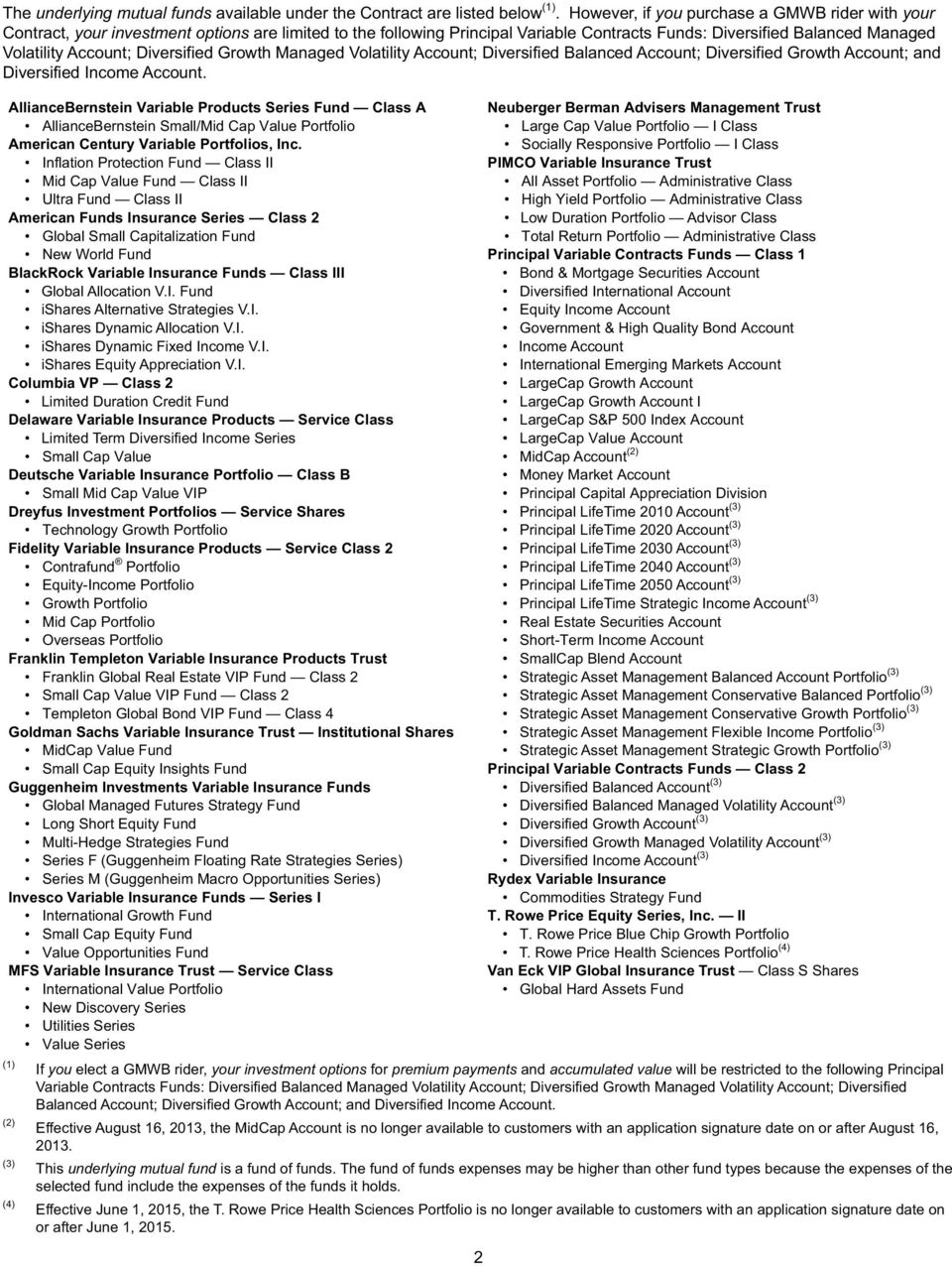
8 PRINCIPAL INVESTMENT PLUS VARIABLE ANNUITY SM (FOR APPLICATIONS SIGNED ON OR AFTER AUGUST 1, 2013) Prospectus dated November 2, 2015 This prospectus describes Principal Investment Plus Variable Annuity, an individual, flexible premium, deferred variable annuity (the Contract ), issued by Principal Life Insurance Company ( the Company, we, our or us ) through Principal Life Insurance Company Separate Account B ( Separate Account ). This prospectus provides information about the Contract and the Separate Account that you, as owner, should know before investing. The prospectus should be read and retained for future reference. Additional information about the Contract and the Separate Account is included in the Statement of Additional Information ( SAI ), dated November 2, 2015, which has been filed with the Securities and Exchange Commission (the SEC ) and is considered a part of this prospectus. The table of contents of the SAI is at the end of this prospectus. You may obtain a free copy of the SAI and all additional information by writing or calling: Principal Investment Plus Variable Annuity SM, Principal Financial Group, P.O. Box 9382, Des Moines, Iowa , Telephone: You can also visit the SEC s website at which contains the SAI, material incorporated into this prospectus by reference, and other information about registrants that file electronically with the SEC. These securities have not been approved or disapproved by the SEC or any state securities commission nor has the SEC or any state securities commission passed upon the accuracy or adequacy of this prospectus. Any representation to the contrary is a criminal offense. You generally may allocate your investment in the Contract among the following investment options: dollar cost averaging fixed accounts ( DCA Plus accounts ), a Fixed Account and the Separate Account divisions. The DCA Plus accounts and the Fixed Account are a part of our General Account. Obligations of the General Account are subject to the rights of the Company s other creditors and the Company's overall claims paying ability. Each division of the Separate Account invests in shares of a corresponding mutual fund (the underlying mutual funds ). A list of the underlying mutual funds available under the Contract is shown below. Your accumulated value will vary according to the investment performance of the underlying mutual funds in which your selected division(s) are invested. We do not guarantee the investment performance of the underlying mutual funds. For any administrative questions, you may contact us by writing or calling: Principal Investment Plus Variable Annuity SM, Principal Financial Group, P.O. Box 9382, Des Moines, Iowa , Telephone: The Contract is available with or without the Premium Payment Credit Rider. This rider applies credits to the accumulated value for premium payments made in contract year one. The amount of the credit may be more than offset by the additional charges associated with it (higher surrender charges, a longer surrender charge period and increased annual expenses). A Contract with the Premium Payment Credit Rider will cost more than a Contract without the Premium Payment Credit Rider. You should review your own circumstances to determine whether this rider is suitable for you. To assist you in making that determination, we have highlighted in grey boxes those portions of this prospectus pertaining to the rider. NOTE: We recapture the premium payment credit if you return the Contract during the examination offer period or request full annuitization of the Contract prior to the third Contract anniversary. You take the risk that the recaptured amount may exceed the then current value of the credit(s). This risk occurs when your investment options have experienced negative investment performance (i.e., have lost value) since the credit was applied. In that situation, you would be worse off than if you had not purchased the Premium Payment Credit Rider. The Contract is available with or without a Guaranteed Minimum Withdrawal Benefit rider (GMWB). The GMWB riders currently available are Principal Income Builder 3 ( PIB 3 ) and Principal Income Builder 10 ( PIB 10 ). You may only elect one GMWB rider. There is a charge for the rider that is deducted quarterly. If you purchase a GMWB rider with your Contract, your investment options are limited to the following Principal Variable Contracts Funds: Diversified Balanced Managed Volatility Account; Diversified Growth Managed Volatility Account; Diversified Balanced Account; Diversified Growth Account; and Diversified Income Account. This prospectus describes all material features of the Contract and any material differences due to state variations. All italicized words within this Prospectus are defined terms that can be found in the Glossary.

9 The underlying mutual funds available under the Contract are listed below (1). However, if you purchase a GMWB rider with your Contract, your investment options are limited to the following Principal Variable Contracts Funds: Diversified Balanced Managed Volatility Account; Diversified Growth Managed Volatility Account; Diversified Balanced Account; Diversified Growth Account; and Diversified Income Account. AllianceBernstein Variable Products Series Fund Class A Neuberger Berman Advisers Management Trust AllianceBernstein Small/Mid Cap Value Portfolio Large Cap Value Portfolio I Class American Century Variable Portfolios, Inc. Socially Responsive Portfolio I Class Inflation Protection Fund Class II PIMCO Variable Insurance Trust Mid Cap Value Fund Class II All Asset Portfolio Administrative Class Ultra Fund Class II High Yield Portfolio Administrative Class American Funds Insurance Series Class 2 Low Duration Portfolio Advisor Class Global Small Capitalization Fund Total Return Portfolio Administrative Class New World Fund Principal Variable Contracts Funds Class 1 BlackRock Variable Insurance Funds Class III Bond & Mortgage Securities Account Global Allocation V.I. Fund Diversified International Account ishares Alternative Strategies V.I. Equity Income Account ishares Dynamic Allocation V.I. Government & High Quality Bond Account ishares Dynamic Fixed Income V.I. Income Account ishares Equity Appreciation V.I. International Emerging Markets Account Columbia VP Class 2 LargeCap Growth Account Limited Duration Credit Fund LargeCap Growth Account I Delaware Variable Insurance Products Service Class LargeCap S&P 500 Index Account Limited Term Diversified Income Series LargeCap Value Account Small Cap Value MidCap Account (2) Deutsche Variable Insurance Portfolio Class B Money Market Account Small Mid Cap Value VIP Principal Capital Appreciation Division Dreyfus Investment Portfolios Service Shares Principal LifeTime 2010 Account (3) Technology Growth Portfolio Principal LifeTime 2020 Account (3) Fidelity Variable Insurance Products Service Class 2 Principal LifeTime 2030 Account (3) Contrafund Portfolio Principal LifeTime 2040 Account (3) Equity-Income Portfolio Principal LifeTime 2050 Account (3) Growth Portfolio Principal LifeTime Strategic Income Account (3) Mid Cap Portfolio Real Estate Securities Account Overseas Portfolio Short-Term Income Account Franklin Templeton Variable Insurance Products Trust SmallCap Blend Account Franklin Global Real Estate VIP Fund Class 2 Strategic Asset Management Balanced Account Portfolio (3) Small Cap Value VIP Fund Class 2 Strategic Asset Management Conservative Balanced Portfolio (3) Templeton Global Bond VIP Fund Class 4 Strategic Asset Management Conservative Growth Portfolio (3) Goldman Sachs Variable Insurance Trust Institutional Shares Strategic Asset Management Flexible Income Portfolio (3) MidCap Value Fund Strategic Asset Management Strategic Growth Portfolio (3) Small Cap Equity Insights Fund Principal Variable Contracts Funds Class 2 Guggenheim Investments Variable Insurance Funds Diversified Balanced Account (3) Global Managed Futures Strategy Fund Diversified Balanced Managed Volatility Account (3) Long Short Equity Fund Diversified Growth Account (3) Multi-Hedge Strategies Fund Diversified Growth Managed Volatility Account (3) Series F (Guggenheim Floating Rate Strategies Series) Diversified Income Account (3) Series M (Guggenheim Macro Opportunities Series) Rydex Variable Insurance Invesco Variable Insurance Funds Series I Commodities Strategy Fund International Growth Fund T. Rowe Price Equity Series, Inc. II Small Cap Equity Fund T. Rowe Price Blue Chip Growth Portfolio Value Opportunities Fund T. Rowe Price Health Sciences Portfolio (4) MFS Variable Insurance Trust Service Class Van Eck VIP Global Insurance Trust Class S Shares International Value Portfolio Global Hard Assets Fund New Discovery Series Utilities Series Value Series (1) If you elect a GMWB rider, your investment options for premium payments and accumulated value will be restricted to the following Principal Variable Contracts Funds: Diversified Balanced Managed Volatility Account; Diversified Growth Managed Volatility Account; Diversified Balanced Account; Diversified Growth Account; and Diversified Income Account. (2) Effective August 16, 2013, the MidCap Account is no longer available to customers with an application signature date on or after August 16, (3) This underlying mutual fund is a fund of funds. The fund of funds expenses may be higher than other fund types because the expenses of the selected fund include the expenses of the funds it holds. (4) Effective June 1, 2015, the T. Rowe Price Health Sciences Portfolio is no longer available to customers with an application signature date on or after June 1,
10 An investment in the Contract is not a deposit or obligation of any bank and is not insured or guaranteed by any bank, the Federal Deposit Insurance Corporation or any other government agency. The Contract, certain Contract features and/or some of the investment options may not be available in all states or through all broker dealers. In addition, some optional features may restrict your ability to elect certain other optional features. For further details, please contact us at This prospectus is valid only when accompanied by the current prospectuses for the underlying mutual funds. These prospectuses should be kept for future reference. This prospectus is not an offer to sell, or solicitation of an offer to buy, the Contract in states in which the offer or solicitation may not be lawfully made. No person is authorized to give any information or to make any representation in connection with this Contract other than those contained in this prospectus. 3

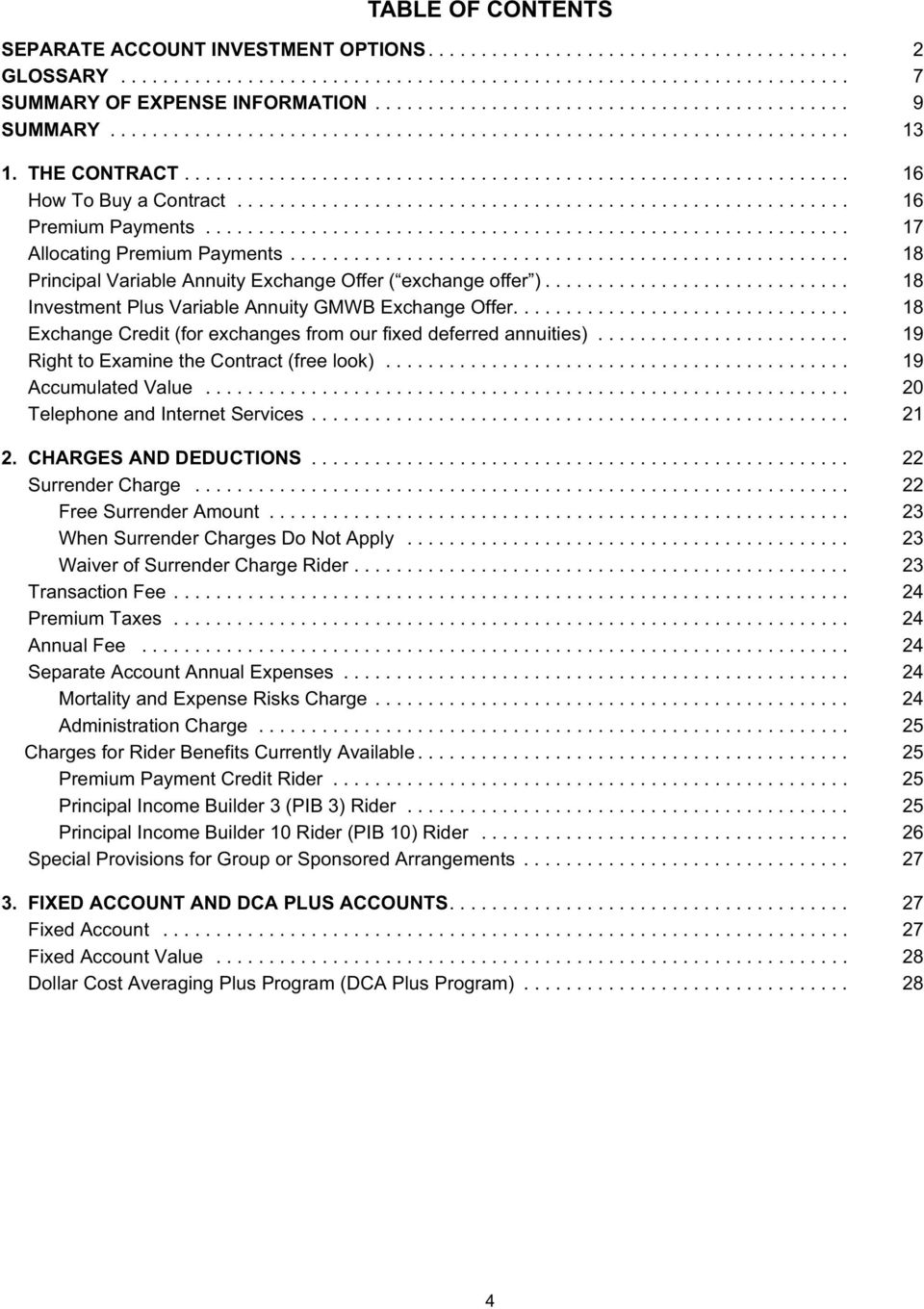
11 TABLE OF CONTENTS SEPARATE ACCOUNT INVESTMENT OPTIONS GLOSSARY SUMMARY OF EXPENSE INFORMATION SUMMARY THE CONTRACT How To Buy a Contract Premium Payments Allocating Premium Payments Principal Variable Annuity Exchange Offer ( exchange offer ) Investment Plus Variable Annuity GMWB Exchange Offer Exchange Credit (for exchanges from our fixed deferred annuities) Right to Examine the Contract (free look) Accumulated Value Telephone and Internet Services CHARGES AND DEDUCTIONS Surrender Charge Free Surrender Amount When Surrender Charges Do Not Apply Waiver of Surrender Charge Rider Transaction Fee Premium Taxes Annual Fee Separate Account Annual Expenses Mortality and Expense Risks Charge Administration Charge Charges for Rider Benefits Currently Available Premium Payment Credit Rider Principal Income Builder 3 (PIB 3) Rider Principal Income Builder 10 Rider (PIB 10) Rider Special Provisions for Group or Sponsored Arrangements FIXED ACCOUNT AND DCA PLUS ACCOUNTS Fixed Account Fixed Account Value Dollar Cost Averaging Plus Program (DCA Plus Program)
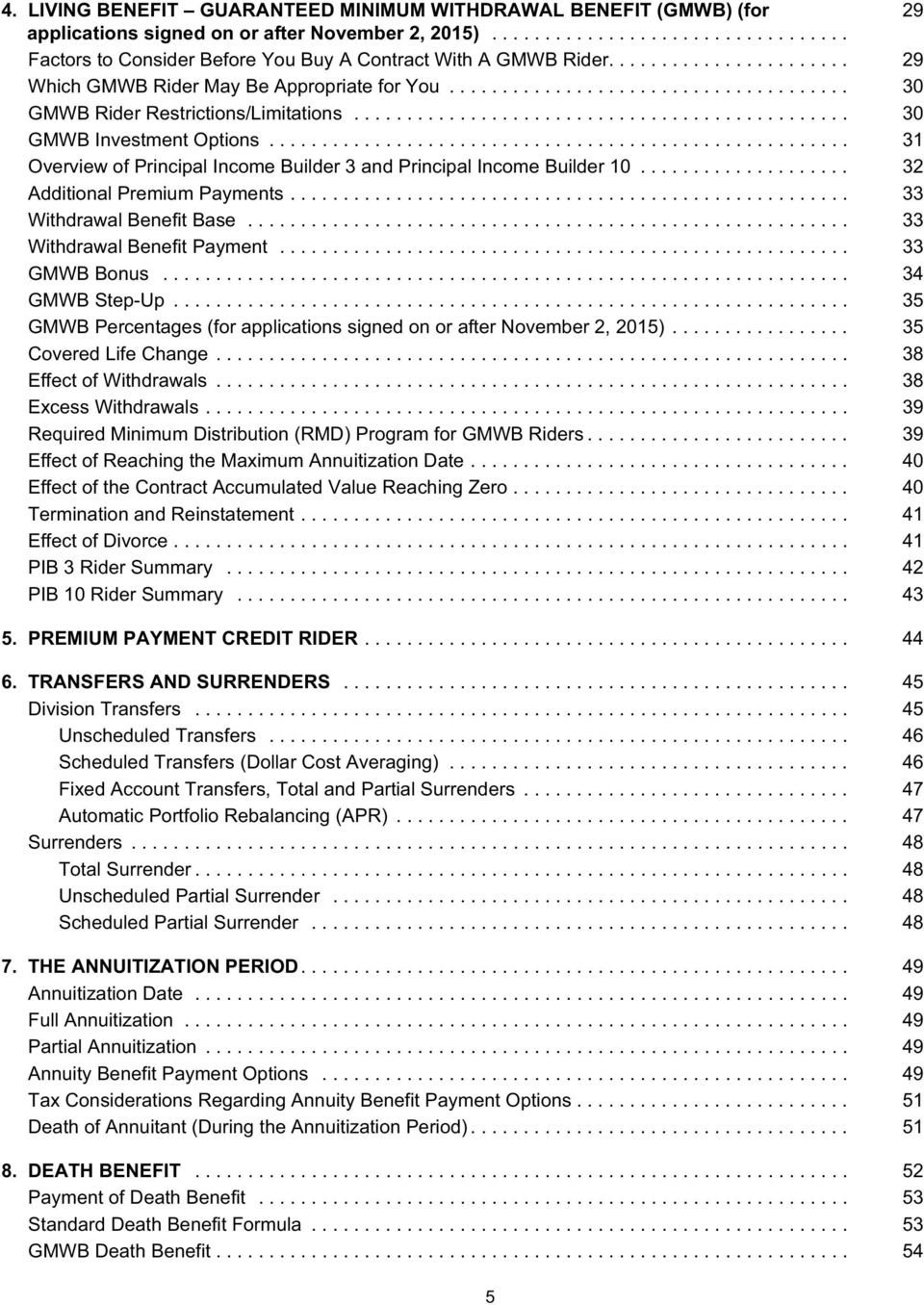
12 4. LIVING BENEFIT GUARANTEED MINIMUM WITHDRAWAL BENEFIT (GMWB) (for applications signed on or after November 2, 2015) Factors to Consider Before You Buy A Contract With A GMWB Rider Which GMWB Rider May Be Appropriate for You GMWB Rider Restrictions/Limitations GMWB Investment Options Overview of Principal Income Builder 3 and Principal Income Builder Additional Premium Payments Withdrawal Benefit Base Withdrawal Benefit Payment GMWB Bonus GMWB Step-Up GMWB Percentages (for applications signed on or after November 2, 2015) Covered Life Change Effect of Withdrawals Excess Withdrawals Required Minimum Distribution (RMD) Program for GMWB Riders Effect of Reaching the Maximum Annuitization Date Effect of the Contract Accumulated Value Reaching Zero Termination and Reinstatement Effect of Divorce PIB 3 Rider Summary PIB 10 Rider Summary PREMIUM PAYMENT CREDIT RIDER TRANSFERS AND SURRENDERS Division Transfers Unscheduled Transfers Scheduled Transfers (Dollar Cost Averaging) Fixed Account Transfers, Total and Partial Surrenders Automatic Portfolio Rebalancing (APR) Surrenders Total Surrender Unscheduled Partial Surrender Scheduled Partial Surrender THE ANNUITIZATION PERIOD Annuitization Date Full Annuitization Partial Annuitization Annuity Benefit Payment Options Tax Considerations Regarding Annuity Benefit Payment Options Death of Annuitant (During the Annuitization Period) DEATH BENEFIT Payment of Death Benefit Standard Death Benefit Formula GMWB Death Benefit
13 9. ADDITIONAL INFORMATION ABOUT THE CONTRACT The Contract Delay of Payments Misstatement of Age or Gender Assignment Change of Owner or Annuitant Beneficiary Contract Termination Reinstatement Reports Important Information About Customer Identification Procedures Frequent Trading and Market-Timing (Abusive Trading Practices) Distribution of the Contract Performance Calculation FEDERAL TAX MATTERS Taxation of Non-Qualified Contracts Taxation of Qualified Contracts Withholding GENERAL INFORMATION ABOUT THE COMPANY Corporate Organization and Operation Legal Opinions Legal Proceedings Other Variable Annuity Contracts Payments to Financial Intermediaries Service Arrangements and Compensation Mutual Fund Diversification State Regulation Independent Registered Public Accounting Firm Financial Statements TABLE OF SEPARATE ACCOUNT DIVISIONS REGISTRATION STATEMENT TABLE OF CONTENTS OF THE SAI APPENDIX A PRINCIPAL VARIABLE ANNUITY EXCHANGE OFFER APPENDIX B INVESTMENT PLUS VARIABLE ANNUITY GMWB EXCHANGE OFFER APPENDIX C PIB 3 EXAMPLES (applications signed on or after August 1, 2013) APPENDIX D PIB 10 EXAMPLES (applications signed on or after June 1, 2015) APPENDIX E GMWB DEATH BENEFIT EXAMPLES (Contracts with a GMWB rider and application was signed on or after August 1, 2013) APPENDIX F PIB 10 (applications signed before June 1, 2015) APPENDIX G PIB 3 (applications signed before November 2, 2015) APPENDIX H PIB 10 (applications signed June 1, 2015 through November 1, 2015) APPENDIX I CONDENSED FINANCIAL INFORMATION APPENDIX J NEW YORK REG 60 DETERMINING GMWB PERCENTAGES AND SUBMISSION GUIDELINES (for applications signed on or after November 2, 2015)

14 UNDERLYING MUTUAL FUNDS TABLE OF CONTENTS Principal Variable Contracts Funds - Diversified Balanced Account Class 2 Shares S-1 Principal Variable Contracts Funds - Diversified Balanced Managed Volatility Account Class 2 Shares S-6 Principal Variable Contracts Funds - Diversified Growth Account Class 2 Shares S-12 Principal Variable Contracts Funds - Diversified Growth Managed Volatility Account Class 2 Shares S-17 Principal Variable Contracts Funds - Diversified Income Account Class 2 Shares S-23

15 GLOSSARY The terms defined below are italicized throughout this Prospectus. accumulated value the sum of the values in the DCA Plus Account(s), the Fixed Account and the Separate Account divisions. anniversary(ies) the same date and month of each year following the contract date. annuitant the person, including any joint annuitant, on whose life the annuity benefit payment is based. This person may or may not be the owner. annuitization application of a portion or all of the accumulated value to an annuity benefit payment option to make income payments. annuitization date the date all of the owner s accumulated value is applied to an annuity benefit payment option. Automatic Portfolio Rebalancing (APR) the transfer of money among your Separate Account divisions on a set schedule to maintain a specified percentage in each Separate Account division. cash surrender value the accumulated value minus any applicable surrender charges and fee(s) (contract fee and/or prorated share of the charge(s) for optional rider(s)). contract date the date that the Contract is issued and which is used to determine contract years. contract year the one-year period beginning on the contract date and ending one day before the contract anniversary and any subsequent one-year period beginning on a contract anniversary (for example, if the contract date is June 5, 2013, the first contract year ends on June 4, 2014, and the first contract anniversary falls on June 5, 2014). data page that portion of the Contract which contains the following: owner and annuitant data (names, gender, annuitant age); the Contract issue date; maximum annuitization date; Contract charges and limits; benefits; and a summary of any optional benefits chosen by the Contract owner. Dollar Cost Averaging Plus (DCA Plus) account an account which uses a guaranteed interest rate to calculate interest earned for a specific amount of time. Dollar Cost Averaging Plus (DCA Plus) account value the amount invested in the DCA Plus Account(s) (plus interest earned and less any surrenders and/or transfers). Dollar Cost Averaging Plus (DCA Plus) program a program through which your DCA Plus value is transferred from a DCA Plus Account to the investment options over a specified period of time. Fixed Account an account which uses a guaranteed interest rate to calculate interest earned. Fixed Account value the amount invested in the Fixed Account (plus interest earned and less any surrenders and/ or transfers). good order an instruction or request is in good order when it is received in our home office, or other place we may specify, and has such clarity and completeness that we do not have to exercise any discretion to carry out the instruction or request. We may require that the instruction or request be given in a certain form. home office Company s corporate headquarters located at Principal Financial Group, Des Moines, Iowa investment options the DCA Plus Accounts, Fixed Account and Separate Account divisions. joint annuitant an annuitant whose life determines the annuity benefit under this Contract. Any reference to the death of the annuitant means the death of the first annuitant to die. 7

16 joint owner an owner who has an undivided interest with the right of survivorship in this Contract with another owner. Any reference to the death of the owner means the death of the first owner to die. non-qualified contract a Contract which does not qualify for favorable tax treatment as a Qualified Plan, Individual Retirement Annuity, Roth IRA, SEP IRA, Simple-IRA or Tax Sheltered Annuity. notice any form of communication received by us, at the home office, either in writing or in another form approved by us in advance. Your notices may be mailed to us at: Principal Life Insurance Company P O Box 9382 Des Moines, Iowa owner the person, including joint owner, who owns all the rights and privileges of this Contract. For the Principal Variable Annuity Exchange Offer, owner refers to the original owner. premium payments the gross amount you contributed to the Contract. qualified plans retirement plans which receive favorable tax treatment under Section 401 or 403(a) of the Internal Revenue Code. Required Minimum Distribution ( RMD ) amount the amount required to be distributed each calendar year for purposes of satisfying the RMD rules of Section 401(a)(9) of the Internal Revenue Code of 1986, as amended, and related Code provisions. Separate Account division (division(s)) a part of the Separate Account which invests in shares of an underlying mutual fund. (Referred to in the marketing materials as sub-accounts. ) Separate Account division value the sum of all divisions value; each division s value is determined by multiplying the number of units in that division by the unit value of that division. surrender charge the charge deducted upon certain partial surrenders or total surrender of the Contract before the annuitization date. surrender value accumulated value less any applicable surrender charge, rider fees, annual fee, transaction fees and any premium tax or other taxes. transfer moving all or a portion of your accumulated value to or from one investment option or among several investment options. All transfers initiated during the same valuation period are considered to be one transfer for purposes of calculating the transaction fee, if any. underlying mutual fund a registered open-end investment company, or a series or portfolio thereof, in which a division invests. unit the accounting measure used to determine your proportionate interest in a division. unit value a measure used to determine the value of an investment in a division. valuation date (valuation days) each day the New York Stock Exchange ( NYSE ) is open for trading and trading is not restricted. valuation period the period of time from one determination of the value of a unit of a division to the next. Each valuation period begins at the close of normal trading on the NYSE, generally 4:00 p.m. Eastern Time, on each valuation date and ends at the close of normal trading of the NYSE on the next valuation date. we, our, us Principal Life Insurance Company. We are also referred to throughout this prospectus as the Company. you, your the owner of this Contract, including any joint owner. 8

17 SUMMARY OF EXPENSE INFORMATION The tables below describe the fees and expenses that you will pay when buying, owning and surrendering the Contract. The expenses for a Contract with the Premium Payment Credit Rider are higher than the expenses for the Contract without the Premium Payment Credit Rider. The following table describes the fees and expenses you will pay at the time you buy the Contract, surrender the Contract or transfer cash value between investment options. Surrender charge - with the Premium Payment Credit Rider (as a percentage of amount surrendered) (2) Surrender charge - without the Premium Payment Credit Rider (as a percentage of amount surrendered) (3) Transaction Fees for each unscheduled partial surrender Contract owner transaction expenses (1) Maximum Current 8% 8% 6% 6% the lesser of $25 or 2% of each unscheduled partial surrender after the 12th unscheduled partial surrender in a contract year for each unscheduled transfer the lesser of $25 or 2% of each unscheduled transfer $0 after the first unscheduled transfer in a contract year State Premium Taxes (vary by state) (4) 3.50% of premium payments made 0% $0 (1) (2) (3) (4) For additional information about the fees and expenses described in the table, see 2. CHARGES AND DEDUCTIONS. Surrender charge with the Premium Payment Credit Rider (as a percentage of amounts surrendered): Table of surrender charges with the Premium Payment Credit Rider Number of completed contract years Surrender charge applied to all premium since each premium payment was made payments received in that contract year 0 (year of premium payment) 8% 1 8% 2 7% 3 6% 4 5% 5 4% 6 3% 7 2% 8 1% 9 and later 0% Surrender charge without the Premium Payment Credit Rider (as a percentage of amounts surrendered): Table of surrender charges without the Premium Payment Credit Rider Number of completed contract years Surrender charge applied to all premium since each premium payment was made payments received in that contract year 0 (year of premium payment) 6% 1 6% 2 6% 3 5% 4 4% 5 3% 6 2% 7 and later 0% We do not currently assess premium taxes for any Contract issued, but reserve the right in the future to assess up to 3.50% of premium payments made for Contract owners in those states where a premium tax is assessed. 9

18 The following table describes the fees and expenses that are deducted periodically during the time that you own the Contract, not including underlying mutual fund fees and expenses. Annual Fee (waived for Contracts with accumulated value of $30,000 or more) Periodic Expenses Maximum Annual Charge The lesser of $30 or 2.00% of the accumulated value Current Annual Charge The lesser of $30 or 2.00% of the accumulated value Separate Account Annual Expenses Mortality and Expense Risks Charge (as a percentage of 1.25% 1.25% average daily Separate Account value) Administration Charge (as a percentage of average daily 0.15% 0.15% Separate Account value) Total Separate Account Annual Expense 1.40% 1.40% Optional Riders (1) Maximum Annual Charge Current Annual Charge Premium Payment Credit Rider Separate Account based on the average daily 0.60% 0.60% accumulated value in the divisions, deducted daily Fixed Account maximum reduction in interest rate 0.60% 0.00% For applications signed on or after August 1, 2013: PIB 3 rider (GMWB) (as a percentage of the average quarterly For Life withdrawal benefit base) (2) 1.65% 1.05% For applications signed on or after June 1, 2015: PIB 10 rider (GMWB) (as a percentage of the average quarterly For Life withdrawal benefit base) (2) For applications signed before June 1, 2015: PIB 10 rider (GMWB) (as a percentage of the average quarterly Investment Back withdrawal benefit base) (3) 2.00% 1.25% 2.00% 1.20% Total Separate Account Annual Expense plus Optional Riders Annual Expense with PIB 3 (4) (for applications signed on or after August 1, 2013) with PIB 10 (5) (for applications signed on or after June 1, 2015) with PIB 10 (5) (for applications signed before June 1, 2015) 3.65% 3.05% 4.00% 3.25% 4.00% 3.20% (1) (2) Some rider provisions may vary from state to state and may be subject to additional restrictions. At the end of each calendar quarter, one-fourth of the annual charge is multiplied by the average quarterly For Life withdrawal benefit base. The For Life withdrawal benefit base is used to calculate the annual withdrawal benefit payment available for your life. We calculate the withdrawal benefit base on the rider effective date and each Contract anniversary. The average quarterly For Life withdrawal benefit base is equal to (1) the For Life withdrawal benefit base at the beginning of the calendar quarter plus (2) the For Life withdrawal benefit base at the end of the calendar quarter, and this sum is divided by two. There may be times when the sum of the four quarterly fee amounts is higher than the fee amount if we calculated it annually. For example, if your withdrawal benefit base is changed on your Contract anniversary, the fee for that calendar quarter will vary from the other quarters. See 2. CHARGES AND DEDUCTIONS for more information on how the rider charge is calculated. If your rider charge will increase, it will not exceed the maximum rider charge allowed. If you opt out of the GMWB Step- Up feature, your rider charge will not increase. 10
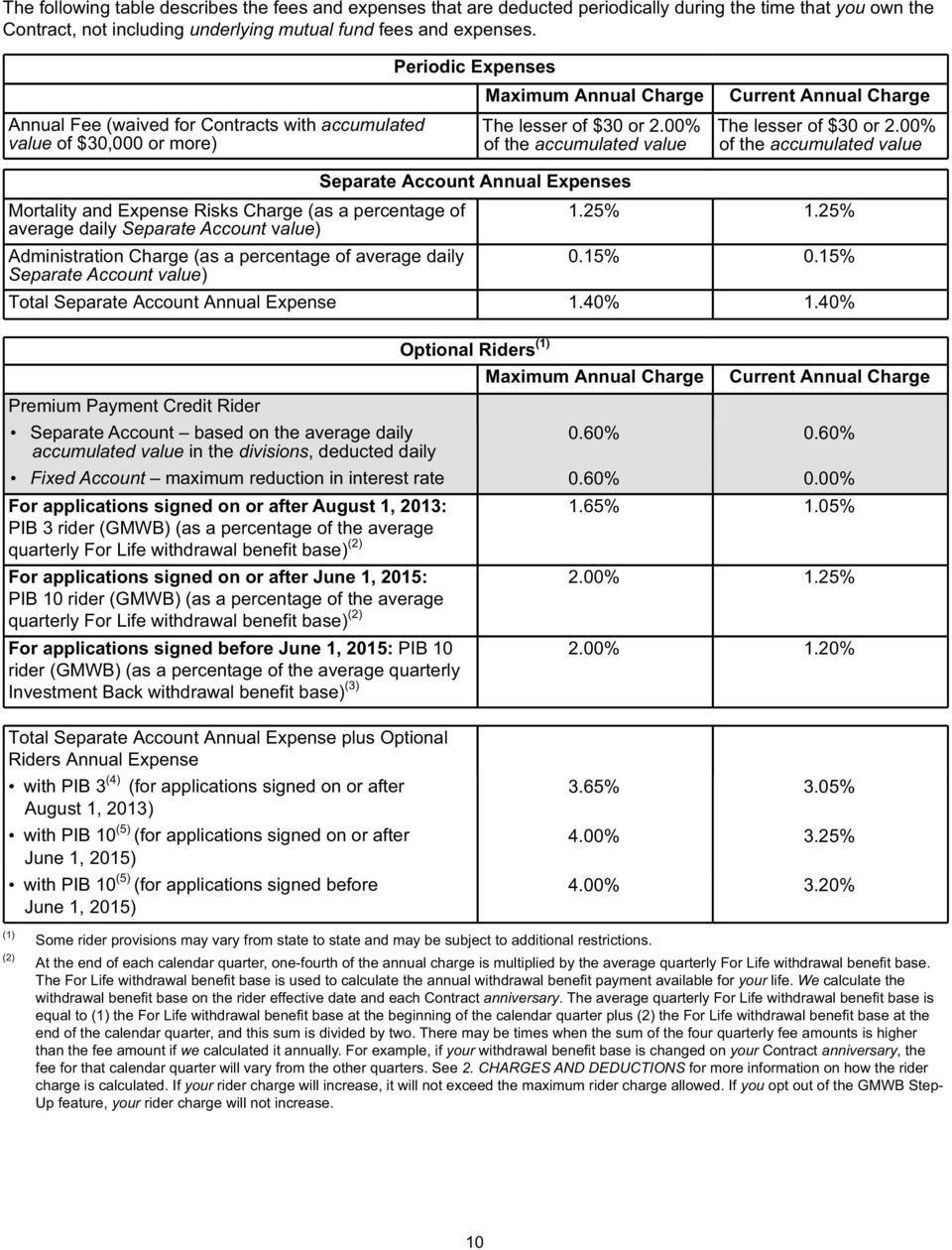
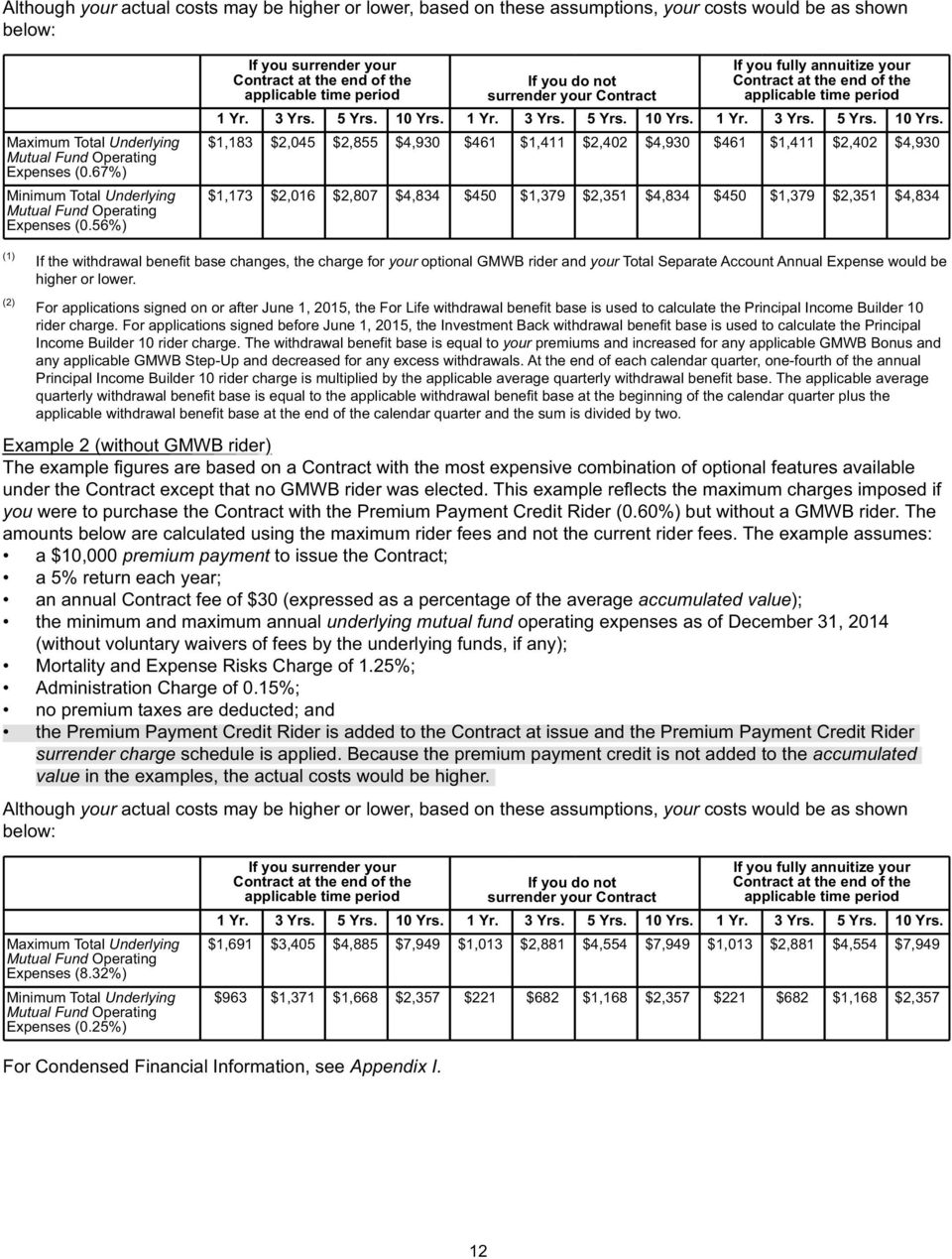
19 (3) (4) (5) At the end of each calendar quarter, one-fourth of the annual charge is multiplied by the average quarterly Investment Back withdrawal benefit base. The Investment Back withdrawal benefit base is used to calculate the maximum annual withdrawal benefit payment available to you until you at least receive your premium payments. We calculate the withdrawal benefit base on the rider effective date and each Contract anniversary. The average quarterly Investment Back withdrawal benefit base is equal to (1) the Investment Back withdrawal benefit base at the beginning of the calendar quarter plus (2) the Investment Back withdrawal benefit base at the end of the calendar quarter, and this sum is divided by two. There may be times when the sum of the four quarterly fee amounts is higher than the fee amount if we calculated it annually. For example, if your withdrawal benefit base is changed on your Contract anniversary, the fee for that calendar quarter will vary from the other quarters. See 2. CHARGES AND DEDUCTIONS for more information on how the rider charge is calculated. If your rider charge will increase, it will not exceed the maximum rider charge allowed. If you opt out of the GMWB Step-Up feature, your rider charge will not increase. This amount assumes the Principal Income Builder 3 rider was elected (in addition to the 1.25% Mortality and Expense Risks Charge and the 0.15% Administration Charge). This assumes the withdrawal benefit base is equal to the initial premium payment. If the withdrawal benefit base changes, the charge for your optional GMWB rider and your Total Separate Account Annual Expense would be higher or lower. This amount assumes the Principal Income Builder 10 rider was elected (in addition to the 1.25% Mortality and Expense Risks Charge and the 0.15% Administration Charge). This assumes the withdrawal benefit base is equal to the initial premium payment. If the withdrawal benefit base changes, the charge for your optional GMWB rider and your Total Separate Account Annual Expense would be higher or lower. This table shows the minimum and maximum total operating expenses charged by the underlying mutual funds that you may pay periodically during the time that you own the Contract. More detail concerning the fees and expenses of each underlying mutual fund is contained in its prospectus. Minimum and Maximum Annual Underlying Mutual Fund Operating Expenses as of December 31, 2014 Minimum Maximum Total annual underlying mutual fund operating expenses (expenses that are deducted from underlying mutual fund assets, including management fees, distribution and/or service (12b-1) fees and other expenses)* 0.25% 8.32% * Some of the funds available are structured as a fund of funds. A fund of funds is a mutual fund that invests primarily in a portfolio of other mutual funds. The expenses shown include all the fees and expenses of the funds that a fund of funds holds in its portfolio. The underlying fund with the highest operating expenses is a fund of funds. EXAMPLES These examples are intended to help you compare the cost of investing in the Contract with the cost of investing in other variable annuity contracts. These costs include Contract owner transaction expenses, Contract fees, Separate Account annual expenses, and underlying mutual fund fees and expenses. Example 1 (with GMWB rider) The example figures are based on a Contract with the most expensive combination of optional features available under the Contract. This example reflects the maximum charges imposed if you were to purchase the Contract with the Principal Income Builder 10 rider (2.00%), as well as the Premium Payment Credit Rider (0.60%). The amounts below are calculated using the maximum rider fees and not the current rider fees. The example assumes (1) : a $10,000 premium payment to issue the Contract; a 5% return each year; an annual Contract fee of $30 (expressed as a percentage of the average accumulated value); the minimum and maximum annual underlying mutual fund operating expenses as of December 31, 2014, for the underlying mutual funds that are available when purchasing a GMWB rider (without voluntary waivers of fees by the underlying funds, if any); Mortality and Expense Risks Charge of 1.25% Administration Charge of 0.15% no premium taxes are deducted; the Principal Income Builder 10 rider was added to the Contract at issue (2) and the withdrawal benefit base is equal to the initial premium payment; and the Premium Payment Credit Rider is added to the Contract at issue and the Premium Payment Credit Rider surrender charge schedule is applied. Because the premium payment credit is not added to the accumulated value in the examples, the actual costs would be higher. 11

20 Although your actual costs may be higher or lower, based on these assumptions, your costs would be as shown below: Maximum Total Underlying Mutual Fund Operating Expenses (0.67%) Minimum Total Underlying Mutual Fund Operating Expenses (0.56%) If you surrender your Contract at the end of the applicable time period If you do not surrender your Contract If you fully annuitize your Contract at the end of the applicable time period 1 Yr. 3 Yrs. 5 Yrs. 10 Yrs. 1 Yr. 3 Yrs. 5 Yrs. 10 Yrs. 1 Yr. 3 Yrs. 5 Yrs. 10 Yrs. $1,183 $2,045 $2,855 $4,930 $461 $1,411 $2,402 $4,930 $461 $1,411 $2,402 $4,930 $1,173 $2,016 $2,807 $4,834 $450 $1,379 $2,351 $4,834 $450 $1,379 $2,351 $4,834 (1) (2) If the withdrawal benefit base changes, the charge for your optional GMWB rider and your Total Separate Account Annual Expense would be higher or lower. For applications signed on or after June 1, 2015, the For Life withdrawal benefit base is used to calculate the Principal Income Builder 10 rider charge. For applications signed before June 1, 2015, the Investment Back withdrawal benefit base is used to calculate the Principal Income Builder 10 rider charge. The withdrawal benefit base is equal to your premiums and increased for any applicable GMWB Bonus and any applicable GMWB Step-Up and decreased for any excess withdrawals. At the end of each calendar quarter, one-fourth of the annual Principal Income Builder 10 rider charge is multiplied by the applicable average quarterly withdrawal benefit base. The applicable average quarterly withdrawal benefit base is equal to the applicable withdrawal benefit base at the beginning of the calendar quarter plus the applicable withdrawal benefit base at the end of the calendar quarter and the sum is divided by two. Example 2 (without GMWB rider) The example figures are based on a Contract with the most expensive combination of optional features available under the Contract except that no GMWB rider was elected. This example reflects the maximum charges imposed if you were to purchase the Contract with the Premium Payment Credit Rider (0.60%) but without a GMWB rider. The amounts below are calculated using the maximum rider fees and not the current rider fees. The example assumes: a $10,000 premium payment to issue the Contract; a 5% return each year; an annual Contract fee of $30 (expressed as a percentage of the average accumulated value); the minimum and maximum annual underlying mutual fund operating expenses as of December 31, 2014 (without voluntary waivers of fees by the underlying funds, if any); Mortality and Expense Risks Charge of 1.25%; Administration Charge of 0.15%; no premium taxes are deducted; and the Premium Payment Credit Rider is added to the Contract at issue and the Premium Payment Credit Rider surrender charge schedule is applied. Because the premium payment credit is not added to the accumulated value in the examples, the actual costs would be higher. Although your actual costs may be higher or lower, based on these assumptions, your costs would be as shown below: Maximum Total Underlying Mutual Fund Operating Expenses (8.32%) Minimum Total Underlying Mutual Fund Operating Expenses (0.25%) If you surrender your Contract at the end of the applicable time period If you do not surrender your Contract If you fully annuitize your Contract at the end of the applicable time period 1 Yr. 3 Yrs. 5 Yrs. 10 Yrs. 1 Yr. 3 Yrs. 5 Yrs. 10 Yrs. 1 Yr. 3 Yrs. 5 Yrs. 10 Yrs. $1,691 $3,405 $4,885 $7,949 $1,013 $2,881 $4,554 $7,949 $1,013 $2,881 $4,554 $7,949 $963 $1,371 $1,668 $2,357 $221 $682 $1,168 $2,357 $221 $682 $1,168 $2,357 For Condensed Financial Information, see Appendix I. 12
21 SUMMARY This prospectus describes an individual flexible premium deferred variable annuity offered by the Company. The Contract is designed to provide individuals with retirement benefits, including: non-qualified retirement programs; and Individual Retirement Annuities ( IRA ), Simplified Employee Pension plans ( SEPs ) and Savings Incentive Match Plan for Employees ( SIMPLE ) IRAs adopted according to Section 408 of the Internal Revenue Code (see 10. FEDERAL TAX MATTERS). The Contract does not provide any additional tax deferral if you purchase it to fund an IRA or other investment vehicle that already provides tax deferral. For information on how to purchase the Contract, see 1. THE CONTRACT. This section is a brief summary of the Contract s features. More detailed information follows later in this prospectus. Investment Limitations Initial premium payment must be at least $5,000 for non-qualified contracts. Initial premium payment must be at least $2,000 for all other contracts. Each subsequent premium payment must be at least $500. If you are a member of a retirement plan covering three or more persons and premium payments are made through an automatic investment program, the initial and subsequent premium payments for the Contract must average at least $100 and not be less than $50. The total sum of all premium payments may not be greater than $2,000,000 without prior home office approval. You may allocate your net premium payments to the investment options. A complete list of the divisions may be found in 12. TABLE OF SEPARATE ACCOUNT DIVISIONS. Each division invests in shares of an underlying mutual fund. More detailed information about the underlying mutual funds may be found in the current prospectus for each underlying mutual fund. These underlying mutual fund prospectuses are bound together with this prospectus. The investment options also include the Fixed Account and the DCA Plus accounts. The GMWB riders impose limitations on the investment options available by requiring you to allocate 100% of your Separate Account assets to one or more of the available Separate Account GMWB investment options. Transfers During the accumulation period: a dollar amount or percentage of transfer must be specified; a transfer may occur on a scheduled or unscheduled basis; transfers to the Fixed Account are not permitted if a transfer has been made from the Fixed Account to a division within six months; and transfers into DCA Plus accounts are not permitted. During the annuitization period, transfers are not permitted (no transfers once payments have begun). See 1. THE CONTRACT, 3. FIXED ACCOUNT AND DCA PLUS ACCOUNTS, and 6. TRANSFERS AND SURRENDERS for additional restrictions. This Transfers section does not apply to transfers under the DCA Plus program. See 3. FIXED ACCOUNT AND DCA PLUS ACCOUNTS. Surrenders During the accumulation period: the gross dollar amount to be surrendered must be specified; surrendered amounts may be subject to surrender charges: for Contracts without the Premium Payment Credit Rider, the maximum surrender charge is 6% of the amount(s) surrendered; or for Contracts with the Premium Payment Credit Rider, the maximum surrender charge is 8% of the amount(s) surrendered; full surrender of your Contract may be subject to an annual Contract fee; during a contract year, each partial surrender that is less than the Free Surrender Amount is not subject to a surrender charge; and surrenders before age 59½ may involve an income tax penalty (see 10. FEDERAL TAX MATTERS). 13
22 During the annuitization period, surrenders are not allowed. See 6. TRANSFERS AND SURRENDERS for additional information. Charges and Deductions No sales charge is deducted from premium payments at the time received. However, the Contract may impose a surrender charge on surrenders greater than the Free Surrender Amount. A contingent deferred surrender charge is imposed on certain total or partial surrenders. An annual mortality and expense risks charge equal to 1.25% of amounts in the Separate Account divisions is imposed daily. The following riders are available at an additional cost: Premium Payment Credit Rider The current annual rider charge is 0.60% of the average daily accumulated value in the Separate Account divisions, deducted daily (with no reduction of the Fixed Account interest rate). The maximum annual rider charge is 0.60% of the average daily accumulated value in the Separate Account divisions, deducted daily (with a reduction of up to 0.60% of the Fixed Account interest rate). Principal Income Builder 3 The current annual rider charge is 1.05% of the average For Life withdrawal benefit base, deducted quarterly. The maximum annual rider charge is 1.65%. Principal Income Builder 10 For applications signed on or after June 1, 2015, the current annual rider charge is 1.25% of the average For Life withdrawal benefit base, deducted quarterly. The maximum annual rider charge is 2.00%. For applications signed before June 1, 2015, the current annual rider charge is 1.20% of the average Investment Back withdrawal benefit base, deducted quarterly. The maximum annual rider charge is 2.00%. An annual Separate Account administration charge equal to 0.15% of amounts in the Separate Account divisions is imposed daily. There are underlying mutual fund expenses. More detailed information about the underlying mutual fund expenses may be found in the current prospectus for each underlying mutual fund. Contracts with an accumulated value of less than $30,000 are subject to an annual fee of the lesser of $30 or 2% of the accumulated value. Currently we do not charge the annual fee if your accumulated value is $30,000 or more. If you own more than one variable annuity contract with us, then all the contracts you own or jointly own are aggregated on each contract s anniversary to determine if the $30,000 minimum has been met and whether that contract will be charged. Certain states and local governments impose a premium tax. We reserve the right to deduct the amount of the tax from premium payments or the accumulated value. See 2. CHARGES AND DEDUCTIONS for additional information. Annuity Benefit Payments You may choose from several fixed annuity benefit payment options which are described in 7. THE ANNUITIZATION PERIOD. Payments are made to the owner (or beneficiary depending on the annuity benefit payment option selected). You should carefully consider the tax implications of each annuity benefit payment option. See 7. THE ANNUITIZATION PERIOD and 10. FEDERAL TAX MATTERS. 14
23 Death Benefit The standard death benefit is only available for contracts without a GMWB rider and generally is the greatest of the accumulated value, the total of premium payments minus an adjustment for surrenders, or the highest accumulated value on any Contract anniversary wholly divisible by seven. See 8. DEATH BENEFIT for more specific details. If the owner dies before the annuitization date, a death benefit is payable. The death benefit may be paid as either a single payment or under an annuity benefit payment option. If no election is made within the required period of time, the full amount will be paid in a lump sum to the applicable state. Once the money is paid to the applicable state, the beneficiary will have to contact the state to request additional assistance. If the annuitant dies after the annuitization date, payments will continue only as provided by the annuity benefit payment option in effect. The sole death benefit provided when you have a GMWB rider is: Principal Income Builder 3 beneficiary receives the GMWB Death Benefit. Principal Income Builder 10 allows the beneficiary(ies) to elect a) the GMWB Death Benefit, or b) the Investment Back remaining withdrawal benefit base as a series of payments. For applications signed on or after June 1, 2015, Investment Back will no longer be included as a benefit of the PIB 10 rider. See 8. DEATH BENEFIT and 7. THE ANNUITIZATION PERIOD. Examination Offer Period (free look) You may return the Contract during the examination offer period, which is generally 10 days from the date you receive the Contract. The examination offer period may be longer in certain states. The amount refunded will be a full refund of your accumulated value plus any Contract charges and premium taxes you paid unless state law requires otherwise. The underlying mutual fund fees and charges are not refunded to you as they are already factored into the Separate Account division value. The amount refunded may be more or less than the premium payments made. We recapture the full amount of any premium payment credit or exchange credit. See 1. THE CONTRACT for additional information. Optional Riders Subject to certain conditions, you may elect to add one or more of the available optional riders to your Contract. Some rider provisions may vary from state to state and may be subject to additional restrictions. All material state variations have been described in this prospectus. The optional riders available are: Premium Payment Credit Rider This rider applies credits to the accumulated value for premium payments made in contract year one. The surrender charge period is nine years if this rider is elected. Guaranteed Minimum Withdrawal Benefit riders (you may only elect one GMWB rider): PIB 3 This rider allows you to take certain guaranteed annual withdrawals during the Contract accumulation phase, regardless of your Contract accumulated value. This rider includes an annual bonus in the first 3 contract years for not taking withdrawals. Election of this rider results in restriction of your Contract investment options to the more limited GMWB investment options. There is a charge for the rider that is deducted quarterly. PIB 10 This rider allows you to take certain guaranteed annual withdrawals during the Contract accumulation phase, regardless of your Contract accumulated value. This rider includes an annual bonus in the first 10 contract years for not taking withdrawals. Election of this rider results in restriction of your Contract investment options to the more limited GMWB investment options. There is a charge for the rider that is deducted quarterly. 15
24 Termination The Contract will terminate: If no premiums are paid during two consecutive calendar years and the accumulated value (or total premium payments less partial surrenders and applicable surrender charges) is less than $2,000 unless you have a GMWB rider. The Company will first notify you of its intent to exercise this right and give you 60 days to increase the accumulated value to at least $2,000. If you fully annuitize and your accumulated value on the annuitization date is less than $2,000 or if the amount applied under an annuity benefit payment option is less than the minimum requirement. The GMWB rider will terminate: The date you send us notice to terminate the rider (after the 5th Contract anniversary following the rider effective date). The date you fully annuitize, fully surrender or otherwise terminate the Contract. The date the Contract owner is changed (annuitant is changed if the owner is not a natural person), except when the change in owner is due to a spousal continuation of the rider or the removal/addition of a joint life. The date your surviving spouse elects to continue the Contract without this rider (even if prior to the fifth Contract anniversary following the rider effective date). The date you make an impermissible change in a covered life. If you have a PIB 10 rider and your application was signed before June 1, 2015: If the Investment Back remaining withdrawal benefit base and the For Life withdrawal benefit base are both zero. The date the Investment Back remaining withdrawal benefit base is zero and there are no eligible covered lives. If you have the PIB 10 rider and your application was signed on or after June 1, 2015, the date the For Life withdrawal benefit base is zero and there are no eligible covered lives. If you have the PIB 3 rider, the date the For Life withdrawal benefit base is zero and there are no eligible covered lives. The GMWB Death Benefit will terminate: If you have the PIB 3 rider and you terminate the PIB 3 rider. If you have the PIB 10 rider and you terminate the PIB 10 rider. 1. THE CONTRACT The Principal Investment Plus Variable Annuity is significantly different from a fixed annuity. As the owner of a variable annuity, you assume the risk of investment gain or loss (as to amounts in the Separate Account divisions) rather than the Company. The Separate Account division value under a variable annuity is not guaranteed and varies with the investment performance of the underlying mutual funds. Based on your investment objectives, you direct the allocation of premium payments and accumulated values. There can be no assurance that your investment objectives will be achieved. How to Buy a Contract If you want to buy a Contract, you must submit an application and make an initial premium payment. If you are buying the Contract to fund a SIMPLE-IRA or SEP, an initial premium payment is not required at the time you send in the application. If the application is complete and the Contract applied for is suitable, the Contract is issued. If the completed application is received in good order, the initial premium payment is credited within two valuation days after the later of receipt of the application or receipt of the initial premium payment at our home office. If the initial premium payment is not credited within five valuation days, it is refunded unless we have received your permission to retain the premium payment until we receive the information necessary to issue the Contract. The date the Contract is issued is the contract date. The contract date is the date used to determine contract years, regardless of when the Contract is delivered. 16
25 Tax-qualified retirement arrangements, such as IRAs, SEPs, and SIMPLE-IRAs, are tax-deferred. You derive no additional benefit from the tax deferral feature of the annuity. Consequently, an annuity should be used to fund an IRA or other tax qualified retirement arrangement to benefit from the annuity s features other than tax deferral. These features may include guaranteed lifetime income, death benefits without surrender charges, guaranteed caps on fees, and the ability to make scheduled transfers among investment options without transaction fees. Premium Payments The initial premium payment must be at least $5,000 for non-qualified contracts. The initial premium payment must be at least $2,000 for all other contracts. If you are making premium payments through a payroll deduction plan or through a bank (or similar financial institution) account under an automated investment program, your initial and subsequent premium payments must be at least $100. All premium payments are subject to a surrender charge period that begins in the contract year each premium payment is received. Subsequent premium payments must be at least $500 and can be made until the annuitization date. Premium payments are to be made by personal or financial institution check (for example, a cashier s check). We reserve the right to refuse any premium payment that we feel presents a fraud or money laundering risk. Examples of the types of premium payments we will not accept are cash, money orders, starter checks, travelers checks, credit card checks, and foreign checks. If you are a member of a retirement plan covering three or more persons, the initial and subsequent premium payments for the Contract must average at least $100 and cannot be less than $50. The total sum of all premium payments for a Contract may not be greater than $2,000,000 (maximum premium limit) without our prior approval. For further information, please call We reserve the right to treat all of your and/or your spouse s Principal deferred variable annuity contracts, with a guaranteed minimum withdrawal benefit rider attached, as one contract for purposes of determining whether you have exceeded the maximum premium limit (without home office approval). Additional premium restrictions may apply to Contracts with a guaranteed minimum withdrawal benefit rider. See 4. LIVING BENEFIT - GUARANTEED MINIMUM WITHDRAWAL BENEFIT (GMWB). The Company reserves the right to increase the minimum amount for each premium payment with advance notice. Premium payments are credited on the basis of the unit value next determined after we receive a premium payment. The state of Washington does not allow premium payments to be made after the first contract year on Contracts issued with the Premium Payment Credit Rider. See 5. PREMIUM PAYMENT CREDIT RIDER for more information. If no premium payments are made during two consecutive calendar years and the accumulated value is less than $2,000, we reserve the right to terminate the Contract. See 9. ADDITIONAL INFORMATION ABOUT THE CONTRACT. 17
26 Allocating Premium Payments On your application, you direct how your premium payments will be allocated to the investment options. If you elect a GMWB rider, your investment options for premium payments and accumulated value will be restricted (for restrictions see 4. LIVING BENEFIT GUARANTEED MINIMUM WITHDRAWAL BENEFIT (GMWB) - GMWB Investment Options). Allocations must be in percentages. Percentages must be in whole numbers and total 100%. Subsequent premium payments are allocated according to your then current allocation instructions. Changes to the allocation instructions are made without charge. A change is effective on the next valuation period after we receive your new instructions in good order. You can change the current allocations and future allocation instructions by: mailing your instructions to us; calling us at (if telephone privileges apply); faxing your instructions to us at ; or visiting Changes to premium payment allocations do not result in the transfer of any existing investment option accumulated values. You must provide specific instructions to transfer existing accumulated values. We currently do not charge a transaction fee for these transfers but reserve the right to charge such a fee in the future. Premium payments are credited on the basis of the unit value next determined after we receive a premium payment. Principal Variable Annuity Exchange Offer ( exchange offer ) Original owners of an eligible Principal variable annuity contract may elect to exchange their Principal variable annuity contract ( old contract ) for a new Principal Investment Plus Variable Annuity contract ("new contract") subject to the exchange offer terms and conditions. To determine if it is in your best interest to participate in the exchange offer, we recommend that you consult with your tax advisor and financial professional before electing to participate in the exchange offer. You are eligible to participate in the exchange offer when: your old contract is not subject to any surrender charges; and the exchange offer is available in your state. Currently, there is no closing date for the exchange offer. We reserve the right, however, to modify the exchange offer commencement date and to modify or terminate the exchange offer upon reasonable written notice to you. See APPENDIX A for further details about the exchange offer. Investment Plus Variable Annuity GMWB Exchange Offer IPVA GMWB exchange offer ("GMWB exchange offer") This GMWB exchange offer was made available effective January 20, Original owners of an eligible Principal Investment Plus Variable Annuity contract ( old contract ) may elect to exchange their old contract for a new Principal Investment Plus Variable Annuity contract ("new contract") subject to the GMWB exchange offer terms and conditions below. To determine if it is in your best interest to participate in the GMWB exchange offer, we recommend that you consult with your tax advisor and financial professional before electing to participate in the GMWB exchange offer. You are eligible to participate in the GMWB exchange offer when: The old contract doesn't have a GMWB rider; or The old contract has a GMWB 1 rider; and Your old contract is not subject to any surrender charges; and Available in your state. Currently, there is no closing date for the GMWB exchange offer. We reserve the right, however, to modify the GMWB exchange offer commencement date and to modify or terminate the GMWB exchange offer upon reasonable written notice to you. See APPENDIX B for further details about the GMWB exchange offer. 18
27 Exchange Credit (for exchanges from our fixed deferred annuities) If you own a fixed deferred annuity issued by us and are no longer subject to surrender charges, you may transfer the accumulated value, without charge, to the Contract described in this prospectus. We will add 1% of the fixed annuity contract s surrender value at the time of exchange to this Contract s accumulated value. There is no charge or cost to you for this exchange credit. This exchange credit is allocated among the Contract s investment options in the same ratio as your allocation of premium payments. The credit is treated as earnings. NOTE: The exchange may not be suitable for you if you do not want to accept market risk. Fixed deferred annuities provide a fixed rate of accumulation. This Contract provides Separate Account divisions. The value of this Contract will increase or decrease depending on the investment performance of the Separate Account divisions you select. NOTE: The charges and provisions of a fixed annuity contract and this Contract differ. The charges for this Contract are typically higher than charges for a fixed annuity and will increase further with the Premium Payment Credit Rider or a GMWB rider. In some instances, your existing fixed annuity contract may have benefits that are not available under this Contract. NOTE: This exchange credit may not be available in all states. In addition, we reserve the right to change or discontinue the exchange credit. You may obtain more specific information regarding the exchange credit from your registered representative or by calling us at Right to Examine the Contract (free look) It is important to us that you are satisfied with the purchase of your Contract. Under state law, you have the right to return the Contract for any reason during the examination offer period (a free look ). The examination offer period is the later of 10 days after the Contract is delivered to you, or such later date as specified by applicable state law. Although we currently allocate your initial premium payments to the investment options you have selected, during times of economic uncertainty and with prior notice to you, we may exercise our right to allocate initial premium payments to the Money Market division during the examination offer period. If your initial premium payments are allocated to the Money Market division and the free look is exercised, you will receive the greater of premium payments or the accumulated value. In California, for owners age 60 or older, we allocate initial premium payments to the Money Market division during the examination offer period unless you elect to immediately invest in the allocations you selected. If your premium payments were allocated to the Money Market division, after the free look period ends, your accumulated value will be converted into units of the division(s) according to your allocation instructions. The units allocated will be based on the unit value next determined for each division. To exercise your free look, you must send the Contract and a written request to us postmarked before the close of business on the last day of the examination offer period. If you properly exercise your free look, we will cancel the Contract. In the states that require us to return your premium payments, we will return the greater of your premium payments or accumulated value. In all states we will return at least your accumulated value plus any premium tax charge deducted, and minus any applicable federal and state income tax withholding. The amount returned may be higher or lower than the premium payment(s) applied during the examination offer period. If you are purchasing this Contract to fund an IRA, SIMPLE-IRA, or SEP-IRA and you return it on or before the seventh day of the examination offer period, we will return the greater of: the total premium payment(s) made; or your accumulated value plus any premium tax charge deducted, less any applicable federal and state income tax withholding and depending upon the state in which the Contract was issued, any applicable fees and charges. You may obtain more specific information regarding the free look from your registered representative or by calling us at
28 Accumulated Value The accumulated value of your Contract is the total of the Separate Account division value plus the DCA Plus account(s) value plus the Fixed Account value. The DCA Plus accounts and Fixed Account are described in the section titled 3. FIXED ACCOUNT AND DCA PLUS ACCOUNTS. There is no guaranteed minimum Separate Account division value. The value reflects the investment experience of the divisions that you choose and also reflects your premium payments, partial surrenders, surrender charges, partial annuitizations and the Contract expenses deducted from the Separate Account. The Separate Account division value changes from day to day. To the extent the accumulated value is allocated to the Separate Account divisions, you bear the investment risk. At the end of any valuation period, your Contract s value in a division is: the number of units you have in a division multiplied by the value of a unit in the division. The number of units is equal to the total units purchased by allocations to the division from: your initial premium payment; subsequent premium payments; your exchange credit; premium payment credits; and transfers from another investment option minus units sold: for partial surrenders and/or partial annuitizations from the division; as part of a transfer to another division or the Fixed Account; and to pay Contract charges and fees (not deducted as part of the daily unit value calculation). Unit values are calculated each valuation date at the close of normal trading of the NYSE (generally 4:00 p.m. EST). To calculate the unit value of a division, the unit value from the previous valuation date is multiplied by the division s net investment factor for the current valuation period. The number of units does not change due to a change in unit value. The net investment factor measures the performance of each division. The net investment factor for a valuation period is [(a plus b) divided by (c)] minus d where: a = the share price (net asset value) of the underlying mutual fund at the end of the valuation period; b = the per share amount of any dividend* (or other distribution) made by the mutual fund during the valuation period; c = the share price (net asset value) of the underlying mutual fund at the end of the previous valuation period; and d = the daily charge for Total Separate Account Annual Expenses and any Optional Riders, if applicable. The daily charge is calculated by dividing the annual amount of these expenses by 365 and multiplying by the number of days in the valuation period. * When an investment owned by an underlying mutual fund pays a dividend, the dividend increases the net asset value of a share of the underlying mutual fund as of the date the dividend is recorded. As the net asset value of a share of an underlying mutual fund increases, the unit value of the corresponding division also reflects an increase. Payment of a dividend under these circumstances does not increase the number of units you own in the division. The Company reserves the right to terminate a Contract and send you the accumulated value if no premiums are paid during two consecutive calendar years and the accumulated value (or total premium payments less partial surrenders and applicable surrender charges) is less than $2,000 unless you have a GMWB rider. The Company will first notify you of its intent to exercise this right and give you 60 days to increase the accumulated value to at least $2,
29 Telephone and Internet Services If you elect telephone services or you elect internet services and satisfy our internet service requirements (which are designed to ensure compliance with federal UETA and E-SIGN laws), instructions for the following transactions may be given to us via the telephone or internet: make premium payment allocation changes; set up Dollar Cost Averaging (DCA) scheduled transfers; make transfers; and make changes to Automatic Portfolio Rebalancing (APR). Neither the Company nor the Separate Account is responsible for the authenticity of telephone service or internet transaction requests. We reserve the right to refuse telephone service or internet transaction requests. You are liable for a loss resulting from a fraudulent telephone or internet order that we reasonably believe is genuine. We follow procedures in an attempt to assure genuine telephone service or internet transactions. If these procedures are not followed, we may be liable for loss caused by unauthorized or fraudulent transactions. The procedures may include recording telephone service transactions, requesting personal identification (for example, name, address, security phrase, password, daytime telephone number, or birth date) and sending written confirmation to your address of record. Instructions received via our telephone services and/or the internet are binding on both owners if the Contract is jointly owned. If the Contract is owned by a business entity or a trust, an authorized individual (with the proper password) may use telephone and/or internet services. Instructions provided by the authorized individual are binding on the owner. We reserve the right to modify or terminate telephone service or internet transaction procedures at any time. Whenever reasonably feasible, we will provide you with prior notice (by mail or by , if previously authorized by you) if we modify or terminate telephone service or internet transaction procedures. In some instances, it may not be reasonably feasible to provide prior notice if we modify or terminate telephone service or internet transaction procedures; however, any modification or termination will apply to all Contract owners in a non-discriminatory fashion. Telephone Services Telephone services are available to you. Telephone services may be declined on the application or at any later date by providing us with written notice. You may also elect telephone authorization for your registered representative by providing us written notice. If you elect telephone privileges, instructions may be given by calling us at while we are open for business (generally, between 8 a.m. and 6 p.m. Eastern Time on any day that the NYSE is open). that are in good order and received by us before the close of a valuation period will receive the price next determined (the value as of the close of that valuation period). that are in good order and received by us after the close of a valuation period will receive the price next determined (the value as of the close of the next valuation period). that are not in good order when received by us will be effective the next valuation date that we receive good order instructions. Internet Internet services are available to you if you register for a secure login on the Principal Financial Group web site, You may also elect internet authorization for your registered representative by providing us written notice. If you register for internet privileges, instructions that are in good order and received by us before the close of a valuation period will receive the price next determined (the value as of the close of that valuation period). that are in good order and received by us after the close of a valuation period will receive the price next determined (the value as of the close of the next valuation period). that are not in good order when received by us will be effective the next valuation day that we receive good order instructions. 21
30 2. CHARGES AND DEDUCTIONS Certain charges are deducted under the Contract. If the charge is not sufficient to cover our costs, we bear the loss. If the expense is more than our costs, the excess is profit to the Company. We expect a profit from all the fees and charges listed below, except the Annual Fee, Transaction Fee and Premium Tax. For a summary, see SUMMARY OF EXPENSE INFORMATION. In addition to the charges under the Contract, there are also deductions from and expenses paid out of the assets of the underlying mutual funds which are described in the underlying mutual funds prospectuses. Surrender Charge No sales charge is collected or deducted when premium payments are applied under the Contract. A surrender charge is assessed on certain total or partial surrenders. The surrender charge would be deducted from the accumulated value remaining in the investment option(s) from which the amount is surrendered. The amounts we receive from the surrender charge are used to cover some of the expenses of the sale of the Contract (primarily commissions, as well as other promotional or distribution expenses). If the surrender charge collected is not enough to cover the actual costs of distribution, the costs are paid from the Company s General Account assets which include profit, if any, from the mortality and expense risks charge. NOTE: If you plan to make multiple premium payments, you need to be aware that each premium payment has its own surrender charge period (shown below). The surrender charge for any total or partial surrender is a percentage of all premium payments surrendered which were received by us during the contract years prior to the surrender. The applicable percentage which is applied to the premium payments surrendered is determined by the following tables. Surrender charge for Contracts without the Premium Payment Credit Rider (as a percentage of amounts surrendered): Number of completed contract years since each premium payment was made Surrender charge applied to all premium payments received in that contract year 0 (year of premium payment) 6% 1 6% 2 6% 3 5% 4 4% 5 3% 6 2% 7 and later 0 Surrender Charge for Contracts with the Premium Payment Credit Rider (as a percentage of amounts surrendered): Number of completed contract years since each premium payment was made Surrender charge applied to all premium payments received in that contract year 0 (year of premium payment) 8% 1 8% 2 7% 3 6% 4 5% 5 4% 6 3% 7 2% 8 1% 9 and later 0% 22
31 Each premium payment begins in year 0 for purposes of calculating the percentage applied to that premium payment. However, premium payments are added together by contract year for purposes of determining the applicable surrender charge. If your contract year begins April 1 and ends March 31 the following year, all premium payments received during that period are considered to have been made in that contract year. NOTE: Regarding Contracts written in the states of Alabama, Massachusetts, and Washington: For Contracts without the Premium Payment Credit Rider, surrender charges are applicable only to premium payments made in the first three contract years. For Contracts with the Premium Payment Credit Rider, surrender charges are applicable only to premium payments made in the first contract year. For purpose of calculating surrender charges, we assume that surrenders and transfers are made in the following order: first from premium payments no longer subject to a surrender charge; then from the free surrender privilege (first from the earnings, then from the oldest premium payments (i.e., on a first-in, first-out basis)) described below; and then from premium payments subject to a surrender charge on a first-in, first-out basis. NOTE: Partial surrenders may be subject to both a surrender charge and a transaction fee. Free Surrender Amount The free surrender amount may be surrendered without a surrender charge. This amount is the greater of: earnings in the Contract (earnings equal accumulated value less unsurrendered premium payments as of the date of the surrender); or 10% of the premium payments, decreased by any partial surrenders and partial annuitizations since the last Contract anniversary. Any amount not taken under the free surrender amount in a contract year is not added to the amount available under the free surrender amount for any following contract year(s). Unscheduled partial surrenders of the free surrender amount may be subject to the transaction fee (see Transaction Fee). When Surrender Charges Do Not Apply The surrender charge does not apply to: amounts applied under an annuity benefit payment option; or payment of any death benefit, however, the surrender charge does apply to premium payments made by a surviving spouse after an owner s death; or amounts distributed to satisfy the minimum distribution requirement of Section 401(a)9 of the Internal Revenue Code, provided that the amount surrendered does not exceed the minimum distribution amount which would have been calculated based on the value of this Contract alone; or an amount transferred from a Contract used to fund an IRA to another annuity contract issued by the Company to fund an IRA of the participant s spouse when the distribution is made pursuant to a divorce decree. Waiver of Surrender Charge Rider This rider is automatically added to the Contract at issue (subject to state approval and state variations may apply). There is no charge for this benefit. This rider waives the surrender charge on surrenders made after the first Contract anniversary if the owner or annuitant has a critical need. A critical need includes confinement to a health care facility, terminal illness diagnosis, or total and permanent disability. The benefits are available for a critical need if the following conditions are met: the owner or annuitant has a critical need; and the critical need did not exist before the contract date. 23
32 For the purposes of this rider, the following definitions apply: health care facility a licensed hospital or inpatient nursing facility providing daily medical treatment and keeping daily medical records for each patient (not primarily providing just residency or retirement care). This does not include a facility owned or operated by the owner, annuitant or a member of their immediate family. If the critical need is confinement to a health care facility, the confinement must continue for at least 60 consecutive days after the contract date and the surrender must occur within 90 days of the confinement s end. Notice must be provided within 90 days after confinement ends. terminal illness sickness or injury that results in the owner s or annuitant s life expectancy being 12 months or less from the date notice to receive a distribution from the Contract is received by the Company. total and permanent disability the owner or annuitant is unable to engage in any occupation for pay or profit due to sickness or injury. Transaction Fee To assist in covering our administration costs, we reserve the right to charge a transaction fee of the lesser of $25 or 2% of each unscheduled partial surrender after the 12th unscheduled partial surrender in a contract year. The transaction fee would be deducted from the accumulated value remaining in the investment option(s) from which the amount is surrendered, on a pro rata basis. To assist in covering our administration costs or to discourage market timing, we also reserve the right to charge a transaction fee of the lesser of $25 or 2% of each unscheduled transfer after the first unscheduled transfer in a contract year. The transaction fee would be deducted from the investment option(s) from which the amount is transferred, on a pro rata basis. If we elect to begin charging for the transaction fees, we will provide you with advance written notice. Premium Taxes We reserve the right to deduct an amount to cover any premium taxes imposed by states or other jurisdictions. If we elect to begin deducting any premium taxes, we will provide you with advance written notice. Any deduction is made from either a premium payment when we receive it, or the accumulated value when you request a surrender (total or partial) or you request application of the accumulated value (full or partial) to an annuity benefit payment option. Premium taxes range from 0% in most states to as high as 3.50%. Annual Fee Contracts with an accumulated value of less than $30,000 are subject to an annual Contract fee of the lesser of $30 or 2% of the accumulated value. Currently, we do not charge the annual fee if your accumulated value is $30,000 or more. If we elect to begin charging the annual fee if your accumulated value is $30,000 or more, we will provide you with advance written notice. If you own more than one variable annuity contract with us, all the Contracts you own or jointly own are aggregated, on each Contract s anniversary, to determine if the $30,000 minimum has been met and whether that Contract will be charged. The fee is deducted from the investment option that has the greatest value. The fee is deducted on each Contract anniversary and upon total surrender of the Contract. The fee assists in covering administration costs, primarily costs to establish and maintain the records which relate to the Contract. Separate Account Annual Expenses Mortality and Expense Risks Charge We assess each division with a daily charge for mortality and expense risks. The annual rate of the charge is 1.25% of the average daily net assets of the Separate Account divisions. We agree not to increase this charge for the duration of the Contract. This charge is assessed only prior to the annuitization date. This charge is assessed daily when the value of a unit is calculated. This charge is intended to compensate us for the mortality risk on the Contract. We have a mortality risk in that we guarantee payment of a death benefit in a single payment or under an annuity benefit payment option. We do not impose a surrender charge on a death benefit payment, which is an additional mortality risk. 24
33 This charge is also intended to cover our expenses, primarily related to operation of the Contract, including furnishing periodic Contract statements, confirmations and other customer communications; preparation and filing of regulatory documents (such as this prospectus); preparing, distributing and tabulating proxy voting materials related to the underlying mutual funds; and providing computer, actuarial and accounting services. If the mortality and expense risks charge is not enough to cover our costs, we bear the loss. If the mortality and expense risks charge is more than our costs, the excess is profit to the Company. Administration Charge We assess each division with a daily Separate Account administration charge. The annual rate of the charge is 0.15% of the average daily net assets of the Separate Account divisions. This charge is assessed only prior to the annuitization date. This charge is assessed daily when the value of a unit is calculated. The administration charge is intended to cover our costs for administration of the Contract that are not covered in the mortality and expense risks charge. If the administration charge is not enough to cover our costs, we bear the loss. If the administration charge is more than our costs, the excess is profit to the Company. Charges for Rider Benefits Currently Available Subject to certain conditions, you may add one or more of the following optional riders to your Contract. Please contact your registered representative or call us at if you have any questions. Premium Payment Credit Rider The maximum annual charge for this rider is 0.60% of the average daily net assets of the Separate Account divisions and a reduction of 0.60% of the Fixed Account interest rate. We currently impose the maximum charge against the average daily net assets of the Separate Account divisions, but do not currently impose the Fixed Account interest rate reduction. We will provide prior written notice in the event that we decide to exercise our right to reduce the Fixed Account interest rate. If you elect the Premium Payment Credit Rider, the rider charge is assessed until completion of your 8th contract year (and only prior to the annuitization date) even if the credit(s) have been recovered. This charge is assessed daily against the Separate Account division values in the same manner as the mortality and expense risks charge, above. After the 8th Contract anniversary, your Contract accumulated value is moved to units in your chosen divisions that do not include this rider charge. This move of division units will not affect your accumulated value. It will, however, result in a smaller number of division units but those units will have a higher unit value. We will notify you when the division units move because of discontinuation of the rider charge. The rider charge is intended to cover our cost for the credit(s). Principal Income Builder 3 (PIB 3) Rider The current annual charge for the rider is 1.05% of the average quarterly For Life withdrawal benefit base. The charge is calculated and deducted from your accumulated value at the end of the calendar quarter at a quarterly rate of %, based on the average quarterly For Life withdrawal benefit base during the calendar quarter. The average quarterly For Life withdrawal benefit base is equal to (1) the For Life withdrawal benefit base at the beginning of the calendar quarter plus (2) the For Life withdrawal benefit base at the end of the calendar quarter, and this sum is divided by two. There may be times when the sum of the four quarterly fee amounts is different than the fee amount if we calculated it annually. For example, if your withdrawal benefit base is changed on your Contract anniversary, the fee for that calendar quarter will vary from the other quarters. For existing contracts, advance notice will be sent if the rider charge will increase. Before the effective date of the rider charge increase, you have the following options: Accept the increased rider charge and continue to be eligible to receive a GMWB Step-Up at each rider anniversary; or Decline the increased rider charge by sending us notice that you are opting out of the GMWB Step-Up and electing to remain at your current rider charge. Once you opt out of the GMWB Step-Up, you will no longer be eligible for any future GMWB Step-Ups and the feature cannot be added back to this rider. 25
34 At the end of each calendar quarter (or on the next valuation date, if the calendar quarter ends on a non-valuation date), the rider charge is deducted through the redemption of units from your accumulated value in the same proportion as the surrender allocation percentages. If this rider is purchased after the beginning of a calendar quarter, the rider charge is prorated according to the number of days this rider is in effect during the calendar quarter. Upon termination of this rider, the rider charge will be based on the number of days this rider is in effect during the calendar quarter. We reserve the right to increase the rider charge up to the maximum annual charge. The maximum annual charge is 1.65% (0.4125% quarterly) of the average quarterly For Life withdrawal benefit base. The rider charge is intended to reimburse us for the cost of the protection provided by this rider. Principal Income Builder 10 (PIB 10) Rider For applications signed on or after June 1, 2015: The current annual charge for the rider is 1.25% of the average quarterly For Life withdrawal benefit base. The charge is calculated and deducted from your accumulated value at the end of the calendar quarter at a quarterly rate of %, based on the average quarterly For Life withdrawal benefit base during the calendar quarter. The average quarterly For Life withdrawal benefit base is equal to (1) the For Life withdrawal benefit base at the beginning of the calendar quarter plus (2) the For Life withdrawal benefit base at the end of the calendar quarter, and this sum is divided by two. There may be times when the sum of the four quarterly fee amounts is different than the fee amount if we calculated it annually. For example, if your withdrawal benefit base is changed on your Contract anniversary, the fee for that calendar quarter will vary from the other quarters. For applications signed before June 1, 2015: The current annual charge for the rider is 1.20% of the average quarterly Investment Back withdrawal benefit base. The charge is calculated and deducted from your accumulated value at the end of the calendar quarter at a quarterly rate of %, based on the average quarterly Investment Back withdrawal benefit base during the calendar quarter. The average quarterly Investment Back withdrawal benefit base is equal to (1) the Investment Back withdrawal benefit base at the beginning of the calendar quarter plus (2) the Investment Back withdrawal benefit base at the end of the calendar quarter, and this sum is divided by two. There may be times when the sum of the four quarterly fee amounts is different than the fee amount if we calculated it annually. For example, if your withdrawal benefit base is changed on your Contract anniversary, the fee for that calendar quarter will vary from the other quarters. For all existing contracts (regardless of date the application was signed), advance notice will be sent if the rider charge will increase. Before the effective date of the rider charge increase, you have the following options: Accept the increased rider charge and continue to be eligible to receive a GMWB Step-Up at each rider anniversary; or Decline the increased rider charge by sending us notice that you are opting out of the GMWB Step-Up and electing to remain at your current rider charge. Once you opt out of the GMWB Step-Up, you will no longer be eligible for any future GMWB Step-Ups and the feature cannot be added back to this rider. At the end of each calendar quarter (or on the next valuation date, if the calendar quarter ends on a non-valuation date), the rider charge is deducted through the redemption of units from your accumulated value in the same proportion as the surrender allocation percentages. If this rider is purchased after the beginning of a calendar quarter, the rider charge is prorated according to the number of days this rider is in effect during the calendar quarter. Upon termination of this rider, the rider charge will be based on the number of days this rider is in effect during the calendar quarter. We reserve the right to increase the rider charge up to the maximum annual charge. The maximum annual charge is 2.00% (0.5000% quarterly) of the average quarterly Investment Back or For Life withdrawal benefit base, as applicable. The rider charge is intended to reimburse us for the cost of the protection provided by this rider. 26
35 Special Provisions for Group or Sponsored Arrangements Where permitted by state law, Contracts may be purchased under group or sponsored arrangements as well as on an individual basis. Group Arrangement program under which a trustee, employer or similar entity purchases Contracts covering a group of individuals on a group basis. Sponsored Arrangement program under which an employer permits group solicitation of its employees or an association permits group solicitation of its members for the purchase of Contracts on an individual basis. The charges and deductions described above may be reduced or eliminated for Contracts issued in connection with group or sponsored arrangements. The rules in effect at the time the application is approved will determine if reductions apply. Reductions may include but are not limited to sales of Contracts without, or with reduced, mortality and expense risks charges, annual fees or surrender charges. Eligibility for and the amount of these reductions are determined by a number of factors, including the number of individuals in the group, the amount of expected premium payments, total assets under management for the owner, the relationship among the group s members, the purpose for which the Contract is being purchased, the expected persistency of the Contract, and any other circumstances which, in our opinion, are rationally related to the expected reduction in expenses. Reductions reflect the reduced sales efforts and administration costs resulting from these arrangements. We may modify the criteria for and the amount of the reduction in the future. Modifications will not unfairly discriminate against any person, including affected owners and other owners with contracts funded by the Separate Account. 3. FIXED ACCOUNT AND DCA PLUS ACCOUNTS This prospectus is intended to serve as a disclosure document only for the Contract as it relates to the Separate Account and contains only selected information regarding the Fixed Account and DCA Plus accounts. The Fixed Account and the DCA Plus accounts are a part of our General Account. Because of exemptions and exclusions contained in the Securities Act of 1933 and the Investment Company Act of 1940, the Fixed Account, the DCA Plus accounts, and any interest in them, are not subject to the provisions of these acts. As a result the SEC has not reviewed the disclosures in this prospectus relating to the Fixed Account and the DCA Plus accounts. However, disclosures relating to them are subject to generally applicable provisions of the federal securities laws relating to the accuracy and completeness of statements made in prospectuses. Our obligations with respect to the Fixed Account and DCA Plus accounts are supported by our General Account. The General Account is the assets of the Company other than those assets allocated to any of our Separate Accounts. Subject to applicable law, we have sole discretion over the assets in the General Account. Separate Account expenses are not assessed against any Fixed Account or DCA Plus account values. You can obtain more information concerning the Fixed Account and DCA Plus accounts from your registered representative or by calling us at We reserve the right to refuse premium payment allocations and transfers from the other investment options to the Fixed Account and premium payment allocations to the DCA Plus accounts. We will send you a written notice at least 30 days prior to the date we exercise this right. We will also notify you if we lift such restrictions. Fixed Account The Company guarantees that premium payments allocated and amounts transferred to the Fixed Account earn interest at the interest rate in effect on the date premium payments are received or amounts are transferred. This rate applies to each premium payment or amount transferred through the end of the contract year. 27
36 Each Contract anniversary, we declare a renewal interest rate that applies to the Fixed Account value in existence at that time. This rate applies until the end of the contract year. Interest is earned daily and compounded annually at the end of each contract year. Once credited, the interest is guaranteed and becomes part of the Fixed Account value from which deductions for fees and charges may be made. NOTE: We reserve the right to reduce the Fixed Account interest rate by up to 0.60% if you elect the Premium Payment Credit Rider. NOTE: Transfers and surrenders from the Fixed Account are subject to certain limitations as to frequency and amount. See 6. TRANSFERS AND SURRENDERS. NOTE: We may defer payment of surrender proceeds payable out of the Fixed Account for up to six months. See 9. ADDITIONAL INFORMATION ABOUT THE CONTRACT. Fixed Account Value Your Fixed Account value on any valuation date is equal to: premium payments or credits allocated to the Fixed Account; plus any transfers to the Fixed Account from the other investment options; plus interest credited to the Fixed Account; minus any surrenders or applicable surrender charges or partial annuitizations from the Fixed Account; minus any transfers to the Separate Account. Dollar Cost Averaging Plus Program (DCA Plus Program) Premium payments allocated to the DCA Plus accounts earn the interest rate in effect at the time each premium payment is received. A portion of your DCA Plus account value is periodically transferred (on the 28th of each month) to Separate Account divisions or to the Fixed Account. If the 28th is not a valuation date, the transfer occurs on the next valuation date. The transfers are allocated according to your DCA Plus allocation instructions. Transfers into a DCA Plus account are not permitted. There is no charge for participating in the DCA Plus program. NOTE: If you elect the Premium Payment Credit Rider, you may not participate in the DCA Plus program. DCA Plus Premium Payments You may enroll in the DCA Plus program by allocating a minimum premium payment of $1,000 into a DCA Plus account and selecting investment options into which transfers will be made. Subsequent premium payments of at least $1,000 are permitted. You can change your DCA Plus allocation instructions during the transfer period. Automatic Portfolio Rebalancing does not apply to DCA Plus accounts. DCA Plus premium payments receive the fixed interest rate in effect on the date each premium payment is received by us. The fixed interest rate remains in effect for the remainder of the 6-month or 12-month DCA Plus program. Selecting a DCA Plus Account DCA Plus accounts are available in either a 6-month transfer program or a 12-month transfer program. The 6-month transfer program and the 12-month transfer program generally will have different credited interest rates. You may enroll in both a 6-month and 12-month DCA Plus program. However, you may only participate in one 6-month and one 12-month DCA Plus program at a time. Under the 6-month transfer program, all premium payments and accrued interest must be transferred from the DCA Plus account to the selected investment options in no more than 6 months. Under the 12-month transfer program, all premium payments and accrued interest must be transferred to the selected investment options in no more than 12 months. We will transfer an amount each month which is equal to your DCA Plus account value divided by the number of months remaining in your transfer program. For example, if four scheduled transfers remain in the six-month transfer program and the DCA Plus account value is $4,000, the transfer amount would be $1,000 ($4,000 / 4). 28
37 DCA Plus Transfers Transfers are made from DCA Plus accounts to the investment options according to your allocation instructions. The transfers begin after we receive your premium payment and completed enrollment instructions. Transfers occur on the 28th of the month and continue until your entire DCA Plus account value is transferred. Unscheduled DCA Plus Transfers. You may make unscheduled transfers from DCA Plus accounts to the investment options. A transfer is made, and values determined, as of the end of the valuation period in which we receive your request. DCA Plus Surrenders. You may take scheduled or unscheduled surrenders from DCA Plus accounts. Premium payments earn interest according to the corresponding rate until the surrender date. Surrenders are subject to any applicable surrender charge. 4. LIVING BENEFIT - GUARANTEED MINIMUM WITHDRAWAL BENEFIT (GMWB) (for applications signed on or after November 2, 2015) (1) This Section 4 covers important information for you about GMWB riders. Guaranteed Minimum Withdrawal Benefit (GMWB) riders are designed to provide withdrawals for the rest of your life that help protect you from the risk of outliving your money. The GMWB rider allows you to take certain guaranteed annual withdrawals during the Contract accumulation phase, regardless of your Contract accumulated value. We currently make available two optional GMWB riders, the Principal Income Builder 3 rider and the Principal Income Builder 10 rider. We offer different GMWB riders so you can choose the level of benefits and charges that make the most sense for you. The availability and eligibility requirements of these riders are shown below. Name of Rider PIB 3 PIB 10 Marketing Name Principal Income Builder 3 Principal Income Builder 10 Eligibility The owner(s) (or the annuitant(s) if the owner is not a natural person) must be at least age 45 and younger than age 81 The owner(s) (or the annuitant(s) if the owner is not a natural person) must be at least age 45 and younger than age 81 You may elect a GMWB rider only when you purchase the Contract. We reserve the right, in our sole discretion, to allow Contract owners to add a rider after issue. If we exercise this right, we will give written notice and our offer will not be unfairly discriminatory. (1) For applications signed: before November 2, 2015, where the purchase includes a Principal Income Builder 3 (PIB 3) rider, Appendix G provides information about the features of your PIB 3 rider. on or after June 1, 2015, through and including November 1, 2015, where the purchase includes a Principal Income Builder 10 (PIB 10) rider, Appendix H provides information about the features of your PIB 10 rider. before June 1, 2015, where the purchase includes a PIB 10 rider, Appendix F provides information about the features of your PIB 10 rider. Factors to Consider Before You Buy A Contract With A GMWB Rider A Contract with a GMWB rider may be appropriate if you: Want to benefit from potential annual increases in your rider values that match the growth of your Contract accumulated value. Want to protect against the risk of you or your spouse outliving your income. A Contract with a GMWB rider generally will not be appropriate if you: Do not intend to take any withdrawals from your Contract. Intend to allocate a significant portion of your Contract accumulated value to the Fixed Account or DCA Plus Accounts. Have an aggressive growth investment objective. Plan on taking withdrawals that exceed the GMWB withdrawal limits. 29
38 Before you purchase a Contract with a GMWB rider, you should carefully consider the following: The features of a GMWB rider may not be purchased separately. As a result, you may pay for rider features that you never use. If you take withdrawals that exceed a GMWB rider s withdrawal limits (excess withdrawals), you will shorten the life of the rider, lower the withdrawal benefit payment(s) and/or cause the rider to terminate for lack of value. A GMWB rider does not guarantee that the withdrawal benefit payment(s) will be sufficient to meet your future income needs. A GMWB rider is not a guarantee that you will receive any earnings on your premium payments. A GMWB rider is not a guarantee that your investment is protected against loss of purchasing power due to inflation. The fee for the GMWB rider may increase over time due to GMWB Step-Ups, but will not exceed the maximum fee. A GMWB rider restricts your investment options to investment options that reflect a generally balanced investment objective. The Contract's more aggressive growth investment options are not available if you elect a GMWB rider. Once elected, you may not terminate the GMWB rider until the 5th Contract anniversary following the rider effective date. You should review the terms of each GMWB rider carefully and work with your registered representative to decide which GMWB rider, if any, is appropriate for you based on a thorough analysis of your particular needs, financial objectives, investment goals, time horizons and risk tolerance. Which GMWB Rider May Be Appropriate for You The Principal Income Builder 3 rider may be appropriate if you: Want to protect against the risk of you or your spouse outliving your income. Want to benefit from potential annual increases in your rider values that match the growth of your Contract accumulated value. Want our lowest-cost GMWB rider, which for most customers will result in a lower withdrawal benefit payment percentage. Want the ability to have a guaranteed payment at a lower cost than the PIB 10 rider. Want to defer taking withdrawals for a shorter period and receive an accelerated GMWB Bonus rate. The PIB 3 Bonus period is 3 years. The Principal Income Builder 10 rider may be appropriate if you: Want to protect against the risk of you or your spouse outliving your income. Want to benefit from potential annual increases in your rider values that match the growth of your Contract accumulated value. Want a higher withdrawal benefit payment percentage, which will result in higher GMWB rider charges. May want to defer taking withdrawals in order to receive the GMWB Bonus for a longer period of time (up to 10 years). GMWB Rider Restrictions/Limitations Once elected, the GMWB rider may not be terminated for 5 contract years following the rider effective date. The GMWB rider does not restrict or change your right to take or not take withdrawals under the Contract. All withdrawals reduce the Contract accumulated value by the amount withdrawn and are subject to the same conditions, limitations, fees, charges and deductions as withdrawals otherwise taken under the provisions of the Contract; for example, withdrawals will be subject to surrender charges if they exceed the free surrender amount (see 2. CHARGES AND DEDUCTIONS). However, any withdrawals may have an impact on the value of your rider s benefits. If you take withdrawals in an amount that exceeds an available withdrawal benefit payment (excess withdrawal), you will shorten the life of the rider, lower the withdrawal benefit payment(s) and/or cause the rider to terminate for lack of value unless you make additional premium payments or a GMWB Step-Up is applied. There is a charge for the GMWB rider which can increase up to the guaranteed maximum charge for the rider (see SUMMARY OF EXPENSE INFORMATION). 30
39 Election of a GMWB rider results in restriction of your Contract investment options to the more limited GMWB investment options (see GMWB Investment Options). Any ownership change, change of beneficiary or other change before the annuitization date which would cause a change in a covered life may result in termination of the rider (see Covered Life Change). GMWB Investment Options While a GMWB rider is in effect, the investment options you may select are restricted. The limited investment options available under a GMWB rider (the GMWB investment options) reflect a balanced investment objective and if your investment goal is aggressive growth, a GMWB rider may not support your investment objective. With GMWB investment options that reflect a balanced investment objective, there is potentially a reduced likelihood that we will have to make GMWB benefit payments when the Contract value goes to zero, reaches the maximum annuitization date, or if there is a death claim. When you purchase a GMWB rider, you must allocate 100% of your Separate Account division value to one or more of the available Separate Account GMWB investment options. Any future premium payments are allocated to the GMWB investment option(s) your Separate Account division value is/are invested in at the time of the new premium payments. The available GMWB investment options are: Diversified Balanced Managed Volatility Account; Diversified Growth Managed Volatility Account; Diversified Balanced Account; Diversified Growth Account; and Diversified Income Account. For more information about the Diversified Balanced Managed Volatility Account, Diversified Growth Managed Volatility Account, Diversified Balanced Account, Diversified Growth Account, and Diversified Income Account, see the underlying mutual fund s prospectus provided with this prospectus. You may allocate premium payments and transfer Contract accumulated value to the Fixed Account. You may also allocate new premium payments to the DCA Plus accounts. Such allocations and transfers are subject to the provisions of your Contract. See 3. FIXED ACCOUNT AND DCA PLUS ACCOUNTS. We reserve the right to modify the list of available Separate Account divisions in a GMWB Model or modify the list of available GMWB investment options, subject to compliance with applicable regulations. We may make available other GMWB Models. We also may make changes to or restrict the availability of GMWB Models or other GMWB investment options. Changes or restrictions will apply only to new purchasers of the Contract or to you if you transfer out of a GMWB Model or investment option and wish to transfer back to that GMWB Model or investment option. You must stay invested in the GMWB investment options as long as the GMWB rider is in effect. NOTE: The rider may not be terminated for five contract years following the rider effective date. Transfers Between GMWB Investment Options You may transfer 100% of your Separate Account division value from your current GMWB investment option to one or more of the GMWB investment options available at the time of the transfer. If you transfer from a discontinued GMWB investment option, you will not be able to transfer back to that GMWB investment option. You may make a transfer by providing us notice (we will effect the transfer at the price next determined after we receive your notice in good order). If your Separate Account division value is invested in a GMWB investment option which is no longer available with the rider but is still available under the Contract, you may continue to maintain that investment and allocate new premium payments to it. If the discontinued GMWB investment option involves more than one Separate Account division, we will rebalance your Separate Account division value each calendar quarter. You may not transfer your Separate Account division value to any other discontinued GMWB investment option. You may transfer your Separate Account division value to another GMWB investment option that is available at the time of transfer; in which case the discontinued GMWB investment option will no longer be available to you. 31
40 GMWB Investment Options Underlying Funds You should note that the GMWB investment options are series of Principal Variable Contracts Funds, Inc., which is managed by Principal Management Corporation ("PMC"), an affiliate of ours. If you wish to invest your Contract accumulated value predominantly in underlying funds that are not managed by an affiliate of ours, a GMWB rider may not be appropriate for you. To the extent that an underlying fund managed by PMC may be included as a GMWB investment option, PMC will receive additional compensation from the management fee of the underlying fund. However, we do not take such potential financial benefit into account in selecting the underlying fund to be a GMWB investment option. Overview of Principal Income Builder 3 and Principal Income Builder 10 The Principal Income Builder (PIB) riders provide For Life withdrawals that help protect you against the risk of outliving your money. For Life withdrawal benefit payment percentages. These riders permit an election of Joint Life For Life withdrawal benefit payments or Single Life For Life withdrawal benefit payments. Bonus feature. These riders have a bonus feature which rewards you annually for not taking withdrawals for a period of time immediately following purchase of a Contract. The GMWB Bonus increases the withdrawal benefit base, which increases your available withdrawal benefit payment amount. The GMWB Bonus does not increase your Contract accumulated value. Step-Up feature. These riders have an annual step-up feature which can increase your rider withdrawal benefit payments if your Contract accumulated value increases. The Contract accumulated value increases whenever additional premium payments are made, the division values rise with market growth, or credits (premium payment credits or exchange credit) are applied. Maximum annual rider charge. The PIB 3 rider has a maximum annual rider charge of 1.65% of the For Life withdrawal benefit base. The PIB 10 rider has a maximum annual rider charge of 2.00% of the For Life withdrawal benefit base. Spousal continuation. These riders provide that the For Life withdrawal benefit payments may be available to an eligible spouse who continues the Contract with the rider, if certain conditions are met. Rider Terms We use the following definitions to describe the features of the GMWB riders: Excess Withdrawal the portion of a withdrawal that exceeds the available withdrawal benefit payment. GMWB Bonus a bonus credited to the withdrawal benefit base, provided certain conditions are met. GMWB investment options the limited investment options available under the GMWB rider, which reflect a balanced investment objective. GMWB Step-Up an increase to the withdrawal benefit base to an amount equal to your Contract s accumulated value on the most recent Contract anniversary, provided certain conditions are met. Required minimum distribution ( RMD ) amount the amount required to be distributed each calendar year for purposes of satisfying the RMD rules of Section 401(a)(9) of the Internal Revenue Code of 1986, as amended, and related Code provisions in effect as of the rider effective date. Rider effective date the date the rider is issued. Withdrawal any partial surrender (including surrender charges, if any) and/or any partial annuitization of your Contract s accumulated value. Withdrawal benefit base (also referred to as For Life withdrawal benefit base) the basis for determining the withdrawal benefit payment available each year. Withdrawal benefit payment (also referred to as For Life withdrawal benefit payment) the amount that we guarantee you may withdraw each contract year. 32
41 Additional Premium Payments Before your Contract accumulated value is reduced to zero, you may make additional premium payments, subject to the limitations described below. We will not accept additional premium payments once the Contract accumulated value becomes zero. While the rider is in effect, we may limit or not accept additional premium payments if we determine that, as a result of the timing and amounts of your additional premium payments and withdrawals, a limitation is necessary for us to manage the financial risks incurred in providing the GMWB. We also reserve the right to limit or not accept additional premium payments if we are not then offering this benefit for new contracts, or if we are offering a modified version of this benefit for new contracts. We will exercise such reservation of right for all annuity owners in the same class, in a non-discriminatory manner. Withdrawal Benefit Base The withdrawal benefit base is used to calculate the annual withdrawal benefit payment. We calculate the withdrawal benefit base on the rider effective date and each Contract anniversary. The initial withdrawal benefit base is equal to the initial premium payment. On each Contract anniversary, the withdrawal benefit base is reset to the greater of 1 or 2, where: 1= the accumulated value on the Contract anniversary (see GMWB Step-Up). 2 = the result of (a + b + c - d), where: a = prior year withdrawal benefit base (or initial withdrawal benefit base if first Contract anniversary); b = additional premiums since the previous Contract anniversary (dollar-for-dollar); c = any GMWB Bonus credited since the previous Contract anniversary; d = any excess withdrawals taken since the previous Contract anniversary*. * NOTE: The reduction for an excess withdrawal will be greater than dollar-for-dollar if the Contract accumulated value is less than the withdrawal benefit base at the time of the excess withdrawal. See Excess Withdrawals later in this section for information about the negative effect of excess withdrawals. If you take withdrawals prior to the oldest owner attaining age 59½, the For Life withdrawal benefit base will be reduced for excess withdrawals. If the adjustment for any withdrawal causes the For Life withdrawal benefit base to reduce to zero, the rider will terminate at the next Contract anniversary, unless you make additional premium payments or a GMWB Step-Up is applied. Withdrawal Benefit Payment For Life withdrawal benefit payments are available (i) on the rider effective date if the oldest owner (or oldest annuitant, if the Contract owner is not a natural person) is at least age 59½ or (ii) on the Contract anniversary following the date that the oldest owner (or oldest annuitant, if applicable) attains age 59½. The For Life withdrawal benefit payments are automatically calculated as Single Life unless you provide notice and good order instructions to select Joint Life For Life withdrawal benefit payments. If eligible, you may elect Joint Life For Life withdrawal benefit payments anytime on or before your first withdrawal following the rider effective date. Once you take this first withdrawal, you cannot change your election of Single Life or Joint Life For Life withdrawal benefit payments, regardless of any change in life events. Single Life For Life withdrawal benefit payments Single Life For Life withdrawal benefit payments are based on one covered life. The covered life for Single Life is the: a. Owner if there is only one owner; b. Annuitant if the owner is not a natural person; c. Youngest joint owner if there are joint owners; or d. Youngest annuitant if there are joint annuitants and the owner is not a natural person. In addition, the covered life must satisfy the rider s issue age requirements on the date the covered life is designated in accordance with the terms of the rider. 33
42 As long as the Contract is in effect, Single Life or Joint Life For Life withdrawal benefit payments may be taken until the earlier of the date of the death of the first owner to die (first annuitant, if applicable) or the date the For Life withdrawal benefit base reduces to zero. Joint Life For Life withdrawal benefit payments Joint Life For Life withdrawal benefit payments are based on two covered lives. You may only elect Joint Life For Life withdrawal benefit payments if there are two covered lives that meet the eligibility requirements. There can be no more than two covered lives. The Joint Life election is not available if the owner is not a natural person. To be eligible for Joint Life the covered lives must be: a. The owner and the owner s spouse, provided there is only one owner and the spouse is named as a primary beneficiary; or b. The joint owners, provided the joint owners are each other s spouse. NOTE: Under the Internal Revenue Code (the Code ), spousal continuation and certain distribution options are available only to spouses. In satisfying such requirements, we will follow the U.S. Supreme Court's ruling in United States v. Windsor, 133 S. Ct (2013) and any applicable regulatory requirements implemented in response to the Windsor ruling. As a result of the Windsor case, same-sex couples who are legally married in their respective states have the same rights to benefits under federal law as all opposite-sex couples have. All Contract provisions will be interpreted and administered in accordance with the requirements of the Code and Windsor. For more information, please see your tax advisor. NOTE: At the time a covered life is designated, that covered life must satisfy the rider s issue age requirements. As long as the Contract is in effect, Joint Life For Life withdrawal benefit payments will continue until the earlier of the date of the death of the last covered life or the date the For Life withdrawal benefit base reduces to zero. Calculating the For Life Withdrawal Benefit Payment The For Life withdrawal benefit payment is an amount equal to a percentage multiplied by the For Life withdrawal benefit base. The For Life withdrawal benefit payment percentage depends on whether you have elected Single Life or Joint Life and the age of the covered life on the date of the first withdrawal following the rider effective date. The withdrawal benefit payment percentages applicable to the For Life withdrawal benefit payment are disclosed in the GMWB Percentages section of this prospectus, or in a prospectus supplement that updates the percentages ( GMWB Percentages Prospectus Supplement ). Because the For Life withdrawal benefit payments are tiered based on the age of the younger covered life at the time of the first withdrawal, you should carefully choose when to take the first withdrawal following the rider effective date. Once a withdrawal is taken, the For Life withdrawal benefit payment percentage is locked in for the life of the rider. In addition, when you take your first withdrawal, your election of Single Life or Joint Life remains locked in and cannot be changed. For example, if you have elected Joint Life For Life withdrawal benefit payments and take the first withdrawal when the younger covered life is age 46, your For Life withdrawal benefit payment percentage will be based on age 46 and locked in for the remaining life of the rider. GMWB Bonus Under the GMWB Bonus we will credit a bonus ( GMWB Bonus ) to the withdrawal benefit base provided you have not taken any withdrawals since the rider effective date. The GMWB Bonus is equal to the total of all premium payments made prior to the applicable Contract anniversary multiplied by the applicable GMWB Bonus Percentage disclosed in the GMWB Percentages section of this prospectus, or in the GMWB Percentages Prospectus Supplement. 34
43 If the contract date and the rider effective date are different (if we previously have allowed contract owners to add a rider after issue), the GMWB Bonus is equal to the Contract accumulated value on the rider effective date plus premium payments made between the rider effective date and the Contract anniversary, multiplied by the applicable GMWB Bonus Percentage. For PIB 3, the GMWB Bonus is no longer available after the earlier of: The 3 rd Contract anniversary following the rider effective date; or The date you take a withdrawal following the rider effective date. For PIB 10, the GMWB Bonus is no longer available after the earlier of: The 10 th Contract anniversary following the rider effective date; or The date you take a withdrawal following the rider effective date. NOTE: The GMWB Bonus is used only for the purposes of calculating the withdrawal benefit base. The GMWB Bonus is not added to your Contract accumulated value. GMWB Step-Up The GMWB Step-Up is automatic and applies annually. If you satisfy the eligibility requirements on a Contract anniversary and your Contract accumulated value is greater than the withdrawal benefit base, we will Step-Up the withdrawal benefit base to your Contract accumulated value on that Contract anniversary. We will not reduce your withdrawal benefit base if your Contract accumulated value on a Contract anniversary is less than the withdrawal benefit base. NOTE: All scheduled withdrawals (scheduled partial surrenders) occurring on the Contract anniversary are reflected in the values for the prior contract year and prior to determining if the withdrawal benefit base will Step-Up. If we increase the rider charge for existing contracts and you are eligible for a GMWB Step-Up of the withdrawal benefit base, you will be charged the then current rider charge. You may choose to opt out of the GMWB Step-Up feature if the charge for your rider will increase. We will send you advance notice if the charge for your rider will increase in order to give you the opportunity to opt out of the GMWB Step-Up feature. Once you opt out, you will no longer be eligible for future GMWB Step-Ups. For more information on the rider charge see SUMMARY OF EXPENSE INFORMATION section. On each Contract anniversary following the rider effective date, you are eligible for a GMWB Step-Up of the withdrawal benefit base if you satisfy all of the following requirements: 1. The Contract anniversary occurs before the later of: a. the Contract anniversary following the date the oldest owner (oldest annuitant if the owner is not a natural person) attains age 80; or b. 10 years after the rider effective date; 2. You have not declined any increases in the rider charge; and 3. You have not fully annuitized the Contract. GMWB Percentages (for applications signed on or after November 2, 2015) This provision applies when the Contract includes a PIB 3 or PIB 10 rider. The withdrawal benefit payment percentages and GMWB Bonus percentages (collectively, "GMWB Percentages") that apply to your Contract are determined as described in this provision or the applicable GMWB Percentages Prospectus Supplement. Refer to Determining GMWB Percentages in the prospectus for rules to determine which GMWB Percentages will apply to your Contract. For more information regarding the GMWB Bonus and the For Life withdrawal benefit payment percentages, see GMWB Bonus and Withdrawal Benefit Payment sections of the prospectus. 35
44 The For Life withdrawal benefit payment percentages in the following tables apply for applications signed on or after November 2, 2015 through and including November 30, The For Life withdrawal benefit payment percentages may be different than those listed below for applications signed after November 30, For that reason, it is important you have the GMWB Percentages Prospectus Supplement with the most current GMWB Percentages as of the date you sign the application. Visit or work with your financial professional to confirm the most current GMWB Percentages. All GMWB Percentages Prospectus Supplements also are available on the EDGAR system at (type file number ). PIB 3: Single Life Joint Life* Age of Covered Life at First Withdrawal* For Life Withdrawal Benefit Payment Percentage For Life Withdrawal Benefit Payment Percentage % 2.50% % 3.30% % 3.30% % 4.30% % 4.55% * Joint Life is based on age of younger covered life at first withdrawal. PIB 10: Single Life Joint Life* Age of Covered Life at First Withdrawal* For Life Withdrawal Benefit Payment Percentage For Life Withdrawal Benefit Payment Percentage % 2.50% % 3.50% % 4.50% % 4.75% * Joint Life is based on age of younger covered life at first withdrawal. The GMWB Bonus percentages in the following tables apply for applications signed on or after November 2, 2015 through and including November 30, The GMWB Bonus percentages may be different than those listed below for applications signed after November 30, For that reason, it is important you have the GMWB Percentages Prospectus Supplement with the most current GMWB Percentages as of the date you sign the application. Visit or work with your financial professional to confirm the most current GMWB Percentages. All GMWB Percentages Prospectus Supplements also are available on the EDGAR system at (type file number ). PIB 3: PIB 10: Contract Anniversary GMWB Bonus Percentage (following the rider effective date) % % % Contract Anniversary (following the rider effective date) GMWB Bonus Percentage % % 36
45 Determining GMWB Percentages (for applications signed on or after November 2, 2015) The GMWB Percentages for your Contract will be determined as described in this paragraph so long as you satisfy the guidelines on submitting your application (see GMWB Submission Guidelines section). The GMWB Percentages in effect on the date you sign the application will apply to your Contract except in the following situation. If any of the GMWB Percentages in effect on the date we receive the money have increased from those in effect on the date you signed your application, you will receive the GMWB Percentages in effect on the date we receive the money, provided that no GMWB percentages have decreased. You will be notified if the GMWB Submission Guidelines are not satisfied, in which case we will provide you with the current GMWB Percentages Prospectus Supplement, which will include the GMWB Percentages applicable to your Contract. Additional paperwork may be required. The GMWB Percentages applicable to your Contract will not change for the life of your Contract, and for applications signed after November 30, 2015, the GMWB Percentages applicable to your Contract will be in a GMWB Percentages Prospectus Supplement attached to your prospectus. For contract replacements where New York Reg 60 applies, see Appendix J for New York submission guidelines and information on determining GMWB Percentages. GMWB Submission Guidelines (for applications signed on or after November 2, 2015) The guidelines that apply to the submission of your application ( GMWB Submission Guidelines ) are: your application must be signed within the stated time period during which the GMWB Percentages are in effect; your application must be received by us within 7 calendar days of the date the application is signed; and the annuity must be funded within 60 calendar days of the date the application is signed. Under certain circumstances we may waive the GMWB Submission Guidelines or extend these time periods in a nondiscriminatory manner. For contract replacements where New York Reg 60 applies, see Appendix J for New York submission guidelines and information on determining GMWB Percentages. NOTE: For applications signed: before November 2, 2015, where a PIB 3 rider was purchased, see Appendix G for the withdrawal benefit payment percentages and GMWB Bonus percentages applicable to your Contract. on or after June 1, 2015, through and including November 1, 2015, where a PIB 10 rider was purchased, see Appendix H for the withdrawal benefit payment percentages and GMWB Bonus percentages applicable to your Contract. before June 1, 2015, where a PIB 10 rider was purchased, see Appendix F for the withdrawal benefit payment percentages and GMWB Bonus percentages applicable to your Contract. 37
46 Covered Life Change Any ownership change, change of beneficiary or other change before the annuitization date which would cause a change in a covered life (a Change ) will result in termination of the rider, except for the following permissible Changes: 1. Spousal continuation of the rider as described in 8. DEATH BENEFIT. 2. If withdrawals have not been taken and you have not previously elected to continue the rider as provided in 8. DEATH BENEFIT, then: a. You may add a joint owner or primary beneficiary to your Contract as a covered life, provided that the new joint owner or primary beneficiary is an eligible covered life as set forth above. b. You may remove a joint owner or primary beneficiary as a covered life. c. The For Life withdrawal benefit payment percentage will be based on the age of the covered lives and will lock in at the percentage applicable on the date of your first withdrawal. 3. If withdrawals have been taken and you have locked in Single Life For Life withdrawal benefit payments, then: a. You may remove a joint owner as a covered life. b. You may add a primary beneficiary to your Contract, however, you may not add a primary beneficiary as a covered life for purposes of the rider. c. The For Life withdrawal benefit payment percentage will remain locked in at the percentage applicable on the date of your first withdrawal and will not be reset to reflect the removal of the covered life. For Life withdrawal benefit payments will cease upon your death. 4. If withdrawals have been taken and you have locked in Joint Life For Life withdrawal benefit payments, then: a. You may remove a joint owner or primary beneficiary as a covered life. b. You may add a primary beneficiary to your Contract; however, you may not add a primary beneficiary as a covered life for purposes of the rider. c. The For Life withdrawal benefit payment percentage will remain locked in at the percentage applicable on the date of your first withdrawal and will not be reset to reflect the removal of the covered life. For Life withdrawal benefit payments will cease upon your death. 5. If you have previously elected to continue the rider as provided in 8. DEATH BENEFIT, then you may add a primary beneficiary to your Contract; however, you may not add a primary beneficiary as a covered life for purposes of the rider. If the primary beneficiary that you add is your spouse, upon your death the spouse can continue the Contract, but the rider will terminate. No Change is effective until approved by us in writing. Upon our approval, the Change is effective as of the date you signed the notice requesting the Change. An assignment of the Contract or the rider shall be deemed a request for a Change. If the Change is not one of the above permissible Changes, the rider will be terminated as of the date of the assignment. Effect of Withdrawals The rider does not require you to take an available withdrawal benefit payment. If you want to take advantage of the rider s GMWB Bonus feature, withdrawals cannot be taken during the period the GMWB Bonus is available. See GMWB Bonus. If you elect not to take an available withdrawal benefit payment, that amount will not be carried forward to the next contract year. Each time you take a withdrawal, it is reflected immediately in your Contract accumulated value. All scheduled withdrawals (scheduled partial surrenders) occurring on the Contract anniversary are reflected in the values for the prior contract year. 38
47 All withdrawals prior to the Contract anniversary following the oldest owner s (oldest annuitant s, if applicable) age 59½ are treated as excess withdrawals when calculating the For Life withdrawal benefit. Under 72t, a customer can receive substantially equal payments without an IRS tax penalty, even if under age 59½. If you receive 72t distributions and have not reached the Contract anniversary after the oldest owner s (oldest annuitant s, if applicable) age 59½, these 72t distributions will be treated as excess withdrawals. See Excess Withdrawals for additional information. If you take excess withdrawals, the withdrawal benefit base will be reduced on the next Contract anniversary. See Excess Withdrawals for information about the negative effect of excess withdrawals. To help you better understand the various features of the rider and to demonstrate how premium payments made and withdrawals taken from the Contract affect the values and benefits under the rider, we have provided several examples in APPENDIX C and APPENDIX D. The PIB 3 examples included in Appendix C apply to all customers with the PIB 3 rider, or evaluating the purchase of the PIB 3 rider, regardless of the application signature date. With regard to PIB 10, Appendix D provides examples for customers who signed their applications on or after June 1, For owners with the PIB 10 rider who purchased their Contract prior to June 1, 2015, PIB 10 examples can be found in Appendix F. Excess Withdrawals Any portion of a withdrawal that exceeds the available withdrawal benefit payment is an excess withdrawal. Excess withdrawals decrease the withdrawal benefit base, which will reduce future withdrawal benefit payments. The reductions can be greater than dollar-for-dollar when the Contract accumulated value is less than the withdrawal benefit base at the time of the excess withdrawal. All withdrawals prior to the Contract anniversary following the oldest owner s (oldest annuitant s, if applicable) age 59½ are treated as excess withdrawals when calculating the For Life withdrawal benefit. Therefore, if you receive 72t distributions and have not reached the Contract anniversary after the oldest owner s (oldest annuitant s, if applicable) age 59½, these 72t distributions will be treated as excess withdrawals. If you choose to take an excess withdrawal, the equation below shows how to calculate the excess withdrawal adjustment. Effect on withdrawal benefit base. Excess withdrawals will reduce the withdrawal benefit base in an amount equal to the greater of: the excess withdrawal, or the result of (a divided by b) multiplied by c, where: a = the amount withdrawn that exceeds the available withdrawal benefit payment prior to the withdrawal; b = the Contract accumulated value after the withdrawal benefit payment is deducted, but prior to deducting the amount of the excess withdrawal; and c = the withdrawal benefit base prior to the adjustment for the excess withdrawal. NOTE: All withdrawals taken prior to the date that the oldest owner (oldest annuitant, if applicable) has met the For Life age eligibility requirement are excess withdrawals. NOTE: Withdrawals prior to age 59½ may be subject to a 10% IRS penalty tax. Required Minimum Distribution (RMD) Program for GMWB Riders Tax-qualified contracts are subject to federal tax rules requiring that RMD be taken on a calendar year basis (i.e., compared to a contract year basis), usually beginning after age 70½. If you are eligible for and enroll in our RMD Program for GMWB Riders, as discussed below, a withdrawal taken to satisfy RMD for the Contract (an RMD amount ) that exceeds a withdrawal benefit payment for that contract year will not be deemed an excess withdrawal. If you are eligible for and do not enroll in our RMD Program for GMWB Riders, as discussed below, a withdrawal taken to satisfy RMD for the Contract that exceeds a withdrawal benefit payment for that contract year will be deemed an excess withdrawal. 39
48 RMD Program. Eligibility in the RMD Program for GMWB Riders is determined by satisfaction of the following requirements: The amount required to be distributed each calendar year for purposes of satisfying the RMD rules of the Internal Revenue Code is based only on this Contract (the RMD amount ); and You have elected scheduled withdrawal payments. NOTE: Although enrollment in the RMD Program for GMWB Riders does not prevent you from taking an unscheduled withdrawal, an unscheduled withdrawal will cause you to lose the RMD Program protections for the remainder of the contract year. This means that any withdrawals (scheduled or unscheduled) during the remainder of the contract year that exceed applicable withdrawal benefit payments will be treated as excess withdrawals, even if the purpose is to take the RMD amount. You will automatically be reenrolled in the RMD Program for GMWB Riders on your next Contract anniversary. We reserve the right to modify or eliminate the RMD Program for GMWB Riders; for example, if there is a change to the Internal Revenue Code or Internal Revenue Service rules or interpretations relating to RMD, including the issuance of relevant IRS guidance. We will send you at least 30 days advance notice of any change in or elimination of the RMD Program for GMWB Riders. Any modifications or elimination of the RMD Program for GMWB Riders will take effect after notice. If we exercise our right to modify or eliminate the RMD Program for GMWB Riders, then any scheduled or unscheduled withdrawal in excess of a withdrawal benefit payment after the effective date of the program s modification or elimination will be deemed an excess withdrawal. You may obtain more information regarding our RMD Program for GMWB Riders by contacting your registered representative or by calling us at Effect of Reaching the Maximum Annuitization Date On or before the maximum annuitization date, you must elect one of the Contract or GMWB rider payment options described below. 1. Contract payment options: Payments resulting from applying the Contract accumulated value to an annuity benefit payment option. Payment of the Contract accumulated value as a single payment. 2. GMWB rider payment option: Fixed scheduled payments each year in the amount of the For Life withdrawal benefit payment until the date of death of the last covered life. See Effect of Withdrawals for information on how withdrawals prior to the maximum annuitization date affect the GMWB values. We will send you written notice at least 30 days prior to the maximum annuitization date and ask you to select one of the available payment options listed above. If we have not received your election as of the maximum annuitization date, we will automatically apply your Contract accumulated value to an annuity benefit payment option: for Contracts with one annuitant Life Income with payments guaranteed for a period of 10 years. for Contracts with joint annuitants Joint and Full Survivor Income with payments guaranteed for a period of 10 years. Effect of the Contract Accumulated Value Reaching Zero We will send you prior written notice whenever reasonably feasible if your Contract accumulated value is approaching zero. 40
49 In the event that the Contract accumulated value reduces to zero, we will pay the withdrawal benefit payments as follows: If you have taken withdrawal benefit payments prior to the Contract accumulated value reaching zero, your For Life withdrawal option is either Joint Life or Single Life depending on your election at the time of your first withdrawal. If you have not taken withdrawal benefit payments prior to the Contract accumulated value reaching zero, you must elect either the Single Life For Life withdrawal option: you will receive fixed scheduled payments each year in the amount of the Single Life For Life withdrawal benefit payment, until the date of your death (annuitant s death if the owner is not a natural person); or the Joint Life For Life withdrawal option: you will receive fixed scheduled payments each year in the amount of the Joint Life For Life withdrawal benefit payment, until the date of the death of the last covered life. NOTE: In the event that the Contract accumulated value reduces to zero, the withdrawal benefit payments elected above will continue, but all other rights and benefits under the rider and the Contract (including the death benefits) will terminate, and no additional premium payments will be accepted. Termination and Reinstatement You may not terminate the rider prior to the 5 th Contract anniversary following the rider effective date. At any point in time, we will terminate the rider upon the earliest to occur: The date you send us notice to terminate the rider (after the 5 th Contract anniversary following the rider effective date). This will terminate the rider, not the Contract. The date you fully annuitize, fully surrender or otherwise terminate the Contract. The For Life withdrawal benefit base is zero. The date the Contract owner is changed (annuitant is changed if the owner is not a natural person), except a change in owner due to a spousal continuation of the rider as described in 8. DEATH BENEFIT or the removal/ addition of a joint life as described in Covered Life Change. The date your surviving spouse elects to continue the Contract without the rider (even if prior to the 5 th Contract anniversary following the rider effective date). The date you make an impermissible change in a covered life. If the rider terminates for any reason other than full surrender of the Contract, the rider may not be reinstated. Upon termination of the GMWB Rider, any and all benefits and guarantees under the rider will no longer be available to you. If you surrender the Contract with the rider attached and the Contract is later reinstated, the rider also must be reinstated. At the time the rider is reinstated, we will deduct rider charges scheduled during the period of termination and make any other adjustments necessary to reflect any changes in the amount reinstated and the Contract accumulated value as of the date of termination. Effect of Divorce Generally, in the event of a divorce, the spouse who retains ownership of the Contract will continue to be entitled to all rights and benefits of the rider while the former spouse will no longer have any such rights or be entitled to any benefits under the rider. If you take a withdrawal to satisfy a court order to pay a portion of the Contract to your former spouse, any portion of such withdrawal that exceeds the available withdrawal benefit payments will be deemed an excess withdrawal under the rider. NOTE: If this excess withdrawal causes the For Life withdrawal benefit base to go to zero, the rider will terminate at the next Contract anniversary unless you make additional premium payments or a GMWB Step-Up is applied. For further information, see Excess Withdrawals. 41
50 PIB 3 Rider Summary Name of Rider PIB 3 Marketing Name Principal Income Builder 3 Rider Issue Age Rider Charge PIB 3 Charges (as a percentage of average quarterly For Life withdrawal benefit base) Maximum annual charge is 1.65%. Current annual charge is 1.05%. Guaranteed Minimum Withdrawal Benefit For Life Annual Withdrawal Limits For Life Withdrawal Benefit Payments Single Life tiered percentages based on age at first withdrawal, calculated as a percentage of the For Life withdrawal benefit base Joint Life tiered percentages based on age at first withdrawal, calculated as a percentage of the For Life withdrawal benefit base NOTE: Refer to GMWB Percentages section of this prospectus or the applicable GMWB Percentage Prospectus Supplement. Single Life or Joint Life (your life and the lifetime of your eligible spouse) For Life withdrawal benefit payments default to Single Life unless Joint Life is elected Available the Contract anniversary following the date the oldest owner turns 59½ all withdrawals prior to that Contract anniversary are excess withdrawals under the For Life withdrawal option Termination You may terminate this rider anytime after the 5th Contract anniversary following the rider effective date GMWB Step-Up Automatic annual GMWB Step-Up available until the later of (a) the Contract anniversary prior to age 80 or (b) 10 years after the rider effective date. GMWB Bonus If no withdrawals are taken, a GMWB Bonus is applied to the benefit base on each applicable Contract anniversary. Investment Restrictions You must select one or more of the available GMWB investment options; there are no additional restrictions on allocations to the Fixed Account or DCA Plus accounts. Spousal Continuation At the death of the first owner to die, a spouse who is a joint owner or primary beneficiary may have the option to continue the Contract with or without this rider. 42
51 PIB 10 Rider Summary Name of Rider PIB 10 (for applications signed on or after June 1, 2015) Marketing Name Principal Income Builder 10 Rider Issue Age Rider Charge PIB 10 Rider Charges (as a percentage of average quarterly For Life withdrawal benefit base) Maximum annual charge is 2.00%. Current annual charge is 1.25%. Guaranteed Minimum For Life Withdrawal Benefit Annual Withdrawal Limits Single Life tiered percentages based on age at first withdrawal, calculated as a percentage of the For Life withdrawal benefit base Joint Life tiered percentages based on age at first withdrawal, calculated as a percentage of the For Life withdrawal benefit base For Life Withdrawal Benefit Payments Termination GMWB Step-Up GMWB Bonus Investment Restrictions Spousal Continuation NOTE: Refer to GMWB Percentages section of this prospectus or the applicable GMWB Percentage Prospectus Supplement. Single Life or Joint Life (your life and the lifetime of your eligible spouse) For Life withdrawal benefit payments default to Single Life unless Joint Life is elected Available the Contract anniversary following the date the oldest owner turns 59½ all withdrawals prior to that Contract anniversary are excess withdrawals under the For Life withdrawal option You may terminate this rider anytime after the 5th Contract anniversary following the rider effective date Automatic annual GMWB Step-Up available until the later of (a) the Contract anniversary prior to age 80 or (b) 10 years after the rider effective date. If no withdrawals are taken, a GMWB Bonus is applied to the benefit base on each applicable Contract anniversary. You must select one or more of the available GMWB investment options; there are no additional restrictions on allocations to the Fixed Account or DCA Plus accounts. At the death of the first owner to die, a spouse who is a joint owner or primary beneficiary may have the option to continue the Contract with or without this rider. 43
52 5. PREMIUM PAYMENT CREDIT RIDER The Premium Payment Credit Rider applies credits to the accumulated value for premium payments made in contract year one. This rider can only be elected at the time the Contract is issued. Once this rider is elected, it cannot be terminated. There is a charge for this rider (see 2. CHARGES AND DEDUCTIONS) as well as an increased surrender charge and longer surrender charge period. If you elect this rider, the following provisions apply to the Contract: We will apply a credit of 5% of the premium payment to your accumulated value for each premium payment received during your first contract year. The credit is applied to the Contract on the same date the related premium payment is applied to the Contract. For example, if you make a premium payment of $10,000 in your first contract year, a credit amount of $500 will be added to your accumulated value (5% x $10,000). No credit(s) are applied for premium payments made after the first contract year. For Contracts issued in the state of Washington, no premium payments are allowed after the first contract year for Contracts issued with the Premium Payment Credit Rider. The premium payment credit is allocated among the investment options according to your then current premium payment allocations. We recapture the credit(s) if you exercise your right to return the Contract during the examination offer period or if you request full annuitization of the Contract prior to the third Contract anniversary. The amount we recapture may be more than the current value of the credit(s). If your investment options have experienced negative investment performance (i.e., have lost value) you bear the loss for the difference between the original value of the credit(s) and the current (lower) value of the credit(s). Partial annuitizations are restricted in each of contract years two and three to no more than 10% of the accumulated value as of the most recent Contract anniversary. Credits are considered earnings under the Contract, not premium payments. All premium payments are subject to the 9-year surrender charge period and higher surrender charge (see 2. CHARGES AND DEDUCTIONS). The Premium Payment Credit Rider cannot be cancelled and the associated surrender charge period and percentages cannot be changed. The DCA Plus program is not available to you if you elect this rider. If you elect the Premium Payment Credit Rider, your unit values will be lower than if you did not elect the rider. The difference reflects the annual charge for the Premium Payment Credit Rider. After the 8th Contract anniversary, your accumulated value is moved to units in your chosen divisions that do not include this rider charge. This move of division units will not affect your accumulated value. It will, however, result in a smaller number of division units but those units will have a higher unit value. We will notify you when the division units move because of discontinuation of the rider charge. The following example is provided to assist you in understanding this adjustment. Sample Division Unit Value (1) 44 Number of Units in Sample Division Accumulated Value Prior to the one time adjustment , $41, After the one time adjustment , $41, (1) Multiple factors impact the amount of the adjustment, including the annual charge for the Premium Payment Credit rider. For a detailed description of how the unit value is calculated, see subsection Accumulated Value under 1.THE CONTRACT. You should carefully examine the Premium Payment Credit Rider to decide if this rider is suitable for you. There are circumstances under which you would be worse off for having received the credit. In making this determination, you should consider the following factors: this rider increases the amount and duration of the surrender charges, see 2. CHARGES AND DEDUCTIONS; we recapture the credit(s) if you exercise your right to return the Contract during the examination offer period or if you request full annuitization of the Contract prior to the third Contract anniversary. partial annuitizations are restricted in each of contract years two and three to no more than 10% of the accumulated value as of the most recent Contract anniversary. any premium payments made after the first contract year do not have a credit applied even though they are subject to the rider s higher Separate Account charges; and the higher Separate Account charges reduce investment performance. The charges used to recoup our cost for the premium payment credit(s) include the surrender charge and the Premium Payment Credit Rider charge (see 2. CHARGES AND DEDUCTIONS). We expect to make a profit from these charges.
53 The following tables demonstrate hypothetical surrender values for Contracts with and without this rider but do not show the impact of partial surrenders or partial annuitizations. The table reflects surrender charges, when applicable. The tables are based on: a $25,000 initial premium payment and no additional premium payments; the deduction of maximum Separate Account annual expenses: Contracts with the Premium Payment Credit Rider: 2.00% annually for the first eight contract years 1.40% annually after the first eight contract years Contracts without the Premium Payment Credit Rider: 1.40% annually for all contract years. the deduction of the arithmetic average of the underlying mutual fund expenses as of December 31, 2014; 0%, 5% and 10% annual rates of return before charges; and payment of the $30 annual Contract fee (while the Contract s value is less than $30,000). Contract Year 0% Annual Return 5% Annual Return 10% Annual Return Surrender Value Without Premium Payment Credit Rider Surrender Value With Premium Payment Credit Rider Surrender Value Without Premium Payment Credit Rider Surrender Value With Premium Payment Credit Rider Surrender Value Without Premium Payment Credit Rider Surrender Value With Premium Payment Credit Rider 1 $23, $23, $24, $24, $25, $25, $22, $22, $24, $25, $27, $27, $21, $22, $25, $25, $29, $30, $21, $21, $26, $26, $31, $32, $20, $21, $26, $27, $34, $35, $20, $20, $27, $27, $37, $37, $20, $20, $28, $28, $40, $40, $19, $19, $29, $29, $44, $43, $19, $19, $30, $30, $47, $47, $18, $18, $31, $31, $50, $50, $16, $16, $35, $35, $72, $72, $14, $14, $39, $39, $103, $103, The better your Contract s investment performance, the more advantageous the Premium Payment Credit Rider becomes due to the effect of compounding. However, Contracts with the Premium Payment Credit Rider are subject to both a greater surrender charge and a longer surrender charge period than Contracts issued without this rider (see 2. CHARGES AND DEDUCTIONS). If you surrender your Contract with the Premium Payment Credit Rider while subject to a surrender charge, your surrender value will be less than the surrender value of a Contract without this rider. 6. TRANSFERS AND SURRENDERS Division Transfers You may request an unscheduled transfer or set up a scheduled transfer by mailing your instructions to us; calling us at (if telephone privileges apply); faxing your instructions to us at ; or visiting You must specify the dollar amount or percentage to transfer from each division. The minimum transfer amount is the lesser of $100 or the value of your division. In states where allowed, we reserve the right to reject transfer instructions from someone providing them for multiple contracts for which he or she is not the owner. You may not make a transfer to the Fixed Account if: a transfer has been made from the Fixed Account to a division within six months; or following the transfer, the Fixed Account value would be greater than $1,000,
54 Unscheduled Transfers You may make unscheduled division transfers from one division to another division or to the Fixed Account. Transfers are not permitted into DCA Plus accounts. Transfer values are calculated using the price next determined after we receive your request. We reserve the right to impose a fee of the lesser of $30 or 2% of the amount transferred on each unscheduled transfer after the first unscheduled transfer in a contract year. If we elect to begin charging for the transaction fee, we will provide you with written notice at least 30 days in advance. Limitations on Unscheduled Transfers. We reserve the right to reject excessive exchanges or purchases if the trade would disrupt the management of the Separate Account, any division of the Separate Account or any underlying mutual fund. In addition, we may suspend or modify transfer privileges in our sole discretion at any time to prevent market timing efforts that could disadvantage other owners. These modifications could include, but not be limited to: requiring a minimum time period between each transfer; imposing the transaction fee; limiting the dollar amount that an owner may transfer at any one time; or not accepting transfer requests from someone providing requests for multiple Contracts for which he or she is not the owner. Scheduled Transfers (Dollar Cost Averaging) You may elect to have transfers made on a scheduled basis. There is no charge for scheduled transfers and no charge for participating in the scheduled transfer program. You must specify the dollar amount of the transfer. You select the transfer date (other than the 29th, 30th or 31st) and the transfer period (monthly, quarterly, semiannually or annually). If the selected date is not a valuation date, the transfer is completed on the next valuation date. Transfers are not permitted into DCA Plus accounts. If you want to stop a scheduled transfer, you must provide us notice prior to the date of the scheduled transfer. Transfers continue until your value in the division is zero or we receive notice to stop the transfers. The number of divisions available for simultaneous transfers will never be less than two. When we have more than two divisions available, we reserve the right to limit the number of divisions from which simultaneous transfers are made. Scheduled transfers are designed to reduce the risks that result from market fluctuations. They do this by spreading out the allocation of your money to investment options over a longer period of time. This allows you to reduce the risk of investing most of your money at a time when market prices are high. The results of this strategy depend on market trends and are not guaranteed. Example: Month Amount Invested Share Price Shares Purchased January $100 $ February $100 $ March $100 $ April $100 $ May $100 $ June $100 $ Total $600 $ In the example above, the average share price is $20.00 [total of share prices ($120.00) divided by number of purchases (6)]. The average share cost is $18.18 [amount invested ($600.00) divided by number of shares purchased (33)]. 46
55 Fixed Account Transfers, Total and Partial Surrenders Transfers and surrenders from the Fixed Account are subject to certain limitations. In addition, surrenders from the Fixed Account may be subject to a surrender charge (see Section 2. CHARGES AND DEDUCTIONS). You may transfer amounts from the Fixed Account to the Separate Account divisions before the annuitization date and as provided below. The transfer is effective on the valuation date following our receipt of your instructions. You may transfer amounts on either a scheduled or unscheduled basis. You may not make both scheduled and unscheduled Fixed Account transfers in the same contract year. Unscheduled Fixed Account Transfers. The minimum transfer amount is $100 (or entire Fixed Account value if less than $100). Once per contract year, within the 30 days following the Contract anniversary date, you can: transfer an amount not to exceed 25% of your Fixed Account value; or transfer up to 100% of your Fixed Account value if: your Fixed Account value is less than $1,000; or a minus b is greater than 1% where: a = the weighted average of your Fixed Account interest rates for the preceding contract year; and b = the renewal interest rate for the Fixed Account. Scheduled Fixed Account Transfers (Fixed Account Dollar Cost Averaging). You may make scheduled transfers on a monthly basis from the Fixed Account to the Separate Account as follows: You may establish scheduled transfers by sending a written request or by telephoning the home office at Transfers occur on a date you specify (other than the 29th, 30th or 31st of any month). If the selected date is not a valuation date, the transfer is completed on the next valuation date. Scheduled transfers are only available if the Fixed Account value is $5,000 or more at the time the scheduled transfers begin. Scheduled monthly transfers of a specified dollar amount will continue until the Fixed Account value is zero or until you notify us to discontinue the transfers. This specified dollar amount cannot exceed 2% of your Fixed Account value. The minimum transfer amount is $100. If the Fixed Account value is less than $100 at the time of transfer, the entire Fixed Account value will be transferred. If you stop the transfers, you may not start transfers again without our prior approval. Automatic Portfolio Rebalancing (APR) APR allows you to maintain a specific percentage of your Separate Account division value in specified divisions over time. You may elect APR at any time after the examination offer period has expired. APR is not available for values in the Fixed Account or the DCA Plus accounts. APR is not available if you have arranged scheduled transfers from the same division. APR is required quarterly if your Contract has an active PIB 3 or PIB 10 rider. There is no charge for APR transfers and no charge for participating in the APR program. APR will be done on the frequency you specify: quarterly (on a calendar year or contract year basis); or semiannually or annually (on a contract year basis). You may rebalance by mailing your instructions to us; calling us at (if telephone privileges apply); faxing your instructions to us at ; or visiting Divisions are rebalanced at the end of the next valuation period following your request. Example: You elect APR to maintain your Separate Account division value with 50% in the LargeCap Value division and 50% in the Bond & Mortgage Securities division. At the end of the specified period, 60% of the accumulated value is in the LargeCap Value division, with the remaining 40% in the Bond & Mortgage Securities division. By rebalancing, units from the LargeCap Value division are redeemed and applied to the Bond & Mortgage Securities division so that 50% of the Separate Account division value is once again in each division. 47
56 Surrenders You may surrender your Contract by providing us notice. Surrender requests may be sent to us at: Principal Life Insurance Company PO Box 9382 Des Moines, Iowa Surrenders result in the redemption of units and your receipt of the value of the redeemed units minus any applicable surrender charge and fees. Surrender values are calculated using the price next determined after we receive your request. Surrenders from the Separate Account are generally paid within seven days of the effective date of the request for surrender (or earlier if required by law). However, certain delays in payment are permitted (see 9. ADDITIONAL INFORMATION ABOUT THE CONTRACT). Surrenders before age 59½ may involve an income tax penalty (see 10. FEDERAL TAX MATTERS). You may specify surrender allocation percentages with each partial surrender request. If you do not provide us with specific percentages, we will use your premium payment allocation percentages for the partial surrender. Surrenders may be subject to a surrender charge (see 2. CHARGES AND DEDUCTIONS). Total Surrender You may surrender the Contract at any time before the annuitization date. Surrender values are calculated using the price next determined after we receive your request. The cash surrender value is your accumulated value minus any applicable surrender charges and fee(s) (Contract fee and/or prorated share of the charge(s) for optional rider(s)). We reserve the right to require you to return the Contract. The written consent of all collateral assignees and irrevocable beneficiaries must be obtained prior to surrender. Unscheduled Partial Surrender You may surrender a part of your accumulated value at any time before the annuitization date. You must specify the dollar amount of the surrender (which must be at least $100). The surrender is effective at the end of the valuation period during which we receive your written request for surrender. The surrender is deducted from your investment options according to your surrender allocation percentages. If surrender allocation percentages are not specified, we use your premium payment allocation percentages. We surrender units from your investment options to equal the dollar amount of the surrender request plus any applicable surrender charge and transaction fee, if any. Your accumulated value after the unscheduled partial surrender must be equal to or greater than $5,000; we reserve the right to increase this amount up to and including $10,000. The written consent of all collateral assignees and irrevocable beneficiaries must be obtained prior to surrender. Scheduled Partial Surrender You may elect partial surrenders from any of your investment options on a scheduled basis. Your accumulated value must be at least $5,000 when the scheduled partial surrenders begin. You may specify monthly, quarterly, semi-annually or annually and choose a surrender date (other than the 29th, 30th or 31st). If the selected date is not a valuation date, the partial surrender is completed on the next valuation date. All scheduled partial surrenders occurring on the Contract anniversary are reflected in the values for the prior contract year. We surrender units from your investment options to equal the dollar amount of the partial surrender request plus any applicable partial surrender charge. The partial surrenders continue until your value in the investment option is zero or we receive written notice to stop the partial surrenders. The written consent of all collateral assignees and irrevocable beneficiaries must be obtained prior to partial surrender. 48
57 7. THE ANNUITIZATION PERIOD Annuitization Date You may specify an annuitization date in your application. You may change the annuitization date with our prior approval. The request must be in writing. You may not select an annuitization date prior to the first Contract anniversary or after the maximum annuitization date (the later of age 85 or ten years after Contract issue; state variations may apply) found on the data page. If you do not specify an annuitization date, the annuitization date is the maximum annuitization date shown on the data page. Full Annuitization Any time after the first contract year, you may annuitize your Contract by electing to receive payments under an annuity benefit payment option. If the accumulated value on the annuitization date is less than $2,000 or if the amount applied under an annuity benefit payment option is less than the minimum requirement, we may pay out the entire amount in a single payment. The Contract would then be canceled. You may select when you want the payments to begin (within the period that begins the business day following our receipt of your instruction and ends one year after our receipt of your instructions). Once payments begin under the annuity benefit payment option you choose, the option may not be changed. In addition, once payments begin, you may not surrender or otherwise liquidate or commute any of the portion of your accumulated value that has been annuitized. Depending on the type of annuity benefit payment option selected, payments that are initiated either before or after the annuitization date may be subject to penalty taxes (see 10. FEDERAL TAX MATTERS). You should consider this carefully when you select or change the annuity benefit payment commencement date. Partial Annuitization You have the right to partially annuitize a portion of your accumulated value. After the first contract year and prior to the annuitization date, you may annuitize a portion of your accumulated value by sending us a notice. If you have elected the Premium Payment Credit Rider, the amount of the partial annuitization during each of contract years two and three is limited to no more than 10% of the accumulated value as of the most recent Contract anniversary. The minimum partial annuitization amount is $2,000. Any partial annuitization request that reduces the accumulated value to less than $5,000 will be treated as a request for full annuitization. You may select one of the annuity benefit payment options listed below. Once payments begin under the option you selected, the option may not be changed. In addition, once payments begin you may not surrender or otherwise liquidate or commute any portion of your accumulated value that has been annuitized. Annuity Benefit Payment Options We offer fixed annuity benefit payments only. No surrender charge is imposed on any portion of your accumulated value that has been annuitized. You may choose from several fixed annuity benefit payment options. Payments will be made on the frequency you choose. You may elect to have your annuity benefit payments made on a monthly, quarterly, semiannual or annual basis. The dollar amount of the payments is specified for the entire payment period according to the option selected. There is no right to take any total or partial surrenders after the annuitization date. The fixed annuity benefit payment must begin within one year of the annuity benefit election. The amount of the fixed annuity benefit payment depends on the: amount of accumulated value applied to the annuity benefit payment option; annuity benefit payment option selected; age and gender of the annuitant (unless fixed income option is selected); frequency of the annuity benefit payments; and duration of the annuity benefit payments. 49
58 The amount of the initial payment is determined by applying all or a portion of the accumulated value as of the date of the application to the annuity table for the annuitant s annuity benefit payment option, gender, and age. The annuity benefit payment tables contained in the Contract are based on the Annuity 2000 Mortality Table. These tables are guaranteed for the life of the Contract. Annuity benefit payments generally are higher for male annuitants than for female annuitants with an otherwise identical Contract. This is because statistically females have longer life expectancies than males. In certain states, this difference may not be taken into consideration in determining the payment amount. Additionally, Contracts with no gender distinctions are made available for certain employer-sponsored plans because, under most such plans, gender discrimination is prohibited by law. The frequency and duration of the annuity benefit payments affect the income amount received. The annuity benefit payments generally are lower if you receive payments more frequently. For example, monthly payments generally will be lower than quarterly payments. Generally, all other factors being equal, the longer the duration of annuity benefit payments, the lower the annuity benefit payments amounts and the shorter the duration, the higher the annuity benefit payment amounts. You may select an annuity benefit payment option by written request only. Your selection of an annuity benefit payment option for a partial annuitization must be in writing and may not be changed after payments begin. Your selection of an annuity benefit payment option for any portion not previously annuitized may be changed by written request prior to the annuitization date. If an annuity benefit payment option is not selected, we will automatically apply: for Contracts with one annuitant Life Income with payments guaranteed for a period of 10 years. for Contracts with joint annuitants Joint and Full Survivor Life Income with payments guaranteed for a period of 10 years. The available annuity benefit payment options for both full and partial annuitizations include: Fixed Period Income Level payments continue for a fixed period. You may select a range from 5 to 30 years (state variations may apply). If the annuitant dies before the selected period expires, payments continue to you or the person(s) you designate until the end of the fixed period. Payments stop after all guaranteed payments are received. Life Income Level payments continue for the annuitant s lifetime. If you defer the first payment date, it is possible that you would receive no payments if the annuitant dies before the first payment date. NOTE: There is no death benefit value remaining and there are no further payments when the annuitant dies. Life Income with Period Certain Level payments continue during the annuitant s lifetime with a guaranteed payment period of 5 to 30 years. If the annuitant dies before all of the guaranteed payments have been made, the guaranteed payments continue to you or the person(s) you designate until the end of the guaranteed payment period. Joint and Survivor Payments continue as long as either the annuitant or the joint annuitant is alive. You may also choose an option that lowers the amount of income after the death of a joint annuitant. It is possible that you would only receive one payment under this option if both annuitants die before the second payment is due. If you defer the first payment date, it is possible that you would receive no payments if both the annuitants die before the first payment date. NOTE: There is no death benefit value remaining and there are no further payments after both annuitants die. Joint and Survivor with Period Certain Payments continue as long as either the annuitant or the joint annuitant is alive with a guaranteed payment period of 5 to 30 years. You may choose an option that lowers the amount of income after the death of a joint annuitant. If both annuitants die before all guaranteed payments have been made, the guaranteed payments continue to you or the person(s) you designate until the end of the guaranteed payment period. Other annuity benefit payment options may be available. 50
59 Tax Considerations Regarding Annuity Benefit Payment Options If you own one or more tax qualified annuity contracts, you may avoid tax penalties if payments from at least one of your tax qualified contracts begin no later than April 1 following the calendar year in which you turn age 70½. The required minimum distribution payment must be in equal (or substantially equal) amounts over your life or over the joint lives of you and your designated beneficiary. These required minimum distribution payments must be made at least once a year. Tax penalties may apply at your death on certain excess accumulations. You should confer with your tax advisor about any potential tax penalties before you select an annuity benefit payment option or take other distributions from the Contract. Additional rules apply to distributions under non-qualified contracts (see 10. FEDERAL TAX MATTERS). Death of Annuitant (During the Annuitization Period) If the annuitant dies during the annuity benefit payment period, remaining payments are made to the owner throughout the guaranteed payment period, if any, or for the life of any joint annuitant, if any. If the owner is the annuitant, remaining payments are made to the contingent owner. In all cases the person entitled to receive payments also receives any rights and privileges under the annuity benefit payment option. 51
60 8. DEATH BENEFIT This Contract provides a death benefit upon the death of the owner. The Contract will not provide death benefits upon the death of an annuitant unless the annuitant is also an owner or the owner is not a natural person. The following tables illustrate the various situations and the resulting death benefit payment if death occurs before the annuitization date and while the accumulated value is greater than zero. If you die and... And... Then... You are the sole owner Your spouse is not named as a primary beneficiary The beneficiary(ies) receives the death benefit under the Contract or the GMWB Death Benefit, whichever is applicable. If a beneficiary dies before you, upon your death we will make equal payments to the surviving beneficiaries unless you provided us with other written instructions. If no beneficiary(ies) survives you, the death benefit is paid to your estate in a single payment. Upon your death, only your beneficiary s(ies ) right to the death benefit or the GMWB Death Benefit will continue; all other rights and benefits under the Contract will terminate. You are the sole owner You are a joint owner You are a joint owner Your spouse is named as a primary beneficiary The surviving joint owner is not your spouse The surviving joint owner is your spouse Your spouse may either a. continue the Contract; or b. receive the death benefit under the Contract or the GMWB Death Benefit, whichever is applicable. All other beneficiaries receive the death benefit under the Contract or the GMWB Death Benefit, whichever is applicable. If a beneficiary dies before you, upon your death we will make equal payments to the surviving beneficiaries unless you provided us with other written instructions. If no beneficiary(ies) survives you, the death benefit is paid to your estate in a single payment. Unless your spouse elects to continue the Contract, only your spouse s and any other beneficiary s(ies ) right to the death benefit or the GMWB Death Benefit will continue; all other rights and benefits under the Contract will terminate. The surviving owner receives the death benefit under the Contract or the GMWB Death Benefit, whichever is applicable. Upon your death, only the surviving owner s right to the death benefit or the GMWB Death Benefit will continue; all other rights and benefits under the Contract will terminate. Your spouse may either a. continue the Contract; or b. receive the death benefit under the Contract or the GMWB Death Benefit, whichever is applicable. Unless your surviving spouse owner elects to continue the Contract, upon your death, only your spouse s right to the death benefit or the GMWB Death Benefit will continue; all other rights and benefits under the rider and the Contract will terminate. 52
61 If... And... Then... If the annuitant dies The owner is not a natural person The beneficiary(ies) receives the death benefit under the Contract or the GMWB Death Benefit, whichever is applicable. If a beneficiary dies before the annuitant, upon the annuitant s death we will make equal payments to the surviving beneficiaries unless the owner provided us with other written instructions. Upon the annuitant s death, only the beneficiary s(ies ) right to the death benefit or the GMWB Death Benefit will continue; all other rights and benefits under the Contract will terminate. Before the annuitization date, you may give us written instructions for payment under a death benefit option. If we do not receive your instructions, a death benefit is paid according to instructions from the beneficiary(ies). The beneficiary(ies) may elect to apply a death benefit under an annuity benefit payment option or receive a death benefit as a single payment. Generally, unless the beneficiary(ies) elects otherwise, we pay a death benefit in a single payment, subject to proof of your death. No surrender charge applies when a death benefit is paid. Payment of Death Benefit The death benefit is usually paid within five business days of our receiving all required documents (including proof of death) to process the claim. Payment is made according to benefit instructions provided by you. Some states require this payment to be made in less than five business days. Under certain circumstances, this payment may be delayed (see 9. ADDITIONAL INFORMATION ABOUT THE CONTRACT). NOTE: Proof of death includes: a certified copy of a death certificate; a certified copy of a court order; a written statement by a medical doctor; or other proof satisfactory to us. The accumulated value remains invested in the divisions until the valuation period during which we receive the required documents. If more than one beneficiary is named, each beneficiary s portion of the death benefit remains invested in the divisions until the valuation period during which we receive the required documents for that beneficiary. Unless otherwise required by law, we pay interest on the death benefit from the first day the accumulated value is no longer invested in the divisions until payment is made. After payment of all of the death benefit (including any applicable interest), the Contract is terminated. Standard Death Benefit Formula The standard death benefit is automatically included with your Contract if you do not have one of the Guaranteed Minimum Withdrawal Benefit riders. The amount of the standard death benefit is the greatest of a, b or c, where: a = the accumulated value on the date we receive proof of death and all required documents; b = the total of premium payments minus an adjustment for each partial surrender (and any applicable surrender charges and fees) and minus an adjustment for each partial annuitization made prior to the date we receive proof of death and all required documents; and c = the highest accumulated value on any Contract anniversary that is wholly divisible by seven (for example, Contract anniversaries 7, 14, 21, 28, etc.) plus any premium payments since that Contract anniversary and minus an adjustment for each partial surrender (and any applicable surrender charges and fees) and minus an adjustment for each partial annuitization made after that Contract anniversary. 53
62 The adjustment for each partial surrender (and any applicable surrender charges and fees) and for each partial annuitization made prior to the date we receive proof of death and all required documents is equal to (x divided by y) multiplied by z, where: x = the amount of the partial surrender (and any applicable surrender charges and fees) or the amount of the partial annuitization; and y = the accumulated value immediately prior to the partial surrender or partial annuitization; and z = the amounts determined in b or c above immediately prior to the partial surrender or partial annuitization. Example: GMWB Death Benefit Your accumulated value is $10,000 and you take a partial surrender of $2,000 (20% of your accumulated value). For purposes of calculating the death benefit, we reduce the amounts determined in b or c above by 20%. The GMWB Death Benefit information in this provision applies to all Contract owners with a PIB 3 rider. For owners who have the PIB 10 rider, this provision applies to your Contract if your application was signed on or after June 1, For GMWB Death Benefit information for contracts with a PIB 10 rider and your application was signed before June 1, 2015, refer to Appendix F. While a GMWB rider is active, the GMWB Death Benefit replaces any other death benefit under the Contract. The GMWB Death Benefit is similar to the Standard Death Benefit with the exception of how withdrawals reduce the death benefit amount. The GMWB Death Benefit terminates when the GMWB rider terminates. 1. If you are the only owner, upon your death, your primary beneficiary may elect one of the following: a. receive the GMWB Death Benefit as set forth below; or b. if the primary beneficiary is your spouse, your spouse may continue the Contract with or without the rider as set forth later in this section. 2. If there are joint owners, upon the death of the first joint owner to die, the surviving joint owner may elect one of the following: a. receive the GMWB Death Benefit as set forth below; or b. if the surviving joint owner is your spouse, your spouse may continue the Contract with or without the rider as set forth later in this section. The GMWB Death Benefit is equal to the greatest of: 1. the Contract accumulated value as of the valuation date on which we receive the proof of death and all required documents; 2. the total premium payments minus each withdrawal** taken on or before the valuation date on which we receive the proof of death and all required documents; 3. the Contract accumulated value that was in effect on any prior Contract anniversary that is divisible equally by 7, plus any premium payments made after that Contract anniversary minus each withdrawal** taken after that Contract anniversary. ** For 2. and 3. above, a withdrawal that is not a "For Life" Excess Withdrawal will reduce the GMWB Death Benefit by the amount of the withdrawal. Then, each "For Life" Excess Withdrawal will proportionately reduce the GMWB Death Benefit by the ratio of the "For Life" Excess Withdrawal taken to the Contract accumulated value immediately prior to the "For Life" Excess Withdrawal. For example, if your accumulated value decreases due to the poor performance of the investment options you selected, the death benefit is reduced by more than the amount of the withdrawal for an excess withdrawal. NOTE: This is different than how withdrawals reduce the standard death benefit. ** For 2. and 3. above, withdrawals up to the RMD amount under the RMD Program for GMWB Riders are not considered excess withdrawals and reduce the GMWB Death Benefit by the amount of the withdrawal. For details of the GMWB Death Benefit calculations, see APPENDIX E - GMWB DEATH BENEFIT EXAMPLES. 54
63 If the Contract Accumulated Value is Greater than Zero. The following table illustrates the various situations and the resulting outcomes if your Contract accumulated value is greater than zero at your death. If you die and... And... Then... You are the sole owner Your spouse is not named as a primary beneficiary You are the sole owner Your spouse is named as a primary beneficiary The primary beneficiary(ies) will receive the GMWB Death Benefit. All other rights and benefits under the rider and Contract will terminate. Your spouse may: a. Continue the Contract with or without the rider as set forth later in this section; or b. Receive the GMWB Death Benefit. All other primary beneficiaries will receive the GMWB Death Benefit. Unless your spouse elects to continue the Contract with the rider, only your spouse s and beneficiary(ies) s right to the above-selected payments will continue; all other rights and benefits under the rider and Contract will terminate. You are a joint owner You are a joint owner The surviving joint owner is not your spouse The surviving joint owner is your spouse Your surviving owner will receive the GMWB Death Benefit. All other rights and benefits under the rider and Contract will terminate. Your spouse may: a. Continue the Contract with or without the rider as set forth later in this section; or b. Receive the GMWB Death Benefit. Unless the surviving spouse owner elects to continue the Contract with the rider, upon your death, only your spouse s right to the above-selected payments will continue; all other rights and benefits under the rider and Contract will terminate. NOTE: The Joint Life For Life withdrawal option is not available if the owner is not a natural person. If... And... Then... The annuitant dies The owner is not a natural person The beneficiary(ies) receive the GMWB Death Benefit. If a beneficiary dies before the annuitant, on the annuitant s death we will make equal payments to the surviving beneficiaries unless the owner provided us with other written instructions. If no beneficiary(ies) survive the annuitant, the GMWB Death Benefit is paid to the owner. Upon the annuitant s death, only the beneficiary(ies) right to the GMWB Death Benefit will continue; all other rights and benefits under the Contract will terminate. 55
64 If the Contract Accumulated Value is Zero. The following table illustrates the various situations and the resulting outcomes if the Contract accumulated value is zero at your death. If you die and And Then You are the sole owner You elected the Single All payments stop and all rights and benefits under the Life For Life Contract terminate. withdrawal benefit payments* You are the sole owner You are a joint owner You are a joint owner You elected the Joint Life For Life withdrawal benefit payments* You elected the Single Life For Life withdrawal benefit payments* You elected the Joint Life For Life withdrawal benefit payments* We will continue payments to the surviving covered life according to the schedule established when you made your election until the date of the surviving covered life s death. Upon the surviving covered life s death, all payments stop and all rights and benefits under the Contract terminate. All payments stop and all rights and benefits under the Contract terminate. We will continue payments to the surviving covered life according to the schedule established when you made your election until the date of the surviving covered life s death. Upon the surviving joint owner s death, all payments stop and all rights and benefits under the Contract terminate. * See 4. LIVING BENEFIT GUARANTEED MINIMUM WITHDRAWAL BENEFIT (GMWB) - Effect of the Contract Accumulated Value Reaching Zero for details regarding election of the For Life withdrawal option. NOTE: The Joint Life For Life withdrawal option is not available if the owner is not a natural person. Spousal Continuation of a GMWB Rider The rider provides that the For Life withdrawal benefit payment may be available in certain situations to an eligible spouse who continues the Contract with the rider. If you die while the rider is in effect and if your surviving spouse elects to continue the Contract in accordance with its terms, the surviving spouse may also elect to continue the rider if: 1. The Contract accumulated value is greater than zero; 2. There has not been a previous spousal continuation of the Contract and the rider; and 3. Your spouse is either: a. your primary beneficiary, if you were the sole owner; or b. the surviving joint owner, if there were joint owners. If your spouse elects to continue the Contract without the rider, the rider and all rights, benefits and charges under the rider will terminate and cannot be reinstated. NOTE: Although spousal continuation may be available under federal tax laws for a subsequent spouse, the rider may be continued one time only. 56
65 The following table illustrates the various changes and the resulting outcomes associated with continuation of the rider by an eligible surviving spouse. If you die and And Then if your spouse continues the rider No withdrawals have been taken since the rider effective date Your spouse meets the minimum issue age requirement Your spouse may continue the rider and take withdrawals until the earlier of your spouse's death or the For Life withdrawal benefit base reduces to zero. For Life withdrawal benefits will automatically be calculated as Single Life and your spouse will be the sole covered life. Your spouse may not add a new covered life or elect Joint Life. The For Life withdrawal benefit percentage will be based on your spouse s age and will lock in at the Single Life percentage applicable on the date of your spouse s first withdrawal. No withdrawals have been taken since the rider effective date Your spouse does not meet the minimum issue age requirement All other provisions of the rider will continue as in effect on the date of your death. The GMWB rider terminates upon your death. All other provisions of this Contract will continue as in effect on the date of your death. If you die and And And Then if your spouse continues the rider Withdrawals have been taken since the rider effective date Withdrawals have been taken since the rider effective date You have locked in Single Life For Life withdrawal benefits You have locked in Joint Life For Life withdrawal benefits --- The GMWB rider terminates upon your death. Your spouse is the surviving covered life All other provisions of this Contract will continue as in effect on the date of your death. Your spouse may continue the rider and take For Life withdrawal benefit payments until the earlier of your spouse's death or the For Life withdrawal benefit base reduces to zero. For Life withdrawal benefits will continue to be calculated as Joint Life. The For Life withdrawal benefit percentage will remain locked in at the Joint Life percentage applicable on the date of your first withdrawal and will not be reset to reflect your death. Withdrawals have been taken since the rider effective date You have locked in Joint Life For Life withdrawal benefits There is no surviving covered life All other provisions of the rider will continue as in effect on the date of your death. The GMWB rider terminates upon your death. All other provisions of this Contract will continue as in effect on the date of your death. 57
66 9. ADDITIONAL INFORMATION ABOUT THE CONTRACT The Contract The entire Contract is made up of the Contract, amendments, riders and endorsements and data page. Only our corporate officers can agree to change or waive any provisions of a Contract. Any change or waiver must be in writing and signed by an officer of the Company. Delay of Payments Surrendered amounts are generally disbursed within seven calendar days after we receive your instruction for a surrender in a form acceptable to us. This period may be shorter where required by law. However, payment of any amount upon total or partial surrender, death, annuitization of the accumulated value or the transfer to or from a division may be deferred during any period when the right to sell mutual fund shares is suspended as permitted under provisions of the Investment Company Act of 1940 (as amended). The right to sell shares may be suspended during any period when: trading on the NYSE is restricted as determined by the SEC or when the NYSE is closed for other than weekends and holidays; or an emergency exists, as determined by the SEC, as a result of which: disposal by a mutual fund of securities owned by it is not reasonably practicable; it is not reasonably practicable for a mutual fund to fairly determine the value of its net assets; or the SEC permits suspension for the protection of security holders. If payments are delayed the transfer will be processed on the first valuation date following the expiration of the permitted delay unless we receive your written instructions to cancel your surrender, annuitization, or transfer. Your written instruction must be received in the home office prior to the expiration of the permitted delay. The transaction will be completed within seven business days following the expiration of a permitted delay. In addition, we reserve the right to defer payment of that portion of your accumulated value that is attributable to a premium payment made by check for a reasonable period of time (not to exceed 15 business days) to allow the check to clear the banking system. We may also defer payment of surrender proceeds payable out of the Fixed Account for a period of up to six months. Misstatement of Age or Gender If the age or, where applicable, gender of the annuitant has been misstated, we adjust the annuity benefit payment under your Contract to reflect the amount that would have been payable at the correct age and gender. If we make any overpayment because of incorrect information about age or gender, or any error or miscalculation, we deduct the overpayment from the next payment or payments due. Underpayments are added to the next payment. Assignment If your Contract is part of your qualified plan, IRA, SEP, or SIMPLE-IRA, you may not assign ownership. You may assign ownership of your non-qualified contract. Each assignment is subject to any payments made or action taken by the Company prior to our notification of the assignment. We assume no responsibility for the validity of any assignment. An assignment or pledge of a Contract may have adverse tax consequences. An assignment must be made in writing and filed with us at our home office. The irrevocable beneficiary(ies), if any, must authorize any assignment in writing. Your rights, as well as those of the annuitant and beneficiary, are subject to any assignment on file with us. Any amount paid to an assignee is treated as a partial surrender and is paid in a single payment. The Company may refuse any assignment or transfer at any time on a non-discriminatory basis and may refuse any assignment where it believes such assignment may cause the development of a trading market. If your Contract has a GMWB rider, an assignment of the Contract shall be deemed a request for a change in a covered life. If the change in covered life is not permissible under this rider, the rider will be terminated as of the date of the assignment. See 4. LIVING BENEFIT GUARANTEED MINIMUM WITHDRAWAL BENEFIT (GMWB). 58
67 Change of Owner or Annuitant If your Contract is part of your qualified plan, IRA, SEP, or SIMPLE-IRA you may not change either the owner or the annuitant. You may change the owner and/or annuitant of your non-qualified contract at any time. Your request must be in writing and approved by us. After approval, the change is effective as of the date you signed the request for change. If ownership is changed, the benefits under certain riders may be affected. We reserve the right to require that you send us the Contract so that we can record the change. If an annuitant who is not an owner dies while the Contract is in force, a new annuitant may be named unless the owner is a corporation, trust or other entity. If your Contract has a GMWB rider, any ownership change before the annuitization date which would cause a change in the covered life will result in termination of this rider except in certain circumstances. See 4. LIVING BENEFIT GUARANTEED MINIMUM WITHDRAWAL BENEFIT (GMWB). Beneficiary While this Contract is in force, you have the right to name or change a beneficiary. This may be done as part of the application process or by sending us a written request. Unless you have named an irrevocable beneficiary, you may change your beneficiary designation by sending us notice. If your Contract has a GMWB rider, any beneficiary change before the annuitization date which would cause a change in the covered life will result in termination of this rider except in certain circumstances. See 4. LIVING BENEFIT GUARANTEED MINIMUM WITHDRAWAL BENEFIT (GMWB). Contract Termination We reserve the right to terminate the Contract and make a single payment (without imposing any charges) to you if your accumulated value at the end of the accumulation period is less than $2,000, unless you have the GMWB rider. Before the Contract is terminated, we will send you a notice to increase the accumulated value to $2,000 within 60 days. Termination of the Contracts will not unfairly discriminate against any owner. Reinstatement Reinstatement is only available for full surrender of your Contract. You cannot reinstate a partial surrender or partial annuitization; if you return either of these amounts, they will be considered new premium payments. If you have requested to replace this Contract with an annuity contract from another company and want to reinstate this Contract, the following apply: we reinstate the Contract effective on the original surrender date; if you had the Premium Payment Credit Rider on the original Contract, the 9-year surrender charge period applies to the reinstated Contract. The remaining surrender charge period, if any, is calculated based on the number of years since the original contract date; we apply the amount received from the other company ( reinstatement amount ) and the amount of the surrender charge you paid when you surrendered the Contract; these amounts are priced on the valuation date the money from the other company is received by us; commissions are not paid on the reinstatement amounts; and new data page is sent to your address of record. If a rider was in force at the time of surrender, rider fees will apply for the period between the date you requested termination and the date your Contract was reinstated. If a rider was in force at the time of surrender, rider benefits will be adjusted when the amount originally surrendered differs from the reinstatement amount. 59
68 Reports We will mail to you a statement, along with any reports required by state law, of your current accumulated value at least once per year prior to the annuitization date. After the annuitization date, any reports will be mailed to the person receiving the annuity benefit payments. Quarterly statements reflect purchases and redemptions occurring during the quarter as well as the balance of units owned and accumulated values. Important Information About Customer Identification Procedures To help the government fight the funding of terrorism and money laundering activities, Federal law requires financial institutions to obtain, verify, and record information that identifies each person who applies for a Contract. When you apply for a Contract, we will ask for your name, address, date of birth, and other information that will allow us to verify your identity. We may also ask to see your driver s license or other identifying documents. If concerns arise with verification of your identification, no transactions will be permitted while we attempt to reconcile the concerns. If we are unable to verify your identity within 30 days of our receipt of your original premium payment, the Contract will be terminated and any value surrendered in accordance with normal redemption procedures. We will not suspend your right of full redemption, or postpone the date of payment upon redemption except as permitted by Section 22(e) of the Investment Act of 1940 or as amended. We do not knowingly sell annuities that are for the benefit of a business/organization that is illegal under Federal and/ or State law (such as a marijuana clinic), or a person who owns or receives income from such an entity or whose source of funds is illegal. Frequent Trading and Market-Timing (Abusive Trading Practices) This Contract is not designed for frequent trading or market timing activity of the investment options. If you intend to trade frequently and/or use market timing investment strategies, you should not purchase this Contract. The Company does not accommodate market timing. We consider frequent trading and market timing activities to be abusive trading practices because they: Disrupt the management of the underlying mutual funds by: forcing the fund to hold short-term (liquid) assets rather than investing for long term growth, which results in lost investment opportunities for the fund; and causing unplanned portfolio turnover; Hurt the portfolio performance of the underlying mutual funds; and Increase expenses of the underlying mutual fund and separate account due to: increased broker-dealer commissions; and increased record keeping and related costs. If we are not able to identify such abusive trading practices, the abuses described above will negatively impact the Contract and cause investors to suffer the harms described. We have adopted policies and procedures to help us identify and prevent abusive trading practices. In addition, the underlying mutual funds monitor trading activity to identify and take action against abuses. While our policies and procedures are designed to identify and protect against abusive trading practices, there can be no certainty that we will identify and prevent abusive trading in all instances. When we do identify abusive trading, we will apply our policies and procedures in a fair and uniform manner. 60
69 If we, or an underlying mutual fund that is an investment option with the Contract, deem abusive trading practices to be occurring, we will take action that may include, but is not limited to: Rejecting transfer instructions from a Contract owner or other person authorized by the owner to direct transfers; Restricting submission of transfer requests by, for example, allowing transfer requests to be submitted by 1st class U.S. mail only and disallowing requests made via the internet, by facsimile, by overnight courier or by telephone; Limiting the number of unscheduled transfers during a contract year to no more than 12; Prohibiting you from requesting a transfer among the divisions for a minimum of thirty days where there is evidence of at least one round-trip transaction (exchange or redemption of shares that were purchased within 30 days of the exchange/redemption) by you; and Taking such other action as directed by the underlying mutual fund. We support the underlying mutual funds right to accept, reject or restrict, without prior written notice, any transfer requests into a fund. In some instances, a transfer may be completed prior to a determination of abusive trading. In those instances, we will reverse the transfer (within two business days of the transfer) and return the Contract to the investment option holdings it had prior to the transfer. We will give you notice in writing in this instance. Distribution of the Contract The Company has appointed Princor Financial Services Corporation ( Princor ) (Des Moines, Iowa ), a broker-dealer registered under the Securities Exchange Act of 1934, a member of the Financial Industry Regulatory Authority and affiliate of the Company, as the distributor and principal underwriter of the Contract. Princor is paid 6.50% of premium payments by the Company for the distribution of the Contract. Princor also may receive 12b-1 fees in connection with purchases and sales of mutual funds underlying the Contracts. Princor currently receives 12b-1 fees for the Diversified Balanced Managed Volatility Account, Diversified Growth Managed Volatility Account, Diversified Balanced Account, Diversified Growth Account, and Diversified Income Account. Princor is an affiliate of the Company. Both Princor and the Company are subsidiaries of Principal Financial Services, Inc. Applications for the Contracts are solicited by registered representatives of Princor or such other broker-dealers as have entered into selling agreements with Princor. Such registered representatives act as appointed agents of the Company under applicable state insurance law and must be licensed to sell variable insurance products. The Company intends to offer the Contract in all jurisdictions where it is licensed to do business and where the Contract is approved. The distributor and/or its affiliates provide services to and/or funding vehicles for retirement plans and employer sponsored benefit programs. The distributor and its affiliates may pay a bonus or other consideration or incentive to intermediaries if a participant in such a retirement plan establishes a rollover individual retirement account with the assistance of a registered representative of an affiliate of distributor, if the intermediary sold the funding vehicle the retirement plan utilizes or if the intermediary subsequently became the broker of record with regard to the retirement plan. The distributor and its affiliates may pay a bonus or other consideration or incentive to intermediaries if an employee covered under an employer sponsored benefit program purchases a product from an affiliate of distributor with the assistance of a registered representative of an affiliate of distributor, if the intermediary sold the funding vehicle the employer sponsored benefit program utilizes or if the intermediary subsequently became the broker of record with regard to the employer sponsored benefit program. The intermediary may pay to its financial professionals some or all of the amounts the distributor and its affiliates pay to the intermediary. Performance Calculation The Separate Account may publish advertisements containing information (including graphs, charts, tables and examples) about the hypothetical performance of its divisions for this Contract as if the Contract had been issued on or after the date the underlying mutual fund in which the division invests was first offered. The hypothetical performance from the date of the inception of the underlying mutual fund in which the division invests is calculated by reducing the actual performance of the underlying mutual fund by the fees and charges of this Contract as if it had been in existence. 61
70 The yield and total return figures described below vary depending upon market conditions, composition of the underlying mutual fund s portfolios and operating expenses. These factors and possible differences in the methods used in calculating yield and total return should be considered when comparing the Separate Account performance figures to performance figures published for other investment vehicles. The Separate Account may also quote rankings, yields or returns as published by independent statistical services or publishers and information regarding performance of certain market indices. Any performance data quoted for the Separate Account represents only historical performance and is not intended to indicate future performance. For further information on how the Separate Account calculates yield and total return figures, see the SAI. From time to time the Separate Account advertises its Money Market division s yield and effective yield for these Contracts. Both yield figures are based on historical earnings and are not intended to indicate future performance. The yield of the division refers to the income generated by an investment in the division over a 7-day period (which period is stated in the advertisement). This income is then annualized. That is, the amount of income generated by the investment during that week is assumed to be generated each week over a 52-week period and is shown as a percentage of the investment. The effective yield is calculated similarly but, when annualized, the income earned by an investment in the division is assumed to be reinvested. The effective yield is slightly higher than the yield because of the compounding effect of the assumed reinvestment. The Separate Account also advertises the average annual total return of its various divisions. The average annual total return for any of the divisions is computed by calculating the average annual compounded rate of return over the stated period that would equate an initial $1,000 investment to the ending redeemable accumulated value. 10. FEDERAL TAX MATTERS The following description is a general summary of the tax rules, primarily related to federal income taxes, which in our opinion are currently in effect. These rules are based on laws, regulations and interpretations which are subject to change at any time. This summary is not comprehensive and is not intended as tax advice. Federal estate and gift tax considerations, as well as state and local taxes, may also be material. You should consult a tax advisor about the tax implications of taking action under a Contract or related retirement plan. Taxation of Non-Qualified Contracts Non-Qualified Contracts Section 72 of the Internal Revenue Code governs the income taxation of annuities in general. Premium payments made under non-qualified contracts are not excludable or deductible from your gross income or any other person s gross income. An increase in the accumulated value of a non-qualified contract owned by a natural person resulting from the investment performance of the Separate Account or interest credited to the DCA Plus accounts and the Fixed Account is generally not taxable until paid out as surrender proceeds, death benefit proceeds, or otherwise. Generally, owners who are not natural persons are immediately taxed on any increase in the accumulated value. The following discussion applies generally to Contracts owned by natural persons. Surrenders or partial surrenders are taxed as ordinary income to the extent of the accumulated income or gain under the Contract. The value of the Contract pledged or assigned is taxed as ordinary income to the same extent as a partial surrender. Annuity benefit payments: The investment in the Contract is generally the total of the premium payments made. The basic rule for taxing annuity benefit payments is that part of each annuity benefit payment is considered a nontaxable return of the investment in the Contract and part is considered taxable income. An exclusion ratio is applied to each annuity benefit payment to determine how much of the payment is excludable from gross income. The remainder of the annuity benefit payment is includable in gross income for the year received. After the premium payment(s) in the Contract is paid out, the full amount of any annuity benefit payment is taxable. For purposes of determining the amount of taxable income resulting from distributions, all Contracts and other annuity contracts issued by us or our affiliates to the same owner within the same calendar year are treated as if they are a single contract. 62
71 Transfer of ownership may have tax consequences to the owner. Please consult with your tax advisor before changing ownership of your Contract. Required Distributions for Non-Qualified Contracts In order for a non-qualified contract to be treated as an annuity contract for federal income tax purposes, the Internal Revenue Code requires: If the person receiving payments dies on or after the annuitization date but prior to the time the entire interest in the Contract has been distributed, the remaining portion of the interest is distributed at least as rapidly as under the method of distribution being used as of the date of that person s death. If you die prior to the annuitization date, the entire interest in the Contract will be distributed: within five years after the date of your death; or as annuity benefit payments which begin within one year of your death and which are made over the life of your designated beneficiary or over a period not extending beyond the life expectancy of that beneficiary. If you take a distribution from the Contract before you are 59½, you may incur an income tax penalty. Generally, unless the beneficiary elects otherwise, the above requirements are satisfied prior to the annuitization date by paying the death benefit in a single payment, subject to proof of your death. The beneficiary may elect, by written request, to receive an annuity benefit payment option instead of a single payment. If your designated beneficiary is your surviving spouse, the Contract may be continued with your spouse deemed to be the new owner for purposes of the Internal Revenue Code. Where the owner or other person receiving payments is not a natural person, the required distributions provided for in the Internal Revenue Code apply upon the death of the annuitant. Net Investment Income Tax Change for 2013 Beginning in 2013, the Net Investment Income tax will be imposed at a rate of 3.8% on unearned income for higher tax bracket individuals. As part of the Health Care and Reconciliation Act of 2010, the new tax increase may apply to individuals' net investment income with an Adjustable Gross Income over $200,000 (single filers) or $250,000 for married couples filing jointly. The tax applies to income from interest, dividends, annuities, royalties and rents not obtained in a normal trade of business. The tax may also apply to certain trusts and estates with net investment income. Income from annuities that are part of a qualified retirement plan (as described in the following section) are not treated as investment income for the purpose of this new tax and thus are not subject to the new 3.8% rate but may be includible for purposes of determining whether the applicable Net Investment Income Tax income limits are exceeded. Taxation of Qualified Contracts Tax-Qualified Contracts: IRA, SEP, and SIMPLE-IRA The Contract may be used to fund IRAs, SEPs, and SIMPLE-IRAs. IRA An Individual Retirement Annuity (IRA) is a retirement savings annuity. Contributions grow tax deferred. SEP-IRA SEP stands for Simplified Employee Pension and is a form of IRA. A SEP allows you, as an employer, to provide retirement benefits for your employees by contributing to their IRAs. SIMPLE-IRA SIMPLE stands for Savings Incentive Match Plan for Employees. A SIMPLE-IRA allows employees to save for retirement by deferring salary on a pre-tax basis and receiving predetermined company contributions. The tax rules applicable to owners, annuitants and other payees vary according to the type of plan and the terms and conditions of the plan itself. In general, premium payments made under a retirement program recognized under the Internal Revenue Code are excluded from the participant s gross income for tax purposes prior to the annuity benefit payment date (subject to applicable state law). The portion, if any, of any premium payment made that is not excluded from their gross income is their investment in the Contract. Aggregate deferrals under all plans at the employee s option may be subject to limitations. 63
72 Tax-qualified retirement arrangements, such as IRAs, SEPs, and SIMPLE-IRAs, are tax-deferred. You derive no additional benefit from the tax deferral feature of the annuity. Consequently, an annuity should be used to fund an IRA, or other tax qualified retirement arrangement to benefit from the annuity s features other than tax deferral. These features may include guaranteed lifetime income, death benefits without surrender charges, guaranteed caps on fees, and the ability to transfer among investment options without sales or withdrawal charges. The tax implications of these plans are further discussed in the SAI under the heading Taxation Under Certain Retirement Plans. Check with your tax advisor for the rules which apply to your specific situation. Premature Distributions: There is a 10% penalty under the Internal Revenue Code on the taxable portion of a premature distribution from IRAs, IRA rollovers, SEP-IRAs and SIMPLE-IRAs. The tax penalty is increased to 25% in the case of distributions from SIMPLE-IRAs during the first two years of participation. Generally, an amount is a premature distribution unless the distribution is: made on or after you reach age 59½; made to a beneficiary on or after your death; made upon your disability; part of a series of substantially equal periodic payments for the life or life expectancy of you or you and the beneficiary; made to pay certain medical expenses; for health insurance premiums while unemployed; for first home purchases (up to $10,000); for qualified higher education expenses; for qualified disaster tax relief distributions (up to $100,000); for qualified reservist distributions; for amounts levied by the IRS directly against your IRA; for earnings associated with refunds of excess IRA contributions paid prior to your tax filing deadline; for certain Roth IRA conversions; or for transfer of IRA incident to divorce. For more information regarding premature distributions, please reference IRS Publication 590 and consult your tax advisor. Rollover IRAs If you receive a lump-sum distribution from a qualified retirement plan, tax-sheltered annuity or governmental 457(b) plan, you may maintain the tax-deferred status of the distribution by rolling it over into an eligible retirement plan or IRA. You can accomplish this by electing a direct rollover from the plan, or you can receive the distribution and roll it over into an eligible retirement plan or IRA within 60 days. However, if you do not elect a direct rollover from the plan, the plan is required to withhold 20% of the distribution. This amount is sent to the IRS as income tax withholding to be credited against your taxes. Amounts received prior to age 59½ and not rolled over may be subject to an additional 10% excise tax. You may roll over amounts from a qualified plan directly to a Roth IRA. As part of this rollover, previously taxed deferred funds from the qualified plan are converted to after-tax funds under a Roth IRA. Generally, the entire rollover is taxable (unless it includes after-tax dollars) and is included in gross income in the year of the rollover/conversion. For more information, please see your tax advisor. When considering all the IRA accounts you own in the aggregate, you may be limited to executing just one IRA-to- IRA indirect rollover per twelve month period. For more information, please see your tax advisor. Roth IRAs The Contract may be purchased to fund a Roth IRA. Contributions to a Roth IRA are not deductible from taxable income. Subject to certain limitations, a traditional IRA, SIMPLE-IRA or SEP-IRA may be converted into a Roth IRA or a distribution from such an arrangement may be rolled over to a Roth IRA. However, a conversion or a rollover to a Roth IRA is not excludable from gross income. If certain conditions are met, qualified distributions from a Roth IRA are tax-free. For more information, please contact your tax advisor. Required Minimum Distributions for IRAs The Required Minimum Distribution (RMD) regulations dictate when individuals must start taking payments from their IRA. Generally speaking, RMDs for IRAs must begin no later than April 1 following the close of the calendar year in which you turn 70½. Thereafter, the RMD is required no later than December 31 of each calendar year. 64
73 The RMD rules apply to traditional IRAs, as well as SEP-IRAs and SIMPLE-IRAs, during the lifetime and after the death of IRA owners. They do not, however, apply to Roth IRAs during the lifetime of the Roth IRA owner. If an individual owns more than one IRA, the RMD amount must be determined for each, but the actual distribution can be satisfied from a combination of one or more of the owner's IRAs (not applicable to Roth IRAs). NOTE: Contractual limitations exist that may limit the ability to satisfy an individual's multiple RMD obligations via this annuity. For details, see 4. LIVING BENEFIT GUARANTEED MINIMUM WITHDRAWAL BENEFIT (GMWB) - Required Minimum Distribution (RMD) Program for GMWB Riders. Failure to comply with the RMD rules can result in an excise tax penalty. Withholding Annuity benefit payments and other amounts received under the Contract are subject to income tax withholding unless the recipient elects not to have taxes withheld. The amounts withheld vary among recipients depending on the tax status of the individual and the type of payments from which taxes are withheld. Notwithstanding the recipient s election, withholding may be required on payments delivered outside the United States. Moreover, special backup withholding rules may require us to disregard the recipient s election if the recipient fails to supply us with a TIN or taxpayer identification number (social security number for individuals), or if the Internal Revenue Service notifies us that the TIN provided by the recipient is incorrect. 11. GENERAL INFORMATION ABOUT THE COMPANY Corporate Organization and Operation Principal Life Insurance Company Principal Life Insurance Company is a stock life insurance company with authority to transact life and annuity business in all states of the United States and the District of Columbia. Our home office is located at: Principal Financial Group, Des Moines, Iowa We are a wholly owned subsidiary of Principal Financial Services, Inc., which in turn, is a wholly owned direct subsidiary of Principal Financial Group, Inc., a publicly-traded company. On June 24, 1879, we were incorporated under Iowa law as a mutual assessment life insurance company named Bankers Life Association. We became a legal reserve life insurance company and changed our name to Bankers Life Company in In 1986, we changed our name to Principal Mutual Life Insurance Company. In 1998, we became Principal Life Insurance Company, a subsidiary stock life insurance company of Principal Mutual Holding Company, as part of a reorganization into a mutual insurance holding company structure. In 2001, Principal Mutual Holding Company converted to a stock company through a process called demutualization, resulting in our current organizational structure. Principal Life Insurance Company Separate Account B The Separate Account was established under Iowa law on January 12, 1970 and was registered as a unit investment trust with the SEC on July 17, This registration does not involve SEC supervision of the investments or investment policies of the Separate Account. We do not guarantee the investment results of the Separate Account. There is no assurance that the value of your Contract will equal the total of the payments you make to us. The Separate Account is not affected by the rate of return of our General Account or by the investment performance of any of our other assets. Any income, gain, or loss (whether or not realized) from the assets of the Separate Account are credited to or charged against the Separate Account without regard to our other income, gains, or losses. Assets of the Separate Account attributed to the reserves and other liabilities under the Contract may not be charged with liabilities arising from any of our other businesses. Any Contract obligations in excess of the Separate Account value (for example, annuity benefit payments, death benefit payment(s) and guaranteed minimum withdrawal benefit payments) become obligations of the General Account and will be subject to the rights of the Company s other creditors and its overall claims paying ability. The Separate Account is divided into divisions. The assets of each division invest in a corresponding underlying mutual fund. New divisions may be added and made available. Divisions may also be eliminated. These changes will be made in a manner that is consistent with applicable laws and regulations. 65
74 The Underlying Mutual Funds The underlying mutual funds are registered under the Investment Company Act of 1940 as open-end investment management companies. The underlying mutual funds provide the investment vehicles for the Separate Account. A full description of the underlying mutual funds, the investment objectives, policies and restrictions, charges and expenses and other operational information are contained in the accompanying prospectuses (which should be read carefully before investing) and the Statement of Additional Information ( SAI ). You may request additional copies of these documents without charge from your registered representative or by calling us at We purchase and sell shares of the underlying mutual fund for the Separate Account at their net asset value. Shares represent interests in the underlying mutual fund available for investment by the Separate Account. Each underlying mutual fund corresponds to one of the divisions. The assets of each division are separate from the others. A division s performance has no effect on the investment performance of any other division. The underlying mutual funds are NOT available to the general public directly. The underlying mutual funds are available only as investment options in variable life insurance policies or variable annuity contracts issued by life insurance companies and qualified plans. Some of the underlying mutual funds have been established by investment advisers that manage publicly traded mutual funds having similar names and investment objectives. While some of the underlying mutual funds may be similar to, and may in fact be modeled after publicly traded mutual funds, you should understand that the underlying mutual funds are not otherwise directly related to any publicly traded mutual fund. Consequently, the investment performance of any underlying mutual fund may differ substantially from the investment performance of a publicly traded mutual fund. The Table of Separate Account Divisions included later in this prospectus contains a brief summary of the investment objectives and a listing of the advisor and, if applicable, sub-advisor for each division. Deletion or Substitution of Separate Account Divisions We reserve the right, within the law, to make additions, deletions and substitutions for the divisions. We will make no such substitution or deletion without first notifying you and obtaining approval of the appropriate insurance regulatory authorities and the SEC (to the extent required by 1940 Act). If the shares of a division are no longer available for investment or if, in the judgment of our management, investment in a division becomes inappropriate for the purposes of our contract, we may eliminate the shares of a division and substitute shares of another division of the Trust or another open-end registered investment company. Substitution may be made with respect to both existing investments and the investment of future premium payments. If we eliminate divisions, you may change allocation percentages and transfer any value in an affected division to another division(s) without charge. You may exercise this exchange privilege until the later of 60 days after a) the effective date of the additions, deletions and/or substitutions of the change, or b) the date you receive notice of the options available. You may only exercise this right if you have any value in the affected division(s). We also reserve the right to establish additional divisions, each of which would invest in a separate underlying mutual fund with a specified investment objective. Voting Rights We vote shares of the underlying mutual funds owned by the Separate Account according to the instructions of Contract owners. We will notify you of shareholder meetings of the mutual funds underlying the divisions in which you hold units. We will send you proxy materials and instructions for you to provide voting instructions to us. We will arrange for the handling and tallying of proxies received from you and other owners. If you give no voting instructions, we will vote those shares in the same proportion as shares for which we received instructions. Because there is no required minimum number of votes, a small number of votes can have a disproportionate effect. We determine the number of fund shares that you may instruct us to vote by allocating one vote for each $100 of accumulated value in the division. Fractional votes are allocated for amounts less than $100. We determine the number of underlying fund shares you may instruct us to vote as of the record date established by the underlying mutual fund for its shareholder meeting. In the event that applicable law changes or we are required by regulators to disregard voting instructions, we may decide to vote the shares of the underlying mutual funds in our own right. 66
75 Legal Opinions Legal matters applicable to the issue and sale of the Contracts, including our right to issue Contracts under Iowa Insurance Law, have been passed upon by Karen Shaff, Executive Vice President, General Counsel and Secretary. Legal Proceedings There are no legal proceedings pending for which the following would be adversely affected in a material way: Separate Account B, the Company; any subsidiary of the Company; principal underwriter; or depositor. Other Variable Annuity Contracts The Company currently offers other variable annuity contracts that participate in Separate Account B. In the future, we may designate additional group or individual variable annuity contracts as participating in Separate Account B. Householding To avoid sending duplicate copies of materials to owners, only one copy of the prospectus and annual and semiannual reports for the funds will be mailed to owners having the same name and address on our records. The consolidation of these mailings, called householding, benefits us through reduced mailing expense. If you want to receive multiple copies of these materials, you may call us at You may also notify us in writing. Individual copies of prospectuses and reports will be sent to you within thirty (30) days after we receive your request to stop householding. Payments to Financial Intermediaries The Company pays compensation to broker-dealers, financial institutions, and other parties ( Financial Intermediaries ) for the sale of the Contract according to schedules in the sales agreements and other agreements reached between the Company and the Financial Intermediaries. Such compensation generally consists of commissions on premiums paid on the Contract. The Company and/or its affiliates may also pay other amounts ( Additional Payments ) that include, but are not limited to, marketing allowances, expense reimbursements, and educational payments. These Additional Payments are designed to provide incentives for the sale of the Contracts as well as other products sold by the Company and may influence the Financial Intermediaries or their registered representatives to recommend the purchase of this Contract over competing annuity contracts or other investment products. You may ask your registered representative about these differing and divergent interests, how your registered representative is personally compensated, and how your registered representative s broker-dealer is compensated for soliciting applications for the Contract. We and/or our affiliates provide services to and/or funding vehicles for welfare benefit plans, retirement plans and employer sponsored benefits. We and our affiliates may pay a bonus or other consideration or incentive to brokers or dealers: if a participant in such a welfare benefit or retirement plan or an employee covered under an employer sponsored benefit purchases an individual product with the assistance of a registered representative of an affiliate of ours; if a participant in such a retirement plan establishes a rollover individual retirement account with the assistance of a registered representative of an affiliate of ours; if the broker or dealer sold the funding vehicle the welfare benefit or retirement plan or employer sponsored benefit utilizes; or based on the broker's or dealer's relationship to the welfare benefit or retirement plan or employer sponsored benefit. The broker or dealer may pay to its financial professionals some or all of the amounts we pay to the broker or dealer. 67
76 Service Arrangements and Compensation The Company has entered into agreements with the distributors, advisers, and/or the affiliates of some of the mutual funds underlying the Contract and receives compensation for providing certain services including, but not limited to, distribution and operational support services, to the underlying mutual fund. Fees for these services are paid periodically (typically, quarterly or monthly) based on the average daily net asset value of shares of each fund held by the Separate Account and purchased at the Contract owners instructions. Because the Company receives such fees, it may be subject to competing interests in making these funds available as investment options under the Contract. The Company takes into consideration the anticipated payments from underlying mutual funds when it determines the charges assessed under the Contract. Without these payments, charges under the Contract are expected to be higher. Mutual Fund Diversification The United States Treasury Department has adopted regulations under Section 817(h) of the Internal Revenue Code which establishes standards of diversification for the investments underlying the Contracts. Under this Internal Revenue Code Section, Separate Account investments must be adequately diversified in order for the increase in the value of non-qualified contracts to receive tax-deferred treatment. In order to be adequately diversified, the portfolio of each underlying mutual fund must, as of the end of each calendar quarter or within 30 days thereafter, have no more than 55% of its assets invested in any one investment, 70% in any two investments, 80% in any three investments and 90% in any four investments. Failure of an underlying mutual fund to meet the diversification requirements could result in tax liability to non-qualified contract holders. The investment opportunities of the underlying mutual funds could conceivably be limited by adhering to the above diversification requirements. This would affect all owners, including owners of Contracts for whom diversification is not a requirement for tax-deferred treatment. State Regulation The Company is subject to the laws of the State of Iowa governing insurance companies and to regulation by the Iowa Insurance Division. An annual statement in a prescribed form must be filed by March 1 in each year covering our operations for the preceding year and our financial condition on December 31 of the prior contract year. Our books and assets are subject to examination by the Commissioner of Insurance of the State of Iowa, or the Commissioner s representatives, at all times. A full examination of our operations is conducted periodically by the National Association of Insurance Commissioners. Iowa law and regulations also prescribe permissible investments, but this does not involve supervision of the investment management or policy of the Company. In addition, we are subject to the insurance laws and regulations of other states and jurisdictions where we are licensed to operate. Generally, the insurance departments of these states and jurisdictions apply the laws of the state of domicile in determining the field of permissible investments. Independent Registered Public Accounting Firm The financial statements of Principal Life Insurance Company Separate Account B and the consolidated financial statements of Principal Life Insurance Company are included in the SAI. Those statements have been audited by Ernst & Young LLP, independent registered public accounting firm, 801 Grand Avenue, Des Moines, Iowa 50309, for the periods indicated in their reports which also appear in the SAI. Financial Statements The consolidated financial statements of Principal Life Insurance Company which are included in the SAI should be considered only as they relate to our ability to meet our obligations under the Contract. They do not relate to investment performance of the assets held in the Separate Account. 68
77 12. TABLE OF SEPARATE ACCOUNT DIVISIONS AllianceBernstein Small/Mid Cap Value Division Invests in: AllianceBernstein Variable Products Series Small/Mid Cap Value Portfolio Class A Investment Advisor: AllianceBernstein L.P. Investment Objective: seeks long-term growth of capital. American Century VP Inflation Protection Division Invests in: American Century VP Inflation Protection Fund Class II Investment Advisor: American Century Investment Management, Inc. Investment Objective: seeks long-term total return using a strategy that seeks to protect against U.S. inflation. American Century VP Mid Cap Value Division Invests in: American Century VP Mid Cap Value Fund Class II Investment Advisor: American Century Investment Management, Inc. Investment Objective: seeks long-term capital growth. Income is a secondary objective. American Century VP Ultra Division Invests in: American Century VP Ultra Fund Class II Investment Advisor: American Century Investment Management, Inc. Investment Objective: seeks long-term capital growth. American Funds Insurance Series Global Small Capitalization Fund Division Invests in: American Funds Insurance Series Global Small Capitalization Class 2 Investment Advisor: Capital Research and Management Company Investment Objective: seeks long-term growth of capital. American Funds Insurance Series New World Fund Division Invests in: American Funds Insurance Series New World Fund Class 2 Investment Advisor: Capital Research and Management Company Investment Objective: seeks long-term capital appreciation. 69
78 BlackRock Global Allocation Division Invests in: BlackRock Global Allocation V.I. Fund Class III Investment Advisor: BlackRock Investment Management, LLC Investment Objective: seeks high total investment return. BlackRock ishares Alternative Strategies Division Invests in: BlackRock ishares Alternative Strategies V.I. Class III Investment Advisor: BlackRock Advisors, LLC Investment Objective: seeks to achieve long term growth of capital and risk adjusted returns. BlackRock ishares Dynamic Allocation Division Invests in: BlackRock ishares Dynamic Allocation V.I. Class III Investment Advisor: BlackRock Advisors, LLC Investment Objective: seeks to provide total return. BlackRock ishares Dynamic Fixed Income Division Invests in: BlackRock ishares Dynamic Fixed Income V.I. Class III Investment Advisor: BlackRock Advisors, LLC Investment Objective: seeks to provide total return. BlackRock ishares Equity Appreciation Division Invests in: BlackRock ishares Equity Appreciation V.I. Class III Investment Advisor: BlackRock Advisors, LLC Investment Objective: seeks to provide growth of capital. Columbia Limited Duration Credit Division Invests in: Columbia VP Limited Duration Credit Fund Class 2 Investment Advisor: Columbia Management Investment Advisors, LLC Investment Objective: seeks to provide shareholders with a level of current income consistent with preservation of capital. 70
79 Delaware Limited Term Diversified Income Division Invests in: Delaware VIP Limited Term Diversified Income Series Service Class Investment Advisor: Delaware Management Company Investment Objective: seeks maximum return consistent with reasonable risk. Delaware Small Cap Value Division Invests in: Delaware VIP Small Cap Value Series Service Class Investment Advisor: Delaware Management Company Investment Objective: seeks capital appreciation. Deutsche Small Mid Cap Value Division Invests in: Deutsche Small Mid Cap Value VIP Class B Investment Advisor: Deutsche Investment Management Americas Inc. Investment Objective: seeks long-term capital appreciation. Dreyfus Investment Portfolio Technology Growth Division Invests in: Dreyfus Investment Portfolio Technology Growth Portfolio Service Shares Investment Advisor: The Dreyfus Corporation Investment Objective: seeks capital appreciation. Fidelity VIP Contrafund Division Invests in: Fidelity VIP Contrafund Portfolio Service Class 2 Investment Advisor: Fidelity Management & Research Company Investment Objective: seeks long-term capital appreciation. Fidelity VIP Equity-Income Division Invests in: Fidelity VIP Equity-Income Portfolio Service Class 2 Investment Advisor: Fidelity Management & Research Company Investment Objective: seeks reasonable income. The fund will also consider the potential for capital appreciation. The fund s goal is to achieve a yield which exceeds the composite yield on the securities comprising the Standard & Poor s 500( sm ) Index (S&P 500 ). 71
80 Fidelity VIP Growth Division Invests in: Fidelity VIP Growth Portfolio Service Class 2 Investment Advisor: Fidelity Management & Research Company Investment Objective: seeks to achieve capital appreciation. Fidelity VIP Mid Cap Division Invests in: Fidelity VIP Mid Cap Portfolio Service Class 2 Investment Advisor: Fidelity Management & Research Company Investment Objective: seeks long-term growth of capital. Fidelity VIP Overseas Division Invests in: Fidelity VIP Overseas Portfolio Service Class 2 Investment Advisor: Fidelity Management & Research Company Investment Objective: seeks long-term growth of capital. Franklin Global Real Estate VIP Division Invests in: Franklin Global Real Estate VIP Fund Class 2 Investment Advisor: Franklin Templeton Institutional LLC Investment Objective: seeks high total return. Franklin Small Cap Value VIP Division Invests in: Franklin Templeton VIP Trust Franklin Small Cap Value VIP Fund Class 2 Investment Advisor: Franklin Advisers Services, LLC. Investment Objective: seeks long-term total return. Goldman Sachs VIT Mid Cap Value Division Invests in: Goldman Sachs VIT Goldman Sachs Mid Cap Value Fund Institutional Shares Investment Advisor: Goldman Sachs Asset Management, L.P. Investment Objective: seeks long-term capital appreciation. 72
81 Goldman Sachs VIT Small Cap Equity Insights Division Invests in: Goldman Sachs VIT Goldman Sachs Structured Small Cap Equity Fund Institutional Shares Investment Advisor: Goldman Sachs Asset Management, L.P. Investment Objective: seeks long-term growth of capital. Guggenheim Floating Rate Strategies Division Invests in: Guggenheim Investments VIF Series F (Guggenheim Floating Rate Strategies Series) Investment Advisor: Guggenheim Partners Investment Management LLC d/b/a Guggenheim Investments Investment Objective: seeks to provide a high level of current income while maximizing total return. Guggenheim Investments Global Managed Futures Strategy Division Invests in: Guggenheim Investments VIF Global Managed Futures Strategy Fund Investment Advisor: Security Investors, LLC, which operates under the name of Guggenheim Investments Investment Objective: seeks to generate positive returns over time. Guggenheim Investments Long Short Equity Division Invests in: Guggenheim Investments VIF Long Short Equity Fund Investment Advisor: Security Investors, LLC, which operates under the name of Guggenheim Investments Investment Objective: seeks long-term capital appreciation. Guggenheim Investments Multi-Hedge Strategies Division Invests in: Guggenheim Investments VIF Multi-Hedge Strategies Fund Investment Advisor: Security Investors, LLC, which operates under the name of Guggenheim Investments Investment Objective: seeks long-term capital appreciation with less risk than traditional equity funds. 73
82 Guggenheim Macro Opportunities Division Invests in: Guggenheim Investments VIF Series M (Guggenheim Macro Opportunities Series) Investment Advisor: Guggenheim Partners Investment Management, LLC d/b/a Guggenheim Investments Investment Objective: seeks to provide total return, comprised of current income and capital appreciation. Invesco International Growth Division Invests in: Invesco V.I. International Growth Fund Series I Shares Investment Advisor: Invesco Advisors, Inc. Investment Objective: seeks long-term growth of capital. Invesco Small Cap Equity Division Invests in: Invesco V.I. Small Cap Equity Fund Series I Shares Investment Advisor: Invesco Advisors, Inc. Investment Objective: seeks long-term growth of capital. Invesco Value Opportunities Division Invests in: Invesco V.I. Value Opportunities Division Fund Series I Shares Investment Advisor: Invesco Advisors, Inc. Investment Objective: seeks long-term growth of capital. MFS VIT International Value Division Invests in: MFS VIT International Value Portfolio Service Class Investment Advisor: Massachusetts Financial Services Company Investment Objective: seeks capital appreciation. MFS VIT New Discovery Division Invests in: MFS VIT New Discovery Series Service Class Investment Advisor: Massachusetts Financial Services Company Investment Objective: seeks capital appreciation. 74
83 MFS VIT Utilities Division Invests in: MFS VIT Utilities Series Service Class Investment Advisor: Massachusetts Financial Services Company Investment Objective: seeks total return. MFS VIT Value Division Invests in: MFS VIT Value Series Service Class Investment Advisor: Massachusetts Financial Services Company Investment Objective: seeks capital appreciation. Neuberger Berman AMT Large Cap Value Division Invests in: Neuberger Berman AMT Large Cap Value Portfolio Class I Investment Advisor: Neuberger Berman LLC through a sub-advisory agreement with Neuberger Berman Management LLC Investment Objective: seeks growth of capital. Neuberger Berman AMT Socially Responsive Division Invests in: Neuberger Berman AMT Socially Responsive Portfolio Class I Investment Advisor: Neuberger Berman LLC through a sub-advisory agreement with Neuberger Berman Management LLC Investment Objective: seeks long-term growth of capital by investing primarily in securities of companies that meet the fund s financial criteria and social policy. PIMCO All Asset Division Invests in: PIMCO VIT All Asset Portfolio Administrative Class Investment Advisor: Research Affiliates, LLC through a sub-advisory agreement with Pacific Investment Management Company LLC (PIMCO) Investment Objective: seeks maximum real return consistent with preservation of real capital and prudent investment management. PIMCO High Yield Division Invests in: PIMCO VIT High Yield Portfolio Administrative Class Investment Advisor: Pacific Investment Management Company LLC Investment Objective: seeks maximum total return, consistent with preservation of capital and prudent investment management. 75
84 PIMCO Low Duration Division Invests in: PIMCO VIT Low Duration Portfolio Advisor Class Investment Advisor: Pacific Investment Management Company LLC Investment Objective: seeks maximum total real return, consistent with preservation of capital and prudent investment management. PIMCO Total Return Division Invests in: PIMCO VIT Total Return Portfolio Administrative Class Investment Advisor: Pacific Investment Management Company, LLC Investment Objective: seeks maximum total return, consistent with preservation of capital and prudent investment management. Bond & Mortgage Securities Division Invests in: Principal Variable Contracts Funds Bond & Mortgage Securities Account Class 1 Investment Advisor: Principal Global Investors, LLC through a sub-advisory agreement with Principal Management Corporation Investment Objective: seeks to provide current income and, as a secondary objective, capital appreciation. Diversified Balanced Division (This underlying mutual fund is a fund of funds.) Invests in: Principal Variable Contracts Funds Diversified Balanced Account Class 2 Investment Advisor: Principal Management Corporation Investment Objective: seeks to provide as high a level of total return (consisting of reinvested income and capital appreciation) as is consistent with reasonable risk. Diversified Balanced Managed Volatility Division (This underlying mutual fund is a fund of funds.) Invests in: Principal Variable Contracts Funds Diversified Balanced Managed Volatility Account Class 2 Investment Advisor: Principal Management Corporation Investment Objective: seeks to provide as high a level of total return (consisting of reinvested income and capital appreciation) as is consistent with reasonable risk, with an emphasis on managing volatility. 76
85 Diversified Growth Division (This underlying mutual fund is a fund of funds.) Invests in: Principal Variable Contracts Funds Diversified Growth Account Class 2 Investment Advisor: Principal Management Corporation Investment Objective: seeks to provide long-term capital appreciation. Diversified Growth Managed Volatility Division (This underlying mutual fund is a fund of funds.) Invests in: Principal Variable Contracts Funds Diversified Growth Managed Volatility Account Class 2 Investment Advisor: Principal Management Corporation Investment Objective: seeks to provide long-term capital appreciation, with an emphasis on managing volatility. Diversified Income Division (This underlying mutual fund is a fund of funds.) Invests in: Principal Variable Contracts Funds Diversified Income Account Class 2 Investment Advisor: Principal Management Corporation Investment Objective: seeks to provide as high a level of total return (consisting of reinvested income and capital appreciation) as is consistent with reasonable risk. Diversified International Division Invests in: Principal Variable Contracts Funds Diversified International Account Class 1 Investment Advisor: Principal Global Investors, LLC through a sub-advisory agreement with Principal Management Corporation Investment Objective: seeks long-term growth of capital. Equity Income Division Invests in: Principal Variable Contracts Funds Equity Income Account Class 1 Investment Advisor: Edge Asset Management, Inc. through a sub-advisory agreement with Principal Management Corporation Investment Objective: seeks to provide a relatively high level of current income and long-term growth of income and capital. 77
86 Government & High Quality Bond Division Invests in: Principal Variable Contracts Funds Government & High Quality Bond Account Class 1 Investment Advisor: Edge Asset Management, Inc. through a sub-advisory agreement with Principal Management Corporation Investment Objective: seeks a high level of current income consistent with safety and liquidity. Income Division Invests in: Principal Variable Contracts Funds Income Account Class 1 Investment Advisor: Edge Asset Management Investment Objective: seeks to provide a high level of current income consistent with preservation of capital. International Emerging Markets Division Invests in: Principal Variable Contracts Funds International Emerging Markets Account Class 1 Investment Advisor: Principal Global Investors, LLC through a sub-advisory agreement with Principal Management Corporation Investment Objective: seeks long-term growth of capital. LargeCap Growth Division Invests in: Principal Variable Contracts Funds LargeCap Growth Account Class 1 Investment Advisor: Columbus Circle Investors through a sub-advisory agreement with Principal Management Corporation Investment Objective: seeks long-term growth of capital. LargeCap Growth I Division Invests in: Principal Variable Contracts Funds LargeCap Growth Account I Class 1 Investment Advisor: T. Rowe Price Associates through a sub-advisory agreement and Brown Investment Advisory Incorporated through a sub-advisory agreement with Principal Management Corporation Investment Objective: seeks long-term growth of capital. 78
87 LargeCap S&P 500 Index Division Invests in: Principal Variable Contracts Funds LargeCap S&P 500 Index Account Class 1 Investment Advisor: Principal Global Investors, LLC through a sub-advisory agreement with Principal Management Corporation Investment Objective: seeks long-term growth of capital. LargeCap Value Division Invests in: Principal Variable Contracts Funds LargeCap Value Account Class 1 Investment Advisor: Principal Global Investors, LLC through a sub-advisory agreement with Principal Management Corporation Investment Objective: seeks long-term growth of capital. MidCap Division (no longer available to new investors with an application signature dated on or after 08/16/2013) Invests in: Principal Variable Contracts Funds MidCap Account Class 1 Investment Advisor: Principal Global Investors, LLC through a sub-advisory agreement with Principal Management Corporation Investment Objective: seeks long-term growth of capital. Money Market Division Invests in: Principal Variable Contracts Funds Money Market Account Class 1 Investment Advisor: Principal Global Investors, LLC through a sub-advisory agreement with Principal Management Corporation Investment Objective: seeks as high a level of current income as is considered consistent with preservation of principal and maintenance of liquidity. Principal Capital Appreciation Division Invests in: Principal Variable Contracts Funds Principal Capital Appreciation Account Class 1 Investment Advisor: Edge Asset Management, LLC through a sub-advisory agreement with Principal Management Corporation Investment Objective: seeks to provide long-term growth capital. 79
88 Principal LifeTime 2010 Division (This underlying mutual fund is a fund of funds.) Invests in: Principal Variable Contracts Funds Principal LifeTime 2010 Account Class 1 Investment Advisor: Principal Global Investors, LLC through a sub-advisory agreement with Principal Management Corporation Investment Objective: seeks a total return consisting of long-term growth of capital and current income. Principal LifeTime 2020 Division (This underlying mutual fund is a fund of funds.) Invests in: Principal Variable Contracts Funds Principal LifeTime 2020 Account Class 1 Investment Advisor: Principal Global Investors, LLC through a sub-advisory agreement with Principal Management Corporation Investment Objective: seeks a total return consisting of long-term growth of capital and current income. Principal LifeTime 2030 Division (This underlying mutual fund is a fund of funds.) Invests in: Principal Variable Contracts Funds Principal LifeTime 2030 Account Class 1 Investment Advisor: Principal Global Investors, LLC through a sub-advisory agreement with Principal Management Corporation Investment Objective: seeks a total return consisting of long-term growth of capital and current income. Principal LifeTime 2040 Division (This underlying mutual fund is a fund of funds.) Invests in: Principal Variable Contracts Funds Principal LifeTime 2040 Account Class 1 Investment Advisor: Principal Global Investors, LLC through a sub-advisory agreement with Principal Management Corporation Investment Objective: seeks a total return consisting of long-term growth of capital and current income. Principal LifeTime 2050 Division (This underlying mutual fund is a fund of funds.) Invests in: Principal Variable Contracts Funds Principal LifeTime 2050 Account Class 1 Investment Advisor: Principal Global Investors, LLC through a sub-advisory agreement with Principal Management Corporation Investment Objective: seeks a total return consisting of long-term growth of capital and current income. 80
89 Principal LifeTime Strategic Income Division (This underlying mutual fund is a fund of funds.) Invests in: Principal Variable Contracts Funds Principal LifeTime Strategic Income Account Class 1 Investment Advisor: Principal Global Investors, LLC through a sub-advisory agreement with Principal Management Corporation Investment Objective: seeks current income, and as a secondary objective, capital appreciation. Real Estate Securities Division Invests in: Principal Variable Contracts Funds Real Estate Securities Account Class 1 Investment Advisor: Principal Real Estate Investors, LLC through a sub-advisory agreement with Principal Management Corporation Investment Objective: seeks to generate a total return. Short-Term Income Division Invests in: Principal Variable Contracts Funds Short-Term Income Account Class 1 Investment Advisor: Edge Asset Management, Inc. through a sub-advisory agreement with Principal Management Corporation Investment Objective: seeks to provide as high a level of current income as is consistent with prudent investment management and stability of principal. SmallCap Blend Division Invests in: Principal Variable Contracts Funds SmallCap Blend Account Class 1 Investment Advisor: Principal Global Investors, LLC through a sub-advisory agreement with Principal Management Corporation Investment Objective: seeks long-term growth of capital. SAM Balanced Division (This underlying mutual fund is a fund of funds.) Invests in: Principal Variable Contracts Funds Strategic Asset Management Portfolios Balanced Portfolio Class 1 Investment Advisor: Edge Asset Management, Inc. through a sub-advisory agreement with Principal Management Corporation Investment Objective: seeks to provide a high level of total return (consisting of reinvested income and capital appreciation), as is consistent with reasonable risk. In general, relative to the other Portfolios, the Balanced Portfolio should offer investors the potential for a medium level of income and medium level of capital growth, while exposing them to a medium level of principal risk. 81
90 SAM Conservative Balanced Division (This underlying mutual fund is a fund of funds.) Invests in: Principal Variable Contracts Funds Strategic Asset Management Portfolios Conservative Balanced Portfolio Class 1 Investment Advisor: Edge Asset Management, Inc. through a sub-advisory agreement with Principal Management Corporation Investment Objective: seeks to provide a high level of total return (consisting of reinvestment of income and capital appreciation), consistent with a moderate degree of principal risk. In general, relative to the other Portfolios, the Conservative Balanced Portfolio should offer investors the potential for a medium to high level of income and a medium to low level of capital growth, while exposing them to a medium to low level of principal risk. SAM Conservative Growth Division (This underlying mutual fund is a fund of funds.) Invests in: Principal Variable Contracts Funds Strategic Asset Management Portfolios Conservative Growth Portfolio Class 1 Investment Advisor: Edge Asset Management, Inc. through a sub-advisory agreement with Principal Management Corporation Investment Objective: seeks to provide long-term capital appreciation. In general, relative to the other Portfolios, the Conservative Growth Portfolio should offer investors the potential for a low to medium level of income and a medium to high level of capital growth, while exposing them to a medium to high level of principal risk. SAM Flexible Income Division (This underlying mutual fund is a fund of funds.) Invests in: Principal Variable Contracts Funds Strategic Asset Management Portfolios Flexible Income Portfolio Class 1 Investment Advisor: Edge Asset Management, Inc. through a sub-advisory agreement with Principal Management Corporation Investment Objective: seeks to provide a high level of total return (consisting of reinvestment of income with some capital appreciation). In general, relative to the other Portfolios, the Flexible Income Portfolio should offer investors the potential for a high level of income and a low level of capital growth, while exposing them to a low level of principal risk. SAM Strategic Growth Division (This underlying mutual fund is a fund of funds.) Invests in: Principal Variable Contracts Funds Strategic Asset Management Portfolios Strategic Growth Portfolio Class 1 Investment Advisor: Edge Asset Management, Inc. through a sub-advisory agreement with Principal Management Corporation Investment Objective: seeks to provide long-term capital appreciation. In general, relative to the other Portfolios, the Strategic Growth Portfolio should offer investors the potential for a high level of capital growth, and a corresponding level of principal risk. 82
91 Rydex Commodities Strategy Division Invests in: Rydex VI Commodities Strategy Fund Investment Advisor: Security Investors, LLC, which operates under the name of Guggenheim Investments Investment Objective: seeks to provide investment results that correlate, before fees and expenses, to the performance of a benchmark for commodities. T. Rowe Price Blue Chip Growth Division Invests in: T. Rowe Price Blue Chip Growth Portfolio II Investment Advisor: T. Rowe Price Associates Inc. Investment Objective: seeks to provide long-term capital growth. Income is a secondary objective. T. Rowe Price Health Sciences Division (no longer available to new investors with an application signature date on or after 06/01/2015) Invests in: T. Rowe Price Health Sciences Portfolio II Investment Advisor: T. Rowe Price Associates Inc. Investment Objective: seeks long-term capital appreciation. Templeton Global Bond VIP Division Invests in: Franklin Templeton VIP Trust Templeton Global Bond VIP Fund Class 4 Investment Advisor: Franklin Advisors, Inc. Investment Objective: seeks high current income, consistent with preservation of capital. Capital appreciation is a secondary consideration. Van Eck VIP Global Hard Assets Division Invests in: Van Eck VIP Global Hard Assets Fund Class S Shares Investment Advisor: Van Eck Associates Corporation Investment Objective: seeks long-term capital appreciation by investing primarily in "hard asset" securities. Income is a secondary consideration. 83
92 13. REGISTRATION STATEMENT This prospectus (Part A of the registration statement) omits some information contained in the Statement of Additional Information (Part B of the registration statement) and Part C of the registration statement which the Company has filed with the SEC. The SAI is hereby incorporated by reference into this prospectus. You may request a free copy of the SAI by contacting your registered representative or calling us at Information about the Contract (including the Statement of Additional Information and Part C of the registration statement) can be reviewed and copied at the Securities and Exchange Commission s Public Reference Room in Washington, D.C. Information on the operation of the public reference room may be obtained by calling the Commission at Reports and other information about the Contract are available on the Commission s internet site at Copies of this information may be obtained, upon payment of a duplicating fee, by writing the Public Reference Section of the Commission, 100 F Street NE, Washington, D.C The registration numbers for the Contract are and TABLE OF CONTENTS OF THE SAI TABLE OF CONTENTS GENERAL INFORMATION AND HISTORY 3 INDEPENDENT REGISTERED PUBLIC ACCOUNTING FIRM 3 PRINCIPAL UNDERWRITER 3 CALCULATION OF PERFORMANCE DATA 3 TAXATION UNDER CERTAIN RETIREMENT PLANS 10 Principal Life Insurance Company Separate Account B Report of Independent Registered Public Accounting Firm 13 Financial Statements 14 Principal Life Insurance Company Report of Independent Registered Public Accounting Firm 195 Financial Statements 196 To obtain a copy of the Statement of Additional Information, free of charge, write or telephone: Princor Financial Services Corporation a company of the Principal Financial Group Des Moines, IA Telephone:
93 APPENDIX A PRINCIPAL VARIABLE ANNUITY EXCHANGE OFFER Principal Variable Annuity Exchange Offer ( exchange offer ) This exchange offer was made available effective January 4, Original owners of an eligible Principal variable annuity contract ( old contract ) may elect to exchange their old contract for a new Principal Investment Plus Variable Annuity contract ("new contract") subject to the exchange offer terms and conditions. To determine if it is in your best interest to participate in the exchange offer, we recommend that you consult with your tax advisor and financial professional before electing to participate in the exchange offer. You are eligible to participate in the exchange offer when: Your old contract is not subject to any surrender charges; and Available in your state. Exchange Offer Terms and Conditions You must qualify for and elect either the Principal Income Builder 3 or Principal Income Builder 10 rider. To qualify for a GMWB rider, you (or the annuitant if the original owner is a non-natural person) must be between the ages of 45 and 80. You must receive a current prospectus for the new contract. You must complete all required exchange offer forms. The Premium Payment Credit Rider is not available on the new contract. If we approve your application to participate in the exchange offer, you are directing that all of your investment options under your old contract be terminated. The resulting amount will be transferred to your new contract and allocated as you direct. Election of the Principal Income Builder 3 or Principal Income Builder 10 rider results in restriction of your Contract investment options to the more limited GMWB investment options (review this prospectus in its entirety for full details). The amount being exchanged to the new contract cannot be allocated to the DCA Plus accounts. Any new premium payments (excluding the amount transferred under this exchange offer) you make to the new contract are subject to surrender charges. At Contract issue, the death benefit under your new contract will be the greater of the death benefit under your old contract on the exchange date or the death benefit under the new contract. We reserve the right to require you to return your old contract to us. Upon issuing you a new contract, your old contract will terminate. The exchange offer is not available for partial exchanges. Only one old contract can be exchanged for one new contract. Exchange Offer Duration Currently, there is no closing date for the exchange offer. We reserve the right, however, to modify the exchange offer commencement date and to modify or terminate the exchange offer upon reasonable written notice to you. IMPORTANT CONSIDERATIONS An exchange may or may not be in your best interest. The features and benefits, investment options, and charges and deductions of the new contract differ from those of your old contract. For your convenience, we have provided the following chart with a side-by-side summary comparison of the features and costs of your old contract and the new contract available under the exchange offer. There may be additional differences important for you to consider prior to making an exchange. You should carefully review this prospectus and compare it to the old contract prospectus before deciding to make an exchange. To obtain a prospectus, please contact us at Appendix A Principal Variable Annuity 85 Exchange Offer
94 Summary Comparison* of Principal Variable Annuity and Investment Plus Variable Annuity with GMWB Rider To participate in the exchange offer you must elect either the Principal Income Builder 3 or Principal Income Builder 10 rider. A. Features Principal Variable Annuity Investment Plus Variable Annuity GMWB Rider(s) Not available Principal Income Builder 3 Principal Income Builder 10 GMWB investment options Not applicable Diversified Balanced Managed Volatility Account Diversified Growth Managed Volatility Account Diversified Balanced Account Diversified Growth Account Diversified Income Account Fixed Rate Options (including 2 dollar-cost averaging options) 1 year - Fixed Account 6 month - DCA Plus account 12 month - DCA Plus account 1 year - Fixed Account 6 month - DCA Plus account*** 12 month - DCA Plus account*** Automatic Portfolio Rebalancing Quarterly, Semi-Annually, Annually Calendar Quarterly (required with GMWB riders) No. of Free Division Transfers/ contract year 12 1 B. Annuitization Principal Variable Annuity Investment Plus Variable Annuity Annuity Benefit Payments First Available Any time Any time on/after the first Contract anniversary Annuity Benefit Payments Fixed annuity benefit payments Same Annuity Mortality Table 1983a Annuity Mortality Table Annuity 2000 Mortality Table Annuity Benefit Payment Options Fixed period; life income; life income with fixed period; custom options Same C. Death Benefit Principal Variable Annuity Investment Plus Variable Annuity Death Benefit An amount equal to the greatest of (i) total premium payments less surrenders, or (ii) Contract value, or (iii) 7 year Step-Up An amount equal to the greatest of (i) total premium payments less surrenders, or (ii) Contract value, or (iii) 7 year Step-Up For partial surrenders from old contracts prior to November 23, 2003, the death benefit is reduced by the amount of each withdrawal. For partial surrenders from old contracts issued on or after November 23, 2003, the death benefit is reduced proportionately for each withdrawal. Optional Enhanced Death Benefit Available Not available Rider Payable 1st owner or annuitant to die 1st owner to die For partial surrenders, withdrawals that are not For Life excess withdrawals will reduce the GMWB Death Benefit by the amount of withdrawal. Any For Life excess withdrawal amounts reduce the GMWB Death Benefit proportionately. See the Death Benefit section in this appendix for more details. Appendix A Principal Variable Annuity 86 Exchange Offer
95 D. Fees and Charges Principal Variable Annuity Investment Plus Variable Annuity Annual Fee (waived for Contracts with accumulated value of $30,000 or more) Lesser of $30 or 2% of Contract accumulated value Same Mortality and Expense Risks Charge** 1.25% Same Administration Charge** (on an annual basis) Maximum: 0.15% Maximum: 0.15% Current: 0.05% Current: 0.15% Available Underlying Mutual Fund Expenses**** Maximum Annual: 8.32% Maximum Annual: 0.67% Minimum Annual: 0.25% Minimum Annual: 0.56% Principal Income Builder 3 Rider Charge Taken as % of average quarterly For Life withdrawal benefit base. Not available Maximum Annual: 1.65% Current Annual: 1.05% -OR- Principal Income Builder 10 Rider Charge Taken as % of average quarterly For Life withdrawal benefit base.***** Not available Maximum Annual: 2.00% Current Annual: 1.25% E. Transaction Charges Principal Variable Annuity Investment Plus Variable Annuity Surrender Charge Period and % of amount surrendered (applies only to new premium payments) Unscheduled Partial Surrender 7 years (6,6,6,5,4,3,2) 9 years (8,8,8,8,7,6,5,4,3) if you elected the Purchase Payment Credit Rider Maximum: lesser of $25 or 2% of each unscheduled partial surrender after the 1st in a contract year. 7 years (6,6,6,5,4,3,2) Premium Payment Credit Rider not available Maximum: lesser of $25 or 2% of each unscheduled partial surrender after the 12th in a contract year. Unscheduled Transfers Current: $0/0% Maximum: lesser of $30 or 2% of each unscheduled transfer after the 12th in a contract year. Current: $0/0% Current $0/0% Maximum: lesser of $25 or 2% of each unscheduled transfer after the 1st in a contract year. Current: $0/0% * Does not reflect state variations. ** Charges taken daily as a percentage of the average daily Separate Account division value. *** Only available for new premium payments. The DCA Plus Accounts are not available for the amount being exchanged. **** For the new contract, only maximum and minimum charges for the GMWB investment options are reflected. ***** For applications signed before June 1, 2015, the PIB 10 rider includes an Investment Back benefit and rider charges are based on the Investment Back withdrawal benefit base. For applications signed on or after June 1, 2015, the PIB 10 rider no longer includes an Investment Back benefit and the rider charges are based on the For Life withdrawal benefit base. Appendix A Principal Variable Annuity 87 Exchange Offer
96 Charges and Expenses The new contract and your old contract have different annual expenses, different transaction charges, and different investment options that may result in different underlying mutual fund expenses. Surrender Charges Under the exchange offer, surrender charges will not apply on any amounts transferred from the old contract to the new contract. Surrender charges under the new contract will only apply to new contract premium payments. Death Benefit The death benefit in the new contract will be calculated as specified in the prospectus for the new contract. At the time of the exchange, the death benefit from the old contract will be transferred to the new contract and will be adjusted for new premium payments made and withdrawals taken under the new contract. Upon your death, we will pay the greater of the new contract death benefit or the old contract death benefit adjusted as described above. GMWB Rider The new contract offers GMWB riders (Principal Income Builder 3 or Principal Income Builder 10) not available under the old contract. A GMWB rider allows you to take certain guaranteed annual withdrawals, regardless of your Contract accumulated value. Your Contract can only have one GMWB rider. You must qualify for and elect either the Principal Income Builder 3 or Principal Income Builder 10 rider when you purchase the new contract. Once elected, the Principal Income Builder 3 or Principal Income Builder 10 rider may not be terminated for 5 contract years following the rider effective date. Election of a GMWB rider results in restriction of your Contract investment options to the more limited GMWB investment options (additional information is included in the new contract prospectus). The GMWB investment options reflect a balanced investment objective that is intended to support the rider guarantees. If your investment objective is aggressive growth, the rider investment restrictions may not support your investment objective. Principal Income Builder 3 The Principal Income Builder 3 rider offers an annual Step-Up feature. The GMWB Step-Up can increase your rider withdrawal benefit payments if your Contract accumulated value increases. The Contract accumulated value increases whenever additional premium payments are added or the division values rise with market growth. The Principal Income Builder 3 rider also offers a 3-year GMWB Bonus. The GMWB Bonus rewards you annually for not taking a withdrawal in the first 3 years of the rider. The GMWB Bonus amount will provide an increase to your rider withdrawal benefit payments. The GMWB Bonus does not increase your Contract accumulated value. The Principal Income Builder 3 rider provides your beneficiary(ies) with the GMWB Death Benefit. Principal Income Builder 10 The Principal Income Builder 10 rider offers an annual Step-Up feature. The GMWB Step-Up can increase your rider withdrawal benefit payments if your Contract accumulated value increases. The Contract accumulated value increases whenever additional premium payments are made or the division values rise with market growth. The Principal Income Builder 10 rider also offers a 10-year GMWB Bonus. The GMWB Bonus rewards you annually for not taking a withdrawal in the first 10 years of the rider. The GMWB Bonus amount will provide an increase to your rider withdrawal benefit payments. The GMWB Bonus does not increase your Contract accumulated value. It is important that you review the new contract prospectus in its entirety for additional information regarding the Principal Income Builder 3 and Principal Income Builder 10 riders and whether a GMWB rider is appropriate for your needs. Appendix A Principal Variable Annuity 88 Exchange Offer
97 Tax Matters Although we believe that an exchange as described in this appendix will not be a taxable event for Federal tax purposes, we recommend that you consult your tax advisor before electing to participate in the exchange offer. There may be differences between your old contract, as amended by tax-qualified retirement plan endorsements, and the new contract, as amended by similar qualified plan endorsements. If you are using the old contract in connection with a tax-qualified retirement plan, you should consult a tax advisor before electing to participate in the exchange offer. See 10. FEDERAL TAX MATTERS section of this prospectus. Appendix A Principal Variable Annuity 89 Exchange Offer
98 APPENDIX B INVESTMENT PLUS VARIABLE ANNUITY GMWB EXCHANGE OFFER IPVA GMWB Exchange Offer ("GMWB Exchange Offer") This GMWB Exchange Offer is available January 20, Original owners of an eligible Principal Investment Plus Variable Annuity contract ( old contract ) may elect to exchange their old contract for a new Principal Investment Plus Variable Annuity contract ("new contract") subject to the GMWB Exchange Offer terms and conditions below. To determine if it is in your best interest to participate in the GMWB Exchange Offer, we recommend that you consult with your tax advisor and financial professional before electing to participate in the GMWB Exchange Offer. Please contact your registered representative or call us at if you have any questions. You are eligible to participate in the GMWB Exchange Offer when: The old contract doesn't have a Guaranteed Minimum Withdrawal Benefit ("GMWB") rider or the old contract has a GMWB 1 rider (Investment Protector Plus); and Your old contract is not subject to any surrender charges; and The GMWB Exchange Offer is available in your state. GMWB Exchange Offer Terms and Conditions You must qualify for and elect either the Principal Income Builder 3 or Principal Income Builder 10 rider (currently being marketed by us). To qualify for a GMWB rider, you (or the annuitant if the original owner is a non-natural person) must be between the ages of 45 and 80. You must receive a current prospectus for the new contract. You must complete all required GMWB Exchange Offer forms. The Premium Payment Credit Rider is not available on the new contract. If we approve your application to participate in the GMWB Exchange Offer, you are directing that all of your investment options under your old contract be terminated. The resulting amount will be transferred to your new contract and allocated as you direct. Election of the Principal Income Builder 3 or Principal Income Builder 10 rider results in restriction of your Contract investment options to the more limited GMWB investment options (review the new contract prospectus in its entirety for full details). Any new premium payments (excluding the amount transferred under this GMWB Exchange Offer) you make to the new contract are subject to surrender charges. The amount being exchanged to the new contract cannot be allocated to the DCA Plus accounts. However, new premium payments may be allocated to the DCA Plus accounts. At Contract issue, the death benefit under your new contract will be the greater of the death benefit under your old contract on the exchange date or the death benefit under the new contract. Upon issuing you a new contract, your old contract will terminate. The GMWB Exchange Offer is not available for partial exchanges. Only one old contract can be exchanged for one new contract. GMWB Exchange Offer Duration Currently, there is no closing date for the GMWB Exchange Offer. We reserve the right, however, to modify the GMWB Exchange Offer commencement date and to modify or terminate the GMWB Exchange Offer upon reasonable written notice to you. IMPORTANT CONSIDERATIONS An exchange may or may not be in your best interest. If you currently have the GMWB 1 rider with your old contract, this GMWB Exchange Offer may be appropriate if you: Do not intend to take withdrawals in the near future and want to benefit from the GMWB Bonus feature. Want to benefit from potential annual increases to your rider values instead of every 5 years with the GMWB 1 rider. Want the ability to elect the Joint Life benefit instead of only Single Life with the GMWB 1 rider. Want to protect against the risk that your Contract accumulated value could fall below your investment due to market decline. Appendix B Investment Plus Variable Annuity 90 GMWB Exchange Offer
99 If you currently do not have a GMWB rider with your old contract, this GMWB Exchange Offer may be appropriate if you: Do not intend to take withdrawals in the near future and want to benefit from the GMWB Bonus feature. Want to benefit from potential annual increases in your rider values that match the growth of your Contract accumulated value. Want to protect against the risk of you or your spouse outliving your income. Want to protect against the risk that your Contract accumulated value could fall below your investment due to market decline. The features and benefits, investment options, and charges and deductions of the new contract may differ from those of your old contract. For your convenience, we have provided the following chart with a side-by-side summary comparison of the features and costs of your old contract and the new contract available under the GMWB Exchange Offer. There may be additional differences important for you to consider prior to making an exchange. You should carefully review the new contract prospectus and compare it to the old contract prospectus before deciding to make an exchange. To obtain a prospectus, please contact us at Summary Comparison* of Old Contract and New Contract To participate in the GMWB Exchange Offer you must elect either the Principal Income Builder 3 or Principal Income Builder 10 rider. A. GMWB Rider Features Old Investment Plus Variable Annuity GMWB Rider(s) (applicable to this offer) Guaranteed Minimum Withdrawal Benefits New Investment Plus Variable Annuity** GMWB 1 (when applicable) Principal Income Builder 3 Investment Back For Life ( Single Life ) Principal Income Builder 10 Principal Income Builder 3: For Life ( Single Life or Joint Life ) Annual Withdrawal Limits Investment Back % of the the Investment Back withdrawal benefit base For Life % of the For Life withdrawal benefit base Principal Income Builder 10: For Life ( Single Life or Joint Life ) Principal Income Builder 3 and Principal Income Builder 10: Single Life tiered percentages based on age at first withdrawal, calculated as a percentage of the For Life withdrawal benefit base Joint Life tiered percentages based on age at first withdrawal, calculated as a percentage of the For Life withdrawal benefit base NOTE: Refer to GMWB Percentages section of this prospectus or the applicable GMWB Percentage Prospectus Supplement. Appendix B Investment Plus Variable Annuity 91 GMWB Exchange Offer
100 A. GMWB Rider Features Old Investment Plus Variable Annuity GMWB investment options Restricted investment options depending on when old contract was purchased and customer s actions: GMWB Self-Build Models GMWB Select Models Principal Lifetime 2010 Account Principal Lifetime 2020 Account Principal Lifetime Strategic Income account Strategic Asset Management Balanced Portfolio Strategic Asset Management Conservative Balanced Portfolio Strategic Asset Management Flexible Income Portfolio Diversified Balanced Account Diversified Growth Account Diversified Income Account New Investment Plus Variable Annuity** Diversified Balanced Account Diversified Growth Account Diversified Income Account Diversified Balanced Managed Volatility Account Diversified Growth Managed Volatility Account Fixed Rate Options (including 2 dollar-cost averaging options) NOTE: If GMWB was not elected, there are no investment restrictions. 1 year - Fixed Account 6 month - DCA Plus account*** 12 month - DCA Plus account*** Same Appendix B Investment Plus Variable Annuity 92 GMWB Exchange Offer
101 A. GMWB Rider Features Old Investment Plus Variable Annuity GMWB Bonus If no withdrawals are taken, a GMWB Bonus is applied to the benefit bases each year on the Contract anniversary as shown below: Years % of premium payments Years % of premium payments New Investment Plus Variable Annuity** If no withdrawals are taken, a GMWB bonus is applied to the benefit base on each Contract anniversary as shown below: Principal Income Builder 3: Year % of premium payments Year % of premium payments Year % of premium payments Years % of premium payments Principal Income Builder 10: Years % of premium payments Years % of premium payments GMWB Step-Up Automatic Portfolio Rebalancing No. of Free Division Transfers/ contract year Optional GMWB Step-Up that you may elect beginning with the 5 th Contract anniversary. Once you have elected a GMWB Step-Up, you must wait at least 5 5 contract years to elect another GMWB Step-Up. Rider effective dates on or after June 15, 2008: the remaining withdrawal benefit bases are not eligible for Step-Ups after the Investment Back remaining withdrawal benefit base reduces to zero, even if additional premium payments are made. Calendar Quarterly (required with GMWB 1 rider) 1 1 NOTE: The percentages above apply for applications signed from November 2, 2015 through November 30, The GMWB Bonus Percentages may be different than those listed above for applications signed after November 30, Automatic annual GMWB Step-Up available until the later of (a) the Contract anniversary prior to age 80 or (b) 10 years after the rider effective date. Calendar Quarterly (required with GMWB riders) Appendix B Investment Plus Variable Annuity 93 GMWB Exchange Offer
102 B. Annuitization Old Investment Plus Variable Annuity Annuity Benefit Payments First Available Any time on/after the first Contract anniversary Same Annuity Benefit Payments Fixed annuity benefit payments Same Annuity Mortality Table Annuity 2000 Mortality Table Same Annuity Benefit Payment Options Fixed period; life income; life income with fixed period; custom options Same New Investment Plus Variable Annuity C. Death Benefit Old Investment Plus Variable Annuity Death Benefit An amount equal to the greatest of (i) total premium payments less surrenders, or (ii) Contract value, or (iii) 7 year Step-Up For partial surrenders, the death benefit is reduced proportionately for each withdrawal. See the Death Benefit section in this appendix for more details. Optional Enhanced Death Benefit Available Not available Rider Payable 1st owner to die Same New Investment Plus Variable Annuity An amount equal to the greatest of (i) total premium payments less surrenders, or (ii) Contract value, or (iii) 7 year Step-Up For partial surrenders, withdrawals that are not For Life excess withdrawals will reduce the GMWB Death Benefit by the amount of withdrawal. Any For Life excess withdrawal amounts reduce the GMWB Death Benefit proportionately. See the Death Benefit section in this appendix for more details. Appendix B Investment Plus Variable Annuity 94 GMWB Exchange Offer
103 D. Fees and Charges Old Investment Plus Variable Annuity Annual Fee (waived for Contracts with accumulated value of $30,000 or more) Mortality and Expense Risks Charge**** Administration Charge**** (on an annual basis) Available Underlying Mutual Fund Expenses***** GMWB 1 Rider Charge Taken as % of average quarterly Investment Back remaining withdrawal benefit base. Principal Income Builder 3 Rider Charge Taken as % of average quarterly For Life withdrawal benefit base. -OR- Lesser of $30 or 2% of Contract accumulated value Same 1.25% Same Maximum: 0.15% Current: 0.15% Maximum Annual: 8.32% Minimum Annual: 0.25% Maximum Annual: 0.85% Current Annual: 0.80% A 0.60% annual charge is assessed if the rider application was signed before February 16, 2009 and no GMWB Step-Up has occurred. A 0.80% annual charge is assessed if the rider application was signed before February 16, 2009 and a GMWB Step- Up has occurred. If the rider application was signed after February 16, 2009, the annual fee is 0.80%. Not applicable Same New Investment Plus Variable Annuity Maximum Annual: 0.67% Minimum Annual: 0.56% Not applicable Maximum Annual: 1.65% Current Annual: 1.05% Principal Income Builder 10 Rider Charge Taken as % of average quarterly For Life withdrawal benefit base. Not applicable Maximum Annual: 2.00% Current Annual: 1.25% Appendix B Investment Plus Variable Annuity 95 GMWB Exchange Offer
104 E. Transaction Charges Old Investment Plus Variable Annuity Surrender Charge Period and % of amount surrendered (applies only to new premium payments) Unscheduled Partial Surrender 7 years (6,6,6,5,4,3,2) 9 years (8,8,7,6,5,4,3,2,1) if you elected the Premium Payment Credit Rider Maximum: lesser of $25 or 2% of each unscheduled partial surrender after the 12th in a contract year. New Investment Plus Variable Annuity 7 years (6,6,6,5,4,3,2) Premium Payment Credit Rider not available Same Unscheduled Transfers Current $0/0% Maximum: lesser of $25 or 2% of each unscheduled transfer after the 1st in a contract year. Same Current: $0/0% * Does not reflect state variations. ** For applications signed before June 1, 2015, the PIB 10 rider includes an Investment Back benefit and rider charges are based on the Investment Back withdrawal benefit base. For applications signed on or after June 1, 2015, the PIB 10 rider no longer includes an Investment Back benefit and the rider charges are based on the For Life withdrawal benefit base. *** Only available for new premium payments. The DCA Plus Accounts are not available for the amount being exchanged. **** Charges taken daily as a percentage of the average daily Separate Account division value ***** For the new contract, only maximum and minimum charges for the GMWB investment options are reflected. Charges and Expenses The new contract and your old contract have different annual expenses, different transaction charges, and different investment options that may result in different underlying mutual fund expenses. Surrender Charges Under the GMWB Exchange Offer, surrender charges will not apply on any amounts transferred from the old contract to the new contract. Surrender charges under the new contract will only apply to new contract premium payments. Death Benefit The death benefit in the new contract will be calculated as specified in the prospectus for the new contract. At the time of the exchange, the death benefit from the old contract will be transferred to the new contract and will be adjusted for new premium payments made and withdrawals taken under the new contract. Upon your death, we will pay the greater of the new contract death benefit or the old contract death benefit adjusted as described above. GMWB Rider The new contract offers GMWB riders (Principal Income Builder 3 or Principal Income Builder 10) that were not available when you purchased your old contract. A GMWB rider allows you to take certain guaranteed annual withdrawals, regardless of your Contract accumulated value. Your Contract can only have one GMWB rider. You must qualify for and elect either the Principal Income Builder 3 or Principal Income Builder 10 rider when you purchase the new contract. Once elected, the Principal Income Builder 3 or Principal Income Builder 10 rider may not be terminated for 5 contract years following the rider effective date. Appendix B Investment Plus Variable Annuity 96 GMWB Exchange Offer
105 Election of a GMWB rider results in restriction of your Contract investment options to the more limited GMWB investment options (additional information is included in the new contract prospectus). The GMWB investment options reflect a balanced investment objective that is intended to support the rider guarantees. If your investment objective is aggressive growth, the rider investment restrictions may not support your investment objective. Principal Income Builder 3 The Principal Income Builder 3 rider offers an annual Step-Up feature. The GMWB Step-Up can increase your rider withdrawal benefit payments if your Contract accumulated value increases. The Contract accumulated value increases whenever additional premium payments are added or the division values rise with market growth. The Principal Income Builder 3 rider also offers a 3-year GMWB Bonus. The GMWB Bonus rewards you annually for not taking a withdrawal in the first 3 years of the rider. The GMWB Bonus amount will provide an increase to your rider withdrawal benefit payments. The GMWB Bonus does not increase your Contract accumulated value. The Principal Income Builder 3 rider provides your beneficiary(ies) with the GMWB Death Benefit. Principal Income Builder 10 The Principal Income Builder 10 rider offers an annual Step-Up feature. The GMWB Step-Up can increase your rider withdrawal benefit payments if your Contract accumulated value increases. The Contract accumulated value increases whenever additional premium payments are made or the division values rise with market growth. The Principal Income Builder 10 rider also offers a 10-year GMWB Bonus. The GMWB Bonus rewards you annually for not taking a withdrawal in the first 10 years of the rider. The GMWB Bonus amount will provide an increase to your rider withdrawal benefit payments. The GMWB Bonus does not increase your Contract accumulated value. It is important that you review the new contract prospectus in its entirety for additional information regarding the Principal Income Builder 3 and Principal Income Builder 10 riders and whether a GMWB rider is appropriate for your needs. Tax Matters Although we believe that an exchange as described in this appendix will not be a taxable event for Federal tax purposes, we recommend that you consult your tax advisor before electing to participate in the GMWB Exchange Offer. There may be differences between your old contract, as amended by tax-qualified retirement plan endorsements, and the new contract, as amended by similar qualified plan endorsements. If you are using the old contract in connection with a tax-qualified retirement plan, you should consult a tax advisor before electing to participate in the GMWB Exchange Offer. See 10. FEDERAL TAX MATTERS section of the new contract prospectus. Appendix B Investment Plus Variable Annuity 97 GMWB Exchange Offer
106 APPENDIX C PIB 3 Examples (for applications signed on or after August 1, 2013) These examples have been provided to assist you in understanding the various features of the Principal Income Builder 3 GMWB rider and to demonstrate how premium payments received and withdrawals taken from the Contract affect the values and benefits under the rider. These examples are based on certain hypothetical assumptions and are for illustrative purposes only. These examples are not intended to serve as projections of future investment returns. NOTE: The owner s actions determine the benefits received. NOTE: For the purpose of the following examples, a partial annuitization has the same effect as a partial surrender and both are referred to as a withdrawal in the following examples. Examples Without Excess Withdrawals Examples 1-5 assume the following: the owner is age 62 and the owner s spouse is age 60 on the rider effective date. initial premium payment = $100,000. The For Life withdrawal benefit base prior to partial surrender = $100,000. Single Life For Life (3.80%) withdrawal benefit payment = $3,800, if withdrawals start prior to the owner attaining age 65. Joint Life For Life (3.30%) withdrawal benefit payment = $3,300, if withdrawals start prior to the spouse attaining age 65. Example 1 In contract year one, no withdrawals are taken and no For Life withdrawal benefit payment election has been designated. Because the owner has not made a For Life withdrawal benefit payment election, we automatically calculate the For Life withdrawal benefit payment as Single Life. On the first Contract anniversary: a 7% GMWB bonus is credited to the withdrawal benefit base. The credit is $100,000 x 0.07 = $7,000. there is no GMWB Step-Up because the withdrawal benefit base after the bonus is credited is larger than the Contract s accumulated value. the new For Life withdrawal benefit base is $100,000 + $7,000 = $107,000. the new Single Life For Life withdrawal benefit payment is $107,000 x = $4, Example 2 In contract year one: no withdrawals are taken and no For Life withdrawal benefit payment election has been designated. Because the owner has not made a For Life withdrawal benefit payment election, we automatically calculate the For Life withdrawal benefit payment as Single Life. the owner makes a premium payment of $50,000. On the first Contract anniversary: a 7% GMWB bonus is credited to the withdrawal benefit base. The credit is ($100,000 + $50,000) x 0.07 = $10,500. there is no GMWB Step-Up because the withdrawal benefit base after the bonus is credited is larger than the Contract s accumulated value. the new For Life withdrawal benefit base is $100,000 + $50,000 + $10,500 = $160,500. the new Single For Life For Life withdrawal benefit payment is $160,500 x = $6, Example 3 In contract year one, the owner elects the Joint Life For Life withdrawal benefit payment and takes a withdrawal of $3,300. The Joint Life For Life withdrawal benefit payment percentage is locked-in at 3.30%. On the first Contract anniversary: Since a withdrawal was taken in contract year one, no GMWB bonus is credited. there is no GMWB Step-Up because the withdrawal benefit base is larger than the Contract s accumulated value. the For Life withdrawal benefit base remains the same ($100,000). the Joint Life For Life withdrawal benefit payment for the next contract year remains the same ($100,000 x.0330 = $3,300). Appendix C PIB 3 Examples 98 (for applications signed on or after August 1, 2013)
107 Example 4 In contract year one, no withdrawals are taken and no For Life withdrawal benefit payment election has been designated. Because the owner has not made a For Life withdrawal benefit payment election, we automatically calculate For Life withdrawal benefit payment as Single Life. On the first Contract anniversary: a 7% GMWB bonus is credited to the withdrawal benefit bases. The credit is $100,000 x 0.07 = $7,000. there is no GMWB Step-Up because the withdrawal benefit base after the bonus is credited is larger than the Contract s accumulated value. the new For Life withdrawal benefit base is $100,000 + $7,000 = $107,000. the new Single Life For Life withdrawal benefit payment is $107,000 x.0380 = $4, In contract year two, the owner elects the Joint Life For Life withdrawal benefit payment and takes a withdrawal of $3,531. The Joint Life For Life withdrawal benefit payment percentage is locked-in at 3.30%. On the second Contract anniversary: Since a withdrawal was taken in contract year two, no GMWB bonus is credited. there is no GMWB Step-Up because the withdrawal benefit base is larger than the Contract s accumulated value. the For Life withdrawal benefit base remains the same ($107,000). the Joint Life For Life withdrawal benefit payment for the next contract year is $107,000 x.0330 = $3, In contract year three, no withdrawals are taken. The Joint Life For Life withdrawal benefit payment percentage remains locked-in at 3.30%. On the third Contract anniversary: Since a withdrawal was taken in contract year two, no GMWB bonus is credited. there is no GMWB Step-Up because the withdrawal benefit base is larger than the Contract s accumulated value. the For Life withdrawal benefit base remains the same ($107,000). The Joint Life For Life withdrawal benefit payment for the next contract year remains the same ($107,000 x.0330 = $3,531.00) Example 5 The owner elects the Single Life For Life withdrawal benefit payment, and in each of the first two contract years, takes a withdrawal of $3,800. Assume there is no GMWB Step-Up on the first Contract anniversary. On the 2nd Contract anniversary, the owner will receive GMWB Step-Up if the Contract s accumulated value is greater than the applicable withdrawal benefit base. If the accumulated value on the second Contract anniversary is: $95,000 $110,000 For Life ( Single Life ) Prior to step-up Withdrawal Benefit Base $100,000 $100,000 Withdrawal Benefit Payment $100,000 x = $3,800 $100,000 x = $3,800 After step-up Withdrawal Benefit Base $100,000 $110,000 Withdrawal Benefit Payment $100,000 x = $3,800 $110,000 x = $4,180 Example 6 assumes the following: the owner is age 70 and the owner s spouse is age 56 on the rider effective date. initial premium payment = $100,000. The For Life withdrawal benefit base prior to partial surrender = $100,000. Single Life For Life (4.80%) withdrawal benefit payment = $4,800. Joint Life For Life (3.30%) withdrawal benefit payment = $3,300, if withdrawals start prior to the owner s spouse attaining age 65. Appendix C PIB 3 Examples 99 (for applications signed on or after August 1, 2013)
108 Example 6 In contract year one, no withdrawals are taken and no For Life withdrawal benefit payment election has been designated. Because the owner has not made a For Life withdrawal benefit payment election, we automatically calculate For Life withdrawal benefit payment as Single Life. On the first Contract anniversary: a 7% GMWB bonus is credited to the withdrawal benefit bases. The credit is $100,000 x 0.07 = $7,000. there is no GMWB Step-Up because the withdrawal benefit base after the bonus is credited is larger than the Contract s accumulated value. the new For Life withdrawal benefit base is $100,000 + $7,000 = $107,000. the new Single Life For Life withdrawal benefit payment is $107,000 x.0480 = $5, In contract year two, the owner elects the Joint Life For Life withdrawal benefit payment and takes a withdrawal of $3, The Joint Life For Life withdrawal benefit payment percentage is locked-in at 3.30%. On the second Contract anniversary: Since a withdrawal was taken in contract year two, no GMWB bonus is credited. there is no GMWB Step-Up because the withdrawal benefit base is larger than the Contract s accumulated value. the For Life withdrawal benefit base remains the same ($107,000). the Joint Life For Life withdrawal benefit payment for the next contract year is $107,000 x.0330 = $3, In contract year three, no withdrawals are taken. The Joint Life For Life withdrawal benefit payment percentage remains locked-in at 3.30%. On the third Contract anniversary: Since a withdrawal was taken in contract year two, no GMWB bonus is credited. there is no GMWB Step-Up because the withdrawal benefit base is larger than the Contract s accumulated value. the For Life withdrawal benefit base remains the same ($107,000). The Joint Life For Life withdrawal benefit payment for the next contract year remains the same ($107,000 x.0330 = $3,531.00) Examples With Excess Withdrawals Examples 7-8 assume the following: the owner is age 62 and elected Single Life For Life withdrawal benefit payments at the first withdrawal and therefore, locks-in the Single Life For Life withdrawal benefit payment percentage at 3.80%. the initial premium payment is $100,000 the For Life withdrawal benefit base prior to partial surrender = $100,000 Single Life For Life (3.80%) withdrawal benefit payment = $3,800 Withdrawal taken = $8,500 excess amount under the For Life withdrawal option is $4,700 Example 7 In this example, assume the accumulated value prior to the withdrawal is $90,000. Withdrawal Benefit Base Calculation On the Contract anniversary following the withdrawal, the withdrawal benefit base is adjusted for any excess withdrawals. For Life The amount of the adjustment* is $5, The new For Life withdrawal benefit base is $100,000 - $5, = $94, *The amount of the adjustment for the excess withdrawal is the greater of a or b where: a = $4,700 (the amount of the excess withdrawal); and b = $5, (the result of (1 divided by 2) multiplied by 3) where: 1 = the amount of the withdrawal greater than the Single Life For Life withdrawal benefit payment remaining prior to the withdrawal ($4,700); 2 = the accumulated value after the Single Life For Life withdrawal benefit payment is deducted but prior to the withdrawal of the excess amount ($90,000 - $3,800); and 3 = the For Life withdrawal benefit base prior to the adjustment for the excess amount ($100,000). Appendix C PIB 3 Examples 100 (for applications signed on or after August 1, 2013)
109 Withdrawal Benefit Payment Calculation (for the next contract year) The withdrawal benefit payment is the new withdrawal benefit base (calculated on the Contract anniversary) multiplied by the associated percentage. The Single Life For Life withdrawal benefit payment percentage is lockedin at 3.80%. For Life The new Single Life For Life withdrawal benefit payment is $94, x = $3, Example 8 In this example, assume the accumulated value prior to the withdrawal is $115,000. Withdrawal Benefit Base Calculation On the Contract anniversary following the withdrawal, the withdrawal benefit base is adjusted for any excess withdrawals. For Life The amount of the adjustment* is $4,700 (the amount of the excess withdrawal). The new For Life withdrawal benefit base is $100,000 - $4,700 = $95,300. * The amount of the adjustment for excess withdrawal is the greater of a or b where: a = $4,700 (the amount of the excess withdrawal); and b = $4, (the result of (1 divided by 2) multiplied by 3) where: 1 = the amount of the withdrawal greater than the Single Life For Life withdrawal benefit payment available prior to the withdrawal ($4,700); 2 = the accumulated value after the Single Life For Life withdrawal benefit payment is deducted but prior to the withdrawal of the excess amount ($115,000 minus $3,800); and 3 = the For Life withdrawal benefit base prior to the adjustment for the excess amount ($100,000). Withdrawal Benefit Payment Calculation (for the next contract year) The withdrawal benefit payment is the new withdrawal benefit base (calculated on the Contract anniversary) multiplied by the associated percentage. The Single Life For Life withdrawal benefit payment percentage is lockedin at 3.80%. For Life The new Single Life For Life withdrawal benefit payment is $95,300 x = $3, Appendix C PIB 3 Examples 101 (for applications signed on or after August 1, 2013)
110 APPENDIX D PIB 10 Examples (for applications signed on or after June 1, 2015) For applications signed before June 1, 2015, refer to Appendix F for PIB 10 examples. These examples have been provided to assist you in understanding the various features of the Principal Income Builder 10 GMWB rider and to demonstrate how premium payments received and withdrawals taken from the Contract affect the values and benefits under the rider. These examples are based on certain hypothetical assumptions and are for illustrative purposes only. These examples are not intended to serve as projections of future investment returns. NOTE: The owner s actions determine the benefits received. NOTE: For the purpose of the following examples, a partial annuitization has the same effect as a partial surrender and both are referred to as a withdrawal in the following examples. Examples Without Excess Withdrawals Examples 1-5 (without excess withdrawals) assume the following: the owner is age 62 and the owner s spouse is age 60 on the rider effective date. initial premium payment = $100,000. the withdrawal benefit base prior to partial surrender = $100,000. Single Life For Life (4.00%) withdrawal benefit payment = $4,000, if withdrawals start prior to the owner attaining age 65. Joint Life For Life (3.50%) withdrawal benefit payment = $3,500, if withdrawals start prior to the spouse attaining age 65. Example 1 In contract year one, no withdrawals are taken and no For Life withdrawal benefit payment election has been designated. Because the owner has not made a For Life withdrawal benefit payment election, we automatically calculate the For Life withdrawal benefit payment as Single Life. On the first Contract anniversary: a 5% GMWB bonus is credited to the withdrawal benefit base. The credit is $100,000 x 0.05 = $5,000. there is no GMWB Step-Up because the withdrawal benefit base after the bonus is credited is larger than the Contract s accumulated value. the new For Life withdrawal benefit base is $100, ,000 = $105,000. the new Single Life For Life withdrawal benefit payment is $105,000 x = $4,200. Example 2 In contract year one: no withdrawals are taken and no For Life withdrawal benefit payment election has been designated. Because the owner has not made a For Life withdrawal benefit payment election, we automatically calculate the For Life withdrawal benefit payment as Single Life. the owner makes a premium payment of $50,000. On the first Contract anniversary: a 5% GMWB bonus is credited to the withdrawal benefit base. The credit is ($100,000 + $50,000) x 0.05 = $7,500. there is no GMWB Step-Up because the withdrawal benefit base after the bonus is credited is larger than the Contract s accumulated value. the new For Life withdrawal benefit base is $100,000 + $50,000 + $7,500 = $157,500. the new Single Life For Life withdrawal benefit payment is $157,500 x = $6,300. Appendix D PIB 10 Examples 102 (for applications signed on or after June 1, 2015)
111 Example 3 In contract year one, the owner elects the Joint Life For Life withdrawal benefit payment and takes a withdrawal of $3,500. The Joint Life For Life withdrawal benefit payment percentage is locked-in at 3.50%. On the first Contract anniversary: Since a withdrawal was taken in contract year one, no GMWB bonus is credited. there is no GMWB Step-Up because the withdrawal benefit base is larger than the Contract s accumulated value. the For Life withdrawal benefit base remains the same ($100,000). the Joint Life For Life withdrawal benefit payment for the next contract year remains the same ($100,000 x = $3,500). Example 4 In contract year one, no withdrawals are taken and no For Life withdrawal benefit payment election has been designated. Because the owner has not made a For Life withdrawal benefit payment election, we automatically calculate For Life withdrawal benefit payment as Single Life. On the first Contract anniversary: a 5% GMWB bonus is credited to the withdrawal benefit base. The credit is $100,000 x 0.05 = $5,000. there is no GMWB Step-Up because the withdrawal benefit base after the bonus is credited is larger than the Contract s accumulated value. the new For Life withdrawal benefit base is $100, ,000 = $105,000. the new Single Life For Life withdrawal benefit payment is $105,000 x = $4,200. In contract year two, the owner elects the Joint Life For Life withdrawal benefit payment and takes a withdrawal of $3,500. The Joint Life For Life withdrawal benefit payment percentage is locked-in at 3.50%. On the second Contract anniversary: Since a withdrawal was taken in contract year two, no GMWB bonus is credited. there is no GMWB Step-Up because the withdrawal benefit base is larger than the Contract s accumulated value. the For Life withdrawal benefit base remains the same ($105,000). the Joint Life For Life withdrawal benefit payment for the next contract year is $105,000 x = $3,675. In contract year three, no withdrawals are taken. The Joint Life For Life withdrawal benefit payment percentage remains locked-in at 3.50%. On the third Contract anniversary: Since a withdrawal was taken in contract year two, no GMWB bonus is credited. there is no GMWB Step-Up because the withdrawal benefit base is larger than the Contract s accumulated value. the For Life withdrawal benefit base remains the same ($105,000). the Joint Life For Life withdrawal benefit payment for the next contract year remains the same ($105,000 x = $3,675). Example 5 The owner elects the Single Life For Life withdrawal benefit payment, and in each of the first two contract years, takes a withdrawal of $4,000. Assume there is no GMWB Step-Up on the first Contract anniversary. On the 2nd Contract anniversary, the owner will receive the GMWB Step-Up if the Contract s accumulated value is greater than the For Life withdrawal benefit base. If the accumulated value on the second Contract anniversary is: $95,000 $110,000 For Life ( Single Life ) Prior to step-up Withdrawal Benefit Base $100,000 $100,000 Withdrawal Benefit Payment $100,000 x = $4,000 $100,000 x = $4,000 After step-up Withdrawal Benefit Base $100,000 $110,000 Withdrawal Benefit Payment $100,000 x = $4,000 $110,000 x = $4,400 Appendix D PIB 10 Examples 103 (for applications signed on or after June 1, 2015)
112 Example 6 (without excess withdrawals) assumes the following: the owner is age 70 and the owner s spouse is age 56 on the rider effective date. initial premium payment = $100,000. the withdrawal benefit base prior to partial surrender = $100,000. Single Life For Life (5.00%) withdrawal benefit payment = $5,000. Joint Life For Life (3.50%) withdrawal benefit payment = $3,500, if withdrawals start prior to the owner s spouse attaining age 65. Example 6 In contract year one, no withdrawals are taken and no For Life withdrawal benefit payment election has been designated. Because the owner has not made a For Life withdrawal benefit payment election, we automatically calculate For Life withdrawal benefit payment as Single Life. On the first Contract anniversary: a 5% GMWB bonus is credited to the withdrawal benefit base. The credit is $100,000 x = $5,000. there is no GMWB Step-Up because the withdrawal benefit base after the bonus is credited is larger than the Contract s accumulated value. the new For Life withdrawal benefit base is $100, ,000 = $105,000. the new Single Life For Life withdrawal benefit payment is $105,000 x = $5,250. In contract year two, the owner elects the Joint Life For Life withdrawal benefit payment and takes a withdrawal of $3,500. The Joint Life For Life withdrawal benefit payment percentage is locked-in at 3.50%. On the second Contract anniversary: Since a withdrawal was taken in contract year two, no GMWB bonus is credited. there is no GMWB Step-Up because the withdrawal benefit base is larger than the Contract s accumulated value. the For Life withdrawal benefit base remains the same ($105,000). the Joint Life For Life withdrawal benefit payment for the next contract year is $105,000 x = $3,675. In contract year three, no withdrawals are taken. The Joint Life For Life withdrawal benefit payment percentage remains locked-in at 3.50%. On the third Contract anniversary: Since a withdrawal was taken in contract year two, no GMWB bonus is credited. there is no GMWB Step-Up because the withdrawal benefit base is larger than the Contract s accumulated value. the For Life withdrawal benefit base remains the same ($105,000). the Joint Life For Life withdrawal benefit payment for the next contract year remains the same ($105,000 x = $3,675). Examples With Excess Withdrawals Excess withdrawal examples 7-8 assume the following: the owner is age 62 and elected Single Life For Life withdrawal benefit payments at the first withdrawal and therefore, locks-in the Single Life For Life withdrawal benefit payment percentage at 4.00%. the initial premium payment is $100,000 the withdrawal benefit base prior to partial surrender = $100,000 Single Life For Life (4.00%) withdrawal benefit payment = $4,000 Withdrawal taken = $8,000 excess amount under the For Life withdrawal benefit base is $4,000 Appendix D PIB 10 Examples 104 (for applications signed on or after June 1, 2015)
113 Example 7 In this example, assume the accumulated value prior to the withdrawal is $90,000. Withdrawal Benefit Base Calculation On the Contract anniversary following the withdrawal, the withdrawal benefit base is adjusted for any excess withdrawals. The amount of the adjustment* is $4, The new For Life withdrawal benefit base is $100,000 - $4, = $95, *The amount of the adjustment for the excess withdrawal is the greater of a or b where: a = $4,000 (the amount of the excess withdrawal); and b = $4, (the result of (1 divided by 2) multiplied by 3) where: 1 = the amount of the withdrawal greater than the Single Life For Life withdrawal benefit payment remaining prior to the withdrawal ($4,000); 2 = the accumulated value after the Single Life For Life withdrawal benefit payment is deducted but prior to the withdrawal of the excess amount ($90,000 - $4,000); and 3 = the For Life withdrawal benefit base prior to the adjustment for the excess amount ($100,000). Withdrawal Benefit Payment Calculation (for the next contract year) The withdrawal benefit payment is the new withdrawal benefit base (calculated on the Contract anniversary) multiplied by the associated percentage. The Single Life For Life withdrawal benefit payment percentage is lockedin at 4.00%. The new Single Life For Life withdrawal benefit payment is $95, x = $3, Example 8 In this example, assume the accumulated value prior to the withdrawal is $110,000. Withdrawal Benefit Base Calculation On the Contract anniversary following the withdrawal, the withdrawal benefit base is adjusted for any excess withdrawals. The amount of the adjustment* is $4,000 (the amount of the excess withdrawal). The new For Life withdrawal benefit base is $100,000 - $4,000 = $96,000. * The amount of the adjustment for excess withdrawal is the greater of a or b where: a = $4,000 (the amount of the excess withdrawal); and b = $3, (the result of (1 divided by 2) multiplied by 3) where: 1 = the amount of the withdrawal greater than the Single Life For Life withdrawal benefit payment available prior to the withdrawal ($4,000); 2 = the accumulated value after the Single Life For Life withdrawal benefit payment is deducted but prior to the withdrawal of the excess amount ($110,000 minus $4,000); and 3 = the For Life withdrawal benefit base prior to the adjustment for the excess amount ($100,000). Withdrawal Benefit Payment Calculation (for the next contract year) The withdrawal benefit payment is the new withdrawal benefit base (calculated on the Contract anniversary) multiplied by the associated percentage. The Single Life For Life withdrawal benefit payment percentage is lockedin at 4.00%. The new Single Life For Life withdrawal benefit payment is $96,000 x = $3,840. Appendix D PIB 10 Examples 105 (for applications signed on or after June 1, 2015)
114 APPENDIX E GMWB DEATH BENEFIT EXAMPLES (for Contracts with a GMWB rider and application was signed on or after August 1, 2013) These examples have been provided to assist you in understanding the GMWB Death Benefit and to demonstrate how premium payments received and withdrawals taken from the Contract affect the GMWB Death Benefit. These examples are based on certain hypothetical assumptions and are for illustrative purposes only. These examples are not intended to serve as projections of future investment returns. NOTE: The owner s actions determine the benefits received. NOTE: For the purpose of the following examples, a partial annuitization has the same effect as a partial surrender and both are referred to as a withdrawal in the following examples. Withdrawals impact the GMWB Death Benefit as follows: A withdrawal that is not a "For Life" Excess Withdrawal will reduce the GMWB Death Benefit by the amount of the withdrawal. Then, each "For Life" Excess Withdrawal will proportionately reduce the GMWB Death Benefit. A withdrawal up to the RMD amount under the RMD Program for GMWB Riders is not considered an excess withdrawal and will reduce the GMWB Death Benefit by the amount of the withdrawal. If your GMWB rider offers the Investment Back withdrawal option and you are taking withdrawals under this option, any amount greater than the "For Life" withdrawal benefit payment, or RMD amount if taken under the RMD Program for GMWB Riders, are deducted proportionately rather than dollar for dollar. NOTE: The numbers used in the examples below are hypothetical only and are intended to illustrate how the death benefit is calculated. The available For Life withdrawal benefit payment is determined by multiplying the For Life withdrawal benefit base by the For Life withdrawal benefit payment percentage and then subtracting any previous withdrawals taken within that contract year. Example 1 Contract issue date = September 1 Initial premium payment = $100,000 Available For Life withdrawal benefit payment = $4,000 Additional premium payments = $0 Withdrawals = $0 On the contract anniversary in the following calendar year, assume the Contract accumulated value is $90,000. The GMWB Death Benefit is the greatest of 1, 2, and 3 below. 1. $90,000 = accumulated value 2. $100,000 = $100,000 - $0 = total premium payments minus each withdrawal taken 3. N/A Contract has not reached 7 th Contract anniversary The GMWB Death Benefit on the first contract anniversary is $100,000. Example 2 Contract issue date = August 15 Initial premium payment = $50,000 Available For Life withdrawal benefit payment = $4,000 Additional premium payment received on October 3 of the same calendar year = $25,000 Withdrawals = $0 On the contract anniversary in the following calendar year, assume the Contract accumulated value is $110,000. The GMWB Death Benefit is the greatest of 1, 2, and 3 below. 1. $110,000 = accumulated value 2. $75,000 = $50,000 + $25,000 - $0 = total premium payments minus each withdrawal taken 3. N/A Contract has not reached 7 th Contract anniversary The GMWB Death Benefit on the first contract anniversary is $110,000. Appendix E GMWB Death Benefit Examples 106 (for Contracts with a GMWB rider and application was signed on or after August 1, 2013)
115 Example 3 Contract issue date = August 31 Initial premium payment = $75,000 Available For Life withdrawal benefit payment = $4,000 Additional premium payment = $0 Withdrawal on November 3 of same calendar year = $2,500 Withdrawal on January 15 of following calendar year = $8,000 On November 3, assume the accumulated value prior to the withdrawal is $85,000. The GMWB Death Benefit on November 3 is the greatest of 1, 2, and 3 below. 1. $82,500 = accumulated value ($85,000 - $2,500) 2. $72,500 = $75,000 - $2,500 = total premium payments minus each withdrawal taken 3. N/A Contract has not reached 7 th Contract anniversary On November 3, the GMWB Death Benefit is $82,500. The available For Life withdrawal benefit payment is reduced to $1,500 ($4,000 - $2,500). On January 15, assume the accumulated value prior to the withdrawal is $88,000. Since the available For Life withdrawal benefit payment is $1,500, an excess withdrawal of $6,500 is taken. Accumulated Value after $1,500 withdrawal = $86,500 Excess withdrawal death benefit proportion = ($6,500 / $86,500) = The GMWB Death Benefit after the withdrawal on January 15 is the greatest of 1, 2, and 3 below. 1. $80,000 = accumulated value ($88,000 - $8,000) 2. $65, = $75,000 $2,500 $1,500 [($75,000 - $2,500 - $1,500) * )] = total premium payments minus each withdrawal taken 3. N/A Contract has not reached 7 th Contract anniversary On January 15, the GMWB death benefit is $80,000. NOTE: For number 2 above, $4,000 of the withdrawals were not "For Life" Excess Withdrawals and reduced the GMWB Death Benefit by $4,000. The "For Life" Excess Withdrawal of $6,500 proportionately reduced the GMWB Death Benefit by the ratio of the "For Life" Excess Withdrawal taken to the Contract accumulated value immediately prior to the "For Life" Excess Withdrawal ($6,500 / $86,500 = ). Example 4 Contract issue date = October 25 Initial premium payment = $75,000 Available For Life withdrawal benefit payment = $4,000 Additional premium payment = $0 Withdrawal on November 3 of same calendar year = $2,500 Withdrawal on January 15 of following calendar year = $8,000 On November 3, assume the accumulated value prior to the withdrawal is $62,500. The GMWB Death Benefit on November 3 is the greatest of 1, 2, and 3 below. 1. $62,500 = accumulated value 2. $72,500 = $75,000 - $2,500 = total premium payments minus each withdrawal taken 3. N/A Contract has not reached 7 th Contract anniversary On November 3, the GMWB Death Benefit is $72,500. The available For Life withdrawal benefit payment is reduced to $1,500 ($4,000 - $2,500). On January 15, assume the accumulated value prior to the withdrawal is $58,000. Since the available For Life withdrawal benefit payment is $1,500, an excess withdrawal of $6,500 is taken. Accumulated Value after $1,500 withdrawal = $56,500 Excess withdrawal death benefit proportion = ($6,500 / $56,500) = Appendix E GMWB Death Benefit Examples 107 (for Contracts with a GMWB rider and application was signed on or after August 1, 2013)
116 The GMWB Death Benefit after the withdrawal on January 15 is the greatest of 1, 2, and 3 below. 1. $50,000 = accumulated value ($58,000 - $8,000) 2. $62, = $75,000 $2,500 $1,500 [($75,000 - $2,500 - $1,500) * )] = total premium payments minus each withdrawal taken 3. N/A Contract has not reached 7 th Contract anniversary On January 15, the GMWB death benefit is $62, NOTE: For number 2 above, $4,000 of the withdrawals were not "For Life" Excess Withdrawals and reduced the GMWB Death Benefit by $4,000. The "For Life" Excess Withdrawal of $6,500 proportionately reduced the GMWB Death Benefit by the ratio of the "For Life" Excess Withdrawal taken to the Contract accumulated value immediately prior to the "For Life" Excess Withdrawal ($6,500 / $56,500 = ). Example 5 Contract issue date = November 3 Initial premium payment = $75,000 Available For Life withdrawal benefit payment = $3,000 Additional premium payment = $0 Withdrawal on December 30 of same calendar year = $5,000 Accumulated Value on Contract anniversary divisible equally by 7 = $53,750 On December 30, assume the accumulated value prior to the withdrawal is $65,000. Since the available For Life withdrawal benefit payment is $3,000, an excess withdrawal of $2,000 is taken. Accumulated value after $3,000 withdrawal = $62,000 Excess withdrawal death benefit proportion = ($2,000 / $62,000) = The GMWB Death Benefit on December 30 is the greatest of 1, 2, and 3 below. 1. $62,000 = accumulated value 2. $69, = $75,000 - $3,000 [($75,000 - $3,000) * ] = total premium payments minus each withdrawal taken 3. $49, = $53,750 + $0 - $3,000 - [($53,750 - $3,000) * ] = the Contract accumulated value that was in effect on any prior Contract anniversary that is divisible equally by 7, plus any premium payments made after that Contract anniversary minus each withdrawal taken after that Contract anniversary. On December 30, the GMWB death benefit is $69, NOTE: For numbers 2 and 3 above, $3,000 of the withdrawals were not "For Life" Excess Withdrawals and reduced the GMWB Death Benefit by $3,000. The "For Life" Excess Withdrawal of $2,000 proportionately reduced the GMWB Death Benefit by the ratio of the "For Life" Excess Withdrawal taken to the Contract accumulated value immediately prior to the "For Life" Excess Withdrawal ($2,000 / $62,000 = ). Appendix E GMWB Death Benefit Examples 108 (for Contracts with a GMWB rider and application was signed on or after August 1, 2013)
117 APPENDIX F PIB 10 (for applications signed before June 1, 2015) Overview of Principal Income Builder 10 Withdrawal options. This rider provides the flexibility of both a For Life withdrawal option and an Investment Back withdrawal option. You are not required to choose between these two withdrawal options unless your Contract accumulated value is zero or you reach the maximum annuitization date. The For Life withdrawal option helps to protect you against the risk of a decrease in the Contract accumulated value due to market declines as well as the risk of outliving your money. The Investment Back withdrawal option helps to protect you against the risk of a decrease in the Contract accumulated value due to market declines and is designed to permit you to recover at least your premium payments. For Life withdrawal benefit payment percentages. This rider permits an election of Joint Life For Life withdrawal benefit payments or Single Life For Life withdrawal benefit payments. Bonus feature. This rider has a Bonus feature which rewards you annually for not taking a withdrawal in the first 10 years of the rider. The GMWB Bonus increases the withdrawal benefit base, which increases your available withdrawal benefit payment amount. The GMWB Bonus does not increase the remaining withdrawal benefit base. The GMWB Bonus also does not increase your Contract accumulated value. Step-Up feature. This rider has an annual Step-Up feature which can increase your rider withdrawal benefit payments if your Contract accumulated value increases. The Contract accumulated value increases whenever additional premium payments are made, the division values rise with market growth, or credits (premium payment credits or exchange credit) are applied. Maximum annual rider charge. This rider has a maximum annual rider charge of 2.00% of the Investment Back withdrawal benefit base. Spousal continuation. This rider provides that the Investment Back and the For Life withdrawal options may be available to an eligible spouse who continues the Contract with the rider, if certain conditions are met. Principal Income Builder 10 Terms We use the following definitions to describe the features of this rider: Excess Withdrawal the portion of a withdrawal that exceeds the available withdrawal benefit payment for a withdrawal option. GMWB Bonus a bonus credited to the withdrawal benefit base for each withdrawal option, provided certain conditions are met. GMWB investment options the limited investment options available under the GMWB rider, which reflect a balanced investment objective. GMWB Step-Up an increase to the withdrawal benefit base and/or remaining withdrawal benefit base for each withdrawal option to an amount equal to your Contract s accumulated value on the most recent Contract anniversary, provided certain conditions are met. Remaining withdrawal benefit base the amount available for future withdrawal benefit payments under a withdrawal option. The remaining withdrawal benefit base for each withdrawal option is calculated separately. (not applicable to PIB3) Required minimum distribution ( RMD ) amount the amount required to be distributed each calendar year for purposes of satisfying the RMD rules of Section 401(a)(9) of the Internal Revenue Code of 1986, as amended, and related Code provisions in effect as of the rider effective date. Rider effective date the date the rider is issued. Withdrawal any partial surrender (including surrender charges, if any) and/or any partial annuitization of your Contract s accumulated value. Withdrawal benefit base the basis for determining the withdrawal benefit payment available each year under a withdrawal option. The withdrawal benefit base for each withdrawal option is calculated separately. Withdrawal benefit payment the amount that we guarantee you may withdraw each contract year under a withdrawal option. Appendix F PIB (for applications signed before June 1, 2015)
118 Principal Income Builder 10 - Withdrawal Options For Life Withdrawal Option. This option is intended to help you avoid the risk of out-living your money. You are eligible to take For Life withdrawal benefit payments beginning (i) on the rider effective date if the oldest owner (or the oldest annuitant, if the Contract owner is not a natural person) is at least age 59½ or (ii) on the Contract anniversary following the date that the oldest owner (or the oldest annuitant, if applicable) attains age 59½. Once eligible, each year you may withdraw an amount up to the annual For Life withdrawal benefit payment until the earlier of the date of the death of the last covered life or the date the For Life withdrawal benefit base reduces to zero. Investment Back Withdrawal Option. This option is intended to allow a more rapid recovery of your premium payments (approximately 14 years). You are eligible to take Investment Back withdrawal benefit payments beginning on the rider effective date. You may withdraw an amount up to the annual Investment Back withdrawal benefit payment until the earlier of the date of your death (annuitant s death if the owner is not a natural person) or the date the Investment Back remaining withdrawal benefit base equals zero. Under this option, you may take withdrawals prior to the oldest owner attaining age 59½. If you take withdrawals prior to the oldest owner attaining age 59½, the For Life benefit bases will be reduced for excess withdrawals. If the adjustment for the withdrawals causes the For Life withdrawal benefit base to reduce to zero, the For Life withdrawal option will no longer be available to you (unless you make additional premium payments). Principal Income Builder 10 - Withdrawal Benefit Base Each withdrawal option has its own withdrawal benefit base, which is used to calculate the annual withdrawal benefit payment for that option. We calculate the withdrawal benefit base for the Investment Back and the For Life withdrawal options separately on: The rider effective date and Each Contract anniversary. The initial withdrawal benefit base for both withdrawal options is equal to the initial premium payment. On each Contract anniversary, the withdrawal benefit base for each withdrawal option is reset to the greater of 1 or 2, where: 1 = the accumulated value on the Contract anniversary (see Principal Income Builder 10 GMWB Step-Up). 2 = the result of (a + b + c - d), where: a = prior year withdrawal benefit base (or initial withdrawal benefit base if first Contract anniversary); b = additional premiums since the previous Contract anniversary (dollar-for-dollar); c = any GMWB Bonus credited since the previous Contract anniversary; d = any excess withdrawals taken since the previous Contract anniversary*. * NOTE: The reduction for an excess withdrawal will be greater than dollar-for-dollar if the Contract accumulated value is less than the withdrawal benefit base at the time of the excess withdrawal. See Principal Income Builder 10 - Excess Withdrawals later in this section for information about the negative effect of excess withdrawals. If you take withdrawals prior to the oldest owner attaining age 59½, the For Life withdrawal benefit bases will be reduced for excess withdrawals. If the adjustment for the withdrawals causes the For Life withdrawal benefit base to reduce to zero, the For Life withdrawal option will no longer be available to you at the next Contract anniversary, unless you make additional premium payments. Principal Income Builder 10 - Remaining Withdrawal Benefit Base Each withdrawal option has its own remaining withdrawal benefit base. The remaining withdrawal benefit base is used to determine the amount available for future withdrawal benefit payments under each withdrawal option. We calculate the For Life and the Investment Back remaining withdrawal benefit bases separately on: The rider effective date, When a premium payment is made, When a GMWB Step-Up is applied, and When a withdrawal is taken. The initial remaining withdrawal benefit base for both withdrawal options is equal to the initial premium payment (and likewise equal to the initial withdrawal benefit base) on the rider effective date. Appendix F PIB (for applications signed before June 1, 2015)
119 After the rider effective date, the remaining withdrawal benefit base for each withdrawal option will be: increased dollar-for-dollar by each additional premium payment made and any GMWB Step-Up; and decreased dollar-for-dollar for each withdrawal benefit payment taken; and decreased to reflect any excess withdrawals taken since the previous Contract anniversary (the reduction will be greater than dollar-for-dollar, as shown below, if the Contract accumulated value is less than the remaining withdrawal benefit base at the time of the excess withdrawal). See Principal Income Builder 10 - Excess Withdrawals, below, for information about the negative effect that excess withdrawals have on the riders. NOTE: The For Life remaining withdrawal benefit base is only applicable when the Contract accumulated value reduces to zero. Once your Contract accumulated value reduces to zero, For Life withdrawal benefit payments will be payable until the later of the date of your death or the date the For Life remaining withdrawal benefit base is zero. For further information, see Effect of the Contract Accumulated Value Reaching Zero Under the Principal Income Builder 10 Rider. Principal Income Builder 10 - Withdrawal Benefit Payments The Investment Back withdrawal benefit payment is equal to 7% of the Investment Back withdrawal benefit base. The Investment Back withdrawal benefit payments are available as of the rider effective date. For Life withdrawal benefit payments are available (i) on the rider effective date if the oldest owner (or oldest annuitant, if the Contract owner is not a natural person) is at least age 59½ or (ii) on the Contract anniversary following the date that the oldest owner (or oldest annuitant, if applicable) attains age 59½. The For Life withdrawal benefit payments are automatically calculated as Single Life unless you provide notice and good order instructions to select Joint Life For Life withdrawal benefit payments. If eligible, you may elect Joint Life For Life withdrawal benefit payments anytime on or before your first withdrawal following the rider effective date. Once you take this first withdrawal, you cannot change your election of Single Life or Joint Life For Life withdrawal benefit payments, regardless of any change in life events. Single Life For Life withdrawal benefit payments. Single Life For Life withdrawal benefit payments are based on one covered life. The covered life for Single Life is the: a. Owner if there is only one owner; b. Annuitant if the owner is not a natural person; c. Youngest joint owner if there are joint owners; or d. Youngest annuitant if there are joint annuitants and the owner is not a natural person. In addition, the covered life must satisfy this rider s issue age requirements on the date the covered life is designated in accordance with the terms of this rider. As long as the Contract is in effect, Single Life or Joint Life For Life withdrawal benefit payments may be taken until the earlier of the date of the death of the first owner to die (first annuitant, if applicable) or the date the For Life withdrawal benefit base reduces to zero. Joint Life For Life withdrawal benefit payments. Joint Life For Life withdrawal benefit payments are based on two covered lives. You may only elect Joint Life For Life withdrawal benefit payments if there are two covered lives that meet the eligibility requirements. There can be no more than two covered lives. The Joint Life election is not available if the owner is not a natural person. To be eligible for Joint Life the covered lives must be: a. The owner and the owner s spouse, provided there is only one owner and the spouse is named as a primary beneficiary; or b. The joint owners, provided the joint owners are each other s spouse. NOTE: Under the Internal Revenue Code (the Code ), spousal continuation and certain distribution options are available only to spouses. In satisfying such requirements, we will follow the U.S. Supreme Court's ruling in United States v. Windsor, 133 S. Ct (2013) and any applicable regulatory requirements implemented in response to the Windsor ruling. As a result of the Windsor case, same-sex couples who are legally married in their respective states have the same rights to benefits under federal law as all opposite-sex couples have. All Contract provisions will be interpreted and administered in accordance with the requirements of the Code and Windsor. For more information, please see your tax advisor. NOTE: At the time a covered life is designated, that covered life must satisfy this rider s issue age requirements. Appendix F PIB (for applications signed before June 1, 2015)
120 As long as the Contract is in effect, Joint Life For Life withdrawal benefit payments will continue until the earlier of the date of the death of the last covered life or the date the For Life withdrawal benefit base reduces to zero. Calculating the Principal Income Builder 10 For Life Withdrawal Benefit Payment The For Life withdrawal benefit payment is an amount equal to a percentage multiplied by the For Life withdrawal benefit base. The For Life withdrawal benefit payment percentage depends on whether you have elected Single Life or Joint Life and the age of the covered life on the date of the first withdrawal following the rider effective date: Single Life : Joint Life : Age of Covered Life at First Withdrawal For Life Withdrawal Benefit Payment Percentage % % % % Age of Younger Covered Life at First Withdrawal For Life Withdrawal Benefit Payment Percentage % % % % NOTE: All withdrawals prior to the Contract anniversary following the oldest owner s (oldest annuitant s, if applicable) age 59½ are treated as excess withdrawals when calculating the For Life withdrawal benefit. Under 72t, a customer can receive substantially equal payments without an IRS tax penalty, even if under age 59½. If you receive 72t distributions and have not reached the Contract anniversary after the oldest owner s (oldest annuitant s, if applicable) age 59½, these 72t distributions will be treated as excess withdrawals. See Principal Income Builder 10 - Excess Withdrawals for additional information. Because the For Life withdrawal benefit payments are tiered based on the age of the younger covered life at the time of the first withdrawal, you should carefully choose when you take the first withdrawal following the rider effective date. Once a withdrawal is taken, the For Life withdrawal benefit payment percentage is locked in for the life of this rider. In addition, when you take your first withdrawal, your election of Single Life or Joint Life remains locked in and cannot be changed. For example, if you have elected Joint Life For Life withdrawal benefit payments and take the first withdrawal when the younger covered life is age 46, your For Life withdrawal benefit payment percentage will be locked in at 2.50% for the remaining life of this rider and cannot be changed. Appendix F PIB (for applications signed before June 1, 2015)
121 Principal Income Builder 10 - Covered Life Change Any ownership change, change of beneficiary or other change before the annuitization date which would cause a change in a covered life (a Change ) will result in termination of this rider, except for the following permissible Changes: 1. Spousal continuation of this rider as described below in 8. DEATH BENEFIT. 2. If withdrawals have not been taken and you have not previously elected to continue this rider as provided in 8. DEATH BENEFIT, then: a. You may add a joint owner or primary beneficiary to your Contract as a covered life, provided that the new joint owner or primary beneficiary is an eligible covered life as set forth above. b. You may remove a joint owner or primary beneficiary as a covered life. c. The For Life withdrawal benefit payment percentage will be based on the age of the covered lives and will lock in at the percentage applicable on the date of your first withdrawal. 3. If withdrawals have been taken and you have locked in Single Life For Life withdrawal benefit payments, then: a. You may remove a joint owner as a covered life. b. You may add a primary beneficiary to your Contract, however, you may not add a primary beneficiary as a covered life for purposes of this rider. c. The For Life withdrawal benefit payment percentage will remain locked in at the percentage applicable on the date of your first withdrawal and will not be reset to reflect the removal of the covered life. For Life withdrawal benefit payments will cease upon your death. 4. If withdrawals have been taken and you have locked in Joint Life For Life withdrawal benefit payments, then: a. You may remove a joint owner or primary beneficiary as a covered life. b. You may add a primary beneficiary to your Contract; however, you may not add a primary beneficiary as a covered life for purposes of this rider. c. The For Life withdrawal benefit payment percentage will remain locked in at the percentage applicable on the date of your first withdrawal and will not be reset to reflect the removal of the covered life. For Life withdrawal benefit payments will cease upon your death. 5. If you have previously elected to continue this rider as provided in 8. DEATH BENEFIT, then you may add a primary beneficiary to your Contract; however, you may not add a primary beneficiary as a covered life for purposes of this rider. If the primary beneficiary that you add is your spouse, upon your death the spouse can continue the Contract, but the rider will terminate. No Change is effective until approved by us in writing. Upon our approval, the Change is effective as of the date you signed the notice requesting the Change. An assignment of the Contract or this rider shall be deemed a request for a Change. If the Change is not one of the above permissible Changes, this rider will be terminated as of the date of the assignment. Principal Income Builder 10 - Effect of Withdrawals This rider does not require you to take an available withdrawal benefit payment. If you want to take advantage of this rider s GMWB Bonus feature, withdrawals cannot be taken during the period the GMWB Bonus is available. See Principal Income Builder 10 - GMWB Bonus. If you elect not to take an available withdrawal benefit payment, that amount will not be carried forward to the next contract year. Each time you take a withdrawal, it is reflected immediately in your Contract accumulated value and in the remaining withdrawal benefit base for each withdrawal option. Appendix F PIB (for applications signed before June 1, 2015)
122 If you take excess withdrawals, the withdrawal benefit base for each withdrawal option will be reduced on the next Contract anniversary. See Principal Income Builder 10 - Excess Withdrawals for information about the negative effect of excess withdrawals. To help you better understand the various features of this rider and to demonstrate how premium payments made and withdrawals taken from the Contract affect the values and benefits under this rider, we have provided several examples at the end of this appendix. Principal Income Builder 10 - Excess Withdrawals Any portion of a withdrawal that exceeds the available withdrawal benefit payment for either withdrawal option is an excess withdrawal. Excess withdrawals decrease the withdrawal benefit bases, which will reduce future withdrawal benefit payments. All withdrawals prior to the Contract anniversary following the oldest owner s (oldest annuitant s, if applicable) age 59½ are treated as excess withdrawals when calculating the For Life withdrawal benefit. Therefore, if you receive 72t distributions and have not reached the Contract anniversary after the oldest owner s (oldest annuitant s, if applicable) age 59½, these 72t distributions will be treated as excess withdrawals. The Investment Back withdrawal option permits larger payments to you than the For Life withdrawal option. As a result, if you take a withdrawal in an amount permitted under the Investment Back withdrawal option, that withdrawal will be an excess withdrawal to the extent that it exceeds the applicable For Life withdrawal benefit payment. Excess withdrawals reduce withdrawal benefit payments, the withdrawal benefit bases, and the remaining withdrawal benefit bases for the two withdrawal options. The reductions can be greater than dollar-for-dollar when the Contract accumulated value is less than the applicable rider withdrawal benefit base at the time of the excess withdrawal. The withdrawal benefit base is used to determine the withdrawal benefit payment whereas the remaining withdrawal benefit base is used to determine the amount available for future withdrawal benefit payments. These two values are calculated differently and have different purposes; therefore, the excess withdrawal adjustment for each will vary. If you choose to take an excess withdrawal, the equations below show how to calculate the excess withdrawal adjustment. Effect on withdrawal benefit base. Excess withdrawals will reduce each of the withdrawal benefit bases in an amount equal to the greater of: the excess withdrawal, or the result of (a divided by b) multiplied by c, where: a = the amount withdrawn that exceeds the available withdrawal benefit payment prior to the withdrawal; b = the Contract accumulated value after the withdrawal benefit payment is deducted, but prior to deducting the amount of the excess withdrawal; and c = the withdrawal benefit base prior to the adjustment for the excess withdrawal. Effect on remaining withdrawal benefit base. Excess withdrawals will reduce each of the remaining withdrawal benefit bases in an amount equal to the greater of: the excess withdrawal, or the result of (a divided by b) multiplied by c, where: a = the amount withdrawn that exceeds the available withdrawal benefit payment prior to the withdrawal; b = the Contract accumulated value after the withdrawal benefit payment is deducted, but prior to deducting the amount of the excess withdrawal; and c = the remaining withdrawal benefit base prior to the adjustment for the excess withdrawal. NOTE: All withdrawals taken prior to the date that the oldest owner (oldest annuitant, if applicable) has met the For Life age eligibility requirement are excess withdrawals. NOTE: Withdrawals prior to age 59½ may be subject to a 10% IRS penalty tax. Appendix F PIB (for applications signed before June 1, 2015)
123 Required Minimum Distribution (RMD) Program for GMWB Riders Tax-qualified contracts are subject to certain federal tax rules requiring that RMD be taken on a calendar year basis (i.e., compared to a contract year basis), usually beginning after age 70½. If you are eligible for and enroll in our RMD Program for GMWB Riders, as discussed below, a withdrawal taken to satisfy RMD for the Contract (an RMD amount ) that exceeds a withdrawal benefit payment for that contract year will not be deemed an excess withdrawal. If you are eligible for and do not enroll in our RMD Program for GMWB Riders, as discussed below, a withdrawal taken to satisfy RMD for the Contract that exceeds a withdrawal benefit payment for that contract year will be deemed an excess withdrawal. RMD Program. Eligibility in the RMD Program for GMWB Riders is determined by satisfaction of the following requirements: The amount required to be distributed each calendar year for purposes of satisfying the RMD rules of the Internal Revenue Code is based only on this Contract (the RMD amount ); and You have elected scheduled withdrawal payments. NOTE: Although enrollment in the RMD Program for GMWB Riders does not prevent you from taking an unscheduled withdrawal, an unscheduled withdrawal will cause you to lose the RMD Program protections for the remainder of the contract year. This means that any withdrawals (scheduled or unscheduled) during the remainder of the contract year that exceed applicable withdrawal benefit payments will be treated as excess withdrawals, even if the purpose is to take the RMD amount. You will automatically be reenrolled in the RMD Program for GMWB Riders on your next Contract anniversary. We reserve the right to modify or eliminate the RMD Program for GMWB Riders; for example, if there is a change to the Internal Revenue Code or Internal Revenue Service rules or interpretations relating to RMD, including the issuance of relevant IRS guidance. We will send you at least 30 days advance notice of any change in or elimination of the RMD Program for GMWB Riders. Any modifications or elimination of the RMD Program for GMWB Riders will take effect after notice. If we exercise our right to modify or eliminate the RMD Program for GMWB Riders, then any scheduled or unscheduled withdrawal in excess of a withdrawal benefit payment after the effective date of the program s modification or elimination will be deemed an excess withdrawal. You may obtain more information regarding our RMD Program for GMWB Riders by contacting your registered representative or by calling us at Principal Income Builder 10 - GMWB Bonus Under the GMWB Bonus, on each of the first 10 Contract anniversaries following the rider effective date, we will credit a bonus ( GMWB Bonus ) to the withdrawal benefit base for each withdrawal option, provided you have not taken any withdrawals since the rider effective date. The GMWB Bonus is equal to the total of all premium payments made prior to the applicable Contract anniversary multiplied by the applicable percentage shown in the chart below. If the contract date and the rider effective date are different (if we previously have allowed Contract owners to add a rider after issue), the GMWB Bonus is equal to the Contract accumulated value on the rider effective date plus premium payments made between the rider effective date and the Contract anniversary, multiplied by the applicable percentage shown in the chart below. Contract Anniversary (following the rider effective date) GMWB Bonus Percentage % % The GMWB Bonus is no longer available after the earlier of: The 10 th Contract anniversary following the rider effective date; or The date you take a withdrawal following the rider effective date. NOTE: The GMWB Bonus is used only for the purposes of calculating the withdrawal benefit bases for each withdrawal option. The GMWB Bonus is not added to your Contract accumulated value. Appendix F PIB (for applications signed before June 1, 2015)
124 Principal Income Builder 10 - GMWB Step-Up The GMWB Step-Up is automatic and applies annually. Under this rider, unless an owner opts out of the automatic GMWB Step-Up, the rider charge will increase if our then current rider charge is higher than when the rider was purchased. The rider charge will never be greater than the maximum Principal Income Builder 10 rider charge. See SUMMARY OF EXPENSE INFORMATION section. We determine eligibility for a GMWB Step-Up of the withdrawal benefit base and remaining withdrawal benefit base for each withdrawal option separately. If you satisfy the eligibility requirements on a Contract anniversary and your Contract accumulated value is greater than the applicable withdrawal benefit base, we will Step-Up the applicable withdrawal benefit base and remaining withdrawal benefit base to your Contract accumulated value on that Contract anniversary. We will not reduce your withdrawal benefit base or remaining withdrawal benefit base if your Contract accumulated value on a Contract anniversary is less than a withdrawal benefit base. If we increase the rider charge for existing Contracts and you are eligible for a GMWB Step-Up of the withdrawal benefit base, you will be charged the then current rider charge. You may choose to opt out of the GMWB Step-Up feature if the charge for your rider will increase. We will send you advance notice if the charge for your rider will increase in order to give you the opportunity to opt out of the GMWB Step-Up feature. Once you opt out, you will no longer be eligible for future GMWB Step-Ups. The GMWB Step-Up operates as follows: On each Contract anniversary following the rider effective date, you are eligible for a GMWB Step-Up of a withdrawal benefit base if you satisfy all of the following requirements: 1. The Contract anniversary occurs before the later of: a. the Contract anniversary following the date the oldest owner (oldest annuitant if the owner is not a natural person) attains age 80; or b. 10 years after the rider effective date; 2. You have not declined any increases in the rider charge; and 3. You have not fully annuitized the Contract. On each Contract anniversary following the rider effective date, you are eligible for a GMWB Step-Up of a remaining withdrawal benefit base if you satisfy all of the following requirements: 1. The Contract anniversary occurs before the later of: a. the Contract anniversary following the date the oldest owner (oldest annuitant if the owner is not a natural person) attains age 80; or b. 10 years after the rider effective date; 2. You have not declined any increases in the rider charge; 3. You have not fully annuitized the Contract; and 4. The remaining withdrawal benefit base has not reduced to zero during the life of the rider. NOTE: If you take withdrawals in amounts that reduce the remaining withdrawal benefit base to zero, the remaining withdrawal benefit base is not eligible for a GMWB Step-Up (even if additional premium payments are made). Appendix F PIB (for applications signed before June 1, 2015)
125 Principal Income Builder 10 - Effect of Reaching the Maximum Annuitization Date On or before the maximum annuitization date, you must elect one of the Contract or GMWB rider payment options described below. 1. Contract payment options: Payments resulting from applying the Contract accumulated value to an annuity benefit payment option. Payment of the Contract accumulated value as a single payment. 2. GMWB rider payment options: You may elect the Investment Back withdrawal option and receive fixed scheduled payments each year in the amount of the Investment Back withdrawal benefit payment, until the Investment Back remaining withdrawal benefit base is zero. If there is any Investment Back remaining withdrawal benefit base at the time of your death (death of the first annuitant to die if the owner is not a natural person), we will continue payments as described in 8. DEATH BENEFIT. You may elect the For Life withdrawal option and receive fixed scheduled payments each year in the amount of the For Life withdrawal benefit payment, until the later of: the date the For Life remaining withdrawal benefit base is zero; or the date of death of the last covered life. If there is any For Life remaining withdrawal benefit base at the time of your death, we will continue payments as described in 8. DEATH BENEFIT. The For Life withdrawal option allows you to spread your withdrawal benefit payments over your lifetime. The Investment Back withdrawal option provides a faster pay out of rider withdrawal benefit payments. See Principal Income Builder 10 - Effect of Withdrawals for information on how withdrawals prior to the maximum annuitization date affect the GMWB values. We will send you written notice at least 30 days prior to the maximum annuitization date and ask you to select one of the available payment options listed above. If we have not received your election as of the maximum annuitization date, we will automatically apply your Contract accumulated value to an annuity benefit payment option: for Contracts with one annuitant Life Income with payments guaranteed for a period of 10 years. for Contracts with joint annuitants Joint and Full Survivor Income with payments guaranteed for a period of 10 years. Principal Income Builder 10 - Effect of the Contract Accumulated Value Reaching Zero We will send you prior written notice whenever reasonably feasible if your Contract accumulated value is approaching zero. In the event that the Contract accumulated value reduces to zero, you must elect either: The Investment Back withdrawal option (only available if the Investment Back remaining withdrawal benefit base is greater than zero; see Principal Income Builder 10 - Effect of Withdrawals); or The For Life withdrawal option (only available if the For Life withdrawal benefit base is greater than zero; see Principal Income Builder 10 - Effect of Withdrawals). If we have not received your election or if you are receiving Investment Back scheduled withdrawal benefit payments, we will automatically begin making withdrawal benefit payments to you under the Investment Back withdrawal option, unless: You have been receiving For Life scheduled withdrawal benefit payments. We will automatically continue to make payments to you under the For Life withdrawal option. The Investment Back remaining withdrawal benefit base is zero. We will automatically begin making payments under the Single Life For Life withdrawal option. The For Life withdrawal option allows you to spread your withdrawal benefit payments over your lifetime. The Investment Back withdrawal option provides a faster pay out of withdrawal benefit payments. Appendix F PIB (for applications signed before June 1, 2015)
126 We will pay the withdrawal benefit payments under the withdrawal option you have elected as follows: If you elect the Investment Back withdrawal option, you will receive fixed scheduled payments each year in the amount of the Investment Back withdrawal benefit payment until the Investment Back remaining withdrawal benefit base is zero. If there is any Investment Back remaining withdrawal benefit base at the time of your death, we will continue payments as described in 8. DEATH BENEFIT. If you have taken withdrawal benefit payments prior to the Contract accumulated value reaching zero, your For Life withdrawal option is either Joint Life or Single Life depending on your election at the time of your first withdrawal. If you have not taken withdrawal benefit payments prior to the Contract accumulated value reaching zero, you must elect either: The Single Life For Life withdrawal option: you will receive fixed scheduled payments each year in the amount of the Single Life For Life withdrawal benefit payment, until the later of: the date the For Life remaining withdrawal benefit base is zero; or the date of your death (annuitant s death if the owner is not a natural person). The Joint Life For Life withdrawal option: you will receive fixed scheduled payments each year in the amount of the Joint Life For Life withdrawal benefit payment, until the later of: the date the For Life remaining withdrawal benefit base is zero; or the date of the death of the last covered life. If there is any For Life remaining withdrawal benefit base at the time of your death, we will continue payments as described in 8. DEATH BENEFIT. NOTE: In the event that the Contract accumulated value reduces to zero, the withdrawal benefit payments elected above will continue, but all other rights and benefits under this rider and the Contract (including the death benefits) will terminate, and no additional premium payments will be accepted. Principal Income Builder 10 - Termination and Reinstatement You may not terminate this rider prior to the 5 th Contract anniversary following the rider effective date. At any point in time, we will terminate this rider upon the earliest to occur: The date you send us notice to terminate the rider (after the 5 th Contract anniversary following the rider effective date). This will terminate the rider, not the Contract. The date you fully annuitize, fully surrender or otherwise terminate the Contract. The date the Investment Back remaining withdrawal benefit base and the For Life withdrawal benefit base are both zero. The date the Contract owner is changed (annuitant is changed if the owner is not a natural person), except a change in owner due to a spousal continuation of the rider as described in 8. DEATH BENEFIT or the removal/ addition of a joint life as described in Principal Income Builder 10 - Covered Life Change. The date your surviving spouse elects to continue the Contract without this rider (even if prior to the 5 th Contract anniversary following the rider effective date). The date the Investment Back remaining withdrawal benefit base is zero and there are no eligible covered lives. The date you make an impermissible change in a covered life. If this rider terminates for any reason other than full surrender of the Contract, this rider may not be reinstated. If you surrender the Contract with this rider attached and the Contract is later reinstated, this rider also must be reinstated. At the time this rider is reinstated, we will deduct rider charges scheduled during the period of termination and make any other adjustments necessary to reflect any changes in the amount reinstated and the Contract accumulated value as of the date of termination. Appendix F PIB (for applications signed before June 1, 2015)
127 Principal Income Builder 10 - Effect of Divorce Generally, in the event of a divorce, the spouse who retains ownership of the Contract will continue to be entitled to all rights and benefits of this rider while the former spouse will no longer have any such rights or be entitled to any benefits under this rider. If you take a withdrawal to satisfy a court order to pay a portion of the Contract to your former spouse, any portion of such withdrawal that exceeds the available withdrawal benefit payments will be deemed an excess withdrawal under this rider. NOTE: If this excess withdrawal causes both the For Life withdrawal benefit base and the Investment Back remaining withdrawal benefit base to go to zero, the rider will terminate at the next Contract anniversary unless you make additional premium payments or a GMWB Step-Up is applied. For further information, see Principal Income Builder 10 - Excess Withdrawals. Principal Income Builder 10 Rider Summary Name of Rider PIB 10 Marketing Name Principal Income Builder 10 Rider Issue Age Rider Charge Guaranteed Minimum Withdrawal Benefits Annual Withdrawal Limits For Life Withdrawal Benefit Payments Termination GMWB Step-Up GMWB Bonus Investment Restrictions Spousal Continuation PIB 10 Rider Charges (as a percentage of average quarterly Investment Back withdrawal benefit base) Maximum annual charge is 2.00%. Current annual charge is 1.20%. Investment Back For Life Investment Back 7.00% of the Investment Back withdrawal benefit base. Single Life tiered percentages based on age at first withdrawal, beginning at 3.00% and capping at a maximum of 5.25% of the For Life withdrawal benefit base Joint Life tiered percentages based on age at first withdrawal, beginning at 2.50% and capping at a maximum of 4.75% of the For Life withdrawal benefit base Single Life or Joint Life (your life and the lifetime of your eligible spouse) For Life withdrawal benefit payments default to Single Life unless Joint Life is elected Available the Contract anniversary following the date the oldest owner turns 59½ all withdrawals prior to that Contract anniversary are excess withdrawals under the For Life withdrawal option You may terminate this rider anytime after the 5th Contract anniversary following the rider effective date Automatic annual GMWB Step-Up available until the later of (a) the Contract anniversary prior to age 80 or (b) 10 years after the rider effective date. A remaining withdrawal benefit base under a withdrawal option is not eligible for a GMWB Step-Up after the remaining withdrawal benefit base reduces to zero, even if additional premium payments are made. If no withdrawals are taken, a GMWB Bonus is applied to the benefit bases on each applicable Contract anniversary. You must select one or more of the available GMWB investment options; there are no additional restrictions on allocations to the Fixed Account or DCA Plus accounts. At the death of the first owner to die, a spouse who is a joint owner or primary beneficiary may continue the Contract with or without this rider. The Investment Back withdrawal option continues; the For Life withdrawal option continues only for eligible spouses. Appendix F PIB (for applications signed before June 1, 2015)
128 GMWB Death Benefit - Principal Income Builder 10 While a GMWB rider is active, the GMWB Death Benefit replaces any other death benefit under the Contract. The GMWB Death Benefit is similar to the Standard Death Benefit with the exception of how withdrawals reduce the death benefit amount. The GMWB Death Benefit terminates when the GMWB rider terminates. 1. If you are the only owner, upon your death, your primary beneficiary may elect one of the following: a. receive the GMWB Death Benefit as set forth below; b. receive the Investment Back Remaining Withdrawal Benefit Base as a series of payments in an amount and frequency acceptable to us; or c. if the primary beneficiary is your spouse, your spouse may continue the Contract with or without this rider as set forth later in this section. 2. If there are joint owners, upon the death of the first joint owner to die, the surviving joint owner may elect one of the following: a. receive the GMWB Death Benefit as set forth below; b. receive the Investment Back Remaining Withdrawal Benefit Base as a series of payments in an amount and frequency acceptable to us; or c. if the surviving joint owner is your spouse, your spouse may continue the Contract with or without this rider as set forth later in this section. The GMWB Death Benefit is equal to the greatest of: 1. the Contract accumulated value as of the valuation date on which we receive the proof of death and all required documents; 2. the total premium payments minus each withdrawal** taken on or before the valuation date on which we receive the proof of death and all required documents; 3. the Contract accumulated value that was in effect on any prior Contract anniversary that is divisible equally by 7, plus any premium payments made after that Contract anniversary minus each withdrawal** taken after that Contract anniversary. ** For 2. and 3. above, a withdrawal that is not a "For Life" Excess Withdrawal will reduce the GMWB Death Benefit by the amount of the withdrawal. Then, each "For Life" Excess Withdrawal will proportionately reduce the GMWB Death Benefit by the ratio of the "For Life" Excess Withdrawal taken to the Contract accumulated value immediately prior to the "For Life" Excess Withdrawal. NOTE: This is different than how withdrawals reduce the standard death benefit. ** For 2. and 3. above, withdrawals up to the RMD amount under the RMD Program for GMWB Riders are not considered excess withdrawals and reduce the GMWB Death Benefit by the amount of the withdrawal. If you are taking withdrawals under the Investment Back withdrawal option, any amount greater than the For Life withdrawal benefit payment, or RMD amount if taken under the RMD Program for GMWB Riders, are deducted proportionately rather than dollar-for-dollar. Appendix F PIB (for applications signed before June 1, 2015)
129 If the Contract Accumulated Value is Greater than Zero. The following table illustrates the various situations and the resulting outcomes if your Contract accumulated value is greater than zero at your death. If you die and... And... Then... You are the sole owner Your spouse is not named as a primary beneficiary The primary beneficiary(ies) must elect one of the following: a. Receive the GMWB Death Benefit; or b. Receive the Investment Back remaining withdrawal benefit base as a series of payments.* You are the sole owner You are a joint owner You are a joint owner Your spouse is named as a primary beneficiary The surviving joint owner is not your spouse The surviving joint owner is your spouse Upon your death, only your beneficiary(ies) s right to the above-selected payments will continue; all other rights and benefits under the rider and Contract will terminate. Your spouse may: a. Continue the Contract with or without this rider as set forth later in this section; or b. Elect one of the following: receive the GMWB Death Benefit; receive the Investment Back remaining withdrawal benefit base as a series of payments.* All other primary beneficiaries must elect one of the options listed above in b. Unless your spouse elects to continue the Contract with this rider, only your spouse s and beneficiary(ies) s right to the above-selected payments will continue; all other rights and benefits under the rider and Contract will terminate. Your surviving owner must elect one of the following: a. Receive the GMWB Death Benefit; or b. Receive the Investment Back remaining withdrawal benefit base as a series of payments.* Upon your death, only the surviving owner s right to the above selected payments will continue; all other rights and benefits under the rider and Contract will terminate. Your spouse may: a. Continue the Contract with or without this rider as set forth later in this section; or b. Elect one of the following: receive the GMWB Death Benefit; receive the Investment Back remaining withdrawal benefit base as a series of payments.* Unless the surviving spouse owner elects to continue the Contract with this rider, upon your death, only your spouse s right to the above-selected payments will continue; all other rights and benefits under the rider and Contract will terminate. * We will make payments in an amount and frequency acceptable to us. If a surviving owner or beneficiary chooses a periodic payment, it must be at least $100 per payment until the Investment Back remaining withdrawal benefit base is zero. NOTE: The Joint Life For Life withdrawal option is not available if the owner is not a natural person. Appendix F PIB (for applications signed before June 1, 2015)
130 If... And... Then... The annuitant dies The owner is not a natural person The beneficiary(ies) receive the death benefit under the Contract. If a beneficiary dies before the annuitant, on the annuitant s death we will make equal payments to the surviving beneficiaries unless the owner provided us with other written instructions. If no beneficiary(ies) survive the annuitant, the death benefit is paid to the owner. Upon the annuitant s death, only the beneficiary(ies) right to the death benefit will continue; all other rights and benefits under the Contract will terminate. If the Contract Accumulated Value is Zero. The following table illustrates the various situations and the resulting outcomes if the Contract accumulated value is zero at your death. If you die and And Then You are the sole owner You elected the Single Life For Life withdrawal option* We will continue payments to your beneficiary(ies) according to the schedule established when you made your election until the For Life remaining withdrawal benefit base reduces to zero. You are the sole owner You are the sole owner You are a joint owner You elected the Joint Life For Life withdrawal option* You elected the Investment Back withdrawal option* You elected the Single Life For Life withdrawal option* We will continue payments to the surviving covered life according to the schedule established when you made your election until the date of the surviving covered life s death. Upon the surviving covered life s death, we will continue payments to your beneficiary(ies) according to the schedule established when you made your election until the For Life remaining withdrawal benefit base reduces to zero. We will continue payments to your beneficiary(ies) according to the schedule established when you made your election until the Investment Back remaining withdrawal benefit base reduces to zero. We will continue payments to the surviving joint owner according to the schedule established when you made your election until the For Life remaining withdrawal benefit base reduces to zero. You are a joint owner You elected the Joint Life For Life withdrawal option* Upon the surviving joint owner s death, we will continue payments to your beneficiary(ies) according to the schedule established when you made your election until the For Life remaining withdrawal benefit base reduces to zero. We will continue payments to the surviving covered life according to the schedule established when you made your election until the date of the surviving covered life s death. Upon the surviving joint owner s death, we will continue payments to your beneficiary(ies) according to the schedule established when you made your election until the For Life remaining withdrawal benefit base reduces to zero. Appendix F PIB (for applications signed before June 1, 2015)
131 If you die and And Then You are a joint owner You elected the Investment Back withdrawal option* We will continue payments to the surviving joint owner according to the schedule established when you made your election until the Investment Back remaining withdrawal benefit base reduces to zero. Upon the surviving joint owner s death, we will continue payments to your beneficiary(ies) according to the schedule established when you made your election until the Investment Back remaining withdrawal benefit base reduces to zero. * See Principal Income Builder 10 - Effect of the Contract Accumulated Value Reaching Zero for details regarding election of the For Life withdrawal option or the Investment Back withdrawal option. NOTE: The Joint Life For Life withdrawal option is not available if the owner is not a natural person. If... And... Then... The annuitant dies The owner is not a The beneficiary(ies) receive the death benefit under the natural person Contract. The owner elected the Single Life For Life Withdrawal option* The owner elected the Investment Back withdrawal option* We will continue payments to the owner s beneficiary(ies) according to the schedule established when the owner made its election until the For Life remaining withdrawal benefit base reduces to zero. We will continue payments to the owner s beneficiary(ies) according to the schedule established when the owner made its election until the Investment Back remaining withdrawal benefit base reduces to zero. Spousal Continuation of the Principal Income Builder 10 Rider This rider provides that the Investment Back and the For Life withdrawal options may be available in certain situations to an eligible spouse who continues the Contract with the rider. If you die while this rider is in effect and if your surviving spouse elects to continue the Contract in accordance with its terms, the surviving spouse may also elect to continue this rider if: 1. The Contract accumulated value is greater than zero; 2. There has not been a previous spousal continuation of the Contract and this rider; and 3. Your spouse is either: a. your primary beneficiary, if you were the sole owner; or b. the surviving joint owner, if there were joint owners. If your spouse elects to continue the Contract without this rider, this rider and all rights, benefits and charges under this rider will terminate and cannot be reinstated. NOTE: Although spousal continuation may be available under federal tax laws for a subsequent spouse, this rider may be continued one time only. Appendix F PIB (for applications signed before June 1, 2015)
132 The following table illustrates the various changes and the resulting outcomes associated with continuation of this rider by an eligible surviving spouse. If you die and And Then if your spouse continues this rider No withdrawals have been taken since the rider effective date No withdrawals have been taken since the rider effective date Your spouse meets the minimum issue age requirement Your spouse does not meet the minimum issue age requirement Your spouse may take withdrawals under either withdrawal option as follows: a. The For Life withdrawal option will be available until the earlier of the death of your spouse or the For Life withdrawal benefit base reduces to zero. For Life withdrawal benefits will automatically be calculated as Single Life and your spouse will be the sole covered life. Your spouse may not add a new covered life or elect Joint Life. The For Life withdrawal benefit percentage will be based on your spouse s age and will lock in at the Single Life percentage applicable on the date of your spouse s first withdrawal. b. The Investment Back withdrawal option will continue to be available until the Investment Back remaining withdrawal benefit base is zero. c. All other provisions of this rider will continue as in effect on the date of your death. The For Life withdrawal option terminates upon your death. Your spouse may take withdrawals under the Investment Back withdrawal option as follows: a. The Investment Back withdrawal option will continue to be available until the Investment Back remaining withdrawal benefit base is zero. b. All other provisions of this rider will continue as in effect on the date of your death. Appendix F PIB (for applications signed before June 1, 2015)
133 If you die and And And Then if your spouse continues this rider Withdrawals have been taken since the rider effective date You have locked in Single Life For Life withdrawal benefits --- The For Life withdrawal option terminates upon your death. Your spouse may take withdrawals under the Investment Back withdrawal option as follows: Withdrawals have been taken since the rider effective date Withdrawals have been taken since the rider effective date You have locked in Joint Life For Life withdrawal benefits You have locked in Joint Life For Life withdrawal benefits Your spouse is the surviving covered life There is no surviving covered life a. The Investment Back withdrawal option will continue to be available until the Investment Back remaining withdrawal benefit base reduces to zero. b. All other provisions of this rider will continue as in effect on the date of your death. Your spouse may take withdrawals under either withdrawal option as follows: a. The For Life withdrawal option will continue to be available until the earlier of the death of your spouse or the For Life withdrawal benefit base reduces to zero. For Life withdrawal benefits will continue to be calculated as Joint Life. The For Life withdrawal benefit percentage will remain locked in at the Joint Life percentage applicable on the date of your first withdrawal and will not be reset to reflect your death. b. The Investment Back withdrawal option will continue to be available until the Investment Back remaining withdrawal benefit base reduces to zero. c. All other provisions of this rider will continue as in effect on the date of your death. The For Life withdrawal option terminates upon your death. Your spouse may take withdrawals under the Investment Back withdrawal option as follows: a. The Investment Back withdrawal option will continue to be available until the Investment Back remaining withdrawal benefit base reduces to zero. b. All other provisions of this rider will continue as in effect on the date of your death. Appendix F PIB (for applications signed before June 1, 2015)
134 Principal Income Builder 10 Examples (for applications signed before June 1, 2015) These examples have been provided to assist you in understanding the various features of the Principal Income Builder 10 GMWB rider and to demonstrate how premium payments received and withdrawals taken from the Contract affect the values and benefits under the rider. These examples are based on certain hypothetical assumptions and are for illustrative purposes only. These examples are not intended to serve as projections of future investment returns. NOTE: The owner s actions determine the benefits received. NOTE: For the purpose of the following examples, a partial annuitization has the same effect as a partial surrender and both are referred to as a withdrawal in the following examples. Examples Without Excess Withdrawals Examples 1-5 (without excess withdrawals) assume the following: the owner is age 62 and the owner s spouse is age 60 on the rider effective date. initial premium payment = $100,000. the withdrawal benefit bases prior to partial surrender = $100,000. the remaining withdrawal benefit bases prior to partial surrender = $100,000. Investment Back (7%) withdrawal benefit payment = $7,000. Single Life For Life (4.00%) withdrawal benefit payment = $4,000, if withdrawals start prior to the owner attaining age 65. Joint Life For Life (3.50%) withdrawal benefit payment = $3,500, if withdrawals start prior to the spouse attaining age 65. Example 1 In contract year one, no withdrawals are taken and no For Life withdrawal benefit payment election has been designated. Because the owner has not made a For Life withdrawal benefit payment election, we automatically calculate the For Life withdrawal benefit payment as Single Life. On the first Contract anniversary: a 5% GMWB bonus is credited to the withdrawal benefit base (but not to the remaining withdrawal benefit bases). The credit is $100,000 x 0.05 = $5,000. there is no GMWB Step-Up because the withdrawal benefit bases after the bonus is credited are larger than the Contract s accumulated value. Investment Back: the new Investment Back withdrawal benefit base is $100, ,000 = $105,000; the Investment Back remaining withdrawal benefit base remains the same ($100,000); and the new Investment Back withdrawal benefit payment is $105,000 x 0.07 = $7,350. For Life: the new For Life withdrawal benefit base is $100, ,000 = $105,000; the For Life remaining withdrawal benefit base remains the same ($100,000); and the new Single Life For Life withdrawal benefit payment is $105,000 x = $4,200. Example 2 In contract year one: no withdrawals are taken and no For Life withdrawal benefit payment election has been designated. Because the owner has not made a For Life withdrawal benefit payment election, we automatically calculate the For Life withdrawal benefit payment as Single Life. the owner makes a premium payment of $50,000. Appendix F PIB (for applications signed before June 1, 2015)
135 On the first Contract anniversary: a 5% GMWB bonus is credited to the withdrawal benefit base (but not to the remaining withdrawal benefit bases). The credit is ($100,000 + $50,000) x 0.05 = $7,500. there is no GMWB Step-Up because the withdrawal benefit bases after the bonus is credited are larger than the Contract s accumulated value. Investment Back: the new Investment Back withdrawal benefit base is $100,000 + $50,000 + $7,500 = $157,500; the new Investment Back remaining withdrawal benefit base is $100,000 + $50,000 = $150,000; and the new Investment Back withdrawal benefit payment is $157,500 x 0.07 = $11,025. For Life: the new For Life withdrawal benefit base is $100,000 + $50,000 + $7,500 = $157,500; the new For Life remaining withdrawal benefit base is $100,000 + $50,000 = $150,000; and the new Single Life For Life withdrawal benefit payment is $157,500 x = $6,300. Example 3 In contract year one, the owner elects the Joint Life For Life withdrawal benefit payment and takes a withdrawal of $3,500. The Joint Life For Life withdrawal benefit payment percentage is locked-in at 3.50%. On the first Contract anniversary: Since a withdrawal was taken in contract year one, no GMWB bonus is credited. there is no GMWB Step-Up because the withdrawal benefit bases are larger than the Contract s accumulated value. Investment Back: the withdrawal benefit base remains the same ($100,000); the new remaining withdrawal benefit base is $100,000 - $3,500 = $96,500; and the withdrawal benefit payment for the next contract year remains the same ($100,000 x 0.07 = $7,000). For Life: the For Life withdrawal benefit base remains the same ($100,000); the new For Life remaining withdrawal benefit base is $100,000 - $3,500 = $96,500; and the Joint Life For Life withdrawal benefit payment for the next contract year remains the same ($100,000 x = $3,500). Example 4 In contract year one, no withdrawals are taken and no For Life withdrawal benefit payment election has been designated. Because the owner has not made a For Life withdrawal benefit payment election, we automatically calculate For Life withdrawal benefit payment as Single Life. On the first Contract anniversary: a 5% GMWB bonus is credited to the withdrawal benefit bases. The credit is $100,000 x 0.05 = $5,000. there is no GMWB Step-Up because the withdrawal benefit bases after the bonus is credited are larger than the Contract s accumulated value. Investment Back: the new Investment Back withdrawal benefit base is $100, ,000 = $105,000; the Investment Back remaining withdrawal benefit base remains the same ($100,000); and the new Investment Back withdrawal benefit payment is $105,000 x 0.07 = $7,350. For Life: the new For Life withdrawal benefit base is $100, ,000 = $105,000; the For Life remaining withdrawal benefit base remains the same ($100,000); and the new Single Life For Life withdrawal benefit payment is $105,000 x = $4,200. In contract year two, the owner elects the Joint Life For Life withdrawal benefit payment and takes a withdrawal of $3,500. The Joint Life For Life withdrawal benefit payment percentage is locked-in at 3.50%. Appendix F PIB (for applications signed before June 1, 2015)
136 On the second Contract anniversary: Since a withdrawal was taken in contract year two, no GMWB bonus is credited. there is no GMWB Step-Up because the withdrawal benefit bases are larger than the Contract s accumulated value. Investment Back: the Investment Back withdrawal benefit base remains the same ($105,000); the new Investment Back remaining withdrawal benefit base is $100,000 - $3,500 = $96,500; and the Investment Back withdrawal benefit payment for the next contract year remains the same ($105,000 x 0.07 = $7,350). For Life: the For Life withdrawal benefit base remains the same ($105,000); the new For Life remaining withdrawal benefit base is $100,000 - $3,500 = $96,500; and the Joint Life For Life withdrawal benefit payment for the next contract year is $105,000 x = $3,675. In contract year three, no withdrawals are taken. The Joint Life For Life withdrawal benefit payment percentage remains locked-in at 3.50%. On the third Contract anniversary: Since a withdrawal was taken in contract year two, no GMWB bonus is credited. there is no GMWB Step-Up because the withdrawal benefit bases are larger than the Contract s accumulated value. Investment Back: the Investment Back withdrawal benefit base remains the same ($105,000); the Investment Back remaining withdrawal benefit base remains the same ($96,500); and the Investment Back withdrawal benefit for the next contract year remains the same ($105,000 x 0.07 = $7,350). For Life: the For Life withdrawal benefit base remains the same ($105,000); the For Life remaining withdrawal benefit base remains the same ($96,500); and the Joint Life For Life withdrawal benefit payment for the next contract year remains the same ($105,000 x = $3,675). Example 5 The owner elects the Single Life For Life withdrawal benefit payment, and in each of the first two contract years, takes a withdrawal of $4,000. Assume there is no GMWB Step-Up on the first Contract anniversary. On the 2nd Contract anniversary, the owner will receive the GMWB Step-Up if the Contract s accumulated value is greater than the applicable withdrawal benefit base. If the accumulated value on the second Contract anniversary is: $95,000 $110,000 Investment Back Prior to step-up Withdrawal Benefit Base $100,000 $100,000 Withdrawal Benefit Payment $100,000 x 0.07 = $7,000 $100,000 x 0.07 = $7,000 Remaining Withdrawal Benefit Base $90,000 $90,000 After step-up Withdrawal Benefit Base $100,000 $110,000 Withdrawal Benefit Payment $100,000 x 0.07 = $7,000 $110,000 x 0.07 = $7,700 Remaining Withdrawal Benefit Base $90,000 $110,000 For Life ( Single Life ) Prior to step-up Withdrawal Benefit Base $100,000 $100,000 Withdrawal Benefit Payment $100,000 x = $4,000 $100,000 x = $4,000 Remaining withdrawal Benefit Base $90,000 $90,000 Appendix F PIB (for applications signed before June 1, 2015)
137 If the accumulated value on the second Contract anniversary is: $95,000 $110,000 After step-up Withdrawal Benefit Base $100,000 $110,000 Withdrawal Benefit Payment $100,000 x = $4,000 $110,000 x = $4,400 Remaining Withdrawal Benefit Base $90,000 $110,000 Example 6 (without excess withdrawals) assumes the following: the owner is age 70 and the owner s spouse is age 56 on the rider effective date. initial premium payment = $100,000. the withdrawal benefit bases prior to partial surrender = $100,000. the remaining withdrawal benefit bases prior to partial surrender = $100,000. Investment Back (7%) withdrawal benefit payment = $7,000. Single Life For Life (5.00%) withdrawal benefit payment = $5,000. Joint Life For Life (3.50%) withdrawal benefit payment = $3,500, if withdrawals start prior to the owner s spouse attaining age 65. Example 6 In contract year one, no withdrawals are taken and no For Life withdrawal benefit payment election has been designated. Because the owner has not made a For Life withdrawal benefit payment election, we automatically calculate For Life withdrawal benefit payment as Single Life. On the first Contract anniversary: a 5% GMWB bonus is credited to the withdrawal benefit bases. The credit is $100,000 x = $5,000. there is no GMWB Step-Up because the withdrawal benefit bases after the bonus is credited are larger than the Contract s accumulated value. Investment Back: the new Investment Back withdrawal benefit base is $100, ,000 = $105,000; the Investment Back remaining withdrawal benefit base remains the same ($100,000); and the new Investment Back withdrawal benefit payment is $105,000 x 0.07 = $7,350. For Life: the new For Life withdrawal benefit base is $100, ,000 = $105,000; the For Life remaining withdrawal benefit base remains the same ($100,000); and the new Single Life For Life withdrawal benefit payment is $105,000 x = $5,250. In contract year two, the owner elects the Joint Life For Life withdrawal benefit payment and takes a withdrawal of $3,500. The Joint Life For Life withdrawal benefit payment percentage is locked-in at 3.50%. On the second Contract anniversary: Since a withdrawal was taken in contract year two, no GMWB bonus is credited. there is no GMWB Step-Up because the withdrawal benefit bases are larger than the Contract s accumulated value. Investment Back: the Investment Back withdrawal benefit base remains the same ($105,000); the new Investment Back remaining withdrawal benefit base is $100,000 - $3,500 = $96,500; and the Investment Back withdrawal benefit payment for the next contract year remains the same ($105,000 x 0.07 = $7,350). For Life: the For Life withdrawal benefit base remains the same ($105,000); the new For Life remaining withdrawal benefit base is $100,000 - $3,500 = $96,500; and the Joint Life For Life withdrawal benefit payment for the next contract year is $105,000 x = $3,675. In contract year three, no withdrawals are taken. The Joint Life For Life withdrawal benefit payment percentage remains locked-in at 3.50%. Appendix F PIB (for applications signed before June 1, 2015)
138 On the third Contract anniversary: Since a withdrawal was taken in contract year two, no GMWB bonus is credited. there is no GMWB Step-Up because the withdrawal benefit bases are larger than the Contract s accumulated value. Investment Back: the Investment Back withdrawal benefit base remains the same ($105,000); the Investment Back remaining withdrawal benefit base remains the same ($96,500); and the Investment Back withdrawal benefit for the next contract year remains the same ($105,000 x 0.07 = $7,350). For Life: the For Life withdrawal benefit base remains the same ($105,000); the For Life remaining withdrawal benefit base remains the same ($96,500); and the Joint Life For Life withdrawal benefit payment for the next contract year remains the same ($105,000 x = $3,675). Examples With Excess Withdrawals Excess withdrawal examples 7-8 assume the following: the owner is age 62 and elected Single Life For Life withdrawal benefit payments at the first withdrawal and therefore, locks-in the Single Life For Life withdrawal benefit payment percentage at 4.00%. the initial premium payment is $100,000 the withdrawal benefit bases prior to partial surrender = $100,000 the remaining withdrawal benefit bases prior to partial surrender = $100,000 Investment Back (7%) withdrawal benefit payment = $7,000 Single Life For Life (4.00%) withdrawal benefit payment = $4,000 Withdrawal taken = $8,000 excess amount under the Investment Back withdrawal option is $1,000; and excess amount under the For Life withdrawal option is $4,000 Example 7 In this example, assume the accumulated value prior to the withdrawal is $90,000. Withdrawal Benefit Base Calculation On the Contract anniversary following the withdrawal, the withdrawal benefit base is adjusted for any excess withdrawals. Investment Back The amount of the adjustment* is $1, The new Investment Back withdrawal benefit base is $100,000 - $1, = $98, *The amount of the adjustment for the excess withdrawal is the greater of a or b where: a = $1,000 (the amount of the excess withdrawal); and b = $1, (the result of (1 divided by 2) multiplied by 3) where: 1 = the amount of the withdrawal greater than the Investment Back withdrawal benefit payment remaining prior to the withdrawal ($1,000); 2 = the accumulated value after the Investment Back withdrawal benefit payment is deducted but prior to the withdrawal of the excess amount ($90,000 - $7,000); and 3 = the Investment Back withdrawal benefit base prior to the adjustment for the excess amount ($100,000). Appendix F PIB (for applications signed before June 1, 2015)
139 For Life The amount of the adjustment* is $4, The new For Life withdrawal benefit base is $100,000 - $4, = $95, *The amount of the adjustment for the excess withdrawal is the greater of a or b where: a = $4,000 (the amount of the excess withdrawal); and b = $4, (the result of (1 divided by 2) multiplied by 3) where: 1 = the amount of the withdrawal greater than the Single Life For Life withdrawal benefit payment remaining prior to the withdrawal ($4,000); 2 = the accumulated value after the Single Life For Life withdrawal benefit payment is deducted but prior to the withdrawal of the excess amount ($90,000 - $4,000); and 3 = the For Life withdrawal benefit base prior to the adjustment for the excess amount ($100,000). Remaining Withdrawal Benefit Base Calculation The remaining withdrawal benefit base is adjusted when withdrawals are taken. Investment Back The amount of the adjustment* is $8, (the amount of the Investment Back withdrawal benefit plus the excess withdrawal). The new Investment Back remaining withdrawal benefit base is $100,000 - $8, = $91, * The amount of the adjustment is (a plus b) where: a = $7,000 (the actual amount withdrawn that does not exceed the Investment Back withdrawal benefit payment); and b = $1, (a proportionate reduction for the excess withdrawal). The amount of the proportionate reduction is the greater of 1 or 2 where: 1 = $1,000 (the amount of the excess withdrawal); and 2 = $1, (the result of (x divided by y) multiplied by z) where: x = the amount of the withdrawal greater than the Investment Back withdrawal benefit payment available prior to the withdrawal ($1,000); y = the accumulated value after the Investment Back withdrawal benefit payment is deducted but prior to the withdrawal of the excess amount ($90,000 - $7,000); and z = the Investment Back remaining withdrawal benefit base after the Investment Back withdrawal benefit payment is deducted but prior to the adjustment for the excess amount ($100,000 - $7,000). Appendix F PIB (for applications signed before June 1, 2015)
140 For Life The amount of the adjustment* is $8, (the amount of the Single Life For Life withdrawal benefit payment plus the excess withdrawal). The new For Life remaining withdrawal benefit base is $100,000 - $8, = $91, * The amount of the adjustment is (a plus b) where: a = $4,000 (the actual amount withdrawn that does not exceed the Single Life For Life withdrawal benefit payment); and b = $4, (a proportionate reduction for the excess withdrawal). The amount of the proportionate reduction is the greater of 1 or 2 where: 1 = $4,000 (the amount of the excess withdrawal); and 2 = $4, (the result of (x divided by y) multiplied by z) where: x = the amount of the withdrawal greater than the Single Life For Life withdrawal benefit payment remaining prior to the withdrawal ($4,000); y = the accumulated value after the Single Life For Life withdrawal benefit payment is deducted but prior to the withdrawal of the excess amount ($90,000 - $4,000); and z = the For Life remaining withdrawal benefit base after the Single Life For Life withdrawal benefit payment is deducted but prior to the adjustment for the excess amount ($100,000 - $4,000). Withdrawal Benefit Payment Calculation (for the next contract year) The withdrawal benefit payment is the new withdrawal benefit base (calculated on the Contract anniversary) multiplied by the associated percentage. The Single Life For Life withdrawal benefit payment percentage is lockedin at 4.00%. Investment Back The new Investment Back withdrawal benefit payment is $98, x 0.07 = $6, For Life The new Single Life For Life withdrawal benefit payment is $95, x = $3, Example 8 In this example, assume the accumulated value prior to the withdrawal is $110,000. Withdrawal Benefit Base Calculation On the Contract anniversary following the withdrawal, the withdrawal benefit base is adjusted for any excess withdrawals. Investment Back The amount of the adjustment* is $1,000 (the amount of the excess withdrawal). The new Investment Back withdrawal benefit base is $100,000 - $1,000 = $99,000. * The amount of the adjustment for excess withdrawal is the greater of a or b where: a = $1,000 (the amount of the excess withdrawal); and b = $ (the result of (1 divided by 2) multiplied by 3) where: 1 = the amount of the withdrawal greater than the Investment Back withdrawal benefit payment available prior to the withdrawal ($1,000); 2 = the accumulated value after the Investment Back withdrawal benefit payment is deducted but prior to the withdrawal of the excess amount ($110,000 minus $7,000); and 3 = the Investment Back withdrawal benefit base prior to the adjustment for the excess amount ($100,000) Appendix F PIB (for applications signed before June 1, 2015)
141 For Life The amount of the adjustment* is $4,000 (the amount of the excess withdrawal). The new For Life withdrawal benefit base is $100,000 - $4,000 = $96,000. * The amount of the adjustment for excess withdrawal is the greater of a or b where: a = $4,000 (the amount of the excess withdrawal); and b = $3, (the result of (1 divided by 2) multiplied by 3) where: 1 = the amount of the withdrawal greater than the Single Life For Life withdrawal benefit payment available prior to the withdrawal ($4,000); 2 = the accumulated value after the Single Life For Life withdrawal benefit payment is deducted but prior to the withdrawal of the excess amount ($110,000 minus $4,000); and 3 = the For Life withdrawal benefit base prior to the adjustment for the excess amount ($100,000). Remaining Withdrawal Benefit Base Calculation The remaining withdrawal benefit base is adjusted when withdrawals are taken. Investment Back The amount of the adjustment* is $8,000 (the amount of the Investment Back withdrawal benefit payment plus the excess withdrawal). The new Investment Back remaining withdrawal benefit base is $100,000 - $8,000 = $92,000. * The amount of the adjustment is a plus b where: a = $7,000 (the actual amount withdrawn that does not exceed the Investment Back withdrawal benefit payment); and b = $1,000 (a proportionate reduction for the excess withdrawal). The amount of the proportionate reduction is the greater of 1 or 2 where: 1 = $1,000 (the amount of the excess withdrawal); and 2 = $ (the result of (x divided by y) multiplied by z) where: x = the amount of the withdrawal greater than the Investment Back withdrawal benefit payment available prior to the withdrawal ($1,000); y = the accumulated value after the Investment Back withdrawal benefit payment is deducted but prior to the withdrawal of the excess amount ($110,000 - $7,000); and z = the Investment Back remaining withdrawal benefit base after the Investment Back withdrawal benefit payment is deducted but prior to the adjustment for the excess amount ($100,000 - $7,000). For Life The amount of the adjustment* is $8,000 (the amount of the Single Life For Life withdrawal benefit payment plus the excess withdrawal). The new For Life remaining withdrawal benefit base is $100,000 - $8,000 = $92,000. * The amount of the adjustment is a plus b where: a = $4,000 (the actual amount withdrawn that does not exceed the Single Life For Life withdrawal benefit payment); and b = $4,000 (a proportionate reduction for the excess withdrawal). The amount of the proportionate reduction is the greater of 1 or 2 where: 1 = $4,000 (the amount of the excess withdrawal); and 2 = $3, (the result of (x divided by y) multiplied by z) where: x = the amount of the withdrawal greater than the Single Life For Life withdrawal benefit payment available prior to the withdrawal ($4,000); y = the accumulated value after the Single Life For Life withdrawal benefit payment is deducted but prior to the withdrawal of the excess amount ($110,000 - $4,000); and z = the For Life remaining withdrawal benefit base after the Single Life For Life withdrawal benefit payment is deducted but prior to the adjustment for the excess amount ($100,000 - $4,000). Appendix F PIB (for applications signed before June 1, 2015)
142 Withdrawal Benefit Payment Calculation (for the next contract year) The withdrawal benefit payment is the new withdrawal benefit base (calculated on the Contract anniversary) multiplied by the associated percentage. The Single Life For Life withdrawal benefit payment percentage is lockedin at 4.00%. Investment Back The new Investment Back withdrawal benefit payment is $99,000 x 0.07 = $6,930. For Life The new Single Life For Life withdrawal benefit payment is $96,000 x = $3,840. Appendix F PIB (for applications signed before June 1, 2015)
143 APPENDIX G PIB 3 (for applications signed before November 2, 2015) Overview of Principal Income Builder 3 For Life withdrawal benefit payment percentages. This rider permits an election of Joint Life For Life withdrawal benefit payments or Single Life For Life withdrawal benefit payments. Bonus feature. This rider has a Bonus feature which rewards you annually for not taking a withdrawal within the first 3 years of the rider. The GMWB Bonus increases the withdrawal benefit base, which increases your available withdrawal benefit payment amount. The GMWB Bonus does not increase your Contract accumulated value. Step-Up feature. This rider has an annual Step-Up feature which can increase your rider withdrawal benefit payments if your Contract accumulated value increases. The Contract accumulated value increases whenever additional premium payments are made, the division values rise with market growth, or credits (premium payment credits or exchange credit) are applied. Maximum annual rider charge. This rider has a maximum annual rider charge of 1.65% of the For Life withdrawal benefit base. Spousal continuation. This rider provides that the For Life withdrawal options may be available to an eligible spouse who continues the Contract with the rider, if certain conditions are met. Principal Income Builder 3 Terms We use the following definitions to describe the features of this rider: Excess Withdrawal the portion of a withdrawal that exceeds the available withdrawal benefit payment. GMWB Bonus a bonus credited to the withdrawal benefit base, provided certain conditions are met. GMWB investment options the limited investment options available under the GMWB rider, which reflect a balanced investment objective. GMWB Step-Up an increase to the withdrawal benefit base to an amount equal to your Contract s accumulated value on the most recent Contract anniversary, provided certain conditions are met. Required minimum distribution ( RMD ) amount the amount required to be distributed each calendar year for purposes of satisfying the RMD rules of Section 401(a)(9) of the Internal Revenue Code of 1986, as amended, and related Code provisions in effect as of the rider effective date. Rider effective date the date the rider is issued. Withdrawal any partial surrender (including surrender charges, if any) and/or any partial annuitization of your Contract s accumulated value. Withdrawal benefit base (also referred to as For Life withdrawal benefit base) the basis for determining the withdrawal benefit payment available each year. Withdrawal benefit payment (also referred to as For Life withdrawal benefit payment) the amount that we guarantee you may withdraw each contract year. Principal Income Builder 3 - Withdrawal Benefit Base The withdrawal benefit base is used to calculate the annual withdrawal benefit payment. We calculate the withdrawal benefit base on the rider effective date and each Contract anniversary. The initial withdrawal benefit base is equal to the initial premium payment. On each Contract anniversary, the withdrawal benefit base is reset to the greater of 1 or 2, where: 1= the accumulated value on the Contract anniversary (see Appendix G - Principal Income Builder 3 GMWB Step-Up). 2 = the result of (a + b + c - d), where: a = prior year withdrawal benefit base (or initial withdrawal benefit base if first Contract anniversary); b = additional premiums since the previous Contract anniversary (dollar-for-dollar); c = any GMWB Bonus credited since the previous Contract anniversary; d = any excess withdrawals taken since the previous Contract anniversary*. * NOTE: The reduction for an excess withdrawal will be greater than dollar-for-dollar if the Contract accumulated value is less than the withdrawal benefit base at the time of the excess withdrawal. See Appendix G - Principal Income Builder 3 - Excess Withdrawals later in this section for information about the negative effect of excess withdrawals. Appendix G PIB (for applications signed before November 2, 2015)
144 If you take withdrawals prior to the oldest owner attaining age 59½, the For Life withdrawal benefit base will be reduced for excess withdrawals. If the adjustment for any withdrawals causes the For Life withdrawal benefit base to reduce to zero, the rider will terminate at the next Contract anniversary, unless you make additional premium payments or a GMWB Step-Up is applied. Principal Income Builder 3 - Withdrawal Benefit Payment For Life withdrawal benefit payments are available (i) on the rider effective date if the oldest owner (or oldest annuitant, if the Contract owner is not a natural person) is at least age 59½ or (ii) on the Contract anniversary following the date that the oldest owner (or oldest annuitant, if applicable) attains age 59½. The For Life withdrawal benefit payments are automatically calculated as Single Life unless you provide notice and good order instructions to select Joint Life For Life withdrawal benefit payments. If eligible, you may elect Joint Life For Life withdrawal benefit payments anytime on or before your first withdrawal following the rider effective date. Once you take this first withdrawal, you cannot change your election of Single Life or Joint Life For Life withdrawal benefit payments, regardless of any change in life events. Single Life For Life withdrawal benefit payments. Single Life For Life withdrawal benefit payments are based on one covered life. The covered life for Single Life is the: a. Owner if there is only one owner; b. Annuitant if the owner is not a natural person; c. Youngest joint owner if there are joint owners; or d. Youngest annuitant if there are joint annuitants and the owner is not a natural person. In addition, the covered life must satisfy this rider s issue age requirements on the date the covered life is designated in accordance with the terms of this rider. As long as the Contract is in effect, Single Life or Joint Life For Life withdrawal benefit payments may be taken until the earlier of the date of the death of the first owner to die (first annuitant, if applicable) or the date the For Life withdrawal benefit base reduces to zero. Joint Life For Life withdrawal benefit payments. Joint Life For Life withdrawal benefit payments are based on two covered lives. You may only elect Joint Life For Life withdrawal benefit payments if there are two covered lives that meet the eligibility requirements. There can be no more than two covered lives. The Joint Life election is not available if the owner is not a natural person. To be eligible for Joint Life the covered lives must be: a. The owner and the owner s spouse, provided there is only one owner and the spouse is named as a primary beneficiary; or b. The joint owners, provided the joint owners are each other s spouse. NOTE: Under the Internal Revenue Code (the Code ), spousal continuation and certain distribution options are available only to spouses. In satisfying such requirements, we will follow the U.S. Supreme Court's ruling in United States v. Windsor, 133 S. Ct (2013) and any applicable regulatory requirements implemented in response to the Windsor ruling. As a result of the Windsor case, same-sex couples who are legally married in their respective states have the same rights to benefits under federal law as all opposite-sex couples have. All Contract provisions will be interpreted and administered in accordance with the requirements of the Code and Windsor. For more information, please see your tax advisor. NOTE: At the time a covered life is designated, that covered life must satisfy this rider s issue age requirements. As long as the Contract is in effect, Joint Life For Life withdrawal benefit payments will continue until the earlier of the date of the death of the last covered life or the date the For Life withdrawal benefit base reduces to zero. Appendix G PIB (for applications signed before November 2, 2015)
145 Calculating the Principal Income Builder 3 For Life Withdrawal Benefit Payment The For Life withdrawal benefit payment is an amount equal to a percentage multiplied by the For Life withdrawal benefit base. The For Life withdrawal benefit payment percentage depends on whether you have elected Single Life or Joint Life and the age of the covered life on the date of the first withdrawal following the rider effective date: Single Life : Age of Covered Life at First Withdrawal Joint Life : For applications signed on or after June 1, 2015 For Life Withdrawal Benefit Payment Percentage For applications signed before June 1, 2015 For Life Withdrawal Benefit Payment Percentage % 3.00% % 4.00% % 4.25% % 5.00% % 5.25% Age of Younger Covered Life at First Withdrawal For applications signed on or after June 1, 2015 For Life Withdrawal Benefit Payment Percentage For applications signed before June 1, 2015 For Life Withdrawal Benefit Payment Percentage % 2.50% % 3.50% % 3.75% % 4.50% % 4.75% NOTE: All withdrawals prior to the Contract anniversary following the oldest owner s (oldest annuitant s, if applicable) age 59½ are treated as excess withdrawals when calculating the For Life withdrawal benefit. Under 72t, a customer can receive substantially equal payments without an IRS tax penalty, even if under age 59½. If you receive 72t distributions and have not reached the Contract anniversary after the oldest owner s (oldest annuitant s, if applicable) age 59½, these 72t distributions will be treated as excess withdrawals. See Appendix G - Principal Income Builder 3 - Excess Withdrawals for additional information. Because the For Life withdrawal benefit payments are tiered based on the age of the younger covered life at the time of the first withdrawal, you should carefully choose when you take the first withdrawal following the rider effective date. Once a withdrawal is taken, the For Life withdrawal benefit payment percentage is locked in for the life of this rider. In addition, when you take your first withdrawal, your election of Single Life or Joint Life remains locked in and cannot be changed. For example, if you have elected Joint Life For Life withdrawal benefit payments and take the first withdrawal when the younger covered life is age 46, your For Life withdrawal benefit payment percentage will be locked in at 2.50% for the remaining life of this rider and cannot be changed. Appendix G PIB (for applications signed before November 2, 2015)
146 Principal Income Builder 3 - Covered Life Change Any ownership change, change of beneficiary or other change before the annuitization date which would cause a change in a covered life (a Change ) will result in termination of this rider, except for the following permissible Changes: 1. Spousal continuation of this rider as described in 8. DEATH BENEFIT. 2. If withdrawals have not been taken and you have not previously elected to continue this rider as provided in 8. DEATH BENEFIT, then: a. You may add a joint owner or primary beneficiary to your Contract as a covered life, provided that the new joint owner or primary beneficiary is an eligible covered life as set forth above. b. You may remove a joint owner or primary beneficiary as a covered life. c. The For Life withdrawal benefit payment percentage will be based on the age of the covered lives and will lock in at the percentage applicable on the date of your first withdrawal. 3. If withdrawals have been taken and you have locked in Single Life For Life withdrawal benefit payments, then: a. You may remove a joint owner as a covered life. b. You may add a primary beneficiary to your Contract, however, you may not add a primary beneficiary as a covered life for purposes of this rider. c. The For Life withdrawal benefit payment percentage will remain locked in at the percentage applicable on the date of your first withdrawal and will not be reset to reflect the removal of the covered life. For Life withdrawal benefit payments will cease upon your death. 4. If withdrawals have been taken and you have locked in Joint Life For Life withdrawal benefit payments, then: a. You may remove a joint owner or primary beneficiary as a covered life. b. You may add a primary beneficiary to your Contract; however, you may not add a primary beneficiary as a covered life for purposes of this rider. c. The For Life withdrawal benefit payment percentage will remain locked in at the percentage applicable on the date of your first withdrawal and will not be reset to reflect the removal of the covered life. For Life withdrawal benefit payments will cease upon your death. 5. If you have previously elected to continue this rider as provided in 8. DEATH BENEFIT, then you may add a primary beneficiary to your Contract; however, you may not add a primary beneficiary as a covered life for purposes of this rider. If the primary beneficiary that you add is your spouse, upon your death the spouse can continue the Contract, but the rider will terminate. No Change is effective until approved by us in writing. Upon our approval, the Change is effective as of the date you signed the notice requesting the Change. An assignment of the Contract or this rider shall be deemed a request for a Change. If the Change is not one of the above permissible Changes, this rider will be terminated as of the date of the assignment. Principal Income Builder 3 - Effect of Withdrawals This rider does not require you to take an available withdrawal benefit payment. If you want to take advantage of this rider s GMWB Bonus feature, withdrawals cannot be taken during the period the GMWB Bonus is available. See Appendix G - Principal Income Builder 3 - GMWB Bonus below. If you elect not to take an available withdrawal benefit payment, that amount will not be carried forward to the next contract year. Each time you take a withdrawal, it is reflected immediately in your Contract accumulated value. All scheduled withdrawals (scheduled partial surrenders) occurring on the Contract anniversary are reflected in the values for the prior contract year. Appendix G PIB (for applications signed before November 2, 2015)
147 If you take excess withdrawals, the withdrawal benefit base will be reduced on the next Contract anniversary. See Appendix G - Principal Income Builder 3 - Excess Withdrawals for information about the negative effect of excess withdrawals. To help you better understand the various features of this rider and to demonstrate how premium payments made and withdrawals taken from the Contract affect the values and benefits under this rider, we have provided several examples in APPENDIX C. Principal Income Builder 3 - Excess Withdrawals Any portion of a withdrawal that exceeds the available withdrawal benefit payment is an excess withdrawal. Excess withdrawals decrease the withdrawal benefit base, which will reduce future withdrawal benefit payments. The reductions can be greater than dollar-for-dollar when the Contract accumulated value is less than the withdrawal benefit base at the time of the excess withdrawal. All withdrawals prior to the Contract anniversary following the oldest owner s (oldest annuitant s, if applicable) age 59½ are treated as excess withdrawals when calculating the For Life withdrawal benefit. Therefore, if you receive 72t distributions and have not reached the Contract anniversary after the oldest owner s (oldest annuitant s, if applicable) age 59½, these 72t distributions will be treated as excess withdrawals. If you choose to take an excess withdrawal, the equation below shows how to calculate the excess withdrawal adjustment. Effect on withdrawal benefit base. Excess withdrawals will reduce the withdrawal benefit base in an amount equal to the greater of: the excess withdrawal, or the result of (a divided by b) multiplied by c, where: a = the amount withdrawn that exceeds the available withdrawal benefit payment prior to the withdrawal; b = the Contract accumulated value after the withdrawal benefit payment is deducted, but prior to deducting the amount of the excess withdrawal; and c = the withdrawal benefit base prior to the adjustment for the excess withdrawal. NOTE: All withdrawals taken prior to the date that the oldest owner (oldest annuitant, if applicable) has met the For Life age eligibility requirement are excess withdrawals. NOTE: Withdrawals prior to age 59½ may be subject to a 10% IRS penalty tax. Required Minimum Distribution (RMD) Program for GMWB Riders Tax-qualified contracts are subject to certain federal tax rules requiring that RMD be taken on a calendar year basis (i.e., compared to a contract year basis), usually beginning after age 70½. If you are eligible for and enroll in our RMD Program for GMWB Riders, as discussed below, a withdrawal taken to satisfy RMD for the Contract (an RMD amount ) that exceeds a withdrawal benefit payment for that contract year will not be deemed an excess withdrawal. If you are eligible for and do not enroll in our RMD Program for GMWB Riders, as discussed below, a withdrawal taken to satisfy RMD for the Contract that exceeds a withdrawal benefit payment for that contract year will be deemed an excess withdrawal. RMD Program. Eligibility in the RMD Program for GMWB Riders is determined by satisfaction of the following requirements: The amount required to be distributed each calendar year for purposes of satisfying the RMD rules of the Internal Revenue Code is based only on this Contract (the RMD amount ); and You have elected scheduled withdrawal payments. NOTE: Although enrollment in the RMD Program for GMWB Riders does not prevent you from taking an unscheduled withdrawal, an unscheduled withdrawal will cause you to lose the RMD Program protections for the remainder of the contract year. This means that any withdrawals (scheduled or unscheduled) during the remainder of the contract year that exceed applicable withdrawal benefit payments will be treated as excess withdrawals, even if the purpose is to take the RMD amount. You will automatically be reenrolled in the RMD Program for GMWB Riders on your next Contract anniversary. Appendix G PIB (for applications signed before November 2, 2015)
148 We reserve the right to modify or eliminate the RMD Program for GMWB Riders; for example, if there is a change to the Internal Revenue Code or Internal Revenue Service rules or interpretations relating to RMD, including the issuance of relevant IRS guidance. We will send you at least 30 days advance notice of any change in or elimination of the RMD Program for GMWB Riders. Any modifications or elimination of the RMD Program for GMWB Riders will take effect after notice. If we exercise our right to modify or eliminate the RMD Program for GMWB Riders, then any scheduled or unscheduled withdrawal in excess of a withdrawal benefit payment after the effective date of the program s modification or elimination will be deemed an excess withdrawal. You may obtain more information regarding our RMD Program for GMWB Riders by contacting your registered representative or by calling us at Principal Income Builder 3 - GMWB Bonus Under the GMWB Bonus, on each of the first three Contract anniversaries following the rider effective date, we will credit a bonus ( GMWB Bonus ) to the withdrawal benefit base provided you have not taken any withdrawals since the rider effective date. The GMWB Bonus is equal to the total of all premium payments made prior to the applicable Contract anniversary multiplied by the applicable percentage shown in the chart below. If the contract date and the rider effective date are different (if we previously have allowed Contract owners to add a rider after issue), the GMWB Bonus is equal to the Contract accumulated value on the rider effective date plus premium payments made between the rider effective date and the Contract anniversary, multiplied by the applicable percentage shown in the chart below. Contract Anniversary (following the rider effective date) GMWB Bonus Percentage % % % The GMWB Bonus is no longer available after the earlier of: The 3 rd Contract anniversary following the rider effective date; or The date you take a withdrawal following the rider effective date. NOTE: The GMWB Bonus is used only for the purposes of calculating the withdrawal benefit base. The GMWB Bonus is not added to your Contract accumulated value. Principal Income Builder 3 - GMWB Step-Up The GMWB Step-Up is automatic and applies annually. Under this rider, unless an owner opts out of the automatic GMWB Step-Up, the rider charge will increase if our then current rider charge is higher than when the rider was purchased. The rider charge will never be greater than the maximum Principal Income Builder 3 rider charge. See SUMMARY OF EXPENSE INFORMATION section. If you satisfy the eligibility requirements on a Contract anniversary and your Contract accumulated value is greater than the withdrawal benefit base, we will Step-Up the withdrawal benefit base to your Contract accumulated value on that Contract anniversary. We will not reduce your withdrawal benefit base if your Contract accumulated value on a Contract anniversary is less than the withdrawal benefit base. NOTE: All scheduled withdrawals (scheduled partial surrenders) occurring on the Contract anniversary are reflected in the values for the prior contract year and prior to determining if the withdrawal benefit base will Step-Up. If we increase the rider charge for existing Contracts and you are eligible for a GMWB Step-Up of the withdrawal benefit base, you will be charged the then current rider charge. You may choose to opt out of the GMWB Step-Up feature if the charge for your rider will increase. We will send you advance notice if the charge for your rider will increase in order to give you the opportunity to opt out of the GMWB Step-Up feature. Once you opt out, you will no longer be eligible for future GMWB Step-Ups. Appendix G PIB (for applications signed before November 2, 2015)
149 On each Contract anniversary following the rider effective date, you are eligible for a GMWB Step-Up of the withdrawal benefit base if you satisfy all of the following requirements: 1. The Contract anniversary occurs before the later of: a. the Contract anniversary following the date the oldest owner (oldest annuitant if the owner is not a natural person) attains age 80; or b. 10 years after the rider effective date; 2. You have not declined any increases in the rider charge; and 3. You have not fully annuitized the Contract. Principal Income Builder 3 - Effect of Reaching the Maximum Annuitization Date On or before the maximum annuitization date, you must elect one of the Contract or GMWB rider payment options described below. 1. Contract payment options: Payments resulting from applying the Contract accumulated value to an annuity benefit payment option. Payment of the Contract accumulated value as a single payment. 2. GMWB rider payment option: Fixed scheduled payments each year in the amount of the For Life withdrawal benefit payment until the date of death of the last covered life. See Appendix G - Principal Income Builder 3 - Effect of Withdrawals for information on how withdrawals prior to the maximum annuitization date affect the GMWB values. We will send you written notice at least 30 days prior to the maximum annuitization date and ask you to select one of the available payment options listed above. If we have not received your election as of the maximum annuitization date, we will automatically apply your Contract accumulated value to an annuity benefit payment option: for Contracts with one annuitant Life Income with payments guaranteed for a period of 10 years. for Contracts with joint annuitants Joint and Full Survivor Income with payments guaranteed for a period of 10 years. Principal Income Builder 3 - Effect of the Contract Accumulated Value Reaching Zero We will send you prior written notice whenever reasonably feasible if your Contract accumulated value is approaching zero. In the event that the Contract accumulated value reduces to zero, we will pay the withdrawal benefit payments as follows: If you have taken withdrawal benefit payments prior to the Contract accumulated value reaching zero, your For Life withdrawal option is either Joint Life or Single Life depending on your election at the time of your first withdrawal. If you have not taken withdrawal benefit payments prior to the Contract accumulated value reaching zero, you must elect either the Single Life For Life withdrawal option: you will receive fixed scheduled payments each year in the amount of the Single Life For Life withdrawal benefit payment, until the date of your death (annuitant s death if the owner is not a natural person); or the Joint Life For Life withdrawal option: you will receive fixed scheduled payments each year in the amount of the Joint Life For Life withdrawal benefit payment, until the date of the death of the last covered life. NOTE: In the event that the Contract accumulated value reduces to zero, the withdrawal benefit payments elected above will continue, but all other rights and benefits under this rider and the Contract (including the death benefits) will terminate, and no additional premium payments will be accepted. Appendix G PIB (for applications signed before November 2, 2015)
150 Principal Income Builder 3 - Termination and Reinstatement You may not terminate this rider prior to the 5 th Contract anniversary following the rider effective date. At any point in time, we will terminate this rider upon the earliest to occur: The date you send us notice to terminate the rider (after the 5 th Contract anniversary following the rider effective date). This will terminate the rider, not the Contract. The date you fully annuitize, fully surrender or otherwise terminate the Contract. The For Life withdrawal benefit base is zero. The date the Contract owner is changed (annuitant is changed if the owner is not a natural person), except a change in owner due to a spousal continuation of the rider as described in 8. DEATH BENEFIT or the removal/ addition of a joint life as described in Principal Income Builder 3 - Covered Life Change. The date your surviving spouse elects to continue the Contract without this rider (even if prior to the 5 th Contract anniversary following the rider effective date). The date you make an impermissible change in a covered life. If this rider terminates for any reason other than full surrender of the Contract, this rider may not be reinstated. If you surrender the Contract with this rider attached and the Contract is later reinstated, this rider also must be reinstated. At the time this rider is reinstated, we will deduct rider charges scheduled during the period of termination and make any other adjustments necessary to reflect any changes in the amount reinstated and the Contract accumulated value as of the date of termination. Principal Income Builder 3 - Effect of Divorce Generally, in the event of a divorce, the spouse who retains ownership of the Contract will continue to be entitled to all rights and benefits of this rider while the former spouse will no longer have any such rights or be entitled to any benefits under this rider. If you take a withdrawal to satisfy a court order to pay a portion of the Contract to your former spouse, any portion of such withdrawal that exceeds the available withdrawal benefit payments will be deemed an excess withdrawal under this rider. NOTE: If this excess withdrawal causes the For Life withdrawal benefit base to go to zero, the rider will terminate at the next Contract anniversary unless you make additional premium payments or a GMWB Step-Up is applied. For further information, see Appendix G - Principal Income Builder 3 Excess Withdrawals. Appendix G PIB (for applications signed before November 2, 2015)
151 Principal Income Builder 3 Rider Summary Name of Rider PIB 3 Marketing Name Principal Income Builder 3 Rider Issue Age Rider Charge PIB 3 Charges (as a percentage of average quarterly For Life withdrawal benefit base) Maximum annual charge is 1.65%. Current annual charge is 1.05% for applications signed before June 1, Current annual charge is 1.05% for applications signed on or after June 1, Guaranteed Minimum Withdrawal Benefit For Life Annual Withdrawal Limits For Life Withdrawal Benefit Payments Single Life tiered percentages based on age at first withdrawal, beginning at 3.00% and capping at a maximum of 5.05% of the For Life withdrawal benefit base Joint Life tiered percentages based on age at first withdrawal, beginning at 2.50% and capping at a maximum of 4.55% of the For Life withdrawal benefit base NOTE: The ranges are based on application signature date Single Life or Joint Life (your life and the lifetime of your eligible spouse) For Life withdrawal benefit payments default to Single Life unless Joint Life is elected Available the Contract anniversary following the date the oldest owner turns 59½ all withdrawals prior to that Contract anniversary are excess withdrawals under the For Life withdrawal option Termination You may terminate this rider anytime after the 5th Contract anniversary following the rider effective date GMWB Step-Up Automatic annual GMWB Step-Up available until the later of (a) the Contract anniversary prior to age 80 or (b) 10 years after the rider effective date. GMWB Bonus If no withdrawals are taken, a GMWB Bonus is applied to the benefit base on each applicable Contract anniversary. Investment Restrictions You must select one or more of the available GMWB investment options; there are no additional restrictions on allocations to the Fixed Account or DCA Plus accounts. Spousal Continuation At the death of the first owner to die, a spouse who is a joint owner or primary beneficiary may have the option to continue the Contract with or without this rider. Appendix G PIB (for applications signed before November 2, 2015)
152 APPENDIX H PIB 10 (for applications signed June 1, 2015 through November 1, 2015) Overview of Principal Income Builder 10 For applications signed on or after June 1, 2015, Investment Back will no longer be included as a benefit of the PIB 10 rider. For applications signed before June 1, 2015, refer to Appendix F for details about your PIB 10 rider. The PIB 10 rider provides For Life withdrawals that help protect you against the risk of a decrease in the Contract accumulated value due to market declines as well as the risk of outliving your money. For Life withdrawal benefit payment percentages. This rider permits an election of Joint Life For Life withdrawal benefit payments or Single Life For Life withdrawal benefit payments. Bonus feature. This rider has a Bonus feature which rewards you annually for not taking a withdrawal in the first 10 years of the rider. The GMWB Bonus increases the withdrawal benefit base, which increases your available withdrawal benefit payment amount. The GMWB Bonus does not increase your Contract accumulated value. Step-Up feature. This rider has an annual Step-Up feature which can increase your rider withdrawal benefit payments if your Contract accumulated value increases. The Contract accumulated value increases whenever additional premium payments are made, the division values rise with market growth, or credits (premium payment credits or exchange credit) are applied. Maximum annual rider charge. This rider has a maximum annual rider charge of 2.00% of the For Life withdrawal benefit base. Spousal continuation. This rider provides that For Life withdrawals may be available to an eligible spouse who continues the Contract with the rider, if certain conditions are met. Principal Income Builder 10 Terms We use the following definitions to describe the features of this rider: Excess Withdrawal the portion of a withdrawal that exceeds the available withdrawal benefit payment. GMWB Bonus a bonus credited to the withdrawal benefit base, provided certain conditions are met. GMWB investment options the limited investment options available under the GMWB rider, which reflect a balanced investment objective. GMWB Step-Up an increase to the withdrawal benefit base to an amount equal to your Contract s accumulated value on the most recent Contract anniversary, provided certain conditions are met. Required minimum distribution ( RMD ) amount the amount required to be distributed each calendar year for purposes of satisfying the RMD rules of Section 401(a)(9) of the Internal Revenue Code of 1986, as amended, and related Code provisions in effect as of the rider effective date. Rider effective date the date the rider is issued. Withdrawal any partial surrender (including surrender charges, if any) and/or any partial annuitization of your Contract s accumulated value. Withdrawal benefit base (also referred to as For Life withdrawal benefit base) the basis for determining the withdrawal benefit payment available each year. Withdrawal benefit payment (also referred to as For Life withdrawal benefit payment) the amount that we guarantee you may withdraw each contract year. Principal Income Builder 10 - Withdrawal Benefit Base The withdrawal benefit base is used to calculate the annual withdrawal benefit payment. We calculate the withdrawal benefit base on the rider effective date and each Contract anniversary. The initial withdrawal benefit base is equal to the initial premium payment. Appendix H PIB (for applications signed June 1, 2015 through November 1, 2015)
153 On each Contract anniversary, the withdrawal benefit base is reset to the greater of 1 or 2, where: 1= the accumulated value on the Contract anniversary (see Appendix H - Principal Income Builder 10 GMWB Step-Up). 2 = the result of (a + b + c - d), where: a = prior year withdrawal benefit base (or initial withdrawal benefit base if first Contract anniversary); b = additional premiums since the previous Contract anniversary (dollar-for-dollar); c = any GMWB Bonus credited since the previous Contract anniversary; d = any excess withdrawals taken since the previous Contract anniversary*. * NOTE: The reduction for an excess withdrawal will be greater than dollar-for-dollar if the Contract accumulated value is less than the withdrawal benefit base at the time of the excess withdrawal. See Appendix H - Principal Income Builder 10 - Excess Withdrawals later in this section for information about the negative effect of excess withdrawals. If you take withdrawals prior to the oldest owner attaining age 59½, the For Life withdrawal benefit base will be reduced for excess withdrawals. If the adjustment for any withdrawals causes the For Life withdrawal benefit base to reduce to zero, the rider will terminate at the next Contract anniversary, unless you make additional premium payments or a GMWB Step-Up is applied. Principal Income Builder 10 - Withdrawal Benefit Payment For Life withdrawal benefit payments are available (i) on the rider effective date if the oldest owner (or oldest annuitant, if the Contract owner is not a natural person) is at least age 59½ or (ii) on the Contract anniversary following the date that the oldest owner (or oldest annuitant, if applicable) attains age 59½. The For Life withdrawal benefit payments are automatically calculated as Single Life unless you provide notice and good order instructions to select Joint Life For Life withdrawal benefit payments. If eligible, you may elect Joint Life For Life withdrawal benefit payments anytime on or before your first withdrawal following the rider effective date. Once you take this first withdrawal, you cannot change your election of Single Life or Joint Life For Life withdrawal benefit payments, regardless of any change in life events. Single Life For Life withdrawal benefit payments. Single Life For Life withdrawal benefit payments are based on one covered life. The covered life for Single Life is the: a. Owner if there is only one owner; b. Annuitant if the owner is not a natural person; c. Youngest joint owner if there are joint owners; or d. Youngest annuitant if there are joint annuitants and the owner is not a natural person. In addition, the covered life must satisfy this rider s issue age requirements on the date the covered life is designated in accordance with the terms of this rider. As long as the Contract is in effect, Single Life or Joint Life For Life withdrawal benefit payments may be taken until the earlier of the date of the death of the first owner to die (first annuitant, if applicable) or the date the For Life withdrawal benefit base reduces to zero. Joint Life For Life withdrawal benefit payments. Joint Life For Life withdrawal benefit payments are based on two covered lives. You may only elect Joint Life For Life withdrawal benefit payments if there are two covered lives that meet the eligibility requirements. There can be no more than two covered lives. The Joint Life election is not available if the owner is not a natural person. Appendix H PIB (for applications signed June 1, 2015 through November 1, 2015)
154 To be eligible for Joint Life the covered lives must be: a. The owner and the owner s spouse, provided there is only one owner and the spouse is named as a primary beneficiary; or b. The joint owners, provided the joint owners are each other s spouse. NOTE: Under the Internal Revenue Code (the Code ), spousal continuation and certain distribution options are available only to spouses. In satisfying such requirements, we will follow the U.S. Supreme Court's ruling in United States v. Windsor, 133 S. Ct (2013) and any applicable regulatory requirements implemented in response to the Windsor ruling. As a result of the Windsor case, same-sex couples who are legally married in their respective states have the same rights to benefits under federal law as all opposite-sex couples have. All Contract provisions will be interpreted and administered in accordance with the requirements of the Code and Windsor. For more information, please see your tax advisor. NOTE: At the time a covered life is designated, that covered life must satisfy this rider s issue age requirements. As long as the Contract is in effect, Joint Life For Life withdrawal benefit payments will continue until the earlier of the date of the death of the last covered life or the date the For Life withdrawal benefit base reduces to zero. Calculating the Principal Income Builder 10 For Life Withdrawal Benefit Payment The For Life withdrawal benefit payment is an amount equal to a percentage multiplied by the For Life withdrawal benefit base. The For Life withdrawal benefit payment percentage depends on whether you have elected Single Life or Joint Life and the age of the covered life on the date of the first withdrawal following the rider effective date: Single Life : Joint Life : Age of Covered Life at First Withdrawal For Life Withdrawal Benefit Payment Percentage % % % % Age of Younger Covered Life at First Withdrawal For Life Withdrawal Benefit Payment Percentage % % % % NOTE: All withdrawals prior to the Contract anniversary following the oldest owner s (oldest annuitant s, if applicable) age 59½ are treated as excess withdrawals when calculating the For Life withdrawal benefit. Under 72t, a customer can receive substantially equal payments without an IRS tax penalty, even if under age 59½. If you receive 72t distributions and have not reached the Contract anniversary after the oldest owner s (oldest annuitant s, if applicable) age 59½, these 72t distributions will be treated as excess withdrawals. See Appendix H - Principal Income Builder 10 - Excess Withdrawals for additional information. Because the For Life withdrawal benefit payments are tiered based on the age of the younger covered life at the time of the first withdrawal, you should carefully choose when you take the first withdrawal following the rider effective date. Once a withdrawal is taken, the For Life withdrawal benefit payment percentage is locked in for the life of this rider. In addition, when you take your first withdrawal, your election of Single Life or Joint Life remains locked in and cannot be changed. For example, if you have elected Joint Life For Life withdrawal benefit payments and take the first withdrawal when the younger covered life is age 46, your For Life withdrawal benefit payment percentage will be locked in at 2.50% for the remaining life of this rider and cannot be changed. Appendix H PIB (for applications signed June 1, 2015 through November 1, 2015)
155 Principal Income Builder 10 - Covered Life Change Any ownership change, change of beneficiary or other change before the annuitization date which would cause a change in a covered life (a Change ) will result in termination of this rider, except for the following permissible Changes: 1. Spousal continuation of this rider as described below in 8. DEATH BENEFIT. 2. If withdrawals have not been taken and you have not previously elected to continue this rider as provided in 8. DEATH BENEFIT, then: a. You may add a joint owner or primary beneficiary to your Contract as a covered life, provided that the new joint owner or primary beneficiary is an eligible covered life as set forth above. b. You may remove a joint owner or primary beneficiary as a covered life. c. The For Life withdrawal benefit payment percentage will be based on the age of the covered lives and will lock in at the percentage applicable on the date of your first withdrawal. 3. If withdrawals have been taken and you have locked in Single Life For Life withdrawal benefit payments, then: a. You may remove a joint owner as a covered life. b. You may add a primary beneficiary to your Contract, however, you may not add a primary beneficiary as a covered life for purposes of this rider. c. The For Life withdrawal benefit payment percentage will remain locked in at the percentage applicable on the date of your first withdrawal and will not be reset to reflect the removal of the covered life. For Life withdrawal benefit payments will cease upon your death. 4. If withdrawals have been taken and you have locked in Joint Life For Life withdrawal benefit payments, then: a. You may remove a joint owner or primary beneficiary as a covered life. b. You may add a primary beneficiary to your Contract; however, you may not add a primary beneficiary as a covered life for purposes of this rider. c. The For Life withdrawal benefit payment percentage will remain locked in at the percentage applicable on the date of your first withdrawal and will not be reset to reflect the removal of the covered life. For Life withdrawal benefit payments will cease upon your death. 5. If you have previously elected to continue this rider as provided in 8. DEATH BENEFIT, then you may add a primary beneficiary to your Contract; however, you may not add a primary beneficiary as a covered life for purposes of this rider. If the primary beneficiary that you add is your spouse, upon your death the spouse can continue the Contract, but the rider will terminate. No Change is effective until approved by us in writing. Upon our approval, the Change is effective as of the date you signed the notice requesting the Change. An assignment of the Contract or this rider shall be deemed a request for a Change. If the Change is not one of the above permissible Changes, this rider will be terminated as of the date of the assignment. Principal Income Builder 10 - Effect of Withdrawals This rider does not require you to take an available withdrawal benefit payment. If you want to take advantage of this rider s GMWB Bonus feature, withdrawals cannot be taken during the period the GMWB Bonus is available. See Appendix H - Principal Income Builder 10 - GMWB Bonus. If you elect not to take an available withdrawal benefit payment, that amount will not be carried forward to the next contract year. Each time you take a withdrawal, it is reflected immediately in your Contract accumulated value. All scheduled withdrawals (scheduled partial surrenders) occurring on the Contract anniversary are reflected in the values for the prior contract year. Appendix H PIB (for applications signed June 1, 2015 through November 1, 2015)
156 If you take excess withdrawals, the withdrawal benefit base will be reduced on the next Contract anniversary. See Appendix H - Principal Income Builder 10 - Excess Withdrawals for information about the negative effect of excess withdrawals. To help you better understand the various features of this rider and to demonstrate how premium payments made and withdrawals taken from the Contract affect the values and benefits under this rider, we have provided several examples in APPENDIX D. Principal Income Builder 10 - Excess Withdrawals Any portion of a withdrawal that exceeds the available withdrawal benefit payment is an excess withdrawal. Excess withdrawals decrease the withdrawal benefit base, which will reduce future withdrawal benefit payments. The reductions can be greater than dollar-for-dollar when the Contract accumulated value is less than the withdrawal benefit base at the time of the excess withdrawal. All withdrawals prior to the Contract anniversary following the oldest owner s (oldest annuitant s, if applicable) age 59½ are treated as excess withdrawals when calculating the For Life withdrawal benefit. Therefore, if you receive 72t distributions and have not reached the Contract anniversary after the oldest owner s (oldest annuitant s, if applicable) age 59½, these 72t distributions will be treated as excess withdrawals. If you choose to take an excess withdrawal, the equation below shows how to calculate the excess withdrawal adjustment. Effect on withdrawal benefit base. Excess withdrawals will reduce the withdrawal benefit base in an amount equal to the greater of: the excess withdrawal, or the result of (a divided by b) multiplied by c, where: a = the amount withdrawn that exceeds the available withdrawal benefit payment prior to the withdrawal; b = the Contract accumulated value after the withdrawal benefit payment is deducted, but prior to deducting the amount of the excess withdrawal; and c = the withdrawal benefit base prior to the adjustment for the excess withdrawal. NOTE: All withdrawals taken prior to the date that the oldest owner (oldest annuitant, if applicable) has met the For Life age eligibility requirement are excess withdrawals. NOTE: Withdrawals prior to age 59½ may be subject to a 10% IRS penalty tax. Required Minimum Distribution (RMD) Program for GMWB Riders Tax-qualified contracts are subject to certain federal tax rules requiring that RMD be taken on a calendar year basis (i.e., compared to a contract year basis), usually beginning after age 70½. If you are eligible for and enroll in our RMD Program for GMWB Riders, as discussed below, a withdrawal taken to satisfy RMD for the Contract (an RMD amount ) that exceeds a withdrawal benefit payment for that contract year will not be deemed an excess withdrawal. If you are eligible for and do not enroll in our RMD Program for GMWB Riders, as discussed below, a withdrawal taken to satisfy RMD for the Contract that exceeds a withdrawal benefit payment for that contract year will be deemed an excess withdrawal. RMD Program. Eligibility in the RMD Program for GMWB Riders is determined by satisfaction of the following requirements: The amount required to be distributed each calendar year for purposes of satisfying the RMD rules of the Internal Revenue Code is based only on this Contract (the RMD amount ); and You have elected scheduled withdrawal payments. NOTE: Although enrollment in the RMD Program for GMWB Riders does not prevent you from taking an unscheduled withdrawal, an unscheduled withdrawal will cause you to lose the RMD Program protections for the remainder of the contract year. This means that any withdrawals (scheduled or unscheduled) during the remainder of the contract year that exceed applicable withdrawal benefit payments will be treated as excess withdrawals, even if the purpose is to take the RMD amount. You will automatically be reenrolled in the RMD Program for GMWB Riders on your next Contract anniversary. Appendix H PIB (for applications signed June 1, 2015 through November 1, 2015)
157 We reserve the right to modify or eliminate the RMD Program for GMWB Riders; for example, if there is a change to the Internal Revenue Code or Internal Revenue Service rules or interpretations relating to RMD, including the issuance of relevant IRS guidance. We will send you at least 30 days advance notice of any change in or elimination of the RMD Program for GMWB Riders. Any modifications or elimination of the RMD Program for GMWB Riders will take effect after notice. If we exercise our right to modify or eliminate the RMD Program for GMWB Riders, then any scheduled or unscheduled withdrawal in excess of a withdrawal benefit payment after the effective date of the program s modification or elimination will be deemed an excess withdrawal. You may obtain more information regarding our RMD Program for GMWB Riders by contacting your registered representative or by calling us at Principal Income Builder 10 - GMWB Bonus Under the GMWB Bonus, on each of the first 10 Contract anniversaries following the rider effective date, we will credit a bonus ( GMWB Bonus ) to the withdrawal benefit base provided you have not taken any withdrawals since the rider effective date. The GMWB Bonus is equal to the total of all premium payments made prior to the applicable Contract anniversary multiplied by the applicable percentage shown in the chart below. If the contract date and the rider effective date are different (if we previously have allowed Contract owners to add a rider after issue), the GMWB Bonus is equal to the Contract accumulated value on the rider effective date plus premium payments made between the rider effective date and the Contract anniversary, multiplied by the applicable percentage shown in the chart below. Contract Anniversary (following the rider effective date) GMWB Bonus Percentage % % The GMWB Bonus is no longer available after the earlier of: The 10 th Contract anniversary following the rider effective date; or The date you take a withdrawal following the rider effective date. NOTE: The GMWB Bonus is used only for the purposes of calculating the withdrawal benefit base. The GMWB Bonus is not added to your Contract accumulated value. Principal Income Builder 10 - GMWB Step-Up The GMWB Step-Up is automatic and applies annually. If you satisfy the eligibility requirements on a Contract anniversary and your Contract accumulated value is greater than the withdrawal benefit base, we will Step-Up the withdrawal benefit base to your Contract accumulated value on that Contract anniversary. We will not reduce your withdrawal benefit base if your Contract accumulated value on a Contract anniversary is less than the withdrawal benefit base. NOTE: All scheduled withdrawals (scheduled partial surrenders) occurring on the Contract anniversary are reflected in the values for the prior contract year and prior to determining if the withdrawal benefit base will Step-Up. If we increase the rider charge for existing Contracts and you are eligible for a GMWB Step-Up of the withdrawal benefit base, you will be charged the then current rider charge. You may choose to opt out of the GMWB Step-Up feature if the charge for your rider will increase. We will send you advance notice if the charge for your rider will increase in order to give you the opportunity to opt out of the GMWB Step-Up feature. Once you opt out, you will no longer be eligible for future GMWB Step-Ups. The rider charge will never be greater than the maximum Principal Income Builder 10 rider charge. See SUMMARY OF EXPENSE INFORMATION section. Appendix H PIB (for applications signed June 1, 2015 through November 1, 2015)
158 On each Contract anniversary following the rider effective date, you are eligible for a GMWB Step-Up of the withdrawal benefit base if you satisfy all of the following requirements: 1. The Contract anniversary occurs before the later of: a. the Contract anniversary following the date the oldest owner (oldest annuitant if the owner is not a natural person) attains age 80; or b. 10 years after the rider effective date; 2. You have not declined any increases in the rider charge; and 3. You have not fully annuitized the Contract. Principal Income Builder 10 - Effect of Reaching the Maximum Annuitization Date On or before the maximum annuitization date, you must elect one of the Contract or GMWB rider payment options described below. 1. Contract payment options: Payments resulting from applying the Contract accumulated value to an annuity benefit payment option. Payment of the Contract accumulated value as a single payment. 2. GMWB rider payment option: Fixed scheduled payments each year in the amount of the For Life withdrawal benefit payment until the date of death of the last covered life. See Appendix H - Principal Income Builder 10 - Effect of Withdrawals for information on how withdrawals prior to the maximum annuitization date affect the GMWB values. We will send you written notice at least 30 days prior to the maximum annuitization date and ask you to select one of the available payment options listed above. If we have not received your election as of the maximum annuitization date, we will automatically apply your Contract accumulated value to an annuity benefit payment option: for Contracts with one annuitant Life Income with payments guaranteed for a period of 10 years. for Contracts with joint annuitants Joint and Full Survivor Income with payments guaranteed for a period of 10 years. Principal Income Builder 10 - Effect of the Contract Accumulated Value Reaching Zero We will send you prior written notice whenever reasonably feasible if your Contract accumulated value is approaching zero. In the event that the Contract accumulated value reduces to zero, we will pay the withdrawal benefit payments as follows: If you have taken withdrawal benefit payments prior to the Contract accumulated value reaching zero, your For Life withdrawal option is either Joint Life or Single Life depending on your election at the time of your first withdrawal. If you have not taken withdrawal benefit payments prior to the Contract accumulated value reaching zero, you must elect either the Single Life For Life withdrawal option: you will receive fixed scheduled payments each year in the amount of the Single Life For Life withdrawal benefit payment, until the date of your death (annuitant s death if the owner is not a natural person); or the Joint Life For Life withdrawal option: you will receive fixed scheduled payments each year in the amount of the Joint Life For Life withdrawal benefit payment, until the date of the death of the last covered life. NOTE: In the event that the Contract accumulated value reduces to zero, the withdrawal benefit payments elected above will continue, but all other rights and benefits under this rider and the Contract (including the death benefits) will terminate, and no additional premium payments will be accepted. Appendix H PIB (for applications signed June 1, 2015 through November 1, 2015)
159 Principal Income Builder 10 - Termination and Reinstatement You may not terminate this rider prior to the 5 th Contract anniversary following the rider effective date. At any point in time, we will terminate this rider upon the earliest to occur: The date you send us notice to terminate the rider (after the 5 th Contract anniversary following the rider effective date). This will terminate the rider, not the Contract. The date you fully annuitize, fully surrender or otherwise terminate the Contract. The For Life withdrawal benefit base is zero. The date the Contract owner is changed (annuitant is changed if the owner is not a natural person), except a change in owner due to a spousal continuation of the rider as described in 8. DEATH BENEFIT or the removal/ addition of a joint life as described in Principal Income Builder 10 - Covered Life Change. The date your surviving spouse elects to continue the Contract without this rider (even if prior to the 5 th Contract anniversary following the rider effective date). The date you make an impermissible change in a covered life. If this rider terminates for any reason other than full surrender of the Contract, this rider may not be reinstated. If you surrender the Contract with this rider attached and the Contract is later reinstated, this rider also must be reinstated. At the time this rider is reinstated, we will deduct rider charges scheduled during the period of termination and make any other adjustments necessary to reflect any changes in the amount reinstated and the Contract accumulated value as of the date of termination. Principal Income Builder 10 - Effect of Divorce Generally, in the event of a divorce, the spouse who retains ownership of the Contract will continue to be entitled to all rights and benefits of this rider while the former spouse will no longer have any such rights or be entitled to any benefits under this rider. If you take a withdrawal to satisfy a court order to pay a portion of the Contract to your former spouse, any portion of such withdrawal that exceeds the available withdrawal benefit payments will be deemed an excess withdrawal under this rider. NOTE: If this excess withdrawal causes the For Life withdrawal benefit base to go to zero, the rider will terminate at the next Contract anniversary unless you make additional premium payments or a GMWB Step-Up is applied. For further information, see Appendix H - Principal Income Builder 10 Excess Withdrawals. Appendix H PIB (for applications signed June 1, 2015 through November 1, 2015)
160 Principal Income Builder 10 Rider Summary Name of Rider PIB 10 (for applications signed on or after June 1, 2015) Marketing Name Principal Income Builder 10 Rider Issue Age Rider Charge Guaranteed Minimum Withdrawal Benefit Annual Withdrawal Limits For Life Withdrawal Benefit Payments Termination GMWB Step-Up GMWB Bonus Investment Restrictions Spousal Continuation PIB 10 Rider Charges (as a percentage of average quarterly For Life withdrawal benefit base) Maximum annual charge is 2.00%. Current annual charge is 1.25%. For Life Single Life tiered percentages based on age at first withdrawal, beginning at 3.00% and capping at a maximum of 5.25% of the For Life withdrawal benefit base Joint Life tiered percentages based on age at first withdrawal, beginning at 2.50% and capping at a maximum of 4.75% of the For Life withdrawal benefit base Single Life or Joint Life (your life and the lifetime of your eligible spouse) For Life withdrawal benefit payments default to Single Life unless Joint Life is elected Available the Contract anniversary following the date the oldest owner turns 59½ all withdrawals prior to that Contract anniversary are excess withdrawals under the For Life withdrawal option You may terminate this rider anytime after the 5th Contract anniversary following the rider effective date Automatic annual GMWB Step-Up available until the later of (a) the Contract anniversary prior to age 80 or (b) 10 years after the rider effective date. If no withdrawals are taken, a GMWB Bonus is applied to the benefit base on each applicable Contract anniversary. You must select one or more of the available GMWB investment options; there are no additional restrictions on allocations to the Fixed Account or DCA Plus accounts. At the death of the first owner to die, a spouse who is a joint owner or primary beneficiary may have the option to continue the Contract with or without this rider. Appendix H PIB (for applications signed June 1, 2015 through November 1, 2015)
161 APPENDIX I CONDENSED FINANCIAL INFORMATION Financial statements are included in the Statement of Additional Information. The following table contains the unit values for the Contract without the Premium Payment Credit Rider for the periods ended December 31. With the exception of the 2013 End of Period unit values, all of the unit values shown below have been updated to factor in the 0.15% administrative fee that was added to this product effective August 1, The 2013 End of Period values are the actual unit values, which also factor in the administrative fee. Division For Contracts Without the Premium Payment Credit Rider Accumulation Unit Value Beginning of Period Appendix I Condensed Financial Information 153 End of Period Percentage Change from Prior Period Number of Accumulation Units Outstanding End of Period (in thousands) AllianceBernstein Small Cap Growth 2014 $ $ % (1) AllianceBernstein Small/Mid Cap Value (10) American Century VP Capital Appreciation 2014 (12) American Century VP Inflation Protection , , , , , , , , , (1) ,227 American Century VP Mid Cap Value (2) American Century VP Ultra , , , , , , , , , (1) Delaware VIP Small Cap Value (10)
162 Division For Contracts Without the Premium Payment Credit Rider Accumulation Unit Value Beginning of Period End of Period Percentage Change from Prior Period Number of Accumulation Units Outstanding End of Period (in thousands) Dreyfus Technology Growth 2014 $ $ % (1) DWS Small Mid Cap Value (10) Fidelity VIP Contrafund , , , , , , , , , (1) Fidelity VIP Equity-Income (1) Fidelity VIP Growth (1) Appendix I Condensed Financial Information 154
163 Division For Contracts Without the Premium Payment Credit Rider Accumulation Unit Value Beginning of Period End of Period Percentage Change from Prior Period Number of Accumulation Units Outstanding End of Period (in thousands) Fidelity VIP Mid Cap 2014 $ $ % (1) Fidelity VIP Overseas , , , , , , , , , (1) Franklin Small Cap Value Securities (3) Goldman Sachs VIT Mid Cap Value (1) Goldman Sachs VIT Small Cap Equity Insights (1) Appendix I Condensed Financial Information 155
164 Division For Contracts Without the Premium Payment Credit Rider Accumulation Unit Value Beginning of Period End of Period Percentage Change from Prior Period Number of Accumulation Units Outstanding End of Period (in thousands) Invesco Van Kampen VI Value Opportunities 2014 $ $ % (1) Invesco V.I. International Growth (4) Invesco V.I. SmallCap Equity (1) MFS Utilities (5) MFS Value (5) MFS VIT New Discovery (10) Appendix I Condensed Financial Information 156
165 Division For Contracts Without the Premium Payment Credit Rider Accumulation Unit Value Beginning of Period End of Period Percentage Change from Prior Period Number of Accumulation Units Outstanding End of Period (in thousands) Neuberger Berman AMT Large Cap Value 2014 $ $ % (1) Neuberger Berman AMT Small Cap Growth (1) Neuberger Berman AMT Socially Responsive (1) PIMCO VIT All Asset (5) PIMCO VIT High Yield Portfolio , (3) PIMCO VIT Total Return , , , , , (5) Appendix I Condensed Financial Information 157
166 Division For Contracts Without the Premium Payment Credit Rider Accumulation Unit Value Beginning of Period End of Period Percentage Change from Prior Period Number of Accumulation Units Outstanding End of Period (in thousands) T. Rowe Price Blue Chip Growth 2014 $ $ % (1) T. Rowe Price Health Sciences (1) Van Eck Global Hard Assets (5) Bond & Mortgage Securities , , , , , , , , , (1) ,000 Diversified Balanced , , , , (3) ,593 Diversified Balanced Managed Volatility , (11) Diversified Growth , , , , (3) ,443 Appendix I Condensed Financial Information 158
167 Division For Contracts Without the Premium Payment Credit Rider Accumulation Unit Value Beginning of Period End of Period Percentage Change from Prior Period Number of Accumulation Units Outstanding End of Period (in thousands) Diversified Growth Managed Volatility 2014 $ $ % 11, (11) Diversified Income , , (9) ,725 Diversified International , , , , , , , , (1) Equity Income , , , , , , , (6) ,013 Government & High Quality Bond , , , , , (7) International Emerging Markets , (7) Appendix I Condensed Financial Information 159
168 Division For Contracts Without the Premium Payment Credit Rider Accumulation Unit Value Beginning of Period End of Period Percentage Change from Prior Period Number of Accumulation Units Outstanding End of Period (in thousands) LargeCap Blend II 2014 $ $ % 3, , , , , , , , , (1) ,448 LargeCap Growth (1) LargeCap Growth I (1) LargeCap S&P 500 Index , , , , , , , , (1) LargeCap Value (1) Appendix I Condensed Financial Information 160
169 Division For Contracts Without the Premium Payment Credit Rider Accumulation Unit Value Beginning of Period End of Period Percentage Change from Prior Period Number of Accumulation Units Outstanding End of Period (in thousands) MidCap 2014 $ $ % 1, , , , , , , , (1) Money Market , , , , , , , (1) Principal Capital Appreciation (8) Principal LifeTime , , , , , , , , , (1) Principal LifeTime , , , , , , , , , (1) ,657 Appendix I Condensed Financial Information 161
170 Division For Contracts Without the Premium Payment Credit Rider Accumulation Unit Value Beginning of Period End of Period Percentage Change from Prior Period Number of Accumulation Units Outstanding End of Period (in thousands) Principal LifeTime $ $ % 3, , , , , , , , (1) Principal LifeTime (1) Principal LifeTime (1) Principal LifeTime Strategic Income , , , , , , , , (1) Real Estate Securities (1) Appendix I Condensed Financial Information 162
171 Division For Contracts Without the Premium Payment Credit Rider Accumulation Unit Value Beginning of Period Appendix I Condensed Financial Information 163 End of Period Percentage Change from Prior Period Number of Accumulation Units Outstanding End of Period (in thousands) SAM Balanced 2014 $ $ % 39, , , , , , , (8) ,332 SAM Conservative Balanced , , , , , , , (8) SAM Conservative Growth , , , , , , , (8) SAM Flexible Income , , , , , , , (8) SAM Strategic Growth , , , , , , , (8) Short-Term Income , , , , , , (7) Small Cap Blend (10)
172 Division For Contracts Without the Premium Payment Credit Rider Accumulation Unit Value Beginning of Period End of Period Percentage Change from Prior Period Number of Accumulation Units Outstanding End of Period (in thousands) SmallCap Growth II 2014 $ $ % (1) SmallCap Value I , , , , , , , , (1) (1) Commenced Operations on March 1, 2005 (2) Commenced Operations on May 22, 2010 (3) Commenced Operations on January 4, 2010 (4) Commenced Operations on May 16, 2008 (5) Commenced Operations on May 16, 2009 (6) Commenced Operations on January 12, 2007 (7) Commenced Operations on November 21, 2008 (8) Commenced Operations on May 1, 2007 (9) Commenced Operations on May 15, 2012 (10) Commenced Operations on May 18, 2013 (11) Commenced Operations on October 31, 2013 (12) Commenced Operations on April 25, 2014 Appendix I Condensed Financial Information 164
173 The following table contains the unit values for the Contract with the Premium Payment Credit Rider for the periods ended December 31. With the exception of the 2013 End of Period unit values, all of the unit values shown below have been updated to factor in the 0.15% administrative fee that was added to this product effective August 1, The 2013 End of Period values are the actual unit values, which also factor in the administrative fee. Division For Contracts With the Premium Payment Credit Rider Accumulation Unit Value Beginning of Period End of Period Percentage Change from Prior Period Number of Accumulation Units Outstanding End of Period (in thousands) AllianceBernstein Small Cap Growth 2014 $ $ % (1) AllianceBernstein Small/Mid Cap Value (10) American Century VP Capital Appreciation 2014 (12) American Century VP Inflation Protection , , , , , , , , (1) American Century VP Mid Cap Value (2) American Century VP Ultra , , , , , , , (1) Delaware VIP Small Cap Value (10) Appendix I Condensed Financial Information 165
174 Division For Contracts With the Premium Payment Credit Rider Accumulation Unit Value Beginning of Period End of Period Percentage Change from Prior Period Number of Accumulation Units Outstanding End of Period (in thousands) Dreyfus Technology Growth 2014 $ $ % (1) DWS Small Mid Cap Value (10) Fidelity VIP Contrafund (1) Fidelity VIP Equity-Income (1) Fidelity VIP Growth (1) Appendix I Condensed Financial Information 166
175 Division For Contracts With the Premium Payment Credit Rider Accumulation Unit Value Beginning of Period End of Period Percentage Change from Prior Period Number of Accumulation Units Outstanding End of Period (in thousands) Fidelity VIP Mid Cap 2014 $ $ % (1) Fidelity VIP Overseas , (1) Franklin Small Cap Value Securities (3) Goldman Sachs VIT Mid Cap Value (1) Goldman Sachs VIT Small Cap Equity Insights (1) Appendix I Condensed Financial Information 167
176 Division For Contracts With the Premium Payment Credit Rider Accumulation Unit Value Beginning of Period End of Period Percentage Change from Prior Period Number of Accumulation Units Outstanding End of Period (in thousands) Invesco V.I. Van Kampen VI Value Opportunities 2014 $ $ % (1) Invesco V.I. International Growth (4) Invesco V.I. SmallCap Equity (1) MFS Utilities (5) MFS Value (5) MFS VIT New Discovery (10) Appendix I Condensed Financial Information 168
177 Division For Contracts With the Premium Payment Credit Rider Accumulation Unit Value Beginning of Period End of Period Percentage Change from Prior Period Number of Accumulation Units Outstanding End of Period (in thousands) Neuberger Berman AMT Large Cap Value 2014 $ $ % (1) Neuberger Berman AMT Small Cap Growth (1) Neuberger Berman AMT Socially Responsive (1) PIMCO VIT All Asset (5) PIMCO VIT High Yield Portfolio (3) PIMCO VIT Total Return (5) Appendix I Condensed Financial Information 169
178 Division For Contracts With the Premium Payment Credit Rider Accumulation Unit Value Beginning of Period End of Period Percentage Change from Prior Period Number of Accumulation Units Outstanding End of Period (in thousands) T. Rowe Price Blue Chip Growth 2014 $ $ % (1) T. Rowe Price Health Sciences (1) Van Eck Global Hard Assets (5) Bond & Mortgage Securities , , , , , , , (1) Diversified Balanced , , , , (3) ,008 Diversified Balanced Managed Volatility (11) Diversified Growth , , , , (3) ,931 Appendix I Condensed Financial Information 170
179 Division For Contracts With the Premium Payment Credit Rider Accumulation Unit Value Beginning of Period End of Period Percentage Change from Prior Period Number of Accumulation Units Outstanding End of Period (in thousands) Diversified Growth Managed Volatility 2014 $ $ % 1, (11) Diversified Income (9) Diversified International (1) Equity Income , , , , , , , (6) ,617 Government & High Quality Bond , , , , (7) International Emerging Markets (1) Appendix I Condensed Financial Information 171
180 Division For Contracts With the Premium Payment Credit Rider Accumulation Unit Value Beginning of Period End of Period Percentage Change from Prior Period Number of Accumulation Units Outstanding End of Period (in thousands) LargeCap Blend II 2014 $ $ % , , , , , , , , (1) LargeCap Growth (1) LargeCap Growth I (1) LargeCap S&P 500 Index (1) LargeCap Value (1) Appendix I Condensed Financial Information 172
181 Division For Contracts With the Premium Payment Credit Rider Accumulation Unit Value Beginning of Period End of Period Percentage Change from Prior Period Number of Accumulation Units Outstanding End of Period (in thousands) MidCap 2014 $ $ % (1) Money Market , (1) Principal Capital Appreciation (8) Principal LifeTime (1) Principal LifeTime , , , , , , , , , (1) Appendix I Condensed Financial Information 173
182 Division For Contracts With the Premium Payment Credit Rider Accumulation Unit Value Beginning of Period End of Period Percentage Change from Prior Period Number of Accumulation Units Outstanding End of Period (in thousands) Principal LifeTime $ $ % (1) Principal LifeTime (1) Principal LifeTime (1) Principal LifeTime Strategic Income (1) Real Estate Securities (1) Appendix I Condensed Financial Information 174
183 Division For Contracts With the Premium Payment Credit Rider Accumulation Unit Value Beginning of Period End of Period Percentage Change from Prior Period Number of Accumulation Units Outstanding End of Period (in thousands) SAM Balanced 2014 $ $ % 5, , , , , , , (8) SAM Conservative Balanced , , , , , , , (8) SAM Conservative Growth , , , , (8) SAM Flexible Income , , , , , , , (8) SAM Strategic Growth , , (8) Short-Term Income , , , , (7) SmallCap Blend (10) Appendix I Condensed Financial Information 175
184 Division For Contracts With the Premium Payment Credit Rider Accumulation Unit Value Beginning of Period End of Period Percentage Change from Prior Period Number of Accumulation Units Outstanding End of Period (in thousands) SmallCap Growth II 2014 $ $ % (1) SmallCap Value I (1) (1) Commenced Operations on March 1, 2005 (2) Commenced Operations on May 22, 2010 (3) Commenced Operations on January 4, 2010 (4) Commenced Operations on May 16, 2008 (5) Commenced Operations on May 16, 2009 (6) Commenced Operations on January 12, 2007 (7) Commenced Operations on November 21, 2008 (8) Commenced Operations on May 1, 2007 (9) Commenced Operations on May 15, 2012 (10) Commenced Operations on May 18, 2013 (11) Commenced Operations on October 31, 2013 (12) Commenced Operations on April 25, 2014 Appendix I Condensed Financial Information 176
185 APPENDIX J NEW YORK REG 60 DETERMINING GMWB PERCENTAGES AND SUBMISSION GUIDELINES (for applications signed on or after November 2, 2015) This appendix provides information about GMWB Percentages and application submission guidelines ( GMWB New York Reg 60 Submission Guidelines ) for Contracts where New York Reg 60 applies. This information only applies to your Contract if you have purchased a PIB 3 or PIB 10 rider. Determining GMWB Percentages NY Reg 60 If you are applying for this Contract as a replacement for an existing life insurance policy or annuity contract, in order to receive the GMWB Percentages in effect on the date the application is signed, the submission guidelines applicable to New York Reg 60 must be met (see GMWB New York Reg 60 Submission Guidelines section). When the GMWB New York Reg 60 Submission Guidelines are met, a comparison of the GMWB Percentages in effect on the following dates will be used to determine which set of GMWB Percentages will apply to your Contract: the date you signed the Client Authorization Form; the date you signed the application; and the date the money is received by us. The comparison will be done in a two-step process as follows: Step One: The GMWB Percentages in effect on the date you signed the Client Authorization Form will be compared to the GMWB Percentages in effect on the date you signed the application. If any of the GMWB Percentages have decreased, the GMWB Percentages in effect on the date you signed the Client Authorization Form will be used in step two. Otherwise, the GMWB Percentages in effect on the date you signed the application will be used in step two. Step Two: The GMWB Percentages determined in step one will be compared to the GMWB Percentages in effect on the date the money is received. If any of the GMWB Percentages have increased, you will receive the GMWB Percentages in effect on the date the money is received by us, provided that no GMWB Percentages have decreased. Otherwise, you will receive the GMWB Percentages determined by step one. Example: GMWB Bonus APPENDIX J NEW YORK REG DETERMINING GMWB PERCENTAGES AND SUBMISSION GUIDELINES (for applications signed on or after November 2, 2015) GMWB Percentages in effect on: Client Authorization Form Application Signature Signature Date Date 7% year one, 6% year two, 5% year three 7% year one, 6% year two, 5% year three Money Received Date 7% year one, 7% year two, 7% year three Ages: % 3.00% 3.00% Ages: % 3.80% 3.80% Ages: % 3.80% 3.80% Ages: % 5.80% 3.80% Ages: % 5.05% 5.05% Step One: In the table above, compare the GMWB Percentages on the client authorization form signature date to the GMWB Percentages on the application signature date. In this example, a GMWB Percentage increased on the application signature date (ages 65-74) and no GMWB Percentages decreased. As a result, the GMWB Percentages in effect on the application signature date are used in step two. Step Two: Compare the GMWB Percentages on the application signature date to the GMWB Percentages on the money received date. In this example, a GMWB Percentage decreased (ages 65-74) and a GMWB Percentage increased (GMWB Bonus) on the money received date. As a result, the GMWB Percentages in effect on the application signature date will apply to your Contract. You will be notified if the GMWB New York Reg 60 Submission Guidelines are not satisfied, in which case we will provide you with the current GMWB Percentages Prospectus Supplement, which will include the GMWB Percentages applicable to your Contract. Additional paperwork may be required.
186 The GMWB Percentages applicable to your Contract will not change for the life of your Contract, and for applications signed after November 30, 2015, the GMWB Percentages applicable to your Contract will be in a GMWB Percentages Prospectus Supplement attached to your prospectus. GMWB New York Reg 60 Submission Guidelines The GMWB New York Reg 60 Submission Guidelines are: your application must be signed within the stated time period during which the GMWB Percentages are in effect; your application must be received by us within 7 calendar days of the date the application is signed; and the annuity must be funded within 90 calendar days of the date the Client Authorization Form is signed. Under certain circumstances we may waive these conditions or extend these time periods in a nondiscriminatory manner. APPENDIX J NEW YORK REG DETERMINING GMWB PERCENTAGES AND SUBMISSION GUIDELINES (for applications signed on or after November 2, 2015)
187 Diversified Balanced Account - Class 2 Shares Principal Variable Contracts Funds, Inc. Summary Prospectus May 1, 2015 Before you invest, you may want to review the Account's prospectus, which contains more information about the Account and its risks. You can find the Account's prospectus and other information about the Account online at You can also get this information at no cost by calling or by sending an request to [email protected]. This Summary Prospectus incorporates by reference the Statutory Prospectus dated May 1, 2015, and the Statement of Additional Information dated May 1, 2015 (which may be obtained in the same manner as the Prospectus). Objective: The Account seeks to provide as high a level of total return (consisting of reinvested income and capital appreciation) as is consistent with reasonable risk. Fees and Expenses of the Account This table describes the fees and expenses that you may pay if you buy and hold shares of the Account. These fees and expenses do not reflect the fees and expenses of any variable insurance contract that may invest in the Account and would be higher if they did. Annual Account Operating Expenses (expenses that you pay each year as a percentage of the value of your investment) Class 2 Management Fees 0.05% Distribution and/or Service (12b-1) Fees 0.25% Other Expenses Acquired Fund Fees and Expenses 0.26% Total Annual Account Operating Expenses 0.56% Example This Example is intended to help you compare the cost of investing in the Account with the cost of investing in other mutual funds. The Example assumes that you invest $10,000 in the Account for the time periods indicated and then redeem all of your shares at the end of those periods. The Example also assumes that your investment has a 5% return each year and that the Account's operating expenses remain the same. If separate account expenses and contract level expenses were included, expenses would be higher. Although your actual costs may be higher or lower, based on these assumptions your costs would be: Number of years you own your shares Diversified Balanced Account - Class 2 $57 $179 $313 $701 1 of 5 S-1
188 Portfolio Turnover As a fund of funds, the Account does not pay transaction costs, such as commissions, when it buys and sells shares of underlying funds (or turns over its portfolio). An underlying fund does pay transaction costs when it buys and sells portfolio securities, and a higher portfolio turnover may indicate higher transaction costs. These costs, which are not reflected in annual account operating expenses or in the examples, affect the performance of the underlying fund and the Account. During its most recent fiscal year, the Account's portfolio turnover rate was 9.0% of the average value of its portfolio. Principal Investment Strategies The Account operates as a fund of funds and invests in underlying funds. In pursuing its investment objective, the Account typically allocates its assets, within predetermined percentage ranges, among the underlying funds : Funds of Principal Funds, Inc. ("PFI") (Institutional Class shares) - the International Equity Index, MidCap S&P 400 Index, and SmallCap S&P 600 Index Funds - and Accounts of Principal Variable Contracts Funds, Inc. ("PVC") (Class 1 shares) - the Bond Market Index and LargeCap S&P 500 Index Accounts. The Account generally allocates approximately 50% of its assets to the equity index funds to gain broad market capitalization exposure to both U.S. and non-u.s investments and approximately 50% to the Bond Market Index Account for intermediate duration fixed-income exposure. The percentages reflect the extent to which the Account normally invests in the particular market segment represented by the underlying funds, and the asset allocation strategy influences the potential investment risk and reward of the Account. Without shareholder approval, Principal Management Corporation ("Principal"), the manager for PVC and PFI, may alter the percentage ranges and/or substitute or remove underlying funds (including investing in other investment companies) when it deems appropriate in order to achieve the Account s investment objective. The assets of the Account are allocated among underlying funds in accordance with its investment objective, while considering Principal's outlook for the economy, the financial markets, and the relative market valuations of the underlying funds. In selecting underlying funds and their target weights, Principal considers, among other things, quantitative measures, such as past performance, expected levels of risk and returns, expense levels, diversification of existing funds, and style consistency. The Account is re-balanced monthly. The net asset value of the Account's shares is affected by changes in the value of the shares of the underlying funds it owns. The Account's investments are invested in the underlying funds and, as a result, the Account's performance is directly related to their performance. The Account's ability to meet its investment objective depends on the ability of the underlying funds to achieve their investment objectives. The Account s underlying funds utilize derivative strategies. A derivative is a financial arrangement, the value of which is derived from, or based on, a traditional security, asset, or market index. Specifically, the underlying funds invest in equity index futures and exchange-traded funds (ETFs) to manage the equity exposure and Treasury futures to manage the fixed-income exposure. Principal Risks The diversification of the Account is designed to cushion losses in any one investment sector and moderate overall price volatility. However, the Account is subject to the particular risks of the underlying funds in the proportions in which the Account invests in them, and its share prices will fluctuate as the prices of underlying fund shares rise or fall with changing market conditions. If you sell your shares when their value is less than the price you paid, you will lose money. The Account operates as a fund of funds and thus bears both its own expenses and, indirectly, its proportionate share of the expenses of the underlying funds in which it invests. An investment in the Account is not a deposit of a bank and is not insured or guaranteed by the Federal Deposit Insurance Corporation or any other government agency. The principal risks of investing in the Account that are inherent in the fund of funds, in alphabetical order, are: Asset Allocation Risk. A fund's selection and weighting of asset classes may cause it to underperform other funds with a similar investment objective. Conflict of Interest Risk. The Advisor and its affiliates earn different fees from different underlying funds and may have an incentive to allocate more fund-of-fund assets to underlying funds from which they receive higher fees. 2 of 5 S-2
189 Investment Company Securities Risk. Fund shareholders bear indirectly their proportionate share of the expenses of other investment companies in which the fund invests. The principal risks of investing in the Account that are inherent in the underlying funds, in alphabetical order, are: Derivatives Risk. Transactions in derivatives may increase volatility, cause the liquidation of portfolio positions when not advantageous to do so and produce disproportionate losses. Equity Securities Risk. The value of equity securities could decline if the issuer s financial condition declines or in response to overall market and economic conditions. A fund's principal market segment(s), such as large cap, mid cap or small cap stocks, or growth or value stocks, may underperform other market segments or the equity markets as a whole. Investments in smaller companies and mid-size companies may involve greater risk and price volatility than investments in larger, more mature companies. Exchange-Traded Funds ("ETFs") Risk. An ETF is subject to the risks associated with direct ownership of the securities comprising the index on which the ETF is based. Fund shareholders indirectly bear their proportionate share of the expenses of the ETFs in which the fund invests. Fixed-Income Securities Risk. Fixed-income securities are subject to interest rate risk and credit quality risk. The market value of fixed-income securities generally declines when interest rates rise, and an issuer of fixedincome securities could default on its payment obligations. Index Fund Investment Risk. More likely than not, an index fund will underperform the index due to cashflows and the fees and expenses of the fund. Investment Company Securities Risk. Fund shareholders bear indirectly their proportionate share of the expenses of other investment companies in which the fund invests. Portfolio Duration Risk. Portfolio duration is a measure of the expected life of a fixed-income security and its sensitivity to changes in interest rates. The longer a fund's average portfolio duration, the more sensitive the fund will be to changes in interest rates. Prepayment Risk. Unscheduled prepayments on mortgage-backed and asset-backed securities may have to be reinvested at lower rates. A reduction in prepayments may increase the effective maturities of these securities, exposing them to the risk of decline in market value over time (extension risk). Real Estate Securities Risk. Real estate securities are subject to the risks associated with direct ownership of real estate, including declines in value, adverse economic conditions, increases in expenses, regulatory changes and environmental problems. Investing in securities of companies in the real estate industry, subjects a fund to the special risks associated with the real estate market including factors such as loss to casualty or condemnation, changes in real estate values, property taxes, interest rates, cash flow of underlying real estate assets, occupancy rates, government regulations affecting zoning, land use and rents, and the management skill and creditworthiness of the issuer. Risk of Being an Underlying Fund. A fund is subject to the risk of being an underlying fund to the extent that a fund of funds invests in the fund. An underlying fund of a fund of funds may experience relatively large redemptions or investments as the fund of funds periodically reallocates or rebalances its assets. These transactions may cause the underlying fund to sell portfolio securities to meet such redemptions, or to invest cash from such investments, at times it would not otherwise do so, and may as a result increase transaction costs and adversely affect underlying fund performance. U.S. Government Securities Risk. Yields available from U.S. government securities are generally lower than yields from many other fixed-income securities. U.S. Government Sponsored Securities Risk. Securities issued by U.S. government-sponsored or - chartered enterprises such as the Federal Home Loan Mortgage Corporation, the Federal National Mortgage Association, and the Federal Home Loan Banks are not issued or guaranteed by the U.S. Treasury. 3 of 5 S-3
190 Performance The following information provides some indication of the risks of investing in the Account. Past performance is not necessarily an indication of how the Account will perform in the future. You may get updated performance information online at The bar chart shows changes in the Account's performance from year to year. The table shows how the Account's average annual returns for 1, 5, and 10 years (or, if shorter, the life of the Account) compare with those of one or more broad measures of market performance. Performance figures for the Accounts do not include any separate account expenses, cost of insurance, or other contract-level expenses; total returns for the Accounts would be lower if such expenses were included. Life of Account results are measured from the date the Account's shares were first sold (December 30, 2009). Total Returns as of December 31 (Class 2 Shares) Highest return for a quarter during the period of the bar chart above: Q3 ' % Lowest return for a quarter during the period of the bar chart above: Q3 '11 (6.34)% Average Annual Total Returns For the periods ended December 31, 2014 Past 1 Year Past 5 Year Life of Account Diversified Balanced Account - Class % 8.73% 8.73% Barclays U.S. Aggregate Bond Index (reflects no deduction for fees, expenses, or 5.97% 4.45% 4.41% taxes) S&P 500 Index (reflects no deduction for fees, expenses, or taxes) 13.69% 15.45% 15.21% MSCI EAFE Index NDTR D (reflects no deduction for fees, expenses, or taxes) (4.90)% 5.33% 5.43% S&P Midcap 400 Index (reflects no deduction for fees, expenses, or taxes) 9.77% 16.54% 16.23% S&P Smallcap 600 Index (reflects no deduction for fees, expenses, or taxes) 5.76% 17.27% 16.94% Diversified Balanced Custom Index (reflects no deduction for fees, expenses, or taxes) 8.06% 9.55% 9.44% The S&P 500 Index is used to show large cap U.S. equity market performance. The MSCI EAFE Index NDTR D is used to show international stock performance. The S&P Midcap 400 Index is used to show mid cap U.S. equity market performance. The S&P Smallcap 600 Index is used to show small cap U.S. equity market performance. The custom index (as defined below) is used to show the performance of the various asset classes used by the Account, and the Average Annual Total Returns table shows performance of the components of the custom index. The weightings for the Diversified Balanced Custom Index are 50% Barclays U.S. Aggregate Bond Index, 35% S&P 500 Index, 7% MSCI EAFE Index NDTR D, 4% S&P Midcap 400 Index, and 4% S&P Smallcap 600 Index. 4 of 5 S-4
191 Management Investment Advisor and Portfolio Managers: Principal Management Corporation James W. Fennessey (since 2009), Portfolio Manager Randy L. Welch (since 2009), Portfolio Manager Tax Information The Fund intends to comply with applicable variable asset diversification regulations. Taxation to you will depend on what you do with your variable life insurance or variable annuity contract. See your variable product prospectus for information about the tax implications of investing in the Accounts. Payments to Broker-Dealers and Other Financial Intermediaries If you purchase the Fund through a broker-dealer or other financial intermediary (such as a bank, insurance company, investment adviser, etc.), the Fund and its related companies may pay the intermediary for the sale of Fund shares and related services. These payments may create a conflict of interest by influencing the broker-dealer or other intermediary and your salesperson to recommend the Fund over another investment. These payments may also create a conflict of interest by influencing the broker-dealer or other intermediary and your sales person to recommend one share class of the Fund over another share class, or to recommend one variable annuity, variable life insurance policy or mutual fund over another. Ask your salesperson or visit your financial intermediary's website for more information. 5 of 5 PVC6A5-0 S-5
192 Diversified Balanced Managed Volatility Account - Class 2 Shares Principal Variable Contracts Funds, Inc. Summary Prospectus May 1, 2015 Before you invest, you may want to review the Account's prospectus, which contains more information about the Account and its risks. You can find the Account's prospectus and other information about the Account online at You can also get this information at no cost by calling or by sending an request to [email protected]. This Summary Prospectus incorporates by reference the Statutory Prospectus dated May 1, 2015, and the Statement of Additional Information dated May 1, 2015 (which may be obtained in the same manner as the Prospectus). Objective: The Account seeks to provide as high a level of total return (consisting of reinvested income and capital appreciation) as is consistent with reasonable risk, with an emphasis on managing volatility. Fees and Expenses of the Account This table describes the fees and expenses that you may pay if you buy and hold shares of the Account. These fees and expenses do not reflect the fees and expenses of any variable insurance contract that may invest in the Account and would be higher if they did. Annual Account Operating Expenses (expenses that you pay each year as a percentage of the value of your investment) Class 2 Management Fees 0.05% Distribution and/or Service (12b-1) Fees 0.25% Other Expenses 0.02% Acquired Fund Fees and Expenses 0.34% Total Annual Account Operating Expenses 0.66% Expense Reimbursement (1) (0.01)% Total Annual Account Operating Expenses after Expense Reimbursement 0.65% (1) Principal Management Corporation ("Principal"), the investment advisor, has contractually agreed to limit the Account s expenses by paying, if necessary, expenses normally payable by the Account, (excluding interest expense, expenses related to fund investments, acquired fund fees and expenses, and other extraordinary expenses) to maintain a total level of operating expenses (expressed as a percent of average net assets on an annualized basis) not to exceed 0.31% for Class 2 shares. It is expected that the expense limit will continue through the period ending April 30, 2016; however, Principal Variable Contracts Funds, Inc. and Principal, the parties to the agreement, may mutually agree to terminate the expense limit prior to the end of the period. 1 of 6 S-6
193 Example This Example is intended to help you compare the cost of investing in the Account with the cost of investing in other mutual funds. The Example assumes that you invest $10,000 in the Account for the time periods indicated and then redeem all of your shares at the end of those periods. The Example also assumes that your investment has a 5% return each year and that the Account s operating expenses remain the same. If separate account expenses and contract level expenses were included, expenses would be higher. Although your actual costs may be higher or lower, based on these assumptions your costs would be: Diversified Balanced Managed Volatility Account - Class 2 Number of years you own your shares $66 $210 $366 $821 Portfolio Turnover As a fund of funds, the Account does not pay transaction costs, such as commissions, when it buys and sells shares of underlying funds (or turns over its portfolio). An underlying fund does pay transaction costs when it buys and sells portfolio securities, and a higher portfolio turnover may indicate higher transaction costs. These costs, which are not reflected in annual account operating expenses or in the examples, affect the performance of the underlying fund and the Account. During it's most recent fiscal year, the Account's portfolio turnover rate was 8.1% of the average value of its portfolio. Principal Investment Strategies The Account operates as a fund of funds and invests in underlying funds. In pursuing its investment objective, the Account typically allocates its assets, within predetermined percentage ranges, among the underlying funds : Funds of Principal Funds, Inc. ("PFI") (Institutional Class shares) - the International Equity Index, MidCap S&P 400 Index, and SmallCap S&P 600 Index Funds - and Accounts of Principal Variable Contracts Funds, Inc. ("PVC") (Class 1 shares) - the Bond Market Index and LargeCap S&P 500 Managed Volatility Index Accounts. The Account generally allocates approximately 50% of its assets to the equity index funds to gain broad market capitalization exposure to both U.S. and non-u.s investments and approximately 50% to the Bond Market Index Account for intermediate duration fixed-income exposure. The percentages reflect the extent to which the Account normally invests in the particular market segment represented by the underlying funds, and the asset allocation strategy influences the potential investment risk and reward of the Account. Without shareholder approval, Principal Management Corporation ("Principal"), the manager for PVC and PFI, may alter the percentage ranges and/or substitute or remove underlying funds (including investing in other investment companies) when it deems appropriate in order to achieve the Account's investment objective. The assets of the Account are allocated among underlying funds in accordance with its investment objective, while considering Principal's outlook for the economy, the financial markets, and the relative market valuations of the underlying funds. In selecting underlying funds and their target weights, Principal considers, among other things, quantitative measures, such as past performance, expected levels of risk and returns, expense levels, diversification of existing funds, and style consistency. The Account is re-balanced monthly. The net asset value of the Account's shares is affected by changes in the value of the shares of the underlying funds it owns. The Account's investments are invested in the underlying funds and, as a result, the Account's performance is directly related to their performance. The Account's ability to meet its investment objective depends on the ability of the underlying funds to achieve their investment objectives. 2 of 6 S-7
194 The Account's underlying funds utilize derivative strategies. A derivative is a financial arrangement, the value of which is derived from, or based on, a traditional security, asset, or market index. Specifically, the underlying funds invest in equity index futures and exchange-traded funds (ETFs) to manage the equity exposure and Treasury futures to manage the fixed-income exposure. An underlying fund also buys vertical call spreads and vertical put spreads as part of an active strategy intended to reduce volatility. Vertical spreads are the simultaneous purchase and sale of two options of the same type with the same expiration date but two different strike prices. The strike price is the fixed price at which the owner of the option can buy (in the case of a call), or sell (in the case of a put), the underlying security. Principal Risks The diversification of the Account is designed to cushion losses in any one investment sector and moderate overall price volatility. However, the Account is subject to the particular risks of the underlying funds in the proportions in which the Account invests in them, and its share prices will fluctuate as the prices of underlying fund shares rise or fall with changing market conditions. If you sell your shares when their value is less than the price you paid, you will lose money. The Account operates as a fund of funds and thus bears both its own expenses and, indirectly, its proportionate share of the expenses of the underlying funds in which it invests. An investment in the Account is not a deposit of a bank and is not insured or guaranteed by the Federal Deposit Insurance Corporation or any other government agency. The principal risks of investing in the Account that are inherent in the fund of funds, in alphabetical order, are: Asset Allocation Risk. A fund's selection and weighting of asset classes may cause it to underperform other funds with a similar investment objective. Conflict of Interest Risk. The Advisor and its affiliates earn different fees from different underlying funds and may have an incentive to allocate more fund-of-fund assets to underlying funds from which they receive higher fees. Investment Company Securities Risk. Fund shareholders bear indirectly their proportionate share of the expenses of other investment companies in which the fund invests. The principal risks of investing in the Account that are inherent in the underlying funds, in alphabetical order, are: Basis Risk. A hedge using derivatives and/or securities could expose the fund to basis risk. Basis risk can arise when a change in the value of a hedge does not match a change in the value of the asset it hedges. In other words, the change in value of the hedge could move in a direction that does not match the change in value of the underlying asset resulting in a risk of loss to the fund. Derivatives Risk. Transactions in derivatives may increase volatility, cause the liquidation of portfolio positions when not advantageous to do so and produce disproportionate losses. Equity Securities Risk. The value of equity securities could decline if the issuer's financial condition declines or in response to overall market and economic conditions. A fund's principal market segment(s), such as large cap, mid cap or small cap stocks, or growth or value stocks, may underperform other market segments or the equity markets as a whole. Investments in smaller companies and mid-size companies may involve greater risk and price volatility than investments in larger, more mature companies. Exchange-Traded Funds ("ETFs") Risk. An ETF is subject to the risks associated with direct ownership of the securities comprising the index on which the ETF is based. Fund shareholders indirectly bear their proportionate share of the expenses of the ETFs in which the fund invests. Fixed-Income Securities Risk. Fixed-income securities are subject to interest rate risk and credit quality risk. The market value of fixed-income securities generally declines when interest rates rise, and an issuer of fixedincome securities could default on its payment obligations. Index Fund Investment Risk. More likely than not, an index fund will underperform the index due to cashflows and the fees and expenses of the fund. Investment Company Securities Risk. Fund shareholders bear indirectly their proportionate share of the expenses of other investment companies in which the fund invests. 3 of 6 S-8
195 Portfolio Duration Risk. Portfolio duration is a measure of the expected life of a fixed-income security and its sensitivity to changes in interest rates. The longer a fund's average portfolio duration, the more sensitive the fund will be to changes in interest rates. Prepayment Risk. Unscheduled prepayments on mortgage-backed and asset-backed securities may have to be reinvested at lower rates. A reduction in prepayments may increase the effective maturities of these securities, exposing them to the risk of decline in market value over time (extension risk). Real Estate Securities Risk. Real estate securities are subject to the risks associated with direct ownership of real estate, including declines in value, adverse economic conditions, increases in expenses, regulatory changes and environmental problems. Investing in securities of companies in the real estate industry, subjects a fund to the special risks associated with the real estate market including factors such as loss to casualty or condemnation, changes in real estate values, property taxes, interest rates, cash flow of underlying real estate assets, occupancy rates, government regulations affecting zoning, land use and rents, and the management skill and creditworthiness of the issuer. Risk of Being an Underlying Fund. A fund is subject to the risk of being an underlying fund to the extent that a fund of funds invests in the fund. An underlying fund of a fund of funds may experience relatively large redemptions or investments as the fund of funds periodically reallocates or rebalances its assets. These transactions may cause the underlying fund to sell portfolio securities to meet such redemptions, or to invest cash from such investments, at times it would not otherwise do so, and may as a result increase transaction costs and adversely affect underlying fund performance. U.S. Government Securities Risk. Yields available from U.S. government securities are generally lower than yields from many other fixed-income securities. U.S. Government Sponsored Securities Risk. Securities issued by U.S. government-sponsored or - chartered enterprises such as the Federal Home Loan Mortgage Corporation, the Federal National Mortgage Association, and the Federal Home Loan Banks are not issued or guaranteed by the U.S. Treasury. Volatility Mitigation Risk. Volatility mitigation strategies may increase fund transaction costs, which could increase losses or reduce gains. These strategies may not protect the fund from market declines and may reduce the fund's participation in market gains. Performance The following information provides some indication of the risks of investing in the Account. Past performance is not necessarily an indication of how the Account will perform in the future. You may get updated performance information online at The bar chart shows changes in the Account's performance from year to year. The table shows how the Account's average annual returns for 1, 5, and 10 years (or, if shorter, the life of the Account) compare with those of one or more broad measures of market performance. Performance figures for the Accounts do not include any separate account expenses, cost of insurance, or other contract-level expenses; total returns for the Accounts would be lower if such expenses were included. Life of Account results are measured from the date the Account's shares were first sold (October 31, 2013). 4 of 6 S-9
196 Total Returns as of December 31 (Class 2 Shares) Highest return for a quarter during the period of the bar chart above: Q4 ' % Lowest return for a quarter during the period of the bar chart above: Q3 '14 (0.55)% Average Annual Total Returns For the periods ended December 31, 2014 Past 1 Year Life of Account Diversified Balanced Managed Volatility Account - Class % 7.51% Barclays U.S. Aggregate Bond Index (reflects no deduction for fees, expenses, or taxes) 5.97% 4.25% S&P 500 Index (reflects no deduction for fees, expenses, or taxes) 13.69% 17.02% MSCI EAFE Index NDTR D (reflects no deduction for fees, expenses, or taxes) (4.90)% (2.35)% S&P Midcap 400 Index (reflects no deduction for fees, expenses, or taxes) 9.77% 12.44% S&P Smallcap 600 Index (reflects no deduction for fees, expenses, or taxes) 5.76% 10.30% Diversified Balanced Managed Volatility Custom Index (reflects no deduction for fees, expenses, or taxes) 8.06% 8.76% The S&P 500 Index is used to show large cap U.S. equity market performance. The MSCI EAFE Index NDTR D is used to show international stock performance. The S&P Midcap 400 Index is used to show mid cap U.S. equity market performance. The S&P Smallcap 600 Index is used to show small cap U.S. equity market performance. The custom index (as defined below) is used to show the performance of the various asset classes used by the Account, and the Average Annual Total Returns table shows performance of the components of the custom index. The weightings for the Diversified Balanced Managed Volatility Custom Index are 50% Barclays U.S. Aggregate Bond Index, 35% S&P 500 Index, 7% MSCI EAFE Index NDTR D, 4% S&P Midcap 400 Index, and 4% S&P Smallcap 600 Index. Management Investment Advisor and Portfolio Managers: Principal Management Corporation James W. Fennessey (since 2013), Portfolio Manager Randy L. Welch (since 2013), Portfolio Manager Tax Information The Fund intends to comply with applicable variable asset diversification regulations. Taxation to you will depend on what you do with your variable life insurance or variable annuity contract. See your variable product prospectus for information about the tax implications of investing in the Accounts. 5 of 6 S-10
197 Payments to Broker-Dealers and Other Financial Intermediaries If you purchase the Fund through a broker-dealer or other financial intermediary (such as a bank, insurance company, investment adviser, etc.), the Fund and its related companies may pay the intermediary for the sale of Fund shares and related services. These payments may create a conflict of interest by influencing the broker-dealer or other intermediary and your salesperson to recommend the Fund over another investment. These payments may also create a conflict of interest by influencing the broker-dealer or other intermediary and your sales person to recommend one share class of the Fund over another share class, or to recommend one variable annuity, variable life insurance policy or mutual fund over another. Ask your salesperson or visit your financial intermediary's website for more information. 6 of 6 PVC43A5-0 S-11
198 Diversified Growth Account - Class 2 Shares Principal Variable Contracts Funds, Inc. Summary Prospectus May 1, 2015 Before you invest, you may want to review the Account's prospectus, which contains more information about the Account and its risks. You can find the Account's prospectus and other information about the Account online at You can also get this information at no cost by calling or by sending an request to [email protected]. This Summary Prospectus incorporates by reference the Statutory Prospectus dated May 1, 2015, and the Statement of Additional Information dated May 1, 2015 (which may be obtained in the same manner as the Prospectus). Objective: The Account seeks to provide long-term capital appreciation. Fees and Expenses of the Account This table describes the fees and expenses that you may pay if you buy and hold shares of the Account. These fees and expenses do not reflect the fees and expenses of any variable insurance contract that may invest in the Account and would be higher if they did. Annual Account Operating Expenses (expenses that you pay each year as a percentage of the value of your investment) Class 2 Management Fees 0.05% Distribution and/or Service (12b-1) Fees 0.25% Other Expenses Acquired Fund Fees and Expenses 0.26% Total Annual Account Operating Expenses 0.56% Example This Example is intended to help you compare the cost of investing in the Account with the cost of investing in other mutual funds. The Example assumes that you invest $10,000 in the Account for the time periods indicated and then redeem all of your shares at the end of those periods. The Example also assumes that your investment has a 5% return each year and that the Account s operating expenses remain the same. If separate account expenses and contract level expenses were included, expenses would be higher. Although your actual costs may be higher or lower, based on these assumptions your costs would be: Number of years you own your shares Diversified Growth Account - Class 2 $57 $179 $313 $701 Portfolio Turnover As a fund of funds, the Account does not pay transaction costs, such as commissions, when it buys and sells shares of underlying funds (or turns over its portfolio). An underlying fund does pay transaction costs when it buys and sells portfolio securities, and a higher portfolio turnover may indicate higher transaction costs. These costs, which are not reflected in annual account operating expenses or in the examples, affect the performance of the underlying fund and the Account. During its most recent fiscal year, the Account's portfolio turnover rate was 7.1% of the average value of its portfolio. 1 of 5 S-12
199 Principal Investment Strategies The Account operates as a fund of funds and invests in underlying funds. In pursuing its investment objective, the Account typically allocates its assets, within predetermined percentage ranges, among the underlying funds : Funds of Principal Funds, Inc. ("PFI") (Institutional Class shares) - the International Equity Index, MidCap S&P 400 Index, and SmallCap S&P 600 Index Funds - and Accounts of Principal Variable Contracts Funds, Inc. ("PVC") (Class 1 shares) the Bond Market Index and LargeCap S&P 500 Index Accounts. The Account generally allocates approximately 65% of its assets to the equity index funds to gain broad market capitalization exposure to both U.S. and non-u.s investments and approximately 35% to the Bond Market Index Account for intermediate duration fixed-income exposure. The percentages reflect the extent to which the Account normally invests in the particular market segment represented by the underlying funds, and the asset allocation strategy influences the potential investment risk and reward of the Account. Without shareholder approval, Principal Management Corporation ("Principal"), the manager for PVC and PFI, may alter the percentage ranges and/or substitute or remove underlying funds (including investing in other investment companies) when it deems appropriate in order to achieve the Account s investment objective. The assets of the Account are allocated among underlying funds in accordance with its investment objective, while considering Principal's outlook for the economy, the financial markets, and the relative market valuations of the underlying funds. In selecting underlying funds and their target weights, Principal considers, among other things, quantitative measures, such as past performance, expected levels of risk and returns, expense levels, diversification of existing funds, and style consistency. The Account is re-balanced monthly. The net asset value of the Account's shares is affected by changes in the value of the shares of the underlying funds it owns. The Account's investments are invested in the underlying funds and, as a result, the Account's performance is directly related to their performance. The Account's ability to meet its investment objective depends on the ability of the underlying funds to achieve their investment objectives. The Account s underlying funds utilize derivative strategies. A derivative is a financial arrangement, the value of which is derived from, or based on, a traditional security, asset, or market index. Specifically, the underlying funds invest in equity index futures and exchange-traded funds (ETFs) to manage the equity exposure and Treasury futures to manage the fixed-income exposure. Principal Risks The diversification of the Account is designed to cushion losses in any one investment sector and moderate overall price volatility. However, the Account is subject to the particular risks of the underlying funds in the proportions in which the Account invests in them, and its share prices will fluctuate as the prices of underlying fund shares rise or fall with changing market conditions. If you sell your shares when their value is less than the price you paid, you will lose money. The Account operates as a fund of funds and thus bears both its own expenses and, indirectly, its proportionate share of the expenses of the underlying funds in which it invests. An investment in the Account is not a deposit of a bank and is not insured or guaranteed by the Federal Deposit Insurance Corporation or any other government agency. The principal risks of investing in the Account that are inherent in the fund of funds, in alphabetical order, are: Asset Allocation Risk. A fund's selection and weighting of asset classes may cause it to underperform other funds with a similar investment objective. Conflict of Interest Risk. The Advisor and its affiliates earn different fees from different underlying funds and may have an incentive to allocate more fund-of-fund assets to underlying funds from which they receive higher fees. Investment Company Securities Risk. Fund shareholders bear indirectly their proportionate share of the expenses of other investment companies in which the fund invests. The principal risks of investing in the Account that are inherent in the underlying funds, in alphabetical order, are: Currency Risk. Risks of investing in securities denominated in, or that trade in, foreign (non-u.s.) currencies include changes in foreign exchange rates and foreign exchange restrictions. 2 of 5 S-13
200 Derivatives Risk. Transactions in derivatives may increase volatility, cause the liquidation of portfolio positions when not advantageous to do so and produce disproportionate losses. Equity Securities Risk. The value of equity securities could decline if the issuer s financial condition declines or in response to overall market and economic conditions. A fund's principal market segment(s), such as large cap, mid cap or small cap stocks, or growth or value stocks, may underperform other market segments or the equity markets as a whole. Investments in smaller companies and mid-size companies may involve greater risk and price volatility than investments in larger, more mature companies. Exchange-Traded Funds ("ETFs") Risk. An ETF is subject to the risks associated with direct ownership of the securities comprising the index on which the ETF is based. Fund shareholders indirectly bear their proportionate share of the expenses of the ETFs in which the fund invests. Fixed-Income Securities Risk. Fixed-income securities are subject to interest rate risk and credit quality risk. The market value of fixed-income securities generally declines when interest rates rise, and an issuer of fixedincome securities could default on its payment obligations. Foreign Securities Risk. The risks of foreign securities include loss of value as a result of: political or economic instability; nationalization, expropriation or confiscatory taxation; settlement delays; and limited government regulation (including less stringent reporting, accounting, and disclosure standards than are required of U.S. companies). Index Fund Investment Risk. More likely than not, an index fund will underperform the index due to cashflows and the fees and expenses of the fund. Investment Company Securities Risk. Fund shareholders bear indirectly their proportionate share of the expenses of other investment companies in which the fund invests. Portfolio Duration Risk. Portfolio duration is a measure of the expected life of a fixed-income security and its sensitivity to changes in interest rates. The longer a fund's average portfolio duration, the more sensitive the fund will be to changes in interest rates. Prepayment Risk. Unscheduled prepayments on mortgage-backed and asset-backed securities may have to be reinvested at lower rates. A reduction in prepayments may increase the effective maturities of these securities, exposing them to the risk of decline in market value over time (extension risk). Real Estate Securities Risk. Real estate securities are subject to the risks associated with direct ownership of real estate, including declines in value, adverse economic conditions, increases in expenses, regulatory changes and environmental problems. Investing in securities of companies in the real estate industry, subjects a fund to the special risks associated with the real estate market including factors such as loss to casualty or condemnation, changes in real estate values, property taxes, interest rates, cash flow of underlying real estate assets, occupancy rates, government regulations affecting zoning, land use and rents, and the management skill and creditworthiness of the issuer. Risk of Being an Underlying Fund. A fund is subject to the risk of being an underlying fund to the extent that a fund of funds invests in the fund. An underlying fund of a fund of funds may experience relatively large redemptions or investments as the fund of funds periodically reallocates or rebalances its assets. These transactions may cause the underlying fund to sell portfolio securities to meet such redemptions, or to invest cash from such investments, at times it would not otherwise do so, and may as a result increase transaction costs and adversely affect underlying fund performance. U.S. Government Securities Risk. Yields available from U.S. government securities are generally lower than yields from many other fixed-income securities. U.S. Government Sponsored Securities Risk. Securities issued by U.S. government-sponsored or - chartered enterprises such as the Federal Home Loan Mortgage Corporation, the Federal National Mortgage Association, and the Federal Home Loan Banks are not issued or guaranteed by the U.S. Treasury. 3 of 5 S-14
201 Performance The following information provides some indication of the risks of investing in the Account. Past performance is not necessarily an indication of how the Account will perform in the future. You may get updated performance information online at The bar chart shows changes in the Account's performance from year to year. The table shows how the Account's average annual returns for 1, 5, and 10 years (or, if shorter, the life of the Account) compare with those of one or more broad measures of market performance. Performance figures for the Accounts do not include any separate account expenses, cost of insurance, or other contract-level expenses; total returns for the Accounts would be lower if such expenses were included. Life of Account results are measured from the date the Account's shares were first sold (December 30, 2009). Total Returns as of December 31 (Class 2 Shares) Highest return for a quarter during the period of the bar chart above: Q3 ' % Lowest return for a quarter during the period of the bar chart above: Q3 '11 (9.31)% Average Annual Total Returns For the periods ended December 31, 2014 Past 1 Year Past 5 Years Life of Account Diversified Growth Account - Class % 10.15% 10.15% S&P 500 Index (reflects no deduction for fees, expenses, or taxes) 13.69% 15.45% 15.21% Barclays U.S. Aggregate Bond Index (reflects no deduction for fees, expenses, or 5.97% 4.45% 4.41% taxes) MSCI EAFE Index NDTR D (reflects no deduction for fees, expenses, or taxes) (4.90)% 5.33% 5.43% S&P Midcap 400 Index (reflects no deduction for fees, expenses, or taxes) 9.77% 16.54% 16.23% S&P Smallcap 600 Index (reflects no deduction for fees, expenses, or taxes) 5.76% 17.27% 16.94% Diversified Growth Custom Index (reflects no deduction for fees, expenses, or taxes) 8.51% 10.92% 10.78% The Barclays U.S. Aggregate Bond Index is used to show performance of domestic, taxable fixed-income securities performance. The MSCI EAFE Index NDTR D is used to show international stock performance. The S&P Midcap 400 Index is used to show mid cap U.S. equity market performance. The S&P Smallcap 600 Index is used to show small cap U.S. equity market performance. The custom index (as defined below) is used to show the performance of the various asset classes used by the Account, and the Average Annual Total Returns table shows performance of the components of the custom index. The weightings for the Diversified Growth Custom Index are 45% S&P 500 Index, 35% Barclays U.S. Aggregate Bond Index, 10% MSCI EAFE Index NDTR D, 5% S&P Midcap 400 Index, and 5% S&P Smallcap 600 Index. 4 of 5 S-15
202 Management Investment Advisor and Portfolio Managers: Principal Management Corporation James W. Fennessey (since 2009), Portfolio Manager Randy L. Welch (since 2009), Portfolio Manager Tax Information The Fund intends to comply with applicable variable asset diversification regulations. Taxation to you will depend on what you do with your variable life insurance or variable annuity contract. See your variable product prospectus for information about the tax implications of investing in the Accounts. Payments to Broker-Dealers and Other Financial Intermediaries If you purchase the Fund through a broker-dealer or other financial intermediary (such as a bank, insurance company, investment adviser, etc.), the Fund and its related companies may pay the intermediary for the sale of Fund shares and related services. These payments may create a conflict of interest by influencing the broker-dealer or other intermediary and your salesperson to recommend the Fund over another investment. These payments may also create a conflict of interest by influencing the broker-dealer or other intermediary and your sales person to recommend one share class of the Fund over another share class, or to recommend one variable annuity, variable life insurance policy or mutual fund over another. Ask your salesperson or visit your financial intermediary's website for more information. 5 of 5 PVC7A5-0 S-16
203 Diversified Growth Managed Volatility Account - Class 2 Shares Principal Variable Contracts Funds, Inc. Summary Prospectus May 1, 2015 Before you invest, you may want to review the Account's prospectus, which contains more information about the Account and its risks. You can find the Account's prospectus and other information about the Account online at You can also get this information at no cost by calling or by sending an request to [email protected]. This Summary Prospectus incorporates by reference the Statutory Prospectus dated May 1, 2015, and the Statement of Additional Information dated May 1, 2015 (which may be obtained in the same manner as the Prospectus). Objective: The Account seeks to provide long-term capital appreciation, with an emphasis on managing volatility. Fees and Expenses of the Account This table describes the fees and expenses that you may pay if you buy and hold shares of the Account. These fees and expenses do not reflect the fees and expenses of any variable insurance contract that may invest in the Account and would be higher if they did. Annual Account Operating Expenses (expenses that you pay each year as a percentage of the value of your investment) Class 2 Management Fees 0.05% Distribution and/or Service (12b-1) Fees 0.25% Other Expenses 0.01% Acquired Fund Fees and Expenses 0.36% Total Annual Account Operating Expenses 0.67% Expense Reimbursement (1) Total Annual Account Operating Expenses after Expense Reimbursement 0.67% (1) Principal Management Corporation ("Principal"), the investment advisor, has contractually agreed to limit the Account s expenses by paying, if necessary, expenses normally payable by the Account, (excluding interest expense, expenses related to fund investments, acquired fund fees and expenses, and other extraordinary expenses) to maintain a total level of operating expenses (expressed as a percent of average net assets on an annualized basis) not to exceed 0.31% for Class 2 shares. It is expected that the expense limit will continue through the period ending April 30, 2016; however, Principal Variable Contracts Funds, Inc. and Principal, the parties to the agreement, may mutually agree to terminate the expense limit prior to the end of the period. 1 of 6 S-17
204 Example This Example is intended to help you compare the cost of investing in the Account with the cost of investing in other mutual funds. The Example assumes that you invest $10,000 in the Account for the time periods indicated and then redeem all of your shares at the end of those periods. The Example also assumes that your investment has a 5% return each year and that the Account s operating expenses remain the same. If separate account expenses and contract level expenses were included, expenses would be higher. Although your actual costs may be higher or lower, based on these assumptions your costs would be: Diversified Growth Managed Volatility Account - Class 2 Number of years you own your shares $68 $214 $373 $835 Portfolio Turnover As a fund of funds, the Account does not pay transaction costs, such as commissions, when it buys and sells shares of underlying funds (or turns over its portfolio). An underlying fund does pay transaction costs when it buys and sells portfolio securities, and a higher portfolio turnover may indicate higher transaction costs. These costs, which are not reflected in annual account operating expenses or in the examples, affect the performance of the underlying fund and the Account. During its most recent fiscal year, the Account's portfolio turnover rate was 8.0% of the average value of its portfolio. Principal Investment Strategies The Account operates as a fund of funds and invests in underlying funds. In pursuing its investment objective, the Account typically allocates its assets, within predetermined percentage ranges, among the underlying funds : Funds of Principal Funds, Inc. ("PFI") (Institutional Class shares) - the International Equity Index, MidCap S&P 400 Index, and SmallCap S&P 600 Index Funds - and Accounts of Principal Variable Contracts Funds, Inc. ("PVC") (Class 1 shares) - the Bond Market Index and LargeCap S&P 500 Managed Volatility Index Accounts. The Account generally allocates approximately 65% of its assets to the equity index funds to gain broad market capitalization exposure to both U.S. and non-u.s investments and approximately 35% to the Bond Market Index Account for intermediate duration fixed-income exposure. The percentages reflect the extent to which the Account normally invests in the particular market segment represented by the underlying funds, and the asset allocation strategy influences the potential investment risk and reward of the Account. Without shareholder approval, Principal Management Corporation ("Principal"), the manager for PVC and PFI, may alter the percentage ranges and/or substitute or remove underlying funds (including investing in other investment companies) when it deems appropriate in order to achieve the Account's investment objective. The assets of the Account are allocated among underlying funds in accordance with its investment objective, while considering Principal's outlook for the economy, the financial markets, and the relative market valuations of the underlying funds. In selecting underlying funds and their target weights, Principal considers, among other things, quantitative measures, such as past performance, expected levels of risk and returns, expense levels, diversification of existing funds, and style consistency. The Account is re-balanced monthly. The net asset value of the Account's shares is affected by changes in the value of the shares of the underlying funds it owns. The Account's investments are invested in the underlying funds and, as a result, the Account's performance is directly related to their performance. The Account's ability to meet its investment objective depends on the ability of the underlying funds to achieve their investment objectives. 2 of 6 S-18
205 The Account's underlying funds utilize derivative strategies. A derivative is a financial arrangement, the value of which is derived from, or based on, a traditional security, asset, or market index. Specifically, the underlying funds invest in equity index futures and exchange-traded funds (ETFs) to manage the equity exposure and Treasury futures to manage the fixed-income exposure. An underlying fund also buys vertical call spreads and vertical put spreads as part of an active strategy intended to reduce volatility. Vertical spreads are the simultaneous purchase and sale of two options of the same type with the same expiration date but two different strike prices. The strike price is the fixed price at which the owner of the option can buy (in the case of a call), or sell (in the case of a put), the underlying security. Principal Risks The diversification of the Account is designed to cushion losses in any one investment sector and moderate overall price volatility. However, the Account is subject to the particular risks of the underlying funds in the proportions in which the Account invests in them, and its share prices will fluctuate as the prices of underlying fund shares rise or fall with changing market conditions. If you sell your shares when their value is less than the price you paid, you will lose money. The Account operates as a fund of funds and thus bears both its own expenses and, indirectly, its proportionate share of the expenses of the underlying funds in which it invests. An investment in the Account is not a deposit of a bank and is not insured or guaranteed by the Federal Deposit Insurance Corporation or any other government agency. The principal risks of investing in the Account that are inherent in the fund of funds, in alphabetical order, are: Asset Allocation Risk. A fund's selection and weighting of asset classes may cause it to underperform other funds with a similar investment objective. Conflict of Interest Risk. The Advisor and its affiliates earn different fees from different underlying funds and may have an incentive to allocate more fund-of-fund assets to underlying funds from which they receive higher fees. Investment Company Securities Risk. Fund shareholders bear indirectly their proportionate share of the expenses of other investment companies in which the fund invests. The principal risks of investing in the Account that are inherent in the underlying funds, in alphabetical order, are: Basis Risk. A hedge using derivatives and/or securities could expose the fund to basis risk. Basis risk can arise when a change in the value of a hedge does not match a change in the value of the asset it hedges. In other words, the change in value of the hedge could move in a direction that does not match the change in value of the underlying asset resulting in a risk of loss to the fund. Currency Risk. Risks of investing in securities denominated in, or that trade in, foreign (non-u.s.) currencies include changes in foreign exchange rates and foreign exchange restrictions. Derivatives Risk. Transactions in derivatives may increase volatility, cause the liquidation of portfolio positions when not advantageous to do so and produce disproportionate losses. Equity Securities Risk. The value of equity securities could decline if the issuer's financial condition declines or in response to overall market and economic conditions. A fund's principal market segment(s), such as large cap, mid cap or small cap stocks, or growth or value stocks, may underperform other market segments or the equity markets as a whole. Investments in smaller companies and mid-size companies may involve greater risk and price volatility than investments in larger, more mature companies. Exchange-Traded Funds ("ETFs") Risk. An ETF is subject to the risks associated with direct ownership of the securities comprising the index on which the ETF is based. Fund shareholders indirectly bear their proportionate share of the expenses of the ETFs in which the fund invests. Fixed-Income Securities Risk. Fixed-income securities are subject to interest rate risk and credit quality risk. The market value of fixed-income securities generally declines when interest rates rise, and an issuer of fixedincome securities could default on its payment obligations. 3 of 6 S-19
206 Foreign Securities Risk. The risks of foreign securities include loss of value as a result of: political or economic instability; nationalization, expropriation or confiscatory taxation; settlement delays; and limited government regulation (including less stringent reporting, accounting, and disclosure standards than are required of U.S. companies). Index Fund Investment Risk. More likely than not, an index fund will underperform the index due to cashflows and the fees and expenses of the fund. Investment Company Securities Risk. Fund shareholders bear indirectly their proportionate share of the expenses of other investment companies in which the fund invests. Portfolio Duration Risk. Portfolio duration is a measure of the expected life of a fixed-income security and its sensitivity to changes in interest rates. The longer a fund's average portfolio duration, the more sensitive the fund will be to changes in interest rates. Prepayment Risk. Unscheduled prepayments on mortgage-backed and asset-backed securities may have to be reinvested at lower rates. A reduction in prepayments may increase the effective maturities of these securities, exposing them to the risk of decline in market value over time (extension risk). Real Estate Securities Risk. Real estate securities are subject to the risks associated with direct ownership of real estate, including declines in value, adverse economic conditions, increases in expenses, regulatory changes and environmental problems. Investing in securities of companies in the real estate industry, subjects a fund to the special risks associated with the real estate market including factors such as loss to casualty or condemnation, changes in real estate values, property taxes, interest rates, cash flow of underlying real estate assets, occupancy rates, government regulations affecting zoning, land use and rents, and the management skill and creditworthiness of the issuer. Risk of Being an Underlying Fund. A fund is subject to the risk of being an underlying fund to the extent that a fund of funds invests in the fund. An underlying fund of a fund of funds may experience relatively large redemptions or investments as the fund of funds periodically reallocates or rebalances its assets. These transactions may cause the underlying fund to sell portfolio securities to meet such redemptions, or to invest cash from such investments, at times it would not otherwise do so, and may as a result increase transaction costs and adversely affect underlying fund performance. U.S. Government Securities Risk. Yields available from U.S. government securities are generally lower than yields from many other fixed-income securities. U.S. Government Sponsored Securities Risk. Securities issued by U.S. government-sponsored or -chartered enterprises such as the Federal Home Loan Mortgage Corporation, the Federal National Mortgage Association, and the Federal Home Loan Banks are not issued or guaranteed by the U.S. Treasury. Volatility Mitigation Risk. Volatility mitigation strategies may increase fund transaction costs, which could increase losses or reduce gains. These strategies may not protect the fund from market declines and may reduce the fund's participation in market gains. Performance The following information provides some indication of the risks of investing in the Account. Past performance is not necessarily an indication of how the Account will perform in the future. You may get updated performance information online at The bar chart shows changes in the Account's performance from year to year. The table shows how the Account's average annual returns for 1, 5, and 10 years (or, if shorter, the life of the Account) compare with those of one or more broad measures of market performance. Performance figures for the Accounts do not include any separate account expenses, cost of insurance, or other contract-level expenses; total returns for the Accounts would be lower if such expenses were included. Life of Account results are measured from the date the Account's shares were first sold (October 31, 2013). 4 of 6 S-20
207 Total Returns as of December 31 (Class 2 Shares) Highest return for a quarter during the period of the bar chart above: Q2 ' % Lowest return for a quarter during the period of the bar chart above: Q3 '14 (0.70)% Average Annual Total Returns For the periods ended December 31, 2014 Past 1 Year Life of Account Diversified Growth Managed Volatility Account - Class % 8.47% S&P 500 Index (reflects no deduction for fees, expenses, or taxes) 13.69% 17.02% Barclays U.S. Aggregate Bond Index (reflects no deduction for fees, expenses, or taxes) 5.97% 4.25% MSCI EAFE Index NDTR D (reflects no deduction for fees, expenses, or taxes) (4.90)% (2.35)% S&P Midcap 400 Index (reflects no deduction for fees, expenses, or taxes) 9.77% 12.44% S&P Smallcap 600 Index (reflects no deduction for fees, expenses, or taxes) 5.76% 10.30% Diversified Growth Managed Volatility Custom Index (reflects no deduction for fees, expenses, or taxes) 8.51% 9.96% The Barclays U.S. Aggregate Bond Index is used to show performance of domestic, taxable fixed-income securities performance. The MSCI EAFE Index NDTR D is used to show international stock performance. The S&P Midcap 400 Index is used to show mid cap U.S. equity market performance. The S&P Smallcap 600 Index is used to show small cap U.S. equity market performance. The custom index (as defined below) is used to show the performance of the various asset classes used by the Account, and the Average Annual Total Returns table shows performance of the components of the custom index. The weightings for the Diversified Growth Managed Volatility Custom Index are 45% S&P 500 Index, 35% Barclays U.S. Aggregate Bond Index, 10% MSCI EAFE Index NDTR D, 5% S&P Midcap 400 Index, and 5% S&P Smallcap 600 Index. Management Investment Advisor and Portfolio Managers: Principal Management Corporation James W. Fennessey (since 2013), Portfolio Manager Randy L. Welch (since 2013), Portfolio Manager Tax Information The Fund intends to comply with applicable variable asset diversification regulations. Taxation to you will depend on what you do with your variable life insurance or variable annuity contract. See your variable product prospectus for information about the tax implications of investing in the Accounts. 5 of 6 S-21
208 Payments to Broker-Dealers and Other Financial Intermediaries If you purchase the Fund through a broker-dealer or other financial intermediary (such as a bank, insurance company, investment adviser, etc.), the Fund and its related companies may pay the intermediary for the sale of Fund shares and related services. These payments may create a conflict of interest by influencing the broker-dealer or other intermediary and your salesperson to recommend the Fund over another investment. These payments may also create a conflict of interest by influencing the broker-dealer or other intermediary and your sales person to recommend one share class of the Fund over another share class, or to recommend one variable annuity, variable life insurance policy or mutual fund over another. Ask your salesperson or visit your financial intermediary's website for more information. 6 of 6 PVC44A5-0 S-22
209 Diversified Income Account - Class 2 Shares Principal Variable Contracts Funds, Inc. Summary Prospectus May 1, 2015 Before you invest, you may want to review the Account's prospectus, which contains more information about the Account and its risks. You can find the Account's prospectus and other information about the Account online at You can also get this information at no cost by calling or by sending an request to [email protected]. This Summary Prospectus incorporates by reference the Statutory Prospectus dated May 1, 2015, and the Statement of Additional Information dated May 1, 2015 (which may be obtained in the same manner as the Prospectus). Objective: The Account seeks to provide a high level of total return (consisting of reinvestment of income with some capital appreciation). Fees and Expenses of the Account This table describes the fees and expenses that you may pay if you buy and hold shares of the Account. These fees and expenses do not reflect the fees and expenses of any variable insurance contract that may invest in the Account and would be higher if they did. Annual Account Operating Expenses (expenses that you pay each year as a percentage of the value of your investment) Class 2 Management Fees 0.05% Distribution and/or Service (12b-1) Fees 0.25% Other Expenses 0.01% Acquired Fund Fees and Expenses 0.26% Total Annual Account Operating Expenses 0.57% Example This Example is intended to help you compare the cost of investing in the Account with the cost of investing in other mutual funds. The Example assumes that you invest $10,000 in the Account for the time periods indicated and then redeem all of your shares at the end of those periods. The Example also assumes that your investment has a 5% return each year and that the Account's operating expenses remain the same. If separate account expenses and contract level expenses were included, expenses would be higher. Although your actual costs may be higher or lower, based on these assumptions your costs would be: Number of years you own your shares Diversified Income Account - Class 2 $58 $183 $318 $714 1 of 5 S-23
210 Portfolio Turnover As a fund of funds, the Account does not pay transaction costs, such as commissions, when it buys and sells shares of underlying funds (or turns over its portfolio). An underlying fund does pay transaction costs when it buys and sells portfolio securities, and a higher portfolio turnover may indicate higher transaction costs. These costs, which are not reflected in annual account operating expenses or in the examples, affect the performance of the underlying fund and the Account. During its most recent fiscal year, the Account's portfolio turnover rate was 18.7% of the average value of its portfolio. Principal Investment Strategies The Account operates as a fund of funds and invests in underlying funds. In pursuing its investment objective, the Account typically allocates its assets, within predetermined percentage ranges, among the underlying funds : Funds of Principal Funds, Inc. ("PFI") (Institutional Class shares) - the International Equity Index, MidCap S&P 400 Index, and SmallCap S&P 600 Index Funds - and Accounts of Principal Variable Contracts Funds, Inc. ("PVC") (Class 1 shares) the Bond Market Index and LargeCap S&P 500 Index Accounts. The Account generally allocates approximately 35% of its assets to the equity index funds to gain broad market capitalization exposure to both U.S. and non-u.s investments and approximately 65% to the Bond Market Index Account for intermediate duration fixed-income exposure. The percentages reflect the extent to which the Account normally invests in the particular market segment represented by the underlying funds, and the asset allocation strategy influences the potential investment risk and reward of the Account. Without shareholder approval, Principal Management Corporation ("Principal"), the manager for PVC and PFI, may alter the percentage ranges and/or substitute or remove underlying funds (including investing in other investment companies) when it deems appropriate in order to achieve the Account s investment objective. The assets of the Account are allocated among underlying funds in accordance with its investment objective, while considering Principal's outlook for the economy, the financial markets, and the relative market valuations of the underlying funds. In selecting underlying funds and their target weights, Principal considers, among other things, quantitative measures, such as past performance, expected levels of risk and returns, expense levels, diversification of existing funds, and style consistency. The Account is re-balanced monthly. The net asset value of the Account's shares is affected by changes in the value of the shares of the underlying funds it owns. The Account's investments are invested in the underlying funds and, as a result, the Account's performance is directly related to their performance. The Account's ability to meet its investment objective depends on the ability of the underlying funds to achieve their investment objectives. The Account s underlying funds utilize derivative strategies. A derivative is a financial arrangement, the value of which is derived from, or based on, a traditional security, asset, or market index. Specifically, the underlying funds invest in equity index futures and exchange-traded funds (ETFs) to manage the equity exposure and Treasury futures to manage the fixed-income exposure. Principal Risks The diversification of the Account is designed to cushion losses in any one investment sector and moderate overall price volatility. However, the Account is subject to the particular risks of the underlying funds in the proportions in which the Account invests in them, and its share prices will fluctuate as the prices of underlying fund shares rise or fall with changing market conditions. If you sell your shares when their value is less than the price you paid, you will lose money. The Account operates as a fund of funds and thus bears both its own expenses and, indirectly, its proportionate share of the expenses of the underlying funds in which it invests. An investment in the Account is not a deposit of a bank and is not insured or guaranteed by the Federal Deposit Insurance Corporation or any other government agency. The principal risks of investing in the Account that are inherent in the fund of funds, in alphabetical order, are: Asset Allocation Risk. A fund's selection and weighting of asset classes may cause it to underperform other funds with a similar investment objective. Conflict of Interest Risk. The Advisor and its affiliates earn different fees from different underlying funds and may have an incentive to allocate more fund-of-fund assets to underlying funds from which they receive higher fees. 2 of 5 S-24
211 Investment Company Securities Risk. Fund shareholders bear indirectly their proportionate share of the expenses of other investment companies in which the fund invests. The principal risks of investing in the Account that are inherent in the underlying funds, in alphabetical order, are: Derivatives Risk. Transactions in derivatives may increase volatility, cause the liquidation of portfolio positions when not advantageous to do so and produce disproportionate losses. Equity Securities Risk. The value of equity securities could decline if the issuer s financial condition declines or in response to overall market and economic conditions. A fund's principal market segment(s), such as large cap, mid cap or small cap stocks, or growth or value stocks, may underperform other market segments or the equity markets as a whole. Investments in smaller companies and mid-size companies may involve greater risk and price volatility than investments in larger, more mature companies. Exchange-Traded Funds ("ETFs") Risk. An ETF is subject to the risks associated with direct ownership of the securities comprising the index on which the ETF is based. Fund shareholders indirectly bear their proportionate share of the expenses of the ETFs in which the fund invests. Fixed-Income Securities Risk. Fixed-income securities are subject to interest rate risk and credit quality risk. The market value of fixed-income securities generally declines when interest rates rise, and an issuer of fixedincome securities could default on its payment obligations. Index Fund Investment Risk. More likely than not, an index fund will underperform the index due to cashflows and the fees and expenses of the fund. Investment Company Securities Risk. Fund shareholders bear indirectly their proportionate share of the expenses of other investment companies in which the fund invests. Portfolio Duration Risk. Portfolio duration is a measure of the expected life of a fixed-income security and its sensitivity to changes in interest rates. The longer a fund's average portfolio duration, the more sensitive the fund will be to changes in interest rates. Prepayment Risk. Unscheduled prepayments on mortgage-backed and asset-backed securities may have to be reinvested at lower rates. A reduction in prepayments may increase the effective maturities of these securities, exposing them to the risk of decline in market value over time (extension risk). Real Estate Securities Risk. Real estate securities are subject to the risks associated with direct ownership of real estate, including declines in value, adverse economic conditions, increases in expenses, regulatory changes and environmental problems. Investing in securities of companies in the real estate industry, subjects a fund to the special risks associated with the real estate market including factors such as loss to casualty or condemnation, changes in real estate values, property taxes, interest rates, cash flow of underlying real estate assets, occupancy rates, government regulations affecting zoning, land use and rents, and the management skill and creditworthiness of the issuer. Risk of Being an Underlying Fund. A fund is subject to the risk of being an underlying fund to the extent that a fund of funds invests in the fund. An underlying fund of a fund of funds may experience relatively large redemptions or investments as the fund of funds periodically reallocates or rebalances its assets. These transactions may cause the underlying fund to sell portfolio securities to meet such redemptions, or to invest cash from such investments, at times it would not otherwise do so, and may as a result increase transaction costs and adversely affect underlying fund performance. U.S. Government Securities Risk. Yields available from U.S. government securities are generally lower than yields from many other fixed-income securities. U.S. Government Sponsored Securities Risk. Securities issued by U.S. government-sponsored or - chartered enterprises such as the Federal Home Loan Mortgage Corporation, the Federal National Mortgage Association, and the Federal Home Loan Banks are not issued or guaranteed by the U.S. Treasury. 3 of 5 S-25
212 Performance The following information provides some indication of the risks of investing in the Account. Past performance is not necessarily an indication of how the Account will perform in the future. You may get updated performance information online at The bar chart shows changes in the Account's performance from year to year. The table shows how the Account's average annual returns for 1, 5, and 10 years (or, if shorter, the life of the Account) compare with those of one or more broad measures of market performance. Performance figures for the Accounts do not include any separate account expenses, cost of insurance, or other contract-level expenses; total returns for the Accounts would be lower if such expenses were included. Life of Account results are measured from the date the Account's shares were first sold (May 15, 2012). Total Returns as of December 31 (Class 2 Shares) Highest return for a quarter during the period of the bar chart above: Q1 ' % Lowest return for a quarter during the period of the bar chart above: Q2 '13 (0.83)% Average Annual Total Returns For the periods ended December 31, 2014 Past 1 Year Life of Account Diversified Income Account - Class % 7.80% Barclays U.S. Aggregate Bond Index (reflects no deduction for fees, expenses, or taxes) 5.97% 2.32% S&P 500 Index (reflects no deduction for fees, expenses, or taxes) 13.69% 20.63% MSCI EAFE Index NDTR D (reflects no deduction for fees, expenses, or taxes) (4.90)% 12.31% S&P Midcap 400 Index (reflects no deduction for fees, expenses, or taxes) 9.77% 19.36% S&P Smallcap 600 Index (reflects no deduction for fees, expenses, or taxes) 5.76% 20.60% Diversified Income Custom Index (reflects no deduction for fees, expenses, or taxes) 7.60% 8.18% The S&P 500 Index is used to show large cap U.S. equity market performance. The MSCI EAFE Index NDTR D is used to show international stock performance. The S&P Midcap 400 Index is used to show mid cap U.S. equity market performance. The S&P Smallcap 600 Index is used to show small cap U.S. equity market performance. The custom index (as defined below) is used to show the performance of the various asset classes used by the Account, and the Average Annual Total Returns table shows performance of the components of the custom index. The weightings for the Diversified Income Custom Index are 65% Barclays U.S. Aggregate Bond Index, 25% S&P 500 Index, 4% MSCI EAFE Index NDTR D, 3% S&P Midcap 400 Index, and 3% S&P Smallcap 600 Index. 4 of 5 S-26
213 Management Investment Advisor and Portfolio Managers: Principal Management Corporation James W. Fennessey (since 2012), Portfolio Manager Randy L. Welch (since 2012), Portfolio Manager Tax Information The Fund intends to comply with applicable variable asset diversification regulations. Taxation to you will depend on what you do with your variable life insurance or variable annuity contract. See your variable product prospectus for information about the tax implications of investing in the Accounts. Payments to Broker-Dealers and Other Financial Intermediaries If you purchase the Fund through a broker-dealer or other financial intermediary (such as a bank, insurance company, investment adviser, etc.), the Fund and its related companies may pay the intermediary for the sale of Fund shares and related services. These payments may create a conflict of interest by influencing the broker-dealer or other intermediary and your salesperson to recommend the Fund over another investment. These payments may also create a conflict of interest by influencing the broker-dealer or other intermediary and your sales person to recommend one share class of the Fund over another share class, or to recommend one variable annuity, variable life insurance policy or mutual fund over another. Ask your salesperson or visit your financial intermediary's website for more information. 5 of 5 PVC8A5-0 S-27
214 Intentionally Left Blank
215
216 PRINCIPAL FINANCIAL GROUP 711 HIGH STREET DES MOINES IOWA WE LL GIVE YOU AN EDGE Principal Life Insurance Company, Des Moines, Iowa , Variable annuity contracts are issued by Principal Life Insurance Company and distributed through Princor Financial Services Corporation, 800/ , member SIPC. Principal Life and Princor are members of the Principal Financial Group, Des Moines, IA The SEC filing numbers for this product are: and RF1979C-03 RF1979A RF1042A-08 RF1979C SF 749 SF Principal Financial Services, Services, Inc. Inc. 05/ / /2015 t c #t d t yp
Prospectus. Sign up for edelivery! Principal Variable Universal Life Income SM. May 1, 2015 2012. www.principal.com, Your Profile, and sign up under
 Principal Variable Universal Life Income SM Prospectus May 1, 2015 2012 Sign up for edelivery! www.principal.com, Your Profile, and sign up under - For Life products, call 1-800-247-9988. For Annuity products,
Lincoln ChoicePlus SM Design variable annuity
 FOR INCOME Prospectus Lincoln ChoicePlus SM Design variable annuity May 1, 2012 This document and many others can be read online by signing up for edelivery! Make a positive environmental impact by signing
Advisor s Edge Variable Annuity Prospectus May 2015
 Advisor s Edge Variable Annuity Prospectus May 2015 Advisor s Edge Variable Annuity Prospectus VAE0515 Annuities issued in all states except New York by Transamerica Premier Life Insurance Company, Cedar
Allianz Vision SM Prospectus
 Allianz Life Insurance Company of New York www.allianzlife.com/newyork/ Allianz Vision New York Variable Annuity Allianz Vision SM Prospectus New York Variable Annuity Individual flexible-payment deferred
Allianz Life Insurance Company of North America www.allianzlife.com. A flexible-payment deferred variable annuity: Allianz Life Variable Account B
 Allianz Life Insurance Company of North America www.allianzlife.com Allianz Vision Variable Annuity Allianz Vision SM Prospectus Variable Annuity A flexible-payment deferred variable annuity: Allianz Life
CENTURY II VARIABLE UNIVERSAL LIFE PROSPECTUS INDIVIDUAL FLEXIBLE PREMIUM VARIABLE LIFE INSURANCE CONTRACT
 CENTURY II VARIABLE UNIVERSAL LIFE PROSPECTUS INDIVIDUAL FLEXIBLE PREMIUM VARIABLE LIFE INSURANCE CONTRACT KANSAS CITY LIFE VARIABLE LIFE SEPARATE ACCOUNT OF KANSAS CITY LIFE INSURANCE COMPANY Street Address:
KANSAS CITY LIFE INSURANCE COMPANY. Kansas City Life Variable Life Separate Account
 KANSAS CITY LIFE INSURANCE COMPANY Kansas City Life Variable Life Separate Account Supplement dated May 1, 2015 to the Prospectus dated May 1, 2015 for the Century II Variable Universal Life Insurance
American Legacy Fusion variable annuity
 American Legacy Fusion variable annuity May 1, 2015 Product Prospectus This document and many others can be read online by signing up for edelivery! Make a positive environmental impact by signing up today!
Lincoln ChoicePlus Assurance SM
 2015 Prospectus for Lincoln ChoicePlus Assurance SM variable annuity B share May 1, 2015 This document and many others can be read online by signing up for edelivery! Make a positive environmental impact
19801NY 12/01/12 Exp. 01/15/13 '2012 Genworth Financial, Inc. All rights reserved. Page 1 of 13
 as of November 30, 2012 For contracts issued on or after May 1, 2003 RetireReady SM Choice NY 19801NY 12/01/12 Exp. 01/15/13 '2012 Genworth Financial, Inc. All rights reserved. Page 1 of 13 IMPORTANT INFORMATION
Sentinel Advantage Variable Annuity P R O S P E C T U S Dated May 1, 2011
 Sentinel Advantage Variable Annuity P R O S P E C T U S Dated May 1, 2011 National Life Insurance Company Home Office: National Life Drive, Montpelier, Vermont 05604 1-800-732-8939 The Contracts described
Guaranteed Income for Life (GIFL) Rollover Variable Annuity IRA
 GIFL_Prospectus Cvr_Prdt 0414:Layout 1 4/29/14 10:36 AM Page 2 Guaranteed Income for Life (GIFL) Rollover Variable Annuity IRA PROSPECTUS Exclusively available for 401(k) plan participants with the John
Roll-up Rate: 5% Withdrawal Percentages
 PRUDENTIAL PREMIER RETIREMENT VARIABLE ANNUITIES PRUDENTIAL PREMIER ADVISOR VARIABLE ANNUITIES (Offering Highest Daily Lifetime Income v3.0) PRUCO LIFE INSURANCE COMPANY PRUCO LIFE FLEXIBLE PREMIUM VARIABLE
Pruco Life Insurance Company Pruco Life Insurance Company of New Jersey
 Pruco Life Insurance Company Pruco Life Insurance Company of New Jersey PRUDENTIAL PREMIER RETIREMENT VARIABLE ANNUITY X SERIES SM ( X SERIES ) PRUDENTIAL PREMIER RETIREMENT VARIABLE ANNUITY B SERIES SM
MEMBERS Variable Annuity Series
 MEMBERS Variable Annuity Series Prospectus May 2015 edelivery from Transamerica Less paper conserves natural resources No waiting for the mail Receive documents electronically Store documents securely
Roll-up Rate: 5% Withdrawal Percentages
 PRUDENTIAL PREMIER RETIREMENT VARIABLE ANNUITY (Offering Highest Daily Lifetime Income v3.0) PRUCO LIFE INSURANCE COMPANY PRUCO LIFE FLEXIBLE PREMIUM VARIABLE ANNUITY ACCOUNT PRUCO LIFE INSURANCE COMPANY
Nationwide Destination SM [B]
![Nationwide Destination SM [B]](/thumbs/40/21733293.jpg "Nationwide Destination SM [B]") Nationwide Destination SM [B] Prospectus dated May 1, 2016 An Individual Flexible Premium Deferred Variable Annuity Contract Issued by Nationwide Life Insurance Company Through its Nationwide Variable
Nationwide Destination SM [B] Prospectus dated May 1, 2016 An Individual Flexible Premium Deferred Variable Annuity Contract Issued by Nationwide Life Insurance Company Through its Nationwide Variable
Transamerica Variable Annuity Series Prospectus May 2015
 Transamerica Variable Annuity Series Prospectus May 2015 edelivery from Transamerica Less paper conserves natural resources No waiting for the mail Receive documents electronically Store documents securely
Pacific Portfolios variable annuity for Chase
 Receive This Document Electronically (See Inside) This brochure contains: Prospectus dated May 1, 2015 for Pacific Portfolios variable annuity for Chase and the Privacy Notice (Inside back cover) Pacific
Variable Deferred Annuity
 May 1, 2015 State Farm Life Insurance Company P R O S P E C T U S Variable Deferred Annuity profile Profile Dated May 1, 2015 STATE FARM VARIABLE DEFERRED ANNUITY POLICY STATE FARM LIFE INSURANCE COMPANY
RetireReady SM Selections NY a variable annuity issued by Genworth Life Insurance Company of New York
 as of November 30, 2012 RetireReady SM Selections NY 19807NY 12/01/12 Exp. 01/15/13 '2012 Genworth Financial, Inc. All rights reserved. Page 1 of 14 IMPORTANT INFORMATION The following information is designed
RiverSource Retirement Advisor 4 Advantage Variable Annuity. RiverSource Retirement Advisor 4 Select Variable Annuity
 May 1, 2015 RiverSource Retirement Advisor 4 Advantage Variable Annuity RiverSource Retirement Advisor 4 Select Variable Annuity RiverSource Retirement Advisor 4 Access Variable Annuity This wrapper contains
Delaware VIP International Value Equity Series Goldman Sachs Capital Growth Fund Goldman Sachs Core Fixed Income Fund
 ALLMERICA FINANCIAL LIFE INSURANCE AND ANNUITY COMPANY Worcester, Massachusetts This Prospectus provides important information about the Allmerica Advantage variable annuity contracts issued by Allmerica
Advisor s Edge Variable Annuity Product Guide
 Advisor s Edge Variable Annuity Product Guide Advisor s Edge Product Guide Annuities issued by: Monumental Life Insurance Company Cedar Rapids, IA Underwritten and distributed by Transamerica Capital,
Variable Annuity Prospectus
 Allianz Index Advantage New York Variable Annuity Allianz Life Insurance Company of New York www.allianzlife.com/newyork/ Allianz Index Advantage New York Variable Annuity Prospectus Individual flexible-payment
JEFFERSON NATIONAL LIFE INSURANCE COMPANY JEFFERSON NATIONAL LIFE ANNUITY ACCOUNT H JEFFERSON NATIONAL LIFE ANNUITY ACCOUNT I
 JEFFERSON NATIONAL LIFE INSURANCE COMPANY JEFFERSON NATIONAL LIFE ANNUITY ACCOUNT H JEFFERSON NATIONAL LIFE ANNUITY ACCOUNT I Rule 497 (e) 333-90737, 333-53836 SUPPLEMENT DATED DECEMBER 16, 2008 TO PROSPECTUS
The rates below apply for applications signed between December 15, 2015 and January 14, 2016. Income Growth Rate: 6.00% Income Percentages
 PRUDENTIAL DEFINED INCOME ( PDI ) VARIABLE ANNUITY PRUCO LIFE INSURANCE COMPANY PRUCO LIFE FLEXIBLE PREMIUM VARIABLE ANNUITY ACCOUNT PRUCO LIFE INSURANCE COMPANY OF NEW JERSEY PRUCO LIFE of NEW JERSEY
FLEXIBLE PAYMENT VARIABLE ANNUITY
 THE NORTHWESTERN MUTUAL LIFE INSURANCE COMPANY May 1, 2016 GO PAPERLESS! See back cover for details. FLEXIBLE PAYMENT VARIABLE ANNUITY Account B Individual flexible payment variable annuity contracts for:
RELIASTAR LIFE INSURANCE COMPANY
 RELIASTAR LIFE INSURANCE COMPANY and its SELECT*LIFE SEPARATE ACCOUNT RELIASTAR SELECT VARIABLE ACCOUNT Supplement Dated June 14, 2010 This supplement updates and amends certain information contained in
Hy7hn MONUMENT ADVISOR JEFFERSON NATIONAL LIFE ANNUITY ACCOUNT G. May 1, 2015 PROSPECTUS
 Hy7hn MONUMENT ADVISOR JEFFERSON NATIONAL LIFE ANNUITY ACCOUNT G May 1, 2015 PROSPECTUS Monument Advisor Individual Variable Annuity Issued by: JEFFERSON NATIONAL LIFE ANNUITY ACCOUNT G AND JEFFERSON NATIONAL
AFAdvantage Variable Annuity
 AFAdvantage Variable Annuity from May 1, 2013 AFAdvantage Variable Annuity issued by American Fidelity Separate Account B and American Fidelity Assurance Company PROSPECTUS May 1, 2013 American Fidelity
Pioneer AnnuiStar Plus Variable Annuity
 PIONEER INVESTMENTS VARIABLE ANNUITIES April 29, 2013 PROSPECTUS SUPPLEMENT Pioneer AnnuiStar Plus Variable Annuity Your Privacy Notice and Business Continuity Plan Disclosure are included at the back
RiverSource RAVA 5 Advantage Variable Annuity. RAVA 5 Select Variable Annuity RAVA 5 Access Variable Annuity. May 1, 2016
 May 1, 2016 RiverSource RAVA 5 Advantage Variable Annuity RAVA 5 Select Variable Annuity RAVA 5 Access Variable Annuity (Offered for contract applications signed on or after April 29, 2013) This wrapper
1. Online by visiting tiaa-cref.org 2. By phone at 800 842-2252 available Monday Friday, 8 a.m. to 10 p.m. and Saturday, 9 a.m. to 6 p.m.
 SWEET BRIAR COLLEGE DEFINED CONTRIBUTION RETIREMENT PLAN Summary of Plan Services and Costs This summary provides important information to assist you in making decisions related to your participation in
Schwab Select Annuity
 Schwab Select Annuity Prospectus May 1, 2012 Detailed information about the Schwab Select Annuity Issued by Great-West Life & Annuity Insurance Company Rule 497(e) File Nos. 333-01153 and 811-07549 SCHWAB
RiverSource RAVA 5 Advantage Variable Annuity RAVA 5 Select Variable Annuity RAVA 5 Access Variable Annuity
 May 1, 2015 RiverSource RAVA 5 Advantage Variable Annuity RAVA 5 Select Variable Annuity RAVA 5 Access Variable Annuity (Offered for contract applications signed on or after April 30, 2012 but prior to
The Best of America America s FUTURE Annuity II
 The Best of America America s FUTURE Annuity II Prospectus dated May 1, 2015 A Flexible Premium Deferred Variable Annuity Contract Issued by Nationwide Life Insurance Company Through its Nationwide Variable
Statement of Additional Information. May 1, 2013. New York Life Legacy Creator Single Premium Variable Universal Life Insurance
 Statement of Additional Information dated May 1, 2013 for New York Life Legacy Creator Single Premium Variable Universal Life Insurance from NEW YORK LIFE INSURANCE AND ANNUITY CORPORATION ( NYLIAC ) This
Portfolio Director Fixed and Variable Annuity
 Portfolio Director Fixed and Variable Annuity Prospectus, May 1, 2015 SAVING : INVESTING : PLANNING Enroll in PersonalDeliver- Start today and Go Paperless. Together we can make a difference. Visit VALIC.com
The Guardian Investor Variable Annuities SM
 The Guardian Investor Variable Annuities SM Four Options to Choose From Guardian Target Now SM Guardian Target Future SM Guardian Target 200 SM Guardian Target 250 SM Designed to help you grow. guarantee.
Strategic Group Variable Universal Life
 Strategic Group Variable Universal Life Issued by Massachusetts Mutual Life Insurance Company Massachusetts Mutual Variable Life Separate Account I This prospectus describes a variable rider issued in
Variable Universal Life Insurance Policy
 May 1, 2015 State Farm Life Insurance Company P R O S P E C T U S Variable Universal Life Insurance Policy prospectus PROSPECTUS DATED MAY 1, 2015 INDIVIDUAL FLEXIBLE PREMIUM VARIABLE UNIVERSAL LIFE INSURANCE
Ameritas Life Insurance Corp. of New York ("Ameritas Life of NY")
 Ameritas Life Insurance Corp. of New York ("Ameritas Life of NY") Ameritas Life of NY Separate Account VUL Ameritas Life of NY Separate Account VA ("Separate Accounts") Supplement to: Overture Encore!
MassMutual Transitions Select SM Variable Annuity
 MassMutual Transitions Select SM Variable Annuity Issued by Massachusetts Mutual Life Insurance Company Massachusetts Mutual Variable Annuity Separate Account 4 This prospectus describes an individual
Voya SmartDesign Multi-Rate Index Annuity
 Voya Insurance and Annuity Company Deferred Modified Guaranteed Annuity Prospectus Voya SmartDesign Multi-Rate Index Annuity May 1, 2015 This prospectus describes Voya SmartDesign Multi-Rate Index Annuity,
How To Get A Free Look At A Contract From A Mutual Fund
 NEA Valuebuilder Select SM Prospectus dated May 1, 2013 A Modified Single Premium Deferred Variable Annuity Contract Issued by Nationwide Life Insurance Company Through its Nationwide Variable Account
The Best of America All American Annuity
 The Best of America All American Annuity Prospectus dated May 1, 2015 A Modified Single Premium Deferred Variable Annuity Contract Issued by Nationwide Life Insurance Company Through its Nationwide Variable
RetireReady SM Variable Income Provider an immediate variable annuity issued by Genworth Life and Annuity Insurance Company
 as of November 30, 2012 RetireReady SM Variable Income Provider an immediate variable annuity issued by 41781 12/01/12 Exp. 01/15/13 '2012 Genworth Financial, Inc. All rights reserved. Page 1 of 10 IMPORTANT
RetireReady SM Legacy - joint life and last survivor variable life insurance issued by Genworth Life and Annuity Insurance Company
 as of November 30, 2012 RetireReady SM Legacy - variable life insurance 17424 12/01/12 Exp. 01/15/13 '2012 Genworth Financial, Inc. All rights reserved. Page 1 of 10 IMPORTANT INFORMATION The following
ATHENE ANNUITY AND LIFE COMPANY ALAC Separate Account 1. Visionary Variable Annuity Visionary Choice Variable Annuity
 ATHENE ANNUITY AND LIFE COMPANY ALAC Separate Account 1 Supplement Dated April 22, 2016 to the Prospectus and Statement of Additional Information Dated October 1, 2008 for Visionary Variable Annuity Visionary
MML Series Investment Fund II MML Blend Fund MML Equity Fund MML Managed Bond Fund MML Money Market Fund
 Massachusetts Mutual Life Insurance Company Massachusetts Mutual Variable Annuity Separate Account 1 (For Tax-Qualified Arrangements) Massachusetts Mutual Variable Annuity Separate Account 2 (For Non-Tax
Advisor s Edge Variable Annuity Product Guide Effective July 1, 2015
 Advisor s Edge Variable Annuity Product Guide Effective July 1, 2015 Advisor s Edge Product Guide Annuities issued by Transamerica Premier Life Insurance Company Cedar Rapids, IA. Annuities are underwritten
Variable Annuity. Allianz Rewards Prospectus. Sign up to view your prospectuses online. Go to www.allianzlife. com/paperless.
 Allianz Life Insurance Company of North America www.allianzlife.com Allianz Rewards Variable Annuity Allianz Rewards Prospectus Variable Annuity A flexible-payment variable annuity: Allianz Life Variable
RetireReady SM Accumulator NY joint life and last survivor variable life insurance issued by Genworth Life Insurance Company of New York
 as of November 30, 2012 RetireReady SM Accumulator NY variable life insurance 18427NY 12/01/12 Exp. 01/15/13 '2012 Genworth Financial, Inc. All rights reserved. Page 1 of 10 IMPORTANT INFORMATION The following
No-Load Variable Annuity
 May 1, 2008 P ROSPECTUS T. ROWE PRICE No-Load Variable Annuity ISSUED BY SECURITY BENEFIT LIFE INSURANCE COMPANY VARIABLE ANNUITY PROSPECTUS T. Rowe Price No-Load Variable Annuity An Individual Flexible
The Hartford Saver Solution SM A FIXED INDEX ANNUITY DISCLOSURE STATEMENT
 The Hartford Saver Solution SM A FIXED INDEX ANNUITY DISCLOSURE STATEMENT THE HARTFORD SAVER SOLUTION SM FIXED INDEX ANNUITY DISCLOSURE STATEMENT This Disclosure Statement provides important information
Ameritas Life Insurance Corp. of New York ("Ameritas Life of NY")
 Ameritas Life Insurance Corp. of New York ("Ameritas Life of NY") Ameritas Life of NY Separate Account VUL Ameritas Life of NY Separate Account VA ("Separate Accounts") Supplement to: Overture Encore!
Security Life of Denver Insurance Company
 P E R F O R M A N C E U P D A T E Security Life of Denver Insurance Company Asset Portfolio Manager VUL Average Annual Total Returns as of: 05/31/2013 (shown in percentages) The following variable investment
Prospectus. Retirement Advantage. May 1, 2015. Group Variable Annuity. Group Variable Annuity The Ohio National Life Insurance Company
 Group Variable Annuity Retirement Advantage Prospectus Group Variable Annuity The Ohio National Life Insurance Company May 1, 2015 This page is not part of the prospectus. Prospectus Retirement Advantage
Nationwide DestinationSM All American Gold
 Nationwide DestinationSM All American Gold Prospectus dated May 1, 2015 A Flexible Premium Deferred Variable Annuity Contract Issued by Nationwide Life Insurance Company Through its Nationwide Variable
ForeRetirement II Variable Annuity. Supplement Dated June 5, 2015 to your Prospectus dated May 1, 2015
 ForeRetirement II Variable Annuity Supplement Dated June 5, 2015 to your Prospectus dated May 1, 2015 Effective July 13, 2015, the following changes are made to the PIMCO EqS Pathfinder Portfolio : Portfolio
The Hartford Saver Solution Choice SM A FIXED INDEX ANNUITY DISCLOSURE STATEMENT
 The Hartford Saver Solution Choice SM A FIXED INDEX ANNUITY DISCLOSURE STATEMENT THE HARTFORD SAVER SOLUTION CHOICE SM FIXED INDEX ANNUITY DISCLOSURE STATEMENT This Disclosure Statement provides important
Structured Capital Strategies SM Variable Annuity prospectus
 Structured Capital Strategies SM Variable Annuity prospectus September 27, 2010 Variable Annuities: Are Not a Deposit of Any Bank Are Not FDIC Insured Are Not Insured by Any Federal Government Agency Are
Variable Annuity Prospectus
 Variable Annuity Prospectus May 1, 2015 A UNIFI Company R Form 2051V (Rev. 5-15) Modern Woodmen of America Variable Annuity Account INDIVIDUAL FLEXIBLE PREMIUM DEFERRED VARIABLE ANNUITY CERTIFICATE PROSPECTUS
Variable Annuity Investment Options
 Variable Annuity Investment Options Commonwealth Annuity offers a comprehensive range of investment options to help you build a diversified portfolio. Our investment options at a glance. Commonwealth Annuity
NEW YORK LIFE INSURANCE AND ANNUITY CORPORATION (A Delaware Corporation) Change of Allocation, Transfer, and Full Reallocation of Existing Funds Form
 NEW YORK LIFE INSURANCE AND ANNUITY CORPORATION (A Delaware Corporation) Change of Allocation, Transfer, and Full Reallocation of Existing Funds Form Policy Number: Instructions: Date: Policyowner(s):
Variable Annuity. Transamerica Retirement Income Plus SM. Prospectus May 2015
 Transamerica Retirement Income Plus SM Prospectus May 2015 Variable Annuity edelivery from Transamerica Less paper conserves natural resources No waiting for the mail Receive documents electronically Store
RiverSource Variable Universal Life Insurance III
 May 1, 2016 RiverSource Variable Universal Life Insurance III This wrapper contains a prospectus and a prospectus supplement dated May 1, 2016. S-6189 CA (5/16) Issued by: RiverSource Life Insurance Company
Ameritas Life Insurance Corp. ("Ameritas Life") Ameritas Variable Separate Account VL and Ameritas Variable Separate Account VA ("Separate Accounts")
 Ameritas Life Insurance Corp. ("Ameritas Life") Ameritas Variable Separate Account VL and Ameritas Variable Separate Account VA ("Separate Accounts") Supplement to: Executive Select, Regent 2000, and Allocator
RiverSource Variable Universal Life IV RiverSource Variable Universal Life IV Estate Series
 April 29, 2013 RiverSource Variable Universal Life IV RiverSource Variable Universal Life IV Estate Series This wrapper contains: Combined prospectus for RiverSource» Variable Universal Life IV and RiverSource»
Excel Performance Variable Universal Life Prospectus May 1, 2016
 Excel Performance Variable Universal Life Prospectus May 1, 2016 Ameritas Life Insurance Corp. LI 1253 5-16 PROSPECTUS: May 1, 2016 Excel Performance VUL Individual Flexible Premium Variable Universal
SERVICE REQUEST FORM
 NAME OF OWNER ADDRESS OF OWNER 1. CHANGE OF NAME: I request that the Company change its records to reflect that on by reason of the name of (marriage, divorce, etc.) was changed to. [ ] Owner [ ] Insured
RiverSource Variable Universal Life IV RiverSource Variable Universal Life IV Estate Series
 April 29, 2013 RiverSource Variable Universal Life IV RiverSource Variable Universal Life IV Estate Series This wrapper contains: Combined prospectus for RiverSource» Variable Universal Life IV and RiverSource»
Guide to buying annuities
 Guide to buying annuities Summary of the key points contained in this disclosure document Before you purchase your annuity contract, make sure that you read and understand this guide. While reading this
Transamerica Landmark SM ML Variable Annuity
 Transamerica Landmark SM ML Variable Annuity The performance quoted represents past performance and does not guarantee future results; and current performance may be lower or higher than the performance
RELIASTAR LIFE INSURANCE COMPANY
 RELIASTAR LIFE INSURANCE COMPANY and its SELECT*LIFE SEPARATE ACCOUNT RELIASTAR SELECT VARIABLE ACCOUNT Supplement Dated June 14, 2010 This supplement updates and amends certain information contained in
Thrivent Financial Variable Universal Life Insurance II
 Thrivent Financial Variable Universal Life Insurance II Prospectuses April 30, 2015 Thrivent Variable Life Account I Thrivent Series Fund, Inc. How Do You Want to Hear From Us? Choose email, U.S. mail
Allianz Index Advantage Variable Annuity Prospectus
 Allianz Index Advantage Variable Annuity Allianz Life Insurance Company of North America www.allianzlife.com Allianz Index Advantage Variable Annuity Prospectus A flexible-payment deferred variable and
Take a look at Horace Mann's Annuity Alternatives variable annuity program
 Take a look at Horace Mann's Annuity Alternatives variable annuity program An annuity offers some significant features and guarantees. As life expectancies increase, a key retirement concern is outliving
Variable Annuity. Allianz High Five Prospectus. Sign up to view your prospectuses online. Go to www.allianzlife. com/paperless.
 Allianz Life Insurance Company of North America www.allianzlife.com Allianz High Five Variable Annuity Allianz High Five Prospectus Variable Annuity A flexible-payment variable annuity: Allianz Life Variable
Clarity 2+2 Variable Annuity Service Form
 1. Contract Information Contract Number Name of Annuitant Name of Contract Owner (If different than Annuitant) Name of Joint Contract Owner (If applicable) 2. Telephone Transfer Authorization I hereby
PRINCOR FINANCIAL SERVICES CORPORATION Member of the Principal Financial Group
 PRINCOR FINANCIAL SERVICES CORPORATION Member of the Principal Financial Group A Registered Investment Adviser 711 High Street Des Moines, IA 50392-0200 (888) 774-6267 SEC File Number 801-54949 Disclosure
Investment Protector. Allianz Vision SM Variable Annuity. Get protection with growth potential. Allianz Life Insurance Company of North America
 Allianz Life Insurance Company of North America Investment Protector Get protection with growth potential. Allianz Vision SM Variable Annuity VSN-103 Page 1 of 12 Build it. Use it. Pass it on. This brochure
America s marketflex Advisor Annuity
 America s marketflex Advisor Annuity Prospectus dated May 1, 2015 An Individual Deferred Variable Annuity Contract Issued by Nationwide Life Insurance Company Through its Nationwide Variable Account 4
Baltimore 457 Deemed IRA Participant Agreement
 Baltimore 457 Deemed IRA Participant Agreement NRM-8296MD-BA.2-0314 1 2 Employer Plan IRA Type Personal Information Baltimore Deemed IRA Participation Agreement Payroll Deduction Authorization & Service