
No-Load Variable Annuity
|
|
|
- Joshua Todd
- 10 years ago
- Views:
Transcription
1 May 1, 2008 P ROSPECTUS T. ROWE PRICE No-Load Variable Annuity ISSUED BY SECURITY BENEFIT LIFE INSURANCE COMPANY
2

3 VARIABLE ANNUITY PROSPECTUS T. Rowe Price No-Load Variable Annuity An Individual Flexible Premium Deferred Variable Annuity Contract May 1, 2008 Issued By: Security Benefit Life Insurance Company One Security Benefit Place Topeka, Kansas Mailing Address: T. Rowe Price Variable Annuity Service Center P.O. Box Topeka, Kansas

4 VARIABLE ANNUITY PROSPECTUS 2 INTRODUCTION The Securities and Exchange Commission has not approved or disapproved these securities or determined if the Prospectus is truthful or complete. Any representation to the contrary is a criminal offense. This Prospectus is accompanied by a current prospectus for the T. Rowe Price Equity Series, Inc., the T. Rowe Price Fixed Income Series, Inc. and the T. Rowe Price International Series, Inc. You should read the prospectuses carefully and retain them for future reference. This Prospectus describes the T. Rowe Price No-Load Variable Annuity a flexible premium deferred variable annuity contract (the Contract ) issued by Security Benefit Life Insurance Company (the Company ). The Contract is available for individuals as a non-tax qualified retirement plan. The Contract is also available as an individual retirement annuity ( IRA ) qualified under Section 408, or a Roth IRA qualified under Section 408A, of the Internal Revenue Code. The Contract is designed to give you flexibility in planning for retirement and other financial goals. You may allocate your purchase payments and Account Value to one or more of the Subaccounts that comprise a separate account of the Company called the T. Rowe Price Variable Annuity Account, or to the Fixed Interest Account of the Company. Each Subaccount invests in a corresponding Portfolio of the T. Rowe Price Equity Series, Inc., the T. Rowe Price Fixed Income Series, Inc., or the T. Rowe Price International Series, Inc. (the Funds ). Each Portfolio is listed under its respective Fund below. T. Rowe Price Equity Series, Inc. T. Rowe Price New America Growth Portfolio T. Rowe Price Mid-Cap Growth Portfolio* T. Rowe Price Equity Income Portfolio T. Rowe Price Personal Strategy Balanced Portfolio T. Rowe Price Blue Chip Growth Portfolio T. Rowe Price Health Sciences Portfolio T. Rowe Price Equity Index 500 Portfolio T. Rowe Price Fixed Income Series, Inc. T. Rowe Price Limited-Term Bond Portfolio T. Rowe Price Prime Reserve Portfolio T. Rowe Price International Series, Inc. T. Rowe Price International Stock Portfolio *The Mid-Cap Growth Subaccount, which invests in the Mid-Cap Growth Portfolio, is available only if you purchased your Contract prior to May 1, Contractowners who purchased prior to that date may continue to allocate purchase payments and exchange Account Value to the Mid-Cap Growth Subaccount. If you purchased your Contract on or after that date, you may not allocate purchase payments or exchange your Account Value to the Mid-Cap Growth Subaccount. The investments made by the Funds at any given time are not expected to be the same as the investments made by other mutual funds sponsored by T. Rowe Price Associates, Inc. or T. Rowe Price International, Inc., including other mutual funds with investment objectives and policies similar to those of the Portfolios. Different performance will result due to differences in cash flows into and out of the Portfolios, different fees and expenses and differences in portfolio size and positions.

5 VARIABLE ANNUITY PROSPECTUS 3 Amounts that you allocate to the Subaccounts under a Contract will vary based on investment performance of the Subaccounts. To the extent that you allocate Account Value to the Subaccounts, the Company does not guarantee any minimum amount of Account Value. Amounts that you allocate to the Fixed Interest Account will accrue interest at rates that are paid by the Company as described in The Fixed Interest Account. The Company guarantees Account Value allocated to the Fixed Interest Account, subject to its financial strength and claims-paying ability. When you are ready to receive annuity payments, the Contract provides several options for annuity payments (see Annuity Options ). You may return a Contract according to the terms of its Free-Look Right (see Free-Look Right ). This Prospectus concisely sets forth information about the Contract and the T. Rowe Price Variable Annuity Account that you should know before purchasing the Contract. The Statement of Additional Information, dated May 1, 2008, which has been filed with the Securities and Exchange Commission ( SEC ) contains certain additional information. The Statement of Additional Information, as it may be supplemented from time to time, is incorporated by reference into this Prospectus and is available at no charge. You may obtain a Statement of Additional Information or a prospectus for any of the Portfolios by writing the T. Rowe Price Variable Annuity Service Center, P.O. Box , Topeka, Kansas , or by calling The table of contents of the Statement of Additional Information is set forth on page 51 of this Prospectus. The SEC maintains a web site ( that contains the Statement of Additional Information, material incorporated by reference and other information regarding companies that file electronically with the SEC. Date: May 1, 2008
6 VARIABLE ANNUITY PROSPECTUS 4 CONTENTS You may not be able to purchase the Contract in your state. You should not consider this Prospectus to be an offering if the Contract may not be lawfully offered in your state. You should only rely upon information contained in this Prospectus or that we have referred you to. We have not authorized anyone to provide you with information that is different. Definitions 5 Summary 7 Expense Table 10 Condensed Financial Information 11 Information About the Company, the Separate Account, and the Funds 13 The Contract 16 Charges and Deductions 29 Annuity Payments 30 The Fixed Interest Account 35 More About the Contract 37 Federal Tax Matters 39 Other Information 47 Performance Information 50 Additional Information 51 Table of Contents For Statement of Additional Information 51
7 VARIABLE ANNUITY PROSPECTUS 5 DEFINITIONS Various terms commonly used in this Prospectus are defined as follows: Account Value The total value of a Contract, which includes amounts allocated to the Subaccounts and the Fixed Interest Account. The Company determines Account Value as of each Valuation Date prior to the Annuity Payout Date and on and after the Annuity Payout Date under Annuity Options 5 through 7. Accumulation Period The period commencing on the Contract Date and ending on the Annuity Payout Date or, if earlier, when the Contract is terminated through a full withdrawal, payment of charges, or payment of the death benefit proceeds. Accumulation Unit A unit of measure used to calculate Account Value. Annuitant The person or persons that you designate on whose life Annuity Payments may be determined. If you designate Joint Annuitants, Annuitant means both Annuitants unless otherwise stated. Annuity A series of periodic income payments made by the Company to an Annuitant, Joint Annuitant, or Beneficiary during the period specified in the Annuity Option. Annuity Options or Options Options under the Contract that prescribe the provisions under which a series of Annuity Payments are made. Annuity Payments Payments made beginning on the Annuity Payout Date according to the provisions of the Annuity Option selected. Annuity Payments are made on the same day of each month, on a monthly, quarterly, semiannual or annual basis depending upon the Annuity Option selected. Annuity Period The period beginning on the Annuity Payout Date during which annuity payments are made. Annuity Payout Date The date when Annuity Payments begin as elected by the Owner. Automatic Investment Program A program pursuant to which purchase payments are automatically paid from your bank account on a specified day of the month, on a monthly, quarterly, semiannual or annual basis, or a salary reduction arrangement. Contract Date The date the Contract begins as shown in your Contract. Annual Contract anniversaries are measured from the Contract Date. It is usually the date that your initial Purchase Payment is credited to the Contract. Contractowner or Owner The person entitled to the ownership rights under the Contract and in whose name the Contract is issued. Contract Year Each 12-month period measured from the Contract Date. Designated Beneficiary The person having the right to the death benefit, if any, payable upon the death of the Owner or the Joint Owner prior to the Annuity Payout Date. The Designated Beneficiary is the first person on the following list who, if a natural person, is alive on the date of death of the Owner or the Joint Owner: the Owner; the Joint Owner; the Primary Beneficiary; the Secondary Beneficiary; the Annuitant; or if none of the above is alive, the Owner s Estate.

8 VARIABLE ANNUITY PROSPECTUS 6 Fixed Interest Account An account that is part of the Company s General Account to which you may allocate all or a portion of your Account Value to be held for accumulation at fixed rates of interest (which may not be less than 3%) declared periodically by the Company. Funds T. Rowe Price Equity Series, Inc., T. Rowe Price Fixed Income Series, Inc., and T. Rowe Price International Series, Inc. The Funds are diversified, open-end management investment companies commonly referred to as mutual funds. General Account All assets of the Company other than those allocated to the Separate Account or to any other separate account of the Company. Payment Unit A unit of measure used to calculate Annuity Payments under Options 1 through 4 and 8. Portfolio A portfolio or series of one of the Funds that serves as an investment vehicle for its corresponding Subaccount. Purchase Payment The amounts paid to the Company as consideration for the Contract. Separate Account The T. Rowe Price Variable Annuity Account, a separate account of the Company that consists of accounts, referred to as Subaccounts, each of which invests in a corresponding Portfolio. Account Value may be allocated to Subaccounts of the Separate Account for variable accumulation. Subaccount A division of the Separate Account of the Company which invests in a corresponding Portfolio of one of the Funds. T. Rowe Price Variable Annuity Service Center P.O. Box , Topeka, Kansas , Valuation Date Each date on which the Separate Account is valued, which currently includes each day that the T. Rowe Price Variable Annuity Service Center and the New York Stock Exchange are both open for trading. The T. Rowe Price Variable Annuity Service Center and the New York Stock Exchange are closed on weekends and on observation of the following holidays: New Year s Day, Martin Luther King, Jr. Day, Presidents Day, Good Friday, Memorial Day, Independence Day, Labor Day, Thanksgiving Day, and Christmas Day. Valuation Period A period used in measuring the investment experience of each Subaccount of the Separate Account. The Valuation Period begins at the close of one Valuation Date and ends at the close of the next succeeding Valuation Date. Withdrawal Value The amount you will receive upon full withdrawal of the Contract. It is equal to Account Value less any uncollected premium taxes. The Withdrawal Value during the Annuity Period under Option 8 is the present value of future annuity payments commuted at the assumed interest rate less any uncollected premium taxes.
9 VARIABLE ANNUITY PROSPECTUS 7 SUMMARY This summary provides a brief overview of the more significant aspects of the Contract. Further detail is provided in this Prospectus, the Statement of Additional Information, and the Contract. Unless the context indicates otherwise, the discussion in this summary and the remainder of the Prospectus relates to the portion of the Contract involving the Separate Account. The Fixed Interest Account is briefly described under The Fixed Interest Account and in the Contract. Purpose of the Contract The flexible premium deferred variable annuity contract (the Contract ) described in this Prospectus is designed to give you flexibility in planning for retirement and other financial goals. You may purchase the Contract as a non-tax qualified retirement plan for an individual ( Non-Qualified Plan ). If you are eligible, you may also purchase the Contract as an individual retirement annuity ( IRA ) qualified under Section 408, or a Roth IRA qualified under Section 408A, of the Internal Revenue Code of 1986, as amended ( Qualified Plan ). See the discussion of IRAs and Roth IRAs under Section 408 and Section 408A. The Separate Account and the Funds The Separate Account is currently divided into accounts, each referred to as a Subaccount. See Separate Account. Each Subaccount invests exclusively in shares of a Portfolio, each of which has a different investment objective and policies. Each Portfolio is listed under its respective Fund below. T. Rowe Price Equity Series, Inc. T. Rowe Price New America Growth Portfolio T. Rowe Price Mid-Cap Growth Portfolio* T. Rowe Price Equity Income Portfolio T. Rowe Price Personal Strategy Balanced Portfolio T. Rowe Price Blue Chip Growth Portfolio T. Rowe Price Health Sciences Portfolio T. Rowe Price Equity Index 500 Portfolio T. Rowe Price Fixed Income Series, Inc. T. Rowe Price Limited-Term Bond Portfolio T. Rowe Price Prime Reserve Portfolio T. Rowe Price International Series, Inc. T. Rowe Price International Stock Portfolio *The Mid-Cap Growth Subaccount, which invests in the Mid-Cap Growth Portfolio, is available only if you purchased your Contract prior to May 1, Contractowners who purchased prior to that date may continue to allocate purchase payments and exchange Account Value to the Mid-Cap Growth Subaccount. If you purchased your Contract on or after that date, you may not allocate purchase payments or exchange your Account Value to the Mid-Cap Growth Subaccount. You may allocate your purchase payments and Account Value among the available Subaccounts. Amounts that you allocate to the Subaccounts will increase or decrease in dollar value depending on the investment performance of the Portfolio in which such Subaccount invests. You bear the investment risk for amounts allocated to a Subaccount.

10 VARIABLE ANNUITY PROSPECTUS 8 Fixed Interest Account You may allocate all or part of your purchase payments and Account Value to the Fixed Interest Account, which is part of the Company s General Account. Amounts that you allocate to the Fixed Interest Account earn interest at rates determined at the discretion of the Company and that are guaranteed to be at least an effective annual rate of 3%. See The Fixed Interest Account. Purchase Payments If you are purchasing a Contract as a Non-Qualified Plan, your initial purchase payment must be at least $10,000 ($5,000 under an Automatic Investment Program). If you are purchasing a Contract as a Qualified Plan, your initial purchase payment must be at least $2,000 ($25 under an Automatic Investment Program). Thereafter, you may choose the amount and frequency of purchase payments, except that the minimum subsequent purchase payment is $1,000 ($200 under an Automatic Investment Program) for a Non-Qualified Plan or $500 ($25 under an Automatic Investment Program) for a Qualified Plan. See Purchase Payments. Contract Benefits You may exchange Account Value among the Subaccounts and to and from the Fixed Interest Account, subject to certain restrictions as described in The Contract, Annuity Payments and The Fixed Interest Account. At any time before the Annuity Payout Date, you may surrender your Contract for its Withdrawal Value, and may make partial withdrawals, including systematic withdrawals, from Account Value. On or after the Annuity Payout Date, you may withdraw your Account Value under Annuity Options 5 through 8. Withdrawals of Account Value allocated to the Fixed Interest Account are subject to certain restrictions described in The Fixed Interest Account. See Full and Partial Withdrawals, Annuity Payments and Federal Tax Matters for more information about withdrawals, including the 10% penalty tax that may be imposed upon full and partial withdrawals (including systematic withdrawals) made prior to the Owner attaining age 59½. The Contract provides for a death benefit upon the death of the Owner prior to the Annuity Payout Date. See Death Benefit for more information. The Contract provides for several Annuity Options on either a variable basis, a fixed basis, or both. The Company guarantees Annuity Payments under the fixed Annuity Options, subject to its financial strength and claims-paying ability. See Annuity Payments. Free-Look Right You may return the Contract within the Free-Look Period, which is generally a 10-day period beginning when you receive the Contract. In this event, the Company will refund to you as of the Valuation Date on which the Company receives your Contract the amount of purchase payments allocated to the Fixed Interest Account plus the Account Value in the Subaccounts. Some states laws require us to refund your purchase payments allocated to the Subaccounts instead of your Account Value. If your Contract is delivered in one of those states and you return your Contract during the Free-Look Period, the Company will refund Purchase Payments allocated to the Subaccounts rather than Account Value. See Free-Look Right.

11 VARIABLE ANNUITY PROSPECTUS 9 Charges and Deductions The Company does not deduct sales load from purchase payments before allocating them to your Account Value. Certain charges will be deducted in connection with the Contract as described below. Mortality and Expense Risk Charge The Company deducts a daily charge from the assets of each Subaccount for mortality and expense risks equal to an annual rate of 0.55% of each Subaccount s average daily net assets. The Company may also deduct this charge during the Annuity Period. See Mortality and Expense Risk Charge. Premium Tax Charge The Company assesses a premium tax charge to reimburse itself for any premium taxes that it incurs with respect to this Contract. This charge will usually be deducted on the Annuity Payout Date or upon a full or partial withdrawal if a premium tax was incurred by the Company and is not refundable. Currently, in Maine and Wyoming, the Company deducts the premium tax from Purchase Payments applied to a Non-Qualified Plan. The Company reserves the right to deduct such taxes when due or anytime thereafter. Premium tax rates currently range from 0% to 3.5%. See Premium Tax Charge. Other Expenses Investment management fees and operating expenses of the Portfolios are paid by the Portfolios and are reflected in the net asset value of their shares. The Owner indirectly bears a pro rata portion of such fees and expenses. See the prospectus for each Portfolio for more information about Portfolio expenses. The Company may charge the Separate Account or the Subaccounts for the federal, state, or local taxes incurred by the Company that are attributable to the Separate Account or the Subaccounts, or to the operations of the Company with respect to the Contract, or that are attributable to payment of premiums or acquisition costs under the Contract. No such charge is currently assessed. See Tax Status of the Company and the Separate Account and Charge for the Company s Taxes. Tax-Free Exchanges You can generally exchange one contract for another in a tax-free exchange under Section 1035 of the Internal Revenue Code. Before making an exchange, you should compare both contracts carefully. Remember that if you exchange another contract for the one described in this prospectus, you might have to pay a surrender charge and tax, including a possible penalty tax, on your old contract, other charges may be higher (or lower) and the benefits may be different. You should not exchange another contract for this one unless you determine, after knowing all the facts, that the exchange is in your best interest. If you contemplate such an exchange, you should consult a tax adviser to discuss the potential tax effects of such a transaction. Contacting the Company You should direct all written requests, notices, and forms required by the Contract, and any questions or inquiries to the T. Rowe Price Variable Annuity Service Center, P.O. Box , Topeka, Kansas or by phone by calling
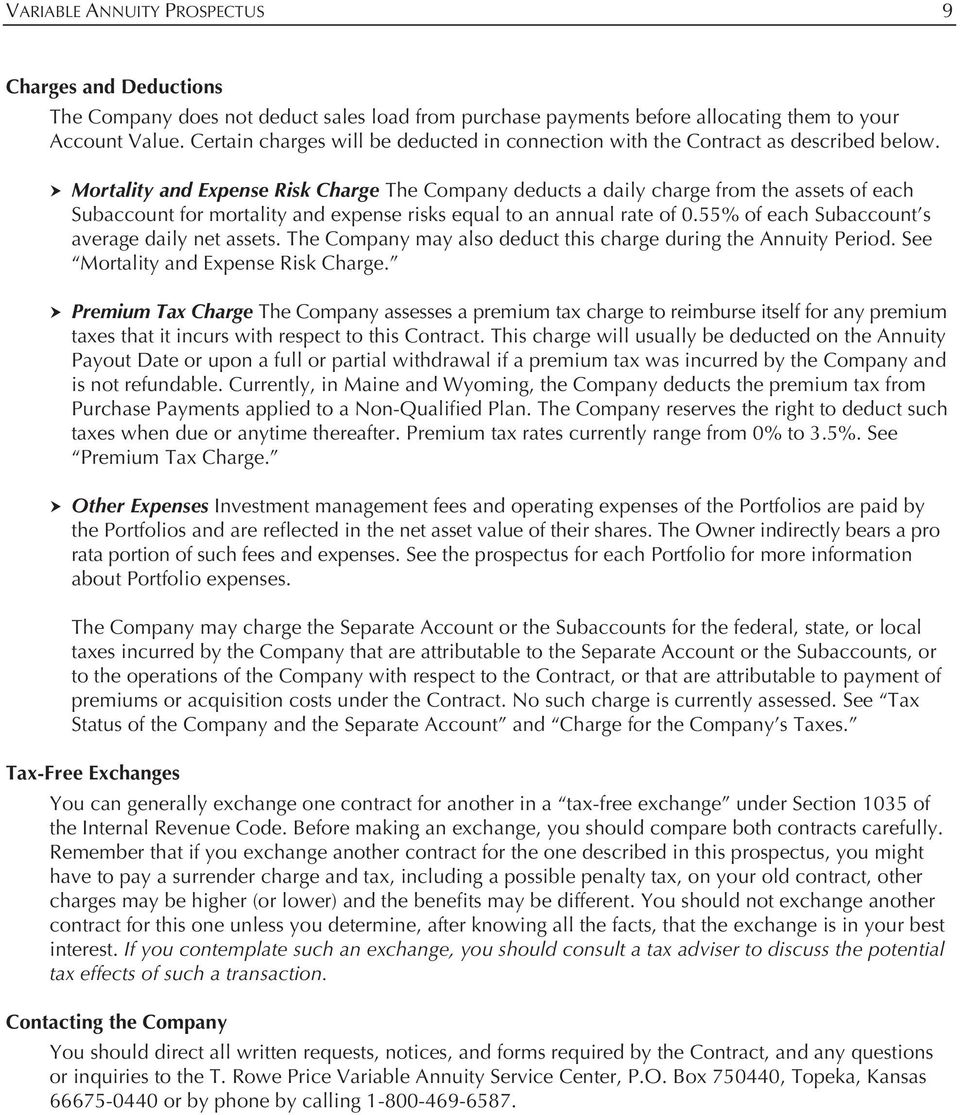
12 VARIABLE ANNUITY PROSPECTUS 10 EXPENSE TABLE The following tables describe the fees and expenses that you will pay when buying, owning, and surrendering the Contract. Table 1 Contract Owner Transaction Expenses are fees and expenses that you will pay when you purchase the Contract or make withdrawals from the Contract. The information below does not reflect state premium taxes, which may be applicable to your Contract. During the Annuity Period, the Company may impose different fees and expenses not reflected in the following tables or Example. See Mortality and Expense Risk Charge. Sales Load on Purchase Payments Contingent Deferred Sales Load None None Periodic Expenses are fees and expenses that you will pay periodically during the time that you own the Contract, not including fees and expenses of the Portfolios Annual Maintenance Fee None Separate Account Annual Expenses (as a percentage of average Subaccount daily net assets) Annual Mortality and Expense Risk Charge 0.55% Total Separate Account Annual Expenses 0.55% The table below shows the minimum and maximum total operating expenses charged by the Portfolios. You will pay the expenses of the Portfolios corresponding to the Subaccounts in which you invest during the time that you own the Contract. More details concerning each Portfolio s fees and expenses are contained in its prospectus. Table 2 Minimum Maximum Total Annual Portfolio Operating Expenses % 1.05% 1 Expenses deducted from Portfolio assets include management fees, distribution fees, (12b-1) and other expenses. The maximum expenses above represent the total annual operating expenses of that Portfolio with the highest total operating expenses for the period ended December 31, 2007, and the minimum expenses represent the total annual operating expenses of that Portfolio with the lowest total operating expenses for the period ended December 31, Example This Example is intended to help you compare the cost of investing in the Contract with the cost of investing in other variable annuity contracts. These costs include Contractowner transaction expenses, separate account annual expenses and Portfolio fees and expenses but do not include state premium taxes, which may be applicable to your Contract. The Example assumes that you invest $10,000 in the Contract for the time periods indicated. The Example also assumes that your investment has a 5% return each year and assumes the maximum fees and expenses of the Contract and any of the Portfolios. Although your actual costs may be higher or lower, based on these assumptions, your costs would be: Table 3 1 Year 3 Years 5 Years 10 Years If you surrender your Contract at the end of the applicable time period $163 $505 $871 $1,900 If you do not surrender or you annuitize your Contract $163 $505 $871 $1,900
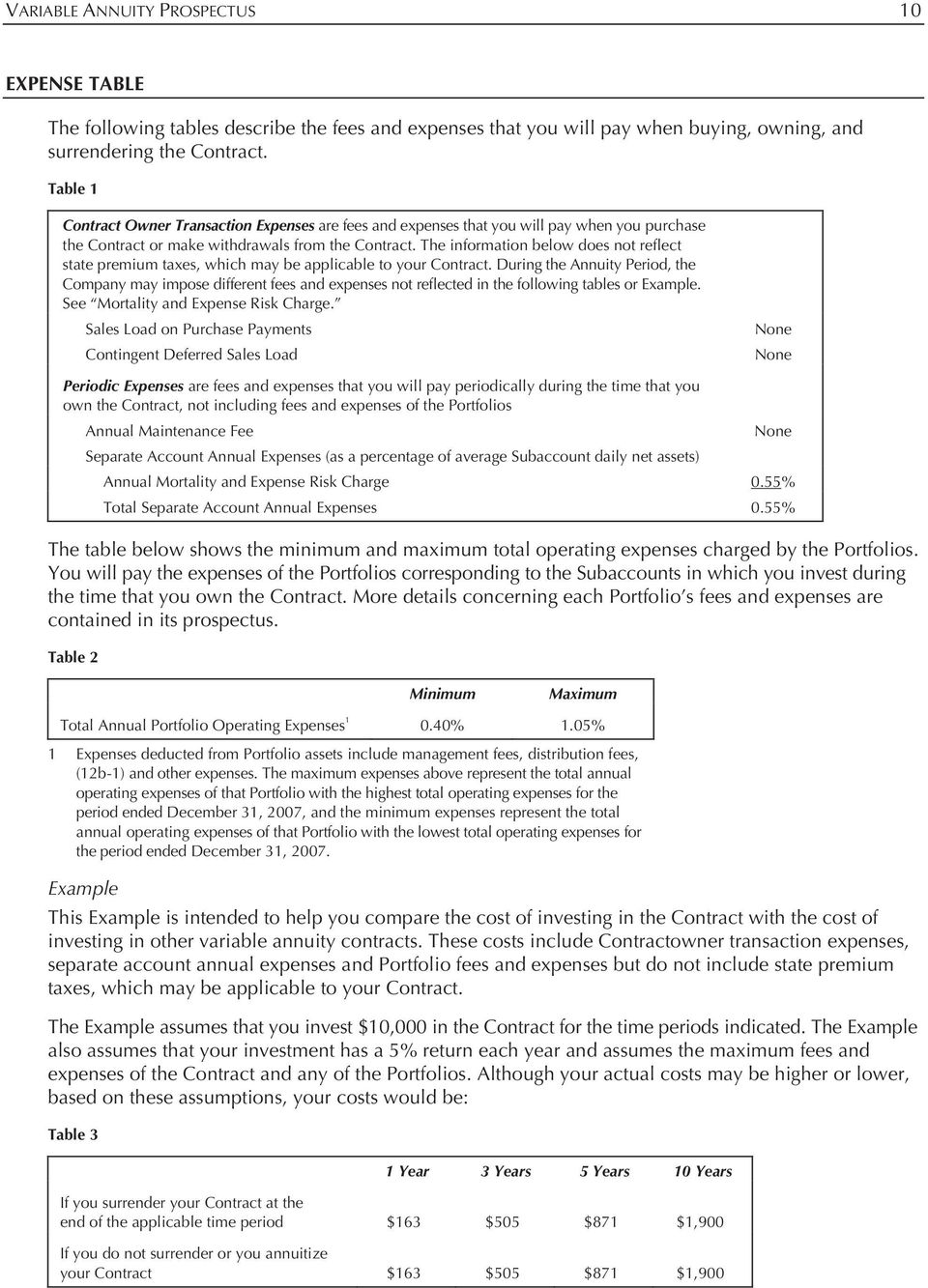
13 VARIABLE ANNUITY PROSPECTUS 11 CONDENSED FINANCIAL INFORMATION The following condensed financial information presents accumulation unit values and ending accumulation units outstanding for each Subaccount for each of the following periods ending December 31. Table 4 Accumulation Unit Value Subaccount Year Beginning of Period End of Period Accumulation Units Outstanding at End of Period New America Growth 2007 $23.26 $ ,026, ,130, ,301, ,391, ,464, ,546, ,713, ,894, ,058, ,268,306 Mid-Cap Growth ,573, ,719, ,900, ,951, ,025, ,000, ,063, ,187, ,723, ,508,339 Equity Income ,319, ,393, ,526, ,526, ,511, ,545, ,484, ,439, ,146, ,424,106 Personal Strategy Balanced ,310, ,206, ,143, ,054, , , ,101, ,168, ,204, ,256,347 Blue Chip Growth , , , , , , ,300

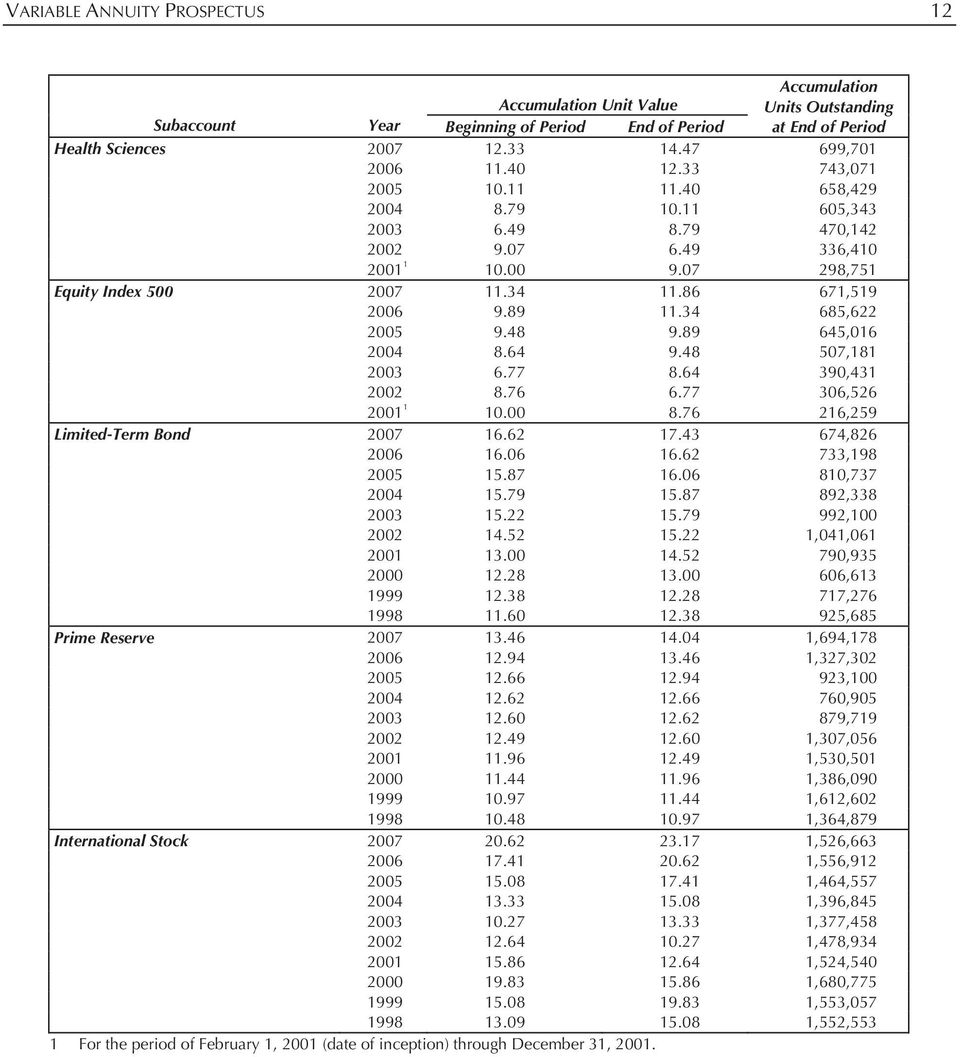
14 VARIABLE ANNUITY PROSPECTUS 12 Accumulation Unit Value Subaccount Year Beginning of Period End of Period Accumulation Units Outstanding at End of Period Health Sciences , , , , , , ,751 Equity Index , , , , , , ,259 Limited-Term Bond , , , , , ,041, , , , ,685 Prime Reserve ,694, ,327, , , , ,307, ,530, ,386, ,612, ,364,879 International Stock ,526, ,556, ,464, ,396, ,377, ,478, ,524, ,680, ,553, ,552,553 1 For the period of February 1, 2001 (date of inception) through December 31, 2001.
15 VARIABLE ANNUITY PROSPECTUS 13 INFORMATION ABOUT THE COMPANY, THE SEPARATE ACCOUNT, AND THE FUNDS Security Benefit Life Insurance Company The Company is a life insurance company organized under the laws of the State of Kansas. It was organized originally as a fraternal benefit society and commenced business February 22, It became a mutual life insurance company under its present name on January 2, On July 31, 1998, the Company converted from a mutual life insurance company to a stock life insurance company ultimately controlled by Security Benefit Mutual Holding Company, a Kansas mutual holding company. Membership interests of persons who were Contractowners as of July 31, 1998 became membership interests in Security Benefit Mutual Holding Company as of that date, and persons who acquire policies from the Company after that date automatically become members in the mutual holding company. The Company offers life insurance policies and annuity contracts, as well as financial and retirement services. It is admitted to do business in the District of Columbia, and in all states except New York. As of the end of 2007, the Company had total assets of approximately $12.6 billion. Together with its affiliates, the Company has total funds under management of approximately $19.3 billion. Published Ratings The Company may from time to time publish in advertisements, sales literature, and reports to Owners, the ratings and other information assigned to it by one or more independent rating organizations such as A.M. Best Company and Standard & Poor s. The purpose of the ratings is to reflect the financial strength and/or claims-paying ability of the Company and should not be considered as bearing on the investment performance of assets held in the Separate Account. Each year the A.M. Best Company reviews the financial status of thousands of insurers, culminating in the assignment of Best s Ratings. These ratings reflect their current opinion of the relative financial strength and operating performance of an insurance company in comparison to the norms of the life/health insurance industry. In addition, the claims-paying ability of the Company as measured by Standard & Poor s Insurance Ratings Services may be referred to in advertisements or sales literature or in reports to Owners. These ratings are opinions of an operating insurance company s financial capacity to meet the obligations of its insurance and annuity policies in accordance with their terms. Such ratings do not reflect the investment performance of the Separate Account or the degree of risk associated with an investment in the Separate Account. Separate Account T. Rowe Price Variable Annuity Account The Company established the T. Rowe Price Variable Annuity Account as a separate account under Kansas law on March 28, The Contract provides that the income, gains, or losses of the Separate Account, whether or not realized, are credited to or charged against the assets of the Separate Account without regard to other income, gains, or losses of the Company. Kansas law provides that assets in a separate account attributable to the reserves and other liabilities under a contract may not be charged with liabilities arising from any other business that the insurance company conducts if, and to the extent the contract so provides. The Contract contains a provision stating that assets held in the Separate Account may not be charged with liabilities arising from other business that the Company conducts. The Company owns the assets in the Separate Account and is required to maintain sufficient assets in the Separate Account to meet all Separate Account obligations under the Contract. Such Separate Account assets are not subject to claims of the Company s creditors. The Company may transfer to its General Account assets that exceed anticipated obligations of the Separate Account. All obligations arising under the Contract are general corporate obligations of the Company. The Company may invest its own assets in the Separate Account for other purposes, but not to support contracts other than variable annuity contracts, and may

16 VARIABLE ANNUITY PROSPECTUS 14 accumulate in the Separate Account proceeds from Contract charges and investment results applicable to those assets. The Contract provides that income, gains and losses, whether or not realized, are credited to, or charged against, the assets of each Subaccount without regard to the income, gains, or losses in the other Subaccounts. Each Subaccount invests exclusively in shares of a corresponding Portfolio. The Company may in the future establish additional Subaccounts of the Separate Account, which may invest in other Portfolios or other securities, mutual funds, or investment vehicles. Under its contract with the underwriter, T. Rowe Price Investment Services, Inc. ( Investment Services ), the Company cannot add new Subaccounts, or substitute shares of another portfolio, without the consent of Investment Services, unless (1) such change is necessary to comply with applicable laws, (2) shares of any or all of the Portfolios should no longer be available for investment, or (3) the Company receives an opinion from counsel acceptable to Investment Services that substitution is in the best interest of Contractowners and that further investment in shares of the Portfolio(s) would cause undue risk to the Company. See Substitution of Investments. For more information about the underwriter, see Distribution of the Contract. The Separate Account is registered with the SEC as a unit investment trust under the Investment Company Act of 1940 (the 1940 Act ). Registration with the SEC does not involve supervision by the SEC of the administration or investment practices of the Separate Account or the Company. The Funds Each Fund is a diversified, open-end management investment company of the series type and is registered with the SEC under the 1940 Act. Such registration does not involve supervision by the SEC of the investments or investment policy of the Portfolios. Each Portfolio pursues different investment objectives and policies. Shares of the Portfolios currently are not publicly traded mutual funds. They are available only as investment options in variable annuity or variable life insurance policies issued by life insurance companies or in some cases, through participation in certain qualified pension or retirement plans. Certain Portfolios have similar investment objectives and policies to other mutual funds managed by the same adviser. The investment results of the Portfolios, however, may be higher or lower than the results of such other funds. There can be no assurance, and no representation is made, that the investment results of any of the Portfolios will be comparable to the investment results of any other fund, even if both the Portfolio and the other fund are managed by the same adviser. Because the Portfolios may serve as investment vehicles for both variable life insurance policies and variable annuity contracts ( mixed funding ) and shares of the Portfolios also may be sold to separate accounts of other insurance companies ( shared funding ), material conflicts could occur. The Company currently does not foresee any disadvantages to Owners arising from either mixed or shared funding; however, due to differences in tax treatment or other considerations, it is possible that the interests of owners of various contracts for which the Portfolios serve as investment vehicles might at some time be in conflict. However, the Company and each Portfolio s Board of Directors are required to monitor events in order to identify any material conflicts that arise from the use of the Portfolios for mixed and/or shared funding. If such a conflict were to occur, the Company would take steps necessary to protect Owners including withdrawal of the Separate Account from participation in the Portfolio(s) involved in the conflict. This might force a Portfolio to sell securities at disadvantageous prices. A summary of the investment objective of each Portfolio is set forth below. We cannot assure that any Portfolio will achieve its objective. More detailed information is contained in the accompanying

17 VARIABLE ANNUITY PROSPECTUS 15 Portfolio prospectuses, including information on the risks associated with the investments and investment techniques of each Portfolio. The Portfolio prospectuses accompany this Prospectus and should be carefully read in conjunction with this Prospectus before investing. T. Rowe Price New America Growth Portfolio The investment objective of the New America Growth Portfolio is to seek to provide long-term growth of capital through investments primarily in the common stocks of growth companies. T. Rowe Price Mid-Cap Growth Portfolio* The investment objective of the Mid-Cap Growth Portfolio is to seek to provide long-term capital appreciation by investing primarily in mid-cap stocks with potential for above average earnings growth. T. Rowe Price Equity Income Portfolio The investment objective of the Equity Income Portfolio is to seek to provide substantial dividend income as well as capital appreciation by investing primarily in common stocks of established companies. T. Rowe Price Personal Strategy Balanced Portfolio The investment objective of the Personal Strategy Balanced Portfolio is to seek the highest total return over time consistent with an emphasis on both capital appreciation and income. T. Rowe Price Blue Chip Growth Portfolio The investment objective of the Blue Chip Growth Portfolio is to seek long-term capital growth by investing primarily in common stocks of large and medium-sized blue chip growth companies. Income is a secondary objective. T. Rowe Price Health Sciences Portfolio The investment objective of the Health Sciences Portfolio is to seek long-term capital appreciation by investing primarily in the common stocks of companies engaged in the research, development, production or distribution of products or services related to health care, medicine, or the life sciences. T. Rowe Price Equity Index 500 Portfolio** The investment objective of the Equity Index 500 Portfolio is to seek to match the performance of the Standard & Poor s 500 Stock Index. The S&P 500 is made up of primarily large capitalization companies that represent a broad spectrum of the U.S. economy and a substantial part of the U.S. stock market s total capitalization. T. Rowe Price Limited-Term Bond Portfolio The investment objective of the Limited-Term Bond Portfolio is to seek a high level of income consistent with moderate price fluctuations in principal value by investing primarily in short- and intermediate-term investment grade debt securities. T. Rowe Price Prime Reserve Portfolio The investment objectives of the Prime Reserve Portfolio are preservation of capital, liquidity, and, consistent with these, the highest possible current income, by investing primarily in high-quality money market securities.

18 VARIABLE ANNUITY PROSPECTUS 16 T. Rowe Price International Stock Portfolio The investment objective of the International Stock Portfolio is to seek long-term growth of capital through investments primarily in common stocks of established, non-u.s. companies. *The Mid-Cap Growth Subaccount, which invests in the Mid-Cap Growth Portfolio, is available only if you purchased your Contract prior to May 1, Contractowners who purchased prior to that date may continue to allocate purchase payments and exchange Account Value to the Mid-Cap Growth Subaccount. If you purchased your Contract on or after that date, you may not allocate purchase payments or exchange your Account Value to the Mid-Cap Growth Subaccount. ** Standard & Poor s, S&P, S&P 500, Standard & Poor s 500 and 500 are trademarks of the McGraw-Hill Companies, Inc. and have been licensed for use by T. Rowe Price. The Portfolio is not sponsored, endorsed, sold or promoted by Standard & Poor s, and Standard & Poor s makes no representation regarding the advisability of investing in the Portfolio. The Investment Advisers T. Rowe Price Associates, Inc. ( T. Rowe Price ), located at 100 East Pratt Street, Baltimore, Maryland 21202, serves as Investment Adviser to each Portfolio, except the T. Rowe Price International Stock Portfolio. T. Rowe Price International, Inc. ( TRP International ), an affiliate of T. Rowe Price, serves as Investment Adviser to the T. Rowe Price International Stock Portfolio. TRP International s U.S. office is located at 100 East Pratt Street, Baltimore, Maryland T. Rowe Price is responsible for selection and management of portfolio investments for each Portfolio except the T. Rowe Price International Stock Portfolio, and TRP International is responsible for selection and management of portfolio investments for that Portfolio. T. Rowe Price and TRP International are registered with the SEC as investment advisers. The Company has developed the Contract in cooperation with Investment Services and has included the Portfolios eligible for use by variable insurance products in the T. Rowe Price family of funds based on recommendations made by Investment Services, whose selection criteria may differ from the Company s selection criteria. T. Rowe Price and TRP International are wholly-owned subsidiaries of T. Rowe Price Group, Inc., a publicly traded financial services holding company, and are not affiliated with the Company. Investment Services, a wholly-owned subsidiary of T. Rowe Price, also is not affiliated with the Company. The Company has no responsibility for the management or operations of the Portfolios. THE CONTRACT General The Company issues the Contract offered by this Prospectus. It is a flexible premium deferred variable annuity. To the extent that you allocate all or a portion of your purchase payments to the Subaccounts, the Contract is significantly different from a fixed annuity contract in that it is the Owner under a Contract who assumes the risk of investment gain or loss rather than the Company. When you are ready to begin receiving Annuity Payments, the Contract provides several Annuity Options under which the Company will pay periodic Annuity Payments on a variable basis, a fixed basis, or both, beginning on the Annuity Payout Date. The amount that will be available for Annuity Payments will depend on the investment performance of the Subaccounts to which you have allocated Account Value and the amount of interest credited on Account Value that you have allocated to the Fixed Interest Account. The Contract is available for purchase by an individual as a non-tax qualified retirement plan ( Non-Qualified Plan ). The Contract is also eligible for purchase as an individual retirement annuity ( IRA ) qualified under Section 408 or a Roth IRA under Section 408A, of the Internal Revenue Code ( Qualified Plan ). You may name Joint Owners only on a Contract issued pursuant to a Non-Qualified Plan.

19 VARIABLE ANNUITY PROSPECTUS 17 If you are purchasing the Contract as an investment vehicle for an IRA or Roth IRA, you should consider that the Contract does not provide any additional tax advantages beyond those already available through the IRA or Roth IRA itself. However, the Contract does offer features and benefits in addition to providing tax deferral that other investments may not offer, including death benefit protection for your beneficiaries and annuity options that guarantee income for life. You should consult with your financial professional as to whether the overall benefits and costs of the Contract are appropriate considering your circumstances. Application for a Contract If you wish to purchase a Contract, you may submit an application and an initial purchase payment to the Company, as well as any other form or information that the Company may require. The initial purchase payment may be made by check or, if you own shares of one or more mutual funds distributed by Investment Services ( T. Rowe Price Funds ), you may elect on the application to redeem shares of that fund(s) and forward the redemption proceeds to the Company. Any such transaction shall be effected by Investment Services, the distributor of the T. Rowe Price Funds and the Contract. If you redeem fund shares, it is a sale of shares for tax purposes, which may result in a taxable gain or loss. You may obtain an application by contacting the T. Rowe Price Variable Annuity Service Center. The Company reserves the right to reject an application or purchase payment for any reason, subject to the Company s underwriting standards and guidelines and any applicable state or federal law relating to nondiscrimination. The maximum age of an Owner or Annuitant for which a Contract will be issued is 85. If there are Joint Owners or Annuitants, the maximum issue age will be determined by reference to the older Owner or Annuitant. Purchase Payments If you are purchasing a Contract as a Non-Qualified Plan, the minimum initial purchase payment is $10,000 ($5,000 under an Automatic Investment Program). If you are purchasing a Contract as a Qualified Plan, the minimum initial purchase payment is $2,000 ($25 under an Automatic Investment Program). Thereafter, you may choose the amount and frequency of purchase payments, except that the minimum subsequent purchase payment is $1,000 ($200 under an Automatic Investment Program) for Non-Qualified Plans and $500 ($25 under an Automatic Investment Program) for Qualified Plans. The Company may reduce the minimum purchase payment requirements under certain circumstances, such as for group or sponsored arrangements. The Company will not accept without prior Company approval aggregate purchase payments in an amount that exceeds $1,000,000 under any variable annuity contract(s) issued by the Company for which you are an Owner and/or Joint Owner. The Company will apply the initial purchase payment not later than the end of the second Valuation Date after the Valuation Date it is received by the Company at its T. Rowe Price Variable Annuity Service Center; provided that the purchase payment is preceded or accompanied by an application that contains sufficient information to establish an account and properly credit such purchase payment. If the Company does not receive a complete application, the Company will hold your purchase payment in its General Account and will notify you that it does not have the necessary information to issue a Contract and/or apply the purchase payment to your Contract. If you do not provide the necessary information to the Company within five Valuation Dates after the Valuation Date on which the Company first receives the initial purchase payment or if the Company determines it cannot otherwise issue the Contract and/or apply the purchase payment to your Contract, the Company will return the initial purchase payment to you unless you consent to the Company retaining the purchase payment until the application is made complete. The Company will credit subsequent purchase payments as of the end of the Valuation Period in which they are received by the Company at the T. Rowe Price Variable Annuity Service Center; however,

20 VARIABLE ANNUITY PROSPECTUS 18 subsequent purchase payments received at or after the cut-off time of 3:00 p.m. Central time will be effected at the Accumulation Unit value determined on the following Valuation Date. See Cut-Off Times. You may make purchase payments after the initial purchase payment at any time prior to the Annuity Payout Date, so long as the Owner is living. Subsequent purchase payments under a Qualified Plan may be limited by the terms of the plan and provisions of the Internal Revenue Code. Subsequent purchase payments may be paid under an Automatic Investment Program or, if you own shares of one or more T. Rowe Price Funds, you may direct Investment Services to redeem shares of that fund(s) and forward the redemption proceeds to the Company as a subsequent purchase payment. The initial purchase payment must be paid before the Company will accept an Automatic Investment Program. If you redeem fund shares, it is a sale of shares for tax purposes, which may result in a taxable gain or loss. If mandated under applicable law, the Company may be required to reject a purchase payment. The Company also may be required to provide additional information about an Owner s account to government regulators. In addition, the Company may be required to block an Owner s account and thereby refuse to pay any request for exchanges, full or partial withdrawals, or death benefits until instructions are received from the appropriate regulator. Allocation of Purchase Payments In an application for a Contract, you select the Subaccounts or the Fixed Interest Account to which purchase payments will be allocated. Purchase payments will be allocated according to your instructions contained in the application or more recent instructions received, if any, except that no purchase payment allocation is permitted that would result in less than 5% of any payment being allocated to any one Subaccount or the Fixed Interest Account. The allocations may be a whole dollar amount or a whole percentage. Available allocation alternatives include the Subaccounts and the Fixed Interest Account. You may change the purchase payment allocation instructions by submitting a proper written request to the Company s T. Rowe Price Variable Annuity Service Center. A proper change in allocation instructions will be effective upon receipt by the Company at the T. Rowe Price Variable Annuity Service Center and will continue in effect until you submit a change in instructions to the Company. You may make changes in your purchase payment allocation by telephone provided the proper form is properly completed, signed, and filed at the T. Rowe Price Variable Annuity Service Center. Changes in the allocation of future purchase payments have no effect on existing Account Value. You may, however, exchange Account Value among the Subaccounts and the Fixed Interest Account in the manner described in Exchanges of Account Value. Dollar Cost Averaging Option Prior to the Annuity Payout Date, you may dollar cost average your Account Value by authorizing the Company to make periodic exchanges of Account Value from any one Subaccount to one or more of the other Subaccounts. Dollar cost averaging is a systematic method of investing in which securities are purchased at regular intervals in fixed dollar amounts so that the cost of the securities gets averaged over time and possibly over various market cycles. The option will result in the exchange of Account Value from one Subaccount to one or more of the other Subaccounts. Amounts exchanged under this option will be credited at the price of the Subaccount as of the end of the Valuation Dates on which the exchanges are effected. Since the price of a Subaccount s Accumulation Units will vary, the amounts allocated to a Subaccount will result in the crediting of a greater number of units when the price is low and a lesser number of units when the price is high. Similarly, the amounts exchanged from a Subaccount will result in a debiting of a greater number of units when the price is low and a lesser number of units when the price is high. Dollar cost averaging does not guarantee profits, nor does it assure that you will not have losses.
21 VARIABLE ANNUITY PROSPECTUS 19 You may request a Dollar Cost Averaging Request form from the T. Rowe Price Variable Annuity Service Center. On the form, you must designate whether Account Value is to be exchanged on the basis of a specific dollar amount, a fixed period or earnings only, the Subaccount or Subaccounts to and from which the exchanges will be made, the desired frequency of the exchanges, which may be on a monthly, quarterly, semiannual, or annual basis, and the length of time during which the exchanges shall continue or the total amount to be exchanged over time. The minimum amount that may be exchanged is $200 and the minimum amount that may be allocated to any one Subaccount is $25. The Company does not require that exchanges be continued over any minimum period of time, although typically dollar cost averaging would extend over a period of at least one year. To elect the Dollar Cost Averaging Option, your Account Value must be at least $5,000, ($2,000 for a Contract funding a Qualified Plan), and a Dollar Cost Averaging Request in proper form must be received by the Company at the T. Rowe Price Variable Annuity Service Center. The Company will not consider the Dollar Cost Averaging Request form to be complete until your Account Value is at least the required amount. You may not have in effect at the same time Dollar Cost Averaging and Asset Rebalancing Options. After the Company has received a Dollar Cost Averaging Request in proper form at the T. Rowe Price Variable Annuity Service Center, the Company will exchange Account Value in the amounts you designate from the Subaccount from which exchanges are to be made to the Subaccount or Subaccounts you have chosen. The Company will effect each exchange on the date you specify or if no date is specified, on the monthly, quarterly, semiannual, or annual anniversary, whichever corresponds to the period selected, of the date of receipt at the T. Rowe Price Variable Annuity Service Center of a Dollar Cost Averaging Request in proper form. Exchanges will be made until the total amount elected has been exchanged, or until Account Value in the Subaccount from which exchanges are made has been depleted. Amounts periodically exchanged under this option are not included in the six exchanges per Contract Year that generally are allowed as discussed under Exchanges of Account Value. You may make changes to the option by writing to the T. Rowe Price Variable Annuity Service Center or by telephone provided the proper form has been completed, signed, and filed at the T. Rowe Price Variable Annuity Service Center. You may instruct the Company at any time to terminate the option by written request to the T. Rowe Price Variable Annuity Service Center. In that event, the Account Value in the Subaccount from which exchanges were being made that has not been exchanged will remain in that Subaccount unless you instruct us otherwise. If you wish to continue exchanging on a dollar cost averaging basis after the expiration of the applicable period, the total amount elected has been exchanged, or the Subaccount has been depleted, or after the Dollar Cost Averaging Option has been canceled, you must complete a new Dollar Cost Averaging Request and send it to the T. Rowe Price Variable Annuity Service Center. The Contract must meet the $5,000 ($2,000 for a Contract funding a Qualified Plan) minimum required amount of Account Value at that time. The Company requires that you wait at least one month if exchanges were made on a monthly basis, or one quarter if exchanges were made on a quarterly, semiannual or annual basis, before reinstating Dollar Cost Averaging after it has been terminated for any reason. The Company may discontinue, modify, or suspend the Dollar Cost Averaging Option at any time provided that, as required by its contract with Investment Services, the Company first obtains the consent of Investment Services. The Company does not currently charge a fee for this option. You may also dollar cost average Account Value to or from the Fixed Interest Account, subject to certain restrictions described under The Fixed Interest Account.
22 VARIABLE ANNUITY PROSPECTUS 20 Asset Rebalancing Option Prior to the Annuity Payout Date, you may authorize the Company to automatically exchange Account Value each quarter to maintain a particular percentage allocation among the Subaccounts. The Account Value allocated to each Subaccount will grow or decline in value at different rates during the quarter, and Asset Rebalancing automatically reallocates the Account Value in the Subaccounts each quarter to the allocation you select. Asset Rebalancing is intended to exchange Account Value from those Subaccounts that have increased in value to those Subaccounts that have declined in value. Over time, this method of investing may help you to buy low and sell high, although there can be no assurance of this. This investment method does not guarantee profits, nor does it assure that you will not have losses. To elect this option, the Account Value must be at least $10,000 ($2,000 for a Contract funding a Qualified Plan) and an Asset Rebalancing Request in proper form must be received by the Company at the T. Rowe Price Variable Annuity Service Center. You may not have in effect at the same time Dollar Cost Averaging and Asset Rebalancing Options. An Asset Rebalancing Request form is available upon request. On the form, you must indicate the applicable Subaccounts, the applicable time period and the percentage of Account Value to be allocated to each Subaccount. If the Asset Rebalancing Option is elected, all Account Value allocated to the Subaccounts must be included in the Asset Rebalancing Option. Upon receipt of the Asset Rebalancing Request form, the Company will effect an exchange among the Subaccounts based upon the percentages that you selected. Thereafter, the Company will exchange Account Value to maintain that allocation on each quarterly, semiannual or annual anniversary, as applicable, of the date of the Company s receipt of the Asset Rebalancing Request in proper form. The amounts exchanged will be credited at the price of the Subaccount as of the end of the Valuation Date on which the exchange is effected. Amounts periodically exchanged under this option are not included in the six exchanges per Contract Year that generally are allowed as discussed under Exchanges of Account Value. You may make changes to the option by writing to the Company s T. Rowe Price Variable Annuity Service Center or by telephone provided the proper form has been completed, signed, and filed at the Company s T. Rowe Price Variable Annuity Service Center. You may instruct the Company at any time to terminate this option by written request to the T. Rowe Price Variable Annuity Service Center. This option will terminate automatically in the event that you exchange Account Value outside the Asset Rebalancing Option by written request or telephone instructions. In either event, the Account Value in the Subaccounts that has not been exchanged will remain in those Subaccounts regardless of the percentage allocation unless you instruct us otherwise. If you wish to continue Asset Rebalancing after it has been canceled, you must complete a new Asset Rebalancing Request form and send it to the T. Rowe Price Variable Annuity Service Center. The Account Value at the time the request is made must be at least $10,000 ($2,000 for a Contract funding a Qualified Plan). The Company may discontinue, modify, or suspend the Asset Rebalancing Option at any time provided that, as required by its contract with Investment Services, the Company first obtains the consent of Investment Services. The Company does not currently charge a fee for this option. Account Value allocated to the Fixed Interest Account may be included in Asset Rebalancing option, subject to certain restrictions described under The Fixed Interest Account. Exchanges of Account Value You may exchange Account Value among the Subaccounts upon proper written request to the T. Rowe Price Variable Annuity Service Center both before and after the Annuity Payout Date. You may exchange Account Value (other than exchanges in connection with the Dollar Cost Averaging or Asset Rebalancing Options) by telephone if the proper form has been completed, signed, and filed at the T. Rowe Price
23 VARIABLE ANNUITY PROSPECTUS 21 Variable Annuity Service Center. Up to six exchanges are allowed in any Contract Year. The minimum exchange amount is $500 ($200 under the Dollar Cost Averaging Option), or the amount remaining in a given Subaccount. The minimum exchange amount does not apply to exchanges under the Dollar Cost Averaging or Asset Rebalancing Options. The Company generally effects exchanges between Subaccounts at their respective Accumulation Unit values as of the close of the Valuation Period during which the exchange request is received; however, exchange requests received at or after the cut-off time of 3:00 p.m. Central time on any Valuation Date will be effected at the Accumulation Unit value determined on the following Valuation Date. See Cut- Off Times. You may also exchange Account Value to the Fixed Interest Account; however, exchanges from the Fixed Interest Account to the Subaccounts are restricted as described under The Fixed Interest Account. The Company does not assess an exchange fee on exchanges. For a discussion of exchanges after the Annuity Payout Date, see Annuity Payments. Frequent Exchange Restrictions The Contract is not designed for organizations or individuals engaging in a market timing strategy, or making programmed exchanges, frequent exchanges or exchanges that are large in relation to the total assets of the Portfolios. These kinds of strategies and exchange activities may disrupt portfolio management of the Portfolios in which the Subaccounts invest (such as requiring the Portfolios to maintain a high level of cash or causing the Portfolios to liquidate investments prematurely to pay withdrawals), hurt Portfolio performance, and drive Portfolio expenses (such as brokerage and administrative expenses) higher. In addition, because other insurance companies and/or retirement plans may invest in the Portfolios, the risk exists that the Portfolios may suffer harm from programmed, frequent, or large exchanges among subaccounts of variable contracts issued by other insurance companies or among investment options available to retirement plan participants. These risks and costs are borne by all shareholders of the affected Portfolios, Owners with Account Value allocated to the corresponding Subaccount (as well as their Designated Beneficiaries and Annuitants) and long-term investors who do not generate these costs. The Company has in place policies and procedures designed to restrict exchanges if we determine that you are engaging in a pattern of exchanges that is disruptive to the Portfolios or potentially disadvantageous to other Owners with Account Value allocated to the applicable Subaccount (regardless of the number of previous exchanges the Owner has made during the Contract Year). In making this determination, we monitor exchanges among the Subaccounts and consider among other things, the following factors: The total dollar amount being exchanged; The number of exchanges you made within the previous three months; Exchanges to and from (or from and to) the same Subaccount; Whether your exchanges appear to follow a pattern designed to take advantage of short-term market fluctuations; and Whether your exchanges appear to be part of a group of exchanges made by a third party on behalf of the individual Owners in the group.
24 VARIABLE ANNUITY PROSPECTUS 22 If the Company determines that your exchange patterns among the Subaccounts are disruptive to the Portfolios or potentially disadvantageous to Owners, the Company may send you a letter notifying you that it is prohibiting you from making telephone exchanges or other electronic exchanges and instead requiring that you submit exchange requests in writing via regular U.S. mail for a disclosed period that begins on the date of the letter. In addition, if you make a certain number of exchanges from a Subaccount followed by an exchange to that Subaccount (or to a Subaccount followed by an exchange from that Subaccount) ( round trip exchanges ) during the prior three-month period or such shorter period as specified in the chart below), the Company will prohibit further exchanges to that Subaccount until such exchanges may be made without violating the number of round trip exchanges permitted (please see the chart below). Table 5 Subaccount Number of Round Trip Exchanges* T. Rowe Price Prime Reserve Unlimited T. Rowe Price New America Growth, T. Rowe Price Equity Income, T. Rowe Price 1 Personal Strategy Balanced, T. Rowe Price Blue Chip Growth, T. Rowe Price Health Sciences, T. Rowe Price Equity Index 500, T. Rowe Price Limited-Term Bond, T. Rowe Price Mid-Cap Growth, T. Rowe Price International Stock *Number of round trip exchanges that can be made in any three-month period before the Company will prohibit further exchanges to that Subaccount. Exchanges to the Subaccount will be prohibited until such exchange may be made without violating the number of round trip exchanges set forth above. In addition to the Company s own frequent exchange procedures, the Portfolios may have adopted their own policies and procedures with respect to frequent exchanges of their respective shares, and the Company reserves the right to enforce these policies and procedures. The prospectuses for the Portfolios describe any such policies and procedures, which may be more or less restrictive than the policies and procedures the Company has adopted. In particular, some of the Portfolios have reserved the right to temporarily or permanently refuse payments or exchange requests from the Company if, in the judgment of the Portfolio s manager, the Portfolio would be unable to invest effectively in accordance with its investment objective or policies, or would otherwise potentially be adversely affected. You should be aware that the Company currently may not have the contractual obligation or the operational capacity to apply the Portfolios frequent exchange policies and procedures. However, under SEC rules, the Company is required to: (1) enter into a written agreement with each Portfolio or its principal underwriter that obligates the Company to provide to the Portfolio promptly upon request certain information about the trading activity of individual Owners, and (2) execute instructions from the Portfolio to restrict or prohibit further purchases or exchanges by specific Owners who violate the frequent exchange policies established by the Portfolio. Managers of the Portfolios may contact the Company if they believe or suspect that there is market timing or other potentially harmful trading, and, if so, the Company will take appropriate action to protect others. In particular, the Company may, and the Company reserves the right to, reverse a potentially harmful exchange. If the Company reverses a potentially harmful exchange, it will effect such reversal not later than the close of business on the second Valuation Date following the Valuation Date in which the original exchange was effected, and the Company will inform the Owner in writing at his or her address of record. To the extent permitted by applicable law, the Company also reserves the right to reject an exchange request at any time that the Company is unable to purchase or redeem shares of any of the Portfolios because of any refusal or restriction on purchases or redemptions of their shares as a result of the Portfolio s policies and procedures on market timing activities or other potentially abusive exchanges.
25 VARIABLE ANNUITY PROSPECTUS 23 The Company also reserves the right to implement, administer, and collect redemption fees imposed by one or more of the Portfolios in the future. You should read the prospectuses of the Portfolios for more details on their ability to refuse or restrict purchases or redemptions of their shares. In its sole discretion, the Company may revise its market timing procedures at any time without prior notice as the Company deems necessary or appropriate to better detect and deter programmed, frequent, or large exchanges that may adversely affect other Owners or Portfolio shareholders, to comply with state or federal regulatory requirements, or to impose additional or alternate restrictions on market timers (such as dollar or percentage limits on exchanges). The Company may change its parameters to monitor for factors other than the number of round trip exchanges into and out of particular Subaccounts. For purposes of applying the parameters used to detect potential market timing and other potentially harmful activity, the Company may aggregate exchanges made in two or more Contracts that it believes are connected (for example, two Contracts with the same Owner, or owned by spouses, or owned by different partnerships or corporations that are under common control, etc.). The Company does not include exchanges made pursuant to Dollar Cost Averaging and Asset Rebalancing Options in these limitations. The Company may vary its market timing procedures from Subaccount to Subaccount, and may be more restrictive with regard to certain Subaccounts than others. The Company may not always apply these detection methods to Subaccounts investing in Portfolios that, in its judgment, would not be particularly attractive to market timers or otherwise susceptible to harm by frequent exchanges. Contractowners seeking to engage in programmed, frequent, or large exchange activity may deploy a variety of strategies to avoid detection. The Company s ability to detect and deter such exchange activity is limited by operational systems and technological limitations. In addition, the terms of the Contract may also limit the Company s ability to restrict or deter harmful exchanges. Furthermore, the identification of Owners determined to be engaged in exchange activity that may adversely affect other Owners or Portfolio shareholders involves judgments that are inherently subjective. Accordingly, despite its best efforts, the Company cannot guarantee that its market timing procedures will detect every potential market timer, but the Company applies its market timing procedures consistently to all Owners without special arrangement, waiver, or exception. Because other insurance companies and/or retirement plans may invest in the Portfolios, the Company cannot guarantee that the Portfolios will not suffer harm from programmed, frequent, or large exchanges among subaccounts of variable contracts issued by other insurance companies or among investment options available to retirement plan participants. Because the Company cannot guarantee that it can restrict or deter all harmful exchange activity, Owners bear the risks associated with such activity, including potential disruption of portfolio management of the Portfolios and potentially lower Portfolio performance and higher Portfolio expenses. In addition, there is a risk that the Company will not detect harmful exchange activity on the part of some Owners and, as a result, the Company will inadvertently treat those Owners differently than Owners it does not permit to engage in harmful exchange activity. Moreover, due to the Company s operational and technological limitations, as well as possible variations in the market timing policies of other insurance companies and/or retirement plans that may also invest in the Portfolios, some Owners may be treated differently than others. Consequently, there is a risk that some Owners may be able to engage in market timing while others suffer the adverse effects of such trading activities. Account Value The Account Value is the sum of the amounts under the Contract held in each Subaccount and the Fixed Interest Account. Account Value is determined as of any Valuation Date during the Accumulation Period and during the Annuity Period under Annuity Options 5 through 7.
26 VARIABLE ANNUITY PROSPECTUS 24 On each Valuation Date, the amount of Account Value allocated to any particular Subaccount will be adjusted to reflect the investment experience of that Subaccount. See Determination of Account Value. Account Value allocated to the Subaccounts is not guaranteed by the Company. You bear the entire investment risk relating to the investment performance of Account Value allocated to the Subaccounts. Determination of Account Value Your Account Value will vary to a degree that depends upon several factors, including Investment performance of the Subaccounts to which you have allocated Account Value, Interest credited to the Fixed Interest Account, Payment of purchase payments, Full and partial withdrawals, Annuity payments under Options 5 through 7, and Charges assessed in connection with the Contract. The amounts allocated to the Subaccounts will be invested in shares of the corresponding Portfolios. The investment performance of a Subaccount will reflect increases or decreases in the net asset value per share of the corresponding Portfolio and any dividends or distributions declared by the Portfolio. Any dividends or distributions from any Portfolio will be automatically reinvested in shares of the same Portfolio, unless the Company, on behalf of the Separate Account, elects otherwise. Assets in the Subaccounts are divided into Accumulation Units, which are accounting units of measure used to calculate the value of a Contractowner s interest in a Subaccount. When you allocate purchase payments to a Subaccount, your Contract is credited with Accumulation Units. The number of Accumulation Units to be credited is determined by dividing the dollar amount allocated to the particular Subaccount by the price for the Subaccount s Accumulation Units as of the end of the Valuation Period in which the purchase payment is credited. In addition, other transactions including full or partial withdrawals, exchanges, annuity payments under Options 5 through 7 and assessment of premium taxes against the Contract affect the number of Accumulation Units credited to a Contract. The number of units credited or debited in connection with any such transaction is determined by dividing the dollar amount of such transaction by the price of the Accumulation Unit of the affected Subaccount next determined after receipt of the transaction. The price of each Subaccount is determined on each Valuation Date as of the close of the New York Stock Exchange, normally 3:00 p.m. Central time. Transactions received at or after that time on any Valuation Date will be effected at the Accumulation Unit value determined on the following Valuation Date. See Cut-Off Times. The price of each Subaccount may be determined earlier if trading on the New York Stock Exchange is restricted or as permitted by the SEC. The number of Accumulation Units credited to a Contract will not be changed by any subsequent change in the value of an Accumulation Unit, but the dollar value of an Accumulation Unit may vary from Valuation Date to Valuation Date depending upon the investment experience of the Subaccount and charges against the Subaccount. The price of each Subaccount s units initially was $10. The price of a Subaccount on any Valuation Date takes into account the following: (1) the investment performance of the Subaccount, which is
27 VARIABLE ANNUITY PROSPECTUS 25 based upon the investment performance of the corresponding Portfolio, (2) any dividends or distributions paid by the Portfolio, (3) the charges, if any, that may be assessed by the Company for taxes attributable to the operation of the Subaccount, and (4) the mortality and expense risk charge under the Contract. Cut-Off Times Any financial transactions involving your Contract, including those submitted by telephone, must be received by us before any announced closing of the New York Stock Exchange to be processed on the current Valuation Date. The New York Stock Exchange normally closes at 3:00 p.m. Central time so financial transactions must be received by that time (the cut-off time ). Financial transactions received at or after the applicable cut-off time will be processed on the following Valuation Date. Financial transactions include exchanges, full and partial withdrawals, death benefit payments, and purchase payments. Full and Partial Withdrawals An Owner may make a partial withdrawal of Account Value, or surrender the Contract for its Withdrawal Value. A full or partial withdrawal, including a systematic withdrawal, may be taken from Account Value at any time while the Owner is living, and before the Annuity Payout Date, subject to restrictions on partial withdrawals of Account Value from the Fixed Interest Account and limitations under the applicable plan for Qualified Plans and applicable law. Withdrawals after the Annuity Payout Date are permitted only under Annuity Options 5 through 8 (unless the Owner has elected fixed annuity payments under Option 8). See Annuity Payments for a discussion of withdrawals after the Annuity Payout Date. A full or partial withdrawal request will be effective as of the end of the Valuation Period that a proper written request is received by the Company at the T. Rowe Price Variable Annuity Service Center; however, if a withdrawal request is received on a Valuation Date at or after the cut-off time of 3:00 p.m. Central time, the withdrawal will be effected at the Accumulation Unit value determined on the following Valuation Date. See Cut-Off Times. A proper written request must include the written consent of any effective assignee or irrevocable beneficiary, if applicable. You may direct Investment Services to apply the proceeds of a full or partial withdrawal to the purchase of shares of one or more of the T. Rowe Price Funds by so indicating in your written withdrawal request. The proceeds received upon a full withdrawal will be the Contract s Withdrawal Value. The Withdrawal Value generally is equal to the Account Value as of the end of the Valuation Period during which a proper withdrawal request is received by the Company at the T. Rowe Price Variable Annuity Service Center, less any uncollected premium taxes to reimburse the Company for any tax on premiums on a Contract that may be imposed by various states and municipalities. See Premium Tax Charge. The Withdrawal Value during the Annuity Period under Option 8 is the present value of future annuity payments calculated using the assumed interest rate, less any uncollected premium taxes. See Annuity Payments. You may request a partial withdrawal for a specified percentage or dollar amount of Account Value. Each partial withdrawal must be at least $500 except systematic withdrawals discussed below. A request for a partial withdrawal will result in a payment by the Company of the amount specified in the partial withdrawal request provided there is sufficient Account Value to meet the request. Upon payment, your Account Value will be reduced by an amount equal to the payment and any premium tax charge. See Premium Tax Charge. If a partial withdrawal is requested that would leave the Withdrawal Value in the Contract less than $2,000, the Company reserves the right to treat the partial withdrawal as a request for a full withdrawal. The Company will deduct the amount of a partial withdrawal from the Account Value in the Subaccounts and the Fixed Interest Account, according to the Owner s instructions to the Company, subject to the restrictions on partial withdrawals from the Fixed Interest Account. See The Fixed Interest Account. If
28 VARIABLE ANNUITY PROSPECTUS 26 you do not specify the allocation, the Company will contact you for instructions, and will effect the withdrawal as of the end of the Valuation Period in which such instructions are obtained. A full or partial withdrawal, including a systematic withdrawal, may be subject to a premium tax charge to reimburse the Company for any tax on premiums on a Contract that may be imposed by various states and municipalities. See Premium Tax Charge. A full or partial withdrawal, including a systematic withdrawal, may result in receipt of taxable income to the Owner and, if made prior to the Owner attaining age 59½, may be subject to a 10% penalty tax. In the case of Contracts issued in connection with retirement plans that meet the requirements of Section 408 of the Internal Revenue Code, reference should be made to the terms of the particular Qualified Plan for any limitations or restrictions on withdrawals. For more information, see Restrictions on Withdrawals from Qualified Plans. The tax consequences of a withdrawal under the Contract should be carefully considered. See Federal Tax Matters. Systematic Withdrawals The Company currently offers a feature under which you may select systematic withdrawals. Under this feature, an Owner may elect to receive systematic withdrawals while the Owner is living and before the Annuity Payout Date by sending a properly completed Systematic Withdrawal Request form to the T. Rowe Price Variable Annuity Service Center. Systematic withdrawals are available only prior to the Annuity Payout Date. You may direct Investment Services to apply the proceeds of a systematic withdrawal to the purchase of shares of one or more of the T. Rowe Price Funds by so indicating on the Systematic Withdrawal Request form. An Owner may designate the systematic withdrawal amount as a percentage of Account Value allocated to the Subaccounts and/or Fixed Interest Account, as a specified dollar amount, as all earnings in the Contract, or based upon the life expectancy of the Owner or the Owner and a beneficiary. An Owner also may designate the desired frequency of the systematic withdrawals, which may be monthly, quarterly, semiannual, or annual. The Owner may stop or modify systematic withdrawals upon proper written request to the T. Rowe Price Variable Annuity Service Center at least 30 days in advance of the requested date of termination or modification. A proper request must include the written consent of any effective assignee or irrevocable beneficiary, if applicable. Each systematic withdrawal must be at least $100. Upon payment, your Account Value will be reduced by an amount equal to the payment proceeds plus any applicable premium tax. In no event will payment of a systematic withdrawal exceed the Withdrawal Value. The Contract will automatically terminate if a systematic withdrawal causes the Contract s Withdrawal Value to equal $0. The Company will effect each systematic withdrawal as of the end of the Valuation Period during which the withdrawal is scheduled. The deduction caused by the systematic withdrawal will be allocated to your Account Value in the Subaccounts and the Fixed Interest Account based on your instructions. The Company may, at any time, discontinue, modify, or suspend systematic withdrawals provided that, as required by its contract with Investment Services, the Company first obtains the consent of Investment Services. Systematic withdrawals from Account Value allocated to the Fixed Interest Account must provide for payments over a period of not less than 36 months as described under The Fixed Interest Account. You should consider carefully the tax consequences of a systematic withdrawal, including the 10% penalty tax which may be imposed on withdrawals made prior to the Owner attaining age 59½. See Federal Tax Matters.
29 VARIABLE ANNUITY PROSPECTUS 27 Free-Look Right You may return a Contract within the Free-Look Period, which is generally a ten-day period beginning when you receive the Contract. Purchase payments received during the Free-Look Period will be allocated according to your instructions contained in the application or more recent instructions, if any. If you return your Contract during the Free-Look Period, the Company will then deem void the returned Contract and will refund to you purchase payments allocated to the Fixed Interest Account. The Company will also refund any Account Value allocated to the Subaccounts based upon the value of Accumulation Units next determined after we receive your Contract. The Company will return purchase payments allocated to the Subaccounts rather than Account Value in those states and circumstances in which it is required to do so. Death Benefit You should consider the following provisions carefully when choosing the Designated Beneficiary, Annuitant, any Joint Annuitant, and any Joint Owner, as well as before changing any of these parties. Naming different persons as Owner(s), Annuitant(s) and Designated Beneficiary(ies) can have important impacts on whether the death benefit is paid, and on who would receive it. If the Owner dies prior to the Annuity Payout Date while this Contract is in force, the Company will calculate the death benefit proceeds payable to the Designated Beneficiary as of the Valuation Date the Company receives due proof of the Owner s death and instructions regarding payment to the Designated Beneficiary. If there are Joint Owners, the death benefit proceeds will be calculated upon receipt of due proof of death of either Owner and instructions regarding payment. If the surviving spouse of the deceased Owner is the sole Designated Beneficiary, such spouse may elect to continue the Contract in force, subject to certain limitations. See Distribution Requirements. If the Owner is not a natural person, the death benefit proceeds will be payable upon receipt of due proof of death of the Annuitant prior to the Annuity Payout Date and instructions regarding payment, and the amount of the death benefit is based on the age of the oldest Annuitant on the date the Contract was issued. If the death of the Owner occurs on or after the Annuity Payout Date, any death benefit will be determined according to the terms of the Annuity Option. See Annuity Options. The death benefit proceeds will be the death benefit reduced by any uncollected premium tax. If the age of each Owner (or Annuitant, if the Owner is not a natural person) was 75 or younger on the Contract Date and an Owner dies prior to the Annuity Payout Date while this Contract is in force, the amount of the death benefit will be the greatest of: 1. The Account Value on the Valuation Date due proof of death and instructions regarding payment are received by the Company at the T. Rowe Price Variable Annuity Service Center, 2. The sum of all purchase payments, less any reductions caused by previous withdrawals, or 3. The stepped-up death benefit. The stepped-up death benefit is: the highest death benefit on any annual Contract anniversary that is both an exact multiple of five and occurs prior to the oldest Owner attaining age 76, plus any purchase payments made since the applicable fifth annual Contract anniversary, less any withdrawals since the applicable anniversary.
30 VARIABLE ANNUITY PROSPECTUS 28 If an Owner dies prior to the Annuity Payout Date and the Contract was issued to the Owner after age 75 (or the Annuitant was older than age 75 if the Owner is not a natural person), the amount of the death benefit will be the Account Value as of the end of the Valuation Period in which due proof of death and instructions regarding payment are received by the Company at the T. Rowe Price Variable Annuity Service Center. The death benefit for Contracts issued in Florida is different than the death benefit described above. For Contracts issued in Florida, the death benefit, regardless of age at issue, is the greater of: 1. The Account Value on the Valuation Date due proof of death and instructions regarding payment are received by the Company at the T. Rowe Price Variable Annuity Service Center, or 2. The sum of all purchase payments, less any reductions caused by previous withdrawals. The Company will pay the death benefit proceeds to the Designated Beneficiary in a single sum or under one of the Annuity Options, as elected by the Designated Beneficiary. However, if the Owner has completed a restricted beneficiary designation form, the death benefit proceeds will be paid to the Designated Beneficiary in the manner specified on the form. If the Designated Beneficiary is to receive annuity payments under an Annuity Option, there may be limits under applicable law on the amount and duration of payments that the beneficiary may receive, and requirements respecting timing of payments. A tax adviser should be consulted in considering Annuity Options. See Federal Tax Matters and Distribution Requirements for a discussion of the tax consequences in the event of death. Please note that any death benefit payment we make in excess of Account Value is subject to our financial strength and claims-paying ability. Distribution Requirements For Contracts issued in connection with a Non-Qualified Plan, if the surviving spouse of the deceased Owner is the sole Designated Beneficiary, such spouse may elect to continue this Contract in force until the earlier of the spouse s death or the Annuity Payout Date or receive the death benefit proceeds. If the surviving spouse elects to continue the Contract, no death benefit will be paid and Account Value will not be adjusted to reflect the amount of any death benefit; provided, however, that the Designated Beneficiary will be entitled to receive the death benefit proceeds in accordance with the terms of the Contract upon the death of the surviving spouse. For any Designated Beneficiary other than a surviving spouse, only those options may be chosen that provide for complete distribution of such Owner s interest in the Contract within five years of the death of the Owner. If the Designated Beneficiary is a natural person, that person alternatively can elect to begin receiving annuity payments within one year of the Owner s death over a period not extending beyond his or her life or life expectancy. If the Owner of the Contract is not a natural person, these distribution rules are applicable upon the death of or a change in the primary Annuitant. For Contracts issued in connection with a Qualified Plan, the terms of the particular Qualified Plan and the Internal Revenue Code should be reviewed with respect to limitations or restrictions on distributions following the death of the Owner or Annuitant. Because the rules applicable to Qualified Plans are extremely complex, a competent tax adviser should be consulted. Death of the Annuitant If the Annuitant dies prior to the Annuity Payout Date, and the Owner is a natural person and is not the Annuitant, no death benefit proceeds will be payable under the Contract. The Owner may name a new Annuitant within 30 days of the Annuitant s death. If a new Annuitant is not named, the Company will
31 VARIABLE ANNUITY PROSPECTUS 29 designate the Owner as Annuitant. On the death of the Annuitant on or after the Annuity Payout Date, any guaranteed payments remaining unpaid will continue to be paid to the Designated Beneficiary pursuant to the Annuity Option in force at the date of death. See Annuity Options. CHARGES AND DEDUCTIONS Mortality and Expense Risk Charge The Company deducts a daily charge from the assets of each Subaccount for mortality and expense risks assumed by the Company under the Contract. The charge is equal to an annual rate of 0.55% of each Subaccount s average daily net assets. This charge is also deducted during the Annuity Period. The mortality and expense risk charge is intended to compensate the Company for certain mortality and expense risks the Company assumes in offering and administering the Contract and in operating the Subaccounts. The expense risk is the risk that the Company s actual expenses in issuing and administering the Contract and operating the Subaccounts will be more than the charges assessed for such expenses. The mortality risk borne by the Company is the risk that Annuitants, as a group, will live longer than the Company s actuarial tables predict. In this event, the Company guarantees that annuity payments will not be affected by a change in mortality experience that results in the payment of greater annuity income than assumed under the Annuity Options in the Contract. The Company also assumes a mortality risk in connection with the death benefit under the Contract. The Company may ultimately realize a profit from the mortality and expense risk charge to the extent it is not needed to cover mortality and administrative expenses, but the Company may realize a loss to the extent the charge is not sufficient. The Company may use any profit derived from this charge for any lawful purpose, including any promotional, distribution, and administrative expenses, and compensation paid by the Company to Investment Services or an affiliate thereof. Until August 2003, the Company paid Investment Services at the annual rate of 0.10% of each Subaccount s average daily net assets for administrative services. Premium Tax Charge Various states and municipalities impose a tax on premiums on annuity contracts received by insurance companies. Whether or not a premium tax is imposed will depend upon, among other things, the Owner s state of residence, the Annuitant s state of residence, and the insurance tax laws and the Company s status in a particular state. The Company assesses a premium tax charge to reimburse itself for premium taxes that it incurs in connection with a Contract. The Company deducts this charge when due, typically upon the Annuity Payout Date, upon full or partial withdrawal, or upon payment of the death benefit, if premium taxes are incurred at that time and are not refundable. Currently, in Maine and Wyoming, the Company deducts the premium tax from Purchase Payments applied to a Non-Qualified Plan. Those amounts are currently 2.00% and 1.00%, respectively. The Company reserves the right to deduct premium taxes when due or anytime thereafter. Premium tax rates currently range from 0% to 3.5%, but are subject to change by a governmental entity. Other Charges The Company may charge the Separate Account or the Subaccounts for the federal, state, or local taxes incurred by the Company that are attributable to the Separate Account or the Subaccounts, or to the operations of the Company with respect to the Contract, or that are attributable to payment of premiums or acquisition costs under the Contract. No such charge is currently assessed. See Tax Status of the Company and the Separate Account and Charge for the Company s Taxes.
32 VARIABLE ANNUITY PROSPECTUS 30 Guarantee of Certain Charges The Company guarantees that the charge for mortality and expense risks will not exceed an annual rate of 0.55% of each Subaccount s average daily net assets. Fund Expenses Each Subaccount of the Separate Account purchases shares at the net asset value of the corresponding Portfolio. Each Portfolio s net asset value reflects the investment management fee and other expenses that are deducted from the assets of the Portfolio. These fees and expenses are not deducted from the Subaccounts, but are paid from the assets of the corresponding Portfolio. As a result, you indirectly bear a pro rata portion of such fees and expenses. The management fees and other expenses, if any, which are more fully described in each Portfolio s prospectus, are not specified or fixed under the terms of the Contract, and may vary from year to year. The Company bears no responsibility for such fees and expenses. ANNUITY PAYMENTS General You may select the Annuity Payout Date at the time of application. The Contract provides that you may not defer the Annuity Payout Date beyond the Annuitant s 90th birthday, although the terms of a Qualified Plan and the laws of certain states may require that you start annuity payments at an earlier age. If you do not select an Annuity Payout Date, the Annuity Payout Date will be the later of the Annuitant s 70th birthday or the tenth annual Contract Anniversary. If you do not select an Annuity Option, Annuity Payments will not begin until you make a selection, and the Company will not enforce the Contract provision, which provides that you may not defer the Annuity Payout Date beyond the Annuitant s 90th birthday. See Selection of an Option. If there are Joint Annuitants, the birth date of the older Annuitant will be used to determine the latest Annuity Payout Date. A letter will be sent to the Owner on the proposed Annuity Payout Date requesting that the Owner confirm this date or select a new date. On the Annuity Payout Date, the Account Value as of that date, less any premium taxes, will be applied to provide an annuity under one of the Options described below. Each Option is available in two forms either as a variable annuity for use with the Subaccounts or as a fixed annuity for use with the Fixed Interest Account. A combination variable and fixed annuity is also available under Options 5 through 7. Your payment choices for each Annuity Option are set forth in the table below. Table 6 Annuity Option Variable Annuity Fixed Annuity Combination Variable and Fixed Annuity Option 1 Life Income X X Option 2 Life Income with Period Certain X X Option 3 Life Income with Installment Refund X X Option 4 Joint and Last Survivor X X Option 5 Payments for a Specified Period X X X Option 6 Payments of a Specified Amount X X X Option 7 Age Recalculation X X X Option 8 Period Certain X X Variable Annuity Payments will fluctuate with the investment performance of the applicable Subaccounts while fixed Annuity Payments will not. Unless you direct otherwise, proceeds derived from Account Value allocated to the Subaccounts will be applied to purchase a variable annuity and proceeds
33 VARIABLE ANNUITY PROSPECTUS 31 derived from Account Value allocated to the Fixed Interest Account will be applied to purchase a fixed annuity. The proceeds under the Contract will be equal to your Account Value in the Subaccounts and the Fixed Interest Account as of the Annuity Payout Date, reduced by any applicable premium taxes. You may elect to receive Annuity Payments on a monthly, quarterly, semiannual, or annual basis. No Annuity Payments will be made for less than $100. You may direct Investment Services to apply the proceeds of an Annuity Payment to the purchase of shares of one or more of the T. Rowe Price Funds by submitting a written request to the T. Rowe Price Variable Annuity Service Center. If the frequency of payments selected would result in payments of less than $100, the Company reserves the right to change the frequency. For example, if you select monthly payments and your payment amount would be $75 per month, the Company could elect to change your payment frequency to quarterly as less frequent payments will result in a larger payment amount (assuming the same amount is applied to purchase the annuity). You may designate or change an Annuity Payout Date, Annuity Option, or Annuitant, provided proper written notice is received at the T. Rowe Price Variable Annuity Service Center at least 30 days prior to the Annuity Payout Date set forth in the Contract. The date selected as the new Annuity Payout Date must be at least 30 days after the date written notice requesting a change of Annuity Payout Date is received at the T. Rowe Price Variable Annuity Service Center. Exchanges and Withdrawals During the Annuity Period, you may exchange Account Value or Payment Units among the Subaccounts upon proper written request to the T. Rowe Price Variable Annuity Service Center. Up to six exchanges are allowed in any Contract Year. Exchanges of Account Value or Payment Units during the Annuity Period will result in future annuity payments based upon the performance of the Subaccounts to which the exchange is made. The Owner may exchange Payment Units under Options 1 through 4 and 8 and may exchange Account Value among the Subaccounts and the Fixed Interest Account under Options 5 through 7, subject to the restrictions on exchanges from the Fixed Interest Account described under the Fixed Interest Account. The minimum amount of Account Value that may be exchanged is $500 or, if less, the amount remaining in the Fixed Interest Account or Subaccount. Once Annuity Payments have commenced under Options 1 through 4, an Annuitant or Owner cannot change the Annuity Option and cannot make partial withdrawals or surrender his or her annuity for the Withdrawal Value. An Owner also cannot change the Annuity Option or make partial withdrawals or surrender his or her annuity for the Withdrawal Value if he or she has elected fixed annuity payments under Option 8. Under Annuity Options 5 through 7, an Owner may make full or partial withdrawals of Account Value (other than systematic withdrawals), subject to any applicable premium tax charge and the restrictions on withdrawals from the Fixed Interest Account. If an Owner has elected variable annuity payments or a combination of variable and fixed annuity payments under Option 8, an Owner may elect to withdraw the present value of future annuity payments, commuted at the assumed interest rate, subject to a reduction for any uncollected premium tax. If the Owner elects a partial withdrawal under Option 8, future variable annuity payments will be reduced as a result of such withdrawal. The Company will make payment in the amount of the partial withdrawal requested and will reduce the amount of future annuity payments by a percentage that is equal to the ratio of (i) the partial withdrawal, plus any uncollected premium tax, over (ii) the present value of future annuity payments, commuted at the assumed interest rate. The number of Annuity Units used in calculating future variable annuity payments is reduced by the applicable percentage. The Owner may
34 VARIABLE ANNUITY PROSPECTUS 32 not make systematic withdrawals under Option 8. See Annuity Payments for more information with regard to how the Company calculates variable annuity payments. Annuity Options The Contract provides for eight Annuity Options. The Company may make other Annuity Options available upon request at the discretion of the Company. If no Annuity Option has been selected, the Contract provides that Annuity Payments will be made to the Annuitant under Option 2 which shall be an annuity payable monthly during the lifetime of the Annuitant with payments guaranteed to be made for 10 years. The Company, however, will not begin Annuity Payments under any Annuity Option until the Owner has contacted the Company with specific instructions that reconfirm the Annuity Option and Annuity Payout Date set forth in the Contract. Please note that any amount the Company guarantees under an Annuity Option is subject to the Company s financial strength and claims-paying ability. The Annuity Options are set forth below. Option 1 - Life Income Periodic Annuity Payments will be made during the lifetime of the Annuitant. It is possible under this Option for an Annuitant to receive only one Annuity Payment if the Annuitant s death occurred prior to the due date of the second Annuity Payment, two if death occurred prior to the due date of the third Annuity Payment, etc. There is no minimum number of payments guaranteed under this option. Payments will cease upon the death of the Annuitant regardless of the number of payments received. Option 2 - Life Income with Period Certain of 5, 10, 15, or 20 Years Periodic Annuity Payments will be made during the lifetime of the Annuitant with the promise that if, at the death of the Annuitant, payments have been made for less than a stated period, which may be 5, 10, 15, or 20 years, as elected by the Owner, Annuity Payments will be continued during the remainder of such period to the Designated Beneficiary. Upon the Annuitant s death after the period certain, no further annuity payments will be made. Option 3 - Life Income with Installment or Unit Refund Option Periodic Annuity Payments will be made during the lifetime of the Annuitant with the promise that, if at the death of the Annuitant, the number of payments that has been made is less than the number determined by dividing the amount applied under this Option by the amount of the first payment, Annuity Payments will be continued to the Designated Beneficiary until that number of Annuity Payments has been made. Option 4 - Joint and Last Survivor Annuity Payments will be made as long as either Annuitant is living. Upon the death of one Annuitant, Annuity Payments continue to the surviving Annuitant at the same or a reduced level of 75%, 66 2/3% or 50% of Annuity Payments as elected by the Owner at the time the Annuity Option is selected. With respect to fixed Annuity Payments, the amount of the Annuity Payment and, with respect to variable annuity payments, the number of Payment Units used to determine the Annuity Payment, is reduced as of the first Annuity Payment following the Annuitant s death. It is possible under this Option for only one Annuity Payment to be made if both Annuitants died prior to the second Annuity Payment due date, two if both died prior to the third Annuity Payment due date, etc. As in the case of Option 1, there is no minimum number of payments guaranteed under this option. Payments cease upon the death of the last surviving Annuitant, regardless of the number of payments received. Option 5 - Payments for Specified Period Periodic Annuity Payments will be made for a fixed period, which may be from 5 to 20 years, as elected by the Owner. The amount of each Annuity Payment is determined by dividing Account Value by the number of Annuity Payments remaining in the period. If, at the death of all Annuitants, payments have been made for less than the selected fixed period, the remaining unpaid payments will be paid to the Designated Beneficiary.
35 VARIABLE ANNUITY PROSPECTUS 33 Option 6 - Payments of a Specified Amount Periodic Annuity Payments of the amount elected by the Owner will be made until Account Value is exhausted, with the guarantee that, if, at the death of the Annuitant, all guaranteed payments have not yet been made, the remaining unpaid payments will be paid to the Designated Beneficiary. This Option is available only for Contracts issued in connection with Non-Qualified Plans. Option 7 - Age Recalculation Periodic Annuity Payments will be made based upon the Annuitant s life expectancy, or the joint life expectancy of the Annuitant and a beneficiary, at the Annuitant s attained age (and the beneficiary s attained or adjusted age, if applicable) each year. The payments are computed by reference to government actuarial tables and are made until Account Value is exhausted. Upon the Annuitant s death, any Account Value will be paid to the Designated Beneficiary. Option 8 - Period Certain Periodic Annuity Payments will be made for a stated period, which may be 5, 10, 15 or 20 years, as elected by the Owner. This option differs from Option 5 in that Annuity Payments are calculated on the basis of Payment Units. If the Annuitant dies prior to the end of the period certain, the remaining payments will be made to the Designated Beneficiary. Selection of an Option You should carefully review the Annuity Options with your financial or tax adviser. For Contracts used in connection with a Qualified Plan, reference should be made to the terms of the particular plan and the requirements of the Internal Revenue Code for pertinent limitations respecting Annuity Payments and other matters. For instance, Qualified Plans generally require that Annuity Payments begin no later than April 1 of the calendar year following the year in which the Annuitant reaches age 70½. In addition, under a Qualified Plan, the period elected for receipt of Annuity Payments under Annuity Options (other than life income) generally may be no longer than the joint life expectancy of the Annuitant and beneficiary in the year that the Annuitant reaches age 70½, and must be shorter than such joint life expectancy if the beneficiary is not the Annuitant s spouse and is more than 10 years younger than the Annuitant. The Company does not allow the Annuity Payout Date to be deferred beyond the Annuitant s 90th birthday. Annuity Payments Annuity Payments under Options 1 through 4 and 8 are based upon annuity rates that vary with the Annuity Option selected. In the case of Options 1 through 4 the annuity rates will vary based upon the age and sex of the Annuitant, except that unisex rates are used where required by law. The annuity rates reflect the Annuitant s life expectancy based upon the Annuitant s age as of the Annuity Payout Date and the Annuitant s gender, unless unisex rates apply. The annuity rates are based upon the 1983(a) mortality table projected for mortality improvement for 45 years using projection scale G and are adjusted to reflect an assumed interest rate of 3.5%, compounded annually. See the table below for the basis of annuity rates. In the case of Options 5, 6 and 7, Annuity Payments are based upon Account Value without regard to annuity rates.
36 VARIABLE ANNUITY PROSPECTUS 34 Basis of Annuity Rates Options 1-4 Option 8 Assumed Interest Rate Assumed Interest Rate Mortality Table 1983(a) projected for mortality improvement using projection scale G The Company calculates variable Annuity Payments under Options 1 through 4 and 8 using Payment Units. The value of a Payment Unit for each Subaccount is determined as of each Valuation Date and was initially $1.00. The Payment Unit value of a Subaccount as of any subsequent Valuation Date is determined by adjusting the Payment Unit value on the previous Valuation Date for (1) the interim performance of the corresponding Portfolio; (2) any dividends or distributions paid by the corresponding Portfolio; (3) the mortality and expense risk charge; (4) the charges, if any, that may be assessed by the Company for taxes attributable to the operation of the Subaccount; and (5) the assumed interest rate. The Company determines the number of Payment Units used to calculate each variable Annuity Payment as of the Annuity Payout Date. As discussed above, the Contract specifies annuity rates for Options 1 through 4 and 8 for each $1,000 applied to the Annuity Option. The Account Value as of the Annuity Payout Date, less any applicable premium taxes, is divided by $1,000 and the result is multiplied by the rate per $1,000 specified in the annuity tables to determine the initial Annuity Payment for a variable annuity and the guaranteed monthly Annuity Payment for a fixed annuity. On the Annuity Payout Date, the Company divides the initial variable Annuity Payment by the value as of that date of the Payment Unit for the applicable Subaccount to determine the number of Payment Units to be used in calculating subsequent Annuity Payments. If variable Annuity Payments are allocated to more than one Subaccount, the number of Payment Units will be determined by dividing the portion of the initial variable Annuity Payment allocated to a Subaccount by the value of that Subaccount s Payment Unit as of the Annuity Payout Date. The initial variable Annuity Payment is allocated to the Subaccounts in the same proportion as the Account Value is allocated as of the Annuity Payout Date. The number of Payment Units will remain constant for subsequent Annuity Payments, unless the Owner exchanges Payment Units among Subaccounts or makes a withdrawal under Option 8. Subsequent variable Annuity Payments are calculated by multiplying the number of Payment Units allocated to a Subaccount by the value of the Payment Unit as of the date of the Annuity Payment. If the Annuity Payment is allocated to more than one Subaccount, the Annuity Payment is equal to the sum of the payment amount determined for each Subaccount. Assumed Interest Rate As discussed above, the annuity rates for Options 1 through 4 and 8 are based upon an assumed interest rate of 3.5%, compounded annually. Variable Annuity Payments generally increase or decrease from one Annuity Payment date to the next based upon the net performance (returns after fees and expenses) of the applicable Subaccounts during the interim period adjusted for the assumed interest rate. If the net performance of the Subaccount selected is equal to the assumed interest rate, the Annuity Payments will remain constant. If the net performance of the Subaccounts is greater than the assumed interest rate, the Annuity Payments will increase and if it is less than the assumed interest rate, the Annuity Payments will decline. A higher assumed interest rate, for example 5%, would mean a higher initial Annuity Payment but the amount of the Annuity Payment would increase more slowly in a rising market (or the
37 VARIABLE ANNUITY PROSPECTUS 35 amount of the Annuity Payment would decline more rapidly in a declining market). A lower assumed interest rate, for example 3.5%, would have the opposite effect. THE FIXED INTEREST ACCOUNT You may allocate all or a portion of your purchase payments, and exchange Account Value, to the Fixed Interest Account. Amounts allocated to the Fixed Interest Account become part of the Company s General Account, which supports the Company s insurance and annuity obligations. The General Account is subject to regulation and supervision by the Kansas Department of Insurance and is also subject to the insurance laws and regulations of other jurisdictions in which the Contract is distributed. In reliance on certain exemptive and exclusionary provisions, interests in the Fixed Interest Account have not been registered as securities under the Securities Act of 1933 (the 1933 Act ) and the Fixed Interest Account has not been registered as an investment company under the Investment Company Act of 1940 (the 1940 Act ). Accordingly, neither the Fixed Interest Account nor any interests therein are generally subject to the provisions of the 1933 Act or the 1940 Act. The Company has been advised that the staff of the SEC has not reviewed the disclosure in this Prospectus relating to the Fixed Interest Account. The disclosure, however, may be subject to certain generally applicable provisions of the federal securities laws relating to the accuracy and completeness of statements made in the Prospectus. This Prospectus is generally intended to serve as a disclosure document only for aspects of the Contract involving the Separate Account and contains only selected information regarding the Fixed Interest Account. For more information regarding the Fixed Interest Account, see The Contract. Amounts allocated to the Fixed Interest Account become part of the General Account of the Company, which consists of all assets owned by the Company other than those in the Separate Account and other separate accounts of the Company. Subject to applicable law, the Company has sole discretion over the investment of the assets of its General Account. Please note that any amounts the Company guarantees in connection with the Fixed Interest Account are subject to its financial strength and claims-paying ability. Interest Account Value allocated to the Fixed Interest Account earns interest at a fixed rate or rates that are paid by the Company. The Account Value in the Fixed Interest Account earns interest at an interest rate that is guaranteed to be at least a specified minimum ( Guaranteed Rate ). The Guaranteed Rate accrues daily and is an annual effective rate of 3%. Such interest will be paid regardless of the actual investment experience of the Company s General Account. The principal, after charges and deductions, also is guaranteed. In addition, the Company may in its discretion pay interest at a rate ( Current Rate ) that exceeds the Guaranteed Rate. The Company will determine the Current Rate, if any, from time to time. Because the Company may declare a Current Rate in its sole discretion, you assume the risk that interest credited to Account Value in the Fixed Interest Rate may not exceed the Guaranteed Rate. Account Value allocated or exchanged to the Fixed Interest Account will earn interest at the Guaranteed Rate (or Current Rate, if any, in effect on the date such portion of Account Value is allocated or exchanged to the Fixed Interest Account). The Current Rate paid on any such portion of Account Value allocated or exchanged to the Fixed Interest Account will be guaranteed for rolling periods of one or more years (each a Guarantee Period ). The Company currently offers only Guarantee Periods of one year. Upon expiration of any Guarantee Period, a new Guarantee Period of the same duration begins with respect to that portion of Account Value, which will earn interest at the Current Rate, if any, declared by the Company on the first day of the new Guarantee Period.
38 VARIABLE ANNUITY PROSPECTUS 36 Because the Company may, in its sole discretion, anticipate changing the Current Rate from time to time, Account Value allocated or exchanged to the Fixed Interest Account at one point in time may be credited with a different Current Rate than amounts allocated or exchanged to the Fixed Interest Account at another point in time. For example, amounts allocated to the Fixed Interest Account in June may be credited with a different Current Rate than amounts allocated to the Fixed Interest Account in July. In addition, if Guarantee Periods of different durations are offered, Account Value allocated or exchanged to the Fixed Interest Account for a Guarantee Period of one duration may be credited with a different Current Rate than amounts allocated or exchanged to the Fixed Interest Account for a Guarantee Period of a different duration. Therefore, at any time, various portions of your Account Value in the Fixed Interest Account may be earning interest at different Current Rates depending upon the point in time such portions were allocated or exchanged to the Fixed Interest Account and the duration of the Guarantee Period. The Company bears the investment risk for the Account Value allocated to the Fixed Interest Account and for paying interest at the Guaranteed Rate on amounts allocated to the Fixed Interest Account. For purposes of determining the interest rates to be credited on Account Value in the Fixed Interest Account, withdrawals or exchanges from the Fixed Interest Account will be deemed to be taken in the following order: (1) from any portion of Account Value allocated to the Fixed Interest Account for which the Guarantee Period expires during the calendar month in which the withdrawal or exchange is effected; (2) then in the order beginning with that portion of such Account Value which has the longest amount of time remaining before the end of its Guarantee Period and (3) ending with that portion which has the least amount of time remaining before the end of its Guarantee Period. For more information about exchanges and withdrawals from the Fixed Interest Account, see Exchanges and Withdrawals below. If permitted by your Contract, the Company may discontinue accepting purchase payments or exchanges into the Fixed Interest Account at any time. Death Benefit The death benefit under the Contract will be determined in the same fashion for a Contract that has Account Value in the Fixed Interest Account as for a Contract that has Account Value allocated to the Subaccounts. See Death Benefit. Contract Charges Premium taxes will be the same for Contractowners who allocate purchase payments or exchange Account Value to the Fixed Interest Account as for those who allocate purchase payments or exchange Account Value to the Subaccounts. The charge for mortality and expense risks will not be assessed against the Fixed Interest Account, and any amounts that the Company pays for income taxes allocable to the Subaccounts will not be charged against the Fixed Interest Account. In addition, you will not pay directly or indirectly the investment management fees and operating expenses of the Portfolios to the extent Account Value is allocated to the Fixed Interest Account; however, you also will not participate in the investment experience of the Subaccounts. Exchanges and Withdrawals You may exchange amounts from the Subaccounts to the Fixed Interest Account and from the Fixed Interest Account to the Subaccounts, subject to the following limitations. Exchanges from the Fixed Interest Account are allowed only (1) from Account Value, the Guarantee Period of which expires during the calendar month in which the exchange is effected, (2) pursuant to the Dollar Cost Averaging Option provided that such exchanges are scheduled to be made over a period of not less than one year, and (3) pursuant to the Asset Rebalancing Option, provided that upon receipt of the Asset Rebalancing Request, Account Value is allocated among the Fixed Interest Account and the Subaccounts in the percentages selected by the Contractowner without violating the restrictions on exchanges from the Fixed Interest Account set forth in (1) above. Accordingly, if you desire to implement the Asset
39 VARIABLE ANNUITY PROSPECTUS 37 Rebalancing Option, you should do so at a time when Account Value may be exchanged from the Fixed Interest Account to the Subaccounts in the percentages selected by the Contractowner without violating the restrictions on exchanges from the Fixed Interest Account. Once you implement an Asset Rebalancing Option, the restrictions on exchanges will not apply to exchanges made pursuant to the Option. Up to six exchanges are allowed in any Contract Year and exchanges pursuant to the Dollar Cost Averaging and Asset Rebalancing Options are not included in the six exchanges allowed per Contract Year. The minimum amount that you may exchange from the Fixed Interest Account to the Subaccounts is the lesser of (i) $500 ($200 under the Dollar Cost Averaging Option) or (ii) the amount remaining in the Fixed Interest Account. The Company reserves the right to waive or limit the number of exchanges permitted each Contract Year, to suspend exchanges, to limit the amount that may be subject to exchanges and the amount remaining in an account after an exchange, and to impose conditions on the right to exchange. If Account Value is being exchanged from the Fixed Interest Account pursuant to the Dollar Cost Averaging or Asset Rebalancing Option or withdrawn from the Fixed Interest Account pursuant to systematic withdrawals, any purchase payment allocated to, or Account Value exchanged to or from, the Fixed Interest Account will automatically terminate such Dollar Cost Averaging or Asset Rebalancing Option or systematic withdrawals, and any withdrawal from the Fixed Interest Account or the Subaccounts will automatically terminate the Asset Rebalancing Option. In the event of automatic termination of any of the foregoing options, the Company shall so notify the Contractowner, and the Contractowner may reestablish Dollar Cost Averaging, Asset Rebalancing, or systematic withdrawals by sending a written request to the Company, provided that the Owner s Account Value at that time meets any minimum amount required for the Dollar Cost Averaging or Asset Rebalancing Option. You may also make full withdrawals to the same extent as if you had allocated Account Value to the Subaccounts. A Contractowner may make a partial withdrawal from the Fixed Interest Account only (1) from Account Value, the Guarantee Period of which expires during the calendar month in which the partial withdrawal is effected, (2) pursuant to systematic withdrawals, and (3) once per Contract Year in an amount up to the greater of $5,000 or 10% of Account Value allocated to the Fixed Interest Account at the time of the partial withdrawal. Systematic withdrawals from Account Value allocated to the Fixed Interest Account must provide for payments over a period of not less than 36 months. See Full and Partial Withdrawals and Systematic Withdrawals. Payments from the Fixed Interest Account As required by most states, the Company reserves the right to delay any full and partial withdrawals and exchanges from the Fixed Interest Account for up to six months after a written request in proper form is received at the T. Rowe Price Variable Annuity Service Center. During the period of deferral, interest at the applicable interest rate or rates will continue to be credited to the amounts allocated to the Fixed Interest Account. The Company does not expect to delay payments from the Fixed Interest Account and will notify you if there will be a delay. MORE ABOUT THE CONTRACT Ownership The Contractowner is the person named as such in the application or in any later change shown in the Company s records. While living, the Contractowner alone has the right to receive all benefits and exercise all rights that the Contract grants or the Company allows. The Owner may be an entity that is not a living person, such as a trust or corporation, referred to herein as Non-Natural Persons. See Federal Tax Matters.
40 VARIABLE ANNUITY PROSPECTUS 38 Joint Owners. The Joint Owners will be joint tenants with rights of survivorship and upon the death of an Owner, the surviving Owner shall be the sole Owner. Any Contract transaction requires the signature of all persons named jointly. Joint Owners are permitted only on a Contract issued pursuant to a Non-Qualified Plan. Designation and Change of Beneficiary The Designated Beneficiary is the person having the right to the death benefit, if any, payable upon the death of the Owner or Joint Owner prior to the Annuity Payout Date. The Designated Beneficiary is the first person on the following list who, if a natural person, is alive on the date of death of the Owner or the Joint Owner: the Owner, the Joint Owner, the Primary Beneficiary; the Secondary Beneficiary; the Annuitant; or if none of the above are alive, the Owner s estate. The Primary Beneficiary is the individual named as such in the application or any later change shown in the Company s records. The Primary Beneficiary will receive the death benefit of the Contract only if he or she is alive on the date of death of both the Owner and any Joint Owner prior to the Annuity Payout Date. Because the death benefit of the Contract goes to the first person on the above list who is alive on the date of death of any Owner, careful consideration should be given to the manner in which the Contract is registered, as well as the designation of the Primary Beneficiary. The Contractowner may change the Primary Beneficiary at any time while the Contract is in force by written request on forms provided by the Company and received by the Company at the T. Rowe Price Variable Annuity Service Center. The change will not be binding on the Company until it is received and recorded at the T. Rowe Price Variable Annuity Service Center. The change will be effective as of the date this form is signed subject to any payments made or other actions taken by the Company before the change is received and recorded. A Secondary Beneficiary may be designated. The Owner may designate a permanent Beneficiary whose rights under the Contract cannot be changed without the Beneficiary s consent. Dividends The Contract is eligible to share in the surplus earnings of the Company. However, the current dividend scale is zero, and the Company does not anticipate that dividends will be paid. Payments from the Separate Account The Company will pay any full or partial withdrawal benefit or death benefit proceeds from Account Value allocated to the Subaccounts, and will exchange Account Value between Subaccounts or from a Subaccount to the Fixed Interest Account, within seven days after a proper request is received at the T. Rowe Price Variable Annuity Service Center. However, the Company can postpone the payment of such a payment or exchange of amounts from the Subaccounts to the extent permitted under applicable law, which is currently permissible only for any period: During which the New York Stock Exchange is closed other than customary weekend and holiday closings, During which trading on the New York Stock Exchange is restricted as determined by the SEC, During which an emergency, as determined by the SEC, exists as a result of which (i) disposal of securities held by the Separate Account is not reasonably practicable, or (ii) it is not reasonably practicable to determine the value of the assets of the Separate Account, or For such other periods as the SEC may by order permit for the protection of investors. The Company reserves the right to delay payments of any full or partial withdrawal until all of your purchase payment checks have been honored by your bank.
41 VARIABLE ANNUITY PROSPECTUS 39 Proof of Age and Survival The Company may require proof of age or survival of any person on whose life Annuity Payments depend. Misstatements If you misstate the age or sex of an Annuitant or age of an Owner, the correct amount paid or payable by the Company under the Contract shall be such as the Account Value would have provided for the correct age or sex (unless unisex rates apply). FEDERAL TAX MATTERS Introduction The Contract described in this Prospectus is designed for use by individuals in retirement plans which may or may not be Qualified Plans under the provisions of the Internal Revenue Code ( Code ). The ultimate effect of federal income taxes on the amounts held under a Contract, on annuity payments, and on the economic benefits to the Owner, the Annuitant, and the Beneficiary or other payee will depend upon the type of retirement plan, if any, for which the Contract is purchased, the tax and employment status of the individuals involved and a number of other factors. The discussion contained herein and in the Statement of Additional Information is general in nature and is not intended to be an exhaustive discussion of all questions that might arise in connection with a Contract. It is based upon the Company s understanding of the present federal income tax laws as currently interpreted by the Internal Revenue Service ( IRS ), and is not intended as tax advice. No representation is made regarding the likelihood of continuation of the present federal income tax laws or of the current interpretations by the IRS or the courts. Future legislation may affect annuity contracts adversely. Moreover, no attempt has been made to consider any applicable state or other laws. Because of the inherent complexity of the tax laws and the fact that tax results will vary according to the particular circumstances of the individual involved and, if applicable, the Qualified Plan, you should consult a qualified tax adviser regarding the purchase of a Contract, the selection of an Annuity Option under a Contract, the receipt of Annuity Payments under a Contract, or any other transaction involving a Contract. The Company does not make any guarantee regarding the tax status of, or tax consequences arising from, any Contract or any transaction involving the Contract. Tax Status of the Company and the Separate Account General The Company intends to be taxed as a life insurance company under Part I, Subchapter L of the Code. Because the operations of the Separate Account form a part of the Company, the Company will be responsible for any federal income taxes that become payable with respect to the income of the Separate Account and its Subaccounts. Charge for the Company s Taxes A charge may be made for any federal taxes incurred by the Company that are attributable to the Separate Account, the Subaccounts, or to the operations of the Company with respect to the Contract or attributable to payments, premiums, or acquisition costs under the Contract. The Company will review the question of a charge to the Separate Account, the Subaccounts or the Contract for the Company s federal taxes periodically. Charges may become necessary if, among other reasons, the tax treatment of the Company or of income and expenses under the Contract is ultimately determined to be other than what the Company currently believes it to be, if there are changes made in the federal income tax treatment of variable annuities at the insurance company level, or if there is a change in the Company s tax status.
42 VARIABLE ANNUITY PROSPECTUS 40 Under current laws, the Company may incur state and local taxes (in addition to premium taxes) in several states. At present, these taxes are not significant. If there is a material change in applicable state or local tax laws, the Company reserves the right to charge the Separate Account or the Subaccounts for such taxes, if any, attributable to the Separate Account or Subaccounts. Diversification Standards Each of the Portfolios will be required to adhere to regulations issued by the Treasury Department pursuant to Section 817(h) of the Code prescribing asset diversification requirements for investment companies whose shares are sold to insurance company separate accounts funding variable contracts. Pursuant to these regulations, on the last day of each calendar quarter (or on any day within 30 days thereafter), no more than 55% of the total assets of a Portfolio may be represented by any one investment, no more than 70% may be represented by any two investments, no more than 80% may be represented by any three investments, and no more than 90% may be represented by any four investments. For purposes of Section 817(h), securities of a single issuer generally are treated as one investment, but obligations of the U.S. Treasury and each U.S. Governmental agency or instrumentality generally are treated as securities of separate issuers. The Separate Account, through the Portfolios, intends to comply with the diversification requirements of Section 817(h). In certain circumstances, owners of variable annuity contracts may be considered the owners, for federal income tax purposes, of the assets of the separate account used to support their contracts. In those circumstances, income and gains from the separate account assets would be includible in the variable contractowner s gross income. The IRS has stated in published rulings that a variable contractowner will be considered the owner of separate account assets if the contractowner possesses incidents of ownership in those assets, such as the ability to exercise investment control over the assets. The Treasury Department also announced, in connection with the issuance of regulations concerning diversification, that those regulations do not provide guidance concerning the circumstances in which investor control of the investments of a segregated asset account may cause the investor (i.e., the policyowner), rather than the insurance company, to be treated as the owner of the assets in the account. This announcement also stated that guidance would be issued by way of regulations or rulings on the extent to which policyholders may direct their investments to particular subaccounts without being treated as owners of the underlying assets. Guidance issued to date has no application to the Contract. The ownership rights under the Contract are similar to, but different in certain respects from, those described by the IRS in rulings in which it was determined that policyowners were not owners of separate account assets. For example in the present case, the Contractowner has additional flexibility in allocating purchase payments and Account Values than in the cases described in the rulings. These differences could result in a Contractowner being treated as the owner of a pro rata portion of the assets of the Separate Account. In addition, the Company does not know what standards will be set forth, if any, in the regulations or rulings which the Treasury Department has stated it expects to issue. The Company therefore reserves the right to modify the Contract, as it deems appropriate, to attempt to prevent a Contractowner from being considered the owner of a pro rata share of the assets of the Separate Account. Moreover, in the event that regulations or rulings are promulgated, there can be no assurance that the Portfolios will be able to operate as currently described in the Prospectus, or that the Funds will not have to change any Portfolio s investment objective or investment policies. Income Taxation of Annuities in General-Non-Qualified Plans Section 72 of the Code governs the taxation of annuities. In general, a Contractowner is not taxed on increases in value under an annuity contract until some form of distribution is made under the contract. However, the increase in value may be subject to tax currently under certain circumstances. See Contracts Owned by Non-Natural Persons and Diversification Standards. Withholding of federal
43 VARIABLE ANNUITY PROSPECTUS 41 income taxes on all distributions may be required unless a recipient who is eligible elects not to have any amounts withheld and properly notifies the Company of that election. Surrenders or Withdrawals Prior to the Annuity Payout Date Code Section 72 provides that amounts received upon a total or partial withdrawal (including systematic withdrawals) from a Contract prior to the Annuity Payout Date generally will be treated as gross income to the extent that the cash value of the Contract immediately before the withdrawal exceeds the investment in the contract. The investment in the contract is that portion, if any, of purchase payments paid under a Contract less any distributions received previously under the Contract that are excluded from the recipient s gross income. The taxable portion is taxed at ordinary income tax rates. For purposes of this rule, a pledge or assignment of a Contract is treated as a payment received on account of a partial withdrawal of a Contract. Surrenders or Withdrawals on or after the Annuity Payout Date Upon a complete surrender, the amount received is taxable to the extent that the cash value of the Contract exceeds the investment in the Contract. The taxable portion of such payments will be taxed at ordinary income tax rates. For fixed annuity payments, the taxable portion of each payment generally is determined by using a formula known as the exclusion ratio, which establishes the ratio that the investment in the Contract bears to the total expected amount of annuity payments for the term of the Contract. That ratio is then applied to each payment to determine the non-taxable portion of the payment. The remaining portion of each payment is taxed at ordinary income rates. For variable annuity payments, the taxable portion of each payment is determined by using a formula known as the excludable amount, which establishes the non-taxable portion of each payment. The non-taxable portion is a fixed dollar amount for each payment, determined by dividing the investment in the Contract by the number of payments to be made. The remainder of each variable annuity payment is taxable. Once the excludable portion of annuity payments to date equals the investment in the Contract, the balance of the annuity payments will be fully taxable. Penalty Tax on Certain Surrenders and Withdrawals With respect to amounts withdrawn or distributed before the taxpayer reaches age 59½, a penalty tax is generally imposed equal to 10% of the portion of such amount which is includible in gross income. However, the penalty tax is not applicable to withdrawals: (i) made on or after the death of the owner (or where the owner is not an individual, the death of the primary annuitant, who is defined as the individual the events in whose life are of primary importance in affecting the timing and amount of the payout under the Contract); (ii) attributable to the taxpayer s becoming totally disabled within the meaning of Code Section 72(m)(7); (iii) which are part of a series of substantially equal periodic payments (not less frequently than annually) made for the life (or life expectancy) of the taxpayer, or the joint lives (or joint life expectancies) of the taxpayer and his or her beneficiary; (iv) from certain qualified plans; (v) under a so-called qualified funding asset (as defined in Code Section 130(d)); (vi) under an immediate annuity contract; or (vii) which are purchased by an employer on termination of certain types of qualified plans and which are held by the employer until the employee separates from service. If the penalty tax does not apply to a surrender or withdrawal as a result of the application of item (iii) above, and the series of payments are subsequently modified (other than by reason of death or disability), the tax for the first year in which the modification occurs will be increased by an amount (determined by the regulations) equal to the tax that would have been imposed but for item (iii) above, plus interest for the deferral period, if the modification takes place (a) before the close of the period which is five years from the date of the first payment and after the taxpayer attains age 59½, or (b) before the taxpayer reaches age 59½.
44 VARIABLE ANNUITY PROSPECTUS 42 Additional Considerations Distribution-at-Death Rules In order to be treated as an annuity contract, a Contract must provide the following two distribution rules: (a) if any owner dies on or after the Annuity Payout Date, and before the entire interest in the Contract has been distributed, the remainder of the owner s interest will be distributed at least as quickly as the method in effect on the owner s death; and (b) if any owner dies before the Annuity Payout Date, the entire interest in the Contract must generally be distributed within five years after the date of death, or, if payable to a designated beneficiary, must be annuitized over the life of that designated beneficiary or over a period not extending beyond the life expectancy of that beneficiary, commencing within one year after the date of death of the owner. If the sole designated beneficiary is the spouse of the deceased owner, the Contract (together with the deferral of tax on the accrued and future income thereunder) may be continued in the name of the spouse as owner. Generally, for purposes of determining when distributions must begin under the foregoing rules, where an owner is not an individual, the primary annuitant is considered the owner. In that case, a change in the primary annuitant will be treated as the death of the owner. Finally, in the case of joint owners, the distribution-at-death rules will be applied by treating the death of the first owner as the one to be taken into account in determining generally when distributions must commence, unless the sole Designated Beneficiary is the deceased owner s spouse. Gift of Annuity Contracts Generally, gifts of non-tax qualified Contracts prior to the Annuity Payout Date will trigger tax on the gain on the Contract, with the donee getting a stepped-up basis for the amount included in the donor s income. The 10% penalty tax and gift tax also may be applicable. This provision does not apply to transfers between spouses or incident to a divorce. Contracts Owned by Non-Natural Persons If the Contract is held by a non-natural person (for example, a corporation), the income on that Contract (generally the increase in net surrender value less the purchase payments) is includible in taxable income each year. The rule does not apply where the Contract is acquired by the estate of a decedent, where the Contract is held by certain types of retirement plans, where the Contract is a qualified funding asset for structured settlements, where the Contract is purchased on behalf of an employee upon termination of a qualified plan, and in the case of an immediate annuity. An annuity contract held by a trust or other entity as agent for a natural person is considered held by a natural person. Multiple Contract Rule For purposes of determining the amount of any distribution under Code Section 72(e) (amounts not received as annuities) that is includible in gross income, all Non-Qualified annuity contracts issued by the same insurer to the same Contractowner during any calendar year are to be aggregated and treated as one contract. Thus, any amount received under any such contract prior to the contract s Annuity Payout Date, such as a partial withdrawal, dividend, or loan, will be taxable (and possibly subject to the 10% penalty tax) to the extent of the combined income in all such contracts. In addition, the Treasury Department has broad regulatory authority in applying this provision to prevent avoidance of the purposes of this rule. It is possible that, under this authority, the Treasury Department may apply this rule to amounts that are paid as annuities (on and after the Annuity Payout Date) under annuity contracts issued by the same company to the same owner during any calendar year. In this case, annuity payments could be fully taxable (and possibly subject to the 10% penalty tax) to the extent of the combined income in all such contracts and regardless of whether any amount would otherwise have been excluded from income because of the exclusion ratio under the contract.
45 VARIABLE ANNUITY PROSPECTUS 43 Possible Tax Changes In recent years, legislation has been proposed that would have adversely modified the federal taxation of certain annuities. There is always the possibility that the tax treatment of annuities could change by legislation or other means (such as IRS regulations, revenue rulings, and judicial decisions). Moreover, although unlikely, it is also possible that any legislative change could be retroactive (that is, effective prior to the date of such change). Transfers, Assignments, or Exchanges of a Contract A transfer of ownership of a Contract, the designation of an Annuitant, Payee, or other Beneficiary who is not also the Owner, the selection of certain Annuity Payout Dates or the exchange of a Contract may result in certain tax consequences to the Owner that are not discussed herein. An Owner contemplating any such transfer, assignment, selection, or exchange should contact a competent tax adviser with respect to the potential effects of such a transaction. Qualified Plans The Contract may be used as a Qualified Plan that meets the requirements of an individual retirement annuity ( IRA ) under Section 408 of the Code, or a Roth IRA under Section 408A of the Code. If you are purchasing the Contract as an investment vehicle for one of these Qualified Plans, you should consider that the Contract does not provide any additional tax advantage to that already available through the Qualified Plan. However, the Contract does offer features and benefits in addition to providing tax deferral that other investments may not offer, including death benefit protection for your beneficiaries and annuity options which guarantee income for life. You should consult with your financial professional as to whether the overall benefits and costs of the Contract are appropriate considering your circumstances. The tax rules applicable to participants in such Qualified Plans vary according to the type of plan and the terms and conditions of the plan itself. No attempt is made herein to provide more than general information about the use of the Contract as a Qualified Plan. A Qualified Plan may permit the purchase of the Contracts to accumulate retirement savings under the plan. Adverse tax or other legal consequences to the plan, to the participant or to both may result if this Contract is assigned or transferred to any individual as a means to provide benefit payments, unless the plan complies with all legal requirements applicable to such benefits prior to transfer of the Contract. Contractowners, Annuitants, and Beneficiaries are cautioned that the rights of any person to any benefits under such Qualified Plans may be subject to the terms and conditions of the plans themselves or limited by applicable law, regardless of the terms and conditions of the Contract issued in connection therewith. The amounts that may be contributed to Qualified Plans are subject to limitations that vary depending on the type of Plan. In addition, early distributions from most Qualified Plans may be subject to penalty taxes, or for certain plans, could cause the Plan to be disqualified. Furthermore, distributions from most Qualified Plans are subject to certain minimum distribution rules. Failure to comply with these rules could result in disqualification of the Plan or subject the Owner or Annuitant to penalty taxes. As a result, the minimum distribution rules may limit the availability of certain Annuity Options to certain Annuitants and their beneficiaries. These requirements may not be incorporated into the Company s Contract administration procedures. Contractowners, Annuitants, and Designated Beneficiaries are responsible for determining that contributions, distributions, and other transactions with respect to the Contracts comply with applicable law.
46 VARIABLE ANNUITY PROSPECTUS 44 The following is a brief description of Qualified Plans and the use of the Contract therewith: Section 408 Individual Retirement Annuities. Section 408 of the Code permits eligible individuals to establish individual retirement programs through the purchase of Individual Retirement Annuities ( traditional IRAs ). The Contract may be purchased as an IRA. The IRAs described in this paragraph are called traditional IRAs to distinguish them from Roth IRAs. IRAs are subject to limitations on the amount that may be contributed, the persons who may be eligible and on the time when distributions must commence. Depending upon the circumstances of the individual, contributions to a traditional IRA may be made on a deductible or nondeductible basis. IRAs may not be transferred, sold, assigned, discounted, or pledged as collateral for a loan or other obligation. The annual premium for an IRA may not be fixed and may not exceed (except in the case of a rollover contribution) the lesser of 100% of the individual s taxable compensation or $5,000. Any refund of premium must be applied to the payment of future premiums or the purchase of additional benefits. If an individual is age 50 or over, the individual may make an additional catch-up contribution to a traditional IRA of $1,000 each tax year. However, if the individual is covered by an employer-sponsored retirement plan, the amount of IRA contributions the individual may deduct in a year may be reduced or eliminated based on the individual s adjusted gross income for the year ($85,000 for 2008 for a married couple filing a joint return and $53,000 for a single taxpayer in 2008). If the individual s spouse is covered by an employer-sponsored retirement plan but the individual is not, the individual may be able to deduct those contributions to a traditional IRA; however, the deduction will be reduced or eliminated if the adjusted gross income on a joint return is between $159,000 and $169,000. Nondeductible contributions to traditional IRAs must be reported to the IRS in the year made on Form Sale of the Contract for use with IRAs may be subject to special requirements imposed by the Internal Revenue Service. Purchasers of the Contract for such purposes will be provided with such supplementary information as may be required by the Internal Revenue Service or other appropriate agency, and will have the right to revoke the Contract under certain circumstances. See the IRA Disclosure Statement which accompanies this Prospectus. An individual s interest in a traditional IRA must generally be distributed or begin to be distributed not later than April 1 following the calendar year in which the individual reaches age 70½ ( required beginning date ). The Contractowner s retirement date, if any, will not affect his or her required beginning date. Periodic distributions must not extend beyond the life of the individual or the lives of the individual and a designated beneficiary (or over a period extending beyond the life expectancy of the individual or the joint life expectancy of the individual and a designated beneficiary). If an individual dies before reaching his or her required beginning date, the individual s entire interest in the plan must generally be distributed beginning before the close of the calendar year following the year of the individual s death to a designated beneficiary and are made over the life of the beneficiary (or over a period not extending beyond the life expectancy of the beneficiary). If the designated beneficiary is the individual s surviving spouse, distributions may be delayed until the individual would have reached age 70½. If there is no Designated Beneficiary or if distributions are not timely commenced, the entire interest must be distributed by the end of the fifth calendar year following the year of death.
47 VARIABLE ANNUITY PROSPECTUS 45 If an individual dies after reaching his or her required beginning date, the individual s interest in the plan must generally be distributed at least as rapidly as under the method of distribution in effect at the time of the individual s death. Distributions from IRAs are generally taxed under Code Section 72. Under these rules, a portion of each distribution may be excludable from income. The amount excludable from the individual s income is the amount of the distribution which bears the same ratio as the individual s nondeductible contributions bears to the expected return under the IRA. Distributions of deductible, pre-tax contributions and earnings from a traditional IRA may be eligible for a tax-free rollover to any kind of eligible retirement plan, including another traditional IRA. A distribution of non-deductible contributions or other after-tax amounts from a traditional IRA may be eligible to be rolled over to another traditional IRA. The IRS has not addressed in a ruling of general applicability whether a death benefit provision such as the provision in the Contract comports with IRA qualification requirements. Section 408A Roth IRAs. Section 408A of the Code permits eligible individuals to establish a Roth IRA. The Contract may be purchased as a Roth IRA. Regular contributions may be made to a Roth IRA up to the same contribution limits that apply to traditional IRA contributions. The regular contribution limits are phased out for taxpayers with $101,000 to $116,000 in adjusted gross income ($159,000 to $169,000 for married filing joint returns). Also the taxable balance in a traditional IRA may be rolled over or converted into a Roth IRA for taxpayers with adjusted gross income of up to $100,000. Distributions from Roth 401(k) plans and Roth 403(b)s can be rolled over to a Roth IRA regardless of income. Regular contributions to a Roth IRA are not deductible, but withdrawals that meet certain requirements are not subject to federal income tax on either the original contributions or any earnings. Rollovers of Roth contributions were already taxed when made and are not generally subject to tax when rolled over to a Roth IRA. Sale of the Contract for use with Roth IRAs may be subject to special requirements imposed by the IRS. Purchasers of the Contract for such purposes will be provided with such supplementary information as may be required by the IRS or other appropriate agency, and will have the right to revoke the Contract under certain requirements. Unlike a traditional IRA, Roth IRAs are not subject to minimum required distribution rules during the Contractowner s lifetime. Generally, however, the amount remaining in a Roth IRA after the Contractowner s death must begin to be distributed by the end of the first calendar year after death, and made in amounts that satisfy IRS required minimum distribution regulations. If there is no beneficiary, or if the beneficiary elects to delay distributions, the account must be distributed by the end of the fifth full calendar year after death of the Contractowner. Tax Penalties Premature Distribution Tax. Distributions from a Qualified Plan before the owner reaches age 59½ are generally subject to an additional tax equal to 10% of the taxable portion of the distribution. The 10% penalty tax does not apply to distributions: (i) made on or after the death of the Owner; (ii) attributable to the Owner s disability; (iii) which are part of a series of substantially equal periodic payments made (at least annually) for the life (or life expectancy) of the Owner or the joint lives (or joint life expectancies) of the Owner and a designated beneficiary; (iv) made to pay for certain medical expenses; (v) that are exempt withdrawals of an excess contribution; (vi) that are rolled over or transferred in accordance with Code requirements; (vii) which, subject to certain restrictions, do not exceed the health insurance premiums paid by unemployed individuals in certain cases; (viii) made
48 VARIABLE ANNUITY PROSPECTUS 46 to pay qualified higher education expenses ; or (ix) for certain qualified first-time homebuyer distributions. Minimum Distribution Tax. If the amount distributed from all your IRAs is less than the minimum required distribution for the year, you are subject to a 50% tax on the amount that was not properly distributed. Withholding Periodic distributions (e.g., annuities and installment payments) from a Qualified Plan that will last for a period of 10 or more years are generally subject to voluntary income tax withholding. The amount withheld on such periodic distributions is determined at the rate applicable to wages. The recipient of a periodic distribution may generally elect not to have withholding apply. Nonperiodic distributions (e.g., lump sums and annuities or installment payments of less than 10 years) from an IRA are subject to income tax withholding at a flat 10% rate. The recipient of such a distribution may elect not to have withholding apply. The above description of the federal income tax consequences applicable to Qualified Plans which may be funded by the Contract offered by this Prospectus is only a brief summary and is not intended as tax advice. The rules governing the provisions of Qualified Plans are extremely complex and often difficult to comprehend. Anything less than full compliance with the applicable rules, all of which are subject to change, may have adverse tax consequences. A prospective Contractowner considering adoption of a Qualified Plan and purchase of a Contract in connection therewith should first consult a qualified and competent tax adviser with regard to the suitability of the Contract as an investment vehicle for the Qualified Plan. Other Tax Considerations Federal Estate Taxes While no attempt is being made to discuss the Federal estate tax implications of the Contract, a purchaser should keep in mind that the value of an annuity contract owned by a decedent and payable to a beneficiary by virtue of surviving the decedent is included in the decedent s gross estate. Depending on the terms of the annuity contract, the value of the annuity included in the gross estate may be the value of the lump sum payment payable to the designated beneficiary or the actuarial value of the payments to be received by the beneficiary. Consult an estate planning advisor for more information. Generation-Skipping Transfer Tax Under certain circumstances, the Code may impose a generation skipping transfer tax when all or part of an annuity contract is transferred to, or a death benefit is paid to, an individual two or more generations younger than the Owner. Regulations issued under the Code may require the Company to deduct the tax from your Contract, or from any applicable payment, and pay it directly to the IRS. Annuity Purchases by Nonresident Aliens and Foreign Corporations The discussion above provides general information regarding U.S. federal income tax consequences to annuity purchasers that are U.S. citizens or residents. Purchasers that are not U.S. citizens or residents will generally be subject to U.S. federal withholding tax on taxable distributions from annuity contracts at a 30% rate, unless a lower treaty rate applies. In addition, purchasers may be subject to state and/or municipal taxes and taxes that may be imposed by the purchaser s country of citizenship or residence. Prospective purchasers are advised to consult with a qualified tax adviser regarding U.S. state, and foreign taxation with respect to an annuity contract purchase.
49 VARIABLE ANNUITY PROSPECTUS 47 Foreign Tax Credits We may benefit from any foreign tax credits attributable to taxes paid by certain Portfolios to foreign jurisdictions to the extent permitted under Federal tax law. OTHER INFORMATION Voting of Fund Shares You indirectly (through the Separate Account) purchase shares of the Portfolios when you allocate purchase payments to the Subaccounts. The Company owns shares of the Portfolios in the Separate Account for your benefit. Under current law, the Company will vote shares of the Portfolios held in the Subaccounts in accordance with voting instructions received from Owners having the right to give such instructions. You will have the right to give voting instructions to the extent that you have Account Value allocated to the particular Subaccount. The Company will vote all shares it owns through the Subaccount in the same proportion as the shares for which it receives voting instructions from Owners. The Company votes shares in accordance with its current understanding of the federal securities laws. If the Company later determines that it may vote shares of the Portfolios in its own right, it may elect to do so. Unless otherwise required by applicable law, the number of shares of a particular Portfolio as to which you may give voting instructions to the Company is determined by dividing your Account Value in the corresponding Subaccount on a particular date by the net asset value per share of the Portfolio as of the same date. Fractional votes will be counted. The number of votes as to which voting instructions may be given will be determined as of the same date established by the Portfolio for determining shareholders eligible to vote at the meeting of the Portfolio. If required by the SEC, the Company reserves the right to determine in a different fashion the voting rights attributable to the shares of the Portfolios. Voting instructions may be cast in person or by proxy. It is important that each Owner provide voting instructions to the Company because we vote all Portfolio shares proportionately in accordance with instructions received from Owners. This means that the Company will vote shares for which no timely instructions are received in the same proportion as those shares for which we do receive voting instructions. As a result, a small number of Owners may control the outcome of a vote. We will also exercise the voting rights from assets in each Subaccount that are not otherwise attributable to Owners, if any, in the same proportion as the voting instructions that are received in a timely manner for all Contracts participating in that Subaccount. Substitution of Investments The Company reserves the right, subject to compliance with the law as then in effect, to make additions to, deletions from, substitutions for, or combinations of the securities that are held by the Separate Account or any Subaccount or that the Separate Account or any Subaccount may purchase. If shares of any or all of the Portfolios should no longer be available for investment, or if the Company receives an opinion from counsel acceptable to Investment Services that substitution is in the best interest of Contractowners and that further investment in shares of any or all of the Portfolio(s) would cause undue risk to the Company, the Company may substitute shares of another Portfolio or of a different fund for shares already purchased, or to be purchased in the future under the Contract. Substituted fund shares may have higher fees and expenses. The Company may also purchase, through the Subaccount, other securities for other classes of contracts, or permit a conversion between classes of contracts on the basis of requests made by Owners. In connection with a substitution of any shares attributable to an Owner s interest in a Subaccount or the Separate Account, the Company will, to the extent required under applicable law, provide notice, seek Owner approval, seek prior approval of the SEC, and comply with the filing or other procedures established by applicable state insurance regulators.
50 VARIABLE ANNUITY PROSPECTUS 48 The Company also reserves the right to establish additional Subaccounts of the Separate Account that would invest in a new Portfolio of one of the Funds or in shares of another investment company, a series thereof, or other suitable investment vehicle. New Subaccounts may be established by the Company with the consent of Investment Services, and any new Subaccount will be made available to existing Owners on a basis to be determined by the Company and Investment Services. The Company may also eliminate or combine one or more Subaccounts to all or only certain classes of Owners if marketing, tax, or investment conditions so warrant. Subject to compliance with applicable law, the Company may transfer assets to the General Account with the consent of Investment Services. The Company also reserves the right, subject to any required regulatory approvals, to transfer assets of the Separate Account or any Subaccount to another separate account or Subaccount with the consent of Investment Services. In the event of any such substitution or change, the Company may, by appropriate endorsement, make such changes in these and other contracts as may be necessary or appropriate to reflect such substitution or change. If the Company believes it to be in the best interests of persons having voting rights under the Contract, the Separate Account may be operated as a management investment company under the 1940 Act or any other form permitted by law. The Separate Account may be deregistered under that Act in the event such registration is no longer required; or it may be combined with other separate accounts of the Company or an affiliate thereof. Subject to compliance with applicable law, the Company also may establish a committee, board, or other group to manage one or more aspects of the operation of the Separate Account. Changes to Comply with Law and Amendments The Company reserves the right, without the consent of Owners, to suspend sales of the Contract as presently offered and to make any change to the provisions of the Contract to comply with, or give Owners the benefit of, any federal or state statute, rule, or regulation, including but not limited to requirements for annuity contracts and retirement plans under the Internal Revenue Code and regulations thereunder or any state statute or regulation. The Company also reserves the right to limit the amount and frequency of subsequent purchase payments. Reports to Owners The Company will send you annually a statement setting forth a summary of the transactions that occurred during the year, and indicating the Account Value as of the end of each year. In addition, the statement will indicate the allocation of Account Value among the Fixed Interest Account and the Subaccounts and any other information required by law. The Company will also send confirmations upon purchase payments, exchanges, and full and partial withdrawals. The Company may confirm certain transactions on a quarterly basis. These transactions include exchanges under the Dollar Cost Averaging and Asset Rebalancing Options, purchase payments made under an Automatic Investment Program, systematic withdrawals, and Annuity Payments. You will also receive annual and semiannual reports containing financial statements for those Portfolios corresponding to the Subaccounts to which you have allocated your Account Value. Such reports will include a list of the portfolio securities of the Portfolios, as required by the 1940 Act, and/or such other reports the federal securities laws may require. Electronic Privileges If the Electronic Privileges section of the application or the proper form has been completed, signed, and filed at the T. Rowe Price Variable Annuity Service Center, you may: (1) request an exchange of Account Value and make changes in your purchase payment allocation and to an existing Dollar Cost Averaging or Asset Rebalancing option by telephone; (2) request an exchange of Account Value electronically via
51 VARIABLE ANNUITY PROSPECTUS 49 facsimile; and (3) request an exchange of Account Value through the Company s Internet web site. If you elect Electronic Privileges, you automatically authorize your financial representative to make exchanges of Account Value and changes in your purchase payment allocation or Dollar Cost Averaging or Asset Allocation option, on your behalf. Any telephone or electronic device, whether it is the Company s, yours, or your service provider s, can experience outages or slowdowns for a variety of reasons. These outages or slowdowns may delay or prevent the Company s processing of your exchange request. Although we have taken precautions to limit these problems, we cannot promise complete reliability under all circumstances. If you are experiencing problems, you should make your exchange request by writing to the T. Rowe Price Variable Annuity Service Center. The Company has established procedures to confirm that instructions communicated by telephone are genuine and will not be liable for any losses due to fraudulent or unauthorized instructions, provided it complies with its procedures. The Company s procedures require that any person requesting an exchange by telephone provide the account number and the Owner s tax identification number and such instructions must be received on a recorded line. The Company reserves the right to deny any telephone exchange request. If all telephone lines are busy (which might occur, for example, during periods of substantial market fluctuations) or are otherwise unavailable, you may not be able to request exchanges by telephone and would have to submit written requests. By authorizing telephone exchanges, you authorize the Company to accept and act upon telephonic instructions for exchanges involving your Contract. There are risks associated with telephone transactions that do not occur if a written request is submitted. Anyone authorizing or making telephone requests bears those risks. You agree that neither the Company, nor any of its affiliates, nor the Funds or the Portfolios, nor any of their directors, trustees, officers, employees, or agents, will be liable for any loss, damages, cost, or expense (including attorney s fees) arising out of any telephone requests; provided that the Company effects such request in accordance with its procedures. As a result of this policy on telephone requests, you bear the risk of loss arising from the telephone exchange privilege. The Company may discontinue, modify, or suspend the telephone exchange privilege at any time. State Variations The Prospectus and Statement of Additional Information provide a general description of the Contract. Certain provisions of your contract may be different than the general description in this Prospectus and the Statement of Additional Information, and certain riders, endorsements, and options may not be available, because of legal restrictions in your state. Your actual contract and any endorsements or riders are the controlling documents. If you would like to review a copy of your contract and its endorsements and riders, if any, contact the Company s T. Rowe Price Variable Annuity Service Center. Distribution of the Contract T. Rowe Price Investment Services, Inc. is the principal underwriter and distributor of the Contract. Investment Services also acts as the distributor of certain mutual funds advised by T. Rowe Price and TRP International. Investment Services is registered with the SEC as a broker-dealer under the Securities Exchange Act of 1934, and in all 50 states, the District of Columbia, and Puerto Rico. Investment Services is a member of the Financial Industry Regulatory Authority (FINRA), formerly known as NASD, Inc. Investment Services is a wholly-owned subsidiary of T. Rowe Price and is an affiliate of the Funds. Investment Services does not receive any commissions or other compensation from the Company or the Separate Account; however, as discussed under Mortality and Expense Risk Charge, the Company paid Investment Services at the annual rate of 0.10% of each Subaccount s average daily net assets for administrative services. The Company discontinued making such payments in August 2003.
52 VARIABLE ANNUITY PROSPECTUS 50 Legal Proceedings The Company and its subsidiaries, like other life insurance companies, may be involved in lawsuits, including class action lawsuits. In some class action and other lawsuits involving insurers, substantial damages have been sought and/or material settlement payments have been made. Although the outcome of any litigation cannot be predicted with certainty, the Company believes that at the present time there are no legal proceedings pending or threatened to which the Company, the Separate Account, or Investment Services is a party that are reasonably likely to materially affect the Separate Account or the Company s ability to meet its obligations under the Contract or Investment Services ability to perform its contract with the Separate Account. Legal Matters Amy J. Lee, Esq., Associate General Counsel of the Company, has passed upon legal matters in connection with the issue and sale of the Contract described in this Prospectus, the Company s authority to issue the Contract under Kansas law, and the validity of the forms of the Contract under Kansas law. PERFORMANCE INFORMATION Performance information for the Subaccounts, including the yield and effective yield of the Prime Reserve Subaccount and the total return of all Subaccounts may appear in advertisements, reports, and promotional literature to current or prospective Owners. Current yield for the Prime Reserve Subaccount will be based on income received by a hypothetical investment over a given seven-day period (less expenses accrued during the period), and then annualized (i.e., assuming that the seven-day yield would be received for 52 weeks, stated in terms of an annual percentage return on the investment). Effective yield for the Prime Reserve Subaccount is calculated in a manner similar to that used to calculate yield, but reflects the compounding effect of earnings. During extended periods of low interest rates, and due in part to Contract fees and expenses, the yield of the Prime Reserve Subaccount may become extremely low and possibly negative. For the remaining Subaccounts, quotations of yield will be based on all investment income per Accumulation Unit earned during a given 30-day period, less expenses accrued during the period ( net investment income ), and will be computed by dividing net investment income by the value of an Accumulation Unit on the last day of the period. Quotations of average annual total return for any Subaccount will be expressed in terms of the average annual compounded rate of return on a hypothetical investment in a Contract over a period of 1, 5, and 10 years (or, if less, up to the life of the Subaccount), and will reflect the deduction of the mortality and expense risk charge and may simultaneously be shown for other periods. Where the Portfolio in which a Subaccount invests was established prior to inception of the Subaccount, quotations of total return may include quotations for periods beginning prior to the Subaccount s date of inception. Such quotations of total return are based upon the performance of the Subaccount s corresponding Portfolio adjusted to reflect deduction of the mortality and expense risk charge. Performance information for any Subaccount reflects only the performance of a hypothetical Contract under which Account Value is allocated to a Subaccount during a particular time period on which the calculations are based. Performance information should be considered in light of the investment objectives and policies, characteristics, and quality of the Portfolio in which the Subaccount invests, and the market conditions during the given time period, and should not be considered as a representation of what may be achieved in the future. For a description of the methods used to determine yield and total return for the Subaccounts, see the Statement of Additional Information.
53 VARIABLE ANNUITY PROSPECTUS 51 ADDITIONAL INFORMATION Registration Statement A Registration Statement under the 1933 Act has been filed with the SEC relating to the offering described in this Prospectus. This Prospectus does not include all the information included in the Registration Statement, certain portions of which, including the Statement of Additional Information, have been omitted pursuant to the rules and regulations of the SEC. The omitted information may be obtained at the SEC s principal office in Washington, DC, upon payment of the SEC s prescribed fees and may also be obtained from the SEC s web site ( Financial Statements The consolidated financial statements of Security Benefit Life Insurance Company and Subsidiaries at December 31, 2007 and 2006, and for each of the three years in the period ended December 31, 2007, and the financial statements of T. Rowe Price Variable Annuity at December 31, 2007, and for each of the specified periods ended December 31, 2007, or for portions of such periods as disclosed in the financial statements, are included in the Statement of Additional Information. TABLE OF CONTENTS FOR STATEMENT OF ADDITIONAL INFORMATION The Statement of Additional Information for T. Rowe Price Variable Annuity contains more specific information and financial statements relating to the Company and the Separate Account. The Statement of Additional Information is available without charge by calling the T. Rowe Price Variable Annuity Service Center s toll-free telephone number at or by detaching this page from the prospectus and mailing it to the T. Rowe Price Variable Annuity Service Center at P.O. Box , Topeka, Kansas Be sure to include your name and address when requesting the Statement of Additional Information. The table of contents of the Statement of Additional Information is set forth below. General Information and History Distribution of the Contract Limits on Premiums Paid Under Tax-Qualified Retirement Plans Performance Information Independent Registered Public Accounting Firm Financial Statements
54 IRA DISCLOSURE STATEMENT TRADITIONAL IRA DISCLOSURE STATEMENT This Disclosure Statement describes the statutory and regulatory provisions applicable to the operation of Traditional Individual Retirement Annuities (e.g. non-roth IRAs). Internal Revenue Service regulations require that this Disclosure Statement be given to each person desiring to establish an Individual Retirement Annuity (IRA). Further information can be obtained from any district office of the Internal Revenue Service. Right to Revoke You may revoke your IRA within seven days after it has been established. For purposes of revocation, the date your first purchase payment is received by Security Benefit Life Insurance Company will be the date the account is established. To revoke your IRA and receive a refund of the entire amount of contribution paid, you must mail or deliver a written notice of revocation, signed exactly as your signature appears on your variable annuity application, to: T. Rowe Price Variable Annuity Service Center, P.O. Box , Topeka, KS , If you send your revocation notice by First Class Mail, we will consider that you have notified us as of the date of the postmark on the envelope. If you send it by Certified or Registered Mail, you will have notified us as of the certification or registration date on the label. In either case, the revocation notice must be properly addressed and mailed, with postage prepaid. Upon receipt of a timely revocation notice, the entire amount of your contribution will be returned to you without adjustment for sales commissions, administrative fees, or market value fluctuation. What are the Statutory Requirements? The annuity contract described in the prospectus which accompanies this IRA Disclosure Statement meets the requirements of Section 408(b) of the Internal Revenue Code as to form for use as an IRA. Approval of the form of the contract has been requested from the Internal Revenue Service. The requirements of Section 408(b) of the Internal Revenue Code, as to form for use as an IRA, are described in Items 1 through 6 below: 1. The amount in your IRA must be fully vested at all times. 2. The contract must provide that you cannot transfer it to someone else. 3. The contract must have flexible premiums. 4. You must start receiving distributions by April 1 of the year following the year in which you reach age 70½ (see Required Minimum Distributions ). 5. The contract must provide that you cannot contribute more than the lesser of 100% of your taxable compensation or the applicable dollar amount as shown in the table below. See How Much May I Contribute? (This requirement does not apply to rollovers. See Rollovers and Direct Transfers. ) 6. The contract must provide that any refund of premium will be applied before the close of the calendar year of the year of refund toward the payment of future premiums or the purchase of additional benefits. Who is Eligible for an IRA? Any individual (under age 70½) who has compensation or earned income is eligible for either a deductible or a nondeductible IRA.
55 IRA DISCLOSURE STATEMENT 2 You may designate your entire contribution as a nondeductible contribution, if you so choose. If your otherwise allowable and deductible IRA contribution is limited because you (or your spouse) are an active participant in a qualified retirement plan provided by your employer and your adjusted gross income exceeds a certain level, you may make a designated nondeductible contribution to the extent your otherwise allowable and deductible contribution amount was limited. You have the responsibility of determining and reporting on IRS Form 8606 how much you contributed and which portion of the contributions you made were deductible and which were designated nondeductible contributions. Once contributed, the deductible and designated nondeductible contributions are treated the same, meaning, each type receives tax-deferred accumulation of income. You need to know how much of your account is made up of deductible and designated nondeductible contributions in order to determine the taxable portion of any distributions you receive. Reporting requirements are instituted for individuals who make nondeductible contributions or receive a distribution. A penalty of $100 applies to each instance when a nondeductible contribution is reported but not made, without reasonable cause. Spousal IRAs 1. One or both spouses must be receiving compensation for the taxable year. 2. Both spouses must be under age 70½. (However, if one spouse is not over age 70½, that spouse could contribute under the regular IRA rules.) 3. The contributions need not be split equally between the two accounts. However, no more than the individual account maximum described below can be contributed to either account. 4. A joint tax return must be filed. 5. Separate accounts must be maintained for each spouse. 6. Community property laws are not considered in computing contributions to each spouse s account. Divorced Spouse IRAs The transfer of an individual s interest, in whole or in part, in an IRA to their former spouse under a valid divorce decree or a written instrument incident to such divorce shall not be considered to be a distribution from such an IRA to such individual or their former spouse; nor shall it be considered a taxable transfer by such individual to their former spouse. The interest described which is transferred to the former spouse shall be treated as an IRA of such spouse. What is Compensation? Compensation is defined as wages, salaries, professional fees, sales commissions, tips, bonuses and earned income to self-employed persons. It does not include earnings and profits from investments, such as interest, dividends and rental income. When Do I Have to Make My Contributions? Contributions, including establishing your IRA, can be made at any time. If you make a contribution between January 1 and April 15, however, you may elect to treat the contribution as made either in that year or in the preceding year. You may file a tax return claiming a deduction for your IRA contribution before the contribution is actually made. You must, however, make the contribution by the due date of your federal tax return, not including extensions.
56 IRA DISCLOSURE STATEMENT 3 How Much May I Contribute? Regular IRA The lesser of 100% of compensation or $5,000. If you are age 50 or over, you may make an additional catch-up contribution to a traditional IRA of $1,000 each tax year. However, if you are covered by an employer-sponsored retirement plan, the amount of the contribution to a traditional IRA which may be deducted will be reduced or eliminated if your modified adjusted gross income exceeds the limits as set forth in the table below: Table 1 Taxable Years Beginning In Single Taxpayers Phase-Out Range Joint Returns Phase-Out Range 2008 and after $53,000 $63,000 $85,000 $105,000 Spousal IRA If you and your spouse file a joint return, each of you may contribute up to $5,000 (or $6,000 in 2008 if you are age 50 or older) to your own IRA annually if your joint income in 2008 is at least equal to the combined contributions. The maximum amount the higher compensated spouse may contribute for the year 2008 is the lesser of $5,000 (or $6,000 if you are age 50 or older) or 100% of that spouse s compensation. The maximum the lower compensated spouse may contribute is the lesser of: (i) $5,000 (or $6,000 if you are age 50 or older) or (ii) 100% of that spouse s compensation plus the amount by which the higher compensated spouse s compensation exceeds the amount the higher compensated spouse contributes to his or her IRA. Are There Any Other Limits on Contributions? Yes. For all IRAs, no contribution (other than a rollover) can be made in or after the year in which you reach age 70½. Rollovers and Direct Transfers If you receive a distribution from another IRA, you may make a rollover contribution of all or part of the amount you receive to this IRA. The rollover must be completed within 60 days after you receive the distribution. Certain distributions from retirement plans (pension plan, profit-sharing plan, Keogh, 403(b), 401(k) or governmental 457, but not contributions from Roth 401(k) or Roth 403(b) accounts) are also eligible for rollover to your IRA. You may make a rollover contribution by rolling all or a portion of your distribution or directly transferring the assets from your retirement plan. The distribution must be rolled over within 60 days of receipt from the retirement plan administrator or sponsor. In most instances the plan administrator or sponsor must withhold 20% of your distribution for federal income tax purposes unless you elect a direct rollover. In a direct rollover, the distribution from your retirement plan is made directly from the plan administrator or sponsor to your IRA. The amount of your rollover will not be included in your taxable income for the year. Because of the strict limitations that apply to IRA and retirement plan rollovers, you should consult with your tax advisor before making any type of rollover contribution. What Happens if Excess Contributions are Made to My IRA? You must pay a 6% excise tax each year on excess contributions that remain in your IRA. Generally, an excess contribution is the amount contributed to your IRA that is above the maximum amount you can contribute for the year. The excess is taxed in the year contributed and each year after that until you correct it. You will not have to pay the 6% excise tax if you withdraw the excess amount by the date your tax return is due, including extensions, for the year of the contribution.
57 IRA DISCLOSURE STATEMENT 4 The excess contribution can be corrected if you contribute less than the permissible amount the following year; however, the excise tax is not avoided and will be due on the amount you over contributed the previous year. Are My Contributions Deductible? Generally, if you are not covered by a qualified retirement plan, the amount you can deduct in a year for contributions to your IRA is the lesser of your taxable compensation for the year or $5,000. If you are age 50 or over, you may make an additional catch-up contribution to a traditional IRA of $1,000 each tax year. However, if you are not covered by a qualified retirement plan, but your spouse is you may be able to deduct those contributions to an IRA; however, the amount you may deduct for IRA contributions will be phased out if your adjusted gross income ( AGI ) exceeds $159,000. If you are covered by a qualified retirement plan, the amount of IRA contributions you may deduct in a year may be reduced or eliminated based on your AGI for the year. The limits are: Table 2 Taxable Years Beginning In Single Taxpayers Phase-Out Range Joint Returns Phase-Out Range 2008 and after $53,000 $63,000 $85,000 $105,000 Tax Status of the Contract and Distributions 1. Earnings of your IRA contract are not taxed until they are removed from the IRA. 2. In general, taxable distributions are included in your gross income in the year you receive them. 3. Distributions are non-taxable to the extent they represent a return of non-deductible contributions. The non-taxable percentage of a distribution is determined by dividing your total undistributed, non-deductible IRA contributions by the value of all your IRAs (including SEPs and rollovers). 4. Amounts held in IRAs are generally subject to the imposition of federal estate taxes. In addition, if you elect to have all or any part of your account payable to a beneficiary (or beneficiaries) upon your death, the election generally will not subject you to any gift tax liability. 5. Your IRA contract s tax-sheltered status will be lost and the value of your contract will be taxable to you, if: a. you engage in a prohibited transaction, as described in Internal Revenue Code Section 4975(c); b. you borrow from your IRA; c. you pledge your IRA as collateral for a loan; or d. you invest any part of your IRA assets in collectibles, as defined in Internal Revenue Code Section 408(m)(2). Required Minimum Distributions In general, you must start receiving minimum distributions from your IRA by April 1 following the year in which you reach age 70½ (your required beginning date ) either in a single lump sum or over a period not extending beyond the joint life expectancy of you and a designated beneficiary.
58 IRA DISCLOSURE STATEMENT 5 Figure your required minimum distribution for each year by dividing the value of your IRA on December 31 of the preceding year by the applicable distribution period or life expectancy found in a table issued by the Internal Revenue Service. Generally, the applicable life expectancy is the remaining joint life and last survivor expectancy of you and a designated beneficiary if that designated beneficiary is assumed to be 10 years younger than you. If your spouse, as your sole designated beneficiary, is more than 10 years younger than you, distributions may be taken over a longer period. The applicable life expectancy may be found in a current version of IRS Publication 590 Individual Retirement Arrangements. To obtain a free copy of IRS Publication 590 and other IRA forms, write the IRS Forms Distribution Center for your area as shown in your income tax return instructions. Annuity payments which begin by April 1 of the year following the year you reach age 70½ satisfy the minimum distribution requirement if they provide for non-increasing payments over your life or the lives of you and your beneficiary, provided that, if installments are guaranteed, the maximum guaranty period may be less than the applicable life expectancy. If you have more than one IRA, you must determine the required minimum distribution separately for each IRA; however, you can take the actual distribution of these amounts from any one or more of your IRAs. If the actual distribution from your IRA is less than the minimum amount that should be distributed in accordance with the rules set forth above, the difference is an excess accumulation. There is a 50% excise tax on any excess accumulations. If you die after your required beginning date, your entire remaining account balance must be distributed to your designated beneficiary at least as rapidly as under the method of distribution in effect on your date of death. After your death, the general rule is that your entire balance must be distributed in substantially equal installments over a fixed period not exceeding your designated beneficiary s life expectancy (as determined under tables issued by the IRS), beginning no later than December 31 of the year following the year in which you died. If you have no individual designated beneficiary, or if the beneficiary elects to delay distributions, your account must be distributed by the end of the fifth calendar year after the year of your death. If your spouse is your designated beneficiary, such distribution need not commence until December 31 of the year during which you would have attained age 70½ had you survived. Alternatively, if your designated beneficiary is your spouse, he or she may elect to treat your IRA as his or her own IRA. Are There Any Penalties for Premature Distributions? There is an additional tax on premature distributions equal to 10% of the amount of the premature distribution that you must include in your gross income. Premature distributions are generally amounts you withdraw from your IRA before you are age 59½. However, the tax on premature distributions does not apply: 1. To distributions that are rolled over tax free to another IRA, a qualified employee retirement plan, a tax-sheltered annuity, or a governmental 457 deferred compensation plan. 2. To a series of substantially equal periodic payments made over your life or life expectancy, or the joint life or life expectancy of you and your beneficiary. 3. To amounts distributed to a beneficiary, or the individual s estate, on or after the death of the individual.
59 IRA DISCLOSURE STATEMENT 6 4. If you are permanently disabled. You are considered disabled if you cannot do any substantial gainful activity because of your physical or mental condition. A physician must determine that your condition can be expected to result in death or to be of long, continued, and indefinite duration. 5. To a distribution which does not exceed the amount of your medical expenses that could be deducted for the year (generally speaking, medical expenses paid during a year are deductible to the extent they exceed 7½% of your adjusted gross income for the year). 6. To a distribution (subject to certain restrictions) that does not exceed the premiums you paid for health insurance coverage for yourself, your spouse, and dependents if you have been unemployed and received unemployment compensation for at least 12 weeks. 7. To a qualified first-time homebuyer distribution, within the meaning of Internal Revenue Code Section 72(t)(8), up to $10, To a distribution for post-secondary education costs for you, your spouse, or any child or grandchild of you or your spouse. 9. To a distribution due to a levy by the Internal Revenue Service of the qualified plan. Reports 1. Financial information about your IRA will be provided to you annually. 2. IRS Form 5329 must be filed for a year during which excise tax is imposed. Simplified Employee Pension (SEP-IRA) Your Employer may contribute to your IRA, pursuant to a Simplified Employee Pension, the lesser of 25% of your compensation from such Employer or $45,000. In addition to the Employer s contribution to the SEP, you may also make a contribution to your IRA within the appropriate limits. Financial Information Contributions to your IRA contract are subject to certain charges including the mortality and expense risk fee. Any applicable charges are described in more detail in the variable annuity contract prospectus which accompanies this IRA Disclosure Statement. The mortality and expense risk fee is not deducted from Account Value allocated to the contract s general account option. See the accompanying prospectus for the underlying mutual funds for information about the charges associated with the funds underlying the variable annuity contract. Contractowners who allocate Account Value to the Subaccounts bear a pro rata share of the underlying fund s fees and expenses. The growth in value of the IRA contract is neither guaranteed, nor projected, but is based upon the investment experience of the underlying mutual fund portfolios that correspond to the Subaccounts to which you have allocated Account Value. THIS DISCLOSURE STATEMENT IS NOT PART OF THE PROSPECTUS
60 ROTH IRA DISCLOSURE STATEMENT ROTH INDIVIDUAL RETIREMENT ANNUITY DISCLOSURE STATEMENT This Disclosure Statement describes the statutory and regulatory provisions applicable to the operation of Roth IRAs. Internal Revenue Service regulations require that this Disclosure Statement be given to each person desiring to establish a Roth IRA. Further information can be obtained from any district office of the Internal Revenue Service. Right to Revoke You may revoke your Roth IRA within seven days after it has been established. For purposes of revocation, the date your first purchase payment is received by Security Benefit Life Insurance Company will be the date the account is established. To revoke your Roth IRA and receive a refund of the entire amount of contribution paid, you must mail or deliver a written notice of revocation, signed exactly as your signature appears on your variable annuity application, to: T. Rowe Price Variable Annuity Service Center, P.O. Box , Topeka, KS , If you send your revocation notice by First Class Mail, we will consider that you have notified us as of the date of the postmark on the envelope. If you send it by Certified or Registered Mail, you will have notified us as of the certification or registration date on the label. In either case, the revocation notice must be properly addressed and mailed, with postage prepaid. Upon receipt of a timely revocation notice, the entire amount of your contribution will be returned to you without adjustment for sales commissions, administrative fees or market value fluctuation. What are the Requirements? A Roth IRA contract must meet the following requirements: 1. The amount in your Roth IRA must be fully vested at all times. 2. The contract must provide that you cannot transfer it to someone else. 3. The contract must have flexible premiums. 4. If you die before your entire interest in the contract has been distributed, your beneficiary may need to receive distributions within a specified time frame (see Required Minimum Distributions below). 5. The contract must provide that you cannot contribute more than the lesser of 100% of your taxable compensation or the applicable dollar amount as shown in the table below. This requirement does not apply to qualified rollover contributions. (See Rollovers and Direct Transfers below). 6. The contract must provide that any refund of premium will be applied before the close of the calendar year of the year of refund toward the payment of future premiums or the purchase of additional benefits. The annuity contract described in the prospectus which accompanies this Roth IRA Disclosure Statement contains the provisions described above. Approval as to form of the contract has been provided by the Internal Revenue Service.
61 ROTH IRA DISCLOSURE STATEMENT 2 Rollovers and Direct Transfers 1. You may make a qualified rollover contribution to this Roth IRA from another Roth IRA, from a qualified Roth account in a Section 401(k) or a Section 403(b) plan that accepts Roth contributions or from a traditional IRA, and such a contribution will not count toward the annual limit on contributions to this Roth IRA. You may make a qualified rollover contribution from a traditional IRA only if your modified adjusted gross income for the year in which the rollover will occur is $100,000 or less and you are not a married individual filing a separate return from your spouse. Beginning in 2010, the modified adjusted gross income and filing status limitations for rollovers will be removed. A rollover from a traditional IRA may be subject to income taxes. There is no income limitation on rollovers from a Roth account in a Section 401(k) or a Section 403(b) plan. 2. Any amount distributed from your traditional IRA and rolled over will be subject to federal income taxes, except to the extent such amounts relate to nondeductible contributions. Qualified rollovers from a Roth account in a Section 401(k) or a Section 403(b) plan are not taxable. 3. You must complete any qualified rollover contribution by the 60th day after the date you receive a distribution from the plan or your IRA. 4. A direct transfer of funds in a Roth IRA or a traditional IRA from one trustee or insurance company to this Roth IRA, and any rollover from a Roth account in a Section 401(k) or a Section 403(b) plan is not required to be counted as a rollover. 5. You may make a direct transfer of funds in a traditional IRA or a Roth account in a Section 401(k) or a Section 403(b) plan to this Roth IRA. 6. Beginning January 1, 2008, you may also make a rollover contribution to this Roth IRA (subject to modified adjusted gross income and filing status limits, if any) from a qualified pension or profitsharing plan, a Section 403(b) tax-sheltered annuity or governmental 457 plan. Prior to 2008, a distribution from this Roth IRA may be used as a rollover contribution to another Roth IRA. A rollover to a Roth IRA from these sources may be subject to income taxes. A distribution from this Roth IRA may be used as a rollover contribution to another Roth IRA. You may not transfer a Roth IRA to a traditional IRA or any other qualified plan, including a Roth account in a Section 401(k) or a Section 403(b) plan. 7. You may not rollover minimum required distributions from your traditional IRA, any qualified plan or Section 403(b) plan, or governmental 457 plan into this Roth IRA. 8. A rollover contribution from one IRA to another IRA, other than a qualified rollover contribution from a traditional IRA to a Roth IRA, may be made only once a year. The one-year period begins on the date you receive the distribution from the first IRA, not on the date you roll it over (reinvest it) into another IRA. A conversion from a traditional IRA to a Roth IRA is not treated as a rollover for purposes of the one-year rule. Amount of Annual Contribution 1. In general, the amount you can contribute each year to the Roth IRA is the lesser of 100% of compensation or $5,000. If you are age 50 or over, you may make an additional catch-up contribution to a Roth IRA of $1,000 each tax year. If you have more than one IRA (either a Roth IRA or a traditional IRA), the limit applies to the total contributions made to your IRAs for the year. Wages, salaries, tips, professional fees, bonuses and
62 ROTH IRA DISCLOSURE STATEMENT 3 other amounts you receive for providing personal services are compensation. If you own and operate your own business as a sole proprietor, your net earnings reduced by your deductible contributions on your behalf to self-employed retirement plans is compensation. If you are an active partner in a partnership and provide services to the partnership, your share of partnership income reduced by deductible contributions made on your behalf to qualified retirement plans is compensation. 2. No amount you contribute to the Roth IRA will be deductible for federal income tax purposes. 3. Contributions to your Roth IRA can be made at any time or by the due date of your federal tax return, not including extensions. If you make a contribution between January 1 and April 15, however, you may elect to treat the contribution as made either in that year or in the preceding year. 4. If both you and your spouse have compensation, you can each set up your own Roth IRA. The contribution for each of you is figured separately and depends on how much each of you earns. Both of you cannot participate in the same Roth IRA. 5. If you and your spouse file a joint return, each of you may contribute up to $5,000 (or $6,000 in 2008 if you are age 50 or older) to your own Roth IRA annually if your joint income in 2008 is at least equal to the combined contributions. The maximum amount the higher compensated spouse may contribute for the year 2008 is the lesser of $5,000 (or $6,000 if you are age 50 or older) or 100% of that spouse s compensation. The maximum the lower compensated spouse may contribute is the lesser of (i) $5,000 (or $6,000 if you are 50 or older) or (ii) 100% of that spouse s compensation plus the amount by which the higher compensated spouse s compensation exceeds the amount the higher compensated spouse contributes to his or her Roth IRA. 6. Your maximum annual contribution amount shall be phased-out if you are single and have an adjusted gross income between $101,000 and $116,000, or if you are married and you and your spouse have a combined adjusted gross income between $159,000 and $169,000 in accordance with Internal Revenue Code Section 408A(c)(3). Tax Status of Distributions 1. Since your contributions to the contract will be made with after-tax dollars, your contributions will not be subject to federal income tax when they are distributed to you. Distributions from the Roth IRA will be considered as coming first from your contributions and then from the earnings on your contributions. You will owe no federal income tax when earnings on your contributions are distributed to you, provided they are distributed in a qualified distribution. 2. Qualified distributions from the Roth IRA will not be subject to federal income tax or the additional 10% early withdrawal tax. To be qualified, a distribution must: a. occur after the five-year period beginning on the first day of the year you made your initial contribution to the Roth IRA, and b. must be: (1) made on or after the date on which you attain age 59½; (2) made to a beneficiary (or your estate) on or after your death; (3) attributable to your being disabled; or
63 ROTH IRA DISCLOSURE STATEMENT 4 (4) a distribution to pay for qualified first-time homebuyer expenses under Internal Revenue Code Section 72(t)(8) up to $10, You will owe federal income tax, and perhaps an additional 10% early withdrawal tax, as a result of obtaining a nonqualified distribution. 4. Amounts held in Roth IRAs are generally subject to the imposition of federal estate taxes. If you elect to have all or any part of your account payable to a beneficiary (or beneficiaries) upon your death, the election generally will not subject you to any gift tax liability. Required Minimum Distributions 1. You are not required to receive minimum distributions from your Roth IRA during your lifetime. 2. If you die before the entire balance in your Roth IRA has been distributed, the general rule is that the entire balance must be distributed in substantially equal installments over a fixed period not exceeding the designated beneficiary s life expectancy (as determined under Internal Revenue Service regulations), beginning no later than December 31 of the year following the year in which you died. If you have no individual designated beneficiary, or if the beneficiary elects to delay distributions, your account must be distributed by the end of the fifth calendar year after the year of your death. If your spouse is the sole designated beneficiary of your Roth IRA on your date of death, these rules do not apply and the Roth IRA will be treated as your spouse s IRA, and no distributions from the Roth IRA to your spouse will be required during your spouse s lifetime. 3. Life expectancies are determined using the life expectancy tables shown in IRS Publication 590 Individual Retirement Arrangements. To obtain a free copy of IRS Publication 590, write the IRS Forms Distribution Center for your area as shown in your income tax return instructions. 4. If the actual distribution from your Roth IRA is less than the minimum amount that should be distributed in accordance with the rules set forth above, the difference is an excess accumulation. There is a 50% excise tax on any excess accumulations. What Happens if Excess Contributions are Made to My Roth IRA? 1. You must pay a 6% excise tax if you make excess contributions to your Roth IRA. Generally, an excess contribution is the amount contributed to your Roth IRA that is above the maximum amount you can contribute for the year. 2. You will not have to pay the 6% excise tax if you withdraw the excess amount, plus the net income on those excess contributions, by the date your tax return is due, including extensions, for the year of the contribution. The net earnings on these excess contributions will be included in your income for the year in which the contributions were made. 3. If your excess contributions, plus the net income on those contributions, are distributed after the due date of your tax return for the year of contribution, the earnings on those contributions may be subject to federal income tax and the 10% tax on premature distributions. However, if you choose to leave the excess contributions in your Roth IRA after the due date of your income tax return for the year of contribution, the excess contributions will be treated as deemed Roth IRA contributions for subsequent years, to the extent you contribute less than the maximum amount which you are allowed to contribute for those subsequent years.
64 ROTH IRA DISCLOSURE STATEMENT 5 Are There Any Penalties for Premature Distributions? There is an additional tax on premature distributions which are part of a nonqualified distribution equal to 10% of the amount of the premature distribution that you must include in your gross income. (See the discussion above on the Tax Status of Distributions. ) Premature distributions are generally amounts you withdraw from your Roth IRA before you are age 59½. However, the tax on premature distributions does not apply: 1. To distributions that constitute qualified rollover contributions to another Roth IRA. 2. To a series of substantially equal periodic payments made over your life or life expectancy, or the joint life expectancy of you and your beneficiary. 3. To amounts distributed to a beneficiary, or your estate, on or after your death. 4. If you are permanently disabled. You are considered disabled if you cannot do any substantial gainful activity because of your physical or mental condition. A physician must determine that your condition can be expected to result in death or to be of long, continued, and indefinite duration. 5. To a distribution which does not exceed the amount of your medical expenses that could be deducted for the year (generally speaking, medical expenses paid during a year are deductible to the extent they exceed 7½% of your adjusted gross income for the year). 6. To a distribution (subject to certain restrictions) that does not exceed the premiums you paid for health insurance coverage for yourself, your spouse and dependents if you have been unemployed and received unemployment compensation for at least 12 weeks. 7. To a qualified first-time homebuyer distribution, within the meaning of Internal Revenue Code Section 72(t)(8), up to $10, To a distribution for post-secondary education costs for you, your spouse or any child or grandchild of you or your spouse. 9. To a distribution due to a levy by the Internal Revenue Service of the qualified plan. IRA Excise Tax Reporting Use Form 5329, Return for Individual Retirement Arrangement Taxes, to report the excise taxes on excess contributions and premature distributions. If you do not owe any excise taxes, you do not need to file Form Further information can be obtained from any district office of the Internal Revenue Service. Transactions With Your Roth IRA If you engage in a so-called prohibited transaction with respect to your Roth IRA, the IRA will lose its exemption from tax. In this event, you will be taxed on the taxable portion of the fair market value of the contract even if you do not actually receive a distribution. In addition, if you are less than 59½, your taxes may be further increased by a penalty tax in an amount equal to 10% of the taxable portion of the fair market value of the contract. These prohibited transactions include borrowing money from your Roth IRA, using your Roth IRA account as security for a loan or a number of other financial transactions with your Roth IRA. If you pledge your Roth IRA as security for a loan, then the amount or portion pledged is considered to be distributed to you and also the taxable portion must be included in your gross income. (Note: This contract does not allow borrowings under it, nor may it be assigned or pledged as collateral for a loan.)
65 ROTH IRA DISCLOSURE STATEMENT 6 Financial Information Contributions to your Roth IRA contract are subject to certain charges including the mortality and expense risk fee. Any applicable charges are described in more detail in the variable annuity contract prospectus which accompanies this Roth IRA Disclosure Statement. The mortality and expense risk fee is not deducted from Account Value allocated to the contract s general account option. See the accompanying prospectus for the underlying mutual funds for information about the charges associated with the funds underlying the variable annuity contract. Contractowners who allocate Account Value to the Subaccounts bear a pro rata share of the underlying fund s fees and expenses. The growth in value of the Roth IRA contract is neither guaranteed, nor projected, but is based upon the investment experience of the underlying mutual fund portfolios that correspond to the Subaccounts to which you have allocated Account Value. IMPORTANT: The discussion of the tax rules for Roth IRAs in this Disclosure Statement is based upon the best available information. However, the rules that apply to Roth IRAs, including those applicable to the conversion and reconversion of IRAs, are complex and may have consequences that are specific to your personal tax or financial situation. Therefore, you should consult your tax advisor for the latest developments and for advice about how maintaining a Roth IRA will affect your personal tax or financial situation. THIS DISCLOSURE STATEMENT IS NOT PART OF THE PROSPECTUS
66 PRIVACY POLICY T. Rowe Price In the course of doing business with T. Rowe Price, you share personal and financial information with us. We treat this information as confidential and recognize the importance of protecting access to it. You may provide information when communicating or transacting with us in writing, electronically, or by phone. For instance, information may come from applications, requests for forms or literature, and your transactions and account positions with us. On occasion, such information may come from consumer reporting agencies and those providing services to us. We do not sell information about current or former customers to any third parties, and we do not disclose it to third parties unless necessary to process a transaction, service an account, or as otherwise permitted by law. We may share information within the T. Rowe Price family of companies in the course of providing or offering products and services to best meet your investing needs. We may also share that information with companies that perform administrative or marketing services for T. Rowe Price, with a research firm we have hired, or with a business partner, such as a bank or insurance company, with whom we are developing or offering investment products. When we enter into such a relationship, our contracts restrict the companies' use of our customer information, prohibiting them from sharing or using it for any purposes other than those for which they were hired. We maintain physical, electronic, and procedural safeguards to protect your personal information. Within T. Rowe Price, access to such information is limited to those who need it to perform their jobs, such as servicing your accounts, resolving problems, or informing you of new products or services. Finally, our Code of Ethics, which applies to all employees, restricts the use of customer information and requires that it be held in strict confidence. This Privacy Policy applies to the following T. Rowe Price family of companies: T. Rowe Price Associates, Inc.; T. Rowe Price Advisory Services, Inc.; T. Rowe Price Investment Services, Inc.; T. Rowe Price Savings Bank; T. Rowe Price Trust Company; and the T. Rowe Price Funds. The Security Benefit Group of Companies The privacy of Security Benefit s customers is of utmost importance to us. You provide nonpublic personal information ( NPI ) to us in the course of doing business. We treat this information as confidential and restrict access to it. We collect NPI about you from: (1) your requests for literature; (2) your applications and forms; (3) your financial advisor; and (4) your transactions with us. We do not sell information about current or former customers. We disclose information among our affiliates and to third parties as needed to process transactions or service your account. For example, we may contract with third parties to send you statements. Also, we disclose information as required or permitted by law. Except with regard to California residents, we also may disclose information to companies: (1) that help us sell our products; and (2) with whom we jointly offer products. When we contract with others, we will require them to adhere to our privacy standards. At Security Benefit, we restrict access to your NPI. Such information is given only to those who need it to provide products or services to you. We also maintain: (1) physical; (2) electronic; and (3) procedural safeguards to guard your NPI. This Privacy Policy applies to the following companies: Security Benefit Life Insurance Company, Security Benefit Corporation, Security Investors, LLC, Security Global Investors, LLC, Security Distributors, Inc., First Security Benefit Life Insurance and Annuity Company of New York, Security Financial Resources, Inc., Security Financial Resources Collective Investments, LLC, and the Security Funds. THIS PAGE IS NOT PART OF THE PROSPECTUS T. Rowe Price Investment Services, Inc. ( Investment Services ) serves as the principal underwriter for the Contract. More information about Investment Services is available at or by calling You also can obtain an investor brochure from FINRA describing its Public Disclosure Program.
67 This Page Intentionally Left Blank
68 This Page Intentionally Left Blank
69 This Page Intentionally Left Blank
70 This Page Intentionally Left Blank
71
72 Variable Annuity Service Center P.O. Box Topeka, Kansas TRP 607 (5/08) K /1/08
Variable Deferred Annuity
 May 1, 2015 State Farm Life Insurance Company P R O S P E C T U S Variable Deferred Annuity profile Profile Dated May 1, 2015 STATE FARM VARIABLE DEFERRED ANNUITY POLICY STATE FARM LIFE INSURANCE COMPANY
Variable Universal Life Insurance Policy
 May 1, 2015 State Farm Life Insurance Company P R O S P E C T U S Variable Universal Life Insurance Policy prospectus PROSPECTUS DATED MAY 1, 2015 INDIVIDUAL FLEXIBLE PREMIUM VARIABLE UNIVERSAL LIFE INSURANCE
American Legacy Fusion variable annuity
 American Legacy Fusion variable annuity May 1, 2015 Product Prospectus This document and many others can be read online by signing up for edelivery! Make a positive environmental impact by signing up today!
Hy7hn MONUMENT ADVISOR JEFFERSON NATIONAL LIFE ANNUITY ACCOUNT G. May 1, 2015 PROSPECTUS
 Hy7hn MONUMENT ADVISOR JEFFERSON NATIONAL LIFE ANNUITY ACCOUNT G May 1, 2015 PROSPECTUS Monument Advisor Individual Variable Annuity Issued by: JEFFERSON NATIONAL LIFE ANNUITY ACCOUNT G AND JEFFERSON NATIONAL
TABLE OF CONTENTS PAGE GENERAL INFORMATION B-3 CERTAIN FEDERAL INCOME TAX CONSEQUENCES B-3 PUBLISHED RATINGS B-7 ADMINISTRATION B-7
 STATEMENT OF ADDITIONAL INFORMATION INDIVIDUAL VARIABLE ANNUITY ISSUED BY JEFFERSON NATIONAL LIFE INSURANCE COMPANY AND JEFFERSON NATIONAL LIFE ANNUITY ACCOUNT G ADMINISTRATIVE OFFICE: P.O. BOX 36840,
AFAdvantage Variable Annuity
 AFAdvantage Variable Annuity from May 1, 2013 AFAdvantage Variable Annuity issued by American Fidelity Separate Account B and American Fidelity Assurance Company PROSPECTUS May 1, 2013 American Fidelity
The rates below apply for applications signed between December 15, 2015 and January 14, 2016. Income Growth Rate: 6.00% Income Percentages
 PRUDENTIAL DEFINED INCOME ( PDI ) VARIABLE ANNUITY PRUCO LIFE INSURANCE COMPANY PRUCO LIFE FLEXIBLE PREMIUM VARIABLE ANNUITY ACCOUNT PRUCO LIFE INSURANCE COMPANY OF NEW JERSEY PRUCO LIFE of NEW JERSEY
KANSAS CITY LIFE INSURANCE COMPANY. Kansas City Life Variable Life Separate Account
 KANSAS CITY LIFE INSURANCE COMPANY Kansas City Life Variable Life Separate Account Supplement dated May 1, 2015 to the Prospectus dated May 1, 2015 for the Century II Variable Universal Life Insurance
Advisor s Edge Variable Annuity Prospectus May 2015
 Advisor s Edge Variable Annuity Prospectus May 2015 Advisor s Edge Variable Annuity Prospectus VAE0515 Annuities issued in all states except New York by Transamerica Premier Life Insurance Company, Cedar
CENTURY II VARIABLE UNIVERSAL LIFE PROSPECTUS INDIVIDUAL FLEXIBLE PREMIUM VARIABLE LIFE INSURANCE CONTRACT
 CENTURY II VARIABLE UNIVERSAL LIFE PROSPECTUS INDIVIDUAL FLEXIBLE PREMIUM VARIABLE LIFE INSURANCE CONTRACT KANSAS CITY LIFE VARIABLE LIFE SEPARATE ACCOUNT OF KANSAS CITY LIFE INSURANCE COMPANY Street Address:
Ameritas Life Insurance Corp. of New York ("Ameritas Life of NY")
 Ameritas Life Insurance Corp. of New York ("Ameritas Life of NY") Ameritas Life of NY Separate Account VUL Ameritas Life of NY Separate Account VA ("Separate Accounts") Supplement to: Overture Encore!
Lincoln ChoicePlus SM Design variable annuity
 FOR INCOME Prospectus Lincoln ChoicePlus SM Design variable annuity May 1, 2012 This document and many others can be read online by signing up for edelivery! Make a positive environmental impact by signing
Guaranteed Income for Life (GIFL) Rollover Variable Annuity IRA
 GIFL_Prospectus Cvr_Prdt 0414:Layout 1 4/29/14 10:36 AM Page 2 Guaranteed Income for Life (GIFL) Rollover Variable Annuity IRA PROSPECTUS Exclusively available for 401(k) plan participants with the John
Allstate ChoiceRate Annuity
 Allstate ChoiceRate Annuity Allstate Life Insurance Company P.O. Box 80469 Lincoln, NE 68501-0469 Telephone Number: 1-800-203-0068 Fax Number: 1-866-628-1006 Prospectus dated May 1, 2008 Allstate Life
Ameritas Life Insurance Corp. of New York ("Ameritas Life of NY")
 Ameritas Life Insurance Corp. of New York ("Ameritas Life of NY") Ameritas Life of NY Separate Account VUL Ameritas Life of NY Separate Account VA ("Separate Accounts") Supplement to: Overture Encore!
Variable Annuity Prospectus
 Allianz Index Advantage New York Variable Annuity Allianz Life Insurance Company of New York www.allianzlife.com/newyork/ Allianz Index Advantage New York Variable Annuity Prospectus Individual flexible-payment
Voya SmartDesign Multi-Rate Index Annuity
 Voya Insurance and Annuity Company Deferred Modified Guaranteed Annuity Prospectus Voya SmartDesign Multi-Rate Index Annuity May 1, 2015 This prospectus describes Voya SmartDesign Multi-Rate Index Annuity,
The Hartford Saver Solution SM A FIXED INDEX ANNUITY DISCLOSURE STATEMENT
 The Hartford Saver Solution SM A FIXED INDEX ANNUITY DISCLOSURE STATEMENT THE HARTFORD SAVER SOLUTION SM FIXED INDEX ANNUITY DISCLOSURE STATEMENT This Disclosure Statement provides important information
The Hartford Saver Solution Choice SM A FIXED INDEX ANNUITY DISCLOSURE STATEMENT
 The Hartford Saver Solution Choice SM A FIXED INDEX ANNUITY DISCLOSURE STATEMENT THE HARTFORD SAVER SOLUTION CHOICE SM FIXED INDEX ANNUITY DISCLOSURE STATEMENT This Disclosure Statement provides important
CHAPTER 10 ANNUITIES
 CHAPTER 10 ANNUITIES are contracts sold by life insurance companies that pay monthly, quarterly, semiannual, or annual income benefits for the life of a person (the annuitant), for the lives of two or
ANNUITIES: WHAT ARE THEY AND HOW ARE THEY USED
 ANNUITIES: WHAT ARE THEY AND HOW ARE THEY USED (FORC Journal: Vol. 18 Edition 1 - Spring 2007) 1 An annuity is a contract under which the owner of the contract pays money or transfers assets to the obligor
SUPPLEMENT DATED MAY 19, 2015 FIRST INVESTORS INCOME AND EQUITY FUNDS PROSPECTUS DATED JANUARY 31, 2015
 SUPPLEMENT DATED MAY 19, 2015 FIRST INVESTORS INCOME AND EQUITY FUNDS PROSPECTUS DATED JANUARY 31, 2015 FIRST INVESTORS LIFE SERIES FUNDS PROSPECTUS DATED MAY 1, 2015 1. In The Funds Summary Section for
Understanding Annuities: A Lesson in Annuities
 Understanding Annuities: A Lesson in Annuities Did you know that an annuity can be used to systematically accumulate money for retirement purposes, as well as to guarantee a retirement income that you
MML Series Investment Fund II MML Blend Fund MML Equity Fund MML Managed Bond Fund MML Money Market Fund
 Massachusetts Mutual Life Insurance Company Massachusetts Mutual Variable Annuity Separate Account 1 (For Tax-Qualified Arrangements) Massachusetts Mutual Variable Annuity Separate Account 2 (For Non-Tax
Variable Annuity. Transamerica Retirement Income Plus SM. Prospectus May 2015
 Transamerica Retirement Income Plus SM Prospectus May 2015 Variable Annuity edelivery from Transamerica Less paper conserves natural resources No waiting for the mail Receive documents electronically Store
MEMBERS Variable Annuity Series
 MEMBERS Variable Annuity Series Prospectus May 2015 edelivery from Transamerica Less paper conserves natural resources No waiting for the mail Receive documents electronically Store documents securely
Income Plus Variable Annuity
 Just the facts about New York Life... Income Plus Variable Annuity What is the New York Life Income Plus Variable Annuity? 1 Why should I consider Income Plus with the Guaranteed Future Income Benefit
Guide to buying annuities
 Guide to buying annuities Summary of the key points contained in this disclosure document Before you purchase your annuity contract, make sure that you read and understand this guide. While reading this
SUMMARY REVIEW COLORADO COUNTY OFFICIALS AND EMPLOYEES RETIREMENT ASSOCIATION 457 DEFERRED COMPENSATION PLAN FOR THE
 SUMMARY REVIEW FOR THE COLORADO COUNTY OFFICIALS AND EMPLOYEES RETIREMENT ASSOCIATION 457 DEFERRED COMPENSATION PLAN TABLE OF CONTENTS INTRODUCTION... i HIGHLIGHTS... 2 PARTICIPATION... 2 Eligibility to
Your rights will expire on October 30, 2015 unless extended.
 DIVIDEND AND INCOME FUND 11 Hanover Square New York, NY 10005 September 28, 2015 Re: Rights Offering. Prompt action is requested. Dear Fellow Shareholder: Your rights will expire on October 30, 2015 unless
Institutional Money Market Fund
 Institutional Money Market Fund July 29, 2015 Prospectus Enclosed Institutional Money Market Fund Prospectus July 29, 2015 As with other mutual funds, the Securities and Exchange Commission has not approved
Information Folder and Annuity Policy Client Document Package M.V.P. - RIF. insured by Sun Life Assurance Company of Canada
 Information Folder and Annuity Policy Client Document Package Sun Life Assurance Company of Canada M.V.P. - RIF managed by CI Investments Inc. insured by Sun Life Assurance Company of Canada Important
Guide to buying annuities
 Guide to buying annuities Summary of the key points contained in this disclosure document Before you purchase your annuity contract, make sure that you read and understand this guide. While reading this
Issued by Fidelity & Guaranty Life Insurance Company, Baltimore, MD Distributed by Legacy Marketing Group
 Issued by Fidelity & Guaranty Life Insurance Company, Baltimore, MD Distributed by Legacy Marketing Group Choices To Plan for the Long Term The financial challenges you face evolve with economic and life
ATHENE ANNUITY AND LIFE COMPANY ALAC Separate Account 1. Visionary Variable Annuity Visionary Choice Variable Annuity
 ATHENE ANNUITY AND LIFE COMPANY ALAC Separate Account 1 Supplement Dated April 22, 2016 to the Prospectus and Statement of Additional Information Dated October 1, 2008 for Visionary Variable Annuity Visionary
Understanding Annuities: A Lesson in Variable Annuities
 Understanding Annuities: A Lesson in Variable Annuities Did you know that an annuity can be used to systematically accumulate money for retirement purposes, as well as to guarantee a retirement income
Allianz Index Advantage Variable Annuity Prospectus
 Allianz Index Advantage Variable Annuity Allianz Life Insurance Company of North America www.allianzlife.com Allianz Index Advantage Variable Annuity Prospectus A flexible-payment deferred variable and
No bank guarantee Not a deposit May lose value Not FDIC/NCUA insured Not insured by any federal government agency
 Understanding annuities An Overview for Your Retirement No bank guarantee Not a deposit May lose value Not FDIC/NCUA insured Not insured by any federal government agency 2/15 13096-15A Contents Get Ready
Power Portfolio a variable annuity issued by Genworth Life Insurance Company
 as of November 30, 2012 Power Portfolio 16979 12/01/12 Exp. 01/15/13 '2012 Genworth Financial, Inc. All rights reserved. Page 1 of 9 IMPORTANT INFORMATION The following information is designed to help
The Basics of Annuities: Income Beyond the Paycheck
 The Basics of Annuities: PLANNING FOR INCOME NEEDS TABLE OF CONTENTS Income Beyond the Paycheck...1 The Facts of Retirement...2 What Is an Annuity?...2 What Type of Annuity Is Right for Me?...2 Payment
The Basics of Annuities: Planning for Income Needs
 March 2013 The Basics of Annuities: Planning for Income Needs summary the facts of retirement Earning income once your paychecks stop that is, after your retirement requires preparing for what s to come
Transamerica Variable Annuity Series Prospectus May 2015
 Transamerica Variable Annuity Series Prospectus May 2015 edelivery from Transamerica Less paper conserves natural resources No waiting for the mail Receive documents electronically Store documents securely
Allianz Vision SM Prospectus
 Allianz Life Insurance Company of New York www.allianzlife.com/newyork/ Allianz Vision New York Variable Annuity Allianz Vision SM Prospectus New York Variable Annuity Individual flexible-payment deferred
ROTH IRA REQUIREMENTS
 Regarding Roth Individual Retirement Annuity (IRA) Plans Described in Section 408A of the Internal Revenue Code This Disclosure Statement ( Disclosure ) presents a general overview of the federal laws
Delaware VIP International Value Equity Series Goldman Sachs Capital Growth Fund Goldman Sachs Core Fixed Income Fund
 ALLMERICA FINANCIAL LIFE INSURANCE AND ANNUITY COMPANY Worcester, Massachusetts This Prospectus provides important information about the Allmerica Advantage variable annuity contracts issued by Allmerica
QUICK NOTES SUPPLEMENTAL STUDY GUIDE NEW JERSEY
 QUICK NOTES SUPPLEMENTAL STUDY GUIDE NEW JERSEY A REVIEW SUPPLEMENT FOR THE NEW JERSEY LIFE, ACCIDENT & HEALTH STATE LICENSING EXAM (April 2016 Edition) What is Insurance Schools Quick Notes Supplemental
THE LINCOLN NATIONAL LIFE INSURANCE COMPANY. Lincoln National Variable Annuity Account H. American Legacy III B Class
 THE LINCOLN NATIONAL LIFE INSURANCE COMPANY Lincoln National Variable Annuity Account H American Legacy III B Class Supplement dated November 15, 2010 to the Prospectus dated May 1, 2010, as supplemented
Variable Annuities 101
 WealthMark Advisory Services Philip Scholler President/CEO 5001 Horizons Drive Suite 201 Columbus, OH 43220 614-824-4352 [email protected] www.wealthmarkas.com Inside Workbook: What Is a Variable Annuity?
Transamerica Advisors Life Insurance Company
 UNITED STATES SECURITIES AND EXCHANGE COMMISSION WASHINGTON, D.C. 20549 Form 8-K Current Report Pursuant to Section 13 or 15(d) of the Securities Exchange Act of 1934 Date of Report (Date of earliest event
Prospectus issued by: Hartford Life Insurance Company or Hartford Life and Annuity Insurance Company
 Prospectus issued by: Hartford Life Insurance Company or Hartford Life and Annuity Insurance Company May 2, 2016 Dear Valued Annuity Contract Owner, Found within is the updated May 2, 2016 product prospectus
Is Your Financial Portfolio an Unfinished Work? Color It with a Life Insurance Retirement Plan Protection Now, Income Later
 Life Insurance Client Guide The Art of Retirement Is Your Financial Portfolio an Unfinished Work? Color It with a Life Insurance Retirement Plan Protection Now, Income Later AD-OC-770D 1 Picture Your Future
SINGLE PREMIUM IMMEDIATE ANNUITIES
 PROSPECTUS SINGLE PREMIUM IMMEDIATE ANNUITIES SINGLE PREMIUM IMMEDIATE VARIABLE ANNUITY CONTRACTS Funded through TIAA-CREF Life Separate Account VA-1 of TIAA-CREF Life Insurance Company MAY 1, 2011 edelivery
19801NY 12/01/12 Exp. 01/15/13 '2012 Genworth Financial, Inc. All rights reserved. Page 1 of 13
 as of November 30, 2012 For contracts issued on or after May 1, 2003 RetireReady SM Choice NY 19801NY 12/01/12 Exp. 01/15/13 '2012 Genworth Financial, Inc. All rights reserved. Page 1 of 13 IMPORTANT INFORMATION
T. Rowe Price Target Retirement 2030 Fund Advisor Class
 T. Rowe Price Target Retirement 2030 Fund Advisor Class Supplement to Summary Prospectus Dated October 1, 2015 Effective February 1, 2016, the T. Rowe Price Mid-Cap Index Fund and the T. Rowe Price Small-Cap
ALLOCATION STRATEGIES A, C, & I SHARES PROSPECTUS August 1, 2015
 ALLOCATION STRATEGIES A, C, & I SHARES PROSPECTUS August 1, 2015 Investment Adviser: RidgeWorth Investments A Shares C Shares I Shares Aggressive Growth Allocation Strategy SLAAX CLVLX CVMGX Conservative
Explorer. Client Guide. A Deferred Fixed Annuity for a Confident Retirement 60002-11A 9/11
 Explorer A Deferred Fixed Annuity for a Confident Retirement 60002-11A 9/11 Client Guide The Power to Help You Succeed Pacific Life has more than 140 years of experience, and we remain committed to providing
Horizon Variable Annuity
 Horizon Variable Annuity Since the Horizon Variable Annuity consists of lower cost options and simple essentials, it may be suitable for people in a variety of circumstances. Whether you ve just retired
Managing Your Beneficiaries Inheritances
 Managing Your Beneficiaries Inheritances A Predetermined Beneficiary Payout Option 8/13 23220-13A You re in Control With the Predetermined Beneficiary Payout Option, you have the flexibility to choose
Advisor s Edge Variable Annuity Product Guide
 Advisor s Edge Variable Annuity Product Guide Advisor s Edge Product Guide Annuities issued by: Monumental Life Insurance Company Cedar Rapids, IA Underwritten and distributed by Transamerica Capital,
ReliaStar Life Insurance Company Separate Account N
 ReliaStar Life Insurance Company Separate Account N ING Advantage Century Plus SM (Prospectus No. PRO.100208-05) Supplement dated October 14, 2005 to the Contract Prospectus and Statement of Additional
Participant Distributions
 City of Los Angeles Deferred Compensation Plan Participant Distributions considering your options living your dreams Severance of Employment Table of Contents Introduction... 1 What Are My Choices?...
Pacific Portfolios variable annuity for Chase
 Receive This Document Electronically (See Inside) This brochure contains: Prospectus dated May 1, 2015 for Pacific Portfolios variable annuity for Chase and the Privacy Notice (Inside back cover) Pacific
The Lafayette Life Insurance Company Agents Products Quiz The Marquis Series of Products and Other Annuities
 There are different types of annuity products that can serve different needs. Even within a particular type of annuity product category, for example a fixed indexed annuity, the benefits and features can
HSBC Specialist Funds Limited. Short Duration Fixed Income Fund Supplement 2 November 2015
 HSBC Specialist Funds Limited Short Duration Fixed Income Fund Supplement 2 November 2015 HSBC Specialist Funds Limited Short Duration Fixed Income Fund Supplement 2 November 2015 This document (the Short
Understanding Annuities
 Annuities, 06 5/4/05 12:43 PM Page 1 Important Information about Variable Annuities Variable annuities are offered by prospectus, which you can obtain from your financial professional or the insurance
Portfolio Director Fixed and Variable Annuity
 Portfolio Director Fixed and Variable Annuity Prospectus, May 1, 2015 SAVING : INVESTING : PLANNING Enroll in PersonalDeliver- Start today and Go Paperless. Together we can make a difference. Visit VALIC.com
How To Get A Free Look At A Contract From A Mutual Fund
 NEA Valuebuilder Select SM Prospectus dated May 1, 2013 A Modified Single Premium Deferred Variable Annuity Contract Issued by Nationwide Life Insurance Company Through its Nationwide Variable Account
Understanding Annuities: A Lesson in Indexed Annuities
 Understanding Annuities: A Lesson in Indexed Annuities Did you know that an annuity can be used to systematically accumulate money for retirement purposes, as well as to guarantee a retirement income that
Statement of Additional Information. May 1, 2013. New York Life Legacy Creator Single Premium Variable Universal Life Insurance
 Statement of Additional Information dated May 1, 2013 for New York Life Legacy Creator Single Premium Variable Universal Life Insurance from NEW YORK LIFE INSURANCE AND ANNUITY CORPORATION ( NYLIAC ) This
WHAT YOU DON'T KNOW ABOUT ANNUITIES CAN HURT YOU FINANCIALLY
 WHAT YOU DON'T KNOW ABOUT ANNUITIES CAN HURT YOU FINANCIALLY Presented by: James J. Holtzman, CFP, CPA Personal Chief Financial Officer and Shareholder Legend Financial Advisors, Inc. And EmergingWealth
UNDERSTANDING FIXED INDEXED ANNUITIES
 UNDERSTANDING FIXED INDEXED ANNUITIES INTRODUCING FIXED INDEXED ANNUITIES Fixed Indexed Annuities combine the features of Fixed Annuities including tax-deferred interest accumulation, a minimum guaranteed
Variable annuities. A tax-advantaged way to save for retirement
 Variable annuities A tax-advantaged way to save for retirement Common terms Annuitant The person (may be the same as the contract owner) whose life expectancy is used to calculate the income payment amount
Freedom Variable Annuity
 Freedom Variable Annuity Variable Product Series Building your future with a secure partner SM Kansas City Life Insurance Company Freedom Variable Annuity features at a glance Minimum deposit $25,000 minimum
REVIEWING YOUR TIAA-CREF INCOME CHOICES A GUIDE TO YOUR PAYMENT OPTIONS
 REVIEWING YOUR TIAA-CREF INCOME CHOICES A GUIDE TO YOUR PAYMENT OPTIONS FLEXIBILITY & CHOICE TIAA-CREF UNDERSTANDS YOUR FINANCIAL PRIORITIES can change over time, which is why we offer you a wide range
Ameritas Life Insurance Corp. of New York ("Ameritas Life of NY")
 Ameritas Life Insurance Corp. of New York ("Ameritas Life of NY") Ameritas Life of NY Separate Account VUL Ameritas Life of NY Separate Account VA ("Separate Accounts") Supplement to: Overture Encore!
Super Life Terms and Conditions. Super Life Series
 Super Life Terms and Conditions Super Life Series DEFINITIONS Administrative Office means the Company s office designated as such on the first page of this Policy. Age means the Insured s age at last birthday.
Future Mutual Income Annuity
 Just the facts about New York Life... Future Mutual Income Annuity Issuing company Product type New York Life Insurance Company (NYLIC) 1 A participating flexible premium deferred income annuity (DIA)
FLEXIBLE PAYMENT VARIABLE ANNUITY
 THE NORTHWESTERN MUTUAL LIFE INSURANCE COMPANY May 1, 2016 GO PAPERLESS! See back cover for details. FLEXIBLE PAYMENT VARIABLE ANNUITY Account B Individual flexible payment variable annuity contracts for:
Advisor s Edge Variable Annuity Product Guide Effective July 1, 2015
 Advisor s Edge Variable Annuity Product Guide Effective July 1, 2015 Advisor s Edge Product Guide Annuities issued by Transamerica Premier Life Insurance Company Cedar Rapids, IA. Annuities are underwritten
Guaranteeing an Income for Life: An Immediate Income Annuity Review
 Guaranteeing an Income for Life: An Immediate Income Annuity Review The biggest financial risk that anyone faces during retirement is the risk that savings will be depleted...the risk that income will
Agency: The Securities and Exchange Commission ( Commission ) 1940 (the "Act") granting exemptions from the provisions of Sections 2(a)(32), 22(c) and
 SECURITIES AND EXCHANGE COMMISSION [Release No. IC-29621; File No. 812-13841] Jackson National Life Insurance Company, et al. March 31, 2011 Agency: The Securities and Exchange Commission ( Commission
Annuity Policy. issued by Transamerica Life Canada
 issued by Transamerica Life Canada Annuity Policy ANY AMOUNT THAT IS ALLOCATED TO A SEGREGATED FUND IS INVESTED AT THE RISK OF THE OWNER AND MAY INCREASE OR DECREASE IN VALUE. TRANSAMERICA LIFE CANADA
JEFFERSON NATIONAL LIFE INSURANCE COMPANY JEFFERSON NATIONAL LIFE ANNUITY ACCOUNT H JEFFERSON NATIONAL LIFE ANNUITY ACCOUNT I
 JEFFERSON NATIONAL LIFE INSURANCE COMPANY JEFFERSON NATIONAL LIFE ANNUITY ACCOUNT H JEFFERSON NATIONAL LIFE ANNUITY ACCOUNT I Rule 497 (e) 333-90737, 333-53836 SUPPLEMENT DATED DECEMBER 16, 2008 TO PROSPECTUS
Understanding Annuities
 Retirement Planning Understanding Annuities Learn how these versatile investments can be part of your strategy for retirement savings and income. understanding annuities Annuities can help provide the
Columbia Funds Series Trust Columbia Large Cap Growth Fund II Columbia Large Cap Growth Fund III. Columbia Large Cap Growth Fund
 Columbia Funds Series Trust Columbia Large Cap Growth Fund II Columbia Large Cap Growth Fund III Columbia Large Cap Growth Fund V Columbia International Value Fund Columbia International Opportunities
RetireReady SM Selections NY a variable annuity issued by Genworth Life Insurance Company of New York
 as of November 30, 2012 RetireReady SM Selections NY 19807NY 12/01/12 Exp. 01/15/13 '2012 Genworth Financial, Inc. All rights reserved. Page 1 of 14 IMPORTANT INFORMATION The following information is designed
Important Information about your Annuity
 Robert W. Baird & Co. Incorporated Important Information about your Annuity Annuities are long-term investments that may help you meet or supplement your retirement and other long-term goals. Annuities
Security Benefit Advanced Choice Annuity Application Individual Single Purchase Payment Deferred Annuity
 Security Benefit Advanced Choice Annuity Application Individual Single Purchase Payment Deferred Annuity Issued by Security Benefit Life Insurance Company. Questions? Call our National Service Center at
Roll-up Rate: 5% Withdrawal Percentages
 PRUDENTIAL PREMIER RETIREMENT VARIABLE ANNUITIES PRUDENTIAL PREMIER ADVISOR VARIABLE ANNUITIES (Offering Highest Daily Lifetime Income v3.0) PRUCO LIFE INSURANCE COMPANY PRUCO LIFE FLEXIBLE PREMIUM VARIABLE
Strategic Group Variable Universal Life
 Strategic Group Variable Universal Life Issued by Massachusetts Mutual Life Insurance Company Massachusetts Mutual Variable Life Separate Account I This prospectus describes a variable rider issued in
or guarantee rising income for up to 12 years?
 Income Plus 6% Looking for a Retirement Income Advantage that can Guarantee 7% Withdrawals or guarantee rising income for up to 12 years? Guarantees are backed by the claims-paying ability of the issuing