
Guaranteed Income for Life (GIFL) Rollover Variable Annuity IRA
|
|
|
- Christal Chapman
- 9 years ago
- Views:
Transcription
1 GIFL_Prospectus Cvr_Prdt 0414:Layout 1 4/29/14 10:36 AM Page 2 Guaranteed Income for Life (GIFL) Rollover Variable Annuity IRA PROSPECTUS Exclusively available for 401(k) plan participants with the John Hancock GIFL in-plan benefit Issued and Administered by John Hancock Life Insurance Company (U.S.A.) New York: John Hancock Life Insurance Company of New York RO GPPRO 0414 Not FDIC Insured No Bank Guarantee May Lose Value Not a Deposit Not Insured By Any Federal Government Agency

2 GIFL Rollover Variable Annuity Prospectus April 30, 2014 This Prospectus describes interests in GIFL Rollover flexible Purchase Payment deferred Variable Annuity contracts (singly, a Contract and collectively, the Contracts ) issued by John Hancock Life Insurance Company (U.S.A.) ( John Hancock USA ) in all jurisdictions except New York, and John Hancock Life Insurance Company of New York ( John Hancock New York ) in New York. Unless otherwise specified, we, us, our, or a Company refers to the applicable issuing Company of a Contract. You, the Contract Owner, should refer to the first page of your GIFL Rollover Variable Annuity Contract for the name of your issuing Company. We offer the Contracts to participants who wish to roll over distributions from a GIFL Retirement Plan funded by a John Hancock USA or John Hancock New York group annuity contract with a Guaranteed Income for Life ( GIFL ) lifetime income benefit feature to a traditional IRA or to a Roth IRA. In addition to such roll over distributions, those participants may rollover eligible distributions from other tax-qualified retirement plans not funded by a John Hancock USA or John Hancock New York group annuity contract with a GIFL lifetime income benefit feature. Variable Investment Options. When you purchase a Contract, you invest your GIFL Retirement Plan distribution in the Variable Investment Options we make available under the Contracts. After that, you may transfer Contract Values among Variable Investment Options to the extent permitted under your Contract. We measure your Contract Value and Variable Annuity payments according to the investment performance of applicable Subaccounts of John Hancock Life Insurance Company (U.S.A.) Separate Account H or, in the case of John Hancock New York, applicable Subaccounts of John Hancock Life Insurance Company of New York Separate Account A (singly, a Separate Account and collectively, the Separate Accounts ). Each Subaccount invests in one of the following Portfolios of the John Hancock Variable Insurance Trust that corresponds to a Variable Investment Option that we make available on the date of this Prospectus: JOHN HANCOCK VARIABLE INSURANCE TRUST Core Strategy Trust 1 Franklin Templeton Founding Allocation Trust Lifestyle Balanced MVP Lifestyle Balanced PS Series Lifestyle Conservative MVP Lifestyle Conservative PS Series Lifestyle Growth MVP Lifestyle Growth PS Series Lifestyle Moderate MVP Lifestyle Moderate PS Series Money Market Trust 2 Ultra Short Term Bond Trust 1 Successor to Core Fundamental Holdings Trust and Core Global Diversification Trust. 2 For Contracts issued prior to April 29, 2013, the Money Market Variable Investment Option is subject to restrictions (see V. Description of the Contract Maximum Number of Investment Options ). For Contracts issued on or after April 29, 2013, the Money Market Variable Investment Option is available only during the initial inspection period for Contracts issued in California to purchasers age 60 and older. Contracts are not deposits or obligations of, or insured, guaranteed or endorsed by, any bank, the Federal Deposit Insurance Corporation, the Federal Reserve Board, or any other agency. Please read this Prospectus carefully and keep it for future reference. It contains information about the Separate Accounts and the Variable Investment Options that you should know before investing. The Contracts have not been approved or disapproved by the Securities and Exchange Commission ( SEC ). Neither the SEC nor any state has determined whether this Prospectus is truthful or complete. Any representation to the contrary is a criminal offense. JOHN HANCOCK LIFE INSURANCE COMPANY (U.S.A.) John Hancock Annuities Service Center JOHN HANCOCK LIFE INSURANCE COMPANY OF NEW YORK John Hancock Annuities Service Center For Applications Only: Mailing Address For Applications Only: Mailing Address 380 Stuart Street, 5 th Floor P.O. Box Stuart Street, 5 th Floor P.O. Box 111 Boston, MA Boston, MA Boston, MA Boston, MA For All Other Transactions: Mailing Address For All Other Transactions: Mailing Address 30 Dan Road Suite P.O. Box Dan Road Suite P.O. Box Canton, MA Boston, MA Canton, MA Boston, MA (800) (800) :RO GPPRO GIFL Rollover
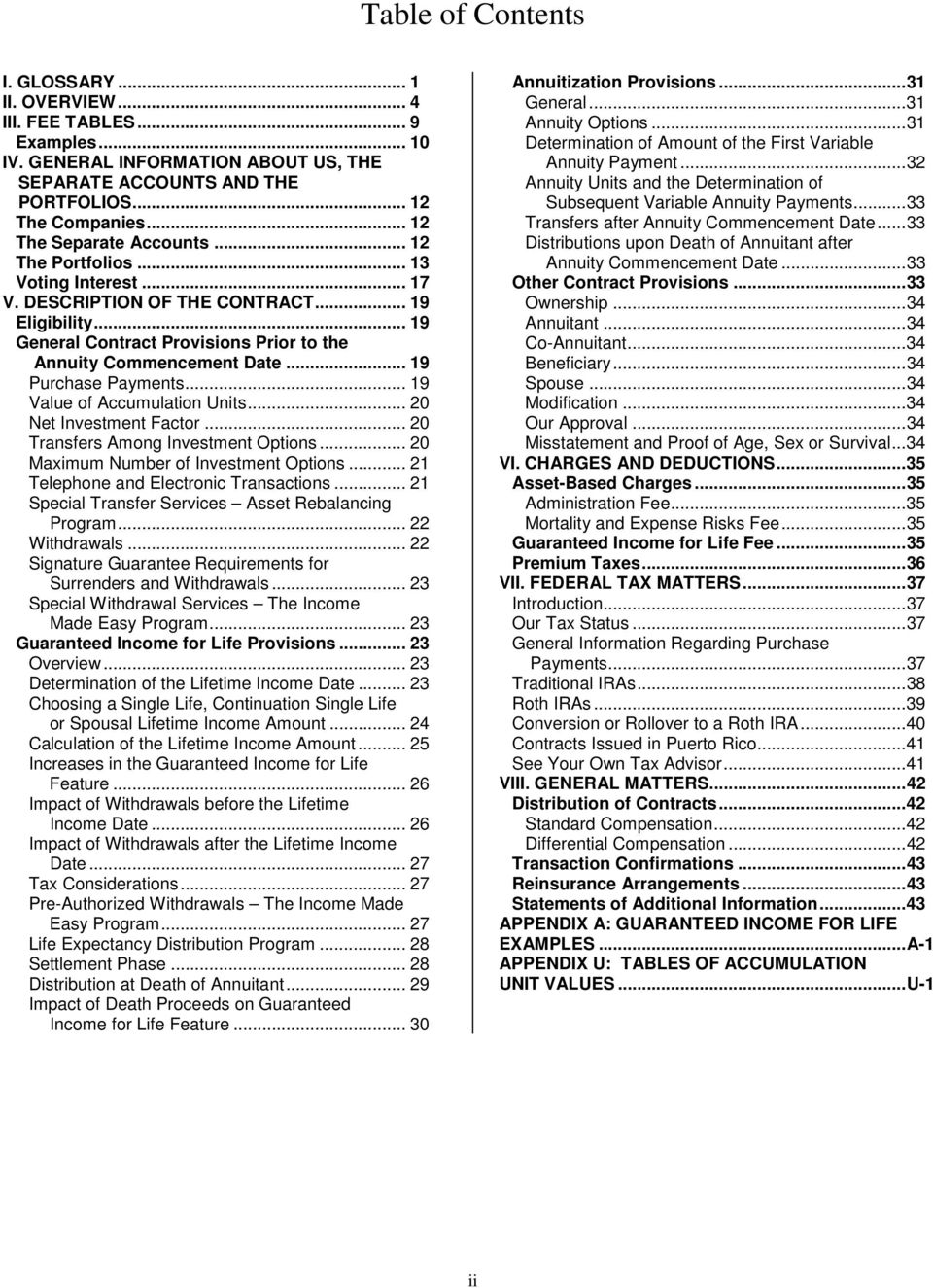
3 Table of Contents I. GLOSSARY... 1 II. OVERVIEW... 4 III. FEE TABLES... 9 Examples IV. GENERAL INFORMATION ABOUT US, THE SEPARATE ACCOUNTS AND THE PORTFOLIOS The Companies The Separate Accounts The Portfolios Voting Interest V. DESCRIPTION OF THE CONTRACT Eligibility General Contract Provisions Prior to the Annuity Commencement Date Purchase Payments Value of Accumulation Units Net Investment Factor Transfers Among Investment Options Maximum Number of Investment Options Telephone and Electronic Transactions Special Transfer Services Asset Rebalancing Program Withdrawals Signature Guarantee Requirements for Surrenders and Withdrawals Special Withdrawal Services The Income Made Easy Program Guaranteed Income for Life Provisions Overview Determination of the Lifetime Income Date Choosing a Single Life, Continuation Single Life or Spousal Lifetime Income Amount Calculation of the Lifetime Income Amount Increases in the Guaranteed Income for Life Feature Impact of Withdrawals before the Lifetime Income Date Impact of Withdrawals after the Lifetime Income Date Tax Considerations Pre-Authorized Withdrawals The Income Made Easy Program Life Expectancy Distribution Program Settlement Phase Distribution at Death of Annuitant Impact of Death Proceeds on Guaranteed Income for Life Feature Annuitization Provisions General Annuity Options Determination of Amount of the First Variable Annuity Payment Annuity Units and the Determination of Subsequent Variable Annuity Payments Transfers after Annuity Commencement Date Distributions upon Death of Annuitant after Annuity Commencement Date Other Contract Provisions Ownership Annuitant Co-Annuitant Beneficiary Spouse Modification Our Approval Misstatement and Proof of Age, Sex or Survival VI. CHARGES AND DEDUCTIONS Asset-Based Charges Administration Fee Mortality and Expense Risks Fee Guaranteed Income for Life Fee Premium Taxes VII. FEDERAL TAX MATTERS Introduction Our Tax Status General Information Regarding Purchase Payments Traditional IRAs Roth IRAs Conversion or Rollover to a Roth IRA Contracts Issued in Puerto Rico See Your Own Tax Advisor VIII. GENERAL MATTERS Distribution of Contracts Standard Compensation Differential Compensation Transaction Confirmations Reinsurance Arrangements Statements of Additional Information APPENDIX A: GUARANTEED INCOME FOR LIFE EXAMPLES... A-1 APPENDIX U: TABLES OF ACCUMULATION UNIT VALUES... U-1 ii
4 I. Glossary The following terms as used in this Prospectus have the indicated meanings. We also define other terms in specific sections of this Prospectus. Accumulation Period: The period between the issue date of the Contract and the Annuity Commencement Date. Additional Purchase Payment: Any Purchase Payment made after the initial Purchase Payment. Age 95 Contract Anniversary: The Contract Anniversary on, or next following, the date the older of the Annuitant and any co- Annuitant turns age 95. Annuitant: The natural person whose life is used to determine eligibility for and the duration of a single life guaranteed minimum withdrawal benefit under the Contract and, upon annuitization, the natural person to whom we make annuity payments and whose lifetime measures the duration of annuity payments involving single life contingencies. The lives of the Annuitant and a co-annuitant determine the eligibility for and the duration of a joint life guaranteed minimum withdrawal benefit under the Contract and, upon annuitization, the lifetimes of the Annuitant and a co-annuitant measure the duration of annuity payments involving joint life contingencies. If the Contract is owned by an individual, the Annuitant must be the same person as the Owner. Annuities Service Center: The mailing address of our applications and service offices are listed on the first page of this Prospectus. You can send overnight mail to us at the following street addresses: for applications, 380 Stuart Street, 5 th Floor, Boston, MA 02116; for all other transactions, 30 Dan Road Suite 55444, Canton, MA Annuity Commencement Date: The date we/you annuitize your Contract. That is, the date the Pay-out Period commences and we begin to make annuity payments to the Annuitant. You can change the Annuity Commencement Date to any date after the Contract Date (at least one year after the Contract Date for John Hancock New York Contracts) and prior to the Maturity Date. Annuity Option: The method selected by the Contract Owner (or as specified in the Contract if no selection is made) for annuity payments made by us. Annuity Unit: A unit of measure that is used after the election of an Annuity Option to calculate Variable Annuity payments. Beneficiary: The person, persons or entity entitled to the death proceeds under the Contract upon the death of a Contract Owner or in certain circumstances, the Annuitant. The Beneficiary is as specified in the application, unless changed. Benefit Base: A term used with the guaranteed minimum withdrawal benefit to describe a value we use to determine the Lifetime Income Amount. Please refer to V. Description of the Contract for more details. Business Day: Any day on which the New York Stock Exchange is open for business. The end of a Business Day is the close of daytime trading of the New York Stock Exchange, which generally is 4:00 p.m. Eastern Time. Co-Annuitant: The Annuitant s Spouse is named as a co-annuitant if the Spousal Lifetime Income Amount is elected. In that case, the co-annuitant s life is used in addition to the Annuitant s life to determine eligibility for and the duration of the Guaranteed Income for Life benefit and the duration of annuity payments involving life contingencies. Code: The Internal Revenue Code of 1986, as amended. Company: John Hancock USA or John Hancock New York, as applicable. Contingent Beneficiary: The person, persons or entity to become the Beneficiary if the Beneficiary is not alive. The Contingent Beneficiary is as specified in the application, unless changed. Continuation Single Life Lifetime Income Amount: The amount that we guarantee to be available each Contract Year after the Lifetime Income Date for withdrawal prior to the Annuity Commencement Date, in cases where: (1) the GIFL Retirement Plan participant dies in-plan (i.e., while still enrolled) and the surviving Spouse elects an IRA Rollover; or (2) where the participant and Spouse elect a Spousal Lifetime Income Amount in-plan, the Spouse dies prior to rollover, and the participant elects an IRA Rollover. In each case, the surviving Spouse is the Owner and Annuitant of the Contract. The Continuation Single Life Lifetime Income Amount is guaranteed for the life of the surviving Spouse at a rate of 4.5%. Contract: The Variable Annuity contract offered by this Prospectus. If you purchased this annuity in New York, a Contract means the certificate issued to you under a group contract. 1

5 Contract Anniversary: The day in each calendar year after the Contract Date that is the same month and day as the Contract Date. Contract Date: The date of issue of the Contract. Contract Value: The total of the Investment Account values attributable to the Contract. Contract Year: A period of twelve consecutive months beginning on the date as of which the Contract is issued, or any anniversary of that date. Excess Withdrawal: A term used to describe a withdrawal that exceeds the Lifetime Income Amount and which, during periods of declining investment performance, may cause substantial reductions to or the loss of the guaranteed minimum withdrawal benefit. Please refer to Impact of Withdrawals after the Lifetime Income Date in V. Description of the Contract for more details. Fixed Annuity: An Annuity Option with payments for a set dollar amount that we guarantee. General Account: All of a Company s assets, other than assets in its Separate Account and any other separate accounts it may maintain. GIFL Account Value: The portion of the account value in a GIFL Retirement Plan account established by you or for your benefit that was allocated to Investment Options applicable to the transfer of the Benefit Base. GIFL Retirement Plan: A retirement plan intended to qualify under either section 401(k) or section 457(b) of the Code and funded, in whole or in part, by a John Hancock USA or John Hancock New York group annuity contract with a Guaranteed Income for Life rider. Good Order: The standard that we apply when we determine whether an instruction is satisfactory. An instruction will be considered in Good Order if it is received at our Annuities Service Center: (a) in a manner that is satisfactory to us such that it is sufficiently complete and clear that we do not need to exercise any discretion to follow such instruction and it complies with all relevant laws and regulations and Company requirements; (b) on specific forms, or by other means we then permit (such as via telephone or electronic submission); and/or (c) with any signatures and dates we may require. We will notify you if an instruction is not in Good Order. Guaranteed Income for Life ( GIFL ): The guaranteed minimum withdrawal benefit, provided in the Contract. We guarantee that we will make a Lifetime Income Amount available to you, as long as you are the Annuitant under the Contract (or you and your Spouse are co-annuitants under the Spousal benefit). For more information on this benefit, please see Guaranteed Income for Life Provisions in V. Description of the Contract. IRA: An individual retirement annuity contract itself or an individual retirement account. An IRA may be established under section 408 of the Code ( traditional IRA ) or established under section 408A of the Code ( Roth IRA ). IRA Rollover: The type of investment you make to purchase a Contract. A Contract may only be purchased as an IRA funded with a distribution from a GIFL Retirement Plan. Investment Options: The investment choices available to Contract Owners. John Hancock New York: John Hancock Life Insurance Company of New York. John Hancock USA: John Hancock Life Insurance Company (U.S.A.). Lifetime Income Amount: A term used with our guaranteed minimum withdrawal benefit that generally describes the amount we guarantee to be available each Contract Year for withdrawal during the Accumulation Period, beginning on a Lifetime Income Date. Please refer to Guaranteed Income for Life Provisions Calculation of the Lifetime Income Amount in V. Description of the Contract for more details. Lifetime Income Date: A term used with our guaranteed minimum withdrawal benefit that generally describes the date on which we determine the Lifetime Income Amount. Please refer to Guaranteed Income for Life Provisions Determination of the Lifetime Income Date in V. Description of the Contract for more details. Maturity Date: The latest allowable Annuity Commencement Date under your Contract. That is, the last date (unless we consent to a later date) on which the Pay-out Period commences and we begin to make annuity payments to the Annuitant. The Maturity Date is the date specified on the Contract specifications page, unless changed with our consent. 2

6 Owner or Contract Owner ( you ): The person or entity entitled to all of the ownership rights under the Contract. References in this Prospectus to Contract Owners are typically by use of you. The Owner has the legal right to make all changes in contractual designations where specifically permitted by the Contract. The Owner is as specified in the application, unless changed. If the Owner is an individual, the Owner and the Annuitant must be the same person. Pay-out Period: The period when we make annuity payments to you following the Annuity Commencement Date. Portfolio: A series of a registered open-end management investment company which corresponds to a Variable Investment Option. Prospectus: This prospectus that describes interests in the Contract. Purchase Payment: An amount you pay to us for the benefits provided by the Contract. The initial Purchase Payment must include a distribution of the GIFL Account Value. Qualified Plan: A retirement plan that receives favorable tax treatment under section 401, 403, 408 (IRAs), 408A (Roth IRAs) or 457 of the Code. Separate Account: John Hancock Life Insurance Company (U.S.A.) Separate Account H or John Hancock Life Insurance Company of New York Separate Account A, as applicable. Each Separate Account is a segregated asset account of a Company that is not commingled with the general assets and obligations of the Company. Single Life Lifetime Income Amount: A form of the guaranteed minimum withdrawal benefit that we make available based on a single life. Please refer to Choosing a Single Life, Continuation Single Life or Spousal Lifetime Income Amount in V. Description of the Contract for more details. Spousal Lifetime Income Amount: A form of the guaranteed minimum withdrawal benefit that we make available based on the life of a Contract Owner and his or her Spouse. Please refer to Choosing a Single Life, Continuation Single Life or Spousal Lifetime Income Amount in V. Description of the Contract for more details. Spouse: Any person recognized as a spouse in the state where the couple was legally married. The term does not include a party to a registered domestic partnership, civil union, or other similar formal relationship recognized under state law that is not denominated as a marriage under that state s law. Step-Up: A term used with the guaranteed minimum withdrawal benefit under the Contract to describe a possible one-time increase in the Benefit Base. Please refer to V. Description of the Contract Guaranteed Income for Life Provisions for more details. Step-Up Date: The date on which we determine whether a Step-Up could occur. Subaccount: A separate division of the applicable Separate Account. Transferred Benefit Base: The amount of a Benefit Base for a Guaranteed Income for Life guarantee under a group annuity contract that we issue to fund a GIFL Retirement Plan. The Transferred Benefit Base represents your Benefit Base amount under such group annuity contract that you intend to transfer to a Contract as part of an IRA Rollover. Variable Annuity: An Annuity Option with payments which: (1) are not predetermined or guaranteed as to dollar amount; and (2) vary in relation to the investment experience of one or more specified Subaccounts. Variable Investment Option: An Investment Option corresponding to a Subaccount of a Separate Account that invests in shares of a specific Portfolio. 3

7 II. Overview This overview tells you some key points you should know about the Contract. Because this is an overview, it does not contain all the information that may be important to you. You should read this entire Prospectus carefully, including its Appendices and the Statement of Additional Information ( SAI ) for more detailed information. We disclose all material features and benefits of the Contracts in this Prospectus. Insurance laws and regulations apply to us in every state in which our Contracts are sold. As a result, a Contract purchased in one state may have terms and conditions that vary from the terms and conditions of a Contract purchased in a different jurisdiction. We disclose all material variations in the Prospectus. What kind of Contract is described in this Prospectus? The Contract is a flexible Purchase Payment individual deferred Variable Annuity contract between you and the Company. The Contract may be purchased only as an IRA Rollover, funded by distributions from your GIFL Retirement Plan. Deferred means payments by a Company, beginning on a future date under the Contract. Variable means your investment amounts in the Contract may increase or decrease in value daily based upon your Contract s Investment Options. The Contract provides for the accumulation of these investment amounts and the payment of annuity benefits on a variable and/or fixed basis. The Contract also provides a guaranteed minimum withdrawal benefit. We issue the Contract in New York in the form of a certificate of coverage under a master group contract. We issue master group contracts to one or more trusts that are formed for the purpose of providing individual retirement accounts or individual retirement annuities. We use the word Contract in this Prospectus to refer to both a certificate issued under a group contract in New York and the individual contracts we issue outside of New York. The Contract contains fees, Investment Options, GIFL benefits and limitations that may differ from the Guaranteed Income for Life feature in your employer s retirement plan. Please read this Prospectus carefully before you invest. Who is issuing my Contract? Your Contract provides the name of the Company that issues your Contract. In general, John Hancock USA may issue the Contract in any jurisdiction except New York. John Hancock New York issues the Contract only in New York. Each Company sponsors its own Separate Account. Why should I consider purchasing the Contract? The GIFL IRA Rollover Variable Annuity Contract permits you to invest a distribution from your GIFL Account Value in a Variable Annuity Contract that you intend to use as a traditional IRA or a Roth IRA. We designed the Contract to provide you with a reliable source of income for life: you can transfer the Lifetime Income Amount protection we provided under your employer s retirement plan; we guarantee a Lifetime Income Amount under the Contract for annual withdrawals during your retirement years (please read V. Description of the Contract Guaranteed Income for Life Provisions for more information); you can invest in the Portfolios we make available under the Contract and possibly increase your Lifetime Income Amount through Step-Ups to reflect investment performance. In addition to providing access to diversified Investment Options and a guaranteed minimum withdrawal benefit, the Contract offers the availability of annuity payments. Under the Contract, you make one or more Purchase Payments to a Company for the period prior to the Annuity Commencement Date. Your Purchase Payments will be allocated to Investment Options. You may transfer among the Investment Options and take withdrawals. Later, beginning on the Contract s Annuity Commencement Date, you can receive one or more annuity payments under the Contract. Your Contract Value and the amounts of annuity payments are variable, based on your investment choices. We will pay the proceeds of the Contract to your Beneficiary if you die prior to the Annuity Commencement Date, which is described in this Prospectus under Distribution at Death of Annuitant. We offer Fixed Annuity and Variable Annuity payment options. Periodic annuity payments will begin on the Annuity Commencement Date. You select the Annuity Commencement Date, the frequency of payment and the type of annuity payment option. Annuity payments are made to you. Although the Lifetime Income Amount guarantees a minimum annual withdrawal amount, you may take withdrawals of any amount of Contract Value before the Annuity Commencement Date. We may decrease the Lifetime Income Amount, however, if you take any withdrawal before the Lifetime Income Date, or an Excess Withdrawal in any year after that. You should carefully consider your liquidity needs before purchasing a Contract. 4
8 How can I invest money in the Contract? We use the term Purchase Payment to refer to the investments you make in the Contract. Your initial Purchase Payment must include a distribution of the GIFL Account Value to a Contract that you intend to use as a traditional IRA or a Roth IRA. In addition, if you are the surviving Spouse of a GIFL Retirement Plan participant, you are permitted to roll over your GIFL plan benefits to a Contract. Generally, we will issue a Contract as a traditional IRA. However, if you request otherwise or if your initial Purchase Payment is from your GIFL Retirement Plan Roth Account, we will issue a Contract as a Roth IRA. After that, you may make Additional Purchase Payments, including IRA Rollovers, subject to certain tax qualification rules and our limits on Additional Purchase Payments. For example, under current rules, distributions from another retirement plan described in section 401(a), 403(a), or 403(b) of the Code or a governmental deferred compensation plan described in section 457(b) of the Code may be rolled over directly to the Contract issued as a Roth IRA. We restrict Purchase Payments made after the first Contract Anniversary to $25,000 measured over the life of the Contract, unless otherwise approved by us. No Additional Purchase Payments will be allowed on or after the 81 st birthday of the older of the Annuitant and any co-annuitant. See V. Description of the Contract Purchase Payments for more details. What charges do I pay under the Contract? Your Contract s asset-based charges compensate us primarily for our administrative expenses and for the mortality and expense risks that we assume under the Contract. We also assess a Guaranteed Income for Life fee, based on the Contract s Benefit Base. We may also use amounts derived from the charges for payment of distribution expenses. We take the deduction proportionally from each of your Variable Investment Options. We make deductions for any applicable taxes based on the amount of a Purchase Payment. What are my investment choices? You may invest in any of the Variable Investment Options (subject to the restrictions on the Money Market Investment Option, described below). Each Variable Investment Option is a Subaccount of a Separate Account that invests solely in a corresponding Portfolio. The Portfolio prospectuses contain full descriptions of the Portfolios. The amount you invest in any Variable Investment Option will increase or decrease based upon the investment performance of the corresponding Portfolio (reduced by certain charges we deduct see III. Fee Tables ). Your Contract Value during the Accumulation Period and the amounts of annuity payments will depend upon the investment performance of the underlying Portfolio of the Variable Investment Option you select. Restrictions on the Money Market Investment Option. You will not be permitted to make new investments in the Money Market Investment Option unless all or a portion of your Contract Value was allocated to the Money Market Investment Option on April 26, If so, you may continue to make new investments through Additional Purchase Payments (if not otherwise restricted) to that Investment Option. However, transfers of amounts from other Investment Options are not permitted, and you can no longer invest in the Money Market Investment Option if at any time thereafter you fail to maintain a minimum balance in that Option. In selecting Variable Investment Options under a Contract, you should consider: You bear the investment risk that your Contract Value will increase or decrease to reflect the results of your Contract s investment in underlying Portfolios. We do not guarantee Contract Value in a Variable Investment Option or the investment performance of any Portfolio. Although the Portfolio may invest directly in securities or indirectly, through other underlying portfolios, you will not have the ability to determine the investment decisions or strategies of the Portfolios. If you would prefer a broader range of investment options, you (and your financial advisor) should carefully consider the features of other variable annuity contracts offered by other life insurance companies, or other forms of traditional IRAs and Roth IRAs, before purchasing a Contract. How can I change my investment choices? Allocation of Purchase Payments. You designate how your Purchase Payments are to be allocated among the Investment Options. You may change this investment allocation for future Purchase Payments at any time. Transfers Among Investment Options. Prior to the Annuity Commencement Date, you may transfer your investment amounts among Investment Options, subject to certain restrictions described below and discussed in greater detail in V. Description of the 5
9 Contract Transfers Among Investment Options. After the Annuity Commencement Date, you may transfer your allocations among the Variable Investment Options, subject to certain restrictions described in V. Description of the Contract Transfers after Annuity Commencement Date. The Variable Investment Options can be a target for abusive transfer activity. To discourage disruptive frequent trading activity, we have adopted a policy for each Separate Account to restrict transfers to two per calendar month per Contract, with certain exceptions described in more detail in V. Description of the Contract Transfers Among Investment Options. We apply each Separate Account s policy and procedures uniformly to all Contract Owners. In addition to the transfer restrictions that we impose, the John Hancock Variable Insurance Trust also has adopted policies under Rule 22c-2 of the Investment Company Act of 1940, as amended (the 1940 Act ) to detect and deter abusive short-term trading. Accordingly, a Portfolio may require us to impose trading restrictions if it discovers violations of its frequent short-term trading policy. We will provide tax identification numbers and other Contract Owner transaction information to John Hancock Variable Insurance Trust upon request, which it may use to identify any pattern or frequency of activity that violates its short-term trading policy. We reserve the right to restrict Investment Options at any time. If we restrict an Investment Option, you may not be able to transfer or allocate Purchase Payments to the restricted Investment Option after the date of the restriction. Any amounts you allocated to an Investment Option before we imposed restrictions will not be affected by such restrictions as long as it remains in that Investment Option. Transfers Between Annuity Options. During the Pay-out Period, you may not transfer from a Variable Annuity Option to a Fixed Annuity Option, or from a Fixed Annuity Option to a Variable Annuity Option (see V. Description of the Contract Transfers after the Annuity Commencement Date ). How do I access my money? During the Accumulation Period, you may withdraw all or a portion of your Contract Value. Withdrawals may be subject to income tax, including an additional 10% penalty tax in many cases, on the taxable portion of any distributions taken from a Contract. Owners of Contracts issued as Roth IRAs may be subject to a penalty tax for withdrawals taken on certain distributions within the first five years after establishment of the account. If we issue your Contract for use as a traditional IRA, you will be subject to tax requirements for minimum distributions over your lifetime. The Code requires that distributions from most Contracts commence and/or be completed within a certain period of time. This effectively limits the period of time during which you can continue to derive tax deferral benefits from any tax-deductible Purchase Payments you paid or on any earnings under the Contract. Please read VII. Federal Tax Matters for more information about taxation on withdrawals and minimum distribution requirements applicable to traditional IRAs and Roth IRAs. What is my Contract Guarantee? We designed the Contract to make a Lifetime Income Amount available for annual withdrawals starting on a Lifetime Income Date. If you limit your annual withdrawals to the Lifetime Income Amount, we will make this benefit available for as long as you live. In most cases, you may elect to cover the lifetimes of you and your Spouse by selecting a Spousal Lifetime Income Amount. We describe the Spousal Lifetime Income Amount in more detail in the Guaranteed Income for Life Provisions section of the Prospectus. You could lose benefits if your annual withdrawal amounts exceed the Lifetime Income Amount. We may reduce the Lifetime Income Amount if you take any withdrawals before the applicable Lifetime Income Date. You will lose the Lifetime Income Amount if your Withdrawal Amounts before the applicable Lifetime Income Date deplete your Contract Value and any remaining Benefit Base to zero. The Contract permits you to choose how much Contract Value to withdraw at any time. We may reduce the Lifetime Income Amount that we guarantee for future lifetime benefit payments, however, if: you take any withdrawals before the Lifetime Income Date, or your annual withdrawals after the Lifetime Income Date exceed the Lifetime Income Amount. We will pay guaranteed minimum withdrawal benefits automatically during the Settlement Phase that we describe in the Guaranteed Income for Life Provisions section of the Prospectus. 6

10 How do you determine the initial Lifetime Income Amount? That will depend on the type of Lifetime Income Amount provided in your Contract. If you start taking withdrawals on the Lifetime Income Date, the Lifetime Income Amount will equal: 5% of the Benefit Base for a Single Life Lifetime Income Amount; or 4.5% of the Benefit Base for a Continuation Single Life Lifetime Income Amount; or 4.5% of the Benefit Base for a Spousal Lifetime Income Amount. We will issue a Contract to reflect any minimum guaranteed withdrawal benefit that you may have established in your GIFL Retirement Plan. We will issue you a Contract with a 5% Single Life Lifetime Income Amount if you had established, or were the beneficiary of, an account under your GIFL Retirement Plan that: was covered by our single life minimum guaranteed withdrawal benefit; or was covered by a Spousal minimum guaranteed withdrawal benefit but subsequently split and changed to two single life accounts in connection with a divorce or a legal separation. We will issue you a Contract with a 4.5% Continuation Single Life Lifetime Income Amount if you had established, or were the beneficiary of, a GIFL Retirement Plan account that was covered by a Spousal guarantee and: you are a surviving Spouse of a former participant under a GIFL Retirement Plan; or you are a participant under a GIFL Retirement Plan and your Spouse has died. We will issue you a Contract with the 4.5% Spousal Lifetime Income Amount if you have established a GIFL Retirement Plan account that is covered by a Spousal guarantee and: you and your Spouse are still alive and married when we issue a Contract; and you name your Spouse as a co-annuitant in the Contract you purchase. If you have not established the minimum guaranteed withdrawal benefit in your GIFL Retirement Plan, we will allow you to select a Single Lifetime Income Amount or a Spousal Lifetime Income Amount until the Lifetime Income Date. If you defer taking withdrawals on and after the Lifetime Income Date, you can defer making your election between a Single Life Lifetime Income Amount and a Spousal Lifetime Income Amount. We may reduce the initial Lifetime Income Amount if your annual withdrawals after the Lifetime Income Date exceed the Lifetime Income Amount applicable to your Contract. We may increase or step up the guaranteed minimum withdrawal benefit amounts on Anniversary Dates to reflect market performance or other factors. You may also increase the amounts we guarantee by making Additional Purchase Payments that we accept. Please read V. Description of the Contract Lifetime Income Provisions for additional information on the calculation of Lifetime Income Amounts. When do you determine the initial Lifetime Income Amount? We determine the initial Lifetime Income Amount on the Lifetime Income Date applicable to your Contract. The Lifetime Income Date under your Contract either will be the date we issue your Contract or an anniversary of that date. We determine the Lifetime Income Date based on: 1. a minimum age of (a) 59½ for a Single Life or Continuation Single Life Lifetime Income Amount; or (b) 59½ for the younger of you and your Spouse for a Spousal Lifetime Income Amount; and 2. a holding period of up to 5 Contract Years. The Lifetime Income Date will not occur, and we will not determine a Lifetime Income Amount, unless your Contract remains in force throughout the holding period. We will reduce the holding period to reflect the holding period that you satisfied while you were a participant in a GIFL Retirement Plan if: (a) you purchase a Contract with a distribution from the GIFL Retirement Plan; and (b) the amount of your initial Purchase Payment for the Contract does not exceed your GIFL Account Value by more than 20% of the Transferred Benefit Base. If you are a surviving Spouse of a deceased participant, the holding period will reflect the holding period your Spouse satisfied while he or she was a participant in the plan. We reserve the right to reset the holding period (i.e., impose a new holding period of up to 5 Contract Years) if you make an Additional Purchase Payment that exceeds 20% of the Benefit Base at the time of payment, or causes the total of all Purchase Payments in that Contract Year to exceed 20% of the Benefit Base. We will not reset the holding period, however, if you make an Additional Purchase Payment after the Lifetime Income Date. Example: Assume that you purchase a GIFL IRA Rollover Variable Annuity Contract on May 1, 2014 for a Single Life Lifetime Income Amount, when you are age 60 and the holding period in your GIFL Retirement Plan was scheduled to end on May 31,
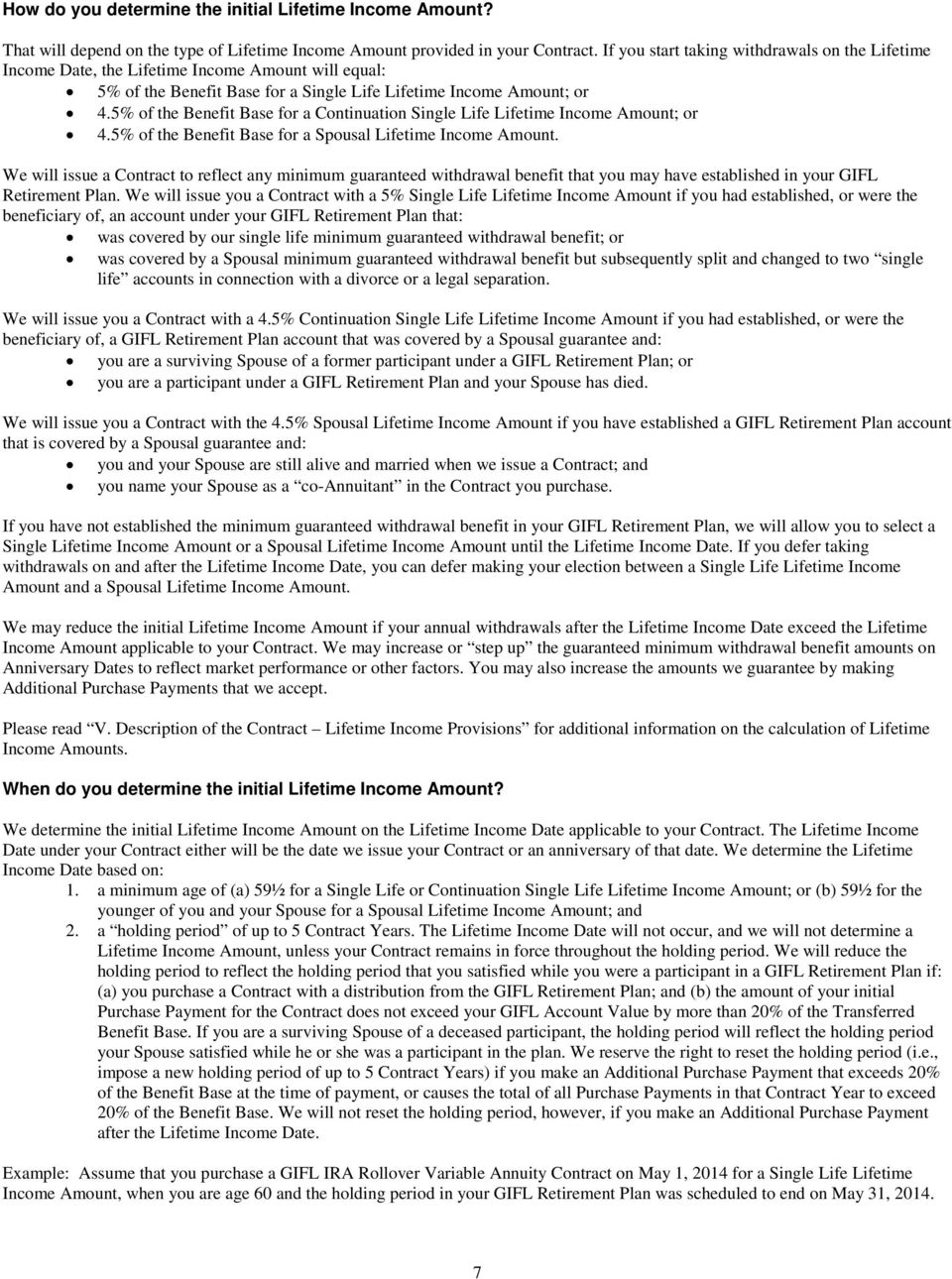
11 Your Lifetime Income Date for GIFL is May 1, 2015, the Contract Anniversary after you have satisfied both the age and holding period requirement. If you purchase the GIFL IRA Rollover Variable Annuity Contract on June 1, 2014, your Lifetime Income Date will be June 1, 2014 since both requirements were satisfied prior to the date that the Contract was purchased. Please read Purchase Payments and Lifetime Income Provisions in V. Description of the Contract for additional information on the holding period and the Lifetime Income Date. What are the tax consequences of owning a Contract? In most cases, no income tax will have to be paid on amounts you earn under a Contract until these earnings are paid out. All or part of the following distributions from a Contract may constitute a taxable payout of earnings: withdrawals (including surrender of the Contract, payments of the Lifetime Income Amount or any systematic withdrawals); payment of any death proceeds; and periodic payments under one of our annuity payment options. How much you will be taxed on a distribution is based upon complex tax rules and depends on matters such as: the type of the distribution; when the distribution is made; the rules governing distributions and rollovers from a Qualified Plan to a traditional IRA or Roth IRA; the rules governing distributions from a traditional IRA or Roth IRA; and the circumstances under which the payments are made. The Code requires Contracts issued to qualify as traditional IRAs or Roth IRAs not to be used for loans, assignments or pledges. A 10% penalty tax applies in many cases to the taxable portion of any distributions taken from a Contract issued as a traditional IRA before you reach age 59½. Traditional IRAs are subject to minimum distribution requirements beginning in the year after the year a taxpayer turns age 70½, and both traditional IRAs and Roth IRAs are subject to requirements for death benefit distributions to commence and/or be completed within a certain period of time. This effectively limits the period of time during which you can derive tax deferral benefits from the rollover of your GIFL Account Value into a Contract, or on any earnings under the Contract. The Contract does not provide any tax-deferral benefits in addition to those that are accorded the Contract because it is an IRA. However, the Contract offers features and benefits that other investments may not offer. You and your financial advisor should carefully consider whether the features and benefits, including the Investment Options, protection through living guarantees and other benefits provided under the Contract are suitable for your needs and objectives and are appropriate in light of the expense. We provide additional information on taxes in the VII. Federal Tax Matters section of this Prospectus. We make no attempt to provide more than general information. Purchasers of Contracts for use with any retirement plan should consult with a qualified tax advisor regarding the suitability of the Contract. Can I return my Contract? In most cases, you have the right to cancel your Contract within 10 days (or longer in some states) after you receive it. Because your Contract is issued as an IRA, you will receive a refund of any Purchase Payments you made during the first seven days of this period if that amount is greater than the Contract Value. After seven days, we will return the Contract Value. The date of cancellation is the date we receive the Contract. Rather than receive the Contract Value as a taxable distribution, you may opt to return this amount to the GIFL Retirement Plan (if permitted under the plan) (see VII. Federal Tax Matters ). Will I receive a Transaction Confirmation? We will send you a confirmation statement for certain transactions in your Investment Options. You should carefully review these transaction confirmations to verify their accuracy. You should immediately report any mistakes to our Annuities Service Center (at the address or phone number shown on the first page of this Prospectus). If you fail to notify our Annuities Service Center of any mistake within 60 days of the delivery of the transaction confirmation, you will be deemed to have ratified the transaction. Please contact the John Hancock Annuities Service Center at the applicable telephone number or Internet address shown on the first page of this Prospectus for more information on electronic transactions. 8

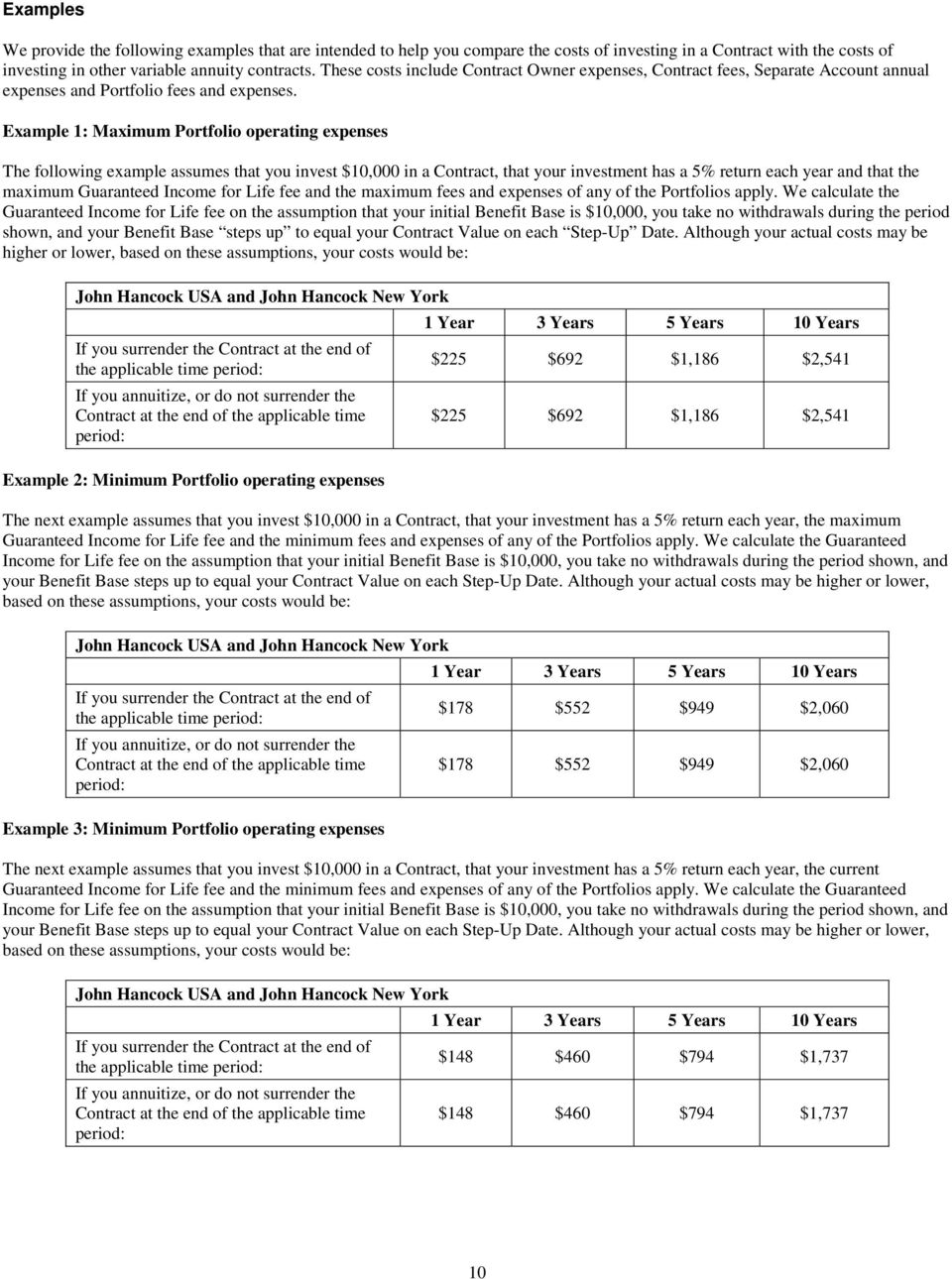
12 III. Fee Tables The following tables describe the fees and expenses applicable to buying, owning and surrendering a GIFL Rollover Contract. These fees and expenses are more completely described in this Prospectus under VI. Charges and Deductions. The items listed under Total Annual Portfolio Operating Expenses are described in detail in the Portfolio prospectus. Unless otherwise shown, the tables below show the maximum fees and expenses. The following table describes the fees and expenses that you pay at the time that you buy the Contract or surrender the Contract, or potentially when you transfer Contract Value between Investment Options. State premium taxes may also be deducted. Contract Owner Transaction Expenses 1 Transfer Fee 2 Maximum Fee $25 Current Fee $ State premium taxes may also apply to your Contract, which currently range from 0.04% to 4.00% of each Purchase Payment (See VI. Charges and Deductions Premium Taxes ). This fee is not currently assessed against transfers. We reserve the right to impose a charge in the future for transfers in excess of 12 per year. The amount of this fee will not exceed the lesser of $25 or 2% of the amount transferred. The following table describes fees and expenses that you pay periodically during the time that you own the Contract. This table does not include annual Portfolio operating expenses. Periodic Fees and Expenses Other Than Portfolio Expenses Annual Contract Fee None Annual Separate Account Expenses 1 Administration Fee 0.15% Mortality and Expense Risks Fee % Total Annual Separate Account Expenses 0.35% Guaranteed Income for Life Fee 3 Maximum Fee 0.65% Current Fee 0.35% 1 A daily charge reflected as an annualized percentage of the Variable Investment Options. 2 This charge is assessed on all active Contracts, including Contracts continued by a Beneficiary upon the death of the Contract Owner. 3 Amount shown is an annual percentage based on the Benefit Base. We reserve the right to increase the fee on Step-Up. You can opt out of a Step-Up in that case, and can opt in for future Step-Ups. The next table describes the minimum and maximum total operating expenses charged by the Portfolios that you pay periodically during the time that you own the Contract. More detail concerning each Portfolio s fees and expenses is contained in the Portfolio s prospectus. Total Annual Portfolio Operating Expenses Minimum Maximum Range of expenses that are deducted from Portfolio assets, including management fees, Rule 12b-1 fees, and other expenses 0.76% 1.22% 9
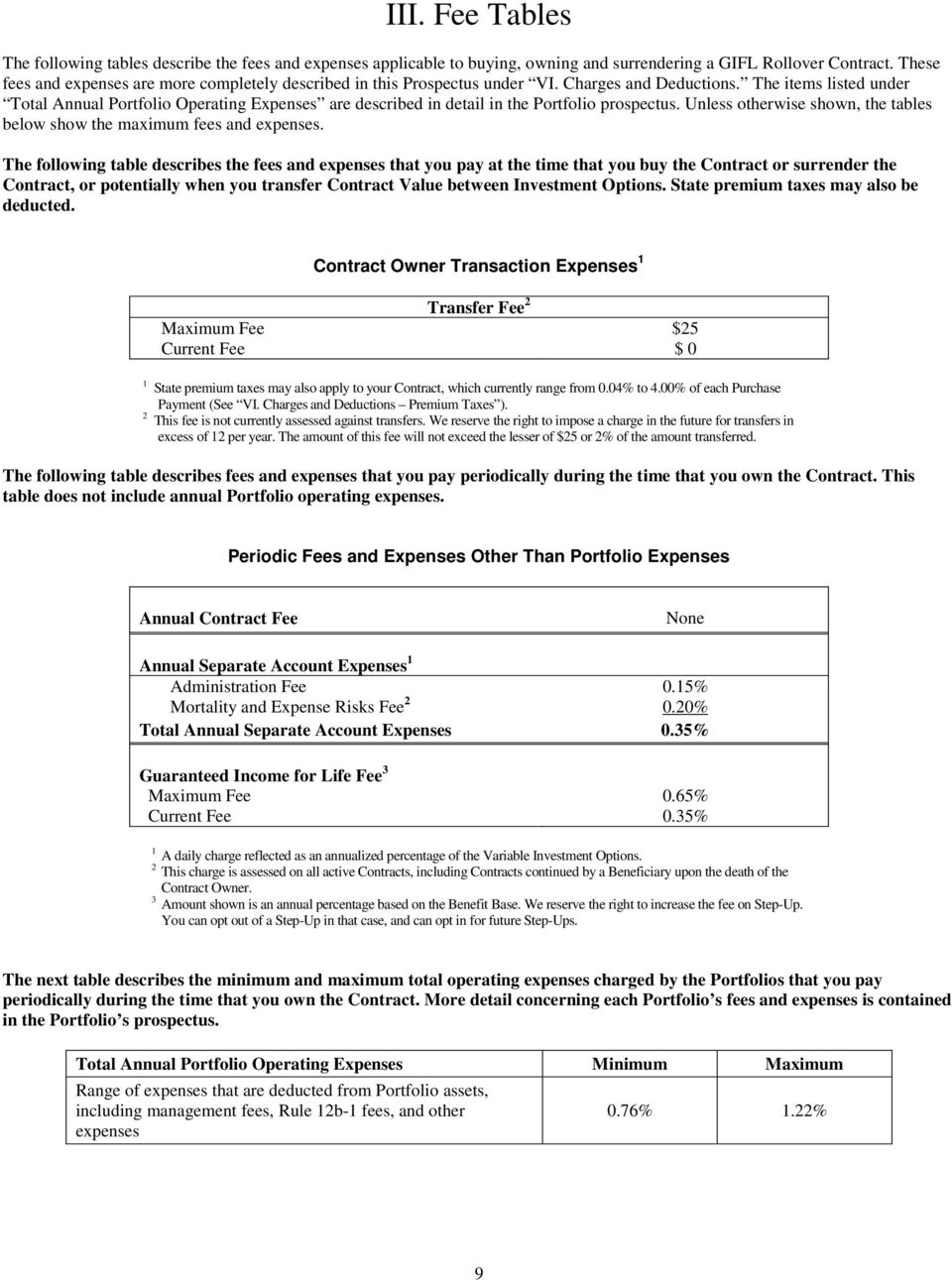
13 Examples We provide the following examples that are intended to help you compare the costs of investing in a Contract with the costs of investing in other variable annuity contracts. These costs include Contract Owner expenses, Contract fees, Separate Account annual expenses and Portfolio fees and expenses. Example 1: Maximum Portfolio operating expenses The following example assumes that you invest $10,000 in a Contract, that your investment has a 5% return each year and that the maximum Guaranteed Income for Life fee and the maximum fees and expenses of any of the Portfolios apply. We calculate the Guaranteed Income for Life fee on the assumption that your initial Benefit Base is $10,000, you take no withdrawals during the period shown, and your Benefit Base steps up to equal your Contract Value on each Step-Up Date. Although your actual costs may be higher or lower, based on these assumptions, your costs would be: John Hancock USA and John Hancock New York 1 Year 3 Years 5 Years 10 Years If you surrender the Contract at the end of the applicable time period: $225 $692 $1,186 $2,541 If you annuitize, or do not surrender the Contract at the end of the applicable time period: $225 $692 $1,186 $2,541 Example 2: Minimum Portfolio operating expenses The next example assumes that you invest $10,000 in a Contract, that your investment has a 5% return each year, the maximum Guaranteed Income for Life fee and the minimum fees and expenses of any of the Portfolios apply. We calculate the Guaranteed Income for Life fee on the assumption that your initial Benefit Base is $10,000, you take no withdrawals during the period shown, and your Benefit Base steps up to equal your Contract Value on each Step-Up Date. Although your actual costs may be higher or lower, based on these assumptions, your costs would be: John Hancock USA and John Hancock New York 1 Year 3 Years 5 Years 10 Years If you surrender the Contract at the end of the applicable time period: $178 $552 $949 $2,060 If you annuitize, or do not surrender the Contract at the end of the applicable time period: $178 $552 $949 $2,060 Example 3: Minimum Portfolio operating expenses The next example assumes that you invest $10,000 in a Contract, that your investment has a 5% return each year, the current Guaranteed Income for Life fee and the minimum fees and expenses of any of the Portfolios apply. We calculate the Guaranteed Income for Life fee on the assumption that your initial Benefit Base is $10,000, you take no withdrawals during the period shown, and your Benefit Base steps up to equal your Contract Value on each Step-Up Date. Although your actual costs may be higher or lower, based on these assumptions, your costs would be: John Hancock USA and John Hancock New York 1 Year 3 Years 5 Years 10 Years If you surrender the Contract at the end of the applicable time period: $148 $460 $794 $1,737 If you annuitize, or do not surrender the Contract at the end of the applicable time period: $148 $460 $794 $1,737 10
14 Portfolio Expenses The following table describes the operating expenses for each of the Portfolios, as a percentage of the Portfolio s average net assets for the fiscal year ending December 31, 2013, except as stated below in the notes that follow the table. More detail concerning each Portfolio s fees and expenses is contained in the Portfolio s prospectus and in the notes following the table. Portfolio/Series Management Fee Distribution and Service (12b-1) Fees Other Expenses Acquired Portfolio Fees and Expenses 1 Total Annual Operating Expenses Contractual Expense Reimbursement Net Operating Expenses Core Strategy Series II 0.04% 0.25% 0.03% 0.54% 0.86% % 0.86% Franklin Templeton Founding Allocation Series II 0.04% 0.25% 0.03% 0.90% 1.22% % 1.22% Lifestyle Balanced MVP Series II 0.04% 0.25% 0.02% 0.68% 0.99% % % Lifestyle Balanced PS Series Series II 0.04% % 0.05% 0.65% 0.99% % % Lifestyle Conservative MVP Series II 0.04% 0.25% 0.02% 0.65% 0.96% % % Lifestyle Conservative PS Series Series II 0.04% % 0.13% 0.64% 1.06% % % Lifestyle Growth MVP Series II 0.04% 0.25% 0.02% 0.70% 1.01% % % Lifestyle Growth PS Series Series II 0.04% % 0.04% 0.66% 0.99% % 0.99% Lifestyle Moderate MVP Series II 0.04% 0.25% 0.02% 0.67% 0.98% % % Lifestyle Moderate PS Series Series II 0.04% % 0.10% 0.64% 1.03% % % Money Market 6 Series II 0.48% 0.25% 0.03% % 0.00% 0.76% Ultra Short Term Bond Series II 0.55% 0.25% 0.07% % 0.00% 0.87% Acquired Portfolio Fees and Expenses are based on indirect net expenses associated with the Portfolio s investments in underlying investment companies. The Total Annual Operating Expenses shown may not correlate to the Portfolio's ratios of expenses to average net assets shown in the Financial Highlights section of the Portfolio prospectus, which does not include Acquired Portfolio Fees and Expenses. The advisor has contractually agreed to reduce its management fee and/or make payment to the Portfolio in an amount equal to the amount by which Other Expenses of the Portfolio exceed 0.00% of the averaged annual net assets (on an annualized basis) of the Portfolio. Other Expenses means all of the expenses of the Portfolio, excluding certain expenses such as advisory fees, taxes, brokerage commissions, interest expense, litigation and indemnification expenses and other extraordinary expenses not incurred in the ordinary course of the Portfolio s business, distribution and service (Rule 12b-1) fees, underlying portfolio expenses ( Acquired Portfolio Fees and Expense ), and short dividend expense. The current expense limitation agreement expires on April 30, 2017 unless renewed by mutual agreement of the Portfolio and the advisor based upon a determination that this is appropriate under the circumstances at that time. The advisor may recapture operating expenses reimbursed or fees waived under previous expense limitation or waiver arrangements for a period of three years following the month in which the reimbursements or waivers occurred to the extent that the Portfolio is below its expense limitation during this period. Management Fee has been restated to reflect the contractual management fee schedule effective October 1, The advisor has contractually agreed to reduce its management fee and/or make payment to the Portfolio in an amount equal to the amount by which Other Expenses of the Portfolio exceed 0.04% of the averaged annual net assets (on an annualized basis) of the Portfolio. Other Expenses means all of the expenses of the Portfolio, excluding certain expenses such as advisory fees, taxes, brokerage commissions, interest expense, litigation and indemnification expenses and other extraordinary expenses not incurred in the ordinary course of the Portfolio s business, distribution and service (Rule 12b-1) fees, underlying portfolio expenses ( Acquired Portfolio Fees and Expenses ), and short dividend expense. The current expense limitation agreement expires on April 30, 2015 unless renewed by mutual agreement of the Portfolio and the advisor based upon a determination that this is appropriate under the circumstances at that time. The advisor may recapture operating expenses reimbursed or fees waived under previous expense limitation or waiver arrangements for a period of three years following the month in which the reimbursements or waivers occurred to the extent that the Portfolio is below its expense limitation during this period. For Contracts issued prior to April 29, 2013, the Money Market Variable Investment Option is subject to restrictions (see V. Description of the Contract Maximum Number of Investment Options ). For Contracts issued on or after April 29, 2013, the Money Market Variable Investment Option is available only during the initial inspection period for Contracts issued in California to purchasers age 60 and older. A Table of Accumulation Unit Values relating to the Contract is included in Appendix U to this Prospectus. 11

15 IV. General Information about Us, the Separate Accounts and the Portfolios The Companies Your Contract is issued by either John Hancock USA or John Hancock New York. Please refer to your Contract to determine which Company issued your Contract. John Hancock USA, formerly known as The Manufacturers Life Insurance Company (U.S.A.), is a stock life insurance company originally organized under the laws of Maine on August 20, 1955, by a special act of the Maine legislature. John Hancock USA redomesticated under the laws of Michigan on December 30, John Hancock USA is authorized to transact life insurance and annuity business in all states (except New York), the District of Columbia, Guam, Puerto Rico and the Virgin Islands. Its principal office is located at 601 Congress Street, Boston, Massachusetts John Hancock USA also has an Annuities Service Center at 30 Dan Road Suite 55444, Canton, MA John Hancock New York, formerly known as The Manufacturers Life Insurance Company of New York, is a wholly-owned subsidiary of John Hancock USA and is a stock life insurance company organized under the laws of New York on February 10, John Hancock New York is authorized to transact life insurance and annuity business only in the State of New York. Its principal office is located at 100 Summit Lake Drive, Valhalla, New York John Hancock New York also has an Annuities Service Center at 30 Dan Road Suite 55444, Canton, MA The ultimate parent of both companies is Manulife Financial Corporation, a publicly traded company, based in Toronto, Canada. Manulife Financial Corporation is the holding company of The Manufacturers Life Insurance Company and its subsidiaries, collectively known as Manulife Financial. The Companies changed their names to John Hancock Life Insurance Company (U.S.A.) and John Hancock Life Insurance Company of New York, respectively, on January 1, 2005 following Manulife Financial Corporation s acquisition of John Hancock Financial Services, Inc. The Company incurs obligations under the Contract to guarantee certain amounts, and investors must depend on the financial strength of the Company for satisfaction of the Company s obligations such as the Lifetime Income Amount and any Fixed Annuity Option. To the extent that the Company pays such amounts, the payments will come from the Company s General Account assets. You should be aware that, unlike the Separate Accounts, the Company s General Account is not segregated or insulated from the claims of the Company s creditors. The General Account consists of securities and other investments that may decline in value during periods of adverse market conditions. The Company s financial statements contained in the SAI include a further discussion of risks inherent within the Company s General Account investments. The Separate Accounts You do not invest directly in the Portfolios made available under the Contracts. When you direct or transfer money to a Variable Investment Option, we will purchase shares of a corresponding Portfolio through one of our Separate Accounts. We hold the Portfolio s shares in a Subaccount (usually with a name similar to that of the corresponding Portfolio) of the applicable Separate Account. A Separate Account s assets (including the Portfolio s shares) belong to the Company that maintains that Separate Account. For Contracts issued by John Hancock USA, we purchase and hold Portfolio shares in John Hancock Life Insurance Company (U.S.A.) Separate Account H, a Separate Account under the laws of Michigan. For Contracts issued by John Hancock New York, we purchase and hold Portfolio shares in John Hancock Life Insurance Company of New York Separate Account A, a Separate Account under the laws of New York. The income, gains and losses, whether or not realized, from assets of a Separate Account are credited to or charged against that Separate Account without regard to a Company s other income, gains, or losses. Nevertheless, all obligations arising under a Company s Contracts are general corporate obligations of that Company. Assets of a Separate Account may not be charged with liabilities arising out of any of the respective Company s other business. We reserve the right, subject to compliance with applicable law; to add other Subaccounts; to eliminate existing Subaccounts; and to combine Subaccounts or transfer assets in one Subaccount to another Subaccount that we, or an affiliated company, may establish. We will not eliminate existing Subaccounts or combine Subaccounts without the prior approval of the appropriate state or federal regulatory authorities. We registered the Separate Accounts with the SEC under the Investment Company Act of 1940, as amended (the 1940 Act ) as unit investment trusts. Registration under the 1940 Act does not involve supervision by the SEC of the management or investment policies 12

16 or practices of the Separate Accounts. If a Company determines that it would be in the best interests of persons having voting rights under the Contracts it issues, that Company s Separate Account may be operated as a management investment company under the 1940 Act or it may be deregistered if 1940 Act registration were no longer required. The Portfolios When you select a Variable Investment Option, we invest your money in a Subaccount of our Separate Account and it invests in shares of a corresponding Portfolio of the John Hancock Variable Insurance Trust. The Portfolios in the Separate Account are NOT publicly traded mutual funds. The Portfolios are only available to you as Investment Options in the Contracts or, in some cases, through other variable annuity contracts or variable life insurance policies issued by us or by other life insurance companies. In some cases, the Portfolios also may be available through participation in certain tax-qualified pension, retirement or college savings plans. Investment Management The Portfolios investment advisers and managers may manage publicly traded mutual funds with similar names and investment objectives. However, the Portfolios are NOT directly related to any publicly traded mutual fund. You should not compare the performance of any Portfolio described in this Prospectus with the performance of a publicly traded mutual fund. The performance of any publicly traded mutual fund could differ substantially from that of any of the Portfolios held in our Separate Account. In selecting the Portfolios that will be available as Investment Options under the Contract, we may establish requirements that are intended, among other things, to mitigate market price and interest rate risk for compatibility with our obligations to pay guarantees and benefits under the Contract. We seek to make available Investment Options that use strategies that are intended to lower potential volatility, including, but not limited to, strategies that: encourage diversification in asset classes and style; combine equity exposure with exposure to fixed income securities; and allow us to effectively and efficiently manage our exposure under the Contracts. The requirements we impose may increase a Portfolio s transaction costs or otherwise affect both the performance and the availability of Investment Options under the Contract. The John Hancock Variable Insurance Trust is a so-called series type mutual fund and is registered under the 1940 Act as an openend management investment company. John Hancock Investment Management Services, LLC ( JHIMS LLC ) provides investment advisory services to the John Hancock Variable Insurance Trust and receives investment management fees for doing so. JHIMS LLC pays a portion of its investment management fees to other firms that manage the John Hancock Variable Insurance Trust s Portfolios (i.e., subadvisers). JHIMS LLC is our affiliate and we indirectly benefit from any investment management fees JHIMS LLC retains. The John Hancock Variable Insurance Trust has obtained an order from the SEC permitting JHIMS LLC, subject to approval by the Board of Trustees, to change a subadviser for a Portfolio or the fees paid to subadvisers and to enter into new subadvisory agreements from time to time without the expense and delay associated with obtaining shareholder approval of the change. This order does not, however, permit JHIMS LLC to appoint a subadviser that is an affiliate of JHIMS LLC or the John Hancock Variable Insurance Trust (other than by reason of serving as subadviser to a Portfolio) (an Affiliated Subadviser ) or to change a subadvisory fee of an Affiliated Subadviser without the approval of shareholders. If shares of a Portfolio are no longer available for investment or in our judgment investment in a Portfolio becomes inappropriate, we may eliminate the shares of a Portfolio and substitute shares of another Portfolio, or of another open-end registered investment company. A substitution may be made with respect to both existing investments and the investment of future Purchase Payments. However, we will make no such substitution without first notifying you and obtaining approval of the SEC (to the extent required by the 1940 Act). Portfolio Expenses The table in the Fee Tables section of the Prospectus shows the investment management fees, Rule 12b-1 fees and other operating expenses for these Portfolio shares as a percentage (rounded to two decimal places) of each Portfolio s average daily net assets for 2012, except as indicated in the footnotes appearing at the end of the table. Fees and expenses of the Portfolios are not fixed or specified under the terms of the Contracts and may vary from year to year. These fees and expenses differ for each Portfolio and reduce the investment return of each Portfolio. Therefore, they also indirectly reduce the return you might earn on any Investment Options. The Portfolios pay us or certain of our affiliates, compensation for some of the distribution, administrative, shareholder support, marketing and other services we or our affiliates provide to the Portfolios. The amount of this compensation is based on a percentage of the assets of the Portfolios attributable to the variable insurance products that we and our affiliates issue. These percentages may differ from Portfolio to Portfolio and among classes of shares within a Portfolio. In some cases, the compensation is derived from the Rule 12b-1 fees which are deducted from a Portfolio s assets and paid for the services we or our affiliates provide to that Portfolio. Compensation payments may be made by a Portfolio s investment adviser or its affiliates. None of these compensation payments results in any charge to you in addition to what is shown in the Total Annual Portfolio Operating Expenses table. 13

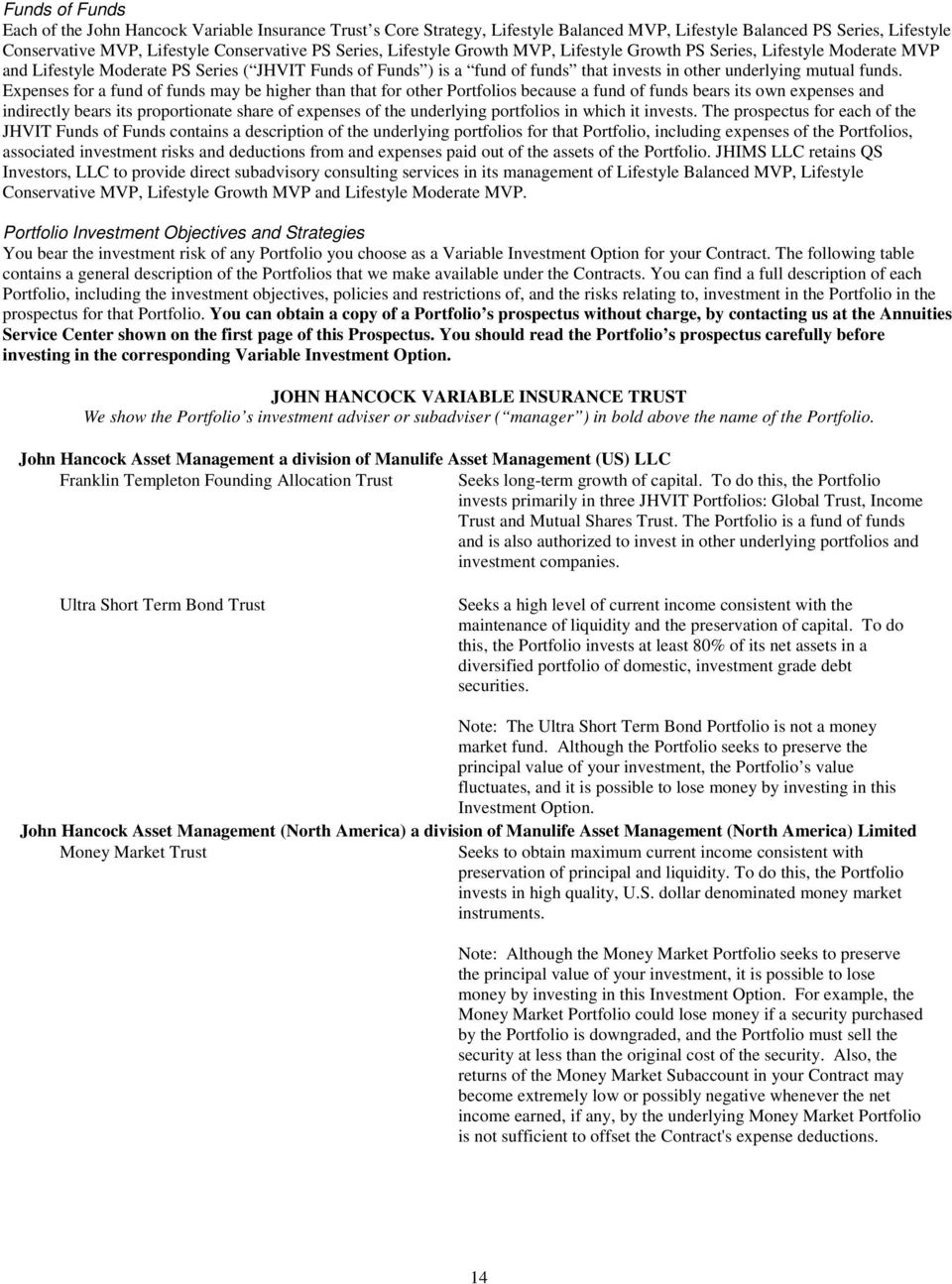
17 Funds of Funds Each of the John Hancock Variable Insurance Trust s Core Strategy, Lifestyle Balanced MVP, Lifestyle Balanced PS Series, Lifestyle Conservative MVP, Lifestyle Conservative PS Series, Lifestyle Growth MVP, Lifestyle Growth PS Series, Lifestyle Moderate MVP and Lifestyle Moderate PS Series ( JHVIT Funds of Funds ) is a fund of funds that invests in other underlying mutual funds. Expenses for a fund of funds may be higher than that for other Portfolios because a fund of funds bears its own expenses and indirectly bears its proportionate share of expenses of the underlying portfolios in which it invests. The prospectus for each of the JHVIT Funds of Funds contains a description of the underlying portfolios for that Portfolio, including expenses of the Portfolios, associated investment risks and deductions from and expenses paid out of the assets of the Portfolio. JHIMS LLC retains QS Investors, LLC to provide direct subadvisory consulting services in its management of Lifestyle Balanced MVP, Lifestyle Conservative MVP, Lifestyle Growth MVP and Lifestyle Moderate MVP. Portfolio Investment Objectives and Strategies You bear the investment risk of any Portfolio you choose as a Variable Investment Option for your Contract. The following table contains a general description of the Portfolios that we make available under the Contracts. You can find a full description of each Portfolio, including the investment objectives, policies and restrictions of, and the risks relating to, investment in the Portfolio in the prospectus for that Portfolio. You can obtain a copy of a Portfolio s prospectus without charge, by contacting us at the Annuities Service Center shown on the first page of this Prospectus. You should read the Portfolio s prospectus carefully before investing in the corresponding Variable Investment Option. JOHN HANCOCK VARIABLE INSURANCE TRUST We show the Portfolio s investment adviser or subadviser ( manager ) in bold above the name of the Portfolio. John Hancock Asset Management a division of Manulife Asset Management (US) LLC Franklin Templeton Founding Allocation Trust Seeks long-term growth of capital. To do this, the Portfolio invests primarily in three JHVIT Portfolios: Global Trust, Income Trust and Mutual Shares Trust. The Portfolio is a fund of funds and is also authorized to invest in other underlying portfolios and investment companies. Ultra Short Term Bond Trust Seeks a high level of current income consistent with the maintenance of liquidity and the preservation of capital. To do this, the Portfolio invests at least 80% of its net assets in a diversified portfolio of domestic, investment grade debt securities. Note: The Ultra Short Term Bond Portfolio is not a money market fund. Although the Portfolio seeks to preserve the principal value of your investment, the Portfolio s value fluctuates, and it is possible to lose money by investing in this Investment Option. John Hancock Asset Management (North America) a division of Manulife Asset Management (North America) Limited Money Market Trust Seeks to obtain maximum current income consistent with preservation of principal and liquidity. To do this, the Portfolio invests in high quality, U.S. dollar denominated money market instruments. Note: Although the Money Market Portfolio seeks to preserve the principal value of your investment, it is possible to lose money by investing in this Investment Option. For example, the Money Market Portfolio could lose money if a security purchased by the Portfolio is downgraded, and the Portfolio must sell the security at less than the original cost of the security. Also, the returns of the Money Market Subaccount in your Contract may become extremely low or possibly negative whenever the net income earned, if any, by the underlying Money Market Portfolio is not sufficient to offset the Contract's expense deductions. 14
18 JOHN HANCOCK VARIABLE INSURANCE TRUST We show the Portfolio s investment adviser or subadviser ( manager ) in bold above the name of the Portfolio. John Hancock Asset Management a division of Manulife Asset Management (US) LLC and John Hancock Asset Management (North America) a division of Manulife Asset Management (North America) Limited Core Strategy Trust Seeks long term growth of capital; current income is also a consideration. To do this, the Portfolio invests approximately 70% of its total assets in equity securities and portfolios which invest primarily in equity securities and approximately 30% of its total assets in fixed-income securities and portfolios which invest primarily in fixed income securities. The Portfolio is a fund of funds and is also authorized to invest in other underlying portfolios and investment companies. Lifestyle Balanced MVP Lifestyle Balanced PS Series Seeks growth of capital and current income while seeking to both manage the volatility of return and limit the magnitude of Portfolio losses. The Portfolio seeks to limit the volatility of returns to a range of 8.25% to 10.25%. The Portfolio is a fund of funds and invests primarily in underlying portfolios that invest primarily in equity securities and underlying portfolios that invest primarily in fixed-income securities. The Portfolio s risk management strategy may cause the Portfolio s economic exposure to equity securities, fixed-income securities and cash and cash equivalents to fluctuate and during extreme market volatility, the Portfolio s economic exposure to either equity securities or fixed-income securities could be reduced to 0% and its economic exposure to cash and cash equivalents could increase to 100%. The subadvisor normally will seek to limit the Portfolio s exposure to equity securities (either directly or through investment in underlying portfolios or derivatives) to no more than 55%. Seeks a balance between a high level of current income and growth of capital, with a greater emphasis on growth of capital. The Portfolio operates as a fund of funds and normally invests approximately 50% of its assets in underlying portfolios that invest primarily in equity securities or in futures contracts on equity markets and approximately 50% of its assets in underlying portfolios that invest primarily in fixed-income securities or in futures contracts on fixed-income markets. Underlying portfolios may include ETFs and the Portfolio may invest a significant portion of its assets in ETFs. John Hancock Asset Management a division of Manulife Asset Management (US) LLC and John Hancock Asset Management (North America) a division of Manulife Asset Management (North America) Limited 15

19 JOHN HANCOCK VARIABLE INSURANCE TRUST We show the Portfolio s investment adviser or subadviser ( manager ) in bold above the name of the Portfolio. Lifestyle Conservative MVP Lifestyle Conservative PS Series Lifestyle Growth MVP Lifestyle Growth PS Series Seeks current income and growth of capital while seeking to both manage the volatility of return and limit the magnitude of Portfolio losses. The Portfolio seeks to limit the volatility of returns to a range of 5.5% to 6.5%. The Portfolio is a fund of funds and invests primarily in underlying portfolios that invest primarily in equity securities and underlying portfolios that invest primarily in fixed-income securities. The Portfolio s risk management strategy may cause the Portfolio s economic exposure to equity securities, fixed-income securities and cash and cash equivalents to fluctuate and during extreme market volatility, the Portfolio s economic exposure to either equity securities or fixed-income securities could be reduced to 0% and its economic exposure to cash and cash equivalents could increase to 100%. The subadvisor normally will seek to limit the Portfolio s exposure to equity securities (either directly or through investment in underlying portfolios or derivatives) to no more than 22%. Seeks a high level of current income with some consideration given to growth of capital. The Portfolio operates as a fund of funds and normally invests approximately 80% of its assets in underlying portfolios that invest primarily in fixed-income securities or in futures contracts on fixed-income markets and approximately 20% of its assets in underlying portfolios that invest primarily in equity securities or in futures contracts on equity markets. Underlying portfolios may include ETFs and the Portfolio may invest a significant portion of its assets in ETFs. Seeks long-term growth of capital while seeking to both manage the volatility of return and limit the magnitude of Portfolio losses. The Portfolio seeks to limit the volatility of returns to a range of 11% to 13%. The Portfolio is a fund of funds and invests primarily in underlying portfolios that invest primarily in equity securities and underlying portfolios that invest primarily in fixedincome securities. The Portfolio s risk management strategy may cause the Portfolio s economic exposure to equity securities, fixed-income securities and cash and cash equivalents to fluctuate and during extreme market volatility, the Portfolio s economic exposure to either equity securities or fixed-income securities could be reduced to 0% and its economic exposure to cash and cash equivalents could increase to 100%. The subadvisor normally will seek to limit the Portfolio s exposure to equity securities (either directly or through investment in underlying portfolios or derivatives) to no more than 77%. Seeks long-term growth of capital. Current income is also a consideration. The Portfolio operates as a fund of funds and normally invests approximately 70% of its assets in underlying portfolios that invest primarily in equity securities or in futures contracts on equity markets and approximately 30% of its assets in underlying portfolios that invest primarily in fixed-income securities or in futures contracts on fixed-income markets. Underlying portfolios may include ETFs and the Portfolio may invest a significant portion of its assets in ETFs. John Hancock Asset Management a division of Manulife Asset Management (US) LLC and John Hancock Asset Management (North America) a division of Manulife Asset Management (North America) Limited 16

20 JOHN HANCOCK VARIABLE INSURANCE TRUST We show the Portfolio s investment adviser or subadviser ( manager ) in bold above the name of the Portfolio. Lifestyle Moderate MVP Lifestyle Moderate PS Series Seeks current income and growth of capital while seeking to both manage the volatility of return and limit the magnitude of Portfolio losses. The Portfolio seeks to limit the volatility of returns to a range of 7% to 9%. The Portfolio is a fund of funds and invests primarily in underlying portfolios that invest primarily in equity securities and underlying portfolios that invest primarily in fixed-income securities. The Portfolio s risk management strategy may cause the Portfolio s economic exposure to equity securities, fixed-income securities and cash and cash equivalents to fluctuate and during extreme market volatility, the Portfolio s economic exposure to either equity securities or fixed-income securities could be reduced to 0% and its economic exposure to cash and cash equivalents could increase to 100%. The subadvisor normally will seek to limit the Portfolio s exposure to equity securities (either directly or through investment in underlying portfolios or derivatives) to no more than 44%. Seeks a balance between a high level of current income and growth of capital, with a greater emphasis on income. The Portfolio operates as a fund of funds and normally invests approximately 60% of its assets in underlying portfolios that invest primarily in fixed-income securities or in futures contracts on fixed-income markets and approximately 40% of its assets in underlying portfolios that invest primarily in equity securities or in futures contracts on equity markets. Underlying portfolios may include ETFs and the Portfolio may invest a significant portion of its assets in ETFs. For more information regarding these Portfolios, including information relating to their investment objectives, policies and restrictions, and the risks of investing in such Portfolios, please see the prospectuses for the applicable Portfolios. You can obtain a copy of the Portfolios prospectuses by contacting the Annuities Service Center shown on the first page of this Prospectus. You should read each Portfolio s prospectus carefully before investing in a corresponding Variable Investment Option. Voting Interest We vote Portfolio shares held in a Separate Account at any Portfolio shareholder meeting in accordance with timely voting instructions received from the persons having the voting interest under the Contract. We determine the number of Portfolio shares for which voting instructions may be given not more than 90 days prior to the meeting. We arrange for voting materials to be distributed to each person having the voting interest under the Contract together with appropriate forms for giving voting instructions. If there are shares of a Portfolio held by a Subaccount for which we do not receive timely voting instructions, we will vote those shares in the same proportion as the total votes for all of our registered separate accounts for which we have received timely instructions. We will vote all Portfolio shares that we hold directly in our General Account in the same proportion as the total votes for all our registered separate accounts and those of any of our affiliates for which we have received timely instructions. One effect of this proportional voting is that a small number of Contract Owners can determine the outcome of a vote. During the Accumulation Period, the Contract Owner has the voting interest under a Contract. We determine the number of votes for each Portfolio for which voting instructions may be given by dividing the value of the Investment Option corresponding to the Subaccount in which such Portfolio shares are held by the net asset value per share of that Portfolio. 17
21 During the Pay-out Period, the Annuitant has the voting interest under a Contract. We determine the number of votes as to each Portfolio for which voting instructions may be given by dividing the reserve for the Contract allocated to the Subaccount in which such Portfolio shares are held by the net asset value per share of that Portfolio. Generally, the number of votes tends to decrease as annuity payments progress since the amount of reserves attributable to a Contract will usually decrease after commencement of annuity payments. We will determine the number of Portfolio shares for which voting instructions may be given not more than 90 days prior to the meeting. We reserve the right to make any changes in the voting rights described above that may be permitted by the federal securities laws, regulations, or interpretations thereof. 18
22 V. Description of the Contract Eligibility The Contract may be purchased only as an IRA Rollover, funded by distributions from a GIFL Retirement Plan. We will issue a Contract as either a traditional IRA or as a Roth IRA, but not both. If you want both a traditional IRA and a Roth IRA, you may need to issue instructions to your plan sponsor or administrator (or complete separate applications) to purchase separate Contracts. When you purchase a Contract from John Hancock New York, you will receive a certificate of coverage under a group contract issued by John Hancock New York to trustees of one or more trusts which permit individuals to purchase IRAs or for IRA annuities. General Contract Provisions Prior to the Annuity Commencement Date Purchase Payments Your initial Purchase Payment must include a distribution of the GIFL Account Value to a Contract that you intend to use as a traditional IRA or a Roth IRA. After that, and subject to eligibility and our restrictions, you may continue your IRA contributions or make Additional Purchase Payments either through an IRA Rollover from a tax-qualified retirement plan in which you participate, or directly to our Annuities Service Center. (Please see VII. Federal Tax Matters for general information about IRA contributions and special qualification rules that apply to Roth IRAs.) We usually restrict the total amount of Additional Purchase Payments you make after the first Contract Anniversary to $25,000 measured over the life of the Contract, but we may approve a higher amount. We do not permit you to make Additional Purchase Payments (other than the initial Purchase Payment) on or after the oldest Annuitant or co-annuitant s 81 st birthday. All Purchase Payments must be in U.S. dollars. You designate how your Purchase Payments are to be allocated among the Investment Options. You may change the allocation of Additional Purchase Payments at any time by notifying us in writing (or by telephone or electronically if you comply with our telephone and electronic transaction procedures described in Telephone and Electronic Transactions in this section, below). You should consult with your own qualified tax advisor regarding any payment limits under your IRA. New Holding Period for Certain Additional Purchase Payments. We reserve the right to reset the holding period if you make an Additional Purchase Payment on or before the Lifetime Income Date, and either: the Additional Purchase Payment exceeds 20% of your Benefit Base at the time of payment; or the Additional Purchase Payment, when combined with all other Purchase Payments you make during that Contract Year, exceeds 20% of your Benefit Base. This means that we can change and defer the Lifetime Income Date, and defer our guarantee of a Lifetime Income Amount, for up to 5 Contract Years from the date you make an Additional Purchase Payment that exceeds the limits described above. Accumulation Units During the Accumulation Period, we establish an Investment Account for you for each Variable Investment Option to which you allocate a portion of your Contract Value. We credit amounts to those Investment Options in the form of accumulation units to measure the value of the variable portion of your Contract during the Accumulation Period. We calculate and credit the number of accumulation units in each of your Contract s Investment Options by dividing (i) the amount allocated to that Investment Option by (ii) the value of an accumulation unit for that Investment Option we next compute after a purchase transaction is complete. We credit Purchase Payments received by mail or wire transfer on the Business Day on which they are received in Good Order at our Annuities Service Center, and no later than two Business Days after our receipt of all information necessary for issuing the Contract. We will inform you of any deficiencies preventing processing if your Contract cannot be issued. If the deficiencies are not remedied within five Business Days after receipt of your Purchase Payment, we will return your Purchase Payment promptly, unless you specifically consent to our retaining your Purchase Payment until all necessary information is received. We credit Purchase Payments received by wire transfer from broker-dealers on the Business Day received by us if the broker-dealers have made special arrangements with us. We deduct accumulation units based on the value of an accumulation unit we next compute each time you make a withdrawal or transfer amounts from an Investment Option, and when we deduct certain Contract charges, pay death proceeds, or apply amounts to an Annuity Option. 19
23 Value of Accumulation Units The value of your accumulation units will vary from one Business Day to the next depending upon the investment results of the Investment Options holding Contract assets. We arbitrarily set the value of an accumulation unit for each Subaccount on the first Business Day the Subaccount was established. We determine the value of an accumulation unit for any subsequent Business Day by multiplying (i) the value of an accumulation unit for the immediately preceding Business Day by (ii) the net investment factor for that Subaccount (described below) for the Business Day on which the value is being determined. We value accumulation units as of the end of each Business Day. We deem a Business Day to end, for these purposes, at the time a Portfolio determines the net asset value of its shares. We will use a Portfolio share s net asset value at the end of a Business Day to determine accumulation unit value for a Purchase Payment, withdrawal or transfer transaction only if: your Purchase Payment transaction is complete before the close of daytime trading on the New York Stock Exchange (usually 4:00 p.m. Eastern Time) for that Business Day; or we receive your request for a withdrawal or transfer of Contract Value at the Annuities Service Center before the close of daytime trading on the New York Stock Exchange for that Business Day. Automated Transactions. Automated transactions include transfers under the Asset Rebalancing program, pre-scheduled withdrawals, Required Minimum Distributions, substantially equal periodic payments under section 72(t) of the Code, transactions scheduled to occur on your Contract Anniversary, and annuity payments. Automated transactions are processed and valued as of the date they are scheduled, unless the scheduled day is not a Business Day. In that case, the transaction will be processed and valued on the next Business Day unless, with respect to Required Minimum Distributions, substantially equal periodic payments under section 72(t) of the Code, and annuity payments only, the next Business Day falls in the subsequent calendar year, in which case the transaction will be processed and valued on the prior Business Day. Please see the SAI for more information on processing automated transactions. Net Investment Factor The net investment factor is an index used to measure the investment performance of a Subaccount over a valuation period. The net investment factor may be greater than, less than or equal to one; therefore, the value of an accumulation unit may increase, decrease or remain the same. We determine the net investment factor for each Subaccount for any valuation period by dividing (a) by (b) and subtracting (c) from the result, where: (a) is the net asset value per share of a Portfolio share held in the Subaccount determined at the end of the current valuation period, plus any dividends and distributions received per share during the current valuation period; (b) is the net asset value per share of a Portfolio share held in the Subaccount determined as of the end of the immediately preceding valuation period; and (c) is a factor representing the charges deducted from the Subaccount on a daily basis for Annual Separate Account Expenses. Transfers Among Investment Options Prior to the Annuity Commencement Date, you may transfer amounts among the Variable Investment Options, subject to the frequent trading restrictions set forth below. You may make a transfer by providing written notice to us, by telephone or by other electronic means that we may provide through the Internet (see Telephone and Electronic Transactions, below). We will cancel accumulation units from the Investment Option from which you transfer amounts and we will credit accumulation units to the Investment Option to which you transfer amounts. Your Contract Value on the date of the transfer will not be affected by a transfer. You must transfer at least $300 or, if less, the entire value of the Investment Option. If after the transfer the amount remaining in the Investment Option is less than $100, then we may transfer the entire amount instead of the requested amount. Currently, we do not impose a charge for transfer requests. The first twelve transfers in a Contract Year are free of any transfer charge. For each additional transfer in a Contract Year, we do not currently assess a charge but we reserve the right (to the extent permitted by your Contract) to assess a reasonable charge (not to exceed the lesser of $25 or 2% of the amount transferred) to reimburse us for the expenses of processing transfers. Frequent Transfer Restrictions. Investment Options in variable annuity and variable life insurance products can be a target for abusive transfer activity because these products value their Investment Options on a daily basis and allow transfers among Investment Options without immediate tax consequences. As a result, some investors may seek to frequently transfer into and out of Variable Investment Options in reaction to market news or to exploit some perceived pricing inefficiency. Whatever the reason, frequent transfer activity can harm long-term investors in a Variable Investment Option since such activity may expose a Variable Investment Option s underlying Portfolio to increased Portfolio transaction costs and/or disrupt the Portfolio manager s ability to effectively manage a Portfolio in accordance with its investment objective and policies, both of which may result in dilution with respect to interests held for long-term investment. 20
24 To discourage disruptive frequent trading activity, we have adopted a policy for each Separate Account to restrict transfers to two per calendar month per Contract, with certain exceptions, and have established procedures to count the number of transfers made under a Contract. Under the current procedures of the Separate Accounts, we count all transfers made during each Business Day as a single transfer. We do not count: (a) scheduled transfers made pursuant to our Asset Rebalancing program, (b) transfers made within a prescribed period before and after a substitution of underlying Portfolios and (c) transfers made after the Annuity Commencement Date (these transfers are subject to a 30-day notice requirement, however, as described in Annuitization Provisions Transfers after Annuity Commencement Date ). Under each Separate Account s policy and procedures, Contract Owners may transfer to the Ultra Short Term Bond Investment Option even if a Contract Owner reaches the two transfers per month limit if 100% of the Contract Value in all Variable Investment Options is transferred to that Ultra Short Term Bond Investment Option. If such a transfer to the Ultra Short Term Bond Investment Option is made, for a 30-calendar day period after such transfer, a Contract Owner may not make any subsequent transfers from that Ultra Short Term Bond Investment Option to another Variable Investment Option. We apply each Separate Account s policy and procedures uniformly to all Contract Owners. We reserve the right to take other actions to restrict trading, including, but not limited to: restricting the number of transfers made during a defined period; restricting the dollar amount of transfers; restricting the method used to submit transfers (e.g., requiring transfer requests to be submitted in writing via U.S. mail); and restricting transfers into and out of certain Subaccount(s). In addition, we reserve the right to defer a transfer at any time we are unable to purchase or redeem shares of the Portfolios (see Withdrawals in this section, below, for details on when suspensions of redemptions may be permissible). We also reserve the right to modify or terminate the transfer privilege at any time (to the extent permitted by applicable law). In addition to the transfer restrictions that we impose, the John Hancock Variable Insurance Trust also has adopted policies under Rule 22c-2 of the 1940 Act to detect and deter abusive short-term trading. Accordingly, a Portfolio may require us to impose trading restrictions if it discovers violations of its frequent short-term trading policy. We will provide tax identification numbers and other Contract Owner transaction information to John Hancock Variable Insurance Trust upon request, which it may use to identify any pattern or frequency of activity that violates its short-term trading policy. While we seek to identify and prevent disruptive frequent trading activity, it is not always possible to do so. Therefore, we cannot provide assurance that the restrictions we impose will be successful in restricting disruptive frequent trading activity and avoiding harm to long-term investors. Until the close of business on July 1, 2014, you may transfer amounts out of any Investment Option that invests in the Lifestyle Balanced MVP, Lifestyle Conservative MVP, Lifestyle Growth MVP or Lifestyle Moderate MVP into one or more other Investment Options available under your Contract with no charge, and the transfer will not count against the number of permitted transfers. Maximum Number of Investment Options We currently do not limit the number of Investment Options to which you may allocate Purchase Payments. Restrictions on the Money Market Investment Option. You will not be permitted to make new investments in the Money Market Investment Option unless all or a portion of your Contract Value was allocated to the Money Market Investment Option on April 26, If so, you may continue to make new investments through Additional Purchase Payments (if not otherwise restricted) to that Investment Option. However, transfers of amounts from other Investment Options are not permitted, and you can no longer invest in the Money Market Investment Option if at any time thereafter you fail to maintain a minimum balance in that Option. Telephone and Electronic Transactions We permit you to request transfers automatically by telephone. You can also apply to request withdrawals automatically by telephone. We also encourage you to access information about your Contract, request transfers and perform some transactions electronically through the Internet. Please contact the John Hancock Annuities Service Center at the applicable telephone number or Internet address shown on the first page of this Prospectus for more information on electronic transactions. To access information and perform electronic transactions through our website, we require you to create an account with a username and password, and to maintain a valid address. You may also authorize other people to make certain transaction requests by telephone by sending us instructions in a form acceptable to us. If you register for electronic delivery, we keep your personal information confidential and secure, and we do not share this information with outside marketing agencies. We will not be liable for following instructions communicated by telephone or electronically that we reasonably believe to be genuine. We will employ reasonable procedures to confirm that instructions we receive are genuine. Our procedures require you to provide information to verify your identity when you call us and we will record all conversations with you. When someone contacts us by 21
25 telephone and follows our procedures, we will assume that you are authorizing us to act upon those instructions. For electronic transactions through the Internet, you will need to provide your username and password. You are responsible for keeping your password confidential and must notify us of: any loss or theft of your password; or any unauthorized use of your password. We may be liable for any losses due to unauthorized or fraudulent instructions only where we fail to employ our procedures properly. All transaction instructions we receive by telephone or electronically will be followed by either a hardcopy or electronic delivery of a transaction confirmation. Transaction instructions we receive by telephone or electronically before the close of any Business Day will usually be effective at the end of that day. Your ability to access or transact business electronically may be limited due to circumstances beyond our control, such as system outages, or during periods when our telephone lines or our website may be busy. We may, for example, experience unusual volume during periods of substantial market change. We may suspend, modify or terminate our telephone or electronic transaction procedures at any time. We may, for example, impose limits on the maximum withdrawal amount available to you through a telephone transaction. Also, as stated earlier in this Prospectus, we have imposed restrictions on transfers and reserve the right to take other actions to restrict trading, including the right to restrict the method used to submit transfers (e.g., by requiring transfer requests to be submitted in writing via U.S. mail). We also reserve the right to suspend or terminate the transfer privilege altogether with respect to anyone who we feel is abusing the privilege to the detriment of others. Special Transfer Services Asset Rebalancing Program We administer an Asset Rebalancing program which enables you to specify the allocation percentage levels you would like to maintain in particular Investment Options. We will automatically rebalance your Contract Value pursuant to the schedule described below to maintain the indicated percentages by transfers among the Investment Options. You must include your entire value in the Variable Investment Options in the Asset Rebalancing program. Other investment programs or other transfers or withdrawals may not work in concert with the Asset Rebalancing program. Therefore, you should monitor your use of these other programs and any other transfers or withdrawals while the Asset Rebalancing program is being used. If you are interested in the Asset Rebalancing program, you may obtain a separate authorization form and full information concerning the program and its restrictions from your financial advisor or our Annuities Service Center. There is no charge for participation in the Asset Rebalancing program. We will permit asset rebalancing only on the following time schedules: quarterly on the 25th day of the last month of the calendar quarter (or the next Business Day if the 25th is not a Business Day); semi-annually on June 25th and December 26th (or the next Business Day if these dates are not Business Days); or annually on December 26th (or the next Business Day if December 26th is not a Business Day). You should consult with your financial advisor to assist you in determining whether the Asset Rebalancing program is suited for your financial needs and investment risk tolerance, and in determining appropriate percentages for each Investment Option you select. Withdrawals During the Accumulation Period, you may withdraw all or a portion of your Contract Value upon written request (complete with all necessary information) to our Annuities Service Center. You may make withdrawals by telephone as described above under Telephone and Electronic Transactions. For certain Contracts, exercise of the withdrawal right may require the consent of the Annuitant s Spouse under the Code. In the case of a total withdrawal, we will pay the Contract Value as of the date of receipt of the request in Good Order at our Annuities Service Center, minus any applicable administrative fee or tax. We will then cancel the Contract. In the case of a withdrawal, we will pay the amount requested, reduced by any applicable administrative fee or amount withheld for taxes, and cancel accumulation units credited to each Investment Option equal in value to the amount withdrawn from that Investment Option. When making a withdrawal, you may specify the Investment Options from which the withdrawal is to be made. The amount requested from an Investment Option may not exceed the value of that Investment Option. If you do not specify the Investment Options from which a withdrawal is to be taken, we will take the withdrawal proportionally from all of your Variable Investment Options. There is no limit on the frequency of withdrawals. We will pay the amount of any withdrawal from the Variable Investment Options promptly, and in any event within seven calendar days of receipt of the request, complete with all necessary information, at our Annuities Service Center. We reserve the right to defer the right of withdrawal or postpone payments for any period when: the New York Stock Exchange is closed (other than customary weekend and holiday closings); trading on the New York Stock Exchange is restricted; 22
26 an emergency exists as determined by the SEC, as a result of which disposal of securities held in the Separate Accounts is not reasonably practicable or it is not reasonably practicable to determine the value of the Separate Accounts net assets; pursuant to SEC rules, the Money Market Subaccount suspends payment of redemption proceeds in connection with a liquidation of the underlying Portfolio; or the SEC, by order, so permits for the protection of security holders. Applicable rules and regulations of the SEC shall govern as to whether trading is restricted or an emergency exists. Impact of Divorce. In the event that you and your Spouse become divorced, we will treat any request to reduce or divide benefits under a Contract as a request for a withdrawal of Contract Value. The transaction may be subject to any applicable tax. Tax Considerations. Withdrawals from the Contract may be subject to income tax and a 10% penalty tax (see VII. Federal Tax Matters ). Signature Guarantee Requirements for Surrenders and Withdrawals (Not applicable to Contracts issued in New Jersey) We may require that you provide a signature guarantee on a surrender or withdrawal request in the following circumstances: you are requesting that we mail the amount withdrawn to an alternate address; or you have changed your address within 30 days of the withdrawal request; or you are requesting a withdrawal in the amount of $250,000 or greater. We must receive the original signature guarantee on your withdrawal request. We will not accept copies or faxes of a signature guarantee. You may obtain a signature guarantee at most banks, financial institutions or credit unions. A notarized signature is not the same as a signature guarantee and will not satisfy this requirement. There may be circumstances, of which we are not presently aware, in which we would not impose a signature guarantee on a surrender or withdrawal as described above. Special Withdrawal Services The Income Made Easy Program Our Income Made Easy Program provides you with an automatic way to access guaranteed withdrawal amounts. There is no charge for participation in this program. For more information please read Pre-Authorized Withdrawals The Income Made Easy Program in the Guaranteed Income for Life Provisions section below. Guaranteed Income for Life Provisions Overview The Contract provides a guaranteed minimum withdrawal benefit. This benefit provides a Lifetime Income Amount, which is available for annual withdrawals starting on a Lifetime Income Date. If you limit your annual withdrawals of Contract Value to the Lifetime Income Amount, we guarantee that we will make the Lifetime Income Amount available to you, as long as you are the Annuitant under the Contract. You may elect, in most cases, to cover the lifetimes of you and your Spouse by selecting a Spousal Lifetime Income Amount benefit. Under the Spousal Lifetime Income Amount benefit, we guarantee that we will make the Lifetime Income Amount available as long as you (the Annuitant ) or your Spouse (the co-annuitant ) remains alive. The Spousal Lifetime Income Amount benefit will end if there is a change in the Contract that removes the co-annuitant from coverage and the Annuitant subsequently dies. Although the Lifetime Income Amount guarantees a minimum annual withdrawal amount, you may take withdrawals of any amount of Contract Value before the Annuity Commencement Date. We may reduce the Lifetime Income Amount, however if you take any withdrawal before the Lifetime Income Date, or an Excess Withdrawal in any year after that. We also may increase the Lifetime Income Amount if you make Additional Purchase Payments, or if we step up the Benefit Base to reflect current Contract Value. Determination of the Lifetime Income Date Single Life and Continuation Single Life Lifetime Income Amounts. Under a Single Life or a Continuation Single Life form of Lifetime Income Amount, the earliest Lifetime Income Date is the date we issue your Contract if: you, the Annuitant, are age 59½ or older at that time; and you (or your decedent Spouse) were a participant in your employer s GIFL Retirement Plan and completed the holding period requirement for the guaranteed minimum withdrawal benefit we provided for your (or your decedent Spouse s) account in that plan; and the amount of your initial Purchase Payment for the Contract does not exceed your GIFL Account Value by more than 20% of the Transferred Benefit Base from the GIFL Retirement Plan. 23
27 In all other cases, the earliest Lifetime Income Date for a Single Life form of Lifetime Income Amount is the Anniversary Date of your Contract on or next following the date: you, the Annuitant, are age 59½; and you complete a holding period of no more than 5 years. We will transfer credit for any completed holding period from your (or your decedent Spouse s) account with your employer s GIFL Retirement Plan if the amount of your initial Purchase Payment for the Contract does not exceed your GIFL Account Value by more than 20% of the Transferred Benefit Base from the GIFL Retirement Plan. We will do this by incorporating the earliest Lifetime Income Date under the GIFL Retirement Plan. We may change the earliest Lifetime Income Date if you change a Single Life Lifetime Income Amount to a Spousal Lifetime Income Amount. Please read the following section for more information. Spousal Lifetime Income Amount. Under a Spousal Lifetime Income Amount, the earliest Lifetime Income Date is the date we issue your Contract if: you, the Annuitant, and your Spouse, the co-annuitant, are both age 59½ or older at that time; and you were a participant in your employer s GIFL Retirement Plan and completed the holding period requirement for the guaranteed minimum withdrawal benefit we provided for your account; and the amount of your initial Purchase Payment for the Contract does not exceed your GIFL Account Value by more than 20% of the Transferred Benefit Base from the GIFL Retirement Plan. In all other cases, the earliest Lifetime Income Date for a Spousal Lifetime Income Amount is the Anniversary Date of your Contract on or next following the date: you, the Annuitant, and your Spouse, the co-annuitant, are both age 59½ or older; and you complete a holding period of no more than 5 years. We will transfer credit for any completed holding period from your (or your decedent Spouse s) account with your employer s GIFL Retirement Plan if your initial Purchase Payment for the Contract does not exceed your GIFL Account Value by more than 20% of the Transferred Benefit Base from the GIFL Retirement Plan. We will do this by incorporating the earliest Lifetime Income Date under the GIFL Retirement Plan. We may change the Lifetime Income Date if you change a Spousal Lifetime Income Amount to a Single Life Lifetime Income Amount. Please read Choosing a Single Life, Continuation Single Life or a Spousal Lifetime Income Amount, below, for more information. Deferral of Lifetime Income Date. You may defer a Lifetime Income Date if you defer taking any withdrawals on or after the earliest Lifetime Income Date. If you do, you may continue to change from a Single Life (but not from a Continuation Single Life) to a Spousal Lifetime Income Amount until you take a withdrawal, as described in the following section. We reserve the right to reset the holding period and defer the Lifetime Income Date for up to 5 Contract Years if you make certain Additional Purchase Payments before the Lifetime Income Date. Please see V. Description of the Contract Purchase Payments for more information. Choosing a Single Life, Continuation Single Life or Spousal Lifetime Income Amount At Issue. You select a Single Life, Continuation Single Life or Spousal form of Lifetime Income Amount when you purchase a Contract. You can select a Single Life Lifetime Income Amount (i.e., 5% of the Benefit Base) if: you are the Annuitant under the Contract and we did not make any payments under your employer s GIFL Retirement Plan to you or to any current, former or decedent Spouse of yours that was covered by our Spousal Lifetime Income Amount minimum guaranteed withdrawal benefit; or you are the Annuitant under the Contract; and o you had established an account in your GIFL Retirement Plan that was covered by a Spousal minimum guaranteed withdrawal benefit, and o you subsequently split and changed it to two single life accounts in connection with a divorce or a legal separation; and o you do not include your Spouse as a co-annuitant in the Contract you purchase; and o you are not eligible for a Continuation Single Life Lifetime Income Amount. 24
28 You can select a Continuation Single Life Lifetime Income Amount (i.e., 4.5% of the Benefit Base) if: you are the Annuitant under the Contract; and either you are a surviving Spouse of a former participant under a GIFL Retirement Plan and the beneficiary of a GIFL Retirement Plan account that was covered by a Spousal guarantee; or you are a former participant under a GIFL Retirement Plan that was covered by a Spousal guarantee and your Spouse has died. You can select a Spousal Lifetime Income Amount if: you are the Annuitant under the Contract; and your Spouse is the co-annuitant under the Contract; and you did not establish a single-life minimum guaranteed withdrawal benefit in your GIFL Retirement Plan. Before the Lifetime Income Date. You can change a Single Life Lifetime Income Amount designation to a Spousal Lifetime Income Amount designation before the Lifetime Income Date if: you are the Annuitant under the Contract at the time of change; and you add your current Spouse as a co-annuitant to the Contract at the time of change. If you make this change, we will change the Lifetime Income Date if your Spouse is under age 59½ and younger than you. The new Lifetime Income Date will reflect the Contract Anniversary on or immediately following the date your Spouse is 59½ and you have satisfied any remaining holding period under the Contract. You can change a Spousal Lifetime Income Amount designation to a Single Life Lifetime Income Amount designation before the Lifetime Income Date if: the Lifetime Income Amount had not been determined under your employer s GIFL Retirement Plan for you or for any former, current or decedent Spouse of yours that was covered by a Spousal Lifetime Income Amount minimum guaranteed withdrawal benefit that we provide; and you are the Annuitant under the Contract at the time of change and you remove the co-annuitant from the Contract. If you make any change from a Spousal Lifetime Income Amount and remove the co-annuitant from the Contract, we will change the Lifetime Income Date if the co-annuitant is under age 59½ and younger than you. We will determine the new Lifetime Income Date based on your age and any remaining holding period under the Contract. You can change your designation by contacting the Annuities Service Center and completing any forms that we may require. After the Lifetime Income Date. You can change your designation of a Single Life or Spousal Lifetime Income Amount after the Lifetime Income Date only if you defer making any withdrawals on or after that date. If you do, you can change your designation up until the date you take a withdrawal. We describe how to change Lifetime Income Amount designations in the preceding section. You may select a Spousal Lifetime Income Amount only before you take a withdrawal from the Contract. If you change a Single Life Lifetime Income Amount to a Spousal Lifetime Income Amount, we will calculate a lower Lifetime Income Amount (4.5% of the Benefit Base). Calculation of the Lifetime Income Amount We calculate the Lifetime Income Amount as a percentage of the Benefit Base under your Contract. The Lifetime Income Amount differs between a Single Life, Continuation Single Life and Spousal form of Lifetime Income Amount: the Single Life Lifetime Income Amount equals 5.0% of the Benefit Base; the Continuation Single Life Lifetime Income Amount equals 4.5% of the Benefit Base; and the Spousal Lifetime Income Amount equals 4.5% of the Benefit Base. We issue Contracts with a 4.5% Continuation Single Life Lifetime Income Amount where: the Annuitant is a surviving Spouse of a former participant under a GIFL Retirement Plan; or the Annuitant is a former participant under a GIFL Retirement Plan, and has received distributions from that plan that were covered, in whole or in part, by our Spousal Lifetime Income Amount minimum guaranteed withdrawal benefit. We calculate an initial Benefit Base on the date we issue a Contract. We first calculate the Lifetime Income Amount on the earliest Lifetime Income Date. We recalculate and reduce the Benefit Base and Lifetime Income Amount if you take annual withdrawals that exceed the Lifetime Income Amount. We also reduce the Benefit Base if you take any withdrawals before the Lifetime Income Date. We may increase the Lifetime Income Amount if you make Additional Purchase Payments, or if we step up the Benefit Base to reflect current Contract Value. We also may recalculate the Lifetime Income Amount if you defer the earliest Lifetime Income Date and change the form of the Lifetime Income Amount from a Single Life to a Spousal form or vice versa. 25
29 We may decrease the Benefit Base to reflect withdrawals. We may increase the Benefit Base to reflect Step-Ups and Additional Purchase Payments. Any decrease or increase in the Benefit Base will result in a corresponding decrease or increase in the Lifetime Income Amount. Increases in the Guaranteed Income for Life Feature Impact of Additional Purchase Payments. Prior to the Lifetime Income Date, we will increase the Benefit Base each time you make an Additional Purchase Payment. The new Benefit Base will be the Benefit Base immediately before the Additional Purchase Payment, plus the amount of the Additional Purchase Payment. We reserve the right to reset the holding period and defer the Lifetime Income Date for up to 5 Contract Years if you make certain Additional Purchase Payments before the Lifetime Income Date. Please see V. Description of the Contract Purchase Payments for more information. On and after the Lifetime Income Date, we may increase the Benefit Base each time you make an Additional Purchase Payment to your Contract, subject to the maximum Benefit Base limit of $5 million. The new Benefit Base will be the Benefit Base immediately before the Additional Purchase Payment, plus: The excess, if any, of the Additional Purchase Payment over The amount of your withdrawals reduced by any Purchase Payment since the last time we calculated the Benefit Base (i.e., the last date of a Purchase Payment that we applied to the Benefit Base, the last date we reduced the Benefit Base because of a withdrawal, the last Step-Up Date, or the Lifetime Income Date). If a Purchase Payment increases the Benefit Base after the Lifetime Income Date, we will increase the Lifetime Income Amount. The new Lifetime Income Amount will equal: (for Single Life Lifetime Income Amounts) 5% of the Benefit Base in effect immediately after the Purchase Payment; or (for Continuation Single Life and Spousal Lifetime Income Amounts) 4.50% of the Benefit Base in effect immediately after the Purchase Payment. Please read Calculation of the Lifetime Income Amount, above, for more information. Step-Ups. On the first Contract Anniversary and on each Contract Anniversary after that, up to and including the Age 95 Contract Anniversary (Step-Up Dates), we compare your Contract Value to the Benefit Base and the Lifetime Income Amount. If the Contract Value on any Step-Up Date is greater than the Benefit Base on that date, we will automatically increase (step up) the Benefit Base to equal the Contract Value. We will also increase the Lifetime Income Amount (after the Lifetime Income Date) and the corresponding amount that we deduct for the Guaranteed Income for Life guarantee (see VI. Charges and Deductions Guaranteed Income for Life Fee ). The new Lifetime Income Amount will equal: (for Single Life Lifetime Income Amounts) 5% of the new Benefit Base value after the Step-Up; or (for Continuation Single Life and Spousal Lifetime Income Amounts) 4.50% of the new Benefit Base value after the Step-Up. Please read Calculation of the Lifetime Income Amount, above, for more information. Since the Guaranteed Income for Life fee is a percentage of the Benefit Base, we will increase the amount of the Guaranteed Income for Life fee after a Step-Up to reflect the new Benefit Base. We also reserve the right to increase the rate of the Guaranteed Income for Life fee up to a maximum rate of 0.65%. If we decide to increase the rate at the time of a Step-Up, you will receive advance notice and be given the opportunity of no less than 30 days to decline the automatic Step-Up (see VI. Charges and Deductions Guaranteed Income for Life Fee ). If you decline the Step-Up, the fee rate will not be increased. If you decline an automatic Step-Up, you will have the option to elect to step up the Benefit Base (as well as Lifetime Income Amount) within 30 days of subsequent Step-Up Dates. If you decide to step up the Benefit Base, we will thereafter resume automatic Step-Ups. Impact of Withdrawals before the Lifetime Income Date Each time you take a withdrawal before the Lifetime Income Date, we reduce the Benefit Base on a pro rata basis. This means that we reduce the Benefit Base in the same proportion that your Contract Value is reduced by the withdrawal amount. If you experience unfavorable investment performance, an Excess Withdrawal could result in substantial reductions to your Contract Value and Benefit Base. Your future Lifetime Income Amount could be significantly reduced, and if both your Contract Value and Benefit Base decline to zero before the Lifetime Income Date, you will lose your guaranteed minimum withdrawal benefit. EXAMPLE: Assume that you purchase a Contract through an IRA Rollover when you are 45. (Since you are under age 59½ at time of purchase, the Lifetime Income Date will not occur until the Contract Anniversary following the date you become 59½.) Now assume 26
30 that in the eighth Contract Year, when you are 53, the Contract Value is $80,000, the Benefit Base is $90,000 and you withdraw $5,000 of Contract Value. In this case, you would reduce your Contract Value by 6.25% (i.e., $5,000/$80,000) and we would reduce your Benefit Base by the same percentage ($90,000 times , or $5,625). The Benefit Base after the Excess Withdrawal would be $90,000 minus $5,625, or $84,375. If you take any withdrawals prior to the Lifetime Income Date, we reduce the Benefit Base we use to determine the Lifetime Income Amount on the Lifetime Income Date. If your Contract Value and your Benefit Base decline to zero before the Lifetime Income Date, you will lose the Lifetime Income Amount Guarantee. (See Settlement Phase, below.) Impact of Withdrawals after the Lifetime Income Date After the Lifetime Income Date, you may withdraw the Lifetime Income Amount each Contract Year without affecting the Benefit Base. If your total withdrawals during a Contract Year exceed the Lifetime Income Amount, however, we will reduce the Benefit Base and the Lifetime Income Amount. Each time you take a withdrawal after the Lifetime Income Date, we first determine whether the withdrawal amount is an Excess Withdrawal (i.e., a withdrawal that exceeds the Lifetime Income Amount when combined with any other withdrawals for that Contract Year). If so, we will reduce the Benefit Base on a pro rata basis. We do this by reducing your Benefit Base in the same proportion that your Contract Value is reduced by the entire amount of the withdrawal that resulted in an Excess Withdrawal. Each time we reduce the Benefit Base, we also reduce your Lifetime Income Amount. The reduced Lifetime Income Amount equals: (for Single Life Lifetime Income Amounts) 5% of the new Benefit Base; or (for Spousal Lifetime Income Amounts and Continuation Single Life Lifetime Income Amounts) 4.50% of the new Benefit Base. In all cases, we reduce the Benefit Base and the Lifetime Income Amount for each subsequent Excess Withdrawal that you take during that Contract Year. Please see Appendix A: Guaranteed Income for Life Examples for the impact of withdrawals after the Lifetime Income Date. In certain circumstances, we will not reduce the Benefit Base and/or the Lifetime Income Amount, even where a withdrawal would exceed the Lifetime Income Amount for a Contract Year. These circumstances involve withdrawals taken after the Lifetime Income Date as Life Expectancy Distributions under an automatic distribution program provided by us (see Life Expectancy Distribution Program below). The Contract enters a Settlement Phase in any Contract Year that your Contract Value declines to less than the Lifetime Income Amount if your Benefit Base is greater than zero at that time and you have taken no Excess Withdrawals during that Contract Year (see Settlement Phase below). In the event of an Excess Withdrawal, you will lose the Guaranteed Income for Life benefit if Contract Value declines below the Lifetime Income Amount during the Contract Year of the Excess Withdrawal. The Guaranteed Income for Life benefit terminates if the Contract Value and Benefit Base immediately after a withdrawal are both equal to zero. We may reduce Benefit Base and Lifetime Income Amount values if you take withdrawals that exceed the guaranteed amount of your withdrawals. Excess Withdrawals, with limited exceptions, lower the Lifetime Income Amount guaranteed for future withdrawals. If you have experienced unfavorable investment performance (and therefore your Contract Value is less than your Benefit Base) the reduction could be significantly more than the amount of the Excess Withdrawal and could cause you to lose your guaranteed minimum withdrawal benefit. We reduce your Contract Value and the death proceeds each time you take a withdrawal. We do not change your Benefit Base or Lifetime Income Amount when you make a withdrawal if your total withdrawals during a Contract Year are less than or equal to the Lifetime Income Amount. Tax Considerations See VII. Federal Tax Matters for information on tax considerations related to guaranteed minimum withdrawal benefits. Pre-Authorized Withdrawals The Income Made Easy Program You can pre-authorize periodic withdrawals to receive amounts guaranteed under the Contract. We currently offer our Income Made Easy Program for Contracts to provide income payments for the lifetime of the Covered Person. The full allowable amount is based on the Lifetime Income Amount. You can start taking withdrawals under the Income Made Easy Program no sooner than the earliest available Lifetime Income Date. The Income Made Easy Program allows you to select: (A) the Lifetime Income Amount under your Contract; (B) the full allowable amount plus any amount under our Life Expectancy Distribution program that would exceed the Lifetime Income Amount; (C) the annual amount under our Life Expectancy Distribution program (in lieu of the Lifetime Income Amount); or (D) a specified dollar amount that is less than the Lifetime Income Amount. We may make additional options available in the future or upon request. 27
31 Your participation in the Income Made Easy Program will be suspended (i.e., we will not process any further withdrawals under the Program until you re-enroll) if: you select option A or B; and you take an additional withdrawal outside the Income Made Easy Program in any Contract Year in which the program is in effect. Income Made Easy withdrawals, like other withdrawals: may be subject to income tax (including withholding for taxes) and if you take withdrawals before age 59½, a 10% penalty tax; and reduce the death proceeds. If you are interested in the Income Made Easy Program, you may obtain a separate authorization form and full information concerning the program and its restrictions from your financial advisor or our Annuities Service Center. There is no charge for participation in this program. Life Expectancy Distribution Program You may request us in writing, in a form acceptable to us and received at our Annuities Service Center, to pay you withdrawals that we determine to be part of a series of substantially equal periodic payments over your life expectancy (or, if applicable, the joint life expectancy of you and your Spouse). Withdrawals under our Life Expectancy Distribution program are distributions within a calendar year that are intended to be paid to you as required or contemplated by Code section 401(a)(9), section 408(a)(6), section 408(b)(3), or section 408A(c)(5), as the case may be (we sometimes refer to these as Qualified Death Benefit Stretch Distributions or Required Minimum Distributions ). For further information on such distributions, please see VIII. Federal Tax Matters Contributions to a traditional IRA Required Minimum Distributions. If you are interested in the Life Expectancy Distribution program, you may obtain further information concerning the program and its restrictions from your financial advisor or our Annuities Service Center. There is no charge for participation in this program. To take withdrawals under the Life Expectancy Distribution program, you must participate in the Income Made Easy Program (see the preceding section). Under our Life Expectancy Distribution program, each withdrawal will be in an amount that we determine to be your Contract s proportional share of all Life Expectancy Distributions, based on information that you provide and our understanding of the Code. We reserve the right to make any changes we deem necessary to comply with the Code and Treasury Department regulations. We base our Life Expectancy Distributions calculations on our understanding and interpretation of the requirements under tax law applicable to Required Minimum Distributions and Qualified Death Benefit Stretch Distributions. You should discuss these matters with a qualified tax advisor. Each withdrawal under our Life Expectancy Distribution program will reduce death proceeds and Contract Value. In addition, if you purchase a Contract before the Annuitant turns age 59½ (the younger of the Annuitant and co-annuitant for the Spousal Lifetime Income Amount), and you take any withdrawal before the Lifetime Income Date, we will reduce your Benefit Base by the amount of the withdrawal. After the Lifetime Income Date, however, we will not reduce your Benefit Base or Lifetime Income Amount if a withdrawal under our Life Expectancy Distribution program (based on our current understanding and interpretation of the tax law) causes total withdrawals during a Contract Year to exceed the Lifetime Income Amount and all withdrawals during that year were under our Life Expectancy Distribution program. If you take a withdrawal under our Life Expectancy Distribution program on or after the Lifetime Income Date, we will not make any further withdrawals under our Life Expectancy Distribution program if both the Contract Value and the Benefit Base are depleted to zero. We will make distributions as part of the Contract s Settlement Phase, however, if the Lifetime Income Amount is greater than zero and the Annuitant (or co-annuitant under the Spousal Lifetime Income Amount) is living at that time. We designed our Life Expectancy Distribution program to provide minimum lifetime distributions as described or as required under certain sections of the Code. Withdrawals under our automatic Life Expectancy Distribution program will not be treated as Excess Withdrawals and will not reduce the Benefit Base or Lifetime Income Amount. Settlement Phase We will automatically begin making payments to you, should your Contract Value reduce to zero, subject to the conditions described herein. We automatically make settlement payments during a Contract s Settlement Phase. The Settlement Phase begins if the Contract Value reduces to zero at any time during a Contract Year, there were no Excess Withdrawals during that Contract Year and the Benefit Base is still greater than zero at the time. In the event of an Excess Withdrawal, the Contract will not enter the Settlement Phase if Contract Value declines to zero during the Contract Year of the Excess Withdrawal. 28
32 During the Settlement Phase, the Contract continues but all other rights and benefits under the Contract terminate. We will not accept Additional Purchase Payments, make any Step-Ups or deduct the Guaranteed Income for Life fee during the Settlement Phase. You cannot annuitize once the Settlement Phase begins. At the beginning of the Settlement Phase, we will automatically begin paying an annual settlement amount to you. The settlement payment amount varies: If the Lifetime Income Amount is greater than zero at the start of the Settlement Phase, we will pay an initial settlement amount equal to the remaining Lifetime Income Amount for that Contract Year and make additional annual payments of the Lifetime Income Amount as long as the Annuitant (or co-annuitant under the Spousal Lifetime Income Amount) is living. If you purchased a Contract before the Annuitant turned age 59½ (or the younger of the Annuitant and co-annuitant under the Spousal Lifetime Income Amount), and the Settlement Phase begins before the Lifetime Income Date, we will begin making annual settlement payments following the Lifetime Income Date as long as the Annuitant is living (or as long as either the Annuitant or co-annuitant is living under the Spousal Lifetime Income Amount). In this case, the annual amount will equal the applicable Lifetime Income Amount (i.e., either 4.5% or 5% of the Benefit Base at the Lifetime Income Date). In lieu of annual payments of the settlement amount, we will permit you to elect monthly, quarterly or semi-annual installment payments of the Lifetime Income Amount. Distribution at Death of Annuitant The Contracts described in this Prospectus provide for the distribution of the Contract Value if the Annuitant dies before the Maturity Date. Payment of Death Proceeds. The determination of the distribution upon the death of the Annuitant will be made on the date we receive written notice and proof of death, as well as all required claims forms in Good Order from all Beneficiaries, at our Annuities Service Center. No one is entitled to payment of the death proceeds under the Contract until this time. Proof of death occurs when we receive one of the following at our Annuities Service Center: a certified copy of a death certificate; or a certified copy of a decree of a court of competent jurisdiction as to the finding of death; or any other proof satisfactory to us. Distribution of Death Proceeds. Tax law requirements applicable to Qualified Plans, including IRAs, and the tax treatment of amounts held and distributed under such plans, are quite complex. Accordingly, you should seek competent legal and tax advice regarding requirements governing the distribution of Contract values, including death proceeds, under the plan. In particular, you and your advisor should consider that there is some uncertainty as to the income tax effects of a distribution at death on IRAs (see VII. Federal Tax Matters ). In designating Beneficiaries you may impose restrictions on the timing and manner of payment of death proceeds. The description of the distribution upon the death of the Annuitant in this Prospectus does not reflect any of the restrictions that could be imposed, and it should be understood as describing what will happen if the Contract Owner chooses not to restrict such a distribution under the Contract. If the Contract Owner imposes restrictions, those restrictions will govern payment of the death proceeds to the extent permitted by the Code and by Treasury Department regulations. For Single Life Contracts, we will pay the death proceeds to the Beneficiary if the Annuitant dies before the earlier of the Maturity Date or the Annuity Commencement Date. If there is a surviving co-annuitant, that co-annuitant will be deemed to be the Beneficiary. Upon request, the death proceeds may be taken in the form of a lump sum. In that case, we will pay the death proceeds within seven calendar days of the date that we determine the amount of the death proceeds, subject to postponement under the same circumstances for which payment of withdrawals may be postponed (see Withdrawals above). Beneficiaries who opt for a lump sum payout of their portion of the death proceeds may choose to receive the funds either in a single check or wire transfer or in a John Hancock Safe Access Account ( JHSAA ). Similar to a checking account, the JHSAA provides the Beneficiary access to the payout via a checkbook, and the account earns interest at a variable interest rate. Any interest paid may be taxable. The Beneficiary can obtain the remaining death proceeds in a single sum at any time by cashing one check for the entire amount. Note, however, that a JHSAA is not a true checking account, but is solely a means of distributing the death proceeds. The Beneficiary can only make withdrawals, and not deposits. The JHSAA is part of our General Account; it is not a bank account and it is not insured by the FDIC or any other government agency. As part of our General Account, it is subject to the claims of our creditors. We receive a benefit from all amounts left in the JHSAA. 29
33 If the Beneficiary does not choose a form of payment, or the death proceeds payable upon the death of an Annuitant are not taken in a lump sum, the Contract will continue, subject to the following: The Beneficiary will become the Owner/Annuitant. No Additional Purchase Payments may be made (even if the Beneficiary is a surviving Spouse). If the deceased Annuitant s Spouse is the sole Beneficiary (see Other Contract Provisions Spouse below), he or she may continue the Contract as the new Owner/Annuitant without triggering adverse federal tax consequences. In such a case, the distribution rules applicable when an Annuitant dies will apply when the Spouse, as the Annuitant, dies. If the Beneficiary is not the deceased Owner s Spouse, distribution of the entire interest in the Contract must be made within five years of the Annuitant s death, or alternatively, an individual Beneficiary may take distributions as an annuity, under one of the Annuity Options described below, which begins within one year after the Annuitant s death and is payable over the life of the Beneficiary or over a period not extending beyond the life expectancy of the Beneficiary (see Annuity Options below). Note: we continue to assess the mortality and expense risks charge during this period, even though we bear only the expense risk and not any mortality risk (see VII. Charges and Deductions Mortality and Expense Risks Fee ). If distribution is not made within five years and the Beneficiary has not specified one of the above forms of payment, we will distribute a lump sum cash payment of the Beneficiary s portion of the death proceeds. Also, if distribution is not made as an annuity, upon the death of the Beneficiary, any remaining death proceeds must be distributed immediately in a single sum cash payment. Impact of Death Proceeds on Guaranteed Income for Life Feature The Guaranteed Income for Life feature ends if the Beneficiary takes the death proceeds payable prior to the Annuity Commencement Date as a lump sum under our current administrative procedures. Under certain other circumstances, the Guaranteed Income for Life feature may continue if the Beneficiary elects not to take the death proceeds as a lump sum. Circumstances when coverage ends. If the Beneficiary continues a Contract in force following the death of the Annuitant, coverage under the Guaranteed Income for Life feature ends: for Single Life and Continuation Single Life Lifetime Income Amount. for Spousal Lifetime Income Amount if the deceased is the last of the Annuitant and co-annuitant to die. If a Beneficiary is: 1. The deceased Annuitant s Spouse and the Annuitant dies prior to the first withdrawal on or after the Lifetime Income Date 2. The deceased Annuitant s Spouse and the Annuitant dies on or after the date of the first withdrawal on or after the Lifetime Income Date, and the Beneficiary is the co-annuitant 3. The deceased Annuitant s Spouse and the Annuitant dies on or after the date of the first withdrawal on or after the Lifetime Income Date, and the Beneficiary is not the co-annuitant Then THE GUARANTEED INCOME FOR LIFE: - continues and the Lifetime Income Amount is 4.5% of the Benefit Base. - continues and the Lifetime Income Amount is 4.5% of the Benefit Base. - ends without any further benefit. 4. Not the deceased Annuitant s Spouse - ends without any further benefit. If the Guaranteed Income for Life feature continues, the Benefit Base will continue to be eligible for any remaining Step-Ups, but we may change the date we determine and apply these Step-Ups (including any adjustment to the Guaranteed Income for Life fee) to future anniversaries of the date we determined the death proceeds. Examples. Please refer to Appendix A for hypothetical examples that illustrate the benefit. Death of Annuitant or co-annuitant under a Spousal Lifetime Income Amount guarantee. If the co-annuitant is the first to die, no death proceeds are payable under the Contract. The Spousal Lifetime Income Amount guarantee will continue in effect and we will base the duration of the Lifetime Income Amount only on the lifetime of the survivor Annuitant. We will continue to charge the Guaranteed Income for Life fee. Death of Last Person. If the survivor Annuitant dies while a Spousal Lifetime Income Amount guarantee is in effect, we will reduce the Lifetime Income Amount to zero and we make no additional payments to the Beneficiary. 30
34 Death after Removal of Annuitant or co-annuitant. In certain instances, a Contract may be changed to remove the designation of a person initially designated as an Annuitant or co-annuitant. If that happens and: if the removed person subsequently dies, there will be no impact on the guarantees provided by the Guaranteed Income for Life feature in most cases; and if the remaining designated person subsequently dies, we will consider that person to be the survivor of the Annuitant and co-annuitant and the Guaranteed Income for Life benefit will terminate. Death Proceeds during the Settlement Phase. If death occurs during the Settlement Phase, the only death proceeds we provide are the remaining settlement payments that may become due under that Guaranteed Income for Life benefit: (for Single Life and Continuation Single Life Lifetime Income Amounts Contracts) If the Annuitant dies during the Settlement Phase, we reduce the Lifetime Income Amount to zero and make no further payments. (for Spousal Lifetime Income Amount Contracts) If the first death of the Annuitant and co-annuitant occurs during the Settlement Phase, no additional death proceeds are payable under the Contract and, in most instances, we will continue to make settlement payments in the same manner as before the death. If the death occurs before the Lifetime Income Date, we will calculate a Lifetime Income Amount during the Settlement Phase on the Lifetime Income Date. Settlement payments will equal the Lifetime Income Amount. If you die during the Settlement Phase, the only death proceeds we provide are the remaining settlement payments that may become due under the Spousal Lifetime Income Amount guaranteed minimum withdrawal benefit. Annuitization Provisions General Annuity payments are available under the Contract on a fixed, variable, or combination fixed and variable basis. Once annuity payments commence: you will no longer have access to the Contract Value applied to the Annuity Option; and we may not change the Annuity Option or the form of settlement. The Contracts contain provisions for the commencement of annuity payments to the Annuitant up to the Contract s Maturity Date (the Annuity Commencement Date is the first day of the Pay-out Period). The current Maturity Date is the date you specify, as shown on your Contract s specifications page. For John Hancock USA Contracts, there is no limit on when the earliest Annuity Commencement Date may be set. For John Hancock New York Contracts, the earliest allowable Annuity Commencement Date is one year from the Contract Date. If no date is specified, the Annuity Commencement Date is the first day of the month following the later of the 90th birthday of the oldest Annuitant or the tenth Contract Anniversary ( Default Commencement Date ). You may request a different Annuity Commencement Date at any time by written request or by telephone at the number listed on the first page of this Prospectus, at least one month before both the current and new Annuity Commencement Dates. You may also be able to change your Annuity Commencement Date on our website, if: you are registered on the website, and your Contract is active, and not owned by a custodian or continued by a surviving Spouse or Beneficiary. Under our current administrative procedures, the new Annuity Commencement Date may not be later than the Maturity Date unless we consent otherwise. Distributions may be required before the Annuity Commencement Date. Distributions under the Contracts may be required before the Annuity Commencement Date (see VII. Federal Tax Matters ). You should consult with a qualified tax advisor for information about potential adverse tax consequences for failure to take distributions. Notice of Annuity Commencement Date. Under our current administrative procedures, we will send you one or more notices at least 30 days before your scheduled Annuity Commencement Date and request that you verify information we currently have on file. If you do not choose an Annuity Option, do not make a withdrawal of the Surrender Value, or do not ask us to change the Maturity Date, we will provide a variable Annuity Option in the form of a life annuity with payments guaranteed for five years, as described in "Annuity Options" below. You may select the frequency of annuity payments. However, if the Contract Value at the Annuity Commencement Date is such that a monthly payment would be less than $20, we may pay the Contract Value in one lump sum to the Annuitant on the Annuity Commencement Date. Annuity Options If an Annuity Option is not selected, we will provide as a default an Annuity Option in the form of a variable life annuity with payments guaranteed for five years, as described below. We will determine annuity payments based on the value of each Investment Option at the Annuity Commencement Date. Internal Revenue Service ( IRS ) regulations may preclude the availability of certain Annuity Options in connection with certain Contracts. 31
35 Annuity Options offered in the Contract. The Contracts guarantee the availability of the following Annuity Options: Option 1: Lifetime Income Amount (LIA) with Cash Refund This fixed Annuity Option is available only if either the Annuitant or co- Annuitant, not both, remains at the Annuity Commencement Date. Under this option, we will make annuity payments during the lifetime of the Annuitant or co-annuitant. After the death of the Annuitant or co-annuitant, we will pay the Beneficiary a lump sum amount equal to the excess, if any, of the Contract Value at the election of this option over the sum of the annuity payments made under this option. The annual amount of the annuity payments will equal the greater of: the LIA on the Annuity Commencement Date, if any; or the annual amount that the proceeds of your Contract provides on a guaranteed basis under a life with cash refund annuity. Option 2: Joint & Survivor LIA with Cash Refund This fixed Annuity Option is available if you select the Spousal Lifetime Income Amount guarantee and coverage remains for both the Annuitant and the co-annuitant at the Annuity Commencement Date. Under this option, we will make annuity payments during the joint lifetimes of the Annuitant and co-annuitant. After the death of the last to survive, we will pay the Beneficiary a lump sum amount equal to the excess, if any, of the Contract Value at the election of this option over the sum of the annuity payments made under this option. The annual amount of the annuity payments will equal the greater of: the LIA on the Annuity Commencement Date, if any, as provided by the Spousal Lifetime Income Amount guarantee, or the annual amount that the proceeds of your Contract provides on a guaranteed basis under a joint life with cash refund annuity. (Unlike Option 4, however, we will not continue making payments for the remainder of the 5 year term upon the death of the last of the Annuitant and co-annuitant to survive. Instead, we will pay a lump sum amount of the excess Contract Value, if any, described in Option 1 above.) Option 3: Life Annuity with Payments Guaranteed for 5 Years An annuity with payments guaranteed for 5 years and continuing thereafter during the lifetime of the Annuitant. Because we guarantee payments for 5 years, we will make annuity payments to the end of such period if the Annuitant dies prior to the end of the fifth year. Option 4: Joint Life Annuity with Payments Guaranteed for 5 Years An annuity with payments guaranteed for 5 years and continuing thereafter during the lifetime of the Annuitant and a designated co-annuitant. Because we guarantee payments for the specific number of years, we make annuity payments to the end of the last year of the 5-year period if both the Annuitant and the co- Annuitant die during the 5-year period. Additional Annuity Options. When you annuitize, we may offer one or more Annuity Options in addition to the ones we are contractually obligated to make available. Once annuity payments begin under an Annuity Option, you will not be able to make any additional guaranteed withdrawals under the Contract. Fixed Annuity Options. Upon death of the Owner/Annuitant (subject to the distribution of death proceeds (see Distribution at Death of Annuitant above), withdrawal or the Maturity Date of the Contract, the proceeds may be applied to a Fixed Annuity Option. We determine the amount of each Fixed Annuity payment by applying the portion of the death proceeds (minus any applicable premium taxes) applied to purchase the Fixed Annuity to the appropriate rate based on the mortality table and assumed interest rate in the Contract. If the rates we are currently using are more favorable to you, we will substitute those rates. If under our current administrative practices we allow you to choose an Annuity Option that is not guaranteed in the Contract, we will use the rates based on current interest and mortality that we are currently offering for other similar options. We guarantee the dollar amount of Fixed Annuity payments. We provide no guaranteed withdrawal benefits once payments begin under an Annuity Option. Determination of Amount of the First Variable Annuity Payment We determine the first Variable Annuity payment by applying the portion of the proceeds (minus any applicable premium taxes) applied to purchase a Variable Annuity to the rates based on the mortality table and assumed interest rate contained in the Contract. If the table we are currently using is more favorable to you, we will substitute that table. We will determine the amount of the Contract Value as of the date not more than ten Business Days prior to the Annuity Commencement Date. We will reduce Contract Value used to determine annuity payments by any applicable premium taxes. The longer the life expectancy of the Annuitant under any life Annuity Option or the longer the period for which payments are guaranteed under the option, the smaller the amount of the first monthly Variable Annuity payment will be. 32
36 Annuity Units and the Determination of Subsequent Variable Annuity Payments We will base Variable Annuity payments after the first one on the investment performance of the Investment Options selected after the Annuity Commencement Date. The amount of a subsequent payment is determined by dividing the amount of the first annuity payment from each Investment Option by the Annuity Unit value of that Investment Option (as of the same date the Contract Value to effect the annuity was determined) to establish the number of Annuity Units which will thereafter be used to determine payments. This number of Annuity Units for each Investment Option is then multiplied by the appropriate Annuity Unit value as of a uniformly applied date not more than ten Business Days before the annuity payment is due, and the resulting amounts for each Investment Option are then totaled to arrive at the amount of the annuity payment to be made. The number of Annuity Units generally remains constant (assuming no transfer is made). We will deduct a pro rata portion of the Contract s administration fee from each annuity payment. We charge the same Annual Separate Account Expenses during the annuitization period as we do prior to the Annuity Commencement Date. We determine the net investment factor for an Annuity Unit in the same manner as we determine the net investment factor for an accumulation unit (see Value of Accumulation Units and Net Investment Factor earlier in this chapter). The value of an Annuity Unit for each Investment Option for any Business Day is determined by multiplying the Annuity Unit value for the immediately preceding Business Day by the net investment factor for the corresponding Subaccount for the valuation period for which the Annuity Unit value is being calculated and by a factor to neutralize the assumed interest rate. Generally, if the net investment factor is greater than the assumed interest rate, the payment amount will increase. If the net investment factor is less than the assumed interest rate, the payment amount will decrease. We build a 3% assumed interest rate into the rates in the Contract used to determine the first Variable Annuity payment. The smallest annual rate of investment return which is required to be earned on the assets of the Separate Account so that the dollar amount of Variable Annuity payments will not decrease is 3.36%. Transfers after Annuity Commencement Date Once Variable Annuity payments have begun, you may transfer all or part of the investment upon which those payments are based from one Investment Option to another. You must submit your transfer request to our Annuities Service Center at least 30 days before the due date of the first annuity payment to which your transfer will apply. We will make transfers after the Annuity Commencement Date by converting the number of Annuity Units being transferred to the number of Annuity Units of the Investment Option to which the transfer is made, so that the next annuity payment if it were made at that time would be the same amount that it would have been without the transfer. Thereafter, annuity payments will reflect changes in the value of the Annuity Units for the new Investment Option selected. We reserve the right to limit, upon notice, the maximum number of transfers a Contract Owner may make to four per Contract Year. Once annuity payments have commenced, a Contract Owner may not make transfers from a Fixed Annuity Option to a Variable Annuity Option or from a Variable Annuity Option to a Fixed Annuity Option. In addition, we reserve the right to defer the transfer privilege at any time that we are unable to purchase or redeem shares of a Portfolio. We also reserve the right to modify or terminate the transfer privilege at any time in accordance with applicable law. Distributions upon Death of Annuitant after Annuity Commencement Date If you select an Annuity Option providing for payments for a guaranteed period, and the Annuitant dies after the Annuity Commencement Date, we will make any remaining guaranteed payments to the Beneficiary. We will make any remaining payments as rapidly as under the method of distribution being used as of the date of the Annuitant s death. If no Beneficiary is living, we will commute any unpaid guaranteed payments to a single sum (on the basis of the interest rate used in determining the payments) and pay that single sum to the estate of the last to die of the Annuitant and the Beneficiary. Other Contract Provisions Initial Inspection Period. You may cancel the Contract by returning it to our Annuities Service Center or to your financial advisor at any time within 10 days after receiving it or such other period as required by law. Within 7 days of receiving a returned Contract, we will pay you the Contract Value computed at the end of the Business Day on which we receive your returned Contract or written notification acceptable to us. You may be subject to investment losses (or gains) prior to our receipt of your request for cancellation. The number of days for a right to review may vary in certain states and for certain age groups in order to comply with the requirements of state insurance laws and regulations. Because the Contract is issued as an IRA under section 408 or 408A of the Code, during the first 7 days of the initial inspection period we will return your entire Purchase Payment if this is greater than the amount otherwise payable. (Applicable to Contracts issued in California Only) Residents in California to age 60 and greater may cancel the Contract by returning it to our Annuities Service Center or agent at any time within 30 days after receiving it. We will allocate your Purchase Payments to the Money Market Investment Option during this period. We will, however, permit you to elect to allocate your Purchase Payments during this 30-day period to one or more of the Variable Investment Options. If you cancel the Contract during this 30-day period and your Purchase Payments were allocated to the Money Market Investment Option, we will pay you the greater of (a) the original amount of your Purchase Payments and (b) the Contract Value computed at the end of the Business Day on which we receive your 33
37 returned Contract. If instead you allocated your Purchase Payments to a Variable Investment Option (other than the Money Market Investment Option), we will pay you the Contract Value computed at the end of the Business Day on which we receive your returned Contract. Therefore you may be subject to investment losses prior to our receipt of your request for cancellation if you allocate your Purchase Payments to a Variable Investment Option other than the Money Market Variable Investment Option. Ownership All rights and privileges under the Contract may be exercised by the Owner. Prior to the Annuity Commencement Date, the Contract Owner is the person designated in the Contract specifications page or as subsequently named. On and after the Annuity Commencement Date, the Annuitant is the Contract Owner. If amounts become payable to any Beneficiary under the Contract, the Beneficiary is the Contract Owner. The Owner cannot be changed, except as permitted due to the death of the Annuitant and under federal tax law. You may not sell, assign, transfer, discount or pledge as collateral for a loan or as security for the performance of an obligation, or for any other purpose, a Contract to any person other than us. We reserve the right to decline to issue a Contract to any person in our sole discretion. Annuitant The Annuitant is the natural person whose life is used to determine eligibility and the duration of the Guaranteed Income for Life benefit and the duration of annuity payments involving life contingencies. The Annuitant is entitled to receive all annuity payments under the Contract. If the Owner is an individual, the Owner and Annuitant must be the same person. Otherwise, the Contract must be owned for the benefit of the Annuitant. The Annuitant is as designated on the Contract specifications page or in the application. The Annuitant cannot be changed. Co-Annuitant If the Spousal Lifetime Income Amount is elected, the Annuitant s Spouse must be named as a co-annuitant. The Annuitant s and co- Annuitant s lives are used to determine eligibility for and the duration of the Guaranteed Income for Life benefit and the duration of annuity payments involving life contingencies. Beneficiary The Beneficiary is the person, persons or entity designated in the Contract specifications page (or as subsequently changed). Under Spousal Lifetime Income Amount Contracts, if there is a Co-annuitant at the time of the Annuitant s death we will treat that person as the Beneficiary. You may change the Beneficiary (and any Contingent Beneficiary) subject to the rights of any irrevocable Beneficiary. You must make any change in writing and the change must be received at our Annuities Service Center. We must approve any change. If approved, we will effect such change as of the date on which it was written. We assume no liability for any payments made or actions taken before the change is approved. If no Beneficiary is living, any designated Contingent Beneficiary will be the Beneficiary. The interest of any Beneficiary is subject to that of any assignee. If no Beneficiary or Contingent Beneficiary is living, the Beneficiary is the estate of the deceased Contract Owner. Spouse Some states require that civil union and same-sex marriage partners receive the same contractual benefits as Spouses. You should consult with a qualified financial advisor for additional information on your state s regulations regarding civil unions and domestic partnerships. Modification We may not modify your Contract or certificate without your consent, except to the extent required to make it conform to any law or regulation or ruling issued by a governmental agency. Our Approval We reserve the right to accept or reject any Contract application at our sole discretion. Misstatement and Proof of Age, Sex or Survival We normally require proof of age, sex (where permitted by state law) or survival of any person upon whose age, sex or survival any payment depends. If the age or sex of the Annuitant or any co-annuitant has been misstated, the benefits will be those that would have been provided for the Annuitant s or any co-annuitant s correct age and sex. When you receive your Contract, you should review the information on age and sex and contact us by phone or mail at our Annuities Service Center with any corrections. If we have made incorrect annuity or benefit payments, the amount of any underpayment will be paid immediately and the amount of any overpayment will be deducted from future annuity or benefit payments. 34
38 VI. Charges and Deductions We assess charges and deductions under the Contracts against Purchase Payments, Contract Values or annuity payments. Currently, there are no deductions made from Purchase Payments. In addition, there are deductions from and expenses paid out of the assets of the Portfolios that are described in the Portfolio prospectus. Asset-Based Charges We deduct asset-based charges daily to compensate us primarily for our administrative and distribution expenses, and for the mortality and expense risks we assume under the Contracts. Administration Fee We allocate a portion of the asset-based charges, as shown in III. Fee Tables, to help cover our administrative expenses. We deduct from each of the Subaccounts a daily charge, at an annual effective rate of 0.15% of the value of each corresponding Variable Investment Option to reimburse us for administrative expenses. The charge will be reflected in the Contract Value as a proportional reduction in the value of each Variable Investment Option. Even though administrative expenses may increase, we guarantee that the administration fee will not increase as a result. Mortality and Expense Risks Fee The mortality risk we assume is the risk that Annuitants may live for a longer period of time than we estimate. We assume this mortality risk by virtue of annuity payment rates incorporated into the Contract which cannot be changed. This assures each Annuitant that his or her longevity will not have an adverse effect on the amount of annuity payments. The expense risk we assume is the risk that the administration fees may be insufficient to cover actual expenses. To compensate us for assuming these risks, we deduct from each of the Subaccounts a daily charge at the annual effective rate of 0.20% of the value of the Variable Investment Options. The rate of the mortality and expense risks charge cannot be increased. The charge is assessed on all active Contracts, including Contracts continued by a Spousal Beneficiary upon the death of the Contract Owner or continued under any Annuity Option payable on a variable basis. If the charge is insufficient to cover the actual cost of the mortality and expense risks assumed, we will bear the loss. Conversely, if the charge proves more than sufficient, the excess will be profit to us and will be available for any proper corporate purpose including, among other things, payment of distribution expenses. In cases where no death proceeds are payable (e.g., for Contracts continued by a non-spousal Beneficiary upon the death of the Owner), or under the Period Certain Only Annuity Option, if you elect benefits payable on a variable basis, we continue to assess the Contractual mortality and expense risks charge, although we bear only the expense risk and not any mortality risk. Guaranteed Income for Life Fee The fee for the Guaranteed Income for Life feature is equal to 0.35% of the Adjusted Benefit Base. The Adjusted Benefit Base is the Benefit Base that was available on the prior Contract Anniversary adjusted for any Step-Up or any Additional Purchase Payments that we applied to the Benefit Base during the Contract Year prior to the current Contract Anniversary. We will deduct the Guaranteed Income for Life fee on the first Contract Anniversary and each Contract Anniversary thereafter. We reserve the right to increase the Guaranteed Income for Life fee on the effective date of each Step-Up. In such a situation, the fee will never exceed 0.65%. Although the Guaranteed Income for Life fee for a Single Life Lifetime Income Amount is the same as the fee for a Spousal Lifetime Income Amount, we usually provide a lower Lifetime Income Amount for the Spousal Lifetime Income Amount. Please read Calculation of Lifetime Income Amount for more information. We withdraw the Guaranteed Income for Life fee from each Investment Option in the same proportion that the value of each Investment Option bears to the Contract Value. We will deduct a pro rata share of the annual fee from the Contract Value: on the date we determine the amount of death proceeds that we pay to a Beneficiary; after the Annuity Commencement Date at the time an Annuity Option under the Contract begins; or on the date an Excess Withdrawal reduces the Contract Value to zero. We do not deduct the Guaranteed Income for Life fee during the Settlement Phase or after the Annuity Commencement Date once an Annuity Option begins. If we decide to increase the rate of the Guaranteed Income for Life fee at the time of a Step-Up, you will receive advance notice and be given the opportunity of no less than 30 days to decline the Step-Up. If you decline a scheduled Step-Up, we will not increase the Guaranteed Income for Life fee at that time. You will have the option to elect a Step-Up within 30 days of subsequent Step-Up Dates. If you decide to step up a guaranteed amount at that time, we will thereafter resume automatic Step-Ups on each succeeding Step-Up Date. 35
39 Premium Taxes We make deductions for any applicable premium or similar taxes. Currently, we assess a charge for premium taxes on each Purchase Payment, based on the following resident state (or jurisdiction) at the time the tax is assessed: California (0.50%); Guam (4.00%); Puerto Rico (1.00%); Texas (0.04% - referred to as a maintenance fee ); and West Virginia (1.00%). In most cases, and subject to applicable state law, we deduct a charge in the amount of the tax from the total value of the Contract only at the time of annuitization, death, surrender, or withdrawal. We reserve the right, however, to deduct the charge from each Purchase Payment at the time it is made. We compute the amount of the charge by multiplying the applicable premium tax percentage by the amount withdrawn, surrendered, annuitized or applied to/distributed as death proceeds. 36
40 VII. Federal Tax Matters Introduction The following discussion of the federal income tax treatment of the Contract is not exhaustive, does not purport to cover all situations, and is not intended as tax advice. The federal income tax treatment of a Contract is quite complex, and you should consult a qualified tax advisor with regard to the application of the law to your circumstances. This discussion is based on the Code, Treasury Department regulations, and Internal Revenue Service ( IRS ) rulings and interpretations existing on the date of this Prospectus. These authorities, however, are subject to change by Congress, the Treasury Department and judicial decisions. This discussion does not address state or local tax consequences associated with a Contract. The discussion also does not address the potential tax and withholding rules that might apply to a Contract held by, or distribution paid to, any foreign person, including any foreign financial institution, other entity or individual. Please consult with your tax advisor if there is a possibility that a Contract might be held by, or payable to, a foreign person. In addition, we make no guarantee regarding any tax treatment federal, state, or local of any Contract or of any transaction involving a Contract. Our Tax Status We are taxed as a life insurance company. Under current tax law rules, we include the investment income (exclusive of capital gains) of a Separate Account in our taxable income and take deductions for investment income credited to our policyholder reserves. We are also required to capitalize and amortize certain costs instead of deducting those costs when they are incurred. We do not currently charge a Separate Account for any resulting income tax costs. We also claim certain tax credits or deductions relating to foreign taxes paid and dividends received by the Portfolios. These benefits can be material. We do not pass these benefits through to a Separate Account, principally because: (i) the deductions and credits are allowed to the Company and not the Contract Owners under applicable tax law; and (ii) the deductions and credits do not represent investment return on Separate Account assets that is passed through to Contract Owners. The Contracts permit us to deduct a charge for any taxes we incur that are attributable to the operation or existence of the Contracts or a Separate Account. Currently, we do not anticipate making a charge for such taxes. If the level of the current taxes increases, however, or is expected to increase in the future, we reserve the right to make a charge in the future. (Please note that this discussion applies to federal income tax but not to any state or local taxes.) General Information Regarding Purchase Payments Unless we approve otherwise, you must make an initial Purchase Payment for a Contract through a direct rollover distribution from a tax-qualified retirement plan funded by a John Hancock USA or John Hancock New York group annuity contract with a GIFL lifetime income benefit feature (a GIFL Retirement Plan ). After that, you may make Additional Purchase Payments, subject to our requirements and limitations for Additional Purchase Payments: as a transfer from a traditional IRA to a Contract issued as a traditional IRA; as a direct or indirect rollover of a distribution from a retirement plan qualified under sections 401(a), 403(a) or 403(b) of the Code or a governmental deferred compensation plan described in section 457 of the Code to a Contract issued either as a traditional IRA or as a Roth IRA; or by making annual contributions to the extent permitted under the Code. See V. Description of the Contract Purchase Payments for information on our Additional Purchase Payment requirements and limitations. We use the term direct rollover distributions to refer to amounts that a Qualified Plan remits directly to us for contribution to a traditional IRA or Roth IRA Contract. We use the term indirect rollover distributions to refer to amounts that you may receive from a Qualified Plan, and then remit to us. The Code permits an indirect rollover distribution to be tax-deferred if it is contributed to an IRA within 60 days of receipt. Designation of Contract as a Traditional IRA or Roth IRA. You must instruct us to issue a Contract either as a traditional IRA or as a Roth IRA when you initiate a direct rollover distribution as a participant in a GIFL Retirement Plan. If you are the surviving Spouse and designated beneficiary (as defined in the tax law) of a participant in a GIFL Retirement Plan, you may make a direct rollover contribution to a purchase a Contract and must instruct us to issue it either as a traditional IRA or as a Roth IRA. The Contract is not available for use as an inherited IRA by a non-spouse beneficiary of a deceased participant under a taxqualified retirement account. 37
41 A direct rollover to a Roth IRA is taxable, but it is not subject to mandatory federal tax withholding. Please read Conversion or Rollover to Roth IRA, below, for more information. Traditional IRAs Section 408 of the Code permits eligible individuals to contribute to an individual retirement program known as an Individual Retirement Annuity ( IRA ) or traditional IRA (to distinguish it from the Roth IRA discussed below). Contracts issued as traditional IRAs are subject to limits on the amounts that may be contributed, the persons who may be eligible and the time when distributions may commence. Under the tax rules, the Owner and the Annuitant may not be different individuals. If a co-annuitant is named, all distributions made while the Annuitant is alive must be made to the Annuitant. The Contract does not qualify for use in connection with an Education IRA under section 530 of the Code. Contributions to a Traditional IRA Eligible rollover distributions from certain types of qualified retirement plans, such as a GIFL Retirement Plan, may be rolled over on a tax-deferred basis into a traditional IRA by former participants in the Plan. For these purposes, eligible rollover distributions include lump sum amounts payable from the Plan upon termination of employment, termination of the Plan, disability or retirement. Eligible rollover distributions do not include (i) required minimum distributions as described in section 401(a)(9) of the Code, (ii) certain distributions for life, life expectancy, or for 10 years or more which are part of a series of substantially equal periodic payments, and (iii) if applicable, certain hardship withdrawals. Distributions from a Traditional IRA In general, unless you have rolled over non-deductible contributions from your account value in a GIFL Retirement Plan or from any other Qualified Plan, or made non-deductible contributions to your Contract, all amounts paid out from a traditional IRA Contract (in the form of an annuity, a single sum, death benefits or partial withdrawal) are taxable to the payee as ordinary income. You may incur an additional 10% penalty tax if you surrender the Contract or make a withdrawal before you reach age 59½, unless certain exceptions apply as specified in section 72(t) of the Code. If any part of your direct rollover from a tax-qualified retirement plan includes after-tax contributions to the plan, or if you have made any non-deductible contributions to a Contract issued as a traditional IRA, part of any withdrawal or surrender distribution, single sum, death proceeds or annuity payment from the Contract may be excluded from taxable income when received. A Beneficiary who is not your Spouse may make a direct transfer to an inherited IRA of the amount otherwise distributable to him or her under a Contract issued as a traditional IRA. Required Minimum Distributions from a Traditional IRA Treasury Department regulations prescribe required minimum distribution ( RMD ) rules governing the time at which distributions from a traditional IRA to the Owner and Beneficiary must commence and the form in which the distributions must be paid. These special rules may also require the length of any guarantee period to be limited. They also affect the restrictions that the Owner may impose on the timing and manner of payment of death benefits to a Beneficiary or the period of time over which a Beneficiary may extend payment of the death benefits under the Contract. In addition, the presence of the death benefit or the lifetime income benefit feature may affect the amount of the RMD that must be made under the Contract. Failure to comply with RMD requirements will result in the imposition of an excise tax, generally 50% of the amount by which the amount required to be distributed exceeds the actual distribution. In the case of IRAs (other than Roth IRAs), distributions of minimum amounts (as specified in the tax law) to the Owner must generally commence by April 1 of the calendar year following the calendar year in which the Owner turns age 70½. The amount that must be distributed each year is computed on the basis of the Owner s age, the value of the Contract (taking into account both the account balance and the actuarial present value of other benefits provided under the Contract), and the value of all other traditional IRAs owned by the taxpayer. Distributions made from traditional IRAs (and Roth IRAs) after the Owner s death must also comply with RMD requirements. Different rules governing the timing and the manner of payments apply, depending on whether the designated beneficiary is an individual and, if so, the Owner s Spouse, or an individual other than the Owner s Spouse. If you wish to impose restrictions on the timing and manner of payment of death benefits to your designated beneficiary or if your Beneficiary wishes to extend over a period of time the payment of the death benefits under your Contract, please consult your own qualified tax advisor. If you make a direct transfer of all the value from a traditional IRA to any other traditional IRA, the minimum distribution requirements (and taxes on the distributions) apply to amounts withdrawn from the other traditional IRA. 38
42 Penalty Tax on Premature Distributions from a Traditional IRA A 10% penalty tax may be imposed on the taxable amount of any payment from a traditional IRA, The penalty tax does not apply to a payment: received on or after the date on which the Contract Owner reaches age 59½; received on or after the Owner s death or because of the Owner s disability (as defined in the tax law); or made as a series of substantially equal periodic payments (not less frequently than annually) for the life (or life expectancy) of the Owner or for the joint lives (or joint life expectancies) of the Owner and designated beneficiary. You may be subject to a retroactive application of the penalty tax, plus interest, if you begin taking a series of substantially equal periodic payments and then modify the payment pattern (other than by reason of death or disability) before the later of your turning age 59½ and the passage of five years after the date of the first payment. In addition, the penalty tax does not apply to certain distributions from IRAs that are used for first time home purchases or for higher education expenses, or to distributions made to certain eligible individuals called to active duty after September 11, Special conditions must be met to qualify for these three exceptions to the penalty tax. If you wish to take a distribution from a traditional IRA for these purposes, you should consult your own qualified tax advisor. If you rollover a Contract issued as a traditional IRA to a Roth IRA by surrendering the Contract and purchasing a Roth IRA, you may be subject to federal income taxes, including withholding taxes. Please read Conversion or Rollover to a Roth IRA, below, for more information. Roth IRAs Section 408A of the Code permits eligible individuals to contribute to a type of IRA known as a Roth IRA. Roth IRAs are generally subject to the same rules as traditional IRAs, but they differ in certain significant ways with respect to the taxation of contributions and distributions. Contributions to a Roth IRA Unlike a traditional IRA, contributions to a Roth IRA are not deductible. As with a traditional IRA, eligible rollover distributions from certain types of qualified retirement plans, such as a GIFL Retirement Plan, may be directly rolled over into a Roth IRA by former participants in the Plan. For these purposes, eligible rollover distributions include lump sum amounts payable from the Plan upon termination of employment, termination of the Plan, disability or retirement. Eligible rollover distributions do not include: (i) required minimum distributions as described in section 401(a)(9) of the Code; (ii) certain distributions for life, life expectancy, or for 10 years or more which are part of a series of substantially equal periodic payments; and (iii) if applicable, certain hardship withdrawals. Federal income tax will apply to direct rollovers from non-roth retirement plans, including GIFL Retirement Plans, to Contracts issued as Roth IRAs. Please read Conversion or Rollover to a Roth IRA, below, for more information. Under current rules, direct rollovers from Roth accounts in a GIFL Retirement Plan, or from Roth accounts in certain other Qualified Plans, to Contracts issued as Roth IRAs generally are not subject to federal income tax. Distributions from a Roth IRA Unlike a traditional IRA, distributions from Roth IRAs need not commence after the Owner turns age 70½. Distributions must, however, begin after the Owner s death. Distributions after the Owner s death must comply with the minimum distribution requirements described above for traditional IRAs. Different rules governing the timing and the manner of payments apply, depending on whether the designated beneficiary is an individual, and, if so, the Owner s Spouse, or an individual other than the Owner s Spouse. If you wish to impose restrictions on the timing and the manner of payment of death proceeds to your designated beneficiary or if your Beneficiary wishes to extend payment of the Contract death proceeds over a period of time, please consult your own qualified tax advisor. Qualified distributions from a Roth IRA are excluded from income. A qualified distribution for these purposes is a distribution that satisfies two requirements. First, the distribution must be made in a taxable year that is at least five years after the first taxable year for which a contribution to any Roth IRA established for the Owner was made. Second, the distribution must be: made after the Owner turns age 59½; made after the Owner s death; attributable to the Owner being disabled; or a qualified first-time homebuyer distribution within the meaning of section 72(t)(2)(F) of the Code. The five year period required to qualify a distribution as tax-free under a Roth IRA may differ from the five year holding period required under the GIFL feature in the Contract. This is because the five year qualification period for tax purposes begins only with a contribution to a Roth IRA. Contributions to a Roth account in some other form of Qualified Plan, such as a Roth account in a GIFL Retirement Plan, do not count toward satisfying the five year requirement for qualified distributions from a Roth IRA. 39
43 EXAMPLE: Suppose you made on-going contributions to a Roth account in a GIFL Retirement Plan for three years and then make a rollover purchase of a Roth IRA Contract when you are 57. We will require you to fulfill another two years before you qualify for a Single Life Lifetime Income Amount. If you limit your annual withdrawals to the Lifetime Income Amount, we will guarantee the amount for as long as you live. During the 5-year qualification period for the Roth IRA, you will be subject to tax, however, on the withdrawals which exceed the portion of your rollover contribution that consisted of your non-deductible contributions to the Roth account in the GIFL Retirement Plan. A rollover from a Contract issued as a Roth IRA to another Roth IRA is not subject to income tax. Penalty Tax on Premature Distributions from a Roth IRA Taxable distributions before age 59½ may also be subject to a 10% penalty tax. This early distribution penalty may also apply to amounts converted to a Roth IRA that are subsequently distributed within a 5-taxable year period beginning in the year of conversion. Please read Penalty Tax on Premature Distributions from a Traditional IRA, above, for more information. The state tax treatment of a Roth IRA may differ from the federal income tax treatment of a Roth IRA. You should seek independent tax advice if you intend to use the Contract in connection with a Roth IRA. Conversion or Rollover to a Roth IRA You can convert a traditional IRA to a Roth IRA. You also can initiate a direct rollover distribution from a non-roth GIFL Retirement Plan, or from another retirement plan described in sections 401(a), 403(a) or 403(b) of the Code or a governmental deferred compensation plan described in section 457(b) of the Code, to a Roth IRA Contract. The Roth IRA annual contribution limit does not apply to conversion or rollover amounts, but you must satisfy our Purchase Payment requirements. See V. Description of the Contract Purchase Payments for additional information. You must pay tax on any portion of a conversion or rollover amount that would have been taxed if you had not converted or rolled over to a Roth IRA. If you convert a Contract issued as a traditional IRA to a Roth IRA, the amount deemed to be the conversion amount for tax purposes may be higher than the Contract Value because of the deemed value of guarantees. If you convert a Contract issued as a traditional IRA to a Roth IRA, you may instruct us not to withhold any of the conversion amount for taxes and remittance to the IRS. If you do instruct us to withhold for taxes when converting a Contract issued as a traditional IRA to a Roth IRA, we will treat any amount we withhold as a withdrawal from your Contract, which could result in an Excess Withdrawal and a reduction in the Lifetime Income Amount we guarantee under your Contract. Please read Guaranteed Lifetime Income Withdrawal Benefit in V. Description of the Contract for more information about the impact of withdrawals. If you direct the sponsor or administrator of your GIFL Retirement Plan to transfer a rollover amount from your non-roth GIFL Retirement Plan to us to purchase a Roth IRA Contract, there is no mandatory tax withholding that applies to the rollover amount. A direct rollover to a Roth IRA is not subject to mandatory tax withholding, even though the distribution is includible in gross income. Current tax law no longer imposes a restriction based on adjusted gross income on a taxpayer s ability to convert a traditional IRA or other qualified retirement accounts to a Roth IRA. Accordingly, taxpayers with more than $100,000 of adjusted gross income may now convert such assets to a Roth IRA. Generally, the amount converted to a Roth IRA is included in ordinary income for the year in which the account was converted. Given the taxation of Roth IRA conversions and the potential for an early distribution penalty tax, you should consider the resources that you have available, other than your retirement plan assets, for paying any taxes that would become due the year of any such conversion or a subsequent year. You should seek independent qualified tax advice if you intend to use the Contract in connection with a Roth IRA. You are not subject to federal income tax on a direct rollover of distributions from a Roth account in a GIFL Retirement Plan to a Contract issued as a Roth IRA or from a Contract issued as a Roth IRA to another Roth IRA. Section 403(b) Plans Section 403(b) of the Code permits public school employees and employees of certain types of tax-exempt organizations to have their employers purchase annuity contracts for them and, subject to certain limitations, to exclude the contributions from gross income for tax purposes. We do not offer this Contract for use in any retirement plan intended to qualify as a section 403(b) Qualified Plan (a Section 403(b) Plan or the Plan ). If you are considering making a rollover transfer from a retirement plan described in section 403(b) of the Code to a traditional IRA or a Roth IRA, you should consult with a qualified tax advisor regarding possible tax consequences. If you have a loan outstanding under the Section 403(b) Plan, the transfer may subject you to income taxation on the amount of the loan balance. 40
44 Contracts Issued in Puerto Rico The tax laws of Puerto Rico vary significantly from the provisions of the Internal Revenue Code of the United States that are applicable to various Qualified Plans. If you purchase a Contract intended for use in connection with Puerto Rican tax qualified retirement plans, please note that the text of this Prospectus addresses U.S. federal tax law only and is inapplicable to the tax laws of Puerto Rico. See Your Own Tax Advisor The foregoing description of federal income tax topics and issues is only a brief summary and is not intended as tax advice. It does not include a discussion of federal estate and gift tax or state tax consequences. The rules under the Code governing Qualified Plans are extremely complex and often difficult to understand. Changes to the tax laws may be enforced retroactively. Anything less than full compliance with the applicable rules, all of which are subject to change from time to time, can have adverse tax consequences. The taxation of an Annuitant or other payee has become so complex and confusing that great care must be taken to avoid pitfalls. For further information you should always consult a qualified tax advisor. 41
45 VIII. General Matters Distribution of Contracts John Hancock Distributors, LLC ( JH Distributors ), a Delaware limited liability company that we control, is the principal underwriter and distributor of the Contracts offered by this Prospectus and of other annuity and life insurance products we and our affiliates offer. JH Distributors also acts as the principal underwriter of the John Hancock Variable Insurance Trust, whose securities are used to fund certain Variable Investment Options under the Contracts and under other annuity and life insurance products we offer. JH Distributors principal address is 200 Bloor Street East, Toronto, Canada M4W 1E5. It also maintains offices with us at 601 Congress Street, Boston, Massachusetts JH Distributors is a broker-dealer registered under the Securities Exchange Act of 1934, as amended (the 1934 Act ) and is a member of the Financial Industry Regulatory Authority ( FINRA ). We offer the Contracts for sale through broker-dealers (firms) that have entered into selling agreements with JH Distributors and us. Broker-dealers sell the Contracts through their registered representatives who have been appointed by us to act as our insurance agents. JH Distributors, or any of its affiliates that is registered under the 1934 Act and a member of FINRA, may also offer the Contracts directly to potential purchasers. Signator Investors, Inc. is an affiliated broker-dealer. JH Distributors may continue to pay compensation to broker-dealers for the promotion, sale and servicing of the Contracts. Contract Owners do not pay this compensation directly. These payments are made from JH Distributors and our own revenues, profits or retained earnings, which may be derived from a number of sources, such as fees received from an underlying Portfolio s distribution plan ( 12b-1 fees ), the fees and charges imposed under the Contract, and other sources, including distribution plans of the underlying funds of a Portfolio that is a fund of funds. The individual representative who sells you a Contract may receive a portion of the compensation that we pay for servicing an existing Contract, or that we pay upon receipt of an Additional Purchase Payment, under the representative s own arrangement with his or her broker-dealer. We may also continue to pay commissions or overrides to a limited number of affiliated and/or non-affiliated brokerdealers that provide marketing support and training services to the broker-dealer firms that sell and service the Contracts. Standard Compensation The amount and timing of compensation JH Distributors pays broker-dealers may vary depending on the selling agreement, but compensation with respect to Contracts sold through broker-dealers (inclusive of wholesaler overrides and expense allowances) and paid to broker-dealers is not expected to exceed, at an annual rate, 0.50% of the values of the Contracts attributable to Purchase Payments. The individual representative who sells you a Contract (your financial advisor ) typically will receive a portion of the compensation, under the representative s own arrangement with his or her broker-dealer. We may also provide compensation to broker-dealers for providing ongoing service in relation to Contract(s) that have already been purchased. We may provide, either from the 12b-1 fees received from the Portfolios underlying the Contracts or out of our own resources, rollover compensation to the broker-dealer of record for a Qualified Plan funded by certain group annuity contracts issued by John Hancock insurance companies, when a plan participant terminates from the Qualified Plan and rolls over plan assets into a Contract and JH Distributors is the broker-dealer of record on that Contract. Such rollover compensation is not expected to exceed 0.50% of the average daily net asset value of such Contracts. We may pay the Qualified Plan s third party administrator a $25 fee per participant rollover from such plan to the Contract for facilitating the transaction. Differential Compensation Compensation negotiated and paid by JH Distributors pursuant to a selling agreement with a broker-dealer may differ from compensation levels that the broker-dealer receives for selling or servicing other variable contracts. In addition, under their own arrangements, broker-dealer firms may pay a portion of any amounts received from us to their registered representatives. As a result, registered representatives may be motivated to recommend the contracts of one issuer over another issuer or one product over another product. You should contact the financial advisor through whom you purchase a Contract for more information on compensation arrangements in connection with the sale and purchase of your Contract. 42
46 Transaction Confirmations We will send you confirmation statements for certain transactions in your Variable Investment Options. You should carefully review these transaction confirmations to verify their accuracy. You should report any mistakes immediately to our Annuities Service Center. If you fail to notify our Annuities Service Center of any mistake within 60 days of the delivery of the transaction confirmation, we will deem you to have ratified the transaction. We encourage you to register for electronic delivery of your transaction confirmations. Please contact the John Hancock Annuities Service Center at the applicable telephone number or Internet address shown on the first page of this Prospectus for more information on electronic transactions. Reinsurance Arrangements From time to time we may utilize reinsurance as part of our risk management program. Under any reinsurance agreement, we remain liable for the contractual obligations of the Contracts guaranteed benefits and the reinsurer(s) agree to reimburse us for certain amounts and obligations in connection with the risks covered in the reinsurance agreements. The reinsurer s contractual liability runs solely to us, and no Contract Owner shall have any right of action against any reinsurer. In evaluating reinsurers, we consider the financial and claims paying ability ratings of the reinsurer. Our philosophy is to minimize incidental credit risk. We do so by engaging in secure types of reinsurance transactions with high quality reinsurers and diversifying reinsurance counterparties to limit concentrations. Some of the benefits that may be reinsured include living benefits, guaranteed death benefits, or other obligations. Statements of Additional Information Our Statements of Additional Information provide additional information about the Contract and the Separate Accounts, including information on our history, services provided to the Separate Accounts and legal and regulatory matters. We filed the Statements of Additional Information with the SEC on the same date as this Prospectus and incorporate them herein by reference. You may obtain a copy of the current Statements of Additional Information without charge by contacting us at the Annuities Service Center shown on the first page of this Prospectus. The SEC also maintains a website ( that contains the Statements of Additional Information and other information about us, the Contracts and the Separate Accounts. We list the Table of Contents of the Statements of Additional Information below. John Hancock Life Insurance Company (U.S.A.) Separate Account H Statement of Additional Information Table of Contents General Information and History Accumulation Unit Value Tables Services Independent Registered Public Accounting Firm Servicing Agent Principal Underwriter Compensation Legal and Regulatory Matters Appendix A: Audited Financial Statements John Hancock Life Insurance Company of New York Separate Account A Statement of Additional Information Table of Contents General Information and History Accumulation Unit Value Tables Services Independent Registered Public Accounting Firm Servicing Agent Principal Underwriter Compensation Legal and Regulatory Matters Appendix A: Audited Financial Statements Financial Statements The Statements of Additional Information also contain the Company s financial statements for the years ended December 31, 2013 and 2012, and its Separate Account financial statements for the year ended December 31, 2013 (the Financial Statements ). Our Financial Statements provide information on our financial strength as of December 31, 2013, including information on our General Account assets that were available at that time to support our guarantees under the Contracts. The Company s General Account consists of securities and other investments, the value of which may decline during periods of adverse market conditions. 43
47 Appendix A: Guaranteed Income for Life Examples Examples of the Single Life Lifetime Income Amount Guarantee 5% of Benefit Base The following examples provide hypothetical illustrations of the benefits provided under Contracts with a Single Life Lifetime Income Amount guarantee. These illustrations show the impact of (a) immediate withdrawal of the Lifetime Income Amount; (b) Additional Purchase Payments; (c) Step-Ups; and (d) Excess Withdrawals. The examples do not reflect Contract fees and charges, Portfolio expenses, or taxes. In each example, we assume the Lifetime Income Amount is 5% of the Benefit Base. The illustrations are not representative of future performance under your Contract, which may be higher or lower than the amounts shown. Example 1a. This example illustrates immediate withdrawal of the Lifetime Income Amount. Assume the Transferred Benefit Base and IRA Rollover amount are each $100,000 when you purchase the Contract and you have five full years of service associated with the Transferred Benefit Base. Also assume that you, the Annuitant, are age 59½ at the time, no Additional Purchase Payments are made, withdrawals equal to the Lifetime Income Amount are taken each year, and there are no Step-Ups. Contract Year Purchase Payments Lifetime Income Amount Withdrawal Taken Benefit Base on Contract Anniversary At issue $ 100,000 $ 5, $ 100, ,000 $ 5, , ,000 5, , ,000 5, , ,000 5, , ,000 5, , ,000 5, , ,000 5, , ,000 5, , ,000 5, , ,000 5, ,000 For life of Annuitant 0 5,000 5, ,000 1 The initial Benefit Base is equal to the initial payment of $100,000. The initial Lifetime Income Amount is equal to 5% of the initial Benefit Base (.05 $100,000 = $5,000). Example 1b. This example illustrates Additional Purchase Payments. Assume the Transferred Benefit Base and IRA Rollover amount are each $100,000 when you purchase the Contract, the Annuitant s age is 60 at the time, you make an Additional Purchase Payment of $10,000 during Contract Year 1, and an Additional Purchase Payment of $10,000 in Contract Year 2. Withdrawals are taken at the end of all Contract Years. Also assume that the Contract Value is less than the Benefit Base so there is no Step-Up. Contract Year Purchase Payments Benefit Base after Purchase Payment Lifetime Income Amount after Purchase Payment Withdrawal Taken Benefit Base on Contract Anniversary Lifetime Income Amount on Contract Anniversary At issue $ 100,000 $ 100,000 $ 5,000 $ 100,000 $ 5, , , ,500 1 $ 5, ,000 5, , , , , ,500 5, In this example, there is an Additional Purchase Payment during the first Contract Year following purchase of the Contract. Following the Additional Purchase Payment, the Benefit Base is calculated as the initial Benefit Base plus the amount of the Additional Purchase Payment ($100,000 + $10,000 = $110,000). The Lifetime Income Amount is calculated as 5% of the Benefit Base immediately after the Purchase Payment (.05 $110,000 = $5,500). In the second year following purchase of the Contract, there is another Additional Purchase Payment of $10,000. Since there was a withdrawal prior to this payment and after the last recalculation of the Benefit Base, the Benefit Base is increased by the excess of the Purchase Payment over the previous withdrawals ($110,000 + ($10,000 - $5,500) = $114,500). The Lifetime Income Amount is calculated as 5% of the Benefit Base immediately after the Purchase Payment (.05 $114,500 = $5,725). A-1
48 Example 1c. This example illustrates the impact of Step-Ups. Assume the Transferred Benefit Base and IRA Rollover amount are each $100,000 when you purchase the Contract and you have five full years of service associated with the Transferred Benefit Base. Also assume that you, the Annuitant, are age 59½ at the time, you make no Additional Purchase Payments, and you take withdrawals equal to the Lifetime Income Amount in Contract Years 1, 2, 3 and 4 following purchase of the Contract. The Benefit Base steps up at the end of Contract Years 1, 2 and 3 following purchase of the Contract. Contract Year At Contract issue Lifetime Income Amount Withdrawal Taken Hypothetical Contract Value on Contract Anniversary prior to Guaranteed Income for Life Fee Benefit Base on Contract Anniversary $ 5, $ 100, ,000 $ 5,000 $ 102, , , , , , ,173 5, , , ,246 5,246 93, , ,246 5,246 83, ,911 1 At the end of Contract Year 1 following purchase of the Contract, the Contract Value in this example, $102,000, is greater than the Benefit Base of $100,000. The Benefit Base will step up to equal the Contract Value of $102,000. The Lifetime Income Amount will equal 5% of the new Benefit Base (.05 $102,000 = $5,100). 2 At the end of Contract Year 4 following purchase of the Contract, the Contract Value in this example, $93,865, is less than the Benefit Base of $104,911. The Benefit Base will remain at $104,911. Example 1d. This example illustrates Excess Withdrawals. Assume the same Transferred Benefit Base, IRA Rollover amount and withdrawals as example 1b, but with a withdrawal of $10,000 at the end of year 4 following purchase of the Contract. Contract Year At Contract issue Lifetime Income Amount Hypothetical Contract Value prior to Withdrawal Withdrawal Taken Hypothetical Contract Value on Contract Anniversary prior to Guaranteed Income for Life Fee Benefit Base on Contract Anniversary $ 5, $ 100, ,000 $ 107,000 $ 5,000 $ 102, , , ,560 5, , , , ,084 5, , , ,246 99,111 10,000 89,111 94, , ,102 4,716 79,386 94,326 1 The withdrawal of $10,000 exceeds the Lifetime Income Amount of $5,246. The Benefit Base will be reduced in the same proportion as the Contract Value is reduced by the withdrawal ($104,911 - $104,911 $10,000 /$99,111 = $104,911 - $10,585 = $94,326). The Lifetime Income Amount will equal 5% of the new Benefit Base (.05 $94,326 = $4,716). Examples of the Spousal Guaranteed Income for Life Feature The following examples provide hypothetical illustrations of the benefits provided under the Spousal Lifetime Income Amount guarantee. These illustrations show the impact of (a) immediate withdrawal of the Lifetime Income Amount; (b) Additional Purchase Payments; (c) Step-Ups; and (d) Excess Withdrawals. The examples do not reflect Contract fees and charges, Portfolio expenses, or taxes. In each example, we assume the Lifetime Income Amount is 4.5% of the Benefit Base. The illustrations are not representative of future performance under your Contract, which may be higher or lower than the amounts shown. A-2
49 Example 2a. This example illustrates immediate withdrawal of the Lifetime Income Amount. Assume the Transferred Benefit Base and IRA Rollover amount are each $100,000 when you purchase the Contract and you have five full years of service associated with the Transferred Benefit Base. Also assume that you (the Annuitant) and your Spouse (the co-annuitant) are both age 59½ at the time, you make no Additional Purchase Payments, you take withdrawals equal to the Lifetime Income Amount each year, and there are no Step-Ups. Contract Year Purchase Payments Lifetime Income Amount Withdrawal Taken Benefit Base on Contract Anniversary At issue $ 100,000 $ 4, $ 100, ,500 $ 4, , ,500 4, , ,500 4, , ,500 4, , ,500 4, , ,500 4, , ,500 4, , ,500 4, , ,500 4, , ,500 4, ,000 For the joint life of the Annuitant and co-annuitant 0 4,500 4, ,000 1 The initial Benefit Base is equal to the initial payment of $100,000. The initial Lifetime Income Amount is equal to 4.5% of the initial Benefit Base (.045 $100,000 = $4,500). Example 2b. This example illustrates Additional Purchase Payments. Assume the Transferred Benefit Base and IRA Rollover amount are each $100,000 when you purchase the Contract and you have five full years of service associated with the Transferred Benefit Base. Also assume that you (the Annuitant) and your Spouse (the co-annuitant) are each over age 60 at the time, you make an Additional Purchase Payment of $10,000 during Contract Year 1 and an Additional Purchase Payment of $10,000 in Contract Year 2 and you take withdrawals at the end of all Contract Years. Also assume that the Contract Value is less than the Benefit Base so there is no Step-Up. Contract Year At issue Purchase Payments Benefit Base after Purchase Payment Lifetime Income Amount after Purchase Payment Withdrawal Taken Benefit Base on Contract Anniversary Lifetime Income Amount on Contract Anniversary - - $ 100,000 $ 4,500 $ 100,000 $ 4,500 1 $ 10, , ,950 1 $ 4, ,000 4, , , , , ,050 5, In this example, there is an Additional Purchase Payment during the first Contract Year following purchase of the Contract. Following the Additional Purchase Payment, the Benefit Base is calculated as the initial Benefit Base plus the amount of the Additional Purchase Payment ($100,000 + $10,000 = $110,000). The Lifetime Income Amount is calculated as 4.50% of the Benefit Base immediately after the Purchase Payment (.0450 $110,000 = $4,950). In the second year following purchase of the Contract, there is another Additional Purchase Payment of $10,000. Since there was a withdrawal prior to this payment and after the last recalculation of the Benefit Base, the Benefit Base is increased by the excess of the Purchase Payment over the previous withdrawals ($110,000 + ($10,000 - $4,950) = $115,050). The Lifetime Income Amount is calculated as 4.50% of the Benefit Base immediately after the Purchase Payment (.0450 $115,050 = $5,177). A-3
50 Example 2c. This example illustrates the impact of Step-Ups. Assume the Transferred Benefit Base and IRA Rollover amount are each $100,000 when you purchase the Contract and you have five full years of service associated with the Transferred Benefit Base. Also assume that you (the Annuitant) and your Spouse (the co-annuitant) are each over age 59½ at the time, you make no Additional Purchase Payments and you take withdrawals equal to the Lifetime Income Amount in Contract Years 1, 2, 3 and 4 following purchase of the Contract. Also assume that the Contract Value is greater than the Benefit Base so the Benefit Base steps up at the end of Contract Years 1, 2 and 3 following purchase of the Contract. Contract Year Lifetime Income Amount Withdrawal Taken Hypothetical Contract Value on Contract Anniversary prior to Guaranteed Income for Life Fee Benefit Base on Contract Anniversary At issue $ 4, $ 100, ,500 $ 4,500 $ 102, , , , , , ,702 4, , , ,791 4,791 95, , ,791 4,791 85, ,474 1 At the end of Contract Year 1 following purchase of the Contract, the Contract Value in this example, $102,500, is greater than the Benefit Base of $100,000. The Benefit Base will step up to equal the Contract Value of $102,500. The Lifetime Income Amount will equal 4.50% of the new Benefit Base (.045 $102,500 = $4,613). 2 At the end of Contract Year 4 following purchase of the Contract, the Contract Value in this example, $95,800, is less than the Benefit Base of $106,474. The Benefit Base will remain at $106,474. Example 2d. This example illustrates Excess Withdrawals. Assume the same Transferred Benefit Base, IRA Rollover amount, and withdrawals and Step-Ups for Contract Years 1-3 as example 2b, but with a different withdrawal amount ($10,000) at the end of year 4 following purchase of the Contract. Contract Year Lifetime Income Amount after Purchase Payment Hypothetical Contract Value on Contract Anniversary prior to Withdrawal Withdrawal Taken Hypothetical Contract Value on Contract Anniversary prior to Guaranteed Income for Life Fee Benefit Base on Contract Anniversary At issue $ 4, $ 100, ,500 $ 107,000 $ 4,500 $ 102, , , ,096 4, , , , ,176 4, , , , ,591 10,000 90,591 95, , ,500 4,315 81,185 95,889 1 The withdrawal of $10,000 exceeds the Lifetime Income Amount of $4,791. The Benefit Base will be reduced in the same proportion as the Contract Value is reduced by the withdrawal ($106,474 - $106,474 $10,000 /$100,591 = $106,474 - $10,585 = $95,889). The Lifetime Income Amount will equal 4.55% of the new Benefit Base (.045 $95,889 = $4,315). A-4
51 Appendix U: Tables of Accumulation Unit Values The following table provides information about Variable Investment Options available under the Contracts described in this Prospectus. We use accumulation units to measure the value of your investment in a particular Variable Investment Option. Each accumulation unit reflects the value of underlying shares of a particular Portfolio (including dividends and distributions made by that Portfolio), as well as the charges we deduct on a daily basis for Separate Account Annual Expenses (see III. Fee Tables for additional information on these charges). U-1
52 GIFL Rollover Variable Annuity John Hancock Life Insurance Company (U.S.A.) Separate Account H John Hancock Life Insurance Company of New York Separate Account A Accumulation Unit Values GIFL Rollover Variable Annuity Year Year Year Year Year Year Year Year Year Year Ended Ended Ended Ended Ended Ended Ended Ended Ended Ended 12/31/13 12/31/12 12/31/11 12/31/10 12/31/09 12/31/08 12/31/07 12/31/06 12/31/05 12/31/04 Core Diversified Growth & Income Trust (formerly American Diversified Growth & Income Trust) (merged into Lifestyle Growth Trust eff ) Series II Shares (units first credited ) GIFL Contracts with no Optional Benefits Value at Start of Year Value at End of Year No. of Units Core Fundamental Holdings Trust (merged into Core Strategy Trust eff ) - Series II Shares (units first credited ) GIFL Contracts with no Optional Benefits Value at Start of Year Value at End of Year No. of Units 14,511 Core Global Diversification Trust (merged into Core Strategy Trust eff ) - Series II Shares (units first credited ) GIFL Contracts with no Optional Benefits Value at Start of Year Value at End of Year No. of Units 23, Core Strategy Trust - Series II Shares (units first credited ) GIFL Contracts with no Optional Benefits Value at Start of Year Value at End of Year No. of Units 60,147 Franklin Templeton Founding Allocation Trust - Series II Shares (units first credited ) GIFL Contracts with no Optional Benefits Value at Start of Year Value at End of Year No. of Units 2,479 Lifestyle Balanced Trust - Series II Shares (units first credited ) GIFL Contracts with no Optional Benefits Value at Start of Year Value at End of Year No. of Units 393, , ,750 14,828 14,551 1,644 Lifestyle Conservative Trust - Series II Shares (units first credited ) GIFL Contracts with no Optional Benefits Value at Start of Year Value at End of Year No. of Units 101,141 99,751 11,134 16,643 26,702 Lifestyle Growth Trust - Series II Shares (units first credited ) GIFL Contracts with no Optional Benefits Value at Start of Year Value at End of Year No. of Units 698, , ,194 58,571 36,260 6,528 Lifestyle Moderate Trust - Series II Shares (units first credited ) GIFL Contracts with no Optional Benefits Value at Start of Year Value at End of Year No. of Units 152,448 70,791 43,264 14,201 1,973 U-2
53 GIFL Rollover Variable Annuity Money Market Trust - Series II Shares (units first credited ) Year Year Year Year Year Year Year Year Year Year Ended Ended Ended Ended Ended Ended Ended Ended Ended Ended 12/31/13 12/31/12 12/31/11 12/31/10 12/31/09 12/31/08 12/31/07 12/31/06 12/31/05 12/31/04 GIFL Contracts with no Optional Benefits Value at Start of Year Value at End of Year No. of Units 776 4,941 Ultra Short Term Bond Trust - Series II Shares (units first credited ) GIFL Contracts with no Optional Benefits Value at Start of Year Value at End of Year No. of Units ,129 U-3
54 To obtain a GIFL Rollover Variable Annuity Account Statement of Additional Information ( SAI ) Send this request to: For Contracts issued in a state/jurisdiction other than the State of New York: GIFL Rollover SAI John Hancock Annuities Service Center P.O. Box Boston, MA For Contracts issued in the State of New York: GIFL Rollover NY SAI John Hancock Annuities Service Center P.O. Box Boston, MA cut along dotted line Please send me a GIFL Rollover Variable Annuity Statement of Additional Information dated April 30, 2014, for Contracts issued in a state/jurisdiction other than the State of New York (Separate Account H). Contracts issued in the State of New York (Separate Account A). Please check one box. If no box is checked, we will mail the Statement of Additional Information applicable to Contracts with the address of record written below. If no Contracts are listed with the address of record written below, we may be unable to fulfill the request. Name Address City State Zip
55 (Page intentionally left blank)
56 Guaranteed Income for Life (GIFL) Rollover Variable Annuity IRA is distributed by John Hancock Distributors LLC, member FINRA. Issuer and Administrator John Hancock Life Insurance Company (U.S.A.), Lansing, MI (not licensed in New York) New York: John Hancock Life Insurance Company of New York, Valhalla, NY John Hancock Annuities Service Center P.O. Box Boston, MA New York Contracts: P.O. Box Boston, MA All rights reserved.
The rates below apply for applications signed between December 15, 2015 and January 14, 2016. Income Growth Rate: 6.00% Income Percentages
 PRUDENTIAL DEFINED INCOME ( PDI ) VARIABLE ANNUITY PRUCO LIFE INSURANCE COMPANY PRUCO LIFE FLEXIBLE PREMIUM VARIABLE ANNUITY ACCOUNT PRUCO LIFE INSURANCE COMPANY OF NEW JERSEY PRUCO LIFE of NEW JERSEY
AFAdvantage Variable Annuity
 AFAdvantage Variable Annuity from May 1, 2013 AFAdvantage Variable Annuity issued by American Fidelity Separate Account B and American Fidelity Assurance Company PROSPECTUS May 1, 2013 American Fidelity
Allstate ChoiceRate Annuity
 Allstate ChoiceRate Annuity Allstate Life Insurance Company P.O. Box 80469 Lincoln, NE 68501-0469 Telephone Number: 1-800-203-0068 Fax Number: 1-866-628-1006 Prospectus dated May 1, 2008 Allstate Life
American Legacy Fusion variable annuity
 American Legacy Fusion variable annuity May 1, 2015 Product Prospectus This document and many others can be read online by signing up for edelivery! Make a positive environmental impact by signing up today!
Variable Deferred Annuity
 May 1, 2015 State Farm Life Insurance Company P R O S P E C T U S Variable Deferred Annuity profile Profile Dated May 1, 2015 STATE FARM VARIABLE DEFERRED ANNUITY POLICY STATE FARM LIFE INSURANCE COMPANY
Guaranteed Income for Life (GIFL) Rollover Variable Annuity IRA
 Guaranteed Income for Life (GIFL) Rollover Variable Annuity IRA Exclusively available for 401(k) plan participants with the John Hancock Guaranteed Income for Life in-plan benefit Annuity contracts are
CENTURY II VARIABLE UNIVERSAL LIFE PROSPECTUS INDIVIDUAL FLEXIBLE PREMIUM VARIABLE LIFE INSURANCE CONTRACT
 CENTURY II VARIABLE UNIVERSAL LIFE PROSPECTUS INDIVIDUAL FLEXIBLE PREMIUM VARIABLE LIFE INSURANCE CONTRACT KANSAS CITY LIFE VARIABLE LIFE SEPARATE ACCOUNT OF KANSAS CITY LIFE INSURANCE COMPANY Street Address:
KANSAS CITY LIFE INSURANCE COMPANY. Kansas City Life Variable Life Separate Account
 KANSAS CITY LIFE INSURANCE COMPANY Kansas City Life Variable Life Separate Account Supplement dated May 1, 2015 to the Prospectus dated May 1, 2015 for the Century II Variable Universal Life Insurance
The Hartford Saver Solution SM A FIXED INDEX ANNUITY DISCLOSURE STATEMENT
 The Hartford Saver Solution SM A FIXED INDEX ANNUITY DISCLOSURE STATEMENT THE HARTFORD SAVER SOLUTION SM FIXED INDEX ANNUITY DISCLOSURE STATEMENT This Disclosure Statement provides important information
The Hartford Saver Solution Choice SM A FIXED INDEX ANNUITY DISCLOSURE STATEMENT
 The Hartford Saver Solution Choice SM A FIXED INDEX ANNUITY DISCLOSURE STATEMENT THE HARTFORD SAVER SOLUTION CHOICE SM FIXED INDEX ANNUITY DISCLOSURE STATEMENT This Disclosure Statement provides important
Variable Universal Life Insurance Policy
 May 1, 2015 State Farm Life Insurance Company P R O S P E C T U S Variable Universal Life Insurance Policy prospectus PROSPECTUS DATED MAY 1, 2015 INDIVIDUAL FLEXIBLE PREMIUM VARIABLE UNIVERSAL LIFE INSURANCE
Hy7hn MONUMENT ADVISOR JEFFERSON NATIONAL LIFE ANNUITY ACCOUNT G. May 1, 2015 PROSPECTUS
 Hy7hn MONUMENT ADVISOR JEFFERSON NATIONAL LIFE ANNUITY ACCOUNT G May 1, 2015 PROSPECTUS Monument Advisor Individual Variable Annuity Issued by: JEFFERSON NATIONAL LIFE ANNUITY ACCOUNT G AND JEFFERSON NATIONAL
Advisor s Edge Variable Annuity Prospectus May 2015
 Advisor s Edge Variable Annuity Prospectus May 2015 Advisor s Edge Variable Annuity Prospectus VAE0515 Annuities issued in all states except New York by Transamerica Premier Life Insurance Company, Cedar
Ameritas Life Insurance Corp. of New York ("Ameritas Life of NY")
 Ameritas Life Insurance Corp. of New York ("Ameritas Life of NY") Ameritas Life of NY Separate Account VUL Ameritas Life of NY Separate Account VA ("Separate Accounts") Supplement to: Overture Encore!
No-Load Variable Annuity
 May 1, 2008 P ROSPECTUS T. ROWE PRICE No-Load Variable Annuity ISSUED BY SECURITY BENEFIT LIFE INSURANCE COMPANY VARIABLE ANNUITY PROSPECTUS T. Rowe Price No-Load Variable Annuity An Individual Flexible
Voya SmartDesign Multi-Rate Index Annuity
 Voya Insurance and Annuity Company Deferred Modified Guaranteed Annuity Prospectus Voya SmartDesign Multi-Rate Index Annuity May 1, 2015 This prospectus describes Voya SmartDesign Multi-Rate Index Annuity,
Guide to buying annuities
 Guide to buying annuities Summary of the key points contained in this disclosure document Before you purchase your annuity contract, make sure that you read and understand this guide. While reading this
Voya GoldenSelect Guarantee Annuity
 Voya Insurance and Annuity Company Deferred Modified Guaranteed Annuity Prospectus Voya GoldenSelect Guarantee Annuity May 1, 2015 This prospectus describes Voya GoldenSelect Guarantee Annuity, a group
TABLE OF CONTENTS PAGE GENERAL INFORMATION B-3 CERTAIN FEDERAL INCOME TAX CONSEQUENCES B-3 PUBLISHED RATINGS B-7 ADMINISTRATION B-7
 STATEMENT OF ADDITIONAL INFORMATION INDIVIDUAL VARIABLE ANNUITY ISSUED BY JEFFERSON NATIONAL LIFE INSURANCE COMPANY AND JEFFERSON NATIONAL LIFE ANNUITY ACCOUNT G ADMINISTRATIVE OFFICE: P.O. BOX 36840,
Ameritas Life Insurance Corp. of New York ("Ameritas Life of NY")
 Ameritas Life Insurance Corp. of New York ("Ameritas Life of NY") Ameritas Life of NY Separate Account VUL Ameritas Life of NY Separate Account VA ("Separate Accounts") Supplement to: Overture Encore!
MML Series Investment Fund II MML Blend Fund MML Equity Fund MML Managed Bond Fund MML Money Market Fund
 Massachusetts Mutual Life Insurance Company Massachusetts Mutual Variable Annuity Separate Account 1 (For Tax-Qualified Arrangements) Massachusetts Mutual Variable Annuity Separate Account 2 (For Non-Tax
prospectus Fixed Annuity (Also marketed as Strategic Value Annuity) April 28, 2011 NOT PART OF THE PROSPECTUS
 Fixed Annuity (Also marketed as Strategic Value Annuity) prospectus April 28, 2011 Your Privacy Notice and Business Continuity Plan Disclosure are included at the back of this book. They are not part of
Guardian Investor II SM Variable Annuity Fact Card
 THE GUARDIAN INSURANCE & ANNUITY COMPANY, INC. (GIAC) Guardian Investor II SM Variable Annuity Fact Card A Variable Annuity is a long-term financial product for retirement purposes that allows you to accumulate
Mailing Address: PO Box 9394 Des Moines, IA 50306-9394 Fax 1-866-704-3481
 Mailing Address: PO Box 9394 Des Moines, IA 50306-9394 Fax 1-866-704-3481 Principal Life Insurance Company Death Benefit Claim This form is to be completed by the beneficiary who is claiming benefits under
Allianz Index Advantage Variable Annuity Prospectus
 Allianz Index Advantage Variable Annuity Allianz Life Insurance Company of North America www.allianzlife.com Allianz Index Advantage Variable Annuity Prospectus A flexible-payment deferred variable and
ATHENE ANNUITY AND LIFE COMPANY ALAC Separate Account 1. Visionary Variable Annuity Visionary Choice Variable Annuity
 ATHENE ANNUITY AND LIFE COMPANY ALAC Separate Account 1 Supplement Dated April 22, 2016 to the Prospectus and Statement of Additional Information Dated October 1, 2008 for Visionary Variable Annuity Visionary
Retirement Plan DISTRIBUTION FORM
 Retirement Plan Services P.O. Box 2978 5910 Mineral Point Road Madison, WI 53701-2978 Phone: 800.999.8786 Fax: 608.236.8017 www.benefitsforyou.com Retirement Plan DISTRIBUTION FORM DEFINED CONTRIBUTION
AMENDMENT TO YOUR TRADITIONAL IRA
 INDIVIDUAL RETIREMENT ANNUITY DISCLOSURE STATEMENT AMENDMENT This disclosure statement explains the rules governing a Traditional IRA. The term IRA will be used in this disclosure statement to refer to
Minimum Premium: Qualified [$5,000] Non-Qualified [$10,000] Maximum Premium: [$250,000]
![Minimum Premium: Qualified [$5,000] Non-Qualified [$10,000] Maximum Premium: [$250,000]](/thumbs/34/16991506.jpg "Minimum Premium: Qualified [$5,000] Non-Qualified [$10,000] Maximum Premium: [$250,000]") 2721 North Central Avenue, Phoenix, Arizona 85004-1172 (866) 641-9999 Oxford Life Insurance Company Single Premium Multi-Year Guarantee Annuity With Market Value Adjustment Feature Benefit Summary and
2721 North Central Avenue, Phoenix, Arizona 85004-1172 (866) 641-9999 Oxford Life Insurance Company Single Premium Multi-Year Guarantee Annuity With Market Value Adjustment Feature Benefit Summary and
Variable Annuity. Transamerica Retirement Income Plus SM. Prospectus May 2015
 Transamerica Retirement Income Plus SM Prospectus May 2015 Variable Annuity edelivery from Transamerica Less paper conserves natural resources No waiting for the mail Receive documents electronically Store
Guide to buying annuities
 Guide to buying annuities Summary of the key points contained in this disclosure document Before you purchase your annuity contract, make sure that you read and understand this guide. While reading this
SUMMARY REVIEW COLORADO COUNTY OFFICIALS AND EMPLOYEES RETIREMENT ASSOCIATION 457 DEFERRED COMPENSATION PLAN FOR THE
 SUMMARY REVIEW FOR THE COLORADO COUNTY OFFICIALS AND EMPLOYEES RETIREMENT ASSOCIATION 457 DEFERRED COMPENSATION PLAN TABLE OF CONTENTS INTRODUCTION... i HIGHLIGHTS... 2 PARTICIPATION... 2 Eligibility to
TRADITIONAL IRA DISCLOSURE STATEMENT
 TRADITIONAL IRA DISCLOSURE STATEMENT TABLE OF CONTENTS REVOCATION OF ACCOUNT... 1 STATUTORY REQUIREMENTS... 1 (1) Qualification Requirements... 1 (2) Required Distribution Rules... 1 (3) Approved Form....
Effective January 1, 2015. All About Union Bank Simple Individual Retirement Custodial Account Agreement
 Effective January 1, 2015 All About Union Bank Simple Individual Retirement Custodial Account Agreement Table of Contents Form 5305-SA under section 408P of the Internal Revenue Code. INTRODUCTION...1
1. Participant Information Please print clearly in CAPITAL LETTERS.
 REQUIRED MINIMUM DISTRIBUTION FORM PLAN NAME: PLAN NUMBER: Use this form to request a required minimum distribution following attainment of age 70½, unless you are still employed and are not a 5% owner.
Variable Annuity Prospectus
 Allianz Index Advantage New York Variable Annuity Allianz Life Insurance Company of New York www.allianzlife.com/newyork/ Allianz Index Advantage New York Variable Annuity Prospectus Individual flexible-payment
Janus Qualified Retirement Accounts Distribution Form
 Janus Qualified Retirement Accounts Distribution Janus Qualified PO Box 55932 Form Retirement Accounts Distribution Form Boston, MA 02205-5932 800-525-1093 PO Box 55932 Boston, MA 02205-5932 800-525-1093
An Overview of Variable Annuities
 An Overview of Variable Annuities Why Consider a Variable Annuity? A variable annuity is a long-term investment designed for retirement purposes or other longrange goals and provides the ability to accumulate
Participant Name (First) (Middle Initial) (Last) Social Security Number I.D. Number. Participant Address (Street) City State ZIP Code + 4
 Mailing Address: Des Moines, IA 50392-0001 Principal Life Insurance Company Early Withdrawal of Benefits Without Guaranteed Accounts No Spousal Consent Needed CTD00603 Complete this form to withdraw part
MEMBERS Variable Annuity Series
 MEMBERS Variable Annuity Series Prospectus May 2015 edelivery from Transamerica Less paper conserves natural resources No waiting for the mail Receive documents electronically Store documents securely
403(b)(7) or Texas Optional Retirement Program (ORP) distribution request
 403(b)(7) or Texas Optional Retirement Program (ORP) distribution request Introduction Instructions Please use this form for John Hancock custodial 403(b)(7) or Texas ORP accounts. This form allows you
S I M P L E. Savings incentive match plan for employees. Participant application kit
 S I M P L E Savings incentive match plan for employees Participant application kit SIMPLE IRA PARTICIPANT INSTRUCTIONS Follow these instructions if you are an employee whose employer has an existing SIMPLE
How To Get A Free Look At A Contract From A Mutual Fund
 NEA Valuebuilder Select SM Prospectus dated May 1, 2013 A Modified Single Premium Deferred Variable Annuity Contract Issued by Nationwide Life Insurance Company Through its Nationwide Variable Account
P. O. Box 2069 Woburn, MA 01801-1721 (781) 938-6559 NOTICE TO PARTICIPANTS SEPARATED FROM SERVICE
 P. O. Box 2069 Woburn, MA 01801-1721 (781) 938-6559 NOTICE TO PARTICIPANTS SEPARATED FROM SERVICE Under the terms of the SBERA 401 (k) Plan, you may now elect to withdraw your total account balance. Your
Guaranteed Income for Life Select
 Guaranteed Income for Life Select Adding a source of guaranteed income to your retirement A source of guaranteed income for life Retirement planning that incorporates a guarantee At John Hancock Retirement
Important Information about your Annuity
 Robert W. Baird & Co. Incorporated Important Information about your Annuity Annuities are long-term investments that may help you meet or supplement your retirement and other long-term goals. Annuities
Index Growth Annuity 5 And 7
 Index Growth Annuity 5 And 7 The Broker s Sales Guide To An Individual Fixed Annuity From The Standard With an Index Growth Annuity you ll find a rewarding combination of safety, tax deferral and choice.
Profile 457(b) Individual Custodial Account Agreement
 Profile Governmental 457(B) Individual ARTICLE I - Description of Account This Agreement sets forth the terms of a custodial account established for You under an eligible deferred compensation plan established
CASH DISTRIBUTION FORM For VALIC Annuity Accounts Only All Plan Types
 1. CLIENT INFORMATION Name: Daytime Phone: ( ) Date of Birth: SSN or Tax ID: 2. DISTRIBUTION REQUEST Please select either OPTION A or OPTION B below. Selecting both options will delay processing your distribution
Advisor s Edge Variable Annuity Product Guide Effective July 1, 2015
 Advisor s Edge Variable Annuity Product Guide Effective July 1, 2015 Advisor s Edge Product Guide Annuities issued by Transamerica Premier Life Insurance Company Cedar Rapids, IA. Annuities are underwritten
Allianz Vision SM Prospectus
 Allianz Life Insurance Company of New York www.allianzlife.com/newyork/ Allianz Vision New York Variable Annuity Allianz Vision SM Prospectus New York Variable Annuity Individual flexible-payment deferred
New Hanover Regional Medical Center 403(b) and 457(b) Retirement Savings Plans
 New Hanover Regional Medical Center 403(b) and 457(b) Retirement Savings Plans Mutual Fund Safe Harbor Request For Hardship Withdrawal Group ID# 45944003 Group ID# 45944002 1. CLIENT INFORMATION Name:
Roll-up Rate: 5% Withdrawal Percentages
 PRUDENTIAL PREMIER RETIREMENT VARIABLE ANNUITIES PRUDENTIAL PREMIER ADVISOR VARIABLE ANNUITIES (Offering Highest Daily Lifetime Income v3.0) PRUCO LIFE INSURANCE COMPANY PRUCO LIFE FLEXIBLE PREMIUM VARIABLE
Annuitant Mailing Address Street Address City State ZIP Code. Annuitant Social Security Number/Tax I.D. Number Annuitant Date of Birth (mm/dd/yyyy)
 Annuitization Questions? Call our National Service Center at 1-800-888-2461. Instructions Please type or print. Use this form to begin annuity payments. Complete each section of the form. If you select
Transamerica Advisors Life Insurance Company
 UNITED STATES SECURITIES AND EXCHANGE COMMISSION WASHINGTON, D.C. 20549 Form 8-K Current Report Pursuant to Section 13 or 15(d) of the Securities Exchange Act of 1934 Date of Report (Date of earliest event
INDIVIDUAL SINGLE PREMIUM DEFERRED ANNUITY CONTRACT
 GENWORTH LIFE INSURANCE COMPANY Administrative Office 3100 Albert Lankford Drive Lynchburg, VA 24501 4948 INDIVIDUAL SINGLE PREMIUM DEFERRED ANNUITY CONTRACT This annuity is a legal contract between you
Distribution Request Checklist
 Distribution Request Checklist PENTEGRA TRUST COMPANY A Distribution Request Form must be completed, signed and returned to the Employer/Plan Administrator to request a distribution from your Plan Account.
Lifetime Income Benefit Rider
 for a secure Retirement Lifetime Income Benefit Rider (LIBR-2010)* Included automatically on most Fixed Indexed Annuities** for use with Fixed Indexed Annuities *May vary by state. Not available in all
How To Pay Out Of Plan Money
 Marsh & McLennan Companies 401(k) Savings & Investment Plan BENEFICIARY DISTRIBUTION FORM Use this form to request a distribution as a beneficiary following the death of a participant. IMPORTANT If you
SAMPLE DEFINITIONS. means the age of a Life Insured on his or her nearest birthday.
 DEFINITIONS The following are definitions of some of the terms used in your Equitable Life Term Life Insurance policy. If you need additional information or clarification please call one of our Individual
ROTH IRA REQUIREMENTS
 Regarding Roth Individual Retirement Annuity (IRA) Plans Described in Section 408A of the Internal Revenue Code This Disclosure Statement ( Disclosure ) presents a general overview of the federal laws
How To Choose A Gmwb Rider
 Principal Investment Plus Variable Annuity SM Prospectus Prospectus (FOR APPLICATIONS SIGNED ON OR AFTER AUGUST 1, 2013) May 1, 2013 2012 November August 1, 2, 2013 2015 Sign up for edelivery! principal.com,
COLLIERS INTERNATIONAL USA, LLC And Affiliated Employers 401(K) Plan DISTRIBUTION ELECTION
 1. EMPLOYEE INFORMATION (Please print) COLLIERS INTERNATIONAL USA, LLC And Affiliated Employers 401(K) Plan DISTRIBUTION ELECTION Name: Address: Social Security No.: Birth Date: City: State: Zip: Termination
Lincoln ChoicePlus SM Design variable annuity
 FOR INCOME Prospectus Lincoln ChoicePlus SM Design variable annuity May 1, 2012 This document and many others can be read online by signing up for edelivery! Make a positive environmental impact by signing
Request for Distribution from Individual Retirement Annuity, 403(b) Tax-Sheltered Annuity or Pension Plan
 Request for Distribution from Individual Retirement Annuity, 403(b) Tax-Sheltered Annuity or Pension Plan Standard Insurance Company Individual Annuities 800.247.6888 Tel 800.378.4570 Fax 1100 SW Sixth
Annuity Answer Booklet
 Annuity Answer Booklet Explanations of Annuity Concepts and Language Standard Insurance Company Annuity Answer Booklet Explanations of Annuity Concepts and Language Annuity Definition... 3 Interest Rates...
Advisor s Edge Variable Annuity Product Guide
 Advisor s Edge Variable Annuity Product Guide Advisor s Edge Product Guide Annuities issued by: Monumental Life Insurance Company Cedar Rapids, IA Underwritten and distributed by Transamerica Capital,
Roll-up Rate: 5% Withdrawal Percentages
 PRUDENTIAL PREMIER RETIREMENT VARIABLE ANNUITY (Offering Highest Daily Lifetime Income v3.0) PRUCO LIFE INSURANCE COMPANY PRUCO LIFE FLEXIBLE PREMIUM VARIABLE ANNUITY ACCOUNT PRUCO LIFE INSURANCE COMPANY
Security Benefit Advanced Choice Annuity Application Individual Single Purchase Payment Deferred Annuity
 Security Benefit Advanced Choice Annuity Application Individual Single Purchase Payment Deferred Annuity Issued by Security Benefit Life Insurance Company. Questions? Call our National Service Center at
Withdrawal Request Form
 Without Spousal Consent Section I: Plan Information Plan Name: Plan Sponsor Name: Section II: Participant Information **If you have a P.O. Box, U.S. tax laws require a street address to be indicated, or
Annuity Contract Proof of Death
 Annuity Contract Proof of Death Questions? Call our National Service Center at 1-800-888-2461. Instructions This form is to be completed in order to claim proceeds payable upon death. A separate Proof
Annuity Election. Instructions. Section A. Employer Information. Section B. Participant Information. Section C. Distribution Information
 Annuity Election Instructions To elect an annuity, complete all applicable sections of this form, obtain any required signatures, and return the form to Diversified at the above address. The following
Schwab Individual 401(k) Plan Summary Plan Description
 Schwab Individual 401(k) Plan Summary Plan Description Employer Instructions 1. Complete the Summary Plan Description (SPD) in accordance with the elections you made on the Adoption Agreement. 2. Provide
Dear Plan Participant:
 Dear Plan Participant: Enclosed are materials to help you understand your Marsh & McLennan Companies 401(k) Savings & Investment Plan (Plan) distribution options as a terminated employee. The kit contains
INSTRUCTIONS TO EMPLOYER. What to do when a participant terminates employment
 INSTRUCTIONS TO EMPLOYER What to do when a participant terminates employment 1. Print the following distribution forms and give them to the terminated participant. The required forms include: a. Instructions
Distribution Options. For Defined Contribution and 403(b) Plans Without Life Annuities
 Distribution Options For Defined Contribution and 403(b) Plans Without Life Annuities Take the Time to Decide What will you do with your retirement savings? Life is full of changes. We retire. We change
Structured Capital Strategies SM Variable Annuity prospectus
 Structured Capital Strategies SM Variable Annuity prospectus September 27, 2010 Variable Annuities: Are Not a Deposit of Any Bank Are Not FDIC Insured Are Not Insured by Any Federal Government Agency Are
Lincoln Benefit Life Company A Stock Company
 Lincoln Benefit Life Company A Stock Company Home Office Address: 2940 South 84 th Street, Lincoln, NE 68506-4142 Single Premium Immediate Annuity This Contract is issued to the Owner(s) in consideration
Lifetime Income Benefit Rider
 for a secure Retirement Lifetime Income Benefit Rider (LIBR-2008)* Included automatically on most Indexed Annuities** Take Back Control of Your Retirement With Guaranteed Lifetime Income! *Not available
IIPRC-A-02-I-GLB ADDITIONAL STANDARDS FOR GUARANTEED LIVING BENEFITS FOR INDIVIDUAL DEFERRED NON-VARIABLE ANNUITIES
 IIPRC-A-02-I-GLB ADDITIONAL STANDARDS FOR GUARANTEED LIVING BENEFITS FOR INDIVIDUAL DEFERRED NON-VARIABLE ANNUITIES 1. Date Adopted: February 22, 2010 2. Purpose and Scope: These standards apply to guaranteed
ANNUITIES: WHAT ARE THEY AND HOW ARE THEY USED
 ANNUITIES: WHAT ARE THEY AND HOW ARE THEY USED (FORC Journal: Vol. 18 Edition 1 - Spring 2007) 1 An annuity is a contract under which the owner of the contract pays money or transfers assets to the obligor
SINGLE PREMIUM IMMEDIATE ANNUITIES
 PROSPECTUS SINGLE PREMIUM IMMEDIATE ANNUITIES SINGLE PREMIUM IMMEDIATE VARIABLE ANNUITY CONTRACTS Funded through TIAA-CREF Life Separate Account VA-1 of TIAA-CREF Life Insurance Company MAY 1, 2011 edelivery
Guide to Titling Annuitant-Driven Contracts
 Guide to Titling Annuitant-Driven Contracts ADVANCED MARKETS Guide to Titling Annuitant-Driven Contracts Annuities can provide beneficial and creative wealth-accumulation and wealth-transfer solutions
State Retirement Board ONE WINTER STREET, 8TH FLOOR, BOSTON, MA 02108
 THE COMMONWEALTH OF MASSACHUSETTS State Retirement Board ONE WINTER STREET, 8TH FLOOR, BOSTON, MA 02108 Application to withdraw accumulated pension deductions (Refund/rollover request Form) IMPORTANT:
SINGLE PREMIUM IMMEDIATE ANNUITY
 SINGLE PREMIUM IMMEDIATE ANNUITY United of Omaha Life Insurance Company will pay you the income payments described on the data pages. When the Annuitant dies, we will pay any amount due according to this
DISTRIBUTION REQUEST FORM
 DISTRIBUTION REQUEST FORM Previously, there was little oversight regarding the withdrawal of money from 403(b) plans. The recent law changes now apply sanctions on Plans that do not carefully monitor and
SHENANDOAH LIFE ANNUITIES
 ANNUITIES AGENT GUIDE SHENANDOAH LIFE ANNUITIES FOR AGENT USE ONLY This piece is not intended to create public interest in an insurance product, an insurer, or an agent. SHENANDOAH LIFE ANNUITIES For
QUALIFIED PLAN DISTRIBUTION NOTICE
 QUALIFIED PLAN DISTRIBUTION NOTICE Introduction As a participant in your employer s Qualified Retirement Plan, you have accumulated a vested account balance. You may receive your vested account balance