
Interview: Aurélie Faure, Financial Analyst at Dexia Asset Management
|
|
|
- Meredith Doyle
- 9 years ago
- Views:
Transcription
1 Research letter n 09/03 October CONTENTS Interview: Aurélie Faure, Financial Analyst at Dexia Asset Management... p. 1 Hot topics in Copenhagen... p. 3 CDM projects opportunities: Focus on Morocco..... p. 5 Corporate News p. 6 Interview: Aurélie Faure, Financial Analyst at Dexia Asset Management Question: As a Financial Analyst of the utility sector, could you tell us how carbon has impacted strategic decisions in this sector? A. Faure: The targets of the EU Energy and Climate Change Policy are mainly drawn towards the power sector. In 2013, this sector will bear 100% of the cost of its inherent CO 2 emissions, and therefore, will be fully exposed to the risk that CO 2 prices increase over time. Within the utility sector, the common approach is to adjust investment decisions. While in the past, utilities were investing in power plants based on the expected return of electricity generation versus fuel cost assumptions, they are now also discounting the cost of CO 2. As of today, there has been no change in final investments strategies to replace the existing generation fleet in Europe. Despite a strong emissions intensity, coal and lignite remain attractive. Nevertheless, the opportunity cost of missing the renewable energy boom would simply be too high and the share of renewable energy generation is growing rapidly. RWE for instance, a traditional coal based power company, has already developed a pipeline of 15 GW of renewable assets. Question: How do you value the carbon risk when analyzing these companies? A. Faure: We analyse carbon on a purely financial basis. We project annual CO 2 emissions and a CO 2 emissions deficit for each company within our portfolios. We use different carbon price assumptions (eg. EUR 15/ton EUR 25/ton EUR 40/ton). This leads to a value of the potential risk to earnings and equity valuation. A EUR 5 move in long term price assumptions implies a change of 5% in the equity value on average in the utility sector. carbonium 1
2 Question: For power companies, the cost of producing electricity from fossil fuels includes the prices of gas, coal, oil and carbon. How do they hedge their risks? A. Faure: Utility companies hedge their risk by selling futures for every MWh they produce. They start hedging on average 3 years in advance. A typical hedging profile would be 20% of the volumes in year 1, 20% in year 2 and 60% in year 3. As a result, the average realised price is an average of future prices smoothed over the 3 most recent years. Question: At what fossil fuels and carbon prices levels are renewable energies becoming competitive for power companies? A. Faure: Building renewable energy plants requires a significant amount of fixed costs. We estimate that renewable energy is profitable between EUR 100/ MWh (onshore wind) to EUR 200/MWh for large hydro dams. This is equivalent to a price of oil at USD 140/barrel and a price of carbon at EUR 45/ton. Question: As mentioned before, power companies usually hedge their risk 3 years in advance. As there are uncertainties regarding the post Kyoto regime, do they already have a carbon strategy after 2012? A. Faure: There are two different strategies: managing electricity price volatility for end customers and managing CO 2 risk for the company. Hedging strategies have been relatively constant over the recent years regarding the time horizon, and carbon has been integrated as of January 1 st, 2005 in the cost of electricity. As far as CO 2 is concerned, power companies have built a portfolio management approach, which consists in a diversification of the risk. Their strategy is to diversify their 2013 position through Joint Implementation Clean Development Mechanism projects. Aurélie Faure is Financial Analyst at Dexia Asset Management. carbonium 2

3 Hot topics in Copenhagen The Kyoto Protocol will end in The 15 th Conference Of the Parties of the UNFCCC is hence a cornerstone for a new international agreement. Although it is difficult to predict what will come out of the conference, especially in terms of quantitative commitments, some hot topics have good chances to be addressed such as LULUCF, Sectoral CDM and Emissions Trading Schemes. Land Use, Land Use Change and Forestry (LULUCF) The International Panel on Climate Change (IPCC) estimates that deforestation is responsible for 15 to 20% of the global greenhouse gas emissions. The Kyoto Protocol s first commitment period excluded emissions reductions from the forestry sector. This should not be the case in the post Kyoto agreement. Reducing emissions from deforestation in developing countries, popularly known as REDD, has emerged as a key issue. Still, the REDD mechanism is complicated and faces stiff opposition due to its link to the carbon markets. At the same time, most Parties agree that the current LULUCF rules are inconsistent, complex and have to be modified. Decisions should be taken during the Copenhagen Conference in this sense. Today, the main issues are the following: Currently, only afforestation, reforestation and deforestation require compulsory accounting. This needs to be extended. The mechanism allows to add to or to subtract from a given country s emissions target. Credits are generated from carbon sinks, such as sequestration from growing trees. These are subtractions. To the opposite, emissions from cutting down or burning trees are additions. The mechanism should be clarified on the above. Many Parties want to offset industrial emissions through savings from the LU LUCF sector, or by purchasing REDD credits from developing countries. But this should be capped. There is a risk that carbon credits for forests could be sold without acknowledging the rights of the indigenous people. Monitoring and reporting remain a recurring problem, depending of technical and governance capacities. Sectoral CDM The sectoral crediting mechanism (SCM) is viewed as an alternative to the CDM and may replace it stepwise. Under a sectoral CDM, the crediting baseline is set at the business as usual emissions level. Sectoral targets suggest that the baseline is set below BAU emissions. Currently, there are two carbonium 3
4 approaches for a sectoral CDM. The first one is that a policy based CDM can be seen as an engine for promoting national or local policy initiatives rewarding the government with CERs that may be passed on to all or some of the projects participants. This option consists in modifying a mechanism originally targeted at private investments into a measure for governments to finance climate protection. The second option defines a mechanism driven by private operators where local projects are clustered along the lines of a sector. Some points remain unsolved: Sectoral binding targets could be related to the existing emissions trading mechanism, but how? A host country could develop a policy which could be financially and technically supported by industrialised countries. Again, how to make it unilateral and not bilateral? Uncertainty about the financial instruments that will apply after 2012 is problematic. As there is no clear visibility after 2012, it could mean that the projects registered between today and 2012 are not necessarily additional. Sectoral carbon leakage are also an issue. Production (and GHG emissions) may be moved from countries or regions under carbon constraints to those without ones. Emissions Trading Scheme (ETS), Phase III The European Commission has already unveiled plans for a third phase of the ETS until The proposals have widened the scope of the scheme to include other greenhouse gases and a number of industrial sectors. The United States, China, India are expected to get involved. Still, regarding an international cap and trade system, Europe plays a leading role: The unilateral EU target of a 20% emissions reduction by 2020 (from 1990 levels) could increase automatically to 30% in the event of an international agreement. The European Commission proposes an auctioning system of 60% of the total emissions allowances from 2013 with full auctioning for utility companies and only 20% of permits for other sectors. The extension of the scope of the scheme to cover sectors such as aviation will already be effective before Other sectors and/or additional greenhouse gases could follow from For instance, all installations producing over 10,000 tco 2 per year could be included. For industries suffering international carbon leakage, a higher degree of free allocation could be possible. carbonium 4

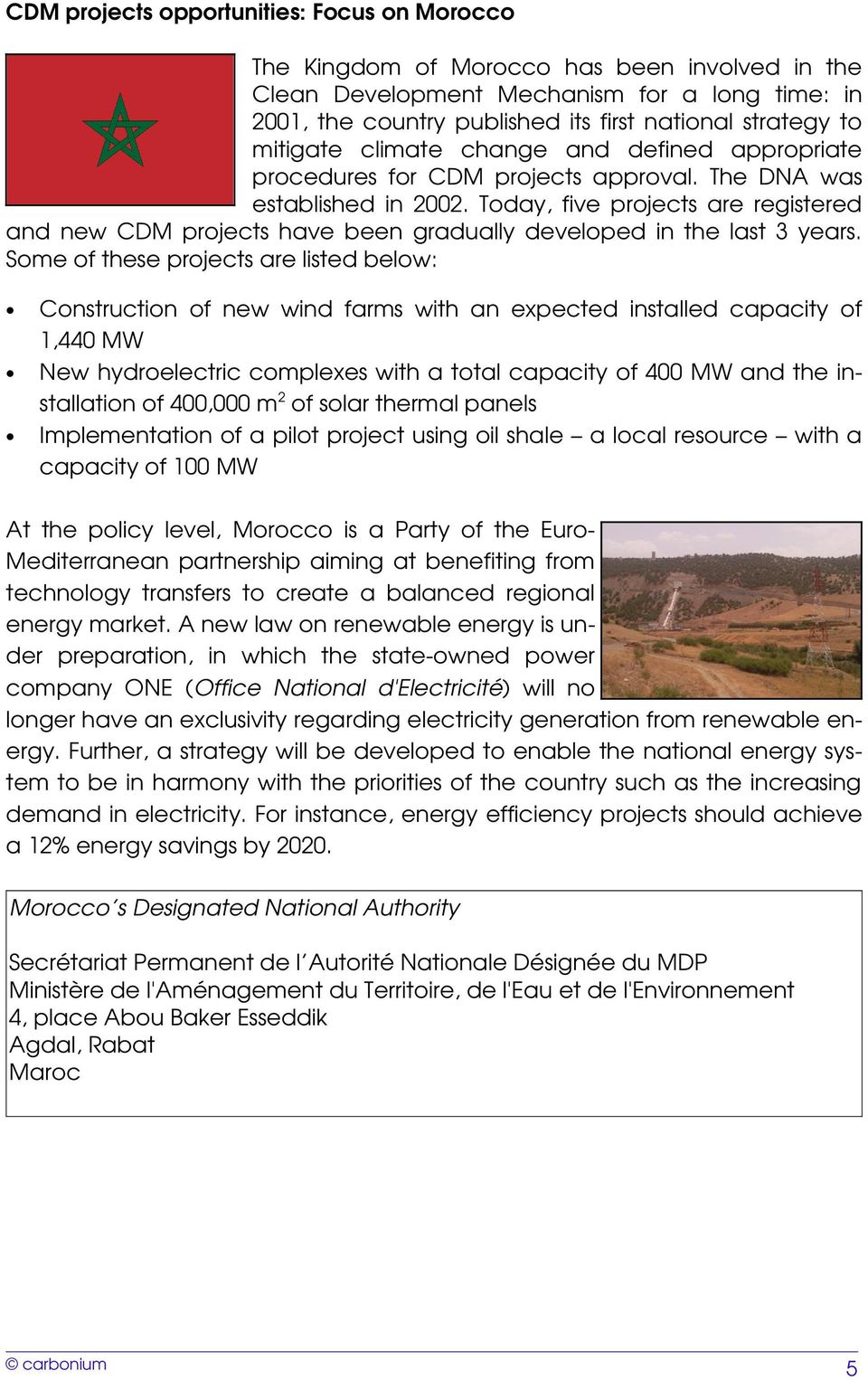
5 CDM projects opportunities: Focus on Morocco The Kingdom of Morocco has been involved in the Clean Development Mechanism for a long time: in 2001, the country published its first national strategy to mitigate climate change and defined appropriate procedures for CDM projects approval. The DNA was established in Today, five projects are registered and new CDM projects have been gradually developed in the last 3 years. Some of these projects are listed below: Construction of new wind farms with an expected installed capacity of 1,440 MW New hydroelectric complexes with a total capacity of 400 MW and the installation of 400,000 m 2 of solar thermal panels Implementation of a pilot project using oil shale a local resource with a capacity of 100 MW At the policy level, Morocco is a Party of the Euro Mediterranean partnership aiming at benefiting from technology transfers to create a balanced regional energy market. A new law on renewable energy is under preparation, in which the state owned power company ONE (Office National d'electricité) will no longer have an exclusivity regarding electricity generation from renewable energy. Further, a strategy will be developed to enable the national energy system to be in harmony with the priorities of the country such as the increasing demand in electricity. For instance, energy efficiency projects should achieve a 12% energy savings by Morocco s Designated National Authority Secrétariat Permanent de l Autorité Nationale Désignée du MDP Ministère de l'aménagement du Territoire, de l'eau et de l'environnement 4, place Abou Baker Esseddik Agdal, Rabat Maroc carbonium 5
6 Corporate News Conferences and workshops Olivier Levallois made a presentation on Carbonium's experience in Sub Saharan Africa at the Conference Green business, Investment in Africa, held in Paris on September 24 th & 25 th, Alexandre Borde lectured on the new legislative framework for carbon emissions during a seminar organised by the Development Institute International on September 22 th, 2009 in Paris. carbonium 5, rue de rivoli paris france [email protected] publication manager: alexandre borde contribution: aurélie faure, olivier levallois, natalia garavito, abderrahim boutaleb Disclaimer: While the information herein has been obtained from sources we believe reliable, we accept no responsibility or liability in respect of any errors or omissions or for any losses or consequential losses arising from such errors or omissions. It may not be circulated without our prior agreement. Neither the information contained in the document nor any opinion expressed constitutes an offer or an invitation to make an offer, to buy or sell any carbon credits or allowances. carbonium 6
D DAVID PUBLISHING. Voluntary Carbon Market in Turkey. 1. Introduction. Fehiman Ciner 1 and Aydemir Akyurek 2
 Journal of Energy and Power Engineering 8 (2014) 1908-1912 D DAVID PUBLISHING Fehiman Ciner 1 and Aydemir Akyurek 2 1. Department of Environmental Engineering, Faculty of Engineering, Nigde University,
Six greenhouse gases covered by the United Nations Framework Convention on Climate Change (UNFCCC) and its Kyoto Protocol are:
 Fact sheet: The need for mitigation United Nations Framework Convention on Climate Change Along with adaptation, mitigation is one of the two central approaches in the international climate change process.
The Economics of Climate Change C 175. To Kyoto and Beyond. Spring 09 UC Berkeley Traeger 7 International Cooperation 22
 To Kyoto and Beyond 7 International Cooperation 22 International Cooperation on Climate Change 1988 United Nations General Assembly adopted resolution urging the protection of global climate for present
 ()),&,(17&2$/86( (1(5*
 Norwegian position on the proposed EU framework for climate and energy policies towards 2030
 Norwegian position on the proposed EU framework for climate and energy policies towards 2030 The EU plays an important role as a global leader in climate policy and has a fundamental interest in strengthening
A Guide to Woodland Carbon for Business
 A Guide to Woodland Carbon for Business Contents: 1. Investing in Woodland Carbon: an overview 2. Why Woodland Carbon? 3. How much does it cost? 4. Woodland Carbon Code 5. Woodland Carbon compliance 6.
REPUBLIC OF TURKEY INTENDED NATIONALLY DETERMINED CONTRIBUTION
 REPUBLIC OF TURKEY INTENDED NATIONALLY DETERMINED CONTRIBUTION In accordance with decisions 1/CP.19 and 1/CP.20, the Republic of Turkey hereby presents its Intended Nationally Determined Contribution (INDC)
World Economic Forum Insurance and Asset Management Council. Joachim Faber. Low Carbon Economy Finance Paper Q4 2011
 World Economic Forum Insurance and Asset Management Council Joachim Faber Low Carbon Economy Finance Paper Q4 2011 Frankfurt / Munich, Oct 2011 Introduction The Low Carbon Economy and Finance by the Insurance
A sustainable energy and climate policy for the environment, competitiveness and long-term stability
 2009-02-05 A sustainable energy and climate policy for the environment, competitiveness and long-term stability The party leaders of Alliance for Sweden entered into an agreement today on a long-term,
Project Procurement Standard
 Project Procurement Standard Version: June 2008 This document presents the procurement standard for all carbon offsetting projects under the myclimate label. It provides a summary of all applicable standards
Nordea Asset Management. Our Approach on Climate Change
 Nordea Asset Management Our Approach on Climate Change Introduction Scientific fact base The Intergovernmental Panel on Climate Change (IPCC) Fifth Assessment Report concludes that Climate change and
Renewable Choice Energy
 Catawba College Table of Contents About Renewable Choice The Problem: Electricity Production Today The Solutions: Renewable Energy Sources Renewable Energy Credits (RECs) Who can participate in Renewable
Carbon Emissions Trading and Carbon Taxes
 Carbon Emissions Trading and Carbon Taxes EU Environmental Policy The challenge reaching towards a low carbon economy 1 This presentation covers Can carbon markets be part of the answer in controlling
Renewable Energy in Turkey
 Renewable Energy in Turkey Promotion of Renewable Energy in a Liberalizing Turkish Energy Sector (2002-2012) Yusuf YAZAR General Manager General Directorate of Renewable Energy 1 Import Dependency Relative
A Summary of the Kyoto Protocol and the Marrakesh Accords By James G. Derouin Fredric D. Bellamy David R. Nelson Mark E. Freeze 1
 A Summary of the Kyoto Protocol and the Marrakesh Accords By James G. Derouin Fredric D. Bellamy David R. Nelson Mark E. Freeze 1 The Kyoto Protocol is an outgrowth of the United Nations Framework Convention
TECHNICAL SUPPORT DOCUMENT AMENDMENTS TO COMAR 26.09. MD CO 2 Budget Trading Program FOR JULY 26, 2013 PREPARED BY:
 TECHNICAL SUPPORT DOCUMENT FOR AMENDMENTS TO COMAR 26.09 MD CO 2 Budget Trading Program JULY 26, 2013 PREPARED BY: MARYLAND DEPARTMENT OF THE ENVIRONMENT 1800 Washington Boulevard Baltimore Maryland 21230
Energy Projections 2006 2030 Price and Policy Considerations. Dr. Randy Hudson Oak Ridge National Laboratory
 Energy Projections 2006 2030 Price and Policy Considerations Dr. Randy Hudson Oak Ridge National Laboratory There is perhaps no single current topic so potentially impacting to all life on this planet
Energy Megatrends 2020
 Energy Megatrends 2020 Esa Vakkilainen 1 NOTE The data included in the following is mainly based on International Energy Agency's (IEA) World Energy Outlook 2007 IEA is considered the most reliable source
INTENDED NATIONALLY DETERMINED CONTRIBUTIONS (INDCs)
 UNITED REPUBLIC OF TANZANIA INTENDED NATIONALLY DETERMINED CONTRIBUTIONS (INDCs) 1. Introduction The United Republic of Tanzania, which comprises of Tanzania Mainland and Zanzibar, brings forth her Intended
Where does the wine sector sit in terms of Australian climate policy and the global carbon market
 Where does the wine sector sit in terms of Australian climate policy and the global carbon market The Carbon Farming Initiative and Emission Reduction Fund Geoff Cowey [email protected] The_AWRI
Proposal of Upstream Emissions Trading in Japan
 OECD GLOBAL FORUM ON SUSTAINABLE DEVELOPMENT: EMISSIONS TRADING CONCERTED ACTION ON TRADEABLE EMISSIONS PERMITS COUNTRY FORUM OECD Headquarters, Paris 17-18 March, 2003 Proposal of Upstream Emissions Trading
The economic competitiveness of nuclear energy
 How competitive is nuclear energy? by J.H. Keppler* The economic competitiveness of nuclear energy will be crucial for determining its future share in world electricity production. In addition, the widespread
ESBI Company Profile. ESB International. Bringing Energy Innovation to the World...
 ESBI Company Profile ESB International Bringing Energy Innovation to the World... ESB International ESBI is one of Europe s most progressive and commercially focused electricity consultancy firms with
Outline. 1. Climate and energy: where do we stand? 2. Why a new framework for 2030? 3. How it works. 4. Main challenges. 5.
 1 Outline 1. Climate and energy: where do we stand? 2. Why a new framework for 2030? 3. How it works 4. Main challenges 5. and benefits 6. Other key points 7. Next steps 2 1. Climate and energy: where
Project Idea Note: Solar Water Heating Fee-For-Service Program in the Caribbean
 PROJECT IDEA NOTE (Based on the World Bank s PIN Template, with Some Adaptations) A. Project description, type, location and schedule Name of Project: Solar Water Heating Fee-for-Service Program in the
National Inventory System
 Regional workshop for the Capacity Development for sustainable national Greenhouse Gas Inventories AFOLU sector (CD-REDD II) Programme National Inventory System Daniela Romano Institute for Environmental
GHG Accounting Guidance Note Manufacture of Renewable Energy Climate Related Products
 GHG Accounting Guidance Note Manufacture of Renewable Energy Climate Related Products IFC CLIMATE BUSINESS GROUP SEPTEMBER 2011 Introduction The following is an overview guidance for IFC investment staff
ESBI Carbon Solutions. Partnering with Countries to Achieve their Full Carbon Credit Potential
 ESBI Carbon Solutions Partnering with Countries to Achieve their Full Carbon Credit Potential ESB International ESB International (ESBI) is a growing international energy company and one of Europe s leading
Energy Situation in Egypt
 Energy Situation in Egypt Egypt has traditionally been a net exporter of energy. Until the late 1990s, it exported oil, but oil production has declined from its peak in the early 1990s, and now roughly
Contents. Wind power sector facts. Growth drivers. Immediate challenges. Innovative and global response
 Wind power sector 'Keys to competitiveness on the international stage ESADE-Deloitte Jorge Calvet, Chairman of Gamesa Madrid, 1 July 2010 Contents 5 5 5 1 Wind power sector facts Growth drivers Immediate
Nuclear power is part of the solution for fighting climate change
 Nuclear power is part of the solution for fighting climate change "Nuclear for Climate" is an initiative undertaken by the members of the French Nuclear Energy Society (SFEN), the American Nuclear Society
NEW ZEALAND S RESPONSE TO CLIMATE CHANGE
 NEW ZEALAND S RESPONSE TO CLIMATE CHANGE 1 NEW ZEALAND S RESPONSE TO CLIMATE CHANGE In simplifying this information, some detail has been omitted. For more complete information about climate change science
International Solar Energy Arena January 23rd, 2009, Istanbul STEAM (Strategic Technical Economic Research Center)
 International Solar Energy Arena January 23rd, 2009, Istanbul STEAM (Strategic Technical Economic Research Center) Good morning. Sayin Bakanım. Members of Parliament. Ladies and Gentlemen. Slide 1: Opening
Critical Policy Options to Protect Industry Competitiveness
 Critical Policy Options to Protect Industry Competitiveness Graham Weale Chief Economist, RWE AG IEA Energy Business Council Meeting, Paris 4 th June 2013 RWE Group a leading European energy utility >
GLENEAGLES PLAN OF ACTION CLIMATE CHANGE, CLEAN ENERGY AND SUSTAINABLE DEVELOPMENT. 1. We will take forward actions in the following key areas:
 GLENEAGLES PLAN OF ACTION CLIMATE CHANGE, CLEAN ENERGY AND SUSTAINABLE DEVELOPMENT 1. We will take forward actions in the following key areas: Transforming the way we use energy Powering a cleaner future
Carbon Credits: An Opportunity for Forest Landowners. Hughes Simpson Texas Forest Service
 Carbon Credits: An Opportunity for Forest Landowners Hughes Simpson Texas Forest Service Carbon and Greenhouse Gases How can we mitigate Carbon / GHGs? Reduce emissions Stop burning fossil fuels Improve
Clean Development Mechanism Status and outlook
 Presented by: Neeta Hooda UNFCCC Secretariat Clean Development Mechanism Status and outlook Presented at: UNFCCC Media Training Workshop, Accra, 26 August 2008 1 The Kyoto Protocol Entry into force on
Why are developing countries exempt from the emissions targets?
 Kyoto Protocol Overview The Kyoto Protocol is a legally binding, international agreement that sets targets for industrialized countries to limit or reduce their emissions of greenhouse gases (GHG) by the
Session 7: Accounting and avoiding double counting Breakout Group Exercises
 Session 7: Accounting and avoiding double counting Breakout Group Exercises Introduction It is anticipated that some countries will use internationally transferred carbon assets to help meet their emission
EURELECTRIC responses to the invitation in Draft decision -/CMP.5 to make submissions to the UNFCCC secretariat on:
 EURELECTRIC responses to the invitation in Draft decision -/CMP.5 to make submissions to the UNFCCC secretariat on: 1. Inclusion of CCS in Clean Development project activities 2. Standardized baselines
Implications of Abundant Natural Gas
 Implications of Abundant Natural Gas JAE EDMONDS AND HAEWON MCJEON APRIL 2013 May 29, 2013 1 Background May 29, 2013 2 The natural gas revolution The application of technologies for accessing unconventional
Carbon Projects and Potential Source of Revenue for Microfinance Institutions to Accelerate Renewable Energy Lending in Nepal
 Carbon Projects and Potential Source of Revenue for Microfinance Institutions to Accelerate Renewable Energy Lending in Nepal By: Marco van der Linden, Carbon Finance Advisor: [email protected]
5.5 QUALITY ASSURANCE AND QUALITY CONTROL
 0 0 0. QUALITY ASSURANCE AND QUALITY CONTROL.. Introduction The IPCC Good Practice Guidance and Uncertainty Management (GPG000, IPCC, 000), Chapter, Quality Assurance and Quality Control, defines quality
Fact sheet: STEPPING UP INTERNATIONAL ACTION ON CLIMATE CHANGE The Road to Copenhagen
 Fact sheet: STEPPING UP INTERNATIONAL ACTION ON CLIMATE CHANGE The Road to Copenhagen Introduction Climate change is today widely recognized as one of mankind s greatest challenges in the 21st century.
Scope 2 Accounting Guidance: What it means for corporate decisions to purchase environmental instruments
 Scope 2 Accounting Guidance: What it means for corporate decisions to purchase environmental instruments January 2015 Corporate Scope 2 accounting has traditionally been relatively straight forward. Common
Green Power Accounting Workshop: Concept Note For discussion during Green Power Accounting Workshop in Mexico City, May 13th 2011
 Introduction As more companies and government organizations prepare greenhouse gas (GHG) inventories that reflect the emissions directly and indirectly associated with their operations, they increasingly
NEW ZEALAND. Submission to the ADP. New Zealand s Intended Nationally Determined Contribution. 7 July 2015
 NEW ZEALAND Submission to the ADP New Zealand s Intended Nationally Determined Contribution 7 July 2015 New Zealand hereby communicates its intended nationally determined contribution and the accompanying
Please indicate your preference by providing comments as appropriate. Where there is insufficient space, please attach additional pages as necessary.
 PART B: DETAILED QUESTIONS FOR RESPONSE Please indicate your preference by providing comments as appropriate. Where there is insufficient space, please attach additional pages as necessary. (1) The first
GLOBAL RENEWABLE ENERGY MARKET OUTLOOK 2013
 GLOBAL RENEWABLE ENERGY MARKET OUTLOOK 213 FACT PACK GUY TURNER HEAD OF ECONOMICS AND COMMODITIES APRIL 26, 213 GLOBAL RENEWABLE ENERGY MARKET OUTLOOK, 26 APRIL 213 1 INTRODUCTION This year s Global Renewable
Analysis of a 30 Percent by 2030 National Renewable Electricity Standard
 Analysis of a 30 Percent by 2030 National Renewable Electricity Standard Alison Bailie, Steve Clemmer, and Jeff Deyette May 12, 2015 Photo: istock 2015 Union of Concerned Scientists www.ucsusa.org/30by2030nationalres.pdf
Communicating Your Commitment: Your Guide to Clean Energy Messaging
 Communicating Your Commitment: Your Guide to Clean Energy Messaging Congratulations on your recent purchase of clean energy from Renewable Choice! Whether you ve purchased green power in the form of renewable
KAYA IDENTITY ANALYSIS OF DECARBONIZATION OF THE NY ECONOMY REQUIRED FOR CLIMATE ACTION PLAN GOAL OF 40% REDUCTION BY 2030
 KAYA IDENTITY ANALYSIS OF DECARBONIZATION OF THE NY ECONOMY REQUIRED FOR CLIMATE ACTION PLAN GOAL OF 40% REDUCTION BY 2030 Roger Caiazza Not representing EEANY DISCLAIMERS The following analysis does not
Roadmap for moving to a competitive low carbon economy in 2050
 Roadmap for moving to a competitive low carbon economy in 2050 COUNTRY CAPITAL XXX, 9 March 2011 NAME XXX DG Climate Action European Commission 1 Limiting climate change a global challenge Keeping average
Fact sheet: The Kyoto Protocol
 Fact sheet: The Kyoto Protocol The Kyoto Protocol was adopted at the third Conference of the Parties to the UNFCCC (COP 3) in Kyoto, Japan, on 11 December 1997. The Protocol shares the objective and institutions
Projected Costs of Generating Electricity
 Executive Summary Projected Costs of Generating Electricity 2015 Edition Projected Costs of Generating Electricity 2015 Edition INTERNATIONAL ENERGY AGENCY NUCLEAR ENERGY AGENCY ORGANISATION FOR ECONOMIC
E VIRO ME T Council meeting Luxembourg, 14 October 2013
 COU CIL OF THE EUROPEA U IO EN Conclusions on Preparations for the 19th session of the Conference of the Parties (COP 19) to the United ations Framework Convention on Climate Change and the 9th session
The Social Costs of Energy Consumption
 The Social Costs of Energy Consumption Literaturliste Prof. Dr. Olav Hohmeyer Universität Flensburg Rio 02 World Climate & Energy Event Copacabana Palace, Rio de Janeiro 6.-11. January 2002 Prof. Dr. Olav
World Simulations with GEM-E3
 World Simulations with 1 Introduction The implementation of the Kyoto protocol would imply the emissions of Annex B countries to be collectively reduced by 5% in 2008-2012 relatively to their 1990 level,
How to Earn the LEED Green Power Credit
 3D EG REES WH ITE PAPER How to Earn the LEED Green Power Credit Using on-site and off-site renewable energy to mitigate the impact of greenhouse gas emissions associated with a LEED project s energy use
World Bank. International Review of Trading Schemes for Energy Saving, Carbon Reduction and Renewable Energy
 International Review of Trading Schemes for Energy Saving, Carbon Reduction and Renewable Energy World Bank Mark Johnson [email protected] July 2013 Project objectives Chinese Government is
Energy Efficiency and Renewable Energy Sources in Sweden
 Energy Efficiency and Renewable Energy Sources in Sweden Swedish Energy Agency www.stem.se Yelena Varasteh [email protected] Slovakia, 24-25 April 2006 Total energy supply in Sweden in 2004 Total
Promotion of energy efficiency and renewable energy experiences from Norway
 Business planning of Renewable Energy and Energy Efficiency Projects in Ukraine and Eastern Europe Kiev 28. April 2011 Promotion of energy efficiency and renewable energy experiences from Norway Hans Borchsenius
Kan norske oljemilliarder redde tropisk regnskog?
 Kan norske oljemilliarder redde tropisk regnskog? Høstkonferansen 23.oktober 2012 Arild Angelsen Professor, School of Economics and Business, Norwegian University of Life Sciences (UMB), Ås, Norway & Senior
Wind energy and EU climate policy
 Wind energy and EU climate policy Achieving 30% lower emissions by 2020 A report by the European Wind Energy Association - October 2011 Wind energy and EU climate policy Achieving 30% lower emissions by
The Copenhagen Accord on Climate Change: A legal analysis
 Fordham University New York 22 February 2010 Understanding Copenhagen: U.S and E.U. Negotiation Positions and the Landscape for Future Negotiations The Copenhagen Accord on Climate Change: A legal analysis
Kyoto Protocol MEMO/04/43. What is the Kyoto Protocol? Bruxelles, 4 March 2004
 MEMO/04/43 Bruxelles, 4 March 2004 Kyoto Protocol What is the Kyoto Protocol? The United Nations Framework Convention on Climate Change (UNFCCC) and its Kyoto Protocol provide the only international framework
DRAFT REGULATIONS: CARBON OFFSETS. 20 June 2016
 DRAFT REGULATIONS: CARBON OFFSETS 20 June 2016 DRAFT CARBON TAX BILL: PUBLICATION OF PROPOSED REGULATIONS MADE IN TERMS OF CLAUSE 20(b) OF THE DRAFT CARBON TAX BILL, 2015 Proposed regulations in terms
The External and Social Costs of Energy Technologies
 SIXTH FRAMEWORK PROGRAMME [6.1] [ Sustainable Energy Systems] The External and Social Costs of Energy Technologies Rainer Friedrich Universitaet Stuttgart Brussels, February 16, 2009 Social Costs = total
FCCC/SBSTA/2016/1. United Nations. Provisional agenda and annotations. I. Provisional agenda
 United Nations FCCC/SBSTA/2016/1 Distr.: General 7 March 2016 Original: English Subsidiary Body for Scientific and Technological Advice Forty-fourth session Bonn, 16 26 May 2016 Item 2 of the provisional
OUTLOOK FOR NATURAL GAS IN EUROPE
 6th German-Norwegian Energy Conference OUTLOOK FOR NATURAL GAS IN EUROPE Dr. Berit Tennbakk, Partner, RETROSPECT FALLING AND CONVERGING GAS PRICES HISTORICAL DEVELOPMENT MAIN DRIVERS Financial crisis Fukushima
Musgrave Energy & Natural Resources Management Policy. Working together to deliver sustainability
 Musgrave Energy & Natural Resources Management Policy Working together to deliver sustainability Musgrave Energy & Natural Resources Management Policy Working together to deliver sustainability BACKGROUND
Technical Paper 1. Report on Birmingham s carbon dioxide (CO 2 ) emissions reduction target baseline
 Technical Paper 1 Report on Birmingham s carbon dioxide (CO 2 ) emissions target baseline March 2013 Contents Page 1. Introduction 2 2. Executive Summary of Key Changes 3 3. Selection of the baseline year
Questions and Answers on the European Commission Communication: The Paris Protocol A blueprint for tackling global climate change beyond 2020
 European Commission - Fact Sheet Questions and Answers on the European Commission Communication: The Paris Protocol A blueprint for tackling global climate change beyond 2020 Brussels, 25 February 2015
THE INDC OF THE EUROPEAN UNION AND ITS 28 MEMBER STATES
 THE INDC OF THE EUROPEAN UNION AND ITS 28 MEMBER STATES 1 Our objectives for the INDC process From nationally determined to collectively ambitious and individually fair well in advance of Paris Clarity
From Carbon Subsidy to Carbon Tax: India s Green Actions 1
 From Carbon Subsidy to Carbon Tax: India s Green Actions 1 09 CHAPTER 9.1 INTRODUCTION The recent steep decline in international oil prices is seen by many as an opportunity to rationalize the energy prices
Grid-connected electricity generation from wind turbines in Turkey
 Grid-connected electricity generation from wind turbines in Turkey Beyond Carbon, Turkey 2012 Project summary With the carbon offset programme Kores Kocadağ 17.5 MW Wind Power Project, myclimate and its
New Jersey Farm Bureau
 Carbon Trading New Jersey Farm Bureau Marie Banasiak What is carbon trading? Market based strategy for mitigating the emissions of carbon dioxide and other greenhouse gases in theatmosphere atmosphere.
Portefeuille de projets (2/2)
 Portefeuille de projets (2/2) Presentation of Morocco Project Base Abdelali DAKKINA Director of CIEDE Brussels, April 19-20, 2004 PROJECT 1: SIMPLIFIED PROJECT DESIGN DOCUMENT FOR CLINKER SUBSTITUTION
Business Policy of CEZ Group and ČEZ, a. s.
 Business Policy of CEZ Group and ČEZ, a. s. Contents: Introduction 1. CEZ Group mission and vision 2. Scope of business of CEZ Group 3. Business concept Guiding principles Trade Generation Electricity
INVESTING IN A TRANSITIONING SECTOR
 INVESTING IN A TRANSITIONING SECTOR Eurelectric conference Jon Moore, CEO NEW INVESTMENT IN CLEAN ENERGY 24-14 ($BN) 32% 17% $318bn -7% $294bn 16% -9% $31bn.5% $272bn $268bn 17% 46% 36% $175bn $25bn $26bn
World Energy Outlook 2009. Presentation to the Press London, 10 November 2009
 World Energy Outlook 29 Presentation to the Press London, 1 November 29 The context The worst economic slump since the 2 nd World War & signs of recovery but how fast? An oil price collapse & then a rebound
EOR/CCS 360-DEGREE LEGAL REVIEW
 November 2012 EOR/CCS 360-DEGREE LEGAL REVIEW INDEX 1 Introduction 1 2 Executive Summary 1 3 Project description and stakeholders 3 3.1 Overview of the combined EOR and CCS project 3 3.2 Stakeholders 4
Climate finance as an instrument to enhance renewable energy technologies
 Climate finance as an instrument to enhance renewable energy technologies Dr. Karla Solís-García Team Lead Regional Collaboration Centre St. George s 18 September 2013 CARILEC Renewable Energy Forum September,
Latin America and COP20
 ESSAY cities, Latin America and the Caribbean (LAC) increasingly try to engage in global environmental issues, particularly with regards to the challenge of climate change. Latin America and the Caribbean
Activities of the UNFCCC Regional Collaboration Centre in the Caribbean
 Activities of the UNFCCC Regional Collaboration Centre in the Caribbean Karla Solís Team Lead, Regional Collaboration Centre St. George s St John s, Antigua 10-11 June 2014 CDM Regional Collaboration Centre,