
Programming & Installation PIEZO WARNING. EN : 2009 EN : 2008 EN : 2005 Security Grade 2 Environmental Class II RINS1347-2
|
|
|
- Clifton Ray
- 9 years ago
- Views:
Transcription
1 Programming & Installation EN : 2009 EN : 2008 EN : 2005 Security Grade 2 Environmental Class II PIEZO WARNING The Enforcer control panel contains a 100 dba siren, please be aware of this during installation RINS1347-2

2 Default codes: User code:1234 Master Manager Code: 2222 Engineer Code: 1111

3

4 CONTENTS CHAPTER 1: ENGINEER MENU STRUCTURE... 4 CHAPTER 2: INTRODUCTION... 7 CHAPTER 3: THE ENGINEERS MENU ENTERING THE ENGINEERS MENU EXITING THE ENGINEER MENU... 8 CHAPTER 4: POWERING UP & KEYPAD OPERATIONS INITIAL POWER UP KEYPAD MENU THE ADDRESSING KEYPADS FUNCTION TESTING THE KEYPAD TEXT PROGRAMMING ACCESSING THE ENGINEERS MENU ON ANY KEYPAD SET / UNSET SYSTEM CHAPTER 5: THE ENGINEER FUNCTIONS CLEAN START SOFTWARE REVISION WIRING CHOICE RADIO DEVICE CONTROL CHANGE INPUTS Input Types Entry Shock Input Type (21) Input Attributes Automatic Inhibit of Inputs ASSIGN KEYPADS/READERS SYSTEM DISPLAYS Sign On Message Site Name Display When Set CHANGE TIMERS SET TIME AND DATE EXIT MODES Timed Final Door Timed/Final PTS (Push To Set) CHANGE CODES (MASTER MANAGER CODE/ENGINEERS) User Set Options Flexi Set VOLUME CONTROL E / E Keypads Only Use Main Sounder ALARM RESPONSE Silent 1st Alarm Disable Confirm On Entry Alarm Starts / Stops (Alarm Responses) CHANGE OUTPUTS Output Types INTELLIGENT SET SITE OPTIONS Site Option Types ENGINEER RESET OPTIONS REVIEW LOGS Fault Codes... 30

5 5.19 ENGINEER TESTS Sounds To Play Walk Test Soak Control Test Siren Test Outputs Test SIA/CID Communications Test CHC Communications DIAGNOSTICS SET UP DOWNLOADING Download By Security Mode Telephone Line ARM / Modem Telephone Number PROGRAMME DIGI / SMS? Programming Fast Format Programming Contact id, SIA and SMS PABX Systems (Only relevant to SMS) DIAL OUT MENU APPENDIX A: FAULTS CHAPTER 6: INSTALLATION TECHNICAL SPECIFICATION SYSTEM ANALYSIS OPENING THE ENFORCER INSIDE THE ENFORCER SCREW HOLES THE I/O BOARD Connecting an Additional Keypad Connecting an Internal Prox Readear Connecting an External Prox Reader Connecting a Relay Module Connecting a Bell Box Connecting Inputs THE MODEM CARD REPLACING THE BATTERY CHAPTER 7: APPENDIX A, DEFAULTS... 55

6 CHAPTER 1: ENGINEER MENU STRUCTURE MENU Sub-Menu Page: WIRING CHOICE Page: 11 RADIO CONTROL DEVICE Control Inputs? Page: 13 Control Keyfobs? Page: 13 Control Bells? Page: 13 CHANGE INPUTS Input Attributes? Page: 15 Input Description? Page: 15 ASSIGN KEYPADS/READERS? Address Page: 18 Type Page: 18 Set Points Page: 18 Set Point Name Page: 18 SYSTEM DISPLAYS? Sign On Message Page: 18 Site Name Page: 18 Display When Set* Page: 18 CHANGE TIMERS? Level Set Entry Time Page: 19 Level Set Exit Time Page: 19 Level Set Siren Time Page: 19 Confirm Time Page: 19 Pre-Alarm Page: 19 Line Fault Page: 19 Set Fail Page: 19 Re-Arm No. Page: 19 Double Knock Page: 19 Fire Siren Time Page: 19 Radio Supervision Time Page: 19 Radio Jamming Time Page: 19 Service Time Page: 19 SET DATE & TIME? Year (00-99) Page: 20 Month (1-12) Page: 20 Day (1-31) Page: 20 Hours (0-23) Page: 20 Minutes (0-59) Page: 20 EXIT MODES? Area Exit Mode Page: 20 CHANGE CODES? Change Master Manager Code? Page: 21 Change Engineer Code? Page: 21 VOLUME CONTROL? Area Entry Page: 22 Area Exit Page: 22 Alarm Page: 22 Fire Page: 22 Tamper Page: 22 Day Alarm Page: 22 Chime Page: 22 Intelligent Set Page: 22 E/E Keypads Only Page: 22 Page: 4

7 MENU Sub-Menu Page: Use Main Sounder Page: 22 ALARM RESPONSE? Silent 1 st Alarm Page: 23 Disable Confirm Page: 23 Inputs to Confirm Page: 23 Area Starts Page: 23 Area Stops Page: 23 Fire Starts At Page: 23 Fire Stops At Page: 23 HU Starts At Page: 23 HU Stops At Page: 23 CHANGE OUTPUTS? End station Outputs? Page: 25 Radio Bells? Page: 25 Output Module Outputs? Page: 25 INTELLIGENT SET? Intelligent Page: 27 SITE OPTIONS? Strobe At Set? Page: 28 2 Key Hold up Page: 28 Simple Set Page: 28 Radio Force Set Page: 28 Set with Fault Page: 28 Set with Tamper+ Page: 28 Set with ATS Fault Page: 28 Set with Poll Fl Page: 28 Set Fail = Alarm Page: 28 Fob Unset Entry? Page: 28 ENGINEER RESTORE OPTIONS? Eng Restore Int Page: 28 Eng Restore HU Page: 28 Eng Restore Tamp Page: 28 Eng Restore Soak Page: 28 Eng Restore Conf Page: 28 Eng Restore Faults Page: 28 Anti-code Restore Page: 28 REVIEW LOGS? Panel Log? Page: 30 ENGINEER TESTS? Walk Test? Page: 30 Soak Control? Page: 30 Test Siren? Page: 30 Do Battery Load Test? Page: 30 Test Outputs? Page: 30 Test SIA/CID Communications? Page: 30 Test CHC Communications? Page: 30 DIAGNOSTICS? View PSU? Page: 32 View Inputs? Page: 32 View Radio Device Status? Page: 32 SET UP DOWNLOADING? Download By Page: 35 SET UP DIGI/SMS? Program Digi/SMS Calls? Page: 37 Program Digi Channels? Page: 37 Page: 5

8 MENU Sub-Menu Page: 3 Way Calling Page: 37 DIAL OUT MENU? Select PC To dial Page: 42 Select Operation Page: 42 CLEAN START Page: 11 Page: 6

9 CHAPTER 2: INTRODUCTION The Enforcer is a bi-directional wireless control panel that boasts 32 wireless inputs, 32 wireless key fobs and 2 wireless bells. The inputs consist of both a wireless PIR and universal transmitter (door contact); the Enforcer also has 2 wired Double End of Line (DEOL) inputs that can be programmed as either 4K7 alarm & 2K2 tamper, 4K7 alarm & 4K7 tamper or 1K alarm & 1K tamper. Inputs 1-32 are wireless, while inputs are wired and are connected inside the Enforcer control panel on the input/output board. The system also has 80 user codes/tags, 32 of which may be programmed as a wireless keyfob that can either set/unset the system and/or control an output (by latching the output or activating the output for a programmable time period). There are also 3 wired outputs onboard the Enforcer: PGM, STB and BELL, all of which are programmable (BELL and STB are defaulted to work on a bell box). An output expander may also be connected allowing an additional 16 wired relay outputs. The Enforcer control panel incorporates a built-in keypad and proximity tag reader for programming and controlling the system. Up to 3 additional set points can be added to the Enforcer compromising of keypads, internal tag readers or external tag readers. Page: 7

10 CHAPTER 3: THE ENGINEERS MENU In order to program system configurations from the keypad, you must be in the Engineer Menu. The panel will enter the Engineering Menu after entering a valid engineer code when the panel is in an unset state. Whilst in Engineer Mode all tamper alarms (including case tamper), will be disabled. 3.1 Entering The Engineers Menu NOTE: You will not be able to access Engineers Mode if Set levels are set. The system must be fully unset in order to gain access to the Engineer Menu. Access maybe also denied if the user has disabled the Allow Engineer Menu in the Master Manager Mode Authorisation required will be shown. Enter the Engineer Code. Any active faults will be shown. Press the key. SET / UNSET SYSTEM? will be displayed. Press the key. SOFTWARE REVISION will be displayed Once you are in the Engineer Menu, a high pitch tone will be generated regularly to remind you that you are still in the Engineer Menu. 3.2 Exiting The Engineer Menu On completion of programming, the system can be returned back to normal mode by: Use the scroll keys: and to scroll to EXIT ENGINEERS MENU Press the key You will be returned to day mode METHOD ONE METHOD TWO When the display shows any main menu item (i.e. an item shown in capitals) press the key, you will be returned to day mode. Please see page: 43, for all fault codes that may appear when exiting the engineers menu. Page: 8

11 CHAPTER 4: POWERING UP & KEYPAD OPERATIONS Before using the system, all items connected to the RS-485 communications bus must be allocated a unique address. See page 50 and onwards for further details on addressing peripherals. 4.1 Initial Power Up Power up the Enforcer, an alarm will be generated. Proceed to the nearest keypad, which will display (from power up): On power up, please wait will be displayed Please refrain from pressing any buttons until Enforcer and the time is displayed on the keypad Once Enforcer is displayed the panel is ready for operation. 4.2 Keypad Menu To enter the keypad menu, press and hold the key until SECURITY CODE is displayed, and then enter In the keypad function there is access to the following options: keypad address, setting language, the status of the keypad inputs, key-click volume, tag volume, master volume, brightness of the LCD and the tag id. The tag id is used to show the identification code for each proximity tag. To exit, press the key. 4.3 The Addressing Keypads Function To address further keypads on the Enforcer system, go to the newly installed keypad and press and hold the key until KEYPAD CODE is displayed. Enter Once this has been done you will need to assign the keypad in engineers mode, see Assign Keypads/Readers on page: 18. Note: To address the tag readers you must select the relevant switches on the circuit board, see the installation manual for more information. Any keypad that is not properly assigned will have a blank display until it is addressed and then programmed in the engineer menu. 4.4 Testing The Keypad With the system unset, press the key for 10 seconds at any keypad. This will cause all the LEDs on that keypad to illuminate, and the LCD screen to scroll a display testing each pixel. The keypad will revert to normal display approximately 10 seconds after the key is released. Page: 9

12 4.5 Text Programming Text may be programmed for input names, for the sign-on message, and to identify the Set Level being set / unset. Each key is allocated alpha-numeric and punctuation marks characters as shown below: The Enforcer incorporates predictive text, so the system will predict the word that is being spelt. For example, if you enter B and press the key and enter e. Bedroom will be displayed, to accept this press the key. If the word that you require doesn t appear on the LCD display, just type the word as normal. To type a word, press the relevant key the appropriate number of times e.g. for the letter k press the key twice, or for the letter s press the key four times. For punctuation marks, press the key. In addition, the keys are used as follows: = make the character into a capital = move cursor left = clears cursor / adds a space = moves cursor right 4.6 Accessing the Engineers Menu on Any Keypad It is possible to access the Engineer Menu on any keypad. If you are in the Engineer menu in keypad address 0, the other keypads will display system busy, to access the Engineer menu on these, press the key on the relevant keypad. 4.7 Set / Unset System Setting and unsetting the system may be done using the engineer s code. Enter Engineer Code. SET / UNSET SYSTEM? will be displayed Press the key Select the Area(s) / level sets you would like to set. Press the key. The system then will begin to set. To unset the areas, enter the engineer code, and wait a couple of seconds. SET / UNSET SYSTEM will be displayed, press the key. Set Areas? [ABCD] To unset the areas, press the key. Page: 10

13 CHAPTER 5: THE ENGINEER FUNCTIONS Please note that any programming done in the Engineers Menu will not be seen by the system until you have exited and the system has saved its data (please see Page: 8). 5.1 Clean Start It is essential that the Non-Volatile Memory (NVM) be reset at initial power up of a new system, to ensure that the initialisation is correct to factory defaults. The CLEAN START function will clear all information apart from the user codes and the logs. After the system has completed a reset, it will prompt with Clear Radio Data, if Yes is selected then all radio devices will be deleted, the system will then prompt Clear Codes? If Yes is selected then all user codes will be cleared. Once this has completed, the system will finally prompt Clear Logs. If Yes is selected, all the logs will be cleared. The process below describes how to do this. If the NVM chip is removed from the panel, it MUST be replaced before starting programming. The system memory will now be restored to factory defaults EXCEPT: Keypad 00 remains enabled at all times & the keypad in use remains enabled Current keypad Areas are not changed NOTE: If a new NVM chip is to be used, logs should be cleared. Using the and keys, scroll to CLEAN START? CLEAN START? Press the key. The following will be displayed: Enter Enter (See page: 55 for information on different default codes) Please Wait will be displayed, and then Panel has been clean started. Press the key. Clear Radio Data will be displayed. If you would like to keep all the radio data on the system press the key, otherwise press the key and all data will be erased. Clear Codes will then be displayed, If you would like to keep all the code data on the system press the key, otherwise press the key and all codes will be defaulted. Clear Logs will then be displayed, If you would like to clear the logs then press the key now. Logs have been cleared will be displayed. Otherwise press the key. You will be returned to the Engineer Menu. CLEAN START [ ] Cl r Radio Data? Clear Codes? Clear Logs? Page: 11

14 5.2 Software Revision This option identifies the software version number, software serial number and product. Using the and keys, scroll to SOFTWARE REVISION? Press the key. The version number will be displayed. Press the key. You will be returned to the Engineer Menu. 5.3 Wiring Choice The Enforcer has 2 additional hardwired wired inputs on the input/output board, the double end of line values for these inputs can be selected as either: 1K = Alarm: 1K, Tamper: 1K. 2K2 = Alarm: 4K7, Tamper: 2K2. (Default) 4K7 = Alarm: 4K7, Tamper: 4K7. Choose Mode Using the and keys, scroll to CHOOSE MODE?. Press the key Detection Mode Enter : 1K Alarm, 1K Tamper Enter : 4K7 Alarm, 2K2 Tamper Enter : 4K7 Alarm, 4K7 Tamper Press the key Page: 12

15 5.4 Radio Device Control This menu learns or deletes all the radio devices on the system; inputs, keyfobs and outputs. For a simple guide on how to learn/delete radio devices please see RINS1314. LEARNING INPUTS / BELLS / PROGRAMMING KEY FOB BUTTONS RADIO DEVICE CONTROL Using the and keys, scroll to RADIO DEVICE CONTROL?. Press the key Control Inputs To learn inputs, press the key, or press to go to Control Bells. Control Inputs / Bells -> Learn Devices Press the key Use the and keys to scroll through the inputs / Bells. Learnt will be displayed if a device already learnt, or Available will be displayed if not. Press the key on the desired Available input / bell. Learning will be displayed; Press and hold the learn button on the wireless input device or bell until the 3 LEDs start cycling around. Input Learnt or Bell Learnt will be displayed. If an input/bell has been already learnt, Input learnt already or Bell learnt already will be displayed. NOTE: An input/bell is learnt correctly when the device flashes the green LED and the panel displays Input learnt or Bell learnt, Both must occur to perform a successful learn. Control Inputs / Bells -> Delete Devices Inputs can be either be deleted as a whole or individually. Press the key Control Inputs / Bells -> Delete All To delete all the wireless inputs, press the key and enter the code To delete individually press the key and read the next step. Control Inputs / Bells -> Delete Individually Any inputs that display learnt can be Page: 13

16 deleted. Use the and keys to scroll through the inputs, Press the key to delete that input. Program Keyfob Buttons To program the key fob buttons press the key. (To learn keyfobs please see the user manual as this is performed in the user menu) User Use the and keys to scroll through the user numbers. Press the key on the desired user. Select Button Use the b and D keys to select the button that is required to be programmed. Press the I key. Button Action Use the b and D keys to select the action to be assigned to that button. Press the I key. User Controls Use the abcd keys to select the areas that the key fob will be controlled. Press the I key. Select another button to program or press the key to exit. DELETING INPUTS / BELLS RADIO DEVICE CONTROL Using the and keys, scroll to RADIO DEVICE CONTROL?. Press the key Control Inputs To delete inputs, press the key, or press to go to Control Bells. Control Inputs / Bells -> Learn Devices Press the key Control Inputs / Bells -> Delete Devices Inputs/bells can be either deleted all at once or individually. Press the key Page: 14

17 Control Inputs / Bells -> Delete All To delete all the wireless inputs/bells, press the key and enter the code To delete individually press the key Control Inputs / Bells -> Delete Individually Any input/bell that display learnt can be deleted. Use the and keys to scroll through the inputs / Bells, Press the key to delete that device. Input Deleted or Bell Deleted will be displayed. PLEASE NOTE ONCE ALL WIRELESS INPUTS (DETECTORS AND UNIVERSAL TRANSMITTERS) ARE LEARNT, EACH WILL NEED AN INPUT TYPE ASSIGNED TO THEM, THIS IS PROGRAMMED IN CHANGE INPUTS ON THE FOLLOWING PAGE. ALL KEYFOBS MUST BE ASSIGNED TO A USER CODE THAT CAN BE DONE EITHER IN ENGINEER MODE (FOR THE MASTER MANAGER CODE/ENGINEER CODE) OR THE USER MENU (FOR ALL USER CODES). 5.5 Change Inputs By default, all inputs are pre-set as unused so you will need to program each individual input you require. The input will not be live (and hence cannot be walk tested) until you have exited the Engineer Menu (please see Page: 8) Input Types Number & Type Operation 00 Unused Factory default. Input is programmed out of operation. 01 Fire 03 HU 05 Tamper 06 Intruder Final Exit (FX) Entry Route (ER) ER (Part FX) FX (Part ER) 11 PTS Active at all times. Audible response: Full (differentiated). Communicator: Fire signal Active at all times. Audible Response: Full (differentiated) Communicator: Hold Up and Input HU signals When unset: Audible Response: Internal only Communicator: Tamper signal When set: Audible Response: Full (differentiated) Communicator: Tamper and Unconfirmed signals Active when set. Audible Response: Full Communicator: Intruder and Unconfirmed signals Active when set initiates entry timer if system not unset before entry time expires: Audible Response: Full. Communicator: Intruder and Unconfirmed signals Active when set, except during entry time. Audible Response: Full. Communicator: Intruder and Unconfirmed signals (For use with level sets). When fully set, acts as Entry route input, as above. When part set, acts as Final Exit input, as above. (For use with level sets). When fully set, acts as Final Exit input, as above. When part set, acts as Entry route input, as above. Active during exit time to complete Setting procedure No audible or communicator response. Note: May be used to act as doorbell by use of chime attribute. Page: 15

18 Number & Type Keyswitch Latched Entry Shock Input Keyswitch Pulsed Operation Accepts input from keyswitch (or equivalent) to Set/Unset the Set modes assigned to it. Setting includes normal exit time, etc. Requires latching action switch Active when system set. Works in conjunction with EE input type for detection of forced entry. See page 16 for details. Accepts input from keyswitch (or equivalent) to Set/Unset the Set modes assigned to it. Requires momentary action switch to toggle set/unset state. NOTES: Part Set refers to any combination other than all available Areas A trigger from an Entry Route input will be stored for 2 seconds before an alarm is activated. If a Final Exit input is triggered within this time, the system will select entry time, rather than an intruder alarm Entry Shock Input Type (21) This input type is designed specifically for use with systems installed using DD243 option This input type is always used in conjunction with an Entry/Exit input. The EE input is a door contact on the initial entry door, and the Entry Shock input is a non-latching shock sensor fitted to the door frame in the vicinity of the lock. If the initial entry door is subjected to gross attack and forced open, then at the expiry of entry time only one further intruder input need to be activated to signal a sequentially confirmed alarm the Entry Shock input counts as the first to alarm. The Entry/Exit door contact must be opened with 10 seconds of the shock detector triggering for the Entry Shock response to apply. Triggering the Entry Shock input in isolation will NOT generate an alarm of any kind Input Attributes Attribute Chime Single Follow Omittable Double Knock Normally Open Response Modification System loudspeaker(s) will chime when an input triggered whilst the alarm panel is unset. Note: The input concerned will not indicate on the display. System chimes once when the input is triggered. System chimes until the input is cleared. Enables the input to be manually omitted during the Setting procedure. The control will only generate an alarm if this input is triggered twice within a pre-set period, or if the input remains in fault condition for that period. Enables the system to respond correctly when detectors of normally open configuration are wired to the system. Alternatively converts input types which default to normally open (e.g. PTS) to operate with normally closed devices. Any input may be programmed with any combination of these attributes, except where stated Automatic Inhibit of Inputs Inputs may be automatically inhibited (omitted) at the time of reinstatement at the end of confirmation time. The number of times that this takes place is controlled by the Re-Arm Number in the timers section. See page: 19. Change Inputs Using the and keys, scroll to CHANGE INPUTS?. Press the key Input: Select the input number you wish to program and press the key. Page: 16

19 Input Type Select the input type (See the input types table Page: 15) by using either the numeric code or the and keys. Press the key. Input Active In: Enter the level set you would like the input to operate in. Press the key. Input Attributes: Press the key to select any attributes for the input (for details on each attribute see page: 16) Chime: Use the and key to scroll to the desired option. Press the key. Repeat this for the attributes: Omittable, Double Knock and Normally Open. Press the key Input Name If you would like to enter a name for the input, select the key. Text programming is described on page: 10. Select the key. A location reference may also be entered. Repeat all the above for further inputs, or press the key to return to the Engineers Menu. NOTE: After programming the inputs, it is necessary to exit the Engineer Menu for the programming to take effect, before the inputs are walk tested, etc. Page: 17

20 5.6 Assign Keypads/Readers Ensure that all keypads and readers are addressed correctly before enabling them in this function. Please see the engineers manual for more details. Assign Keypads/Readers Using the and keys, scroll to ASSIGN KEYPADS/READERS? Press the key Address Enter the address of the keypad/reader you wish to assign. Press the key Type Enter : for Keypad Enter : for Tag Reader Enter : for Not Used Press the key Location Select the Location (level set) you would like for setting/unsetting the system Press the key Set Point Description? If you would like to select an Set point name press the key. Enter the text to identify the Set point. A location may also be entered as a reference. Text programming is described on page 10. Repeat for all other keypads/readers or press the key to exit. You will be returned to the Engineer Menu. 5.7 System Displays Please see page 10, Text Programming section for this function as it requires programming Area text, sign on messages etc Sign On Message The Sign on Message is the main display on the top line in unset mode Site Name The Site Name is used as a Site Reference which if used must be also used within the EURO Insite Software in order for the software to connect to the Enforcer. Page: 18

21 5.7.3 Display When Set If Display when set is enabled then the display will show show the status of the system. The Default is No. (Not compliant with PD6662 / EN ) System Displays Using the and keys, scroll to SYSTEM DISPLAYS? Press the key Enter the desired text for the Sign on Message; press the key, repeat for the site name label. Press the key Display When Set* Enter : for No Enter : for Yes Press the key. You will be returned to the Engineer Menu. 5.8 Change Timers All the timers can be changed in this function, the table below shows the different timers available and the default values: Timer Function Range Default Entry Time Entry time for each level set secs 30 Exit Time Exit time for each level set secs 20 Siren Time Cut off time for external sounder. Separate for each level 2 15 minutes set. 15 Confirm Time Time period during which a second activation must occur to qualify as sequentially confirmed alarm. NOTE: DD243 specifies a confirm time between 30 and 60 minutes. This also can be used in conjunction with testing an omit signal minutes 30 Pre-Alarm Line Fault Set Fail Re-Arm No. Double Knock Fire Siren Time Radio Supervision Time Delays Intruder output signals if entry time has started. Pre-alarm time must be set for at least 30 seconds to comply with PD6662 Duration of Telecom Line Fault before Line Fault alarm triggered. NOTE: In the case of devices connected via the ATE pins, this time is additional to that already applied by the ATE. Time after which Set Fail operation will be invoked if exit procedure not completed. Number of times system re-arms after bell time ends. NOTE: Re-arm number applies to each area, and does not affect emergency alarms. 9 means always re-arm. Length of filter period applied to inputs with Double Knock attribute. Cut off time for fire alarm. 99 means endless. This is the time window before a supervision fault will be signalled. For example: if the time is set for 2 hours, then any device that doesn t communicate with the Enforcer within that period will cause a supervision fault seconds seconds seconds seconds minutes hours 2 Page: 19
22 Timer Function Range Default Radio This is the time window that if a radio device had its Jamming signal blocked a fault would display. For example, if the seconds Time time is set for 30 seconds, then if a radio device is 30 jammed longer than 30 seconds a fault will be displayed. Service Time This is a timer that can be set in days, and will display a message to the user warning that a service is due. An engineer code will clear the message Change Timers Using the and keys, scroll to CHANGE TIMERS? Press the key Timers The timers as displayed in the table on the previous page will be displayed, adjust the time as required and press the key. Once you have finished, press the key, you will be returned to the Engineer Menu. 5.9 Set Time and Date All log entries and the system display include the time and date. This may be also programmed in the Master Manager Mode. NOTE: Please note that powering down the system will reset the time and date information. Set Date and Time Using the and keys, scroll to SET DATE AND TIME? Press the key Year Adjust the year as required using the numeric keys. Press the key Repeat for Month, Day and Hours. Press the key Exit Modes The Exit Modes operate the Setting procedure of the Enforcer. The following Exit Modes are available: Timed The Enforcer will only set when the programmed Exit Time has expired (See Change Timers page 19) providing that all inputs are closed. (Default setting for all areas/level sets). NOTE: This is NOT suitable for systems installed to comply with DD Final Door The Enforcer will only set when an input programmed as Final Exit is either closed (if the input was opened when Setting started) or its single opening and then closing (if the input was closed). Page: 20
23 Timed/Final This function follows timed operation, except that the timer will be overridden if an Final Exit input is opened and closed before the timer expires (See above: Final Door). NOTE: This is NOT suitable for systems installed to comply with DD PTS (Push To Set) PTS = Push to Set. The Enforcer will only Set when a Push to Set button has been pressed. This function will override the programmed Exit Time. Exit Modes Using the and keys, scroll to EXIT MODES? Press the key Area Exit Modes Enter : for Timed. Enter : for Final Door Enter : for Timed/Final Enter : for Push To Set Press the key. Repeat for each Area or press the key to return to the Engineer Menu Change Codes (Master Manager Code/Engineers) All codes may be 4, 5, or 6 digit or proximity tags. Please note that Master Manager and Engineer Codes can only be changed, they cannot be deleted. User Type Functions Operation User Set and Unset System. Programmed by Manager only in the user menu Manager Set and Unset System Also access to Manager menu functions Programmed by Manager only. Master Manager Engineer User Set Options Set and Unset System. Also access to Manager menu functions Access to all engineering functions; also Set/Unset system for test purposes. The User Codes can be programmed as the following: Unset/Set: The code will set and unset the Enforcer (Default) Unset Only: The code will only unset the Enforcer once it is set. Set Only: The code will only set the Enforcer. Programmed by Manager or Engineer. Programmed by Engineer Flexi Set If enabled, the user will be able to select which level set they can set/unset; from those the code is valid for, taking into account the areas the keypad/reader is valid for. Page: 21
24 If disabled, the user code will automatically set the selected level set. This option is commonly used if a proximity tag has been used on the system. Change Codes Using the and keys, scroll to CHANGE CODES? Press the key Change Master Manager Code? Press the key to Change the Master Manager Code If a code or tag is already allocated, the display will show [******]. Enter the new code, or present a tag to keypad. To erase the existing code press the key. Press key Level Sets Select the level sets the code will be valid for. Press the key User Set Options Enter : for Unset/Set (Default) Enter : for Unset Only Enter : for Set Only Press the key Flexi Set Enter : for No (Default) Enter : for Yes Press the key User Name Enter the text to identify the user. Text Programming is described on page 10. Press the key. Change Engineer Code? Press the key to Change the Engineer Code or for the next function press the key. The Engineer Code cannot be deleted. Press the key. You will be returned to the Engineer Menu Volume Control The Volume Control function applies to the loudspeaker output only. Volume levels at the keypad are programmed individually. Page: 22
25 E / E Keypads Only If there is a speaker connected to the SPK output of the Enforcer the entry and exit tones will be heard through the speaker. If you would like Entry and Exit tones to be heard on only the keypad and not the speaker then enable this function. The default is selected as No Use Main Sounder If this function is disabled then any Alert tones with volume levels set to 5 or below will be heard on the Keypad only and not the main sounder. Volume levels set to 6 or above will be heard from main sounder. The default is selected as No. Note: 0=Completely Silent, 1=Silent,but sounds a beep when the system is set The default volume settings are as follows: Entry: 4 24hr Tamper 6 Exit 4 Day Alarm 6 Alarm 7 Chime 3 Fire 7 Intelligent Set 3 Volume Control Using the and keys, scroll to VOLUME CONTROL? Press the key Area Volume Use the numeric keys select the volume level required for Entry and Exit tones for each Area, once selected, press the key. Repeat for Alarm, Fire, Tamper, Unset, Chime and Intelligent Set tones. Press E/E Keypads Only/Use Main Sounder Enter : for No Enter : for Yes Press the key. Repeat for Use main sounder Press the key Alarm Response The Alarm Response function controls how you would like certain activations to perform Silent 1st Alarm If this function is selected as confirmed, then the first alarm to activated on the system will be silent, but the if another input activates (i.e. a confirmed alarm) then the alarm will activate and the alarm tones will be heard. This option is only valid once the system has been set for 3 minutes and not if the entry time has started. The default setting is Never Disable Confirm On Entry To comply with DD243 clauses and 6.4.4, this option should be set to YES to disable confirmation once the entry procedure has started. For use with DD243 option 6.4.5, this option should be left at default (No). If Disable Confirm On Entry is set to YES this option will disable ALL confirmation signals on entry. If Disable Confirm On Entry is set to NO the confirmation signals are enabled on expiry of entry time. (Default) Page: 23
26 Alarm Starts / Stops (Alarm Responses) The order of which alarm responses are activated can be programmed to your requirements. The alarm activations you can program are: Areas, Fire, and Hold Ups and the different alarm responses are: Keypads, Internal Sounders, Sirens Only, Digi and Confirm. The different alarm responses work on a cycle (starting from Keypads and finishing at Confirm ). Each alarm response will take 15 seconds before moving on to the next response. For example, If the alarm response for Area A starts at Internal Sounders and stops at Digi, then once Area A is set and an alarm has been activated, the internal sounders will be first to activate, then after 15 seconds the Sirens will activate (Sirens Only) and then after another 15 seconds the Digi will activate. The defaults for this function are as follows: Area Starts At Digi Area Stops At Confirm Fire, HU Starts At Digi Fire, HU Stops At Digi Alarm Responses Using the and keys, scroll to ALARM RESPONSES? Press the key Silent 1 st Alarm Enter : for Never Enter : for Confirmed Press the key Disable Confirm On Entry Enter : for No Enter : for Yes. Leave as NO for use with DD243 clause or Change to YES for use with DD243 clauses / Press the key Area Starts Enter : for Keypads Enter : for Internal Sounders Enter : for Sirens Only Enter : for Digi Enter : for Confirm Press the key. Repeat for Area Stops and then repeat the above for each other Area and also for Fire and HU. You will be returned to the Engineer Menu Page: 24
27 5.14 Change Outputs Any output type may be programmed to any of the systems outputs. Outputs must be used within their rated capacity. Please see the installation manual Output Types Type Active Restore 00 Not Used (permanently off) 01 Fire At alarm When a valid code is entered 02 Hold Up Any At a HU or Duress alarm When a valid code is (This includes keypad HU) entered 03 Intruder Any At alarm, while system is At first valid code entry disarmed and at end of confirm time. 05 When system is silenced after Misoperation Any any intruder output is (Abort) triggered After 2 minutes When further input active in 06 Confirmed Any any area after intruder At next code entry alarm 07 Tamper Any Any tamper alarm At code entry to silence And at end of confirm time. 09 HU Device Any At alarm on a HU input only When a valid code is entered 11 Set Fail Pre-set time after start of exit time, if exit procedure is not At code entry to rearm complete 12 Entry Deviation When deviation from entry route occurs, during entry At code entry to unset time 13 Secure Intruder Any At alarm, after exit time At first valid code entry started, until unset and at end of confirm time. 14 Siren Any When alarm live When alarm silenced or when siren timer expires 16 Strobe Any When alarm live When alarm silenced or when strobe timer expires 17 Omit Rearm Any Input omitted if active (or in alarm condition) at the end of When system disarmed confirmation time. 18 Unconfirmed Any Any intruder or Tamper alarm At code entry to silence 21 Exit Starts Any When exit time starts to set At code entry to unset FIRST area LAST area 22 Final Set Any When FIRST area is set At code entry to unset LAST area 23 Strobe Set Fail Works similar to output 016, but also fires if the set fail timer expires. 25 Keyswitch unset This output turns on for 5 seconds when the system is disarmed via a keyswitch input (either pulsed or latched keyswitch) 26 Set with Omit Activates when inputs are omitted on setting 33 Entry/Exit Live during any entry or exit time 34 Lights 37 Reset 1 (Viper Reset) When exit or entry timer starts At code entry to set 20 seconds after set/unset procedure completed After 3 seconds 38 Reset 2 (Viper At code entry to set When unset Page: 25
28 Type Active Restore Set/Unset) Re-triggers whenever an additional area is set 39 PIR Latch 1 When set (and in Walk Test) At alarm, or when unset 40 PIR Latch 2 This is the inverse polarity to PIR Latch 1 41 Mains Good Output showing the mains is healthy 42 Detr Indn Enable* This output activates during walk test and also when a code is entered to view indications staying activated for the time for which the indications are viewed. 43 Follow Test New output for alternative bell test by activating SAB 44 Off During Test New output for alternative bell test by activating SAB 48 Detr Walk Test This output is active during walk test, and will only deactivate when all detectors have been tested. 52 Mains Fail After pre-set time without mains power On restoration of mains 53 Battery Faults When battery disconnected or load fail detected At next valid code entry 54 Low Volts At fault When fault clears Global Fault 1 55 (Faults: Modem, Activates if fault occurs only Battery, Fuse, Line, when system is armed When all faults cleared Mains) 56 Global Fault 2 (Faults: Modem, Battery, Fuse, Line, Mains) Activates if fault occurs at any time When all faults cleared 59 Engineer Access When entering Engineer Mode When leaving Engineer Mode 60 Initialise Digi At power up Live for 45 seconds only 64 Test ATS For use with ATE complying with BSIA Form 175 to initiate test call to ARC by each available path. Test signalling through PSTN and GSM. Activates when a test call is sent. When test completed A repeating block of output types should be noted: Follows the latch/timed output attribute available to in Fob Output 1-10 keyfob output options (user menu) Change Outputs Using the and keys, scroll to CHANGE OUTPUTS? Press the key Endstation Outputs To program the control panel outputs press the key. OUTPUTS Select the output type for the Bell output terminal. Press the key. Repeat for each output. Page: 26
29 Radio Bells? This function is not available at present. Press the key Enter 14 Press the key Enter 16 Press the key Output Module Press the key if you have an Output module installed. OP Mod Address? Select the address of the Output Module and press the key. Select the output type for the Output and press the key. Repeat for each output Press the key) 5.15 Intelligent Set When the Intelligent set function is enabled, the Enforcer will set in level set B (the user code used must have level sets A and B assigned), but if a final exit input is activated (such as a front door) on level set A, the Enforcer will automatically switch to setting level set A, If not input is activated, the Enforcer will just set level set B. Intelligent Set Using the and keys, scroll to INTELLIGENT SET? Press the key Intelligent Enter : for No (Default) Enter : for Yes Press the key. Page: 27
30 5.16 Site Options A full range of site options is available to tailor the operation of the system Site Option Types Option Strobe At Set Default Function If YES : A STROBE ANY output will be activated for 5 seconds as No the system arms. Use with care, in view of potential security risk. 2 Key HU None Simple Set Radio Force Set Set With Fault Set With Tamper+ Set With ATS Fault Set With Poll Flt Set Fail = Alarm Fob Unset Entry? No No Yes No Yes No No No 2 Key Hold Up Alarm at the keypad. The and keys, pressed simultaneously to produce a hold up. None: Inactive. Silent: Silent Hold Up. Bells Only: Bells Only (No signalling). Both: (Signalling and Bells) keypads do not comply with ACPO requirements for this facility to be used for police all purposes. Enables the simple set functionality which allows a user to set the system by pressing the YES key and the level set. PLEASE NOTE THIS FEATURE IS NOT UK COMPLIANT If any radio device is in fault (e.g. has failed supervision, or the signal is jammed) then if this is enabled, the Enforcer will force set. If YES : Allows setting with the following faults active: Device fail, Mains fail, Battery faults, Fuse faults, SMS failure, relay sirens 1&2, relay Strobe faults. If YES : Allows setting with the following faults active: Case tamper and System tampers. If YES : Allows setting with the following faults active: Telecom line fail, Modem failed, STU/ATE line fault, STU/ATE one path fail, Digi dial fail, STU/ATE comms fail. If YES : Each wireless input will poll with the Enforcer to check that it is still operating. This function allows setting even if any input has not checked in with the Enforcer. If YES = A graduated alarm will be generated when Set Fail timer expires (see Change Timers), if exit procedure is still incomplete. Set fail output will trigger. If NO = Exit time will continue until the Exit route is clear. If YES a fob can only be used to unset the panel if the entry time is running Site Options Using the and keys, scroll to SITE OPTIONS. Press the key Set With Fault Using the and keys to select the different options for each function (press the key to select). Repeat for all functions as mentioned in the table on the previous page) 5.17 Engineer Reset Options The Engineer Reset Options are used so that once an alarm has occurred; the Enforcer can only be reset by an engineer code, anti code or red care reset from the alarm receiving centre. Option Engineer Restore of Function Following an intruder alarm, an engineer must reset the system before it can be used again. Please select UK Intruder to enable this, Secure Page: 28
31 Intruder Engineer Restore of HU Engineer Restore of Tamper Engineer Restore of Soak Engineer Restore of Confirmed Engineer Restore of Faults Anti Code Restore Intruder should not be used. This will not interfere with the generation of an emergency alarm. The default setting is No. Following a Hold Up, Input HU or Duress alarm, an engineer must reset the system before it can be used again. This will not interfere with the generation of a Fire or Gas (emergency) alarm. The default setting is No. Following a Tamper alarm, an engineer must reset the system before it can be used again. This will not interfere with the generation of an emergency alarm. The default setting is Yes* In the event of an input with the soak attribute triggering whilst the system is set, the system must be reset by an engineer before it can be used again. This will not interfere with the generation of an emergency alarm. The default setting is No. Following a confirmed alarm, an engineer must reset the system before it can be used again. The default setting is No. If selected, only an engineers code will be able to reset the following faults: ATE telecom fail, Modem fail, ATE single path fail, Telecom line fail, Battery disconnect, Batt charge, Batt load, Excessive charge, Battery critical, Device fail. The default setting is No. Enables the system to display an anti-code whilst awaiting an Engineer reset, which can be used to generate a special reset code. The default setting is No. Engineer Restore Options Using the and keys, scroll to ENGINEER RESTORE OPTIONS? Press the key Eng Restore Int Enter : for No Enter : for UK Intruder Press the key. Repeat the above options for the restores: Tamper, Soak, Confirmed, and Faults (Enter : for No, : for Yes) Press the key. Anti Code Restore Enter : for No Enter : for Yes Please note that if Anti-Code is selected, this will coincide with the options you have selected previously. For example, if Engineer Restore Intruder is selected, and Anti-Code is selected, then an anti-code will be produced on an intruder activation. You will be returned to the Engineer Menu. Page: 29
32 5.18 Review Logs The Enforcer log holds up to 750 events. The Panel Log: Includes all Set, Unset and Alarm events. The code holder performing any operation may be identified by pressing the key. The panel log also includes all system faults, details of engineer access etc. With each log, use the key to move from one event to the previous event. The key will move from one event to the next event that occurred. To view additional details, press the key. If no other information is available, the display will move to the next log entry. Pressing the key will return to the main screen for that entry. Information on all fault codes that appear in the log can be seen on page: Fault Codes Fault codes shown in the system log include numeric code to identify the equipment at which the fault is present. For example: Device Failure 203 or Mains Failure 400 etc The first digit identifies the type of device: 1 = Control Panel 2 = Keypad 3 = Tag Reader or External Proximity Reader 5 = Output Module The remaining digits identify the address of the device, so if the display showed Device Failure 203, then there would be a possible wiring fault on the keypad that is addressed as 03. If the display showed Mains Failure 500, then the power supply fitted to the outputs module addressed as 00 needs to be checked. Please note a list of all the fault codes and log meanings are shown on page: 43. Review Logs Using the and keys, scroll to REVIEW LOGS? Press the key Panel Log Press the key to view the panel log. You will be returned to the Engineer Menu. The log will be displayed. Use the and keys to scroll through the log. For more information on an event (such as alarm silenced for example) press the key. When you wish to exit, press the key Engineer Tests The Test function allows the engineer to test inputs, outputs, batteries and the siren Sounds To Play This function allows you to listen to the different tones the Enforcer makes. They have a choice of: Chime, Chime Follow, Exit, Exit Fault, Entry, Tech Fault, Tamper, Alarm, HU, and Fire. Page: 30
33 Walk Test Please note that the walk test feature can only be used when engineer mode is exited after the programming of inputs. This function allows the engineer to test all programmed inputs on the system. The inputs that haven t been activated will be shown on the display. Once all the inputs have been walk tested, Walk Test Completed will be displayed. When walk-testing a double-knock detector, it must be triggered twice within the preset period. When testing dual-trip detectors you must first open detector one and then trigger the second detector; next open the second detector and trigger the first detector Soak Control Any input may be placed on soak test to prevent it from generating an alarm. If the input triggers whilst the system is set, it will indicate the activation and enter the details in the system log. You can also enter the number of days you would like the soak test to last, after this period the inputs will be active Test Siren Any outputs programmed with a siren or strobe configuration will be activated Test Outputs The engineer can test all the Programmable Outputs on the End Station and the output module Test SIA/CID Communications If the engineer is using SIA or Contact ID to signal events, this function can be used to send a test signal to the alarm receiving centre Test CHC Communications If the engineer has set up SMS text messaging then this function needs to be used (after enabling SMS calls in Set up Digi/SMS, you must exit the engineers mode to save all the data, and then you may enter this function (this function is also in the master manager menu). The system will automatically carry out a test call to the Host Computer every two weeks. The call is made via a premium rate number and the bill payer should be informed of the charge (50p per call). Customers who have BT Answer 1571 enabled may have difficulty in connecting to the CHC. This must be used in order for SMS to be enabled. Engineer Tests Using the and keys, scroll to ENGINEER TESTS? Press the key Sound To Play Press the key to select which sound you would like to hear. Press the key. Walk Test Press the key to enter Walk Test. Select the Areas to be tested. Press the key. The display will scroll through all the inputs not yet tested. Walk test each input. As each input is triggered, a chime will sound and that input will disappear from the scrolling list. Once the last remaining input has been tested, the following screen Page: 31
34 appears: Walk Test Complete If the key is pressed on Walk test area s it is possible to walk test an individual input. Soak Control? To enter the Soak Control press the key Enter the number of the inputs you wish to soak test and press. The input number shows on the scrolling list. Repeat for each input to be tested. To remove an input from the list, enter its number again. Press Soak Days Left: Enter the number of days the soak test will last. Press the key. Initial Test: Enter the number of days the soak test will revert to in the event a soak input is triggered during testing. Press the key. Test Control will be displayed, press the key. Test Siren? To Test the Siren press the key. All outputs programmed as either Siren or Strobe will be tested. Testing Siren will be displayed. Press the key to stop the test. Test Siren will be displayed, press the key. Test Outputs? This tests all the outputs on the control panel (including outputs on ZEMs, Output Modules, and ATE pins) To test the outputs press the key. Select the Output type you would like to test (see page 25 for the output types) and press the key. Test SIA/CID Communications If you would like to test SIA or Contact ID communications, press and a test signal will be sent to the ARC. Press Test CHC Communications If you are using SMS, you need to send a test signal to the Host Computer. Press. Test Complete will be displayed after a couple of minutes. Press 5.20 Diagnostics The system diagnostics are available for all parts of the system, including any remote power supplies if fitted. The diagnostic resolution is: Voltage: 0.1V Current: 0.01A Page: 32
35 The diagnostics that can be viewed are: System voltage at the control panel and at each individual power supply. System voltage at each keypad / tag reader. Battery condition and charge current at any remote power supply. Display inputs current state of all inputs connected to a single system component, displayed in real time. Wireless Signal Strength One of the most important factors for a reliable wireless installation is the signal strength between a wireless device and the panel. If a device is out of range it will not be able to send events to the panel. The Enforcer has an advanced signal strength technology that operates by monitoring all inputs/bells after 5 minutes from the initial test, It will then perform test this every 16 seconds. The signal strength results are displayed on the keypad and the device, making this test very simple and accessible. For a reliable installation check that a good install result is received from each test. (It is recommended that over at least 5 consecutive tests are done to confirm this) NOTE: When monitoring signal strength for a device, it is recommended that the device is in the final installation position, and also in the worst case scenario for example with all doors and roller shutters closed etc. Wireless Battery Strength The diagnostics function also monitors the battery of each input and bell so that any low/bad batteries can be recognised and replaced. Diagnostics Using the and keys, scroll to DIAGNOSTICS? Press the key View PSU s To view the diagnostics of the power supplies on each device press the key. The Endstation PSU statistics will be displayed. Press the key. View Inputs To view the diagnostics of the inputs on the system press the key. To view the Endstation Inputs only, press the key. The status of the inputs will be shown. C = Closed. O = Open. F = Resistance Fault Press the key again to view the resistance readings. The circuit resistance will be shown on any on the inputs you choose (enter the input number). Page: 33
36 Radio Inputs To view the radio input diagnostics, press the key. The status of the inputs will be shown. C = Closed. O = Open. T = Tamper S = Supervision fault. B = Battery Fault Press the key View Radio Device Status? To view the signal strength and battery status of the wireless inputs, press the key Signal Strength To view the signal strength, press the key. Press the key, Please wait will be displayed and a countdown will begin, this will stop once all the information for the inputs has been gathered. Alternatively, press the key to go to the analysis screen:? = Waiting for device signal strength information (please note this may take up to 5 minutes during its initial test) 3 = Excellent signal 2 = Good install position. 1 = Weak install position (reposition and retest) 0 = Missing (reposition and retest) IMPORTANT! DO NOT INSTALL DEVICES WHEN THE READING IS SHOWING 1 (Weak) or 0 (Missing) Each input/bell device is tested every 15 seconds, and activating an input will do an immediate test. Each device also has status LEDs. Device Status GREEN is equivalent to 3 & 2 above. Device Status RED is equivalent to 1 above. GREEN = GOOD, RED = BAD All LEDS = Starting test 33 Press the key for a more descriptive analysis. The display will show either Excellent [50 to 100] = OK to install Good [30 to 49]= OK to install Weak [0 to 29] = Not OK to install Missing (no number is displayed) = Not Page: 34
37 OK to install Press the key again and press the key twice to exit. Battery To view the battery status, press the key when the display shows Battery? When Inputs is displayed, Press or press A. When Bells is displayed, Press Press the key, Please wait will be displayed and a countdown will begin, this will stop once all the information for the inputs has been gathered. Alternatively, press the key to go to the analysis screen. This will display Testing until all information is gathered. The display will show the following: Testing = Waiting for a Battery result Good = At least 1 month of battery life remaining Replace = Battery Needs To Be Replaced Immediately Each input / bell device is tested every 15 seconds. Inputs Bells Press the key again and press the key twice to exit Set Up Downloading The Enforcer has uploading and downloading capability. The EURO UDL Software allows you to monitor the status of each input, alter programming, and review the logs Download By Select either RS232 (direct connection) or Modem (remote dial in connection) Security Mode This function allows you to choose a range of dialling modes that can be used: Auto Answer: permits the PC to dial into the panel. Dial Back: permits the PC to dial the panel, which hangs up the call and dials the PC back to establish communication. Panel Dials: does not allow the PC to dial into the panel at all. All modes allow the panel to dial the PC without restriction. At any time, the panel can be forced to dial the PC by entering the Manager menu and selecting the Dial Out Menu. Please see page Telephone Line Dedicated Line: When the PC dials the panel, it will respond immediately. Page: 35
38 Shared Line: When the PC dials the panel, it will hang up after the second ring, and dial again. The first call primes the panel, which will then answer the second call ARM / Modem Telephone Number To be used in conjunction with the DIAL OUT MENU function (see page: 42), these are programmed for the appropriate PC. Set up Downloading Using the and keys, scroll to SET UP DOWNLOADING? Press the key Download By Enter : for None Enter : for Modem Enter : for RS232. Press the key. Security Mode Enter : for Auto Answer Enter : for Panel Dials Enter : for Dial Back. Press the key. Telecom Line Enter : for Dedicated Enter : for Shared Press the key. MODEM SPEED=DO NOT ALTER Enter the ARM PC telephone number. Press the key. Program PCs Select the PC that will be used for programming (up to four may be chosen) Press the key. Modem Tel No will be displayed, Enter the telephone number of the PC that the panel will communicate with, this is used in conjunction with the function Dial Out Menu see page 42 Signal Alarms Enter : for No Enter : for Yes Press the key. Repeat for Signal Faults and Signal Open/Close. Press the key. Program PCs will be displayed. Repeat for further PCs Page: 36
39 or press the key. If required, enter a text password, this protects the Enforcer from anyone dialling in. This password must be entered at the Insite software in order for the PC to connect to the panel. Press the key Programme DIGI / SMS? The Enforcer fitted with digi-modem can be used to dial to an Alarm Receiving Centre or send SMS texts to a mobile phone Programming Fast Format The Fast Format type is commonly used for BSIA Fast Format. Up to four numbers can be programmed, each with individual account numbers, channel information and back up telephone number option. The channels can be individually programmed in the Program Digi Channels section. Each channel uses a programmable output number. The default values are described on below: Digi Channel Outputs 1 Fire (0001) 2 HU Device Any (0002) 3 Unconfirmed Any (0018) 4 Final Set Any (0022) 5 Tamper Any (0007) 6 Confirmed Any (0006) 7 Omit Rearm Any (0017) 8 Mains Fail (0052) 9 Global Fault 2 (0056) 10 Test ATS (0064) The communicator status channel (channel 0) is used for low voltage and test calls. Set up Digi/SMS? Using the and keys, scroll to SET UP DIGI/SMS? Press the key To program in an ARC number, press the key Disable Digi/SMS Enter : for No (Enables the Digi Modem) Enter : for Yes Press the key. Use the numeric keys to select the ARC details to program (up to 4 can be selected). Press the key Page: 37
40 Active Enter : for No Enter : for Yes (Enables the ARC Details) Press the key Choose Format Select the Format you wish to use. The most common protocol that is used in the UK is Fast Format 4.8.1, so select 0. Use the key to scroll through the different formats: 0 = Fast Format = Fast Format = Fast Format = Fast Format Press the key Enter the 1 st telephone number. Press the key. Enter the 2 nd telephone number. Press the key. TO ADD A PAUSE, PRESS THE KEY UNTIL A COMMA IS DISPLAYED ARC Account Use the numeric keys to program the account number of the central station (this will be given to you by your ARC). Press the key. Select the DIGI channels you require to be sent to the ARC. Please see the table on page 37 for the default channels. Press the key. Repeat for the restores you require to be sent to the ARC. Press the key. Select the number of redials you require (0-15). Press the key. Repeat for the Time Out (The time that the panel will wait for a reply). Press the key. Low Battery Report Enter : for No Enter : for Yes Press the key Test Calls Enter : for No Enter : for Timed Page: 38
41 (If Timed is chosen you will need to enter the hours and minutes once you have pressed the key) Press the key ARC Details will be displayed. Repeat the above for any other ARC stations you are using. Press the key. Program Digi/SMS Calls? will be displayed, press the key. Program Digi Channels Press the key to check that the Digi Channels are what the ARC are looking for. The first Digi Channel will be shown, once you have checked this is correct, press the key to move to the next. To change this channel please see page 25 for the output types. All default values are shown on page 37. Once you have completed all the Digi Channels, Program Digi Channels will be displayed. Press the key. Program SMS Details will be displayed and Press the key. 3 Way Calling Enter : for No Enter : for Yes This will apply to both Downloading and Digi signalling. Only available if the facility is enabled on the telephone line. Press the key. You will be returned to the Engineer Menu Programming Contact id, SIA and SMS The Contact id, SIA and SMS signalling protocol can also be used. However the programming differs from Fast Format, here you have to select the content types you would like to be sent to the Alarm Receiving Centre. The table below shows the types you may have. Content Types 1 Set: System Set, Secure set system, System rearm, System set by Autoset, Final Set, 2 Unset: System Unset, System unset by Autoset, Autoset cancelled by a user, Forced Set 3 Special Unset: Special Unset, Access Exit Requested 4 Set Fail: Set Failure, Set Failure with input 5 Alarms: Case/SAB Tamper, Power Fault, Fire Input Active, Day Alarm Input Active, Intruder Input Active, Radio Low Battery, Fire Key Pressed, Burglary Alarm, Gas Alarm, Tamper Alarm, CCTV, Tamper on Input, Entry/Exit Alarm, No Input Activity Sent, Day Alarm, Perimeter, Interior Alarm 6 First Alarm: Burglary Alarm Once, Gas Alarm Once, Tamper Alarm Once, Entry/Exit Alarm Once, Day Alarm Once, Interior Alarm Once, 7 Alarm Silenced 8 Confirmed: Confirmed Signal 9 Lo Tech Faults: STU Telecom Line OK, CCTV Line Fail, CCTV Line OK, Telecom Line OK, 10 High Tech Faults: Any faults from Mains, Battery, Communications, Fuses, Device Fail/Restored, Digi Fail Comms, STU Comms Failure, Detector Fault, Detector Masked, Telecom Line Fault, 11 System Changes/Resets: Clock Set From/To, Added/Deleted/Changed Code, System Restart, Page: 39
42 Twin Device, Excess Current, Logs Cleared, Engineer Reset, Clean Start, Site Changed, CHC Call Failed, Logs nearly full, PC Clock Set to, 12 Manager Info: Unset System 13 Engineer Info: Engineer Access/Exit 14 Access Control Alarm: Door Left Open/Forced 15 Access Control Info: Tag at Reader 16 Access Control Ref: Invalid Tag 17 Special Log Switcher On: Input Special Log Switcher Open 18 Special Log Switcher Off: Input Special Log Switcher Closed 19 Special Log Other On: Input Special Log Open 20 Special Log Other Off: Input Special Log Close 21 Shunt/Ward Set: Shunt Opened Ward Set 22 Shunt/Ward Unset: Shunt Closed Ward Unset/Silenced 23 Shunt/Ward Alarm: Ward Alarm 24 Walk Test: Input Walk Tested 25 Restores: Burglary Restore, Gas Restore, Tamper Restore, Entry/Exit Restore, Tamper on Input Restore, 2 Key PA Restore, id line short restore, Fuse fail restore, Case Tamper Restore, SAB Tamper Restore, Day Alarm Restore, Interior Alarm Restore, Radio Low Battery Restore, Radio Jamming Restore, Radio Supervision Restore 26 Not Used 27 Mains Fail: Mains Fail Alarm/Restore 28 Duress: Fire Alarm, PA Alarm, HoldUp Alarm, Duress Code, Fire Alarm Once, PA Alarm Once, Holdup Alarm Once, Fire Restore, PA Restore, Hold Up Restore, 29 Emergency: Emergency Input Opened, Emergency Alarm Once, Emergency Restore, 30 Input Status: Input Omitted, Input Force Armed 31 Aborts: Stopped Set, Abort PABX Systems (Only relevant to SMS) Please note for PABX telephone systems (where a 9 is needed in order to dial an outside line), you must put NN before the account number in the account reference part of the programming (see below). If you haven t been given an account number then the account reference NN1111 would be OK to use. This needs to be entered on the keypad. Set up Digi/SMS? Using the and keys, scroll to SET UP DIGI/SMS? Press the key To program in an ARC number, press the key Disable Digi/SMS Enter : for No (Enables the Digi Modem) Enter : for Yes Press the key. Use the numeric keys to select the ARC details to program (up to 4 can be selected). Press the key Active Enter : for No Enter : for Yes (Enables the ARC Details) Press the key Page: 40
43 Choose Format Select the Format you wish to use. Use the key to scroll through the different formats: 4 = RS232 TX (for future use) 5 = SIA Level 1 6 = SIA 3 7 = Contact id 8 = SMS Message Press the key Enter the 1 st telephone number (or mobile number) Press the key. Enter the 2 nd telephone number. Press the key. Select the Areas that you wish to be used. Press the key. Area Accounts If you require a different ARC account code for each area, select this option as Yes. ARC Account Use the numeric keys to program the account number of the central station (this will be given to you by your ARC). Press the key. Note: If Area accounts have been enabled in the previous option then you will have to assign a different account code for each Area. *This wont be displayed on when using the SMS protocol Using the numeric keys select the content types you would like to use. Please see page 39 for the different types. Press the key. Repeat for content types 17-32, Press the key. Select the number of redials you require (0-15). Press the key. Repeat for the Time Out (The time that the panel will wait for a reply). Press the key. Test Calls Enter : for No Enter : for Timed (If Timed is chosen you will need to enter the Page: 41
44 hours and minutes once you have pressed the key). Press the key ARC Details will be displayed. Repeat the above for any other ARC stations you are using. Press the key. Program Digi/SMS Calls? will be displayed, press the key. Program Digi Channels will be displayed and Press the key. Program SMS Details will be displayed and Press the key if you are not using the SMS signalling protocol. If you are press the key PROGRAM SMS DETAILS Program SMS Details will be displayed and Press the key. Account Reference Enter an account reference advised by technical support If the system is fitted to a PABX which requires a 9 for an outside line, you will need an account code beginning with NN. Press the key, then press. 3 Way Calling Enter : for No Enter : for Yes This will apply to both Downloading and Digi signalling. Only available if the facility is enabled on the telephone line. Press the key. You will be returned to the Engineer Menu Dial Out Menu The Dial Out Menu can be used to dial to a remote PC (rather than the PC dialling the control panel). The modem telephone numbers can be programmed in Set Up Downloading see page: 35. The following actions can be performed: Connect to PC, Test Dial, Arm Service (You must use the ARM software for this), Data from PC, Data to PC, Diagnostics and Commissions. Dial Out Menu? Using the and keys, scroll to DIAL OUT MENU Press the key Enter the PC number you wish to dial. (This was would be programmed in Set up Downloading please see 35) Page: 42
45 Press the key Select Operation Enter : for Connect to PC Enter : for Test Dial Enter : for Arm Service Enter : for Data from PC Enter : for Data to PC Enter : for Diagnostics Enter : for Commissions Press the key If the call fails, check your telephone connections and modem numbers. Press the key. You will be returned to the Engineer Menu. APPENDIX A: FAULTS Device Fail If a device on the Enforcer is not installed correctly or has lost its communication with the panel, DEVICE FAIL will be shown on the keypad followed by a 3-figure device code. The first digit identifies each type of device: DEVICE FAIL 100 = End Station DEVICE FAIL 200 = Keypad DEVICE FAIL 300 = Tag Reader / Door Station / TMZ DEVICE FAIL 500 = Output Module The digits after refer to that devices address, for example: DEVICE FAIL 501 = means that the Output module addressed as 01 has a problem. Fault Indications RS-485 BUS PROBLEMS Fault Description Solution DEVICE FAIL xxx 485/COMMS LOST Keypad display is BLANK Device on RS-485 communications bus failing to communicate Displayed on keypad that has not yet established communications with End Station Keypad address does not match any keypad enabled Identify device from numeric code. Check device addressed correctly to match programming. Check connections at device, and cabling to it. If above correct, re-boot device, followed by re-boot of End Station. Part of routine initialisation procedure. If persists, check display at other keypad(s) to confirm if device failure at that keypad or complete system RS-485 failure (temporarily attach additional keypad direct to End Station if necessary). Check keypad address, noting that a keypad at address 00 must be present to program system. Also check "Assigning Keypads" menu in Page: 43
46 Keypad display normal, but KEYS LOCKED OUT Authorisation Required More than one device connected at the same address The master manager will need to give you access Engineer mode set up correctly. Correct addressing so that no overlaps. Then power system down and up again to correctly reinitialise. The option Allow Engineer Menu will need to be enabled by the master manager POWER SUPPLY PROBLEMS Fault Description Solution BATTERY FAULT xxx BAT LOAD FAIL BATTERY CRITICAL MAINS FAIL xxx LOW VOLTS xxx Battery Fuse failed, OR Battery not present, OR Battery volts low Battery Load Test has failed Battery being powered down Mains supply failed Power supply volts low Note: This indication should be expected during recharge after a mains failure. Only displays if option selected. Battery uncharged or capacity below specification may need replacing. Protects battery from deep discharge damage during extended mains failure. Note: System is now powered down! System detects mains frequency out of specification, as well as voltage. Note: 'AC FAIL' timer operative Battery volts below normal 'battery fault' level during mains failure DETECTION FAULTS Fault Description Solution SAB TAMPER CASE TAMPER Tamper fault detected on connection from SAB Case tamper switch open Terminal BT should be at or near 0v. If not, is SAB Tamper switch closed? Check Fuse F2 intact, and connections to SAB. Secure switch closed COMMUNICATION FAULTS Fault Description Solution MODEM FAULT DIGI FAIL COMM CHC TEST FAIL End Station unable to communicate with Digi Modem Call to ARC from Digi Modem DigiModem has failed. Note: This is a communication problem, which is rarely caused by an equipment fault. Unable to communicate with Host Computer. Note: This would also result if the telephone line had premium rate calls blocked. If modem not present, ensure that Disable Digi option is set to YES and DOWNLOAD MODE is set to NONE or RS232. If present, but not detected, check Digi Modem is inserted correctly and complete initialisation by pressing End Station RESET button for 2 seconds. Check ALL call details are programmed correctly. Ensure signalling format is correctly set for ARC receiver. Ensure the Digi is enabled, and at least one SMS call is correctly programmed. Check that ordinary phone on same line connects to CHC, and modem tones heard if not, problem is PSTN NOT equipment. Deprogram SMS content types for each call, exit Engineer menu, press RESTART button, and Page: 44
47 LINE FAULT 100 PSTN Line Fault signalled by Digi Modem. retry CHC test from Manager Menu. Only operative if "DOWNLOAD BY MODEM" selected OR "DISABLE DIGI/SMS" is set to 'NO' Note: 'Line Fault' timer operative. RADIO FAULTS Fault Description Solution RADIO LOW BATT Uxx RADIO LOW BATT Ixx RADIO LOW BATT Bnn RADIO SUPERVN Ixx RADIO SUPERVN Bxx RADIO TAMPER Ixx RADIO TAMPER Bnn RADIO JAMMING 700 RADIO POLL F700 Low battery on radio keyfob number xx Low battery on radio input number xx Low battery on radio bell number xx Radio radio input number xx hasn t checked in Radio radio bell number xx hasn t checked in Tamper fault on radio input number xx Tamper fault on radio bell number xx Jamming fault on Enforcer No polls are received for 20 minutes before the set operation Replace the battery on the mentioned keyfob Replace the battery on the mentioned input device Replace the battery on the mentioned radio bell Walk test the detector, perform a diagnostic signal strength test and try replacing the battery Test the siren,, perform a diagnostic signal strength tes t and try replacing the battery Check the tamper switch on mentioned radio input, check that the case is closed properly. Check the tamper switch on the mentioned radio bell Check no radio interference is in close proximity to the radio devices/panel. Test the signal strength / battery on each wireless device Page: 45
48 6.1 Technical Specification CHAPTER 6: INSTALLATION Enforcer Mains Inputs Rated Voltage V AC Rated Current ma Rated Frequency 50 / 60Hz Input Fuse Rating T 2A (non replaceable) Radio Frequency 868MHz, FM Transceiver Narrow Band Physical Dims Weight Environmental Operating Temp Storage Temp 220 x 160 x 50mm 1025g -10 C to +40 C -20 C to +60 C I/O Board (If connected) Output Voltage 9-16VDC (12V nom.) Max Current Output 1A PGM/SAB Outputs 250mA Continuous Load SAB / Aux Fuses 350mA, Self Resetting Physical Dims Weight 220 x 160 x 50mm 1025g Electrical (Keyfob, PIR & Contact) Operating Voltage 3.0V nominal Current (Communicating) Consumption: mA Comms Time 40mS + 40ms Battery Type (KF) CR1/3N Battery Type (PIR) CR123A Battery Type (UT) CR2 Environmental Operating Temp Storage Temp KX12DW Detection Speed White Light Filter Optics Lens Protection Optimum Coverage Height All Devices -10 C to +50 C -40 C to +80 C m/s 6500 LUX Sealed 3 Dimensional Ultraviolet Light Filter m Environmental Operating Temp Storage Temp -10 C to +40 C -20 C to +60 C 6.2 System Analysis Inputs On Board I/O Board Outputs I/O Board Bells Output Module 32 Wireless 2 Wired 3 Wired 2 Wireless 1 x 16 Relays Additional Devices Keypads Up to 3 Readers Up to 3 Bell Boxes 1 Page: 46
49 6.3 Opening the Enforcer Before opening the Enforcer, it is recommended that you enter engineers menu to disable the tamper. Unscrew the two screws located at the bottom and open the casing. The front of the Enforcer will come away, but if there are any devices connected, such as the modem or the I/O board take extra care as these will be connected to the front (these may be disconnected if required) Page: 47
50 6.4 Inside the Enforcer The inside of the Enforcer RS232 connection Tamper Battery Holder The back case of the Enforcer Terminals for mains I/O Board connection Modem connection DC connection from transformer Place for Modem if connected N L Transformer housing Place for I/O board if connected Page: 48
51 6.5 Screw Holes Cable Feed Screw Mounting Holes Screw Mounting Holes Screw Mounting Holes 6.6 The I/O Board An input/output board can be connected to the Enforcer to enable additional keypads/readers onto the system for setting or unsetting, the board also has 3 wired outputs and 2 additional wired inputs. D1- RS485 0V Supply BELL Bell Programmable Output D2+ RS485 12V Supply Z1 Input 1 D3 RS485 A bus COM Common D4 RS485 B bus +12V 12V+ PGM1 PGM1 Programmable Output Z2 Input 2 STRB Strobe Programmable Output Input/Output Board This slots into the space at the bottom of the back case (see page 48) Page: 49
52 6.6.1 Connecting an Additional Keypad If an additional keypad is connected, this will need to be assigned in the programming, please see page: 18. Each keypad will also need to be addressed individually, press and hold the D key until KEYPAD CODE is displayed. Enter 2000 and select the address (the first keypad that is connected should be addressed as 1. Press the a key to save the data and exit Connecting an Internal Prox Readear If an additional reader is connected, this will need to be assigned in the programming, please see page: 18. Each reader will also need to be addressed individually via dip switches on the printed circuit board: Address 1: SWITCH 1: ON Address 2: SWITCH 2: ON Address 3: SWITCH 1: ON SWITCH 2: ON (The remaining are OFF) Page: 50
53 6.6.3 Connecting an External Prox Reader If an additional reader is connected, this will need to be assigned in the programming, please see page: 18. Each reader will also need to be addressed individually via connecting certain wires to ground. Address 1 Brown, Orange to GND Address 2 Brown, Green to GND Address 3 Brown to GND Connecting a Relay Module If an output expander is connected, this will need to be assigned in the programming, please see page: 18. The expander will also need to be addressed via the dip switches Address 0 All dipswitches OFF Page: 51
54 6.6.5 Connecting a Bell Box It is recommended that just one bell box is connected to the input/output board. To create the bell tamper circuit, a resistor is required across 0V supply and tamper circuit of the bell box as shown in the diagram, the value will correspond to the value selected in WIRING CHOICE. If 4K7 alarm, 2K2 tamper is selected then the value of the resistor will be 2K2. IMPORTANT: THE BELL BOX CONNECTED WILL NEED TO BE IN SCB MODE Connecting Inputs Page: 52
55 6.7 The Modem Card The modem card is used to enable the Enforcer to communicate either via contact ID, Fast Format, SIA or SMS texts. It will also enable remote uploading/downloading. This slots into the space at the bottom of the back case (see page 48) A Telephone line output for connection to analogue PSTN telephone line B Telephone line output for connection to analogue PSTN telephone line A-1 Telephone line output for connection to other telecom equipment B-1 Telephone line output for connection to other telecom equipment Telecom ground Before making these connections, all power must be disconnected from the system. NOTE: The telecom ground terminal (TE) should ALWAYS be connected to earth in order to maximise the effectiveness of the transient voltage protection on the unit. Page: 53
56 6.8 Replacing the Battery The Enforcer back up battery must be replaced by the manufacturer s recommendation. The partcode for this battery is BATT9V6/2Ah1-WE. Unscrew the battery holder cover as shown below: Install the batteries in the space provided and connect the battery connector to the two pins as shown above. Reinstall the battery holder cover. Page: 54
57 CHAPTER 7: APPENDIX A, DEFAULTS Enforcer Defaults Supplied - Code 2000 Code 2020 Intelligent Set No No Set With Fault Yes Yes Set With Tamper Yes No Set with ATS fault Yes No Set fail - alarm Yes Yes Strobe Confirmed No No Enable Simple Set No No Radio Force Set No No Fob Unset Entry No No Two Key HU Both None Access Engineer Menu Yes Yes Set with Poll Fail Yes No Restrict PIN use No Yes Entr/Exit keypads Only No No Use Main Sounder No No Engineer Restore of Intruder No No Engineer Restore of HU No No Engineer Restore of Tamper No Yes Engineer Restore of Soak No No Engineer Restore of Confirmed No Yes Engineer Restore of Faults No No Anti-code Restore No No Silent 1st Alarm Never Never Disable Confirmation on Entry No No Enable ARM Yes Yes Enable ARM Sounder Test Yes Yes Enable ARM Digi Test Yes Yes Enable ARM Walk Test Yes Yes Area Text Area A Full Set Full Set Area B Part Set Part Set Area C Area C Area C Area D Area D Area D Full Area Text Full Full Sign on Message Enforcer Enforcer Site name Display When Set No No Timers Area A Entry Area A Exit Area A Siren 4 4 Area A Exit Mode Final/Timed Final Door Area B Entry Area B Exit Area B Siren 4 4 Area B Exit Mode Timed Timed Area C Entry Area C Exit Area C Siren 4 4 Area C Exit Mode Timed Timed Area D Entry Area D Exit Page: 55
58 Enforcer Defaults Supplied - Code 2000 Code 2020 Area D Siren 4 4 Area D Exit Mode Timed Timed Confirm Time Strobe 0 0 Re Arm No 3 3 Double Knock Time Pre Alarm Time 0 30 Line Fault Time Set Fail Time Fire Siren Time 4 4 Radio Supervision Time 0 2 Radio Jamming Time Service Timer 0 0 Volumes Area A Entry 4 4 Area A Exit 4 4 Area B Entry 4 4 Area B Exit 1 1 Area C Entry 4 4 Area C Exit 4 4 Area D Entry 4 4 Area D Exit 4 4 Alarm 7 7 Fire 7 7 Tamper 6 6 Day Alarm 6 6 Chime 3 3 Intelligent Set 3 3 End station Outputs Bell O/P 14 Siren Any 14 Siren Any STB O/P 16 Strobe Any 16 Strobe Any PGM O/P 00 Not Used 00 Not Used Radio Bells Bell O/P 14 Siren Any 14 Siren Any STB O/P 16 Strobe Any 16 Strobe Any Output Modules All 00 Not used Page: 56
59 QUICK FIND GUIDE COMMUNICATION Function Description Pages SET UP DIGI/SMS? ENGINEER RESTORE OPTIONS? SET UP DOWNLOADING? Programming of telephone numbers, digi channels and SMS details. Page: 37 Anti code and Engineer resets after alarms Page: 28 Makes the system available for upload/download via a modem or RS232 lead. Page: 35 DIAL OUT MENU? Makes the system dial to a PC. Page: 42 ALARM RESPONSE? Disable Confirm on Entry, Inputs to Confirm Page: 23 SITE OPTIONS? ATE Inputs Page: 28 ENGINEER TEST FUNCTIONS Function Description Pages ENGINEER TESTS? Walk Test, Output test, PHC Communications Test Page: 30 DIAGNOSTICS? Readings of the PSU, Input Resistances, etc. Page: 32 ADDRESSING DEVICES Function Description Pages ASSIGN KEYPADS/READERS? Address Keypads, Readers, Access Control Page: 18 CHANGE OUTPUTS? Address Remote Output Expanders Page: 25 PROGRAMMING OPTIONS Function Description Pages CHANGE INPUTS? Programs input types, attributes etc Page: 15 RADIO DEVICE CONTROL? Programs all wireless inputs and keyfobs Page: 13 CHANGE OUTPUTS? Programs output types Page: 25 CHANGE TIMERS? CHANGE CODES? TABLES Programs siren time, confirm time, entry/exit time, siren delay etc. Programs Duress, Manager & Engineer codes. For user please see the user manual RINS 867. Page: 19 Page: 21 Function Description Pages FAULT CODES Fault descriptions Page: 43 INPUT TYPES Table of all the input types available Page: 15 OUTPUT TYPES Table of all the output types available Page: 25
60 Customer support: Customer support line (UK only): +44(0) (local rate) Or telephone: +44(0) Hours: Mon to Fri, 8:00am till 6:30pm Website: Website:
Diamond + User Manual. Wireless Alarm System. Default codes: User code: 1234 Master Manager Code: 2222
 Diamond + Wireless Alarm System User Manual Default codes: User code: 1234 Master Manager Code: 2222 CONTENTS CHAPTER 1: INTRODUCTION... 4 CHAPTER 2: KEYPADS / READERS... 5 CHAPTER 3: THE KEY-FOB... 6
User Manual Wireless Alarm System RINS1548-4. PIEZO WARNING The wireless system contains a loud siren, please be aware of this after an activation
 EN50131-1:2006+A1:2009 EN50131-3:2009 EN50131-6:2008 EN50131-5-3:2005+A1:2008 PD6662:2010 Security Grade 2 Environmental Class II Software Version >9.13 User Manual Wireless Alarm System RINS1548-4 PIEZO
EURO User Manual. Castle Care-Tech 2012 (RINS1531) Issue 2. Page 1
 Contents Introduction 1 Using EURO Panel with Code or Tag 7-9 Intelligent Setting 13 Silencing the Alarm 20 Setting Individual Areas 14-17 Chime Facility 22 Omitting Inputs 18-19 Keypad Hold Up/Personal
User Manual. Wireless Alarm System. PIEZO WARNING: This wireless alarm system contains a 100dBA siren, please be aware of this after activation.
 User Manual Wireless Alarm System PIEZO WARNING: This wireless alarm system contains a 100dBA siren, please be aware of this after activation. EN50131-1:2006+A1:2009 EN50131-3:2009 EN50131-6:2008 EN50131-5-3:2005+A1:2008
Euro-MERiDIAN. NEplus. Intruder Alarm System. Operator s Instructions
 Euro-MERiDIAN NE & NEplus Intruder Alarm System Operator s Instructions You ve Made the Right Choice Page A1 Contents Introduction A1-4 Using Euro-MERiDIAN with Code or Tag B1-5 Intelligent Setting B6-7
Galaxy 2 Series. User Guide. Honeywell Security
 Galaxy 2 Series User Guide Honeywell Security Table of Contents Table of Contents... iii Introduction...1 Controlling Your Alarm System...2 Users... 2 Groups... 2 Keypads...3 Prox Tags/Cards... 3 Wireless
Matrix 424/832/832+ ICON & LCD User Manual. Software Version 5 RINS915-2. EN50131-1 Security Grade 2 Environmental Class 2
 Matrix 424/832/832+ ICON & LCD User Manual Software Version 5 RINS915-2 EN50131-1 Security Grade 2 Environmental Class 2 CONTENTS CHAPTER 1: INTRODUCTION... 1 CHAPTER 2: REPLACING THE BATTERIES... 2 CHAPTER
HARDWIRED CONTROL PANELS
 USER GUIDE 9651 HARDWIRED CONTROL PANELS Contents 1. Introduction...3 The Alarm System...3 The Keypad...3 About This Guide...5 2. Everyday Operation...6 How Do I Know if the System is Working?...6 Setting
Master User Guide Premier Elite Series
 Master User Guide Premier Elite Series INS177-8 Overview Premier Elite Series Master User Guide Contents 1. Overview... 5 Introduction... 5 Keypads... 7 Emergency Keys... 8 The Quick Arm Keys... 9 Keypad
9452/9453 Installation and User Guide
 9452/9453 Installation and User Guide Compatible Equipment 9425 Remote Keypad 9040 Internal Sounder 660 Speech Communicator 8440 4-Channel Minicom 496330 Issue 1 1 of 10 9452/3 Introduction The 9452 and
500r+ Installation and User Guide
 500r+ Installation and User Guide Compatible Equipment 502rUK-50 Watch/Pendant PA. 509rUK-50 Smoke Detector 515rUK-00 10 metre passive infra red movement detector. 525rUK-00 Remote Set/Unset (Full and
9x5x PROGRAMMING GUIDE
 9x5x PROGRAMMING GUIDE HARDWIRED CONTROL UNITS 9853, 9752, 9751 Hardwired Control Unit Programming Guide This document applies to control panels using software version 4.2.x. Cooper Security Ltd. 2005
IMPORTANT USER INFORMATION
 TM C P 8 L L C D U S E R M A N UA L TM Contents Introduction................................. 1 Display Status Blanking........................ 2 IMPORTANT USER INFORMATION.............. 2 Full Setting
Master User Guide Premier Elite 24/48/88/168/640
 Master User Guide Premier Elite 24/48/88/168/640 INS177-7 Overview Premier Elite Series Master User Guide Contents 1. Overview... 4 Introduction... 4 Keypads... 6 Emergency Keys... 7 The Quick Arm Keys...
USER GUIDE HARDWIRED CONTROL UNIT
 USER GUIDE HARDWIRED CONTROL UNIT 1. Introduction...3 Alarm System...3 Keypad...4 Proximity Tags...4 Mains Power Failures...6 About this Guide...7 2. Everyday Operation...8 Setting the System...8 General
TS590. Intruder Alarm Control Panel. SYSTEM OPEN 17:30 01 Jan ENT 0 ESC
 TS590 Intruder Alarm Control Panel 7:0 0 Jan _ ~ A B 5 6 C 7 8 9 D 0 ESC Setting the System Enter your passcode XXXX then leave the protected area. Unsetting the System Go directly to the keypad and en
Intruder alarm system Operating Instructions
 New remote keypad Intruder alarm system Operating Instructions 0 2 3 4 5 6 7 8 9 CHIME OMIT RESET PROG SET Power Power 0 2 3 5 6 7 8 Chime Omit Prog 4 9 Set AccentaG3 mini Servicing organisation details
Accenta/Optima. User Guide. Servicing Organisation (Installer) name: Telephone Number: Date of Installation: Account Number: Honeywell Security
 Accenta/Optima User Guide ZONE 1 2 3 4 5 6 7 8 9 Chime Omit Prog PA 0 1 2 3 4 5 6 7 8 9 CHIME OMIT RESET PROG SET Accenta + TA PA DAY POWER PA! " # $ % & 0 1 2 3 5 6 7 8 Chime Omit Reset Prog 4 9 Set PA
Security System User Guide
 Security System User Guide Contents 1. Introduction... 1 Controls and Displays... 3 Displays... 3 Controls:... 4 2. Everyday Operation... 5 Access to the System... 5 Entering and Leaving the Protected
CONTENTS 4. HOW TO UNSET THE PANEL...7
 Pi-8 USER MANUAL CONTENTS 1. THE KEYPAD AND ITS OPERATION...3 1.1 DESCRIPTION OF THE KEYPAD LEDS... 3 1.1.1 READY LED (RED)...3 1.1.2 TAMPER LED (RED)...3 1.1.3 POWER LED (GREEN)...3 1.1.4 CIRCUIT LEDs
2 4PI175 issue 1_6/01. How to unset system in alarm. Programs 1, 2 and 3. Access codes. How to operate Personal Attack
 Access codes Contents Unset system indications - - - - - - - - - - - System indication - - - - - - - - - - - - Access codes - - - - - - - - - - - - - - - - How to operate Personal - - - - - - How to unset
Understanding the Code Pad lights...4. Code Pad tones...5. Fully arming the system On MODE...6. Fully arming the system - Quick Arm MODE...
 TABLE OF CONTENTS...Glossary of terms...2...code Pad Diagram...3 Understanding the Code Pad lights...4 Code Pad tones...5 Fully arming the system On MODE...6 Fully arming the system - Quick Arm MODE...6
ACTIVE 5 ENGINEERING MANUAL
 ACTIVE 5 ENGINEERING MANUAL C & K Systems Ltd C031-066 Issue 3 THE ACTIVE 5 INSTALLATION MANUAL. Date: Feb 1997 INTRODUCTION. The Active 5 is a microprocessor controlled intruder alarm panel. It features
How To Set A Timer On A Gg System
 ZONE ZONE 2 ZONE ZONE ZONE 5 ZONE 6 ZONE 7 ZONE Power PA XR2/ XR2+ Intruder alarm system Operating Instructions ZONE ZONE 2 ZONE ZONE ZONE 5 ZONE 6 ZONE 7 ZONE 0 2 5 6 7 9 Omit Prog Remote LED keypad 0
Accenta/Optima. Engineer s Manual. Honeywell Security. 8SP399A - Accenta mini panel with remote LCD keypad and communicator outputs.
 Reset Chime Omit Prog Set Power PA Day ZONE PA PA Accenta/Optima Engineer s Manual Power Gen" ACCENTA! " # $ % & Zones Power Attack Tamper Day 0 1 2 3 5 6 7 8 Chime Omit Reset Prog 4 9 Set Accenta/! mini
IDS X-Series User Manual 700-398-01D Issued July 2012
 1 2 Contents 1. Introduction to the IDS X-Series Panels... 7 2. Before Operating Your Alarm System... 7 3. Understanding the Keypad LEDs... 8 3.1 Viewing Data on an LED Keypad... 12 3.1.1 LED Status Indicators...
User Guide Premier Elite 24/48/88/168/640
 User Guide Premier Elite 24/48/88/168/640 INS221-4 Overview Introduction Users of the alarm system will be assigned a unique 4, 5 or 6 digit User code, and may be assigned a Proximity Tag. User codes are
TS510 & TS500. Installation & User Guide. Compatible Equipment
 Installation & User Guide Compatible Equipment TS510 REM - Remote Keypad 9040 - Loudspeaker DC54/58 - Digital Communicator SD1+ - Speech Dialler 496525 Issue A 1 of 10 TS510 and TS500 Overview Introduction
Intruder alarm system Engineering Information
 ZONE ZONE ZONE ZONE ZONE ZONE ZONE ZONE 8 ZONE ZONE ZONE ZONE ZONE ZONE ZONE ZONE 8 Power Power Chime Omit Chime Omit Prog Prog Set Set PA PA Chime Omit Prog Chime Omit Set PA Prog Set PA Intruder alarm
XR1. Intruder alarm system Operating Instructions. Unset system indications. Set System indication
 h m mi R s t P o S t A XR EP 9 XR G panel with built-in keypad 2 5 6 7 Power A tack 0 2 5 6 7 9 Intruder alarm system Operating Instructions These operating instructions cover the following intruder system:
Intruder alarm system Engineering Information
 ZONE ZONE ZONE ZONE ZONE ZONE ZONE ZONE Chime Omit Chime Omit Prog Prog Set Set PA PA Chime Omit Prog Chime Omit Set PA Prog Set PA Intruder alarm system Engineering Information 0 6 7 8 6 7 8 9 0 6 7 8
HUNTER-PRO 32 Ver. 3.8 Intruder Alarm System RXN-9/416 User Guide
 HUNTER-PRO 32 Ver. 3.8 Intruder Alarm System RXN-9/416 User Guide PIMA Electronic Systems Ltd. 5 Hatzoref Street, Holon 58856, Israel +972-3-5587722 +972-3-5500442 [email protected] http://www.pima-alarms.com
User Guide Veritas 8/Veritas 8Compact/Veritas R8 INS036-5
 User Guide Veritas 8/Veritas 8Compact/Veritas R8 INS036-5 User Guide Summary User Guide Summary Full Set Press Full " Part Set Press Part Set Number # or $ Press Part % Unset Omit Zones Press Full or Part
Solution 16 plus. User Guide Security System
 Solution 16 plus EN Security System Copyright Notice Unless otherwise indicated, this publication is the copyright of Bosch Security Systems Pty Ltd ( Bosch ). All rights are reserved.you may download
USER GUIDE. PowerMaster-10 G2 Fully supervised wireless alarm control system. www.visonic.com
 USER GUIDE PowerMaster-10 G2 Fully supervised wireless alarm control system www.visonic.com PowerMaster-10/30 G2 User's Guide Table of Contents 1. Introduction... 3 Preface... 3 Overview... 3 System Features...
SECURIT 800L+ CONTROL PANEL
 USER MANUAL SECURIT 800L+ CONTROL PANEL COMPANY PROFILE IntelliSense have been successfully making security products for over 20 years and lead the security industry throughout the world with many innovative
Important Notice. Customer Information RTTE Compliance Statement. WisDom User Manual
 User Manual Important Notice This manual is delivered subject to the following conditions and restrictions: This manual contains proprietary information belonging to RISCO Group. Such information is supplied
ICP-CC488. Installation Guide ICP-CC488 Control Panel
 ICP-CC488 EN Installation Guide ICP-CC488 Control Panel ICP-CC488 Installation Guide Notices EN 2 Copyright Notice Unless otherwise indicated, this publication is the copyright of Bosch Security Systems,
MATRIX 6/816. Control Panel with Remote Keypads Software Version 1.34 USER MANUAL RINS545-7
 MATRIX 6/816 Control Panel with Remote Keypads Software Version 1.34 USER MANUAL RINS545-7 CONTENTS 1. GENERAL OVERVIEW... 1 1.1 Keypad Buttons... 1 1.2 Keypad Display... 2 1.3 Common Keypad Indications...
USER GUIDE SERIES 4250 AUDIO ALARM CONFIRMATION SYSTEM CONTROL UNIT
 USER GUIDE SERIES 4250 AUDIO ALARM CONFIRMATION SYSTEM CONTROL UNIT CONTENTS Page INTRODUCTION... 2 Security conditions... 3 Full Set (Fully armed)... 3 Part Set (Partially armed)... 3 Unset (Disarmed)...
NetworX Series. NX- 4/8 Code Pad. User Manual (Australian Version)
 NetworX Series NX- 4/8 Code Pad User Manual (Australian Version) Table Of Contents Code Pad Diagram... Inside Front Glossary of Terms...2 Understanding the Code Pad lights...3 Code Pad Tones...4 Fully
ICP-CC404 ICP-CC404 EN. Control Panel. User s Guide
 ICP-CC404 EN User s Guide ICP-CC404 Control Panel ICP-CC404 User's Guide Copyright Notice Copyright Notice Unless otherwise indicated, this publication is the copyright of Bosch Security Systems, Inc.
ACP10 10 Zone Intruder Alarm System
 ACP10 10 Zone Intruder Alarm System Installation Manual Contents 1. System Overview... 4 System Configuration... 4 Control Panel... 4 Remote Keypads... 5 LED Remote Keypad... 5 LCD Remote Keypad... 5 USB-Link...
Control/Communicator Installation Manual
 DAS NETWORX NX-8 Control/Communicator Installation Manual Page General Description... 2 Ordering Information... 2 Option Definitions... 2 Programming the LED Code Pads... 4 Programming the NX-8... 8 Types
User s Information Guide R1A
 HSC505-R Home Security Controller - User Manual Release R1a Pi HSC505 and Pi HSC505R Home Security Controller User s Information Guide R1A Page 1 QD Dynamics (Pty) Ltd reserves the right to make changes
Quick Reference Guide
 infinite prime User Manual - Version 3.00 Catalog Number: 5IN1912 All data is subject to change without prior notice. Hereby, Electronics Line 3000 Ltd. declares that this control panel is in compliance
Security System. User Guide for the LED Command Center
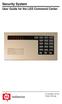 Security System User Guide for the LED Command Center MY SECURITY COMPANY IS: CALL BEFORE TEST: THIS SECURITY SYSTEM IS CONNECTED TO TELEPHONE NUMBER: THE SECURITY CONTROL PANEL IS CONNECTED TO THE PHONE
Ademco Vista-20P/First Alert FA-168C Basic Commands
 Zones 64 total Ademco Vista-20P/First Alert FA-168C Basic Commands Wireless Yes, Zones 09 to 48 + 16 Keyfob Zones (Zones 49 to 64) Batteries Downloadable Partitions 2 12 volt Rechargable inside main Panel,
ICP-CC488 ICP-CC488 EN. Control Panel. Quick Reference Guide
 ICP-CC488 EN Quick Reference Guide ICP-CC488 Control Panel ICP-CC488 Quick Reference Guide Notices EN 2 Copyright Notice Unless otherwise indicated, this publication is the copyright of Bosch Security
9448 Installation and User Guide
 9448 Installation and User Guide Compatible Equipment 9040 Internal Sounder 660 Speech communicator 496327 Issue 1 1 of 6 9448 INTRODUCTION The 9448 is a 3 zone control panel with separate Entry/Exit and
HILLS Series LED Code Pad User Manual
 HILLS Series LED Code Pad User Manual Not all features may be available on your system Check with your installer to find out which features are programmed Page 2 TABLE OF CONTENTS Code Pad Diagrams...2
Using your LED Plus keypad
 Using your LED Plus keypad System 238 System 2316 System 238i System 2316i Part Number 5-051-372-00 Rev B Thank you for purchasing this C&K alarm system Your system is one of the most powerful and advanced
i 70 Installation Manual V1.04 Contents Grade 2 Wireless Intruder Alarm System YOUR SECURITY IS OUR PRIORITY Installation Instructions 2
 YOUR SECURITY IS OUR PRIORITY Contents Installation Instructions 2 Operation Instructions Trouble shooting Technical Specification 8 25 31 i 70 Grade 2 Wireless Intruder Alarm System Global Security Devices
D24 ALARM CONTROL PANEL USER S MANUAL REVISION 1.1 A$12.00 INC GST
 D24 ALARM CONTROL PANEL USER S MANUAL REVISION 1.1 A$12.00 INC GST Ness Security Products Pty Ltd Quality Endorsed Company ISO9001 LIC.No. QEC2074 NSW Head Office only WWW.NESS.COM.AU Australia s largest
ENGINEERING MANUAL. * - Euro-44+ fitted with MSX Card.
 ENGINEERING MANUAL Information is included relevant to the following systems, fitted with End Station software issues 3.0 or later, or equivalent MSX cards: Euro-10 Euro-12 Euro-22 Euro-28 Euro-44+ Euro-134
NetworX Series. NX-148E LCD Keypad. User Manual
 NetworX Series NX-148E LCD Keypad User Manual TABLE OF CONTENTS I. GLOSSARY OF TERMS... 3 II. UNDERSTANDING THE LIGHTS... 4 III. KEYPAD FUNCTIONS... 5 ARMING YOUR SYSTEM IN THE AWAY MODE... 5 MAKING YOUR
NetworX NX-6V2. LED Keypad User Manual
 NetworX NX-6V2 LED Keypad User Manual POWER Light is on when AC power is present; flashes to indicate a low battery condition. ARMED Light is on when armed; off when disarmed; flashes to indicate a previous
Solution-16 Operators Manual ISSUE 1.60
 Solution-16 Operators Manual ISSUE 1.60 !"#$%&"'()*+ Operators Manual Copyright 2002 by, SYDNEY, AUSTRALIA Document Part Number MA880O DOCUMENT ISSUE 1.60 Printed 22 March 2002 This documentation is provided
ALARM SYSTEM USER GUIDE
 ALARM SYSTEM USER GUIDE 1. Introduction...3 Alarm System...3 Keypad...4 Proximity Tags...4 723r Telecommand/ 722r PA...7 Mains Power Failures...7 About this Guide...8 2. Everyday Operation...9 Setting
Important Notice This guide is delivered subject to the following conditions and restrictions:
 User Manual Important Notice This guide is delivered subject to the following conditions and restrictions: Agility User Manual This guide contains proprietary information belonging to RISCO Group. Such
SECURITY SYSTEM NOTES. EMERGENCY ACTIVATION KEYS (check if enabled) PROGRAMMED FUNCTIONS
 SECURITY SYSTEM NOTES Installing/Service Company For Service Call Installation Date / / Central Station Duress Code EMERGENCY ACTIVATION KEYS (check if enabled) Fire Auxiliary Emergency Police PROGRAMMED
SCORPION. micron security products
 SCORPION 4120 6020 & 8020 USER INSTRUCTIONS Thank you for purchasing a Quality Micron Security Alarm Controller. Micron product is manufactured to exacting quality standards. We understand the importance
Advisor Master Programming Guide
 Advisor Master Programming Guide P/N 000000 REV 00.04 ISS 15SEP10 Copyright Trademarks and patents Manufacturer 2010 UTC Fire & Security. All rights reserved. The Advisor Master name and logo are trademarks
Solution 862 Operators Manual. Issue 1.00
 Solution 862 Operators Manual Issue 1.00 Solution 862 Operators Manual Copyright 1998 by Electronics Design and Manufacturing Pty Limited, SYDNEY, AUSTRALIA Document Part Number MA406O Document Issue
SPECIAL CONTROL BUTTON FUNCTIONS
 Operating Guide 1 2 3 CONTENTS Page No. OPERATING YOUR ALARM 5 General Information 5 Arming the Alarm 5 Disarming the Alarm 6 Arming in Stay Mode 7 Disarming Stay Mode 8 Bypassing Zones 8 Manual Panic,
CA60 Plus Software Version 3.1 User Manual May 2000
 TeleT eletek ek CA60 Plus Software Version 3.1 User Manual May 2000 CONTENTS 1. CA60Plus Keypad... 3 1.1. LED display... 3 1.2. Keys... 4 1.3. Combinations of Keys... 4 1.4. Audible Indication... 4 2.
CAPTAIN 6. USER GUIDE System ver. 6.0. 6 Zones Intruder Alarm System. PIMA Electronic Systems Ltd. www.pima-alarms.com
 CAPTAIN 6 6 Zones Intruder Alarm System USER GUIDE System ver. 6.0 PIMA Electronic Systems Ltd. www.pima-alarms.com P/N 4410049, G2 XX en, Jan. 2010 2 CAPTAIN 6 User Guide SAFETY INSTRUCTIONS Your CAPTAIN-i
Magellan All-in-one Wireless Security System
 Magellan All-in-one Wireless Security System MG6250 Console Version 1.0 Menu Programming Guide Introduction The MG6250 All-in-one Wireless Console is a two-partition, 64-zone wireless console, offering
HILLS Series LED Code Pad User Manual
 HILLS Series LED Code Pad User Manual Not all features may be available on your system Check with your installer to find out which features are programmed Page 2 TABLE OF CONTENTS Code Pad Diagrams...2
THANK YOU FOR VOTING TEXECOM INSTALLATION MANUAL. Security Control Panels. Issue 12
 THANK YOU FOR VOTING TEXECOM INSTALLATION MANUAL Security Control Panels Issue 12 Contents Veritas 8, 8C & R8 Installation Manual Contents 1. Quick Reference and Factory Settings... 3 Programming Guide...
User.QXD 09/05/00 14:47 Page 1 Gardtec 370 581/582 User Instructions
 Gardtec 370 581/582 User Instructions Contents Introduction 1 Keypads 1 User Levels and Options 1 Master Code Flow Chart 3 Setting and Unsetting the System 4 Removing Zones and Setting the System 5 Testing
CONTENTS QUICK SETUP & INSTALLATION USER MANUAL. SUPA8 Quick Setup & User Manual
 SUPA8 Quick Setup & User Manual QUICK SETUP & INSTALLATION CONTENTS FACTORY DEFAULTS... 1 INSTALLATION OF THE SECURITY SYSTEM... 2 COMMISSIONING THE DIALLER PANEL... 5 ZONE INPUT CONNECTIONS... 7 PANEL
Solution 880 Operators Manual ISSUE 1.10
 Solution 880 Operators Manual ISSUE 1.10 Solution 880 Operators Manual Copyright 2001 by, SYDNEY, AUSTRALIA Document Part Number MA408O DOCUMENT ISSUE 1.10 Printed 25 May 2001 This documentation is provided
Gen4 Intruder Alarm Panels SIMPLY SECURE. For Residential & Small Commercial Applications
 Gen4 Intruder Alarm Panels SIMPLY SECURE For Residential & Small Commercial Applications Overview and features 8 Zones Each one is separately identified on the keypad and provides ample security detection
NX-8 Installation manual Page 1 Date 13/03/04
 NetworX NX-8 Installation Manual NX-8 Installation manual Page 1 Date 13/03/04 CONTENTS CONTENTS...2 GENERAL INFORMATION...4 ORDERING INFORMATION...4 FEATURE DEFINITIONS...5 PROGRAMMING THE NX-8 KEYPADS...12
ICP-CC488 ICP-CC488 EN. Control Panel. User s Guide
 ICP-CC488 EN User s Guide ICP-CC488 Control Panel ICP-CC488 User's Guide Notices EN 2 Copyright Notice Unless otherwise indicated, this publication is the copyright of Bosch Security Systems, Inc. ( Bosch
Elite 8D/Lite Version 8 Zone Controller. Arrowhead Alarm Products Ltd. Operating Guide. Proudly Designed and Manufactured in New Zealand
 Elite 8D/Lite Version 8 Zone Controller 8 Arrowhead Alarm Products Ltd Operating Guide 1 Proudly Designed and Manufactured in New Zealand 2 CONTENTS Page No. INTRODUCTION 4 About your Alarm 4 OPERATING
SECURITY SYSTEM NOTES
 SECURITY SYSTEM NOTES Installing/Service Company For Service Call Central Station Duress Code FUNCTION CODES Function Code Controls Function EMERGENCY ACTIVATION KEYS (check if enabled) Fire Auxiliary
SECURIT 800L+ CONTROL PANEL
 INSTALLATION MANUAL SECURIT 800L+ CONTROL PANEL With additional options CONTENTS Warnings 2 Standards 2 Warranty Statement 2 Product Description 2 Available Parts 2 Intended use 2 Specifications 3 Processor
Operating Guide. Alert 8D Version 8 Zone Controller Arrowhead Alarm Products Ltd
 8 Alert 8D Version 8 Zone Controller Arrowhead Alarm Products Ltd Operating Guide 20 1 Proudly Designed and Manufactured in New Zealand Installer Notes: Please contact your alarm installer if you require
SECURITY SYSTEM NOTES
 SECURITY SYSTEM NOTES Installing/Service Company For Service Call Central Station Duress Code FUNCTION CODES Function Code Controls Function This system is is not partitioned. EMERGENCY ACTIVATION KEYS
How To Control A Car Alarm On A Car With A Remote Control System
 MODEL CA100 REMOTE CONTROL AUTO ALARM SYSTEM INSTALLATION & OPERATION INSTRUCTIONS WIRING DIAGRAM Black Antenna Wire 6 Pin 6 Pin Mini Connector Valet Switch Blue LED Indicator Blue Wire: (-) 200mA Unlock
IDS. Users Guide to Keypad Functions S E C U R I T Y MANUAL NO. 700-171-01B ISSUED AUG 2002 VERSION 1.18
 INHEP DIGITAL IDS S E C U R I T Y Users Guide to Keypad Functions MANUAL NO. 700-171-01B ISSUED AUG 2002 VERSION 1.18 Summary of Operation A rm/ disarm [#] + [USER CODE] Quick Quick Quick Away Arm Stay
User Guide. RX-406 LED Keypad For CAPTAIN-I Ver.5.5 & up
 RX-406 LED Keypad For CAPTAIN-I Ver.5.5 & up User Guide PIMA Electronic Systems Ltd. 5 Hatzoref Street, Holon 58856, Israel +972-3-6506444 +972-3-5500442 [email protected] http://www.pima-alarms.com
User's Manual. For use with ProSYS 16, ProSYS 40, and ProSYS 128
 User's Manual For use with ProSYS 16, ProSYS 40, and ProSYS 128 Important Notice This manual is delivered subject to the following conditions and restrictions: This manual contains proprietary information
astec Integrated Alarm System USER GUIDE
 astec Integrated Alarm System USER GUIDE 020008599 CONTENTS Full Set, Part Set and Disarm 3 Instant Full Set 3 Part Set with exit time 4 Bell Test 4 Bypassing zones 4 Switch Lights on/off 4 Bypass (24
Solution 6000 Security Systems
 Security Systems EN Security System Copyright Notice Unless otherwise indicated, this publication is the copyright of Bosch Security Systems Pty Ltd ( Bosch ). All rights are reserved.you may download
NESS D16. 16 Zone Control Panel and Dialler OWNER S MANUAL
 NESS D16 16 Zone Control Panel and Dialler OWNER S MANUAL REVISION 2, JULY 2001 Ness Security Products Pty Ltd Quality Endorsed Company ISO9001 LIC.No. QEC2074 NSW Head Office only WWW.NESS.COM.AU Australia
VR8. User Guide Intruder Alarm System
 VR8 EN User Guide Intruder Alarm System VR8 User Guide Notices EN 2 Copyright Notice Unless otherwise indicated, this publication is the copyright of Bosch Security Systems Pty Ltd ( Bosch ). All rights
Users Guide to Keypad Functions
 Users Guide to Keypad Functions MANUAL NO. 700-175-01J ISSUED JAN 2002 VERSION 1.41 Summary of Operation A rm/ disarm [#] + [USER CODE] Quick Quick Quick Panic Fire Medical Away Arm Stay Arm Stay Arm &
PowerWave-8. Users Operating and Programming Guide Version 8.64. 8 zone Control panel Communicator
 ELECTRONIC ENGINEERING LTD. PowerWave-8 8 zone Control panel Communicator Users Operating and Programming Guide Version 8.64 P/N 7101261 Rev. C N.A July 2002 2 Contents Introduction...5 Meet the Crow Alarm
tattletale User Guide Consumer unit version 2.48 1 P a g e
 tattletale User Guide Consumer unit version 2.48 1 P a g e Contents Basic 1... 4 Base Unit Features... 4 Initial Setup... 4 Arming... 5 Disarming... 5 Quiet Button... 5 Settings... 5 Settings 2... 6 Quick
Program Entry Guide. Control Panels
 EN Program Entry Guide Control Panels D6412/D4412 Program Entry Guide EN 2 Documentation Conventions Type Styles Used in this Manual To help identify important items in the text, the following type styles
THANK YOU FOR VOTING TEXECOM MASTER USER MANUAL. Security Control Panels with Integrated Communicator. Issue 6
 THANK YOU FOR VOTING TEXECOM MASTER USER MANUAL Security Control Panels with Integrated Communicator Issue Contents Premier 4// Master User Manual Contents. About the System... Introduction... About this
Quick Installation Guide LCD GSM ALARM SYSTEM LH http://www.usmartbuy.com
 A. Manipulation Specification Quick Installation Guide 1. Arming Arming means all-around guarded when there is no person at home. All detectors are working. Once something triggers any of the detectors,
!"#$%&"'()**+),-+)).( /'0%1##1%&"'(21'$1#( ISSUE 1.40
 !"#$%&"'()**+),-+)).( /'0%1##1%&"'(21'$1#( ISSUE 1.40 MA8XXI 34&0(5167(410(877'(&'9#$:7:(;"
VISTA-128FBP VISTA-250FBP Commercial Fire and Burglary Partitioned Security Systems with Scheduling
 VISTA-128FBP VISTA-250FBP Commercial Fire and Burglary Partitioned Security Systems with Scheduling User Guide K0377V2 7/09 Rev. C 2 TABLE OF CONTENTS SYSTEM OVERVIEW... 5 General... 5 A Partitioned System...
ATS2000/3000/4000/4500 Control Panel. Programming guide
 ATS2000/3000/4000/4500 Control Panel Programming guide Version 2.01 (SR_F), June 2004 Aritech is a GE Interlogix brand. www.aritech.com Copyright (c) 2003 GE Interlogix B.V.. All rights reserved. GE Interlogix
Destiny 4100. Destiny 4100. Owners Manual
 Destiny 4100 Destiny 4100 Owners Manual TABLE OF CONTENTS INTRODUCTION Control Panel...3 Detection Devices...3 Telephone Keypads...3 GLOSSARY... 4-5 LOCAL PHONE ACCESS Using Your Telephones As Keypads...6
ABUS WIRELESS ALARM SYSTEM
 ABUS WIRELESS ALARM SYSTEM These installation instructions are published by Security-Center GmbH & Co. KG, Linker Kreuthweg 5, D-86444 Affing/Mühlhausen. All rights including translation reserved. Reproductions