
Dear NHCC Student, Dr. Lisa Larson NHCC Interim President
|
|
|
- Deborah Stephens
- 9 years ago
- Views:
Transcription
1 Catalog
2 Welcome Dear NHCC Student, It is my pleasure to welcome you to North Hennepin Community College! As a member of the Minnesota State Colleges and Universities System with accreditation by the Higher Learning Commission of the North Central Association of Colleges and Schools, NHCC educates more than 10,000 students and is one of the largest and most diverse community colleges in Minnesota. Though we serve a large community, we specialize in offering small classes taught by exceptional faculty who bring experience and a passion for teaching to the classroom. We also provide a variety of student services to help you every step of the way including advising, career services, tutoring, and counseling. We are committed to your academic success! Flexible morning, afternoon, and evening classes are offered seven days a week in the classroom, online, and through hybrid formats like our state-of-the-art classroom capture option. In addition to associate degrees and certificates, you can also complete some baccalaureate degrees from university partners right here on our campus. While you re here, I highly recommend that you get involved in extra curricular activities outside of the classroom. Our theater productions, art exhibits, music concerts, cultural events, student clubs, and recreational sports provide an opportunity for enrichment outside of the classroom. Explore new ideas and challenge yourself at North Hennepin Community College. Dr. Lisa Larson NHCC Interim President 7411 Eighty-Fifth Avenue North Brooklyn Park, MN Phone: Out-State: Fax: MN Relay [email protected] North Hennepin Community College is a member of Minnesota State Colleges and Universities. North Hennepin Community College and Minnesota State Colleges and Universities are committed to a policy of nondiscrimination in employment and education opportunity. No person shall be discriminated against in the terms and conditions of employment, personnel practices, or access to and participation in, programs, services, and activities with regard to race, sex, color, creed, religion, age, national origin, disability, marital status, status with regard to public assistance, sexual orientation, gender identity, or gender expression. In addition, discrimination in employment based on membership or activity in a local commission as defined by law is prohibited. This document is available in alternative formats to individuals with disabilities by calling or through the Minnesota Relay Service at North Hennepin Community College s Disability Access Services office can be reached at

3 North Hennepin Community College Catalog About the College Mission Statement Engaging Students, Changing Lives North Hennepin Community College creates opportunities for students to reach their academic goals, succeed in their chosen professions, and make a difference in the world. Vision Statement Opportunity Without Limits, Learning Without End, and Achievement Beyond Expectation Guiding Values We believe in the power of education to change lives. Toward that end, we: Inspire intellectual curiosity Embrace diversity of all kinds Foster trust and respect Expect quality and continuous improvement Encourage creativity and innovation Promote individual responsibility and integrity Invest in professional and personal development Build strong, collaborative partnerships Serve as responsible stewards of college resources Strategic Goals The following strategic goals give direction for moving North Hennepin Community College forward: Access, Opportunity, and Success Maintain academic standards and stable enrollments while increasing retention and completion. Innovation and Relevance Maintain curriculum that is relevant and effective while developing innovative new courses and programs. Culture of Commitment Develop a more rewarding, engaged, and inclusive college environment. Workforce and Community Expand effective partnerships within and beyond our community. Commitment to Quality North Hennepin Community College will provide services and learning opportunities (courses, programs, student life activities, workshops, and other ways of engaging learning) that will be of the highest quality and value (relevance). We will also provide the resources needed for success and demonstrate honesty and integrity in all of our communications and interactions, while being respectful of each other and what we bring to the college. Each person at NHCC has a responsibility to uphold this commitment. College Commitments Develop policies to ensure the success of this commitment Provide resources and training required for a quality educational experience Hire employees that believe and provide all aspects of a quality education Provide the infrastructure necessary to fulfill this commitment Faculty, Staff, and Administration Commitments Maintain their expertise by professional development opportunities Develop and maintain the resources needed to be successful Provide services and learning opportunities that are relevant and of value Be timely and clear in responses Maintain standards and excellence Be fully engaged Be available and supportive Student Commitments Be in attendance Be fully engaged; participate
4 Be prepared Be respectful of each other Ask questions and seek help Assume full responsibility for actions and learning General Education Philosophy North Hennepin Community College values independent thinking, creativity, and teamwork; students develop lifelong learning skills to prepare them for the interdependent, changing global economy. General education provides a foundation of knowledge in a variety of disciplines; students learn to communicate, think, and apply what they learn in their family, career, and social lives. At NHCC, learners: Expand their intellectual capacity by developing deeper, broader understandings of the world and building communication and thinking skills Make life decisions by reflecting on their values, connecting them to what they learn, and applying them as engaged citizens Engage in scholarly activities, develop an understanding and appreciation of culture, and enjoy the pursuit of knowledge Accreditation North Hennepin Community College is accredited by the Higher Learning Commission of the North Central Association of Colleges and Schools (HLC). Accreditation means that North Hennepin Community College has been found to meet the Commission s requirements and criteria. This accreditation provides public certification of acceptable institutional quality. North Hennepin Community College s most recent comprehensive evaluation occurred in Our next reaffirmation of accreditation will be in HLC has granted NHCC the authority to offer all programs in an online format. Higher Learning Commission of the North Central Association of Colleges and Schools 0 North LaSalle Street, Suite 2400, Chicago, IL In addition to the College accreditation, the following programs have received specialized accreditation or approval by national and/or international organizations: Business and Accounting Programs Association of Collegiate Business Schools and Programs West 119th Street, Overland Park, KS 6621 Phone: (91) 9-956, Fax: (91) Histotechnology Program National Accrediting Agency for Clinical Laboratory Sciences (NAACLS) 5600 North River Road, Suite 720, Rosemont, IL (847) or (77) Medical Laboratory Technician Program National Accrediting Agency for Clinical Laboratory Sciences (NAACLS) 5600 North River Road, Suite 720, Rosemont, IL (847) or (77) Nursing Program Accreditation Commission for Education in Nursing, Inc. (ACEN) 4 Peachtree Road NE, Suite 850, Atlanta, GA 026 (404) Minnesota Board of Nursing 2829 University Avenue SE, Suite 500, Minneapolis, MN (612) Paralegal Program American Bar Association Standing Committee on Paralegals 21 N. Clark Street, MS 19.1, Chicago, IL
5 (800) Peer Tutor Program College Reading and Learning Association CRLA Member Services 2900 Finfeather Road Bryan, TX Program and Discipline Review To ensure all our programs, disciplines, and degrees maintain their quality and meet the needs of our graduates, an intensive Program Review is completed on a five-year cycle. Outcomes of these reviews are available upon request. Education Plan Curricular Goals North Hennepin Community College provides curricula to meet these goals: Lower division transfer curriculum that provides the first two years toward a liberal arts bachelor s degree program. Associate of Science programs designed to articulate to four-year professional programs. Associate of Fine Arts transfer to a designated fine arts discipline bachelor s degree program. Career programs and certificates designed for employment with a varying number of courses that can be used toward a bachelor s degree program. Continuing education and non-credit programs responsive to personal, professional and industry needs. Enrolling in college courses for personal and professional enrichment is also encouraged. Students may complete as many degree programs at North Hennepin Community College as desired. When students receive degrees from North Hennepin Community College, they will have demonstrated these Essential Learning Outcomes: 1. Knowledge of Human Cultures and the Physical and Natural World Through study in the sciences, mathematics, social sciences, humanities, histories, languages, the arts, technology and professions Focused by engagement with big questions, both contemporary and enduring 2. Intellectual and Practical Skills, including Inquiry and analysis Critical and creative thinking Written and oral communication Quantitative literacy Information literacy Teamwork and problem solving practiced extensively, across the curriculum, in the context of progressively more challenging problems, projects, and standards for performance. Personal and Social Responsibility and Engagement, including Civic knowledge and involvement campus, local and global Intercultural knowledge and competence Ethical reasoning and action Foundations and skills for lifelong learning anchored through active involvement with diverse communities and real-world challenges 4. Integrative and Applied Learning, including Synthesis and advanced accomplishment across general education, liberal studies, specialized studies and activities in the broader campus community demonstrated through the application of knowledge, skills, and responsibilities to new settings and complex problems Learner Outcomes Assessment North Hennepin Community College conducts assessment of student learning to improve teaching and learning and to be accountable to the communities it serves. A college culture that values ongoing assessment is the foundation for continuing improvement of the quality of higher education. While at North Hennepin Community College, students will participate in a variety of assessment activities, both inside and outside of class. In class, students will - in addition to taking quizzes and tests - write essays and papers, make reports and presentations, create visual representations of concepts, prepare portfolios and participate in a variety of other assessment activities. Students will also learn to assess their own work and that of their peers. In addition, they will complete assessments of the courses they complete. As a participant in the larger, college-wide community, students will take computer-based assessment tests that will assist NHCC in placing students into appropriate courses in reading, writing and mathematics and will complete surveys to assess academic support services and College programs. Students who complete certain career programs will take assessments required by national certification boards. Students will also be asked to participate in graduate follow-up surveys after they graduate.
6 All these assessments have a single focus - improving learning. Each instructor at the College designs his or her own learning activities and assessments, but all faculty and staff work together to help students achieve the College s educational goals: Discipline knowledge and the ability to apply it Life-long learning and critical thinking skills Effective communication skills The ability to function in complex, diverse environments Associate Degree Programs Associate in Arts (A.A.) Degree The Associate in Arts (A.A.) is awarded for successful completion of 60 designated credits and is designed to constitute the first two years of a liberal arts bachelor degree program. The Associate in Arts degree is a liberal arts degree intended primarily for students who plan to transfer to another college or university to complete a bachelor s degree. Students may also choose to concentrate in a particular field of study in preparation for a planned major or professional emphasis at a four-year college by following the pre-major requirements of the desired transfer institution. An A.A. degree includes the entire Minnesota Transfer Curriculum (MnTC), 40 semester credits of general education requirements. Pursuant to Minnesota state statute, the MnTC must transfer to any institution within the Minnesota State Colleges and Universities system or the University of Minnesota. Students are encourages to develop an educational plan with an advisor to ensure they are meeting degree requirements and planning for a successful transfer. The A.A. Degree requires a minimum of 60 semester credits. In order to graduate, a student shall: 1. Complete 40 credits in the Minnesota Transfer Curriculum, satisfying the requirements for each of the 10 goal areas. 2. Earn a minimum of 20 semester credits of the 60 semester credits required for the A.A. Degree at NHCC.. Earn a cumulative grade point average of 2.00 (C) or higher in courses taken at North Hennepin Community College. 4. Grades of A, B, C, and D are accepted in the MnTC; however a cumulative 2.0 grade point average is required to complete the entire 40 credit, 10 goal area MnTC. 5. Complete at least 4 credits for the Wellness requirement with at least one course from each of the following areas: Health (all courses) and Physical Education (all courses). Complete 16 elective credits selected from all courses listed in the College s offerings, which are numbered 1000 or higher. If the student intends to transfer, he/she is encouraged to work with a counselor or adviser to fulfill requirements for transfer to the other institution. 6. Have four years to complete the graduation requirements as published in the catalog in effect at the time of their initial enrollment. Students taking longer than four years to complete their graduation requirements may follow any catalog published during the four-year period preceding their graduation. Completion of the MnTC and/or the completion of an associate degree fulfills the MnTC Goal Area 2 Critical Thinking requirement. North Hennepin Community College offers the following A.A. degree programs: A.A. in Liberal Arts and Sciences A.A. with an emphasis in History A.A. with an emphasis in Film Associate in Fine Arts (A.F.A.) Degree An Associate in Fine Arts (A.F.A.) degree is intended for students whose primary goal is to complete a program in a designated discipline in fine arts. The A.F.A. degree is designed for transfer to a baccalaureate degree. In order to graduate, a student shall: 1. Earn a minimum of semester credits as required in the program, with a grade point average of 2.00 (C) or above in courses taken at North Hennepin Community College... Specific programs may have additional requirements or a higher minimum grade point average. 2. Earn a minimum of 20 semester credits at North Hennepin Community College. A student must complete at least 50% of the fine arts courses at North Hennepin Community College.. Earn a cumulative grade point average of 2.00 (C) or higher in courses taken at North Hennepin Community College. 4. Grades of A, B, C, and D are accepted in the degree; however a cumulative 2.0 grade point average is required to complete the degree. 5. Have four years to complete the graduation requirements as published in the catalog in effect at the time of their initial enrollment. Students taking longer than four years to complete their graduation requirements may follow any catalog published during the four-year period preceding their graduation. 6. Completion of the MnTC and/or the completion of the AFA degree fulfills the MnTC Goal Area 2 Critical Thinking requirement. North Hennepin Community College offers the following A.F.A degree program: A.F.A. Creative Writing A.F.A. Music A.F.A. Studio Arts
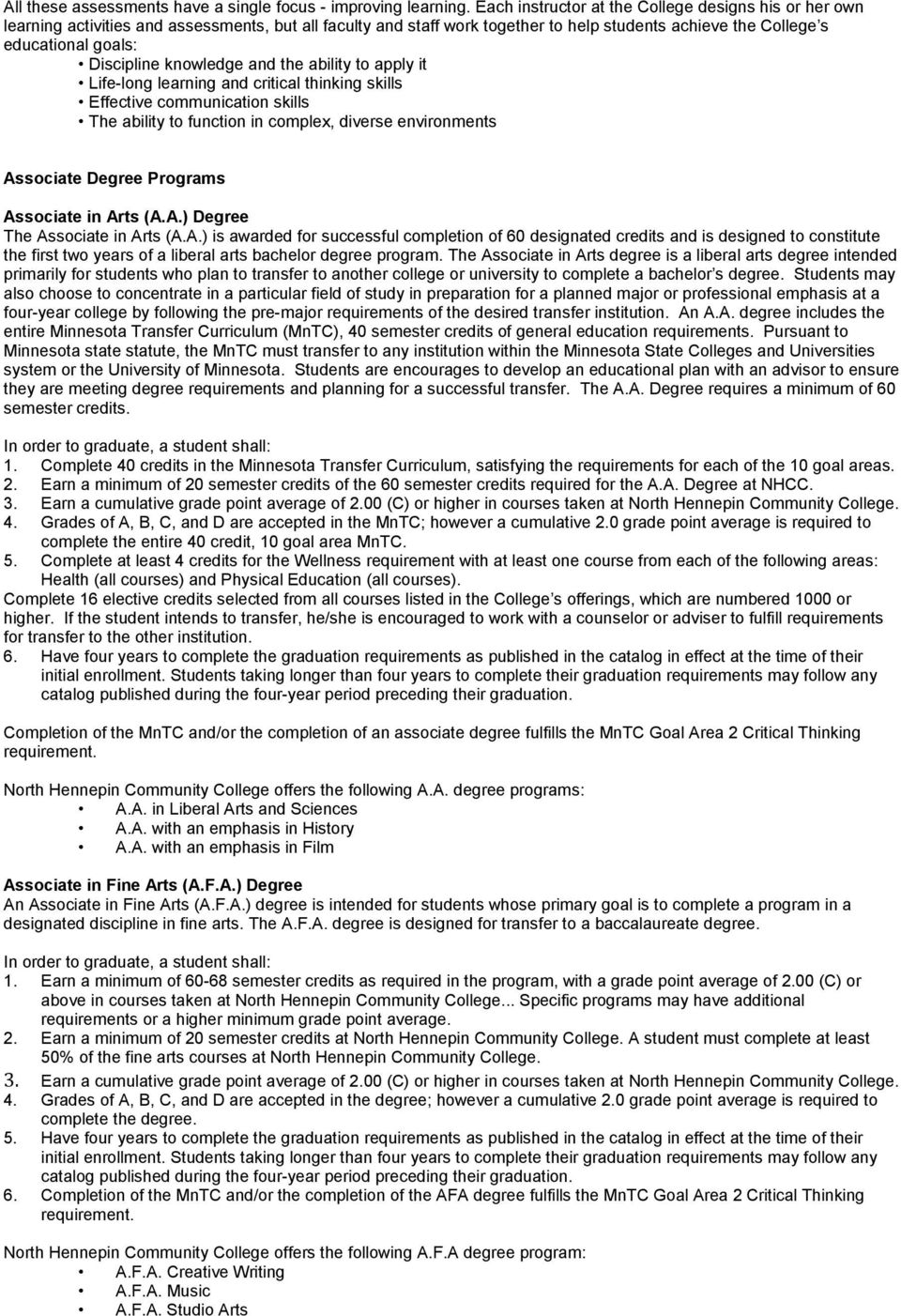
7 A.F.A. Theatre Associate in Science (A.S.) Degree The Associate in Science (A.S.) degree is intended for students whose primary goal is to prepare for transfer to complete a bachelor s degree at a college or university with whom North Hennepin Community College has an articulation agreement and/or complete the credentials for a specific career. The A.S. degree provides a balance of general education courses and the required scientific, professional or technical courses in the degree program. In order to graduate, a student shall: 1. Earn a minimum of semester credits as required in the program, with a grade point average of 2.00 (C) or above in courses taken at North Hennepin Community College.. Specific programs may have additional requirements or a higher minimum grade point average. 2. Earn a minimum of 20 semester credits at North Hennepin Community College. A student must complete at least 50% of career specific courses at North Hennepin Community College.. Grades of A, B, C, and D are accepted in the degree; however a cumulative 2.0 grade point average is required to complete the degree. 4. Earn 0 credits in at least 6 MnTC goal areas. 5. Earn additional professional/technical credits. 6. Have four years to complete the graduation requirements as published in the catalog in effect at the time of their initial enrollment. Students taking longer than four years to complete their graduation requirements may follow any catalog published during the four-year period preceding their graduation. 7. Completion of the MnTC and/or the completion of the AS degree fulfills the MnTC Goal Area 2 Critical Thinking requirement. North Hennepin Community College offers the following A.S. degree programs: Accounting Biology Business Computer Systems and Management Business Administration (with either a management or marketing concentration) Chemistry Computer Science Construction Management and Supervision Criminal Justice Education (Pre) Engineering Fitness Graphic Design Individualized Studies Law Enforcement Mathematics Nursing Paralegal Physical Education Associate in Applied Science (A.A.S.) Degree The Associate in Applied Science (A.A.S.) degree is intended for those students who plan to use the competence gained through their degree for immediate employment or enhancing current career skills. The A.A.S. degree includes a minimum of 20 semester credits in general education selected from at least three of the ten goal areas of the Minnesota Transfer Curriculum (MnTC). Many of the A.A.S. degree programs have articulation agreements with four-year institutions for transfer of the program. In order to graduate, a student shall: 1. Earn a minimum of 60 semester credits as required in the program with a grade point average of 2.00 (C) or above in courses taken at North Hennepin Community College. Specific programs may have additional requirements or a higher minimum grade point average. 2. Earn a minimum of 20 semester credits at North Hennepin Community College. A student must complete at least 50% of the professional or technical courses at North Hennepin Community College.. Earn 20 credits in at least MnTC goal areas. 4. Earn 40 professional/technical credits. 5. Have four years to complete the graduation requirements as published in the catalog in effect at the time of their initial enrollment. Students taking longer than four years to complete their graduation requirements may follow any catalog published during the four-year period preceding their graduation. 6. Completion of the MnTC and/or the completion of the AAS degree fulfills the MnTC Goal Area 2 Critical Thinking requirement. North Hennepin Community College offers the following A.A.S. degree programs: Accounting Technology Business Computer Systems and Management
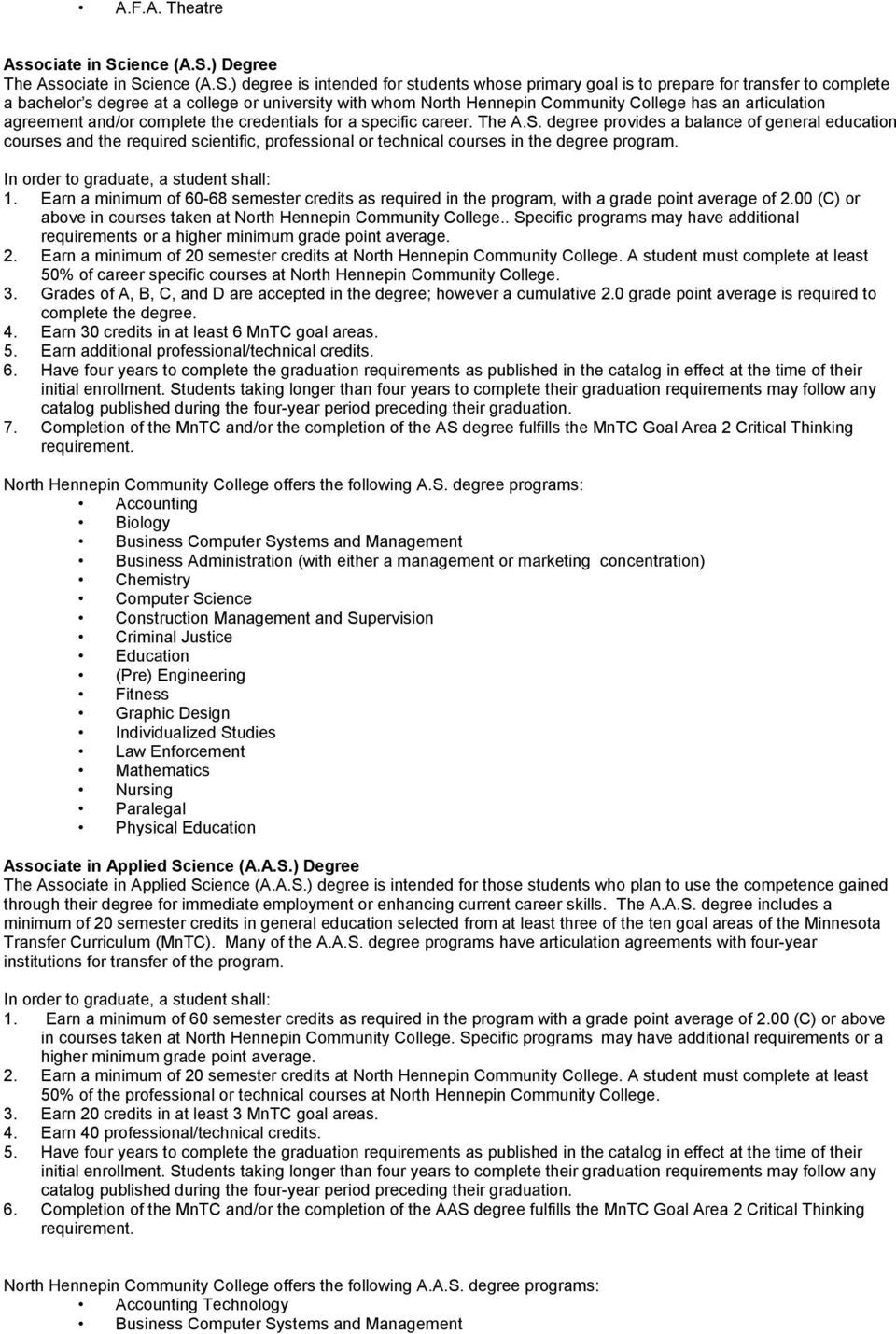
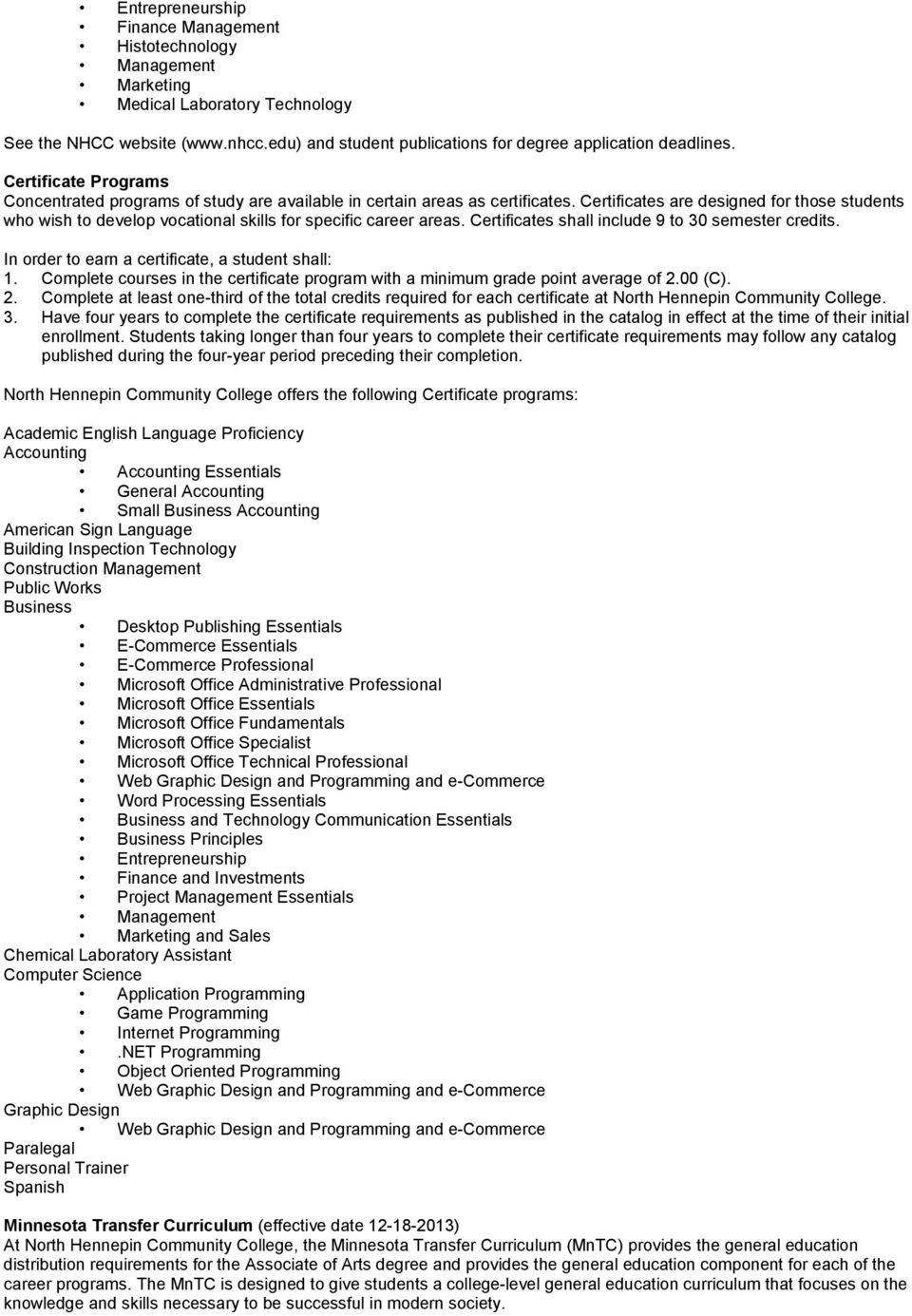
8 Entrepreneurship Finance Management Histotechnology Management Marketing Medical Laboratory Technology See the NHCC website ( and student publications for degree application deadlines. Certificate Programs Concentrated programs of study are available in certain areas as certificates. Certificates are designed for those students who wish to develop vocational skills for specific career areas. Certificates shall include 9 to 0 semester credits. In order to earn a certificate, a student shall: 1. Complete courses in the certificate program with a minimum grade point average of 2.00 (C). 2. Complete at least one-third of the total credits required for each certificate at North Hennepin Community College.. Have four years to complete the certificate requirements as published in the catalog in effect at the time of their initial enrollment. Students taking longer than four years to complete their certificate requirements may follow any catalog published during the four-year period preceding their completion. North Hennepin Community College offers the following Certificate programs: Academic English Language Proficiency Accounting Accounting Essentials General Accounting Small Business Accounting American Sign Language Building Inspection Technology Construction Management Public Works Business Desktop Publishing Essentials E-Commerce Essentials E-Commerce Professional Microsoft Office Administrative Professional Microsoft Office Essentials Microsoft Office Fundamentals Microsoft Office Specialist Microsoft Office Technical Professional Web Graphic Design and Programming and e-commerce Word Processing Essentials Business and Technology Communication Essentials Business Principles Entrepreneurship Finance and Investments Project Management Essentials Management Marketing and Sales Chemical Laboratory Assistant Computer Science Application Programming Game Programming Internet Programming.NET Programming Object Oriented Programming Web Graphic Design and Programming and e-commerce Graphic Design Web Graphic Design and Programming and e-commerce Paralegal Personal Trainer Spanish Minnesota Transfer Curriculum (effective date ) At North Hennepin Community College, the Minnesota Transfer Curriculum (MnTC) provides the general education distribution requirements for the Associate of Arts degree and provides the general education component for each of the career programs. The MnTC is designed to give students a college-level general education curriculum that focuses on the knowledge and skills necessary to be successful in modern society.
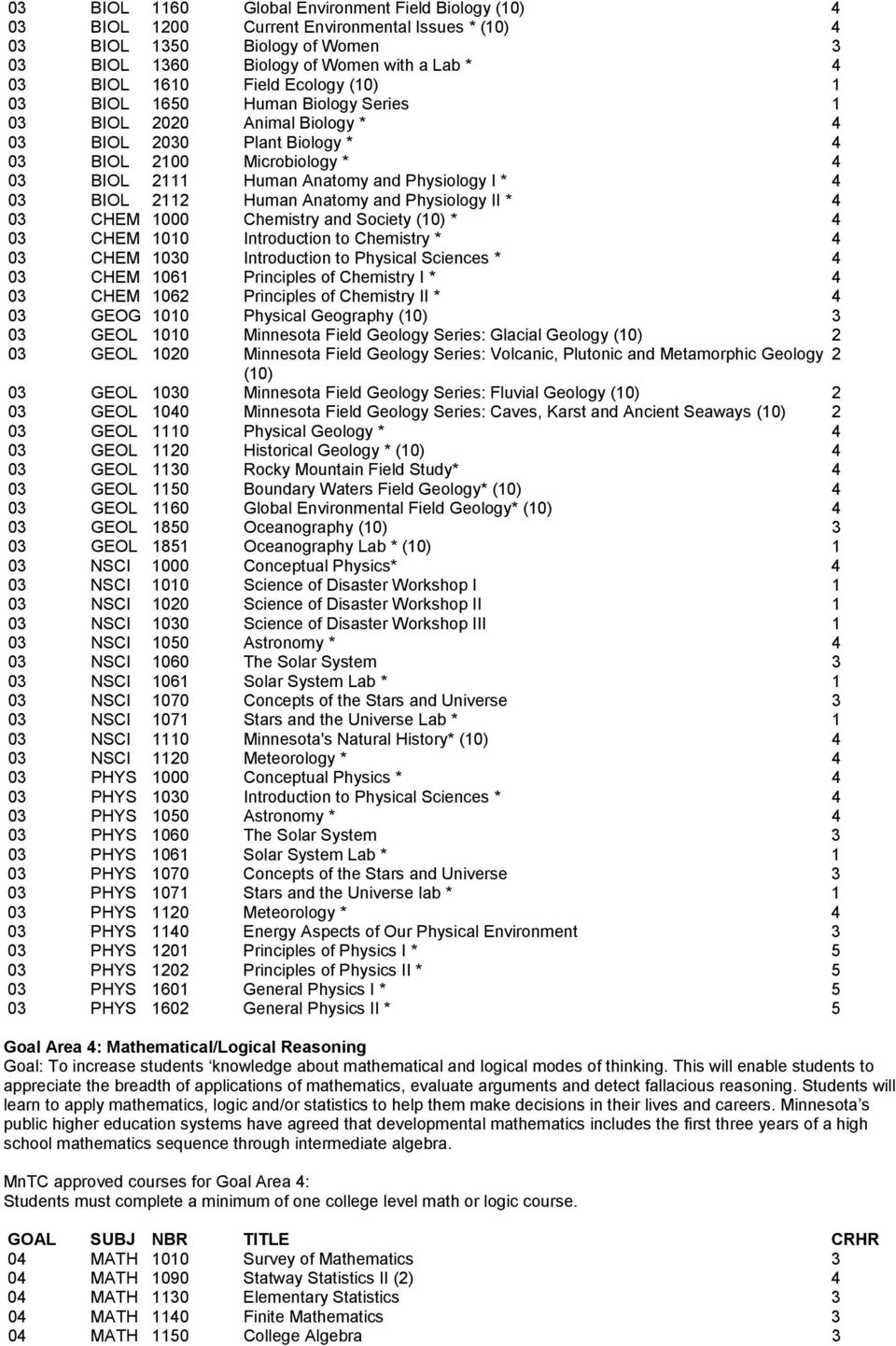
9 The Minnesota Transfer Curriculum (MnTC) is an agreement among Minnesota public institutions that aids in transfer among public colleges and universities in Minnesota. Upon full completion of the MnTC, a student will receive credit for all lower-division general education requirements (40 credits) upon admission. Partial completion of the MnTC will first be evaluated for completion of any of the 10 Goal Areas within the MnTC and then on a course-by-course basis. In all cases, courses recognized within particular Goal Area(s) by the previous institution will be accepted at North Hennepin Community College within the same Goal Area(s). Grades of A, B, C, or D are accepted in the MnTC; however, a cumulative 2.00 MnTC GPA is required for recognition of a student s completion of the entire Minnesota Transfer Curriculum with or without completing an associate degree. Goal Area 1: Communication Goal: To develop writers and speakers who use the English language effectively and who read, write, speak and listen critically. As a base, all students should complete introductory communication requirements early in their collegiate studies. Writing competency is an ongoing process reinforced through writing-intensive courses and writing across the curriculum. Speaking and listening skills are reinforced through multiple opportunities for interpersonal communication, public speaking and discussion. MnTC approved courses for Goal Area 1: Students must complete a minimum of nine (9) credits by taking at least six (6) credits in writing and three () credits in communications. Courses that fulfill more than one goal area show the additional goal area in parentheses (#) after course title. GOAL SUBJ NBR TITLE CRHR 01 COMM 1010 Fundamentals of Public Speaking 01 COMM 1110 Principles of Interpersonal Communication 01 COMM 1210 Small Group Communication 01 COMM 1410 Human Communication Theory 01 COMM 1510 Nonverbal Communication (8) 01 COMM 1610 Introduction to Mass Communication (9) 01 COMM 1710 Oral Interpretation and Traditions (8) 01 ENGL 1201 College Writing I 4 01 ENGL 1202 College Writing II 2 01 TFT 1710 Oral Interpretation and Traditions (8) Goal Area 2: Critical Thinking Goal: To develop thinkers who are able to unify factual, creative, rational and value-sensitive modes of thought. Critical thinking will be taught and used throughout the general education curriculum to develop students awareness of their own thinking and problem-solving procedures. To integrate new skills into their customary ways of thinking, students must be actively engaged in practicing thinking skills and applying them to open-ended problems. MnTC approved courses for Goal Area 2: Completion of the MnTC and/or the completion of an associate s degree fulfills the Critical Thinking requirement. GOAL SUBJ NBR TITLE CRHR 02 MATH 1090 Statway Statistics II (4) 4 02 PHIL 1110 Informal Reasoning for Problem Solving (9) Goal Area : Natural Sciences Goal: To improve students understanding of natural science principles and of the methods of scientific inquiry, i.e., the ways in which scientists investigate natural science phenomena. As a basis for lifelong learning, students need to know the vocabulary of science and to realize that while a set of principles has been developed through the work of previous scientists, ongoing scientific inquiry and new knowledge will bring changes in some of the ways scientists view the world. By studying the problems that engage today s scientists, students learn to appreciate the importance of science in their lives and to understand the value of a scientific perspective. Students are encouraged to study both the biological and physical sciences. MnTC approved courses for Goal Area : Students must complete a minimum of seven (7) credits. The courses must come from at least two different departments and at least one must be a traditional lab course-designated by *. Courses that fulfill more than one goal area show the additional goal area in parentheses (#) after course title. GOAL SUBJ NBR TITLE CRHR 0 ANTH 1020 Intro to Anthropology: Physical Anthropology, Archaeology & Prehistory (10) 0 BIOL 1000 Life Science * 4 0 BIOL 1001 Biology I * 4 0 BIOL 100 Boundary Waters Canoe Area Field Biology (10) 4 0 BIOL 1101 Principles of Biology I * 4 0 BIOL 1102 Principles of Biology II * 4 0 BIOL 1120 Human Biology 0 BIOL 110 Human Biology with a Lab * 4

10 0 BIOL 1160 Global Environment Field Biology (10) 4 0 BIOL 1200 Current Environmental Issues * (10) 4 0 BIOL 150 Biology of Women 0 BIOL 160 Biology of Women with a Lab * 4 0 BIOL 1610 Field Ecology (10) 1 0 BIOL 1650 Human Biology Series 1 0 BIOL 2020 Animal Biology * 4 0 BIOL 200 Plant Biology * 4 0 BIOL 2100 Microbiology * 4 0 BIOL 2111 Human Anatomy and Physiology I * 4 0 BIOL 2112 Human Anatomy and Physiology II * 4 0 CHEM 1000 Chemistry and Society (10) * 4 0 CHEM 1010 Introduction to Chemistry * 4 0 CHEM 100 Introduction to Physical Sciences * 4 0 CHEM 1061 Principles of Chemistry I * 4 0 CHEM 1062 Principles of Chemistry II * 4 0 GEOG 1010 Physical Geography (10) 0 GEOL 1010 Minnesota Field Geology Series: Glacial Geology (10) 2 0 GEOL 1020 Minnesota Field Geology Series: Volcanic, Plutonic and Metamorphic Geology 2 (10) 0 GEOL 100 Minnesota Field Geology Series: Fluvial Geology (10) 2 0 GEOL 1040 Minnesota Field Geology Series: Caves, Karst and Ancient Seaways (10) 2 0 GEOL 1110 Physical Geology * 4 0 GEOL 1120 Historical Geology * (10) 4 0 GEOL 110 Rocky Mountain Field Study* 4 0 GEOL 1150 Boundary Waters Field Geology* (10) 4 0 GEOL 1160 Global Environmental Field Geology* (10) 4 0 GEOL 1850 Oceanography (10) 0 GEOL 1851 Oceanography Lab * (10) 1 0 NSCI 1000 Conceptual Physics* 4 0 NSCI 1010 Science of Disaster Workshop I 1 0 NSCI 1020 Science of Disaster Workshop II 1 0 NSCI 100 Science of Disaster Workshop III 1 0 NSCI 1050 Astronomy * 4 0 NSCI 1060 The Solar System 0 NSCI 1061 Solar System Lab * 1 0 NSCI 1070 Concepts of the Stars and Universe 0 NSCI 1071 Stars and the Universe Lab * 1 0 NSCI 1110 Minnesota's Natural History* (10) 4 0 NSCI 1120 Meteorology * 4 0 PHYS 1000 Conceptual Physics * 4 0 PHYS 100 Introduction to Physical Sciences * 4 0 PHYS 1050 Astronomy * 4 0 PHYS 1060 The Solar System 0 PHYS 1061 Solar System Lab * 1 0 PHYS 1070 Concepts of the Stars and Universe 0 PHYS 1071 Stars and the Universe lab * 1 0 PHYS 1120 Meteorology * 4 0 PHYS 1140 Energy Aspects of Our Physical Environment 0 PHYS 1201 Principles of Physics I * 5 0 PHYS 1202 Principles of Physics II * 5 0 PHYS 1601 General Physics I * 5 0 PHYS 1602 General Physics II * 5 Goal Area 4: Mathematical/Logical Reasoning Goal: To increase students knowledge about mathematical and logical modes of thinking. This will enable students to appreciate the breadth of applications of mathematics, evaluate arguments and detect fallacious reasoning. Students will learn to apply mathematics, logic and/or statistics to help them make decisions in their lives and careers. Minnesota s public higher education systems have agreed that developmental mathematics includes the first three years of a high school mathematics sequence through intermediate algebra. MnTC approved courses for Goal Area 4: Students must complete a minimum of one college level math or logic course. GOAL SUBJ NBR TITLE CRHR 04 MATH 1010 Survey of Mathematics 04 MATH 1090 Statway Statistics II (2) 4 04 MATH 110 Elementary Statistics 04 MATH 1140 Finite Mathematics 04 MATH 1150 College Algebra
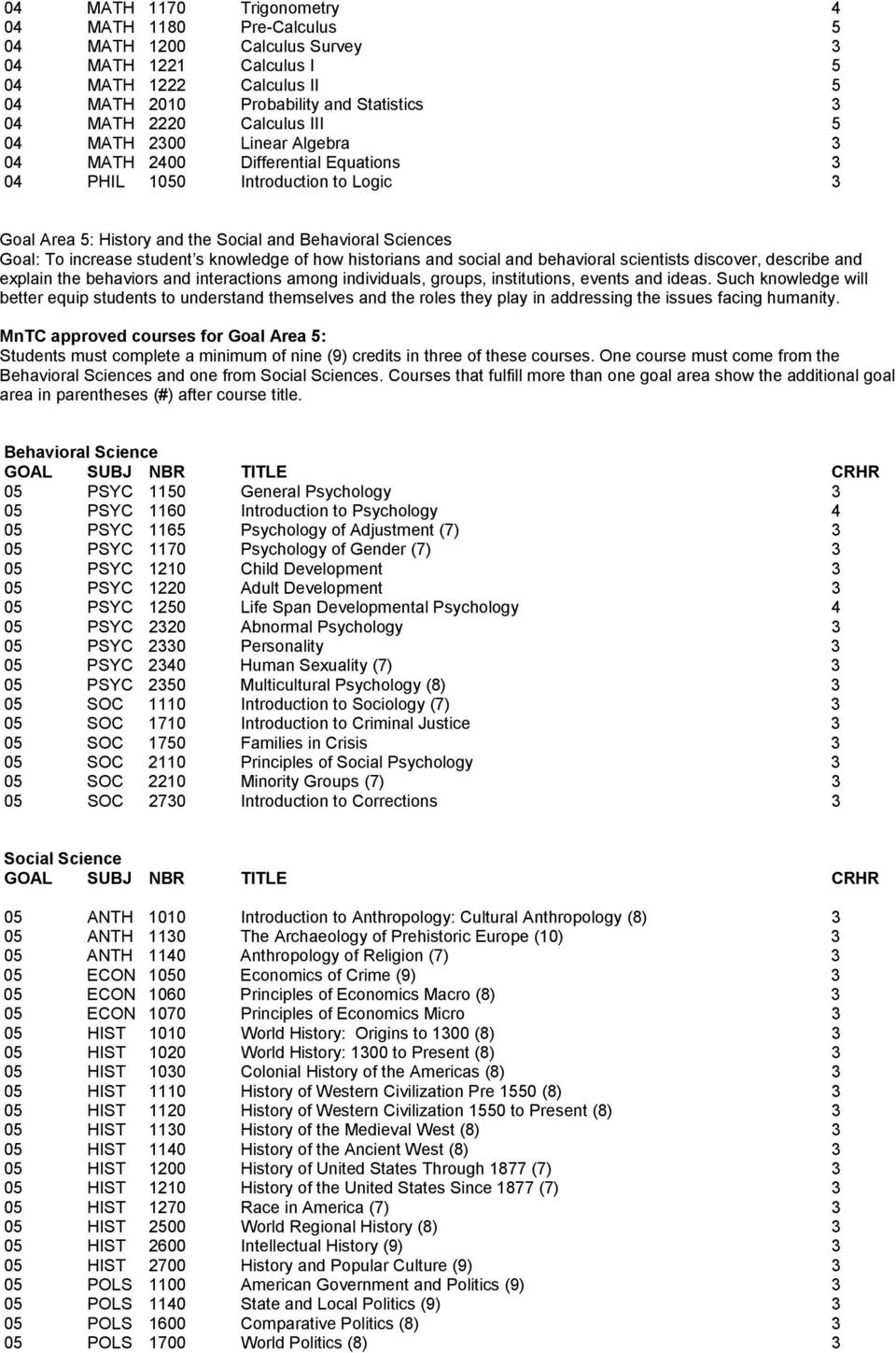
11 04 MATH 1170 Trigonometry 4 04 MATH 1180 Pre-Calculus 5 04 MATH 1200 Calculus Survey 04 MATH 1221 Calculus I 5 04 MATH 1222 Calculus II 5 04 MATH 2010 Probability and Statistics 04 MATH 2220 Calculus III 5 04 MATH 200 Linear Algebra 04 MATH 2400 Differential Equations 04 PHIL 1050 Introduction to Logic Goal Area 5: History and the Social and Behavioral Sciences Goal: To increase student s knowledge of how historians and social and behavioral scientists discover, describe and explain the behaviors and interactions among individuals, groups, institutions, events and ideas. Such knowledge will better equip students to understand themselves and the roles they play in addressing the issues facing humanity. MnTC approved courses for Goal Area 5: Students must complete a minimum of nine (9) credits in three of these courses. One course must come from the Behavioral Sciences and one from Social Sciences. Courses that fulfill more than one goal area show the additional goal area in parentheses (#) after course title. Behavioral Science GOAL SUBJ NBR TITLE CRHR 05 PSYC 1150 General Psychology 05 PSYC 1160 Introduction to Psychology 4 05 PSYC 1165 Psychology of Adjustment (7) 05 PSYC 1170 Psychology of Gender (7) 05 PSYC 1210 Child Development 05 PSYC 1220 Adult Development 05 PSYC 1250 Life Span Developmental Psychology 4 05 PSYC 220 Abnormal Psychology 05 PSYC 20 Personality 05 PSYC 240 Human Sexuality (7) 05 PSYC 250 Multicultural Psychology (8) 05 SOC 1110 Introduction to Sociology (7) 05 SOC 1710 Introduction to Criminal Justice 05 SOC 1750 Families in Crisis 05 SOC 2110 Principles of Social Psychology 05 SOC 2210 Minority Groups (7) 05 SOC 270 Introduction to Corrections Social Science GOAL SUBJ NBR TITLE CRHR 05 ANTH 1010 Introduction to Anthropology: Cultural Anthropology (8) 05 ANTH 110 The Archaeology of Prehistoric Europe (10) 05 ANTH 1140 Anthropology of Religion (7) 05 ECON 1050 Economics of Crime (9) 05 ECON 1060 Principles of Economics Macro (8) 05 ECON 1070 Principles of Economics Micro 05 HIST 1010 World History: Origins to 100 (8) 05 HIST 1020 World History: 100 to Present (8) 05 HIST 100 Colonial History of the Americas (8) 05 HIST 1110 History of Western Civilization Pre 1550 (8) 05 HIST 1120 History of Western Civilization 1550 to Present (8) 05 HIST 110 History of the Medieval West (8) 05 HIST 1140 History of the Ancient West (8) 05 HIST 1200 History of United States Through 1877 (7) 05 HIST 1210 History of the United States Since 1877 (7) 05 HIST 1270 Race in America (7) 05 HIST 2500 World Regional History (8) 05 HIST 2600 Intellectual History (9) 05 HIST 2700 History and Popular Culture (9) 05 POLS 1100 American Government and Politics (9) 05 POLS 1140 State and Local Politics (9) 05 POLS 1600 Comparative Politics (8) 05 POLS 1700 World Politics (8)
12 05 POLS 210 Constitutional Law Goal Area 6: Humanities and Fine Arts Goal: To expand students knowledge of the human condition and human cultures, especially in relation to behavior, ideas and values expressed in works of human imagination and thought. Through study in disciplines such as literature, philosophy and the fine arts, students will engage in critical analysis, form aesthetic judgments and develop an appreciation of the arts and humanities as fundamental to the health and survival of any society. Students should have experiences in both the arts and humanities. MnTC approved courses for Goal Area 6: Students must complete a minimum of nine (9) credits in three of these courses. Courses must come from at least two different departments. GOAL SUBJ NBR TITLE CRHR 06 ARBC 100 Arab Cultures (8) 06 ART 1040 Introduction to Art (8) 06 ART 1101 Photography I 06 ART 1102 Photography II 06 ART 1160 Digital Photography 06 ART 1170 Advanced Photography 06 ART 1270 Digital Video Production 06 ART 101 Two Dimensional Design I 06 ART 102 Two Dimensional Design II 06 ART 110 Three Dimensional Design 06 ART 120 Introduction to Sculpture 06 ART 140 Fundamentals of Color 06 ART 161 Ceramics I 06 ART 162 Ceramics II 06 ART 1401 Drawing I 06 ART 1402 Drawing II 06 ART 1770 Quilt Arts 06 ART 1810 Studio Art Workshop 1 Credit 1 06 ART 1820 Studio Art Workshop 2 Credit 2 06 ART 2180 Art History: Pre-History to the Age of Cathedrals (8) 06 ART 2190 Art History: Renaissance to 21st Century Art (8) 06 ART 200 Architectural History (8) 2 06 ART 2611 Painting I 06 ART 2612 Painting II 06 ART 2640 Watercolor 06 ART 2740 Jewelry Workshop 1 06 ART 2750 Ceramics Workshop 1 06 ART 2781 Quiltmaking Workshop I 1 06 ART 2782 Quiltmaking Workshop II 1 06 ART 2800 Painting Workshop 1 06 ART 2820 Drawing Workshop 1 06 ART 2860 Photography Workshop 1 06 ART 2900 Studio Arts Capstone Practicum 1 06 ART 2970 Art Appreciation Field Trip 1 06 ENGL 1150 Introduction to Literature 06 ENGL 1250 Magazine Workshop 2 06 ENGL 1400 Reading Poetry 06 ENGL 1450 Reading Plays (7) 06 ENGL 1900 Introduction to Creative Writing 06 ENGL 1950 Graphic Novels 06 ENGL 2010 Writing Creative Non-Fiction and Memoir 06 ENGL 2020 Writing Stories 06 ENGL 200 Writing Poetry 06 ENGL 2270 Modern American Literature 06 ENGL 200 Children s Literature (7) 06 ENGL 210 American Short Story 06 ENGL 220 Writing: From Structure to Style (7) 06 ENGL 20 Hmong American Literature (7) 06 ENGL 240 Nature in Literature (10) 06 ENGL 250 Women and Literature (7) 06 ENGL 260 Global Literary Perspectives (8) 06 ENGL 270 African American Literature (7) 06 ENGL 280 American Indian Literature (7) 06 ENGL 290 American Working-Class Literature (9) 06 ENGL 2450 Survey of American Literature I (7) 06 ENGL 2460 Survey of American Literature II (7)

13 06 ENGL 2500 Playwrighting 06 ENGL 2550 Survey of British Literature I (8) 06 ENGL 2560 Survey of British Literature II (8) 06 ENGL 2580 The Shakespeare's Plays (8) 06 ENGL 2900 Fantasy Literature (7) 06 ENGL 2950 Mystery and Detective Fiction (9) 06 INTD 100 Introduction to Japanese Culture (10) 06 MUSC 110 College Choir 1 06 MUSC 1160 Large Instrumental Ensemble 1 06 MUSC 1170 Instrumental Jazz Ensemble 1 06 MUSC 1180 Small Group Performance Ensemble 1 06 MUSC 1200 Fundamentals of Music 06 MUSC 1220 Survey of Western Music (8) 06 MUSC 1241 Music Theory I 06 MUSC 1242 Music Theory II 06 MUSC 100 Music in World Cultures (8) 06 MUSC 150 History of Rock 'n Roll 06 MUSC 1501 Class Guitar I 2 06 MUSC 1502 Class Guitar II 2 06 MUSC 1510 Applied Music: Guitar 1 06 MUSC 1600 Class Voice 2 06 MUSC 1610 Applied Music: Voice 1 06 MUSC 1801 Class Piano I 2 06 MUSC 1802 Class Piano II 2 06 MUSC 1810 Applied Music: Piano 1 06 MUSC 180 Applied Music: Strings 1 06 MUSC 1850 Applied Music: Percussion 1 06 MUSC 1860 Applied Music: Brass 1 06 MUSC 1870 Applied Music: Woodwinds 1 06 MUSC 2010 Advanced Applied Music Lessons 2 06 MUSC 2170 History of Music I: Medieval Through Classical Eras (8) 06 MUSC 2180 History of Music II: Romantic Era to the 21st Century (8) 06 MUSC 2241 Music Theory III 06 MUSC 2242 Music Theory IV 06 MUSC 2970 Music Appreciation Field Trip 1 06 PHIL 1010 Introduction to Philosophy (8) 06 PHIL 1020 Ethics (9) 06 PHIL 100 Eastern Religions (8) 06 PHIL 1040 Western Religions (7) 06 PHIL 1060 Philosophy of Religion (8) 06 SPAN 100 Spanish and Latin American Culture (8) 06 TFT 1200 Theatre in the Twin Cities 06 TFT 1210 Introduction to Theatre (7) 06 TFT 1250 Introduction to Film 06 TFT 1260 Introduction to Television (8) 06 TFT 1270 Digital Video Production 06 TFT 1280 Introduction to Screenwriting 06 TFT 1290 Design for Theatre 06 TFT 110 American Cinema (7) 06 TFT 120 World Cinema (8) 06 TFT 150 The American Musical Theatre (7) 06 TFT 1500 Acting I: Improvisation and Foundations 06 TFT 1510 Foundations of Acting: Stage Movement and Voice 06 TFT 1520 Acting II: Building Characters 06 TFT 151 Stage Combat I 06 TFT 152 Stage Combat II 06 TFT 1540 Acting for the Camera 06 TFT 1600 Theatre Practicum: Performance 1-06 TFT 1610 Theatre Practicum: Technical 1-06 TFT 2010 Fundamentals of Directing 06 TFT 2500 Playwrighting 06 TFT 2950 Theatre Appreciation Field Trip 1- Designated Themes: Students must take courses in each of Goal Areas 7, 8, 9, and 10: Human Diversity, Global Perspective, Ethical and Civic Responsibility and People and the Environment. Courses in goal areas 1-6 that are also listed in these four goal areas can be used to satisfy both areas. Courses that fulfill more than one goal area show the additional goal area in parentheses (#) after course title.

14 Goal Area 7: Human Diversity Goal: To increase students understanding of individual and group differences (e.g. race, gender, class) and their knowledge of the traditions and values of various groups in the United States. Students should be able to evaluate the United States historical and contemporary responses to group differences. MnTC approved courses for Goal Area 7: Courses that fulfill more than one goal area show the additional goal area in parentheses (#) after course title. GOAL SUBJ NBR TITLE CRHR 07 ANTH 1140 Anthropology of Religion (5) 07 ASL 100 Deaf Culture 07 COMM 110 Intercultural Communication (8) 07 ENGL 1450 Reading Plays (6) 07 ENGL 200 Children s Literature (6) 07 ENGL 220 Writing: From Structure to Style (6) 07 ENGL 20 Hmong American Literature (6) 07 ENGL 250 Women and Literature (6) 07 ENGL 270 African American Literature (6) 07 ENGL 280 American Indian Literature (6) 07 ENGL 2450 Survey of American Literature I (6) 07 ENGL 2460 Survey of American Literature II (6) 07 ENGL 2900 Fantasy Literature (6) 07 GEOG 1000 Geography of the United States 2 07 GEOG 1040 Human Geography (8) 07 HIST 1200 History of United States Through 1877 (5) 07 HIST 1210 History of the United States Since 1877 (5) 07 HIST 1270 Race in America (5) 07 INTD 1040 American Indian Culture - Indigenous Peoples of Minnesota (10) 07 PHIL 1040 Western Religions (6) 07 PSYC 1165 Psychology of Adjustment (5) 07 PSYC 1170 Psychology of Gender (5) 07 PSYC 240 Human Sexuality (5) 07 SOC 1110 Introduction to Sociology (5) 07 SOC 110 Social Problems/Deviance (9) 07 SOC 2210 Minority Groups (5) 07 TFT 1210 Introduction to Theatre (6) 07 TFT 110 American Cinema (6) 07 TFT 150 The American Musical Theatre (6) Goal Area 8: Global Perspective Goal: To increase students understanding of the growing interdependence of nations and peoples and develop their ability to apply a comparative perspective to cross-cultural social, economic and political experiences. MnTC approved courses for Goal Area 8: Courses that fulfill more than one goal area show the additional goal area in parentheses (#) after course title. GOAL SUBJ NBR TITLE CRHR 08 ANTH 1010 Introduction to Anthropology: Cultural Anthropology (5) 08 ARBC 100 Arab Cultures (6) 08 ARBC 1101 Introduction to Arabic 4 08 ARBC 1102 Beginning Arabic II 4 08 ARBC 2201 Intermediate Arabic I 4 08 ART 1040 Introduction to Art (6) 08 ART 2180 Art History: Pre-History to the Age of Cathedrals (6) 08 ART 2190 Art History: Renaissance to 21st Century Art (6) 08 ART 200 Architectural History (6) 2 08 ASL 1101 American Sign Language I 4 08 ASL 1102 American Sign Language II 4 08 ASL 2201 Intermediate American Sign Language I 4 08 ASL 2202 Intermediate American Sign Language II 4 08 COMM 110 Intercultural Communication (7) 08 COMM 1510 Nonverbal Communication (1) 08 COMM 1710 Oral Interpretation and Traditions (1) 08 ECON 1060 Principles of Economics Macro (5) 08 ENGL 260 Global Literary Perspectives (6) 08 ENGL 2550 Survey of British Literature I (6) 08 ENGL 2560 Survey of British Literature II (6) 08 ENGL 2580 The Shakespeare's Plays (6) 08 GEOG 1040 Human Geography (7)

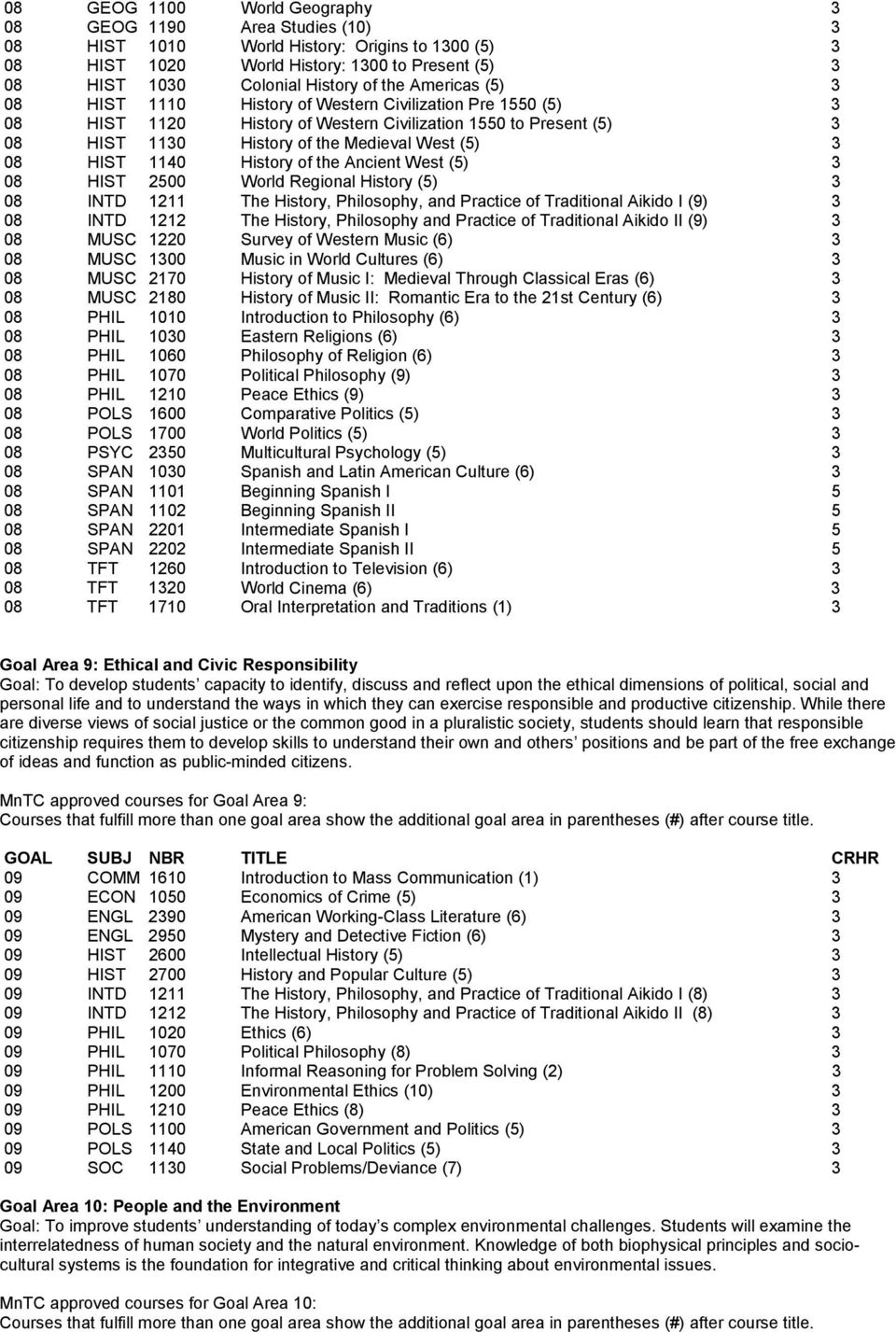
15 08 GEOG 1100 World Geography 08 GEOG 1190 Area Studies (10) 08 HIST 1010 World History: Origins to 100 (5) 08 HIST 1020 World History: 100 to Present (5) 08 HIST 100 Colonial History of the Americas (5) 08 HIST 1110 History of Western Civilization Pre 1550 (5) 08 HIST 1120 History of Western Civilization 1550 to Present (5) 08 HIST 110 History of the Medieval West (5) 08 HIST 1140 History of the Ancient West (5) 08 HIST 2500 World Regional History (5) 08 INTD 1211 The History, Philosophy, and Practice of Traditional Aikido I (9) 08 INTD 1212 The History, Philosophy and Practice of Traditional Aikido II (9) 08 MUSC 1220 Survey of Western Music (6) 08 MUSC 100 Music in World Cultures (6) 08 MUSC 2170 History of Music I: Medieval Through Classical Eras (6) 08 MUSC 2180 History of Music II: Romantic Era to the 21st Century (6) 08 PHIL 1010 Introduction to Philosophy (6) 08 PHIL 100 Eastern Religions (6) 08 PHIL 1060 Philosophy of Religion (6) 08 PHIL 1070 Political Philosophy (9) 08 PHIL 1210 Peace Ethics (9) 08 POLS 1600 Comparative Politics (5) 08 POLS 1700 World Politics (5) 08 PSYC 250 Multicultural Psychology (5) 08 SPAN 100 Spanish and Latin American Culture (6) 08 SPAN 1101 Beginning Spanish I 5 08 SPAN 1102 Beginning Spanish II 5 08 SPAN 2201 Intermediate Spanish I 5 08 SPAN 2202 Intermediate Spanish II 5 08 TFT 1260 Introduction to Television (6) 08 TFT 120 World Cinema (6) 08 TFT 1710 Oral Interpretation and Traditions (1) Goal Area 9: Ethical and Civic Responsibility Goal: To develop students capacity to identify, discuss and reflect upon the ethical dimensions of political, social and personal life and to understand the ways in which they can exercise responsible and productive citizenship. While there are diverse views of social justice or the common good in a pluralistic society, students should learn that responsible citizenship requires them to develop skills to understand their own and others positions and be part of the free exchange of ideas and function as public-minded citizens. MnTC approved courses for Goal Area 9: Courses that fulfill more than one goal area show the additional goal area in parentheses (#) after course title. GOAL SUBJ NBR TITLE CRHR 09 COMM 1610 Introduction to Mass Communication (1) 09 ECON 1050 Economics of Crime (5) 09 ENGL 290 American Working-Class Literature (6) 09 ENGL 2950 Mystery and Detective Fiction (6) 09 HIST 2600 Intellectual History (5) 09 HIST 2700 History and Popular Culture (5) 09 INTD 1211 The History, Philosophy, and Practice of Traditional Aikido I (8) 09 INTD 1212 The History, Philosophy and Practice of Traditional Aikido II (8) 09 PHIL 1020 Ethics (6) 09 PHIL 1070 Political Philosophy (8) 09 PHIL 1110 Informal Reasoning for Problem Solving (2) 09 PHIL 1200 Environmental Ethics (10) 09 PHIL 1210 Peace Ethics (8) 09 POLS 1100 American Government and Politics (5) 09 POLS 1140 State and Local Politics (5) 09 SOC 110 Social Problems/Deviance (7) Goal Area 10: People and the Environment Goal: To improve students understanding of today s complex environmental challenges. Students will examine the interrelatedness of human society and the natural environment. Knowledge of both biophysical principles and sociocultural systems is the foundation for integrative and critical thinking about environmental issues. MnTC approved courses for Goal Area 10: Courses that fulfill more than one goal area show the additional goal area in parentheses (#) after course title.
16 GOAL SUBJ NBR TITLE CRHR 10 ANTH 1020 Intro to Anthropology: Physical Anthropology, Archaeology & Prehistory () 10 ANTH 110 The Archaeology of Prehistoric Europe (5) 10 BIOL 100 Boundary Waters Canoe Area Field Biology () 4 10 BIOL 1160 Global Environment Field Biology () 4 10 BIOL 1200 Current Environmental Issues () 4 10 BIOL 1600 Biology of Nature Series 1 10 BIOL 1610 Field Ecology () 1 10 CHEM 1000 Chemistry and Society () 4 10 ENGL 240 Nature in Literature (6) 10 GEOG 1010 Physical Geography () 10 GEOG 1190 Area Studies (8) 10 GEOL 1010 Minnesota Field Geology Series: Glacial Geology () 2 10 GEOL 1020 Minnesota Field Geology Series: Volcanic, Plutonic and Metamorphic Geology 2 () 10 GEOL 100 Minnesota Field Geology Series: Fluvial Geology () 2 10 GEOL 1040 Minnesota Field Geology Series: Caves, Karst and Ancient Seaways () 2 10 GEOL 1120 Historical Geology () 4 10 GEOL 1150 Boundary Waters Field Geology () 4 10 GEOL 1160 Global Environmental Field Geology () 4 10 GEOL 1850 Oceanography () 10 GEOL 1851 Oceanography Lab () 1 10 INTD 100 Introduction to Japanese Culture (6) 10 INTD 1040 American Indian Culture - Indigenous Peoples of Minnesota (7) 10 NSCI 1110 Minnesota's Natural History () 4 10 PHIL 1200 Environmental Ethics (9) Grading System Grade Point Average (GPA) GPA is determined by adding all grade points and dividing by the sum of all GPA Credits. Grades of A, HA, B, HB, C, D, F or FN are calculated in the grade point average; grades of AU, NN, I, NC, P, and W are not calculated in grade point average. Grades and Grade Points A = 4 grade points HA = 4 grade points B = grade points HB = grade points C = 2 grade points D = 1 grade points FN = 0 grade points F = 0 grade points AU FN Audit An audit must be declared in person at the Records and Registration Office prior to the start of the term or the course. Regular tuition rates apply for audited courses. Audited courses are not eligible for financial aid and may not be applied toward a degree. Failure for Non-attendance An FN (and corresponding last-date-of-attendance) may be assigned at the discretion of the instructor when students have never attended or are no longer attending or completing class assignments. The FN grade will affect both GPA (0 grade points) and completion rate. HA Honors Option The student has completed the course with an A. HB Honors Option The student has completed the course with a B. I NC NN P Incomplete An incomplete may be assigned at the discretion of the instructor when students have completed most of the course work at a passing level, cannot complete the remaining work on schedule because of illness or other unusual circumstance, and have requested a grade of incomplete. A grade of I is a temporary grade and will automatically become an F grade (or NC in the case of courses numbered below 1000) at the end of the next semester (not including summer session) if the required course work is not completed. No Credit An NC is assigned for no achievement and reserved for developmental coursework numbered below NC will not affect GPA, but will affect completion rate. Failure for non-attendance Reserved for developmental coursework numbered below NN grade will not affect GPA, but will affect completion rate. Pass Individual students do not have the option of requesting the P/NC or P/F grading method; only courses selected by NHCC are graded using P/NC or P/F.

17 W Withdraw A W is student initiated and recorded when a student officially withdraws during the withdraw period (after the add/drop period and up to 80% of the term and/or course). Repeated credits: Repeats may be allowed in order to improve a grade or review course material. All grades appear on the transcript, but the highest grade is used in calculating GPA. Repeated courses may not be financial aid eligible. Grade Reports Student grade reports are not mailed. Grade reports are accessible through eservices at using your Star ID and Password. Honors Dean s List The Dean s List is prepared after each fall and spring semester. Students, in good standing, completing 12 or more college-level credits during the semester who earn a minimum grade point average of.50 receive recognition. Honor Society Phi Theta Kappa, an international community college honor society, is for students earning a.5 grade point average with 12 or more credits at North Hennepin Community College. Honors Recognition Honors recognition is bestowed at graduation for the following students: NHCC Scholar Associate degree and advanced certificate students graduating with a GPA of.50 or better in all courses taken at NHCC (20 credit minimum) Honors Program Graduates completing the Honors program requirements; Highest Honors, High Honors, or Honors Honor Society Graduates who are members of Phi Theta Kappa Privacy of Education Records Policy North Hennepin Community College complies with the Family Educational Rights and Privacy Act (FERPA), the Minnesota Government Data Practices Act (MGDPA) and other applicable laws and regulations concerning the handling of education records. Transfer Information Students who plan to transfer in to NHCC must complete the following steps to ensure a smooth transfer process: Admission: Apply for admission and pay the one-time, non-refundable $20 application fee. Transfer of Credit: Arrange to have all transcripts and/or official records (from other institutions you have previously attended or are currently attending or exams) sent directly to NHCC. North Hennepin Community College will review official transcripts from colleges and universities as well as other types of transfer credits including the following: All transcripts will be evaluated for credit and prerequisite completion by a transfer specialist. The Transfer Specialists evaluate your transfer credit using Minnesota State Colleges and Universities (MnSCU) and NHCC policy, which includes a 75% matching rule. A transfer course must match the credit amount, content, and rigor at 75% in order for it to be transferred in as equivalent to an NHCC course. Please allow up to two weeks for an evaluation; you will receive your evaluation via . E-transcripts from other Minnesota State Colleges and Universities (MnSCU) will be automatically retrieved for your convenience. Non-MnSCU transcripts must be mailed to: Records & Registration North Hennepin Community College th Ave. N. Brooklyn Park, MN International Credits: If you have completed courses in another country, you must order a course-by-course evaluation from a NACES ( member credential evaluation service. You should make arrangements for the evaluation to be sent to NHCC for further evaluation.

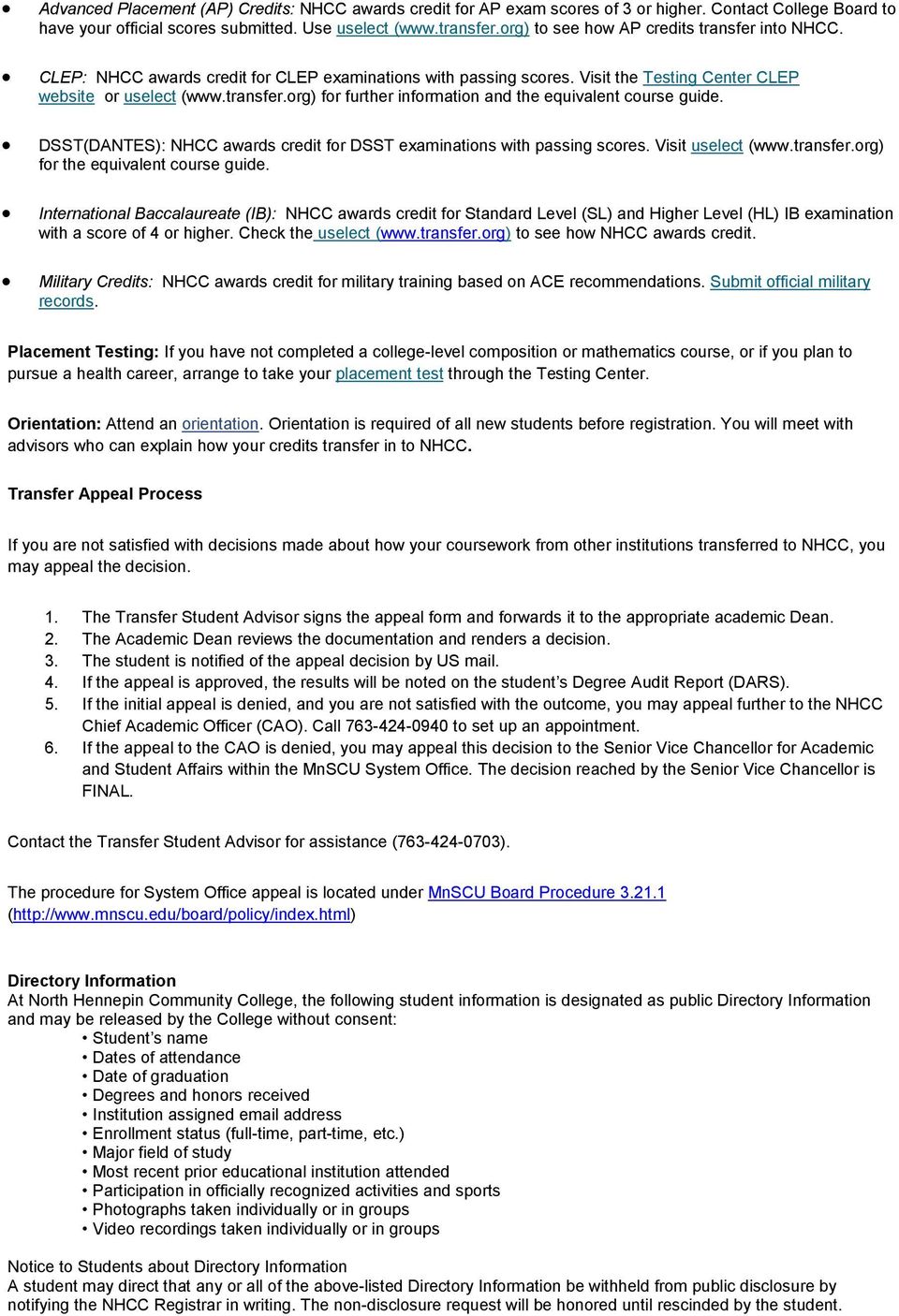
18 Advanced Placement (AP) Credits: NHCC awards credit for AP exam scores of or higher. Contact College Board to have your official scores submitted. Use uselect ( to see how AP credits transfer into NHCC. CLEP: NHCC awards credit for CLEP examinations with passing scores. Visit the Testing Center CLEP website or uselect ( for further information and the equivalent course guide. DSST(DANTES): NHCC awards credit for DSST examinations with passing scores. Visit uselect ( for the equivalent course guide. International Baccalaureate (IB): NHCC awards credit for Standard Level (SL) and Higher Level (HL) IB examination with a score of 4 or higher. Check the uselect ( to see how NHCC awards credit. Military Credits: NHCC awards credit for military training based on ACE recommendations. Submit official military records. Placement Testing: If you have not completed a college-level composition or mathematics course, or if you plan to pursue a health career, arrange to take your placement test through the Testing Center. Orientation: Attend an orientation. Orientation is required of all new students before registration. You will meet with advisors who can explain how your credits transfer in to NHCC. Transfer Appeal Process If you are not satisfied with decisions made about how your coursework from other institutions transferred to NHCC, you may appeal the decision. 1. The Transfer Student Advisor signs the appeal form and forwards it to the appropriate academic Dean. 2. The Academic Dean reviews the documentation and renders a decision.. The student is notified of the appeal decision by US mail. 4. If the appeal is approved, the results will be noted on the student s Degree Audit Report (DARS). 5. If the initial appeal is denied, and you are not satisfied with the outcome, you may appeal further to the NHCC Chief Academic Officer (CAO). Call to set up an appointment. 6. If the appeal to the CAO is denied, you may appeal this decision to the Senior Vice Chancellor for Academic and Student Affairs within the MnSCU System Office. The decision reached by the Senior Vice Chancellor is FINAL. Contact the Transfer Student Advisor for assistance ( ). The procedure for System Office appeal is located under MnSCU Board Procedure.21.1 ( Directory Information At North Hennepin Community College, the following student information is designated as public Directory Information and may be released by the College without consent: Student s name Dates of attendance Date of graduation Degrees and honors received Institution assigned address Enrollment status (full-time, part-time, etc.) Major field of study Most recent prior educational institution attended Participation in officially recognized activities and sports Photographs taken individually or in groups Video recordings taken individually or in groups Notice to Students about Directory Information A student may direct that any or all of the above-listed Directory Information be withheld from public disclosure by notifying the NHCC Registrar in writing. The non-disclosure request will be honored until rescinded by the student.
19 For the complete Privacy of Education Records Policy, refer to Student Rights and Responsibilities Detailed student policies as well as student rights and responsibilities can be found on the College website at including resources for: Academic Amnesty Add, Drop, Withdraw, and Refunds Alcohol and Drug Free Campus Class Attendance and Participation Code of Conduct Complaints and Grievances Copyright and Intellectual Property Grade Appeal Non-Discrimination in Employment and Education Opportunity Privacy of Education Records Safety and Security / Crime and Security Report Satisfactory Academic Progress Smoking Student Involvement in Decision-Making Student Rights and Responsibilities Transfer of Credit Tuition Refunds, Withdrawal and Waivers Student Contacts General Harassment and Student Code of Conduct: Chad Henderson, Judicial Affairs Officer, ES 49, , [email protected] Sexual Harassment and/or Racial Harassment: Jackie Olsson, Dean of Enrollment ES 51, , [email protected] 504/American Disabilities Act: Landon Pirius, Vice President of Student Affairs ES 45, , [email protected] Academic Issues: Elaina Bleifield, Dean of Engineering, Science, and Mathematics SC 120C, , [email protected] Kristine Boike, Dean of Academic and Technology Services, CBT 114, , [email protected] Vacant, Dean of Health Sciences, Wellness and Human Services BHCC TBD Renae Fry, Dean of Business, Technology and Career Programs CBT 146, , [email protected] Margaret Kotek, Associate Dean of Nursing CC 209, , [email protected] Suellen Rundquist, Dean of Liberal Arts CLA 175, , [email protected] Jane Wilson, Dean of Communications and Fine Arts FAC 152, , [email protected] For Non-Credit and Professional Training Issues: Nerita Hughes, Interim Director of Professional Training and Development CBT 186, , [email protected] Student Affairs Issues: Tadael Emiru, Dean of Student Development ES 61B, , [email protected] Jackie Olsson, Dean of Enrollment ES 51, , [email protected]

20 Landon Pirius, Vice President of Student Affairs ES 45, , Public Safety and Security Issues: Emergencies - call 911 or Safety and Security Public Safety Office Campus Center, , [email protected] Affirmative Action: Michael Birchard, Chief Diversity and Affirmative Action Officer CBT 101A, , [email protected] Equal Opportunity North Hennepin Community College is a member of Minnesota State Colleges and Universities. North Hennepin Community College and Minnesota State Colleges and Universities are committed to a policy of nondiscrimination in employment and education opportunity. No person shall be discriminated against in the terms and conditions of employment, personnel practices, or access to and participation in, programs, services, and activities with regard to race, sex, color, creed, religion, age, national origin, disability, and marital status, status with regard to public assistance, sexual orientation, gender identity, or gender expression. In addition, discrimination in employment based on membership or activity in a local commission as defined by law is prohibited. This document is available in alternative formats to individuals with disabilities by calling or through the Minnesota Relay Service at North Hennepin Community College s Disability Access Services office can be reached at The college reserves the right to cancel, postpone and reschedule course offerings. Lack of English skills should not be a barrier to admission and participation.
21 AA: Associate in Arts - Liberal Arts The Associate in Arts (A.A.) is designed to constitute the first two years of a liberal arts bachelor degree program. An A.A. degree includes the entire 40 credit Minnesota Transfer Curriculum (MnTC) as the general education requirement. Students may also choose to concentrate in a particular field of study in preparation for a planned major or professional emphasis at a four-yearcollege by following the pre-major requirements of the desired transfer institution. Goal Area 1: Communication ENGL1201 College Writing I 4 ENGL1202 College Writing II 2 Communication - 1 course, credits: COMM1010 Fundamentals of Public Speaking or COMM1110 Principles of Interpersonal Communication or COMM1210 Small Group Communication or COMM1410 Human Communication Theory or COMM1510 Nonverbal Communication or COMM1610 Introduction to Mass Communication or COMM1710 Oral Interpretation and Traditions or TFT1710 Oral Interpretation and Traditions Goal Area 2: Critical Thinking Completion of the MnTC fulfills Goal Area 2 Critical Thinking: Goal Area : Natural Science Natural Science - 2 courses, 7 credits from 2 different disciplines, one must be a lab course: ANTH1020 Intro to Anthropology: Physical Anthropology, Archaeology & Prehistory or BIOL1000 Life Science or 4 BIOL1001 Biology I or 4 BIOL1002 Biology II or 4 BIOL100 Boundary Waters Canoe Area Field Biology or 4 BIOL1101 Principles of Biology I or 4 BIOL1102 Principles of Biology II or 4 BIOL1120 Human Biology or BIOL110 Human Biology with a Lab or 4 BIOL1160 Global Environment Field Biology or 4 BIOL1200 Current Environmental Issues or 4 BIOL150 Biology of Women or BIOL160 Biology of Women with a Lab or 4 BIOL1610 Field Ecology or 1 BIOL1650 Human Biology Series or 1 BIOL2020 Animal Biology or 4 BIOL200 Plant Biology or 4 BIOL2100 Microbiology or 4 BIOL2111 Human Anatomy and Physiology I or 4 BIOL2112 Human Anatomy and Physiology II or 4 CHEM1000 Chemistry and Society or 4 CHEM1010 Introduction to Chemistry or 4 CHEM100 Introduction to Physical Sciences or 4 CHEM1061 Principles of Chemistry I or 4 CHEM1062 Principles of Chemistry II or 4 GEOG1010 Physical Geography or GEOL1010 Minnesota Field Geology Series: Glacial Geology or 2
22 GEOL1020 Minnesota Field Geology Series: Volcanic, Plutonic and Metamorphic Geology or 2 GEOL100 Minnesota Field Geology Series: Fluvial Geology or 2 GEOL1040 Minnesota Field Geology Series: Caves, Karst and Ancient Seaways or 2 GEOL1110 Physical Geology or 4 GEOL1120 Historical Geology or 4 GEOL110 Rocky Mountain Field Study or 4 GEOL1150 Boundary Waters Field Geology or 4 GEOL1160 Global Environmental Field Geology or 4 GEOL1850 Oceanography or GEOL1851 Oceanography Lab or 1 NSCI1000 Conceptual Physics or 4 NSCI1010 Science of Disaster Workshop I or 1 NSCI1020 Science of Disaster Workshop II or 1 NSCI100 Science of Disaster Workshop III or 1 NSCI1050 Astronomy or 4 NSCI1060 The Solar System or NSCI1061 Solar System Lab or 1 NSCI1070 Concepts of the Stars and Universe or NSCI1071 Stars and the Universe Lab or 1 NSCI1110 Minnesota's Natural History or 4 NSCI1120 Meteorology or 4 PHYS1000 Conceptual Physics or 4 PHYS100 Introduction to Physical Sciences or 4 PHYS1050 Astronomy or 4 PHYS1060 The Solar System or PHYS1061 Solar System Lab or 1 PHYS1070 Concepts of the Stars and Universe or PHYS1071 Stars and the Universe lab or 1 PHYS1120 Meteorology or 4 PHYS1140 Energy Aspects of Our Physical Environment or PHYS1201 Principles of Physics I or 5 PHYS1202 Principles of Physics II or 5 PHYS1400 The Solar System or PHYS1410 Solar System Lab or 1 PHYS1450 Concepts of the Stars and Universe or PHYS1460 Concepts of the Stars and Universe Lab or 1 PHYS1601 General Physics I or 5 PHYS1602 General Physics II 5 Lab Courses 2 Goal Area 4: Mathematical/Logical Reasoning Mathematical/Logical Reasoning - 1 course, at least credits: MATH1010 Survey of Mathematics or MATH1080 Technical Mathematics or MATH1090 Statway Statistics II or 4 MATH110 Elementary Statistics or MATH1140 Finite Mathematics or MATH1150 College Algebra or MATH1160 Pre-Calculus or 4 MATH1170 Trigonometry or 4 MATH1180 Pre-Calculus or 5
23 MATH1190 Elementary Functions or 5 MATH1200 Calculus Survey or MATH1221 Calculus I or 5 MATH1222 Calculus II or 5 MATH2010 Probability and Statistics or MATH2220 Calculus III or 5 MATH200 Linear Algebra or MATH2400 Differential Equations or PHIL1050 Introduction to Logic Goal Area 5: History and the Social and Behavioral Sciences History and the Social and Behavioral Sciences - courses, 9 credits, at least one course from Behavioral Science, and one course from Social Science Behavioral Science: ANTH1010 Introduction to Anthropology: Cultural Anthropology or ANTH110 The Archaeology of Ancient Europe or PSYC1110 Psychology of Adjustment or PSYC1150 General Psychology or PSYC1165 Psychology of Adjustment or PSYC1170 Psychology of Gender or PSYC1210 Child Development or PSYC1220 Adult Development or PSYC1250 Life Span Developmental Psychology or 4 PSYC220 Abnormal Psychology or PSYC20 Personality or PSYC240 Human Sexuality or PSYC250 Multicultural Psychology or SOC1110 Introduction to Sociology or SOC1710 Introduction to Criminal Justice or SOC1750 Families in Crisis or SOC2110 Principles of Social Psychology or SOC2200 Family Violence or SOC2210 Minority Groups or SOC2410 Women in Global Perspectives or SOC270 Introduction to Corrections Social Science: ECON1050 Economics of Crime or ECON1060 Principles of Economics Macro or ECON1070 Principles of Economics Micro or HIST1010 World History: Origins to 100 or HIST1020 World History: 100 to Present or HIST100 Colonial History of the Americas or HIST1110 History of Western Civilization Pre 1550 or HIST1120 History of Western Civilization 1550 to Present or HIST110 History of the Medieval West or HIST1140 History of the Ancient West or HIST1200 History of United States Through 1877 or HIST1210 History of the United States Since 1877 or HIST1220 American Colonial History or HIST1240 History of the American West or HIST1270 Race in America or HIST1700 History and Popular Culture or HIST1800 History of Minnesota or
24 HIST2500 World Regional History or HIST2600 Intellectual History or HIST2700 History and Popular Culture or POLS1100 American Government and Politics or POLS1140 State and Local Politics or POLS1600 Comparative Politics or POLS1700 World Politics or POLS210 Constitutional Law Goal Area 6: The Humanities and Fine Arts Humanities and Fine Arts - courses, 9 credits, from at least 2 different disciplines: AMST1010 Women in American Society I or AMST1020 Women in American Society II or AMST2210 American Studies Topics I or AMST2220 American Studies Topics II or ARBC100 Arab Cultures or ART1040 Introduction to Art or ART1101 Photography I or ART1102 Photography II or ART1160 Digital Photography or ART1170 Advanced Photography or ART1270 Digital Video Production or ART101 Two Dimensional Design I or ART102 Two Dimensional Design II or ART110 Three Dimensional Design or ART120 Introduction to Sculpture or ART140 Fundamentals of Color or ART141 Fundamentals of Color I or ART161 Ceramics I or ART162 Ceramics II or ART1401 Drawing I or ART1402 Drawing II or ART1770 Quilt Arts or ART1810 Studio Art Workshop or 1 ART1820 Studio Art Workshop or 2 ART2180 Art History: Pre-History to the Age of Cathedrals or ART2190 Art History: Renaissance to 21st Century Art or ART200 Architectural History or 2 ART2611 Painting I or ART2612 Painting II or ART2640 Watercolor or ART2740 Jewelry Workshop or 1 ART2750 Ceramics Workshop or 1 ART2780 Quiltmaking Workshop or 1 ART2781 Quiltmaking Workshop I or 1 ART2782 Quiltmaking Workshop II or 1 ART2800 Painting Workshop or 1 ART2820 Drawing Workshop or 1 ART2860 Photography Workshop or 1 ART2900 Studio Arts Capstone Practicum or 1 ART2970 Art Appreciation Field Trip or 1 ENGL1150 Introduction to Literature or ENGL1250 Magazine Workshop or 2 ENGL1400 Reading Poetry or ENGL1450 Reading Plays or
25 ENGL1900 Introduction to Creative Writing or ENGL1950 Graphic Novels or ENGL2010 Writing Creative Non-Fiction and Memoir or ENGL2020 Writing Stories or ENGL200 Writing Poetry or ENGL2270 Modern American Literature or ENGL210 American Short Story or ENGL220 Writing: From Structure to Style or ENGL20 Hmong American Literature or ENGL240 Nature in Literature or ENGL250 Women and Literature or ENGL260 Global Literary Perspectives or ENGL270 African American Literature or ENGL280 American Indian Literature or ENGL290 American Working-Class Literature or ENGL2450 Survey of American Literature I or ENGL2460 Survey of American Literature II or ENGL2500 Playwrighting or ENGL2550 Survey of British Literature I or ENGL2560 Survey of British Literature II or ENGL2580 The Shakespeare's Plays or ENGL2900 Fantasy Literature or ENGL2950 Mystery and Detective Fiction or GERM100 Culture of the German-Speaking Countries or INTD100 Introduction to Japanese Culture or MUSC110 College Choir or 1 MUSC1160 Large Instrumental Ensemble or 1 MUSC1170 Instrumental Jazz Ensemble or 1 MUSC1200 Fundamentals of Music or MUSC1220 Survey of Western Music or MUSC1241 Music Theory I or MUSC1242 Music Theory II or MUSC100 Music in World Cultures or MUSC120 Applied Music Guitar or 1 MUSC150 History of Rock 'n Roll or MUSC1500 Class Guitar or 2 MUSC1501 Class Guitar I or 2 MUSC1502 Class Guitar II or 2 MUSC1510 Applied Music: Guitar or 1 MUSC1560 Class Guitar or 1 MUSC1600 Class Voice or 2 MUSC1610 Applied Music: Voice or 1 MUSC1800 Class Piano or 2 MUSC1801 Class Piano I or 2 MUSC1802 Class Piano II or 2 MUSC1810 Applied Music: Piano or 1 MUSC180 Applied Music: Strings or 1 MUSC1850 Applied Music: Percussion or 1 MUSC1860 Applied Music: Brass or 1 MUSC1870 Applied Music: Woodwinds or 1 MUSC2010 Advanced Applied Music Lessons or 2 MUSC2170 History of Music I: Medieval Through Classical Eras or MUSC2180 History of Music II: Romantic Era to the 21st Century or MUSC2241 Music Theory III or MUSC2242 Music Theory IV or
26 MUSC2970 Music Appreciation Field Trip or 1 PHIL1010 Introduction to Philosophy or PHIL1020 Ethics or PHIL100 Eastern Religions or PHIL1040 Western Religions or PHIL1060 Philosophy of Religion or SPAN100 Spanish and Latin American Culture or TFT1200 Theatre in the Twin Cities or TFT1210 Introduction to Theatre or TFT1250 Introduction to Film or TFT1260 Introduction to Television or TFT1270 Digital Video Production or TFT1280 Introduction to Screenwriting or TFT1290 Design for Theatre or TFT110 American Cinema or TFT120 World Cinema or TFT150 The American Musical Theatre or TFT1500 Acting I: Improvisation and Foundations or TFT1510 Foundations of Acting: Stage Movement and Voice or TFT1520 Acting II: Building Characters or TFT151 Stage Combat I or TFT152 Stage Combat II or TFT1540 Acting for the Camera or TFT1600 Theatre Practicum: Performance or 1 TFT1610 Theatre Practicum: Technical or 1 TFT2010 Fundamentals of Directing or TFT2500 Playwrighting or TFT2950 Theatre Appreciation Field Trip 1 Goal Area 7: Human Diversity Human Diversity - 1 course: AMST1010 Women in American Society I or AMST1020 Women in American Society II or AMST2210 American Studies Topics I or AMST2220 American Studies Topics II or ASL100 Deaf Culture or COMM110 Intercultural Communication or ENGL1450 Reading Plays or ENGL220 Writing: From Structure to Style or ENGL20 Hmong American Literature or ENGL250 Women and Literature or ENGL270 African American Literature or ENGL280 American Indian Literature or ENGL2450 Survey of American Literature I or ENGL2460 Survey of American Literature II or ENGL2900 Fantasy Literature or GEOG1000 Geography of the United States or 2 GEOG1040 Human Geography or HIST1200 History of United States Through 1877 or HIST1210 History of the United States Since 1877 or HIST1220 American Colonial History or HIST1240 History of the American West or HIST1270 Race in America or INTD1040 American Indian Culture - Indigenous Peoples of Minnesota or
27 PHIL1040 Western Religions or PSYC1170 Psychology of Gender or PSYC240 Human Sexuality or SOC1110 Introduction to Sociology or SOC110 Social Problems/Deviance or SOC2210 Minority Groups or TFT1210 Introduction to Theatre or TFT110 American Cinema or TFT150 The American Musical Theatre Goal Area 8: Global Perspective Global Perspective - 1 course: ANTH1010 Introduction to Anthropology: Cultural Anthropology or ARBC100 Arab Cultures or ARBC1101 Introduction to Arabic or 4 ARBC1102 Beginning Arabic II or 4 ARBC2201 Intermediate Arabic I or 4 ART1040 Introduction to Art or ART2180 Art History: Pre-History to the Age of Cathedrals or ART2190 Art History: Renaissance to 21st Century Art or ART200 Architectural History or 2 ASL1101 American Sign Language I or 4 ASL1102 American Sign Language II or 4 ASL2201 Intermediate American Sign Language I or 4 ASL2202 Intermediate American Sign Language II or 4 COMM110 Intercultural Communication or COMM1510 Nonverbal Communication or COMM1710 Oral Interpretation and Traditions or ECON1060 Principles of Economics Macro or ENGL260 Global Literary Perspectives or ENGL2550 Survey of British Literature I or ENGL2560 Survey of British Literature II or ENGL2580 The Shakespeare's Plays or ENGL2590 Shakespeare Plays II or GEOG1040 Human Geography or GEOG1100 World Geography or GERM100 Culture of the German-Speaking Countries or HIST1010 World History: Origins to 100 or HIST1020 World History: 100 to Present or HIST100 Colonial History of the Americas or HIST1110 History of Western Civilization Pre 1550 or HIST1120 History of Western Civilization 1550 to Present or HIST110 History of the Medieval West or HIST1140 History of the Ancient West or HIST2500 World Regional History or INTD1210 The History, Philosophy, and Practice of Traditional Aikido or INTD1211 The History, Philosophy, and Practice of Traditional Aikido I or INTD1212 The History, Philosophy and Practice of Traditional Aikido II or MUSC1220 Survey of Western Music or MUSC100 Music in World Cultures or MUSC2170 History of Music I: Medieval Through Classical
28 MUSC2170 Eras or MUSC2180 History of Music II: Romantic Era to the 21st Century or PHIL1010 Introduction to Philosophy or PHIL100 Eastern Religions or PHIL1060 Philosophy of Religion or PHIL1070 Political Philosophy or PHIL1210 Peace Ethics or POLS1600 Comparative Politics or POLS1700 World Politics or PSYC250 Multicultural Psychology or SPAN100 Spanish and Latin American Culture or SPAN1101 Beginning Spanish I or 5 SPAN1102 Beginning Spanish II or 5 SPAN2201 Intermediate Spanish I or 5 SPAN2202 Intermediate Spanish II or 5 TFT1260 Introduction to Television or TFT120 World Cinema or TFT1710 Oral Interpretation and Traditions Goal Area 9: Ethical and Civic Responsibility Ethical and Civic Responsibility - 1 course: COMM1610 Introduction to Mass Communication or ECON1050 Economics of Crime or ENGL290 American Working-Class Literature or ENGL2950 Mystery and Detective Fiction or HIST1700 History and Popular Culture or HIST2600 Intellectual History or HIST2700 History and Popular Culture or INTD1210 The History, Philosophy, and Practice of Traditional Aikido or INTD1211 The History, Philosophy, and Practice of Traditional Aikido I or INTD1212 The History, Philosophy and Practice of Traditional Aikido II or PHIL1020 Ethics or PHIL1070 Political Philosophy or PHIL1110 Informal Reasoning for Problem Solving or PHIL1200 Environmental Ethics or PHIL1210 Peace Ethics or POLS1100 American Government and Politics or POLS1140 State and Local Politics or SOC110 Social Problems/Deviance Goal Area 10: People and the Environment People and the Environment - 1 course: ANTH1020 Intro to Anthropology: Physical Anthropology, Archaeology & Prehistory or ANTH110 The Archaeology of Ancient Europe or BIOL100 Boundary Waters Canoe Area Field Biology or 4 BIOL1160 Global Environment Field Biology or 4 BIOL1200 Current Environmental Issues or 4 BIOL1600 Biology of Nature Series or 1 BIOL1610 Field Ecology or 1 CHEM1000 Chemistry and Society or 4 ENGL240 Nature in Literature or
29 ENGL240 Nature in Literature or GEOG1010 Physical Geography or GEOL1010 Minnesota Field Geology Series: Glacial Geology or 2 GEOL1020 Minnesota Field Geology Series: Volcanic, Plutonic and Metamorphic Geology or 2 GEOL100 Minnesota Field Geology Series: Fluvial Geology or 2 GEOL1040 Minnesota Field Geology Series: Caves, Karst and Ancient Seaways or 2 GEOL1120 Historical Geology or 4 GEOL1150 Boundary Waters Field Geology or 4 GEOL1160 Global Environmental Field Geology or 4 GEOL1850 Oceanography or GEOL1851 Oceanography Lab or 1 INTD100 Introduction to Japanese Culture or INTD1040 American Indian Culture - Indigenous Peoples of Minnesota or NSCI1110 Minnesota's Natural History or 4 PHIL1200 Environmental Ethics or PHYS1120 Meteorology 4 MnTC Note A minimum of 40 total MnTC credits satisfy the requirements for each of the 10 goal areas. A combined GPA of at least 2.00 must be earned in the MnTC courses, which includes transferred credits. Health Requirement Health and PE - 2 courses, 4 credits, one Health course and one PE course 1 MnTC Electives A maximum of 16 elective credits excluding under 1000 level to reach 60 credits: Degree Requirements 40 Credits from All MNTC Courses: Goal Areas 1-10 Total Credit Required 60 Program Outcomes Develop a foundation of essential knowledge about the cultural, social, and natural worlds, and individual well-being. Develop intellectual and practical skills, including: understanding the commonalities and diversity of the human experience, values, and opinions understanding the forms of artistic expression and their inherent creative processes thinking critically, applying systematic reasoning, and developing information management quantitative skills communicating clearly and effectively Demonstrate personal and social responsibility, including: developing a code for personal and civic life as a responsible citizen in a democracy maintaining good mental and physical health and social adjustment seeking new knowledge independently Integrative and applied learning, including: the ability to apply General Education to the issues of our times Be prepared to transfer to, and succeed, at an upper-level academic institution.
30 Notes Courses can satisfy more than one goal area, however, credits may only be counted once toward the 60 credit minimum. Degree Information The Associate of Arts (A.A.) is awarded for successful completion of 60 credits and is designed to constitute the first two years of a liberal arts bachelor degree program. An A.A. degree includes the entire 40 credit Minnesota Transfer Curriculum (MnTC) as the general education requirement. Students may also choose to concentrate in a particular field of study in preparation for a planned major or professional emphasis at a four-year college by following the pre-major requirement of the desired transfer institution in addition to the MnTC and A.A. requirements. A student shall: Earn a minimum of 60 semester credits. Earn a grade point average of 2.00 (C) or higher in courses taken at North Hennepin Community College. Earn a minimum of 20 semester credits of the 60 semester credits required for the A.A. Degree at NHCC. Complete the general education distribution requirement listed in the Minnesota Transfer Curriculum. The student shall select general education (MnTC) courses numbered 1000 or above to complete a minimum of 40 credits. Have four years in which to complete their work under the terms of the catalog in effect at the time of their first enrollment. Students taking more than four years to complete their graduation requirements may follow any catalog in effect during the fouryear period preceding their date of graduation. Required A.A. Degree Course Distribution: Complete 40 credits in the Minnesota Transfer Curriculum satisfying the requirements for each of the 10 goal areas. Complete at least 4 credits for the Wellness requirement with at least one course from each of the following areas: Health (all courses) and Physical Education (all courses). Complete 16 elective credits selected from all courses listed in the College's offerings, which are numbered 1000 or higher. If the student intends to transfer, he/she is encouraged to work with an advisor to fulfill requirements for transfer to the other institution. Completion of an A.A. degree fulfills the Goal Area 2 requirement of the Minnesota Transfer Curriculum (MnTC). Developmental Courses Some students may need preparatory course(s) in Math and/or English. Courses numbered below 1000 will not apply toward a degree. Equal Opportunity Employer and Disability Access Information North Hennepin Community College is a member of Minnesota State Colleges and Universities system and an equal opportunity employer and educator. This document is available in alternative formats to individuals with disabilities by calling or through the Minnesota Relay Service at Transfer Information If you are planning on transferring to another institution, follow the guidelines available on our transfer resources web page to help you plan the process: Transfer Information Career Opportunities Information on careers, including salary and employment outlook data, is available on the iseek and Bureau of Labor Statistics websites: and Accreditation North Hennepin Community College is accredited by the: Higher Learning Commission of the North Central Association of Colleges and Schools 0 N. LaSalle Street, Suite 2400 Chicago, IL Health and PE - 2 courses, 4 credits, one Health course and one PE course: HLTH100(), HLTH100(), HLTH1050(), HLTH1050(), HLTH1060(), HLTH1060(), HLTH1070(), HLTH1070(), HLTH1080(), HLTH1080(), HLTH1100(), HLTH1100(), HLTH1250(), HLTH1250(), HLTH1600(), HLTH1600(), HLTH1900(), HLTH1900(), HLTH1990(1), HLTH1990(1), PE0101(2), PE0101(2), PE0102(1), PE0102(1), PE0104(1), PE0104(1), PE0105(1), PE0105(1), PE0107(1), PE0107(1), PE0111(1), PE0111(1), PE0112(1), PE0112(1), PE0115(1), PE0115(1), PE0117(1), PE0117(1), PE0118(1), PE0118(1), PE0120(1), PE0120(1), PE0121(1), PE0121(1), PE0122(1), PE0122(1), PE012(1), PE012(1), PE010(1), PE010(1), PE017(1), PE017(1), PE019(1), PE019(1), PE0140(1),
31 PE0140(1), PE0142(2), PE0142(2), PE0144(1), PE0144(1), PE0145(1), PE0145(1), PE0146(1), PE0146(1), PE0160(1), PE0160(1), PE0172(2), PE0172(2), PE0178(1), PE0178(1), PE0179(1), PE0179(1), PE0180(1), PE0180(1), PE0181(1), PE0181(1), PE0182(1), PE0182(1), PE018(1), PE018(1), PE0190(1), PE0190(1), PE1010(2), PE1010(2), PE1020(1), PE1020(1), PE1040(1), PE1040(1), PE1041(1), PE1041(1), PE1042(1), PE1042(1), PE1050(1), PE1050(1), PE1070(1), PE1070(1), PE1110(1), PE1110(1), PE1120(1), PE1120(1), PE110(1), PE110(1), PE1140(1), PE1140(1), PE1151(1), PE1151(1), PE1152(1), PE1152(1), PE1200(1), PE1200(1), PE1210(1), PE1210(1), PE120(1), PE120(1), PE1240(1), PE1240(1), PE1250(), PE1250(), PE1260(1), PE1260(1), PE1270(1), PE1270(1), PE100(1), PE100(1), PE110(1), PE110(1), PE160(2), PE160(2), PE170(1), PE170(1), PE180(1), PE180(1), PE190(1), PE190(1), PE1400(1), PE1400(1), PE1420(1), PE1420(1), PE140(1), PE140(1), PE1440(1), PE1440(1), PE1451(1), PE1451(1), PE1452(1), PE1452(1), PE1500(), PE1500(), PE1510(2), PE1510(2), PE1520(), PE1520(), PE1600(1), PE1600(1), PE1610(1), PE1610(1), PE1620(1), PE1620(1), PE160(1), PE160(1), PE1640(1), PE1640(1), PE1650(1), PE1650(1), PE1700(), PE1700(), PE1710(), PE1710(), PE1720(2), PE1720(2), PE170(1), PE170(1), PE1740(1), PE1740(1), PE1750(1), PE1750(1), PE1751(1), PE1751(1), PE1752(1), PE1752(1), PE1760(1), PE1760(1), PE1770(2), PE1770(2), PE1780(1), PE1780(1), PE1790(1), PE1790(1), PE1800(1), PE1800(1), PE1810(1), PE1810(1), PE1820(1), PE1820(1), PE180(1), PE180(1), PE1840(1), PE1840(1), PE190(1), PE190(1), PE1940(1), PE1940(1), PE1990(1), PE1990(1), PE2101(4), PE2101(4), PE2102(2), PE2102(2), PE2110(1), PE2110(1), PE290(2), PE290(2), PE2490(4), PE2490(4), PE2910(1), PE2910(1), PEW011(1), PEW0119(1), PUBH010(2), PUBH0104(2), PUBH0105(2), PUBH0106(), PUBH0107(), PUBH0108(), PUBH0110(), PUBH0125(), PUBH010(1), PUBH0150(6), PUBH0160(4), PUBH0201(), PUBH0202(1), PUBH0290(1), PUBH0291(1), PUBH1010(2), PUBH1020(1), PUBH100(), PUBH1040(), PUBH1050(1), PUBH1060(), PUBH1070(), PUBH1080(), PUBH1100(), PUBH1250(), PUBH1600(), PUBH2901(1), PUBH2910(1) 2. Lab Courses: BIOL1000(4), BIOL1001(4), BIOL1002(4), BIOL1101(4), BIOL1102(4), BIOL110(4), BIOL1200(4), BIOL160(4), BIOL2020(4), BIOL200(4), BIOL2100(4), BIOL2111(4), BIOL2112(4), CHEM1000(4), CHEM1010(4), CHEM100(4), CHEM1061(4), CHEM1062(4), GEOL1110(4), GEOL1120(4), GEOL110(4), GEOL1851(1), NSCI1000(4), NSCI1050(4), NSCI1061(1), NSCI1071(1), NSCI1110(4), NSCI1120(4), PHYS1000(4), PHYS100(4), PHYS1050(4), PHYS1061(1), PHYS1071(1), PHYS1120(4), PHYS110(4), PHYS1201(5), PHYS1202(5), PHYS1410(1), PHYS1460(1), PHYS1601(5), PHYS1602(5). History and the Social and Behavioral Sciences - courses, 9 credits, at least one course from Behavioral Science, and one course from Social Science: ANTH1010(), ANTH110(), ECON1050(), ECON1060(), ECON1070(), HIST1010(), HIST1020(), HIST100(), HIST1110(), HIST110(), HIST1140(), HIST1200(), HIST1210(), HIST1220(), HIST1240(), HIST1270(), HIST1700(), HIST1800(), HIST2500(), HIST2600(), HIST2700(), POLS1100(), POLS1140(), POLS1600(), POLS1700(), POLS210(), PSYC1110(), PSYC1150(), PSYC1165(), PSYC1170(), PSYC1210(), PSYC1220(), PSYC1250(4), PSYC220(), PSYC20(), PSYC240(), PSYC250(), SOC1110(), SOC1710(), SOC1750(), SOC2110(), SOC2200(), SOC2210(), SOC2410(), SOC270()
32 AFA: Creative Writing The Associate in Fine Arts in Creative Writing prepares students for further university-level creative writing studies by combining liberal arts general education courses and foundation courses in various genres of writing and literary studies. Graduates will be able to write effectively in multiple genres of creative writing with the intent of beginning a career in a related field or transferring into a baccalaureate program at a 4-year institution. The Associate of Fine Arts in Creative Writing is designed to articulate to: Minnesota State University Moorhead B.A. in English with Emphasis in Writing degree Program Courses ENGL1250 Magazine Workshop 2 ENGL1900 Introduction to Creative Writing Capstone Course Required during final semester of program ENGL2960 Creative Writing Capstone Project 1 Program Electives: Creative Writing Creative Writing Program Electives - 9 credits: ENGL2010 Writing Creative Non-Fiction and Memoir or ENGL2020 Writing Stories or ENGL200 Writing Poetry or ENGL2500 Playwrighting or TFT1280 Introduction to Screenwriting or TFT2500 Playwrighting Program Electives: Literature Literature Program Electives - 12 credits: ENGL1140 Professional Writing or ENGL1150 Introduction to Literature or ENGL1260 Newspaper Writing or 2 ENGL1400 Reading Poetry or ENGL1450 Reading Plays or ENGL1940 Technical Writing or ENGL1950 Graphic Novels or ENGL2270 Modern American Literature or ENGL210 American Short Story or ENGL240 Nature in Literature or ENGL250 Women and Literature or ENGL260 Global Literary Perspectives or ENGL270 African American Literature or ENGL280 American Indian Literature or ENGL2450 Survey of American Literature I or ENGL2460 Survey of American Literature II or ENGL2550 Survey of British Literature I or ENGL2560 Survey of British Literature II or ENGL2580 The Shakespeare's Plays or ENGL2950 Mystery and Detective Fiction
33 General Education Courses ENGL1201 College Writing I 4 ENGL1202 College Writing II 2 COMM1010, COMM1110, COMM course: COMM1010 Fundamentals of Public Speaking or COMM1110 Principles of Interpersonal Communication or COMM1210 Small Group Communication MnTC Electives Natural Sciences or Mathematics/Logical Reasoning (Goal Area or 4) - credits 1 History and the Social and Behavioral Sciences (Goal Area 5) - 6 credits 2 Human Diversity or Global Perspective (Goal Areas 7 or 8) - credits Ethical and Civic Responsibility or People and the Environment (Goal Areas 9 or 10) - credits 4 MnTC Electives - 9 credits 5 Program Outcomes Total Credits Required 60 Knowledge of Human Cultures and the Physical and Natural World: engagement with literary arts in multiple genres across diverse cultures and societal perspectives, both by critically successful authors and through student writing significant and critical awareness of the contemporary world, from local to global Focused by engagement with big questions, both contemporary and enduring Intellectual and Practical Skills: analysis and examination of stylistic and literary elements of critically successful authors and student writing within multiple genres demonstration of critical and creative thinking through large and small group workshop-style discussion and textual analysis of writing strategic application of practical and applicable creative writing modes and approaches to effective revision knowledge of historically successful literary elements and the artists who have used them Practiced extensively, across the curriculum, in the context of progressively more challenging problems, projects, and standards for performance Personal and Social Responsibility and Engagement: understanding of cultural variation in forms of contemporary and historical literature, as well as important ways in which the contextual framework of the literature reflects culture interacting with college, local, national, and/or global publications with an awareness of audience and social ramifications developed skills in time management, deadlines, and collaborative experiences Anchored through active involvement with diverse communities and real-world challenges Integrative and Applied Learning: participation in literary arts publication and public performance investigation of careers related to critical and creative writing and the literary arts demonstration of proficiency in at least one genre of creative writing Demonstrated through the application of knowledge, skills, and responsibilities to new settings and complex problems Graduates will be prepared to transfer to, and succeed at, an upper-level academic institution. Degree Information An Associate of Fine Arts (A.F.A.) degree is intended for students whose primary goal is to complete a program in a designated discipline in fine arts. The A.F.A. degree is designed for transfer to a baccalaureate degree. Completion of an A.F.A. degree fulfills the Goal Area 2 requirement of the Minnesota Transfer Curriculum (MnTC). Developmental Coursework Some students may need preparatory course(s) in Math and/or English. Courses numbered below 1000 will not apply toward a degree.
34 Equal Opportunity Employer and Disability Access Information North Hennepin Community College is a member of Minnesota State Colleges and Universities system and an equal opportunity employer and educator. This document is available in alternative formats to individuals with disabilities by calling or through the Minnesota Relay Service at Accreditation North Hennepin Community College is accredited by the: Higher Learning Commission of the North Central Association of Colleges and Schools 0 N. LaSalle Street, Suite 2400 Chicago, IL Transfer Information If you are planning on transferring to another institution, follow the guidelines available on our transfer resources web page to help you plan the process: Transfer Information Career Opportunities Information on careers, including salary and employment outlook data, is available on the iseek and Bureau of Labor Statistics websites: and 1. Natural Sciences or Mathematics/Logical Reasoning (Goal Area or 4) - credits: ANTH1020(), BIOL1000(4), BIOL1001(4), BIOL1002(4), BIOL100(4), BIOL1101(4), BIOL1102(4), BIOL1120(), BIOL110(4), BIOL1160(4), BIOL1200(4), BIOL150(), BIOL160(4), BIOL1610(1), BIOL1650(1), BIOL2020(4), BIOL200(4), BIOL2100(4), BIOL2111(4), BIOL2112(4), CHEM1000(4), CHEM1010(4), CHEM100(4), CHEM1061(4), CHEM1062(4), GEOG1010(), GEOL1010(2), GEOL1020(2), GEOL100(2), GEOL1040(2), GEOL1110(4), GEOL1120(4), GEOL110(4), GEOL1150(4), GEOL1160(4), GEOL1850(), GEOL1851(1), MATH1010(), MATH1080(), MATH1090(4), MATH110(), MATH1140(), MATH1150(), MATH1160(4), MATH1170(4), MATH1180(5), MATH1190(5), MATH1200(), MATH1221(5), MATH1222(5), MATH2010(), MATH2220(5), MATH200(), MATH2400(), NSCI1000(4), NSCI1010(1), NSCI1020(1), NSCI100(1), NSCI1050(4), NSCI1060(), NSCI1061(1), NSCI1070(), NSCI1071(1), NSCI1110(4), NSCI1120(4), PHIL1050(), PHYS1000(4), PHYS100(4), PHYS1050(4), PHYS1060(), PHYS1061(1), PHYS1070(), PHYS1071(1), PHYS1120(4), PHYS1140(), PHYS1201(5), PHYS1202(5), PHYS1400(), PHYS1410(1), PHYS1450(), PHYS1460(1), PHYS1601(5), PHYS1602(5) 2. History and the Social and Behavioral Sciences (Goal Area 5) - 6 credits: ANTH1010(), ANTH110(), ECON1050(), ECON1060(), ECON1070(), HIST1010(), HIST1020(), HIST100(), HIST1110(), HIST1120(), HIST110(), HIST1140(), HIST1200(), HIST1210(), HIST1220(), HIST1240(), HIST1270(), HIST1700(), HIST1800(), HIST2500(), HIST2600(), HIST2700(), POLS1100(), POLS1140(), POLS1600(), POLS1700(), POLS210(), PSYC1110(), PSYC1150(), PSYC1165(), PSYC1170(), PSYC1210(), PSYC1220(), PSYC1250(4), PSYC220(), PSYC20(), PSYC240(), PSYC250(), SOC1110(), SOC1710(), SOC1750(), SOC2110(), SOC2200(), SOC2210(), SOC2410(), SOC270(). Human Diversity or Global Perspective (Goal Areas 7 or 8) - credits: AMST1010(), AMST1020(), AMST2210(), AMST2220(), ANTH1010(), ARBC100(), ARBC1101(4), ARBC1102(4), ARBC2201(4), ART1040(), ART2180(), ART2190(), ART200(2), ASL1101(4), ASL1102(4), ASL100(), ASL2201(4), ASL2202(4), COMM110(), COMM1510(), COMM1710(), ECON1060(), ENGL1450(), ENGL220(), ENGL20(), ENGL250(), ENGL260(), ENGL270(), ENGL280(), ENGL2450(), ENGL2460(), ENGL2550(), ENGL2560(), ENGL2580(), ENGL2590(), ENGL2900(), GEOG1000(2), GEOG1040(), GEOG1100(), GERM100(), HIST1010(), HIST1020(), HIST100(), HIST1110(), HIST1120(), HIST110(), HIST1140(), HIST1200(), HIST1210(), HIST1220(), HIST1240(), HIST1270(), HIST2500(), INTD1040(), INTD1210(), INTD1211(), INTD1212(), MUSC1220(), MUSC100(), MUSC2170(), MUSC2180(), PHIL1010(), PHIL100(), PHIL1040(), PHIL1060(), PHIL1070(), PHIL1210(), POLS1600(), POLS1700(), PSYC1170(), PSYC240(), PSYC250(), SOC1110(), SOC110(), SOC2210(), SPAN100(), SPAN1101(5), SPAN1102(5), SPAN2201(5), SPAN2202(5), TFT1210(), TFT1260(), TFT110(), TFT120(), TFT150(), TFT1710() 4. Ethical and Civic Responsibility or People and the Environment (Goal Areas 9 or 10) - credits: ANTH1020(), ANTH110(), BIOL100(4), BIOL1160(4), BIOL1200(4), BIOL1600(1), BIOL1610(1), CHEM1000(4), COMM1610(), ECON1050(), ENGL240(), ENGL290(), ENGL2950(), GEOG1010(), GEOL1010(2), GEOL1020(2), GEOL100(2), GEOL1040(2), GEOL1120(4), GEOL1150(4), GEOL1160(4), GEOL1850(), GEOL1851(1), HIST1700(), HIST2600(), HIST2700(), INTD100(), INTD1040(), INTD1210(), INTD1211(), INTD1212(), NSCI1110(4), PHIL1020(), PHIL1070(), PHIL1110(), PHIL1200(), PHIL1210(), PHYS1120(4), POLS1100(), POLS1140(), SOC110() 5. MnTC Electives - 9 credits: AMST1010(), AMST1020(), AMST2210(), AMST2220(), ANTH1010(), ANTH1020(), ANTH110(), ARBC100(), ARBC1101(4), ARBC1102(4), ARBC2201(4), ART1040(), ART1101(), ART1102(), ART1160(), ART1170(), ART1270(), ART101(), ART102(), ART110(), ART120(), ART140(), ART141(), ART161(), ART162(), ART1401(), ART1402(), ART1770(), ART2180(), ART2190(), ART200(2), ART2611(), ART2612(), ART2640(), ART2740(1), ART2750(1), ART2780(1), ART2781(1), ART2782(1), ART2800(1), ART2820(1), ART2860(1), ART2900(1), ART2970(1), ASL1101(4), ASL1102(4), ASL100(), ASL2201(4), ASL2202(4), BIOL1000(4), BIOL1001(4), BIOL1002(4), BIOL100(4), BIOL1101(4), BIOL1102(4), BIOL1120(), BIOL110(4), BIOL1160(4), BIOL1200(4), BIOL150(), BIOL160(4), BIOL1600(1), BIOL1610(1), BIOL1650(1), BIOL2020(4), BIOL200(4), BIOL2100(4), BIOL2111(4), BIOL2112(4), CHEM1000(4), CHEM1010(4), CHEM100(4), CHEM1061(4), CHEM1062(4), COMM1010(), COMM1110(), COMM1210(), COMM110(), COMM1410(), COMM1510(), COMM1610(), COMM1710(), ECON1050(), ECON1060(), ECON1070(), ENGL1111(), ENGL1112(), ENGL1140(), ENGL1150(), ENGL1201(4), ENGL1202(2), ENGL1250(2), ENGL1400(), ENGL1450(), ENGL1900(), ENGL1950(), ENGL2010(), ENGL2020(), ENGL200(), ENGL2270(), ENGL210(), ENGL220(), ENGL20(), ENGL240(), ENGL250(), ENGL260(), ENGL270(), ENGL280(), ENGL290(), ENGL2450(), ENGL2460(), ENGL2550(), ENGL2560(), ENGL2580(), ENGL2590(), ENGL2900(),
35 ENGL2950(), GEOG1000(2), GEOG1010(), GEOG1040(), GEOG1100(), GEOL1010(2), GEOL1020(2), GEOL100(2), GEOL1040(2), GEOL1110(4), GEOL1120(4), GEOL110(4), GEOL1150(4), GEOL1160(4), GEOL1850(), GEOL1851(1), GERM100(), HIST1010(), HIST1020(), HIST100(), HIST1110(), HIST1120(), HIST110(), HIST1140(), HIST1200(), HIST1210(), HIST1220(), HIST1240(), HIST1270(), HIST1700(), HIST1800(), HIST2500(), HIST2600(), HIST2700(), INTD100(), INTD1040(), INTD1210(), INTD1211(), INTD1212(), MATH1010(), MATH1080(), MATH1090(4), MATH110(), MATH1140(), MATH1150(), MATH1160(4), MATH1170(4), MATH1180(5), MATH1190(5), MATH1200(), MATH1221(5), MATH1222(5), MATH2010(), MATH2220(5), MATH200(), MATH2400(), MUSC110(1), MUSC1160(1), MUSC1170(1), MUSC1180(1), MUSC1200(), MUSC1220(), MUSC1241(), MUSC1242(), MUSC100(), MUSC120(1), MUSC150(), MUSC1500(2), MUSC1501(2), MUSC1502(2), MUSC1510(1), MUSC1560(1), MUSC1600(2), MUSC1610(1), MUSC1800(2), MUSC1801(2), MUSC1802(2), MUSC1810(1), MUSC180(1), MUSC1850(1), MUSC1860(1), MUSC1870(1), MUSC2010(2), MUSC2170(), MUSC2180(), MUSC2241(), MUSC2242(), MUSC2970(1), NSCI1000(4), NSCI1010(1), NSCI1020(1), NSCI100(1), NSCI1050(4), NSCI1060(), NSCI1061(1), NSCI1070(), NSCI1071(1), NSCI1110(4), NSCI1120(4), PHIL1010(), PHIL1020(), PHIL100(), PHIL1040(), PHIL1050(), PHIL1060(), PHIL1070(), PHIL1110(), PHIL1200(), PHIL1210(), PHYS1000(4), PHYS100(4), PHYS1050(4), PHYS1060(), PHYS1061(1), PHYS1070(), PHYS1071(1), PHYS1120(4), PHYS1140(), PHYS1201(5), PHYS1202(5), PHYS1400(), PHYS1410(1), PHYS1450(), PHYS1460(1), PHYS1601(5), PHYS1602(5), POLS1100(), POLS1140(), POLS1600(), POLS1700(), POLS210(), PSYC1110(), PSYC1150(), PSYC1165(), PSYC1170(), PSYC1210(), PSYC1220(), PSYC220(), PSYC20(), PSYC240(), PSYC250(), SOC1110(), SOC110(), SOC1710(), SOC1750(), SOC2110(), SOC2200(), SOC2210(), SOC2410(), SOC270(), SPAN100(), SPAN1101(5), SPAN1102(5), SPAN2201(5), SPAN2202(5), TFT1200(), TFT1210(), TFT1250(), TFT1260(), TFT1270(), TFT1280(), TFT110(), TFT120(), TFT150(), TFT1500(), TFT1510(), TFT1520(), TFT151(), TFT152(), TFT1540(), TFT1600(1), TFT1610(1), TFT1710(), TFT2010(), TFT2500(), TFT2950(1)
36 AA: Emphasis in History The Associate in Arts with a history emphasis fulfills all MnTC requirements and provides students with all the required history courses to allow them to transfer to a four year institution with a junior standing in history. This program prepares the graduate to continue on toward a bachelor s degree with either a minor or a major in history. Program Courses HIST1200 History of United States Through 1877 HIST1210 History of the United States Since 1877 HIST2900 Applied History Complete (Hist 1010 and Hist 1020) OR (Hist 1110 and Hist 1120): HIST1010 World History: Origins to 100 and HIST1020 World History: 100 to Present or HIST1110 History of Western Civilization Pre 1550 and HIST1120 History of Western Civilization 1550 to Present Program Electives Program electives - 2 courses: HIST100 Colonial History of the Americas or HIST110 History of the Medieval West or HIST1140 History of the Ancient West or HIST1270 Race in America or HIST1990 Topics: or 1 HIST2500 World Regional History or HIST2600 Intellectual History or HIST2700 History and Popular Culture General Education Courses ENGL1201 College Writing I 4 ENGL1202 College Writing II 2 MATH110 Elementary Statistics Health or Physical Education - 2 credits 1 ANTH1020 or GEOG course: ANTH1020 Intro to Anthropology: Physical Anthropology, Archaeology & Prehistory or GEOG1010 Physical Geography BIOL1200, GEOL1110, GEOL1120, NSCI course: BIOL1200 Current Environmental Issues or 4 GEOL1110 Physical Geology or 4 GEOL1120 Historical Geology or 4 NSCI1110 Minnesota's Natural History 4 COMM1010 or COMM course: COMM1010 Fundamentals of Public Speaking or COMM1710 Oral Interpretation and Traditions 9 credits from the following: ART2180 Art History: Pre-History to the Age of Cathedrals or ART2190 Art History: Renaissance to 21st Century Art or ART200 Architectural History or 2 MUSC100 Music in World Cultures or MUSC150 History of Rock 'n Roll or PHIL100 Eastern Religions or PHIL1040 Western Religions or TFT150 The American Musical Theatre
37 courses from the following: ANTH1010 Introduction to Anthropology: Cultural Anthropology or GEOG1040 Human Geography or GEOG1100 World Geography or POLS1100 American Government and Politics or POLS1700 World Politics or PSYC1170 Psychology of Gender or SOC1110 Introduction to Sociology Notes Total Credit Required 60 HIST 1110 & HIST 1120 can be replaced with HIST 1010 & HIST Students planning to transfer to St. Cloud State University should complete HIST 1110 & HIST Hist 1270 fulfills the General Education requirement of Diversity (MGM) at St. Cloud State University. Program Outcomes Knowledge of human cultures and the physical and natural world, including: broad knowledge of world history, ancient to present, including knowledge of chronology, place, and significance. broad knowledge of major fields of history and schools of historical interpretation. Intellectual and Practical Skills, including: ability to evaluate primary and secondary source material ability to develop and critique historical arguments based on primary and secondary source material ability to communicate using the standards of the discipline ability to develop and complete a program of historical research, beginning with the development of a research topic, through producing an original secondary source of publishable quality Personal and Social Responsibility, including: ability to identify and evaluate bias and perspective in written and audio-visual materials, including digital, internet, and broadcast media. insight into the construction of historical knowledge as reflective of personal and social contexts Integrative Learning, including: ability to critically analyze, interpret, and synthesize various types of historical materials. understanding of the role of the past in causing current events, conflicts, and problems, and its richness as a source of possible solutions. Be prepared to transfer to a four year institution in this discipline: Graduates will have completed all 10 Goal Areas of the Minnesota Transfer Curriculum requirements and have a foundation of knowledge in history to prepare them for transfer to a baccalaureate program. Degree Information The Associate of Arts (A.A.) is awarded for successful completion of 60 credits and is designed to constitute the first two years of a liberal arts bachelor degree program. An A.A. degree includes the entire 40 credit Minnesota Transfer Curriculum (MnTC) as the general education requirement. Students may also choose to concentrate in a particular field of study in preparation for a planned major or professional emphasis at a four-year college by following the pre-major requirement of the desired transfer institution in addition to the MnTC and A.A. requirements. A student shall: Earn a minimum of 60 semester credits. Earn a grade point average of 2.00 (C) or higher in courses taken at North Hennepin Community College. Earn a minimum of 20 semester credits of the 60 semester credits required for the A.A. Degree at NHCC. Complete the general education distribution requirement listed in the Minnesota Transfer Curriculum. The student shall select general education (MnTC) courses numbered 1000 or above to complete a minimum of 40 credits. Have four years in which to complete their work under the terms of the catalog in effect at the time of their first enrollment. Students taking more than four years to complete their graduation requirements may follow any catalog in effect during the fouryear period preceding their date of graduation. Required A.A. Degree Course Distribution: Complete 40 credits in the Minnesota Transfer Curriculum satisfying the requirements for each of the 10 goal areas.
38 Complete at least 2 credits for the Wellness requirement from either Health (all courses) or Physical Education (all courses). If the student intends to transfer, he/she is encouraged to work with an advisor to fulfill requirements for transfer to the other institution. Completion of an A.A. degree fulfills the Goal Area 2 requirement of the Minnesota Transfer Curriculum (MnTC). Developmental Courses Some students may need preparatory course(s) in Math and/or English. Courses numbered below 1000 will not apply toward a degree. Equal Opportunity Employer and Disability Access Information North Hennepin Community College is a member of Minnesota State Colleges and Universities system and an equal opportunity employer and educator. This document is available in alternative formats to individuals with disabilities by calling or through the Minnesota Relay Service at Transfer Information If you are planning on transferring to another institution, follow the guidelines available on our transfer resources web page to help you plan the process: Transfer Information Career Opportunities Information on careers, including salary and employment outlook data, is available on the iseek and Bureau of Labor Statistics websites: and Accreditation North Hennepin Community College is accredited by the: Higher Learning Commission of the North Central Association of Colleges and Schools 0 N. LaSalle Street, Suite 2400 Chicago, IL Health or Physical Education - 2 credits: HLTH100(), HLTH1050(), HLTH1060(), HLTH1070(), HLTH1080(), HLTH1100(), HLTH1250(), HLTH1600(), HLTH1900(), HLTH1990(1), PE0101(2), PE0102(1), PE0104(1), PE0105(1), PE0107(1), PE0111(1), PE0112(1), PE0115(1), PE0117(1), PE0118(1), PE0120(1), PE0121(1), PE0122(1), PE012(1), PE010(1), PE017(1), PE019(1), PE0140(1), PE0142(2), PE0144(1), PE0145(1), PE0146(1), PE0160(1), PE0172(2), PE0178(1), PE0179(1), PE0180(1), PE0181(1), PE0182(1), PE018(1), PE0190(1), PE1010(2), PE1020(1), PE1040(1), PE1041(1), PE1042(1), PE1050(1), PE1070(1), PE1110(1), PE1120(1), PE110(1), PE1140(1), PE1151(1), PE1152(1), PE1200(1), PE1210(1), PE120(1), PE1240(1), PE1250(), PE1260(1), PE1270(1), PE100(1), PE110(1), PE160(2), PE170(1), PE180(1), PE190(1), PE1400(1), PE1420(1), PE140(1), PE1440(1), PE1451(1), PE1452(1), PE1500(), PE1510(2), PE1520(), PE1600(1), PE1610(1), PE1620(1), PE160(1), PE1640(1), PE1650(1), PE1700(), PE1710(), PE1720(2), PE170(1), PE1740(1), PE1750(1), PE1751(1), PE1752(1), PE1760(1), PE1770(2), PE1780(1), PE1790(1), PE1800(1), PE1810(1), PE1820(1), PE180(1), PE1840(1), PE190(1), PE1940(1), PE1990(1), PE2101(4), PE2102(2), PE2110(1), PE290(2), PE2490(4), PE2910(1)
39 Cert: Spanish Language The purpose of the Spanish Certificate is to prepare students who wish to gain a fair command of the Spanish language and understand the culture of the Spanish-speaking world. This certificate is appropriate for students who are currently employed in an area related to the use of the Spanish language. Students who complete this certificate will be able to use the language for communication with Spanish-speaking colleagues or customers. Students could include the Certificate on their resume and in a portfolio, indicating a conversational level of Spanish language proficiency. The Certificate helps highlight to employers both in the U.S. and in other countries a students Spanish language ability and communication skills. This certificate is also applicable to students who are planning to pursue Spanish major or minor in a four-year college or university. Program Courses SPAN100 Spanish and Latin American Culture SPAN1101 Beginning Spanish I 5 SPAN1102 Beginning Spanish II 5 SPAN2201 Intermediate Spanish I 5 SPAN2202 Intermediate Spanish II 5 Degree Information Total Credits Required 2 Certificates may be earned for successful completion of courses in a specialized program of study with a minimum grade point average of 2.00 (C). A certificate shall include 9 to 0 semester credits. At least one-third of the total credits required for each certificate must be completed at North Hennepin Community College. Developmental Courses Some students may need preparatory course(s) in Math and/or English. Courses numbered below 1000 will not apply toward a degree. Equal Opportunity Employer and Disability Access Information North Hennepin Community College is a member of Minnesota State Colleges and Universities system and an equal opportunity employer and educator. This document is available in alternative formats to individuals with disabilities by calling or through the Minnesota Relay Service at Program Outcomes Develop awareness of and articulate the importance of the Hispanic cultures within a global context. Demonstrate broad knowledge of the Hispanic World history and civilization, ancient to present, including knowledge of chronology and significance. Apply appropriate verbal, nonverbal, listening, writing and reading skills in everyday situations. Demonstrate the appropriate use of language structures for communicative purposes in everyday situations. Develop constructive, organized work habits and presentation skills. Be prepared to transfer to and succeed in Spanish major or minor at an upper-level academic institution. Gainful Employment Program Information Spanish Language Career Opportunities Information on careers, including salary and employment outlook data, is available on the iseek and Bureau of Labor Statistics websites: and Accreditation North Hennepin Community College is accredited by the: Higher Learning Commission of the North Central Association of Colleges and Schools 0 N. LaSalle Street, Suite 2400 Chicago, IL
40 Transfer Information If you are planning on transferring to another institution, follow the guidelines available on our transfer resources web page to help you plan the process: Transfer Information
41 Cert: Academic English Language Proficiency This certificate recognizes that a student in the ESOL (English for Speakers of Other Languages) program has demonstrated a high level of proficiency in academic English language and literacy skills to support student academic and career success. Students also gain skills for education and employment through the completion of elective courses which support continued development of written, verbal, and technology communication, advancement of international perspectives, and career exploration. Program Courses ENGL1201 College Writing I (minimum grade 2.0) 4 ESOL120 College Reading and Studying Skills (minimum grade 2.0) 4 ESOL1260 College Writing Skills Development (minimum grade 2.0) 4 ESOL1280 Listening and Speaking for College Success (minimum grade 2.0) 4 Subtotal 16 Program Electives Program Electives - 6 credits: (minimum grade 2.0) ADEV1000 Career Planning (minimum grade 2.0) or 2 ADEV1010 Job Seeking Skills (minimum grade 2.0) or 1 BIOL120 Medical Terminology I - Basics (minimum grade 2.0) or 1 BUS1000 Career Planning (minimum grade 2.0) or 2 BUS1010 Job Seeking Skills (minimum grade 2.0) or 1 BUS1100 Introduction to Business and the American Economy (minimum grade 2.0) or BUS1110 Business and Professional Skills (minimum grade 2.0) or BUS1210 Managerial Communication (minimum grade 2.0) or BUS1700 Introduction to International Business (minimum grade 2.0) or CIS1000 Electronic Keyboarding Communications (minimum grade 2.0) or CIS1101 Business Computer Systems I (minimum grade 2.0) or CIS1200 Word Processing (minimum grade 2.0) or COMM1010 Fundamentals of Public Speaking (minimum grade 2.0) or COMM1110 Principles of Interpersonal Communication (minimum grade 2.0) or COMM1210 Small Group Communication (minimum grade 2.0) or COMM110 Intercultural Communication (minimum grade 2.0) or COMM1610 Introduction to Mass Communication (minimum grade 2.0) or CSCI1000 Computer Basics (minimum grade 2.0) or CSCI1020 Beginning Web Page Programming (minimum grade 2.0) or 1 ENGL1112 College Writing II (minimum grade 2.0) or ENGL1140 Professional Writing (minimum grade 2.0) or ENGL1202 College Writing II (minimum grade 2.0) or 2 ENGL1940 Technical Writing (minimum grade 2.0) or ENGL220 Writing: From Structure to Style (minimum grade 2.0) or
42 ESOL1060 Advanced Grammar (minimum grade 2.0) or 2 ESOL1080 English Pronunciation (minimum grade 2.0) or 2 GEOG1000 Geography of the United States (minimum grade 2.0) 2 Subtotal 6 Total Credits Required 22 Program Outcomes Knowledge of Human Cultures and the Physical and Natural World: Compare diverse global perspectives. Intellectual and Practical Skills: Demonstrate advanced proficiency in academic English. Develop critical thinking for college and career goals. Employ academic skills and active learning strategies. Select learning practices according to learning needs. Personal and Social Responsibility: Analyze the effects of one s personal beliefs and experiences on learning. Investigate ways to participate on campus and in the community. Gainful Employment Program Information Academic English Language Proficiency Degree Information Certificates may be earned for successful completion of courses in a specialized program of study with a minimum grade point average of 2.00 (C) in each class. A certificate shall include 9 to 2 semester credits. At least one-third of the total credits required for each certificate must be completed at North Hennepin Community College. Developmental Courses Some students may need preparatory course(s) in Math and/or English. Courses numbered below 1000 will not apply toward a degree. Equal Opportunity Employer and Disability Access Information North Hennepin Community College is a member of Minnesota State Colleges and Universities system and an equal opportunity employer and educator. This document is available in alternative formats to individuals with disabilities by calling or through the Minnesota Relay Service at Career Opportunities Information on careers, including salary and employment outlook data, is available on the iseek and Bureau of Labor Statistics websites: and Accreditation North Hennepin Community College is accredited by the: Higher Learning Commission of the North Central Association of Colleges and Schools 0 N. LaSalle Street, Suite 2400 Chicago, IL Transfer Information If you are planning on transferring to another institution, follow the guidelines available on our transfer resources web page to help you plan the process: Transfer Information
43
44 AS: Accounting An Accountant examines, analyzes and interprets accounting data for the purpose of giving advice and preparing financial statements. Duties may include performing such activities as recording receipts and disbursements, and preparing state and federal reports. The accountant may prepare reports and financial statements electronically. North Hennepin Community College offers this degree for students who are interested in transferring their credits to earn a baccalaureate degree at a four-year institution. The courses from this program are delivered in the classroom and/or online. The Associate of Science in Accounting is designed to articulate to: Concordia University at St. Paul B.B.A. in Accounting degree Metropolitan State University B.S. in Accounting degree University of Minnesota at Crookston B.S. in Accounting degree NHCC also offers an Associate in Applied Science (A.A.S.) degree in Accounting for students who are interested in moving directly into an accounting career. Program Courses: Business Foundation ACCT2111 Financial Accounting 4 ACCT2112 Managerial Accounting 4 BUS1100 Introduction to Business and the American Economy BUS1200 Principles of Management BUS1600 Principles of Marketing CIS1101 Business Computer Systems I Program Courses: Accounting Specialty ACCT2100 The Accounting Cycle 1 ACCT2200 Applied Accounting Capstone Course ACCT220 Computerized Accounting with QuickBooks CIS1220 Decision Making Excel General Education Courses COMM1010 Fundamentals of Public Speaking ECON1060 Principles of Economics Macro ECON1070 Principles of Economics Micro ENGL1201 College Writing I 4 ENGL1202 College Writing II 2 PSYC1150 or SOC course: PSYC1150 General Psychology or SOC1110 Introduction to Sociology MnTC Electives Natural Sciences or Mathematics/Logical Reasoning (Goal Area or 4) - credits 1 The Humanities and Fine Arts (Goal Area 6) - credits 2 MnTC Electives - 6 credits Program Accreditation Total Credits Required 60 Accreditation Council for Business Schools and Programs, West 119th Street, Overland Park, KS 6612 Program Outcomes Knowledge of Human Cultures and the Physical and Natural World: The theory and practice of the accounting process
45 Intellectual and Practical Skills: How to analyze financial information and make business decisions using critical thinking and problem solving skills How to communicate effectively, in oral and written forms Personal and Social Responsibility and Engagement: How to evaluate professional responsibilities, including ethical issues Integrative and Applied Learning: Use of technology including Microsoft Word, Excel and PowerPoint Upon completion of the program the student will be prepared to transfer to a baccalaureate program. Transfer Information If you are planning on transferring to another institution, follow the guidelines available on our transfer resources web page to help you plan the process: Transfer Information Degree Information The Associate of Science (A.S.) degree is intended for students whose primary goal is to complete the credentials for a specific career and/or prepare for transfer to complete a bachelor s degree at a college or university with whom North Hennepin Community College has an articulation agreement. The A.S. degree provides a balance of general education courses and the required scientific, professional or technical courses in the degree program. A student shall: Earn a minimum of 60 semester credits as required in the program, with a grade point average of 2.00 (C) or above in courses taken at North Hennepin Community College. Specific programs may have additional requirements or a higher minimum grade point average. Earn a minimum of 20 semester credits at North Hennepin Community College. A student must complete at least 50% of career specific courses at North Hennepin Community College. Earn 0 credits in at least 6 Minnesota Transfer Curriculum (MnTC) goal areas. Earn 0 professional/technical credits. Have four years to complete the graduation requirements as published in the catalog in effect at the time of their initial enrollment. Students taking more than four years to complete their graduation requirements may follow any catalog published during the four-year period preceding their graduation. Completion of an A.S. degree fulfills the Goal Area 2 requirement of the Minnesota Transfer Curriculum (MnTC). Developmental Courses Some students may need preparatory course(s) in Math and/or English. Courses numbered below 1000 will not apply toward a degree. Equal Opportunity Employer and Disability Access Information North Hennepin Community College is a member of Minnesota State Colleges and Universities system and an equal opportunity employer and educator. This document is available in alternative formats to individuals with disabilities by calling or through the Minnesota Relay Service at Accreditation North Hennepin Community College is accredited by the: Higher Learning Commission of the North Central Association of Colleges and Schools 0 N. LaSalle Street, Suite 2400 Chicago, IL Career Opportunities Information on careers, including salary and employment outlook data, is available on the iseek and Bureau of Labor Statistics websites: and 1. Natural Sciences or Mathematics/Logical Reasoning (Goal Area or 4) - credits: ANTH1020(), BIOL1000(4), BIOL1001(4), BIOL1002(4), BIOL100(4), BIOL1101(4), BIOL1102(4), BIOL1120(), BIOL110(4), BIOL1160(4), BIOL1200(4), BIOL150(), BIOL160(4), BIOL1610(1), BIOL1650(1), BIOL2020(4), BIOL200(4), BIOL2100(4), BIOL2111(4), BIOL2112(4), CHEM1000(4), CHEM1010(4), CHEM100(4), CHEM1061(4), CHEM1062(4), GEOG1010(), GEOL1010(2), GEOL1020(2), GEOL100(2),
46 GEOL1040(2), GEOL1110(4), GEOL1120(4), GEOL110(4), GEOL1150(4), GEOL1160(4), GEOL1850(), GEOL1851(1), MATH1010(), MATH1080(), MATH1090(4), MATH110(), MATH1140(), MATH1150(), MATH1160(4), MATH1170(4), MATH1180(5), MATH1190(5), MATH1200(), MATH1221(5), MATH1222(5), MATH2010(), MATH2220(5), MATH200(), MATH2400(), NSCI1000(4), NSCI1010(1), NSCI1020(1), NSCI100(1), NSCI1050(4), NSCI1060(), NSCI1061(1), NSCI1070(), NSCI1071(1), NSCI1110(4), NSCI1120(4), PHIL1050(), PHYS1000(4), PHYS100(4), PHYS1050(4), PHYS1060(), PHYS1061(1), PHYS1070(), PHYS1071(1), PHYS1120(4), PHYS1140(), PHYS1201(5), PHYS1202(5), PHYS1400(), PHYS1410(1), PHYS1450(), PHYS1460(1), PHYS1601(5), PHYS1602(5) 2. The Humanities and Fine Arts (Goal Area 6) - credits: ARBC100(), ART1040(), ART1101(), ART1102(), ART1160(), ART1170(), ART1270(), ART101(), ART102(), ART110(), ART120(), ART140(), ART141(), ART161(), ART162(), ART1401(), ART1402(), ART1770(), ART1810(1), ART1820(2), ART2180(), ART2190(), ART200(2), ART2611(), ART2612(), ART2640(), ART2740(1), ART2750(1), ART2780(1), ART2781(1), ART2782(1), ART2800(1), ART2820(1), ART2860(1), ART2900(1), ART2970(1), ENGL1150(), ENGL1250(2), ENGL1400(), ENGL1450(), ENGL1900(), ENGL1950(), ENGL2010(), ENGL2020(), ENGL200(), ENGL2270(), ENGL210(), ENGL220(), ENGL20(), ENGL240(), ENGL250(), ENGL260(), ENGL270(), ENGL280(), ENGL290(), ENGL2450(), ENGL2460(), ENGL2550(), ENGL2560(), ENGL2580(), ENGL2900(), ENGL2950(), GERM100(), INTD100(), MUSC110(1), MUSC1160(1), MUSC1170(1), MUSC1180(1), MUSC1200(), MUSC1220(), MUSC1241(), MUSC1242(), MUSC100(), MUSC120(1), MUSC150(), MUSC1500(2), MUSC1501(2), MUSC1502(2), MUSC1510(1), MUSC1560(1), MUSC1600(2), MUSC1610(1), MUSC1800(2), MUSC1801(2), MUSC1802(2), MUSC1810(1), MUSC180(1), MUSC1850(1), MUSC1860(1), MUSC1870(1), MUSC2010(2), MUSC2170(), MUSC2180(), MUSC2241(), MUSC2242(), MUSC2970(1), PHIL1010(), PHIL1020(), PHIL100(), PHIL1040(), PHIL1060(), SPAN100(), TFT1200(), TFT1210(), TFT1250(), TFT1260(), TFT1270(), TFT1280(), TFT110(), TFT120(), TFT150(), TFT1500(), TFT1510(), TFT1520(), TFT151(), TFT152(), TFT1540(), TFT1600(1), TFT1610(1), TFT2010(), TFT2500(), TFT2950(1). MnTC Electives - 6 credits: AMST1010(), AMST1020(), AMST2210(), AMST2220(), ANTH1010(), ANTH1020(), ANTH110(), ARBC100(), ARBC1101(4), ARBC1102(4), ARBC2201(4), ART1040(), ART1101(), ART1102(), ART1160(), ART1170(), ART1270(), ART101(), ART102(), ART110(), ART120(), ART140(), ART141(), ART161(), ART162(), ART1401(), ART1402(), ART1770(), ART2180(), ART2190(), ART200(2), ART2611(), ART2612(), ART2640(), ART2740(1), ART2750(1), ART2780(1), ART2781(1), ART2782(1), ART2800(1), ART2820(1), ART2860(1), ART2900(1), ART2970(1), ASL1101(4), ASL1102(4), ASL100(), ASL2201(4), ASL2202(4), BIOL1000(4), BIOL1001(4), BIOL1002(4), BIOL100(4), BIOL1101(4), BIOL1102(4), BIOL1120(), BIOL110(4), BIOL1160(4), BIOL1200(4), BIOL150(), BIOL160(4), BIOL1600(1), BIOL1610(1), BIOL1650(1), BIOL2020(4), BIOL200(4), BIOL2100(4), BIOL2111(4), BIOL2112(4), CHEM1000(4), CHEM1010(4), CHEM100(4), CHEM1061(4), CHEM1062(4), COMM1010(), COMM1110(), COMM1210(), COMM110(), COMM1410(), COMM1510(), COMM1610(), COMM1710(), ECON1050(), ECON1060(), ECON1070(), ENGL1111(), ENGL1112(), ENGL1140(), ENGL1150(), ENGL1201(4), ENGL1202(2), ENGL1250(2), ENGL1400(), ENGL1450(), ENGL1900(), ENGL1950(), ENGL2010(), ENGL2020(), ENGL200(), ENGL2270(), ENGL210(), ENGL220(), ENGL20(), ENGL240(), ENGL250(), ENGL260(), ENGL270(), ENGL280(), ENGL290(), ENGL2450(), ENGL2460(), ENGL2550(), ENGL2560(), ENGL2580(), ENGL2590(), ENGL2900(), ENGL2950(), GEOG1000(2), GEOG1010(), GEOG1040(), GEOG1100(), GEOL1010(2), GEOL1020(2), GEOL100(2), GEOL1040(2), GEOL1110(4), GEOL1120(4), GEOL110(4), GEOL1150(4), GEOL1160(4), GEOL1850(), GEOL1851(1), GERM100(), HIST1010(), HIST1020(), HIST100(), HIST1110(), HIST1120(), HIST110(), HIST1140(), HIST1200(), HIST1210(), HIST1220(), HIST1240(), HIST1270(), HIST1700(), HIST1800(), HIST2500(), HIST2600(), HIST2700(), INTD100(), INTD1040(), INTD1210(), INTD1211(), INTD1212(), MATH1010(), MATH1080(), MATH1090(4), MATH110(), MATH1140(), MATH1150(), MATH1160(4), MATH1170(4), MATH1180(5), MATH1190(5), MATH1200(), MATH1221(5), MATH1222(5), MATH2010(), MATH2220(5), MATH200(), MATH2400(), MUSC110(1), MUSC1160(1), MUSC1170(1), MUSC1180(1), MUSC1200(), MUSC1220(), MUSC1241(), MUSC1242(), MUSC100(), MUSC120(1), MUSC150(), MUSC1500(2), MUSC1501(2), MUSC1502(2), MUSC1510(1), MUSC1560(1), MUSC1600(2), MUSC1610(1), MUSC1800(2), MUSC1801(2), MUSC1802(2), MUSC1810(1), MUSC180(1), MUSC1850(1), MUSC1860(1), MUSC1870(1), MUSC2010(2), MUSC2170(), MUSC2180(), MUSC2241(), MUSC2242(), MUSC2970(1), NSCI1000(4), NSCI1010(1), NSCI1020(1), NSCI100(1), NSCI1050(4), NSCI1060(), NSCI1061(1), NSCI1070(), NSCI1071(1), NSCI1110(4), NSCI1120(4), PHIL1010(), PHIL1020(), PHIL100(), PHIL1040(), PHIL1050(), PHIL1060(), PHIL1070(), PHIL1110(), PHIL1200(), PHIL1210(), PHYS1000(4), PHYS100(4), PHYS1050(4), PHYS1060(), PHYS1061(1), PHYS1070(), PHYS1071(1), PHYS1120(4), PHYS1140(), PHYS1201(5), PHYS1202(5), PHYS1400(), PHYS1410(1), PHYS1450(), PHYS1460(1), PHYS1601(5), PHYS1602(5), POLS1100(), POLS1140(), POLS1600(), POLS1700(), POLS210(), PSYC1110(), PSYC1150(), PSYC1165(), PSYC1170(), PSYC1210(), PSYC1220(), PSYC220(), PSYC20(), PSYC240(), PSYC250(), SOC1110(), SOC110(), SOC1710(), SOC1750(), SOC2110(), SOC2200(), SOC2210(), SOC2410(), SOC270(), SPAN100(), SPAN1101(5), SPAN1102(5), SPAN2201(5), SPAN2202(5), TFT1200(), TFT1210(), TFT1250(), TFT1260(), TFT1270(), TFT1280(), TFT110(), TFT120(), TFT150(), TFT1500(), TFT1510(), TFT1520(), TFT151(), TFT152(), TFT1540(), TFT1600(1), TFT1610(1), TFT1710(), TFT2010(), TFT2500(), TFT2950(1)
47 AAS: Accounting Technology An Accountant examines, analyzes and interprets accounting data for the purpose of giving advice and preparing financial statements. Duties may include performing such activities as recording receipts and disbursements, and preparing state and federal reports. The accountant may prepare reports and financial statements electronically. North Hennepin Community College offers this degree for students who are interested in moving directly into an accounting career. NHCC also offers an Associate in Science A.S. degree in Accounting for students who are interested in transferring their credits to earn a baccalaureate degree at a four-year institution. The Associate of Applied Science in Accounting is designed to articulate to: Concordia University at St. Paul B.B.A. in Accounting degree Program Courses - Business Foundation ACCT2111 Financial Accounting 4 BUS1100 Introduction to Business and the American Economy BUS1200 Principles of Management BUS1210 Managerial Communication BUS100 Legal Environment of Business BUS1600 Principles of Marketing CIS1101 Business Computer Systems I Program Courses - Accounting Specialty ACCT2100 The Accounting Cycle 1 ACCT2112 Managerial Accounting 4 ACCT2200 Applied Accounting Capstone Course ACCT220 Computerized Accounting with QuickBooks ACCT2250 Small Business Payroll 2 ACCT2260 Small Business Income Taxes 2 CIS1220 Decision Making Excel General Education Courses COMM1010 Fundamentals of Public Speaking ECON1070 Principles of Economics Micro ENGL1201 College Writing I 4 ENGL1202 College Writing II 2 MnTC Electives MnTC Electives from at least MnTC Goal Areas 1 (The MnTC Electives selected must total a minimum of 8 credits.) 2 Program Outcomes Total Credit Required 60 Knowledge of Human Cultures and the Physical and Natural World: The theory and practice of the accounting process Basic knowledge of business taxation and payroll Intellectual and Practical Skills:
48 How to analyze financial information and make business decisions using critical thinking and problem solving skills How to communicate effectively, in oral and written forms Personal and Social Responsibility and Engagement: How to evaluate professional responsibilities, including ethical issues Integrative and Applied Learning: Use of technology including Microsoft Word, Excel and QuickBooks Upon completion of the program the student will prepared for entry level work in the accounting field. Courses in this degree may transfer to four-year colleges. Consult with an advisor for further information. Program Accreditation Accreditation Council for Business Schools and Programs, West 119th Street, Overland Park, KS 6612 Transfer Information If you are planning on transferring to another institution, follow the guidelines available on our transfer resources web page to help you plan the process: Transfer Information Career Opportunities Information on careers, including salary and employment outlook data, is available on the iseek and Bureau of Labor Statistics websites: and Accreditation North Hennepin Community College is accredited by the: Higher Learning Commission of the North Central Association of Colleges and Schools 0 N. LaSalle Street, Suite 2400 Chicago, IL Degree Information The Associate in Applied Science (A.A.S.) degree is intended for those students who plan to use the competence gained through their degree for immediate employment or enhancing current career skills. The A.A.S. degree includes a minimum of 20 semester credits in general education selected from at least three of the ten goal areas of the Minnesota Transfer Curriculum (MnTC). The MnTC courses within the A.A.S. programs transfer to any Minnesota State College or University. Many of the A.A.S. degree programs have articulation agreements with four-year institutions for transfer of the program. A student shall: Earn a minimum of semester credits as required in the program with a grade point average of 2.00 (C) or above in courses taken at North Hennepin Community College. Specific programs may have additional requirements or a higher minimum grade point average. Earn a minimum of 20 semester credits at North Hennepin Community College. Earn 20 credits in at least MnTC goal areas Completion of an A.A.S. degree fulfills the Goal Area 2 requirement of the Minnesota Transfer Curriculum (MnTC). Developmental Courses Some students may need preparatory course(s) in Math and/or English. Courses numbered below 1000 will not apply toward a degree. Equal Opportunity Employer and Disability Access Information North Hennepin Community College is a member of Minnesota State Colleges and Universities system and an equal opportunity employer and educator. This document is available in alternative formats to individuals with disabilities by calling or through the Minnesota Relay Service at MnTC Electives from at least MnTC Goal Areas: AMST1010(), AMST1020(), AMST2210(), AMST2220(), ANTH1010(), ANTH1020(), ANTH110(), ARBC100(), ARBC1101(4), ARBC1102(4), ARBC2201(4), ART1040(), ART1101(), ART1102(), ART1160(), ART1170(), ART1270(), ART101(), ART102(), ART110(), ART120(), ART140(), ART141(), ART161(), ART162(), ART1401(), ART1402(), ART1770(), ART2180(), ART2190(), ART200(2), ART2611(), ART2612(), ART2640(), ART2740(1), ART2750(1), ART2780(1), ART2781(1), ART2782(1), ART2800(1), ART2820(1), ART2860(1), ART2900(1), ART2970(1),
49 ASL1101(4), ASL1102(4), ASL100(), ASL2201(4), ASL2202(4), BIOL1000(4), BIOL1001(4), BIOL1002(4), BIOL100(4), BIOL1101(4), BIOL1102(4), BIOL1120(), BIOL110(4), BIOL1160(4), BIOL1200(4), BIOL150(), BIOL160(4), BIOL1600(1), BIOL1610(1), BIOL1650(1), BIOL2020(4), BIOL200(4), BIOL2100(4), BIOL2111(4), BIOL2112(4), CHEM1000(4), CHEM1010(4), CHEM100(4), CHEM1061(4), CHEM1062(4), COMM1110(), COMM1210(), COMM110(), COMM1410(), COMM1510(), COMM1610(), COMM1710(), ECON1050(), ECON1060(), ENGL1111(), ENGL1112(), ENGL1140(), ENGL1150(), ENGL1201(4), ENGL1202(2), ENGL1250(2), ENGL1400(), ENGL1450(), ENGL1900(), ENGL1950(), ENGL2010(), ENGL2020(), ENGL200(), ENGL2270(), ENGL210(), ENGL220(), ENGL20(), ENGL240(), ENGL250(), ENGL260(), ENGL270(), ENGL280(), ENGL290(), ENGL2450(), ENGL2460(), ENGL2550(), ENGL2560(), ENGL2580(), ENGL2590(), ENGL2900(), ENGL2950(), GEOG1000(2), GEOG1010(), GEOG1040(), GEOG1100(), GEOL1010(2), GEOL1020(2), GEOL100(2), GEOL1040(2), GEOL1110(4), GEOL1120(4), GEOL110(4), GEOL1150(4), GEOL1160(4), GEOL1850(), GEOL1851(1), GERM100(), HIST1010(), HIST1020(), HIST100(), HIST1110(), HIST1120(), HIST110(), HIST1140(), HIST1200(), HIST1210(), HIST1220(), HIST1240(), HIST1270(), HIST1700(), HIST1800(), HIST2500(), HIST2600(), HIST2700(), INTD100(), INTD1040(), INTD1210(), INTD1211(), INTD1212(), MATH1010(), MATH1080(), MATH1090(4), MATH110(), MATH1140(), MATH1150(), MATH1160(4), MATH1170(4), MATH1180(5), MATH1190(5), MATH1200(), MATH1221(5), MATH1222(5), MATH2010(), MATH2220(5), MATH200(), MATH2400(), MUSC110(1), MUSC1160(1), MUSC1170(1), MUSC1180(1), MUSC1200(), MUSC1220(), MUSC1241(), MUSC1242(), MUSC100(), MUSC120(1), MUSC150(), MUSC1500(2), MUSC1501(2), MUSC1502(2), MUSC1510(1), MUSC1560(1), MUSC1600(2), MUSC1610(1), MUSC1800(2), MUSC1801(2), MUSC1802(2), MUSC1810(1), MUSC180(1), MUSC1850(1), MUSC1860(1), MUSC1870(1), MUSC2010(2), MUSC2170(), MUSC2180(), MUSC2241(), MUSC2242(), MUSC2970(1), NSCI1000(4), NSCI1010(1), NSCI1020(1), NSCI100(1), NSCI1050(4), NSCI1060(), NSCI1061(1), NSCI1070(), NSCI1071(1), NSCI1110(4), NSCI1120(4), PHIL1010(), PHIL1020(), PHIL100(), PHIL1040(), PHIL1050(), PHIL1060(), PHIL1070(), PHIL1110(), PHIL1200(), PHIL1210(), PHYS1000(4), PHYS100(4), PHYS1050(4), PHYS1060(), PHYS1061(1), PHYS1070(), PHYS1071(1), PHYS1120(4), PHYS1140(), PHYS1201(5), PHYS1202(5), PHYS1400(), PHYS1410(1), PHYS1450(), PHYS1460(1), PHYS1601(5), PHYS1602(5), POLS1100(), POLS1140(), POLS1600(), POLS1700(), POLS210(), PSYC1110(), PSYC1150(), PSYC1165(), PSYC1170(), PSYC1210(), PSYC1220(), PSYC220(), PSYC20(), PSYC240(), PSYC250(), SOC1110(), SOC110(), SOC1710(), SOC1750(), SOC2110(), SOC2200(), SOC2210(), SOC2410(), SOC270(), SPAN100(), SPAN1101(5), SPAN1102(5), SPAN2201(5), SPAN2202(5), TFT1200(), TFT1210(), TFT1250(), TFT1260(), TFT1270(), TFT1280(), TFT110(), TFT120(), TFT150(), TFT1500(), TFT1510(), TFT1520(), TFT151(), TFT152(), TFT1540(), TFT1600(1), TFT1610(1), TFT1710(), TFT2010(), TFT2500(), TFT2950(1) 2. (The MnTC Electives selected must total a minimum of 8 credits.): AMST1010(), AMST1020(), AMST2210(), AMST2220(), ANTH1010(), ANTH1020(), ANTH110(), ARBC100(), ARBC1101(4), ARBC1102(4), ARBC2201(4), ART1040(), ART1101(), ART1102(), ART1160(), ART1170(), ART1270(), ART101(), ART102(), ART110(), ART120(), ART140(), ART141(), ART161(), ART162(), ART1401(), ART1402(), ART1770(), ART2180(), ART2190(), ART200(2), ART2611(), ART2612(), ART2640(), ART2740(1), ART2750(1), ART2780(1), ART2781(1), ART2782(1), ART2800(1), ART2820(1), ART2860(1), ART2900(1), ART2970(1), ASL1101(4), ASL1102(4), ASL100(), ASL2201(4), ASL2202(4), BIOL1000(4), BIOL1001(4), BIOL1002(4), BIOL100(4), BIOL1101(4), BIOL1102(4), BIOL1120(), BIOL110(4), BIOL1160(4), BIOL1200(4), BIOL150(), BIOL160(4), BIOL1600(1), BIOL1610(1), BIOL1650(1), BIOL2020(4), BIOL200(4), BIOL2100(4), BIOL2111(4), BIOL2112(4), CHEM1000(4), CHEM1010(4), CHEM100(4), CHEM1061(4), CHEM1062(4), COMM1110(), COMM1210(), COMM110(), COMM1410(), COMM1510(), COMM1610(), COMM1710(), ECON1050(), ECON1060(), ENGL1111(), ENGL1112(), ENGL1140(), ENGL1150(), ENGL1201(4), ENGL1202(2), ENGL1250(2), ENGL1400(), ENGL1450(), ENGL1900(), ENGL1950(), ENGL2010(), ENGL2020(), ENGL200(), ENGL2270(), ENGL210(), ENGL220(), ENGL20(), ENGL240(), ENGL250(), ENGL260(), ENGL270(), ENGL280(), ENGL290(), ENGL2450(), ENGL2460(), ENGL2550(), ENGL2560(), ENGL2580(), ENGL2590(), ENGL2900(), ENGL2950(), GEOG1000(2), GEOG1010(), GEOG1040(), GEOG1100(), GEOL1010(2), GEOL1020(2), GEOL100(2), GEOL1040(2), GEOL1110(4), GEOL1120(4), GEOL110(4), GEOL1150(4), GEOL1160(4), GEOL1850(), GEOL1851(1), GERM100(), HIST1010(), HIST1020(), HIST100(), HIST1110(), HIST1120(), HIST110(), HIST1140(), HIST1200(), HIST1210(), HIST1220(), HIST1240(), HIST1270(), HIST1700(), HIST1800(), HIST2500(), HIST2600(), HIST2700(), INTD100(), INTD1040(), INTD1210(), INTD1211(), INTD1212(), MATH1010(), MATH1080(), MATH1090(4), MATH110(), MATH1140(), MATH1150(), MATH1160(4), MATH1170(4), MATH1180(5), MATH1190(5), MATH1200(), MATH1221(5), MATH1222(5), MATH2010(), MATH2220(5), MATH200(), MATH2400(), MUSC110(1), MUSC1160(1), MUSC1170(1), MUSC1180(1), MUSC1200(), MUSC1220(), MUSC1241(), MUSC1242(), MUSC100(), MUSC120(1), MUSC150(), MUSC1500(2), MUSC1501(2), MUSC1502(2), MUSC1510(1), MUSC1560(1), MUSC1600(2), MUSC1610(1), MUSC1800(2), MUSC1801(2), MUSC1802(2), MUSC1810(1), MUSC180(1), MUSC1850(1), MUSC1860(1), MUSC1870(1), MUSC2010(2), MUSC2170(), MUSC2180(), MUSC2241(), MUSC2242(), MUSC2970(1), NSCI1000(4), NSCI1010(1), NSCI1020(1), NSCI100(1), NSCI1050(4), NSCI1060(), NSCI1061(1), NSCI1070(), NSCI1071(1), NSCI1110(4), NSCI1120(4), PHIL1010(), PHIL1020(), PHIL100(), PHIL1040(), PHIL1050(), PHIL1060(), PHIL1070(), PHIL1110(), PHIL1200(), PHIL1210(), PHYS1000(4), PHYS100(4), PHYS1050(4), PHYS1060(), PHYS1061(1), PHYS1070(), PHYS1071(1), PHYS1120(4), PHYS1140(), PHYS1201(5), PHYS1202(5), PHYS1400(), PHYS1410(1), PHYS1450(), PHYS1460(1), PHYS1601(5), PHYS1602(5), POLS1100(), POLS1140(), POLS1600(), POLS1700(), POLS210(), PSYC1110(), PSYC1150(), PSYC1165(), PSYC1170(), PSYC1210(), PSYC1220(), PSYC220(), PSYC20(), PSYC240(), PSYC250(), SOC1110(), SOC110(), SOC1710(), SOC1750(), SOC2110(), SOC2200(), SOC2210(), SOC2410(), SOC270(), SPAN100(), SPAN1101(5), SPAN1102(5), SPAN2201(5), SPAN2202(5), TFT1200(), TFT1210(), TFT1250(), TFT1260(), TFT1270(), TFT1280(), TFT110(), TFT120(), TFT150(), TFT1500(), TFT1510(), TFT1520(), TFT151(), TFT152(), TFT1540(), TFT1600(1), TFT1610(1), TFT1710(), TFT2010(), TFT2500(), TFT2950(1)
50 Cert: Accounting Essentials The purpose of this certificate is for students to learn basic accounting (manual & computer) skills. Some of the courses are offered online. Courses can be applied to the 29 credit General Accounting Certificate or the A.A.S. or A.S. in Accounting. The courses from this program are delivered in the classroom and/or online. This certificate qualifies for the Workforce Investment Act. Program Courses ACCT2100 The Accounting Cycle 1 ACCT2111 Financial Accounting 4 ACCT220 Computerized Accounting with QuickBooks CIS1220 Decision Making Excel Degree Information Total Credits Required 11 Certificates may be earned for successful completion of courses in a specialized program of study with a minimum grade point average of 2.00 (C). A certificate shall include 9 to 0 semester credits. At least one-third of the total credits required for each certificate must be completed at North Hennepin Community College. Developmental Courses Some students may need preparatory course(s) in Math and/or English. Courses numbered below 1000 will not apply toward a degree. Equal Opportunity Employer and Disability Access Information North Hennepin Community College is a member of Minnesota State Colleges and Universities system and an equal opportunity employer and educator. This document is available in alternative formats to individuals with disabilities by calling or through the Minnesota Relay Service at Program Outcomes Knowledge of Human Cultures and the Physical and Natural World: The accounting process Intellectual and Practical Skills: How to analyze financial information and make business decisions using critical thinking and problem solving skills Integrative and Applied Learning: Use of technology, including Microsoft Excel and QuickBooks Upon completion of the program the student will be prepared for entry level work in the accounting field. Courses in this degree may transfer to four year colleges. Consult with an advisor for further information. Career Opportunities Information on careers, including salary and employment outlook data, is available on the iseek and Bureau of Labor Statistics websites: and Accreditation North Hennepin Community College is accredited by the: Higher Learning Commission of the North Central Association of Colleges and Schools 0 N. LaSalle Street, Suite 2400 Chicago, IL Transfer Information If you are planning on transferring to another institution, follow the guidelines available on our transfer resources web page to help you
51 plan the process: Transfer Information
52 Cert: General Accounting The purpose of this certificate is for students to learn accounting (manual & computer) skills to prepare for an entry-level accounting position in a small to medium-size business. Some of the courses are offered online. Courses can be applied to the A.A.S. or A.S. in Accounting. The courses from this program are delivered in the classroom and/or online. This certificate qualifies for the Workforce Investment Act. Program Courses ACCT2100 The Accounting Cycle 1 ACCT2111 Financial Accounting 4 ACCT2112 Managerial Accounting 4 ACCT220 Computerized Accounting with QuickBooks BUS1110 Essential Employment Skills BUS1200 Principles of Management BUS1210 Managerial Communication BUS100 Legal Environment of Business CIS1220 Decision Making Excel Program Electives ACCT2250 or ACCT course: ACCT2250 Small Business Payroll or 2 ACCT2260 Small Business Income Taxes 2 Gainful Employment Program Information Total Credits Required 29 General Accounting Degree Information Certificates may be earned for successful completion of courses in a specialized program of study with a minimum grade point average of 2.00 (C). A certificate shall include 9 to 0 semester credits. At least one-third of the total credits required for each certificate must be completed at North Hennepin Community College. Developmental Courses Some students may need preparatory course(s) in Math and/or English. Courses numbered below 1000 will not apply toward a degree. Equal Opportunity Employer and Disability Access Information North Hennepin Community College is a member of Minnesota State Colleges and Universities system and an equal opportunity employer and educator. This document is available in alternative formats to individuals with disabilities by calling or through the Minnesota Relay Service at Program Outcomes Knowledge of Human Cultures and the Physical and Natural World: The theory and practice of the accounting process Intellectual and Practical Skills: How to analyze financial information and make business decisions using critical thinking and problem solving skills How to communicate effectively, in oral and written forms Personal and Social Responsibility and Engagement: How to evaluate professional responsibilities, including ethical issues Integrative and Applied Learning:
53 Use of technology including Microsoft Word, Excel and PowerPoint Upon completion of the program the student will be prepared for entry level work in the accounting field. Courses in this degree may transfer to four year colleges. Consult with an advisor for further information. Career Opportunities Information on careers, including salary and employment outlook data, is available on the iseek and Bureau of Labor Statistics websites: and Accreditation North Hennepin Community College is accredited by the: Higher Learning Commission of the North Central Association of Colleges and Schools 0 N. LaSalle Street, Suite 2400 Chicago, IL Transfer Information If you are planning on transferring to another institution, follow the guidelines available on our transfer resources web page to help you plan the process: Transfer Information
54 Cert: Small Business Accounting The purpose of this certificate is for students to learn basic accounting (manual and computer) skills that are used in small businesses. Some of the courses are offered online. Courses can be applied to the 29-credit General Accounting Certificate or the A.A.S. or A.S. in Accounting. The courses from this program are delivered in the classroom and/or online. This certificate qualifies for the Workforce Investment Act. Program Courses ACCT2100 The Accounting Cycle 1 ACCT2111 Financial Accounting 4 Program Electives Program Electives - 4 credits: ACCT2112 Managerial Accounting or 4 ACCT2200 Applied Accounting Capstone Course or ACCT220 Computerized Accounting with QuickBooks or ACCT2250 Small Business Payroll or 2 ACCT2260 Small Business Income Taxes or 2 CIS1101 Business Computer Systems I Degree Information Total Credits Required 9 Certificates may be earned for successful completion of courses in a specialized program of study with a minimum grade point average of 2.00 (C). A certificate shall include 9 to 0 semester credits. At least one-third of the total credits required for each certificate must be completed at North Hennepin Community College. Developmental Courses Some students may need preparatory course(s) in Math and/or English. Courses numbered below 1000 will not apply toward a degree. Equal Opportunity Employer and Disability Access Information North Hennepin Community College is a member of Minnesota State Colleges and Universities system and an equal opportunity employer and educator. This document is available in alternative formats to individuals with disabilities by calling or through the Minnesota Relay Service at Program Outcomes Knowledge of Human Cultures and the Physical and Natural World: The theory and practice of the accounting process Intellectual and Practical Skills: How to analyze financial information and make business decisions using critical thinking and problem solving skills Personal and Social Responsibility and Engagement: How to evaluate professional responsibilities, including ethical issues Integrative and Applied Learning: Use of technology including Microsoft Word, Excel and PowerPoint Upon completion of the program the student will prepared for entry level work in the accounting field. Courses in this degree may transfer to four-year colleges. Consult with an advisor for further information. Career Opportunities Information on careers, including salary and employment outlook data, is available on the iseek and Bureau of Labor Statistics websites: and
55 Accreditation North Hennepin Community College is accredited by the: Higher Learning Commission of the North Central Association of Colleges and Schools 0 N. LaSalle Street, Suite 2400 Chicago, IL Transfer Information If you are planning on transferring to another institution, follow the guidelines available on our transfer resources web page to help you plan the process: Transfer Information
56 Cert: American Sign Language The purpose of the American Sign Language (ASL) Certificate is to provide training for students who wish to learn basic American Sign Language and understand Deaf Culture. This certificate is appropriate for students who are planning to enter or are currently employed in all areas of customer relations. Students who complete this certificate will be in a position to use basic communication with colleagues or customers who are ASL users. This program will not prepare students to become interpreters. Upon completion of this program, a student will be able to communicate with Deaf and Hard of hearing people on a basic level in American Sign Language, including the use of fingerspelling numbers, signs and grammar structures. Students who earn this certificate may choose to continue their studies in an Interpreting Program for ASL. Program Courses ASL1101 American Sign Language I 4 ASL1102 American Sign Language II 4 ASL100 Deaf Culture ASL1400 Fingerspelling and Numbers ASL2201 Intermediate American Sign Language I 4 ASL2202 Intermediate American Sign Language II 4 Program Outcomes Total Credits Required 22 Develop a foundation of essential knowledge about the cultural, social, and natural worlds of the Deaf and Hard of hearing along with overall individual well-being by: Articulating an awareness and understanding of Deaf Culture and the unique qualities of deafness as an American Linguistic minority. Develop Intellectual and Practical Skills, including: Demonstrating basic conversational skills and use of appropriate American Sign Language grammar structures, vocabulary, finger spelling and numbers. Effectively communicating with Deaf and Hard of Hearing people in American Sign Language in a variety of settings i.e. work, grocery store, church, etc.). Demonstrate Personal and Social Responsibility, including: Analyzing individual approaches to American Sign Language and make appropriate choices within various contexts involved. Integrative Learning: Analyzing, comparing, and contrasting different perspectives of the Deaf Community. Gainful Employment Program Information American Sign Language (ASL) Degree Information Certificates may be earned for successful completion of courses in a specialized program of study with a minimum grade point average of 2.00 (C) in each class. Students must complete ENGL 1201 at North Hennepin Community College. A certificate shall include 9 to 2 semester credits. At least one-third of the total credits required for each certificate must be completed at North Hennepin Community College. Developmental Courses Some students may need preparatory course(s) in Math and/or English. Courses numbered below 1000 will not apply toward a degree. Equal Opportunity Employer and Disability Access Information North Hennepin Community College is a member of Minnesota State Colleges and Universities system and an equal opportunity employer and educator. This document is available in alternative formats to individuals with disabilities by calling or through the Minnesota Relay Service at
57 Career Opportunities Information on careers, including salary and employment outlook data, is available on the iseek and Bureau of Labor Statistics websites: and Accreditation North Hennepin Community College is accredited by the: Higher Learning Commission of the North Central Association of Colleges and Schools 0 N. LaSalle Street, Suite 2400 Chicago, IL Transfer Information If you are planning on transferring to another institution, follow the guidelines available on our transfer resources web page to help you plan the process: Transfer Information
58 AS: Graphic Design NHCC s Associate in Science Graphic Design program is built on a strong foundation of studio art skill and technique. It prepares students for continued study in a baccalaureate or professional degree program in graphic design, illustration, or computer graphics, as well as for positions in design studios, advertising agencies, corporate art departments, magazines, and newspapers. Students will learn the fundamentals of design and the application of design principles in realistic and stimulating assignments. An important aspect of the program is problem solving and developing an ability to communicate using typography and images within the design format. The program focuses on the integration of computer graphics technology with the media of traditional fine arts disciplines such as drawing, design, color, painting, printmaking, and photography. Students study computer graphics on state-ofthe-art hardware and software and they learn the necessary skills needed to produce professional design work. Students must be proficient in the basics covered in the studio arts prerequisite courses before moving into the Graphic Design courses. Students take the appropriate prerequisite Art core courses in their first year before taking Graphic Design courses in their second year. It is strongly suggested that students take ART 2900 Studio Arts Capstone Practicum at the end of their program to assemble their professional portfolio. This program provides students with technical and creative skills necessary for employment in graphic design, as well as fully accredited courses necessary for transfer to four-year schools such as the Moorhead State University, University of Wisconsin- Stout, The College of Visual Arts, and the Minneapolis College of Art and Design. Students will develop a portfolio of their design work which will help in their career and educational advancement. It is recommended that students begin their Graphic Design studies by visiting with a counselor or advisor to determine the proper sequence of fine arts core courses to take before moving into graphic design courses. The Associate of Science in Graphic Design is designed to articulate to: Minnesota State University at Moorhead B.A. in Art with emphasis in Graphic Design degree Concordia University St. Paul B.A. in Graphic Design degree Program Courses: Fine Arts ART1040 Introduction to Art ART101 Two Dimensional Design I ART110 Three Dimensional Design ART140 Fundamentals of Color ART1401 Drawing I ART2611 Painting I ART1101 or ART course: ART1101 Photography I or ART1160 Digital Photography Program Courses: Graphic Design ART2540 Illustration ART2550 Typography ART2561 Web Design/Graphics I ART2562 Web Animation ART2601 Graphic Design I ART2602 Graphic Design II ART2810 Publication Design 2 ART2901 Desktop Design I ART2902 Desktop Design II General Education Course ENGL1201 College Writing I 4 MnTC Electives Natural Sciences or Mathematics/Logical Reasoning (Goal Area or 4) - credits 1 History and the Social and Behavioral Sciences (Goal Area 5) - credits 2 MnTC Goal Areas 7, 9 or 10 - credits Total Credits Required 60
59 Notes To complete the Minnesota Transfer Curriculum, in addition to the courses listed above the student will need to take these additional goal area credits: Goal Area 1: ENGL 1202 College Writing II - 2 credits Goal Area 1: Speech course - credits Goal Area : 4 credits or 7 credits (if Goal Area 4 Math course was taken to fulfill the option for this degree) with lab component on one of the course choices in this goal area Goal Area 4: credits, if student has no Goal Area 4 classes Goal Area 5: 6 credits Goal Areas 7, 9, and 10: 6 additional credits (beyond the credits selected in the program) with credits in each of the areas Program Outcomes Develop a foundation of essential knowledge about the cultural, social, and natural worlds, and individual well-being by: Demonstrating skill in the foundation studio arts courses Develop intellectual and practical skills, including: Verbally and visually communicating their knowledge of design Competently critiquing design Designing effectively with type and images Communicating traditional design concepts with the latest technology so as to be effective graphic designers in today s environment Demonstrate personal and social responsibility, including: Developing constructive, organized work habits and professional presentation skills Developing an understanding of the creative accomplishments of other people and cultures, past and present, in the development of the field of graphic design Studying the ethics in the use of ideas and technical information as a foundation for respect of intellectual ownership Integrative Learning, including: Managing a design problem from conceptualization to a finished layout Writing and designing a professional portfolio Demonstrating visual problem solving that employs technical skills and comprehension of the historical context of graphic design with application for contemporary design Be prepared to transfer to and succeed at an upper-level academic institution. Transfer Information If you are planning on transferring to another institution, follow the guidelines available on our transfer resources web page to help you plan the process: Transfer Information Degree Information The Associate of Science (A.S.) degree is intended for students whose primary goal is to complete the credentials for a specific career and/or prepare for transfer to complete a bachelor s degree at a college or university with whom North Hennepin Community College has an articulation agreement. The A.S. degree provides a balance of general education courses and the required scientific, professional or technical courses in the degree program. A student shall: Earn a minimum of 60 semester credits as required in the program, with a grade point average of 2.00 (C) or above in courses taken at North Hennepin Community College. Specific programs may have additional requirements or a higher minimum grade point average. Earn a minimum of 20 semester credits at North Hennepin Community College. A student must complete at least 50% of career specific courses at North Hennepin Community College. Earn 0 credits in at least 6 Minnesota Transfer Curriculum (MnTC) goal areas. Earn 0 professional/technical credits. Have four years to complete the graduation requirements as published in the catalog in effect at the time of their initial enrollment. Students taking more than four years to complete their graduation requirements may follow any catalog published during the four-year period preceding their graduation. Completion of an A.S. degree fulfills the Goal Area 2 requirement of the Minnesota Transfer Curriculum (MnTC). Developmental Courses Some students may need preparatory course(s) in Math and/or English. Courses numbered below 1000 will not apply toward a degree.
60 Equal Opportunity Employer and Disability Access Information North Hennepin Community College is a member of Minnesota State Colleges and Universities system and an equal opportunity employer and educator. This document is available in alternative formats to individuals with disabilities by calling or through the Minnesota Relay Service at Accreditation North Hennepin Community College is accredited by the: Higher Learning Commission of the North Central Association of Colleges and Schools 0 N. LaSalle Street, Suite 2400 Chicago, IL Career Opportunities Information on careers, including salary and employment outlook data, is available on the iseek and Bureau of Labor Statistics websites: and 1. Natural Sciences or Mathematics/Logical Reasoning (Goal Area or 4) - credits: ANTH1020(), BIOL1000(4), BIOL1001(4), BIOL1002(4), BIOL100(4), BIOL1101(4), BIOL1102(4), BIOL1120(), BIOL110(4), BIOL1160(4), BIOL1200(4), BIOL150(), BIOL160(4), BIOL1610(1), BIOL1650(1), BIOL2020(4), BIOL200(4), BIOL2100(4), BIOL2111(4), BIOL2112(4), CHEM1000(4), CHEM1010(4), CHEM100(4), CHEM1061(4), CHEM1062(4), GEOG1010(), GEOL1010(2), GEOL1020(2), GEOL100(2), GEOL1040(2), GEOL1110(4), GEOL1120(4), GEOL110(4), GEOL1150(4), GEOL1160(4), GEOL1850(), GEOL1851(1), MATH1010(), MATH1080(), MATH1090(4), MATH110(), MATH1140(), MATH1150(), MATH1160(4), MATH1170(4), MATH1180(5), MATH1190(5), MATH1200(), MATH1221(5), MATH1222(5), MATH2010(), MATH2220(5), MATH200(), MATH2400(), NSCI1000(4), NSCI1010(1), NSCI1020(1), NSCI100(1), NSCI1050(4), NSCI1060(), NSCI1061(1), NSCI1070(), NSCI1071(1), NSCI1110(4), NSCI1120(4), PHIL1050(), PHYS1000(4), PHYS100(4), PHYS1050(4), PHYS1060(), PHYS1061(1), PHYS1070(), PHYS1071(1), PHYS1120(4), PHYS1140(), PHYS1201(5), PHYS1202(5), PHYS1400(), PHYS1410(1), PHYS1450(), PHYS1460(1), PHYS1601(5), PHYS1602(5) 2. History and the Social and Behavioral Sciences (Goal Area 5) - credits: ANTH1010(), ANTH110(), ECON1050(), ECON1060(), ECON1070(), HIST1010(), HIST1020(), HIST100(), HIST1110(), HIST1120(), HIST110(), HIST1140(), HIST1200(), HIST1210(), HIST1220(), HIST1240(), HIST1270(), HIST1700(), HIST1800(), HIST2500(), HIST2600(), HIST2700(), POLS1100(), POLS1140(), POLS1600(), POLS1700(), POLS210(), PSYC1110(), PSYC1150(), PSYC1165(), PSYC1170(), PSYC1210(), PSYC1220(), PSYC1250(4), PSYC220(), PSYC20(), PSYC240(), PSYC250(), SOC1110(), SOC1710(), SOC1750(), SOC2110(), SOC2200(), SOC2210(), SOC2410(), SOC270(). MnTC Goal Areas 7, 9 or 10 - credits: AMST1010(), AMST1020(), AMST2210(), AMST2220(), ANTH1020(), ANTH110(), ASL100(), BIOL100(4), BIOL1160(4), BIOL1200(4), BIOL1600(1), BIOL1610(1), CHEM1000(4), COMM110(), COMM1610(), ECON1050(), ENGL1450(), ENGL220(), ENGL20(), ENGL240(), ENGL250(), ENGL270(), ENGL280(), ENGL290(), ENGL2450(), ENGL2460(), ENGL2900(), ENGL2950(), GEOG1000(2), GEOG1010(), GEOG1040(), GEOL1010(2), GEOL1020(2), GEOL100(2), GEOL1040(2), GEOL1120(4), GEOL1150(4), GEOL1160(4), GEOL1850(), GEOL1851(1), HIST1200(), HIST1210(), HIST1220(), HIST1240(), HIST1270(), HIST1700(), HIST2600(), HIST2700(), INTD100(), INTD1040(), INTD1210(), INTD1211(), INTD1212(), NSCI1110(4), PHIL1020(), PHIL1040(), PHIL1070(), PHIL1110(), PHIL1200(), PHIL1210(), PHYS1120(4), POLS1100(), POLS1140(), PSYC1170(), PSYC240(), SOC1110(), SOC110(), SOC2210(), TFT1210(), TFT110(), TFT150()
61 AFA: Studio Arts The Associate in Fine Arts degree in Studio Arts prepares students to continue their studies in a baccalaureate art program. In addition to a general education core set of courses, students will take a Fine Arts core set of courses designed to transfer into B.F.A. and B.A. art programs at four-year institutions. The Associate of Fine Arts in Studio Arts is designed to articulate to: Concordia University B.A. in Studio Art Minnesota State University Moorhead B.A. in Art with emphasis in Photography, Painting, Printmaking, Drawing, Ceramics or Sculpture degree Program Courses ART1101 Photography I ART101 Two Dimensional Design I ART110 Three Dimensional Design ART140 Fundamentals of Color ART1401 Drawing I ART1402 Drawing II ART2180 Art History: Pre-History to the Age of Cathedrals ART2190 Art History: Renaissance to 21st Century Art ART2611 Painting I ART2900 Studio Arts Capstone Practicum 1 Program Electives Program Electives - 14 credits: ART1102 Photography II or ART1160 Digital Photography or ART1270 Digital Video Production or ART102 Two Dimensional Design II or ART120 Introduction to Sculpture or ART161 Ceramics I or ART162 Ceramics II or ART1770 Quilt Arts or ART2612 Painting II or ART2740 Jewelry Workshop or 1 ART2750 Ceramics Workshop or 1 ART2781 Quiltmaking Workshop I or 1 ART2782 Quiltmaking Workshop II 1 General Education Courses COMM1110 Principles of Interpersonal Communication ENGL1201 College Writing I 4 ENGL1202 College Writing II 2 MnTC Electives Natural Sciences or Mathematics/Logical Reasoning (Goal Area or 4) - credits 1 History and the Social and Behavioral Sciences (Goal Area 5) - credits 2 People and the Environment (Goal Area 10) - credits Program Outcomes Total Credits Required 60
62 Develop a foundation of essential knowledge about the cultural, social, natural worlds, and individual well-being including: the study of creative accomplishments, in the context of other people and cultures, past and present, in a visual arts framework Develop intellectual and practical skills, including: visual problem solving that employs technical skills and comprehension of art historical context with application for contemporary art work oral and written ability to think critically and analyze contemporary and historical works of art from multiple cultures general rules of visual literacy (two and three dimensional design principles, drawing from observation, color theory, digital and photographic technology, and ceramic methodologies) Demonstrate personal and social responsibility, including: understanding forms and concepts associated with the history of art including western, non-western, modern and contemporary art developing constructive, organized studio work habits developing safe practices in the use of art materials and equipment communicating issues of critical thinking skills via the creation of artworks and participation in the formal critique process Integrative Learning, including: producing a portfolio of artworks producing work for inclusion in the juried student art exhibition participating in the capstone practicum course having art works published in Under Construction, the literary art magazine Degree Information An Associate of Fine Arts (A.F.A.) degree is intended for students whose primary goal is to complete a program in a designated discipline in fine arts. The A.F.A. degree is designed for transfer to a baccalaureate degree. Completion of an A.F.A. degree fulfills the Goal Area 2 requirement of the Minnesota Transfer Curriculum (MnTC). Developmental Coursework Some students may need preparatory course(s) in Math and/or English. Courses numbered below 1000 will not apply toward a degree. Equal Opportunity Employer and Disability Access Information North Hennepin Community College is a member of Minnesota State Colleges and Universities system and an equal opportunity employer and educator. This document is available in alternative formats to individuals with disabilities by calling or through the Minnesota Relay Service at Accreditation North Hennepin Community College is accredited by the: Higher Learning Commission of the North Central Association of Colleges and Schools 0 N. LaSalle Street, Suite 2400 Chicago, IL Transfer Information If you are planning on transferring to another institution, follow the guidelines available on our transfer resources web page to help you plan the process: Transfer Information Career Opportunities Information on careers, including salary and employment outlook data, is available on the iseek and Bureau of Labor Statistics websites: and 1. Natural Sciences or Mathematics/Logical Reasoning (Goal Area or 4) - credits: ANTH1020(), BIOL1000(4), BIOL1001(4), BIOL1002(4), BIOL100(4), BIOL1101(4), BIOL1102(4), BIOL1120(), BIOL110(4), BIOL1160(4), BIOL1200(4), BIOL150(), BIOL160(4), BIOL1610(1), BIOL1650(1), BIOL2020(4), BIOL200(4), BIOL2100(4), BIOL2111(4), BIOL2112(4), CHEM1000(4), CHEM1010(4), CHEM100(4), CHEM1061(4), CHEM1062(4), GEOG1010(), GEOL1010(2), GEOL1020(2), GEOL100(2), GEOL1040(2), GEOL1110(4), GEOL1120(4), GEOL110(4), GEOL1150(4), GEOL1160(4), GEOL1850(), GEOL1851(1), MATH1010(), MATH1080(), MATH1090(4), MATH110(), MATH1140(), MATH1150(), MATH1160(4), MATH1170(4), MATH1180(5), MATH1190(5), MATH1200(), MATH1221(5), MATH1222(5), MATH2010(), MATH2220(5), MATH200(), MATH2400(), NSCI1000(4), NSCI1010(1),
63 NSCI1020(1), NSCI100(1), NSCI1050(4), NSCI1060(), NSCI1061(1), NSCI1070(), NSCI1071(1), NSCI1110(4), NSCI1120(4), PHIL1050(), PHYS1000(4), PHYS100(4), PHYS1050(4), PHYS1060(), PHYS1061(1), PHYS1070(), PHYS1071(1), PHYS1120(4), PHYS1140(), PHYS1201(5), PHYS1202(5), PHYS1400(), PHYS1410(1), PHYS1450(), PHYS1460(1), PHYS1601(5), PHYS1602(5) 2. History and the Social and Behavioral Sciences (Goal Area 5) - credits: ANTH1010(), ANTH110(), ECON1050(), ECON1060(), ECON1070(), HIST1010(), HIST1020(), HIST100(), HIST1110(), HIST1120(), HIST110(), HIST1140(), HIST1200(), HIST1210(), HIST1220(), HIST1240(), HIST1270(), HIST1700(), HIST1800(), HIST2500(), HIST2600(), HIST2700(), POLS1100(), POLS1140(), POLS1600(), POLS1700(), POLS210(), PSYC1110(), PSYC1150(), PSYC1165(), PSYC1170(), PSYC1210(), PSYC1220(), PSYC1250(4), PSYC220(), PSYC20(), PSYC240(), PSYC250(), SOC1110(), SOC1710(), SOC1750(), SOC2110(), SOC2200(), SOC2210(), SOC2410(), SOC270(). People and the Environment (Goal Area 10) - credits: ANTH1020(), ANTH110(), BIOL100(4), BIOL1160(4), BIOL1200(4), BIOL1600(1), BIOL1610(1), CHEM1000(4), ENGL240(), GEOG1010(), GEOL1010(2), GEOL1020(2), GEOL100(2), GEOL1040(2), GEOL1120(4), GEOL1150(4), GEOL1160(4), GEOL1850(), GEOL1851(1), INTD100(), INTD1040(), NSCI1110(4), PHIL1200(), PHYS1120(4)
64 Cert: Web Graphic Design and Programming and e-commerce The Web Graphic Design and Programming and e-commerce certificate is a broad-based introduction to designing and scripting small business marketing and commercial websites. Students learn the basic principles behind effective design and web programming, including uploading content to the Internet and the basics of e-commerce. This certificate is for students who have programming skills and would like to gain creative design and e-commerce skill, or for students who have creative graphic design/art skill and would like to gain skills in programming and e-commerce, or for students who have business/e-commerce skills and would like to gain skills in computer programming and creative design. Some courses are offered online. This certificate is also a great entry point to begin an A.S. degree in Graphic Design, Computer Science, or Business Computer Systems and Management. Program Courses ART1100 Creative Suite: Art, Design and the Web 2 ART2561 Web Design/Graphics I ART2562 Web Design/Graphics II CIS120 Web Tools 2 CSCI1020 Beginning Web Page Programming 1 CSCI100 Programming for Internet Program Electives Program Electives - 1 course: BUS210 Introduction to E-Commerce or CIS210 Introduction to E-Commerce Gainful Employment Program Information Total Credits Required 17 Web Graphic Design and Programming and e-commerce Degree Information Certificates may be earned for successful completion of courses in a specialized program of study with a minimum grade point average of 2.00 (C). A certificate shall include 9 to 0 semester credits. At least one-third of the total credits required for each certificate must be completed at North Hennepin Community College. Developmental Courses Some students may need preparatory course(s) in Math and/or English. Courses numbered below 1000 will not apply toward a degree. Equal Opportunity Employer and Disability Access Information North Hennepin Community College is a member of Minnesota State Colleges and Universities system and an equal opportunity employer and educator. This document is available in alternative formats to individuals with disabilities by calling or through the Minnesota Relay Service at Program Outcomes Knowledge of human cultures and the physical and natural world, including: Effectively use basic visual design principles. Effectively use basic scripting practices. Effectively use basic marketing and business concepts Integrative and Applied Learning, including: Construct small business websites using basic visual design principles, basic scripting practices, and basic marketing and business concepts or both graphic designers and marketing/business professionals, incorporate a broader awareness of business principles and
65 applications and of graphic design principles in their website design. Career Opportunities Information on careers, including salary and employment outlook data, is available on the iseek and Bureau of Labor Statistics websites: and Accreditation North Hennepin Community College is accredited by the: Higher Learning Commission of the North Central Association of Colleges and Schools 0 N. LaSalle Street, Suite 2400 Chicago, IL Transfer Information If you are planning on transferring to another institution, follow the guidelines available on our transfer resources web page to help you plan the process: Transfer Information
66 AS: Business Administration The Associate in Science degree in Business Administration is designed for students who are interested in pursuing a baccalaureate or a professional degree in business, marketing, education, or training, as well as students preparing for career entry positions. This business track transfers into selected upper division programs at a variety of 4-year institutions. Careers exist in the administration, management, marketing, sales, merchandising, or accounting departments of a business or organization. The courses from this program are delivered in the classroom and/or online. The Associate of Science in Business Administration is designed to articulate to: Concordia University B.A. in Organizational Management and Leadership degree Concordia University B.A. in Business Management degree Bethel University B.A in Business Management degree Metropolitan State University B.S. Business Administration degree Kaplan University B.A. Business degree University of Minnesota Crookston B.S. Business Management degree Program Courses ACCT2111 Financial Accounting 4 BUS1100 Introduction to Business and the American Economy BUS1110 Essential Employment Skills BUS1220 Effective Supervision BUS1600 Principles of Marketing CIS1101 Business Computer Systems I Program Concentration Courses Concentration Courses - Management (ACCT 2112, BUS 1200, BUS 1810) OR Marketing (BUS 1610, BUS 1620, BUS 160): ACCT2112 Managerial Accounting and 4 BUS1200 Principles of Management and BUS1810 Entrepreneurship or 4 BUS1610 Consumer Behavior and 4 BUS1620 Advertising and Sales Promotion and BUS160 Professional Sales and Management 4 General Education Courses COMM1010 Fundamentals of Public Speaking ECON1060 Principles of Economics Macro ECON1070 Principles of Economics Micro ENGL1201 College Writing I 4 ENGL1202 College Writing II 2 PSYC1150 or SOC Course: PSYC1150 General Psychology or SOC1110 Introduction to Sociology MnTC Electives Natural Sciences or Mathematics/Logical Reasoning (Goal Area or 4) - credits 1 The Humanities and Fine Arts (Goal Area 6) - credits 2 MnTC Electives - 6 credits Program Outcomes Management Concentration Option Total Credit Required 60 Knowledge of Human Cultures and the Physical and Natural World, focused by:
67 Describe the major functional areas of American businesses and the global aspects and legal and ethical responsibility of businesses operating profitably in a changing world and apply to daily business practice. Describe supervisory issues in planning, human resources, team building, and motivation and apply basic supervisory concepts to develop proactive solutions. Intellectual and Practical Skills, focused by: Apply effective listening, written, verbal, persuasive and nonverbal communication appropriate to professional situations locally and globally. Effectively use prevalent business software and technology to access information and solve basic business tasks. Use quantitative analysis of financial information and accounting concepts to interpret information. Personal and Social Responsibility and Engagement, focused by: Identify and appreciate differences in personality, differences in communication styles and diversity in general and demonstrate behavior that respects those differences. Integrative and Applied Learning, including: Develop a managerial strategic plan that includes critical elements of planning, organizing, leading, and controlling. Illustrate the marketing concept through the completion of a comprehensive marketing plan. Production of a business model and business plan. Marketing Concentration Option Knowledge of Human Cultures and the Physical and Natural World, focused by: Describe the major functional areas of American businesses and the global aspects and legal and ethical responsibility of businesses operating profitably in a changing world and apply to daily business practice. Describe supervisory issues in planning, human resources, team building, and motivation and apply basic supervisory concepts to develop proactive solutions. Intellectual and Practical Skills, focused by: Apply effective listening, written, verbal, persuasive and nonverbal communication appropriate to professional situations locally and globally. Effectively use prevalent business software and technology to access information and solve basic business tasks. Use quantitative analysis of financial information and accounting concepts to interpret information. Analyze marketing communication situations and develop promotional strategic solutions Personal and Social Responsibility and Engagement, focused by: Identify and appreciate differences in personality, differences in communication styles and diversity in general and demonstrate behavior that respects those differences. Integrative and Applied Learning, including: Illustrate the marketing concept through the completion of a comprehensive marketing plan. Produce a comprehensive sales plan that reflects specific sales concepts and tactics. Program Accreditation Accreditation Council for Business Schools and Programs, West 119th Street, Overland Park, KS 6612 Notes Recommendations: Math Elementary Statistics (Goal Area 4) Math College Algebra or Math Finite Math (Goal Area 4) Lab Science (Goal Area ) Metropolitan State will require Math 1150 for Natural Science/Mathematics elective. Transfer Information If you are planning on transferring to another institution, follow the guidelines available on our transfer resources web page to help you plan the process: Transfer Information Degree Information The Associate of Science (A.S.) degree is intended for students whose primary goal is to complete the credentials for a specific career and/or prepare for transfer to complete a bachelor s degree at a college or university with whom North Hennepin Community College has an articulation agreement. The A.S. degree provides a balance of general education courses and the required scientific, professional or technical courses in the degree program. A student shall:
68 Earn a minimum of 60 semester credits as required in the program, with a grade point average of 2.00 (C) or above in courses taken at North Hennepin Community College. Specific programs may have additional requirements or a higher minimum grade point average. Earn a minimum of 20 semester credits at North Hennepin Community College. A student must complete at least 50% of career specific courses at North Hennepin Community College. Earn 0 credits in at least 6 Minnesota Transfer Curriculum (MnTC) goal areas. Earn 0 professional/technical credits. Have four years to complete the graduation requirements as published in the catalog in effect at the time of their initial enrollment. Students taking more than four years to complete their graduation requirements may follow any catalog published during the four-year period preceding their graduation. Completion of an A.S. degree fulfills the Goal Area 2 requirement of the Minnesota Transfer Curriculum (MnTC). Developmental Courses Some students may need preparatory course(s) in Math and/or English. Courses numbered below 1000 will not apply toward a degree. Equal Opportunity Employer and Disability Access Information North Hennepin Community College is a member of Minnesota State Colleges and Universities system and an equal opportunity employer and educator. This document is available in alternative formats to individuals with disabilities by calling or through the Minnesota Relay Service at Accreditation North Hennepin Community College is accredited by the: Higher Learning Commission of the North Central Association of Colleges and Schools 0 N. LaSalle Street, Suite 2400 Chicago, IL Career Opportunities Information on careers, including salary and employment outlook data, is available on the iseek and Bureau of Labor Statistics websites: and 1. Natural Sciences or Mathematics/Logical Reasoning (Goal Area or 4) - credits: ANTH1020(), BIOL1000(4), BIOL1001(4), BIOL1002(4), BIOL100(4), BIOL1101(4), BIOL1102(4), BIOL1120(), BIOL110(4), BIOL1160(4), BIOL1200(4), BIOL150(), BIOL160(4), BIOL1610(1), BIOL1650(1), BIOL2020(4), BIOL200(4), BIOL2100(4), BIOL2111(4), BIOL2112(4), CHEM1000(4), CHEM1010(4), CHEM100(4), CHEM1061(4), CHEM1062(4), GEOG1010(), GEOL1010(2), GEOL1020(2), GEOL100(2), GEOL1040(2), GEOL1110(4), GEOL1120(4), GEOL110(4), GEOL1150(4), GEOL1160(4), GEOL1850(), GEOL1851(1), MATH1010(), MATH1080(), MATH1090(4), MATH110(), MATH1140(), MATH1150(), MATH1160(4), MATH1170(4), MATH1180(5), MATH1190(5), MATH1200(), MATH1221(5), MATH1222(5), MATH2010(), MATH2220(5), MATH200(), MATH2400(), NSCI1000(4), NSCI1010(1), NSCI1020(1), NSCI100(1), NSCI1050(4), NSCI1060(), NSCI1061(1), NSCI1070(), NSCI1071(1), NSCI1110(4), NSCI1120(4), PHIL1050(), PHYS1000(4), PHYS100(4), PHYS1050(4), PHYS1060(), PHYS1061(1), PHYS1070(), PHYS1071(1), PHYS1120(4), PHYS1140(), PHYS1201(5), PHYS1202(5), PHYS1400(), PHYS1410(1), PHYS1450(), PHYS1460(1), PHYS1601(5), PHYS1602(5) 2. The Humanities and Fine Arts (Goal Area 6) - credits: ARBC100(), ART1040(), ART1101(), ART1102(), ART1160(), ART1170(), ART1270(), ART101(), ART102(), ART110(), ART120(), ART140(), ART141(), ART161(), ART162(), ART1401(), ART1402(), ART1770(), ART1810(1), ART1820(2), ART2180(), ART2190(), ART200(2), ART2611(), ART2612(), ART2640(), ART2740(1), ART2750(1), ART2780(1), ART2781(1), ART2782(1), ART2800(1), ART2820(1), ART2860(1), ART2900(1), ART2970(1), ENGL1150(), ENGL1250(2), ENGL1400(), ENGL1450(), ENGL1900(), ENGL1950(), ENGL2010(), ENGL2020(), ENGL200(), ENGL2270(), ENGL210(), ENGL220(), ENGL20(), ENGL240(), ENGL250(), ENGL260(), ENGL270(), ENGL280(), ENGL290(), ENGL2450(), ENGL2460(), ENGL2550(), ENGL2560(), ENGL2580(), ENGL2900(), ENGL2950(), GERM100(), INTD100(), MUSC110(1), MUSC1160(1), MUSC1170(1), MUSC1180(1), MUSC1200(), MUSC1220(), MUSC1241(), MUSC1242(), MUSC100(), MUSC120(1), MUSC150(), MUSC1500(2), MUSC1501(2), MUSC1502(2), MUSC1510(1), MUSC1560(1), MUSC1600(2), MUSC1610(1), MUSC1800(2), MUSC1801(2), MUSC1802(2), MUSC1810(1), MUSC180(1), MUSC1850(1), MUSC1860(1), MUSC1870(1), MUSC2010(2), MUSC2170(), MUSC2180(), MUSC2241(), MUSC2242(), MUSC2970(1), PHIL1010(), PHIL1020(), PHIL100(), PHIL1040(), PHIL1060(), SPAN100(), TFT1200(), TFT1210(), TFT1250(), TFT1260(), TFT1270(), TFT1280(), TFT110(), TFT120(), TFT150(), TFT1500(), TFT1510(), TFT1520(), TFT151(), TFT152(), TFT1540(), TFT1600(1), TFT1610(1), TFT2010(), TFT2500(), TFT2950(1). MnTC Electives - 6 credits: AMST1010(), AMST1020(), AMST2210(), AMST2220(), ANTH1010(), ANTH1020(), ANTH110(), ARBC100(), ARBC1101(4), ARBC1102(4), ARBC2201(4), ART1040(), ART1101(), ART1102(), ART1160(), ART1170(), ART1270(), ART101(), ART102(), ART110(), ART120(), ART140(), ART141(), ART161(), ART162(), ART1401(), ART1402(), ART1770(), ART2180(), ART2190(), ART200(2), ART2611(), ART2612(), ART2640(), ART2740(1), ART2750(1), ART2780(1), ART2781(1), ART2782(1), ART2800(1), ART2820(1), ART2860(1), ART2900(1), ART2970(1), ASL1101(4), ASL1102(4), ASL100(), ASL2201(4), ASL2202(4), BIOL1000(4), BIOL1001(4), BIOL1002(4), BIOL100(4), BIOL1101(4), BIOL1102(4), BIOL1120(), BIOL110(4), BIOL1160(4), BIOL1200(4), BIOL150(), BIOL160(4), BIOL1600(1), BIOL1610(1), BIOL1650(1), BIOL2020(4), BIOL200(4), BIOL2100(4), BIOL2111(4), BIOL2112(4), CHEM1000(4), CHEM1010(4), CHEM100(4), CHEM1061(4), CHEM1062(4), COMM1010(), COMM1110(), COMM1210(), COMM110(), COMM1410(), COMM1510(), COMM1610(), COMM1710(), ECON1050(), ECON1060(), ECON1070(), ENGL1111(), ENGL1112(), ENGL1140(), ENGL1150(), ENGL1201(4), ENGL1202(2), ENGL1250(2), ENGL1400(), ENGL1450(), ENGL1900(), ENGL1950(), ENGL2010(), ENGL2020(),
69 ENGL200(), ENGL2270(), ENGL210(), ENGL220(), ENGL20(), ENGL240(), ENGL250(), ENGL260(), ENGL270(), ENGL280(), ENGL290(), ENGL2450(), ENGL2460(), ENGL2500(), ENGL2550(), ENGL2560(), ENGL2580(), ENGL2590(), ENGL2900(), ENGL2950(), GEOG1000(2), GEOG1010(), GEOG1040(), GEOG1100(), GEOL1010(2), GEOL1020(2), GEOL100(2), GEOL1040(2), GEOL1110(4), GEOL1120(4), GEOL110(4), GEOL1150(4), GEOL1160(4), GEOL1850(), GEOL1851(1), GERM100(), HIST1010(), HIST1020(), HIST100(), HIST1110(), HIST1120(), HIST110(), HIST1140(), HIST1200(), HIST1210(), HIST1220(), HIST1240(), HIST1270(), HIST1700(), HIST1800(), HIST2500(), HIST2600(), HIST2700(), INTD100(), INTD1040(), INTD1210(), INTD1211(), INTD1212(), MATH1010(), MATH1080(), MATH1090(4), MATH110(), MATH1140(), MATH1150(), MATH1160(4), MATH1170(4), MATH1180(5), MATH1190(5), MATH1200(), MATH1221(5), MATH1222(5), MATH2010(), MATH2220(5), MATH200(), MATH2400(), MUSC110(1), MUSC1160(1), MUSC1170(1), MUSC1200(), MUSC1220(), MUSC1241(), MUSC1242(), MUSC100(), MUSC120(1), MUSC150(), MUSC1500(2), MUSC1501(2), MUSC1502(2), MUSC1510(1), MUSC1560(1), MUSC1600(2), MUSC1610(1), MUSC1800(2), MUSC1801(2), MUSC1802(2), MUSC1810(1), MUSC180(1), MUSC1850(1), MUSC1860(1), MUSC1870(1), MUSC2010(2), MUSC2170(), MUSC2180(), MUSC2241(), MUSC2242(), MUSC2970(1), NSCI1000(4), NSCI1010(1), NSCI1020(1), NSCI100(1), NSCI1050(4), NSCI1060(), NSCI1061(1), NSCI1070(), NSCI1071(1), NSCI1110(4), NSCI1120(4), PHIL1010(), PHIL1020(), PHIL100(), PHIL1040(), PHIL1050(), PHIL1060(), PHIL1070(), PHIL1110(), PHIL1200(), PHIL1210(), PHYS1000(4), PHYS100(4), PHYS1050(4), PHYS1060(), PHYS1061(1), PHYS1070(), PHYS1071(1), PHYS1120(4), PHYS1140(), PHYS1201(5), PHYS1202(5), PHYS1400(), PHYS1410(1), PHYS1450(), PHYS1460(1), PHYS1601(5), PHYS1602(5), POLS1100(), POLS1140(), POLS1600(), POLS1700(), POLS210(), PSYC1110(), PSYC1150(), PSYC1165(), PSYC1170(), PSYC1210(), PSYC1220(), PSYC220(), PSYC20(), PSYC240(), PSYC250(), SOC1110(), SOC110(), SOC1710(), SOC1750(), SOC2110(), SOC2200(), SOC2210(), SOC2410(), SOC270(), SPAN100(), SPAN1101(5), SPAN1102(5), SPAN2201(5), SPAN2202(5), TFT1200(), TFT1210(), TFT1250(), TFT1260(), TFT1270(), TFT1280(), TFT1290(), TFT110(), TFT120(), TFT150(), TFT1500(), TFT1510(), TFT1520(), TFT151(), TFT152(), TFT1540(), TFT1600(1), TFT1610(1), TFT1710(), TFT2010(), TFT2500(), TFT2950(1)
70 AAS: Business Computer Systems and Management The Business Computer Systems and Management program is designed for students interested in immediate employment or enhancing current career skills. The program is designed for students interested in a business management background with an opportunity to concentrate on utilizing the computer in managerial decision making. Careers exist in administration, management, sales, marketing, or technology departments of a business or organization. This degree combines essential knowledge of business and advanced technology skills using the latest computer technology and software programs. The courses from this program are delivered in the classroom and/or online. The Associate of Science in Business Computer Systems and Management is designed to articulate to: Bethel University B.A. in Business Management degree Program Courses - Business Foundation ACCT2111 Financial Accounting 4 BUS1200 Principles of Management CIS1101 Business Computer Systems I CIS1220 Decision Making Excel CIS1260 Business Communications and Technology CIS110 The Whole Internet CIS1700 Project Management Software Tools Program Electives - Computer Information Systems Specialty Program Electives - 18 credits minimum: ACCT2112 Managerial Accounting or 4 BUS1100 Introduction to Business and the American Economy or BUS1600 Principles of Marketing or CIS1000 Electronic Keyboarding Communications or CIS1102 Business Computer Systems II or CIS1200 Word Processing or CIS1210 Desktop Publishing or CIS120 Business Presentations: PowerPoint or CIS1240 Information Management: Access or CIS1250 Photoshop Essentials for Business or CIS1400 Windows/Operating Systems or CIS1990 Topic: or 1 CIS2010 CIS Internship or CIS210 Introduction to E-Commerce General Education Courses COMM1110 Principles of Interpersonal Communication ECON1070 Principles of Economics Micro ENGL1201 College Writing I 4 Math 1140 or Math course: MATH1140 Finite Mathematics or MATH1150 College Algebra MnTC Electives MnTC Electives - 7 credits 1 Program Accreditation Total Credit Required 60
71 Accreditation Council for Business Schools and Programs, West 119th Street, Overland Park, KS 6612 Program Outcomes Knowledge of Human Cultures and the Physical and Natural World, focused by: Effective use of up-to-date technology and computer applications. Develop management and business principles, advanced technical and communication skills along with critical, independent and creative problem solving skills. Intellectual and Practical Skills, focused by: Competent use of digital resources to access and evaluate information using current technology to perform basic business tasks. Demonstrate global thinking, working in teams, applying knowledge and focusing on hands-on real world situations. Develop team work, and critical and creative thinking practices to become more effective, efficient and productive. Personal and Social Responsibility and Engagement, focused by: Collaborate as a member of a team solving diverse and complex problems common in business today. Develop ethical practices in using technology. Integrative and Applied Learning, including: Integrate computer technology as it relates to a career in variety of business career pathways. Upon completion of the program the student will be prepared for entry level work in the business, computer, or management field. Courses in this degree may transfer to four-year colleges. Consult with an advisor for further information. Transfer Information If you are planning on transferring to another institution, follow the guidelines available on our transfer resources web page to help you plan the process: Transfer Information Career Opportunities Information on careers, including salary and employment outlook data, is available on the iseek and Bureau of Labor Statistics websites: and Accreditation North Hennepin Community College is accredited by the: Higher Learning Commission of the North Central Association of Colleges and Schools 0 N. LaSalle Street, Suite 2400 Chicago, IL Degree Information The Associate in Applied Science (A.A.S.) degree is intended for those students who plan to use the competence gained through their degree for immediate employment or enhancing current career skills. The A.A.S. degree includes a minimum of 20 semester credits in general education selected from at least three of the ten goal areas of the Minnesota Transfer Curriculum (MnTC). The MnTC courses within the A.A.S. programs transfer to any Minnesota State College or University. Many of the A.A.S. degree programs have articulation agreements with four-year institutions for transfer of the program. A student shall: Earn a minimum of semester credits as required in the program with a grade point average of 2.00 (C) or above in courses taken at North Hennepin Community College. Specific programs may have additional requirements or a higher minimum grade point average. Earn a minimum of 20 semester credits at North Hennepin Community College. Earn 20 credits in at least MnTC goal areas Completion of an A.A.S. degree fulfills the Goal Area 2 requirement of the Minnesota Transfer Curriculum (MnTC). Developmental Courses Some students may need preparatory course(s) in Math and/or English. Courses numbered below 1000 will not apply toward a degree.
72 Equal Opportunity Employer and Disability Access Information North Hennepin Community College is a member of Minnesota State Colleges and Universities system and an equal opportunity employer and educator. This document is available in alternative formats to individuals with disabilities by calling or through the Minnesota Relay Service at MnTC Electives - 7 credits: AMST1010(), AMST1020(), AMST2210(), AMST2220(), ANTH1010(), ANTH1020(), ANTH110(), ARBC100(), ARBC1101(4), ARBC1102(4), ARBC2201(4), ART1040(), ART1101(), ART1102(), ART1160(), ART1170(), ART1270(), ART101(), ART102(), ART110(), ART120(), ART140(), ART141(), ART161(), ART162(), ART1401(), ART1402(), ART1770(), ART2180(), ART2190(), ART200(2), ART2611(), ART2612(), ART2640(), ART2740(1), ART2750(1), ART2780(1), ART2781(1), ART2782(1), ART2800(1), ART2820(1), ART2860(1), ART2900(1), ART2970(1), ASL1101(4), ASL1102(4), ASL100(), ASL2201(4), ASL2202(4), BIOL1000(4), BIOL1001(4), BIOL1002(4), BIOL100(4), BIOL1101(4), BIOL1102(4), BIOL1120(), BIOL110(4), BIOL1160(4), BIOL1200(4), BIOL150(), BIOL160(4), BIOL1600(1), BIOL1610(1), BIOL1650(1), BIOL2020(4), BIOL200(4), BIOL2100(4), BIOL2111(4), BIOL2112(4), CHEM1000(4), CHEM1010(4), CHEM100(4), CHEM1061(4), CHEM1062(4), COMM1010(), COMM1110(), COMM1210(), COMM110(), COMM1410(), COMM1510(), COMM1610(), COMM1710(), ECON1050(), ECON1060(), ECON1070(), ENGL1111(), ENGL1112(), ENGL1140(), ENGL1150(), ENGL1201(4), ENGL1202(2), ENGL1250(2), ENGL1400(), ENGL1450(), ENGL1900(), ENGL1950(), ENGL2010(), ENGL2020(), ENGL200(), ENGL2270(), ENGL210(), ENGL220(), ENGL20(), ENGL240(), ENGL250(), ENGL260(), ENGL270(), ENGL280(), ENGL290(), ENGL2450(), ENGL2460(), ENGL2550(), ENGL2560(), ENGL2580(), ENGL2590(), ENGL2900(), ENGL2950(), GEOG1000(2), GEOG1010(), GEOG1040(), GEOG1100(), GEOL1010(2), GEOL1020(2), GEOL100(2), GEOL1040(2), GEOL1110(4), GEOL1120(4), GEOL110(4), GEOL1150(4), GEOL1160(4), GEOL1850(), GEOL1851(1), GERM100(), HIST1010(), HIST1020(), HIST100(), HIST1110(), HIST1120(), HIST110(), HIST1140(), HIST1200(), HIST1210(), HIST1220(), HIST1240(), HIST1270(), HIST1700(), HIST1800(), HIST2500(), HIST2600(), HIST2700(), INTD100(), INTD1040(), INTD1210(), INTD1211(), INTD1212(), MATH1010(), MATH1080(), MATH1090(4), MATH110(), MATH1140(), MATH1150(), MATH1160(4), MATH1170(4), MATH1180(5), MATH1190(5), MATH1200(), MATH1221(5), MATH1222(5), MATH2010(), MATH2220(5), MATH200(), MATH2400(), MUSC110(1), MUSC1160(1), MUSC1170(1), MUSC1180(1), MUSC1200(), MUSC1220(), MUSC1241(), MUSC1242(), MUSC100(), MUSC120(1), MUSC150(), MUSC1500(2), MUSC1501(2), MUSC1502(2), MUSC1510(1), MUSC1560(1), MUSC1600(2), MUSC1610(1), MUSC1800(2), MUSC1801(2), MUSC1802(2), MUSC1810(1), MUSC180(1), MUSC1850(1), MUSC1860(1), MUSC1870(1), MUSC2010(2), MUSC2170(), MUSC2180(), MUSC2241(), MUSC2242(), MUSC2970(1), NSCI1000(4), NSCI1010(1), NSCI1020(1), NSCI100(1), NSCI1050(4), NSCI1060(), NSCI1061(1), NSCI1070(), NSCI1071(1), NSCI1110(4), NSCI1120(4), PHIL1010(), PHIL1020(), PHIL100(), PHIL1040(), PHIL1050(), PHIL1060(), PHIL1070(), PHIL1110(), PHIL1200(), PHIL1210(), PHYS1000(4), PHYS100(4), PHYS1050(4), PHYS1060(), PHYS1061(1), PHYS1070(), PHYS1071(1), PHYS1120(4), PHYS1140(), PHYS1201(5), PHYS1202(5), PHYS1400(), PHYS1410(1), PHYS1450(), PHYS1460(1), PHYS1601(5), PHYS1602(5), POLS1100(), POLS1140(), POLS1600(), POLS1700(), POLS210(), PSYC1110(), PSYC1150(), PSYC1165(), PSYC1170(), PSYC1210(), PSYC1220(), PSYC220(), PSYC20(), PSYC240(), PSYC250(), SOC1110(), SOC110(), SOC1710(), SOC1750(), SOC2110(), SOC2200(), SOC2210(), SOC2410(), SOC270(), SPAN100(), SPAN1101(5), SPAN1102(5), SPAN2201(5), SPAN2202(5), TFT1200(), TFT1210(), TFT1250(), TFT1260(), TFT1270(), TFT1280(), TFT110(), TFT120(), TFT150(), TFT1500(), TFT1510(), TFT1520(), TFT151(), TFT152(), TFT1540(), TFT1600(1), TFT1610(1), TFT1710(), TFT2010(), TFT2500(), TFT2950(1)
73 AS: Business Computer Systems and Management The Associate of Science Degree in Business Computer Systems and Management is designed for students who after completion of this degree are interested in continued study in a baccalaureate degree program in a related field as well as for students who are interested in careers in computers, management, business, education, or training. This degree is also meant for students who wish to enhance their computer and management knowledge in today s business world to help further their career. Students should consult an advisor/counselor for transfer opportunities to various Minnesota colleges. The courses from this program are delivered in the classroom and/or online. The Associate of Science in Business Computer Systems and Management is designed to articulate to: Metropolitan State University B.S. in Business Administration degree Bethel University B.A. in Business Management degree Program Courses: Business Foundation ACCT2111 Financial Accounting 4 BUS1200 Principles of Management CIS1101 Business Computer Systems I CIS1220 Decision Making Excel CIS1260 Business Communications and Technology CIS110 The Whole Internet CIS210 Introduction to E-Commerce Program Electives Program Electives - 8 credits: BUS1600 Principles of Marketing or CIS1102 Business Computer Systems II or CIS1200 Word Processing or CIS120 Business Presentations: PowerPoint or CIS1240 Information Management: Access or CIS120 Web Tools or 2 CIS1700 Project Management Software Tools or CIS1990 Topic: 1 General Education Courses COMM1010 Fundamentals of Public Speaking ECON1060 Principles of Economics Macro ECON1070 Principles of Economics Micro ENGL1201 College Writing I 4 MATH1150 College Algebra PSYC1150 or SOC course: PSYC1150 General Psychology or SOC1110 Introduction to Sociology Natural Sciences with a lab (Goal Area ) - 4 credits 1 MnTC Electives MnTC Electives (Goal Areas 1, 6, 7, 9 or 10) - 7 credits 2 Program Outcomes Total Credits Required 60 Knowledge of Human Cultures and the Physical and Natural World, focused by: Effective use of up-to-date technology and computer applications. Develop management and business principles, advanced technical and communication skills along with critical, independent and creative problem solving skills.
74 Intellectual and Practical Skills, focused by: Competent use of digital resources to access and evaluate information using current technology to perform basic business tasks. Demonstrate global thinking, working in teams, applying knowledge and focusing on hands-on real world situations. Develop team work, and critical and creative thinking practices to become more effective, efficient and productive. Effective written, verbal and nonverbal communications skills in organizations. Personal and Social Responsibility and Engagement, focused by: Collaborate as a member of a team solving diverse and complex problems common in business today. Develop ethical practices in using technology. Integrative and Applied Learning, including: Integrate computer technology as it relates to a career in variety of business career pathways. Upon completion of the program the student will be prepared for entry level work in the business, computer, or management field. Courses in this degree may transfer to four-year colleges. Consult with an advisor for further information. Program Accreditation Accreditation Council for Business Schools and Programs, West 119th Street, Overland Park, KS 6612 Transfer Information If you are planning on transferring to another institution, follow the guidelines available on our transfer resources web page to help you plan the process: Transfer Information Degree Information The Associate of Science (A.S.) degree is intended for students whose primary goal is to complete the credentials for a specific career and/or prepare for transfer to complete a bachelor s degree at a college or university with whom North Hennepin Community College has an articulation agreement. The A.S. degree provides a balance of general education courses and the required scientific, professional or technical courses in the degree program. A student shall: Earn a minimum of 60 semester credits as required in the program, with a grade point average of 2.00 (C) or above in courses taken at North Hennepin Community College. Specific programs may have additional requirements or a higher minimum grade point average. Earn a minimum of 20 semester credits at North Hennepin Community College. A student must complete at least 50% of career specific courses at North Hennepin Community College. Earn 0 credits in at least 6 Minnesota Transfer Curriculum (MnTC) goal areas. Earn 0 professional/technical credits. Have four years to complete the graduation requirements as published in the catalog in effect at the time of their initial enrollment. Students taking more than four years to complete their graduation requirements may follow any catalog published during the four-year period preceding their graduation. Completion of an A.S. degree fulfills the Goal Area 2 requirement of the Minnesota Transfer Curriculum (MnTC). Developmental Courses Some students may need preparatory course(s) in Math and/or English. Courses numbered below 1000 will not apply toward a degree. Equal Opportunity Employer and Disability Access Information North Hennepin Community College is a member of Minnesota State Colleges and Universities system and an equal opportunity employer and educator. This document is available in alternative formats to individuals with disabilities by calling or through the Minnesota Relay Service at Accreditation North Hennepin Community College is accredited by the: Higher Learning Commission of the North Central Association of Colleges and Schools 0 N. LaSalle Street, Suite 2400 Chicago, IL
75 Career Opportunities Information on careers, including salary and employment outlook data, is available on the iseek and Bureau of Labor Statistics websites: and 1. Natural Sciences with a lab (Goal Area ) - 4 credits: BIOL1000(4), BIOL1001(4), BIOL1002(4), BIOL1101(4), BIOL1102(4), BIOL110(4), BIOL1200(4), BIOL160(4), BIOL2020(4), BIOL200(4), BIOL2100(4), BIOL2111(4), BIOL2112(4), CHEM1000(4), CHEM1010(4), CHEM100(4), CHEM1061(4), CHEM1062(4), GEOL1110(4), GEOL1120(4), GEOL110(4), NSCI1000(4), NSCI1050(4), NSCI1110(4), NSCI1120(4), PHYS1000(4), PHYS100(4), PHYS1050(4), PHYS1120(4), PHYS110(4) 2. MnTC Electives (Goal Areas 1, 6, 7, 9 or 10) - 7 credits: AMST1010(), AMST1020(), AMST2210(), AMST2220(), ANTH1020(), ANTH110(), ARBC100(), ART1040(), ART1101(), ART1102(), ART1160(), ART1170(), ART1270(), ART101(), ART102(), ART110(), ART120(), ART140(), ART141(), ART161(), ART162(), ART1401(), ART1402(), ART1770(), ART1810(1), ART1820(2), ART2180(), ART2190(), ART200(2), ART2611(), ART2612(), ART2640(), ART2740(1), ART2750(1), ART2780(1), ART2781(1), ART2782(1), ART2800(1), ART2820(1), ART2860(1), ART2900(1), ART2970(1), ASL100(), BIOL100(4), BIOL1160(4), BIOL1200(4), BIOL1600(1), BIOL1610(1), CHEM1000(4), COMM1010(), COMM1110(), COMM1210(), COMM110(), COMM1410(), COMM1510(), COMM1610(), COMM1710(), ECON1050(), ENGL1150(), ENGL1202(2), ENGL1250(2), ENGL1400(), ENGL1450(), ENGL1900(), ENGL1950(), ENGL2010(), ENGL2020(), ENGL200(), ENGL2270(), ENGL210(), ENGL220(), ENGL20(), ENGL240(), ENGL250(), ENGL260(), ENGL270(), ENGL280(), ENGL290(), ENGL2450(), ENGL2460(), ENGL2500(), ENGL2550(), ENGL2560(), ENGL2580(), ENGL2900(), ENGL2950(), GEOG1000(2), GEOG1010(), GEOG1040(), GEOL1010(2), GEOL1020(2), GEOL100(2), GEOL1040(2), GEOL1120(4), GEOL1150(4), GEOL1160(4), GEOL1850(), GEOL1851(1), GERM100(), HIST1200(), HIST1210(), HIST1220(), HIST1240(), HIST1270(), HIST1700(), HIST2600(), HIST2700(), INTD100(), INTD1040(), INTD1210(), INTD1211(), INTD1212(), MUSC110(1), MUSC1160(1), MUSC1170(1), MUSC1200(), MUSC1220(), MUSC1241(), MUSC1242(), MUSC100(), MUSC120(1), MUSC150(), MUSC1500(2), MUSC1501(2), MUSC1502(2), MUSC1510(1), MUSC1560(1), MUSC1600(2), MUSC1610(1), MUSC1800(2), MUSC1801(2), MUSC1802(2), MUSC1810(1), MUSC180(1), MUSC1850(1), MUSC1860(1), MUSC1870(1), MUSC2010(2), MUSC2170(), MUSC2180(), MUSC2241(), MUSC2242(), MUSC2970(1), NSCI1110(4), PHIL1010(), PHIL1020(), PHIL100(), PHIL1040(), PHIL1060(), PHIL1070(), PHIL1110(), PHIL1200(), PHIL1210(), PHYS1120(4), POLS1100(), POLS1140(), PSYC1170(), PSYC240(), SOC1110(), SOC110(), SOC2210(), SPAN100(), TFT1200(), TFT1210(), TFT1250(), TFT1260(), TFT1270(), TFT1280(), TFT1290(), TFT110(), TFT120(), TFT150(), TFT1500(), TFT1510(), TFT1520(), TFT151(), TFT152(), TFT1540(), TFT1600(1), TFT1610(1), TFT1710(), TFT2010(), TFT2500(), TFT2950(1)
76 AAS: Entrepreneurship The Entrepreneurship program is designed for students interested in managing or buying a small business or franchise, and for students interested in starting a new business. The courses from this program are delivered in the classroom and/or online. The Associate of Applied Science in Entrepreneurship is designed to articulate to: Bethel University B.A. in Business Management degree University of Minnesota Crookston B.S. in Business Management degree Concordia University St. Paul in B.A. in Business Management degree Concordia University St. Paul in B.A. in Marketing and Innovation Management degree Concordia University St. Paul in B.A. in Human Resource Management degree Concordia University St. Paul in B.A. in Organizational Management degree Program Courses - Business Foundation ACCT2111 Financial Accounting 4 BUS1100 Introduction to Business and the American Economy BUS1110 Essential Employment Skills BUS1220 Effective Supervision BUS1600 Principles of Marketing CIS1101 Business Computer Systems I Program Courses - Entrepreneurship Specialty ACCT2112 Managerial Accounting 4 BUS1200 Principles of Management BUS100 Legal Environment of Business BUS1410 Introduction to Business Finance BUS1610 Consumer Behavior 4 BUS1810 Entrepreneurship 4 General Education Courses COMM1010 Fundamentals of Public Speaking ECON1060 Principles of Economics Macro ECON1070 Principles of Economics Micro ENGL1201 College Writing I 4 ENGL1202 College Writing II 2 MnTC Electives MnTC Electives from at least 2 of the following MnTC Goal Areas: 2,, 4, 6, 7, 9, and/or 10 1 (The MnTC Electives selected must total a minimum of 5 credits.) 2 Program Outcomes Total Credit Required 60 Knowledge of Human Cultures and the Physical and Natural World, focused by: Describe the major functional areas of American businesses and the global aspects and legal and ethical responsibility of businesses operating profitably in a changing world and apply to daily business practice. Describe supervisory issues in planning, human resources, team building, and motivation and apply basic supervisory concepts to develop proactive solutions. Intellectual and Practical Skills, focused by: Apply effective listening, written, verbal, persuasive and nonverbal communication appropriate to professional situations locally and globally.
77 Effectively use prevalent business software and technology to access information and solve basic business tasks. Use quantitative analysis of financial information and accounting concepts to interpret information. Apply legal principles to problems commonly experienced in the business world. Apply legal principles to problems commonly experienced in the business world. Describe the basic concepts of finance as it relates to business and quantitatively apply knowledge gained to assess financial risks of both individual and business decisions. Prepare quantitative and qualitative market research within the scope of consumer behavior. Personal and Social Responsibility and Engagement, focused by: Identify and appreciate differences in personality, differences in communication styles and diversity in general and demonstrate behavior that respects those differences. Integrative and Applied Learning, including: Develop a managerial strategic plan that includes critical elements of planning, organizing, leading, and controlling. Illustrate the marketing concept through the completion of a comprehensive marketing plan. Production of a business model and business plan. Notes Class Recommendations: Math Elementary Statistics (Goal Area 4) Math College Algebra or Math Finite Math (Goal Area 4) Lab Science (Goal Area ) Program Accreditation Accreditation Council for Business Schools and Programs, West 119th Street, Overland Park, KS 6612 Transfer Information If you are planning on transferring to another institution, follow the guidelines available on our transfer resources web page to help you plan the process: Transfer Information Career Opportunities Information on careers, including salary and employment outlook data, is available on the iseek and Bureau of Labor Statistics websites: and Accreditation North Hennepin Community College is accredited by the: Higher Learning Commission of the North Central Association of Colleges and Schools 0 N. LaSalle Street, Suite 2400 Chicago, IL Degree Information The Associate in Applied Science (A.A.S.) degree is intended for those students who plan to use the competence gained through their degree for immediate employment or enhancing current career skills. The A.A.S. degree includes a minimum of 20 semester credits in general education selected from at least three of the ten goal areas of the Minnesota Transfer Curriculum (MnTC). The MnTC courses within the A.A.S. programs transfer to any Minnesota State College or University. Many of the A.A.S. degree programs have articulation agreements with four-year institutions for transfer of the program. A student shall: Earn a minimum of semester credits as required in the program with a grade point average of 2.00 (C) or above in courses taken at North Hennepin Community College. Specific programs may have additional requirements or a higher minimum grade point average. Earn a minimum of 20 semester credits at North Hennepin Community College. Earn 20 credits in at least MnTC goal areas Completion of an A.A.S. degree fulfills the Goal Area 2 requirement of the Minnesota Transfer Curriculum (MnTC). Developmental Courses Some students may need preparatory course(s) in Math and/or English. Courses numbered below 1000 will not apply toward a degree.
78 Equal Opportunity Employer and Disability Access Information North Hennepin Community College is a member of Minnesota State Colleges and Universities system and an equal opportunity employer and educator. This document is available in alternative formats to individuals with disabilities by calling or through the Minnesota Relay Service at MnTC Electives from at least 2 of the following MnTC Goal Areas: 2,, 4, 6, 7, 9, and/or 10: AMST1010(), AMST1020(), AMST2210(), AMST2220(), ANTH1020(), ANTH110(), ARBC100(), ART1040(), ART1101(), ART1102(), ART1160(), ART1170(), ART1270(), ART101(), ART102(), ART110(), ART120(), ART140(), ART141(), ART161(), ART162(), ART1401(), ART1402(), ART1770(), ART1810(1), ART1820(2), ART2180(), ART2190(), ART200(2), ART2611(), ART2612(), ART2640(), ART2740(1), ART2750(1), ART2780(1), ART2781(1), ART2782(1), ART2800(1), ART2820(1), ART2860(1), ART2900(1), ART2970(1), ASL100(), BIOL1000(4), BIOL1001(4), BIOL1002(4), BIOL100(4), BIOL1101(4), BIOL1102(4), BIOL1120(), BIOL110(4), BIOL1160(4), BIOL1200(4), BIOL150(), BIOL160(4), BIOL1600(1), BIOL1610(1), BIOL1650(1), BIOL2020(4), BIOL200(4), BIOL2100(4), BIOL2111(4), BIOL2112(4), CHEM1000(4), CHEM1010(4), CHEM100(4), CHEM1061(4), CHEM1062(4), COMM110(), COMM1610(), ECON1050(), ENGL1150(), ENGL1250(2), ENGL1400(), ENGL1450(), ENGL1900(), ENGL1950(), ENGL2010(), ENGL2020(), ENGL200(), ENGL2270(), ENGL210(), ENGL220(), ENGL20(), ENGL240(), ENGL250(), ENGL260(), ENGL270(), ENGL280(), ENGL290(), ENGL2450(), ENGL2460(), ENGL2550(), ENGL2560(), ENGL2580(), ENGL2900(), ENGL2950(), GEOG1000(2), GEOG1010(), GEOG1040(), GEOL1010(2), GEOL1020(2), GEOL100(2), GEOL1040(2), GEOL1110(4), GEOL1120(4), GEOL110(4), GEOL1150(4), GEOL1160(4), GEOL1850(), GEOL1851(1), GERM100(), HIST1200(), HIST1210(), HIST1220(), HIST1240(), HIST1270(), HIST1700(), HIST2600(), HIST2700(), INTD100(), INTD1040(), INTD1210(), INTD1211(), INTD1212(), MATH1010(), MATH1080(), MATH1090(4), MATH110(), MATH1140(), MATH1150(), MATH1160(4), MATH1170(4), MATH1180(5), MATH1190(5), MATH1200(), MATH1221(5), MATH1222(5), MATH2010(), MATH2220(5), MATH200(), MATH2400(), MUSC110(1), MUSC1160(1), MUSC1170(1), MUSC1180(1), MUSC1200(), MUSC1220(), MUSC1241(), MUSC1242(), MUSC100(), MUSC120(1), MUSC150(), MUSC1500(2), MUSC1501(2), MUSC1502(2), MUSC1510(1), MUSC1560(1), MUSC1600(2), MUSC1610(1), MUSC1800(2), MUSC1801(2), MUSC1802(2), MUSC1810(1), MUSC180(1), MUSC1850(1), MUSC1860(1), MUSC1870(1), MUSC2010(2), MUSC2170(), MUSC2180(), MUSC2241(), MUSC2242(), MUSC2970(1), NSCI1000(4), NSCI1010(1), NSCI1020(1), NSCI100(1), NSCI1050(4), NSCI1060(), NSCI1061(1), NSCI1070(), NSCI1071(1), NSCI1110(4), NSCI1120(4), PHIL1010(), PHIL1020(), PHIL100(), PHIL1040(), PHIL1050(), PHIL1060(), PHIL1070(), PHIL1110(), PHIL1200(), PHIL1210(), PHYS1000(4), PHYS100(4), PHYS1050(4), PHYS1060(), PHYS1061(1), PHYS1070(), PHYS1071(1), PHYS1120(4), PHYS1140(), PHYS1201(5), PHYS1202(5), PHYS1400(), PHYS1410(1), PHYS1450(), PHYS1460(1), PHYS1601(5), PHYS1602(5), POLS1100(), POLS1140(), PSYC1170(), PSYC240(), SOC1110(), SOC110(), SOC2210(), SPAN100(), TFT1200(), TFT1210(), TFT1250(), TFT1260(), TFT1270(), TFT1280(), TFT110(), TFT120(), TFT150(), TFT1500(), TFT1510(), TFT1520(), TFT151(), TFT152(), TFT1540(), TFT1600(1), TFT1610(1), TFT2010(), TFT2500(), TFT2950(1) 2. (The MnTC Electives selected must total a minimum of 5 credits.): AMST1010(), AMST1020(), AMST2210(), AMST2220(), ANTH1020(), ANTH110(), ARBC100(), ART1040(), ART1101(), ART1102(), ART1160(), ART1170(), ART1270(), ART101(), ART102(), ART110(), ART120(), ART140(), ART141(), ART161(), ART162(), ART1401(), ART1402(), ART1770(), ART1810(1), ART1820(2), ART2180(), ART2190(), ART200(2), ART2611(), ART2612(), ART2640(), ART2740(1), ART2750(1), ART2780(1), ART2781(1), ART2782(1), ART2800(1), ART2820(1), ART2860(1), ART2900(1), ART2970(1), ASL100(), BIOL1000(4), BIOL1001(4), BIOL1002(4), BIOL100(4), BIOL1101(4), BIOL1102(4), BIOL1120(), BIOL110(4), BIOL1160(4), BIOL1200(4), BIOL150(), BIOL160(4), BIOL1600(1), BIOL1610(1), BIOL1650(1), BIOL2020(4), BIOL200(4), BIOL2100(4), BIOL2111(4), BIOL2112(4), CHEM1000(4), CHEM1010(4), CHEM100(4), CHEM1061(4), CHEM1062(4), COMM110(), COMM1610(), ECON1050(), ENGL1150(), ENGL1250(2), ENGL1400(), ENGL1450(), ENGL1900(), ENGL1950(), ENGL2010(), ENGL2020(), ENGL200(), ENGL2270(), ENGL210(), ENGL220(), ENGL20(), ENGL240(), ENGL250(), ENGL260(), ENGL270(), ENGL280(), ENGL290(), ENGL2450(), ENGL2460(), ENGL2550(), ENGL2560(), ENGL2580(), ENGL2900(), ENGL2950(), GEOG1000(2), GEOG1010(), GEOG1040(), GEOL1010(2), GEOL1020(2), GEOL100(2), GEOL1040(2), GEOL1110(4), GEOL1120(4), GEOL110(4), GEOL1150(4), GEOL1160(4), GEOL1850(), GEOL1851(1), GERM100(), HIST1200(), HIST1210(), HIST1220(), HIST1240(), HIST1270(), HIST1700(), HIST2600(), HIST2700(), INTD100(), INTD1040(), INTD1210(), INTD1211(), INTD1212(), MATH1010(), MATH1080(), MATH1090(4), MATH110(), MATH1140(), MATH1150(), MATH1160(4), MATH1170(4), MATH1180(5), MATH1190(5), MATH1200(), MATH1221(5), MATH1222(5), MATH2010(), MATH2220(5), MATH200(), MATH2400(), MUSC110(1), MUSC1160(1), MUSC1170(1), MUSC1180(1), MUSC1200(), MUSC1220(), MUSC1241(), MUSC1242(), MUSC100(), MUSC120(1), MUSC150(), MUSC1500(2), MUSC1501(2), MUSC1502(2), MUSC1510(1), MUSC1560(1), MUSC1600(2), MUSC1610(1), MUSC1800(2), MUSC1801(2), MUSC1802(2), MUSC1810(1), MUSC180(1), MUSC1850(1), MUSC1860(1), MUSC1870(1), MUSC2010(2), MUSC2170(), MUSC2180(), MUSC2241(), MUSC2242(), MUSC2970(1), NSCI1000(4), NSCI1010(1), NSCI1020(1), NSCI100(1), NSCI1050(4), NSCI1060(), NSCI1061(1), NSCI1070(), NSCI1071(1), NSCI1110(4), NSCI1120(4), PHIL1010(), PHIL1020(), PHIL100(), PHIL1040(), PHIL1050(), PHIL1060(), PHIL1070(), PHIL1110(), PHIL1200(), PHIL1210(), PHYS1000(4), PHYS100(4), PHYS1050(4), PHYS1060(), PHYS1061(1), PHYS1070(), PHYS1071(1), PHYS1120(4), PHYS1140(), PHYS1201(5), PHYS1202(5), PHYS1400(), PHYS1410(1), PHYS1450(), PHYS1460(1), PHYS1601(5), PHYS1602(5), POLS1100(), POLS1140(), PSYC1170(), PSYC240(), SOC1110(), SOC110(), SOC2210(), SPAN100(), TFT1200(), TFT1210(), TFT1250(), TFT1260(), TFT1270(), TFT1280(), TFT110(), TFT120(), TFT150(), TFT1500(), TFT1510(), TFT1520(), TFT151(), TFT152(), TFT1540(), TFT1600(1), TFT1610(1), TFT2010(), TFT2500(), TFT2950(1)
79 AAS: Finance Management The Finance Management program provides a background for entry positions in financial occupations. It includes courses in business and personal finance, credit and collections, and investments as well as general business and management courses. The courses from this program are delivered in the classroom and/or online. The Associate of Applied Science in Finance Management is designed to articulate to: Concordia University St. Paul in B.B.A. in Finance degree Concordia University St. Paul in B.A. in Business degree Concordia University St. Paul in B.A. in Human Resource Management degree Concordia University St. Paul in B.A. in Marketing and Innovation Management degree Bethel University in B.A. in Business Management degree University of Minnesota Crookston in B.A. in Business Management degree Program Courses - Business Foundation ACCT2111 Financial Accounting 4 BUS1100 Introduction to Business and the American Economy BUS1110 Essential Employment Skills BUS1220 Effective Supervision BUS1600 Principles of Marketing CIS1101 Business Computer Systems I Program Courses - Finance Specialty BUS1400 Business Mathematics BUS1410 Introduction to Business Finance BUS140 Financial Statement Analysis 2 BUS1440 Personal Financial Planning BUS1450 Investments BUS1810 Entrepreneurship 4 CIS1220 Decision Making Excel General Education Courses COMM1010 Fundamentals of Public Speaking ECON1060 Principles of Economics Macro ECON1070 Principles of Economics Micro ENGL1201 College Writing I 4 ENGL1202 College Writing II 2 MnTC Electives MnTC Electives from at least 2 of the following MnTC Goal Areas: 2,, 4, 6, 7, 9, and/or 10 1 (The MnTC Electives selected must total a minimum of 5 credits.) 2 Program Outcomes Total Credit Required 60 Knowledge of Human Cultures and the Physical and Natural World, focused by: Describe the major functional areas of American businesses and the global aspects and legal and ethical responsibility of businesses operating profitably in a changing world and apply to daily business practice. Describe supervisory issues in planning, human resources, team building, and motivation and apply basic supervisory concepts to develop proactive solutions. Intellectual and Practical Skills, focused by:
80 Apply effective listening, written, verbal, persuasive and nonverbal communication appropriate to professional situations locally and globally. Effectively use prevalent business software and technology to access information and solve basic business tasks including the use of spreadsheet tools and formulas. Use quantitative analysis of financial information and accounting concepts to interpret information. Solve application problems involving basic business calculations such as percent s, interests, time value of money among others. Describe the basic concepts of finance as it relates to business and quantitatively apply knowledge gained to assess financial risks of both individual and business decisions. Identify financial opportunities and examine the viability or feasibility of a new business concept through analyzing financial cases and applying central financial concepts. Interpret, compare, and critique company s financial statements. Personal and Social Responsibility and Engagement, focused by: Identify and appreciate differences in personality, differences in communication styles and diversity in general and demonstrate behavior that respects those differences. Integrative and Applied Learning, including: Demonstrate the ability to utilize criteria for segmenting and evaluating alternative investments by conducting quantitative and qualitative primary investment research. Illustrate the marketing concept through the completion of a comprehensive marketing plan. Production of a comprehensive sales plan that reflects specific sales concepts and tactics. Production of a business model and business plan. Program Accreditation Accreditation Council for Business Schools and Programs, West 119th Street, Overland Park, KS 6612 Transfer Information If you are planning on transferring to another institution, follow the guidelines available on our transfer resources web page to help you plan the process: Transfer Information Career Opportunities Information on careers, including salary and employment outlook data, is available on the iseek and Bureau of Labor Statistics websites: and Accreditation North Hennepin Community College is accredited by the: Higher Learning Commission of the North Central Association of Colleges and Schools 0 N. LaSalle Street, Suite 2400 Chicago, IL Degree Information The Associate in Applied Science (A.A.S.) degree is intended for those students who plan to use the competence gained through their degree for immediate employment or enhancing current career skills. The A.A.S. degree includes a minimum of 20 semester credits in general education selected from at least three of the ten goal areas of the Minnesota Transfer Curriculum (MnTC). The MnTC courses within the A.A.S. programs transfer to any Minnesota State College or University. Many of the A.A.S. degree programs have articulation agreements with four-year institutions for transfer of the program. A student shall: Earn a minimum of semester credits as required in the program with a grade point average of 2.00 (C) or above in courses taken at North Hennepin Community College. Specific programs may have additional requirements or a higher minimum grade point average. Earn a minimum of 20 semester credits at North Hennepin Community College. Earn 20 credits in at least MnTC goal areas Completion of an A.A.S. degree fulfills the Goal Area 2 requirement of the Minnesota Transfer Curriculum (MnTC). Developmental Courses Some students may need preparatory course(s) in Math and/or English. Courses numbered below 1000 will not apply toward a degree. Equal Opportunity Employer and Disability Access Information
81 North Hennepin Community College is a member of Minnesota State Colleges and Universities system and an equal opportunity employer and educator. This document is available in alternative formats to individuals with disabilities by calling or through the Minnesota Relay Service at MnTC Electives from at least 2 of the following MnTC Goal Areas: 2,, 4, 6, 7, 9, and/or 10: AMST1010(), AMST1020(), AMST2210(), AMST2220(), ANTH1020(), ANTH110(), ARBC100(), ART1040(), ART1101(), ART1102(), ART1160(), ART1170(), ART1270(), ART101(), ART102(), ART110(), ART120(), ART140(), ART141(), ART161(), ART162(), ART1401(), ART1402(), ART1770(), ART1810(1), ART1820(2), ART2180(), ART2190(), ART200(2), ART2611(), ART2612(), ART2640(), ART2740(1), ART2750(1), ART2780(1), ART2781(1), ART2782(1), ART2800(1), ART2820(1), ART2860(1), ART2900(1), ART2970(1), ASL100(), BIOL1000(4), BIOL1001(4), BIOL1002(4), BIOL100(4), BIOL1101(4), BIOL1102(4), BIOL1120(), BIOL110(4), BIOL1160(4), BIOL1200(4), BIOL150(), BIOL160(4), BIOL1600(1), BIOL1610(1), BIOL1650(1), BIOL2020(4), BIOL200(4), BIOL2100(4), BIOL2111(4), BIOL2112(4), CHEM1000(4), CHEM1010(4), CHEM100(4), CHEM1061(4), CHEM1062(4), COMM110(), COMM1610(), ECON1050(), ENGL1150(), ENGL1250(2), ENGL1400(), ENGL1450(), ENGL1900(), ENGL1950(), ENGL2010(), ENGL2020(), ENGL200(), ENGL2270(), ENGL210(), ENGL220(), ENGL20(), ENGL240(), ENGL250(), ENGL260(), ENGL270(), ENGL280(), ENGL290(), ENGL2450(), ENGL2460(), ENGL2550(), ENGL2560(), ENGL2580(), ENGL2900(), ENGL2950(), GEOG1000(2), GEOG1010(), GEOG1040(), GEOL1010(2), GEOL1020(2), GEOL100(2), GEOL1040(2), GEOL1110(4), GEOL1120(4), GEOL110(4), GEOL1150(4), GEOL1160(4), GEOL1850(), GEOL1851(1), GERM100(), HIST1200(), HIST1210(), HIST1220(), HIST1240(), HIST1270(), HIST1700(), HIST2600(), HIST2700(), INTD100(), INTD1040(), INTD1210(), INTD1211(), INTD1212(), MATH1010(), MATH1080(), MATH1090(4), MATH110(), MATH1140(), MATH1150(), MATH1160(4), MATH1170(4), MATH1180(5), MATH1190(5), MATH1200(), MATH1221(5), MATH1222(5), MATH2010(), MATH2220(5), MATH200(), MATH2400(), MUSC110(1), MUSC1160(1), MUSC1170(1), MUSC1180(1), MUSC1200(), MUSC1220(), MUSC1241(), MUSC1242(), MUSC100(), MUSC120(1), MUSC150(), MUSC1500(2), MUSC1501(2), MUSC1502(2), MUSC1510(1), MUSC1560(1), MUSC1600(2), MUSC1610(1), MUSC1800(2), MUSC1801(2), MUSC1802(2), MUSC1810(1), MUSC180(1), MUSC1850(1), MUSC1860(1), MUSC1870(1), MUSC2010(2), MUSC2170(), MUSC2180(), MUSC2241(), MUSC2242(), MUSC2970(1), NSCI1000(4), NSCI1010(1), NSCI1020(1), NSCI100(1), NSCI1050(4), NSCI1060(), NSCI1061(1), NSCI1070(), NSCI1071(1), NSCI1110(4), NSCI1120(4), PHIL1010(), PHIL1020(), PHIL100(), PHIL1040(), PHIL1050(), PHIL1060(), PHIL1070(), PHIL1110(), PHIL1200(), PHIL1210(), PHYS1000(4), PHYS100(4), PHYS1050(4), PHYS1060(), PHYS1061(1), PHYS1070(), PHYS1071(1), PHYS1120(4), PHYS1140(), PHYS1201(5), PHYS1202(5), PHYS1400(), PHYS1410(1), PHYS1450(), PHYS1460(1), PHYS1601(5), PHYS1602(5), POLS1100(), POLS1140(), PSYC1170(), PSYC240(), SOC1110(), SOC110(), SOC2210(), SPAN100(), TFT1200(), TFT1210(), TFT1250(), TFT1260(), TFT1270(), TFT1280(), TFT110(), TFT120(), TFT150(), TFT1500(), TFT1510(), TFT1520(), TFT151(), TFT152(), TFT1540(), TFT1600(1), TFT1610(1), TFT2010(), TFT2500(), TFT2950(1) 2. (The MnTC Electives selected must total a minimum of 5 credits.): AMST1010(), AMST1020(), AMST2210(), AMST2220(), ANTH1020(), ANTH110(), ARBC100(), ART1040(), ART1101(), ART1102(), ART1160(), ART1170(), ART1270(), ART101(), ART102(), ART110(), ART120(), ART140(), ART141(), ART161(), ART162(), ART1401(), ART1402(), ART1770(), ART1810(1), ART1820(2), ART2180(), ART2190(), ART200(2), ART2611(), ART2612(), ART2640(), ART2740(1), ART2750(1), ART2780(1), ART2781(1), ART2782(1), ART2800(1), ART2820(1), ART2860(1), ART2900(1), ART2970(1), ASL100(), BIOL1000(4), BIOL1001(4), BIOL1002(4), BIOL100(4), BIOL1101(4), BIOL1102(4), BIOL1120(), BIOL110(4), BIOL1160(4), BIOL1200(4), BIOL150(), BIOL160(4), BIOL1600(1), BIOL1610(1), BIOL1650(1), BIOL2020(4), BIOL200(4), BIOL2100(4), BIOL2111(4), BIOL2112(4), CHEM1000(4), CHEM1010(4), CHEM100(4), CHEM1061(4), CHEM1062(4), COMM110(), COMM1610(), ECON1050(), ENGL1150(), ENGL1250(2), ENGL1400(), ENGL1450(), ENGL1900(), ENGL1950(), ENGL2010(), ENGL2020(), ENGL200(), ENGL2270(), ENGL210(), ENGL220(), ENGL20(), ENGL240(), ENGL250(), ENGL260(), ENGL270(), ENGL280(), ENGL290(), ENGL2450(), ENGL2460(), ENGL2550(), ENGL2560(), ENGL2580(), ENGL2900(), ENGL2950(), GEOG1000(2), GEOG1010(), GEOG1040(), GEOL1010(2), GEOL1020(2), GEOL100(2), GEOL1040(2), GEOL1110(4), GEOL1120(4), GEOL110(4), GEOL1150(4), GEOL1160(4), GEOL1850(), GEOL1851(1), GERM100(), HIST1200(), HIST1210(), HIST1220(), HIST1240(), HIST1270(), HIST1700(), HIST2600(), HIST2700(), INTD100(), INTD1040(), INTD1210(), INTD1211(), INTD1212(), MATH1010(), MATH1080(), MATH1090(4), MATH110(), MATH1140(), MATH1150(), MATH1160(4), MATH1170(4), MATH1180(5), MATH1190(5), MATH1200(), MATH1221(5), MATH1222(5), MATH2010(), MATH2220(5), MATH200(), MATH2400(), MUSC110(1), MUSC1160(1), MUSC1170(1), MUSC1180(1), MUSC1200(), MUSC1220(), MUSC1241(), MUSC1242(), MUSC100(), MUSC120(1), MUSC150(), MUSC1500(2), MUSC1501(2), MUSC1502(2), MUSC1510(1), MUSC1560(1), MUSC1600(2), MUSC1610(1), MUSC1800(2), MUSC1801(2), MUSC1802(2), MUSC1810(1), MUSC180(1), MUSC1850(1), MUSC1860(1), MUSC1870(1), MUSC2010(2), MUSC2170(), MUSC2180(), MUSC2241(), MUSC2242(), MUSC2970(1), NSCI1000(4), NSCI1010(1), NSCI1020(1), NSCI100(1), NSCI1050(4), NSCI1060(), NSCI1061(1), NSCI1070(), NSCI1071(1), NSCI1110(4), NSCI1120(4), PHIL1010(), PHIL1020(), PHIL100(), PHIL1040(), PHIL1050(), PHIL1060(), PHIL1070(), PHIL1110(), PHIL1200(), PHIL1210(), PHYS1000(4), PHYS100(4), PHYS1050(4), PHYS1060(), PHYS1061(1), PHYS1070(), PHYS1071(1), PHYS1120(4), PHYS1140(), PHYS1201(5), PHYS1202(5), PHYS1400(), PHYS1410(1), PHYS1450(), PHYS1460(1), PHYS1601(5), PHYS1602(5), POLS1100(), POLS1140(), PSYC1170(), PSYC240(), SOC1110(), SOC110(), SOC2210(), SPAN100(), TFT1200(), TFT1210(), TFT1250(), TFT1260(), TFT1270(), TFT1280(), TFT110(), TFT120(), TFT150(), TFT1500(), TFT1510(), TFT1520(), TFT151(), TFT152(), TFT1540(), TFT1600(1), TFT1610(1), TFT2010(), TFT2500(), TFT2950(1)
82 AAS: Management The Associate of Applied Science in Management is designed for students wanting a diversified business background with an opportunity to concentrate on specialized functions of management. Courses are delivered in the classroom and/or online. This certificate qualifies for the Workforce Investment Act. The Associate of Applied Science in Management is designed to articulate to: Concordia University St. Paul B.A. Organizational Management and Leadership degree Concordia University St. Paul B.A. Business degree Concordia University St. Paul B.A. Human Resource Management degree Concordia University St. Paul B.A. Marketing and Innovation Management Program Courses - Business Foundation ACCT2111 Financial Accounting 4 BUS1100 Introduction to Business and the American Economy BUS1110 Essential Employment Skills BUS1220 Effective Supervision BUS1600 Principles of Marketing CIS1101 Business Computer Systems I Program Courses - Management Specialty ACCT2112 Managerial Accounting 4 BUS1200 Principles of Management BUS100 Legal Environment of Business BUS1510 Operations Management BUS160 Professional Sales and Management 4 BUS1810 Entrepreneurship 4 General Education Courses COMM1010 Fundamentals of Public Speaking ECON1060 Principles of Economics Macro ECON1070 Principles of Economics Micro ENGL1201 College Writing I 4 ENGL1202 College Writing II 2 MnTC Electives MnTC Electives from at least 2 of the following MnTC Goal Areas: 2,, 4, 6, 7, 9, and/or 10 1 (The MnTC Electives selected must total a minimum of 5 credits.) 2 Program Outcomes Total Credit Required 60 Knowledge of Human Cultures and the Physical and Natural World, focused by: Describe the major functional areas of American businesses and the global aspects and legal and ethical responsibility of businesses operating profitably in a changing world. Describe supervisory issues in planning, human resources, team building, and motivation and apply basic supervisory concepts to develop proactive solutions. Intellectual and Practical Skills, focused by: Apply effective listening, written, verbal, persuasive and nonverbal communication appropriate to professional situations locally and globally. Effectively use prevalent business software and technology to access information and solve basic business tasks.
83 Use quantitative analysis of financial information and accounting concepts to interpret information. Apply legal principles to problems commonly experienced in the business world. Apply legal principles to problems commonly experienced in the business world. Apply the tools and techniques used by real-life operations professionals in controlling the operations system. Personal and Social Responsibility and Engagement, focused by: Identify and appreciate differences in personality, differences in communication styles and diversity in general and demonstrate behavior that respects those differences. Integrative and Applied Learning, including: Develop a managerial strategic plan that includes critical elements of planning, organizing, leading, and controlling. Illustrate the marketing concept through the completion of a comprehensive marketing plan. Production of a comprehensive sales plan that reflects specific sales concepts and tactics. Production of a business model and business plan. Program Accreditation Accreditation Council for Business Schools and Programs, West 119th Street, Overland Park, KS 6612 Transfer Information If you are planning on transferring to another institution, follow the guidelines available on our transfer resources web page to help you plan the process: Transfer Information Career Opportunities Information on careers, including salary and employment outlook data, is available on the iseek and Bureau of Labor Statistics websites: and Accreditation North Hennepin Community College is accredited by the: Higher Learning Commission of the North Central Association of Colleges and Schools 0 N. LaSalle Street, Suite 2400 Chicago, IL Degree Information The Associate in Applied Science (A.A.S.) degree is intended for those students who plan to use the competence gained through their degree for immediate employment or enhancing current career skills. The A.A.S. degree includes a minimum of 20 semester credits in general education selected from at least three of the ten goal areas of the Minnesota Transfer Curriculum (MnTC). The MnTC courses within the A.A.S. programs transfer to any Minnesota State College or University. Many of the A.A.S. degree programs have articulation agreements with four-year institutions for transfer of the program. A student shall: Earn a minimum of semester credits as required in the program with a grade point average of 2.00 (C) or above in courses taken at North Hennepin Community College. Specific programs may have additional requirements or a higher minimum grade point average. Earn a minimum of 20 semester credits at North Hennepin Community College. Earn 20 credits in at least MnTC goal areas Completion of an A.A.S. degree fulfills the Goal Area 2 requirement of the Minnesota Transfer Curriculum (MnTC). Developmental Courses Some students may need preparatory course(s) in Math and/or English. Courses numbered below 1000 will not apply toward a degree. Equal Opportunity Employer and Disability Access Information North Hennepin Community College is a member of Minnesota State Colleges and Universities system and an equal opportunity employer and educator. This document is available in alternative formats to individuals with disabilities by calling or through the Minnesota Relay Service at
84 1. MnTC Electives from at least 2 of the following MnTC Goal Areas: 2,, 4, 6, 7, 9, and/or 10: AMST1010(), AMST1020(), AMST2210(), AMST2220(), ANTH1020(), ANTH110(), ARBC100(), ART1040(), ART1101(), ART1102(), ART1160(), ART1170(), ART1270(), ART101(), ART102(), ART110(), ART120(), ART140(), ART141(), ART161(), ART162(), ART1401(), ART1402(), ART1770(), ART1810(1), ART1820(2), ART2180(), ART2190(), ART200(2), ART2611(), ART2612(), ART2640(), ART2740(1), ART2750(1), ART2780(1), ART2781(1), ART2782(1), ART2800(1), ART2820(1), ART2860(1), ART2900(1), ART2970(1), ASL100(), BIOL1000(4), BIOL1001(4), BIOL1002(4), BIOL100(4), BIOL1101(4), BIOL1102(4), BIOL1120(), BIOL110(4), BIOL1160(4), BIOL1200(4), BIOL150(), BIOL160(4), BIOL1600(1), BIOL1610(1), BIOL1650(1), BIOL2020(4), BIOL200(4), BIOL2100(4), BIOL2111(4), BIOL2112(4), CHEM1000(4), CHEM1010(4), CHEM100(4), CHEM1061(4), CHEM1062(4), COMM110(), COMM1610(), ECON1050(), ENGL1150(), ENGL1250(2), ENGL1400(), ENGL1450(), ENGL1900(), ENGL1950(), ENGL2010(), ENGL2020(), ENGL200(), ENGL2270(), ENGL210(), ENGL220(), ENGL20(), ENGL240(), ENGL250(), ENGL260(), ENGL270(), ENGL280(), ENGL290(), ENGL2450(), ENGL2460(), ENGL2550(), ENGL2560(), ENGL2580(), ENGL2900(), ENGL2950(), GEOG1000(2), GEOG1010(), GEOG1040(), GEOL1010(2), GEOL1020(2), GEOL100(2), GEOL1040(2), GEOL1110(4), GEOL1120(4), GEOL110(4), GEOL1150(4), GEOL1160(4), GEOL1850(), GEOL1851(1), GERM100(), HIST1200(), HIST1210(), HIST1220(), HIST1240(), HIST1270(), HIST1700(), HIST2600(), HIST2700(), INTD100(), INTD1040(), INTD1210(), INTD1211(), INTD1212(), MATH1010(), MATH1080(), MATH1090(4), MATH110(), MATH1140(), MATH1150(), MATH1160(4), MATH1170(4), MATH1180(5), MATH1190(5), MATH1200(), MATH1221(5), MATH1222(5), MATH2010(), MATH2220(5), MATH200(), MATH2400(), MUSC110(1), MUSC1160(1), MUSC1170(1), MUSC1180(1), MUSC1200(), MUSC1220(), MUSC1241(), MUSC1242(), MUSC100(), MUSC120(1), MUSC150(), MUSC1500(2), MUSC1501(2), MUSC1502(2), MUSC1510(1), MUSC1560(1), MUSC1600(2), MUSC1610(1), MUSC1800(2), MUSC1801(2), MUSC1802(2), MUSC1810(1), MUSC180(1), MUSC1850(1), MUSC1860(1), MUSC1870(1), MUSC2010(2), MUSC2170(), MUSC2180(), MUSC2241(), MUSC2242(), MUSC2970(1), NSCI1000(4), NSCI1010(1), NSCI1020(1), NSCI100(1), NSCI1050(4), NSCI1060(), NSCI1061(1), NSCI1070(), NSCI1071(1), NSCI1110(4), NSCI1120(4), PHIL1010(), PHIL1020(), PHIL100(), PHIL1040(), PHIL1050(), PHIL1060(), PHIL1070(), PHIL1110(), PHIL1200(), PHIL1210(), PHYS1000(4), PHYS100(4), PHYS1050(4), PHYS1060(), PHYS1061(1), PHYS1070(), PHYS1071(1), PHYS1120(4), PHYS1140(), PHYS1201(5), PHYS1202(5), PHYS1400(), PHYS1410(1), PHYS1450(), PHYS1460(1), PHYS1601(5), PHYS1602(5), POLS1100(), POLS1140(), PSYC1170(), PSYC240(), SOC1110(), SOC110(), SOC2210(), SPAN100(), TFT1200(), TFT1210(), TFT1250(), TFT1260(), TFT1270(), TFT1280(), TFT110(), TFT120(), TFT150(), TFT1500(), TFT1510(), TFT1520(), TFT151(), TFT152(), TFT1540(), TFT1600(1), TFT1610(1), TFT2010(), TFT2500(), TFT2950(1) 2. (The MnTC Electives selected must total a minimum of 5 credits.): AMST1010(), AMST1020(), AMST2210(), AMST2220(), ANTH1020(), ANTH110(), ARBC100(), ART1040(), ART1101(), ART1102(), ART1160(), ART1170(), ART1270(), ART101(), ART102(), ART110(), ART120(), ART140(), ART141(), ART161(), ART162(), ART1401(), ART1402(), ART1770(), ART1810(1), ART1820(2), ART2180(), ART2190(), ART200(2), ART2611(), ART2612(), ART2640(), ART2740(1), ART2750(1), ART2780(1), ART2781(1), ART2782(1), ART2800(1), ART2820(1), ART2860(1), ART2900(1), ART2970(1), ASL100(), BIOL1000(4), BIOL1001(4), BIOL1002(4), BIOL100(4), BIOL1101(4), BIOL1102(4), BIOL1120(), BIOL110(4), BIOL1160(4), BIOL1200(4), BIOL150(), BIOL160(4), BIOL1600(1), BIOL1610(1), BIOL1650(1), BIOL2020(4), BIOL200(4), BIOL2100(4), BIOL2111(4), BIOL2112(4), CHEM1000(4), CHEM1010(4), CHEM100(4), CHEM1061(4), CHEM1062(4), COMM110(), COMM1610(), ECON1050(), ENGL1150(), ENGL1250(2), ENGL1400(), ENGL1450(), ENGL1900(), ENGL1950(), ENGL2010(), ENGL2020(), ENGL200(), ENGL2270(), ENGL210(), ENGL220(), ENGL20(), ENGL240(), ENGL250(), ENGL260(), ENGL270(), ENGL280(), ENGL290(), ENGL2450(), ENGL2460(), ENGL2550(), ENGL2560(), ENGL2580(), ENGL2900(), ENGL2950(), GEOG1000(2), GEOG1010(), GEOG1040(), GEOL1010(2), GEOL1020(2), GEOL100(2), GEOL1040(2), GEOL1110(4), GEOL1120(4), GEOL110(4), GEOL1150(4), GEOL1160(4), GEOL1850(), GEOL1851(1), GERM100(), HIST1200(), HIST1210(), HIST1220(), HIST1240(), HIST1270(), HIST1700(), HIST2600(), HIST2700(), INTD100(), INTD1040(), INTD1210(), INTD1211(), INTD1212(), MATH1010(), MATH1080(), MATH1090(4), MATH110(), MATH1140(), MATH1150(), MATH1160(4), MATH1170(4), MATH1180(5), MATH1190(5), MATH1200(), MATH1221(5), MATH1222(5), MATH2010(), MATH2220(5), MATH200(), MATH2400(), MUSC110(1), MUSC1160(1), MUSC1170(1), MUSC1180(1), MUSC1200(), MUSC1220(), MUSC1241(), MUSC1242(), MUSC100(), MUSC120(1), MUSC150(), MUSC1500(2), MUSC1501(2), MUSC1502(2), MUSC1510(1), MUSC1560(1), MUSC1600(2), MUSC1610(1), MUSC1800(2), MUSC1801(2), MUSC1802(2), MUSC1810(1), MUSC180(1), MUSC1850(1), MUSC1860(1), MUSC1870(1), MUSC2010(2), MUSC2170(), MUSC2180(), MUSC2241(), MUSC2242(), MUSC2970(1), NSCI1000(4), NSCI1010(1), NSCI1020(1), NSCI100(1), NSCI1050(4), NSCI1060(), NSCI1061(1), NSCI1070(), NSCI1071(1), NSCI1110(4), NSCI1120(4), PHIL1010(), PHIL1020(), PHIL100(), PHIL1040(), PHIL1050(), PHIL1060(), PHIL1070(), PHIL1110(), PHIL1200(), PHIL1210(), PHYS1000(4), PHYS100(4), PHYS1050(4), PHYS1060(), PHYS1061(1), PHYS1070(), PHYS1071(1), PHYS1120(4), PHYS1140(), PHYS1201(5), PHYS1202(5), PHYS1400(), PHYS1410(1), PHYS1450(), PHYS1460(1), PHYS1601(5), PHYS1602(5), POLS1100(), POLS1140(), PSYC1170(), PSYC240(), SOC1110(), SOC110(), SOC2210(), SPAN100(), TFT1200(), TFT1210(), TFT1250(), TFT1260(), TFT1270(), TFT1280(), TFT110(), TFT120(), TFT150(), TFT1500(), TFT1510(), TFT1520(), TFT151(), TFT152(), TFT1540(), TFT1600(1), TFT1610(1), TFT2010(), TFT2500(), TFT2950(1)
85 AAS: Marketing The Associate of Applied Science in Marketing is designed for students interested in professional sales, marketing, or marketing research careers. Opportunities exist in a variety of firms including wholesale, industrial, service organizations, and manufacturers. The courses from this program are delivered in the classroom and/or online. The Associate of Applied Science in Marketing is designed to articulate to: Concordia University B.A. in Marketing Management and Innovation degree Concordia University B.B.A. in Marketing degree Concordia University B.A. in Organizational Management and Leadership degree Concordia University B.A. in Human Resources Management degree Concordia University B.A. in Business degree Kaplan University B.S. Marketing University of Minnesota Crookston B.S. Business Management degree Program Courses - Business Foundation ACCT2111 Financial Accounting 4 BUS1100 Introduction to Business and the American Economy BUS1110 Essential Employment Skills BUS1220 Effective Supervision BUS1600 Principles of Marketing CIS1101 Business Computer Systems I Program Courses - Marketing Specialty BUS1200 Principles of Management BUS100 Legal Environment of Business BUS1610 Consumer Behavior 4 BUS1620 Advertising and Sales Promotion BUS160 Professional Sales and Management 4 BUS1810 Entrepreneurship 4 General Education Courses COMM1010 Fundamentals of Public Speaking ECON1060 Principles of Economics Macro ECON1070 Principles of Economics Micro ENGL1201 College Writing I 4 ENGL1202 College Writing II 2 MnTC Electives MnTC Electives from at least 2 of the following MnTC Goal Areas: 2,, 4, 6, 7, 9, and/or 10 1 (The MnTC Electives selected must total a minimum of 5 credits.) 2 Program Outcomes Total Credit Required 60 Knowledge of Human Cultures and the Physical and Natural World, focused by: Describe the major functional areas of American businesses and the global aspects and legal and ethical responsibility of businesses operating profitably in a changing world. Describe supervisory issues in planning, human resources, team building, and motivation and apply basic supervisory concepts to develop proactive solutions. Intellectual and Practical Skills, focused by:
86 Apply effective listening, written, verbal, persuasive and nonverbal communication appropriate to professional situations locally and globally. Effectively use prevalent business software and technology to access information and solve basic business tasks. Use quantitative analysis of financial information and accounting concepts to interpret information. Apply legal principles to problems commonly experienced in the business world. Prepare quantitative and qualitative market research within the scope of consumer behavior Analyze marketing communication situations and develop promotional strategic solutions. Personal and Social Responsibility and Engagement, focused by: Identify and appreciate differences in personality, differences in communication styles and diversity in general and demonstrate behavior that respects those differences. Integrative and Applied Learning, including: Develop a managerial strategic plan that includes critical elements of planning, organizing, leading, and controlling. Illustrate the marketing concept through the completion of a comprehensive marketing plan. Production of a comprehensive sales plan that reflects specific sales concepts and tactics. Production of a business model and business plan. Program Accreditation Accreditation Council for Business Schools and Programs, West 119th Street, Overland Park, KS 6612 Transfer Information If you are planning on transferring to another institution, follow the guidelines available on our transfer resources web page to help you plan the process: Transfer Information Career Opportunities Information on careers, including salary and employment outlook data, is available on the iseek and Bureau of Labor Statistics websites: and Accreditation North Hennepin Community College is accredited by the: Higher Learning Commission of the North Central Association of Colleges and Schools 0 N. LaSalle Street, Suite 2400 Chicago, IL Degree Information The Associate in Applied Science (A.A.S.) degree is intended for those students who plan to use the competence gained through their degree for immediate employment or enhancing current career skills. The A.A.S. degree includes a minimum of 20 semester credits in general education selected from at least three of the ten goal areas of the Minnesota Transfer Curriculum (MnTC). The MnTC courses within the A.A.S. programs transfer to any Minnesota State College or University. Many of the A.A.S. degree programs have articulation agreements with four-year institutions for transfer of the program. A student shall: Earn a minimum of semester credits as required in the program with a grade point average of 2.00 (C) or above in courses taken at North Hennepin Community College. Specific programs may have additional requirements or a higher minimum grade point average. Earn a minimum of 20 semester credits at North Hennepin Community College. Earn 20 credits in at least MnTC goal areas Completion of an A.A.S. degree fulfills the Goal Area 2 requirement of the Minnesota Transfer Curriculum (MnTC). Developmental Courses Some students may need preparatory course(s) in Math and/or English. Courses numbered below 1000 will not apply toward a degree. Equal Opportunity Employer and Disability Access Information North Hennepin Community College is a member of Minnesota State Colleges and Universities system and an equal opportunity employer and educator. This document is available in alternative formats to individuals with disabilities by calling or through the Minnesota Relay Service at
87 1. MnTC Electives from at least 2 of the following MnTC Goal Areas: 2,, 4, 6, 7, 9, and/or 10: AMST1010(), AMST1020(), AMST2210(), AMST2220(), ANTH1020(), ANTH110(), ARBC100(), ART1040(), ART1101(), ART1102(), ART1160(), ART1170(), ART1270(), ART101(), ART102(), ART110(), ART120(), ART140(), ART141(), ART161(), ART162(), ART1401(), ART1402(), ART1770(), ART1810(1), ART1820(2), ART2180(), ART2190(), ART200(2), ART2611(), ART2612(), ART2640(), ART2740(1), ART2750(1), ART2780(1), ART2781(1), ART2782(1), ART2800(1), ART2820(1), ART2860(1), ART2900(1), ART2970(1), ASL100(), BIOL1000(4), BIOL1001(4), BIOL1002(4), BIOL100(4), BIOL1101(4), BIOL1102(4), BIOL1120(), BIOL110(4), BIOL1160(4), BIOL1200(4), BIOL150(), BIOL160(4), BIOL1600(1), BIOL1610(1), BIOL1650(1), BIOL2020(4), BIOL200(4), BIOL2100(4), BIOL2111(4), BIOL2112(4), CHEM1000(4), CHEM1010(4), CHEM100(4), CHEM1061(4), CHEM1062(4), COMM110(), COMM1610(), ECON1050(), ENGL1150(), ENGL1250(2), ENGL1400(), ENGL1450(), ENGL1900(), ENGL1950(), ENGL2010(), ENGL2020(), ENGL200(), ENGL2270(), ENGL210(), ENGL220(), ENGL20(), ENGL240(), ENGL250(), ENGL260(), ENGL270(), ENGL280(), ENGL290(), ENGL2450(), ENGL2460(), ENGL2550(), ENGL2560(), ENGL2580(), ENGL2900(), ENGL2950(), GEOG1000(2), GEOG1010(), GEOG1040(), GEOL1010(2), GEOL1020(2), GEOL100(2), GEOL1040(2), GEOL1110(4), GEOL1120(4), GEOL110(4), GEOL1150(4), GEOL1160(4), GEOL1850(), GEOL1851(1), GERM100(), HIST1200(), HIST1210(), HIST1220(), HIST1240(), HIST1270(), HIST1700(), HIST2600(), HIST2700(), INTD100(), INTD1040(), INTD1210(), INTD1211(), INTD1212(), MATH1010(), MATH1080(), MATH1090(4), MATH110(), MATH1140(), MATH1150(), MATH1160(4), MATH1170(4), MATH1180(5), MATH1190(5), MATH1200(), MATH1221(5), MATH1222(5), MATH2010(), MATH2220(5), MATH200(), MATH2400(), MUSC110(1), MUSC1160(1), MUSC1170(1), MUSC1180(1), MUSC1200(), MUSC1220(), MUSC1241(), MUSC1242(), MUSC100(), MUSC120(1), MUSC150(), MUSC1500(2), MUSC1501(2), MUSC1502(2), MUSC1510(1), MUSC1560(1), MUSC1600(2), MUSC1610(1), MUSC1800(2), MUSC1801(2), MUSC1802(2), MUSC1810(1), MUSC180(1), MUSC1850(1), MUSC1860(1), MUSC1870(1), MUSC2010(2), MUSC2170(), MUSC2180(), MUSC2241(), MUSC2242(), MUSC2970(1), NSCI1000(4), NSCI1010(1), NSCI1020(1), NSCI100(1), NSCI1050(4), NSCI1060(), NSCI1061(1), NSCI1070(), NSCI1071(1), NSCI1110(4), NSCI1120(4), PHIL1010(), PHIL1020(), PHIL100(), PHIL1040(), PHIL1050(), PHIL1060(), PHIL1070(), PHIL1110(), PHIL1200(), PHIL1210(), PHYS1000(4), PHYS100(4), PHYS1050(4), PHYS1060(), PHYS1061(1), PHYS1070(), PHYS1071(1), PHYS1120(4), PHYS1140(), PHYS1201(5), PHYS1202(5), PHYS1400(), PHYS1410(1), PHYS1450(), PHYS1460(1), PHYS1601(5), PHYS1602(5), POLS1100(), POLS1140(), PSYC1170(), PSYC240(), SOC1110(), SOC110(), SOC2210(), SPAN100(), TFT1200(), TFT1210(), TFT1250(), TFT1260(), TFT1270(), TFT1280(), TFT110(), TFT120(), TFT150(), TFT1500(), TFT1510(), TFT1520(), TFT151(), TFT152(), TFT1540(), TFT1600(1), TFT1610(1), TFT2010(), TFT2500(), TFT2950(1) 2. (The MnTC Electives selected must total a minimum of 5 credits.): AMST1010(), AMST1020(), AMST2210(), AMST2220(), ANTH1020(), ANTH110(), ARBC100(), ART1040(), ART1101(), ART1102(), ART1160(), ART1170(), ART1270(), ART101(), ART102(), ART110(), ART120(), ART140(), ART141(), ART161(), ART162(), ART1401(), ART1402(), ART1770(), ART1810(1), ART1820(2), ART2180(), ART2190(), ART200(2), ART2611(), ART2612(), ART2640(), ART2740(1), ART2750(1), ART2780(1), ART2781(1), ART2782(1), ART2800(1), ART2820(1), ART2860(1), ART2900(1), ART2970(1), ASL100(), BIOL1000(4), BIOL1001(4), BIOL1002(4), BIOL100(4), BIOL1101(4), BIOL1102(4), BIOL1120(), BIOL110(4), BIOL1160(4), BIOL1200(4), BIOL150(), BIOL160(4), BIOL1600(1), BIOL1610(1), BIOL1650(1), BIOL2020(4), BIOL200(4), BIOL2100(4), BIOL2111(4), BIOL2112(4), CHEM1000(4), CHEM1010(4), CHEM100(4), CHEM1061(4), CHEM1062(4), COMM110(), COMM1610(), ECON1050(), ENGL1150(), ENGL1250(2), ENGL1400(), ENGL1450(), ENGL1900(), ENGL1950(), ENGL2010(), ENGL2020(), ENGL200(), ENGL2270(), ENGL210(), ENGL220(), ENGL20(), ENGL240(), ENGL250(), ENGL260(), ENGL270(), ENGL280(), ENGL290(), ENGL2450(), ENGL2460(), ENGL2550(), ENGL2560(), ENGL2580(), ENGL2900(), ENGL2950(), GEOG1000(2), GEOG1010(), GEOG1040(), GEOL1010(2), GEOL1020(2), GEOL100(2), GEOL1040(2), GEOL1110(4), GEOL1120(4), GEOL110(4), GEOL1150(4), GEOL1160(4), GEOL1850(), GEOL1851(1), GERM100(), HIST1200(), HIST1210(), HIST1220(), HIST1240(), HIST1270(), HIST1700(), HIST2600(), HIST2700(), INTD100(), INTD1040(), INTD1210(), INTD1211(), INTD1212(), MATH1010(), MATH1080(), MATH1090(4), MATH110(), MATH1140(), MATH1150(), MATH1160(4), MATH1170(4), MATH1180(5), MATH1190(5), MATH1200(), MATH1221(5), MATH1222(5), MATH2010(), MATH2220(5), MATH200(), MATH2400(), MUSC110(1), MUSC1160(1), MUSC1170(1), MUSC1180(1), MUSC1200(), MUSC1220(), MUSC1241(), MUSC1242(), MUSC100(), MUSC120(1), MUSC150(), MUSC1500(2), MUSC1501(2), MUSC1502(2), MUSC1510(1), MUSC1560(1), MUSC1600(2), MUSC1610(1), MUSC1800(2), MUSC1801(2), MUSC1802(2), MUSC1810(1), MUSC180(1), MUSC1850(1), MUSC1860(1), MUSC1870(1), MUSC2010(2), MUSC2170(), MUSC2180(), MUSC2241(), MUSC2242(), MUSC2970(1), NSCI1000(4), NSCI1010(1), NSCI1020(1), NSCI100(1), NSCI1050(4), NSCI1060(), NSCI1061(1), NSCI1070(), NSCI1071(1), NSCI1110(4), NSCI1120(4), PHIL1010(), PHIL1020(), PHIL100(), PHIL1040(), PHIL1050(), PHIL1060(), PHIL1070(), PHIL1110(), PHIL1200(), PHIL1210(), PHYS1000(4), PHYS100(4), PHYS1050(4), PHYS1060(), PHYS1061(1), PHYS1070(), PHYS1071(1), PHYS1120(4), PHYS1140(), PHYS1201(5), PHYS1202(5), PHYS1400(), PHYS1410(1), PHYS1450(), PHYS1460(1), PHYS1601(5), PHYS1602(5), POLS1100(), POLS1140(), PSYC1170(), PSYC240(), SOC1110(), SOC110(), SOC2210(), SPAN100(), TFT1200(), TFT1210(), TFT1250(), TFT1260(), TFT1270(), TFT1280(), TFT110(), TFT120(), TFT150(), TFT1500(), TFT1510(), TFT1520(), TFT151(), TFT152(), TFT1540(), TFT1600(1), TFT1610(1), TFT2010(), TFT2500(), TFT2950(1)
88 Cert: Business Communications and Technology Essentials This certificate is for students who want to combine business, communication and technology. Students will learn communication principles and techniques, computer presentation skills and project management software, concepts and process, used by successful managers. Courses can be applied to the Business Computer Systems and Management A.A.S. or A.S. Degrees. The courses from this program are delivered in the classroom and/or online. This certificate qualifies for the Workforce Investment Act. Program Courses CIS120 Business Presentations: PowerPoint CIS1260 Business Communications and Technology CIS1700 Project Management Software Tools Degree Information Total Credits Required 9 Certificates may be earned for successful completion of courses in a specialized program of study with a minimum grade point average of 2.00 (C). A certificate shall include 9 to 0 semester credits. At least one-third of the total credits required for each certificate must be completed at North Hennepin Community College. Developmental Courses Some students may need preparatory course(s) in Math and/or English. Courses numbered below 1000 will not apply toward a degree. Equal Opportunity Employer and Disability Access Information North Hennepin Community College is a member of Minnesota State Colleges and Universities system and an equal opportunity employer and educator. This document is available in alternative formats to individuals with disabilities by calling or through the Minnesota Relay Service at Program Outcomes Intellectual and Practical Skills, focused by: Demonstrate business communication effectiveness in a global and technological business environment. Apply improved verbal, nonverbal, listening, writing, team, conflict and negotiation skills in organizational situations. Effectively use web-based communication, video conferencing, , presentation technologies, teleconferencing and telephone usage. Develop, create and deliver a variety of well-prepared presentations in multiple formats, analyzing the audience and environment to choose and create appropriate visuals. Integrative and Applied Learning: Understand, apply and communicate the project management process using software tools. Career Opportunities Information on careers, including salary and employment outlook data, is available on the iseek and Bureau of Labor Statistics websites: and Accreditation North Hennepin Community College is accredited by the: Higher Learning Commission of the North Central Association of Colleges and Schools 0 N. LaSalle Street, Suite 2400 Chicago, IL Transfer Information If you are planning on transferring to another institution, follow the guidelines available on our transfer resources web page to help you plan the process: Transfer Information
89
90 Cert: Business Principles This certificate is for students who want an overview of the broad areas of business: finance, management and marketing. All courses can be taken online. Courses can be applied to the Management, Marketing and Entrepreneurship A.A.S. degrees or the A.S. degree in Business Administration - Management Concentration. The courses from this program are delivered in the classroom and/or online. This certificate qualifies for the Workforce Investment Act. Program Courses BUS1100 Introduction to Business and the American Economy BUS1200 Principles of Management BUS1600 Principles of Marketing Degree Information Total Credits Required 9 Certificates may be earned for successful completion of courses in a specialized program of study with a minimum grade point average of 2.00 (C). A certificate shall include 9 to 0 semester credits. At least one-third of the total credits required for each certificate must be completed at North Hennepin Community College. Developmental Courses Some students may need preparatory course(s) in Math and/or English. Courses numbered below 1000 will not apply toward a degree. Equal Opportunity Employer and Disability Access Information North Hennepin Community College is a member of Minnesota State Colleges and Universities system and an equal opportunity employer and educator. This document is available in alternative formats to individuals with disabilities by calling or through the Minnesota Relay Service at Program Outcomes Knowledge of human cultures and the physical and natural world, including: Describe the major functional areas of American businesses and the global aspects and legal and ethical responsibility of businesses operating profitably in a changing world. Integrative and Applied Learning, including: Develop a managerial strategic plan that includes critical elements of planning, organizing, leading, and controlling. Illustrate the marketing concept through the completion of a comprehensive marketing plan. Career Opportunities Information on careers, including salary and employment outlook data, is available on the iseek and Bureau of Labor Statistics websites: and Accreditation North Hennepin Community College is accredited by the: Higher Learning Commission of the North Central Association of Colleges and Schools 0 N. LaSalle Street, Suite 2400 Chicago, IL Transfer Information If you are planning on transferring to another institution, follow the guidelines available on our transfer resources web page to help you plan the process: Transfer Information
91 Cert: Desktop Publishing Essentials This certificate introduces students to digital page layout, and digital images as well as a comprehensive understanding of the internet and is for anyone who needs to prepare professional business publications such as newsletters, advertising media, flyers, brochures, forms and manuals. Some of the courses can be taken online. A course completed while earning a certificate can be applied to the A.A.S. or A.S. in Business Computer Systems and Management degrees. The courses from this program are delivered in the classroom and/or online. This certificate qualifies for the Work Investment Act. Program Courses CIS1210 Desktop Publishing CIS1250 Photoshop Essentials for Business CIS110 The Whole Internet Degree Information Total Credits Required 9 Certificates may be earned for successful completion of courses in a specialized program of study with a minimum grade point average of 2.00 (C). A certificate shall include 9 to 0 semester credits. At least one-third of the total credits required for each certificate must be completed at North Hennepin Community College. Developmental Courses Some students may need preparatory course(s) in Math and/or English. Courses numbered below 1000 will not apply toward a degree. Equal Opportunity Employer and Disability Access Information North Hennepin Community College is a member of Minnesota State Colleges and Universities system and an equal opportunity employer and educator. This document is available in alternative formats to individuals with disabilities by calling or through the Minnesota Relay Service at Program Outcomes Create and edit digital images Restore and retouch digital photographs Prepare images and animations for the web Use type and imagery effectively to produce business publications for print Search for complementary images for print and web publications Plan and design web pages Career Opportunities Information on careers, including salary and employment outlook data, is available on the iseek and Bureau of Labor Statistics websites: and Accreditation North Hennepin Community College is accredited by the: Higher Learning Commission of the North Central Association of Colleges and Schools 0 N. LaSalle Street, Suite 2400 Chicago, IL Transfer Information If you are planning on transferring to another institution, follow the guidelines available on our transfer resources web page to help you plan the process: Transfer Information
92 Cert: E-Commerce Essentials This certificate is for students who want to learn essential computer and marketing skills and create a business on the internet. All courses can be taken online. A course completed while earning a certificate can be applied to the E-Commerce Professional Certificate and the A.A.S. or A.S. in Business Computer Systems and Management degrees. This certificate qualifies for the Work Investment Act. Program Courses BUS1600 Principles of Marketing CIS110 The Whole Internet CIS210 Introduction to E-Commerce Degree Information Total Credits Required 9 Certificates may be earned for successful completion of courses in a specialized program of study with a minimum grade point average of 2.00 (C). A certificate shall include 9 to 0 semester credits. At least one-third of the total credits required for each certificate must be completed at North Hennepin Community College. Developmental Courses Some students may need preparatory course(s) in Math and/or English. Courses numbered below 1000 will not apply toward a degree. Equal Opportunity Employer and Disability Access Information North Hennepin Community College is a member of Minnesota State Colleges and Universities system and an equal opportunity employer and educator. This document is available in alternative formats to individuals with disabilities by calling or through the Minnesota Relay Service at Program Outcomes Apply technology, business and marketing skills to create a business on the internet or contribute to business internet efforts Identify E-Commerce opportunities Market and sell on the internet Build a web presence Design a web site Utilize E-Commerce strategies Understand electronic payment systems, and security, international, legal, ethical and tax issues Understand how the internet works Use the internet safely and effectively Use up-to-date technology and computer applications Display information literacy Access and evaluate information effectively Formulate solutions to business problems using facts, logic, creativity, and values Demonstrate effective written communications skills in business situations Interact and collaborate across cultures in business Career Opportunities Information on careers, including salary and employment outlook data, is available on the iseek and Bureau of Labor Statistics websites: and Accreditation North Hennepin Community College is accredited by the: Higher Learning Commission of the North Central Association of Colleges and Schools 0 N. LaSalle Street, Suite 2400 Chicago, IL Transfer Information
93 If you are planning on transferring to another institution, follow the guidelines available on our transfer resources web page to help you plan the process: Transfer Information
94 Cert: E-Commerce Professional This certificate is for students who want to learn advanced computer and marketing skills and the business principles necessary to do business over the internet. Courses can be taken online. A course completed while earning a certificate can be applied to the A.A.S. or A.S. in Business Computer Systems and Management degrees. This certificate qualifies for the Work Investment Act. Program Courses BUS1100 Introduction to Business and the American Economy BUS1600 Principles of Marketing CIS1250 Photoshop Essentials for Business CIS110 The Whole Internet CIS120 Web Tools 2 CIS210 Introduction to E-Commerce Program Outcomes Total Credits Required 17 Apply technology, business and marketing skills to create a business on the internet or contribute to business internet efforts Identify E-Commerce opportunities Market and sell on the internet Build a web presence Design a web site Utilize E-Commerce strategies Understand electronic payment systems, and security, international, legal, ethical and tax issues Prepare digital images for business publications for print or for the Web Use Photoshop's tools to create and enhance digital images Use the latest tools and applications on the Internet Understand how the internet works Use the internet safely and effectively Use up-to-date technology and computer applications Display information literacy Access and evaluate information effectively Formulate solutions to business problems using facts, logic, creativity, and values Demonstrate effective written communications skills in business situations Interact and collaborate across cultures in business Determine the interrelationships of the operations, administration, marketing and financing functions of business Integrate the global, ethical and legal aspects of business Gainful Employment Program Information E-Commerce Professional Degree Information Certificates may be earned for successful completion of courses in a specialized program of study with a minimum grade point average of 2.00 (C). A certificate shall include 9 to 0 semester credits. At least one-third of the total credits required for each certificate must be completed at North Hennepin Community College. Developmental Courses Some students may need preparatory course(s) in Math and/or English. Courses numbered below 1000 will not apply toward a degree. Equal Opportunity Employer and Disability Access Information North Hennepin Community College is a member of Minnesota State Colleges and Universities system and an equal opportunity employer and educator. This document is available in alternative formats to individuals with disabilities by calling or through the Minnesota Relay Service at Career Opportunities Information on careers, including salary and employment outlook data, is available on the iseek and Bureau of Labor Statistics websites:
95 and Accreditation North Hennepin Community College is accredited by the: Higher Learning Commission of the North Central Association of Colleges and Schools 0 N. LaSalle Street, Suite 2400 Chicago, IL Transfer Information If you are planning on transferring to another institution, follow the guidelines available on our transfer resources web page to help you plan the process: Transfer Information
96 Cert: Entrepreneurship This certificate is for students exploring management and/or owning their own business. Students will learn the basics of building a strong business. The courses from this program are delivered in the classroom and/or online. This certificate qualifies for the Workforce Investment Act. Program Courses ACCT2112 Managerial Accounting 4 BUS1200 Principles of Management BUS1600 Principles of Marketing BUS1810 Entrepreneurship 4 Program Outcomes Total Credits Required 14 Intellectual and Practical Skills, including: Use quantitative analysis of financial information and accounting concepts to interpret information. Integrative and Applied Learning, including: Develop a managerial strategic plan that includes critical elements of planning, organizing, leading, and controlling. Illustrate the marketing concept through the completion of a comprehensive marketing plan. Production of a business model and business plan. Degree Information Certificates may be earned for successful completion of courses in a specialized program of study with a minimum grade point average of 2.00 (C). A certificate shall include 9 to 0 semester credits. At least one-third of the total credits required for each certificate must be completed at North Hennepin Community College. Developmental Courses Some students may need preparatory course(s) in Math and/or English. Courses numbered below 1000 will not apply toward a degree. Equal Opportunity Employer and Disability Access Information North Hennepin Community College is a member of Minnesota State Colleges and Universities system and an equal opportunity employer and educator. This document is available in alternative formats to individuals with disabilities by calling or through the Minnesota Relay Service at Career Opportunities Information on careers, including salary and employment outlook data, is available on the iseek and Bureau of Labor Statistics websites: and Accreditation North Hennepin Community College is accredited by the: Higher Learning Commission of the North Central Association of Colleges and Schools 0 N. LaSalle Street, Suite 2400 Chicago, IL Transfer Information If you are planning on transferring to another institution, follow the guidelines available on our transfer resources web page to help you plan the process: Transfer Information
97 Cert: Finance and Investments This certificate covers the basic functions of finance: business finance, financial planning and investments for professional development and/or career exploration. Many of the courses can be taken online. Courses can be applied to the A.A.S. degree in Finance Management. The courses from this program are delivered in the classroom and/or online. The certificate qualifies for the Workforce Investment Act. Program Courses BUS1400 Business Mathematics BUS1410 Introduction to Business Finance BUS140 Financial Statement Analysis 2 BUS1440 Personal Financial Planning BUS1450 Investments Degree Information Total Credits Required 14 Certificates may be earned for successful completion of courses in a specialized program of study with a minimum grade point average of 2.00 (C). A certificate shall include 9 to 0 semester credits. At least one-third of the total credits required for each certificate must be completed at North Hennepin Community College. Developmental Courses Some students may need preparatory course(s) in Math and/or English. Courses numbered below 1000 will not apply toward a degree. Equal Opportunity Employer and Disability Access Information North Hennepin Community College is a member of Minnesota State Colleges and Universities system and an equal opportunity employer and educator. This document is available in alternative formats to individuals with disabilities by calling or through the Minnesota Relay Service at Program Outcomes Intellectual and Practical Skills, focused by: Solve application problems involving basic business calculations such as percent s, interests, time value of money among others. Describe the basic concepts of finance as it relates to business and quantitatively apply knowledge gained to assess financial risks of both individual and business decisions. Describe the basic concepts of finance as it relates to business and quantitatively apply knowledge gained to assess financial risks of both individual and business decisions. Identify financial opportunities and examine the viability or feasibility of a new business concept through analyzing financial cases and applying central financial concepts. Interpret, compare, and critique company s financial statements. Integrative and Applied Learning, including: Demonstrate the ability to utilize criteria for segmenting and evaluating alternative investments by conducting quantitative and qualitative primary investment research. Career Opportunities Information on careers, including salary and employment outlook data, is available on the iseek and Bureau of Labor Statistics websites: and Accreditation North Hennepin Community College is accredited by the: Higher Learning Commission of the North Central Association of Colleges and Schools 0 N. LaSalle Street, Suite 2400 Chicago, IL
98 Transfer Information If you are planning on transferring to another institution, follow the guidelines available on our transfer resources web page to help you plan the process: Transfer Information
99 Cert: Management This certificate is for students who want to learn the essentials involved with managerial and supervisory positions. All of the courses can be taken online. Courses can be applied to the Business Administration A.S. Degree - Management Concentration or various A.A.S. degrees. Program Courses BUS1100 Introduction to Business and the American Economy BUS1110 Essential Employment Skills BUS1200 Principles of Management BUS1220 Effective Supervision Program Outcomes Total Credits Required 12 Knowledge of Human Cultures and the Physical and Natural World, focused by: Describe the major functional areas of American businesses and the global aspects and legal and ethical responsibility of businesses operating profitably in a changing world. Intellectual and Practical Skills, focused by: Apply effective listening, written, verbal, persuasive and nonverbal communication appropriate to professional situations locally and globally. Personal and Social Responsibility and Engagement, focused by: Identify and appreciate differences in personality, differences in communication styles and diversity in general and demonstrate behavior that respects those differences. Integrative and Applied Learning, including: Develop a managerial strategic plan that includes critical elements of planning, organizing, leading, and controlling. Gainful Employment Program Information Management Degree Information Certificates may be earned for successful completion of courses in a specialized program of study with a minimum grade point average of 2.00 (C). A certificate shall include 9 to 0 semester credits. At least one-third of the total credits required for each certificate must be completed at North Hennepin Community College. Developmental Courses Some students may need preparatory course(s) in Math and/or English. Courses numbered below 1000 will not apply toward a degree. Equal Opportunity Employer and Disability Access Information North Hennepin Community College is a member of Minnesota State Colleges and Universities system and an equal opportunity employer and educator. This document is available in alternative formats to individuals with disabilities by calling or through the Minnesota Relay Service at Career Opportunities Information on careers, including salary and employment outlook data, is available on the iseek and Bureau of Labor Statistics websites: and Accreditation
100 North Hennepin Community College is accredited by the: Higher Learning Commission of the North Central Association of Colleges and Schools 0 N. LaSalle Street, Suite 2400 Chicago, IL Transfer Information If you are planning on transferring to another institution, follow the guidelines available on our transfer resources web page to help you plan the process: Transfer Information
101 Cert: Marketing and Sales This certificate is for students to learn successful leadership, teamwork, and communication skills that can be applied in business situations. Some of the classes can be taken online. Courses can be applied to many of the A.A.S. or A.S. Degrees in Business. This certificate qualifies for the Workforce Investment Act. Program Courses BUS1600 Principles of Marketing BUS1610 Consumer Behavior 4 BUS1620 Advertising and Sales Promotion BUS160 Professional Sales and Management 4 Program Outcomes Total Credits Required 14 Intellectual and Practical Skills, focused by: Prepare quantitative and qualitative market research within the scope of consumer behavior. Analyze marketing communication situations and develop promotional strategic solutions. Integrative and Applied Learning, including: Illustrate the marketing concept through the completion of a comprehensive marketing plan. Produce a comprehensive sales plan that reflects specific sales concepts and tactics. Gainful Employment Program Information Marketing Degree Information Certificates may be earned for successful completion of courses in a specialized program of study with a minimum grade point average of 2.00 (C). A certificate shall include 9 to 0 semester credits. At least one-third of the total credits required for each certificate must be completed at North Hennepin Community College. Developmental Courses Some students may need preparatory course(s) in Math and/or English. Courses numbered below 1000 will not apply toward a degree. Equal Opportunity Employer and Disability Access Information North Hennepin Community College is a member of Minnesota State Colleges and Universities system and an equal opportunity employer and educator. This document is available in alternative formats to individuals with disabilities by calling or through the Minnesota Relay Service at Career Opportunities Information on careers, including salary and employment outlook data, is available on the iseek and Bureau of Labor Statistics websites: and Accreditation North Hennepin Community College is accredited by the: Higher Learning Commission of the North Central Association of Colleges and Schools 0 N. LaSalle Street, Suite 2400 Chicago, IL Transfer Information
102 If you are planning on transferring to another institution, follow the guidelines available on our transfer resources web page to help you plan the process: Transfer Information
103 Cert: Microsoft Office Administrative Professional This certificate provides a study of business concepts and advanced computer skills needed by Administrative Professionals in industry today. Students will use Microsoft Office products as well as other computer software applications that can be applied in business situations. Courses can be taken online. A course completed while earning a certificate can be applied to the A.A.S. or A.S. in Business Computer Systems and Management degrees. This certificate qualifies for the Work Investment Act. Program Courses CIS1101 Business Computer Systems I CIS1200 Word Processing CIS1220 Decision Making Excel CIS120 Business Presentations: PowerPoint CIS1240 Information Management: Access CIS120 Web Tools 2 Gainful Employment Program Information Total Credits Required 17 Microsoft Office Administrative Professional and Microsoft Office Technical Professional Program Outcomes Perform and coordinate office activities Manage information: how to store, retrieve, integrate, and disseminate information Organize and maintain business communication Use Microsoft Office applications Solve business problems using web tools for efficiency Communicate in a business environment: written, verbal, and nonverbal Demonstrate the use of up-to-date technology and computer applications Formulate solutions to business problems using facts, logic, creativity, and values Solve mathematical problems related to business operations Access and evaluate information effectively Degree Information Certificates may be earned for successful completion of courses in a specialized program of study with a minimum grade point average of 2.00 (C). A certificate shall include 9 to 0 semester credits. At least one-third of the total credits required for each certificate must be completed at North Hennepin Community College. Developmental Courses Some students may need preparatory course(s) in Math and/or English. Courses numbered below 1000 will not apply toward a degree. Equal Opportunity Employer and Disability Access Information North Hennepin Community College is a member of Minnesota State Colleges and Universities system and an equal opportunity employer and educator. This document is available in alternative formats to individuals with disabilities by calling or through the Minnesota Relay Service at Career Opportunities Information on careers, including salary and employment outlook data, is available on the iseek and Bureau of Labor Statistics websites: and Accreditation North Hennepin Community College is accredited by the: Higher Learning Commission of the North Central Association of Colleges and Schools 0 N. LaSalle Street, Suite 2400 Chicago, IL
104 Transfer Information If you are planning on transferring to another institution, follow the guidelines available on our transfer resources web page to help you plan the process: Transfer Information
105 Cert: Microsoft Office Essentials This certificate provides essential computer skills needed in industry today. Students will use Microsoft Office products as well as other computer software applications that can be applied in business situations. Courses can be taken online. A course completed while earning a certificate can be applied to the A.A.S. or A.S. in Business Computer Systems and Management degrees and also some courses will be applied towards more advanced certificates. The courses from this program are delivered in the classroom and/or online. This certificate qualifies for the Work Investment Act. Program Courses CIS1101 Business Computer Systems I CIS1102 Business Computer Systems II CIS1220 Decision Making Excel Program Outcomes Total Credits Required 9 Perform specialized tasks using Microsoft Office applications Maintain computer information records Use of Microsoft Office for reports creation Verify information using information technology Gain advanced knowledge of Microsoft Office applications Communicate in a business environment: written, verbal, and nonverbal Access and evaluate information effectively Demonstrate the use of up-to-date technology and computer applications Formulate solutions to business problems using facts, logic, creativity, and values Solve mathematical problems related to business operations Degree Information Certificates may be earned for successful completion of courses in a specialized program of study with a minimum grade point average of 2.00 (C). A certificate shall include 9 to 0 semester credits. At least one-third of the total credits required for each certificate must be completed at North Hennepin Community College. Developmental Courses Some students may need preparatory course(s) in Math and/or English. Courses numbered below 1000 will not apply toward a degree. Equal Opportunity Employer and Disability Access Information North Hennepin Community College is a member of Minnesota State Colleges and Universities system and an equal opportunity employer and educator. This document is available in alternative formats to individuals with disabilities by calling or through the Minnesota Relay Service at Career Opportunities Information on careers, including salary and employment outlook data, is available on the iseek and Bureau of Labor Statistics websites: and Accreditation North Hennepin Community College is accredited by the: Higher Learning Commission of the North Central Association of Colleges and Schools 0 N. LaSalle Street, Suite 2400 Chicago, IL Transfer Information If you are planning on transferring to another institution, follow the guidelines available on our transfer resources web page to help you plan the process: Transfer Information
106
107 Cert: Microsoft Office Fundamentals This certificate will provide students with the most common office skills demanded and used in the market today. Students will learn and perform intermediate techniques in Microsoft Word and Excel and basic techniques in Access and PowerPoint. Students will also learn how to integrate the Office Applications. Courses can be taken online. Courses completed while earning a certificate can be applied to the A.A.S. or A.S. in Business Computer Systems and Management Degrees. Program Courses CIS1101 Business Computer Systems I CIS1200 Word Processing CIS1220 Decision Making Excel Program Electives Program Electives - credits: CIS120 Business Presentations: PowerPoint or CIS1240 Information Management: Access or CIS110 The Whole Internet or CIS1500 Developing Computer Keyboarding Skills 1 Degree Information Total Credits Required 12 Certificates may be earned for successful completion of courses in a specialized program of study with a minimum grade point average of 2.00 (C). A certificate shall include 9 to 0 semester credits. At least one-third of the total credits required for each certificate must be completed at North Hennepin Community College. Developmental Courses Some students may need preparatory course(s) in Math and/or English. Courses numbered below 1000 will not apply toward a degree. Equal Opportunity Employer and Disability Access Information North Hennepin Community College is a member of Minnesota State Colleges and Universities system and an equal opportunity employer and educator. This document is available in alternative formats to individuals with disabilities by calling or through the Minnesota Relay Service at Program Outcomes Learn the most common Microsoft Office skills used in the market today Perform intermediate techniques in Microsoft Word and Excel, and integrate Microsoft Office applications Communicate in a business environment including written, verbal, and nonverbal Demonstrate the use of up-to-date technology and computer applications Formulate solutions to business problems using facts, logic, creativity, and values Solve mathematical problems related to business operations Access and evaluate information effectively Career Opportunities Information on careers, including salary and employment outlook data, is available on the iseek and Bureau of Labor Statistics websites: and Accreditation North Hennepin Community College is accredited by the: Higher Learning Commission of the North Central Association of Colleges and Schools 0 N. LaSalle Street, Suite 2400 Chicago, IL
108 Transfer Information If you are planning on transferring to another institution, follow the guidelines available on our transfer resources web page to help you plan the process: Transfer Information
109 Cert: Microsoft Office Specialist This certificate provides advanced computer skills and business concepts needed in industry today. Students will use Microsoft Office products as well as other computer software applications that can be applied in business situations. All courses can be taken online. A course completed while earning a certificate can be applied to the A.A.S. or A.S. in Business Computer Systems and Management degrees and other certificates. This certificate qualifies for the Work Investment Act. Program Courses CIS1200 Word Processing CIS1220 Decision Making Excel CIS120 Business Presentations: PowerPoint CIS1240 Information Management: Access Degree Information Total Credits Required 12 Certificates may be earned for successful completion of courses in a specialized program of study with a minimum grade point average of 2.00 (C). A certificate shall include 9 to 0 semester credits. At least one-third of the total credits required for each certificate must be completed at North Hennepin Community College. Developmental Courses Some students may need preparatory course(s) in Math and/or English. Courses numbered below 1000 will not apply toward a degree. Equal Opportunity Employer and Disability Access Information North Hennepin Community College is a member of Minnesota State Colleges and Universities system and an equal opportunity employer and educator. This document is available in alternative formats to individuals with disabilities by calling or through the Minnesota Relay Service at Program Outcomes Intellectual and Practical Skills: Demonstrate advanced software application skills. Analyze and solve business problems using software applications Use the software applications in an ethical and secure manner. Prepare for the Microsoft Office Specialist Certificate (MOS) Exams. Career Opportunities Information on careers, including salary and employment outlook data, is available on the iseek and Bureau of Labor Statistics websites: and Accreditation North Hennepin Community College is accredited by the: Higher Learning Commission of the North Central Association of Colleges and Schools 0 N. LaSalle Street, Suite 2400 Chicago, IL Transfer Information If you are planning on transferring to another institution, follow the guidelines available on our transfer resources web page to help you plan the process: Transfer Information
110 Cert: Microsoft Office Technical Professional This certificate provides in-depth technical computer skills needed in industry today. Students will use Microsoft Office products as well as other computer software applications that can be applied in business situations. Courses can be taken online. A course completed while earning a certificate can be applied to the A.A.S. or A.S. in Business Computer Systems and Management degrees. This certificate qualifies for the Work Investment Act. Program Courses CIS1101 Business Computer Systems I CIS1200 Word Processing CIS1220 Decision Making Excel CIS1240 Information Management: Access CIS120 Web Tools 2 CIS1400 Windows/Operating Systems Gainful Employment Program Information Total Credits Required 17 Microsoft Office Administrative Professional and Microsoft Office Technical Professional Program Outcomes Provide technical assistance for an organization Demonstrate knowledge of computer systems Provide support services Resolve computer problems and software issues Train users of Microsoft Office products Use web tools for efficiency in solving problems Demonstrate knowledge of Windows Operating system Communicate in a business environment: written, verbal, and nonverbal Demonstrate the use of up-to-date technology and computer applications Formulate solutions to business problems using facts, logic, creativity, and values Solve mathematical problems related to business operations Access and evaluate information effectively Degree Information Certificates may be earned for successful completion of courses in a specialized program of study with a minimum grade point average of 2.00 (C). A certificate shall include 9 to 0 semester credits. At least one-third of the total credits required for each certificate must be completed at North Hennepin Community College. Developmental Courses Some students may need preparatory course(s) in Math and/or English. Courses numbered below 1000 will not apply toward a degree. Equal Opportunity Employer and Disability Access Information North Hennepin Community College is a member of Minnesota State Colleges and Universities system and an equal opportunity employer and educator. This document is available in alternative formats to individuals with disabilities by calling or through the Minnesota Relay Service at Career Opportunities Information on careers, including salary and employment outlook data, is available on the iseek and Bureau of Labor Statistics websites: and Accreditation North Hennepin Community College is accredited by the: Higher Learning Commission of the North Central Association of Colleges and Schools
111 0 N. LaSalle Street, Suite 2400 Chicago, IL Transfer Information If you are planning on transferring to another institution, follow the guidelines available on our transfer resources web page to help you plan the process: Transfer Information
112 Cert: Project Management Essentials This certificate is for students who want to combine business and management with technology. Students will learn management principles, project management software tools, concepts and process and communication skills that can be applied in business situations. Course can be applied to the Business Computer Systems and Management A.A. S. or A.S. degrees. The courses from this program are delivered in the classroom and/or online. This certificate qualifies for the Workforce Investment Act. Program Courses BUS1200 Principles of Management CIS1260 Business Communications and Technology CIS1700 Project Management Software Tools Degree Information Total Credits Required 9 Certificates may be earned for successful completion of courses in a specialized program of study with a minimum grade point average of 2.00 (C). A certificate shall include 9 to 0 semester credits. At least one-third of the total credits required for each certificate must be completed at North Hennepin Community College. Developmental Courses Some students may need preparatory course(s) in Math and/or English. Courses numbered below 1000 will not apply toward a degree. Equal Opportunity Employer and Disability Access Information North Hennepin Community College is a member of Minnesota State Colleges and Universities system and an equal opportunity employer and educator. This document is available in alternative formats to individuals with disabilities by calling or through the Minnesota Relay Service at Program Outcomes Intellectual and Practical Skills, including: Demonstrate business communication effectiveness in a global and technological business environment. Demonstrate project management software applications. Career Opportunities Information on careers, including salary and employment outlook data, is available on the iseek and Bureau of Labor Statistics websites: and Accreditation North Hennepin Community College is accredited by the: Higher Learning Commission of the North Central Association of Colleges and Schools 0 N. LaSalle Street, Suite 2400 Chicago, IL Transfer Information If you are planning on transferring to another institution, follow the guidelines available on our transfer resources web page to help you plan the process: Transfer Information
113 Cert: Web Graphic Design and Programming and e-commerce The Web Graphic Design and Programming and e-commerce certificate is a broad-based introduction to designing and scripting small business marketing and commercial websites. Students learn the basic principles behind effective design and web programming, including uploading content to the Internet and the basics of e-commerce. This certificate is for students who have programming skills and would like to gain creative design and e-commerce skill, or for students who have creative graphic design/art skill and would like to gain skills in programming and e-commerce, or for students who have business/e-commerce skills and would like to gain skills in computer programming and creative design. Some courses are offered online. This certificate is also a great entry point to begin an A.S. degree in Graphic Design, Computer Science, or Business Computer Systems and Management. Program Courses ART1100 Creative Suite: Art, Design and the Web 2 ART2561 Web Design/Graphics I ART2562 Web Design/Graphics II CIS120 Web Tools 2 CSCI1020 Beginning Web Page Programming 1 CSCI100 Programming for Internet Program Electives Program Electives - 1 course: BUS210 Introduction to E-Commerce or CIS210 Introduction to E-Commerce Gainful Employment Program Information Total Credits Required 17 Web Graphic Design and Programming and e-commerce Degree Information Certificates may be earned for successful completion of courses in a specialized program of study with a minimum grade point average of 2.00 (C). A certificate shall include 9 to 0 semester credits. At least one-third of the total credits required for each certificate must be completed at North Hennepin Community College. Developmental Courses Some students may need preparatory course(s) in Math and/or English. Courses numbered below 1000 will not apply toward a degree. Equal Opportunity Employer and Disability Access Information North Hennepin Community College is a member of Minnesota State Colleges and Universities system and an equal opportunity employer and educator. This document is available in alternative formats to individuals with disabilities by calling or through the Minnesota Relay Service at Program Outcomes Knowledge of human cultures and the physical and natural world, including: Effectively use basic visual design principles. Effectively use basic scripting practices. Effectively use basic marketing and business concepts Integrative and Applied Learning, including: Construct small business websites using basic visual design principles, basic scripting practices, and basic marketing and business concepts or both graphic designers and marketing/business professionals, incorporate a broader awareness of business principles and
114 applications and of graphic design principles in their website design. Career Opportunities Information on careers, including salary and employment outlook data, is available on the iseek and Bureau of Labor Statistics websites: and Accreditation North Hennepin Community College is accredited by the: Higher Learning Commission of the North Central Association of Colleges and Schools 0 N. LaSalle Street, Suite 2400 Chicago, IL Transfer Information If you are planning on transferring to another institution, follow the guidelines available on our transfer resources web page to help you plan the process: Transfer Information
115 Cert: Word Processing Essentials This certificate is for students who want to learn advanced word processing computer skills. Courses can be taken online. Courses can be applied to the A.A.S. or A.S. in Business Computer Systems and Management. The courses from this program are delivered in the classroom and/or online. This certificate qualifies for the Workforce Investment Act. Program Courses CIS1101 Business Computer Systems I CIS1200 Word Processing CIS1210 Desktop Publishing Degree Information Total Credits Required 9 Certificates may be earned for successful completion of courses in a specialized program of study with a minimum grade point average of 2.00 (C). A certificate shall include 9 to 0 semester credits. At least one-third of the total credits required for each certificate must be completed at North Hennepin Community College. Developmental Courses Some students may need preparatory course(s) in Math and/or English. Courses numbered below 1000 will not apply toward a degree. Equal Opportunity Employer and Disability Access Information North Hennepin Community College is a member of Minnesota State Colleges and Universities system and an equal opportunity employer and educator. This document is available in alternative formats to individuals with disabilities by calling or through the Minnesota Relay Service at Program Outcomes Perform clerical and administrative duties for an organization Implement the Information processing cycle Prepare technical reports and complicated tables Integrate information from various Microsoft Office applications into a Word document Create documents using desktop publishing skills Communicate in a business environment: written, verbal, and nonverbal Demonstrate the use of up-to-date technology and computer applications Formulate solutions to business problems using facts, logic, creativity, and values Access and evaluate information effectively Career Opportunities Information on careers, including salary and employment outlook data, is available on the iseek and Bureau of Labor Statistics websites: and Accreditation North Hennepin Community College is accredited by the: Higher Learning Commission of the North Central Association of Colleges and Schools 0 N. LaSalle Street, Suite 2400 Chicago, IL Transfer Information If you are planning on transferring to another institution, follow the guidelines available on our transfer resources web page to help you plan the process: Transfer Information
116 AS: Computer Science The Associate in Science in Computer Science degree prepares students for continued study in a baccalaureate degree program in computer science or computer information systems, as well as for positions in information technology, computer programming, software development and technical documentation. Students will learn the fundamentals of computer programming and acquire expertise in design, coding and testing development methodology. This degree transfers to the University of Minnesota (Information Technology Infrastructure) and Metropolitan State University (Computer Science and Computer Information Systems majors). The Associate of Science in Computer Science is designed to articulate to: Metropolitan State University B.A. in Computer Science degree Metropolitan State University B.A. in Computer Information Systems degree Metropolitan State University B.A. in Computer Information Technology degree Kaplan University B.S. in Information Technology degree Program Courses CSCI1040 Beginning Microsoft SQL Server CSCI110 Introduction to Programming in Java 4 CSCI2001 Structure of Computer Programming I 4 CSCI2002 Structure of Computer Programming II 4 CSCI200 Database Modeling and Design 4 Program Electives Program Electives - 11 credits: CSCI1020 Beginning Web Page Programming or 1 CSCI100 Programming for Internet or CSCI105 Introduction to Computer Programming with Games or 4 CSCI1050 Computer Security Basics or CSCI1120 Programming in C/C++ or 4 CSCI1150 Programming in C# for.net or 4 CSCI1160 Beginning Web Programming in ASP.NET or 4 CSCI1180 Introduction to Linux Operating System or 4 CSCI1990 Topics: or 1 CSCI2010 Discrete Mathematical Structures or 4 CSCI2020 Machine Architecture and Organization or 4 CSCI2050 Internship Computer Science or CSCI2400 Objective-C for Mobile Programming or 4 CSCI2500 Introduction to Mobile Programming in ios 4 **CSCI 1990 is a Topics course and will range from 1-4 credits. General Education Courses ENGL1201 College Writing I 4 ECON1060 or ECON course: ECON1060 Principles of Economics Macro or ECON1070 Principles of Economics Micro COMM1010 or ENGL course: COMM1010 Fundamentals of Public Speaking or ENGL1940 Technical Writing MnTC Electives Natural Sciences or Mathematics/Logical Reasoning (Goal Area or 4) - 4 credits 1 The Humanities and Fine Arts (Goal Area 6) - credits 2 MnTC Electives - 1 credits
117 Total Credits Required 60 Notes Any Math course numbered 110 or higher is recommended. The University of Minnesota College of Continuing Education (CCE) recommends these courses: Phys 1201, Phys 1202, and Phil Program Outcomes Knowledge of Human Cultures and the Physical and Natural World, including: Designing the interfaces between programs, and between programs and users. Intellectual and Practical Skills, including: Employing methodical and technical processes in designing and programming software applications. Designing databases to access, manage and store data. Personal and Social Responsibility and Engagement: Following best practices of software development. Designing and coding robust programs that conform to industry standards. Integrative and Applied Learning: Applying computer technology to solve real world problems. Transfer Information If you are planning on transferring to another institution, follow the guidelines available on our transfer resources web page to help you plan the process: Transfer Information Degree Information The Associate of Science (A.S.) degree is intended for students whose primary goal is to complete the credentials for a specific career and/or prepare for transfer to complete a bachelor s degree at a college or university with whom North Hennepin Community College has an articulation agreement. The A.S. degree provides a balance of general education courses and the required scientific, professional or technical courses in the degree program. A student shall: Earn a minimum of 60 semester credits as required in the program, with a grade point average of 2.00 (C) or above in courses taken at North Hennepin Community College. Specific programs may have additional requirements or a higher minimum grade point average. Earn a minimum of 20 semester credits at North Hennepin Community College. A student must complete at least 50% of career specific courses at North Hennepin Community College. Earn 0 credits in at least 6 Minnesota Transfer Curriculum (MnTC) goal areas. Earn 0 professional/technical credits. Have four years to complete the graduation requirements as published in the catalog in effect at the time of their initial enrollment. Students taking more than four years to complete their graduation requirements may follow any catalog published during the four-year period preceding their graduation. Completion of an A.S. degree fulfills the Goal Area 2 requirement of the Minnesota Transfer Curriculum (MnTC). Developmental Courses Some students may need preparatory course(s) in Math and/or English. Courses numbered below 1000 will not apply toward a degree. Equal Opportunity Employer and Disability Access Information North Hennepin Community College is a member of Minnesota State Colleges and Universities system and an equal opportunity employer and educator. This document is available in alternative formats to individuals with disabilities by calling or through the Minnesota Relay Service at Accreditation North Hennepin Community College is accredited by the: Higher Learning Commission of the North Central Association of Colleges and Schools 0 N. LaSalle Street, Suite 2400
118 Chicago, IL Career Opportunities Information on careers, including salary and employment outlook data, is available on the iseek and Bureau of Labor Statistics websites: and 1. Natural Sciences or Mathematics/Logical Reasoning (Goal Area or 4) - 4 credits: ANTH1020(), BIOL1000(4), BIOL1001(4), BIOL1002(4), BIOL100(4), BIOL1101(4), BIOL1102(4), BIOL1120(), BIOL110(4), BIOL1160(4), BIOL1200(4), BIOL150(), BIOL160(4), BIOL1610(1), BIOL1650(1), BIOL2020(4), BIOL200(4), BIOL2100(4), BIOL2111(4), BIOL2112(4), CHEM1000(4), CHEM1010(4), CHEM100(4), CHEM1061(4), CHEM1062(4), GEOG1010(), GEOL1010(2), GEOL1020(2), GEOL100(2), GEOL1040(2), GEOL1110(4), GEOL1120(4), GEOL110(4), GEOL1150(4), GEOL1160(4), GEOL1850(), GEOL1851(1), MATH1010(), MATH1080(), MATH1090(4), MATH110(), MATH1140(), MATH1150(), MATH1160(4), MATH1170(4), MATH1180(5), MATH1190(5), MATH1200(), MATH1221(5), MATH1222(5), MATH2010(), MATH2220(5), MATH200(), MATH2400(), NSCI1000(4), NSCI1010(1), NSCI1020(1), NSCI100(1), NSCI1050(4), NSCI1060(), NSCI1061(1), NSCI1070(), NSCI1071(1), NSCI1110(4), NSCI1120(4), PHIL1050(), PHYS1000(4), PHYS100(4), PHYS1050(4), PHYS1060(), PHYS1061(1), PHYS1070(), PHYS1071(1), PHYS1120(4), PHYS1140(), PHYS1201(5), PHYS1202(5), PHYS1400(), PHYS1410(1), PHYS1450(), PHYS1460(1), PHYS1601(5), PHYS1602(5) 2. The Humanities and Fine Arts (Goal Area 6) - credits: ARBC100(), ART1040(), ART1101(), ART1102(), ART1160(), ART1170(), ART1270(), ART101(), ART102(), ART110(), ART120(), ART140(), ART141(), ART161(), ART162(), ART1401(), ART1402(), ART1770(), ART1810(1), ART1820(2), ART2180(), ART2190(), ART200(2), ART2611(), ART2612(), ART2640(), ART2740(1), ART2750(1), ART2780(1), ART2781(1), ART2782(1), ART2800(1), ART2820(1), ART2860(1), ART2900(1), ART2970(1), ENGL1150(), ENGL1250(2), ENGL1400(), ENGL1450(), ENGL1900(), ENGL1950(), ENGL2010(), ENGL2020(), ENGL200(), ENGL2270(), ENGL210(), ENGL220(), ENGL20(), ENGL240(), ENGL250(), ENGL260(), ENGL270(), ENGL280(), ENGL290(), ENGL2450(), ENGL2460(), ENGL2550(), ENGL2560(), ENGL2580(), ENGL2900(), ENGL2950(), GERM100(), INTD100(), MUSC110(1), MUSC1160(1), MUSC1170(1), MUSC1180(1), MUSC1200(), MUSC1220(), MUSC1241(), MUSC1242(), MUSC100(), MUSC120(1), MUSC150(), MUSC1500(2), MUSC1501(2), MUSC1502(2), MUSC1510(1), MUSC1560(1), MUSC1600(2), MUSC1610(1), MUSC1800(2), MUSC1801(2), MUSC1802(2), MUSC1810(1), MUSC180(1), MUSC1850(1), MUSC1860(1), MUSC1870(1), MUSC2010(2), MUSC2170(), MUSC2180(), MUSC2241(), MUSC2242(), MUSC2970(1), PHIL1010(), PHIL1020(), PHIL100(), PHIL1040(), PHIL1060(), SPAN100(), TFT1200(), TFT1210(), TFT1250(), TFT1260(), TFT1270(), TFT1280(), TFT110(), TFT120(), TFT150(), TFT1500(), TFT1510(), TFT1520(), TFT151(), TFT152(), TFT1540(), TFT1600(1), TFT1610(1), TFT2010(), TFT2500(), TFT2950(1). MnTC Electives - 1 credits: AMST1010(), AMST1020(), AMST2210(), AMST2220(), ANTH1010(), ANTH1020(), ANTH110(), ARBC100(), ARBC1101(4), ARBC1102(4), ARBC2201(4), ART1040(), ART1101(), ART1102(), ART1160(), ART1170(), ART1270(), ART101(), ART102(), ART110(), ART120(), ART140(), ART141(), ART161(), ART162(), ART1401(), ART1402(), ART1770(), ART2180(), ART2190(), ART200(2), ART2611(), ART2612(), ART2640(), ART2740(1), ART2750(1), ART2780(1), ART2781(1), ART2782(1), ART2800(1), ART2820(1), ART2860(1), ART2900(1), ART2970(1), ASL1101(4), ASL1102(4), ASL100(), ASL2201(4), ASL2202(4), BIOL1000(4), BIOL1001(4), BIOL1002(4), BIOL100(4), BIOL1101(4), BIOL1102(4), BIOL1120(), BIOL110(4), BIOL1160(4), BIOL1200(4), BIOL150(), BIOL160(4), BIOL1600(1), BIOL1610(1), BIOL1650(1), BIOL2020(4), BIOL200(4), BIOL2100(4), BIOL2111(4), BIOL2112(4), CHEM1000(4), CHEM1010(4), CHEM100(4), CHEM1061(4), CHEM1062(4), COMM1010(), COMM1110(), COMM1210(), COMM110(), COMM1410(), COMM1510(), COMM1610(), COMM1710(), ECON1050(), ECON1060(), ECON1070(), ENGL1111(), ENGL1112(), ENGL1140(), ENGL1150(), ENGL1201(4), ENGL1202(2), ENGL1250(2), ENGL1400(), ENGL1450(), ENGL1900(), ENGL1950(), ENGL2010(), ENGL2020(), ENGL200(), ENGL2270(), ENGL210(), ENGL220(), ENGL20(), ENGL240(), ENGL250(), ENGL260(), ENGL270(), ENGL280(), ENGL290(), ENGL2450(), ENGL2460(), ENGL2550(), ENGL2560(), ENGL2580(), ENGL2590(), ENGL2900(), ENGL2950(), GEOG1000(2), GEOG1010(), GEOG1040(), GEOG1100(), GEOL1010(2), GEOL1020(2), GEOL100(2), GEOL1040(2), GEOL1110(4), GEOL1120(4), GEOL110(4), GEOL1150(4), GEOL1160(4), GEOL1850(), GEOL1851(1), GERM100(), HIST1010(), HIST1020(), HIST100(), HIST1110(), HIST1120(), HIST110(), HIST1140(), HIST1200(), HIST1210(), HIST1220(), HIST1240(), HIST1270(), HIST1700(), HIST1800(), HIST2500(), HIST2600(), HIST2700(), INTD100(), INTD1040(), INTD1210(), INTD1211(), INTD1212(), MATH1010(), MATH1080(), MATH1090(4), MATH110(), MATH1140(), MATH1150(), MATH1160(4), MATH1170(4), MATH1180(5), MATH1190(5), MATH1200(), MATH1221(5), MATH1222(5), MATH2010(), MATH2220(5), MATH200(), MATH2400(), MUSC110(1), MUSC1160(1), MUSC1170(1), MUSC1180(1), MUSC1200(), MUSC1220(), MUSC1241(), MUSC1242(), MUSC100(), MUSC120(1), MUSC150(), MUSC1500(2), MUSC1501(2), MUSC1502(2), MUSC1510(1), MUSC1560(1), MUSC1600(2), MUSC1610(1), MUSC1800(2), MUSC1801(2), MUSC1802(2), MUSC1810(1), MUSC180(1), MUSC1850(1), MUSC1860(1), MUSC1870(1), MUSC2010(2), MUSC2170(), MUSC2180(), MUSC2241(), MUSC2242(), MUSC2970(1), NSCI1000(4), NSCI1010(1), NSCI1020(1), NSCI100(1), NSCI1050(4), NSCI1060(), NSCI1061(1), NSCI1070(), NSCI1071(1), NSCI1110(4), NSCI1120(4), PHIL1010(), PHIL1020(), PHIL100(), PHIL1040(), PHIL1050(), PHIL1060(), PHIL1070(), PHIL1110(), PHIL1200(), PHIL1210(), PHYS1000(4), PHYS100(4), PHYS1050(4), PHYS1060(), PHYS1061(1), PHYS1070(), PHYS1071(1), PHYS1120(4), PHYS1140(), PHYS1201(5), PHYS1202(5), PHYS1400(), PHYS1410(1), PHYS1450(), PHYS1460(1), PHYS1601(5), PHYS1602(5), POLS1100(), POLS1140(), POLS1600(), POLS1700(), POLS210(), PSYC1110(), PSYC1150(), PSYC1165(), PSYC1170(), PSYC1210(), PSYC1220(), PSYC220(), PSYC20(), PSYC240(), PSYC250(), SOC1110(), SOC110(), SOC1710(), SOC1750(), SOC2110(), SOC2200(), SOC2210(), SOC2410(), SOC270(), SPAN100(), SPAN1101(5), SPAN1102(5), SPAN2201(5), SPAN2202(5), TFT1200(), TFT1210(), TFT1250(), TFT1260(), TFT1270(), TFT1280(), TFT110(), TFT120(), TFT150(), TFT1500(), TFT1510(), TFT1520(), TFT151(), TFT152(), TFT1540(), TFT1600(1), TFT1610(1), TFT1710(), TFT2010(), TFT2500(), TFT2950(1)
119 Cert: Application Programming The Application Programming Certificate helps students to build and develop an understanding for designing, coding, testing and debugging applications in various programming languages. Program Courses Program Courses - 12 credits: CSCI1120 Programming in C/C++ or 4 CSCI110 Introduction to Programming in Java or 4 CSCI1150 Programming in C# for.net or 4 CSCI1160 Beginning Web Programming in ASP.NET or 4 CSCI2001 Structure of Computer Programming I or 4 CSCI2002 Structure of Computer Programming II or 4 CSCI2020 Machine Architecture and Organization 4 Degree Information Total Credits Required 12 Certificates may be earned for successful completion of courses in a specialized program of study with a minimum grade point average of 2.00 (C). A certificate shall include 9 to 0 semester credits. At least one-third of the total credits required for each certificate must be completed at North Hennepin Community College. Developmental Courses Some students may need preparatory course(s) in Math and/or English. Courses numbered below 1000 will not apply toward a degree. Equal Opportunity Employer and Disability Access Information North Hennepin Community College is a member of Minnesota State Colleges and Universities system and an equal opportunity employer and educator. This document is available in alternative formats to individuals with disabilities by calling or through the Minnesota Relay Service at Program Outcomes Knowledge of Human Cultures and the Physical and Natural World, including: Writing programs to handle a specific job, such as a program to track inventory within an organization. Intellectual and Practical Skills, including: Revising existing software to improve performance. Customizing generic applications for specific tasks. Writing custom web applications. Differentiating requirements of application programming from system programming. Career Opportunities Information on careers, including salary and employment outlook data, is available on the iseek and Bureau of Labor Statistics websites: and Accreditation North Hennepin Community College is accredited by the: Higher Learning Commission of the North Central Association of Colleges and Schools 0 N. LaSalle Street, Suite 2400 Chicago, IL Transfer Information
120 If you are planning on transferring to another institution, follow the guidelines available on our transfer resources web page to help you plan the process: Transfer Information
121 Cert: Game Programming The Game Programming Certificate provides students with an opportunity to learn how to create interactive computer games, including Web-based ones. It targets students who want to acquire skills needed for game design and programming. The required Game Programming course utilizes programming language chosen by instructor. The Certificate offers a choice between the three most popular programming languages: Java, C++ and C#. Program Courses CSCI100 Programming for Internet CSCI105 Introduction to Computer Programming with Games 4 Program Electives Program Electives - 4 credits: CSCI1120 Programming in C/C++ or 4 CSCI110 Introduction to Programming in Java or 4 CSCI1150 Programming in C# for.net 4 Program Electives - 5 credits: CSCI1020 Beginning Web Page Programming or 1 CSCI1040 Beginning Microsoft SQL Server or CSCI1160 Beginning Web Programming in ASP.NET or 4 CSCI1990 Topics: 1 Program Outcomes Total Credits Required 16 How to plan an interactive game Specifics of game design for Internet delivery How to design and deploy a Website How to program in one of the major general computer languages Gainful Employment Program Information Game Programming Degree Information Certificates may be earned for successful completion of courses in a specialized program of study with a minimum grade point average of 2.00 (C). A certificate shall include 9 to 0 semester credits. At least one-third of the total credits required for each certificate must be completed at North Hennepin Community College. Developmental Courses Some students may need preparatory course(s) in Math and/or English. Courses numbered below 1000 will not apply toward a degree. Equal Opportunity Employer and Disability Access Information North Hennepin Community College is a member of Minnesota State Colleges and Universities system and an equal opportunity employer and educator. This document is available in alternative formats to individuals with disabilities by calling or through the Minnesota Relay Service at Career Opportunities Information on careers, including salary and employment outlook data, is available on the iseek and Bureau of Labor Statistics websites: and
122 Accreditation North Hennepin Community College is accredited by the: Higher Learning Commission of the North Central Association of Colleges and Schools 0 N. LaSalle Street, Suite 2400 Chicago, IL Transfer Information If you are planning on transferring to another institution, follow the guidelines available on our transfer resources web page to help you plan the process: Transfer Information
123 Cert: Internet Programming The Internet Programming Certificate concentrates on the methodological and technical aspects of software design and programming. The students will acquire expertise in software design, coding and testing in addition to essential knowledge of development methodology. To assure their success in the work place, students will learn how design and then program robust, interactive programs conforming to industry standards. The students will get sufficient knowledge to enter the job market related to Web development. Program Courses Program Courses - 19 credits: CSCI1020 Beginning Web Page Programming or 1 CSCI100 Programming for Internet or CSCI1040 Beginning Microsoft SQL Server or CSCI110 Introduction to Programming in Java or 4 CSCI1150 Programming in C# for.net or 4 CSCI1160 Beginning Web Programming in ASP.NET or 4 CSCI1990 Topics: or 1 CSCI2001 Structure of Computer Programming I or 4 CSCI200 Database Modeling and Design 4 Gainful Employment Program Information Total Credits Required 19 Internet Programming Degree Information Certificates may be earned for successful completion of courses in a specialized program of study with a minimum grade point average of 2.00 (C). A certificate shall include 9 to 0 semester credits. At least one-third of the total credits required for each certificate must be completed at North Hennepin Community College. Developmental Courses Some students may need preparatory course(s) in Math and/or English. Courses numbered below 1000 will not apply toward a degree. Equal Opportunity Employer and Disability Access Information North Hennepin Community College is a member of Minnesota State Colleges and Universities system and an equal opportunity employer and educator. This document is available in alternative formats to individuals with disabilities by calling or through the Minnesota Relay Service at Program Outcomes How to program in Java How to program ASP.NET-based Web sites utilizing C# language How to design and deploy Web pages Specifics of programming Internet-based applications and services How to handle the data associated with Web applications and services Career Opportunities Information on careers, including salary and employment outlook data, is available on the iseek and Bureau of Labor Statistics websites: and Accreditation North Hennepin Community College is accredited by the: Higher Learning Commission of the North Central Association of Colleges and Schools 0 N. LaSalle Street, Suite 2400
124 Chicago, IL Transfer Information If you are planning on transferring to another institution, follow the guidelines available on our transfer resources web page to help you plan the process: Transfer Information
125 Cert:.NET Programming The.NET Programming Certificate provides students with an opportunity to learn.net application development. It targets students who want to acquire skills needed for.net programming, web programming, and web site development. It also covers ASP.NET, a technology for creating Web applications. The Certificate's database management course utilizes Microsoft SQL Server. Program Courses CSCI1020 Beginning Web Page Programming 1 CSCI1040 Beginning Microsoft SQL Server CSCI1150 Programming in C# for.net 4 CSCI1160 Beginning Web Programming in ASP.NET 4 Program Outcomes Total Credits Required 12 How to program in one of the major.net computer languages How to design and deploy a Web site Specifics of programming Internet-based applications and services How to program ASP.NET-based Web sites utilizing C# language How to employ Microsoft SQL Server to process and store the data associated with.net applications Degree Information Certificates may be earned for successful completion of courses in a specialized program of study with a minimum grade point average of 2.00 (C). A certificate shall include 9 to 0 semester credits. At least one-third of the total credits required for each certificate must be completed at North Hennepin Community College. Developmental Courses Some students may need preparatory course(s) in Math and/or English. Courses numbered below 1000 will not apply toward a degree. Equal Opportunity Employer and Disability Access Information North Hennepin Community College is a member of Minnesota State Colleges and Universities system and an equal opportunity employer and educator. This document is available in alternative formats to individuals with disabilities by calling or through the Minnesota Relay Service at Career Opportunities Information on careers, including salary and employment outlook data, is available on the iseek and Bureau of Labor Statistics websites: and Accreditation North Hennepin Community College is accredited by the: Higher Learning Commission of the North Central Association of Colleges and Schools 0 N. LaSalle Street, Suite 2400 Chicago, IL Transfer Information If you are planning on transferring to another institution, follow the guidelines available on our transfer resources web page to help you plan the process: Transfer Information
126 Cert: Object-Oriented Programming The Object-Oriented Programming Certificate provides students with the opportunity to learn the fundamentals and more advanced topics of object-oriented design and programming. The certificate is designed in the way allowing the students to select one or two programming languages, among the most popular ones. The major language elements are introduced in connection with the related algorithms. The students will also learn about the major abstract data types and the efficient ways to manipulate data. Program Courses CSCI2001 Structure of Computer Programming I 4 CSCI2002 Structure of Computer Programming II 4 Program Electives Program Electives - 1 course: CSCI110 Introduction to Programming in Java or 4 CSCI1150 Programming in C# for.net 4 Program Outcomes Total Credits Required 12 Knowledge of Human Cultures and the Physical and Natural World, including: Designing appealing and functional user interfaces. Intellectual and Practical Skills, including: Debugging and testing computer programs. Designing professional-grade object-oriented applications in Java. Programming in another major computer language (optional). Utilizing the standard data structures to handle and store the data associated with the applications. Degree Information Certificates may be earned for successful completion of courses in a specialized program of study with a minimum grade point average of 2.00 (C). A certificate shall include 9 to 0 semester credits. At least one-third of the total credits required for each certificate must be completed at North Hennepin Community College. Developmental Courses Some students may need preparatory course(s) in Math and/or English. Courses numbered below 1000 will not apply toward a degree. Equal Opportunity Employer and Disability Access Information North Hennepin Community College is a member of Minnesota State Colleges and Universities system and an equal opportunity employer and educator. This document is available in alternative formats to individuals with disabilities by calling or through the Minnesota Relay Service at Career Opportunities Information on careers, including salary and employment outlook data, is available on the iseek and Bureau of Labor Statistics websites: and Accreditation North Hennepin Community College is accredited by the: Higher Learning Commission of the North Central Association of Colleges and Schools 0 N. LaSalle Street, Suite 2400 Chicago, IL
127 Transfer Information If you are planning on transferring to another institution, follow the guidelines available on our transfer resources web page to help you plan the process: Transfer Information
128 Cert: Web Graphic Design and Programming and e-commerce The Web Graphic Design and Programming and e-commerce certificate is a broad-based introduction to designing and scripting small business marketing and commercial websites. Students learn the basic principles behind effective design and web programming, including uploading content to the Internet and the basics of e-commerce. This certificate is for students who have programming skills and would like to gain creative design and e-commerce skill, or for students who have creative graphic design/art skill and would like to gain skills in programming and e-commerce, or for students who have business/e-commerce skills and would like to gain skills in computer programming and creative design. Some courses are offered online. This certificate is also a great entry point to begin an A.S. degree in Graphic Design, Computer Science, or Business Computer Systems and Management. Program Courses ART1100 Creative Suite: Art, Design and the Web 2 ART2561 Web Design/Graphics I ART2562 Web Design/Graphics II CIS120 Web Tools 2 CSCI1020 Beginning Web Page Programming 1 CSCI100 Programming for Internet Program Electives Program Electives - 1 course: BUS210 Introduction to E-Commerce or CIS210 Introduction to E-Commerce Gainful Employment Program Information Total Credits Required 17 Web Graphic Design and Programming and e-commerce Degree Information Certificates may be earned for successful completion of courses in a specialized program of study with a minimum grade point average of 2.00 (C). A certificate shall include 9 to 0 semester credits. At least one-third of the total credits required for each certificate must be completed at North Hennepin Community College. Developmental Courses Some students may need preparatory course(s) in Math and/or English. Courses numbered below 1000 will not apply toward a degree. Equal Opportunity Employer and Disability Access Information North Hennepin Community College is a member of Minnesota State Colleges and Universities system and an equal opportunity employer and educator. This document is available in alternative formats to individuals with disabilities by calling or through the Minnesota Relay Service at Program Outcomes Knowledge of human cultures and the physical and natural world, including: Effectively use basic visual design principles. Effectively use basic scripting practices. Effectively use basic marketing and business concepts Integrative and Applied Learning, including: Construct small business websites using basic visual design principles, basic scripting practices, and basic marketing and business concepts or both graphic designers and marketing/business professionals, incorporate a broader awareness of business principles and
129 applications and of graphic design principles in their website design. Career Opportunities Information on careers, including salary and employment outlook data, is available on the iseek and Bureau of Labor Statistics websites: and Accreditation North Hennepin Community College is accredited by the: Higher Learning Commission of the North Central Association of Colleges and Schools 0 N. LaSalle Street, Suite 2400 Chicago, IL Transfer Information If you are planning on transferring to another institution, follow the guidelines available on our transfer resources web page to help you plan the process: Transfer Information
130 AS: Construction Management This program will prepare students for supervisory and management positions in the construction industry. The curriculum combines basic fundamentals with key courses in applied management, engineering, design, and business that are required to manage complex construction projects. The Associate of Science in Construction Management is designed to articulate to: University of Minnesota Crookston B.S. in Manufacturing Management degree Minnesota State University at Moorhead B.S. in Construction Management degree Minnesota State University at Moorhead B.S. in Operations Management degree Program Courses ACCT2111 Financial Accounting 4 BUS1200 Principles of Management CMSV1200 Construction Graphics CMSV2100 Soils and Concrete Technology CMSV2875 Mechanical and Electrical Systems 4 CMSV2885 Construction Estimating 4 CMSV2890 Building Organization and Technology Program Electives Program Electives - 6 credits: BUS1220 Effective Supervision or BUS100 Legal Environment of Business or CMSV2870 Construction Management or CMSV2895 Construction Management Internship or CMSV2900 Construction Scheduling General Education Courses ART200 Architectural History 2 COMM1110 Principles of Interpersonal Communication ECON1070 Principles of Economics Micro ENGL1201 College Writing I 4 ENGL1202 College Writing II 2 PHIL1020 Ethics PHYS1201 Principles of Physics I 5 PSYC1150 General Psychology MATH1200 or MATH course: MATH1200 Calculus Survey or MATH1221 Calculus I 5 MnTC Electives MnTC Electives to reach 60 total credits - maximum of 2 credits 1 Program Outcomes Total Credit Required 60 Develop a foundation of essential knowledge about the cultural, social, and natural worlds, and individual well-being. Understand and utilize information that describes and prescribes the physical basis, technical specifics and sequential process of building construction Formulate a consistent system of actions involving the study of the construction process and the management of that process in an organized and knowledgeable manner Develop intellectual and practical skills, including:
131 Develop a basic understanding of building codes and regulations Understanding of construction documents system and organization Be able to prepare a construction project cost estimates Be able to prepare construction project schedules Apply the principles of the Critical Path Method Organize and schedule construction activities Refine communications skills with subordinates, peers and superiors Deduce essential data that is required to prepare cost estimates from construction drawings Evaluate and use computer technology in estimating and scheduling Demonstrate personal and social responsibility, including enhance personal development in: Good work attitudes, values, and habits Self-confidence Responsibility Better understanding of career options Realistic appraisal of strengths Prepare, develop, and refine individual CPM and PDM networks in classroom exercises upon an individual and team bases Gain first-hand experiences associated with supervisory and/or management roles in an industrial setting Refine communications skills with subordinates, peers and superiors Implement, develop and/or refine skills in production, management, and personnel matters Integrative Learning, including: Apply construction management techniques to an actual construction management project Apply the principles, knowledge and skills learned in the classroom to on-the-job practices and procedures in the construction industry real life situations Develop and refine problem-solving techniques Formulate systematic and sequential plans, monitor plans, and evaluate projects to assure that quality control goals are achieved Notes It is recommended that students consult with a counselor about the best course selection options. Students who do not plan to transfer may enhance their employability by selecting Building Inspection Technology (BIT) courses. It is recommended that students intending to transfer to the University of Minnesota B.A.S. or Minnesota State University Moorhead B.S. program consult with a counselor about the best course selection options. Students may best be served by choosing MATH courses to fulfill the electives. University of Minnesota students should take MATH 1200 or Minnesota State University Moorhead students should take MATH It is recommended that students intending to transfer to the Minnesota State University Moorhead B.S. program should select BIT 2100 as an elective. Transfer Information If you are planning on transferring to another institution, follow the guidelines available on our transfer resources web page to help you plan the process: Transfer Information Degree Information The Associate of Science (A.S.) degree is intended for students whose primary goal is to complete the credentials for a specific career and/or prepare for transfer to complete a bachelor s degree at a college or university with whom North Hennepin Community College has an articulation agreement. The A.S. degree provides a balance of general education courses and the required scientific, professional or technical courses in the degree program. A student shall: Earn a minimum of 60 semester credits as required in the program, with a grade point average of 2.00 (C) or above in courses taken at North Hennepin Community College. Specific programs may have additional requirements or a higher minimum grade point average. Earn a minimum of 20 semester credits at North Hennepin Community College. A student must complete at least 50% of career specific courses at North Hennepin Community College. Earn 0 credits in at least 6 Minnesota Transfer Curriculum (MnTC) goal areas. Earn 0 professional/technical credits. Have four years to complete the graduation requirements as published in the catalog in effect at the time of their initial enrollment. Students taking more than four years to complete their graduation requirements may follow any catalog published during the four-year period preceding their graduation. Completion of an A.S. degree fulfills the Goal Area 2 requirement of the Minnesota Transfer Curriculum (MnTC). Developmental Courses Some students may need preparatory course(s) in Math and/or English. Courses numbered below 1000 will not apply toward a degree.
132 Equal Opportunity Employer and Disability Access Information North Hennepin Community College is a member of Minnesota State Colleges and Universities system and an equal opportunity employer and educator. This document is available in alternative formats to individuals with disabilities by calling or through the Minnesota Relay Service at Accreditation North Hennepin Community College is accredited by the: Higher Learning Commission of the North Central Association of Colleges and Schools 0 N. LaSalle Street, Suite 2400 Chicago, IL Career Opportunities Information on careers, including salary and employment outlook data, is available on the iseek and Bureau of Labor Statistics websites: and 1. MnTC Electives to reach 60 total credits - maximum of 2 credits: AMST1010(), AMST1020(), AMST2210(), AMST2220(), ANTH1010(), ANTH1020(), ANTH110(), ARBC100(), ARBC1101(4), ARBC1102(4), ARBC2201(4), ART1040(), ART1101(), ART1102(), ART1160(), ART1170(), ART1270(), ART101(), ART102(), ART110(), ART120(), ART140(), ART141(), ART161(), ART162(), ART1401(), ART1402(), ART1770(), ART2180(), ART2190(), ART200(2), ART2611(), ART2612(), ART2640(), ART2740(1), ART2750(1), ART2780(1), ART2781(1), ART2782(1), ART2800(1), ART2820(1), ART2860(1), ART2900(1), ART2970(1), ASL1101(4), ASL1102(4), ASL100(), ASL2201(4), ASL2202(4), BIOL1000(4), BIOL1001(4), BIOL1002(4), BIOL100(4), BIOL1101(4), BIOL1102(4), BIOL1120(), BIOL110(4), BIOL1160(4), BIOL1200(4), BIOL150(), BIOL160(4), BIOL1600(1), BIOL1610(1), BIOL1650(1), BIOL2020(4), BIOL200(4), BIOL2100(4), BIOL2111(4), BIOL2112(4), CHEM1000(4), CHEM1010(4), CHEM100(4), CHEM1061(4), CHEM1062(4), COMM1010(), COMM1110(), COMM1210(), COMM110(), COMM1410(), COMM1510(), COMM1610(), COMM1710(), ECON1050(), ECON1060(), ECON1070(), ENGL1111(), ENGL1112(), ENGL1140(), ENGL1150(), ENGL1201(4), ENGL1202(2), ENGL1250(2), ENGL1400(), ENGL1450(), ENGL1900(), ENGL1950(), ENGL2010(), ENGL2020(), ENGL200(), ENGL2270(), ENGL210(), ENGL220(), ENGL20(), ENGL240(), ENGL250(), ENGL260(), ENGL270(), ENGL280(), ENGL290(), ENGL2450(), ENGL2460(), ENGL2550(), ENGL2560(), ENGL2580(), ENGL2590(), ENGL2900(), ENGL2950(), GEOG1000(2), GEOG1010(), GEOG1040(), GEOG1100(), GEOL1010(2), GEOL1020(2), GEOL100(2), GEOL1040(2), GEOL1110(4), GEOL1120(4), GEOL110(4), GEOL1150(4), GEOL1160(4), GEOL1850(), GEOL1851(1), GERM100(), HIST1010(), HIST1020(), HIST100(), HIST1110(), HIST1120(), HIST110(), HIST1140(), HIST1200(), HIST1210(), HIST1220(), HIST1240(), HIST1270(), HIST1700(), HIST1800(), HIST2500(), HIST2600(), HIST2700(), INTD100(), INTD1040(), INTD1210(), INTD1211(), INTD1212(), MATH1010(), MATH1080(), MATH1090(4), MATH110(), MATH1140(), MATH1150(), MATH1160(4), MATH1170(4), MATH1180(5), MATH1190(5), MATH1200(), MATH1221(5), MATH1222(5), MATH2010(), MATH2220(5), MATH200(), MATH2400(), MUSC110(1), MUSC1160(1), MUSC1170(1), MUSC1180(1), MUSC1200(), MUSC1220(), MUSC1241(), MUSC1242(), MUSC100(), MUSC120(1), MUSC150(), MUSC1500(2), MUSC1501(2), MUSC1502(2), MUSC1510(1), MUSC1560(1), MUSC1600(2), MUSC1610(1), MUSC1800(2), MUSC1801(2), MUSC1802(2), MUSC1810(1), MUSC180(1), MUSC1850(1), MUSC1860(1), MUSC1870(1), MUSC2010(2), MUSC2170(), MUSC2180(), MUSC2241(), MUSC2242(), MUSC2970(1), NSCI1000(4), NSCI1010(1), NSCI1020(1), NSCI100(1), NSCI1050(4), NSCI1060(), NSCI1061(1), NSCI1070(), NSCI1071(1), NSCI1110(4), NSCI1120(4), PHIL1010(), PHIL1020(), PHIL100(), PHIL1040(), PHIL1050(), PHIL1060(), PHIL1070(), PHIL1110(), PHIL1200(), PHIL1210(), PHYS1000(4), PHYS100(4), PHYS1050(4), PHYS1060(), PHYS1061(1), PHYS1070(), PHYS1071(1), PHYS1120(4), PHYS1140(), PHYS1201(5), PHYS1202(5), PHYS1400(), PHYS1410(1), PHYS1450(), PHYS1460(1), PHYS1601(5), PHYS1602(5), POLS1100(), POLS1140(), POLS1600(), POLS1700(), POLS210(), PSYC1110(), PSYC1150(), PSYC1165(), PSYC1170(), PSYC1210(), PSYC1220(), PSYC220(), PSYC20(), PSYC240(), PSYC250(), SOC1110(), SOC110(), SOC1710(), SOC1750(), SOC2110(), SOC2200(), SOC2210(), SOC2410(), SOC270(), SPAN100(), SPAN1101(5), SPAN1102(5), SPAN2201(5), SPAN2202(5), TFT1200(), TFT1210(), TFT1250(), TFT1260(), TFT1270(), TFT1280(), TFT110(), TFT120(), TFT150(), TFT1500(), TFT1510(), TFT1520(), TFT151(), TFT152(), TFT1540(), TFT1600(1), TFT1610(1), TFT1710(), TFT2010(), TFT2500(), TFT2950(1)
133 Cert: Construction Management This program will prepare students for supervisory and management positions in the construction industry. The curriculum combines basic fundamentals with key courses in applied management, engineering, design, and business that are required to manage complex construction projects. The certificate in Construction Management is designed to build upon the A.S. degree in Construction Management and articulate to the University of Minnesota s B.A.S. in Construction Management degree and Minnesota State at Moorhead s B.S. in Construction Management Degree. Program Courses ACCT2111 Financial Accounting 4 BUS1200 Principles of Management CMSV1200 Construction Graphics CMSV2100 Soils and Concrete Technology CMSV2870 Construction Management CMSV2875 Mechanical and Electrical Systems 4 CMSV2885 Construction Estimating 4 CMSV2890 Building Organization and Technology CMSV2900 Construction Scheduling Gainful Employment Program Information Total Credits Required 0 Construction Management Program Outcomes Develop a foundation of essential knowledge about the cultural, social, and natural worlds, and individual well-being. Understand and utilize information that describes and prescribes the physical basis, technical specifics and sequential process of building construction Formulate a consistent system of actions involving the study of the construction process and the management of that process in an organized and knowledgeable manner Develop intellectual and practical skills, including: Develop a basic understanding of building codes and regulations Understanding of construction documents system and organization Be able to prepare a construction project cost estimates Be able to prepare construction project schedules Apply the principles of the Critical Path Method Organize and schedule construction activities Refine communications skills with subordinates, peers and superiors Deduce essential data that is required to prepare cost estimates from construction drawings Evaluate and use computer technology in estimating and scheduling Demonstrate personal and social responsibility, including enhance personal development in: Good work attitudes, values, and habits Self-confidence Responsibility Better understanding of career options Realistic appraisal of strengths Prepare, develop, and refine individual CPM and PDM networks in classroom exercises upon an individual and team bases Gain first-hand experiences associated with supervisory and/or management roles in an industrial setting Refine communications skills with subordinates, peers and superiors Implement, develop and/or refine skills in production, management, and personnel matters Integrative Learning, including: Apply construction management techniques to an actual construction management project Apply the principles, knowledge and skills learned in the classroom to on-the-job practices and procedures in the construction industry real life situations Develop and refine problem-solving techniques Formulate systematic and sequential plans, monitor plans, and evaluate projects to assure that quality control goals are achieved Degree Information Certificates may be earned for successful completion of courses in a specialized program of study with a minimum grade point average of
134 Certificates may be earned for successful completion of courses in a specialized program of study with a minimum grade point average of 2.00 (C). A certificate shall include 9 to 0 semester credits. At least one-third of the total credits required for each certificate must be completed at North Hennepin Community College. Developmental Courses Some students may need preparatory course(s) in Math and/or English. Courses numbered below 1000 will not apply toward a degree. Equal Opportunity Employer and Disability Access Information North Hennepin Community College is a member of Minnesota State Colleges and Universities system and an equal opportunity employer and educator. This document is available in alternative formats to individuals with disabilities by calling or through the Minnesota Relay Service at Career Opportunities Information on careers, including salary and employment outlook data, is available on the iseek and Bureau of Labor Statistics websites: and Accreditation North Hennepin Community College is accredited by the: Higher Learning Commission of the North Central Association of Colleges and Schools 0 N. LaSalle Street, Suite 2400 Chicago, IL Transfer Information If you are planning on transferring to another institution, follow the guidelines available on our transfer resources web page to help you plan the process: Transfer Information
135 Cert: Building Inspection Technology This accelerated certificate program provides students the foundational knowledge to pursue a career in construction code enforcement or for existing professionals to upgrade their skills. The courses meet one night a week and the program can be completed in two semesters. Successful completion of the Building Inspection Technology Certificate gives students the required training and points to take the State of Minnesota s Certified Building Official-Limited exam, which is administered the last night of class. Program Courses BIT1050 Foundations of Construction Codes and Inspections BIT1150 Residential Plan Review and Field Inspections 4 BIT1250 Commercial Plan Review and Field Inspections 4 BIT1900 Legal and Administrative Aspects of Construction Codes Gainful Employment Program Information Total Credits Required 14 Building Inspection Technology and Building Permit Technician Program Outcomes Knowledge of human cultures and the physical and natural world, including: Understand the purpose and intent of construction codes. Personal and Social Responsibility, including: Apply building codes and referenced standards to construction projects. Integrative Learning, including: Perform inspections and plan reviews on both residential and commercial construction projects. Prepare for and take the Minnesota Building Official- Limited exam Degree Information Certificates may be earned for successful completion of courses in a specialized program of study with a minimum grade point average of 2.00 (C). A certificate shall include 9 to 0 semester credits. At least one-third of the total credits required for each certificate must be completed at North Hennepin Community College. Developmental Courses Some students may need preparatory course(s) in Math and/or English. Courses numbered below 1000 will not apply toward a degree. Equal Opportunity Employer and Disability Access Information North Hennepin Community College is a member of Minnesota State Colleges and Universities system and an equal opportunity employer and educator. This document is available in alternative formats to individuals with disabilities by calling or through the Minnesota Relay Service at Career Opportunities Information on careers, including salary and employment outlook data, is available on the iseek and Bureau of Labor Statistics websites: and Accreditation North Hennepin Community College is accredited by the: Higher Learning Commission of the North Central Association of Colleges and Schools 0 N. LaSalle Street, Suite 2400
136 Chicago, IL Transfer Information If you are planning on transferring to another institution, follow the guidelines available on our transfer resources web page to help you plan the process: Transfer Information
137 Cert: Public Works The following courses are offered as a continuing education and as an in-service training series for public works personnel. The American Public Works Association, Minnesota Chapter (APWA), will issue a certificate to students completing the following courses. Program Courses PUBW1010 Office and Professional Skills for Public Works 4 PUBW1020 Public Works Organization and Administration 4 PUBW100 Public Works Management and Communication 4 PUBW1040 Technical Aspects of Public Works 4 PUBW1050 Public Works Operations and Maintenance 4 Gainful Employment Program Information Total Credits Required 20 Public Works Degree Information Certificates may be earned for successful completion of courses in a specialized program of study with a minimum grade point average of 2.00 (C). A certificate shall include 9 to 0 semester credits. At least one-third of the total credits required for each certificate must be completed at North Hennepin Community College. Developmental Courses Some students may need preparatory course(s) in Math and/or English. Courses numbered below 1000 will not apply toward a degree. Equal Opportunity Employer and Disability Access Information North Hennepin Community College is a member of Minnesota State Colleges and Universities system and an equal opportunity employer and educator. This document is available in alternative formats to individuals with disabilities by calling or through the Minnesota Relay Service at Program Outcomes Knowledge of human cultures and the physical and natural world, including: Understanding and articulating the organization and functions of public works and public works professionals. Personal and Social Responsibility, including: Using the office and professional skills necessary for effective creation and delivery of workplace and technical documents for use by the general public, regulatory organizations and elected officials. Understanding and articulating the technical functions undertaken by public works professionals with primary emphasis on roadway design, construction and maintenance. Understanding and articulating the advanced concepts of public works operations and maintenance. The Public Works Certificate provides public works professionals with an opportunity to obtain advanced training and continuing education. Upon completion, program participants receive a certificate from the American Public Works Association Minnesota Chapter. Career Opportunities Information on careers, including salary and employment outlook data, is available on the iseek and Bureau of Labor Statistics websites: and Accreditation
138 North Hennepin Community College is accredited by the: Higher Learning Commission of the North Central Association of Colleges and Schools 0 N. LaSalle Street, Suite 2400 Chicago, IL Transfer Information If you are planning on transferring to another institution, follow the guidelines available on our transfer resources web page to help you plan the process: Transfer Information
139 AS: Criminal Justice North Hennepin s Associate in Science degree program in Criminal Justice provides students with a broad analysis of the relationship between law and society as well as a thorough examination of the interrelationships, functions and operations of the different components of the criminal justice system. It is designed to transfer to a four year institution and provide preparation for a variety of entry-level positions in state, county, and municipal law enforcement agencies. The Associate of Science in Criminal Justice is designed to articulate to: Metropolitan State University B.A. in Criminal Justice degree Kaplan University B.S. in Criminal Justice degree Concordia University St. Paul B.A. in Criminal Justice degree Program Courses HLTH1060 Drugs and Health PHIL1020 Ethics POLS210 Constitutional Law SOC1710 Introduction to Criminal Justice SOC1720 Police and Community SOC170 Juvenile Justice SOC270 Introduction to Corrections Program Electives Program Electives - 5 credits (CIS1101 or CSCI1000, not both): CIS1101 Business Computer Systems I or CSCI1000 Computer Basics or ECON1050 Economics of Crime or HLTH1600 First Responder or PE1010 Physical Fitness or 2 POLS1140 State and Local Politics or PSYC1165 Psychology of Adjustment or SOC1990 Sociology Special Topics 1 General Education Courses COMM1110 Principles of Interpersonal Communication COMM110 Intercultural Communication ENGL1201 College Writing I 4 ENGL1202 College Writing II 2 PSYC1150 General Psychology SOC1110 Introduction to Sociology SOC110 Social Problems/Deviance SOC1750 Families in Crisis SOC2210 Minority Groups MnTC Electives Natural Sciences or Mathematics/Logical Reasoning (Goal Area or 4) - 4 credits 1 The Humanities and Fine Arts (Goal Area 6) - credits 2 Notes Total Credits Required 60 A cooperative agreement between North Hennepin Community College and Metropolitan State University exists for students earning the A.S. degree in Criminal Justice who intend to transfer to Metropolitan State to pursue their B.A. degree in Criminal Justice. To satisfy Metro s lower division general education requirements, students earning the A.S. degree will need to complete a college level algebra class (or place at or above the college algebra level on Metropolitan s assessment test).
140 Program Outcomes Develop a foundation of essential knowledge about the cultural, social, and natural worlds, including: demonstrating knowledge of history, current issues, concepts, organization, philosophies and theories in the field of criminal justice. demonstrating an understanding of local ordinances, State Statutes and Federal Law, the purpose and function of police, courts, and corrections. demonstrating an understanding of the judicial review process, political, cultural and social forces which impact the police, courts, corrections, suspects, victims, and other parties involved in the criminal justice system. Develop intellectual and practical skills, including: communicating appropriately and effectively in work situations. obtaining and refining the necessary skills in interpersonal communication, mathematics, basic crime statistics, as the skills are related to public contact and employment in the criminal justice system. utilizing the intellectual and practical skills necessary to represent a private or public agency in a professional manner developing the writing and public speaking skills necessary to communicate in small and large groups to prepare employment and further education. Demonstrate personal and social responsibility, including: identifying career opportunities in criminal justice and the skills and attributes that employers are seeking and creating an understanding that employers often require continued higher education, citizenship, and service to others for initial placement and promotion. comparing and contrasting traditional, developing and future trends and ideas in criminal justice. developing a basic understanding of race, sex, color, religion, age, national origin, disability, marital status, status with regard to public assistance, sexual orientation, gender identification, and social class as related to criminal justice issues. This basic understanding should lead to tolerance, valuing differences, and leading to the acceptance of others. Demonstrate integrative and applied learning, including: articulating the history and application of Criminal Justice with respect to Law Enforcement, as well as its relationship to the other social sciences. analyzing complex material, including constitutional law, State and Federal court rulings and having the ability to read and understand basic criminal justice related and court documents. applying concepts used in the Criminal Justice profession. Upon completion of the program the student will prepared to transfer to a baccalaureate program. Transfer Information If you are planning on transferring to another institution, follow the guidelines available on our transfer resources web page to help you plan the process: Transfer Information Degree Information The Associate of Science (A.S.) degree is intended for students whose primary goal is to complete the credentials for a specific career and/or prepare for transfer to complete a bachelor s degree at a college or university with whom North Hennepin Community College has an articulation agreement. The A.S. degree provides a balance of general education courses and the required scientific, professional or technical courses in the degree program. A student shall: Earn a minimum of 60 semester credits as required in the program, with a grade point average of 2.00 (C) or above in courses taken at North Hennepin Community College. Specific programs may have additional requirements or a higher minimum grade point average. Earn a minimum of 20 semester credits at North Hennepin Community College. A student must complete at least 50% of career specific courses at North Hennepin Community College. Earn 0 credits in at least 6 Minnesota Transfer Curriculum (MnTC) goal areas. Earn 0 professional/technical credits. Have four years to complete the graduation requirements as published in the catalog in effect at the time of their initial enrollment. Students taking more than four years to complete their graduation requirements may follow any catalog published during the four-year period preceding their graduation. Completion of an A.S. degree fulfills the Goal Area 2 requirement of the Minnesota Transfer Curriculum (MnTC). Developmental Courses Some students may need preparatory course(s) in Math and/or English. Courses numbered below 1000 will not apply toward a degree. Equal Opportunity Employer and Disability Access Information North Hennepin Community College is a member of Minnesota State Colleges and Universities system and an equal opportunity employer
141 and educator. This document is available in alternative formats to individuals with disabilities by calling or through the Minnesota Relay Service at Accreditation North Hennepin Community College is accredited by the: Higher Learning Commission of the North Central Association of Colleges and Schools 0 N. LaSalle Street, Suite 2400 Chicago, IL Career Opportunities Information on careers, including salary and employment outlook data, is available on the iseek and Bureau of Labor Statistics websites: and 1. Natural Sciences or Mathematics/Logical Reasoning (Goal Area or 4) - 4 credits: ANTH1020(), BIOL1000(4), BIOL1001(4), BIOL1002(4), BIOL100(4), BIOL1101(4), BIOL1102(4), BIOL1120(), BIOL110(4), BIOL1160(4), BIOL1200(4), BIOL150(), BIOL160(4), BIOL1610(1), BIOL1650(1), BIOL2020(4), BIOL200(4), BIOL2100(4), BIOL2111(4), BIOL2112(4), CHEM1000(4), CHEM1010(4), CHEM100(4), CHEM1061(4), CHEM1062(4), GEOG1010(), GEOL1010(2), GEOL1020(2), GEOL100(2), GEOL1040(2), GEOL1110(4), GEOL1120(4), GEOL110(4), GEOL1150(4), GEOL1160(4), GEOL1850(), GEOL1851(1), MATH1010(), MATH1080(), MATH1090(4), MATH110(), MATH1140(), MATH1150(), MATH1160(4), MATH1170(4), MATH1180(5), MATH1190(5), MATH1200(), MATH1221(5), MATH1222(5), MATH2010(), MATH2220(5), MATH200(), MATH2400(), NSCI1000(4), NSCI1010(1), NSCI1020(1), NSCI100(1), NSCI1050(4), NSCI1060(), NSCI1061(1), NSCI1070(), NSCI1071(1), NSCI1110(4), NSCI1120(4), PHIL1050(), PHYS1000(4), PHYS100(4), PHYS1050(4), PHYS1060(), PHYS1061(1), PHYS1070(), PHYS1071(1), PHYS1120(4), PHYS1140(), PHYS1201(5), PHYS1202(5), PHYS1400(), PHYS1410(1), PHYS1450(), PHYS1460(1), PHYS1601(5), PHYS1602(5) 2. The Humanities and Fine Arts (Goal Area 6) - credits: ARBC100(), ART1040(), ART1101(), ART1102(), ART1160(), ART1170(), ART1270(), ART101(), ART102(), ART110(), ART120(), ART140(), ART141(), ART161(), ART162(), ART1401(), ART1402(), ART1770(), ART1810(1), ART1820(2), ART2180(), ART2190(), ART200(2), ART2611(), ART2612(), ART2640(), ART2740(1), ART2750(1), ART2780(1), ART2781(1), ART2782(1), ART2800(1), ART2820(1), ART2860(1), ART2900(1), ART2970(1), ENGL1150(), ENGL1250(2), ENGL1400(), ENGL1450(), ENGL1900(), ENGL1950(), ENGL2010(), ENGL2020(), ENGL200(), ENGL2270(), ENGL210(), ENGL220(), ENGL20(), ENGL240(), ENGL250(), ENGL260(), ENGL270(), ENGL280(), ENGL290(), ENGL2450(), ENGL2460(), ENGL2550(), ENGL2560(), ENGL2580(), ENGL2900(), ENGL2950(), GERM100(), INTD100(), MUSC110(1), MUSC1160(1), MUSC1170(1), MUSC1180(1), MUSC1200(), MUSC1220(), MUSC1241(), MUSC1242(), MUSC100(), MUSC120(1), MUSC150(), MUSC1500(2), MUSC1501(2), MUSC1502(2), MUSC1510(1), MUSC1560(1), MUSC1600(2), MUSC1610(1), MUSC1800(2), MUSC1801(2), MUSC1802(2), MUSC1810(1), MUSC180(1), MUSC1850(1), MUSC1860(1), MUSC1870(1), MUSC2010(2), MUSC2170(), MUSC2180(), MUSC2241(), MUSC2242(), MUSC2970(1), PHIL1010(), PHIL1020(), PHIL100(), PHIL1040(), PHIL1060(), SPAN100(), TFT1200(), TFT1210(), TFT1250(), TFT1260(), TFT1270(), TFT1280(), TFT110(), TFT120(), TFT150(), TFT1500(), TFT1510(), TFT1520(), TFT151(), TFT152(), TFT1540(), TFT1600(1), TFT1610(1), TFT2010(), TFT2500(), TFT2950(1)
142 AS: Law Enforcement North Hennepin s Associate in Science degree program in Law Enforcement provides students with a broad analysis of the relationship between law and society as well as a thorough examination of the interrelationships, functions and operations of the different components of the criminal justice system. It is designed to provide preparation for a variety of entry-level positions in state, county and municipal law enforcement agencies. Students in this associate degree program are required to complete the "Professional Licensing Core" courses at the Law Enforcement Education Center ( ) to earn the degree. To qualify for admission to the Law Enforcement program, applicants must first meet certain criteria. Please consult a counselor or advisor in NHCC Counseling and Advising Center for more information. The Associate of Science in Law Enforcement is designed to articulate to: Concordia University at St. Paul B.A. in Criminal Justice degree Metropolitan State University B.S. in Law Enforcement degree Program Courses - Law Enforcement Center Law Enforcement Education Center courses - 22 credits: Patrol Operations - credits Legal Issues in Law Enforcement - credits Law Enforcement Integrated Curriculum - 10 credits Criminal and Traffic Codes - credits Crime Investigation - credits General Education Courses: Program Prerequisites To qualify for admission into the Law Enforcement Education Center at Hennepin Technical College, the following must be completed with a grade of C or better and a combined GPA of 2.5 or higher ENGL1201 College Writing I 4 ENGL1202 College Writing II 2 PSYC1165 Psychology of Adjustment SOC1110 Introduction to Sociology SOC1710 Introduction to Criminal Justice SOC1720 Police and Community SOC170 Juvenile Justice SOC1750 Families in Crisis SOC2210 Minority Groups Program Courses HLTH1600 First Responder PE1010 Physical Fitness 2 General Education Courses COMM1110 Principles of Interpersonal Communication PHIL1020 Ethics MnTC Electives Natural Sciences or Mathematics/Logical Reasoning (Goal Area or 4) - 4 credits 1 The Humanities and Fine Arts (Goal Area 6) - 4 credits 2 Notes Total Credits Required 68 Applicants to the theory-based courses of the "Professional Licensing Program" must complete the nine prerequisite courses, or their equivalent, with at least a "C" grade (2.00 on a 4.00 scale) in each course and a cumulative GPA of 2.5.
143 US citizenship is not required for admission to the "Professional Licensing Program;" however, applicants must be US citizens before being hired by a law enforcement agency. Applicants may not be convicted of a crime that would prohibit them from being admitted to the law enforcement program under the rules of the Minnesota Board of Peace Officer Standards and Training (POST). Program Outcomes Develop a foundation of essential knowledge about the cultural, social, and natural worlds, including: an understanding of the history, organization and functions of the criminal justice system including legal issues, the purpose and function of police, courts, and corrections. an understanding of political, cultural and social class forces which impact the police, suspects, victims, and other parties involved in law enforcement. Develop intellectual and practical skills, including: communicating effectively in work situations. obtaining and refining the necessary skills in interpersonal communication, mathematics, basic crime statistics, and report writing, as these skills relate to public contact and criminal activity. utilizing the intellectual and practical skills necessary to represent a public agency in a professional manner during routine public contacts, high stress situations, and arrests. Demonstrate personal and social responsibility, including: identifying career opportunities in public law enforcement and private security agencies and the attributes that employers are seeking and creating an understanding that employers often require continued higher education, citizenship, and service to others for initial placement and promotion. developing a basic understanding of race, sex, color, religion, age, national origin, disability, marital status, status with regard to public assistance, sexual orientation, gender identification, and social class as related to criminal justice issues. This basic understanding should lead to tolerance, valuing differences, and leading to the acceptance of others. Demonstrate integrative and applied learning, including: articulating the history and application of Criminal Justice with respect to Law Enforcement, as well as its relationship to the other social sciences. understanding concepts used in the Law Enforcement profession and how they will be applied in the field. understanding techniques and strategies used in crime investigation, patrol operations, and daily police work. Upon completion of the program, be prepared to transfer to a baccalaureate program. Transfer Information If you are planning on transferring to another institution, follow the guidelines available on our transfer resources web page to help you plan the process: Transfer Information Degree Information The Associate of Science (A.S.) degree is intended for students whose primary goal is to complete the credentials for a specific career and/or prepare for transfer to complete a bachelor s degree at a college or university with whom North Hennepin Community College has an articulation agreement. The A.S. degree provides a balance of general education courses and the required scientific, professional or technical courses in the degree program. A student shall: Earn a minimum of 60 semester credits as required in the program, with a grade point average of 2.00 (C) or above in courses taken at North Hennepin Community College. Specific programs may have additional requirements or a higher minimum grade point average. Earn a minimum of 20 semester credits at North Hennepin Community College. A student must complete at least 50% of career specific courses at North Hennepin Community College. Earn 0 credits in at least 6 Minnesota Transfer Curriculum (MnTC) goal areas. Earn 0 professional/technical credits. Have four years to complete the graduation requirements as published in the catalog in effect at the time of their initial enrollment. Students taking more than four years to complete their graduation requirements may follow any catalog published during the four-year period preceding their graduation. Completion of an A.S. degree fulfills the Goal Area 2 requirement of the Minnesota Transfer Curriculum (MnTC). Developmental Courses Some students may need preparatory course(s) in Math and/or English. Courses numbered below 1000 will not apply toward a degree. Equal Opportunity Employer and Disability Access Information
144 North Hennepin Community College is a member of Minnesota State Colleges and Universities system and an equal opportunity employer and educator. This document is available in alternative formats to individuals with disabilities by calling or through the Minnesota Relay Service at Accreditation North Hennepin Community College is accredited by the: Higher Learning Commission of the North Central Association of Colleges and Schools 0 N. LaSalle Street, Suite 2400 Chicago, IL Career Opportunities Information on careers, including salary and employment outlook data, is available on the iseek and Bureau of Labor Statistics websites: and 1. Natural Sciences or Mathematics/Logical Reasoning (Goal Area or 4) - 4 credits: ANTH1020(), BIOL1000(4), BIOL1001(4), BIOL1002(4), BIOL100(4), BIOL1101(4), BIOL1102(4), BIOL1120(), BIOL110(4), BIOL1160(4), BIOL1200(4), BIOL150(), BIOL160(4), BIOL1610(1), BIOL1650(1), BIOL2020(4), BIOL200(4), BIOL2100(4), BIOL2111(4), BIOL2112(4), CHEM1000(4), CHEM1010(4), CHEM100(4), CHEM1061(4), CHEM1062(4), GEOG1010(), GEOL1010(2), GEOL1020(2), GEOL100(2), GEOL1040(2), GEOL1110(4), GEOL1120(4), GEOL110(4), GEOL1150(4), GEOL1160(4), GEOL1850(), GEOL1851(1), MATH1010(), MATH1080(), MATH1090(4), MATH110(), MATH1140(), MATH1150(), MATH1160(4), MATH1170(4), MATH1180(5), MATH1190(5), MATH1200(), MATH1221(5), MATH1222(5), MATH2010(), MATH2220(5), MATH200(), MATH2400(), NSCI1000(4), NSCI1010(1), NSCI1020(1), NSCI100(1), NSCI1050(4), NSCI1060(), NSCI1061(1), NSCI1070(), NSCI1071(1), NSCI1110(4), NSCI1120(4), PHIL1050(), PHYS1000(4), PHYS100(4), PHYS1050(4), PHYS1060(), PHYS1061(1), PHYS1070(), PHYS1071(1), PHYS1120(4), PHYS1140(), PHYS1201(5), PHYS1202(5), PHYS1400(), PHYS1410(1), PHYS1450(), PHYS1460(1), PHYS1601(5), PHYS1602(5) 2. The Humanities and Fine Arts (Goal Area 6) - 4 credits: ARBC100(), ART1040(), ART1101(), ART1102(), ART1160(), ART1170(), ART1270(), ART101(), ART102(), ART110(), ART120(), ART140(), ART141(), ART161(), ART162(), ART1401(), ART1402(), ART1770(), ART1810(1), ART1820(2), ART2180(), ART2190(), ART200(2), ART2611(), ART2612(), ART2640(), ART2740(1), ART2750(1), ART2780(1), ART2781(1), ART2782(1), ART2800(1), ART2820(1), ART2860(1), ART2900(1), ART2970(1), ENGL1150(), ENGL1250(2), ENGL1400(), ENGL1450(), ENGL1900(), ENGL1950(), ENGL2010(), ENGL2020(), ENGL200(), ENGL2270(), ENGL210(), ENGL220(), ENGL20(), ENGL240(), ENGL250(), ENGL260(), ENGL270(), ENGL280(), ENGL290(), ENGL2450(), ENGL2460(), ENGL2550(), ENGL2560(), ENGL2580(), ENGL2900(), ENGL2950(), GERM100(), INTD100(), MUSC110(1), MUSC1160(1), MUSC1170(1), MUSC1180(1), MUSC1200(), MUSC1220(), MUSC1241(), MUSC1242(), MUSC100(), MUSC120(1), MUSC150(), MUSC1500(2), MUSC1501(2), MUSC1502(2), MUSC1510(1), MUSC1560(1), MUSC1600(2), MUSC1610(1), MUSC1800(2), MUSC1801(2), MUSC1802(2), MUSC1810(1), MUSC180(1), MUSC1850(1), MUSC1860(1), MUSC1870(1), MUSC2010(2), MUSC2170(), MUSC2180(), MUSC2241(), MUSC2242(), MUSC2970(1), PHIL1010(), PHIL1020(), PHIL100(), PHIL1040(), PHIL1060(), SPAN100(), TFT1200(), TFT1210(), TFT1250(), TFT1260(), TFT1270(), TFT1280(), TFT110(), TFT120(), TFT150(), TFT1500(), TFT1510(), TFT1520(), TFT151(), TFT152(), TFT1540(), TFT1600(1), TFT1610(1), TFT2010(), TFT2500(), TFT2950(1)
145 AS: Education This program will prepare students for transfer to a baccalaureate program in Education. The Associate of Science in Education is designed to articulate to: Concordia University St. Paul in B.A. in Birth-Third Grade Elementary Teaching degree Concordia University St. Paul in B.A. in K-6 Elementary Teaching degree Concordia University St. Paul in B.A. in Child Development degree Program Courses EDUC1210 Introduction to Education EDUC1280 Diversity in Education EDUC150 Language and Learning General Education Courses ENGL1201 College Writing I 4 ENGL1202 College Writing II 2 PHIL1020 Ethics PSYC1150 General Psychology PSYC1210 Child Development SOC1110 Introduction to Sociology COMM1010 or COMM course: COMM1010 Fundamentals of Public Speaking or COMM1110 Principles of Interpersonal Communication MnTC Electives Mathematical-Logical Reasoning (Goal Area 4) - 1 or 2 courses. Check requirements of transfer institution: MATH101 Math for Elementary Education I and MATH102 Math for Elementary Education II or MATH110 Elementary Statistics or MATH1140 Finite Mathematics or MATH1150 College Algebra or MATH1180 Pre-Calculus 5 Natural Sciences (Goal Area ) - 2 courses from different disciplines, one must be a lab course 1 Lab Courses (Goal Area ) 2 Social Science (Goal Area 5) - credits The Humanities and Fine Arts (Goal Area 6) - 6 credits including one literature course. Check requirements of transfer institution 4 Global Perspective (Goal Area 8) - credits 5 People and the Environment (Goal Area 10) - credits 6 Health Requirement HLTH100 Personal and Community Health Electives A maximum of 2 elective credits to reach 60 credits:
146 Total Credit Required 60 Program Outcomes Demonstrate written, verbal, and interpersonal communication skills appropriate to various educational settings. Articulate strategies for creating classrooms which are responsive to diversity, cultural differences, and ethnic identity. Conduct literacy education research and apply the findings to strategies for the classroom. Describe how learning theories and philosophies impact instructional decisions. Transfer Information If you are planning on transferring to another institution, follow the guidelines available on our transfer resources web page to help you plan the process: Transfer Information Degree Information The Associate of Science (A.S.) degree is intended for students whose primary goal is to complete the credentials for a specific career and/or prepare for transfer to complete a bachelor s degree at a college or university with whom North Hennepin Community College has an articulation agreement. The A.S. degree provides a balance of general education courses and the required scientific, professional or technical courses in the degree program. A student shall: Earn a minimum of 60 semester credits as required in the program, with a grade point average of 2.00 (C) or above in courses taken at North Hennepin Community College. Specific programs may have additional requirements or a higher minimum grade point average. Earn a minimum of 20 semester credits at North Hennepin Community College. A student must complete at least 50% of career specific courses at North Hennepin Community College. Earn 0 credits in at least 6 Minnesota Transfer Curriculum (MnTC) goal areas. Earn 0 professional/technical credits. Have four years to complete the graduation requirements as published in the catalog in effect at the time of their initial enrollment. Students taking more than four years to complete their graduation requirements may follow any catalog published during the four-year period preceding their graduation. Completion of an A.S. degree fulfills the Goal Area 2 requirement of the Minnesota Transfer Curriculum (MnTC). Developmental Courses Some students may need preparatory course(s) in Math and/or English. Courses numbered below 1000 will not apply toward a degree. Equal Opportunity Employer and Disability Access Information North Hennepin Community College is a member of Minnesota State Colleges and Universities system and an equal opportunity employer and educator. This document is available in alternative formats to individuals with disabilities by calling or through the Minnesota Relay Service at Accreditation North Hennepin Community College is accredited by the: Higher Learning Commission of the North Central Association of Colleges and Schools 0 N. LaSalle Street, Suite 2400 Chicago, IL Career Opportunities Information on careers, including salary and employment outlook data, is available on the iseek and Bureau of Labor Statistics websites: and 1. Natural Sciences (Goal Area ) - 2 courses from different disciplines, one must be a lab course: ANTH1020(), BIOL1000(4), BIOL1001(4), BIOL1002(4), BIOL100(4), BIOL1101(4), BIOL1102(4), BIOL1120(), BIOL110(4), BIOL1160(4), BIOL1200(4), BIOL150(), BIOL160(4), BIOL1610(1), BIOL1650(1), BIOL2020(4), BIOL200(4), BIOL2100(4), BIOL2111(4), BIOL2112(4), CHEM1000(4), CHEM1010(4), CHEM100(4), CHEM1061(4), CHEM1062(4), GEOG1010(), GEOL1010(2), GEOL1020(2), GEOL100(2), GEOL1040(2), GEOL1110(4), GEOL1120(4), GEOL110(4), GEOL1150(4), GEOL1160(4), GEOL1850(), GEOL1851(1), NSCI1000(4), NSCI1010(1), NSCI1020(1), NSCI100(1), NSCI1050(4), NSCI1060(), NSCI1061(1), NSCI1070(), NSCI1071(1), NSCI1110(4), NSCI1120(4), PHYS1000(4), PHYS100(4), PHYS1050(4), PHYS1060(), PHYS1061(1), PHYS1070(), PHYS1071(1),
147 PHYS1120(4), PHYS1140(), PHYS1201(5), PHYS1202(5), PHYS1400(), PHYS1410(1), PHYS1450(), PHYS1460(1), PHYS1601(5), PHYS1602(5) 2. Lab Courses (Goal Area ): BIOL1000(4), BIOL1001(4), BIOL1002(4), BIOL1101(4), BIOL1102(4), BIOL110(4), BIOL1200(4), BIOL160(4), BIOL2020(4), BIOL200(4), BIOL2100(4), BIOL2111(4), BIOL2112(4), CHEM1000(4), CHEM1010(4), CHEM100(4), CHEM1061(4), CHEM1062(4), GEOL1110(4), GEOL1120(4), GEOL110(4), GEOL1851(1), NSCI1000(4), NSCI1050(4), NSCI1061(1), NSCI1071(1), NSCI1110(4), NSCI1120(4), PHYS1000(4), PHYS100(4), PHYS1050(4), PHYS1061(1), PHYS1071(1), PHYS1120(4), PHYS110(4), PHYS1201(5), PHYS1202(5), PHYS1410(1), PHYS1460(1), PHYS1601(5), PHYS1602(5). Social Science (Goal Area 5) - credits: ECON1050(), ECON1060(), ECON1070(), HIST1010(), HIST1020(), HIST100(), HIST1110(), HIST1120(), HIST110(), HIST1140(), HIST1200(), HIST1210(), HIST1220(), HIST1240(), HIST1270(), HIST1700(), HIST1800(), HIST2500(), HIST2600(), HIST2700(), POLS1100(), POLS1140(), POLS1600(), POLS1700(), POLS210() 4. The Humanities and Fine Arts (Goal Area 6) - 6 credits including one literature course. Check requirements of transfer institution: AMST1010(), AMST1020(), AMST2210(), AMST2220(), ARBC100(), ART1040(), ART1101(), ART1102(), ART1160(), ART1170(), ART1270(), ART101(), ART102(), ART110(), ART120(), ART140(), ART141(), ART161(), ART162(), ART1401(), ART1402(), ART1770(), ART1810(1), ART1820(2), ART2180(), ART2190(), ART200(2), ART2611(), ART2612(), ART2640(), ART2740(1), ART2750(1), ART2780(1), ART2781(1), ART2782(1), ART2800(1), ART2820(1), ART2860(1), ART2900(1), ART2970(1), ENGL1150(), ENGL1250(2), ENGL1400(), ENGL1450(), ENGL1900(), ENGL1950(), ENGL2010(), ENGL2020(), ENGL200(), ENGL2270(), ENGL210(), ENGL220(), ENGL20(), ENGL240(), ENGL250(), ENGL260(), ENGL270(), ENGL280(), ENGL290(), ENGL2450(), ENGL2460(), ENGL2500(), ENGL2550(), ENGL2560(), ENGL2580(), ENGL2900(), ENGL2950(), GERM100(), INTD100(), MUSC110(1), MUSC1160(1), MUSC1170(1), MUSC1200(), MUSC1220(), MUSC1241(), MUSC1242(), MUSC100(), MUSC120(1), MUSC150(), MUSC1500(2), MUSC1501(2), MUSC1502(2), MUSC1510(1), MUSC1560(1), MUSC1600(2), MUSC1610(1), MUSC1800(2), MUSC1801(2), MUSC1802(2), MUSC1810(1), MUSC180(1), MUSC1850(1), MUSC1860(1), MUSC1870(1), MUSC2010(2), MUSC2170(), MUSC2180(), MUSC2241(), MUSC2242(), MUSC2970(1), PHIL1010(), PHIL1020(), PHIL100(), PHIL1040(), PHIL1060(), SPAN100(), TFT1200(), TFT1210(), TFT1250(), TFT1260(), TFT1270(), TFT1280(), TFT1290(), TFT110(), TFT120(), TFT150(), TFT1500(), TFT1510(), TFT1520(), TFT151(), TFT152(), TFT1540(), TFT1600(1), TFT1610(1), TFT2010(), TFT2500(), TFT2950(1) 5. Global Perspective (Goal Area 8) - credits: ANTH1010(), ARBC100(), ARBC1101(4), ARBC1102(4), ARBC2201(4), ART1040(), ART2180(), ART2190(), ART200(2), ASL1101(4), ASL1102(4), ASL2201(4), ASL2202(4), COMM110(), COMM1510(), COMM1710(), ECON1060(), ENGL260(), ENGL2550(), ENGL2560(), ENGL2580(), ENGL2590(), GEOG1040(), GEOG1100(), GERM100(), HIST1010(), HIST1020(), HIST100(), HIST1110(), HIST1120(), HIST110(), HIST1140(), HIST2500(), INTD1210(), INTD1211(), INTD1212(), MUSC1220(), MUSC100(), MUSC2170(), MUSC2180(), PHIL1010(), PHIL100(), PHIL1060(), PHIL1070(), PHIL1210(), POLS1600(), POLS1700(), PSYC250(), SPAN100(), SPAN1101(5), SPAN1102(5), SPAN2201(5), SPAN2202(5), TFT1260(), TFT120(), TFT1710() 6. People and the Environment (Goal Area 10) - credits: ANTH1020(), ANTH110(), BIOL100(4), BIOL1160(4), BIOL1200(4), BIOL1600(1), BIOL1610(1), CHEM1000(4), ENGL240(), GEOG1010(), GEOL1010(2), GEOL1020(2), GEOL100(2), GEOL1040(2), GEOL1120(4), GEOL1150(4), GEOL1160(4), GEOL1850(), GEOL1851(1), INTD100(), INTD1040(), NSCI1110(4), PHIL1200(), PHYS1120(4)
148 AAS: Histotechnology The Histotechnology program is delivered by current certified practitioners in the field through evening classes, including a day shift internship component. Upon completion of this program, the student will be eligible to sit for the national certification examination. They will enter the health care team as a Histotechnician. There is a formal application process that is separate from the college admission application. BEFORE YOU APPLY - PREREQUISITES FOR ADMISSION TO THE PROGRAM: 1. Accuplacer Placement Tests 2. Chemistry Prerequisite. Minimum GPA Prerequisite Note: Current enrollment in prerequisite courses does not meet application requirements. Applicants who meet only the application prerequisite/requirements at the time of application may receive provisional acceptance pending successful completion of Math 1150 College Algebra prior to starting in Histotechnology department courses. 1. Take Placement Tests - All applicants are required to take the Accuplacer placement to evaluate current competency and readiness for college-level courses. Visit the NHCC Testing Center website for more information including: practice questions, scheduling an appointment, & policies. Placement tests are required regardless of degree(s) held or coursework completed (no waivers accepted). Placement tests must be taken within the years prior to your program application. All required coursework identified by the placement scores must be completed with a Pass/C grade or better after taking the test and prior to applying to the program. In order to be ready to apply to the Histotechnology program, student must be college ready in Math (place into College Algebra - MATH1150 or higher); and Reading at college-level (no courses required); Ready for College Writing I (ENGL1201). 2. Chemistry Prerequisite - Applicants must have completed at minimum a full year of high school chemistry in the United States with a straight grade of C or higher OR a college-level Introduction to Chemistry (NHCC Chem 1010) with a straight grade of C or higher.. Minimum GPA Prerequisite - All College/Vocational-Technical Transcripts must include cumulative credits earned and grade point average. The minimum acceptable overall college GPA is Minimum cumulative GPA in program-required math and science courses is If you have no college credits completed at the time of program application: High School Record must include final class rank percentile and grade point average. Applicants with only high school work must be at or above the 50% final class rank percentile (upper ½ of their class). General Education Courses BIOL1001 Biology I 4 BIOL120 Medical Terminology I - Basics 1 BIOL2111 Human Anatomy and Physiology I 4 BIOL2112 Human Anatomy and Physiology II 4 CHEM1061 Principles of Chemistry I 4 CHEM1062 Principles of Chemistry II 4 COMM1110 Principles of Interpersonal Communication ENGL1201 College Writing I 4 MATH1150 College Algebra Program Courses HTN1000 Clinical Laboratory Basics 1 HTN1001 Histotechniques I 4 HTN1002 Histotechniques II 2 HTN200 Histotechniques III HTN2100 Special Stains 4 HTN2150 Special Procedures 2 HTN2200 Histo-Anatomy 1 HTN200 Histology Clinical Experience 12 Notes Total Credits Required 60 Most Histotechnology courses are offered at Abbott Northwestern Hospital through an Evening Attendance option. The program concludes with a clinical component that is only offered on the day shift.
149 Career Opportunities Hospitals, Medical Clinics, Pharmaceutical Companies, Government Agencies, Chemical, and Industrial Companies, Medical Device Companies and Private Labs Program Outcomes Knowledge of Human Cultures and the Physical and Natural World: Develop entry level histotechnology skills in a clinical setting to prepare them for the workplace. Intellectual and Practical Skills: Develop and demonstrate professionalism and concern for the customer. Develop competence in the theoretical knowledge and technical skills necessary for proficient performance of clinical laboratory procedures Utilize effective interpersonal communication skills with customers and coworkers. Utilize effective written communication skills appropriate for the professional setting. Develop competence in the theoretical knowledge necessary to prepare for the national certification examination of the profession. Personal and Social Responsibility and Engagement: Value participation in continuous professional development. Develop awareness of the role and responsibilities of the histotechnician as a member of the health care team. Integrative and Applied Learning: Apply critical thinking skills to correlating laboratory findings and common disease processes. Apply critical thinking skills to learning new techniques and procedures. Upon successful completion of the program, the student will be eligible to sit for the national certification examination. The pass rate was 100% on the national ASCP Board of Certification Histotechnician examination for graduates of this program for the years Program Accreditation The Histotechnology Program is accredited by the: National Accrediting Agency for Clinical Laboratory Sciences (NAACLS) 5600 N. River Road, Suite 720 Rosemont, IL Transfer Information If you are planning on transferring to another institution, follow the guidelines available on our transfer resources web page to help you plan the process: Transfer Information Career Opportunities Information on careers, including salary and employment outlook data, is available on the iseek and Bureau of Labor Statistics websites: and Accreditation North Hennepin Community College is accredited by the: Higher Learning Commission of the North Central Association of Colleges and Schools 0 N. LaSalle Street, Suite 2400 Chicago, IL Degree Information The Associate in Applied Science (A.A.S.) degree is intended for those students who plan to use the competence gained through their degree for immediate employment or enhancing current career skills. The A.A.S. degree includes a minimum of 20 semester credits in general education selected from at least three of the ten goal areas of the Minnesota Transfer Curriculum (MnTC). The MnTC courses within the A.A.S. programs transfer to any Minnesota State College or University. Many of the A.A.S. degree programs have articulation
150 agreements with four-year institutions for transfer of the program. A student shall: Earn a minimum of semester credits as required in the program with a grade point average of 2.00 (C) or above in courses taken at North Hennepin Community College. Specific programs may have additional requirements or a higher minimum grade point average. Earn a minimum of 20 semester credits at North Hennepin Community College. Earn 20 credits in at least MnTC goal areas Completion of an A.A.S. degree fulfills the Goal Area 2 requirement of the Minnesota Transfer Curriculum (MnTC). Developmental Courses Some students may need preparatory course(s) in Math and/or English. Courses numbered below 1000 will not apply toward a degree. Equal Opportunity Employer and Disability Access Information North Hennepin Community College is a member of Minnesota State Colleges and Universities system and an equal opportunity employer and educator. This document is available in alternative formats to individuals with disabilities by calling or through the Minnesota Relay Service at
151 AAS: Medical Laboratory Technology The Medical Laboratory Technology program is delivered by current certified practitioners in the field through day and evening classes, including a day shift internship component. Upon completion of this program, the student will be eligible to sit for the national certification examination. They will enter the health care team as a Medical Laboratory Technician. There is a formal application process that is separate from the college admission application. BEFORE YOU APPLY - PREREQUISITES FOR ADMISSION TO THE PROGRAM: 1) Accuplacer Placement Tests 2) Chemistry Prerequisite ) Minimum GPA Prerequisite Notes: Current enrollment in prerequisite courses does not meet application requirements. Applicants who meet only the application prerequisite/requirements at the time of application may receive provisional acceptance pending successful completion of Math 1150 College Algebra prior to starting in MLT department courses. 1. Take Placement Tests All applicants are required to take the Accuplacer placement to evaluate current competency and readiness for college-level courses. Visit the NHCC Testing Center website for more information including: practice questions, scheduling an appointment, & policies. Placement tests are required regardless of degree(s) held or coursework completed (no waivers accepted). Placement tests must be taken within the years prior to your program application. All required coursework identified by the placement scores must be completed with a Pass/C grade or better after taking the test and prior to applying to the program. In order to be ready to apply to the MLT program, student must be college ready in Math (place into College Algebra - MATH1150 or higher); reading at college-level (no courses required); ready for College Writing I (ENGL1201) 2. Chemistry Prerequisite Applicants must have completed at minimum a full year of high school chemistry in the United States with a straight grade of C or higher OR a college level Introduction to Chemistry (NHCC Chem 1010) with a straight grade of C or higher.. Minimum GPA Prerequisite All College/Vocational-Technical Transcripts must include cumulative credits earned and grade point average. The minimum acceptable overall college GPA is Minimum cumulative GPA in program required math and science courses is If you have no college credits completed at the time of program application: High School Record must include final class rank percentile and grade point average. Applicants with only high school work must be at or above the 50% final class rank percentile (upper ½ of their class). The Associate of Applied Science in Medical Laboratory Technology is designed to articulate to: Saint Cloud State University B.S. in Medical Laboratory Science degree General Education Courses BIOL1001 Biology I 4 BIOL1120 Human Biology CHEM1061 Principles of Chemistry I 4 CHEM1062 Principles of Chemistry II 4 COMM1110 Principles of Interpersonal Communication ENGL1201 College Writing I 4 MATH1150 College Algebra PHIL1020 Ethics Program Courses - MLT Didactic Courses MLT1000 Clinical Laboratory Basics 1 MLT1100 Clinical Urinalysis/Body Fluids 2 MLT1200 Clinical Laboratory Instrumentation 1 MLT1250 Clinical Immunology 2 MLT2050 Clinical Hematology 4 MLT2080 Clinical Microbiology 4 MLT2100 Clinical Chemistry 4 MLT2150 Clinical Immunohematology
152 Program Courses - MLT Clinical Courses MLT210 Applied Phlebotomy 1 MLT220 Applied Hematology 2 MLT20 Applied Coagulation 1 MLT240 Applied Urinalysis 1 MLT250 Applied Microbiology 2 MLT260 Applied Immunohematology 2 MLT280 Applied Chemistry 2 Program Outcomes Total Credits Required 60 Knowledge of Human Cultures and the Physical and Natural World: Develop entry-level medical laboratory technology skills in a clinical setting to prepare them for the workplace. Intellectual and Practical Skills: Develop and demonstrate professionalism and concern for the customer. Develop competence in the theoretical knowledge and technical skills necessary for proficient performance of clinical laboratory procedures. Utilize effective interpersonal communication skills with customers and coworkers. Utilize effective written communication skills appropriate for the professional setting. Develop competence in the theoretical knowledge necessary to prepare for the national certification examination of the profession. Personal and Social Responsibility and Engagement: Value participation in continuous professional development. Develop awareness of the role and responsibilities of the medical laboratory technician as a member of the health care team. Integrative and Applied Learning: Apply critical thinking skills to correlating laboratory findings and common disease processes. Apply critical thinking skills to learning new techniques and procedures. Upon successful completion of the program, the student will be eligible to sit for the national certification examination. Upon successful completion of the program, students may be eligible to transfer to the B.S. in Medical Laboratory Science program at St. Cloud State University. The pass rate was 100% on the national ASCP Board of Certification MLT examination for graduates of this program for the years Career Opportunities Hospitals, Medical Clinics, Pharmaceutical Companies, Government Agencies, Chemical, and Industrial Companies, Medical Device Companies and Private Labs Notes Day or evening option for MLT didactic courses. The program concludes with a clinical component that is only offered on the day shift. Program Accreditation National Accrediting Agency for Clinical Laboratory Sciences (NAACLS) 5600 N. River Road, Suite 720 Rosemont, IL Transfer Information If you are planning on transferring to another institution, follow the guidelines available on our transfer resources web page to help you plan the process: Transfer Information Career Opportunities
153 Information on careers, including salary and employment outlook data, is available on the iseek and Bureau of Labor Statistics websites: and Accreditation North Hennepin Community College is accredited by the: Higher Learning Commission of the North Central Association of Colleges and Schools 0 N. LaSalle Street, Suite 2400 Chicago, IL Degree Information The Associate in Applied Science (A.A.S.) degree is intended for those students who plan to use the competence gained through their degree for immediate employment or enhancing current career skills. The A.A.S. degree includes a minimum of 20 semester credits in general education selected from at least three of the ten goal areas of the Minnesota Transfer Curriculum (MnTC). The MnTC courses within the A.A.S. programs transfer to any Minnesota State College or University. Many of the A.A.S. degree programs have articulation agreements with four-year institutions for transfer of the program. A student shall: Earn a minimum of semester credits as required in the program with a grade point average of 2.00 (C) or above in courses taken at North Hennepin Community College. Specific programs may have additional requirements or a higher minimum grade point average. Earn a minimum of 20 semester credits at North Hennepin Community College. Earn 20 credits in at least MnTC goal areas Completion of an A.A.S. degree fulfills the Goal Area 2 requirement of the Minnesota Transfer Curriculum (MnTC). Developmental Courses Some students may need preparatory course(s) in Math and/or English. Courses numbered below 1000 will not apply toward a degree. Equal Opportunity Employer and Disability Access Information North Hennepin Community College is a member of Minnesota State Colleges and Universities system and an equal opportunity employer and educator. This document is available in alternative formats to individuals with disabilities by calling or through the Minnesota Relay Service at
154 AS: Nursing (MANE) The North Hennepin Community College Associate Degree Nursing Program is designed to educate students who are prepared to begin professional nursing careers as competent, caring members of today s healthcare team. The NHCC program is a partner in the Minnesota Alliance for Nursing Education (MANE). Coursework includes nursing theory focusing on holistic assessment, therapeutic nursing interventions including communication, levels of prevention, critical thinking, collaboration and leadership/management concepts. Clinical application occurs in a variety of settings including: acute, sub-acute and long-term care facilities, community clinics, schools and home health settings. Safe, caring, competent nursing care across the lifespan and along the wellness continuum is fostered. All students admitted to the program will be dually enrolled in North Hennepin Community College and Metropolitan State University. Upon the completion of five semesters, graduates are awarded an Associate in Science degree in Nursing and are eligible to apply to take the NCLEX-RN exam and meet the Minnesota State Board of Nursing requirements for licensure. NHCC nursing graduates can seamlessly continue for an additional three semesters with an upper division full-partner school in the Minnesota Alliance for Nursing Education (MANE) to complete their Bachelor of Science in Nursing. The Mobility Nursing Track is offered to qualified licensed practical nurses (LPNs). Mobility track students who enter in the spring of 2015 or later are granted 5 credits of advanced standing and will participate in a transition course to assist in the change of role to professional nurse. Admission into the nursing program requires a separate special application and entrance exam. The selection process is highly competitive. The college may not be able to accept all applicants that meet the minimum standards. The Associate of Science in Nursing is designed to align with the Metropolitan State university B.S.N. in Nursing degree. Sequences and Prerequisites Courses are planned to build upon previous course work. Therefore, the following sequence of courses is required; however, it is recommended that a student pursue the general education and supporting science courses first. Note: High school chemistry and algebra are recommended prior to Biology Biology 1001 is taken in the first semester of the Nursing program Psychology 1160 is taken in the first semester of the Nursing program English 1201 is taken in the first semester of the Nursing program Communications 1110 is taken concurrently or prior Nursing 2700 Biology 2111 is taken prior to Nursing 2700 Biology 2112 is taken prior to Nursing 2700 Biology 2100 is taken prior to Nursing 2800 Psychology 1250 is taken with the second semester of the Nursing program Nursing courses are taken in sequence Nursing 2750 is taken concurrently with Nursing 2700 Nursing 2820 is taken concurrently with Nursing 2800 Nursing 2850 is taken concurrently with Nursing 2800 Nursing 2920 is taken concurrently with Nursing 2900 Progression and Graduation Requirements Each nursing course must be completed with a C or better for progression to the next nursing course A 2.75 cumulative grade point average in biology courses required in the nursing curriculum must be maintained. Additionally, a 2.75 grade point average in all general education courses required in the nursing curriculum must be maintained. To graduate, students must earn a minimum of 75 credits of the nursing curriculum. General Education Courses: Pre-Admission All four courses must be completed with a grade of C or better and a combined GPA of 2.75 or higher BEFORE submitting an application. The most recent grade in each course will be used in the GPA calculation. (Phil 1020 cannot be used for the Goal 6 requirement in this section.) BIOL1001 Biology I 4 ENGL1201 College Writing I 4 PSYC1150 or PSYC course: PSYC1150 General Psychology or PSYC1160 Introduction to Psychology 4 The Humanities and Fine Arts (Goal Area 6) - credits 1
155 General Education Courses BIOL2100 Microbiology 4 BIOL2111 Human Anatomy and Physiology I 4 BIOL2112 Human Anatomy and Physiology II 4 COMM1110 Principles of Interpersonal Communication PHIL1020 Ethics PSYC1250 Life Span Developmental Psychology 4 SOC1110 Introduction to Sociology Program Courses NURS2700 Foundations of Nursing - Health Promotion 9 NURS2750 Nutrition and the Role of the Professional Nurse 2 NURS2800 Chronic and Palliative Care 7 NURS2820 Pharmacology and the Role of the Professional Nurse NURS2850 Applied Pathophysiology for Nursing I 2 NURS2900 Acute and Complex Care 7 NURS2920 Applied Pathophysiology for Nursing II 2 NURS2950 Nursing Leadership I Degree Requirements 75 Credits total at college level Total Credit Required 75 Program Accreditation The nursing program is accredited by the National League for Nursing Accrediting Commission, 4 Peachtree Road NE, Suite 500, Atlanta, GA 026, (404) , and approved by the Minnesota Board of Nursing. Transfer Information If you are planning on transferring to another institution, follow the guidelines available on our transfer resources web page to help you plan the process: Transfer Information Degree Information The Associate of Science (A.S.) degree is intended for students whose primary goal is to complete the credentials for a specific career and/or prepare for transfer to complete a bachelor s degree at a college or university with whom North Hennepin Community College has an articulation agreement. The A.S. degree provides a balance of general education courses and the required scientific, professional or technical courses in the degree program. A student shall: Earn a minimum of 60 semester credits as required in the program, with a grade point average of 2.00 (C) or above in courses taken at North Hennepin Community College. Specific programs may have additional requirements or a higher minimum grade point average. Earn a minimum of 20 semester credits at North Hennepin Community College. A student must complete at least 50% of career specific courses at North Hennepin Community College. Earn 0 credits in at least 6 Minnesota Transfer Curriculum (MnTC) goal areas. Earn 0 professional/technical credits. Have four years to complete the graduation requirements as published in the catalog in effect at the time of their initial enrollment. Students taking more than four years to complete their graduation requirements may follow any catalog published during the four-year period preceding their graduation. Completion of an A.S. degree fulfills the Goal Area 2 requirement of the Minnesota Transfer Curriculum (MnTC). Developmental Courses Some students may need preparatory course(s) in Math and/or English. Courses numbered below 1000 will not apply toward a degree.
156 Equal Opportunity Employer and Disability Access Information North Hennepin Community College is a member of Minnesota State Colleges and Universities system and an equal opportunity employer and educator. This document is available in alternative formats to individuals with disabilities by calling or through the Minnesota Relay Service at Accreditation North Hennepin Community College is accredited by the: Higher Learning Commission of the North Central Association of Colleges and Schools 0 N. LaSalle Street, Suite 2400 Chicago, IL Career Opportunities Information on careers, including salary and employment outlook data, is available on the iseek and Bureau of Labor Statistics websites: and 1. The Humanities and Fine Arts (Goal Area 6) - credits: ARBC100(), ART1040(), ART1101(), ART1102(), ART1160(), ART1170(), ART1270(), ART101(), ART102(), ART110(), ART120(), ART140(), ART141(), ART161(), ART162(), ART1401(), ART1402(), ART1770(), ART1810(1), ART1820(2), ART2180(), ART2190(), ART200(2), ART2611(), ART2612(), ART2640(), ART2740(1), ART2750(1), ART2780(1), ART2781(1), ART2782(1), ART2800(1), ART2820(1), ART2860(1), ART2900(1), ART2970(1), ENGL1150(), ENGL1250(2), ENGL1400(), ENGL1450(), ENGL1900(), ENGL1950(), ENGL2010(), ENGL2020(), ENGL200(), ENGL2270(), ENGL210(), ENGL220(), ENGL20(), ENGL240(), ENGL250(), ENGL260(), ENGL270(), ENGL280(), ENGL290(), ENGL2450(), ENGL2460(), ENGL2550(), ENGL2560(), ENGL2580(), ENGL2900(), ENGL2950(), GERM100(), INTD100(), MUSC110(1), MUSC1160(1), MUSC1170(1), MUSC1180(1), MUSC1200(), MUSC1220(), MUSC1241(), MUSC1242(), MUSC100(), MUSC120(1), MUSC150(), MUSC1500(2), MUSC1501(2), MUSC1502(2), MUSC1510(1), MUSC1560(1), MUSC1600(2), MUSC1610(1), MUSC1800(2), MUSC1801(2), MUSC1802(2), MUSC1810(1), MUSC180(1), MUSC1850(1), MUSC1860(1), MUSC1870(1), MUSC2010(2), MUSC2170(), MUSC2180(), MUSC2241(), MUSC2242(), MUSC2970(1), PHIL1010(), PHIL100(), PHIL1040(), PHIL1060(), SPAN100(), TFT1200(), TFT1210(), TFT1250(), TFT1260(), TFT1270(), TFT1280(), TFT110(), TFT120(), TFT150(), TFT1500(), TFT1510(), TFT1520(), TFT151(), TFT152(), TFT1540(), TFT1600(1), TFT1610(1), TFT2010(), TFT2500(), TFT2950(1)
157 AS: Nursing Mobility (MANE) The mission of the North Hennepin Community College Nursing Program is to prepare associate degree nurses who value and provide service as safe, competent and caring members of the nursing profession. Upon satisfactory completion of the graduation criteria stated in Nursing Program policies, the student will be eligible to receive the Associate of Science degree and be qualified for recommendation to write the National Council Licensure Examination for Registered Nurses. In order to qualify for licensure, graduates must satisfy the requirements stated by the Minnesota Board of Nursing. North Hennepin Community College, in collaboration with Community Colleges and Universities within the Minnesota State Colleges and University (MnSCU) system and the Minnesota Board of Nursing, has been actively engaged in the development of the innovative Minnesota Alliance for Nursing Education (MANE) nursing curriculum. This transformative approach to nursing education encourages deep understanding of key nursing concepts while addressing the changing healthcare environment. The goal of the MANE collaborative is to develop a Bachelor of Science Degree nursing program that will meet the national goal of 80% BSN (Bachelor of Science Nursing) prepared nurses by The admission process to North Hennepin Community College s MANE nursing program will admit the student to both North Hennepin Community College Associate degree program as well as the BSN university program. Students in the program will have the option after semesters (full-time) of nursing courses to earn an Associate Degree in Nursing and take the NCLEX-RN. Those students can opt to continue on and finish their BSN or opt out of the program with an AS degree and re-enter to finish the BSN within years. The BSN degree will be granted from a MANE participating four year college/university. Metropolitan State University is involved in the development of the MANE curriculum and will be a degree granting university for MANE. Developmental work continues in the growth of this program. Watch for updated Information Sessions (online and on campus) in the late summer and early fall semesters. Please keep an eye on the website for additional updates. The Associate of Science in Nursing is designed to align with the Metropolitan State university B.S.N. in Nursing degree. Sequences and Prerequisites Courses are planned to build upon previous course work. Therefore, the following sequence of courses is required; however, it is recommended that a student pursue the general education and supporting science courses first. Note: High school chemistry and algebra are recommended prior to Biology Biology 1001 is taken in the first semester of the Nursing program Psychology 1160 is taken in the first semester of the Nursing program English 1201 is taken in the first semester of the Nursing program Communications 1110 is taken concurrently or prior Nursing 2700 Biology 2111 is taken prior to Nursing 2700 Biology 2112 is taken prior to Nursing 2700 Biology 2100 is taken prior to Nursing 2800 Psychology 1250 is taken with the second semester of the Nursing program Nursing courses are taken in sequence Nursing 2750 is taken concurrently with Nursing 2700 Nursing 2820 is taken concurrently with Nursing 2800 Nursing 2850 is taken concurrently with Nursing 2800 Nursing 2920 is taken concurrently with Nursing 2900 Progression and Graduation Requirements Each nursing course must be completed with a C or better for progression to the next nursing course A 2.75 cumulative grade point average in biology courses required in the nursing curriculum must be maintained. Additionally, a 2.75 grade point average in all general education courses required in the nursing curriculum must be maintained. To graduate, students must earn a minimum of 75 credits of the nursing curriculum. Program Courses: LPN Practical Nursing Courses - 5 credits: General Education Courses: Pre-Admission All four courses must be completed with a grade of C or better and a combined GPA of 2.75 or higher BEFORE submitting an application. The most recent grade in each course will be used in the GPA calculation. (Phil 1020 cannot be used for the Goal 6 requirement in this section.) BIOL1001 Biology I 4 ENGL1201 College Writing I 4 PSYC1150 or PSYC course: PSYC1150 General Psychology or PSYC1160 Introduction to Psychology 4 The Humanities and Fine Arts (Goal Area 6) - credits 1
158 General Education Courses BIOL2100 Microbiology 4 BIOL2111 Human Anatomy and Physiology I 4 BIOL2112 Human Anatomy and Physiology II 4 COMM1110 Principles of Interpersonal Communication PHIL1020 Ethics PSYC1250 Life Span Developmental Psychology 4 SOC1110 Introduction to Sociology Program Courses NURS2720 Transition to the Role of the Professional Nurse 4 NURS2750 Nutrition and the Role of the Professional Nurse 2 NURS2800 Chronic and Palliative Care 7 NURS2820 Pharmacology and the Role of the Professional Nurse NURS2850 Applied Pathophysiology for Nursing I 2 NURS2900 Acute and Complex Care 7 NURS2920 Applied Pathophysiology for Nursing II 2 NURS2950 Nursing Leadership I Degree Requirements 75 Credits total at college level Total Credit Required 75 Program Accreditation The nursing program is accredited by the National League for Nursing Accrediting Commission, 4 Peachtree Road NE, Suite 500, Atlanta, GA 026, (404) , and approved by the Minnesota Board of Nursing. Transfer Information If you are planning on transferring to another institution, follow the guidelines available on our transfer resources web page to help you plan the process: Transfer Information Degree Information The Associate of Science (A.S.) degree is intended for students whose primary goal is to complete the credentials for a specific career and/or prepare for transfer to complete a bachelor s degree at a college or university with whom North Hennepin Community College has an articulation agreement. The A.S. degree provides a balance of general education courses and the required scientific, professional or technical courses in the degree program. A student shall: Earn a minimum of 60 semester credits as required in the program, with a grade point average of 2.00 (C) or above in courses taken at North Hennepin Community College. Specific programs may have additional requirements or a higher minimum grade point average. Earn a minimum of 20 semester credits at North Hennepin Community College. A student must complete at least 50% of career specific courses at North Hennepin Community College. Earn 0 credits in at least 6 Minnesota Transfer Curriculum (MnTC) goal areas. Earn 0 professional/technical credits. Have four years to complete the graduation requirements as published in the catalog in effect at the time of their initial enrollment. Students taking more than four years to complete their graduation requirements may follow any catalog published during the four-year period preceding their graduation. Completion of an A.S. degree fulfills the Goal Area 2 requirement of the Minnesota Transfer Curriculum (MnTC). Developmental Courses Some students may need preparatory course(s) in Math and/or English. Courses numbered below 1000 will not apply toward a degree.
159 Equal Opportunity Employer and Disability Access Information North Hennepin Community College is a member of Minnesota State Colleges and Universities system and an equal opportunity employer and educator. This document is available in alternative formats to individuals with disabilities by calling or through the Minnesota Relay Service at Accreditation North Hennepin Community College is accredited by the: Higher Learning Commission of the North Central Association of Colleges and Schools 0 N. LaSalle Street, Suite 2400 Chicago, IL Career Opportunities Information on careers, including salary and employment outlook data, is available on the iseek and Bureau of Labor Statistics websites: and 1. The Humanities and Fine Arts (Goal Area 6) - credits: ARBC100(), ART1040(), ART1101(), ART1102(), ART1160(), ART1170(), ART1270(), ART101(), ART102(), ART110(), ART120(), ART140(), ART141(), ART161(), ART162(), ART1401(), ART1402(), ART1770(), ART1810(1), ART1820(2), ART2180(), ART2190(), ART200(2), ART2611(), ART2612(), ART2640(), ART2740(1), ART2750(1), ART2780(1), ART2781(1), ART2782(1), ART2800(1), ART2820(1), ART2860(1), ART2900(1), ART2970(1), ENGL1150(), ENGL1250(2), ENGL1400(), ENGL1450(), ENGL1900(), ENGL1950(), ENGL2010(), ENGL2020(), ENGL200(), ENGL2270(), ENGL210(), ENGL220(), ENGL20(), ENGL240(), ENGL250(), ENGL260(), ENGL270(), ENGL280(), ENGL290(), ENGL2450(), ENGL2460(), ENGL2550(), ENGL2560(), ENGL2580(), ENGL2900(), ENGL2950(), GERM100(), INTD100(), MUSC110(1), MUSC1160(1), MUSC1170(1), MUSC1180(1), MUSC1200(), MUSC1220(), MUSC1241(), MUSC1242(), MUSC100(), MUSC120(1), MUSC150(), MUSC1500(2), MUSC1501(2), MUSC1502(2), MUSC1510(1), MUSC1560(1), MUSC1600(2), MUSC1610(1), MUSC1800(2), MUSC1801(2), MUSC1802(2), MUSC1810(1), MUSC180(1), MUSC1850(1), MUSC1860(1), MUSC1870(1), MUSC2010(2), MUSC2170(), MUSC2180(), MUSC2241(), MUSC2242(), MUSC2970(1), PHIL1010(), PHIL100(), PHIL1040(), PHIL1060(), SPAN100(), TFT1200(), TFT1210(), TFT1250(), TFT1260(), TFT1270(), TFT1280(), TFT110(), TFT120(), TFT150(), TFT1500(), TFT1510(), TFT1520(), TFT151(), TFT152(), TFT1540(), TFT1600(1), TFT1610(1), TFT2010(), TFT2500(), TFT2950(1)
160 AS: Individualized Studies The Associate of Science in Individualized Studies is designed for students who are currently working or have experience in a professional career. The student-defined curriculum is designed to offer students the opportunity to develop career-related goals and pursue a program which is uniquely special and focuses on educational and professional development. There is a separate application required for this degree program. The Associate of Science in Individualized Studies is designed to articulate to: Metropolitan State University B.A. in Individualized Studies degree Program Planning Course PLA1010 Individualized Studies Development 2 Individualized Program Courses 25 credits are designed by the student to fit their career goals: The 25 credits can be earned in the following ways: NHCC courses, prior learning assessment, internships, transfer credits or ACE Equivalencies. The guidelines are as follows: A minimum of 1 program area credits must be earned in NHCC courses and/or prior learning assessment. No more than 12 credits may be applied to this area from transfer credits (additional transfer credits, however, may still be used as General Education credits) from accredited institutions or ACE equivalencies. Selection of courses in this category should be based on articulation agreements with the college you plan to transfer. Plan carefully if you are transferring for a baccalaureate degree. ** St. Cloud State University requires completion of a wellness course for graduation. PE/HLTH 1250 transfers to meet the requirement. Program Courses CIS1000 or CIS course: CIS1000 Electronic Keyboarding Communications or CIS1101 Business Computer Systems I General Education Courses ENGL1201 College Writing I 4 ENGL1202 College Writing II 2 COMM1010 or COMM course: COMM1010 Fundamentals of Public Speaking or COMM1110 Principles of Interpersonal Communication MnTC Electives Natural Sciences or Mathematics/Logical Reasoning (Goal Area or 4) - credits 1 History and the Social and Behavioral Sciences (Goal Area 5) - credits 2 The Humanities and Fine Arts (Goal Area 6) - credits MnTC Goal Areas 7, 8, 9 or 10 - credits 4 MnTC Electives - 9 credits 5 Program Outcomes Total Credits Required 60 Knowledge of Human Cultures and the Physical and Natural World Develop a background of essential knowledge about the cultural, social, and natural worlds particularly in relationship to one s educational and/or career objectives. Intellectual and Practical Skills Use clear and effective communication skills. Understand the relationship between chosen course work and career goals.
161 Apply critical thought to problems and situations Develop computer skills necessary for personal use and a competitive job market. Personal and Social Responsibility and Engagement Create plans and actualize goals for achieving personal, educational and/or career objectives. Integrative and Applied Learning Effectively utilize the components of credit for prior learning to make educated decisions regarding future higher education goals. Plan and execute a program focus that matches career goals and/or further education goals and provides a liberal arts background. Transfer Information If you are planning on transferring to another institution, follow the guidelines available on our transfer resources web page to help you plan the process: Transfer Information Degree Information The Associate of Science (A.S.) degree is intended for students whose primary goal is to complete the credentials for a specific career and/or prepare for transfer to complete a bachelor s degree at a college or university with whom North Hennepin Community College has an articulation agreement. The A.S. degree provides a balance of general education courses and the required scientific, professional or technical courses in the degree program. A student shall: Earn a minimum of 60 semester credits as required in the program, with a grade point average of 2.00 (C) or above in courses taken at North Hennepin Community College. Specific programs may have additional requirements or a higher minimum grade point average. Earn a minimum of 20 semester credits at North Hennepin Community College. A student must complete at least 50% of career specific courses at North Hennepin Community College. Earn 0 credits in at least 6 Minnesota Transfer Curriculum (MnTC) goal areas. Earn 0 professional/technical credits. Have four years to complete the graduation requirements as published in the catalog in effect at the time of their initial enrollment. Students taking more than four years to complete their graduation requirements may follow any catalog published during the four-year period preceding their graduation. Completion of an A.S. degree fulfills the Goal Area 2 requirement of the Minnesota Transfer Curriculum (MnTC). Developmental Courses Some students may need preparatory course(s) in Math and/or English. Courses numbered below 1000 will not apply toward a degree. Equal Opportunity Employer and Disability Access Information North Hennepin Community College is a member of Minnesota State Colleges and Universities system and an equal opportunity employer and educator. This document is available in alternative formats to individuals with disabilities by calling or through the Minnesota Relay Service at Accreditation North Hennepin Community College is accredited by the: Higher Learning Commission of the North Central Association of Colleges and Schools 0 N. LaSalle Street, Suite 2400 Chicago, IL Career Opportunities Information on careers, including salary and employment outlook data, is available on the iseek and Bureau of Labor Statistics websites: and 1. Natural Sciences or Mathematics/Logical Reasoning (Goal Area or 4) - credits: ANTH1020(), BIOL1000(4), BIOL1001(4), BIOL1002(4), BIOL100(4), BIOL1101(4), BIOL1102(4), BIOL1120(), BIOL110(4), BIOL1160(4), BIOL1200(4), BIOL150(), BIOL160(4), BIOL1610(1), BIOL1650(1), BIOL2020(4), BIOL200(4), BIOL2100(4), BIOL2111(4), BIOL2112(4), CHEM1000(4), CHEM1010(4), CHEM100(4), CHEM1061(4), CHEM1062(4), GEOG1010(), GEOL1010(2), GEOL1020(2), GEOL100(2), GEOL1040(2), GEOL1110(4), GEOL1120(4), GEOL110(4), GEOL1150(4), GEOL1160(4), GEOL1850(), GEOL1851(1), MATH1010(), MATH1080(), MATH1090(4), MATH110(), MATH1140(), MATH1150(), MATH1160(4), MATH1170(4), MATH1180(5), MATH1190(5),
162 MATH1200(), MATH1221(5), MATH1222(5), MATH2010(), MATH2220(5), MATH200(), MATH2400(), NSCI1000(4), NSCI1010(1), NSCI1020(1), NSCI100(1), NSCI1050(4), NSCI1060(), NSCI1061(1), NSCI1070(), NSCI1071(1), NSCI1110(4), NSCI1120(4), PHIL1050(), PHYS1000(4), PHYS100(4), PHYS1050(4), PHYS1060(), PHYS1061(1), PHYS1070(), PHYS1071(1), PHYS1120(4), PHYS1140(), PHYS1201(5), PHYS1202(5), PHYS1400(), PHYS1410(1), PHYS1450(), PHYS1460(1), PHYS1601(5), PHYS1602(5) 2. History and the Social and Behavioral Sciences (Goal Area 5) - credits: ANTH1010(), ANTH110(), ECON1050(), ECON1060(), ECON1070(), HIST1010(), HIST1020(), HIST100(), HIST1110(), HIST1120(), HIST110(), HIST1140(), HIST1200(), HIST1210(), HIST1220(), HIST1240(), HIST1270(), HIST1700(), HIST1800(), HIST2500(), HIST2600(), HIST2700(), POLS1100(), POLS1140(), POLS1600(), POLS1700(), POLS210(), PSYC1110(), PSYC1150(), PSYC1165(), PSYC1170(), PSYC1210(), PSYC1220(), PSYC1250(4), PSYC220(), PSYC20(), PSYC240(), PSYC250(), SOC1110(), SOC1710(), SOC1750(), SOC2110(), SOC2200(), SOC2210(), SOC2410(), SOC270(). The Humanities and Fine Arts (Goal Area 6) - credits: ARBC100(), ART1040(), ART1101(), ART1102(), ART1160(), ART1170(), ART1270(), ART101(), ART102(), ART110(), ART120(), ART140(), ART141(), ART161(), ART162(), ART1401(), ART1402(), ART1770(), ART1810(1), ART1820(2), ART2180(), ART2190(), ART200(2), ART2611(), ART2612(), ART2640(), ART2740(1), ART2750(1), ART2780(1), ART2781(1), ART2782(1), ART2800(1), ART2820(1), ART2860(1), ART2900(1), ART2970(1), ENGL1150(), ENGL1250(2), ENGL1400(), ENGL1450(), ENGL1900(), ENGL1950(), ENGL2010(), ENGL2020(), ENGL200(), ENGL2270(), ENGL210(), ENGL220(), ENGL20(), ENGL240(), ENGL250(), ENGL260(), ENGL270(), ENGL280(), ENGL290(), ENGL2450(), ENGL2460(), ENGL2550(), ENGL2560(), ENGL2580(), ENGL2900(), ENGL2950(), GERM100(), INTD100(), MUSC110(1), MUSC1160(1), MUSC1170(1), MUSC1180(1), MUSC1200(), MUSC1220(), MUSC1241(), MUSC1242(), MUSC100(), MUSC120(1), MUSC150(), MUSC1500(2), MUSC1501(2), MUSC1502(2), MUSC1510(1), MUSC1560(1), MUSC1600(2), MUSC1610(1), MUSC1800(2), MUSC1801(2), MUSC1802(2), MUSC1810(1), MUSC180(1), MUSC1850(1), MUSC1860(1), MUSC1870(1), MUSC2010(2), MUSC2170(), MUSC2180(), MUSC2241(), MUSC2242(), MUSC2970(1), PHIL1010(), PHIL1020(), PHIL100(), PHIL1040(), PHIL1060(), SPAN100(), TFT1200(), TFT1210(), TFT1250(), TFT1260(), TFT1270(), TFT1280(), TFT110(), TFT120(), TFT150(), TFT1500(), TFT1510(), TFT1520(), TFT151(), TFT152(), TFT1540(), TFT1600(1), TFT1610(1), TFT2010(), TFT2500(), TFT2950(1) 4. MnTC Goal Areas 7, 8, 9 or 10 - credits: AMST1010(), AMST1020(), AMST2210(), AMST2220(), ANTH1010(), ANTH1020(), ANTH110(), ARBC100(), ARBC1101(4), ARBC1102(4), ARBC2201(4), ART1040(), ART2180(), ART2190(), ART200(2), ASL1101(4), ASL1102(4), ASL100(), ASL2201(4), ASL2202(4), BIOL100(4), BIOL1160(4), BIOL1200(4), BIOL1600(1), BIOL1610(1), CHEM1000(4), COMM110(), COMM1510(), COMM1610(), COMM1710(), ECON1050(), ECON1060(), ENGL1450(), ENGL220(), ENGL20(), ENGL240(), ENGL250(), ENGL260(), ENGL270(), ENGL280(), ENGL290(), ENGL2450(), ENGL2460(), ENGL2550(), ENGL2560(), ENGL2580(), ENGL2590(), ENGL2900(), ENGL2950(), GEOG1000(2), GEOG1010(), GEOG1040(), GEOG1100(), GEOL1010(2), GEOL1020(2), GEOL100(2), GEOL1040(2), GEOL1120(4), GEOL1150(4), GEOL1160(4), GEOL1850(), GEOL1851(1), GERM100(), HIST1010(), HIST1020(), HIST100(), HIST1110(), HIST1120(), HIST110(), HIST1140(), HIST1200(), HIST1210(), HIST1220(), HIST1240(), HIST1270(), HIST1700(), HIST2500(), HIST2600(), HIST2700(), INTD100(), INTD1040(), INTD1210(), INTD1211(), INTD1212(), MUSC1220(), MUSC100(), MUSC2170(), MUSC2180(), NSCI1110(4), PHIL1010(), PHIL1020(), PHIL100(), PHIL1040(), PHIL1060(), PHIL1070(), PHIL1110(), PHIL1200(), PHIL1210(), PHYS1120(4), POLS1100(), POLS1140(), POLS1600(), POLS1700(), PSYC1170(), PSYC240(), PSYC250(), SOC1110(), SOC110(), SOC2210(), SPAN100(), SPAN1101(5), SPAN1102(5), SPAN2201(5), SPAN2202(5), TFT1210(), TFT1260(), TFT110(), TFT120(), TFT150(), TFT1710() 5. MnTC Electives - 9 credits: AMST1010(), AMST1020(), AMST2210(), AMST2220(), ANTH1010(), ANTH1020(), ANTH110(), ARBC100(), ARBC1101(4), ARBC1102(4), ARBC2201(4), ART1040(), ART1101(), ART1102(), ART1160(), ART1170(), ART1270(), ART101(), ART102(), ART110(), ART120(), ART140(), ART141(), ART161(), ART162(), ART1401(), ART1402(), ART1770(), ART2180(), ART2190(), ART200(2), ART2611(), ART2612(), ART2640(), ART2740(1), ART2750(1), ART2780(1), ART2781(1), ART2782(1), ART2800(1), ART2820(1), ART2860(1), ART2900(1), ART2970(1), ASL1101(4), ASL1102(4), ASL100(), ASL2201(4), ASL2202(4), BIOL1000(4), BIOL1001(4), BIOL1002(4), BIOL100(4), BIOL1101(4), BIOL1102(4), BIOL1120(), BIOL110(4), BIOL1160(4), BIOL1200(4), BIOL150(), BIOL160(4), BIOL1600(1), BIOL1610(1), BIOL1650(1), BIOL2020(4), BIOL200(4), BIOL2100(4), BIOL2111(4), BIOL2112(4), CHEM1000(4), CHEM1010(4), CHEM100(4), CHEM1061(4), CHEM1062(4), COMM1010(), COMM1110(), COMM1210(), COMM110(), COMM1410(), COMM1510(), COMM1610(), COMM1710(), ECON1050(), ECON1060(), ECON1070(), ENGL1111(), ENGL1112(), ENGL1140(), ENGL1150(), ENGL1201(4), ENGL1202(2), ENGL1250(2), ENGL1400(), ENGL1450(), ENGL1900(), ENGL1950(), ENGL2010(), ENGL2020(), ENGL200(), ENGL2270(), ENGL210(), ENGL220(), ENGL20(), ENGL240(), ENGL250(), ENGL260(), ENGL270(), ENGL280(), ENGL290(), ENGL2450(), ENGL2460(), ENGL2550(), ENGL2560(), ENGL2580(), ENGL2590(), ENGL2900(), ENGL2950(), GEOG1000(2), GEOG1010(), GEOG1040(), GEOG1100(), GEOL1010(2), GEOL1020(2), GEOL100(2), GEOL1040(2), GEOL1110(4), GEOL1120(4), GEOL110(4), GEOL1150(4), GEOL1160(4), GEOL1850(), GEOL1851(1), GERM100(), HIST1010(), HIST1020(), HIST100(), HIST1110(), HIST1120(), HIST110(), HIST1140(), HIST1200(), HIST1210(), HIST1220(), HIST1240(), HIST1270(), HIST1700(), HIST1800(), HIST2500(), HIST2600(), HIST2700(), INTD100(), INTD1040(), INTD1210(), INTD1211(), INTD1212(), MATH1010(), MATH1080(), MATH1090(4), MATH110(), MATH1140(), MATH1150(), MATH1160(4), MATH1170(4), MATH1180(5), MATH1190(5), MATH1200(), MATH1221(5), MATH1222(5), MATH2010(), MATH2220(5), MATH200(), MATH2400(), MUSC110(1), MUSC1160(1), MUSC1170(1), MUSC1180(1), MUSC1200(), MUSC1220(), MUSC1241(), MUSC1242(), MUSC100(), MUSC120(1), MUSC150(), MUSC1500(2), MUSC1501(2), MUSC1502(2), MUSC1510(1), MUSC1560(1), MUSC1600(2), MUSC1610(1), MUSC1800(2), MUSC1801(2), MUSC1802(2), MUSC1810(1), MUSC180(1), MUSC1850(1), MUSC1860(1), MUSC1870(1), MUSC2010(2), MUSC2170(), MUSC2180(), MUSC2241(), MUSC2242(), MUSC2970(1), NSCI1000(4), NSCI1010(1), NSCI1020(1), NSCI100(1), NSCI1050(4), NSCI1060(), NSCI1061(1), NSCI1070(), NSCI1071(1), NSCI1110(4), NSCI1120(4), PHIL1010(), PHIL1020(), PHIL100(), PHIL1040(), PHIL1050(), PHIL1060(), PHIL1070(), PHIL1110(), PHIL1200(), PHIL1210(), PHYS1000(4), PHYS100(4), PHYS1050(4), PHYS1060(), PHYS1061(1), PHYS1070(), PHYS1071(1), PHYS1120(4), PHYS1140(), PHYS1201(5), PHYS1202(5), PHYS1400(), PHYS1410(1), PHYS1450(), PHYS1460(1), PHYS1601(5), PHYS1602(5), POLS1100(), POLS1140(), POLS1600(), POLS1700(), POLS210(), PSYC1110(), PSYC1150(), PSYC1165(), PSYC1170(), PSYC1210(), PSYC1220(), PSYC220(), PSYC20(), PSYC240(), PSYC250(), SOC1110(), SOC110(), SOC1710(), SOC1750(), SOC2110(), SOC2200(), SOC2210(), SOC2410(), SOC270(), SPAN100(), SPAN1101(5), SPAN1102(5), SPAN2201(5), SPAN2202(5), TFT1200(), TFT1210(), TFT1250(), TFT1260(), TFT1270(), TFT1280(), TFT110(), TFT120(), TFT150(), TFT1500(), TFT1510(), TFT1520(), TFT151(), TFT152(), TFT1540(), TFT1600(1), TFT1610(1), TFT1710(), TFT2010(), TFT2500(), TFT2950(1)
163 AFA: Music The Associate in Fine Arts in Music is designed to provide a broad background in music for students planning transfer to another college or university to complete a bachelor s degree in music performance, music education, or music business. The degree includes rigorous academic studies along with group performance experiences, individual lessons and solo performance opportunities. The Associate of Fine Arts in Music is designed to articulate to: Minnesota State University Moorhead B.A. in Music degree Saint Cloud State University B.A. in Music (including Composition and new Media emphases) degree Program Courses: Music History and Theory MUSC1241 Music Theory I MUSC1242 Music Theory II MUSC1251 Ear Training and Sight Singing I 2 MUSC1252 Ear Training and Sight Singing II 2 MUSC100 Music in World Cultures MUSC2170 History of Music I: Medieval Through Classical Eras MUSC2180 History of Music II: Romantic Era to the 21st Century MUSC2241 Music Theory III MUSC2242 Music Theory IV MUSC2251 Ear Training and Sight Singing III 2 MUSC2252 Ear Training and Sight Singing IV 2 Program Courses: Music Performance Music Lessons - 1 credit for 4 semesters. See course numbers for your instrument's 1/2 hour lessons. Students may take 1 hour lessons, but only 4 credits total will count toward degree. All semesters must be lessons in the student's major instrument.: MUSC1510 Applied Music: Guitar or 1 MUSC1610 Applied Music: Voice or 1 MUSC1810 Applied Music: Piano or 1 MUSC180 Applied Music: Strings or 1 MUSC1850 Applied Music: Percussion or 1 MUSC1860 Applied Music: Brass or 1 MUSC1870 Applied Music: Woodwinds or 1 MUSC2010 Advanced Applied Music Lessons 2 Music Large Ensemble Participation - 1 credit for 4 semesters. Students must participate in a large ensemble music performance for 4 semesters.: MUSC110 College Choir or 1 MUSC1160 Large Instrumental Ensemble or 1 MUSC1170 Instrumental Jazz Ensemble 1 Depending on student placement level, choose 2 credits from the following (Piano Proficiency Requirement): MUSC1801 Class Piano I or 2 MUSC1802 Class Piano II or 2 MUSC1810 Applied Music: Piano or 1 MUSC2010 Advanced Applied Music Lessons 2 Music Small Ensemble - 2 credits. Additional options include: Wind Ensemble, String Ensemble and Theatre practicum (pit band performance or musical theatre stage acting performance).: MUSC1150 Chamber Singers or 1 MUSC1170 Instrumental Jazz Ensemble or 1 MUSC1180 Small Group Performance Ensemble 1 Depending on student placement level, choose 2 credits from the following (Guitar Proficiency Requirement): MUSC1501 Class Guitar I or 2
164 MUSC1502 Class Guitar II or 2 MUSC1510 Applied Music: Guitar or 1 MUSC2010 Advanced Applied Music Lessons 2 General Education Courses ENGL1201 College Writing I 4 ENGL1202 College Writing II 2 COMM1010, COMM1110, COMM110, COMM course: COMM1010 Fundamentals of Public Speaking or COMM1110 Principles of Interpersonal Communication or COMM110 Intercultural Communication or COMM1710 Oral Interpretation and Traditions MnTC Electives Natural Sciences (Goal Area ) - 4 credits 1 Mathematics/Logical Reasoning (Goal Area 4) - credits 2 History and the Social and Behavioral Sciences (Goal Area 5) - 6 credits Goal Areas 7, 9, or 10 - credits 4 Notes Total Credits Required 68 To complete the Minnesota Transfer Curriculum, in addition to the courses listed above the student will need to take these additional MnTC Goal Area credits: Goal Area : credits with one Goal Area course that includes a lab component. Goal Area 5: credits Goal Area 9 or 10: credits in each goal area required; remaining credits depend on student s choices of electives. Some courses fulfill two goal areas. Program Outcomes Develop a foundation of essential knowledge about the cultural, social, and natural worlds, and individual well-being by: Demonstrating skill in the foundation music courses Develop intellectual and practical skills, including: Verbally and visually communicating their knowledge of music history, theory and performance Competently analyzing and critiquing their own performance as well as that of others Competently using the concepts of theory, history and performance in creative processes Demonstrate personal and social responsibility, including: Developing constructive, organized work habits and professional interpersonal and communication skills Developing an understanding of the creative accomplishments of other people and cultures, past and present, in the development of the field of music Studying the ethics of the use of ideas, information and creative works as a foundation for respect of intellectual ownership Integrative Learning, including: Managing the process of creative problems in music from conceptualization to performance Performing competently and artistically as an individual and in groups Demonstrating problem solving that employs technical skills and comprehension of the historical context of music with application in theory and performance Be prepared to transfer to and succeed at an upper-level academic institution. Degree Information An Associate of Fine Arts (A.F.A.) degree is intended for students whose primary goal is to complete a program in a designated discipline in fine arts. The A.F.A. degree is designed for transfer to a baccalaureate degree. Completion of an A.F.A. degree fulfills the Goal Area 2 requirement of the Minnesota Transfer Curriculum (MnTC).
165 Developmental Coursework Some students may need preparatory course(s) in Math and/or English. Courses numbered below 1000 will not apply toward a degree. Equal Opportunity Employer and Disability Access Information North Hennepin Community College is a member of Minnesota State Colleges and Universities system and an equal opportunity employer and educator. This document is available in alternative formats to individuals with disabilities by calling or through the Minnesota Relay Service at Accreditation North Hennepin Community College is accredited by the: Higher Learning Commission of the North Central Association of Colleges and Schools 0 N. LaSalle Street, Suite 2400 Chicago, IL Transfer Information If you are planning on transferring to another institution, follow the guidelines available on our transfer resources web page to help you plan the process: Transfer Information Career Opportunities Information on careers, including salary and employment outlook data, is available on the iseek and Bureau of Labor Statistics websites: and 1. Natural Sciences (Goal Area ) - 4 credits: ANTH1020(), BIOL1000(4), BIOL1001(4), BIOL1002(4), BIOL100(4), BIOL1101(4), BIOL1102(4), BIOL1120(), BIOL110(4), BIOL1160(4), BIOL1200(4), BIOL150(), BIOL160(4), BIOL1610(1), BIOL1650(1), BIOL2020(4), BIOL200(4), BIOL2100(4), BIOL2111(4), BIOL2112(4), CHEM1000(4), CHEM1010(4), CHEM100(4), CHEM1061(4), CHEM1062(4), GEOG1010(), GEOL1010(2), GEOL1020(2), GEOL100(2), GEOL1040(2), GEOL1110(4), GEOL1120(4), GEOL110(4), GEOL1150(4), GEOL1160(4), GEOL1850(), GEOL1851(1), NSCI1000(4), NSCI1010(1), NSCI1020(1), NSCI100(1), NSCI1050(4), NSCI1060(), NSCI1061(1), NSCI1070(), NSCI1071(1), NSCI1110(4), NSCI1120(4), PHYS1000(4), PHYS100(4), PHYS1050(4), PHYS1060(), PHYS1061(1), PHYS1070(), PHYS1071(1), PHYS1120(4), PHYS1140(), PHYS1201(5), PHYS1202(5), PHYS1400(), PHYS1410(1), PHYS1450(), PHYS1460(1), PHYS1601(5), PHYS1602(5) 2. Mathematics/Logical Reasoning (Goal Area 4) - credits: MATH1010(), MATH1080(), MATH1090(4), MATH110(), MATH1140(), MATH1150(), MATH1160(4), MATH1170(4), MATH1180(5), MATH1190(5), MATH1200(), MATH1221(5), MATH1222(5), MATH2010(), MATH2220(5), MATH200(), MATH2400(), PHIL1050(). History and the Social and Behavioral Sciences (Goal Area 5) - 6 credits: ANTH1010(), ANTH110(), ECON1050(), ECON1060(), ECON1070(), HIST1010(), HIST1020(), HIST100(), HIST1110(), HIST1120(), HIST110(), HIST1140(), HIST1200(), HIST1210(), HIST1220(), HIST1240(), HIST1270(), HIST1700(), HIST1800(), HIST2500(), HIST2600(), HIST2700(), POLS1100(), POLS1140(), POLS1600(), POLS1700(), POLS210(), PSYC1110(), PSYC1150(), PSYC1165(), PSYC1170(), PSYC1210(), PSYC1220(), PSYC1250(4), PSYC220(), PSYC20(), PSYC240(), PSYC250(), SOC1110(), SOC1710(), SOC1750(), SOC2110(), SOC2200(), SOC2210(), SOC2410(), SOC270() 4. Goal Areas 7, 9, or 10 - credits: AMST1010(), AMST1020(), AMST2210(), AMST2220(), ANTH1020(), ANTH110(), ASL100(), BIOL100(4), BIOL1160(4), BIOL1200(4), BIOL1600(1), BIOL1610(1), CHEM1000(4), COMM110(), COMM1610(), ECON1050(), ENGL1450(), ENGL220(), ENGL20(), ENGL240(), ENGL250(), ENGL270(), ENGL280(), ENGL290(), ENGL2450(), ENGL2460(), ENGL2900(), ENGL2950(), GEOG1000(2), GEOG1010(), GEOG1040(), GEOL1010(2), GEOL1020(2), GEOL100(2), GEOL1040(2), GEOL1120(4), GEOL1150(4), GEOL1160(4), GEOL1850(), GEOL1851(1), HIST1200(), HIST1210(), HIST1220(), HIST1240(), HIST1270(), HIST1700(), HIST2600(), HIST2700(), INTD100(), INTD1040(), INTD1210(), INTD1211(), INTD1212(), NSCI1110(4), PHIL1020(), PHIL1040(), PHIL1070(), PHIL1110(), PHIL1200(), PHIL1210(), PHYS1120(4), POLS1100(), POLS1140(), PSYC1170(), PSYC240(), SOC1110(), SOC110(), SOC2210(), TFT1210(), TFT110(), TFT150()
166 AS: Paralegal This program prepares students to assist lawyers and administrators of law-related occupations in providing efficient legal services to the public. The program of study includes general education courses, law-related courses, and legal specialty courses. The paralegal courses are offered primarily in the evening program of the College. Courses prepare students for entry into a paralegal career and provide presently employed paralegals an opportunity to enhance their legal knowledge and skills. The Paralegal Program does not train graduates to provide legal services directly to the public. Any person who attempts to provide legal services directly to the public, but is not licensed to practice law, engages in the illegal and unauthorized practice of law. The Paralegal Program is approved by the American Bar Association. Students wishing to enroll in the Paralegal Program, must complete an Admission Request. Students must make an appointment to meet with an advisor to present the Admission Request for processing. For more information or to schedule an appointment, please contact Counseling and Advising at The Associate of Science in Paralegal is designed to articulate to: Concordia University B.A. in Organizational Management and Leadership degree Concordia University B.A. in Business degree Concordia University B.A. in Public Policy degree Concordia University B.A. in Criminal Justice degree Hamline University B.A in Legal Studies degree Metropolitan State University B.A. Individualized Studies degree Program Courses PLEG1111 Introduction to Law and Paralegal Studies PLEG1210 Computer Applications in the Legal Profession 2 PLEG1411 Litigation I PLEG1412 Litigation II PLEG2211 Legal Research and Writing I PLEG2212 Legal Research and Writing II PLEG290 Legal Studies Seminar and Internship Program Electives Program Electives - 10 credits: PLEG10 Family Law or PLEG140 Alternative Dispute Resolution or 1 PLEG1510 Intellectual Property or 2 PLEG1990 Topic: or PLEG210 Criminal Law and Procedure or PLEG2510 Contracts and Business Organizations or PLEG2620 Property or PLEG2710 Wills, Trusts and Estate Administration or PLEG2810 Employment Search for Paralegals 1 **PLEG 1990 is a Topics course and will range from 1-4 credits. General Education Courses COMM1010 Fundamentals of Public Speaking ENGL1201 College Writing I 4 ENGL220 Writing: From Structure to Style POLS1100 American Government and Politics PSYC1150 General Psychology PHIL1110 or PHIL course: PHIL1050 Introduction to Logic or PHIL1110 Informal Reasoning for Problem Solving
167 MnTC Electives Natural Sciences or Mathematics/Logical Reasoning (Goal Area or 4) - credits 1 The Humanities and Fine Arts (Goal Area 6) - credits 2 MnTC Electives - 5 credits Gainful Employment Program Information Total Credits Required 60 Gainful Employment Program Information Criminal Offense Notice If you have been arrested, charged, or convicted of any criminal offense, you should investigate the impact that the arrest, charge or conviction may have on your chances of employment in the field you intend to study or your chances to obtain federal, state, and other higher education financial aid. Program Outcomes Knowledge of Human Cultures and the Physical and Natural World: Demonstrate an understanding of the sources of law, legal procedure, and operation of legal systems within state and federal government and apply that knowledge to the work of paralegals. Intellectual and Practical Skills: Demonstrate written, oral, and interpersonal skills appropriate to various legal and business settings. Think critically and creatively analyze, synthesize, and organize information. Demonstrate ability to use word processing, spreadsheets, data base and case management software as they are used in the legal profession. Personal and Social Responsibility: Understand and apply the Rules of Professional Conduct as they relate to the practice of law and demonstrate ethical behaviors in all settings. Integrative Learning: Conduct legal research using print and electronic resources, apply results to fact situations, and report findings in an appropriate format. Successfully complete projects performed by paralegals in the various substantive areas of law. This program prepares students to perform paralegal work in private law firms, government agencies or large corporations or transfer to a four-year institution in this discipline. Program Accreditation Paralegal Program American Bar Association Standing Committee on Paralegals 21 N. Clark Street, 19th Floor, Chicago, IL , phone Transfer Information If you are planning on transferring to another institution, follow the guidelines available on our transfer resources web page to help you plan the process: Transfer Information Degree Information The Associate of Science (A.S.) degree is intended for students whose primary goal is to complete the credentials for a specific career and/or prepare for transfer to complete a bachelor s degree at a college or university with whom North Hennepin Community College has an articulation agreement. The A.S. degree provides a balance of general education courses and the required scientific, professional or technical courses in the degree program. A student shall: Earn a minimum of 60 semester credits as required in the program, with a grade point average of 2.00 (C) or above in courses taken at North Hennepin Community College. Specific programs may have additional requirements or a higher minimum grade point average. Earn a minimum of 20 semester credits at North Hennepin Community College. A student must complete at least 50% of career
168 specific courses at North Hennepin Community College. Earn 0 credits in at least 6 Minnesota Transfer Curriculum (MnTC) goal areas. Earn 0 professional/technical credits. Have four years to complete the graduation requirements as published in the catalog in effect at the time of their initial enrollment. Students taking more than four years to complete their graduation requirements may follow any catalog published during the four-year period preceding their graduation. Completion of an A.S. degree fulfills the Goal Area 2 requirement of the Minnesota Transfer Curriculum (MnTC). Developmental Courses Some students may need preparatory course(s) in Math and/or English. Courses numbered below 1000 will not apply toward a degree. Equal Opportunity Employer and Disability Access Information North Hennepin Community College is a member of Minnesota State Colleges and Universities system and an equal opportunity employer and educator. This document is available in alternative formats to individuals with disabilities by calling or through the Minnesota Relay Service at Accreditation North Hennepin Community College is accredited by the: Higher Learning Commission of the North Central Association of Colleges and Schools 0 N. LaSalle Street, Suite 2400 Chicago, IL Career Opportunities Information on careers, including salary and employment outlook data, is available on the iseek and Bureau of Labor Statistics websites: and 1. Natural Sciences or Mathematics/Logical Reasoning (Goal Area or 4) - credits: ANTH1020(), BIOL1000(4), BIOL1001(4), BIOL1002(4), BIOL100(4), BIOL1101(4), BIOL1102(4), BIOL1120(), BIOL110(4), BIOL1160(4), BIOL1200(4), BIOL150(), BIOL160(4), BIOL1610(1), BIOL1650(1), BIOL2020(4), BIOL200(4), BIOL2100(4), BIOL2111(4), BIOL2112(4), CHEM1000(4), CHEM1010(4), CHEM100(4), CHEM1061(4), CHEM1062(4), GEOG1010(), GEOL1010(2), GEOL1020(2), GEOL100(2), GEOL1040(2), GEOL1110(4), GEOL1120(4), GEOL110(4), GEOL1150(4), GEOL1160(4), GEOL1850(), GEOL1851(1), MATH1010(), MATH1080(), MATH1090(4), MATH110(), MATH1140(), MATH1150(), MATH1160(4), MATH1170(4), MATH1180(5), MATH1190(5), MATH1200(), MATH1221(5), MATH1222(5), MATH2010(), MATH2220(5), MATH200(), MATH2400(), NSCI1000(4), NSCI1010(1), NSCI1020(1), NSCI100(1), NSCI1050(4), NSCI1060(), NSCI1061(1), NSCI1070(), NSCI1071(1), NSCI1110(4), NSCI1120(4), PHIL1050(), PHYS1000(4), PHYS100(4), PHYS1050(4), PHYS1060(), PHYS1061(1), PHYS1070(), PHYS1071(1), PHYS1120(4), PHYS1140(), PHYS1201(5), PHYS1202(5), PHYS1400(), PHYS1410(1), PHYS1450(), PHYS1460(1), PHYS1601(5), PHYS1602(5) 2. The Humanities and Fine Arts (Goal Area 6) - credits: ARBC100(), ART1040(), ART1101(), ART1102(), ART1160(), ART1170(), ART1270(), ART101(), ART102(), ART110(), ART120(), ART140(), ART141(), ART161(), ART162(), ART1401(), ART1402(), ART1770(), ART1810(1), ART1820(2), ART2180(), ART2190(), ART200(2), ART2611(), ART2612(), ART2640(), ART2740(1), ART2750(1), ART2780(1), ART2781(1), ART2782(1), ART2800(1), ART2820(1), ART2860(1), ART2900(1), ART2970(1), ENGL1150(), ENGL1250(2), ENGL1400(), ENGL1450(), ENGL1900(), ENGL1950(), ENGL2010(), ENGL2020(), ENGL200(), ENGL2270(), ENGL210(), ENGL220(), ENGL20(), ENGL240(), ENGL250(), ENGL260(), ENGL270(), ENGL280(), ENGL290(), ENGL2450(), ENGL2460(), ENGL2550(), ENGL2560(), ENGL2580(), ENGL2900(), ENGL2950(), GERM100(), INTD100(), MUSC110(1), MUSC1160(1), MUSC1170(1), MUSC1180(1), MUSC1200(), MUSC1220(), MUSC1241(), MUSC1242(), MUSC100(), MUSC120(1), MUSC150(), MUSC1500(2), MUSC1501(2), MUSC1502(2), MUSC1510(1), MUSC1560(1), MUSC1600(2), MUSC1610(1), MUSC1800(2), MUSC1801(2), MUSC1802(2), MUSC1810(1), MUSC180(1), MUSC1850(1), MUSC1860(1), MUSC1870(1), MUSC2010(2), MUSC2170(), MUSC2180(), MUSC2241(), MUSC2242(), MUSC2970(1), PHIL1010(), PHIL1020(), PHIL100(), PHIL1040(), PHIL1060(), SPAN100(), TFT1200(), TFT1210(), TFT1250(), TFT1260(), TFT1270(), TFT1280(), TFT110(), TFT120(), TFT150(), TFT1500(), TFT1510(), TFT1520(), TFT151(), TFT152(), TFT1540(), TFT1600(1), TFT1610(1), TFT2010(), TFT2500(), TFT2950(1). MnTC Electives - 5 credits: AMST1010(), AMST1020(), AMST2210(), AMST2220(), ANTH1010(), ANTH1020(), ANTH110(), ARBC100(), ARBC1101(4), ARBC1102(4), ARBC2201(4), ART1040(), ART1101(), ART1102(), ART1160(), ART1170(), ART1270(), ART101(), ART102(), ART110(), ART120(), ART140(), ART141(), ART161(), ART162(), ART1401(), ART1402(), ART1770(), ART2180(), ART2190(), ART200(2), ART2611(), ART2612(), ART2640(), ART2740(1), ART2750(1), ART2780(1), ART2781(1), ART2782(1), ART2800(1), ART2820(1), ART2860(1), ART2900(1), ART2970(1), ASL1101(4), ASL1102(4), ASL100(), ASL2201(4), ASL2202(4), BIOL1000(4), BIOL1001(4), BIOL1002(4), BIOL100(4), BIOL1101(4), BIOL1102(4), BIOL1120(), BIOL110(4), BIOL1160(4), BIOL1200(4), BIOL150(), BIOL160(4), BIOL1600(1), BIOL1610(1), BIOL1650(1), BIOL2020(4), BIOL200(4), BIOL2100(4), BIOL2111(4), BIOL2112(4), CHEM1000(4), CHEM1010(4), CHEM100(4), CHEM1061(4), CHEM1062(4), COMM1010(), COMM1110(), COMM1210(), COMM110(), COMM1410(), COMM1510(), COMM1610(), COMM1710(), ECON1050(), ECON1060(), ECON1070(), ENGL1111(), ENGL1112(), ENGL1140(), ENGL1150(), ENGL1201(4), ENGL1202(2), ENGL1250(2), ENGL1400(), ENGL1450(), ENGL1900(), ENGL1950(), ENGL2010(), ENGL2020(), ENGL200(), ENGL2270(), ENGL210(), ENGL220(), ENGL20(), ENGL240(), ENGL250(), ENGL260(), ENGL270(), ENGL280(), ENGL290(), ENGL2450(), ENGL2460(), ENGL2550(), ENGL2560(), ENGL2580(), ENGL2590(), ENGL2900(), ENGL2950(), GEOG1000(2), GEOG1010(), GEOG1040(), GEOG1100(), GEOL1010(2), GEOL1020(2), GEOL100(2), GEOL1040(2), GEOL1110(4), GEOL1120(4), GEOL110(4), GEOL1150(4), GEOL1160(4), GEOL1850(), GEOL1851(1), GERM100(), HIST1010(), HIST1020(), HIST100(), HIST1110(), HIST1120(), HIST110(), HIST1140(), HIST1200(),
169 HIST1210(), HIST1220(), HIST1240(), HIST1270(), HIST1700(), HIST1800(), HIST2500(), HIST2600(), HIST2700(), INTD100(), INTD1040(), INTD1210(), INTD1211(), INTD1212(), MATH1010(), MATH1080(), MATH1090(4), MATH110(), MATH1140(), MATH1150(), MATH1160(4), MATH1170(4), MATH1180(5), MATH1190(5), MATH1200(), MATH1221(5), MATH1222(5), MATH2010(), MATH2220(5), MATH200(), MATH2400(), MUSC110(1), MUSC1160(1), MUSC1170(1), MUSC1180(1), MUSC1200(), MUSC1220(), MUSC1241(), MUSC1242(), MUSC100(), MUSC120(1), MUSC150(), MUSC1500(2), MUSC1501(2), MUSC1502(2), MUSC1510(1), MUSC1560(1), MUSC1600(2), MUSC1610(1), MUSC1800(2), MUSC1801(2), MUSC1802(2), MUSC1810(1), MUSC180(1), MUSC1850(1), MUSC1860(1), MUSC1870(1), MUSC2010(2), MUSC2170(), MUSC2180(), MUSC2241(), MUSC2242(), MUSC2970(1), NSCI1000(4), NSCI1010(1), NSCI1020(1), NSCI100(1), NSCI1050(4), NSCI1060(), NSCI1061(1), NSCI1070(), NSCI1071(1), NSCI1110(4), NSCI1120(4), PHIL1010(), PHIL1020(), PHIL100(), PHIL1040(), PHIL1050(), PHIL1060(), PHIL1070(), PHIL1110(), PHIL1200(), PHIL1210(), PHYS1000(4), PHYS100(4), PHYS1050(4), PHYS1060(), PHYS1061(1), PHYS1070(), PHYS1071(1), PHYS1120(4), PHYS1140(), PHYS1201(5), PHYS1202(5), PHYS1400(), PHYS1410(1), PHYS1450(), PHYS1460(1), PHYS1601(5), PHYS1602(5), POLS1100(), POLS1140(), POLS1600(), POLS1700(), POLS210(), PSYC1110(), PSYC1150(), PSYC1165(), PSYC1170(), PSYC1210(), PSYC1220(), PSYC220(), PSYC20(), PSYC240(), PSYC250(), SOC1110(), SOC110(), SOC1710(), SOC1750(), SOC2110(), SOC2200(), SOC2210(), SOC2410(), SOC270(), SPAN100(), SPAN1101(4), SPAN1102(4), SPAN2201(4), SPAN2202(4), TFT1200(), TFT1210(), TFT1250(), TFT1260(), TFT1270(), TFT1280(), TFT110(), TFT120(), TFT150(), TFT1500(), TFT1510(), TFT1520(), TFT151(), TFT152(), TFT1540(), TFT1600(1), TFT1610(1), TFT1710(), TFT2010(), TFT2500(), TFT2950(1)
170 Cert: Paralegal This program prepares students to assist lawyers and administrators of law-related occupations in providing efficient legal services to the public. The program of study includes law-related courses and legal specialty courses. Students who already possess a(n) Associate in Science, Associate in Art, Bachelor s, or higher degree may apply for a paralegal certificate upon successful completion of the paralegal courses only. The paralegal courses are offered primarily in the evening. Courses prepare students for entry into a paralegal career and provide presently employed paralegals an opportunity to enhance their legal knowledge and skills. The Paralegal program does not train graduates to provide legal services directly to the public. Any person who attempts to provide legal services directly to the public, but is not licensed to practice law, engages in the illegal and unauthorized practice of law. The Paralegal program is approved by the American Bar Association. Students wishing to enroll in the Paralegal Program, must complete an Admission Request. Students must make an appointment to meet with and advisor to present the Admission Request for processing. For more information or to schedule an appointment, please contact Counseling and Advising Office. Program Courses PLEG1111 Introduction to Law and Paralegal Studies PLEG1210 Computer Applications in the Legal Profession 2 PLEG1411 Litigation I PLEG1412 Litigation II PLEG2211 Legal Research and Writing I PLEG2212 Legal Research and Writing II PLEG290 Legal Studies Seminar and Internship Program Electives Program Electives - 10 credits: PLEG10 Family Law or PLEG140 Alternative Dispute Resolution or 1 PLEG1510 Intellectual Property or 2 PLEG1990 Topic: or PLEG210 Criminal Law and Procedure or PLEG2510 Contracts and Business Organizations or PLEG2620 Property or PLEG2710 Wills, Trusts and Estate Administration or PLEG2810 Employment Search for Paralegals 1 **PLEG 1990 is a Topics course and will range from 1-4 credits. Degree Information Total Credits Required 0 Certificates may be earned for successful completion of courses in a specialized program of study with a minimum grade point average of 2.00 (C). A certificate shall include 9 to 0 semester credits. At least one-third of the total credits required for each certificate must be completed at North Hennepin Community College. Degree Information Certificates may be earned for successful completion of courses in a specialized program of study with a minimum grade point average of 2.00 (C). A certificate shall include 9 to 0 semester credits. At least one-third of the total credits required for each certificate must be completed at North Hennepin Community College. Developmental Courses Some students may need preparatory course(s) in Math and/or English. Courses numbered below 1000 will not apply toward a degree. Equal Opportunity Employer and Disability Access Information
171 North Hennepin Community College is a member of Minnesota State Colleges and Universities system and an equal opportunity employer and educator. This document is available in alternative formats to individuals with disabilities by calling or through the Minnesota Relay Service at Gainful Employment Program Information Paralegal Criminal Offense Notice If you have been arrested, charged, or convicted of any criminal offense, you should investigate the impact that the arrest, charge or conviction may have on your chances of employment in the field you intend to study or your chances to obtain federal, state, and other higher education financial aid. Program Accreditation Paralegal Program American Bar Association Standing Committee on Paralegals 21 North Clark Street, 19th Floor, Chicago, IL , phone Program Outcomes This program prepares students to perform paralegal work in private law firms, government agencies or large corporations or transfer to a four-year institution in this discipline. Knowledge of Human Cultures and the Physical and Natural World: Demonstrate an understanding of the legal process and the nature of law practice, emphasizing the role of paralegals in traditional and non-traditional settings. Intellectual and Practical Skills: Demonstrate written, oral, and interpersonal skills appropriate to various legal and business settings. Demonstrate critical and creative thinking to analyze, synthesize, and evaluate information. Personal and Social Responsibility: Understand and apply the Rules of Professional Conduct as they relate to the practice of law in general and more specifically to the various substantive areas of law. Integrative Learning: Conduct legal research using print and electronic resources, apply results to a fact situation, and report findings in an appropriate format. Undertake and successfully complete tasks typically performed by paralegals in the various substantive areas of law. Career Opportunities Information on careers, including salary and employment outlook data, is available on the iseek and Bureau of Labor Statistics websites: and Accreditation North Hennepin Community College is accredited by the: Higher Learning Commission of the North Central Association of Colleges and Schools 0 N. LaSalle Street, Suite 2400 Chicago, IL Transfer Information If you are planning on transferring to another institution, follow the guidelines available on our transfer resources web page to help you plan the process: Transfer Information
172 AS: Fitness The Associate of Science in Fitness will examine the effects of exercise and physical activity on people in order to optimize their physical and mental health. This degree can prepare students to transfer, and choose from a broad range of careers such as clinical testing, corporate fitness, personal training and performance enhancement, sports management, physical therapy, and cardiac rehabilitation. The Associate of Science in Fitness is designed to articulate to: Minnesota State University at Moorhead B.S.in Exercise Science degree Program Courses BIOL1001 Biology I 4 BIOL2111 Human Anatomy and Physiology I 4 HLTH1070 Nutrition PE2101 Concepts of Personal Training 4 PE2102 Applications of Personal Training 2 PE290 Current Research Trends in Physical Education and Fitness 2 PE2490 Kinesiology 4 1 course from HLTH1250, PE1250: HLTH1250 Wellness for Life or PE1250 Wellness for Life General Education Courses CHEM1010 Introduction to Chemistry 4 COMM1110 Principles of Interpersonal Communication ENGL1201 College Writing I 4 ENGL1202 College Writing II 2 ENGL240 Nature in Literature MATH110 Elementary Statistics MUSC100 Music in World Cultures PHIL1020 Ethics PSYC1150 General Psychology SOC1110 Introduction to Sociology MnTC Electives History and the Social and Behavioral Sciences (Goal Area 5) - credits 1 Program Outcomes Total Credits Required 60 Knowledge of Human Cultures and the Physical and Natural World: Apply principles, skills, and methods related to biomechanics, exercise physiology, health promotion, exercise prescription and sport psychology. Intellectual and Practical Skills: Inquiry and analysis: Apply the clinical and epidemiological evidence linking physical activity and exercise to mental and physical health. Critical and creative thinking: Apply the scientific method to solve problems related to physical activity and health. Written and oral communication: Utilize oral and written communication that meets appropriate professional and scientific standards in the field of Kinesiology/Exercise Science. Quantitative literacy: Evaluate the effectiveness of human movement using mechanical principles. Information literacy: Associate the organic, skeletal, and neuromuscular structures of the human body to psychological factors associated with diverse physical activities. Teamwork and problem solving: Work effectively in teams by valuing collaboration, providing service to others, and developing relational techniques for lifelong learning and problem solving. Personal and Social Responsibility and Engagement:
173 Civic knowledge and involvement campus, local and global: Apply Fitness/Kinesiology related skills to real-world problems through empirical research, internships, field experience, and/or service learning. Intercultural knowledge and competence: Demonstrate leadership and social responsibility to improve quality of life for others and ensure equitable access for diverse groups by creating appropriate environments to initiate and maintain a physically active, healthy lifestyle. Ethical reasoning and action: Model behavior consistent with that of a Kinesiology professional, including 1) advocacy for a healthy, active lifestyle, 2) adherence to professional ethics, ) service to others, 4) shared responsibility and successful collaboration with peers, and 5) pursuit of learning beyond NHCC. Foundations and skills for lifelong learning: Safely Develop an individualized exercise prescription based on scientific principles and appropriate evaluation techniques designed to reduce the risk of chronic disease and avoid injuries. Integrative and Applied Learning: Synthesis and advanced accomplishment across general education, liberal studies, specialized studies and activities in the broader campus community. Assimilate, analyze, synthesize and integrate concepts related to the exercise science field. Students will also be able to sit for professional certifications related to personal training, including but not limited to those offered by the National Academy of Sports Medicine, the American Council on Exercise, and select others. Career Opportunities Career settings could include: fitness centers (training facilities, corporate businesses, schools and colleges), community center workout facilities, and health clubs. Possible positions could include personal trainer, athletic trainer, fitness specialist, sport coaches, strength and conditioning interns, and group exercise specialists. Transfer Information If you are planning on transferring to another institution, follow the guidelines available on our transfer resources web page to help you plan the process: Transfer Information Degree Information The Associate of Science (A.S.) degree is intended for students whose primary goal is to complete the credentials for a specific career and/or prepare for transfer to complete a bachelor s degree at a college or university with whom North Hennepin Community College has an articulation agreement. The A.S. degree provides a balance of general education courses and the required scientific, professional or technical courses in the degree program. A student shall: Earn a minimum of 60 semester credits as required in the program, with a grade point average of 2.00 (C) or above in courses taken at North Hennepin Community College. Specific programs may have additional requirements or a higher minimum grade point average. Earn a minimum of 20 semester credits at North Hennepin Community College. A student must complete at least 50% of career specific courses at North Hennepin Community College. Earn 0 credits in at least 6 Minnesota Transfer Curriculum (MnTC) goal areas. Earn 0 professional/technical credits. Have four years to complete the graduation requirements as published in the catalog in effect at the time of their initial enrollment. Students taking more than four years to complete their graduation requirements may follow any catalog published during the four-year period preceding their graduation. Completion of an A.S. degree fulfills the Goal Area 2 requirement of the Minnesota Transfer Curriculum (MnTC). Developmental Courses Some students may need preparatory course(s) in Math and/or English. Courses numbered below 1000 will not apply toward a degree. Equal Opportunity Employer and Disability Access Information North Hennepin Community College is a member of Minnesota State Colleges and Universities system and an equal opportunity employer and educator. This document is available in alternative formats to individuals with disabilities by calling or through the Minnesota Relay Service at Accreditation North Hennepin Community College is accredited by the: Higher Learning Commission of the North Central Association of Colleges and Schools 0 N. LaSalle Street, Suite 2400 Chicago, IL Career Opportunities
174 Information on careers, including salary and employment outlook data, is available on the iseek and Bureau of Labor Statistics websites: and 1. History and the Social and Behavioral Sciences (Goal Area 5) - credits: ANTH1010(), ANTH110(), ECON1050(), ECON1060(), ECON1070(), HIST1010(), HIST1020(), HIST100(), HIST1110(), HIST1120(), HIST110(), HIST1140(), HIST1200(), HIST1210(), HIST1220(), HIST1240(), HIST1270(), HIST1700(), HIST1800(), HIST2500(), HIST2600(), HIST2700(), POLS1100(), POLS1140(), POLS1600(), POLS1700(), POLS210(), PSYC1110(), PSYC1150(), PSYC1165(), PSYC1170(), PSYC1210(), PSYC1220(), PSYC1250(4), PSYC220(), PSYC20(), PSYC240(), PSYC250(), SOC1110(), SOC1710(), SOC1750(), SOC2110(), SOC2200(), SOC2210(), SOC2410(), SOC270()
175 AS: Physical Education This program will provide students with transferable first and second year courses typically required for such a degree, and allow successful students to enter baccalaureate institutions as juniors. The need for this program is generated by the continued and growing demand, for health and wellness education, stimulated by the increasing costs of health care. The demand for Physical Education instructors will continue to increase as population of youth increase that have Health issues that are brought about by lack of exercise and physical activity. The Associate of Science in Physical Education is designed to articulate to: Concordia University B.A. in Kinesiology degree Augsburg University B.A. in Physical Education degree Augsburg University B.A. in Physical Education (Teacher) degree Program Courses BIOL1120 Human Biology HLTH1060 Drugs and Health PE1050 Weight Training 1 PE1250 Wellness for Life PE1500 Foundations of Physical Education PE1520 Movement Exploration PE2490 Kinesiology 4 PSYC1210 Child Development PSYC1220 Adult Development Program Electives Physical Education Electives - credits 1 General Education Courses CHEM1000 Chemistry and Society 4 COMM1010 Fundamentals of Public Speaking ENGL1201 College Writing I 4 ENGL1202 College Writing II 2 MATH110 Elementary Statistics MUSC100 Music in World Cultures SOC1110 Introduction to Sociology MnTC Electives History and the Social and Behavioral Sciences (Goal Area 5) - credits 2 The Humanities and Fine Arts (Goal Area 6) - 6 credits Program Outcomes Total Credits Required 60 Develop a foundation of essential knowledge about the cultural, social, and natural worlds, and individual well-being. Develop intellectual and practical skills, including: explaining how lifetime activities contribute to wellness describing patterns of good nutrition and how they contribute to wellness describing the stress mechanism and stress reduction techniques identifying and analyzing muscles used in single and multiple joint movements demonstrating the importance of oral and written communication in successful individual and team play Demonstrate personal and social responsibility, including: describing the influence of cultural diversity in physical education and its influence in areas of dance, sports and participation practicing habits to ensure personal safety
176 applying the components of sportsmanship and fair play to both the discipline and to life skills developing an awareness of effective practices to create a safe environment for physical education Integrative Learning, including: designing a personal e-folio, which includes one s philosophy of physical education through service learning, creating a learning environment which respects and incorporates learners experiences (personal, cultural, and community) Be prepared to transfer to, and succeed, at an upper-level academic institution. Career Opportunities Career settings could include: fitness centers (training facilities, corporate businesses, schools and colleges), community center workout facilities, and health clubs. Possible positions could include personal trainer, athletic trainer, fitness specialist, sport coaches, strength and conditioning interns, and group exercise specialists. Transfer Information If you are planning on transferring to another institution, follow the guidelines available on our transfer resources web page to help you plan the process: Transfer Information Degree Information The Associate of Science (A.S.) degree is intended for students whose primary goal is to complete the credentials for a specific career and/or prepare for transfer to complete a bachelor s degree at a college or university with whom North Hennepin Community College has an articulation agreement. The A.S. degree provides a balance of general education courses and the required scientific, professional or technical courses in the degree program. A student shall: Earn a minimum of 60 semester credits as required in the program, with a grade point average of 2.00 (C) or above in courses taken at North Hennepin Community College. Specific programs may have additional requirements or a higher minimum grade point average. Earn a minimum of 20 semester credits at North Hennepin Community College. A student must complete at least 50% of career specific courses at North Hennepin Community College. Earn 0 credits in at least 6 Minnesota Transfer Curriculum (MnTC) goal areas. Earn 0 professional/technical credits. Have four years to complete the graduation requirements as published in the catalog in effect at the time of their initial enrollment. Students taking more than four years to complete their graduation requirements may follow any catalog published during the four-year period preceding their graduation. Completion of an A.S. degree fulfills the Goal Area 2 requirement of the Minnesota Transfer Curriculum (MnTC). Developmental Courses Some students may need preparatory course(s) in Math and/or English. Courses numbered below 1000 will not apply toward a degree. Equal Opportunity Employer and Disability Access Information North Hennepin Community College is a member of Minnesota State Colleges and Universities system and an equal opportunity employer and educator. This document is available in alternative formats to individuals with disabilities by calling or through the Minnesota Relay Service at Accreditation North Hennepin Community College is accredited by the: Higher Learning Commission of the North Central Association of Colleges and Schools 0 N. LaSalle Street, Suite 2400 Chicago, IL Career Opportunities Information on careers, including salary and employment outlook data, is available on the iseek and Bureau of Labor Statistics websites: and 1. Physical Education Electives - credits: PE0101(2), PE0102(1), PE0104(1), PE0105(1), PE0107(1), PE0111(1), PE0112(1), PE0115(1), PE0117(1), PE0118(1), PE0120(1), PE0121(1), PE0122(1), PE012(1), PE010(1), PE017(1), PE019(1), PE0140(1), PE0142(2),
177 PE0144(1), PE0145(1), PE0146(1), PE0160(1), PE0172(2), PE0178(1), PE0179(1), PE0180(1), PE0181(1), PE0182(1), PE018(1), PE0190(1), PE1010(2), PE1020(1), PE1040(1), PE1041(1), PE1042(1), PE1050(1), PE1070(1), PE1110(1), PE1120(1), PE110(1), PE1140(1), PE1151(1), PE1152(1), PE1200(1), PE1210(1), PE120(1), PE1240(1), PE1250(), PE1260(1), PE1270(1), PE100(1), PE110(1), PE160(2), PE170(1), PE180(1), PE190(1), PE1400(1), PE1420(1), PE140(1), PE1440(1), PE1451(1), PE1452(1), PE1500(), PE1510(2), PE1520(), PE1600(1), PE1610(1), PE1620(1), PE160(1), PE1640(1), PE1650(1), PE1700(), PE1710(), PE1720(2), PE170(1), PE1740(1), PE1750(1), PE1751(1), PE1752(1), PE1760(1), PE1770(2), PE1780(1), PE1790(1), PE1800(1), PE1810(1), PE1820(1), PE180(1), PE1840(1), PE190(1), PE1940(1), PE1990(1), PE2101(4), PE2102(2), PE2110(1), PE290(2), PE2490(4), PE2910(1) 2. History and the Social and Behavioral Sciences (Goal Area 5) - credits: ANTH1010(), ANTH110(), ECON1050(), ECON1060(), ECON1070(), HIST1010(), HIST1020(), HIST100(), HIST1110(), HIST1120(), HIST110(), HIST1140(), HIST1200(), HIST1210(), HIST1220(), HIST1240(), HIST1270(), HIST1700(), HIST1800(), HIST2500(), HIST2600(), HIST2700(), POLS1100(), POLS1140(), POLS1600(), POLS1700(), POLS210(), PSYC1110(), PSYC1150(), PSYC1165(), PSYC1170(), PSYC1210(), PSYC1220(), PSYC1250(4), PSYC220(), PSYC20(), PSYC240(), PSYC250(), SOC1110(), SOC1710(), SOC1750(), SOC2110(), SOC2200(), SOC2210(), SOC2410(), SOC270(). The Humanities and Fine Arts (Goal Area 6) - 6 credits: ARBC100(), ART1040(), ART1101(), ART1102(), ART1160(), ART1170(), ART1270(), ART101(), ART102(), ART110(), ART120(), ART140(), ART141(), ART161(), ART162(), ART1401(), ART1402(), ART1770(), ART1810(1), ART1820(2), ART2180(), ART2190(), ART200(2), ART2611(), ART2612(), ART2640(), ART2740(1), ART2750(1), ART2780(1), ART2781(1), ART2782(1), ART2800(1), ART2820(1), ART2860(1), ART2900(1), ART2970(1), ENGL1150(), ENGL1250(2), ENGL1400(), ENGL1450(), ENGL1900(), ENGL1950(), ENGL2010(), ENGL2020(), ENGL200(), ENGL2270(), ENGL210(), ENGL220(), ENGL20(), ENGL240(), ENGL250(), ENGL260(), ENGL270(), ENGL280(), ENGL290(), ENGL2450(), ENGL2460(), ENGL2550(), ENGL2560(), ENGL2580(), ENGL2900(), ENGL2950(), GERM100(), INTD100(), MUSC110(1), MUSC1160(1), MUSC1170(1), MUSC1180(1), MUSC1200(), MUSC1220(), MUSC1241(), MUSC1242(), MUSC100(), MUSC120(1), MUSC150(), MUSC1500(2), MUSC1501(2), MUSC1502(2), MUSC1510(1), MUSC1560(1), MUSC1600(2), MUSC1610(1), MUSC1800(2), MUSC1801(2), MUSC1802(2), MUSC1810(1), MUSC180(1), MUSC1850(1), MUSC1860(1), MUSC1870(1), MUSC2010(2), MUSC2170(), MUSC2180(), MUSC2241(), MUSC2242(), MUSC2970(1), PHIL1010(), PHIL1020(), PHIL100(), PHIL1040(), PHIL1060(), SPAN100(), TFT1200(), TFT1210(), TFT1250(), TFT1260(), TFT1270(), TFT1280(), TFT110(), TFT120(), TFT150(), TFT1500(), TFT1510(), TFT1520(), TFT151(), TFT152(), TFT1540(), TFT1600(1), TFT1610(1), TFT2010(), TFT2500(), TFT2950(1)
178 Cert: Personal Training This certificate program prepares students to develop individualized exercise programs and provide knowledgeable information on weight loss, weight gain, muscle strengthening, and flexibility. According to the American College of Sports Medicine, Personal Training is the third fastest growing occupation in the nation. The certificate program is designed to assist students in developing skills to be successful in the areas of the fitness industry, business, sports, and coaching. Areas of study include: health and fitness, kinesiology, and concepts of personal training. Included in the program is an internship on campus which would allow practical application of concepts learned in the areas of exercise prescription and implementation of individualized programs for fellow students or employees. The Personal Trainer Certificate is designed to articulate to: Concordia University B.A. in Kinesiology degree Program Courses BIOL1001 Biology I 4 COMM1110 Principles of Interpersonal Communication HLTH1070 Nutrition PE1050 Weight Training 1 PE1250 Wellness for Life PE1500 Foundations of Physical Education PE2101 Concepts of Personal Training 4 PE2102 Applications of Personal Training 2 PE2110 Advanced Fitness Assessment & Exercise Prescription 1 PE290 Current Research Trends in Physical Education and Fitness 2 PE2490 Kinesiology 4 Degree Information Total Credits Required 0 Certificates may be earned for successful completion of courses in a specialized program of study with a minimum grade point average of 2.00 (C). A certificate shall include 9 to 0 semester credits. At least one-third of the total credits required for each certificate must be completed at North Hennepin Community College. Developmental Courses Some students may need preparatory course(s) in Math and/or English. Courses numbered below 1000 will not apply toward a degree. Equal Opportunity Employer and Disability Access Information North Hennepin Community College is a member of Minnesota State Colleges and Universities system and an equal opportunity employer and educator. This document is available in alternative formats to individuals with disabilities by calling or through the Minnesota Relay Service at Gainful Employment Program Information Personal Trainer Program Outcomes Knowledge of Human Cultures and the Physical and Natural World Apply principles, skills, and methods related to biomechanics, exercise physiology, health promotion, exercise prescription and sport psychology.. Intellectual and Practical Skills Inquiry and analysis: Apply the clinical and epidemiological evidence linking physical activity and exercise to mental and physical health.. Critical and creative thinking: Apply the scientific method to solve problems related to physical activity and health.. Written and oral communication: Utilize oral and written communication that meets appropriate professional and scientific
179 standards in the field of Kinesiology/Exercise Science.. Quantitative literacy: Evaluate the effectiveness of human movement using mechanical principles. Information literacy: Associate the organic, skeletal, and neuromuscular structures of the human body to psychological factors associated with diverse physical activities.. Teamwork and problem solving: Work effectively in teams by valuing collaboration, providing service to others, and developing relational techniques for lifelong learning and problem solving. Personal and Social Responsibility and Engagement Civic knowledge and involvement campus, local and global: Apply Fitness/Kinesiology related skills to real-world problems through empirical research, internships, field experience, and/or service learning. Intercultural knowledge and competence: Demonstrate leadership and social responsibility to improve quality of life for others and ensure equitable access for diverse groups by creating appropriate environments to initiate and maintain a physically active, healthy lifestyle. Ethical reasoning and action: Model behavior consistent with that of a Kinesiology professional, including 1) advocacy for a healthy, active lifestyle, 2) adherence to professional ethics, ) service to others, 4) shared responsibility and successful collaboration with peers, and 5) pursuit of learning beyond NHCC. Foundations and skills for lifelong learning: Safely Develop an individualized exercise prescription based on scientific principles and appropriate evaluation techniques designed to reduce the risk of chronic disease and avoid injuries. Integrative and Applied Learning: Synthesis and advanced accomplishment across general education, liberal studies, specialized studies and activities in the broader campus community. Assimilate, analyze, synthesize and integrate concepts related to the exercise science field. Students will also be able to sit for professional certifications related to personal training, including but not limited to those offered by the National Academy of Sports Medicine, the American Council on Exercise, and select others. Notes Upon completion of PE 2101, the student will have the opportunity to complete the NASM certification exam for Personal Training. Students who complete the Personal Trainer Certificate Program may choose to continue their education by completing their A.S. Degree at NHCC. In addition, after completing their A.S. Degree, they may further their education by transferring to St. Cloud State University or Augsburg College, to which the current degree allows a seamless transfer. Career Opportunities Information on careers, including salary and employment outlook data, is available on the iseek and Bureau of Labor Statistics websites: and Accreditation North Hennepin Community College is accredited by the: Higher Learning Commission of the North Central Association of Colleges and Schools 0 N. LaSalle Street, Suite 2400 Chicago, IL Transfer Information If you are planning on transferring to another institution, follow the guidelines available on our transfer resources web page to help you plan the process: Transfer Information
180 AS: Pre-Engineering The Associate of Science degree program in (Pre) Engineering is designed to prepare students for continued study in a baccalaureate degree program in engineering. Program Courses ENGR1000 Introduction to Engineering and Design General Education Courses CHEM1061 Principles of Chemistry I 4 CHEM1062 Principles of Chemistry II 4 ECON1060 Principles of Economics Macro ENGL1201 College Writing I 4 MATH1221 Calculus I 5 MATH1222 Calculus II 5 MATH2220 Calculus III 5 MATH200 Linear Algebra MATH2400 Differential Equations PHIL1020 Ethics PHYS1601 General Physics I 5 PHYS1602 General Physics II 5 CSCI1120, CSCI110, CSCI course: CSCI1120 Programming in C/C++ or 4 CSCI110 Introduction to Programming in Java or 4 CSCI1190 Introduction to C++ Programming 4 BIOL1000, BIOL1001, BIOL course: BIOL1000 Life Science or 4 BIOL1001 Biology I or 4 BIOL1200 Current Environmental Issues 4 Program Outcomes Total Credits Required 60 Knowledge of Human Cultures and the Physical and Natural World: Understand the major principles of calculus-based mathematics and their relationship to engineering problems and solutions. Understand the major principles of general physics and chemistry and their relationship to engineering problems and solutions. Intellectual and Practical Skills: Appropriately communicate technical material orally and in writing. Personal and Social Responsibility: Appropriately and safely use laboratory equipment in physics and chemistry coursework Integrative Learning Integrative Learning: Apply the major principles of calculus-based mathematics to engineering problems and solutions. Apply the major principles of general physics and chemistry to their engineering courses. Notes Engr Engineering Graphics is an additional recommended course. Transfer Information If you are planning on transferring to another institution, follow the guidelines available on our transfer resources web page to help you plan the process: Transfer Information
181 Degree Information The Associate of Science (A.S.) degree is intended for students whose primary goal is to complete the credentials for a specific career and/or prepare for transfer to complete a bachelor s degree at a college or university with whom North Hennepin Community College has an articulation agreement. The A.S. degree provides a balance of general education courses and the required scientific, professional or technical courses in the degree program. A student shall: Earn a minimum of 60 semester credits as required in the program, with a grade point average of 2.00 (C) or above in courses taken at North Hennepin Community College. Specific programs may have additional requirements or a higher minimum grade point average. Earn a minimum of 20 semester credits at North Hennepin Community College. A student must complete at least 50% of career specific courses at North Hennepin Community College. Earn 0 credits in at least 6 Minnesota Transfer Curriculum (MnTC) goal areas. Earn 0 professional/technical credits. Have four years to complete the graduation requirements as published in the catalog in effect at the time of their initial enrollment. Students taking more than four years to complete their graduation requirements may follow any catalog published during the four-year period preceding their graduation. Completion of an A.S. degree fulfills the Goal Area 2 requirement of the Minnesota Transfer Curriculum (MnTC). Developmental Courses Some students may need preparatory course(s) in Math and/or English. Courses numbered below 1000 will not apply toward a degree. Equal Opportunity Employer and Disability Access Information North Hennepin Community College is a member of Minnesota State Colleges and Universities system and an equal opportunity employer and educator. This document is available in alternative formats to individuals with disabilities by calling or through the Minnesota Relay Service at Accreditation North Hennepin Community College is accredited by the: Higher Learning Commission of the North Central Association of Colleges and Schools 0 N. LaSalle Street, Suite 2400 Chicago, IL Career Opportunities Information on careers, including salary and employment outlook data, is available on the iseek and Bureau of Labor Statistics websites: and
182 AS: Biology The Biology program is designed to provide students with a solid foundation in the biological sciences, and a package of courses that will allow them to transfer to most baccalaureate institution biology programs as third-year students. The program also prepares graduates to work in the laboratory settings in the biological and related scientific fields. The Associate of Science in Biology is designed to articulate to: Minnesota State University Moorhead B.A. in Biology Program Courses BIOL1101 Principles of Biology I 4 BIOL1102 Principles of Biology II 4 BIOL2020 Animal Biology 4 BIOL200 Plant Biology 4 CHEM2061 Organic Chemistry I 5 CHEM2062 Organic Chemistry II 5 PHYS1201 Principles of Physics I 5 PHYS1202 Principles of Physics II 5 General Education Courses CHEM1061 Principles of Chemistry I 4 CHEM1062 Principles of Chemistry II 4 ENGL1201 College Writing I 4 ENGL1202 College Writing II 2 MATH110 Elementary Statistics MATH1170 Trigonometry 4 SOC1110 Introduction to Sociology Program Outcomes Total Credits Required 60 Develop a foundation of essential knowledge about the cultural, social, and natural worlds, and individual well-being, emphasizing: The understanding of fundamental principles of cellular mechanisms, metabolism, molecular and organismal genetics, ecology, biodiversity, and evolutionary principles Development of an integrated awareness of the role biology in the fields of agriculture, medicine, commerce, culture, and other human endeavors. Preparation of graduates for advanced studies in the biological sciences and other technical and scientific academic programs. Develop intellectual and practical skills, including: The methods of scientific discovery and problem solving Critical thinking and analysis of data The fundamental techniques in field and laboratory settings of biology The process of writing and presenting scientific findings to an audience of peers Demonstrate personal and social responsibility, including: Effectively working as a collaborative team member An understanding of scientific ethics and the importance of integrity The ability to independently find, study, and learn new information The importance of the scientific endeavor in society and culture Integrative learning, including: Using the methods and skills of science (e.g. statistical analysis) to help solve relevant problems in other fields Incorporating writing, mathematics, and social awareness into the understanding of biology Notes Under some circumstances, students may substitute Biology 1001 for Biology 1101 if the appropriate chemistry and mathematics prerequisites are met prior to enrolling in Biology Students who have completed Biology 1001 and 1002 under the previous NHCC course numbering system may substitute these courses for Biology 1101/1102.
183 Students may substitute Physics 1601/1602 to fulfill the 1201/1202 requirement. Students planning to transfer to a BA/BS program are advised to consult the physics requirements of the program and institution to which transfer is planned. Students may substitute Math 1221 for Math 1170 to fulfill this requirement. Students planning to transfer to a BA/BS program are advised to consult the mathematics requirements of the program and institution to which transfer is planned. Students may substitute Math 1222 for Math 110 to fulfill this requirement. Students planning to transfer to a BA/BS program are advised to consult the mathematics requirements of the program and institution to which transfer is planned. *Credit total may increase if other mathematics courses are substituted. Transfer Information If you are planning on transferring to another institution, follow the guidelines available on our transfer resources web page to help you plan the process: Transfer Information Degree Information The Associate of Science (A.S.) degree is intended for students whose primary goal is to complete the credentials for a specific career and/or prepare for transfer to complete a bachelor s degree at a college or university with whom North Hennepin Community College has an articulation agreement. The A.S. degree provides a balance of general education courses and the required scientific, professional or technical courses in the degree program. A student shall: Earn a minimum of 60 semester credits as required in the program, with a grade point average of 2.00 (C) or above in courses taken at North Hennepin Community College. Specific programs may have additional requirements or a higher minimum grade point average. Earn a minimum of 20 semester credits at North Hennepin Community College. A student must complete at least 50% of career specific courses at North Hennepin Community College. Earn 0 credits in at least 6 Minnesota Transfer Curriculum (MnTC) goal areas. Earn 0 professional/technical credits. Have four years to complete the graduation requirements as published in the catalog in effect at the time of their initial enrollment. Students taking more than four years to complete their graduation requirements may follow any catalog published during the four-year period preceding their graduation. Completion of an A.S. degree fulfills the Goal Area 2 requirement of the Minnesota Transfer Curriculum (MnTC). Developmental Courses Some students may need preparatory course(s) in Math and/or English. Courses numbered below 1000 will not apply toward a degree. Equal Opportunity Employer and Disability Access Information North Hennepin Community College is a member of Minnesota State Colleges and Universities system and an equal opportunity employer and educator. This document is available in alternative formats to individuals with disabilities by calling or through the Minnesota Relay Service at Accreditation North Hennepin Community College is accredited by the: Higher Learning Commission of the North Central Association of Colleges and Schools 0 N. LaSalle Street, Suite 2400 Chicago, IL Career Opportunities Information on careers, including salary and employment outlook data, is available on the iseek and Bureau of Labor Statistics websites: and
184 AS: Chemistry The Chemistry program allows students to take all of the required chemistry courses and many general education courses to allow them to transfer to a four year institution with a junior standing in the sciences. This program prepares graduates to work as a chemical lab assistant or to continue on to obtain the bachelor's degree in chemistry. The Associate of Science in Chemistry is designed to articulate to: Saint Cloud State University B.S. Biochemistry degree Program Courses CHEM1061 Principles of Chemistry I 4 CHEM1062 Principles of Chemistry II 4 CHEM2061 Organic Chemistry I 5 CHEM2062 Organic Chemistry II 5 Physics: (PHYS1201 and PHYS1202) OR (PHYS1601 and PHYS1602) - 2 courses: PHYS1201 Principles of Physics I and 5 PHYS1202 Principles of Physics II or 5 PHYS1601 General Physics I and 5 PHYS1602 General Physics II 5 General Education Courses CIS1101 Business Computer Systems I COMM1010 Fundamentals of Public Speaking ENGL1201 College Writing I 4 MATH1221 Calculus I 5 MATH1222 Calculus II 5 PSYC1150 General Psychology SOC1110 Introduction to Sociology MnTC Electives The Humanities and Fine Arts (Goal Area 6) - credits 1 MnTC Goal Areas 7, 8, 9 or 10 - credits 2 Program Outcomes Total Credits Required 60 Knowledge of human cultures and the physical and natural world, including: Understand, make calculations regarding, and explain the properties of materials Analyze samples and predict, measure and characterize the products of chemical reactions. Intellectual and practical skills, including: Do basic operations on computers, laboratory instrumentation and wet bench analysis techniques. Effectively communicate chemical knowledge both in writing and verbal presentations. Make observations, collect data, and perform mathematical calculations on experimental data Personal and social responsibility and engagement, including: Work and study individually and as a member of a group, including respecting others and sharing labor to achieve objectives. Apply the understanding of science and chemistry to gain insight into sociopolitical issues such as energy, material resources and environmental quality and to assess and discuss public statements and policies relating to them. Integrative and applied learning, including: Write a quality lab report which summarizes results, analyses data, proposes reasons for error and states a conclusion. Upon completion of the program, student will prepared to transfer to a baccalaureate program. Transfer Information
185 If you are planning on transferring to another institution, follow the guidelines available on our transfer resources web page to help you plan the process: Transfer Information Degree Information The Associate of Science (A.S.) degree is intended for students whose primary goal is to complete the credentials for a specific career and/or prepare for transfer to complete a bachelor s degree at a college or university with whom North Hennepin Community College has an articulation agreement. The A.S. degree provides a balance of general education courses and the required scientific, professional or technical courses in the degree program. A student shall: Earn a minimum of 60 semester credits as required in the program, with a grade point average of 2.00 (C) or above in courses taken at North Hennepin Community College. Specific programs may have additional requirements or a higher minimum grade point average. Earn a minimum of 20 semester credits at North Hennepin Community College. A student must complete at least 50% of career specific courses at North Hennepin Community College. Earn 0 credits in at least 6 Minnesota Transfer Curriculum (MnTC) goal areas. Earn 0 professional/technical credits. Have four years to complete the graduation requirements as published in the catalog in effect at the time of their initial enrollment. Students taking more than four years to complete their graduation requirements may follow any catalog published during the four-year period preceding their graduation. Completion of an A.S. degree fulfills the Goal Area 2 requirement of the Minnesota Transfer Curriculum (MnTC). Developmental Courses Some students may need preparatory course(s) in Math and/or English. Courses numbered below 1000 will not apply toward a degree. Equal Opportunity Employer and Disability Access Information North Hennepin Community College is a member of Minnesota State Colleges and Universities system and an equal opportunity employer and educator. This document is available in alternative formats to individuals with disabilities by calling or through the Minnesota Relay Service at Accreditation North Hennepin Community College is accredited by the: Higher Learning Commission of the North Central Association of Colleges and Schools 0 N. LaSalle Street, Suite 2400 Chicago, IL Career Opportunities Information on careers, including salary and employment outlook data, is available on the iseek and Bureau of Labor Statistics websites: and 1. The Humanities and Fine Arts (Goal Area 6) - credits: ARBC100(), ART1040(), ART1101(), ART1102(), ART1160(), ART1170(), ART1270(), ART101(), ART102(), ART110(), ART120(), ART140(), ART141(), ART161(), ART162(), ART1401(), ART1402(), ART1770(), ART1810(1), ART1820(2), ART2180(), ART2190(), ART200(2), ART2611(), ART2612(), ART2640(), ART2740(1), ART2750(1), ART2780(1), ART2781(1), ART2782(1), ART2800(1), ART2820(1), ART2860(1), ART2900(1), ART2970(1), ENGL1150(), ENGL1250(2), ENGL1400(), ENGL1450(), ENGL1900(), ENGL1950(), ENGL2010(), ENGL2020(), ENGL200(), ENGL2270(), ENGL210(), ENGL220(), ENGL20(), ENGL240(), ENGL250(), ENGL260(), ENGL270(), ENGL280(), ENGL290(), ENGL2450(), ENGL2460(), ENGL2550(), ENGL2560(), ENGL2580(), ENGL2900(), ENGL2950(), GERM100(), INTD100(), MUSC110(1), MUSC1160(1), MUSC1170(1), MUSC1180(1), MUSC1200(), MUSC1220(), MUSC1241(), MUSC1242(), MUSC100(), MUSC120(1), MUSC150(), MUSC1500(2), MUSC1501(2), MUSC1502(2), MUSC1510(1), MUSC1560(1), MUSC1600(2), MUSC1610(1), MUSC1800(2), MUSC1801(2), MUSC1802(2), MUSC1810(1), MUSC180(1), MUSC1850(1), MUSC1860(1), MUSC1870(1), MUSC2010(2), MUSC2170(), MUSC2180(), MUSC2241(), MUSC2242(), MUSC2970(1), PHIL1010(), PHIL1020(), PHIL100(), PHIL1040(), PHIL1060(), SPAN100(), TFT1200(), TFT1210(), TFT1250(), TFT1260(), TFT1270(), TFT1280(), TFT110(), TFT120(), TFT150(), TFT1500(), TFT1510(), TFT1520(), TFT151(), TFT152(), TFT1540(), TFT1600(1), TFT1610(1), TFT2010(), TFT2500(), TFT2950(1) 2. MnTC Goal Areas 7, 8, 9 or 10 - credits: AMST1010(), AMST1020(), AMST2210(), AMST2220(), ANTH1010(), ANTH1020(), ANTH110(), ARBC100(), ARBC1101(4), ARBC1102(4), ARBC2201(4), ART1040(), ART2180(), ART2190(), ART200(2), ASL1101(4), ASL1102(4), ASL100(), ASL2201(4), ASL2202(4), BIOL100(4), BIOL1160(4), BIOL1200(4), BIOL1600(1), BIOL1610(1), CHEM1000(4), COMM110(), COMM1510(), COMM1610(), COMM1710(), ECON1050(), ECON1060(), ENGL1450(), ENGL220(), ENGL20(), ENGL240(), ENGL250(), ENGL260(), ENGL270(), ENGL280(), ENGL290(), ENGL2450(), ENGL2460(), ENGL2550(), ENGL2560(), ENGL2580(), ENGL2590(), ENGL2900(), ENGL2950(), GEOG1000(2), GEOG1010(), GEOG1040(), GEOG1100(), GEOL1010(2), GEOL1020(2), GEOL100(2), GEOL1040(2), GEOL1120(4), GEOL1150(4), GEOL1160(4), GEOL1850(), GEOL1851(1), GERM100(), HIST1010(), HIST1020(), HIST100(), HIST1110(),
186 HIST1120(), HIST110(), HIST1140(), HIST1200(), HIST1210(), HIST1220(), HIST1240(), HIST1270(), HIST1700(), HIST2500(), HIST2600(), HIST2700(), INTD100(), INTD1040(), INTD1210(), INTD1211(), INTD1212(), MUSC1220(), MUSC100(), MUSC2170(), MUSC2180(), NSCI1110(4), PHIL1010(), PHIL1020(), PHIL100(), PHIL1040(), PHIL1060(), PHIL1070(), PHIL1110(), PHIL1200(), PHIL1210(), PHYS1120(4), POLS1100(), POLS1140(), POLS1600(), POLS1700(), PSYC1170(), PSYC240(), PSYC250(), SOC1110(), SOC110(), SOC2210(), SPAN100(), SPAN1101(5), SPAN1102(5), SPAN2201(5), SPAN2202(5), TFT1210(), TFT1260(), TFT110(), TFT120(), TFT150(), TFT1710()
187 AS: Mathematics The Associate of Science degree in Mathematics prepares students for continued study in a baccalaureate degree program in mathematics, statistics, computer science, science, and engineering as well as for positions in those fields. The Associate of Science in Mathematics is designed to articulate to: Minnesota State University Mankato B.S. in Mathematics degree Program Courses CSCI110 Introduction to Programming in Java 4 CSCI2010 Discrete Mathematical Structures 4 MATH1221 Calculus I 5 MATH1222 Calculus II 5 MATH2220 Calculus III 5 MATH200 Linear Algebra MATH2400 Differential Equations Program Electives Program Electives - 1 course: ECON1060 Principles of Economics Macro or HIST1020 World History: 100 to Present or HIST1110 History of Western Civilization Pre 1550 or HIST1120 History of Western Civilization 1550 to Present or HIST110 History of the Medieval West or POLS1700 World Politics or PSYC1150 General Psychology General Education Courses ENGL1201 College Writing I 4 ENGL1202 College Writing II 2 PHYS1601 General Physics I 5 SOC1110 Introduction to Sociology BIOL1001 or CHEM course: BIOL1001 Biology I or 4 CHEM1061 Principles of Chemistry I 4 COMM1010 or COMM course: COMM1010 Fundamentals of Public Speaking or COMM1110 Principles of Interpersonal Communication MnTC Electives MnTC Goal Areas 6, 8, 9 or 10 - credits 1 MnTC Electives - 4 credits 2 Program Outcomes Total Credits Required 60 Knowledge of human cultures and the physical and natural world, including: learning to value and enjoy mathematics confidence in one s ability to do mathematics Intellectual and Practical Skills, including: ability to be a mathematical problem solver
188 ability to communicate mathematical ideas clearly, efficiently, and effectively in both written and oral forms ability to reason mathematically Personal and Social Responsibility, including: ability to function in a mathematical, statistical, and technological society Integrative Learning, including: addressing complicated problems, applying mathematical methods to arrive at solutions, and validating solutions synthesizing ideas, applying disciplined thinking techniques to new settings, and approaching situations with multiple perspectives Be prepared to transfer to a baccalaureate program, achieve junior status and qualify for junior level courses in mathematics. Transfer Information If you are planning on transferring to another institution, follow the guidelines available on our transfer resources web page to help you plan the process: Transfer Information Degree Information The Associate of Science (A.S.) degree is intended for students whose primary goal is to complete the credentials for a specific career and/or prepare for transfer to complete a bachelor s degree at a college or university with whom North Hennepin Community College has an articulation agreement. The A.S. degree provides a balance of general education courses and the required scientific, professional or technical courses in the degree program. A student shall: Earn a minimum of 60 semester credits as required in the program, with a grade point average of 2.00 (C) or above in courses taken at North Hennepin Community College. Specific programs may have additional requirements or a higher minimum grade point average. Earn a minimum of 20 semester credits at North Hennepin Community College. A student must complete at least 50% of career specific courses at North Hennepin Community College. Earn 0 credits in at least 6 Minnesota Transfer Curriculum (MnTC) goal areas. Earn 0 professional/technical credits. Have four years to complete the graduation requirements as published in the catalog in effect at the time of their initial enrollment. Students taking more than four years to complete their graduation requirements may follow any catalog published during the four-year period preceding their graduation. Completion of an A.S. degree fulfills the Goal Area 2 requirement of the Minnesota Transfer Curriculum (MnTC). Developmental Courses Some students may need preparatory course(s) in Math and/or English. Courses numbered below 1000 will not apply toward a degree. Equal Opportunity Employer and Disability Access Information North Hennepin Community College is a member of Minnesota State Colleges and Universities system and an equal opportunity employer and educator. This document is available in alternative formats to individuals with disabilities by calling or through the Minnesota Relay Service at Accreditation North Hennepin Community College is accredited by the: Higher Learning Commission of the North Central Association of Colleges and Schools 0 N. LaSalle Street, Suite 2400 Chicago, IL Career Opportunities Information on careers, including salary and employment outlook data, is available on the iseek and Bureau of Labor Statistics websites: and 1. MnTC Goal Areas 6, 8, 9 or 10 - credits: ANTH1010(), ANTH1020(), ANTH110(), ARBC100(), ARBC1101(4), ARBC1102(4), ARBC2201(4), ART1040(), ART1101(), ART1102(), ART1160(), ART1170(), ART1270(), ART101(), ART102(), ART110(), ART120(), ART140(), ART141(), ART161(), ART162(), ART1401(), ART1402(), ART1770(), ART1810(1), ART1820(2), ART2180(), ART2190(), ART200(2), ART2611(), ART2612(), ART2640(), ART2740(1), ART2750(1), ART2780(1), ART2781(1), ART2782(1), ART2800(1), ART2820(1), ART2860(1), ART2900(1), ART2970(1), ASL1101(4), ASL1102(4), ASL2201(4), ASL2202(4), BIOL100(4), BIOL1160(4), BIOL1200(4), BIOL1600(1), BIOL1610(1), CHEM1000(4), COMM110(), COMM1510(), COMM1610(),
189 COMM1710(), ECON1050(), ECON1060(), ENGL1150(), ENGL1250(2), ENGL1400(), ENGL1450(), ENGL1900(), ENGL1950(), ENGL2010(), ENGL2020(), ENGL200(), ENGL2270(), ENGL210(), ENGL220(), ENGL20(), ENGL240(), ENGL250(), ENGL260(), ENGL270(), ENGL280(), ENGL290(), ENGL2450(), ENGL2460(), ENGL2550(), ENGL2560(), ENGL2580(), ENGL2590(), ENGL2900(), ENGL2950(), GEOG1010(), GEOG1040(), GEOG1100(), GEOL1010(2), GEOL1020(2), GEOL100(2), GEOL1040(2), GEOL1120(4), GEOL1150(4), GEOL1160(4), GEOL1850(), GEOL1851(1), GERM100(), HIST1010(), HIST1020(), HIST100(), HIST1110(), HIST1120(), HIST110(), HIST1140(), HIST1700(), HIST2500(), HIST2600(), HIST2700(), INTD100(), INTD1040(), INTD1210(), INTD1211(), INTD1212(), MUSC110(1), MUSC1160(1), MUSC1170(1), MUSC1180(1), MUSC1200(), MUSC1220(), MUSC1241(), MUSC1242(), MUSC100(), MUSC120(1), MUSC150(), MUSC1500(2), MUSC1501(2), MUSC1502(2), MUSC1510(1), MUSC1560(1), MUSC1600(2), MUSC1610(1), MUSC1800(2), MUSC1801(2), MUSC1802(2), MUSC1810(1), MUSC180(1), MUSC1850(1), MUSC1860(1), MUSC1870(1), MUSC2010(2), MUSC2170(), MUSC2180(), MUSC2241(), MUSC2242(), MUSC2970(1), NSCI1110(4), PHIL1010(), PHIL1020(), PHIL100(), PHIL1040(), PHIL1060(), PHIL1070(), PHIL1110(), PHIL1200(), PHIL1210(), PHYS1120(4), POLS1100(), POLS1140(), POLS1600(), POLS1700(), PSYC250(), SOC110(), SPAN100(), SPAN1101(5), SPAN1102(5), SPAN2201(5), SPAN2202(5), TFT1200(), TFT1210(), TFT1250(), TFT1260(), TFT1270(), TFT1280(), TFT110(), TFT120(), TFT150(), TFT1500(), TFT1510(), TFT1520(), TFT151(), TFT152(), TFT1540(), TFT1600(1), TFT1610(1), TFT1710(), TFT2010(), TFT2500(), TFT2950(1) 2. MnTC Electives - 4 credits: AMST1010(), AMST1020(), AMST2210(), AMST2220(), ANTH1010(), ANTH1020(), ANTH110(), ARBC100(), ARBC1101(4), ARBC1102(4), ARBC2201(4), ART1040(), ART1101(), ART1102(), ART1160(), ART1170(), ART1270(), ART101(), ART102(), ART110(), ART120(), ART140(), ART141(), ART161(), ART162(), ART1401(), ART1402(), ART1770(), ART2180(), ART2190(), ART200(2), ART2611(), ART2612(), ART2640(), ART2740(1), ART2750(1), ART2780(1), ART2781(1), ART2782(1), ART2800(1), ART2820(1), ART2860(1), ART2900(1), ART2970(1), ASL1101(4), ASL1102(4), ASL100(), ASL2201(4), ASL2202(4), BIOL1000(4), BIOL1001(4), BIOL1002(4), BIOL100(4), BIOL1101(4), BIOL1102(4), BIOL1120(), BIOL110(4), BIOL1160(4), BIOL1200(4), BIOL150(), BIOL160(4), BIOL1600(1), BIOL1610(1), BIOL1650(1), BIOL2020(4), BIOL200(4), BIOL2100(4), BIOL2111(4), BIOL2112(4), CHEM1000(4), CHEM1010(4), CHEM100(4), CHEM1061(4), CHEM1062(4), COMM1010(), COMM1110(), COMM1210(), COMM110(), COMM1410(), COMM1510(), COMM1610(), COMM1710(), ECON1050(), ECON1060(), ECON1070(), ENGL1111(), ENGL1112(), ENGL1140(), ENGL1150(), ENGL1201(4), ENGL1202(2), ENGL1250(2), ENGL1400(), ENGL1450(), ENGL1900(), ENGL1950(), ENGL2010(), ENGL2020(), ENGL200(), ENGL2270(), ENGL210(), ENGL220(), ENGL20(), ENGL240(), ENGL250(), ENGL260(), ENGL270(), ENGL280(), ENGL290(), ENGL2450(), ENGL2460(), ENGL2550(), ENGL2560(), ENGL2580(), ENGL2590(), ENGL2900(), ENGL2950(), GEOG1000(2), GEOG1010(), GEOG1040(), GEOG1100(), GEOL1010(2), GEOL1020(2), GEOL100(2), GEOL1040(2), GEOL1110(4), GEOL1120(4), GEOL110(4), GEOL1150(4), GEOL1160(4), GEOL1850(), GEOL1851(1), GERM100(), HIST1010(), HIST1020(), HIST100(), HIST1110(), HIST1120(), HIST110(), HIST1140(), HIST1200(), HIST1210(), HIST1220(), HIST1240(), HIST1270(), HIST1700(), HIST1800(), HIST2500(), HIST2600(), HIST2700(), INTD100(), INTD1040(), INTD1210(), INTD1211(), INTD1212(), MATH1010(), MATH1080(), MATH1090(4), MATH110(), MATH1140(), MATH1150(), MATH1160(4), MATH1170(4), MATH1180(5), MATH1190(5), MATH1200(), MATH1221(5), MATH1222(5), MATH2010(), MATH2220(5), MATH200(), MATH2400(), MUSC110(1), MUSC1160(1), MUSC1170(1), MUSC1180(1), MUSC1200(), MUSC1220(), MUSC1241(), MUSC1242(), MUSC100(), MUSC120(1), MUSC150(), MUSC1500(2), MUSC1501(2), MUSC1502(2), MUSC1510(1), MUSC1560(1), MUSC1600(2), MUSC1610(1), MUSC1800(2), MUSC1801(2), MUSC1802(2), MUSC1810(1), MUSC180(1), MUSC1850(1), MUSC1860(1), MUSC1870(1), MUSC2010(2), MUSC2170(), MUSC2180(), MUSC2241(), MUSC2242(), MUSC2970(1), NSCI1000(4), NSCI1010(1), NSCI1020(1), NSCI100(1), NSCI1050(4), NSCI1060(), NSCI1061(1), NSCI1070(), NSCI1071(1), NSCI1110(4), NSCI1120(4), PHIL1010(), PHIL1020(), PHIL100(), PHIL1040(), PHIL1050(), PHIL1060(), PHIL1070(), PHIL1110(), PHIL1200(), PHIL1210(), PHYS1000(4), PHYS100(4), PHYS1050(4), PHYS1060(), PHYS1061(1), PHYS1070(), PHYS1071(1), PHYS1120(4), PHYS1140(), PHYS1201(5), PHYS1202(5), PHYS1400(), PHYS1410(1), PHYS1450(), PHYS1460(1), PHYS1601(5), PHYS1602(5), POLS1100(), POLS1140(), POLS1600(), POLS1700(), POLS210(), PSYC1110(), PSYC1150(), PSYC1165(), PSYC1170(), PSYC1210(), PSYC1220(), PSYC220(), PSYC20(), PSYC240(), PSYC250(), SOC1110(), SOC110(), SOC1710(), SOC1750(), SOC2110(), SOC2200(), SOC2210(), SOC2410(), SOC270(), SPAN100(), SPAN1101(5), SPAN1102(5), SPAN2201(5), SPAN2202(5), TFT1200(), TFT1210(), TFT1250(), TFT1260(), TFT1270(), TFT1280(), TFT110(), TFT120(), TFT150(), TFT1500(), TFT1510(), TFT1520(), TFT151(), TFT152(), TFT1540(), TFT1600(1), TFT1610(1), TFT1710(), TFT2010(), TFT2500(), TFT2950(1)
190 Cert: Chemical Laboratory Assistant The Certificate of Chemical Laboratory Assitant certificate is designed to meet the needs of industry in the community. Program Courses CHEM1061 Principles of Chemistry I 4 CHEM1062 Principles of Chemistry II 4 CHEM2061 Organic Chemistry I 5 CHEM2062 Organic Chemistry II 5 CHEM207 Introduction to Instrumental Methods and Analysis 4 CIS1101 Business Computer Systems I Gainful Employment Program Information Total Credits Required 25 Chemical Laboratory Assistant Program Outcomes Knowledge of Human Cultures and the Physical and Natural World: Apply mathematical, physical, and chemical concepts to routine laboratory procedures. Apply knowledge of laboratory instrumentation, proper preparation of samples, and the limitations of instrumental analysis. Demonstrate knowledge of laboratory instrumentation, proper preparation of samples, and the limitations of instrumental analysis. Intellectual and Practical Skills: Apply critical thinking skills to chemical laboratory technology. Use interpersonal and communication skills appropriate to the chemical laboratory technology environment. Use quantitative and qualitative analyses accurately in laboratory procedures. Personal and Social Responsibility: Demonstrate independent work in the laboratory. Demonstrate knowledge of current Good Lab Practices Integrative Learning: Synthesis and advanced accomplishment across general and specialized studies(demonstrated through the application of knowledge, skills, and responsibilities to new settings and complex problems). Troubleshoot results of experiments. Interpret the results of experiments. Degree Information Certificates may be earned for successful completion of courses in a specialized program of study with a minimum grade point average of 2.00 (C). A certificate shall include 9 to 0 semester credits. At least one-third of the total credits required for each certificate must be completed at North Hennepin Community College. Developmental Courses Some students may need preparatory course(s) in Math and/or English. Courses numbered below 1000 will not apply toward a degree. Equal Opportunity Employer and Disability Access Information North Hennepin Community College is a member of Minnesota State Colleges and Universities system and an equal opportunity employer and educator. This document is available in alternative formats to individuals with disabilities by calling or through the Minnesota Relay Service at Career Opportunities Information on careers, including salary and employment outlook data, is available on the iseek and Bureau of Labor Statistics websites:
191 and Accreditation North Hennepin Community College is accredited by the: Higher Learning Commission of the North Central Association of Colleges and Schools 0 N. LaSalle Street, Suite 2400 Chicago, IL Transfer Information If you are planning on transferring to another institution, follow the guidelines available on our transfer resources web page to help you plan the process: Transfer Information
192 AFA: Theatre The Associate in Fine Arts program in Theatre is designed to provide a broad background in theatre for students planning transfer to another college or university to complete a bachelor s degree. Geared toward performance majors, the degree includes rigorous academic studies along with hands-on experience in theatre methods and practices. The Associate of Fine Arts in Theatre is designed to articulate to: Metropolitan State University B.A. in Theatre Minnesota State University Moorhead B.A. in Theatre Augsburg University B.A. in Theatre Arts - Performance Program Courses ENGL1450 Reading Plays TFT1210 Introduction to Theatre TFT1290 Design for Theatre TFT150 The American Musical Theatre TFT1500 Acting I: Improvisation and Foundations TFT1510 Foundations of Acting: Stage Movement and Voice TFT1520 Acting II: Building Characters TFT1600 Theatre Practicum: Performance 2 TFT1610 Theatre Practicum: Technical 1 Program Electives Program Electives - 8 credits: ART1040 Introduction to Art or ART1270 Digital Video Production or ART110 Three Dimensional Design or ART120 Introduction to Sculpture or ENGL2500 Playwrighting or ENGL2580 The Shakespeare's Plays or MUSC150 History of Rock 'n Roll or PE140 Tai Chi Chih or 1 PE1750 Yoga or 1 PE180 Social Dance or 1 TFT1250 Introduction to Film or TFT1260 Introduction to Television or TFT1270 Digital Video Production or TFT151 Stage Combat I or TFT152 Stage Combat II or TFT1540 Acting for the Camera or TFT1710 Oral Interpretation and Traditions or TFT2010 Fundamentals of Directing General Education Courses COMM1110 Principles of Interpersonal Communication ENGL1201 College Writing I 4 ENGL1202 College Writing II 2
193 MnTC Electives Natural Sciences/People and the Environment (Goal Areas & 10) - credits: BIOL1610 Field Ecology or 1 GEOG1010 Physical Geography or GEOL1120 Historical Geology or 4 GEOL1850 Oceanography or NSCI1010 Science of Disaster Workshop I or 1 NSCI1020 Science of Disaster Workshop II or 1 NSCI100 Science of Disaster Workshop III 1 Natural Sciences (Goal Area Lab) - 1 course: BIOL1200 Current Environmental Issues or 4 CHEM1000 Chemistry and Society or 4 GEOL1110 Physical Geology or 4 PHYS1120 Meteorology 4 Mathematics/Logical Reasoning (Goal Area 4) - 1 course: MATH1010 Survey of Mathematics or MATH110 Elementary Statistics or MATH1140 Finite Mathematics or MATH1150 College Algebra or PHIL1050 Introduction to Logic History and the Social and Behavioral Sciences/Global Perspective (Goal Areas 5 & 8) - 1 course: ANTH1010 Introduction to Anthropology: Cultural Anthropology or ECON1060 Principles of Economics Macro or HIST1020 World History: 100 to Present or HIST1110 History of Western Civilization Pre 1550 or HIST1120 History of Western Civilization 1550 to Present or HIST110 History of the Medieval West or HIST1140 History of the Ancient West History and the Social and Behavioral Sciences/Ethical and Civic Responsibility (Goal Areas 5 & 9) - 1 course: ECON1050 Economics of Crime or HIST1700 History and Popular Culture or HIST2700 History and Popular Culture or POLS1100 American Government and Politics MnTC Goal Areas 5 & 8 OR 5 & 9-1 course: ANTH1010 Introduction to Anthropology: Cultural Anthropology or ECON1050 Economics of Crime or ECON1060 Principles of Economics Macro or HIST1020 World History: 100 to Present or HIST1110 History of Western Civilization Pre 1550 or HIST1120 History of Western Civilization 1550 to Present or HIST110 History of the Medieval West or HIST1140 History of the Ancient West or HIST1700 History and Popular Culture or HIST2700 History and Popular Culture or POLS1100 American Government and Politics Program Outcomes Total Credits Required 60 Knowledge of human cultures and the physical and natural world, including: identifying in an historical, cultural and societal perspective the genres of theatre with exemplary authors and works
194 Intellectual and Practical Skills, including: analyzing and effectively communicating stylistic elements of theatre pieces and significant authors, including structural parameters, language, aesthetic factors, and interdisciplinary requirements demonstrating technical proficiency and artistic synthesis in vocal, physical and emotional development in performance experiencing multiple modern and classical approaches to performance, script interpretation, and character formation using a wide range of creative and critical approaches to relate theatre art to society Personal and Social Responsibility, including: the ability to work independently and collaboratively in a high-pressure creative environment understanding cultural differences in theatre practices Integrative Learning, including: participating in theatrical productions at varied levels including design, makeup, stagecraft, and production demonstrating a required level of proficiency in acting and directing investigating careers in the theatre arts Be prepared to transfer to a four year institution in this discipline. Degree Information An Associate of Fine Arts (A.F.A.) degree is intended for students whose primary goal is to complete a program in a designated discipline in fine arts. The A.F.A. degree is designed for transfer to a baccalaureate degree. Completion of an A.F.A. degree fulfills the Goal Area 2 requirement of the Minnesota Transfer Curriculum (MnTC). Developmental Coursework Some students may need preparatory course(s) in Math and/or English. Courses numbered below 1000 will not apply toward a degree. Equal Opportunity Employer and Disability Access Information North Hennepin Community College is a member of Minnesota State Colleges and Universities system and an equal opportunity employer and educator. This document is available in alternative formats to individuals with disabilities by calling or through the Minnesota Relay Service at Accreditation North Hennepin Community College is accredited by the: Higher Learning Commission of the North Central Association of Colleges and Schools 0 N. LaSalle Street, Suite 2400 Chicago, IL Transfer Information If you are planning on transferring to another institution, follow the guidelines available on our transfer resources web page to help you plan the process: Transfer Information Career Opportunities Information on careers, including salary and employment outlook data, is available on the iseek and Bureau of Labor Statistics websites: and
195 AA: Emphasis in Film The Associate of Arts (A.A.) degree with an emphasis in film gives students an understanding of and experience with audiovisual communication. You will learn how film and video actually work to produce an effect on an audience and how these media principles can be applied in your life and career. Such skills are now in high demand by employers as more and more companies look for people who can communicate through audio-visual media. The A.A. with emphasis in Film transfers directly into the Screenwriting B.A. at Metropolitan State University, but our Film courses also provide a solid foundation in film theory should you decide to continue your film studies at a four-year institution. The Associate of Arts with an Emphasis in Film is designed to articulate to: Metropolitan State University B.A. in Screenwriting degree Program Courses TFT1250 Introduction to Film TFT1270 Digital Video Production TFT1280 Introduction to Screenwriting TFT110 American Cinema TFT120 World Cinema Program Electives Program Electives - 6 credits: TFT1110 The NHCC Filmmaking Project: Student Activity Class or 1 TFT1210 Introduction to Theatre or TFT1260 Introduction to Television or TFT1290 Design for Theatre or TFT1500 Acting I: Improvisation and Foundations or TFT1540 Acting for the Camera or TFT1600 Theatre Practicum: Performance or 1 TFT2010 Fundamentals of Directing or TFT2110 The NHCC Filmmaking Project: Capstone Class General Education Courses COMM1110 Principles of Interpersonal Communication ENGL1201 College Writing I 4 ENGL1202 College Writing II 2 PHIL1020 Ethics MnTC Electives BIOL1200, CHEM1000, PHYS credits: BIOL1200 Current Environmental Issues or 4 CHEM1000 Chemistry and Society or 4 PHYS1120 Meteorology 4 Natural Sciences (Goal Area ) in a different discipline - credits 1 Mathematics/Logical Reasoning (Goal Area 4) - credits 2 Social and Behavioral Sciences (Goal Area 5) - 9 credits - must take at least one course in Behavioral Sciences and one course in Social Sciences. Behavioral Sciences (Goal Area 5) 4 Social Sciences (Goal Area 5) 5 Health Electives - credits 6 Physical Education Electives - 1 credit 7 MnTC Electives - 4 credits 8
196 Total Credits Required 60 Program Outcomes Knowledge of human cultures and the physical and natural world, including: how film traditions and filmmaking developments in America have contributed to our culture at times both inhibiting and developing our understanding of our own cultural diversity; how film traditions and developments in non-english-speaking countries have contributed to filmmaking and world culture; how the elements of film work together to produce an effect on an audience; how cinematography, design, editing, sound, theme, screenplay, performance, and directing combine to make those impacts; and, how a film's social context and its political and religious influence show that film is not only an entertainment, but also a powerful tool for communication of a point of view. Intellectual and Practical Skills, including: using critical skills (interpretive, evaluative, and analytical) toward understanding a film's intent, evaluating its effect, and judging its quality, not only from a United States perspective, but from a World perspective; demonstrating an ability to employ the elements of film to effectively and artistically communicate a message; experiencing a wide variety of approaches to filmmaking. Personal and Social Responsibility, including: the ability to work independently and collaboratively in a high-pressure creative environment; acting with sensitivity to cultural differences in films and filmmaking, both in what s portrayed as well as toward the people making them. Integrative Learning, including: participating in the various aspects of filmmaking mentioned above; demonstrating a required level of proficiency in creating images and sounds that work together to produce the effect they intend on an audience; investigating careers in film and television. Be prepared to transfer to a four year institution in this discipline: Currently articulates to Metropolitan State University s Screenwriting B.A. Program; pending with Film Studies at St. Cloud State University and Moorhead State University; and, Graduates will have completed all 10 Goal Areas of the Minnesota Transfer Curriculum requirements and have a foundation of knowledge in film to prepare them for transfer to a baccalaureate program in Film Studies or Screenwriting. Degree Information The Associate of Arts (A.A.) is awarded for successful completion of 60 credits and is designed to constitute the first two years of a liberal arts bachelor degree program. An A.A. degree includes the entire 40 credit Minnesota Transfer Curriculum (MnTC) as the general education requirement. Students may also choose to concentrate in a particular field of study in preparation for a planned major or professional emphasis at a four-year college by following the pre-major requirement of the desired transfer institution in addition to the MnTC and A.A. requirements. A student shall: Earn a minimum of 60 semester credits. Earn a grade point average of 2.00 (C) or higher in courses taken at North Hennepin Community College. Earn a minimum of 20 semester credits of the 60 semester credits required for the A.A. Degree at NHCC. Complete the general education distribution requirement listed in the Minnesota Transfer Curriculum. The student shall select general education (MnTC) courses numbered 1000 or above to complete a minimum of 40 credits. Have four years in which to complete their work under the terms of the catalog in effect at the time of their first enrollment. Students taking more than four years to complete their graduation requirements may follow any catalog in effect during the fouryear period preceding their date of graduation. Required A.A. Degree Course Distribution: Complete 40 credits in the Minnesota Transfer Curriculum satisfying the requirements for each of the 10 goal areas. Complete at least 4 credits for the Wellness requirement with at least one course from each of the following areas: Health (all courses) and Physical Education (all courses). Complete 16 elective credits selected from all courses listed in the College's offerings, which are numbered 1000 or higher. If the student intends to transfer, he/she is encouraged to work with an advisor to fulfill requirements for transfer to the other institution. Completion of an A.A. degree fulfills the Goal Area 2 requirement of the Minnesota Transfer Curriculum (MnTC). Developmental Courses Some students may need preparatory course(s) in Math and/or English. Courses numbered below 1000 will not apply toward a degree. Equal Opportunity Employer and Disability Access Information
197 North Hennepin Community College is a member of Minnesota State Colleges and Universities system and an equal opportunity employer and educator. This document is available in alternative formats to individuals with disabilities by calling or through the Minnesota Relay Service at Transfer Information If you are planning on transferring to another institution, follow the guidelines available on our transfer resources web page to help you plan the process: Transfer Information Career Opportunities Information on careers, including salary and employment outlook data, is available on the iseek and Bureau of Labor Statistics websites: and Accreditation North Hennepin Community College is accredited by the: Higher Learning Commission of the North Central Association of Colleges and Schools 0 N. LaSalle Street, Suite 2400 Chicago, IL Natural Sciences (Goal Area ) in a different discipline - credits: ANTH1020(), BIOL1000(4), BIOL1001(4), BIOL1002(4), BIOL100(4), BIOL1101(4), BIOL1102(4), BIOL1120(), BIOL110(4), BIOL1160(4), BIOL1200(4), BIOL150(), BIOL160(4), BIOL1610(1), BIOL1650(1), BIOL2020(4), BIOL200(4), BIOL2100(4), BIOL2111(4), BIOL2112(4), CHEM1000(4), CHEM1010(4), CHEM100(4), CHEM1061(4), CHEM1062(4), GEOG1010(), GEOL1010(2), GEOL1020(2), GEOL100(2), GEOL1040(2), GEOL1110(4), GEOL1120(4), GEOL110(4), GEOL1150(4), GEOL1160(4), GEOL1850(), GEOL1851(1), NSCI1000(4), NSCI1010(1), NSCI1020(1), NSCI100(1), NSCI1050(4), NSCI1060(), NSCI1061(1), NSCI1070(), NSCI1071(1), NSCI1110(4), NSCI1120(4), PHYS1000(4), PHYS100(4), PHYS1050(4), PHYS1060(), PHYS1061(1), PHYS1070(), PHYS1071(1), PHYS1120(4), PHYS1140(), PHYS1201(5), PHYS1202(5), PHYS1400(), PHYS1410(1), PHYS1450(), PHYS1460(1), PHYS1601(5), PHYS1602(5) 2. Mathematics/Logical Reasoning (Goal Area 4) - credits: MATH1010(), MATH1080(), MATH1090(4), MATH110(), MATH1140(), MATH1150(), MATH1160(4), MATH1170(4), MATH1180(5), MATH1190(5), MATH1200(), MATH1221(5), MATH1222(5), MATH2010(), MATH2220(5), MATH200(), MATH2400(), PHIL1050(). Social and Behavioral Sciences (Goal Area 5) - 9 credits - must take at least one course in Behavioral Sciences and one course in Social Sciences.: ANTH1010(), ANTH110(), ECON1050(), ECON1060(), ECON1070(), HIST1010(), HIST1020(), HIST100(), HIST1110(), HIST1120(), HIST110(), HIST1140(), HIST1200(), HIST1210(), HIST1220(), HIST1240(), HIST1270(), HIST1700(), HIST1800(), HIST2500(), HIST2600(), HIST2700(), POLS1100(), POLS1140(), POLS1600(), POLS1700(), POLS210(), PSYC1110(), PSYC1150(), PSYC1165(), PSYC1170(), PSYC1210(), PSYC1220(), PSYC1250(4), PSYC220(), PSYC20(), PSYC240(), PSYC250(), SOC1110(), SOC1710(), SOC1750(), SOC2110(), SOC2200(), SOC2210(), SOC2410(), SOC270() 4. Behavioral Sciences (Goal Area 5): ANTH1010(), ANTH110(), PSYC1110(), PSYC1150(), PSYC1165(), PSYC1170(), PSYC1210(), PSYC1220(), PSYC1250(4), PSYC220(), PSYC20(), PSYC240(), PSYC250(), SOC1110(), SOC1710(), SOC1750(), SOC2110(), SOC2200(), SOC2210(), SOC2410(), SOC270() 5. Social Sciences (Goal Area 5): ECON1050(), ECON1060(), ECON1070(), HIST1010(), HIST1020(), HIST100(), HIST1110(), HIST1120(), HIST110(), HIST1140(), HIST1200(), HIST1210(), HIST1220(), HIST1240(), HIST1270(), HIST1700(), HIST1800(), HIST2500(), HIST2600(), HIST2700(), POLS1100(), POLS1140(), POLS1600(), POLS1700(), POLS210() 6. Health Electives - credits: HLTH100(), HLTH1050(), HLTH1060(), HLTH1070(), HLTH1080(), HLTH1100(), HLTH1250(), HLTH1600(), HLTH1900(), HLTH1990(1) 7. Physical Education Electives - 1 credit: PE0101(2), PE0102(1), PE0104(1), PE0105(1), PE0107(1), PE0111(1), PE0112(1), PE0115(1), PE0117(1), PE0118(1), PE0120(1), PE0121(1), PE0122(1), PE012(1), PE010(1), PE017(1), PE019(1), PE0140(1), PE0142(2), PE0144(1), PE0145(1), PE0146(1), PE0160(1), PE0172(2), PE0178(1), PE0179(1), PE0180(1), PE0181(1), PE0182(1), PE018(1), PE0190(1), PE1010(2), PE1020(1), PE1040(1), PE1041(1), PE1042(1), PE1050(1), PE1070(1), PE1110(1), PE1120(1), PE110(1), PE1140(1), PE1151(1), PE1152(1), PE1200(1), PE1210(1), PE120(1), PE1240(1), PE1250(), PE1260(1), PE1270(1), PE100(1), PE110(1), PE160(2), PE170(1), PE180(1), PE190(1), PE1400(1), PE1420(1), PE140(1), PE1440(1), PE1451(1), PE1452(1), PE1500(), PE1510(2), PE1520(), PE1600(1), PE1610(1), PE1620(1), PE160(1), PE1640(1), PE1650(1), PE1700(), PE1710(), PE1720(2), PE170(1), PE1740(1), PE1750(1), PE1751(1), PE1752(1), PE1760(1), PE1770(2), PE1780(1), PE1790(1), PE1800(1), PE1810(1), PE1820(1), PE180(1), PE1840(1), PE190(1), PE1940(1), PE1990(1), PE2101(4), PE2102(2), PE2110(1), PE290(2), PE2490(4), PE2910(1) 8. MnTC Electives - 4 credits: AMST1010(), AMST1020(), AMST2210(), AMST2220(), ANTH1010(), ANTH1020(), ANTH110(), ARBC100(), ARBC1101(4), ARBC1102(4), ARBC2201(4), ART1040(), ART1101(), ART1102(), ART1160(), ART1170(), ART1270(), ART101(), ART102(), ART110(), ART120(), ART140(), ART141(), ART161(), ART162(), ART1401(), ART1402(), ART1770(), ART2180(), ART2190(), ART200(2), ART2611(), ART2612(), ART2640(), ART2740(1), ART2750(1), ART2780(1), ART2781(1), ART2782(1), ART2800(1), ART2820(1), ART2860(1), ART2900(1), ART2970(1), ASL1101(4), ASL1102(4), ASL100(), ASL2201(4), ASL2202(4), BIOL1000(4), BIOL1001(4), BIOL1002(4), BIOL100(4), BIOL1101(4), BIOL1102(4), BIOL1120(), BIOL110(4), BIOL1160(4), BIOL1200(4), BIOL150(), BIOL160(4), BIOL1600(1), BIOL1610(1), BIOL1650(1), BIOL2020(4), BIOL200(4), BIOL2100(4), BIOL2111(4), BIOL2112(4), CHEM1000(4), CHEM1010(4), CHEM100(4), CHEM1061(4), CHEM1062(4), COMM1010(), COMM1110(), COMM1210(), COMM110(), COMM1410(), COMM1510(), COMM1610(), COMM1710(), ECON1050(), ECON1060(), ECON1070(), ENGL1111(), ENGL1112(), ENGL1140(), ENGL1150(), ENGL1201(4), ENGL1202(2), ENGL1250(2), ENGL1400(), ENGL1450(), ENGL1900(), ENGL1950(), ENGL2010(), ENGL2020(), ENGL200(), ENGL2270(), ENGL210(), ENGL220(), ENGL20(), ENGL240(), ENGL250(), ENGL260(), ENGL270(), ENGL280(), ENGL290(), ENGL2450(), ENGL2460(), ENGL2550(), ENGL2560(), ENGL2580(), ENGL2590(), ENGL2900(), ENGL2950(), GEOG1000(2), GEOG1010(), GEOG1040(), GEOG1100(), GEOL1010(2), GEOL1020(2), GEOL100(2),
198 GEOL1040(2), GEOL1110(4), GEOL1120(4), GEOL110(4), GEOL1150(4), GEOL1160(4), GEOL1850(), GEOL1851(1), GERM100(), HIST1010(), HIST1020(), HIST100(), HIST1110(), HIST1120(), HIST110(), HIST1140(), HIST1200(), HIST1210(), HIST1220(), HIST1240(), HIST1270(), HIST1700(), HIST1800(), HIST2500(), HIST2600(), HIST2700(), INTD100(), INTD1040(), INTD1210(), INTD1211(), INTD1212(), MATH1010(), MATH1080(), MATH1090(4), MATH110(), MATH1140(), MATH1150(), MATH1160(4), MATH1170(4), MATH1180(5), MATH1190(5), MATH1200(), MATH1221(5), MATH1222(5), MATH2010(), MATH2220(5), MATH200(), MATH2400(), MUSC110(1), MUSC1160(1), MUSC1170(1), MUSC1180(1), MUSC1200(), MUSC1220(), MUSC1241(), MUSC1242(), MUSC100(), MUSC120(1), MUSC150(), MUSC1500(2), MUSC1501(2), MUSC1502(2), MUSC1510(1), MUSC1560(1), MUSC1600(2), MUSC1610(1), MUSC1800(2), MUSC1801(2), MUSC1802(2), MUSC1810(1), MUSC180(1), MUSC1850(1), MUSC1860(1), MUSC1870(1), MUSC2010(2), MUSC2170(), MUSC2180(), MUSC2241(), MUSC2242(), MUSC2970(1), NSCI1000(4), NSCI1010(1), NSCI1020(1), NSCI100(1), NSCI1050(4), NSCI1060(), NSCI1061(1), NSCI1070(), NSCI1071(1), NSCI1110(4), NSCI1120(4), PHIL1010(), PHIL1020(), PHIL100(), PHIL1040(), PHIL1050(), PHIL1060(), PHIL1070(), PHIL1110(), PHIL1200(), PHIL1210(), PHYS1000(4), PHYS100(4), PHYS1050(4), PHYS1060(), PHYS1061(1), PHYS1070(), PHYS1071(1), PHYS1120(4), PHYS1140(), PHYS1201(5), PHYS1202(5), PHYS1400(), PHYS1410(1), PHYS1450(), PHYS1460(1), PHYS1601(5), PHYS1602(5), POLS1100(), POLS1140(), POLS1600(), POLS1700(), POLS210(), PSYC1110(), PSYC1150(), PSYC1165(), PSYC1170(), PSYC1210(), PSYC1220(), PSYC220(), PSYC20(), PSYC240(), PSYC250(), SOC1110(), SOC110(), SOC1710(), SOC1750(), SOC2110(), SOC2200(), SOC2210(), SOC2410(), SOC270(), SPAN100(), SPAN1101(5), SPAN1102(5), SPAN2201(5), SPAN2202(5), TFT1200(), TFT1210(), TFT1250(), TFT1260(), TFT1270(), TFT1280(), TFT110(), TFT120(), TFT150(), TFT1500(), TFT1510(), TFT1520(), TFT151(), TFT152(), TFT1540(), TFT1600(1), TFT1610(1), TFT1710(), TFT2010(), TFT2500(), TFT2950(1)
199 Course Descriptions SUBJ COU_NBR TITLE CRHR Goals COU_DESC ACCT 1000 Small Business Accounting 4 na This course is for the student who wants to understand and practice accounting in a small business environment. Topics include: assets, liabilities, equity, revenue, expenses, accruals, deferrals, preparation/analysis of financial statements, fixed assets and cash control. This course does not transfer to fouryear colleges. ACCT 1990 Topic: na ACCT 2100 The Accounting Cycle 1 na ACCT 2111 Financial Accounting 4 na ACCT 2112 Managerial Accounting 4 na ACCT 2200 Applied Accounting Capstone Course na ACCT 220 Computerized Accounting with QuickBooks na ACCT 2250 Small Business Payroll 2 na ACCT 2260 Small Business Income Taxes 2 na ADEV 0940 Building A College Vocabulary 1 na This course will provide flexibility in offering an in-depth review of topics of immediate importance and topical interest. These topics will go beyond the introductory courses in examining specific aspects of the subject matter. The purpose of this course is to provide the beginning accounting student a basic understanding of the "Debit & Credit" concept along with a basic understanding of assets, liabilities, owners equity, deferrals, accruals and basic financial statement preparation. This course is a study of the accounting principles and concepts used to understand and develop financial statements. Topics include accruals and deferrals, revenues, expenses, assets, equities, and cash flows. The course will analyze current industry financial statements from the point of view of investors and creditors for profitability, liquidity and risk. Managerial accounting consists of analyzing and preparing reports for internal use in the company's management decision-making process. This course will cover job costing, budgeting, break-even and cost variance analysis, evaluation of several types of cost and profit centers and profitability review. Prerequisite: Acct 2111 Topics covered are: in-depth review of assets and liabilities, preparation of journal entries, budgeting, cash flow, internal controls and analysis of small business financial statements. Experience using spreadsheets is recommended. Prerequisite: Acct 2100, 2112, and CIS 1220 or instructor's approval This course provides a hands-on approach to learning how current (on the market) computerized accounting systems are used and installed. The following modules are covered: general ledger, financial statements, accounts receivable, accounts payable, purchasing, inventory and payroll. Note: Knowledge of accounting debits and credits and CIS 1101 or computer experience is recommended. Prerequisite: Acct 2111 Students taking this course will prepare and analyze payroll transactions, federal/state payroll tax reports. Prerequisite: Acct 2111 This course will assist the student in understanding corporation and personal (Schedule C) tax requirements. It will also show students what they must do to prepare and maintain tax information for the year end business income tax statements. Prerequisite: Acct 2111 This course offers students an opportunity to learn the major strategies used by adults in developing an academic and professional vocabulary and to develop an individual learning plan for applying those strategies. Students take a pre-test to determine their learning needs, learn a minimum of 200 new words, and take a post-test at the end of the course to document skill improvement. May be repeated for credit. Does not apply toward a degree.
200 Course Descriptions ADEV 0951 College Reading and Learning Strategies I 4 na This course prepares students for success in future college coursework. This course emphasizes learning strategies to improve comprehension and understanding of how various texts are organized. This course requires students to examine their existing learning strategies and introduces students to learning practices, processes, techniques and/or strategies necessary for college success, such as prereading, underlining and annotating, and/or developing study aids. Credit does not apply to a degree. Placement in this class is determined by student's score on the reading assessment test. Students who place into ADEV 0951 are required to enroll in the full reading sequence (ADEV 0951 and ADEV 0952) during the first two terms at NHCC. Students who place into ADEV 0951 are required to enroll in this course during their first term at NHCC. ADEV 0952 College Reading and Learning Strategies II na The academic focus of this course is the introduction of critical literacy skills. Students enrolled in this course are offered extended practice with various literary and informational texts. Students will be expected to produce written products that demonstrate their comprehension of these texts. Students who successfully complete this course will have acquired learning strategies for comprehending and studying a variety of college-level materials. Credit does not apply to a degree. Placement in this class will be determined by student's reading assessment score and/or successful completion of ADev Prerequisite: For Nursing program students, ADEV 0951 with a grade of B better OR equivalent reading assessment test score. For non-nursing program students, ADEV 0951 with a grade of C or better OR equivalent reading assessment test score. ADEV 0961 College Learning 1 2 na ADEV 0962 College Learning 2 2 na ADEV 096 College Learning 2 na This course is the first in a series and offers students an opportunity to learn the major strategies used by adults in developing an academic and professional vocabulary and to develop an individual learning plan for applying those strategies. Students take a pre-test to determine their learning needs, learn a minimum of 200 new words, and take a post-test at the end of the course to document skill improvement. May be repeated for credit. Does not apply toward a degree. This course is the second in a sequence of courses designed to assist students in creating a strong foundation for future college course work. The course emphasizes learning strategies to improve comprehension by addressing such skills as reading motivation, establishing a purpose for reading, active reading processes, vocabulary development, and ways students can regulate their own learning. This course is the third in a sequence of courses designed to assist students in creating a strong foundation for future college course work. The course emphasizes learning strategies to improve comprehension by addressing such skills as reading motivation, establishing a purpose for reading, active reading processes, vocabulary development, and ways students can regulate their own learning.
201 Course Descriptions ADEV 0964 College Learning 4 2 na ADEV 1950 Reading Texts Critically na ADEV 1990 Topic: na ANTH 1010 ANTH 1020 Introduction to Anthropology: Cultural Anthropology Intro to Anthropology: Physical Anthropology, Archaeology & Prehistory 05, 08 0, 10 ANTH 110 The Archaeology of Ancient Europe 05, 10 This course is the fourth and final a sequence of courses designed to assist students in creating a strong foundation for future college course work. The course emphasizes learning strategies to improve comprehension by addressing such skills as reading motivation, establishing a purpose for reading, active reading processes, vocabulary development, and ways students can regulate their own learning. This course will focus on developing critical literacy and critical thinking strategies necessary for dealing efficiently and effectively with different kinds of college reading assignments. A major focus of the class will be on developing strategies such as pre-reading, marking and annotating, identifying patterns of organization and vocabulary enhancement. Critical literacy and critical thinking will be applied to a variety of assignments. Prerequisite: ADev 0952 with a grade of C or better or equivalent reading assessment test score. For Nursing program students, ADEV 0952 with a grade of B better OR equivalent reading assessment test score This course will provide flexibility in offering an in-depth review of topics of immediate importance and topical interest. These topics will go beyond the introductory courses in examining specific aspects of the subject matter. This course examines the nature of culture by studying the forms of conventional behavior (language, ideology, social organization, and technology) and their material manifestations. It also seeks to explain the variation in cultures of representative ethnic groups and societies of present and recent past in terms of ecological adaptation and cultural evolution. This course studies the relationship of prehistoric physical and cultural origins and development of humankind to the establishment of the first civilizations of the Old and New worlds. It examines the archaeological evidence for the theory of bio-cultural evolution, which helps to explain both the prehistoric developments and much of the cultural variation that is in the world today. The course does include a lab-like experience. Anthropology is concerned with the many ways that humans have adapted to their physical and social environments, including the systems of meaning and social organization that they use, as well as the historical development of those adaptions. There are a number of subfields within Anthropology in America: (Archaeology, Physical Anthropology, Linguistics, and applied Anthropology), and this course focuses on the remote past of Europe before the advent of writing (history), as revealed through archaeological research. We will focus primarily on Termperate Europe (north of the Alps), but to do so we will repeatedly run into the sophisticated cultures of the Mediterranean Basin. Evidence will be considered starting with the first people in Europe, through millennia of hunting and gathering, and then then the broad changes that occurred with the advent of agriculture and metal use, and the increasing societal complexity, ending with the coming of the Romans who brought "civilization" to their northern neighbors.
202 Course Descriptions ANTH 1140 Anthropology of Religion 05, 07 ANTH 1990 Topic: na ARBC 100 Arab Cultures 06, 08 This course involves the study and comparison of religious institutions from a wide variety of cultures. We will consider the wonderful array of beliefs and practices of humanity. We will consider religion, magic, and witchcraft, and how these cultural constructions shed light on the societies in which they were created. Through seminar-style discussions of a variety of essays on religion and some videos, students will engage with the material on a deeper level than they normally would in a lecture format. Throughout the course, students will learn about the development of a wide variety of religious group identities, and their changing meanings across a wide range of cultures, and periods of history. They will learn about the dynamics of social stratification that religious groups experience today. Students will study the diversity of religion, and the racism and bigotry that often plagues peoples ideas and behavior towards other religious groups. This material will bring to light the institutional exclusion and discrimination that certain groups have endured. This course involves the study and comparison of religious institutions from a wide variety of cultures. We will consider the wonderful array of beliefs and practices of humanity. We will consider religion, magic, and witchcraft, and how these cultural constructions shed light on the societies in which they were created. Through seminar-style discussions of a variety of essays on religion and some videos, students will engage with the material on a deeper level than they normally would in a lecture format. Throughout the course, students will learn about the development of a wide variety of religious group identities, and their changing meanings across a wide range of cultures, and periods of history. They will learn about the dynamics of social stratification that religious groups experience today. Students will study the diversity of religion, and the racism and bigotry that often plagues peoples ideas and behavior towards other religious groups. This material will bring to light the institutional exclusion and discrimination that certain groups have endured. Through the consideration and discussion of numerous religious groups of America and beyond, students will learn the role(s) that these groups have played in our culture and contributions they have made This course will provide flexibility in offering an in-depth review of topics of immediate importance and topical interest. These topics will go beyond the introductory courses in examining specific aspects of the subject matter. This course discusses the history and culture of the Arab world, examining various aspects of this rich and venerable civilization, the importance attached to education, the achievements of Arab science and also the internal conflicts, wide-spread poverty, and the role of women. This course is also an introduction to how the religion of Islam created a farflung Arab Muslim world that embraces lands reaching from the shores of the Atlantic to the Indian Ocean, and examines how social institutions and culture are intertwined with politics and economics. This course is taught in English; no previous knowledge of Arabic language is required.
203 Course Descriptions ARBC 1101 Introduction to Arabic 4 08 Designed for the student with little or no previous experience with a second language, this course gives students the opportunity to learn basic communication needs in Arabic. The four language skills of reading, listening, writing, and speaking will be implemented and practiced. The class begins with learning the Alphabet and progresses into learning reading elementary level Arabic, writing simple sentences, speaking basic and introductory idioms. Listening drills and exercises are employed in the class. Students will also learn basic grammar and its applicability, especially in writing. The course also introduces students to the culture of the Arabic-speaking people. Some aspects of Arab heritage, traditions, and customs will be highlighted and explained. ARBC 1102 Beginning Arabic II 4 08 ARBC 1990 Topic: na ARBC 2201 Intermediate Arabic I 4 08 ART 1040 Introduction to Art 06, 08 ART 1100 Creative Suite: Art, Design and the Web 2 na ART 1101 Photography I 06 ART 1102 Photography II 06 This course is the second of two-course series to fulfill the needs of our students as well as our community. It is designed for non-native beginners to learn formal Arabic also known as Modern Standard Arabic. Prerequisite: Arbc 1101 This course continues the development of the multiple language skills introduced in the beginning sequence. The student is introduced to the literature and culture of Arabic speaking nations. Prerequisite: Arbc 1102 or equivalent This course introduces the basic concepts of the visual arts, the organization of art forms, and the historical development of architecture, painting, and sculpture with an emphasis on contemporary art. A general world view of art is presented through lecture and discussion. Students will investigate the creative aspects of the visual arts through in-class examples and a field trip to a Twin Cities museum. An introduction to creating art, designing for print and the web using Adobe Creative Suite. Students will learn how to use Photoshop, Illustrator, InDesign, and Dreamweaver to produce creative design solutions for artwork, graphic design and web design. This course is for anyone with an interest in learning more about art, graphic design, web design and the Adobe Creative Suite. This is an introduction to the fundamentals of black and white photography. Both technical and creative skills are developed in the use of the camera, exposing and developing film, enlarging and finishing the black and white photograph. Class critiques help articulate individual visual growth while artist presentations and field trips to galleries and museums help acquaint students with significant photographers. Students use film-based cameras with adjustable shutter speed and f- stop. A limited number of cameras are available for rental. This course is for students with a basic background in camera operations and darkroom procedures. There is a greater emphasis on the photograph as a fine print, the student's personal growth and perceptions in the medium. Class time will include discussions, slide shows and guest lectures. Students must have a film-based camera with adjustable shutter speed and f-stop. Course may be repeated for credit. Prerequisite: Art 1101
204 Course Descriptions ART 1160 Digital Photography 06 ART 1170 Advanced Photography 06 A logical sequence to Art 1101 or 1140, this class emphasizes the computer as a digital darkroom to create photographic images through the traditional camera or a digital camera. ): Course content includes an overview of basic photographic techniques and a rigorous examination of Adobe Photoshop through assignments and personal exploration, class critiques and artist presentations, to help student understanding of photographic art. Students must have their own digital or analog camera. This course blends traditional and digital photography introducing a variety of both film based and digital technology to support creative and personal visual investigation. Prerequisites: Art 1101 and/or Art 1160 ART 1270 Digital Video Production 06 ART 101 Two Dimensional Design I 06 ART 102 Two Dimensional Design II 06 ART 110 Three Dimensional Design 06 ART 120 Introduction to Sculpture 06 This course introduces basic video production concepts and techniques with an emphasis on using the elements of motion and sound as creative artistic tools. Students will critically analyze video in terms of genre, context, meaning, visual language and form and then produce and edit their own short projects that explore creative and experimental applications of the medium rather than the traditional mass communication form. Students are encouraged to use their own computer for editing if possible. Basic knowledge of the computer is helpful. This course introduces a visual vocabulary and tools essential for all flat design and space, and investigates basic principles related to composition, pattern making, illusory space, and self expression. Various techniques and materials are explored including paint, pencil, pen, brush, and pastels. This course also introduces students to artists and design elements from a variety of cultures. Strongly recommend taking Drawing I before this course. This course expands the study of flat design with emphasis on solving design problems. Students will be engaged in the more complicated tasks of integrating contrasting elements such as nonobjective and objective shapes, naturalism and idealism, shape and mass. Personal expression, design development and visual thinking as well as specialized techniques and materials are included. Design from different cultures and different artists will be discussed. Prerequisite: Art 101 As an introduction to the basic language of three-dimensional design, this course includes constructive, additive, subtractive and substitution techniques using traditional and contemporary media. Various methods of presentation are explored ranging from small freestanding works to sitespecific models and proposals. This course is a specialized study on an individual basis in wood, metals, plaster, clay, stone or mixed media. The student will work with the sculptural possibilities of these materials and refine their ability to work in one particular medium.
205 Course Descriptions ART 140 Fundamentals of Color 06 The course teaches fundamental color theory by introducing the physical, perceptual, and artistic aspects of color. The dimensions of color are explored through theory and practice using paint and colored papers. Students also are introduced to the theories of the physiology and the psychology of color reception, cultural taste and preferences as they relate to color choices, and the color usage of well known artists, of art movements, and of different world cultures. Strongly recommend taking Drawing I before this course. ART 161 Ceramics I 06 ART 162 Ceramics II 06 ART 1401 Drawing I 06 ART 1402 Drawing II 06 ART 1750 Study Circle: Topic 1 na ART 1770 Quilt Arts 06 Ceramics is an introductory studio course that presents students with a fundamental understanding of the hand building and wheel throwing processes in clay. This course will focus on a creative and imaginative approach to solving visual problems in clay. Ceramics will introduce all methods of forming clay including pinch, throwing, coil and slab building. Ceramics II is an advanced studio course that presents students with an in-depth understanding of the hand building and wheel throwing processes in clay. This course emphasizes student's development of a personal creative style taking an imaginative approach to solving visual problems in clay. Ceramics ll will introduce all methods of forming clay combining pinch, throwing, coil and slab building with comprehensive glazing techniques. Prerequisite: Art 161 This course introduces basic drawing concepts such as line, value, gesture, proportion, composition, and space; and techniques using traditional and contemporary drawing media. A variety of subjects from still life, architectural forms, nature and the human figure are used as inspiration for the student's drawings. Students will also be introduced to the art of important artists who have used drawing successfully in their work. This course continues the study of drawing concepts using various media to explore color, the human figure, and representational as well as non-representational subject matter. Personal expression is emphasized. Students will examine the art of important artists who have used drawing successfully in their work. Prerequisite: Art 1401 This class explores the visual and expressive possibilities of quilting as a fine art. Students will solve design problems using fabric. Traditional and non-traditional quilting techniques will be used to enhance personal expression and to create innovative visual communications. The 1-credit Studio Art Workshop is a basic studio course that presents to art and non-art students the fundamentals required to complete projects in a particular art medium or art application process. The class covers fundamental technical use as well as incorporating personal aesthetics into one s output in the medium. ART 1810 Studio Art Workshop 1 06 NOTE: The particular medium covered in a given semester will be noted on the semester class schedule but will not show up in the student transcript. Students desiring to transfer this course may need to obtain a copy of the course syllabus to show the particular medium emphasized in a given semester. This course is repeatable for credit.
206 Course Descriptions ART 1820 Studio Art Workshop 2 06 The 2 credit Studio Art Workshop is a studio course that presents to art and non-art students the fundamentals required to complete projects in a particular art medium or art application process. The class covers fundamental technical use as well as incorporating personal aesthetics into one s output in the medium. In addition, this class helps students see the creative process as a method of developing a concept and solving related problems. Aesthetic Critique and artistic reflection is a component of this class. NOTE: the particular medium used will be noted on the semester schedule but will not show up in the student transcript. Students desiring to transfer this course may need to obtain a copy of the course syllabus to show the particular medium emphasized in a given semester. This course is repeatable for credit. ART 1990 Topic: na This course will provide flexibility in offering an in-depth review of topics of immediate importance and topical interest. These topics will go beyond the introductory courses in examining specific aspects of the subject matter. ART 2180 Art History: Pre-History to the Age of Cathedrals 06, 08 This course examines painting, sculpture and architecture of cultures from prehistory to the end of the 15th Century. While the emphasis is on developments in Western art, the course includes overviews of the arts of Asia, Africa and the Americas. Museum visits support the lectures and text. ART 2190 Art History: Renaissance to 21st Century Art 06, 08 ART 200 Architectural History 2 06, 08 ART 2540 Illustration na ART 2550 Typography na ART 2561 Web Design/Graphics I na This course examines painting, sculpture and architecture of cultures from the 16th century to the present, as well as new media of the modern era. While the emphasis is on developments in Europe and the United States, the course will include overviews of the arts of Asia, Africa and the Americas. Museum visits support the lectures and text. This course is a survey of the history of Western architecture from pre-history to the present day. The student will gain knowledge and understandings of the characteristics of the architecture of Western cultures, the ideas and intentions which motivated builders, as well as terminology related to architectural design and construction. This course introduces students to various illustration techniques used in graphic design studios. Students will be encouraged to develop illustrative skills that can be applied to design. Through creative problem solving and research, students will learn to develop and refine an image. This course explores basic concepts of typography including: history, anatomy and mechanics, copyfitting, legibility, syntax, and communication within the context of process-oriented, problem-solving projects. Students will learn the effective use, importance and impact of typography in graphic design. This is an advanced course in the techniques of typography for graphic design. Students work on projects that involve complex visual ideas and are encouraged to develop a personal style in their visual communication. Pre-requisite: ART 101 Web design for the graphic designer I. This course explores web design concepts from a graphic designer s perspective on how to adapt print design and illustration to web design using Photoshop, Dreamweaver, and Fireworks. Experience with digital photography and image editing (PhotoShop) is suggested.
207 Course Descriptions ART 2562 Web Design/Graphics II na ART 2601 Graphic Design I na ART 2602 Graphic Design II na ART 2611 Painting I 06 ART 2612 Painting II 06 ART 2640 Watercolor 06 ART 2642 Watercolor II na ART 2740 Jewelry Workshop 1 06 ART 2750 Ceramics Workshop 1 06 ART 2781 Quiltmaking Workshop I 1 06 ART 2782 Quiltmaking Workshop II 1 06 This is the second course in a series of web design courses for graphic designers. This course explores advanced web design concepts from a graphic designer s perspective. Students will adapt graphic design and illustration to web design using current web design and animation software/technologies. Students will explore web user interface (UI) design, web animation techniques, integration of video and sound, and the use of type design in web applications. Students will explore prototyping a web design and working with a developer/programmer. The course also includes an introduction to multimedia design for the web. Prerequisite: ART 2561 This course is a study of Graphic Design theory and applications. Students explore the creative process in the development of visual communication and its relationship to creating graphic design ideas. The visual language of design is explored as students design a variety of projects through application of computer graphics and use of software. Prerequisites: Art 101, Art 140 and Art 2901 This is an advanced studio course in graphic design. The content and scope of the projects will help students to understand the nature of graphic design projects as well as the research and content knowledge necessary to achieve professional design solutions. Students will assemble a portfolio necessary for success in the field of professional design. Prerequisite: Art 101, Art 140 and Art 2901 or concurrently enrolled in. This course is an introduction to the basic skills and techniques of painting. The study of paint and materials, the use of color in painting and the development of ideas are important elements in this class. Exploration of realism, abstraction and contemporary painting are all important aspects of Painting I. Prerequisite: Art 1401 and Art 140 is recommended Using advanced painting techniques, this course emphasizes student's development of a personal style. Prerequisite: Art 2611 This course is an introduction to the basic skills and techniques of watercolor painting. The special characteristics of watercolor application will be explored to create both traditional and abstract results. This workshop is a basic introduction to rudimentary jewelrymaking techniques which includes fabrication of metals through hand piercing, sawing, forging, soldering, riveting and forming raw materials such as silver, copper, brass and found objects. May be repeated for credit. Ceramics Workshop is a basic studio course for art and non-art students which provides a fundamental understanding of the hand building and wheel throwing processes in clay. Ceramics Workshop will introduce all methods of forming clay including pinch, throwing, coil and slab building. This course is repeatable for credit. This is a basic workshop introducing the processes and technical skills of quilting along with an introduction to artistic principles such as color, texture, line, form, and composition. Students are also introduced to information about the history of quilting and the cultural connections quilting holds within our society. This is an advanced workshop which further develops the processes and technical skills of quilting along with artistic principles such as color, texture, line, form, and composition.
208 Course Descriptions ART 2800 Painting Workshop 1 06 ART 2810 Publication Design 2 na ART 2820 Drawing Workshop 1 06 ART 2860 Photography Workshop 1 06 ART 2870 Video Workshop 1 na ART 2900 Studio Arts Capstone Practicum 1 06 ART 2901 Desktop Design I na ART 2902 Desktop Design II na ART 2970 Art Appreciation Field Trip 1 06 This is a basic course in painting. The emphasis of this course is on painting procedures, color use and composition, but students also will explore the connection of art to historical context. Subject matter, visual elements and principles, and technique will be explored. This course introduces the history and techniques of publication design and production and advances the student's skills in publication layout and page design. Concepts in magazine and book page layout are studied through lectures and studio projects. Printing technology is explored from design to production. Through experimentation and group discussions, students will learn how to refine their design concepts into a professional format. Prerequisites: ART 101 (2-D Design I) and ART 140 (Fundamentals of Color) and ART/GDES 2901 or currently enrolled in ART/GDES 2901 This workshop is an introduction to basic concepts in drawing and visual perception using traditional drawing materials and techniques. This basic course is an intensive, personal exploration of various photo-related topics for those who wish a sampler. Topics for separate workshops are color photography, digital photography, nature and landscape photography, among others. This course is intended for students who have completed a significant portion of coursework in the Studio Arts AFA program and are within a semester of completion. It is a capstone experience in which students will refine their skills in portfolio building, artistic presentation in the professional arts world, resume building, critique skills, exhibition preparation, and use of web resources for artists' representation. Students will work closely with faculty to integrate concepts learned throughout their program into a final portfolio of work in preparation for continued study or work. Prerequisites: Art 1040, Art 101, Art 110, Art 140, and Art 1401 or concurrent enrollment. This course introduces students to the use and function of graphic design software programs. Through professional design projects students will learn to effectively use the essential techniques, tools, and principles of each program. Students will apply problem solving techniques to design projects that simulate real-world design challenges faced in today's design studios. This course is a continuation of Desktop Design I. The advanced capabilities of the Macintosh computer are explored as well as the use of QuarkXPress, a popular page layout program. Adobe Photoshop(color photo manipulation software) and Adobe Illustrator (drawing and design program) are also studied. Students are introduced to the concepts of design and production workflow. This course consists of tours to various cultural centers to experience a variety of art exhibits, lectures, demonstrations and facilities. This course may be repeated for credit. Students will need to provide their own transportation to Twin Cities area museums or galleries.
209 Course Descriptions ASL 1101 American Sign Language I 4 08 ASL 1102 American Sign Language II 4 08 ASL 100 Deaf Culture 07 ASL 1400 Fingerspelling and Numbers na ASL 1990 Special Topics na ASL 2201 Intermediate American Sign Language I 4 08 ASL 2202 Intermediate American Sign Language II 4 08 BIOL 1000 Life Science 4 0 BIOL 1001 Biology I 4 0 BIOL 100 Boundary Waters Canoe Area Field Biology 4 0, 10 This course teaches the basics for communication with Deaf and Hard-of-Hearing individuals. The course includes receptive and expressive finger-spelling, signing, conversational behaviors, and various aspects of Deaf Culture. This course is a continuation of ASL The student's signing and finger-spelling will be increased to improve their signing skills. Prerequisite: ASL 1101 This class provides students with an understanding of the History and Culture of Deaf People. Students will learn about Deaf and Hard of hearing people in the Deaf Community in all areas of the United States and how the culture has progressed since the 1800's. Fingerspelling and Numbers course provides students the fundamentals to learn basic letters, words, and numbers in American Sign Language. This course will prepare students to communicate with Deaf and Hard of Hearing people on a basic level. Practice time in class will allow students to easily increase their speed signing. This course will provide flexibility in offering an in-depth review of topics of immediate importance and topical interest. These topics will go beyond the introductory courses in examining specific aspects of the subject matter. This course gives students an opportunity to practice their signing skills while increasing their knowledge of various vocabularies, using appropriate body language and facial expression. The course also will prepare students to read signers and will introduce more complex ASL structures. Prerequisite: ASL 1102 This course gives students an opportunity to increase their listening and signing skills in depth. Students will meet Deaf people in a field trip setting to expose them to the Deaf world. Students may do observations with Deaf and Hard-of-Hearing people approximately three times. Prerequisite: ASL 2201 The course introduces the breadth of biology from the principles of chemistry to ecology. The production and utilization of biological energy is explored at the cellular and organism level. The principles of inheritance and cellular reproduction are explored at the molecular, cellular level and organism levels. The unity and diversity of life and life processes is emphasized. The laboratory focuses on the techniques required to discover biological principles. Activities are hands-on. ( hours lecture, hours lab). This course focuses on the concepts of biological chemistry, cell structure and function, cellular metabolism, molecular genetics and heredity reproduction and development. The course is intended for allied health majors and others not requiring a majors-level introductory biology. High school algebra and chemistry are recommended. ( hours lecture, hours lab). This is a lecture, lab, and field based course in which students will study the biological communities and ecology of the mixed coniferous/deciduous forests, lakes, and wetland ecosystems of the BWCA region. The course culminates with an eight to nine day long field trip to the area. This course is open to all students.
210 Course Descriptions BIOL 1040 Rocky Mountain Field Biology 4 na This course considers field characteristics and ecological relationships of Rocky Mountain flora and fauna. It includes principles of plant and animal anatomy, identification, practical (edible, poisonous wild plants and animals) and economic considerations. Students participate in a nine-day field trip in the Rocky Mountains of Colorado. This course is open to all students. This course will likely and be part of a two or three course package/program and have co-requisite courses. BIOL 1101 Principles of Biology I 4 0 BIOL 1102 Principles of Biology II 4 0 BIOL 1120 Human Biology 0 BIOL 110 Human Biology with a Lab 4 0 BIOL 1160 Global Environment Field Biology 4 0, 10 BIOL 1200 Current Environmental Issues 4 0, 10 This is the first course in a two-semester biology sequence. This course introduces students to the concepts of cell structure and function, cellular metabolism, heredity and genetics. This course is intended for students for biological and physical science majors or those planning to enter a professional program. ( hours lecture, hours lab) Prerequisite: Chem 1061 or Concurrent Registration with Biol This course is the second in the two semester sequence of introductory biology. Topics include principles of evolution, ecology, biodiversity and an introduction to living systems. Utilization of preserved animal specimens is a required part of this course. One semester of college chemistry is recommended. ( hours lecture, hours lab) Prerequisite: BIOL 1101; or BIOL 1001 with instructor permission and concurrent enrollment in CHEM 1061 This introductory level course provides students with a one semester overview of the structure and function of the human body. The course is open to all students: however, it does not fulfill the human anatomy and physiology requirement for those who are planning to pursue a career in the health sciences. This course fulfills the lab-like experience requirements for MnTC Goal Area. This introductory level course provides students with a one semester overview of the structure and function of the human body. The course is open to all students: however, it does not fulfill the human anatomy and physiology requirement for those who are planning to pursue a career in the health sciences. This course has a laboratory experience and fulfills the requirements for MnTC Goal Area. ( hours lecture, 2 hours lab) This course will introduce students to the ecology and environmental issues of various locations abroad, and present them within the context of the social, cultural and political conditions of that country or region. Students will examine how various cultures and societies approach ecological and environmental problems. The impact of globalization on these issues will be a major focus of the course. Students will travel to the country or region of study to examine first-hand the issues covered in the course. Using an interdisciplinary approach, this course examines various aspects of natural and human-made ecosystems, human's intervention, and the subsequent impact on society and nature. It emphasizes current problems, values, and projection for the future. The lab involves internet exercises, videos, group discussion, individual and group projects, field trips and other outdoor activities. ( hours lecture, 4 hours lab)
211 Course Descriptions BIOL 120 Medical Terminology I - Basics 1 na BIOL 121 Medical Terminology II - Application 1 na BIOL 100 Careers in Biology 1 na BIOL 150 Biology of Women 0 BIOL 160 Biology of Women with a Lab 4 0 BIOL 1600 Biology of Nature Series 1 10 This course is designed to introduce students to the Greek and Latin derivatives used to form medical terminology. Students will learn how to build and analyze medical terms. Emphasis will be placed on proper spelling, definition, usage, and pronunciation of medical terms. Other topics include: prefixes, suffixes, combining forms, introduction to basic biology, and introduction to body systems. This course is a continuation of Biol 120 Medical Terminology I - Basic. The focus is on applying proper medical terminology in reading medical reports, case histories and using the medical dictionary. Prerequisite: Biol 120 Career choice is based upon your personal values, needs and goals. Through outside speakers, networking and workshops, we will explore the diversity of biology-related careers and industries to match your values and needs. We will learn how to make academic plans that involve course selection and experiences that allow us to achieve our goals. Prerequisite: Biol 1000, 1001 or concurrent enrollment This course is designed to allow students to explore the biological aspects of being female throughout her life cycle from sex cell formation through menopause and aging. Students will also gain an historical perspective of women over the ages including women in science, will be introduced to the nature of science and the scientific method, study the biology of gender differences, gain a multicultural perspective of women's health issues as well as a comprehensive study of female and male reproductive biology. Topics that will be covered include sex cell formation, genetic inheritance, gene expression, sex determination, pregnancy and birth as well as other health issues such pre-menstrual syndrome, birth control, sexually transmitted diseases, and cancer. This course includes a lab-like experience. The course is open to both male and female students. This course is designed to allow students to explore the biological aspects of being female throughout her life cycle from sex cell formation through menopause and aging. Students will also gain an historical perspective of women over the ages including women in science, will be introduced to the nature of science and the scientific method, study the biology of gender differences, gain a multicultural perspective of women's health issues as well as a comprehensive study of female and male reproductive biology. Topics that will be covered include sex cell formation, genetic inheritance, gene expression, sex determination, pregnancy and birth as well as other health issues such pre-menstrual syndrome, birth control, sexually transmitted diseases, and cancer. The course is open to both male and female students. ( hours lecture/2 hours lab) NOTE: This course has a lab component that incorporates active learning in a lab setting to support classroom material. Explore the natural history of Minnesota! A series of courses on topics as diverse as wetlands, wild flowers, edible plants, predatory birds, prairie ecology, and winter biology are offered throughout the year. These one-credit courses are taught on an introductory level. Each course may be taken for one credit.
212 Course Descriptions BIOL 1610 Field Ecology 1 0, 10 BIOL 1650 Human Biology Series 1 0 BIOL 1990 Topic: na BIOL 2020 Animal Biology 4 0 BIOL 200 Plant Biology 4 0 This course is a team-taught, field-based introduction to the flora, fauna and biological communities of the woodland, lake, and wetland ecosystems of northern Minnesota and Wisconsin. This course is a field experience including observations, hypothesis, predictions, and evaluation of scientific data and results. A three-day trip to a university biological field station provides the venue for this hands-on course which is open to all students. This course provides students with an Intensive overview of sophisticated, timely topics in biology related to the human condition. This course is intended for general audiences. The overview will include development of scientific background for understanding the topic historical perspective, significance of the issue in both a societal and a scientific context, and exploration of the scientific processes related to the topic. These courses include a variety of topics of interest to any student. Topics have included: Bioethics, Biology of Alcoholism, Biology of HIV, Biology of Viruses, Emerging Diseases, and other current topics pertaining to human biology. This course fulfills the lab-like experience requirement for MnTC Goal area. Check web site for each semester's topics. This course is open to all students. This course will provide flexibility in offering an in-depth review of topics of immediate importance and topical interest. These topics will go beyond the introductory courses in examining specific aspects of the subject matter. This course provides a framework for understanding the phylogenetic relationships among the major groups (phyla) of animals. Knowledge of the ecology, morphology, and evolutionary history of the phyla informs the student's understanding of how diverse groups of animals have solved the common problems of existence (e.g., feeding, movement, respiration, and reproduction) and how their solutions have given rise to increasing levels of structural complexity. The laboratory is an integral part of the course; activities are handson and require dissection of preserved animals.( hours lecture, 4 hours lab) Pre-requisite: Biology 1001/1101 and Biology 1002/1102 with a grade of C or better, or consent of the professor. This course is an introduction to plant biology, and is intended for students majoring in biology and related fields. The course includes a survey of the major taxonomic groups of plants, fundamentals of plant anatomy, physiology, reproduction and development, evolution, and systematics. ( hours lecture, hours lab) Prerequisite: Biol 1001/1101 and Biol 1002/1102 with a grade of C or better, or consent of the professor. BIOL 2100 Microbiology 4 0 This course is a study of bacteria, viruses, fungi and protozoa, infection, immunity, human diseases and microbiology of food and water. Laboratory exercises stress detection, isolation and control of microorganisms. ( hours lecture, hours lab) Prerequisite: Biol 1001 or 1101 with grade of "C" or better
213 Course Descriptions BIOL 2111 Human Anatomy and Physiology I 4 0 This course is the first course of a two-course sequence. The course offers students a comprehensive study of the structure and function of the human body in a classroom and laboratory setting. Topics include anatomical terminology, homeostasis, cell structure and function, histology, as well as the anatomy and physiology of the following organ systems; integumentary, skeletal, articular, muscular, nervous, special senses and endocrine. Utilization of preserved specimens in the laboratory is a required part of the course. ( hours lecture, hours lab) Strongly recommend college level reading abilities, a working knowledge of elementary algebra and a medical terminology course. Prerequisite: Biol 1001 or 1101 with grade of "C" or better. Recommendations for student success in this class include: a prior course in medical terminology, college level reading and basic algebra skills BIOL 2112 Human Anatomy and Physiology II 4 0 BIT 1000 Introduction to Building Inspection 2 na BIT 1050 Foundations of Construction Codes and Inspections na BIT 1100 Field Inspection 2 na This course is the second course of a two-course sequence. This course offers students a comprehensive study of the structure and function of the human body in a classroom and laboratory setting. Topics include the anatomy and physiology of the following organ systems: circulatory, non-specific and specific defenses, respiratory, digestive, urinary, reproductive and early development. Strongly recommend college level reading abilities, a working knowledge of elementary algebra and a medical terminology course. Utilization of preserved specimens in the laboratory is a required part of the course. ( hours lecture, hours lab) Prerequisite: Biol 2111 with a grade of "C" or better. This course is designed to provide an introduction to the field of building inspection. The student will learn about the history of codes, what codes and standards are and how they are developed, along with receiving an introduction to plan reading, field inspections, department administration and information on the industry and types of positions that provide a student with a broad overview of the building inspection industry and is suited for students working toward a career in the code enforcement industry. This course provides an introduction to the field of building inspection and construction codes. Provides an introduction to the field of building inspection and construction codes. The student will learn about the history of codes, what codes and standards are and how they are developed, along with receiving an introduction to plan reading, field inspections, department administrations, plumbing, mechanical systems and information on the industry and types of positions that work in a building department. This course is intended to provide a student with a broad overview of the building inspection industry and construction codes. This course provides a basic understanding of how to conduct field inspections under the IRC. Students will learn about building components and systems and how building code requirements are applied to these systems during construction. This course is intended for a student working toward a career in the construction industry as an inspector or as a project manager. For BIT students it is recommended that BIT 1000 be completed before this course.
214 Course Descriptions BIT 1150 Residential Plan Review and Field Inspections 4 na BIT 1210 Advanced Field Inspection 2 na BIT 1250 Commercial Plan Review and Field Inspections 4 na BIT 100 Plan Review Non-Structural 2 na BIT 105 Advanced Plan Review: Non-Structural 2 na BIT 110 Plan Review Structural 2 na Emphasizes techniques for plan review and field inspections on single family dwellings, townhomes, and accessory structures associated with dwellings, in accordance with the current International Residential Code (IRC). Students will learn about egress components, basic fire and life safety, building construction techniques, building components and systems, and other requirements related to residential dwellings. This course is designed to give the experienced construction inspector an understanding of the more detailed requirements of the International Building Code. Topics covered will include standards referenced in the International Building Code, which are considered an extension of the code. Emphasis will be on commercial, industrial, and multi-story buildings. For BIT students it is recommended that BIT 1100 be completed before taking this course. Emphasizes techniques for plan review and field inspections on commercial, industrial, multi-story buildings, and multifamily structures in accordance with the International Building Code (IBC). Discussion topics shall include, but not be limited to, occupancy classification, allowable area, types of construction, fire resistive construction, fire protection requirements, building systems and exiting. Prerequisites: BIT 1000 and BIT 1150 This course is designed to give the experienced construction inspector an understanding of the more detailed requirements of the International Building Code. Topics covered will include standards referenced in the International Building Code, which are considered an extension of the code. Emphasis will be on commercial, industrial, and multi-story buildings. For BIT students it is recommended that BIT 1100 be completed before taking this course. This course emphasizes techniques for plan review on commercial, industrial and multi-family structures in accordance with the Minnesota State Building Code. Discussion topics shall include, but not be limited to, occupancy classification, allowable area, types of construction, fire resistive construction, fire protection requirements, exiting and accessibility. For BIT students it is recommended that BIT 1000 and BIT 100 be completed before taking this course. This course will introduce the techniques of conducting the structural plan review of a building design with special emphasis on wood frame construction, wood beams, joists, rafters, studs, columns and shear-resisting elements. Students will learn how to apply relevant equations to computer load, shear and other relevant structural forces. Ability to deal with equational material is essential, therefore prior math skills are recommended. For BIT students CMSV 2860 or equivalent knowledge is recommended before taking this course.
215 Course Descriptions BIT 1410 Mechanical Inspection 4 na BIT 1420 Electrical Inspection 2 na BIT 1600 Energy Conservation in Building Construction 2 na BIT 1700 Plumbing Code na BIT 1800 Housing Field Inspection Fundamentals 2 na BIT 1805 Advanced Housing Field Inspection 2 na This course acquaints the student with the methods and techniques using the Minnesota Mechanical Code in plan review and field inspection of mechanical systems that including heating, ventilation, air conditioning and refrigeration. The course is intended for anyone looking for a BIT degree/certificate, students pursuing a Construction Management degree, or those entering the mechanical inspection field. Ability to deal with equational material is essential, therefore prior math skills are recommended. For BIT students BIT 1000, Math 0901 and CMSV 2860 or equivalent knowledge are recommended before taking this course This course acquaints the student with a working knowledge of plan review and field inspection relative to the international electrical code and the sate code. Students will have the opportunity to study electrical design and perform electrical computations. Prior math skills are recommended. For BIT students it is recommended that CMSV 2860 or equivalent knowledge be completed before taking this course. This course presents the principles involved in the design of energy efficient buildings and familiarizes the student with the Minnesota Energy Code and its application to different types of buildings. The objective of this course is to familiarize the student with the Minnesota Plumbing Code, including code provisions, plan review, and field inspection. This course also provides a comprehensive overview of common plumbing materials and practices. For BIT students it is recommended that BIT 1000 be completed before taking this course. This course provides both new and experienced housing inspectors with historical and current techniques and materials used in the construction of the structural, electrical and mechanical components within existing residential structures. The course focuses on common construction and installation techniques and equipment, while giving special emphasis to the visible indicators of system deterioration and failure and hazardous and/or non-professional installations. This course provides students with information about housing construction elements that extend beyond basic structural, electrical and mechanical systems. The primary emphasis is to look at non-technical issues, including legal and constitutional requirements for enforcement as well as personal liability concerns. How to become an effective communicator and how to evaluate the supplemental housing elements are important components of the course. In addition, the course considers the leadership and management skills required for directing a comprehensive municipal housing inspection program. For those students interested in starting a home inspection business, the course offers information to understand marketing, liability and insurance issues. For BIT students it is recommended that BIT 1800 be completed before taking this course.
216 Course Descriptions BIT 1810 Multi Housing 2 na BIT 1900 Legal and Administrative Aspects of Construction Codes na BIT 2000 Public Administration for the Code Official na BIT 2020 Legal Aspects of Building Inspection 2 na BIT 200 Advanced Plan Review Structural 2 na BIT 2400 Land Use Zoning 2 na BIT 2500 Fire Suppression Systems 2 na BIT 2600 Building Inspection Internship 2 na This course provides a basic understanding of fire stopping, general fire codes, and state codes which apply to rental and/or multi-housing. Students will learn about plumbing and mechanical elements, management/owners role in property maintenance, and tenant/landlord issues of multi-housing. Right of entry issues and rental licensing programs will be covered. For BIT students it is recommended that BIT 1000 be completed before taking this course. Provides students with foundational concepts of modern administrative government, legal responsibilities in building inspection, inspector's authority, courtroom procedures, building inspection liability, the application of legal rules pertaining to public negligence, governmental liability and ethics. Current issues in the industry will be discussed and integrated into the course as appropriate. The course will provide students with an understanding of public administration as it relates to a code official. Prerequisites: BIT 1050 and BIT 1150 The course covers establishment and maintenance of a building inspection department and its relationship with other community departments. Typical problems of functions, duties, intra- and inter-department relations, personnel, budget, legislative, public relations, and records-keeping are discussed. The class will consist of an overview of modern administrative government, legal responsibilities in building inspection, inspector's authority, courtroom procedures, building inspection liability, the application of legal rules pertaining to public negligence, governmental liability and ethics. This class is intended for governmental officials, building inspectors, elected officials, contractors and real estate professionals. For BIT students it is recommended that BIT 1000 be completed before taking this course. This course acquaints the inspector with engineering principles and provides some understanding of their application in the design and plan review areas. The course covers design of wood trusses; steel and wood beams; and columns and reinforced concrete systems. Prerequisite: BIT 110 This course has been designed to give the student an understanding of land-use and zoning regulations. These regulations include variances, conditional-uses, grading and preliminary plats. Students will learn what a municipal ordinance is and the, state regulations for county and municipal governments to enforce them. Also included are the DNR regulations pertaining to shoreline and flood plane elevations. This course will provide a review of the National Fire Prevention Guidelines along with a review of fire suppression blueprint. Field inspection and design of fire suppression systems also is covered. Supervised work experience in a municipal building inspection department provides a variety of experiences for people new to the field. Prerequisite: Consent of instructor
217 Course Descriptions BIT 2650 Administering the MN State Building Code 2 na BUS 1100 Introduction to Business and the American Economy na BUS 1110 Essential Employment Skills na BUS 1200 Principles of Management na The role of the building official is a complex one. Key aspects of a building official's job involves: having a solid understanding of codes and standards, an understanding of how to properly administer these codes and standards, along with working with various federal, state, and local agencies in order to provide conditions for a safe built environment. This course will bring together the concepts that the student has collected throughout the BIT curriculum, and apply this knowledge in a comprehensive review of the role of the building official. This course will provide essential background and understanding of how to properly administer the Minnesota State Building Code. This course is recommended for current and future building officials, inspectors, and other interested parties. Prerequisite: BIT 1000, 1100, 100 and 2020 This course is designed to provide a broad overview of the functions of the for-profit and non-profit business entity. Business and its environment, organization and management, ownership, finance, production, marketing, human resources, and control systems are reviewed. The course helps students understand the contribution of business to the American economy using current business publications, media, and web resources to focus on applications of current business technologies. Business ethics and teamwork are also examined. This course will enable the student to more intelligently pursue advanced business courses and to choose a business career. This course focuses on the skills necessary to be successful and effective in the workplace. In addition to effectively contributing to a team while working with a diverse population, topics include: understanding human behavior, personal qualities of success, emotional intelligence, communication, workplace etiquette, conflict resolution, selfesteem, and goal setting. This course is an introduction to the functions of management: planning, organizing, directing, and controlling. The course explores how each of the management functions are implemented to impact organizational efficiency and effectiveness. Local, national, and global environments are presented as strategic factors to be understood by contemporary managers. The importance of managing competitively and intelligently within a diverse environment is stressed. Situational cases are completed to reinforce decision-making in each of the function areas. Bus 1100 is recommended.
218 Course Descriptions BUS 1210 Managerial Communication na This course provides students knowledge to become a successful manager through improving and practicing managerial communication skills, processes and strategies. Students will learn to assess their own communication style, adapt their communication style when needed and overcome barriers and miscommunications. Students will also apply improved verbal, nonverbal, listening, writing, presentation, team, conflict and negotiation skills in organizational situations. Technology, how it impacts the way we work and communicate and management's role will be covered. This course is for current or future managers or any student wishing to increase their business communication effectiveness. Emphasis will be placed on management communication techniques that empower employees to do their best work and succeed in business. Recommended: Completion of ENGL 1201 College Writing I and CIS 1101 Business Computer Systems I prior to this course. BUS 1220 Effective Supervision na This course focuses on the skills necessary to be successful when supervising and collaborating with others. Students will apply and develop skills in management functions, decision making, time management, communications, conflict resolution, leadership, quality improvement, motivation and personnel development. BUS 1100 or BUS 1110 or business background recommended BUS 120 Leadership and Teamwork na BUS 100 Legal Environment of Business na BUS 110 Business Law na BUS 1400 Business Mathematics na This course provides students with an understanding of the nature of leadership and teams. This course is for anyone who is a leader or wants to be a leader and wants to develop teamwork skills. Emphasis will be on a practical skill-building approach to leadership and teamwork so students develop skills that can be applied outside of the classroom. This course will include the nature and importance of leadership, characteristics of leaders, leadership styles, developing teams, managing virtual teams, ethics and social responsibility, communication, conflict resolution, and culturally diverse aspects of leadership. Students will study the basic principles of law and the societal forces which influence the development of these principles. Topics include legal procedure, court structure, ethics, international law, constitutional law, administrative law, contracts, sales, torts, business entities, business regulation, and consumer protection. The focus of the course is on business entities, their employees and customers. This course is an introduction to the legal framework within which business is transacted, not only by business and professional people but also by consumers. Topics include origin of law, ethics, international law, contracts, sales, bailments, negotiable instruments, secured transactions, bankruptcy, real and personal property, agency and business entities. This course provides the students with essential mathematical concepts and practical business applications of pricing, discounts, commission, simple and compound interest, installment buying, consumer credit, depreciation, taxes, simple business statistics, and other business finance situations. Problem-solving skills are developed. Computational math skills are needed.
219 Course Descriptions BUS 1410 Introduction to Business Finance na BUS 1420 Principles of Credit 2 na BUS 140 Financial Statement Analysis 2 na This course is an introduction to the world of finance. Concepts covered include financial management, financial implications of different forms of business organization, understanding and analyzing financial statements and various ratios. Additional topics studied include security markets, interest rates, taxes, risk analysis, time value of money, and the basics of bonds and stocks valuation. Maximizing company value through capital budgeting and selection of appropriate capital structure also are considered. The subject of risk and return, how funds are acquired in the financial markets and how different investment criteria are used to evaluate potential investment opportunities are also examined. Recommended: An accounting course or relevant background. This course includes a study of consumer and commercial credit. Topics include cash, trade, and retail credit; credit regulations; credit standards and decision making; credit organizations; collection policies and practices; and credit as a sales tool. This course provides students with an understanding of financial statements for decision-making about cash flow, capital project investments, and management of a business organization. The course provides a conceptual understanding of financial data reported in various financial statements and of ratio analysis that can be used as analytical tools to interpret and obtain an understanding of the business and financial health of corporations. In addition, students will carry out a comparison of two corporations involved in similar businesses. Recommended: An accounting course or some knowledge of accounting. BUS 1440 Personal Financial Planning na BUS 1450 Investments na This course is designed for personal financial planning. The topics in the course include goal setting, financial aspects of career planning, budgeting, credit cards, debt and money management strategies, types of savings, retirement plans, investments and tax strategies, insurance, factors that affect the home and car buying versus leasing, fundamentals of investments and various investment options. In addition, basics of estate planning for a lifetime of creating wealth will also be covered. BUS 1400 recommended. This course is a practical introduction to investments for the individual investor. The course focuses on stocks, bonds, mutual funds, REITs, annuities and other investment alternatives. Emphasis is placed on how to determine the value of stocks and bonds. The course will impart knowledge of practical value to anyone interested in becoming actively involved in managing personal investments. The main goals of the course are to provide understanding of the essential features of various investment instruments, their risk-reward relationships, for whom and under what circumstances the instrument is appropriate and how the market operates for buying and selling the various investment instruments.
220 Course Descriptions BUS 1510 Operations Management na This course is designed to provide the student with an understanding of the foundations of the operations function in both manufacturing and services. The course will analyze operations from both the strategic and operational perspectives and highlight the competitive advantages that operations can provide for the organization. The emphasis is on decision making (to include business ethics) in areas such as: facility requirements and utilization, control and coordination of resource inputs and outputs, types of transformation/conversion processes, and performance measurements. Diverse activities, such as determining the size and type of production process, purchasing the appropriate raw materials, planning and scheduling the flow of materials and the nature and content of inventories, assuring product quality, and deciding on the production hardware and how it gets used will be the primary content areas of this class. NOTE: Students are strongly encouraged to first take Introduction to Management BUS BUS 1600 Principles of Marketing na BUS 1610 Consumer Behavior 4 na BUS 1620 Advertising and Sales Promotion na BUS 160 Professional Sales and Management 4 na This course surveys American and international marketing systems in the development, pricing, distribution, and promotion of products and services. Concepts, practices, and policies of manufacturers, wholesalers, and retailers are included. Current trends and developments in marketing practices are analyzed and strategic marketing ideas are implemented in group and individual cases. This course is an in-depth study of how and why people buy and gain an understanding of the factors influencing a purchase decision and how marketing research can enhance decision-making in this area. Topics include social structures and their effect on consumer purchase behavior, individual adoption and resistance behavior, and marketing efforts based on consumer research. Marketing research procedures, methods, and information sources are identified and evaluated. The ability to perform basic marketing research is emphasized. NOTE: Bus 1600 recommended This course is a study of the principles and practices of promotion for the business organization. Students will study the components and the interrelationships of the promotional mix: advertising, sales promotion, personal selling, direct marketing, and public relations. Topics include: an integrated marketing communications strategy, creative techniques of advertising, media strategies, and the evaluation of promotional plans. NOTE: Bus 1600 recommended This course provides an introduction to the principles and practices of professional selling and sales management. Topics will include the steps of the sale; customer service; principles, issues and problems associated with managing a sales force; and ethics in selling. Problem solving techniques, monitoring of sales performance and sales simulations are examined. Bus 1600 recommended
221 Course Descriptions BUS 1640 Retail Management 4 na BUS 1700 Introduction to International Business na BUS 1810 Entrepreneurship 4 na This course focuses on the exciting and dynamic nature of the retail industry. Topics include: the changing customer demographics, needs, and shopping behaviors; the development of retail formats, strategies and location opportunities to satisfy these needs; and the emergence of new technologies that dramatically affect retail operations. Students are provided an intensive study of the retail buying, merchandising, and management functions of a retail store. Bus 1600 recommended. This course is an overview of the international nature of business. The topics include concepts, models and theory of international trade and strategy; review of the economics and politics of international trade and investment; the functions and form of the global monetary systems; strategies and structure of international business, culture and how and why the world's countries differ. Globalization of the world economy and trade and the factors affecting globalization will be thoroughly discussed in this course. The student will develop a global perspective of business and be exposed to interdependency of world trade and the integration of the world economic system. In this course you will learn the process of launching a new business venture from an original or innovative idea. The focus will be on the stages of development of the new venture including research, planning, feasibility analysis, capitalization and management. Students will learn how to use resources to start and operate a small business. BUS 1200: Principles of Management, BUS 1600: Principles of Marketing and ACCT 2111: Financial Accounting are recommended to be taken before taking Entrepreneurship. BUS 1990 Topic: na BUS 2000 Creative Field Project 2 na BUS 2010 Internship Business na BUS 210 Introduction to E-Commerce na This course will provide flexibility in offering an in-depth review of topics of immediate importance and topical interest. These topics will go beyond the introductory courses in examining specific aspects of the subject matter. Students will do independent research on a project of their choice under the guidance of an instructor. This is a capstone course for students in a Business program. This is a capstone course for students in a business program including: Accounting, Business Computer Systems and Management, Marketing, Management or Retailing. It includes practical, on-the-job training in a business or organizational environment under executive supervision and related learning activities. Internships are arranged on the basis of the student's interests and career goals. Please contact the instructor for permission to register for this class.
222 Course Descriptions CHEM 1000 Chemistry and Society 4 0, 10 CHEM 1010 Introduction to Chemistry 4 0 CHEM 100 Introduction to Physical Sciences 4 0 This is a basic introduction to chemistry in the everyday world, with emphasis on the role that chemistry plays in personal and professional lives. It is intended for anyone seeking to become a better informed citizen of our technological society. Basic chemical principles will be introduced and their impact on society will be discussed. The course enables students to use concepts of chemistry to think critically about current issues in science and technology. No background in Chemistry or other Natural Sciences is presumed; a strong background in math is not required. Heavy use of the internet for research and communication will be an important component of this course. This course is recommended for non-science majors looking to fulfill the science course with lab component. ( hours lecture / hours lab) An introduction to the basic concepts of Chemistry along with mathematical application, which include the atomic theory, periodic trends, stoichiometric relationships, kinetic-molecular theory, molecular structure, heat transfer, and chemical properties as related to the gas and liquid and solid phases. The lab portion with experiments includes observation, data collection, and mathematical applications that support the concepts being studied in class. The course is designed for nonscience majors or students who have not completed chemistry in high school in order to prepare them to take Chem ( hours lecture, hours lab) Prerequisite: Placement in this class will be determined by student's college assessment score and/or successful completion of Math 0901 with a grade of "C" or better. In this course, students will explore the basics of chemistry and physics by examining such concepts as understanding and measuring matter; atoms, elements, compounds and mixtures; physical and chemical properties of matter; states of matter; chemistry fundamentals, the periodic table; bonding and types of compounds; mixtures and solutions; chemical reactions; properties and sources of energy; heat; electricity, circuits, and power; properties of sound & light; the behavior of sound & light; forces and motion; work and simple machines. This course is intended for students who wish to complete a science course with a lab. It is not a prerequisite for any science or health programs. This course may not be used as a substitute for a chemistry course or a physics course. Math 0901 (Intro to Algebra) or basic math skills are highly recommended. CHEM 1061 Principles of Chemistry I 4 0 This course is a study of the basic concepts of Chemistry, with an emphasis on atomic theory, stoichiometric relationships, kinetic-molecular theory, molecular structure, and chemical bonding as related to the gas and liquid and solid phases. The lab portion with experiments includes observation, data collection, and mathematical applications that support the concepts being studied in class. One year of high school chemistry is required for this course. ( hours lecture, hours lab) Placement in this class will be determined by student college assessment score and/or successful completion of Math 1150 with a grade of C or better.
223 Course Descriptions CHEM 1062 Principles of Chemistry II 4 0 CHEM 1990 Topic: na CHEM 2061 Organic Chemistry I 5 na CHEM 2062 Organic Chemistry II 5 na A continuation of CHEM 1061, this course emphasizes chemical equilibrium, solution chemistry, acid-base chemistry, precipitation reactions, complex ion formation, oxidationreduction, and electrochemical reactions. The laboratory portion includes experimental applications of the lecture topics: determination of cation and anion (qualitative) content of unknown mixture, kinetics, acid-base equilibria, solubility, thermodynamics, and electrochemistry. ( hours lecture, hours lab) Prerequisite: Chem 1061 This course will provide flexibility in offering an in-depth review of topics of immediate importance and topical interest. These topics will go beyond the introductory courses in examining specific aspects of the subject matter. This course is a study of the covalent molecules associated with carbon, emphasizing the mechanism of the reactions and the stereochemistry of aliphatic, alicyclic, and olefinic molecules. Functional groups that will be studied include the saturated and unsaturated hydrocarbons, alcohols, ethers and halides. The laboratory portion of the course includes a thorough study of the basic techniques for the isolation and purification of molecules isolated from natural products and from reaction mixtures. (4 hours lecture, 4 hours lab) Prerequisite: Chem 1062 This course is a study of the mechanism of reactions of, and the structure of, all of the carbonyl compounds and their derivatives, and of the carbohydrates, amino acids, proteins, heterocyclics, other natural products sequence reactions, unknown identification and original literature preparations. Spectroscopic analysis will be utilized throughout these experiments. (4 hours lecture, 4 hours lab) Prerequisite: Chem 2061 CHEM 207 Introduction to Instrumental Methods and Analysis 4 na This course is intended to primarily provide students with an added advantage for employment while pursing an education toward a career. The students would be taught the proper methods for solution and sample preparation, along with becoming familiar with state of the art instrumentation. They also would be exposed to safety and manufacturing practices that are important in chemical industry. This course aims at making a student versatile with laboratory techniques and would provide a student with an edge over other candidates in the job market for lab assistants' positions. (2 hours lecture, 6 hours lab) Prerequisite: Chem 1061, 1062, and 2061 CIS 1000 Electronic Keyboarding Communications na This is an introductory course to develop mastery of the computer keyboard. Students will learn to type the alphabet, number, and symbol key by touch. Emphasis is on the mastery and the development of speed and accuracy sufficient to make the computer a communication tool. Simple tables, memos, business letters, and reports are covered. Most current version of Word will be used.
224 Course Descriptions CIS 1101 Business Computer Systems I na This course develops computer and digital literacy and emphasizes its importance in today's businesses and society. Through hands-on experience students will gain an understanding of computer concepts, capabilities and applications and be able to implement this knowledge in their professional and personal lives. Computer applications covered include word processing, spreadsheets, presentation graphics, databases, windows/operating system, use and management, folder and file organization and use of the Internet. Computer concepts covered include understanding computers and mobile devices, how a computer works, managing files, computer and mobile device hardware components, digital safety and security, application programs, input and output devices, digital storage options, ethical practices and Internet basics. Hands-on experience will be provided on computers in the Windows environment using the Microsoft Office Suite including Word, Excel, Access, and PowerPoint. Knowledge of the keyboard is recommended for this course. Check with your instructor for the software edition that will be used. CIS 1102 Business Computer Systems II na Emphasis is on an in-depth understanding of the Microsoft Office Suite beyond the fundamentals of CIS Students will develop their skills with exercise-oriented learning by completing advanced training working with spreadsheets, word processing, presentation graphics, and relational databases. Students will complete an integrated application project incorporating several software applications into one final document. Computer concepts covered include communication networks, operating systems, the internet, database management, data security, computer careers, and background to become a productive, knowledgeable computer consumer and professional. Hands-on experience suitable for professional puposes or personal use will be provided on computers in the Windows environment using the Microsoft Office Suite including Word, Excel, Access, and PowerPoint. If you believe you have computer experience that is equivalent to the prerequisites of this course, CIS 1101, please contact the instructor for permission to register for this class. Prerequisites: CIS 1101 Check with your instructor for the software edition that will be used. If you believe you have computer experience that is equivalent to the prerequisites of this course, CIS 1101, please contact the instructor for permission to register for this class. Prerequisites: CIS1101 Check with your instructor for the software edition that will be used.
225 Course Descriptions CIS 1200 Word Processing na CIS 1210 Desktop Publishing na This course introduces students to the word processing cycle and how word processing is used in the work place. This course is for anyone who needs to prepare their own business documents. Students will use the Microsoft Office Word application to create and edit business documents, enhance page layout, create tables, create reports, create columns, and create form letters and merge with a mailing list. Other topics covered include: styles, templates, mailing labels, drawing objects, graphics, and WordArt. After this course, the student would be prepared to take the Microsoft Office Certified Application Specialist Exam for Word. Knowledge of the keyboard is recommended for this course. Check with your instructor for the software edition that will be used. This course introduces students to digital page layout using Adobe InDesign, the new emerging standard in page layout software. This course is for anyone who has to prepare professional business publications. Students will learn how to set type and use digital images to produce effective printed business publications including newsletter, advertising flyers, business forms, brochures, manuals, posters, and catalogues. Students will learn how to create and modify pdf files for electronic distribution of publications. Knowledge of the keyboard and Word Processing software is recommended for this course. Software used: Current version of Adobe InDesign CIS 1220 Decision Making Excel na This course uses Microsoft Excel as a problem solving tool in analyzing and designing solutions for common business and organizational problems and then using that information to guide decision-making. This course is for anyone who has to analyze, share, chart and manage information to make more informed decisions. Problems are taken from management, accounting and finance, manufacturing and production, sales and marketing and human resources. Beginning to advanced spreadsheet concepts covered include creating, editing, formatting, printing and saving worksheets, creating charts, filtering lists, creating pivot tables, inventing macros, importing data, creating data tables, evaluating and using functions, constructing formulas, integrating worksheet data with other programs and ethical Excel practices. After this course, the student would be prepared to take the Microsoft Office Specialist (MOS): Excel Exam. Knowledge of the keyboard is recommended for this course. Check with your instructor for the software edition that will be used.
226 Course Descriptions CIS 120 Business Presentations: PowerPoint na This course introduces students to business presentation concepts and applications using the most current PowerPoint software. This course is for anyone who has to or wants to prepare engaging and effective business presentations. Students will plan, organize, prepare and produce professional quality presentations to meet organizational and business needs. Features studied include customizing a presentation, design templates, slide layouts, custom slide animation and transitions, using multimedia, charts and diagrams, integration, and tools for producing multiple outputs including publishing to the web. This course will provide a thorough understanding of PowerPoint's most important tools and features. After this course, the student would be prepared to take the Microsoft Office Specialist Exam for PowerPoint. CIS 1240 Information Management: Access na NOTE: Knowledge of the keyboard is recommended for this course. In this course students will learn how to plan, design, create, query, create forms and reports, export to and import data from and maintain a database. This course is for anyone who has to make more informed decisions by effectively tracking, reporting, and sharing information. Applications will be taken from a variety of business and organizational scenarios. Students will integrate databases with Excel and Word. Students will learn how databases interact with other applications (including the Internet) and can become the foundation for an e-commerce web site. Students will develop an understanding of how an effective database supports the business decision-making process. After taking this course, the student would be prepared to take the Microsoft Office Specialist Exam for Access. CIS 1250 Photoshop Essentials for Business na Completion of CIS 1101 or prior database experience is recommended for this course. This is an introductory course in business computer graphics. This course is for anyone who has to prepare digital images for business publications for print or for the Web. Students will learn how to use Photoshop's tools to create and enhance digital images. Students will create images from composites as well as separate document objects into layers. Course content will include techniques to retouch photos, i.e. removal of red eye, softening blemishes and imperfections, and elimination of unwanted items from digital photographs. Students will learn how to prepare and save images in different formats for different purposes, such as for use on the Web, in print and in other computer programs. Recommended: Knowledge of the keyboard
227 Course Descriptions CIS 1260 Business Communications and Technology na This course provides students the knowledge to become successful communicators in a business environment through improving and practicing written, oral, face to face, and virtual technology based communication skills, processes, and strategies. This class will incorporate the effective use of Webbased communication, video conferencing, etiquette, presentation skills, presentation technologies, teleconferencing, and telephone usage. Students will also apply improved verbal, nonverbal, listening, writing, team, conflict, and negotiation skills in organizational situations. This course is for any student wishing to increase their business communication effectiveness in a global and technological business environment. Recommended: Completion of ENGL 1201 College Writing I and CIS 1101 Business Computer Systems I. CIS 100 Introduction to Internet 1 na This course develops a basic understanding of the Internet and the World Wide Web using a popular browser such as Internet Explorer. Students will search the web; download, save and print web pages; learn and use search tools to find information quickly; create a favorite or bookmark and organize their favorite web sites; learn about communication on the Internet using , accessing newsgroups and chat rooms; learn how to attachments and download files from their ; and discuss personal security on the Internet. Hands-on exercises will give students the opportunity to apply these concepts. This course will give students an introduction to the capabilities of the Internet. Knowledge of the keyboard is recommended for this course. CIS 110 The Whole Internet na This course provides a comprehensive understanding of the Internet. This course is for anyone who wants to use the internet effectively, efficiently and safely, understand the uses of the Internet, create web pages and also increase their confidence and knowledge. Students will learn about the basic technology that supports the internet, effectively use and other types of communication, explore virtual communities and web tools, use search engines and directories to find information on the internet, evaluate the quality of web resources, locate software, explore e- commerce concepts, learn how to use the internet safely, manage common security threats and create web pages. Students will use , a class web site, and other web based tools to develop proficiency. The course explores current internet innovations. Previous exposure to the internet is not required.
228 Course Descriptions CIS 120 Web Tools 2 na This class focuses on exploring, evaluating and learning how to use the latest tools and applications on the Internet. You will explore your interests and build a portfolio to demonstrate what you can do using innovative web based tools. Some of the tools and applications may include: Marketing and Business, Professional Networking, Virtual Environments, Bookmarking, Social Networks, Multimedia, Photos and Digital Images, Employment and Jobs, Collaboration, Video-Sharing Sites, Podcasts, Wikis, Blogs, Content Aggregation and Management, Organization, Games and Entertainment and more. This course is for anyone who wants to increase their internet skills and knowledge and understand current web tools. Some knowledge of the internet is required such as ability to use and search engines. If you need more internet knowledge before taking this class, CIS 110 The Whole Internet is recommended. The course may be modified as class needs dictate and to incorporate current events. CIS 1400 Windows/Operating Systems na This course introduces students to operating systems through hands on experience and covers the basic to advanced features of Windows. Topics will include safeguarding your personal computer, customizing your desktop, using online help, organizing and managing files, creating and customizing your shortcuts, implementing a backup strategy, optimizing disks, troubleshooting computer problems, evaluating system performance, installing and troubleshooting software and hardware, updating the Windows registry. Discussions will also cover other operating systems. Knowledge of the keyboard is recommended for this course. CIS 1500 Developing Computer Keyboarding Skills 1 na CIS 1510 Introduction to Computers and Basic Word Processing 1 na CIS 1520 Spreadsheets 1 na This course will focus on developing mastery of the electronic keyboard and the microcomputer. Specifically, as a result of this course, you will use proper keyboarding techniques to attain the speed and accuracy necessary to use the computer as an effective communication tool. This course introduces students to the personal computer and the Microsoft Office Word application. Students will develop an understanding of how a computer works and the basic hardware and software needed for computer processing. Microsoft Office Word will be used to develop basic word processing skills. Students will create, format, print and save documents and learn how to find files already saved. Hands on exercises will give the opportunity to apply concepts. Knowledge of the keyboard is recommended for this course. Check with your instructor for the software edition that will be used. This course introduces students to the problem solving capabilities of Microsoft Office Excel spreadsheet software. Students will plan and format spreadsheets and analyze data. Topics covered include worksheet formatting; charting data; and using formulas and functions to perform calculations and analyze data. Hand on exercise will give the opportunity to apply these concepts. Knowledge of the keyboard is recommended for this course. Microsoft Office Excel will be used. Knowledge of the keyboard is recommended for this course. Check with your instructor for the software edition that will be used
229 Course Descriptions CIS 150 Business Graphics 1 na This course is designed to introduce students to delivering a presentation using computer presentation graphics. This course will give students an introduction to the capabilities of Microsoft Office PowerPoint. Students will learn how to plan and organize an effective presentation. Hands-on exercises will give the opportunity to apply these concepts utilizing Microsoft PowerPoint. Knowledge of the keyboard is recommended for this course. CIS 1700 Project Management Software Tools na This course provides students with an understanding of the technology, concepts and process that supports project management. This course is for anyone who wants to develop project management software application skills in order to be more effective and efficient. Emphasis will be on a practical skill-building approach to project management software, concepts and process so students will apply knowledge to new problems, think critically and creatively, work collaboratively in teams and develop skills that can be applied outside the classroom. This course will include using project management software to bring about the successful completion of specific project goals and objectives. CIS 1990 Topic: na CIS 2010 CIS Internship na This course will provide flexibility in offering an in-depth review of topics of immediate importance and topical interest. These topics will go beyond the introductory courses in examining specific aspects of the subject matter. This is a capstone course for students in a Business Computer Systems & Management or Individualized Studies programs. It includes practical, on-the-job training in a business or organizational environment under executive supervision and related learning activities. Internships are arranged on the basis of the student's interests and career goals. Recommend student contact instructor before registering. Recommend: A minimum of 9 credits in CIS, ACCT, or BUS. Recommend: Minimum of 9 credits from CIS, Acct or BUS
230 Course Descriptions CIS 210 Introduction to E-Commerce na CMSV 1200 Construction Graphics na CMSV 1990 Topic: na CMSV 2100 Soils and Concrete Technology na CMSV 2860 Building Construction Plan Reading 2 na CMSV 2870 Construction Management na CMSV 2875 Mechanical and Electrical Systems 4 na This course introduces students to the key strategic business and technological aspects of e-commerce. Students will explore the theory, practice and technology of conducting business over the internet and the World Wide Web. This course is for students who want to put their business on the internet, work at companies that want to do business over the internet, want to know more about business and the internet, or want to know more about emerging e-commerce technology. Students will focus on applying key concepts through hands-on real world e-commerce planning and web site development. Topics covered include identifying e- commerce opportunities, marketing and selling on the internet, building a web presence, designing a web site, improving efficiency and reducing costs through business-tobusiness activities, using social networking to connect with customers and suppliers, exploring mobile commerce opportunities, analyzing electronic commerce software, hardware and commerce service providers, investigating electronic payment systems, examining electronic commerce security, thinking globally, scrutinizing legal, ethical and tax issues and planning. Also includes current issues in e- commerce. Experience with programming languages or creating web sites is not required. Note: Computer and internet knowledge recommended. Study of graphic solutions to problems conditioned by traditional and emerging construction document standards. Students will produce construction graphics using computerassisted processes. The principles of construction graphics are applied to the visualization, communication, and graphical analysis of problems. This course will provide flexibility in offering an in-depth review of topics of immediate importance and topical interest. These topics will go beyond the introductory courses in examining specific aspects of the subject matter. This course familiarizes students with the history and fundamentals of concrete, admixtures, soils and aggregates. The student will understand the interactions of concrete, weather, and soil conditions; the proper placement of concrete; bearing capacity of soils; and the basic principles of concrete and soil inspection. The basic course in reading of construction working drawings emphasizes symbols used in the production of architectural, structural, mechanical, and electrical drawings. Course includes interpretation of drawing details, sections, elevations, floor plans, etc. This course should be of value to students interested in drafting, estimating, and construction. Students in this course examine estimating, purchasing, bidding, scheduling, coordinating, expediting, and supervising work and dealing with public agencies, the design professions, suppliers, and subcontractors as these activities relate to the operation of a building contracting company. This course will prepare students to identify, analyze, and evaluate all aspects of building mechanical, electrical, and plumbing systems. The students will explore a variety of systems found typical in both residential and commercial buildings and will have the opportunity to gain detailed knowledge on how systems are designed, constructed, and perform. This course is designed for construction managers, project superintendants, code officials, and other construction related industry professionals.
231 Course Descriptions CMSV 2880 Construction Estimating 4 na CMSV 2885 Construction Estimating 4 na CMSV 2890 Building Organization and Technology na CMSV 2895 Construction Management Internship na CMSV 2900 Construction Scheduling na COMM 1010 Fundamentals of Public Speaking 01 COMM 1110 Principles of Interpersonal Communication 01 COMM 1210 Small Group Communication 01 COMM 110 Intercultural Communication 07, 08 COMM 1410 Human Communication Theory 01 This course explores the basic techniques and guidelines of estimating. The student will develop skills to prepare cost estimates considering the important aspects of material takeoffs, labor, equipment, and time. Practical, step-by-step cost estimating procedures will be applied to an actual building project. This course explores the basic techniques and guidelines of estimating. The student will develop skills to prepare cost estimates considering the important aspects of material takeoffs, labor, equipment, and time. Practical, step-by-step cost estimating procedures will be applied to an actual building project. This course is an introduction to the varied technology that comprise buildings and an exploration into the sequential process of building construction. Theories of building types, functional organizations, and material applications are presented. This course also includes the identification of historic basis for, and comparison between, basic building materials and construction methods. The importance of building assembly sequences also is presented. Provides the student an opportunity to observe and participate in all aspects of construction management that are typically encountered in the construction workplace. This course explores the basic techniques and guidelines of the critical path method (CPM), and the precedence diagramming method (PDM) scheduling. The student will develop skills to prepare construction schedules by considering the important aspects labor, equipment, and time cost scheduling. Practical step-by-step scheduling techniques will be applied to an actual construction project. This course provides instruction and practical experience in the basics of public speaking. This course has a performance component: students are expected to create and deliver informative, persuasive and other types of speeches. This course examines communication in small groups. Students will participate in and analyze how small groups function, how leadership roles evolve, how decisions are made and how conflicts can be resolved. Students will work in small groups, complete group projects, and analyze group interaction. The influence of culture is an especially important and sensitive issue facing us today. A person's culture strongly influences his/her identity, beliefs, expectations, and communication style. This course explores communication across culture as defined by nationality, gender, and ethnicity while concentrating on effective use of communication in all of these areas. This introductory course examines a selection of theories of human communication. The emphasis of the course will be to provide students with the ability to understand theorizing in general and then to apply this understanding to particular theories. Students will be challenged to explore different types, contexts, and aspects of human communication as they relate to their own lives. Course content will include theory relating to the communicator, the message, the relationships, the media and the culture.
232 Course Descriptions COMM 1510 Nonverbal Communication 01, 08 COMM 1610 Introduction to Mass Communication 01, 09 COMM 1710 Oral Interpretation and Traditions 01, 08 COMM 1990 Topics: na CRD 1000 Career Exploration and Planning na CRD 1010 Job Searching Strategies 1 na CSCI 1000 Computer Basics na Nonverbal Communication is an essential component of all communication. This introductory course is intended to increase communication effectiveness in a variety of contexts, including interpersonal, intercultural, and workplace. Students will understand, assess, and practice their own nonverbal codes and cues as well as study others' nonverbal codes and cues. This introductory course is intended to develop critical and analytical skills for understanding mass media; for recognizing messages, making deliberate choices about them, and evaluating the effects of these messages in both an individual and societal context. Students will examine the history, evolution, and societal impact of a wide variety of media, including print, film, and social media and will develop skills to make informed, ethical evaluations of the mediated messages they receive. Oral Interpretation and Traditions is an introductory course in the effective oral presentation of written material. Students will analyze and perform literature from a variety of sources that represent different cultures and ethnicities. Students will also make connections between the cultural implications of oral tradition and performance. This course will provide flexibility in offering an in-depth review of topics of immediate importance and topical interest. These topics will go beyond the introductory courses in examining specific aspects of the subject matter. This course is designed to empower students with career decision-making skills that can be used their entire lifetime. Students will explore personal interests, values, skills, and personality styles as they apply to a career, changing careers, and academic degrees. A variety of career and personality inventories will be used to engage students in the decision making process. Current issues and trends in the workforce related to hiring and job opportunities will be evaluated. Students will explore the job search process and develop effective techniques in preparing a resume and cover letter. Students will also develop networking skills and interviewing techniques to prepare for the eventual job search and/or transfer to a four year college or university. Note: No credit will be given for this course if student has completed ADEV/BUS This course is designed to empower students with the skills and resources necessary to find a job. Current issues and trends in the workforce related to hiring and job opportunities will be evaluated. Students will explore the job search process and develop effective techniques in preparing a resume and cover letter. Students will also develop networking skills and interviewing techniques to prepare for the eventual job search. Note: No credit will be given for this course if student has completed ADEV/BUS The students will get hands-on experience with an operating environment (the current version of Microsoft Windows) and Windows-based applications which include spreadsheets, word processors and presentation packages. The course enables students to use computers to process information and communicate using and World Wide Web.
233 Course Descriptions CSCI 1020 Beginning Web Page Programming 1 na CSCI 100 Programming for Internet na CSCI 105 Introduction to Computer Programming with Games 4 na CSCI 1040 Beginning Microsoft SQL Server na CSCI 1050 Computer Security Basics na CSCI 1120 Programming in C/C++ 4 na CSCI 110 Introduction to Programming in Java 4 na Students learn practical techniques and principles of Website authoring; create multimedia-enhanced commercial, entertainment or educational sites; and plan site maintenance, promotion and implementation of user feedback. Prerequisite: Some experience with Microsoft Windows This course covers the practical aspects of a programming language used for development of advanced Internet applications which include: on-line animation and interactivity, feedback, and browser control enhancements. The actual language used (JavaScript, Perl, or Java) will be chosen by the instructor. The course also includes a brief introduction to advanced HTML and SCS, uploading the site to a Web server and promoting it. Prerequisite: CSci 1000 or 1010 or 1020 or CIS 1101 or 1102 This is an introductory computer programming course. The students will engage in hands-on implementation of games and simulations in a graphics-enhanced development environment. The students will learn how to transform game scenarios into algorithms and programs, create user interfaces, and incorporate multimedia. Basic computer skills are necessary for success in this class. The goal of this course is to teach students how to design, build and use databases utilizing Microsoft SQL Server. The students will also learn to enter and retrieve information. They will learn SQL commands and query creation, including complex multi-table joins, and analyze query results. Students will design their own databases and implement them on Microsoft SQL Server. This class examines the issues surrounding computer security in today's highly technological world. The course is designed to provide an overview of security problems: technical issues and the principles associated with databases, networks, administrative controls, privacy, operating systems and programming. The knowledge gained from this course will allow programmers, instructional designers, information technology specialists and managers to better understand a variety of issues surrounding secure computing. It is preferred that students have proficient computer skills. "This course continues the study of the most popular computer languages. It covers the common procedural core of C and C++ languages: data types, expressions, operators, functions, pointers, and arrays. The course also includes elements of object-oriented programming: classes and objects. Prerequisite: CSci 110 or CSci 1150 This course provides an introduction to object-oriented programming using the Java programming language. Topics include data types, operators, operands, expressions, conditional statements, repetition, arrays, methods, parameter passing, and returning values. The course will cover applets, graphics and events handling. Students will be also introduced to classes, objects, and inheritance. Prerequisite: Math 1150
234 Course Descriptions CSCI 1150 Programming in C# for.net 4 na CSCI 1160 Beginning Web Programming in ASP.NET 4 na This course provides an introduction to object-oriented programming using the C# programming language. The majority of the course will be on the semantics of the C# language, a major component of Microsoft.NET development environment. Topics include: Visual Studio.NET integrated development environment, selected value and reference types, control structures, operators and expressions, methods, classes, and inheritance. Completion of this class will prepare the student for advanced topics in C#. Prerequisite: Math 1150 ASP.NET is a technology for creating web-based programs and services. This skill is in high demand on the market. This course introduces ASP.NET on the basis built in the prerequisite courses. Those courses taught the fundamentals of.net framework, C# programming language, SQL Server database, and the primary development environment Microsoft Visual Studio. Prerequisite: CSci 1150 The main goal of this course is to teach the basics of creating and deploying Web applications utilizing ASP.NET technology. Besides using the C# programming language, the students will learn the basic ASP.NET controls included in Microsoft Visual Studio. The course includes the techniques of reading the data from a SQL Server database into a Web application and displaying it on a web page, as well as modifying and amending the database content. Pre-requisites: CSci 1150 and CSci 1040 CSCI 1180 Introduction to Linux Operating System 4 na CSCI 1990 Topics: na CSCI 2001 Structure of Computer Programming I 4 na CSCI 2002 Structure of Computer Programming II 4 na CSCI 2010 Discrete Mathematical Structures 4 na This course introduces Linux, a popular open-source operating system and a variety of Unix. Topics include installing and using Linux, the architecture of Linux, using the command-line shell, the file system, common utilities (including text editors), and the basics of shell scripting. Hands-on work with Linux is a central part of this class. Some experience in computer programming is recommended. This course will provide flexibility in offering an in-depth review of topics of immediate importance and topical interest. These topics will go beyond the introductory courses in examining specific aspects of the subject matter. Students will learn object-oriented programming using Java. In this course, students are exposed to the concepts, fundamental syntax, and the thought processes behind objectoriented programming. The basic principles of software engineering are emphasized. By doing their own Java projects, students will develop problem-solving skills and gain experience in detecting and correcting software errors. Prerequisite: CSci 1120 or CSci 110 or CSci 1150 This course continues using abstract data types and the concepts presented in CSci 2001 and introduces stacks, queues, linked lists, and trees. This course also covers advanced programming topics of recursion, sorting methods, and complexity measures. The object-oriented language Java will be used. Prerequisite: CSci 2001 This course includes topics of the mathematical methods of computer science: logic, combinatorics, recursion, complexity analysis, graph theory, Boolean algebra, and mathematical induction. Prerequisite: Math 1221
235 Course Descriptions CSCI 2020 Machine Architecture and Organization 4 na CSCI 200 Database Modeling and Design 4 na CSCI 2050 Internship Computer Science na CSCI 2100 Introduction to Android Application Development 4 na CSCI 2400 Objective-C for Mobile Programming 4 na CSCI 2500 Introduction to Mobile Programming in ios 4 na As an introduction to computer organization and structure, this course includes beginning machine and assembly language programming. Topics to be covered include logic gates and Boolean algebra, basic elements of computing devices, basic components of a computer, data representation and number systems, micro operations, microprogramming, and input-output programming. Prerequisite: CSci 100 or CSci 1090 or CSci 1120 or CSci 110 or CSci 1150 or CSci 1190 This course covers relational databases from conceptual design to implementation. The course will include logical and physical design, normalization, as well as the definition of tables and indexes. The use of Structured Query Language (SQL) for data retrieval and manipulation will be emphasized. Prerequisite: CSci 1040 The main objective of this course is to provide practical training and real work experience for the students. Often, it will include productive work contribution, and prospective employee evaluation for the employer. It can lead to increased college-industry interaction for the department and the college. Completion of this class will better prepare the student for multiple activities in a workplace. It should reflect positively on the student s resume (employers view internship experiences positively.) Internship is an excellent opportunity for a student to affirm career interests. These opportunities can also provide the credentials needed for full-time positions. Internships and co-ops provide opportunities to network with professionals; strengthen confidence, maturity, and professionalism; establish professional references. Prerequisite: Enrollment in the computer science program, completion or concurrent enrollment in CSci 2002, a "B" average in all CSci courses This course provides an introduction to developing Android applications, covering the core concepts, tools and techniques for designing, developing and releasing Android applications. By the end of the course, students will build an Android application and release it to the Google Play Store. Prerequisite: CSci 2001 The course teaches Objective-C programming utilizing Xcode tools package. The course explores fundamental OOP concepts. Other topics include pointers, memory management and Automatic Reference Counting. The basic Foundation Framework classes will also be introduced. After completing this course, the students will be able to write Objective-C programs suitable for mobile applications running on iphones and ipads. Prerequisite: CSci 1120 or 1150 or 2001 with grade A The course teaches students how to write mobile applications for ios-based devices, building on Objective-C fundamentals. The course will lead the students through the essential concepts, tools, and techniques for developing ios applications. After completing this course, the students will have the knowledge and skills needed to create applications for iphones and ipads. Prerequisite: CSci 2400 with minimum grade B
236 Course Descriptions ECON 1050 Economics of Crime 05, 09 ECON 1060 Principles of Economics Macro 05, 08 ECON 1070 Principles of Economics Micro 05 ECON 1990 Topics na EDUC 1210 Introduction to Education na EDUC 1280 Diversity in Education na EDUC 150 Language and Learning na ENGL 0900 Preparation for College Writing I na ENGL 0950 Preparation for College Writing II 4 na This course covers economics theories of crime and justice. Crime topics include: illegal drug markets, violent crime, nonviolent crime, and international crime. Economic theories and concepts such as rationality, efficiency, supply, and demand are used. The course includes international and historical comparisons of enforcement techniques from both an economic efficiency framework and an ethical perspective. This course covers mainstream theories, the economy's recent performance, national income and output levels, money and the banking system, inflation and unemployment, fiscal and monetary policies, economic growth, and international trade. This course covers theories of consumer and producer behavior as well as market structure, the role of government in the economy, distribution of income, externalities, and taxes. This course will provide flexibility in offering an in-depth review of topics of immediate importance and topical interest. These topics will go beyond the introductory courses in examining specific aspects of the subject matter. This course will familiarize students will the historical, philosophical, and social foundations of education. The course will be of particular interest to those students who are exploring teaching as a career or to those who currently work in classroom settings. The class is designed to provide glimpses into a variety of aspects of teaching, to promote discussion, and to encourage self-exploration. The major course topics will guide students in exploring the influences of history and society on teaching, learning, and schooling and how these influences impact what is done in classrooms today. This course is designed to help current and future educators acquire the knowledge and skills needed to become effective practitioners in culturally, racially, and linguistically diverse classrooms and schools. Students will examine current and emerging research, concepts, and debates about the education of students from both genders and from different cultural, racial, ethnic, and language groups. This course focuses on the literacy needs and development of today's children. The course provides background on how literacy develops and places emphasis on the stages of literacy development. It presents both the theories and strategies that are needed in order to fully understand emerging readers and writers and how learners can be empowered in today's classrooms to function competently as literate adults in the twenty-first century. This composition course introduces the process and strategies of writing clear, focused paragraphs. Students learn and practice the basic skills of standard American written English, including grammar, punctuation, and sentence structure. Prerequisite: College required assessment for placement This composition course is for students who need a more intensive review of standard American written English (grammar, punctuation, and sentence structure)than English 1201 provides. The course also introduces the processes and strategies of essay writing from first thoughts through revision to the final, edited, 2- page essay. Prerequisite: College required assessment for placement or successful completion of English 0900.
237 Course Descriptions ENGL 1140 Professional Writing na ENGL 1150 Introduction to Literature 06 ENGL 1201 College Writing I 4 01 ENGL 1202 College Writing II 2 01 ENGL 1250 Magazine Workshop 2 06 ENGL 1260 Newspaper Writing 2 na ENGL 1400 Reading Poetry 06 This course offers students the opportunity to improve their writing skills and adapt them for professional communication. Students will focus on assessing purpose, audience, credibility, style, clarity/correctness, and format to determine appropriate approaches to a range of written and electronic communication, including memos, letters, employment documents, and proposals/reports. This course is designed to introduce students to a variety of literatures and to means to credibly examine that literature. It thus includes literary terms, critical approaches and their application to literature. This class provides extended practice in critical reading, writing, and thinking skills. Students will develop an effective writing process and work to achieve college-level competence in reading and responding to texts, visuals, events, and ideas in a variety of written formats, with an emphasis on the academic essay. Audience awareness, interpretation and analysis, logical reasoning, and persuasive and argumentative skills will be developed. MLA style documentation of primary sources will be included. Placement by college assessment (includes both reading and writing levels); or a grade of C or higher in English 0950 Preparation for College Writing II; or a grade of C or higher in ESOL 1260 College Writing Skills Development plus an ESOL reading level at ESOL 120 College Reading and Study Skills or above. College assessment test results are valid for years. A satisfactory grade in ENGL 0950 is valid indefinitely. A satisfactory grade in ESOL 1260 is valid indefinitely. This class focuses on the research process, textual analysis of primary and secondary sources, rhetorical strategies for argument and persuasion, and successful integration of sources into a longer academic paper utilizing MLA (or other, as appropriate) documentation format. The class may be disciplinary, interdisciplinary, or topical in content, as noted on the class registration site. Prerequisite: Engl 1201 with a grade of C or higher This workshop offers students the opportunity to gain practical editorial experience by working on the college literary/arts magazine. As members of the editorial staff, students will solicit, select, and edit stories, essays and poems for publication. May be repeated for credit. Students will meet at least one hour each week in a laboratory format to edit and publish the student newspaper. Working in collaboration with student contributors and considering local, national and global issues, students will decide what is appropriate and relevant content for the campus newspaper. This course is a study of poetry: the reading and analysis of poetic works from a variety of time periods and cultures. Important figures, poetic traditions and movements, formal techniques, and other methods of evoking mood and meaning will be explored through discussion and in both written and oral projects throughout the semester.
238 Course Descriptions ENGL 1450 Reading Plays 06, 07 ENGL 1900 Introduction to Creative Writing 06 ENGL 1940 Technical Writing na ENGL 1950 Graphic Novels 06 ENGL 1960 Writing Workshop 1 na ENGL 1990 Topics: na ENGL 2010 Writing Creative Non-Fiction and Memoir 06 ENGL 2020 Writing Stories 06 This course is a survey of drama as literature; plays will be read as literary texts, not as the grounds for specific performances or performance practices. Through their engagements with the dramatic literature in this course, students will be introduced to a diversity of dramatic styles and themes. Attention will also be devoted to the social and cultural contexts in which the plays were written and in which they are read. Course materials may be organized either historically or topically. Prerequisite: Engl 1201 This class is designed for students who want to try creative writing, perhaps for the first time, and learn more about the creative process. No previous creative writing experience is necessary. Coursework will include reading, writing, and discussion of both student and professional work in at least three of the following genres: fiction, poetry, creative nonfiction (or memoir), and drama. The focus of the class, students' creative work, will be presented and critiqued in a workshop environment. This course further develops writing skills as applied to technical subjects for a specialized or lay audience. Credit does not apply to the 40 MnTC credits required in the A.A. degree except in programs where students are permitted to substitute English 1940 for English 1112 or Prerequisite: Engl 1201 This course will introduce students to the diverse body of literature known as "graphic novels." While emphasis will be placed on works that are specifically considered graphic novels, it may also include the study of other comics-strips and books-that have significantly contributed to the development of the form. Students can expect to be exposed not only to a wide range of graphic novel types, such as autobiography, journalism, history, humor, dramatic fiction, manga, and superheroes, but also to a deeper understanding of the methods of telling stories that are unique to comics. This course is designed for people interested in more intensive work with creative writing projects. The emphasis could range from poetry to story or nonfiction writing. This course will provide flexibility in offering an in-depth review of topics of immediate importance and topical interest. These topics will go beyond the introductory courses in examining specific aspects of the subject matter. This course offers beginning instruction in the art of writing creative non-fiction, which includes the personal essay, literary journalism, and other hybrid forms, as well as memoir writing. Students will read and analyze the work of professional writers, explore a variety of techniques for discovering material and topics, and experience workshop peer review of their work. Prerequisite: Engl 1201 This course offers beginning instruction in the art of writing fiction. Exploring techniques for generating material, engaging in writing exercises, and critically examining contemporary short fiction are important aspects of this course. Students will develop a portfolio of their writing and will critique others' work in a writing workshop environment.
239 Course Descriptions ENGL 200 Writing Poetry 06 ENGL 2270 Modern American Literature 06 ENGL 200 Children's Literature 06, 07 ENGL 210 American Short Story 06 ENGL 220 Writing: From Structure to Style 06, 07 ENGL 20 Hmong American Literature 06, 07 Beginning instruction in the art of poetry. Exploring techniques for generating material, engaging in writing exercises both in and out of class, and discussing examples of contemporary poetry are important aspects of this class. Students will draft a collection of poems and critique others' work in a writing workshop environment. This course will introduce students to selected American writers of the twentieth and/or twenty-first centuries and their works. The course may be organized either by historic periods or topically. Prerequisite: Engl 1201 or Engl 1111 In this course, students will have the pleasure of reading, discussing and evaluating children s literature ranging from the picture book to the young adult novel. Students will explore the history of children s literature, critical responses to it and its specific role for children and adults. Students will examine works from the genre that might include picture books, chapter books, folktales, fantasy, realistic fiction, historical fiction, poetry and nonfiction with an emphasis on how the genre and its themes have evolved over time, paying particular attention to how those themes address the role of children in society. This course will appeal to students, parents and educators. Prerequisite: Assessment score placement in Adev 950 or above, ENGL 950 or above, or ESOL 120 or above. Recommendation: Completion of ENGL 1201 with a grade of "C" or higher. The short story is a form that was created and refined by American writers of the 19th and 20th centuries. Students will study American short story writers, their stories, and their views of American life. This course focuses on the structure of language as well how its rules and applications affect written communication and authorial choices in professional and academic settings. The course further intends to create confidence in written and oral expression, to support students in business, graphic arts, paralegal, and other programs. Prerequisite: Engl 1201 Hmong American Literature explores the works of Hmong writers as represented in the novel, nonfiction, short stories, poetry, drama/film, and Paj Ntaub (stories recorded in tapestry). To a more limited extent, characterizations of Hmong in works by non-hmong authors may be considered, as well as relevant works by Laotian American and Asian American writers.
240 Course Descriptions ENGL 240 Nature in Literature 06, 10 This course surveys literature that examines the relation between human beings and the natural world as that relationship has been variously conceived by British, American, and other writers. The literary works studied may begin with the pastoral poetry of the English Renaissance and focus on literature from the late eighteenth-century, nineteenth century, and contemporary works. The primary consideration of this course is on how a literary idea of nature has been affected and effected by variations in culture, namely, changes in politics, economics, and technology that in diverse cultural and historical contexts have created conflicts between ecological and human interests. Ultimately this study leads to considering how the "green language" created by the writers under study has contributed to an eco-critical ethic that allows examination of current ecological sensibilities and the language that represents them. The course may also engage oriental literature, for many American and British authors have aligned their thinking on nature with eastern religions. Additionally, the content will reference painters, philosophers, and composers whose works contribute a relevant understanding of nature-as they may lead into relevant scientific considerations of nature. Prerequisite: Engl 1201 ENGL 250 Women and Literature 06, 07 ENGL 260 Global Literary Perspectives 06, 08 ENGL 270 African American Literature 06, 07 ENGL 280 American Indian Literature 06, 07 This course explores women as characters in and writers of literature, including fiction, non-fiction, drama and poetry. The course may also address issues of historical context, gender, class and race as a way of understanding women in literature. Students will interpret world literature and film (either in translation or originally written in English) that present culturally diverse voices and viewpoints. Special attention will be given to colonial and postcolonial literatures that reflect the immigrant communities of Twin Cities college campuses, such as Egyptian, Finnish, Ethiopian, Hmong, Icelandic, Iranian, Korean, Liberian, Mexican, Norwegian, Russian, Somali, Swedish, and Vietnamese. Prerequisite: Placement into Engl 1201 This course introduces the student to the writings of African- Americans from the colonial period to the present and explores the contributions of these writers to American culture, letters, and life. The course may be organized either by historic periods or topically. This course introduces the students to North American Native American Literature. Readings may include fiction, nonfiction, poetry, songs, mythology, and film from traditional and contemporary authors. Special attention may be given to Native American authors with Minnesota connections, such as Louise Erdrich, David Treuer, and Susan Power.
241 Course Descriptions ENGL 290 American Working-Class Literature 06, 09 ENGL 2450 Survey of American Literature I 06, 07 ENGL 2460 Survey of American Literature II 06, 07 ENGL 2500 Playwrighting 06 ENGL 2550 Survey of British Literature I 06, 08 ENGL 2560 Survey of British Literature II 06, 08 ENGL 2580 The Shakespeare's Plays 06, 08 ENGL 2900 Fantasy Literature 06, 07 This course, providing much needed exposure to a largely overlooked body of writings, introduces students to a variety of classical and contemporary working-class texts that demonstrate literature s rich engagement with industrial, agricultural, domestic, and/or other labor in the United States. Encompassing writings by and about laborers and persons associated with labor, working-class literature reveals the often hidden ways that the material conditions and cultural expectations tied to class and work influence the shape of daily life and its literary expressions. Featuring textual, visual, and/or audio cultural productions, the course is designed to examine the problems and questions raised by working-class texts, which may include the changing nature of work, the dynamic experience of class, the historical circumstances that structure class, the intersection of literature and labor movements, the unstable definitions of literature, and the political dimensions of literature. The course may be organized historically or topically. This course will provide students with a chronological overview of American literature, including major writers, literary movements (e.g. local color, realism, naturalism, modernism, and post-modernism) and social and historical contexts, from 1860 to the present. Prerequisite: Engl 1201 This course will provide students with a chronological overview of American literature, including major writers, literary movements (e.g. local color, realism, naturalism, modernism, and post-modernism) and social and historical contexts, from 1860 to the present. Prerequisite: Engl 1201 Students will be introduced to the fundamentals of writing theatrical plays. They will be expected to work on several creative projects throughout the semester and to participate in workshops in which they will discuss and critique one another's work. Students may also be asked to complete other writing exercises and to analyze a selection of plays to gain a better understanding of the art of playwrighting. Prerequisite: Engl 1900 This course covers the literature of Great Britain with its historical background from its beginnings to Chaucer, Shakespeare, Milton, Donne, and Swift, among others, are studied in this course. Prerequisite: Engl 1201 with coursework in literature strongly recommended. This course covers the literature of Great Britain with its historical background from 1785 through the 20th century. The literature of the Romantic, Victorian, and Modern periods are studied in this course. Prerequisite: Engl 1201 with coursework in literature strongly recommended A study of the major plays of William Shakespeare that may include a close reading of the plays, consideration of acting methods, and evaluation of cinematic and theatrical presentations. Prerequisite: Engl 1201 This course will introduce students to fantasy as a literary genre. It will expose students to various types of fantasy stories (such as high fantasy, sword and sorcery, urban fantasy, and/or fantasy horror). It will also address how fantasy literature can reflect or comment on issues in the real world, including how various forms of bigotry can be challenged or normalized by fantasy texts.
242 Course Descriptions ENGL 2950 Mystery and Detective Fiction 06, 09 This course will introduce students to mystery and detective fiction as a literary genre and as popular literature, examining the conventions of suspense writing, possibly including hook, twist, red herring, back story, sub-plot, procedural, clues, and the ethical concerns of investigative methods and civic life. Discussion of various sub-genre styles will engage students in critical thinking applied to historical era, culturally diverse contexts, and gender roles in mystery writing. ENGL 2960 Creative Writing Capstone Project 1 na ENGR 1000 Introduction to Engineering and Design na ENGR 1200 Engineering Graphics na This course is intended for students who are in the Creative Writing AFA program and within a semester of completion. This capstone experience will focus on the writing and revision of a demonstrative portfolio of writing within a single genre, multiple genres, or blended genres (poetry, fiction, scriptwriting, and/or creative nonfiction). Students will work individually with faculty to develop and polish their writing for publication submission and movement toward further study and/or career options. This course is designed for people interested in learning about the engineering profession. It provides an overview of the engineering disciplines. A project-based approach will be used to give experience in skills, tools, and problem-solving methods associated with completing engineering design solutions. This course is designed for people interested in mechanical, civil and aerospace engineering and the Bachelor of Construction Management degree. The student will learn to make AUTOCAD drawings in a Windows environment. The topics that will be covered include: drawing, editing, pan, zoom, view, laying, plotting, dimensioning, blocks, inquiry, purge, DXF, ZIP, UNZIP, XREF, and work in three dimensions. NOTE: Students who do not have access outside of class to computer hardware capable of running AutoCAD can access the program in the computer lab outside of class time. ENGR 1990 Topics: na ENGR 201 Statics na ENGR 202 Mechanics of Materials na ENGR 20 Dynamics na This course will provide flexibility in offering an in-depth review of topics of immediate importance and topical interest. These topics will go beyond the introductory courses in examining specific aspects of the subject matter. This course is designed for people interested in mechanical, civil, industrial, and aerospace engineering. It is also intended for the Bachelor of Construction Management degree. The topics include: vector algebra, equilibrium of a particle, equivalent systems of forces, equilibrium of rigid bodies, distributed forces, friction, centroids, and center of mass. Prerequisite: Math 1221 and Physics 1601 This course is designed for people interested in mechanical, civil, industrial, and aerospace engineering. The topics include: stress, strain, mechanical properties of materials, axial load, torsion, bending, transverse shear, combined loadings, stress transformation and strain transformation. Prerequisite: Math 1221, Physics 1601 and Engr 201 This course is designed for people interested in mechanical, civil, industrial, and aerospace engineering. The topics include: particle kinematics, particle kinetics, Newton's Second Law, rotation of rigid bodies, and energy momentum methods. Prerequisite: Math 1222, Physics 1601 and Engr 201
243 Course Descriptions ENGR 2501 Circuit Analysis I 4 na ENGR 2502 Circuit Analysis II 4 na ENGR 2511 Circuit Analysis I Laboratory 1 na ENGR 2512 Circuit Analysis II Laboratory 1 na ENGX 0950 English Express I 7 na ENGX 1201 English Express II 8 na ESOL 080 Reading Skills Development 4 na This course is designed for people interested in electrical, civil and mechanical engineering, computer science and the Bachelor of Information Networking degree. The topics to be covered include: Kirchhoff's Laws, mesh analysis, nodal analysis, source transformations, superposition, Thevenin's and Norton's Theorems, operational amplifiers, first order response of RL and RC circuits, natural and step response of RLC circuits, sinusoidal steady-state analysis and power calculations and balanced three phase circuits. This is the first course in a two course sequence. (4 hours lecture) Prerequisite: Physics 1601 and Math 1222 This course is a laboratory which complements the lecture course Engr The topics to be covered include: resistance, voltage, current, Kirchhoff's laws, voltage divider, bridge circuits, power transfer, operational amplifiers, natural and step responses, and integrating amplifiers. (2 hours lab) Prerequisite: Engr 2501 or concurrent enrollment This course is a combination of ENGL 0900 and ENGL ENGL 0900 introduces the process and strategies of writing clear, focused paragraphs. Students learn and practice the basic skills of standard American written English, including grammar, punctuation, and sentence structure. ENGL 0950 is for students who need a more intensive review of standard American written English (grammar, punctuation, and sentence structure) than English 1201 provides. The course also introduces the processes and strategies of essay writing from first thoughts through revision to the final, edited, 2- page essay. Prerequisite: Assessment score placement in ENGL Recommendation: Word processing proficiency and good computer skills. This course is a combination of ENGL 0950 and ENGL ENGL 0950 is for students who need a more intensive review of standard American written English (grammar, punctuation, and sentence structure) than English 1201 provides. The course also introduces the processes and strategies of essay writing from first thoughts through revision to the final, edited, 2- page essay. ENGL 1201 provides extended practice in critical reading, writing, and thinking skills. Students will develop an effective writing process and work to achieve college-level competence in reading and responding to texts, visuals, events, and ideas in a variety of written formats, with an emphasis on the academic essay. Audience awareness, interpretation and analysis, logical reasoning, and persuasive and argumentative skills will be developed. MLA style documentation of primary sources will be included. Prerequisite: College required assessment for placement or successful completion of English Recommendation: Word processing proficiency and good computer skills. In this course you will work on strengthening your reading and study strategies, developing your reading vocabulary, and improving your test-taking strategies. You will have the opportunity in this class to develop your reading speed and comprehension of a variety of written materials. This course will help prepare you for the academic skills you will need to succeed in college. Prerequisites: Placement test scores Students who place into ESOL 080 are required to enroll in this course during their first term at NHCC.
244 Course Descriptions ESOL 0860 English Language Skills Development 5 na ESOL 0880 Listening and Speaking Skill Development 4 na ESOL 0900 College Vocabulary Development 2 na ESOL 090 Academic Reading and Study Skills 4 na This course is for students who want to improve their formal English language skills in writing and grammar. Emphasis is on learning and using grammatical structures to strengthen and develop English literacy skills for college success. You will practice writing to build fluency and grammatically correct sentences. You will also engage in writing as a regular academic activity and learn strategies to continue your language development. Prerequisite: Placement test scores This course will focus on developing your academic listening and speaking skills in English. During this semester you will work on building the note-taking, presentation, and discussion skills you will need to study successfully at the college level. Prerequisite: Placement test scores In this course you will become familiar with the most frequently used words in academic texts. You will strengthen the vocabulary you need for college-level writing, reading, listening, and speaking by studying word families from the Academic Word List. Prerequisite: Placement test scores or grade of "C" or better in ESOL This course provides advanced level readers with intensive practice and extensive reading tasks in various writing genres. You will develop and improve reading proficiency, speed, and comprehension, and the ability to make inferences from text. You will also develop advanced vocabulary building strategies using college content reading materials. Active study strategies are among the skills practiced as you progress toward skillful, independent reading. Prerequisite: Placement test scores or grade of "C" or better in ESOL 080 Students who place into ESOL 090 are required to enroll in this course during their first term at NHCC. ESOL 0960 Academic Writing Skills Development 4 na ESOL 0980 Academic Listening and Speaking 4 na ESOL 1060 Advanced Grammar 2 na This course focuses on developing writing process skills and study of various rhetorical patterns. You will engage in concentrated practice to develop paragraphs through multiple drafts, working towards academic essays. You will also continue to strengthen your English language skills. Prerequisite: Placement test scores or grade of "C" or better in ESOL 0860 This course concentrates on preparing students for the listening and speaking needed in the American college classroom. You will develop efficient note-taking skills for classroom lectures and skills for giving presentations. An examination of American English as spoken in college classrooms further develops proficiency necessary for successful college work. This course also reviews American English in terms of intonation, rhythm, stress, and emphasis. Prerequisite: Placement test scores or grade of "C" or better in ESOL 0880 This is an advanced ESOL grammar course designed to increase students grammar and editing proficiency. The course will build students ability to recognize and employ more sophisticated language necessary for success in academic and professional writing. Prerequisites: Placement test scores in ESOL 90, 960 and 980 or grade of C or better in ESOL 80, 860 and 880.
245 Course Descriptions ESOL 1080 English Pronunciation 2 na ESOL 120 College Reading and Studying Skills 4 na ESOL 1260 College Writing Skills Development 4 na ESOL 1280 Listening and Speaking for College Success 4 na ESOL 1990 Topics: na FYE 1020 First Year Experience 2 na FYE 1990 Topics 2 na GEOG 1000 Geography of the United States 2 07 This course is for people who desire to speak English more clearly and with greater effectiveness. We will concentrate on addressing your pronunciation concerns and accent needs. This class will give you strategies that will help you to communicate in various situations, including your workplace. This course focuses on the college textbook reading, language and study skills you will need in your content-area courses. You will study content-course readings and complete tests and assignments typical of those you will complete in college courses. Prerequisite: Placement test scores or grade of "C" or better in ESOL 800-level classes and ESOL 090 In this course, you will develop academic essay writing and advanced English language skills. This course emphasizes writing as a process, as well as development of analytical reading and critical thinking skills. Prerequisite: Placement test scores or grade of "C" or better in ESOL 800-level classes, ESOL 090 and ESOL This class focuses on the development of note-taking skills through the presentation of college-success content material in the form of lectures and student presentations. You will research student success topics and make formal presentations to the class. The course also reviews tone, register, rhythm, stress, reduction and emphasis as critical elements in delivering a speech. Prerequisite: Placement test scores or grade of "C" or better in ESOL 800-level classes and ESOL This course will provide flexibility in offering an in-depth review of topics of immediate importance and topical interest. These topics will go beyond the introductory courses in examining specific aspects of the subject matter. This course provides both first-time and returning students with academic and social interactions in order to make a successful transition to college. Through lecture, discussions, group activities, active learning exercises, and guest speakers, students are introduced to a variety of topics critical to academic success. The course empowers students to be actively engaged in their learning by understanding the culture of college and creating a learning plan that incorporates the use of study skills that will foster success in all of their course work. This course provides a broad overview of those factors, cultural and physical, that identify the United States. Topics covered include climate, topography, population, language, history and regionalism. Students will gain an introductory knowledge of United States history, economics, politics, physical landscapes and culture. This course is recommended for international students or those new to the United States.
246 Course Descriptions GEOG 1010 Physical Geography 0, 10 GEOG 1040 Human Geography 07, 08 GEOG 1100 World Geography 08 GEOG 1190 Area Studies 08, 10 GEOG 1990 Topic: na This course will provide an introduction to the physical processes that are at work at all times on the surface of the earth. This course provides an introduction to the processes that influence the lithosphere, atmosphere, hydrosphere and biosphere. Topics covered include earthquakes, volcanoes, tornadoes, blizzards, winds, precipitation, the Hydrological Cycle, vegetation and soil. This course includes a basic understanding of how these systems interact and how the physical landscape interacts with the human landscape. Included in this will be discussions about environmental concerns such as acid precipitation, ozone depletion, soil degradation, desertification and rainforest destruction. This course includes lab-like coursework/exams that will enhance a student's ability to make observations, form questions, pose hypotheses, make predictions and critically evaluate scientific data and results. This course surveys occupancy and use of the earth. The great diversity of this human experience as well as the nature of the people/land relationship are examined in terms of distinctive culture realms which have manifested varying degrees of technological and sociological development in time and space. Essential to this examination is a comparative review of the contemporary geographies of race, language, religion, political ideologies, economic activity, settlement, and population. This course is a region-by-region study of the world. It includes the identification of physical and human place locations, along with emphasizing whatever best explains the character of each country. This may be population, economics, resources, or any aspect of nature or humanity that gives an insightful understanding of each country. This course provides the opportunity to use the geographic foundations of spatial relationships and apply those with concentration to specific topics. Spatial relationships will be studied using the standard geography methodology of examining phenomena--the locations of, descriptions of and interrelationships of that phenomena on the surface of the earth. Topics will include economics, politics, religion, population, flora, fauna, language and regions. This concentrated study will includes an examination of the human/land relationship. This course will provide flexibility in offering an in-depth review of topics of immediate importance and topical interest. These topics will go beyond the introductory courses in examining specific aspects of the subject matter. GEOL 1010 Minnesota Field Geology Series: Glacial Geology 2 0, 10 Come explore the glacial geologic history of Minnesota! We will also examine its influence on some of the state's economic, environmental and political issues. Topics include: geologic time, plate tectonics, hydrologic cycle, rock cycle, rock classification and identification, formation and destruction of continental ice sheets, sedimentary processes, recognition of erosional and depositional glacial landforms, and topographic map usage. Three-day field trip around Minnesota is mandatory. Course is open to all students.
247 Course Descriptions GEOL 1020 GEOL 100 GEOL 1040 Minnesota Field Geology Series: Volcanic, Plutonic and Metamorphic Geology Minnesota Field Geology Series: Fluvial Geology Minnesota Field Geology Series: Caves, Karst and Ancient Seaways 2 0, , , 10 GEOL 1110 Physical Geology 4 0 GEOL 1120 Historical Geology 4 0, 10 Come explore the oldest rocks in Minnesota! This course will examine the earliest geologic history of Minnesota, which includes greenstone belts, iron ore deposits, and flood and pillow basalts. Topics include: geologic time, plate tectonics, rock cycle, rock classification and identification, Midcontinental rift, intrusive and extrusive igneous processes and products, metamorphism and mineral resources, and topographic map usage. This course is a field experience including observations, hypothesis, predictions, and evaluation of scientific data and results. Three-day field trip around Minnesota is mandatory. Course is open to all students Come explore the geologic history of Minnesota's rivers. We will examine the development of the Mississippi, Minnesota, Red, and St. Croix Rivers and the influence of their development and present geomorphology on some of the state's economic, environmental and political issues. Topics include: geologic time, plate tectonics, hydrologic cycle, rock cycle, rock classification and identification, weathering and erosion, drainage patterns, flooding, fluvial landform recognition, meandering, wetlands, topographic map usage. This course is a field experience including observations, hypothesis, predictions, and evaluation of scientific data and results. Three-day field trip around Minnesota is mandatory. Course is open to all students. Come explore Minnesota's caves and ancient ocean floors! This course will examine the hydrogeologic processes involved in cave formation and the development of karst topography. In addition, we will evaluate the evidence of ancient oceans in Minnesota using the sedimentary and fossil record. Additional topics include: plate tectonics, geologic time, hydrologic cycle, rock, mineral and fossil identification, weathering and erosion, sealevel change, marine sedimentary processes. This course is a field experience including observations, hypothesis, predictions, and evaluation of scientific data and results. Threeday field trip around Minnesota is mandatory. Course is open to all students. A course examining the earth's formation, composition, structure and natural systems. Including exploration of the earth's internal and external processes and how they shape the surface of the earth. Topics include: geologic time, plate tectonics, rock and mineral identification, introduction to topographic and geologic maps, surficial processes and environmental concerns. Course is open to all students. ( hours lecture, hours lab) A temporal survey of the development of earth as we know it today, and the evolution of life as deciphered from the sedimentary rock and fossil record. Topics include: principles of geology, sedimentary rocks, fossil identification and classification, plate tectonics, evolution of life, hominid development and mass extinctions. Course is open to all students. ( hours lecture, hours lab)
248 Course Descriptions GEOL 110 Rocky Mountain Field Study 4 0 GEOL 1150 Boundary Waters Field Geology 4 0, 10 This course is designed for people interested in learning about basic principles of astronomy, geology, and meteorology in an applied setting. This course is offered as a component of our Outdoor Education Program, usually during summer session. Classes meet on campus for several weeks followed by 7-10 days in the Rocky Mountains and surrounding areas. Topics include: rock and mineral identification, geologic history of the area, geologic time, plate tectonics, topographic maps, surficial processes, physical processes of weather and astronomical features. Course is open to all students. ( hours lecture, hours lab) This lecture, lab & field-based course is designed for people interested in learning about basic principles of astronomy, geology, and meteorology in an applied setting. This course will be offered as a component of our Outdoor Education Program, usually during summer session. Topics include: rock and mineral identification, geologic history of the area, geologic time, plate tectonics, topographic maps, surficial processes, physical processes of weather and astronomical features. Students will participate in an 8-9 day mandatory field trip to BWCA-Quetico Wilderness Area. Course is open to all students. ( hours lecture, hours lab) GEOL 1150 BWCA Field Geology 4 na GEOL 1160 Global Environmental Field Geology 4 0, 10 This lecture, lab & field-based course is designed for people interested in learning about basic principles of astronomy, geology, and meteorology in an applied setting. This course will be offered as a component of our Outdoor Education Program, usually during summer session. Topics include: rock and mineral identification, geologic history of the area, geologic time, plate tectonics, topographic maps, surficial processes, physical processes of weather and astronomical features. Students will participate in an 8-9 day mandatory field trip to BWCA-Quetico Wilderness Area. Course is open to all students. ( hours lecture, hours lab) An introduction to environmental geology with emphasis on the impact that globalization has on the environments and on geologic resources of various regions of the world, including the United States. Students will examine the geologic development of a particular region and how various cultures and societies approach environmental and geologic resource management problems. Students will explore their own community for the presence of globalization and they will travel to the country or region of study to meet with environmental experts and to observe first-hand the issues covered in this course. A 7-10 day field trip to the study region is mandatory. Course is open to all students. ( hours lecture hours lab)
249 Course Descriptions GEOL 1850 Oceanography 0, 10 GEOL 1851 Oceanography Lab 1 0, 10 GEOL 1990 Topic: na Science is a process, not a body of knowledge. This inquirybased course on understanding the world's oceans emphasizes the practice of science through making observations, forming questions, posing testable hypotheses, making predictions and critically evaluating scientific data and results. By examining data and evaluating evidence related to our understanding of the geologic, biological, chemical, physical and processes at work in the world's oceans, students' will recognize the critical role that oceans play in the earth's climate system and the influence of biosphereatmosphere interactions on the oceans. Topics may include waves, tides, marine biology, seawater chemistry, plate tectonics, ocean currents, coastal processes, climate change, marine resources, coastal processes, and human influences on the world's oceans. Course is open to all students. This course is designed to complement GEOL 1850, Oceanography. The hour lab sessions will include group and individual projects that supplement concepts and topics from oceanography lecture. Students will collect their own data and use oceanographic data from internet resources. Lab topics that will be covered include plate tectonics, marine sediments, temperature and salinity, water masses and ocean circulation, mapping the seafloor, marine ecosystems, coastal erosion, climate change, primary productivity, El Ni o and biogeochemical cycling. ( hour lab) Prerequisite: Geol 1850 or concurrent enrollment This course will provide flexibility in offering an in-depth review of topics of immediate importance and topical interest. These topics will go beyond the introductory courses in examining specific aspects of the subject matter. HIST 1010 World History: Origins to , 08 HIST 1020 World History: 100 to Present 05, 08 This course examines world history from its origins to end of the 1th century. Although it is important for students of world history to have a nuanced understanding of cultures, states, and other entities that constitute the fabric of human history, the primary focus of the world historian is the study of phenomena that transcends single states, regions, or cultures. In other words, world history is not the study of the histories of discrete cultures and states one after another and in isolation from one another: world history is transregional, transnational, and transcultural. As long as one focuses on the big picture of cultural interchange and/or comparative history, one is a practicing world historian. This course examines world history from the 14th century to the present. Although it is important for students of world history to have a nuanced understanding of cultures, states, and other entities that constitute the fabric of human history, the primary focus of the world historian is the study of phenomena that transcends single states, regions, or cultures. In other words, world history is not the study of the histories of discrete cultures and states one after another and in isolation from one another: world history is transregional, transnational, and transcultural. As long as one focuses on the big picture of cultural interchange and/or comparative history, one is a practicing world historian.
250 Course Descriptions HIST 100 Colonial History of the Americas 05, 08 HIST 1110 History of Western Civilization Pre , 08 HIST 1120 History of Western Civilization 1550 to Present 05, 08 HIST 110 History of the Medieval West 05, 08 HIST 1140 History of the Ancient West 05, 08 This course examines the human migratory phase that led to the initial peopling of the Americas beginning ca. 5,000 BCE; it explores the first colonial period that began ca BCE with the rise of domesticated agriculture and the consequent establishment of major civilizations in South America, Meso- America, and North America; and it covers the second colonial period initiated by the arrival of the Spanish in 1492 and that began drawing to a conclusion in the late eighteenth century. Study of the second colonial period includes the colonization of North America, Central America, The Caribbean, and South America by six European empires: the Spanish, Portuguese, French, Dutch, Russian, and English. This course examines the development of Western Civilization from ancient origins through the Reformation. We will consider various "western" civilizations ranging from ancient Mesopotamian civilizations to Early Modern Europe, following a chronological progression, while maintaining a broad geographic scope. Students are expected to gain a working knowledge of the different Western civilizations and the periods in which they flourished, as well as begin to develop the skills necessary to analyze documents as historical evidence. This course examines the development of Western Civilization from the Reformation to the present. The course will focus on social, political, and cultural developments in Europe, covering topics such as the Industrial Revolution and Globalization in the 20th century. The course will also examine how these developments affected the rest of the world. Students are expected to gain a working knowledge of the history of the period, as well as begin to develop the skills necessary to analyze documents as historical evidence, and to present a historical argument. This course examines the development of the three major Western cultures that emerged during the Middle Ages: Western Europe, Byzantium, and Islam. Specific emphasis will be given to the interactions between these three cultures, both positive and negative. Students are expected to gain a working knowledge of the history of the period, as well as begin to develop the skills necessary to analyze documents as historical evidence, and to present a historical argument. This course examines the origins and development of civilizations surrounding the Mediterranean, such as the Egyptians, Hittites, Greeks, and Romans, during the ancient period, from about 000 BC through about AD 00. The course will explore the contact between the various ancient civilizations, and will seek to understand both the tendency toward empire-creation in the ancient world, and the proclivity of those empires to collapse. Students are expected to gain a working knowledge of the history of the period, as well as begin to develop the skills necessary to analyze documents as historical evidence, and to present a historical argument
251 Course Descriptions HIST 1200 History of United States Through , 07 HIST 1210 History of the United States Since , 07 HIST 1270 Race in America 05, 07 HIST 1990 Topics: na HIST 2500 World Regional History 05, 08 HIST 2600 Intellectual History 05, 09 This course focuses on the major cultural, social, and political issues in United States history from the revolutionary period through Reconstruction. We look at the ideas that led to the revolution, how the thirteen colonies assembled themselves into a republic, the consequences of slave culture to the course of American history, and the promises and failures of Reconstruction. The student will come to understand the multiple and inter-related forces relevant to the early years of the republic. This course focuses on the major social and cultural issues in United This course focuses on the major cultural, social and political issues in United States history from the late nineteenth century Gilded Age through the end of the twentieth century. We look at the influence of the industrial revolution, the impact of increasing levels of European and Asian immigration, the rise of organized labor, the Great Depression, the Cold War, the impact of United States foreign policy, and countercultural movements. The student will gain insight into the aspects that are most crucial for a solid understanding of the nation's history. This course investigates the role played by race in the shaping of United States history. We examine the concept of race and the historical relationships in America between those of African, Asian, European, and Native descents. We will examine Reconstruction, the Civil Rights Movement and current racial issues. The goal is to broaden student understanding of United States history by a focused study of its multi-faceted racial relationships throughout the centuries. This course will provide flexibility in offering an in-depth review of topics of immediate importance and topical interest. These topics will go beyond the introductory courses in examining specific aspects of the subject matter. Each semester this course is devoted to the history of a specific world region, and the region will change from semester to semester. The goal is to provide the student with the opportunity for an in-depth study of specific societies and specific cultures from around the world. The course may be repeated for credit under a different subtitle as the subject matter changes. This course will examine cultural, religious, artistic, and scientific ideas in their historical contexts, explore arguments regarding the manner in which particular ideas both reflect and create the values of their own time, and investigate the manner in which certain ideas are viewed retrospectively from various subsequent historical periods. The class will read a variety of intellectual and imaginative works that will illustrate the process by which ideas are transmitted historically, and specific ideas considered will include but will not be limited to fundamentalism, nationalism, romanticism, and totalitarianism.
252 Course Descriptions HIST 2700 History and Popular Culture 05, 09 This course examines the relationship between history and popular culture, with an emphasis on the value of popular culture entertainment as a historical source for both the past and the present. We will examine several examples of popular culture entertainment (including but not limited to film, novels, comics, etc) that are set in a historical period. Students are expected to gain a working knowledge of the historical periods depicted in selected popular culture sources, as well as the historical periods in which the sources were produced. Students will also examine questions of ethical representation of the past in popular culture. Through this course, students will begin to develop the skills necessary to analyze various types of sources as historical evidence. It is recommended that students complete a 1000-level history course and a semester of college English before taking this course. HIST 2900 Applied History na HLTH 100 Personal and Community Health na HLTH 1050 Stress Management na HLTH 1060 Drugs and Health na HLTH 1070 Nutrition na This course is a writing-intensive research methods course that incorporates a service-learning component. Students will learn how to use and interpret various historical sources, such as archival material, oral history, photographs and video. Students will also learn how to use and interpret secondary source materials. The goal of the course is for the students to produce a publishable-quality research paper on a topic related to local history, with an emphasis on the relationship between local history and larger historical developments at the state, national, and/or global level. Prerequisite: Any 1000 level history class; English Sequence Personal and Community Health addresses itself to the needs and issues of the individual as related to current health matters in today's society. Our life style and modern society both contribute and detract from the holistic health concept. This class will assist the student in developing a plan for achieving and maintaining his/her personal health. Stress is one of the most commonly referred to, but least understood, of all health problems. This class is designed to examine the differences between stress and personal challenges with an emphasis on the importance of the role of perception in distinguishing between the two. This course will also examine the many common sources of stress for most people and practice strategies for managing these stressors. The students will also discover how to control their stress instead of letting their stress control them. This course examines how drugs will relate with and affect holistic health, with a focus on the physiological, sociological and psychological effects these drugs may have on an individual and their relationships. The emphasis of this course is on the basic tools and information needed to understand and interact with individuals who may have problems with chemicals. It is designed to provide current information regarding the various drugs in society today. This course is designed to introduce the student to the fundamental truths of nutrition principles, health promotion and disease prevention throughout life. Topics include, in part, the study of carbohydrates, fats, protein, vitamins, and minerals and their function and role in healthy living. It will provide introductory nutritional information for career paths in nursing and other similar fields of study.
253 Course Descriptions HLTH 1080 Consumer Health na HLTH 1100 Responding to Emergencies: First Aid na HLTH 1250 Wellness for Life na HLTH 1600 First Responder na HLTH 1900 Healthy Sexuality na HLTH 1990 Topic: na HSEM 1000 Honors Seminar 1 na HSEM 1990 Honors Topic: na This course examines current consumer health issues in society. Class content will include the examination of health care products, the food and drug industry, and our ability to create a safe living environment. This course will also include plans of action that we, as a society, can take to become better health consumers. This course is designed to provide students with basic First Aid. Students will learn basic knowledge of body functions, skills, and techniques to correctly and appropriately manage emergency care. At the close of the semester, a successful student will receive the current certification for community CPR, AED, and First Aid. This course is designed to investigate the implications of exercise, diet, nutrition, stress, and physical activity in the total health of the individual. The course involves lectures and/or podcasts, discussion, and lab assessments of the student s present health status. PE 1250 and Health 1250 are the same: credit may not be earned for both. (2 hrs lecture, 2 hrs lab) The course provides training in emergency medical care for persons who are apt to be responding to accidents. The course emphasizes the development of skills in patient assessment and emergency medical procedures. The goal is to prepare you for work in the emergency medical arena as a first responder. The course will provide you with the information needed to make competent decisions regarding medical and trauma patients. Healthy Sexuality will examine how the dimensions of wellness--physical, intellectual, emotional, social, spiritual, environmental and occupational-- influence our sexual health. It is also the intention of this class to show how healthy expressions of sexuality can improve one's overall wellness. This course will provide flexibility in offering an in-depth review of topics of immediate importance and topical interest. These topics will go beyond the introductory courses in examining specific aspects of the subject matter. The Honors Seminar is an in-depth exploration of a specific topic using various avenues or techniques of inquiry. The topics will cover a wide variety of issues based on faculty expertise and interest. Prerequisite: Students must be in the Honors Program and/or PTK or have permission and a minimum GPA of.5. This course will provide flexibility in offering an in-depth review of topics of immediate importance and topical interest. These topics will go beyond the introductory courses in examining specific aspects of the subject matter. A student must be admitted to the Honors Program or PTK with a.5 GPA or better or with permission. HSEM 2000 Honors Topic: 2 na Honors Topics HTN 1000 Clinical Laboratory Basics 1 na This course will introduce the student to the general role of health care provider as well as the specific role of the Histoechnician. Basic aspects of chemical safety, laboratory safety, quality assurance, microscopy, pipetting techniques, and laboratory mathematics also will be presented. Prerequisite: Admission to the Histotechnology Program
254 Course Descriptions HTN 1001 Histotechniques I 4 na HTN 1002 Histotechniques II 2 na HTN 200 Histotechniques III na HTN 2100 Special Stains 4 na HTN 2150 Special Procedures 2 na HTN 2200 Histo-Anatomy 1 na HTN 200 Histology Clinical Experience 12 na INTD 100 Introduction to Japanese Culture 06, 10 This course will introduce current theory and practice in histotechnology including specimen processing and preservation, tissue embedding, histology instrumentation, microtomy, and the theory of routine H&E staining. Prerequisite: Biol 1001 This course is a continuation of Histotechnique I with emphasis on reinforcement of fundamental principles of histology. Procedures and maintenance of basic histology instruments will be introduced. Students will be expected to achieve entry-level competencies in basic lab techniques and additional techniques will be practiced. Prerequisites: HTN 1001 This course is a continuation of Histotechnique II with emphasis on additional reagents used for techniques previously covered, maintenance of instrumentation, slide preparation, and processing of biopsy specimens. Prerequisites: HTN 1002 Preparation of chemical reagents for the histology lab will be discussed and performed. The theory, practice, and microscopic evaluation of staining procedures for various applications will be covered. Prerequisites: Concurrent with HTN 200 Lectures and labs will build on skills learned and practiced in Histotechnique I and II. Reprocessing specimens for better results will be practiced with the use of simulated labs to emphasize organization and teamwork. Specialized procedures will be introduced including cryotomy, immunohistochemistry, and cytology preparation. Prerequisites: Concurrent with HTN 200 This course focuses on the description of microstructures of human organs and on cellular components of specific organs. Microscopic identification of these cellular components will be practiced. Prerequisites: Biol 2111 and Biol 2112 This course gives students clinical experience necessary to develop entry-level technical skills in all aspects of the histology laboratory under the supervision of certified histotechnicians, histotechnologists, and pathologists. Emphasis will also be placed on acquiring effective team skills and preparation for the practical component of the certification exam. Prerequisites: Successful completion of all program-required general education and histotechnology courses This course is an introduction to and interdisciplinary exploration of Japanese culture. Through the study of Japanese humanities and fine arts, people and the environment, students will identify what makes Japanese Culture so unique and how the Japanese Mind/Spirit (nihon no kokoro) and their connection to the environment and other non-human species has shaped Japanese society from days of old to the present.
255 Course Descriptions INTD 1040 American Indian Culture - Indigenous Peoples of Minnesota 07, 10 This American Indian cultural course will provide students with an overview, past and present, of the cultures of Indigenous Peoples of Minnesota, including music, dance, art, the oral story telling tradition and the American Indian connection with the environment and other non-human species. Students will also analyze how these vibrant cultures have survived oppression and genocide, and continue to thrive. Through exploring this living culture, students will gain understanding of Indigenous People s strong connection with, and stewardship of, the environment, learn about an important aspect of human and global diversity, and our interconnectedness with each other and our environment. Join in an interdisciplinary exploration of the Japanese martial art Aikido through mental and physical practice. Realize how Aikido s unique history, philosophy, and technique can be integrated into everyday living to strengthen mind and body, appreciate nature, respect others, build positive relations, and contribute to society. INTD 1211 The History, Philosophy, and Practice of Traditional Aikido I 08, 09 Definition: Aikido is a traditional Japanese martial art. Its system includes hand-to-hand, sword, and staff techniques. Aikido principles are based on harmonizing mind and body with a partner s attack. People of all ages, sizes, and abilities can practice it. There are no tournaments or competitions. Its purpose is to build health, respect and responsibility through mental and physical discipline. Note: Aikido is a hands-on martial art and will be instructed and conducted authentically; therefore, bowing, physical contact, and training with the opposite gender are absolute requirements of this course. Additionally, this course is an elective course in Interdisciplinary Studies fulfilling the MnTC Goal Areas 8 & 9. It will not count toward any HEALTH OR PE requirements. This course is a continuation of the interdisciplinary exploration of the Japanese martial art Aikido through mental and physical practice. It will include further study of Aikido s unique history, philosophy, and the next level of techniques, integrating what is learned into everyday living to strengthen mind and body, appreciate nature, respect others, build positive relations, and contribute to society. INTD 1212 The History, Philosophy and Practice of Traditional Aikido II 08, 09 Definition: Aikido is a traditional Japanese martial art. Its system includes hand-to-hand, sword, and staff techniques. Aikido principles are based on harmonizing mind and body with a partner s attack. People of all ages, sizes, and abilities can practice it. There are no tournaments or competitions. Its purpose is to build health, respect and responsibility through mental and physical discipline. Note: Aikido is a hands-on martial art and will be instructed and conducted authentically; therefore, bowing, physical contact, and training with the opposite gender are absolute requirements of this course. Additionally, this course is an elective course in Interdisciplinary Studies fulfilling the MnTC Goal Areas 8 & 9. It will not count toward any HEALTH OR PE requirements. INTD 1990 Interdisciplinary Studies na
256 Course Descriptions INTD 2260 Environmental Education Seminar and Internship na This course serves as the capstone course for the Environmental Education Certificate program. It is offered to qualified students, allowing them to gain personal and practical experience in various areas of the environmental education field. Internships include but are not limited to working in environmental laboratories, natural resources conservation, restoration of natural areas, and local park districts or outdoor non-profits. This course is designed to ready the student for transition from the classroom to the work place through 150 hours of internship/practical work experience at an approved host site. This course will measure the students learning and mastery of the programs goals and objectives. Prerequisite: Instructor Consent Only MATH 0700 Basic Mathematics 1 na MATH 0800 Pre-Algebra na This course focuses on developing number sense and by-hand operation skills on whole numbers: addition, subtraction, multiplication, and division. Other topics include place-value and order, rounding and estimation, fraction number sense, order of operations, and straightforward one-step application problems. Optional topics may include geometry, simplifying fractions, the four operations with fractions, and number sense regarding decimals. Credit does not apply to a degree. This course is graded on a pass/no credit basis. Students needing work with the four operations on whole numbers should take this course before taking Math The focus of this course is preparing students for the algebra sequence. Application of topics should be emphasized. Topics covered include: performing operations with integers, fractions, & decimals; solving application problems involving integers, fractions, & decimals; performing basic algebra skills including identifying algebraic components, combining like terms, & using the distributive property; & introduction to percents. Credit does not apply to a degree. Prerequisite: Placement Test MATH 0901 Introduction to Algebra 4 na MATH 0902 Intermediate Algebra 4 na This course assumes only that the student have a working knowledge of operations with real numbers and pre-algebra. Topics include solving and graphing linear equations and inequalities, integer exponents, polynomial algebra, polynomial factoring, proportional reasoning (rates, ratios, proportions, and percents), units and unit/dimensional analysis (including the metric system), geometry of two and three-dimensional figures. This course emphasizes applications for all topics and the acquisition of by-hand skill. Credit does not apply to a degree. Prerequisite: Placement Test or successful completion of Math Topics include introduction to functions, rational expressions and equations, radicals and rational exponents, quadratic equations and inequalities, absolute value equations, and systems of linear equations. This course emphasizes applications for all topics and the acquisition of by-hand skill. Credit does not apply to a degree. Pre-requisite: Placement test or successful completion of Math 0901 with a "C" or better.
257 Course Descriptions MATH 0980 Pre College Algebra 5 na A very accelerated combination of Math 901 and Math 902 in one semester. This course is designed for students who have successfully completed algebra courses in the past. Topics covered include linear equations and inequalities, integer and rational exponents, polynomial algebra, polynomial factoring, rational expression algebra, introduction to functions, quadratic equations and inequalities and systems of linear equations. Additional topics may include exponential and logarithmic functions and their graphs. This course emphasizes the acquisition of by-hand skill. Credit does not apply to a degree. Prerequisite: Placement Test MATH 0990 Statway Statistics I 5 na MATH 1010 Survey of Mathematics 04 MATH 101 Math for Elementary Education I na MATH 102 Math for Elementary Education II na MATH 1090 Statway Statistics II 4 02, 04 This is the first course in a two-course sequence. Students in this course are required to take the following course, Math 1090 in the following semester. Topics for both courses include concepts and methods of statistics with an emphasis on data analysis. Topics include methods for collecting data, graphical and numerical descriptive statistics, correlation, simple linear regression, basic concepts of probability, confidence intervals and hypothesis tests for means and proportions, and chi-square tests. Prerequisite: Math 0800 or Placement Test Designed for the liberal arts student, this course explores the diversity of math and is focused on developing quantitative skill and reasoning ability. Topics are chosen by the instructor and may include but are not limited to: logic, problem solving, and data analysis, mathematics of social choice, geometry, financial mathematics, infinity, topology, and probability. Prerequisites: College math placement level or successful completion of Math 0902 or 090 or 0980 with grade of "C" or better This is the first of a two-course sequence designed for prospective elementary education majors. Problem solving strategies and mathematical reasoning will be stressed. Topics include number systems with a progression from the whole numbers to the real numbers, focusing on their models, properties, and algorithms. Additional topics include sets, elementary number theory, logic and applications. Prerequisites: College math placement level or successful completion of Math 0902 or 090 or 0980 with grade of "C" or better. Second of a two-course sequence designed for prospective elementary education majors. Problem solving strategies and mathematical reasoning will be stressed. Topics include probability, statistics, measurement, and geometry and spatial relationships. Prerequisites: College math placement level or successful completion of Math 0902 or 090 or 0980 with grade of "C" or better. This is the second course in a two-course sequence. Students in this course are required to have taken the preceding course, Math 0990 in the previous semester. Topics for both courses include concepts and methods of statistics with an emphasis on data analysis. Topics include methods for collecting data, graphical and numerical descriptive statistics, correlation, simple linear regression, basic concepts of probability, confidence intervals and hypothesis tests for means and proportions, and chi-square tests.
258 Course Descriptions MATH 110 Elementary Statistics 04 MATH 1140 Finite Mathematics 04 MATH 1150 College Algebra 04 MATH 1170 Trigonometry 4 04 MATH 1180 Pre-Calculus 5 04 This is an introductory course in descriptive statistics, probability, random variables, and inferential statistics. Topics include exploratory data analysis, measures of central tendency, measures of dispersion, linear regression, basic probability, binomial and normal distributions, the central limit theorem, confidence intervals and hypothesis tests. Additional topics may include inferential procedures for two populations, analysis of variance and chi-squared tests. Prerequisites: College math placement level or successful completion of Math 0902 or 090 or 0980 with grade of "C" or better. This course is designed primarily for the non-science major. Several business and financial applications are covered. These applications may include systems of equations, linear programming (maximizing profit, minimizing cost), the interdependence of different sectors in an economy, and interest rates as they pertain to credit cards, short-term loans, and mortgages. Although some computer applications may be included, no prior experience is necessary. Additional topics may include: introductory statistics and probability, combinatorics (the number of ways of arranging objects), game theory, coding, and Markov chains (multi-step games/decisions). Prerequisite: Placement into Math 902 or successful completion of Math 0901 or 0980 with grade of "C" or better This college-level course continues the study of algebra conducted in the developmental algebra courses. Topics include polynomial, rational, inverse, exponential, and logarithmic functions and their applications. Additional topics include systems of non-linear equations, systems of linear equations, and matrices. Prerequisites: College math placement level or successful completion of Math 0902 or 090 with grade of "C" or better This is a comprehensive course in trigonometry which also includes extended topics in algebra. Topics include trigonometric functions, inverse trigonometric functions, trigonometric identities and equations, applications of trigonometry, conic sections, and sequences and series. Additional topics may include mathematical induction, combinations and permutations, the binomial theorem and systems of nonlinear equations. Prerequisites: College math placement level or successful completion of Math 1150 with grade of "C" or better This course is a very accelerated combination of Math 1150 and 1170 in one semester. It is recommended for strong students or can be used also as a refresher course for students who have successfully completed those two courses in the past. Topics include polynomial, rational, exponential, logarithmic, trigonometric, and inverse trigonometric functions. Additional topics may include polar coordinates, vectors, parametric equations, conic sections, and sequences and series. Prerequisite: College math placement level or successful completion of Math 0902 or 090 or 0980 with grade of "C" or better
259 Course Descriptions MATH 1200 Calculus Survey 04 MATH 1221 Calculus I 5 04 MATH 1222 Calculus II 5 04 MATH 1990 Topic: na MATH 2000 Discrete Mathematical Structures 4 na MATH 2010 Probability and Statistics 04 MATH 2220 Calculus III 5 04 MATH 200 Linear Algebra 04 This course in differential and integral calculus is designed for those students who require only one semester of calculus. The emphasis is on methods and applications of calculus rather than on theory, with the applications primarily from business. Students who wish to take more than one semester of calculus should enroll in Math Prerequisites: College math placement level or successful completion of Math 1150 with grade of "C" or better This course is a thorough treatment of differentiation and an introduction to integration. Topics include the definition of derivative, limits and continuity, differentiation, applications of the derivative, definite and indefinite integrals, the Fundamental Theorem of Calculus, techniques of integration, and applications of integration. Prerequisites: College math placement level or successful completion of Math 1170 or Math 1180 with grade of "C" or better This course continues the study of the definite and indefinite integrals and leads to a study of improper integrals and infinite series. Topics include advanced techniques of antidifferentiation, numerical integration techniques and error bounding, applications of the integral, improper integrals, an introduction to differential equations, infinite series, parametric equations, and polar coordinates. Prerequisites: Successful completion of Math 1221 with grade of "C" or better This course will provide flexibility in offering an in-depth review of topics of immediate importance and topical interest. These topics will go beyond the introductory courses in examining specific aspects of the subject matter. This course includes topics of the mathematical methods of computer science: logic, combinatorics, recursion, complexity analysis, graph theory, Boolean algebra, and mathematical induction. Prerequisite: Math 1221 This is a calculus-based first course in the study of probability and statistics. Topics include descriptive statistics, general probability theory, random variables, sampling distributions, estimation, and hypothesis testing. Additional topics may include two-sample inference, linear regression, analysis of categorical data, analysis of variance, and quality and reliability. Prerequisite: Math 1222 with grade of "C" or better Topics in this course include solid analytic geometry, vectors in space, scalar and vector products, vector functions and derivatives/integrals, multi-variable functions, partial derivatives, alternative coordinate systems, and double and triple integrals. The geometry of space curves, line and surface integrals, cural and gradient divergence, and Stokes' theorem are also included. Emphasis will be on learning relevant mathematical methods. Prerequisites: Successful completion of Math 1222 with a grade of "C" or better This course includes vectors and vector spaces, matrices, matrix algebra, linear systems of equations, determinants, linear transformations, eigenvalues and eigenvectors. Prerequisites: Successful completion of Math 1222 with grade of "C" or better
260 Course Descriptions MATH 2400 Differential Equations 04 MLT 1000 Clinical Laboratory Basics 1 na MLT 1100 Clinical Urinalysis/Body Fluids 2 na MLT 1200 Clinical Laboratory Instrumentation 1 na MLT 1250 Clinical Immunology 2 na MLT 1990 Topics: na MLT 2050 Clinical Hematology 4 na MLT 2080 Clinical Microbiology 4 na MLT 2100 Clinical Chemistry 4 na The content of this course covers first and second ordinary differential equations with applications, higher order linear equations, constant coefficients, differential operators, variation of parameters, power series methods and Laplace transforms. Prerequisites: Successful completion of Math 1222 with grade of "C" or better This course will introduce the student to the general role of health care provider as well as the specific role of the Medical Laboratory Technician. Basic aspects of medical terminology, laboratory safety, quality control, microscopy, pipetting techniques, laboratory mathematics, and venipuncture technique also will be presented. Prerequisite: Admission to MLT Program This course will include lab skills such as pipetting, microscopy and centrifugation; review of the anatomy and physiology of the kidney, role of the kidney in disease; physical, chemical and microscopic properties of urine; and clinical correlation of lab results. Other body fluids and seminal fluid analysis will be reviewed in the lecture portion and laboratory portion. Prerequisite: Admission to the MLT program; BIOL 1001, MLT 1000, Biol 1120 previous or concurrent. This course covers basic physical operating principles, care/maintenance and problem-solving skills of clinical laboratory instruments. Prerequisite: Admission to the MLT Program This course introduces students to the basic elements of the immune system and provides for application of the principles of immunology to immunologic techniques utilized in the clinical laboratory. Prerequisite: Admission to the MLT Program; MLT 1000 Clinical Laboratory Basics This course will provide flexibility in offering an in-depth review of topics of immediate importance and topical interest. These topics will go beyond the introductory courses in examining specific aspects of the subject matter. The course will include development, normal and abnormal characteristics of the cellular elements of the blood; the basic techniques and instrumentation utilized in the hematology laboratory; the theory and techniques of coagulation studies; and the clinical correlation of all procedures. This course will include development, normal and abnormal characteristics of the cellular elements of blood; the basic techniques and instrumentation utilized in the hematology laboratory; the theory and techniques of coagulation studies; and the clinical correlation of all procedures. Prerequisite: Admission to the MLT Program MLT 1000, 1100, 1200, and 1250 This course covers the isolation, identification, and significance of clinically associate bacteria, mycobacteria, fungi, and parasites. Prerequisite: Admission to the MLT Program and Biol 1001 This course introduces the basic principles, procedures, and correlations of the clinical chemistry laboratory. The theory of basic laboratory instrumentation and procedures will be discussed and practiced. Prerequisite: Admission to the MLT Program; MLT 1000 and 1200 and Chem 1062.
261 Course Descriptions MLT 2150 Clinical Immunohematology na MLT 210 Applied Phlebotomy 1 na MLT 220 Applied Hematology 2 na MLT 20 Applied Coagulation 1 na MLT 240 Applied Urinalysis 1 na MLT 250 Applied Microbiology 2 na MLT 260 Applied Immunohematology 2 na MLT 280 Applied Chemistry 2 na MUSC 110 College Choir 1 06 MUSC 1150 Chamber Singers 1 na MUSC 1160 Large Instrumental Ensemble 1 06 This course will include principles of immunohematology and transfusion service procedures, including blood typing, antibody screening, compatibility testing, antibody identification, problem resolution, hemolytic disease of the newborn, and transfusion therapy. (two hours lecture, three hours lab) Prerequisite: Admission to the MLT Program; MLT 1250 and MLT The course provides the student with experience in phlebotomy skills. Prerequisite: Admission to the MLT Program; Completion of MLT Didactic Courses This course is designed to give the student clinical experience in the area of hematology and body fluids. Prerequisite: Admission to the MLT Program. Completion of MLT Didactic Courses This course is designed to give the student clinical experience in the area of coagulation. Prerequisite: Admission to the MLT Program; Completion of MLT Didactic courses This course is designed to give the student clinical experience in the area of urinalysis. Prerequisite: Admission to the MLT Program; Completion of MLT Didactic Courses The course is designed to give the student clinical experience in the area of microbiology. Prerequisite: Admission to the MLT Program; Completion of MLT Didactic Courses This course is the application of immunohematology policies and procedures in the clinical transfusion service setting. Students will perform pretransfusion compatibility testing in accordance with the American Association of Blood Bank Standards. Prerequisite: Admission to the MLT Program; Completion of MLT Didactic Courses The course provides the student with experience in the clinical chemistry laboratory as well as study in the theory and principles involved. Prerequisite: Completion of MLT Didactic Courses This course includes the study and performance of choral repertoire. Through active learning students will participate in collaborative artistic study culminating in choral performance of works from a variety of cultures and historical periods. May be repeated for credit. This course is a select auditioned group of singers which will perform a wide spectrum of choral repertoire from Madrigals to Vocal Jazz. Auditions will be held early fall semester for the yearly commitment. May be repeated for credit. This course is an instrumental performance ensemble that plays a variety of musical literature. Enrollment is open to all students who are able to minimally play their instrument at a High School level. The ensemble is open to all students who meet this criterion. Students should provide their own instrument. Percussionists should provide their own sticks/mallets. 1-2 performances each semester are scheduled as well as weekly rehearsals. Additional rehearsals may be required. This course is repeatable for credit. NOTE: Student should be able to minimally play their instrument at a High School level
262 Course Descriptions MUSC 1170 Instrumental Jazz Ensemble 1 06 This course is an instrumental performance ensemble that plays a variety of jazz literature. Enrollment is open to all students who are able to read written musical notation for their instrument. Ensemble is open to all students. Students should provide their own instrument. 1-2 performances each semester are scheduled as well as weekly rehearsals. Additional rehearsals may be required. May be repeated for credit. NOTE: Student should be able to minimally play instrument at a High School level This course is a small ensemble performance opportunity. An ensemble work may be made up of strings, percussion, winds, guitars, voice, or any instrumental grouping that may be possible depending on need and interest. Depending on their primary instrument, a student will be placed in a section of this course that corresponds to their instrument. The ensemble will play a variety of composed and/or improvised literature. MUSC 1180 Small Group Performance Ensemble 1 06 Primarily for AFA music students, the course is open to all who have the ability to read musical notation and perform competently. However, permission for placement into the course is required. Music faculty must be consulted for placement in the appropriate section. Weekly rehearsals and end-of-semester performance is required. Additional rehearsals may be required. MUSC 1200 Fundamentals of Music 06 MUSC 1220 Survey of Western Music 06, 08 MUSC 1241 Music Theory I 06 MUSC 1242 Music Theory II 06 May be repeated for credit. This general course in music fundamentals includes basic theory, sight singing, piano keyboard, creative activity, and student demonstration. Through the understanding and application of the elements of music, students will be able to distinguish cultural styles and genres. This general cultural course is designed to develop an understanding and enjoyment of music. It includes a study of music in western civilization. In addition some world music topics will be addressed. Emphasis is upon class listening supplemented by historical background. Live concert attendance may be required. This course is the first of a four semester series of courses that study the theoretical and structural basis of music. Among the major topics covered in Music Theory I and Music Theory II are: notation, intervals, rhythm, scale patterns, melodic forms, harmonic conventions, four-part chorale structure, formal structure (binary, ternary). While this course is open to all, to be successful in this course, entering students must have a solid knowledge of note names, scale patterns and note rhythms such as that learned in MUSC 1200 Fundamentals of Music. This course is required for AFA music majors. A continuation of Music Theory I, this course is the second of a four-semester series of courses that study the theoretical and structural basis of music. Among the major topics covered in Music Theory I and Music Theory II are: notation, intervals, rhythm, scale patterns, melodic forms, harmonic conventions, four-part chorale structure, formal structure (binary, ternary). This course is required for AFA music majors.
263 Course Descriptions MUSC 1251 Ear Training and Sight Singing I 2 na MUSC 1252 Ear Training and Sight Singing II 2 na MUSC 100 Music in World Cultures 06, 08 MUSC 150 History of Rock 'n Roll 06 MUSC 1501 Class Guitar I 2 06 MUSC 1502 Class Guitar II 2 06 This course is the first of a four-semester series of courses that trains students to read music immediately and accurately at sight and to recognize and play sound patterns, intervals, and rhythms. Students will learn to take musical dictation, sing melodies, rhythm patterns and intervals at sight, and play patterns, rhythms, and intervals on the keyboard without hesitation. While this course is open to all, to be successful in this course, entering students must have a solid knowledge of note names, scale patterns and note rhythms such as that learned in MUSC 1200 Fundamentals of Music. This course is required for AFA music majors. This course is the second of a four-semester series of courses that trains students to read music immediately and accurately at sight and to recognize and play sound patterns, intervals, and rhythms. Students will learn to take musical dictation, sing melodies, rhythm patterns and intervals at sight, and play patterns, rhythms, and intervals on the keyboard without hesitation. This course is required for AFA music majors. This course teaches music primarily from non-eurocentric cultures which may include but is not limited to Indian, Indonesian, Chinese, Japanese, Middle Eastern, African, Native American, and African American. Through their studies of the diversity of world music, students will develop a broader understanding and appreciation of other cultures. This course may include but is not limited to early American music, jazz, American musical theater, pop, rock, and rap. The history of popular music in Western Culture will be presented. Students will learn to identify the music styles contained under the broad umbrella of Rock 'n Roll. Students will also learn about the historical, social, cultural and political influences on popular music. This course is open to all students. It is designed for beginners or for guitar students wishing to fill in gaps in their knowledge from previous musical experience. It covers basic guitar techniques and musicianship skills used in a variety of different styles of music. Students will also study different types of written musical notation. It also introduces improvisation and song writing. Student must provide their own guitar (preferably acoustic) in good playing condition. This course is for the advanced beginning guitar student who has completed MUSC 1501, Class Guitar I, guitar students wanting to fill in gaps in their knowledge from previous musical experience, or wanting to continue their guitar studies in a classroom environment. To be successful in this class, the student should have completed MUSC 1501 Guitar Class I or be at the appropriate skill level. It covers guitar techniques and musicianship skills used in a variety of different styles of music. Students will also study different types of written musical notation, as well as improvisation and song writing. Student must provide their own guitar (preferably acoustic) in good playing condition.
264 Course Descriptions MUSC 1510 Applied Music: Guitar 1 06 MUSC 1600 Class Voice 2 06 MUSC 1610 Applied Music: Voice 1 06 MUSC 1801 Class Piano I 2 06 MUSC 1802 Class Piano II 2 06 MUSC 1810 Applied Music: Piano 1 06 This course is open to all students and consists of private guitar instruction lessons of 1/2 hour per week (during fall and spring semesters). Students, beginners through advanced, can, in consultation instructor, pick areas of focus depending on their tastes and needs. These may include: guitar technique (i.e. chords, scales finger-picking) theory, reading, ear-training, analysis, improvisation, repertoire development and interpretation. This course may be repeated for credit. Special Music Fees apply. Student must provide their own guitar (preferably acoustic) in good playing condition. This course is devoted to basic vocal techniques and skills. Students will learn different styles of song from various cultures and historical periods and will learn to evaluate the fundamentals of the creative process as expressed through vocal performance. This course is open to non-music majors. This course is private voice instruction with lessons of one-half hour per week. Students will expand upon basic vocal technique and skills and will extend their technical ability and style interpretation skill through vocal repertoire from various cultures and historical periods. Students will extend their ability to interpret and create artistic expression through song. This course may be repeated for credit. Special "Music Fees" apply. MUSC 1600 Class Voice strongly recommended before taking this course." This course offers basic piano instruction and technique for the student with no previous training in piano. Students will learn basic piano techniques and skills and be introduced to different playing styles. Students will be introduced to music and history of different cultures as related to the piano. The purpose of the course is to build upon skills and musicianship begun in Class Piano I, allowing the student to continue gaining a better understanding of playing the piano and a greater appreciation of music in general. Both technique and musicianship will be addressed. Scales and/or exercises and music theory will be part of every class lesson. To be successful in this class, the student should have completed MUSC 1801 Class Piano I or be at the equivalent skill level. This course is private piano instruction with lessons of 1/2 hour per week (during fall and spring semesters). Students will expand upon basic piano technique and skills and will extend their technical ability and style interpretation skill through piano repertoire from various cultures and historical periods. Students will extend their ability to interpret and create artistic expression through piano literature and performance. This course may be repeated for credit. Special "Music Fees" apply.
265 Course Descriptions MUSC 180 Applied Music: Strings 1 06 MUSC 1850 Applied Music: Percussion 1 06 MUSC 1860 Applied Music: Brass 1 06 MUSC 1870 Applied Music: Woodwinds 1 06 MUSC 1990 Topics: na This course is private instruction on a stringed instrument (violin, viola, cello, bass) lessons of 1/2 hour per week (during fall and spring semesters). Students will expand upon basic technique and skills, extending their technical ability and style interpretation through repertoire from various cultures and historical periods. Students will extend their ability to interpret their musical performance and create artistic expression through solo repertoire performed on the instrument. Student must provide their own instrument. This course may be repeated for credit. Special "Music Fees" apply. This course is private instruction on percussion instruments (e.g., drums, xylophone, marimba, or tympani) lessons of 1/2 hour per week (during fall and spring semesters). Students will expand upon their technique and skills, extending their technical ability and style interpretation through repertoire from various cultures and historical periods. Students will extend their ability to interpret their musical performance and create artistic expression through solo repertoire performed on the instrument. Student must provide their own instrument. This course may be repeated for credit. Special "Music Fees" apply. This course is private instruction on a brass instrument (e.g., trumpet, trombone, French horn, baritone, tuba) lessons of 1/2 hour per week (during fall and spring semesters). Students will expand upon their technique and skills, extending their technical ability and style interpretation through repertoire from various cultures and historical periods. Students will extend their ability to interpret their musical performance and create artistic expression through solo repertoire performed on the instrument. Student must provide their own instrument. This course may be repeated for credit. Special "Music Fees" apply This course is private instruction on a woodwind instrument (saxophone, flute, clarinet, oboe or bassoon) lessons of 1/2 hour per week (during fall and spring semesters). Students will expand upon their technique and skills, extending their technical ability and style interpretation through repertoire from various cultures and historical periods. Students will extend their ability to interpret their musical performance and create artistic expression through solo repertoire performed on the instrument. Student must provide their own instrument. This course may be repeated for credit. Special "Music Fees" apply This course will provide flexibility in offering an in-depth review of topics of immediate importance and topical interest. These topics will go beyond the introductory courses in examining specific aspects of the subject matter.
266 Course Descriptions MUSC 2010 Advanced Applied Music Lessons 2 06 This course is private instruction for advanced students on their instrument (voice, piano, guitar, brass, woodwinds, strings, percussion) with lessons of one hour per week. Students will extend their ability to interpret their musical performance and create artistic expression through solo repertoire performed on their instrument. Students' advanced technical expertise will be incorporated into artistic expression and interpretation of repertoire that challenges their technique and demands artistic finesse and critical analysis. Student must provide their own instrument. This course may be repeated for credit. Special "Music Fees" apply. Admission to this course is by permission only. PLEASE CONTACT THE INSTRUCTOR FOR PERMISSION TO REGISTER. MUSC 2170 History of Music I: Medieval Through Classical Eras 06, 08 This course is a historical survey primarily of music rooted in the European tradition. The timeframe of study will focus on eras referred to as the Medieval, Renaissance and Baroque periods with some references to the roots of western music in ancient cultures. Music will be studied from the viewpoints of musical styles, genres, performance practices, as well as cultural and historical contexts of those eras. MUSC 2180 History of Music II: Romantic Era to the 21st Century 06, 08 This course is a historical survey primarily of music rooted in the European traditions. The timeframe of study will focus on eras referred to as the Romantic and late Romantic periods through the 20th century. Music will be studied from the viewpoints of musical styles, genres, performance practices, as well as cultural and historical contexts of those eras. MUSC 2241 Music Theory III 06 MUSC 2242 Music Theory IV 06 MUSC 2251 Ear Training and Sight Singing III 2 na A continuation of Music Theory I & II, this course is the third of a four-semester series of courses that study the theoretical and structural basis of music. Among the major topics covered in Music Theory III and Music Theory IV are: Sixth, ninth, eleventh, thirteenth chords and their variants; counterpoint (two-voice), formal structures (fugue, sonata allegro, rondo, variation); pre-20th century tonality and 20th century atonality; music composition not based in tonal sound. This course is required for AFA music majors. A continuation of Music Theory III, this course is the final in four-semester series of courses that study the theoretical and structural basis of music. Among the major topics covered in Music Theory III and Music Theory IV are: Sixth, ninth, eleventh, thirteenth chords and their variants; counterpoint (two-voice), formal structures (fugue, sonata allegro, rondo, variation); pre-20th century tonality and 20th century atonality; music composition not based in tonal sound. This course is required for AFA music majors. This course is the third of a four-semester series of courses that trains students to read music immediately and accurately at sight and to recognize and play sound patterns, intervals, and rhythms. Students will learn to take musical dictation, sing melodies, rhythm patterns and intervals at sight, and play patterns, rhythms, and intervals on the keyboard without hesitation. This course is required for AFA music majors.
267 Course Descriptions MUSC 2252 Ear Training and Sight Singing IV 2 na MUSC 2970 Music Appreciation Field Trip 1 06 NSCI 1000 Conceptual Physics 4 0 NSCI 1010 Science of Disaster Workshop I 1 0 This course is the final of a four-semester series of courses that trains students to read music immediately and accurately at sight and to recognize and play sound patterns, intervals, and rhythms. Students will learn to take musical dictation, sing melodies, rhythm patterns and intervals at sight, and play patterns, rhythms, and intervals on the keyboard without hesitation. This course is required for AFA music majors. This course consists of a series of concert or music experiences in the Twin Cities area or another cultural center, e.g. New York, Washington, D.C., to experience a variety of musical performances, lectures, demonstrations, and facilities. Students will study and experience the components that go into live music performances. In addition to live performances, students may tour architecture, museums and galleries to better analyze and understand the background against which the musical performances take place. Special fees may be applied. This course may be repeated for credit. Students will need to provide their own transportation to area concerts, museums or other venues. This course is a combined lecture and laboratory course designed for people who want to learn about the fundamental laws and principles that form the basis of the working of the physical universe. This course helps the student understand and appreciate how and why a wide range of common and everyday physical phenomena occur. Topics include: laws of motion, work, energy, momentum, fluids, heat, vibration, wave motion, electricity, magnetism, and light. Some algebra is used in the presentation, so a mathematical preparation equivalent to Math 0902 is recommended. ( hours lecture, 2 hours lab) These courses examine the scientific mechanisms and basis of hazards that are of local, regional, national and global concern for public health, safety and environmental impact. Scientific background of distributions, risks, and case histories for each major hazard will be presented. Topics are divided as follows: 1010 Disasters related to the Lithosphere (rigid portion of earth's surface); 1020 Disasters related to the Hydrosphere (water) and Atmosphere (air); 100 Disasters related to the Biosphere (realm where life exists), including those societallyinduced. This course includes a lab-like experience. Takehome final exam and/or paper/projects required. NSCI 1020 Science of Disaster Workshop II 1 0 These courses examine the scientific mechanisms and basis of hazards that are of local, regional, national and global concern for public health, safety and environmental impact. Scientific background of distributions, risks, and case histories for each major hazard will be presented. Topics are divided as follows: 1010 Disasters related to the Lithosphere (rigid portion of earth's surface); 1020 Disasters related to the Hydrosphere (water) and Atmosphere (air); 100 Disasters related to the Biosphere (realm where life exists), including those societallyinduced. This course includes a lab-like experience. Takehome final exam and/or paper/projects required.
268 Course Descriptions NSCI 100 Science of Disaster Workshop III 1 0 NSCI 1050 Astronomy 4 0 NSCI 1060 The Solar System 0 NSCI 1061 Solar System Lab 1 0 NSCI 1070 Concepts of the Stars and Universe 0 These courses examine the scientific mechanisms and basis of hazards that are of local, regional, national and global concern for public health, safety and environmental impact. Scientific background of distributions, risks, and case histories for each major hazard will be presented. Topics are divided as follows: 1010 Disasters related to the Lithosphere (rigid portion of earth's surface); 1020 Disasters related to the Hydrosphere (water) and Atmosphere (air); 100 Disasters related to the Biosphere (realm where life exists), including those societallyinduced. This course includes a lab-like experience. Takehome final exam and/or paper/projects required. This course takes a "big picture" look at the universe as a whole. Topics include history of astronomy, origin and features of the planets and the Solar System, the lives and deaths of stars, cosmology and the fate of the universe. It also covers recent discoveries and current topics in astronomy. The laboratory component provides a variety of methods to more fully investigate the process of astronomy. The course meets requirements as a natural sciences lab course under Goal Area of the Minnesota Transfer Curriculum. ( hours lecture/week, 2 hours lab/week) This course provides an introduction to astronomy with emphasis on our Solar System. Topics include the origin, structure, and history of the Solar System; the properties of light; the function and use of telescopes, understanding the processes that have shaped the planets, their moons and ring systems; comets, asteroids and other space debris. Recent discoveries and current topics from the exploration of the Solar System are also discussed. This course includes a lab-like experience. ( hours lecture; satisfies MnTC Goal Area ) An optional course laboratory course designed to complement The Solar System lecture class. It will involve investigation of the process of astronomy through the analysis of astronomical data. Computer simulation software, internet exercises, videos and observational sessions may be used within the course. (2 hrs/week) Prerequisite: Prior or concurrent enrollment in Phys/NSci 1060 AND Math 0902 or equivalent. If taking this course concurrently with PHYS 1060, you must obtain instructor permission and complete appropriate paperwork for prerequisite override. This course provides an introduction to astronomy with an emphasis on stars and galaxies. Topics include understanding the Sun as a star; revealing the messages hidden in starlight; stellar birth, maturation, and death; black holes, white dwarfs, pulsars, quasars, and supernova explosions; the Milky Way and other galaxies; the origin and the fate of the universe. Current topics and discoveries from stellar astronomy and cosmology are also discussed. This course includes a lab-like experience. ( hours lecture; meets MnTC Goal Area requirements)
269 Course Descriptions NSCI 1071 Stars and the Universe Lab 1 0 NSCI 1110 Minnesota's Natural History 4 0, 10 NSCI 1120 Meteorology 4 0 NSCI 1990 Topics: na NURS 1000 Dosages and Calculations 1 na NURS 1212 Provider of Care I 5 na An optional course laboratory course designed to complement the Concepts of Stars and the Universe lecture class, It will involve investigation of the process of astronomy through the analysis of astronomical data. Computer simulation software, Internet exercises, videotapes and observational sessions may be used within the course. (2 hrs/week) Prerequisite: Prior or concurrent enrollment in Phys/NSci 1070 AND Math 0902 or equivalent. If taking this course concurrently with PHYS 1070, you must obtain instructor permission and complete appropriate paperwork for prerequisite override. This course is a team-taught, field-based introduction to the flora, fauna, ecology, and geologic development of Minnesota. A series of in-class sessions will prepare students for recognition and identification of plants, animals, habitats, and geologic features and for the integration of these biotic and abiotic components of ecosystems. This course will include an examination of natural resource issues and policies in the context of Minnesota's politics and economy. Two weekend field trips are mandatory. These field trips will begin on Friday afternoon and end on Sunday afternoon or early evening. This course fulfills lab requirement for Goal Area. ( hours lecture, hours lab) This course is designed for people who desire to learn about the weather. This course helps the student learn to observe and interpret the sky, to read weather maps, and to understand the sequence of meteorological phenomena. The topics to be covered include: air temperature, humidity, condensation, clouds, air pressure, wind, atmospheric circulation, weather forecasting, computer modeling, thunderstorms, tornadoes and hurricanes. ( hours lecture, 2 hours lab) This course will provide flexibility in offering an in-depth review of topics of immediate importance and topical interest. These topics will go beyond the introductory courses in examining specific aspects of the subject matter. Students learn to interpret and read medication orders and equipment related to drugs. They will learn proper calculation of oral and parental dosages for adults. In addition to the above, concepts of nursing process and logical thinking are employed throughout the course. Particular attention is paid to safety situations that in actual practice have resulted in medication errors. These include misreading of labels, relying on calculators to perform arithmetic, and miscalculation of dosage. This course builds upon Nurs 1211 and is designed to introduce the pathophysiology and nursing care of selected diseases. Students utilize the nursing process and NHCC's concepts of nursing practice (professionalism; leadership; quality, safe, evidence-based patient-centered care; collaboration; critical thinking and information technology) in the holistic care of patients in selected medicalsurgical settings. Gordon's Functional Health Patterns are the organizing framework for the course. Emphasis is on identifying and prioritizing patient care needs. (2.5 hours lecture, 2.5 hours lab) Prerequisites: Nursing 1211 and Nurs 121; Biol 2112 and Psyc 1150
270 Course Descriptions NURS 121 Health Assessment in Nursing na NURS 1990 Topics: na NURS 2010 Nursing Internship 1 na NURS 2211 Provider of Care II 8 na This course introduces a systematic holistic approach to performance of a comprehensive health history and physical assessment. Students develop and refine assessment skills while gathering and organizing patient data. Based on these assessments, the student then identifies normal and abnormal patterns and functions throughout the lifespan. Emphasis is placed on health and wellness promotion, patient education, and professional communication with consideration of the developmental, socio-cultural, environmental and familial influences on health. (2 hours web-based instruction, hours classroom lab) Prerequisites: Admission to the Nursing Program and concurrent enrollment with 1211 This course will provide flexibility in offering an in-depth review of topics of immediate importance and topical interest. These topics will go beyond the introductory courses in examining specific aspects of the subject matter. This course provides an opportunity for the application of NHCC's Nursing Concepts in the holistic care of individuals and families through the lifespan. Students utilize Gordon's Functional Health Patterns as a model for assessment. Course experiences enable students to integrate, coordinate, and apply the nursing process in a variety of settings involving situational crises and complex nursing situations. Beginning concepts and skills in leadership, management and community are introduced. The continued development of professional behaviors, communication skills, therapeutic nursing interventions, teaching-learning and collaboration are inherent in course strategies and experiences. (5 hours lecture, hours lab) Prerequisites: Nursing 1212 and 1214 or 1220; Biol 2100; Engl 1201 and Soc 1110 or concurrent enrollment NURS 2212 Manager of Care and Member of the Discipline of Nursing 8 na This course provides an opportunity for the integration and application of NHCC's Nursing Concepts in the holistic care of individuals and families through the lifespan. Students utilize Gordon's Functional Health Patterns as a model for assessment. Emphasis is placed on the analysis of the multiple variables necessary to develop evidenced-based nursing practice. Leadership/management theories and community need strategies are applied to professional nursing roles and practice. Clinical experiences provide students with opportunities to demonstrate mastery of the concepts and skills inherent in the beginning practice roles of an associate degree registered nurse. (5 hours lecture, hours lab) Prerequisite: Nursing 2211 and MnTC electives or concurrent enrollment NURS 200 Principles of Pharmacology in Nursing Practice na The content of this course is the clinical study of drugs used in the treatment, prevention, and the diagnosis of disease in human beings. The course introduces the student to the nursing role in drug management across the lifespan, and across the spectrum of health and illness. The focus is on drug classes and drug prototypes, their actions, therapeutic use, adverse effects, nursing implications, and client teaching. Emphasis is placed on individual responsibility and client safety. NOTE: Completion of an introductory or fundamental nursing course is recommended.prerequisite: Biol 2111
271 Course Descriptions NURS 2700 Foundations of Nursing - Health Promotion 9 na NURS 2720 Transition to the Role of the Professional Nurse 4 na This course introduces the student to the role of the professional nurse. The emphasis on health promotion across the lifespan includes learning about self-health, as well as holistic client health practices. Students learn to access and apply research evidence to guide safe preventative care. The student will incorporate communication and growth and development theory in a caring and culturally sensitive manner. The student will work as an ethical member of multidisciplinary teams giving and receiving feedback about performance and use reflective thinking about their practice. Within the context of the nursing process, populations studied will include children, adults, older adults and the family experiencing a normal pregnancy. Prerequisites: Admission to Nursing program, Biol 2100,Biol 2111, Psyc 1250 and Comm 1110 This course is designed to expand the knowledge and skills of the LPN as they transition to the professional role within nursing. Emphasis is placed on health promotion through the lifespan and incorporates theories related to evidence-based practice, quality and safety, communication, collaboration, clinical decision-making/reasoning, informatics, assessment, caring, and health- illness continuum. Prerequistes: Admission to the Nursing Program: Mobility Option; completion of the first two semesters of general education courses. Prerequisite: Admission to the Associate Degree Nursing Program: Mobility Option; Biol 1001, Biol 2111, Biol 2112, Biol 2100, Psyc 1150 and Spch 1110 This course introduces the student to the role of the nurse in promoting and supporting nutritional health. Emphasis is on the role nutrition plays in health promotion/prevention of illness, recovery from acute illness and/or management of chronic illness. Students learn to access evidence to support healthy nutritional choices that reduce risk factors for disease and/or illness across the lifespan. Students explore how culture, ethnicity, socio-economic status, nutritional trends and controversies, and integrative therapies influence the nutritional health of the client. NURS 2750 Nutrition and the Role of the Professional Nurse 2 na NURS 2800 Chronic and Palliative Care 7 na NURS 2820 Pharmacology and the Role of the Professional Nurse na Prerequisites: Admission to Nursing program, Biol 2100,Biol 2111, Psyc 1250, and Comm 1110 This course focuses on the nursing care of clients experiencing chronic illness and/or end of life. Emphasis is placed on understanding the lived experience of clients and families. Ethical issues related to advocacy, self-determination, and autonomy are explored. Evidence-based practice is used to support appropriate focused assessments and management of care of clients experiencing concurrent illnesses/comorbidities. This course introduces theoretical concepts that enable students to provide safe and effective care related to pharmaceuticals and natural products to diverse clients across the lifespan. A framework is presented for approaching the study of pharmacotherapeutics including pharmaceutical research and regulation, quality and safety, major drug classifications, and clinical management. Prerequisite: Admission to RN program All Others; Biol 2111 & 2112
272 Course Descriptions NURS 2850 Applied Pathophysiology for Nursing I 2 na This course introduces a holistic perspective of pathophysiological processes and the disruption in normal body function. Emphasis will be on objective and subjective manifestations of common chronic health problems resulting from environmental, genetic, and stress-related maladaptations to provide a foundation for nursing care. This course complements selected topics addressed in Chronicity and End of Life to provide a comprehensive understanding of disease processes. Prerequisites: NURS 2700 and NURS 2750 NURS 2900 Acute and Complex Care 7 na This course focuses on the nursing care of clients experiencing acute disruptions of health and/or end of life issues. Emphasis is placed on understanding and application of theory and skills required to provide nursing care to clients with complex and/or unstable conditions. Evidence-based practice is used to support appropriate focused assessments, and effective, efficient nursing interventions. Knowledge of life span, developmental factors, cultural variables and legal aspects of care guide the ethical decision making in delivery of care. Prerequisites: Second semester nursing courses must be successfully completed NURS 2920 Applied Pathophysiology for Nursing II 2 na NURS 2950 Nursing Leadership I na PE 1010 Physical Fitness 2 na This course will facilitate ongoing critical thinking and analysis of pathophysiological concepts. Emphasis will be on interpretation and prioritization of data resulting from environmental, genetic, and stress-related maladaptations. This course complements the selected topics addressed in Acute & Complex Care to provide a comprehensive understanding of disease processes. Prerequisites: Second semester nursing courses must be completed This course focuses on prioritization, delegation, and supervision of nursing care of clients across the lifespan. Healthcare policy, finance, and regulatory environment issues are analyzed. Emphasis is on planning, collaborating and coordinating care for individuals and groups across the care continuum. Prerequisites: Second semester nursing courses must be completed PE 1010 is a 2 credit self-paced and for persons who are motivated and self-disciplined. The complete body workout involves a Super-Circuit and Cardiovascular exercise, followed by a brief stretching period to increase flexibility. The separate guideline outlines your entire workout in the Fitness Center, including guidelines for heart rate zones during each part of the workout, guidelines for amount of weight and number of repetitions during the Super Circuit, and when and how to stretch. The course does not have regular meeting times, but rather is an open lab, so one must schedule workouts three times weekly for at least 60 minutes throughout the entire semester, and stick to that schedule for success. This course can be repeated for credit. Note: MANDATORY 2 hour orientation is required on the first or second day of class
273 Course Descriptions PE 1020 Adult Fitness 1 na PE 1041 Volleyball 1 na PE 1042 Advanced Volleyball 1 na PE 1050 Weight Training 1 na PE 1070 Soccer 1 na PE 1110 Co-Ed Softball 1 na PE 110 Leisure Time Games 1 na PE 1140 Recreational Games 1 na PE 1151 Golf I 1 na PE 1152 Golf II 1 na PE 1200 Bowling 1 na Adult fitness exercises are designed to reclaim the variety of movement and the strength that helps to make living pleasurable. Full joint mobility is explored for its worth in contributing naturally to daily physical maintenance. Classes provide an opportunity to learn how to take full charge of the physical equipment we have and bring it to full potential. Recommended for students over 0 years old. This course may be repeated for credit. This course is designed to teach the beginning volleyball student the basic skills and fundamentals of the game. Through consistent participation and effort, the student will learn the rules of the game, have a basic understanding of the game, and be able to play the game at a beginning or intermediate level. Methods of communication and strategies are included. This course is designed for students who have experience playing volleyball. Through consistent participation and effort, students will build upon their knowledge of the skills and strategies of the game of volleyball. A closer look at the strategies of the game will take place, allowing teams to match opponent s strengths and expose their weaknesses. Game situational drills and game play will be implemented to learn and develop advanced player positioning and rotations, and advanced offenses and defenses of the game. Prerequisite: PE 1041 or Instructor Permission This course is designed to introduce students to methods of lifting weights for the development of lifelong physical fitness. Students will develop the basic principles of designing and participating in a safe and effective weight training program. This course can be repeated for credit. This course includes instruction and practice in skills of soccer through drills and game play. Rules, terminology, and strategy also are studied. This course includes instruction and practice of skills of co-ed softball through drills and game play. History, rules, terminology and strategy are included in this course. NOTE: Students must provide their own softball glove Introduction and participation in selected individual and team games of a recreational nature are the core of this course. Rules and techniques are included in this course. Students learn to teach/present low organizational games. Members of the class will present and participate in the various games. A beginners class in fundamental skills of golf, full swing, pitching, chipping and putting, this course includes rules, terminology and strategy. Classes meet on campus and at the driving range/golf course. Students are expected to furnish golf clubs and golf balls. Additional fee charged for use of golf course. NOTE: Students must provide their own golf clubs and golf balls. The nine fundamental errors in golf are analyzed to help the student correct individual errors. Match play is arranged between class members using established handicaps. NOTE: Students must provide their own golf clubs and golf balls. This course includes instruction and practice in skills of bowling through drills and play. Rules, terminology, and scoring are included. Classes meet at bowling lanes. Additional fee charged for use of bowling lanes.
274 Course Descriptions PE 1210 Badminton 1 na PE 120 Basketball 1 na PE 1240 Rock Climbing 1 na PE 1250 Wellness for Life na PE 1260 Kinesthetic Learning 1 na PE 1270 Studio Cycle 1 na Badminton is a beginning level course designed for those who have little to no experience playing. This course will include the instruction and the practice of fundamental skills through drills and game play. Rules, terminology, and strategy are included. This course provides instruction and practice in skills of basketball through drills and game play. Rules, terminology, and strategy are included. Rock Climbing is a beginning-level class. It is designed to introduce the basics of indoor top-rope climbing to students. Students will learn knot tying, belaying, climbing commands, and gear management. Students will also learn the skills necessary in order to maximize their climbing performance by learning balance, footwork and body position. Emphasis will be placed on making climbing a safe and enjoyable activity. (Additional fee for this course) This course is designed to investigate the implications of exercise, diet, nutrition, stress, and physical activity in the total health of the individual. The course involves lectures and/or podcasts, discussion, and lab assessments of the student s present health status. PE 1250 and Health 1250 are the same: credit may not be earned for both. (2 hrs lecture, 2 hrs lab) Students in this course will examine the connection between brain science, physical activity, and becoming a successful college student. This learning community will be particularly helpful for students interested in becoming health education professionals, educators, or want to better understand how to use hands-on/kinesthetic learning in college. (1 hour lecture, 1 hour lab) Studio Cycle is a beginning level class. It is designed to introduce the basics of indoor group cycling as well as cycle science, equipment, and heart rate training. Music is utilized with a combination of a spin bike and an extensive lower body and cardiovascular workout. Students should be in good general health to enroll in this class. This course can be repeated for credit. PE 110 Disc Golf 1 na PE 1400 Women's Self Defense 1 na PE 1420 Walk, Jog, Run 1 na Disc Golf is designed for both the beginning player and those that are more advanced. The course will cover the concepts of game play, the history of the game, rules of the game, ethics, basic strategies, as well as course locations and components. This course consists of the introduction of basic physical and psychological skills to help the student act in crisis and precrisis situations to avoid or stop physical assault, harassment, dangerous situations, and encounters. Physical skills, basic recognition skills, avoidance skills, and basic personal safety are covered in this course. Classroom sessions provide information on personal safety, child safety, sexual harassment, domestic abuse, sexual violence, and violence against women. This course is an introduction to the sport of walking or running for cardiovascular exercise. This class includes individual goals, information on proper technique for improvement in each mode of exercise, and variety of methods to improve conditioning in each area.
275 Course Descriptions PE 140 Tai Chi Chih 1 na PE 1440 Karate 1 na PE 1451 Beginning Tennis 1 na PE 1452 Intermediate Tennis 1 na PE 1500 Foundations of Physical Education na PE 1510 Coaching and Management 2 na PE 1520 Movement Exploration na Tai Chi Chih consists of twenty simple, repetitive, nonstrenuous, pleasant movements which involve no physical contact, but rather emphasize a soft flowing continuity of motion. Tai Chi Chih can be performed by anyone, regardless of age or physical condition, and the substantial benefits of the practice are surprisingly easy to realize with regular practice. This course will enable the student to obtain a basic knowledge or appreciation of self-defense and the martial arts, specifically the Soo Bahk Do style of martial arts. Students will learn to execute basic self-defense techniques, increase their flexibility, and improve their mental focus. Soo Bahk Do has been taught on campus since 1978 and was one of the "pioneer" arts introduced in Minnesota in the 1960's. Upon completion of the curriculum, the student will be eligible to test for rank recognized by the United State Soo Bahk Do Federation at an additional fee and can continue their training at a local studio. This is a class for those who have never played tennis or have played very little. Instruction and practice in fundamental skills of tennis - forehand, backhand, serve, and volley - are studied through drills and game play. Rules, terminology, and strategy are included. Students are expected to furnish tennis rackets and tennis balls. This course is for people who have had beginning tennis lessons and reviews the basic skills of forehand, backhand, volley, and serve through drills and game play. Use of these basic skills in game situations will be emphasized. Rules, scoring, and terminology will be reviewed. Lob and smash will be introduced into play. A more thorough knowledge of tennis strategy will be developed through drills and game play. Students are expected to furnish tennis rackets and tennis balls. This course is an introduction to the study of exercise science. The class includes presentation of historical information and philosophical foundations of physical education. The course content will investigate a major or minor in Physical Education, areas of concentration, and certifications within degree programs. The purpose of the class is to acquaint students with perspective career paths within the Physical Education field and introduce them to professional organizations which provide certification and career enrichment opportunities. This course develops skills in areas of coaching and management of sports. Topics include theories of coaching, competency levels, teaching techniques, training, equipment purchasing and inventory, facility management, public relations, fundraising, and legal issues relating to sport. Students will gain the knowledge necessary to coach and/or manage sports at the high school, collegiate and/or recreational levels. This course is designed to introduce elementary physical education teaching skills. Students will explore various types of body movements and games which are used to improve locomotor skills, spatial elements, tumbling and rhythmic movements, as well as paired and group activities. It will incorporate developing motor skills, sequencing of skill development, and incorporating objectives into lesson plans. Students will plan elementary curriculum and practice elementary teaching skills in a controlled environment.
276 Course Descriptions PE 1600 Downhill Sports 1 na PE 1610 Winter Skills 1 na PE 160 Wilderness Navigation 1 na PE 1640 Outdoor Winter Sampler 1 na PE 1700 Canoe Camping na PE 1710 Wilderness Camping na PE 1720 Introduction to Camping 2 na PE 170 Conditioning for Rocky Mountain Backpacking 1 na This course offers students the ability to choose between Snowboarding and Alpine Skiing. It is intended to either introduce students to snowboarding/skiing and/or develop their current skill level. Using the American Teaching System (ATS), classes are split into 9 skill levels, beginning through advanced. This course introduces the skills, techniques, equipment, and ethics of winter wilderness-oriented skills, such as winter camping, snow shoeing, and cross country skiing. This course provides a variety of exposure to skills so that students may pursue interests beyond this course. This course concludes with a weekend trip. This course provides skill, instruction, and experience related to the use of map and compass for off-trail wilderness navigation and problem solving. Navigation techniques will be taught and advanced through practical application. This course concludes with a weekend trip. This course provides skill, instruction, and experience related to numerous outdoor activities. Activities may include any or all of the following: canoeing, kayaking, orienteering, rock climbing, adventure ropes course, hiking, camping, nature s edibles, and/or outdoor cooking. Students are exposed to a variety of skills so they have the opportunity to pursue interests beyond this course and throughout their lives. This course concludes with a weekend trip. This course prepares the student for canoe camping trip in wilderness areas similar to the Boundary Waters Canoe Area. Students canoeing skills and safety, camping skills and techniques, food/ration planning, and wildlife concerns. Other areas emphasized are water purification, exercising in varying climates, and Leave No Trace ethics. The course culminates with a camping trip in the wilderness. This course is designed to prepare students for an extended outdoor trip. Special attention will be paid to assessing environmental and route conditions, proper gear systems, food/ration planning, water purification, exercising in varying climates, Leave No Trace ethics, and leadership skills. The course culminates with a camping trip in the wilderness. This course is designed to prepare the student enrolled in the Outdoor Education Program for an extended outdoor trip. Special attention will be paid to water purification, hypothermia, wilderness etiquette, and the principles of minimal impact camping. The course culminates with a camping trip in the wilderness. A combination strength and aerobic conditioning program designed to help students enrolled in the Wilderness Backpacking package adapt to altitude and climate conditions they will experience on the trip. Students are required to have a physical exam prior to the trip, and should be in moderate to excellent physical condition. NOTE: Participants must provide a physical examination by a physician to clear them for conditioning, and the eventual trip. PE 1740 Hiking 1 na This course is an introduction to the outdoor leisure sport of hiking. Students will have the opportunity to explore a number of different parks and experience recreational hiking, either in groups or solo. Instruction includes hiking basics, first aid on the trail, trail navigation, and preparation for a day s hiking experience.
277 Course Descriptions PE 1750 Yoga 1 na PE 1751 Yoga I 1 na The focus of yoga will be on the physical dimension. We will stress exercise, movements, and poses which will enhance overall mobility, flexibility, balance, and muscle training. Yoga will train used, underused, and opposing muscles which may improve one's physical quality of life. Yoga instruction will introduce the mental aspect as well. We will begin to develop, practice, and train the relationship between mind and body in order to improve the body's mental and physical communication. This course can be repeated for credit. The focus of yoga will be on the physical dimension. We will stress exercise, movements, and poses which will enhance overall mobility, flexibility, balance, and muscle training. Yoga will train used, underused, and opposing muscles which may improve one s physical quality of life. In addition, due to the training involved, individual sport performance may also be improved. Yoga will touch on the mental aspect as well. We will begin to develop, practice, and train the relationship between mind and body in order to improve the body s mental and physical communication. This course may be repeated for credit. NOTE: Students must be in good physical health and report any problems and/or concerns to the instructor prior to the first workout. This course may be repeated for credit. PE 1752 Yoga II 1 na PE 1760 Introduction to Kayaking and Canoeing 1 na PE 1800 Aerobics 1 na PE 1810 Step Aerobics 1 na PE 1820 Boot Camp 1 na The focus of Yoga II will be on the physical and mental dimensions. Advanced postures and breathing techniques will be introduced and practiced. A variety of yoga styles will be practice (Hatha yoga, Power yoga, and Iyengar Yoga). Journaling is an integral part of this course. This course is designed for the beginner in both kayaking and canoeing. Students will learn how to get in and out of the kayak, wet entry, basic paddling strokes, and safety on the water for flat water kayaking. The canoeing portion covers safety, and proper steering paddling techniques. The course also includes a half day canoe trip and a half day kayak lake tour for skill application. This course provides instruction and practice in a physical fitness program which involves a series of vigorous movements. Music is utilized with a combination of dancing, jogging, and jumping. This course may be repeated for credit. Good general health is recommended. This course provides instruction and practice in a physical fitness program which involves a series of vigorous stepping movements. Music is utilized with a combination of a stepping apparatus and an extensive upper body workout to raise the heart rate to within the exercise heart rate zone. This course may be repeated for credit. Good general health is recommended. This course presents a fast-paced, total body workout that focus on optimal performance training through the use of various modalities such as calisthenics, running, body weight training, functional training, and speed, agility, and quickness drills designed to promote physical fitness. Emphasis will be placed on discipline, intensity and goal-oriented exercise programming. Students will also learn the fundamental principles of physical fitness and their impact on life-long health and wellness.
278 Course Descriptions PE 180 Social Dance 1 na PE 1840 Zumba 1 na PE 1990 Topic: na PE 2101 Concepts of Personal Training 4 na PE 2110 PE 290 Advanced Fitness Assessment & Exercise Prescription Current Research Trends in Physical Education and Fitness 1 na 2 na PE 2490 Kinesiology 4 na PHIL 1010 Introduction to Philosophy 06, 08 PHIL 1020 Ethics 06, 09 PHIL 100 Eastern Religions 06, 08 This course includes instruction and practice in basic ballroom dance technique, including dance positions and posture, basic step patterns, rhythm, and styles. Zumba is a Latin inspired, dance-fitness class that incorporates Latin and international music and dance movements, creating a dynamic, exciting, and effective fitness system. The class combines fast and slow rhythms that tone and sculpt the body using an aerobic/fitness approach to achieve a unique blended balance of cardio and muscle-toning benefits. This course will provide flexibility in offering an in-depth review of topics of immediate importance and topical interest. These topics will go beyond the introductory courses in examining specific aspects of the subject matter. This course is designed to provide theoretical knowledge and practical skills in preparation for a national certification exam in personal training. Topic include guidelines for instructing safe, effective, and purposeful exercise, essentials of clienttrainer relationship, conducting health and fitness assessments, and designing and implementing appropriate exercise programming. (4 hours lecture, 2 hours lab) This course is designed to expand the theoretical knowledge of fitness assessment and exercise prescription into practical application of personal training and exercise science. This course will assist students in bridging the gap of research and practice. (2 lab hours) Prerequisite: PE 2101 This course is designed for formulating, designing, and implementing meaningful research into timely and practical educational issues within the physical education and fitness fields. The study of a particular topic(s) of special importance, relevance, and currency to those going into the kinesiology field will be the main theme. Course content may vary with each offering. "The study of human movement and the muscular system. Skeletal and major muscular systems will be studied in detail in order to better understand how human movement is produced. Students will anatomically analyze movements and be introduced to the concepts of biomechanics. ( hours lecture, hours lab) Prerequisites: Biol 1120 for AS in Physical Education Prerequisites: Biol 1001 for AS in Fitness or Personal Training Certificate This course will introduce students to philosophical inquiry and major problems philosophers think about (including the nature of existence and the difficulty of saying whether any knowledge is certain). Students will be encouraged to question their basic beliefs and recognize their philosophical assumptions. No definite conclusions will be reached. This course will introduce students to both the methods and issues connected with thinking about morality and ethical systems. Moral skepticism will also be examined. The aim of this class is to allow students to be more aware of their own ethical modes of thinking and the diversity of ways morality enters into human lives. A study of Eastern religions (Hinduism, Buddhism, Confucianism, and Taoism). The emphasis of the course is to develop knowledge of these belief systems and how they deal with philosophical and spiritual questions.
279 Course Descriptions PHIL 1040 Western Religions 06, 07 PHIL 1050 Introduction to Logic 04 PHIL 1060 Philosophy of Religion 06, 08 PHIL 1070 Political Philosophy 08, 09 PHIL 1110 Informal Reasoning for Problem Solving 02, 09 PHIL 1200 Environmental Ethics 09, 10 This course is a study of Western religions including Judaism, Christianity and Islam. The emphasis of this course is to develop knowledge of these belief systems and how they deal with philosophical and spiritual questions. Investigation of the principles of deductive and inductive reasoning. The course includes Aristotelian logic, propositional and symbolic logic, validity, invalidity, and proofs. Since this course can be taken to fulfill the Mathematical-Logical Reasoning general education requirement, students should expect a Math-like course, with exercises, and exams. This course will examine some of the basic questions in the field of philosophy of religion: Does God exist? Can God's existence or nonexistence be rationally proven? Can people be religious in light of the discoveries of science? What does it mean to be religious or nonreligious? Students will be encouraged to draw from their own experience and beliefs to critically think about the issues in this class. In this course we will examine issues in political philosophy through discussion of a range of primary western and nonwestern historical texts from ancient, medieval, and modern political writers. In the process of this examination of the historical development of political philosophy, a variety of topics will be explored such as: diverse theories of human nature and their implications for the role of government, the dynamics of power, the ideals of duty, justice, liberty and equality, and justifications for private property, profit, and civil disobedience. This course studies methods of problem solving, utilizing principles that distinguish good reasoning from poor reasoning. Students will evaluate claims and arguments in natural language, applying the concepts of validity, truth, induction, deduction, and relevance. Students will develop clear thinking, and recognize, criticize and avoid common fallacies. Conceptual analysis will be applied to areas of practical reasoning, to human values, to develop science and media literacy, and to further student self-awareness. Environmental ethics is concerned with developing rational and moral theories of dealing with our environmental concerns and with discussing ways of putting them into practice. Using a variety of specific philosophical and ethical perspectives, we will look at the effects of population growth, depletion of tropical rain forests, the extinction of vast numbers of species, effects of pollution, concern for future generations, etc. We will look at the effects of these changes on our own lives and the lives of third world peoples. We will discuss individual, social, and ethical responsibilities with regard to the environment and develop ways in which we can act on these responsibilities.
280 Course Descriptions PHIL 1210 Peace Ethics 08, 09 PHIL 1990 Topics: na PHYS 1000 Conceptual Physics 4 0 PHYS 100 Introduction to Physical Sciences 4 0 PHYS 1050 Astronomy 4 0 This course acquaints the student with major ethics and issues in peace studies and introduces approaches and strategies for working toward peace at the personal, family, community, national, global and environmental levels. The effort is to inform students on many issues and areas of human endeavor, both local and global, in order to promote critical and educated thinking and communication around peace and conflict. Some study of cultural difference surrounding economic, political, religious and sociological perspectives is crucial to demonstrating how understanding is a necessary foundation for peace-making. Students will learn about changes in personal philosophies of life, conflict resolution, mediation and non-violent strategies for peace-making through studying specific peace-makers and peace organizations as well as case studies of successful non-violent change or conflict resolution. This course will provide flexibility in offering an in-depth review of topics of immediate importance and topical interest. These topics will go beyond the introductory courses in examining specific aspects of the subject matter. This course is a combined lecture and laboratory course designed for people who want to learn about the fundamental laws and principles that form the basis of the working of the physical universe. This course helps the student understand and appreciate how and why a wide range of common and everyday physical phenomena occur. Topics include: laws of motion, work, energy, momentum, fluids, heat, vibration, wave motion, electricity, magnetism, and light. Some algebra is used in the presentation, so a mathematical preparation equivalent to Math 0902 is recommended. ( hours lecture, 2 hours lab) In this course, students will explore the basics of chemistry and physics by examining such concepts as understanding and measuring matter; atoms, elements, compounds and mixtures; physical and chemical properties of matter; states of matter; chemistry fundamentals, the periodic table; bonding and types of compounds; mixtures and solutions; chemical reactions; properties and sources of energy; heat; electricity, circuits, and power; properties of sound & light; the behavior of sound & light; forces and motion; work and simple machines. This course is intended for students who wish to complete a science course with a lab. It is not a prerequisite for any science or health programs. This course may not be used as a substitute for a chemistry course or a physics course. ( hours lecture, hours lab)math 0901 (Intro to Algebra) or basic math skills are highly recommended. This course takes a "big picture" look at the universe as a whole. Topics include history of astronomy, origin and features of the planets and the Solar System, the lives and deaths of stars, cosmology and the fate of the universe. It also covers recent discoveries and current topics in astronomy. The laboratory component provides a variety of methods to more fully investigate the process of astronomy. The course meets requirements as a natural sciences lab course under Goal Area of the Minnesota Transfer Curriculum. ( hours lecture/week, 2 hours lab/week)
281 Course Descriptions PHYS 1060 The Solar System 0 PHYS 1061 Solar System Lab 1 0 PHYS 1070 Concepts of the Stars and Universe 0 PHYS 1071 Stars and the Universe lab 1 0 PHYS 1120 Meteorology 4 0 PHYS 1140 Energy Aspects of Our Physical Environment 0 This course provides an introduction to astronomy with emphasis on our Solar System. Topics include the origin, structure, and history of the Solar System; the properties of light; the function and use of telescopes, understanding the processes that have shaped the planets, their moons and ring systems; comets, asteroids and other space debris. Recent discoveries and current topics from the exploration of the Solar System are also discussed. This course includes a lab-like experience. ( hours lecture; satisfies MnTC Goal Area ) An optional course laboratory course designed to complement The Solar System lecture class. It will involve investigation of the process of astronomy through the analysis of astronomical data. Computer simulation software, internet exercises, videos and observational sessions may be used within the course. (2 hrs/week) Prerequisite: Prior or concurrent enrollment in Phys/NSci 1060 AND Math 0902 or equivalent. If taking this course concurrently with PHYS 1060, you must obtain instructor permission and complete appropriate paperwork for prerequisite override. This course provides an introduction to astronomy with an emphasis on stars and galaxies. Topics include understanding the Sun as a star; revealing the messages hidden in starlight; stellar birth, maturation, and death; black holes, white dwarfs, pulsars, quasars, and supernova explosions; the Milky Way and other galaxies; the origin and the fate of the universe. Current topics and discoveries from stellar astronomy and cosmology are also discussed. This course includes a lab-like experience. ( hours lecture; meets MnTC Goal Area requirements) An optional course laboratory course designed to complement the Concepts of Stars and the Universe lecture class, It will involve investigation of the process of astronomy through the analysis of astronomical data. Computer simulation software, Internet exercises, videotapes and observational sessions may be used within the course. (2 hrs/week) Prerequisite: Prior or concurrent enrollment in Phys/NSci 1070 AND Math 0902 or equivalent. If taking this course concurrently with PHYS 1070, you must obtain instructor permission and complete appropriate paperwork for prerequisite override. This course is designed for people who desire to learn about the weather. This course helps the student learn to observe and interpret the sky, to read weather maps, and to understand the sequence of meteorological phenomena. The topics to be covered include: air temperature, humidity, condensation, clouds, air pressure, wind, atmospheric circulation, weather forecasting, computer modeling, thunderstorms, tornadoes and hurricanes. ( hours lecture, 2 hours lab) This course is designed for people who desire to learn about the various sources of energy and the problems associated with its production and consumption on the local, state, national, and international levels. Topics to be covered include: energy principles, fossil fuels, electric energy, acid precipitation, energy conservation, infringements on the global atmosphere, the principles of sustainability, and the orderly translation from our current energy mix to a new mix utilizing nuclear, solar, wind, geothermal, and new emerging technologies. This course includes a lab-like experience. ( hours lecture)
282 Course Descriptions PHYS 1201 Principles of Physics I 5 0 PHYS 1202 Principles of Physics II 5 0 PHYS 1220 Allied Health Physics 2 na PHYS 1601 General Physics I 5 0 PHYS 1602 General Physics II 5 0 PHYS 1990 Topics: na PLA 1010 Individualized Studies Development 2 na PLA 1020 Prior Learning Portfolio Development 1 na PLA 1025 Prior Learning Assessment (PLA) Preparation Workshop 0 na This course is the first of a two-semester introductory physics course for students with a mathematical preparation of algebra and some trigonometry. Topics to be covered include: motion in one and two dimensions, Newton's laws of motion, energy, momentum, rotational motion, oscillations, gravitation, fluids and heat. (4 hours lecture, 2 hours lab) Prerequisite: Math 0902 or equivalent This course is the second of a two-semester introductory physics course for students with a mathematics preparation of algebra and some trigonometry. Topics to be covered include: wave motion, electricity, magnetism, electromagnetic waves, and light. (4 hours lecture, 2 hours lab) Prerequisite: Physics 1201 or consent of instructor This course provides the allied health or paramedical student with a concentrated treatment the basic physics principles of ultrasound which would be needed for follow on courses in the Allied Health field. Completion of one college level science course and college algebra is strongly recommended. This is the first course of a two-semester introductory physics sequence for students with a mathematical preparation of one semester of calculus. The topics to be covered include: motion in one and two dimensions, Newton's laws of motion, energy, momentum, rotational motion, oscillations, gravitation, fluids and wave motion. (4 hours lecture, 2 hours laboratory) Prerequisite: Math 1221 This is the second course of a two-semester introductory physics sequence for students with a mathematical preparation of two semesters of calculus. The topics to be covered include: thermodynamics, electricity, magnetism, electromagnetic waves, and optics. (4 hours lecture, 2 hours laboratory) Prerequisite: Phys 1601; Math 1222 This course will provide flexibility in offering an in-depth review of topics of immediate importance and topical interest. These topics will go beyond the introductory courses in examining specific aspects of the subject matter. This course will assist students in developing their individualized studies degree plan while focusing on the central question of "what does it mean to be an educated person". Upon completion of the course, students will have a completed Degree Plan. This course is by permission only and can only be registered upon after acceptance into the Individualized Studies Program. This course will assist students in assessing what they have learned, whether some of that learning may be appropriate for assessment of college credit, and how to go about earning that credit. This course will allow students to begin the development of a portfolio for assessment of credit by a faculty member. This workshop will help develop a plan of action to determine if Credit for Prior Learning is an option for the degree-seeking student. After completing this workshop, the student will know if they have the necessary components and knowledge to move forward to earn credit alternatively.
283 Course Descriptions PLEG 1111 Introduction to Law and Paralegal Studies na PLEG 1210 Computer Applications in the Legal Profession 2 na PLEG 10 Family Law na PLEG 1411 Litigation I na PLEG 1412 Litigation II na This course introduces students to the paralegal profession, including the nature of paralegal work, job requirements and opportunities. Students will study the Minnesota Rules of Professional Conduct and the ethical standards applicable to paralegals. The students will learn about the American legal system, including sources of law, court systems and procedures. The students will study the relationship between state and federal laws and procedure and alternative dispute resolution. Students will also study the substantive areas of torts and criminal law. This course presents a study of the computer software commonly used in legal organizations, including programs in word processing, spreadsheets, database management systems, timekeeping and billing, case management and docket control, litigation support, presentation graphics, and electronic mail. Students will also study legal ethics as applied to the use of computer technology in the law office. CIS 1000 or knowledge of keyboard recommended. Prerequisite: PLeg 1111 This course presents a study of the processes and procedures undertaken in a family law practice. Students will study the procedures applicable to marriage dissolution and learn to prepare the legal documents associated with such procedures. Students will also study other substantive family law topics such as marriage and premarital agreements, child custody and support, domestic abuse, and adoption. In addition, this course examines the ethical considerations relating to a family law practice. Prerequisite: PLeg 1111 This course is the first part of a two-part Litigation course. This course presents a study of the processes and procedures undertaken in litigation and the role of the paralegal in a litigation practice. Students will study the requirements and applications of the Rules of Civil Procedure and the general rules of practice in District Court. Students will also study the various methods of alternative dispute resolution and their application to a litigation practice. Students will learn to prepare the documents essential to a litigation practice, such as complaints, discovery requests and discovery responses. This course also examines the ethical considerations relating to litigation. Prerequisite: PLeg 1111 This course is the second part of a two part Litigation course. This course presents a study of the processes and procedures undertaken in litigation and the role of the paralegal in a litigation practice. Students will study the requirements and applications of the Rules of Civil Procedure and the general rules of practice in District Court. Students will also study the various methods of alternative dispute resolution and their application to a litigation practice. Students will draft litigation documents and learn the role of the paralegal before, during and after trial. This course includes a study of the rules of evidence, and tips for preserving and protecting evidence in civil and criminal trials. Students will learn methods of investigation and fact gathering. In addition, this course also examines the ethical considerations related to evidence and the trial process. Prerequisite: PLeg 1411
284 Course Descriptions PLEG 140 Alternative Dispute Resolution 1 na PLEG 1510 Intellectual Property 2 na PLEG 1990 Topic: na PLEG 2211 Legal Research and Writing I na PLEG 2212 Legal Research and Writing II na PLEG 210 Criminal Law and Procedure na This course introduces students to the understanding of conflict and provides a working knowledge of the major forms of adjudicative and non-adjudicative alternative dispute resolution processes. Students will apply the theory and practice of alternative dispute resolution to their personal as well as their professional lives. Prerequisite: PLeg This course presents a study of the major areas of intellectual property law in the United States: trademarks, copyrights, patents and trade secrets. Students will study relevant statutes and case law, as well as the key policy considerations in the subject area. This course also examines the ethical issues relating to intellectual property law. Prerequisite: PLeg 1111 This course will provide flexibility in offering an in-depth review of topics of immediate importance and topical interest. These topics will go beyond the introductory courses in examining specific aspects of the subject matter. This course presents a study of methods of legal research related primarily to case law, which include the use of digests, encyclopedias, reporter systems, and practice manuals. The students will gain an understanding of law libraries and will be introduced to computer assisted legal research. Students will learn analytical writing skills for use in preparation of legal memoranda. Use of Blue Book citation methods will be emphasized. Prerequisite: Engl 1201 and PLeg 1111 This course is a continuation of Legal Research & Writing 1. This course focuses on primary sources other than case law such as constitutional law, statutory law, administrative law, and court rules. The student will also study secondary sources. This course provides the student with additional experience in the advancement of analytical writing skills for use in the preparation of legal memoranda. Blue Book citations relative to sources studied will be emphasized. The student will also gain additional experience with computer assisted legal research. Prerequisite: PLeg 2211 This course presents a study of the substantive and procedural aspects of criminal law and the role of the paralegal working in the area of criminal defense or criminal prosecution. Students will study the general principles of criminal liability, analysis of particular crimes, parties to crimes, and the substantive defense to crimes. Constitutional safeguards and procedures from arrest through trial, sentencing, punishment, and appeal are also studied. This course also examines the ethical considerations relating to criminal law and procedure. Prerequisite: PLEG 1111 Please Note: All Paralegal program and course prerequisites are enforced. This course may not be used as a substitute for SOC 1710 in any NHCC programs which include SOC 1710 as a required course.
285 Course Descriptions PLEG 2510 Contracts and Business Organizations na PLEG 2620 Property na PLEG 2710 Wills, Trusts and Estate Administration na PLEG 2810 Employment Search for Paralegals 1 na This course presents a study of contracts, sales of goods, products liability, secured transactions, creditor rights, consumer protection and bankruptcy. The students also study basic principles of employment law. This course also presents a study of business entities, including sole proprietorships, partnerships, corporations, limited liability companies, and other business entities. Students will learn the fundamental principles of law applicable to each entity type and how to prepare documents necessary to the organization and operation of each. In addition, this course examines the ethical considerations relating to business law practice. Prerequisite: PLeg 1111 This course presents a study of personal and real property. Students study landlord and tenant law, real estate conveyancing, real estate financing, foreclosure and mechanic's liens. Students will learn to prepare a purchase agreement, deeds and other closing documents, and the documents used in mortgage foreclosure and mechanic's lien foreclosure. The general concepts of legal descriptions, title examination, and closing procedures also are covered. In addition, this course examines the ethical considerations related to a property law practice. Prerequisite: PLeg 1111 This course presents a study of estate administration, including the preparation and use of wills and trusts as estate planning tools. Students will study powers of attorney and the use of health care directives for disability planning. The students will learn the fundamental principles of probate law and how to prepare documents used in probate procedures. Students will also learn about the impact of estate taxes on estate planning. In addition, this course examines the ethical considerations relating to estate planning, wills and trusts. Prerequisite: PLeg 1111 This course presents a study of the skills and tools needed for locating paralegal employment opportunities. Students will study employment opportunities in both legal and non-legal settings. Students will study attitudes and work habits for a more successful career. Students will learn to prepare a professional resume and conduct an interview. Prerequisite: PLeg 1111 The course is designed to ready the student for transition from the classroom to the work place, emphasizing practical skill development and additional development of the student's organizational, communication and critical analysis skills. This is also a course designed to measure the student's learning and mastery of the program's goals and objectives. PLEG 290 Legal Studies Seminar and Internship na The course is designed with in-class and out of class internship experiences. Through in-class discussions and exercises, the student develops the basic skills necessary for the paralegal work setting. The student gains actual work experience under the supervision of an attorney or experienced paralegal in dayto-day, on-site office work completed at an internship site. The student must complete 150 hours of work at the internship site, which may be a private or public law office, corporate or government legal department, or other appropriate law-related setting or complete the alternative legal practicum coursework. Prerequisites: PLeg 2211
286 Course Descriptions POLS 1100 American Government and Politics 05, 09 POLS 1140 State and Local Politics 05, 09 POLS 1600 Comparative Politics 05, 08 POLS 1700 World Politics 05, 08 POLS 1990 Topics: na POLS 210 Constitutional Law 05 PSYC 1150 General Psychology 05 PSYC 1160 Introduction to Psychology 4 05 This course is a general introduction to American politics with emphasis on the Constitution, citizen participation, elections, and the role of the major governmental institutions - Congress, presidency and judiciary - in the formulation of public policy in the United States. This course studies the operation and structure of state governments including executive, legislative, judicial functions as well as elections and policy formation, with an emphasis on Minnesota. This course examines and compares the organization and politics of modern governments around the world. Countries studied exemplify larger course themes of political institutions, political culture, elections, public policy, democratization, economic development, and comparative methodology. This course is a general introduction to international relations with emphasis on great power politics, international organizations, security studies, international political economy, and global environmental politics. This course will provide flexibility in offering an in-depth review of topics of immediate importance and topical interest. These topics will go beyond the introductory courses in examining specific aspects of the subject matter. This course will acquaint students with the content of the United States Constitution and its amendments; its interpretations within political, social, and historical contexts; and will examine the reasoning process in major judicial decisions. Prerequisite: Soc 1710 or PolS 1100 This course provides an overview of topics in psychology. Topics may include history of psychology, research methods, physiological psychology, sensation and perception, consciousness, learning, memory, motivation and emotion, personality, stress and coping, abnormal behavior, therapy, and social psychology. Students are strongly encouraged to check with an advisor to determine if this is the appropriate course for their degree/program. This course provides an in-depth introduction to psychology. Topics may include history of psychology; research methods; physiological psychology; sensation and perception; consciousness; learning; memory; cognition; motivation; emotion; personality; stress, health and coping; abnormal behavior, therapy; social psychology; human development; sexuality; and gender. Students are strongly encouraged to check with an advisor to determine if this is the appropriate course for their degree/program.
287 Course Descriptions PSYC 1165 Psychology of Adjustment 05, 07 PSYC 1170 Psychology of Gender 05, 07 PSYC 1210 Child Development 05 PSYC 1220 Adult Development 05 PSYC 1250 Life Span Developmental Psychology 4 05 PSYC 1990 Topics: na PSYC 220 Abnormal Psychology 05 PSYC 20 Personality 05 This course is an in-depth look at the processes of normal human adjustment and their application in the student's life adjustment. A component of the course is diversity and dealing with diversity, specifically the development and changing group identities in the U. S.; an examination of the individual and institutional processes of unequal power between groups; an examination of the students' attitudes, behavior and beliefs about diversity, stereotyping, prejudice, bias and racism and bigotry; and experience in developing the necessary communication skills for living and working in a diverse society. Other topics may include goal setting and change processes, self-awareness and identity, physical and psychological health, stress and coping, interpersonal relationships and communication, emotions and motivation, social interactions, psychological growth and development, meaning and values, and decision making. Psychology of Gender includes the theory and research relating to sexuality, gender roles and sexual orientation. This course focuses on psychological, intellectual, and physical development from the prenatal period through adolescence. Topics include general theoretical approaches and research methods in studying child and adolescent development, birth and the newborn child, and development in the following areas: prenatal, physical, perceptual, cognitive, intellectual, language, personality, social and atypical. Completion of General Psychology is helpful prior to taking this course. As a psychological journey through the stages of adulthood, this course covers individual differences in adjustment strategies used to cope with typical problems from early adulthood to the time of dying and death. Life Span Developmental Psychology examines continuity and change across the life span. The course examines the biological, cognitive, and social development of humans from conception through death. Topics will explore maturation, human growth experiences, transitions, and the various stages of psychological and physical development as key components influencing human behaviors. This course will provide flexibility in offering an in-depth review of topics of immediate importance and topical interest. These topics will go beyond the introductory courses in examining specific aspects of the subject matter. This course is an introduction to the origin, classification, and treatment of psychological disorders. Topics include historical and research issues, adjustment reactions to stress, neuroses, personality disorders, psychoses, types of psychotherapy, legal and ethical issues. Prerequisite: Psyc 1150 or consent of instructor This course provides a review of the major theories of personality which typically include the psychodynamic, behavioral, cognitive, humanistic and trait approaches. Prerequisite: Psyc 1150
288 Course Descriptions PSYC 240 Human Sexuality 05, 07 PSYC 250 Multicultural Psychology 05, 08 PUBW 1010 Office and Professional Skills for Public Works 4 na An overview of past and current research on human sexuality. The course will address: the human sexual response; models and sources of arousal; cultural influences on human sexual behavior and sexual diversity; emotional aspects of sexuality and sexual dysfunction; sexual communication, intimacy, dependency and jealousy; sexual exploration and courting behavior across the life span; atypical behavior, commercialized sex, and sexual coercion. Prerequisite: Psyc 1150 This course is an introduction to diversity and multiculturalism within psychology. Students will have a broad understanding of extant research on diversity from a wide variety of perspectives including international perspectives. Topics covered include: culture and identity, group behavior, stereotyping and prejudice, cross-cultural research, and international research. Prerequisite: Psyc 1150 or consent of instructor and Spch 110 is highly recommended This course provides an introduction to the office and professional skills needed for public works professionals. Course emphasis is on planning, organizing, preparing and delivering effective workplace and technical documents for use by the general public and elected officials. Specific types of documents may include field construction reports, requests for information, maintenance reports, status reports and interoffice memoranda. Students will also be introduced to basic office applications that may be used in the preparation of documents utilized by public works professionals. PUBW 1020 Public Works Organization and Administration 4 na This course is designed to give an individual a general overview of public works; its organizational structure, function, responsibilities, and inter-relationships and financing mechanisms within our governmental systems. It will also give an overview of the systems typically managed by the public works professional and will focus on the public works supervisor's role in managing those functions and activities including budgeting, performance measuring, management systems and computer applications. PUBW 100 Public Works Management and Communication 4 na This course is designed to familiarize the student with general principles such as safety, liability, public relations to include dealing with the public sector, handling complaints, use of written communications and news media as well as securing citizen acceptance for projects that would be expected of a leadership position. It also covers the techniques for job interviewing and conducting public meetings. PUBW 1040 Technical Aspects of Public Works 4 na This course provides supervisory personnel the basic principles of public works engineering functions and overviews the engineering attributes of materials used in public works projects. Subjects covered include reading plans, elements of roadway design, surveying, proposals, specifications, bituminous and concrete construction, computer applications, pavement management, and public works systems.
289 Course Descriptions PUBW 1050 Public Works Operations and Maintenance 4 na PUBW 1060 Public Administration Skills 4 na SOC 1110 Introduction to Sociology 05, 07 SOC 110 Social Problems/Deviance 07, 09 SOC 1210 Introduction to Social Work na SOC 1710 Introduction to Criminal Justice 05 This course relates to the delivery of maintenance and operations products and services to the public. It will cover the identification of equipment and personnel resource needs, the planning and scheduling of needed work, and the performance measures required to assure that efficiency and effectiveness are achieved. Discussions will include factors involved with making choices of preventive vs. breakdown maintenance, in-house vs. contract, rent vs. buying, and partnering as applied to street, highway, utility, equipment, grounds and building maintenance. Introduces and develops an understanding of leadership and management theories and their application to public administration. Areas studied include budgeting and budget processes, techniques of personnel management, labor relations, and public policy analysis. Emphasis will be placed upon applying public administration topics by researching and preparing administrative reports and legal documents, formal presentations, and analyzing relevant data for elected official review. Students will acquire a broad-based understanding of public administration and the complexities of this occupational field. This course is designed for the public works supervisor or other governmental officials interested in the application of local government policies and how they pertain to public works. This course is a study of social and cultural aspects of human behavior. Topics include society and culture, roles and norms, groups and organizations, deviance, inequality, social and cultural change, and research methods. This course examines issues and concerns in the modern world such as population, global warming, the environment, natural resources, terrorism, poverty, racism, sexism, mental illness, drug abuse, crime, sexual assault, prostitution and suicide. Social policies designed to deal with those issues are also considered. Prerequisite: Soc 1110 This course reviews the field of social work, with a generalist practice focus emphasizing interventions at the individual, environmental and societal level. Topics include the development of social work, human diversity, social problems, social work values, roles, skills and settings. Note: This course is a service learning class that combines classroom instruction and service in the community, giving students the opportunity to practice academic, real-world, work, life and interpersonal skills. Students are required to have their own transportation. Service learning opportunities range in scope from hours of service in the community which in some cases may be an additional time commitment to completion of the course. This course covers the history, organization, and function of the criminal justice system in the United States. Topics include foundations of crime and justice, victimization, crime statistics and the extent of crime, police issues, court systems, corrections, and future trends. Note: Sociology 1110 recommended prior to taking this course.
290 Course Descriptions SOC 1720 Police and Community na SOC 170 Juvenile Justice na SOC 1750 Families in Crisis 05 SOC 1990 Sociology Special Topics na SOC 2110 Principles of Social Psychology 05 SOC 2210 Minority Groups 05, 07 SOC 270 Introduction to Corrections 05 SOC 2740 Criminal Behavior na SOC 2800 Internship: 2 na SPAN 100 Spanish and Latin American Culture 06, 08 This course addresses the affective-oriented aspects of contemporary law enforcement. Topics include crime prevention, police community relations, ethical decisionmaking, cultural diversity, bias-motivated crimes, domestic abuse, problem solving, volunteerism, and interpersonal communications. Note: SOC 1110, Introduction to Sociology, recommended before taking this class. This course analyzes the juvenile justice system and its historical and philosophical development, including theories of social causes and effects of delinquency. Students will learn strategies for working with juveniles and for preventing and investigating delinquency. The course provides a working knowledge of Minnesota statutes pertaining to juveniles through the study of case law, report writing, skills exercises, and simulation. This course analyzes the dimensions and dynamics of family dysfunctions. Topics may include, domestic abuse, child abuse and protection, vulnerable adults, peace officer response to crime victims, Americans with Disabilities Act as it relates to peace officers, mental health, poverty, homelessness, and the substance abuse as related to family issues. Prerequisite: Soc 1110 This course will provide flexibility in offering an in-depth review of topics of immediate importance and topical interest. These topics will go beyond the introductory courses in examining specific aspects of the subject matter. This course analyzes how individual's thoughts, feelings and actions are influenced by others. Topics include perception, attraction, altruism, aggression, attitudes, leadership, conformity and obedience, persuasion and propaganda and the self-concept. Prerequisite: Soc 1110 This course considers the social history, current conditions, and future prospects of minority groups in the United States. Topics include racism, sexism, prejudice, discrimination, affirmative action, and other related issues and social policies. Prerequisite: Soc 1110 This course examines corrections as a major component of the criminal justice system in the United States. Topics may include programs, practices and critical issues. Prerequisite: Soc 1710 or Consent of Instructor This course introduces students to crime and criminal behavior from a sociological perspective. Topics include: major sociological theories of criminal behavior, research on crime and social control issues, victimization, violent and property crime, white-collar, political, public order and organized crime. Prerequisite: Soc 1110 This course is an introduction to the civilization and culture of Spain and Spanish America, with particular emphasis on comparative cultures, modern trends, the ancient Indian civilizations and African-Spanish-American influences. The course is taught in English; no previous knowledge of Spanish is required.
291 Course Descriptions SPAN 1050 Spanish for Health Care Workers na SPAN 1101 Beginning Spanish I 5 08 SPAN 1102 Beginning Spanish II 5 08 SPAN 190 Field Study Spanish/Latin American Civilization na SPAN 1990 Topics: na SPAN 2201 Intermediate Spanish I 5 08 SPAN 2202 Intermediate Spanish II 5 08 This course is designed for students in medical and health care areas who want to develop fundamental skills in conversational Spanish as related to their daily activities. The course activities are divided into two major sections: First, basic language skills that are taught using the textbook, An Introduction to Spanish for Health Care Workers; Second, the creation and practice of dialogs related to specific nursing tasks (e.g., assessing medical history, assessing health risks, teaching breast self exams, making appointments, etc.). This course is not a Spanish language class per se, but it is designed to teach health care students how to do specific tasks in Spanish. As such, there is no specific Spanish prerequisite to be enrolled in this course. All non-native speakers of Spanish at any level are encouraged to enroll in this course. Students who are interested in acquiring Spanish language in general are invited to enroll in traditional Spanish courses. Designed for the student with little or no previous experience with languages, this course stresses correct pronunciation, aural comprehension, basic structure, and a practical reading knowledge of Spanish. Continuing the activities and skill development from Span 1101, this course will emphasize basic proficiency reinforcing the student's knowledge and awareness of appropriate language use in a variety of situations. Prerequisite: Span 1101 or equivalent This course will take students to Spain, Mexico, or other Spanish-speaking countries to experience contemporary life in a Spanish-speaking country, while observing the influences of the past. Credit level depends on the length and intensity of individual study on a topic agreed upon in advance by the student and instructor. This course will provide flexibility in offering an in-depth review of topics of immediate importance and topical interest. These topics will go beyond the introductory courses in examining specific aspects of the subject matter. This course continues the development of the multiple language skills introduced in the beginning sequence. The student is introduced to the literature and culture of Spain and Spanish America. Prerequisite: Span 1102 or equivalent This course continues the development of multiple language skills with the opportunity to improve reading, writing, speaking and listening comprehension, with emphasis on developing skills in conversation and in expanding vocabulary. The student will also have a more extensive exposure to the literature and culture through readings and films. Prerequisite: Span 2201 or equivalent TFT 1110 The NHCC Filmmaking Project: Student Activity Class 1 na The North Star Film Project (TFT 1110) is a student activity class in which students will meet at least one hour per week in a laboratory format to produce short films from scripts written in the NHCC Introduction to Screenwriting each spring. Participating students learn about planning, rewriting, shooting, editing, and mixing a film into a finished product, ready for viewing. Students in this class may repeat it for credit, and may also participate in the Capstone version of the class for credits once they have completed the prerequisites for that version of the class (TFT 2110).
292 Course Descriptions TFT 1200 Theatre in the Twin Cities 06 TFT 1210 Introduction to Theatre 06, 07 TFT 1250 Introduction to Film 06 TFT 1260 Introduction to Television 06, 08 TFT 1270 Digital Video Production 06 TFT 1280 Introduction to Screenwriting 06 TFT 1290 Design for Theatre 06 Students attend performances of plays in order to understand the elements of theatrical and dramatic production. Students develop criteria for the evaluation of productions as they explore the complexities of theatre and its reflection of society. They also examine their own biases and value systems and how they affect their evaluation processes regarding artistic, societal, and personal points of view. Students become involved in a play's production while they explore the roots of the theater as a reflection of culture and community. Students investigate major theatrical historical periods and personalities, work on self-selected crews, analyze dramatic literature for meaning and production considerations, and may create and perform their own scenarios as a means of understanding the transformation of theater from page to stage. This course is an introduction to the history and techniques of entertaining and communicating ideas through motion pictures. The course consists of viewing, analyzing, discussing and writing about films as a means of understanding visual communication and developing greater visual literacy. This course is an introduction to television's history, development, emerging technologies, influence, and future. It explores digital convergence as well as programming, distribution, regulation, and audience, constantly emphasizing the effect of money on this pervasive medium. Both television shows and movies about television will help illuminate the course content. This course introduces basic video production concepts and techniques with an emphasis on using the elements of motion and sound as creative artistic tools. Students will critically analyze video in terms of genre, context, meaning, visual language and form and then produce and edit their own short projects that explore creative and experimental applications of the medium rather than the traditional mass communication form. Students are encouraged to use their own computer for editing if possible. Basic knowledge of the computer is helpful. This course is an introduction to screenwriting, dealing with the basics of drama, story, character, structure, dialogue, and meaning. It explores these elements with writing exercises that develop skills in plotting, exposition, suspense, and action. It focuses on visual storytelling, helping students to discover observable actions and images that can convey ideas effectively, while constantly emphasizing how well-developed characters' needs and wants drive the structure and conflict of an engaging story. It is intended to acquaint students with the craft of screenwriting; to be a beginning course in the field that will help prepare students for further work. This course is an examination of how theatre design (set, costume, properties, and lighting) are used to support the production of a play. The elements of design- line, texture, color, and form- are explored as they have been and are currently used by designers and directors for theatrical productions. Students analyze dramatic literature and create design projects.
293 Course Descriptions TFT 110 American Cinema 06, 07 TFT 120 World Cinema 06, 08 TFT 150 The American Musical Theatre 06, 07 TFT 1500 Acting I: Improvisation and Foundations 06 American Cinema is a class in which students look at American films that have played a role in American film history from its beginnings to the present. They explore America's filmmaking history and its contributions to American culture, specifically considering the many diverse communities portrayed in these films as well as filmmakers from these often minority communities. These selections include films by or about African Americans, Asian Americans, Latino Americans, Native Americans, GLBT Americans, and the contributions of American Women throughout film history. The course consists of viewing, analyzing, discussing and writing about American films as a means of understanding the impact of these works on our diverse American culture. World Cinema is a class in which students look at films from around the world. They explore various non-english-speaking countries' contributions to filmmaking and world culture that have been made by these countries' films. They look at two films from each country studied: one that exemplifies the historical/cultural concept that is associated with that country's films and one contemporary film from that country. The course consists of viewing, analyzing, discussing and writing about films from other cultures films as a means of understanding the impact of these works on our own as well as other cultures. American Musical Theatre is designed to enlighten the learner about the basics of musical theatre production and its genesis as a uniquely American art form. Also, the course will take a close look at the context in which these musicals were created and how they challenged society at that time. In addition, the course will examine the writing of the book, lyrics and music of many shows in an attempt to better analyze and evaluate the content. This course uses lectures, discussions, and interactive exercises to learn, demonstrate, and evaluate the principles of improvisation including basic stage awareness, non-verbal communication, self-awareness, and team work. Students will work in ensemble to understand, evaluate, and use the concepts of objective, intention, and motivation. Written analyses as well as presentations may be used to demonstrate understanding of these skills and concepts. TFT 1510 Foundations of Acting: Stage Movement and Voice 06 This course is an exploration of character development through the use of voice and movement. Emphasis is placed on vocal development, using rhythm, pitch and dialects to create more effective performances. Enhancing the movement aspect of any performance, a valuable and often underutilized tool for the actor, begins with expanding the student's physical confidence on stage and eventually moves to a more energetic and focused use of the space within which the performance must take place. TFT 1520 Acting II: Building Characters 06 Students select plays and their characters to research, analyze, evaluate, write about, and present or demonstrate character analysis, posture, movement, non-verbal communication, vocal variety, projection, and personal experience and awareness. Students are encouraged to take TFT 1500 (Acting 1: Improvisations and Foundations) before taking this class.
294 Course Descriptions TFT 151 Stage Combat I 06 TFT 152 Stage Combat II 06 TFT 1540 Acting for the Camera 06 TFT 1600 Theatre Practicum: Performance 06 TFT 1610 Theatre Practicum: Technical 06 Stage Combat I is an introductory course in the Stage Combat Program, and will focus on unarmed (hand to hand fighting) and armed (found objects, knives, etc.) stage combat. The program conforms to the guidelines put forth by the Society of American Fight Directors (SAFD). Telling a story effectively through the use of disciplined and safe stage combat will be stressed, as well as instruction in the history, type and use of various weapons. Students in the performing arts will gain selfconfidence in their ability to fulfill the needs of any script calling for stage or screen violence. Students not in the performing arts will gain a firsthand appreciation of the skills necessary to make stage and screen violence look real. Stage Combat II is the follow-up course to Stage Combat I in the Stage Combat Program. The primary focus of this course will be on performance. The skills learned in Stage Combat I will be reviewed and refined, then applied to the performance of choreographed staged fights within the context of a scene. Students will assign emotional value to the physical circumstances of the scene and act out the intentions of the character. This program conforms to the guidelines put forth by the Society of American Fight Directors (SAFD), which contains 90 hours of required instruction. Students in the performing arts will gain self-confidence in their ability to fulfill the needs of any script calling for stage or screen violence. Students not in the performing arts will gain a firsthand appreciation of the skills necessary to make stage and screen violence look real. Students will have the opportunity to perform in front of the camera and see themselves as the camera records them, revealing their strengths and challenges. Acting techniques specific to working in film and television will be covered along with methods for auditioning, script analysis, character development, communication and style. How to handle camera and editing equipment is also included. In this class, students choose a particular area of practicum study such as acting, directing, assisting a director, working on a technical crew assignment, or another major responsibility. Students research, analyze and participate in some aspect of a North Hennepin production. This course may be repeated for credit. Prerequisite: Consent of instructor In this class, students choose a particular area of practicum study such as directing, assisting a director, working on a technical crew assignment, or another major responsibility. Students research, analyze and participate in some aspect of a North Hennepin production. This course may be repeated for credit. Consent of Instructor required. Prerequisite: Consent of instructor TFT 1710 Oral Interpretation and Traditions 01, 08 TFT 1990 Topic: na Oral Interpretation and Traditions is an introductory course in the effective oral presentation of written material. Students will analyze and perform literature from a variety of sources that represent different cultures and ethnicities. Students will also make connections between the cultural implications of oral tradition and performance. This course will provide flexibility in offering an in-depth review of topics of immediate importance and topical interest. These topics will go beyond the introductory courses in examining specific aspects of the subject matter.
295 Course Descriptions TFT 2010 Fundamentals of Directing 06 Fundamentals of Directing is open to any student who is interested in learning the basic skills necessary to become adept at directing. The student will learn about the wide variety of responsibilities a director assumes, as well as the range of knowledge every director needs to possess in order to communicate a story effectively on stage or screen. The course will cover the function of the director, script analysis, groundplan and blocking, working with the actor, creating a unified whole, and working collaboratively with a production team. In addition, the course will cover some of the similarities and differences between directing for the stage, film, and television. For students in careers outside the performing arts, this course offers opportunities to gain a deeper appreciation of the process of directing, increase personal self-confidence, and improve communication skills in a team setting. Pre-requisites: TFT 1500, TFT 1540, TFT 1210, TFT 1250, or instructor permission. TFT 2110 The NHCC Filmmaking Project: Capstone Class na The North Star Film Project: Capstone Class (TFT 2110) is an academic class in which film degree candidates shoot the short films they wrote in the Introduction to Screenwriting class. Students meet at least one hour per week in a laboratory format and produce their short films, learning to plan, rewrite, cast, shoot, edit, and mix their films into finished products, ready for viewing. Students in this class may have already participated in the North Star Film Project: Student Activity Class (TFT 1110). Students in the Student Activity Class (TFT 1110) function as actors and crew for those in the Capstone Class. Students in the AA Film Emphasis degree program should have done the following before taking this class: - a completed short film script from the Introduction to Screenwriting class (TFT 1280); - completed the Digital Video class (TFT1270); and. - completed the Fundamentals of Directing class, (TFT 2010). TFT 2500 Playwrighting 06 Students will be introduced to the fundamentals of writing theatrical plays. They will be expected to work on several creative projects throughout the semester and to participate in workshops in which they will discuss and critique one another's work. Students may also be asked to complete other writing exercises and to analyze a selection of plays to gain a better understanding of the art of play wrighting. TFT 2950 Theatre Appreciation Field Trip 06 Prerequisites: Engl 1900 This class gives students an opportunity to attend theatre productions and explore back-stage theatre operations. Students will learn the components of dramatic production and establish a basis for evaluation of a production. May be repeated for credit.
296 Faculty and Staff Directory Faculty and Staff Directory Abbr Institution Department Abbott, Hannah Kay BSN South University Nursing Agar, Will M AA University Of Minnesota Twin Cities Art BA University Of Minnesota Twin Cities MFA University Of Minnesota Twin Cities Ahmann, Janice M Finance and Facilities Ahola, Steven K BS Northern Michigan University ESOL MA Central Michigan University MED Temple University Alexander, Robert H BA Hardin-Simmons University Sociology MA Texas Tech University Anderson, Kristian David MM Arizona State University Music DMA Florida State University Anderson, Michael J Theatre, Film, and Television Anderson, Michelle M BSB University Of Minnesota Twin Cities Computer Information Systems MED University Of Minnesota Twin Cities Arneson, Desirri Lee AS Anoka-Ramsey Community College Nursing Asfaw, Abel AS North Hennepin Community College Technology Services BS Augsburg College MS University Of St Thomas Atkins, Debra E AA North Hennepin Community College Testing Center BA Metropolitan State University Awoyemi, Monisola Victoria BA University Of Minnesota Twin Cities Testing Center MS Minnesota State University, Mankato Awoyemi, Olamide Ruth BS Minnesota State University, Mankato Counseling and Career Center MS Minnesota State University, Mankato Backer, Paul B BS University Of Minnesota Twin Cities Public Works Baez, Carlos BS Autonomous University Puebla Spanish MA Ohio University Main Campus PHD University Of Minnesota Twin Cities Bagaus, Daniel A AA North Hennepin Community College Art AAS North Hennepin Community College Baijnauth, Rabindranauth Plant Services Bailey, Scott A BS University Of Wisconsin-Superior Communication Studies MA Bethel University Banks, Amee Lynn Nefzger AA North Hennepin Community College Advising Center BA Augsburg College Barilla, Colleen M AA Century College Financial Aid Office AAS Century College Barkey, Jeanne M BA Stanford University Nursing MN Metropolitan State University Bartelle, Candice Joy BAS University Of Minnesota-Duluth Admission and Outreach Office MED Loyola University Of Chicago Bartholomay, Brian S BA University of MN - Twin Cities Psychology MA University of MN - Twin Cities MA University Of St Thomas Bassuk, Jane Bette MA University Of Iowa Art MFA University of Iowa Baumgart, Brian D BS Winona State University English MFA Minnesota State University, Mankato Bechtold, Brigid L BA College Of Saint Benedict English MA St. Cloud State University MA Fielding Graduate University PHD Fielding Graduate University Belko, Dawn M Accounting and Fees Office Bender, Judy S BME Saint Cloud State University Music MFA University Of Minnesota Twin Cities Bendickson, Joshua Scott AA Riverland Community College Business
297 Faculty and Staff Directory BS St. Cloud State University MBA Augsburg College Besser, Ann C BS Minnesota State University, Mankato ESOL MS Georgetown University Bickle, Joseph Gordon Liberal Arts Birchard, Michael J BA Saint Cloud State University Diversity and Multicuturalism Office MS Saint Cloud State University Bleifield, Elaina M BA Macalester College Science/Math/Health Careers PHD University Of Minnesota Twin Cities Boganey, Carolyn Denise BA Ithaca College Financial Aid Office Boike, Kristine Faye AA Ridgewater College Technology Services BS St. Cloud State University MBA Cardinal Stritch College Borer, James A AA North Hennepin Community College Psychology BA St. Cloud State University MA Counseling Psychology Botz, Dana BSN University of Minnesota Nursing MS University of Minnesota Bowden, Pamela A BSN Minnesota State University, Mankato Nursing MS University Of Minnesota Twin Cities Bradtke, Dale J BS Southwest Minnesota State University Math Resource Center Britz, Jennifer Kristin BS South Dakota State University Physical Education MS Saint Cloud State University Brosko, Stephen M Plant Services Brown, Gary E BS University Of Wisconsin-Platteville Public Works MA Hamline University Brown-Whistler, Susan D BA Missouri Southern State College Psychology MA University Of Arkansas At Fayetteville Burkey-Harris, Richel BS Muhlenberg College - Allentown, PA English MS University of MN - Twin Cities Bursik, Robert BS St. Cloud State University Biology BS University Of Wisconsin-Eau Claire MS University of Idaho Butler, Katherine Ann AA North Hennepin Community College Nursing Cahill, Dustin P Technology Services Campbell Charlebois, Margaret BS St. Cloud State University Business MBA University Of Minnesota Twin Cities Cardona, Alejandro Plant Services Carey, Thomas R Plant Services Carlson, Brian J BS University of Wisconsin-La Crosse Chemistry PHD University of Minnesota Carlson, Nicole Marie Student Affairs Carlson, Renae Marie AA Northland Community and Technical Colleg Business BS Minnesota State University Moorhead MS Bemidji State University Carlyon, Linda Rae BA Gustavus Adolphus College Nursing MS University Of Minnesota Twin Cities Carr, Karen Jean BA Saint Olaf College ESOL MA University Of Central Florida Carr, Richard G BA Macalester College Liberal Arts MFA Bowling Green State University-Main Camp MA Bowling Green State University-Main Camp Carter, ShaRon M Financial Aid Office Cashman, Jesse M BA College Of Saint Scholastica Sociology MA University Of St Thomas Caudill, Jennifer Ren AA North Hennepin Community College Communications Office AAS Brown College Chavez, Eduardo Cortes Plant Services
298 Faculty and Staff Directory Chiza, Miriam E PHD Iowa State University Student Success Services Clausen, Cheryl A Academic Affairs Office Clowes, Sarah Lynn BA Macalester College Student Success MA University Of St Thomas Collins, Dean A BS South Dakota State University Finance and Facilities MA Webster University Collins, Joseph A AAS North Hennepin Community College Technology Services BAS College Of Saint Scholastica Colsch, Renee A AF Ridgewater College Nursing MS Excelsior College Copa, Sandra BA Gustavus Adolphus College Accounting MA University Of Minnesota Twin Cities Crawford, Claudia BA University Of Minnesota-Twin Cities Philosophy MA University Of Minnesota-Twin Cities PHD University Of Minnesota-Twin Cities Crego, Ruth M BA University Of Minnesota-Morris English MA Washington State University Crews, Shantle S BA University Of Minnesota Twin Cities Financial Aid Office AA North Hennepin Community College Crowe, Joseph S BA University Of Minnesota Twin Cities Tutoring and Writing Center Dabrowski, Gina L AA North Hennepin Community College Art BA University Of Minnesota Twin Cities MFA California Institute Of the Arts MA University Of Rochester Dahn, Elton Sei Safety and Security Office Danzl, Thomas J BA St. Cloud State University Biology MA St. Cloud State University Davis, Ana BA University of London Kings College English MA Bath Spa University English Davis, Sean J BS Lander University Advising Center Davis, Tarsha Marie Diversity and Multicuturalism Office Deonarine, Tanuja Tarmattee Plant Services Diamond, Patricia J BA Carleton College Philosophy MBA University Of St Thomas Doerrer Gile, Margaret A Library Doman-Flygare, Sarah E BA Hamline University Advising Center MA Saint Marys University Of Minnesota Dombrovskis, Guntis AA North Hennepin Community College Online Learning AS North Hennepin Community College BS Metropolitan State University MBA Metropolitan State University Dombrovskis, Jordanna Ovedia AA North Hennepin Community College Advising Center Donaldson, George C Library, Financial Aid Office Donlin, Patrick A Plant Services Dooley, John Charles BS University of Wisconsin Milwaukee Natural Science MS University Of Wisconsin-Milwaukee Dooley, Sean M BA University Of Wisconsin-River Falls Theatre, Film, and Television MFA University Of Minnesota Twin Cities Dumas, Denise M AS Minneapolis Community & Technical Colleg Nursing; Business Elsbernd, Katie J AA Rochester Community and Technical Colleg Admission and Outreach Office BA Metropolitan State University Emiru, Tadael BSC St. Cloud State University Student Affairs MBA St. Cloud State University Enos, Denise M BS Microbiology Student Support Services/TRIO Erickson, Chad P AA North Hennepin Community College Technology Services Erickson, Terra Lynn BS Winona State University Nursing MN University Of Wisconsin-Madison Nursing Escamilla Beltran, Judith BS Monterrey Inst Technology Technology Services
299 Faculty and Staff Directory Evans, Karen Joy BA Luther College College Bookstore Evans, Miranda E AAS Anoka Technical College Records and Registration Office Evenson, Michelle Lynn Human Resources Office Everett, Jill M BA Augsburg College Physical Education MED University of Minnesota Ewert-Knodell, Mary L BS Minnesota State University, Mankato Physical Education MA Minnesota State University, Mankato Fabozzi, Kirsten Ann AS North Hennepin Community College Academic Affairs Office AA North Hennepin Community College Farnum, Amy Jo AA North Hennepin Community College Chemistry Farrah, Heidi BES St. Cloud State University English MFA George Mason University Farrah, Kaelie BA Evergreen State College MFA Naropa University English Fenske, Mary Gillen BA College Of Saint Benedict Paralegal JD American University Ferlet, Virginia Marie BA University Of Minnesota Twin Cities Advising Center MA St. Cloud State University Fiedler, Scott C Plant Services Finlayson, Karen Beth BA Hamline University Library Fitzpatrick-Timm, Stacy L BA Michigan State University Communication Studies MA Michigan State University PHD University Of Minnesota Twin Cities Flaherty, Francis J Plant Services Folk, Pamela P BA Saint Olaf College Sociology MSW University Of Minnesota Twin Cities Forestell, Meghan E AA Anoka-Ramsey Community College Admission and Outreach Office Forslund, Lisa-Jean Claire BA Saint Cloud State University Library MSLS Dominican University Forsman, Deanna D BA University Of California-Los Angeles History MA University Of California-Los Angeles PHD University Of California-Los Angeles Fort, Lindsay M BA University Of St Thomas Advising Center MA University Of Connecticut Foss, Mathew R BS Northeast Missouri State University Mathematics MA Northeast Missouri State University Fouilloux, Jean K MFA Columbia University In the City Of New Y English BA Wichita State University Freer, Michael William AA Century College Human Resources Office BA College Of Saint Scholastica MA College Of Saint Scholastica MBA College Of Saint Scholastica Frenzel, DeeGee AAS Northwest Technical College Fry, Renae L BA University Of Minnesota Twin Cities Business JD William Mitchell College Of Law Fuecker, Robert E BA Saint Johns University Theatre, Film, and Television MA St. Cloud State University Fugate, Debra G AA Hibbing Community College Technology Services Gagnon, Shawn M BA Bemidji State University English MA Bemidji State University Gaitan, Catherine F BA St. Cloud State University Communication Studies MA University Of Minnesota Twin Cities Galt, BDavid D BS Bemidji State University Student Life MA Bowling Green State University-Main Camp Ganab, Bernard B Plant Services Gardner, Matthew R BA Saint Olaf College Mathematics MA University Of Colorado At Boulder Gear, Tiffany Kay BS University Of Wisconsin-River Falls Student Support Services/TRIO
300 Faculty and Staff Directory MS University Of Wisconsin-La Crosse Gelgelu, Desta A BSC Addis Ababa University Economics MA University of Pune PHD University of Pune Gieser, Paul T BS University Of Minnesota Twin Cities Biology PHD University Of Minnesota Twin Cities Gill, Brendan R BA Evergreen State College English MFA Hamline University Glazier, Marnie J BA Trinity College, Hartford CT English MA Trinity College, Hartford CT MFA University Of Iowa PHD Southern Illinois University-Carbondale Goff, Brittany A AA North Hennepin Community College Financial Aid Office BA Augsburg College MS Bethel University Goode, Michelle Lee AA North Hennepin Community College Communications Office AS North Hennepin Community College BA Concordia University, St Paul Gorrill, Charles J BA University Of Minnesota-Morris Computer Science MED University Of Minnesota Twin Cities Gould, Alexandra BFA Eastern New Mexico University Theatre, Film, and Television MFA University Of Southern Mississippi Grady, Kathleen M VC 916 Vocational Technical College Online Learning AS North Hennepin Community College Grafelman, Glenn A BFA Minneapolis College Of Art and Design Art MA University Of California-Berkeley Graff, Jolene M Human Resources Office Grafft, Katherine K BS University Of Minnesota Twin Cities Nursing AA Lakewood Cmty College Green, Jeremy D AA North Hennepin Community College Safety and Security Office AS North Hennepin Community College AS North Hennepin Community College BA Metropolitan State University BS Metropolitan State University Green, Katharine V BA University Of Minnesota Twin Cities English MA Boston University Grilz, Steven J Plant Services Grossnickle, Danny Jon BA St. Cloud State University Communication Studies MA University Of Minnesota Twin Cities BS St. Cloud State University Gupta, Shamlall BS University Of Delhi Mathematics BS University Of Delhi MS University Of Delhi MA University Of Minnesota Twin Cities PHD University Of Minnesota Twin Cities Haberman, Jeremy P Computer Science Haefner, Stacey A Plant Services Hall, Daniel Barton BS Willamette University Finance and Facilities MBA University Of Oregon All Campuses Finance and Facilities Halvorson, Jon P BS Bemidji State University Economics MA The University of Alabama PHD The University of Alabama Hansen, Robert J BA University Of Minnesota Twin Cities Sociology MA Minnesota State University, Mankato Hanson, Ryan Andrew BA Saint Cloud State University Student Support Services/TRIO MA Saint Cloud State University Harris, Richard A BA Chalmers University of Technology Physical Education Harrison, Chauntel E Plant Services
301 Faculty and Staff Directory Hass, William Albert BA St. Cloud State University Technology Services Hawkins, Catherine B BS University Of Alabama Psychology MA University Of Alabama PHD University Of Alabama Haworth, Marina Dawn BA University Of California-Berkeley Fine Arts MA University Of Washington MA Harvard University Hays, David E BA Macalester College Chemistry MA University Of St Thomas MS University Of Minnesota Twin Cities Henderson, Chad Andrew BA Hamline University Student Affairs MA University Of St Thomas Henneberg, Paula R Financial Aid Office Hepola, Brandon D BS University Of Minnesota Twin Cities Mathematics MA University Of Oregon Heskin, David Jerome Plant Services Hill, Andrea C BA Cuny Hunter College Mathematics Hill-Nelson, Candalee R BSN College Of Saint Catherine-Minneapolis Nursing MS University Of Minnesota Twin Cities Hillstrom, Rev PMC AFA Normandale Community College Liberal Arts BA Augsburg College MA Bethel University EDD University Of Minnesota-Duluth Hines, Robert E PHD University Of South Dakota Biology Hlusak, Steve J BS Bowling Green State University-Main Camp Mathematics MA Bowling Green State University-Main Camp Hobbs, Kevin Akira BA Johns Hopkins University Music BM University Of Cincinnati-Main Campus MM University Of Cincinnati-Main Campus DMA University Of Minnesota Twin Cities Hoefs, Shawn R AS North Hennepin Community College Safety and Security Office Hoffman, Susan K BS Univ Of North Dakota All Campuses Computer Information Systems MED University Of Minnesota Twin Cities Hogenson, Lizabeth Mary BA Drake University Communications Office Holmes, Shawn Robert AAS Anoka-Ramsey Community College Technology Services Honeck, Alycia Y BA University Of Minnesota Twin Cities Tutoring and Writing Center MA Hamline University Hook, Leslie Hall BBA University Of Cincinnati-Main Campus Business MBA Loyola University Lake Shore Camp MED University Of Minnesota Twin Cities Huerth, Gerald T BA University of Minnesota Academic Development Hughes, Nerita L BS National American University Professional Training and Development MBA Saint Marys University Of Minnesota Hunter, Tracii Y BS Iowa State University Advising Center Hutton, David Emanuel BS University Of Wisconsin-Madison Public Works Ibrahim, Fathi MS Technology Services Ikeda, Leo BA University of Minnesota Biology Ikegwuani, Dorthey J RN Minneapolis Community and Technical Coll Nursing BSN Bethel University MSN Bethel University Iverson, Elizabeth Jo BS Bemidji State University Upward Bound/TRIO MS Bemidji State University Ives, Jamie Leigh AA North Hennepin Community College Diversity and Multicuturalism Office AFA North Hennepin Community College Jensen, Joel K BA Gustavus Adolphus College Philosophy MA University Of Colorado At Boulder PHD University Of Colorado At Denver Jentz, Gayle L BS Moorhead State University Academic Development
302 Faculty and Staff Directory MS University of Minnesota Jentz, Paul E BA University Of Minnesota-Twin Cities History MA University Of North Dakota-Main Campus MA Saint Cloud State University Johanek, Cynthia L BA St. Cloud State University English MA Ball State University PHD Ball State University Johnson, Amy Lynette AAS North Hennepin Community College Liberal Arts Johnson, Karen S AA North Hennepin Community College Geography BA St. Cloud State University MS St. Cloud State University Johnson, Katie M BS College Of Saint Benedict College Bookstore Johnson, Michele L Central Services Johnson, Scott L BA Saint Olaf College Advising Center MA Luther Seminary MTH Luther Seminary Johnson, Shirley A BA University Of Wisconsin-Eau Claire Academic Development MS University Of Wisconsin-Eau Claire ABD University Of Minnesota Twin Cities Johnson, Todd A BS Northwestern College Business MA Saint Marys University Of Minnesota DBA Metropolitan State University Jones, Megan MS Old Dominion University Geology BS Florida Institute Of Technology PHD Louisiana State University-System Office Joshi, Hardik B AA North Hennepin Community College Technology Services AS North Hennepin Community College BA Metropolitan State University Juda, David J BA Carleton College Physics Judson, Patrick A BSC University of Ghana Student Affairs Kamara, Hassan H AS North Hennepin Community College Nursing MA Bethel University Karnitz, Carol L Technology Services Kemp, Christine M BSN University Of Wisconsin-Milwaukee Nursing MS University Of Wisconsin-Milwaukee Kern, John Michael Plant Services Kiehl, Carol I AAS Range Technical College College Bookstore Kiely, Benjamin M BA Saint Johns University English MA University Of St Thomas Kilian, Carol H BSN Bethel University Nursing MS University Of Minnesota Twin Cities Kiser, Brittany Ann AS North Hennepin Community College Fine Arts Kisongo, Ibuchwa G BA University Of Minnesota Twin Cities Safety and Security Office Klimek, Leah Marie BA College Of Saint Benedict Counseling, Advising. And Career Planning MS St. Cloud State University Klis, Mary Zins Admission and Outreach Office Kniebel, Madelyn Anna BS Bemidji State University Computer Information Systems MA University Of Minnesota Twin Cities Knipe, Mischelle M AS Anoka-Ramsey Community College Nursing BSN Minnesota State University, Mankato Komara, Mamasu S BS Metropolitan State University Biology Koopman, Michelle L AS College Of Saint Catherine-Minneapolis Nursing BSN Bethel University MN Walden University Koska, Annette Michele Admission and Outreach Office Kotek, Margaret M BS College Of Saint Catherine Nursing MSN University Of North Dakota Kreeger, Brian G BS University of California-Santa Barbara Mathematics
303 Faculty and Staff Directory MA Eastern New Mexico University Krohn, Richard A BS University Of Wisconsin-Stout Construction Management/Supervision MS University Of Wisconsin-Stout LaMere, Lisa M BA University Of Minnesota-Duluth Academic Development MA University Of St Thomas Lamb, Philip M BA University Of Notre Dame Mathematics MS University of Minnesota BS University of Minnesota Lambrecht, Jennifer Summer BS University Of Wisconsin-Superior Development and Foundation Office MA College Of Saint Scholastica Lang, Nicole BA Wartburg College Mathematics MS Iowa State University Langlie, Annamarie F BSED Northern Illinois University Mathematics MA University Of St Thomas Lao, True BS Metropolitan State University Admission and Outreach Office Larson, Brian A BA North Dakota State Univ Communication Studies MA Bethel College Larson, Craig A BA Iowa State University Library MA University of Arizona MA Purdue University-Main Campus Larson, Lisa BS Northern State University Interim President MA Minnesota State University, Mankato Ed.D St. Mary's University Larson, Mark L BS St. Cloud State University ESOL AA Minnesota State Un-Akita BA University Of Minnesota Twin Cities MA St. Cloud State University Lasche, Haley A BS University Of Wisconsin-River Falls English MFA Hamline University Lattimore, Don M BSB St. Cloud State University Paralegal JD William Mitchell College Of Law Lawrence, Geoffrey F BA University Of Rochester Chemistry; Physics BS University Of Rochester MS University Of Minnesota Twin Cities LePage, Peggy BS University Of Minnesota Twin Cities Biology PHD University Of Minnesota Twin Cities Lebus, Bruce E BA Concordia College At Moorhead Philosophy MA University Of Minnesota Twin Cities Lechowich, Sarah Beth Mason MA University Of Minnesota Twin Cities Communication Studies Legan, Bruce J BA University Of Minnesota Twin Cities Mathematics MS Oklahoma State University-Main Campus PHD Kansas State University Leimbek, Melissa Marie BA St. Cloud State University Admission and Outreach Office MA Saint Marys University Of Minnesota Leintz, Alison B BS College Of Saint Catherine-Minneapolis BS Empire State Baptist School Of Theology MA Bethel University Admission and Outreach Office Leiter, Wendy L BSN Bethel University Nursing MN Bethel University Lemmer, Leatha C Development and Foundation Office Leritz, Nicole M BS University Of Wisconsin-Eau Claire Business BSC University Of Wisconsin-Superior MBA University Of St Thomas Level, Eric BA Pomona College Computer Science MS University of Minnesota-Twin Cities MS University of Minnesota-Twin Cities Levesque, Andrew M AA North Hennepin Community College Financial Aid and Scholarship Office Liesmaki, Natalie C AF Hibbing Community College Nursing
304 Faculty and Staff Directory MA Liew, Kean Woon BS Wichita State University Mathematics MS Wichita State University Lindsey, Noah Joh Accounting and Fees Office Lindstrom, Sheila Louise Layss BA St. Cloud State University Sociology MS St. Cloud State University MS St. Cloud State University Lish, Heidie J BS University Of Minnesota Twin Cities Health and Wellness MA University Of Minnesota Twin Cities Little, Elisha A Admission and Outreach Office Little, Namibia Sylvia BSBA Tuskegee University Admission and Outreach Office MA Minnesota State University, Mankato Lloyd, Christine Berry BS University Of Kentucky Economics PHD University Of Kentucky Lo, Eve Yang BA Saint Olaf College Advising Center MA Hamline University Loeffler, Tracie Lynn BA University Of Minnesota Twin Cities English MA Hamline University Longtine, Craig A BS University Of Minnesota Twin Cities Biology MA Bemidji State University PHD University Of Minnesota Twin Cities Lorence, Larry James BA University Of Minnesota Twin Cities Technology Services Lott, Melissa Rose AA North Hennepin Community College Physical Education BS University Of Minnesota Twin Cities MED University Of Minnesota Twin Cities Luebke, Todd E AA Staples Technical College Technology Services AS North Hennepin Community College BS Minnesota State University Moorhead Lumley, Diane B Plant Services Lund, Laura J BA Concordia College At Moorhead ESOL MA Hamline University Lynch, Thomas Robert BA University Of St Thomas Disability Access Services MA University Of St Thomas MacLaughlin, Heather BA Indiana University-Bloomington Music MM Indiana University-Bloomington DMA University Of Minnesota Twin Cities Macek, Michael J Mathematics Madia, Ashwin M BS University of Bombay Business MS Maharaja Sayajirao University of Baroda PHD Maharaja Sayajirao University of Baroda Mahon, Cheri Dee BS Minnesota State University, Mankato Mathematics MA Minnesota State University, Mankato Mallery, Silas J BA University Of Vermont and State Agricult Anthropology MA University Of York PHD University Of Minnesota Twin Cities Mann, Cynthia L MAT University Of Iowa Academic Development Manson, Kevin G BS University Of Illinois At Urbana Recreational Activities Mantini, David S BA Luther College Music MM University Of North Texas Markert, Russell Curtis BS University Of Minnesota Twin Cities English MA St. Cloud State University Matchinsky, Debra J AA NORTH HENNEPIN COMMUNITY COLLEGE Psychology BA St. Cloud State University MS Emporia State University PHD University of Missouri-Kansas Matheny, Daniel Robert BS Truman State University Mathematics Mathiason, Jerry BFA University of Minnesota Art Matsen, William E BA University Of Minnesota-Duluth English
305 Faculty and Staff Directory MA University Of Minnesota-Duluth PHD University Of North Dakota-Main Campus Matuszak, Steven S BA University Of Minnesota Twin Cities English MA University Of Wisconsin-Milwaukee ABD University Of Wisconsin-Milwaukee May, Joseph A BS Minnesota State University, Mankato Mathematics MA Minnesota State University, Mankato Mayes, Keith A MA Princeton University History PHD Princeton University Mayo, Jolene A BS Suny College At Fredonia ESOL MA University Of Massachusetts-Boston McAlpine, Cheryl A Science/Math/Health Careers McClelland, Janet W BA Suny College At Oswego Communications Office McDonagh, Diane M BA California State University-Northridge American Sign Language MA California State University-Northridge McFall, Jan D AA Gulf Coast Community College ESOl BA Samford University MA Hamline University McFarland, Diane S MA Teachers College At Columbia University Nursing McGehee, Michael Charles BA University Of Minnesota Twin Cities English MA University Of Delaware McKown, Scott D BA Bethel University Building Inspection Technology McManus, Karen J BMUS University Of Massachusetts-Amherst Biology PHD Northwestern College of Chiropractic BS Northwestern Health Sciences University McMeen, Linda A BS University Of Minnesota Twin Cities Academic Development MED University Of Minnesota Twin Cities Melchior, Paul P BA Saint Johns University Biology MS University Of Minnesota Twin Cities Melin, Karen E AAS Anoka-Ramsey Community College Human Resources Office Meyers, Lawrence D Plant Services Miller, Anthony R BA University Of Minnesota Twin Cities English MA University Of Chicago Miller, Karla BM Augsburg College MM St. Cloud State University Music Millis, Louise BS Western Connecticut State University Biology MS University Of Wisconsin-Oshkosh Moberg, Debra BFA Fort Hays State University Biology BS Washington State University MS Washington State University Mohammed, Sidow A BA Somali National University Arabic MA Khartoum Int'l Institute for Arabic Lang PHD Um Durman Islamic University MA Grand Canyon University Moore, James Ace BA University Of Iowa English MFA Hamline University Moore, Susan Kathleen BS Minnesota State University, Mankato Academic Development MS Minnesota State University, Mankato EDD Hamline University Moua Veronikas, Mao AAS North Hennepin Community College Finance and Facilities Mullen, Benjamin BA University Of North Dakota-Main Campus Advising Center Muna, Cynthia R AA Shoreline Community College Advising Center BA Western Washington University MED Western Washington University EDS Walden University Murphy, Bridget L BA College Of Saint Catherine-Minneapolis English MA Georgetown University Murphy, Dennis D AA Lakewood Cmty College Plant Services
306 Faculty and Staff Directory Narayan, Gopalakrishnan BS BANGALORE UNIVERSITY Mathematics MS BANGALORE UNIVERSITY MPH Saint Louis University-Main Campus Neary, Timothy C BA University Of Washington Business MBA University Of Puget Sound Nellis, Troy A BS University Of Wisconsin-Stevens Point Student Success Programs/TRIO MS Illinois State University Newborg, Deane M BA Texas Lutheran University Mathematics MS Texas State University Newman, Bob J Plant Services Nguyen, Benjamin T Technology Services Nikolas, Laura Carol BS University Of Wisconsin-River Falls Student Life MED University Of Wisconsin-La Crosse Nyhus, Susan E BA Saint Olaf College ESOL MA University Of Minnesota Twin Cities MA University Of Minnesota Twin Cities BFA University Of Wisconsin-Stout O'Donnell, Holly C AAS North Hennepin Community College Testing Center O'Halloran, Lisa R BS University Of Minnesota Twin Cities Computer Information Systems MED University Of Minnesota Twin Cities Odqan, Kerim Mathematics Olson, Kaye F BS Minnesota State University, Mankato Computer Information Systems MED University Of Minnesota Twin Cities Olson, Sean Pierre BA College Of Saint Scholastica Admission and Outreach Office Olson, Sheryl A AA North Hennepin Community College Institutional Effectiveness Office BA St. Cloud State University MS St. Cloud State University Olsson, Jacqueline L BS Northern Arizona University Student Affairs MED Oregon State University Opsal, Kimberley May BSC University Of Wisconsin-Stout Academic Development MED Hamline University Oreck, Lorrie AA Normandale Community College Communication Studies BA College Of Saint Catherine-Minneapolis MA University Of Iowa Osborne, Susan Kay AAS North Hennepin Community College Accounting and Fees Office AS North Hennepin Community College Osman, Awale Farah Diversity and Multicuturalism Office Ostrand, Linda L BA University Of Wisconsin-Milwaukee Sociology MA University Of Wisconsin-Milwaukee Pakieser, Erik D BS Bellevue College Safety and Security Office Parker, Robert Earl Physical Education Patterson, Dawn E Plant Services Pauley, Steven E BFA School Of the Associated Arts Art Paulus, Eugenia T BS Bangalore University - India Chemistry MS Bangalore University - India PHD Bharathidasan University - India Pelton, Steve Glen Chemistry Peterson, Alice S AA North Hennepin Community College Student Support Services/TRIO BA Metropolitan State University Peterson, Erik Sean BS University Of Minnesota-Duluth Math Resource Center Peterson, Joel L BA Yale University Philosophy MA University Of Colorado At Boulder PHD University Of Colorado At Boulder Philbin, Karen M AAS North Hennepin Community College Counseling and Career Center BA Bethel University Phillips, Julien MA University Of Illinois At Urbana Communication Studies PHD University Of Minnesota Twin Cities Phillips, Katherine BS University Of Minnesota Twin Cities Biology
307 Faculty and Staff Directory Philmon, Leslie Anne MA University Of St Thomas Advising Center BS University Of Wisconsin-Stout Pirius, Landon K BA Gustavus Adolphus College Student Affairs MA University Of Minnesota Twin Cities PHD University Of Minnesota Twin Cities Plachecki, Frank J BS University Of Minnesota Twin Cities Business MA University Of Minnesota Twin Cities PHD University Of Minnesota Twin Cities Pleiss, Eric R Zorn BA Southern Illinois University-Carbondale Advising Center MSED Southern Illinois University-Carbondale Pool, Alissa Jean BA University Of Minnesota Twin Cities Nursing MN University Of Minnesota Twin Cities Pope, Cynthia M BT Minnesota State University, Mankato Academic Development MA Minnesota State University, Mankato MA Minnesota State University, Mankato MS Minnesota State University, Mankato Pope, Deborah J AA St Cloud Technical and Community College President's Office Pope, Lisa M BA North Park University Mathematics MA Indiana State Univ Pope Jr, John J BA North Park College Computer Science MS Indiana State University Poulakis, Lisha F AAS North Hennepin Community College Central Services AAS North Hennepin Community College AA North Hennepin Community College AS North Hennepin Community College Prenzlow, Brady BS Winona State University Business MED University Of Minnesota Twin Cities MBA St. Cloud State University Present, Irene N BA Indiana State University Mathematics MA University Of St Thomas Puchtel, Teresa Mary AS North Hennepin Community College Business Quintanilla, Rene Mariona Plant Services Rabindranauth, Anglie D Plant Services Rabindranauth, Surendra K Plant Services Rafferty, Jake L BS St. Cloud State University Chemistry PHD University Of Minnesota Twin Cities Ramsahai, Sabita Devi Plant Services Ranelle, Deborah S BA Winona State University Business MBA Capella University Range, Louise R BA University Of Minnesota Twin Cities Testing Center Ranta, Michelle MFA The New York Academy of Art Art BFA Univ Michigan-Ann Arbor Rauk, Katharine BA Saint Olaf College English MA University Of Chicago MFA Bennington College Ray, Stephen Edward BS Carnegie Mellon University Physics PHD University Of Minnesota Twin Cities Reinke, Jane A BA Indiana University-Bloomington Academic Affairs Office MS Indiana University-Bloomington Rendon, Marcie R BA Minnesota State University Moorhead English MA Saint Marys University Of Minnesota Restad, Steven E BA University Of Wisconsin-Eau Claire Business MBA University Of St Thomas Ricci, Michael A BA Suny Plattsburg Afb Prog Theatre, Film, and Television MFA Florida State University Rice, Therese BA University Of St Thomas Accounting Rich, Pele Eve PHD University of CA - Riverside Biology Rickbeil, Pamela J BSN College Of Saint Benedict Nursing
308 Faculty and Staff Directory MSN University Of Minnesota Twin Cities Rinta, Cindy E AA Mesabi Cmty Col Virginia Campus Accounting and Fees Office BS Bemidji State University Roam, Karen Kay AAS North Hennepin Community College Advising Center AS North Hennepin Community College AA North Hennepin Community College BS Metropolitan State University Roberts, Mary Lynn BSN University Of North Dakota-Main Campus Nursing MSN University of Phoenix Nursing Robison, Mark William BS University Of Minnesota Twin Cities Mathematics MS New Mexico Vocational Technical Sch Roden, Erin Marcia AS North Hennepin Community College Nursing Roethke, Delores A BA University Of Wisconsin-Eau Claire Academic Development MFA Hamline University Root, Jacquelyn E Professional Training and Development Ross, Barbara Jane AA North Hennepin Community College Records and Registration Office Ross, Tinna M BA University Of St Thomas Biology PHD University Of Minnesota Twin Cities Rundquist, Suellen O BA Saint Olaf College Liberal Arts MA University Of Minnesota-Twin Cities MA University Of Minnesota-Twin Cities PHD University Of Minnesota-Twin Cities Rusnacko, Robert J AA Anoka-Ramsey Community College Accounting BS St. Cloud State University Russell, John D Plant Services Rustad, Carla Y Plant Services Rustad, James A Plant Services Sagbo, Coly Mawusse Student Success Programs Salazar-Kleiner, Susan I MA Arizona State University-Main Campus Spanish Samuels, Andra L BA University Of Iowa Political Science MA University Of Colorado At Denver Sandler, Boris BEE University Of Minnesota Twin Cities Computer Science Sayen, Crystal A AAS North Hennepin Community College Student Life AA North Hennepin Community College BS St. Cloud State University MBA Concordia University, St Paul Sayler, Mary MSN Walden University Nursing Schaefer, Elizabeth A BA Gustavus Adolphus College Professional Training and Development MA Hamline University Schaekel-Byholm, Cynthia Lynn Student Success Programs Schendzielos, Samantha Anne BS Saint Cloud State University Counseling and Career Center MS St. Cloud State University Schiller-Michels, Linda S BS St. Cloud State University Health and Wellness MS Minnesota State University Mankato Schmaedeke, Jill M BA Metropolitan State University Theatre, Film, and Television MFA Goddard College Schmidt, Susan A BA Concordia University, St Paul Accounting and Fees Office Schoch, Jason Glenn BFA Truman State University Art MFA University Of Minnesota Twin Cities Schreiner, Steven James BS Minnesota State University, Mankato College Bookstore Schueller, Jake A Records and Registration Office Scott, Andrew Thomas BA Augsburg College Physical Education MA University Of Minnesota Twin Cities Scow, Kay L BSME University Of Minnesota Twin Cities Computer Information Systems MBA University Of St Thomas MS University Of St Thomas Seaborn, Allison C AA Anoka-Ramsey Community College Communication Studies BA University of Minnesota Twin Cities
309 Faculty and Staff Directory MA University of Minnesota Twin Cities Shepard, Tyler Jae BS Winona State University Computer Information Systems MS Minnesota School Of Business Sherman, Connie M BA Chatham College Psychology MA University Of Minnesota Twin Cities Shih-Knodel, Nancy C MA University Of Wisconsin-Madison English PHD University Of Wisconsin-Madison Siegel, Shelly R BS University Of Minnesota Twin Cities Student Support Services/TRIO MED University Of Minnesota Twin Cities Simenson, Janet E Accounting and Fees Office Simpson, Sonja C BS Cardinal Stritch University Professional Training and Development MA Saint Catherine University - Saint Paul Sladek, Mary L BSN South Dakota State University Nursing MS University Of Minnesota Twin Cities Smarjesse, Stephen N BA Saint Marys University Of Minnesota Academic Development MA University Of St Thomas Smith, Kathryn A BSN North Dakota State University Nursing MSN University Of Minnesota Twin Cities Smith, Lisa I BS University Of Wisconsin Extension Chemistry MS University Of Minnesota Twin Cities Smith, Susan E AA Century College Counseling and Career Center BA University Of Minnesota Twin Cities MA Saint Mary's University of Minnesota Smith, Victoria Rae BS Eastern Montana College Health and Wellness MS Portland State University Sneltjes, Brian Lee BA University Of Minnesota Twin Cities Physical Education Snyder, Edward N BA Canisius College History MA University Of Minnesota Twin Cities Spitzer, Matthew D MS Capella University Computer Science St Anthony, Deborah A BSN University Of Minnesota Twin Cities Nursing MED University Of Minnesota Twin Cities Staael, Thomas A BSED Minot State University Academic Development MED University Of Minnesota Twin Cities Stafford, Andrew James BFA Maryland Institute College Of Art Art MFA The Art Institute of New York City Stapleton, Brad Steven BS Colorado State University Physics MS Washington State University Steen, Elizabeth Erin BS Pacific Lutheran University Mathematics MS University Of Minnesota Twin Cities Steffens, Gary J ATC Hennepin Technical College Technology Services Strandberg, Jason Paul BA Luther College Biology UKN Northwestern Health Sciences University Strittmater, Ronald A BS Wisconsin State College Accounting MBA Fairleigh Dickinson University Swenson, Susan E AA North Hennepin Community College Liberal Arts Tabbert, Cody W BS University of Wisconsin-River Falls Mathematics MA Minnesota State Univ-Mankato Talbert, Charles E AB University Of Southern California Mathematics MS University Of California-Riverside MBA University Of Minnesota Twin Cities Terry, Penny J Professional Training and Development Thomas, Anna L AS North Hennepin Community College Health and Wellness; Liberal Arts Thomas, Anthony M Plant Services Thrasher, Matthew J BA Macalester College Upward Bound/TRIO Traxler, Melissa Lynn AA Inver Hills Community College Disability Access Services BA Metropolitan State University Tuccitto Warren, Barbara J BA Bethel University Business Ugargol, Mala Pramila BA University Of Minnesota Twin Cities Advising Center
310 Faculty and Staff Directory MED University Of Minnesota Twin Cities Utz, Cheryl M Human Resources Office Vaia, Carol M BS Northwestern College Paralegal JD William Mitchell College Of Law Van Asten, Sara BA University of Minnesota Twin Cities Mathematics MS University Of Minnesota Twin Cities Verdun, Marianne K BA Bemidji State University English MA Bemidji State University Versaguis, Felix MS Minnesota State University, Mankato Spanish Volk, Tatyana MS St. Petersburg Electrotechnical Universi Computer Science Volk, Ted L MS Baltic State Technical University Computer Science Vue, Kou BA University Of Minnesota Twin Cities Admission and Outreach Office Wade, Tina M BS St. John Fisher College Chemistry MS University of Minnesota Twin Cities Wagner, Nancy C BS Bemidji State University Computer Information Systems MED University Of Minnesota Twin Cities Walesheck, Caroline A BSC Northwestern College Mathematics MS University of Minnesota Warren, Jessica Castora BS Villanova University Physics MS San Diego State University Wells, Mary E BSN University of Minnesota Nursing MS University of Minnesota Wendel, Don BS University of Wisconsin English MA California Polytechnic State University Westover, Jonas M BA Univ Of Minn-Mpls/St Paul Music MA Univ Of Minn-Mpls/St Paul PHD Cuny Graduate School and University Cent Whalen, Lisa BA College Of Saint Catherine-Minneapolis English MA Hamline University PHD Capella University Willadsen-Jensen, Eve PHD University Of Colorado At Boulder Psychology Williams, Lillian Ivette Counseling and Career Center Wilson, Jane V BM University of Wisconsin-Madison Fine Arts MM University of Wisconsin-Madison MS St. Cloud State University Woessner, Julie Berniece BA University Of North Dakota-Main Campus Nursing AS North Hennepin Community College MA Walden University Wolfe, Beverly Jean BA University Of Minnesota Twin Cities Political Science JD University Of Minnesota Twin Cities Woodbury, Shawn M BA University Of Minnesota Twin Cities Paralegal JD University Of Minnesota Twin Cities Worku, Kidist K AS North Hennepin Community College Testing Center BS Metropolitan State University Wujcik, Rebecca A Plant Services Xiong, MaiKao AA North Hennepin Community College Financial Aid Office Xiong, Yaushi A AA Catawba Valley Community College Accounting and Fees Office BA University Of North Carolina At Charlott Yang, Bor R BA University Of Wisconsin-Madison Paralegal JD University Of Minnesota Twin Cities Yang, Kao Kalia BA Carleton College English MFA Columbia University In the City Of New York Yang, Maria BA University Of Minnesota Twin Cities Advising Center Yenney-Henderson, Caolfionn BA Macalester College Advising Center MA Depaul University Young, David William BA Macalester College College Bookstore Zainer, Leanne D BS University of Wisconsin-Eau Claire English MA University of Wisconsin - Madison
311 Faculty and Staff Directory PHD University of Wisconsin - Madison Zhao, Peng BA Nankai University Chemistry MS University Of Minnesota-Duluth PHD University Of Minnesota Twin Cities Zhu, Min MA University Of Minnesota Twin Cities Communication Studies PHD University Of Minnesota Twin Cities Zieminski, Julianne T BS University of MN - Twin Cities Physical Education MED University of Minnesota Twin Cities de Moraes, Daniel Queiroz BSC University Of North Dakota Physical Education MSC University Of North Dakota
AA: Associate in Arts - Liberal Arts
 AA: Associate in Arts - Liberal Arts 016-017 The Associate in Arts (A.A.) is designed to constitute the first two years of a liberal arts bachel degree program. An A.A. degree includes the entire 40 credit
MN TRANSFER CURRICULUM
 MN TRANSFER CURRICULUM The Minnesota Transfer Curriculum (MnTC) is the format in which general education is accomplished within the public two- and four-year colleges and universities in Minnesota. The
B.A. Digital Arts and Animation: 3D Animation Concentration. B.A. Digital Arts and Animation: 3D Modeling Concentration
 Redwood City, California Lower Division Major Preparation Articulation Agreement: 2014 2015 Catalog The following tables are the assessments of the courses between and. This table will be used in assessing
Philosophy - Humanities Associate in Arts Degree Plan 2015-2016
 Philosophy - Humanities Associate in Arts Degree Plan 2015-2016 Total Degree Credits 62-64 Note: Curricula listed on degree plan are suggested. Students should consult with their advisor concerning their
Plan B. Plan B. CSU General Education-Breadth Courses 2016 2017. AREA A English Language Communication & Critical Thinking
 Plan B CSU General Education-Breadth Courses 2016 2017 AREA A English Language Communication & Critical Thinking Three courses and a minimum of 9 semester units are required. Select one course from each
Computer Science Associate in Science Degree Plan 2015-2016
 Computer Science Associate in Science Degree Plan 2015-2016 Total Degree Credits 62 Note: Curricula listed on degree plan are suggested. Students should consult with their advisor concerning their unique
University of La Verne and Mt. San Antonio College General Education Transfer Agreement Plan 2012-2013
 IMPORTANT NOTICE: University of La Verne and Mt. San Antonio College 202-20 Students who matriculate into the University of La Verne and who are fully certified for the California State University General
Accounting Associate in Arts Degree Plan 2015-2016
 Accounting Associate in Arts Degree Plan 2015-2016 Total Degree Credits 61-65 Note: Curricula listed on degree plan are suggested. Students should consult with their advisor concerning their unique transfer
Intercultural Communication* (Also meets Cultural Diversity Requirement) Total Hours 9
 Johnson County Community College 2015-2016 1 Associate of Arts The associate of arts degree from JCCC: is designed for students who plan to transfer to another college or university to earn a bachelors
Pre-Occupational Therapy Associate in Science Degree Plan 2015-2016
 Pre-Occupational Therapy Associate in Science Degree Plan 2015-2016 Total Degree Credits 62 Note: Curricula listed on degree plan are suggested. Students should consult with their advisor concerning their
University of La Verne and Mt. San Antonio College General Education Transfer Agreement Plan Track I 2015-2016
 IMPORTANT NOTICE: University of La Verne and Mt. San Antonio College 20-206 Students who matriculate into the University of La Verne and who are fully certified for the California State University General
Associate of Applied Science
 Johnson County Community College 2015-2016 1 Associate of Applied Science The associate of applied science degree from JCCC is designed with an emphasis in a specific career program. requires completion
Political Science - Social & Behavioral Sciences Associate in Arts Degree Plan 2015-2016
 Political Science - Social & Behavioral Sciences Associate in Arts Degree Plan 2015-2016 Total Degree Credits 60 Note: Curricula listed on degree plan are suggested. Students should consult with their
Criminal Justice - Social & Behavorial Sciences Associate in Arts Degree Plan 2015-2016
 Criminal Justice - Social & Behavorial Sciences Associate in Arts Degree Plan 2015-2016 Total Degree Credits 60-61 Note: Curricula listed on degree plan are suggested. Students should consult with their
Game Art and Design Program Articulation
 Memorandum of Understanding (2016-2017) Fresno City College This document is intended both as a memorandum of understanding for college counselors and as a guide for students transferring into Woodbury
Coastline Community College Associate in Arts: Science and Math
 DEGREE OBJECTIVE: Courses in this major develop understanding of mathematical and scientific methods and knowledge, preparing student for a wide range of careers in technology, the health field, education,
Dakota Nursing Program Practical Nursing to Associate Degree Nursing Associate in Applied Science Degree Plan 2015-2016
 Dakota Nursing Program Practical Nursing to Associate Degree Nursing Associate in Applied Science Degree Plan 2015-2016 Total Program Credits 73 Total Degree Credits 60 Fall Semester Spring Semester General
Liberal Arts with an Emphasis in Arts and Humanities Associate in Arts Degree
 Liberal Arts with an Emphasis in Arts and Humanities Associate in Arts Degree The A.A. in Liberal Arts with an emphasis in Arts and Humanities provides students with a broad perspective on culture and
Bachelor of Business Administration (BBA) Degree Completion Program
 Bachelor of Business Administration (BBA) Degree Completion Program Note that the intended audience for the BBA degree completion program is the graduate of an AA or AS with a liberal arts and/or science
Pre-Veterinary Associate in Science Degree Plan 2015-2016
 Pre-Veterinary Associate in Science Degree Plan 2015-2016 Total Degree Credits 70 By following the curricula outlined you can earn an Associate in Science (AS) or Associate in Arts (AA) degree before transferring;
Harrisburg Area Community College
 Harrisburg Area Community College Credit Listing Credit Listing The TROY Credit Listing is designed to be a resource to identify potential transfer credit and associated TROY course equivalents from completed
Fashion Design Program Articulation
 Memorandum of Understanding (2015-2016) East Los Angeles College This document is intended both as a memorandum of understanding for college counselors and as a guide for students transferring into Woodbury
2014-2015 Bakersfield College courses. Fresno Pacific University Degree Completion General Education
 2014-2015 Bakersfield College courses transferrable to Fresno Pacific University Degree Completion General Education (does not apply to Traditional Undergraduate Programs) This Transfer Agreement is only
Bachelor of Business Administration (BBA) Degree Completion Program
 Bachelor of Business Administration (BBA) Degree Completion Program Note that the intended audience for the BBA degree completion program is the graduate of an AA or AS with a liberal arts and/or science
for the Associate Degree 2014-2015
 2014 2015 catalog college of the Redwoods General Education Requirements for the Associate Degree 2014-2015 OPTION I: Associate of Science in a Specific Program Only courses with course numbers 1-199 may
GRADUATION AND DEGREE REQUIREMENTS
 GRADUATION AND DEGREE REQUIREMENTS GENERAL REQUIREMENTS FOR GRADUATION Upon successful completion of an approved plan of study and provided the following requirements have been fulfilled, the student will
Bachelor of Business Administration (BBA) Degree Completion Program
 Bachelor of Business Administration (BBA) Degree Completion Program Note that the intended audience for the BBA degree completion program is the graduate of an AA or AS with a liberal arts and/or science
Core Curriculum 2013-2014
 Introduction College Core Curriculum Associates and baccalaureate programs at the have as a requirement the satisfactory completion of 60 semester credit hours comprising the six areas of the core curriculum
Associate of Arts and Science Degree Worksheet 2011-2012 Academic Year
 Associate of Arts and Science Degree Worksheet 2011-2012 Academic Year Student Name: Placement Test Results (if applicable): MATH - ENGLISH - If you have any questions about degree requirements, please
Graphic Design Program Articulation
 Memorandum of Understanding (2015-2016) Southwestern College This document is intended both as a memorandum of understanding for college counselors and as a guide for students transferring into Woodbury
DEPARTMENT OF FINE ARTS
 DEPARTMENT OF FINE ARTS SCHOOL OF LIBERAL ARTS Mr. Gary Moeller, Interim Department Head Mr. Bryce Brimer Dr. Hugh Foley Dr. Michael McKeon Ms. Anh-Thuy Nguyen Dr. Kirk Weller THE MISSION AND GOALS OF
SB & GPC or Intro to Cultural Anthropology 3. ANT105 Cultural Anthropology 3 ANTH 120
 ACC Intro to Accounting ACCT 00T Accounting Elective ACC2 Intro to Accounting II ACCT 00T Accounting Elective ACC2 Principles of Accounting I ACCT 2 Financial Accounting I ACC22 Principles of Accounting
General Education Requirements
 General Education Requirements Philosophy of General Education All Keystone College curricula reflect institutional student learning outcomes which are grounded in the mission and shape institutional culture.
RN-BSN TRANSFER PLANNING GUIDE Southwestern Illinois College
 RN-BSN TRANSFER PLANNING GUIDE Southwestern Illinois College PRE-ADMISSION ADVISING The University of Illinois at Chicago (UIC), in collaboration with Southwestern Illinois College (SWIC), offers preadmission
RN-BSN TRANSFER PLANNING GUIDE Kankakee Community College
 RN-BSN TRANSFER PLANNING GUIDE Kankakee Community College PRE-ADMISSION ADVISING The University of Illinois at Chicago (UIC), in collaboration with Kankakee Community College (KCC), offers preadmission
Game Art and Design Program Articulation
 Memorandum of Understanding (2016-2017) Glendale Community College This document is intended both as a memorandum of understanding for college counselors and as a guide for students transferring into Woodbury
Updated 9/14. Johnson County Community College Transfer Program to the University of Kansas School of Education
 Johnson County Community College Transfer Program to the University of Kansas School of Education Sport Science, BSE - Sport Management Emphasis 2014-2015 Catalog CONTACT: Sonja Heath, Senior Advising
Harrisburg Area Community College
 Harrisburg Area Community College Credit Listing Credit Listing The Credit Listing is designed to be a resource to identify potential transfer credit and associated course equivalents from completed course
University of La Verne & MT. San Antonio College General Education Articulation Agreement
 University of La Verne & MT. San Antonio College General Education Articulation Agreement (Valid for La Verne and Mt.SAC 2009-2010 Catalogs) IMPORTANT NOTICE: Students who matriculate into La Verne and
Johnson County Community College Transfer Program to the University of Kansas School of Nursing RN to B.S. in Nursing 2015-2016 Catalog
 Johnson County Community College Transfer Program to the University of Kansas School of Nursing RN to B.S. in Nursing 2015-2016 Catalog Contact: Jill R. Weishaubt, Undergraduate Programs Consultant Phone:
UNIVERSITY OF MISSOURI ST. LOUIS & ST. LOUIS COMMUNITY COLLEGE TRANSFER GUIDE
 UNIVERSITY OF MISSOURI ST. LOUIS & ST. LOUIS COMMUNITY COLLEGE TRANSFER GUIDE This Guide is intended for the use of prospective transfer students to the University of Missouri St. Louis (UMSL) who plan
Morningside College----Northeast Community College 2014-2015 Transfer Guide
 Morningside College----Northeast Community College 2014-2015 Transfer Guide The transfer guide is designed to help Northeast Community Colleges students who wish to transfer to Morningside College identify
Bachelor of Business Administration (BBA) Degree Completion Program
 Bachelor of Business Administration (BBA) Degree Completion Program Note that the intended audience for the BBA degree completion program is the graduate of an AA or AS degree program with a liberal arts
DEPARTMENT OF PSYCHOLOGY, SOCIOLOGY, AND CRIMINAL JUSTICE SCHOOL OF LIBERAL ARTS
 School of Liberal Arts DEPARTMENT OF PSYCHOLOGY, SOCIOLOGY, AND CRIMINAL JUSTICE SCHOOL OF LIBERAL ARTS Dr. Abe Marrero, Department Head Dr. Brian Andrews Dr. Diana Clayton Ms. Christian Mackey Ms. Cheri
CSU GE Breadth Approvals for University of Maryland, University College p. 1
 CSU GE Breadth s for University of Maryland, University College p. 1 AASP 201 Introduction to African pamerican gy Studiesgy y 3 D-3 Ethnic Studies Fall, 2009 ANTH 101 Anthropology 3 D-1 Anthropology Fall,
University of La Verne and LA Harbor Community College General Education Transfer Agreement Plan 2013-2014
 IMPORTANT NOTICE: Students who matriculate into the University of La Verne and who are fully certified for the California State University General Education-Breadth (CSU-GE) pattern or the Intersegmental
Psychology Program Articulation
 Memorandum of Understanding (2015-2016) Pasadena City College This document is intended both as a memorandum of understanding for college counselors and as a guide for students transferring into Woodbury
University of Illinois at Chicago Transfer Requirements Guide
 University of Illinois at Chicago Transfer Requirements Guide The Transfer Requirements Guide lists the courses at Harold Washington College that meet the general education requirements of the UIC College
Bachelors of Science in Petroleum Services ONLY 2015-2016 Catalog. General Education Courses: Name: N#: Comments: Semester Plan For Advising Purposes
 Name: Bachelors of Science in Petroleum Services ONLY 2015-2016 Catalog N#: Comments: General Education Courses: Class Suggested Electives Hours Grade UNIV 101 1 English 101 3 English 102 3 Math 101 3
Associates of Petroleum Services to the Bachelors of Petroleum Services 2015-2016 Catalog
 Associates of Petroleum Services to the Bachelors of Petroleum Services 2015-2016 Catalog Class Suggested Electives Hours Grade UNIV 101 1 English 101 3 English 102 3 Math 101 3 Math Elective See Electives
Degree Requirements. Students who have already earned a baccalaureate degree are only eligible for an AAS degree, not an AA, AS or AGS degree.
 Degree Requirements A student may select a concentration program under one of four Associate Degrees: Associate in Applied Science Associate in Arts Associate in General Studies Associate in Science The
LIBERAL ARTS LIBERAL ARTS
 LIBERAL ARTS LIBERAL ARTS 169 The Liberal Arts AA Degree is designed for students who desire a broad knowledge of liberal arts and sciences plus additional coursework in an Area of Emphasis. This area
Chemistry (BA or BS) MATH 243 Calculus III 5 PHYS 220 Engineering Physics I 5 PHYS 221 Engineering Physics II 5
 JOHNSON COUNTY COMMUNITY COLLEGE Transfer Program to Wichita State University General Education Requirements College of Liberal Arts and Sciences 2014-15 Catalog 11/14 CONTACT: LAS Advising Center PHONE:
Associates of Safety Technology to the Bachelors of Petroleum Services 2015-2016 Catalog
 Associates of Safety Technology to the Bachelors of Petroleum Services 2015-2016 Catalog Class Suggested Electives Hours Grade UNIV 101 1 English 101 3 English 102 3 Math 101 3 Math Elective See Electives
ACCT 1011 Business Math Applications. BUS 210 Managerial Accounting. BUS 101 Introduction to Financial Accounting I
 ACCT 1011 Business Math Applications ACCT 1020 Applied Acounting ACCT 1030 Payroll ACCT 1041 Individual Taxation ACCT 1310 Financial Accounting ACCT 1321 Accounting with Computer Applications ACCT 1340
RN-BSN TRANSFER PLANNING GUIDE Joliet Junior College
 RN-BSN TRANSFER PLANNING GUIDE Joliet Junior College PRE-ADMISSION ADVISING The University of Illinois at Chicago (UIC), in collaboration with Joliet Junior College (JJC), offers pre-admission advising
U P P E R I O W A U N I V E R S I T Y
 Upper Iowa University-Extended University and Dakota County Technical College (MN) Course-to-Course Articulation Dakota County Technical College s 2006-2007 Online Catalog Upper Iowa University Dakota
General Education Requirements
 General Education Requirements Philosophy of General Education All Keystone College curricula reflect institutional student learning outcomes which are grounded in the mission and shape institutional culture.
Management Program Articulation
 Memorandum of Understanding (2016-2017) This document is intended both as a memorandum of understanding for college counselors and as a guide for students transferring into Woodbury University. Management
General Education Requirements
 General Education Requirements The Board of Trustees of the State University of New York has mandated that students in baccalaureate degrees, as a condition of graduation, complete an academically rigorous
ASSOCIATE IN ARTS. NOTE: The general education requirements below apply to all concentrations.
 ASSOCIATE IN ARTS GENERAL STUDIES (63 hrs. min.) School of Liberal Arts, 505-428-1370 This curriculum is designed for students who need maximum academic flexibility to meet requirements for transfer or
RN- BSN TRANSFER PLANNING GUIDE Elgin Community College
 RN- BSN TRANSFER PLANNING GUIDE Elgin Community College PRE- ADMISSION ADVISING The University of Illinois at Chicago (UIC), in collaboration with Elgin Community College (ECC), offers pre- admission advising
Table of Marymount s University and Liberal Arts Core Requirements
 Table of Marymount s University and Liberal Arts Core Requirements University Requirements Requirement Credits Required Designation code Ethics Designated course in addition to ETH the Liberal Arts Core
Coastline Community College Associate in Arts: Arts and Humanities
 DEGREE OBJECTIVE: This major introduces the student to an examination of the ways that art and culture have influenced history. DEGREE REQUIREMENTS: Complete at least 60 semester hours (SH): o o A maximum
The purpose of Weber State University s General Education Program is to provide students with foundational knowledge and skills that enhance and
 The purpose of Weber State University s General Education Program is to provide students with foundational knowledge and skills that enhance and transcend their academic program of study. CORE GENERAL
Graduation Requirements
 Graduation Requirements PROGRAMS OF INSTRUCTION The Lone Star College System offers courses and programs to suit the needs of individual students. In keeping with the mission of a community college, the
Credit Programs and Awards
 Credit Programs and Awards The college offers programs of instruction designed to meet a variety of educational and vocational needs of students. Students who wish to earn a baccalaureate degree may complete
Regular admission policies apply to all Gwinnett Tech programs of study. Some programs have additional admission requirements.
 Academic Programs The academic programs offered at Gwinnett Tech have been selected to provide a wide range of career choices for students. Programs are reviewed annually to verify the continued need for
ARTICULATION AGREEMENT 2009-2011 INTRODUCTION
 ARTICULATION AGREEMENT 2009-2011 INTRODUCTION This Articulation Agreement has been developed by Mount St. Mary's College and El Camino College. Its purpose is to help the prospective Mount St. Mary's student
2015-2016 Articulation Manual
 2015-2016 Articulation Manual Ringling College of Art and Design For more information please visit: www.ringling.edu Mission Ringling College of Art and Design recognizes that artists and designers play
Bachelor of Business Administration (BBA) Degree Completion Program. Transfer Planning Guide: Elgin Community College
 Bachelor of Business Administration (BBA) Degree Completion Program Note that the intended audience for the BBA degree completion program is the graduate of an AA or AS with a liberal arts and/or science
Central Texas College
 Central Texas College Credit Listing Credit Listing The Credit Listing is designed to be a resource to identify potential transfer credit and associated course equivalents from completed course work at
Los Angeles Pierce College to AZUSA PACIFIC UNIVERSITY Articulation and General Education Guidelines
 2013-2014 Los Angeles Pierce College to Articulation and General Education Guidelines Any course not listed in this agreement but that is designated as CSU or UC transferable in the Pierce College catalog
Central College Iowa Community College Transfer Credit Guide
 ACC Intro to Accounting ACCT 00T Accounting Elective ACC2 Intro to Accounting II ACCT 00T Accounting Elective ACC2 Principles of Accounting I ACCT 2 Financial Accounting I ACC22 Principles of Accounting
Central New Mexico Community College Associate of Arts in Human Services and New Mexico State University Bachelor of Social Work
 Central New Mexico Community College Associate of Arts in Human Services and New Mexico State University Bachelor of Social Work Transfer Agreement Fall 2015 Summer 2018 Students completing the Associate
Liberal Arts Requirements (all students): B.A. (Bachelor of Arts):
 Barton Community College Transfer Program to the University of Kansas College of Liberal Arts and Science B.A. and B.G.S. Majors included in the College of Liberal Arts & Sciences are listed below tables.
TRANSFER TO THE CALIFORNIA STATE UNIVERSITY (CSU) SYSTEM
 86 TO THE CALIFORNIA STATE UNIVERSITY (CSU) SYSTEM Cuesta College offers courses to meet lower division (freshman and sophomore) General Education requirements for transfer to universities and colleges
Bachelor of Science in Nursing (BSN) Degree Completion Program for Registered Nurses. Transfer Planning Guide: Moraine Valley Community College
 Bachelor of Science in Nursing (BSN) Degree Completion Program for Registered Nurses Transfer Planning Guide: Moraine Valley Community College UIC Online Admissions Team 1333 S. Halsted Suite 225 Chicago,
ARTICULATION AGREEMENT BETWEEN ASHLAND UNIVERSITY AND OHIO STATE UNIVERSITY MANSFIELD CAMPUS
 ARTICULATION AGREEMENT BETWEEN ASHLAND UNIVERSITY AND OHIO STATE UNIVERSITY MANSFIELD CAMPUS It is agreed that Ashland University and Ohio State University Mansfield Campus desire to have a strong academic
Transfer Degree Requirements
 Transfer Degree Requirements Associate in Arts (AA) Associate in Arts Major Related Program (MRP) Associate in Fine Arts (AFA) Associate in Science Transfer Track 1 (AST 1) Associate in Science Transfer
El Paso Community College
 El Paso Community College Credit Listing Credit Listing The Credit Listing is designed to be a resource to identify potential transfer credit and associated course equivalents from completed course work
STATE BOARD OF COMMUNITY COLLEGES
 Attachment PROG 9 STATE BOARD OF COMMUNITY COLLEGES Conversion of the Associate in Fine Arts (A10200) and Associate in Fine Arts Premajor (A1020A, A1020C and A1020D) Programs into Discipline Specific Associate
Rider University admission will be granted to students who have fulfilled the following criteria:
 Bucks County Community College (Bucks) Rider University Program to Program Guaranteed Transfer Agreement between Liberal Arts: Psychology Pre-Professional (1060) (A.A.) from Bucks County Community College
TRANSFER GUIDE. SPRINGFIELD COLLEGE and BENEDICTINE UNIVERSITY 2009-2010 Catalog 2009-2010 Catalog
 TRANSFER GUIDE SPRINGFIELD COLLEGE and BENEDICTINE UNIVERSITY 2009-2010 Catalog 2009-2010 Catalog Core Requirements** for Transfer students with 20+ transferable hours: Core Categories Hours Suggestions
Degree and Graduation Requirements
 Degree and Graduation Requirements Degree Requirements Associate of Science, Associate of Arts, Associate of Pre- Engineering, Associate of Science in Criminal Justice, and Associate of Science in Business