
M/M/1 and M/M/m Queueing Systems
|
|
|
- Dwain Garrison
- 9 years ago
- Views:
Transcription
1 M/M/ and M/M/m Queueing Systems M. Veeraraghavan; March 20, Preliminaries. Kendall s notation: G/G/n/k queue G: General - can be any distribution. First letter: Arrival process; M: memoryless - exponential interarrival times - Poisson arrival process Second letter: Service times distribution - M: exponential, D - Deterministic Third letter: Number of servers, n Fourth letter: Number in system (including number in queue and number being served) Important: In all cases, service times s n are mutually independent of each other, and are also independent of interarrival times. Successive interarrival times are iid with the distribution specified by the first letter. Successive service times are also iid with the distribution specified by the second letter. This means the arrival process and departure process are both renewal processes - iid random sequence..2 Relation between M/M/ queue and MC Why can the process Nt (), the number of customers in the system at time t in an M/M/ queue, be modeled as a Markov chain? Answer: [4, pg. 26] Given that the memoryless property PLUS the independence assumption of interarrival and service times, the number of customers in the system at a future time t + h only depends upon the number in the system now (at time t ) and the arrivals or departures that occur within the interval h. Past history of how the system got to its state at time t is irrelevant. Additional time needed to complete service of customer being served observes the memoryless property. Nt ( + h) Nt () + Xh ( ) Yh ( ), () where Xh ( ) is the number of arrivals in the time interval ( t, t+ h), and Yh ( ) is the number of departures in the time interval ( t, t+ h). Xh ( ) is dependent only on h because the arrival process
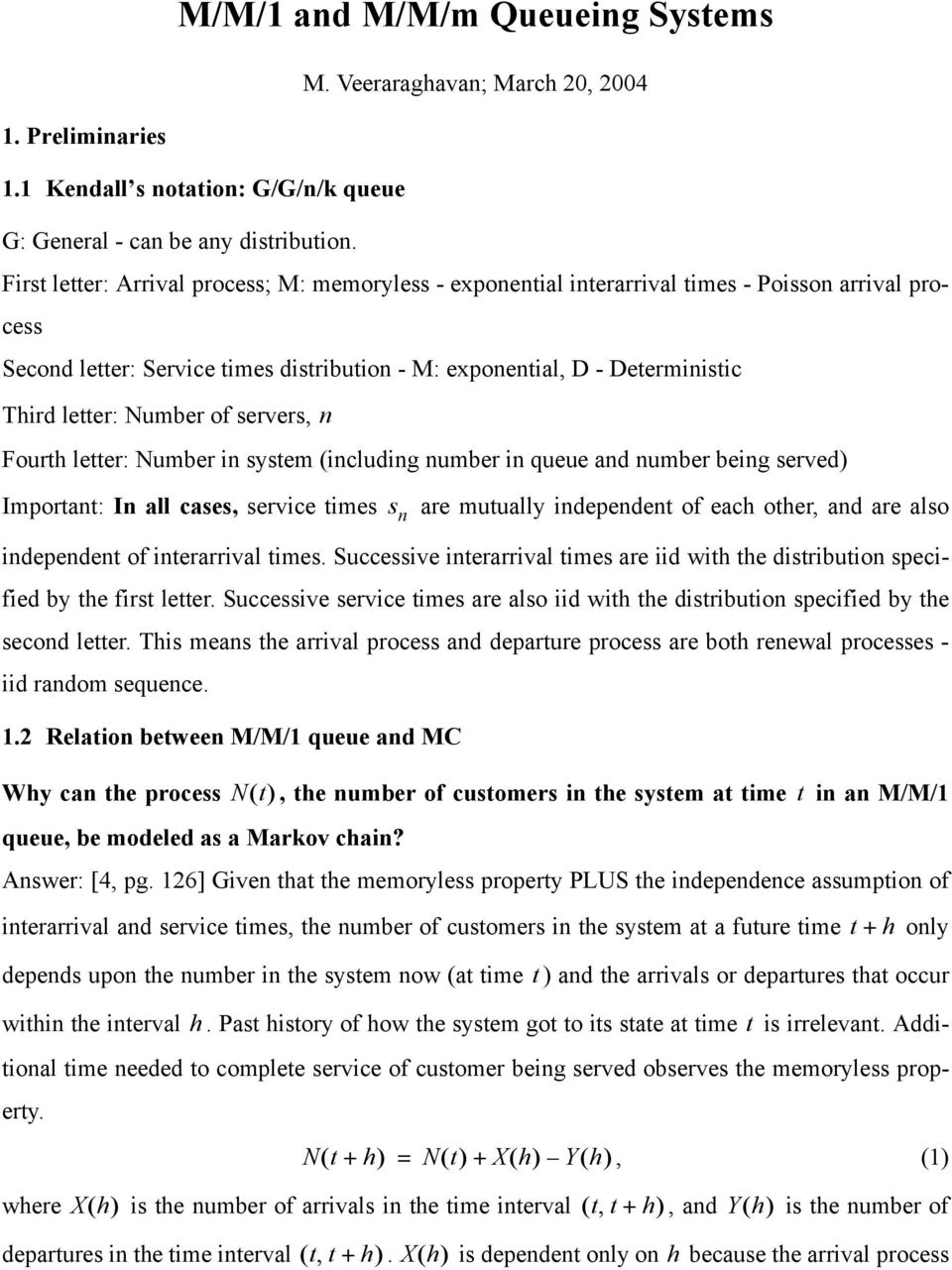
2 is Poisson. Yh ( ) is 0 if the service time of the customer being served, s > h. Yh ( ) is, if s h and s 2 + s > h, and so on. As the service times s, s 2,, s n are independent, neither Xh ( ) nor Yh ( ) depend on what happened prior to t. Thus, N( t+ h) only depends upon Nt () and not the past history. Hence it is a CTMC. 2. Analysis of the M/M/ queue using CTMC results: [3], page First consider a special case of an irreducible time-homogeneous MC, i.e., a birth-death process. A homogeneous CTMC is a birth-death process if there exists constants i, i 0,,, and µ i, i 0,, such that the transition rates are given by: q i i+, i, q ii, µ i, q i i + µ i and q ij 0 for i j >. (2) The reason q i i + µ i is as follows: See () in Markov Chain lecture, which states that p jj ( tt, + h) q j () t h + o( h), which for a homogeneous MC can be rewritten as (3) p jj ( h) q j h + o( h) Remembering that the sum of all transition probabilities out of a state is, p jj ( tt, + h) (4) should be equal to p ji ( tt, + h). This is equal to ( i + µ i )h + oh ( ). Therefore q j i + µ i. i Use the global balance equations derived for steady-state solution of an irreducible, homogeneous CTMC (eqn 32 of MC.pdf): k j p k q kj q j p j 0 (5) combined with the equation p j, where p j is the steady-state limiting probability of the j system being in state j and q kj and q j are the transition rates. Applying this to our birth-death MC, we get ( j + µ j )p j p j + µ j + p j j µ p 0 (6) (7)
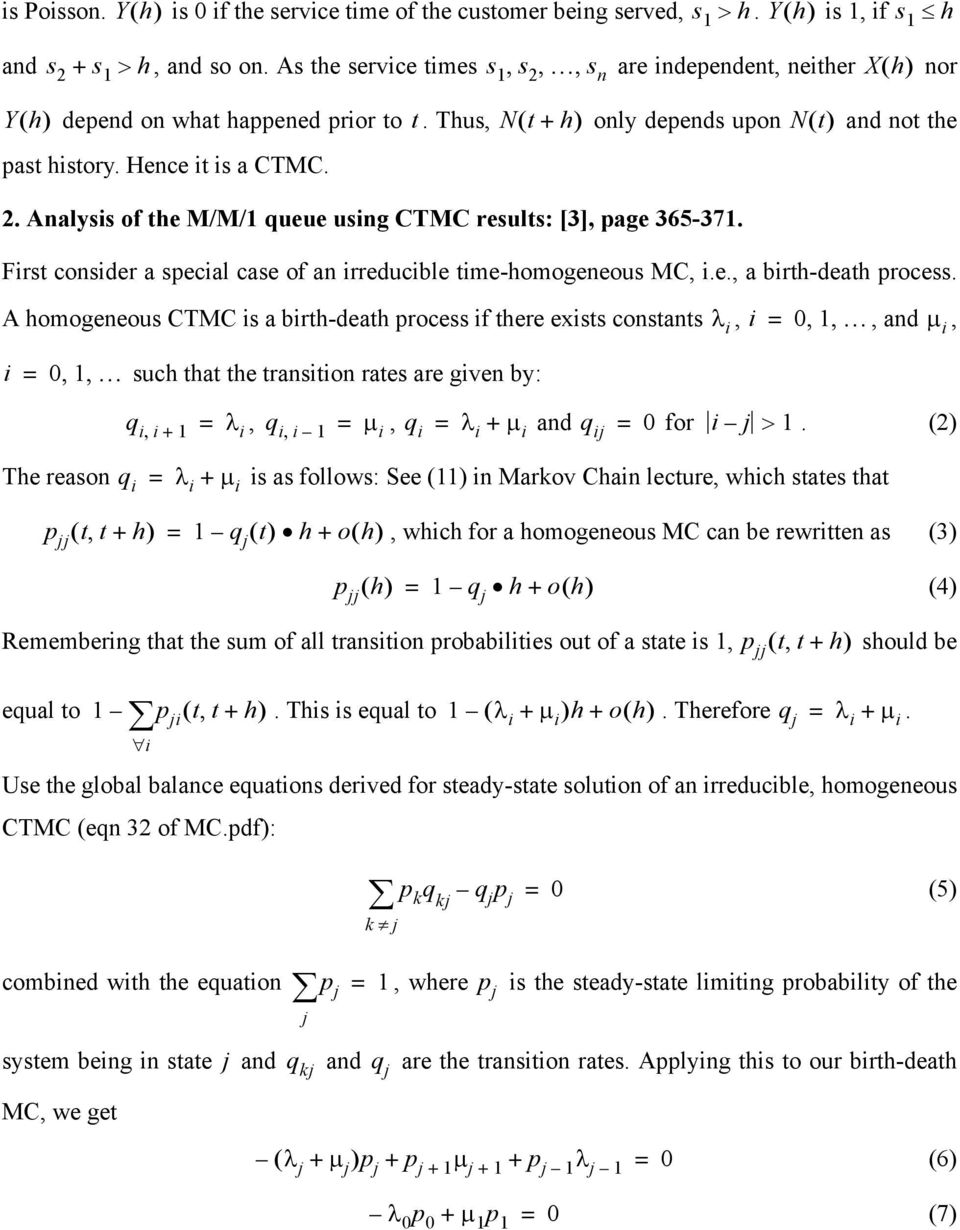
3 Eqn. (7) is the same as the detailed balance equation we showed for a birth-death DTMC in MC.pdf. See Fig. for a birth-death CTMC. Note the difference between the state diagram of a CTMC and the state diagram of a DTMC. In the latter the arcs are labeled with conditional probabilities; in the former they are labeled with transition rates - so the latter is sometime called transition-rate diagram - this from [3], page n n... n n+... µ µ 2 µ 3 µ n µ n + Figure :CTMC for a birth-death process; interesting that we don t show the self-loops Rearranging (6), we get: Similarly, and so on until: j p j µ j + p j + j j p j µ j p j j 2 p j µ j p j p j 2 µ j p j (8) (9) p µ 2 p 2 0 µ p. (0) Therefore: j p j µ j + p j + j p j µ j p j j 2 p j 2 µ j p p µ j 0 () From (7), since 0 µ p 0, Therefore: Since p j : j j j p j µ j p j 0 and hence p j pj for (2) j j µ j j j 2 0 p j - for (3) µ j µ j µ p p - i j µ i + i 0
![In the latter the arcs are labeled with conditional probabilities; in the former they are labeled with transition rates - so the latter is sometime called transition-rate diagram - this from [3],](/docs-images/48/19466382/images/page_3.jpg "page 367. 0 0 2 2 n n... n n+.")
4 -. (4) The number of customers in an M/M/ queue is a homogeneous, irreducible birth-death CTMC in which for i and µ i µ for i. Applying (3) and (4) to this case yields: i p j and, if. (5) µ j p p 0 0 < + µ j µ j µ µ We define traffic intensity, µ. < for a stable system. Server utilization U. + j j i 0 The mean number of customers in the system in the steady-state can be computed: j i - µ i + j 0 EN [ ] np n n n ( ) ( ) n n n 0 n 0 n 0 (6) n EN [ ] ( ) ( ) n n 0 n 0 ( ) ( ) (7) EN [ ] ( ) ( ) 2 ( ) (8) Derive Var[ N] (9) ( ) 2 Mean response time (using Little s Law): Mean waiting time in queue: ET [ ] EN [ ] ( ) - µ (20) EW [ ] ET [ ] - µ µ µ Mean number of customers in queue (again using Little s Law): - µ (2) EN [ Q ] EW [ ] ; also EN [ (22) ( ) Q ] EN [ ] ( ) ( ) 2 2
![+ j j i 0 The mean number of customers in the system in the steady-state can be computed: j i - µ i + j 0 EN [ ] np n n n ( ) ( ) n n n 0 n 0 n 0 (6) n EN [ ] ( ) ( ) n n 0 n 0 ( ) ( ) (7) EN [](/docs-images/48/19466382/images/page_4.jpg "] ( ) ( ) 2 ( ) (8) Derive Var[ N] (9) ( ) 2 Mean response time (using Little s Law): Mean waiting time in queue: ET [ ] EN [ ] ( ) - µ (20) EW [ ] ET [ ] - µ µ µ Mean number of customers in")
5 Subtract and not because is the probability that the server is busy. Above results hold for disciplines other than FCFS. It holds for any scheduling discipline as long as [3], page 370):. The server is not idle when there are jobs waiting for service (work conserving) 2. The scheduler is not allowed to use any deterministic a priori information about job service times (e.g., Shortest Remaining Processing Time First - SPRT will reduce E[R]). 3. The service time distribution is not affected by the scheduling discipline. 3. Derivation of M/M/ queue results using DTMC Both [4] and [5] analyze the M/M/ queue using a DTMC. Focus attention on the time instants: 0, δ, 2δ, 3δ,, where δ is a small positive number. Let N k be the number of customers in the system at time kδ. The process { N k k 0,, } is a DTMC with the same steady-state occupancy distribution as those of the CTMC Nt (). The DTMC for an M/M/ queue is shown in Fig. δ δ µδ δ µδ δ µδ δ µδ δ δ δ δ δ... n n+... µδ µδ µδ µδ µδ Figure 2:DTMC for an MM/ queue; transition probabilities are correct up to an o( δ) term 2. It is a birth-death DTMC. The transition probabilities P ij P{ N k + j N k i} is independent of k for a time-homogeneous DTMC. P 00 δ + o( δ) e δ (Poisson arrival process) (23) P ii δ µδ + o( δ) e δ e µδ for i, (24) which is the prob. of 0 arrivals and 0 departures in interval ( kδ, ( k + )δ)., δ + o( δ) e µδ δe δ for i 0, (25) P i i+ which is the prob. of arrival and 0 departures in interval ( kδ, ( k + )δ), µδ + o( δ) e δ µδe µδ for i, (26) P i i which is the prob. of 0 arrivals and departure in interval ( kδ, ( k + )δ)
![3. The service time distribution is not affected by the scheduling discipline. 3. Derivation of M/M/ queue results using DTMC Both [4] and [5] analyze the M/M/ queue using a DTMC.](/docs-images/48/19466382/images/page_5.jpg "Focus attention on the time instants: 0, δ, 2δ, 3δ,, where δ is a small positive number. Let N k be the number of customers in the system at time kδ.")
6 P ij o( δ) for i j > (27) Neglect all terms in the second order of δ. With this DTMC, we can find the stationary distribution (steady-state) using the derivation in MC.pdf for time-homogeneous irreducible DTMCs: ν n lim P{ N k n} k lim P{ N() t n} t Using the detailed balance equations (see the lecture MC.pdf) - since it is a birth-death process: (28) ν n p nn+ n 0,, ( ) ν n + p ( n + )n Applying it to the DTMC of the M/M/ queue shown in Fig. 2: p n δ + o( δ) p n + µδ + o( δ) (29) (30) As δ 0, Setting µ 4. Distribution of response time + p n for (3) µ n 02,,, p n, we get the same results as with the CTMC derivation. This DOES depend upon the scheduling discipline (unlike the average response time). We derive the response time distribution assuming the FCFS (First Come First Serve) scheduling discipline. Let the arriving job find n jobs in the system. Response time R S+ S' + S S n, where S is the service time of the arriving job, S' is the remaining time of the job in service and S i, i 2,, n are the service times of the ( n ) jobs in the queue. These are n independent random variables. Given the memoryless property of the exponential distribution, we can write the Laplace transform of the conditional distribution of R given N n as L RN ( sn) - µ n + s + µ (32) Laplace transform of a nonnegative continuous random variable X is defined as [3], page 96: L X ( s) Ls ( ) M X ( s) e sx fx ( ) dx 0 (33) If X is a nonnegative integer-valued discrete random variable, then we define its z-transform as:
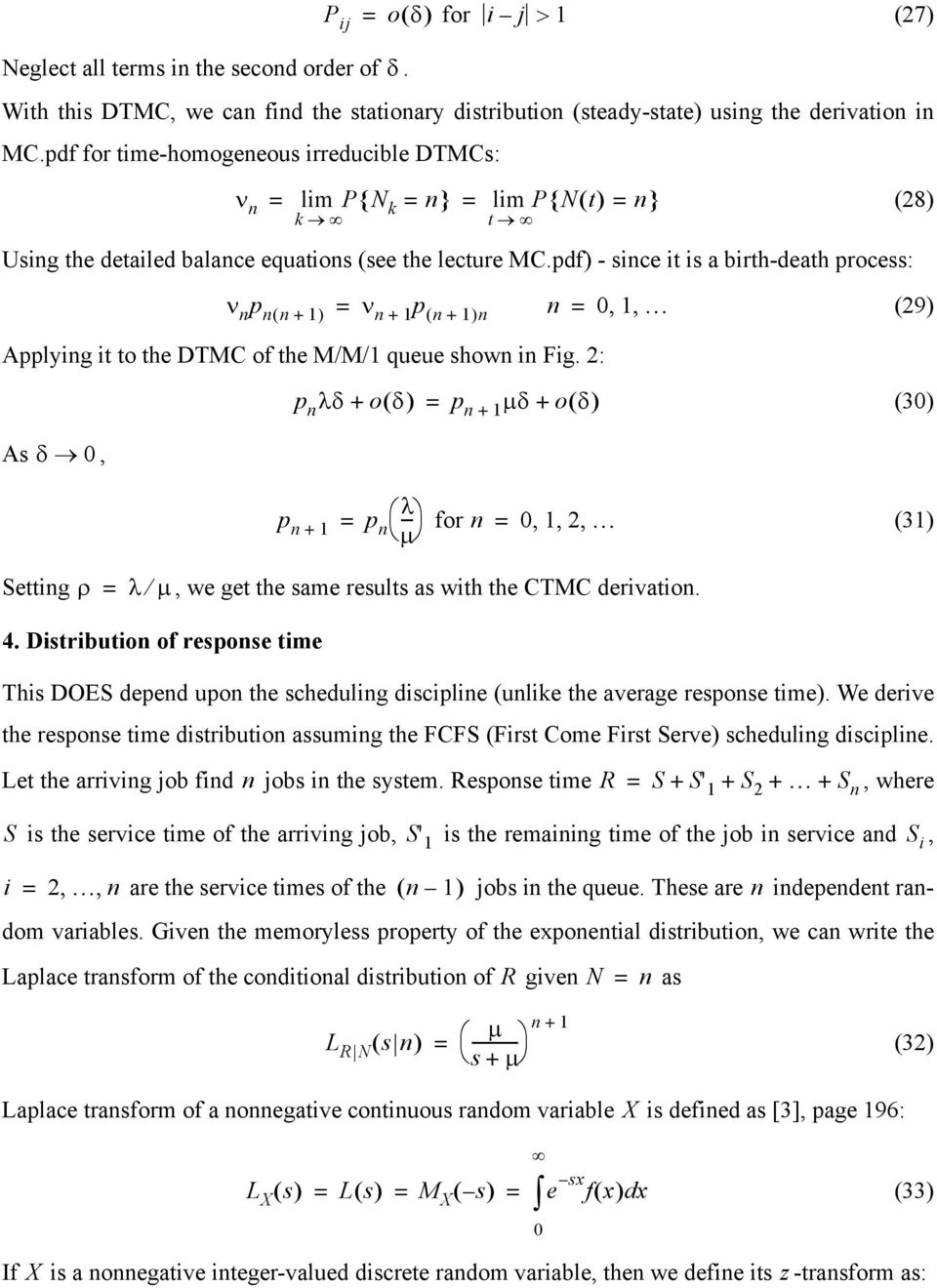
7 G X ( z) Gz ( ) Ez [ X ] M X ( lnz) p X ()z i i, (34) i 0 where moment generating function M X ( θ) is given by (if X is a r.v., Xθ is also a r.v.): M X ( θ) Ee [ Xθ ] (35) The convolution theorem: Let X, X 2,, X n be mutually independent random variables and let Y n X i. Then if M Xi ( θ) exists for all i, then: i M Y ( θ) M X ( θ)m X2 ( θ) M Xn ( θ), (36) i.e., the moment generating function of a sum of independent random variables is the product of the moment generating functions. Proof: ( M Y ( θ) Ee X + X X n )θ [ ] E e X iθ n i n i Ee X iθ [ ] by independence (37) n Hence M Y ( θ) M Xi ( θ) (38) i Sum of mutually exclusive events PA ( B) PA ( ) + PB ( ) and product of independent random variables PX ( X 2 ) PX ( )PX ( 2 ). So for a sum of independent random variables, we use the theorem that the product of moment generating functions of the r.vs. is the moment generating function of the sum. Going back to (32), and applying the theorem of total Laplace transform (like the theorem of total probability), and using (5) for p n, we get: L R ( s) n 0 - µ n + ( ) n s + µ (39)
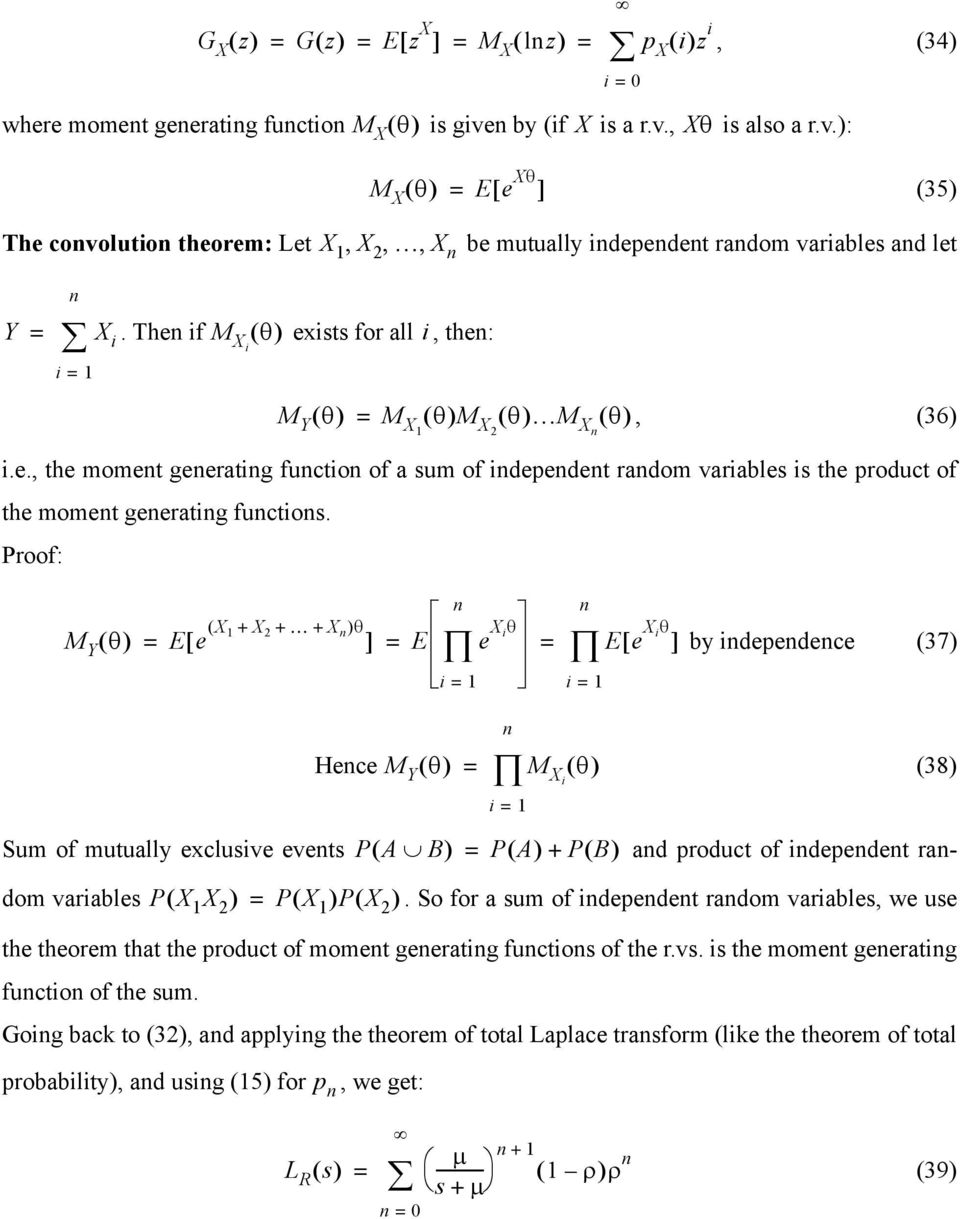
8 L R ( s) µ ( ) s + µ - µ µ ( ) s + µ µ s + µ µ ( ) s + µ ( ) (40) This means R is exponentially distributed with parameter µ ( ). Laplace transform for an exponentially distributed random variable X is: L X ( s) e sx e x dx 0 - s + (4) 5. M/M/m queue The underlying Markov chain is again a birth-death process with k for k 02,,, and (42) kµ 0 < k< m µ k mµ k m (43) Plugging these into (3) yields: k p k p 0 p for, and (44) ( i + )µ 0 µ k - k< m k! m i 0 k p k - for. (45) ( i + )µ p mµ 0 µ k m!m k m k m i 0 j m Here is the interesting thing regarding traffic intensity. We called traffic intensity in the M/M/ queue derivation as it is called in [3], page 368. In [6], page 824, is called traffic load. In an M/M/ queue, the utilization ( ) (i.e., probability that the server is not idle) turns out to be equal to. For an M/M/m queue, the condition for stability is - <. Traffic load should not be mµ dependent on m. But here both [3] and [4] set ( mµ ). NOTE THIS REDEFINITION OF (confusing to redefine but it helps the analytics).

9 Using (45) and p k, we derive as: k 0 m k 0 ( m) k + k! k m ( m) k m!m k m (46) m ( m) k ( m) m + k! - m! k m k 0 k m m k 0 ( m) k ( m) m + k! - m! i i 0 (47) m k 0 ( m) k ( m) m - + k! m! ( ) (48) EN [ ] kp k m + - ( m)m m! ( ) 2 k 0 (Exercise: derive this) (49) If M is an r.v. denoting the number of busy servers, then: m EM [ ] kp k + m p k kp k + m ( m) k m!m k m k 0 m k m m k 0 k m m EM [ ] kp k - ( m) m - mp + kp m m! k + - k 0 m k 0 (50) (5) where p m ( m) m - (52) m! Exercise: Show that EM [ ] m µ. Therefore the utilization of any individual server is ( EM [ ]) m, while the average number of busy servers is equal to traffic intensity µ. I d define utilization of the system to be EM [ ] and hence equal to the traffic intensity (same as in M/M/ queue). See [7], page 492: is called per-server utilization and m is called total traffic intensity. Unit of µ is defined in [7], page 492 as measured in the Erlangs. µ is also referred to as total load on the system. Same as in [6].
![m k m k 0 m k m m k 0 k m m EM [ ] kp k - ( m) m - mp + kp m m! k + - k 0 m k 0 (50) (5) where p m ( m) m - (52) m! Exercise: Show that EM [ ] m µ.](/docs-images/48/19466382/images/page_9.jpg "Therefore the utilization of any individual server is ( EM [ ]) m, while the average number of busy servers is equal to traffic intensity µ.")
10 Probability of an arriving job finding that all m is given by: servers are busy is called Erlang-C formula and Pqueueing [ ] p k k m p m - (see (5) and (52)) (53) P Q P[ queueing] ( m) m - - p0 (54) m! The above is a call queueing system in a telephone network with an infinite buffer. It s also called Erlang s delayed-call formula. Average number in queue (not in service) is: EN [ Q ] ( k m )p ( k m)p k 0 ( m) k m!m k m k m+ k m+ (55) ( m) m EN [ Q ] - ( k m) k m m! k m+ ( m) m p - 0 m! n n n 0 (56) Using (54) and ( ) n n n 0 -, we can express the mean number waiting in queue as Using Little s Law, EN [ Q ] P Q ( ) ( ) 2 P Q ( ) (57) EW [ ] P Q ( ) and (58) Using ( mµ ), we get ET [ ] EW [ ] + µ µ P Q + mµ (59) Using Little s Law, EN [ ] P Q µ + mµ P m + - Q, which is the same as (49). (60)
![Average number in queue (not in service) is: EN [ Q ] ( k m )p ( k m)p k 0 ( m) k m!m k m k m+ k m+ (55) ( m) m EN [ Q ] - ( k m) k m m! k m+ ( m) m p - 0 m!](/docs-images/48/19466382/images/page_10.jpg "n n n 0 (56) Using (54) and ( ) n n n 0 -, we can express the mean number waiting in queue as Using Little s Law, EN [ Q ] P Q ( ) ( ) 2 P Q ( ) (57) EW [ ] P Q ( ) and (58) Using ( mµ ), we get ET [")
11 Compare M/M/ queue with a fast server operating at mµ with an M/M/m system: Average packet delay (mean response time) in the M/M/m system is: ET [ ] µ P Q + mµ (6) Average packet delay in an M/M/ queue with service rate mµ is: In an M/M/ queue ETˆ [ ] mµ - mµ P ˆ + Q mµ (62) P ˆ Q ( m) m p because p. (63) m! 0 ET [ ] - mµ mµ + mµ ( mµ ) + mµ - mµ ( mµ ) Under light loads «, P Q P ˆ Q 0 then ET - [ ] m ETˆ [ ] Under heavy loads, ˆ and µ «( mµ ), then P Q P Q -. (64) ( mµ ) (65) ET [ ] - (66) ETˆ [ ] The above is a comparison of statistical multiplexing (where whole link capacity can be used) and TDM/FDM schemes where once a circuit capacity is assigned, it is not increased during the lifetime of the call. 6. M/M/ Suppose PXt ( () n) is the probability that n telephone lines are busy at time t. Assume that infinitely many lines are available and that the call arrival rate is while average call duration is µ. Find P( Xt () n) as t. Let ENt [ ()] denote the average number of busy lines at time t. Find the value of E[ Nt ()] time for this queueing system in the steady state. This is a M/M/ queueing system. when the system reaches steady state. Also find the average response
![0 ET [ ] - mµ mµ + mµ ( mµ ) + mµ - mµ ( mµ ) Under light loads «, P Q P ˆ Q 0 then ET - [ ] m ETˆ [ ] Under heavy loads, ˆ and µ «( mµ ), then P Q P Q -.](/docs-images/48/19466382/images/page_11.jpg "(64) ( mµ ) (65) ET [ ] - (66) ETˆ [ ] The above is a comparison of statistical multiplexing (where whole link capacity can be used) and TDM/FDM schemes where once a circuit capacity is assigned, it")
12 0 n µ 2µ nµ ( n + )µ State transition diagram As t, we have PX ( n) PX ( n ) nµ µ npx - ( 0 ) n! (67) Thus, PX ( 0) - e µ µ n! n 0 e (68) Since there are always enough telephone lines for any call, the response time follows exponential distribution with the average value of µ. EN [ ] np ( X n ) µ n References [] K. S. Trivedi, Probability, Statistics with Reliability, Queueing and Computer Science Applications, Second Edition, Wiley, 2002, ISBN [2] R. Yates and D. Goodman, Probability and Stochastic Processes, Wiley, ISBN [3] K. S. Trivedi, Probability, Statistics with Reliability, Queueing and Computer Science Applications, First Edition, Prentice Hall, 982, ISBN r. [4] D. Bertsekas and R. Gallager, Data Networks, Prentice Hall, 986, ISBN [5] Prof. Boorstyn s notes, Polytechnic University, NY. [6] A. Leon Garcia and I. Widjaja, Communication Networks, McGraw Hill, 2000, First Edition. [7] Mischa Schwartz, Telecommunications Networks, Protocols, Modeling and Analysis, Addison Wesley, 987. (69)
![[2] R. Yates and D. Goodman, Probability and Stochastic Processes, Wiley, ISBN 0-47-7837-3. [3] K. S. Trivedi, Probability, Statistics with Reliability, Queueing and Computer Science Applications, First Edition, Prentice Hall, 982, ISBN 0-3-7564-4r.](/docs-images/48/19466382/images/page_12.jpg "[4] D. Bertsekas and R. Gallager, Data Networks, Prentice Hall, 986, ISBN 0-3-96825-4. [5] Prof. Boorstyn s notes, Polytechnic University, NY. [6] A. Leon Garcia and I.")
6.263/16.37: Lectures 5 & 6 Introduction to Queueing Theory
 6.263/16.37: Lectures 5 & 6 Introduction to Queueing Theory Massachusetts Institute of Technology Slide 1 Packet Switched Networks Messages broken into Packets that are routed To their destination PS PS
IEOR 6711: Stochastic Models, I Fall 2012, Professor Whitt, Final Exam SOLUTIONS
 IEOR 6711: Stochastic Models, I Fall 2012, Professor Whitt, Final Exam SOLUTIONS There are four questions, each with several parts. 1. Customers Coming to an Automatic Teller Machine (ATM) (30 points)
Network Design Performance Evaluation, and Simulation #6
 Network Design Performance Evaluation, and Simulation #6 1 Network Design Problem Goal Given QoS metric, e.g., Average delay Loss probability Characterization of the traffic, e.g., Average interarrival
The Exponential Distribution
 21 The Exponential Distribution From Discrete-Time to Continuous-Time: In Chapter 6 of the text we will be considering Markov processes in continuous time. In a sense, we already have a very good understanding
4 The M/M/1 queue. 4.1 Time-dependent behaviour
 4 The M/M/1 queue In this chapter we will analyze the model with exponential interarrival times with mean 1/λ, exponential service times with mean 1/µ and a single server. Customers are served in order
1. Repetition probability theory and transforms
 1. Repetition probability theory and transforms 1.1. A prisoner is kept in a cell with three doors. Through one of them he can get out of the prison. The other one leads to a tunnel: through this he is
LECTURE 16. Readings: Section 5.1. Lecture outline. Random processes Definition of the Bernoulli process Basic properties of the Bernoulli process
 LECTURE 16 Readings: Section 5.1 Lecture outline Random processes Definition of the Bernoulli process Basic properties of the Bernoulli process Number of successes Distribution of interarrival times The
Queueing Systems. Ivo Adan and Jacques Resing
 Queueing Systems Ivo Adan and Jacques Resing Department of Mathematics and Computing Science Eindhoven University of Technology P.O. Box 513, 5600 MB Eindhoven, The Netherlands March 26, 2015 Contents
The Joint Distribution of Server State and Queue Length of M/M/1/1 Retrial Queue with Abandonment and Feedback
 The Joint Distribution of Server State and Queue Length of M/M/1/1 Retrial Queue with Abandonment and Feedback Hamada Alshaer Université Pierre et Marie Curie - Lip 6 7515 Paris, France [email protected]
UNIT 2 QUEUING THEORY
 UNIT 2 QUEUING THEORY LESSON 24 Learning Objective: Apply formulae to find solution that will predict the behaviour of the single server model II. Apply formulae to find solution that will predict the
A Uniform Asymptotic Estimate for Discounted Aggregate Claims with Subexponential Tails
 12th International Congress on Insurance: Mathematics and Economics July 16-18, 2008 A Uniform Asymptotic Estimate for Discounted Aggregate Claims with Subexponential Tails XUEMIAO HAO (Based on a joint
Simple Markovian Queueing Systems
 Chapter 4 Simple Markovian Queueing Systems Poisson arrivals and exponential service make queueing models Markovian that are easy to analyze and get usable results. Historically, these are also the models
QUEUING THEORY. 1. Introduction
 QUEUING THEORY RYAN BERRY Abstract. This paper defines the building blocks of and derives basic queuing systems. It begins with a review of some probability theory and then defines processes used to analyze
e.g. arrival of a customer to a service station or breakdown of a component in some system.
 Poisson process Events occur at random instants of time at an average rate of λ events per second. e.g. arrival of a customer to a service station or breakdown of a component in some system. Let N(t) be
1. (First passage/hitting times/gambler s ruin problem:) Suppose that X has a discrete state space and let i be a fixed state. Let
 Copyright c 2009 by Karl Sigman 1 Stopping Times 1.1 Stopping Times: Definition Given a stochastic process X = {X n : n 0}, a random time τ is a discrete random variable on the same probability space as
Performance Analysis of a Telephone System with both Patient and Impatient Customers
 Performance Analysis of a Telephone System with both Patient and Impatient Customers Yiqiang Quennel Zhao Department of Mathematics and Statistics University of Winnipeg Winnipeg, Manitoba Canada R3B 2E9
LECTURE 4. Last time: Lecture outline
 LECTURE 4 Last time: Types of convergence Weak Law of Large Numbers Strong Law of Large Numbers Asymptotic Equipartition Property Lecture outline Stochastic processes Markov chains Entropy rate Random
Overview of Monte Carlo Simulation, Probability Review and Introduction to Matlab
 Monte Carlo Simulation: IEOR E4703 Fall 2004 c 2004 by Martin Haugh Overview of Monte Carlo Simulation, Probability Review and Introduction to Matlab 1 Overview of Monte Carlo Simulation 1.1 Why use simulation?
Random access protocols for channel access. Markov chains and their stability. Laurent Massoulié.
 Random access protocols for channel access Markov chains and their stability [email protected] Aloha: the first random access protocol for channel access [Abramson, Hawaii 70] Goal: allow machines
Notes on Continuous Random Variables
 Notes on Continuous Random Variables Continuous random variables are random quantities that are measured on a continuous scale. They can usually take on any value over some interval, which distinguishes
Master s Theory Exam Spring 2006
 Spring 2006 This exam contains 7 questions. You should attempt them all. Each question is divided into parts to help lead you through the material. You should attempt to complete as much of each problem
Hydrodynamic Limits of Randomized Load Balancing Networks
 Hydrodynamic Limits of Randomized Load Balancing Networks Kavita Ramanan and Mohammadreza Aghajani Brown University Stochastic Networks and Stochastic Geometry a conference in honour of François Baccelli
Exponential Distribution
 Exponential Distribution Definition: Exponential distribution with parameter λ: { λe λx x 0 f(x) = 0 x < 0 The cdf: F(x) = x Mean E(X) = 1/λ. f(x)dx = Moment generating function: φ(t) = E[e tx ] = { 1
Tenth Problem Assignment
 EECS 40 Due on April 6, 007 PROBLEM (8 points) Dave is taking a multiple-choice exam. You may assume that the number of questions is infinite. Simultaneously, but independently, his conscious and subconscious
Analysis of a Production/Inventory System with Multiple Retailers
 Analysis of a Production/Inventory System with Multiple Retailers Ann M. Noblesse 1, Robert N. Boute 1,2, Marc R. Lambrecht 1, Benny Van Houdt 3 1 Research Center for Operations Management, University
Exponential Approximation of Multi-Skill Call Centers Architecture
 Exponential Approximation of Multi-Skill Call Centers Architecture Ger Koole and Jérôme Talim Vrije Universiteit - Division of Mathematics and Computer Science De Boelelaan 1081 a - 1081 HV Amsterdam -
Optimal Hiring of Cloud Servers A. Stephen McGough, Isi Mitrani. EPEW 2014, Florence
 Optimal Hiring of Cloud Servers A. Stephen McGough, Isi Mitrani EPEW 2014, Florence Scenario How many cloud instances should be hired? Requests Host hiring servers The number of active servers is controlled
Response Times in an Accident and Emergency Service Unit. Apurva Udeshi [email protected]
 IMPERIAL COLLEGE, LONDON Department of Computing Response Times in an Accident and Emergency Service Unit Apurva Udeshi [email protected] Supervisor: Professor Peter Harrison Second Marker: Dr. William
Load Balancing and Switch Scheduling
 EE384Y Project Final Report Load Balancing and Switch Scheduling Xiangheng Liu Department of Electrical Engineering Stanford University, Stanford CA 94305 Email: [email protected] Abstract Load
Optimal Dynamic Resource Allocation in Multi-Class Queueing Networks
 Imperial College London Department of Computing Optimal Dynamic Resource Allocation in Multi-Class Queueing Networks MEng Individual Project Report Diagoras Nicolaides Supervisor: Dr William Knottenbelt
Stochastic Processes and Queueing Theory used in Cloud Computer Performance Simulations
 56 Stochastic Processes and Queueing Theory used in Cloud Computer Performance Simulations Stochastic Processes and Queueing Theory used in Cloud Computer Performance Simulations Florin-Cătălin ENACHE
SPARE PARTS INVENTORY SYSTEMS UNDER AN INCREASING FAILURE RATE DEMAND INTERVAL DISTRIBUTION
 SPARE PARS INVENORY SYSEMS UNDER AN INCREASING FAILURE RAE DEMAND INERVAL DISRIBUION Safa Saidane 1, M. Zied Babai 2, M. Salah Aguir 3, Ouajdi Korbaa 4 1 National School of Computer Sciences (unisia),
Structure Preserving Model Reduction for Logistic Networks
 Structure Preserving Model Reduction for Logistic Networks Fabian Wirth Institute of Mathematics University of Würzburg Workshop on Stochastic Models of Manufacturing Systems Einhoven, June 24 25, 2010.
Chapter 2 Discrete-Time Markov Models
 Chapter Discrete-Time Markov Models.1 Discrete-Time Markov Chains Consider a system that is observed at times 0;1;;:::: Let X n be the state of the system at time n for n D 0;1;;:::: Suppose we are currently
STAT 830 Convergence in Distribution
 STAT 830 Convergence in Distribution Richard Lockhart Simon Fraser University STAT 830 Fall 2011 Richard Lockhart (Simon Fraser University) STAT 830 Convergence in Distribution STAT 830 Fall 2011 1 / 31
Maximum Likelihood Estimation
 Math 541: Statistical Theory II Lecturer: Songfeng Zheng Maximum Likelihood Estimation 1 Maximum Likelihood Estimation Maximum likelihood is a relatively simple method of constructing an estimator for
1.5 / 1 -- Communication Networks II (Görg) -- www.comnets.uni-bremen.de. 1.5 Transforms
 .5 / -- Communication Networks II (Görg) -- www.comnets.uni-bremen.de.5 Transforms Using different summation and integral transformations pmf, pdf and cdf/ccdf can be transformed in such a way, that even
MASSACHUSETTS INSTITUTE OF TECHNOLOGY 6.436J/15.085J Fall 2008 Lecture 5 9/17/2008 RANDOM VARIABLES
 MASSACHUSETTS INSTITUTE OF TECHNOLOGY 6.436J/15.085J Fall 2008 Lecture 5 9/17/2008 RANDOM VARIABLES Contents 1. Random variables and measurable functions 2. Cumulative distribution functions 3. Discrete
A QUEUEING-INVENTORY SYSTEM WITH DEFECTIVE ITEMS AND POISSON DEMAND. [email protected]
 A QUEUEING-INVENTORY SYSTEM WITH DEFECTIVE ITEMS AND POISSON DEMAND Rasoul Hai 1, Babak Hai 1 Industrial Engineering Department, Sharif University of Technology, +98-1-66165708, [email protected] Industrial
Basic Queuing Relationships
 Queueing Theory Basic Queuing Relationships Resident items Waiting items Residence time Single server Utilisation System Utilisation Little s formulae are the most important equation in queuing theory
Supplement to Call Centers with Delay Information: Models and Insights
 Supplement to Call Centers with Delay Information: Models and Insights Oualid Jouini 1 Zeynep Akşin 2 Yves Dallery 1 1 Laboratoire Genie Industriel, Ecole Centrale Paris, Grande Voie des Vignes, 92290
Queueing Networks. Page n. Queueing Networks
 Queueing Networks Simonetta Balsamo, Andrea Marin Università Ca Foscari di Venezia Dipartimento di Informatica, Venezia, Italy School on Formal Methods 2007: Performance Evaluation Bertinoro, 28/5/2007
ECE302 Spring 2006 HW4 Solutions February 6, 2006 1
 ECE302 Spring 2006 HW4 Solutions February 6, 2006 1 Solutions to HW4 Note: Most of these solutions were generated by R. D. Yates and D. J. Goodman, the authors of our textbook. I have added comments in
ENGINEERING SOLUTION OF A BASIC CALL-CENTER MODEL
 ENGINEERING SOLUTION OF A BASIC CALL-CENTER MODEL by Ward Whitt Department of Industrial Engineering and Operations Research Columbia University, New York, NY 10027 Abstract An algorithm is developed to
Lectures on Stochastic Processes. William G. Faris
 Lectures on Stochastic Processes William G. Faris November 8, 2001 2 Contents 1 Random walk 7 1.1 Symmetric simple random walk................... 7 1.2 Simple random walk......................... 9 1.3
How To Balance In A Distributed System
 6 IEEE TRANSACTIONS ON PARALLEL AND DISTRIBUTED SYSTEMS, VOL. 11, NO. 1, JANUARY 2000 How Useful Is Old Information? Michael Mitzenmacher AbstractÐWe consider the problem of load balancing in dynamic distributed
Introduction to Queueing Theory and Stochastic Teletraffic Models
 Introduction to Queueing Theory and Stochastic Teletraffic Models Moshe Zukerman EE Department, City University of Hong Kong Copyright M. Zukerman c 2000 2015 Preface The aim of this textbook is to provide
Basic Multiplexing models. Computer Networks - Vassilis Tsaoussidis
 Basic Multiplexing models? Supermarket?? Computer Networks - Vassilis Tsaoussidis Schedule Where does statistical multiplexing differ from TDM and FDM Why are buffers necessary - what is their tradeoff,
1 Gambler s Ruin Problem
 Coyright c 2009 by Karl Sigman 1 Gambler s Ruin Problem Let N 2 be an integer and let 1 i N 1. Consider a gambler who starts with an initial fortune of $i and then on each successive gamble either wins
Lecture 13: Martingales
 Lecture 13: Martingales 1. Definition of a Martingale 1.1 Filtrations 1.2 Definition of a martingale and its basic properties 1.3 Sums of independent random variables and related models 1.4 Products of
Joint Exam 1/P Sample Exam 1
 Joint Exam 1/P Sample Exam 1 Take this practice exam under strict exam conditions: Set a timer for 3 hours; Do not stop the timer for restroom breaks; Do not look at your notes. If you believe a question
Math 151. Rumbos Spring 2014 1. Solutions to Assignment #22
 Math 151. Rumbos Spring 2014 1 Solutions to Assignment #22 1. An experiment consists of rolling a die 81 times and computing the average of the numbers on the top face of the die. Estimate the probability
Probability Generating Functions
 page 39 Chapter 3 Probability Generating Functions 3 Preamble: Generating Functions Generating functions are widely used in mathematics, and play an important role in probability theory Consider a sequence
JANUARY 2016 EXAMINATIONS. Life Insurance I
 PAPER CODE NO. MATH 273 EXAMINER: Dr. C. Boado-Penas TEL.NO. 44026 DEPARTMENT: Mathematical Sciences JANUARY 2016 EXAMINATIONS Life Insurance I Time allowed: Two and a half hours INSTRUCTIONS TO CANDIDATES:
Chapter 1. Introduction
 Chapter 1 Introduction 1.1. Motivation Network performance analysis, and the underlying queueing theory, was born at the beginning of the 20th Century when two Scandinavian engineers, Erlang 1 and Engset
Introduction to Markov Chain Monte Carlo
 Introduction to Markov Chain Monte Carlo Monte Carlo: sample from a distribution to estimate the distribution to compute max, mean Markov Chain Monte Carlo: sampling using local information Generic problem
Aggregate Loss Models
 Aggregate Loss Models Chapter 9 Stat 477 - Loss Models Chapter 9 (Stat 477) Aggregate Loss Models Brian Hartman - BYU 1 / 22 Objectives Objectives Individual risk model Collective risk model Computing
arxiv:math/0112298v1 [math.st] 28 Dec 2001
![arxiv:math/0112298v1 [math.st] 28 Dec 2001](/thumbs/39/20405706.jpg "arxiv:math/0112298v1 [math.st] 28 Dec 2001") Annuities under random rates of interest revisited arxiv:math/0112298v1 [math.st] 28 Dec 2001 Krzysztof BURNECKI, Agnieszka MARCINIUK and Aleksander WERON Hugo Steinhaus Center for Stochastic Methods,
Annuities under random rates of interest revisited arxiv:math/0112298v1 [math.st] 28 Dec 2001 Krzysztof BURNECKI, Agnieszka MARCINIUK and Aleksander WERON Hugo Steinhaus Center for Stochastic Methods,
2WB05 Simulation Lecture 8: Generating random variables
 2WB05 Simulation Lecture 8: Generating random variables Marko Boon http://www.win.tue.nl/courses/2wb05 January 7, 2013 Outline 2/36 1. How do we generate random variables? 2. Fitting distributions Generating
5. Continuous Random Variables
 5. Continuous Random Variables Continuous random variables can take any value in an interval. They are used to model physical characteristics such as time, length, position, etc. Examples (i) Let X be
Probability density function : An arbitrary continuous random variable X is similarly described by its probability density function f x = f X
 Week 6 notes : Continuous random variables and their probability densities WEEK 6 page 1 uniform, normal, gamma, exponential,chi-squared distributions, normal approx'n to the binomial Uniform [,1] random
1 Prior Probability and Posterior Probability
 Math 541: Statistical Theory II Bayesian Approach to Parameter Estimation Lecturer: Songfeng Zheng 1 Prior Probability and Posterior Probability Consider now a problem of statistical inference in which
Binomial lattice model for stock prices
 Copyright c 2007 by Karl Sigman Binomial lattice model for stock prices Here we model the price of a stock in discrete time by a Markov chain of the recursive form S n+ S n Y n+, n 0, where the {Y i }
WHERE DOES THE 10% CONDITION COME FROM?
 1 WHERE DOES THE 10% CONDITION COME FROM? The text has mentioned The 10% Condition (at least) twice so far: p. 407 Bernoulli trials must be independent. If that assumption is violated, it is still okay
Brownian Motion and Stochastic Flow Systems. J.M Harrison
 Brownian Motion and Stochastic Flow Systems 1 J.M Harrison Report written by Siva K. Gorantla I. INTRODUCTION Brownian motion is the seemingly random movement of particles suspended in a fluid or a mathematical
VISUALIZATION OF DENSITY FUNCTIONS WITH GEOGEBRA
 VISUALIZATION OF DENSITY FUNCTIONS WITH GEOGEBRA Csilla Csendes University of Miskolc, Hungary Department of Applied Mathematics ICAM 2010 Probability density functions A random variable X has density
Corrected Diffusion Approximations for the Maximum of Heavy-Tailed Random Walk
 Corrected Diffusion Approximations for the Maximum of Heavy-Tailed Random Walk Jose Blanchet and Peter Glynn December, 2003. Let (X n : n 1) be a sequence of independent and identically distributed random
Modeling and Analysis of Information Technology Systems
 Modeling and Analysis of Information Technology Systems Dr. János Sztrik University of Debrecen, Faculty of Informatics Reviewers: Dr. József Bíró Doctor of the Hungarian Academy of Sciences, Full Professor
Queuing Theory. Long Term Averages. Assumptions. Interesting Values. Queuing Model
 Queuing Theory Queuing Theory Queuing theory is the mathematics of waiting lines. It is extremely useful in predicting and evaluating system performance. Queuing theory has been used for operations research.
MASSACHUSETTS INSTITUTE OF TECHNOLOGY 6.436J/15.085J Fall 2008 Lecture 14 10/27/2008 MOMENT GENERATING FUNCTIONS
 MASSACHUSETTS INSTITUTE OF TECHNOLOGY 6.436J/15.085J Fall 2008 Lecture 14 10/27/2008 MOMENT GENERATING FUNCTIONS Contents 1. Moment generating functions 2. Sum of a ranom number of ranom variables 3. Transforms
Stochastic Models for Inventory Management at Service Facilities
 Stochastic Models for Inventory Management at Service Facilities O. Berman, E. Kim Presented by F. Zoghalchi University of Toronto Rotman School of Management Dec, 2012 Agenda 1 Problem description Deterministic
Lecture 6: Discrete & Continuous Probability and Random Variables
 Lecture 6: Discrete & Continuous Probability and Random Variables D. Alex Hughes Math Camp September 17, 2015 D. Alex Hughes (Math Camp) Lecture 6: Discrete & Continuous Probability and Random September
Manual for SOA Exam MLC.
 Chapter 5. Life annuities. Extract from: Arcones Manual for the SOA Exam MLC. Spring 2010 Edition. available at http://www.actexmadriver.com/ 1/114 Whole life annuity A whole life annuity is a series of
Fluid Approximation of a Priority Call Center With Time-Varying Arrivals
 Fluid Approximation of a Priority Call Center With Time-Varying Arrivals Ahmad D. Ridley, Ph.D. William Massey, Ph.D. Michael Fu, Ph.D. In this paper, we model a call center as a preemptive-resume priority
Section 5.1 Continuous Random Variables: Introduction
 Section 5. Continuous Random Variables: Introduction Not all random variables are discrete. For example:. Waiting times for anything (train, arrival of customer, production of mrna molecule from gene,
The Analysis of Dynamical Queueing Systems (Background)
 The Analysis of Dynamical Queueing Systems (Background) Technological innovations are creating new types of communication systems. During the 20 th century, we saw the evolution of electronic communication
4. Life Insurance. 4.1 Survival Distribution And Life Tables. Introduction. X, Age-at-death. T (x), time-until-death
 4. Life Insurance 4.1 Survival Distribution And Life Tables Introduction X, Age-at-death T (x), time-until-death Life Table Engineers use life tables to study the reliability of complex mechanical and
Nonparametric adaptive age replacement with a one-cycle criterion
 Nonparametric adaptive age replacement with a one-cycle criterion P. Coolen-Schrijner, F.P.A. Coolen Department of Mathematical Sciences University of Durham, Durham, DH1 3LE, UK e-mail: [email protected]
Basic Queueing Theory
 Basic Queueing Theory Dr. János Sztrik University of Debrecen, Faculty of Informatics Reviewers: Dr. József Bíró Doctor of the Hungarian Academy of Sciences, Full Professor Budapest University of Technology
Manufacturing Systems Modeling and Analysis
 Guy L. Curry Richard M. Feldman Manufacturing Systems Modeling and Analysis 4y Springer 1 Basic Probability Review 1 1.1 Basic Definitions 1 1.2 Random Variables and Distribution Functions 4 1.3 Mean and
A LOGNORMAL MODEL FOR INSURANCE CLAIMS DATA
 REVSTAT Statistical Journal Volume 4, Number 2, June 2006, 131 142 A LOGNORMAL MODEL FOR INSURANCE CLAIMS DATA Authors: Daiane Aparecida Zuanetti Departamento de Estatística, Universidade Federal de São
An Introduction to Queueing Theory
 An Introduction to Queueing Theory Rein Nobel Department of Econometrics, Vrije Universiteit, Amsterdam Open Middag november 20 Overview. Basic results for queueing models in continuous time: (a) delay
CONTINUOUS COUNTERPARTS OF POISSON AND BINOMIAL DISTRIBUTIONS AND THEIR PROPERTIES
 Annales Univ. Sci. Budapest., Sect. Comp. 39 213 137 147 CONTINUOUS COUNTERPARTS OF POISSON AND BINOMIAL DISTRIBUTIONS AND THEIR PROPERTIES Andrii Ilienko Kiev, Ukraine Dedicated to the 7 th anniversary
Generating Functions
 Chapter 10 Generating Functions 10.1 Generating Functions for Discrete Distributions So far we have considered in detail only the two most important attributes of a random variable, namely, the mean and
ST 371 (IV): Discrete Random Variables
 ST 371 (IV): Discrete Random Variables 1 Random Variables A random variable (rv) is a function that is defined on the sample space of the experiment and that assigns a numerical variable to each possible
Basics of Statistical Machine Learning
 CS761 Spring 2013 Advanced Machine Learning Basics of Statistical Machine Learning Lecturer: Xiaojin Zhu [email protected] Modern machine learning is rooted in statistics. You will find many familiar
Summary of Formulas and Concepts. Descriptive Statistics (Ch. 1-4)
 Summary of Formulas and Concepts Descriptive Statistics (Ch. 1-4) Definitions Population: The complete set of numerical information on a particular quantity in which an investigator is interested. We assume