
European Roadmap Hybridisation of Road Transport
|
|
|
- Brianna Blankenship
- 9 years ago
- Views:
Transcription
1 European Roadmap Hybridisation of Road Transport Version June 1, 2011 ERTRAC Expert Group Enabling Technologies

2 Table of Contents: 1. Executive summary 3 2. Introduction 4 3. Benefits and challenges of Hybrid Propulsion Brief overview on benefits and challenges Hybrid solutions in Road Transport The various Hybrid configurations for Passenger Cars The Hybrid options for Commercial Vehicles Non electrical Hybrid systems Requirements for energy storage systems Milestones Milestones for Passenger Cars Milestones for Commercial Hybrids Roadmaps Recommendations A brief look beyond References 44 Hybridisation of Road Transport page 2 of 45

3 1. Executive Summary The Green House Gas emission, especially the CO 2 emission and the air quality in cities and conurbation are major societal challenges not only for road transport. ERTRAC has addressed these challenges in its new Strategic Research Agenda. But, road transport has to contribute its part because only to overcome these challenges will secure sustainable person mobility (individual mobility with the choice of your own means of transportation as well as to use all the possibilities of public transport) and goods transport for the future, a basic requirement that humans will presuppose as self-evident also in the future. In the context of sustainable mobility the propulsion technology carry the main load to overcome the problems of environmental impact and air quality. The electrification of vehicle drive trains is an important step to increase energy security, improvement of air quality and CO 2 reduction. The European Commission launched a set of initiatives to become leadership in the electrification technology, the Fuel Cell and Hydrogen Initiative, the Electrification of Road Transport Strategy paper developed within the framework of the Green Car Initiative, are just some to mention. The following document Hybridisation of Road Transport is based on the consensus of experts of major companies and organisations from the European Road Transport Research Advisory Council (ERTRAC) and its Expert Group Enabling Technology. Hybrid Vehicles will play a major role for long time, well beyond 2030, they are a major enabler to reach the CO 2 targets, to reduce the Green House Gas emission in general, to enable good air quality in urban areas and to spare the energy consumption. Since Hybrid Vehicles do not have the range limitations of Full Electric Vehicles and also not the drawback of emissions like the pure internal combustion engine vehicles, they will be more in line with the consumer s needs in the future and the driving pattern of today and those for the future. Hybrid Electric Vehicles combine the advantage of two different propulsion systems, the possibility to drive with zero emission and to drive on long distances. The benefits of Hybrid Electric Vehicles, no other propulsion can deliver in mid term perspective, shows very clear that they will be an important part to secure sustainable mobility: - The decarbonisation advantage, 10%-95% CO 2 reduction potential - The green car advantage, zero emission driving in electric mode in cities and conurbation, driving without making air quality worse - The consumer advantage, driving without limited range from city to city as well as all over the landscape, with ultra low emissions with the optimised ICE and transmission mode in the future, the use of alternative-/bio-fuels and thus reduced fuel consumption and costs in real life operation and lower emission. - The economical advantage. With all these benefits, the use of hybrid vehicles will gain benefits on economics, jobs, technology leadership as well. Despite all these advantages the challenges may not be forgotten: - The relation costs versus benefits. The question will be which additional hybrid costs will be accepted by the customer, which (cost) benefits can be achieved during a reasonable time of operation - To enlarge the ZEV range, to adapt the ICE to hybrid demands, to make hybrids lightweight, safe and more robust, to increase the durability for heavy duty application To reach the CO 2 targets, the air quality goals and to secure sustainable mobility clear milestones and recommendations are set in this document. Milestones for Passenger Cars Milestone 1: Adapted Hybrids. The already started and ongoing introduction of hybrids into the market is based on the adaptation to existing vehicles. Hybridisation of Road Transport page 3 of 45

4 Milestone 2: Integrated Hybrids. Vehicle & system integrated hybrids will provide efficiency gains for all consumers. Mass production of Plug-In Hybrids and Range Extender Hybrids has started. Milestone 3: Competitive Hybrids. Hybrid Vehicles competitive regarding costs and benefits will conquer the market. Modular and flexible Hybrid Vehicle designs will make the market more interesting. Milestones for Trucks Milestone 1: Optimised Truck. Distribution trucks with plug-in capability and long haul trucks with tailored mild hybrid systems. Milestone 2: Tailored Truck. Components tailored for high efficiency and durability w/wo Range Extender, with Plug-In capability. Milestone 3: Sustainable Truck. Hybrid systems with designed for hybridisation & continuous grid connection. Milestones for Hybrid Bus Milestone 1: Tailored hybrid bus - with Plug-In capability Milestone 2: Light weight hybrid and full electric Bus, w/wo Range Extender, with Plug-In capability. Milestone 3: Alternative energy converters systems designed for hybridisation To reach the milestones a lot of research expenditure is necessary mainly for the following fields: o Energy Storage Systems. Batteries smaller, cheaper, lightweight, safe, more robust, long life time and with high power & energy density o Drive Train technologies. New concepts for electrical machines & electro mechanical technologies, low-cost, lightweight o System Integration & Modular Hybrid Architecture. To build robust, small, integrated and efficient hybrid configurations o Grid Integration. Fast, contact-less, bidirectional charging infrastructure Of course additional research efforts are to undertake in safety aspects and the integration of hybrids into the transport system and the development of solutions capable for high number of pieces (mass production). The Hybrid Electric Vehicles are an essential part of sustainable mobility for a long time, they will support the environmental goals, without Hybrid Electric Vehicles the CO 2 and air quality targets could not be reached. Full Electric Vehicles will dominate as pure city- and short distance solutions. But, Hybrids will be the major solution for sustainable mobility, for individual mobility, for goods transport and for public transport, suitable to enter cities as well, due to there ZEV range. The European Commission should support the benefits of Hybrids, setting the standards to get the lead, promote HEV research in the 8 th Framework Programme. 2. Introduction In its new Strategic Research Agenda, ERTRAC has addressed major societal challenges such as decarbonisation in road transport, reliability of the road transport system and the need for safety and security in road transports. Only to overcome these challenges will secure sustainable person mobility (individual mobility with the choice of your own means of transportation as well as to use all the possibilities of public transport) and goods transport for the future, a basic requirement that humans will presuppose as self-evident also in the future. The future will request a mix of vehicles and the offer of more CO 2 low/energy efficient cars and trucks to secure an individual and environmentally friendly mobility freedom and green goods transport. Hybridisation of Road Transport page 4 of 45

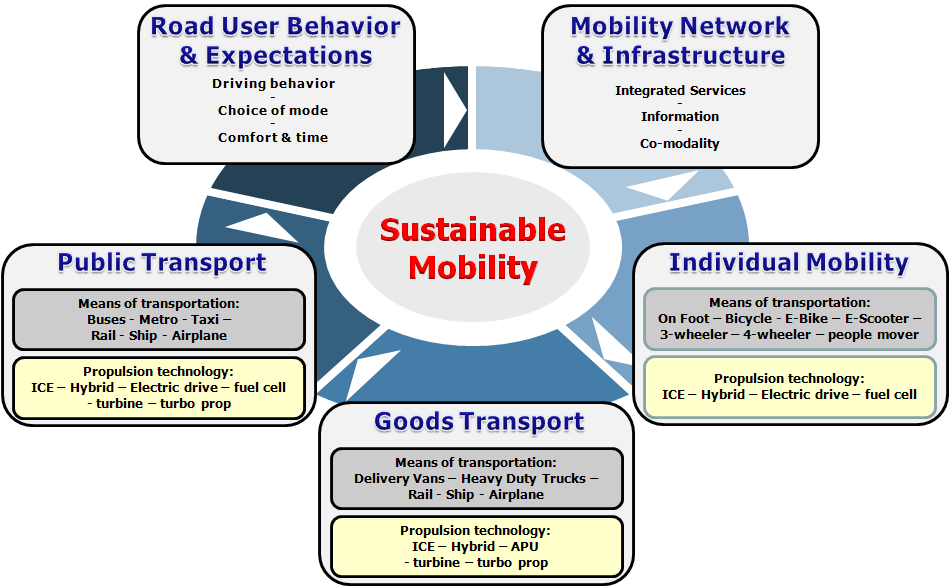
5 Figure 1: The context of Sustainable Mobility In the context of sustainable mobility, with its individual mobility, public and goods transport, the propulsion technology carry the main load to overcome the problems of environmental impact and air quality. To secure mobility and goods supply in cities and conurbation will be a great problem to solve in the future. It is expected that urban zones have to accommodate more and more people. When looking at the evolution of propulsion technologies, hybridisation appears to be a large part of the answer, even if vehicles with Internal Combustion Engines (ICE) will be the long to future solution for Long Distance Freight Transport and probably for long distance travel with family cars. With a similar approach as the ERTRAC EPoSS SmartGrids roadmap Electrification of Road Transport, the aim of this roadmap on Hybridisation of Road Transport is to give a consistent overview, to show the different fields of application, to explain the challenges and benefits for environment and customer, to point out the most promising configurations and to define the R&D needs on a time-line, this for passenger cars and commercial vehicles. Hybridisation of Road Transport page 5 of 45
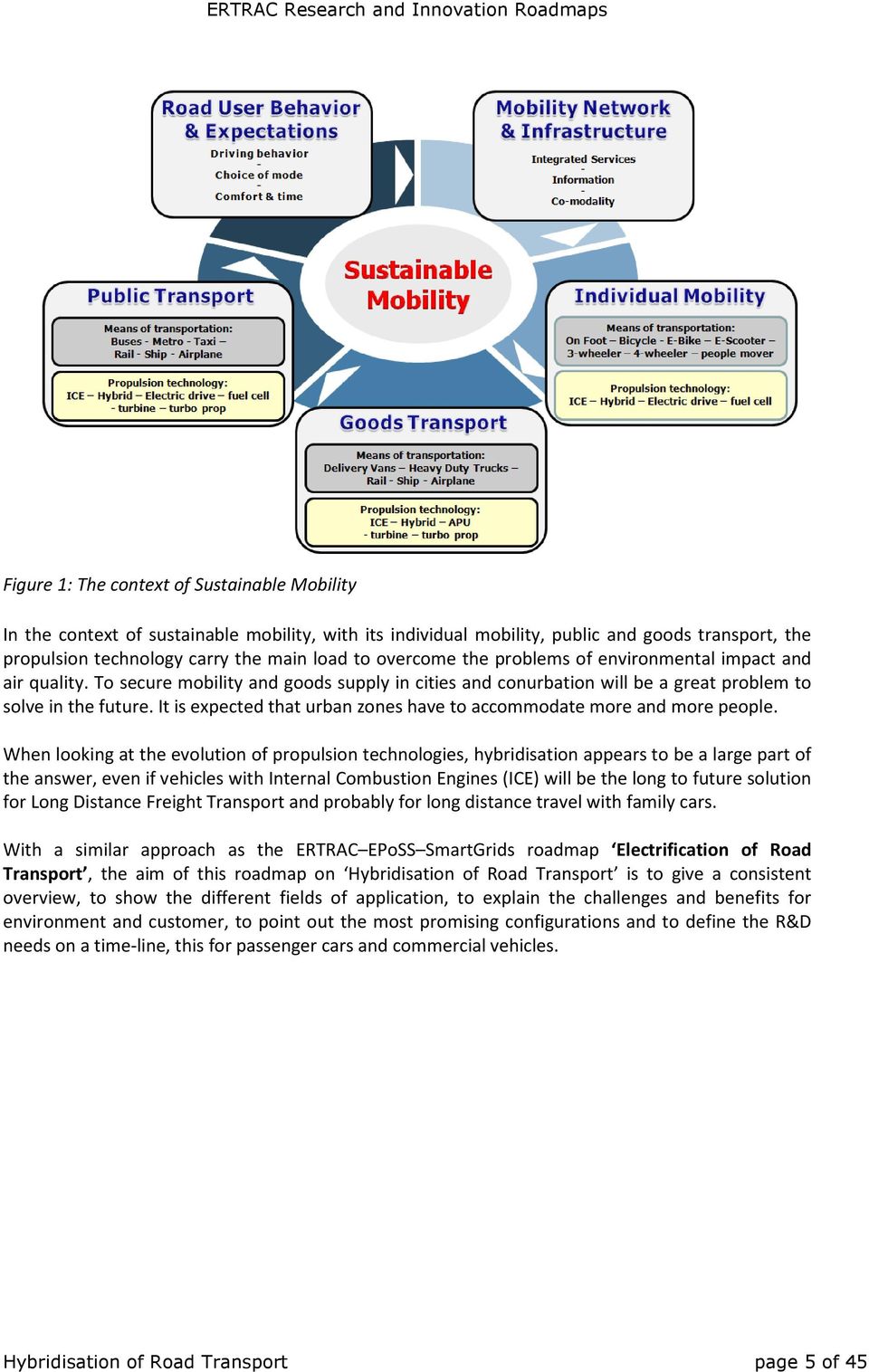
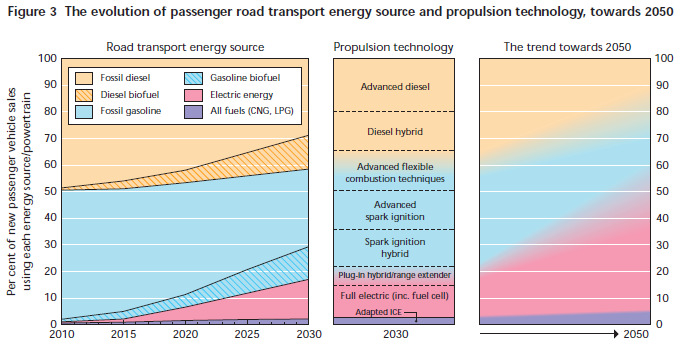
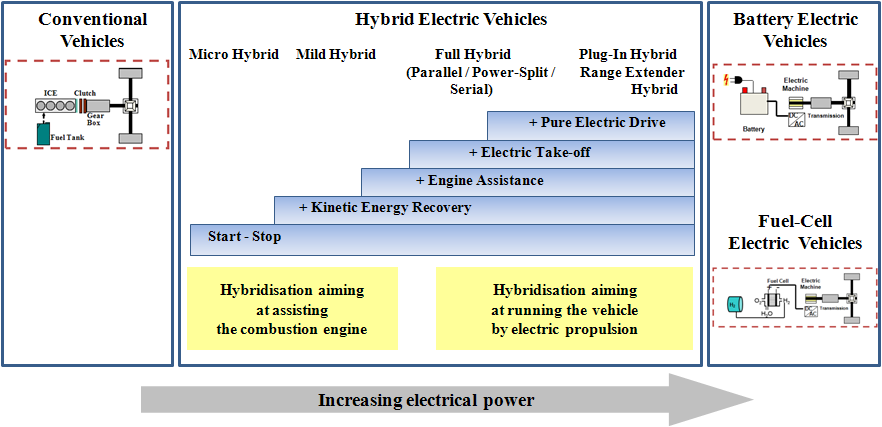
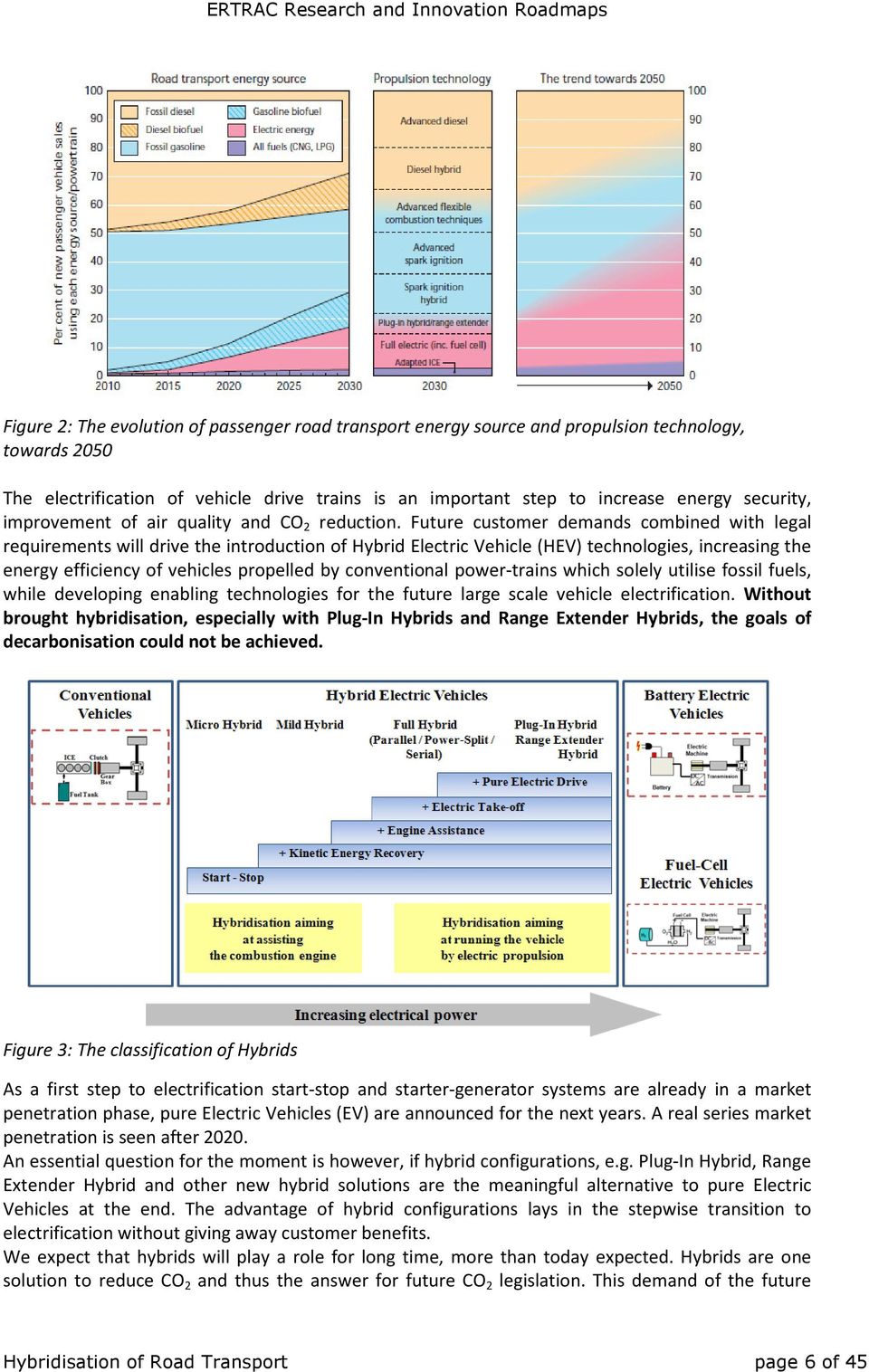
6 Figure 2: The evolution of passenger road transport energy source and propulsion technology, towards 2050 The electrification of vehicle drive trains is an important step to increase energy security, improvement of air quality and CO 2 reduction. Future customer demands combined with legal requirements will drive the introduction of Hybrid Electric Vehicle (HEV) technologies, increasing the energy efficiency of vehicles propelled by conventional power-trains which solely utilise fossil fuels, while developing enabling technologies for the future large scale vehicle electrification. Without brought hybridisation, especially with Plug-In Hybrids and Range Extender Hybrids, the goals of decarbonisation could not be achieved. Figure 3: The classification of Hybrids As a first step to electrification start-stop and starter-generator systems are already in a market penetration phase, pure Electric Vehicles (EV) are announced for the next years. A real series market penetration is seen after An essential question for the moment is however, if hybrid configurations, e.g. Plug-In Hybrid, Range Extender Hybrid and other new hybrid solutions are the meaningful alternative to pure Electric Vehicles at the end. The advantage of hybrid configurations lays in the stepwise transition to electrification without giving away customer benefits. We expect that hybrids will play a role for long time, more than today expected. Hybrids are one solution to reduce CO 2 and thus the answer for future CO 2 legislation. This demand of the future Hybridisation of Road Transport page 6 of 45
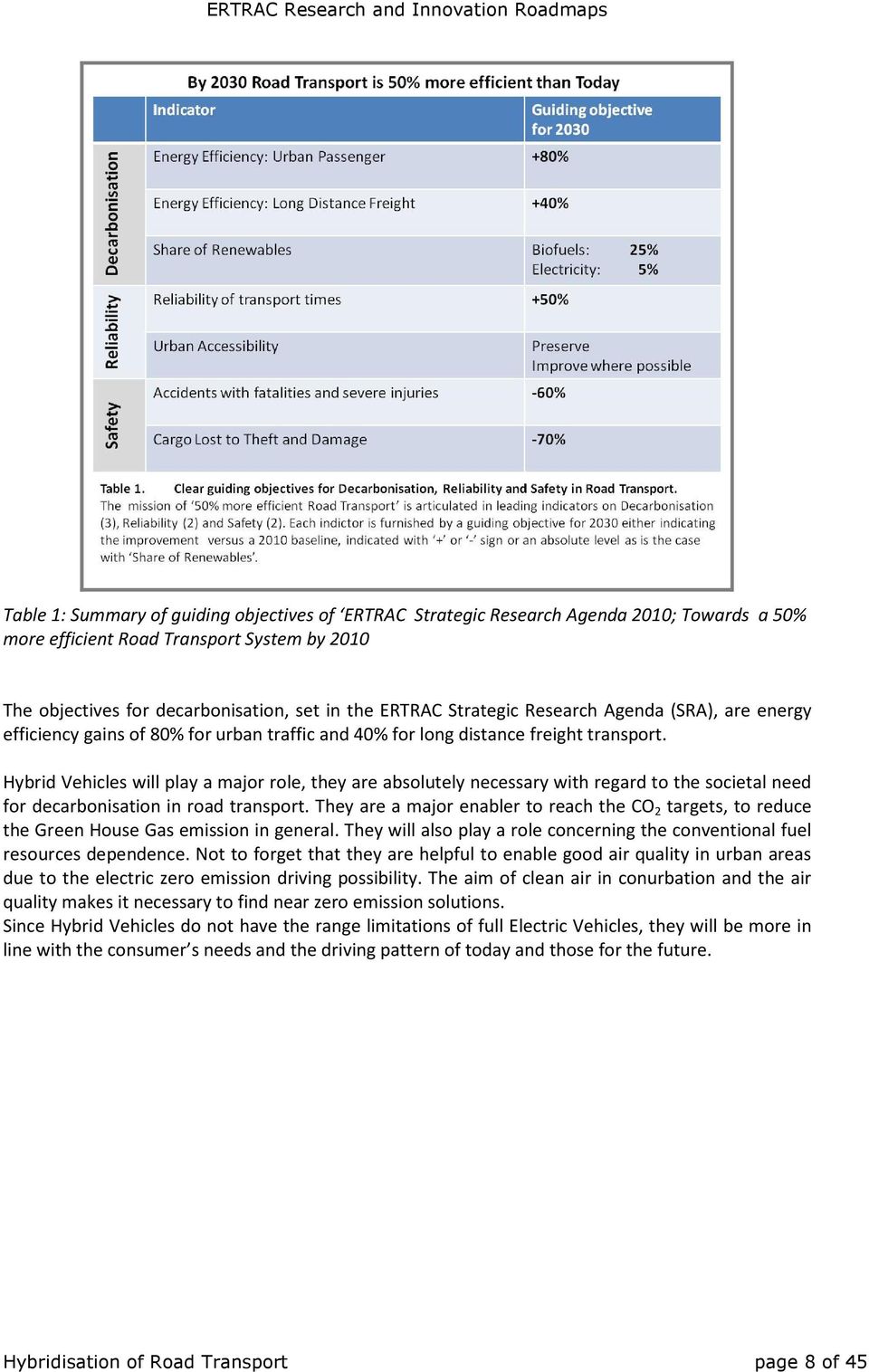
7 regarding sustainable mobility will show us as most build hybrid configurations the Plug-In Hybrids as best utility for allround cars and the Range Extender Hybrid as a solution for conurbation. It will be necessary to work besides pure city solutions on comfortable, affordable and environmentally friendly solutions rechargeable for short to long distance use. This will be one of the great hybrid challenges and with a proper answer a great step for future individual and sustainable mobility. New concepts with new engine and sub-system solutions, especially for hybrid configurations are to be developed, one has to think about new hybrid means of transportation, solutions for pure shortrange city traffic as well as for long distance holiday trips. The improvement, talking in this paper will be the supplement of ICE driven vehicles with all kind of hybridisation features. We expect that most of the ICE driven vehicles are equipped with hybrid features, from start-stop up to Plug-In devices. o Links to other roadmaps and strategic papers Vehicles with ICE will be the main platform for road transport for long time. A lot of research effort is needed to improve the internal combustion engine. An important paper there comes from the EUCAR Work Group Powertrain, Research needs in light duty conventional powertrain technologies published November In the context of Vehicles with ICE Hybrid Vehicles Electric Vehicles the ERTRAC EPoSS SmartGrids roadmap Electrification of Road Transport and the roadmap Long Distance Truck, both developed in the frame of the European Green Car Initiative are to mention as a important paper. Obviously the European Commission has a great influence on the future vehicle development, papers important for road transport are under others surely: The Transport White Paper setting the EU transport policy: COM(2011) 144, White Paper 2011 Roadmap to a Single Transport Area Towards a competitive and resource efficient transport system The strategy for clean vehicles : COM(2010) 186, A European strategy on clean and energy efficient vehicles. There are also links to other European Roadmaps developed by ERTRAC Working Groups, as: Integrating the Urban Mobility System ; European Bus System of the Future ; Sustainable Freight System for Europe ; Safe Road Transport ; Future Transport Energies ; European Technology & Production Concepts for Electrified Vehicles and Road User Behaviour & Expectations 3. Benefits and challenges of Hybrid Propulsion ERTRAC has recently issued scenarios and objectives for road based transport proposing that, with the combined commitment and assumption of responsibility by all stakeholders concerned, transport efficiency should become 50% more efficient by 2030 compared with today. This target is translated into three main areas and a number of indicators with corresponding guiding objectives as shown in table 1 below. Hybridisation of Road Transport page 7 of 45

8 Table 1: Summary of guiding objectives of ERTRAC Strategic Research Agenda 2010; Towards a 50% more efficient Road Transport System by 2010 The objectives for decarbonisation, set in the ERTRAC Strategic Research Agenda (SRA), are energy efficiency gains of 80% for urban traffic and 40% for long distance freight transport. Hybrid Vehicles will play a major role, they are absolutely necessary with regard to the societal need for decarbonisation in road transport. They are a major enabler to reach the CO 2 targets, to reduce the Green House Gas emission in general. They will also play a role concerning the conventional fuel resources dependence. Not to forget that they are helpful to enable good air quality in urban areas due to the electric zero emission driving possibility. The aim of clean air in conurbation and the air quality makes it necessary to find near zero emission solutions. Since Hybrid Vehicles do not have the range limitations of full Electric Vehicles, they will be more in line with the consumer s needs and the driving pattern of today and those for the future. Hybridisation of Road Transport page 8 of 45

9 Vehicle with ICE: - Unlimited range and speed, no ZEV range Hybrid Electric Vehicles: - With ICE propulsion unlimited range and speed on the country side - ZEV mode in conurbation - As Range Extender and Plug-In with ZEV range up to some hundreds of kilometres - Reduced CO 2 emission Pure Electric Vehicle: - Limited range and speed, limited ZEV range Figure 4: The benefits of hybrid electric vehicles Customer expectations on Hybrid Electric Vehicle properties are even higher compared to conventional vehicles. No functional disadvantages may have the Hybrid Electric Vehicle (HEV), they should offer new and additional benefits, like to drive as Zero Emission Vehicle (ZEV). An important target is to reduce the fuel consumption in real life operation. Hybrid Electric Vehicles combine the advantage of two different propulsion systems, the possibility to drive with zero emission and to drive on long distances. They fulfil a lot of benefits as fast highway driving, to pull supporters, they are thrifty and clean. Hybrids will be a good solution for a lot of families to choose a car they can use in areas with worse air quality, probably in the future a lot of them with restrictions for conventional cars, as well as to go on holidays. Beside these benefits hybrids suits a lot of vehicle configurations small city cars, long distance family cars, delivery vans, city-buses. Plug-In Hybrids and Range Extender Hybrids will offer a range of 400 to 500 km with optional zero emission driving in electric mode and with ultra low emissions with the optimised ICE mode in the future. An additional benefit for CO 2 reduction can be obtained when using bio-fuels from the 2 nd / 3 rd generation. Alternative fuels, especially bio-fuels offer the possibility to adapt the engine to dedicated fuel specifications. The reduced liquid fuel consumption of hybrids offer the potential to bring demand and production capacity in line without penalties for food and/or rain-forest. The benefits shows very clear that the Hybrid Electric Vehicles will be an important part to secure sustainable mobility - Zero emissions in cities and conurbation, driving without making air quality worse - Driving without limited range from city to city as well as all over the landscape, with optimised ICE and transmission, the use of alternative-/bio-fuels and thus reduced fuel consumption and lower emission. With all these benefits, the use of hybrid vehicles will gain benefits on economics, jobs, technology leadership as well. But, the benefit of a hybrid configuration depends on a large number of influencing factors. An optimum configuration can differ significantly depending on these factors. As nearly all factors Hybridisation of Road Transport page 9 of 45

10 have some interrelations and due to the increased system complexity the system design is more challenging than for conventional ICE vehicles. Selected optimisation tasks and their interaction to the component properties are briefly: 1) In HEVs electric motors and power electronics have to be packed. In nearly every case the available space and relation to this, the size of components is limited. Obviously, the size correlates to the component properties, leading to a trade off in design and layout. 2) At the mounting locations these components are exposed to environmental conditions i.e. temperatures and accelerations, which have to be taken into account for the design for a safe operation. 3) The control of the components is done through specific control units, which have to be connected to the vehicle communication network. The second torque source has to be coordinated with the combustion engine torque. 4) An important aspect is the correlation of the system design and thus for instance the frequency and the profile of the load of the individual components with the life time of the components. It is known, that batteries can withstand only limited numbers of charge and discharge cycles. 5) Also the power electronics, built out of materials with different extension coefficients have limited life time cycles due to the active and passive temperature cycling. 6) For the majority of the customers, predictable system reaction is a prerequisite for acceptance. Source: Challenges for electric energy storage systems in hybrid vehicles ; Braunschweiger Hybrid Symposium, 21. Februar 2008 Operating at cold conditions, particularly reliable cold start behaviour is another sensitive requirement of hybrid vehicles. Since state-of-the-art battery technology is not ready to meet this completely, today a HEV suited to daily use will be equipped with an additional starter and even for Plug-In Hybrid Vehicles (PHEV) an internal combustion engine will be strongly recommended for cold conditions and as range extender. The challenges to solve on the way to more sustainable electrified traffic, not only caused by the system complexity, could be summarised as: - First of all the reduction of the hybrid system costs, especially the costs of the batteries, remains an important challenge. The energy and power density and thus the range of batteries have to be increased. The weight and volume of hybrid storage systems is to decrease, new architectures and materials for electric machines and storage systems are to develop. - The system operating strategy optimisation. The issues of range extender and boosting, the new operation modes like start-stop function and two torque sources, adaptation of ICE to hybrid requirements, downsizing, alterative fuels and charging requires thermal management optimisation, battery and combustion optimisation. For an optimum system design, in general robust, small, integrated and efficient hybrid components and configurations are to build. For heavy duty application an increased durability is needed. - New (fast) charging options at home, during working hours, in public areas, the needed infrastructure is to provide (type and availability of loading stations and adequate power grid, the way of data exchange between vehicle power grid energy provider) as well as the necessary investment in production facilities and the flexible rebuilding of production lines to react on market fluctuations. - Hybrid solutions capable for high number of pieces are to develop. Hybridisation of Road Transport page 10 of 45

11 A further challenge or impediment in market growth could be restrictions in material availability, e.g. for rare earth, magnetic materials. Considering the large predicted growth in their market shares, a leading position of Europe in Hybrid Vehicle Technologies is critical for the global competitiveness of the European automotive industry, for the manufacturers, the RTD providers and the entire supply chain. The necessary investment in production facilities is to provide. One circumstance should be considered, even if costs remains an important challenge, the question will be which additional hybrid costs will be accepted by the customer, which cost benefits can be achieved during a reasonable time of operation. The energy costs will continue to rise and concomitantly the fuel costs, which allow a higher effort for fuel reduction technologies. In addition, which sum will be equalised by burdens for conventional vehicles and/or benefits for hybrids, as e.g. tax measures, entrance-fee for cities with air quality restrictions, etc. A brief overview on benefits and challenges for Hybrid Electric Vehicles is given in the following table. Hybridisation of Road Transport page 11 of 45

12 3.1 Brief overview on benefits and challenges Hybrid Electric Vehicles combine the advantage of two different propulsion systems, the advantages to drive with zero emission and to drive on long distances. Benefits of Hybrid Vehicles - The Decarbonisation benefit. 10% - 95% CO 2 reduction potential, absolutely necessary to reach CO 2 targets - The Green Car benefit. Cut of Green House Gas (GHG) emissions, enables good air quality in urban areas, adaptation of Hybrid ICE to designed renewable fuels. - The Consumer benefit. In line with future consumer needs: possibility to drive with zero emission and to drive on long distances, with energy savings, with the permission to drive in air quality restricted areas, to drive an environmentally friendly vehicle. - The Market benefit. Broad market penetration possible in a mid term perspective. - The Economical benefit. Hybrids will offer benefits on economics, jobs and technology leadership. Main challenges for Hybrid Vehicles - The challenge of the relation costs versus benefit. Reduction of hybrid system costs (in the first place battery costs), to develop new architectures and materials for electric machines & storage systems. - The challenge of the range to drive with zero emission. Increasing the range of batteries, increasing power & energy density, to build the charging infrastructure. - The challenge of the system design. System operating strategy optimisation to new operation modes and two torque sources, adaptation of ICE to hybrid requirements, downsizing. Robust, integrated and efficient hybrid vehicle configurations. Increased durability for heavy duty application. Table 2: Overview on benefits and challenges of Hybrid Electric Vehicles Hybridisation of Road Transport page 12 of 45

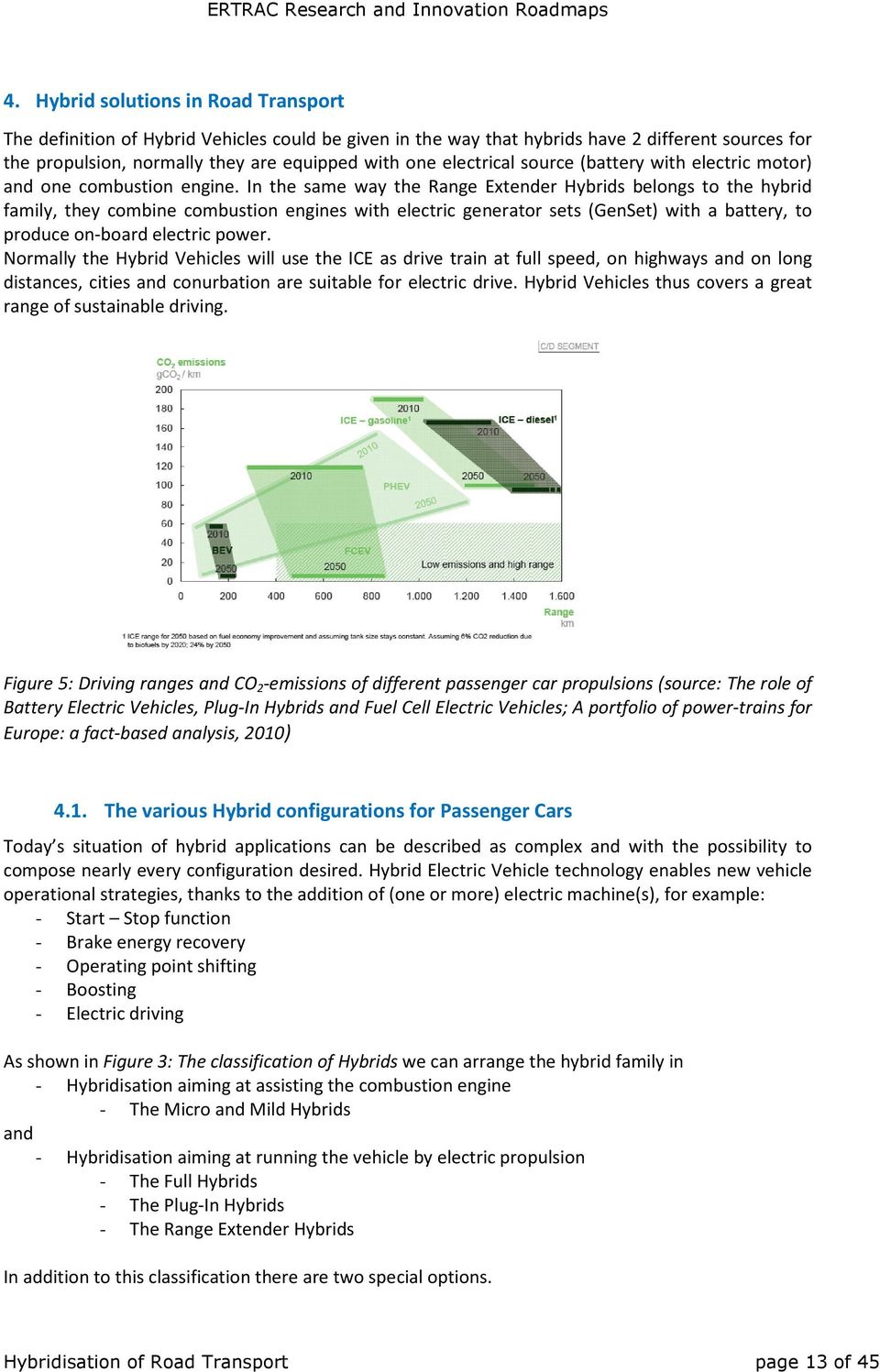
13 4. Hybrid solutions in Road Transport The definition of Hybrid Vehicles could be given in the way that hybrids have 2 different sources for the propulsion, normally they are equipped with one electrical source (battery with electric motor) and one combustion engine. In the same way the Range Extender Hybrids belongs to the hybrid family, they combine combustion engines with electric generator sets (GenSet) with a battery, to produce on-board electric power. Normally the Hybrid Vehicles will use the ICE as drive train at full speed, on highways and on long distances, cities and conurbation are suitable for electric drive. Hybrid Vehicles thus covers a great range of sustainable driving. Figure 5: Driving ranges and CO 2 -emissions of different passenger car propulsions (source: The role of Battery Electric Vehicles, Plug-In Hybrids and Fuel Cell Electric Vehicles; A portfolio of power-trains for Europe: a fact-based analysis, 2010) 4.1. The various Hybrid configurations for Passenger Cars Today s situation of hybrid applications can be described as complex and with the possibility to compose nearly every configuration desired. Hybrid Electric Vehicle technology enables new vehicle operational strategies, thanks to the addition of (one or more) electric machine(s), for example: - Start Stop function - Brake energy recovery - Operating point shifting - Boosting - Electric driving As shown in Figure 3: The classification of Hybrids we can arrange the hybrid family in - Hybridisation aiming at assisting the combustion engine - The Micro and Mild Hybrids and - Hybridisation aiming at running the vehicle by electric propulsion - The Full Hybrids - The Plug-In Hybrids - The Range Extender Hybrids In addition to this classification there are two special options. Hybridisation of Road Transport page 13 of 45
14 - Through the Road Hybrid (torque connection between e-dive and ICE via road) On the one hand providing the possibility for delivery vans to drive as ZEV, on the other hand to make more dynamic and the 4-wheel-propulsion available. - Wheel Hub Serial Hybrid This configuration used normally only for buses and special applications. The general reach and the range as Zero Emission Vehicle (ZEV) for Full, Plug-In and Range Extender Hybrids, as well as for the option 4-wheeler, is given by the combination of battery dimension and the engine output. Nearly every customer wish could be provided, from small city vehicles up to powerful sports cars. The impact on CO 2 reduction potential, the efficiency of the configuration and the additional costs of the hybrid propulsion depends very strongly on the configuration itself, mainly on the battery size and the demanded ZEV range. As well it is obvious that the CO 2 reduction depends on the driving conditions and behaviour. The CO 2 reduction figures given in the following description of the hybrid families are to be seen as the indication of the potential for the hybrid system of passenger cars, the hybrid effect only, not for the optimised hybrid vehicle. Figures for a mid-size vehicle with slightly optimised drive train are given in the overview at the end of this chapter. All figures given are based on ERTRAC experts input, they are Tank to Wheel figures. Costs for the hybrid configurations are not given, the market is too dynamic, costs changes too fast, every figure given could be wrong a week later. The symbols used for the hybrid family pictures: Figure 6: Symbols used in the hybrid pictures o The Micro and Mild Hybrid family Micro and Mild Hybrids, with start-stop function and belt Starter-Generator, are already in market penetration phase. In general Micro and Mild Hybrids do not have a ZEV range. Micro and Mild Hybrid vehicles combine a start-stop functionality with some amount of regenerative braking, minimal for Micro and modest for Mild Hybrids. These two features are used to improve fuel economy and emissions: 1. The engine is automatically switched off when the vehicle is stationary and instantly restarted as soon as the driver wishes to drive off again so there is no fuel used at idling. Hybridisation of Road Transport page 14 of 45

15 The restart can be done comfortably using a belt-driven Starter-Generator (SG) or an Integrated Starter-Generator (ISG). 2. Braking energy is recuperated via a regenerative braking control strategy the vehicle s kinetic energy is converted into electrical energy. These features are believed to generate best benefit in urban driving, where start-stop rates are high and breaking events are frequent. The given power resulting of the ICE and the Electric Machine/Motor (EM) is very application dependent. For the start-stop function a very specific issues is to heed, the number of engine starts required in vehicle life and the additional stress on the battery due to it. The configurations of Micro and Mild Hybrids: V Lead-Acid Battery, 2-5 kw Belt SG, CO 2 reduction potential 3% - 7% 60V-120V medium voltage Battery, 8-14 kw Belt SG, CO 2 reduction potential 4% - 9% 60V-280V Li-Ion Battery, 8-30 kw crankshaft or fly-wheel mounted ISG, limited boost function, ICE + EM power from 80 kw up to 300 kw, CO 2 reduction potential 7% - 14%. Hybridisation of Road Transport page 15 of 45

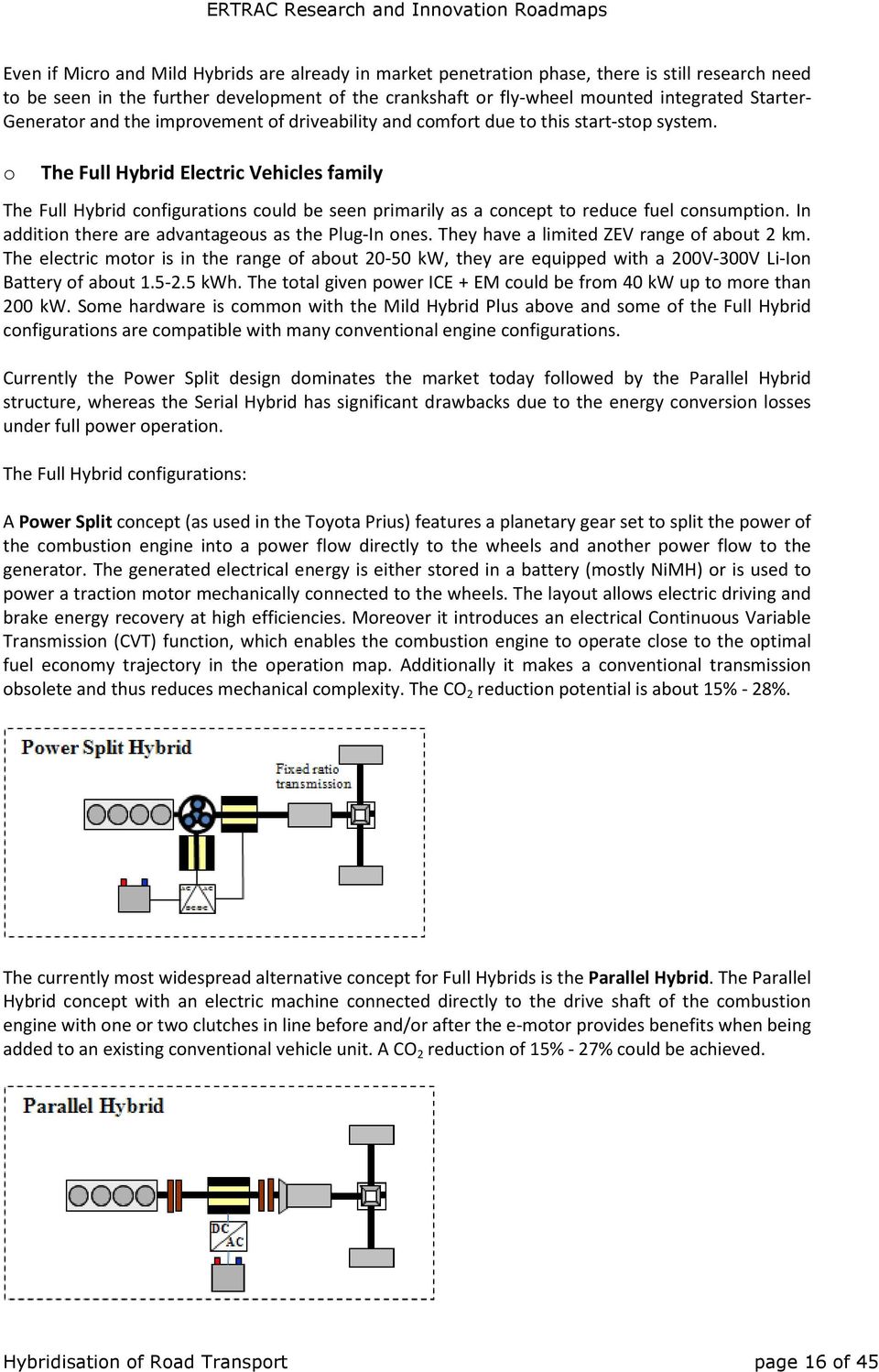
16 Even if Micro and Mild Hybrids are already in market penetration phase, there is still research need to be seen in the further development of the crankshaft or fly-wheel mounted integrated Starter- Generator and the improvement of driveability and comfort due to this start-stop system. o The Full Hybrid Electric Vehicles family The Full Hybrid configurations could be seen primarily as a concept to reduce fuel consumption. In addition there are advantageous as the Plug-In ones. They have a limited ZEV range of about 2 km. The electric motor is in the range of about kw, they are equipped with a 200V-300V Li-Ion Battery of about kwh. The total given power ICE + EM could be from 40 kw up to more than 200 kw. Some hardware is common with the Mild Hybrid Plus above and some of the Full Hybrid configurations are compatible with many conventional engine configurations. Currently the Power Split design dominates the market today followed by the Parallel Hybrid structure, whereas the Serial Hybrid has significant drawbacks due to the energy conversion losses under full power operation. The Full Hybrid configurations: A Power Split concept (as used in the Toyota Prius) features a planetary gear set to split the power of the combustion engine into a power flow directly to the wheels and another power flow to the generator. The generated electrical energy is either stored in a battery (mostly NiMH) or is used to power a traction motor mechanically connected to the wheels. The layout allows electric driving and brake energy recovery at high efficiencies. Moreover it introduces an electrical Continuous Variable Transmission (CVT) function, which enables the combustion engine to operate close to the optimal fuel economy trajectory in the operation map. Additionally it makes a conventional transmission obsolete and thus reduces mechanical complexity. The CO 2 reduction potential is about 15% - 28%. The currently most widespread alternative concept for Full Hybrids is the Parallel Hybrid. The Parallel Hybrid concept with an electric machine connected directly to the drive shaft of the combustion engine with one or two clutches in line before and/or after the e-motor provides benefits when being added to an existing conventional vehicle unit. A CO 2 reduction of 15% - 27% could be achieved. Hybridisation of Road Transport page 16 of 45
17 In the Serial Hybrid concept the Internal Combustion Engine (ICE) is mechanically disconnected from the drive train and charges the battery through a generator to overcome the limitations of the battery s energy content. This vehicle is designed to primarily operate in all-electric mode, the optimised on-board electric power generator set is used only for extending the range of the vehicle once the battery is depleted beyond a predefined limit. The CO 2 reduction is about 10% - 27%. The Serial Hybrid is equipped with 2 electric motors in a range of kw each. The electric motor belonging to the ICE side could be smaller than the second one, normally they have the same performance. The electric motors must provide the whole vehicle performance which could be easily 100kW. The combined or serial-parallel configuration is equipped with 2 electric motors and a betweenswitched clutch, which allows to switch between serial and parallel driving mode. The Combined Hybrid configuration offers a lot of operation modes, electric drive, boosting for acceleration, recuperation and battery loading. The advantage of this configuration is to be seen clear therein that in the range of middle- to highspeed the mechanical energy could be brought directly to the power-axle, to the wheels, without energy conversion losses. A CO 2 reduction of 10% - 28% could be achieved. o The Plug-In Hybrid Electric Vehicles family The Plug-In Hybrids are from the technical side equal to the Full Hybrids, apart from the Plug-In device. The difference lays in the application, in the functionality: The aim of the Full Hybrids could Hybridisation of Road Transport page 17 of 45

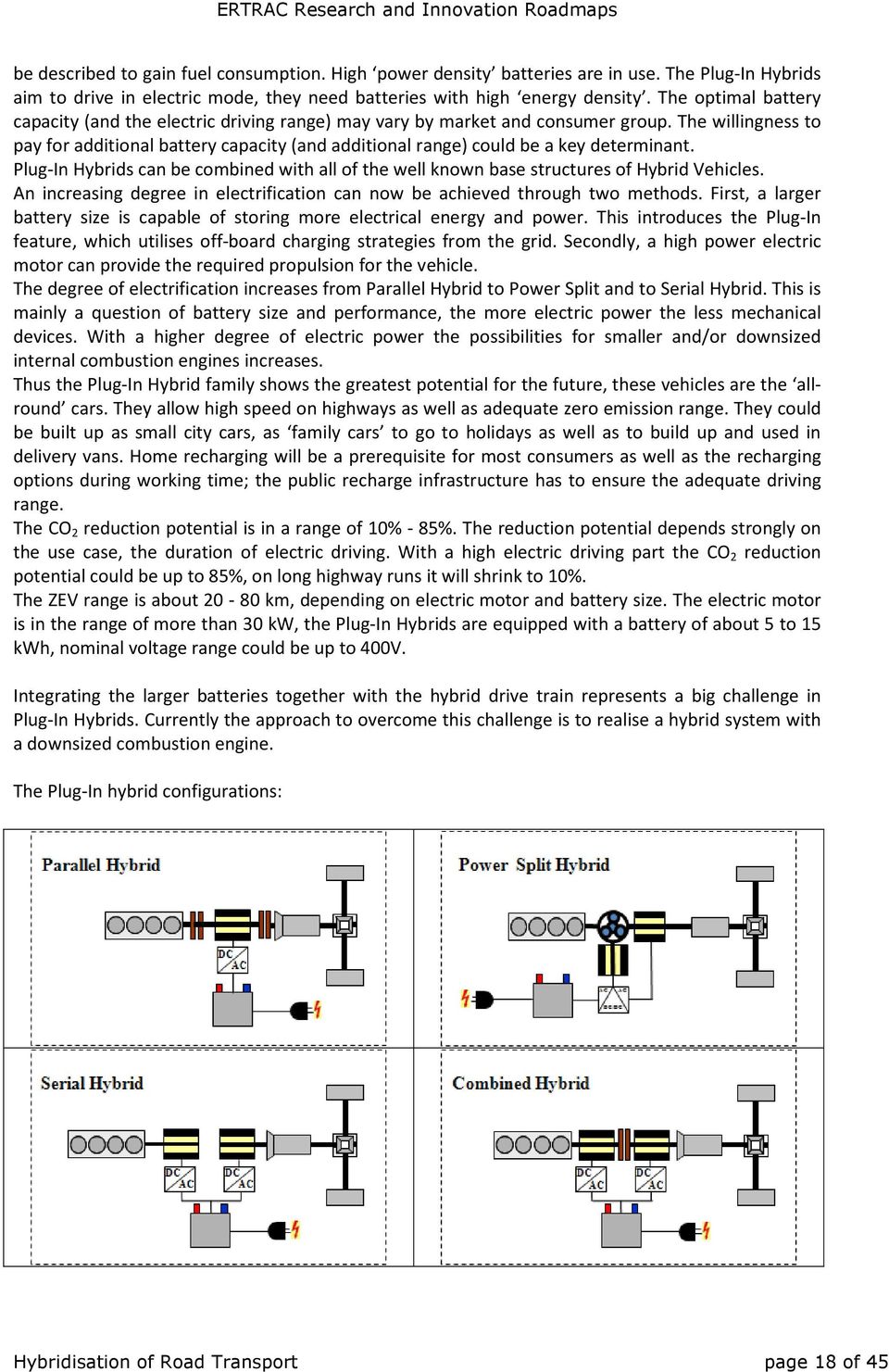
18 be described to gain fuel consumption. High power density batteries are in use. The Plug-In Hybrids aim to drive in electric mode, they need batteries with high energy density. The optimal battery capacity (and the electric driving range) may vary by market and consumer group. The willingness to pay for additional battery capacity (and additional range) could be a key determinant. Plug-In Hybrids can be combined with all of the well known base structures of Hybrid Vehicles. An increasing degree in electrification can now be achieved through two methods. First, a larger battery size is capable of storing more electrical energy and power. This introduces the Plug-In feature, which utilises off-board charging strategies from the grid. Secondly, a high power electric motor can provide the required propulsion for the vehicle. The degree of electrification increases from Parallel Hybrid to Power Split and to Serial Hybrid. This is mainly a question of battery size and performance, the more electric power the less mechanical devices. With a higher degree of electric power the possibilities for smaller and/or downsized internal combustion engines increases. Thus the Plug-In Hybrid family shows the greatest potential for the future, these vehicles are the allround cars. They allow high speed on highways as well as adequate zero emission range. They could be built up as small city cars, as family cars to go to holidays as well as to build up and used in delivery vans. Home recharging will be a prerequisite for most consumers as well as the recharging options during working time; the public recharge infrastructure has to ensure the adequate driving range. The CO 2 reduction potential is in a range of 10% - 85%. The reduction potential depends strongly on the use case, the duration of electric driving. With a high electric driving part the CO 2 reduction potential could be up to 85%, on long highway runs it will shrink to 10%. The ZEV range is about km, depending on electric motor and battery size. The electric motor is in the range of more than 30 kw, the Plug-In Hybrids are equipped with a battery of about 5 to 15 kwh, nominal voltage range could be up to 400V. Integrating the larger batteries together with the hybrid drive train represents a big challenge in Plug-In Hybrids. Currently the approach to overcome this challenge is to realise a hybrid system with a downsized combustion engine. The Plug-In hybrid configurations: Hybridisation of Road Transport page 18 of 45
19 o The Range Extender Hybrid Electric Vehicles Range Extender Systems combine (small) combustion engines (or may be fuel-cells in the future) with electric generator sets with a relatively large battery, to produce on-board electric power. As Serial or Combined Hybrid they can have, but do not necessarily need a mechanical link to the wheels. The option as Plug-In version is given. The Range Extender Hybrids seem to be a proper construction for future city solutions with sufficient electric reach of 80 to 120 km and a CO2 reduction of 10% - 95% is realistic. The electric energy supply consists of 1 st the battery and 2 nd the range extender. If the battery fails, the range extender could provide a minimum of propulsion, but could not deliver full performance. The range extender modules can provide the following benefits: Provide electric power when cold battery discharge power is limited, which fills the gap by enabling the vehicle to reach the same climbing and acceleration performance Provide electric power when hot battery discharge power is degraded. Provide electric power to cool the battery (with an electric A/C cooling system), when the battery is to hot to charge Delivery of thermal energy to heat up the battery, when it is too cold to charge or discharge the battery Extend the vehicle driving range significantly beyond the energy capacity of the battery Reduce the overall vehicle drive-train and energy storage system costs The range extender module offers the possibility to reduce the battery size to reasonably optimised dimensions. Due to this reduction in size, statistically meaningful specifications in terms of electric driving distance, cost, integration and other benefits can be met. Moreover, this approach allows implementing optimised range extender systems that can overcome the battery shortcomings. A major gap is still to be seen in a suitable combustion engine and/or in alternative GenSet systems. Hybridisation of Road Transport page 19 of 45

20 o The Through the Road Hybrid Vehicle This special configuration is very convenient for present series vehicles, it could be built-up from a series vehicle with conventional ICE drive-train. An additional axis with electric motor is to built-in. Two applications are mostly built-up, as 4-wheeler or as delivery van. The 4-wheeler is the dynamic version for passenger cars, using high power density batteries. The benefit as delivery vans is to drive as ZEV. The battery type is of high energy density. Through the Road Hybrid AC AC DC/DC This is a cheap and simple option for the hybridisation of existing series vehicles, possible for frontwheel or rear-wheel propulsion. o The Wheel Hub Serial Hybrid This configuration has the drawback of big unsprung mass on the wheels, used normally only for buses and special applications. Wheel Hub Serial Hybrid DC AC DC AC Hybridisation of Road Transport page 20 of 45

21 o Overview Hybrid Passenger Car configurations The following part will give a brief overview on the different hybrid options with information on electric driving range and an indication on the CO 2 reduction potential. The figures given are based on the expertise of ERTRAC experts, given for a mid-size vehicle with a weight of approximate 1500 kg with slightly optimised drive train - some downsizing, transmission optimisation and vehicle measures. Furthermore the ZEV range and CO 2 reduction depends strongly on the relation of battery size (power & energy), electric motor power and the ICE dimensioning as well as on the driving conditions and driving behaviour. As it is a big difference to go for a short distance with mainly electric drive, like it is possible in cities, or to go for a long distance trip using mainly the ICE, the numbers for CO 2 reduction are subdivided into the savings in the New European Driving Cycle (NEDC) and a presumed city driving with long phases of electric driving and frequent start-stop. The ranges are to be seen as today s expert knowledge. - The Micro and Mild Hybrid family A simple and cheap solution for conurbation with many start-stop actions, to reduce fuel consumption and emission. - The Full Hybrid Electric Vehicles family A solution mainly to reduce fuel consumption. The Power Split Hybrid dominates the market today, it introduces a electrical CVT function and reduces mechanical complexity through fixed ratio transmission. The Parallel Hybrid offers benefits when added to an existing conventional engine. The Serial Hybrid has drawbacks due to the energy conversion losses under full power operation. - The Plug-In Hybrid Electric Vehicles family The best configuration for All-Round Cars. Two methods to increase the degree of electrification and thus reduce the mechanical devices and increase the possibilities for downsized engines: 1. A larger battery size introduces the Plug-In feature with off-board charging. 2. A high power electric motor provides the required propulsion. The degree of electrification increases from Parallel to Power Split and to Serial Hybrid. The Serial Hybrid is designed to primarily operate in all-electric mode. The Plug-In Hybrids allows high speed on highways as well as acceptable ZEV range. As Combined Hybrid with clear advantages in the range of middle- to high-speed. - The Range Extender Hybrid Electric Vehicles Proper solution for city and conurbation traffic. Offers a minimum of propulsion with reduced performance if the battery fails. The Range Extender system can overcome the battery shortcomings. Hybridisation of Road Transport page 21 of 45
22 Hybrid family Configuration ZEV range (km) City CO 2 Reduction (%) NEDC Micro & Mild Hybrid Full Hybrid Plug-In Hybrid Range Extender Hybrid Micro Mild Mild Plus Power Split Parallel ~ 2 Serial Combined Parallel Power Split Serial Combined Range Extender Table 3: Overview about an indication of ZEV range and CO 2 reduction potential of Hybrid Passenger Cars Hybridisation of Road Transport page 22 of 45
23 o 4.2. The Hybrid options for Commercial Vehicles The hybrid options for the bus The city buses are in the fore front in utilising the hybrid technology. The hybrid technology is very well suited for city bus driving with frequent stops. City bus fleets in Europe have recently entered a transition mode to hybrid technology. The state of art hybrid technology has a proven potential of reducing the fuel consumption with at least 30%. This technology has with future development the potential to meet the long term European goal of an 80% CO 2 -reduction. The bus population is producing more passenger kilometres then the aeronautic sector, but is receiving just a friction of the development support. We are therefore convinced that investments in this segments technology development could be a very cost efficient way of reducing the CO 2 emissions and at the same time improve the energy efficiency. Independent which fuel is used or for that matter which energy converter is used. It is equally important to have an efficient vehicle. Hence, is the hybrid system valid in most cases. Technology development in this segment is very rapid outside Europe. In China are large governmental subsidies feeding a rapid transition to this technology. The US have today passed Europe when it comes to market penetration of this technology. 30% of the transit market in US is populated by hybrids. China and US are today in the lead regarding battery development for hybrid applications. Further development towards cost reduction and towards the transient demands of hybrid applications are essential. In order to fully utilise the potential of the hybrid technology for city and intercity buses, dedicated transmission development is needed. Other hybrid technologies related to city bus applications are energy efficient system integration, Plug-In technology including novel concepts based intermittently transferred electricity from grid, focusing interactive high power transfer. Light weight technology and other requirements for new vehicle architectures, are important development areas as well as Range Extender Hybrid technologies for climate or emergency propulsion energy. Intelligent climate system that can also fully developed and utilised in the frame of a hybrid city bus energy system. When designing hybrid technology for city buses the specific operational conditions of this transport mode have to be taken into account: - Compared to passenger cars which normally run in average only a short time every day, city buses run hours daily. - Due to optimised operational use on bus lines, city buses normally do not return to the depot during the day. This has an influence on the design/concept of additional charging of energy (electricity) which should be realised during operation. - Many start-stop cycles due to operation in very dense urban areas with frequent stops for boarding/alighting of passengers - Introduction/running of new technology should not result in slowing down travel speed of bus services which is a very important factor for attractiveness and comfort for passengers For line haul and coaches is system- and component development closely linked to trucks. It is of this reason highly likely that coaches will copy the truck road map. o The hybrid options for the long distance and distribution trucks Future long-haul and distribution truck power-trains will include an increasing degree of hybridisation as important part of improving fuel efficiency and for improved transport operations in urban areas. Dedicated system and component research activities are needed on advanced development on e.g. engine and complete power-train designs for Hybrid Truck operation, featuring Hybridisation of Road Transport page 23 of 45
24 start-stop capabilities, advanced transmission systems, brake energy recovery, efficient auxiliary mode operation and hotel mode functions. The utilisation of hybrid technology in the truck segment, ranges from focused Mild Hybrid solutions for long distance vehicles to Full Hybrid applications for urban distribution trucks. For smart total vehicle energy management are especially important, also including advanced systems for the hotel mode are crucial research topics for reducing total HD Mild Hybrid Vehicle energy consumption. Both the energy management of the cab comfort, the ability to for e.g. refrigeration, as well as handling of cargo, can benefit from an advanced hybrid technology system on the vehicle in the hotel mode. A new generation of hybrid control architecture development are also needed which is prepared for future types or degree of Plug-In possibilities or concepts based intermittently transferred electricity from grid. Local demands in lager cities or the potential local development of green corridor road net work will requires a large degree of flexibility of the control system even for the long haul segment. Driving environment and Global Positioning System (GPS) linked information development will also improve the control system potential of the hybrid system utilisation. The complete engine system needs to deliver high efficiency in the defined hybrid driving modes which may differ considerably depending on the type of hybrid application. A full integration of the power-train with the hybrid system including all other sub systems, including after-treatment is therefore paramount. Both series or parallel or a combination system may be applicable for long haul Mild Hybrid Vehicles. Specifically for HD truck is the requirement for high voltage development solutions, due the high demand of power in these hybrid vehicles. Several steps of energy efficiency and cost reduction actions can be applied for engines dedicated to be operated in combination with a mild hybrid power-train with or without any kind of grid energy transfer. Engine transient operation requirements will e.g. be possible to reduce significantly, which opens up for engine simplifications and further essential improvement of the engine efficiency and potential alternative fuel utilisation. High efficient combustion modes, like e.g. different derivatives of Homogeneous Charge Compression Ignition (HCCI), may then be developed and realised, due to reduced transient requirements. This is also valid for the after-treatment and waste heat recovery solutions, although different fuel need special after-treatment considerations. Special attention is to be taken of how to start and stop the engine in an efficient, silent and durable way. A key element in cost and performance is electric energy storage systems where development in the passenger car market will be an enabler to achieve the volumes necessary. However the specific durability demand on e.g. long haul transport systems set a specific attention on the development towards robustness of these systems. Battery cost, weight and durability predictions are currently a limiting factor for the future for this segment. Additional dedicated hybrid related research is therefore crucial on these topics. However, mild hybridisation opens also for new features which contribute to improve the energy efficiency on the total vehicle operation. Examples are kinetic or electro-kinetic systems which in certain applications can be an efficient additions or parts of the total hybrid concepts. These have the advantage to be independent from battery development. In summary 3 different energy accumulators or additional energy providers should be considered: - Electric systems batteries or super capacitors to provide energy for propulsion or retrieve kinetic energy, focus on high energy density (battery, fuel cells) - Hydraulic systems to provide energy for propulsion or retrieve kinetic energy & store energy in pressurised gas tanks or hydraulic fluids. - Kinetic systems use of flywheels to retrieve energy and use energy for electric generation or direct propulsion Hybridisation of Road Transport page 24 of 45
25 Bus Configuration ZEV range City CO 2 reduction (%) Inter city Micro Mild Parallel or serial Full Mild Parallel or serial Plug-in Parallel or serial 60% of total Truck Configuration ZEV range City CO 2 reduction (%) Inter City Micro Mild Parallel or serial Full Mild Parallel or serial Plug-in Parallel or serial 30% of total Table 4: Overview of CO 2 saving for Bus & Truck Hybrid. Basically the same hybrid topologies as for light duty is relevant also for heavy duty. 4.3 Non electrical hybrid systems Although electrification is the established method for creating a hybrid power-train, other types of system exist and may be attractive in some applications. These alternative systems, sometimes known as mechanical hybrids, store energy using mechanical principles such as compression of air or the spinning of a flywheel. Their potential advantages are reduced cost (compared with current battery and electrical system prices) and better performance in aggressive duty cycles. These technologies are generally less mature and well known, but Europe possesses significant strength in the technologies required to make them viable. o Hydraulic Hybrids A Hydraulic Hybrid uses a hydraulic pump/motor to force fluid into a pressure accumulator under braking, or provide extra torque to facilitate the launch of the vehicle. Performance is similar or slightly better than that of a Strong Mild Hybrid, and the system has found favour in prototype Hybridisation of Road Transport page 25 of 45
26 garbage trucks which have a need for repeated cycling between stopped and a low movement speed. More advanced variants of the technology employ digitally controlled pumps and motors to create a series or power-split drive, and have been demonstrated as prototypes in cars and commercial vehicles. The system is usually integrated into the final drive, but other configurations including hydraulically variable transmissions are possible. o Flywheel Hybrids A Flywheel Hybrid stores recovered kinetic energy in a high speed flywheel. Rotating at speeds of up to 60,000 rev/min (to give good energy density), the flywheel is contained in a vacuum to minimise losses. Drive to the vehicle can be via a shaft with seal, a magnetic coupling to an external shaft (both requiring a variable transmission to connect to the driveline), or an electric machine built into the flywheel. Performance is again at just above the level of the Strong Mild hybrid (a passenger car system stores up to 0.2 kwh of energy, but can supply 30 kw of power), and again the system performs well on aggressive duty cycles. The system can be integrated in a number of ways, including mechanical linkages into the transmission or driveline, and electrical connection into an electric machine positioned in one of the electrical hybrid configurations described above. There is less recent field experience of this type of system, but prototypes of all the types described have been demonstrated, and a European OEM has used such a system in sports-car racing. o Comparison to electrical systems The cost of electrical hybrid systems is dictated by the underlying cost of batteries, power electronics and motors, which employ materials of high value (Lithium, Copper, Refined Silicon). In contrast, mechanical hybrid systems are mostly made from more common engineering materials. Carbonfibre is often used for hydraulic accumulators and flywheels, but the most costly grades are not required. Those who promote such systems claim a potential cost of half that of an equivalent electrical hybrid. The losses in an electrical hybrid system increase with the square of current, so performance on more aggressive duty cycles is compromised. Mechanical systems also experience higher losses with high power flows, but not to the same extent; hence their suitability to the aggressive start-stop regime of buses, garbage trucks, delivery vans and urban traffic. Unlike the electrical hybrid, there is no direct route to the use of electricity as a fuel (Plug-In Hybrid, Range Extender Hybrid or pure Electric Vehicle). However, a mechanical system can be combined with a battery-electric drive, allowing the battery cells to be optimised for a slow discharge rate and high energy density (which facilitates a significant cost reduction). Typical performance of some Flywheel systems, based on recent research, is as shown in the table below. A hydraulic system would have similar performance. Hybridisation of Road Transport page 26 of 45
27 Configuration (Baseline = Standard vehicle, without stop-start) Flywheel Hybrid + Stop-Start, no post-run energy recovery, applied or retro-fitted to carry-over powertrain Flywheel Hybrid + Stop-Start + Post-run energy recovery into 12v battery; carry-over powertrain Flywheel Hybrid + Stop-Start + Post-run energy recovery to 12v battery + down-sized engine Comparison: Electrical Strong Mild Hybrid (section 4.1), carry-over powertrain Comparison: Electrical Full Parallel Hybrid (section 4.1), carry-over powertrain CO2 reduction % City NEDC Table 5: Overview of CO 2 saving potential for non electrical hybrid systems. 4.4 Requirements for energy storage systems The resulting requirements on the hybrid system are mainly dependent on the hybrid concept. The hybrid topology and the target performance values (e.g. electric driving range) will define the main requirements like voltage range, power and capacity of the battery. The energy storage systems between pure Battery Electric Vehicles (EV) and Hybrid Electric Vehicles (HEV) are different in their requirements. Pure Electric Vehicles requires systems, normally batteries, with high energy density. Hybrid Electric Vehicles requires electrical energy storage systems with high power density (battery, fly-wheel, supercap), application mainly on boosting as well as with high energy density (battery, [in special applications a fuel-cell]), application mainly for electrical operating range. In general, electrical energy can be stored in different forms; compressed air (pneumatic), flywheels (kinematic), thermal storage (heat), hydrogen and (chemical), but battery energy storage has the ability and can combine best energy capacity (Wh) and power output (W) needed for a certain application. Battery systems should be distinguished from other storage devices because they are flexible and can be adapted to high power and/or high energy demands during use. When correctly selected or tailored, they are highly efficient, both during use and at stand-by. Batteries are highly recyclable and infrastructures for collection and recycling already in place over Europe, moreover, they use a high proportion of secondary materials. Electric energy storage systems for HEV enables new additional functions. Storing is not only a matter of capacity only but the ability to fulfil other functionalities (start-stop function, brake energy recovery, operating point shifting, boosting, electric drive, bi-directional charging) typically related to the charge/discharge models in the vehicle. A broad range of different electrochemical battery technologies exist. However, lead, nickel, lithium and sodium based battery technologies are the four major families which are usually considered as those technologies that can effectively contribute to the efficient and sustainable use of electrical energy storage, the selection of one depending on the requirements of the different vehicle architectures. Giving the diversity of possible operating modes, there is no single storage system or technology covering the entire range of needs. Hybridisation of Road Transport page 27 of 45
28 Apart from Energy storage systems in the vehicles, batteries will also contribute to the infrastructure to improve charging and bi-directional energy flow management in the future electricity grid. Regarding future technologies for plug-in HEV and EV development: in medium term indicating Li-S and Li-Silicon, on the longer run possibly Li-Air and hybrid battery-storage technology. o Heavy Duty energy requirements - New Materials and Cell Design for improved HD Life, Cost, Safety - Improved robustness by improved & tailored control and electronic solutions for HD vehicles - Improve SOC (state-of-charge), SOH (state-of-health). - Improved Super Capacitors with improved energy density for specific power intensive applications, and brake recovery systems - Power and energy optimized batteries combination for improve discharge and fast charging performance - Technology solutions and standards for Fast-charging of HD plug-in systems o The fuel-cell as storage system - Focus on high power density and high energy density due to a separate source of energy (i.e. fuel-cell with hydrogen tank): As a visionary possibility for the future one can imagine hybrid configurations with fuel-cells instead of batteries. All of the topics relevant for fuel-cells are addressed in the multi annual implementation plan of the fuel cells and hydrogen joint undertaking (MAIP of FCH JU) of the EU. For most of the former technical bottlenecks of fuel cell systems such as cold start ability (sub zero C) and durability, solutions are identified. Main challenges of today and for the upcoming years are the cost reduction on component and system level as well as the creation of a sufficiently dense hydrogen supply network. In parallel, basic research is and will be ongoing regarding new materials, which should help to further improve system efficiency, simplify the operation, improve the reliability and reduce the costs. Hybridisation of Road Transport page 28 of 45
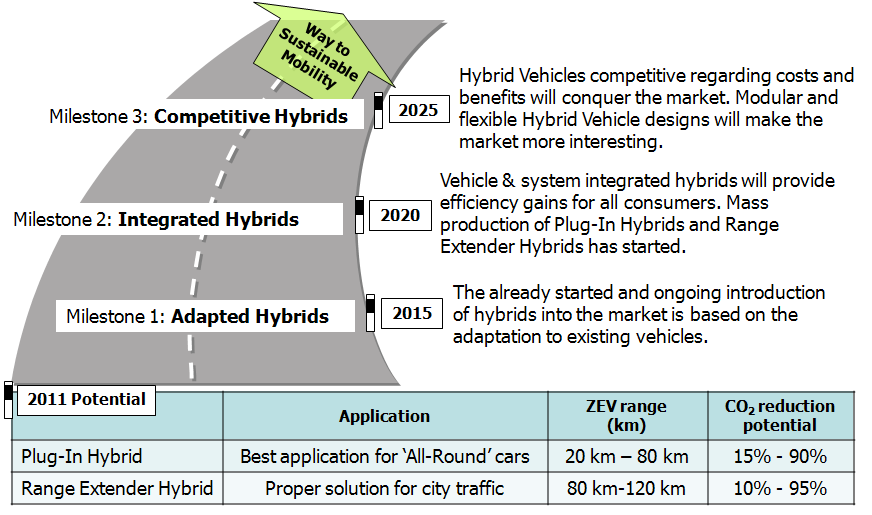
29 5. Milestones 5.1. Milestones for Passenger Cars In response to the mentioned needs, the involved ERTRAC stakeholders have combined their knowledge and experience, coordinated with the European Roadmap Electrification of Road Transport, in order to assess which benefits of the hybrid configurations can be achieved by when, and what actions will be required to master the challenges of Hybrid Vehicles at large scale. As a kernel for the roadmaps a scenario for passenger cars based on the expected future hybrid configurations was considered with a brief excursion to commercial vehicles and buses. Separate detailed roadmaps may be developed for buses, delivery vans and light duty trucks, two wheelers, heavy duty freight transport, road infrastructures as well as for a Hybrid-City-Vehicle concept. In addition a Technology & Production Concept for the Electrification of Road Transport will be developed for the industrial mass production. To strengthen and extend the European competitiveness in the field of Hybrid Vehicles, the European Roadmap Hybridisation of Road Transport has defined the necessary milestones and recommendations. Figure 7: Overview of research milestones Even if the milestones are settled for a clear near future (2015, 2020, 2025) with a market introduction expected after another 3 years of series development, it is obviously clear that research and development of hybrids is necessary to go on after The milestones are structured according to the following system: 1. The general description of what should be achieved at this milestone followed by a description with the goals to reach at this milestone for each of the different hybrid configurations 2. The description of the milestones for the major technology fields is shown in Table 2 Hybridisation of Road Transport page 29 of 45
30 o General milestone description Milestone 1: Adapted Hybrids (2015) [Market ] The already started and ongoing introduction of hybrids of EU car makers (passenger and industrial vehicle) into the market is based on the adaptation to existing vehicles. The conversion of existing vehicles into Plug-In Hybrids and Range Extender Hybrids will increase. First fleets will evolve for niche applications like, e.g. taxis, car sharing systems, delivery services and other bigger fleets. For Plug-In Hybrid and Range Extender Hybrid vehicles, specific standards for safety, data communication and billing will be developed. At the same time a charging infrastructure will become available. Continuous cost reduction and a first level of integration at sub-system level is needed for market penetration for hybrid system applicability on most vehicle segments including small vehicles. A keen market assessment definition is mandatory to exploit the market penetration of this new technology for cost targets, based on benefits for customers. Configuration Micro / Mild Hybrid Full Hybrid Plug-In Hybrid Range Extender Hybrid Milestone 1 Goals Improvement ISG; Subsystems integration and smart control strategies for efficient and cost effective hybrid power-train; Optimisation of conventional ICE and hybrid transmission concepts; Improved thermal management; Modification of breaking systems; Definition of simulation tools to find optimal hybrid configurations; Define a standardised development and manufacturing process; Establish safety standard processes; Definition of specific ICE configurations for Light Commercial Vehicles (LCV) with optimal Range Extender functionality. Establish the baseline (NVH, weight reduction, alternative fuels) for the next generation of Range Extender Unit. Milestone 2: Integrated Hybrids (2020) [Market ] Base technologies for the generation of vehicle & system integrated hybrids will provide efficiency gains for all consumers, more system integration and high performance storage systems including batteries for bi-directional charging. The charging infrastructure allows the dissemination of Plug-In Hybrids and Range Extender Hybrids over various cities and regions. Mass production of Plug-In Hybrids and Range Extender Hybrids has started. First business models for charging and grid stabilising will be in place. Configuration Micro / Mild Hybrid Full Hybrid Plug-In Hybrid Range Extender Hybrid Milestone 2 Goals High level fitment in passenger cars; further improvement of cost, efficiency and performance. Full integration of hybrid power-train components at vehicle level; Intelligent energy management; Definition of specific vehicle architecture for hybrids. Advanced thermal engine technologies for further alternative fuel application. Hybridisation of Road Transport page 30 of 45
31 Milestone 3: Competitive Hybrids (2025) [Market ] Dedicated Hybrid Vehicles competitive regarding costs and benefits will conquer the market. Highly integrated, but flexible components and systems, small, light and efficient batteries will allow the enlarged mass production of Hybrid Vehicles, fully established in Europe. Modular and flexible Hybrid Vehicle designs will make the market more interesting. Configuration Micro / Mild Hybrid Full Hybrid Plug-In Hybrid Range Extender Milestone 3 Goals No further research needed, systems well accepted by the market Products available at price attractive for the consumer and profitable for the manufacturers; Fully integrated optimised power-train for Hybrid scalable architecture; Fully optimised vehicle architecture for Hybrids; Fully integrated optimised drive train for Range Extender Hybrid scalable architecture; For Hybrid Vehicles, similar to the Electric Vehicles, major technology fields can be defined. The following table summaries the milestones considering the following major technology fields: Energy Storage Systems Drive Train Technologies System Integration & Modular Hybrid Architecture Grid Integration Safety aspects Integration into the Transport System Hybridisation of Road Transport page 31 of 45
32 o Milestones for the major technology fields Energy Storage Systems Drive Train Technologies System Integration & Modular Hybrid Architecture Grid Integration Milestone 1: 2015 [Market ] Availability of suitable energy storage components for hybrids. Availability of affordable Power batteries for Mild Hybrids. Drive train components with increased efficiency and capability of energy recovery. Establishment of an interdisciplinary development (& production) environment for cost and time efficient development, testing and production of hybrid and electric power-trains. First charging infrastructure in construction. First business models for charging. Milestone 2: 2020 [Market ] Advanced long life, safe and cost competitive energy storage systems. Availability of batteries providing tripled energy density, tripled lifetime at 20-30% of 2009 cost and matching V2G. Manufacturing of range extenders and update of optimised electric motors. Solutions for safe, robust and energy efficient interplay of power-train & energy storage system. Optimised control of energy flows based on hard- and software for the electrical architecture. Charging adaptive to both user and grid needs. Bi-directional and enhanced speed charging. Milestone 3: 2025 [Market ] Small, light and efficient batteries competitiveness for mass production. New battery technology available Implementation of power-train systems providing unlimited range at sharply reduced emissions. Range extender optimised combustion engines and GenSet. Fully adapted powertrain to the hybrid architecture; optimised vehicle architecture to customer needs, dedicated HEV configurations for citycars, LCV and family cars. Lightweight vehicle structure. Quick, convenient and smart charging. Easy to understand business models for charging cost bill. Safety aspects Hybrids meeting same safety standards as conventional cars. Implementation of solutions for all safety issues specific to mass use of hybrids and road transport based on it. Maximum exploitation of active safety measures for hybrid vehicles. Integration into the Transport System In some states the promotion of hybrids is regulated. Sponsorship and regulations for cities and conurbation with restrictions because of air quality extensively established. First battery changing stations on highways. Free entrance in Europe to restricted areas for Hybrids with ZEV range. Legislation and tax incentives are established in Europe. Network of battery changing stations exists. Table 5: milestones considering the major technology fields for passenger cars Hybridisation of Road Transport page 32 of 45
33 5.2. Milestones for Commercial Hybrids o Milestones for Hybrid Bus Hybrid Bus Milestone 1: 2015 Market Tailored hybrid bus - with Plug-In capability Milestone 2: 2020 Market Light weight hybrid and full electric Bus, w/wo Range Extender - with Plug-In capability Milestone 3: 2025 Market Alternative energy converters systems designed for hybridisation Hybrid power-train for buses Improved passenger transport efficiency Hence, substantially reduced energy consumption consumption Second generation Hybrid propulsion concepts, focusing cost efficiency. Development of enhanced durability and efficiency of ESS. Developed dedicated hybrid transmissions. Novel concepts based intermittently transferred electricity from grid. Focusing interactive high power transfer. GPS based bus operation. Dedicated full electric propulsion concept with a range Extender. New ESS that combines both good energy and power performance. Advanced electric motors, e.g. hubmotors and compact and efficient power electronics. Novel energy conversion concept as main propulsion unit, with fuel flexibility. Second generation concepts for intermittently or continuously transfer of electricity from grid. Table 6: milestones for Hybrid Bus development Hybridisation of Road Transport page 33 of 45
34 o Milestones for trucks - Hybrid distribution truck -Mild to full hybrid long haul trucks Hybrid Power-train Milestone 1: 2015 Market Optimised Truck Distribution trucks with plug-in capability and long haul trucks with tailored mild hybrid systems Milestone 2: 2020 Market Tailored Truck components tailored for high efficiency and durability w/wo Range Extender - with Plug-In capability Improved city and inter city goods transport Hence, substantially reduced energy consumption consumption Further development combustion engine efficient engine with mild hybrid functions Mild hybrid concept with hybrid hotel and cargo modes / functions, focusing cost efficiency Development of enhanced durability and efficiency of ESS First generation grid plug-in charging for city distribution. Tailored hybrid energy optimized combustion engine Dedicated truck mild and full hybrid high efficiency and components, with essential steps taken in storage technology solutions, in terms of cost and durability. First generation concepts for intermittently transferred electricity from grid. Milestone 3: 2025 Market Sustainable Truck hybrid systems with designed for hybridisation & continuous grid connection Novel energy conversion concept as main propulsion unit designed for hybrid usage, with fuel flexibility First generation concepts for continuous transfer of electricity from grid. Developed dedicated hybrid transmissions GPS based hybrid operation Table 7: milestones for hybrid power-train of city and long distance trucks (Source: Multi-annual roadmap and long-term strategy, prepared by the EGCI Ad-hoc Industrial Advisory Group of the European Green Cars Initiative PPP, November 2010) Hybridisation of Road Transport page 34 of 45
35 6. Roadmaps Following the definitions of milestones, the involved companies and organisations from ERTRAC agreed on actions to be taken in order to achieve the stated objectives. Considering phases of R&D, production and market introduction as well as the establishment of regulatory frameworks, dedicated roadmaps were drafted. Those indicate what has to be done when for a well-timed move of Europe towards the hybridisation and thus the electrification of road transport. The explanation of the arrows used in the roadmaps of figure 4 is given below: Research Production Regulatory & Development & Market Framework Energy Storage Systems ❶ ❷ ❸ Battery development for passenger car hybrids (Small, robust, safe, fault tolerance, Low cost, High rate power & energy density); Power batteries for Mild Hybrids Battery development for commercial vehicle applications (robust, very high number of charging cycles and extensive operational conditions) Batteries for bidirectional charging Increase battery lifetime to be equal to the lifetime of the vehicle Advanced battery management systems Optimisation & standardisation of battery packs Development & standardisation of battery swap Integrate batteries into vehicle structure Advanced chemistry cell technology Non-electric energy storage systems New technologies for brake-energy recovery Supercaps development Recycling processes and second-life solutions for batteries Set European guidelines for battery lifetime Hybridisation of Road Transport page 35 of 45
36 Drive Train Technologies Next generation of electric motor for Mild Hybrids; Electric in Wheel Motor to allow new vehicle architecture ❶ ❷ ❸ Hybrid suitable combustion engines High efficiency optimisation of downsizing Complete power-train management concepts (including E-drive, e-sources, e-storage systems) Integration of hybrid-electric transmission architectures and concepts New concepts, materials for electrical machines, low- cost & light-weight New architectures, materials for electro-mechanical & storage devices, low- cost & light-weight High efficient-, high voltage-, high temperatureelectrical power systems, compact & robust Range extender modules / generator sets, high integration of sub-/systems Investigations in the compatibility with future CO 2 -neutral fuels and with future common modules of alternative and conventional propulsion systems for an optimal use of these energies Hybridisation of Road Transport page 36 of 45
37 System Integration & Modular Hybrid Architecture ❶ ❷ ❸ Increased system efficiency with existing components Control strategies for electric components & vehicle energy management Thermal systems & technologies for advanced power electronics and electric machines, for heating, venting, cooling On-demand auxiliaries and vehicle functions Modularisation of subsystems and standardisation of component features and interfaces, in hard- & software Dedicated simulation and development tools for hybrid configurations HEV architectures for smaller vehicle classes for wider market penetration Flexible vehicle architecture for sales fluctuations between conventional ICE or hybrid vehicles Interdisciplinary development & production environment for hybrid global commodity management HEV design for commercial vehicle application Hybridisation of Road Transport page 37 of 45
38 Grid Integration ❶ ❷ ❸ Develop advanced charging solutions & connection devices (Quick, contact-less, bidirectional) Establish European wide Business Models (For charging, bidirectional trading, standardise Billing-concepts) Protocol / devices for V2G communication Adaptive on-board / plug-in charging devices Integration of vehicle-infrastructure interface Develop suitable charging infrastructure (Network of quick-/charging stations, regulate coverage with charging spots) Suitable charging infrastructure (quick charging) for commercial vehicle application (specific conditions) Fast charging demand for heavy duty vehicles Safety Aspects ❶ ❷ ❸ Crash compatibility and crashworthiness of light/small and/or new vehicle concepts Acoustic perception of electric drive Integrated safety hybrid concepts Develop battery safety for fire, acidity, etc. Post-crash safety (batteries, high voltage lines) Examination of electro-magnetic aspects Hybridisation of Road Transport page 38 of 45
39 Integration into the Transport System Promote green image of hybrid vehicles (New concepts for parking / space use, Regulations for air-quality restricted areas, Tax advantages for Green Hybrids) ❶ ❷ ❸ Matching hybrid vehicles to tasks (customised, modular, flexible, variable design) Potential of ITS for energy efficiency Highly accurate range prediction for electrified vehicles based on navigation systems with advanced digital maps Optimised certification processes for HEV to utilize a new technology (passenger cars & commercial) Life cycle and Well to Wheel analysis for vehicle and energy path Maintenance of hybrid technology in commercial vehicle application (design of maintenance centres, staff training etc.) Hybridisation of Road Transport page 39 of 45
40 7. Recommendations As it has become clear that Europe will take leadership in CO 2 reduction, it should also be the place to launch HEVs and EVs large demonstration projects. Where Mild HEV with start-stop functions are already at mass production, storage systems should still be further improved to fit the evolution of new vehicle architectures, including the further progress on the Internal Combustion engine to switch of the engine and restart when needed. In order to strengthen and extend the competitiveness of European automotive industry in the field of hybrid and electric vehicles, continuous R&D efforts are required. The today s given recommendations could be further developed into more detailed recommendations according to upcoming EC work-programmes and specific strategic papers. > For Hybrid Passenger Cars: All different configurations of hybrid propulsion and vehicles applications will be seen in the future. - The Micro and Mild Hybrids with start-stop function and some boosting. A first hybrid step and a cheap solution for conurbation with many start-stop opportunities. - The Full Hybrids as a very good solution to reduce the fuel consumption - The Plug-In Hybrids as the best configuration for so called All-Round Cars and as Combined Hybrid with clear advantages in the range of middle- to high-speed. - The Range Extender Hybrids as best solution for city and conurbation driving and even All-Round Cars as long as their maximum speed is limited. > For Hybrid Commercial Vehicles: Hybrid is a very important technology for Heavy Duty (HD) Vehicles especially in transient operation cycles, which has and will prove a strong CO 2 reduction potential. HD Vehicle (especially busses) can also accept the high capital cost, due to a high degree of utilisation and a longer payback time. General requirements for commercial vehicles Highly energy hybrid systems with system robustness durability Efficient and compatible high and low voltage driveline components Tailored energy accumulator systems for HD applications: Grid connection systems tailored for HD vehicle usage. Most important, further development towards cost reduction and towards the transient durability demands of hybrid HD truck applications are essential for this segment, since the impact is less than for bus application but still a very important technology for CO 2 improvement and for the total environmental impact of the HD truck operation spectra. Research needs Research funding and an innovative environment are crucial and it is important to build on what is happening in the Member States, which have taken interesting initiatives to promote electric mobility. Develop second generation for both Energy and Power batteries. Battery monitoring is a must for all Hybrid Electric Vehicles. The system operating strategy optimisation is needed to respect the battery system limits (voltage, current, temperature, isolation). The operation strategy has to minimise battery energy throughput to meet target battery life time. Further battery and system operating strategy research (fundamental and demonstrations) should always be focused on a Hybridisation of Road Transport page 40 of 45
41 specific vehicle architecture to improve the effective specific energy (Wh/kg or Wh/litre), the battery weight, the battery efficiency (during charge/discharge and in stand-by), the ambient temperature condition range, the cycle life duration (in function of the depth of discharge) combined with long calendar life, the maintenance free level, the battery management system, the State of Charge (SOC) and the Sate of Health (SOH) indications, the environmental impact, the recyclability of the materials. It is not only the cost of the battery during one lifetime but also about the cost per delivered kwh electricity throughput. We should develop other opportunity under FP8 for battery research, both basic research in materials as well as in deployment of batteries in projects to look at the commercialisation of electro-mobility. Further fuel consumption reduction by hybrids will be dependent on the progress made in the area of battery technology. Based on the indications given in the roadmaps and as general recommendations, research efforts must be undertaken mainly for the following fields: o Energy Storage Systems For all Hybrid configurations: - Batteries smaller, cheaper, lightweight, safe, more robust, fault tolerance, with long life time and with high power & energy density - Batteries for fast & bi-directional charging and discharging - Advanced chemistry cell technology, beyond Li-Ion (e.g. Li-S, Li-air and new ones) - Recycling of materials and batteries, develop second-life solutions for batteries - New technologies for brake-energy recovery For Passenger Cars especially: - Robust batteries for start-stop function - Robust Power batteries for Mild Hybrids For urban commercial vehicles, especially city buses: - Robust batteries for very high number of charging cycles and extensive operational conditions (16-20 hours operation per day) o Drive Train Technologies For all Hybrid configurations: - Smart control of driveability and comfort, super Starter, smart Generator - Complete drive-train & thermal management concepts - New concepts for electrical machines & electro mechanical technologies, low-cost, lightweight - High efficient & high temperature power electronics - Suitable combustion engine or alternative GenSet system For Micro & Mild Hybrid: - Development of crankshaft or fly-wheel mounted integrated Starter-Generator - Development of highly efficient and compact cylindrical motor o System Integration & Modular Hybrid Architecture - To build robust, small, integrated and efficient hybrid configurations. Overcome the challenge to integrate larger batteries and drive-train in Hybrid Vehicles Hybridisation of Road Transport page 41 of 45
42 - Control strategies for electric components (e.g. battery monitoring), vehicle energy management - Modularisation of subsystems and standardisation of component features and interfaces in hard- & software - HEV architectures for smaller vehicle classes - Dedicated simulation and development tools for hybrid configurations - Flexible vehicle architecture to manage sales fluctuations between ICE and Hybrid Vehicles o Grid Integration - Adaptive on-board / plug-in charging devices - To establish charging options and surface covering infrastructure (fast, contact-less, bidirectional) - Establish European wide business models For urban commercial vehicles, especially city buses: - Charging infrastructure taking into account specific operational conditions (quick charging concepts at bus stops, in depots etc.) o Safety Aspects - Improvement of integrated safety hybrid concepts - Development of batteries safety for fire, acidity, etc o Integration into the Transport System - Development of solutions capable for high number of pieces (mass production) - Matching hybrid vehicles to tasks (customised, modular, flexible, variable design) - Accurate range prediction based on navigation systems - Maintenance of hybrid technology in commercial applications including design of maintenance centres and training of maintenance staff, e.g. in bus companies - Training of professional drivers for operation of hybrid commercial vehicles Non-electrical Hybrid technologies are relatively immature, and their research needs reflect this: - Validation of new energy storage concepts on rigs and in vehicles - Improvement of components (flywheels, pressure vessels, hydraulic drives, CVTs, bearings and seals etc) for durability, safety and low losses - Development of manufacturing processes for lower cost and higher volume - Exploration of two element hybridisation / electrification, combining a mechanical peak-lopping system with a reduced cost, low power electrical system A significant reduction of costs for all components remains an important challenge with research needs. The costs of hybrids have to be competitiveness to conventional vehicles, this under consideration of fuel savings and the benefit of ZEV driving. Dedicated competitive hybrid vehicles with highly integrated components and systems, small, light and efficient storage systems will conquer the market and will allow the mass production of hybrid vehicles. In addition, non-technical measures to support market uptake of vehicles with hybrid propulsion systems will be needed. Governments should be able to phase in and phase out economic incentives in a timely fashion. Hybridisation of Road Transport page 42 of 45
43 In coordination with the ERTAC Working group Global Competitiveness and their roadmap on European Technology & Production Concept for Electric Vehicles research needs will be addressed on: Interdisciplinary de-centralised development & production environment enabling the cost and time efficient development, testing and production of hybrid and electric power-train components and subsystems. 8. A brief look beyond 2030 The years beyond 2030 and in the long term, we see Hybrid vehicles in all configurations and different applications as the normal vehicle. The Internal Combustion engine, through further development very efficient, is adapted to the hybrid configuration for less CO 2 emission and best interplay as hybrid. The so called conventional ICE passenger car is mainly supplemented with hybrid components, nevertheless the ICE will stay as main propulsion component and the need for further development is still there. Plug-In will became standard. For Heavy Duty Trucks the Diesel ICE is still seen as the dominating propulsion, still with research needs and development potential. Most big cities and big conurbation are still fighting with bad air quality and congested streets. Thus pure Electric Vehicles will dominate as pure city and short distance solutions. But, Hybrids will be the major solution for sustainable mobility, for individual mobility, for goods transport and for public transport, suitable to enter cities as well, due to there ZEV range. The connection between grid and electrified vehicle is fully available in cities and conurbation as well as the connection between transport modes, guaranteed e.g. through hubs for goods and people. Services will allow the consumer to choose the best transport mode. Hybridisation of Road Transport page 43 of 45
44 9. References ERTRAC Strategic Research Agenda 2010; Towards a 50% more efficient road transport system by 2030, May 2010 ERTRAC, EPoSS, SmartGrids; European Roadmap Electrification of Road Transport; Version 3.7, 24 September 2010 Dr.-Ing. Daniel Kok, Ing. Don Kees, Dr.-Ing. Engbert Spijker, Dr.-Ing. Lutz Gaedt, Dr.-Ing. Eckhard Karden; High-Volume Micro-Hybrid Electric Vehicles; 14. Aachener Kolloquium Fahrzeug- und Motorentechnik 2005 Dipl.-Ing. Hans Kemper, Dr.-Ing. Thomas Hülshorst, Dr.-Ing. Christoph Bollig, Dr.-Ing. Karsten Wittig, Dipl.-Ing. Andreas Sehr, FEV Motorentechnik GmbH, Aachen; E-Vehicles with Range Extender Properties and Potentials; 18. Aachener Kolloquium Fahrzeug- und Motorentechnik 2009 Dipl.-Ing. Hans Kemper, Dipl.-Ing. Oliver Rütten, FEV Motorentechnik GmbH, Aachen; System Integration Challenge for Hybrid Electric Vehicles; Braunschweiger Hybrid Symposium, 14. Februar 2007 Prof. Dr.-Ing. Wolfgang Steiger; Volkswagen AG, Wolfsburg; twindrive Concept for Electrification of Powertrains; 21th International AVL Conference Engine & Environment, September 10 th, 2009, Graz, Austria Dr.-Ing. L. Hofmann, Prof. Dr.-Ing. J. Leohold, Dr.-Ing. W. Steiger, Dr.-Ing. T. Böhm; Volkswagen AG, Wolfsburg; twindrive Ein Schritt in Richtung Elektromobilität; VDI-Tagung Innovative Fahrzeugantriebe, Dresden November 2008 Peter Prenninger, AVL; Research Priorities for Hybrid Electric Vehicles and Advanced Electric Components; EARPA Workshop 03 November 2010, Brussels Dipl.-Ing. Hans Kemper, Dr.-Ing. Ernst Scheid, Dipl.-Ing. Oliver Rütten, Dipl.-Ing. Peter Janssen; FEV Motorentechnik GmbH, Aachen; Director Soo-Won Lee, Dipl.-Ing. Hyun-Ok Kim, Dipl.-Ing. Jong-Nam Park, Dipl.-Ing. Dong-Woo Kang; Ssangyong Motor Company, Seoul; New Diesel Hybrid Drivetrain, Properties & Potentials; 14. Aachener Kolloquium Fahrzeug- und Motorentechnik 2005 Dr. Christoph Bollig, FEV Motorentechnik GmbH, Aachen; Range Extender Concepts for City Cars; Ulysses Workshop, May 6 th, 2010 Dr. Christoph Bollig, FEV Motorentechnik GmbH, Aachen; Perspektiven individueller (Elektro)- Mobilität; Verbraucherzentrale Düsseldorf, EGCI Ad-hoc Industrial Advisory Group of the European Green Cars Initiative PPP; Multi-annual roadmap and long-term strategy; November 2010 Study of more than 30 stakeholders, McKinsey & Company the management consultancy; A portfolio of power-trains for Europe: a fact-based analysis, The role of Battery Electric Vehicles, Plug-In Hybrids and Fuel Cell Electric Vehicles; 2009 EUCAR Work Group Powertrain; Research needs in light duty conventional powertrain technologies; November 2010 ERTRAC Expert Group Enabling Technologies; Future Transport Fuels, The Energy Pathway for Road Transport; 14 October 2010 Hybridisation of Road Transport page 44 of 45
45 Prof. Dr.-Ing. W. Steiger, Volkswagen AG, Wolfsburg; Technical, social and political framework for future mobility; 31. Internationales Wiener Motorensymposium 2010 Nick Owen, Ricardo UK Ltd; EARPA s Vision for Integrated Road Transport Research; EARPA Workshop on Automotive Technology Answering Grand Societal Challenges, 3 November 2010 European Automotive Research Partners Association aisbl; EARPA Position Paper on Urban Mobility; 18 October 2010 Dipl.-Ing. Hans Kemper, Dr.-Ing. Thomas Hülshorst, Dipl.-Ing. Olaf Elsen, FEV Motorentechnik GmbH, Aachen, Prof. Dr. rer. Nat. Dirk Uwe Sauer, Elektrochemische Energiewandlung und Speichersystemtechnik, ISEA, RWTH Aachen; Challenges for electric energy storage systems in hybrid vehicles; Braunschweiger Hybrid Symposium, 21. Februar 2008 Dipl.-Ing. Gereon Hellenbroich, FEV Motorentechnik GmbH, Dipl.-Ing. Thomas Huth, Institute for Combustion Engines (VKA), RWTH Aachen University; New planetary based hybrid automatic transmission; 19 th AachenColloquium, October 5 th, 2010 P. Wolters, M. Pischinger, T. Hülshorst, J. Ogrzewalla, H. Kemper, FEV Motorentechnik GmbH; An E- tractive City-Car Concept on the Road; 19. Aachener Kolloquium Fahrzeug- und Motorentechnik 2010 Dr. Lars Hofmann, Dr. Wolfgang Steiger, Dr. Tobias Böhm, Jürgen Willand, Volkswagen AG, Wolfsburg; Technology and Benefits of the Volkswagen Full Hybrid Concept; 14. Aachener Kolloquium Fahrzeug- und Motorentechnik 2005 European Commission; COM(2010) 1161, Europe 2020 flagship Initiative - Innovation Union. European Commission; COM(2011) 48, Green Paper From Challenges to Opportunities: Towards a Common Strategic Framework for EU Research and Innovation Funding. European Commission; COM(2011) 144, White Paper 2011 Roadmap to a Single Transport Area - Towards a competitive and resource efficient transport system. European Commission; COM(2010)186, A European strategy on clean and energy efficient vehicles. European Commission; COM(2010) 2020, Europe A strategy for smart, sustainable and inclusive growth. Hybridisation of Road Transport page 45 of 45
48V eco-hybrid Systems
 48V eco-hybrid Systems Jean-Luc MATE Vice President Continental Engineering Services France President Automotech cluster www.continental-corporation.com Division Naming European Conference on Nanoelectronics
KINETIC ENERGY RECOVERY SYSTEM BY MEANS OF FLYWHEEL ENERGY STORAGE
 ADVANCED ENGINEERING 3(2009)1, ISSN 1846-5900 KINETIC ENERGY RECOVERY SYSTEM BY MEANS OF FLYWHEEL ENERGY STORAGE Cibulka, J. Abstract: This paper deals with the design of Kinetic Energy Recovery Systems
Hybrid Electric Vehicle Architectures
 Hybrid Electric Vehicle Architectures Series, parallel, mild, strong, full, power-assist, one-mode, twomode.. Tom Bradley and Ken Stanton Objectives Recall the means by which HEVs improve fuel economy
Hybrid shunter locomotive
 Hybrid shunter locomotive 1 Hervé GIRARD, Presenting Author, 2 Jolt Oostra, Coauthor, 3 Joerg Neubauer, Coauthor Alstom Transport, Paris, France 1 ; Alstom Transport, Ridderkerk, Netherlands 2 ; Alstom
Into the Future WIth e-mobility ZF ProDuCtS For hybrid AnD electric VehICleS
 Into the Future With e-mobility ZF PRODUCTS FOR HYBRID AND ELECTRIC VEHICLES Contents Electric mobility page 4 a megatrend with potential Diversity in efficiency: page 6 electrification of the driveline
FEV Parallel Mode Strategy
 FEV Parallel Mode Strategy Peter Janssen MSc. Dipl.-Ing Glenn Haverkort FEV Motorentechnik As the automotive industry has to react to the global concern about climate change related to CO2 emissions and
Volvo Cars, Plug-In Hybrid Concept Development
 Volvo Cars, Plug-In Hybrid Concept Development The background of V60 Plug-In Hybrid Concept as presented internally at Volvo Car Corporation in May 2008 Klas Niste Project leader for Advanced Project for
How To Powertrain A Car With A Hybrid Powertrain
 ELECTRIFICATION OF VEHICLE DRIVE TRAIN THE DIVERSITY OF ENGINEERING CHALLENGES A3PS Conference, Vienna Dr. Frank Beste AVL List GmbH 1 Motivation for Powertrain Electrification Global Megatrends: Urbanization
Crucial Role of ICT for the Reinvention of the Car
 Joint EC / EPoSS / ERTRAC Expert Workshop 2011 Electric Vehicle System Integration and Architecture Crucial Role of ICT for the Reinvention of the Car Karl-Josef Kuhn Siemens Corporate Research and Technologies
EPoSS Strategy Paper Smart Systems for the Full Electric Vehicle
 Joint EC/EPoSS Expert Workshop Smart Systems for the Full Electric Vehicle Brussels 25-26 June 2008 EPoSS Strategy Paper Smart Systems for the Full Electric Vehicle August 2008 1. Introduction Growing
Elektrofahrzeug mit Range Extender die Entwicklungsherausforderung Electric Vehicle with Range Extender. The developement challenge
 Elektrofahrzeug mit Range Extender die Entwicklungsherausforderung Electric Vehicle with Range Extender Dr. M. Korman AVL-List GmbH The developement challenge Stärkung regionaler Kooperationen in der Elektromobilität
Planetary Module for Hybrid and Plug-In Hybrid vehicles
 Planetary Module for Hybrid and Plug-In Hybrid vehicles FEV e-pgs, the one fits all solution? Shanghai, September 17 th 2015 P. Janssen MSc, FEV GmbH 1 Introduction 1487 Leonardo da Vinci Helicopter 1900
A Guide to Electric Vehicles
 A Guide to Electric Vehicles For commercial fleets, electric and hybrid electric vehicles offer reduced fuel, emission and operating costs. This guide provides a summary for Fleet Owners and Operators
Mild Hybrids. Virtual
 PAGE 20 CUSTOMERS The new 48-volt vehicle electrical system is opening up new possibilities for powerful, cost-efficient hybrid drives. This leads to new challenges for validating the installed power electronics.
Full-Toroidal Variable Drive Transmission Systems in Mechanical Hybrid Systems From Formula 1 to Road Vehicles
 Full-Toroidal Variable Drive Transmission Systems in Mechanical Hybrid Systems From Formula 1 to Road Vehicles Chris Brockbank BSc (Hons) & Chris Greenwood BSc (Hons) Torotrak (Development) Ltd 1. Introduction
Current Projects: PARD HVA HEV Architectures
 PARD HVA HEV Architectures A Micro HEV uses a combined starter / alternator system, to enable the engine to be turned off when the vehicle stops (e.g. at traffic lights), and to restart the engine. The
Continuously variable transmission (CVT)
 Continuously variable transmission (CVT) CVT CVT allows for the operation at the lowest possible speed and highest possible load, partially avoiding the low efficiency region of the engine map. A continuously
Volvo 7700 Hybrid. Getting there by Hybrid. Technology
 Volvo 7700 Hybrid Getting there by Hybrid Technology the green challenge Authorities all over the world set strict environmental boundaries for public transports. Energy use, pollution and global warming
The Road to Electrical Vehicle and Hybrid Evolution in Turkey
 The Road to Electrical Vehicle and Hybrid Evolution in Turkey Prof. Dr. R. Nejat TUNCAY OKAN University & MEKATRO R&D Company Istanbul, Turkey November 18, 2015 Why What Happened between 1890 and 1920?
Alternative Drivetrains Volkswagen Group s Solutions for Sustainable Mobility
 Alternative Drivetrains Volkswagen Group s Solutions for Sustainable Mobility Prof. Dr. Wolfgang Steiger Group External Relations Future Technologies 2013-10-02 E-mobil BW Technologietag Stuttgart, Germany
Transport Sector in India
 Transport Sector in India Carbon Emissions: Technology Mitigation Options through 2030 Ankur Chaudhary Indian Institute of Technology Delhi GHG emissions from the Transport Worldwide: Sector 23% of all
48V: How much hybridization is possible with the new vehicle power?
 48V: How much hybridization is possible with the new vehicle power? 14th International VDI Congress, Friedrichshafen Uli Christian Blessing Chief Engineer Hybrid Agenda 1. Motivation 2. 7DCT300 Base Transmission
HyPM Fuel Cell Power Modules
 HyPM Fuel Cell Power Modules HyPM XR Fuel Cell Power Module for stationary and backup power applications HyPM HD Fuel Cell Power Module for mobility applications Purpose-built to deliver the best in performance
Application and Design of the ebooster from BorgWarner
 Application and Design of the ebooster from BorgWarner Knowledge Library Knowledge Library Application and Design of the ebooster from BorgWarner With an electrically assisted compressor, the ebooster,
US Heavy Duty Fleets - Fuel Economy
 US Heavy Duty Fleets - Fuel Economy Feb. 22, 2006 Anthony Greszler Vice President Advanced Engineering VOLVO POWERTRAIN CORPORATION Drivers for FE in HD Diesel Pending oil shortage Rapid oil price increases
Introduction. Why Focus on Heavy Trucks?
 Introduction Heavy-duty long-haul trucks are critical to the movement of the Nation s freight. These vehicles, which currently consume about 10 percent of the Nation s oil, are characterized by high fuel
How To Develop A More Sustainable Transport System In Europe
 Madrid/ Brussels 20th May 2011 NGVA Europe Position Paper: Minimum infrastructure needs for Methane (NG/biomethane) refuelling across Europe NGVA Europe In response to the Expert Group Meeting on Future
SAE J2990 HYBRID & EV FIRST AND SECOND RESPONDER RECOMMENDED PRACTICE OVERVIEW Todd Mackintosh - Task Force Chair
 SAE J2990 HYBRID & EV FIRST AND SECOND RESPONDER RECOMMENDED PRACTICE OVERVIEW Todd Mackintosh - Task Force Chair ISO/22/12/WG7 Task Force Kick-off Meeting Brussels, Belgium February, 2015 SAE Hybrid and
Engine Optimization Concepts for CVT-Hybrid Systems to Obtain the Best Performance and Fuel Efficiency. Professor Andrew A. Frank Univ.
 Engine Optimization Concepts for CVT-Hybrid Systems to Obtain the Best Performance and Fuel Efficiency Professor Andrew A. Frank Univ. of CA-Davis Abstract: The objective of the advanced transmission system
How To Make An Electric Bus In Europe
 CIVITAS DYN@MO Summer University 2014 Implementing city and citizen friendly electric vehicles ebus. the smart way Electric buses in Europe: status quo Dr. Wolfgang Backhaus Palma, 14 May 2014 Outline
Drive Towards Zero, Volvo Cars Manufacturing Engineering, Luc Semeese Issue date: 2010-04-20, Security Class: Propriety Page 1
 Page 1 Volvo Cars Electrification Strategy DRIVe Towards Zero Brussels April 20th 2010 Luc Semeese Director - Volvo Cars Manufacturing Engineering Page 2 Company philosophy : DRIVe towards Zero! Zero accidents
HYBRID & ELECTRIC VEHICLE TRENDS
 A1 HYBRID & ELECTRIC VEHICLE TRENDS By Colin Peachey Group Chief Engineer Electrical & Electronic Integration Slide 1 A1 Titles should be in capitals Administrator, 03/11/2010 AGENDA Background Government
Fuel Cell solutions for maritime and harbour applications Proton Motor Fuel Cell GmbH. Sebastian Dirk Venice, 14th of June
 Fuel Cell solutions for maritime and harbour applications Proton Motor Fuel Cell GmbH Sebastian Dirk Venice, 14th of June The Company Proton Motor Proton Motor Fuel Cell GmbH is a leading manufacturer
hybrid fuel cell bus
 hybrid fuel cell bus PURE EMOTION PURE capacity The full passenger capacity of a standard diesel bus seats 34 standees 70 (7 passengers per sqm) total 104 Thanks to the three axles of the Van Hool A330
Electric Vehicles: Driving EVolution
 Electric Vehicles: Driving EVolution November 2014 Executive Summary Electric Vehicles (EVs) have the potential to provide a significant benefit to consumers and utilities, however as demonstrated in Ergon
CHIC: Clean Hydrogen In European Cities - demonstration of 52 FC hydrogen buses - Hannover MESSE, 10.03.2014 Dr. Philipp Krüger, hysolutions
 CHIC: Clean Hydrogen In European Cities - demonstration of 52 FC hydrogen buses - Hannover MESSE, 10.03.2014 Dr. Philipp Krüger, hysolutions CHIC background CUTE / ECTOS: 2001 2005 Demonstration of a fleet
Founded 1900, 8 Nobel Prize Winners Premiere Centre for Science & Engineering
 Founded 1900, 8 Nobel Prize Winners Premiere Centre for Science & Engineering Liquid Air Energy Storage a new energy vector and means of large-scale energy storage? Professor Richard A Williams OBE FREng
Presentation of Vehicle Energy consumption Calculation TOol (VECTO)
 Presentation of Vehicle Energy consumption Calculation TOol (VECTO) Dimitrios Savvidis DG CLIMA Transport and Ozone Unit C2 Stakeholder Meeting Brussels, 16 th of September 2014 Simulation tool to calculate
UNIT 1 INTRODUCTION TO AUTOMOBILE ENGINEERING
 UNIT 1 INTRODUCTION TO AUTOMOBILE ENGINEERING Introduction to Automobile Engineering Structure 1.1 Introduction Objectives 1.2 Definition 1.3 Classification of Vehicles 1.4 Layout of an Automobile Chassis
Sustainable mobility: the Italian technological challenge
 Sustainable mobility: the Italian technological challenge an innovative paradigm for a new vehicles' generation ANFIA-ANIE ANIE WORKSHOP Hannover Messe 2010, April 19th Ing. Pier Luigi Farina DUCATI energia:
IT S TIME TO EXPECT MORE FROM AN ENERGY STORAGE SOLUTION
 S U P E R I O R F L Y W H E E L E N E R G Y S T O R A G E S O L U T I O N S IT S TIME TO EXPECT MORE FROM AN ENERGY STORAGE SOLUTION POWER. REDEFINED. VYCON FLYWHEEL TECHNOLOGY APPLICATIONS: BACKUP GENERATOR
Hydraulic Hybrids from Rexroth: Hydrostatic Regenerative Braking System HRB
 Electric Drives and Controls Hydraulics Linear Motion and Assembly Technologies Pneumatics Service Hydraulic Hybrids from Rexroth: Hydrostatic Regenerative Braking System HRB Recover Energy Reduce Emissions
Transformation of the powertrain and implication for business strategy. Dr. Bernd Hense, Daimler AG
 Transformation of the powertrain and implication for business strategy 1 The Global Challenge Limited Resources Creeping Mobility Law / Legislation 100 $/barrel 80 60 40 E.g.: Oil Price? 11/09: $78 Megacities
Preparatory Paper on Focal Areas to Support a Sustainable Energy System in the Electricity Sector
 Preparatory Paper on Focal Areas to Support a Sustainable Energy System in the Electricity Sector C. Agert, Th. Vogt EWE Research Centre NEXT ENERGY, Oldenburg, Germany corresponding author: [email protected]
Saft Li-ion battery systems for hybrid and electric vehicles. Increasing energy efficiency and meeting environmental challenges
 Saft Li-ion battery systems for hybrid and electric vehicles Increasing energy efficiency and meeting environmental challenges Saft Li-ion battery systems: meeting the Driving modern transportation services
ADVANCED AUTOMOTIVE BATTERIES
 January 26, 2007 ADVANCED AUTOMOTIVE BATTERIES Menahem Anderman, PhD, President P.O. Box 1059 Oregon House, CA 95962 Tel: (530) 692 0640 www.advancedautobat.com Status and Prospects of Battery Technology
Half the cost Half the carbon
 Half the cost Half the carbon the world s most efficient micro-chp What is BlueGEN? The most efficient small-scale electricity generator BlueGEN uses natural gas from the grid to generate electricity within
Acknowledgments. Luis Martínez
 INNOVATIVE TRANSPORT SERVICES FOR HIGH QUALITY MOBILITY IN SUSTAINABLE CITIES Acknowledgments Luis Martínez MIT Portugal SCUSSE Project (Smart Combination of passenger transport modes and services in Urban
Innovative technologies and solutions for (e-)buses
 Innovative technologies and solutions for (e-)buses Bremen, December 2013 Page 1 18 Dec 2012 Arriva@Crystal Copyright Siemens AG 2013 Siemens AG 2012. All rights reserved. Siemens Corporate Account Management
Saft battery system for electric and hybrid vehicles: Technical challenges. Tekes EVE Electric Vehicle Systems Seminar Helsinki, 18.
 Saft battery system for electric and hybrid vehicles: Technical challenges Tekes EVE Electric Vehicle Systems Seminar Helsinki, 18. November 2014 Agenda Saft in a nut shell Saft experience in electric
PEUGEOT e-hdi STOP/START TECHNOLOGY MEDIA KIT
 PEUGEOT e-hdi STOP/START TECHNOLOGY MEDIA KIT PEUGEOT e-hdi TECHNOLOGY INTRODUCTION In designing the new generation of Euro 5 HDi engines - a project in which Peugeot has invested more than 1billion the
DC Traction Power Supply. Powerful, efficient and safe. siemens.com/mobility
 DC Traction Power Supply Powerful, efficient and safe siemens.com/mobility 2 DC traction power supply More people, more challenges, one solution: Complete mobility. Needed more than ever before: Not only
Advanced ADEPT 48V affordable hybrid on path to meet future ultra-low vehicle emissions
 29 June 2016 Advanced ADEPT 48V affordable hybrid on path to meet future ultra-low vehicle emissions Ricardo-led ADEPT programme aims to demonstrate technology capable of providing near full-hybrid equivalent
Cars of the future. What is your most favourite car in the world? Give a description of your first car
 Cars of the future What is your most favourite car in the world? Give a description of your first car What are the next big features for cars in the next ten years? Hybrid Cars Will people jump on the
EUROTAXGLASS S WHITEPAPER SERIES ELECTRIC VEHICLES THE END OF THE HYPE? RESULTS OF THE 2012 CUSTOMER SURVEY
 EUROTAXGLASS S WHITEPAPER SERIES ELECTRIC VEHICLES THE END OF THE HYPE? RESULTS OF THE 2012 CUSTOMER SURVEY MAINTAL JANUARY 2013 INTRODUCTION Electric vehicles are a phenomenon. Customers and automotive
K. G. Duleep President, H-D Systems Presented at the Michelin Bibendum Berlin, May 2011
 K. G. Duleep President, H-D Systems Presented at the Michelin Bibendum Berlin, May 2011 Light-duty vehicles have received a lot of attention in the last 10 years and GHG reduction cost is understood. Only
we keep you ahead components, via integration and validation to charger infrastructure.
 we keep you ahead electronics vehicle engineering solutions E-Drive CAx Methoden, Systems. Training & Support. We Ihr leistungsstarker support your development und zuverlässiger of the electrified Partner
usage of these types of fuels with production price far higher then diesel and petrol, is also a measure. We can say that in Bulgaria there are
 TRANSPORT The basic goals of the national transport policy are focused on sustainable development of the road and railway infrastructure of national and international importance, improvement of the transport
RUF climate solutions
 RUF climate solutions Palle R Jensen, RUF International, [email protected], www.ruf.dk Resumé Recent studies (Stern 2006) have shown that in order to avoid catastrophic climate effects, the equivalent CO2 emission
Reducing CO2 emissions from cars and vans. Backgrounder
 Reducing CO2 emissions from cars and vans Backgrounder May 2015 SUMMARY a. The automobile industry in Europe has invested heavily in innovations designed to bring down significantly the CO2 emissions from
Investigation into the Scope for the Transport Sector to Switch to Electric Vehicles and Plugin Hybrid Vehicles. October 2008
 Investigation into the Scope for the Transport Sector to Switch to Electric and Plugin Hybrid October 2008 Department for Business Enterprise and Regulatory Reform: Department for Transport Investigation
Hybrid Electric Powertrain Fuel Consumption Reduction Cost Effectiveness Trade-Offs
 Hybrid Electric Powertrain Fuel Consumption Reduction Cost Effectiveness Trade-Offs Presentation at the 24 th USAEE/IAEE North American Conference Energy, Environment and Economics in a New Era July 8-10,
Energy Savings through Electric-assist Turbocharger for Marine Diesel Engines
 36 Energy Savings through Electric-assist Turbocharger for Marine Diesel Engines KEIICHI SHIRAISHI *1 YOSHIHISA ONO *2 YUKIO YAMASHITA *3 MUSASHI SAKAMOTO *3 The extremely slow steaming of ships has become
Cost-Benefit Analysis of Plug-In Hybrid- Electric Vehicle Technology
 NREL/PR-540-40847 Cost-Benefit Analysis of Plug-In Hybrid- Electric Vehicle Technology 22 nd International Electric Vehicle Symposium Yokohama, Japan October 25-28, 2006 Ahmad Pesaran for Andrew Simpson
DC Motor Driven Throttle Bodies and Control Valves
 DC Motor Driven Throttle Bodies and Control Valves Flexible Air Management DC motor driven throttle bodies and control valves The Pierburg modular ETC system is a consistent extension of the Pierburg
HYBRID POWER SYSTEMS for TELECOM applications
 HYBRID POWER SYSTEMS HYBRID POWER SYSTEMS HYBRID POWER SYSTEM WITH AC GENSET PRAMAC has developed a new solution that allow coupling a traditional AC constant speed diesel genset with an energy storage
Volkswagen and photovoltaics
 Volkswagen and photovoltaics Taking responsibility. Our commitment to renewable energies. Energy from sunlight! At the Volkswagen conference entitled»photovoltaics how to harness the sun«, held on 2o June
Analysis of fuel cell
 Analysis of fuel cell commuter rail vehicles Stuart Hillmansen*1 1, D Meegahawatte1, C Roberts, P Jennings2, A McGordon2; 1University of Birmingham, United Kingdom, 2University of Warwick, United Kingdom
Lotus and global electric vehicles
 Lotus and global electric vehicles By Jamie Turner Chief Engineer Powertrain Research Lotus Cars Limited Lotus and global electric vehicles Lotus, low carbon Vehicles and a green Ethos Global Government
MTU and Deutsche Bahn test hybrid train
 Drive solutions for local rail passenger transport MTU and Deutsche Bahn test hybrid train Who: What: Why: DB RegioNetz Verkehrs GmbH Westfrankenbahn Hybrid Powerpack To promote energy-efficient and ecologically
EMI in Electric Vehicles
 EMI in Electric Vehicles S. Guttowski, S. Weber, E. Hoene, W. John, H. Reichl Fraunhofer Institute for Reliability and Microintegration Gustav-Meyer-Allee 25, 13355 Berlin, Germany Phone: ++49(0)3046403144,
Electric Coolant Pumps. Always at the Correct Temperature
 Electric Coolant Pumps Always at the Correct Temperature Electric coolant pumps Conventional pumps for engine cooling are driven by toothed belts and hence their output is coupled to engine RPM. Coolant
Light-Duty Vehicle Fuel Consumption Displacement Potential up to 2045
 ANL/ESD/11-4 Light-Duty Vehicle Fuel Consumption Displacement Potential up to 2045 Energy Systems Division Page 1 About Argonne National Laboratory Argonne is a U.S. Department of Energy laboratory managed
Integrated electronics for enhanced performance, energy efficiency and reduced emissions
 Integrated electronics for enhanced performance, energy efficiency and reduced emissions A SHARED DRIVE Hyperdrive Innovation develops powertrain systems for electric, hybrid and conventionally powered
M.S Ramaiah School of Advanced Studies - Bangalore. On completion of this session, the delegate will understand and be able to appriciate:
 Transmission Control Lecture delivered by: Prof. Ashok C.Meti MSRSAS-Bangalore 1 Session Objectives On completion of this session, the delegate will understand and be able to appriciate: Rl Role of electronic
The Volkswagen Hybrid Strategy
 The Volkswagen Hybrid Strategy - Hybrid Tour with MainFirst Bank 28 th March 2006 Dr. Tobias Böhm Volkswagen AG Sustainability Based Aspects in Mobility Energy Greenhouse Gases CO 2 Exhaust Emissions CO,NOx,HC,PM
Fleet CO2 and Efficient Mobility
 Fleet CO2 and Efficient Mobility CONTENTS An evolving policy landscape Vehicle selection, technology and alternative fuels Driver behaviour and eco-driving training Efficient maintenance arval.co.uk An
Michael Bitter, Robert Bosch GmbH
 Perspective on CO 2 - Penetration in CV-Market Michael Bitter, Robert Bosch GmbH 1 CO 2 Emission [g/km] Perspective on CO 2 - Penetration in CV-Market Development of average CO 2 -emission in Europe Heavy
SMARTGRID Roadmap 1.
 SMARTGRID Roadmap 1. Introduction to the Smart Grid Roadmap to 25 Ireland faces the same long term energy challenges as the rest of the world: a need to move towards competitively priced, environmentally
Advanced In-Wheel Electric Propulsion Technology
 Advanced In-Wheel Electric Propulsion Technology April 2011 Introduction 2 Protean Electric: Company Overview Protean Electric: Clean technology company Leading global supplier of in-wheel electric motor
Clean and energy-efficient vehicles Advanced research and testing Battery systems
 Clean and energy-efficient vehicles Advanced research and testing Battery systems Flanders DRIVE Index: Flanders DRIVE 1 Optimising power / energy ratio of energy storage systems 4 Battery ageing research
APEC 2015 EV-HEV Market and Technology Trends
 APEC 2015 EV-HEV Market and Technology Trends Delphi Infineon Toyota 2015 75 cours Emile Zola, F-69100 Villeurbanne, France Tel: +33 472 83 01 80 - Fax: +33 472 83 01 83 Web: http://www.yole.fr 2015 EV/HEV
9244 Balboa Avenue, San Diego, CA 92123 CH1728 Rossens
 Hydrogenics and Maxwell Combine Technologies to Bring the Material Handling Equipment Market Improved Productivity with Clean, High Performance Fuel Cell Power About Hydrogenics Corporation: Hydrogenics
RENAULT S EV STRATEGY
 RENAULT S EV STRATEGY Th Koskas 15th May 2009 AGENDA 1. Why EV today 2. The Market 3. Renault s strategy AGENDA 1. Why EV today 2. The Market 3. Renault s strategy ➊ CO2 efficiency 100 CO2 Emission (%)
shecco input to EC public hearing on a European strategy on clean and energy efficient vehicles
 shecco input to EC public hearing on a European strategy on clean and energy efficient vehicles 11 march 2010 market research b2b platforms public affairs events management Brussels, 11 March 2010 In 1886,
How To Make A Train Power Battery System For The Railways
 Saft Li-ion hybrid traction battery systems Eco-driving railways to increased energy efficiency Next generation energy for a brighter, cleaner and more affordable future The rail industry has a well-earned
Carbon emissions. A practical guide for fleet operators and drivers. Photography by Bob McCaffrey on Flickr
 Carbon emissions A practical guide for fleet operators and drivers Photography by Bob McCaffrey on Flickr Road haulage carbon emissions With the Government highly-focused on reducing the UK s carbon emission
NVH Challenges in context of ECO vehicles Automotive Testing Expo 2010. 1 Automotive Testing Expo 2010 ECO-vehicle
 NVH Challenges in context of ECO vehicles Automotive Testing Expo 2010 1 Automotive Testing Expo 2010 ECO-vehicle ECOLOGICAL Vehicle Engineering > 170 Hybrid and Electrical vehicles Government support
Storage Battery System Using Lithium ion Batteries
 Offices and schools Utilities / Renewable energy Storage Battery System Using Lithium ion Batteries Worldwide Expansion of Storage Battery System s Commercial Buildings Residential The Smart Energy System
The Quest for Energy Efficiency. A White Paper from the experts in Business-Critical Continuity
 The Quest for Energy Efficiency A White Paper from the experts in Business-Critical Continuity Abstract One of the most widely discussed issues throughout the world today is the rapidly increasing price
How To Make A Car From A Car
 Powerplaza EV Technology & Global EV Mainstream Analysis Global Business Development / General Manager, Powerplaza Co., Ltd. Soo-Hyun Kwon Powerplaza EV Technology POWER PLAZA CO., LTD. Think Green Technology,
Opportunities for the Automotive Sector in Horizon 2020. Cliff Funnell UK FP7/H2020 Surface Transport NCP FP7UK
 Opportunities for the Automotive Sector in Horizon 2020 Cliff Funnell UK FP7/H2020 Surface Transport NCP Opportunity: The performance of the UK automotive sector and the success of the Low Carbon Vehicles
Comparison of Recent Trends in Sustainable Energy Development in Japan, U.K., Germany and France
 Comparison of Recent Trends in Sustainable Energy Development in Japan, U.K., Germany and France Japan - U.S. Workshop on Sustainable Energy Future June 26, 2012 Naoya Kaneko, Fellow Center for Research
Fuel Economy Sensitivity to Vehicle Mass for Advanced Vehicle Powertrains
 26-1-665 Sensitivity to Vehicle Mass for Advanced Vehicle Powertrains Copyright 26 Society of Automotive Engineers, Inc S. Pagerit, P. Sharer, A. Rousseau Argonne National Laboratory ABSTRACT In 22, the
Physical Modeling with SimScape
 Physical Modeling with SimScape Saving energy with Physical Modeling Adriaan van den Brand Mday 29-4-2011 V1.4 A. Van den Brand, Mday 29-4-2011 1 Bio Adriaan van den Brand System architect Sogeti High