
Using Object- Oriented JavaScript
|
|
|
- Dylan Summers
- 9 years ago
- Views:
Transcription
1 Using Object- Oriented JavaScript In this chapter, you will: Study object-oriented programming Work with the Date, Number, and Math objects Defi ne custom JavaScript objects

2 Using Object-Oriented JavaScript 312 In this chapter, you will learn how to use object-oriented programming techniques in your JavaScript programs. Essentially, objectoriented programming allows you to use and create self-contained pieces of code and data, called objects, which can be reused in your programs. You already have some experience with object-oriented programming, after working with browser objects (including the Window, Document, and Form objects) in Chapters 4 and 5. The browser objects, however, are part of the Web browser itself. The objects you study in this chapter are part of the JavaScript programming language. Additionally, you will learn how to create your own custom JavaScript objects. Introduction to Object-Oriented Programming The JavaScript programs you have written so far have mostly been self-contained; most code, such as variables, statements, and functions, exists within a script section. For example, you may create a Web page for an online retailer that uses JavaScript to calculate the total for a sales order that includes state sales tax and shipping. However, the retailer may sell different types of products on different Web pages; one page may sell books, another page may sell sporting goods, and so on. If you want to reuse the JavaScript sales total code on multiple Web pages, you must copy all of the statements or recreate them from scratch for each Web page. Object-oriented programming takes a different approach. It allows you to reuse code without having to copy or recreate it. Reusing Software Objects Object-oriented programming (OOP) refers to the creation of reusable software objects that can be easily incorporated into multiple programs. The term object specifically refers to programming code and data that can be treated as an individual unit or component. (Objects are also called components.) The term data refers to information contained within variables or other types of storage structures. In Chapter 1, you learned that the procedures associated with an object are called methods, and the variables that are associated with an object are called properties or attributes. Objects can range from simple controls such as a button, to entire programs such as a database application. In fact, some programs consist entirely of other objects. You ll often encounter objects that have been designed to perform a specific task. For example, in a retail sales program, you could refer to all of the code that calculates the sales
3 Introduction to Object-Oriented Programming total as a single object. You could then reuse that object over and over again in the same program just by typing the object name. Popular object-oriented programming languages include C++, Java, and Visual Basic. Using any of these or other object-oriented languages, programmers can create objects themselves or use objects created by other programmers. For example, if you are creating an accounting program in Visual Basic, you can use an object named Payroll that was created in C++. The Payroll object may contain one method that calculates the amount of federal and state tax to deduct, another method that calculates the FICA amount to deduct, and so on. Properties of the Payroll object may include an employee s number of tax withholding allowances, federal and state tax percentages, and the cost of insurance premiums. You do not need to know how the Payroll object was created in C++, nor do you need to re-create it in Visual Basic. You only need to know how to access the methods and properties of the Payroll object from the Visual Basic program. One way of understanding object-oriented programming is to compare it to how personal computers (PCs) are assembled. Many companies manufacturer PCs, but few build all of the components that go into a particular unit. Instead, computer manufacturers usually include components from other vendors. For example, there are many different brands of monitors, keyboards, mice, and so on. Even though different manufacturers build each of these hardware components, if they are designed for a PC, then they all share common ways of attaching to the main computer. Monitors plug into standard monitor ports, keyboards plug into standard keyboard ports, mice plug into mouse ports, and so on. In fact, most of today s hardware components can plug into a Universal Serial Bus (USB) port, which is a standard interface for connecting computer hardware. Just as all hardware components can plug into the same PC, the software components of an object-oriented program can all plug into one application. An object-oriented accounting program is conceptually illustrated in Figure 6-1. In the figure, the accounting program is composed of four separate components that are plugged into the main accounting program: an Accounts Receivable object, an Accounts Payable object, an Expense Reporting object, and the Payroll object. The important thing to understand is that you do not need to rewrite these four objects for the accounting program; the accounting program only needs to call their methods and provide the correct data to their properties. You have already used objectoriented programming techniques when you have included objects of the browser object model (BOM) in your scripts. 313

4 Using Object-Oriented JavaScript Accounting Program 314 Expense Reporting object Accounts Receivable object Payroll object Accounts Payable object Figure 6-1 Conceptual illustration of an accounting program What Is Encapsulation? Objects are encapsulated, which means that all code and required data are contained within the object itself. In most cases, an encapsulated object consists of a single computer file that contains all code and required data. Encapsulation places code inside what programmers like to call a black box; when an object is encapsulated, you cannot see inside it all internal workings are hidden. The code (methods and statements) and data (variables and constants) contained in an encapsulated object are accessed through an interface. The term interface refers to the programmatic elements required for a source program to communicate with an object. For example, interface elements required to access a Payroll object might be a method named calcnetpay(), which calculates an employee s net pay, and properties containing the employee s name and pay rate. When you include encapsulated classes in your programs, users can see only the methods and properties of the object that you allow them to see. Essentially, the principle of information hiding states that any methods and properties that other programmers do not need to access or know about should be hidden. By removing the ability to see inside the black box, encapsulation reduces the complexity of the code, allowing programmers who use the code to concentrate on the task of integrating the code into their programs. Encapsulation also prevents other

5 Introduction to Object-Oriented Programming programmers from accidentally introducing a bug into a program, or from possibly even stealing the code and claiming it as their own. You can compare a programming object and its interface to a handheld calculator. The calculator represents an object, and you represent a program that wants to use the object. You establish an interface with the calculator object by entering numbers (the data required by the object) and then pressing calculation keys (which represent the methods of the object). You do not need to know about, nor can you see, the inner workings of the calculator object. As a programmer, you are concerned only with an object s methods and properties. To continue the analogy, you are only concerned with the result you expect the calculator object to return. Figure 6-2 illustrates the idea of the calculator interface. 315 Object (calculator) Program (you) Interface methods and properties (calculation and number buttons) Figure 6-2 Calculator interface In JavaScript, the Document object is encapsulated, making it a black box. The write() and writeln() methods are part of the interface that JavaScript can use to communicate with the Document object. Figure 6-3 illustrates the concept of a black box using JavaScript and the Document object. JavaScript Program Interface Black Box <script type="text/javascript"> /* <
6 Using Object-Oriented JavaScript 316 Another example of an object and its interface is Microsoft Word. Word itself is actually an object made up of numerous other objects. The program window (or user interface) is one object. The items you see in the interface, such as the buttons on the ribbon are used to execute methods. For example, the Bold button executes a bold method. The text of your document is the data you provide to the program. Microsoft Word is a helpful tool that you can use without knowing how the various methods work. You only need to know what each method does. To get full satisfaction out of Microsoft Word, you only need to provide the data (text) and execute the appropriate methods (such as the bold method), when necessary. In the same way, when using objects in your code, you only need to provide the necessary data (such as an employee s gross pay) and execute the appropriate method (such as the calcnetpay() method). Class names in traditional objectoriented programming usually begin with an uppercase letter. This convention is also followed in JavaScript. Understanding Classes In object-oriented programming, the code, methods, attributes, and other information that make up an object are organized into classes. Essentially, a class is a template, or blueprint, that serves as the basis for new objects. When you use an object in your program, you actually create an instance of the class of the object. An instance is an object that has been created from an existing class. When you create an object from an existing class, you are said to be instantiating the object. Later in this chapter, you will learn how to create, or instantiate, an object from built-in JavaScript classes and from custom classes that you write yourself. However, as a conceptual example, consider an object named BankAccount that contains methods and properties that you might use to record transactions associated with a checking or savings account. The BankAccount object is created from a BankAccount class. To use the BankAccount class, you create an instance of the class. A particular instance of an object inherits its methods and properties from a class that is, it takes on the characteristics of the class on which it is based. The BankAccount object, for instance, would inherit all of the methods and properties of the BankAccount class. To give another example, when you create a new word-processing document, which is a type of object, it usually inherits the properties of a template on which it is based. The template is a type of class. The document inherits characteristics of the template such as font size, line spacing, and boilerplate text. In the same manner, programs that include instances of objects inherit the object s functionality. Because objects in the browser object model are actually part of the Web browser, you do not need to instantiate them in order to use

7 Introduction to Object-Oriented Programming them in your programs. For example, you do not need to instantiate a Document object from the Document class in your JavaScript programs because the Web browser automatically instantiates one for you. However, you do need to instantiate some objects from the built-in JavaScript classes that you will study next. Using Built-In JavaScript Classes The JavaScript language includes the eleven built-in classes listed in Table 6-1. Each object contains various methods and properties for performing a particular type of task. 317 Class Array Boolean Date Error Function Global Math Number Object RegExp String Table 6-1 Description Creates new array objects Creates new Boolean objects Retrieves and manipulates dates and times Returns run-time error information Creates new function objects Stores global variables and contains various built-in JavaScript functions Contains methods and properties for performing mathematical calculations Contains methods and properties for manipulating numbers Represents the base class for all built-in JavaScript classes; contains several of the built-in JavaScript functions Contains methods and properties for fi nding and replacing characters in text strings Contains methods and properties for manipulating text strings Built-in JavaScript classes You will study the Date, Number, Math, and Object classes in this chapter. You will study the Array, String, and RegExp classes in Chapter 7, and the Error object in Chapter 8. Instantiating an Object You can use some of the built-in JavaScript objects directly in your code, while other objects require you to instantiate a new object. The Math object is one that you can use directly in your programs without instantiating a new object. The following example shows how to use the Math object s PI (π) property in a script: <script type="text/javascript"> // The following statement prints document.write("the value of pi is " + Math.PI); </script>

8 Using Object-Oriented JavaScript 318 Unlike the Math object, an Array object requires you to instantiate a new object before you can use it. As you learned in Chapter 4, arrays are represented in JavaScript by the Array object, which contains a constructor named Array(). You create new arrays in your code using the new keyword and the Array() constructor. The following statement shows an example of how to instantiate an array named deptheads: var deptheads = new Array(); The Option object is the only object in the W3C browser object model from which you can instantiate a new object. The Web browser creates all other objects in the browser object model automatically. (You studied the Option object in Chapter 5.) You may be wondering why the preceding statement instantiates the new object using the var keyword. As you recall, the var keyword is used for declaring variables. The name you use for an instantiated object is really a variable just like an integer or string variable. In fact, programmers use the terms variable and object interchangeably. The difference is that the data the variable represents happens to be an object instead of a number or string. Recall from Chapter 1 that variables are the values a program stores in computer memory. Recall, too, that the JavaScript language also supports reference data types, which can contain multiple values or complex types of information, as opposed to the single values stored in primitive data types. In other words, in the same manner that you use a variable name to represent a primitive data type, such as an integer, in computer memory you also use a variable name to represent an object. Because the objects you declare in your JavaScript program are actually a certain type of variable, you can use the var keyword to identify them as variables. You are not required to use the var keyword when declaring any variables or objects in your programs; however, it is good practice always to do so. Performing Garbage Collection If you have worked with other object-oriented programming languages, then you may be familiar with the term garbage collection, which refers to cleaning up, or reclaiming, memory that is reserved by a program. When you declare a variable or instantiate a new object, you are actually reserving computer memory for the variable or object. With some programming languages, you must write code that deletes a variable or object after you are through with it in order to free the memory for use by other parts of your program or by other programs running on your computer. With JavaScript, you do not need to worry about reclaiming memory that is reserved for your variables or objects; JavaScript knows when your program no longer needs a variable or object and automatically cleans up the memory for you.
9 Using the Date, Number, and Math Classes Short Quiz 1 1. Why do programmers refer to encapsulation as a black box? 2. What is instantiation as it relates to classes, objects, and object-oriented programming? Explain how to conceptually instantiate an object from a class. Using the Date, Number, and Math Classes In this section, you will learn how to work with three of the most commonly used JavaScript classes: Date, Number, and Math. First, you will examine the Date class. Manipulating the Date and Time with the Date Class You can use dates in your programs to create a calendar, calculate how long it will take to do something, and so on. For instance, a Web page for a dry cleaning business may need to use the current date to calculate when a customer s dry cleaning order will be ready. The Date class contains methods and properties for manipulating the date and time. The Date class allows you to use the current date and time (or a specific date or time element, such as the current month) in your JavaScript programs. You create a Date object with one of the constructors listed in Table 6-2. Constructor Date() Date(milliseconds) Date(date_string) Date(year, month[, date, hours, minutes, seconds, milliseconds]) Description Creates a Date object that contains the current date and time from the local computer Creates a Date object based on the number of milliseconds that have elapsed since midnight, January 1, 1970 Creates a Date object based on a string containing a date value Creates a Date object with the date and time set according to the passed arguments; the year and month arguments are required Table 6-2 Date class constructors

10 Using Object-Oriented JavaScript The following statement demonstrates how to create a Date object that contains the current date and time from the local computer: var today = new Date(); 320 The dates of the month and year in a Date object are stored using numbers that match the actual date and year. However, the days of the week and months of the year are stored in a Date object using numeric representations, starting with zero, similar to an array. The numbers 0 through 6 represent the days Sunday through Saturday, and the numbers 0 through 11 represent the months January through December. The following statement demonstrates how to specify a specific date with a Date constructor function. In this example, the date assigned to the independenceday variable is July 4, var independenceday = new Date(1776, 6, 4); After you create a new Date object, you can then manipulate the date and time in the variable, using the methods of the Date class. Note that the date and time in a Date object are not updated over time like a clock. Instead, a Date object contains the static (unchanging) date and time as of the moment the JavaScript code instantiates the object. Table 6-3 lists commonly used methods of the Date class. Method getdate() getday() getfullyear() gethours() getmilliseconds() getminutes() getmonth() getseconds() gettime() setdate(date) setfullyear(year[, month, day]) sethours(hours[, minutes, seconds, milliseconds]) setmilliseconds(milliseconds) Description Returns the date of a Date object Returns the day of a Date object Returns the year of a Date object in four-digit format Returns the hour of a Date object Returns the milliseconds of a Date object Returns the minutes of a Date object Returns the month of a Date object Returns the seconds of a Date object Returns the time of a Date object Sets the date (1 31) of a Date object Sets the four-digit year of a Date object; optionally allows you to set the month and the day Sets the hours (0 23) of a Date object; optionally allows you to set the minutes (0 59), seconds (0 59), and milliseconds (0 999) Sets the milliseconds (0 999) of a Date object Table 6-3 Commonly used methods of the Date class (continues)

11 Using the Date, Number, and Math Classes Method setminutes(minutes[, seconds, milliseconds]) setmonth(month[, date]) setseconds(seconds[, milliseconds]) tolocalestring() tostring() valueof() Description Sets the minutes (0 59) of a Date object; optionally allows you to set seconds (0 59) and milliseconds (0 999) Sets the month (0 11) of a Date object; optionally allows you to set the date (1 31) Sets the seconds (0 59) of a Date object; optionally allows you to set milliseconds (0 999) Converts a Date object to a string, set to the current time zone Converts a Date object to a string Converts a Date object to a millisecond format 321 Table 6-3 Commonly used methods of the Date class Each portion of a Date object, such as the day, month, year, and so on, can be retrieved and modified using the Date object methods. For example, if you create a new Date object using the statement var curdate = new Date();, you can retrieve just the date portion stored in the curdate object by using the statement curdate.getdate();. If you want to display the full text for days and months (for example, Wednesday, or January), then you can use a conditional statement to check the value returned by the getday() or getmonth() method. For example, the following code uses an if...else construct to print the full text for the day of the week returned by the getday() function. Figure 6-4 shows the output when the script is run on a Tuesday. You can fi nd a complete listing of Date class methods in the appendix. The Date class does not contain any properties. <script type="text/javascript"> var today = new Date(); var curday = today.getday(); if (curday == 0) document.write("today is Sunday."); else if (curday == 1) document.write("today is Monday."); else if (curday == 2) document.write("today is Tuesday."); else if (curday == 3) document.write("today is Wednesday."); else if (curday == 4) document.write("today is Thursday."); else if (curday == 5) document.write("today is Friday."); else if (curday == 6) document.write("today is Saturday."); </script>
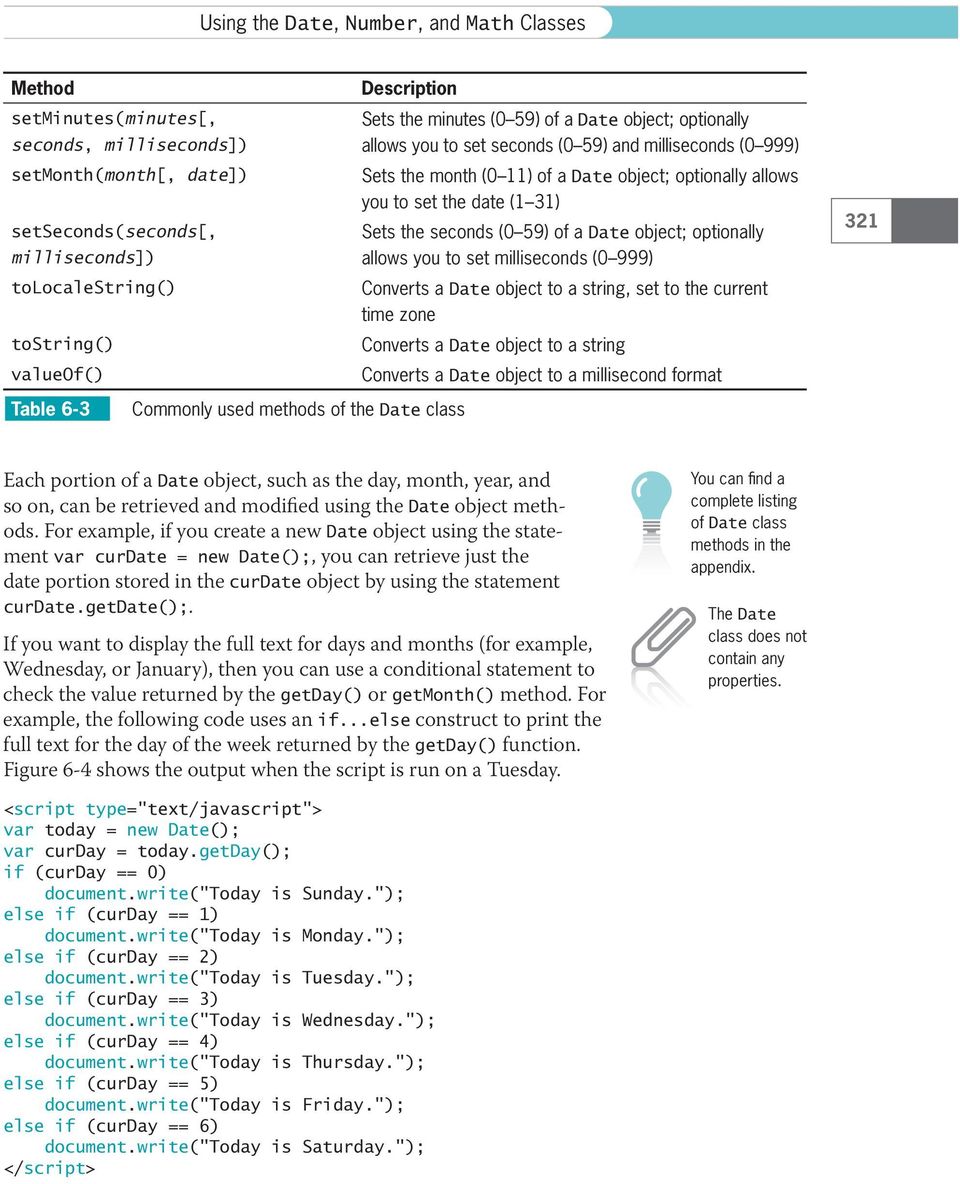
12 Using Object-Oriented JavaScript 322 Figure 6-4 Output of a script with a getday() method If you need to return the full text of the day or month, you should assign the days of the week or the months of the year to an array. You can then combine the getday() or getmonth() method with the array name to return the full text of the day or month. For example, the following code includes an array named months with 12 elements that are assigned the full text names of the months of the year: <script type="text/javascript"> var today = new Date(); var months = new Array(); months[0] = "January"; months[1] = "February"; months[2] = "March"; months[3] = "April"; months[4] = "May"; months[5] = "June"; months[6] = "July"; months[7] = "August"; months[8] = "September"; months[9] = "October"; months[10] = "November"; months[11] = "December"; var curmonth = months[today.getmonth()]; document.write("<p>the current month is " + curmonth + ".</p>"); </script> In the preceding code, the full text name of the month is assigned to the curmonth variable by using the statement var curmonth = months[today.getmonth()];. The value of the element is retrieved by placing the today object with the getmonth() method appended to it between the brackets of the months array name. Figure 6-5 shows the output.

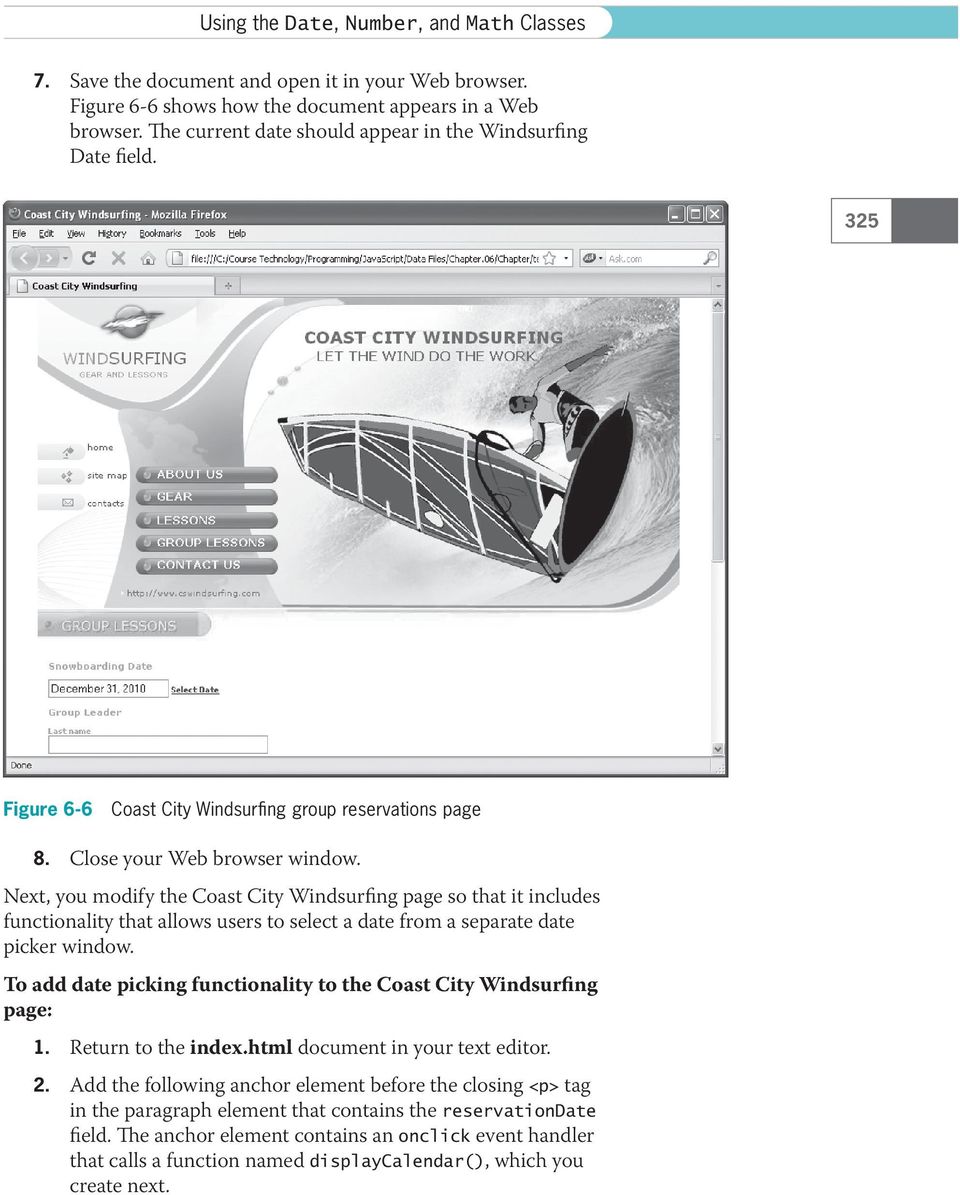
13 Using the Date, Number, and Math Classes 323 Figure 6-5 Output of a script with a getmonth() method Next, you start working on a Web page for Coast City Windsurfing that visitors can use to create group reservations. The files you will need for this project are located in your Chapter folder for Chapter 6. You will use the Date object to generate a monthly calendar that visitors can use to select reservation dates. The script will submit the reservation information to a FormProcessor.html document that is similar to the one you used in Chapter 5. The FormProcessor. html document, located in your Chapter folder for Chapter 6, uses JavaScript code to display the values submitted from a form. The only purpose of the FormProcessor.html document is to display form data and provide a simple simulation of the response you would normally receive from a server-side scripting program. To create a group reservations page for Coast City Windsurfing that uses the Date object to generate a monthly calendar: 1. Open your text editor, then open the index.html document from your Chapter folder for Chapter Locate <!--[Add code here]--> in the document body, and replace it with the following text and elements in the document body. The form submits the data to the FormProcessor. html document. <form action="formprocessor.html" method="get" enctype="application/x-www-form-urlencoded"> </form> 3. Add the following elements to the end of the form section: <table border="0"> <tr valign="top"> <td> <h3>windsurfing Date</h3> <p> <input type="text" name="reservationdate" onclick="displaycalendar()" /></p> <h3>group Leader</h3>

14 Using Object-Oriented JavaScript 324 Last name<br /> <input type="text" name="leaderlastname" size="40" /><br /> First name<br /> <input type="text" name="leaderfirstname" size="40" /><br /> Telephone<br /> <input type="text" name="leadertelephone" size="40" /><br /> Address<br /> <input type="text" name="leaderaddress" size="40" /><br /> City, State, Zip<br /> <input type="text" name="leadercity" size="23" /> <input type="text" name="leaderstate" size="2" maxlength="2" /> <input type="text" name="leaderzip" size="5" maxlength="5" /> <p><input type="submit" value="submit Group Reservation" /></p> </td> </tr> </table> 4. Add the following script section to the document head: <script type="text/javascript"> /* <![CDATA[ */ /* ]]> */ </script> 5. Add the following statements to the script section, which declare a Date object at the global level, return the number representing the current month, and declare an array to contain the full text for the months of the year. The function creates a variable named datetoday and assigns it as the value of the Windsurfing Date field in the form. var dateobject = new Date(); var month = dateobject.getmonth(); var montharray = new Array("January","February", "March","April","May","June","July","August", "September","October","November","December"); function gettodaydate() { var datetoday = montharray[month] + " " + dateobject.getdate() + ", " + dateobject.getfullyear(); document.forms[0].reservationdate.value = datetoday; 6. Add an onload event handler to the opening <body> tag that calls the gettodaydate() function, as follows: <body onload="gettodaydate()">

15 Using the Date, Number, and Math Classes 7. Save the document and open it in your Web browser. Figure 6-6 shows how the document appears in a Web browser. The current date should appear in the Windsurfing Date field. 325 Figure 6-6 Coast City Windsurfi ng group reservations page 8. Close your Web browser window. Next, you modify the Coast City Windsurfing page so that it includes functionality that allows users to select a date from a separate date picker window. To add date picking functionality to the Coast City Windsurfing page: 1. Return to the index.html document in your text editor. 2. Add the following anchor element before the closing <p> tag in the paragraph element that contains the reservationdate field. The anchor element contains an onclick event handler that calls a function named displaycalendar(), which you create next.
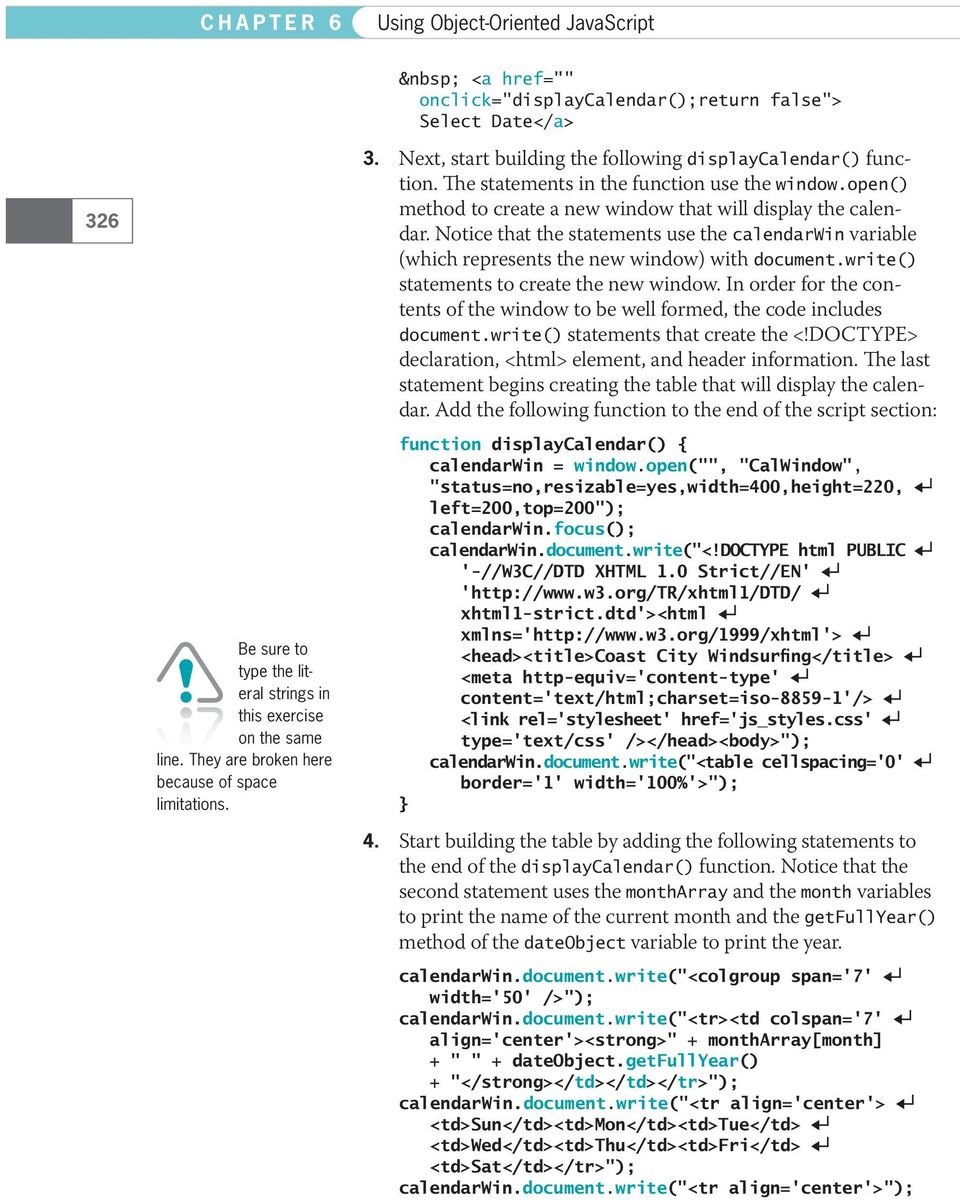
16 Using Object-Oriented JavaScript <a href="" onclick="displaycalendar();return false"> Select Date</a> Next, start building the following displaycalendar() function. The statements in the function use the window.open() method to create a new window that will display the calendar. Notice that the statements use the calendarwin variable (which represents the new window) with document.write() statements to create the new window. In order for the contents of the window to be well formed, the code includes document.write() statements that create the <!DOCTYPE> declaration, <html> element, and header information. The last statement begins creating the table that will display the calendar. Add the following function to the end of the script section: Be sure to type the literal strings in this exercise on the same line. They are broken here because of space limitations. function displaycalendar() { calendarwin = window.open("", "CalWindow", "status=no,resizable=yes,width=400,height=220, left=200,top=200"); calendarwin.focus(); calendarwin.document.write("<!doctype html PUBLIC '-//W3C//DTD XHTML 1.0 Strict//EN' ' xhtml1-strict.dtd'><html xmlns=' <head><title>coast City Windsurfing</title> <meta http-equiv='content-type' content='text/html;charset=iso '/> <link rel='stylesheet' href='js_styles.css' type='text/css' /></head><body>"); calendarwin.document.write("<table cellspacing='0' border='1' width='100%'>"); 4. Start building the table by adding the following statements to the end of the displaycalendar() function. Notice that the second statement uses the montharray and the month variables to print the name of the current month and the getfullyear() method of the dateobject variable to print the year. calendarwin.document.write("<colgroup span='7' width='50' />"); calendarwin.document.write("<tr><td colspan='7' align='center'><strong>" + montharray[month] + " " + dateobject.getfullyear() + "</strong></td></td></tr>"); calendarwin.document.write("<tr align='center'> <td>sun</td><td>mon</td><td>tue</td> <td>wed</td><td>thu</td><td>fri</td> <td>sat</td></tr>"); calendarwin.document.write("<tr align='center'>");
17 Using the Date, Number, and Math Classes 5. Add the following statements to the end of the displaycalendar() function. The first statement uses the setdate() function to set the date of the Date object to the first day of the month. The second statement uses the getday() function to determine which day of the week it is. For instance, if the getday() function returns a value of 3, then the first day of the month starts on Wednesday. Any table cells for days in the first week that are part of the previous month are assigned a nonbreaking space character ( ) by the for statement. 327 dateobject.setdate(1); var dayofweek = dateobject.getday(); for (var i=0; i<dayofweek; ++ i) { calendarwin.document.write("<td> </td>"); 6. Add the following statements to the end of the displaycalendar() function. The first statement calculates the number of days in the first week that require date values. The second statement declares a variable named datecounter that is used to keep track of the next date to write to the calendar. The for statement then finishes creating the first row in the table, which represents the first week of the month. Notice that the for statement creates anchor elements for each of the dates. When a user clicks on a date, an onclick event uses the opener property of the self object to assign the data value to the Windsurfing Date field in the form on the main Coast City Windsurfing Web page and then close the calendar window. (Recall that the opener property refers to the window that opened the current window.) var dayswithdates = 7 - dayofweek; var datecounter = 1; for(var i=0; i<dayswithdates; ++i) { var curdate = montharray[month] + " " + datecounter + ", " + dateobject.getfullyear(); calendarwin.document.write( "<td><a href='' onclick='self.opener.document.forms[0].reservationdate.value=\"" + curdate + "\";self.close()'>" + datecounter + "</a></td>"); ++datecounter;

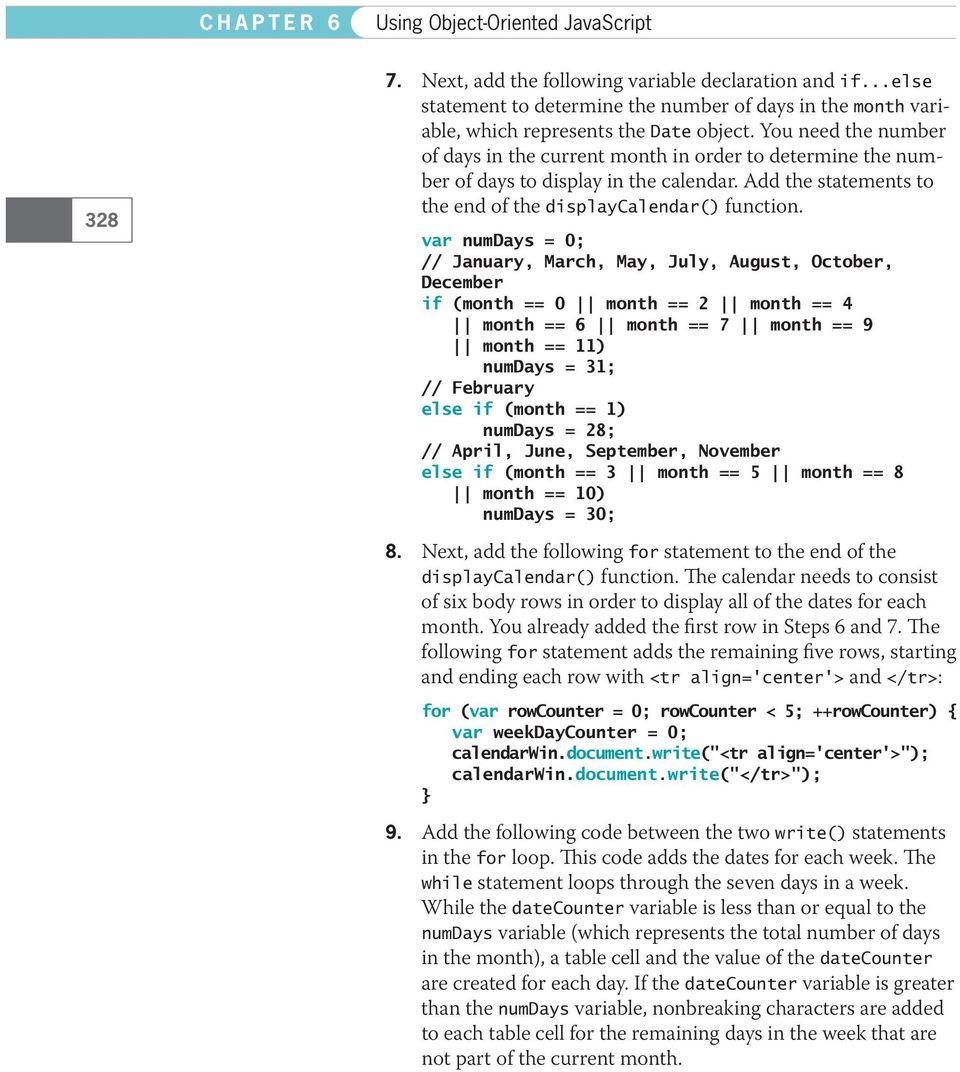
18 Using Object-Oriented JavaScript Next, add the following variable declaration and if...else statement to determine the number of days in the month variable, which represents the Date object. You need the number of days in the current month in order to determine the number of days to display in the calendar. Add the statements to the end of the displaycalendar() function. var numdays = 0; // January, March, May, July, August, October, December if (month == 0 month == 2 month == 4 month == 6 month == 7 month == 9 month == 11) numdays = 31; // February else if (month == 1) numdays = 28; // April, June, September, November else if (month == 3 month == 5 month == 8 month == 10) numdays = 30; 8. Next, add the following for statement to the end of the displaycalendar() function. The calendar needs to consist of six body rows in order to display all of the dates for each month. You already added the first row in Steps 6 and 7. The following for statement adds the remaining five rows, starting and ending each row with <tr align='center'> and </tr>: for (var rowcounter = 0; rowcounter < 5; ++rowcounter) { var weekdaycounter = 0; calendarwin.document.write("<tr align='center'>"); calendarwin.document.write("</tr>"); 9. Add the following code between the two write() statements in the for loop. This code adds the dates for each week. The while statement loops through the seven days in a week. While the datecounter variable is less than or equal to the numdays variable (which represents the total number of days in the month), a table cell and the value of the datecounter are created for each day. If the datecounter variable is greater than the numdays variable, nonbreaking characters are added to each table cell for the remaining days in the week that are not part of the current month.
19 Using the Date, Number, and Math Classes while (weekdaycounter < 7) { var curdate = montharray[month] + " " + datecounter + ", " + dateobject.getfullyear(); if (datecounter <= numdays) calendarwin.document.write("<td><a href='' onclick='self.opener.document.forms[0].reservationdate.value=\"" + curdate + "\";self.close()'>" + datecounter + "</a></td>"); else calendarwin.document.write("<td> </td>"); ++weekdaycounter; ++datecounter; Finally, add the following statements to the end of the displaycalendar() function. The first statement closes the <table>, <body>, and <html> elements. The second statement, which calls the close() method of the new window s Document object, notifies the Web browser window that you are finished writing to the window and the document should be displayed. (You learn more about the Document object s close() method in Chapter 10.) calendarwin.document.write("</table></body></html>"); calendarwin.document.close(); 11. Save the index.html document, open it in your Web browser, and then click the Select Date link to display the calendar window. Figure 6-7 shows how the calendar window appears. Click a date in the calendar window. The date should be added to the Windsurfing Date field on the Group Reservations page and the calendar window should close.

20 Using Object-Oriented JavaScript 330 Figure 6-7 Calendar window that appears after clicking the Select Date link 12. Close your Web browser window. Next, you complete the calendar functionality by modifying the script so it displays different months instead of just the current month. To add functionality to the calendar script so it displays different months: 1. Return to the index.html document in your text editor. 2. Modify the first statement in the displaycalendar() function definition as follows so that it accepts a single parameter named whichmonth: function displaycalendar(whichmonth) {...

21 Using the Date, Number, and Math Classes 3. Locate the following statement in the displaycalendar() function: calendarwin.document.write("<tr><td colspan='7' align='center'><strong>" + montharray[month] + " " + dateobject.getfullyear() + "</strong></td></td></tr>"); 4. Replace the preceding statement with the following statements. The if statement determines whether the value assigned to the whichmonth parameter is either 1 or 1. If the value is 1, then the setmonth() function sets the date assigned to the date object to one month earlier by subtracting a value of one from the value returned with the getmonth() function. If the value is 1, then the setmonth() function sets the date assigned to the date object to one month later by adding a value of one to the value returned with the getmonth() function. The variable declaration statement then uses another getmonth() function to assign the new month to the month variable. The document.write() statement builds the same header row at the beginning of the calendar that you saw in the last exercise, but this time it also creates Previous and Next links that rerun the displaycalendar() function when they are clicked. 331 if (whichmonth == 1) dateobject.setmonth(dateobject.getmonth() 1); else if (whichmonth == 1) dateobject.setmonth(dateobject.getmonth()+1); var month = dateobject.getmonth(); calendarwin.document.write("<tr><td colspan='2'> <a href='' onclick='self.opener.displaycalendar( 1); return false'>previous</a></td><td colspan='3' align='center'><strong>" + montharray[month] + " " + dateobject.getfullyear() + "</strong></td> <td colspan='2' align='right'><a href='' onclick='self.opener.displaycalendar(1); return false'>next</a></td></tr>"); 5. Save the index.html document, open it in your Web browser, and then click the Select Date link to display the calendar window. The calendar window now includes Previous and Next links, as shown in Figure 6-8. Be sure to type the text string that is printed with the calendarwin. document.write() statement on a single line.
22 Using Object-Oriented JavaScript 332 Figure 6-8 Calendar window with Previous and Next links 6. Test the Previous and Next links. The calendar window should update and display the correct dates for the selected month. Click a date in the calendar window to ensure that the date is still added to the Windsurfing Date field on the Group Reservations page and that the calendar window closes. 7. Close your Web browser window. Manipulating Numbers with the Number Class The Number class contains methods for manipulating numbers and properties that contain static values representing some of the numeric limitations in the JavaScript language (such as the largest positive number that can be used in JavaScript). While you can create a Number object using a statement similar to var mynum = new Number();, you are not required to. Instead, you can simply append the name of any Number class method or property to the name of an existing variable that contains a numeric value. Using Number Class Methods Table 6-4 lists the methods of the Number class.
23 Using the Date, Number, and Math Classes Method Number() toexponential(decimals) tofixed(decimals) tolocalestring() toprecision(decimals) tostring(radix) valueof() Table 6-4 Number class methods Description Number object constructor Converts a number to a string in exponential notation using a specifi ed number of decimal places Converts a number to a string with a specifi ed number of decimal places Converts a number to a string that is formatted with local numeric formatting conventions Converts a number to a string with a specifi c number of decimal places, in either exponential notation or in fi xed notation Converts a number to a string using a specifi ed radix Returns the numeric value of a Number object 333 The primary reason for using any of the to methods listed in Table 6-4 is to convert a number to a string value with a specific number of decimal places that will be displayed to a user. If you don t need to display the number for a user, there is no need to use any of the methods. The most useful Number class method is the tofixed() method, which you can use to display a numeric value with a specified number of decimal places. For example, you may have a number in your program that represents a dollar value. However, depending on the result of a calculation or a value entered by a user, the number may contain more than the two decimal places that are acceptable in a currency value. The following code shows a simple example of a numeric variable named salestotal that is assigned a value of If you apply a discount of 10% to the variable, the new number is equal to Before displaying the value, the write() statement uses the tofixed() method to convert the value of the salestotal variable to a string containing two decimal places. var salestotal = 49.95; var discount = salestotal *.1; salestotal = discount; // new value is document.write("$" + salestotal.tofixed(2)); // displays $44.96 Another useful Number class method is the tolocalestring() method, which you can use to convert a number to a string that is formatted with local numeric formatting conventions. For example, with American numeric formatting conventions, you separate thousands with a comma. The following statements demonstrate how to convert the number to the string $1,210,349:
24 Using Object-Oriented JavaScript 334 Firefox displays the number in the code to the right without decimal places ($1,210,349), whereas Internet Explorer displays it with decimal places ($1,210,349.00). var salestotal = ; salestotal = salestotal.tolocalestring(); document.write("$" + salestotal); // displays $1,210,349 By default, Internet Explorer displays two decimal places for numbers that are converted with the tolocalestring() method, whereas Firefox displays the number as a whole number. To convert a numeric value to a specified number of decimal places and to a local string is not intuitive in Firefox. First, you call the tofixed() method, which converts the number to a string with the specified number of decimals. Then, because it s a string, you need to convert it back to floating-point number with the parsefloat() function. Finally, you call the tolocalestring() method to convert the number to a string that is formatted with the local numeric formatting conventions. The following code converts the number to the string $1,210,349.46: var salestotal = ; salestotal = salestotal.tofixed(2); salestotal = parsefloat(salestotal); salestotal = salestotal.tolocalestring(); document.write("$" + salestotal); // displays $1,210, Although Internet Explorer will successfully display decimal places for numbers that are converted with the tolocalestring() method, you should use the tofixed() and parsefloat() methods to ensure that code that uses the tolocalestring() method is compatible with both Internet Explorer and Firefox. Accessing Number Class Properties Table 6-5 lists the properties of the Number class. Note that there is little reason for you to use these properties. However, they are listed here for the sake of completeness. Property MAX_VALUE MIN_VALUE NaN NEGATIVE_INFINITY POSITIVE_INFINITY Table 6-5 Description The largest positive number that can be used in JavaScript The smallest positive number that can be used in JavaScript The value NaN, which stands for not a number The value of negative infi nity The value of positive infi nity Number class properties
25 Using the Date, Number, and Math Classes Next, you add code to the Group Reservations page that calculates group discounts. To add code to the Group Reservations page that calculates group discounts: 1. Return to the index.html document in your text editor. 2. Add the following text and elements above the paragraph containing the Submit button. The text and elements display group discounts and the first <input> element allows users to enter the number of windsurfers in their groups. The onchange event handler in the first <input> element then calls a function named calcgroupdiscount(), which will calculate the group discount according to the size of the group. Notice that an argument of this.value is passed to the function. <h3> Group Discounts</h3> <ul> <li>daily Rate: $49</li> <li>5 10 windsurfers: 10% discount</li> <li>11 24 windsurfers: 20% discount</li> <li>25+ windsurfers: 25% discount</li> </ul> <p> How many windsurfers are in your group? <input type="text" size="5" value="0" onchange="calcgroupdiscount(this.value)" /></p> <p> Your group rate is $<input type="text" name="discount" size="60" value="0" readonly="readonly" class="total" /></p> 3. Add the following calcgroupdiscount() function to the end of the script section. The if...else statements in the function calculate the group discount according to the value assigned to the groupsize parameter. The last statement in the function then assigns the discount rate to the discount field in the form. function calcgroupdiscount(groupsize) { var dailyrate = 49; if (groupsize >= 5 && groupsize <= 10) dailyrate = 49 / 1.1; else if (groupsize > 10 && groupsize < 25) dailyrate = 49 / 1.2; else if (groupsize > 24) dailyrate = 49 / 1.25; var grouprate = groupsize * dailyrate; document.forms[0].discount.value = grouprate; 335
26 Using Object-Oriented JavaScript Save the index.html document and then open it in your Web browser. Enter a number in the group size field, then press the Tab key or click off the field so that the calcgroupdiscount() function is called by the onchange event handler. Notice that the group rate field displays all the digits in the calculated number. For example, Figure 6-9 shows a group rate of $ after entering a value of 8 in the group size field. Figure 6-9 Group Reservations page after adding the Group Discounts section 5. Return to the index.html document in your text editor 6. Modify the last statement in the calcgroupdiscount() function as follows so that the grouprate includes the tofixed() method to convert the value of the grouprate variable to two decimal places. document.forms[0].discount.value = grouprate.tofixed(2); 7. Save the index.html document and then reopen it in your Web browser. Enter a number in the group size field, then press the Tab key or click off the field so that the calcgroupdiscount() function is called by the onchange event handler. The group rate field should display the calculated number with two decimal places. 8. Close your Web browser window.
27 Using the Date, Number, and Math Classes Performing Math Functions with the Math Class The Math class contains methods and properties for performing mathematical calculations in your programs. Using Math Class Methods Table 6-6 lists the methods of the Math class. 337 Method abs(x) acos(x) asin(x) atan(x) atan2(x,y) ceil(x) cos(x) exp(x) floor(x) log(x) max(x,y) min(x,y) pow(x,y) random() round(x) sin(x) sqrt(x) tan(x) Table 6-6 Description Returns the absolute value of x Returns the arc cosine of x Returns the arc sine of x Returns the arc tangent of x Returns the angle from the x-axis Returns the value of x rounded to the next highest integer Returns the cosine of x Returns the exponent of x Returns the value of x rounded to the next lowest integer Returns the natural logarithm of x Returns the larger of two numbers Returns the smaller of two numbers Returns the value of x raised to the y power Returns a random number Returns the value of x rounded to the nearest integer Returns the sine of x Returns the square root of x Returns the tangent of x Math class methods Unlike the Array, Date, and Number classes, the Math class does not contain a constructor. This means that you cannot instantiate a Math object using a statement such as var mathcalc = new Math(). Instead, you use the Math object and one of its methods or properties directly in your code. For example, the sqrt() method returns the square root of a number. The following code shows how to use the sqrt() method to determine the square root of 144: var curnumber = 144; squareroot = Math.sqrt(curNumber); // returns '12' document.write("the square root of " + curnumber + " is " + squareroot);
28 Using Object-Oriented JavaScript Accessing Math Class Properties Table 6-7 lists the properties of the Math class. 338 Property Description E Euler s constant e, which is the base of a natural logarithm; this value is approximately LN10 The natural logarithm of 10, which is approximately LN2 The natural logarithm of 2, which is approximately LOG10E The base-10 logarithm of e, the base of the natural logarithms; this value is approximately LOG2E The base-2 logarithm of e, the base of the natural logarithms; this value is approximately PI A constant representing the ratio of the circumference of a circle to its diameter, which is approximately SQRT1_2 The square root of 1/2, which is approximately SQRT2 The square root of 2, which is approximately Table 6-7 Math class properties As an example of how to use the properties of the Math object, the following code shows how to use the PI property to calculate the area of a circle based on its radius. The code also uses the round() method to round the value returned to the nearest whole number. var radius = 25; var area = Math.round(Math.PI * radius * radius); // return 1963 document.write("a circle with a radius of " + radius + " has an area of " + area); Next, you modify the calcgroupdiscount() function so that it uses the round() function of the Math object to round the group discount to the nearest integer instead of displaying decimal places. If you entered a large number in the last exercise when you tested the script, you may have noticed that although the group discount displayed only two decimal places, the number was not formatted with commas or whatever the formatting convention is for your locale. For example, if you entered a value of 38, the group rate is displayed as $ In American numeric formatting, the convention is to include commas to separate thousands. This means that the value $ should display as $1, To ensure that numbers are correctly displayed according to local numeric formatting conventions, you must use
29 Using the Date, Number, and Math Classes the tolocalestring() function of the Number class, which you will also add to the calcgroupdiscount() function. To modify the Group Reservations page so it uses the round() function of the Math object and the tolocalestring() function: 1. Return to the index.html document in your text editor. 2. Add the following statement immediately after the statement in the calcgroupdiscount() function that declares and initializes the grouprate variable. This statement uses the built-in parsefloat() function to convert the text string to a number and the round() function of the Math object to round the number to the nearest integer. grouprate = Math.round(parseFloat(groupRate)); 3. Modify the last statement in the calcgroupdiscount() function so that it calls the tolocalestring() function instead of the tofixed() function, as follows: document.forms[0].discount.value = grouprate.tolocalestring(); 4. Save the index.html document and then reopen it in your Web browser. Enter a number larger than 25 in the group size field, then press the Tab key or click off the field so that the calcgroupdiscount() function is called by the onchange event handler. The value in the group rate field should be displayed with a comma separator and no decimal places. Figure 6-10 shows how the page appears after entering a value of 35 in the group size field. 339
30 Using Object-Oriented JavaScript 340 Figure 6-10 Group Reservations page after adding Math.round() and tolocalestring() functions 5. Close your Web browser window. Short Quiz 2 1. How do you refer to the days of the week, dates of the month, and months of the year when working with the Date class? 2. What is the primary reason for using any of the to methods in the Number class? 3. How do you use the Math object and one of its methods or properties directly in your code? Defining Custom JavaScript Objects JavaScript is not a true object-oriented programming language. You can base objects in your programs on built-in JavaScript classes such as the Array and Date objects. However, you cannot create your own classes in JavaScript. For this reason, JavaScript is said to be an object-based programming language instead of an object-oriented programming language.
31 Defi ning Custom JavaScript Objects Nevertheless JavaScript does allow you to define your own custom objects. Unlike objects that are based on classes, custom objects in JavaScript are not encapsulated, which means that other programmers who use your custom object can see inside of the black box. Even though custom JavaScript objects cannot be encapsulated, you may find them useful, especially if you need to replicate the same functionality an unknown number of times in a script. For example, you may have a Web site that allows customers to place online orders for concert tickets. For each order, you may want to create a new object that uses properties to store information such as the customer s name, concert name, number of tickets, concert date, and so on. The object may also contain methods that calculate sales tax and sales total. Although you could use standard functions and variables to create the same functionality, the ability to treat each order as a selfcontained object would make your job as a programmer a little easier. The most recent implementation of the JavaScript language, ECMAScript Edition 3, includes support for true classes. However, at the time of this writing, no Web browsers support the new JavaScript class functionality. 341 Declaring Basic Custom Objects Although JavaScript is not a true object-oriented programming language, you can create basic objects and properties by using the Object object. To declare a custom object with the Object object, you use the following statement: var objectname = new Object(); You can also create a custom object by assigning a pair of empty braces to a variable name, as follows: var objectname = {; After you create a custom object, you can assign properties to the object by appending the property name to the object name with a period. For example, the following code creates a new object named ConcertTickets and assigns four properties to it: customername, concertname, ticketquantity, and concertdate. You can then access the values assigned to each property the same as you would for other types of objects, as demonstrated with the document.write() statements. Notice that the concertdate property is created as a Date object that stores the date and time of the concert. Figure 6-11 shows the output. var ConcertTickets = new Object(); ConcertTickets.customerName = "Don Gosselin"; ConcertTickets.concertName = "Jimmy Buffett"; ConcertTickets.ticketQuantity = 2; ConcertTickets.concertDate = new Date(2010, 6, 18, 20);
32 Using Object-Oriented JavaScript 342 document.write("<h1>ticket Order</h1>"); document.write("<p>customer: " + ConcertTickets.customerName); document.write("<br />Concert: " + ConcertTickets.concertName); document.write("<br />Quantity: " + ConcertTickets.ticketQuantity); document.write("<br />Date: " + ConcertTickets.concertDate.toLocaleString() + "</p>"); Figure 6-11 Output of custom object properties Custom objects created as described in this section are limited to containing only properties. Although you may find it useful to create objects in this manner to organize complex data, in most cases you can use standard variables just as effectively. Objects are most useful when they contain both properties and methods. To create custom objects that contain methods, you must use constructor functions, which are described later in this chapter. Next, you start adding a Group Members section to the Coast City Windsurfing page. This section allows you to enter information about each windsurfer in the group, including name, address, and phone number. To add a Group Members form section to the Coast City Windsurfing page: 1. Return to the index.html document and delete the following text and elements: <p> How many windsurfers are in your group? <input type="text" size="5" value="0" onchange="calcgroupdiscount(this.value)"></p>
33 Defi ning Custom JavaScript Objects 2. Add the following code above the paragraph that displays the group rate: </td> <td> <h3>group Members</h3> <p><input type="button" value="add Windsurfer" /> <input type="button" value="delete Windsurfer" /> <input type="button" value="update Info" /></p> <table border="0"> <tr> <td><select name="contacts" size="13" style="width: 150px"> <option value="contacts">group Members</option> </select></td> <td>last name<br /> <input type="text" name="lastname" size="50" /><br /> First name<br /> <input type="text" name="firstname" size="50" /><br /> Telephone<br /> <input type="text" name="telephone" size="50" /><br /> Address<br /> <input type="text" name="address" size="50" /><br /> City, State, Zip<br /> <input type="text" name="city" size="34" /> <input type="text" name="state" size="2" maxlength="2" /> <input type="text" name="zip" size="5" maxlength="5" /></td> </tr> </table> Add the following array declaration to the end of the script section. The array will contain other objects that represent each windsurfer added to the Group Members list. Using an array to store objects makes it easier to manage each group member as it is added to and deleted from the program. var contactlist = new Array(); 4. Save the index.html document and open it in your Web browser. You still need to add functionality to the section before you can enter any windsurfers information. Figure 6-12 shows how the Web page appears after adding the Group Members section.
34 Using Object-Oriented JavaScript 344 Figure 6-12 Group Reservations Web page after adding the Group Members section 5. Close your Web browser window. Defi ning Constructor Functions You can define your own custom objects by using a constructor function, which is a function that is used as the basis for a custom object. (Another term for constructor function is object definition.) As with traditional class-based objects, JavaScript objects inherit all the variables and statements of the constructor function on which they are based. Any JavaScript function can serve as a constructor. The following code defines a function named ConcertTickets() with four parameters that can serve as a constructor function: function ConcertTickets(customer, concert, tickets, eventdate) {... Use a statement similar to the following to instantiate an instance of a ConcertTickets object: var neworder = new ConcertTickets(); Next, you add a constructor function to the Group Reservations page. To add a constructor function to the Group Reservations page: 1. Return to the index.html document in your text editor.
35 Defi ning Custom JavaScript Objects 2. Type the following constructor function above the contactlist declaration statement in the script section: function Contact() { 3. Save the index.html document. Working with Object Properties In this section, you will learn how to use properties with your custom JavaScript objects. First, you will learn how to add new properties. 345 Adding Properties To add a property to a constructor function, you must add a statement to the function body that uses the this keyword with the following syntax: this.property_name = value;. In the case of a custom JavaScript object, the this keyword refers to the object that calls the constructor function. For example, the following constructor function includes four properties: customername, concertname, ticketquantity, and concertdate. function ConcertTickets(customer, event, quantity, eventdate) { this.customername = customer; // customer name this.concertname = event; // event name this.ticketquantity = quantity; // number of tickets this.concertdate = eventdate; // concert date The statements in the preceding constructor function use the this keyword to assign the values of the four arguments (customer, event, quantity, and eventdate) to the customername, concertname, ticketquantity, and concertdate properties of whichever object called the function. The use of the this reference is one of the primary differences between standard functions and constructor functions. Standard functions do not include a this reference, because they are not used as the basis of objects. The following code declares a ticketorder object based on the ConcertTickets() constructor function, assigns values to its four properties, and then prints the properties. The output is the same as that shown in Figure var ticketorder = new ConcertTickets(); ticketorder.customername = "Don Gosselin"; ticketorder.concertname = "Jimmy Buffett"; ticketorder.ticketquantity = 2; ticketorder.concertdate = new Date(2010, 6, 18, 20);
36 Using Object-Oriented JavaScript document.write("<h1>ticket Order</h1>"); document.write("<p>customer: " + ticketorder.customername); document.write("<br />Concert: " + ticketorder.concertname); document.write("<br />Quantity: " + ticketorder.ticketquantity); document.write("<br />Date: " + ticketorder.concertdate.tolocalestring() + "</p>"); 346 You can also assign values to the properties of an object when you first instantiate the object by using statements similar to the following: var ticketorder = new ConcertTickets("Don Gosselin", "Jimmy Buffett", 2, new Date(2010, 6, 18, 20)); document.write("<h1>ticket Order</h1>"); document.write("<p>customer: " + ticketorder.customername); document.write("<br />Concert: " + ticketorder.concertname); document.write("<br />Quantity: " + ticketorder.ticketquantity); document.write("<br />Date: " + ticketorder.concertdate.tolocalestring() + "</p>"); Next, you will add properties to the Contact constructor function. To add properties to the Contact constructor function, along with a function that copies the values from the Contacts form to the properties: 1. Return to the index.html document in your text editor. 2. Add the following properties to the Contact constructor function. Each property is initially assigned an empty string. this.lastname = ""; this.firstname = ""; this.telephone = ""; this.address = ""; this.city = ""; this.state = ""; this.zip = ""; 3. Save the index.html document. Enumerating Custom Object Properties Some custom objects can contain dozens of properties. For example, a script may create new custom object properties that store sales prices for each item a customer wants to purchase. Suppose that you want to discount the individual sales prices by 10% of any items that cost more than $100. Because there is no way to determine in advance which items a customer will purchase, you have no way of knowing which properties have been added to the object for each individual customer. To execute the same statement or command block for all the properties within a custom object, you can use the
37 Defi ning Custom JavaScript Objects for...in statement, which is a looping statement similar to the for statement. The syntax of the for...in statement is as follows: for (variable in object) { statement(s); The variable name in the for...in statement constructor holds an individual object property. The object name in the constructor represents the name of an object that has been instantiated in a program. Unlike the other loop statements, the for...in statement does not require a counter or any other type of code to control how the loop functions. Instead, the for...in statement automatically assigns each property in an object to the variable name, performs the necessary statements on the property, then moves to the next property and starts over. The for...in statement ends automatically once it reaches the last property in an object. A typical use of the for...in statement is to retrieve the names of properties within an object, as shown in the following code: 347 var ConcertTickets = new Object(); ConcertTickets.customerName = "Don Gosselin"; ConcertTickets.concertName = "Jimmy Buffett"; ConcertTickets.ticketQuantity = 2; ConcertTickets.concertDate = new Date(2010, 6, 18, 20); for (prop in ConcertTickets) { document.write(prop + "<br />"); In the preceding code, the variable name prop holds the names of each property in the ConcertTickets object. The document.write() statement then writes the name of each property to the Web browser window, as shown in Figure Figure 6-13 Property names printed with a for...in statement The preceding example demonstrates how to use the for...in statement with objects instantiated from the Object object. Using the
38 Using Object-Oriented JavaScript for...in statement with objects instantiated from constructor functions is very similar: 348 function ConcertTickets(customer, concert, tickets, eventdate) { this.customername = customer; // customer name this.concertname = concert; // concert name this.ticketquantity = tickets; // number of tickets this.concertdate = eventdate; // concert date var ticketorder = new ConcertTickets("Don Gosselin", "Jimmy Buffett", 2, new Date(2010, 6, 18, 20)); for (prop in ticketorder) { document.write(prop + "<br />"); One of the benefits of the for...in statement is that it enumerates, or assigns an index to, each property in an object, which is similar to the way elements in an array are indexed. You can use an enumerated object property to access the values contained within object properties. For example, in the following code, the document.write() statement within the body of the for...in statement refers to the prop variable as an index of the ticketorder object: for (prop in ticketorder) { document.write(ticketorder[prop] + "<br />"); Each iteration of the for...in statement in the preceding code now prints the contents of each property rather than just the property names. The code passes the ticketorder object to the document.write() method, along with the prop variable enclosed in brackets (ticketorder[prop]). You would use this same technique to print the contents of an array. Unlike the elements in an array, however, you cannot refer to the enumerated properties of an object outside of a for...in loop; doing so generates an error. The statement document.writeln(ticketorder[prop]); causes an error outside of a for...in loop. Next, you start adding a function named addcontact(), which will add windsurfers to the contact list. To start adding the addcontact() function: 1. Return to the index.html document in your text editor. 2. Add the following addcontact() function definition to the end of the script section: function addcontact() {
39 Defi ning Custom JavaScript Objects 3. Add the following statement to the addcontact() function. This statement uses the length property of the Array class to determine the next array index that will store the new contact. var newcontact = contactlist.length; 4. Add the following statements to the end of the addcontact() function. The if statement checks to see if the last name and first name fields have been filled in. If not, then an alert dialog box appears instructing users to enter the contact s first and last name. If both fields contain values, then an else statement instantiates a new Contact object in the contactlist array. The remaining statements assign values to the Contact object property, create a new Option object, and assign the contents of the new Contact property to the new Option object. 349 if (document.forms[0].lastname.value == "" document.forms[0].firstname.value == "") window.alert("you must enter the contact's first and last names."); else { contactlist[newcontact] = new Contact(); contactlist[newcontact].lastname = document.forms[0].lastname.value; contactlist[newcontact].firstname = document.forms[0].firstname.value; contactlist[newcontact].telephone = document.forms[0].telephone.value; contactlist[newcontact].address = document.forms[0].address.value; contactlist[newcontact].city = document.forms[0].city.value; contactlist[newcontact].state = document.forms[0].state.value; contactlist[newcontact].zip = document.forms[0].zip.value; var createcontact = new Option(); createcontact.value = contactlist[newcontact].lastname + ", " + contactlist[newcontact].firstname; createcontact.text = contactlist[newcontact].lastname + ", " + contactlist[newcontact].firstname; document.forms[0].contacts.options[newcontact] = createcontact; calcgroupdiscount(newcontact + 1);
40 Using Object-Oriented JavaScript 5. Add the following event handler to the Add Snowboarder element: <input type="button" value="add Snowboarder" onclick="addcontact()" /> Save the index.html document, and open the document in your Web browser. Test the script by adding some contacts to the contact list. Referring to Object Properties as Associative Arrays JavaScript allows you to refer to object properties using associative array syntax. An associative array is an array whose elements are referred to with an alphanumeric key instead of an index number. For example, with associative arrays you can create a company s payroll information that uses each employee s last name instead of an index number to refer to an element in the array. To refer to an element in an associative array, you place an element s key in single or double quotation marks inside the array brackets. For example, the following statements create the elements in an array named hotelreservation using associative array syntax: var hotelreservation = new Array(4); hotelreservation["guest"] = "Don Gosselin"; hotelreservation["nights"] = 2; hotelreservation["price"] = 89.95; hotelreservation["nonsmoking"] = true; document.write("<p>guest: " + hotelreservation["guest"]); document.write("<br />Nights: " + hotelreservation["nights"]); document.write("<br />Price: " + hotelreservation["price"]); document.write("<br />Non-smoking room: " + hotelreservation["nonsmoking"] + "</p>"); You can also use associative array syntax to refer to the properties of an object. The following example demonstrates how to refer to the customername property of the ConcertTickets object using associative array syntax (ConcertTickets["customerName"]) instead of standard property syntax (ConcertTickets.customerName): var ConcertTickets = new Object(); ConcertTickets.customerName = "Don Gosselin"; document.write("<p>customer: " + ConcertTickets["customerName"]);
41 Defi ning Custom JavaScript Objects One of the benefits of using associative array syntax with object properties is that you can dynamically build property names at runtime. For example, the following statements use associative array syntax to create a property consisting of the word employee and an employee ID in an object named employeelist: var employeelist = new Object(); var employeeid = 56725; employeelist["employee" + employeeid] = "Don Gosselin"; 351 You can print the contents of the property created with the preceding statements by using any of the following: document.write(employeelist["employee" + employeeid]); document.write(employeelist.employee56725); document.write(employeelist["employee56725"]); Deleting Properties To delete a specific property in a custom object, you use the delete operator with the syntax delete object.property. For example, the following statement deletes the concertdate property of the ConcertTickets object: delete ConcertTickets.concertDate; Next, you add a deletecontact() function to the Group Reservations page that deletes selected windsurfers from the Group Members section. To add a deletecontact() function: 1. Return to the index.html document in your text editor. 2. Add the following deletecontact() function definition to the end of the script section: function deletecontact() { 3. Add the following statements to the deletecontact() function. These statements loop through each option in the selection list to determine which option is selected. Once the selected item is located, its index value is assigned to the selectedcontact variable. You can use the delete operator to delete properties created with either the Object object or with a constructor function.
42 Using Object-Oriented JavaScript 352 var contactselected = false; var selectedcontact = 0; for (var i=0;i<document.forms[0].contacts.options.length;++i) { if (document.forms[0].contacts.options[i].selected== true) { contactselected = true; selectedcontact = i; break; 4. Add the following statements to the end of the deletecontact() function. The if...else statement first checks the value assigned to the contactselected variable. If the contactselected variable contains a value of false, an alert dialog box informs the user that they must select a contact in the list. If the contactselected variable contains a value of true, the if statement uses the remove() method of the Option class to remove the contact from the list and then uses the splice() method of the Array class to delete the array element that stores the object. The statements at the end of the if statement clear the values in the form s text boxes. if (contactselected == true) { for (prop in contactlist) { delete contactlist[prop] for (var i=0; i<document.forms[0].contacts. options.length;++i) { contactlist["contact" + i] = new Contact(); contactlist["contact" + i].lastname = document.forms[0].lastname.value; contactlist["contact" + i].firstname = document.forms[0].firstname.value; contactlist["contact" + i].telephone = document.forms[0].telephone.value; contactlist["contact" + i].address = document.forms[0].address.value; contactlist["contact" + i].city = document.forms[0].city.value; contactlist["contact" + i].state = document.forms[0].state.value;
43 Defi ning Custom JavaScript Objects 5. Add the following event handler to the Delete Windsurfer element: <input type="button" value="delete Windsurfer" onclick="deletecontact()" /> 6. Save the index.html document, and open the document in your Web browser. Test the script by adding and deleting some contacts to and from the contact list. Note that you still need to add functionality to repopulate the group member fields when selecting a new contact in the list. 7. Close your Web browser window. 353 Creating Methods You can create a function that will be used as an object method by referring to any object properties it contains with the this reference. For example, the following code defines a method that prints the customername, concertname, ticketquantity, and concertdate properties of the ConcertTickets constructor function: function displayconcerttickets() { document.write("<p>customer: " + this.customername); document.write("<br />Concert: " + this.concertname); document.write("<br />Quantity: " + this.ticketquantity); document.write("<br />Date: " + this.concertdate.tolocalestring() + "</p>"); After a method is created, it must be added to the constructor function, using the syntax this.methodname = functionname;. The methodname following the this reference is the name that is being assigned to the function within the object. Remember not to include the parentheses following the function name, as you would when calling a function in JavaScript. The statement this.methodname = functionname(); is incorrect, because it includes parentheses. To add the displayconcerttickets() function to the ConcertTickets function definition as a method named showorder(), you include the statement this.showorder = displayconcerttickets; within the function definition braces.
44 Using Object-Oriented JavaScript The following code shows the ConcertTickets() constructor function, the displayconcerttickets() function that creates the showorder() method, and statements that instantiate two ConcertTickets objects and print the values of their properties. Figure 6-14 shows the output. 354 function ConcertTickets(customer, concert, tickets, eventdate) { this.customername = customer; // customer name this.concertname = concert; // concert name this.ticketquantity = tickets; // number of tickets this.concertdate = eventdate; // concert date this.showorder = displayconcerttickets; function displayconcerttickets() { document.write("<p>customer: " + this.customername); document.write("<br />Concert: " + this.concertname); document.write("<br />Quantity: " + this.ticketquantity); document.write("<br />Date: " + this.concertdate.tolocalestring() + "</p>"); var ticketorder = new ConcertTickets("Don Gosselin", "Jimmy Buffett", 2, new Date(2010, 6, 18, 20)); ticketorder.showorder(); var ticketorder = new ConcertTickets("Don Gosselin", "John Mayer", 2, new Date(2010, 8, 30, 20)); ticketorder.showorder(); Figure 6-14 Output of a script with two instantiated custom objects
45 Defi ning Custom JavaScript Objects Now you will add methods to the Contact constructor function. To add methods to the Contact constructor function: 1. Return to the index.html document in your text editor, and add the following function to the end of the script section. The function updates the fields in the contacts form with the properties of the selected Contact object. An onclick event handler you will add to the <select> element later in these steps will call the function. function getcontactinfo() { document.forms[0].lastname.value = this.lastname; document.forms[0].firstname.value = this.firstname; document.forms[0].telephone.value = this.telephone; document.forms[0].address.value = this.address; document.forms[0].city.value = this.city; document.forms[0].state.value = this.state; document.forms[0].zip.value = this.zip; 2. Next, add the following function to the end of the script section. This function updates the selected contact,s information within the Contact object. You will pass the curindex parameter from an onclick event handler that you will add to the Update Contact button. function updateselectedcontact(curindex) { this.lastname = document.forms[0].lastname.value; this.firstname = document.forms[0].firstname.value; this.telephone = document.forms[0].telephone.value; this.address = document.forms[0].address.value; this.city = document.forms[0].city.value; this.state = document.forms[0].state.value; this.zip = document.forms[0].zip.value; document.forms[0].contacts.options[curindex].value = this.lastname + "," + this.firstname; document.forms[0].contacts.options[curindex].text = this.lastname + "," + this.firstname; window.alert("contact information updated."); Add the following two statements to the end of the Contact constructor function, which declare getcontactinfo() and updateselectedcontact() as methods of the Contact object: this.getcontacts = getcontactinfo; this.updatecontact = updateselectedcontact; 4. Add an onclick event handler to the Update Info button, as follows. The event handler passes to the updatecontact() function the selectedindex property of the option that is selected in the selection list.
46 Using Object-Oriented JavaScript 356 <input type="button" value="update Info" onclick="contactlist[document.forms[0].contacts.selectedindex].updatecontact( document.forms[0].contacts.selectedindex);" /> 5. Finally, add the following event handler to the <select> element. The event handler updates the data displayed in the contact information fields after a new option is clicked in the selection list. onclick="contactlist[this.selectedindex].getcontacts();" 6. Save the index.html document, and then open it in your Web browser. Test the script by adding some contacts to the contact list. Try clicking on a previously entered contact. The contact s information should be displayed in the contact information fields. Also, try updating a previously entered contact. Figure 6-15 shows how the form appears after adding several contacts. Figure 6-15 Contacts form after adding several contacts 7. Close your Web browser window.
47 Defi ning Custom JavaScript Objects Your final step is to modify the Group Reservations page so that the group discount is automatically calculated as individuals are added to and deleted from the Group Members list. To modify the Group Reservations page so that it automatically calculates group discounts: 1. Return to the index.html document in your text editor, and add the following statement to the end of else clause in the addcontact() function. This statement calls the calcgroupdiscount() function and passes to it the value of the newcontact variable incremented by one. calcgroupdiscount(newcontact + 1); 2. In the deletecontact() function, add the following statement to the end of the if statement that determines whether the contactselected variable contains a value of true. This statement also calls the calcgroupdiscount() function, but it passes to it the length property of the options[] array, which indicates the number of items in the group members list. calcgroupdiscount(document.forms[0]. contacts.options.length); 3. Save the index.html document, and then validate it with the W3C Markup Validation Service at validator.w3.org/fileupload.html. Once the document is valid, close it in your text editor. 4. Open the index.html document in your Web browser, and try adding and deleting some windsurfers. The group discount should be updated automatically. 357 Using the prototype Property As explained earlier, objects inherit the properties and methods of the constructor functions from which they are instantiated. When you instantiate a new object named ticketorder, based on the ConcertTickets constructor function, the new object includes the customername, eventname, numtickets, and concertdate properties along with the showorder() method. After instantiating a new object, you can assign additional properties to the object, using a period. The following code creates a new object based on the ConcertTickets constructor function, then assigns to the object a new property named orderdate. The statement uses the Date() constructor function without any arguments, which assigns the current date to the orderdate property.
48 Using Object-Oriented JavaScript var ticketorder = new ConcertTickets("Don Gosselin", "Jimmy Buffett", 2, new Date(2010, 6, 18, 20)); ticketorder.orderdate = new Date(); 358 When you add a new property to an object that has been instantiated from a constructor function, the new property is only available to that specific object; the property is not available to the constructor function or to any other objects that were instantiated from the same constructor function. However, if you use the prototype property with the name of the constructor function, any new properties you create will also be available to the constructor function and any objects instantiated from it. The prototype property is a built-in property that specifies the constructor from which an object was instantiated. The following code uses the prototype property to add the orderdate property to the ConcertTickets constructor function. By using a prototype property, you ensure that all objects that extend the ConcertTickets constructor function also have access to the orderdate property. var ticketorder = new ConcertTickets("Don Gosselin", "Jimmy Buffett", 2, new Date(2010, 6, 18, 20)); ticketorder.prototype.orderdate = new Date(); Object definitions can use the prototype property to extend other object definitions. That is to say, you can create a new object based on an existing object. The new object inherits the properties and methods of the original object. You can then add additional properties and methods to the new object that will not be available to the existing object. Consider an object definition named Event that contains generic properties and methods that might be used for planning an event. You may need to create additional object definitions that extend Event and that contain properties and methods specific to certain types of events. To extend one object definition (the derived object definition) from another object definition (the base object definition), append the prototype property to the derived object definition, followed by the new keyword and the name of the base object definition using the following syntax: derived_object.prototype = new base_object();. The following code shows an example of a RetirementEvent object definition that extends the Event object definition. The Event class definition contains some generic properties, eventlocation, eventdate, and eventcost, that apply to all types of events, along with a calceventcost() method that calculates the cost of an event. The RetirementEvent class includes guestofhonor and company properties along with a showeventdetails() method. Figure 6-16 shows the output.
49 Defi ning Custom JavaScript Objects <script type="text/javascript"> /* <![CDATA[ */ function Event(location, date) { this.eventlocation = location; this.eventdate = date; this.eventcost = 0; this.calceventcost = calccost; function calccost(guests) { this.eventcost = guests * 25; // $25 per head function RetirementEvent(retiree, company) { this.guestofhonor = retiree; this.companyname = company; this.showeventdetails = eventdetails; function eventdetails() { document.write("<p>guest of honor: " + this.guestofhonor); document.write("<br />Company: " + this.companyname); document.write("<br />Event date: " + this.eventdate); document.write("<br />Event location: " + this.eventlocation); document.write("<br />Event cost: $" + this.eventcost.tolocalestring() + "</p>"); RetirementEvent.prototype = new Event(); var wertherretirement = new RetirementEvent( "Jacob Werther", "Forestville Funding"); wertherretirement.eventlocation = "Forestville, CA"; wertherretirement.eventdate = "January 27, 2010"; wertherretirement.calceventcost(175); wertherretirement.showeventdetails(); /* ]]> */ </script> 359 Figure 6-16 Output of a script with an extended object defi nition Some objectoriented programming languages allow objects to inherit from more than one object defi nition. JavaScript, however, only allows objects to inherit from a single object defi nition.
50 Using Object-Oriented JavaScript Short Quiz 3 1. Why would you create a custom object with the Object object? Explain how to create custom objects using a constructor function. 3. How do you add properties to a custom object? 4. How and why do you enumerate custom object properties? 5. How do you add methods to a custom object? Summing Up The term object-oriented programming (or OOP) refers to the creation of reusable software objects that can be easily incorporated into another program. Reusable software objects are often referred to as components. In object-oriented programming, an object is programming code and data that can be treated as an individual unit or component. Data refers to information contained within variables or other types of storage structures. Objects are encapsulated, which means that all code and required data are contained within the object itself. An interface refers to the programmatic elements required for a source program to communicate with an object. The principle of information hiding states that any class members that other programmers do not need to access or know about should be hidden. In object-oriented programming, the code, methods, attributes, and other information that make up an object are organized using classes. An instance is an object that has been created from an existing class. When you create an object from an existing class, you are said to be instantiating the object.
51 Comprehension Check An object inherits, or takes on, the characteristics of the class on which it is based. The Date class contains methods and properties for manipulating the date and time. The Number class contains methods for manipulating numbers and properties that contain static values representing some of the numeric limitations in the JavaScript language (such as the largest positive number that can be used in JavaScript). The Math class contains methods and properties for performing mathematical calculations in your programs. You can define your own custom objects by using a constructor function (also known as an object definition), which is a function that is used as the basis for a custom object. The this keyword refers to the current object. The prototype property is a built-in property that specifies the constructor from which an object was extended. 361 Comprehension Check 1. Which of the following terms refer to programming code and data that can be treated as an individual unit or component? (Choose all that apply.) a. methods b. components c. objects d. properties 2. Explain the principle of information hiding. What does a black box refer to? 3. A(n) is an object that has been created from an existing class. a. constructor b. instance c. template d. structure
52 Using Object-Oriented JavaScript 4. Explain why programmers use the terms variable and object interchangeably. 5. JavaScript automatically performs garbage collection. True or false? Which of the following Date class constructors creates a Date object that contains the current date and time from the local computer? a. Date() b. Date(milliseconds) c. Date(date_string) d. Date(year, month[, date, hours, minutes, seconds, milliseconds]) 7. Explain how to display the full text for days and months in a Date object. 8. Which of the following methods of the Number class converts a number to a string that is formatted with local numeric formatting conventions? a. tostring() b. tolocalestring() c. tofixed() d. valueof() 9. What is the primary reason for using most of the Number class methods? 10. What is the correct syntax for using the sqrt() method of the Math class? a. firstnumber = Math.sqrt(secondNumber); b. var result = firstnumber.sqrt(secondnumber); c. var result = sqrt.math(firstnumber, secondnumber); d. var result = Math.sqrt(firstNumber, secondnumber);
53 Comprehension Check 11. A function that is used as the basis for an object is called an object definition or a(n). a. object variable b. class c. method d. constructor function Explain why JavaScript is not a true object-oriented programming language. 13. In the case of a custom JavaScript object, the this keyword refers to. a. the currently executing JavaScript statement b. the current object that called the constructor function c. the XHTML document d. the Web browser window 14. What is the correct syntax for creating an object named currentsale from a constructor function named Transaction that requires the two arguments quantity and price? a. currentsale = new Transaction (2, 59.95); b. currentsale(2, 59.95) = new Transaction; c. new Transaction(2, 59.95) = currentsale; d. currentsale() = new Transaction 2, 59.95; 15. Explain how to assign properties to a custom object created with the Object object. 16. The Object object can contain both properties and methods. True or false? 17. Which of the following statements is the correct syntax for assigning the value of a parameter named pricequote to a property named quote in a constructor function? a. quote = pricequote; b. this.quote = pricequote; c. this.quote = this.pricequote; d. quote = this.pricequote;
54 Using Object-Oriented JavaScript 18. What is the correct syntax for adding a new property named squarefeet to a constructor function named RealEstate? a. RealEstate.prototype = squarefeet(""); b. prototype.realestate.squarefeet = ""; 364 c. squarefeet.realestate.prototype = ""; d. RealEstate.prototype.squareFeet = ""; 19. What is the correct syntax for adding an object method named submitbid() to a constructor function named Auction? a. Auction = new submitbid(); b. mymethod = this.submitbid; c. this.submitbid = mymethod(); d. this.submitbid = submitbid; 20. The built-in property that specifies the constructor from which an object was extended is called the property. a. source b. origination c. default d. prototype Reinforcement Exercises Exercise 6-1 One problem with the calendar in the Group Reservations Web page that you worked on in this chapter is that it does not display 29 days for the month of February during leap years. In Chapter 3, you created a simple form that tested for leap years. As you may recall, you can determine whether a year is a leap year by testing if it is divisible by 4. However, years that are also divisible by 100 are not leap years, unless they are also divisible by 400, in which case they are leap years (1900 was not a leap year; 2000 was). In this exercise, you will add code to the Group Reservations Web page that displays 29 days for the month of February during leap years.
55 Reinforcement Exercises 1. Copy the index.html document from your Chapter folder for Chapter 6 to your Exercises folder for Chapter 6. Rename the document as CVSGroupsLeapYear.html. 2. In the displaycalendar() function, locate the following else...if statement that determines the number of days for the month of February: else if (month == 1) numdays = 28; 3. Modify the else...if statement so that it includes the calculations for determining whether it is a leap year, as follows: else if (month == 1) { var thisyear = dateobject.getyear(); if (thisyear %4! = 0) numdays = 28; else if (thisyear % 400 == 0) numdays = 29; else if (thisyear % 100 == 0) numdays = 28; else numdays = 29; 4. Save the CVSGroupsLeapYear.html document. 5. Use the W3C Markup Validation Service to validate the CVSGroupsLeapYear.html document, and fix any errors that the document contains. Once the document is valid, close it in your text editor. 6. Open the CVSGroupsLeapYear.html document in your Web browser, and click the Select Date link to display the calendar window. Click the Next or Previous link to navigate to the month of February in a leap year, such as The calendar should display 29 days. 7. Close your Web browser window. 365 Exercise 6-2 Another problem with the Group Reservations Web page is that if you submit the form, none of the windsurfers in the Group Members list are submitted unless their names are selected in the selection list. Even if you select the names in the list, only the last and first names are submitted. Furthermore, the values of the group member information fields (last name, first name, telephone, and so on) are submitted; these fields should not be submitted because their values are
56 Using Object-Oriented JavaScript 366 stored in the Contact objects that contain the information for each windsurfer. In this project, you will add an onsubmit event handler that selects all the options in the Group Members selection list and submits the properties in each Contact object along with each group member s name. You will also remove the name attributes from each of the group member information fields to prevent them from being submitted with the form. (Recall that only form fields with name attributes are submitted with a form.) Finally, you will modify the script so that it refers to each group member information field by its position in the options[] array instead of by its name attribute. 1. In your text editor, open the CVSGroupsLeapYear.html document from your Exercises folder for Chapter 6 and immediately save it as CVSGroupsSubmission.html. 2. Add to the opening <form> tag an onsubmit attribute that calls an event handler function named submitreservation(). (You create the event handler function in Step 3.) <form action="formprocessor.html" method="get" enctype="application/x-www-form-urlencoded" onsubmit="return submitreservation();"> 3. Add multiple="multiple" to the opening <select> tag of the Group Members selection list. 4. Type the following submitreservation() function at the end of the script section. The for loop iterates through the items in the Group Members selection list. For each item, it appends the properties of the associated object to the value property, using associative array syntax; this ensures that all information for each windsurfer is submitted with the form. The last statement in the for loop uses the selected property to select the item. function submitreservation() { for (var k=0; k<document.forms[0].contacts.length; ++k) { document.forms[0].contacts.options[k].value += ", " + contactlist["contact" + k].telephone + ", " + contactlist["contact" + k].address + ", " + contactlist["contact" + k].city + ", " + contactlist["contact" + k].state + ", " + contactlist["contact" + k].zip; document.forms[0].contacts.options[k].selected = true; return true;
57 Reinforcement Exercises 5. Remove the name attributes from the lastname, firstname, telephone, address, city, state, and zip elements in the Group Members fields. 6. Finally, replace each of the references to the name properties in the script section of each of the Group Members fields with the element s associated index in the elements[] array. The indexes for the fields in the elements[] array are: lastname=elements[12], firstname=elements[13], telephone=elements[14], address=elements[15], city=elements[16], state=elements[17], and zip=elements[18]. For example, the statements in the getcontactinfo() function should be modified as follows: function getcontactinfo() { document.forms[0].elements[12].value = this.lastname; document.forms[0].elements[13].value = this.firstname; document.forms[0].elements[14].value = this.telephone; document.forms[0].elements[15].value = this.address; document.forms[0].elements[16].value = this.city; document.forms[0].elements[17].value = this.state; document.forms[0].elements[18].value = this.zip; 7. Save the CVSGroupsSubmission.html document. 8. Use the W3C Markup Validation Service to validate the CVSGroupsSubmission.html document, and fix any errors that the document contains. Once the document is valid, close it in your text editor and then open it in your Web browser. Add several entries to the Group Members list, and submit the form. The FormProcessor.html file should display the values for each of your entries, but it should not display the group member information fields. 9. Close your Web browser window. Be sure to replace the name property references for the Group Members fi elds everywhere in the script section, not just in the getcontactinfo() function. 367 Exercise 6-3 In this exercise, you will create a script that displays the current date and time and welcomes the user with Good morning!, Good afternoon!, or Good evening!, depending on the time of day. 1. Create a new document in your text editor. 2. Type the <!DOCTYPE> declaration, <html> element, header information, and <body> element. Use strict DTD and Welcome as the content of the <title> element.
58 Using Object-Oriented JavaScript Add the following text and elements to the document body: <h1>welcome to My Web page</h1> 4. Add the following script section to the end of the document body: <script type="text/javascript"> /* <![CDATA[ */ /* ]]> */ </script> 5. Add the following variable declarations to the script section. The first variable instantiates a Date object. The second and third variables will be assigned text strings containing a greeting and the current time. The fourth and fifth variables are assigned the minute and hour values from the Date object. var dateobject = new Date(); var greeting = " "; var curtime = " "; var minutevalue = dateobject.getminutes(); var hourvalue = dateobject.gethours(); 6. Add the following code to the end of the script section. The first if statement evaluates the minutevalue variable and adds a 0 to the beginning of the value if it is less than 10. This forces the minutes to always display as two decimals. The if...else structure evaluates the hourvalue variable and builds the strings that are assigned to the greeting and curtime variables. if (minutevalue < 10) minutevalue = "0" + minutevalue; if (hourvalue < 12) { greeting = "<p>good morning! " curtime = hourvalue + ":" + minutevalue + " AM"; else if (hourvalue == 12) { greeting = "<p>good afternoon! "; curtime = hourvalue + ":" + minutevalue + " PM"; else if (hourvalue < 17) { greeting = "<p>good afternoon! " curtime = (hourvalue-12) + ":" + minutevalue + " PM" else { greeting = "<p>good evening! " curtime = (hourvalue-12) + ":" + minutevalue + " PM"
59 Reinforcement Exercises 7. Add the following arrays to the end of the script section. These arrays contain the full text for days and months. var dayarray = new Array("Sunday", "Monday", "Tuesday", "Wednesday", "Thursday", "Friday", "Saturday"); var montharray = new Array("January", "February", "March", "April", "May", "June", "July", "August", "September", "October", "November", "December"); Type the following statements at the end of the script section to retrieve the current day and month values from the dateobject variable: var day = dateobject.getday(); var month = dateobject.getmonth(); 9. Finally, add the following statement to the end of the script section to display the current date and time and a welcome message: document.write("<p>" + greeting + "It is" + curtime + "on" + dayarray[day] + "," + montharray[month] + "" + dateobject.getdate() + "," + dateobject.getfullyear() + ".</p>"); 10. Save the WelcomeDateTime.html document in your Exercises folder for Chapter Use the W3C Markup Validation Service to validate the WelcomeDateTime.html document, and fix any errors that the document contains. Once the document is valid, close it in your text editor and then open it in your Web browser. You should see the appropriate welcome message along with the time and date. 12. Close your Web browser window. Exercise 6-4 In this exercise, you will create a tip calculator. 1. Create a new document in your text editor. 2. Type the <!DOCTYPE> declaration, <html> element, header information, and the <body> element. Use strict DTD and Tip Calculator as the content of the <title> element. 3. Add the following heading and form to the document body. The form uses a table to format the display of the fields. The form is fairly straightforward. Several of the fields use an
60 Using Object-Oriented JavaScript onchange event handler to call a figuretip() method, which you will add in the next step. 370 <h2>tip Calculator</h2> <form action=""> <table border="0"> <tr><td>bill:</td><td><input type="text" name="bill" value="0" onchange="figuretip();" /></td></tr> <tr><td>tip %:</td><td><input type="text" name="tip_percent" value="0" onchange="figuretip();" /> (enter as a whole number)</td></tr> <tr><td># of People:</td><td><input type="text" name="num_people" value="1" onchange="figuretip();" /> </td></tr> <tr><td>tip amount:</td><td><input type="text" name="tip_amount" value="0" readonly="readonly" /></td></tr> <tr><td>total:</td><td><input type="text" name="total" value="0" readonly="readonly" /></td></tr> <tr><td>total per Person:</td><td><input type="text" name="total_person" value="0" readonly="readonly" /></td></tr> </table> </form> 4. Next, add the following script section to the document head. The function uses the Document object to retrieve the values entered in the form fields. The calculated results use the Math.round() method to round the figures to whole numbers. <script type="text/javascript"> /* <![CDATA[ */ function figuretip() { var bill = document.forms[0].bill.value; var tippercent = document.forms[0].tip_percent.value; var numpeople = document.forms[0].num_people.value; var tipamount = Math.round(bill * ("." + tippercent)); var total = Math.round(bill * (1 + "." + tippercent)); var totalperperson = Math.round(total / numpeople); document.forms[0].tip_amount.value = tipamount.tolocalestring(); document.forms[0].total.value = total.tolocalestring(); document.forms[0].total_person.value = totalperperson.tolocalestring(); /* ]]> */ </script>
61 Discovery Projects 5. Save the document as TipCalculator.html in the Exercises folder for Chapter 6, and then validate it with the W3C Markup Validation Service at validator.w3.org/file-upload. html. Once the TipCalculator.html document is valid, close it in your text editor, and then open it in your Web browser. Test the calculator s functionality. 6. Close your Web browser window. 371 Discovery Projects Save your Discovery Projects files in the Projects folder for Chapter 6. Be sure to validate the files you create with the W3C Markup Validation Service. Project 6-1 Create a Web page that allows a coach to submit a roster for a baseball team. Use a custom JavaScript object similar to the one you created for the Group Reservations Web page. Include fields for the team s name and head coach s contact information. Create a Team Members section, similar to the Group Members section on the Group Reservations page, to allow the coach to enter information for each team member, including his or her contact information and the position played. Include functionality that allows the coach to add, delete, and modify player information. Also include a check box that the coach can select if permission has been received from the player s guardian. Write functionality that submits all of the team member s information (including the permission field) to the FormProcessor. html document (a copy is located in your Projects folder for Chapter 6), and create the form so that the team member information fields are not submitted. Save the document as TeamRoster.html. Project 6-2 Use the Date object to create an age calculator. Create three selection lists that allow users to select the date, month, and year when they were born. For the year selection list, display the years 1950 to Include a push button that performs the calculation along with text boxes that display the following data: the user s age in years, months, and days, and how long a person has been living in months, days, hours, and minutes. Finally, include a text box that displays the number of days until the user s next birthday. Save the document as AgeCalculator.html.
62 Using Object-Oriented JavaScript Project A popular use of the Date object is to create a digital clock. However, recall that the date and time in a Date object are not updated over time like a clock. Instead, a Date object contains the static date and time as of the moment the JavaScript code instantiates the object. You can simulate a digital clock that appears to click off each second by using a setinterval() method that continuously executes code to retrieve the current time. Use this technique to create a digital clock that displays a 12-hour clock in a form s text box. The clock should display hours, minutes, seconds, and either AM or PM. Format the displayed time so that any minutes or seconds that are less than 10 are preceded by a 0, such as 10:08:07 AM. Save the document as DigitalClock.html. Project 6-4 Create a Web page for a digital photo development company. Include a form that allows clerks at the company to enter orders for each customer. The form should allow you to enter one item per order. Include radio buttons for different types of items that can be created with digital images, including hard-copy prints, posters, coffee mugs, and T-shirts. Use a Date object to calculate the date an item will be ready automatically, based on the current date. For example, hardcopy prints and posters should be ready one day from today, coffee mugs two days from today, T-shirts three days from today, and so on. Submit the form to the FormProcessor.html document (a copy is located in your Projects folder for Chapter 6). Save the document as DigitalPhotos.html.
JavaScript Basics & HTML DOM. Sang Shin Java Technology Architect Sun Microsystems, Inc. [email protected] www.javapassion.com
 JavaScript Basics & HTML DOM Sang Shin Java Technology Architect Sun Microsystems, Inc. [email protected] www.javapassion.com 2 Disclaimer & Acknowledgments Even though Sang Shin is a full-time employee
JavaScript Introduction
 JavaScript Introduction JavaScript is the world's most popular programming language. It is the language for HTML, for the web, for servers, PCs, laptops, tablets, phones, and more. JavaScript is a Scripting
Chapter 5 Functions. Introducing Functions
 Chapter 5 Functions 1 Introducing Functions A function is a collection of statements that are grouped together to perform an operation Define a function Invoke a funciton return value type method name
Web Development 1 A4 Project Description Web Architecture
 Web Development 1 Introduction to A4, Architecture, Core Technologies A4 Project Description 2 Web Architecture 3 Web Service Web Service Web Service Browser Javascript Database Javascript Other Stuff:
Final Exam Review: VBA
 Engineering Fundamentals ENG1100 - Session 14B Final Exam Review: VBA 1 //coe/dfs/home/engclasses/eng1101/f03/ethics/en1.e05.finalcoursewrapup.sxi Final Programming Exam Topics Flowcharts Assigning Variables
Introduction to XHTML. 2010, Robert K. Moniot 1
 Chapter 4 Introduction to XHTML 2010, Robert K. Moniot 1 OBJECTIVES In this chapter, you will learn: Characteristics of XHTML vs. older HTML. How to write XHTML to create web pages: Controlling document
JavaScript: Introduction to Scripting. 2008 Pearson Education, Inc. All rights reserved.
 1 6 JavaScript: Introduction to Scripting 2 Comment is free, but facts are sacred. C. P. Scott The creditor hath a better memory than the debtor. James Howell When faced with a decision, I always ask,
JavaScript: Arrays. 2008 Pearson Education, Inc. All rights reserved.
 1 10 JavaScript: Arrays 2 With sobs and tears he sorted out Those of the largest size... Lewis Carroll Attempt the end, and never stand to doubt; Nothing s so hard, but search will find it out. Robert
Introduction to Web Design Curriculum Sample
 Introduction to Web Design Curriculum Sample Thank you for evaluating our curriculum pack for your school! We have assembled what we believe to be the finest collection of materials anywhere to teach basic
Website Planning Checklist
 Website Planning Checklist The following checklist will help clarify your needs and goals when creating a website you ll be surprised at how many decisions must be made before any production begins! Even
Client-side Web Engineering From HTML to AJAX
 Client-side Web Engineering From HTML to AJAX SWE 642, Spring 2008 Nick Duan 1 What is Client-side Engineering? The concepts, tools and techniques for creating standard web browser and browser extensions
I PUC - Computer Science. Practical s Syllabus. Contents
 I PUC - Computer Science Practical s Syllabus Contents Topics 1 Overview Of a Computer 1.1 Introduction 1.2 Functional Components of a computer (Working of each unit) 1.3 Evolution Of Computers 1.4 Generations
JavaScript and Dreamweaver Examples
 JavaScript and Dreamweaver Examples CSC 103 October 15, 2007 Overview The World is Flat discussion JavaScript Examples Using Dreamweaver HTML in Dreamweaver JavaScript Homework 3 (due Friday) 1 JavaScript
CS412 Interactive Lab Creating a Simple Web Form
 CS412 Interactive Lab Creating a Simple Web Form Introduction In this laboratory, we will create a simple web form using HTML. You have seen several examples of HTML pages and forms as you have worked
Real SQL Programming 1
 Real 1 We have seen only how SQL is used at the generic query interface an environment where we sit at a terminal and ask queries of a database. Reality is almost always different: conventional programs
«W3Schools Home Next Chapter» JavaScript is THE scripting language of the Web.
 JS Basic JS HOME JS Introduction JS How To JS Where To JS Statements JS Comments JS Variables JS Operators JS Comparisons JS If...Else JS Switch JS Popup Boxes JS Functions JS For Loop JS While Loop JS
Q&As: Microsoft Excel 2013: Chapter 2
 Q&As: Microsoft Excel 2013: Chapter 2 In Step 5, why did the date that was entered change from 4/5/10 to 4/5/2010? When Excel recognizes that you entered a date in mm/dd/yy format, it automatically formats
Simple C++ Programs. Engineering Problem Solving with C++, Etter/Ingber. Dev-C++ Dev-C++ Windows Friendly Exit. The C++ Programming Language
 Simple C++ Programs Engineering Problem Solving with C++, Etter/Ingber Chapter 2 Simple C++ Programs Program Structure Constants and Variables C++ Operators Standard Input and Output Basic Functions from
HTML Form Widgets. Review: HTML Forms. Review: CGI Programs
 HTML Form Widgets Review: HTML Forms HTML forms are used to create web pages that accept user input Forms allow the user to communicate information back to the web server Forms allow web servers to generate
Microsoft Excel 2010 Part 3: Advanced Excel
 CALIFORNIA STATE UNIVERSITY, LOS ANGELES INFORMATION TECHNOLOGY SERVICES Microsoft Excel 2010 Part 3: Advanced Excel Winter 2015, Version 1.0 Table of Contents Introduction...2 Sorting Data...2 Sorting
Fortigate SSL VPN 4 With PINsafe Installation Notes
 Fortigate SSL VPN 4 With PINsafe Installation Notes Table of Contents Fortigate SSL VPN 4 With PINsafe Installation Notes... 1 1. Introduction... 2 2. Overview... 2 2.1. Prerequisites... 2 2.2. Baseline...
Basic Website Maintenance Tutorial*
 Basic Website Maintenance Tutorial* Introduction You finally have your business online! This tutorial will teach you the basics you need to know to keep your site updated and working properly. It is important
Name: Class: Date: 9. The compiler ignores all comments they are there strictly for the convenience of anyone reading the program.
 Name: Class: Date: Exam #1 - Prep True/False Indicate whether the statement is true or false. 1. Programming is the process of writing a computer program in a language that the computer can respond to
Caldes CM12: Content Management Software Introduction v1.9
 Caldes CM12: Content Management Software Introduction v1.9 Enterprise Version: If you are using Express, please contact us. Background Information This manual assumes that you have some basic knowledge
Course Information Course Number: IWT 1229 Course Name: Web Development and Design Foundation
 Course Information Course Number: IWT 1229 Course Name: Web Development and Design Foundation Credit-By-Assessment (CBA) Competency List Written Assessment Competency List Introduction to the Internet
Fortigate SSL VPN 3.x With PINsafe Installation Notes
 Fortigate SSL VPN 3.x With PINsafe Installation Notes Table of Contents Fortigate SSL VPN 3.x With PINsafe Installation Notes... 1 1. Introduction... 2 2. Overview... 2 2.1. Prerequisites... 2 2.2. Baseline...
Further web design: HTML forms
 Further web design: HTML forms Practical workbook Aims and Learning Objectives The aim of this document is to introduce HTML forms. By the end of this course you will be able to: use existing forms on
Excel Level Two. Introduction. Contents. Exploring Formulas. Entering Formulas
 Introduction Excel Level Two This workshop introduces you to formulas, functions, moving and copying data, using autofill, relative and absolute references, and formatting cells. Contents Introduction
LAB MANUAL CS-322364(22): Web Technology
 RUNGTA COLLEGE OF ENGINEERING & TECHNOLOGY (Approved by AICTE, New Delhi & Affiliated to CSVTU, Bhilai) Kohka Kurud Road Bhilai [C.G.] LAB MANUAL CS-322364(22): Web Technology Department of COMPUTER SCIENCE
Script Handbook for Interactive Scientific Website Building
 Script Handbook for Interactive Scientific Website Building Version: 173205 Released: March 25, 2014 Chung-Lin Shan Contents 1 Basic Structures 1 11 Preparation 2 12 form 4 13 switch for the further step
JAVASCRIPT AND COOKIES
 JAVASCRIPT AND COOKIES http://www.tutorialspoint.com/javascript/javascript_cookies.htm Copyright tutorialspoint.com What are Cookies? Web Browsers and Servers use HTTP protocol to communicate and HTTP
Tutorial: Building a Dojo Application using IBM Rational Application Developer Loan Payment Calculator
 Tutorial: Building a Dojo Application using IBM Rational Application Developer Loan Payment Calculator Written by: Chris Jaun ([email protected]) Sudha Piddaparti ([email protected]) Objective In this
The OptQuest Engine Java and.net Developer's Guilde
 The OptQuest Engine Java and.net Developer's Guilde Table Of Contents Introduction to optimization... 1 What is optimization?... 1 How the OptQuest Engine works... 1 Using the documentation... 2 Platforms...
Single Page Web App Generator (SPWAG)
 Single Page Web App Generator (SPWAG) Members Lauren Zou (ljz2112) Aftab Khan (ajk2194) Richard Chiou (rc2758) Yunhe (John) Wang (yw2439) Aditya Majumdar (am3713) Motivation In 2012, HTML5 and CSS3 took
Web Development and Core Java Lab Manual V th Semester
 Web Development and Core Java Lab Manual V th Semester DEPT. OF COMPUTER SCIENCE AND ENGINEERING Prepared By: Kuldeep Yadav Assistant Professor, Department of Computer Science and Engineering, RPS College
How To Program In Javascript With Deitel And Deitle
 Internet & World Wide Web: How to Program by Deitel and Deitel Javascript Hands-On Lesson 01 Use a Text Editor The file you create must be plain text Not a Word document Not Rich Text Format (.rtf) Just
FORM-ORIENTED DATA ENTRY
 FORM-ORIENTED DATA ENTRY Using form to inquire and collect information from users has been a common practice in modern web page design. Many Web sites used form-oriented input to request customers opinions
How to test and debug an ASP.NET application
 Chapter 4 How to test and debug an ASP.NET application 113 4 How to test and debug an ASP.NET application If you ve done much programming, you know that testing and debugging are often the most difficult
Multimedia im Netz Online Multimedia Winter semester 2015/16. Tutorial 03 Major Subject
 Multimedia im Netz Online Multimedia Winter semester 2015/16 Tutorial 03 Major Subject Ludwig- Maximilians- Universität München Online Multimedia WS 2015/16 - Tutorial 03-1 Today s Agenda Quick test Server
c. Write a JavaScript statement to print out as an alert box the value of the third Radio button (whether or not selected) in the second form.
 Practice Problems: These problems are intended to clarify some of the basic concepts related to access to some of the form controls. In the process you should enter the problems in the computer and run
VB.NET Programming Fundamentals
 Chapter 3 Objectives Programming Fundamentals In this chapter, you will: Learn about the programming language Write a module definition Use variables and data types Compute with Write decision-making statements
Participant Guide RP301: Ad Hoc Business Intelligence Reporting
 RP301: Ad Hoc Business Intelligence Reporting State of Kansas As of April 28, 2010 Final TABLE OF CONTENTS Course Overview... 4 Course Objectives... 4 Agenda... 4 Lesson 1: Reviewing the Data Warehouse...
HTML Forms and CONTROLS
 HTML Forms and CONTROLS Web forms also called Fill-out Forms, let a user return information to a web server for some action. The processing of incoming data is handled by a script or program written in
ICT 6012: Web Programming
 ICT 6012: Web Programming Covers HTML, PHP Programming and JavaScript Covers in 13 lectures a lecture plan is supplied. Please note that there are some extra classes and some cancelled classes Mid-Term
Named Memory Slots. Properties. CHAPTER 16 Programming Your App s Memory
 CHAPTER 16 Programming Your App s Memory Figure 16-1. Just as people need to remember things, so do apps. This chapter examines how you can program an app to remember information. When someone tells you
Quosal Form Designer Training Documentation
 Chapter 4 Advanced Form Design Concepts There is a huge amount of customization that can be done with the Report Designer, and basic quote forms only scratch the surface. Learning how to use the advanced
Intro to Excel spreadsheets
 Intro to Excel spreadsheets What are the objectives of this document? The objectives of document are: 1. Familiarize you with what a spreadsheet is, how it works, and what its capabilities are; 2. Using
Business Portal for Microsoft Dynamics GP. Key Performance Indicators Release 10.0
 Business Portal for Microsoft Dynamics GP Key Performance Indicators Release 10.0 Copyright Copyright 2007 Microsoft Corporation. All rights reserved. Complying with all applicable copyright laws is the
XHTML Forms. Form syntax. Selection widgets. Submission method. Submission action. Radio buttons
 XHTML Forms Web forms, much like the analogous paper forms, allow the user to provide input. This input is typically sent to a server for processing. Forms can be used to submit data (e.g., placing an
Viewing Form Results
 Form Tags XHTML About Forms Forms allow you to collect information from visitors to your Web site. The example below is a typical tech suupport form for a visitor to ask a question. More complex forms
Internet Technologies
 QAFQAZ UNIVERSITY Computer Engineering Department Internet Technologies HTML Forms Dr. Abzetdin ADAMOV Chair of Computer Engineering Department [email protected] http://ce.qu.edu.az/~aadamov What are forms?
Advanced Tornado TWENTYONE. 21.1 Advanced Tornado. 21.2 Accessing MySQL from Python LAB
 21.1 Advanced Tornado Advanced Tornado One of the main reasons we might want to use a web framework like Tornado is that they hide a lot of the boilerplate stuff that we don t really care about, like escaping
Web Programming Step by Step
 Web Programming Step by Step Lecture 13 Introduction to JavaScript Reading: 7.1-7.4 Except where otherwise noted, the contents of this presentation are Copyright 2009 Marty Stepp and Jessica Miller. Client-side
Overview. In the beginning. Issues with Client Side Scripting What is JavaScript? Syntax and the Document Object Model Moving forward with JavaScript
 Overview In the beginning Static vs. Dynamic Content Issues with Client Side Scripting What is JavaScript? Syntax and the Document Object Model Moving forward with JavaScript AJAX Libraries and Frameworks
Java Programming Fundamentals
 Lecture 1 Part I Java Programming Fundamentals Topics in Quantitative Finance: Numerical Solutions of Partial Differential Equations Instructor: Iraj Kani Introduction to Java We start by making a few
Technical University of Sofia Faculty of Computer Systems and Control. Web Programming. Lecture 4 JavaScript
 Technical University of Sofia Faculty of Computer Systems and Control Web Programming Lecture 4 JavaScript JavaScript basics JavaScript is scripting language for Web. JavaScript is used in billions of
Word basics. Before you begin. What you'll learn. Requirements. Estimated time to complete:
 Word basics Word is a powerful word processing and layout application, but to use it most effectively, you first have to understand the basics. This tutorial introduces some of the tasks and features that
Lab 4.4 Secret Messages: Indexing, Arrays, and Iteration
 Lab 4.4 Secret Messages: Indexing, Arrays, and Iteration This JavaScript lab (the last of the series) focuses on indexing, arrays, and iteration, but it also provides another context for practicing with
Novell Identity Manager
 AUTHORIZED DOCUMENTATION Manual Task Service Driver Implementation Guide Novell Identity Manager 4.0.1 April 15, 2011 www.novell.com Legal Notices Novell, Inc. makes no representations or warranties with
Government Girls Polytechnic, Bilaspur
 Government Girls Polytechnic, Bilaspur Name of the Lab: Internet & Web Technology Lab Title of the Practical : Dynamic Web Page Design Lab Class: CSE 6 th Semester Teachers Assessment:20 End Semester Examination:50
Excel 2003 PivotTables Summarizing, Analyzing, and Presenting Your Data
 The Company Rocks Excel 2003 PivotTables Summarizing, Analyzing, and Presenting Step-by-step instructions to accompany video lessons Danny Rocks 5/19/2011 Creating PivotTables in Excel 2003 PivotTables
Example. Represent this as XML
 Example INF 221 program class INF 133 quiz Assignment Represent this as XML JSON There is not an absolutely correct answer to how to interpret this tree in the respective languages. There are multiple
Introduction to the TI-Nspire CX
 Introduction to the TI-Nspire CX Activity Overview: In this activity, you will become familiar with the layout of the TI-Nspire CX. Step 1: Locate the Touchpad. The Touchpad is used to navigate the cursor
Curriculum Map. Discipline: Computer Science Course: C++
 Curriculum Map Discipline: Computer Science Course: C++ August/September: How can computer programs make problem solving easier and more efficient? In what order does a computer execute the lines of code
Exercise 4 Learning Python language fundamentals
 Exercise 4 Learning Python language fundamentals Work with numbers Python can be used as a powerful calculator. Practicing math calculations in Python will help you not only perform these tasks, but also
Excel Formatting: Best Practices in Financial Models
 Excel Formatting: Best Practices in Financial Models Properly formatting your Excel models is important because it makes it easier for others to read and understand your analysis and for you to read and
What's New in ADP Reporting?
 What's New in ADP Reporting? Welcome to the latest version of ADP Reporting! This release includes the following new features and enhancements. Use the links below to learn more about each one. What's
IE Class Web Design Curriculum
 Course Outline Web Technologies 130.279 IE Class Web Design Curriculum Unit 1: Foundations s The Foundation lessons will provide students with a general understanding of computers, how the internet works,
Excel 2007 Basic knowledge
 Ribbon menu The Ribbon menu system with tabs for various Excel commands. This Ribbon system replaces the traditional menus used with Excel 2003. Above the Ribbon in the upper-left corner is the Microsoft
HTML Tables. IT 3203 Introduction to Web Development
 IT 3203 Introduction to Web Development Tables and Forms September 3 HTML Tables Tables are your friend: Data in rows and columns Positioning of information (But you should use style sheets for this) Slicing
Web Development. Owen Sacco. ICS2205/ICS2230 Web Intelligence
 Web Development Owen Sacco ICS2205/ICS2230 Web Intelligence Introduction Client-Side scripting involves using programming technologies to build web pages and applications that are run on the client (i.e.
C Programming Language
 C Programming Language Lecture 4 (10/13/2000) Instructor: Wen-Hung Liao E-mail: [email protected] Extension: 62028 Building Programs from Existing Information Analysis Design Implementation Testing
About XML in InDesign
 1 Adobe InDesign 2.0 Extensible Markup Language (XML) is a text file format that lets you reuse content text, table data, and graphics in a variety of applications and media. One advantage of using XML
BASICS OF WEB DESIGN CHAPTER 2 HTML BASICS KEY CONCEPTS COPYRIGHT 2013 TERRY ANN MORRIS, ED.D
 BASICS OF WEB DESIGN CHAPTER 2 HTML BASICS KEY CONCEPTS COPYRIGHT 2013 TERRY ANN MORRIS, ED.D 1 LEARNING OUTCOMES Describe the anatomy of a web page Format the body of a web page with block-level elements
7 The Shopping Cart Module
 7 The Shopping Cart Module In the preceding chapters you ve learned how to set up the Dynamicweb Product Catalog module, which is a core part of any Dynamicweb ecommerce site. If your site s goal is to
AJAX The Future of Web Development?
 AJAX The Future of Web Development? Anders Moberg (dit02amg), David Mörtsell (dit01dml) and David Södermark (dv02sdd). Assignment 2 in New Media D, Department of Computing Science, Umeå University. 2006-04-28
Dynamic Web-Enabled Data Collection
 Dynamic Web-Enabled Data Collection S. David Riba, Introduction Web-based Data Collection Forms Error Trapping Server Side Validation Client Side Validation Dynamic generation of web pages with Scripting
07 Forms. 1 About Forms. 2 The FORM Tag. 1.1 Form Handlers
 1 About Forms For a website to be successful, it is important to be able to get feedback from visitors to your site. This could be a request for information, general comments on your site or even a product
Expense Management. Configuration and Use of the Expense Management Module of Xpert.NET
 Expense Management Configuration and Use of the Expense Management Module of Xpert.NET Table of Contents 1 Introduction 3 1.1 Purpose of the Document.............................. 3 1.2 Addressees of the
Yandex.Widgets Quick start
 17.09.2013 .. Version 2 Document build date: 17.09.2013. This volume is a part of Yandex technical documentation. Yandex helpdesk site: http://help.yandex.ru 2008 2013 Yandex LLC. All rights reserved.
So we're set? Have your text-editor ready. Be sure you use NotePad, NOT Word or even WordPad. Great, let's get going.
 Web Design 1A First Website Intro to Basic HTML So we're set? Have your text-editor ready. Be sure you use NotePad, NOT Word or even WordPad. Great, let's get going. Ok, let's just go through the steps
Finding XSS in Real World
 Finding XSS in Real World by Alexander Korznikov [email protected] 1 April 2015 Hi there, in this tutorial, I will try to explain how to find XSS in real world, using some interesting techniques. All
Microsoft Office. Mail Merge in Microsoft Word
 Microsoft Office Mail Merge in Microsoft Word TABLE OF CONTENTS Microsoft Office... 1 Mail Merge in Microsoft Word... 1 CREATE THE SMS DATAFILE FOR EXPORT... 3 Add A Label Row To The Excel File... 3 Backup
Moving from CS 61A Scheme to CS 61B Java
 Moving from CS 61A Scheme to CS 61B Java Introduction Java is an object-oriented language. This document describes some of the differences between object-oriented programming in Scheme (which we hope you
Lesson Review Answers
 Lesson Review Answers-1 Lesson Review Answers Lesson 1 Review 1. User-friendly Web page interfaces, such as a pleasing layout and easy navigation, are considered what type of issues? Front-end issues.
Introduction... 3. Designing your Common Template... 4. Designing your Shop Top Page... 6. Product Page Design... 8. Featured Products...
 Introduction... 3 Designing your Common Template... 4 Common Template Dimensions... 5 Designing your Shop Top Page... 6 Shop Top Page Dimensions... 7 Product Page Design... 8 Editing the Product Page layout...
Advanced Drupal Features and Techniques
 Advanced Drupal Features and Techniques Mount Holyoke College Office of Communications and Marketing 04/2/15 This MHC Drupal Manual contains proprietary information. It is the express property of Mount
Mobile App Design Project #1 Java Boot Camp: Design Model for Chutes and Ladders Board Game
 Mobile App Design Project #1 Java Boot Camp: Design Model for Chutes and Ladders Board Game Directions: In mobile Applications the Control Model View model works to divide the work within an application.
This activity will guide you to create formulas and use some of the built-in math functions in EXCEL.
 Purpose: This activity will guide you to create formulas and use some of the built-in math functions in EXCEL. The three goals of the spreadsheet are: Given a triangle with two out of three angles known,
PharmaSUG 2015 - Paper QT26
 PharmaSUG 2015 - Paper QT26 Keyboard Macros - The most magical tool you may have never heard of - You will never program the same again (It's that amazing!) Steven Black, Agility-Clinical Inc., Carlsbad,
Overview of Microsoft Office Word 2007
 Overview of Microsoft Office What Is Word Processing? Office is a word processing software application whose purpose is to help you create any type of written communication. A word processor can be used
MICROSOFT EXCEL FORMULAS
 MICROSOFT EXCEL FORMULAS Building Formulas... 1 Writing a Formula... 1 Parentheses in Formulas... 2 Operator Precedence... 2 Changing the Operator Precedence... 2 Functions... 3 The Insert Function Button...
CGI Programming. What is CGI?
 CGI Programming What is CGI? Common Gateway Interface A means of running an executable program via the Web. CGI is not a Perl-specific concept. Almost any language can produce CGI programs even C++ (gasp!!)
Introduction to MS EXCEL 2007 Data entry & formatting Using formulas & functions Presenting data with charts Database features in Excel
 Introduction to MS EXCEL 2007 Data entry & formatting Using formulas & functions Presenting data with charts Database features in Excel Introduction to MS Excel 2007 2 Table of Contents Getting started
Limitations of Data Encapsulation and Abstract Data Types
 Limitations of Data Encapsulation and Abstract Data Types Paul L. Bergstein University of Massachusetts Dartmouth [email protected] Abstract One of the key benefits provided by object-oriented programming
Advanced Web Development SCOPE OF WEB DEVELOPMENT INDUSTRY
 Advanced Web Development Duration: 6 Months SCOPE OF WEB DEVELOPMENT INDUSTRY Web development jobs have taken thе hot seat when it comes to career opportunities and positions as a Web developer, as every
Excel 2007: Basics Learning Guide
 Excel 2007: Basics Learning Guide Exploring Excel At first glance, the new Excel 2007 interface may seem a bit unsettling, with fat bands called Ribbons replacing cascading text menus and task bars. This