
Results from Studies on Radiation Alarms at Waste Management Facilities
|
|
|
- Clemence Lucas
- 9 years ago
- Views:
Transcription
1 (Copy of a study performed by a CNSC Intern, Melanie Rickard, in 2003 on the subject of radioactive contamination in waste loads. Please find attached copies of DRAFT reporting guidelines, incident reporting forms, estoppel forms, and information on monitoring systems). Results from Studies on Radiation Alarms at Waste Management Facilities Introduction The number of incidents of radioactive material being identified in waste loads is increasing. This is for two reasons; the first is that increasing numbers of waste management facilities are choosing to install vehicle radiation monitors. The second, is the sensitivity of these vehicle monitors is very high and very small activities can be reliably detected. The rise in the frequency and number of incidents has made it necessary for CNSC staff to research the issue and develop a consistent approach for handling enquiries when such incidents occur. Scope During January and February of 2003 CNSC staff researched the issues associated with the waste alarms. Discussions with representatives from the waste management industry provided valuable information. Meetings were held with: Triple M Metals- a scrap metal recycler Miller Waster- a transfer point that ships its waste directly to Michigan, and BFI- a landfill near Montreal. During these meetings CNSC staff gained an understanding of how the radiation detection systems worked, and gathered information such as the number and frequency of alarms at the site and the practices used to respond to alarms. Additional research was gathered on the different types of vehicle radiation monitors available. This was done through web based research and through contact with product representatives. The amount and quality of information available on the different models varied depending on such things as the availability of a product representative and the amount of information available on the web page. The information on a number of products from several manufacturers is attached as Appendix A. It provides a brief overview of product features and capabilities. Radiation Specialists from Pennsylvania Department of Environmental Protection, Bureau of Radiation Protection were also a valuable source of information. Each landfill in Pennsylvania is

2 required to have a vehicle radiation monitor at the entrance. The Bureau has produced a detailed guidance document on radioactivity monitoring at solid waste processing and disposal facilities. Although the document is not entirely applicable to Canadian landfills it does contain valuable information and serves as a good reference. 1 A presentation given by a member of the Radiation Materials Section of Washington Department of Health addressed some of the issues associated with waste alarms in the US. The presentation was a valuable source of information and is referenced at the end of this document. A presentation was given to DNSR staff in mid February that highlighted the waste alarm issue and provided preliminary milestones towards addressing the issue. Since that time additional changes and progress has been made. The conclusions and results from the work are provided below. Conclusions and Results It is clear to CNSC staff that each radiation alarm incident may vary greatly. Each waste management facility may have different approaches to responding to alarms and different comfort levels and capabilities of doing so. In addition, vehicle radiation monitors, while similar in principle, have different features and capabilities. Also, waste management facilities receive their waste from different sources; some are more likely to receive radioactive medical waste, for an example. Factors such as these make it difficult to recommend how the facility should deal with the waste alarms and the waste itself. To address issues related to waste alarms three working tools have been developed. The first is a tool for reporting radiation alarm incidents. It is accompanied by recommended actions to follow when an alarm occurs. The second is an estoppel; a tool that is necessary to legally transport radioactive materials from one location to another. Finally, a bulletin to licensees of open source radioactive materials has been drafted. Reporting Form A generic form has been developed for the reporting of incidents involving radiation alarms by personnel at waste management facilities. The intent is that the requester will complete the form when an incident occurs and send it to a CNSC inspector. The inspector will acknowledge receipt, assess the information and respond accordingly. The information that is requested on the form will assist the inspector in determining the risk associated with the alarm. On the reverse side of the reporting form are brief recommendations of the actions to take when responding to an alarm. Due to the variety and severity of incidents that may occur, the recommendations are partially based on the dose rates measured. Once a CNSC inspector has assessed the specific information provided on the form he/she may suggest alternative actions to those provided on the form. The incident reporting form and the guidelines are found in Appendix B.

3 Estoppel Waste loads which have been identified to contain radioactive materials may be refused entry into the land fill, transfer point, scrap yard, etc. If alarms identify radioactive material in a load at the Canadian/US border, it will most likely be rejected entry into the US. In these cases, the load will have to be transported to anther location. Due to the difficulties with meeting the Transport Regulations in such instances, an estoppel has been introduced for use by CNSC inspectors. The CNSC inspector can provide the form to the requestor who will then complete the form. The CNSC inspector will review the completed form. If approved, the form will be returned to the requestor, as the carrier will require the signed document for transport. The estoppel form is attached as Appendix C. Bulletin The purpose of the bulletin is to inform licensees that their waste is subject to monitoring by sensitive radiation instruments and that they must ensure they are disposing of waste within the activity concentration limits in their license. The bulletin is attached as Appendix D. Recommendations: 1. The recommendations for actions following a radiation alarm (Appendix B) should be reviewed by CNSC staff, particularly regarding the dose rates that are provided as a guide to action. All feedback should be directed to Bob Irwin. 2. Initially, the information bulletin may need to be reformatted as a letter and sent to all medical licensees in the Toronto area. Once the bulletin has been evaluated and approved by the Communication Services Division, it should be posted on the CNSC website. 3. The incident reporting form and estoppel should be implemented immediately. These forms should be provided to those parties who have recently requested advice from the CNSC. The forms can then be provided on a case by case basis by CNSC inspectors. Once a trial test period has passed, necessary changes should be made and the finalized forms posted on the CNSC website. 4. The list of radiation specialist consultants used by CNSC staff should be updated. 5. Determination of the dose rates from isotopes present within the CNSC disposal concentration limits in a typical waste load would be beneficial. Simplified calculations of this scenario are attached as Appendix E. However, experimental studies would be more accurate and could serve as a basis for determining the most restrictive dose rate or activity level that would trigger CNSC involvement. 6. OID Inspectors should confirm, while conducting inspections, that the licensees are properly disposing of waste and keeping accurate and complete records.

4 References 1. Department of Environmental Protection, Bureau of Radiation Protection and Land Recycling and Waste Management. Final Guidance Document on Radioactivity Monitoring at Solid Waste Processing and Disposal Facilities. Document Number: Terry C. Frazee, The use of the DOT Exemption in Washington State. BITS #

5 Appendix A Vehicle Radiation Monitors There are a number of suppliers of vehicle radiation monitors. Most of these monitors are intended for use in scrap metal yards and land fills. The following outlines some of the main features of several types of vehicle radiation monitors. The information was gathered from manufacturer s web pages or from informal conversations and s with product representatives. A selection of vehicle monitors is presented; it is not intended to represent a complete list. 1. Manufacturer: Exploranium ( Exploranium s main market is the scrap metal industry, although they deal with land fills and other waste management sites as well. Exploranium is a common supplier for Canadian clients. Models The GR-500 Series Two scintillation detectors made of polyvinyl toluene (PVT). The console provides an alarm display which indicates background levels and the detected level. It also produces a loud audible alarm. An acknowledge alarm button can be depressed to stop the audio alarm. An internal printer provides a hard copy of the alarm. The console s graphic display runs in sleep mode until interrupted by a vehicle in the presence of the optical sensor. A segment counter indicates in which part of the truck the radioactive material resides. Alarm data is internally stored and can be retrieved to display information on the screen or the printer. The alarm levels vary from Level 1 to level 5, where Level 1 signals a very sensitive alarm threshold has been exceeded and Level 5 signals gross contamination and possibly dangerous radiation on all detectors in the system. The system is designed for 1 to 8 detectors. The most common installation uses two detectors. The gamma energies detectable range from 2 to 3000 kev as measured on the face of the scintillator. The GR-500 series includes GR-510 and GR-526. o Low energy threshold: GR-510:18 kev, GR-526: 2 kev GR-606 Similar to the GR-500 series except larger, more sensitive detectors are used. AT-900

6 Has advanced software such as a notice to personnel of the operator s response to a particular alarm. Sensitivity is as low as 1nSv/hr. Minimum operating energy level is 2 kev. Uses high volume PVT scintillators (6000 cubic inches). Detectors Single detectors come in three sizes: 650 cubic inches 1100 cubic inches 1500 cubic inches The larger systems such as the GR-606 and the AT-900 have combinations of single detectors. Sensitivity In terms of minimal detectable activity: A standard detector of 650 cubic inches can detect 1.0 :Ci of Cs-137 at a speed of 5km/hr at a distance of 20 inches. A four detector (1100 cubic inches each) fully shielded conveyor monitor can detect 0.20 :Ci of Cs-137. In terms of dose rates associated with activity: 650 cubic inches: 45 cps per nsv/h 1100 cubic inches: 75 cps per nsv/h 1500 cubic inches: 100 cps per nsv/h 2. Manufacturer: ThermoEberline ( FHT 1388 Gateway Radiation Monitoring System- used for checking cargo on trucks, rail cars and ships. Separate alarm settings for artificial and natural radiation. Features large area plastic scintillation detectors, natural background rejection, continuous background update and automatic start up. Uses 2 or 4 large area detectors, each 100 x 50 x 5 cm. Designed to function in all weather scenarios. 3. Manufacturer: Ludlums (

7 Model RWM Waste Monitor- typically located at the scale entrance area, the system will continuously monitor incoming materials for radiation. Detectors consist of two each 2 diameter by 2 thick shielded NaI scintillation detectors. Has low level and high level alarms which are visual and audible. Operates in a temperature range of -29 o C- 60 o C. There are many versions of this particular monitor, but they are essentially the same as the Model RWM. Model RWM Waste Monitor The alarm can be set from 2 times background to just above background. The detectors are 480 cubic inch shielded plastic scintillation detectors. The alarm is indicated by a red flashing lamp and an audible tone. The alarm can be set internally from 4 to 34 standard deviations above background in increments of 2. A deviation setting of 30 is approximately equivalent to twice background. Temperature range is the same as above. Model Gate Monitor The system monitors background levels until the infrared sensor indicates the presence of an object. It then automatically switches to checking the object for radiation caused by contamination until the object is clear of the sensor at which time the system returns to monitoring the background. Alarm can be internally set from deviations above background in half step increments. Its other features are similar to those of the 1000RWM model. Model Gate Monitor essentially the same as the Gate Monitor except they have larger detectors (two detectors, 1440 cubic inches each). Model gate Monitor- has features the same as the Gate Monitor, except it has four 1440 cubic inch detectors instead of two. 4. Manufacturer: Rados RTM910 Used for monitoring vehicles, packages and people for radioactive materials and contamination under all environmental conditions. Large plastic scintillators used for gamma detection and some neutron detection capabilities.

8 Gamma energies from 60keV can be measured. Efficiency: Ba-133=27%, Cs-137=28%, Co-60= 52%. Detection limits depend on the detector configuration. Example: a 4 m wide vehicle passage with 4 RPD25/125 detectors: 60kBq of Co- 60 at 8km/h can be reliably detected 5. Manufacturer: Laurus Systems, Inc. ( Vehicle Portal Monitors: VM-250 & VM-375 VM-250- typically two self contained weather resistant pillars placed on either side of the entrance. VM-375- essentially the VM 250 with a third pillar positioned horizontally between the two upright pillars. Uses organic plastic scintillator detectors which provide approximately 17.6 litres of detector volume. Intended to be used where the low emissions from U-235 and Pu-29 are the main concern. Typically used in areas where detection of SNM (Special Nuclear Material) is essential, such as uranium enrichment plants, weapons manufacturing, storage plants and nuclear waste disposal plants. (Thus, not generally applicable to landfill/scrap metal sites). 6. Manufacturer: Canberra ( Syren 2305 & Syren 2510 Designed to monitor movement of sources of radiation from nuclear sites, arsenals, hospitals, or at the entrances to scrap yards, incineration plants and dumps. Uses large plastic scintillation detectors o SYREN 2305: 500 x 300 x 50 mm detectors. o SYREN 2510: 1000 x 5000 x 50 mm detectors. The lower limit for detecting gamma energies is 40 kev. Displays in real time the status of the monitor, the background, the overall measurement and any alarms. Software takes into account background attenuation. Each monitor is equipped with audible and visual alarms and an acknowledge key. Response for typical background (less than 0.1 :Sv/hr): o SYREN c/s. o SYREN c/s. Response for 0.1 :Gy/h ( 60 Co) o SYREN c/s. o SYREN c/s. 7. Manufacturer: Rad/Comm Systems (

9 PVT detectors. Rad/Comm has three primary sizes of radiation detector assemblies to address the applications associated with vehicle monitoring o RCD/1 has a PVT volume of 69.1 L. Designed for applications where the loaded vehicles scrap height can be up to 84 and the vehicle speed can be reliably controlled up to 5 km/hr. o RCD/2 has a PVT volume of L for the Dual Detector assembly and 226.6L for the quad panel system. The system is designed for applications where the loaded vehicles scrap height can be up to 60 for the dual detector assembly and 120 for the Quad Panel System and the vehicle speed can be reliably controlled up to 6 mph or 10 km/hr. o RCD/3 has a PVT Volume of 339.9L and is intended for applications where the loaded vehicles scrap height can be up to 168 and the vehicle speed can be reliably controlled up to 10 km/hr. Equipped with dual infrared beam sensors which measures vehicle presence and speed. Sensitive to all gamma energies but uses a lower level discriminator that is typically between 10 and 30 KeV. The analysis is done in real time and when radioactive material is detected the system will alarm in approximately 0.5 seconds. The newest control console, RC401, provides counts per second and microsievert background and alarm analysis. Detector specifications: o RCD/1 will reliably detect 10 times out of 10 any sealed or unsealed source producing an exposure rate of 0.02mR/hr or 0.20:Sv/hr in as surface area of 12 x12 o RCD/2 will reliably detect 10 times out of 10 any sealed or unsealed source producing an exposure rate of 0.015mR/hr or 0.15:Sv/hr in surface area of 6 x6.

10 Appendix B Incident Reporting Form for Radiation Alarms Part A- Contact and Event Information Name of Person Reporting Company Represented Job Title Address City Province Postal Code Phone Fax Location of Alarm Event Date and Time of Event Origin of Shipment Part B- Vehicle Radiation Monitor Make and Model of Vehicle Radiation Monitor Sensitivity of Radiation Monitor (specify units) Efficiency of Radiation Monitor Energy Range Detectable (in MeV) Background Reading (specify units) Alarm Threshold of Monitor Alarm Reading being Reported Part C- Handheld Radiation Detector Make and Model of Handheld Detector Sensitivity of Handheld Detector (specify units) Efficiency of Handheld Detector Highest Reading Obtained on the Outside of the Vehicle (specify units) Reading Obtained from Swipe (specify units) Reading Obtained at 5 cm from the Source (Specify units) Part D- Additional Details of the Incident Description of the Item Identified to be Causing the Alarm Identity of Radionuclide (if known) Status of the Incident (where is the vehicle or item? What has been done? i.e, : has the item been retrieved or isolated?) CNSC Contact Information CNSC Central Regional Office P.O Box 1046 Ottawa, Ontario K1P 5S9 Fax: (613) Tel: (613) CNSC Southern Ontario Regional Office 7611 Mississauga Road, Suite 794 Mississauga, Ontario, LN5 2W3 Fax: (905) Tel: (905) CNSC Western Regional Office th Avenue S.E., Suite 850 Calgary, Alberta T2G 4X3 Fax: (403) Tel: (403) CNSC Eastern Regional Office 2 Place Laval, Suite 470 Laval, Quebec H7N 5N6 Fax: (405) Tel: (405) To be filled out by CNSC inspector Date: Name:.Signature.. * See the reverse side of this page for recommended actions to follow when responding to an alarm.

11 Guidelines for Responding to Alarms from Vehicle Radiation Monitors General: Solid waste management facilities (i.e., land fills, transfer points, etc.) and scrap metal facilities choosing to install radiation monitors should have procedures to follow when alarms occur. Arrangements should be made with a local radiation safety specialist who can provide advice. The vehicle alarm level should be set so that it indicates the presence of radioactive material; the general practice is to set the threshold at approximately twice background. Actions following an alarm: Pass the vehicle through the radiation monitor twice to confirm a valid alarm. Ask the driver of the vehicle if he/she has recently received medical treatment with radioisotopes. Move the vehicle to an isolated area. Identify the origin of the shipment (i.e.- homes? hospitals?). Survey the vehicle with a handheld detector: o If the dose rates are less than 25 usv/hr, isolate the load for several hours and re-monitor the load; the radioactive material may have decayed to values below the alarm threshold. If not, the load may be stored for longer periods until it has decayed. If possible, follow the rest of this procedure. Complete the form on the reverse side of this page and fax it to the CNSC. o If the rates meet or exceed 25 usv/hr follow the rest of this procedure. Then complete the form found on the reverse side of this page and fax to the CNSC. o If the rates meet or exceed 100 usv/hr create a boundary around the perimeter of the load at 10 meters. Contact the CNSC. Further instruction will be provided. Swipe the truck while wearing gloves and obtain a reading with a contamination monitor. If the reading obtained is approximately twice background, it is likely that the outside of the truck has been contaminated. The truck will not be permitted to travel on transportation routes until the truck is contamination free. If possible, an appropriately trained person should attempt to retrieve the material from the load, isolate and if possible remove the radioactive material. The waste should be characterized o If gamma spectroscopy indicates the material is from radioactive material with a half life of 65 days or less and is most likely from a patient having undergone a medical procedure, the CNSC may recommend the contents be processed or disposed of as originally intended, provided there is minimal risk to workers. If you choose to reject the load an estoppel must be requested by the carrier. The estoppel is a tool used by the CNSC which grants permission to transport a load carrying radioactive material from one specified location to another. Appendix C- Estoppel

12 An estoppel is a tool that may be used to ship hazardous waste when the complete Transport Regulations cannot be met. If a shipment of waste has been identified to contain radioactive materials an estoppel must be used to be move it to another location. The estoppel should be drafted by the requester; the following form is recommended. The completed estoppel request should be sent to a CNSC regional office and reviewed by staff. If the estoppel is approved, it will be sent back to the requester who will require the documentation for transport. Part A- Contact Information Name of Person Reporting Company Represented Job Title Address City Province Phone Fax Name of Consignor Company Represented Job Title Address City Province Phone Fax Name of Carrier Company Represented Job Title Address City Province Phone Fax Part B- Details of Incident Date and Time of Incident Mode of Transport Current Location of Shipment Description of the Load Return Destination of Load Estimated Time and Distance for Shipment to reach Return Destination Part C- Details of Radioactive Material and Radiation Measurements Radiation Measurement (specify units) from the vehicle monitor producing the alarm Background Radiation Measurement (specify units) Efficiency of Vehicle Radiation Monitor Is there any evidence of contamination on the outside of the truck? (i.e., has a swipe been taken?) Dose Rate(s) Measured (specify units) Identity of Radionuclide(s) if Determined Any other information that may be useful CNSC Contact Information CNSC Central Regional Office CNSC Southern Ontario P.O Box 1046 Regional Office Ottawa, Ontario K1P 5S Mississauga Road, Suite 794 Fax: (613) Mississauga, Ontario, LN5 2W3 Tel: (613) Fax: (905) Tel: (905) CNSC Western Regional Office th Avenue S.E., Suite 850 CNSC Eastern Regional Office Calgary, Alberta T2G 4X3 2 Place Laval, Suite 470 Fax: (403) Laval, Quebec, H7N 5N6 Tel: (403) Fax: (450) Tel: (450) Appendix D Date Y M D CNSC Inspector Name Signature Copy Faxed to CNSC TPLD

13 Information Bulletin Purpose The purpose of this information bulletin is to inform CNSC licensees that waste associated with the use of open source radioactive nuclear substances is subject to more rigorous monitoring. This is due to the increasing installation of radiation detection systems at the entrances to waste management facilities such as waste transfer points and land fills. These sensitive detectors alarm at low levels of radiation and frequent alarms are provoking questions and in some cases concern, from the workers involved. Background The CNSC sets activity concentration limits on radioisotopes that may be disposed of into waste streams. You are permitted to dispose of certain radioisotopes if the activity concentrations meet the limits that are set out in your CNSC licence. These limits are based on studies which show that a person will receive no more than 10 :Sv effective dose in one year in a waste disposal scenario. This limit is 1/100 of the annual effective dose limit of 1 msv for a member of the public under the CNSC Radiation Protection Regulations. Practical measurements have also been taken to validate the disposal limits. Scope In some instances the material which is triggering alarms at waste disposal facilities is medical waste from hospitals, clinics and homes. The CNSC recognizes that properly disposed of medical waste in activity concentrations within the regulatory limits may still trigger these sensitive alarms. While the CNSC ensures that regulatory limits are being followed through our inspection and licensing processes, we recommend that you review your disposal practices to ensure the concentration disposal limits provided in your license are being followed. In addition, patients who have been treated with radioisotopes and later discharged must be educated about the importance of proper disposal of related bio hazardous waste. If CNSC staff finds evidence of noncompliance with the waste disposal limits, you may be subject to CNSC enforcement actions and may be held responsible for the accumulated costs associated with the return, investigation and proper disposal of the waste. CNSC staff has developed tools to help manage the waste alarm issues. To address the transportation issues related to the identification of radioactive materials in a waste load, an estoppel tool is being used. The estoppel is used to legally transport radioactive material from one location to another, if the Transport Regulations cannot be met. Also, a reporting form has been developed for staff at waste management facilities. They may use this form to report incidents involving the detection of radioactive materials in waste loads. The form should contain as much information about the incident and the waste load as is possible. Upon receipt of the completed form CNSC staff will assess the situation and respond accordingly. If an investigation is necessary and improper waste disposal practices by a licensee is discovered, as mentioned above, the licensee may be held accountable for any violations of their licence. Appendix E Estimation of Effective Dose from Radioisotopes in a Waste Load

14 The following is a calculation based on a simplified scenario where the dose rates from several medical isotopes are estimated. Due to the complexities associated with radioisotopes buried in a waste load, it is very difficult to confidently estimate what the dose rates would be. A comprehensive study would be necessary to substantiate the calculations presented here. This calculation provides a very crude estimation. The following assumptions were made: Gamma radiation is emitted from a point source. The gamma energy is based on the total energy from all gamma rays emitted weighted by the probability of occurrence. The isotope is present at CNSC disposal activity concentrations. The distance from the source is 1 meter. The isotope is shielded by 1/8 inches of steel. For the purposes of the attenuation coefficient, iron was used to represent steel. One kilogram of radioactive material is present. Table 1: Calculation of Dose for Short Lived Medical Isotopes Isotope C ' I o E : m D : l t I Ga E E E-7 Tc-99m E E E-5 I E E E-6 In E E E-6 Tl E E E-34 A Activity of radioisotope in MBq (CNSC disposal concentration limits) 1 ' Specific gamma ray dose constant at 1 meter (msv/hr per MBq at 1 meter) 2 I o Gamma ray intensity at zero absorber thickness (msv/hr) E Energy of gamma ray emission (MeV) 3 u l linear attenuation coefficient for iron (cm -1 ) u m mass attenuation coefficient for iron (cm 2 /g) 4 D density of steel (7.8 g/cm 3 ) 5 t absorber thickness (estimated at 1/8 in. or, cm) I gamma ray intensity transmitted through an absorber of thickness t (msv/hr) Sample Calculation: I-131 I = I 0 x exp(-: l t) (eq.1) I 0 = ' x A

15 I 0 = (7.645 x 10⁻⁵ msv/hr per MBq) x (0.037 MBq) I 0 = x 10-6 msv/hr (1) : l = : m x D : l = cm 2 /g x 7.8g/cm 3 -(: l t) = -(0.7332cm -1 x cm) -(: l t) = exp(-: l t) = exp( ) = (2) Substituting (1) and (2) into equation 1 gives: I = I 0 x exp(-: l t) I = 2.83 x 10⁻⁶ msv/hr x I = 2.24 x 10⁻⁶ msv/hr 1. CNSC Licence condition 2162 (rev.2) References 2. Handbook of Health Physics and Radiological Health, 3 rd ed. Williams & Wilkins, pp 6-9 to 6-13.

16 3. Handbook of Chemistry and Physics, 76 th ed. David R. Lide, editor in chief CRC Press, pp to Handbook of Health Physics and Radiological Health, 3 rd ed. Williams & Wilkins, p Handbook of Health Physics and Radiological Health, 3 rd ed. Williams & Wilkins, p.5-50.

RADIOACTIVE MATERIALS REGULATORY GUIDE
 RADIOACTIVE MATERIALS REGULATORY GUIDE PORTAL MONITORING SYSTEMS Radioactive Materials Unit 625 Robert Street North PO Box 64975 St. Paul, Minnesota 55164-0975 August 2007 REGULATORY GUIDE FOR PORTAL MONITORING
Alarm Response Guidelines for Radiation Portal Monitoring Systems
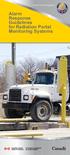 Alarm Response Guidelines for Radiation Portal Monitoring Systems for Radiation Portal Monitoring Systems Minister of Public Works and Government Services Canada 2011 Catalogue number CC172-68/1-2011E-PDF
INFO-0545 RADIOISOTOPE SAFETY MONITORING FOR RADIOACTIVE CONTAMINATION
 INFO-0545 RADIOISOTOPE SAFETY MONITORING FOR RADIOACTIVE CONTAMINATION 1. INTRODUCTION This document provides general guidance for monitoring and controlling radioactive contamination, and relating the
Characteristics of an Integrated Germanium Detector Based Gamma-Ray Spectrometer for Monitoring Systems
 Characteristics of an Integrated Germanium Detector Based Gamma-Ray Spectrometer for Monitoring Systems Ronald M. Keyser, Timothy R. Twomey, Sam Hitch ORTEC 801 South Illinois Avenue Oak Ridge, TN, 37831
Information Useful When Developing/Updating Shipping Papers and Radioactive Material Transportation Procedures
 SHIPPING PAPERS Information Useful When Developing/Updating Shipping Papers and Radioactive Material Transportation Procedures Certain entries are required on shipping papers, bills of lading, declarations
RC4000: Vehicle Monitoring Radiation Detection Systems
 A D V A N C E D T E C H N O L O G Y F O R A S A F E R W O R L D RC4000: Vehicle Monitoring Radiation Detection Systems Protect Your Facility From Costly Radioactive Contamination Introduction The accidental
Overview of Nuclear Detection Needs for Homeland Security. Abstract
 Overview of Nuclear Detection Needs for Homeland Security Timothy E. Valentine * Oak Ridge National Laboratory, P.O. Box 2008, Oak Ridge, Tennessee, 37831, USA Abstract The need for advanced and improved
AN INVESTIGATION INTO THE USEFULNESS OF THE ISOCS MATHEMATICAL EFFICIENCY CALIBRATION FOR LARGE RECTANGULAR 3 x5 x16 NAI DETECTORS
 AN INVESTIGATION INTO THE USEFULNESS OF THE ISOCS MATHEMATICAL EFFICIENCY CALIBRATION FOR LARGE RECTANGULAR 3 x5 x16 NAI DETECTORS Frazier L. Bronson CHP Canberra Industries, Inc. 800 Research Parkway,
HAZMAT Employee Training DOT/ NRC- Radioactive Materials Shipments Compliance with 49CFR and 10CFR 71
 DOT/ NRC- Radioactive Materials Shipments Compliance with 49CFR and 10CFR 71 The transfer and/or shipment of packages that contain radioactive materials are considered hazardous materials shipments and
Transportation of Soils Contaminated with Flammable Liquids
 Transportation of Soils Contaminated with Flammable Liquids November 2012 - 2 - This material is meant as a guide to certain parts of the Transportation of Dangerous Goods Regulations and is not meant
HAZMAT Employee Training DOT/ NRC- Radioactive Materials Shipments Compliance with 49CFR and 10CFR 71
 DOT/ NRC- Radioactive Materials Shipments Compliance with 49CFR and 10CFR 71 The transfer and/or shipment of packages that contain radioactive materials are considered hazardous materials shipments and
Prepared for the Department of Energy Office of Transportation and Emergency Management. 02B00215-13.p65
 TEPP Planning Products e for Medical Examiner/Cor on the Handling of a Body/Human Remains that are Potentially Radiologically Contaminated 02B00215-13.p65 Prepared for the Department of Energy Office of
A Comparison of an HPGe-based and NaI-based Radionuclide Identifier (RID) for Radioactive Materials
 Illicit Trafficking, Sub/cross-national threats, Poster presentation A Comparison of an HPGe-based and NaI-based Radionuclide Identifier (RID) for Radioactive Materials Ronald M. Keyser, Timothy R. Twomey,
HAZMAT Employee Training
 Class 7 HAZMAT Employee Training DOT/ NRC- Radioactive Materials Shipments Compliance with 49CFR and 10CFR 71 (06/2015) The transfer and/or shipment of packages that contain radioactive materials are considered
Passive Whole Body Monitoring Nuclear Power Industry Application Introduction to the Argos -5AB Zeus (Gamma Option) and the GEM
 Application Note Passive Whole Body Monitoring Nuclear Power Industry Application Introduction to the Argos -5AB Zeus (Gamma Option) and the GEM -5 Gamma Exit Monitor CANBERRA s personnel contamination
notes MERRTT IS-302 Radiological Survey Instruments and Dosimetry Devices
 INTRODUCTION This module provides general information about radiological survey instruments. Basic functions and limitations are discussed. Because there are many models of survey instruments available,
Thyroid Screening for Radioiodine
 Regulatory Document Thyroid Screening for Radioiodine July 2008 CNSC REGULATORY DOCUMENTS The Canadian Nuclear Safety Commission (CNSC) develops regulatory documents under the authority of paragraphs 9(b)
Radiation Sciences Nuclear Medicine Technology Program Hot Lab Log Book (Material)
 Radiation Sciences Nuclear Medicine Technology Program Hot Lab Log Book (Material) Table of Content Receiving a Radioactive Package Constancy Test Daily Survey Weekly Wipes Accuracy Test Linearity Geometric
PROFORMA ACCEPTANCE / QUALITY ASSURANCE TESTS OF REMOTE AFTERLOADING BRACHYTHERAPY UNIT
 RP&AD /Remote QA/ 01 PROFORMA FOR ACCEPTANCE / QUALITY ASSURANCE TESTS OF REMOTE AFTERLOADING BRACHYTHERAPY UNIT BHABHA ATOMIC RESEARCH CENTRE Radiological Physics & Advisory Division CT & CRS Building,
Transportation of Radioactive Materials
 Transportation of Radioactive Materials November 2012 - 2 - This material is meant as a guide to certain parts of the Transportation of Dangerous Goods Regulations and is not meant to be a substitute for
MATERIALS LICENSE. 1. Honeywell International, Inc. 3. License Number: SUB-526, Amendment 6-1
 NRC FORM 374 U.S. NUCLEAR REGULATORY COMMISSION Page 1 of 5 Pursuant to the Atomic Energy Act of 1954, as amended, the Energy Reorganization Act of 1974 (Public Law 93-438), and Title 10, Code of Federal
SECTION TWO PACKAGING, TRANSPORTATION AND STORAGE OF RADIOACTIVE MATERIALS
 SECTION TWO PACKAGING, TRANSPORTATION AND STORAGE OF RADIOACTIVE MATERIALS LEARNING OBJECTIVES By the end of this section, participants will be able to: Identify three types of packaging for radioactive
Cronos -1 Gamma Object / Tool Monitors
 Features Counting chamber volume: 42.9 L (1.5 cu. ft.) Robust, ergonomic, easy-to-use and decontaminate Photon energy range from 50 kev to 2 MeV Four or optional six large surface area plastic scintillator
Emergencies Involving Radiation
 Page 1-1 Section 1 Emergencies Involving Radiation Contents A. Emergency Phone Numbers...1-2 1. Campus... 1-2 a. Radiation Safety Office 543-0463... 1-2 b. University Police 9-911... 1-2 2. Off Campus...
Hazard Classification of the Remote Handled Low Level Waste Disposal Facility
 1 Hazard Classification of the Remote Handled Low Level Waste Disposal Facility Abstract Boyd D. Christensen Battelle Energy Alliance, Idaho National Laboratory P.O. Box 1625 Idaho Falls, Idaho 83415 208
WM2012 Conference, February 26-March 1, 2012, Phoenix, Arizona, USA
 Radioactive Waste Characterization Strategies; Comparisons Between AK/PK, Dose to Curie Modeling, Gamma Spectroscopy, and Laboratory Analysis Methods- 12194 Steven J. Singledecker, Scotty W. Jones, Alison
Results of Airborne Monitoring by the Ministry of Education, Culture, Sports, Science and Technology and the U.S. Department of Energy
 May 6, 2011 Results of Airborne Monitoring by the Ministry of Education, Culture, Sports, Science and Technology and the U.S. Department of Energy The results of the Airborne Monitoring by the Ministry
Monte Carlo simulation of a scanning whole body counter and the effect of BOMAB phantom size on the calibration.
 Monte Carlo simulation of a scanning whole body counter and the effect of BOMAB phantom size on the calibration. Gary H. Kramer, Linda C. Burns and Steven Guerriere Human Monitoring Laboratory, Radiation
Working Safely With Nuclear Gauges
 Working Safely With Nuclear Gauges Working Safely With Nuclear Gauges Working Safely With Nuclear Gauges INFO-9999-4 (E) Revision 2 Published by the Canadian Nuclear Safety Commission This publication
Atomic and Nuclear Physics Laboratory (Physics 4780)
 Gamma Ray Spectroscopy Week of September 27, 2010 Atomic and Nuclear Physics Laboratory (Physics 4780) The University of Toledo Instructor: Randy Ellingson Gamma Ray Production: Co 60 60 60 27Co28Ni *
Environmental Protection: Environmental Protection Policies, Programs and Procedures REGDOC-2.9.1
 Environmental Protection: Environmental Protection Policies, Programs and Procedures REGDOC-2.9.1 September 2013 Environmental Protection: Policies, Programs and Procedures Regulatory Document REGDOC-2.9.1
Importing and Exporting Radioactive Materials and Waste for Treatment, Processing and Recycling
 Importing and Exporting Radioactive Materials and Waste for Treatment, Processing and Recycling J.T. Greeves, J. Lieberman Talisman International, LLC 1000 Potomac Street, NW, Suite 300 Washington, DC
Guidance for the Transport of Radioactive Material by Road
 Safety Office Reviewed: Aug 2013 Safety Office November 2012 Guidance for the Transport of Radioactive Material by Road The transport of radioactive material between different premises, for example between
HAZMAT Employee Training D.O.T. Radioactive Material Shipments #8 (02/12)
 HAZMAT Employee Training D.O.T. Radioactive Material Shipments #8 (02/12) HAZMAT EMPLOYEE: TRAINING DATE: 1. Hazardous Materials Regulations (HMR) originate from the following government agency: a. U.S.
Quality Assurance Testing of AtomLab Dose Calibrators
 (Manufacturer s* Instructions) Introduction The following procedures are the manufacturer s instructions for qualifying AtomLab 100, 100+, 200, 300, 400, and 500 dose calibrators in accordance with NRC
SAVANNAH RIVER SITE S MACROENCAPSULATION PROCESSING OF LESS THAN 3700 BQ/GM1 TRU ISOTOPIC MIXED WASTE FOR DISPOSAL AT THE NEVADA TEST SITE
 SAVANNAH RIVER SITE S MACROENCAPSULATION PROCESSING OF LESS THAN 3700 BQ/GM1 TRU ISOTOPIC MIXED WASTE FOR DISPOSAL AT THE NEVADA TEST SITE ABSTRACT Glenn W. Siry, Luke T. Reid Washington Savannah River
Turnkey Solutions for Radiation Protection in PET Laboratories R A D I A T I O N P R O T E C T I O N
 Turnkey Solutions for Radiation Protection in PET Laboratories R A D I A T I O N P R O T E C T I O N Berthold Technologies has more than 60 years experience in manufacturing radiation protection measuring
USE OF IONIZING RADIATION IN THE TEACHING OF PHYSICS AND CHEMISTRY
 GUIDE ST 5.3 / 4 MAY 2007 USE OF IONIZING RADIATION IN THE TEACHING OF PHYSICS AND CHEMISTRY 1 Ge n e r a l 3 2 Safety licences and exemption from licensing 3 3 Safety licence-exempt use of radiation 3
(EPA Form 8700 22) and, if necessary, the continuation sheet (EPA Form 8700 22A) for
 (EPA Form 8700 22) and, if necessary, the continuation sheet (EPA Form 8700 22A) for . CF = Fiber or plastic boxes, cartons, cases. CM = Metal boxes, cartons, cases (including roll-offs). CW = Wooden
NORM MANAGEMENT GUIDELINES & PRINCIPLES
 Introducing NORM NORM MANAGEMENT Three is glad to present some basic hints about NORM that should be taken onto consideration whilst dealing with these matters The acronym NORMmeans all Naturally Occurring
Application Note. ipix A Gamma imager to support various applications
 Application Note ipix A Gamma imager to support various applications Introduction ipix is a unique gamma imager that quickly locates low level radioactive sources from a distance and estimates the dose
Transportation of Radioactive Material
 Haza rdo us Reactor Concepts Manual Transportation of Radioactive Material Santa Fe The issues associated with the transportation of radioactive material are very complex due in part to the regulatory
Role and tasks of Arpa Piemonte in controlling and monitoring of ionizing and non ionizing radiation. G.. d Amored
 Sino-Italian Cooperation Project Role and tasks of Arpa Piemonte in controlling and monitoring of ionizing and non ionizing radiation G.. d Amored Environmental Protection Agency of Piedmont Region (ARPA
Licensing Process for New Nuclear Power Plants in Canada. INFO-0756 (Revision 1)
 Licensing Process for New Nuclear Power Plants in Canada INFO-0756 (Revision 1) May 2008 Licensing Process for New Nuclear Power Plants in Canada Minister of Public Works and Government Services Canada
Lessons learned from the radiological accident in Mayapuri, New Delhi, India
 Lessons learned from the radiological accident in Mayapuri, New Delhi, India Rajoo Kumar Atomic Energy Regulatory Board Government of India Mumbai, India www.aerb.gov.in 1 Contents About Mayapuri, New
APP C1 NAVAL RADIOACTIVE MATERIAL PERMIT REVIEW CHECKLIST NUCLEAR MEDICINE COMMAND: PERMIT NUMBER: TYPE OF ACTION:
 APP C1 NAVAL RADIOACTIVE MATERIAL PERMIT REVIEW CHECKLIST NUCLEAR MEDICINE COMM: PERMIT NUMBER: TYPE OF ACTION: NAVY MARINE CPS PUBLIC HEALTH CENTER REVISED NOVEMBER 2007 REVIEWER/DATE: SECOND REVIEW/DATE:
TEMPLE UNIVERSITY ENVIRONMENTAL HEALTH AND RADIATION SAFETY
 Page 1 of 7 ISSUED: 5/00 REVISED: 08/06 1. Potential Releases of Radioactive Materials to Unrestricted Areas The Environmental Health and Safety Department (EHRS) must be notified immediately if an emergency
identifinder R-Series Handheld Radiation Detectors
 identifinder R-Series Handheld Radiation Detectors Portable Gamma Spectroscopy Systems Entry Control Checkpoints Vehicle Screening Checkpoints Package/Baggage Inspection Mailroom Safeguards Critical Infrastructure
How To Monitor For Radioactive Material In International Mail
 IAEA Nuclear Security Series No. 3 Technical Guidance Reference Manual Monitoring for Radioactive Material in International Mail Transported by Public Postal Operators Jointly sponsored by the UPU WCO
Radium-223 Therapy: Handling & Radiation Safety Issues
 Nuclear Physics Enterprises Radium-223 Therapy: Handling & Radiation Safety Issues Jeffry A. Siegel, Ph.D. President & CEO 2014 Meeting Mid-Atlantic States Radiation Control Programs Malvern, PA NRC s
Developing a Safety Case for Ontario Power Generation s L&ILW Deep Geologic Repository
 Developing a Safety Case for Ontario Power Generation s L&ILW Deep Geologic Repository T. Kempe, P. Gierszewski, R. Heystee, M. Jensen and H. Leung Ontario Power Generation, Canada NEA/EC/IAEA Symposium
Nuclear Security Glossary
 IAEA NUCLEAR SECURITY SERIES NO. Nuclear Security Glossary Revision 3E Draft 17 March 2010 Page 1 of 16 FOREWORD [TO BE PROVIDED BY THE SECRETARIAT AT A LATER TIME] Page 2 of 16 Introduction The Nuclear
A Guide to the Transportation of Dangerous Goods Regulations
 A Guide to the Transportation of Dangerous Goods Regulations November 2012 - 2 - This material is meant as a guide to certain parts of the Transportation of Dangerous Goods Regulations and is not meant
Radioactive Waste Storage Facility and Tank System Design Criteria Standards
 UCRL-AR-133355 Rev 1 Radioactive Waste Storage Facility and Tank System Design Criteria Standards John Wood Rich Michalik Karen Doiron May 1999 DISCLAIMER This document was prepared as an account of work
318 DECREE. of the State Office for Nuclear Safety of 13 June 2202,
 318 DECREE of the State Office for Nuclear Safety of 13 June 2202, On details for emergency preparedness assurance at nuclear installations and workplaces with ionizing radiation sources and on requirements
Regulatory Requirements and Licensing of OPG s DGR Project
 Regulatory Requirements and Licensing of OPG s DGR Project OPG s Deep Geologic Repository Project for Low and Intermediate Level Radioactive Waste Presentation to Joint Review Panel July 18, 2012 nuclearsafety.gc.ca
SECURITY ARRANGEMENTS OF RADIATION SOURCES
 SECURITY ARRANGEMENTS OF RADIATION SOURCES 1 General 3 2 The party running the radiation practice shall be responsible for security arrangements 3 3 Places of use and storages of radiation sources shall
ORTEC DET-SW-UPG. Latest Software Features. Ease of Use. Source Location with the Detective V3 Software
 ORTEC DET-SW-UPG Latest Software Features Three Search Modes: Gamma/Neutron total count rate. SNM search mode. Sliding average "monitor" mode. (NEW) User choice of identification schemes: Classify mode
SARA (Spectroscopic Ambient Radiation Detection) Spectroscopic Monitoring Systems for Online Environmental Radiation Monitoring Edition 2008
 SARA (Spectroscopic Ambient Radiation Detection) Spectroscopic Monitoring Systems for Online Environmental Radiation Monitoring Edition 2008 C. HOLZHEIMER and S. HARTMANN TechniData AG, ENVINET Hans-Pinsel-Str.
Naturally Occurring Radioactive Material (NORM)
 Guide Naturally Occurring Radioactive Material (NORM) 2000-0036 The Canadian Association of Petroleum Producers (CAPP) represents 150 companies that explore for, develop and produce natural gas, natural
RADIO PHARMACEUTICAL PROCEDURE PROTOCOL: QUADRAMET
 RADIO PHARMACEUTICAL PROCEDURE PROTOCOL: QUADRAMET (Sm- 153 lexidronam EDTMP) for metatstatic bone pain PRODUCT OVERVIEW: Samarium (Sm- 153) Lexidronam (Quadramet ) Quadramet is a radiopharmaceutical consisting
Bulk Flow Meter LB 442 P R O C E S S C O N T R O L
 Bulk Flow Meter LB 442 P R O C E S S C O N T R O L Mass flow determination using the LB 442 Versatile uses Contactless mass flow determination of solid matter on continuous conveyor systems Conveyor belts
Azeri, Chirag & Gunashli Full Field Development Phase 3 Environmental & Socio-economic Impact Assessment. A10.1 Introduction...
 APPENDIX 10 Normally Occurring Radioactive Material (NORM) Contents A10.1 Introduction... A10/3 A10.2 Occurrence & Concentration of NORM in Oil and Gas Operations... A10/4 A10.2.1 Probability of NORM formation
Level 3 Science, 2008
 90732 3 907320 For Supervisor s Level 3 Science, 2008 90732 Describe selected properties and applications of EMR, radioactive decay, sound and ultrasound Credits: Four 2.00 pm Thursday 20 November 2008
Safety Analysis for Nuclear Power Plants
 Regulatory Document Safety Analysis for Nuclear Power Plants February 2008 CNSC REGULATORY DOCUMENTS The Canadian Nuclear Safety Commission (CNSC) develops regulatory documents under the authority of paragraphs
Activities at temporary job site utilizing U.S. NRC Radioactive Material License #06-30556-01 Amendment 03 0303531(,
 CABRERA SERVICES RADIOLOGICAL. ENGINEERING. REMEDIATION May 17,2011 Regional Administrator U.S. Nuclear Regulatory Commission Region I 475 Allendale Road King ofprussia, P A 19406 ATTN: Director, Division
(A) All asbestos-containing waste material shall be deposited as soon as is practical by the waste generator at:
 3745-20-05 Standard for asbestos waste handling. [Comment: For dates of non-regulatory government publications, publications of recognized organizations and associations, federal rules, and federal statutory
WM2012 Conference, February 26 -March 1, 2012, Phoenix, Arizona, USA
 Upgrade and Certification of the Los Alamos National Laboratory SHENC 2011-12270 ABSTRACT S.B. Stanfield 1, M. Villani 1, P. T. Barton 1, C. Gerlock 1, D. Nakazawa 1, R. C. Baumann 1, R. Mowry 1, J.P Harvill
100 North Senate Avenue, Indianapolis, IN 46204 Phone: (317) 308-3103 Toll Free: (800) 451-6027
 GUIDANCE OLQ GENERAL ID #003-02-SW INDIANA DEPARTMENT OF ENVIRONMENTAL MANAGEMENT OFFICE OF LAND QUALITY ASBESTOS HANDLING AND DISPOSAL REQUIREMENTS www.idem.in.gov Mitchell E. Daniels, Jr. Thomas W. Easterly
Flame detection across the spectrum. Range Brochure
 talentum Flame detection across the spectrum Range Brochure Talentum - Why use our Flame Detectors... Talentum Flame Detectors are ideal for applications where fast acting and accurate detection of fire
GUIDE FOR THE PREPARATION OF RADIOACTIVE MATERIAL APPLICATIONS FOR WELL LOGGING OPERATIONS IN KENTUCKY
 GUIDE FOR THE PREPARATION OF RADIOACTIVE MATERIAL APPLICATIONS FOR WELL LOGGING OPERATIONS IN KENTUCKY Radiation Control Cabinet for Human Resources 275 East Main Street Frankfort, Kentucky 40621 JANUARY
Radioactive waste managment in Estonia past, present and future
 Radioactive waste managment in Estonia past, present and future Ivo Tatrik [email protected] Content 1. Status of ALARA 2. Decomission of Paldiski Former Navy Submarine Training Centre 3. Decomission
EMERGENCY PROCEDURES FOR RADIOACTIVE MATERIAL. 2. Prevent the spread of contamination by covering the spill with absorbent paper.
 EMERGENCY PROCEDURES FOR RADIOACTIVE MATERIAL MINOR SPILLS: 1. Notify persons in the area that a spill has occurred. 2. Prevent the spread of contamination by covering the spill with absorbent paper. 3.
Ionizing Radiation, Czech Republic, CMI (Czech Metrology Institute)
 Ionizing Radiation, Czech Republic, (Czech Metrology Institute) Calibration or Measurement RADIOACTIVITY 1.0E+00 1.0E+02 Bq cm -2 C-14 1.0E+01 1.0E+02 Bq cm -2 Co-60 1.0E+01 1.0E+02 Bq cm -2 Sr-90 1.0E+01
SAFE MANAGEMENT OF SMOKE DETECTORS CONTAINING RADIOACTIVE SOURCES
 X Congreso Regional Latinoamericano IRPA de Protección y Seguridad Radiológica Radioprotección: Nuevos Desafíos para un Mundo en Evolución Buenos Aires, 12 al 17 de abril, 2015 SOCIEDAD ARGENTINA DE RADIOPROTECCIÓN
PRESENT ISSUES FOR CENTRE DE LA MANCHE DISPOSAL FACILITY
 PRESENT ISSUES FOR CENTRE DE LA MANCHE DISPOSAL FACILITY M. DUTZER, J.P. VERVIALLE, P. CHARTON Andra - Agence Nationale pour la Gestion des Déchets Radioactifs 1-7 rue Jean Monnet, 92298 Châtenay-Malabry
PHOTOELECTRIC EFFECT AND DUAL NATURE OF MATTER AND RADIATIONS
 PHOTOELECTRIC EFFECT AND DUAL NATURE OF MATTER AND RADIATIONS 1. Photons 2. Photoelectric Effect 3. Experimental Set-up to study Photoelectric Effect 4. Effect of Intensity, Frequency, Potential on P.E.
G64 Area Gamma Monitor
 Features Solid state detector: range 0.1 µsv/h to 100 msv/h (10 µr/hr 10 R/hr) Pseudo-logarithmic ratemeter averaging for good statistics at low level and fast response at high levels Removable detector
READING DEVICE US-05
 436120 ОКП SCIENTIFIC AND PRODUCTION COMPANY «DOZA» READING DEVICE US-05 Operation manual Table of contents 1 Reader description and operartion... 3 1.1 Purpose of the device. 3 1.2 Technical specifications
4. CHEMICAL, PHYSICAL, AND RADIOLOGICAL INFORMATION
 RADON 107 4. CHEMICAL, PHYSICAL, AND RADIOLOGICAL INFORMATION 4.1 CHEMICAL IDENTITY Radon is a naturally occurring radionuclide. The largest source of radon in the environment is due to the ambient levels
Nuclear Security Officer Medical, Physical, and Psychological Fitness
 Regulatory Document Nuclear Security Officer Medical, Physical, and Psychological Fitness October 2008 CNSC REGULATORY DOCUMENTS The Canadian Nuclear Safety Commission (CNSC) develops regulatory documents
Directive 042: Measurement, Accounting, and Reporting Plan (MARP) Requirement for Thermal Bitumen Schemes
 Directive 042 Directive 042: Measurement, Accounting, and Reporting Plan (MARP) Requirement for Thermal Bitumen Schemes September 6, 2006 Effective June 17, 2013, the Energy Resources Conservation Board
Guideline for the Management of Waste Asbestos. 1 Introduction. 2 Roles and Responsibilities. 3 Waste Management. 4 Conclusion
 Guideline for the Management of Waste Asbestos 1 Introduction 1.1 Definitions 1.2 haracteristics 1.3 Potential Effects 2 Roles and Responsibilities 2.1 Environmental Protection Service 2.2 Occupational
P O L Y T E C R.M. S.R.L.
 INFORMACIÓN FUENTES EXCEPTUADAS PARA ENSEÑANZA RSS-2 G-M Resolving Time Set This set is used for determining the resolving time of GM Counters. It consists of three half discs, two of which contain 5 microcuries
Metrological features of a beta absorption particulate air monitor operating with wireless communication system
 NUKLEONIKA 2008;53(Supplement 2):S37 S42 ORIGINAL PAPER Metrological features of a beta absorption particulate air monitor operating with wireless communication system Adrian Jakowiuk, Piotr Urbański,
Questionnaire for NORM service providers
 Questionnaire for NORM service providers This questionnaire is intended for institutes and companies providing services relevant for NORM industries in Belgium. Its objective is to give to Belgian NORM
MATERIALS LICENSE. In accordance with the letter dated January 15, 2009,
 NRC FORM 374 U.S. NUCLEAR REGULATORY COMMISSION PAGE 1 OF 5 PAGES Pursuant to the Atomic Energy Act of 1954, as amended, the Energy Reorganization Act of 1974 (Public Law 93-438), and Title 10, Code of
thyroid uptake systems www.capintec.com
 64 thyroid uptake systems Captus 3000 Thyroid Uptake System Comprehensive Software Quick-start feature for rapid set-up User defined, HIPAA compliant counting protocols Thyroid uptake Wipe test Bioassay
Regulatory Guide. Radiation Safety in Industrial Radiography (FANR-RG-019) Version 0
 Regulatory Guide Radiation Safety in Industrial Radiography (FANR-RG-019) Version 0 Federal Authority for Nuclear Regulation (FANR) P.O. Box 112021, Abu Dhabi, United Arab Emirates [email protected]
Restaurant & café guide
 'Helping our customers stay in business by reducing risk' NZI Risk Solutions TM About NZI Risk Solutions NZI has extensive experience in providing expert risk management advice to help our commercial customers
............... [2] At the time of purchase of a Strontium-90 source, the activity is 3.7 10 6 Bq.
![............... [2] At the time of purchase of a Strontium-90 source, the activity is 3.7 10 6 Bq.](/thumbs/40/21837699.jpg "............... [2] At the time of purchase of a Strontium-90 source, the activity is 3.7 10 6 Bq.") 1 Strontium-90 decays with the emission of a β-particle to form Yttrium-90. The reaction is represented by the equation 90 38 The decay constant is 0.025 year 1. 90 39 0 1 Sr Y + e + 0.55 MeV. (a) Suggest,
1 Strontium-90 decays with the emission of a β-particle to form Yttrium-90. The reaction is represented by the equation 90 38 The decay constant is 0.025 year 1. 90 39 0 1 Sr Y + e + 0.55 MeV. (a) Suggest,
Industrial tracers - Finding leaks and blockages
 Cancer Treatment Alpha radiation is used to treat various forms of cancer. This process, called unsealed source radiotherapy, involves inserting tiny amounts of radium-226 into cancerous organs. The alpha