
Processing styrene polymers and copolymers by injection molding
|
|
|
- Madison Evans
- 9 years ago
- Views:
Transcription
1 Important: While the descriptions, designs, data and information contained herein are presented in good faith and believed to be accurate, they are provided for your guidance only. Because many factors may affect processing or applicaton/use, we recommend that you make tests to determine the suitability of a product for your particular purpose prior to use. NO WARRANTIES OF ANY KIND, EITHER EXPRESS OR IMPLIED, INCLUDING WARRANTIES OF MERCHANTABILITY OR FITNESS FOR A PARTICULAR PURPOSE, ARE MADE REGARDING PRODUCTS DESCRIBED OR DESIGNS, DATA OR INFORMATION SET FORTH, OR THAT THE PRODUCTS, DESIGNS, DATA OR INFORMATION MAY BE USED WITHOUT INFRINGING THE INTELLECTUAL PROPERTY RIGHTS OF OTHERS. IN NO CASE SHALL THE DESCRIPTIONS, INFORMATION, DATA OR DESIGNS PROVIDED BE CONSIDERED A PART OF OUR TERMS AND CONDITIONS OF SALE. Further, you expressly understand and agree that the descriptions, designs, data and information furnished by BASF hereunder are provided gratis and BASF assumes no obligation or liability for the description, designs, data and information given or results obtained, all such being given and accepted at your risk. Headquarters BASF Corporation Plastic Materials 3000 Continental Drive - North Mount Olive, New Jersey Tel: 800-BC-RESIN Fax: BASF Corporation Polystyrene Business Group 3000 Continental Drive - North Mount Olive, New Jersey Tel: Fax: BASF Corporation Plastics Applications Center 1609 Biddle Avenue Wyandotte, Michigan Tel: TECH Fax: Smart Fax System BASF Plastics product and processing information at your fingertips TOP-FAX1 or (outside the U.S.) BASF Canada 345 Carlingview Drive Toronto, Ontario M9W 6N9 Canada Tel: Fax: BASF Mexicana S.A. de C.V. Av. Insurgentes Sur 975 Col. Cuidad de los Deportes Delegación Benito Juarez México, D.F. México Tel: Fax: Technical Hot Line Tel: TECH (outside the U.S.) Internet Site [email protected] Slogan is a trademark of BASF Corporation. Processing styrene polymers and copolymers by injection molding We don t make your products. We make your products better. TM 01 BASF Corporation Printed in USA PSP3/01/5K

2 0,04 mm) Barrier ring Thrust Table of contents h A * Introduction 2. Styrene polymer and copolymer product range 2.1 Composition of styrene polymers and copolymers 2.2 Product range Crystal polystyrene High-impact polystyrene Styrolux Luran (SAN) Terluran (ABS) Luran S (ASA and ASA/PC) Terlux (MABS) A* The injection molding machine and mold 3.1 The screw injection molding machine 3.2 Injection molding screws Single-flighted, three-section screws Other screw geometries Barrier screws 3.3 Screw tip, nonreturn valve 3.4 Injection nozzle Open nozzles Shut-off nozzles Directions for installing the injection nozzle 3.5 Injection mold / Molded part design Sprue design Design of molds and wall thicknesses Venting Demolding Temperature control Materials of construction 15 H* 30 w cross sections in these regions mu approximately the same Processing advice for styrene polymers and copolymers 4.1 Moisture content of pellets and drying of the material 4.2 Temperature control on the cylinder 4.3 Melt temperature Special product-specific characteristics Effect of processing on mechanical strength 4.4 Mold surface temperature 4.5 Peripheral screw speed 4.6 Back pressure 4.7 Injection pressure / Injection speed 4.8 Holding pressure / Holding pressure time 4.9 Cooling time 4.10 Shrinkage and warpage 4.11 Optimization of the injection molding process Special processes 5.1 Multi-component injection molding 5.2 Internal gas pressure process

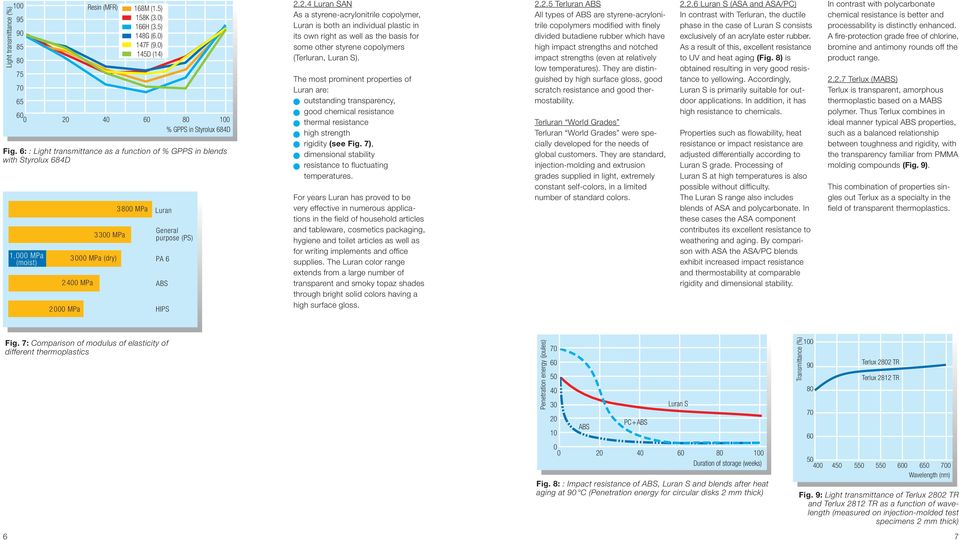
3 1. Introduction 2. Styrene polymer and copolymer product range The following is a brief survey of the styrene polymer and copolymer product range. The aim of this publication is to provide the processors of our products with information of both a general nature and specific to the various products in relation to injection molding machines, molds and processing. 2.1 Composition of styrene polymers and copolymers Styrene polymers and copolymers are materials capable of being processed by thermoplastic transformation. Figure 1 shows the BASF styrene polymer and copolymer product range. Crystal polystyrene (PS) and polybutadiene modified polystyrene (highimpact polystyrene or HIPS) are the main focus of the styrene polymer family. Styrene copolymers contain, in addition to styrene (S), other monomers in the principal polymer chain. Styreneacrylonitrile copolymers (SAN, trade name Luran ) form most important representative and basic building block of the entire copolymer product class. possess high dimensional stability while shrinkage and water absorption are low. By adding rubbers to SAN either ABS (acrylonitrile-butadiene-styrene, trade name Terluran) or ASA (acrylate esterstyrene-acrylonitrile, trade name Luran S) polymers are obtained depending on the type of rubber component employed. Luran S/C is manufactured from Luran S and polycarbonate. The styrene copolymer range is further supplemented by SBS (styrene butadiene and block copolymers, trade name Styrolux) and MABS polymers (methyl methacrylateacrylonitrile-butadiene-styrene, trade name Terlux). The chemical names, abbreviations and trade names are shown in Figure Product range General-purpose polystyrene General-purpose PS is a transparent, colorless material. (Fig. 3) It is hard, stiff and has very good dielectric properties (ie, it is an electrical insulator). The general-purpose grades are differentated by the unique combination of stiffness, heat resistance and flowability that characterizes each grade. Polystyrene, due to its amorphous structure, exhibits high dimensional stability and low shrinkage. It absorbs very little moisture. Polystyrene is easy to mold and subsequently print, weld, paint and emboss. Its neutral taste and odor are particularly important when it comes to food packaging applications Impact-modified polystyrene Impact-modified polystyrene is made by polymerizing styrene in the presence of polybutadiene rubber, an elastomer that gives the polymer its impact strength (Fig. 4). The stiffness and impact resistance of impact grades is determined by the amount of polybutadiene present. HIPS is naturally opaque, its surface appearance can range from matt to high gloss Styrolux Styrolux is a styrene-butadiene block copolymer that combines excellent Impact-failure energy (J) clarity and impact strengh. (Fig. 5) Styrolux is universally applicable, is easy to thermoform and can be printed, welded and embossed. Also, it absorbs very little water, is physiologically harmless and gamma-ray sterilizable. In many applications, Styrolux is mixed with general-purpose polystyrene to custom modify physical properties. A high degree of clarity is realized with high and low styrolux levels when blended with GPPS. (Fig. 6) SHIPS HIPS Crystal polystyrene (PS) High-impact Polystyrene (HIPS) Styrolux (SBS) Luran (SAN) Terluran (ABS) Luran S (ASA and ASA/PC) Terlux (MABS) Fig. 1: Product range Luran SAN is a rigid, hard and heatresistant thermoplastic which is as clear as glass due to its amorphous structure. In contrast with partially crystalline thermoplastics molded parts produced from SAN or Luran Polystyrene (PS) + Polybutadiene + Butadiene + Polybutadiene + Polybutadiene impact-modified + MMA Styrolux Terluran Polystyrene (SBS) (ABS) (PS) Blend with functional additives Styroblend Styrene Terlux (MABS) Luran (SAN) + Acrylonitrile + Polyacrylate ester Luran S (ASA) blend with PC Luran S/C (ASA + PC) Clear SBS Acrylic, SMMA PC PVC PET Clear ABS SAN PP GPPS Light transmission (%) Processing temperature ( C) Fig. 4: Impact resistance of a high impact polystyrene compared to a super high impact polystyrene Force (N) PS 684 D Depth of penetration (mm) Fig. 2: Styrene copolymer product range Fig. 3: Transparency of clear thermoplastics in % Fig. 5: Impact properties of Styrolux 684D and Polystyrene compared 4 5

4 Light transmittance (%) % GPPS in Styrolux 684D Fig. 6: : Light transmittance as a function of % GPPS in blends with Styrolux 684D 1,000 MPa (moist) Resin (MFR) 168M (1.5) 158K (3.0) 166H (3.5) 148G (6.0) 147F (9.0) 145D (14) 3300 MPa 3000 MPa (dry) 2400 MPa 00 MPa 3800 MPa Luran General purpose (PS) PA 6 ABS HIPS Luran SAN As a styrene-acrylonitrile copolymer, Luran is both an individual plastic in its own right as well as the basis for some other styrene copolymers (Terluran, Luran S). The most prominent properties of Luran are: outstanding transparency, good chemical resistance thermal resistance high strength rigidity (see Fig. 7), dimensional stability resistance to fluctuating temperatures. For years Luran has proved to be very effective in numerous applications in the field of household articles and tableware, cosmetics packaging, hygiene and toilet articles as well as for writing implements and office supplies. The Luran color range extends from a large number of transparent and smoky topaz shades through bright solid colors having a high surface gloss Terluran ABS All types of ABS are styrene-acrylonitrile copolymers modified with finely divided butadiene rubber which have high impact strengths and notched impact strengths (even at relatively low temperatures). They are distinguished by high surface gloss, good scratch resistance and good thermostability. Terluran World Grades Terluran World Grades were specially developed for the needs of global customers. They are standard, injection-molding and extrusion grades supplied in light, extremely constant self-colors, in a limited number of standard colors Luran S (ASA and ASA/PC) In contrast with Terluran, the ductile phase in the case of Luran S consists exclusively of an acrylate ester rubber. As a result of this, excellent resistance to UV and heat aging (Fig. 8) is obtained resulting in very good resistance to yellowing. Accordingly, Luran S is primarily suitable for outdoor applications. In addition, it has high resistance to chemicals. Properties such as flowability, heat resistance or impact resistance are adjusted differentially according to Luran S grade. Processing of Luran S at high temperatures is also possible without difficulty. The Luran S range also includes blends of ASA and polycarbonate. In these cases the ASA component contributes its excellent resistance to weathering and aging. By comparison with ASA the ASA/PC blends exhibit increased impact resistance and thermostability at comparable rigidity and dimensional stability. In contrast with polycarbonate chemical resistance is better and processability is distinctly enhanced. A fire-protection grade free of chlorine, bromine and antimony rounds off the product range Terlux (MABS) Terlux is transparent, amorphous thermoplastic based on a MABS polymer. Thus Terlux combines in ideal manner typical ABS properties, such as a balanced relationship between toughness and rigidity, with the transparency familiar from PMMA molding compounds (Fig. 9). This combination of properties singles out Terlux as a specialty in the field of transparent thermoplastics. Fig. 7: Comparison of modulus of elasticity of different thermoplastics Penetration energy (joules) ABS PC+ABS Luran S Transmittance (%) Terlux 2802 TR Terlux 2812 TR Duration of storage (weeks) Fig. 8: : Impact resistance of ABS, Luran S and blends after heat aging at 90 C (Penetration energy for circular disks 2 mm thick) Wavelength (nm) Fig. 9: Light transmittance of Terlux 2802 TR and Terlux 2812 TR as a function of wavelength (measured on injection-molded test specimens 2 mm thick) 7
5 3. The injection molding machine and mold 3.1 The screw injection molding machine It is customary nowadays to employ screw injection molding machines for the processing of styrene polymers and copolymers. In these machines, the screw assumes the roles of conveying, plasticizing and injection. Other types of machines (e.g. plunger injection molding machines) are now used only for special applications (for the production of marbled effects, for example). R D L L E L K L A h A h E S R Outer diameter of screw Effective length of screw Length of feed section Length of compression section Length of metering section Flight depth in the metering section Flight depth in the feed section Pitch Nonreturn valve Flight depth h (mm) D h A S h E L A L K L E L 3.2 Injection molding screws Single-flighted three-section screws The screw employed in the plasticizing unit affects the properties of the molded part. In certain circumstances the choice of a screw which is unsuitable for the material results in inhomogeneities in the melt (temperature, color distribution, non-uniform melting). As a result of an unfavorable screw geometry, the melt can be exposed to high shear stresses and thus be damaged both thermally and mechanically. In addition to short h E = flight depth in the feed section h A = flight depth in the metering section Standard screw Shallow screw D L L L D Fig. 10: Plasticizing unit with threesection screw comings in visual appearance, this has the consequence of diminishing the mechanical properties of the molded part. What are known as three-section screws have proved to be highly effective in practice for the processing of styrene polymers and copolymers. As the name already indicates this type of screw is divided into three different zones (feed, compression and metering section) each of which has to execute different tasks. Located at the tip of the screw there is additionally a nonreturn valve which during the injection and holding phase prevents back flow of the plasticized melt. Standard modern screws generally have an effective length of 23 D, the length of the feed section being approximately half the length of the screw. (Fig. 10) The compression and metering sections are of approximately the same length. The pitch is usually D. The flight depth ratio of the feed and metering sections ranges from 2 to 3. A compression ratio of 2 to 2.5 has proved to be effective for the processing of styrene polymers and copolymers in injection molding applications. The flight depths recommended by BASF for three-section screws are shown in Figure 11 as a function of the screw diameter. In the flight depths illustrated in Figure 11, a distinction is made between standard screws and shallow-flighted screws. Shallow-flighted screws pick up less material, and as a result of which the residence time in the plasticizing unit is shortened. This can be advantageous when handling thermally sensitive materials Other screw geometries Standard or universal screws, such as the three-section screw, are still encountered most frequently in practice and even today still cover a large portion of the spectrum of requirements and materials. In recent years, however, applications have increasingly appeared in which higher demands are imposed on the quality of the melt, than can be provided by a three-section screw. This may be encountered, for example, in critical product formulations and also in inplant coloring using master Maddock-shear section Spiral shear section batches or pigment concentrates. In order to achieve the required homogeneity, additional shearing and/or mixing parts as well as barrier zones can be and are employed. Common to all the shearing and mixing parts are the basic principles of screw clearance and the division and recombination of the melt stream. The Maddock and spiral shear sections together with the toothed disk or diamond pattern mixing section are primarily employed (Fig. 12). Furthermore, in a pilot plant trial good results were obtained with the Twente mixing ring (TMR), a combination of nonreturn valve and mixing part, developed by the University of Twente in the Netherlands (Fig 13) and available commercially in North America. Fig. 13: Twente Mixing Ring Using this system in contrast with two other shear and mixing sections studied in parallel, molded parts free from streaks were producible especially in the case of critical colors and low-concentration pigment pastes. These mixing and shear sections should be designed as far as possible to be pressure-neutral. This design keeps the material throughput, minimizes wear and avoids detrimental effects on the melt temperature. 6 4 h E Toothed disk mixing section Diamond pattern mixing section 2 h A Screw diameter D (mm) Fig. 11: Flight depths for threesection screws Fig. 12: Three-section screw with shear and mixing sections 8 9

6 3.2.3 Barrier screws The mode of operation of all barrier screws is in principle the same. The characteristic feature is the division of the screw channel into a solids channel and a melt channel (Fig. 14). The solids channel is separated from the melt channel by the barrier partition. The barrier partition has a greater gap width than the main or barrier flight so that only fused material or particles which are smaller than the gap width in at least one direction can get into the melt channel. In flowing over the barrier partition, these particles are exposed to an additional defined shear stress resulting in further fusion of the remaining particles of solid. The barrier partition contributes moreover to the homogenization of the melt. As the channel length of the barrier section increases, the cross section of the solids channel decreases while at the same time the channel cross section of the melt channel increases. This change in the cross section of both channels is achieved in the different types of barrier sections by a change in the dimensions of the flight depths and/or flight widths. Melt channel The length of screw or which barrier approach should be employed must be determined according to application. The requirements, relating in particular to homogeneity, can vary greatly from case to case. Very large plasticizing units that make use of only a small part of the available swept volume result in long residence times of the melt in the cylinder. This can result in thermal damage to the product. Furthermore, even small fluctuations in the stroke of the screw can give rise to considerable variations in the shot weight. Larger shot volumes are achieved at low cost and by structurally simple means like enlarging the metering length. Enlargement of the metering length has the consequence that the effective screw length shortens. This can result in unmelted material and inhomogeneities in temperature. A further risk with larger metering length is that even more air can be drawn in, especially during injection. The more air drawn in due to enlarged metering or injection strokes, the more difficult it is for this air to escape again to the hopper and not to move into the space in front of the screw. Indrawn air which is included in the melt and gets into the mold causes streaking in the molding, an effect which must be prevented. The minimum precondition for qualitatively flawless parts is that the maximum possible metering stroke and the effective length of the screw have a limited ratio to one another (i.e., for example, that the maximum metering stroke for a screw D long should be restricted to 3 D). 3.3 Screw tip, nonreturn valve The designs of the tip of the screw and nonreturn valve are important for the troublefree flow of the melt in the plasticizing unit. A constant melt cushion and long holding pressure times can only be maintained by means of nonreturn valves. The clearance between the cylinder and nonreturn valve should lie between 0.02 and 0.04 mm (Fig. 15) at the operating temperature. In order to avoid any back pressure from the melt, the flow cross sections in the different regions (A, h A and H) must be of the same size. The screw tip has to be designed in a manner to promote flow (Fig. 15). The angle C at the screw tip and nozzle inlet should be the same so that as little melt as possible can settle in the cylinder head or in the nozzle. In a poorly designed screw tip, the melt can be thermally damaged by a relatively long residence time in the plasticizing cylinder. In this case mechanical and optical impairment of the material cannot be precluded. 3.4 Injection nozzle Open nozzles Due to flow-related advantages, open nozzles (Fig. 16) allow simple cleaning and rinsing as well as rapid change of materials and colors. In order to prevent thermal damage, the opening of the nozzle bore should be at least 3 mm wide. The angle at the nozzle inlet should be the same as that of the screw tip. Clearance (approx. 0,02 0,04 mm) Barrier ring Thrust ring A shut-off nozzle and/or subsequent retraction of the screw can be used to prevent escape of melt during plasticization operations. When using open hot runner systems, retraction of the screw is advisable so that the pressure in the hot runner is released and escape of the melt from the hot runner is prevented. There is, however, the danger that air is drawn in between the hot runner system and the injection nozzle. This can be prevented, for example, by using a long-reach nozzle. h A * * 30 to Shut-off nozzles The use of shut-off nozzles allows the injection nozzle to be retracted during plasticization. As a result of this, the transfer of heat between the temperature-controlled injection nozzle and the cooler mold is cut off. Shut-off nozzles are also advantageous when operations must be conducted with elevated back pressure and unwanted stringing is to be avoided. Mechanically or hydraulically operated needle shut off nozzles are highly suitable for styrene polymers and copolymers (Fig. 17). By comparison with open nozzle systems shut-off nozzles suffer from the disadvantage of higher-pressure losses. Temperature sensor Fig. 16: Open nozzle with temperature sensor Temperature sensor C* Cylinder internal 30 to 60 A* Solids channel Barrier partition Screw tip 15 H* 30 * Flow cross sections in these regions must be approximately the same Shut-off needle Shut-off spring Fig. 14: Illustration of the principle of a barrier screw Fig. 15: Nonreturn valve Fig. 17: Spring-loaded needle valve nozzle 10 11

7 3.4.3 Directions for installing the injection nozzle In order to ensure troublefree demolding of the molded part, care has to be taken during installation of the nozzle that the radius of the nozzle head is always smaller than that of the sprue bushing the mold. The diameter of the nozzle bore must always be smaller than the diameter of the runner of the sprue bushing (Fig. 18). A thermocouple for measuring the melt temperature should be installed in all nozzle structures. This provides the processor with evidence of the melt temperature actually prevailing in the space in front of the screw (Figs. 16 and 17). Conical gate Slope > 1 12 R15 Fig. 18: Conical gate and sprue Z R16 Needle valve nozzle Detail Z D K 3.5 Injection mold / Molded part design Sprue design In the design of injection molds for styrene copolymers, care should be taken that runners and gates are of an adequate size. Flow resistance during injection and holding has to be kept as low as possible. Undersized gates can cause streaking, charring due to shear and delamination. Premature solidification of the melt in the sprue frequently results in sink marks and voids in the molded part since the contraction in the volume of the melt during the holding pressure phase cannot be compensated for. Sprue Conical nozzle bore Slope > 1 D D Cooling time (s) h E h A Design of molds and wall thicknesses The wall thickness needed is determined by the requirements for strength and rigidity as well as for an economical cycle time for the component. In Figure 19, the effects of wall thickness, melt and mold surface temperatures are shown for an amorphous and a partially crystalline product. The maximum and minimum cooling times of a product are obtained by using the maximum and minimum melt and mold surface temperatures found on pages 16 and 18, respectively. It is evident that the wall thickness of the molded part plays the dominant role in determining the setting time. In order to prevent or reduce sink marks, gating should be placed as close as possible to the region of the greatest wall thickness because here the holding pressure can act for the longest time. Terluran 877M Ultramid A3K Wall thickness (mm) Fig. 19: Theoretically determined setting times for plaques of differing thickness until the maximum wall temperature reaches the demolding temperature If gating is placed in regions of thin wall thickness, volume contractions in the thicker regions can no longer be compensated for since the thin walls freeze earlier. Gating in this way generally results in more distinct sink marks. As a matter of principle, reinforcing ribs should be constructed with a lower wall thickness than the basic wall thickness and be tied by a certain radius to the base wall. The tie radius prevents flow problems and notch effects. A tie radius which is too large can, however, have an effect on the cycle time (Fig. ) and/or the quality of the molded part (sink marks due to accumulation of melt). PS a Wall thickness s = 2.0 R Rib thickness a = 1.0 Radius R = 0.3 d s Control circle d = s Setting time 11.1sec d d a a R R s s s=2.0 a=2.0 R=0.5 d= s Setting time 15.9 sec s=2.0 a=2.0 R=2.0 d= s Setting time Venting Molds must also be vented. When the two mold halves close, a volume of air is trapped in the mold cavity. During injection of the polymer, this air, if not removed, will compress and rise in temperature. The temperature can rise enough to cause autoignition of the air/polymer volatiles mix. This is called dieseling and results in a burn mark through the plastic. In extreme cases, the mold cannot be filled. The removal of the trapped air is accomplished using vents. Figure 21 shows an example of a mold venting scheme. Vents are typically placed around the circumference of the parting line, spaced as close as 3-4 inches apart. The vent consists of a land area approximately deep by 1/4 to 1/2 wide by 1/8 to 1/4 long. The is a steel safe starting thickness that allows air to escape but not viscous plastic. Beyond the 1/8 to 1/4 dimension, the tool steel is removed to a greater depth to facilitate gas flow and is channeled to the perimeter of the mold. On occasion, Mold parting line Bore 2 to 5 mm 0, ,005 Fig. : Effect of rib and wall thicknesses and radii of curvature on cooling times of a ribreinforced injection-molded part due to the gate placement, gas entrapment can occur away from the outside edge of the cavity space. In those cases a vent pin, which is similar to an ejector pin but with a (to start with) flat cut on one side,can be used to vent gas out the back of the core into the ejector box. Sintered metal plugs have also been used successfully when vented through the mold body. During construction, care has to be taken that the venting channels run into an adequately sized exhaust channel so that cleaning of the channels is rendered practically unnecessary. Nevertheless, the venting channels should be checked regularly and cleaned if necessary in order to prevent any decrease in the efficiency of venting with progressive usage of the mold caused by deposits Mold cavity Fig. 21: Structural scheme for venting a mold 13

8 4. Processing advice for styrene polymers and copolymers Demolding For styrene polymers and copolymers demolding drafts of 1 are generally sufficient. Under no circumstances, however, should they be less than 0.5. The knock-out pins or stripper plates should be designed with as large an area as possible so that the finished part is not deformed on demolding. This may also allow earlier demolding and hence a shorter cycle time Temperature control As early as determining the position of the molded part in the mold, consideration should also be given to the uniform temperature control of the molded part. The effective temperature of the mold at the surface of the mold cavity has a substantial effect on the cycle time, surface quality (gloss, brilliance and prominence of the weld line), shrinkage and warpage and thus on the tolerance of the molded parts. Mold cooling is achieved by installing cooling channels in the cavity and core plates in order to circulate water or an ethylene glycol solution through the mold. The channel diameter and placement, along with the circulating capacity of the cooling system, will determine overall effectiveness of the design. The bore diameter for cooling channels are typically drilled to accept inch pipe. Interconnecting hoses should have the same internal diameter to assure the flow rate through the system remains in the turbulent regime. Turbulent flow achieves three to five times as much heat transfer as does non-turbulent flow. The size of the coolant channel, its position relative to the surface of the molding, the flow rate and temperature of the coolant are important for uniform cooling of the molded part. Often, segments on the mold surface must have their temperature controlled by different cooling circuits. Uniform cooling, providing a temperature gradient of no more than 10 F across the mold, will allow for uniform parts Materials of construction The choice of material to construct a mold is based on several factors. These include the number of parts to be produced, the size and shape of the part, surface durability, cost and molding force required. Depending on the gating system used and the wall thickness of the part, thermoplstic molding can generate pressures of between 2 and 5 tons/in 2 in the mold cavity. These pressures can distort or crack a mold if improperly designed. For prototype work where a small number of parts will be produced, lead/zinc alloys are often used. These materials are inexpensive, can be cast into near net shape to reduce machining cost, and can be remelted and recast again. This family materials are not durable because the lead/zinc structure does not possess high tensile strength, toughness, or durability against erosive effects. These materials also exhibit much higher rates of heat conductivity versus steel, which could affect final part properties. This effect would be especially critical in blends or alloys of thermoplastic materials where the cooling rate affects domain size of the blend constituent. It is also very important to remember that this family of mold materials loses physical properties, primary tensile strengh, and surface toughness at temperatures above 80 C (175 F). While there are many materials that production molds can and have been made from including aluminium alloys, bronze, and stainless steel, the most common material choice for molding thermoplastic resins is P- steel. P- is chosen for its unique combination of toughness combined with surface hardness that can be further enhanced by heat treatment methods. P- can be machined using standard methods; and the low sulfur grades, through harder to machine, are typically used because of improved surface finish when polishing and photo etching is required. The cooling rate of the part is effected by the material of construction. Aluminium and beryllium copper can conduct heat twice as fast as tool steel and four times as fast as stainless steel mold. 4.1 Moisture content of pellets and drying of the material In order to produce moldings having a satisfactory surface and good properties, the moisture content of the pellets must not exceed a certain value. Figure 22 shows the permissible moisture level in the pellets for processing. The moisture content in the containers rises as a function of the ambient storage conditions and time. Especially in the winter months when the material is transferred from a cold storage area into a heated processing shed, condensation from the cooling ambient air on the pellets can occur when the container is opened immediately. The occurrence of condensing moisture is prevented by storing the closed container in the processing shed for a certain time or by bringing it to room temperature in an intermediate store. Drying time Drying Max. permissible temperature moisture content of granules (h) ( C) (%) Circulating air drier Polystyrene* Luran Terluran Luran S <0.1 Styrolux <0.1 Luran S/C <0.1 Terlux <0.1 * Normally not required Fig. 22: Processing of styrene copolymers In order to ensure the production of components free of streaks and have a flawless surface with a good level of gloss and properties, the pellets should be dried using the times and drying temperatures listed in Figure 22. Circulating air driers are often sufficient for drying the pellets. Since dry air can absorb a relatively large amount of moisture, dry air driers are generally more effective. Partly filled containers have to be carefully closed immediately after withdrawal of pellets. The pellet hopper on the machine has to be covered by the lid. The pellets should be predried to reduce moisture to an acceptable level to assure satisfactory part quality. Directions for predrying can be found in the processing section of the relevant product brochure. Heater Temperature control ( C) 240 Fixed Rising Decreasing 4.2 Temperature control on the cylinder The quantity of heat needed for melting the pellets is introduced from outside by heating the plasticizing cylinder and also by friction from the rotation of the screw. The possibilities for temperature control given in Figure 23 are for setting the band heater temperatures. A fixed temperature control profile is used when, as a result of a short residence time or utilization of the full plasticizing capacity, a lot of heat has to be supplied as quickly as possible. Rising Fig. 23: Temperature control profile on the cylinder 14 15

9 A rising temperature control profile is employed when residence times are relatively long. This permits relatively gentle fusion of the material. The initially rising temperature profile which then falls on approaching the nozzle is used primarily for open nozzles in order to prevent the melt running out or to prevent stringing. The aim of all temperature profiles has to be the setting of that melt temperature in the space in front of the screw which is required for processing. By means of the thermocouple fitted in the nozzle head, the actual melt temperature can be measured and the temperature profile of the band heaters together with the rotary speed of the screw can be corrected. 4.3 Melt temperature Apart from a few exceptions, styrene polymers and copolymers can be processed over a broad range of melt temperatures. 16 PS/HIPS Polystyrene Luran Terluran Styrolux Luran S Luran S/C Terlux Melt temperature ( C) Fig. 24: Processing temperature ranges for styrene copolymers Figure 24 shows a summary of the processing temperature ranges for styrene polymers and copolymers. If possible, processing in the median temperature range is preferred in order to protect the material. To check on this, we recommend that the melt temperature be measured by means of a needle thermometer in the purged-off melt. While processing is done in the upper temperature range, residence times should be short in order to prevent yellowing of or damage to the material. Furthermore, when high processing temperatures and/or long residence times are used the temperature of the first band heater (close to the hopper) should be set a little lower. This will prevent premature melting of the pellets in the feed section Special product-specific characteristics BASF polystyrene products should be processed between 180 and 270ºC ( ºF). Temperatures above 280ºC (536ºF) and long residence times can cause thermal degradation. A number of molded article properties can be controlled by adjusting the melt temperature (Fig. 25). Styrolux SBS The maximum processing temperature for Styrolux is 250ºC. Above this temperature, the rubber component of Styrolux starts to crosslink, causing poorer melt flow and haze in the molded article. Luran Especially when processing lightly colored, transparent Luran formulations, changes in the shade of the finished part can occur when the melt is subjected to excessive thermal stress. This effect, peculiar to SAN materials, can only be prevented by processing under gentle conditions. Terluran ABS At melt temperatures above 260 C (500 F), particularly in the case of long residence times of the material in the cylinder or high heat production through shear, products containing polybutadiene can suffer a decrease in impact strength due to thermal damage. Luran S By comparison with Terluran, the Luran S and Luran S/C grades exhibit higher stability to temperature and processing. Nevertheless when processing is carried out in the upper temperature range, care should be taken to keep residence times as short as possible in order to prevent any thermal damage to the material. This may be recognized in the case of bright colors by a change in color, usually towards a somewhat lighter shade. Styrolux Styrolux feeds easily in the barrel. The temperature profile should increase gradually in the direction of the screw tip. The feed zone should be cooled. The back pressure should be only as high as necessary. Melt temperatures must not exceed 250ºC (482ºF). Excessive temperatures damage the material by causing crosslinking, which produces poorer flow and turbidity. Residence times in the barrel should be kept short to prevent such effects. In addition to a good mold surface, transparency and gloss are also favored by a high injection rate. Note, however, that a high injection rate may lead to a slight loss in impact strength. Terlux MABS Terlux is slightly cloudy immediately after demolding (while the temperature of the molding is still high). Only on cooling does the transparency of the product become apparent. Optimum transparency is achieved at melt temperatures of C ( F) and with a mold surface polished to a high gloss. Long residence times can cause slight yellowing. Mixtures with any other thermoplastics result in permanent clouding of the product Effect of processing temperatures on mechanical strength Depending on which product is being processed, the processing temperature has a greater or lesser effect on mechanical strength (notched impact strength, see Fig. 26). Particularly noteworthy is the impact strength maximum of Terluran GP 22 at 260 C (500ºF). In above Peak Force (N) Fig. 25: Instrumented impact of high impact polystyrene vs. melt temperature and injection speed ISO 179/1eA notched impact strength (kj/m 2 ) Injection Speed (in/sec) Terluran GP 22 Terluran 967 K Luran S 778 T Terlux 2802 TR the example of Luran S 778 T, a slight increase in impact strength can be discerned as the melt temperature rises. The highest impact strength is reached at 250ºC (482ºF). By comparison, with ABS, only a marginal decline in impact strength occurs even at high processing temperatures up to 280 C (536ºF) Melt Temperature ( F) Processing temperature (ºC) Fig. 26: Notched impact strength as a function of processing temperature 17

10 4.4 Mold surface temperature The surface temperature of the mold is among the most important parameters in the injection molding process. Figure 27 presents BASF s recommendations for the mold surface temperatures. Apart from surface quality, (gloss and weld line marks) the effective mold surface temperature also affects the mechanical properties, weld line strength and the dimensional tolerances of the molded part (Fig. 29). Locally different mold temperatures result in different rates of cooling of the molding and hence in differences in shrinkage caused by cooling and in warpage. In general a higher mold surface temperature brings about slower freezing of the melt. Shrinkage can be compensated for with longer cooling times resulting in lower residual stresses. 18 Polystyrene Luran, Luran S Terluran Luran S/C Terlux Styrolux Mold surface temperature ( C) Fig. 27: Recommended mold surface temperatures for styrene copolymers Figure 28 shows the effect of the mold surface temperature (MST) on the surface gloss of a molding made from Terluran 967 K. Increasing the mold surface temperature from 30 C to 60 C ( F) resulted in the case of a test mold with an appropriately polished surface in an increase in gloss of 24% (melt temperature 230 C). However, in the case of Terluran, a high melt temperature in combination with a low injection rate and low mold surface temperatures can result in distinct deterioration of the surface gloss. Increasing hold pressure and mold temperature can have a significant effect on peak force (Fig. 29). 4.5 Peripheral screw speed The rotary speed of the screw can be selected in such a way that the time available in the cycle for plasticization is utilized to the greatest possible extent. As Figure 30 shows the peripheral screw speed V U should be Gloss (%) about 0.2 m/s and as far as possible, even in intensive use, not exceed 0.3 m/s. When using a screw having a diameter of 80 mm for example, this corresponds to a speed range of 48 to 72 rpm. 4.6 Back pressure In order to prevent air intake and to produce a sufficiently homogeneous melt, it is necessary to work with back pressure. In doing so, the level of back pressure should as much as possible, but not exceed a hydraulic pressure of 10 bar (150 PSI). A back pressure which is too high results in excessive heating by friction and thus in an uncontrolled and generally excessive processing temperature. This can result, for example, in thermal damage to the melt and consequently in considerable losses in the quality of the molded part. MST 60 C MST 30 C 0.4s 2.0s 0.4s 2.0s 280 Melt temperature ( C) Fig. 28: Gloss for the example of Terluran 967 K 4.7 Injection pressure / Injection speed A good molding surface can be achieved by filling the mold uniformly. To prevent the injection speed from falling below the desired value throughout the injection process, a high injection pressure has to be set. A drop in the injection rate at the end of the injection phase indicates that the injection pressure is too low or the target speed is too high. Marked differences in wall thickness while the injection speed remains the same result in nonuniform filling of the mold and hence in flow marks. If necessary, the injection speed has to be varied in steps or the component geometry has to be revised. Especially in the case of thin-walled moldings, high injection speeds should be chosen. As a general rule, high injection speeds result in a higher melt temperature and a higher surface gloss (Fig. 28). They bring about improvements in flowability and especially in the case of glass-fiber reinforced product improvements in surface quality. High injection speeds give rise to a more uniform solidification process. In many cases, weld lines are less visible and the impact strength of the products is enhanced. At a higher injection speed, the pressure requirement rises and the demands on mold venting become more stringent. In the case of a relatively cold melt, there is a danger of damage to the melt and of higher stresses in the molding above Peak Force (N) Fig. 29: Instrumental impact of high impact polystyrene vs. hold pressure and mold temperature Screw speed n (min -1 ) Hold Pressure (PSI) V u = Mold Temperature ( F) n D π (m/s) V u =0.2 m/s V u =0.05 m/s Screw diameter D (mm) Fig. 30: Recommended screw speed as a function of screw diameter and peripheral screw speed (VU) 19

11 4.8 Holding pressure / Holding pressure time The holding pressure is intended to compensate for the shrinkage of the solidifying plastic. For this purpose it is important that the changeover to the holding pressure occurs exactly at the volumetric filling of the cavity. Depending on the geometry of the component, voids and sink marks can be very largely balanced out by choosing an appropriate holding pressure value and a holding pressure time. On account of their amorphous structure, the holding pressure times for styrene polymers and copolymers are distinctly lower than for partially crystalline polyamide for example. Terluran 967 K Melt temperature = 250 C Mold temperature = 60 C Wall thickness = 1.5 mm A C B If the geometric design or choice of gate are unsuitable, an extremely high holding pressure or an extremely long holding pressure time can result in overfeeding of the moldings and hence in a lower impact strength of the components (Fig. 31). As a rule, high stresses can be demonstrated, especially in the sprue region and these are frequently the cause of premature failure of the molded part. This can give rise to demolding problems. The problem of overfeeding can possibly be minimized by means of a staged holding pressure profile. 4.9 Cooling time The criterion for an optimum cooling time is the demolding of the injection molded part without any lasting or subsequent deformation of the component. The cooling time can be determined for many geometries with the aid of computer programs Shrinkage and warpage The shrinkage of a component is determined both by the nature of the material as well as by the processing conditions and the geometry of the molding (shape of the molding, wall thickness and position of sprue). Interactions among these factors make it difficult to predict the exact shrinkage. Accordingly, the shrinkage values set out in the material data sheets apply only to the specified processing and mold surface temperatures and the geometry used for the component. At the same time, a distinction has to be made between the values for free and impeded shrinkage parallel and at right angles to the direction of flow of the melt. At %, the free shrinkage of amorphous materials is smaller by a factor of three or more than that of partially crystalline plastics which is 1 3%. Figure 32 shows the values of free shrinkage for the processing temperatures in question. These were measured on a 110 x 110 x 2 mm (4.3 x 4.3 x 0.08 ) plaque. Shrinkage also affects molded parts in two ways other than part dimensions, namely sink marks and voids. Both of these molding problems are caused by the shrinkage of the hot melt as it cools on the inside of the molded part. In the case of sink marks, as the polymer cools and shrinks, material is pulled away from the wall of the part, creating a depression in the surface of the part. Voids occcur from the same root cause, shrinkage of material on the inside of the part; but in this case, the walls have frozen solid and cannot be pulled away from the walls. As the material shrinks and volume decreases, a void is created on the inside of the part. Correction of both of these problems requires increased packing of the molded part to compensate for the shrinkage. Often, mold design changes are required to avoid thick sections in the part and minimize shrinkage to acceptable levels. The processor can control shrinkage substantially by selective changes in the holding pressure and in the maximum effective holding pressure time up to the gate sealing point. The aim should be to compensate for the contraction in volume occurring during the freezing process for as long as possible by feeding melt through the holding pressure and holding pressure time. A high mold surface temperature affects the cooling rate of the molding and thus prolongs the possible duration of action of the holding pressure. On the other hand, the injection speed and melt temperature have only a minor influence on the course of shrinkage. Luran Terluran Luran S Warpage in the molding is generally caused by differences in shrinkage in the direction of flow transversely to flow and also by different wall thicknesses in the component. Since the holding pressure acts for very much longer close to the sprue than far from it, the different shrinkage along the component can also give rise to warpage. The processor has the possibility of controlling warpage of the component by means of differential temperature control on the two halves of the mold as well as by means of partial temperature control of individual parts of the mold % % % Fracture energy (Nm) A B C 600 bar 800 bar Luran S/C Terlux % % Shrinkage values measured at average processing and mold temperatures *Free processing shrinkage in sheet measuring 110 x 110 x 2 mm Fig. 32: Processing shrinkage* of styrene copolymers Fig. 31: Relationship between fracture energy and holding pressure 21

12 5. Special processes 4.11 Optimization of the injection molding process Properties of a molding are frequently affected by changes in individual machine and mold as well as the process parameter adjustments due to the machine/mold changes. By way of example Figure 33 shows in which phases of the injection molding process the key properties of a molding can be changed. Figure 34 illustrates the magnitude of these interactions on part properties and process responses. Here the key process and mold parameters are the melt temperature, the mold surface temperature, the injection speed and the pressure in the mold cavity. Measurement of these variables during the injection process simplifies not only the adjustment process but also shows potential problems in production at an early stage. Internal mold pressure (bar) Injection phase Stresses on melt, quality of surface Compression phase Shaping of contours, flash formation, webbing Holding pressure phase Voids, sink marks, weight, shrinkage, warpage, internal stresses, demolding difficulties Time (s) Fig. 33: Modification of the properties of the molding in the injection molding process 5.1 Multicomponent injection molding with styrene and styrene copolymers The multicomponent injection molding technique makes it possible to selectively combine different products having their own specific properties in a molding. Styrene copolymers in combination with different thermoplastics and thermoplastic elastomers are also highly suitable for this special process in injection molding technology. The processes combined under the generic heading of multicomponent injection molding include injection molding. Here, two plastic melts are prepared in different units and injected one after the other through a gate into the mold cavity. The result is a skin, or outer component (first injected component) and a core component (material which flows after the first component). A molding with a sandwich-like structure is produced (Fig. 35). This three-layer structure has the advantage that the core component is usually completely enclosed by the skin component. In this way it is possible to produce moldings having specific properties matched to the application in question. For example, these can exhibit on the one hand a very good surface quality and on the other hand possess a reinforced or expanded core. Typical applications of the process are thick-walled articles, such as handles, and housings. The distribution of the core component in the molded part usually has a direct effect on the quality of the finished part. It is controlled by the flowability of the products, the processing parameters, the positioning and design of the sprue and by the shape of the molding. In order to ensure adequate utility of the moldings, the components must be compatible with one another. If, for example, they do not adhere adequately to one another, delamination of the layers can result in a reduction of functionality or serviceability. On the basis of experience, styrene copolymers undergo comparably good bonding to one another. On the other hand, a materials combination involving styrene copolymers with polypropylene for example is not recommended. A increasing number of new applications are produced by a further multicomponent injection molding process, sandwich injection molding or over-molding. In this process, premoldings produced out of the first component are first manufactured. On completion of the setting time, these are covered in part with at least one further product (Figs. 36 and 37) Melt Temperature Mold Temperature Injection Speed Hold Pressure A B Peak Pressure Gloss 60 Inst. Impact Screw recovery A = skin component, B = core component Fig. 35: Co-injection molding A B A = skin component, B = core component Fig. 36: Composite injection molding Fig. 34: Effects of Injection Molding Parameters on BASF HIPS and the molding process. Fig. 37: Lid for a mixing cup made from Luran 388 S (transparent) and Luran S 778 T (white ring) 22 23

13 The multicomponent injection molding machines usually used are fitted with a number of units corresponding to the number of components. These special multicomponent injection molds, depending on the part to be produced, can have a very complex structural design because premoldings and finished moldings are produced in one mold. Tried and tested mold concepts for this are rotary and sliding split molds. In some cases, the premoldings are positioned in what is known as the final injection station with the aid of a handling device. Composite injection molding is also possible, however, using conventional molds and machines. In this case, the premolding is placed in a second mold and co-molded. The type of mold and machine employed depends on the part geometry, the piece numbers and the planned combination of materials. The good bonding of the participating components required in most cases is ensured when styrene copolymers are used both in composite injection molding as well as in sandwich injection molding (usually as rigid/rigid components). In rigid/flexible applications, thermoplastic polyurethanes (TPE-U), for example, which undergo good bonding to Terluran and Luran, are suitable for the flexible component. Known applications are housings having a direct mold-on seal or handles which have injected over their surface a flexible component to improve their feel. Since the bonding strength is affected by many factors and is difficult to predict, preliminary trials with test molds and prototype molds is frequently recommended to determine suitable combinations of materials or geometries of the bonding surfaces. If the processed components do not adhere sufficiently well to one another, what are known as clamping mechanisms can also increase bonding strength. In this case, the undercuts or openings provided in the premolding are permeated during the subsequent overmolding by the melt of the second component and mechanically coupled. The disadvantage is the higher effort in mold engineering by comparison with bonding achieved by adhesion. Cavity Fig. 38: External automobile mirror made from Luran S 778 T 5.2 Internal gas pressure process The internal gas pressure method (IGP), also known sa gas assist, was developed in the middle of the seventies. It has been used on a large scale only since the middle of the eighties. The principle of the IGP method is the selective production of cavities at points in the molding having great wall thicknesses by the injection of inert gas nitrogen as a rule into the cavity partially or completely filled with plastic melt. The gas can be introduced by injection needles both via the machine nozzle as well as via a gas nozzle installed directly in the mold. In principle, all thermoplastics used in conventional injection molding, i.e. including styrene polymers and copolymers, can be processed by IGP. Figure 38 shows an example of this. Depending on the type of plastic molding to be produced, a choice can be made between the inflation method and the blowing out method. The decision whether to use IGP or conventional injection molding is substantially determined by the mold geometry. In order to make optimum use of the advantages of the IGP method, it is necessary to start thinking differently as early as the design of the component and the mold. The factors affected are: position and layout of the sprue, design of wall thicknesses, use of ribs and diversion points for the melt. The following advantages relative to conventional injection molding come to the forefront when the IGP method is used. Greater design freedom in the development of the molding. Simpler, more suitable injection molds. A great level of integration, i.e. the production of one part instead of two or more individual parts which subsequently have to be assembled. Prevention or minimization of sink marks. More uniform shrinkage, lower internal stresses and less warpage on account of the uniform distribution of gas pressure in the molding. Optimization of weight or material consumption while the rigidity of the molding is relatively high. Reduction of cycle times. Use of machines having a lower clamping force. On the other hand, the following disadvantages can occur. Gas spreading and the hollow space formed is not predictable. Appropriate computer simulations, such as FEM programs for example, can provide indications. The gas spreading, size of the hollow space and the resultant residual wall thickness can only be affected within certain limits by the process parameters such as melt temperature, mold surface temperature, gas pressure and gas delay time. Additional resources are needed to carry out the process. These include gas pressure generator and pressure control modules, process gas and injection nozzles. Patent situation (license fees). Injection molds must be made with great precision and be perfectly balanced this applies especially to multicavity molds in order to ensure uniform spreading of the gas. All injection molding machines commonly available on the market are suitable for the IGP method. The manufacturers of gas systems supply different systems, such as Airmould, Airpress, Cinpress, Gain, etc. Some systems or variants of the process are protected by patents. For that reason, the processor should obtain comprehensive information about the patent position before starting technical utilization

14 Plastics Line of the BASF Corporation Products of BASF Corporation Terluran Acrylonitrile/butadiene/styrene copolymer ABS Luran S Acrylonitrile/styrene/acrylate copolymer ASA, (ASA + PC) Luran Styrene/acrylonitrile copolymer SAN Terlux * Methyl methacrylate/acrylonitrile/butadiene/ MABS styrene copolymer Crystal PS Polystyrene PS Avantra *, high-impact PS Styrene/butadiene polymer HIPS Styroblend Blend based on styrene/butadiene polymer HIPS blend Styrolux Styrene/butadiene block copolymer S/B/S Ultradur Polybutylene terephthalate PBT, (PBT + ASA) Ultraform Polyoxymethylene POM Ultramid Polyamides PA 6, 66, 6/66, 6/6T Ultrason E Polyethersulfone PES Ultrason S Polysulfone PSU Styropor Expandable polystyrene EPS Neopor P Expandable polystyrene EPP Neopor E Extruded rigid polystyrene foam EPE = registered trademark of BASF Aktiengesellschaft *= registered trademark of BASF Corporation Note The information submitted in this publication is based on our current knowledge and experience. In view of the many factors that may affect processing and application, these data do not relieve processors of the responsibility of carrying out their own tests and experiments; neither do they imply any legally binding assurance of certain properties or of suitability for a specific purpose. It is the responsibility of those to whom we supply our products to ensure that any proprietary rights and existing laws and legislation are observed. 26

Solid shape molding is not desired in injection molding due to following reasons.
 PLASTICS PART DESIGN and MOULDABILITY Injection molding is popular manufacturing method because of its high-speed production capability. Performance of plastics part is limited by its properties which
INJECTION MOULD DESIGN: MARPLEX PVC RESINS
 MACHINE RECCOMENDATIONS PVC requires reciprocating screw injection moulding machine with a plasticising screw to produce homogeneous melt. It is recommended that a shot weight of the part should take two
CHAPTER 2 INJECTION MOULDING PROCESS
 CHAPTER 2 INJECTION MOULDING PROCESS Injection moulding is the most widely used polymeric fabrication process. It evolved from metal die casting, however, unlike molten metals, polymer melts have a high
What is a mold? Casting. Die casting. Injection Molding Machine. Injection Molding. 2.008 Design & Manufacturing II. Spring 2004
 2.008 Design & Manufacturing II What is a mold? From Webster: a cavity in which a substance is shaped: as (1) : a matrix for casting metal (2) : a form in which food is given a decorative shape Spring
3D Printed Injection Molding Tool ("PIMT") Guide. Objet Ltd.
 3D Printed Injection Molding Tool ("PIMT") Guide Objet Ltd. 2 Injection molding is a high speed, automated and versatile process that can produce high precision complex three dimensional parts from a fraction
6 Design of Gates. 6.1 The Sprue Gate
 6 Design of Gates 6.1 The Sprue Gate The sprue gate is the simplest and oldest kind of gate. It has a circular cross-section, is slightly tapered, and merges with its largest cross-section into the part.
TECHNICAL DATA SHEET GRILON BG-15 S
 TECHNICAL DATA SHEET GRILON BG-1 S Grilon BG-1 S is a heat stabilised PA6 injection moulding grade with 1% glass fibres. Grilon BG-1 S has the following important properties: Excellent surface finish Easy
Injection molding equipment
 Injection Molding Process Injection molding equipment Classification of injection molding machines 1. The injection molding machine processing ability style clamping force(kn) theoretical injection volume(cm3)
Part and tooling design. Eastman Tritan copolyester
 Part and tooling design Eastman Tritan copolyester Part and tooling design Process Part design Tooling design High cavitation considerations Process Process Project development flow chart Concept OEM generates
DIESEL EFFECT PROBLEM SOLVING DURING INJECTION MOULDING
 RESEARCH PAPERS FACULTY OF MATERIALS SCIENCE AND TECHNOLOGY IN TRNAVA SLOVAK UNIVERSITY OF TECHNOLOGY IN BRATISLAVA 2014 Volume 22, Special Number DIESEL EFFECT PROBLEM SOLVING DURING INJECTION MOULDING
NYLON 6 RESINS CORRECTING MOLDING PROBLEMS A TROUBLE SHOOTING GUIDE
 NYLON 6 RESINS CORRECTING MOLDING PROBLEMS A TROUBLE SHOOTING GUIDE A. TROUBLESHOOTING GUIDE FOR INJECTION MOLDERS. I. INTRODUCTION The source of problems in injection molding of nylon resins can depend
Plastic Injection Molds
 Training Objective After watching the program and reviewing this printed material, the viewer will become familiar with the variety, design, and productive use of plastic injection molds. Mold components
Injection Molding. Materials. Plastics 2.008. Outline. Polymer. Equipment and process steps. Considerations for process parameters
 Outline 2.008 Polymer Equipment and process steps Injection Molding Considerations for process parameters Design for manufacturing, tooling and defects 1 2.008 spring 2004 S. Kim 2 Materials Solid materials
Investigation of process parameters for an Injection molding component for warpage and Shrinkage
 Investigation of process parameters for an Injection molding component for warpage and Shrinkage Mohammad Aashiq M 1, Arun A.P 1, Parthiban M 2 1 PGD IN TOOL & DIE DESIGN ENGINEERING-PSG IAS 2 ASST.PROFESSOR
Understanding Plastics Engineering Calculations
 Natti S. Rao Nick R. Schott Understanding Plastics Engineering Calculations Hands-on Examples and Case Studies Sample Pages from Chapters 4 and 6 ISBNs 978--56990-509-8-56990-509-6 HANSER Hanser Publishers,
A Guide to Thermoform Processing of Polypropylene. Introduction
 A Guide to Thermoform Processing of Polypropylene Introduction Thermoforming is the process of heating plastic sheet to a pliable state and forming it into shape. Thermoforming offers processing advantages
Plastic Injection Molding
 Training Objective After watching this video and reviewing the printed material, the student/trainee will understand the principles and physical operations of the plastic injection molding process. An
Quick Guide to Injection Molding
 Quick Guide to Injection Molding Amodel polyphthalamide (PPA) Equipment Amodel PPA resins can be processed on conventional injection molding equipment. Estimated clamp tonnage of 5.5 kn/cm 2 (4 T/in 2
Glossary of Terms Used in Plastic Injection Mold Manufacturing
 Acceptable Runner/Cavity Ratio: Runner systems designed for high pressure drops to minimize material usage and increase frictional heating in the runner. Annealing: The process of relieving internal stresses
Troubleshooting Guide. PS Injection moulding. Splay marks. Burning (Black streaks) Cool feed zone. Dry material, check source of moisture.
 Troubleshooting Guide PS Injection moulding Splay marks Trapped air that contains moisture Raise nozzle and front zone temperature. Cool feed zone. Wet feed Dry material, check source of moisture. Irregular
Effects of the MuCell Molding Process
 Effects of the MuCell Molding Process Molding MuCell versus Solid Shot size is reduced Final mold fill is completed with cell growth Little or no Hold Time or Pressure Reduced molded-in stress Less warp
Why Plastic Flows Better in Aluminum Injection Molds
 Why Plastic Flows Better in Aluminum Injection Molds An investigative study directly comparing melt flow characteristics of general purpose resins in QC-10 aluminum molds and P20 steel molds. By: David
Injection Molding Design Guide. Table of Contents
 Injection Molding Design Guide 400 Injection Molding Design Guide Table of Contents Injection Mold Tooling Process Comparison...2 Size Limitations...3 Straight Pull Design...4 Other Geometric Considerations...5
p l a s t i c i n j e c t i o n m o l d i n g p a r t 1 p r o c e s s, m o l d a n d m a c h i n e e r i k d e l a n g e
 p l a s t i c i n j e c t i o n m o l d i n g p a r t 1 p r o c e s s, m o l d a n d m a c h i n e e r i k d e l a n g e H R O R o t t e r d a m B r n o U T j o i n t p r o j e c t 1 plastic injection
Section 16 - Troubleshooting
 Troubleshooting Section 16 - Troubleshooting Introduction This troubleshooting information assumes that the hot runner has been operational. Basic rules for troubleshooting are: Define the problem; what
Kursus i Produktions- og materialeteknologi
 Kursus i Produktions- og materialeteknologi Plastsprøjtestøbning / Injection Molding Basics Short history of plastics 1862 first synthetic plastic 1866 Celluloid 1891 Rayon 1907 Bakelite 1913 Cellophane
Machine nozzle with needle shut-off type HP pneumatically or hydraulically controlled
 Machine nozzle with needle shut-off type HP pneumatically or hydraulically controlled Applications: Thermoplastics (not applicable for PVC) Shut-off mechanism: Needle shut-off with integrated 2-way actuator
Machine needle shut-off nozzle type-a
 Machine needle shut-off nozzle type-a spring operated Applications: Thermoplastics (not applicable for PVC) Shut-off mechanism: Operated with one axial high performance spring Index of contents Chapter
Philosophy of Troubleshooting Injection Molding Problems
 PLASTICS ENGINEERING COMPANY SHEBOYGAN, WISCONSIN 53082-0758 U.S.A 3518 LAKESHORE ROAD POST OFFICE BOX 758 PHONE 920-458 - 2121 F A X 920-458 - 1923 Philosophy of Troubleshooting Injection Molding Problems
INJECTION MOLDING PROCESSING GUIDE Polymer
 FOAMAZOL Chemical Foaming Agents INJECTION MOLDING PROCESSING GUIDE Polymer Foaming Agent INJECTION MOLDING WITH CHEMICAL FOAMING AGENTS Introduction The injection molding of structural foam molded parts
Machine bolt shut-off nozzle type BHP pneumatically or hydraulically controlled
 Machine bolt shut-off nozzle type BHP pneumatically or hydraulically controlled Applications: Thermoplastics (not applicable for PVC) Shut-off mechanism: Bolt shut-off with integrated 2-way actuator pneumatically
How t o to do do E ffective Effective Color Changes Changes
 How to do Effective Color Changes Presented by Know Your Process Understanding colorants & pigments Polymer flow & color type Equipment design Melt viscosity Planning for effective color change Process
MSci PolySci-Lab Modul P104 P & Injection molding. Injection molding machine Arburg 320 S (Neue Materialien Bayreuth GmbH)
 MSci PolySci-Lab Modul P104 P Poollyym meerrm maatteerriiaalliieenn & & P Poollyym meerrtteecchhnnoollooggiiee Injection molding 1 Introduction Figure 1: Injection molding machine Arburg 320 S (Neue Materialien
1. Injection Molding (Thermoplastics)
 1. Injection Molding (Thermoplastics) l Molding: Injection (thermoplastics) INJECTION MOLDING of thermoplastics is the equivalent of pressure die casting of metals. Molten polymer is injected under high
AN OVERVIEW OF GAS ASSIST
 GAS ASSIST INJECTION MOLDING AN OVERVIEW OF GAS ASSIST April 2010 www.bauerptg.com GAS ASSIST INJECTION MOLDING TECHNOLOGY It is a fact that packing force must be applied and maintained to an injection
A Systematic Approach to Diagnosing Mold Filling and Part Quality Variations
 VOL. 3 NO. 2 A Systematic Approach to Diagnosing Mold Filling and Part Quality Variations www.beaumontinc.com A Systematic Approach to Diagnosing Mold Filling and Part Quality Variations Applying Fundamental
How to reduce the cure time without damaging the rubber compound during injection molding?
 How to reduce the cure time without damaging the rubber compound during injection molding? 0Introduction This article aims at analyzing the rubber injection process and highlighting the limits that prevent
4 Thermomechanical Analysis (TMA)
 172 4 Thermomechanical Analysis 4 Thermomechanical Analysis (TMA) 4.1 Principles of TMA 4.1.1 Introduction A dilatometer is used to determine the linear thermal expansion of a solid as a function of temperature.
INJECTION BLOW MOLDING WITH FDM
 INJECTION BLOW MOLDING WITH FDM 3D PRODUCTION SYSTEMS Time Required Cost Skill Level By Susan Sciortino, Stratasys Inc. OVERVIEW Blow molding is a manufacturing process in which air pressure inflates heated
PEEK tm. A Practical Design Guide For Injection Molded Components. www.performanceplastics.com. 4435 Brownway Avenue Cincinnati, OH 45209 513.321.
 PEEK tm A Practical Design Guide For Injection Molded Components www.performanceplastics.com 4435 Brownway Avenue Cincinnati, OH 45209 513.321.8404 Warranty Disclaimer No information supplied by Performance
1) Cut-in Place Thermoforming Process
 Standard Thermoforming Equipment Overview There are three standard configurations for thermoforming equipment: 1. Heat and Cut-in-Place Forming 2. In-Line Forming with Steel Rule or Forged Steel Trim wand
Physical Dry Conditioned Unit Test method
 Technical Data Sheet Ixef 1022 Ixef 1022 is a 50% glass-fiber reinforced, general purpose compound that exhibits very high strength and rigidity, outstanding surface gloss, and excellent creep resistance.
Gas-Assist Injection Molding: An Innovative Medical Technology
 COVER STORY >> MOLDING Gas-Assist Injection Molding: An Innovative Medical Technology In certain medical device applications, gas-assist molding can provide solutions that conventional injection molding
Single Cavity Mould. Basic Mould Construction. Ejection System. Multi Cavity Mould
 Basic Mould Construction Basic mould construction: Core plate and Core (moving) Cavity plate and cavity (fixed) Other features include Guide pillars / guide bush Sprue bush Locating ring Single Cavity
2. The mold is closed up and held under hydraulic pressure while the rubber material or compound cures.
 Designing with Rubber Molding Processes Compression Molding Compression molding is the process of placing a pre-load of a rubber material or compound directly in the mold cavity and compressed to the shape
Two-Shot Silico e Thermoplastic Medical Molding
 Two-Shot Silico e Thermoplastic Medical Molding Author: Sarah J. Voss, Product Specialist, Medical Co-Authors: Mark Simon, Ph. D. Research & Development Manager Danny Ou, Ph D. Research & Development,
PROCESSING OF VARIOUS MATERIALS
 4 PROCESSING OF VARIOUS MATERIALS CHAPTER CONTENTS 4.1 Shaping Processes for Polymers Polymers Manufacturing Processes for Polymers 4.2 Rubber Processing Technology Processing of rubber into finished good
DUPONT PERFORMANCE POLYMERS Joint Design: A Critical Factor in Strong Bonds GENERAL GUIDELINES FOR ULTRASONIC, VIBRATION AND SPIN WELDING
 DUPONT PERFORMANCE POLYMERS Joint Design: A Critical Factor in Strong Bonds GENERAL GUIDELINES FOR ULTRASONIC, VIBRATION AND SPIN WELDING Introduction Welding techniques for assembling parts molded with
SOLUTIONS FOR MOLD DESIGNERS
 SOLUTIONS FOR MOLD DESIGNERS White Paper Abstract For CAE analysis tools to be truly useful, they must provide practical information that drives design decisions. Moldflow Plastics Advisers (MPA ) solutions
Gas-Injection Moulding with DuPont engineering polymers
 Technical Report TRG 3060 Engineering Polymers Gas-Injection Moulding with DuPont engineering polymers Start with DuPont Engineering Polymers DuPont registered trademark Introduction Gas-injection moulding
Foam Injection Molding:
 Foam Injection Molding: Unique Process Solutions for Light Weighting Automotive Plastic Parts Steve Braig President & CEO Trexel, Inc. AGENDA Technology Overview > Chemical Foaming > Physical Foaming Foamed
KALPANA INDUSTRIES LTD. TECHNICAL DATA SHEET
 1 KALPANA INDUSTRIES LTD. TECHNICAL DATA SHEET KI XL - 03 / KI-SC 10 TWO COMPONENT AMBIENT CURABLE POLYETHYLENE COMPOUND FOR INSULATION OF LOW VOLTAGE POWER CABLE DESCRIPTION : KI polyethylene compound
MICRO PLASTICS MOLDED NYLON 6/6 FASTENERS MECHANICAL TEST DATA - UNC - UNF SECTION
 MICRO PLASTICS MOLDED NYLON 6/6 FASTENERS MECHANICAL TEST DATA - UNC - UNF Nylon 6/6 meets MIL-M20693B "A" Type 1, LP410A, and ASTM D789-66 Type 1, GDE 2 All test performed per ASTM specifications. Parts
Crimp Tooling Where Form Meets Function
 Crimp Tooling Where Form Meets Function Quality, cost, and throughput are key attributes for any production process. The crimp termination process is no exception. Many variables contribute to the results.
NAN YA NYLON 66 Engineering Plastics. Flame Retardant.High Toughness.Heat Resistant. Impact Resistant.Moldability.Low Warpage
 NAN YA NYLON 66 Engineering Plastics Flame Retardant.High Toughness.Heat Resistant. Impact Resistant.Moldability.Low Warpage Introduction NAN YA FR-NYLON 66 has water absorption propertieslike other nylons.
Notes on Polymer Rheology Outline
 1 Why is rheology important? Examples of its importance Summary of important variables Description of the flow equations Flow regimes - laminar vs. turbulent - Reynolds number - definition of viscosity
9. Direct screwing into plastics and metal
 9. Direct screwing into plastics and metal 9.1 Direct screwing into plastics The use of plastics is gaining in importance through new application possibilities. Optimised thread pitch Advantages here are
Injection molding of high-quality molded parts Production equipment / machinery
 Injection molding of high-quality molded parts Production equipment / machinery Contents Page 1 Machinery Screws 3 Nozzles 7 Locking force/clamping force 5 Temperature control units 9 1 Machinery In order
Session 13 Design for Injection Moulding
 Session 13 Design for Injection Moulding Lecture delivered by Prof. M. N. Sudhindra Kumar Professor MSRSAS-Bangalore 1 Session Objectives At the end of this session the delegate would have understood Applying
Engineering Plastics Technical Presentation
 Engineering Plastics Technical Presentation Product Overview TAROMID A PA resin Available in different grades, UV and heat stabilized, glass fibres reinforced (also high impact), with glass beads, mineral
Craft and Design Application of Injection Moulding (Mobile Phone)
 Craft and Design Application of Injection Moulding (Mobile Phone) 5700 Summer 1999 HIGHER STILL Craft and Design Application of Injection Moulding (Mobile Phone) Support Materials This Support Material
Structural Integrity Analysis
 Structural Integrity Analysis 1. STRESS CONCENTRATION Igor Kokcharov 1.1 STRESSES AND CONCENTRATORS 1.1.1 Stress An applied external force F causes inner forces in the carrying structure. Inner forces
Verification Experiment on Cooling and Deformation Effects of Automatically Designed Cooling Channels for Block Laminated Molds
 International Journal of Engineering and Advanced Technology (IJEAT ISSN: 2249 8958 Volume-4 Issue-5 June 2015 Verification Experiment on Cooling and Deformation Effects of Automatically Designed Cooling
Injection moulding LFT Long Fibre Thermoplastics
 Injection moulding LFT Long Fibre Thermoplastics Grilamid LVL (PA 12) Grivory HTVL (aromatic PA) Grivory GVL (partially aromatic PA) Grilon TSGL (PA 66+6) Long glass fibre or long carbon fibre reinforced
BENEFITS OF 3D PRINTING VACUUM FORM MOLDS
 WHITE PAPER BENEFITS OF 3D PRINTING VACUUM FORM MOLDS AUTHORS COLE HARTMAN (MECHANICAL ENGINEER) & VERONICA DE LA ROSA (INDUSTRIAL DESIGNER) FATHOM is driven by advanced technologies. We leverage our expertise
Determining the Right Molding Process for Part Design
 Determining the Right Molding Process for Part Design How RIM Molding Advantages Compare with Traditional Production Technologies Page 2 Introduction This White Paper details the part production processes
Technical Brief. Thermoforming Processes. Vacuum Forming and Methods
 Processes The process of forming a thermoplastic sheet into a three dimensional shape by clamping the sheet in a frame, heating it to render it soft, then applying differential pressure to make the sheet
Injection moulding and modelling on a micro scale
 Injection moulding and modelling on a micro scale Technology Update Injection moulding and welding of plastics 11 November 2014 Research Projects (National / European) Micro/Nano/Multimaterial Manufacturing
Control of Temperature Profile in the Injection Molding Process for Part Consistency
 17 th European Symposium on Computer Aided Process Engineering ESCAPE17 V. Plesu and P.S. Agachi (Editors) 2007 Elsevier B.V. All rights reserved. 1 Control of Temperature Profile in the Injection Molding
Copyright 1998 Society of Manufacturing Engineers FUNDAMENTAL MANUFACTURING PROCESSES PLASTIC BLOW MOLDING NARRATION (VO): NARRATION (VO):
 FUNDAMENTAL MANUFACTURING PROCESSES PLASTIC BLOW MOLDING SCENE 1. CG: EXTRUSION BLOW MOLDING white text centered on black SCENE 2. tape 401, 07:25:29-07:25:41 zoom in, extrusion process tape 401, 07:08:50-07:09:06
MIT 2.810 Manufacturing Processes and Systems. Homework 6 Solutions. Casting. October 15, 2015. Figure 1: Casting defects
 MIT 2.810 Manufacturing Processes and Systems Casting October 15, 2015 Problem 1. Casting defects. (a) Figure 1 shows various defects and discontinuities in cast products. Review each one and offer solutions
Lightweighting Custom enewsletter
 MuCell Injection Molding: Unique Process Solutions for Light Weighting Plastic Parts MuCell Injection Molding Brent Strawbridge, Vice President Sales Lightweighting Custom enewsletter AGENDA Technology
Testing and appraisal of Lucobit polymer effect as an additive on asphalt mixture performance
 Abstract Testing and appraisal of polymer effect as an additive on asphalt mixture performance Hamid Sabbagh mollahosseini*,golazin Yadollahi**, Ershad Amoosoltani*** *, ***Executive of Engineering and
PRECISION PROTOTYPING THE ROLE OF 3D PRINTED MOLDS IN THE INJECTION MOLDING INDUSTRY
 By Lior Zonder, Applications Team Leader Nadav Sella, Solutions Sales Manager, Global Field Operations Injection molding (IM) the process of injecting plastic material into a mold cavity where it cools
1. Injection Molding. 1.1 Injection machine. 1.2 Selection of injection machine. 1.2.1 Select by injection volume
 1. Injection Molding 1.1 Injection machine The injection machine is a machine that melt plasticize the molding material inside the heating cylinder and inject this into the mold tool to create the molded
NetShape - MIM. Metal Injection Molding Design Guide. NetShape Technologies - MIM Phone: 440-248-5456 31005 Solon Road FAX: 440-248-5807
 Metal Injection Molding Design Guide NetShape Technologies - MIM Phone: 440-248-5456 31005 Solon Road FAX: 440-248-5807 Solon, OH 44139 [email protected] 1 Frequently Asked Questions Page What
Die casting Figure M2.3.1
 Die casting Die casting is a moulding process in which the molten metal is injected under high pressure and velocity into a split mould die. It is also called pressure die casting. The split mould used
PARALOID KM-1 Acrylic Impact Modifier
 Technical Data Sheet PARALOID KM-1 Acrylic Impact Modifier For Weatherable Vinyl Building Applications Regional Product Availability Description Europe PARALOID KM-1 Acrylic Impact Modifier belongs to
DESIGN OF PLASTIC INJECTION MOLD FOR AN AIR VENT BEZEL THROUGH FLOW ANALYSIS (CAE) FOR DESIGN ENHANCEMENT
 DESIGN OF PLASTIC INJECTION MOLD FOR AN AIR VENT BEZEL THROUGH FLOW ANALYSIS (CAE) FOR DESIGN ENHANCEMENT Jitendra Dilip Ganeshkar 1, R.B.Patil 2 1 ME CAD CAM Pursuing, Department of mechanical engineering,
INJECTION MOLDING FRACTIONAL MELT INDEX, HIGH DENSITY POLYETHYLENE MATERIALS
 INJECTION MOLDING FRACTIONAL MELT INDEX, HIGH DENSITY POLYETHYLENE MATERIALS Laren D. Shoup, Chevron Phillips Chemical Company LP Abstract When injection molding high density polyethylene (HDPE), typical
Injection molding Troubleshooting guide. Eastman copolyesters
 Injection molding Troubleshooting guide Eastman copolyesters Contents Black specks.......................... 3 Brittleness........................... 3 Discoloration......................... 4 Flashing............................
WATERPROOFING OF REINFORCED CONCRETE FLAT ROOF 12
 WATERPROOFING OF REINFORCED CONCRETE FLAT ROOF 12 87 88 GOOD INDUSTRY PRACTICES 12 WATERPROOFING OF REINFORCED CONCRETE FLAT ROOF 12.1 BACKGROUND Most roofs in Singapore are constructed using reinforced
JONCRYL ADR-4380 LIQUID POLYMERIC CHAIN EXTENDER FOR CONDENSATION THERMOPLASTICS. Key Features & Benefits. General Information. Increases IV and Mw
 JONCRYL ADR-4380 Key Features & Benefits Increases IV and Mw Upgrades recycled PET and PA for Fiber Applications Upgrades quality of PET and polyesters for Sheet and Fiber. LIQUID POLYMERIC CHAIN EXTENDER
Injection molding overview
 Injection molding overview This injection molding overview is designed to help our customers understand the process of injection molding and mold-making. Please read it fully as it helps to define what
Somos Materials. Injection Molding Using Rapid Tooling
 Somos Materials Injection Molding Using Rapid Tooling Introduction Testing a new design before costly tooling is created can save companies time and money. For many years, the only process available to
WORKSHOP P I M. Powder Injection Moulding
 WORKSHOP Mikkelissä ke 22. 5. 2013 P I M Powder Injection Moulding Definition of PIM PIM MIM Injection moulding of metal powders Wittmann Group Injection moulding of powders CIM Injection moulding of
Development of High-Speed High-Precision Cooling Plate
 Hironori Akiba Satoshi Fukuhara Ken-ichi Bandou Hidetoshi Fukuda As the thinning of semiconductor device progresses more remarkably than before, uniformity within silicon wafer comes to be strongly required
2.810 Manufacturing Processes and Systems Quiz #1 Solutions
 2.80 Manufacturing Processes and Systems Quiz # Solutions October 9, 205 90 minutes Open book, open notes, calculators, computers with internet off. Please present your work clearly and state all assumptions.
SIGRAFLEX EMAIL. Properties. Applications
 Multilayer sealing sheet, adhesive-free made from flexible graphite foil reinforced with stainless steel foils especially for use in PTFE envelope gaskets SIGRAFLEX EMAIL has been developed specially for
Zinc pressure die Casting Processes 1
 Zinc pressure die Casting Processes Pressure die casting is a process in which molten metal is injected at controlled high velocity and pressure into the cavity of a mould (die) which is usually made of
the runnerless types of molds are explained post molding operations are described the basic methods of applied decoration methods are examined
 Training Objectives After watching the video and reviewing this printed material, the viewer will gain knowledge and understanding of the various plastic finishing processes used in industry and their
8. Annealing Treatment of Iupilon / NOVAREX 8.1 Annealing Treatment 8.2 Annealing Effect of using both hot air / far infrared radiation heating system
 CONTENTS 1. Injection Molding Machine 1.1 Injection Unit 1.2 Clamping Unit 1.3 Multi-program Control 1.4 Defective Molding, Causes and Remedies 2. Molding Operation 2.1 Preliminary drying of materials
A NEW GENERATION OF FLAME RETARDED POLYAMIDES BASED ON PHOSPHINATES
 A NEW GENERATION OF FLAME RETARDED POLYAMIDES BASED ON PHOSPHINATES S. Hörold, B. Naß, O. Schacker and W. Wanzke Clariant GmbH, Division Pigments & Additives, BU Plastic Industries, Development Flame Retardants,
Technical Data Sheet February 2014
 Scotch-Weld Technical Data Sheet February 2014 Product Description s are high performance, two-part acrylic adhesives that offer excellent shear, peel, and impact performance. These toughened products
POURING THE MOLTEN METAL
 HEATING AND POURING To perform a casting operation, the metal must be heated to a temperature somewhat above its melting point and then poured into the mold cavity to solidify. In this section, we consider
Scotch-Weld TM. Acrylic Adhesives. DP8405NS Green. Product Data Sheet. Date: March 2014 Supersedes: August 2013
 Scotch-Weld TM Product Data Sheet Acrylic Adhesives Date: Supersedes: August 2013 Product Description 3M TM Scotch-Weld Acrylic Adhesives are high performance, twopart acrylic adhesives that offer good
Effect of Differences Core and Cavity Temperature on Injection Molded Part and Reducing the Warpage by Taguchi Method
 International Journal of Engineering & Technology IJET-IJENS Vol:10 No:06 125 Effect of Differences Core and Cavity Temperature on Injection Molded Part and Reducing the Warpage by Taguchi Method Z. Shayfull*
Removing chips is a method for producing plastic threads of small diameters and high batches, which cause frequent failures of thread punches.
 Plastic Threads Technical University of Gabrovo Yordanka Atanasova Threads in plastic products can be produced in three ways: a) by direct moulding with thread punch or die; b) by placing a threaded metal
Mould and Die Standard Parts
 Mould and Die Standard Parts Tampere University of technology - Tuula Höök Mould standard parts can be divided into the following groups: Standard mould set with guide bars, guide sleeves and other guiding