
Chapter 7. Accounting Information Systems and Business Processes: Part I
|
|
|
- Junior Manning
- 9 years ago
- Views:
Transcription
1 Chapter 7 Accounting Information Systems and Business Processes: Part I INTRODUCTION BUSINESS PROCESS FUNDAMENTALS Overview of the Financial Accounting Cycle Coding Systems COLLECTING AND REPORTING ACCOUNTING INFORMATION Designing Reports From Source Documents to Output Reports THE SALES PROCESS Objectives of the Sales Process Inputs to the Sales Process Outputs of the Sales Process THE PURCHASING PROCESS Objectives of the Purchasing Process Inputs to the Purchasing Process Outputs of the Purchasing Process REFERENCES AND RECOMMENDED READINGS ANSWERS TO TEST YOURSELF After reading this chapter, you will: 1. Know the steps in the financial accounting process. 2. Understand the use of journals and ledgers in processing accounting transactions. 3. Recognize different types of coding systems used by AISs. 4. Understand why planning an AIS begins with the design of outputs. 5. Recognize the objectives, inputs, and outputs of the sales and purchasing processes. 6. Understand why businesses choose outsourcing and offshoring of business processes. CURRENT TRENDS IN BUSINESS PROCESSES Business Processes Outsourcing (BPO) Business Process Management Software AIS AT WORK WILL OFFSHORING CHANGE TO ONSHORING? SUMMARY KEY TERMS YOU SHOULD KNOW TEST YOURSELF DISCUSSION QUESTIONS PROBLEMS CASE ANALYSES The Caribbean Club Larkin State University Uptown Bucks 217

2 218 PART THREE / Using Accounting Information Purchasing isn t just a supply chain activity it s a value-adding market activity that can make a significant contribution to profitability. Richard Gerardo and Andrew Spanyi, The CFO s Best Friend, Strategic Finance, December 2008, pp. 25. INTRODUCTION In this chapter and the following chapter, we introduce the fundamentals of a business process and then focus on several core business processes that are common to almost every business. We begin with a brief refresher of the basics of financial accounting. Although you may be wondering why we talk about the bookkeeping process in this textbook, these concepts are actually at the heart of an AIS. That is, these fundamental elements are embedded in the accounting information system and they are the basis for a company s annual financial statements. These fundamental elements include journals, ledgers, accounts, trial balances, and financial statements. The nature and types of business processes vary, depending on the information needs of a specific organization. Nevertheless, a number of business processes are common to every organization. In this chapter, we examine business transactions related to the sales process (sales and cash collection) and the purchasing process (expenditures for materials and supplies, and cash payment). Modernbusinesses areunder tremendouspressure to cut costs, reduce capital expenditures, and become as efficient as possible at their core competencies. As a result, companies search globally to achieve efficiencies it s called business without boundaries. In the final portion of this chapter, we give examples of business processes that are commonly outsourced or offshored. We then examine some business process management solutions that are available to improve business processes regardless of their location. BUSINESS PROCESS FUNDAMENTALS An accounting cycle can begin in a number of different ways. For instance, accounting personnel can create a transaction from a source document, or a customer may order products online. Regardless of how the process starts, at the end of the process we issue annual financial reports and close the temporary accounts in preparation for a new cycle. Overview of the Financial Accounting Cycle Based on the preparation of source documents, an AIS records each transaction or business event affecting an organization s financial condition in journals or ledgers. Journals. Accounting personnel record transactions in a journal. Of course, this is rarely an actual paper journal anymore it s more likely an electronic entry in an accounting information system. The journal is a chronological record of business events by account. A journal may be a special journal or a general journal. Special journals capture a specific

3 CHAPTER 7 / Accounting Information Systems and Business Processes: Part I 219 type of transaction. They are usually reserved for transactions occurring frequently within an organization. In a computerized system, special journals may take the form of special modules with their own files. For example, an accounting clerk would likely record a credit sale in an accounts receivable module. Companies can set up a special journal for virtually any type of transaction. Common ones are sales journals, purchase journals, cash receipts journals, and cash disbursements journals. If you think about it, almost all accounting transactions a business organization records fall into one of these categories. Special journals include entries for all but a few types of transactions and adjusting journal entries, such as for depreciation. The general journal records these entries. Ledgers. Journal entries show all aspects of a particular transaction. Each entry shows debit and credit amounts, the transaction date, the affected accounts,and a brief description of the event. Once an AIS records a journal entry, it next posts the entry in the general ledger. Within an AIS, a general ledger is a collection of detailed monetary information about an organization s various assets, liabilities, owners equity, revenues, and expenses. The general ledger includes a separate account (often called a T account because of its shape) for each type of monetary item in an organization. Although journal entries record all aspects of business transactions, an AIS separately posts the monetary amounts in each account to the various accounts in the general ledger. A company s chart of accounts provides the organizational structure for the general ledger. The chart of accounts makes use of a block coding structure (discussed in the next section of this chapter). Trial Balances and Financial Statements. Once an AIS records journal entries and posts them to the general ledger, it can create a trial balance. The trial balance is a listing of all accounts and their debit and credit balances. After debit and credit dollar amounts in this trial balance are equal, an accountant will record any necessary adjusting journal entries. Adjusting entries include journal entries for depreciation and other unrecorded expenses, prepaid expenses, unearned revenues, and unrecorded revenue. Once the debit and credit amounts in this trial balance are equal, an AIS is ready to produce financial statements. Financial statements are the primary output of a financial accounting system. These financial statements include an income statement, balance sheet, statement of owners equity, and cash flow statement. The accounting cycle does not end when an AIS generates financial statements. The computerized system must close temporary accounts, such as revenue and expense accounts, so that a new cycle can begin. This is necessary because users are interested in income information for a specific period of time. Because balance sheet accounts show financial performance at a specific point in time, they are permanent and need not be closed. Thus, an AIS will carry these amounts forward to the next accounting cycle. Figure 7-1 summarizes the steps in the accounting cycle. Coding Systems Accounting information systems depend on codes to record, classify, store, and retrieve financial data. Although it is possible in a manual system to use simple alphabetic descriptions when preparing journal entries, computerized systems use numeric codes (codes that use numbers only) or alphanumeric codes (codes that use numbers and letters) to record accounting transactions systematically. For example, a manual journal entry might include a debit to the Direct Materials Inventory account. In a computerized system, the debit might be to account Alphanumeric codes are important in

4 220 PART THREE / Using Accounting Information 1. Record transaction in a journal. 2. Post journal entries to a ledger. 3. Prepare an unadjusted trial balance. 4. Record and post adjusting journal entries. 5. Prepare an adjusted trial balance. 6. Prepare financial statements. 7. Record and post closing journal entries. 8. Prepare a post-closing trial balance. FIGURE 7-1 A summary of the steps in the accounting cycle. computerized systems, as they help to ensure uniformity and consistency. Suppose that a clerk entered a debit to Direct Materials Inventory one time and another time entered the debit to Dir. Materials Inventory. A computer would set up a new account the second time, rather than recognizing the intended account. Types of Codes. AISs typically use several types of codes: (1) mnemonic codes, (2) sequence codes, (3) block codes, and (4) group codes. Mnemonic codes help the user remember what they represent. The product codes S, M, L, and XL are examples of mnemoniccodesdescribingapparel sizes. Asthenameimplies, asequence code is simply a sequential set of numbers used to identify customer accounts, employee payroll checks, customer sales invoices, and so forth. Block codes are sequential codes in which specific blocks of numbers are reserved for particular uses. In a typical application, the lead digit, or two lead digits, in the sequence code acts as the block designator and subsequent digits are identifiers. AISs use block codes to create a chart of accounts (Figure 7-2). Combining two or more subcodes creates a group code, which are often used as product codes in sales catalogs. Major Accounts Current assets Noncurrent assets Current liabilities Long-term liabilities Owners equity Revenue Cost of goods sold Operating expenses Current Assets Detail 100 Cash 110 Marketable securities 120 Common stock 121 Preferred stock 122 Bonds 123 Money market certificates 124 Bank certificates 125 Accounts receivable Nonoperating income & expenses 130 Prepaid expenses 140 Inventory 150 Notes receivable FIGURE 7-2 A block code used for a company s chart of accounts.

5 CHAPTER 7 / Accounting Information Systems and Business Processes: Part I 221 Design Considerations in Coding. There are a number of important factors to consider when designing an accounting code. First, it must serve some useful purpose. For example, if a product code in a manufacturing firm is part of a responsibility accounting system, at least one portion of the code must contain a production department code. Second, it must be consistent. Using Social Security numbers as employee identifiers is a goodexample of thisdesign consideration.third, managers must plan for future expansion (e.g., the creation of extra accounts). COLLECTING AND REPORTING ACCOUNTING INFORMATION As you might imagine, most of the accounting data collected by an organization ultimately appear on some type of internal and/or external report. Thus, the design of an effective AIS usually begins with the outputs (reports) that users will expect from the system. Although this might seem counterintuitive, we discuss the reasons for this in Chapter 13. Among the outputs of an AIS are: (1) reports to management, (2) reports to investors and creditors, (3) files that retain transaction data, and (4) files that retain current data about accounts (e.g., inventory records). Perhaps the most important of these outputs are the reports to management because these reports aid decision-making activities. As you might imagine, the formats of these various reports might be very different. These reports might be hard-copy (paper) reports, soft-copy (screen) reports, e-copy (CD and other electronic media) reports, or audio outputs. If a manager queries a database system, the monitor shows the requested data and the system produces a hard-copy report only upon demand. Graphics enhance reports in any form. Many reports today appear on company websites. Although web page design is beyond the scope of this book, it is important to recognize that the rules for preparing good reports apply to web page reports as well as hard-copy and other multimedia reports. Designing Reports Usersneedmanydifferenttypesofaccounting reports some might be every hour and others not as often. An AIS might issue some reports only when a particular event occurs. For example, an AIS might issue an inventory reorder report only when the inventory for a certain product drops below a specified level. Such an event would probably generate an exception report, which is a list of exceptional condition(s). As another example, suppose that a purchase order has an authorization signature but contains some inaccurate or missing information. In this case, the AIS would generate an exception report. The report would include a table that identifies the error or errors, and would suggest a possible solution to fix the error. After correcting the error, the purchase order would require a new authorization signature. This signature would clear the exception from the report. Characteristics of Good Reports. Good output reports share similar characteristics regardless of their type, such as: (1) useful, (2) convenient format, (3) easy to identify, and (4) consistent. For example, summary reports should contain financial totals, comparative reports should list like numbers (e.g., budget versus actual figures) in adjacent columns, and descriptive reports (e.g., marketing reports) should present results systematically.

6 222 PART THREE / Using Accounting Information The Lu Company Sales by Product Line for the Month of January 2003 Golf Balls 5% Sports Hats 22% Baseballs 27% Baseballs Baseball Bats Basketballs Golf Balls Sports Hats Basketballs 35% Baseball Bats 11% FIGURE 7-3 A pie chart showing the percentage of sales from various product lines. Sometimes the most convenient format is graphical, such as a pie chart (Figure 7-3). Other graphical formats include bar charts and trend lines. Identification and Consistency. Good managerial reports always contain fundamental identification, including headings (company name, organizational division or department, etc.), page numbers, and dates. For example, a report loses its information value if you do not know the time period it covers. Balance sheets and similar reports should show the date as of a specific point in time. Reports such as lists of current employees,customers,and vendors should also indicate a specific date. Income statements and similar reports should show a span of dates for the reporting period (e.g., for the month ended January 31, 2010). AIS reports should be consistent: (1) over time, (2) across departmental or divisional levels, and (3) with general accounting practice. Consistency over time allows managers to compare information from different time periods. For example, a manager might want to compare a sales report for June with a similar report for the month of May of the same year. This manager might also look at sales for June of prior years to evaluate whether performance is improving or deteriorating. Similarly, reports should be consistent across departmental levels so that supervisors may compare departmental performance. Finally, report formats should be consistentwith general accounting practice so that managers and investors can understand and use these reports. From Source Documents to Output Reports Companies use a variety of source documents to collect data for the AIS. The chief concerns in the data collection process are accuracy, timeliness, and cost-effectiveness. An example of a source document is the purchase order in Figure 7-4. This source document represents a computer-generated purchase order by BSN Bicycles, a bicycle shop, to purchase goods from the Lu Company, a sporting goods distributor. Typically, employees prepare several copies ofa purchase order for internal use (these may be hard copies or computer images). For instance, the purchasing department keeps one copy to document the order and to serveas a referenceforfuture inquiries. Accounting and receiving departments also receive copies. The purchase order number is Purchase orders are normally sequentially numbered for easy reference at a later date.

7 CHAPTER 7 / Accounting Information Systems and Business Processes: Part I 223 ORDERED BY BSN BICYCLES 1 Sports Lane Sports Shop, XX Purchase Purchase Order No: To: Lu Company 222 Main Street Pleasantville, XX Date Good Through Account No. Terms 3/1/2010 3/30/2010 2/10, n/30 Item Description Quantity Unit Price Total G G Hot Rider Gloves-Women Mogul Tire Pumps Total $1, Authorized Signature FIGURE 7-4 A sample purchase order. Based on this purchase order, the Lu Company ships merchandise and sends a sales invoice to BSN Bicycles. Figure 7-5 illustrates the sales invoice document. Thesales invoice duplicates much of the information on the original purchase order. New information includes the shipping address, a reference to the purchase order number, the shipping date, due date, the sales invoice number, and the customer identification number. The Lu Company might produce as many as six copies of the sales invoice. Two (or more) copies are the bill for the customer. The shipping department keeps a third copy to record that it filled the order. A fourth copy goes to the accounting department for processing accounts receivable. The sales department retains a fifth copy for future reference. Finally, the inventory department receives a sixth copy to update its records on the specific inventory items sold. Source documents of the types illustrated here help manage the flow of accounting data in several ways. First, they dictate the kinds of data to be collected and help ensure legibility, consistency, and accuracy in recording data. Second, they encourage the completeness of accounting data because these source documents clearly enumerate the information required. Third, they serve as distributors of information for individuals or departments. Finally, source documents help to establish the authenticity of accounting data. This is useful for such purposes as establishing an audit trail, testing for authorization of cash disbursement checks or inventory disbursements, and establishing accountability for the collection or distribution of money.

8 224 PART THREE / Using Accounting Information Voice: Fax: Sold To: BSN BICYCLES 1 Sports Lane Sports Shop, XX Ship To: BSN BICYCLES 1 Sports Lane Sports Shop, XX Invoice Invoice Number: Invoice Date: 3/3/2010 Page: 1 Duplicate Customer ID BSN /10, n/30 Sales Rep Shipping Method Ship Date Due Date W. Loman Quantity Item Description Unit Price Total G G Customer PO Rail 3/30/2010 4/3/2010 Hot Rider Gloves-Women Mogul Tire Pumps Payment Terms $24.95 $ Check No. Subtotal Sales Tax Total Invoice Amount Payment Received TOTAL $1, $1, $1, FIGURE 7-5 A sample sales invoice. Both manual and computerized AISs use source documents extensively. In many AISs today, source documents are still written or printed on paper. However, large companies are moving to paperless offices via the Internet, electronic data interchange, or scanning documents and saving them electronically. Improving the design of source documents prepared online can save a business money, as in the following case. Case-in-Point 7.1 Woerner Turf is a company that produces turf grass and sod for landscaping. The company recently implemented a new software package by Microsoft Great Plains Business Solutions that consolidated its sales order screen. It eliminated or condensed data entry fields to create a single screen. It is not uncommon for a sales person to enter orders as often as times each day. The new design, which is similar to the paper form used previously, reduces order entry time from three minutes to one. This increased efficiency allows sales staff to spend more time selling and less time entering data. 1 1 Source:

9 CHAPTER 7 / Accounting Information Systems and Business Processes: Part I 225 THE SALES PROCESS A business process is a collection of activities and work flows in an organization that creates value. An AIS collects and reports data related to an organization s business processes. The nature and type of business processes might vary from industry to industry, but most businesses and government agencies have some common core processes. Two corebusiness processesthat arecommontoalmosteverybusinessaresales and purchasing. Information processing requires recording, maintaining, grouping, and reporting business and economic activities that make up a business process. For example, the sales process includes such activities as taking sales orders, filling orders, managing customer inquiries, and receiving payment. The AIS collects and stores data for each of these activities as part of the sales process. An economic event is an activity that involves an increase and/or decrease in dollar amounts on the financial statements. An example would be collecting cash from a customer on account. Because economic events impact financial statements, they are often called accounting transactions. A business event is an activity that does not impact the financial statements, but is nevertheless important to the business. A sales order from a customer is an example of a business event. Although accountants do not record all business events in journals, they most likely record this information to support decision-making (e.g., customer relationship management, discussed later in this chapter). The sales process begins with a customer order for goods or services and ends with the collection of cash from the customer. Figure 7-6 summarizes the AIS objectives, inputs, and outputs related to the sales process, assuming that sales are on credit and for merchandise rather than services. Objectives of the Sales Process Revenues result from an organization s sale of goods or services. They may also result from donations or gifts, as in the case of many nonprofit organizations. An organization that generates revenues, but fails to collect these revenues regularly, may find it cannot Inputs (Source Documents) Sales order Sales invoice Remittance Advice Shipping Notice Debit/Credit Memoranda FIGURE 7-6 The Sales Process OBJECTIVES Tracking sales of goods and/or services to customers Filling customer orders Maintaining customer records Billing for goods and services Collecting payment for goods and services Forecasting sales and cash receipts Outputs (Reports) Financial Statement Information Customer Billing Statement Aging Report Bad Debt Report Cash Receipts Forecast Customer Listing SalesAnalysisReports Objectives, inputs, and outputs associated with processing revenue transactions.

10 226 PART THREE / Using Accounting Information pay its bills. Many people unfamiliar with accounting make the incorrect assumption that companies with positive incomes cannot go out of business. The reality is that bankruptcy results from inadequate cash flow, not from insufficient income. The primary objective in processing revenues is to achieve timely and efficient cash collection. To process sales in a timely and efficient manner, an organization must be able to track all revenues that customers owe the firm. Once the AIS recognizes these revenues, the revenue portion of the system needs to monitor the resulting cash inflows. A good AIS matches each revenue with a valid transaction. Maintaining customer records is an important function of the AIS for the revenue process. This includes validating a customer s bill-paying ability and payment history, assigning credit limits and ratings to customers, and tracking all customers outstanding invoices. Processing revenues includes filling customers orders. This requires an interface with the inventory control function. The AIS should bill customers only for products shipped. The sales process must also allow for certain exceptions for example, sales returns. Forecasting is another objective of the AIS to help management in its planning function. The AIS must analyze sales orders, sales terms, payment histories, and other data. For example, sales orders are a good indicator of future revenues, and the terms of sale provide information about likely dates of collection on accounts. Events in the Sales Process. Figure 7-7 illustrates an AIS for the sales process in a systems flowchart. This view assumes an online sales order. Notice that s and electronic images replace many of the paper documents. The flowchart also assumes that the AIS uses a centralized database that integrates all the data files (discussed in Chapters 4, 5, and 6). The following fictitious example describes the sales process shown in Figure 7-7. Example. Hiroshi Ajas needs to purchase books for his classes this semester. He decides to buy the books online from textbooks.com. In verifying the order, textbooks.com s AIS also verifies Hiroshi s credit card and checks its inventory to make sure the books are available. The company then sends Hiroshi an confirmation, verifying the transaction. Textbooks.com s AIS notifies its warehouse via to pack and ship the books. The warehouse processes the shipment information and creates a packing slip. Warehouse personnel then package the packing slip with the books and send them to Hiroshi. The day that textbooks.com ships the books, it also charges Hiroshi s credit card. The major events in textbooks.com s sales process are the sales order, the shipment of goods, and the customer payment. The company will record information about each of these events. This information allows them to produce a variety of reports, such as book sales by regions of the country. The next two sections describe the information inputs and outputs of the sales process. Inputs to the Sales Process Figure 7-8 shows a data flow diagram of the sales process, which identifies the data inputs and information outputs of the process. As noted in the example, an AIS typically creates a sales order at the time a customer contracts for goods or services. In this example, an accounts receivable clerk uses this sales order to prepare a sales invoice or the customer might generate one herself using the web page of an online retailer. The sales invoice reflects the product or products purchased, the price, and the terms of payment. When the customer makes a payment, a remittance advice may accompany the payment. When

11 CHAPTER 7 / Accounting Information Systems and Business Processes: Part I 227 Customer places online order System checks inventory and credit Inventory, sales order, & customer files Send order confirmation to customer Payment & customer files Process customer payment information Send notice to warehouse to pick and ship Process shipping information Inventory & sales files Create and print packing slip Packing slip Send packing slip to customer with goods Process and print reports Financial statements Cash receipts forecast Customer listing Management reports FIGURE 7-7 High-level systems flowchart of the sales process in an online environment.

12 228 PART THREE / Using Accounting Information Management Sales Analysis Reports Cash Receipts Forecast Billing Invoice Data Invoice Sales Order Accounts Receivable Master File Customers Debit/Credit Memo Receive Payment Aging Reports Bad Debt Reports Sales Return Notification Manage Customer Accounts Customer Data Check and Remittance Advice Deposit Slips and Checks Receiving Department Customers Banks FIGURE 7-8 Data flow diagram of the sales process. you pay your Visa or MasterCard bill, for example, the portion of the bill you return with your check is a remittance advice. In addition to sales orders, sales invoices, checks, and remittance advices, shipping notices are another input to sales processing. When the warehouse releases goods for shipment, the warehouse clerk prepares a shipping notice. A copy of this notice may serve as a packing slip and would be included in the package with the goods. A copy of this document is also sent to the accounts receivable department and is used as a prompt for the department to bill the customer. Debit/credit memoranda are source documents affecting both the sales and purchasing processes. An organization issues these memoranda to denote the return of damaged goods or discrepancies about the amount owed. For example, let s assume that Hiroshi s package with the textbooks arrived, but two of the books were damaged and two were the wrong textbooks. Of course, Hiroshi returned the four books (worth $400) to textbooks.com. However, Hiroshi must wait until the company receives the books and processes the return before he will be issued a credit to his account (credit card) for the $400. If a company finds that it has charged a customer too little for goods sold, the company would issue a debit memorandum. This debit memorandum signifies a debit to the customers account receivable with the company to reflect the amount not charged originally. The customer now owes more to the company. Business organizations use the data they collect about their customers and sales transactions to improve customer satisfaction and increase profitability. As a result, they

13 CHAPTER 7 / Accounting Information Systems and Business Processes: Part I 229 are purchasing or developing customer relationship management (CRM) software to gather, maintain, and use these data to provide better customer service and customer loyalty. However, think broadly here about potential uses of CRM software. For example, many universities are now purchasing CRM solutions to help them better manage their current and potential customers (i.e., students). These software packages help various schools and colleges within a university manage course enrollments, communications, invoice and payment processing, and perhaps most importantly, stay connected with graduates who will hopefully become donors! Case-in-Point 7.2 FedEx purchased CRM technology and combined information from all of their business units. This allowed the company to offer new customer services. For example, a customer can now track a package, regardless of whether the package is traveling express, ground, or freight. FedEx also captures data at the customer level, and can determine whether a customer needs a scheduled pickup. In one instance, FedEx told a customer that it couldn t deliver a package on time because the president was in town and streets were blocked. 2 Outputs of the Sales Process Processing sales transactions creates several outputs. An AIS uses some of these outputs to produce external accounting reports (such as financial statements) as well as internal reports (such as management reports). Management reports can be in any format and contain the information they need for decision-making. In this and the following sections of the chapter, we discuss a few of the many reports that may be created by AISs. One output of the sales process is a customer billing statement. This statement summarizes outstanding sales invoices for a particular customer and shows the amount currently owed. Other reports generated by the sales revenue process include aging reports, bad debt reports, cash receipts forecasts, approved customer listings, and various sales analysis reports. The aging report shows the accounts receivable balance broken down into categories based on time outstanding. The bad debt report contains information about collection follow-up procedures for overdue customer accounts. In the event that a customer s account is uncollectible, the account is written off to an allowance account for bad debts. A detailed listing of the allowance account may be another output of the sales process. All of the data gathered from source documents in processing sales transactions serve as inputs to a cash receipts forecast. Data such as sales amounts, terms of sale, prior payment experience for selected customers, and information from aging analysis reports and cash collection reports are all inputs to this forecast. We previously indicated that maintaining customer records is an important function of the AIS in the sales process. The billing or accounts receivable function should approve new customers, both to ensure that the customers exist and to assess their bill-paying ability. This may require obtaining a credit report from a reputable credit agency such as Dun and Bradstreet. The billing function assigns each new customer a credit limit based on credit history. From time to time, the AIS produces an approved customer listing report. This report is likely to show customer ID numbers (for uniquely identifying each customer), contact name(s), shipping and billing addresses, credit limits, and billing terms. 2 Kathleen Hickey, A Winning Combination: Integration of CRM, Traffic World, (January 5, 2004) p. 18.

14 230 PART THREE / Using Accounting Information If an AIS captures (or converts) appropriate sales data electronically, it can also produce various sales analysis reports. These include sales classified by product line, type of sale (cash, credit, or debit card), or sales region. However, the sales process can only produce effective sales analysis reports if the AIS captures appropriate sales data. Again, customer relationship management solutions help managers take advantage of this data to maximize revenue and to provide better customer service. THE PURCHASING PROCESS The purchasing process begins with a request (or an order) for goods or services and ends with payments to the vendor. Figure 7-9 shows the objectives, inputs, and outputs associated with purchasing events. Our discussion assumes that credit purchases are for goods (i.e., manufacturing inventory) rather than for services. But in general, purchases may be for either goods or services and for cash or on credit. Objectives of the Purchasing Process Credit transactions create accounts payable. Accounts payable processingclosely resembles accounts receivable processing; it is the flip side of the picture. With accounts receivable, companies keep track of amounts owed to them from their customers. An accounts payable application tracks the amounts owed by a company to vendors. The objective of accounts payable processing is to pay vendors at the optimal time. Companies want to take advantage of cash discounts offered, and also avoid finance charges for late payments. Maintaining vendor records is as important to the purchasing process as maintaining customer records is for the sales process. The purchasing department is responsible for maintaininga list of authorized vendors. This entails ensuring the authenticity of vendors as well as finding reputable vendors who offer quality goods and services at reasonable prices. Vendor shipping policies, billing policies, discount terms, and reliability are also important Inputs (Source Documents) Purchase Requisition Purchase Order Vendor Listing Receiving Report Bill of Lading Packing Slip Debit/Credit Memoranda FIGURE 7-9 The Purchasing Process OBJECTIVES Tracking purchases of goods and/or services from vendors Tracking amounts owed Maintaining vendor records Controlling inventory Making timely and accurate vendor payments Forecasting purchases and cash outflows Outputs (Reports) Financial Statement Information Vendor Checks Check Register Discrepancy Reports Cash Requirements Forecast SalesAnalysisReports Objectives, inputs, and outputs associated with the purchasing process.

15 CHAPTER 7 / Accounting Information Systems and Business Processes: Part I 231 variables in the approval process. Businesses today are strengthening their relationships with their vendors or suppliers, recognizing that they are partners in a supply chain. Probably one of the most successful supply chain management partnerships is that of Wal-Mart and Procter & Gamble. Case-in-Point 7.3 Wal-Mart and P&G started collaborating in the 1980s, at a time when retailers shared very little information with manufacturers. But these two companies decided to build a software system to connect P&G to Wal-Mart s distribution centers. When P&G s products run low at the distribution centers, the information system sends an automatic alert to P&G to ship more. In some cases, the system communicates at the individual store level, which allows P&G to monitor the shelves through real-time satellite link-ups. Just recently, P&G and Wal-Mart started using RFID technology to achieve even more efficiencies in the supply chain. 3 The purchase of goods affects inventory control. The objective of inventory control is to ensure that an AIS records all goods purchased for, and dispensed from, inventory. The inventory control component of the purchasing process interfaces with production departments, the purchasing department, the vendor, and the receiving department. A final objective of the purchasing process is forecasting cash outflows. The addition of outstanding purchase requisitions, purchase invoices, and receiving reports provides an estimate of future cash requirements. With the forecast of cash receipts produced by the sales process, this estimate allows an organization to prepare a cash budget. Events in the Purchasing Process. Figure 7-10 shows a systems flowchart that describes the purchasing process. As with the sales process, the flowchart assumes a centralized database and a mix of paper documents and electronic images. The following fictitious example describes the purchasing process shown in Figure Example. Sandra Michaels is an employee at textbooks.com who needs to purchase a new computer. She pulls up the purchase requisition form from the company s intranet and fills in the appropriate information. She then sends the completed form to her supervisor for approval, who approves the request and clicks the Submit button to forward Sandra s request electronically to the purchasing department. A purchasing agent creates an electronic purchase order based on the information Sandra provided. The agent consults the vendor file to locate an authorized vendor for the requested computer. The AIS then sends an electronic version of the order to the receiving department and another copy to the vendor. When the computer arrives from the vendor, a receiving clerk consults the AIS system to verify that a purchase order exists for the goods received. The clerk then enters information about the receipt (e.g., date, time, count, and condition of merchandise) to create an electronic receiving report. Upon receipt of an electronic vendor invoice and the receiving report, the accounts payable system remits payment to the vendor. The economic and business events in textbooks.com s purchasing process are the purchase request, purchase order, receipt of goods, and payment to the vendor. The company s AIS records information about each of these events and produces a variety of reports. The next two sections describe the information inputs and some of the reports associated with the purchasing process. 3 Source: Chain Management Definition and Solutions?page = 3.
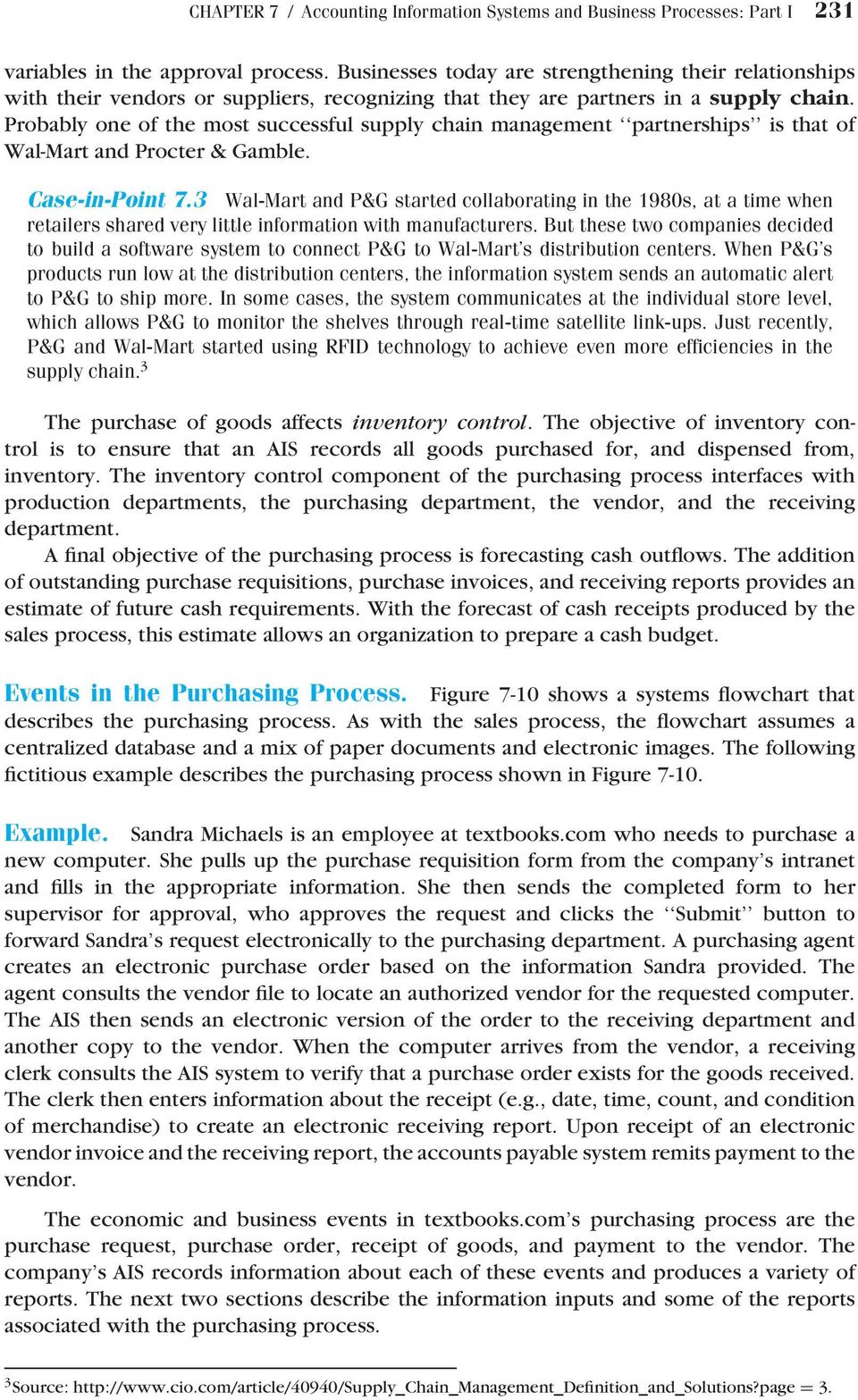
16 232 PART THREE / Using Accounting Information Request for goods or services Employees key in requests or automated requests for raw materials Process requisition Inventory and purchase requisition files Electronic requisition to purchase department Purchasing agent creates electronic purchase order Vendor & purchase order files Electronic purchase order to receiving Electronic purchase order to vendor Purchase order & receiving files Receiving creates electronic receiving report A/P system matches electronic documents & sends payment Vendor sends electronic invoice Process and print reports Financial statements Cash payment forecast Vendor listing Management reports High-level Systems flowchart of the purchasing process in an online environ- FIGURE 7-10 ment.

17 CHAPTER 7 / Accounting Information Systems and Business Processes: Part I 233 Inputs to the Purchasing Process As explained earlier, the purchasing process often begins with a requisition from a production department for goods or services. Sometimes, an AIS triggers purchase orders automatically when inventories fall below pre-specified levels. The purchase requisition shows the item requested and may show the name of the vendor who supplies it. In Figure 7-11, the accounts payable system matches three source documents before remitting payment to the vendor: the purchase order, the receiving report, and the purchase invoice. A purchase invoice is a copy of the vendor s sales invoice. The purchasing organization receives this copy as a bill for the goods or services purchased. The purpose of matching the purchase order, receiving report, and purchase invoice is to maintain the best possible control over cash payments to vendors. For example, the absence of one of these documents could signify a duplicate payment. A computerized AIS can search more efficiently for duplicate payments than a manual system. For example, auditors can instruct an AIS to print a list of duplicate invoice numbers, vendor checks for like dollar amounts, and similar control information. The purchase requisition initiates the purchase order. Besides the information on the requisition, the purchase order includes vendor information and payment terms (see Figure 7-4). The purchasing department typically prepares several copies (or images) of the purchase order. In a paper-based system, the purchasing clerk sends one copy of the purchase order to the receiving department to serve as a receiving report or, preferably, to prompt the receiving department to issue a separate receiving report. This copy of the Inventory Control Receive Goods or Services Shipping Notice Materials Requisition Form Receiving Report Receiving Report Production Departments Purchase Requisition Purchase Goods or Services Purchase Order Vendor Purchase Order Notice of Receipt Invoice and Payment Data Maintain Accounts Payable Purchase Invoice Payment Accounts Payable Master File Cash Requirement Forecast Purchase Analysis Management FIGURE 7-11 Data flow diagram of the purchasing process.

18 234 PART THREE / Using Accounting Information purchase order is specially coded (or color-coded) to distinguish it from other copies of the purchase order if there is no separate receiving report. The receiving department copy might leave out the quantities ordered that are identified in the purchase order. This is done for control purposes, so that workers receiving the goods must do their own counts, rather than simply approving the amounts shown on the purchase order. Another source document, a bill of lading, accompanies the goods sent. The freight carrier gives the supplier a bill of lading as a receipt, which means the carrier assumes responsibility for the goods. It may contain informationaboutthedateshipped,thepoint of delivery for freight payment (either shipping point or destination), the carrier, the route, and the mode of shipment. The customer may receive a copy of the shipping notice with the purchase invoice. This is important to the accounts payable subsystem, because accounts payable accruals include a liability for goods shipped free on board (FOB) from the shipping point. Goods shipped this way have left the vendor, but the customer has not yet received them. Another source document, the packing slip, is sometimes included in the merchandise package. This document indicates the specific quantities and items in the shipment and any goods that are on back order. The next time you order goods through a catalog or over the Internet, look for a packing slip, such as the one shown in Figure 7-12, in the container with your merchandise. Outputs of the Purchasing Process Typical outputs of the purchasing process are vendor checks and accompanying check register, discrepancy reports, and a cash requirements forecasts. The check register lists all checks issued for a particular period. Accounts payable typically processes checks in batches and produces the check register as a byproduct of this processing step. Discrepancy reports are necessary to note any differences between quantities or amounts on the purchase order, the receiving report, and the purchase invoice. The purpose of a discrepancy report is to ensure that no one authorizes a vendor check until the appropriate manager properly reconciles any differences. For example, assume that a receiving report indicates the receipt of twelve units of product, whereas the purchase order shows that a company ordered twenty units and the purchase invoice bills the company for these twenty units. The accounts payable function records the liability for twenty units and notes the situation on a discrepancy report for management. This report would trigger an investigation. For example, it is possible that the vendor made two shipments of merchandise, and one shipment has yet to be received. If this is the case, receipt of the second shipment clears this discrepancy from the next report. However, it this is not the case, it is important for management to determine the cause of the discrepancy as soon as possible. The purchasing process produces a cash requirements forecast inthesamemanner that the sales process produces a cash receipts forecast. By looking at source documents such as outstanding purchase orders, unbilled receiving reports, and vendor invoices, an AIS can predict future cash payments and their dates. Naturally, this forecast is easier to make with a computerized system than with a manual system. Information Technology (IT) Used in the Sales and Purchasing Processes. Much of the input and output related to business processes is now electronic, and that includes the sales and purchasing processes. For instance, inputs (sales order or purchase requests) can be voice inputs, touch-tone telephone signals, bar codes, video signals, magnetic ink characters (as on checks), scanned images, or keystrokes from a computer.

19 Coffeyville Ind. Park 2654 N. Highway 169 Coffeyville, KS US +1 (206) Amazon.com Coffeyville Ind. Park 2654 N. Highway 169 Coffeyville, KS USA Toll Free: (800) Voice: +1 (206) FAX: +1 (206) Carolyn S. Norman River Terrace Richmond, VA United States Carolyn S. Norman River Terrace Richmond, VA United States UPS_GR Your order of June 29, 2010 (Order ID ) hhvv8429/4b/11414/std-us/ / Qty Item Description Format Our Price Total In This Shipment 1 Rough Draft (P 2 A25B23) Hall, James W. Hardcover $17.47 $ The Brethren (R 1 O43A1) Grisham, John Hardcover $16.77 $ The Business of Consulting : The Basics and Beyond (P 2 D4E5) Biech, Elaine Hardcover $39.95 $ Flawless Consulting: A Guide to Getting Your Expertise Used (Second Edition) (P 5 K56F3) Block, Peter Hardcover $39.95 $39.95 Subtotal Shipping & Handling $ Order Total Paid via Visa Balance Due This shipment completes your order. You can always check the status of your orders from the "Your Account" link on our homepage. Thanks for shopping at Amazon.com, and please come again! FIGURE 7-12 A packing slip from amazon.com. 235

20 236 PART THREE / Using Accounting Information Salespeople in the field typically use laptop computers, portable bar code scanners, or other types of input devices to enter data. With a wireless capability, they can also enter the information in real-time. Case-in-Point 7.4 If you have moved lately, you probably watched a moving company representative walk through your home with a barcode scanner and a sheet of paper with various barcodes for different pieces of furniture and other items in your home. After the walkthrough, the representative can quickly download the information to a laptop, print out an estimate of the cost of your move, and discuss the estimate with you all in the same visit! 4 Automated data-entry technologyhelps companies save money as well as provide better customer service. For example, bar code scanners that are commonly used in most retail stores gather essential inventory data (and help to avoid human error) for the retailer, and they also can help expedite the checkout process for customers. In addition, some retailers are using biometric technology that offers customers convenience and faster-checkouts, and offers retailers savings in transaction costs. Here s how biometric payment works: To set up an account, customers scan their fingerprint at an in-store kiosk, enter their phone number, and then submit checking and credit card account information. To make a purchase, they place their finger on a scanner at the register, enter their phone number, and choose how they want to pay (credit, debit, or checking). 5 Case-in-Point 7.5 In 1916, Clarence Saunders (a very innovative businessman in Memphis, TN) opened the first Piggly Wiggly grocery store the very first self-service grocery store. Saunders recently decided to be innovative again and started a pilot program to test the use of biometric payments. Within three months of starting the pilot program at four Piggly Wiggly grocery stores, 15% of its customers who normally did not pay by cash enrolled in the Pay By Touch system. Those users increased their store visits by 15%, which translates into an additional 7,350 transactions a year. Not only did they come more often, those shoppers also spent 12% more on groceries. 6 IT supports the purchasing process in a variety of ways. For example, an organization might determine that some inventory items can be reordered automatically and electronically when the company reaches a predetermined minimum quantity of those inventory items. An automatic reorder can be generated by the computer system, sent electronically tothevendor,andthevendorcanbepaidelectronicallybyusingedi.wediscussthis aspect of e-commerce more in depth in Chapter 15. After purchases arrive, our next concern is inventory management. To effectivelymanageinventory,wemightusedifferent technologies. Below, we describe two cases where organizations decided to use RFID tags (a computer chip with a tiny antenna) to manage inventory. The first is the Boeing Company and the second is the Department of Defense. In both cases, the vendors of the manufactured goods place the RFID tags on the items. The interesting point about RFID tags is that they can contain a complete history of the individual part, and then the purchaser can add or delete information to or from the tag as the part proceeds through the supply chain. Case-in-Point 7.6 The Boeing Co. uses RFID tags to track between 1,700 and 2,000 mission-critical parts on each of its new 787 jetliners, but that s really not very many when 4 Source: from the authors. 5 Source: fortune biometrics. 6 Sources: and 24/magazines/fortune/pluggedin fortune biometrics.

21 CHAPTER 7 / Accounting Information Systems and Business Processes: Part I 237 you consider that each of these jetliners has about 6 million parts. The parts that are tagged with RFID are those that are either very expensive or frequently require maintenance and replacement. Information stored on the RFID tag helps trace parts and reduces cycle time to solve service problems. For example, before RFID, if one of the three computers in the cockpit of a 747 needed to be replaced, a mechanic would have to get on his back with a flashlight and a mirror to search for a serial number. Now, the mechanic can walk into a cockpit with an RFID reader and locate the faulty computer with just a couple of clicks. 7 Case-in-Point 7.7 The Department of Defense (DOD) requires its largest suppliers to attach RFID tags to all pallets of merchandise shipped to the DOD. The DOD wants to use RFID tags to improve business functions, all aspects of the defense supply chain, and inventory management. This is particularly important because the DOD has more than 43,000 suppliers, and 100 of these suppliers account for 80% of the dollar value of supplies. 8 CURRENT TRENDS IN BUSINESS PROCESSES Organizations frequently divide business processes into core processes and other processes. In the past, managers and managementaccountants focusedon cost management, while managers and internal auditors primarily focused on improving core processes. In all cases, the goal was typically to make these processes as efficient as possible. Now, organizations are critically examining their processes to determine which ones to keep and which ones to outsource. Results from a 2008 Accenture survey suggest that companies outsource for strategic advantages as much as for cost savings, as we highlight in the following case-in-point. Case-in-Point 7.8 The senior executives who responded to the Accenture survey credit outsourcing with increasing their sense of control over business performance, and the most common control gains that they mentioned are: Improved planning (47%) Greater reliability of business information (39%) A stronger grasp of business outcomes (37%) More effective implementation of ideas (33%) Increased revenue (32%) 9 Business Processes Outsourcing (BPO) Companies outsource such business processes as human resources, finance and accounting, customer services, learning services and training, and information technology. A recent survey estimated the global BPO market for human resources services to be $50 billion. See Figure 7-13 for examples of outsourcing. 7 Source: files/eps cs/boeing cs web.pdf 8 Sullivan, Laurie, Department of Defense Turns to IBM for RFID Expertise, InformationWeek (March 17, 2004). RFID tags are similar to bar codes, but can store more information. Both require a transmitter gun to collect the data. 9 Accenture. High Performance Outsourcing: Gaining Control through Outsourcing in the Manufacturing and Consumer Industries, (2008), at
22 238 PART THREE / Using Accounting Information Company/Industry Proctor & Gamble EarthLink Inc. Many banks and other corporations Owens & Minor Sun Microsystems, Inc. City of Copenhagen University of Texas Health Science Center at Houston Sprint Business Process Outsourced HR function to IBM Most of its billing, sales, tech-support calls, and other customersupport functions General and Specialty Printing (expected to grow from $30B in 2002 to $35B in 2007) Information Technology to Perot Systems Training for Sun employees and Sun s customers to Accenture Payroll and HR function to Accenture Physician billing and collection services to Atlanta-based Per-Se Technologies Call center operations to IBM Corp. FIGURE 7-13 Examples of Business Process Outsourcing (BPO). Case-in-Point 7.9 CNA is one of the largest insurance company in the United States, providing such services (core processes) as risk management, information services, underwriting, and claims administration. Rather than develop training programs for their employees, CNA outsourced this business process to another company. Similarly, many universities outsource a number of operations they used to perform themselves for example, landscaping, food services, or janitorial services so that they can focus on core functions more directly related to educating students. Today s combination of networked enterprises and globalization has given rise to a business model called business without boundaries. Companies no longer have all of their employees in one location, working on various business processes such as HR, accounting, production, and others. Employees may be located anywhere in the world, and they are. The result is a new dimension to outsourcing called offshoring moving jobs offshore to countries like India, China, Canada, Mexico, or Malaysia. Of course, not all outsourced business processes are accomplished by employees in foreign countries. Many of these processes are still accomplished by businesses in the United States. Nevertheless, all business processes are under a great deal of scrutiny by managers and management accountants as companies become more strategically oriented toward revenue generation and more vigilant about managing costs. The important point for accountants is that, at some point, you will most likely be on a team of professionals in your organization that will study the costs and benefits of either keeping a business process in-house or outsourcing the function. If the team decides that the organization should keep the process, then the next task might be to decide what business process management (BPM) software the company should use to automate that process. Software companies are developing a wide variety of business process solutions to help managers integrate their existing data and applications into efficient and effective business systems. If the decision is to outsource the process, then accountants will most certainly be involved in analyzing the many costs and benefits/concerns associated with the decision. Business Process Management Software Business Process Management (BPM) software packages help companies collect corporate knowledge, data, and business rules into a business system to improve core business processes. Think of BPM as a combination of software tools and management
23 CHAPTER 7 / Accounting Information Systems and Business Processes: Part I 239 practices that enable entities to accomplish business processes more efficiently. As a result, managers have timely access to performance data related to clients, projects, financials, and people to improve company performance and these benefits are available even to smaller businesses, as the following case-in-point describes. The market for these software packages is substantial over $1 billion. 10 Case-in-Point 7.10 The Sleeter Group is a nationwide community of experts who provide QuickBooks consulting services to small business owners and they also announce their Annual Award List of Awesome Add-ons for QuickBooks. For 2009, this list includes Attitude Positive (a Point of Sale BPM solution for the retailer and restaurant industries); Bill.com (a web-based service to automate accounts payable processes); Right Networks ASP (for remote hosting of desktop applications); and a number of other very innovative BPM solutions! 11 AIS AT WORK Will Offshoring Change to Onshoring? 12 For the past decade, we read one story after another of yet another company that had outsourced or offshored a business process to another firm. Most troubling to Americans were the business processes and the many jobs associated with those functions that were moved to other countries, especially India, China, and the Philippines. Management of these firms claimed that such business decisions were necessary for their companies to remain competitive and to generate value for shareholders. However, some companies are beginning to reconsider earlier decisions to offshore, and may bring those jobs back to the United States. One such company, DESA Heating Products (DHP) of Bowling Green, Kentucky, is doing just that. In July 2008, DHP announced that the company would move their manufacturing production from China back to Bowling Green. Although DHP had outsourced hundreds of manufacturing jobs to China, management decided to reverse that decision and bring those jobs back to its Kentucky factory. The rationale for this decision focuses on two factors: quality and cost. And when you think about it, these are both critical factors for a company s success because today s customers demand the best quality products at the lowest price. The Governor of Kentucky claimed that DHP s decision to bring their production back to the United States is a strong indicator of evolving outsourcing trends in the global economy. So what exactly are these trends? A recent report from a global consulting firm contains a number of clues: transportation costs, wage inflation, currency fluctuations, and quality issues. Perhaps DHP s experience with offshoring can help us understand the Governor s claim. First, Chinese workers are now demanding higher wages for their labor, which means that Chinese workers are no longer an economical solution to labor costs in the US (19% increase in China compared to 3% in the US since 2003). Second, significant 10 Business Editors, Business Process Management Engine Markets Expected to Reach $1.1 Billion by 2008, M2Presswire (February 19, 2004). 11 Business Editors, Awards Announced for QuickBooks Add-ons, PR Newswire (November 11, 2008). 12 Sources: Is the Practice of Offshoring Jobs Headed for an About-Face? HR Focus (December 2008), pp. 3 4; Denise Dube, Could Onshoring become the New Offshoring? study-onshoring.html; room/blog/2008/07/desa-to-expand-bowlinggreen.php.
24 240 PART THREE / Using Accounting Information fluctuations in oil prices cause great difficulty in budgeting the costs of transportation of goods produced in China especially for the large, heavy products that DHP produces. Third, Kentucky s central location in the United States means that DHP is only one day s drive from 70% of the population in the US. That translates to products in the hands of DHP s customers in 12 hours instead of the 6 8 weeks to ship from China. And finally, DHP expects to save money in warranty repairs and replacement costs manufacturing costs that tripled on the products made in China. SUMMARY The fundamentals of any business process include journals, ledgers, accounts, trial balances, and financial statements. When planning a new AIS, developers usually start by designing the outputs from the system. The fundamental instrument for collecting data in a typical AIS is the source document. Two business processes that are common to every business organization are the sales process and the purchasing process. The sales process begins with a customer order and ends with the collection of cash from the customer. Important source documents associated with the sales process are sales orders, sales invoices, remittance advices, shipping notices, and customer checks. The primary outputs of the sales process are reports such as a cash receipts report, a bad debt report, and a customer listing report. For the purchasing process, the AIS is concerned with timely payment for purchased goods and services. Source documents common to the purchasing process include purchase requisitions, purchase orders, receiving reports, purchase invoices, and bills of lading. The primary output of the purchasing process is the checks for vendors. Although companies still outsource to better manage costs, they now outsource and offshore business processes for strategic advantages. Some of the business processes that are most likely to be outsourced or offshored are human resources, finance and accounting, customer services, learning services and training, and information technology. KEY TERMS YOU SHOULD KNOW alphanumeric codes block codes business event business process Business Process Management (BPM) software business process outsourcing (BPO) business without boundaries customer relationship management (CRM) discrepancy reports economic event exception reports group code mnemonic codes numeric codes offshoring purchasing process RFID tags sales process sequence code supply chain
25 CHAPTER 7 / Accounting Information Systems and Business Processes: Part I 241 TEST YOURSELF Q7-1. Which of the following provides the organizational structure for the general ledger? a. Specialjournals b. A source document c. General journals d. The chart of accounts Q7-2. AISs depend on codes to record, classify, store, and retrieve financial data. Which of the following codes is a group of numbers reserved for particular uses? a. Block codes b. Mnemonic codes c. Alphanumeric codes d. Numeric codes Q7-3. AIS reports should be consistent in at least three ways. Which of the following is NOT one of those ways? a. Overtime b. Across product lines c. Across departmental or divisional levels d. With general accounting practice Q7-4. is (are) a collection of activities or flow of work in an organization that creates value. a. An economic event b. Accounting transactions c. A business process d. A chart of accounts Q7-5. Which of the following is NOT an objective of the sales process? a. Controlling inventory b. Tracking sales of goods and/or services to customers c. Billing for goods and services d. Forecasting sales and cash receipts Q7-6. Which of the following report(s) is (are) common to both the sales and the purchasing processes? a. Cash receipts forecast and cash requirements forecast b. Financial statement information c. Discrepancy reports and bad debt report d. None of the above Q7-7. Which of the following source document(s) is (are) common to both the sales and the purchasing processes? a. Debit/credit memoranda b. Financial statement information c. Discrepancy reports and bad debt report d. None of the above Q7-8. Which of the following business processes is most often targeted for offshoring? a. Janitorial services
26 242 PART THREE / Using Accounting Information b. Landscaping maintenance c. Information technology d. Employee training Q7-9. If a manager wanted to sort out any differences between quantities or amounts on the purchase order, the receiving report, and the purchase invoice, which of the following AIS reports would be most useful? a. A purchase analysis report b. An inventory control report c. A check register report d. A discrepancy report DISCUSSION QUESTIONS 7-1. As you might imagine, the chart of accounts for a manufacturing firm would be different from that of a service firm. Not surprisingly, service firms differ so much that software now exists for almost any type of firm that you could name. Think of yourself as an entrepreneur who is going to start up your own business. Now, go to an Office Depot, Staples, or similar office supply store (or search online) to find at least two different software packages that you might use for the type of firm you are going to start up. What does the Chart of Accounts include? Are both software packages the same? What differences are there? 7-2. What are the purposes of accounting codes? How are they used? Bring to class some examples of codes used by manufacturing firms, accounting firms, and merchandising firms What are some typical outputs of an AIS? Why do system analysts concentrate on managerial reports when they start to design an effective AIS? Why not start with the inputs to the system instead? 7-4. What are some criteria that systems designers should consider when developing managerial reports for an AIS? Can you think of any others beyond those described in the chapter? If so, what are they? 7-5. Visit a local business and collect some examples of source documents used in an AIS. For each source document example you collect, discuss its purpose(s). Are different source documents required for manufacturing firms versus merchandising organizations? Are all the business source documents paper based? 7-6. This chapter discussed many inputs to an organization s sales process. What are the specific data items needed to add a new customer and record a sales order? 7-7. How does a data flow diagram for the sales process differ from a system flowchart describing that process? 7-8. How are the inputs and outputs of the purchasing process likely to be different for a restaurant versus an automobile manufacturer? 7-9. Explain the term business without boundaries. How is this changing the nature of organizations and who accomplishes various business processes? Whatdowemeanwhenwesaycompaniesareoffshoringbusinessprocesses? Some businesses choose offshoring to solve the issue of expertise, especially for IT personnel. These companies claim they simply cannot find enough qualified employees in the United States to do certain technology jobs. Do you agree with this assessment? Why or why not? Search the web for unusual and interesting uses of RFID tags. Find at least two that are unusual and share those with your classmates.
27 CHAPTER 7 / Accounting Information Systems and Business Processes: Part I How do you feel about RFID tags? Do you think they offer more advantages or disadvantages? Identify the various advantages and disadvantages. Do you support the use of RFID tags for personal ID? Why or why not? PROBLEMS Listed below are several types of accounting data that might be coded. For each data item, recommend a type of code (mnemonic, sequence, block, or group) and support your choice. a. Employee identification number on a computer file b. Product number for a sales catalog c. Inventory number for the products of a wholesale drug company d. Inventory part number for a bicycle manufacturing company e. Identification numbers on the forms waiters and waitresses use to take orders f. Identification numbers on airline ticket stubs g. Automobile registration numbers h. Automobile engine block numbers i. Shirt sizes for men s shirts j. Colorcodesforhousepaint k. Identification numbers on payroll check forms l. Listener identification for a radio station m. Numbers on lottery tickets n. Identification numbers on a credit card o. Identification numbers on dollar bills p. Passwords used to gain access to a computer q. Zip codes r. A chart of accounts for a department store s. A chart of accounts for a flooring subcontractor t. Shoe sizes u. Identification number on a student examination v. Identificationnumberonaninsurancepolicy Novelty Gadgets is a marketer of inexpensive toys and novelties that it sells to retail stores, specialty stores, and catalog companies. As an accountant working for the company, you have been asked to design a product code for the company. In analyzing this problem, you have discovered the following: a. The company has three major product lines: (1) toys and games, (2) party and magic tricks, and (3) inexpensive gifts. There are major subproducts within each of these product lines, and the number of these categories is 25, 18, and 113, respectively. b. The company has divided its selling efforts into five geographic areas: (1) the United States, (2) the Far East, (3) Europe and Africa, (4) South America, and (5) International (a catchall area). Each major geographic area has several sales districts (never more than 99 per area). Between 1 and 20 salespeople are assigned to each district.
28 244 PART THREE / Using Accounting Information New vendor authorization form New product authorization form Key Key Add new vendors to vendor master file Add new products to products master file Vendor master file Product master file Authorized purchase recquisitions Key Prepare purchase order Purchase order pending file Purchase orders (to vendors) Purchase order summary FIGURE 7-14 and Company. System flowchart illustrating the preparation of purchase orders for P. Miesing c. As noted earlier, there are three major categories of customers, and certain customers can also purchase goods on credit. There are five different classes of credit customers and each rating indicates the maximum amount of credit the customer can have. Design a group code that Novelty Gadgets could use to prepare sales analysis reports. Be sure to identify each digit or position in your code in terms of both use and meaning Figure 7-14 is a system flowchart for P. Miesing and Company s purchase order event. Prepare a narrative to accompanythe flowchart describing this purchase order event. Include in your narrative the source documents involved, the computerized data processing that takes place, data inputs used to prepare purchase orders, and the outputs prepared from the processing function SSR-Save is a national discount retail store chain with annual revenues of more than $1 billion. It s a typical bricks-and-mortar operation with accounting software that records
29 CHAPTER 7 / Accounting Information Systems and Business Processes: Part I 245 sales transactions in real time and tracks inventories on a perpetual basis. Management is considering an online store and will sell the same products as in the stores. Customers will be able to use credit cards only for online payments (vs. cash, credit card or debit card in the stores). The marketing manager is interested in learning about customers and using the information to improve both in-store and online sales. a. Contrast the sales process of their retail store operation with the sales process in an online store environment. Would any of the events in the process change? b. At what points do you collect data about customers and sales transactions in the retail store? In the online environment? c. What data might you collect about retail store and online customers to improve your profitability? What data might you collect to improve customer satisfaction? d. How is the sales process different for a public accounting firm? What data can they collect to improve customer relationships and grow revenues? CASE ANALYSES The Caribbean Club (Customer Relationship Management) The Caribbean Club is one of the Virgin Island s hottest night spots. It s a great place for locals to meet after work and relax with friends, it s a popular destination for tourists who stay on the island, and it s always on the list of fun entertainment choices for the crowds from the cruise ships that dock in the harbor. The reason the Club is so popular with such a variety of customers is because the founder of the club, Ross Stewart, always has such innovative and visionary ideas that delight the patrons. For example, every night of the week the Club features different activities or shows, including beach volleyball, Caribbean shows with calypso singers, world-class musicians who play steel drums, and other island delights. Because Ross was a former accountant and auditor with one of the largest public accounting firms in New Zealand, he is very accustomed to brainstorming sessions to generate ideas and surface concerns. He brought this practice with him to the Caribbean and holds brainstorming sessions with his club associates (which is what he calls all of the employees at the club) once every month to identify new and novel ideas to increase the popularity and profitability of the club. As you might imagine, the patrons of a night club are there to relax and enjoy themselves. Therefore, the associates thought it would be a great idea to somehow be able to recognize their regular patrons so that they wouldn t have to trouble them with a bill every time a server came to their table with another round of drinks. After all, if the Club wanted these people to feel like they were at home with friends, the patrons shouldn t have to bother with trying to decide who owed what to pay the bill. What a nuisance! So Ross and his associates came up with the idea to implant their regular customers with an implantable microchip. The idea was to make the chip fun to give it an elite status so that their regular patrons would want to be implanted. To dramatize the elite status of the chip, Ross decided that the Club would have a special area where only those with chips, the VIPs, would be admitted. And of course, this area would have various exclusive services for these members. The chip would allow the VIPS to be recognized and to be able to pay for their food and drinks without any ID they would simply pass by a reader and the Club would know who they are and their credit balance. Ross also wanted
30 246 PART THREE / Using Accounting Information the information system supporting the chip to be a customer relationship management tool. Requirements: 1. What do you think of this idea? That is, what are the advantages and disadvantages of this idea for the Caribbean Club? 2. If you were Ross, what information would you want the CRM to collect? Search the Internet to see if you can find a CRM software package that seems appropriate for the Club. Why did you select this particular software? 3. What are the advantages and disadvantages for the patrons? 4. If you were a passenger on a cruise ship, or staying at a resort on the island, would you get the chip implanted? Why or why not? Larkin State University (Purchasing Process) Larkin State University is a medium-sized academic institution located in the Southeastern United States. The university employs about 250 full-time faculty and 300 staff personnel. There are 12,000 students enrolled among the university s four colleges. The Purchase Process The university s budget for purchases of equipment and supplies is about $25 million annually. Peter Reese is in charge of the Purchasing Department. He reports directly to the Vice President of Finance for the university. Pete supervises four purchasing clerks and three receiving personnel. The office is responsible for purchases of all equipment and supplies except for computer equipment and software, and plant purchases or additions. The Payment Process The various departments across campus manually fill out hard copy purchase requisition forms when there is a need for equipment/supplies. Each department forwards these forms to the Purchasing Department. If the request is for computer equipment or software, the requisition is forwarded to the Department of Information Technology for action. Purchase requisitions are assigned to one of the three purchasing clerks by department. For instance, one purchasing clerk makes purchases for all university departments beginning with the letters A through G (Accounting Geology). Purchasing clerks check the requisition to make sure it is authorized and then consult the Approved Vendor Listing to find a supplier. The clerk may contact a supplier for pricing and product specification. Once this task is complete, the purchasing clerk enters the purchase requisition and vendor and priceinformationinto the computer system, which prints out a multiple-part purchase order. Clerks send copies of the purchase order to Central Receiving, to the vendor, and to the Accounts Payable Department. (The university considered using EDI for its purchases, but chose not to adopt it due to the large number of vendors used.)
31 CHAPTER 7 / Accounting Information Systems and Business Processes: Part I 247 When Central Receiving receives an order, a receiving clerk consults the Purchase Order file to make sure the correct product and quantity have been delivered. The clerk also checks the product for damage. Central receiving does not accept any over-shipments. Receiving clerks forward accepted shipments to the adjacent warehouse for distribution to the appropriate department. Clerks file one copy of the Receiving Report, send one copy to the Purchasing Department, and forward a third copy to Accounts Payable. George Vaughn is the Supervisor of Accounts Payable. Two accounting clerks report to him. He assigns invoices to them for payment based on vendor name. One clerk processes payments for vendors A M and the other clerk handles payments to all vendors with names beginning with letters N Z. The clerks match each vendor invoice with a copy of the receiving report and purchase order before entering it into the computer for payment by due date. There are often discrepancies among the three documents. This requires frequent phone calls to the vendor, the Receiving Department, or Purchasing for resolution. As a result, the company frequently makes payments late and loses out on cash discounts. Requirements: 1. Identify the important business events that occur within Larkin s purchase/payment process. 2. What changes would you suggest to the current process to take advantage of information technology? Uptown Bucks (Sales Process) UptownBucks(UB)isanoff-campusmealplanbusinessinOxford,Ohio.Studentsortheir families buy debit cards with fixed amounts that they can use to purchase food at more than 18 local restaurants. Customers can buy the cards at UB s office in the center of town, or they may purchase the cards online. The following paragraph describes the online card sale process. A customer enters their credit card information online and then the amount of purchase. UB s software automatically checks the card number to determine that it is a valid credit card number; for instance, there are certain digits that indicate Visa cards. The software displays an error message if the number is not valid. The usual cause of these errors is typographical. Once the customercompletes the card order screen, the software sends the data in an encrypted form to UB s host computer. Periodically, the UB accountant retrieves transactions from the server. This is done by clicking on the Get Transactions screen button. For each online transaction, the accountant then manually copies down the credit card number on a scrap of paper, walks across the office to the credit card machine, and keys in the credit card number, the amount, and the numerical portion of the address. The credit card software checks to see if the card is valid and charges it for the amount. The accountant next writes down the validation number, returns to the host computer, and enters it. She prints a receipt for the transaction and puts it in a file. The customer database now reflects the new customer. When a customer purchases a card off-line with a credit card, the accountant swipes the card directly, checks its validity, charges the card, and then writes down the validation number and enters it in the host computer. UB is considering the purchase of credit card software that can reside on the host computer and interact with their accounting software. The credit card software costs
32 248 PART THREE / Using Accounting Information about $400. The credit card company rates are likely to increase by about. 5% because cards could no longer be swiped directly all credit card purchases would need to go through the online software. The rate UB has to pay the credit card company is based on this mix. Credit card companies typically charge more if card numbers are punched rather than swiped because they have more chance of invalid transactions due to theft. It s easier to steal a number than a card. Currently about half of UB s sales transactions arise from online sales; the other half result from sales through the office. Requirements: 1. Should UB buy the credit card software? 2. Use the skills you developed from Chapter 3 to develop a flowchart for UB s online sales process. 3. What are the business risks associated with this process? REFERENCES AND RECOMMENDED READINGS Anonymous. EarthLink Cuts Jobs, Closes Centers: Needs to Outsource More, Information Week (January 7, 2004). Business Editor. Biometrics: Payments at your fingertips, Business Week Online (March 28, 2006). Croysdale, D. Outsourcing: It s What We Do, The Daily Reporter (Dolan Media Newswires) (March 3, 2004). Dubie, D. Could onshoring become the new offshoring? study-onshoring.html. Gerardo, R. & A. Spanyi. The CFO s best friend, Strategic Finance (December 2008), pp Lamont, J. BPM: Not just for the big kids on the block, KMWorld (January 2004), p Malone, T. Performance Management: Enabling Smarter Business, Financial Executive (September 2005), p McGinn, D. Help Not Wanted. Jobs: Where Did They Go? Offshoring s a Problem, Newsweek (March 1, 2004), p. 31. Reingold, J. Into Thin Air, Fast Company (April 2004), p Sahut, J. The adoption and diffusion of electronic wallets, Journal of Internet Banking and Commerce (April 2008); (an open access Internet journal). Worthen, B. Business Process Management: A New Glue or the Old Soft Shoe? CIO.com (November 15, 2004). ANSWERS TO TEST YOURSELF 1. d 2. a 3. b 4. c 5. a 6. b 7. a 8. c 9. d
Accounting information systems and business process : part 1
 King Saud University College of Administrative Science Department of Accounting Accounting information systems and business process : part 1 Chapter 4 Prepared By: Eman Al-Aqeel Professor : Dr: Suliman
Generic Business Process (1) Expenditure Cycle & Revenue Cycle
 Generic Business Process (1) Expenditure Cycle & Revenue Cycle Topik Bahasan Expenditure Cycle Revenue Cycle Sumber Materi Romney / Steinbart, Accounting Information Systems, 9th Edition ch.11-12, Prentice
10-1. Auditing Business Process. Objectives Understand the Auditing of the Enteties Business. Process
 10-1 Auditing Business Process Auditing Business Process Objectives Understand the Auditing of the Enteties Business Process Identify the types of transactions in different Business Process Asses Control
ACS-1803 Introduction to Information Systems. Functional Area Systems. Lecture 4
 ACS-1803 Introduction to Information Systems Instructor: David Tenjo Functional Area Systems Lecture 4 1 Overview Overview of Functional Areas in the organization Functional Area: Accounting Accounting
Job Ready Assessment Blueprint. Accounting-Advanced. Test Code: 3900 / Version: 01
 Job Ready Assessment Blueprint Accounting-Advanced Test Code: 3900 / Version: 01 Measuring What Matters Specific Competencies and Skills Tested in this Assessment: Journalizing Journalize an opening entry
Lecture Objectives. Basic Business Systems. Example systems. Business applications for information. Basic Business Systems
 CSE1204 - Information Systems 1 Lecture Objectives BASIC BUSINESS SYSTEMS to understand concepts and principles of basic business systems to be aware of some typical computerbased information systems within
Studio Designer 80 Guide
 Table Of Contents Introduction... 1 Installation... 3 Installation... 3 Getting started... 5 Enter your company information... 5 Enter employees... 6 Enter clients... 7 Enter vendors... 8 Customize the
QuickBooks. Reports List 2013. Enterprise Solutions 14.0
 QuickBooks Reports List 2013 Enterprise Solutions 14.0 Table of Contents Complete List of Reports... 5 Company & Financial Reports... 6 Profit & Loss... 6 Income & Expenses... 7 Balance Sheet & Net Worth...
Intuit QuickBooks Enterprise Solutions 10.0 Complete List of Reports
 Intuit QuickBooks Enterprise Solutions 10.0 Complete List of Reports Intuit QuickBooks Enterprise Solutions, for growing businesses, is the most powerful QuickBooks product. It has the capabilities and
We now examine the documents and procedures used to perform each step. Step 1: Capture Transaction Data on Source Documents
 Journals and Ledgers TRANSACTION PROCESSING: DOCUMENTS AND PROCEDURES IN A MANUAL AIS One basic function of the AIS is the efficient and effective processing of data about a company s transactions. Transaction
Accounts Payable User Manual
 Accounts Payable User Manual Confidential Information This document contains proprietary and valuable, confidential trade secret information of APPX Software, Inc., Richmond, Virginia Notice of Authorship
Accounts Payable. Highlights
 Accounts Payable With Blackbaud s Accounts Payable, paying bills is now easier and more efficient. Make payments any way you want by system-generated or handwritten check, bank draft or electronic funds
Learning Objectives: Quick answer key: Question # Multiple Choice True/False. 14.1 Describe the important of accounting and financial information.
 0 Learning Objectives: 14.1 Describe the important of accounting and financial information. 14.2 Differentiate between managerial and financial accounting. 14.3 Identify the six steps of the accounting
Chapter 15 Auditing the Expenditure Cycle
 Chapter 15 Auditing the Expenditure Cycle Expenditure cycle consists of activities related to the acquisition of and payment for plant assets and goods and services. Two major transaction classes: 1 purchases
EdgeLink Accounting Transfer Utility For Simply Accounting
 EdgeLink Accounting Transfer Utility For Simply Accounting Copyright Edge Management Systems Inc 403.948.0611 The EdgeLink Accounting Transfer Utility is an optional add-on module available within the
Distribution Training Guide. D110 Sales Order Management: Basic
 Distribution Training Guide D110 Sales Order Management: Basic Certification Course Prerequisites The combined D110 Sales Order Management certification course consists of a hands- on guide that will walk
CHAPTER 2 REVIEW OF THE ACCOUNTING PROCESS. Lecture Outline
 CHAPTER 2 REVIEW OF THE ACCOUNTING PROCESS Overview Chapter 1 explained that the primary means of conveying financial information to investors, creditors, and other external users is through financial
Navigating within QuickBooks
 Navigating within QuickBooks The simplest way to navigate within QuickBooks is to work from the home page. Looking at the home page, you will notice the most common functions within QuickBooks are represented
Accounting & Finance. Guidebook
 Accounting & Finance Guidebook January 2012 TABLE OF CONTENTS Table of Contents... 2 Preface... 6 Getting Started... 8 Accounting... 10 Accounting Welcome... 10 Sales Quotes... 11 New Sales Quote... 11
ProStix Smartstore Training Manual - Accounts Payable. 2014 Sterland Computing
 ProStix Smartstore Training Manual - Accounts Payable Contents 3 Table of Contents Accounts Payable 4 1 Introduction to... Accounts Payable 4 2 Accounts Payable... Terminology 6 3 PreRequisites... 9 4
Concepts in Enterprise Resource Planning. Chapter 5 Accounting in ERP Systems
 Concepts in Enterprise Resource Planning Chapter 5 Accounting in ERP Systems Chapter Objectives Describe the differences between financial and managerial accounting. Identify and describe problems associated
12 tips for taking control of inventory control.
 White paper 12 tips for taking control of inventory control. Keeping track of inventory in a growing retail business is tricky. These 12 tips can make it easier. www.brightpearl.com Introduction When your
RAPID REVIEW Chapter Content
 RAPID REVIEW BASIC ACCOUNTING EQUATION (Chapter 2) INVENTORY (Chapters 5 and 6) Basic Equation Assets Owner s Equity Expanded Owner s Owner s Assets Equation = Liabilities Capital Drawing Revenues Debit
Oak Street The Complete Solution
 Oak Street The Complete Solution Eight years ago, I.S.S. set out to create a new, more powerful software package. We began with our 18 years of experience serving wholesalers. Then, we looked at the best
Version 10 ACCOUNTS RECEIVABLE
 Version 10 ACCOUNTS RECEIVABLE Accounts Receivable Manual Version 10 ACCOUNTS PAYABLE ACCOUNTS RECEIVABLE BILLING CONTROL FILES FIXED ASSETS GENERAL LEDGER INVENTORY PAYROLL PERSONNEL ii N/Compass Hotline
Bookkeeping Proficiency
 Bookkeeping Proficiency (Exam) Your AccountingCoach PRO membership includes lifetime access to all of our materials. Take a quick tour by visiting www.accountingcoach.com/quicktour. Table of Contents (click
THE EXPENDITURE CYCLE Part I
 CHAPTER THE EXPENDITURE CYCLE Part I Businesses need resources in order to conduct their business to produce and sell a product or to provide a service. The expenditure cycle is concerned with the acquisition
BEDFORD PUBLIC SCHOOLS BUSINESS OFFICE PROCEDURES MANUAL
 BEDFORD PUBLIC SCHOOLS BUSINESS OFFICE PROCEDURES MANUAL Revised 3-27-2014 TABLE OF CONTENTS Section 1: Section 2: Section 3: Section 4: Section 5: Section 6: Section 7: Section 8: Section 9: Cash Management
Accounts Payable System Administration Manual
 Accounts Payable System Administration Manual Confidential Information This document contains proprietary and valuable, confidential trade secret information of APPX Software, Inc., Richmond, Virginia
The POS system can track sales by various payment methods like cash, checks, credit cards, coupons, and gift certificates.
 Point-Of-Sale Overview You can use the Point-of-Sale module (POS) to create Cash Receipts, Invoices, and receive A/R Payments. In addition, you can create returns for Receipts and Invoices. The POS system
Application Programming Interface (API)
 Integration to Salesforce CRM Create a Recurring Billing Contract from an Opportunity in one click. Create a Sales Order from an Opportunity in one click. Create a Project from a list of pre- defined templates
HorseTrak Accounting System
 HorseTrak Accounting System For Users of HT Gold and HT Deluxe General In this manual we explain the operation of the accounting features of HorseTrak Software. While teaching the principles of accounting
Accounts Receivable User Manual
 Accounts Receivable User Manual Confidential Information This document contains proprietary and valuable, confidential trade secret information of APPX Software, Inc., Richmond, Virginia Notice of Authorship
Microsoft Business Solutions Solomon. Distribution Sample Reports. Release 6.0
 Microsoft Business Solutions Solomon Distribution Sample Reports Release 6.0 Copyright Trademarks Warranty disclaimer Limitation of liability License agreement Manual copyright 2004 Great Plains Software,
MODULE 4: PURCHASE ORDER MANAGEMENT
 MODULE 4: PURCHASE ORDER MANAGEMENT Module Overview Timely purchases that are made at the best price improve a company s inventory management, reduce costs, and have a direct effect on the company s ability
Welcome to the topic on purchasing items.
 Welcome to the topic on purchasing items. In this topic, we will perform the basic steps for purchasing items. As we go through the process, we will explain the consequences of each process step on inventory
Accounts Receivable System Administration Manual
 Accounts Receivable System Administration Manual Confidential Information This document contains proprietary and valuable, confidential trade secret information of APPX Software, Inc., Richmond, Virginia
for Sage 100 ERP Purchase Order Overview Document
 for Sage 100 ERP Purchase Order Document 2012 Sage Software, Inc. All rights reserved. Sage Software, Sage Software logos, and the Sage Software product and service names mentioned herein are registered
Abila MIP Fund Accounting
 Abila MIP Fund Accounting Module Overview Award-winning Abila MIP Fund Accounting (formerly Sage 100 Fund Accounting) is the financial management solution preferred by nonprofit and government organizations
Advanced Accounting. Chapter 4: Financial Reporting for a Departmentalized Business
 Advanced Accounting Chapter 4: Financial Reporting for a Departmentalized Business Financial statements are used to summarize financial info and then are used to evaluate the financial position and progress
Chapter. Skyline College 7-1
 Chapter 7 Skyline College 7-1 The three types of business operations are: A service business is a business that sells services. A merchandising business is a business that sells goods purchased for resale.
Customer Credit and Accounts Receivable
 Customer Credit and Accounts Receivable Gap Analysis: POS identifies the following Best Practices as efficient and effective control processes for the above risk. Listed for comparison are the controls
Introduction to QuickBooks Online Edition Course Manual
 Introduction to QuickBooks Online Edition Course Manual Module 8 End of Period Activities and Financial Statements Copyright Notice. Each module of the Introduction To QuickBooks Course Manual may be viewed
Process ERP Software Selection RFP Template
 Process ERP Software Selection RFP Template KB Description: Goal: The simplified definition of enterprise resource planning (ERP) software is a set of applications that automate finance and human resources
INTRODUCTION TO FARM AND RANCH ACCOUNTING USING QUICKEN
 INTRODUCTION TO FARM AND RANCH ACCOUNTING USING QUICKEN Larry K. Bond Extension Economist and Associate Professor Department of Economics Utah State University May 1995 Economic Institute Study Paper ~
Gold Run Snowmobile. Adjusting Entries and Closing Entries For The Quarter Ended December 31. Final Project Evaluation. 5 th Edition.
 Gold Run Snowmobile 5 th Edition Adjusting Entries and Closing Entries For The Quarter Ended December 31 and the Final Project Evaluation Page 1 ADJUSTING ENTRIES FOR THE QUARTER Using a copy of the December
Audit Program for Accounts Receivable and Sales
 Form AP 15 Index Reference Audit Program for Accounts Receivable and Sales Legal Company Name Client: Balance Sheet Date: Instructions: The auditor should refer to the audit planning documentation to gain
8.0.0.0.0 Accounts Receivable. I. Overview Definitions and Abbreviations. Equipment and Supplies Required
 8.0.0.0.0 Accounts Receivable I. Overview Definitions and Abbreviations Equipment and Supplies Required Page 1 of 36 Revised October 2015 Version 4 II. Job Position(s) Accounts Receivable Clerk Page 2
In the event of a tie, the score on the last ten questions will be used as a tie-breaker.
 NEW YORK STATE ASSOCIATION FUTURE BUSINESS LEADERS OF AMERICA SPRING DISTRICT MEETING ACCOUNTING I 2010 TEST DIRECTIONS 1. Complete the information requested on the answer sheet. PRINT your name on the
Accounting II Second Semester Final
 Name: Class: Date: Accounting II Second Semester Final Multiple Choice Identify the letter of the choice that best completes the statement or answers the question. 1. Profit is the difference between:
Volume EASTMAN KODAK COMPANY. Worldwide Purchasing. Supplier Manual
 Volume EASTMAN KODAK COMPANY Worldwide Purchasing Supplier Manual EASTMAN KODAK COMPANY Supplier Manual Purpose of Manual To document standard business practices between Eastman Kodak Company and its suppliers
Microsoft Dynamics GP 2013. Packaging of Functionality & Product Capabilities in Microsoft Dynamics GP 2013
 Microsoft Dynamics GP 2013 Packaging of Functionality & Product Capabilities in Microsoft Dynamics GP 2013 Date: November, 2012 Contents Become a Dynamic Business with Microsoft Dynamics GP 3 How to Buy
Basic Accounting Principles
 Basic Accounting Principles Basic Accounting Model The basic accounting model represents the relationship between assets (what the company owns), liabilities (what the company owes), and owner s equity
INDICE Preface Part 1 the accounting cycle 1 Accounting, the language of business What is accounting?
 INDICE Preface XV Part 1 the accounting cycle 1 Accounting, the language of business 2 What is accounting? The purpose and nature and accounting information, creating accounting information. Communicating
The University of Arizona Financial Services Office INFORMATION & INSTRUCTIONS
 The University of Arizona Financial Services Office Special Fiscal Year End Reporting: Inventory, Accounts Receivable, Unearned Revenues, Prepaid Expenses & Deposits INFORMATION & INSTRUCTIONS May 19,
TRAVERSE Distribution solutions from Open Systems, Inc. improve efficiency and productivity regardless of the size & scope of your channel.
 TRAVERSE Distribution solutions from Open Systems, Inc. improve efficiency and productivity regardless of the size & scope of your channel. Your industry is continuously moving and changing. Competition
STATEMENT OF CASH FLOWS AND WORKING CAPITAL ANALYSIS
 C H A P T E R 1 0 STATEMENT OF CASH FLOWS AND WORKING CAPITAL ANALYSIS I N T R O D U C T I O N Historically, profit-oriented businesses have used the accrual basis of accounting in which the income statement,
Inventory Control System Administration Manual
 Inventory Control System Administration Manual Confidential Information This document contains proprietary and valuable, confidential trade secret information of APPX Software, Inc., Richmond, Virginia
FusionRMS for Acumatica. FusionPOS
 Fusion Retail Management System (FusionRMS) is a suite of applications extending the reach of Acumatica to the SMB retail and wholesale distribution markets. Seamlessly integrated, these applications simplify
Stated below are the SCIRE activity level control objectives for purchasing and accounts payable.
 SCIRE PURCHASING AND ACCOUNTS PAYABLE AND SUMMARY The goals of the purchasing function at SCIRE are to achieve open, competitive and costeffective buying, while adhering to external funding sources for
Chapter 13. The Expenditure Cycle. Because this cycle involves the outflow of cash, it is the counterpoint to the revenue cycle
 Chapter 13 The Expenditure Cycle Introduction Because this cycle involves the outflow of cash, it is the counterpoint to the revenue cycle Two subsystems include: The purchases processing system The cash
Basic Accounting. Supplement for Using Simply Accounting Version 8.0 for Windows by. M. Purbhoo and D. Purbhoo
 Basic Accounting Supplement for Using Simply Accounting Version 8.0 for Windows by M. Purbhoo and D. Purbhoo Basic Accounting Contents: Accounting Theory 3 Basic Accounting 3 Balance Sheet 3 Income Statement
Guide To Increasing Online Sales - The Back (Office Story)
 Guide To Increasing Online Sales - The Back (Office Story) 4 Ways Your Inventory & Order Management Solution Plays A Pivotal Role The one sustainable competitive advantage you have to drive more online
Introduction. Order-to-Cash. Chapter 10: Learning Objectives. Process Definition and Functions
 Chapter 10: Learning Objectives Understand relationship between the OE/S (Order Entry/Sales) process and its business environment Appreciate the potential of the OE/S process to assist management decision
To Integrate or Stand Alone? Data Collection Solutions for The Small & Medium Size Business
 To Integrate or Stand Alone? Data Collection Solutions for The Small & Medium Size Business Overview Thousands of small and medium size businesses (SMB) have purchased Enterprise Resource Planning (ERP)
Procure-to-Pay Best Practices
 ITFMA Conference Procure-to-Pay Best Practices Integrating P2P Best Practices with Technology Chris Evanoff: Principal, Soltec, Inc. 1 Presentation Outline Introduction and Background Procure-to-Pay Cycle
Product. Prologue Accounts Payable Automate Your Accounts Payable Processing
 Product Prologue Accounts Payable Automate Your Accounts Payable Processing Product The foundation of effective enterprise performance management is sound business intelligence intelligence that requires
JOB READY ASSESSMENT BLUEPRINT ACCOUNTING-BASIC - PILOT. Test Code: 4100 Version: 01
 JOB READY ASSESSMENT BLUEPRINT ACCOUNTING-BASIC - PILOT Test Code: 4100 Version: 01 Specific Competencies and Skills Tested in this Assessment: Journalizing Apply the accounting equation to journalize
Copyright 2011 Business Management Systems. Web Based ERP/CRM Software
 Web Based ERP/CRM Software INTRODUCTION... 7 Features... 8 Services... 9 INSTALLATION... 10 CUSTOMER FILE... 11 Add Customer... 11 Modify Customer... 13 Add Ship To... 14 Modify Ship To... 15 Reports...
101 Ways To Use A Virtual Office Assistant
 101 Ways To Use A Virtual Office Assistant Bookkeeping You need to pay your bills. You mail or fax them to the VA. The VA sets up a checking account with payment authorization (or online bill payment services)
ACS 1803 Accounting SUPPLEMENTARY NOTES prepared by E. Kaluzniacky & K. Augustine. Computerized Accounting - The General Ledger System
 ACS 1803 Accounting SUPPLEMENTARY NOTES prepared by E. Kaluzniacky & K. Augustine Computerized Accounting - The General Ledger System Every business must keep track of financial information that relates
EMAS EXECUTIVE MANAGEMENT ACCOUNTING SYSTEM Financial and Distribution application solutions PRODUCT OVERVIEW
 EXECUTIVE MANAGEMENT ACCOUNTING SYSTEM Financial and Distribution application solutions INDEX GENERAL INFORMATION Common Features Page 3 Technical Information Page 3 Product Objectives.. Page 3 MODULE
Sarbanes-Oxley Compliance A Checklist for Evaluating Internal Controls
 Sarbanes-Oxley Compliance A Checklist for Evaluating Internal Controls Companies today are immersed in audits of their internal controls and financial processes in an effort to comply with Section 404
SAP Business One Integration with Radley icaras EDI. Mascidon, LLC March, 2011 Dr. Don Maes 248-568-0418
 SAP Business One Integration with Radley icaras EDI Mascidon, LLC March, 2011 Dr. Don Maes 248-568-0418 Table of Contents SAP B1 Integration to icaras... 4 Figure 1.1 SAP Integration Points... 4 Figure
Accounts Payable Outsourcing Audit April 2014
 Accounts Payable Outsourcing Audit April 2014 Craig Terrell, Interim City Auditor Lee Hagelstein, Internal Auditor Accounts Payable Outsourcing Audit Table of Contents Page Executive Summary...1 Audit
The Accounting Cycle. Cycle. The Accounting Cycle SUA Reference p.10. Overview. The Accounting Cycle. 6 Major Subcycles. Subcycle (transaction cycle):
 Everything you ever wanted to know about... The Accounting Overview Review of the manual Accounting 6 Major Subcycles Begin the SUA Transactions Occur Prepare Closing Entries The Accounting SUA Reference
Transaction Processing and Enterprise Resource Planning Systems. Goal of Transaction Processing. Characteristics of Transaction Processing
 C H A P T E R 9 Transaction Processing and Enterprise Resource Planning Systems Goal of Transaction Processing Provide all the information needed to keep the business running properly and efficiently.
BUS 207 ACCOUNTING INFORMATION SYSTEMS SYLLABUS LECTURE HOURS/CREDITS: 2 LECTURE HOURS, 2 LAB HOURS/3 CREDITS
 BUS 207 ACCOUNTING INFORMATION SYSTEMS SYLLABUS LECTURE HOURS/CREDITS: 2 LECTURE HOURS, 2 LAB HOURS/3 CREDITS CATALOG DESCRIPTION Prerequisites: BUS 102 Accounting I CIS 102 Introduction to Computers This
Oracle ERP Cloud Period Close Procedures O R A C L E W H I T E P A P E R J U N E 2 0 1 5
 Oracle ERP Cloud Period Close Procedures O R A C L E W H I T E P A P E R J U N E 2 0 1 5 Table of Contents Introduction 7 Chapter 1 Period Close Dependencies 8 Chapter 2 Subledger Accounting Overview 9
ACCOUNTING 105 CONCEPTS REVIEW
 ACCOUNTING 105 CONCEPTS REVIEW A note from the tutors: This handout is designed to help you review important information as you study for your cumulative final exam. While it does cover many important
Glossary of Accounting Terms Peter Baskerville
 Glossary of Accounting Terms Peter Baskerville Account for or 'bring to account': An accounting phrase used to describe the recording of a financial transaction that is required under the generally accepted
MODULE 1: SALES ORDER MANAGEMENT. Module Overview
 MODULE 1: SALES ORDER MANAGEMENT Module Overview For companies to survive, they must keep customers satisfied. Therefore, a quick and accurate response to inquiries, such as the price of a product or the
MICROSOFT DYNAMICS GP. Product Capabilities and Business Ready Licensing Module Guide. Solutions
 MICROSOFT DYNAMICS GP Product Capabilities and Business Ready Licensing Module Guide Solutions Become a Dynamic Business with Microsoft Dynamics GP For more than 25 years, Microsoft Dynamics GP has delivered
When you are low on cash but need to pick up party
 C H A P T E R 6 Accounting for Merchandising Businesses Susan Van Etten D O L L A R T R E E S T O R E S, I N C. When you are low on cash but need to pick up party supplies, housewares, or other consumer
It is concerned with decisions relating to current assets and current liabilities
 It is concerned with decisions relating to current assets and current liabilities Best Buy Co, NA s largest consumer electronics retailer, has performed extremely well over the past decade. Its stock sold
How To Improve Your Business Software
 A first look at the next exciting release of award-winning software from Open Systems, Inc. v 10.5 v 10.5 Information presented here describes the intended features of TRAVERSE version 10.5 as of September,
Conquering the Myths of Inventory Management with MobileInventory. www.waspbarcode.com
 Conquering the Myths of Inventory Management with MobileInventory www.waspbarcode.com Copyright 2006, Wasp Technologies. All rights reserved. No part of this publication may be copied, or used in any form
GAO. Inventory System Checklist Systems Reviewed Under the Federal Financial Management Improvement Act of 1996. Financial Management Series
 GAO United States General Accounting Office Financial Management Series May 1998 Inventory System Checklist Systems Reviewed Under the Federal Financial Management Improvement Act of 1996 GAO/AIMD-98-21.2.4
Sample Reports. Chapter 1: MYOB Report Advisor 8
 Sample Reports Table of Contents Chapter 1: MYOB Report Advisor 8 Tracking down a transaction 9 The I-want-a-printed-copy-of-everything reports 9 Daily Reports 9 Weekly Reports 9 Monthly Reports 10 Quarterly
Any business activity, be it manufacturing, servicing or trading, involves
 chp-12.qxd 10/18/05 12:45 PM Page 119 CHAPTER 12 Bookkeeping and Accounting and Financial Statements Any business activity, be it manufacturing, servicing or trading, involves monetary transactions. At
WHAT ARE INVENTORY SYSTEMS?
 WHAT ARE INVENTORY SYSTEMS? CHRISTINE NYANDAT, 25 Oct, 2013 Definition: An inventory control system is a set of hardware and software based tools that automate the process of tracking inventory. The kinds
ACCOUNTS PAYABLE GENERAL LEDGER. - Voucher buildup method. - Auto Expense distribution (multiple) - Payment Due Reporting.
 ACCOUNTS PAYABLE - Voucher buildup method - Auto Expense distribution (multiple) - Payment Due Reporting - Aged Payables - Auto Check-Writing - Check reconciliation - Vendor Analysis Reporting - Laser
Distribution Training Guide. D100 Inventory Management: Basic
 Distribution Training Guide D100 Inventory Management: Basic Certification Course Prerequisites The course consists of a hands- on guide that will walk you through the specifics of Acumatica s Inventory
Implementing a Purchase Order System
 10 Maintaining the Inventory System Implementing a Purchase Order System Introduction The following section explains why and how to use purchase orders in your business. This topic assumes that you are