
Audit Program for Accounts Receivable and Sales
|
|
|
- Shon Porter
- 9 years ago
- Views:
Transcription
1 Form AP 15 Index Reference Audit Program for Accounts Receivable and Sales Legal Company Name Client: Balance Sheet Date: Instructions: The auditor should refer to the audit planning documentation to gain an understanding of the financial reporting system and the planned extent of testing for accounts receivable and sales. Modification to the auditing procedures listed below may be necessary in order to achieve the audit objectives. [Note: Transfer of receivables is not addressed in this audit program, as this type of transaction is not currently engaged in Mongolia. Modification of this program may be necessary in the future. All audit work should be documented in attached working papers, with appropriate references noted in the right column below. Audit Objectives Receivables reflected in the balance sheet exist, are for valid transactions, and include all authentic obligations of third parties to the entity. Billings are for the correct amount and uncollectible accounts are promptly identified and provided for. The allowance for uncollectible accounts is adequate. Receivables are properly classified in the balance sheet between current and noncurrent assets and disclosures are adequate with respect to assigned, pledged, unbilled, discounted and related-party receivables. Financial Statement Assertions Existence or occurrence Rights and obligations Completeness Existence or occurrence Valuation or allocation Presentation and disclosure

2 1. Perform the following analytical procedures for accounts receivable and investigate any significant fluctuations or deviations from the expected balances: a. Compare the current year s account balances with the prior year s account balances for gross receivables; allowance for doubtful accounts; bad debts; and sales returns and allowances. b. Compare monthly sales by product line for the current year with monthly sales for the prior year and the first few months subsequent to year end. c. Compare monthly sales returns and allowances and credit memos for the current year with those of the prior year and the first few months subsequent to year end. d. Compare the aging categories (e.g., 0-30 days; days, etc.) of the current year s accounts receivable with the prior year s and/or industry data. e. Compute the following ratios for the current year and compare with the prior year s: (1) Accounts receivable turnover. (2) Days sales in accounts receivable. (3) Ratio of allowance for uncollectible accounts to gross accounts receivable and credit sales. (4) Ratio of write-offs to credit sales. (5) Ratio of sales returns and allowances to credit sales. Performed By Workpaper Reference

3 (6) Ratio of customer discounts to credit sales. Performed Workpaper (7) Ratio of gross profit to credit sales, in total and by major product or division. 2. Prepare or obtain from the client an aged trial balance of trade accounts receivable and perform the following: a. Test the arithmetical accuracy of the aged trial balance and the aging categories therein. b. Reconcile the total balance to the general ledger control account balance. c. Note and investigate any unusual entries. d. Summarize the total of credit balances and make appropriate reclassification entry, if material. e. On a selective basis, trace individual account balances in the aged trial balance to individual subsidiary ledgers and vice versa. f. Determine which accounts receivable should be confirmed (for example, all individually significant items and judgmentally or randomly selected items from the remaining balance). 3. Select customer accounts from the aged trial balance for confirmation procedures and perform the following: a. Arrange for confirmation requests to be signed by the client and mailed directly by the auditor. Maintain control over the confirmation process at all times. b. Trace balances included in individual confirmation requests to subsidiary accounts. c. Mail confirmation requests using envelopes with the auditor s return address.

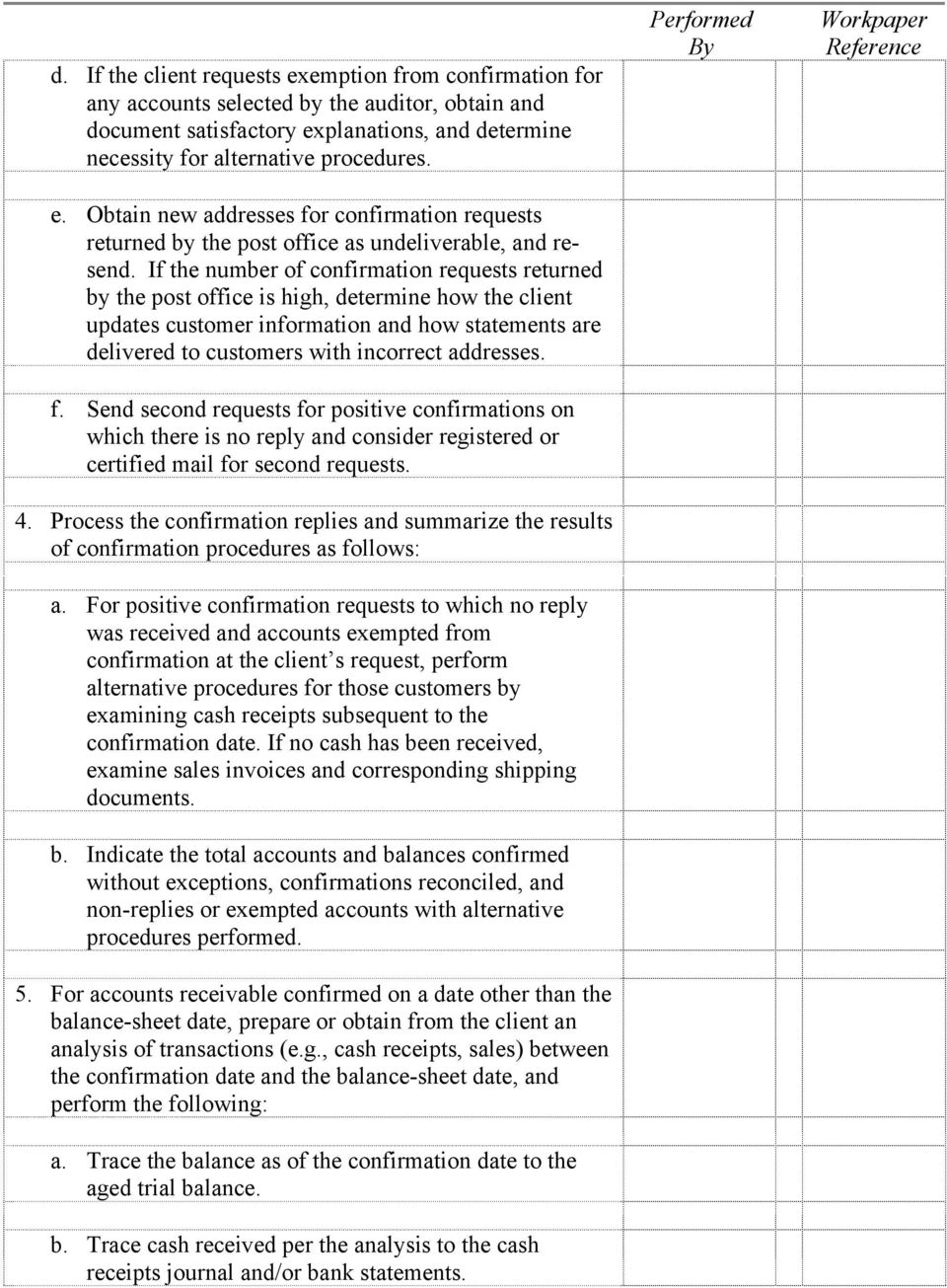
4 d. If the client requests exemption from confirmation for any accounts selected by the auditor, obtain and document satisfactory explanations, and determine necessity for alternative procedures. Performed Workpaper e. Obtain new addresses for confirmation requests returned by the post office as undeliverable, and resend. If the number of confirmation requests returned by the post office is high, determine how the client updates customer information and how statements are delivered to customers with incorrect addresses. f. Send second requests for positive confirmations on which there is no reply and consider registered or certified mail for second requests. 4. Process the confirmation replies and summarize the results of confirmation procedures as follows: a. For positive confirmation requests to which no reply was received and accounts exempted from confirmation at the client s request, perform alternative procedures for those customers by examining cash receipts subsequent to the confirmation date. If no cash has been received, examine sales invoices and corresponding shipping documents. b. Indicate the total accounts and balances confirmed without exceptions, confirmations reconciled, and non-replies or exempted accounts with alternative procedures performed. 5. For accounts receivable confirmed on a date other than the balance-sheet date, prepare or obtain from the client an analysis of transactions (e.g., cash receipts, sales) between the confirmation date and the balance-sheet date, and perform the following: a. Trace the balance as of the confirmation date to the aged trial balance. b. Trace cash received per the analysis to the cash receipts journal and/or bank statements.
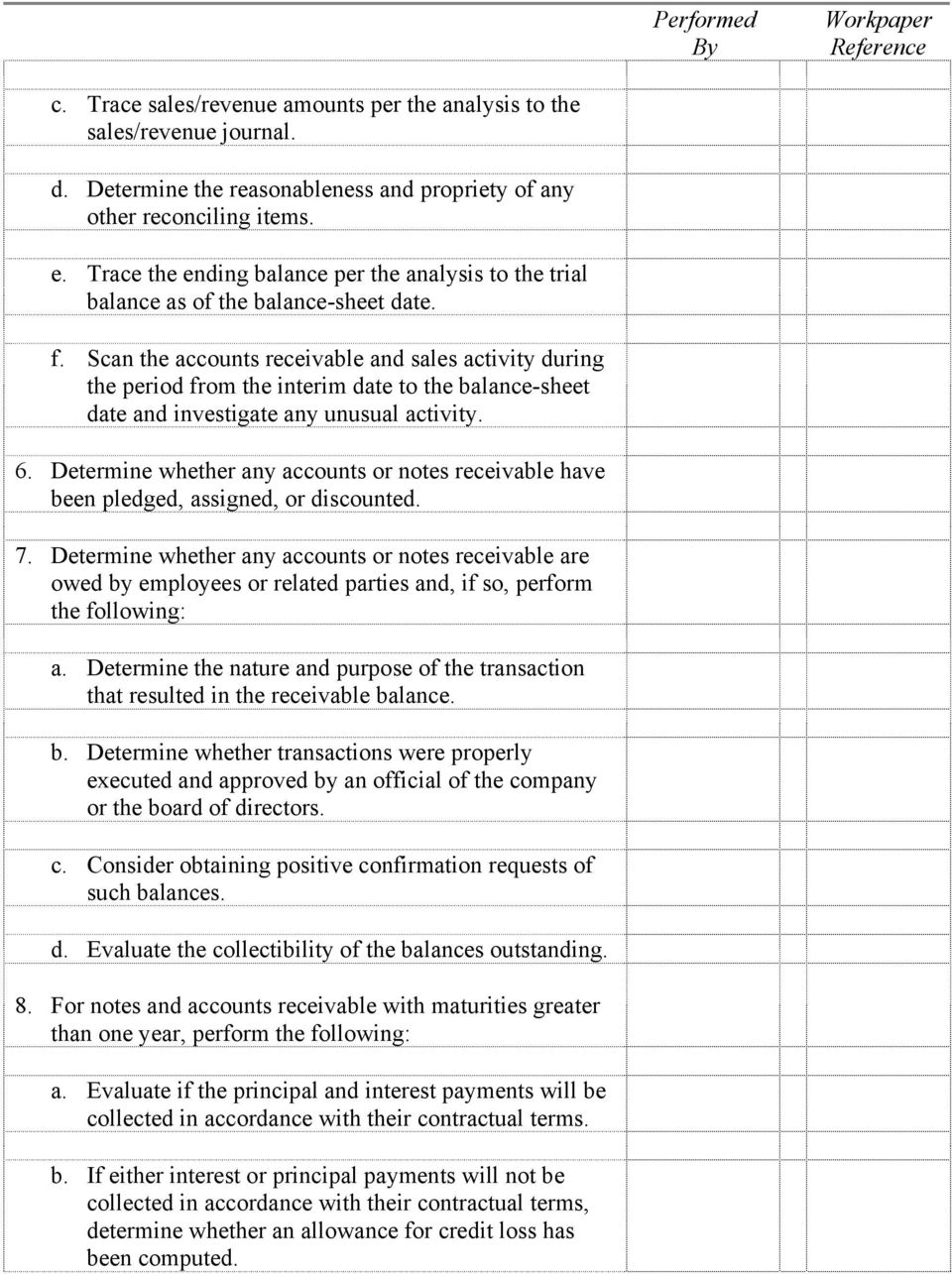
5 Performed Workpaper c. Trace sales/revenue amounts per the analysis to the sales/revenue journal. d. Determine the reasonableness and propriety of any other reconciling items. e. Trace the ending balance per the analysis to the trial balance as of the balance-sheet date. f. Scan the accounts receivable and sales activity during the period from the interim date to the balance-sheet date and investigate any unusual activity. 6. Determine whether any accounts or notes receivable have been pledged, assigned, or discounted. 7. Determine whether any accounts or notes receivable are owed by employees or related parties and, if so, perform the following: a. Determine the nature and purpose of the transaction that resulted in the receivable balance. b. Determine whether transactions were properly executed and approved by an official of the company or the board of directors. c. Consider obtaining positive confirmation requests of such balances. d. Evaluate the collectibility of the balances outstanding. 8. For notes and accounts receivable with maturities greater than one year, perform the following: a. Evaluate if the principal and interest payments will be collected in accordance with their contractual terms. b. If either interest or principal payments will not be collected in accordance with their contractual terms, determine whether an allowance for credit loss has been computed.
6 Performed Workpaper 9. Test the adequacy of the allowance for uncollectible accounts, as follows: a. Review subsequent cash collections of account balances. b. Review accounts written off during the period. c. Determine if write-offs have been properly authorized and examine related supporting documentation. d. Ask the client if there are any collection problems with accounts receivable currently classified as current assets. If so, consider whether such accounts should be reclassified to noncurrent assets. Determine the client s plans for collection and the probability that these efforts will be successful. e. Perform and review ratio analyses for relationships such as (1) accounts receivable turnover, (2) allowance for uncollectible accounts to accounts receivable, (3) allowance for uncollectible accounts to sales, and (4) accounts written off to sales. f. Review post-balance-sheet transactions related to receivables, particularly for discounts taken, credits allowed, and accounts written off, and determine whether any adjustments should be made as of the balance-sheet date. 10. Perform the following sales cutoff procedures and ascertain that receivables are recorded in the proper accounting period: a. From the population of shipping documents, trace the last few shipments of the year to the sales journal and determine that they were properly included in accounts receivable as of the balance-sheet date. b. From the population of shipping documents, trace the first few shipments subsequent to year-end to the sales journal and determine that they were properly excluded from accounts receivable as of the balance-

7 sheet date. Performed Workpaper c. Using the sales journal, trace the last few sales entries of the year from the sales journal to the shipping documents and determine that they were properly included in accounts receivable as of the balance-sheet date. d. Using the sales journal, trace the first few sales entries subsequent to year-end from the sales journal to the shipping documents and determine that they were properly excluded from accounts receivable as of the balance-sheet date. 11. If the auditor is concerned about the risk of fraud, audit procedures such as the following should be considered in addition to the ones listed above: a. Expand the number of accounts receivable confirmations and pursue all non-replies and discrepancies. b. Confirm amounts written off that appear unusual, such as write-offs of balances due from continuing customers. c. Compare sales price to list price. d. Ascertain that shipped merchandise actually arrived at the customer s location and that the merchandise was not shipped to a warehouse or location controlled by the client. e. Ascertain that shipping documents and invoices are pre-numbered sequentially and accounted for. f. Examine original documents for sales invoices and shipping documents and be alert for possible alterations. g. Telephone customers directly and confirm items such as: unusual payment terms, sales returns, credit memos, side agreements, merchandise receipt date, or other concerns.

8 Performed Workpaper h. Review customer complaints and look for unusual trends. j. Look for evidence of salespeople trying to meet or exceed sales goals in order to achieve quotas or increase their commissions or bonuses. k. Agree daily cash receipts detail to the bank statements and investigate unusual lags. 12. If disclosures about fair value are required, or the entity chooses to provide voluntary fair value information, perform the following: a. Obtain information about the fair values of accounts receivable and notes receivable and determine that the valuation principles are being consistently applied under IAS. b. Determine that the fair value amounts are supported by the underlying documentation. c. Determine that the method of estimation and significant assumptions used are properly disclosed. Based on the procedures performed and the results obtained, it is my opinion that the objectives listed in this audit program have been achieved. Performed by Reviewed and approved by Date Date Conclusions: Comments:

Audit Program for Accounts Payable and Purchases
 Form AP 50 Index Audit Program for Accounts Payable and Purchases Legal Company Name Client: Balance Sheet Date: Instructions: The auditor should refer to the audit planning documentation to gain an understanding
Chapter 14 Completing the Tests in the Sales and Collection Cycle: Accounts Receivable
 Chapter 14 Completing the Tests in the Sales and Collection Cycle: Accounts Receivable Review Questions 14-1 Tests of details of financial balances are designed to determine the reasonableness of the balances
Chapter 15: Accounts Payable and Purchases
 Accounting Research Manager - Audit Private Accounting Research Manager Miller Interpretations and Other Resources Knowledge-Based Audit Procedures Chapter 15: Accounts Payable and Purchases Chapter 15:
AUDIT PROCEDURES RECEIVABLE AND SALES
 184 AUDIT PROCEDURES RECEIVABLE AND SALES Ștefan Zuca Abstract The overall objective of the audit of accounts receivable and sales is to determine if they are fairly presented in the context of the financial
Audit Program for Prepaid Expenses and Other Assets
 Form AP 20 Index Audit Program for Prepaid Expenses and Other Assets Legal Company Name Client: Balance Sheet Date: Instructions: The auditor should refer to the audit planning documentation to gain an
Audit Program for Fixed Assets
 Form AP 35 Index Audit Program for Fixed Assets Legal Company Name Client: Balance Sheet Date: Instructions: The auditor should refer to the audit planning documentation to gain an understanding of the
AUDIT PLAN: RECEIVABLES
 Audit procedures for receivables AUDIT PLAN: RECEIVABLES Completeness Agree the balance from the individual sales ledger accounts to the aged receivables listing and vice versa. Match the total of the
Audit of the Sales and Collection Cycle: Tests of Controls and Substantive Tests of Transactions
 Audit of the Sales and Collection Cycle: Tests of Controls and Substantive Tests of Transactions Chapter 14 2008 Prentice Hall Business Publishing, Auditing 12/e, Arens/Beasley/Elder 14-1 Learning Objective
Customer Credit and Accounts Receivable
 Customer Credit and Accounts Receivable Gap Analysis: POS identifies the following Best Practices as efficient and effective control processes for the above risk. Listed for comparison are the controls
CHAPTER 9 AUDITING THE REVENUE CYCLE
 A U D I T I N G A RISK-BASED APPROACH TO CONDUCTING A QUALITY AUDIT 9 th Edition Karla M. Johnstone Audrey A. Gramling Larry E. Rittenberg CHAPTER 9 AUDITING THE REVENUE CYCLE LEARNING OBJECTIVES 1. Identify
Accounting 408 Test 3b Section Row
 Accounting 408 Test 3b Name Section Row Multiple Choice. (2 points each) Read the following questions carefully and indicate the one best answer to each question by placing an X (do not circle) over the
SCAD V: Parts 2 and 3 - Assessing Control Risk
 SCAD V: Parts 2 and 3 - Assessing Control Risk I. Part 3: Understand Client s Internal Control System (IC pages 1 and 2) A. Gather Information 1. Flowcharts 2. Documents/walkthrough 3. Identify controls
10-1. Auditing Business Process. Objectives Understand the Auditing of the Enteties Business. Process
 10-1 Auditing Business Process Auditing Business Process Objectives Understand the Auditing of the Enteties Business Process Identify the types of transactions in different Business Process Asses Control
Chapter 14 Auditing the Revenue Cycle. Ics in sales are designed to achieve these seven objectives:
 Chapter 14 Auditing the Revenue Cycle Ics in sales are designed to achieve these seven objectives: 1 recorded transactions are valid 2 transactions are properly authorized 3 existing transactions are recorded
WEEK 6. Objective 1: Sales Transaction Cycle Risks
 WEEK 6 CSA ch4 & GS ch10: pp457-488 Objective 1: Sales Transaction Cycle Risks The major assertions of interest to the auditor in ST of balances for account receivable are existence and valuation and allocation.
finreporting.com free online financial services REVENUE AND RECEIVABLES AUDIT PROGRAM
 REVENUE AND RECEIVABLES AUDIT PROGRAM REVENUE & RECEIVABLES ABC Corporation Work papers prepared by: Work papers reviewed by: Audit Program approved by: I. SCOPE/AUDIT OBJECTIVES: A. The overall objective
Substantive Tests of Transactions and Balances
 10 CHAPTER Substantive Tests of Transactions and Balances LEARNING OBJECTIVES After studying this chapter you should be able to: 1 2 identify and distinguish between tests of controls and substantive tests
Audit Evidence. AU Section 326. Introduction. Concept of Audit Evidence AU 326.03
 Audit Evidence 1859 AU Section 326 Audit Evidence (Supersedes SAS No. 31.) Source: SAS No. 106. See section 9326 for interpretations of this section. Effective for audits of financial statements for periods
Chapter 14 Audit of the Sales and Collection Cycle:
 Chapter 14 Audit of the Sales and Collection Cycle: Tests of Control and Substantive Tests of Transactions Identify the accounts and the classes of transactions in the sales and collection cycle. Describe
ACCOUNT DEBIT CREDIT Accounts receivable 10,000 Sales 10,000 To record the sale of merchandise to Sophie Company
 CURRENT RECEIVABLES Receivables are the amount owed to the organization by its customers and/or others. Current receivables will be collected within one year or the current operating cycle which ever is
Article: Control Systems and Controls Testing: General Review
 Article: Control Systems and Controls Testing: General Review By: Paul Lydon, BA, CPA, MBS (Hons), PGCLTHE, FHEA Current Examiner in P1 Auditing The main duty of auditors is to report to the members on
chapter Substantive Tests in the Revenue/Receipt Cycle: Sales, Receivables, Cash, and Management Discretion in Revenue Recognition
 chapter Substantive Tests in the Revenue/Receipt Cycle: Sales, Receivables, Cash, and Management Discretion in Revenue Recognition major topics discussed in this chapter are the: Relationship between financial
Chapter 18 Auditing Investments and Cash Balances
 Chapter 18 Auditing Investments and Cash Balances General Considerations Cash balances include undeposited receipts on hand, cash in bank in unrestricted accounts, and imprest accounts such as petty cash
Stages of the Audit Process
 Chapter 5 Stages of the Audit Process Learning Objectives Upon completion of this chapter you should be able to explain: LO 1 Explain the audit process. LO 2 Accept a new client or confirming the continuance
Fundamentals Level Skills Module, F8 (IRL)
 Answers Fundamentals Level Skills Module, F8 (IRL) Audit and Assurance (Irish) June 2008 Answers 1 (a) Prior year internal control questionnaires Obtain the audit file from last year s audit. Ensure that
Report of independent certified public accountants in accordance with Government Auditing Standards and Circular A-133 State of Hawaii, Department of
 Report of independent certified public accountants in accordance with Government Auditing Standards and Circular A-133 State of Hawaii,, June 30, 2004 2 C O N T E N T S REPORT OF INDEPENDENT CERTIFIED
Chapter 15 Auditing the Expenditure Cycle
 Chapter 15 Auditing the Expenditure Cycle Expenditure cycle consists of activities related to the acquisition of and payment for plant assets and goods and services. Two major transaction classes: 1 purchases
SCHEDULES OF CHAPTER 40B MAXIMUM ALLOWABLE PROFIT FROM SALES AND TOTAL CHAPTER 40B COSTS EXAMINATION PROGRAM
 7/30/07 SCHEDULES OF CHAPTER 40B MAXIMUM ALLOWABLE PROFIT FROM SALES AND TOTAL CHAPTER 40B COSTS Instructions: EXAMINATION PROGRAM This Model Program lists the major procedures and steps that should be
www.cebu-cpar.com Based on the above and the result of your audit, determine the adjusted balance of following:
 CEBU CPAR CENTER, INC. AUDIT OF RECEIVABLES PROBLEM NO. 1 Your audit disclosed that on December 31, 2006, the accounts receivable control account of Alilem Company had a balance of P2,865,000. An analysis
ACCOUNTING FOR AND AUDIT OF INVENTORIES
 ACCOUNTING FOR AND AUDIT OF INVENTORIES PRESENTED BY MICHEAL AGHWANA MANAGER: PEAK PROFESSIONAL SERVICES IN HOUSE SEMINAR SERIES NO 3 PEAK PROFESSIONAL SERVICES (CHARTERED ACCOUNTANTS) NIGERIA A member
INTERNAL CONTROL OVER PURCHASE INTERNAL CONTROL OVER INVENTORY INTERNAL CONTROL OVER CASH PAYMENTS INTERNAL CONTROL OVER CASH RECEIPTS
 Internal Control over the followings is included in the syllabus: INTERNAL CONTROL OVER SALES INTERNAL CONTROL OVER PURCHASE INTERNAL CONTROL OVER INVENTORY INTERNAL CONTROL OVER CASH PAYMENTS INTERNAL
Cash in bank checking account $22,500 U.S. treasury bills 5,000 Cash on hand 1,350 Undeposited customer checks 1,840 Total $30,690 Requirement 2
 Chapter 7 Solutions EXERCISES Exercise 7 2 Cash and cash equivalents includes: Cash in bank checking account $22,500 U.S. treasury bills 5,000 Cash on hand 1,350 Undeposited customer checks 1,840 Total
Investments Advance to subsidiary company 81,000
 EXERCISE 7-3 (10 15 minutes) Current assets Accounts receivable Customers Accounts (of which accounts in the amount of $40,000 have been pledged as security for a bank loan) $79,000 Installment accounts
C H A P T E R. Receivables. Financial Accounting 14e. human/istock/360/getty Images. Warren Reeve Duchac
 human/istock/360/getty Images C H A P T E R 9 Receivables Financial Accounting 14e Warren Reeve Duchac Classification of Receivables The term receivables includes all money claims against other entities,
The Use of Assertions by Auditor
 E. AUDIT EVIDENCE 1. The Use of Assertions by Auditor 2. Audit Procedures 3. The Audit of Specific Items 4. Audit Sampling and Other means of Testing 5. Computer-Assisted Audit Techniques 6. Not-for-Profit
The Confirmation Process
 The Confirmation Process 1897 AU Section 330 The Confirmation Process (Supersedes section 331.03.08.) Source: SAS No. 67. Effective for audits of fiscal periods ending after June 15, 1992, unless otherwise
The University of Arizona Financial Services Office INFORMATION & INSTRUCTIONS
 The University of Arizona Financial Services Office Special Fiscal Year End Reporting: Inventory, Accounts Receivable, Unearned Revenues, Prepaid Expenses & Deposits INFORMATION & INSTRUCTIONS May 19,
Office of the State Controller. Self-Assessment of Internal Controls. Accounts Receivable Cycle. Objectives and Risks
 Office of the State Controller Self-Assessment of Internal Controls Accounts Receivable Cycle Objectives and Risks Agency Year-End Objectives Ensure that appropriate records are maintained for all businesses,
Short-term investments (also known as marketable securities) are easily convertible to cash that a company plans to hold for a year or less.
 Accounting Fundamentals Lesson 5 5.0 Receivables & Investments Short-term investments (also known as marketable securities) are easily convertible to cash that a company plans to hold for a year or less.
Fundamentals Level Skills Module, Paper F8. Section A
 Answers Fundamentals Level Skills Module, Paper F8 Audit and Assurance December 2014 Answers Section A Question Answer See Note 1 B 1 2 D 2 3 C 3 4 C 4 5 C 5 6 B 6 7 A 7 8 D 8 9 A 9 10 B 10 11 B 11 12
Auditing Module 7 June 2009. Suggested Solutions
 Auditing Module 7 June 2009 Suggested Solutions 1 Question 1 1. Tests of control are tests carried out to obtain assurance about the operating and effectiveness of controls. An example of such a test would
Module Title: Auditing 2
 CORK INSTITUTE OF TECHNOLOGY INSTITIUID TEICNEOLAIOCHTA CHORCAI Semester 2 Examinations 2010 Module Title: Auditing 2 Module Code: ACCT 7006 School: Business Programme Title: Bachelor of Business in Accounting
2012 AICPA Newly Released Questions Auditing
 Following are multiple choice questions recently released by the AICPA. These questions were released by the AICPA with letter answers only. Our editorial board has provided the accompanying explanation.
Fixed assets are inherently risky and deserve close attention for a number of reasons:
 The balance sheet approach In this approach, substantive procedures are focused on statement of financial position accounts, with only very limited procedures being carried out on income statement/ profit
Performing Audit Procedures in Response to Assessed Risks and Evaluating the Audit Evidence Obtained
 Performing Audit Procedures in Response to Assessed Risks 1781 AU Section 318 Performing Audit Procedures in Response to Assessed Risks and Evaluating the Audit Evidence Obtained (Supersedes SAS No. 55.)
Chapter 10 Overall Audit Plan and Audit Program
 Chapter 10 Overall Audit Plan and Audit Program Review Questions 10-1 The four types of tests used by auditors to determine whether financial statements are fairly stated are; 1. procedures to obtain an
Financial Accounting: Assets FA 2 Module 6. Handouts. Current financial assets And current liabilities. Presented by: Laura Dallas, CGA
 Accounting: Assets FA 2 Module 6 Handouts Current financial assets And current liabilities Presented by: Laura Dallas, CGA Note: this information is prepared from the best information I have available
INTERNATIONAL STANDARD ON AUDITING 501 AUDIT EVIDENCE SPECIFIC CONSIDERATIONS FOR SELECTED ITEMS CONTENTS
 INTERNATIONAL STANDARD ON 501 AUDIT EVIDENCE SPECIFIC CONSIDERATIONS (Effective for audits of financial statements for periods beginning on or after December 15, 2009) CONTENTS Paragraph Introduction Scope
BDO Consulting. Segregation of Duties Checklist
 BDO Consulting Segregation of Duties Checklist August 2009 BDO Consulting s Fraud Prevention practice is pleased to present the 2009 Segregation of Duties Checklist. We have developed this tool to assist
Assertion Control objectives Controls Tests of controls Occurrence and existence
 Internal Control over Payroll Assertion Control objectives Controls Tests of controls Occurrence and existence Payment is made only to bona fide employees of the entity. Segregation of duties between HR
B Resource Guide: Implementing Financial Controls
 What s in this Guide: I. Definition: What are Financial Controls? II. Why Do You Need Financial Controls? III. Best Practices: Financial Controls to Consider I. Definition: What are Financial Controls?
Exhibit 7.9 Sample Loan Operations Risk Based Audit Program
 Sample Loan Operations Risk Based Program Inquire about and review written procedures followed during the process of opening and setting up new loans on the system, and procedures on loan approval and
Audit Evidence Specific Considerations for Selected Items
 SINGAPORE STANDARD ON AUDITING SSA 501 Audit Evidence Specific Considerations for Selected Items This SSA 501 supersedes SSA 501 Audit Evidence Additional Considerations for Specific Items in September
Chapter 8. Reporting and Analyzing Receivables
 Chapter 8 Reporting and Analyzing Receivables Study Objective 1 - Identify the Different Types of Receivables The term receivables refers to amounts due from individuals and companies. Receivables are
RELEVANT TO FOUNDATION LEVEL PAPER FAU / ACCA QUALIFICATION PAPER F8
 RELEVANT TO FOUNDATION LEVEL PAPER FAU / ACCA QUALIFICATION PAPER F8 Audit procedures Audit procedures are an important area of the syllabus, though candidates often use inappropriate audit procedures
Fraud Prevention & Detection
 Fraud Prevention & Detection Dave Tate, CPA, Esq. http://davidtate.us [email protected] This discussion primarily pertains to financial statement fraud--that is, financial statements that contain intentionally,
Risk assessment checklist - Revenue cycle
 Check Yes or No or N/A (where not applicable). Where a No is indicated, some action may be required to rectify the situation. Cross-references (e.g., See FN 1.01) point to the relevant policy in the First
BUS312A/612A Financial Reporting I. Homework 10.8.2014 Receivables Chapter 7
 BUS312A/612A Financial Reporting I Homework 10.8.2014 Receivables Chapter 7 E7-3 (Financial Statement Presentation of Receivables) Jim Carrie Company shows a balance of $181,140 in the Accounts Receivable
CHAPTER 8 WHEN REVENUE IS RECOGNIZED RECOGNIZED HOW REVENUE IS REVENUE CYCLE: SALES, RECEIVABLES, AND CASH
 CHAPTER 8 REVENUE CYCLE: SALES, RECEIVABLES, AND CASH 1 WHEN REVENUE IS RECOGNIZED Revenue should be recognized when two criteria are met: The promised work has been substantially completed Cash, or a
Fundamentals Level Skills Module, Paper F8. Section A
 Answers Fundamentals Level Skills Module, Paper F8 Audit and Assurance June 2015 Answers Section A Question Answer See Note 1 D 1 2 C 2 3 A 3 4 D 4 5 C 5 6 B 6 7 C 7 8 B 8 9 A 9 10 A 10 11 B 11 12 D 12
Principles of Financial Accounting ACC-101-TE. TECEP Test Description
 Principles of Financial Accounting ACC-101-TE TECEP Test Description This TECEP is an introduction to the field of financial accounting. It covers the accounting cycle, merchandising concerns, and financial
CEBU CPAR CENTER M a n d a u e C I t y
 1 of 11 CEBU CPAR CENTER M a n d a u e C I t y AUDITING PROBLEMS AUDIT OF CASH AND CASH EQUIVALENTS PROBLEM NO. 1 You were able to gather the following from the December 31, 2005 trial balance of Peso
How To Find Out If A Company Misstatement Is True
 A U D I T I N G A RISK-BASED APPROACH TO CONDUCTING A QUALITY AUDIT 9 th Edition Karla M. Johnstone Audrey A. Gramling Larry E. Rittenberg CHAPTER 11 AUDITING INVENTORY, GOODS AND SERVICES, AND ACCOUNTS
Understanding the Entity and Its Environment and Assessing the Risks of Material Misstatement
 Understanding the Entity and Its Environment 1667 AU Section 314 Understanding the Entity and Its Environment and Assessing the Risks of Material Misstatement (Supersedes SAS No. 55.) Source: SAS No. 109.
Audit of Cash Balances
 Audit of Cash Balances Chapter 23 2008 Prentice Hall Business Publishing, Auditing 12/e, Arens/Beasley/Elder 23-1 Learning Objective 1 Show the relationship of cash in the bank to the various transaction
We now examine the documents and procedures used to perform each step. Step 1: Capture Transaction Data on Source Documents
 Journals and Ledgers TRANSACTION PROCESSING: DOCUMENTS AND PROCEDURES IN A MANUAL AIS One basic function of the AIS is the efficient and effective processing of data about a company s transactions. Transaction
three TESTS OF CONTROLS AND TESTS OF DETAILS
 TESTS OF CONTROLS AND TESTS OF DETAILS P A R T three Part 3 covers the major evidence-gathering procedures of the assurance services engagements. Chapter 9 covers tests of controls for the control risk
Partners for the Common Good Financial Statements December 31, 2014 and 2013
 Partners for the Common Good Financial Statements December 31, 2014 and 2013 TABLE OF CONTENTS Page Independent Auditors' Report 1-2 Financial Statements: Statements of Financial Position 3 Statements
Chapter 10 Schedule M-1 Audit Techniques
 Chapter 10 Schedule M-1 Audit Techniques By Ken Johnson (Central Mountain) And Alta Chesney, (Gulf Coast) and Fred Sanchez (Gulf Coast), Reviewers INTERNAL REVENUE SERVICE TAX EXEMPT AND GOVERNMENT ENTITIES
SESSION 3 AUDIT PLANNING
 SESSION 3 AUDIT PLANNING Learning Objectives: identify and explain the need for planning an audit identify and describe the contents of the overall audit strategy and the audit plan explain the difference
Audit Toolbox part 1: Property, Plant and Equipment & Cash
 Audit Toolbox part 1: Property, Plant and Equipment & Cash Vienna, February 12, 2014 Atanasko Atanasovski, Consultant, CFRR Substantive testing - Property, plant and equipment Key areas when testing tangible
Part II. Audit process by phase 3. Testing and evidence
 Part II. Audit process by phase 3. Testing and evidence Quiz 1: The quality of audit evidence depends on whether it is relevant and reliable in supporting the conclusions of the auditor, and normally the
Commercial Loans Internal Control Questionnaire
 Commercial Loans Internal Control Questionnaire Completed by: Date Completed: 1. Has the board of directors, consistent with its duties and responsibilities, adopted written commercial loan policies that:
Internal Control Systems
 D. INTERNAL CONTROL 1. Internal Control Systems 2. The Use of Internal Control Systems by Auditors 3. Transaction Cycles 4. Tests of Control 5. The Evaluation of Internal Control Component 6. Communication
Accounting for and Presentation of Current Assets. is used to purchase finished goods or raw materials and labor used to manufacture
 CHAPTER 5 Accounting for and Presentation of Current Assets Current assets include cash and those assets that are expected to be converted to cash or used up within one year, or an operating cycle, whichever
CHAPTER 7 Cash and Receivables
 CHAPTER 7 Cash and Receivables 7-1 LECTURE OUTLINE Chapter 7, the first of six asset chapters, covers cash, accounts receivable, and notes receivable. Temporary investments (marketable securities) are
Review of Financial Statements
 Review of Financial Statements 2055 AR Section 90 Review of Financial Statements Issue date, unless otherwise indicated: December 2009 See section 9090 for interpretations of this section. Source: SSARS
Internal Controls Best Practices
 Internal Controls Best Practices This list includes the most common internal controls applied by small to medium sized businesses to their operations. It includes controls that apply to the processes most
Chapter 7 Cash and Receivables
 Chapter 7 Cash and Receivables QUESTIONS FOR REVIEW OF KEY TOPICS Question 7-1 Cash equivalents usually include negotiable instruments as well as highly liquid investments that have a maturity date no
CENTURY 21 ACCOUNTING, 8e General Journal Chapter Objectives
 CENTURY 21 ACCOUNTING, 8e General Journal Chapter Objectives Chapter 1 Starting A Proprietorship: Changes that Affect the Accounting Equation After studying Chapter 1, you will be able to: 1. Define accounting
Inspection Observations Related to PCAOB "Risk Assessment" Auditing Standards (No. 8 through No.15)
 1666 K Street, N.W. Washington, DC 20006 Telephone: (202) 207-9100 Facsimile: (202) 862-8430 www.pcaobus.org Inspection Observations Related to PCAOB "Risk Assessment" Auditing Standards (No. 8 through
FNSICACC307A Reconcile and monitor accounts receivable
 FNSICACC307A Reconcile and monitor accounts receivable Release: 1 Modification History Not Available Approved Page 2 of 11 INTRODUCTION Unit Descriptor Application of the Unit This unit describes the functions
Chapter 07 - Accounts and Notes Receivable. Chapter Outline
 Chapter 07 - Accounts and Receivable I. Accounts Receivable A receivable is an amount due from another party. Accounts Receivable are amounts due from customers for credit sales. A. Recognizing Accounts
CHAPTER 7. Cash and Receivables. 1. Accounting for cash. 1, 2, 3, 4, 21 1 1, 2 1 5, 6, 7, 8, 9, 10, 11, 12, 13, 14, 15 8, 9, 10, 11, 12
 CHAPTER 7 Cash and Receivables ASSIGNMENT CLASSIFICATION TABLE (BY TOPIC) Topics Questions Brief Exercises Exercises Problems Concepts for Analysis 1. Accounting for cash. 1, 2, 3, 4, 21 1 1, 2 1 2. Accounting
Solutions to Student Self Assessment Questions
 Solutions to Student Self Assessment Questions Chapter 9 Testing and evaluation of systems Questions Two questions are placed within the text: (9.1) Case study 9.1 Broomfield plc: sales and trade receivables
Auditing Derivative Instruments, Hedging Activities, and Investments in Securities 1
 Auditing Derivative Instruments 1915 AU Section 332 Auditing Derivative Instruments, Hedging Activities, and Investments in Securities 1 (Supersedes SAS No. 81.) Source: SAS No. 92. See section 9332 for
CHAPTER 13 AUDITING DEBT OBLIGATIONS AND STOCKHOLDERS EQUITY TRANSACTIONS
 A U D I T I N G A RISK-BASED APPROACH TO CONDUCTING A QUALITY AUDIT 9 th Edition Karla M. Johnstone Audrey A. Gramling Larry E. Rittenberg CHAPTER 13 AUDITING DEBT OBLIGATIONS AND STOCKHOLDERS EQUITY TRANSACTIONS
SOLUTION: AUDIT AND INTERNAL REVIEW, MAY 2014
 SOLUTION 1(a) (a) The Auditing guideline points out that the amount or quantity of audit evidence required for the auditor to achieve the level of assurance is a matter of professional judgment. The factors
Policy No: F&A 03-15 Approved by Council: June 26, 2013 Resolution: 2013.12.16. The policy should assist in:
 Treasury Department Policy Section: Finance & Accounting Content Updated: Supersedes Policy: Policy No: F&A 03-15 Approved by Council: June 26, 2013 Resolution: 2013.12.16 Pages: 1 of 11 GENERAL ACCOUNTS
Accounts Payable. Best Practices: Existing Control: Control Gap: Controls Evaluation and Gap Analysis. Purchasing
 Accounts Payable Gap Analysis: POS identifies the following Best Practices as efficient and effective control processes for the above risk. Listed for comparison are the controls currently in place, if
BUS312A/612A Financial Reporting I. Homework 10.6.2014 & 10.8.2014 Receivables Chapter 7
 BUS312A/612A Financial Reporting I Homework 10.6.2014 & 10.8.2014 Receivables Chapter 7 Chapter 7- You should be able to: Identify elements of cash Identify the types of receivables Explain accounting
PROFESSOR S NAME ACC 255 FALL 2011 COVER SHEET FOR COMPREHENSIVE PROBLEM 2 (CHAPTERS 2, 5-8)
 COMPREHENSIVE PROBLEM 2 (CHAPTERS 2, 5-8) Page 137 NAME ANSWER KEY PROFESSOR S NAME SECTION SCORE ACC 255 FALL 2011 COVER SHEET FOR COMPREHENSIVE PROBLEM 2 (CHAPTERS 2, 5-8) INSTRUCTIONS: COMPLETE ALL
AUTISM SPEAKS, INC. CONSOLIDATED FINANCIAL STATEMENTS YEARS ENDED DECEMBER 31, 2012 AND 2011
 CONSOLIDATED FINANCIAL STATEMENTS YEARS ENDED DECEMBER 31, 2012 AND 2011 CONSOLIDATED FINANCIAL STATEMENTS YEARS ENDED DECEMBER 31, 2012 AND 2011 I N D E X INDEPENDENT AUDITOR S REPORT 1-2 CONSOLIDATED
STATEMENT 3.340 AUDITING GUIDELINE PROSPECTUSES AND THE REPORTING ACCOUNTANT
 The guidance on reports on working capital requirements (paragraphs 67 to 71) and reports on borrowings (paragraphs 72 to 75) in this AG 3.340 is applicable for engagements where the investment circular
Job Ready Assessment Blueprint. Accounting-Basic. Test Code: 4000 / Version: 01. Copyright 2012. All Rights Reserved.
 Job Ready Assessment Blueprint Accounting-Basic Test Code: 4000 / Version: 01 Copyright 2012. All Rights Reserved. General Assessment Information Blueprint Contents General Assessment Information Written
Sistema Infantil Teleton USA, dba Children s Rehabilitation Institute of Teleton USA and Subsidiary
 Sistema Infantil Teleton USA, dba Children s Rehabilitation Institute of Teleton USA and Subsidiary Consolidated Financial Statements and Supplementary Information December 31, 2015 and 2014 Institute
Fundamentals Level Skills Module, Paper F8 (IRL) 1 (a) Audit procedures procurement and purchases system
 Answers Fundamentals Level Skills Module, Paper F8 (IRL) Audit and Assurance (Irish) December 2007 Answers 1 (a) Audit procedures procurement and purchases system Procedure Obtain a sample of e-mails from