
China High-Speed Rail On the Economic Fast Track
|
|
|
- Brent Houston
- 9 years ago
- Views:
Transcription
1 MORGAN STANLEY BLUE PAPER MORGAN STANLEY RESEARCH Global On the Economic Fast Track The biggest transportation infrastructure project in history is transforming the Chinese landscape. Large sections of China s population are becoming more mobile, remote regions of the country are opening up, and Chinese businesses are racing to meet under-served consumer demand. High-speed rail is key to China s balanced, sustainable double-digit growth. By 22, four super-city clusters will emerge in China and two existing supercities will expand as a direct result of the population s increased mobility and the surge in domestic traffic in China. A more mobile workforce and newly accessible markets will serve to narrow the country s geographic and economic disparities. Jerry Lou [email protected] Allen Gui [email protected] Edward Xu, CFA [email protected] Angela Moh [email protected] Kate Zhu, CFA [email protected] Lin He [email protected] Coral Ching [email protected] See page 2 for all contributors to this report 1 Morgan Stanley Asia Limited + The impact is imminent by 213, 5% of cities on the planned network will be connected to the high-speed rail grid. The economic impact of this increased connectivity will continue well beyond the immediate gains in key industries, however. Some industries are clearly well placed to derive long-term benefits from China s infrastructure build-out. Morgan Stanley analysts from 12 industries and three continents identify the opportunities. We have created geographic and sector baskets based on our investment analysis, which we believe will capture the secular opportunity in China for the coming 1 years, especially in hotels, restaurants, tourism, car rental, property, and rolling stock. Aviation and toll roads may not fare as well. Morgan Stanley Blue Papers focus on critical investment themes that require coordinated perspectives across industry sectors, regions, or asset classes. Morgan Stanley does and seeks to do business with companies covered in Morgan Stanley Research. As a result, investors should be aware that the firm may have a conflict of interest that could affect the objectivity of Morgan Stanley Research. Investors should consider Morgan Stanley Research as only a single factor in making their investment decision. For analyst certification and other important disclosures, refer to the Disclosure Section, located at the end of this report. * = This Research Report has been partially prepared by analysts employed by non-u.s. affiliates of the member. Please see page 2 for the name of each non-u.s. affiliate contributing to this Research Report and the names of the analysts employed by each contributing affiliate. += Analysts employed by non-u.s. affiliates are not registered with FINRA, may not be associated persons of the member and may not be subject to NASD/NYSE restrictions on communications with a subject company, public appearances and trading securities held by a research analyst account.

2 Contributors to this Blue Paper Name Sector Phone Address Jerry Lou 1 Strategy [email protected] Allen Gui 1 Strategy [email protected] Lin He 1 Leisure & Lodging [email protected] Ying Guo 1 Leisure & Lodging [email protected] Benjamin Swinburne 2 Entertainment +1 (212) [email protected] John Glass 2 Restaurants [email protected] Jon Tower, CFA 2 Restaurants [email protected] Jamie Rollo 3 Leisure & Lodging [email protected] Ryan Meliker 2 Gaming & Lodging +1 (212) [email protected] Mark Strawn Gaming & Lodging +1 (212) [email protected] Angela Moh 1 Consumer Staples/ Discretionary [email protected] Lillian Lou 1 Consumer Staples [email protected] Robert Lin 1 Consumer Discretionary [email protected] Coral Ching 1 Property [email protected] Jacky Chan 1 Property [email protected] Tomoyoshi Omuro 4 Real Estate +81 () [email protected] Kate Zhu, CFA 1 Capital Goods [email protected] Kevin Luo 1 Infrastructure & Rolling Stock [email protected] Yoshinao Ibara 4 Machinery & Capital Goods +81 () [email protected] Guillermo Peigneux 3 Capital Goods [email protected] Edward Xu, CFA 1 Transportation & Infrastructure [email protected] Andy Meng, CFA 1 Transportation & Infrastructure [email protected] Victoria Wong 1 Transportation & Infrastructure [email protected] Kate Zhu, CFA 1 Auto [email protected] Bin Hu 1 Auto [email protected] Cedric Shi 1 Auto [email protected] 1 Morgan Stanley Asia Limited+ 2 Morgan Stanley & Co. Incorporated 3 Morgan Stanley & Co. International plc+ 4 Morgan Stanley MUFG Securities Co., Ltd.+ See page 6 for recent Blue Paper reports. 2

3 Table of Contents MORGAN STANLEY BLUE PAPER How China s High-Speed Rail is Reshaping the Economy... 4 The High-Speed Rail System Overview Industry Implications Tourism Restaurants Hotels Budget Hotels Consumer Staples Consumer Discretionary Property Rolling Stock Railway Infrastructure Toll Roads Aviation Car Rental Appendix I: Hong Kong Traded Long Basket Appendix II: Global Long Basket

4 MORGAN How China s STANLEY High-Speed BLUE PAPER Rail is Reshaping the Economy Jerry Lou Allen Gui China s ever-expanding high-speed rail system is transforming the country both economically and socially. Over the next decade, China s high-speed rail (HSR) system will increase the mobility of the population, affecting some 7 million people; contribute to the creation of four new super-city clusters and enhance two existing super-cities; and boost hub cities traffic exponentially. The HSR system is the solution to China s growth sustainability. A more mobile work force and more- accessible markets will narrow the country s geographic and economic disparities. Structural changes are imminent, but the economic impact is long term. Over the next few years, China s HSR will take shape quickly. Investors must understand the imminent structural changes and take positions today. Our investment strategy on China s HSR focuses on the following at the regional level: Western and Central China; and The most rapidly rising hub cities. At the industry level, we focus on: Near-term immediate beneficiaries railway infrastructure and rolling stocks industries; Mid-term beneficiaries leisure/lodging and properties; Long-term beneficiaries consumer staples and consumers discretionaries. The key investments are listed in our equity baskets on page 8. (See Appendixes for important disclosure information). HSR Will Reshape China s Economy China, the most populous country in the world, will soon set another ground-breaking record: In the coming decade, its HSR system, currently under development, will become the largest in the world. We believe that this development will be no less economically significant than China s urbanization story. Our reasoning Here is why we believe the Chinese economy will continue to outperform: The China HSR system will span 3, kilometers, connect more than 25 cities and regions with a total population of about 7 million, mobilize 4 billion travelers per year, and add 1,6 billion kilometers to China s domestic passenger throughput annually (i.e., four times the total domestic passenger throughput in Japan today) by 22. At peak speed, the HSR grid can support speeds of 35 kilometer per hour, increasing commuting efficiency many times over. Large, existing, stand-alone cities in the same region will see their boundaries merging to create connected metropolises, boosting secular service industry demand and creating new business opportunities in the consumer, leisure and lodging, and property sectors. We call these merged cities super-city clusters (SCCs) and predict that four new SCCs will emerge and two existing SCCs will expand in the coming 1 years. (See HSR s Geographic Investment Implications in this same section.) Many economically challenged cities in west and central China will be revitalized because of the hub effect created by the HSR system. Some cities will even see passenger flow growing by as much as 1 times in the coming decade, making them strategically important targets for many industries such as hotel, catering, logistics, and properties. Geographic and Economic Rebalancing Despite its rapid economic growth in the past few decades, China still faces bottlenecks in the distribution of its wealth, with a marked imbalance between the geographic development of the coastal areas and that of inland and western China. Indeed, this geographic imbalance has been worsening as the coastal areas continue to develop at a much faster rate than do the inland and western regions. Until now, most of China s economy vibrancy has been trapped on the eastern and southern coasts of China, and as one travels across the region, the huge asymmetries in economic development make different cities look more like different countries. Those who visit Shanghai-centered coastal China, for instance, will find this region more like welldeveloped countries such as the US and Europe and less like central and western China, even though the coastal region and the central/western regions occupy the same continent. While regional economic differences are not rare in a global economy, China's regional differences are by far the most disparate of any in the world (Exhibit 1 through Exhibit 3). 4

5 Exhibit 1 MORGAN Regional Differences: STANLEY BLUE 21 GDP PAPER per Capita (Rmb) East 44,67 The HSR network will tap this geographic-economic imbalance in an unprecedented and aggressive fashion by improving market access, encouraging population mobility, and enhancing logistics efficiency. We fully expect to see life style changes among the population, which in turn will stimulate innovation and creativity and lead to the creation of new businesses in the long-term. Central West 21,1 19,289 We believe by 215, city clusters with travel radii of three hours will start to take shape in China. By 22, there will be six such city clusters taking shape, overlapping with each other throughout most of China except the northwest and southwest. These city clusters will cover about 7% of the Chinese population and account for about 75% of China GDP. Source: CEIC, Morgan Stanley Research Exhibit 2 Regional Differences: 21 Urbanization Level (%) East Central West Source: CEIC, Morgan Stanley Research Exhibit 3 Regional Differences: 21 Residential Property Price (Rmb/sq. m.) 57 We also believe that by 225 all of these city clusters will be so mature that the regional economic differences in China will narrow to Western economy levels. According to our rough estimate, the parts of China that lag behind (central and western China) collectively will be growing at a rate of 15% real GDP in the coming 1 years, compared with their moredeveloped coastal peers. Commercial and residential real estate value in the currently lagging cities covered by these city clusters will receive strong support from the launch of new HSR lines. Timeline: Investors Should Build Positions Today Because China s HSR grid has 1 years more in its construction life cycle, we are analyzing its economic impact over a 1-year timeframe. Nevertheless, the investment case is, in fact, imminent: The HSR grid will take shape quickly over the next few years, so investors should take positions today. According to the national HSR construction plan and our own modeling, more than 5% of cities planned for the HSR grid over the next 1 years will be connected before 213 (Exhibit 4). East 7,963 Central 3,312 West 3,288 Source: CEIC, Morgan Stanley Research 5

6 Exhibit 4 MProgress ORGAN of STANLEY HSR Grid BLUE Connections PAPER (% of Chinese cities connected to HSR) HSR s Sector Investment Implications As the HSR grid builds out quickly in China, its scale and logistical significance will start to create new business opportunities. Our goal is to use our best knowledge today to envison what and how big such business opportunities will be. Among the sectors where opportunites will arise, we think, are: 2 33 Budget hotels; Restaurant and catering; e 212e 213e 214e 215e 216e 217e 218e 219e 22e e = Morgan Stanley Research estimates Note: Data as of 21. Source: CEIC, Morgan Stanley Research Addressing the Concern: Profitability and Sustainability Will the China HSR project be sustainable? This is clearly a valid question to ask. The operating capital required for such a mega project will be substantial. Our transportation analyst Edward Xu and capital goods analyst Kate Zhu believe that on average every 1, kilometers of China HSR will require Rmb4.5 billion per year in operating cash to function (this includes maintenance, parts replacement, and day-to-day operational costs). On the other hand, the operating revenue, based on our ticket price estimate (using the same per-thousand-kilometer price to per-capita GDP ratio on the eastern portion of the national grid), per-thousand kilometer revenue will be around Rmb6.5 billion per year. This translates into a national operating cash surplus of Rmb2 billion per year, which should be able to cover most, if not all, of the interest expenses. We also need to look at the funding capabilities of the Chinese government. As discussed in earlier sections, the HSR will create substantial new passengers flow, generate new business opportunities, and raise asset prices (such as land and properties). All these will mean higher fiscal revenue for the local governments. We estimate that at national level, every 1, kilometers of HSR will create at least Rmb2 billion per year in new fiscal revenue. This is more than enough to close the HSR funding gap. Thus we conclude that the HSR will create enough economic value to keep itself financially sustainable. Tourism (theme parks, resorts, and agencies); Consumer staples; Retailers and brands; Car rental; Commercial and residential properties; Railway infrastructure; and Capital goods and rolling stocks. Not surprisingly, we would also expect the HSR grid to pose new challenges to existing logistics forms: Aviation. We believe regional jets will have limited market potential in China and will do well only in those regions where the HSR will not reach, such as the northwest and southwest. Airlines also will face tough competiton on existing regional routes where HSR capacity will increase and divert passenger traffic. Our transportation analyst Edward Xu believes that HSR would be competitive for airlines at a distance of 8-1,5 kilometers and highly competitive at a distance of 8 kilometers. Because regional jets are usually targeting short- to mid-haul distances between 5 and 6 kilometers, we see high risk from HSR on overlapping routes. Toll roads. The competition that HSR poses to toll roads will be much smaller than that to airlines due to HSR's expensive ticket price and lack of convenience for shortdistance travel. Our transportation analyst Andy Meng expects 1-3% passenger traffic dilution in from toll road to HSR. Furthermore, as HSR can free up cargo capacity in traditional railway system, the potential movement of cargo traffic from toll roads over to traditional railway is likely to be material. We forecast a 1-12% cargo traffic dilution from toll road to traditional railway by

7 Other countries cases turn to support our findings. Japan and MORGAN US experiences STANLEY suggest that BLUE the construction PAPER of rapid-transit systems led to the urbanization of local communities, boosted demand of commercial premises, and shored up regional economies. In addition, passenger railway networks such as the HSR system are expected to have significant positive impact on property values. On the other hand, history shows the operation of HSR could take substantial market share from conventional operators. Europe and Japan observed severe blows to their airline traffic from HSR on overlapping routes below 8 kilometers. HSR s Geographic Investment Implications As the China HSR system spreads out and ramps up capacity, regional economic dynamics will change with it. We believe the HSR s most significant geographical economic impact will be the creation of connected metropolitan areas, or the SCCs, because of its mass-transporting capacity at very high ground speeds (about 25 to 35 kilometers per hour), basically significantly multiplying a comuter's traveling distance within a fixed time period. Traveling to neighboring cities on HSR will take the same amount of time as traveling across a large city in a car. Eventually we believe that cities within the same cluster, connected by HSR grid, will no longer be conventional stand-alone cities. They will become like huge business-andlife districts in a very large metropolitan area, with active economic interactions. Exhibit 5 HSR SCCs Up Close Major province covered Northeast SCC Heilongjiang, Jilin, Liaoning North China SCC Beijing, Hebei, Shanxi, Shandong East China SCC South China SCC Shanghai, Zhejiang, Guangdong, Jiangsu Fujian West China SCC Sichuan, Qinghai, Shaanxi Central China SCC Henan, Hubei, Jiangxi, Hunan Population covered (mn) GDP covered (21 Rmb bn) 1,64 7,96 8,358 5,15 2,673 3,224 GDP per cap (21 Rmb) 24,1 37,125 38,5 38,432 16,622 22,14 Number of HSR Hub Cities by HSR passenger rides 215 (mn) % of China total HSR passenger rides 22 (mn) % of China total Share of HSR passengers in total railway traffic 215 (%) Share of HSR passengers in total railway traffic 22 (%) Number of major tourism sites Source: Morgan Stanley Research Exhibit 6 SCCs Traffic Growth Outlook Railway Traffic CAGR 21-2 (%) Combining the current city layout map and HSR grid development map, we envision four SCCs taking shape one each in central, western, northeastern, and northern China. The existing economic zones of the Pearl River Delta in the south and Yangtze River Delta in the east, today mainly connected by highway grid, will also grow into two of the wealthiest and busiest SCCs Exhibit 5). 3 Northeast SCC North China SCC East China SCC Note: Data for are Morgan Stanley estimates. Source: Company data, Morgan Stanley Research South China SCC West China SCC Central China SCC At the individual city level there will be another big change some cities will simply see their transit traffic multiply exponentially because of the HSR connectivity (Exhibit 6). We believe that these emerging HSR hub cities will enjoy much greater economic growth than the rest of the country in the coming decade (Exhibit 7). 7

8 Exhibit 7 Exhibit 9 M22 ORGAN Emerging STANLEY HSR Hub BLUE Cities PAPER MS HSR Basket II: Global Long Basket Bloomberg ticker: MSNJCRL1 (Millions of Passengers) Hangzhou Guiyang Harbin Hefei Shijiazhuang Nanchang Lanzhou Total passengers by 22 CAGR of the next decade (%) Note: Data through 22 are Morgan Stanley estimates. Source: Morgan Stanley Research Investors should maximize their exposure to the SCCs and hub cities with the greatest traffic CAGR, we believe. How to Invest: Introducing HSR Baskets We are introducing our Morgan Stanley China High Speed Rail Equity Baskets, which we have constructed to play the powerful geographic and industrial trends created by the HSR in China over the coming 1 years (Exhibit 8 and Exhibit 9). We have crafted two baskets for investors: 1) Hong Kong Traded Long Basket, consisting of 15 China stocks listed in HK; and 2) Global Long Basket, which includes 24 global tradable stocks. Exhibit 8 MS HSR Basket I: Hong Kong Traded Long Basket Bloomberg ticker: MSNJCRL2 Identifier Description Sector Weight (%) 188.HK BELLE INTL HOLDINGS Consumer Discretionary HK ANTA SPORTS Consumer Discretionary HK POU SHENG INTL HOLDINGS LTD Consumer Discretionary HK YURUN FOOD Consumer Staples HK CHINA MENGNIU Consumer Staples HK WANT WANT HOLDINGS LTD Consumer Staples HK TINGYI Consumer Staples HK UNI-PRESIDENT CHINA HOLDINGS Consumer Staples HK CHINA RESOURCES LAND LTD Property HK LONGFOR PPT Property HK CHINA RAIL CONS Rail Infrastructure HK INTIME Retail HK SPRINGLAND Retail HK CSR Rolling Stock HK CSR TIMES ELEC Rolling Stock 9.2 Note: Weighting as of May 211. Source: Morgan Stanley Research Nanning Identifier Description Sector Weight (%) HTHT.O CHINA LODGING GROUP LTD-SPON ADS Budget Hotel 1.5 SVN.N 7 DAYS GRP ADR Budget Hotel HK BELLE INTL HOLDINGS Consumer Discretionary HK ANTA SPORTS Consumer Discretionary HK POU SHENG INTL HOLDINGS LTD Consumer Discretionary HK CHINA MENGNIU Consumer Staples HK YURUN FOOD Consumer Staples HK WANT WANT HOLDINGS LTD Consumer Staples HK TINGYI Consumer Staples HK UNI-PRESIDENT CHINA HOLDINGS Consumer Staples.8 HOT.N STARWOOD HOTELS & RESORTS Hotel 5.5 IHG.L INTERCONT HOTELS Hotel 5.7 ACCP.PA ACCOR Hotel HK CHINA RESOURCES LAND LTD Property HK LONGFOR PPT Property HK CHINA RAIL CONS Property 5.5 YUM.N YUM! BRANDS INC Restaurants 5.5 SBUX.O STARBUCKS CORP Restaurants 5.4 MCD.N MCDONALDS CORP Restaurants HK INTIME Retail HK SPRINGLAND Retail HK CSR TIMES ELEC Rolling Stock HK CSR Rolling Stock 5.5 DIS.N WALT DISNEY CO Tourism 5.5 Note: Weighting as of May 211. Source: Morgan Stanley Research The two baskets include our analysts picks from Asia, the US, and Europe, and we believe they are the best-positioned equity market plays available to global investors today. Besides these stocks, our analysts identified two A-share listed names as HSR benefitiaries the flagship property developer Vanke and Huangshan Tourism as the operator of Mount Huang, arguably the most famous mountain in China. Clearly, more equity plays will emerge in other industries that are not yet well established in China today, such as the car rental industry. We will keep revisiting these sectors and update the basket accordingly. 8

9 On the Economic Fast Track HSR cities Total railway traffic 29* Total railway traffic 22* HSR Super City Cluster (SCC) 21 completed lines completed lines completed lines Non-HSR lines CNR plants CSR plants Tourist attractions / World Heritage sites *Traffic volume is proportionally mapped by the size of a circle Qiqihar Jiamusi Jerry Lou, , [email protected] Allen Gui, , [email protected] China Research Team May 211 NORTHEAST SCC Major province covered: Heilongjiang, Jilin, Liaoning Population covered (mn): 67 GDP covered (21 Rmb bn): 1,64 GDP per cap (21 Rmb): 24,1 # of HSR Hub Cities by 22: 1 HSR passenger rides 215 (mn): % of China total: 5% HSR passenger rides 22 (mn): 22 - % of China total: 5% Daqing Hami NORTH CHINA SCC Major province covered: Beijing, Hebei, Shanxi, Shandong Population covered (mn): 214 GDP covered (21 Rmb bn): 7,96 GDP per cap (21 Rmb): 37,125 # of HSR Hub Cities by 22: 2 HSR passenger rides 215 (mn): % of China total: 16% HSR passenger rides 22 (mn): % of China total: 13% Jiayuguan Yinchuan Baotou Suide Hohhot Datong Taiyuan Zhangjiakou Baoding Beijing Shijiazhuang Baicheng Changchun Shenyang Fuxin Jinzhou Benxi Panjin Qinhuangdao Dandong Tangshan Dalian Tianjin Yantai Weihai Rongcheng Zibo Weifang Harbin Jilin Mudanjiang Yabuli CENTRAL CHINA SCC Major province covered: Henan, Hubei, Jiangxi, Hunan Population covered (mn): 146 GDP covered (21 Rmb bn): 3,224 GDP per cap (21 Rmb): 22,14 # of HSR Hub Cities by 22: 4 HSR passenger rides 215 (mn): % of China total: 1% HSR passenger rides 22 (mn): % of China total: 11% Jinan Qingdao Golmud Dujiangyan Leshan Xining Lanzhou Chengdu Xian Hanzhong Ankang Guangyuan Mianyang Neijiang Liupanshui Tianshui Xianyang Baoji Chongqing Guiyang Yichang Zhangjiajie Huaihua Luoyang Loudi Zhengzhou Xiangfan Xiaogan Xiangtan Wuhan Xianning Changsha Zhuzhou Jining Hefei Anqing Nanchang Xuzhou Bengbu Nanjing Lianyungang Changzhou Hangzhou Wuxi Huangshan Mountain Shaoxing Huang Jiujiang Shangrao Nanping Zhenjiang Nantong Jiaxing Jinhua Fuzhou Shanghai SH Disneyland Ningbo Wenzhou EAST CHINA SCC Major province covered: Shanghai, Zhejiang, Jiangsu Population covered (mn): 22 GDP covered (21 Rmb bn): 8,358 GDP per cap (21 Rmb): 38,5 # of HSR Hub Cities by 22: 4 HSR passenger rides 215 (mn): % of China total: 2% HSR passenger rides 22 (mn): 69 - % of China total: 17% Guilin Ganzhou Longyan Kunming Guangzhou Xiamen Baise Liuzhou Foshan Zhongshan Zhuhai Shantou Dongguan Shenzhen Nanning Zhanjiang WEST CHINA SCC Major province covered: Sichuan, Qinghai, Shaanxi Population covered (mn): 161 GDP covered (21 Rmb bn): 2,673 GDP per cap (21 Rmb): 16,622 # of HSR Hub Cities by 22: 4 HSR passenger rides 215 (mn): % of China total: 8% HSR passenger rides 22 (mn): 36 - % of China total: 9% SOUTH CHINA SCC Major province covered: Guangdong, Fujian Population covered (mn): 134 GDP covered (21 Rmb bn): 5,15 GDP per cap (21 Rmb): 38,432 # of HSR Hub Cities by 22: 1 HSR passenger rides 215 (mn): % of China total: 1% HSR passenger rides 22 (mn): % of China total: 8% 9

10 MORGAN STANLEY BLUE PAPER 1

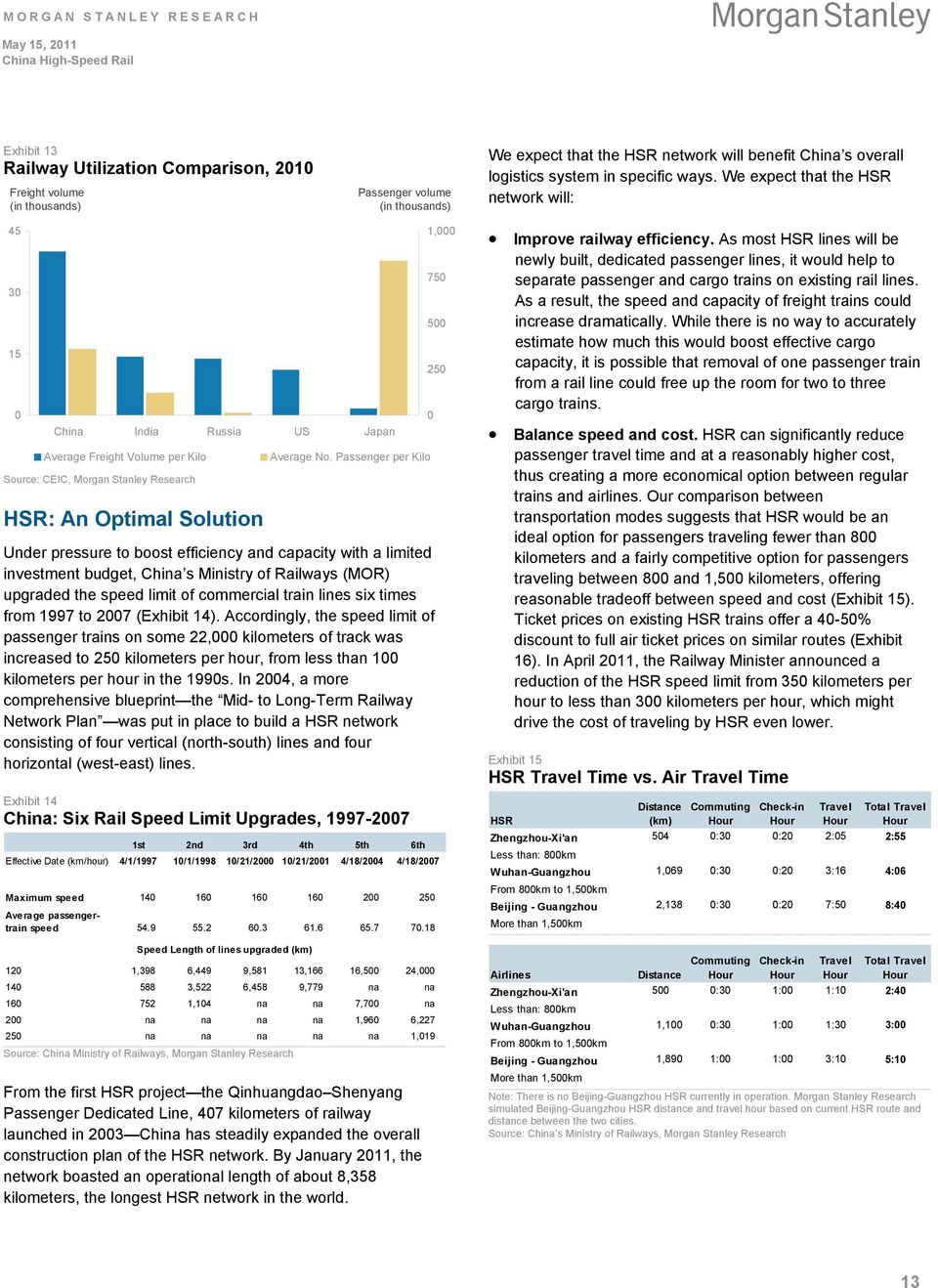
11 MORGAN The High STANLEY Speed BLUE Rail PAPER System Overview Edward Xu Allen Gui High economic growth, a large population, and the uneven distribution of resources have created long-term challenges to China s logistics system. We expect that over the next 1 years railways will serve as the backbone of a modern logistics system in China. In our view, HSR would be an optimal solution that will: Improve the operational efficiency of China s railway system by adding capacity and separating passenger trains and cargo trains from the same rail lines; Provide better options to passengers, offering a reasonable balance between speed and cost; and Achieve more efficient energy consumption and preserve natural resources. China s Logistics Challenges China s galloping economic growth requires a highly efficient logistics system to provides fast, frequent, and inexpensive transportation services to move both people and cargo in large quantities. China s sovereign land mass totals a vast 9.6 million square kilometers and is home to 1.34 billion people, the world s largest sovereign population. The land area spans more than 4, kilometers from the East Ocean coast to the West Pamir mountains and almost 4, kilometers from Mohe, China s northernmost city, to the southern shores of Zhanjiang. In Europe, an area equal to that of China would span from Portugal in the west to Turkey in the east, and from Iceland in the north to Greece in the south. And in the US, this same area would span from Los Angeles, California, in the west to Charleston, South Carolina, in the east, and from Seattle, Washington, in the north to San Jose, New Mexico, in the south. Yet the distributions of natural and human resouces are highly imbalanced between the eastern and western regions of China, and the levels of economic development vary significantly between these areas. For example, the east coastal areas boast a higher population density and more advanced economy but have sparse natural resources (e.g., thermal coal). In contrast, natural resources are heavily distributed in the remote northern and western areas, where economies are less developed and population density is low. Take coal, for example. In 21, about 1.9 billion tons of coal were produced in the three northwestern provinces of Shanxi, Sanxi, and Inner Mongolia, accounting for 59% of the country s total output. Roughly 3% of this output would be transported through railway lines eastward to the terminals and transshipped to the south/southeast. Moreover, due to significant gaps in living standards and wage levels, there are more than 149 million migrant workers in China who travel to the coastal cities in the east and south in search of jobs. With scant financial resources, they travel mostly by trains or buses once or twice a year over hundreds of miles between their homes and work places. These massive migrations take place regularly every year: in February/March the migration moves east/south when Chinese New Year starts and west/north in January/February when the lunar calendar ends. We expect that the ongoing processes of industrialization and urbanization will support secular demand for mass transportation in higher capacities and frequencies. Due to their high speeds, reliability, and lower unit cost versus air and highways, railways will likely serve as the backbone of a modern logistics system in China over the next 1 years, in our view. Status Quo of China s Railway Transportation From the opening policy in 1978, China s GDP surged to Rmb4 trillion, or US$6 trillion, in 21, implying a CAGR of approximately 1% over the same period. Yet the operational length of railways in China increased by only 76% over the same period, implying a CAGR of 1.8%. By 21, China had about 91, kilometers of railways in operation, which provided transportation to 1,676 million passengers who had traveled 523 kilometers on average for the year. Relatively, rail passenger volumes accounted for about 31.5% of total passenger volumes in the country, versus 14.5% for air and 54% for highways. Yet the penetration ratio of rail traffic (the percentage of total rail passengers over total population) is only 125%, compared with 654% in India and 17,868% in Japan. Our analysis shows that the greater popularity of railway transportation in 11

12 these countries stems from more frequent usage by people MORGAN commuting between STANLEY homes BLUE and work PAPER places (with average distances of 123 kilometers for India and 17 kilometers for Japan). Due to a lack of capacity, China s rail passenger volumes have been growing at a CAGR of only 5.3% from 21 to 21, versus 1.7% for real GDP, 9.% for road passengers, and 15.4% for domestic air passengers (Exhibit 1). As result, railway s market share among the major forms of public transportation has dropped to 31.5% from 36.2% over the period (Exhibit 11). And for the last decade, railway s revenue per kilometer (RPK) growth rate year over year underperformed real GDP growth as well as the growth rate of airlines and highway travel. Exhibit 1 China: Slow Development of Rail Traffic vs. Other Transportation Modes and GDP, 21-1 (CAGR %) Domestic air passengers Real GDP Source: CEIC, Morgan Stanley Research Highway passengers Rail passengers Another part of the equation is that the existing national railway network has been shared by cargo and passenger trains, which keeps operational efficiency low. The growth of rail cargo traffic hovered at a 7.3% CAGR over the 21-1 period, versus 9.8%-14.1% for highway and air travel. Market share of rail cargo also decreased to 2.1% from 3.8% over the same period (Exhibit 12). Exhibit 11 China Freight Market Share by Transportation Mode (%) Highway Railway Airlines Waterway and other.1 Note: Data as of 21. Source: CEIC, Morgan Stanley Research 2 32 Exhibit 12 China Railway Freight Volume vs. Share (mil. tonnes/km.) Market Share (%) 4, 3, 2, 1, Rail cargo volume e = Morgan Stanley Research estimates Source: CEIC, Morgan Stanley Research Market share From the perspective of capacity utilization, China s railways are probably the most burdened in the world. On average, there are 4,29 tons of freight and 36,34 passengers delivered on every kilometer of rail in China, versus 11,11 tons of freight in the US and 13,835 tons in Russia, and 839,115 passengers in Japan and 122,136 in India (Exhibit 13)

13 Exhibit 13 M Railway ORGAN Utilization STANLEY Comparison, BLUE PAPER 21 Freight volume (in thousands) Passenger volume (in thousands) We expect that the HSR network will benefit China s overall logistics system in specific ways. We expect that the HSR network will: China India Russia US Japan Average Freight Volume per Kilo Source: CEIC, Morgan Stanley Research HSR: An Optimal Solution Average No. Passenger per Kilo Under pressure to boost efficiency and capacity with a limited investment budget, China s Ministry of Railways (MOR) upgraded the speed limit of commercial train lines six times from 1997 to 27 (Exhibit 14). Accordingly, the speed limit of passenger trains on some 22, kilometers of track was increased to 25 kilometers per hour, from less than 1 kilometers per hour in the 199s. In 24, a more comprehensive blueprint the Mid- to Long-Term Railway Network Plan was put in place to build a HSR network consisting of four vertical (north-south) lines and four horizontal (west-east) lines. Exhibit 14 China: Six Rail Speed Limit Upgrades, st 2nd 3rd 4th 5th 6th Effective Date (km/hour) 4/1/1997 1/1/1998 1/21/2 1/21/21 4/18/24 4/18/27 Maximum speed Average passengertrain speed Speed Length of lines upgraded (km) 12 1,398 6,449 9,581 13,166 16,5 24, ,522 6,458 9,779 na na ,14 na na 7,7 na 2 na na na na 1,96 6, na na na na na 1,19 Source: China Ministry of Railways, Morgan Stanley Research From the first HSR project the Qinhuangdao Shenyang Passenger Dedicated Line, 47 kilometers of railway launched in 23 China has steadily expanded the overall construction plan of the HSR network. By January 211, the network boasted an operational length of about 8,358 kilometers, the longest HSR network in the world. 1, Improve railway efficiency. As most HSR lines will be newly built, dedicated passenger lines, it would help to separate passenger and cargo trains on existing rail lines. As a result, the speed and capacity of freight trains could increase dramatically. While there is no way to accurately estimate how much this would boost effective cargo capacity, it is possible that removal of one passenger train from a rail line could free up the room for two to three cargo trains. Balance speed and cost. HSR can significantly reduce passenger travel time and at a reasonably higher cost, thus creating a more economical option between regular trains and airlines. Our comparison between transportation modes suggests that HSR would be an ideal option for passengers traveling fewer than 8 kilometers and a fairly competitive option for passengers traveling between 8 and 1,5 kilometers, offering reasonable tradeoff between speed and cost (Exhibit 15). Ticket prices on existing HSR trains offer a 4-5% discount to full air ticket prices on similar routes (Exhibit 16). In April 211, the Railway Minister announced a reduction of the HSR speed limit from 35 kilometers per hour to less than 3 kilometers per hour, which might drive the cost of traveling by HSR even lower. Exhibit 15 HSR Travel Time vs. Air Travel Time Distance Commuting Check-in Travel Total Travel HSR (km) Hour Hour Hour Hour Zhengzhou-Xi'an 54 :3 :2 2:5 2:55 Less than: 8km Wuhan-Guangzhou 1,69 :3 :2 3:16 4:6 From 8km to 1,5km Beijing - Guangzhou 2,138 :3 :2 7:5 8:4 More than 1,5km Airlines Distance Commuting Hour Check-in Hour Travel Hour Total Travel Hour Zhengzhou-Xi'an 5 :3 1: 1:1 2:4 Less than: 8km Wuhan-Guangzhou 1,1 :3 1: 1:3 3: From 8km to 1,5km Beijing - Guangzhou 1,89 1: 1: 3:1 5:1 More than 1,5km Note: There is no Beijing-Guangzhou HSR currently in operation. Morgan Stanley Research simulated Beijing-Guangzhou HSR distance and travel hour based on current HSR route and distance between the two cities. Source: China s Ministry of Railways, Morgan Stanley Research 13
14 Exhibit 16 MORGAN HSR Ticket STANLEY Rates vs. Air BLUE Ticket PAPER Rates Standard HSR fare as of May 211 Exhibit 18 Energy Expenditures for Freight Shipments, 27 (Btu per Freight-ton mile) Base Fare Distance Rate HSR Route (RMB) (KM) (RMB/KM) Shanghai-Ningbo Shanghai-Nanjin Zhengzhou-Xi'an Wuhan-Guangzhou , Domestic waterborne 571 Standard airline fare as of May 211 Heavy trucks 359 Fuel Base Fare Surcharge Airport Constru. Fee Distance Base Rate Gross Rate Air Route (RMB) (RMB) (RMB) (KM) (RMB/KM) (RMB/KM) Shanghai-Beijing 1, , Shanghai-Shenzhen 1, , Beijing-Chongqing 1, , Beijing - Guangzhou 1, , Source: Company data, Morgan Stanley Research Conserve energy. The depletion of valuable energy sources such as petroleum could pose a serious challenge to China s long-term growth. The big challenge before the Chinese government, now planning its transportation strategy for the next few decades, is how to find the optimal use of energy that will benefit the greatest number of people. Some research shows railway as the most energy-efficient mode of transportation, as compared with air and auto (Exhibit 17 and Exhibit 18). HSR, a more advanced from of transportation that will help to expand China s overall railway capacity, is completely consistent with the government s long-term plan to develop a green economy based on low carbon emissions and sustainable growth. Exhibit 17 Energy Expenditures for Passenger Travel, 27 Class I freight railroad 32 Btu British thermal unit Source: Transportation Energy Data Book, Morgan Stanley Research The HSR Blueprint: Different Scenarios Recently the new Railway Minister announced a change in policy, with the goal to possibly reduce future capex from Rmb4 trillion to Rmb2-3 trillion for the Twelfth Five-Year Plan (211-15). This announcement followed on the heels of the exposure of some corruption cases found in China s railway construction industry. Thus, we think that the original HSR network plan might be completed as several work-in-progress projects. Our base case scenario assumes that the HSR s operational length will reach 16, kilometers by 215, with a basic skeleton of four vertical (north-south) lines and four horizontal (west-east) lines (Exhibit 19). Buses Personal trucks Cars Air Rail 4,315 3,946 3,514 3,13 2,586 Motorcycles 1,853 Btu per passenger mile Btu British thermal unit Source: Transportation Energy Data Book, Morgan Stanley Research 14

15 Exhibit 19 MORGAN China HSR STANLEY Grid: Four BLUE Vertical PAPER and Four Horizontal Lines Route Destination Max avg speed (km/h) Length (km) Expected launch date/ Launched date Beijing Tianjin /1/28 Tianjin Jinan mid-211 Jinan Xuzhou mid-211 Xuzhou Bangbu mid-211 Bangbu Nanjing mid-211 Nanjing Shanghai /1/21 V1 1,318 Beijing Shijiazhuang mid-211 Shijiazhuang Wuhan mid-211 Wuhan Guangzhou /26/29 Guangzhou Shenzhen mid-211 Shenzhen Hong Kong /215 V2 2,229 Beijing Shenyang Harbin Dalian Panjin Yingkou V3 1,67 Hangzhou Ningbo Ningbo Wanzhou /28/29 Wanzhou Fuzhou /28/29 Fuzhou Xiamen /26/21 Xiamen Shenzhen V4 1,491 Xuzhou Zhengzhou Zhengzhou Xian /6/21 Xian Baoji Baoji Lanzhou H1 1,363 Shanghai Hangzhou /26/21 Hangzhou Changsha Changsha Kunming 35 1, H2 2,258 Qingdao Jinan /2/28 Jinan Shijiazhuang Shijiazhuang Taiyuan /1/29 H3 98 Shanghai Nanjing /1/21 Nanjing Hefei /18/28 Hefei Wuhan /1/29 Wuhan Yichang /212 Yichang Chongqing /211 Chongqing Lichuan Chongqing Suining /212 Suining Chengdu /3/29 H4 1,721 Total length 12,958 Source: Company data, MOR, Morgan Stanley Research Rmb7 billion (US$16 billion) to 7 railway projects, including 15 HSR projects. In particular, about 4,715 kilometres of new HSR lines will be launched in 211 alone. When completed, this network will connect at least 2 cities (including the tier-1 cities of Beijing, Shanghai, Guangzhou, and Wuhan) by 215. In our estimation, these combined economies coverage could reach Rmb 27 trillion, or 67% of the country s total GDP, with 65 million people, or 5% of the country s total population (Exhibit 2). Our bull case scenario assumes a more aggressive construction plan to build a HSR network with 2, kilometers of track by 215. Once completed, we think this network would connect another 5 cities (including Shenzhen, Hong Kong, Chongqing, and Chengdu). The network would thus cover an aggregate GDP size of Rmb33 trillion, 82% of China s total, and include a population of 75 million, 63% of China s total. Our bear case scenario assumes some moderate expansion of the existing HSR network to 15, kilometers in length, as macro tightening and anti-corruption sentiment could dominate the mindset of China senior government officials. Therefore, the network would cover a smaller-than-expected area of 18 cities, with an aggregate GDP of Rmb25 trillion and a population of 58 million. Exhibit 2 China HSR Blueprint by 215 in Different Scenarios Base Case Bull Case Bear Case Cities covered GDP (Rmb tril.) Population (mil.) GDP (%) Population (%) Source: Morgan Stanley Research Based on the MOR's official Mid- to Long-Term Railway Network Plan and current progress in construction, total operational length of HSR should reach about 13, kilometers by end-211, one year ahead of the original schedule. In 21, China committed Rmb79 billion (US$18 billion) to railway construction. For 211, it is planning 15

16 MORGAN STANLEY BLUE PAPER 16

17 MMORGAN STANLEY BLUE PAPER Industry Implications 17

18 MORGAN Tourism: STANLEY Entering BLUE PAPER a Golden Era Lin He Ying Guo China s HSR provides a new, higher-speed, lower cost-per-mile technology that will fundamentally change the experience of leisure travel in China. We expect the number of trips per capita to increase by 5% by 215. Tourist destination spots should benefit from greater accessibility. New types of tourism are likely gain in popularity within the threehour-city clusters. HSR Encourages Chinese Leisure Travelers to Travel More HSR technology will fundamentally change the experience of leisure travel in China, reducing the time and cost involved for travelers and increasing the frequency of leisure trips. While China is aleady a main destination for international travelers, within China the domestic tourism industry is still at an early stage. Per capita, the Chinese make only 1.6 domestic trips every year, compared with 4.6 trips per capita for Americans (Exhibit 21). In addition, tourism industry revenue accounts for about 4.% of GDP in China. We believe that by 215 the average domestic trips per capita in China will grow to 2.4 trips a year and that the tourism industry will account for 4.5% of GDP, based on strong economic growth and improvement in China s infrastructure. The main improvement, we believe, is the build-out of China s HSR (Exhibit 22). In our view, economic growth and infrastructure build-out are what drive a domestic tourism market. There is a strong correlation between frequency of travel and the availability of transporation facilities, as well as between per-capita GDP. With the build out of China s HSR, total length of highways and railways will reach 3.6 kilometers per thousand people, up 16% from today. Our China economics team forecasts an average of 12% nominal GDP growth in 21-15, implying more than 9% growth in per-capita GDP within five years. Greater affordability of travel, the large size of China, and the country s highly developed network of roads and transport will encourage Chinese travelers to take more domestic trips. Wuhan city serves as a perfect example of the relationship between the development HSR and increased leisure travel. Wuguang HSR, which connects big, major cities like Wuhan, Changsha, and Guangzhou, was opened in December 29 and is now highly popular among leisure travelers. In the first half of 21, Wuhan city saw total tourist volume and tourism revenue up 43% and 51% year over year. Exhibit 21 Correlation: Domestic Trips, Land Transportation, and GDP per Capita Length of Land Transport 1,5 1,2 Canada Australia 75% Correlation USA 9 Denmark France New Zealand Finland 6 Greece Japan Spain Italy Czech UK 3 Russia Portugal China Malaysia Vietnam Thailand Domestic trips per capita/year Note: Data for number of trips for each country are from 21; GDP per capita, 29; length of railway and road per capita, 23-8, where latest is available. Source: CEIC, Euromonitor, IndexMundi, Morgan Stanley Research Exhibit 22 Wuhan City: Strong Boost to Tourism Rmb (bil.) Domestic tourism revenue Source: Wuhan Statistic Bureau, Morgan Stanley Research HSR starts operation in December 29 YoY (%)

19 Linking the Coastal Area to Central/Western China MORGAN STANLEY BLUE PAPER Because of their greater wealth, residents of China s coastal regions, especially those from the Yangtze River Delta and the Pearl River Delta, have been the main participants in leisure travel in China. In 29, residents in the eastern regions spent 75% more on culture, education, and recreation than did residents from China s western regions. Even though Chinese tourism originates in the wealthiest part of the country, about 5% of the top-quality destination spots are located in less-developed central and western China, regions with limited access to transportation (Exhibit 23). The build-up of China s HSR, especially the four horizontal rail line networks, will greatly improve access to these vacation spots and make these attractions closer to the more-affluent regions that support much of the nation s tourism. Emerging SCC Changing China Tourism The Chinese tourism market is still largely based on sightseeing, with most travelers visiting locations of natural beauty and historical buildings. However, we believe the importance of sightseeing to the overall Chinese tourism market will decrease over time. With the emergence of 3-hour city clusters in urban areas, we believe that weekend getaways to recreational properties and resorts in nearby cities will become more popular. Activitiesbased tourism, such as mountaineering or sports-related tourism also will grow rapidly. How to Profit From the New Opportunities? We see the following companies as profiting from the new trends in China s tourism: Huangshan Tourism. We think Overweight-rated Huangshan Tourism is well positioned to benefit from the ongoing infrastructure upgrade driven by HSR. Attractive asset. Mount Huang is arguably China s most famous mountain. Together with the Great Wall and Forbidden Palace, Mount Huang ranks as one of China s top-1 scenic spots, the only mountain to be included in the top 1. UNESCO lists Mount Huang among its World Natural and Cultural Heritage sites for its natural beauty and rich culture, one of only four such listings for China. Becoming a new hub. Of all China s national scenic spots, Mount Huang is the closest to Shanghai and is likely to be a key beneficiary of the HSR. HSR access to Mount Huang will start up by 213 and will open the site to an estimated 8.8 million railway passengers by 215, as compared with 1.3 million today. Walt Disney. Our US media analyst Benjamin Swinburne believes that China represents a significant opportunity for global media companies like Overweight-rated Walt Disney. However, the opportunities to build big businesses in that market have been limited due to historical regulatory and economic constraints. The rapid economic growth of China broadly (and more specifically, the area in and around Shanghai), combined with a booming middle class, has led Disney to look to expand more aggressively into that market. Walt Disney recently announced that it has broken ground to begin construction of a theme park and resort in Shanghai, in a joint venture partnership with Shanghai Shendi (Group) Co., Ltd. The Shanghai Disney Resort, slated to open in approximately five years, would include Shanghai Disneyland, two themed hotels, a retail-dining-and-entertainment venue, recreational facilities, a lake, and associated parking and transportation hubs; the company may add more hotel rooms to the resort in the future. For Disney, by moving first and leveraging its existing brand position in China is attractive. Disney has had mixed results in its international theme park expansion plans in the past, but in this case, the expected growth in Chinese leisure spend, along with its strong local partnership, makes this opportunity worth seizing. The theme parks serve to reinforce the broader Disney portfolio, including TV, film, and, ultimately, consumer products. It serves as a pipeline for theatrical product, such as the hit franchise movie, Pirates of the Caribbean. The booming middle class in and around Shanghai makes the location and timing of this investment especially attractive. Shanghai is one of the wealthiest and most developed metropolitan areas in China, with 2 million inhabitants. Shanghai is also connected by highway and HSR to another 15 million people in eastern China, the wealthiest economic zone; a traveler from Shanghai can reach the Disney theme park within three hours. This guarantees ample local addressable market, even without considering fly-in visitors. This implication for Disney s planned capacity are positive: It only takes 45 out of 1, local residents to visit the theme park once a year to keep it full. This is based on the assumption that the resort is constructed for 7.3 million annual visitors upon completion. 19


20 MORGAN STANLEY RESEARCH Exhibit 23 World Heritage Spots in China: Wide-Spread Tourist Attractions Harbin Changchun Urumqi Shenyang Hohhot Beijing Jiayuguan Shijiazhuang Yantai Yinchuan Xining Dalian Tianjin Jinan Taiyuan Qingdao Lanzhou Lianyungang Xian Zhengzhou Nanjing Hefei Shanghai Wuhan Hangzhou Chengdu Lhasa Chongqing Changsha Nanchang Fuzhou Guiyang Culture Heritage site Kunming Guan Nature Heritage site Xiamen Shenzhen Zhuhai Mixed Heritage site Nanning Shantou Hong Kong Macau Zhanjiang Haikou Source: UNESCO World Heritage Centre, Morgan Stanley Research 2

21 Restaurants: Greater Mobility Means Greater Profitability John Glass Jon Tower, CFA A build-out of the HSR system across China will not only open up restaurant opportunities at transportation hubs, but also rapidly expand brands into markets once thought too distant to matter. While most quick-service concepts will profit from an expanding geographic reach, the primary beneficiary of such growth will be Yum! Brands, with its KFC, Pizza Hut Casual Dining, Pizza Hut Home Delivery, and East Dawning brands, given the company s scale and commitment to grow with Chinese infrastructure investment. Starbucks and McDonald s also should benefit as consumer demand for luxury and convenience spread across the country with the expanding rail system. Brand Availability from East to West Most quick-service restaurant (QSR) chain concepts have a restaurant base rooted up and down the east coast of China, with tier-1 cities as epicenters of growth that over time will spread across to smaller markets. As seen in Exhibit 24, three of the top chain restaurant brands in China have more than 25% of their store base within 22 super-hub cities, with Pizza Hut Casual Dining, owned by Yum! Brands, holding the largest exposure (48%). Meanwhile, each of these major brands have less than 1% of their store base in 22 emerging-hub cities, which provides for long-term growth opportunities. While supply chain infrastructure and human resources capabilities have been inhibiting factors to brand expansion in the past, current obstacles are related more to brand affordability outside of core markets. As railways allow for more consumers to commute from further distances, wealth and brand affordability should follow, lending to more store growth over time. Exhibit 24 Pizza Hut and McDonald s: Highest Store Concentration in 22 Super-Hub Cities City McDonald s Store Count (%) KFC Store Count (%) Pizza Hut Store Count (%) Super-hub cities Shanghai Beijing Nanjing 3 2 Guangzhou 9 4 Chengdu 2 1 Wuhan 3 Shenyang 2 2 Xi'an 1 1 Zhengzhou 1 Chongqing 1 1 Changsha 1 1 Emerging-hub cities Lanzhou Nanning 1 1 Nanchang Hefei 1 1 Harbin 1 2 Hangzhou 1 3 Shijiazhuang 1 Guiyang Current super-hub cities Emerging-hub cities Note: Pizza Hut Casual Dining and KFC are owned by Yum! Brands. Data are as of 21. Source: AlphaWise SM, Company data, Morgan Stanley Research. New Transport Hubs, New Markets Emerging HSR rail hubs will provide new markets for QSR brands to build traditional stores while allowing for investment and experimentation with non-traditional stores types within these hubs. In more developed Western markets, nontraditional store returns match or may even lag a traditional store, despite the lower investment cost, due to lower volumes. However, in an emerging market with limited competition, stores within transport hubs often yield higher returns as volumes can often exceed traditional store formats while sporting a lower initial investment cost. Furthermore, smaller format stores within transport hubs can act as a form of advertisement, as thousands of potential customers walk by these embedded storefronts on a daily basis during the commute
22 Who is best positioned for growth of new high-speed rail MORGAN hubs? Of the STANLEY global QSR brands BLUE within PAPER China, Yum! Brands should see the greatest benefit from this expansion. With multiple brands to grow, the best supply chain in the country, and the deepest management talent, Yum! Brands should continue to out-grow its peers in these newer markets. Futhermore, Yum! Brands is no stranger to transportation hubs, with 12 units already located within railway stations, bus stations, and airports across the country. In our view, Yum! Brands is best positioned to benefit from: Refranchising, which we believe is underestimated. Not only will refranchising improve Yum! Brand s ROIC by about 2 basis points, but it will lower the US profits profile to become the smallest of the three main divisions within three years, removing an overhang in the stock. A better play on emerging market growth ex-china. International growth is the only true large-scale opportunity for restaurants, in our view, and Yum! Brand, more than McDonald s, has significant exposure to the world s largest developing market. China s shift from a producer to a consumer economy. We estimate consumer spending in China will triple within a decade, and with nearly 4% of Yum! Brand s profits emanating from China, this is one of the largest exposures of any multi-national consumer companies. 22
23 Hotels: IHG, Starwood, and Accor Top the List Jamie Rollo Ryan Meliker Mark Strawn We believe that China s HSR project could have the same transformational impact on the hotel industry as the US interstate highways system had on the US hotel industry the in the 196s and 197s. The US hotel market ballooned from 1.4 million rooms in 196 to about 5 million today, of which 7% are branded. By comparison, China has 2 million hotel rooms today, with only 2% of these branded. We see scope for the number of Chinese branded hotel rooms to increase seven-fold, assuming the China experience converges with the US experience and its branded penetration increases to 5%. We think that IHG, Starwood, and Accor are best placed to take advantage of this business development, given their strong market share of existing hotels and their presence in the pipeline. The Chinese hotel market is relatively small and fragmented. There are 2.3 million hotel rooms in China today, compared with 5 million in the US and 6 million in Europe. This means China has around 55 people per hotel room, against 5-7 people in the US and Europe (Exhibit 25). The more relevant gap on branded hotels is even wider, with 2% of China s rooms being branded, versus 7% in the US. This means that China has nearly 3, people per branded hotel room, against nearly 9 in the US, a difference of 3 times. Similarly, for every $1 billion of GDP, the US has 233 branded hotel rooms and China has 46 rooms, and Chinese GDP is widely forecast to double by 22. China s upscale market is dominated by international operators. Around 8% of Chinese hotel rooms are upscale or luxury, and this segment is dominated by international players. The largest 1 international operators have a share of 46%. Note that this is fairly concentrated for an industry where, globally, the largest 1 operators have a market share of 22%. Brands are seen as a signal of quality, and international brands deliver higher returns than domestic brands (a 4% RevPAR premium in the Chinese five-star segment, according to IHG). If we look at the hotel pipeline in China (at around 4, rooms according to market researcher STR Global), 71% is in the hands of the 1 largest international operators. Exhibit 25 Unmatched Growth Potential in China China US Difference Macro comparisons Population (bil.) GDP, 21 ($ tril.) 1 15 GDP Growth, 21 (%) Tourism contribution to GDP (%) Inbound travel, 28 (mil.) Outbound travel, 28 (mil.) 39 4 Hotel sector comparisons People per hotel room x People per branded hotel room 2, x Hotel rooms per $1bn GDP x Branded hotel rooms per $1bn GDP x Company comparison example IHG rooms open 47, 41, IHG rooms per 1, people x IHG branded room share (%) 1 12 IHG pipeline share (%) IHG revenue as % of GDP x Source: CEIC, IHG, STR Global, Morgan Stanley Research Exhibit 26 IHG, Accor, and Starwood Lead Among International Hotel Operators (% Market Share) IHG Wyndham Accor Starwood Marriott Shangri- La Open system Source: Company data, Morgan Stanley Research Pipeline Hyatt Hilton The most successful international operators appear to be IHG, Starwood, and Accor (Exhibit 26). IHG is both the biggest international operator (12.5% market share of the branded segment) and has the largest pipeline (25% market share). The company has as many rooms in its pipeline as it has open today, and it has lineof-sight on close to 1, rooms. This means IHG is 23
24 twice as large as Starwood, three times bigger than Marriott, and four times larger than Hilton. All its hotels run under management contracts, which means high margins, no capex, and a fairly long maturity profile. Around half of its rooms are InterContinental and Crowne Plazas in the upscale segments, and it is considering creating its own Chinese brand to compete in the space as it imoves into expands in key urban markets. The other half of its exposure is the Holiday Inn brand, which was such an instrumental brand in the growth of the US hotel market 5 years ago and which should have more growth potential given its midmarket positioning (though it is seen as an upscale brand in China). IHG claims to be the first international operator in China with the longest loyalty programme there, the deepest relationships with stateowned enterprises and the government, and the largest people infrastructure. IHG also claims to be the only international hotelier where China is a standalone region reporting directly to the CEO. Starwood has a 6% share of the branded segment today and a 14% share of the pipeline. By profits, China has become Starwood s second largest hotel market behind the US, with more than 6 hotels and 86 hotels in the pipeline; China is the company s fastest growing division. Asia accounts for 18% of Starwood s fee income and 59% of its pipeline, so that number will grow quite rapidly. This compares with 1% at IHG, so Starwood is actually more exposed to China than is IHG. In October 21 Frits van Paasschen, President and CEO of Starwood, said that there is still a long runway for growth, especially when you consider that China has 171 cities with populations of more than one million, most of which do not yet have a major international branded hotel. It is not hard to imagine that we will ultimately have as many hotels in China as we do in the United States, which is more than 45. While Starwood has a strong footprint in the upscale/luxury segment, it is still behind IHG on share of rooms and share of pipeline. Accor has a 6% share of both the segment and the pipeline today. Accor has about 25, rooms in China in 93 hotels, and its ambition is to have 192 hotels by 215. Accor established itself in Asia 2 years ago, and it has doubled its number of hotels from 23. It has 28 properties in the upscale/luxury segment and 26 properties in midscale, and it plans to roll out 2 properties in the luxury/upscale segment and 21 in the midscale segment via management contracts. Its main focus, however, is the economy segment, where it has a target of adding more than 1 Ibis hotels by 215 (its initial target was to have 1 Ibis hotels by 21). The development of these hotels is via a combination of investment and franchise with limited management. Despite Accor s ambitious plans in China, Gilles Pélisson, former chairman and chief executive, advised caution in China, saying there was a danger of oversupply in hotel rooms in the world s fastest growing large economy (Financial Times, 19 August, 21). Scaling the opportunity. As we saw above, the US today is 3 times bigger than China on a branded-room-per-capita basis, and five times bigger on a branded-room-relative-tocurrent-gdp basis, but with GDP growing rapidly, these two should close (Exhibit 27). IHG believes that the Chinese hotel market could grow from 2.3 million to 7.5 million rooms by 23, of which roughly half would be branded. If the compnay maintains a 1% branded share, smaller than its current shares in the US and China, this would be around 36, rooms. This would represent a 5% increase in the size of IHG today, and be broadly equivalent to $3 million EBITDA, also a 5% EBITDA increase. On 1 times EBITDA and discounted back, China could be worth more than 3p per share, or 25% of the current share price (Exhibit 27 through Exhibit 3). For Starwood, China represents annual EBITDA growth of 3% until maturity, which, based on 1 times 212 EBITDA, would be about $3 per share. Exhibit 27 China Hotel Market May Surpass US Hotel Market by 225 Millions of rooms Source: IHG % CAGR 4.9% CAGR By 239 China s room supply will be: 4x the size it is today Almost 2x the size of the US market today 9.1 China USA
25 IHG CEO Andy Cosslett, August 21: Over 5, people now work in our hotels in China and we plan to double that in three years and double that again three years later to 3, employees. We ve developed 25 academies in 11 locations, which are training 5, students a year, and we ve been voted the best employer in China two years running. We have priceless contacts with government and strategic partners that have been built up over 26 years. There are 15 airports under construction, which will transform secondary and tertiary cities into destinations, and there are 8 cities in China that will support luxury hotels. And our infrastructure and our reputation presents us with an unparalleled opportunity. And the scale of that opportunity, well, we re just trying to still scope it, but here s one fact just to ponder. The US is by far the world s largest hotel market today, with over 25% of the world s hotel rooms in that market. The hotel market in China is destined to be bigger than the Americas within 15 years. If you consider that we have 3,5 hotels in the Americas today and 13 in China, it will give you some idea of the sort of growth that we re expecting to get out of that market in the years to come. Exhibit 28 IHG Could Sieze Growth Opportunity in China Hotel Rooms China hotel rooms (mil.) 8 7 China hotel rooms (thou.) 4 35 In 21, China s supply grew by 3.5%, but real GDP grew by 1%, leading to robust demand growth of 2% and RevPAR growth of 28%. Morgan Stanley forecasts continued annual GDP growth for China in excess of 9% through 215. Given the only modest reduction in GDP, and supply growth that is only slightly above recent levels, we think China could experience double-digit RevPAR growth. There are also the generic issues such as intellectual property, foreign investment, and currency. Finally, there is a risk that fees might get pushed down through competition, though IHG says its management fees are very stable and have even been increasing on recent renewals. Exhibit 29 Rooms per Capita Very Low In China Year 28 Year 28 Year 24 No. of rooms per capita 1 (room / person) % Lodging spending per capita 1 (US$ / person) % Room revenue as % of real GDP 1.3%.56%.83% -19% 1 Comparing China urban population (about 6 million in 28 and 1,12 million in 24) with US total population (about 31 million in 28). Source: IHG Exhibit 3 Upscale and Midscale Growing Fastest (likely) 239 (likely) No. of rooms No. of rooms No. of rooms = 2.3m = 4.8m = 9.1m 4 3 Unbranded Branded Luxury / Upper Upscale/ Upscale 5% e e Midscale Economy 4% e = Morgan Stanley Research estimates. Source: CEIC, IHG, STR Global, United Nations, Morgan Stanley Research Risks. At the end of 21, China had 8% of its existing supply under construction and another 3% in final planning. Given this high level of supply growth over the next two to three years, and the Shanghai Expo boost in 21, we think it is reasonable to expect RevPAR growth to moderate in China. Source: IHG 25
26 Budget Hotels: Leveraging China Travel Growth Lin He Ying Guo Demand for budget hotels in lower-tier cities is likely to rise strongly over the next five to 1 years as China s massive build-out in infrastructure drives economic growth and narrows the gap between tier-1 and tier-2/3cities. Budget hotel chains 7 Days and China Lodging are relatively better positioned because of their greater exposure in emerging hub cities situation to China s development of the HSR system was the development of the US interstate highway system, which led to an upcycle in the US economy in the 197s. Exhibit 32 Economy Hotels: Underpenetrated Supply Rooms per Thousand People Number of Rooms per Thousand People Number of Rooms per Thousand Urban Population 21 USA China.4.9 Strong Potential in Tier-2 and Tier-3 Cities In China, for the most part, budget hotels target business travelers. For this reason, until recently highly developed tier- 1 cities have been the key markets for budget hotel chains (Exhibit 31). As of 21, Shanghai, Beijing, and Shenzhen were the three largest budget hotel markets in China, collectively accounting for about 3% of total hotel supply. Exhibit 31 Budget Hotel Supply by Cities (%) Shanghai Beijing Shenzhen Hangzhou Guangzhou Nanjing Wuhan Tianjin Suzhou Chengdu Others Note: Data as of end 21. Source: Inntie, Morgan Stanley Research But we see strong potential for budget hotels in tier-2/3 cities over the next five to 1 years as China s massive infrastructure build-out helps drive economic growth and narrow the gap between tier-1 and lower-tier cities (Exhibit 32). We find that most emerging-hub cities cities that will become hubs because of the HSR are tier-2 cities in central and western China; some are even tier-3 cities. A more robust economy generates stronger business travel, and, in most cases, a substantial improvement in transportation infrastructure has a significant positive impact on a region s economic performance. In the US, a comparable China China Source: CEIC, Inntie, STR Global, United Nations, Morgan Stanley Research China Lodging and 7 Days Better Positioned Understanding the vast opportunites in tier-2/3 markets, almost all leading budget hotel chains are expanding their footprint there. China Lodging (HanTing) and 7 Days seem to be ahead in the race: Both have 45% of their hotels in 14 of the 215 super-hub cities those with the largest traffic volume in that year(exhibit 33). Hotel chain 7 Days also has the largest exposure to the top-gainer cities those that will see the strongest passenger growth after the HSR is developed (Exhibit 34). Being an early mover, the company should enjoy a certain advantage because of its brand awareness and lower rental costs. Exhibit 33 China Lodging and 7 Days in 215 Super-Hub Cities 215 ranking Cities SVN HTHT HMIN JJ 1 Beijing Guangzhou Shanghai Chengdu Nanjing Changsha Hangzhou Guiyang Shenyang Haerbin Wuhan Shijiazhuang Xuzhou Wuxi % of existing total hotels 45% 45% 38% 34% Note: Hotel counts as of April 211. Source: Company data, Morgan Stanley Research 26
27 Exhibit 34 7 Days: Larger Exposure to 215 Top-Gainer Cities Passenger increase SVN HMIN HTHT JJ Changsha 11.x Guangzhou 9.6x Huangshan 7.9x 1 1 Leshan 7.5x 1 Jining 6.7x Hangzhou 6.6x Xianning 6.6x Guiyang 6.2x Foshan 5.9x 12 4 Nantong 5.7x Zhenjiang 5.5x Dongguan 5.3x Fuxing 4.6x 215 top gainers (%) Notes: Top-gainer refers to cities with the highest traffic growth rate. Hotel counts as of April 211. Source: Company data, Morgan Stanley Research 27
28 Consumer Staples: Another Round of Robust Growth Angela Moh Lillian Lou China s HSR offers another growth driver for consumer staples. We see the following trends affecting the sector: Consumers increased mobility will be another driver for consumption growth of convenience foods such as instant noodles, beverages, snack foods, and packaged meat. Emerging new city hubs/clusters in inland regions and the fast development of lower-tier cities will help fill the consumption gap. At the same time, we feel there should also be increased opportunities for deeper segmentation of the markets and for companites to be more innovative in serving the consumers. As capacity from railway cargo transport frees up, operating efficiency should improve, helping the leading food and beverage companies to increase the pace of market penetration and expand the geographic coverage of factories at lower costs. Rapid growth of modern retail chains will likely shift the bargaining power from the brands to the retailers. Increases in available shelf space will lead to more intense competition as more brands get a chance to fight for consumers attention. Increased share of sales to chain stores would also result in higher working capital requirements. We think national players of convenience food and beverage products such as Tingyi, Want Want, and Uni-President will be the first to benefit from traffic growth. Increased city vibrancy and faster pickup in the economies in the new city hubs could also help other leading companies such as Mengniu and Yurun as consumers trade up. While the greater connectivity and improved access to different markets could potentially result in greater levels of competition, we believe that leading players with scale should be better able to take advantage of the improved market access. Growing economic vibrancy in inland regions within and close to the three new super-city clusters (the northeast China SCC, central China SCC, and west China SCC) will increase consumer affluence and thus support the secular volume growth of food and beverage products in general. A faster trade-up could be driven by improved consumer affordability in the lower-tier cities, the trend that we have observed in higher-income markets. Rising income and more affordable products should provide opportunities for companies with good product development capabilities to tackle more specific consumer needs and better optimize on their gross margin structure with a more comprehensive product portfolio. Food and beverage manufacturers can lower distribution costs, increase distribution efficiency, and expand effective geographic coverage. According to our transporation team, HSR will divert a certain number of passengers away from traditional railways, which should free up space on traditional railways to carry more freight. As such, we project total railway cargo capacity to rise at a CAGR of 8.6% during 211-2, versus 6.2% in a business-as-usual case. In the former situation, food and beverage manufacturers could enjoy: More efficient distribution at lower cost, especially for short- and mid-range routes where railway will take more share from highway transportation; increased freight capacity and efficiency on railways will substitute some of the freight carried by highways, which are often more expensive and time- consuming. Meanhwhile, faster product delivery will help manufacturers shorten the lead time for product delivery to the end retail sales points and thus have quicker inventory turns. HSR System: A Consumption Booster We foresee meaningful consumption growth for packaged foods. Our China strategy team expects HSR to bring an incremental railway traffic of more than 2 billion in the next 1 years (increasing travel frequency and switching from air and highway traffic). We feel the immediate beneficiaries will be the manufacturers of convenient packaged foods that people can consume on trains, like instant noodles, beverages, and snack foods. Increased city vibrancy will trigger volume growth and further consumption upgades. Wider market coverage, along with the extension of optimal transportation distance and more flexibility in factory locations. As railways can carry merchandise for longer distance than can a truck fleet and is cheaper than air cargo, increasing railway cargo capacity will make it easier and more economical for manufacturers to extend the transportation radius. This, to some extent, could reverse the current need for satellite factories across the nation. Instead, manufacturers can have a smaller number of larger factories, which could, in some case, help generate better economies of scale. 28
29 Greater accessiblilty to different markets. We expect to see major players with deeper penetration into lower-tier cities that will be connected to the HSR system. Improved accessibility to more rural markets would also make it easier for brands with weaker distribution capability to penetrate these markets. However, we feel the leading companies should be better able to take advantage of the greater accessibility of the markets. Faster growth of modern food retail chains could shift the bargaining power from fast-moving consumer goods (FMCG) brands to retailers, and competition could be stiffer. Our China strategy team forecasts that by 215 super-city clusters will start to take shape and by 22, there will be six such city clusters covering about 7% of the Chinese population and responsible for 75% of China s GDP. We believe this rapid urbanization will help facilitate the expansion of organized retail channels and we expect an acceleration of new store openings by major retail chains in the next five to 1 years. With more organized retail chains replacing traditional retail seles channels, FMCG players are likely to adopt a more direct sales formats (i.e., working directly with retailers) and have a flatter distribution channel set-up. However, being more reliant on modern channels, the organized modern retail chains could gain stronger bargaining power. Increase in the share of sales to modern channels could lead to increasing working capital needs for manufacturers, as the chain stores usually demand credit terms as opposed to cash on delivery for distributors. The competitive landscape would get more complicated. Multinationals will have a better chance to penetrate into less-developed markets where domestic players currently have an advantage, as the traditional channel is more dominant. Meanwhile, local brands will face increasing competitive pressures from national brands and are often at a disadvantage when working with large organized retail chains. Nevertheless, growth in modern chains will mean increased shelf space availability and room for newcomers to have a shot of grabbing consumers wallet share. HSR Could Bring Incremental Consumption Growth Our study on industry sales volume of instant noodle and beverage products shows a high correlation between volume and railway traffic. While we do not have sufficient historical statistics for other convenience food and beverage products (like snack foods and maybe HTMP), we believe these products could also benefit. Industry. Instant noodle and soft drink volume has high correlation with railway traffic (Exhibit 35). Company. Similar to the industry trend, Tingyi s sales volume of bowl noodles and beverages show a close correlation to railway traffic. Meanwhile, volume growth of relavent companies also show some correlation with railway traffic growth (Exhibit 36). Looking forward, increasing railway traffic could continue to contribute to the volume growth of instant noodle and soft drinks products. While we could use a regression model based on historical trends to forecast the future volume growth, the numbers would be disproportionately biased to the upside as they would not factor in other influencing factors and the availability of substitute products. For example, based on our projected railway traffic data, extrapolating from historical trend would indicate instant noodle volume growing by 3 times to more than 16 packs per person by 22. This would be much higher than the more than 4 packs per person consumption level in places like Japan or Taiwan, or even 7+ packs in Korea. Neverthless, a shift from packet noodles (87% of the market in China) to cup/bowl noodles (13% of the market in China, vs. 63% in Japan) should help drive up average average sales price and margins in the longer run. 29
30 Exhibit 35 Instant Noodle and Soft Drink Sales Volume Has High Correlation with Railway Traffic Instant noodle volume (tons) Exhibit 36 Growth: Company Volume Correlates with Traffic (%) 4 Tingyi Bowl Noodle Sales Growth vs. Railway Traffic Growth 8, 6, 4, 2, R Square = 79% SARS Impact Passenger Traffic (mil.) 1 Railway Traffic Growth YoY Tingyi Bowl Noodle Sales Volume Growth YoY Tingyi Beverage Sales Growth vs. Railway Soft drinks volume (tons) 75 12,, 9,, 6,, 3,, R Square = 86% SARS Impact Railway Traffic Growth YoY Tingyi Bowl Noodle Sales Volume Growth YoY Passenger Traffic (mil.) Note: Instant noodle volume from January 22-Februrary 21; soft drink sales volume, February 21-February 21. Source: China Bureau of Statistics, CEIC, Morgan Stanley Research Want Want Rice Cracker and Snacks Food Sales vs. Railway Traffic Growth Impact from retail channel stuffing and restructuring Railway Passenger Traffic YoY Growth Rice cracker: Want Want Sales Volume YoY Growth Snacks Food: Want Want Sales Volume YoY Growth 3 Shuanghui HTMP Sales Growth vs. Railway Traffic Growth Railway Passenger Traffic YoY Growth HTMP: Shuanghui Sales Volume YoY Growth Source: Company data, CEIC, Morgan Stanley Research 3
31 HSR Could Help Drive More Consumption Growth in Lower-Tier Markets Using our China strategy team s projection on railway traffic for the major HSR stations (according to the national contruction plan), we indentify a few trends based on the incremental traffic brought by the HSR stystem (Exhibit 37 and Exhibit 38). In our analysis, we divide the development stage into three phases: near-term is 21-13, mid-term , and long term The additional mobility across the three stages tends to be more evenly distributed (35% in the near term, 27% in the mid term, and 38% in the long term). Tier-3 and -4 cities will see the most incremental traffic in each of the three stages (44% of incremental traffic in the near-term, 73% in the mid-term, and 65% in the longterm; 42% over the whole period) as HSR provides more convenient and efficient local/regional transportation and connections. Tier-1 and -2 cities will have more incremental growth in near-term (49%% of total incremental traffic in the near term, 26% in the mid term, and 34% in the long term). Regionally, east China is the key area over the whole period (31% of incremental traffic in the near term, 19% in the mid term; 31% in the long-term, and 28% over the whole period). Meanwhile, each period has its focus: north in the near-term (29%); southwest in the mid-term (31%); and central in the long term (22%). We think these traffic trends could trigger continued market expansion by leading food and beverage companies to lowertier cities over the next 1 years. Heavier traffic flows to the less-developed cities will increase the economic vibrancy in these regions and thus eventually help improve the consumer spending level. We could see some acceleration in volume growth and consumption upgrade in these lower-tier markets. In the near term (next three years), more-developed markets will continue to be the major growth contributor favoring companies that have more diversified and higher-end positioned product offerings and have a strong presence in the modern retail channels. Exhibit 37 Incremental Railway Traffic Projections for Major Cities in HSR Grid Incremental Traffic (mils. passsengers) Cities e 213e-215e 215e-22e Tier-1 cities (4) Tier-2 cities (22) Tier-3 cities (38) Tier-4 cities (5) Tier-5 cities (12) Total (126 cities) Note: The tiering of cities is based on the weighted average of economic factors including average wages (3%); GDP per capita (18%); disposable income per capita (18%); consumer expenditure per capita (18%); and population density (16%). e= Morgan Stanley Research estimates Source: Morgan Stanley Research Exhibit 38 Incremental Railway Traffic Projections by Region Incremental Traffic (mils. passengers) Region (No. of cities) 21-13e 213e-15e 215e-2e North (16) Northeast (15) East (43) Central (14) South (17) Northwest (9) Southwest (12) Total (126 cities) e= Morgan Stanley Research estimates Source: Morgan Stanley Research Stock Picks Short-term. National convenience food and beverage brands with strong distribution network that have good presence in both urban and rural markets would be the first beneficaries from increasing traffic. Such names include Tingyi, Want Want, and Shuanghui (HTMP products). While Uni- President s distribution network is not as strong, we feel the company should also benefit from increasing passenger traffic. Mid- to long-term. The emergence of new city clusters and the narrowing gap of affluency between the lower- and highertier cities would support the consumption growth overall. Meanwhile, faster new store openings of organized modern food retailers with more residential communities in the new city hubs should also help drive growth. We think the national leaders will be in a better position, compared to regional players, to leverage the development of distribution and logistics system to further consolidate the market. We favor Tingyi, Want Want, Mengniu, and Yurun. 31
32 Consumer Discretionary: Accelerated Fundamental Changes Angela Moh Robert Lin Key HSR developments that may reshape the fundamentals of discretionary retailers: 1) greater market access, with the majority of connections from higher- to lower-tier cities completed by 213; 2) regional clusters and SCC formations to forge stronger regional efficiency; 3) enhanced internconnection between eastern and western China during ; and 4) more rapid retail development by the real etate developers going forward. Department store/retail property sectors: The HSR project will likely accelerate fundamental changes that are currently happening. Our preferred long-term stock picks include dominant regional players Intime and Springland. Positives/opportunities: 1) a larger number of higher-quality brands available; 2) regional chains to become stronger; 3) more retailing space available for expansion; and 4) potential improvement in concession margin, given fewer layers of distributions. Negatives/concerns: 1) More competition, and 2) increases in property prices and rental costs.. Brands and specialty retailers: China s retailing environment is moving from a low-cost/high-growth period in the prior decade to one of higher-cost/intense competition over the next decade. HSR will accelerate this movement as HSR greatly improves market access and levels the playing field for leading domestic and international brands alike. The changing industry dynamic will force these companies to step up investment in brand building and infrastructure development in order to compete effectively in China. We prefer leading domestic brands and specialty retailers including Belle, Anta, and Pou Sheng. Positives/opportunities: 1) more accessible markets leading to greater penetration into the lower-tier cities; 2) increased efficiency from savings in travel time and cost; 3) opportunity to establish fastreplenishment system; and 4) reduced logistics costs possibly leading to greater online opportunities. Negatives/risks: 1) More competition, and 2) rental and staff cost increases to accelerate strategy change. The China HSR project will bring profound economic benefits and social changes to China over the next decade. The consumer and retail sectors will be long-term beneficiaries, given that accelerated economic activity promotes growth in retail sales, employment, and the average wage. In this section, we examine the potential impact that HSR will have on discretionary retailers, focusing on three main topics. They are: 1) key trends and implications arising from the HSR; 2) opportunities and risks for subsectors within discretionary retail as a result of these trends; and 3) longterm investment recommendations. First, we believe there are four major HSR developments that could bring about fundamental changes to the discretionary retail industry over the next decade: Major connections from higher- to lower-tier cities to be completed by 213. Using available HSR schedules, we have categorized HSR connections into three stages of development (Exhibit 39). The first stage, from 21-13, connects the higher-tier cities (tiers 1 and 2) with the lower-tier cities. More specifically, of the 22 connections to be completed by 213, about 12 connections link tier-1 and tier-2 cities to lower-tier cities. Furthermore, during the same period, there are another 68 connections with lowertier cities (about 3% of the total), many of which are in eastern region. By 213, China s HSR will effectively connect the major tier-1 cities to tier-3 cities, providing greater market access over the next two-year period. Beyond 213, the HSR focuses on connecting the lowertier cities, with particular emphasis on connecting tier-3 cities and below, opening up markets in the central and western regions. Regional-cluster and super-city-cluster formations forge stronger regional efficiency. HSR removes boundaries, boosts secular service industries, and increases business efficiency. As shown throughout this report, big, exisiting single-store cities in the same region will see their boundaries merging and forming interconnected SCCs. In Exhibit 4, we analyze the number of connections in the same region (regional) and that of different regions (cross-regional). At the completion of the HSR project in 219, 53% of total 39 (or 164 connections) connections will be regional. We also note that among the regional connections, the eastern, central, and northeastern regions appear to be more interconnected (Exhibit 4). More importantly, the majority of connections in these three regions will be completed by 213. This will enhance regional market access and foster geater business efficiency, especially in lower-tier cities where business activities will likely become more active. 32
33 Exhibit 39 HSR Connections by City Tiers Major connections among tier-1 through tier-3 cities by 213 and lower-tier city connections beyond T1<>T1 T1<>T2 T1<>T3 T1<>T4 T1<>T5 T2<>T2 T2<>T3 T2<>T4 T2<>T5 T3<>T3 T3<>T4 T3<>T5 T4<>T4 T4<>T5 T5<>T T1<>T1 T1<>T2 T1<>T3 T1<>T4 T1<>T5 T2<>T2 T2<>T3 T2<>T4 T2<>T5 T3<>T3 T3<>T4 T3<>T5 T4<>T4 T4<>T5 T5<>T T1<>T1 T1<>T2 T1<>T3 T1<>T4 T1<>T5 T2<>T2 T2<>T3 T2<>T4 T2<>T5 T3<>T3 T3<>T4 T3<>T5 T4<>T4 T4<>T5 T5<>T5 Note: Please refer to Definitions and Methodologies section for city tiering methodology. T represents the tier and <> denotes connection. Source: CEIC, Morgan Stanley Research Bridging the eastern and western divide. As shown in Exhibit 4, among the cross-regional connections, there are significantly more interconnections for the east to central region and the north to northeastern region. More specifically, among the 145 cross-regional connections, there will be 33 from the east to central region and 2 from the north to northeastern region by 22 (see Definition and Methodology section for details). Additionally, there will be 44 cross-regional connections from different parts of China into western China by the completion of the HSR project. More important, the majority of these connections will be completed during Exhibit 4 Regional vs Cross-Regional Connections Early development of regional connections enhances greater regional efficiency and the formation of SCCs Total Total connections Regional Cross-regional As % Total Regional (%) Cross-regional (%) and eventually the construction of cross-regional connections from the affluent eastern boarder to the fast-growing western inland HSR Connections Total Observations TOTAL REGIONAL E<>E N<>N C<>C NE<>NE NW<>NW SW<>SW S<>S CROSS REGIONAL E<>NW E<>NE E<>N E<>C E<>S E<>SW C<>NW C<>NE 2 2 C<>N C<>S C<>SW N<>NW 1 1 N<>NE N<>S N<>SW S<>NW S<>NE S<>SW 1 1 SW<>NW SW<>NE NW<>NE 1 1 Regional: Eastern, Central and North Eastern Regions appear to be more interconnected. Majority of these connections will be done by 213. Cross Regional: Greater connections for: 1) East To Central and 2) North to North Eastern Regions. There will be 44 Cross Regional connections from different part of China into Western China by the completion of the HSR Project. Most of the links to the West will be done in Note: Please refer to Definitions and Methodologies section for geographic region definitions. <> denotes connection. Source: CEIC, Morgan Stanley Research Real estate developers to focus more on retail development. Given the Chinese government s emphasis on boosting domestic consumption and its near-term measures to control residential property prices, real estate developers will likely shift their strategies in future projects to emphasize retail offerings. Wellstructured and comprehensive retail offerings differentiate a mixed-use project, increase property values, and attract residential buyers. Additionally, developments of highquality retail and commercial properties are highly desired by local governments as these properties generate ongoing tax revenues and boost local consumption. Real estate developers will likely seek boxretailers such as department stores, shopping malls, electronic retailers, and food retailers as anchor tenants. The potential increase in supply of retail selling space will offer more choices for box-retailers to open shops and accelerate their expansion strategy. Over the long-term, we believe HSR would lead to rising property prices with competition for prime retail space resulting in higher rental costs for all retailers alike. However, potential oversupply of retail space in the short-medium term for 33
34 selective cities (especially higher-tier) could actually result in lower rental prices. Department Store/Retail Property Sectors China s department store sector is highly fragmented and competitive, with more than 3, stores throughout China, we estimate. As discussed in our report,china Department Stores Sell Proactively/Buy Selectively, published February 13, 29, we predict that four long-term sector trends will continue to shape the department store industry, including: The rise of all-in-one lifestyle shopping malls and retail properties; A greater focus on the merchandising model; Accelerating industry consolidation; and A warring phase of consolidation that leads to a long period of concession margin decline. While we believe these trends will continue, the HSR project will likely accelerate the development of these trends. In summary, we believe the HSR project could positively contribute to: 1) a larger number of higher-quality brands available to department store chains; 2) regional chains to become stronger; 3) more retail selling space available for expansion; and 4) potential improvement in concession margin. On the other hand, more competition and increased rental costs will likely offset some of these positive benefits. We prefer dominant regional players Intime and Springland. Based on the Indutry Fundamental Framework outlined in China Department Stores Sell Proactively/Buy Selectively, market potential and store competitiveness are the two most important considerations when analyzing the growth potential of the Chinese department store operators. Since 29, we have supported the rising dominance of the regional department store chains such as Golden Eagle and Springland, which exhibit higher growth potential, given their portfolio of younger and more productive stores (that is, the late-comer advantage), greater regional operational synergy, and better market attractiveness in competition in lower-tier cities of the affluent eastern region. The construction of HSR and the resultant business impact further validate our longheld thesis that regional chain operators with leading market share will be better positioned to consolidate the markets where they compete. More specifically, given the direct economic benefits from HSR connections, we believe that retail chains that already have a presence in HSR tier-2 to tier-4 cities will benefit first because of increased economic activity. Springland stands out, with more than 9% of sales currently generated from lower-tier cities with HSR connections; this would be our preferred pick in the department store sector (Exhibit 41). While we continue to like Golden Eagle longer term, we do not include it as a preferred pick given that its current store portfolio is not clustered in HSR cities, though it may enjoy lower competition as a result. Positives/Opportunities A larger number of higher-quality brands available. Greater market access by both international and domestic brands will allow departments store operators in lower-tier cities to attract these brands to set up counters and shops. Given department stores concessions-based business model that allows flexible and faster mix change, leading chain operators with strong merchandising divisions should gain shares over traditional single-store operators. More important, as department stores and shopping malls migrate to the larger, all-in-one lifestyle format, the increased number of brands available will provide more options for both the operators and consumers. Further, as consumers are presented with a greater range of categories and brands in the lower-tier cities, the likelihood of these consumers traveling to higher-tier cities to shop will likely decrease. While this may dilute sales from higher-tier cities to lower-tier cities, chain operators with exposure to lower-tier cities and an established regional presence will likely benefit. Regional chains to become stronger. Regionally focused department store chains may benefit from management synergy and operational/cost efficiencies and extend more comprehensive offerings to their VIP customers. While we foresee increased retailing competition with the development of the HSR project, we believe dominant regional department store chains that have an established presence and significant market shares in these HSR cities will be more competitive. This will likely accelerate the consolidation process, especially among traditional single-store operators with good assets but poor execution capabilities; they may be forced to fold into leading chain operators. More retail selling space available for expansion. Notwithstanding increased competition and supply of shopping malls, an accelerated increase in the supply of retail space will allow all retailers to expand more quickly, especially in the the lower-tier cities. Given developers potential shift in strategy to focus more on retail developments that may not be their core competencies, real estate developers will likely seek quality anchor tenants such as department stores, electronic retailers, and hypermarket/supermarkets in order to provide a comprehensive retail offering inside their projects. More important, real estate developers focus on contructing higher-quality retail real estate will ensure a better retailing 34
35 environment and facilitate expansion prospects for boxretailers. This development could force asset-heavy department store chains to reexamine their property strategy, given the increased availability of retail space and the potential increase in competition. However, unlike food retailers, where scale and distribution efficiencies have a greater impact on bottom-line, we believe that location, differentiated product mix, and an understanding of the local retail environment are much more important for chain department store/shopping malls operators, especially those of mid-high end positioned. Therefore, the quality of stores is more important than the quantity for the department store/shopping mall operators. Potential improvement in concession margin. Given a fragmented retail landscape in China, most brand owners collaborate with regional distributors and sub-distributors to open counters in department stores throughout China. Increased competition from greater market access could accelerate the consolidation of distributors and subdistributors by the domestic brands and/or expansion of selfoperated retailing channel by the international brands. As such, leading chain department store operators will have opportunities to work directly with brand owners and reduce the number of distribution layers in the long term. By working directly with brand owners, chain operators will be able to increase their concession margin and partially offset the margin pressure from accelerated consolidation as previously expected. We also note, however, that international brands usually have more leveraget in negotiating and can get concession income paid to the department store chain operators reduced. With this in mind, the increased presence of international brands could offset some of the benefits from improving concession margin. Negatives/Concerns More competition. Department store operators will face an increased number of department store competitors, as well as competitors from other formats, such as shopping malls. We expect traditional single-store department stores that are midend positioned to face greater challenges; they may be forced to close or fold into other leading chain operators as they compete with hypermarket formats. Leading chain operators that already have a presence in the lower-tier HSR cities will be better positioned to withstand competition and accelerate the consolidation. in these regions over the long term. Department store chains with self-owned stores that are already located in these hubs enjoy first-mover advantage that could mitigate possible rent increases. More important, as previously stated, there could be an oversupply of retail space in the short to medium term as the HSR develops; this oversupply that could result in lower rental prices initially, providing more opportunities for retailers to expand. Over the medium to long term, we believe a balanced strategy between owning and leasing space would ensure a balance between profitability and market shares by these operators. Exhibit 41 Department Store Chains Exposure to HSR Cities Intime and Springland well positioned in tier-2 to tier-4 cities connected by HSR Number of stores by HSR cities and tier Regional Golden Eagle Intime Springland Parkson NWDS Percentage of revenue by HSR cities and tier Regional National National Golden Eagle Intime Springland Parkson NWDS Note: Revenue by city tiers for Parkson and New World Department Store are Morgan Stanley estimates, not company estimates; all data as of December 21. Source: Company data, Morgan Stanley Research Tier 1 Tier 2 Tier 3 Tier 4 Tier 5 Non-HSR Cities Tier 1 Tier 2 Tier 3 Tier 4 Tier 5 Non-HSR Cities Accelerated appreciation in property prices and rental costs. Property price appreciation in the super and emerging hubs would crowd out profitable opportunities to open stores 35
36 Brands and Specialty Retailers As with the department store market, apparel and footwear markets are highly fragmented and competitive in China. In the previous decade, leading domestic brands enjoyed a golden period of low costs and high growth, benefiting from greater affordability, urbanization, and the trade-up effects of the Chinese consumer. Competition from international brands had been relatively more modest, given their premium positioning and limited access to lower-tier cities. Over the next decade, we expect that higher costs and an intensifying competitive environment will lead to a period of changes and consolidation. While the growth dynamics of each category will be different, both leading domestic brands and international brands will need to increase their investment in brand-building and infrastructure development in order to be competitive and capture market shares in China. HSR will accelerate this movement as HSR greatly improves market access and levels the playing field for leading domestic and international brands alike. Additionally, it would likely result in meaningful logistic cost savings going forward. Nevertheless, higher-growth markets connected by the HSR (especially those in the tier-2 and tier-3 cities) will result in greater competition and increased rental costs. As such, we believe brands and specialty retailers either will accelerate the implementation or be forced to change their operational strategies going forward. More specifically, these companies need to formulate a sustainable growth strategy to improve store or distributor productivity and be more responsive to the end-markets by investing in brand development (thereby enhancing pricing power) and logistics support (thereby minimizing costs) in order to sustain their relatively healthy operating margin. Given the secular trend of long-term rental and staff cost increases, companies may seek to implement strategies the following strategies: 1) acceleration of multi-format store concepts in higher-tier cities; 2) exploration of online sales opportunities; 3) acquisition of other brands; 4) diverisification into other categories to increase negotiating leverage with the department store; and 5) enhancing supply chain efficiency with fast replenishment systems to minimize increasing costs. We prefer leading domestic brands and specialty retailers that are consumer-centric, innovative, opportunistic, and operationally efficient. As discussed, China will not only be an important market for domestic brands; popular retailing concepts from the US, EU, Japan, Korea, Taiwan, and other Asian countries are all vying for market share going forward. The HSR project could help allieviate some of the key challenges faced by international brands and regional domestic brands, such as lack of access to lower-tier markets and local retailing partners. In such an environment, we believe Belle is best positioned to consolidate the market, given its category leadership in the footwear segment, established and wide department store network, multi-brands and categories strategy, and efficient fast replenishment system. Its future growth will likely come from: 1) a faster-growing online channel; 2) diversification into other categories, such as men s and children s footwear; 3) the establishment of a multi-branded chain retailing concept; 4) the acquisition of other brands in similar or different categories; and 5) distribution for other international/thirdparty brands. Among sportswear companies, we believe leading domestic brands Anta and Li Ning as well as distributors such as Belle and Pou Sheng will benefit from consoliation. However, competition in sportswear category will likely be much more intense and cyclical, as these companies not only compete with other international brands but also casual retail brands. As such, investment in this segment would be much more near-term oriented, and we would prefer Anta and Pou Sheng. Positives/Opportunities More accessable markets, plus time and cost savings, means greater penetration into lower-tier cities. Not only will these connections boost overall GDP and retail sales in the lower-tier cities, HSR will also make markets accessible for brand owners and specialty retailers. As shown in Exhibit 42, there will be 159 routes connecting tier-1 and tier-2 HSR cities to those below tier 3 by 219, and the majority will be connected by 213 (or 12 connections). Exhibit 42 HSR Connections By City Tiers Major connections among tier-1 and tier-2 to those below tier-3 by Total T1 <=> T T1 <=> T2 & Below T2 <=> T2 & Below T3 <=> T3 & Below T4 <=> T4 & Below T5 <=> T5 1 1 Total Note: Please refer to Definitions and Methodologies section for city tiering methodology. T represents tier and <> denotes connection. Source: CEIC, Morgan Stanley Research 36
37 Additionally, savings in travel time and transportation costs will also be catalysts for many of these brand owners either to open more self-operated stores in lower-tier cities and/or establish greater communication with and monitoring of local partners and distributors. Taking the mid-range route from Shanghai to Hefei as an example, HSR costs 7% less than air travel and cuts travel time by 5.5 hours (to 3.5 hours) as compared with travel on a regular passenger train (Exhibit 43). Exhibit 43 Fare and Time Comparions by Traveling Method HSR from Shanghai to Hefei costs 7% less than air travel and takes 5.5 fewer hours than regular train Regular Bus/motor Air travel HSR train vehicle Shanghai to Hefei, 47km Fare (rmb) Travel time (hrs) Shanghai tonanjing, 3km Fare (rmb) Travel time (hrs) Source: CEIC, Morgan Stanley Research and greater frequency of these short-range connections will likely strengthen regional business activities and efficiencies Routes Distance (km) Air Travel HSR Shanghai (to/from) Shanghai-Nanjing Shanghai-Hefei Shanghai-Wuhan Shanghai-Beijing 1, Beijing (to/from) Beijing-Tianjin 14 N/A 65 Beijing-Taiyuan Beijing-Shenyang Beijing-Haerbin 1, Source: CEIC, Morgan Stanley Research Exhibit 45 HSR vs. Air Travel Fare (%): HSR vs. Air 1 8 HSR Fare and Travel Time as % of Air Travel Exhibit 44 Travel Time and Frequency Comparison Travel time for short- to mid-range routes reduced via HSR Short-Range Routes By Type (<3km) (Number of hours) km: SHA<=>Wuhan 123km: SHA<=>BJ 3km: SHA<=>Nanjing 47km: SHA<=>Hefei 525km: BJ<=>Taiyuan 4 Shanghai<=>Nanjing Shanghai<=>Hangzhou Beijing<=>Tianjin Beijing<=>Shijiazhuang 4 2 Mid-Range Routes By Type (within 45-1km) (Number of hours) Shanghai<=>Hefei Shanghai<=>Wuhan Beijing<=>Shenyang Beijing=>Taiyuan Car Regular HSR Air Travel time (x): HSR vs air Source: CEIC, Morgan Stanley Research Moreover, greater travel frequencies via HSR for the short- to mid-range routes would continue to strengthen regional business activities and efficiencies as more connections are added until 22 (Exhibit 44). Additionally, mid-range routes such as Beijing to Tiayuan offer significant cost savings and a travel time that could only be shorter if traveled by air (Exhibit 45). Cost-efficiency and greater market access as a result should benefit the brand owners and specialty retailers in the long term. Opportunity to establish fast-replenishment systems and lower inventory risks. As HSR develops, there could be a potential decline in traditional railway passengers, which in turn could increase cargo capacity, according to our transportation team. Given that railway cargo is much more cost-effective than truck cargo and that it can cover a greater distance in a shorter period of time, brand owners (those that operate in either retail or wholesale) may seek to establish fast-replenishment systems to reduce inventory and mark- 37
38 down risks. In addition, an increase in railway cargo could result in lower freight costs via truck fleets. This should allow these brand and specialty retailers to redirect slow-moving merchandise to more regional outlets at lower costs, resulting in better sell-through. Reduced logistics costs lead to greater online opportunities. The combination of fast-replenishment systems and reduced logistic costs could result in greater opportunities to form online platforms, especially those brands that operate their own stores, such as Belle. Negative/Concerns More competition. As with department store operators, there will be more competition for prime retailing space in the lowertier cities with more HSR connections going forward. More important, greater market access will level the playing field for international brands (especially those that are mid-and highend positioned) to penetrate deeper into lower-tier cities by setting up their own counters in department stores and/or forming partnerships with local distributors and retailers. Rental and staff cost increases to accelerate strategy changes. The combination of increased costs borne by the retail property developers/department store operators and the abundance of brands made available in lower-tier cities will accelerate rental price increases over the medium to long term, assuming robust retail growth over the same period. As such, domestic brands will need to accelerate or modify changes to their current strategies in order to sustain their competitiveness. Definitions and Methodology City tiering. We have categorized the HSR cities into five city tiers based on weighted average of macro factors, including: 1) disposable income per capita (18%); 2) consumer expenditure per capita (18%); 3) GDP per capita (18%); 4) average wage (3%); and 5) population density (16%). More important, the below city tiering scale is based on 29 statistics, and each factors is based on relative comparison for each tiering level. Tier-1 cities include Beijing, Shanghai, Shenzhen, and Guangzhou (Exhibit 46). Exhibit 46 HSR Cities by Tiers Disposable income per capita Consumer exp. per capita GDP per capita Average wage Population per sq. km. Weighting 18% 18% 18% 3% 16% Tier-1 (4) 23, 17, 6,3 5, 1,5 Tier-2 (22) 17, 12,3 42,2 35, 63 Tier-3 (38) 13, 9,4 31,4 25, 42 Tier-4 (5) 7,4 5,3 24,8 18,8 32 Tier 5 (12) 5,5 4, 12, 1, 21 Source: CEIC, Morgan Stanley Research Geographical region. Our geographical region definitions are based on official definitions as reported by the Chinese government, with the exception of Anhui and Jiangxi (Exhibit 47). We have categorized Anhui and Jiangxi in the central region as opposed to eastern region. Cross-regional HSR connections as previously discussed are defined as routes that cross the provincial boarder of one region to another. Exhibit 47 HSR Cities by Region Region Provinces Northwest Xinjiang, Gansu, Qinghai, Ningxia, Shaanxi Northeast Heilongjiang, Jilin, Liaoning North Inner Mongolia, Shanxi, Hebei East Shandong, Jiangsu, Zhejiang, Fujian Central Anhui [*], Jiangxi [*], Henan, Hubei, Hunan South Guangxi, Guangdong, Hainan Southwest Guizhou, Sichuan, Yunnan, Tibet Source: CEIC, Morgan Stanley Research 38
39 Property: Digging Opportunities in the New World Coral Ching Jacky Chan HSR would increase the geographical mobility across the country, speed up the development of the low-tier cities, and hence narrow the gap in economic development between high- and low-tier cities. Developers would become keener on expanding into low-tier cities so as to capture the early economic booms in those areas. In our view, established national developers like Vanke, with its proven track record in managing projects in multiple cities, will be a key beneficiary of this theme.. With the fully developed HSR program, the relatively less-developed western region may catch up economically in future years. Developers with the most exposure to western China include Longfor and CR Land. HSR Brings About More Opportunities The introduction of HSR speeds up the development of the whole country. Specifically on property, HSR would bring about new growth opportunities by: Facilitating the national expansion of developers; Speeding up property development around the HSR stations, which often are in less-developed areas; and Encouraging investment flow into western China, the lessdeveloped region with better connectivity. National Expansion of Developers The HSR program enhances the connectivity among various cities in China. Some areas that were relatively untapped in the past will become more accessible with the HSR. Better connectivity fosters economic growth. More-diversified geographical expansion is business goal for most developers looking. A few reasons behind this move would include: Risk diversification; Industry consolidation; and Better returns from the relatively less-developed and lessregulated cities. Cities that are less developed and less regulated typically yield better returns with the development of the HSR, and this fact helps attract developers to new areas of growth. Because the HSR is a nationwide development project, we expect that it will bring more developers to more cities, thus facilitating national expansion. Speeding up Property Development around HSR Stations Similar to other developed cities like Hong Kong and Singapore, developers are most likely to bid on projects around train/metro stations, given the better infrastructure and faster economic development around these areas. This development creates new urban hubs and hence increases the supply of developable land with strong growth potential. On one hand, developers have more options in land banking and reduce the competition for the prime sites in the traditional central business district (CBD). On the other hand, the new urban development also speeds up the development of less developed areas usually the suburban areas. The Asian Games Village Project in Panyu, southern Guangzhou, is a vivid example of a successful, new urban hub creation extended, with a newly extended metro line and HSR to the area. Some recent land transactions near HSR stations have experienced no lack of interest from established developers Country Garden and Greenland, most notably. Country Garden made its first acquisition near a HSR station in Wuxi just one example of a developer brought to a new city because of HSR development. Encouraging Investment in Western China Our strategy team expects the strongest growth in railway traffic to be in western China, where HSR development is a key driver behind our forecasted 15% GDP growth in the region. We expect that greater rail connectivity and more established infrastructure will foster economic growth in the west and gradually narrow the gap in economic development between western and easten China. We would not be surprised, therefore, to see more investment flows into western China and more property development as a result. 39
40 Who Will Benefit? Vanke leads the pack as a national developer. We believe that national developers such as Vanke should benefit most with the HSR program for two reasons: Vanke is one of the very first movers in national expansion (Exhibit 48). It currently has property development in more than 4 cities in China. With better internal infrastructure inside the company and the experience of operating in multiple new cities, Vanke should be better prepared for seizing opportunities brought by the development of HSR and will be able to expand into a number of new cities where the property market is still at an early stage of development; and Almost half of Vanke s land bank is already in the superhub and emerging-hub cities. We expect a significant uptick in the economic development in these hubs upon the completion of the HSR program. As Vanke has already entered into these cities, it enjoys the relatively low land costs and lesser competition found at this early stage of development, and so may be able to capture stronger growth in property prices upon the completion of the HSR. Longfor and CR Land to capture growth in western China: Longfor and CR Land have the highest exposure to the western China region, where our strategy team expects to see the strongest growth in railway traffic (Exhibit 49 through Exhibit 52). Longfor and CR Land would be the main beneficiaries of the western investment theme. Meaningful gross asset value (GAV) exposure to western China aside, these two companies also have long histories of operating in western China. Longfor has been ranked one of the top sellers in Chongqing, a key city in western China, for the past five years. Meanwhile, CR Land established its presence in Chengdu, the capital city of Sichuan Provicne, back in 25. After years of expansion into new cities, both companies now derive 25% of their GAV from western China, and, given their established presence in the region, we expect these two companies will continue to receive major revenue from the region. Of our coverage universe, CR and and Longfor are the best positioned companies to capture the strong growth potential in western China brought by HSR. Exhibit 48 China Developers: Current Exposure to Super-Hub and Emerging-Hub Cities by GFA By GFA Super Hub Cities (%) Emerging Hubs (%) Cities without HSR (%) Total No. of Cities Entered SOHO China KWG CR Land Guangzhou R&F Longfor China Overseas Land Vanke Shimao Agile Sino Ocean Renhe Central China Country Garden Note: Data are estimated for 211. GFA gross floor area. Source: Company data, Morgan Stanley Research Exhibit 49 China Developers: Current Exposure to Super-Hub and Emerging-Hub Cities by GAV By GAV Super Hub Emerging Cities Hubs (%) (%) Cities without HSR (%) Total No. of Cities Entered SOHO China KWG Guangzhou R&F Longfor CR Land China Overseas Land Sino Ocean Shimao Vanke Agile Renhe Central China Country Garden Note: Data are estimated for 211. GAV gross asset value. Source: Company data, Morgan Stanley Research 4
41 Exhibit 5 China Developers: Exposure to Western China Western China (%) By GAV By GFA Longfor CR Land China Overseas Land 2 18 Guangzhou R&F 2 31 China Aoyuan 14 2 KWG Shanghai Forte Land 9 2 Renhe 8 6 Agile 8 7 Sino Ocean 5 3 Shimao 4 6 Country Garden 2 2 Vanke 1 9 SOHO China Central China Note: Data are estimated for 211. Source: Company data, Morgan Stanley Research Exhibit 51 SCCs Traffic Growth Outlook Railway Traffic CAGR 21-2 (%) Northeast SCC North China SCC East China SCC South China SCC Note: Data for are Morgan Stanley estimates. Source: Company data, Morgan Stanley Research Exhibit 52 Urbanization Rate across the SCCs Central China Western China Southern China Eastern China North China Northeast China 36% 35% 57% 51% 46% 55% Urbanization Rate 38% 36% 59% 52% 48% Source: CEIC, Morgan Stanley Research 56% 39% 38% 59% 53% 49% 56% West China SCC 4% 39% 6% 54% 5% 57% Central China SCC 42% 4% 6% 55% 51% 57% US and Japan Experiences Based on US experiences, we believe that development of railway networks will heavily influence land-use policies, resulting in new development opportunities. According to a 1977 study prepared by Knight and Trygg for the US Department of Transportation, the BART (Bay Area Rapid Transit) in California heavily influenced the rezoning of the CBD in San Francisco, as well as several other rezoning efforts in suburbs along the BART lines. Cervero et al. also studied the impact brought by BART extensively and wrote in The Transportation-Land Use Connection Still Matters: All else being equal, residential sites near BART stations in both counties were far more likely to be converted to commercial or industrial uses than were more distant residential sites. Elsewhere, our Japan property analyst Tomoyoshi Omuro believes that the construction of mass transportation system in Japan led to the urbanization of regional cities and shored up local economies, and hence real estate prices. Based on Japan s experience, the demographic shift of people from regional area into large cities such as Tokyo, Osaka, and Nagoya led to land price appreciation back in 196s and 197s. Commuter Railway Stations Add the Most Value Looking at examples from around the world, there seems to be little doubt about the value added onto real estate through the construction of railway networks (Exhibit 53). In particular, commuter railway networks such as the HSR system are expected to have the most significant impact on property values. After controlling for the other variables, an empirical analysis on the Dutch housing market (Debrezion et al., 26) showed that housing prices close to railway stations command a premium of around 25% over those that are 15 kilometers away from the stations. Meanwhile, another study (Debrezion et al., 27) also pointed out that commuter railway stations have a significantly higher impact on property values in general. Meanwhile, Beijing Centaline estimates that the construction of a metro line adds an 8-2% premium to property prices along a railway network, and Soufun estimates that properties around railway stations in China command a premium of RmB3-5 per square mile on average. 41
42 Exhibit 53 Experiences from Other Countries US California s Bay Area Rapid Transit (BART) strongly influenced the rezoning of San Francisco s central business district. All else equal, residential sites near BART stations were far more likely to be converted to commercial or industrial uses than were more distant residential sites. Netherlands Housing prices close to railway stations command a premium of around 25%. Japan The construction of a mass transportation system in Japan led to the urbanization of regional cities and boosted both the local economy and real estate prices. The demographic shift of people from regional areas into large cities such as Tokyo, Osaka, and Nagoya led to land-price appreciation back in 196s and 197s. REFERENCES Debrezion, G.; Pels, E.; and Rietveld, P. The Impact of Railway Stations on Residential and Commercial Property Value: A Metaanalysis, Journal of Real Estate Finance and Economics, 27. Debrezion, G.; Pels, E.; and Rietveld, P. The Impact of Rail Transport on Real Estate Prices: An Empirical Analysis of the Dutch Housing Markets, TI 26-31/3 Tinbergen Institute Discussion Paper, 26. Cervero, R.; and Duncan, M. Land Value Impact of Rail Transit Services in Los Angeles County, report prepared for National Association of Realtors Urban Land Institute, 22a. Bollinger, C.R.; and Ihlanfeldt, K.R. The Impact of Rapid Rail Transit on Economic Development: The Case of Atlanta s MARTA, Journal of Urban Economics 42, 1997, pp Cervero, R.; and Landis, J. The Transportation-Land Use Connection Still Matters, University of California, Berkeley, Knight, R.L. & Trygg, R.L. The Transportation-Land Use Connection Still Matters, University of California, Berkeley, Others Commuter railway stations have a significantly higher impact on property values in general. Beijing Centaline estimates that properties along a railway network command an additional 8-2% price premium. Soufun estimates that properties around railway stations command a premium of Rmb3-5 per square meter on average. Source: Company data, Morgan Stanley Research 42
43 Rolling Stock: Industry in Strong and Long Up-cycle Kevin Luo Kate Zhu Ibara Yoshinao Guillermo Peigneux China s rolling stock industry is the largest, most direct beneficiary of the China HSR network expansion. China rolling stock companies are entering into a strong and long upcycle, which is being driven by the development of new HSR lines and the increase in long-term, sustainable operating density After improving the HSR technology and accumulating experience in China, leading Chinese players should be able to build HSR networks worldwide. Moreover, continuous localization and technology advancement should boost Chinese manufactuers gross margin up. China Rolling Stock: A Strong and Long Upcycle We forecast that the China rolling-stock market will not peak in the next 1 years but will keep growing, with a CAGR of 23% over and a CAGR of 7% over to a total market of Rmb425 billion in 22 (Exhibit 54). The rollingstock market will grow not only because the upcycle of rollingstock demand is two to three years later than that for infrastructure construction, but because of the continuous density improvement (the volume of rolling stock in use per kilometer), rising demand from the refurbishment business, and overseas expansion. Exhibit 54 China Rolling Stock to Keep Growing in China Rolling Stock Market CAGR CAGR Large Improvement Potential in Operating Density Even though China already owns the world s longest highspeed rail (8,358 kilometers by yearend 21), the country s operating high-speed-multiple-units-per-kilometer is signifciantly lower than those for Japan and some other West European countries with HSR networks (Exhibit 55). In our view, high-speed-multiple-units operating density will continue to improve in China because of three factors: More and more people in China will choose HSR for travel as HSR lines gradually connect to the network; China s population is moving to cities at rapid and sustainable rate; and China s fast-growing economy and rapidly increasing percapita disposal income means that more people can afford HSR s price. We project the operating density of high-speed-multiple-units will improve from the current.4 units per kilometer to 1. units per kilometer in 22 (Exhibit 56). Exhibit 55 High-Speed Multiple Units in Use Density Comps Unit/km Japan France Germany China Note: Data are as of yearend 21. Source: China s Ministry of Railway, Morgan Stanley Research e 212e 213e 214e 215e 216e 217e 218e 219e 22e e = Morgan Stanley Research estimates Source: Company data, Morgan Stanley Research 43
44 Exhibit 56 China s MUs in Use Volume: Continuous Density Improvement Is Another Growth Driver localization will continue to improve from its current level of about 7-85%. 4 CAGR of 27% in The development of HSR manufacturing in China has had several stages: e 212e 213e 214e 215e 216e 217e 218e 219e 22e China's MUs in Use ( Unit) e = Morgan Stanley Research estimates Source: Company data, Morgan Stanley Research Density (Unit/Km Railway) Rising Contribution from Refurbishment Business Driven by rapid rolling-stock volume growth, we expect the refurbishment business to be a significant growth driver in the long term; we forecast a revenue CAGR of 2% over (Exhibit 57). We expect the proportion of revenues from the refurbishment business to remain flat at 16.1% for 21-15, and then to improve gradually to 25% in 22. Exhibit 57 China Rolling Stock Refurbishment and Growth (Rmb bil.) e 212e 213e 214e 215e 216e 217e 218e 219e 22e Rolling Stock Refurbishment e = Morgan Stanley Research estimates Source: Company data, Morgan Stanley Research As of Total Market Further Localization and Technology Evolution to Boost Margin After several years of importing, absorbing, and developing technology, leading Chinese rolling-stock manufacturers CSR and CNR have mastered major manufacturing technology for high-speed multiple units with design speeds from 2-25 kilometers per hour to 3-35 kilometers per hour. We expect that as time goes on, China s manufacturing (%) Self-exporation. CSR and CNR developed a series of rapid trains characterized by diesel, hydrodynamic transmission, and integrated power during the Ninth Fiveyear Plan Period (1996-2). With higher converage and a pickup in railway electrification, by 23 the manufactuers had developed high-speed trains with electric transmissions featuring separate or integrated power system. Actually, in 22, CSR Zhuzhou Locomotive Corp. had already successfully manufactured the China Star high-speed train model with a design speed of 27 kilometers per hour. Imported technology. After 23, the China Ministry of Railways (MOR) decided it would be best to import advanced technology, work on design and production with foreign partners, and then launch Chinese brands. In June 24, MOR solicited bids for 16 high-speed multiple units with a design speed of 2 kilometers per hour from Alstom of France, BST in Qingdao (CSR Sifang s joint venture with Bombardier), and a Japanese consortium led by Kawasaki. Of the orders, around 5% were wholly imported, 1% were assembled in China, and the remaining 85% were made by Chinese local manufacuters with some imported components. Continuous localization. Within two years after the start of its collaboration with Kawasaki on 6 CRH2A sets, CSR had "digested" the technology needed for their manufacture. Since then, CSR has ended its collaboration with Kawasaki and begun to develop its own high-speed CRH trains independently. The first of these trains, with a maximum velocity of 3-35 kilometers per hour, rolled off the production line in December 27. Starting in 28, all CRH2 trains, including CRH2B, CRH2C, and CRH2E, were designed and manufactured under key technology developments made by CSR without Kawasaki. Today, China already can independently manufacture both major parts and the full-vehicle, high-speed multiple units. CSR Sifang s manufacturing localization rate is now around 8-85%, while China CNR has a lower localization rate of around 7%. Both CSR Sifang and China CNR own the intellectual property rights of their high-speed manufacturing technology and thus are fully authorized to export high-speed multiple units to overseas countries. 44
45 We expect that CSR Sifang and China CNR s manufacturing localization rate will continue to improve. We base this view on two factors: 1) the two companies are increasing capital expenditures for the improvement of in-house manufacturing capability, and 2) China s quickly growing, high-speed multiple units market is attracting attention and encouraging investment in components and parts beyond these two companies, which should reduce competition from highly priced imported components. In our view, the rising manufacturing localization rate of highspeed multiple units and their increasing contribution to total industry revenues will continue to drive up the gross margins of CSR and CNR over the next couple of years (Exhibit 58). Exhibit 58 CSR and CNR: Gross Margins to Improve in Long- Term (%) CSR CNR 29 21e 211e 212e 213e 214e 215e 216e 217e 218e 219e 22e e = Morgan Stanley Research estimates Source: Company data, Morgan Stanley Research Significant Long-Term Potential Overseas We are also bullish on the potential for leading China rollingstock players to expand overseas, and we expect overseas business to become an important earnings growth driver in the long term (Exhibit 59). The revenue contribution from overseas countries was just 3.7% for CSR Sifang and 7.2% for China CNR in 21. Both companies overseas order books exceed US$2. billion, about six times CSR Sifang s overseas revenue at year-end 21 and about four times China CNR s. We forecast an overseas revenue CAGRs for CSR of 61% and of 44% China CNR over We estimate that overseas business will contribute 5.2% and 6.7% of revenue, respectively, in 212. The growth in the short term should mainly come from Asia, South America, and Africa. The main product categories are export locomotives, RTVs, and freight wagons. We expect revenue growth after 212 to remain strong, as CSR Sifang and China CNR are both well positioned to benefit from future high-speed railway construction, given their leading technology, rich experience, low production costs, and ability to develop and deliver products relatively quickly. The US, UK, Brazil, Russia, and Saudi Arabia are planning to build HSR networks; this development could provide China rolling stock companies with export opportunities. Exhibit 59 CSR and CNR: Large Overseas Expansion Potential (Rmb bil.) e 211e 212e 213e 214e 215e 216e 217e 218e 219e 22e CSR's Overseas Revenue CAGR of 32% e = Morgan Stanley Research estimates Source: Company data, Morgan Stanley Research Top Picks CNR's Overseas Revenue CSR Corp. As the top rolling stock manafacturer in China and the third in the world, CSR Corp. is in a good position to benefit from China HSR network s expansion and sustainable demand for high-speed trains. We like CSR Corp. for these reasons: Strong growth.we forecast a revenue CAGR of 27% in and rising margins as a result of improving product mix and manufacturing localization. Good valuation, with 19 times 211e P/E and 14 times 212e P/E on 42% earnings CAGR in ; and Positive long-term outlook, riding on a long industry upcycle and potential to expand overseas and diversify. Zhuzhou CSR Times Electric. Times Electric is the leading train-borne electronic system provider in the Chinese railway industry and is diversified into the non-railway field of supplying electric component products. We like Times Electric for these reasons: Core products. Its core products are almost purely supplied to fastest-growing rolling stock categories highspeed multiple units, high-powerlocomotives, and urban rough-terrain vehicles. 45
46 Good valuation. Its current valuation is not demanding 14 times 212e P/E on back of a 31% net profit CAGR in Business diversification. The company has great long-term business diversification potential, leveraged on its leading technology in electrical system and components (IGBT, for example). Overseas Machinery Beneficiaries of China HSR Expansion After transferring the related manufacturing technologies to Chinese partners CSR Sifang and China CNR, the Chinese government not longer allows global rolling-stock manfacturers to supply full-vehicle, high-speed trains to China s HSR network. Bombardier Inc., which owns a joint venture with CSR Sifang (Bombardier Sifang Transporation Corp.), is an exception; the company has a 2% share in China s high-speed multiple units manufacturing market. However, by supplying components to China s high-speed multiple units, some overseas rolling-stock manufacturers or electric machinery players are also benefiting from China s HSR network s rapid expansion. Key beneficiaries include Japan s Mitsubishi Electric and Hitachi Ltd., Germany s Siemens, and Sweden s SKF. The following stock ideas on this investment thesis come from our Japan and European capital goods analysts: Mitsubishi Electric. As the joint-venture partner of Zhuzhou CSR Times Electric, Mitsubishi Electric is in a good position to benefit from China s HSR, we believe. Mitsubishi Electric is the biggest supplier of electrical components for HSRs in Japan and provides several other locomotive and freight train components for both CSR Sifang and China CNR. SKF. Exposure to Chinese railway is limited to 1% of group revenue, but as a main supplier to this industry, SKF will participate from its fundamental growth trends. SKF has an interesting value proposition to the rolling-stock/locomotive producers, providing the industry with not only gearbox, axelbox, and traction motor bearings, but also with wheel flange lubrication, axel sensors, and slewing bearings. The company also provides overhaul and on-site services data monitoring and management. SKF is present in the Chinese market, producing with specifications for the local market. Furthermore, since 28, SKF s railway industry has been growing at 45% CAGR, with almost no setback during the downturn. Growth accelerated in 21 and is expected to continue at good pace thoughout 215. Recent orders received from CRC, CSR and Chinese freight trains support growth trends, which will not only be observed in high-speed trains, but also in freight and metro. Despite the classification of ball bearings as a commodity, competition in component is limited given technological, process, and safety specifications from local manufacturers. In fact, SKF is a leading supplier to not only Siemens, Bombardier, and Alstom, but also to CSR Sifang and China CNR. Finally, SKF is cheap; it trades at a PE of 12 times 211e and 1 times 212e. On EV/EBIT, it trades at 8.5 times and 7.1 times and is the cheapest among its peers. 46
47 Railway Infrastructure: Margin to Expand Despite Peak in Investment Kevin Luo Kate Zhu China railway infrastructure construction companies are the direct direct beneciaries of China s HSR network expansion, and we believe they are now undervalued. Although China railway infrastructure investment is already at its peak, we believe the construction margin of high-speed railway projects should improve from its current low level. This is because of upward adjustments in contracted prices, decreases in the number of new projects, and a reduction in the outsourcing ratio. Railway Infrastructure Investment Peaking After strong growth in the past five years, China railway infrastructure investment is now reaching a peak, with a CAGR of 52% in 26-1 and Rmb79 billion in 21 (Exhibit 6). We think it can remain at this high level during , based on current projects under construction. According to the Minister of Railways (MOR) latest plan, China will invest a total of Rmb2.8 trillion on railway infrastructure during , lower than the previously stated level of Rmb3-4 trillion; this implies a decline in annual investment to about Rmb47 billion for However, in our view, the government s investment plan for is a bottom-line target for an anti-inflationary period and there is still a lot of potention for upside revisions for , especially if the macroeconomy enters a down-cycle and the government needs infrastructure investment to stimulate economic development. Exhibit 6 Railway Infrastructure Investment Breakdown: High-Speed Pojects Proportion Rising (%) 1 8 But Construction Margin To Bottom Out After declining in 29-1, in 211 we expect the gross margin of China s railway construction industry to begin to recover and to keep improving gradually in the coming years (Exhibit 61). We base this prediction on several positive factors: Faster price adjustments for construction projects, especially for HSR projects. During the tenure of the previous MOR, price adjustments for added workload or price hikes in raw materials were always delayed. With a new minister in office, we believe that price adjustments will normalize and that the MOR will ensure ample investment for construction projects. The proportion of revenue from new projects will decrease. According to China GAAP, construction projects cannot recognize profit until more than 2% of the work has been completed. In the past two years, new railway construction has held a larger portion of industry gross margin than it will going forward; starting in 211, the number of railway project startups will decrease. We expect this development to create a more favorable mix for industry gross margin. We do expect to see a continuation in price hikes for raw material (steel, cement, etc.) over the next few years, but with the price adjustment mechanism becoming more normalized, we believe that railway contractors, as service providers, will pass the price increases on to the projects owner the MOR. Exhibit 61 CRCC and CRGL: Gross Margins to Bottom Out (%) 8 7 CRCC CRGL High-speed rail construction Others Source: China s Ministry of Railway, Morgan Stanley Research e 212e 213e e=morgan Stanley estimates. Source: Company data, Morgan Stanley Research 47
48 Top Pick China Railway Construction Corp. China Railway is one of the largest engineering and construction groups in the world; it owns 4-45% market share in China s railway construction market. For the stock, we believe that most of the negatives have already been factored into the current price, while the market has missed the following positives: Large business diversifcation potential. China Railway can leverage its strong balance sheet net cash of Rmb16 billion (22% of market cap); and Cheap valuation, at only 7.5 times 211e P/E, or 1. times 211e P/B, on the back of 16% returns on equity well below global construction peers. Revenue growth in tandem with China secular growth. China Railway could get more orders from metropolitan, hydropower, and housing sources; Margin improvement. Railway construction margins should bottom out under a more rational rhythm of construction; 48
49 Long-Term Downside Risk to China Toll Roads Andy Meng Edward Xu Victoria Wong The market view is that the launch of the HSR in China will dilute passenger traffic on toll roads, which will have a significant negative impact on toll road operators in China. However, we believe that passenger traffic dilution risk, while it poses downside risk for toll roads in the long term, will not be as significant as the market believes, for the following reasons: Ticket prices of HSR are expensive as compared with the tariffs of toll roads or buses. The new HSR cannot offer significant convenience over traditional railway or highway transportation, especially when the network is still under construction. Under our base case scenario, we forecast that freight dilution will post only a 1.2% negative impact for toll roads in 211, gradually increasing to 2.9% by the end of 22. Instead of worrying about passenger traffic dilution, we believe that cargo traffic might have a higher risk of dilution to the traditional railway system. In conclusion, we believe Sichuan Expressway, Hopewell Infrastructure, and Shenzhen Expressway will experience a smaller impact due to less traffic competition with HSR or the traditional railway system. Anhui Expressway, Jiangsu Expressway, and Zhejiang Expressway should face higher dilution risk due to more traffic competition and higher exposure to commercial vehicle traffic. Market Overestimates Dilution Risk We expect some traffic migration from expressways to the new HSR, resulting in downside risk for toll roads. However, we do not believe that the net impact will be as significant as the market does, given that the new railway offers a less favorable cost/benefit versus the existing high-speed trains (D-Prefaced CRH has a speed of 2-25 kilometers per hour). This is because the existing CRH, which was launched in 27, can shorten travel time by 6% versus buses, while the tariff is only 24-54% higher. However, the new train is asking for a 95-14% tariff premium in exchange for 7% shorter travel time over that of buses. Ticket price of HSR too expensive to be attractive. The ticket price of HSR is quite expensive. Using the HSR from Shanghai to Nanjing as an example, the standard ticket price will be Rmb46 per ticket, 57% higher than the fare for the D trains along the same route. First-class tickets cost Rmb233 each, which is 56% higher than current first-class tickets. As for the ticket price for HSR from Shanghai to Hangzhou, it is Rmb98 (second class) and Rmb156 (first class), both of which are much more expensive than traditional railway or buses (Exhibit 62). Although the HSR can save travel time, the higher ticket prices could ward off low-income passengers. While ticket prices may be expensive for low-income passengers, they could be subject to change, depending on the market reaction following the railway s opening. The average daily wage in 29 was approximately Rmb96 for Jiangsu and Rmb1 for Zhejiang, making current ticket prices potentially unaffordable for a number of riders. Exhibit 62 Speed and Ticket Price Comparison HSR Ticket Prices Highest on a Per-Unit Basis Mode Preface Speed (km/h) Ticket Price 2nd Class 1st Class Price/km 2nd Class CRH2.3 (New) G CRH1/2 D Traditional train K or T, etc Car (toll road) n.a Unit Price n.a Bus (toll road) n.a Note: Price for toll roads are based on class I fares for the Shanghai-Nanjing road section of Jiangsu Expressway and include mileage fees, entrance fees, and fuel costs. Unit price assumes three passengers per vehicle. Data are as of yearend 21. Source: Shanghai Railway Bureau, Shanghai Daily, Morgan Stanley Research Not more convenient. Besides the pricing issues, the HSR does not offer significant convenience over existing railway or the toll road system for short travel distances. In 27, the CRH railway was already in operation. Compared with the CRH, the new HSR (with speeds of 3-35 kilometers per hour) does not offer a significant advantage due to its less conveniently located stations. In addition, compared with private cars, which offer a door-to-door transportation advantage, the HSR will not have a large competitive edge, especially for short travel distances. Taking Shanghai-Nanjing expressway as an example, with an average travel distance of only 6-7 kilometers, it will take only one hour for a private car to reach the destination. By comparison, it might take a passenger 2 minutes from the home/office to get to the highspeed railway station, 15-2 minutes on the train, and another 49
50 2 minutes from the high-speed railway station to the final destination. The total travel time through the high-speed railway will also be around 6 minutes, but the trip is less convenient when compared a trip in a private car. Even from an economic perspective, traveling by private car is of advantage over the HSR. According to our estimates, a class I vehicle s full trip from Shanghai to Nanjing will incur a toll tariff of Rmb55. Including fuel costs of Rmb15, the total transportation cost will be around Rmb3. If there are more than two passengers in the car, the average cost will be less than Rmb15 per person, which could be cheaper than the HSR. Case Study of HSR s Dilution: Jiangsu and Zhejiang Expressway In July 1, 21, and October 26, 21, the new HSR began operation in the Jiangsu and Zhejiang provinces, respectively. By studying the traffic data post the opening of the HSR, we found there is no negative impact on toll roads (Exhibit 63). On the contrary, we found some passengers are returning to bus service on the toll road because they find the HSR ticket price too expensive. Taking Jiangsu Expressway as an example, the toll road income actually increased 7% year over year in first quarter 211, implying that traffic growth remained resilient following the HSR launch (Exhibit 64). Meanwhile, average daily traffic saw average growth of 9% in quarter 211, compared with - 1%, 5%, and 18% in the first quarters of Exhibit 63 JSEC Traffic Performance Slight dip post HSR due to seasonality (in thousands) HSR started in July 21 (%) Exhibit 64 ZJEC s Traffic Performance Resilient traffic growth post-hsr (in thousands) HSR started in October 21 Jan-8 Oct-8 Jul-9 Apr-1 Jan-11 Traffic Growth Avg Daily Traffic Note: Based on Shanghai-Hangzhou expressway. Source: Company data, Morgan Stanley Research What Could Be the Real Concern? We believe China toll roads may face freight dilution risks from the following ways: HSR passenger-dedicated lines will lose a certain number of passengers to traditional railways. We estimate the HSR s passenger volumes as a percentage of total national railway passenger volumes will gradually increase from 6% in 27 to 67% by the end of 22 (Exhibit 65). With a lower number of passengers in transport, freight capacity on traditional railways will free up. With increased freight capacity on traditional railways, the cargo flow on the toll road will face dilution risk as the transportaion cost on traditional railway system is much more competitive than that of a toll road (Exhibit 66). Our base case scenario assumes that one traditional railcar will hold either 1 tons of freight or 25 persons, implying a dilution ratio of.4. However, since freight railcars are more efficient than passenger railcars (i.e., fewer stops), we have revised up this dilution ratio to.6. In 211, we forecast the passenger dilution from traditional railways to HSR at 552 million persons, which will free up 331 million tons of cargo space on traditional railways, resulting in 1.2% negative impact on toll roads. The negative impact will gradually incrase to 2.9% by the end of 22. (%) Jan-8 Oct-8 Jul-9 Apr-1 Jan-11 Traffic Growth Avg Daily Traffic Note: Based on Shanghai-Nanjing expressway. Source: Company data, Morgan Stanley Research Furthermore, Zhejiang Expressway s traffic growth even accelerated after the launch of new HSR. -1 Our bull case scenario assumes the dilution ratio at.4, resulting in.8% negative impact on toll roads in 211, which will gradually ramp up to 2% by the end of 22. Our bear case scenario assumes the dilution ratio at.8, resulting in 1.6% negative impact on toll roads in 211, which will gradually ramp up to 3.9% by the end of 22. 5
51 Exhibit 65 Passenger Dilution from Traditional Railways HSR to account for 67% of total pax volumes by 22 mil. tons of freight carried 7, 6, 5, 4, 3, 2, 1, Adj Railway HSR Passenger Volume HSR as % of total e 213e 215e 217e 219e Note: Under base-case scenario. e = Morgan Stanley Research estimates Source: CEIC, Morgan Stanley Research Exhibit 66 Freight Dilution to Traditional Railways Dilution impact for toll roads will be not be significant mil. tons of freight carried 1, 75, 5, 25, Diluted Freight Carried on Highways Adjusted Capacity of Traditional Railway Negative Impact on Highways e 213e 215e 217e 219e Note: Under base-case scenario. e = Morgan Stanley Research estimates Source: CEIC, Morgan Stanley Research Negative impact freight on highways (%) Development of China s Toll Roads There are currently six major Chinese listed toll road companies (listcos) in China: Zhejiang Expressway, Jiangsu Expressway, Sichuan Expressway, Anhui Expressway, Shenzhen Expressway, and Hopewell Highway Infrastructure. In financial terms, these Chinese listcos have consistently outperformed toll road peers in developed countries, with much higher margins and better ROA and ROE. In 21, Chinese listcos showed higher earnings growth, with 14.8% earnings growth, compared with -14.1% and 2.3% for developed and emerging market peers, respectively. China s toll road operators have seen strong growth in recent years, thanks to robust economic growth, strong car consumption, and favorable operational leverage. Going forward, we believe traffic growth for toll roads will remain resilient, supported by stable GDP growth of around 7% to 8%. We believe the toll road industry is a defensive play, with sustainable positive cash flow and generous dividend payout, which will outperform during any macroeconomic slowdown. How Companies Fare Against the (%) Competition We believe that China toll road operators as a group will not face significant competition from the HSR in the near term, given their relative advantages in terms of pricing and convenience, and we also expect freight dilution to be limited. In general, we believe Shenzhen Expressway, Sichuan Expressway, and Hopewell Highway Infrastructure will experience a lesser impact due to less traffic competition with the HSR or the traditional railway system. In comparison, we think Anhui Expressway, Jiangsu Expressway, and Zhejiang Expressway should face higher dilution risk due to more traffic competition and higher exposure to commercial vehicle traffic. 51
52 HSR Challenges Domestic Aviation Edward Xu Andy Meng Victoria Wong HSR will create downside risks to both volumes and pricing for the airlines. Volume risk will be short term (one to two years), based on the overall organic growth potential for China s aviation demand. But the pricing risk would be permanent. We see Chinese carriers adopting global strategies to help capture China s outbound travelers and avoid direct competition from HSR in the domestic market. We try to sidestep carriers and airports with high degrees of domestic exposure. We see CSA, CEA, and CA as potentially challenged by HSR based on their domestic exposures at 8%, 7%, and 6%, respectively. We also see volume risks to most airports except HMA, which is uniquely located on Hainan Island and is not accessible by HSR; BCIA and SIAC would experience a less severe impact due to above-average exposures to international flights at 23% and 27%, respectively. HSR Effect Cannot Be Ignored Obviously, as a more powerful HSR network takes form in China, we see the most threat to domestic air travel, given HSR s superior speed and capacity and the railways highly competitive pricing schemes. Even though China s new Railway Minister has declared that speed limits on HSR cannot top 3 kilometers per hour (from 35 kilometers per hour) as of July 211, this cap will not dismiss the legitimate concerns stemming from rising competition, in our view. Specifically, we think the airlines may face the risks from the following: Overlapping routes. On a static basis, we see 4-7% traffic diversion from the airlines to HSR due to overlapping routes. Given different magnitudes in effective timesaving by air travel versus HSR (gross time consumption on a door-to-door basis), we believe HSR is highly competitive for distance below 8 kilometers, fairly competitive at distances between 8 and1,5 kilometers, and not so competitive for distances over 1,5 kilometers. Competitive pricing schemes. On pricing, we think HSR is offering more competitive pricing schemes, which would cap any upside to current air ticket pricing. This has been effectively transacted on various degrees of discounts. In our view, this should permanently compromise the airlines pricing power, as passengers will always consider HSR as an option during peak seasons, when airlines could effectively hike the yields by narrowing the discounts. Compared with airlines, we find HSR possesses the following major competitive strenghs: 1. Higher capacity and frequency. The maximum seat capacity for a normal train on Wuhan-Guangzhou HSR (16 compartments) is 1,22 passengers, 43% above the 853 passenger maximum capacity limit for A38, the largest aircraft in the world. In terms of frequency, HSR can easily run at shorter intervals of 15-3 minutes, versus 3-6 minutes for flights on the same route. 2. Lower cost with reasonable speed. Current HSR ticket prices suggest unit cost at Rmb per passenger kilometer, 49-54% below Rmb per passenger kilometer (Exhibit 67) based on standard air ticket prices for economy class, excluding airport construction fee and fuel surcharges. Although HSR would be running at only 35% of the speed of airplanes (based on the latest speed limit of 3 kilometer per hour), it remains highly competitive at distances below 8 kilometers because of the extra time needed for takeoff/landing, boarding, and security check, which would narrow the gross time gap between HSR travel and air travel (Exhibit 68). Exhibit 67 HSR Ticket Rates vs. Air Ticket Rates Standard HSR fare as of XX Base Fare Distance Rate HSR Route (RMB) (KM) (RMB/KM) Shanghai-Ningbo Shanghai-Nanjin Zhengzhou-Xi'an Wuhan-Guangzhou , Standard airline fare as of XX Fuel Base Fare Surcharge Airport Constru. Fee Distance Base Rate Gross Rate Air Route (RMB) (RMB) (RMB) (KM) (RMB/KM) (RMB/KM) Shanghai-Beijing 1, , Shanghai-Shenzhen 1, , Beijing-Chongqing 1, , Beijing - Guangzhou 1, , Note: Data are as of May 2, 211. Source: Company data; Morgan Stanley Research 52
53 3. Greater convenience and comfort. HSR stations are usually built closer to downtown than are airports and are well connected with local transit systems (subways, buses, and taxis). Moreover, HSR travel requires less boarding time and fewer security checks than does air travel. While traveling, passengers can keep connected through mobile phones and computers, and HSR provides more leg room and walking space than on a normal flight. 4. Higher reliability and punctuality. HSR services are less vulnerable to bad weather conditions (storms and fogs) and traffic controls, which are typically the major causes of air flight delays. In 21, when a strong economic upsurge and the Shanghai Expo created a surpise uptick in passenger demand, the overall punctuality of Chinese air travel plunged to 75.8%, from more than 82% in According to the Civil Aviation Administration of China (CAAC), operational issues, air traffic control, and weather conditions were cited as the top reasons that accounted for 41%, 28% and 2%, respectively, of total delays in 21. Exhibit 68 Potential Overlapping With HSR Traffic Diversion Magnitude (%) Low Medium Severe Diversion impact to passengers carried Assumptions Diversion for routes < 8km Diversion for routes 8-1,5km Diversion for routes > 1,5km Source: Company data, Morgan Stanley Research Development of China s Air Traffic Similar to the situations in the US and Europe, China s air passenger traffic growth has been driven by the real GDP growth (Exhibit 69). Because of robust economic growth, China s domestic revenue passenger kilometers (RPK) has maintained a 13.9%-15.6 % CAGR over the past two decades of and 21-1, outpacing rail passenger traffic growth at only 5.4% and 7.%, respectively. As result, the market share of air traffic has been increasing steadily from 1% in 199 to 13% in 21, at the expense of railway traffic, which saw decreasing market share to 5% from 12% over the same period. Exhibit 69 China Real GDP Growth vs. Air RPK Growth Real GDP YoY growth (%) Air RPK Growth Rate RPK YoY growth (%) Real GDP Growth Rate Note: Diversion refers to the percentage of routes that would be overlapped by the HSR. The diversion impact is based on the estimates on percentage of original airline passengers that would change to be HSR passengers. Source: CEIC, Morgan Stanley Research In 21, China s air traffic rose to 268 million passengers, ranked second in the world after the US, at 528 million passengers. On average, domestic air passengers traveled 1,54 kilometers, versus 523 kilometers traveled by domestic rail passengers. Going forward, we think that China will maintain organic air traffic growth in the low teens, around 12%-14%, which stable GDP growth of around 7-8% would support. However, considering the increasing competition from HSR, the real domestic RPK growth could weaken temporarily to 8-1% in , before recovering to the low-teens level when the traffic patterns stabilize. Therefore, we believe the impact on structural traffic change would be short term (one to two years) as secular economic growth may drive future growth. But the pricing impact would be permanent, as it would compromise the airlines pricing power for the long term. Case Study: Europe and Japan Historical data show severe blows to air traffic from HSR in Europe and Japan on overlapping routes of less than 8 kilometers (Exhibit 7 and Exhibit 71). In Europe, the launch of HSR services has caused a slump of more than 5% in air traffic on overlapping routes within the last two years. In Japan, after the Shinkansen HSR between Tokyo and Osaka started up in October 1964, air traffic stayed sluggish until Similarly, in China, the HSR has led to operating losses or complete suspensions of certain air routes. According to the 53
54 latest 211 figures released by the CAAC, flights from Nanjing-Wuhan (about 63 kilometers) have been suspended because of competition from HSR. And flights at Wuhan- Changsha (about 6 kilometers) have been incurring operating losses since the launch of the Wuhan-Guangzhou HSR in December 28. As shown in the scenario analysis in Exhibit 7, for overlapping routes we assume 4-6% air traffic diversion at a distance of less than 8 kilometers, 2-4% diversion at a distance of 8-1,5 kilometers, but virtually no impact at a distance of more than 1,5 kilometers. As result, we estimate about % overall traffic diversion to rail from air. Exhibit 7 Europe: Air Traffic Diversion by HSR 1% Diversion Impact of Airlines' Market Share Spotting Challenged Companies We believe Chinese airlines as a group will face significant competition from a powerful HSR network in the near term, given the downside risks on both volumes and pricing. In general, as we see risks increasing in step with a carrier s degree of domestic exposure, we rank CSA as most exposed (8% of its domestic flights affected), CEA (7%), and CA (6%). Increasingly, the carriers are adopting a more effective global strategy to capture the outbound travel market and avoid direct face-to-face domestic competition from the HSR. In this perspective, we think CA has better global competency, secured by a strong partnership with Cathay Pacific (29.9% and 18% cross shareholdings) and a favorable position as China s national flag carrier. 8% 6% 4% 2% For airports, we see significant risks to most players except the two super-hub airports of BCIA and SIAC, which have higher exposures to international flights (23% for BCIA and 27% for SIAC). Furthermore, we see minimum impact to HMA given its unique asset location on China s Hainan Island, which the HSR cannot reach. % Paris - Lyon Paris - Brussels Paris - London London - Brussels Madrid - Seville Madrid - Barcelona Start Within 2 years Within 4 years Source: Company data, Morgan Stanley Research Exhibit 71 Japan PRK Volume and Percentage Change after October 1964 No. of passengers carried 6 % change YoY Oct Sep-64 Jan-65 May-65 Sep-65 Jan-66 May-66 Sep-66 Number of passengers YoY percentage change Note: The first Tokyo-Osaka HSR in Japan opened on Oct.1, Source: CEIC, Morgan Stanley Research 54
55 Car Rental: HSR the Key Market Potential Kate Zhu, CFA Bin Hu Cedric Shi Exhibit 72 Low Penetration of Car Rentals in China (%) China s car rental industry will become the key beneficiary as the HSR network expands, but the equity market is still at too early a stage to identify the winners HSR network expansion provides more customer traffic and promotes car rental as a means of transportation. The car rental industry is still in its early stages, but consolidation is underway. Why HSR Can Benefit the Car Rental Business The HSR network will increase customer flow and provide a large base for car rental business s secular growth. The current penetration of the car rental market in China is lower than the global standard, leaving ample room to grow (Exhibit 72). The HSR network is an effective growth booster as it encourages a car rental plus HSR method of transportation. Despite its being the largest market for new car sales, China has seen low penetration of the car rental business. Current penetration of.4% is far below that of developed economies and other emerging countries. Another prerequisite for the industry s long-term steady growth is China s plentiful supply of possible renters China has more than 11 million drivers without cars provides a large potential customer base. The development of China s HSR not only stimulates more and faster travel among the entire population, it also means an increasing preference among car owners for the car rental plus HSR mode of travel over driving their own cars. We believe, therefore, that the growth of the car rental business should be in line with the travel population forecast, with and expected CAGR of 2% for and a total market of more than Rmb45 billion (Exhibit 73). Meanwhile, the rental car population will grow in line with the customer flow, to increase by more than 2% per year, from 2, units to more than 5, units in China Japan Brazil US Note: Penetration equals number of rental car divided by total number of cars in 29. Source: Morgan Stanley Research Exhibit 73 Car Rental Industry to Grow at 2% CAGR Rmb Bn e 212e 213e 214e 215e Car Rental Industry Size e = Morgan Stanley Research estimates. Source: Company data, Morgan Stanley Research Total Passengers (RS) Industry Growth to Come From Lower-Tier Cities... The growth paterns of the car rental industry shall largely follow and benefit from the HSR expansion plan. Penetration shall start from tier-1 and tier-2 cities and gradually extend to lower-tier cities. According to our strategy team forecast, the HSR network will further connect more cities of lower tiers from 21 on; in 215, 53% of the cities covered will be lowertier cities, as compared with 42% in 21 (Exhibit 74). This serves China s auto rental market well. At present, the top four cities are well penetrated, at 1.3% (a level close to that of the US), and future growth shall come from improving penetration in the lower-tier cities. As the HSR connects more lower-tier cities, rental services will expand more broadly. Bn
56 Exhibit 74 More Lower-Tier Cities Included in HSR Network Exhibit 75 Business Travel Remains Big, Leisure Travel Gaining Importance 21 38% 1% 1% 38% 3% Car Rental Market Breakdown 211e 3% 11% 11% 43% 5% 16% 17% 18% 212e 23% 13% 8% 42% 15% 213e 21% 13% 1% 4% 15% 214e 19% 14% 14% 36% 17% 215e 18% 13% 16% 35% Tier 1 Tier 2 Tier 3 Tier 4 Tier 5 e = Morgan Stanley Research estimates. Source: Morgan Stanley Research 18% and Growth Outlook Is Good For Both Leisure And Business Traveling The HSR expansion supports a good mix of new customers, from both the large, untapped leisure travel population and the faster-growing business travel population. This mix will benefit the car rental market by opening up a car rental market for private purposes while keeping demand in the business travel segment strong. Leisure travelers make up the bulk of railway travelers. According to our strategy team, leisure travelers accounted for 73% of total travelers in China in 21. In contrast, leisure travelers, at 18% of demand, are still a relatively small part the car rental market, whereas in mature markets leisure travelers are responsible for about 5% of car rental demand. Thus we see the potential for growth here as very bright, given the vast base that HSR offers to the car rental business as the business model matures in China. By far, however, business travel will account for the bigger share of demand for car rentals (Exhibit 75). This segment of the market is more sustainable since its contract is often long term and is less seasonal, as compared with leisure travel s concentration on weekends and during touring seasons. According to our strategy team s forecast, business travel will grow more quickly than leisure travel will: Business travel will account for 35% of railway traffic in 22, as compared with 25% in 27 a direct result of the HSR expansion Business - Long Term Business - Short Term Leisure - Private Source: China Auto Association of Manufacturers Winners to Emerge As Industry Consolidates Currently, industry profitability is low due to the limited number of players. The market is still highly fragmented and has numerous players; the top five accounted only for 9% of 21 market share, compared with the US rate of 95%, 5% in South Korea, and 37% in Brazil (Exhibit 76). We believe that consolidation of the industry is underway. These industry developments suppor this conclusion: 1) industry policies are in place to promote growth by eliminating regional restrictions and to integrate car rental into the planning for the entire transportation system, and 2) several top players have received investment from private equity to quickly expand network both organically and through M&A. Exhibit 76 Market Share of Top Five Players (%) China Brazil Korea Germany Japan US Note: Makret share as of 29 in terms of value. Source: Company data, Morgan Stanley Research
57 Among unlisted domestic players, China Auto Rental is an early entrant into HSR stations and demonstrates the following strenths: It is currently the biggest player, with 3% market share and more than 12, cars in its fleet; It has a cross-regional network spanning 47 cities and with more than 1 stores throughout China; and It has first-mover advantage in entering HSR stations, including Wuhan, Guangzhou Shanghai, Sanya, etc. Among listed names, Avis Europe plc is also positioned to take advantage of the demand triggered by HSR due to: Its eight-year history of continual operations and steady revenue growth in China (32% in 21); Its extensive coverage of more than 28 cities, the largest network among foreign competition to serve China s leisure market; and Its sucessful expansion model through a joint venture with SAIC, securing auto supply and network expansion. 57
58 Appendix I: Hong Kong Traded Long Basket (Bloomberg ticker: <MSNJCRL2>) Our Hong Kong Traded Long Basket contains 15 stocks covering 6 sectors. The basket is denominated in US dollars. Company Ticker GICS Sector Original Weight BELLE INTL HOLDINGS 188.HK Consumer Discretionary 9.2% ANTA SPORTS 22.HK Consumer Discretionary 7.7% POU SHENG INTL HOLDINGS LTD 3813.HK Consumer Discretionary.2% YURUN FOOD 168.HK Consumer Staples 9.2% CHINA MENGNIU 2319.HK Consumer Staples 9.2% WANT WANT HOLDINGS LTD 151.HK Consumer Staples 7.5% TINGYI 322.HK Consumer Staples 7.2% UNI-PRESIDENT CHINA HOLDINGS 22.HK Consumer Staples 1.3% CHINA RESOURCES LAND LTD 119.HK Property 9.2% LONGFOR PPT 96.HK Property 4.7% CHINA RAIL CONS 1186.HK Rail Infrastructure 9.2% INTIME 1833.HK Retail 5.2% SPRINGLAND 17.HK Retail 1.6% CSR 1766.HK Rolling Stock 9.2% CSR TIMES ELEC 3898.HK Rolling Stock 9.2% Source: Morgan Stanley Research An investable basket: Morgan Stanley Research has created a basket of the 15 stocks that we believe are most positively geared to the themes outlined in this report. The basket of the 15 stocks can be viewed on Bloomberg under the symbol MSNJICRL2. Type MSES <Go> to access the Morgan Stanley Equity Baskets / Indices homepage and select Strategy / Research <MSNJICRL2>. The information contained herein has been prepared solely for informational purposes and is not a solicitation of any offer to buy or sell any security or other financial instrument or to participate in any trading strategy. Products and trades of this type may not be appropriate for every investor. Please consult with your legal and tax advisors before making any investment decision. Please contact your Morgan Stanley sales representative for more details. 58
59 Appendix II: Global Long Basket (Bloomberg ticker: <MSNJCRL1>) Our Global Long Basket contains 24 stocks covering 1 sectors. The basket is denominated in US dollars. Company Ticker GICS Sector Original Weight CHINA LODGING GROUP LTD-SPON ADS HTHT.O Budget Hotel 1.5% 7 DAYS GRP ADR SVN.N Budget Hotel.3% BELLE INTL HOLDINGS 188.HK Consumer Discretionary 5.4% ANTA SPORTS 22.HK Consumer Discretionary 4.6% POU SHENG INTL HOLDINGS LTD 3813.HK Consumer Discretionary.1% CHINA MENGNIU 2319.HK Consumer Staples 5.4% YURUN FOOD 168.HK Consumer Staples 5.4% WANT WANT HOLDINGS LTD 151.HK Consumer Staples 4.6% TINGYI 322.HK Consumer Staples 4.2% UNI-PRESIDENT CHINA HOLDINGS 22.HK Consumer Staples.8% STARWOOD HOTELS & RESORTS HOT.N Hotel 5.5% INTERCONT HOTELS IHG.L Hotel 5.7% INTIME 1833.HK Retail 3.1% ACCOR ACCP.PA Hotel 5.7% CHINA RESOURCES LAND LTD 119.HK Property 5.5% LONGFOR PPT 96.HK Property 2.8% CHINA RAIL CONS 1186.HK Rail Infrastructure 5.5% YUM! BRANDS INC YUM.N Restaurants 5.5% STARBUCKS CORP SBUX.O Restaurants 5.4% MCDONALDS CORP MCD.N Restaurants 5.5% SPRINGLAND 17.HK Retail.9% CSR TIMES ELEC 3898.HK Rolling Stock 5.5% CSR 1766.HK Rolling Stock 5.5% WALT DISNEY CO DIS.N Tourism 5.5% Source: Morgan Stanley Research An investable basket: Morgan Stanley Research has created a basket of the 24 stocks that we believe are most positively geared to the themes outlined in this report. The basket of the 24 stocks can be viewed on Bloomberg under the symbol MSNJICRL1. Type MSES <Go> to access the Morgan Stanley Equity Baskets / Indices homepage and select Strategy / Research <MSNJICRL1>. The information contained herein has been prepared solely for informational purposes and is not a solicitation of any offer to buy or sell any security or other financial instrument or to participate in any trading strategy. Products and trades of this type may not be appropriate for every investor. Please consult with your legal and tax advisors before making any investment decision. Please contact your Morgan Stanley sales representative for more details. 59

60 MORGAN STANLEY RESEARCH Morgan Stanley Blue Papers Morgan Stanley Blue Papers address long-term, structural business changes that are reshaping the fundamentals of entire economies and industries around the globe. Analysts, economists, and strategists in our global research network collaborate in the Blue Papers to address critical themes that require a coordinated perspective across regions, sectors, or asset classes. Recently Published Blue Papers Asian Inflation Consumers Adjust As Inflation Worsens March 31, 211 The China Files European Corporates & China s Megatransition October 29, 21 Wholesale & Investment Banking Reshaping the Model March 23, 211 Petrochemicals Preparing for a Supercycle October 18, 21 Global Gas A Decade of Two Halves March 14, 211 Solvency 2 Quantitative & Strategic Impact, The Tide is Going Out September 22, 21 Tablet Demand and Disruption Mobile Users Come of Age February 14, 211 The China Files Chinese Economy through 22 November 8, 21 The China Files Asian Corporates & China s Megatransition November 8, 21 To find downloadable versions of these publications and information on Other Morgan Stanley reports, visit 6
61 Disclosure Section The information and opinions in Morgan Stanley Research were prepared by Morgan Stanley & Co. Incorporated, and/or Morgan Stanley C.T.V.M. S.A., and/or Morgan Stanley Mexico, Casa de Bolsa, S.A. de C.V. As used in this disclosure section, "Morgan Stanley" includes Morgan Stanley & Co. Incorporated, Morgan Stanley C.T.V.M. S.A., Morgan Stanley Mexico, Casa de Bolsa, S.A. de C.V. and their affiliates as necessary. For important disclosures, stock price charts and equity rating histories regarding companies that are the subject of this report, please see the Morgan Stanley Research Disclosure Website at or contact your investment representative or Morgan Stanley Research at 1585 Broadway, (Attention: Research Management), New York, NY, 136 USA. Analyst Certification The following analysts hereby certify that their views about the companies and their securities discussed in this report are accurately expressed and that they have not received and will not receive direct or indirect compensation in exchange for expressing specific recommendations or views in this report: Jacky Chan, Coral Ching, John Glass, Allen Gui, Ying Guo, Lin He, Yoshinao Ibara, Robert Lin, Jerry Lou, Lillian Lou, Kevin Luo, Ryan Meliker, Andy Meng, Angela Moh, Tomoyoshi Omuro, Guillermo Peigneux, Jamie Rollo, Benjamin Swinburne, Ben Uglow, Victoria Wong, Edward Xu, Kate Zhu. Unless otherwise stated, the individuals listed on the cover page of this report are research analysts. Global Research Conflict Management Policy Morgan Stanley Research has been published in accordance with our conflict management policy, which is available at Important US Regulatory Disclosures on Subject Companies As of April 29, 211, Morgan Stanley beneficially owned 1% or more of a class of common equity securities of the following companies covered in Morgan Stanley Research: Belle International, China Mengniu Dairy, China Resources Land, China Yurun Food Group Ltd., Mitsubishi Electric, Starbucks Corp., Starwood Hotels & Resorts, Want Want China Holdings Ltd, Yum! Brands, Inc.. Within the last 12 months, Morgan Stanley managed or co-managed a public offering (or 144A offering) of securities of China Yurun Food Group Ltd., Intime Department Store (Group), Longfor Properties, McDonald's Corporation, Springland International Holdings, Yum! Brands, Inc.. Within the last 12 months, Morgan Stanley has received compensation for investment banking services from Accor, China Mengniu Dairy, China Yurun Food Group Ltd., Intime Department Store (Group), Longfor Properties, McDonald's Corporation, Mitsubishi Electric, SKF, SOHO China, Starbucks Corp., Starwood Hotels & Resorts, Walt Disney Co, Yum! Brands, Inc.. In the next 3 months, Morgan Stanley expects to receive or intends to seek compensation for investment banking services from Accor, Beijing Capital Int'l Airport, Belle International, China Mengniu Dairy, China Resources Land, InterContinental Hotels Group, Intime Department Store (Group), Jiangsu Expressway Company Limited, Longfor Properties, McDonald's Corporation, Mitsubishi Electric, SKF, SOHO China, Starbucks Corp., Starwood Hotels & Resorts, Uni-President China, Walt Disney Co, Yum! Brands, Inc.. Within the last 12 months, Morgan Stanley has received compensation for products and services other than investment banking services from China Railway Construction, McDonald's Corporation, SOHO China, Starbucks Corp., Starwood Hotels & Resorts, Walt Disney Co, Yum! Brands, Inc.. Within the last 12 months, Morgan Stanley has provided or is providing investment banking services to, or has an investment banking client relationship with, the following company: Accor, Beijing Capital Int'l Airport, Belle International, China Mengniu Dairy, China Resources Land, China Yurun Food Group Ltd., InterContinental Hotels Group, Intime Department Store (Group), Jiangsu Expressway Company Limited, Longfor Properties, McDonald's Corporation, Mitsubishi Electric, SKF, SOHO China, Starbucks Corp., Starwood Hotels & Resorts, Uni-President China, Walt Disney Co, Yum! Brands, Inc.. Within the last 12 months, Morgan Stanley has either provided or is providing non-investment banking, securities-related services to and/or in the past has entered into an agreement to provide services or has a client relationship with the following company: Belle International, China Lodging Group, Limited, China Railway Construction, China Southern Airlines, Golden Eagle Retail Group Limited, Intime Department Store (Group), McDonald's Corporation, Mitsubishi Electric, SOHO China, Starbucks Corp., Starwood Hotels & Resorts, Uni-President China, Walt Disney Co, Yum! Brands, Inc.. An employee, director or consultant of Morgan Stanley (not a research analyst or a member of a research analyst's household) is a director of Belle International. Morgan Stanley & Co. Incorporated makes a market in the securities of 7 Days Group Holdings Ltd., China Lodging Group, Limited, China Southern Airlines, InterContinental Hotels Group, McDonald's Corporation, Starbucks Corp., Starwood Hotels & Resorts, Walt Disney Co, Yum! Brands, Inc.. The equity research analysts or strategists principally responsible for the preparation of Morgan Stanley Research have received compensation based upon various factors, including quality of research, investor client feedback, stock picking, competitive factors, firm revenues and overall investment banking revenues. Morgan Stanley and its affiliates do business that relates to companies/instruments covered in Morgan Stanley Research, including market making, providing liquidity and specialized trading, risk arbitrage and other proprietary trading, fund management, commercial banking, extension of credit, investment services and investment banking. Morgan Stanley sells to and buys from customers the securities/instruments of companies covered in Morgan Stanley Research on a principal basis. Morgan Stanley may have a position in the debt of the Company or instruments discussed in this report. Certain disclosures listed above are also for compliance with applicable regulations in non-us jurisdictions. STOCK RATINGS Morgan Stanley uses a relative rating system using terms such as Overweight, Equal-weight, Not-Rated or Underweight (see definitions below). Morgan Stanley does not assign ratings of Buy, Hold or Sell to the stocks we cover. Overweight, Equal-weight, Not-Rated and Underweight are not the equivalent of buy, hold and sell. Investors should carefully read the definitions of all ratings used in Morgan Stanley Research. In addition, since Morgan Stanley Research contains more complete information concerning the analyst's views, investors should carefully read Morgan Stanley Research, in its entirety, and not infer the contents from the rating alone. In any case, ratings (or research) should not be used or relied upon as investment advice. An investor's decision to buy or sell a stock should depend on individual circumstances (such as the investor's existing holdings) and other considerations. Global Stock Ratings Distribution (as of April 3, 211) For disclosure purposes only (in accordance with NASD and NYSE requirements), we include the category headings of Buy, Hold, and Sell alongside our ratings of Overweight, Equal-weight, Not-Rated and Underweight. Morgan Stanley does not assign ratings of Buy, Hold or Sell to the stocks we cover. Overweight, Equal-weight, Not-Rated and Underweight are not the equivalent of buy, hold, and sell but represent recommended relative weightings (see definitions below). To satisfy regulatory requirements, we correspond Overweight, our most positive stock rating, with a buy recommendation; we correspond Equal-weight and Not-Rated to hold and Underweight to sell recommendations, respectively. 61
62 Coverage Universe Investment Banking Clients (IBC) % of % of % of Rating Stock Rating Category Count Total Count Total IBC Category Overweight/Buy % 47 48% 4% Equal-weight/Hold % % 33% Not-Rated/Hold 114 4% 2 2% 18% Underweight/Sell % 12 1% 27% Total 2, Data include common stock and ADRs currently assigned ratings. An investor's decision to buy or sell a stock should depend on individual circumstances (such as the investor's existing holdings) and other considerations. Investment Banking Clients are companies from whom Morgan Stanley received investment banking compensation in the last 12 months. Analyst Stock Ratings Overweight (O). The stock's total return is expected to exceed the average total return of the analyst's industry (or industry team's) coverage universe, on a risk-adjusted basis, over the next months. Equal-weight (E). The stock's total return is expected to be in line with the average total return of the analyst's industry (or industry team's) coverage universe, on a risk-adjusted basis, over the next months. Not-Rated (NR). Currently the analyst does not have adequate conviction about the stock's total return relative to the average total return of the analyst's industry (or industry team's) coverage universe, on a risk-adjusted basis, over the next months. Underweight (U). The stock's total return is expected to be below the average total return of the analyst's industry (or industry team's) coverage universe, on a risk-adjusted basis, over the next months. Unless otherwise specified, the time frame for price targets included in Morgan Stanley Research is 12 to 18 months. Analyst Industry Views Attractive (A): The analyst expects the performance of his or her industry coverage universe over the next months to be attractive vs. the relevant broad market benchmark, as indicated below. In-Line (I): The analyst expects the performance of his or her industry coverage universe over the next months to be in line with the relevant broad market benchmark, as indicated below. Cautious (C): The analyst views the performance of his or her industry coverage universe over the next months with caution vs. the relevant broad market benchmark, as indicated below. Benchmarks for each region are as follows: North America - S&P 5; Latin America - relevant MSCI country index or MSCI Latin America Index; Europe - MSCI Europe; Japan - TOPIX; Asia - relevant MSCI country index.. Important Disclosures for Morgan Stanley Smith Barney LLC Customers Citi Investment Research & Analysis (CIRA) research reports may be available about the companies or topics that are the subject of Morgan Stanley Research. Ask your Financial Advisor or use Research Center to view any available CIRA research reports in addition to Morgan Stanley research reports. Important disclosures regarding the relationship between the companies that are the subject of Morgan Stanley Research and Morgan Stanley Smith Barney LLC, Morgan Stanley and Citigroup Global Markets Inc. or any of their affiliates, are available on the Morgan Stanley Smith Barney disclosure website at For Morgan Stanley and Citigroup Global Markets, Inc. specific disclosures, you may refer to and Each Morgan Stanley Equity Research report is reviewed and approved on behalf of Morgan Stanley Smith Barney LLC. This review and approval is conducted by the same person who reviews the Equity Research report on behalf of Morgan Stanley. This could create a conflict of interest. Other Important Disclosures Morgan Stanley & Co. International PLC and its affiliates have a significant financial interest in the debt securities of Accor, Avis Europe Plc, InterContinental Hotels Group, McDonald's Corporation, Mitsubishi Electric, SKF, Starwood Hotels & Resorts, Walt Disney Co, Yum! Brands, Inc.. Morgan Stanley is not acting as a municipal advisor and the opinions or views contained herein are not intended to be, and do not constitute, advice within the meaning of Section 975 of the Dodd-Frank Wall Street Reform and Consumer Protection Act. Morgan Stanley produces an equity research product called a "Tactical Idea." Views contained in a "Tactical Idea" on a particular stock may be contrary to the recommendations or views expressed in research on the same stock. This may be the result of differing time horizons, methodologies, market events, or other factors. For all research available on a particular stock, please contact your sales representative or go to Client Link at Morgan Stanley Research does not provide individually tailored investment advice. Morgan Stanley Research has been prepared without regard to the individual financial circumstances and objectives of persons who receive it. Morgan Stanley recommends that investors independently evaluate particular investments and strategies, and encourages investors to seek the advice of a financial adviser. The appropriateness of a particular investment or strategy will depend on an investor's individual circumstances and objectives. The securities, instruments, or strategies discussed in Morgan Stanley Research may not be suitable for all investors, and certain investors may not be eligible to purchase or participate in some or all of them. The fixed income research analysts, strategists or economists principally responsible for the preparation of Morgan Stanley Research have received compensation based upon various factors, including quality, accuracy and value of research, firm profitability or revenues (which include fixed income trading and capital markets profitability or revenues), client feedback and competitive factors. Fixed Income Research analysts', strategists' or economists' compensation is not linked to investment banking or capital markets transactions performed by Morgan Stanley or the profitability or revenues of particular trading desks. Morgan Stanley Research is not an offer to buy or sell or the solicitation of an offer to buy or sell any security/instrument or to participate in any particular trading strategy. The "Important US Regulatory Disclosures on Subject Companies" section in Morgan Stanley Research lists all companies mentioned where Morgan Stanley owns 1% or more of a class of common equity securities of the companies. For all other companies mentioned in Morgan Stanley Research, Morgan Stanley may have an investment of less than 1% in securities/instruments or derivatives of securities/instruments of companies and may trade them in ways different from those discussed in Morgan Stanley Research. Employees of Morgan Stanley not involved in the preparation of Morgan Stanley Research may have investments in securities/instruments or derivatives of securities/instruments of companies mentioned and may trade them in ways different from those discussed in Morgan Stanley Research. Derivatives may be issued by Morgan Stanley or associated persons. With the exception of information regarding Morgan Stanley, Morgan Stanley Research is based on public information. Morgan Stanley makes every effort to use reliable, comprehensive information, but we make no representation that it is accurate or complete. We have no obligation to tell you when opinions or information in Morgan Stanley Research change apart from when we intend to discontinue equity research coverage of a subject company. Facts and views presented in Morgan Stanley Research have not been reviewed by, and may not reflect information known to, professionals in other Morgan Stanley business areas, including investment banking personnel. Morgan Stanley Research personnel may participate in company events such as site visits and are generally prohibited from accepting payment by the company of associated expenses unless pre-approved by authorized members of Research management. The value of and income from your investments may vary because of changes in interest rates, foreign exchange rates, default rates, prepayment rates, securities/instruments prices, market indexes, operational or financial conditions of companies or other factors. There may be time limitations on the exercise of options or other rights in securities/instruments transactions. Past performance is not necessarily a guide to future performance. Estimates of future performance are based on 62
63 assumptions that may not be realized. If provided, and unless otherwise stated, the closing price on the cover page is that of the primary exchange for the subject company's securities/instruments. Morgan Stanley may make investment decisions or take proprietary positions that are inconsistent with the recommendations or views in this report. To our readers in Taiwan: Information on securities/instruments that trade in Taiwan is distributed by Morgan Stanley Taiwan Limited ("MSTL"). Such information is for your reference only. Information on any securities/instruments issued by a company owned by the government of or incorporated in the PRC and listed in on the Stock Exchange of Hong Kong ("SEHK"), namely the H-shares, including the component company stocks of the Stock Exchange of Hong Kong ("SEHK")'s Hang Seng China Enterprise Index is distributed only to Taiwan Securities Investment Trust Enterprises ("SITE"). The reader should independently evaluate the investment risks and is solely responsible for their investment decisions. Morgan Stanley Research may not be distributed to the public media or quoted or used by the public media without the express written consent of Morgan Stanley. Information on securities/instruments that do not trade in Taiwan is for informational purposes only and is not to be construed as a recommendation or a solicitation to trade in such securities/instruments. MSTL may not execute transactions for clients in these securities/instruments. To our readers in Hong Kong: Information is distributed in Hong Kong by and on behalf of, and is attributable to, Morgan Stanley Asia Limited as part of its regulated activities in Hong Kong. If you have any queries concerning Morgan Stanley Research, please contact our Hong Kong sales representatives. Morgan Stanley is not incorporated under PRC law and the research in relation to this research is conducted outside the PRC. Morgan Stanley Research will be distributed only upon request of a specific recipient. Morgan Stanley Research does not constitute an offer to sell or the solicitation of an offer to buy any securities in the PRC. PRC investors shall have the relevant qualifications to invest in such securities and shall be responsible for obtaining all relevant approvals, licenses, verifications and/or registrations from the relevant governmental authorities themselves. Morgan Stanley Research is disseminated in Brazil by Morgan Stanley C.T.V.M. S.A.; in Japan by Morgan Stanley MUFG Securities Co., Ltd.; in Hong Kong by Morgan Stanley Asia Limited (which accepts responsibility for its contents); in Singapore by Morgan Stanley Asia (Singapore) Pte. (Registration number Z) and/or Morgan Stanley Asia (Singapore) Securities Pte Ltd (Registration number 28434H), regulated by the Monetary Authority of Singapore, which accepts responsibility for its contents; in Australia to "wholesale clients" within the meaning of the Australian Corporations Act by Morgan Stanley Australia Limited A.B.N , holder of Australian financial services license No , which accepts responsibility for its contents; in Australia to "wholesale clients" and "retail clients" within the meaning of the Australian Corporations Act by Morgan Stanley Smith Barney Australia Pty Ltd (A.B.N , holder of Australian financial services license No , which accepts responsibility for its contents; in Korea by Morgan Stanley & Co International plc, Seoul Branch; in India by Morgan Stanley India Company Private Limited; in Canada by Morgan Stanley Canada Limited, which has approved of, and has agreed to take responsibility for, the contents of Morgan Stanley Research in Canada; in Germany by Morgan Stanley Bank AG, Frankfurt am Main and Morgan Stanley Private Wealth Management Limited, Niederlassung Deutschland, regulated by Bundesanstalt fuer Finanzdienstleistungsaufsicht (BaFin); in Spain by Morgan Stanley, S.V., S.A., a Morgan Stanley group company, which is supervised by the Spanish Securities Markets Commission (CNMV) and states that Morgan Stanley Research has been written and distributed in accordance with the rules of conduct applicable to financial research as established under Spanish regulations; in the United States by Morgan Stanley & Co. Incorporated, which accepts responsibility for its contents. Morgan Stanley & Co. International plc, authorized and regulated by the Financial Services Authority, disseminates in the UK research that it has prepared, and approves solely for the purposes of section 21 of the Financial Services and Markets Act 2, research which has been prepared by any of its affiliates. Morgan Stanley Private Wealth Management Limited, authorized and regulated by the Financial Services Authority, also disseminates Morgan Stanley Research in the UK. Private U.K. investors should obtain the advice of their Morgan Stanley & Co. International plc or Morgan Stanley Private Wealth Management representative about the investments concerned. RMB Morgan Stanley (Proprietary) Limited is a member of the JSE Limited and regulated by the Financial Services Board in South Africa. RMB Morgan Stanley (Proprietary) Limited is a joint venture owned equally by Morgan Stanley International Holdings Inc. and RMB Investment Advisory (Proprietary) Limited, which is wholly owned by FirstRand Limited. The information in Morgan Stanley Research is being communicated by Morgan Stanley & Co. International plc (DIFC Branch), regulated by the Dubai Financial Services Authority (the DFSA), and is directed at Professional Clients only, as defined by the DFSA. The financial products or financial services to which this research relates will only be made available to a customer who we are satisfied meets the regulatory criteria to be a Professional Client. The information in Morgan Stanley Research is being communicated by Morgan Stanley & Co. International plc (QFC Branch), regulated by the Qatar Financial Centre Regulatory Authority (the QFCRA), and is directed at business customers and market counterparties only and is not intended for Retail Customers as defined by the QFCRA. As required by the Capital Markets Board of Turkey, investment information, comments and recommendations stated here, are not within the scope of investment advisory activity. Investment advisory service is provided in accordance with a contract of engagement on investment advisory concluded between brokerage houses, portfolio management companies, non-deposit banks and clients. Comments and recommendations stated here rely on the individual opinions of the ones providing these comments and recommendations. These opinions may not fit to your financial status, risk and return preferences. For this reason, to make an investment decision by relying solely to this information stated here may not bring about outcomes that fit your expectations. The trademarks and service marks contained in Morgan Stanley Research are the property of their respective owners. Third-party data providers make no warranties or representations of any kind relating to the accuracy, completeness, or timeliness of the data they provide and shall not have liability for any damages of any kind relating to such data. The Global Industry Classification Standard ("GICS") was developed by and is the exclusive property of MSCI and S&P. Morgan Stanley Research, or any portion thereof may not be reprinted, sold or redistributed without the written consent of Morgan Stanley. Morgan Stanley Research is disseminated and available primarily electronically, and, in some cases, in printed form. Additional information on recommended securities/instruments is available on request. 63
64 The Americas 1585 Broadway New York, NY United States Tel: +1 (1) Europe 2 Bank Street, Canary Wharf London E14 4AD United Kingdom Tel: +44 () Japan Ebisu, Shibuya-ku Tokyo Japan Tel: +81 () Asia/Pacific 1 Austin Road West Kowloon Hong Kong Tel: Ticker Company Name Close Price (as of 5/12/211) SVN.N 7 Days Group Holdings Ltd. USD 2.81 ACCP.PA Accor EUR HK Anhui Expressway Co. Ltd. HKD HK ANTA Sports Products HKD AVE.L Avis Europe Plc GBp HK Beijing Capital Int'l Airport HKD HK Belle International HKD 15.2 HTHT.O China Lodging Group, Limited USD HK China Mengniu Dairy HKD HK China Railway Construction HKD HK China Resources Land HKD HK China Southern Airlines HKD SZ China Vanke Co., Ltd. CNY HK China Yurun Food Group Ltd. HKD SS CNR Corp CNY HK CSR Corp HKD HK Golden Eagle Retail Group Limited HKD SS Huangshan Tourism Development Co., Ltd. CNY IHG.L InterContinental Hotels Group GBp HK Intime HKD Ticker Company Name Close Price (as of 5/12/211) 177.HK Jiangsu Expressway Company Limited HKD HK Li Ning HKD HK Longfor Properties HKD MCD.N McDonald's Corporation USD T Mitsubishi Electric JPY HK Pou Sheng International Holdings HKD SS Shanghai International Airport CNY SZ Shuanghui Investment CNY SKFb.ST SKF SEK HK SOHO China HKD HK Springland International Holdings HKD 6.81 SBUX.O Starbucks Corp. USD HOT.N Starwood Hotels & Resorts USD HK Times Electric HKD HK Tingyi (Cayman Islands) HKD HK Uni-President China HKD 4.77 DIS.N Walt Disney Co USD HK Want Want China Holdings Ltd HKD 7.2 YUM.N Yum! Brands, Inc. USD HK Zhejiang Expressway Company HKD Morgan Stanley
China - One Nation, Multiple Markets
 Hong Kong Your Fast Track to China China - One Nation, Multiple Markets Presented by : Fanny Ting Marketing Director Victorinox Hong Kong Limited Agenda 1. How Victorinox Hong Kong (VHK) sees the China
BMW DEALER NETWORK IN CHINA
 BMW DEALER NETWORK IN CHINA DR. DANIEL KIRCHERT SENIOR VICE PRESIDENT, SALES & MARKETING BMW BRILLIANCE AUTOMOTIVE OCTOBER 19, 2012 CONTENTS. Leading in city coverage Best quality dealer network Sustainable
Development of High-Speed Railways in China
 Development of High-Speed Railways in China Kiyoharu Takagi Introduction The rapid developments seen recently in high-speed railways in China are astonishing. The lengths and speeds of lines in operation
Transport Infrastructure Development in China October 2013. Fung Business Intelligence Centre
 Transport Infrastructure Development in China October 213 Fung Business Intelligence Centre In this issue: Overview Four Transportation Modes Government Initiatives 2 Overview 3 Passenger traffic at a
China Railways Development, Financing and Challenges
 China Railways Development, Financing and Challenges Zhang, Jianping Depart. of Development & Planning Ministry of Railway, P. R. China March 31, 2006 Transport Forum, World Bank 1. Current Situation of
Workshop Management Office: Fairlink Exhibition Services Ltd.
 PhD Workshop 2015 State 211 Project State 211 Project is the Chinese government's new endeavor aimed at strengthening about 100 institutions of higher education and key disciplinary areas as a national
Always Beside You, Make All Customers Satisfied
 Always Beside You, Make All Customers Satisfied Beijing Shenyang Xi an Qingdao Chengdu Wuhan Shanghai Guangzhou Xiamen Branch Offices Distribution Customer Service Center Distribution OMRON INDUSTRIAL
Cities Research Center, 2015. China60: From Fast Growth to Smart Growth
 Cities Research Center, 2015 China60: From Fast Growth to Smart Growth 2 Cities Research Center China60 Cities Research Center China60 3 Contents Foreword 5 Executive Summary 7 Introducing the China60
VWNMS Dr. Frank Galas 24 th September 2014 Volkswagen Leasing China 1
 1 Leasing is the natural choice for commercial customers Fixed low monthly leasing payments full transparency and cost control No bound capital and higher financial freedom for the business Off balance
China: Business Opportunities and Challenges
 China: Business Opportunities and Challenges March 3, 2005 Agenda Vitro Overview Business Opportunities in China Business Challenges in China 1 Vitro's Profile 2004 3Q-LTM Sales 1 : US$2,261 Mill 90% of
Introduction. Taxes Supported. E tax Payment Service
 Introduction To allow corporate clients to pay taxes (levied by both State Tax Bureau and Local Tax Bureau) electronically, HSBC Bank (China) Company Limited (HSBC China) has completed the system development
China Internet. Report. The Second Quarter of 2013. Content-aware Network Services. en.chinac ache. com. www.ccindex.cn. ChinaCache.
 Content-aware Network Services China Internet en.chinac ache. com www.ccindex.cn Report The Second Quarter of 201 ChinaCache ChinaCache_CCIH ChinaCache International Holdings Ltd. Table of Contents Abstract
Outline. Urbanization. Prospect of automobile industry in process of the Mega city develpment in China. 1. Urbanization development in Great China
 Outline 1. Urbanization development in Great China 2. Mobility development in the process of China s urbanization Prospect of automobile industry in process of the Mega city develpment in China Die Zukunft
BMW China. Dealer Development.
 Page 1 BMW China.. Dealer Development September 2010 Sheer Driving Pleasure Page 2 China auto market overview. Both total Passenger Vehicle (PV) market and plus segment have been growing quickly over the
Hiroshi Okada. Overview of China Railway Network. High-Speed Railways in Asia
 High-Speed Railways in Asia Hiroshi Okada Overview of China Railway Network China s railway network is expanding rapidly as more than 1000 km of new lines are constructed each year; some are built to separate
Infrastructure in China
 INFRASTRUCTURE Infrastructure in China Sustaining quality growth kpmg.com/cn Sustaining quality growth Infrastructure in China 3 Contents 4 Introduction 6 12 th Five-Year Plan 10 Roads 14 Railways 18
Institute of Pharmacology under Chinese Academy of Medical Sciences Institute of Zoology under Chinese Academy of Medical Sciences
 BIOPAC Users List Institute of Pharmacology under Chinese Academy of Medical Sciences Institute of Zoology under Chinese Academy of Medical Sciences National Examination Centre of Medicine and Biological
Social Insurance in China
 Issue 138 November 2013 From Dezan Shira & Associates Social Insurance in China Overview of Social Insurance in China Foreigners Participation in China s Social Insurance System Determining Minimum and
mainland china gas business
 14 12The Hong The Kong Hong and Kong China and Gas China Company Gas Company Limited Limited mainland china gas business CHINA is aiming to diversify its reliance on coal and oil by increasing natural
Machinery and equipment manufacturing in China
 Machinery and equipment manufacturing in China Focal point: NBSO Dalian The layout of the global equipment manufacturing industry is changing fast. Production capacity relocates from developed countries
Lawrence Berkeley National Laboratory. Key China Energy Statistics
 Lawrence Berkeley National Laboratory Key China Energy Statistics 2012 The LBNL China Energy Group The China Energy Group at Lawrence Berkeley National Laboratory (LBNL) was established in 1988. Over the
China's Aviation Sector - Overview, Current Trends & Opportunities for European Suppliers
 China's Aviation Sector - Overview, Current Trends & Opportunities for European Suppliers China Civil Aviation Report Uniworld, LLC/Francis Chao September 6, 2005. Dublin, Ireland Before 1978, It was a
Infrastructure in China: Foundation for growth
 INFRASTRUCTURE Infrastructure in China: Foundation for growth INFRASTRUCTURE, GOVERNMENT & HEALTHCARE Contents Introduction 1 China s stimulus package 2 Roads 4 Rail and metro 6 Ports 11 Airports 14 Utilities
Thailand s Logistics
 Thailand s Logistics Over the past fourteen years, overall international trade with Thailand has grown 340% and manufacturing trade 370%; this growth, aided in part by the nation s bilateral trade agreements
China Property Sector Expecting lower policy risk due to stabilizing home prices
 19 September 2012 Equity Focus Key Data Average FY12E PE (x) 5.69 Average FY12E PB (x) 1.14, ABCI Securities HSCIPC performance (%) Absolute Relative* 1-mth 6.3 3.8 3-mth 10.3 4.5 6-mth 6.2 7.7 *Relative
Business Confidence Survey
 Business Confidence Survey German Business in China 2014 Press Release ABOUT THE SURVEY The German Chamber Business Confidence Survey has been conducted annually since 2011. It is a key gauge measuring
CHINA CELL PHONE MARKET PROFILE. Beijing Zeefer Consulting Ltd.
 CHINA CELL PHONE MARKET PROFILE February 2011 INTRODUCTION This report discusses the cell phone market in China mainly from the following sections. - Size of Cell Phone Market in China Based on Zeefer's
ADVANTAGES OF INCORPORATING A TRADING COMPANY IN HONG KONG AND STRUCTURING CHINA INVESTMENTS VIA HONG KONG
 ADVANTAGES OF INCORPORATING A TRADING COMPANY IN AND STRUCTURING INVESTMENTS VIA Map of Guangdong province, China, and Hong Kong, SAR INCORPORATING A TRADING COMPANY IN & AT A SNAPSHOT CATEGORY Incorporating
FAR EAST HORIZON (BBB- (S)) Strong Earnings Growth With Asset Quality In Good Position
 FAR EAST HORIZON (BBB- (S)) Strong Earnings Growth With Asset Quality In Good Position NET YTM is at 5.23% as at 13 January 2014 Market Recognition of Far East Horizon s business Far East Horizon is a
BlueScope Butler China
 China Shanghai Analyst Briefing - Shanghai 12th November, 2004 Presented by: Mike Alossi President BlueScope Steel China Tianjin Presentation Outline 1. Overview 2. Facilities and Processes 3. Products
Key Development Trends in Supply Chain Management
 Key Development Trends in Supply Chain Management November 4, 2010 A member of the Li & Fung Group Three Key Supply Chain Challenges These Days 1. Unpredictable Customer Demand 2. Sophisticated Supply
China Textile Industry
 June, 2013 China Textile Industry Contents Market Overview - 2012 Industrial Development - Fixed Asset Investment in 2012 - Foreign Trade 2012 - Foreign Direct Investment on textile industry Labor Cost
(WHIBI) Belgium Welcome Office
 (WHIBI) Belgium Welcome Office 1. Introduction of the investment environment of Wuhan 1) Brief Introduction Located in central China, Wuhan, the capital of Hubei Province, serves as the political, economic
STARWOOD IN GREATER CHINA
 STARWOOD IN GREATER CHINA QIAN JIN PRESIDENT GREATER CHINA 48 W HONG KONG GREATER CHINA REPRESENTS AN UNMATCHED GROWTH OPPORTUNITY CHINA US Population 1.3B 0.3B Metro Areas with Population>1M 171 37 International
Introduction about CSR Rail. Transit Vehicles
 NEW CSR NEW CREATION Introduction about CSR Rail Transit Vehicles May 16 th, 2013 Table of contents Part 1 Part 2 Part 3 Rail Transit Development in China Technology Development of CSR Urban Rail Vehicles
The Economic Outlook of Hong Kong. in the Context of China s 12th Five-Year Plan
 The Economic Outlook of Hong Kong in the Context of China s 12th Five-Year Plan A Speech by Dr Victor Fung to the Students and Professionals at Savantas Liberal Arts Academy 匯 賢 智 庫 學 苑 on 21 May 2011
The world economy is moving.
 The world economy is moving. Can America keep up? Efficient transportation creates the competitive edge. The growth in the world economy promises to be astounding like nothing you ve ever seen before....
Research on the Development of Software Outsourcing Industry of Dalian City of. China
 Research on the Development of Software Outsourcing Industry of Dalian City of China Liu Xin, *Cai Li International Business School, Dalian Nationalities University, Dalian, China *[email protected] Abstract
Development of Shanghai Integrated Transport (2010-2015) XIAO Hui and GU Yu
 Development of Shanghai Integrated Transport (2010-2015) XIAO Hui and GU Yu Abstract This article summarises the general situation of Shanghai s integrated transport system and then determines the trends
Macau Operations. Edward Tracy President and CEO Sands China Ltd.
 Macau Operations Edward Tracy President and CEO Sands China Ltd. A Promising Development Opportunity? The Area Between Coloane and Taipa Circa 2002 2 The Original Plan for the Cotai Strip 3 Supply Driven
Volkswagen Group China Dr. Jörg Mull, Executive Vice President, Finance. Investor Conference Call with Deutsche Bank Beijing, December 03rd, 2012
 Volkswagen Group China Dr. Jörg Mull, Executive Vice President, Finance Investor Conference Call with Deutsche Bank Beijing, December 03rd, 2012 Content Our Momentum in China Outlook Market Development
Air China Limited Announces 2014 Annual Results
 Air China Limited Announces 2014 Annual Results Hong Kong March 26, 2015 Air China Limited ( Air China or the Company, together with its subsidiaries, collectively the Group ) (HKEX: 00753; LSE: AIRC;
Orient Capital Research
 Orient Capital Research March 31, 2015 Orient Capital Research Andrew Collier 852-9530-4348 [email protected] Jiulice Zhou, Analyst, Shanghai Lei Chon Pang, Analyst, Macau China s Insurance Shadow
Volkswagen Financial Services Strategy and business development in China
 Volkswagen Financial Services Strategy and business development in China Harald Müller General Manager, Volkswagen Finance (China) Co., Ltd. Beijing, 14 April 2015 Volkswagen Group Leveraging the power
International Education in the Comox Valley: Current and Potential Economic Impacts
 International Education in the Comox Valley: Current and Potential Economic Impacts FINAL REPORT March 2012 Prepared by: Vann Struth Consulting Group Inc. Vancouver, BC www.vannstruth.com Prepared for:
China s Outsourcing Market A Perspective
 China s Outsourcing Market A Perspective July 2011 Since 2006, China s market for the outsourcing of technology services (outsourcing services) has experienced fast growth. Over the past 5 years, both
Opening Remarks at Business Seminar Hong Kong: Seize Now Your Opportunities for Business in China and Beyond
 Opening Remarks at Business Seminar Hong Kong: Seize Now Your Opportunities for Business in China and Beyond co-organised by HKETO(Sing) and THTA on 27 October 2009 at Conrad Hotel, Bangkok, Thailand Your
GLOBAL INSIGHT AUTOMOTIVE SEMINAR
 GLOBAL INSIGHT AUTOMOTIVE SEMINAR 12 JUNE 2007 OKURA GARDEN HOTEL SHANGHAI Do Diesel Cars Have a Future in China and Other Asian Markets? Tianshu Xin Director, Global Technical Research A Reminder: Compared
Industrial Relocation of Foxconn (East West)
 Student Research Projects/Outputs No.038 Industrial Relocation of Foxconn (East West) Enar lazcano MBA 2009 China Europe International Business School 699, Hong Feng Road Pudong, Shanghai People s Republic
China: The second home market of the Volkswagen Group
 China: The second home market of the Volkswagen Group Carsten Isensee Executive Vice President Finance, Volkswagen Group China HSBC Roadshow, Hongkong, 24-25 November 2014 Business overview and sales performance
China s Distributed Solar PV Ambitions Policies and Challenges. Asia Solar Energy Forum 2015
 China s Distributed Solar PV Ambitions Policies and Challenges Asia Solar Energy Forum 2015 June 15, 2015 Manila The Philippines Frank Haugwitz Director [email protected] Asia Europe Clean Energy
Taoyuan Aerotropolis Infrastructure Project and. Taoyuan International Airport Terminal 3 Project TAIWAN
 Taoyuan Aerotropolis Infrastructure Project and Taoyuan International Airport Terminal 3 Project TAIWAN The Taoyuan Aerotropolis Infrastructure Project, seen as a prime driver of Taiwan s future economic
Annual Salary Survey Report 2013
 Annual Salary Survey Report 2013 14 th October 2013 Results and key findings of the 6 th annual wage survey of the German Chamber of Commerce in China Full report is available free of charge for GCC members.
Importance of China for Mercedes-Benz Passenger Cars
 Importance of China for Mercedes-Benz Passenger Cars Merrill Lynch, 17 May 2011 Klaus Maier President and CEO of Slide 1 Agenda 1 2 3 4 Mercedes-Benz Growth in China 2006-2011 Today's Importance of China
Animation Games Base Project. Weihai Wendeng District
 Animation Games Base Project Weihai Wendeng District Contents Basic condition of animation market Market prospective of animation market Development planning and cooperative means Project development advantages
KONE CMD 2014 Developing our business in China on a broad basis
 KONE CMD 2014 Developing our business in China on a broad basis William B. Johnson, Executive Vice President, Greater China Agenda Our performance in China Major current market trends Solid long-term growth
Ministry of Small Business,Technology and Economic Development
 Ministry of Small Business,Technology and Economic Development 2 BRITISH COLUMBIA S TRADE AND INVESTMENT STRATEGY FOR CHINA Why China is Important to British Columbia China is the world s fourth largest
World Bank Transport Forum, April 2009
 0 Railways for Development An overview of China s Railway Development Program World Bank Transport Forum, April 2009 John Scales: Transport Coordinator, Beijing. Paul Amos: Strategy and Management Consultant
Further Developments of Hong Kong s Offshore RMB Market: Opportunities and Challenges
 Further Developments of Hong Kong s Offshore RMB Market: Opportunities and Challenges Zhang Ying, Senior Economist In recent years, as the internationalization of the RMB has been steadily carrying out,
Hong Kong: Gateway to China for Estonian Businesses
 Hong Kong: Gateway to China for Estonian Businesses Mrs Agnes ALLCOCK, Director-General Hong Kong Economic and Trade Office (London) 2 June 2011 1 Hong Kong: The Latest Economic Situation Real GDP Growth:
Sourcing & Selling in China via Hong Kong. Bonnie Shek Director, Australia & New Zealand
 Sourcing & Selling in China via Hong Kong 1 Bonnie Shek Director, Australia & New Zealand Why Hong Kong? Latest development How HKTDC can help? 2 Hong Kong Advantages Resilient Economy Ideal Location Dynamic
MACQUARIE GLOBAL INVESTMENTS INVESTING IN THEIR FUTURE: EMERGING MARKETS INFRASTRUCTURE
 MACQUARIE GLOBAL INVESTMENTS INVESTING IN THEIR FUTURE: EMERGING MARKETS INFRASTRUCTURE Emerging opportunities The Sao Paolo Metro serves the 11 million residents of Brazil s largest city. The transit
Investec India Digital Media & E-Commerce Building momentum in a rapidly evolving market
 Investec India Digital Media & E-Commerce Building momentum in a rapidly evolving market Why India? Demographic Headwinds all point towards colossal growth By 2030, India will be the 3 rd largest economy
Curacao Private Foundation
 Curacao Private Foundation By Jason A. Blatt Pamir Law Group [email protected] Copyright 2008 All Rights Reserved By Pamir Old Chinese Saying: Wealth Cannot Last Three Generations But in the West, Wealth
Washington State Industry Outlook and Freight Transportation Forecast:
 Washington State Industry Outlook and Freight Transportation Forecast: Apple Industry Prepared for the Washington State Department of Transportation Freight Systems Division By Selmin Creamer Research
Junior Colleges 1266 in total Beijing Municipality (26 in total) Tianjin Municipality (25 in total)
 II Junior Colleges(1266 in total) Beijing Municipality (26 in total) Beijing Youth Politics College Beijing Science Technology Management College Beijing Electronic Science & Technology Vocational College
Hong Kong: the premier gateway for doing business in China and Asia
 Hong Kong: the premier gateway for doing business in China and Asia Miss Gloria Lo Director of Hong Kong Economic and Trade Office 23 May 2012 Hong Kong Economic and Trade Office (Toronto) 1 Hong Kong
INFORMATIONTECHNOLOGYSERVICESINDUSTRYINHONGKONG
 INFORMATIONTECHNOLOGYSERVICESINDUSTRYINHONGKONG Overview The information technology(it) sector of Hong Kong is among the most advanced in the world. According to the World Economic Forum's Networked Readiness
商 业 计 划 书 BUSINESS PLAN PROPOSAL
 商 业 计 划 书 BUSINESS PLAN PROPOSAL 关 于 国 际 服 装 服 饰 品 牌 引 进 及 推 广 商 业 计 划 书 International Fashion & Accessories Brands Introduction and Promotion Business Plan Proposal 大 连 东 北 亚 国 际 品 牌 商 品 交 易 中 心 Dalian
Outlook on the development of Hangzhou Silk and Women s Wear Fashion Industry
 Xu Tusong Deputy Director of Hangzhou Economic and information technology commission Outlook on the development of Hangzhou Silk and Women s Wear Fashion Industry The fashion industry refers to a series
CONTACT US. CITIC Group Corporation
 CITIC Group Corporation District, Website: http://www.citicgroup.com.cn CITIC Limited District, Website: http://www.citic.com Citic Guoan Wine Industry Co., Ltd. (listed company) Telephone: 86-991-8883267
Franchising Industry in China
 Franchising Industry in China 1. An Overview of Franchise Development in China Franchising first emerged in China in the late 1980s. In 1987, KFC s first Chinese outlet was opened in Beijing, the capital
China 2015 International Property Outlook
 China 2015 International Property Outlook China 2015 International Property Outlook Chinese are buying property internationally in unprecedented numbers and despite media speculation that the economy of
China Resources Enterprise, Limited CL Conference. Solid Foundation For Tomorrow. 20 May 2003
 China Resources Enterprise, Limited CL Conference Solid Foundation For Tomorrow 20 May 2003 Agenda Major Moves Since the Last CL Conference pp. 3 pp.4 FY2002 Results Highlights pp. 5 pp. 7 Updates of Our
Countermeasures Taken by China Railway in the Competition oftransportation M arket
 Countermeasures Taken by China Railway in the Competition oftransportation M arket Yu Yan Vice Chief-Editor Railway Economics Research Economicand PlanningResearch Institute (EPRI) ofthe M inistry ofrailways
CNOOC Natural Gas Business
 CNOOC Natural Gas Business CNOOC 2 October 2014 1. CNOOC Gas & Power Overview 2. Chinese Gas Market Overview 3. Chinese Economic & Gas Market Update 4. Chinese Gas Market Outlook 5. Summary CNOOC Overview
Marina Bay Sands. George Tanasijevich President and CEO of Marina Bay Sands
 Marina Bay Sands George Tanasijevich President and CEO of Marina Bay Sands MBS Starts Strong and Continues to Ramp Marina Bay Sands Starts Strong and Continues to Ramp Adjusted Property EBITDA and Adjusted
UNIFE World Rail Market Study
 UNIFE World Rail Market Study Status quo and outlook 2020 Commissioned by UNIFE, the European Rail Industry And conducted by The Boston Consulting Group 2 1 Executive Summary This is the third "World Rail
Long-term macroeconomic forecasts Key trends to 2050
 A special report from The Economist Intelligence Unit www.eiu.com Contents Overview 2 Top ten economies in 5 at market exchange rates 3 The rise of Asia continues 4 Global dominance of the top three economies
Demand for Long Distance Travel
 Demand for Long Distance Travel April 2011 Demand for long distance travel 1 Structure of this paper 1.1 This paper is structured as follows: Section 2 sets out past trends in the demand for long distance
HAIER ELECTRONICS GROUP CO., LTD (STOCK CODE: 1169)
 To: Business Editor [For immediate release] HAIER ELECTRONICS GROUP CO., LTD (STOCK CODE: 1169) ANNOUNCES INTERIM RESULTS FOR THE SIX MONTHS ENDED 30 JUNE 2012 TURNOVER UP 8.4% TO RMB 26,303,993,000 PROFIT
Renmin School of Business China Anhui Jianghuai Automobile Co., Ltd
 GNAM Investment Competition Renmin School of Business China Anhui Jianghuai Automobile Co., Ltd October 31 st, 2015 Grace Feng 冯 嫒 Jimmy Huang 黄 雄 伟 Christoph Meyerhof 德 龙 Andrew Tjong-Tjin-Joe 张 天 晟 Kevin
Promote Two-Way Flow of International Students, Improve Quality of International Students Education in China
 Promote Two-Way Flow of International Students, Improve Quality of International Students Education in China Speech on the Sino-Australian Forum on Transnational Education and Student Mobility Ms TIAN
over that in Year 2000. APP
 BUSINESS REVIEW With a professional and highly experienced management team, a proven track record and a portfolio of state-of-the-art information and management systems, TraveSky is well positioned to
Empirical Analysis on Urban Retail Business Spatial Distribution Influence Factors
 Empirical Analysis on Urban Retail Business Spatial Distribution Influence Factors ZHOU Chunhua, CHEN Jiandong School of Economics, University of Jinan, Shandong, 250022 Abstract: The development of urban
Macau: Asia s Las Vegas. The "City with Most Economic Potential in 2006 according to Foreign Direct Investment
 Macau: Asia s Las Vegas The "City with Most Economic Potential in 2006 according to Foreign Direct Investment Introduction to MACAU Strategically located near Hong Kong and Shenzhen, in the fast growing
Regional Inequality in Healthcare in China
 Regional Inequality in Healthcare in China QIAN Jiwei* Regional inequality in healthcare in China is particularly wide. Since 2007, the central government has increased earmarked healthcare transfers to
Hong Kong: The Gateway to China InvestHK; Strengthening Hong Kong s Leading Position in Asia Cambridge, Thursday May 3 rd 2012
 Welcome to Hong Kong Hong Kong: The Gateway to China InvestHK; Strengthening Hong Kong s Leading Position in Asia Cambridge, Thursday May 3 rd 2012 David Parker, Head of Investment Promotion About InvestHK
Global growth rates Macroeconomic indicators CEDIGAZ Reference Scenario
 Medium and Long Term Natural Gas Outlook CEDIGAZ February 215 Global growth rates Macroeconomic indicators CEDIGAZ Reference Scenario 4 3 %/year 199-213 213-235 6 Main consuming markets - %/year (213-235)
HSBC in China. Presentation to Citi Global Financial Conference. Helen Wong Group General Manager, President and Chief Executive Officer, HSBC China
 HSBC in China Presentation to Citi Global Financial Conference Helen Wong Group General Manager, President and Chief Executive Officer, HSBC China November 2012 Forward-looking statements This presentation
Asset Management Industry Development in Hong Kong, Singapore and China
 Asset Management Industry Development in Hong Kong, Singapore and China by Terence Chong Vivian Wong Working Paper No. 7 March 2012 Institute of Global Economics and Finance The Chinese University of Hong
Business Review ETD ANNUAL REPORT 2003 TRAVELSKY TECHNOLOGY LIMITED
 7 The Company is the dominant provider of information technology solutions for China s air travel and tourism industries. The Company is also the dominant provider of inventory management solutions for
Global Access Information. Conferencing
 Conferencing Global Access Information Global Access allows audio conferencing participants the ability to join calls from around the globe using local and freephone dial-in numbers. Dialing Information
Big Data Analytics and Its Role in the Utility Infrastructure Industry
 Keynote Presentation North America-East Asia Workshop on Big Data Analytics for Building Sustainability and Resilience and Infrastructure Research Big Data Analytics and Its Role in the Utility Infrastructure