
Alternate Tuning Guide
|
|
|
- Melvyn Wood
- 9 years ago
- Views:
Transcription
1 1 Alternate Tuning Guide by Bill Sethares New tunings inspire new musical thoughts. Alternate tunings let you play voicings and slide between chord forms that would normally be impossible. They give access to nonstandard open strings. Playing familiar fingerings on an unfamiliar fretboard is exciting - you never know exactly what to expect. And working out familiar riffs on an unfamiliar fretboard often suggests new sound patterns and variations. This book helps you explore alternative ways of making music. Why is the standard guitar tuning standard? Where did this strange combination of a major 3rd and four perfect 4ths come from? There is a bit of history (view the guitar as a descendant of the lute), a bit of technology (strings which are too high and thin tend to break, those which are too low tend to be too soft), and a bit of chance. Nevertheless, a standard is a standard, and nearly everyone who plays knows EBGDAE. It s only a few folk musicians who use different tunings, and they probably do it because they can t play well enough, right? Er, well, maybe Leo Kottke knows what he s doing, and maybe Wm. Ackerman and Michael Hedges are good, and maybe Adrian Belew is talented... But playing in alternate tunings is impossible on stage, retuning is a nightmare... strings break, wiggle and bend out of tune, necks warp. And the alternative - carrying around five special guitars for five special tuning tunes - is a hassle. Back to EBGDAE. But all these "practical" reasons pale compared to psychological inertia. "I've spent years mastering one tuning, why should I try others?" Because there are musical worlds waiting to be exploited. Once you have retuned and explored a single alternate tuning, you'll be hooked by the unexpected fingerings, the easy drone strings, the "new" open chords. New tunings are a way to recapture the wonder you experienced when first finding your way around the fretboard - but now you can become proficient in a matter of days rather than years! And the practical reasons are becoming less convincing with the introduction of MIDI guitar controllers, which do much more than just allow guitarists to play synthesizers. With the flick of a button you can change the tuning of all six strings; no messy out of tune strings, no broken strings, no extra guitars. And the alternate tunings themselves are no longer confined

2 2 by the mechanics of string widths and neck tensions. How about a tuning with six bass strings? A tuning that spans six octaves? String configurations that were impossible to manufacture with wood and gut can now be realized with a little MIDI magic. The Alternate Tuning Guide shows you how to slip your guitar into all the popular alternate tunings, shows you how to finger open and bar chords, how to play representative scales, and graphically displays the notes as they appear on the fretboard. Each tuning is briefly discussed and its strengths and limitations are examined, helping you to get the most from your musical explorations. The Alternate Tuning Guide is divided into four main sections, corresponding to the four main types of alternate tunings: open, instrumental, regular, and "special." In the open tunings, the six strings are tuned to form a simple chord. This makes it easy to play unusual chordal combinations and interesting tonal clusters by utilizing "drone" and "sustained" strings. Bottleneck slide and harmonics are wonderful in open tunings, because you can play full six string chords. And you can play bar chords with only one finger! The instrumental tunings are based on the tunings of modern and historical instruments such as the mandolin (augmented for six string play), the charango, the cittern, the oud, and numerous others. Players of these instruments may find the tuning and chord charts useful, but guitarists will find some truly wonderful "alternate" ways to tune. In the regular tunings, the strings are tuned uniformly up the fretboard. This allows chord forms to be moved up and down the fretboard like a normal bar chord, and also sideways across the fretboard. Learn a handful of chord forms in a regular tuning, and you'll know hundreds of chords! The special tunings are a miscellaneous collection of tunings most of which were created and/or popularized in recent years by various singers and songwriters. Explore these alternate musical universes with the Alternate Tuning Guides friendly chord and scale charts. What are you waiting for... retune that guitar now.

3 3 Alternate Tunings Guide How to Use the Alternate Tuning Guide Standard Guitar EADGBE 4 The Circle of Notes 8 Transposing Chords 9 An Example in Open G 10 Combining Chords 11 Using Octaves 11 The Four Tricks 12 The Stuff Chords are Made Of 12 How to Build Chords and Scales 12 What About Other Tunings? 14 Table of Chord Intervals 13 Cross Index of Tunings 14 Table of Scale Intervals 15 Alphabetical List by Tuning 15 Open Tunings Open C C G C G C E 18 Open D D A D F# A D 20 Modal D D A D G A D 22 Open D Minor D A D F A D 24 Open G D G D G B D 26 Modal G D G D G C D 28 Open G Minor D G D G A# D 30 Open A E A C# E A E 32 Instrumental Tunings Balalaika E A D E E A 36 Charango X G C E A E 38 Cittern (1) C F C G C D 40 Cittern (2) C G C G C G 42 Dobro G B D G B D 44 Lefty E B G D A E 46 Overtone C E G A# C D 48 Pentatonic A C D E G A 50 Regular Tunings Minor Third C D# F# A C D# 54 Major Third C E G# C E G# 56 All Fourths E A D G C F 58 Aug Fourths C F# C F# C F# 60 Mandoguitar C G D A E B 62 Minor Sixth C G# E C G# E 64 Major Sixth C A F# D# C A 66 Special Tunings Admiral C G D G B C 70 Buzzard C F C G A# F 72 Drop D D A D G B E 74 Face C G D G A D 76 Four & Twenty D A D D A D 78 Hot Type A B E F# A D 80 Layover D A C G C E 82 Magic Farmer C F C G A E 84 Pelican D A D E A D 86 Processional D G D F A A# 88 Slow Motion D G D F C D 90 Spirit C# A C# G# A E 92 Tarboulton C A# C F A# F 94 Toulouse E C D F A D 96 Triqueen D G D F# A B 98

4 4 Type of Tuning The Standard Tuning This page is intended to orient you to the presentation in the rest of the book. First, (down below) you see how the notes are laid out on the fretboard. The musical staff on the right shows how the strings are tuned. Corresponding MIDI note numbers are shown for those using a MIDI guitar controller. "Retune" shows how many half steps each step needs to be retuned from the standard tuning, and "fret" tells what fret to place your finger on in order to align the sounds - thus you place your finger on the 5th fret of the 6th string in order to make the two sound the same note. In other words, this shows how to tune the guitar. Then there are some small fretboards that show how to finger a few simple scales, and finally, a full page is devoted to cool chords that you can easily play in the tuning. Of course, you already know all this - for the standard tuning - but what about for other tunings? Read on...

5 Standard Tuning 5

6 6 How to use the Alternate Tuning Guide Name of Tuning The familiar EADGBE tuning is called the Standard tuning. Some tunings are named for the chord that is sounded when the open strings are played (Open G, D Minor). Some are named from an instrument that tunes in that same way (charango, dobro, cittern). Some are named for the structural relationship among the strings (the All Fourths, Minor Sixth). Others are named after a song which uses the tuning (Admiral, Four and Twenty). Everything needs a name. Type of Tuning The tunings are divided into sections by the way the strings are organized: ** In the open tunings, the open strings are tuned to form a simple chord. ** In the instrumental tunings, the strings are tuned to imitate an instrument. ** In the regular tunings, the strings ascend uniformly from low to high. ** The special tunings are all those that don t fit into the above categories. Comments Often there are peculiarities or special features of the tuning that deserve comment. Each tuning is different, each sounds unique, and each has its own feel. Tuning and Retuning Instructions The major stumbling block for most guitar players (in terms of using alternate tunings) is the initial reluctance to retune the guitar. Remember how hard it was to tune to the Standard tuning when you first started playing? Well... there s good news. It's actually easier to tune to many of the alternate tunings (especially the open tunings) than to tune to the Standard. The tuning information is all you need to retune your axe. Those who can read music can read the notes directly from the musical staves and tune to whatever other instrument is at hand. If a piano or other keyboard is nearby, the note names can be used to tune the strings using the following correspondance between keys of the piano and notes. The row labelled Retune shows how far each string must be changed from the standard tuning. A zero means that the string is the same as in Standard. Plus numbers indicate that the string must be tuned up while negative numbers mean the string must be tuned down. The Fret row tells where to fret in order to match the tone of the next string up. For example, in Standard tuning you first fix the low E. Then, placing your finger at the 5th fret of the sixth string gives the note for the open 5th string. Similarly, ** Press fret 5 of the 5th string to get the note for the 4th string. ** Press fret 5 of the 4th string to get the note for the 3rd string. ** Press fret 4 of the 3rd string to get the note for the 2nd string. ** Press fret 5 of the 2nd string to get the note for the 1st string. And you re done. Other tunings use different frets, but the procedure is identical. To get into the Open G tuning, for instance, note that the Fret row reads First, fix the low string at a D. Then, ** Press fret 5 of the 6th string to get the note for the 5th string. ** Press fret 7 of the 5th string to get the note for

7 7 the 4th string. ** Press fret 5 of the 4th string to get the note for the 3rd string. ** Press fret 4 of the 3rd string to get the note for the 2nd string. ** Press fret 3 of the 2nd string to get the note for the 1st string. Voila! If you are using a MIDI guitar controller, then you will need to reassign the output of the controller or the input of the sound module, depending on your equipment. The MIDI note numbers are given for each string so that you can easily reprogram the controller or sound module. The details of the procedure vary depending on the manufacturer, so you will need to refer to your owners manual (shudder). If you are using a pitch to MIDI converter, you have two options. One is to retune the strings as described above. The other option is to leave the controller in Standard tuning and to retune the sound module. The advantage of retuning the strings is that you can still mix the guitar sound with the synthesized sound. The advantage of retuning electronically is that you can switch between tunings instantly with a patch or program change command to your sound module. The Fretboard The note names appear differently on the fretboard depending on how the guitar is tuned. The stylized fretboard is handy when you wish to pick out particular notes (for a melody line, perhaps) or when you wish to make up your own chords and scales. Scales Thus the G major scale becomes the A major scale Chord Charts The second page of each tuning contains about 30 chords. These chords were chosen to give a balance between open position and bar chords, between major, minor, and 7th chords, and to emphasize the strengths of the tuning. The numbers on the tiny fretboards indicate a suggested fingering for the chord where 1 - first finger 2 - second finger 3 - ring finger 4 - pinky Small circles above the fretboard indicate that the string can be played open (unfretted). You should always play chords in the most comfortable way. Since everyones hands are different, and everyones experience differs, feel free to either use or ignore the suggested fingerings. Even the experts can t always agree. The A type bar chord, for instance, is fingered in different ways in different books. A few scales are given for each tuning. The darkened circles are the roots (starting notes) of the scale. Scales can be transposed just like chords. For instance, to play an A major scale in the Open G tuning, shift the whole pattern of the G major scale up two steps.

8 8 How to use the Alternate Tuning Guide Some chords have a number to the right of the fretboard, indicating that the chord should be placed up the fretboard at this fret. Thus the A minor 7 chord from the Open G tuning chart is fingered as shown. The next sections show how to easily transform these 30 chord forms into a nearly unlimited number of useful chords using four simple musical tricks. The circle of notes describes the order of notes on the fretboard of the guitar. For example, the A string (string 5) begins with an A note. Playing up one fret moves the A to an A# (move clockwise around the circle). The Circle of Notes A surprising number of useful insights about the musical universe are displayed in the circle of notes, which is like a clock face in which the hours of the day are replaced by the note names C C# D D# E F F# G G# A A# B Up another fret is a B. Up one more is a C. (pronounce C# as Sea sharp). These names are arbitrary. Any set of symbols would do - twelve numbers, twelve geometric figures, twelve months, twelve apostles, the twelve signs of the zodiac. For sanities sake, we stick with the traditional names. But beware; tradition gives some notes two names C# is also called Db D# is also called Eb F# is also called Gb G# is also called Ab A# is also called Bb

9 9 Transposing Chords The circle of notes works for chords as well. Play an A minor chord in open position around and around the circle of notes, until you run out of frets. Moving all the notes up one fret should give an A# minor chord Oops... it sounds terrible. What went wrong? We forgot about the two open strings. In order to move all the strings (including the open strings) up, use the first finger like the nut (the notched bar at the end of the fretboard). Thus it s actually played as a bar chord with the first finger stretched across the fretboard. After the twelfth fret, the chords start repeating, since the circle of notes is only twelve notes long. Subchords Often, you can remove notes from a chord form to make it play easier, sound different, or even sound better. For example, the B minor chord above contains all the notes of the B minor chord that beginners learn Thus the notes of the simplified B minor chord are a subset of the notes of this barred chord, and the simplified version is called a subchord. The B minor also contains other subchords that you may have noticed Now it s smooth playing. Up another fret is a B minor. Up another is a C minor. This pattern continues all the way up the fretboard, In a very real way, all of these chords come from or grow out of a single chord form, the open position A minor. Similarly, other chord forms lead to whole families of playable chords

10 10 How to use the Alternate Tuning Guide via transposition (following the circle of notes) and the process of finding subchords (withholding certain tones from a chord). The most important things to remember when using chord charts to play in alternate tunings is that each chord in the chart represents a whole family of related chords. An Example in Open G Tuning To see how these ideas work in an unfamiliar setting, and to get you started playing in alternate tunings, retune to the Open G tuning (DGDGBD) by lowering the first, fifth and sixth strings two steps apiece. Notice that strings 1 and 6 are tuned to octaves of the 4th string. Tune them down until they sound right. Similarly, string 5 needs to go down until it matches the 3rd string. It really is quite painless, and when you re done, strumming all six open strings sounds a beautiful G major chord. If you have problems retuning, check out the section on retuning again. Ready? Suppose you want to play a song that uses the chords G, D, and A major. In the chord chart there are three different G majors (more on this later) and one D. But no A! Let s find some A major chords. First, take stock of the chordal resources. There are G, C, and D major chords shown, Starting at C, A is 3 steps counterclockwise and 9 steps clockwise. Thus A will be either 3 frets down from C or nine frets up from C, or both. Since it s impossible to move the chord down, move it up nine frets to the A major chord Just as in the earlier example in standard tuning which used the open position A minor chord to find B minor chords, the open strings must be moved into bar chord form and the other fingers must readjust to maintain the finger pattern. Starting at D, A is 5 steps counterclockwise and 7 steps clockwise, indicating that the open position D chord must be moved either down 5 or up 7 frets. Since it is again impossible to move down, move up. which suggests that we should be able to find at least three different A major chords by transposition. The circle of notes shows that A is two steps clockwise from G. Consequently, an A chord should be two frets higher than G. But wait... I don t have that many fingers! The open D major chord already uses all four fingers. If we try to bar with the first finger and to play the complete chord, then we run out of fingers. Thus there is no way to play a full six string A major chord at the 7th fret. But we can

11 11 look for suitable subchords. Here are a few possibilities. three open position G major chords are shown Which sounds best? It depends on the musical context. Are you finger picking or strumming? Playing electric or acoustic? Is your tone distorted or clean? This procedure of finding desirable chords by transposing and using subchords is fundamental to making effective use of chord charts. These can be combined to form several other open position G major chords Combining Chords Another trick that helps find alternate ways to finger chords is to combine two (or more) chords. For instance, an A major chord in the standard tuning can be played in either of the following ways Nice, eh? Using Octaves Any note in either of the chords is fair game for an A major chord. Thus two alternate A s are Another general trick for finding chords exploits strings which are tuned alike. In the Standard tuning, there are two E strings (the highest and lowest strings). If a chord is fingered on some fret on one of these strings, then it can also be fingered on that same fret of the other string. For instance, many of the B minor chords use the second fret of the high E string. These can be optionally fingered using the low E string at the second fret. A few possibilities are... both of which combine some notes from each of the two original A s. Sometimes this kind of combination procedure works spectacularly. Returning to the Open G tuning, note that

12 12 How to use the Alternate Tuning Guide This octave trick is only marginlly useful in Standard tuning because only two strings are tuned alike. In many alternate tunings, however, more strings are tuned alike, leading to numerous useful and exciting chords. In the Open G tuning, for instance, there are three D strings and two G strings. The open position D major chord uses the first string at the 4th fret while the fourth and sixth strings are played open. Since strings 1, 4, and 6 are all tuned to D, any of them can be fingered at the fourth fret or played open. Two possibilities are Another example is the D7sus4 chord, whose G strings can be fingered either open or at the second fret The Four Tricks The four techniques to discovering large families of chord fingerings are: ** transpose chords using the circle of notes ** find and exploit subchords ** combine chords to create new chord forms ** exploit octaves and multiple strings. These techniques, applied judiciously, allow you to play almost any chord in almost any tuning given a few seed chords to start with. The purpose of this alternate tuning guide is to provide these seeds. The Stuff Chords Are Made Of What is a chord? Despite all the music theoretic hype, there is nothing fundamental, natural, or obvious about chords. Rather, each chord type (major, minor, 7th, etc.), is defined to contain a certain collection of intervals. These definitions are arbitrary, but are deeply engrained by history and tradition. The accompanying Table of Chord Intervals lists most of the common chord types and the intervals that they contain. For example, the table shows that a major chord contains the intervals 0, 4, and 7. A D major chord contains the notes D (the zero), F# (which is 7 steps clockwise from D around the circle of notes), and A (which is 7 steps from D). Similarly, an F7th chord contains F, A, C, and D#. Warning: Normally these would be written F, A, C, and Eb (recall D#=Eb), but the reasons are deeply embedded in music theory, and need not concern us if all we want to do is build and use chords. Like chords, scales are defined to be collections of intervals. The Table of Scale Intervals lists several common scales. For example, a major scale contains the intervals 0,2,4,5,7,9,and 11. An F major scale consists of the notes F, G (2 steps clockwise from F), A (4 steps), A# (5 steps), C (7 steps), D (9 steps), and E (11 steps). Consequently, with these tables and a little effort, you can build any chord or scale in any tuning. How to Build Chords and Scales To see how this procedure works, let s build an E7 chord in open position in the Open G tuning (DGDGBD). The first step is to draw the fretboard. Each string starts with the appropriate note name (string 6 = D, string 5 = G, etc.). As the frets climb the fretboard, the note names move around the circle of notes. Thus the lower portion

13 13 of the Open G fretboard is Table of Chord Intervals Name Abbreviation Intervals The second step is to identify the notes that make up the E7 chord. The table of intervals for the 7th chord reads 0, 4, 7, 10. Starting at E=0, count around the circle of notes to G#=4, B=7 and D=10. Next, highlight or circle the notes E, G#, B, D on the fretboard. Major maj 0, 4, 7 Minor min 0, 3, 7 Major Seventh maj7 0, 4, 7, 11 Dominant Seventh 7th 0, 4, 7, 10 Minor Seventh min7 0, 3, 7, 10 Major Sixth 6 0, 4, 7, 9 Major Ninth maj9 0, 4, 7, 11, 14 Dominant Ninth 9 0, 4, 7, 10, 14 Sixth add Ninth 6+9 0, 4, 7, 9, 14 Minor Sixth min6 0, 3, 7, 9 Minor Ninth min9 0, 3, 7, 10, 14 Minor 7 Flat Five m7b5 0, 3, 6, 10 Seven Flat Nine 7b9 0, 4, 7, 10, 13 Seven Sharp Nine 7#9 0, 4, 7, 10, 15 Diminished dim 0, 3, 6 Diminished Seventh dim7 0, 3, 6, 9 Augmented aug 0, 4, 8 Augmented Seventh aug7 0, 4, 8, 10 Suspended Fourth sus4 0, 5, 7 7 Suspended Fourth 7sus4 0, 5, 7, 10 Suspended Second sus2 0, 2, 7 By choosing various subsets of the notes, numerous E7 chords can be found. Here are a few possibilities. Scales are built exactly the same way. For example, the notes in an E major scale can be determined readily from the scale table as E=0, F#=2, G#=4, A=5, B=7, C#=9, and D#=11. Highlighting these notes on the Open G fretboard gives the E major scale

14 14 How to use the Alternate Tuning Guide Of course, it s a lot of effort to build chord and scale charts yourself. That s why we ve made this book - so that you don t need to go through this procedure for every chord and every scale in every tuning. In fact, turn to the Open G tuning chord chart, and notice the G7th chord. Does this finger pattern look familiar? Rather than building the E7, we could have simply transposed the G7th down 3 frets (since E is 3 steps below G in the circle of notes), giving the first of the E7 possibilities. I guess this is what chord charts are for. What About Other Tunings? As of this edition, the Complete Guide to Alternate Tunings contains chord, scale and tuning charts for 38 alternate tunings. If you encounter a new tuning, it is not uncommon for it to be equivalent to one of the 38. For instance, suppose you wish to play in the tuning that Leo Kottke uses for his song Louise, which is B F# B E G# C#. The first place to look is in the Cross Index of Tunings, which lists the tunings in this book. Observe that the Louise tuning is the same as the Drop D tuning transposed down 3 steps. This means that all the chords in the Drop D chart can be used in the Louise tuning, except that the names must be transposed 3 steps counterclockwise down the circle of notes. Thus the F major becomes a D major, the C minor 6 becomes an A minor 6, etc. Cross Index of Tunings A Tuning E A E A C# E Open G transposed up 2 B Tuning B F# B D# F# B Open D transposed down 3 Barbara s C# G# C# G# C# E Open C transposed up 1 Bluebird D A D G B D Open G with string 5 raised 2 C Tuning C G C E G D Open D transposed down 2 E Tuning E B E G# B E Open D transposed up 2 Gazos D A D F# A C# Open D with string 1 lowered 1 Guinevere E A D G B D Standard with string 1 lowered 2 Judy Blue Eyes E B E E B E Four and Twenty transposed up 2 It Takes D G D G A D Open G minor with string 2 lowered 1 or Modal D with string 5 lowered 2 Louise B F# B E G# C# Drop D transposed down 3 Never C G D G B E strings 1-4 same as Standard strings 2-5 same as Open G strings 3-6 same as Admiral Silent Night D A D F# B E Drop D with string 3 lowered 1 Tortion E A E G B E Open D minor transposed up 2 with string 5 lowered 2 Unexpected D A D G C E Drop D with string 2 raised 1 Windham Mary F G# C D# G# D# Open A transposed down 1 with string 6 raised 2

15 15 But what if the tuning is not in the cross index, or if it is listed under a different name? Then try the Alphabetical List by Tuning, in which all the tunings are normalized so that the lowest string is tuned to a C note. To normalize the Louise tuning, the B must be raised one step to a C, the F# raised one step becomes a G, leading to the normalized Louise tuning CGCFAD. Looking up CGCFAD alphabetically in the list shows that this is the same as the Drop D tuning, down 2. Adding the 2 and the 1 reaffirms that Louise is the same as Drop D down 3, and the Drop D tuning chord chart can be used. Even if you cannot find the tuning exactly, usually it will match one of the tunings with the exception of (say) a single string. Although more of a hassle, you can still use the tuning chart for this close tuning profitably, though all chords involving that single string will need to be modified up or down the appropriate amount. An example of this procedure is given in the introduction to the section on open tunings. Scale Name Table of Scale Intervals Intervals Major 0, 2, 4, 5, 7, 9, 11 Minor 0, 2, 3, 5, 7, 8, 10 Harmonic Minor 0, 2, 3, 5, 7, 8, 11 Pentatonic Major 0, 2, 4, 7, 9 Pentatonic Minor 0, 3, 5, 7, 10 Alphabetical List by Tuning All tunings transposed so that string 6 is a C. R=Regular, I=Instrumental, O=Open, S=Special C A F# D# C A Major Sixth 0 R C A# C F A# F Tarboulton 0 S C D C E G C Open D 0 O C D G A C F Hot Type -2 S C D# F G A# C Pentatonic +3 I C D# F# A C D# Minor Third 0 R C E G A# C D Overtone 0 I C E G C E G Dobro +5 I C E G# C E G# Major Third 0 R C F A C F C Open A -4 O C F A# C C F Balalaika -4 I C F A# D# G C Standard Guitar C F A# D# G# C# All Fourths -4 R C F C D# A# C Slow Motion -2 S C F C D# G G# Processional -2 S C F C E G A Triqueen -2 S C F C F A C Open G -2 O C F C F A# C Modal G -2 O C F C F G# C Open G Minor-2 O C F C G A E Magic Farmer 0 S C F C G A# F Buzzard 0 S C F C G C D Cittern (1) 0 I C F# C F# C F# Aug Fourths 0 R C G A# F A# D Layover -2 S C G C C G C Four&Twenty -2 S C G C D G C Pelican -2 S C G C D# G C Open D Minor-2 O C G C F A D Drop D -2 S C G C F G C Modal D -2 O C G C G C E Open C 0 O C G C G C G Cittern (2) 0 I C G D G A D Face 0 S C G D G B C Admiral 0 S C G D A E B Mandoguitar 0 R C G D# A# F C Lefty -4 I C G# A# C# F A# Toulouse -4 S C G# C G G# D# Spirit -1 S C G# E C G# E Minor Sixth 0 R

16 16 Open Tunings instance, the melody C# B G A can be harmonized in the Open G tuning with the two drones B and D. When the strings of a tuning form a simple chord, the tuning is called open; the strings of the Open C tuning form a C major chord, the strings of the Open G tuning form a G major chord. Invariably, this makes it easy to play in the natural key of the tuning. But it s a mistake to restrict playing to just a few keys since most of the open tunings are versatile enough to play in any key. One of the most common uses of open tunings is to play the open strings as drones. This is an easy way to create unusual chordal combinations and interesting sustained tonal clusters. When the harmonic motion is in the treble, the lower strings tend to be used as drones. For instance, in the Open G tuning, the following progression begins with a D major, then suspends C major, B minor, and A minor, to finally resolve at G major. Open tunings are ideal for playing bottleneck or slide guitar, since you can place the slide at any fret and play a full six string chord. Similarly, harmonics sound wonderful in open tunings. You can play a full six strings of harmonics at the 12th, 7th and 5th frets. Several of the open tunings presented here are closely related - they differ by only one step on one string. Examples are the Modal D - Open D - D Minor and the Modal G - Open G - G Minor tunings. The G tunings, for example, differ only in the second string. Consequently, the chord charts can often be crossed, using (say) the Modal G tuning chart for additional chords in both the Open G and G Minor tunings. For example, C major chords are fingered similarly in the three tunings. When the melodic motion is in the bass, the higher strings tend to be used as drones. For

17 18 Open Tunings The Open C Tuning Open C is a deep, rich tuning which can be played in most styles and keys. William Ackerman's Townsend Shuffle and John Fahey's Requiem for Mississippi John Hurt give an idea of the versatility and spaciousness of the C tuning. The three C and two G strings can be exploited to provide numerous variations on the chords given in the accompanying chart. For instance, the open C minor chord can be played several ways, since any of the three C strings can be played open or at the third fret. Similarly, the G strings can often be used to find alternate fingerings. Note how the three C7 chords can be viewed as simple variants of each other. Can you find other interesting C7's?

18 Open C Tuning 19

19 20 Open Tunings The Open D Tuning The three bass strings can be used for powerful root-fifth-octave chords, or they can be used as steady drones beneath a shifting harmony. Almost every chord type has an easy bar-fingering: major, minor, 7th, sus 4, major and minor 6, and 7sus 4. This adds to the versatility of the Open D tuning and makes it possible to play in a variety of styles and keys. Two well known tunes in Open D are Joni Mitchel's Big Yellow Taxi and the Allman Brother's Little Martha. Common variations of the Open D tuning are to tune it down two frets to the key of C (CGCEGD), or to tune it up two frets to the key of E (EBEG#BE). As with many open tunings, the multiple D and A strings can be used to easily make up new ways of fingering chords. For more chord fingerings, note that the Open D tuning is sandwiched between the Open D minor and the Modal D tunings. Both of these chord charts can be used for additional Open D chords with only minor modifications.

20 Open D Tuning 21

21 22 Open Tunings The Modal D Tuning The open strings of the Modal D tuning form a suspended fourth chord, a striking tonality that is neither major nor minor (due to the lack of a third), though it is certainly possible to play in either major or minor keys. The tuning is very close to the Open D major tuning since they differ only in the third string. Consequently, chords from the Open D tuning chart can be played on a guitar tuned to Modal D whenever it's possible to play the third string down one fret. Similarly, chords from the Modal D chart can be played on a guitar tuned to Open D by fingering the third string up one fret. For instance, the open position D minor chords are fingered
22 Modal D Tuning 23
23 24 Open Tunings The Open D Minor Tuning The Open D minor tuning has five strings in common with the Open D (major), Modal D, and Pelican tunings, differing only in the third string. Like its sister tunings, Open D minor has three D strings and two A strings, leading to a wide variety of fingering variations for simple chords. Chords from the Open D (major) chart can be used in the D minor tuning, with the understanding that notes on the third string need to be played up one fret. Similarly, chords from the Modal D chart can be used by playing up two frets, while chords from the Pelican tuning chart can be used by playing down one fret on the third string.
24 Open D Minor Tuning 25
25 26 Open Tunings The Open G Tuning In the Open G tuning, the strings are tuned to a G major chord, making it easy to play in the key of G and in related keys. Though often used in 'folk' music, Jimmy Page's Bron-Y-Aur Stomp shows that this is more a matter of tradition than of necessity. The top four strings are the same as the common G tuning for banjo, so banjo players will find it easy. Alternatively, if you find the open G tuning fun, why not give the banjo a try? The second, third, and fourth strings are tuned exactly the same as in the standard EBGDAE tuning. All chord and scale forms on these three strings remain the same, making Open G one of the easiest alternate tunings to play in. As with most open tunings, the multiple D and G strings can be easily used to make up new ways of fingering chords. For more chord forms, note that the Open G tuning is sandwiched between the Open G Minor and the Modal G tunings. Both of these chord charts can be used for additional Open G chords with only minor modifications.
26 Open G Tuning 27
27 28 Open Tunings The Modal G Tuning The open strings of a guitar in Modal G sound a suspended texture that is neither major nor minor, neither dark nor light. The two pairs of fifths in strings 3-6 make the low end powerful, while the small separation of the two highest strings make a variety of suspended chords viable and interesting. Like other open tunings, it is easy to make up alternate fingerings for chords using the three D and two G strings. In addition, Modal G is closely related to Open G; only the second strings differ, and only by one fret.
28 Modal G Tuning 29
29 30 Open Tunings The Open G Minor Tuning Used recently in John Renbourn's Orphan and Mist-Covered Mountains of Home, the Open G Minor guitar tuning is probably a descendant of the G minor banjo tuning DGA#D, with the lowest two strings doubled an octave down. The tuning differs from Open G (major) only in the second string, so facility with one is easily transported to the other. Clearly, any chords not using the second string can be played immediately in either the Open G (major) or Open G Minor tunings. To use Open G (major) chords in the minor tuning, play the second string up one fret. Similarly, Open G minor chords can be used in the major tuning by playing the second string one fret down.
30 Open G Minor Tuning 31
31 32 Open Tunings The Open A Tuning Larry Sandberg says that the Open A tuning is especially useful for the "delta blues sound," and it is a great bottleneck tuning, since it's easy to slide from minor to major on the fourth string. Like most open tunings, it is easy to find alternate chord voicings by taking advantage of the strings that are tuned in octaves. Consider open position A minor 7 chords. The fourth string must be played on the third fret, but any other string can be played either open. or on the third fret. This leads to a wide variety of fingerings. Some ex- This is the sort of freedom that makes a tuning great.
32 Open A Tuning 33
33 34 Instrumental Tunings The instrumental tunings are based on the tuning of instruments such as the balalaika, the charango, the dobro, and others. They are adapted for use in a six string setting by completing the tunings from instruments with fewer than six strings in a sensible, though nonunique, manner. The Cittern (2) tuning, for example, extends the CGCGC tuning of the cittern to the six string tuning CGCGCG. The balalaika tuning concatenates the tunings of the bass (EAD) and primo balalaikas (EEA) to form the six string tuning EADEEA. Players of these (and other) stringed instruments can easily use the chord charts presented here by ignoring the extra strings. A list of banjo, cittern (and other instruments such as the oud, bouzouki, pipa, ukelele) is given here to direct you to the appropriate tuning chart. Banjo Tunings G Tuning X G D G B D Open G G Minor X G D G Bb D Open G Minor G Modal X G D G C D Modal G Open C X G C G C E Open C Open C Minor X G C G C Eb Open C with string 1 lowered 1 Old-Time C X G C G C D Open C with string 1 lowered 2 D Tuning X A D F# A D Open D X F# D F# A D Open D with string 5 lowered 3 Other Instruments Bouzouki X X G D A D strings 2-5 of Cittern 1 transposed up 2 X X G D A E Lefty Tuning strings 1-4 Cittern X D G D A D strings 2-6 of Cittern 1 transposed up 2 X D G D G D strings 1-5 of Cittern 2 transposed down 5 X D G D A E strings 2-6 of Mandoguitar with string 6 raised 2 strings 2-6 of Cittern 1 with string 2 raised 2 X D A D A D strings 2-6 of Cittern 2 transposed up 2 X G D G D G strings 2-6 of Cittern 2 transposed down 5 X G C G C G strings 1-5 of Cittern 2 X C G D A E strings 2-6 of Mandoguitar X G C G D G strings 2-6 of Cittern 1 transposed down 5 Mandolin X G D A E X Mandoguitar strings 2-5 Oud D E A D G C All Fourths Tuning transposed down 5 with string 6 raised 3 Pipa X X A D E A strings 1-4 of Pelican transposed up 2 Ukelele X X D G B E strings 1-4 of Standard tuning X X A D F# B strings 1-4 Standard transposed down 5 X X G C E A strings 1-4 Standard transposed up 5
34 36 Instrumental Tunings The Balalaika Tuning The balalaika is a three stringed Russian folk instrument with a characteristic triangle shaped body. The balalaika family extends from the large bass (tuned EAD) through the tenor, alto, and the prima balalaika (which is tuned EEA). The balalaika tuning concatenates the bass and prima tunings onto one fretboard for an interesting, if not authentic, tuning. The strength of the tuning lies in its natural keys, E and A, and in the trance like effect of the two E strings tuned to the same note. Unless you restring the guitar, the second string is very loose, which gives the tuning a "sitar" like quality.
35 Balalaika Tuning 37
36 38 Instrumental Tunings The Charango Tuning The charango is a ten stringed instrument from the Andes region of Peru and Bolivia that often uses an armadillo shell as a resonator. The instrument is typically held high up on the chest and the strings are tuned in pairs like a mandolin or a 12 string guitar. The third pair is usually tuned to octaves, while the other four pairs are in unison. Perhaps the most striking aspect of the tuning is that the strings do not ascend uniformly from low to high. Rather, they jump up, down, up and up, forming an Am7 chord (with an E bass) all within one octave. This makes for some very interesting finger picking patterns since the bass (on string 3) tends to be syncopated against the beat. In the Andean musical tradition, the charango serves three roles. When playing melody lines, its double strings tend to give it a mandolin-like sound. In its finger picking style, it tends to sound very "fast," playing a role analogous to a banjo in the American folk tradition. Finally, charango players have perfected a rapid strum in which the first finger of the right hand flails rapidly back and forth over the strings. The loose wrist of the style is reminiscent of the rapid strumming of "spanish" style guitar, though the higher octave of the charango gives it a unique flavor.
37 Charango Tuning 39
38 40 Instrumental Tunings Cittern Tuning One The cittern is an overgrown mandolin with an extra pair of strings. They can be tuned in a variety of open tunings, such as CFCGC, DGDAD, or GCGDG, all of which can be played using the fingerings shown here for strings 2 through 6. To play in DGDAD, transpose all chord names down two steps. To play in GCGDG, transpose down 5 steps (or capo up two and five steps, respectively). There are several other popular cittern tunings which can be played using the Cittern 2 tuning on the next page. The table "Cross Index of Tunings" contains a complete list and more information.
39 The Cittern (1) Tuning 41
40 42 Instrumental Tunings Cittern Tuning Two The three pairs of fifths span three octaves and form a wider tuning than usual. The bass is deeper and the treble is higher. Chords tend to sound very "open," with large spacing between adjacent tones, and scales invariably require sliding up and down the fretboard. The stretches are just too long to comfortably play in a single position. Barring a finger across all six strings sounds a chord that is neither major nor minor, and the three fifths tuning lends itself nicely to pieces that are tonally ambiguous. Transposing a riff or finger pattern by an octave is simply a matter of moving over two strings. New fingerings for chords can be found by changing strings. For instance, the C minor 7th chord can be fingered in numerous ways. These chord forms are all related by moving the third or fourth finger (or both) two strings up or down. With this trick, you can form hundreds of chords from a few sample chords. Doubling some of the notes gives even more possibilities. Can you think of others?
41 Chittern (2) Tuning 43
42 44 Instrumental Tunings The Dobro Tuning The dobro is a type of guitar with a metal resonator. It is usually held horizontally on the lap and played with a metal bar that acts like a moveable fret. It is typically tuned to a G major chord that is different from the G major chord of the Open G tuning (DGDGBD), though the three highest strings are identical. Consequently, the high three strings of both tunings can be played the same. The dobro tuning offers two triplets of strings tuned an octave apart, which makes it easy to visualize chord forms and to transpose them up and down octaves. For instance, the three note A minor chord can be played either high or low, or the two octaves can be combined to form a more complete version.
43 Dobro Tuning 45
44 46 Instrumental Tunings The Lefty Tuning Watch a left handed guitarist play a right handed guitar - they play chords backwards - and finger them strangely, too. You can simulate this left/right confusion by restringing your guitar from high to low (or by programming a MIDI guitar controller). Interestingly, it doesn't take long to become quite proficient at left hand guitar (assuming you start out proficient at right hand guitar!), because the left/right symmetry makes many chords easier to remember. In general, scales are more confusing than chords - the sound often rises when you expect it to fall, and falls when you think it should rise. Many standard strums take on an interesting character because the "alternating bass" turns into an "alternating treble." Some chords are easier to finger, like the barred E major. Some are more difficult: try to play an E ninth at the 7th fret. There are some surprises, too, some chords that "don't exist" in the standard tuning (note the F minor at the fifth fret). Hmm, I wonder what other tunings would be fun in their "lefty" versions?
45 Lefty Tuning 47
46 48 Instrumental Tunings The Overtone Tuning Built from the 4th through 9th partials of the harmonic series, the overtone tuning is highly compressed - all six strings fall within little more than a single octave. This causes some very tight chords and densely packed clusters of notes. Accordingly, the chord chart emphasizes intervallic chords such as the pandiatonic forms. Many of the major, minor, and seventh chords have repeating tones, which adds an interesting kind of chorus or depth to the sound. The tuning sounds like a "soprano twelve string."
47 Overtone Tuning 49
48 50 Instrumental Tunings The Pentatonic Tuning The six strings of the pentatonic tuning are formed from a single octave of the pentatonic scale. The tuning is highly compressed since all six strings span only a single octave. Chords tend to contain multiple copies of tones which gives an overall impression of chorusing and depth. For those using a MIDI guitar controller, this is an excellent opportunity to assign each string to a different sound, since then multiple tones will not be exact copies. Then, changing the inversion or position of the chord changes the timbre.
49 Pentatonic Tuning 51
50 52 Regular Tunings In regular tunings, all six strings are equally spaced in pitch. This means that any finger pattern can be moved up and down the neck like a normal bar chord, and also it can be moved sideways across the neck. For example, in the All Fourths tuning, the open F major chord can be moved down one string to a C major, down two strings to a G major, Similarly, the D major chord can be moved down one string to an A major or down two strings to an E major or the chord pattern can be barred to give or up one string to an A# major Turning this into simple bar chords gives the chords Regular tunings greatly simplify the learning of chords, since each finger pattern is useful for many chords. The above examples give all twelve major chords in the first or open position starting with only two different fingerings! This same procedure of moving chords from string to string (as well as the normal fret to fret motion of the bar chord) works for all the regular tunings.
51 53 Left Handed Regular Tunings One interesting quirk of the regular tunings involves the idea of lefty tunings. Left-handed guitarists realized long ago that chords must be fingered differently when the strings are reversed (when they descend from high to low rather than ascend from low to high). The Lefty chord chart, which reverses the strings of the Standard tuning is presented in the section on instrumental tunings. Chord charts for the regular tunings have the property that they can also be used as left handed chord charts, given suitable transposition. For example, the reversed, or lefthanded version of the All Fourths tuning is Similarly, ** For the left-handed version of the Minor Third tuning, use the Major Sixth transposed -3. ** For the left-handed version of the Major Third tuning, use the Minor Sixth transposed -6. ** For the left-handed version of the All Fourths tuning, use the Mandoguitar transposed -5. ** For the left-handed version of the Augmented Fourths tuning, use the Augmented Fourths. ** For the left-handed version of the Minor Sixth tuning, use the Major Third transposed +6. ** For the left-handed version of the Major Sixth tuning, use the Minor Third transposed +3. There are twelve possible regular tunings, but only seven are given here. The missing five are: C C C C C C C C# D D# E F C D E F# G# A# C A# G# F# E D C B A# A G# G Unison Tuning Minor Second Tuning Whole Tone Tuning Minor Seventh Tuning Major Seventh Tuning Chords fingered in this tuning are identical to chords fingered in the tuning These have not been included because there are almost no interesting chords that are easily played in these tunings. In the Unison tuning, for instance, it is impossible to play any major or minor chord at all (try it). While it is physically possible to play (say) a major chord in the Minor Second tuning, the chords tend to have multiple copies of the same note. For example, a C major chord can be fingered which is exactly the Mandoguitar (the All Fifths tuning) transposed down five steps. Thus the left handed version of the All-Fourths tuning is the Mandoguitar tuning. but the chord contains the notes CEEEEG and all four E s are identical. The seventh tunings have a similar problem except that the multiple copies of a single note are octaves rather than unisons.
52 54 Regular Tunings The Minor Third Tuning The strings of the minor third tuning form a C diminished chord. It is a highly compressed tuning since all six strings are tuned within a tenth. This is about the distance most adults can stretch their fingers on a keyboard, and chords tend to be closely voiced, almost keyboard-like. Unlike the piano, however, chords in the minor third tuning often contain multiple copies of a single note. Consider the three barred C major chords: the first and third contain doubled E's while the second contains doubled G's. Similarly, the open position C minor and F minor both contain copies of a C note. This is not necessarily bad. The sound of the two notes invariably differs somewhat due to differences in string widths, tensions and tunings, and the doubled notes reinforce each other, like the doubled strings of a twelve string guitar add chorusing and depth. When picking or arpeggiating chords, the doubled strings can add a unique percussive effect, and it is easy to play extremely fast mandolin-style picking on adjacent doubled notes.
53 Minor Third Tuning 55
54 56 Regular Tunings The Major Third Tuning The major third tuning could be called the "Open C Augmented" tuning since it contains two octaves of a C augmented chord - two C's, two E's and two G#'s. Such multiple notes give a freedom to chord formation usually found only in open tunings. Whenever a chord is played at a particular fret on (say) the low C string, it can also be fretted at the same fret on the other C string. For example, an open E7 can be alternatively fingered in several ways... Like all regular tunings, chords in the major third tuning can be moved across the fretboard (ascending or descending a major third for each string) as well as up and down the fretboard like a normal bar chord.
55 Major Third Tuning 57
56 58 Regular Tunings The All Fourths Tuning The All Fourths tuning is the closest regular tuning to the standard EBGDAE. Given the ease of remembering chord formations in regular tunings, why does tradition tune the highest two strings down a half step? One reason may be the distinct lack of full six string major and minor chords in the All Fourths tuning, even in open position. There are, however, numerous easy-to-finger four and five string chords which can be moved readily around the fretboard. All chords and scales from the low four strings of standard tuning can be used verbatim, and they can be transposed directly onto the upper two strings. Electric bass players often find this one of the easiest guitar tunings to use, since it is a very simple way to extend the tuning of the four string bass to a six string setting.
57 All Fourths Tuning 59
58 60 Regular Tunings The Augmented Fourths Tuning The augmented fourth interval is the only interval whose inverse is the same as itself. The augmented fourths tuning is the only tuning (other than the "trivial" tuning CCCCCC) for which all chords forms remain unchanged when the strings are reversed. Thus the augmented fourths tuning is its own "lefty" tuning. If we lived in a world with an equal number of left and right handed guitar players, perhaps this tuning would be the standard! There are numerous variants of the fingerings shown in the accompanying chord chart. Any fret played on any C (or F#) string can also be played on any other C (or F#) string. Since there are three C strings and three F# strings, this gives a wealth of possibilities. The five D7 and Dmaj7 chords give an idea of the vast possibilites. How many open position D major chords can you find?
59 Augmented Fourths Tuning 61
60 62 Regular Tunings The Mandoguitar Tuning The four strings of a mandolin (like a violin) are tuned in a sequence of perfect fifths. The mandoguitar tuning expands this to a six string perfect fifth tuning, with one string a fifth below the violin and another string a fifth above. This provides a deeper bass than the guitar and simultaneously a higher treble. Because the mandoguitar tuning is regular, you can move any chord both up and down the neck (like a normal bar chord) and you can also move any chord across the strings. Thus the finger pattern for the G chord, the D chord and the A chord are identical, but they are centered on
61 Mandoguitar Tuning 63
62 64 Regular Tunings The Minor Sixth Tuning Like the major third tuning, this could also be called the "Open C Augmented" tuning, although the strings are ordered differently (CG#E instead of CEG#). Consequently, chord forms are related by swapping the fingerings of the first and fourth strings with those of the second and fifth strings, respectively, whenever this is physically possible. Despite this formal similarity, the feel of the two tunings is vastly different. The minor sixth tuning is very wide, spanning over three octaves, while the major third tuning spans only an octave and a half. In practical terms, chords in the minor sixth tuning tend to be wide open, with large intervals between successive notes. They tend to have low basses and high trebles simultaneously. Chords in the major third tuning, on the other hand, tend to be compressed, often with multiple copies of the same note in the same octave.
63 Minor Sixth Tuning 65
64 66 Regular Tunings The Major Sixth Tuning Like the minor third tuning, the strings of the major sixth tuning are tuned to a C diminished seventh chord. Both tunings contain the notes CAF#D#, though the strings are in a different order and different tones are doubled. Despite this superficial similarity, the tunings are vastly different, primarily because the six strings of the minor third tuning are compressed into little more than an octave, while the major sixth tuning spans over three and a half octaves. As a result, chords in the major sixth tuning tend to sound sparse, with large intervals between successive chord notes. Scales are awkward because they cannot be played in a single position, making certain melodic passages awkward. On the other hand, the range of the tuning is immense, since there are five octaves from the lowest C to the highest C. This is as large a span as most midsized keyboards!
65 Major Sixth Tuning 67
66 68 Special Tunings The special tuning section is a collection of miscellaneous tunings, most of which were created and/or popularized in recent years by various singers and/or songwriters. The bulk of the tunings are named after a song in which they are used. The cited songs are the first use of which I m aware, but undoubtedly many of these tunings have been used previously by others. I would be glad to hear from anyone with information about the origin of tunings, so that I can be more accurate in future editions.
67 70 Special Tunings The Admiral Tuning Michael Hedge's song Admiral Rickover's Dream is played in this variant of the Open G tuning, in which strings 1 and 6 are tuned down two steps.
68 Admiral Tuning 71
69 72 Special Tunings The Buzzard Tuning The Buzzard tuning is from Will Ackerman's song of the same name. The open strings sound a C7sus4 chord, and the multiple C and F strings allow many useful fingering variations.
70 Buzzard Tuning 73
71 74 Special Tunings The Drop D Tuning Artists as diverse as the Beatles, Pete Seeger, John Denver, James Taylor, Happy Traum, and Jorma Kaukonen have all written and/or recorded tunes in the Drop D tuning. It is undeniably the most used alternate tuning, probably because it is so easy to get to (only the low E string needs to be retuned) and because most chords and scales remain unchanged from the familiar standard tuning. Since the only difference lies in the sixth string, the chord chart consists mainly of full six string chords, which should be liberally interspersed with familiar chords from the standard tuning - simply don't strum or pluck the lowest string.
72 Drop D Tuning 75
73 76 Special Tunings The Face Tuning Michael Hedges tunes to an A minor 7 chord with a suspended 4th (ACGD) in Face Yourself, though it sounds more grounded in C (an incomplete C6add9?) or in G (G with a 4th and 2cnd). Whatever the key, it feels nice.
74 Face Tuning 77
75 78 Special Tunings The Four and Twenty Tuning This tuning was popularized by Crosby, Stills, Nash and Young in their songs Four and Twenty and Suite: Judy Blue Eyes (which was transposed up one whole step). Strumming the open strings of the Four and Twenty tuning sounds a chord that is harmonically ambiguous - neither major nor minor, and perhaps this accounts for some of the charm of these songs. The doubled string adds an interesting flavor to finger picked passages, since the same tones repeat, though with slight timbral differences due to string thickness and weight. Since the tuning has multiple D's and A's, there tend to be numerous variants possible on any given chord form. For instance, an open position D minor 7 can be played (along with many other variants) while a B minor 7 could be fingered The general rule is that whenever a given fret is played on (say) a D string, that same fret can be played on any other D string.
76 Four and Twenty Tuning 79
77 80 Special Tunings The Hot Type Tuning This unique tuning is from Michael Hedges song of the same name. String 6 is lowered a full fifth, while string 5 is raised two steps, creating a leap of more than an octave between the two bass strings. In compensation, there are small intervals between the second, third, and fourth strings. Thus the Hot Type tuning has elements of a compressed tuning and elements of a wide tuning. Make sure that you use a heavy guage 6th string or the low A will sound flabby.
78 Hot Type Tuning 81
79 82 Special Tunings The Layover Tuning In his song Layover, Michael Hedges tunes strings 1-5 to an Amin7 chord. The sixth string, a D, officially makes it a suspended fourth chord, but it doesn't sound that way. The notes of the tuning are the same as the notes of the Pentatonic tuning, but they're all scrambled up.
80 Layover Tuning 83
81 84 Special Tunings The Magic Farmer Tuning Michael Hedge's Magic Farmer tuning is closely related to his Buzzard tuning; strings 3-6 are identical, while the first two strings are lowered one step. The tunings play similarly, and many of the fingerings on the two chord charts can be interchanged.
82 Magic Farmer Tuning 85
83 86 Special Tunings The Pelican Tuning This tuning is taken from John Renbourn's song of the same name, in which the strings are tuned to a D suspended second chord that sounds a nice neutral tonality, neither major nor minor, neither soft nor harsh. The Pelican tuning is intimately related to the Open D minor tuning (DADFAD) since five of the strings are tuned identically while the last string is only one half step away. Consequently, chords from the D minor chord chart can often be used when playing in the Pelican tuning, though fingers on the third string need to be moved up the fretboard one position. For instance, open D minor chords are quite similar...
84 Pelican Tuning 87
85 88 Special Tunings The Processional Tuning Will Ackerman's tuning from the song Processional is interesting because the highest strings are only one step apart, allowing some very tightly voiced chords. The tuning is closest to Ackerman's own Triqueen tuning, with strings 1 and 3 differing by only one step.
86 Processional Tuning 89
87 90 Special Tunings The Slow Motion Tuning Any tuning with multiple octaves of a single note allows chord variations by moving fingers among the octaves. Will Ackerman's Slow Motion tuning is no exception. The open position D minor chord, for instance, can be varied in sveral ways... One quirk of the Slow Motion tuning is the seventh chord form (the second D7 on the chart), which fingers exactly like a 7th chord in Standard tuning. The Fmin7 is also fingered exactly like a Bb major in Standard tuning. Though the fingers remain the same, the sounds are quite different.
88 Slow Motion Tuning 91
89 92 Special Tunings The Spirit Tuning In the Spirit tuning, the strings are tuned to an Amaj7 chord. The tuning can be quite uplifting despite Will Ackerman's song Impending Death of the Virgin Spirit for which it is named.
90 Spirit Tuning 93
91 94 Special Tunings The Tarboulton Tuning Taken from John Renbourn's song of the same name, the Tarboulton tuning is one of the more interesting of the modern tunings because of its combination of intervals - a major seventh, a major second, two perfect fourths, and a fifth. The tuning plays easily in both F and A# though the wealth of bar chords ensures that any key is feasible. There are three pairs of strings, two C's, two F's and two A#'s. Whenever a given string is played at any fret, its mate can also be played at the same fret. Accordingly, alternate chord forms substitute strings 4 and 6, 1 and 3, and/or 2 and 5. For example, a few alternative open A# major chords
92 Tarboulton Tuning 95
93 96 Special Tunings The Toulouse Tuning The Doobie Brothers used this tuning in their song Toulouse Street. Although the chord forms are quite different from Standard, it's easy to learn the bar chords (and to remember them at the right frets) because the low E string is unchanged.
94 Toulouse Tuning 97
95 98 Special Tunings The Triqueen Tuning Triqueen is a shortening of Pink Chiffon Tricycle Queen, another of Will Ackerman's songs in an alternate tuning. Triqueen plays smoothly, and there are many fun chord forms lurking in the chord chart that are not shown explicitely. For instance, the open position A7th chord can be moved up two frets to a B7th chord in several ways... Which B7 do you think sounds best? Why not play a different one each time it rolls around?
96 Triqueen Tuning 99
Open Tunings. instance, the melody C# B G A can be harmonized in the Open G tuning with the two drones B and D.
 16 Open Tunings instance, the melody C# B G A can be harmonized in the Open G tuning with the two drones B and D. When the strings of a tuning form a simple chord, the tuning is called open; the strings
The Admiral Tuning. 70 Special Tunings
 68 Special Tunings The special tuning section is a collection of miscellaneous tunings, most of which were created and/or popularized in recent years by various singers and/or songwriters. The bulk of
The DADGAD Chord Primer: How to Build Chords in DADGAD Tuning. Version 2.2. By: Mark Parnis www.markparnis.com [email protected]
 The DADGAD Chord Primer: How to Build Chords in DADGAD Tuning Version 2.2 By: Mark Parnis www.markparnis.com [email protected] DADGAD is essentially a variant on open D tuning, DADF # AD. The subtle
A MUSICAL APPROACH TO LEARNING THE BANJO NECK
 A MUSICAL APPROACH TO LEARNING THE BANJO NECK Introduction One of the things that has become clear to me, after a number of years of playing banjo, is that if I have any hope of improvising creatively
The Chord Book - for 3 string guitar
 The Chord Book - for 3 string guitar Prepared for: 3 string fretted cbg Prepared by: Patrick Curley Forward This short ebook will help you play chords on your 3 string guitar. I m tuned to G, if you re
UKULELE CHORD SHAPES. More Strumming, Less Memorizing BRAD BORDESSA
 UKULELE CHORD SHAPES More Strumming, Less Memorizing BRAD BORDESSA TABLE OF CONTENTS GRATITUDES 2 9th 26 13th 26 INTRODUCTION 3 Altered 27 HOW TO USE THIS BOOK 4 Suspended 2 28 The Fingerboard 5 Suspended
Piano Accordion vs. Chromatic Button Accordion
 Piano Accordion vs. Chromatic Button Accordion Which is best, piano accordion (PA), or five row chromatic button accordion (CBA)? This is a question which is often debated in newsgroups. The question should
Banjo Basics For Standard G Tuning
 Banjo Basics For Standard G uning by D.A. Jacobs his text is distributed free of charge o all Banjo Students D.A.Jacobs 2004 All Rights Reserved Why his ext? When I first decided to learn banjo I had one
MUSIC OFFICE - SONGWRITING SESSIONS SESSION 1 HARMONY
 MUSIC OFFICE - SONGWRITING SESSIONS SESSION 1 HARMONY Introduction All songwriters will use harmony in some form or another. It is what makes up the harmonic footprint of a song. Chord sequences and melodies
An Introduction to Chords
 1 An Introduction to Chords by David Gilson A chord is the musical sound produced by playing a number of notes at the same time. The sound of the chord is different depending on the key you are playing
Everyone cringes at the words "Music Theory", but this is mainly banjo related and very important to learning how to play.
 BLUEGRASS MUSIC THEORY 101 By Sherry Chapman Texasbanjo The Banjo Hangout Introduction Everyone cringes at the words "Music Theory", but this is mainly banjo related and very important to learning how
Ukulele Music Theory Part 2 Keys & Chord Families By Pete Farrugia BA (Hons), Dip Mus, Dip LCM
 This lesson assumes that you are using a ukulele tuned to the notes G, C, E and A. Ukulele Notes In lesson 1, we introduced the sequence of 12 notes, which repeats up and down the full range of musical
Beginner Guitar Level I
 Welcome to Beginner Guitar Level I E A D G B E * Please fill out the student form * Who is this guy? E A D G B E Logistics, etc.. sign in / out everyday start promptly -> don t be late! breaks / bathrooms
How to Read Chord Charts
 How to Read Chord Charts Learning to read chord charts is fun, easy and it will open a new world of songs to you, as you will now be able to decipher the code. As a teacher and studio guitarist, I use
GOSPELKEYS TM 202 MASTERING WORSHIP CHORDS TRANSCRIPTS SIDENOTES. www.hearandplay.com www.gospelkeys202.com. Minister Jermaine A.
 GOSPELKEYS TM 202 MASTERING WORSHIP CHORDS TRANSCRIPTS & SIDENOTES www.hearandplay.com www.gospelkeys202.com Minister Jermaine A. Griggs, Author 1 INTRODUCTION Hello my friend, and welcome to Gospel Keys
Jim Hall Chords and Comping Techniques
 Jim Hall Chords and Comping Techniques Jazz guitar comping is an art form in its own right. The comping rhythms, melodies, and voicings of the greatest Jazz guitarists are delightful to listen to, with
How To Determine Chords for Mountain Dulcimer Playing (How The Person Who Wrote the Chord Book Figured It Out)
 How To Determine Chds f Mountain Dulcimer Playing (How The Person Who Wrote the Chd Book Figured It Out) by Roger Huffmaster Did you ever wonder how the person who wrote the mountain dulcimer chd chart
Lever Harp Tunings & Major Keys
 Lever Harp Tunings & Major Keys As you probably are aware, the levers on your harp raise the pitch of a given string by one half-step. Unlike the pedal harp, where each string can be played as a flat,
Advanced Techniques for the Walkingbass
 Advanced Techniques for the Walkingbass I have seen guys with 5 string basses who can t get half the sounds that you are getting out of just three. -Buddy Fo of the Invitations If you have read the Beginners
BEGINNER GUITAR - LESSON 1
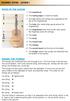 BEGINNER GUITAR - LESSON 1 PARTS OF THE GUITAR 1- The headstock. 2- The tuning pegs or machine heads. 3- The nut (where the strings are supported at the top of the fingerboard). 4- The frets (the metal
Keyboard Basics. By Starling Jones, Jr. http://www.starlingsounds.com& http://www.smoothchords.com
 Keyboard Basics By Starling Jones, Jr. In starting on the piano I recommend starting on weighted keys. I say this as your fingers will be adjusted to the stiffness of the keys. When you then progress to
How to Improvise Jazz Melodies Bob Keller Harvey Mudd College January 2007 Revised 4 September 2012
 How to Improvise Jazz Melodies Bob Keller Harvey Mudd College January 2007 Revised 4 September 2012 There are different forms of jazz improvisation. For example, in free improvisation, the player is under
All natural (Primary) notes (A B C D E F G) are a whole step (2 frets) apart, except between E-F and B-C which are a half step (1 fret) apart.
 The Capo All natural (Primary) notes (A B C D E F G) are a whole step (2 frets) apart, except between E-F and B-C which are a half step (1 fret) apart. A sharp (#) is one fret higher than a natural (Primary)
The CAGED Guitar System
 The CAGED Guitar System First of all, let s look at an example below on how to use the CAGED guitar system: 1 The example showed above demonstrates the general idea of how the CAGED system works in a certain
How to Play Chords on your Mountain Dulcimer tuned DAd
 How to Play Chords on your Mountain Dulcimer tuned DAd (or Surviving in a Multi-Instrument Jam) by Missy Strothers If you are like me, sooner or later you ll get into a festival situation where you ll
GUITAR THEORY REVOLUTION. Part 1: How To Learn All The Notes On The Guitar Fretboard
 GUITAR THEORY REVOLUTION Part 1: How To Learn All The Notes On The Guitar Fretboard Contents Introduction Lesson 1: Numbering The Guitar Strings Lesson 2: The Notes Lesson 3: The Universal Pattern For
Guitar Reference. By: Frank Markovich
 Guitar Reference By: Frank Markovich Guitar Reference Introduction The purpose of this book is to give the student the reference materials for learning how to play the guitar. In this book you will find
How they invented chord patterns for the guitar. J. Chaurette. Dec., 2012
 How they invented chord patterns for the guitar J. Chaurette Dec., 2012 The guitar has a very long history; it has evolved over the ages to what it is now. It has achieved its final distinct form in 1770,
Swing & Jump Blues Guitar Matthieu Brandt
 Swing & Jump Blues Guitar Matthieu Brandt Goto www.swingblues.com for more on Swing and Jump Blues Guitar. 1997-2016 No part of this material (book/cd/website) may be reproduced in any way without prior
Getting Started on the Hawaiian Steel Guitar
 Getting Started on the Hawaiian Steel Guitar Acoustic Hawaiian Steel Guitar Played in the Old Taro Patch Open G Tuning by Konabob - [email protected] When Hawaiians began playing guitars flat on their laps,
Crash Course in Music Theory for Guitarists by Andy Drudy
 Crash Course in Music Theory for Guitarists by Andy rudy An in-depth knowledge of music theory is essential for any musician. Learning the ropes so-to-speak, will rapidly expand your insight into you own
Jazz Guitar Chord Construction Thelonious Monk Institute of Jazz Online Jazz Handbook
 Jazz Guitar Chord Construction Thelonious Monk Institute of Jazz Online Jazz Handbook welcome to the guitar chapter of the Thelonious Monk Institute of Jazz s Online Jazz Handbook! A guitarist in a jazz
Beginners Guide to the Walkingbass
 Beginners uide to the Walkingbass Learning to play a new instrument can open up a whole new world of creativity. It certainly has for me. The 3-string Walkingbass is an easy instrument to learn, yet it
Suitable for: Beginners with absolutely no previous experience. Beginners who appear particularly shy or nervous.
 Lesson plan 1: CHORD STRUMMING FOR THE BEGINNER Suitable for: Beginners with absolutely no previous experience. Beginners who appear particularly shy or nervous. Prerequisites: None General Objective:
Chords and More Chords for DGdg Tenor Banjo By Mirek Patek
 Chords and More Chords for DGdg Tenor Banjo By Mirek Patek This tenth article about the fingerstyle tenor banjo in DGdg tuning will be focused on banjo accompaniment, i.e. on playing chords. The goal is
Beautiful Simple Guitar Chord Progressions
 Beautiful Simple Guitar Chord Progressions The purpose of beautiful simple guitar chord progressions is to present guitar mechanisms as simply as possible. Using mostly three finger chords beautiful guitar
MUSIC GLOSSARY. Accompaniment: A vocal or instrumental part that supports or is background for a principal part or parts.
 MUSIC GLOSSARY A cappella: Unaccompanied vocal music. Accompaniment: A vocal or instrumental part that supports or is background for a principal part or parts. Alla breve: A tempo marking indicating a
Getting Started with 4-part Harmony
 Getting Started with 4-part Harmony Some of you have already written chord progressions in a previous theory class. However, it is my experience that few students come to college with the ability to consistently
Learning to play the piano
 Learning to play the piano INTRODUCTION TO THE KEYBOARD... 2 STEPPING UP... 2 TREBLE SPACES... 7 BASS SPACES... 9 TIME SIGNATURE... 12 UP AND DOWN THE HILLS... 15 UP AND DOWN THE HILLS IN G MAJOR... 16
The Basic Jazz Guitar Chord Book
 The Basic Jazz Guitar Chord Book By Dirk Laukens / January 25, 2005 Hello and welcome to the basic jazz guitar chord book, brought to you by www.jazzguitar.be. How are guitar chords built? What makes a
Please Read This Page First
 Mandolin and Fiddle Improvisation Using the Chord Tone Scale Copyright 2008 by Pete Martin Please Read This Page First This book is distributed using the shareware system. Try it out, if you like it please
The Tuning CD Using Drones to Improve Intonation By Tom Ball
 The Tuning CD Using Drones to Improve Intonation By Tom Ball A drone is a sustained tone on a fixed pitch. Practicing while a drone is sounding can help musicians improve intonation through pitch matching,
Mathematical Harmonies Mark Petersen
 1 Mathematical Harmonies Mark Petersen What is music? When you hear a flutist, a signal is sent from her fingers to your ears. As the flute is played, it vibrates. The vibrations travel through the air
Chapter 2 How To Cheat A Barre Chord
 Chapter 2 How To Cheat A Barre Chord Now that you ve learned a variety of chords in different positions, there are times that we want to eliminate some of the notes. I know, in the previous chapter I explained
Perfect Pitch Versus Relative Pitch Tutorial
 1 Perfect Pitch Versus Relative Pitch Tutorial By Jay Graydon I offer this tutorial gratis for the San Luis Obispo County and LA County schools music departments. Please feel free to share with other schools
PREPARING TO STUDY JAZZ AT THE NEW ZEALAND SCHOOL OF MUSIC. The Jazz Theory Entrance Test 2010 STUDY GUIDE
 PREPARING TO STUDY JAZZ AT THE NEW ZEALAND SCHOOL OF MUSIC The Jazz Theory Entrance Test 2010 STUDY GUIDE The Jazz Theory Entrance Test Study Guide Every concept that you will study in jazz theory, either
Music Theory: Explanation and Basic Principles
 Music Theory: Explanation and Basic Principles Musical Scales Musical scales have developed in all cultures throughout the world to provide a basis for music to be played on instruments or sung by the
Chords and Voicings Made Simple By: Sungmin Shin January 2012
 Chords and Voicings Made Simple By: Sungmin Shin January 2012 I. Intervals An interval is the space between two notes. intervals of a 2nd, 3rd, 6th, and 7th can be diminished, minor, major, or augmented
Larry's Guitar Chord Key Chart
 C Larry's Guitar Chord Key Chart C# G# G D D# A A# E B C# # The middle triangle in any circle is the name of that key. Every circle is a key. This does not show the minors but they follow the same pattern.
Music Theory Unplugged By Dr. David Salisbury Functional Harmony Introduction
 Functional Harmony Introduction One aspect of music theory is the ability to analyse what is taking place in the music in order to be able to more fully understand the music. This helps with performing
Foundation Course. Study Kit No 1. Away In A Manger
 Foundation Course Study Kit No 1 Away In A Manger Reharmonization Study Kit No. 1 Away In A Manger Author: Rosablanca Suen Web: www.learnpianowithrosa.com Email: [email protected] Cover Design:
FREE CHORD BOOK Introduction
 FREE CHORD BOOK Introduction Hi, I m Andy and welcome to my chord book for beginners! Most chord books are packed full hundreds of chord diagrams, so many in fact it could take literally years to play
Cuban Tres Guitar Chord & Scale Book
 Cuban Tres Guitar Chord & Scale Book Written by: Rudy Furlan Copyright 2004 This E-book will explain how to tune your C Cuban Tres Guitar and show you how to finger chords and play scales. It is designed
Bi- Tonal Quartal Harmony in Theory and Practice 1 Bruce P. Mahin, Professor of Music Radford University
 Bi- Tonal Quartal Harmony in Theory and Practice 1 Bruce P. Mahin, Professor of Music Radford University In a significant departure from previous theories of quartal harmony, Bi- tonal Quartal Harmony
Guitar Chords: a Beginner's Guide DEMO VERSION by Darrin Koltow
 Guitar Chords: a Beginner's Guide DEMO VERSION by Darrin Koltow Copyright 2002 Darrin Koltow Guitar Chords: a Beginner's Guide - DEMO VERSION Page 2 Table of Contents Other Ebooks...3 Introduction...4
The Secret Weapon for Bar Chords
 Created by BCM The Secret Weapon for Bar Chords This handy device will make it much easier to form bar chords on your guitar. It is an effective tool that will give you immediate results. No more hours
GRADE THREE THEORY REVISION
 GRADE THREE THEORY REVISION Note Pitches Use flashcards to make sure you know all your notes including leger lines. Whenever you name a note remember to check the clef, keysignature, and for accidentals
Study Kit No 9. Aura Lee (Love Me Tender)
 Study Kit No 9 Aura Lee (Love Me Tender) Reharmonization Study Kit No. 9 Aura Lee Author: Rosablanca Suen Web: www.learnpianowithrosa.com Email: [email protected] Cover Design: Raymond Suen Copyright
Guitar Method Beginner: Book 1
 Guitar Method Beginner: Book 1 This book has been a project in the works for over a year, and now my dream of releasing it has finally come true. I would like to thank everyone who has encouraged or helped
CAGED System Primer For Community Guitar by Andrew Lawrence Level 2
 System Primer or ommunity uitar y ndrew Lawrence Level communityguitar.com hords and hord Shapes The system is ased on the recognition that although there are many major chords on the neck of the guitar,
Table of Contents. Interlude: Terminology; Drop 2 and Drop 3 Voicing 57 More droppings? An explanation of some common terms.
 1 Table of Contents Introduction: Theory, Triads and Terminology. 3 Understand the building blocks of chords. Learn the often inconsistent jargon associated with playing jazz chords. Section 1: Functional
Pentatonic Guitar Magic How To Use The Simple Pentatonic Scale To Solo Over Chords from Blues to Rock tojazz.
 Pentatonic Guitar Magic How To Use The Simple Pentatonic Scale To Solo Over Chords from Blues to Rock tojazz. This ebook may be freely distributed but not copied or altered in any way. WARNING: There is
GCSE Music Unit 4 (42704) Guidance
 GCSE Music Unit 4 (42704) Guidance (There are recordings to accompany this document.) The Task Students will be required to compose one piece of music which explores two or more of the five areas of study.
Music Fundamentals 5: Triads, Chords, Introduction to Roman Numerals. Collection Editor: Terry B. Ewell
 Music Fundamentals 5: Triads, Chords, Introduction to Roman Numerals Collection Editor: Terry B. Ewell Music Fundamentals 5: Triads, Chords, Introduction to Roman Numerals Collection Editor: Terry B.
Students' guide: Area of study 1 (The Western classical tradition 1650-1910)
 Students' guide: Area of study 1 (The Western classical tradition 1650-1910) This resource gives students a breakdown of Haydn's Symphony 101 in D major 'The Clock' movt. 2. It also offers guidance on
LIMITED KNOWLEDGE TO INTERMEDIATE LEVEL.
 Rock Band Song List When I first started implementing my rock program at Montague Consolidated School, the most frustrating and time consuming task was finding school appropriate songs that fit the skill
Developing a cohesive walking bass line 2005 Eric Elias
 Developing a cohesive walking bass line 00 Eric Elias Developing a walking bass lines is a subject that many of my students (guitarists and bassists alike) have been interested in. If you are a jazz player,
This PDF is designed to go right along with the DVD. Print it out and keep it in front of you while working through the lessons.
 Beginner Strumming This PDF is designed to go right along with the DVD. Print it out and keep it in front of you while working through the lessons. Introduction You don t need to know much to get started
GUITAR THEORY REVOLUTION
 GUITAR THEORY REVOLUTION The Major and Minor Pentatonic Scales Copyright Guitar Theory Revolution 2011 1 Contents Introduction 3 What are the Major and Minor Pentatonic Scales 3 Diagrams for all the Pentatonic
evirtuoso-online Lessons
 evirtuoso-online Lessons Chords Lesson 3 Chord Progressions www.evirtuoso.com Chord Progressions are very popular and a strong foundation for many instruments and songs. Any chords combined together in
Playing Chromatic Music on Mountain Dulcimer in 1-3-5 Tuning
 Playing Chromatic Music on Mountain Dulcimer in 1-3-5 Tuning By Rob Brereton The sentence I dread hearing when I talk to mountain dulcimer players is, There ain t no notes on a dulcimer, you just play
MAKING YOUR LINES SOUND MORE LIKE JAZZ!
 MAKING YOUR LINES SOUND MORE LIKE JAZZ! BY ALISDAIR MACRAE BIRCH One of the common questions asked by jazz guitar students is, How do I make my lines sound more like jazz? or Why do my improvised lines
acousticguitarworkshop.com RICK PAYNE SP FINGERSTYLE BLUES More chapters in the story of how to play Fingerstyle Blues
 acousticguitarworkshop.com RICK PAYNE SP FINGERSTYLE BLUES More chapters in the story of how to play Fingerstyle Blues 2 Fingerstyle Blues 2 - Contents Welcome to Fingerstyle Blues 2! In the first course,
Guitar Rubric. Technical Exercises Guitar. Debut. Group A: Scales. Group B: Chords. Group C: Riff
 Guitar Rubric Technical Exercises Guitar Debut In this section the examiner will ask you to play a selection of exercises drawn from each of the three groups shown below. Groups A and B contain examples
Playing By Ear Who Can Play By Ear?... 2 How To Play By Ear... 3 Happy Birthday To You (By Ear)... 4 Match Tones... 5 Add Chords...
 Playing By Ear Who Can Play By Ear?... 2 How To Play By Ear... 3 Happy Birthday To You (By Ear)... 4 Match Tones... 5 Add Chords... 6 Allcanplay TM Piano * MaxLearning.Net 2009 * Playing By Ear * 4/6/2009
Playing "Outside" CHAPTER EIGHT
 Playing "Outside" Sequences Playing a Half Step Away Playing a Trione Away Playing Scales to Get Outside Some Piano Stuff The Chromatic Scale Be Brave, Go Abead Abead And Play Outside 0ne reason that musicians
Lesson 21: Substitution Chords Play Piano By Ear Audio Course. Materials For This Lesson
 Hello, and welcome to Lesson 21. In Lesson 19 you learned Drink To Me Only With Thine Eyes, using just four chords. In this lesson we ll be using substitution chords to create a more professional sounding
2010 Marty Buttwinick (818) 242-7551 All Rights Reserved Not for Sale. Marty Buttwinick. Melody 1 -
 2010 Marty uttwinick (818) 242-7551 All Rights Reserved Not for Sale Marty uttwinick Melody 1 - Melody 1 contains the fundamental definitions about the mechanics of melody. When you understand these concepts,
Guitar Chord Chart for Standard Tuning
 Page 1 Guitar Chord Chart for Standard Tuning This is the base Standard tuning chart for each string: Next, we'll walk through the neck positions for the chords you'll find in your rock songs. Each has
Geometric patterns and the Guitar: A chordological shifting perspective
 Geometric patterns and the Guitar: A chordological shifting perspective Guitar chordology, no it is not a guitar related heart condition; actually, understanding this concept may help alleviate stressful
Jazz Lesson 10. Brenden s Key Point
 Jazz Lesson 10 Technique 1. Playing7 th chords with different combinations. a. Playing seventh chords in different inversions is very important for developing your soloing ability and for creating unique
Sample Pages. This pdf contains sample pages from the ebook The Easy Guide to Jazz Guitar Arpeggios. To get the full ebook, Click Here
 1 Sample Pages This pdf contains sample pages from the ebook The Easy Guide to Jazz Guitar Arpeggios. To get the full ebook, Click Here 2 Contents Introduction....6 What Are Arpeggios?....7 Chapter 1:
Simple 2 Finger Mandolin Chords for a I, IV, V Progression
 Major chords from the Mandolin chords chart Mandolin hords Major hord hord hord D hord D ingering hord hord hord 0 ingering st ret Simple inger Mandolin hords for a I, IV, V Progression I or D hord D D
Contents. Introduction. Musical Patterns. 1) The Secrets of Scales. 2) Play With the Patterns. 3) The Secrets of Chords. 4) Play With the Shapes
 Contents Introduction Musical Patterns 1) The Secrets of Scales 2) Play With the Patterns 3) The Secrets of Chords 4) Play With the Shapes 5) Every Semitone Has a Name 6) Build Your 2-Note Chords 7) The
Standard 1: Skills and Techniques 1
 1 Standard 1: Skills and Techniques 1 CB.1.1 Instrument Knowledge Skills CB.1.1.1 Instrument in good playing condition- including proper assembly, reed care, and cleaning. CB.1.2 Playing Posture Skills
Open Tunings: Contents
 Open Tunings: Contents adgad Chords: 163 adf#ad Chords: 182 adfad Chords: 199 adgbd Chords: 216 gdgbd (Eaeac#e) Chords: 233 Comments I love open tunings. They add moods to music that just don t show up
Learning To Play The Guitar An Absolute Beginner s Guide By Anthony Pell
 Learning To Play The Guitar An Absolute Beginner s Guide By Anthony Pell http://www.learningtoplaytheguitar.net All Rights Reserved. No part of this publication may be reproduced in any form or by any
22. Mozart Piano Sonata in B flat, K. 333: movement I
 22. Mozart Piano Sonata in B flat, K. 333: movement I (for Unit 3: Developing Musical Understanding) Background Information and Performance Circumstances Biography Mozart was born in Austria on the 27
Fundamentals Keyboard Exam
 Fundamentals Keyboard Exam General requirements: 1. Scales: be prepared to play: All major and minor scales (including melodic minor, natural minor, and harmonic minor) up to five sharps and flats, ith
Your First Ukulele Lesson and Then Some
 2 Your First Ukulele Lesson and Then Some A Complete Beginner s Crash Course to Playing Ukulele by Brett McQueen of the Ukulele Tricks blog This ebook is dedicated to my grandfather who taught and inspired
Contents. 3) The Pentatonic Scale Patterns for Every Major Scale. 6) The Pentatonic Scale Patterns for Every Minor Scale
 ontents Introduction Part 1: Musical Patterns 1) The Secrets of Scales 2) Scales to Play lues 3) The Secrets of hords 4) uild Your Own hords 5) The Secrets of Keys 6) Major and Minor Key hart Part 2: Patterns
Illuminating Text: A Macro Analysis of Franz SchubertÕs ÒAuf dem Wasser zu singenó
 Illuminating Text: A Macro Analysis of Franz SchubertÕs ÒAuf dem Wasser zu singenó Maureen Schafer In ÒAuf dem Wasser zu singen,ó Franz Schubert embellishes a sentimental poem by L. Graf zu Stollberg to
J. JENNINGS PUBLISHING COMPANY 5012 Kahn Street, Carmichael, CA 95608
 I N T R O D U C T I O N This packet contains introductory lessons for Emerson Karaoke Guitar 1. We assume you are a total beginner. The exercises start out very easy and will progress gradually. Have some
Companion Workbook to the bonus section with Glenn Pearce
 Companion Workbook to the bonus section with Glenn Pearce Page 1 of 21 Page 2 of 21 Chapter 1 leadworship.com title page Chapter 2 main menu and Paul s introduction Electric guitar players - what to play
SUZUKI Q CHORD. MODEL QC-1 Owners Manual
 SUZUKI Q CHORD MODEL QC- Owners Manual THANK YOU & CONGRATULATIONS Welcome to a new and exciting way to make music, that s creative, mind expanding and fun. Q Cards Every music lover has dreamed of playing
Pitch Class Sets [0,1,4] [0,1,4]
![Pitch Class Sets [0,1,4] [0,1,4]](/thumbs/19/223024.jpg "Pitch Class Sets [0,1,4] [0,1,4]") Pitch Class Sets Paul Nelson - Revised: // Pitch Class Sets are a method for describing harmonies in th century music. These notations and methods can describe and manipulate any type of chord that can
Pitch Class Sets Paul Nelson - Revised: // Pitch Class Sets are a method for describing harmonies in th century music. These notations and methods can describe and manipulate any type of chord that can
The Instant Impresario Guitar Instruction Guide
 The Instant Impresario Guitar Instruction Guide (Everything you need to know to get playing right away!) First Things First: This guitar can either be powered by the AC Adapter (included) or via eight
Expanding Your Harmonic Horizons
 2016 American String Teachers National Conference Expanding Your Harmonic Horizons Harmony Clinic for Harpists Presented By Felice Pomeranz Publications used as resources from Felice's Library of Teaching
The pianist has a few functions in a jazz combo. First, he comps for, and interacts with, other players as they solo.
 Piano Chord Voicings for jazz combo The pianist has a few functions in a jazz combo. First, he comps for, and interacts with, other players as they solo. Secondly, he acts as a soloist himself. Therefore,
BASS BLUES LICKS AND PROGRESSIONS BOOK ON DEMAND V1.1, 2004
 BASS BLUES LICKS AND PROGRESSIONS BOOK ON DEMAND V1.1, 2004 Get It All.Net!, 2004, All Rights Reserved http://www.get-it-all.net/ 1 TABLATURE REFERENCE BASS FRETBOARD MAP (Past the 12 th fret the pattern