
How to Invest in the US Federal Fund
|
|
|
- Dorthy Brown
- 5 years ago
- Views:
Transcription
1 PROSPECTUS June 1, 2015 COLUMBIA LIFEGOAL GROWTH PORTFOLIO CLASS Class A Shares Class B Shares Class C Shares Class K Shares Class R Shares Class R4 Shares Class R5 Shares Class Z Shares TICKER SYMBOL NLGIX NLGBX NLGCX CGRUX CLGRX CWPRX CGPRX NGPAX As with all mutual funds, the Securities and Exchange Commission (SEC) has not approved or disapproved these securities or passed upon the adequacy of this prospectus. Any representation to the contrary is a criminal offense.

2 Fund Supplement dated March 9, 2016 to the Prospectus and Summary Prospectus, as supplemented, of the following fund: Prospectus and Summary Prospectus Dated Columbia Funds Series Trust Columbia Global Strategic Equity Fund 6/1/15 The information under the caption Fund Management in the Summary of the Fund section of the Prospectus and Summary Prospectus is hereby superseded and replaced with the following: Portfolio Manager Title Role with Fund Managed Fund Since Mark Burgess Chief Investment Officer of Threadneedle, Co-manager June 2015 EMEA and Global Head of Equities Melda Mergen, CFA, CAIA Senior Portfolio Manager and Director of U.S. Equity Investments Co-manager March 2016 The rest of the section remains the same. The information under the caption Portfolio Managers in the More Information About the Fund Primary Service Providers section of the Prospectus is hereby superseded and replaced with the following: Portfolio Manager Title Role with Fund Managed Fund Since Mark Burgess Chief Investment Officer of Threadneedle, Co-manager June 2015 EMEA and Global Head of Equities Melda Mergen, CFA, CAIA Senior Portfolio Manager and Director of U.S. Equity Investments Co-manager March 2016 Mr. Burgess joined Threadneedle, a Participating Affiliate, in 2010 and took over as the company s Chief Investment Officer in January He also chairs the company s Asset Allocation Committee and is a Statutory Board Member. Mr. Burgess began his investment career in 1986 and earned a degree in Economics and Philosophy from Keele University and is an associate of the Institute of Investment Management and Research. Ms. Mergen joined one of the Columbia Management legacy firms or acquired business lines in Ms. Mergen began her investment career in 1999 and earned a B.A. from Bogazici University and an M.B.A. from the University of Massachusetts at Amherst. The rest of the section remains the same. Shareholders should retain this Supplement for future reference. SUP181_01_005_(03/16)

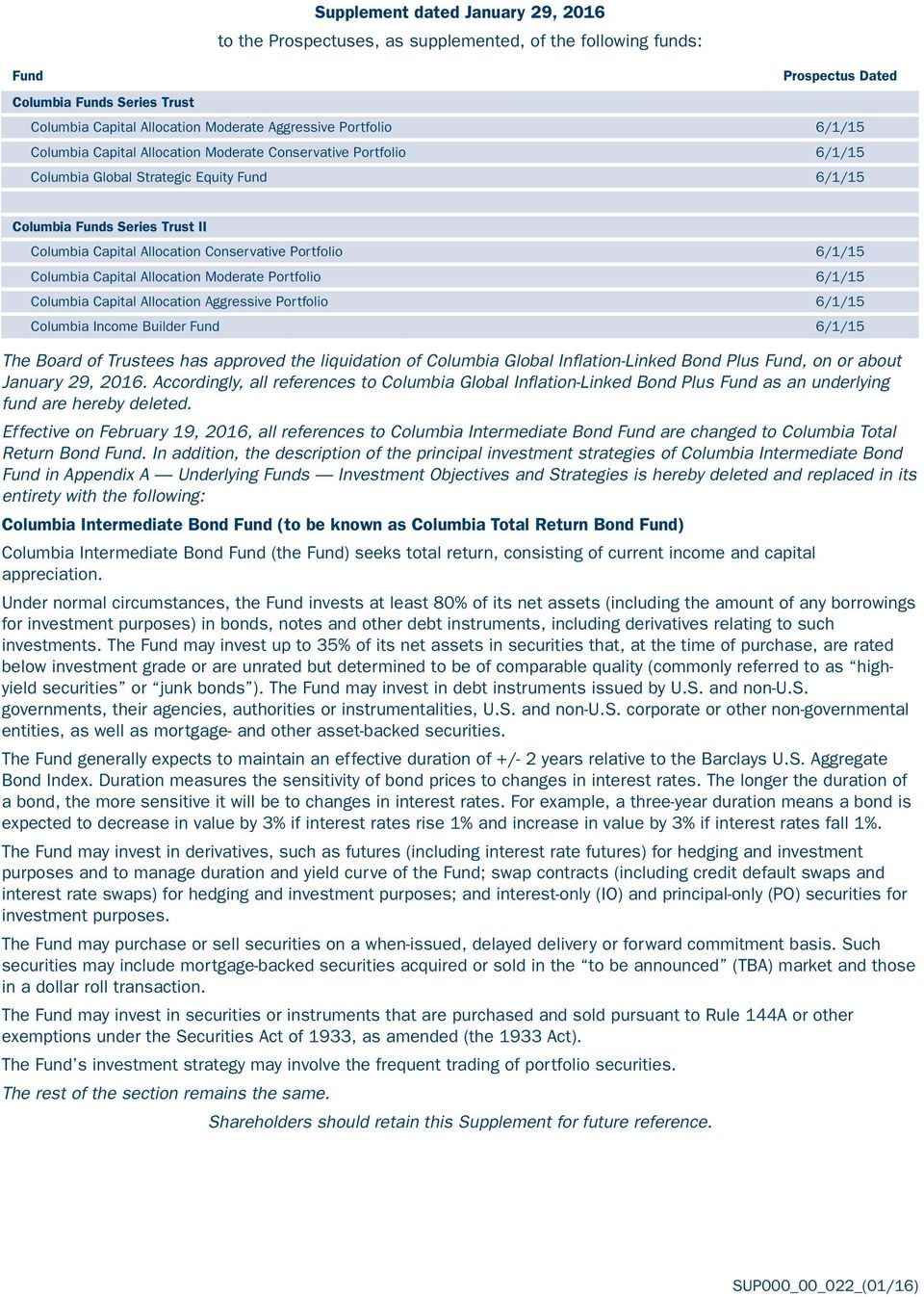
3 Supplement dated January 29, 2016 to the Prospectuses, as supplemented, of the following funds: Fund Prospectus Dated Columbia Funds Series Trust Columbia Capital Allocation Moderate Aggressive Portfolio 6/1/15 Columbia Capital Allocation Moderate Conservative Portfolio 6/1/15 Columbia Global Strategic Equity Fund 6/1/15 Columbia Funds Series Trust II Columbia Capital Allocation Conservative Portfolio 6/1/15 Columbia Capital Allocation Moderate Portfolio 6/1/15 Columbia Capital Allocation Aggressive Portfolio 6/1/15 Columbia Income Builder Fund 6/1/15 The Board of Trustees has approved the liquidation of Columbia Global Inflation-Linked Bond Plus Fund, on or about January 29, Accordingly, all references to Columbia Global Inflation-Linked Bond Plus Fund as an underlying fund are hereby deleted. Effective on February 19, 2016, all references to Columbia Intermediate Bond Fund are changed to Columbia Total Return Bond Fund. In addition, the description of the principal investment strategies of Columbia Intermediate Bond Fund in Appendix A Underlying Funds Investment Objectives and Strategies is hereby deleted and replaced in its entirety with the following: Columbia Intermediate Bond Fund (to be known as Columbia Total Return Bond Fund) Columbia Intermediate Bond Fund (the Fund) seeks total return, consisting of current income and capital appreciation. Under normal circumstances, the Fund invests at least 80% of its net assets (including the amount of any borrowings for investment purposes) in bonds, notes and other debt instruments, including derivatives relating to such investments. The Fund may invest up to 35% of its net assets in securities that, at the time of purchase, are rated below investment grade or are unrated but determined to be of comparable quality (commonly referred to as highyield securities or junk bonds ). The Fund may invest in debt instruments issued by U.S. and non-u.s. governments, their agencies, authorities or instrumentalities, U.S. and non-u.s. corporate or other non-governmental entities, as well as mortgage- and other asset-backed securities. The Fund generally expects to maintain an effective duration of +/- 2 years relative to the Barclays U.S. Aggregate Bond Index. Duration measures the sensitivity of bond prices to changes in interest rates. The longer the duration of a bond, the more sensitive it will be to changes in interest rates. For example, a three-year duration means a bond is expected to decrease in value by 3% if interest rates rise 1% and increase in value by 3% if interest rates fall 1%. The Fund may invest in derivatives, such as futures (including interest rate futures) for hedging and investment purposes and to manage duration and yield curve of the Fund; swap contracts (including credit default swaps and interest rate swaps) for hedging and investment purposes; and interest-only (IO) and principal-only (PO) securities for investment purposes. The Fund may purchase or sell securities on a when-issued, delayed delivery or forward commitment basis. Such securities may include mortgage-backed securities acquired or sold in the to be announced (TBA) market and those in a dollar roll transaction. The Fund may invest in securities or instruments that are purchased and sold pursuant to Rule 144A or other exemptions under the Securities Act of 1933, as amended (the 1933 Act). The Fund s investment strategy may involve the frequent trading of portfolio securities. The rest of the section remains the same. Shareholders should retain this Supplement for future reference. SUP000_00_022_(01/16)
4 Supplement dated July 17, 2015 to the Prospectus, as supplemented, of the following fund: Fund Prospectus Dated Columbia Funds Series Trust Columbia Global Strategic Equity Fund 6/1/15 Columbia Global Unconstrained Bond Fund is added as an underlying fund. Accordingly, Columbia Global Unconstrained Bond Fund is added to the table under the caption More Information About the Fund - Principal Investment Strategies - Underlying Funds as an International/Global Fund, and the following description of the fund is hereby added to Appendix A Underlying Funds Investment Objectives and Strategies: Columbia Global Unconstrained Bond Fund Columbia Global Unconstrained Bond Fund (the Fund) seeks to provide shareholders with absolute (positive) returns. Under normal circumstances, the Fund invests at least 80% of its net assets (including the amount of any borrowings for investment purposes) in fixed-income investments. As an unconstrained fund, the Fund has significant flexibility to invest across the fixed-income/debt asset class in seeking to manage the portfolio through various market environments, while being mindful of interest rates, credit, market volatility and other factors. The Fund s investment manager, Columbia Management Investment Advisers, LLC (Columbia Management or the Investment Manager), determines the Fund s desired exposures to, and allocation strategy across, Fixed Income Investments (as defined below) and other available instruments and assets. The Investment Manager combines macroeconomic, fundamental and quantitative analysis with risk management in identifying investment opportunities and constructing the Fund s portfolio. The unconstrained nature of the Fund s investment strategy provides it with significant latitude to obtain desired fixed-income/debt asset class exposure by investing in or allocating assets to debt instruments of governments throughout the world (including the U.S., developed and emerging markets) as well as their agencies and instrumentalities and government-sponsored enterprises, debt instruments of non-governmental issuers (e.g., corporate issuers) throughout the world (including the U.S., developed and emerging markets), debt instruments of any credit rating (including below investment grade, commonly known as high-yield or junk bonds/instruments) or debt instruments that are unrated, commercial and residential mortgage-backed securities, asset-backed securities, floating rate loans, bank loans, loan assignments and loan participations, exchange-traded notes, cash/cash equivalents, inflation-hedging assets, convertible securities, sovereign and quasi-sovereign debt investments, as well as fixed-income-related derivative instruments, including those described below (collectively, Fixed Income Investments). Fixed Income Investments may have, as applicable, varying interest rates, terms, maturities, durations, credit exposures, and industry/sector exposures, and the Fund has no limitations with regard to such exposures. At times, the Fund may be focused on any one of these types of Fixed Income Investments. Under normal circumstances, the Fund invests at least 40% of its net assets in foreign currency and Fixed Income Investments of or relating to foreign governments, as well as those of or relating to companies or other entities that: maintain their principal place of business outside the U.S.; have been formed under the laws of non-u.s. countries; trade their securities in a market located outside the U.S.; or conduct a substantial amount of business outside the U.S. The Fund considers an issuer or other entity to conduct a substantial amount of business outside the U.S. if it derives at least 50% of its revenue or profits from business outside the U.S. or has at least 50% of its sales or assets outside the U.S. This 40% minimum investment amount may be reduced to 30% if market conditions for these investments or specific foreign markets are deemed unfavorable. The Fund may invest in derivatives (both exchange-traded and over-the-counter instruments), including forward foreign currency contracts, forward interest rate agreements, futures (including bond, currency, index, and interest rate, including Treasury futures), options (including options on futures and on swaps (more commonly referred to as swaptions)) and swaps (including credit default swaps, indexed-based swaps, including index-based total return swaps, and interest rate swaps) to manage or hedge portfolio risk, interest rate risk or currency exposure, earn income, meet liquidity needs, enhance return, manage duration, or as a substitute for a position in an underlying asset or index. The Fund may purchase or sell securities on a when-issued, delayed delivery or forward commitment basis. Such securities may include mortgage-backed securities acquired or sold in the to be announced (TBA) market and those in a dollar roll transaction. SUP181_01_004_(07/15)

5 The Fund may purchase securities or other instruments in private placements, as well as repurchase agreements. The Fund may invest in instruments denominated in foreign currencies and in U.S. dollar-denominated instruments of foreign issuers. The Fund may take both long and short positions in all of its investments and may, at any time, have either a net long exposure or a net short exposure to markets. The Fund s portfolio is not managed to maintain any fixed net long or net short market exposure. The Fund expects to have significant investment leverage (market exposure in excess of the Fund s assets) as a result of certain of its investments (e.g., derivatives). The Fund may hold a significant amount of cash, money market instruments (which may include investments in one or more affiliated or unaffiliated money market funds or similar vehicles), other high-quality, short-term investments, or other liquid assets for investment purposes or to meet its segregation obligations as a result of its investments in derivatives. In certain market conditions, the Fund may have no market positions (i.e., the Fund may hold only cash and cash equivalents) when the Investment Manager believes it is in the best interests of the Fund. The Fund s investment strategy may involve the frequent trading of portfolio securities. The rest of the section remains the same. The following are added under the caption Underlying Funds - Principal Risks in Appendix B: Exchange-Traded Notes Risk. Because exchange-traded notes (ETNs) are unsecured, unsubordinated debt securities, an investment in an ETN exposes the Fund to the risk that an ETN s issuer may be unable to pay, which means that the Fund is subject to issuer credit risk. ETNs do not typically offer principal protection, so the Fund may lose some or all of its investment. The returns of ETNs are usually linked to the performance of a market benchmark or strategy, less investor fees and expenses. The Fund will bear its proportionate share of the fees and expenses of the ETN, which may cause the Fund s returns to be lower. The return on ETNs will typically be lower than the total return on a direct investment in the components of the underlying index or strategy because of the ETN s investor fees and expenses. Loan Assignment/Loan Participation Risk. If a bank loan is acquired through an assignment, the Fund may not be able to unilaterally enforce all rights and remedies under the loan and with regard to any associated collateral. If a bank loan is acquired through a participation, the Fund generally will have no right to enforce against the borrower compliance by the borrower with the terms of the loan agreement, and the Fund may not benefit from the collateral supporting the debt obligation in which it has purchased the participation. As a result, the Fund will be exposed to the credit risk of both the borrower and the institution selling the participation. New Fund Risk. The Fund is newly-formed. Accordingly, investors in the Fund bear the risk that the Fund may not be successful in implementing its investment strategy, and may not employ a successful investment strategy, either of which could result in the Fund being liquidated at any time without shareholder approval and/or at a time that may not be favorable for all shareholders. Such a liquidation could have negative tax consequences for shareholders. The rest of the section remains the same. 2 SUP181_01_004_(07/15)

6 Fund Supplement dated June 2, 2015 to the Prospectus of the following fund: Prospectus Dated Columbia Funds Series Trust Columbia LifeGoal Growth Portfolio 6/1/2015 Effective on June 2, 2015 (the Effective Date ), the Fund s name will change to Columbia Global Strategic Equity Fund. Accordingly, on the Effective Date, all references in the Prospectus to Columbia LifeGoal Growth Portfolio are deleted and replaced with Columbia Global Strategic Equity Fund. In addition, on the Effective Date, the following changes are hereby made in the Fund s Prospectus: The information under the caption Principal Investment Strategies in the Summary of the Fund section is hereby superseded and replaced with the following: Under normal circumstances, the Fund invests most of its net assets in shares of equity mutual funds and exchangetraded funds (ETFs) managed by Columbia Management Investment Advisers, LLC (the Investment Manager) or its affiliates (Columbia Funds), and third party advised funds (collectively, Underlying Funds). Under normal circumstances, the Fund invests at least 80% of its net assets (including borrowings for investment purposes) in equity securities. For purposes of the Fund s 80% policy, equity securities include common stocks, preferred stocks, securities convertible into common stocks, American Depositary Receipts (ADRs) and Global Depositary Receipts (GDRs) and shares of Underlying Funds that principally invest in such securities. Under normal circumstances, the Fund invests, directly and/or indirectly through Underlying Funds, at least 40% of its net assets in foreign currencies, and equity and debt securities of foreign governmental issuers, issuers organized or located outside the U.S., issuers that primarily trade in a market located outside the U.S., and/or issuers doing a substantial amount of business outside the U.S., which the Fund considers to be issuers that derive at least 50% of their revenue or profits from business outside the U.S., or have at least 50% of their sales or assets outside the U.S., or Underlying Funds that invest at least 40% of their net assets in foreign currencies or such non-u.s. securities. This 40% minimum investment amount may be reduced to 30% if market conditions for these investments or specific foreign markets are deemed unfavorable. Direct and indirect foreign investments may include investments in emerging market countries. The Fund may also invest in fixed-income, money market and alternative strategies Underlying Funds, as well as invest directly in equity and fixed income securities, including Treasury Inflation Protected Securities (TIPS), and derivatives, including futures and commodity-related instruments. The Fund may invest significantly in any individual Underlying Fund(s). The Investment Manager uses asset allocation as its principal investment approach and accesses the broader investment resources of the Investment Manager and its affiliate, Threadneedle Investments (Threadneedle), to develop both top down thematic views as well as bottom-up securities insight. The Fund and certain Underlying Funds may from time to time emphasize one or more economic sectors in selecting their investments. The Fund may invest in Underlying Funds that invest in special situations such as companies involved in initial public offerings, tender offers, mergers and other corporate restructurings, and in companies involved in management changes or companies developing new technologies. The Investment Manager can modify the list of Underlying Funds and types of instruments in which the Fund invests, or the asset categories, at any time, including by adding Underlying Funds introduced after the date of this prospectus without the approval of or notice to Fund shareholders. The information under the caption Principal Investment Strategies in the More Information About the Fund section is hereby superseded and replaced with the following: Under normal circumstances, the Fund invests most of its net assets in shares of equity mutual funds and exchangetraded funds (ETFs) managed by Columbia Management Investment Advisers, LLC (the Investment Manager) or its affiliates (Columbia Funds), and third party advised funds (collectively, Underlying Funds). Under normal circumstances, the Fund invests at least 80% of its net assets (including borrowings for investment purposes) in equity securities. For purposes of the Fund s 80% policy, equity securities include common stocks, preferred stocks, securities convertible into common stocks, American Depositary Receipts (ADRs) and Global Depositary Receipts (GDRs) and shares of Underlying Funds that principally invest in such securities. SUP181_01_002_(06/15)
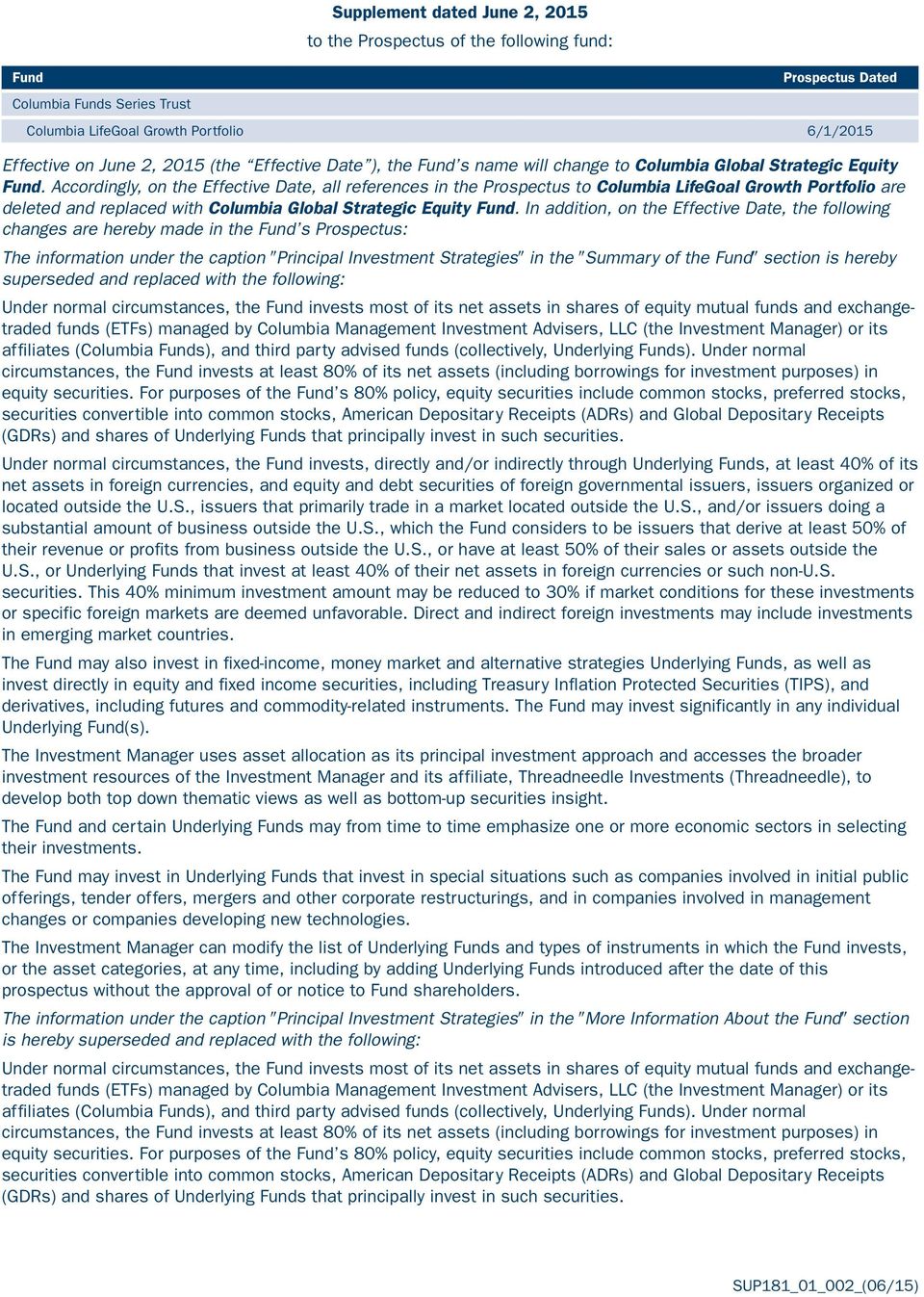
7 Under normal circumstances, the Fund invests, directly and/or indirectly through Underlying Funds, at least 40% of its net assets in foreign currencies, and equity and debt securities of foreign governmental issuers, issuers organized or located outside the U.S., issuers that primarily trade in a market located outside the U.S., and/or issuers doing a substantial amount of business outside the U.S., which the Fund considers to be issuers that derive at least 50% of their revenue or profits from business outside the U.S., or have at least 50% of their sales or assets outside the U.S., or Underlying Funds that invest at least 40% of their net assets in foreign currencies or such non-u.s. securities. This 40% minimum investment amount may be reduced to 30% if market conditions for these investments or specific foreign markets are deemed unfavorable. Direct and indirect foreign investments may include investments in emerging market countries. The Fund may also invest in fixed-income, money market and alternative strategies Underlying Funds, as well as invest directly in equity and fixed income securities, including Treasury Inflation Protected Securities (TIPS), and derivatives, including futures and commodity-related instruments. The Fund may invest significantly in any individual Underlying Fund(s). The Investment Manager uses asset allocation as its principal investment approach and accesses the broader investment resources of the Investment Manager and its affiliate, Threadneedle Investments (Threadneedle), to develop both top down thematic views as well as bottom-up securities insight. The Fund and certain Underlying Funds may from time to time emphasize one or more economic sectors in selecting their investments. The Fund may invest in Underlying Funds that invest in special situations such as companies involved in initial public offerings, tender offers, mergers and other corporate restructurings, and in companies involved in management changes or companies developing new technologies. Underlying Funds The Fund has exposure to the risks associated with many areas of the market through its investments, including through its investments in Underlying Funds. Below is a list of the affiliated Underlying Funds available to the Fund for investment (the list does not include unaffiliated funds or ETFs in which the Fund may invest). Certain Underlying Funds, due to their characteristics, may fit into more than one asset class category, and may be used by the Investment Manager for those purposes. A description of the affiliated Underlying Funds investment objectives and principal investment strategies is included in Appendix A. A description of the principal risks associated with investment in these Underlying Funds is included in Appendix B. The prospectuses and statements of additional information for the affiliated Underlying Funds are incorporated by reference into this prospectus and are available free of charge at columbiathreadneedle.com/us or by calling Domestic Equity Funds International/Global Funds Columbia Acorn Fund, Columbia Acorn Select, Columbia Acorn USA, Columbia Contrarian Core Fund, Columbia Diversified Equity Income Fund, Columbia Dividend Income Fund, Columbia Dividend Opportunity Fund, Columbia Large Cap Enhanced Core Fund, Columbia Large Cap Growth Fund, Columbia Large Cap Index Fund, Columbia Large Core Quantitative Fund, Columbia Large Growth Quantitative Fund, Columbia Large Value Quantitative Fund, Columbia Marsico Flexible Capital Fund, Columbia Marsico Focused Equities Fund, Columbia Marsico Growth Fund, Columbia Mid Cap Growth Fund, Columbia Mid Cap Index Fund, Columbia Mid Cap Value Fund, Columbia Multi-Advisor Small Cap Value Fund, Columbia Select Large Cap Equity Fund, Columbia Select Large Cap Growth Fund, Columbia Select Large-Cap Value Fund, Columbia Select Smaller-Cap Value Fund, Columbia Small Cap Core Fund, Columbia Small Cap Growth Fund I, Columbia Small Cap Index Fund, Columbia Small Cap Value Fund I, Columbia Small Cap Value Fund II, Columbia Small/Mid Cap Value Fund (formerly known as Columbia Mid Cap Value Opportunity Fund), Columbia Value and Restructuring Fund Columbia Acorn Emerging Markets Fund, Columbia Acorn European Fund, Columbia Acorn International, Columbia Acorn International Select, Columbia Asia Pacific ex-japan Fund, Columbia Emerging Markets Bond Fund, Columbia Emerging Markets Fund, Columbia European Equity Fund, Columbia Global Bond Fund, Columbia Global Dividend Opportunity Fund, Columbia Global Energy and Natural Resources Fund, Columbia Global Equity Value Fund (formerly known as Columbia Equity Value Fund), Columbia Global Inflation-Linked Bond Plus Fund, Columbia Global Infrastructure Fund (formerly known as Columbia Recovery and Infrastructure Fund), Columbia Global Technology Growth Fund, Columbia Greater China Fund, Columbia International Opportunities Fund (formerly known as Columbia Marsico International Opportunities Fund), Columbia International Value Fund, Columbia Overseas Value Fund, Columbia Pacific/Asia Fund, Columbia Select Global Equity Fund (formerly known as Columbia Global Equity Fund), Columbia Select International Equity Fund (formerly known as Columbia Multi-Advisor International Equity Fund), Columbia Seligman Global Technology Fund 2 SUP181_01_002_(06/15)

8 Fixed Income Funds Money Market Instruments Alternative and Other Funds CMG Ultra Short Term Bond Fund, Columbia Bond Fund, Columbia Corporate Income Fund, Columbia Floating Rate Fund, Columbia High Yield Bond Fund, Columbia Income Opportunities Fund, Columbia Inflation Protected Securities Fund, Columbia Intermediate Bond Fund, Columbia Limited Duration Credit Fund, Columbia Short Term Bond Fund, Columbia U.S. Government Mortgage Fund, Columbia U.S. Treasury Index Fund Columbia Money Market Fund Columbia Adaptive Alternatives Fund, Columbia Absolute Return Currency and Income Fund, Columbia Commodity Strategy Fund, Columbia Convertible Securities Fund, Columbia Diversified Absolute Return Fund, Columbia Flexible Capital Income Fund, Columbia Mortgage Opportunities Fund, Columbia Multi-Asset Income Fund, Columbia Real Estate Equity Fund, Columbia Seligman Communications and Information Fund The Fund s allocations will vary. The Investment Manager can modify the list of Underlying Funds and types of instruments in which the Fund invests, or the asset categories, at any time, including by adding Underlying Funds introduced after the date of this prospectus without the approval of or notice to Fund shareholders. The Investment Manager may sell investments to adjust the allocation of the Fund s assets; if the Investment Manager believes that an investment is no longer a suitable investment, or that other investments are more attractive; to meet redemption requests; or for other reasons. When selling shares to meet redemption requests, the Investment Manager normally will, to the extent feasible, sell a proportionate amount of the shares the Fund owns in each Underlying Fund and instrument. The Fund s investment policy with respect to 80% of its net assets may be changed by the Board of Trustees without shareholder approval as long as shareholders are given 60 days advance written notice of the change. Shareholders should retain this Supplement for future reference. 3 SUP181_01_002_(06/15)

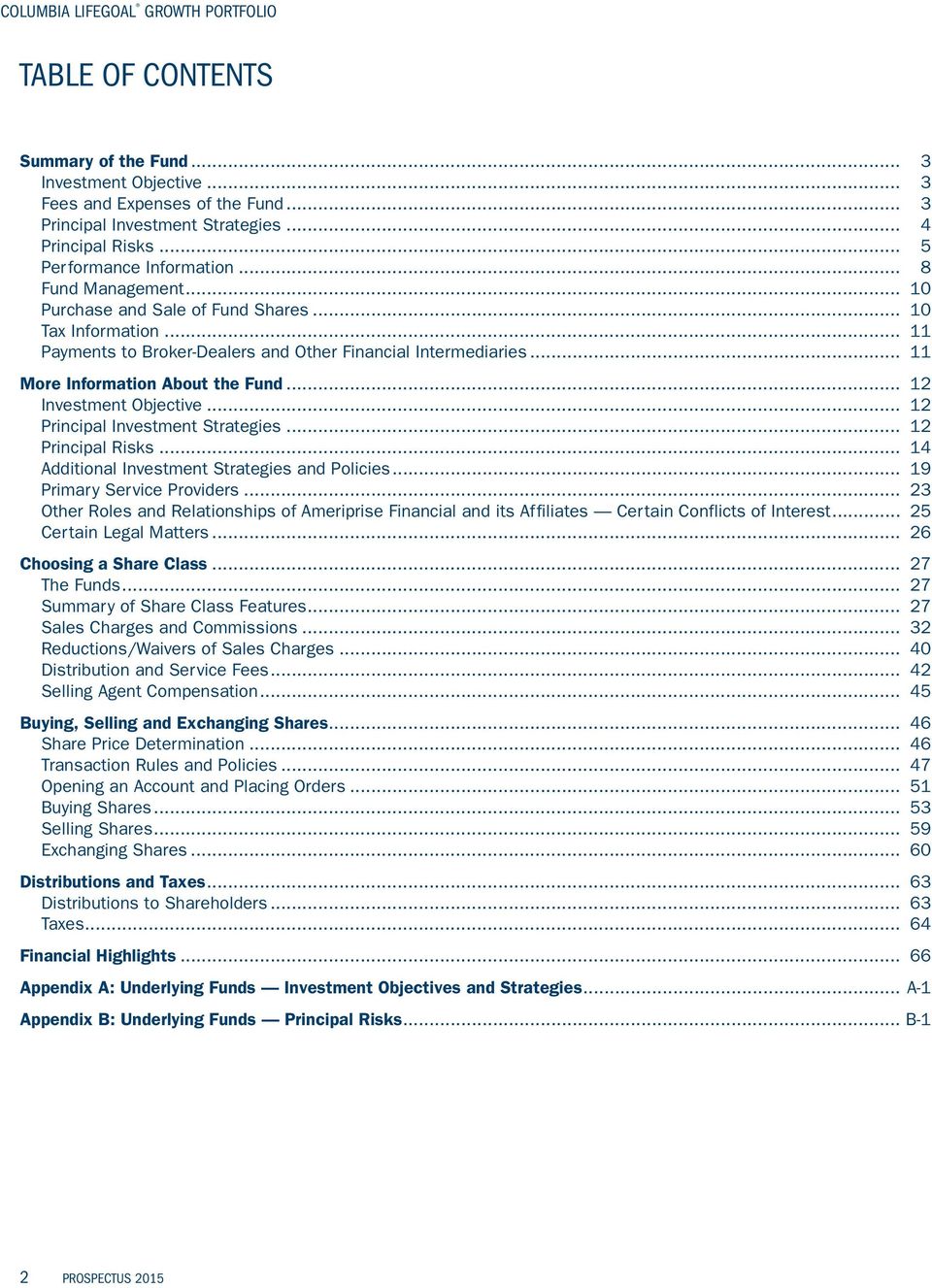
9 TABLE OF CONTENTS Summary of the Fund... 3 Investment Objective... 3 Fees and Expenses of the Fund... 3 Principal Investment Strategies... 4 Principal Risks... 5 Performance Information... 8 Fund Management Purchase and Sale of Fund Shares Tax Information Payments to Broker-Dealers and Other Financial Intermediaries More Information About the Fund Investment Objective Principal Investment Strategies Principal Risks Additional Investment Strategies and Policies Primary Service Providers Other Roles and Relationships of Ameriprise Financial and its Affiliates Certain Conflicts of Interest Certain Legal Matters Choosing a Share Class The Funds Summary of Share Class Features Sales Charges and Commissions Reductions/Waivers of Sales Charges Distribution and Service Fees Selling Agent Compensation Buying, Selling and Exchanging Shares Share Price Determination Transaction Rules and Policies Opening an Account and Placing Orders Buying Shares Selling Shares Exchanging Shares Distributions and Taxes Distributions to Shareholders Taxes Financial Highlights Appendix A: Underlying Funds Investment Objectives and Strategies... A-1 Appendix B: Underlying Funds Principal Risks... B-1 2 PROSPECTUS 2015
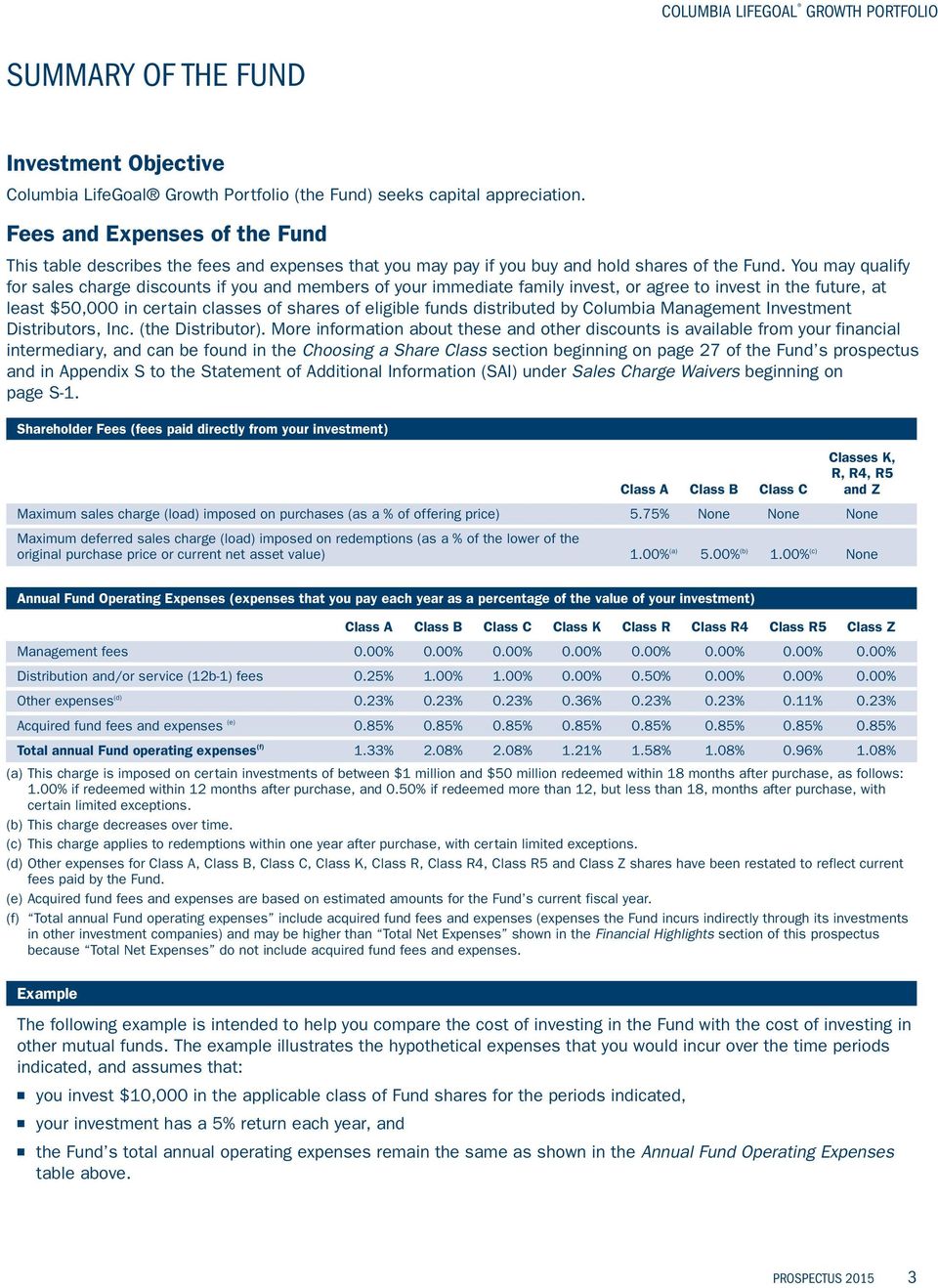
10 SUMMARY OF THE FUND Investment Objective Columbia LifeGoal Growth Portfolio (the Fund) seeks capital appreciation. Fees and Expenses of the Fund This table describes the fees and expenses that you may pay if you buy and hold shares of the Fund. You may qualify for sales charge discounts if you and members of your immediate family invest, or agree to invest in the future, at least $50,000 in certain classes of shares of eligible funds distributed by Columbia Management Investment Distributors, Inc. (the Distributor). More information about these and other discounts is available from your financial intermediary, and can be found in the Choosing a Share Class section beginning on page 27 of the Fund s prospectus and in Appendix S to the Statement of Additional Information (SAI) under Sales Charge Waivers beginning on page S-1. Shareholder Fees (fees paid directly from your investment) Class A Class B Class C Classes K, R, R4, R5 and Z Maximum sales charge (load) imposed on purchases (as a % of offering price) 5.75% None None None Maximum deferred sales charge (load) imposed on redemptions (as a % of the lower of the original purchase price or current net asset value) 1.00% (a) 5.00% (b) 1.00% (c) None Annual Fund Operating Expenses (expenses that you pay each year as a percentage of the value of your investment) Class A Class B Class C Class K Class R Class R4 Class R5 Class Z Management fees 0.00% 0.00% 0.00% 0.00% 0.00% 0.00% 0.00% 0.00% Distribution and/or service (12b-1) fees 0.25% 1.00% 1.00% 0.00% 0.50% 0.00% 0.00% 0.00% Other expenses (d) 0.23% 0.23% 0.23% 0.36% 0.23% 0.23% 0.11% 0.23% Acquired fund fees and expenses (e) 0.85% 0.85% 0.85% 0.85% 0.85% 0.85% 0.85% 0.85% Total annual Fund operating expenses (f) 1.33% 2.08% 2.08% 1.21% 1.58% 1.08% 0.96% 1.08% (a) This charge is imposed on certain investments of between $1 million and $50 million redeemed within 18 months after purchase, as follows: 1.00% if redeemed within 12 months after purchase, and 0.50% if redeemed more than 12, but less than 18, months after purchase, with certain limited exceptions. (b) This charge decreases over time. (c) This charge applies to redemptions within one year after purchase, with certain limited exceptions. (d) Other expenses for Class A, Class B, Class C, Class K, Class R, Class R4, Class R5 and Class Z shares have been restated to reflect current fees paid by the Fund. (e) Acquired fund fees and expenses are based on estimated amounts for the Fund s current fiscal year. (f) Total annual Fund operating expenses include acquired fund fees and expenses (expenses the Fund incurs indirectly through its investments in other investment companies) and may be higher than Total Net Expenses shown in the Financial Highlights section of this prospectus because Total Net Expenses do not include acquired fund fees and expenses. Example The following example is intended to help you compare the cost of investing in the Fund with the cost of investing in other mutual funds. The example illustrates the hypothetical expenses that you would incur over the time periods indicated, and assumes that: you invest $10,000 in the applicable class of Fund shares for the periods indicated, your investment has a 5% return each year, and the Fund s total annual operating expenses remain the same as shown in the Annual Fund Operating Expenses table above. PROSPECTUS
11 SUMMARY OF THE FUND (continued) Although your actual costs may be higher or lower, based on the assumptions listed above, your costs would be: 1 year 3 years 5 years 10 years Class A (whether or not shares are redeemed) $703 $972 $1,262 $2,084 Class B (assuming redemption of all shares at the end of the period) $711 $952 $1,319 $2,219 Class B (assuming no redemption of shares) $211 $652 $1,119 $2,219 Class C (assuming redemption of all shares at the end of the period) $311 $652 $1,119 $2,410 Class C (assuming no redemption of shares) $211 $652 $1,119 $2,410 Class K (whether or not shares are redeemed) $123 $384 $ 665 $1,466 Class R (whether or not shares are redeemed) $161 $499 $ 860 $1,878 Class R4 (whether or not shares are redeemed) $110 $343 $ 595 $1,317 Class R5 (whether or not shares are redeemed) $ 98 $306 $ 531 $1,178 Class Z (whether or not shares are redeemed) $110 $343 $ 595 $1,317 Portfolio Turnover The Fund and underlying funds pay transaction costs, such as commissions, when they buy and sell securities (or turn over their portfolios). The Fund will indirectly bear the expenses associated with portfolio turnover of the underlying funds. A high portfolio turnover rate may indicate higher transaction costs. These costs, which are not reflected in annual fund operating expenses or in the example, affect the Fund s performance. During the most recent fiscal year, the Fund s portfolio turnover rate was 16% of the average value of its portfolio. Principal Investment Strategies Under normal circumstances, the Fund invests most of its assets in shares of mutual funds managed by Columbia Management Investment Advisers, LLC (the Investment Manager) or its affiliates (Columbia Funds), exchange-traded funds (ETFs) and third party advised funds (collectively, Underlying Funds), equity and fixed income securities, including Treasury Inflation Protected Securities (TIPS), and other instruments such as derivatives. The Investment Manager uses asset allocation as its principal investment approach and: allocates the Fund s assets among asset class categories within the target asset allocations set for the Fund, based on the Fund s investment objective and historical and projected returns for each asset class. chooses individual Columbia Funds within each asset class category and the amount that will be allocated to each Columbia Fund, based on each Columbia Fund s historical returns and expected performance. may choose third party advised Underlying Funds if a Columbia Fund is not available in the desired asset class category. may choose equity and fixed income securities, including TIPS, and other instruments such as derivatives. reviews the asset allocations to Underlying Funds and instruments at least monthly, and may change these allocations when the Investment Manager believes it is appropriate to do so. The Fund s targeted allocation to Columbia Funds, as a percentage of the Fund s assets, is as follows: 0 80% to one or more Columbia Funds that invest in large-capitalization domestic equity securities. 0 40% to one or more Columbia Funds that invest in mid-capitalization domestic equity securities. 0 20% to one or more Columbia Funds that invest in small-capitalization domestic equity securities. 0 70% to one or more Columbia Funds that invest in international/global equity securities. 0 20% to one or more Columbia Funds that invest in convertible securities. 0 30% to one or more Columbia Funds that invest in specialty securities, including Columbia Funds that invest in equity securities of companies principally engaged in certain market sectors such as real estate or technology and Funds using alternative investment strategies. 4 PROSPECTUS 2015
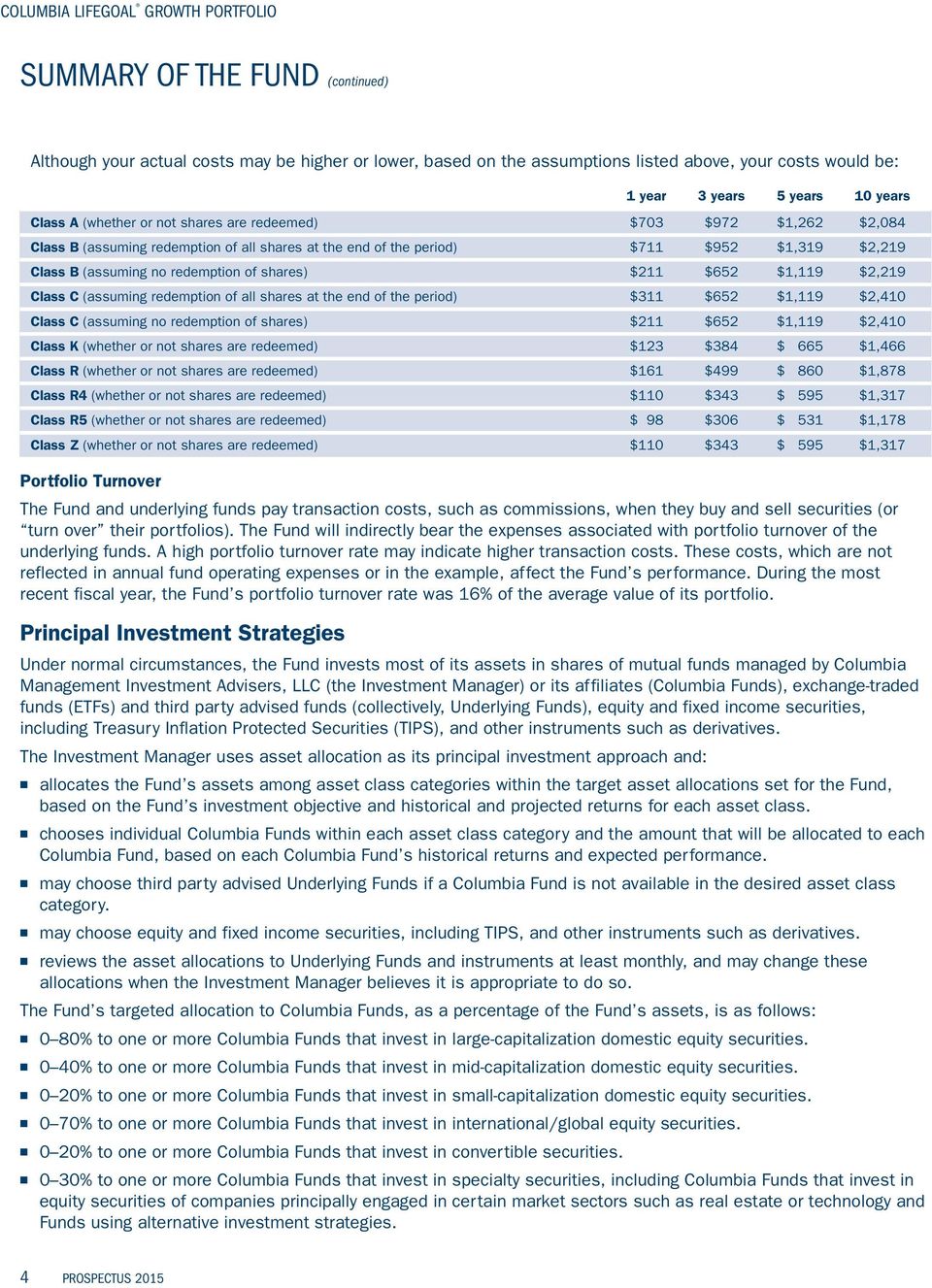
12 SUMMARY OF THE FUND (continued) 0 70% to Columbia Funds that invest in government and corporate debt securities. 0 20% to Columbia Funds that invest in below investment grade debt securities. 0 50% in Columbia money market funds. The Fund s targeted allocations to direct security instrument holdings and third party advised funds, as a percentage of the Fund s assets, is as follows: 0 15% to fixed income securities, including TIPS. 0 10% to equity securities. 0 20% to futures and commodity-related instruments. 0 10% to third party advised funds/etfs. The Fund s actual allocation may vary from these target allocations at any time. The Investment Manager may use various strategies to try to manage how much the actual amount varies and for how long. The Investment Manager can modify the list of Underlying Funds and types of instruments in which the Fund invests, or the asset categories, at any time, including by adding Underlying Funds introduced after the date of this prospectus. The Fund and certain Underlying Funds may invest in securities of companies in the technology sector and may from time to time emphasize one or more other economic sectors in selecting their investments. The Fund may invest in Underlying Funds that invest in special situations such as companies involved in initial public offerings, tender offers, mergers and other corporate restructurings, and in companies involved in management changes or companies developing new technologies. Principal Risks An investment in the Fund involves risk, including specific risks relating to the investment in the Fund based on its investment process and its fund-of-funds structure, as well as specific risks related to the underlying funds in which it invests, including among others, those described below. More information about underlying funds, including their principal risks, is available in their prospectuses. There is no assurance that the Fund will achieve its investment objective and you may lose money. The value of the Fund s holdings may decline, and the Fund s net asset value (NAV) and share price may go down. Allocation Risk. Because the Fund uses an asset allocation strategy in pursuit of its investment objective, there is a risk that the Fund s allocation among asset classes, investments, managers, strategies and/or investment styles will cause the Fund s shares to lose value or cause the Fund to underperform other funds with a similar investment objective and/or strategies, or that the investments themselves will not produce the returns expected. Commodity-related Investment Risk. The value of commodities investments will generally be affected by overall market movements and factors specific to a particular industry or commodity, which may include demand for the commodity, weather, embargoes, tariffs, and economic health, political, international, regulatory and other developments. Exposure to commodities and commodities markets may subject the value of the Fund s investments to greater volatility than other types of investments. Commodities investments may also subject the Fund to counterparty risk and liquidity risk. The Fund may invest in one or more underlying funds that make commodity-related investments through, and may invest in one or more underlying funds that make commodity-related investments through, one or more wholly-owned subsidiaries organized outside the U.S. that are generally not subject to U.S. laws (including securities laws) and their protections. The Fund s investments in commodities or commodity-related investments can be limited by the Fund s intention to qualify as a regulated investment company and can limit the Fund s ability to so qualify. If an underlying fund in which the Fund invests that itself invests directly or indirectly in commodities fails to qualify as a regulated investment company, such failure could also cause the Fund to fail to so qualify. Credit Risk. The value of fixed-income securities, or other instruments or assets, may decline if the issuer thereof defaults or otherwise becomes unable or unwilling, or is perceived to be unable or unwilling, to honor its financial obligations, such as making payments to the Fund when due. Rating agencies assign credit ratings to certain fixedincome securities to indicate their credit risk. Lower quality or unrated securities held by the Fund may present PROSPECTUS

13 SUMMARY OF THE FUND (continued) increased credit risk as compared to higher-rated securities. Non-investment grade fixed-income securities (commonly called high-yield or junk ) may be subject to greater price fluctuations and are more likely to experience a default than investment grade securities and therefore may expose the Fund to increased credit risk. If the Fund purchases unrated securities, or if the ratings of securities held by the Fund are lowered after purchase, the Fund will depend on analysis of credit risk more heavily than usual. Derivatives Risk. Losses involving derivative instruments may be substantial, because a relatively small movement in the price of an underlying security, instrument, commodity, currency or index may result in a substantial loss for the Fund. In addition to the potential for increased losses, the use of derivative instruments may lead to increased volatility for the Fund. Derivative investments will typically increase the Fund s exposure to principal risks to which it is otherwise exposed, and may expose the Fund to additional risks, including correlation risk, counterparty risk, hedging risk, leverage risk and/or liquidity risk. Derivatives Risk/Futures Contracts Risk. The loss that may be incurred in entering into futures contracts may exceed the amount of the premium paid and may be potentially unlimited. Futures markets are highly volatile and the use of futures may increase the volatility of the Fund s NAV. Additionally, as a result of the low collateral deposits normally involved in futures trading, a relatively small price movement in a futures contract may result in substantial losses for the Fund. Futures contracts may be illiquid. Furthermore, exchanges may limit fluctuations in futures contract prices during a trading session by imposing a maximum permissible price movement on each futures contract. The Fund may be disadvantaged if it is prohibited from executing a trade outside the daily permissible price movement. Futures contracts executed on foreign exchanges may not provide the same protection as U.S. exchanges. These transactions involve additional risks, including counterparty risk, hedging risk and pricing risk. Emerging Market Securities Risk. Securities issued by foreign governments or companies in emerging market countries, such as China, Russia and certain countries in Eastern Europe, the Middle East, Asia, Latin America or Africa, are more likely to have greater exposure to the risks of investing in foreign securities that are described in Foreign Securities Risk. In addition, emerging market countries are more likely to experience instability resulting, for example, from rapid changes or developments in social, political, economic or other conditions. Their economies are usually less mature and their securities markets are typically less developed with more limited trading activity (i.e., lower trading volumes and less liquidity) than more developed countries. Emerging market securities tend to be more volatile than securities in more developed markets. Many emerging market countries are heavily dependent on international trade and have fewer trading partners, which makes them more sensitive to world commodity prices and economic downturns in other countries, and some have a higher risk of currency devaluations. Exchange-Traded Fund (ETF) Risk. ETFs are subject to, among other risks, tracking risk and passive and, in some cases, active investment risk. In addition, shareholders bear both their proportionate share of the Fund s expenses and similar expenses incurred through ownership of the ETF. Foreign Securities Risk. Investments in or exposure to foreign securities involve certain risks not associated with investments in or exposure to securities of U.S. companies. Foreign securities subject the Fund to the risks associated with investing in the particular country of an issuer, including the political, regulatory, economic, social, diplomatic and other conditions or events occurring in the country or region, as well as risks associated with less developed custody and settlement practices. Foreign securities may be more volatile and less liquid than securities of U.S. companies, and are subject to the risks associated with potential imposition of economic and other sanctions against a particular foreign country, its nationals or industries or businesses within the country. The performance of the Fund may be negatively impacted by fluctuations in a foreign currency s strength or weakness relative to the U.S. dollar, particularly to the extent the Fund invests a significant percentage of its assets in foreign securities or other assets denominated in currencies other than the U.S. dollar. Fund-of-Funds Risk. Determinations regarding asset classes or underlying funds and the Fund s allocations thereto may not successfully achieve the Fund s investment objective, in whole or in part. The ability of the Fund to realize its investment objective will depend, in large part, on the extent to which the underlying funds realize their investment objective. There is no guarantee that the underlying funds will achieve their respective investment objectives. The Fund is exposed to the same risks as the underlying funds in direct proportion to the allocation of its assets among the underlying funds. Therefore, to the extent that the Fund invests significantly in a particular underlying fund, the 6 PROSPECTUS 2015
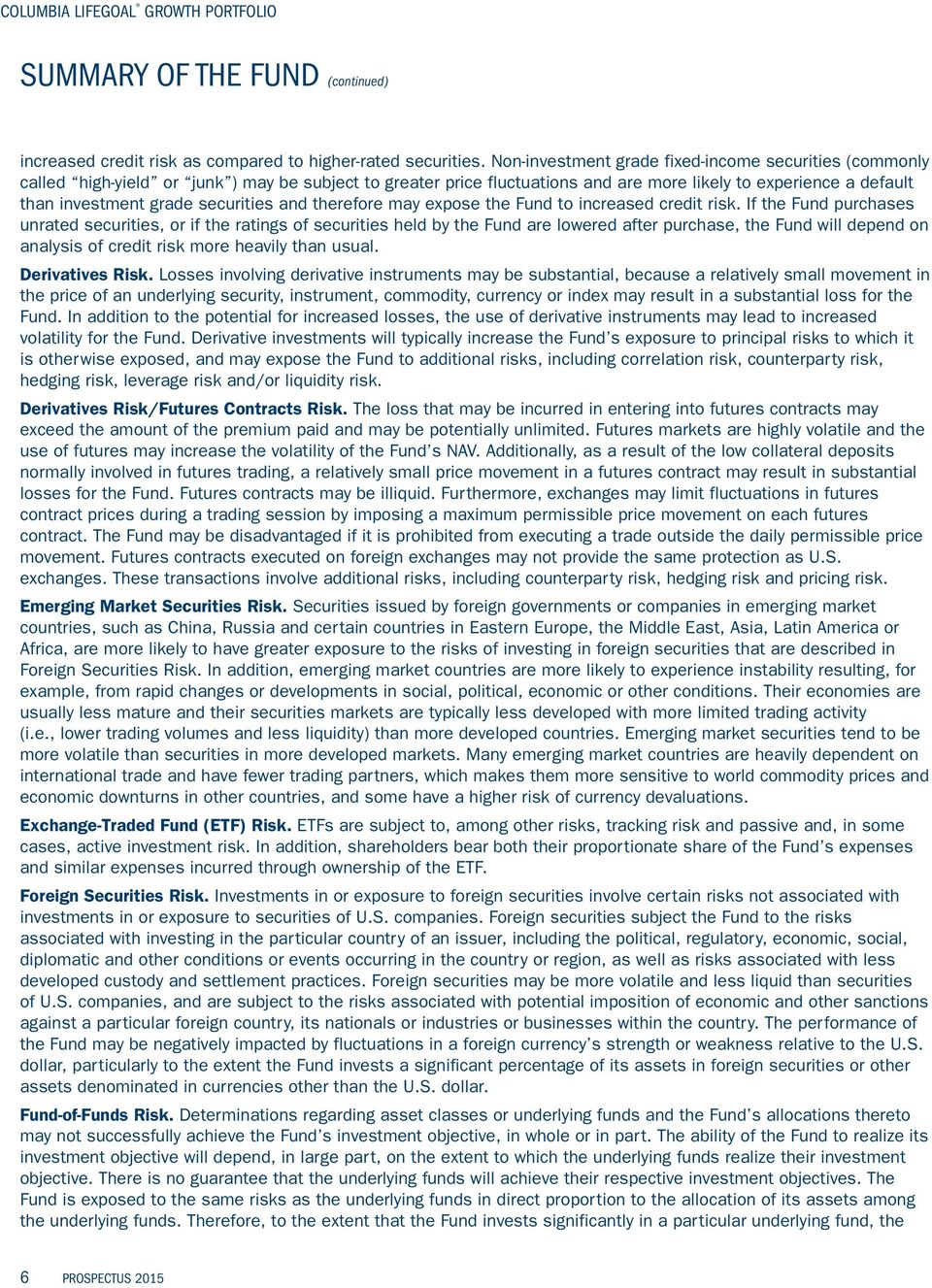
14 SUMMARY OF THE FUND (continued) Fund s performance would be significantly impacted by the performance of such underlying fund. Generally, by investing in a combination of underlying funds, the Fund has exposure to the risks of many areas of the market. By concentrating its investments in relatively few underlying funds, the Fund may have more concentrated market exposures, subjecting the Fund to greater risk of loss should those markets decline or fail to rise. The performance of underlying funds could be adversely affected if other entities that invest in the same underlying funds make relatively large investments or redemptions in such underlying funds. The Fund, and its shareholders, indirectly bear a portion of the expenses of any funds in which the Fund invests. Because the expenses and costs of each underlying fund are shared by its investors, redemptions by other investors in an underlying fund could result in decreased economies of scale and increased operating expenses for such fund. The Investment Manager may have potential conflicts of interest in selecting affiliated funds over unaffiliated funds for investment by the Fund, and may also face potential conflicts of interest in selecting affiliated funds, because the fees the Investment Manager receives from some underlying funds may be higher than the fees paid by other underlying funds. Growth Securities Risk. Growth securities typically trade at a higher multiple of earnings than other types of equity securities. Accordingly, the market values of growth securities may never reach their expected market value and may decline in price. In addition, growth securities, at times, may not perform as well as value securities or the stock market in general, and may be out of favor with investors for varying periods of time. Inflation-Protected Securities Risk. Inflation-protected debt securities tend to react to changes in real interest rates (i.e., nominal interest rates minus the expected impact of inflation). In general, the price of such securities falls when real interest rates rise, and rises when real interest rates fall. Interest payments on these securities will vary and may be more volatile than interest paid on ordinary bonds. In periods of deflation, the Fund may have no income at all from such investments. The Fund s investment in certain inflation-protected debt securities may generate taxable income in excess of the interest they pay to the Fund, which may cause the Fund to sell investments to obtain cash to make income distributions to shareholders, including at times when it may not be advantageous to do so. Interest Rate Risk. Interest rate risk is the risk of losses attributable to changes in interest rates. In general, if prevailing interest rates rise, the values of debt securities tend to fall, and if interest rates fall, the values of debt securities tend to rise. Changes in the value of a debt security usually will not affect the amount of income the Fund receives from it but will generally affect the value of the Fund s shares. In general, the longer the maturity or duration of a debt security, the greater its sensitivity to changes in interest rates. Interest rate declines also may increase prepayments of debt obligations, which, in turn, would increase prepayment risk. Similarly, a period of rising interest rates may negatively impact the Fund s performance. Actions by governments and central banking authorities can result in increases in interest rates. Such actions may negatively affect the value of fixed-income securities held by the Fund, resulting in a negative impact on the Fund s performance and NAV. Issuer Risk. An issuer in which the Fund invests or to which it has exposure may perform poorly, and the value of its securities may therefore decline, which would negatively affect the Fund s performance. Poor performance may be caused by poor management decisions, competitive pressures, breakthroughs in technology, reliance on suppliers, labor problems or shortages, corporate restructurings, fraudulent disclosures, natural disasters or other events, conditions or factors. Market Risk. Market risk refers to the possibility that the market values of securities or other investments that the Fund holds will fall, sometimes rapidly or unpredictably, or fail to rise. An investment in the Fund could lose money over short or long periods. Although equity securities generally tend to have greater price volatility than debt securities, under certain market conditions, debt securities may have comparable or greater price volatility. Prepayment and Extension Risk. Prepayment and extension risk is the risk that a bond or other security or investment might, in the case of prepayment risk, be called or otherwise converted, prepaid or redeemed before maturity and, in the case of extension risk, the investment might not be called as expected. In the case of prepayment risk, if the investment is converted, prepaid or redeemed before maturity, the portfolio managers may not be able to invest the proceeds in other investments providing as high a level of income, resulting in a reduced yield to the Fund. In the case of mortgage- or asset-backed securities, as interest rates decrease or spreads narrow, the likelihood of prepayment increases. Conversely, extension risk is the risk that an unexpected rise in interest rates PROSPECTUS

15 SUMMARY OF THE FUND (continued) will extend the life of a mortgage- or asset-backed security beyond the prepayment time. If the Fund s investments are locked in at a lower interest rate for a longer period of time, the portfolio managers may be unable to capitalize on securities with higher interest rates or wider spreads. Quantitative Model Risk. Investments selected using quantitative methods may perform differently from the market as a whole. There can be no assurance that these methodologies will enable the Fund to achieve its objective. Sector Risk. At times, the Fund may have a significant portion of its assets invested in securities of companies conducting business in a related group of industries within an economic sector. Companies in the same economic sector may be similarly affected by economic, regulatory, political or market events or conditions, which may make the Fund more vulnerable to unfavorable developments in that economic sector than funds that invest more broadly. Generally, the more broadly the Fund invests, the more it spreads risk and potentially reduces the risks of loss and volatility. Small- and Mid-Cap Company Securities Risk. Investments in small- and mid-capitalization companies (small- and mid-cap companies) often involve greater risks than investments in larger, more established companies (larger companies) because small- and mid-cap companies tend to have less predictable earnings and may lack the management experience, financial resources, product diversification and competitive strengths of larger companies. Securities of small- and mid-cap companies may be less liquid and more volatile than the securities of larger companies. Special Situations Risk. Securities of companies that are involved in an initial public offering or a major corporate event, such as a business consolidation or restructuring, may be exposed to heightened risk because of the high degree of uncertainty that can be associated with such events. Securities issued in initial public offerings often are issued by companies that are in the early stages of development, have a history of little or no revenues and may operate at a loss following the offering. It is possible that there will be no active trading market for the securities after the offering, and that the market price of the securities may be subject to significant and unpredictable fluctuations. Certain special situation investments are investments in securities or other instruments that are determined to be illiquid or lacking a readily ascertainable fair value. Certain special situation investments prevent ownership interests therein from being withdrawn until the special situation investment, or a portion thereof, is realized or deemed realized, which may negatively impact Fund performance. Investing in special situations may have a magnified effect on the performance of funds with small amounts of assets. Value Securities Risk. Value securities are securities of companies that may have experienced, for example, adverse business, industry or other developments or may be subject to special risks that have caused the securities to be out of favor and, in turn, potentially undervalued. The market value of a portfolio security may not meet the portfolio manager s perceived value assessment of that security, or may decline in price, even though the portfolio manager(s) believe(s) the securities are already undervalued. There is also a risk that it may take longer than expected for the value of these investments to rise to the portfolio manager s perceived value. In addition, value securities, at times, may not perform as well as growth securities or the stock market in general, and may be out of favor with investors for varying periods of time. Performance Information The following bar chart and table show you how the Fund has performed in the past, and can help you understand the risks of investing in the Fund. The bar chart shows how the Fund s Class A share performance (without sales charges) has varied for each full calendar year shown. If the sales charges were reflected, returns shown would be lower. The table below the bar chart compares the Fund s returns (after applicable sales charges shown in the Shareholder Fees table in this prospectus) for the periods shown with a broad measure of market performance. Effective June 1, 2015, the Fund compares its performance to that of the MSCI All Country World Index (Net) (the New Index). The Fund s investment manager made this recommendation to the Fund s Board of Trustees because the investment manager believes that the New Index provides a more appropriate basis for comparing the Fund s performance in light of the changes to the Fund s name and principal investment strategies. Information on the New Index and old benchmark will be included for a one-year transition period. Thereafter, only the New Index will be included. 8 PROSPECTUS 2015

16 SUMMARY OF THE FUND (continued) The performance of one or more share classes shown in the table below begins before the indicated inception date for such share class. The returns shown for each such share class include the returns of the Fund s Class A shares (without applicable sales charges and adjusted to reflect the higher class-related operating expenses of such classes, where applicable) for periods prior to its inception date. Except for differences in annual returns resulting from differences in expenses and sales charges (where applicable), the share classes of the Fund would have substantially similar annual returns because all share classes of the Fund invest in the same portfolio of securities. The after-tax returns shown in the Average Annual Total Returns table below are calculated using the highest historical individual U.S. federal marginal income tax rates and do not reflect the impact of state, local or foreign taxes. Your actual after-tax returns will depend on your personal tax situation and may differ from those shown in the table. In addition, the after-tax returns shown in the table do not apply to shares held in tax-deferred accounts such as 401(k) plans or Individual Retirement Accounts (IRAs). The after-tax returns are shown only for Class A shares and will vary for other share classes. Returns after taxes on distributions and sale of Fund shares are higher than beforetax returns for certain periods shown because they reflect the tax benefit of capital losses realized on the redemption of Fund shares. The Fund s past performance (before and after taxes) is no guarantee of how the Fund will perform in the future. Updated performance information can be obtained by calling toll-free or visiting columbiathreadneedle.com/us. Year by Year Total Return (%) as of December 31 Each Year* Best and Worst Quarterly Returns During the Period Shown in the Bar Chart 60% Best 2nd Quarter % 40% 20% 9.50% 16.53% 10.25% 34.87% 19.03% 14.35% 26.07% 7.19% Worst 4th Quarter % 0% -20% -4.80% -40% -60% % * Year to Date return as of March 31, 2015: 2.53% PROSPECTUS

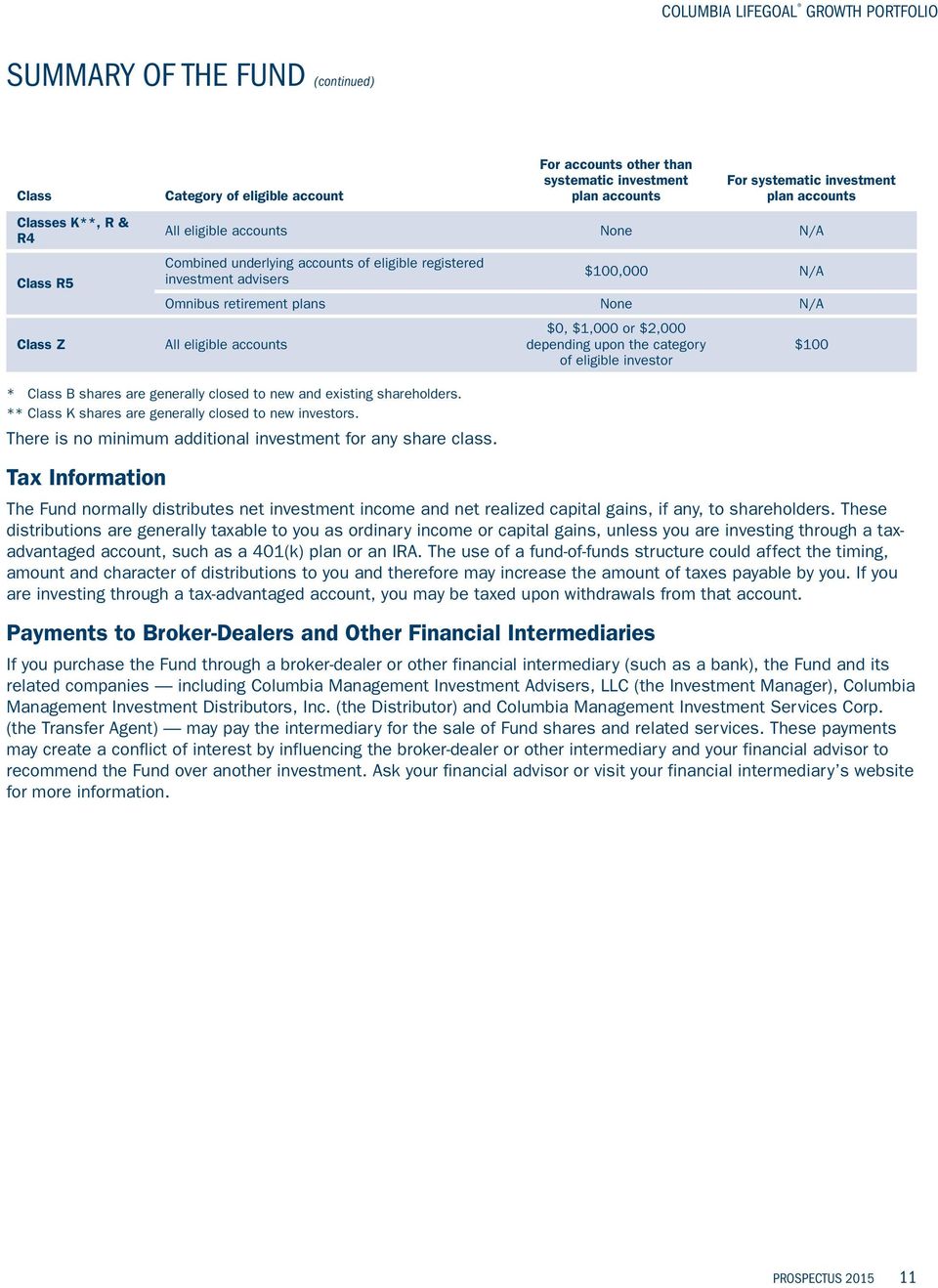
17 SUMMARY OF THE FUND (continued) Average Annual Total Returns After Applicable Sales Charges (for periods ended December 31, 2014) Share Class Inception Date 1 Year 5 Years 10 Years Class A 10/15/1996 returns before taxes 1.04% 10.54% 6.60% returns after taxes on distributions -0.23% 10.03% 5.77% returns after taxes on distributions and sale of Fund shares 1.50% 8.35% 5.34% Class B returns before taxes 08/12/ % 10.76% 6.43% Class C returns before taxes 10/15/ % 11.02% 6.43% Class K returns before taxes 03/07/ % 11.95% 7.28% Class R returns before taxes 01/23/ % 11.57% 6.96% Class R4 returns before taxes 11/08/ % 11.97% 7.29% Class R5 returns before taxes 11/08/ % 12.06% 7.33% Class Z returns before taxes 10/15/ % 12.13% 7.52% MSCI All Country World Index (Net) (reflects reinvested dividends net of withholding taxes but reflects no deductions for fees, expenses or taxes) 4.16% 9.17% 6.09% S&P 500 Index (reflects no deductions for fees, expenses or taxes) 13.69% 15.45% 7.67% Fund Management Investment Manager: Columbia Management Investment Advisers, LLC Portfolio Manager Title Role with Fund Managed Fund Since Mark Burgess Chief Investment Officer of Threadneedle, Co-manager June 2015 EMEA and Global Head of Equities Robert McConnaughey Managing Director and Global Head of Research Co-manager 2011 Purchase and Sale of Fund Shares You may purchase or redeem shares of the Fund on any business day by contacting the Fund in the ways described below: Online Regular Mail Express Mail By Telephone columbiathreadneedle.com/us Columbia Funds, c/o Columbia Management Investment Services Corp. P.O. Box 8081 Boston, MA Columbia Funds, c/o Columbia Management Investment Services Corp. 30 Dan Road, Suite 8081 Canton, MA You may purchase shares and receive redemption proceeds by electronic funds transfer, by check or by wire. If you maintain your account with a broker-dealer or other financial intermediary, you must contact that financial intermediary to buy, sell or exchange shares of the Fund through your account with the intermediary. The minimum initial investment amounts for the share classes offered by the Fund are shown below: Minimum Initial Investment Class Classes A, B* & C Category of eligible account For accounts other than systematic investment plan accounts For systematic investment plan accounts All accounts other than IRAs $2,000 $100 IRAs $1,000 $ PROSPECTUS 2015

18 SUMMARY OF THE FUND (continued) Class Classes K**, R & R4 Class R5 Class Z Category of eligible account For accounts other than systematic investment plan accounts For systematic investment plan accounts All eligible accounts None N/A Combined underlying accounts of eligible registered investment advisers $100,000 N/A Omnibus retirement plans None N/A All eligible accounts $0, $1,000 or $2,000 depending upon the category of eligible investor $100 * Class B shares are generally closed to new and existing shareholders. ** Class K shares are generally closed to new investors. There is no minimum additional investment for any share class. Tax Information The Fund normally distributes net investment income and net realized capital gains, if any, to shareholders. These distributions are generally taxable to you as ordinary income or capital gains, unless you are investing through a taxadvantaged account, such as a 401(k) plan or an IRA. The use of a fund-of-funds structure could affect the timing, amount and character of distributions to you and therefore may increase the amount of taxes payable by you. If you are investing through a tax-advantaged account, you may be taxed upon withdrawals from that account. Payments to Broker-Dealers and Other Financial Intermediaries If you purchase the Fund through a broker-dealer or other financial intermediary (such as a bank), the Fund and its related companies including Columbia Management Investment Advisers, LLC (the Investment Manager), Columbia Management Investment Distributors, Inc. (the Distributor) and Columbia Management Investment Services Corp. (the Transfer Agent) may pay the intermediary for the sale of Fund shares and related services. These payments may create a conflict of interest by influencing the broker-dealer or other intermediary and your financial advisor to recommend the Fund over another investment. Ask your financial advisor or visit your financial intermediary s website for more information. PROSPECTUS
19 MORE INFORMATION ABOUT THE FUND Investment Objective Columbia LifeGoal Growth Portfolio (the Fund) seeks capital appreciation. The Fund s investment objective is not a fundamental policy and may be changed by the Fund s Board of Trustees without shareholder approval. Because any investment involves risk, there is no assurance the Fund s objective will be achieved. Principal Investment Strategies Under normal circumstances, the Fund invests most of its assets in shares of mutual funds managed by Columbia Management Investment Advisers, LLC (the Investment Manager) or its affiliates (Columbia Funds), exchange-traded funds (ETFs) and third party advised funds (collectively, Underlying Funds), equity and fixed income securities, including Treasury Inflation Protected Securities (TIPS), and other instruments such as derivatives. The Investment Manager uses asset allocation as its principal investment approach and: allocates the Fund s assets among asset class categories within the target asset allocations set for the Fund, based on the Fund s investment objective and historical and projected returns for each asset class. chooses individual Columbia Funds within each asset class category and the amount that will be allocated to each Columbia Fund, based on each Columbia Fund s historical returns and expected performance. may choose third party advised Underlying Funds if a Columbia Fund is not available in the desired asset class category. may choose equity and fixed income securities, including TIPS, and other instruments such as derivatives. reviews the asset allocations to Underlying Funds and instruments at least monthly, and may change these allocations when the Investment Manager believes it is appropriate to do so. The Fund s targeted allocation to Columbia Funds, as a percentage of the Fund s assets, is as follows: 0 80% to one or more Columbia Funds that invest in large-capitalization domestic equity securities. 0 40% to one or more Columbia Funds that invest in mid-capitalization domestic equity securities. 0 20% to one or more Columbia Funds that invest in small-capitalization domestic equity securities. 0 70% to one or more Columbia Funds that invest in international/global equity securities. 0 20% to one or more Columbia Funds that invest in convertible securities. 0 30% to one or more Columbia Funds that invest in specialty securities, including Columbia Funds that invest in equity securities of companies principally engaged in certain market sectors such as real estate or technology and Funds using alternative investment strategies. 0 70% to Columbia Funds that invest in government and corporate debt securities. 0 20% to Columbia Funds that invest in below investment grade debt securities. 0 50% in Columbia money market funds. The Fund s targeted allocations to direct security instrument holdings and third party advised funds, as a percentage of the Fund s assets, is as follows: 0 15% to fixed income securities, including TIPS. 0 10% to equity securities. 0 20% to futures and commodity-related instruments. 0 10% to third party advised funds/etfs. The Fund s actual allocation may vary from these target allocations at any time. The Investment Manager may use various strategies to try to manage how much the actual amount varies and for how long. The Investment Manager can modify the list of Underlying Funds and types of instruments in which the Fund invests, or the asset categories, at any time, including by adding Underlying Funds introduced after the date of this prospectus. 12 PROSPECTUS 2015

20 MORE INFORMATION ABOUT THE FUND (continued) The Fund and certain Underlying Funds may invest in securities of companies in the technology sector and may from time to time emphasize one or more other economic sectors in selecting their investments. The Fund may invest in Underlying Funds that invest in special situations such as companies involved in initial public offerings, tender offers, mergers and other corporate restructurings, and in companies involved in management changes or companies developing new technologies. Underlying Funds The Fund has exposure to the risks associated with many areas of the market through its investments, including through its investments in Underlying Funds. Below is a list of the affiliated Underlying Funds, by asset class category, available to the Fund for investment (the list does not include unaffiliated funds or ETFs in which the Funds may invest). Certain Underlying Funds, due to their characteristics, may fit into more than one asset class category, and may be used by the Investment Manager for those purposes. Columbia Management may add new or remove Underlying Funds without the approval of Fund shareholders. A description of the affiliated Underlying Funds investment objectives and principal investment strategies is included in Appendix A. A description of the principal risks associated with investment in these Underlying Funds is included in Appendix B. The prospectuses and statements of additional information for the affiliated Underlying Funds are incorporated by reference into this prospectus and are available free of charge at columbiathreadneedle.com/us or by calling Large-Capitalization Domestic Equity Mid-Capitalization Domestic Equity Small-Capitalization Domestic Equity International/Global Equity Government and Corporate Debt Convertible Securities Below Investment Grade Money Market Instruments Columbia Contrarian Core Fund, Columbia Diversified Equity Income Fund, Columbia Dividend Income Fund, Columbia Dividend Opportunity Fund, Columbia Large Cap Enhanced Core Fund, Columbia Large Cap Growth Fund, Columbia Large Cap Index Fund, Columbia Large Core Quantitative Fund, Columbia Large Growth Quantitative Fund, Columbia Large Value Quantitative Fund, Columbia Marsico Flexible Capital Fund, Columbia Marsico Focused Equities Fund, Columbia Marsico Growth Fund, Columbia Select Large Cap Equity Fund, Columbia Select Large Cap Growth Fund, Columbia Select Large-Cap Value Fund, Columbia Value and Restructuring Fund Columbia Acorn Fund, Columbia Acorn Select, Columbia Mid Cap Growth Fund, Columbia Mid Cap Index Fund, Columbia Mid Cap Value Fund, Columbia Small/Mid Cap Value Fund (formerly known as Columbia Mid Cap Value Opportunity Fund) Columbia Acorn USA, Columbia Multi-Advisor Small Cap Value Fund, Columbia Select Smaller- Cap Value Fund, Columbia Small Cap Core Fund, Columbia Small Cap Growth Fund I, Columbia Small Cap Index Fund, Columbia Small Cap Value Fund I, Columbia Small Cap Value Fund II Columbia Acorn Emerging Markets Fund, Columbia Acorn European Fund, Columbia Acorn International, Columbia Acorn International Select, Columbia Asia Pacific ex-japan Fund, Columbia Emerging Markets Fund, Columbia European Equity Fund, Columbia Global Dividend Opportunity Fund, Columbia Global Energy and Natural Resources Fund, Columbia Global Equity Value Fund (formerly known as Columbia Equity Value Fund), Columbia Global Infrastructure Fund (formerly known as Columbia Recovery and Infrastructure Fund), Columbia Global Technology Growth Fund, Columbia Greater China Fund, Columbia International Opportunities Fund (formerly known as Columbia Marsico International Opportunities Fund), Columbia International Value Fund, Columbia Overseas Value Fund, Columbia Pacific/Asia Fund, Columbia Select Global Equity Fund (formerly known as Columbia Global Equity Fund), Columbia Select International Equity Fund (formerly known as Columbia Multi-Advisor International Equity Fund), Columbia Seligman Global Technology Fund CMG Ultra Short Term Bond Fund, Columbia Bond Fund, Columbia Corporate Income Fund, Columbia Emerging Markets Bond Fund, Columbia Floating Rate Fund, Columbia Global Bond Fund, Columbia Global Inflation-Linked Bond Plus Fund, Columbia Inflation Protected Securities Fund, Columbia Intermediate Bond Fund, Columbia Limited Duration Credit Fund, Columbia Short Term Bond Fund, Columbia U.S. Government Mortgage Fund, Columbia U.S. Treasury Index Fund Columbia Convertible Securities Fund Columbia High Yield Bond Fund, Columbia Income Opportunities Fund Columbia Money Market Fund PROSPECTUS
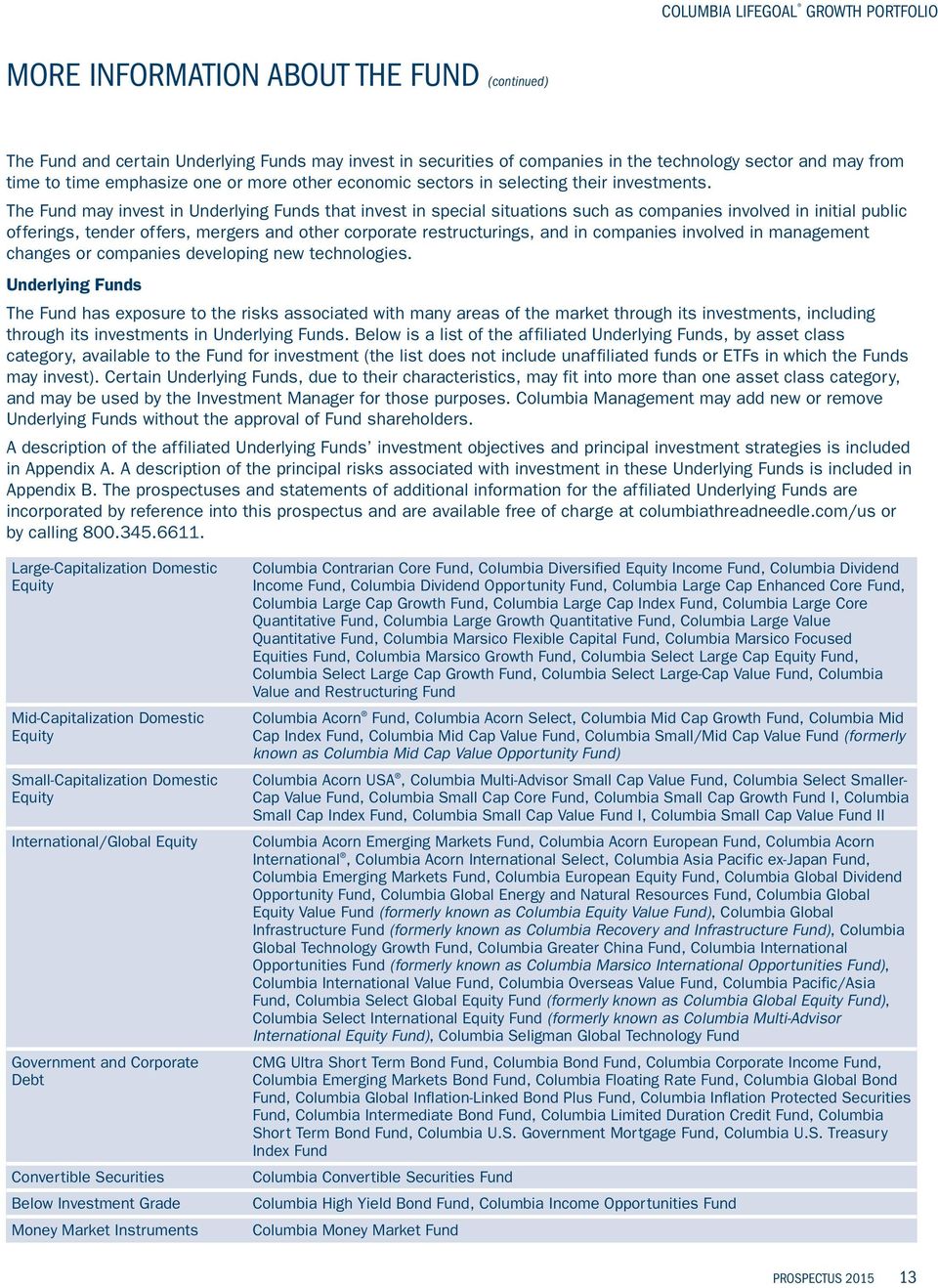
21 MORE INFORMATION ABOUT THE FUND (continued) Specialty Securities Columbia Absolute Return Currency and Income Fund, Columbia Adaptive Alternatives Fund, Columbia Commodity Strategy Fund, Columbia Diversified Absolute Return Fund, Columbia Flexible Capital Income Fund, Columbia Mortgage Opportunities Fund, Columbia Multi-Asset Income Fund, Columbia Real Estate Equity Fund, Columbia Seligman Communications and Information Fund The Investment Manager may sell investments to adjust the allocation of the Fund s assets; if the Investment Manager believes that an investment is no longer a suitable investment, or that other investments are more attractive; to meet redemption requests; or for other reasons. When selling shares to meet redemption requests, the Investment Manager normally will, to the extent feasible, sell a proportionate amount of the shares the Fund owns in each Underlying Fund and instrument. Principal Risks An investment in the Fund involves risk, including specific risks relating to the investment in the Fund based on its investment process and its fund-of-funds structure, as well as specific risks related to the underlying funds in which it invests, including among others, those described below. More information about underlying funds, including their principal risks, is available in their prospectuses. There is no assurance that the Fund will achieve its investment objective and you may lose money. The value of the Fund s holdings may decline, and the Fund s net asset value (NAV) and share price may go down. Allocation Risk. Because the Fund uses an asset allocation strategy in pursuit of its investment objective, there is a risk that the Fund s allocation among asset classes, investments, managers, strategies and/or investment styles will cause the Fund s shares to lose value or cause the Fund to underperform other funds with a similar investment objective and/or strategies, or that the investments themselves will not produce the returns expected. Commodity-related Investment Risk. The value of commodities investments will generally be affected by overall market movements and factors specific to a particular industry or commodity, which may include demand for the commodity, weather, embargoes, tariffs, and economic health, political, international, regulatory and other developments. Economic and other events (whether real or perceived) can reduce the demand for commodities, which may, in turn, reduce market prices and cause the value of Fund shares to fall. The frequency and magnitude of such changes cannot be predicted. Exposure to commodities and commodities markets may subject the value of the underlying fund s investments to greater volatility than other types of investments. No, or limited, active trading market may exist for certain commodities investments, which may impair the ability to sell or to realize the full value of such investments in the event of the need to liquidate such investments. In addition, adverse market conditions may impair the liquidity of actively traded commodities investments. Certain types of commodities instruments are subject to the risk that the counterparty to the instrument may not perform or be unable to perform in accordance with the terms of the instrument. The Fund may invest in one or more underlying funds that make commodity-related investments through, and may invest in one or more underlying funds that make commodity-related investments through, one or more wholly-owned subsidiaries organized outside the U.S. that are generally not subject to U.S. laws (including securities laws) and their protections. However, any such subsidiary is wholly owned and controlled by the underlying fund and any underlying fund subsidiary is wholly-owned and controlled by the underlying fund, making it unlikely that the subsidiary will take action contrary to the interests of the underlying fund and its shareholders. Further, any such subsidiaries will be subject to the laws of a foreign jurisdiction, and can be adversely affected by developments in that jurisdiction. The Fund s investments in commodities or commodity-related investments can be limited by the Fund s intention to qualify as a regulated investment company and can limit the Fund s ability to so qualify. If an underlying fund in which the Fund invests that itself invests directly or indirectly in commodities fails to qualify as a regulated investment company, such failure could also cause the Fund to fail to so qualify. Credit Risk. The value of fixed-income securities, or other instruments or assets, may decline if the issuer thereof defaults or otherwise becomes unable or unwilling, or is perceived to be unable or unwilling, to honor its financial obligations, such as making payments to the Fund when due. Various factors could affect the actual or perceived willingness or ability of the issuer to make timely interest or principal payments, including changes in the financial condition of the issuer or in general economic conditions. Fixed-income securities backed by an issuer s taxing authority may be subject to legal limits on the issuer s power to increase taxes or otherwise to raise revenue, or may 14 PROSPECTUS 2015
22 MORE INFORMATION ABOUT THE FUND (continued) be dependent on legislative appropriation or government aid. Certain fixed-income securities are backed only by revenues derived from a particular project or source, rather than by an issuer s taxing authority, and thus may have a greater risk of default. Rating agencies assign credit ratings to certain fixed-income securities to indicate their credit risk. Lower quality or unrated securities held by the Fund may present increased credit risk as compared to higherrated securities. Non-investment grade fixed-income securities (commonly called high-yield or junk ) may be subject to greater price fluctuations and are more likely to experience a default than investment grade securities and therefore may expose the Fund to increased credit risk. If the Fund purchases unrated fixed-income securities, or if the ratings of securities held by the Fund are lowered after purchase, the Fund will depend on analysis of credit risk more heavily than usual. Derivatives Risk. Derivatives are financial instruments whose value depends on, or is derived from, the value of other underlying assets. Losses involving derivative instruments may be substantial, because a relatively small movement in the price of an underlying security, instrument, commodity, currency or index may result in a substantial loss for the Fund. In addition to the potential for increased losses, the use of derivative instruments may lead to increased volatility for the Fund. Derivative investments will typically increase the Fund s exposure to principal risks to which it is otherwise exposed, and may expose the Fund to additional risks. Depending on the type and purpose of the Fund s derivative investments, these risks may include: correlation risk (there may be an imperfect correlation between the hedge and the opposite position, which is related to hedging risk), counterparty risk (the counterparty to the instrument may not perform or be able to perform in accordance with the terms of the instrument), leverage risk (losses from the derivative instrument may be greater than the amount invested in the derivative instrument), hedging risk (the risk that a hedging strategy may not eliminate the risk that it is intended to offset, and may offset gains), and/or liquidity risk (it may not be possible for the Fund to liquidate the instrument at an advantageous time or price), each of which may result in significant losses for the Fund. Derivatives Risk/Futures Contracts Risk. The use of futures contracts is a highly specialized activity which involves investment techniques and risks different from those associated with ordinary portfolio securities transactions. A futures contract is a sales contract between a buyer (holding the long position) and a seller (holding the short position) for an asset with delivery deferred until a future date. The buyer agrees to pay a fixed price at the agreed future date and the seller agrees to deliver the asset. The seller hopes that the market price on the delivery date is less than the agreed upon price, while the buyer hopes for the contrary. The liquidity of the futures markets depends on participants entering into offsetting transactions rather than making or taking delivery. To the extent participants decide to make or take delivery, liquidity in the futures market could be reduced. In addition, futures exchanges often impose a maximum permissible price movement on each futures contract for each trading session. The Fund may be disadvantaged if it is prohibited from executing a trade outside the daily permissible price movement. Moreover, to the extent the Fund engages in futures contracts on foreign exchanges, such exchanges may not provide the same protection as U.S. exchanges. The loss that the Fund may incur in entering into futures contracts may exceed the amount of the premium paid and may be potentially unlimited. Futures markets are highly volatile and the use of futures may increase the volatility of the Fund s NAV. Additionally, as a result of the low collateral deposits normally involved in futures trading, a relatively small price movement in a futures contract may result in substantial losses for the Fund. Investments in these instruments involve risks, including counterparty risk (the risk that the counterparty to the instrument may not perform or be able to perform in accordance with the terms of the instrument), hedging risk (the risk that a hedging strategy may not eliminate the risk that it is intended to offset, and may offset gains) and pricing risk (the risk that the instrument may be difficult to value), each of which may result in significant losses for the Fund. Emerging Market Securities Risk. Securities issued by foreign governments or companies in emerging market countries, such as China, Russia and certain countries in Eastern Europe, the Middle East, Asia, Latin America or Africa, are more likely to have greater exposure to the risks of investing in foreign securities that are described in Foreign Securities Risk. In addition, emerging market countries are more likely to experience instability resulting, for example, from rapid changes or developments in social, political, economic or other conditions. Their economies are usually less mature and their securities markets are typically less developed with more limited trading activity (i.e., lower trading volumes and less liquidity) than more developed countries. Emerging market securities tend to be more volatile than securities in more developed markets. Many emerging market countries are heavily dependent on PROSPECTUS
23 MORE INFORMATION ABOUT THE FUND (continued) international trade and have fewer trading partners, which makes them more sensitive to world commodity prices and economic downturns in other countries. Some emerging market countries have a higher risk of currency devaluations, and some of these countries may experience periods of high inflation or rapid changes in inflation rates and may have hostile relations with other countries. Exchange-Traded Fund (ETF) Risk. An ETF s share price may not track its specified market index (if any) and may trade below its NAV. Certain ETFs use a passive investment strategy and do not take defensive positions in volatile or declining markets. Other ETFs in which the Fund may invest are actively managed ETFs (i.e., they do not track a particular benchmark), which indirectly subjects the Fund to active management risk. An active secondary market in ETF shares may not develop or be maintained and may be halted or interrupted due to actions by its listing exchange, unusual market conditions or other reasons. There can be no assurance that an ETF s shares will continue to be listed on an active exchange. In addition, shareholders bear both their proportionate share of the Fund s expenses and similar expenses incurred through ownership of the ETF. There is a risk that ETFs in which the Fund invests may terminate due to extraordinary events. For example, any of the service providers to ETFs, such as the trustee or sponsor, may close or otherwise fail to perform their obligations to the ETF, and the ETF may not be able to find a substitute service provider. Also, certain ETFs may be dependent upon licenses to use various indexes as a basis for determining their compositions and/or otherwise to use certain trade names. If these licenses are terminated, the ETFs may also terminate. In addition, an ETF may terminate if its net assets fall below a certain amount. Foreign Securities Risk. Investments in or exposure to foreign securities involve certain risks not associated with investments in or exposure to securities of U.S. companies. For example, foreign markets can be extremely volatile. The performance of the Fund may be negatively impacted by fluctuations in a foreign currency s strength or weakness relative to the U.S. dollar. Foreign securities may also be less liquid than securities of U.S. companies so that the Fund may, at times, be unable to sell foreign securities at desirable times or prices. Brokerage commissions, custodial costs and other fees are also generally higher for foreign securities. The Fund may have limited or no legal recourse in the event of default with respect to certain foreign securities, including those issued by foreign governments. In addition, foreign governments may impose potentially confiscatory withholding or other taxes on the Fund s income, capital gains or proceeds from the disposition of foreign securities, which could reduce the Fund s return on such securities. Other risks include: possible delays in the settlement of transactions or in the payment of income; generally less publicly available information about foreign companies; the impact of economic, political, social, diplomatic or other conditions or events; possible seizure, expropriation or nationalization of a company or its assets or the assets of a particular investor or category of investors; possible imposition of currency exchange controls; accounting, auditing and financial reporting standards that may be less comprehensive and stringent than those applicable to domestic companies; the imposition of economic and other sanctions against a particular foreign country, its nationals or industries or businesses within the country; and the generally less stringent standard of care to which local agents may be held in the local markets. In addition, it may be difficult to obtain reliable information about the securities and business operations of certain foreign issuers. Governments or trade groups may compel local agents to hold securities in designated depositories that are not subject to independent evaluation. The less developed a country s securities market is, the greater the level of risks. The risks posed by sanctions against a particular foreign country, its nationals or industries or businesses within the country may be heightened to the extent the Fund invests significantly in the affected country or region or in issuers from the affected country that depend on global markets. Fund-of-Funds Risk. Determinations regarding asset classes or underlying funds and the Fund s allocations thereto may not successfully achieve the Fund s investment objective, in whole or in part. The selected underlying funds performance may be lower than the performance of the asset class they were selected to represent or may be lower than the performance of alternative underlying funds that could have been selected to represent the asset class. The Fund also is exposed to the same risks as the underlying funds in direct proportion to the allocation of its assets among the underlying funds. Therefore, to the extent that the Fund invests significantly in a particular underlying fund, the Fund s performance would be significantly impacted by the performance of such underlying fund. Generally, by investing in a combination of underlying funds, the Fund has exposure to the risks of many areas of the market. By concentrating its investments in relatively few underlying funds, the Fund may have more concentrated market exposures, subjecting the Fund to greater risk of loss should those markets decline or fail to rise. The ability of the 16 PROSPECTUS 2015
24 MORE INFORMATION ABOUT THE FUND (continued) Fund to realize its investment objective will depend, in large part, on the extent to which the underlying funds realize their investment objectives. There is no guarantee that the underlying funds will achieve their respective investment objectives. The performance of underlying funds could be adversely affected if other entities that invest in the same underlying funds make relatively large investments or redemptions in such underlying funds. The Fund, and its shareholders, indirectly bear a portion of the expenses of any funds in which the Fund invests. Because the expenses and costs of each underlying fund are shared by its investors, redemptions by other investors in an underlying fund could result in decreased economies of scale and increased operating expenses for such fund. These transactions might also result in higher brokerage, tax or other costs for an underlying fund. This risk may be particularly important when one investor owns a substantial portion of an underlying fund. The Investment Manager may have potential conflicts of interest in selecting affiliated funds over unaffiliated funds for investment by the Fund, and may also face potential conflicts of interest in selecting affiliated funds, because the fees the Investment Manager receives from some underlying funds may be higher than the fees paid by other underlying funds. Growth Securities Risk. Growth securities typically trade at a higher multiple of earnings than other types of equity securities. Accordingly, the market values of growth securities may never reach their expected market value and may decline in price. In addition, growth securities, at times, may not perform as well as value securities or the stock market in general, and may be out of favor with investors for varying periods of time. Inflation-Protected Securities Risk. Inflation-protected debt securities tend to react to changes in real interest rates. Real interest rates can be described as nominal interest rates minus the expected impact of inflation. In general, the price of an inflation-protected debt security falls when real interest rates rise, and rises when real interest rates fall. Interest payments on inflation-protected debt securities will vary as the principal and/or interest is adjusted for inflation and may be more volatile than interest paid on ordinary bonds. In periods of deflation, the Fund may have no income at all from such investments. Income earned by a shareholder depends on the amount of principal invested, and that principal will not grow with inflation unless the shareholder reinvests the portion of Fund distributions that comes from inflation adjustments. The Fund s investment in certain inflation-protected debt securities may generate taxable income in excess of the interest they pay to the Fund, which may cause the Fund to sell investments to obtain cash to make income distributions to shareholders, including at times when it may not be advantageous to do so. Interest Rate Risk. Interest rate risk is the risk of losses attributable to changes in interest rates. In general, if prevailing interest rates rise, the values of debt securities tend to fall, and if interest rates fall, the values of debt securities tend to rise. Changes in the value of a debt security usually will not affect the amount of income the Fund receives from it but will generally affect the value of the Fund s shares. In general, the longer the maturity or duration of a debt security, the greater its sensitivity to changes in interest rates. Interest rate declines also may increase prepayments of debt obligations, which, in turn, would increase prepayment risk. Similarly, a period of rising interest rates may negatively impact the Fund s performance. Actions by governments and central banking authorities can result in increases in interest rates. Such actions may negatively affect the value of fixed-income securities held by the Fund, resulting in a negative impact on the Fund s performance and NAV. Many economies around the world, including the United States, are experiencing historically low interest rate levels; however, interest rates may soon begin to rise, especially to the extent that economies begin to appear more stable and demonstrate signs of growth. Any interest rate increases could cause the value of a Fund s investments in debt securities to decrease. Rising interest rates may prompt redemptions from a Fund, which may force the Fund to sell investments at a time when it is not advantageous to do so, which could result in losses. Issuer Risk. An issuer in which the Fund invests or to which it has exposure may perform poorly, and the value of its securities may therefore decline, which would negatively affect the Fund s performance. Poor performance may be caused by poor management decisions, competitive pressures, breakthroughs in technology, reliance on suppliers, labor problems or shortages, corporate restructurings, fraudulent disclosures, natural disasters or other events, conditions or factors. Market Risk. Market risk refers to the possibility that the market values of securities or other investments that the Fund holds will fall, sometimes rapidly or unpredictably, or fail to rise. Security values may fall or fail to rise because of a variety of actual or perceived factors affecting an issuer (e.g., an unfavorable earnings report), the industry or PROSPECTUS
25 MORE INFORMATION ABOUT THE FUND (continued) sector in which it operates, or the market as a whole, which may reduce the value of an investment in the Fund. Accordingly, an investment in the Fund could lose money over short or long periods. The market values of the securities the Fund holds can be affected by changes or perceived changes in U.S. or foreign economies and financial markets, and the liquidity of these securities, among other factors. Although equity securities generally tend to have greater price volatility than debt securities, under certain market conditions, debt securities may have comparable or greater price volatility. In addition, stock prices may be sensitive to rising interest rates, as the cost of capital rises and borrowing costs increase. Prepayment and Extension Risk. Prepayment risk is the risk that a bond or other security or investment might be called or otherwise converted, prepaid or redeemed before maturity, and extension risk is the risk that the investment might not be called as expected. In the case of prepayment risk, if the investment is converted, prepaid or redeemed before maturity, particularly during a time of declining interest rates or spreads, the portfolio managers may not be able to invest the proceeds in other investments providing as high a level of income, resulting in a reduced yield to the Fund. Conversely, in the case of extension risk, as interest rates rise or spreads widen, the likelihood of prepayment decreases and the maturity of the investment may extend the life of the investment beyond the prepayment time. If the Fund s investments are locked in at a lower interest rate for a longer period of time, the portfolio managers may be unable to capitalize on securities with higher interest rates or wider spreads. Quantitative Model Risk. The Fund may use quantitative methods to select investments. Securities or other investments selected using quantitative methods may perform differently from the market as a whole or from their expected performance for many reasons, including factors used in building the quantitative analytical framework, the weights placed on each factor, and changing sources of market returns, among others. Any errors or imperfections in the Fund portfolio manager s quantitative analyses or models, or in the data on which they are based, could adversely affect the portfolio manager s effective use of such analyses or models, which in turn could adversely affect the Fund s performance. It is not possible or practicable for a manager to factor all relevant, available data into quantitative model forecasts and/or trading decisions. Quantitative managers will use their discretion to determine what data to gather with respect to an investment strategy and what data the models will take into account to produce forecasts that may have an impact on ultimate trading decisions. Shareholders should be aware that there is no guarantee that a quantitative manager will use any specific data or type of data in making trading decisions on behalf of the Fund, nor is there any guarantee that the data actually utilized in generating forecasts or making trading decisions on behalf of the Fund will be the most accurate data available or free from errors. There can be no assurance that these methodologies will enable the Fund to achieve its objective. Sector Risk. At times, the Fund may have a significant portion of its assets invested in securities of companies conducting business in a related group of industries within an economic sector. Companies in the same economic sector may be similarly affected by economic, regulatory, political or market events or conditions, which may make the Fund more vulnerable to unfavorable developments in that economic sector than funds that invest more broadly. Generally, the more broadly the Fund invests, the more it spreads risk and potentially reduces the risks of loss and volatility. Small- and Mid-Cap Company Securities Risk. Securities of small- and mid-capitalization companies (small- and midcap companies) can, in certain circumstances, have a higher potential for gains than securities of larger, more established companies (larger companies) but may also have more risk. For example, small- and mid-cap companies may be more vulnerable to market downturns and adverse business or economic events than larger companies because they may have more limited financial resources and business operations. Small- and mid-cap companies are also more likely than larger companies to have more limited product lines and operating histories and to depend on smaller management teams. Securities of small- and mid-cap companies may trade less frequently and in smaller volumes and may be less liquid and fluctuate more sharply in value than securities of larger companies. When the Fund takes significant positions in small- and mid-cap companies with limited trading volumes, the liquidation of those positions, particularly in a distressed market, could be prolonged and result in losses to the Fund. In addition, some small- and mid-cap companies may not be widely followed by the investment community, which can lower the demand for their stocks. 18 PROSPECTUS 2015
26 MORE INFORMATION ABOUT THE FUND (continued) Special Situations Risk. Securities of companies that are involved in an initial public offering or a major corporate event, such as a business consolidation or restructuring, may be exposed to heightened risk because of the high degree of uncertainty that can be associated with such events. Securities issued in initial public offerings often are issued by companies that are in the early stages of development, have a history of little or no revenues and may operate at a loss following the offering. It is possible that there will be no active trading market for the securities after the offering, and that the market price of the securities may be subject to significant and unpredictable fluctuations. Initial public offerings are subject to many of the same risks as investing in companies with smaller market capitalizations. To the extent the Fund determines to invest in initial public offerings, it may not be able to invest to the extent desired, because, for example, only a small portion (if any) of the securities being offered in an initial public offering are available to the Fund. The investment performance of the Fund during periods when it is unable to invest significantly or at all in initial public offerings may be lower than during periods when the Fund is able to do so. Securities purchased in initial public offerings which are sold within 12 months after purchase may result in increased short-term capital gains, which will be taxable to the Fund s shareholders as ordinary income. Certain special situation investments are investments in securities or other instruments that are determined to be illiquid or lacking a readily ascertainable fair value. Certain special situation investments prevent ownership interests therein from being withdrawn until the special situation investment, or a portion thereof, is realized or deemed realized, which may negatively impact Fund performance. Investing in special situations may have a magnified effect on the performance of funds with small amounts of assets. Value Securities Risk. Value securities are securities of companies that may have experienced, for example, adverse business, industry or other developments or may be subject to special risks that have caused the securities to be out of favor and, in turn, potentially undervalued. The market value of a portfolio security may not meet the portfolio manager s perceived value assessment of that security, or may decline in price, even though the portfolio manager(s) believe(s) the securities are already undervalued. There is also a risk that it may take longer than expected for the value of these investments to rise to the portfolio manager s perceived value. In addition, value securities, at times, may not perform as well as growth securities or the stock market in general, and may be out of favor with investors for varying periods of time. Additional Investment Strategies and Policies This section describes certain investment strategies and policies that the Fund may utilize in pursuit of its investment objective and some additional factors and risks involved with investing in the Fund. Investment Guidelines As a general matter, and except as specifically described in the discussion of the Fund s principal investment strategies in this prospectus or as otherwise required by the Investment Company Act of 1940, as amended (the 1940 Act), the rules and regulations thereunder and any applicable exemptive relief, whenever an investment policy or limitation states a percentage of the Fund s assets that may be invested in any security or other asset or sets forth a policy regarding an investment standard, compliance with that percentage limitation or standard will be determined solely at the time of the Fund s investment in the security or asset. Holding Other Kinds of Investments The Fund may hold investments that are not part of its principal investment strategies. These investments and their risks are described below and/or in the SAI. The Fund may choose not to invest in certain securities described in this prospectus and in the SAI, although it has the ability to do so. Information on the Fund s holdings can be found in the Fund s shareholder reports or by visiting columbiathreadneedle.com/us. Transactions in Derivatives The Fund may enter into derivative transactions or otherwise have exposure to derivative transactions through underlying investments. Derivatives are financial contracts whose values are, for example, based on (or derived from) traditional securities (such as a stock or bond), assets (such as a commodity like gold or a foreign currency), reference rates (such as the London Interbank Offered Rate (commonly known as LIBOR)) or market indices (such as the Standard & Poor s (S&P) 500 Index). The use of derivatives is a highly specialized activity which involves PROSPECTUS
27 MORE INFORMATION ABOUT THE FUND (continued) investment techniques and risks different from those associated with ordinary portfolio securities transactions. Derivatives involve special risks and may result in losses or may limit the Fund s potential gain from favorable market movements. Derivative strategies often involve leverage, which may exaggerate a loss, potentially causing the Fund to lose more money than it would have lost had it invested in the underlying security or other asset directly. The values of derivatives may move in unexpected ways, especially in unusual market conditions, and may result in increased volatility in the value of the derivative and/or the Fund s shares, among other consequences. The use of derivatives may also increase the amount of taxes payable by shareholders holding shares in a taxable account. Other risks arise from the Fund s potential inability to terminate or to sell derivative positions. A liquid secondary market may not always exist for the Fund s derivative positions at times when the Fund might wish to terminate or to sell such positions. Over-the-counter instruments (investments not traded on an exchange) may be illiquid, and transactions in derivatives traded in the over-the-counter market are subject to the risk that the other party will not meet its obligations. The use of derivatives also involves the risks of mispricing or improper valuation and that changes in the value of the derivative may not correlate perfectly with the underlying security, asset, reference rate or index. The Fund also may not be able to find a suitable derivative transaction counterparty, and thus may be unable to engage in derivative transactions when it is deemed favorable to do so, or at all. U.S. federal legislation has been enacted that provides for new clearing, margin, reporting and registration requirements for participants in the derivatives market. These changes could restrict and/or impose significant costs or other burdens upon the Fund s participation in derivatives transactions. For more information on the risks of derivative investments and strategies, see the SAI. Investing in Affiliated Funds The Investment Manager or an affiliate serves as investment adviser to mutual funds using the Columbia brand (Columbia Funds), including those that are structured as fund-of-funds (such as the Fund(s) offered in this prospectus), and provides asset-allocation services to (i) shareholders by investing in shares of other Columbia Funds (collectively referred to in this section as Underlying Funds), and (ii) discretionary managed accounts (collectively referred to as affiliated products) that invest exclusively in Underlying Funds. These affiliated products, individually or collectively, may own a significant percentage of the outstanding shares of one or more Underlying Funds, and the Investment Manager seeks to balance potential conflicts of interest between the affiliated products and the Underlying Funds in which they invest. The affiliated products investment in the Underlying Funds may have the effect of creating economies of scale, possibly resulting in lower expense ratios for the Underlying Funds, because the affiliated products may own substantial portions of the shares of Underlying Funds. However, redemption of Underlying Fund shares by one or more affiliated products could cause the expense ratio of an Underlying Fund to increase, as its fixed costs would be spread over a smaller asset base. Because of large positions of certain affiliated products, the Underlying Funds may experience relatively large inflows and outflows of cash due to affiliated products purchases and sales of Underlying Fund shares. Although the Investment Manager or its affiliate may seek to minimize the impact of these transactions where possible, for example, by structuring them over a reasonable period of time or through other measures, Underlying Funds may experience increased expenses as they buy and sell portfolio securities to manage the cash flow effect related to these transactions. Further, when the Investment Manager or its affiliate structures transactions over a reasonable period of time in order to manage the potential impact of the buy and sell decisions for the affiliated products, those affiliated products, including funds-of-funds, may pay more or less (for purchase activity), or receive more or less (for redemption activity), for shares of the Underlying Funds than if the transactions were executed in one transaction. In addition, substantial redemptions by affiliated products within a short period of time could require the Underlying Fund to liquidate positions more rapidly than would otherwise be desirable, which may have the effect of reducing or eliminating potential gain or causing it to realize a loss. Substantial redemptions may also adversely affect the ability of the Underlying Fund to implement its investment strategy. The Investment Manager or its affiliate also has an economic conflict of interest in determining the allocation of affiliated products assets among the Underlying Funds, as it earns different fees from the various Underlying Funds. 20 PROSPECTUS 2015
28 MORE INFORMATION ABOUT THE FUND (continued) Investing in Money Market Funds The Fund may invest cash in, or hold as collateral for certain investments, shares of registered or unregistered money market funds, including funds advised by the Investment Manager or its affiliates. These funds are not insured or guaranteed by the Federal Deposit Insurance Corporation (FDIC) or any other government agency. The Fund and its shareholders indirectly bear a portion of the expenses of any money market fund or other fund in which the Fund may invest. Investing Defensively The Fund may from time to time take temporary defensive investment positions that may be inconsistent with the Fund s principal investment strategies in attempting to respond to adverse market, economic, political, social or other conditions, including, without limitation, investing some or all of its assets in money market instruments or shares of affiliated or unaffiliated money market funds or holding some or all of its assets in cash or cash equivalents. The Fund may take such defensive investment positions for as long a period as deemed necessary. The Fund may not achieve its investment objective while it is investing defensively. Investing defensively may adversely affect Fund performance. During these times, the portfolio managers may make frequent portfolio holding changes, which could result in increased trading expenses and taxes, and decreased Fund performance. See also Investing in Money Market Funds above for more information. Other Strategic and Investment Measures The Fund may also from time to time take temporary portfolio positions that may or may not be consistent with the Fund s principal investment strategies in attempting to respond to adverse market, economic, political, social or other conditions, including, without limitation, investing in derivatives, such as futures (e.g., index futures) or options on futures, for various purposes, including among others, investing in particular derivatives to achieve indirect investment exposures to a sector, country or region where the Investment Manager believes such positioning is appropriate. The Fund may take such portfolio positions for as long a period as deemed necessary. While the Fund is so positioned, derivatives could comprise a substantial portion of the Fund s investments and the Fund may not achieve its investment objective. Investing in this manner may adversely affect Fund performance. During these times, the portfolio managers may make frequent portfolio holding changes, which could result in increased trading expenses and taxes, and decreased Fund performance. For information on the risks of investing in derivatives, see Transactions in Derivatives above. Portfolio Holdings Disclosure The Board has adopted policies and procedures that govern the timing and circumstances of disclosure to shareholders and third parties of information regarding the securities owned by the Fund. A description of these policies and procedures is included in the SAI. Fund policy generally permits the disclosure of portfolio holdings information on the Fund s website (columbiathreadneedle.com/us) only after a certain amount of time has passed, as described in the SAI. Purchases and sales of portfolio securities can take place at any time, so the portfolio holdings information available on the Fund s website may not always be current. FUNDamentals Portfolio Holdings Versus the Benchmarks The Fund does not limit its investments to the securities within its benchmark(s), and accordingly the Fund s holdings may diverge significantly from those of its benchmark(s). In addition, the Fund may invest in securities outside any industry and geographic sectors represented in its benchmark(s). The Fund s weightings in individual securities, and in industry and geographic sectors, may also vary considerably from those of its benchmark(s). PROSPECTUS
29 MORE INFORMATION ABOUT THE FUND (continued) Mailings to Households In order to reduce shareholder expenses, the Fund may, if prior consent has been provided, mail only one copy of the Fund s prospectus and each annual and semiannual report to those addresses shared by two or more accounts. If you wish to receive separate copies of these documents, call or, if your shares are held through a financial intermediary, contact your intermediary directly. Cash Flows The timing and magnitude of cash inflows from investors buying Fund shares could prevent the Fund from always being fully invested. Conversely, the timing and magnitude of cash outflows to shareholders redeeming Fund shares could require the Fund to sell portfolio securities at less than opportune times or to hold ready reserves of uninvested cash in amounts larger than might otherwise be the case to meet shareholder redemptions. Either situation could adversely impact the Fund s performance. Understanding Annual Fund Operating Expenses The Fund invests in Class I shares of the underlying funds, which are not subject to distribution fees. Class I shares are available exclusively to Columbia s fund-of-funds. The Fund s annual operating expenses, as presented in the Annual Fund Operating Expenses table in the Fees and Expenses of the Fund section of this prospectus, generally are based on expenses incurred during the Fund s most recently completed fiscal year and are expressed as a percentage (expense ratio) of the Fund s average net assets during that fiscal year. The expense ratios reflect the Fund s fee arrangements as of the date of this prospectus and, unless indicated otherwise, are based on expenses incurred during the Fund s most recent fiscal year. The Fund s assets will fluctuate, but no adjustments have been or will be made to the expense ratios to reflect any differences in the Fund s average net assets between the most recently completed fiscal year and the date of this prospectus or a later date. In general, the Fund s expense ratios will increase as its net assets decrease, such that the Fund s actual expense ratios may be higher than the expense ratios presented in the Annual Fund Operating Expenses table if assets fall. Any commitment by the Investment Manager and/or its affiliates to waive fees and/or cap (reimburse) expenses is expected, in part, to limit the impact of any increase in the Fund s operating expense ratios that would otherwise result because of a decrease in the Fund s assets in the current fiscal year. The Fund s annual operating expenses are comprised of (i) investment management fees, (ii) distribution and/or service fees, and (iii) other expenses. Management fees do not vary by class, but distribution and/or service fees and other expenses may vary by class. FUNDamentals Other Expenses Other expenses consist of the fees the Fund pays to its administrator, custodian, transfer agent, auditors, lawyers and trustees, costs relating to compliance and miscellaneous expenses. Generally, these expenses are the same for each share class and are allocated on a pro rata basis across all share classes. Transfer agent fees and certain shareholder servicing fees, however, are class specific. They differ by share class because the shareholder services provided to each share class may be different. Accordingly, the differences in other expenses among share classes are primarily the result of the different transfer agent and shareholder servicing fees applicable to each share class. For more information on these fees, see Choosing a Share Class Selling Agent Compensation. 22 PROSPECTUS 2015
30 MORE INFORMATION ABOUT THE FUND (continued) Fee Waiver/Expense Reimbursement Arrangements and Impact on Past Performance The Investment Manager and certain of its affiliates have voluntarily agreed to waive fees and/or reimburse expenses (excluding certain fees and expenses described below), so that the Fund s net operating expenses, after giving effect to fees waived/expenses reimbursed and any balance credits and/or overdraft charges from the Fund s custodian, do not exceed the annual rates of: Columbia LifeGoal Growth Portfolio Class A 0.51% Class B 1.26% Class C 1.26% Class K 0.43% Class R 0.76% Class R4 0.26% Class R5 0.18% Class Z 0.26% Under the arrangement, the following fees and expenses are excluded from the Fund s operating expenses when calculating the waiver/reimbursement commitment, and therefore will be paid by the Fund, if applicable: advisory fee, taxes (including foreign transaction taxes), expenses associated with investment in affiliated and non-affiliated pooled investment vehicles (including mutual funds and exchange-traded funds), transaction costs and brokerage commissions, costs related to any securities lending program, dividend expenses associated with securities sold short, inverse floater program fees and expenses, transaction charges and interest on borrowed money, interest and extraordinary expenses. This arrangement may be revised or discontinued at any time. Effect of Fee Waivers and/or Expense Reimbursements on Past Performance. The Fund s returns shown in the Performance Information section of this prospectus reflect the effect of any fee waivers and/or reimbursements of Fund expenses by the Investment Manager and/or any of its affiliates and any predecessor firms that were in place during the performance period shown. Without such fee waivers/expense reimbursements, the Fund s returns might have been lower. Primary Service Providers The Investment Manager, which also serves as the Fund s administrator (the Administrator), the Distributor and the Transfer Agent are all affiliates of Ameriprise Financial, Inc. (Ameriprise Financial). They and their affiliates currently provide key services, including investment advisory, administration, distribution, shareholder servicing and transfer agency services, to the Fund and various other funds, including the Columbia Funds, and are paid for providing these services. These service relationships are described below. The Investment Manager Columbia Management Investment Advisers, LLC is located at 225 Franklin Street, Boston, MA and serves as investment adviser to the Columbia Funds. The Investment Manager is a registered investment adviser and a whollyowned subsidiary of Ameriprise Financial. The Investment Manager s management experience covers all major asset classes, including equity securities, fixed-income securities and money market instruments. In addition to serving as an investment adviser to traditional mutual funds, exchange-traded funds and closed-end funds, the Investment Manager acts as an investment adviser for itself, its affiliates, individuals, corporations, retirement plans, private investment companies and financial intermediaries. Subject to oversight by the Board, the Investment Manager manages the day-to-day operations of the Fund, determining what securities and other investments the Fund should buy or sell and executing portfolio transactions. The Investment Manager may use the research and other capabilities of its affiliates and third parties in managing the Fund s investments. PROSPECTUS
31 MORE INFORMATION ABOUT THE FUND (continued) The SEC has issued an order that permits the Investment Manager, subject to the approval of the Board, to appoint an unaffiliated subadviser or to change the terms of a subadvisory agreement for the Fund without first obtaining shareholder approval. The order permits the Fund to add or to change unaffiliated subadvisers or to change the fees paid to subadvisers from time to time without the expense and delays associated with obtaining shareholder approval of the change. The Investment Manager and its affiliates may have other relationships, including significant financial relationships, with current or potential subadvisers or their affiliates, which may create certain conflicts of interest. When making recommendations to the Board to appoint or to change a subadviser, or to change the terms of a subadvisory agreement, the Investment Manager does not consider any other relationship it or its affiliates may have with a subadviser, and the Investment Manager discloses to the Board the nature of any material relationships it has with a subadviser or its affiliates. At present, the Investment Manager has not engaged any investment subadviser for the Fund. The Investment Manager and its investment advisory affiliates (Participating Affiliates) around the world may coordinate in providing services to their clients. From time to time, the Investment Manager (or any affiliated investment subadviser to the Fund, as the case may be) may engage its Participating Affiliates to provide a variety of services such as investment research, investment monitoring, trading, and discretionary investment management (including portfolio management) to certain accounts managed by the Investment Manager, including the Fund. These Participating Affiliates will provide services to the Investment Manager (or any affiliated investment subadviser to the Fund, as the case may be) either pursuant to subadvisory agreements, personnel-sharing agreements or similar intercompany arrangements and the Fund will pay no additional fees and expenses as a result of any such arrangements. These Participating Affiliates, like the Investment Manager, are direct or indirect subsidiaries of Ameriprise Financial and are registered with the appropriate respective regulators in their home jurisdictions and, where required, the SEC and the Commodity Futures Trading Commission in the United States. Pursuant to some of these arrangements, certain employees of these Participating Affiliates may serve as associated persons of the Investment Manager and, in this capacity, subject to the oversight and supervision of the Investment Manager and consistent with the investment objectives, policies and limitations set forth in the Fund s prospectus and SAI, may provide such services to the Fund on behalf of the Investment Manager. The Investment Manager has implemented a schedule for the Fund s investment advisory fees whereby the Fund pays (i) 0.00% on its assets that are invested in funds that pay an investment management fee to the Investment Manager; (ii) 0.55% on its assets invested in securities (other than third party advised mutual funds and funds that pay an investment management fee to the Investment Manager), including other funds advised by the Investment Manager that do not pay an investment management fee, exchange-traded funds, derivatives and individual securities; and (iii) 0.10% on its assets that are invested in non-exchange traded third party advised mutual funds. The Fund pays the Investment Manager a fee for its investment advisory services. The fee is calculated as a percentage of the average daily net assets of the Fund and is paid monthly. For the Fund s most recent fiscal year, aggregate advisory fees paid to the Investment Manager by the Fund amounted to less than 0.01% of average daily net assets of the Fund. A discussion regarding the basis for the Board approving the renewal of the Fund s investment management services agreement with the Investment Manager is available in the Fund s semiannual report to shareholders for the fiscal period ended July 31, Portfolio Managers Information about the portfolio managers primarily responsible for overseeing the Fund s investments is shown below. The SAI provides additional information about the portfolio managers, including information relating to compensation, other accounts managed by the portfolio managers and ownership by the portfolio managers of Fund shares. Portfolio Manager Title Role with Fund Managed Fund Since Mark Burgess Chief Investment Officer of Threadneedle, Co-manager June 2015 EMEA and Global Head of Equities Robert McConnaughey Managing Director and Global Head of Research Co-manager PROSPECTUS 2015
32 MORE INFORMATION ABOUT THE FUND (continued) Mr. Burgess joined Threadneedle, a Participating Affiliate, in November 2010 and took over as the company s Chief Investment Officer in January He also chairs the company s Asset Allocation Committee and is a Statutory Board Member. Prior to joining the company, Mr. Burgess was Head of Equities at Legal & General Investment Management. Mr. Burgess began his investment career in 1986 and earned a degree in Economics and Philosophy from Keele University and is an associate of the Institute of Investment Management and Research. Mr. McConnaughey joined the Investment Manager in May 2010 when it acquired the long-term asset management business of Columbia Management Group, where he worked as an investment professional since Mr. McConnaughey began his investment career in 1993 and earned a B.A. from Dartmouth College. The Administrator Columbia Management Investment Advisers, LLC is responsible for overseeing the administrative operations of the Fund, including the general supervision of the Fund s operations, the coordination of the Fund s service providers and the provision of related clerical and administrative services. The Fund pays the Administrator a fee (plus certain outof-pocket expenses) for the administrative services it provides to the Fund. The Distributor Shares of the Fund are distributed by Columbia Management Investment Distributors, Inc., which is located at 225 Franklin Street, Boston, MA The Distributor is a registered broker-dealer and an indirect, wholly-owned subsidiary of Ameriprise Financial. The Distributor and its affiliates may pay commissions, distribution and service fees and/or other compensation to entities, including Ameriprise Financial affiliates, for selling shares and providing services to investors. The Transfer Agent Columbia Management Investment Services Corp. is a registered transfer agent and wholly-owned subsidiary of Ameriprise Financial. The Transfer Agent is located at 225 Franklin Street, Boston, MA 02110, and its responsibilities include processing purchases, redemptions and exchanges of Fund shares, calculating and paying distributions, maintaining shareholder records, preparing account statements and providing customer service. The Transfer Agent has engaged DST Systems, Inc., including its affiliate, Boston Financial Data Services, to provide various shareholder services. In addition, the Transfer Agent enters into agreements with various financial intermediaries through which you may hold Fund shares, pursuant to which the Transfer Agent pays these financial intermediaries for providing certain shareholder services. The Fund generally pays the Transfer Agent a per account fee, pays a fee based on the assets invested through omnibus accounts and reimburses the Transfer Agent for certain out-of-pocket expenses. Other Roles and Relationships of Ameriprise Financial and its Affiliates Certain Conflicts of Interest The Investment Manager, Distributor and Transfer Agent, all affiliates of Ameriprise Financial, provide various services to the Fund and other Columbia Funds for which they are compensated. Ameriprise Financial and its other affiliates may also provide other services to these funds and be compensated for them. The Investment Manager and its affiliates may provide investment advisory and other services to other clients and customers substantially similar to those provided to the Columbia Funds. These activities, and other financial services activities of Ameriprise Financial and its affiliates, may present actual and potential conflicts of interest and introduce certain investment constraints. Ameriprise Financial is a major financial services company, engaged in a broad range of financial activities beyond the mutual fund-related activities of the Investment Manager, including, among others, insurance, broker-dealer (sales and trading), asset management, banking and other financial activities. These additional activities may involve multiple advisory, financial, insurance and other interests in securities and other instruments, and in companies that issue securities and other instruments, that may be bought, sold or held by the Columbia Funds. Conflicts of interest and limitations that could affect a Columbia Fund may arise from, for example, the following: compensation and other benefits received by the Investment Manager and other Ameriprise Financial affiliates related to the management/administration of a Columbia Fund and the sale of its shares; PROSPECTUS
33 MORE INFORMATION ABOUT THE FUND (continued) the allocation of, and competition for, investment opportunities among the Fund, other funds and accounts advised/managed by the Investment Manager and other Ameriprise Financial affiliates, or Ameriprise Financial itself and its affiliates; separate and potentially divergent management of a Columbia Fund and other funds and accounts advised/managed by the Investment Manager and other Ameriprise Financial affiliates; regulatory and other investment restrictions on investment activities of the Investment Manager and other Ameriprise Financial affiliates and accounts advised/managed by them; insurance and other relationships of Ameriprise Financial affiliates with companies and other entities in which a Columbia Fund invests; and regulatory and other restrictions relating to the sharing of information between Ameriprise Financial and its affiliates, including the Investment Manager, and a Columbia Fund. The Investment Manager and Ameriprise Financial have adopted various policies and procedures that are intended to identify, monitor and address conflicts of interest. However, there is no assurance that these policies, procedures and disclosures will be effective. Additional information about Ameriprise Financial and the types of conflicts of interest and other matters referenced above is set forth in the Investment Management and Other Services Other Roles and Relationships of Ameriprise Financial and its Affiliates Certain Conflicts of Interest section of the SAI. Investors in the Columbia Funds should carefully review these disclosures and consult with their financial advisor if they have any questions. Certain Legal Matters Ameriprise Financial and certain of its affiliates have historically been involved in a number of legal, arbitration and regulatory proceedings, including routine litigation, class actions and governmental actions, concerning matters arising in connection with the conduct of their business activities. Ameriprise Financial believes that the Fund is not currently the subject of, and that neither Ameriprise Financial nor any of its affiliates are the subject of, any pending legal, arbitration or regulatory proceedings that are likely to have a material adverse effect on the Fund or the ability of Ameriprise Financial or its affiliates to perform under their contracts with the Fund. Information regarding certain pending and settled legal proceedings may be found in the Fund s shareholder reports and in the SAI. Additionally, Ameriprise Financial is required to make quarterly (10-Q), annual (10-K) and, as necessary, 8-K filings with the SEC on legal and regulatory matters that relate to Ameriprise Financial and its affiliates. Copies of these filings may be obtained by accessing the SEC website at sec.gov. 26 PROSPECTUS 2015
34 CHOOSING A SHARE CLASS The Funds The Columbia Funds (referred to as the Funds) generally share the same policies and procedures for investor services, as described below. Each Fund is a series of Columbia Funds Series Trust (CFST), Columbia Funds Series Trust I (CFST I) or Columbia Funds Series Trust II (CFST II), and certain features of distribution and/or service plans may differ among these trusts. The Fund offered by this prospectus is a series of CFST. Columbia Funds with names that include the words Tax-Exempt, Municipal, or Muni (the Tax-Exempt Funds) have certain policies that differ from other Columbia Funds (the Taxable Funds). The Fund offered by this prospectus is a Taxable Fund. Funds Contact Information Additional information about the Funds can be obtained at columbiathreadneedle.com/us,* by calling toll-free , or by writing (regular mail) to Columbia Management Investment Services Corp., P.O. Box 8081, Boston, MA or (express mail) Columbia Management Investment Services Corp., c/o Boston Financial, 30 Dan Road, Suite 8081, Canton, MA * The website references in this prospectus are inactive links and information contained in or otherwise accessible through the referenced websites does not form a part of this prospectus. FUNDamentals Selling and/or Servicing Agents The terms selling agent and servicing agent (collectively, selling agents) refer to the financial intermediaries that are authorized to sell shares of the Funds. Selling agents include broker-dealers and financial advisors as well as firms that employ such broker-dealers and financial advisors, including, for example, brokerage firms, banks, investment advisers, third party administrators and other financial intermediaries, including Ameriprise Financial and its affiliates. Omnibus Accounts The term omnibus account refers to a selling agent s account with the Fund (through the Transfer Agent) that represents the combined holdings of, and transactions in, Fund shares of one or more clients of the selling agent (beneficial shareholders). Omnibus accounts are held in the name of the selling agents and not in the name of the beneficial shareholders invested in the Fund through omnibus accounts. Retirement Plans and Omnibus Retirement Plans The term retirement plan refers to retirement plans created under sections 401(a), 401(k), 457 and 403(b) of the Internal Revenue Code of 1986, as amended (the Code), non-qualified deferred compensation plans governed by section 409A of the Code and similar plans, but does not refer to individual retirement plans. The term omnibus retirement plan refers to a retirement plan that has a plan-level or omnibus account with the Transfer Agent. Summary of Share Class Features Each share class has its own investment eligibility criteria, cost structure and other features. You may not be eligible for every share class. If you purchase shares of a Fund through a retirement plan or other product or program offered by your selling agent, not all share classes of the Fund may be made available to you. When deciding which class of shares to buy, you should consider, among other things: The amount you plan to invest. How long you intend to remain invested in the Fund. The expenses for each share class. Whether you may be eligible for a reduction or waiver of sales charges when you buy or sell shares. Each investor s personal situation is different and you may wish to discuss with your selling agent which share classes are available to you and which share class is appropriate for you. PROSPECTUS
35 CHOOSING A SHARE CLASS (continued) The following summarizes the primary features of Class A, Class B, Class C, Class I, Class K, Class R, Class R4, Class R5, Class T, Class W, Class Y and Class Z shares. Not all Funds offer every class of shares. The Fund offers the class(es) of shares set forth on the cover of this prospectus and may offer other share classes through a separate prospectus. Although certain share classes are generally closed to new or existing investors, information relating to these share classes is included in the table below because certain qualifying purchase orders are permitted, as described below. Share Class Features Share Class Eligible Investors (a) ; Minimum Initial Investments (b) Front-End Sales Charges (c) Contingent Deferred Sales Charges (CDSCs) (c) Maximum Distribution and/or Service Fees (d) Class A Eligibility: Available to the general public for investment Minimum Initial Investment: $2,000 for most investors Taxable Funds: 5.75% maximum, declining to 0.00% on investments of $1 million or more Tax-Exempt Funds: 3.00% maximum, declining to 0.00% on investments of $500,000 or more (e) None for Columbia Money Market Fund and certain other Funds (e) Taxable Funds: CDSC on certain investments of between $1 million and $50 million redeemed within 18 months after purchase charged as follows: 1.00% CDSC if redeemed within 12 months after purchase and 0.50% CDSC if redeemed more than 12, but less than 18, months after purchase (e) Distribution and Service Fees: up to 0.25% Tax-Exempt Funds: Maximum CDSC of 0.75% on certain investments of $500,000 or more redeemed within 12 months after purchase. The CDSC on shares purchased prior to February 19, 2015 differs (e) Class B Eligibility: Closed to new investors (f) Note: Class B shares convert to Class A shares generally eight years after purchase (g) None 5.00% maximum, gradually declining to 0.00% after six years (g) Distribution Fee: 0.75% Service Fee: 0.25% Minimum Initial Investment: N/A Class C Eligibility: Available to the general public for investment Minimum Initial Investment: $2,000 for most investors None 1.00% on certain investments redeemed within one year of purchase Distribution Fee: 0.75% Service Fee: 0.25% Purchase Order Limit for Tax- Exempt Funds: $499,999 (h), none for omnibus retirement plans Purchase Order Limit for Taxable Funds: $999,999 (h) ; none for omnibus retirement plans 28 PROSPECTUS 2015
36 CHOOSING A SHARE CLASS (continued) Share Class Eligible Investors (a) ; Minimum Initial Investments (b) Class I Eligibility: Available only to other Columbia Funds (i.e., fund-offund investments) Front-End Sales Charges (c) Contingent Deferred Sales Charges (CDSCs) (c) None None None Maximum Distribution and/or Service Fees (d) Class K Class R Class R4 Minimum Initial Investment: None Eligibility: Closed to new investors; available only to qualified employee benefit plans, trust companies or similar institutions, 501(c)(3) charitable organizations, nonqualified deferred compensation plans whose participants are included in a qualified employee benefit plan described above, 529 plans, and health savings accounts (f) Minimum Initial Investment: N/A Eligibility: Available only to eligible retirement plans, health savings accounts and, in the sole discretion of the Distributor, other types of retirement accounts held through platforms maintained by selling agents approved by the Distributor Minimum Initial Investment: None Eligibility: Available only to (i) omnibus retirement plans, (ii) trust companies or similar institutions, (iii) brokerdealers, banks, trust companies and similar institutions that clear Fund share transactions for their client or customer investment advisory or similar accounts through designated selling agents and their mutual fund trading platforms that have been granted specific written authorization from the Transfer Agent with respect to Class R4 eligibility apart from selling, servicing or similar agreements, (iv) 501(c)(3) charitable organizations, (v) 529 plans and (vi) health savings accounts Minimum Initial Investment: None None None Plan Administration Services Fee: 0.25% None None Series of CFST & CFST I: distribution fee of 0.50% None None None Series of CFST II: distribution and service fee of 0.50%, of which the service fee may be up to 0.25% PROSPECTUS
37 CHOOSING A SHARE CLASS (continued) Share Class Eligible Investors (a) ; Minimum Initial Investments (b) Class R5 Eligibility: Available only to (i) certain registered investment advisers that clear Fund share transactions for their client or customer accounts through designated selling agents and their mutual fund trading platforms that have been granted specific written authorization from the Transfer Agent with respect to Class R5 eligibility apart from selling, servicing or similar agreements and (ii) omnibus retirement plans (f) Front-End Sales Charges (c) Contingent Deferred Sales Charges (CDSCs) (c) None None None Maximum Distribution and/or Service Fees (d) Minimum Initial Investment: None for omnibus retirement plans; $100,000 for combined underlying accounts of eligible registered investment advisers Class T Eligibility: Generally closed to new investors (f) Minimum Initial Investment: N/A 5.75% maximum, declining to 0.00% on investments of $1 million or more CDSC on certain investments of between $1 million and $50 million redeemed within 18 months after purchase, charged as follows: Service Fee: up to 0.50% 1.00% CDSC if redeemed within 12 months after purchase and Class W Class Y Eligibility: Available only to investors purchasing through certain authorized investment programs managed by investment professionals, including discretionary managed account programs Minimum Initial Investment: $500 Eligibility: Available only to retirement plans that maintain plan-level or omnibus accounts with the Fund (f) Minimum Initial Investment: None 0.50% CDSC if redeemed more than 12, but less than 18, months after purchase None None Distribution and Service Fees: 0.25% None None None 30 PROSPECTUS 2015
38 CHOOSING A SHARE CLASS (continued) Share Class Eligible Investors (a) ; Minimum Initial Investments (b) Class Z Eligibility: Available only to certain eligible investors, which are subject to different minimum investment requirements, ranging from $0 to $2,000; effective March 29, 2013, closed to (i) accounts of selling agents that clear Fund share transactions for their client or customer accounts through designated selling agents and their mutual fund trading platforms that have been given specific written notice from the Transfer Agent of the termination of their eligibility for new purchases of Class Z shares and (ii) omnibus retirement plans, subject to certain exceptions (f) Front-End Sales Charges (c) Contingent Deferred Sales Charges (CDSCs) (c) None None None Maximum Distribution and/or Service Fees (d) Minimum Initial Investment: See Eligibility above (a) For Columbia Money Market Fund, new investments must be made in Class A, Class I, Class W or Class Z shares, subject to eligibility. Class C and Class R shares of Columbia Money Market Fund are available as a new investment only to investors in the Distributor s proprietary 401(k) products, provided that such investor is eligible to invest in the class and transact directly with the Fund or the Transfer Agent through a third party administrator or third party recordkeeper. Columbia Money Market Fund offers other classes of shares only to facilitate exchanges with other Funds offering such share classes. (b) The minimum initial investment requirement is $5,000 for Columbia Floating Rate Fund and Columbia Inflation Protected Securities Fund, and $10,000 for Columbia Absolute Return Currency and Income Fund. See Buying, Selling and Exchanging Shares Buying Shares for more details on the eligible investors and minimum initial investment requirements. Certain share classes are subject to minimum account balance requirements, as described in Buying, Selling and Exchanging Shares Transaction Rules and Policies. (c) Actual front-end sales charges and CDSCs vary among the Funds. For more information on applicable sales charges, see Choosing a Share Class Sales Charges and Commissions and for information about certain exceptions to these sales charges, see Choosing a Share Class Reductions/Waivers of Sales Charges. (d) These are the maximum applicable distribution and/or service fees. Fee rates and fee components (i.e., the portion of a combined fee that is a distribution or service fee) may vary among Funds. Because these fees are paid out of Fund assets on an ongoing basis, over time these fees will increase the cost of your investment and may cost you more than paying other types of distribution and/or shareholder service fees. Although Class A shares of certain series of CFST I are subject to a combined distribution and service fee of up to 0.35%, these Funds currently limit the combined fee to 0.25%. Columbia Money Market Fund pays a distribution and service fee of up to 0.10% on Class A shares, up to 0.75% distribution fee and up to 0.10% service fee on Class B shares, up to 0.75% distribution fee on Class C shares, and 0.10% distribution and service fees on Class W shares. Columbia AMT-Free Intermediate Muni Bond Fund, Columbia High Yield Municipal Fund and Columbia Tax-Exempt Fund pay a service fee of up to 0.20% on Class A, Class B and Class C shares. Columbia AMT-Free Intermediate Muni Bond Fund pays a distribution fee of up to 0.65% on Class B and Class C shares. For more information on distribution and service fees, see Choosing a Share Class Distribution and Service Fees. (e) For Columbia Short Term Municipal Bond Fund, a CDSC of 0.50% is charged on certain investments of $500,000 or more redeemed within 12 months after purchase. The following Funds are not subject to a front-end sales charge or a CDSC on Class A shares: Columbia Money Market Fund, Columbia Large Cap Index Fund, Columbia Large Cap Enhanced Core Fund, Columbia Mid Cap Index Fund, Columbia Small Cap Index Fund and Columbia U.S. Treasury Index Fund. Investments in Class A shares of Tax-Exempt Funds made prior to February 19, 2015 of between $1 million and $50 million are subject to a CDSC of 1.00% if redeemed within 12 months after purchase and 0.50% if redeemed more than 12, but less than 18, months after purchase. (f) These share classes are closed to new accounts, or closed to previously eligible investors, subject to certain conditions, as summarized below and described in more detail under Buying, Selling and Exchanging Shares Buying Shares Eligible Investors: Class B Shares. The Funds no longer accept investments from new or existing investors in Class B shares, except through reinvestment of dividend and/or capital gain distributions by existing Class B shareholders, or a permitted exchange. Class K Shares. Shareholders who opened and funded a Class K account with a Fund as of the close of business on December 31, 2010 may continue to make additional purchases of such share class, and existing Class K accounts may continue to allow new investors or participants to be established in their Fund account. PROSPECTUS
39 CHOOSING A SHARE CLASS (continued) Class R5 Shares. Shareholders with Class R5 accounts funded before November 8, 2012 who do not satisfy the current eligibility criteria for Class R5 shares may not establish new Class R5 accounts but may continue to make additional purchases of Class R5 shares in existing accounts. In addition, investment advisory programs and similar programs that opened a Class R5 account as of May 1, 2010 and continuously hold Class R5 shares in such account after such date, may generally not only continue to make additional purchases of Class R5 shares but also open new Class R5 accounts for such pre-existing programs and add new shareholders in the program. Class T Shares. Shareholders with Class T accounts who received, and have continuously held, Class T shares in connection with the merger of certain Galaxy funds into certain Funds that were then named Liberty funds may continue to make additional purchases of such share class. Class Y Shares. Shareholders with Class Y accounts funded before November 8, 2012 who do not satisfy the current eligibility criteria for Class Y shares may not establish new accounts for such share class but may continue to make additional purchases of Class Y shares in existing accounts. Class Z Shares. Effective March 29, 2013, selling agents that clear Fund share transactions through designated selling agents and their mutual fund trading platforms that have been given specific written notice from the Transfer Agent of the termination of their eligibility for new purchases of Class Z shares and omnibus retirement plans are no longer permitted to establish new Class Z accounts, subject to certain exceptions. Omnibus retirement plans that opened and, subject to exceptions, funded a Class Z account as of close of business on March 28, 2013 and continuously hold Class Z shares in such account after such date, may generally continue to make additional purchases of Class Z shares, open new Class Z accounts and add new participants. In certain circumstances and in the sole discretion of the Distributor, omnibus retirement plans affiliated with a grandfathered plan may also open new Class Z accounts. Accounts of selling agents (other than omnibus retirement plans) that clear Fund share transactions for their client or customer accounts through designated selling agents and their mutual fund trading platforms are not permitted to establish new Class Z accounts or make additional purchases of Class Z shares (other than through reinvestment of distributions). (g) Timing of conversion and CDSC schedules will vary depending on the Fund and the date of your original purchase of Class B shares. For more information on the conversion of Class B shares to Class A shares, see Choosing a Share Class Sales Charges and Commissions. Class B shares of Columbia Short Term Municipal Bond Fund do not charge a CDSC and do not convert to Class A shares. (h) If you are eligible to invest in Class A shares without a front-end sales charge, you should discuss your options with your selling agent. For more information, see Choosing a Share Class Reductions/Waivers of Sales Charges. Sales Charges and Commissions Sales charges, commissions and distribution and service fees (discussed in a separate sub-section below) compensate selling agents (typically your financial advisor) for selling shares to you and for maintaining and servicing the shares held in your account with them. These charges, commissions and fees are intended to provide incentives for selling agents to provide such services. Depending on which share class you choose you will pay these charges either at the outset as a front-end sales charge, at the time you sell your shares as a CDSC and/or over time in the form of increased ongoing fees. Whether the ultimate cost is higher for one class over another depends on the amount you invest, how long you hold your shares and whether you are eligible for reduced or waived sales charges. The differential between classes also will vary depending on the actual investment return for any given investment period. You are responsible for choosing the share class most appropriate for you after taking into account your share class eligibility and the value of accounts that you are eligible to include for the right of accumulation, which may reduce or eliminate otherwise applicable sales charges. See Choosing a Share Class Reductions/Waivers of Sales Charges. We encourage you to consult with a financial advisor who can help you with your investment decisions. Class A Shares Front-End Sales Charge You ll pay a front-end sales charge when you buy Class A shares (other than shares of Columbia Money Market Fund and certain other Funds), resulting in a smaller dollar amount being invested in a Fund than the purchase price you pay, unless you qualify for a waiver of the sales charge or you buy the shares through reinvested distributions. For more information, see Choosing a Share Class Reductions/Waivers of Sales Charges. The Distributor receives the sales charge and re-allows (or pays) a portion of the sales charge to the selling agent through which you purchased the shares. The Distributor retains the balance of the sales charge. The Distributor retains the full sales charge you pay when you purchase shares of the Fund directly from the Fund (through the Transfer Agent, rather than through a selling agent). Sales charges vary depending on the amount of your purchase. 32 PROSPECTUS 2015
40 CHOOSING A SHARE CLASS (continued) FUNDamentals Front-End Sales Charge Calculation The table below presents the front-end sales charge as a percentage of both the offering price and the net amount invested. The net asset value (or NAV) per share is the price of a share calculated by the Fund every business day. The offering price per share is the NAV per share plus any front-end sales charge that applies. The dollar amount of the sales charge is the difference between the offering price of the shares you buy (based on the applicable sales charge for the Fund) and the NAV of those shares. To determine the front-end sales charge you will pay when you buy your shares, the Fund will add the amount of your investment to the value of your account (and any other accounts eligible for aggregation of which you or your selling agent notifies the Fund) and base the sales charge on the aggregate amount. See Choosing a Share Class Reductions/Waivers of Sales Charges for a discussion of account value aggregation. There is no initial sales charge on reinvested dividend or capital gain distributions. The front-end sales charge you ll pay on Class A shares: depends on the amount you re investing (generally, the larger the investment, the smaller the percentage sales charge), and is based on the total amount of your purchase and the value of your account (and any other accounts eligible for aggregation of which you or your selling agent notifies the Fund). Class A Shares Front-End Sales Charge Breakpoint Schedule* Breakpoint Schedule For: Equity Funds, Columbia Adaptive Alternatives Fund, Columbia Adaptive Risk Allocation Fund, Columbia Commodity Strategy Fund, Columbia Diversified Absolute Return Fund and Funds-of-Funds (equity)* Dollar amount of shares bought (a) Sales charge as a %ofthe offering price (b) Sales charge as a %ofthe net amount invested (b) Amount retained by or paid to selling agents as a %ofthe offering price $ 0 $49, % 6.10% 5.00% $ 50,000 $99, % 4.71% 3.75% $100,000 $249, % 3.63% 3.00% $250,000 $499, % 2.56% 2.15% $500,000 $999, % 2.04% 1.75% $1,000,000 or more 0.00% 0.00% 0.00% (c) Fixed Income Funds (except those listed below), Columbia Multi-Asset Income Fund and Funds-of-Funds (fixed income)* $ 0-$49, % 4.99% 4.00% $ 50,000 $99, % 4.44% 3.50% $100,000 $249, % 3.63% 3.00% $250,000 $499, % 2.56% 2.15% $500,000 $999, % 2.04% 1.75% $1,000,000 or more 0.00% 0.00% 0.00% (c) Tax-Exempt Funds (other than Columbia Short Term Municipal Bond Fund) $ 0-$99, % 3.09% 2.50% $100,000 $249, % 2.56% 2.15% $250,000 $499, % 1.53% 1.25% $ 500,000 or more 0.00% 0.00% 0.00% (c) PROSPECTUS
41 CHOOSING A SHARE CLASS (continued) Class A Shares Front-End Sales Charge Breakpoint Schedule* Breakpoint Schedule For: Columbia Absolute Return Currency and Income Fund, Columbia Floating Rate Fund, Columbia Inflation Protected Securities Fund, Columbia Intermediate Bond Fund, Columbia Limited Duration Credit Fund, Columbia Mortgage Opportunities Fund, Columbia U.S. Government Mortgage Fund and Columbia U.S. Social Bond Fund Dollar amount of shares bought (a) Sales charge as a %ofthe offering price (b) Sales charge as a %ofthe net amount invested (b) Amount retained by or paid to selling agents as a %ofthe offering price $ 0-$99, % 3.09% 2.50% $100,000 $249, % 2.56% 2.15% $250,000 $499, % 2.04% 1.75% $500,000 $999, % 1.52% 1.25% $1,000,000 or more 0.00% 0.00% 0.00% (c) Columbia Short Term Bond Fund $ 0-$99, % 1.01% 0.75% $100,000 $249, % 0.76% 0.50% $250,000 $999, % 0.50% 0.40% $1,000,000 or more 0.00% 0.00% 0.00% (c) Columbia Short Term Municipal Bond Fund $ 0-$99, % 0.76% 0.50% $250,000 $499, % 0.50% 0.40% $ 500,000 or more 0.00% 0.00% 0.00% (c) * The following Funds are not subject to a front-end sales charge or CDSC on Class A shares: Columbia Money Market Fund, Columbia Large Cap Index Fund, Columbia Large Cap Enhanced Core Fund, Columbia Mid Cap Index Fund, Columbia Small Cap Index Fund and Columbia U.S. Treasury Index Fund. Funds-of-Funds (equity) includes Columbia Capital Allocation Aggressive Portfolio, Columbia Capital Allocation Moderate Aggressive Portfolio, Columbia Capital Allocation Moderate Conservative Portfolio, Columbia Capital Allocation Moderate Portfolio and Columbia LifeGoal Growth Portfolio. Funds-of-Funds (fixed income) includes Columbia Capital Allocation Conservative Portfolio and Columbia Income Builder Fund. Columbia Balanced Fund and Columbia Global Opportunities Fund are treated as equity Funds for purposes of the table. (a) Purchase amounts and account values may be aggregated among all eligible Fund accounts for the purposes of this table. See Choosing a Share Class Reductions/Waivers of Sales Charges for a discussion of account value aggregation. (b) Because the offering price is calculated to two decimal places, the dollar amount of the sales charge as a percentage of the offering price and your net amount invested for any particular purchase of Fund shares may be higher or lower depending on whether downward or upward rounding was required during the calculation process. Purchase price includes the sales charge. (c) For information regarding cumulative commissions paid to your selling agent when you buy Class A shares of a Fund in amounts not subject to initial sales charges, see Class A Shares Commissions below. Class A Shares CDSC In some cases, you ll pay a CDSC if you sell Class A shares that you purchased without an initial sales charge. Tax-Exempt Funds If you purchased Class A shares of any Tax-Exempt Fund other than Columbia Short Term Municipal Bond Fund on or after February 19, 2015 without an initial sales charge because your accounts aggregated $500,000 or more at the time of purchase, you will incur a CDSC of 0.75% if you redeem those shares within 12 months after purchase. Subsequent Class A share purchases made on or after February 19, 2015 that bring your aggregate account value to $500,000 or more will also be subject to a CDSC of 0.75% if you redeem them within 12 months after purchase. If you purchased Class A shares of Columbia Short Term Municipal Bond Fund on or after February 19, 2015 without an initial sales charge because your accounts aggregated $500,000 or more at the time of purchase, you 34 PROSPECTUS 2015
42 CHOOSING A SHARE CLASS (continued) will incur a CDSC of 0.50% if you redeem those shares within 12 months after purchase. Subsequent Class A share purchases made on or after February 19, 2015 that bring your aggregate account value to $500,000 or more will also be subject to a CDSC of 0.50% if you redeem them within 12 months after purchase. If you purchased Class A shares of any Tax-Exempt Fund prior to February 19, 2015 without an initial sales charge because your accounts aggregated between $1 million and $50 million at the time of purchase, you will incur a CDSC if you redeem those shares within 18 months after purchase, which is charged as follows: 1.00% CDSC if shares are redeemed within 12 months after purchase; and 0.50% CDSC if shares are redeemed more than 12, but less than 18, months after purchase. Subsequent Class A share purchases made prior to February 19, 2015 that bring your aggregate account value to $1 million or more (but less than $50 million) will also be subject to a CDSC if you redeem them within 18 months after purchase as described in this paragraph. Taxable Funds If you purchased Class A shares of any Taxable Fund without an initial sales charge because your accounts aggregated between $1 million and $50 million at the time of purchase, you will incur a CDSC if you redeem those shares within 18 months after purchase, which is charged as follows: 1.00% CDSC if shares are redeemed within 12 months after purchase; and 0.50% CDSC if shares are redeemed more than 12, but less than 18, months after purchase. Subsequent Class A share purchases that bring your aggregate account value to $1 million or more (but less than $50 million) will also be subject to a CDSC if you redeem them within 18 months after purchase as described in this paragraph. FUNDamentals Contingent Deferred Sales Charge A contingent deferred sales charge or CDSC is a sales charge applied at the time you sell your shares, unlike a front-end sales charge that is applied at the time of purchase. A CDSC varies based on the length of time that you have held your shares. A CDSC is applied to the NAV at the time of your purchase or sale, whichever is lower, and will not be applied to any shares you receive through reinvested distributions or any amount that represents appreciation in the value of your shares. For purposes of calculating a CDSC, the start of the holding period is generally the first day of the month in which your purchase was made. When you place an order to sell shares of a class that has a CDSC, the Fund will first redeem any shares that aren t subject to a CDSC, followed by those you have held the longest. This means that if a CDSC is imposed, you cannot designate the individual shares being redeemed for U.S. federal income tax purposes. You should consult your tax advisor about the tax consequences of investing in the Fund. In certain circumstances, the CDSC may not apply. See Choosing a Share Class Reductions/Waivers of Sales Charges for details. Class A Shares Commissions The Distributor may pay your selling agent an up-front commission when you buy Class A shares. The Distributor generally funds the commission through the applicable sales charge paid by you. For more information, see Class A Shares Front-End Sales Charge Breakpoint Schedule. The Distributor may also pay your selling agent a cumulative commission when you buy Class A shares in amounts not subject to initial sales charges, according to the following schedule: Class A Shares of Tax-Exempt Funds Commission Schedule (Paid by the Distributor to Selling Agents) Commission Level* (as a % of net asset Purchase Amount value per share) $500,000 $3,999, %** $4 million $19,999, % $20 million or more 0.25% PROSPECTUS
43 CHOOSING A SHARE CLASS (continued) * The commission level applies to the applicable asset level so, for example, for a purchase of $5 million, the Distributor would pay a commission of 0.75% on the first $4 million and 0.50% on the remaining $1 million. ** The commission level on purchases of Class A shares of Columbia Short Term Municipal Bond Fund is: 0.50% on purchases of $500,000 to $19,999,999 and 0.25% on purchases of $20 million or more. Class A Shares of Taxable Funds Commission Schedule (Paid by the Distributor to Selling Agents)* Commission Level** (asa%ofnetasset Purchase Amount value per share) $1 million $2,999, % $3 million $49,999, % $50 million or more 0.25% * Not applicable to Funds that do not assess a front-end sales charge. ** The commission level applies to the applicable asset level so, for example, for a purchase of $5 million, the Distributor would pay a commission of 1.00% on the first $3 million and 0.50% on the remaining $2 million. Class B Shares Sales Charges The Funds no longer accept new investments in Class B shares, except for certain limited transactions as described in more detail under Buying, Selling and Exchanging Shares Buying Shares Eligible Investors Class B Shares (Closed). You don t pay a front-end sales charge when you buy Class B shares, but you may pay a CDSC when you sell Class B shares. Class B Shares CDSC You ll pay a CDSC if you sell Class B shares unless you qualify for a waiver of the CDSC or the shares you re selling were bought through reinvested distributions. See Choosing a Share Class Reductions/Waivers of Sales Charges for details. The CDSC you pay on Class B shares depends on how long you ve held your shares and generally declines each year until there is no sales charge, as follows: Class B Shares CDSC Schedule for the Funds (except those listed below) Number of Years Class B Shares Held Applicable CDSC* One 5.00% Two 4.00% Three 3.00% Four 3.00% Five 2.00% Six 1.00% Seven None Eight None Nine Conversion to Class A Shares * Because of rounding in the calculation, the actual CDSC you pay may be more or less than the CDSC calculated using these percentages. Class B Shares CDSC Schedule for Columbia AMT-Free Intermediate Muni Bond Fund, the AMT-Free State-specific Intermediate Muni Bond Funds, Columbia Intermediate Bond Fund and Columbia Short Term Bond Fund Number of Years Class B Shares Held Applicable CDSC* One 3.00% Two 3.00% Three 2.00% 36 PROSPECTUS 2015
44 CHOOSING A SHARE CLASS (continued) Class B Shares CDSC Schedule for Columbia AMT-Free Intermediate Muni Bond Fund, the AMT-Free State-specific Intermediate Muni Bond Funds, Columbia Intermediate Bond Fund and Columbia Short Term Bond Fund Number of Years Class B Shares Held Applicable CDSC* Four 1.00% Five None Six None Seven None Eight None Nine Conversion to Class A Shares * Because of rounding in the calculation, the actual CDSC you pay may be more or less than the CDSC calculated using these percentages. Class B shares of Columbia Short Term Municipal Bond Fund are not subject to a CDSC. Class B Shares Commissions The Distributor paid an up-front commission directly to your selling agent when you bought the Class B shares (a portion of this commission may have been paid to your financial advisor). This up-front commission, which varies across the Funds, was up to 4.00% of the net asset value per share of Funds with a maximum CDSC of 5.00% and of Class B shares of Columbia Short Term Municipal Bond Fund and up to 2.75% of the net asset value per share of Funds with a maximum CDSC of 3.00%. The Distributor continues to seek to recover this commission through distribution fees it receives under the Fund s distribution plan and any applicable CDSC paid when you sell your shares. For more information, see Choosing a Share Class Distribution and Service Fees. Class B Shares Conversion to Class A Shares Class B shares of the Funds automatically convert to Class A shares at different times depending upon the Fund. In general, Class B shares convert to Class A shares after eight years. For details and related information about how the Funds Class B shares convert to Class A shares, see Appendix S to the SAI. Class B shares of Columbia Short Term Municipal Bond Fund do not convert to Class A shares. Class C Shares Front-End Sales Charge You don t pay a front-end sales charge when you buy Class C shares. Although Class C shares do not have a frontend sales charge, over time Class C shares can incur distribution and/or service fees that are equal to or more than the front-end sales charge and distribution and/or service fees you would pay for Class A shares. Thus, although the full amount of your purchase of Class C shares is invested in a Fund, any positive investment return on this money may be partially or fully offset by the expected higher annual expenses of Class C shares. If you are eligible to invest in Class A shares without a front-end sales charge, you should discuss your options with your Selling Agent. For more information, see Choosing a Share Class Reductions/Waivers of Sales Charges. Class C Shares CDSC You ll pay a CDSC of 1.00% if you redeem Class C shares within 12 months of buying them unless you qualify for a waiver of the CDSC or the shares you re selling were purchased through reinvested distributions. For more information, see Choosing a Share Class Reductions/Waivers of Sales Charges. Redemptions of Class C shares are not subject to a CDSC if redeemed after 12 months. PROSPECTUS
45 CHOOSING A SHARE CLASS (continued) Class C Shares Commissions Although there is no front-end sales charge when you buy Class C shares, the Distributor pays an up-front commission directly to your selling agent of up to 1.00% of the NAV per share when you buy Class C shares (a portion of this commission may be paid to your financial advisor). The Distributor seeks to recover this commission through distribution fees it receives under the Fund s distribution and/or service plan and any applicable CDSC applied when you sell your shares. For more information, see Choosing a Share Class Distribution and Service Fees. Class R Shares Sales Charges and Commissions You don t pay a front-end sales charge when you buy Class R shares or a CDSC when you sell Class R shares. The Distributor pays an up-front commission directly to your selling agent when you buy Class R shares (a portion of this commission may be paid to your financial advisor), according to the following schedule: Class R Shares Commission Schedule (Paid by the Distributor to Selling Agents) Purchase Amount Commission Level (as a % of net asset value per share) $0 $49,999, % $50 million or more 0.25% The Distributor seeks to recover this commission through distribution fees it receives under the Fund s distribution plan. For more information, see Choosing a Share Class Distribution and Service Fees. Class T Shares Front-End Sales Charge You ll pay a front-end sales charge when you buy Class T shares, resulting in a smaller dollar amount being invested in a Fund than the purchase price you pay, unless you qualify for a waiver of the sales charge or you buy the shares through reinvested distributions. For more information, see Choosing a Share Class Reductions/Waivers of Sales Charges. The front-end sales charge you ll pay on Class T shares: depends on the amount you re investing (generally, the larger the investment, the smaller the percentage sales charge), and is based on the total amount of your purchase and the value of your account (and any other accounts eligible for aggregation of which you or your selling agent notifies the Fund). Class T Shares Front-End Sales Charge Breakpoint Schedule Breakpoint Schedule For: Equity Funds Dollar amount of shares bought (a) Sales charge as a %ofthe offering price (b) Sales charge as a %ofthe net amount invested (b) Amount retained by or paid to selling agents as a %ofthe offering price $ 0 $49, % 6.10% 5.00% $ 50,000 $99, % 4.71% 3.75% $100,000 $249, % 3.63% 2.75% $250,000 $499, % 2.56% 2.00% $500,000 $999, % 2.04% 1.75% $1,000,000 or more 0.00% 0.00% 0.00% (c) 38 PROSPECTUS 2015
46 CHOOSING A SHARE CLASS (continued) Class T Shares Front-End Sales Charge Breakpoint Schedule Breakpoint Schedule For: Fixed Income Funds Dollar amount of shares bought (a) Sales charge as a %ofthe offering price (b) Sales charge as a %ofthe net amount invested (b) Amount retained by or paid to selling agents as a %ofthe offering price $ 0 $49, % 4.99% 4.25% $ 50,000 $99, % 4.71% 3.75% $100,000 $249, % 3.63% 2.75% $250,000 $499, % 2.56% 2.00% $500,000 $999, % 2.04% 1.75% $1,000,000 or more 0.00% 0.00% 0.00% (c) (a) Purchase amounts and account values are aggregated among all eligible Fund accounts for the purposes of this table. (b) Because the offering price is calculated to two decimal places, the dollar amount of the sales charge as a percentage of the offering price and your net amount invested for any particular purchase of Fund shares may be higher or lower depending on whether downward or upward rounding was required during the calculation process. (c) For more information regarding cumulative commissions paid to your selling agent when you buy $1 million or more of Class T shares, see Class T Shares Commissions below. Class T Shares CDSC In some cases, you ll pay a CDSC if you sell Class T shares that you bought without an initial sales charge. If you purchased Class T shares without a front-end sales charge because your accounts aggregated between $1 million and $50 million at the time of purchase, you will incur a CDSC if you redeem those shares within 18 months after purchase, which is charged as follows: 1.00% CDSC if shares are redeemed within 12 months after purchase, and 0.50% CDSC if shares are redeemed more than 12, but less than 18, months after purchase. Subsequent Class T share purchases that bring your aggregate account value to $1 million or more (but less than $50 million) will also be subject to a CDSC if you redeem them within the time periods noted above. Class T Shares Commissions The Distributor may pay your selling agent an up-front commission when you buy Class T shares (a portion of this commission may, in turn, be paid to your financial advisor). For more information, see Class T Shares Front-End Sales Charge Breakpoint Schedule, Amount retained by or paid to selling agents as a% oftheoffering price. The Distributor may also pay your selling agent a cumulative commission when you buy $1 million or more of Class T shares, according to the following schedule: Class T Shares Commission Schedule (Paid by the Distributor to Selling Agents) Purchase Amount Commission Level (as a % of net asset value per share) $1 million $2,999, % $3 million $49,999, % $50 million or more 0.25% PROSPECTUS
47 CHOOSING A SHARE CLASS (continued) Reductions/Waivers of Sales Charges Front-End Sales Charge Reductions There are two ways in which you may be able to reduce the front-end sales charge that you may pay when you buy Class A shares or Class T shares of a Fund. These types of sales charge reductions are also referred to as breakpoint discounts. First, through the right of accumulation (ROA), you may combine the value of eligible accounts maintained by you and members of your immediate family to reach a breakpoint discount level and apply a lower sales charge to your purchase. To calculate the combined value of your Fund accounts in the particular class of shares, the Fund will use the current public offering price per share. For purposes of obtaining a breakpoint discount through ROA, you may aggregate your or your immediate family members ownership of different classes of shares, except for Class I, Class K, Class R and Class Y shares of the Funds, Class R4 and Class R5 shares of the Funds held in retirement plan accounts and direct purchases of Columbia Money Market Fund shares, which may not be aggregated. Shares of Columbia Money Market Fund acquired by exchange from other Funds may be combined for ROA purposes. Second, by making a statement of intent to purchase additional shares (commonly referred to as a letter of intent (LOI)), you may pay a lower sales charge on all purchases (including existing ROA purchases) of Class A shares or Class T shares made within 13 months after the date of your LOI. Your LOI must state the aggregate amount of purchases you intend to make in that 13-month period, which must be at least $50,000 (or $100,000 for Funds with breakpoint discounts beginning at $100,000). The required form of LOI may vary by selling agent, so please contact them directly for more information. Five percent of the purchase commitment amount will be placed in escrow. At the end of the 13-month period, the shares will be released from escrow, provided that you have invested the commitment amount. If you do not invest the commitment amount by the end of the 13 months, the remaining amount of the unpaid sales charge will be redeemed from the escrowed shares and the remaining balance released from escrow. To calculate the total value of the purchases you ve made under an LOI, the Fund will use the historic cost (i.e., dollars invested) of the shares held in each eligible account. For purposes of making an LOI to purchase additional shares, you may aggregate your ownership of different classes of shares, except for Class I, Class K, Class R and Class Y shares of the Funds, Class R4 and Class R5 shares of the Funds held in retirement plan accounts and direct purchases of Columbia Money Market Fund shares, which may not be aggregated. Shares of Columbia Money Market Fund acquired by exchange from other Funds may be combined for LOI purposes. You must request the reduced sales charge (whether through ROA or an LOI) when you buy shares. If you do not complete and file an LOI, or do not request the reduced sales charge at the time of purchase, you will not be eligible for the reduced sales charge. To obtain a breakpoint discount, you must notify your selling agent in writing at the time you buy your shares of each eligible account maintained by you and members of your immediate family, including accounts maintained through different selling agents. You and your selling agent are responsible for ensuring that you receive discounts for which you are eligible. The Fund is not responsible for a selling agent s failure to apply the eligible discount to your account. You may be asked by your selling agent for account statements or other records to verify your discount eligibility, including, when applicable, records for accounts opened with a different selling agent and records of accounts established by members of your immediate family. FUNDamentals Your Immediate Family and Account Value Aggregation For purposes of obtaining a breakpoint discount for Class A shares or Class T shares the value of your account will be deemed to include the value of all applicable shares in eligible Fund accounts that are held by you and your immediate family, which includes your spouse, domestic partner, parent, step-parent, legal guardian, child under 21, step-child under 21, father-in-law and mother-in-law, provided that you and your immediate family members share the same mailing address. Any Fund accounts linked together for account value aggregation purposes as of the close of business on September 3, 2010 will be permitted to remain linked together. Group plan accounts are valued at the plan level. 40 PROSPECTUS 2015
48 CHOOSING A SHARE CLASS (continued) Eligible Accounts The following accounts are eligible for account value aggregation as described above, provided that they are invested in Class A, Class B, Class C, Class E, Class F, Class T, Class W or Class Z shares of a Fund: individual or joint accounts; Roth and traditional Individual Retirement Accounts (IRAs); Simplified Employee Pension accounts (SEPs), Savings Investment Match Plans for Employees of Small Employers accounts (SIMPLEs) and Tax Sheltered Custodial Accounts (TSCAs); Uniform Gifts to Minors Act (UGMA)/Uniform Transfers to Minors Act (UTMA) accounts for which you, your spouse, or your domestic partner is parent or guardian of the minor child; revocable trust accounts for which you or an immediate family member, individually, is the beneficial owner/grantor; accounts held in the name of your, your spouse s, or your domestic partner s sole proprietorship or single owner limited liability company or S corporation; qualified retirement plan assets, provided that you are the sole owner of the business sponsoring the plan, are the sole participant (other than a spouse) in the plan, and have no intention of adding participants to the plan; and investments in wrap accounts. The following accounts are not eligible for account value aggregation as described above: accounts of pension and retirement plans with multiple participants, such as 401(k) plans (which are combined to reduce the sales charge for the entire pension or retirement plan and therefore are not used to reduce the sales charge for your individual accounts); investments in 529 plans, donor advised funds, variable annuities, variable insurance products or managed separate accounts; charitable and irrevocable trust accounts; accounts holding shares of money market funds that used the Columbia brand before May 1, 2010; and accounts invested in Class I, Class K, Class R, Class R4, Class R5 or Class Y shares of a Fund. Front-End Sales Charge Waivers The Distributor may waive front-end sales charges on purchases of Class A and Class T shares of the Funds by certain categories of investors, including Board members, certain employees of selling agents, Fund portfolio managers and certain retirement and employee benefit plans. The Distributor may waive front-end sales charges on (i) purchases (including exchanges) of Class A shares in accounts of selling agents that have entered into agreements with the Distributor to offer Fund shares to self-directed investment brokerage accounts that may or may not charge a transaction fee to customers and (ii) exchanges of Class Z shares of a Fund for Class A shares of the Fund. For a more complete description of categories of investors who may purchase Class A and Class T shares of the Funds at NAV, without payment of any front-end sales charge that would otherwise apply, see Appendix S to the SAI. In addition, certain types of purchases of Class A and Class T shares may be made at NAV. For a description of these eligible transactions, see Appendix S to the SAI. CDSC Waivers You may be able to avoid an otherwise applicable CDSC when you sell Class A, Class B, Class C or Class T shares of the Fund. This could happen because of the way in which you originally invested in the Fund, because of your relationship with the Funds or for other reasons. For example, the CDSC will be waived on redemptions of shares in the event of the shareholder s death; that result from required minimum distributions taken from retirement accounts when the shareholder reaches age 70½; in connection with the Fund s Small Account Policy (which is described in Buying, Selling and Exchanging Shares Transaction Rules and Policies); and by certain other investors and in certain other types of transactions. For a more complete description of the available waivers of the CDSC on redemptions of Class A, Class B, Class C or Class T shares, see Appendix S to the SAI. Repurchases Investors can also buy Class A shares without paying a sales charge if the purchase is made from the proceeds of a redemption of any Class A, Class B, Class C or Class T shares of a Fund (other than Columbia Money Market Fund) within 90 days, up to the amount of the redemption proceeds. Any CDSC paid upon redemption of your Class A, Class B, Class C or Class T shares of a Fund will not be reimbursed. To be eligible for the reinstatement privilege, the purchase must be made into an account for the same owner, but does not need to be into the same Fund from which the shares were sold. The Transfer Agent, Distributor or their agents must receive a written reinstatement request from you or your selling agent within 90 days after the shares are redeemed and the purchase of Class A shares through this reinstatement privilege will be made at the NAV of PROSPECTUS
49 CHOOSING A SHARE CLASS (continued) such shares next calculated after the request is received in good form. The repurchased shares will be deemed to have the original purchase date for purposes of applying the CDSC (if any) to subsequent redemptions. Systematic withdrawals and purchases are excluded from this policy. Restrictions and Changes in Terms and Conditions Restrictions may apply to certain accounts and certain transactions. The Funds may change or cancel these terms and conditions at any time. Unless you provide your selling agent with information in writing about all of the factors that may count toward a waiver of a sales charge, there can be no assurance that you will receive all of the waivers for which you may be eligible. You should request that your selling agent provide this information to the Fund when placing your purchase order. Please see Appendix S of the SAI for more information about the sales charge reductions and waivers. Distribution and Service Fees The Board has approved, and the Funds have adopted, distribution and/or shareholder service plans which set the distribution and/or service fees that are periodically deducted from the Funds assets. These fees are calculated daily, may vary by share class and are intended to compensate the Distributor and/or eligible selling agents for selling Fund shares and directly or indirectly providing services to shareholders. Because the fees are paid out of the Fund s assets on an ongoing basis, they will increase the cost of your investment over time. The table below shows the maximum annual distribution and/or service fees (as an annual % of average daily net assets) and the combined amount of such fees applicable to each share class: Distribution Fee Service Fee Combined Total Class A up to 0.25% up to 0.25% up to 0.35% (a)(b)(c) Class B 0.75% (d) 0.25% 1.00% (b) Class C 0.75% (c)(e) 0.25% 1.00% (b) Class I None None None Class K None 0.25% (f) 0.25% (f) Class R (series of CFST and CFST I) 0.50% (g) 0.50% Class R (series of CFST II) up to 0.50% (c) up to 0.25% 0.50% (g) Class R4 None None None Class R5 None None None Class T None 0.50% (h) 0.50% (h) Class W up to 0.25% up to 0.25% 0.25% (c) Class Y None None None Class Z None None None (a) The maximum distribution and service fees of Class A shares varies among the Funds, as shown in the table below: Funds Maximum Class A Distribution Fee Maximum Class A Service Fee Maximum Class A Combined Total Series of CFST 0.25%; these Funds pay a combined distribution and service fee Series of CFST II (other than Columbia up to 0.25% up to 0.25% 0.25% Money Market Fund) Columbia Money Market Fund 0.10% 42 PROSPECTUS 2015
50 CHOOSING A SHARE CLASS (continued) Funds Columbia AMT-Free Oregon Intermediate Muni Bond Fund, Columbia Balanced Fund, Columbia Contrarian Core Fund, Columbia Dividend Income Fund, Columbia Global Technology Growth Fund, Columbia Intermediate Bond Fund, Columbia Large Cap Growth Fund, Columbia Mid Cap Growth Fund, Columbia Real Estate Equity Fund, Columbia Small Cap Core Fund, Columbia Small Cap Growth Fund I Columbia Adaptive Alternatives Fund, Columbia Adaptive Risk Allocation Fund, Columbia AMT-Free Connecticut Intermediate Muni Bond Fund, Columbia AMT-Free Massachusetts Intermediate Muni Bond Fund, Columbia AMT-Free New York Intermediate Muni Bond Fund, Columbia Bond Fund, Columbia California Tax-Exempt Fund, Columbia Corporate Income Fund, Columbia Diversified Absolute Return Fund, Columbia Diversified Real Return Fund, Columbia Emerging Markets Fund, Columbia Global Dividend Opportunity Fund, Columbia Global Energy and Natural Resources Fund, Columbia Greater China Fund, Columbia Multi-Asset Income Fund, Columbia New York Tax-Exempt Fund, Columbia Pacific/Asia Fund, Columbia Select Large Cap Growth Fund, Columbia Small Cap Value Fund I, Columbia Strategic Income Fund, Columbia U.S. Social Bond Fund, Columbia U.S. Treasury Index Fund, Columbia Value and Restructuring Fund Maximum Class A Distribution Fee Maximum Class A Service Fee Maximum Class A Combined Total up to 0.10% up to 0.25% up to 0.35%; these Funds may pay distribution and service fees up to a maximum of 0.35% of their average daily net assets attributable to Class A shares (comprised of up to 0.10% for distribution services and up to 0.25% for shareholder liaison services) but currently limit such fees to an aggregate fee of not more than 0.25% for Class A shares 0.25% 0.25% Columbia AMT-Free Intermediate Muni Bond Fund, Columbia 0.20% 0.20% High Yield Municipal Fund, Columbia Tax Exempt Fund (b) The service fees for Class A, Class B and Class C shares of certain Funds vary. Service Fee for Class A, Class B and Class C shares of Columbia AMT-Free Intermediate Muni Bond Fund, Columbia High Yield Municipal Fund and Columbia Tax-Exempt Fund The annual service fee may equal up to 0.20% of the average daily net asset value of all shares of such Fund class. Distribution Fee for Class B and Class C shares for Columbia AMT-Free Intermediate Muni Bond Fund The annual distribution fee shall be 0.65% of the average daily net assets of the Fund s Class B and Class C shares. Fee amounts noted apply to Class B shares of the Funds other than Class B shares of Columbia Money Market Fund, which pays distribution fees of up to 0.75% and service fees of up to 0.10% for a combined total of 0.85%. The Distributor has currently agreed not to be reimbursed by the Fund for 0.10% of the 0.85% fee for Class B shares of Columbia Money Market Fund. The Distributor has voluntarily agreed to waive the service fee for Class A, Class B and Class C shares of Columbia U.S. Treasury Index Fund so that the service fee does not exceed 0.15% annually. This arrangement may be modified or terminated by the Distributor at any time. (c) Fee amounts noted apply to all Funds other than Columbia Money Market Fund, which, for each of Class A and Class W shares, pays distribution and service fees of 0.10%, and for Class C shares pays distribution fees of 0.75%. The Distributor has currently agreed not to be reimbursed by the Fund for 0.25% of the 0.50% fee for Class R shares of Columbia Money Market Fund. The Distributor has voluntarily agreed to waive the 12b-1 fees it receives from Class A, Class C, Class R and Class W shares of Columbia Money Market Fund. This arrangement may be modified or terminated by the Distributor at any time. Compensation paid to broker-dealers and other selling agents may be suspended to the extent of the Distributor s waiver of the 12b-1 fees on these specific share classes of these Funds. (d) The Distributor has voluntarily agreed to waive a portion of the distribution fee it receives from Class B shares of Columbia Short Term Bond Fund so that the distribution fee does not exceed 0.30% annually. This arrangement may be modified or terminated by the Distributor at any time. (e) The Distributor has voluntarily agreed to waive a portion of the distribution fee for Class C shares of the following Funds so that the distribution fee does not exceed the specified percentage annually: 0.45% for Columbia AMT-Free Connecticut Intermediate Muni Bond Fund, Columbia AMT-Free Massachusetts Intermediate Muni Bond Fund, Columbia AMT-Free New York Intermediate Muni Bond Fund, Columbia AMT-Free Oregon Intermediate Muni Bond Fund, Columbia California Tax-Exempt Fund and Columbia New York Tax-Exempt Fund; 0.60% for Columbia Corporate Income Fund and Columbia Short Term Bond Fund; 0.65% for Columbia High Yield Municipal Fund and Columbia Tax-Exempt Fund; and 0.70% for Columbia U.S. Treasury Index Fund. These arrangements may be modified or terminated by the Distributor at any time. (f) The shareholder service fees for Class K shares are not paid pursuant to a 12b-1 plan. Under a plan administration services agreement, the Funds Class K shares pay for plan administration services. See Class K Plan Administration Services Fee below for more information. (g) Class R shares of series of CFST and CFST I pay a distribution fee pursuant to a distribution (Rule 12b-1) plan for Class R shares. The Funds do not have a shareholder service plan for Class R shares. Series of CFST II have a distribution and shareholder service plan for Class R shares, which, prior to the close of business on September 3, 2010, were known as Class R2 shares. For Class R shares of series of CFST II, the maximum fee under the plan reimbursed for distribution expenses is equal on an annual basis to 0.50% of the average daily net assets of the Fund attributable to Class R shares. Of that amount, up to 0.25% may be reimbursed for shareholder service expenses. PROSPECTUS
51 CHOOSING A SHARE CLASS (continued) (h) The shareholder servicing fees for Class T shares are up to 0.50% of average daily net assets attributable to Class T shares for equity Funds and 0.40% for fixed income Funds. In general, the Funds currently limit such fees to a maximum of 0.25% for equity Funds and 0.15% for fixedincome Funds. See Class T Shareholder Service Fees below for more information. The distribution and/or service fees for Class A, Class B, Class C, Class R and Class W shares, as applicable, may be subject to the requirements of Rule 12b-1 under the 1940 Act. The Distributor may retain these fees otherwise payable to selling agents if the amounts due are below an amount determined by the Distributor in its sole discretion. Series of CFST II. For Class A, Class B and Class W shares, the Distributor begins to pay these fees immediately after purchase. For Class C shares, the Distributor pays these fees in advance for the first 12 months. Selling agents also receive distribution fees up to 0.75% of the average daily net assets of Class C shares sold and held through them, which the Distributor begins to pay 12 months after purchase. For Class B shares and for the first 12 months following the sale of Class C shares, the Distributor retains the distribution fee of up to 0.75% in order to finance the payment of sales commissions to selling agents and to pay for other distribution related expenses. Selling agents may compensate their financial advisors with the shareholder service and distribution fees paid to them by the Distributor. The maximum fee for services under the distribution and/or shareholder servicing plan for series of CFST II is the lesser of the amount of reimbursable expenses and the fee rates in the table above. If a share class of a series of CFST II has no reimbursable distribution or shareholder servicing expenses, it will suspend the payment of any such fee. Series of CFST and CFST I. For Class R shares and, with the exception noted in the next sentence, Class A shares, the Distributor begins to pay these fees immediately after purchase. For Class B shares, Class A shares (if purchased as part of a purchase of shares of $1 million or more) and, with the exception noted in the next sentence, Class C shares, the Distributor begins to pay these fees 12 months after purchase (for Class B share, and for the first 12 months following the sale of Class C shares, the Distributor retains the distribution fee of up to 0.75% in order to finance the payment of sales commissions to selling agents and to pay for other distribution related expenses). For Class C shares, selling agents may opt to decline payment of sales commission and, instead, may receive these fees immediately after purchase. Selling agents may compensate their financial advisors with the shareholder service and distribution fees paid to them by the Distributor. If you maintain shares of the Fund directly with the Fund, without working directly with a financial advisor or other selling agent, distribution and service fees may be retained by the Distributor as payment or reimbursement for incurring certain distribution and shareholder service related expenses. Over time, these distribution and/or service fees will reduce the return on your investment and may cost you more than paying other types of sales charges. The Fund will pay these fees to the Distributor and/or to eligible selling agents for as long as the distribution plan and/or shareholder servicing plans continue in effect, which is expected to be indefinitely. The Fund may reduce or discontinue payments at any time. Your selling agent may also charge you other additional fees for providing services to your account, which may be different from those described here. Class K Plan Administration Services Fee Class K shares pay an annual plan administration services fee for the provision of various administrative, recordkeeping, communication and educational services, including services such as implementation and conversion services, account set-up and maintenance, reconciliation and account recordkeeping and administration to various plan types, including 529 plans, retirement plans and health savings accounts. The fee for Class K shares is equal on an annual basis to 0.25% of average daily net assets attributable to the class. Class T Shareholder Services Fees The Funds that offer Class T shares have adopted a shareholder services plan that permits them to pay for certain services provided to Class T shareholders by their selling agents. Equity Funds may pay shareholder servicing fees up to an aggregate annual rate of 0.50% of the Fund s average daily net assets attributable to Class T shares (comprised of up to 0.25% for shareholder liaison services and up to 0.25% for administrative support services). Fixed income Funds may pay shareholder servicing fees up to an aggregate annual rate of 0.40% of the Fund s average daily net assets attributable to Class T shares (comprised of up to 0.20% for shareholder liaison services and up to 0.20% for administrative support services). These fees are currently limited to an aggregate annual rate of 44 PROSPECTUS 2015
52 CHOOSING A SHARE CLASS (continued) not more than 0.25% for equity Funds and not more than 0.15% for fixed income Funds. With respect to those Funds that declare dividends on a daily basis, the shareholder servicing fee shall be waived by the selling agents to the extent necessary to prevent net investment income from falling below 0% on a daily basis. Selling Agent Compensation The Distributor, the Investment Manager and their affiliates make payments, from their own resources, to selling agents, including other Ameriprise Financial affiliates, for marketing/sales support services relating to the Funds (Marketing Support Payments). Such payments are generally based upon one or more of the following factors: average net assets of the Funds sold by the Distributor attributable to that selling agent; gross sales of the Funds distributed by the Distributor attributable to that selling agent; reimbursement of ticket charges (fees that a selling agent charges its representatives for effecting transactions in Fund shares); or a negotiated lump sum payment. While the financial arrangements may vary for each selling agent, Marketing Support Payments to any one selling agent are generally between 0.05% and 0.40% on an annual basis for payments based on average net assets of the Fund attributable to the selling agent, and between 0.05% and 0.25% on an annual basis for firms receiving a payment based on gross sales of the Funds attributable to the selling agent. The Distributor, the Investment Manager and their affiliates may make payments in larger amounts or on a basis other than those described above when dealing with certain selling agents, including certain affiliates of Bank of America Corporation (Bank of America). Such increased payments may enable such selling agents to offset credits that they may provide to customers. The Distributor, the Investment Manager and their affiliates do not make Marketing Support Payments with respect to Class Y shares; provided, however, that such payments are made to Bank of America with respect to Class Y shares of Columbia Bond Fund, Columbia Global Dividend Opportunity Fund, Columbia Income Opportunities Fund, Columbia Large Cap Enhanced Core Fund, Columbia Mid Cap Growth Fund, Columbia Mid Cap Value Fund, Columbia Select International Equity Fund, Columbia Short Term Bond Fund, Columbia Small Cap Growth Fund I and Columbia Small Cap Value Fund I. In addition, the Transfer Agent has certain arrangements in place to compensate selling agents, including other Ameriprise Financial affiliates, that hold Fund shares through omnibus accounts, including omnibus retirement plans, for services that they provide to beneficial shareholders (Shareholder Services). Shareholder Services may include sub-accounting, sub-transfer agency, participant recordkeeping, shareholder or participant reporting, shareholder or participant transaction processing, maintenance of shareholder records, preparation of account statements and provision of customer service. Payments for Shareholder Services vary by selling agent but generally are not expected, with certain limited exceptions, to exceed 0.40% of the average aggregate value of the Fund s shares. Generally, each Fund (other than the Columbia Acorn Funds) pays a percentage of the average aggregate value of shares maintained in omnibus accounts: 0.20% for all share classes other than Class I, K, R5 and Y shares; 0.05% for Class K and R5 shares; and 0% for Class I and Y shares. The amounts in excess of that reimbursed by the Fund are borne by the Distributor, the Investment Manager and/or their affiliates. The Transfer Agent does not pay selling agents for Shareholder Services and the Fund does not pay the Transfer Agent for any Shareholder Services provided by selling agents, with respect to Class Y shares. In addition to the payments described above, the Distributor, the Investment Manager and their affiliates may make other payments or allow promotional incentives to broker-dealers to the extent permitted by SEC and Financial Industry Regulatory Authority (FINRA) rules and by other applicable laws and regulations. Amounts paid by the Distributor, the Investment Manager and their affiliates are paid out of their own resources and do not increase the amount paid by you or the Fund. You can find further details in the SAI about the payments made by the Distributor, the Investment Manager and their affiliates, as well as a list of the selling agents, including Ameriprise Financial affiliates, to which the Distributor and the Investment Manager have agreed to make Marketing Support Payments and pay Shareholder Services fees. Your selling agent may charge you fees and commissions in addition to those described in this prospectus. You should consult with your selling agent and review carefully any disclosure your selling agent provides regarding its services and compensation. Depending on the financial arrangement in place at any particular time, a selling agent and its financial advisors may have a financial incentive for recommending the Fund or a particular share class over others. PROSPECTUS
53 BUYING, SELLING AND EXCHANGING SHARES Share Price Determination The price you pay or receive when you buy, sell or exchange shares is the Fund s next determined net asset value (or NAV) per share for a given share class. The Fund calculates the NAV per share for each class of shares of the Fund at the end of each business day. FUNDamentals NAV Calculation Each of the Fund s share classes calculates its NAV as follows: NAV = (Value of assets of the share class) (Liabilities of the share class) Number of outstanding shares of the class FUNDamentals Business Days A business day is any day that the New York Stock Exchange (NYSE) is open. A business day ends at the close of regular trading on the NYSE, usually at 4:00 p.m. Eastern time. If the NYSE closes early, the business day ends as of the time the NYSE closes. On holidays and other days when the NYSE is closed, the Fund s NAV is not calculated and the Fund does not accept buy or sell orders. However, the value of the Fund s assets may still be affected on such days to the extent that the Fund holds foreign securities that trade on days that foreign securities markets are open. Equity securities are valued primarily on the basis of market quotations or valuations reported on stock exchanges and other securities markets around the world. If an equity security is listed on a national exchange, the security is valued at the closing price or, if the closing price is not readily available, the mean of the closing bid and asked prices. Certain equity securities, debt securities and other assets are valued differently. For instance, bank loans trading in the secondary market are valued primarily on the basis of indicative bids, fixed-income investments maturing in 60 days or less are valued primarily using the amortized cost method, unless this methodology results in a valuation that does not approximate the market value of these securities, and those maturing in excess of 60 days are valued primarily using a market-based price obtained from a pricing service, if available. Investments in other open-end funds are valued at their latest NAVs. Both market quotations and indicative bids are obtained from outside pricing services approved and monitored pursuant to a policy approved by the Fund s Board. For a money market fund, the Fund s investments are generally valued at amortized cost, which approximates market value. If a market price is not readily available or is deemed not to reflect market value, the Fund will determine the price of a portfolio security based on a determination of the security s fair value pursuant to a policy approved by the Fund s Board. In addition, the Fund may use fair valuation to price securities that trade on a foreign exchange when a significant event has occurred after the foreign exchange closes but before the time at which the Fund s share price is calculated. Foreign exchanges typically close before the time at which Fund share prices are calculated, and may be closed altogether on some days when the Fund is open. Such significant events affecting a foreign security may include, but are not limited to: (1) corporate actions, earnings announcements, litigation or other events impacting a single issuer; (2) governmental action that affects securities in one sector or country; (3) natural disasters or armed conflicts affecting a country or region; or (4) significant domestic or foreign market fluctuations. The Fund uses various criteria, including an evaluation of U.S. market moves after the close of foreign markets, in determining whether a foreign security s market price is readily available and reflective of market value and, if not, the fair value of the security. To the extent the Fund has significant holdings of small cap stocks, high-yield bonds, floating rate loans, or tax-exempt, foreign or other securities that may trade infrequently, fair valuation may be used more frequently than for other funds. 46 PROSPECTUS 2015
54 BUYING, SELLING AND EXCHANGING SHARES (continued) Fair valuation may have the effect of reducing stale pricing arbitrage opportunities presented by the pricing of Fund shares. However, when the Fund uses fair valuation to price securities, it may value those securities higher or lower than another fund would have priced the security. Also, the use of fair valuation may cause the Fund s performance to diverge to a greater degree from the performance of various benchmarks used to compare the Fund s performance because benchmarks generally do not use fair valuation techniques. Because of the judgment involved in fair valuation decisions, there can be no assurance that the value ascribed to a particular security is accurate. The Fund has retained one or more independent fair valuation pricing services to assist in the fair valuation process for foreign securities. Transaction Rules and Policies The Fund, the Distributor or the Transfer Agent may refuse any order to buy or exchange shares. If this happens, the Fund will return any money it received, but no interest will be paid on that money. Order Processing Orders to buy, sell or exchange Fund shares are processed on business days. Depending upon the class of shares, orders can be made by mail, by telephone or online. Orders received in good form by the Transfer Agent or your selling agent before the end of a business day are priced at the NAV per share of the Fund s applicable share class on that day. Orders received after the end of a business day will receive the next business day s NAV per share. When a written order to buy, sell or exchange shares is sent to the Transfer Agent, the share price used to fill the order is the next price calculated by the Fund after the Transfer Agent receives the order at its transaction processing center in Canton, Massachusetts, not the P.O. Box provided for regular mail delivery. The market value of the Fund s investments may change between the time you submit your order and the time the Fund next calculates its NAV per share. The business day that applies to your order is also called the trade date. Good Form An order is in good form if the Transfer Agent or your selling agent has all of the information and documentation it deems necessary to effect your order. For example, when you sell shares by letter of instruction, good form means that your letter has (i) complete instructions and the signatures of all account owners, (ii) a Medallion Signature Guarantee for amounts greater than $100,000 and other transactions, as described below, and (iii) any other required documents completed and attached. For the documents required for sales by corporations, agents, fiduciaries, surviving joint owners and other legal entities, call Medallion Signature Guarantees The Transfer Agent may require a Medallion Signature Guarantee for your signature in order to process certain transactions. A Medallion Signature Guarantee helps assure that a signature is genuine and not a forgery. A Medallion Signature Guarantee must be provided by an eligible guarantor institution including, but not limited to, the following: a bank, credit union, savings association, broker or dealer that participates in the Securities Transfer Association Medallion Program (STAMP), the Stock Exchange Medallion Program (SEMP) or the New York Stock Exchange Medallion Signature Program (MSP). Notarization by a notary public is not an acceptable signature guarantee. The Transfer Agent reserves the right to reject a signature guarantee and to request additional documentation for any transaction. A Medallion Signature Guarantee is required if: (i) the transaction amount is over $100,000; (ii) you want your check made payable to someone other than the registered account owner(s); (iii) the address of record has changed within the last 30 days; (iv) you want the check mailed to an address other than the address of record; (v) you want proceeds to be sent according to existing bank account instructions not coded for outgoing Automated Clearing House (ACH) or wire, or to a bank account not on file; (vi) you are the beneficiary of the account and the account owner is deceased (other documentation may be required); or (vii) you are changing legal ownership of your account. PROSPECTUS
55 BUYING, SELLING AND EXCHANGING SHARES (continued) Customer Identification Program Federal law requires the Fund to obtain and record specific personal information to verify your identity when you open an account. This information may include your name, address, date of birth (for individuals) and taxpayer or other government issued identification (e.g., social security number (SSN) or other taxpayer identification number (TIN)). If you fail to provide the requested information, the Fund may need to delay the date of your purchase or may be unable to open your account, which may result in a return of your investment monies. In addition, if the Fund is unable to verify your identity after your account is open, the Fund reserves the right to close your account or take other steps as deemed reasonable. The Fund will not be liable for any loss resulting from any purchase delay, application rejection or account closure due to a failure to provide proper identifying information. Small Account Policy Class A, Class B, Class C, Class T and Class Z Share Accounts Below the Minimum Account Balance The Funds generally will automatically sell your shares if the value of your Fund account (treating each account of the Fund you own separately from any other account of the Fund you may own) falls below the applicable Minimum Account Balance. The Minimum Account Balance varies among Funds, share classes and types of accounts, as follows: Minimum Account Balance Minimum Account Balance $250 (None for accounts with For all Funds, classes and account types except those listed below Systematic Investment Plans) Individual Retirement Accounts for all Funds and classes except those listed below None Columbia Absolute Return Currency and Income Fund $5,000 Columbia Floating Rate Fund and Columbia Inflation Protected Securities Fund $2,500 Class I, Class K, Class R, Class R4, Class R5, Class W and Class Y None If your shares are sold, the Transfer Agent will remit the sale proceeds to you. Any otherwise applicable CDSC will not be imposed on such an automatic sale of your shares. The Transfer Agent will send you written notification in advance of any automatic sale, which will provide details on how you may avoid such an automatic sale. Generally, you may avoid such an automatic sale by raising your account balance, consolidating your accounts through an exchange of shares of another Fund in which you hold shares, or setting up a Systematic Investment Plan. For more information, contact the Transfer Agent or your selling agent. The Transfer Agent s contact information (toll-free number and mailing addresses) as well as the Funds website address can be found at the beginning of the section Choosing a Share Class. The Fund also may sell your Fund shares if your selling agent tells us to sell your shares pursuant to arrangements made with you, and under certain other circumstances allowed under the 1940 Act. Small Account Policy Class A, Class B, Class C, Class T and Class Z Share Accounts Minimum Balance Fee If the value of your Fund account (treating each account of the Fund you own separately from any other account of the Fund you may own) falls below the minimum initial investment requirement applicable to you for any reason, including as a result of market decline, your account generally will be subject to a $20 annual fee. This fee will be assessed through the automatic sale of Fund shares in your account. Any otherwise applicable CDSC will not be imposed on such an automatic sale of your shares. The Transfer Agent will reduce the expenses paid by the Fund by any amounts it collects from the assessment of this fee. For Funds that do not have transfer agency expenses against which to offset the amount collected through assessment of this fee, the fee will be paid directly to the Fund. The Transfer Agent will send you written notification in advance of assessing any fee, which will provide details on how you can avoid the imposition of such fee. Generally, you may avoid the imposition of such fee by raising your Fund account balance, consolidating your Fund accounts through an exchange of shares of another Fund in which you hold shares, 48 PROSPECTUS 2015
56 BUYING, SELLING AND EXCHANGING SHARES (continued) or setting up a Systematic Investment Plan that invests at least monthly. For more information, contact the Transfer Agent or your selling agent. The Transfer Agent s contact information (toll-free number and mailing address(es)) as well as the Funds website address can be found at the beginning of the section Choosing a Share Class. The Funds reserve the right to lower the account size trigger point for the minimum balance fee in any year or for any class of shares when we believe it is appropriate to do so in light of declines in the market value of Fund shares, sales loads applicable to a particular class of shares, or for other reasons. Exceptions to the Small Account Policy (Accounts Below Minimum Account Balance and Minimum Balance Fee) The automatic sale of Fund shares of accounts under $250 and the annual minimum balance fee described above do not apply to shareholders of Class I, Class K, Class R, Class R4, Class R5, Class W and Class Y shares; shareholders holding their shares through broker-dealer networked accounts; wrap fee and omnibus accounts; accounts with active Systematic Investment Plans; certain qualified retirement plans; and health savings accounts. The automatic sale of Fund shares of accounts under the applicable Minimum Account Balance does not apply to individual retirement plans. Small Account Policy Broker-Dealer and Wrap Fee Accounts The Funds may automatically redeem, at any time, broker-dealer networked accounts and wrap fee accounts that have account balances of $20 or less or have less than one share. Information Sharing Agreements As required by Rule 22c-2 under the 1940 Act, the Funds or certain of their service providers will enter into information sharing agreements with selling agents, including participating life insurance companies and selling agents that sponsor or offer retirement plans through which shares of the Funds are made available for purchase. Pursuant to Rule 22c-2, selling agents are required, upon request, to: (i) provide shareholder account and transaction information; and (ii) execute instructions from the Fund to restrict or prohibit further purchases of Fund shares by shareholders who have been identified by the Fund as having engaged in transactions that violate the Fund s excessive trading policies and procedures. Excessive Trading Practices Policy of Non-Money Market Funds Right to Reject or Restrict Share Transaction Orders The Fund is intended for investors with long-term investment purposes and is not intended as a vehicle for frequent trading activity (market timing) that is excessive. Investors should transact in Fund shares primarily for investment purposes. The Board has adopted excessive trading policies and procedures that are designed to deter excessive trading by investors (the Excessive Trading Policies and Procedures). The Fund discourages and does not accommodate excessive trading. The Fund reserves the right to reject, without any prior notice, any purchase or exchange order for any reason, and will not be liable for any loss resulting from rejected orders. For example, the Fund may in its sole discretion restrict or reject a purchase or exchange order even if the transaction is not subject to the specific limitation described below if the Fund or its agents determine that accepting the order could interfere with efficient management of the Fund s portfolio or is otherwise contrary to the Fund s best interests. The Excessive Trading Policies and Procedures apply equally to purchase or exchange transactions communicated directly to the Transfer Agent and to those received by selling agents. Specific Buying and Exchanging Limitations If a Fund detects that an investor has made two material round trips in any 28-day period, it will generally reject the investor s future purchase orders, including exchange purchase orders, involving any Fund. For these purposes, a round trip is a purchase or exchange into the Fund followed by a sale or exchange out of the Fund, or a sale or exchange out of the Fund followed by a purchase or exchange into the Fund. A material round trip is one that is deemed by the Fund to be material in terms of its amount or its potential detrimental impact on the Fund. Independent of this limit, the Fund may, in its sole discretion, reject future buy orders by any person, group or account that appears to have engaged in any type of excessive trading activity. PROSPECTUS
57 BUYING, SELLING AND EXCHANGING SHARES (continued) These limits generally do not apply to automated transactions or transactions by registered investment companies in a fund-of-funds structure. These limits do not apply to payroll deduction contributions by retirement plan participants, transactions initiated by a retirement plan sponsor or certain other retirement plan transactions consisting of rollover transactions, loan repayments and disbursements, and required minimum distribution redemptions. They may be modified or rescinded for accounts held by certain retirement plans to conform to plan limits, for considerations relating to the Employee Retirement Income Security Act of 1974 or regulations of the Department of Labor, and for certain asset allocation or wrap programs. Accounts known to be under common ownership or control generally will be counted together, but accounts maintained or managed by a common intermediary generally will not be considered to be under common ownership or control. The Fund retains the right to modify these restrictions at any time without prior notice to shareholders. In addition, the Fund may, in its sole discretion, reinstate trading privileges that have been revoked under the Fund s Excessive Trading Policies and Procedures. Limitations on the Ability to Detect and Prevent Excessive Trading Practices The Fund takes various steps designed to detect and prevent excessive trading, including daily review of available shareholder transaction information. However, the Fund receives buy, sell or exchange orders through selling agents, and cannot always know of or reasonably detect excessive trading that may be facilitated by selling agents or by the use of the omnibus account arrangements they offer. Omnibus account arrangements are common forms of holding shares of mutual funds, particularly among certain selling agents such as broker-dealers, retirement plans and variable insurance products. These arrangements often permit selling agents to aggregate their clients transactions and accounts, and in these circumstances, the identity of the shareholders is often not known to the Fund. Some selling agents apply their own restrictions or policies to underlying investor accounts, which may be more or less restrictive than those described here. This may impact the Fund s ability to curtail excessive trading, even where it is identified. For these and other reasons, it is possible that excessive trading may occur despite the Fund s efforts to detect and prevent it. Although these restrictions and policies involve judgments that are inherently subjective and may involve some selectivity in their application, the Fund seeks to act in a manner that it believes is consistent with the best interests of shareholders in making any such judgments. Risks of Excessive Trading Excessive trading creates certain risks to the Fund s long-term shareholders and may create the following adverse effects: negative impact on the Fund s performance; potential dilution of the value of the Fund s shares; interference with the efficient management of the Fund s portfolio, such as the need to maintain undesirably large cash positions, the need to use its line of credit or the need to buy or sell securities it otherwise would not have bought or sold; losses on the sale of investments resulting from the need to sell securities at less favorable prices; increased taxable gains to the Fund s remaining shareholders resulting from the need to sell securities to meet sell orders; and increased brokerage and administrative costs. To the extent that the Fund invests significantly in foreign securities traded on markets that close before the Fund s valuation time, it may be particularly susceptible to dilution as a result of excessive trading. Because events may occur after the close of foreign markets and before the Fund s valuation time that influence the value of foreign securities, investors may seek to trade Fund shares in an effort to benefit from their understanding of the value of foreign securities as of the Fund s valuation time. This is often referred to as price arbitrage. The Fund has adopted procedures designed to adjust closing market prices of foreign securities under certain circumstances to reflect what the Fund believes to be the fair value of those securities as of its valuation time. To the extent the adjustments don t work fully, investors engaging in price arbitrage may cause dilution in the value of the Fund s shares held by other shareholders. 50 PROSPECTUS 2015
58 BUYING, SELLING AND EXCHANGING SHARES (continued) Similarly, to the extent that the Fund invests significantly in thinly traded high-yield bonds (junk bonds) or equity securities of small-capitalization companies, because these securities are often traded infrequently, investors may seek to trade Fund shares in an effort to benefit from their understanding of the value of these securities. This is also a type of price arbitrage. Any such frequent trading strategies may interfere with efficient management of the Fund s portfolio to a greater degree than would be the case for mutual funds that invest in highly liquid securities, in part because the Fund may have difficulty selling those portfolio securities at advantageous times or prices to satisfy large and/or frequent sell orders. Any successful price arbitrage may also cause dilution in the value of Fund shares held by other shareholders. The risks of excessive trading described above also apply to any underlying funds in which the Fund invests. Excessive Trading Practices Policy of Columbia Money Market Fund A money market fund is designed to offer investors a liquid cash option that they may buy and sell as often as they wish. Accordingly, the Board has not adopted policies and procedures designed to discourage excessive or short-term trading of Columbia Money Market Fund shares. However, since frequent purchases and sales of Columbia Money Market Fund shares could in certain instances harm shareholders in various ways, including reducing the returns to long-term shareholders by increasing costs (such as spreads paid to dealers who trade money market instruments with Columbia Money Market Fund) and disrupting portfolio management strategies, Columbia Money Market Fund reserves the right, but has no obligation, to reject any purchase or exchange transaction at any time. Except as expressly described in this prospectus (such as minimum purchase amounts), Columbia Money Market Fund has no limits on purchase or exchange transactions. In addition, Columbia Money Market Fund reserves the right to impose or modify restrictions on purchases, exchanges or trading of Fund shares at any time. Opening an Account and Placing Orders We encourage you to consult with a financial advisor who can help you with your investment decisions and who can help you open an account. Once you have an account, you can buy, sell or exchange shares by contacting your financial advisor who will send your order to the Transfer Agent or your selling agent. As described below, once you have an account you can also communicate your orders directly to the Transfer Agent by mail, by telephone or online. The Funds are generally available directly and through broker-dealers, banks and other selling agents or institutions, and through certain qualified and non-qualified plans, wrap fee products or other investment products sponsored by selling agents. You may exchange or sell shares through your selling agent. If you maintain your account directly with your selling agent, you must contact that agent to process your transaction. Not all selling agents offer the Funds and certain selling agents that offer the Funds may not offer all Funds on all investment platforms or programs. Please consult with your financial advisor to determine the availability of the Funds. If you set up an account at a selling agent that does not have, and is unable to obtain, a selling agreement with the Distributor, you will not be able to transfer Fund holdings to that account. In that event, you must either maintain your Fund holdings with your current selling agent, find another selling agent with a selling agreement, or sell your Fund shares, paying any applicable CDSC. Please be aware that transactions in taxable accounts are taxable events and may result in income tax liability. Selling agents that offer the Funds may charge you additional fees for the services they provide and they may have different policies that are not described in this prospectus. Some policy differences may include different minimum investment amounts, exchange privileges, Fund choices and cutoff times for investments. Additionally, recordkeeping, transaction processing and payments of distributions relating to your account may be performed by the selling agents through which your shares of the Fund are held. Since the Fund (and its service providers) may not have a record of your account transactions, you should always contact the financial advisor employed by the selling agent through which you purchased or at which you maintain your shares of the Fund to make changes to your account or to give instructions concerning your account, or to obtain information about your account. The Fund and its service providers, including the Distributor and the Transfer Agent, are not responsible for the failure of these selling agents to carry out their obligations to its customers. PROSPECTUS
59 BUYING, SELLING AND EXCHANGING SHARES (continued) The Fund may engage selling agents to receive purchase, exchange and sell orders on its behalf. Accounts established directly with the Fund will be serviced by the Transfer Agent. The Funds, the Transfer Agent and the Distributor do not provide investment advice. Accounts Established Directly with the Fund You or the financial advisor through which you buy shares may establish an account with the Fund. To do so, complete a Fund account application with your financial advisor or investment professional, and mail the account application to the Transfer Agent. Account applications may be obtained at columbiathreadneedle.com/us or may be requested by calling Make your check payable to the Fund. You will be assessed a $15 fee for any checks rejected by your financial institution due to insufficient funds or other reasons. The Funds do not accept cash, credit card convenience checks, money orders, traveler s checks, starter checks, third or fourth party checks, or other cash equivalents. Mail your check and completed application to the Transfer Agent at its address that can be found at the beginning of the section Choosing a Share Class. You may also use these addresses to request an exchange or redemption of Fund shares. When a written order to buy, sell or exchange shares is sent to the Transfer Agent, the share price used to fill the order is the next price calculated by the Fund after the Transfer Agent receives the order at its transaction processing center in Canton, Massachusetts, not the P.O. Box provided for regular mail delivery. You will be sent a statement confirming your purchase and any subsequent transactions in your account. You will also be sent quarterly and annual statements detailing your transactions in the Fund and the other Funds you own under the same account number. Duplicate quarterly account statements for the current year and duplicate annual statements for the most recent prior calendar year will be sent to you free of charge. Copies of year-end statements for prior years are available for a fee. Please contact the Transfer Agent for more information. Written Transactions Once you have an account, you can communicate written buy, sell or exchange orders to the Transfer Agent at its address that can be found at the beginning of the section Choosing a Share Class. When a written order to buy, sell or exchange shares is sent to the Transfer Agent, the share price used to fill the order is the next price calculated by the Fund after the Transfer Agent receives the order at its transaction processing center in Canton, Massachusetts, not the P.O. Box provided for regular mail delivery. Include in your letter: your name; the name of the Fund(s); your account number; the class of shares to be exchanged or sold; your SSN or other TIN; the dollar amount or number of shares you want to exchange or sell; specific instructions regarding delivery of redemption proceeds or exchange destination; signature(s) of registered account owner(s); and any special documents the Transfer Agent may require in order to process your order. Corporate, trust or partnership accounts may need to send additional documents. Payment will be mailed to the address of record and made payable to the names listed on the account, unless your request specifies differently and is signed by all owners. Telephone Transactions For Class A, Class B, Class C, Class R, Class T, Class Y and Class Z shares, once you have an account, you may place orders to buy, sell or exchange shares by telephone. To place orders by telephone, call Have your account number and SSN or TIN available when calling. You can sell Fund shares via the telephone, by electronic funds transfer or by check to the address of record, up to and including an aggregate of $100,000 of shares per day, per Fund account, if you qualify for telephone orders. Wire redemptions requested via the telephone are subject to a maximum of $3 million of shares per day, per Fund. You can buy up to and including $100,000 of shares per day, per Fund account through your bank account as an Automated Clearing House (ACH) transaction via the telephone if you qualify for telephone orders. Telephone orders may not be as secure as written orders. The Fund will take reasonable steps to confirm that telephone instructions are genuine. For example, we require proof of your identification before we will act on instructions received by telephone and may record telephone conversations. However, the Fund and its agents will 52 PROSPECTUS 2015
60 BUYING, SELLING AND EXCHANGING SHARES (continued) not be responsible for any losses, costs or expenses resulting from an unauthorized telephone instruction when reasonable steps have been taken to confirm that telephone instructions are genuine. Telephone orders may be difficult to complete during periods of significant economic or market change or business interruption. Online Transactions For Class A, Class B, Class C, Class R, Class T, Class Y and Class Z shares, once you have an account, you may contact the Transfer Agent at for more information on account trading restrictions and the special sign-up procedures required for online transactions. The Transfer Agent has procedures in place to authenticate electronic orders you deliver through the internet. You will be required to accept the terms of an online agreement and to establish and utilize a password in order to access online account services. You can sell up to and including an aggregate of $100,000 of shares per day, per Fund account through the internet if you qualify for internet orders. Wire Transactions You may buy (or redeem) Class A, Class B (redemptions only), Class C, Class T, Class W (redemptions only), Class Y and Class Z shares of a Fund by wiring money from (or to) your bank account to (or from) your Fund account by calling the Transfer Agent at You must set up this feature prior to your request unless you are submitting your request in writing with a Medallion Signature Guarantee. The Transfer Agent charges a fee for shares sold by Fedwire. The Transfer Agent may waive the fee for certain accounts. In the case of a redemption, the receiving bank may charge an additional fee. The minimum amount that can be redeemed by wire is $500. The maximum amount that can be redeemed over the telephone is $3 million per day, per Fund account. Electronic Funds Transfer You may buy (or redeem) Class A, Class B (redemptions only), Class C, Class T, Class Y and Class Z shares of a Fund by electronically transferring money from (or to) your bank account to (or from) your Fund account by calling the Transfer Agent at An electronic funds transfer may take up to three business days to settle and be considered in good form. You must set up this feature by contacting the Transfer Agent prior to your request to obtain any necessary forms. Important: Payments sent by an electronic fund transfer, a bank authorization, or check that are not guaranteed may take up to 10 or more days to clear. If you request a redemption before the purchase funds clear, this may cause your redemption request to fail to process if the requested amount includes unguaranteed funds. If you purchased your shares by check or from your bank account as an ACH transaction, the Fund may hold the redemption proceeds when you sell those shares for a period of time after the trade date of the purchase. Buying Shares Eligible Investors Class A and Class C Shares Class A and Class C shares are available to the general public for investment. Once you have opened an account, you can buy Class A and Class C shares in a lump sum, through our Systematic Investment Plan, by dividend diversification, by wire or by electronic funds transfer. As described in this prospectus, Class A shares but not Class C shares are generally subject to a front-end sales charge, which reduces the dollar amount invested in a Fund. However, Class C shares are generally subject to higher fees than Class A shares, which will reduce any returns on Class C shares relative to Class A shares. You may be eligible to purchase Class A shares without a front-end sales charge if the value of your Columbia Fund shares held in eligible accounts reaches $1,000,000 (in the case of a purchase of Class A shares of a Taxable Fund) or $500,000 (in the case of a purchase of Class A shares of a Tax- Exempt Fund). If you are eligible to invest in Class A shares without a front-end sales charge, you should discuss your options with your selling agent. For more information, see Choosing a Share Class Reductions/Waivers of Sales Charges. A purchase order for Class C shares of a Taxable or Tax-Exempt Fund is limited to $999,999 and $499,999, respectively. Your selling agent may impose additional limits on investments in Class C shares. PROSPECTUS
61 BUYING, SELLING AND EXCHANGING SHARES (continued) For Columbia Money Market Fund, new investments must be made in Class A, Class I, Class W or Class Z shares, subject to eligibility. Class C and Class R shares of Columbia Money Market Fund are available as a new investment only to investors in the Distributor s proprietary 401(k) products, provided that such investor is eligible to invest in the class and transacts directly with the Fund or the Transfer Agent through a third party administrator or third party recordkeeper. Columbia Money Market Fund offers other classes of shares only to facilitate exchanges with other Funds offering these classes of shares. Class B Shares (Closed) The Funds no longer accept investments from new or existing investors in Class B shares, except for certain limited transactions involving existing investors in Class B shares as described in more detail below. Additional Class B shares will be issued only to existing investors in Class B shares and only through the following two types of transactions (Qualifying Transactions): Dividend and/or capital gain distributions may continue to be reinvested in Class B shares of a Fund. Shareholders invested in Class B shares of a Fund may exchange those shares for Class B shares of other Funds offering such shares. Certain exceptions apply, including that not all Funds may permit exchanges. Any initial purchase orders for the Fund s Class B shares will be rejected (other than through a Qualifying Transaction that is an exchange transaction). Unless contrary instructions are received in advance by the Fund, any purchase orders (except those submitted by a selling agent through the National Securities Clearing Corporation (NSCC) as described in more detail below) that are orders for additional Class B shares of the Fund received from existing investors in Class B shares, including orders made through an active systematic investment plan, will automatically be invested in Class A shares of the Fund, without regard to the normal minimum initial investment requirement for Class A shares, but subject to the front-end sales charge that generally applies to Class A shares. See Choosing a Share Class Sales Charges and Commissions Class A Shares Front-End Sales Charge for additional information. Your selling agent may have different policies not described here, including a policy to reject purchase orders for a Fund s Class B shares or to automatically invest the purchase amount in Columbia Money Market Fund. Please consult your selling agent to understand its policy. Additional purchase orders for a Fund s Class B shares by an existing Class B shareholder, submitted by such shareholder s selling agent through the NSCC, will be rejected due to operational limitations of the NSCC. Investors should consult their selling agent if they wish to invest in the Fund by purchasing a share class of the Fund other than Class B shares. Dividend and/or capital gain distributions from Class B shares of a Fund will not be automatically invested in Class B shares of another Fund. Unless contrary instructions are received in advance of the date of declaration, such dividend and/or capital gain distributions from Class B shares of a Fund will be reinvested in Class B shares of the same Fund that is making the distribution. Class I Shares Class I shares are available only to the Funds (i.e., fund-of-funds investments). Class K Shares (Closed) Class K shares are closed to new investors and new accounts, subject to certain limited exceptions described below. Shareholders who opened and funded a Class K account with the Fund as of the close of business on December 31, 2010 (including accounts once funded that subsequently reached a zero balance) may continue to make additional purchases of Class K shares. Plans may continue to make additional purchases of Fund shares and add new participants, and new plans sponsored by the same or an affiliated sponsor may invest in the Fund (and add new participants) if an initial plan so sponsored invested in the Fund as of December 31, 2010 (or had approved the Fund as an investment option as of December 31, 2010 and funded its initial account with the Fund prior to March 31, 2011) and holds Fund shares at the plan level. 54 PROSPECTUS 2015
62 BUYING, SELLING AND EXCHANGING SHARES (continued) An order to purchase Class K shares received by the Fund or the Transfer Agent after the close of business on December 31, 2010 (other than as described above) from a new investor or a new account that is not eligible to purchase shares will be refused by the Fund and the Transfer Agent and any money that the Fund or the Transfer Agent received with the order will be returned to the investor or the selling agent, as appropriate, without interest. Class K shares are designed for qualified employee benefit plans, trust companies or similar institutions, charitable organizations that meet the definition in Section 501(c)(3) of the Code, non-qualified deferred compensation plans whose participants are included in a qualified employee benefit plan described above, state sponsored college savings plans established under Section 529 of the Code, and health savings accounts created pursuant to public law Class K shares may be purchased, sold or exchanged only through the Distributor or an authorized selling agent. Prior to October 25, 2012, Class K shares were named Class R4 shares. Class R Shares Class R shares are available only to eligible health savings accounts sponsored by third party platforms, including those sponsored by Ameriprise Financial affiliates, eligible retirement plans and, in the sole discretion of the Distributor, other types of retirement accounts held through platforms maintained by selling agents approved by the Distributor. Eligible retirement plans include any retirement plan other than individual 403(b) plans. Class R shares are generally not available for investment through retail nonretirement accounts, traditional and Roth IRAs, Coverdell Education Savings Accounts, SEPs, SAR-SEPs, Simple IRAs or 529 tuition programs. Contact the Transfer Agent or your retirement plan or health savings account administrator for more information about investing in Class R shares. Class R4 Shares Class R4 shares are available only to (i) omnibus retirement plans, (ii) trust companies or similar institutions, (iii) broker-dealers, banks, trust companies and similar institutions that clear Fund share transactions for their client or customer investment advisory or similar accounts through designated selling agents and their mutual fund trading platforms that have been granted specific written authorization from the Transfer Agent with respect to Class R4 eligibility apart from selling, servicing or similar agreements, (iv) 501(c)(3) charitable organizations, (v) 529 plans and (vi) health savings accounts. Prior to October 31, 2012, Class R4 shares were named Class R3 shares. Class R5 Shares Class R5 shares are available only to (i) certain registered investment advisers that clear Fund share transactions for their client or customer accounts through designated selling agents and their mutual fund trading platforms that have been granted specific written authorization from the Transfer Agent with respect to Class R5 eligibility apart from selling, servicing or similar agreements and (ii) omnibus retirement plans. Prior to November 8, 2012, Class R5 shares were closed to new investors and new accounts, subject to certain exceptions. Existing shareholders who do not satisfy the new eligibility requirements for investment in Class R5 may not establish new Class R5 accounts but may continue to make additional purchases of Class R5 shares in accounts opened and funded prior to November 8, 2012; provided, however, that investment advisory programs and similar programs that opened a Class R5 account as of May 1, 2010, and continuously hold Class R5 shares in such account after such date, may generally not only continue to make additional purchases of Class R5 shares but also open new Class R5 accounts for such preexisting programs and add new shareholders in the program. Class T Shares Class T shares are available only to investors who received (and who have continuously held) Class T shares in connection with the merger of certain Galaxy funds into certain Funds that were then named Liberty funds. Class W Shares Class W shares are available only to investors purchasing through authorized investment programs managed by investment professionals, including discretionary managed account programs. Class W shares may be purchased, sold or exchanged only through the Distributor or an authorized selling agent. Shares originally purchased in a PROSPECTUS
63 BUYING, SELLING AND EXCHANGING SHARES (continued) discretionary managed account may continue to be held in Class W outside of a discretionary managed account, but no additional Class W purchases may be made and no exchanges to Class W shares of another Fund may be made outside of a discretionary managed account. Class Y Shares Class Y shares, except as noted below, are available only to retirement plans that maintain plan-level or omnibus accounts with the Fund (through the Transfer Agent). Prior to November 8, 2012, Class Y shares were offered only to certain former shareholders of series of the former Columbia Funds Institutional Trust (together, Former CFIT Shareholders). Former CFIT Shareholders who opened and funded a Class Y account with a Fund as of the close of business on November 7, 2012 may continue to make additional purchases of Class Y shares even if they do not satisfy the current eligibility requirements but may not establish new Class Y shares accounts and will not be eligible to exchange Class Y shares of a Fund into Class Y shares of other Funds. Former CFIT Shareholders may exchange Class Y shares of a Fund for Class Z shares of the same Fund or Class Z shares of another Fund, subject to applicable minimum investments. Class Z Shares Class Z shares are available only to the categories of eligible investors described below under Class Z Shares Minimum Initial Investments. Selling agents that clear Fund share transactions through designated selling agents and their mutual fund trading platforms that were given specific written notice from the Transfer Agent of the termination, effective March 29, 2013, of their eligibility for new purchases of Class Z shares and omnibus retirement plans are not permitted to establish new Class Z accounts, subject to certain exceptions described below. Omnibus retirement plans that opened and, subject to certain exceptions, funded a Class Z account with the Fund as of the close of business on March 28, 2013, and have continuously held Class Z shares in such account after such date, may generally continue to make additional purchases of Class Z shares, open new Class Z accounts and add new participants. In addition, an omnibus retirement plan affiliated with a grandfathered plan may, in the sole discretion of the Distributor, open new Class Z accounts in a Fund if the affiliated plan opened a Class Z account on or before March 28, If an omnibus retirement plan invested in Class Z shares changes recordkeepers after March 28, 2013, any new accounts established for that plan may not be established in Class Z shares, but such a plan may establish new accounts in a different share class for which the plan is eligible. The Distributor may, in its sole discretion, delay the funding requirement described above for omnibus retirement plans to allow an omnibus retirement plan that opened a Class Z account (the initial Class Z account) with the Fund as of the close of business on March 28, 2013 to make additional purchases of Class Z shares, open new Class Z accounts and add new participants so long as the initial Class Z account was funded by July 2, Accounts of selling agents (other than omnibus retirement plans, which are discussed above) that clear Fund share transactions for their client or customer accounts through designated selling agents and their mutual fund trading platforms that received specific written notice from the Transfer Agent of the termination, effective March 29, 2013, of their eligibility for new purchases of Class Z shares will not be permitted to establish new Class Z accounts or make additional purchases of Class Z shares (other than through reinvestment of distributions). Such accounts may, at their holder s option, exchange Class Z shares of a Fund, without the payment of a sales charge, for Class A shares of the same Fund. Additional Eligible Investors In addition, the Distributor, in its sole discretion, may accept investments in any share class from investors other than those listed in this prospectus. Minimum Initial Investments The table below shows the Fund s minimum initial investment requirements, which may vary by Fund, class and type of account. 56 PROSPECTUS 2015
64 BUYING, SELLING AND EXCHANGING SHARES (continued) Minimum Initial Investments Minimum Initial Investment (a) Minimum Initial Investment for Accounts with Systematic Investment Plans For all Funds, classes and account types except those listed below $2,000 $100 (b) Individual Retirement Accounts for all Funds and classes except those listed below $1,000 $100 (c) Columbia Absolute Return Currency and Income Fund $10,000 $10,000 Columbia Floating Rate Fund and Columbia Inflation Protected Securities Fund $5,000 $5,000 Class I, Class K, Class R, Class R4 and Class Y None N/A Class R5 variable (d) N/A Class W $500 N/A Class Z variable (e) $100 (a) If your Class A, Class B, Class C, Class T or Class Z shares account balance falls below the minimum initial investment amount for any reason, including a market decline, you may be asked to increase it to the minimum initial investment amount or establish a monthly Systematic Investment Plan. If you do not do so, your account will be subject to a $20 annual low balance fee and/or shares may be automatically redeemed and the proceeds mailed to you if the account falls below the minimum account balance. See Buying, Selling and Exchanging Shares Transaction Rules and Policies above. (b) Columbia Money Market Fund $2,000 (c) Columbia Money Market Fund $1,000 (d) There is no minimum initial investment in Class R5 shares for omnibus retirement plans. A minimum initial investment of $100,000 applies to aggregate purchases of Class R5 shares of a Fund for combined underlying accounts of any registered investment adviser that clears Fund share transactions for their client or customer accounts through designated selling agents and their mutual fund trading platforms that have been granted specific written authorization from the Transfer Agent with respect to Class R5 eligibility apart from selling, servicing or similar agreements. (e) The minimum initial investment amount for Class Z shares is $0, $1,000 or $2,000 depending upon the category of eligible investor. See Class Z Shares Minimum Initial Investments below. The minimum initial investment amount for systematic investment plan accounts is the same as the amount set forth in the first two rows of the table, as applicable. The minimum initial investment requirements may be waived for accounts that are managed by an investment professional, for accounts held in approved discretionary or non-discretionary wrap programs, or for accounts that are a part of an employer-sponsored retirement plan. The Distributor, in its sole discretion, may also waive minimum initial investment requirements for other account types. Minimum investment and related requirements may be modified at any time, with or without prior notice. If your account is closed and then re-opened with a systematic investment plan, your account must meet the then-current applicable minimum initial investment. Class Z Shares Minimum Initial Investments There is no minimum initial investment in Class Z shares for the following categories of eligible investors: Any person investing all or part of the proceeds of a distribution, rollover or transfer of assets into a Columbia Management Individual Retirement Account, from any deferred compensation plan which was a shareholder of any of the Funds of Columbia Acorn Trust on September 29, 2000, in which the investor was a participant and through which the investor invested in one or more of the Funds of Columbia Acorn Trust immediately prior to the distribution, transfer or rollover. Any health savings account sponsored by a third party platform. Any investor participating in a wrap program sponsored by a selling agent or other entity that is paid an assetbased fee by the investor and that is not compensated by the Fund for those services, other than payments for shareholder servicing or sub-accounting performed in place of the Transfer Agent. The minimum initial investment in Class Z shares for the following categories of eligible investors is $1,000: PROSPECTUS
65 BUYING, SELLING AND EXCHANGING SHARES (continued) Any individual retirement plan for which a selling agent or other entity provides services and is not compensated by the Fund for those services, other than in the form of payments for shareholder servicing or sub-accounting performed in place of the Transfer Agent. Any employee of Columbia Management Investment Advisers, LLC, the Distributor or the Transfer Agent and immediate family members of any of the foregoing who share the same address and any persons employed as of April 30, 2010 by Columbia Management Advisors, LLC, Columbia Management Distributors, Inc., or Columbia Management Services, Inc., the adviser, distributor and transfer agent of series of CFST and CFST I prior to May 1, 2010 (the Previous Service Providers) and immediate family members of any of the foregoing who share the same address are eligible to make new and subsequent purchases in Class Z shares through an individual retirement account. If you maintain your account with a selling agent, you must contact that selling agent each time you seek to purchase shares to notify them that you qualify for Class Z shares. The minimum initial investment in Class Z shares for the following categories of eligible investors is $2,000: Any shareholder (as well as any family member of a shareholder or person listed on an account registration for any account of the shareholder) of another fund distributed by the Distributor (i) who holds Class Z shares; (ii) who held Primary A shares prior to the share class redesignation of Primary A shares as Class Z shares that occurred on August 22, 2005; (iii) who holds Class A shares that were obtained by an exchange of Class Z shares; or (iv) who bought shares of certain mutual funds that were not subject to sales charges and that merged with a series of CFST or CFST I distributed by the Distributor. Any investor participating in an account offered by a selling agent or other entity that provides services to such an account, is paid an asset-based fee by the investor and is not compensated by the Fund for those services, other than payments for shareholder servicing or sub-accounting performed in place of the Transfer Agent (each investor buying shares through a financial intermediary must independently satisfy the minimum investment requirement noted above). Any institutional investor who is a corporation, partnership, trust, foundation, endowment, institution, government entity, or similar organization, which meets the respective qualifications for an accredited investor, as defined under the Securities Act of Certain financial institutions and intermediaries, such as insurance companies, trust companies, banks, endowments, investment companies or foundations, buying shares for their own account, including Ameriprise Financial and its affiliates and/or subsidiaries. Any employee of Columbia Management Investment Advisers, LLC, the Distributor or the Transfer Agent and immediate family members of any of the foregoing who share the same address and any persons employed as of April 30, 2010 by the Previous Service Providers and any of their immediate family members who share the same address are eligible to make new and subsequent purchases in Class Z shares through a non-retirement account. If you maintain your account with a selling agent, you must contact that selling agent each time you seek to purchase shares to notify them that you qualify for Class Z shares. Certain other investors as set forth in more detail in the SAI. Systematic Investment Plan The Systematic Investment Plan allows you to schedule regular purchases via automatic transfers from your bank account to the Fund on a monthly, quarterly or semiannual basis. Contact the Transfer Agent or your selling agent to set up the plan. Systematic Investment Plans may not be available for all share classes. Dividend Diversification Generally, you may automatically invest distributions made by another Fund into the same class of shares (and in some cases certain other classes of shares) of a Fund at no additional sales charge. A sales charge may apply when you invest distributions made with respect to shares that were not subject to a sales charge at the time of your initial purchase. Call the Transfer Agent at for details. The ability to invest distributions from one Fund to another Fund may not be available to accounts held at all selling agents. 58 PROSPECTUS 2015
66 BUYING, SELLING AND EXCHANGING SHARES (continued) Other Purchase Rules You Should Know Once the Transfer Agent or your selling agent receives your buy order in good form, your purchase will be made at the next calculated public offering price per share, which is the net asset value per share plus any sales charge that applies. You generally buy Class A and Class T shares at the public offering price per share because purchases of these share classes are generally subject to a front-end sales charge. You buy Class B, Class C, Class I, Class K, Class R, Class R4, Class R5, Class W, Class Y and Class Z shares at net asset value per share because no front-end sales charge applies to purchases of these share classes. The Distributor and the Transfer Agent reserve the right to cancel your order if the Fund doesn t receive payment within three business days of receiving your buy order. The Fund will return any payment received for orders that have been cancelled, but no interest will be paid on that money. Selling agents are responsible for sending your buy orders to the Transfer Agent and ensuring that we receive your money on time. Shares purchased are recorded on the books of the Fund. The Fund doesn t issue certificates. Selling Shares When you sell your shares, the Fund is effectively buying them back from you. This is called a redemption. The payment will be sent within seven days after your request is received in good form. When you sell shares, the amount you receive may be more or less than the amount you invested. Your sale price will be the next NAV calculated after your request is received in good form, minus any applicable CDSC. Systematic Withdrawal Plan The Systematic Withdrawal Plan allows you to schedule regular redemptions from your account any business day on a monthly, quarterly or semiannual basis. Currently, Systematic Withdrawal Plans are generally available for Class A, Class B, Class C, Class R4, Class R5, Class T, Class W, Class Y and Class Z share accounts. Contact the Transfer Agent or your financial advisor to set up the plan. To set up the plan, your account balance must meet the class minimum initial investment amount. A Systematic Withdrawal Plan cannot be set up on an account that already has a Systematic Investment Plan established. If you set up the plan after you ve opened your account, we may require your signature to be Medallion Signature Guaranteed. You can choose to receive your withdrawals via check or direct deposit into your bank account. The Fund will deduct any applicable CDSC from the withdrawals before sending the balance to you. You can cancel the plan by giving the Fund 30 days notice in writing or by calling the Transfer Agent at It s important to remember that if you withdraw more than your investment in the Fund is earning, you ll eventually withdraw your entire investment. Check Redemption Service (for Columbia Money Market Fund) Class A and Class Z shares of Columbia Money Market Fund offer check writing privileges. If you have $2,000 in Columbia Money Market Fund, you may request checks which may be drawn against your account. The amount of any check drawn against your Columbia Money Market Fund must be at least $100. You can elect this service on your initial application or thereafter. Call for the appropriate forms to establish this service. If you own Class A shares that were originally purchased in another Fund at NAV because of the size of the purchase, and then exchanged into Columbia Money Market Fund, check redemptions may be subject to a CDSC. A $15 charge will be assessed for any stop payment order requested by you or any overdraft in connection with checks written against your Columbia Money Market Fund account. Note that a Medallion Signature Guarantee may be required if this service is established after the account is opened. PROSPECTUS
67 BUYING, SELLING AND EXCHANGING SHARES (continued) In-Kind Redemptions The Fund reserves the right to honor redemption orders with in-kind distributions of portfolio securities instead of cash. In the event the Fund distributes portfolio securities in-kind, you may incur brokerage and transaction costs associated with converting the portfolio securities you receive into cash. Also, the portfolio securities you receive may increase or decrease in value before you convert them into cash. For U.S. federal income tax purposes redemptions paid in securities are generally treated the same as redemptions paid in cash. Other Redemption Rules You Should Know Once the Transfer Agent or your selling agent receives your redemption order in good form, your shares will be sold at the next calculated NAV per share. Any applicable CDSC will be deducted from the amount you re selling and the balance will be remitted to you. If you sell your shares that are held directly with the Funds (through the Transfer Agent), we will normally send the redemption proceeds by mail or electronically transfer them to your bank account within three business days after the Transfer Agent or your selling agent receives your order in good form. If you sell your shares through a selling agent, the Funds will normally send the redemption proceeds by Fedwire within three business days after the Transfer Agent or your selling agent receives your order in good form. If you paid for your shares by check or from your bank account as an ACH transaction, the Funds will hold the redemption proceeds when you sell those shares for a period of time after the trade date of the purchase. No interest will be paid on uncashed redemption checks. The Funds can delay payment of the redemption proceeds for up to seven days and may suspend redemptions and/or further postpone payment of redemption proceeds when the NYSE is closed or trading thereon is restricted or during emergency or other circumstances, including as determined by the SEC. Other restrictions may apply to retirement accounts. For information about these restrictions, contact your retirement plan administrator. The Fund reserves the right to redeem your shares if your account falls below the Fund s minimum initial investment requirement. Also keep in mind the Funds Small Account Policy, which is described above in Buying, Selling and Exchanging Shares Transaction Rules and Policies. Exchanging Shares You can generally sell shares of your Fund to buy shares of another Fund, in what is called an exchange. You should read the prospectus of, and make sure you understand the investment objective, principal investment strategies, risks, fees and expenses of, the Fund into which you are exchanging. You may be subject to a sales charge if you exchange from Columbia Money Market Fund or any other Fund that does not charge a front-end sales charge into a non-money market Fund. If you hold your Fund shares through certain selling agents, including Ameriprise Financial Services, Inc., you may have limited exchangeability among the Funds. Please contact your selling agent for more information. You can generally make exchanges between like share classes of any Fund and, subject to eligibility requirements, other share classes of any Fund. Some exceptions apply. Although the Funds allow certain exchanges from one share class to another share class with higher expenses, you should consider the expenses of each class before making such an exchange. Systematic Exchanges You may buy Class A, Class C, Class T, Class W, Class Y and/or Class Z shares of a Fund by exchanging each month from another Fund for shares of the same class of the Fund at no additional cost, subject to the following exchange amount minimums: $50 each month for individual retirement accounts (i.e. tax qualified accounts); and $100 each month for non-retirement accounts. Contact the Transfer Agent or your selling agent to set up the plan. If you set up your plan to exchange more than $100,000 each month, you must obtain a Medallion Signature Guarantee. 60 PROSPECTUS 2015
68 BUYING, SELLING AND EXCHANGING SHARES (continued) Exchanges will continue as long as your balance is sufficient to complete the systematic monthly transfers, subject to the Funds Small Account Policy described above in Buying, Selling and Exchanging Shares Transaction Rules and Policies. You may terminate the program or change the amount you would like to exchange (subject to the $50 and $100 minimum requirements noted immediately above) by calling the Transfer Agent at A sales charge may apply when you exchange shares of a Fund that were not assessed a sales charge at the time of your initial purchase. Other Exchange Rules You Should Know Exchanges are made at the NAV next calculated after your exchange order is received in good form. Once the Fund receives your exchange request, you cannot cancel it after the market closes. The rules for buying shares of a Fund generally apply to exchanges into that Fund, including, if your exchange creates a new Fund account, it must satisfy the minimum investment amount, unless a waiver applies. Shares of the purchased Fund may not be used on the same day for another exchange or sale. If you exchange shares from Class A shares of Columbia Money Market Fund to a non-money market Fund, any further exchanges must be between shares of the same class. For example, if you exchange from Class A shares of Columbia Money Market Fund into Class C shares of a non-money market Fund, you may not exchange from Class C shares of that non-money market Fund back to Class A shares of Columbia Money Market Fund. A sales charge may apply when you exchange shares of a Fund that were not assessed a sales charge at the time of your initial purchase. For example, if your initial investment was in Columbia Money Market Fund and you exchange into a non-money market Fund, your transaction is subject to a front-end sales charge if you exchange into Class A shares and to a CDSC if you exchange into Class C shares of the Funds. If your initial investment was in Class A shares of a non-money market Fund and you exchange shares into Columbia Money Market Fund, you may exchange that amount to another Fund, including dividends earned on that amount, without paying a sales charge. If your shares are subject to a CDSC, you will not be charged a CDSC upon the exchange of those shares. Any CDSC will be deducted when you sell the shares you received from the exchange. The CDSC imposed at that time will be based on the period that begins when you bought shares of the original Fund and ends when you sell the shares of the Fund you received from the exchange. The applicable CDSC will be the CDSC of the original Fund. You may make exchanges only into a Fund that is legally offered and sold in your state of residence. Contact the Transfer Agent or your selling agent for more information. You generally may make an exchange only into a Fund that is accepting investments. The Fund may change or cancel your right to make an exchange by giving the amount of notice required by regulatory authorities (generally 60 days for a material change or cancellation). Unless your account is part of a tax-advantaged arrangement, an exchange for shares of another Fund is a taxable event, and you may recognize a gain or loss for tax purposes. Changing your investment to a different Fund will be treated as a sale and purchase, and you will be subject to applicable taxes on the sale and sales charges on the purchase of the new Fund. Class Z shares of a Fund may be exchanged for Class A or Class Z shares of another Fund. In certain circumstances, the front-end sales charge applicable to Class A shares may be waived on exchanges of Class Z shares for Class A shares. See Buying, Selling and Exchanging Shares Buying Shares Eligible Investors Class Z Shares for details. You may generally exchange Class T shares of a Fund for Class A shares of another Fund if the other Fund does not offer Class T shares. Class T shares exchanged into Class A shares cannot be exchanged back into Class T shares. Class W shares originally purchased, but no longer held, in a discretionary managed account, may not be exchanged for Class W shares of another Fund. PROSPECTUS
69 BUYING, SELLING AND EXCHANGING SHARES (continued) Former CFIT Shareholders may not exchange Class Y shares of a Fund into Class Y shares of another Fund. Same-Fund Exchange Privilege Certain shareholders of a Fund may be or become eligible to invest in other classes of shares of the same Fund. Upon a determination of such eligibility, such shareholders may be eligible to exchange their shares for shares of the other share class, if offered. Such exchanges include exchanges of shares of one class for shares of another share class with higher expenses. Before making such an exchange, you should consider the expenses of each class. Investors should contact their selling agents to learn more about the details of the exchange privilege. Note the following rules relating to same-fund exchanges: No sales charges or other charges will apply to any such exchange, except that when Class B shares are exchanged, any CDSC applicable to Class B shares will be applied. Ordinarily, shareholders will not recognize a gain or loss for U.S. federal income tax purposes upon such an exchange. You should consult your tax advisor about your particular exchanges. 62 PROSPECTUS 2015
70 DISTRIBUTIONS AND TAXES Distributions to Shareholders A mutual fund can make money two ways: It can earn income on its investments. Examples of fund income are interest paid on money market instruments and bonds, and dividends paid on common stocks. A mutual fund can also have capital gains if the value of its investments increases. While a fund continues to hold an investment, any gain is generally unrealized. If the fund sells an investment, it generally will realize a capital gain if it sells that investment for a higher price than its adjusted cost basis, and will generally realize a capital loss if it sells that investment for a lower price than its adjusted cost basis. Capital gains and losses are either short-term or long-term, depending on whether the fund holds the securities for one year or less (short-term) or more than one year (long-term). FUNDamentals Distributions Mutual funds make payments of fund earnings to shareholders, distributing them among all shareholders of the fund. As a shareholder, you are entitled to your portion of a fund s distributed income, including capital gains. Reinvesting your distributions buys you more shares of a fund which lets you take advantage of the potential for compound growth. Putting the money you earn back into your investment means it, in turn, may earn even more money. Over time, the power of compounding has the potential to significantly increase the value of your investment. There is no assurance, however, that you ll earn more money if you reinvest your distributions rather than receive them in cash. The Fund intends to pay out, in the form of distributions to shareholders, a sufficient amount of its income and gains so that the Fund will qualify for treatment as a regulated investment company and generally will not have to pay any federal excise tax. The Fund generally intends to distribute any net realized capital gain (whether long-term or shortterm gain) at least once a year. Normally, the Fund will declare and pay distributions of net investment income according to the following schedule: Declaration and Distribution Schedule Declarations Distributions Quarterly Quarterly The Fund may, however, declare or pay distributions of net investment income more frequently. Different share classes of the Fund usually pay different net investment income distribution amounts, because each class has different expenses. Each time a distribution is made, the net asset value per share of the share class is reduced by the amount of the distribution. The Fund generally pays cash distributions within five business days after the distribution was declared (or, if the Fund declares distributions daily, within five business days after the end of the month in which the distribution was declared). If you sell all of your shares after the record date, but before the payment date, for a distribution, you ll normally receive that distribution in cash within five business days after the sale was made. The Fund will automatically reinvest distributions in additional shares of the same share class of the Fund unless you inform us you want to receive your distributions in cash (the selling agent through which you purchased shares may have different policies). You can do this by contacting the Funds at the addresses and telephone numbers listed at the beginning of the section entitled Choosing a Share Class. No sales charges apply to the purchase or sale of such shares. For accounts held directly with the Fund (through the Transfer Agent), distributions of $10 or less will automatically be reinvested in additional Fund shares only. If you elect to receive distributions by check and the check is returned as undeliverable, all subsequent distributions will be reinvested in additional shares of the Fund. PROSPECTUS
71 DISTRIBUTIONS AND TAXES (continued) Unless you are a tax-exempt investor or holding Fund shares through a tax-advantaged account (such as a 401(k) plan or IRA), you should consider avoiding buying Fund shares shortly before the Fund makes a distribution (other than distributions of net investment income that are declared daily) of net investment income or net realized capital gain, because doing so can cost you money in taxes to the extent the distribution consists of taxable income or gains. This is because you will, in effect, receive part of your purchase price back in the distribution. This is known as buying a dividend. To avoid buying a dividend, before you invest check the Fund s distribution schedule, which is available at the Funds website and/or by calling the Funds telephone number listed at the beginning of the section entitled Choosing a Share Class. Taxes You should be aware of the following considerations applicable to all Funds (unless otherwise noted): The Fund intends to qualify and to be eligible for treatment each year as a regulated investment company. A regulated investment company generally is not subject to tax at the fund level on income and gains from investments that are distributed to shareholders. However, the Fund s failure to qualify for treatment as a regulated investment company would result in Fund-level taxation, and consequently, a reduction in income available for distribution to you and in the net asset value of your shares. Even if the Fund qualifies for treatment as a regulated investment company, the Fund may be subject to federal excise tax on certain undistributed income or gains. Distributions, if taxable, generally are taxable to you when paid, whether they are paid in cash or automatically reinvested in additional Fund shares. Dividends paid in January are deemed paid on December 31 of the prior year if the dividend was declared and payable to shareholders of record in October, November, or December of such prior year. Distributions of the Fund s ordinary income and net short-term capital gain, if any, generally are taxable to you as ordinary income. Distributions of the Fund s net long-term capital gain, if any, generally are taxable to you as longterm capital gain. Whether capital gains are long-term or short-term is determined by how long the Fund has owned the investments that generated them, rather than how long you have owned your shares. From time to time, a distribution from the Fund could constitute a return of capital, which is not taxable to you so long as the amount of the distribution does not exceed your tax basis in your Fund shares. A return of capital reduces your tax basis in your Fund shares, with any amounts exceeding such basis generally taxable as capital gain. If you are an individual and you meet certain holding period and other requirements for your Fund shares, a portion of your distributions may be treated as qualified dividend income taxable at the lower net long-term capital gain rates instead of the higher ordinary income rates. Qualified dividend income is income attributable to the Fund s dividends received from certain U.S. and foreign corporations, as long as the Fund meets certain holding period and other requirements for the stock producing such dividends. Certain high-income individuals (as well as estates and trusts) are subject to a 3.8% tax on net investment income. For individuals, the 3.8% tax applies to the lesser of (1) the amount (if any) by which the taxpayer s modified adjusted gross income exceeds certain threshold amounts or (2) the taxpayer s net investment income. Net investment income generally includes for this purpose dividends, including any capital gain dividends, paid by the Fund, and net gains recognized on the sale, redemption or exchange of shares of the Fund. Certain derivative instruments when held in the Fund s portfolio subject the Fund to special tax rules, the effect of which may be to, among other things, accelerate income to the Fund, defer Fund losses, cause adjustments in the holding periods of Fund portfolio securities, or convert capital gains into ordinary income, short-term capital losses into long-term capital losses or long-term capital gains into short-term capital gains. These rules could therefore affect the amount, timing and/or character of distributions to shareholders. Certain Funds may purchase or write options, as described further in the SAI. Generally, a Fund realizes a capital gain or loss on an option when the option expires, or when it is exercised, sold or otherwise terminated. However, if an option is a section 1256 contract, which includes most traded options on a broad-based index, and the 64 PROSPECTUS 2015
72 DISTRIBUTIONS AND TAXES (continued) Fund holds such option at the end of its taxable year, the Fund is deemed to sell such option at fair market value at such time and recognize any gain or loss thereon, which is generally deemed to be 60% long-term and 40% short-term gain or loss, as described further in the SAI. If at the end of the taxable year more than 50% of the value of the Fund s assets consists of securities of foreign corporations, and the Fund makes a special election, you will generally be required to include in your income for U.S. federal income tax purposes your share of the qualifying foreign income taxes paid by the Fund in respect of its foreign portfolio securities. You may be able to claim a foreign tax credit or deduction in respect of this amount, subject to certain limitations. There is no assurance that the Fund will make this election for a taxable year, even if it is eligible to do so. The Fund may also be eligible to make this special election, regardless of the overall share of the value of its assets that is invested in the securities of foreign corporations, if, at the close of each quarter of the Fund s taxable year, at least 50% of its total assets consist of interests in underlying regulated investment companies. It is possible that because most of the Fund s investments are shares of Underlying Funds, and in such a case, the tax treatment of the Fund s gains, losses, and distributions may differ from the tax treatment that would apply if either the Fund invested directly in the types of securities held by the Underlying Funds or the Fund shareholders invested directly in the Underlying Funds. As a result, you may receive taxable distributions earlier and recognize higher amounts of capital gain or ordinary income than you otherwise would. A sale, redemption or exchange of Fund shares is a taxable event. This includes redemptions where you are paid in securities. Your sales, redemptions and exchanges of Fund shares (including those paid in securities) usually will result in a taxable capital gain or loss to you, equal to the difference between the amount you receive for your shares (or are deemed to have received in the case of exchanges) and your adjusted tax basis in the shares, which is generally the amount you paid (or are deemed to have paid in the case of exchanges) for them. Any such capital gain or loss generally will be long-term capital gain or loss if you have held your Fund shares for more than one year at the time of sale or exchange. In certain circumstances, capital losses may be converted from short-term to long-term; in other circumstances, capital losses may be disallowed under the wash sale rules. The Fund generally is required to report to shareholders and the Internal Revenue Service (the IRS) upon the sale, exchange or redemption of Fund shares cost basis information with respect to those shares. The Fund uses average cost basis as its default method of calculating cost basis. Please see columbiathreadneedle.com/us or contact the Fund at for more information regarding average cost basis reporting, other available cost basis methods and how to select or change a particular method or to choose specific shares to sell, redeem or exchange. If you hold Fund shares through a selling agent, you should contact your selling agent to learn about its cost basis reporting default method and the reporting elections available to your account. The Fund is required by federal law to withhold tax on any taxable or tax-exempt distributions and redemption proceeds paid to you (including amounts paid to you in securities and amounts deemed to be paid to you upon an exchange of shares) if: you haven t provided a correct TIN or haven t certified to the Fund that withholding doesn t apply; the IRS has notified us that the TIN listed on your account is incorrect according to its records; or the IRS informs the Fund that you are otherwise subject to backup withholding. FUNDamentals Taxes The information provided above is only a summary of how U.S. federal income taxes may affect your investment in the Fund. It is not intended as a substitute for careful tax planning. Your investment in the Fund may have other tax implications. It does not apply to certain types of investors who may be subject to special rules, including foreign or tax-exempt investors or those holding Fund shares through a tax-advantaged account, such as a 401(k) plan or IRA. Please see the SAI for more detailed tax information. You should consult with your own tax advisor about the particular tax consequences to you of an investment in the Fund, including the effect of any foreign, state and local taxes, and the effect of possible changes in applicable tax laws. PROSPECTUS
73 FINANCIAL HIGHLIGHTS The financial highlights tables are intended to help you understand the Fund s financial performance for the past five fiscal years or, if shorter, the Fund s period of operations. Certain information reflects financial results for a single Fund share. Per share net investment income (loss) amounts are calculated based on average shares outstanding during the period. The total returns in the tables represent the rate that an investor would have earned (or lost) on an investment in the Fund assuming all dividends and distributions had been reinvested. Total return does not reflect payment of sales charges, if any. Total return and portfolio turnover are not annualized for periods of less than one year. The portfolio turnover rate is calculated without regard to purchase and sales transactions of short-term instruments and certain derivatives, if any. If such transactions were included, the Fund s portfolio turnover rate may be higher. This information has been audited by PricewaterhouseCoopers LLP, an independent registered public accounting firm, whose report, along with the Fund s financial statements, is included in the Fund s annual report, which is available upon request. Year Ended January 31, Year Ended March 31, Class A (a) Per share data Net asset value, beginning of period $14.83 $12.96 $11.59 $12.25 $10.33 $6.68 Income from investment operations: Net investment income Net realized and unrealized gain (loss) (0.71) Total from investment operations (0.62) Less distributions to shareholders: Net investment income (0.35) (0.31) (0.22) (0.04) (0.07) (0.02) Net realized gains (0.46) Total distributions to shareholders (0.81) (0.31) (0.22) (0.04) (0.07) (0.02) Proceeds from regulatory settlements 0.00 (b) Net asset value, end of period $15.35 $14.83 $12.96 $11.59 $12.25 $10.33 Total return 8.88% 16.86% 13.81% (4.98%) 19.35% 55.04% Ratios to average net assets (c) Total gross expenses 0.48% 0.50% 0.53% 0.52% (d) 0.51% 0.50% Total net expenses (e) 0.48% (f) 0.50% (f) 0.48% (f) 0.45% (d)(f) 0.51% 0.50% Net investment income 1.10% 1.17% 1.38% 0.93% (d) 0.72% 0.54% Supplemental data Net assets, end of period (in thousands) $622,508 $605,625 $552,395 $539,370 $201,437 $178,769 Portfolio turnover 16% 18% 26% 86% 36% 19% Notes to Financial Highlights (a) For the period from April 1, 2011 to January 31, During the period, the Fund s fiscal year end was changed from March 31 to January 31. (b) Rounds to zero. (c) In addition to the fees and expenses that the Fund bears directly, the Fund indirectly bears a pro rata share of the fees and expenses of any other funds in which it invests. Such indirect expenses are not included in the Fund s reported expense ratios. (d) Annualized. (e) Total net expenses include the impact of certain fee waivers/expense reimbursements made by the Investment Manager and certain of its affiliates, if applicable. (f) The benefits derived from expense reductions had an impact of less than 0.01%. 66 PROSPECTUS 2015
74 FINANCIAL HIGHLIGHTS (continued) Year Ended January 31, Year Ended March 31, Class B (a) Per share data Net asset value, beginning of period $13.48 $11.79 $10.56 $11.21 $9.48 $6.17 Income from investment operations: Net investment income (loss) (b) 0.00 (b) (0.02) Net realized and unrealized gain (loss) (0.63) Total from investment operations (0.63) Less distributions to shareholders: Net investment income (0.23) (0.21) (0.13) (0.02) (0.02) (0.01) Net realized gains (0.46) Total distributions to shareholders (0.69) (0.21) (0.13) (0.02) (0.02) (0.01) Proceeds from regulatory settlements 0.00 (b) Net asset value, end of period $13.88 $13.48 $11.79 $10.56 $11.21 $9.48 Total return 8.01% 16.09% 12.93% (5.60%) 18.46% 53.78% Ratios to average net assets (c) Total gross expenses 1.23% 1.25% 1.28% 1.27% (d) 1.26% 1.25% Total net expenses (e) 1.23% (f) 1.25% (f) 1.23% (f) 1.20% (d)(f) 1.26% 1.25% Net investment income (loss) 0.27% 0.35% 0.55% 0.06% (d) (0.05%) (0.21%) Supplemental data Net assets, end of period (in thousands) $28,394 $44,368 $59,438 $82,941 $74,403 $91,699 Portfolio turnover 16% 18% 26% 86% 36% 19% Notes to Financial Highlights (a) For the period from April 1, 2011 to January 31, During the period, the Fund s fiscal year end was changed from March 31 to January 31. (b) Rounds to zero. (c) In addition to the fees and expenses that the Fund bears directly, the Fund indirectly bears a pro rata share of the fees and expenses of any other funds in which it invests. Such indirect expenses are not included in the Fund s reported expense ratios. (d) Annualized. (e) Total net expenses include the impact of certain fee waivers/expense reimbursements made by the Investment Manager and certain of its affiliates, if applicable. (f) The benefits derived from expense reductions had an impact of less than 0.01%. PROSPECTUS
75 FINANCIAL HIGHLIGHTS (continued) Year Ended January 31, Year Ended March 31, Class C (a) Per share data Net asset value, beginning of period $13.36 $11.69 $10.47 $11.11 $9.40 $6.12 Income from investment operations: Net investment income (loss) (b) (0.00) (b) (0.02) Net realized and unrealized gain (loss) (0.62) Total from investment operations (0.62) Less distributions to shareholders: Net investment income (0.23) (0.21) (0.13) (0.02) (0.02) (0.01) Net realized gains (0.46) Total distributions to shareholders (0.69) (0.21) (0.13) (0.02) (0.02) (0.01) Proceeds from regulatory settlements 0.00 (b) Net asset value, end of period $13.76 $13.36 $11.69 $10.47 $11.11 $9.40 Total return 8.08% 16.06% 12.95% (5.56%) 18.41% 53.73% Ratios to average net assets (c) Total gross expenses 1.23% 1.25% 1.28% 1.27% (d) 1.26% 1.25% Total net expenses (e) 1.23% (f) 1.25% (f) 1.23% (f) 1.20% (d)(f) 1.26% 1.25% Net investment income (loss) 0.34% 0.42% 0.62% 0.06% (d) (0.04%) (0.21%) Supplemental data Net assets, end of period (in thousands) $98,125 $96,989 $89,630 $90,148 $70,437 $68,150 Portfolio turnover 16% 18% 26% 86% 36% 19% Notes to Financial Highlights (a) For the period from April 1, 2011 to January 31, During the period, the Fund s fiscal year end was changed from March 31 to January 31. (b) Rounds to zero. (c) In addition to the fees and expenses that the Fund bears directly, the Fund indirectly bears a pro rata share of the fees and expenses of any other funds in which it invests. Such indirect expenses are not included in the Fund s reported expense ratios. (d) Annualized. (e) Total net expenses include the impact of certain fee waivers/expense reimbursements made by the Investment Manager and certain of its affiliates, if applicable. (f) The benefits derived from expense reductions had an impact of less than 0.01%. 68 PROSPECTUS 2015
76 FINANCIAL HIGHLIGHTS (continued) Year Ended Year Ended January 31, March 31, Class K (a) 2011 (b) Per share data Net asset value, beginning of period $15.10 $13.19 $11.79 $12.45 $12.27 Income from investment operations: Net investment income Net realized and unrealized gain (loss) (0.72) 0.21 Total from investment operations (0.61) 0.22 Less distributions to shareholders: Net investment income (0.37) (0.33) (0.23) (0.05) (0.04) Net realized gains (0.46) Total distributions to shareholders (0.83) (0.33) (0.23) (0.05) (0.04) Net asset value, end of period $15.64 $15.10 $13.19 $11.79 $12.45 Total return 8.98% 17.04% 13.93% (4.88%) 1.77% Ratios to average net assets (c) Total gross expenses 0.35% 0.36% 0.38% 0.37% (d) 0.51% (d) Total net expenses (e) 0.35% 0.36% 0.38% 0.37% (d) 0.51% (d) Net investment income 1.18% 1.32% 1.42% 1.15% (d) 0.68% (d) Supplemental data Net assets, end of period (in thousands) $98 $158 $135 $279 $3 Portfolio turnover 16% 18% 26% 86% 36% Notes to Financial Highlights (a) For the period from April 1, 2011 to January 31, During the period, the Fund s fiscal year end was changed from March 31 to January 31. (b) Based on operations from March 7, 2011 (commencement of operations) through the stated period end. (c) In addition to the fees and expenses that the Fund bears directly, the Fund indirectly bears a pro rata share of the fees and expenses of any other funds in which it invests. Such indirect expenses are not included in the Fund s reported expense ratios. (d) Annualized. (e) Total net expenses include the impact of certain fee waivers/expense reimbursements made by the Investment Manager and certain of its affiliates, if applicable. PROSPECTUS
77 FINANCIAL HIGHLIGHTS (continued) Year Ended January 31, Year Ended March 31, Class R (a) Per share data Net asset value, beginning of period $14.68 $12.83 $11.48 $12.14 $10.25 $6.64 Income from investment operations: Net investment income Net realized and unrealized gain (loss) (0.68) Total from investment operations (0.63) Less distributions to shareholders: Net investment income (0.31) (0.28) (0.19) (0.03) (0.05) (0.02) Net realized gains (0.46) Total distributions to shareholders (0.77) (0.28) (0.19) (0.03) (0.05) (0.02) Proceeds from regulatory settlements 0.00 (b) Net asset value, end of period $15.19 $14.68 $12.83 $11.48 $12.14 $10.25 Total return 8.64% 16.59% 13.49% (5.12%) 18.99% 54.68% Ratios to average net assets (c) Total gross expenses 0.73% 0.75% 0.78% 0.77% (d) 0.76% 0.75% Total net expenses (e) 0.73% (f) 0.75% (f) 0.73% (f) 0.70% (d)(f) 0.76% 0.75% Net investment income 0.81% 0.93% 1.18% 0.54% (d) 0.54% 0.29% Supplemental data Net assets, end of period (in thousands) $2,681 $3,131 $3,312 $3,124 $1,463 $1,586 Portfolio turnover 16% 18% 26% 86% 36% 19% Notes to Financial Highlights (a) For the period from April 1, 2011 to January 31, During the period, the Fund s fiscal year end was changed from March 31 to January 31. (b) Rounds to zero. (c) In addition to the fees and expenses that the Fund bears directly, the Fund indirectly bears a pro rata share of the fees and expenses of any other funds in which it invests. Such indirect expenses are not included in the Fund s reported expense ratios. (d) Annualized. (e) Total net expenses include the impact of certain fee waivers/expense reimbursements made by the Investment Manager and certain of its affiliates, if applicable. (f) The benefits derived from expense reductions had an impact of less than 0.01%. 70 PROSPECTUS 2015
78 FINANCIAL HIGHLIGHTS (continued) Year Ended January 31, Class R (a) Per share data Net asset value, beginning of period $15.29 $13.35 $12.29 Income from investment operations: Net investment income Net realized and unrealized gain Total from investment operations Less distributions to shareholders: Net investment income (0.39) (0.35) (0.10) Net realized gains (0.46) Total distributions to shareholders (0.85) (0.35) (0.10) Net asset value, end of period $15.85 $15.29 $13.35 Total return 9.15% 17.19% 9.50% Ratios to average net assets (b) Total gross expenses 0.22% 0.24% 0.37% (c) Total net expenses (d) 0.22% (e) 0.24% (e) 0.27% (c) Net investment income 1.23% 1.84% 3.94% (c) Supplemental data Net assets, end of period (in thousands) $11 $15 $3 Portfolio turnover 16% 18% 26% Notes to Financial Highlights (a) Based on operations from November 8, 2012 (commencement of operations) through the stated period end. (b) In addition to the fees and expenses that the Fund bears directly, the Fund indirectly bears a pro rata share of the fees and expenses of any other funds in which it invests. Such indirect expenses are not included in the Fund s reported expense ratios. (c) Annualized. (d) Total net expenses include the impact of certain fee waivers/expense reimbursements made by the Investment Manager and certain of its affiliates, if applicable. (e) The benefits derived from expense reductions had an impact of less than 0.01%. PROSPECTUS
79 FINANCIAL HIGHLIGHTS (continued) Year Ended January 31, Class R (a) Per share data Net asset value, beginning of period $15.29 $13.35 $12.29 Income from investment operations: Net investment income Net realized and unrealized gain Total from investment operations Less distributions to shareholders: Net investment income (0.40) (0.37) (0.11) Net realized gains (0.46) Total distributions to shareholders (0.86) (0.37) (0.11) Net asset value, end of period $15.85 $15.29 $13.35 Total return 9.26% 17.39% 9.54% Ratios to average net assets (b) Total gross expenses 0.10% 0.10% 0.15% (c) Total net expenses (d) 0.10% 0.10% 0.15% (c) Net investment income 2.03% 1.96% 4.08% (c) Supplemental data Net assets, end of period (in thousands) $316 $29 $3 Portfolio turnover 16% 18% 26% Notes to Financial Highlights (a) Based on operations from November 8, 2012 (commencement of operations) through the stated period end. (b) In addition to the fees and expenses that the Fund bears directly, the Fund indirectly bears a pro rata share of the fees and expenses of any other funds in which it invests. Such indirect expenses are not included in the Fund s reported expense ratios. (c) Annualized. (d) Total net expenses include the impact of certain fee waivers/expense reimbursements made by the Investment Manager and certain of its affiliates, if applicable. 72 PROSPECTUS 2015
80 FINANCIAL HIGHLIGHTS (continued) Year Ended January 31, Year Ended March 31, Class Z (a) Per share data Net asset value, beginning of period $15.11 $13.20 $11.80 $12.45 $10.49 $6.78 Income from investment operations: Net investment income Net realized and unrealized gain (loss) (0.68) Total from investment operations (0.59) Less distributions to shareholders: Net investment income (0.39) (0.34) (0.25) (0.06) (0.09) (0.02) Net realized gains (0.46) Total distributions to shareholders (0.85) (0.34) (0.25) (0.06) (0.09) (0.02) Proceeds from regulatory settlements 0.00 (b) Net asset value, end of period $15.66 $15.11 $13.20 $11.80 $12.45 $10.49 Total return 9.18% 17.14% 14.09% (4.71%) 19.64% 55.20% Ratios to average net assets (c) Total gross expenses 0.23% 0.25% 0.28% 0.26% (d) 0.26% 0.25% Total net expenses (e) 0.23% (f) 0.25% (f) 0.23% (f) 0.20% (d)(f) 0.26% 0.25% Net investment income 1.40% 1.42% 1.64% 0.96% (d) 0.97% 0.78% Supplemental data Net assets, end of period (in thousands) $51,428 $53,613 $49,653 $47,768 $54,882 $51,627 Portfolio turnover 16% 18% 26% 86% 36% 19% Notes to Financial Highlights (a) For the period from April 1, 2011 to January 31, During the period, the Fund s fiscal year end was changed from March 31 to January 31. (b) Rounds to zero. (c) In addition to the fees and expenses that the Fund bears directly, the Fund indirectly bears a pro rata share of the fees and expenses of any other funds in which it invests. Such indirect expenses are not included in the Fund s reported expense ratios. (d) Annualized. (e) Total net expenses include the impact of certain fee waivers/expense reimbursements made by the Investment Manager and certain of its affiliates, if applicable. (f) The benefits derived from expense reductions had an impact of less than 0.01%. PROSPECTUS
81 APPENDIX A UNDERLYING FUNDS INVESTMENT OBJECTIVES AND STRATEGIES The following is a brief description of the investment objectives and principal investment strategies of certain of the Underlying Funds (which are referred to as Funds in the descriptions below). The Investment Manager does not necessarily invest Fund assets in each of the Underlying Funds listed below. The Investment Manager may add new Underlying Funds for investment or change Underlying Funds at any time. In addition, the principal investment strategies of a Fund may change from time to time. Additional information regarding the Underlying Funds is available in their prospectus and SAI. This prospectus is not an offer for any of the Underlying Funds. For copies of prospectuses of the Underlying Funds, which contains this and other information, call or visit columbiathreadneedle.com/us. Read the prospectus carefully before you invest. CMG Ultra Short Term Bond Fund CMG Ultra Short Term Bond Fund (the Fund) seeks a high level of current income consistent with the maintenance of liquidity and the preservation of capital. Under normal circumstances, the Fund invests at least 80% of its net assets (including the amount of any borrowings for investment purposes) in a diversified portfolio of domestic debt securities of investment grade quality. Debt securities may be issued by governments, companies or special purpose entities and may include notes, bonds, debentures and commercial paper. Debt securities may also include bank loans, as well as assignments, participations and other interests in bank loans. The Fund may invest in mortgage- and other asset-backed securities. The Fund may purchase or sell securities on a when-issued, delayed delivery or forward commitment basis. Such securities may include mortgage-backed securities acquired or sold in the to be announced (TBA) market and those in a dollar roll transaction. The Fund may invest in floating rate debt securities, which have interest rates that adjust or float periodically. The Fund may invest up to 20% of total assets in dollar-denominated foreign debt securities. Under normal circumstances, the Fund s dollar weighted average effective maturity will be two years or less, and its duration will be one year or less. Columbia Absolute Return Currency and Income Fund Columbia Absolute Return Currency and Income Fund (the Fund) seeks to provide shareholders with positive absolute return. Under normal market conditions, the Fund invests at least 80% of its net assets (including the amount of any borrowings for investment purposes) in short-duration debt obligations (or securities that invest in such debt obligations, including an affiliated money market fund) and forward foreign currency contracts. In pursuit of the Fund s objective, to provide absolute return, the Fund s investment manager seeks to generate positive total returns from the income produced by the short-term debt obligations, plus (minus) the gain (loss) resulting from fluctuations in the values of various foreign currencies relative to the U.S. dollar. The Fund s investment in short-duration debt obligations consists primarily of (i) shares of an affiliated money market fund, and (ii) U.S. dollar denominated non-government, corporate and structured debt securities rated investment grade, or, if unrated, determined to be of comparable quality. A small portion of the Fund s portfolio may consist of U.S. government securities. In addition to producing income, these holdings are designated as collateral by the Fund, as necessary, to cover on a net basis obligations with respect to, or that may result from, the Fund s investments in forward currency contracts. The Fund targets portfolio duration of up to six months but may extend the portfolio duration up to one year. The Fund gains economic exposure to foreign currencies through its investment in forward foreign currency contracts comparable to the exposure that it would have had if it had bought or sold the foreign currencies directly. It is expected that the gross notional value of the Fund s forward foreign currency contracts will be equivalent to at least 80% of the Fund s net assets. The Fund expects to utilize leverage, created through investments in cash-settled forwards, as part of its investment strategies. Leverage has the effect of increasing the Fund s volatility. A-1 PROSPECTUS 2015
82 APPENDIX A (continued) Columbia Management Investment Advisers, LLC (the Investment Manager) uses a quantitative, proprietary model that applies various fundamental and technical factors, including based on current and historical data, to rank the anticipated value of several developed countries currencies relative to the U.S. dollar, subject to other considerations (including other fundamental, technical, and macroeconomic factors) in the Investment Manager s discretion that may affect these rankings. The Investment Manager typically enters into long forward foreign currency contracts for currencies that rank higher in the model, and the Fund will experience profits (losses) to the extent the value of the currency appreciates (depreciates) relative to the U.S. dollar. Conversely, the Investment Manager typically enters into short forward foreign currency contracts for currencies that rank lower in the model, and the Fund will experience profits (losses) to the extent the value of the currency depreciates (appreciates) relative to the U.S. dollar. Columbia Acorn Emerging Markets Fund SM Columbia Acorn Emerging Markets Fund SM (the Fund) seeks long-term capital appreciation. Under normal circumstances, the Fund invests at least 80% of its net assets (plus any borrowing for investment purposes) in companies located in emerging market countries, including frontier market countries. Emerging market countries are those countries whose economies are developing or emerging from underdevelopment (for example, China, India, Poland and Turkey). Frontier market countries generally have smaller economies and even less developed capital markets than traditional emerging market countries (for example, Vietnam, Colombia, Nigeria and Kazakhstan). For purposes of the Fund s policies, the Fund may invest in a company if (i) it is domiciled in, or the principal trading market for its securities is in, an emerging market country, (ii) it derives 50% or more of its economic value from goods produced, sales made or services performed or has at least 50% of its assets in an emerging market country or countries or (iii) it is a holding company that predominantly holds shares in such companies. The Fund may invest in a variety of countries, industries and sectors and does not attempt to invest a specific percentage of its assets in any given country, industry or sector. Under normal circumstances, the Fund invests a majority of its net assets in the common stock of small- and midsized companies with market capitalizations under $5 billion at the time of initial investment. However, if the Fund s investments in such companies represent less than a majority of its net assets, the Fund may continue to hold and to make additional investments in an existing company in its portfolio even if that company s capitalization has grown to exceed $5 billion. Under normal circumstances, the Fund may invest in companies with market capitalizations above $5 billion at the time of initial investment, provided that immediately after that investment a majority of its net assets would be invested in companies whose market capitalizations were under $5 billion at the time of initial investment. Columbia Wanger Asset Management, LLC, the Fund s investment adviser (the Investment Manager), believes that stocks of companies with market capitalizations under $5 billion, which generally are not as well known by financial analysts as larger companies, may offer higher return potential than stocks of larger companies. The Fund takes advantage of the Investment Manager s research and stock-picking capabilities to initially invest in a limited number of companies (generally under 100), offering the potential to provide above-average growth over time. Columbia Acorn European Fund SM Columbia Acorn European Fund SM (the Fund) seeks long-term capital appreciation. Under normal circumstances, the Fund invests at least 80% of its net assets (plus any borrowing for investment purposes) in European companies. Under normal circumstances, the Fund invests at least 70% of its total assets in companies in Western European countries (for example, the United Kingdom, Germany, France and Italy), but also may invest up to 30% of its total assets in companies in emerging Central and Eastern European countries (for example, Poland, the Czech Republic, Turkey and Cyprus), including up to 10% of its total assets in companies in Russia and the Ukraine. For purposes of the Fund s policies, the Fund may invest in a company if (i) it is domiciled in, or the principal trading market for its securities is in, a European country, (ii) it derives 50% or more of its economic value from goods produced, sales made or services performed or has at least 50% of its assets in a European country or countries or (iii) it is a holding company that predominantly holds shares in such companies. PROSPECTUS 2015 A-2
83 APPENDIX A (continued) The Fund may invest in a variety of countries, industries and sectors and does not attempt to invest a specific percentage of its assets in any given country, industry or sector. Under normal circumstances, the Fund invests a majority of its net assets in the common stock of small- and midsized companies with market capitalizations under $5 billion at the time of initial investment. However, if the Fund s investments in such companies represent less than a majority of its net assets, the Fund may continue to hold and to make additional investments in an existing company in its portfolio even if that company s capitalization has grown to exceed $5 billion. Under normal circumstances, the Fund may invest in companies with market capitalizations above $5 billion at the time of initial investment, provided that immediately after that investment a majority of its net assets would be invested in companies whose market capitalizations were under $5 billion at the time of initial investment. Columbia Wanger Asset Management, LLC, the Fund s investment adviser (the Investment Manager), believes that stocks of companies with market capitalizations under $5 billion, which generally are not as well known by financial analysts as larger companies, may offer higher return potential than stocks of larger companies. The Fund takes advantage of the Investment Manager s research and stock-picking capabilities to initially invest in a limited number of companies (generally under 100), offering the potential to provide above-average growth over time. Columbia Acorn Fund Columbia Acorn Fund (the Fund) seeks long-term capital appreciation. Under normal circumstances, the Fund invests a majority of its net assets in the common stock of small- and midsized companies with market capitalizations under $5 billion at the time of initial investment. However, if the Fund s investments in such companies represent less than a majority of its net assets, the Fund may continue to hold and to make additional investments in an existing company in its portfolio even if that company s capitalization has grown to exceed $5 billion. Under normal circumstances, the Fund may invest in companies with market capitalizations above $5 billion at the time of initial investment, provided that immediately after that investment a majority of its net assets would be invested in companies whose market capitalizations were under $5 billion at the time of initial investment. Columbia Wanger Asset Management, LLC, the Fund s investment adviser (the Investment Manager), believes that stocks of companies with market capitalizations under $5 billion, which generally are not as well known by financial analysts as larger companies, may offer higher return potential than stocks of larger companies. The Fund invests the majority of its assets in U.S. companies, but also may invest up to 33% of its total assets in foreign companies in developed markets (for example, Japan, Canada and the United Kingdom) and in emerging markets (for example, China, India and Brazil). Columbia Acorn International Columbia Acorn International (the Fund) seeks long-term capital appreciation. Under normal circumstances, the Fund invests at least 75% of its net assets in foreign companies in developed markets (for example, Japan, Canada and the United Kingdom) and in emerging markets (for example, China, India and Brazil). Under normal circumstances, the Fund invests a majority of its net assets in the common stock of small- and midsized companies with market capitalizations under $5 billion at the time of initial investment. However, if the Fund s investments in such companies represent less than a majority of its net assets, the Fund may continue to hold and to make additional investments in an existing company in its portfolio even if that company s capitalization has grown to exceed $5 billion. Under normal circumstances, the Fund may invest in companies with market capitalizations above $5 billion at the time of initial investment, provided that immediately after that investment a majority of its net assets would be invested in companies whose market capitalizations were under $5 billion at the time of initial investment. Columbia Wanger Asset Management, LLC, the Fund s investment adviser (the Investment Manager), believes that stocks of companies with market capitalizations under $5 billion, which generally are not as well known by financial analysts as larger companies, may offer higher return potential than stocks of larger companies. A-3 PROSPECTUS 2015
84 APPENDIX A (continued) Columbia Acorn International Select SM Columbia Acorn International Select SM (the Fund) seeks long-term capital appreciation. Under normal circumstances, the Fund invests at least 65% of its net assets in foreign companies in developed markets (for example, Japan, Canada and the United Kingdom). The Fund also may invest up to 35% of its total assets in companies in emerging markets (for example, China, India and Brazil). The Fund generally invests in at least three countries other than the United States but may invest up to 25% of its total assets in securities of U.S. issuers. Under normal circumstances, the Fund invests a majority of its net assets in the common stock of small- and midsized companies with market capitalizations under $25 billion at the time of initial investment. However, if the Fund s investments in such companies represent less than a majority of its net assets, the Fund may continue to hold and to make additional investments in an existing company in its portfolio even if that company s capitalization has grown to exceed $25 billion. Under normal circumstances, the Fund may invest in companies with market capitalizations above $25 billion at the time of initial investment, provided that immediately after that investment a majority of its net assets would be invested in companies whose market capitalizations were under $25 billion at the time of initial investment. Columbia Wanger Asset Management, LLC, the Fund s investment adviser (the Investment Manager), believes that stocks of companies with market capitalizations under $25 billion, which generally are not as well known by financial analysts as larger companies, may offer higher return potential than stocks of larger companies. The Fund also may invest in larger-sized companies. The Fund invests in a limited number of foreign companies (generally between 40-60), offering the potential to provide above-average growth over time. Columbia Acorn Select SM Columbia Acorn Select SM (the Fund) seeks long-term capital appreciation. Under normal circumstances, the Fund invests a majority of its net assets in the common stock of companies with market capitalizations under $20 billion at the time of initial investment. However, if the Fund s investments in such companies represent less than a majority of its net assets, the Fund may continue to hold and to make additional investments in an existing company in its portfolio even if that company s capitalization has grown to exceed $20 billion. Under normal circumstances, the Fund may invest in companies with market capitalizations above $20 billion at the time of initial investment, provided that immediately after that investment a majority of its net assets would be invested in companies whose market capitalizations were under $20 billion at the time of initial investment. Columbia Wanger Asset Management, LLC, the Fund s investment adviser (the Investment Manager), believes that stocks of companies with market capitalizations under $20 billion, which generally are not as well known by financial analysts as larger companies, may offer higher return potential than stocks of larger companies. The Fund invests the majority of its assets in U.S. companies, but also may invest up to 33% of its total assets in foreign companies in developed markets (for example, Japan, Canada and the United Kingdom) and in emerging markets (for example, China, India and Colombia). The Fund invests in a limited number of companies (generally between 30-60), offering the potential to provide aboveaverage growth over time. Columbia Acorn USA Columbia Acorn USA (the Fund) seeks long-term capital appreciation. Under normal circumstances, the Fund invests at least 80% of its net assets (including the amount any borrowings for investment purposes) in U.S. companies. Under normal circumstances, the Fund invests a majority of its net assets in the common stock of small- and midsized companies with market capitalizations under $5 billion at the time of initial investment. However, if the Fund s investments in such companies represent less than a majority of its net assets, the Fund may continue to hold and PROSPECTUS 2015 A-4
85 APPENDIX A (continued) to make additional investments in an existing company in its portfolio even if that company s capitalization has grown to exceed $5 billion. Under normal circumstances, the Fund may invest in companies with market capitalizations above $5 billion at the time of initial investment, provided that immediately after that investment a majority of its net assets would be invested in companies whose market capitalizations were under $5 billion at the time of initial investment. Columbia Wanger Asset Management, LLC, the Fund s investment adviser (the Investment Manager), believes that stocks of companies with market capitalizations under $5 billion, which generally are not as well known by financial analysts as larger companies, may offer higher return potential than stocks of larger companies. Columbia Adaptive Alternatives Fund Columbia Adaptive Alternatives Fund (the Fund) seeks to provide shareholders with absolute (positive) returns over a complete market cycle. Under normal circumstances, the Fund allocates its net assets among non-traditional or alternative investments and strategies (referred to as Alternative Investment Strategies, as further described below), as well as other strategies, instruments and assets, including derivatives and cash. The Fund, through such investments, seeks absolute (positive) returns over a complete market cycle. For both stocks and bonds, a complete market cycle can be measured from market peak to peak or from market trough to trough. The Fund s performance is anticipated to have a low correlation to the performance of the broad equity and fixed income markets over such cycles. The Fund s investment manager, Columbia Management Investment Advisers, LLC (Columbia Management or the Investment Manager) determines the Fund s desired exposures to, and allocation strategy across, Alternative Investment Strategies and other available strategies, instruments and assets. In seeking its desired exposures, the Fund anticipates investing substantially in affiliated and unaffiliated open- and closed-end funds, including exchange-traded funds (ETFs) (collectively, the Underlying Funds). Certain of the Underlying Funds may themselves invest in various strategies, including strategies advised by hedge fund managers through open-end and closed-end funds, hedge funds, funds of hedge funds, funds traded publicly on foreign exchanges, funds that are Undertakings for Collective Investment in Transferable Securities (UCITS funds), and listed private equity funds and funds of funds. The Fund expects to invest in, among other Underlying Funds, Columbia Inflation Protected Securities Fund and to gain exposure to other Alternative Investment Strategies by investing in Columbia Intermediary Alternatives Fund (the Intermediary Fund), which will invest substantially all of its assets in Blackstone Alternative Multi-Strategy Fund (the Blackstone Fund), a mutual fund (and registered commodity pool) managed by Blackstone Alternative Investment Advisors LLC (Blackstone). It is currently expected that the Fund s exposure to the Blackstone Fund will not exceed 60% of the Fund s net assets. As further described below, the Fund also has the flexibility to invest directly in any securities, instruments or other assets, including derivative instruments, unless otherwise noted below. The Fund seeks exposure to Alternative Investment Strategies, which are strategies that seek investment returns largely uncorrelated with the broad equity and fixed income/debt markets. The Fund s investment in or allocation to such strategies may include, directly or indirectly through Underlying Funds, exposure to activist, alternative beta, arbitrage, equity and/or credit long/short, event-driven, fundamental, global macro, managed futures, multi-strategy, opportunistic trading, quantitative, and relative value strategies, among others. These particular Alternative Investment Strategies are described below. Activist Strategies seek exposure to companies that are the subject of a proxy contest or which activist investors are attempting to influence, in the expectation that new management or a change in business strategies will cause the price of the particular company s securities to increase. Alternative Beta Strategies seek exposure to market-based opportunities through a portfolio constructed of long/short securities positions, derivatives and other instruments in an attempt to isolate and capitalize upon certain market-based inefficiencies, such as, for example, value and momentum. These alternative beta strategies typically have less correlation to traditional equity and fixed income markets. Arbitrage Strategies seek to identify and exploit pricing inefficiencies in certain securities, markets or countries. A-5 PROSPECTUS 2015
86 APPENDIX A (continued) Equity and/or Credit Long/Short Strategies involve long positions in equity or fixed income securities that are expected to go up in value and short positions in equity or fixed income securities that are expected to decline in value in an attempt to profit from the difference in performance of the long positions versus the short positions. Event-driven Strategies employ processes designed to identify opportunities relating to companies undergoing particular corporate transactions or structural transformations (e.g., mergers, acquisitions or reorganizations). Fundamental Strategies employ processes designed to identify attractive opportunities in securities of companies that are undervalued/overvalued or expected to experience high/low levels of growth, including bottom-up analysis of a company s financial statements. Global Macro Strategies focus on macroeconomic fundamentals in developing investment theses. Global macroeconomics deals with the performance, structure, behavior, and decision-making of the global economy as a whole, rather than individual markets. Monetary policy shifts, fiscal policy shifts, gross domestic product growth or inflation all may be considered in developing a market view. Managed Futures Strategies seek to profit from movements in the global financial, commodity, and currency markets by investing in futures, options, and forward contracts. Multi-Strategy Strategies employ a wide variety of strategies, including some or substantially all of the strategies described above, based upon analysis of macroeconomic variables. Opportunistic Trading Strategies employ processes designed to identify short-term or long-term trading opportunities, including analyzing supply/demand imbalances. Quantitative Strategies employ quantitative techniques that seek gains from anticipated price movements, including models based on valuation, events, statistics, economic fundamentals, changes in economic environments, and changes in market sentiment. Relative Value Strategies seek to identify and exploit differences in prices or rates between related financial instruments (e.g., stocks and bonds of the same issuer or issuers in the same or similar industry or sector) in an attempt to profit from the convergence in value between the related securities. These Alternative Investment Strategies, whether implemented directly within the Fund s portfolio by the Investment Manager or implemented indirectly through investments in Underlying Funds, employ the use of various securities, instruments and other assets, including derivative instruments. Through its investment in the Alternative Investment Strategies and other available strategies, instruments and assets, the Fund will have investment exposure, directly or indirectly through the Underlying Funds, to a broad range of markets and asset classes economically tied to U.S. and foreign markets, including, but not limited to, equity securities, fixed income securities, and derivative instruments (both exchange-traded and over-the-counter instruments), including commodity-linked investments. There is no limit on the amount of exposure the Fund may have to any specific asset class, market sector, or instrument. The derivative instruments in which the Fund may invest directly or indirectly through Underlying Funds include futures; forward foreign currency contracts; forward interest rate agreements; structured notes; swaps; options; and warrants and rights. The Fund will not gain investment exposure to the commodities markets directly, but may do so indirectly through investment in one or more Subsidiaries (as defined below) or Underlying Funds, including but not limited to Columbia Commodity Strategy Fund, a registered commodity pool. The Fund may invest in derivatives for both hedging and non-hedging purposes, including, for example, seeking to enhance returns or as a substitute for a position in an underlying asset or index. The Fund may invest in derivatives to manage the Fund s overall risk exposure. The Fund may invest directly in derivatives or indirectly by investing in one or more offshore, wholly-owned subsidiaries (each, a Subsidiary, and, collectively, the Subsidiaries). Generally, Subsidiaries will invest primarily in commodity futures, but they may also invest in financial futures, option and swap contracts, fixed income securities, pooled investment vehicles, including those that are not registered pursuant to the Investment Company Act of 1940, as amended (the 1940 Act), and other investments intended to serve as margin or collateral for the Subsidiaries derivative positions. PROSPECTUS 2015 A-6
87 APPENDIX A (continued) Unlike the Fund (which is subject to limitations under federal tax laws), Subsidiaries may invest without limitation in commodity-linked derivatives; however, the Fund, in combination with its Subsidiaries, will comply with the same 1940 Act asset coverage requirements with respect to the Subsidiaries investments in commodity-linked derivatives that are applicable to the Fund s direct transactions in derivatives. The Fund may purchase or sell securities on a when-issued, delayed delivery or forward commitment basis. Such securities may include mortgage-backed securities acquired or sold in the to be announced (TBA) market and those in a dollar roll transaction. The equity securities in which the Fund may invest directly or indirectly through Underlying Funds include those of issuers of any market capitalization located throughout the world (including the U.S. and emerging markets) across various investment styles (e.g., growth-, value-oriented styles), which may include common stocks, preferred stocks, convertible securities, depositary receipts, listed private equity, and real estate investment trusts (REITs) and instruments of similar entities formed under the laws of non-u.s. countries. The fixed income securities in which the Fund may invest directly or indirectly through Underlying Funds include debt securities of governments throughout the world (including the U.S. and emerging markets) as well as their agencies and instrumentalities and government-sponsored enterprises, debt securities of non-governmental issuers (e.g., corporate issuers) throughout the world (including the U.S. and emerging markets), debt securities of any credit rating (including below investment grade debt securities, commonly known as high-yield or junk bonds) or debt securities that are unrated, commercial and residential mortgage-backed securities, asset-backed securities (including those backed by consumer assets), floating rate loans, bank loans, loan assignments and loan participations, bankruptcy or trade claims, exchange-traded notes, cash/cash equivalents, inflation-hedging assets, as well as sovereign and quasi-sovereign debt investments. There is no limitation on the maturities or duration of the instruments in which the Fund may invest. The Fund may directly or indirectly purchase securities in private placements, repurchase agreements, securities or other instruments of distressed companies or issuers undergoing other special situations, including initial public offerings or major corporate events, such as business consolidations or restructurings. The Fund may directly or indirectly take both long and short positions in all of its investments. The Fund as a whole, or any Underlying Fund, may at any time have either a net long exposure or a net short exposure to markets, and neither the Underlying Funds nor the Fund s portfolio as a whole will be managed to maintain any fixed net long or net short market exposure. The Fund expects to have significant investment leverage (market exposure in excess of the Fund s assets) as a result of certain of its direct investments (e.g., derivatives) and/or its investments in Underlying Funds, which may themselves use leverage. The Fund may hold a significant amount of cash, money market instruments (which may include investments in one or more affiliated or unaffiliated money market funds or similar vehicles), other high-quality, short-term investments, or other liquid assets for investment purposes or to meet its segregation obligations as a result of its investments in derivatives. In certain market conditions, the Fund may have no market positions (i.e., the Fund may hold only cash and cash equivalents) when the Investment Manager believes it is in the best interests of the Fund. The Fund s investment strategy may involve the frequent trading of portfolio securities. The Fund is non-diversified, which means that it can invest a greater percentage of its assets in the securities of fewer issuers than can a diversified fund. Columbia Asia Pacific ex-japan Fund Columbia Asia Pacific ex-japan Fund (the Fund) seeks to provide shareholders with long-term growth of capital. Under normal market conditions, at least 80% of the Fund s net assets (including the amount of any borrowings for investment purposes) will be invested in securities of companies located in the Asia Pacific Region, excluding Japan. For these purposes, a company is considered to be located in the Asia Pacific Region if (i) it is organized under the laws of a country in the Asia Pacific Region; (ii) its principal place of business or principal office is in the Asia Pacific Region; or (iii) it derives at least 50% of its revenues or profits from goods produced or sold, investments made, A-7 PROSPECTUS 2015
88 APPENDIX A (continued) services performed, or has at least 50% of its assets located in the Asia Pacific Region. Countries in the Asia Pacific Region include but are not limited to Australia, China, Hong Kong, India, Indonesia, Malaysia, New Zealand, Pakistan, Philippines, Singapore, South Korea, Taiwan, Thailand and Vietnam. Some of these countries may represent developing or emerging markets. The Fund may invest in companies that have market capitalizations of any size. The Fund may from time to time emphasize one or more economic sectors in selecting its investments, including the financial services sector and the information technology sector. The Fund will normally have exposure to foreign currencies. Columbia Bond Fund Columbia Bond Fund (the Fund) seeks current income, consistent with minimal fluctuation of principal. Under normal circumstances, the Fund invests at least 80% of its net assets (including the amount of any borrowings for investment purposes) in bonds and other debt securities. The Fund generally invests at least 65% of its assets in debt securities issued by the U.S. Government and its agencies and instrumentalities, debt securities issued by corporations, and mortgage- and other asset-backed securities that, at the time of purchase, are rated in at least one of the three highest rating categories or are unrated but determined to be of comparable quality. The Fund may invest up to 25% of its assets in securities that, at the time of purchase, are rated below investment grade or are unrated but determined to be of comparable quality (commonly referred to as high yield securities or junk bonds ). The Fund may invest up to 25% of its assets in dollar-denominated debt securities issued by foreign governments, companies or other entities and up to 20% of its assets in preferred stock. The Fund s dollar-weighted average maturity and duration will vary over time depending on expectations for market and economic conditions. The Fund may invest in derivatives, such as futures (including interest rate futures) and swap contracts (including credit default swaps and interest rate swaps) for hedging purposes and to manage yield curve, duration and interest rate exposure; options (including options on listed futures contracts), collateralized debt obligations and inverse floaters for investment purposes; and interest-only (IO) and principal-only (PO) securities for hedging and investment purposes. The Fund may purchase or sell securities on a when-issued, delayed delivery or forward commitment basis. Such securities may include mortgage-backed securities acquired or sold in the to be announced (TBA) market and those in a dollar roll transaction. The Fund also may invest in private placements. The Fund s investment strategy may involve the frequent trading of portfolio securities. This may cause the Fund to incur higher transaction costs (which may adversely affect the Fund s performance) and may increase taxable distributions for shareholders Columbia Commodity Strategy Fund Columbia Commodity Strategy Fund (the Fund) seeks to provide shareholders with total return. Under normal circumstances, the Fund seeks to maintain substantial economic exposure to the performance of the commodities markets. The Fund invests, directly or indirectly, in a portfolio of commodity-linked investments, such as commodity-linked futures, structured notes and/or swaps, that are designed to provide exposure to the investment return of assets that trade in the commodities markets, without investing directly in physical commodities. A substantial portion of the Fund s net assets will also be invested in a portfolio of fixed income securities rated investment-grade or, if unrated, deemed of comparable quality, which will consist primarily of: (i) U.S. Government securities, corporate debt securities, mortgage-backed securities and/or asset-backed securities; and/or (ii) shares of an affiliated money market fund. In addition to investing in these holdings for their income-producing potential, these holdings will be designated by the Fund, as necessary, to serve as collateral with respect to the Fund s commodity-linked investments. The Fund primarily expects to gain exposure to the commodities markets by investing up to 25% of its total assets in a wholly-owned subsidiary of the Fund organized as a company under the laws of the Cayman Islands (the Subsidiary). The Subsidiary s commodity-linked investments are expected to produce leveraged exposure to the performance of the commodities markets. It is expected that the gross notional value of the Fund s (including the Subsidiary s) commodity-linked investments will be equivalent to at least 90% of the Fund s net assets. Like the PROSPECTUS 2015 A-8
89 APPENDIX A (continued) Fund, the Subsidiary will not invest directly in physical commodities. The Subsidiary also invests in investment-grade fixed income securities and shares of an affiliated money market fund for investment purposes or to serve as collateral for its commodity-linked investments. The Fund s investment in the Subsidiary permits it to gain exposure to the commodities markets in a potentially tax-efficient manner. The Subsidiary has the same investment objective as the Fund and, like the Fund, is managed by Columbia Management Investment Advisers, LLC (Columbia Management or the Investment Manager) and subadvised by Threadneedle International Limited (Threadneedle). Derivatives, such as futures, may also be utilized to hedge existing positions, increase market exposure and/or increase investment flexibility. Actual exposures will vary over time based on factors such as market movements and assessments of market conditions by the Fund s portfolio managers. The Fund may engage in derivative transactions on both U.S. and foreign exchanges or in the over-the-counter (OTC) market. In constructing the Fund s fixed-income portfolio, Threadneedle seeks to identify a portfolio of investment-grade fixed income securities, generally with a dollar-weighted average portfolio duration of 1 year or less. Columbia Contrarian Core Fund Columbia Contrarian Core Fund (the Fund) seeks total return, consisting of long-term capital appreciation and current income. Under normal circumstances, the Fund invests at least 80% of its net assets (including the amount of any borrowings for investment purposes) in common stocks. In addition, under normal circumstances, the Fund invests at least 80% of its net assets in equity securities of U.S. companies that have large market capitalizations (generally over $2 billion) that the Fund s investment manager believes are undervalued and have the potential for long-term growth and current income. The Fund may also invest up to 20% of its net assets in foreign securities. The Fund may invest directly in foreign securities or indirectly through depositary receipts. Columbia Convertible Securities Fund Columbia Convertible Securities Fund (the Fund) seeks total return, consisting of capital appreciation and current income. Under normal circumstances, the Fund invests at least 80% of its net assets (including the amount of any borrowings for investment purposes) in convertible securities. The Fund may invest up to 15% of its total assets in Eurodollar convertible securities and up to an additional 20% of its total assets in foreign securities. Most convertible securities are not investment grade-rated. Convertible securities rated below investment grade may be referred to as junk bonds. The Fund also may invest directly in equity securities. The Fund looks for opportunities to participate in the potential growth of underlying common stocks, while seeking to earn income that is generally higher than the income those stocks provide. The Fund may sell common stocks short against positions in which the Fund has directly invested in convertible securities with no more than 10% of its assets. The Fund also may invest in private placements. Columbia Corporate Income Fund Columbia Corporate Income Fund (the Fund) seeks total return, consisting primarily of current income and secondarily of capital appreciation. Under normal circumstances, the Fund invests at least 80% of its net assets (including the amount of any borrowings for investment purposes) in debt securities issued by corporate and other non-governmental issuers, including dollardenominated debt securities issued by foreign companies. The Fund also invests at least 60% of total assets in securities that, at the time of purchase, are investment grade securities or in unrated securities determined to be of comparable quality. The Fund may invest up to 25% of its total assets in securities that, at the time of purchase, are rated below investment grade or are unrated but determined to be of comparable quality (commonly referred to as high yield securities or junk bonds ). Under normal circumstances, the Fund s average effective duration will be between three and ten years. The Fund may invest in derivatives, including interest rate futures and forward interest rate agreements, for hedging and non-hedging purposes. A-9 PROSPECTUS 2015
90 APPENDIX A (continued) The Fund may purchase or sell securities on a when-issued, delayed delivery or forward commitment basis. The Fund also may invest in private placements. The Fund may invest in U.S. Government obligations, asset-backed securities and mortgage-backed securities. The Fund s investment strategy may involve the frequent trading of portfolio securities. This may cause the Fund to incur higher transaction costs (which may adversely affect the Fund s performance) and may increase taxable distributions for shareholders. Columbia Diversified Absolute Return Fund Columbia Diversified Absolute Return Fund (the Fund) seeks to provide shareholders with absolute (positive) returns. The Fund pursues absolute (positive) returns through a diversified portfolio reflecting multiple asset classes and various investment and hedging strategies employed across equity, fixed income and other markets, such as commodities markets, while seeking to capitalize on market inefficiencies. Although the specific strategies the Fund pursues and the manner in which the Fund pursues such strategies may change from time to time, the Fund is currently expected to combine tactical beta, alternative beta and alpha strategies in seeking the Fund s investment objective. (In general, beta is a measure of price volatility resulting from general market movements and alpha is a measure of return resulting from active management.) The Fund s investment manager, Columbia Management Investment Advisers, LLC (Columbia Management or the Investment Manager) may use fundamental and quantitative methods to identify and capitalize on short-term mispricings within and across traditional asset classes and markets, such as stocks and bonds. This strategy may be referred to as a tactical beta strategy in that it seeks opportunities to earn returns from price movements of broad markets. For instance, if the Investment Manager believes the U.S. equity market is undervalued, the Investment Manager may seek to capitalize on this mispricing by investing in futures on a U.S. equities index. The Investment Manager may also use fundamental and quantitative methods to identify and capitalize on systemic and structural market inefficiencies. This strategy may be referred to as an alternative beta strategy in that it seeks to generate returns with relatively low correlation to overall market movements by employing a systematic, rules-based approach. For instance, the Fund may take a long position in a broad basket of equities that the Investment Manager believes are attractively valued and take a short position in a broad basket of equities that the Investment Manager believes are unattractively valued, in order to generate returns from the relative price difference generally expected in the equity markets over time between undervalued and overvalued equities (i.e., the value premium ). The Investment Manager will also allocate assets to long, short and other strategies intended to generate returns that are not dependent on overall market direction. These strategies may be referred to as alpha strategies in that they are intended to have relatively low correlation to market movements and are derived from active management. The Fund s investments and strategies are expected to employ both long and short positions in foreign and domestic equities (including common stock, preferred stock and convertible securities), equity futures, index futures, options, swaps, fixed-income, floating rate and other debt securities (including U.S. government obligations, sovereign and quasi-sovereign debt obligations, asset-backed securities, exchange traded notes, mortgage-backed securities and fixed income futures), currency forwards and futures and other commodity-related investments, and other investment companies (including mutual funds, closed-end funds and exchange-traded funds (ETFs)). The Fund may gain investment exposure to these securities and instruments directly or indirectly through investment in one or more Subsidiaries (as defined below) or affiliated and third party investment companies. The Fund s investment strategy may involve the frequent trading of portfolio securities. The Fund may invest without limit in foreign investments (including currencies), which may include investments in emerging markets, and in investments that are rated below investment-grade or, if unrated, deemed to be of comparable quality (commonly referred to as high yield securities or junk bonds ). The Fund may invest in derivatives such as futures (including bond, currency, equity index, interest rate and volatility index futures), forward foreign currency contracts, forward interest rate agreements, options and swap contracts (including credit default swaps, interest rate swaps and total return swaps), in an effort to produce incremental earnings, to hedge existing positions, to increase market exposure and investment flexibility, and/or to increase credit exposure. PROSPECTUS 2015 A-10
91 APPENDIX A (continued) The Fund may purchase or sell securities on a when-issued, delayed delivery or forward commitment basis. Such securities may include mortgage-backed securities acquired or sold in the to be announced (TBA) market and those in a dollar roll transaction. In addition, under normal circumstances, the Fund uses forward foreign currency contracts in seeking to enhance returns based on fluctuations in the values of various foreign currencies relative to the U.S. dollar (the Currency Overlay Strategy). The Fund gains economic exposure to foreign currencies through its investment in forward foreign currency contracts comparable to the exposure that it would have had if it had bought or sold the foreign currencies directly. The Fund may invest directly in derivatives or indirectly by investing in one or more offshore, wholly-owned subsidiaries (each, a Subsidiary, and, collectively, the Subsidiaries). Generally, Subsidiaries will invest in commodity futures, financial futures, option and swap contracts, fixed income securities, pooled investment vehicles, including those that are not registered pursuant to the Investment Company Act of 1940, as amended (the 1940 Act), and other investments intended to serve as margin or collateral for the Subsidiaries derivative positions. The Fund expects to hold a significant amount of cash, money market instruments (which may include investments in one or more affiliated or unaffiliated money market funds or similar vehicles) or other high-quality, short-term investments to cover obligations with respect to, or that may result from, the Fund s investments in forward foreign currency contracts, currency futures contracts, commodity-linked investments or other derivatives. Columbia Diversified Equity Income Fund Columbia Diversified Equity Income Fund (the Fund) seeks to provide shareholders with a high level of current income and, as a secondary objective, steady growth of capital. The Fund s assets primarily are invested in equity securities. Under normal market conditions, the Fund will invest at least 80% of its net assets (including the amount of any borrowings for investment purposes) in dividend-paying common and preferred stocks. The Fund may invest up to 25% of its net assets in foreign investments. The Fund may from time to time emphasize one or more economic sectors in selecting its investments, including the financial services sector. Columbia Dividend Income Fund Columbia Dividend Income Fund (the Fund) seeks total return, consisting of current income and capital appreciation. Under normal circumstances, the Fund invests at least 80% of its net assets (including the amount of any borrowings for investment purposes) in a diversified portfolio of income-producing (dividend-paying) equity securities, which will consist primarily of common stocks but also may include preferred stocks and convertible securities. The Fund invests principally in securities of companies believed to be undervalued but also may invest in securities of companies believed to have the potential for long-term growth. The Fund may invest in companies that have market capitalizations of any size. The Fund may invest up to 20% of its net assets in debt securities, including securities that, at the time of purchase, are rated below investment grade or are unrated but determined to be of comparable quality (commonly referred to as high yield securities or junk bonds ). The Fund may also invest up to 20% of its net assets in foreign securities. The Fund may invest directly in foreign securities or indirectly through depositary receipts. The investment manager combines fundamental and quantitative analysis with risk management in identifying investment opportunities and constructing the Fund s portfolio. Columbia Dividend Opportunity Fund Columbia Dividend Opportunity Fund (the Fund) seeks to provide shareholders with a high level of current income. The Fund s secondary objective is growth of income and capital. The Fund s assets primarily are invested in equity securities. Under normal market conditions, the Fund will invest at least 80% of its net assets (including the amount of any borrowings for investment purposes) in dividend-paying common and preferred stocks. The selection of dividend-paying stocks is the primary decision in building the investment portfolio. The Fund may invest in companies that have market capitalizations of any size. A-11 PROSPECTUS 2015
92 APPENDIX A (continued) The Fund may invest up to 25% of its net assets in foreign investments. The Fund may invest in derivatives, such as structured investments (e.g., equity-linked notes), for investment purposes, for risk management (hedging) purposes and to increase investment flexibility. Columbia Emerging Markets Bond Fund Columbia Emerging Markets Bond Fund (the Fund) seeks to provide shareholders with high total return through current income and, secondarily, through capital appreciation. The Fund invests primarily in fixed income securities of emerging markets issuers. For these purposes, emerging market countries are generally those either defined by World Bank-defined per capita income brackets or determined to be an emerging market based on the Fund investment team s qualitative judgments about a country s level of economic and institutional development, among other factors. Under normal circumstances, at least 80% of the Fund s net assets (including the amount of any borrowings for investment purposes) will be invested in fixed income securities of issuers that are located in emerging markets countries, or that earn 50% or more of their total revenues from goods or services produced in emerging markets countries or from sales made in emerging markets countries. Fixed income securities may be denominated in either U.S. dollars or the local currency of the issuer. While the Fund may invest 25% or more of its total assets in the securities of foreign governmental and corporate entities located in the same country, it will not invest 25% or more of its total assets in any single issuer. The Fund can invest in emerging market sovereign debt instruments of any credit quality including those rated investment grade and below investment grade or considered to be of comparable quality (commonly referred to as high yield securities or junk bonds ). Although the emerging markets sovereign debt universe largely consists of investment grade instruments, a significant portion of that universe is rated in these lower rating categories. The Fund may invest up to 100% of its assets in debt securities that are rated below investment grade or, if unrated, determined to be of comparable quality. The Fund may invest in fixed income securities of any maturity and does not seek to maintain a particular dollarweighted average maturity. The Fund may invest significantly in privately placed securities that have not been registered for sale under the Securities Act of 1933 pursuant to Rule 144A (Rule 144A securities) that are determined to be liquid in accordance with procedures adopted by the Fund s Board of Trustees. The Fund is non-diversified, which means that it can invest a greater percentage of its assets in the securities of fewer issuers than can a diversified fund. Columbia Emerging Markets Fund Columbia Emerging Markets Fund (the Fund) seeks long-term capital appreciation. Under normal circumstances, the Fund invests at least 80% of its net assets (including the amount of any borrowings for investment purposes) in equity securities (including, but not limited to, common stocks, preferred stocks and securities convertible into common or preferred stocks) of companies located in emerging market countries. Emerging market countries include those countries whose economies are considered to be developing or emerging from underdevelopment. The Fund may invest in a variety of countries, industries and sectors and does not attempt to invest a specific percentage of its assets in any given country, industry or sector. However, the Fund has invested substantially in the financial services sector and information technology and technology-related sectors and may continue to invest substantially in these or other sectors in the future. The Fund may invest in companies that have market capitalizations of any size. The Fund may invest in special situations such as companies involved in initial public offerings, tender offers, mergers and other corporate restructurings, and in companies involved in management changes or companies developing new technologies. The Fund may invest in securities that the investment manager believes are undervalued, represent growth opportunities, or both. PROSPECTUS 2015 A-12
93 APPENDIX A (continued) Columbia European Equity Fund Columbia European Equity Fund (the Fund) seeks to provide shareholders with capital appreciation. The Fund primarily invests in equity securities of European companies that are believed to offer growth potential. Under normal market conditions, the Fund invests at least 80% of its net assets (including the amount of any borrowings for investment purposes) in equity securities of European companies. These equity securities generally include common stocks, preferred stocks, securities convertible into U.S. common stocks, U.S. dollar-denominated American Depositary Receipts (ADRs), and U.S. dollar-denominated foreign stocks traded on U.S. exchanges. A company is considered to be located in Europe if: It is organized under the laws of a European country or has a principal office in a European country; It derives at least 50% of its total revenues from businesses in Europe; or Its equity securities are traded principally on a stock exchange in Europe. Although the Fund emphasizes investments in developed countries, the Fund also may invest in securities of companies located in developing or emerging markets. The Fund will normally have exposure to foreign currencies. Columbia Flexible Capital Income Fund Columbia Flexible Capital Income Fund (the Fund) seeks to provide shareholders current income, with long-term capital appreciation. In pursuing its investment objective, the Fund invests broadly in debt, equity and/or hybrid (convertible) securities. The Fund allocates its investments from one asset class to another based on analysis by the portfolio managers of the opportunities for the Fund to achieve its objective in a given market. The Fund s investments in debt securities may include investment grade and non-investment grade bonds, bank loans and U.S. Government securities. The Fund may invest up to 100% of its assets in debt securities that are rated below investment grade (i.e., high-yield or junk securities) or, if unrated, deemed of comparable quality. The Fund also may invest in private placements. The Fund seeks to invest in undervalued or out-of-favor securities it believes offer opportunities for current income, with long-term capital appreciation. The Fund may invest in fixed income securities of any maturity and does not seek to maintain a particular dollarweighted average maturity. The Fund s equity securities will consist primarily of large capitalization, dividend paying common stocks or preferred securities, but the Fund may invest in issuers of any size. The Fund may also invest in hybrid securities, including convertible bonds and convertible preferred securities. The Fund may invest up to 25% of its net assets in foreign investments, including emerging markets. Columbia Floating Rate Fund Columbia Floating Rate Fund (the Fund) seeks to provide shareholders with a high level of current income and, as a secondary objective, preservation of capital. Under normal market conditions, at least 80% of the Fund s net assets (including the amount of any borrowings for investment purposes) will be invested in floating rate loans and other floating rate debt securities. These debt obligations will generally be rated non-investment grade by recognized rating agencies (similar to high yield securities or junk bonds ) or, if unrated, determined to be of comparable quality. The Fund may invest up to 25% of its net assets in foreign investments. The Fund normally invests in senior secured floating rate loans. Senior floating rate loans held by the Fund will generally have final maturities of nine years or less. To the extent the Fund invests in derivative instruments, the Fund may count the value of derivative securities with floating rate loan characteristics towards its 80% policy. A-13 PROSPECTUS 2015
94 APPENDIX A (continued) The investment manager may also invest in other securities, including investment grade fixed income debt obligations, non-investment grade fixed income debt obligations, affiliated money market funds and certain money market instruments. For purposes of the 80% policy, money market holdings with a remaining maturity of less than 60 days will be deemed floating rate assets. Columbia Global Bond Fund Columbia Global Bond Fund (the Fund) seeks to provide shareholders with high total return through income and growth of capital. Under normal market conditions, at least 80% of the Fund s net assets (including the amount of any borrowings for investment purposes) are invested in debt obligations of issuers located in at least three different countries (which may include the U.S.). Debt obligations include debt securities and instruments, including money market instruments, either issued or guaranteed as to principal and interest by (i) the U.S. Government, its agencies, authorities or instrumentalities, (ii) non-u.s. governments, their agencies, authorities or instrumentalities, or (iii) corporate or other non-governmental entities. The Fund may invest in debt securities and instruments across the credit quality spectrum and, at times, may invest significantly in below investment-grade fixed-income securities (commonly referred to as high yield securities or junk bonds ) in seeking to achieve higher dividends and/or capital appreciation. The Fund may invest in fixed income securities of any maturity and does not seek to maintain a particular dollarweighted average maturity. Under normal circumstances, the Fund generally invests at least 40% of its net assets in debt obligations of foreign governments, and companies that (a) maintain their principal place of business or conduct their principal business activities outside the U.S., (b) have their securities traded on non-u.s. exchanges or (c) have been formed under the laws of non-u.s. countries. This 40% minimum investment amount may be reduced to 30% if market conditions for these investments or specific foreign markets are deemed unfavorable. The Fund considers a company to conduct its principal business activities outside the U.S. if it derives at least 50% of its revenue from business outside the U.S. or had at least 50% of its assets outside the U.S. In addition, in pursuing its objective, the Fund, employing both fundamental and quantitative analyses, may enter into various currency-, interest rate- and credit-related transactions involving derivatives instruments, including futures contracts (such as currency, bond, treasury, index and interest rate futures) and forward foreign currency contracts (forwards). The use of these derivatives instruments allows the Fund to obtain net long or net negative (short) exposure to selected currencies, interest rates, credit risks and duration risks. The Fund may use these derivatives as well as to be announced (TBA) mortgage-backed securities in an effort to leverage exposures and produce incremental earnings, for hedging purposes, to obtain increased or decreased exposures to various markets/sectors or to increase investment flexibility. Actual long and short exposures will vary over time based on factors such as market movements, assessments of market conditions, macroeconomic analysis and qualitative valuation analysis. The investment manager combines fundamental and quantitative analysis with risk management in identifying investment opportunities and constructing the Fund s portfolio. The Fund may from time to time emphasize one or more economic sectors in selecting its investments. The Fund is non-diversified, which means that it can invest a greater percentage of its assets in the securities of fewer issuers than can a diversified fund. Columbia Global Dividend Opportunity Fund Columbia Global Dividend Opportunity Fund (the Fund) seeks total return, consisting of current income and capital appreciation. Under normal circumstances, the Fund invests at least 80% of its net assets (including the amount of any borrowings for investment purposes) in income-producing (dividend-paying) equity securities of U.S. and foreign companies. Equity securities include, for example, common stock, preferred stock, convertible securities and depositary receipts. The Fund invests principally in securities of companies believed to be attractively valued and to have the potential for long-term growth. The Fund may invest in companies that have market capitalizations of any size. The Fund may from time to time emphasize one or more economic sectors in selecting its investments, including the financial services sector. PROSPECTUS 2015 A-14
95 APPENDIX A (continued) Under normal circumstances, the Fund will invest at least 40% of its net assets in foreign securities, including securities of companies in emerging market countries. The Fund may invest directly in foreign securities or indirectly through depositary receipts. This 40% minimum investment amount may be reduced to 30% if market conditions for these investments or specific foreign markets are deemed unfavorable. Columbia Global Energy and Natural Resources Fund Columbia Global Energy and Natural Resources Fund (the Fund) seeks long-term capital appreciation. Under normal circumstances, the Fund invests at least 80% of its net assets (including the amount of borrowings for investment purposes) in equity securities (including, but not limited to, common stocks, preferred stocks and securities convertible into common or preferred stocks) of U.S. and foreign companies engaged in the energy and natural resources industries. These companies include those engaged in the discovery, development, production or distribution of energy or natural resources and companies that develop technologies for, and furnish energy and natural resource supplies and services to, these companies. The Fund may invest in companies that have market capitalizations of any size. The Fund typically invests at least 50% of its assets in crude oil, petroleum and natural gas companies. The Fund also may invest up to 35% of its assets to gain exposure to precious metals, such as gold, including companies engaged in the production of precious metals. Under normal circumstances, the Fund generally invests at least 40% of its net assets in companies that maintain their principal place of business or conduct their principal business activities outside the U.S., companies that have their securities traded on non-u.s. exchanges or that have securities that trade in the form of depositary receipts or companies that have been formed under the laws of non-u.s. countries, including those of emerging markets. The Fund considers a company to conduct its principal business activities outside the U.S. if it derives at least 50% of its revenue or profits from business outside the U.S. or has at least 50% of its sales or assets outside the U.S. This 40% minimum investment amount may be reduced to 30% if market conditions for these investments or specific foreign markets are deemed unfavorable. The Fund may invest in derivatives, including options and forward foreign currency contracts, in an effort to enhance returns, to hedge existing positions, to manage the Fund s overall risk exposure, to increase market exposure, and/or to increase investment flexibility (including using the derivative as a substitute for a position in an underlying security, currency, asset, or other instrument or reference). Derivatives may be used by the Fund to obtain net long and/or net negative (short) exposure to a security, currency, asset, or other instrument or reference. The Fund may invest in securities that the investment manager believes are undervalued, represent growth opportunities, or both. The investment manager combines fundamental and quantitative analysis with risk management in identifying investment opportunities and constructing the Fund s portfolio. The Fund s investment strategy may involve the frequent trading of portfolio securities. This may cause the Fund to incur higher transaction costs (which may adversely affect the Fund s performance) and may increase taxable distributions for shareholders. The Fund is non-diversified, which means that it can invest a greater percentage of its assets in the securities of fewer issuers than can a diversified fund. Columbia Global Equity Value Fund (formerly known as Columbia Equity Value Fund) Columbia Global Equity Value Fund (the Fund) seeks to provide shareholders with growth of capital and income. Under normal market conditions, the Fund invests at least 80% of its net assets (including the amount of any borrowings for investment purposes) in equity securities. Equity securities include, for example, common stock, preferred stock, convertible securities and depositary receipts. These securities may provide income, offer the opportunity for long-term capital appreciation, or both. Under normal circumstances, the Fund generally invests at least 40% of its net assets in companies that maintain their principal place of business or conduct their principal business activities outside the U.S., companies that have their securities traded on non-u.s. exchanges or that have securities that trade in the form of depositary receipts, A-15 PROSPECTUS 2015
96 APPENDIX A (continued) companies that have been formed under the laws of non-u.s. countries, including those of emerging markets, or foreign currencies. The Fund considers a company to conduct its principal business activities outside the U.S. if it derives at least 50% of its revenue or profits from business outside the U.S. or has at least 50% of its sales or assets outside the U.S. This 40% minimum investment amount may be reduced to 30% if market conditions for these investments or specific foreign markets are deemed unfavorable. The Fund may invest in derivatives, including forward foreign currency contracts, for hedging or investment purposes. The Fund s investment philosophy is rooted in the belief that a disciplined, systematic, value-oriented approach to investing primarily in large-cap companies provides investors with an excellent opportunity for long-term growth of capital. The Fund may from time to time emphasize one or more economic sectors in selecting its investments, including the financial services sector. Columbia Global Inflation-Linked Bond Plus Fund Columbia Global Inflation-Linked Bond Plus Fund (the Fund) seeks to provide shareholders with total return that exceeds the rate of inflation over the long term. Under normal circumstances, the Fund invests at least 80% of its net assets (including the amount of any borrowings for investment purposes) in inflation-linked debt securities. Inflation-linked debt securities are fixed-income securities that are structured to provide protection against inflation. These securities include bonds and other debt securities whose principal and/or interest payments are adjusted for inflation. The Fund may also invest in other debt instruments, including asset-backed and mortgage-backed securities, which may be of any maturity and may be issued by developed, developing or emerging markets issuers, including the U.S. Government, non-u.s. governments, quasi-governmental organizations, agencies, instrumentalities, supranational entities and companies. The Fund s investments may include money market instruments and shares of an affiliated money market fund. The Fund may make these investments for their income-producing potential and they may also be designated by the Fund, as necessary, to serve as collateral with respect to the Fund s investments in derivatives. The Fund generally invests at least 80% of its assets in debt securities rated investment grade by at least one rating agency or, if unrated, determined to be of comparable quality. The Fund may invest up to 20% of its assets in securities that, at the time of purchase, are rated below investment grade or are unrated but determined to be of comparable quality (commonly referred to as high yield securities or junk bonds ). The Fund s dollar-weighted average maturity and duration will vary over time depending on expectations for market and economic conditions. The Fund may also invest in reverse repurchase agreements and derivative instruments, including forward foreign currency contracts, futures (including bond futures), options on futures, and swaps (including index swaps, rate swaps, total return swaps, and TIPS asset swaps), in an effort to produce incremental earnings, to hedge existing positions, to increase market, interest rate or credit exposure, to increase investment flexibility (including by using the derivative as a substitute for the purchase or sale of the underlying security, currency or other instrument), and/or to change the effective duration of its portfolio. The Fund expects to utilize leverage, created through investments in reverse repurchase agreements and inflation rate swaps, as part of its investment strategies. Leverage has the effect of increasing the Fund s volatility. Under normal circumstances, the Fund invests at least 40% of its net assets in debt obligations of non-u.s. government, quasigovernmental organizations, agencies, instrumentalities and supranational entities, as well as companies that maintain their principal place of business outside the U.S.; have been formed under the laws of non- U.S. countries; trade their securities in a market located outside the U.S.; or conduct a substantial amount of business outside the U.S. The Fund considers an issuer to conduct a substantial amount of business outside the U.S. if it derives at least 50% of its revenue or profits from business outside the U.S. or has at least 50% of its sales or assets outside the U.S. This 40% minimum investment amount may be reduced to 30% if market conditions for these investments or specific foreign markets are deemed unfavorable. There is no limitation on the maturities of the instruments in which the Fund may invest. The Fund s investment strategy may involve the frequent trading of portfolio securities. This may cause the Fund to incur higher transaction costs (which may adversely affect the Fund s performance) and may increase taxable distributions for shareholders. PROSPECTUS 2015 A-16
97 APPENDIX A (continued) The Fund is non-diversified, which means that it can invest a greater percentage of its assets in the securities of fewer issuers than can a diversified fund. Columbia Global Infrastructure Fund (formerly known as Columbia Recovery and Infrastructure Fund) Columbia Global Infrastructure Fund (the Fund) seeks to provide shareholders with long-term growth of capital. The Fund invests in infrastructure-related securities that appear to be undervalued or that may be temporarily out of favor, but that the investment manager believes are entering a period of recovery (i.e., a period in which these infrastructure-related issuers have good prospects for growth or capital appreciation). Under normal circumstances, the Fund invests at least 80% of its net assets (including the amount of any borrowings for investment purposes) in securities (equity, fixed-income and/or other hybrid (convertible) securities) of infrastructure-related issuers and/or securities intended primarily to finance infrastructure-related activities. Infrastructure-related issuers are defined as U.S. or foreign companies that derive at least 50% of their revenues or profits from the ownership, development, construction, operation, utilization or financing of infrastructure-related assets, or have at least 50% of the fair market value of their assets invested in infrastructure-related assets. Investments in infrastructure-related issuers may also include securities issued to finance infrastructure-related assets. Infrastructure-related assets are the physical structures and networks which provide necessary services to society. Examples of infrastructure-related assets include transportation assets (e.g., roads, bridges, railroads, airports, seaports, tunnels), utility assets (e.g., electric transmission and distribution lines, power generation facilities, broadcast and wireless towers, gas and water distribution facilities, cable and satellite networks) and social assets (e.g., hospitals, schools, stadiums, courthouses). The Fund s investments include issuers with a direct investment in infrastructure-related companies and in issuers that operate or utilize infrastructure-related assets (e.g., airlines, automakers, and technology companies) or issuers with indirect exposure to infrastructure-related assets (e.g., suppliers of construction materials). The Fund may also invest in securities that are intended to finance infrastructure-related activities. The Fund may invest up to 20% of its assets in securities of issuers that are not infrastructure-related, including issuers that the investment manager believes may be undervalued due to their cyclical nature, market conditions, and/or changes in the economy. The Fund s investments can include high-yield instruments, which are investments rated below investment grade by a nationally recognized statistical rating organization, or if unrated, determined to be of comparable quality (commonly referred to as high-yield securities or junk bonds). The Fund may invest in companies that have market capitalizations of any size. Under normal circumstances, the Fund invests at least 40% of its net assets in issuers that maintain their principal place of business or conduct their principal business activities outside the U.S., issuers that have their securities traded on non-u.s. exchanges or issuers that have been formed under the laws of non-u.s. countries (the 40% Global Investment Policy). The Fund considers an issuer to conduct its principal business activities outside the U.S. if it derives at least 50% of its revenue or profits from business outside the U.S. or has at least 50% of its sales or assets outside the U.S. From time to time, the Fund may be below this 40% level and, in such circumstances, the Fund will then endeavor to invest its assets to bring the Fund s net assets above this 40% level, consistent with the investment manager s view of market and other conditions and available investment opportunities. Such investments can include securities of emerging market and frontier market issuers. From time to time, the Fund may focus its investments in certain countries or geographic areas. In addition to investing in individual stocks, bonds or other securities, the Fund may invest in publicly-traded units of master limited partnerships, real estate investment trusts (REITs) and other pooled investment vehicles and investment companies. Columbia Global Technology Growth Fund Columbia Global Technology Growth Fund (the Fund) seeks capital appreciation by investing, under normal market conditions, at least 80% of its total net assets (plus any borrowings for investment purposes) in stocks of technology companies that may benefit from technological improvements, advancements or developments. Under normal circumstances, the Fund invests at least 80% of net assets (including the amount of any borrowings for investment purposes) in equity securities (including, but not limited to, common stocks, preferred stocks and securities convertible into common or preferred stocks) of technology companies that may benefit from technological A-17 PROSPECTUS 2015
98 APPENDIX A (continued) improvements, advancements or developments. For these purposes, technology companies are those companies that, in the opinion of the Fund s investment manager, use technology extensively to improve their business processes, applications and opportunities or seek to grow through technological developments and innovations. Technology companies include companies in technology-related industries or sectors, such as the information technology, communications, healthcare, media, consumer electronics, semi-conductor, internet commerce and advertising, environmental, aerospace and defense industries and sectors. The Fund may invest in companies that have market capitalizations of any size and may invest a significant amount of its assets in smaller companies. Under normal circumstances, the Fund generally invests at least 40% of its net assets in foreign currencies, companies that maintain their principal place of business or conduct their principal business activities outside the U.S., companies that have their securities traded on non-u.s. exchanges or companies that have been formed under the laws of non-u.s. countries. The Fund considers a company to conduct its principal business activities outside the U.S. if it derives at least 50% of its revenue or profits from business outside the U.S. or has at least 50% of its sales or assets outside the U.S. From time to time, the Fund may be below this 40% level and, in such circumstances, the Fund will endeavor to invest its assets to bring the Fund s net assets above this 40% level while giving due regard to the Investment Manager s view of market and other conditions and available investment opportunities. Under normal circumstances, the Fund invests at least 25% of the value of its total net assets at the time of purchase in the securities of issuers conducting their principal business activities in the technology and related group of industries. The Fund invests primarily in common stocks of companies that the investment manager believes have the potential for long-term growth. The Fund s investment strategy may involve the frequent trading of portfolio securities. This may cause the Fund to incur higher transaction costs (which may adversely affect the Fund s performance) and may increase taxable distributions for shareholders. The Fund may invest directly in foreign securities or indirectly through depositary receipts. The Fund is non-diversified, which means that it can invest a greater percentage of its assets in the securities of fewer issuers than can a diversified fund. Columbia Greater China Fund Columbia Greater China Fund (the Fund) seeks long-term capital appreciation. Under normal circumstances, the Fund invests at least 80% of its net assets (including the amount of any borrowings for investment purposes) in equity securities of companies whose principal activities are located in the Greater China region. The Greater China region includes Hong Kong, The People s Republic of China, Taiwan and certain other countries. The Fund s investments include securities of emerging market issuers. The investment manager determines if a company s principal activities are located in the Greater China region by considering the company s country of organization, its primary stock exchange listing, the source of its revenues, the location of its assets and other factors. The Fund may invest in companies that have market capitalizations of any size believed to be undervalued or have the potential for long-term growth. The Fund may from time to time emphasize one or more economic sectors in selecting its investments, including the financial services sector and the information technology sector. The Fund is non-diversified, which means that it can invest a greater percentage of its assets in the securities of fewer issuers than can a diversified fund. Columbia High Yield Bond Fund Columbia High Yield Bond Fund (the Fund) seeks to provide shareholders with high current income as its primary objective and, as its secondary objective, capital growth. PROSPECTUS 2015 A-18
99 APPENDIX A (continued) Under normal market conditions, the Fund invests at least 80% of its net assets (including the amount of any borrowings for investment purposes) in high-yield debt instruments (commonly referred to as junk bonds or securities). These high yield debt instruments include corporate debt securities as well as floating rate loans rated below investment grade by a nationally recognized statistical rating organization, or if unrated, determined to be of comparable quality. The Fund may invest up to 25% of its net assets in high yield debt instruments of foreign issuers. Corporate debt securities in which the Fund invests are typically unsecured, with a fixed-rate of interest, and are usually issued by companies or similar entities to provide financing for their operations, or other activities. The Fund may invest in fixed income securities of any maturity and does not seek to maintain a particular dollarweighted average maturity. Because the Fund emphasizes high-yield investments, more emphasis is put on credit risk by the portfolio managers in selecting investments than either maturity or duration. The Fund may invest significantly in privately placed securities that have not been registered for sale under the Securities Act of 1933 pursuant to Rule 144A (Rule 144A securities) that are determined to be liquid in accordance with procedures adopted by the Fund s Board of Trustees. Columbia Income Opportunities Fund Columbia Income Opportunities Fund (the Fund) seeks to provide shareholders with a high total return through current income and capital appreciation. Under normal market conditions, the Fund s assets are invested primarily in income-producing debt securities, with an emphasis on the higher rated segment of the high-yield (junk bond) market. These income-producing debt securities include corporate debt securities as well as bank loans. The Fund will purchase only securities rated B or above, or if unrated, securities determined to be of comparable quality. If a security falls below a B rating after investment by the Fund, the Fund may continue to hold the security. The Fund may invest up to 25% of its net assets in foreign investments. The Fund may from time to time emphasize one or more economic sectors in selecting its investments. Corporate debt securities in which the Fund invests are typically unsecured, with a fixed-rate of interest, and are usually issued by companies or similar entities to provide financing for their operations, or other activities. The Fund may invest in fixed income securities of any maturity and does not seek to maintain a particular dollarweighted average maturity. Because the Fund emphasizes high-yield investments, more emphasis is put on credit risk by the portfolio manager in selecting investments than either maturity or duration. The Fund may invest significantly in privately placed securities that have not been registered for sale under the Securities Act of 1933 pursuant to Rule 144A (Rule 144A securities) that are determined to be liquid in accordance with procedures adopted by the Fund s Board of Trustees. Columbia Inflation Protected Securities Fund Columbia Inflation Protected Securities Fund (the Fund) seeks to provide shareholders with total return that exceeds the rate of inflation over the long term. Under normal market conditions, the Fund invests at least 80% of its net assets (including the amount of any borrowings for investment purposes) in inflation-protected debt securities. These securities include inflation-indexed bonds of varying maturities issued by the U.S. Government and non-u.s. governments, their agencies or instrumentalities, and U.S. and non-u.s. corporations. The Fund currently intends to focus on inflation-protected debt securities issued by the U.S. Treasury. The Fund invests only in securities rated investment grade at the time of purchase by a third-party rating agency or, if unrated, deemed to be of comparable quality. Inflation-protected securities are designed to protect the future purchasing power of the money invested in them. A-19 PROSPECTUS 2015
100 APPENDIX A (continued) The value of the bond s principal or the interest income paid on the bond is adjusted to track changes in an official inflation measure. For example, the U.S. Treasury uses the Consumer Price Index for Urban Consumers (non seasonally adjusted) as the inflation measure. Up to 20% of the Fund s net assets may be invested in non-inflation protected debt obligations issued by U.S. and foreign governments, their agencies and instrumentalities, as well as U.S. and foreign corporate debt obligations, mortgage and asset-backed securities and money market instruments. The Fund may invest in derivatives, including futures (including bond futures and interest rate futures), forward currency contracts, credit default swaps, credit default swap indexes, and IOs and POs securities in seeking to manage portfolio duration, yield curve exposure and for hedging purposes. The Fund may purchase or sell securities on a when-issued, delayed delivery or forward commitment basis. Such securities may include mortgage-backed securities acquired or sold in the to be announced (TBA) market and those in a dollar roll transaction. The Fund s investment strategy may involve the frequent trading of portfolio securities. This may cause the Fund to incur higher transaction costs (which may adversely affect the Fund s performance) and may increase taxable distributions for shareholders. The Fund is non-diversified, which means that it can invest a greater percentage of its assets in the securities of fewer issuers than can a diversified fund. Columbia Intermediate Bond Fund Columbia Intermediate Bond Fund (the Fund) seeks total return, consisting of current income and capital appreciation. Under normal circumstances, the Fund invests at least 80% of its net assets (including the amount of any borrowings for investment purposes) in bonds, including debt securities issued by the U.S. Government and its agencies, debt securities issued by corporations, mortgage- and other asset-backed securities and dollar-denominated securities issued by foreign governments, companies or other entities. The Fund also invests at least 60% of its net assets in debt securities that, at the time of purchase, are rated in at least one of the three highest bond rating categories or are unrated securities determined to be of comparable quality. The Fund may invest up to 20% of its net assets in securities that, at the time of purchase, are rated below investment grade or are unrated but determined to be of comparable quality (commonly referred to as high yield securities or junk bonds ). While the Fund may invest in securities of any maturity, under normal circumstances, the Fund s dollar-weighted average maturity will be between three and ten years. The Fund may invest in derivatives, such as futures (including interest rate futures) and swap contracts (including credit default swaps, credit default swap indexes and interest rate swaps) for hedging purposes and to manage yield curve, duration and interest rate exposure; options (including options on listed futures contracts), collateralized debt obligations and inverse floaters for investment purposes; and interest-only (IO) and principal-only (PO) securities for hedging and investment purposes. The Fund may purchase or sell securities on a when-issued, delayed delivery or forward commitment basis. Such securities may include mortgage-backed securities acquired or sold in the to be announced (TBA) market and those in a dollar roll transaction. The Fund also may invest in private placements. The Fund s investment strategy may involve the frequent trading of portfolio securities. This may cause the Fund to incur higher transaction costs (which may adversely affect the Fund s performance) and may increase taxable distributions for shareholders. Columbia International Opportunities Fund (formerly Columbia Marsico International Opportunities Fund) Columbia International Opportunities Fund (the Fund) seeks long-term growth of capital. Under normal circumstances, the Fund invests at least 65% of its total assets in equity securities (including common stock, preferred stock, and depositary receipts) of companies located in at least three countries other than the United States, including emerging market countries. The Fund invests in companies that are believed to have the potential for growth. The Fund typically employs a focused portfolio investing style, which results in fewer holdings than a fund that seeks to achieve its investment objective by investing in a greater number of issuers. PROSPECTUS 2015 A-20
101 APPENDIX A (continued) The Fund may invest in derivatives, including futures and forward foreign currency contracts, in an effort to enhance returns, to hedge existing positions, to manage the Fund s currency and overall risk exposure, to increase market or other exposure, and/or to increase investment flexibility (including using the derivative as a substitute for a position in an underlying security, currency, asset, or other instrument or reference). Derivatives may be used by the Fund to obtain net long and/or net negative (short) exposure to a security, currency, asset, or other instrument or reference. The Fund may invest in companies involved in initial public offerings, tender offers, mergers, other corporate restructurings and other special situations. Columbia International Value Fund Columbia International Value Fund (the Fund) seeks long-term capital appreciation. Under normal circumstances, the Fund invests at least 80% of total assets (including the amount of any borrowings for investment purposes) in equity securities of foreign companies that have market capitalizations of more than $1 billion at the time of purchase. The Fund typically invests in foreign companies in at least three countries, other than the United States, at any one time and may invest in emerging markets. The Fund may invest directly in foreign securities or indirectly through closed-end investment companies and depositary receipts. The Fund may from time to time emphasize one or more economic sectors in selecting its investments, including the financial services sector. The Fund may invest in currency forwards, futures and options for both hedging and non-hedging purposes including, for example, to seek to enhance returns or, in certain unusual circumstances, when holding a derivative is deemed preferable to holding the underlying asset. In particular, the Fund may invest in forward currency contracts to hedge the currency exposure associated with some or all of the Fund s securities, to shift investment exposure from one currency to another, to shift U.S. dollar exposure to achieve a representative weighted mix of major currencies in its benchmark, or to adjust an underweight country exposure in its portfolio. The Fund may also invest in equity index futures to manage exposure to the securities market and to maintain equity market exposure while managing cash flows. The Fund has the following limits on its investments, which are applied at the time an investment is made. The Fund: normally invests no more than 5% of its total assets in a single security; typically invests up to the greater of (i) 20% of its total assets in a single country or industry or (ii) 150% of the weighting of a single country or industry in the MSCI Europe, Australasia, Far East (MSCI EAFE) Value Index (limited to less than 25% of its total assets in a single industry, other than U.S. Government obligations); and generally may not invest more than 20% of its total assets in emerging markets. Columbia Large Cap Enhanced Core Fund Columbia Large Cap Enhanced Core Fund (the Fund) seeks total return before fees and expenses that exceeds the total return of the Standard & Poor s (S&P) 500 Index. Under normal circumstances, the Fund invests at least 80% of its net assets (including the amount of any borrowings for investment purposes) in common stocks that comprise the S&P 500 Index (the Index), convertible securities that are convertible into stocks included in the Index, and derivatives whose returns are closely equivalent to the returns of the Index or its components. The Fund primarily invests in securities included in the Index but generally holds fewer stocks than the Index and may hold securities that are not in the Index. Although the Fund s investment manager attempts to maintain a portfolio that generally matches the risk characteristics of the Index, it will vary the number and percentages of the Fund s holdings in attempting to provide higher returns than the Index and to reduce the potential of underperforming the Index over time. The Fund may from time to time emphasize one or more economic sectors in selecting its investments, including the information technology sector. In pursuit of the Fund s objective, the portfolio managers use quantitative analysis to evaluate the relative attractiveness of potential investments. A-21 PROSPECTUS 2015
102 APPENDIX A (continued) The Fund may invest in derivatives, such as futures contracts, for investment purposes, for risk management (hedging) purposes and to increase investment flexibility. Columbia Large Cap Growth Fund Columbia Large Cap Growth Fund (the Fund) seeks long-term capital appreciation. Under normal market conditions, the Fund invests at least 80% of its net assets (including the amount of any borrowings for investment purposes) in equity securities of large-capitalization companies, primarily common stocks and securities that can be converted into common stocks. These companies have market capitalizations in the range of companies in the Russell 1000 Growth Index (the Index) at the time of purchase (between $622 million and $651.2 billion as of October 31, 2014). The market capitalization range and composition of the companies in the Index are subject to change. The Fund invests primarily in common stocks of companies that the investment manager believes have the potential for long-term, above-average earnings growth. The Fund may from time to time emphasize one or more economic sectors in selecting its investments, including the information technology and technologyrelated sectors. The Fund may invest up to 20% of its total assets in foreign securities. The Fund may invest directly in foreign securities or indirectly through depositary receipts. Columbia Large Cap Index Fund Columbia Large Cap Index Fund (the Fund) seeks total return before fees and expenses that corresponds to the total return of the Standard & Poor s (S&P) 500 Index. Under normal circumstances, the Fund invests at least 80% of its net assets (including the amount of any borrowings for investment purposes) in common stocks that comprise the S&P 500 Index (the Index). The Fund may invest in derivatives, consisting of stock index futures, as substitutes for the underlying securities in the Index. Different common stocks have different weightings in the Index, depending on the amount of stock outstanding and the stock s current price. In seeking to match the performance of the Index, Columbia Management Investment Advisers, LLC (the Investment Manager) attempts to allocate the Fund s assets among common stocks in approximately the same weightings as the Index. This is referred to as a passive or indexing approach to investing. The Fund may buy shares of Ameriprise Financial, Inc., an affiliate of the Fund s investment manager, which is currently included in the Index, subject to certain restrictions. The Fund attempts to achieve at least a 95% correlation between the performance of the Index and the Fund s investment results, before fees and expenses. Columbia Large Core Quantitative Fund Columbia Large Core Quantitative Fund (the Fund) seeks to provide shareholders with long-term capital growth. Under normal market conditions, at least 80% of the Fund s net assets (including the amount of any borrowings for investment purposes) are invested in equity securities of companies with market capitalizations greater than $5 billion at the time of purchase or that are within the market capitalization range of companies in the S&P 500 Index (the Index) at the time of purchase. These equity securities generally include common stocks. The market capitalization range and composition of the companies in the Index are subject to change. The Fund may from time to time emphasize one or more economic sectors in selecting its investments, including the information technology sector. The Fund may invest in derivatives, such as futures contracts, for cash equitization and investment flexibility. In pursuit of the Fund s objective, the portfolio managers use quantitative analysis to evaluate the relative attractiveness of potential investments. Columbia Large Growth Quantitative Fund Columbia Large Growth Quantitative Fund (the Fund) seeks to provide shareholders with long-term capital growth. PROSPECTUS 2015 A-22
103 APPENDIX A (continued) Under normal market conditions, at least 80% of the Fund s net assets (including the amount of any borrowings for investment purposes) are invested in equity securities of companies with market capitalizations greater than $5 billion at the time of purchase or that are within the market capitalization range of companies in the Russell 1000 Growth Index (the Index) at the time of purchase. These equity securities generally include common stocks. The market capitalization range and composition of the companies in the Index are subject to change. The Fund primarily invests in securities included in the Index but generally holds fewer stocks than the Index and may hold securities that are not in the Index. The Fund may from time to time emphasize one or more economic sectors in selecting its investments, including the consumer discretionary sector and the information technology sector. The Fund may invest in derivatives, such as futures contracts, for cash equitization and investment flexibility. In pursuit of the Fund s objective, the portfolio managers use quantitative analysis to evaluate the relative attractiveness of potential investments. The Fund s investment strategy may involve the frequent trading of portfolio securities. This may cause the Fund to incur higher transaction costs (which may adversely affect the Fund s performance) and may increase taxable distributions for shareholders. Columbia Large Value Quantitative Fund Columbia Large Value Quantitative Fund (the Fund) seeks to provide shareholders with long-term capital growth. Under normal market conditions, at least 80% of the Fund s net assets (including the amount of any borrowings for investment purposes) are invested in equity securities of companies with market capitalizations greater than $5 billion at the time of purchase or that are within the market capitalization range of companies in the Russell 1000 Value Index (the Index) at the time of purchase. These equity securities generally include common stocks. The market capitalization range and composition of the companies in the Index are subject to change. The Fund primarily invests in securities included in the Index but generally holds fewer stocks than the Index and may hold securities that are not in the Index. The Fund may from time to time emphasize one or more economic sectors in selecting its investments, including the financial services sector. The Fund may invest in derivatives, such as futures contracts, for cash equitization and investment flexibility. In pursuit of the Fund s objective, the portfolio managers use quantitative analysis to evaluate the relative attractiveness of potential investments. Columbia Limited Duration Credit Fund Columbia Limited Duration Credit Fund (the Fund) seeks to provide shareholders with a level of current income consistent with preservation of capital. Under normal circumstances, the Fund invests at least 80% of its net assets (including the amount of any borrowings for investment purposes) in corporate bonds. The Fund will primarily invest in debt securities with short- and intermediate-term maturities generally similar to those included in the Fund s benchmark index, the Barclays U.S. 1-5Year Corporate Index (the Index). The Fund may invest up to 15% of its net assets in securities that, at the time of purchase, are rated below investment grade (commonly referred to as high yield securities or junk bonds ). The Fund s duration is managed to help reduce volatility associated with changes in interest rates. Under normal conditions, the Fund will target duration to be similar to or lower than that of the Index, but will not exceed that of the Index by more than one year. As of October 31, 2014, the duration of the Index was 2.82 years. The Fund may invest up to 25% of its net assets in foreign investments, including emerging markets. Columbia Marsico Flexible Capital Fund Columbia Marsico Flexible Capital Fund (the Fund) seeks to provide shareholders with long-term growth of capital. Under normal circumstances, the Fund invests in securities or other investments of issuers of any capitalization. The Fund may also invest up to 40% of its assets in various types of fixed income and variable income securities, including up to 25% in securities rated below investment grade (commonly called high yield securities or junk bonds ). The Fund typically holds a core position of between 20 and 50 securities or other investments that are A-23 PROSPECTUS 2015
104 APPENDIX A (continued) believed to have potential for long-term growth. The Fund may from time to time exceed this range, including when the Fund is accumulating new positions, phasing out and replacing existing positions, or responding to abnormal market conditions; however, the portfolio managers do not currently intend to hold greater than 65 investments. The core investments of the Fund (i.e., the primary investments held by the Fund over time) generally may include established companies and securities that are expected to offer long-term growth potential. However, the Fund s portfolio also may typically include securities of less mature companies, securities with more aggressive growth characteristics, and securities of companies undergoing significant positive developments, such as, without limitation, the introduction of a new product line, the appointment of a new management team, or an acquisition. The Fund may invest without limit in foreign investments, including investments in emerging markets. The Fund may from time to time emphasize one or more economic sectors in selecting its investments including the consumer discretionary sector. The Fund s investment strategy may involve the frequent trading of portfolio securities. This may cause the Fund to incur higher transaction costs (which may adversely affect the Fund s performance) and may increase taxable distributions for shareholders. The Fund may use derivatives, such as options (including options on currencies, interest rates and swap agreements, which are commonly referred to as swaptions), for investment purposes, for risk management (hedging) purposes, and to increase investment flexibility. Columbia Marsico Focused Equities Fund Columbia Marsico Focused Equities Fund (the Fund) seeks long-term growth of capital. Under normal circumstances, the Fund invests at least 80% of its net assets in equity securities. These investments mostly consist of equity securities of large-capitalization companies that have market capitalizations of $5 billion or more at the time of purchase. The Fund typically holds a core position of between 20 and 35 common stocks that are believed to have potential for long-term growth. The Fund may from time to time exceed this range, including when the Fund is accumulating new positions, phasing out and replacing existing positions, or responding to abnormal market conditions; however, the portfolio managers do not currently intend to hold greater than 50 common stocks. The Fund may invest up to 25% of its total assets in foreign securities, including in emerging market securities. The Fund is non-diversified, which means that it can invest a greater percentage of its assets in the securities of fewer issuers than can a diversified fund. The Fund may from time to time emphasize one or more economic sectors in selecting its investments, including the consumer discretionary sector, health care sector, and information technology and technology-related sectors. The core investments of the Fund (i.e., the primary investments held by the Fund over time) generally may include established companies and securities that are expected to offer long-term growth potential. However, the Fund s portfolio also may typically include securities of less mature companies, securities with more aggressive growth characteristics, and securities of companies undergoing significant positive developments, such as, without limitation, the introduction of a new product line, the appointment of a new management team, or an acquisition. Columbia Marsico Growth Fund Columbia Marsico Growth Fund (the Fund) seeks long-term growth of capital. Under normal circumstances, the Fund invests primarily in equity securities of large-capitalization companies that have market capitalizations of $5 billion or more at the time of purchase. The Fund typically holds a core position of between 35 and 50 common stocks that are believed to have potential for long-term growth. The Fund may from time to time exceed this range, including when the Fund is accumulating new positions, phasing out and replacing existing positions, or responding to abnormal market conditions; however, the portfolio managers do not currently intend to hold greater than 65 common stocks. The Fund may invest up to 25% of its total assets in foreign securities, including in emerging market securities. PROSPECTUS 2015 A-24
105 APPENDIX A (continued) The core investments of the Fund (i.e., the primary investments held by the Fund over time) generally may include established companies and securities that are expected to offer long-term growth potential. However, the Fund s portfolio also may typically include securities of less mature companies, securities with more aggressive growth characteristics, and securities of companies undergoing significant positive developments, such as, without limitation, the introduction of a new product line, the appointment of a new management team, or an acquisition. The Fund may from time to time emphasize one or more economic sectors in selecting its investments, including the consumer discretionary sector and the information technology and technology-related sectors. Columbia Mid Cap Growth Fund Columbia Mid Cap Growth Fund (the Fund) seeks significant capital appreciation by investing, under normal market conditions, at least 80% of its net assets (plus any borrowings for investment purposes) in stocks of companies with a market capitalization, at the time of initial purchase, equal to or less than the largest stock in the Russell Midcap Index. Under normal circumstances, the Fund invests at least 80% of its net assets (including the amount of any borrowings for investment purposes) in equity securities (including, but not limited to, common stocks, preferred stocks and securities convertible into common or preferred stocks) of companies that have market capitalizations in the range of the companies in the Russell Midcap Index (the Index) at the time of purchase (between $298 million and $35.45 billion as of November 30, 2014). The market capitalization range and composition of the companies in the Index are subject to change. The Fund invests primarily in common stocks of companies believed to have the potential for long-term, aboveaverage earnings growth but may invest in companies for their short, medium or long-term prospects. The Fund may from time to time emphasize one or more economic sectors in selecting its investments, including the consumer discretionary sector. The Fund may invest up to 20% of its total assets in foreign securities. The Fund may invest directly in foreign securities or indirectly through depositary receipts. The Fund may invest in special situations such as companies involved in initial public offerings, tender offers, mergers and other corporate restructurings, and in companies involved in management changes or companies developing new technologies. The Fund s investment strategy may involve the frequent trading of portfolio securities. This may cause the Fund to incur higher transaction costs (which may adversely affect the Fund s performance) and may increase taxable distributions for shareholders. Columbia Mid Cap Index Fund Columbia Mid Cap Index Fund (the Fund) seeks total return before fees and expenses that corresponds to the total return of the Standard & Poor s (S&P) MidCap 400 Index. Under normal circumstances, the Fund invests at least 80% of its net assets (including the amount of any borrowings for investment purposes) in common stocks that comprise the S&P MidCap 400 Index (the Index). The Fund may invest in derivatives, consisting of stock index futures, as substitutes for the underlying securities in the Index. Different common stocks have different weightings in the Index, depending on the amount of stock outstanding and the stock s current price. In seeking to match the performance of the Index, Columbia Management Investment Advisers, LLC (the Investment Manager) attempts to allocate the Fund s assets among common stocks in approximately the same weightings as the Index. This is referred to as a passive or indexing approach to investing. As a result of the Fund s indexing approach to investing, the Fund will typically emphasize within the portfolio those economic sectors emphasized by the Index, such as the financial services sector. The Fund attempts to achieve at least a 95% correlation between the performance of the Index and the Fund s investment results, before fees and expenses. Columbia Mid Cap Value Fund Columbia Mid Cap Value Fund (the Fund) seeks long-term capital appreciation. A-25 PROSPECTUS 2015
106 APPENDIX A (continued) Under normal circumstances, the Fund invests at least 80% of its net assets (including the amount of any borrowings for investment purposes) in equity securities of companies that have market capitalizations in the range of the companies in the Russell Midcap Value Index (the Index) at the time of purchase (between $888 million and $34.2 billion as of May 31, 2014) that the Fund s investment manager believes are undervalued and have the potential for long-term growth. The market capitalization range and composition of the companies in the Index are subject to change. The Fund may invest up to 20% of its total assets in foreign securities. The Fund normally invests in common stocks and also may invest in real estate investment trusts. The Fund may from time to time emphasize one or more economic sectors in selecting its investments, including the financial services sector. Columbia Money Market Fund Columbia Money Market Fund (the Fund) seeks to provide shareholders with maximum current income consistent with liquidity and stability of principal. The Fund s assets primarily are invested in money market instruments, such as marketable debt obligations issued by corporations or the U.S. Government or its agencies, bank certificates of deposit, bankers acceptances, letters of credit, and commercial paper, including asset-backed commercial paper. The Fund may invest more than 25% of its total assets in money market instruments issued by U.S. banks, U.S. branches of foreign banks and U.S. Government securities. Additionally, the Fund may invest up to 35% of its total assets in U.S. dollar-denominated foreign investments. Because the Fund seeks to maintain a constant net asset value of $1.00 per share, capital appreciation is not expected to play a role in the Fund s return. The Fund s yield generally will vary from day to day. The Fund restricts its investments to instruments that meet certain maturity and quality standards required by the Securities and Exchange Commission (SEC) for money market funds. For example, the Fund: Invests substantially in securities rated in the highest short-term rating category, or deemed to be of comparable quality. However, the Fund is permitted to invest up to 3% of its total assets in securities rated in the second highest short-term rating category, or deemed to be of comparable quality. Limits its U.S. dollar-weighted average portfolio maturity to 60 days or less and its U.S. dollar-weighted average life to 120 days or less. Buys obligations with remaining maturities of 397 days or less (as maturity is calculated by SEC rules governing the operation of money market funds). Buys only obligations that are denominated in U.S. dollars and present minimal credit risk. Columbia Mortgage Opportunities Fund Columbia Mortgage Opportunities Fund (the Fund) seeks total return, consisting of long-term capital appreciation and current income. Under normal circumstances, the Fund will invest at least 80% of its net assets (including the amount of any borrowings for investment purposes) in mortgage-related assets. Mortgage-related assets include, but are not limited to, long and short positions in mortgage-related securities that are either issued or guaranteed as to principal and interest by the U.S. Government, its agencies, authorities or instrumentalities, mortgage-related securities issued by non-u.s. governments, and residential and commercial mortgage-backed securities issued by non-governmental entities, all of which may be represented by derivatives such as forward contracts, options, futures or swap agreements. Mortgage-related securities that either are issued or guaranteed as to principal and interest by the U.S. Government, its agencies, authorities or instrumentalities include Government National Mortgage Association (GNMA or Ginnie Mae) mortgage-backed bonds, which are backed by the full faith and credit of the U.S. Government; and Federal National Mortgage Association (FNMA or Fannie Mae) and Federal Home Loan Mortgage Corporation (FHLMC or Freddie Mac) mortgage-backed bonds. FNMA and FHLMC are chartered or sponsored by Acts of Congress; however, their securities are neither issued nor guaranteed by the U.S. Treasury or backed by the full faith and credit of the U.S. Government. The Fund s investments in mortgage-related securities include investments in stripped PROSPECTUS 2015 A-26
107 APPENDIX A (continued) mortgage-backed securities such as interest-only (IO), principal-only (PO) and inverse interest-only (IIO) securities. The Fund seeks to generate positive absolute total returns over full market cycles by investing principally in mortgagerelated assets as well as other types of fixed-income securities and instruments such as asset-backed securities. The Fund may invest in fixed income securities of any maturity and does not seek to maintain either a particular dollar-weighted average maturity or a particular duration. The Fund may invest in derivative instruments, such as futures (including bond futures) to manage interest rate exposure, forward-settling transactions to produce incremental earnings, swaps (including credit default swaps, interest rate swaps, total return swaps and swaptions) to manage credit and interest rate exposure, options on futures to hedge existing positions and IO securities to produce incremental earnings. The Fund s use of derivatives may result in leverage (market exposure in excess of the Fund s assets). The Fund may hold a significant amount of cash, money market instruments (which may include investments in one or more affiliated or unaffiliated money market funds or similar vehicles), other high-quality, short-term investments, or other liquid assets to meet its segregation obligations as a result of its investments in derivatives. The Fund may also engage in short sales. The Fund may purchase or sell securities on a when-issued, delayed delivery or forward commitment basis. Such securities may include mortgage-backed securities acquired or sold in the to be announced (TBA) market and those in a dollar roll transaction. The Fund may also engage in repurchase agreements. The Fund may invest in securities that, at the time of purchase, are rated below investment grade or are unrated but determined to be of comparable quality (commonly referred to as high yield securities or junk bonds ). The Fund may invest significantly in privately placed securities that have not been registered for sale under the Securities Act of 1933 pursuant to Rule 144A (Rule 144A securities) that are determined to be liquid in accordance with procedures adopted by the Fund s Board of Trustees. The Fund s investment strategy may involve the frequent trading of portfolio securities. This may cause the Fund to incur higher transaction costs (which may adversely affect the Fund s performance) and may increase taxable distributions for shareholders. The Fund is non-diversified, which means that it can invest a greater percentage of its assets in the securities of fewer issuers than can a diversified fund. Columbia Multi-Advisor Small Cap Value Fund Columbia Multi-Advisor Small Cap Value Fund (the Fund) seeks to provide shareholders with long-term capital appreciation. Under normal market conditions, at least 80% of the Fund s net assets (including the amount of any borrowings for investment purposes) are invested in small cap companies. For these purposes, small cap companies are those that have a market capitalization, at the time of investment, of up to $2.5 billion or that fall within the range of the Russell 2000 Value Index (the Index). The Fund may buy and hold stock in a company that is not included in the Index. The market capitalization range of the companies included within the Index was $87 million to $7.26 billion as of August 31, The Fund may invest in any type of securities, including common stocks and depositary receipts. The Fund may from time to time emphasize one or more economic sectors in selecting its investments. The Fund may invest up to 25% of its net assets in foreign investments. Subject to oversight by the investment manager, multiple subadvisers provide the day-to-day management of portions of the Fund s portfolio. Each of the subadvisers employs an active investment strategy that focuses on small cap companies in an attempt to take advantage of what are believed to be undervalued securities. Columbia Multi-Asset Income Fund Columbia Multi-Asset Income Fund (the Fund) seeks to provide shareholders with a high level of current income. The Fund s secondary objective is total return. Under normal circumstances, the Fund allocates its assets to multiple asset classes, such as equity, fixed income and cash/cash equivalents, as well as strategies designed to achieve desired investment exposures, including through the use of derivatives and other instruments and assets. The Fund may invest in the securities, instruments A-27 PROSPECTUS 2015
108 APPENDIX A (continued) and assets described herein directly, or indirectly through investments in other mutual funds and exchange-traded funds (ETFs) managed by third parties or the investment manager or its affiliates. The Fund seeks to use asset class selection and diversification as its primary strategy to generate income and total return. The Fund s investment manager, Columbia Management Investment Advisers, LLC (Columbia Management or the Investment Manager) determines the Fund s desired exposures to, and allocation across, asset classes and strategies. The Fund is not required to allocate its investments among asset classes in any fixed proportion. The relative proportions of the Fund s investments allocated to each asset class or strategy may change over time based upon market and economic conditions. The fixed-income instruments in which the Fund may invest directly, or indirectly through underlying funds, include debt securities of governments throughout the world (including the U.S. and emerging markets) as well as their agencies and instrumentalities and government-sponsored enterprises, debt securities of non-governmental issuers (e.g., corporate issuers) throughout the world (including the U.S. and emerging markets), debt securities of any credit rating (including below investment grade debt securities, commonly known as high-yield or junk bonds) or debt securities that are unrated, commercial and residential mortgage-backed securities, and bank loans. There is no limitation on the maturities or duration of the instruments in which the Fund may invest. The equity securities in which the Fund may invest directly, or indirectly through underlying funds, include those of issuers of any market capitalization located throughout the world (including the U.S. and emerging markets) across various investment styles (e.g., growth- or value-oriented styles), which may include common stocks, preferred stocks, convertible securities, master limited partnerships, and real estate investment trusts (REITs) and instruments of similar entities formed under the laws of non-u.s. countries. The Fund may invest in derivatives and complex securities, including structured notes (such as equity-linked notes), for investment purposes. Columbia Overseas Value Fund Columbia Overseas Value Fund (the Fund) seeks long-term capital appreciation. Under normal circumstances, the Fund invests at least 80% of total assets (including the amount of any borrowings for investment purposes) in equity securities of foreign companies that have market capitalizations of more than $1 billion at the time of purchase. The Fund typically invests in foreign companies in at least three countries, other than the United States, at any one time and may invest in emerging markets. The Fund may invest directly in foreign securities or indirectly through closed-end investment companies and depositary receipts. The Fund may from time to time emphasize one or more economic sectors in selecting its investments, including the financial services sector. The Fund may invest in currency forwards, futures and options for both hedging and non-hedging purposes including, for example, to seek to enhance returns or, in certain unusual circumstances, when holding a derivative is deemed preferable to holding the underlying asset. In particular, the Fund may invest in forward currency contracts to hedge the currency exposure associated with some or all of the Fund s securities, to shift investment exposure from one currency to another, to shift U.S. dollar exposure to achieve a representative weighted mix of major currencies in its benchmark, or to adjust an underweight country exposure in its portfolio. The Fund may also invest in equity index futures to manage exposure to the securities market and to maintain equity market exposure while managing cash flows. The Fund has the following limits on its investments, which are applied at the time an investment is made. The Fund: normally invests no more than 5% of its total assets in a single security; typically invests up to the greater of (i) 20% of its total assets in a single country or industry or (ii) 150% of the weighting of a single country or industry in the MSCI Europe, Australasia, Far East (MSCI EAFE) Value Index (limited to less than 25% of its total assets in a single industry, other than U.S. Government obligations); and generally may not invest more than 20% of its total assets in emerging markets. Columbia Pacific/Asia Fund Columbia Pacific/Asia Fund (the Fund) seeks long-term capital appreciation. PROSPECTUS 2015 A-28
109 APPENDIX A (continued) Under normal circumstances, the Fund invests at least 80% of its net assets (including the amount of any borrowings for investment purposes) in equity securities (including, but not limited to, common stocks, preferred stocks and securities convertible into common or preferred stocks) of companies located in Asia and the Pacific Basin, which includes Australia, New Zealand and India, and other countries within this region (the Pacific/Asia region). The Fund may invest in a variety of countries (including emerging markets), industries and sectors and does not attempt to invest a specific percentage of its assets in any given country, industry or sector. However, the Fund has invested substantially in the financial services sector and may continue to invest substantially in this or other sectors in the future. The Fund may invest in companies that have market capitalizations of any size. The Fund may invest in derivatives, such as forward foreign currency contracts for hedging and investment purposes, including in seeking to achieve or manage desired currency or country exposures, and futures (including index futures) for both hedging and investment purposes, including in seeking to enhance returns, to increase market exposure and investment flexibility (including using the derivative as a substitute for the purchase or sale of the underlying security(ies), as well as for cash equitization purposes. The Fund may invest in special situations such as companies involved in initial public offerings, tender offers, mergers and other corporate restructurings, and in companies involved in management changes or companies developing new technologies. The Fund may invest in securities believed to be undervalued, represent growth opportunities, or both. Columbia Real Estate Equity Fund Columbia Real Estate Equity Fund (the Fund) seeks capital appreciation and above-average income by investing, under normal market conditions, at least 80% of its net assets (plus any borrowings for investment purposes) in the stocks of companies principally engaged in the real estate industry, including real estate investment trusts (REITs). Under normal circumstances, the Fund invests at least 80% of its net assets (including the amount of any borrowings for investment purposes) in equity securities of companies principally engaged in the real estate industry, including REITs. A company is considered to be principally engaged in the real estate industry if at least 50% of its gross income or net profits are attributable to the ownership, construction, management or sale of residential, commercial or industrial real estate. The Fund may invest in equity REITs, mortgage REITs and hybrid REITs. The Fund is non-diversified, which means that it can invest a greater percentage of its assets in the securities of fewer issuers than can a diversified fund. Columbia Select Global Equity Fund (formerly known as Columbia Global Equity Fund) Columbia Select Global Equity Fund (the Fund) seeks to provide shareholders with long-term capital growth. Under normal market conditions, at least 80% of the Fund s net assets (including the amount of any borrowings for investment purposes) are invested in equity securities, including securities of companies located in developed and emerging countries. These equity securities generally include common stocks. The Fund typically employs a focused portfolio investing style, which results in fewer holdings than a fund that seeks to achieve its investment objective by investing in a greater number of issuers. Under normal circumstances, the Fund generally invests at least 40% of its net assets in companies that maintain their principal place of business or conduct their principal business activities outside the U.S., have their securities traded on non-u.s. exchanges or have been formed under the laws of non-u.s. countries. This 40% minimum investment amount may be reduced to 30% if market conditions for these investments or specific foreign markets are deemed unfavorable. The Fund considers a company to conduct its principal business activities outside the U.S. if it derives at least 50% of its revenue from business outside the U.S. or had at least 50% of its assets outside the U.S. Columbia Select International Equity Fund (formerly Columbia Multi-Advisor International Equity Fund) Columbia Select International Equity Fund (the Fund) seeks long-term capital growth. Under normal circumstances, the Fund invests at least 80% of its net assets (including the amount of any borrowings for investment purposes) in equity securities (including common stock, preferred stock, and depositary receipts) of established companies located in at least three countries other than the United States, including emerging market A-29 PROSPECTUS 2015
110 APPENDIX A (continued) countries. The Fund invests in companies that are believed to have the potential for growth. The Fund typically employs a focused portfolio investing style, which results in fewer holdings than a fund that seeks to achieve its investment objective by investing in a greater number of issuers. The Fund may invest in companies involved in initial public offerings, tender offers, mergers, other corporate restructurings and other special situations. From time to time, the Fund may focus its investments in certain countries or geographic areas. The Fund may from time to time emphasize one or more economic sectors in selecting its investments, including the financial services sector. The Fund may invest in derivatives, including futures contracts in an effort to enhance returns, to hedge existing positions, to manage the Fund s overall risk exposure, to increase market or other exposure, and/or to increase investment flexibility (including using the derivative as a substitute for a position in an underlying security, asset, or other instrument or reference). Derivatives may be used by the Fund to obtain net long and/or net negative (short) exposure to a security, asset, or other instrument or reference. The Fund s investment strategy may involve the frequent trading of portfolio securities. Columbia Select Large Cap Equity Fund Columbia Select Large Cap Equity Fund (the Fund) seeks long-term capital appreciation. Under normal circumstances, the Fund invests at least 80% of its net assets (including the amount of any borrowings for investment purposes) in equity securities of companies that have market capitalizations, at the time of purchase, in the range of companies in the Standard & Poor s (S&P) 500 Index (the Index). The market capitalization range of the companies included within the Index was $3.1 billion to $564.6 billion as of May 31, The market capitalization range and composition of the companies in the Index are subject to change. The Fund may invest up to 20% of its total assets in foreign securities. The Fund normally invests in common stocks, preferred stocks and convertible securities such as warrants and rights and may invest in exchange-traded funds. The Fund may from time to time emphasize one or more economic sectors in selecting its investments, including the information technology sector. Generally, the Fund anticipates holding between 45 and 65 securities in its portfolio; however, the Fund may hold, at any time, more or fewer securities than noted in this range. The Fund may invest in derivatives, including options and other derivative instruments. The Fund may invest in derivatives for both hedging and non-hedging purposes, including, for example, to seek to enhance returns or as a substitute for a position in an underlying asset. The Fund s investment strategy may involve the frequent trading of portfolio securities. This may cause the Fund to incur higher transaction costs (which may adversely affect the Fund s performance) and may increase taxable distributions for shareholders. Columbia Select Large Cap Growth Fund Columbia Select Large Cap Growth Fund (the Fund) seeks long-term capital appreciation. Under normal circumstances, the Fund invests at least 80% of its net assets (including the amount of any borrowings for investment purposes) in common stocks of U.S. and foreign companies that have market capitalizations, at the time of purchase, in the range of companies in the Russell 1000 Growth Index (the Index). The market capitalization range of the companies included within the Index was $1.63 billion to $560 billion as of June 30, The market capitalization range and composition of the companies in the Index are subject to change. The Fund invests primarily in common stocks of companies believed to have the potential for long-term growth. The Fund typically employs a focused portfolio investing style, which results in fewer holdings than a fund that seeks to achieve its investment objective by investing in a greater number of issuers. The Fund may invest directly in foreign securities or indirectly through depositary receipts. The Fund may from time to time emphasize one or more economic sectors in selecting its investments, including the consumer discretionary, health care and the information technology and technologyrelated sectors. Columbia Select Large-Cap Value Fund Columbia Select Large-Cap Value Fund (the Fund) seeks to provide shareholders with long-term capital appreciation. PROSPECTUS 2015 A-30
111 APPENDIX A (continued) Under normal circumstances, at least 80% of the Fund s net assets (including the amount of any borrowings for investment purposes) are invested in equity securities of large capitalization issuers. These companies have market capitalizations in the range of companies in the Russell 1000 Value Index (the Index) at the time of purchase (between $712 million and $427.1 billion as of August 31, 2014). The market capitalization range and composition of the companies in the Index are subject to change. The Fund s Board of Trustees may change the parameters by which large market capitalization is defined if it concludes such a change is appropriate. The Fund invests substantially in securities of U.S. issuers. The Fund also invests substantially in value companies. The Fund considers value companies to be those companies believed by the investment manager to be undervalued, either historically, by the market, or as compared with issuers in the same or similar industry or sector. The Fund may from time to time emphasize one or more economic sectors in selecting its investments, including the financial services sector. The Fund may hold a small number of securities, consistent with its value investment approach. Generally, the Fund anticipates holding between 30 and 40 securities in its portfolio; however, the Fund may hold, at any time, more or fewer securities than noted in this range. Columbia Select Smaller-Cap Value Fund Columbia Select Smaller-Cap Value Fund (the Fund) seeks to provide shareholders with long-term capital appreciation. Under normal circumstances, the Fund invests at least 80% of its net assets (including the amount of any borrowings for investment purposes) in equity securities of smaller capitalization issuers. These companies have market capitalizations in the range of companies in the Russell 2000 Value Index (the Index) at the time of purchase (between $87 million and $7.26 billion as of August 31, 2014). The market capitalization range and composition of the companies in the Index are subject to change. The Fund s Board of Trustees may change the parameters by which smaller market capitalization is defined if it concludes such a change is appropriate. The Fund invests substantially in securities of U.S. issuers. The Fund may invest up to 25% of its net assets in foreign investments. The Fund also invests substantially in value companies. The Fund considers value companies to be those companies believed by the investment manager to be undervalued, either historically, by the market, or as compared with issuers in the same or similar industry or sector. The Fund may from time to time emphasize one or more economic sectors in selecting its investments, including the industrials sector. The Fund may hold a small number of securities, consistent with its value investment approach. Generally, the Fund anticipates holding between 40 and 50 securities in its portfolio; however, the Fund may hold, at any time, more or fewer securities than noted in this range. Columbia Seligman Communications and Information Fund Columbia Seligman Communications and Information Fund (the Fund) seeks to provide shareholders with capital gain. Under normal market conditions, the Fund will invest at least 80% of its net assets (including the amount of any borrowings for investment purposes) in securities of companies operating in the communications, information and related industries. Accordingly, the Fund invests in companies operating in the information technology and telecommunications sectors as well as those in the media industry. In addition, as noted above, the Fund may invest in related industries, which provides the Fund with broad investment flexibility to invest in any industry and many of the issuers in which the Fund invests are technology and technology-related companies. These technology and technology-related companies may include companies operating in any industry, including but not limited to software, hardware, health care, medical technology and technology services, such as the internet. The Fund may invest up to 25% of its net assets in foreign investments. The Fund may invest in securities of large capitalization companies that are well established and can be expected to grow with the market. The Fund may also invest in small-to-medium size capitalization companies that the Fund s portfolio managers believe provide opportunities to benefit from the rapidly changing technologies and the expansion of the communications, information and related industries. These securities generally include common stocks. The Fund is non-diversified, which means that it can invest a greater percentage of its assets in the securities of fewer issuers than can a diversified fund. A-31 PROSPECTUS 2015
112 APPENDIX A (continued) Columbia Seligman Global Technology Fund Columbia Seligman Global Technology Fund (the Fund) seeks to provide shareholders with long-term capital appreciation. The Fund generally invests at least 80% of its assets (including the amount of any borrowings for investment purposes) in equity securities of U.S. and non-u.s. companies with business operations in technology and technologyrelated industries. For these purposes, technology-related companies are those companies that use technology extensively to improve their business processes and applications. The technology industry comprises information technology and communications, as well as medical, environmental and biotechnology. The Fund may invest in securities of companies domiciled in any country believed to be appropriate to the Fund s objective. The Fund generally invests in several countries in different geographic regions. Under normal circumstances, the Fund generally invests at least 40% of its net assets in companies that maintain their principal place of business or conduct their principal business activities outside the U.S., have their securities traded on non-u.s. exchanges or have been formed under the laws of non-u.s. countries. This 40% minimum investment amount may be reduced to 30% if market conditions for these investments or specific foreign markets are deemed unfavorable. The Fund considers a company to conduct its principal business activities outside the U.S. if it derives at least 50% of its revenue from business outside the U.S. or had at least 50% of its assets outside the U.S. The Fund may, from time to time, take temporary defensive positions that may result in the Fund investing less than 30% of its net assets in companies outside the U.S. in seeking to minimize extreme volatility caused by adverse market, economic, political or other conditions. The Fund may invest in companies that have market capitalizations of any size. Securities of large capitalization companies that are well established in the world technology market can be expected to grow with the market and will frequently be held by the Fund. However, rapidly changing technologies and expansion of technology and technologyrelated industries often provide a favorable environment for companies of small-to-medium size capitalization, and the Fund may invest in these companies as well. The Fund may invest in all types of securities, many of which will be denominated in currencies other than the U.S. dollar. The Fund normally concentrates its investments in common stocks; however, it may invest in other types of equity securities, including securities convertible into or exchangeable for common stock, depositary receipts, and rights and warrants to purchase common stock. The Fund also may invest up to 20% of its assets in preferred stock and investment-grade or comparable quality debt securities. The Fund is non-diversified, which means that it can invest a greater percentage of its assets in the securities of fewer issuers than can a diversified fund. Columbia Short Term Bond Fund Columbia Short Term Bond Fund (the Fund) seeks current income, consistent with minimal fluctuation of principal. Under normal circumstances, the Fund invests at least 80% of its net assets (including the amount of any borrowings for investment purposes) in bonds, including debt securities issued by the U.S. Government and its agencies, debt securities issued by corporations, mortgage- and other asset-backed securities, and dollar-denominated securities issued by foreign governments, companies or other entities. The Fund also invests at least 65% of its total assets in securities that, at the time of purchase, are rated investment grade or are unrated but determined to be of comparable quality. The Fund may invest in mortgage- and other asset-backed securities. The Fund may invest in floating rate debt securities, which have interest rates that adjust or float periodically. The Fund also may invest in private placements. The Fund may invest in derivatives, including treasury futures, for both hedging and non-hedging purposes, including, for example, to seek to enhance returns or as a substitute for a position in an underlying asset, as well as to manage duration, yield curve and/or interest rate exposure. PROSPECTUS 2015 A-32
113 APPENDIX A (continued) The Fund may purchase or sell securities on a when-issued, delayed delivery or forward commitment basis. Such securities may include mortgage-backed securities acquired or sold in the to be announced (TBA) market and those in a dollar roll transaction. Under normal circumstances, the Fund s dollar-weighted average effective maturity will be three years or less, and its duration will be three years or less. Columbia Small Cap Core Fund Columbia Small Cap Core Fund (the Fund) seeks long-term capital appreciation. Under normal market conditions, the Fund invests at least 80% of its net assets (including the amount of any borrowings for investment purposes) in stocks of companies that have market capitalizations, at the time of purchase, in the range of companies in the Russell 2000 Index (the Index). The market capitalization range of the companies included within the Index was $28 million to $6.84 billion as of November 30, The market capitalization range and composition of the companies in the Index are subject to change. The Fund generally invests in common stocks of companies believed to be undervalued. The Fund may from time to time emphasize one or more economic sectors in selecting its investments, including the industrials sector and the information technology sector. The Fund may invest up to 20% of its total assets in foreign securities. The Fund may invest directly in foreign securities or indirectly through depositary receipts. Columbia Small Cap Growth Fund I Columbia Small Cap Growth Fund I (the Fund) seeks capital appreciation by investing, under normal market conditions, at least 80% of its net assets (plus any borrowings for investment purposes) in stocks of companies with a market capitalization, at the time of initial purchase, equal to or less than the largest stock in the Standard & Poor s (S&P) SmallCap 600 Index. Under normal circumstances, the Fund invests at least 80% of its net assets (including the amount of any borrowings for investment purposes) in equity securities (including, but not limited to, common stocks, preferred stocks and securities convertible into common or preferred stocks) of companies that have market capitalizations in the range of the companies in the S&P SmallCap 600 Index (the Index) at the time of purchase (between $160 million and $4.26 billion as of November 30, 2014). The market capitalization range and composition of the companies in the Index are subject to change. The Fund invests primarily in common stocks of companies believed to have the potential for long-term, aboveaverage earnings growth but may invest in companies for their short, medium or long-term prospects. The Fund may from time to time emphasize one or more economic sectors in selecting its investments, including the consumer discretionary, health care, and information technology sectors. The Fund may invest up to 20% of its total assets in foreign securities. The Fund may invest directly in foreign securities or indirectly through depositary receipts. The Fund may invest in special situations such as companies involved in initial public offerings, tender offers, mergers and other corporate restructurings, and in companies involved in management changes or companies developing new technologies. The Fund s investment strategy may involve the frequent trading of portfolio securities. This may cause the Fund to incur higher transaction costs (which may adversely affect the Fund s performance) and may increase taxable distributions for shareholders. Columbia Small Cap Index Fund Columbia Small Cap Index Fund (the Fund) seeks total return before fees and expenses that corresponds to the total return of the Standard & Poor s (S&P) SmallCap 600 Index. Under normal circumstances, the Fund invests at least 80% of its net assets (including the amount of any borrowings for investment purposes) in common stocks that comprise the S&P SmallCap 600 Index (the Index). The Fund may invest in derivatives, consisting of relevant stock index futures, to gain exposure to the small cap equity market pending direct investments in securities. A-33 PROSPECTUS 2015
114 APPENDIX A (continued) Different common stocks have different weightings in the Index, depending on the amount of stock outstanding and the stock s current price. In seeking to match the performance of the Index, Columbia Management Investment Advisers, LLC (the Investment Manager) attempts to allocate the Fund s assets among common stocks in approximately the same weightings as the Index. This is referred to as a passive or indexing approach to investing. As a result of the Fund s indexing approach to investing, the Fund will typically emphasize within the portfolio those economic sectors emphasized by the Index, such as the financial services sector. The Fund attempts to achieve at least a 95% correlation between the performance of the Index and the Fund s investment results, before fees and expenses. Columbia Small Cap Value Fund I Columbia Small Cap Value Fund I (the Fund) seeks long-term capital appreciation. Under normal circumstances, the Fund invests at least 80% of its net assets (including the amount of any borrowings for investment purposes) in equity securities of companies that have market capitalizations in the range of the companies in the Russell 2000 Value Index (the Index) at the time of purchase (between $113 million and $4.34 billion as of July 31, 2014), that the Fund s investment manager believes are undervalued. The market capitalization range and composition of the companies in the Index are subject to change. The Fund may invest up to 20% of its total assets in foreign securities. The Fund also may invest up to 20% of its total assets in real estate investment trusts. The Fund may from time to time emphasize one or more economic sectors in selecting its investments, including the financial services sector. Columbia Small Cap Value Fund II Columbia Small Cap Value Fund II (the Fund) seeks long-term capital appreciation. Under normal circumstances, the Fund invests at least 80% of its net assets (including the amount of any borrowings for investment purposes) in equity securities of companies that have market capitalizations in the range of the companies in the Russell 2000 Value Index (the Index) at the time of purchase (between $15 million and $9.4 billion as of May 31, 2014) that the Fund s investment manager believes are undervalued and have the potential for longterm growth. The market capitalization range and composition of the companies in the Index are subject to change. The Fund may invest up to 20% of its total assets in foreign securities, including depositary receipts. The Fund normally invests in common stocks and also may invest in real estate investment trusts. The Fund may from time to time emphasize one or more economic sectors in selecting its investments, including the financial services sector. The investment manager combines fundamental and quantitative analysis with risk management in identifying investment opportunities and constructing the Fund s portfolio. Columbia Small/Mid Cap Value Fund (formerly known as Columbia Mid Cap Value Opportunity Fund) Columbia Small/Mid Cap Value Fund (the Fund) seeks to provide shareholders with long-term growth of capital. Under normal circumstances, the Fund invests at least 80% of its net assets (including the amount of any borrowings for investment purposes) in equity securities of small- and medium-sized companies. These equity securities generally include common stocks and may also include real estate investment trusts. Small- and medium-sized companies are those whose market capitalizations at the time of purchase fall within the market capitalization range of the Russell 2500 Value Index (the Index) (between $87 million and $11.3 billion as of August 31, 2014). The market capitalization range and composition of the companies in the Index are subject to change. The Fund may invest up to 25% of its net assets in foreign investments. Foreign investments include depositary receipts. The Fund may from time to time emphasize one or more economic sectors in selecting its investments, including the financial services sector. Columbia U.S. Government Mortgage Fund Columbia U.S. Government Mortgage Fund (the Fund) seeks to provide shareholders with current income as its primary objective and, as its secondary objective, preservation of capital. PROSPECTUS 2015 A-34
115 APPENDIX A (continued) The Fund s assets primarily are invested in mortgage-related securities. Under normal market conditions, at least 80% of the Fund s net assets (including the amount of any borrowings for investment purposes) are invested in mortgage-related securities that either are issued or guaranteed as to principal and interest by the U.S. Government, its agencies, authorities or instrumentalities. This includes, but is not limited to, Government National Mortgage Association (GNMA or Ginnie Mae) mortgage-backed bonds, which are backed by the full faith and credit of the U.S. Government; and Federal National Mortgage Association (FNMA or Fannie Mae) and Federal Home Loan Mortgage Corporation (FHLMC or Freddie Mac) mortgage-backed bonds. FNMA and FHLMC are chartered or sponsored by Acts of Congress; however, their securities are neither issued nor guaranteed by the U.S. Treasury. The Fund s investments in mortgage-related securities include investments in stripped mortgage-backed securities such as interest-only (IO) and principal-only (PO) securities. The Fund may invest in fixed income securities of any maturity and does not seek to maintain a particular dollarweighted average maturity. The Fund may invest significantly in privately placed securities that have not been registered for sale under the Securities Act of 1933 pursuant to Rule 144A (Rule 144A securities) that are determined to be liquid in accordance with procedures adopted by the Fund s Board of Trustees. The Fund may invest in derivatives, including forward contracts in an effort to produce incremental earnings, to hedge existing positions, to increase market exposure and investment flexibility, and/or to obtain or reduce credit exposure. The Fund may purchase or sell securities on a when-issued, delayed delivery or forward commitment basis. Such securities may include mortgage-backed securities acquired or sold in the to be announced (TBA) market and those in a dollar roll transaction. The Fund s investment strategy may involve the frequent trading of portfolio securities. This may cause the Fund to incur higher transaction costs (which may adversely affect the Fund s performance) and may increase taxable distributions for shareholders. Columbia U.S. Treasury Index Fund Columbia U.S. Treasury Index Fund (the Fund) seeks total return that corresponds to the total return of the Citigroup Bond U.S. Treasury Index, before fees and expenses. Under normal circumstances, the Fund invests at least 80% of its net assets (including the amount of any borrowings for investment purposes) in securities that comprise the Citigroup Bond U.S. Treasury Index (the Index). The Index is an unmanaged index composed of U.S. Treasury notes and bonds with remaining maturities of at least one year and outstanding principal of at least $5 billion and which are included in the Citigroup Broad Investment-Grade Bond Index. Different securities have different weightings in the Index. Securities in the Index are weighted by market value; that is, the price per bond or note multiplied by the number of bonds or notes outstanding. In seeking to match the performance of the Index, before fees and expenses, the investment manager attempts to allocate the Fund s assets among securities in the Index. The Fund will not hold all of the securities in the Index. Columbia Value and Restructuring Fund Columbia Value and Restructuring Fund (the Fund) seeks long-term capital appreciation. Under normal circumstances, the Fund invests at least 80% of its assets (including the amount of any borrowings for investment purposes) in common stocks of companies that are believed to be undervalued and have the potential for long-term appreciation. The Fund also invests in common stocks of companies that the Fund s investment manager believes may benefit from various types of restructuring efforts or industry consolidation. The Fund primarily invests in companies that have larger market capitalizations (generally over $2 billion) but may invest in companies that have market capitalizations of any size. Although the Fund invests primarily in securities of U.S. companies, it may invest in foreign securities directly or indirectly through depositary receipts. A-35 PROSPECTUS 2015
116 APPENDIX A (continued) The Fund may invest in special situations such as companies involved in initial public offerings, tender offers, mergers and other corporate restructurings, and in companies involved in management changes or companies developing new technologies. PROSPECTUS 2015 A-36
117 APPENDIX B UNDERLYING FUNDS PRINCIPAL RISKS The ability of each Fund to meet its investment objective is directly related to its allocation among Underlying Funds and the ability of those Underlying Funds to meet their investment objectives, as well as the investment performance of the Funds other investments. The following is a brief description of certain of the principal risks associated with investment in the Underlying Funds in which the Funds may invest as part of their principal investment strategies. The Funds are subject directly to these risks to the extent they invest in individual securities and other instruments. Additional information regarding the principal risks associated with investment in the Underlying Funds is available in the applicable Underlying Fund s prospectus and Statement of Additional Information. This prospectus is not an offer for any of the Underlying Funds. The references in each case to the Fund within each of the below risks descriptions in this Appendix B refers to the Underlying Fund(s) that the Funds may invest in. Active Management Risk. Certain Funds are actively managed by their portfolio managers. Certain other Funds are managed based primarily on quantitative methods, with the portfolio managers conducting a qualitative review of the quantitative output. In either case, the Funds could underperform their benchmark indices and/or other funds with a similar investment objective. Activist Strategies Risk. The Fund may purchase securities of a company that is the subject of a proxy contest or which activist investors are attempting to influence, in the expectation that new management or a change in business strategies will cause the price of the company s securities to increase. If the proxy contest, or the new management, is not successful, the market price of the company s securities will typically fall. Allocation Risk. Because the Fund uses an asset allocation strategy in pursuit of its investment objective, there is a risk that the Fund s allocation among asset classes, investments, managers, strategies and/or investment styles will cause the Fund s shares to lose value or cause the Fund to underperform other funds with a similar investment objective and/or strategies, or that the investments themselves will not produce the returns expected. Alternative Strategies Investment Risk. An investment in alternative investment strategies (Alternative Strategies), whether through direct investment or through one or more underlying funds, involves risks, which may be significant. Alternative Strategies may include strategies, instruments or other assets, such as derivatives, that seek investment returns uncorrelated with the broad equity and fixed income/debt markets, as well as those providing exposure to other markets (such as commodity markets), including but not limited to absolute (positive) return strategies. Alternative Strategies may fail to achieve their desired performance, market or other exposure, or their returns (or lack thereof) may be more correlated with the broad equity and/or fixed income/debt markets than was anticipated, and the Fund may lose money. To the extent that an underlying fund is charged a performance (or incentive) fee (which would indirectly be borne by the Fund s shareholders), such fees may create incentives for the underlying fund s manager to make investments that are riskier or more speculative than in the absence of these fees. Because these fees are often based on both realized as well as unrealized appreciation, the fee may be greater than if it were based only on realized gains. In addition, underlying fund managers may receive compensation for relative performance of the underlying fund even if the underlying fund s overall returns are negative. Arbitrage Strategies Risk. The Fund may purchase securities at prices only slightly below the anticipated value to be paid or exchanged for such securities in a merger, exchange offer or cash tender offer, and substantially above the prices at which such securities traded immediately prior to announcement of the transaction. If there is a perception that the proposed transaction will not be consummated or will be delayed, the market price of the security may decline sharply, which would result in a loss to the Fund. Asset-Backed Securities Risk. The value of the Fund s asset-backed securities may be affected by, among other things, changes in interest rates, factors concerning the interests in and structure of the issuer or the originator of the receivables, the creditworthiness of the entities that provide any supporting letters of credit, surety bonds or other credit enhancements, or the market s assessment of the quality of underlying assets. Most asset-backed B-1 PROSPECTUS 2015
118 APPENDIX B (continued) securities are subject to prepayment risk (i.e., the risk that the Fund will have to reinvest the money received in securities that have lower yields). Rising or high interest rates tend to extend the duration of asset-backed securities, resulting in valuations that are volatile and sensitive to changes in interest rates. Bankruptcy Process Risk. The Fund may purchase bankruptcy claims. There are a number of significant risks inherent in the bankruptcy process. The effect of a bankruptcy filing on a company may adversely and permanently affect the company by causing it to lose its market position and key employees and otherwise become incapable of restoring itself as a viable business. Many events in a bankruptcy are the product of contested matters and adversarial proceedings and are beyond the control of the creditors. The duration of a bankruptcy proceeding is difficult to predict and a creditor s return on investment can be adversely affected by delays while the plan of reorganization is being negotiated, approved by the creditors, confirmed by the bankruptcy court, and until it ultimately becomes effective. The administrative costs in connection with a bankruptcy proceeding are frequently high and are paid out of the debtor s estate before any return to creditors. Furthermore, bankruptcy law permits the classification of substantially similar claims in determining the classification of claims in a bankruptcy reorganization. Because the standard for classification is vague, there exists the risk that the Fund s influence with respect to the class of securities it owns can be impaired as a result of increases in the number and amount of claims in that class or by different classification and treatment of that class. Finally, amounts previously paid to the Fund may be challenged as fraudulent conveyances or preferences as part of a bankruptcy proceeding. Changing Distribution Level Risk. The amount of the distributions paid by the Fund will vary and generally depends on the amount of interest income and/or dividends received by the Fund on the securities it holds. The Fund may not be able to pay distributions or may have to reduce its distribution level if the interest income and/or dividends the Fund receives from its investments decline. Commodity Futures Trading Commission (CFTC) Regulatory Risk. The Fund does not qualify for an exemption from registration as a commodity pool under rules of the Commodity Exchange Act (the CEA). Accordingly, the Fund is a commodity pool under the CEA and the Investment Manager is registered as a commodity pool operator under the CEA. The Fund is subject to dual regulation by the SEC and the CFTC. Compliance with the CFTC s regulatory requirements could increase Fund expenses, adversely affecting the Fund s total return. Commodity-related Investment Risk. The value of commodities investments will generally be affected by overall market movements and factors specific to a particular industry or commodity, which may include demand for the commodity, weather, embargoes, tariffs, and economic health, political, international, regulatory and other developments. Exposure to commodities and commodities markets may subject the value of the Fund s investments to greater volatility than other types of investments. Commodities investments may also subject the Fund to counterparty risk and liquidity risk. The Fund may make commodity-related investments through one or more whollyowned subsidiaries organized outside the U.S. that are generally not subject to U.S. laws (including securities laws) and their protections. The Fund s investments in commodities or commodity-related investments can be limited by the Fund s intention to qualify as a regulated investment company and can limit the Fund s ability to so qualify. If an underlying fund in which the Fund invests that itself invests directly or indirectly in commodities fails to qualify as a regulated investment company, such failure could also cause the Fund to fail to so qualify. Commodity-related Tax Risk. If the Fund does not appropriately limit its commodity-related investments or if such investments are re-characterized for U.S. federal income tax purposes, the Fund may be unable to qualify as a regulated investment company for one or more years, which would adversely affect the value of the Fund (and the favorable tax treatment afforded to it as a regulated investment company). In this event, the Fund s Board may authorize a significant change in investment strategy or the Fund s liquidation. Confidential Information Access Risk. Portfolio managers may avoid the receipt of material, non-public information (Confidential Information) about the issuers of floating rate loans (including from the issuer itself) being considered for acquisition by the Fund, or held in the Fund. A decision not to receive Confidential Information may disadvantage the Fund and could adversely affect the Fund s performance. PROSPECTUS 2015 B-2
119 APPENDIX B (continued) Convertible Securities Risk. Convertible securities are subject to the usual risks associated with debt securities, such as interest rate risk and credit risk. Convertible securities also react to changes in the value of the common stock into which they convert, and are thus subject to market risk. The Fund may also be forced to convert a convertible security at an inopportune time, which may decrease the Fund s return. Counterparty Risk. Counterparty risk is the risk that a counterparty to a financial instrument held by the Fund or by a special purpose or structured vehicle invested in by the Fund may become insolvent or otherwise fail to perform its obligations. As a result, the Fund may obtain no or limited recovery of its investment, and any recovery may be significantly delayed. Credit Risk. The value of fixed-income securities, or other instruments or assets, may decline if the issuer thereof defaults or otherwise becomes unable or unwilling, or is perceived to be unable or unwilling, to honor its financial obligations, such as making payments to the Fund when due. Rating agencies assign credit ratings to certain fixedincome securities to indicate their credit risk. Lower quality or unrated securities held by the Fund may present increased credit risk as compared to higher-rated securities. Non-investment grade fixed-income securities (commonly called high-yield or junk ) may be subject to greater price fluctuations and are more likely to experience a default than investment grade securities and therefore may expose the Fund to increased credit risk. If the Fund purchases unrated securities, or if the ratings of securities held by the Fund are lowered after purchase, the Fund will depend on analysis of credit risk more heavily than usual. Depositary Receipts Risk. Depositary receipts are receipts issued by a bank or trust company reflecting ownership of underlying securities issued by foreign companies. Some foreign securities are traded in the form of American Depositary Receipts (ADRs). Depositary receipts involve risks similar to the risks associated with investments in foreign securities, including those associated with the particular country, which may be related to the particular political, regulatory, economic, social and other conditions or events occurring in the country and fluctuations in its currency, as well as market risk tied to the underlying foreign company. In addition, ADR holders may have limited voting rights, may not have the same rights afforded typical company stockholders in the event of a corporate action such as an acquisition, merger or rights offering and may experience difficulty in receiving company stockholder communications. Derivatives Risk. Losses involving derivative instruments may be substantial, because a relatively small movement in the price of an underlying security, instrument, commodity, currency or index may result in a substantial loss for the Fund. In addition to the potential for increased losses, the use of derivative instruments may lead to increased volatility for the Fund. Derivative investments will typically increase the Fund s exposure to principal risks to which it is otherwise exposed, and may expose the Fund to additional risks, including correlation risk, counterparty risk, hedging risk, leverage risk and/or liquidity risk. Derivatives Risk/Commodity-Linked Futures Contracts Risk. The loss that may be incurred by the Fund in entering into futures contracts is potentially unlimited and may exceed the amount of the premium. Futures markets are highly volatile and the use of futures by the Fund may increase the volatility of the Fund s NAV. Additionally, as a result of the low collateral deposits normally required in futures trading, a relatively small price movement in a futures contract may result in substantial losses to the Fund. Futures contracts may be illiquid. The liquidity of the futures market depends on participants entering into offsetting transactions rather than making or taking delivery. To the extent participants decide to make or take delivery, liquidity in the futures market could be reduced. Furthermore, exchanges may limit fluctuations in futures contract prices during a trading session by imposing a maximum permissible price movement on each futures contract. The Fund may be disadvantaged if it is prohibited from executing a trade outside the daily permissible price movement. Moreover, to the extent the Fund engages in futures contracts on foreign exchanges, such exchanges may not provide the same protection as U.S. exchanges. Derivatives Risk/Commodity-Linked Structured Notes Risk. Investments in commodity-linked structured notes involve substantial risks, including risk of loss of interest and principal, lack of a liquid secondary market, and risk of greater volatility than investments in traditional equity and debt markets. These instruments involve additional risks, including counterparty risk and hedging risk. B-3 PROSPECTUS 2015
120 APPENDIX B (continued) Derivatives Risk/Commodity-Linked Swaps Risk. Commodity-linked swaps could result in losses if the underlying asset (e.g., a particular commodity) or reference does not perform as anticipated. The value of swaps, like many other derivatives, may move in unexpected ways and may result in losses for the Fund. Such transactions can have the potential for unlimited losses. Such risk is heightened in the case of short swap transactions. Swaps can involve greater risks than direct investment in the underlying asset, because swaps may be leveraged (creating leverage risk) and are subject to counterparty risk, hedging risk, pricing risk and liquidity risk. Derivatives Risk/Credit Default Swap Indexes Risk. A credit default swap (CDS) is an agreement between two parties in which one party agrees to make one or more payments to the second party, while the second party assumes the risk of certain defaults, generally a failure to pay on a referenced debt obligation or the bankruptcy of the obligation s issuer. As such, a CDS generally enables an investor to buy or sell protection against a credit event. A credit default index (CDX) is an index of CDS. Credit default swap indexes (CDSX) are swap agreements that are intended to track the performance of a CDX. CDSX allow an investor, such as the Fund, to manage credit risk or to take a position on a basket of debt obligations more efficiently than transacting in single name CDS. CDSX are subject to the risk that the Fund s counterparty will default on its obligations. If the counterparty under a CDSX defaults on its obligation to make payments thereunder, the Fund may lose such payments altogether, or collect only a portion thereof, which collection could involve costs or delays. Also, the Fund s return from investment in CDSX may not match the return of the referenced index. Further, investment in CDSX could result in losses if the referenced index does not perform as expected. Unexpected changes in the composition of the index may also affect performance of CDSX. Derivatives Risk/Credit Default Swaps Risk. A credit default swap enables an investor to buy or sell protection against a credit event, such as an issuer s failure to make timely payments of interest or principal, bankruptcy or restructuring. A credit default swap may be embedded within a structured note or other derivative instrument. Swaps can involve greater risks than direct investment in the underlying securities, because swaps, among other factors, may be leveraged (creating leverage risk, the risk that losses from the derivative instrument may be greater than the amount invested in the derivative instrument) and subject the Fund to counterparty risk, hedging risk, pricing risk and liquidity risk. If the Fund is selling credit protection, there is a risk that a credit event will occur and that the Fund will have to pay the counterparty. If the Fund is buying credit protection, there is a risk that no credit event will occur and the Fund will receive no benefit for the premium paid. Derivatives Risk/Forward Foreign Currency Contracts Risk. These instruments are a type of derivative contract whereby the Fund may agree to buy or sell a country s or region s currency at a specific price on a specific date in the future. These instruments may fall in value (sometimes dramatically) due to foreign market downswings or foreign currency value fluctuations, subjecting the Fund to foreign currency risk. Investment in these instruments also subjects the Fund to counterparty risk. The Fund s strategy of investing in these instruments may not be successful and the Fund may experience significant losses as a result. Derivatives Risk/Forward Interest Rate Agreements Risk. Under forward interest rate agreements, the buyer locks in an interest rate at a future settlement date. If the interest rate on the settlement date exceeds the lock rate, the buyer pays the seller the difference between the two rates (based on the notional value of the agreement). If the lock rate exceeds the interest rate on the settlement date, the seller pays the buyer the difference between the two rates (based on the notional value of the agreement). The Fund may act as a buyer or a seller. These transactions involve risks, including counterparty risk, hedging risk and interest rate risk. Derivatives Risk/Futures Contracts Risk. The loss that may be incurred in entering into futures contracts may exceed the amount of the premium paid and may be potentially unlimited. Futures markets are highly volatile and the use of futures may increase the volatility of the Fund s NAV. Additionally, as a result of the low collateral deposits normally involved in futures trading, a relatively small price movement in a futures contract may result in substantial losses for the Fund. Futures contracts may be illiquid. Furthermore, exchanges may limit fluctuations in futures contract prices during a trading session by imposing a maximum permissible price movement on each futures contract. The Fund may be disadvantaged if it is prohibited from executing a trade outside the daily permissible price movement. Futures contracts executed on foreign exchanges may not provide the same protection as U.S. exchanges. These transactions involve additional risks, including counterparty risk, hedging risk and pricing risk. PROSPECTUS 2015 B-4
121 APPENDIX B (continued) Derivatives Risk/Inflation Rate Swaps Risk. An inflation rate swap is a derivative instrument used to transfer inflation risk from one party to another through an exchange of cash flows. In an inflation rate swap, one party pays a fixed rate on a notional principal amount, while the other party pays a floating rate linked to an inflation index, such as the Consumer Price Index (CPI). Investments in inflation rate swaps subject the Fund (and, therefore, shareholders) to risks, including hedging risk (the risk that a hedging strategy may not eliminate the risk that it is intended to offset, and may offset gains), counterparty risk (the risk that the counterparty to the instrument will not perform or be able to perform in accordance with the terms of the instrument), and inflation risk (the risk that inflation rates may change drastically as a result of unexpected shifts in the global economy), each of which may result in significant losses for the Fund. Derivatives Risk/Interest Rate Swaps Risk. Interest rate swaps can be based on various measures of interest rates, including the London Interbank Offered Rate (commonly known as LIBOR), swap rates, treasury rates and other foreign interest rates. A swap agreement can increase or decrease the volatility of the Fund s investments and its NAV. The value of swaps, like many other derivatives, may move in unexpected ways and may result in losses for the Fund. Swaps can involve greater risks than direct investment in securities, because swaps may be leveraged, and are, among other factors, subject to counterparty risk (the risk that the counterparty to the instrument will not perform or be able to perform in accordance with the terms of the instrument), hedging and correlation risk (the risk that a hedging strategy may not eliminate the risk that it is intended to offset, and may offset gains, including because of a lack of correlation between the swaps and the portfolio of bonds that the swaps are designed to hedge or replace), pricing risk (swaps may be difficult to value), liquidity risk (it may not be possible to liquidate a swap position at an advantageous time or price) and interest rate risk (the risk of losses attributable to changes in interest rates), each of which may result in significant losses for the Fund. Derivatives Risk/Inverse Floaters Risk. Inverse floaters (or inverse variable or floating rate securities) are a type of derivative, long-term fixed income obligation with a variable or floating interest rate that moves in the opposite direction of short-term interest rates. While inverse floaters tend to provide more income than similar term and credit quality fixed-rate bonds, they also exhibit greater volatility in price movement. There is a risk that the current interest rate on variable and floating rate securities may not accurately reflect current market interest rates or adequately compensate the holder for the current creditworthiness of the issuer. Some variable or floating rate securities are structured with liquidity features and some may include market-dependent liquidity features that may present greater liquidity risk. Other risks associated with transactions include interest rate risk, credit risk and market risk. Derivatives Risk/Options Risk. The use of options is a highly specialized activity which involves investment techniques and risks different from those associated with ordinary portfolio securities transactions. If the Fund sells a put option, there is a risk that the Fund may be required to buy the underlying asset at a disadvantageous price. If the Fund sells a call option, there is a risk that the Fund may be required to sell the underlying asset at a disadvantageous price, and if the call option sold is not covered (for example, by owning the underlying asset), the Fund s losses are potentially unlimited. These transactions involve other risks, including counterparty risk and hedging risk. Derivatives Risk/Portfolio Swaps and Total Return Swaps Risk. The use of portfolio swaps or total return swaps is a highly specialized activity that involves investment techniques and risks different from those associated with ordinary portfolio securities transactions. Portfolio swaps and equity swaps could result in losses if the underlying asset or reference does not perform as anticipated. The value of swaps, like many other derivatives, may move in unexpected ways and may result in losses for the Fund. Such transactions can have the potential for unlimited losses. Such risk is heightened in the case of short swap transactions. Swaps can involve greater risks than direct investment in the underlying asset, because swaps, among other factors, may be leveraged (creating leverage risk) and are subject to counterparty risk, hedging risk, pricing risk and liquidity risk. Derivatives Risk/Structured Investments Risk. Structured instruments include debt instruments that are collateralized by the underlying cash flows of a pool of financial assets or receivables. Structured investments may be less liquid than other debt securities (or illiquid), and the price of structured investments may be more volatile. In some cases, depending on its terms, a structured investment may provide that the principal and/or interest payments may be adjusted below zero. Structured investments also may involve significant credit risk and risk of B-5 PROSPECTUS 2015
122 APPENDIX B (continued) default by the counterparty. The Fund s use of structured instruments may not work as intended. If structured investments are used to reduce the duration of the Fund s portfolio, this may limit the Fund s return when having a longer duration would be beneficial (for instance, when interest rates decline). Derivatives Risk/Swaps Risk. The use of swaps is a highly specialized activity that involves investment techniques and risks different from those associated with ordinary portfolio securities transactions. Swaps could result in Fund losses if the underlying asset or reference does not perform as anticipated. The value of swaps, like many other derivatives, may move in unexpected ways and may result in losses for the Fund. Such transactions can have the potential for unlimited losses. Such risk is heightened in the case of short swap transactions involving short exposures. Swaps can involve greater risks than direct investment in the underlying asset, because swaps, among other factors, may be leveraged (creating leverage risk) and are subject to counterparty risk, hedging risk, pricing risk and liquidity risk. Derivatives Risk/Total Return Swaps Risk. In a total return swap transaction, one party agrees to pay the other party an amount equal to the total return of a defined underlying asset (such as an equity security or basket of such securities) or a non-asset reference (such as an index) during a specified period of time. In return, the other party would make periodic payments based on a fixed or variable interest rate or on the total return from a different underlying asset or non-asset reference. Total return swaps could result in Fund losses if the underlying asset or reference does not perform as anticipated. Such transactions can have the potential for unlimited losses. Swaps can involve greater risks than direct investment in securities, because swaps, among other factors, may be leveraged (creating leverage risk), and are subject to counterparty risk, pricing risk and liquidity risk, which may result in significant Fund losses. Derivatives Risk/Warrants Risk. Warrants are securities giving the holder the right, but not the obligation, to buy the stock of an issuer at a given price (generally higher than the value of the stock at the time of issuance) during a specified period or perpetually. In addition, the value of a warrant does not necessarily change with the value of the underlying securities, and a warrant ceases to have value if it is not exercised prior to its expiration date. Warrants may be subject to the risk that the securities could lose value, as well being subject to liquidity risk. Distressed Securities Risk. The Fund may purchase distressed securities of business enterprises involved in workouts, liquidations, reorganizations, bankruptcies and similar situations. Since there is typically substantial uncertainty concerning the outcome of transactions involving business enterprises in these situations, there is a high degree of risk of loss, including loss of the entire investment. Emerging Market Securities Risk. Securities issued by foreign governments or companies in emerging market countries, such as China, Russia and certain countries in Eastern Europe, the Middle East, Asia, Latin America or Africa, are more likely to have greater exposure to the risks of investing in foreign securities that are described in Foreign Securities Risk. In addition, emerging market countries are more likely to experience instability resulting, for example, from rapid changes or developments in social, political, economic or other conditions. Their economies are usually less mature and their securities markets are typically less developed with more limited trading activity (i.e., lower trading volumes and less liquidity) than more developed countries. Emerging market securities tend to be more volatile than securities in more developed markets. Many emerging market countries are heavily dependent on international trade and have fewer trading partners, which makes them more sensitive to world commodity prices and economic downturns in other countries, and some have a higher risk of currency devaluations. Energy and Natural Resources Industry Risk. The Fund is subject to the risk that the securities of the issuers engaged in the energy and natural resources industries will underperform other industries or the market as a whole. To the extent that the Fund invests in issuers conducting business in these or similar industries, the Fund is subject to a greater extent to legislative or regulatory changes, adverse market conditions and/or increased competition affecting those industries. The values of natural resources are affected by numerous factors including, among other factors, events occurring in nature and local and international politics. In addition, rising interest rates and high inflation may affect the demand for certain natural resources and, therefore, the price of related investments. Prices of precious metals may fluctuate sharply. PROSPECTUS 2015 B-6
123 APPENDIX B (continued) Event-Driven Trading Risk. The Fund may seek to profit from the occurrence of specific corporate or other events. A delay in the timing of these events, or the failure of these events to occur at all, may have a significant negative effect on the Fund s performance. Exchange-Traded Fund (ETF) Risk. ETFs are subject to, among other risks, tracking risk and passive and, in some cases, active investment risk. In addition, shareholders bear both their proportionate share of the Fund s expenses and similar expenses incurred through ownership of the ETF. Focused Portfolio Risk. Because the Fund may invest in a limited number of companies, the Fund as a whole is subject to greater risk of loss if any of those securities decline in price. Foreign Currency Risk. The performance of the Fund may be materially affected positively or negatively by foreign currency strength or weakness relative to the U.S. dollar, particularly if the Fund invests a significant percentage of its assets in foreign securities or other assets denominated in currencies other than the U.S. dollar. Foreign Currency-related Tax Risk. The Internal Revenue Service might issue regulations treating gains from some of the Fund s foreign currency-denominated positions as not qualifying income and there is a remote possibility that such regulations might be applied retroactively, in which case, the Fund might not qualify as a regulated investment company for one or more years. In the event the Treasury Department issues such regulations, the Fund s Board may authorize a significant change in investment strategy or the Fund s liquidation. Foreign Securities Risk. Investments in or exposure to foreign securities involve certain risks not associated with investments in or exposure to securities of U.S. companies. Foreign securities subject the Fund to the risks associated with investing in the particular country of an issuer, including the political, regulatory, economic, social, diplomatic and other conditions or events occurring in the country or region, as well as risks associated with less developed custody and settlement practices. Foreign securities may be more volatile and less liquid than securities of U.S. companies, and are subject to the risks associated with potential imposition of economic and other sanctions against a particular foreign country, its nationals or industries or businesses within the country. The performance of the Fund may be negatively impacted by fluctuations in a foreign currency s strength or weakness relative to the U.S. dollar, particularly to the extent the Fund invests a significant percentage of its assets in foreign securities or other assets denominated in currencies other than the U.S. dollar. Forward Commitments on Mortgage-Backed Securities (including Dollar Rolls) Risk. When purchasing mortgagebacked securities in the to be announced (TBA) market (MBS TBAs), the seller agrees to deliver mortgage-backed securities for an agreed upon price on an agreed upon date, but may make no guarantee as to the specific securities to be delivered. In lieu of taking delivery of mortgage-backed securities, the Fund could enter into dollar rolls, which are transactions in which the Fund sells securities to a counterparty and simultaneously agrees to purchase those or similar securities in the future at a predetermined price. Dollar rolls involve the risk that the market value of the securities the Fund is obligated to repurchase may decline below the repurchase price, or that the counterparty may default on its obligations. These transactions may also increase the Fund s portfolio turnover rate. If the Fund reinvests the proceeds of the security sold, the Fund will also be subject to the risk that the investments purchased with such proceeds will decline in value (a form of leverage risk). MBS TBAs and dollar rolls are subject to counterparty risk (the risk that the counterparty to the instrument will not perform or be able to perform in accordance with the terms of the instrument). Frequent Trading Risk. The portfolio managers may actively and frequently trade investments in the Fund s portfolio to carry out its investment strategies. Frequent trading of investments increases the possibility that the Fund, as relevant, will realize taxable capital gains (including short-term capital gains, which are generally taxable to shareholders at higher rates than long-term capital gains for U.S. federal income tax purposes), which could reduce the Fund s after-tax return. Frequent trading can also mean higher brokerage and other transaction costs, which could reduce the Fund s return. The trading costs and tax effects associated with portfolio turnover may adversely affect the Fund s performance. Frontier Market Risk. Frontier market countries generally have smaller economies and even less developed capital markets than traditional emerging market countries (which themselves have increased investment risk relative to more developed market countries) and, as a result, the Fund s exposure to the risks associated with investing in emerging market countries are magnified when the Fund invests in frontier market countries. Increased risks B-7 PROSPECTUS 2015
124 APPENDIX B (continued) include: the potential for extreme price volatility and illiquidity in frontier market countries; government ownership or control of parts of the private sector and of certain companies; trade barriers, exchange controls, managed adjustments in relative currency values and other protectionist and similar measures imposed or negotiated by the countries with which frontier market countries trade; and the relatively new and unsettled securities laws in many frontier market countries. Geographic Concentration Risk. The Fund may be particularly susceptible to economic, political, regulatory or other events or conditions affecting issuers and countries within the specific geographic regions in which the Fund invests. The Fund s NAV may be more volatile than the NAV of a more geographically diversified fund. Geographic Concentration Risk/Asia Pacific Region Risk. Many of the countries in the Asia Pacific region are considered underdeveloped or developing, including from a political, economic and/or social perspective, and may have relatively unstable governments and economies based on limited business, industries and/or natural resources or commodities. Events in any one country within the region may impact other countries in the region or the region as a whole. As a result, events in the region will generally have a greater effect on the Fund than if the Fund were more geographically diversified. This could result in increased volatility in the value of the Fund s investments and losses for the Fund. Also, securities of some companies in the region can be less liquid than U.S. or other foreign securities, potentially making it difficult for the Fund to sell such securities at a desirable time and price. Geographic Concentration Risk/Europe Risk. The Fund may be particularly susceptible to economic, political, regulatory or other events or conditions affecting issuers and countries in Europe. Currency devaluations could occur in countries that have not yet experienced currency devaluation to date, or could continue to occur in countries that have already experienced such devaluations. In addition, the private and public sectors debt problems of a single European Union (EU) country can pose significant economic risks to the EU as a whole. As a result, the Fund s NAV may be more volatile than the NAV of a more geographically diversified fund. If securities of issuers in Europe fall out of favor, it may cause the Fund to underperform other funds that do not concentrate in this region of the world. Greater China Regional Risk. The Greater China region consists of Hong Kong, The People s Republic of China and Taiwan, among other countries, and the Fund s investments in the region are particularly susceptible to risks in that region. Adverse events in any one country within the region may impact the other countries in the region or Asia as a whole. As a result, adverse events in the region will generally have a greater effect on the Fund than if the Fund were more geographically diversified, which could result in greater volatility in the Fund s NAV and losses. Markets in the Greater China region can experience significant volatility due to social, economic, regulatory and political uncertainties. Growth Securities Risk. Growth securities typically trade at a higher multiple of earnings than other types of equity securities. Accordingly, the market values of growth securities may never reach their expected market value and may decline in price. In addition, growth securities, at times, may not perform as well as value securities or the stock market in general, and may be out of favor with investors for varying periods of time. Hedging Transactions Risk. The Fund may invest in securities and utilize financial instruments for a variety of hedging purposes. Hedging transactions may limit the opportunity for gain if the value of the portfolio position should increase. There can be no assurance that the Fund will engage in hedging transactions at any given time, even under volatile market conditions, or that any hedging transactions the Fund engages in will be successful. Moreover, it may not be possible for the Fund to enter into a hedging transaction at a price sufficient to protect its assets. The Fund may not anticipate a particular risk so as to hedge against it. Highly Leveraged Transactions Risk. The loans or other securities in which the Fund invests may include highly leveraged transactions whereby the borrower assumes large amounts of debt in order to have the financial resources to attempt to achieve its business objectives. Loans or securities that are part of highly leveraged transactions involve a greater risk (including default and bankruptcy) than other investments. PROSPECTUS 2015 B-8
125 APPENDIX B (continued) High-Yield Securities Risk. Securities rated below investment grade (commonly called high-yield or junk bonds) and unrated securities of comparable quality expose the Fund to a greater risk of loss of principal and income than a fund that invests solely or primarily in investment grade securities. In addition, these investments have greater price fluctuations, are less liquid and are more likely to experience a default than higher-rated securities. High-yield securities are considered to be predominantly speculative with respect to the issuer s capacity to pay interest and repay principal. Impairment of Collateral Risk. The value of collateral, if any, securing a loan can decline, and may be insufficient to meet the borrower s obligations or difficult or costly to liquidate. In addition, the Fund s access to collateral may be limited by bankruptcy or other insolvency laws. Further, certain floating rate and other loans may not be fully collateralized and may decline in value. Index Risk. The Fund s value will generally decline when the performance of its targeted index declines. In addition, because the Fund may not hold all issues included in its index, it may not always be fully invested. The Fund also bears advisory, administrative and other expenses and transaction costs in trading securities, which the index does not bear. Accordingly, the Fund s performance will likely fail to match the performance of its targeted index, after taking expenses into account. It is not possible to invest directly in an index. Industry Concentration Risk. Investments that are concentrated in a particular industry will make the Fund s portfolio value more susceptible to the events or conditions impacting that particular industry. Because the Fund may invest more than 25% of its total assets in money market instruments issued by banks, the value of the Fund may be adversely affected by economic, political or regulatory developments in or that impact the banking industry. Inflation-Protected Securities Risk. Inflation-protected debt securities tend to react to changes in real interest rates (i.e., nominal interest rates minus the expected impact of inflation). In general, the price of such securities falls when real interest rates rise, and rises when real interest rates fall. Interest payments on these securities will vary and may be more volatile than interest paid on ordinary bonds. In periods of deflation, the Fund may have no income at all from such investments. The Fund s investment in certain inflation-protected debt securities may generate taxable income in excess of the interest they pay to the Fund, which may cause the Fund to sell investments to obtain cash to make income distributions to shareholders, including at times when it may not be advantageous to do so. Inflation Risk. Inflation risk is the uncertainty over the future real value (after inflation) of an investment. Inflation rates may change frequently and drastically as a result of various factors, including unexpected shifts in the domestic or global economy, and the Fund s investments may not keep pace with inflation, which may result in losses to Fund investors. Infrastructure-Related Companies Risk. Because the Fund concentrates its investments in infrastructure-related securities, the Fund has greater exposure to adverse economic, regulatory, political, legal, and other conditions or events affecting the issuers of such securities. Additionally, infrastructure-related entities may be subject to regulation by various governmental authorities and may also be affected by governmental regulation of rates charged to customers, service interruption and/or legal challenges due to environmental, operational or other conditions or events and the imposition of special tariffs and changes in tax laws, regulatory policies and accounting standards. Interest Rate Risk. Interest rate risk is the risk of losses attributable to changes in interest rates. In general, if prevailing interest rates rise, the values of debt securities tend to fall, and if interest rates fall, the values of debt securities tend to rise. Changes in the value of a debt security usually will not affect the amount of income the Fund receives from it but will generally affect the value of the Fund s shares. In general, the longer the maturity or duration of a debt security, the greater its sensitivity to changes in interest rates. Interest rate declines also may increase prepayments of debt obligations, which, in turn, would increase prepayment risk. Similarly, a period of rising interest rates may negatively impact the Fund s performance. Actions by governments and central banking authorities can result in increases in interest rates. Such actions may negatively affect the value of fixed-income securities held by the Fund, resulting in a negative impact on the Fund s performance and NAV. Investing in Other Funds Risk. The Fund s investment in other funds (affiliated and/or unaffiliated funds, including exchange-traded funds (ETFs)) subjects the Fund to the investment performance (positive or negative) and risks of the underlying funds in direct proportion to the Fund s investment therein. In addition, investments in ETFs have unique characteristics, including, but not limited to, the expense structure and additional expenses associated with B-9 PROSPECTUS 2015
126 APPENDIX B (continued) investing in ETFs. The performance of the underlying funds could be adversely affected if other investors in the same underlying funds make relatively large investments or redemptions in such underlying funds. The Fund, and its shareholders, indirectly bear a portion of the expenses of any funds in which the Fund invests. Because the expenses and costs of a fund are shared by its investors, redemptions by other investors in the underlying funds could result in decreased economies of scale and increased operating expenses for such fund. The Investment Manager may have potential conflicts of interest in selecting affiliated underlying funds for investment by the Fund because the fees paid to it by some underlying funds are higher than the fees paid by other underlying funds, as well as a potential conflict in selecting affiliated funds over unaffiliated funds. Also, to the extent that the Fund is constrained/restricted from investing (or investing further) in a particular underlying fund for one or more reasons (e.g., underlying fund capacity constraints or regulatory restrictions) or if the Fund chooses to sell its investment in an underlying fund because of poor investment performance or for other reasons, the Fund may have to invest in another underlying fund(s), including less desirable funds from a strategy or investment performance standpoint which could have a negative impact on Fund performance. In addition, Fund performance could be negatively impacted if an appropriate alternate underlying fund(s) does not present itself timely or at all. Investing in Wholly-Owned Subsidiary Risk. By investing in a Subsidiary, the Fund is indirectly exposed to the risks associated with the Subsidiary s investments. The Fund s Principal Risks may also apply to a Subsidiary in which the Fund invests (which are described in this prospectus). There can be no assurance that the investment objective of a Subsidiary will be achieved. Changes in the laws of the United States and/or the Cayman Islands, under which the Fund and any Subsidiary in which it invests, respectively, are organized, could result in the inability of the Fund and/or the Subsidiary to operate as described in this prospectus and the Fund s SAI and could adversely affect the Fund and its shareholders. Issuer Risk. An issuer in which the Fund invests or to which it has exposure may perform poorly, and the value of its securities may therefore decline, which would negatively affect the Fund s performance. Poor performance may be caused by poor management decisions, competitive pressures, breakthroughs in technology, reliance on suppliers, labor problems or shortages, corporate restructurings, fraudulent disclosures, natural disasters or other events, conditions or factors. Leverage Risk. Leverage occurs when the Fund increases its assets available for investment using borrowings, short sales, derivatives, or similar instruments or techniques. If the Fund uses leverage, through purchasing particular instruments such as derivatives, the Fund has the risk of capital losses that exceed the net assets of the Fund. Because short sales involve borrowing securities and then selling them, the Fund s short sales effectively leverage the Fund s assets. The Fund s assets that are used as collateral to secure the Fund s obligations to return the securities sold short may decrease in value while the short positions are outstanding, which may force the Fund to use its other assets to increase the collateral. Leverage can create an interest expense that may lower the Fund s overall returns. Leverage presents the opportunity for increased net income and capital gains, but may also exaggerate the Fund s volatility and risk of loss. There can be no guarantee that a leveraging strategy will be successful. Liquidity Risk. Liquidity risk is the risk associated with a lack of marketability of investments which may make it difficult to sell the investments at a desirable time or price. Decreases in the number of financial institutions, including banks and broker-dealers, willing to make markets (matching up sellers and buyers) in the Fund s investments or in their capacity or willingness to trade such investments may increase the Fund s exposure to this risk. As a result, the Fund, when seeking to sell its portfolio investments, could find that selling is more difficult than anticipated, especially during times of higher market volatility. Market participants attempting to sell the same or similar instrument at the same time as the Fund could exacerbate the Fund s exposure to liquidity risk. The Fund may have to accept a lower selling price for the holding, sell other investments that it might otherwise prefer to hold, or forego another, more appealing investment opportunity. Certain securities that were liquid when purchased by the Fund may later become illiquid, particularly in times of overall economic distress. Changing regulatory, market or other conditions or environments (for example, the interest rate or credit environments) may also adversely affect the liquidity and the price of the Fund s investments. Certain types of investments, such as structured notes and noninvestment grade fixed income securities, as an example, may be especially subject to liquidity risk. Floating rate loans generally are subject to legal or contractual restrictions on resale, may trade infrequently, and their value may PROSPECTUS 2015 B-10
127 APPENDIX B (continued) be impaired when the Fund needs to liquidate such loans. Loans or other assets may trade only in the over-thecounter market rather than on an organized exchange and may be more difficult to purchase or sell at a fair price, which may have a negative impact on the Fund s performance. Judgement also plays a larger role in valuing illiquid investments as compared to valuing liquid investments. Price volatility may be higher for illiquid or less liquid investments as a result of, for example, the relatively less frequent pricing of such securities (as compared to liquid or more liquid investments). Generally, the less liquid the market at the time the Fund sells a portfolio investment, the greater the risk of loss or decline of value to the Fund. Liquidity of the market and other factors can lead to an increase in Fund redemptions, which may negatively impact Fund performance and NAV, including, for example, if the Fund is forced to sell securities in a down market. Listed Private Equity Fund Investment Risk. Private equity funds include financial institutions or vehicles whose principal business is to invest in and lend capital to privately held companies. The Fund is subject to the underlying risks that affect private equity funds in which it invests, which may include increased liquidity risk, valuation risk, sector risk and credit risk. Limited or incomplete information about the companies in which private equity funds invest, and relatively concentrated investment portfolios of private equity funds, may expose the Fund to greater volatility and risk of loss. Fund investment in private equity funds subjects Fund shareholders indirectly to the fees and expenses incurred by private equity funds. Macro Strategy Risk. The profitability of any macro program depends primarily on the ability of its manager to predict derivative contract price movements to implement investment ideas regarding macroeconomic trends. Price movements for commodity interests are influenced by, among other things: changes in interest rates; governmental, agricultural, trade, fiscal, monetary and exchange control programs and policies; weather and climate conditions; natural disasters, such as hurricanes; changing supply and demand relationships; changes in balances of payments and trade; U.S. and international rates of inflation and deflation; currency devaluations and revaluations; U.S. and international political and economic events; and changes in philosophies and emotions of market participants. The manager s trading methods may not take all of these factors into account. Market Risk. Market risk refers to the possibility that the market values of securities or other investments that the Fund holds will fall, sometimes rapidly or unpredictably, or fail to rise. An investment in the Fund could lose money over short or long periods. Although equity securities generally tend to have greater price volatility than debt securities, under certain market conditions, debt securities may have comparable or greater price volatility. Master Limited Partnership Risk. Investments in securities (units) of master limited partnerships involve risks that differ from an investment in common stock. Investors have more limited rights to vote on matters affecting the partnership. Investments are also subject to certain tax risks and conflicts of interest may exist between common unit holders, subordinated unit holders and the general partner of a master limited partnership. Mid-Cap Company Securities Risk. Investments in mid-capitalization companies (mid-cap companies) often involve greater risks than investments in larger, more established companies (larger companies) because mid-cap companies tend to have less predictable earnings and may lack the management experience, financial resources, product diversification and competitive strengths of larger companies, and may be less liquid than the securities of larger companies. Model and Technology Risk. Investment strategies or programs that are fundamentally dependent on proprietary or licensed technology, such as, among other things, hardware, software, model-based strategies, data gathering systems, order execution, and trade allocation systems, and/or risk management systems may not be successful on an ongoing basis or could contain errors, omissions, imperfections, or malfunctions. Any such errors, imperfections or limitations in a model could affect the ability of the manager to implement strategies. Despite testing, monitoring and independent safeguards, these errors may result in, among other things, execution and allocation failures and failures to properly gather and organize data all of which may have a negative effect on the Fund. Money Market Fund Investment Risk. An investment in a money market fund is not a bank deposit and is not insured or guaranteed by any bank, the FDIC or any other government agency. Although money market funds seek to preserve the value of investments at $1.00 per share, it is possible for the Fund to lose money by investing in money market funds. In addition to the fees and expenses that the Fund directly bears, the Fund indirectly bears the fees and expenses of any money market funds in which it invests, including affiliated money market funds. The Fund will B-11 PROSPECTUS 2015
128 APPENDIX B (continued) also be exposed to the investment risks of the money market fund. To the extent the Fund invests in instruments such as derivatives, the Fund may hold investments, which may be significant, in money market fund shares to cover its obligations resulting from its investments in derivatives. Money market funds and the securities they invest in are subject to comprehensive regulations. The enactment of new legislation or regulations, as well as changes in interpretation and enforcement of current laws, may affect the manner of operation, performance and/or yield of money market funds. Money Market Fund Risk. An investment in the Fund is not a bank deposit, and is not insured or guaranteed by the Investment Manager, the Investment Manager s parent, the FDIC or any other government agency, and it is possible to lose money by investing in the Fund. The Fund seeks to maintain a constant net asset value of $1.00 per share, but the net asset values of money market fund shares can fall, and in infrequent cases in the past have fallen, below $1.00 per share, potentially causing shareholders who redeem their shares at such net asset values to lose money from their original investment. If the net asset value of Fund shares were to fall below $1.00 per share, there is no guarantee that the Investment Manager or its affiliates would protect the Fund or redeeming shareholders against a loss of principal. At times of (i) significant redemption activity by shareholders, including, for example, when a single investor or a few large investors make a significant redemption of Fund shares, (ii) insufficient levels of cash in the Fund s portfolio to satisfy redemption activity, and (iii) disruption in the normal operation of the markets in which the Fund buys and sells portfolio securities, the Fund could be forced to sell portfolio securities at unfavorable prices in order to generate sufficient cash to pay redeeming shareholders. Sales of portfolio securities at such times could result in losses to the Fund and cause the net asset value of Fund shares to fall below $1.00 per share. Additionally, in some cases, the default of a single portfolio security could cause the net asset value of Fund shares to fall below $1.00 per share. In addition, the Fund may suspend redemptions or the payment of redemption proceeds when permitted by applicable regulations. Mortgage- and Other Asset-Backed Securities Risk. The value of any mortgage-backed and other asset-backed securities held by the Fund may be affected by, among other things, changes or perceived changes in: interest rates; factors concerning the interests in and structure of the issuer or the originator of the mortgages or other assets; the creditworthiness of the entities that provide any supporting letters of credit, surety bonds or other credit enhancements; or the market s assessment of the quality of underlying assets. Payment of principal and interest on some mortgage-backed securities (but not the market value of the securities themselves) may be guaranteed by the full faith and credit of a particular U.S. Government agency, authority, enterprise or instrumentality, and some, but not all, are also insured or guaranteed by the U.S. Government. Mortgage-backed securities issued by non-governmental issuers (such as commercial banks, savings and loan institutions, private mortgage insurance companies, mortgage bankers and other secondary market issuers) may entail greater risk than obligations guaranteed by the U.S. Government. Mortgage- and other asset-backed securities are subject to prepayment risk, which is the possibility that the underlying mortgage or other asset may be refinanced or prepaid prior to maturity during periods of declining or low interest rates, causing the Fund to have to reinvest the money received in securities that have lower yields. Rising or high interest rates tend to extend the duration of mortgage- and other asset-backed securities, making their prices more volatile and more sensitive to changes in interest rates. Multi-Adviser Risk. The Fund has multiple advisory firms that each manage a portion of the Fund s net assets on a daily basis. Each adviser makes investment decisions independently from the other adviser(s). It is possible that the security selection process of one adviser will not complement or may conflict or even contradict that of the other adviser(s), including making off-setting trades that have no net effect to the Fund, but which may increase Fund expenses. As a result, the Fund s exposure to a given security, industry, sector or market capitalization could be smaller or larger than if the Fund were managed by a single adviser, which could adversely affect the Fund s performance. Multi-Strategy Risk. The multi-strategy approach employed by the Fund involves special risks, which include the risk that investment decisions, at the Fund or the underlying fund level, may conflict with each other; for example, at any particular time, one manager may be purchasing shares of an issuer whose shares are being sold by another PROSPECTUS 2015 B-12
129 APPENDIX B (continued) manager. Consequently, the Fund could indirectly incur transaction costs without accomplishing any net investment result. Also, managers may use proprietary or licensed investment strategies that are based on considerations and factors that are not fully disclosed to the Fund or other investors. Non-Diversified Fund Risk. The Fund is non-diversified, which generally means that it will invest a greater percentage of its total assets in the securities of fewer issuers than a diversified fund. This increases the risk that a change in the value of any one investment held by the Fund could affect the overall value of the Fund more than it would affect that of a diversified fund holding a greater number of investments. Accordingly, the Fund s value will likely be more volatile than the value of a more diversified fund. Opportunistic Investing Risk. Undervalued securities involve the risk that they may never reach their expected full market value, either because the market fails to recognize the security s intrinsic worth or the expected value was misgauged. Undervalued securities also may decline in price even though the Investment Manager believes they are already undervalued. Turnaround companies may never improve their fundamentals, may take much longer than expected to improve, or may improve much less than expected. Development stage companies could fail to develop and deplete their assets, resulting in large percentage losses. Preferred Stock Risk. Preferred stock is a type of stock that generally pays dividends at a specified rate and that has preference over common stock in the payment of dividends and the liquidation of assets. Preferred stock does not ordinarily carry voting rights. The price of a preferred stock is generally determined by earnings, type of products or services, projected growth rates, experience of management, liquidity, and general market conditions of the markets on which the stock trades. The most significant risks associated with investments in preferred stock include issuer risk, market risk and interest rate risk (i.e., the risk of losses attributable to changes in interest rates). Prepayment and Extension Risk. Prepayment and extension risk is the risk that a bond or other security or investment might, in the case of prepayment risk, be called or otherwise converted, prepaid or redeemed before maturity and, in the case of extension risk, the investment might not be called as expected. In the case of prepayment risk, if the investment is converted, prepaid or redeemed before maturity, the portfolio managers may not be able to invest the proceeds in other investments providing as high a level of income, resulting in a reduced yield to the Fund. In the case of mortgage- or asset-backed securities, as interest rates decrease or spreads narrow, the likelihood of prepayment increases. Conversely, extension risk is the risk that an unexpected rise in interest rates will extend the life of a mortgage- or asset-backed security beyond the prepayment time. If the Fund s investments are locked in at a lower interest rate for a longer period of time, the portfolio managers may be unable to capitalize on securities with higher interest rates or wider spreads. Quantitative Model Risk. Investments selected using quantitative methods may perform differently from the market as a whole. There can be no assurance that these methodologies will enable the Fund to achieve its objective. Real Estate-Related Investment Risk. Investments in real estate investment trusts (REITs) and in securities of other companies (wherever organized) principally engaged in the real estate industry subject the Fund to, among other things, risks similar to those of direct investments in real estate and the real estate industry in general. These include risks related to general and local economic conditions, possible lack of availability of financing and changes in interest rates or property values. REITs are entities that either own properties or make construction or mortgage loans, and also may include operating or finance companies. The value of interests in a REIT may be affected by, among other factors, changes in the value of the underlying properties owned by the REIT, changes in the prospect for earnings and/or cash flow growth of the REIT itself, defaults by borrowers or tenants, market saturation, decreases in market rates for rents, and other economic, political, or regulatory matters affecting the real estate industry, including REITs. REITs and similar non-u.s. entities depend upon specialized management skills, may have limited financial resources, may have less trading volume in their securities, and may be subject to more abrupt or erratic price movements than the overall securities markets. REITs are also subject to the risk of failing to qualify for favorable tax treatment under the Internal Revenue Code of 1986, as amended. Some REITs (especially mortgage REITs) are affected by risks similar to those associated with investments in debt securities including changes in interest rates and the quality of credit extended. B-13 PROSPECTUS 2015
130 APPENDIX B (continued) Redemption Risk. The Fund may need to sell portfolio securities to meet redemption requests. The Fund could experience a loss when selling portfolio securities to meet redemption requests if there is (i) significant redemption activity by shareholders, including, for example, when a single investor or few large investors make a significant redemption of Fund shares, (ii) a disruption in the normal operation of the markets in which the Fund buys and sells portfolio securities or (iii) the inability of the Fund to sell portfolio securities because such securities are illiquid. In such events, the Fund could be forced to sell portfolio securities at unfavorable prices in an effort to generate sufficient cash to pay redeeming shareholders. The Fund may suspend redemptions or the payment of redemption proceeds when permitted by applicable regulations. Regulatory Risk Money Market Funds. Money market funds and the securities they invest in are subject to comprehensive regulations. The enactment of new legislation or regulations, as well as changes in interpretation and enforcement of current laws, may affect the manner of operation, performance and/or yield of money market funds. For example, in July 2014, the SEC adopted amendments to money market regulation designed to address, among other things, systemic risks associated with money market funds and to enhance transparency for money market fund investors. These rules provide for liquidity fees or redemption gates for non-government money market funds if portfolio liquidity drops below specified levels and will require institutional prime money market funds to price shares with a floating net asset value. These rule changes may impact the future operations, performance and/or yields of the Columbia money market funds and other money market funds. Non-governmental money market funds will be required to restrict beneficial owners to natural persons if they want to maintain a stable net asset value. Because government money market funds will not be required to float their net asset value or impose liquidity fees or redemption gates, money market funds may decide to change investment strategies to qualify as government money market funds. Money market funds are required to comply with the liquidity fees, redemption gates and floating net asset value rules by October 2016 and most of the other rules by April Reinvestment Risk. Reinvestment risk is the risk that the Fund will not be able to reinvest income or principal at the same return it is currently earning. Repurchase Agreements Risk. Repurchase agreements are agreements in which the seller of a security to the Fund agrees to repurchase that security from the Fund at a mutually agreed upon price and time. Repurchase agreements carry the risk that the counterparty may not fulfill its obligations under the agreement. This could cause the Fund s income and the value of your investment in the Fund to decline. Reverse Repurchase Agreements Risk. Reverse repurchase agreements are agreements in which a Fund sells a security to a counterparty, such as a bank or broker-dealer, in return for cash and agrees to repurchase that security at a mutually agreed upon price and time. Reverse repurchase agreements carry the risk that the market value of the security sold by the Fund may decline below the price at which the Fund must repurchase the security. Reverse repurchase agreements also may be viewed as a form of borrowing, and borrowed assets used for investment creates leverage risk. Leverage can create an interest expense that may lower the Fund s overall returns. Leverage presents the opportunity for increased net income and capital gains, but may also exaggerate the Fund s volatility and risk of loss. There can be no guarantee that this strategy will be successful. Rule 144A Securities Risk. The Fund may invest significantly in privately placed Rule 144A securities that are determined to be liquid in accordance with procedures adopted by the Fund s Board. However, an insufficient number of qualified institutional buyers interested in purchasing Rule 144A securities at a particular time could affect adversely the marketability of such securities and the Fund might be unable to dispose of such securities promptly or at reasonable prices. Accordingly, even if determined to be liquid, the Fund s holdings of Rule 144A securities may increase the level of Fund illiquidity if eligible buyers become uninterested in buying them at a particular time. Issuers of Rule 144A securities are required to furnish information to potential investors upon request. However, the required disclosure is much less extensive than that required of public companies and is not publicly available since it is not filed with the SEC. Further, issuers of Rule 144A securities can require recipients of the information (such as the Fund) to agree contractually to keep the information confidential, which could also adversely affect the Fund s ability to dispose of the security. PROSPECTUS 2015 B-14
131 APPENDIX B (continued) Sector Risk. At times, the Fund may have a significant portion of its assets invested in securities of companies conducting business in a related group of industries within an economic sector. Companies in the same economic sector may be similarly affected by economic, regulatory, political or market events or conditions, which may make the Fund more vulnerable to unfavorable developments in that economic sector than funds that invest more broadly. Generally, the more broadly the Fund invests, the more it spreads risk and potentially reduces the risks of loss and volatility. The Fund may be more susceptible to the particular risks that may affect companies in the consumer discretionary sector than if it were invested in a wider variety of companies in unrelated sectors. Companies in the consumer discretionary sector are subject to certain risks, including fluctuations in the performance of the overall domestic and international economy, interest rate changes, increased competition and consumer confidence. Performance of such companies may be affected by factors including reduced disposable household income, reduced consumer spending, changing demographics and consumer tastes. The Fund may be more susceptible to the particular risks that may affect companies in the financial services sector than if it were invested in a wider variety of companies in unrelated sectors. Companies in the financial services sector are subject to certain risks, including the risk of regulatory change, decreased liquidity in credit markets and unstable interest rates. Such companies may have concentrated portfolios, such as a high level of loans to real estate developers, which makes them vulnerable to economic conditions that affect that industry. Performance of such companies may be affected by competitive pressures and exposure to investments or agreements that, under certain circumstances, may lead to losses (e.g., subprime loans). Companies in the financial services sector are subject to extensive governmental regulation that may limit the amount and types of loans and other financial commitments they can make, and interest rates and fees that they may charge. In addition, profitability of such companies is largely dependent upon the availability and the cost of capital. The Fund may be more susceptible to the particular risks that may affect companies in the health care sector than if it were invested in a wider variety of companies in unrelated sectors. Companies in the health care sector are subject to certain risks, including restrictions on government reimbursement for medical expenses, government approval of medical products and services, competitive pricing pressures, and the rising cost of medical products and services (especially for companies dependent upon a relatively limited number of products or services). Performance of such companies may be affected by factors including, government regulation, obtaining and protecting patents (or the failure to do so), product liability and other similar litigation as well as product obsolescence. The Fund may be more susceptible to the particular risks that may affect companies in the industrials sector than if it were invested in a wider variety of companies in unrelated sectors. Companies in the industrials sector are subject to certain risks, including changes in supply and demand for their specific product or service and for industrial sector products in general, including decline in demand for such products due to rapid technological developments and frequent new product introduction. Performance of such companies may be affected by factors including government regulation, world events and economic conditions and risks for environmental damage and product liability claims. The Fund may be more susceptible to the particular risks that may affect companies in the information technology sector, as well as other technology-related sectors (collectively, the technology sectors) than if it were invested in a wider variety of companies in unrelated sectors. Companies in the technology sectors are subject to certain risks, including the risk that new services, equipment or technologies will not be accepted by consumers and businesses or will become rapidly obsolete. Performance of such companies may be affected by factors including obtaining and protecting patents (or the failure to do so) and significant competitive pressures, including aggressive pricing of their products or services, new market entrants, competition for market share and short product cycles due to an accelerated rate of technological developments. Such competitive pressures may lead to limited earnings and/or falling profit margins. As a result, the value of their securities may fall or fail to rise. In addition, many technology sector companies have limited operating histories and prices of these companies securities historically have been more volatile than other securities, especially over the short term. Select Portfolio Risk. Because the Fund may invest in a limited number of companies, the Fund as a whole is subject to greater risk of loss if any of its portfolio securities decline in price. In addition, the Fund s holdings and weightings will diverge significantly from its primary benchmark s holdings and weightings and the Fund may therefore B-15 PROSPECTUS 2015
132 APPENDIX B (continued) experience greater risk and volatility relative to the benchmark. Because the Fund may invest in more than one company concentrated in a similar industry, sector or geographic region, the Fund may be even more concentrated than the number of companies it may hold would suggest. Short Positions Risk. The Fund may establish short positions which introduce more risk to the Fund than long positions (where the Fund owns the instrument or other asset) because the maximum sustainable loss on an instrument or other asset purchased (held long) is limited to the amount paid for the instrument or other asset plus the transaction costs, whereas there is no maximum price of the shorted instrument or other asset when purchased in the open market. Therefore, in theory, short positions have unlimited risk. The Fund s use of short positions in effect leverages the Fund. Leverage potentially exposes the Fund to greater risks of loss due to unanticipated market movements, which may magnify losses and increase the volatility of returns. To the extent the Fund takes a short position in a derivative instrument or other asset, this involves the risk of a potentially unlimited increase in the value of the underlying instrument or other asset. Small Company Securities Risk. Investments in small-capitalization companies (small-cap companies) often involve greater risks than investments in larger, more established companies (larger companies) because small-cap companies tend to have less predictable earnings and may lack the management experience, financial resources, product diversification and competitive strengths of larger companies, and securities of small-cap companies may be less liquid and more volatile than the securities of larger companies. Small- and Mid-Cap Company Securities Risk. Investments in small- and mid-capitalization companies (small- and mid-cap companies) often involve greater risks than investments in larger, more established companies (larger companies) because small- and mid-cap companies tend to have less predictable earnings and may lack the management experience, financial resources, product diversification and competitive strengths of larger companies. Securities of small- and mid-cap companies may be less liquid and more volatile than the securities of larger companies. Sovereign Debt Risk. A sovereign debtor s willingness or ability to repay principal and pay interest in a timely manner may be affected by a variety of factors, including its cash flow situation, the extent of its reserves, the availability of sufficient foreign exchange on the date a payment is due, the relative size of the debt service burden to the economy as a whole, the sovereign debtor s policy toward international lenders, and the political constraints to which a sovereign debtor may be subject. Sovereign debt risk is increased for emerging market issuers. Special Situations Risk. Securities of companies that are involved in an initial public offering or a major corporate event, such as a business consolidation or restructuring, may be exposed to heightened risk because of the high degree of uncertainty that can be associated with such events. Securities issued in initial public offerings often are issued by companies that are in the early stages of development, have a history of little or no revenues and may operate at a loss following the offering. It is possible that there will be no active trading market for the securities after the offering, and that the market price of the securities may be subject to significant and unpredictable fluctuations. Certain special situation investments are investments in securities or other instruments that are determined to be illiquid or lacking a readily ascertainable fair value. Certain special situation investments prevent ownership interests therein from being withdrawn until the special situation investment, or a portion thereof, is realized or deemed realized, which may negatively impact Fund performance. Investing in special situations may have a magnified effect on the performance of funds with small amounts of assets. Stripped Mortgage-Backed Securities Risk. Stripped mortgage-backed securities are a type of mortgage-backed security that receive differing proportions of the interest and principal payments from the underlying assets. Generally, there are two classes of stripped mortgage-backed securities: Interest Only (IO) and Principal Only (PO). IOs entitle the holder to receive distributions consisting of all or a portion of the interest on the underlying pool of mortgage loans or mortgage-backed securities. POs entitle the holder to receive distributions consisting of all or a portion of the principal of the underlying pool of mortgage loans or mortgage-backed securities. The cash flows and yields on IOs and POs are extremely sensitive to the rate of principal payments (including prepayments) on the underlying mortgage loans or mortgage-backed securities. A rapid rate of principal payments may adversely affect the yield to maturity of IOs. A slow rate of principal payments may adversely affect the yield to maturity of POs. If PROSPECTUS 2015 B-16
133 APPENDIX B (continued) prepayments of principal are greater than anticipated, an investor in IOs may incur substantial losses. If prepayments of principal are slower than anticipated, the yield on a PO will be affected more severely than would be the case with a traditional mortgage-backed security. Tax Risk. The Fund intends to qualify for treatment as a regulated investment company under the Internal Revenue Code of 1986, as amended (the Code). In order to so qualify, the Fund must meet certain requirements regarding the source of its income. Certain instruments in which the Fund is permitted to invest do not give rise to qualifying income. If the Fund were to fail to limit its income from such investments appropriately, absent a cure the Fund would be unable to qualify for treatment as a regulated investment company. The tax treatment of certain investments and of the income and gain therefrom under the qualifying income test applicable to regulated investment companies is uncertain. An adverse determination or future guidance by the Internal Revenue Service (the IRS) regarding such investments or the income and gain from such investments might affect the Fund s ability to qualify for treatment as a regulated investment company, including on a retroactive basis. If the Fund were to fail to qualify as a regulated investment company, or if it were ineligible to or otherwise could not cure such failure, the Fund would be ineligible for the favorable tax treatment afforded to regulated investment companies for one or more years, which would adversely affect the value of the Fund. Please refer to Distributions and Taxes in this prospectus or to Taxation in the SAI for additional information about the U.S. federal income tax treatment of the Fund. Tracking Error Risk. The Fund will not track its benchmark index perfectly and the Fund may not outperform the index. The tools that the Investment Manager uses to replicate the index are not perfect and the Fund s performance may be impacted by the size of the Fund s portfolio, the effectiveness of sampling techniques, transaction costs, management fees and expenses, brokerage commissions and fees, the extent and timing of cash flows in and out of the Fund and changes in the index. Trade Claims Risk. The Fund may also purchase trade claims against companies, including companies in bankruptcy or reorganization proceedings, which include claims of suppliers for goods delivered and not paid, claims for unpaid services rendered, claims for contract rejection damages and claims related to litigation. An investment in trade claims is very speculative and carries a high degree of risk. Trade claims may be illiquid instruments that generally do not pay interest and there can be no guarantee that the debtor will ever be able to satisfy the obligation on the trade claim. Trade claims are typically unsecured and may be subordinated to other unsecured obligations of a debtor, and generally are subject to defenses of the debtor with respect to the underlying transaction giving rise to the trade claim. The markets in trade claims are not regulated by U.S. federal securities laws or the SEC. U.S. Government Obligations Risk. While U.S. Treasury obligations are backed by the full faith and credit of the U.S. Government, such securities are nonetheless subject to credit risk (i.e., the risk that the U.S. Government may be, or be perceived to be, unable or unwilling to honor its financial obligations, such as making payments). Securities issued or guaranteed by federal agencies or authorities and U.S. Government-sponsored instrumentalities or enterprises may or may not be backed by the full faith and credit of the U.S. Government. Valuation Risk. The sales price the Fund (or an underlying fund or other investment vehicle) could receive for any particular investment may differ from the Fund s (or an underlying fund s or other investment vehicle s) valuation of the investment, particularly for securities that trade in thin or volatile markets or that are valued using a fair value methodology that produces an estimate of the fair value of the security/instrument, which may prove to be inaccurate. Investors who purchase or redeem Fund shares on days when the Fund is holding securities or other instruments (or holding shares of underlying funds or other investment vehicles that have fair-valued securities or other instruments in their portfolios) may receive fewer or more shares or lower or higher redemption proceeds than they would have received if the Fund (or underlying fund or other investment vehicle) had not fair-valued the security or instrument or had used a different valuation methodology. Value Securities Risk. Value securities are securities of companies that may have experienced, for example, adverse business, industry or other developments or may be subject to special risks that have caused the securities to be out of favor and, in turn, potentially undervalued. The market value of a portfolio security may not meet the portfolio manager s perceived value assessment of that security, or may decline in price, even though the portfolio manager(s) believe(s) the securities are already undervalued. There is also a risk that it may take longer than expected for the B-17 PROSPECTUS 2015
134 APPENDIX B (continued) value of these investments to rise to the portfolio manager s perceived value. In addition, value securities, at times, may not perform as well as growth securities or the stock market in general, and may be out of favor with investors for varying periods of time. PROSPECTUS 2015 B-18
135 ADDITIONAL INFORMATION ABOUT THE FUND Additional information about the Fund s investments is available in the Fund s annual and semiannual reports to shareholders. In the annual report, you will find a discussion of the market conditions and investment strategies that significantly affected the Fund s performance during its last fiscal year. The SAI also provides additional information about the Fund and its policies. The SAI, which has been filed with the SEC, is legally part of this prospectus (incorporated by reference). To obtain these documents free of charge, to request other information about the Fund and to make shareholder inquiries, please contact the Fund as follows: By Mail: Columbia Funds c/o Columbia Management Investment Services Corp. P.O. Box 8081 Boston, MA By Telephone: Online: columbiathreadneedle.com/us INFORMATION PROVIDED BY THE SEC You can review and copy information about the Fund (including this prospectus, the SAI and shareholder reports) at the SEC s Public Reference Room in Washington, D.C. To find out more about the operation of the Public Reference Room, call the SEC at Reports and other information about the Fund are also available in the EDGAR Database on the SEC s website at You can receive copies of this information, for a fee, by electronic request at the following address: [email protected] or by writing the Public Reference Section, Securities and Exchange Commission, Washington, D.C The investment company registration number of Columbia Funds Series Trust, of which the Fund is a series, is Columbia Management Investment Distributors, Inc. 225 Franklin Street, Boston, MA PRO181_01_E01_(06/15)
ALLOCATION STRATEGIES A, C, & I SHARES PROSPECTUS August 1, 2015
 ALLOCATION STRATEGIES A, C, & I SHARES PROSPECTUS August 1, 2015 Investment Adviser: RidgeWorth Investments A Shares C Shares I Shares Aggressive Growth Allocation Strategy SLAAX CLVLX CVMGX Conservative
Nuveen Intelligent Risk Conservative Allocation Fund will be liquidated after the close of business on June 24, 2016.
 NUVEEN INTELLIGENT RISK CONSERVATIVE ALLOCATION FUND SUPPLEMENT DATED APRIL 18, 2016 TO THE SUMMARY PROSPECTUS DATED DECEMBER 31, 2015 Nuveen Intelligent Risk Conservative Allocation Fund will be liquidated
Brown Advisory Strategic Bond Fund Class/Ticker: Institutional Shares / (Not Available for Sale)
 Summary Prospectus October 30, 2015 Brown Advisory Strategic Bond Fund Class/Ticker: Institutional Shares / (Not Available for Sale) Before you invest, you may want to review the Fund s Prospectus, which
Seix Total Return Bond Fund
 Summary Prospectus Seix Total Return Bond Fund AUGUST 1, 2015 (AS REVISED FEBRUARY 1, 2016) Class / Ticker Symbol A / CBPSX R / SCBLX I / SAMFX IS / SAMZX Before you invest, you may want to review the
SUMMARY PROSPECTUS. TCW Emerging Markets Multi-Asset Opportunities Fund FEBRUARY 29 I SHARE: TGMAX N SHARE: TGMEX
 TCW Emerging Markets Multi-Asset Opportunities Fund I SHARE: TGMAX N SHARE: TGMEX 20 6 FEBRUARY 29 SUMMARY PROSPECTUS Before you invest, you may want to review the Fund s Prospectus which contain more
ADVISORSHARES YIELDPRO ETF (NASDAQ Ticker: YPRO) SUMMARY PROSPECTUS November 1, 2015
 ADVISORSHARES YIELDPRO ETF (NASDAQ Ticker: YPRO) SUMMARY PROSPECTUS November 1, 2015 Before you invest in the AdvisorShares Fund, you may want to review the Fund s prospectus and statement of additional
EATON VANCE HEXAVEST GLOBAL EQUITY FUND Supplement to Summary Prospectus dated December 1, 2015
 EATON VANCE HEXAVEST GLOBAL EQUITY FUND Supplement to Summary Prospectus dated December 1, 2015 1. The following replaces Fees and Expenses of the Fund : Fees and Expenses of the Fund This table describes
ADVISORSHARES TRUST. AdvisorShares Pacific Asset Enhanced Floating Rate ETF NYSE Arca Ticker: FLRT
 ADVISORSHARES TRUST AdvisorShares Pacific Asset Enhanced Floating Rate ETF NYSE Arca Ticker: FLRT Supplement dated February 26, 2016 to the Summary Prospectus, Prospectus, and Statement of Additional Information
Bond Fund of the TIAA-CREF Life Funds
 Summary Prospectus MAY 1, 2015 Bond Fund of the TIAA-CREF Life Funds Ticker: TLBDX Before you invest, you may want to review the Fund s prospectus, which contains more information about the Fund and its
Insurance Dedicated Funds: Variable Insurance Trusts
 At a Glance September 2015 Insurance Dedicated Funds: Variable Insurance Trusts Our goal at GSAM is to meet the financial goals of investors worldwide, now and in the future, with innovative investment
The Fund s investment objective is to seek to provide a level of current income consistent with limited price volatility.
 SUMMARY PROSPECTUS June 30, 2016 DoubleLine Ultra Short Bond Fund DoubleLine F U N D S Share Class (Ticker): Class I (DBULX) Class N (DLUSX) Before you invest, you may wish to review the Fund s Prospectus,
Emerging Markets Bond Fund Emerging Markets Corporate Bond Fund Emerging Markets Local Currency Bond Fund International Bond Fund
 PROSPECTUS PREMX TRECX PRELX RPIBX T. Rowe Price Emerging Markets Bond Fund Emerging Markets Corporate Bond Fund Emerging Markets Local Currency Bond Fund International Bond Fund May 1, 2016 A choice of
Pioneer Funds. Supplement to the Summary Prospectuses, as in effect and as may be amended from time to time, for: May 1, 2015
 Pioneer Funds May 1, 2015 Supplement to the Summary Prospectuses, as in effect and as may be amended from time to time, for: Fund Pioneer Absolute Return Bond Fund Pioneer AMT-Free Municipal Fund Pioneer
T. Rowe Price Target Retirement 2030 Fund Advisor Class
 T. Rowe Price Target Retirement 2030 Fund Advisor Class Supplement to Summary Prospectus Dated October 1, 2015 Effective February 1, 2016, the T. Rowe Price Mid-Cap Index Fund and the T. Rowe Price Small-Cap
BRANDES. Brandes Core Plus Fixed Income Fund Class A BCPAX Class E BCPEX Class I BCPIX. Brandes Credit Focus Yield Fund Class A BCFAX Class I BCFIX
 BRANDES Brandes Core Plus Fixed Income Fund Class A BCPAX Class E BCPEX Class I BCPIX Brandes Credit Focus Yield Fund Class A BCFAX Class I BCFIX Prospectus January 30, 2015 The U.S. Securities and Exchange
FREE MARKET U.S. EQUITY FUND FREE MARKET INTERNATIONAL EQUITY FUND FREE MARKET FIXED INCOME FUND of THE RBB FUND, INC. PROSPECTUS.
 FREE MARKET U.S. EQUITY FUND FREE MARKET INTERNATIONAL EQUITY FUND FREE MARKET FIXED INCOME FUND of THE RBB FUND, INC. PROSPECTUS December 31, 2014 Investment Adviser: MATSON MONEY, INC. 5955 Deerfield
John Hancock Retirement Choices at 2045 Portfolio
 CLICK HERE FOR PROSPECTUS CLICK HERE FOR THE STATEMENT OF ADDITIONAL INFORMATION John Hancock Retirement Choices at 2045 Portfolio (FORMERLY JOHN HANCOCK RETIREMENT 2045 PORTFOLIO) SUMMARY PROSPECTUS 12
Nuveen Tactical Market Opportunities Fund
 Nuveen Tactical Market Opportunities Fund Summary Prospectus January 29, 2016 Ticker: Class A NTMAX, Class C NTMCX, Class I FGTYX This summary prospectus is designed to provide investors with key Fund
Summary Prospectus October 28, 2014
 OPPENHEIMER Gold & Special Minerals Fund NYSE Ticker Symbols Class A OPGSX Class B OGMBX Class C OGMCX Class R OGMNX Class Y OGMYX Class I OGMIX Summary Prospectus October 28, 2014 Before you invest, you
Retirement Balanced Fund
 SUMMARY PROSPECTUS TRRIX October 1, 2015 T. Rowe Price Retirement Balanced Fund A fund designed for retired investors seeking capital growth and income through investments in a combination of T. Rowe Price
PIMCO Foreign Bond Fund (U.S. Dollar- Hedged)
 Your Global Investment Authority PIMCO Foreign Bond Fund (U.S. Dollar- Hedged) SUMMARY PROSPECTUS July 31, 2015 (as supplemented December 1, 2015) Share Class: Inst P Admin D A C R Ticker: PFORX PFBPX
Balanced Fund RPBAX. T. Rowe Price SUMMARY PROSPECTUS
 SUMMARY PROSPECTUS RPBAX May 1, 2016 T. Rowe Price Balanced Fund A fund seeking capital growth and current income through a portfolio of approximately 65% stocks and 35% fixed income securities. Before
The Bond Fund of America
 The Bond Fund of America Summary prospectus March 1, 2015 Class A B C F-1 F-2 529-A 529-B 529-C 529-E ABNDX BFABX BFACX BFAFX ABNFX CFAAX CFABX CFACX CFAEX 529-F-1 R-1 R-2 R-2E R-3 R-4 R-5 R-6 CFAFX RBFAX
GNMA Fund PRGMX. T. Rowe Price SUMMARY PROSPECTUS
 SUMMARY PROSPECTUS PRGMX October 1, 2015 T. Rowe Price GNMA Fund A bond fund seeking income and high overall credit quality through investments in mortgage-backed securities issued by the Government National
Janus Investment Fund
 October 26, 2012 Class A Shares Ticker Class C Shares Ticker Class S Shares Ticker Class I Shares Ticker Class N Shares Ticker Class R Shares Ticker Class T Shares Ticker Fixed Income Janus Flexible Bond
How To Invest In American Funds Insurance Series Portfolio Series
 American Funds Insurance Series Portfolio Series Prospectus May 1, 2015 Class 4 shares American Funds Global Growth Portfolio American Funds Growth and Income Portfolio Class P2 shares American Funds Managed
TD ASSET MANAGEMENT USA FUNDS INC. TDAM U.S. Equity Shareholder Yield Fund. TDAM U.S. Large Cap Core Equity Fund
 TD ASSET MANAGEMENT USA FUNDS INC. TDAM U.S. Equity Shareholder Yield Fund TDAM U.S. Large Cap Core Equity Fund TDAM Global Equity Shareholder Yield Fund TDAM Global All Cap Fund TDAM U.S. Small-Mid Cap
May 1, 2015 as amended June 1, 2015
 INSTITUTIONAL INVESTOR May 1, 2015 as amended June 1, 2015 DATE TARGET FUNDS MyDestination 2005 Fund MyDestination 2015 Fund MyDestination 2025 Fund MyDestination 2035 Fund MyDestination 2045 Fund MyDestination
Target Retirement Funds
 Prospectus March 1, 2015 Target Retirement Funds Institutional Class Administrative Class Investor Class Harbor Target Retirement Income Fund HARAX HARBX HARCX Harbor Target Retirement 2015 Fund HARGX
John Hancock Bond Trust. John Hancock Focused High Yield Fund (the fund )
 John Hancock Bond Trust John Hancock Focused High Yield Fund (the fund ) Supplement dated June 24, 2016 to the current Summary Prospectus, as may be supplemented The following information supplements and
Federated New York Municipal Income Fund
 Summary Prospectus October 31, 2015 Share Class A B Ticker NYIFX NYIBX Federated New York Municipal Income Fund A Portfolio of Federated Municipal Securities Income Trust Before you invest, you may want
Summary Prospectus August 28, 2015, as revised September 21, 2015
 EXCHANGE TRADED CONCEPTS TRUST ROBO Global TM Robotics and Automation Index ETF Summary Prospectus August 28, 2015, as revised September 21, 2015 Principal Listing Exchange for the Fund: NASDAQ Stock Market
Vanguard Target Retirement Funds
 Vanguard Target Retirement Funds Supplement to the Prospectus Dated January 27, 2014 Prospectus Text Changes The Average Annual Total Returns table for Vanguard Target Retirement Income Fund is replaced
BLACKROCK FUNDS SM BlackRock Emerging Markets Long/Short Equity Fund (the Fund )
 BLACKROCK FUNDS SM BlackRock Emerging Markets Long/Short Equity Fund (the Fund ) Supplement dated May 6, 2016 to the Fund s Summary Prospectus and Prospectus, each dated November 27, 2015 Effective immediately,
Fund Name Class A Class B Class C Class I
 Mutual Funds Prospectus August 31, 2011 Nuveen Municipal Bond Funds Dependable, tax-free income because it s not what you earn, it s what you keep. Class / Ticker Symbol Fund Name Class A Class B Class
SPDR Wells Fargo Preferred Stock ETF
 SPDR Wells Fargo Preferred Stock ETF Summary Prospectus-October 31, 2015 PSK (NYSE Ticker) Before you invest in the SPDR Wells Fargo Preferred Stock ETF (the Fund ), you may want to review the Fund's prospectus
TRANSAMERICA SERIES TRUST Transamerica Vanguard ETF Portfolio Conservative VP. Supplement to the Currently Effective Prospectus and Summary Prospectus
 TRANSAMERICA SERIES TRUST Transamerica Vanguard ETF Portfolio Conservative VP Supplement to the Currently Effective Prospectus and Summary Prospectus * * * The following replaces in their entirety the
SPDR SSGA Income Allocation ETF
 SPDR SSGA Income Allocation ETF Summary Prospectus-October 31, 2015 INKM (NYSE Ticker) Before you invest in the SPDR SSGA Income Allocation ETF (the Fund ), you may want to review the Fund's prospectus
Lord Abbett High Yield Fund
 SUMMARY PROSPECTUS Lord Abbett High Yield Fund APRIL 1, 2015 CLASS/TICKER CLASS A... LHYAX CLASS I... LAHYX CLASS R4... TBD CLASS B... LHYBX CLASS P... LHYPX CLASS R5... TBD CLASS C... LHYCX CLASS R2...
STEWARD FUNDS MANAGING WEALTH, PROTECTING VALUES SOCIALLY RESPONSIBLE SCREENED FUNDS. PROSPECTUS August 28, 2015
 STEWARD FUNDS MANAGING WEALTH, PROTECTING VALUES SOCIALLY RESPONSIBLE SCREENED FUNDS Steward Large Cap Enhanced Index Fund Individual Class SEEKX Institutional Class SEECX Steward Small-Mid Cap Enhanced
American Funds Insurance Series. U.S. Government/ AAA-Rated Securities Fund. Summary prospectus Class 3 shares May 1, 2016
 American Funds Insurance Series U.S. Government/ AAA-Rated Securities Fund Summary prospectus Class 3 shares May 1, 2016 Before you invest, you may want to review the fund s prospectus and statement of
INVESTMENT OBJECTIVE The Fund s investment objective is to generate current income consistent with preservation of capital.
 SUMMARY PROSPECTUS January 31, 2013 AllianceBernstein Global Bond Fund Ticker: Class A ANAGX; Class B ANABX; Class C ANACX; Advisor Class ANAYX; Class R ANARX; Class K ANAKX; Class I ANAIX Before you invest,
WST ASSET MANAGER U.S. EQUITY FUND
 Prospectus December 18, 2015 WST ASSET MANAGER U.S. EQUITY FUND Investor Shares (Ticker Symbol: WSTEX) Institutional Shares (Ticker Symbol: WSTIX) WST ASSET MANAGER U.S. BOND FUND Investor Shares (Ticker
John Hancock Alternative Asset Allocation Fund
 Click here for the prospectus. Click here for the Statement of Additional Information. John Hancock Alternative Asset Allocation Fund Summary prospectus 1/1/16 Before you invest, you may want to review
City National Rochdale High Yield Bond Fund a series of City National Rochdale Funds
 City National Rochdale High Yield Bond Fund a series of City National Rochdale Funds SUMMARY PROSPECTUS DATED JANUARY 31, 2015, AS SUPPLEMENTED MAY 1, 2015 Class: Institutional Class Servicing Class Class
MainStay VP Janus Balanced Portfolio
 Summary Prospectus May 1, 2015 MainStay VP Janus Balanced Portfolio To Statutory Prospectus To Statement of Additional Information Before you invest, you may want to review the Portfolio's Prospectus,
Important Information about Closed-End Funds and Unit Investment Trusts
 Robert W. Baird & Co. Incorporated Important Information about Closed-End Funds and Unit Investment Trusts Baird has prepared this document to help you understand the characteristics and risks associated
Federated Quality Bond Fund II
 Summary Prospectus April 30, 2015 Share Class Primary Federated Quality Bond Fund II A Portfolio of Federated Insurance Series Before you invest, you may want to review the Fund s Prospectus, which contains
SUMMARY PROSPECTUS SIPT VP Conservative Strategy Fund (SVPTX) Class II
 April 30, 2016 SUMMARY PROSPECTUS SIPT VP Conservative Strategy Fund (SVPTX) Class II Before you invest, you may want to review the Fund s Prospectus, which contains information about the Fund and its
Premier Multi-Series VIT Prospectus NFJ Dividend Value Portfolio*
 April 25, 2016 Premier Multi-Series VIT Prospectus NFJ Dividend Value Portfolio* RCM Dynamic Multi-Asset Plus VIT Portfolio* * Shares of the Portfolios currently are available to be purchased by segregated
Class / Ticker Symbol Fund Name Class A Class C Class C1 Class I
 Mutual Funds Prospectus August 31, 2011 Nuveen Municipal Bond Funds Dependable, tax-free income because it s not what you earn, it s what you keep. Class / Ticker Symbol Fund Name Class A Class C Class
2015 MUTUAL FUND DISTRIBUTIONS CALENDAR
 2015 MUTUAL FUND DISTRIBUTIONS CALENDAR Columbia Absolute Return Currency and Income Fund 19763P689 Monthly 01/23/15 02/25/15 03/25/15 04/24/15 05/26/15 06/25/15 07/24/15 08/25/15 09/25/15 10/23/15 11/23/15
SUMMARY PROSPECTUS. TCW High Yield Bond Fund FEBRUARY 29 I SHARE: TGHYX N SHARE: TGHNX
 TCW High Yield Bond Fund I SHARE: TGHYX N SHARE: TGHNX 20 6 FEBRUARY 29 SUMMARY PROSPECTUS Before you invest, you may want to review the Fund s Prospectus which contain more information about the Fund
Redemption of Shares Class A Sales Charge Waivers beginning on page 37 of the Fund s Statement of Additional Information.
 USA Mutuals Takeover Targets Fund Trading Symbols: Institutional Class Shares (TOTIX) Investor Class Shares (TOTNX) Class A Shares (TOTAX) Class C Shares (TOTCX) Summary Prospectus July 29, 2015 Before
Guggenheim Variable Insurance Funds Prospectus
 5.1.2016 Guggenheim Variable Insurance Funds Prospectus Rydex Domestic Equity - Rydex Sector Funds Rydex Specialty Funds Broad Market Funds Banking Commodities Strategy Dow 2x Strategy* Basic Materials
Managed Account Series BlackRock U.S. Mortgage Portfolio (the Fund )
 Minimum Initial Investment Minimum Additional Investment Managed Account Series BlackRock U.S. Mortgage Portfolio (the Fund ) Supplement dated August 28, 2015 to the Summary Prospectus of the Fund This
Summary Prospectus Supplement dated January 12, 2016. Invesco Equity and Income Fund
 VK-EQI SUM SUP-1 011216 Summary Prospectus Supplement dated January 12, 2016 The purpose of this mailing is to provide you with changes to the current Summary Prospectuses for A, B, C, R, Y, R5 and R6
Deutsche Strategic Equity Long/Short Fund
 Summary Prospectus December 1, 2015 Deutsche Strategic Equity Long/Short Fund Class/Ticker A DSLAX C DSLCX INST DSLIX S DSLSX Before you invest, you may want to review the fund s prospectus, which contains
Leader Short-Term Bond Fund. Leader Total Return Fund
 Leader Short-Term Bond Fund Institutional Shares: Investor Shares: Class A Shares: Class C Shares: LCCIX LCCMX LCAMX LCMCX Leader Total Return Fund Institutional Shares: Investor Shares: Class A Shares:
Advantus Short Duration Bond Fund. Advantus Strategic Dividend Income Fund. Advantus Dynamic Managed Volatility Fund
 Advantus Short Duration Bond Fund Investor Class Shares ABSNX Institutional Class Shares VBSIX Advantus Strategic Dividend Income Fund Class A Shares ASDNX Institutional Class Shares VSDIX Advantus Dynamic
PRINCIPAL TRUST TARGET DATE FUNDS SUMMARY
 Date Collective Investment s PRINCIPAL TRUST TARGET DATE FUNDS SUMMARY The date of this summary is October 28, 2015 This summary includes key information about the Trust Date Collective Investment s (each
EP Asia Small Companies Fund EP Latin America Fund EP China Fund Each a series of Investment Managers Series Trust
 EP Asia Small Companies Fund EP Latin America Fund EP China Fund Each a series of Investment Managers Series Trust Supplement dated June 30, 2015, to the Summary Prospectus dated March 5, 2015, and the
KKM ARMOR Fund Class A Shares (Symbol: RMRAX) Class I Shares (Symbol: RMRIX)
 KKM ARMOR Fund Class A Shares (Symbol: RMRAX) Class I Shares (Symbol: RMRIX) KKM U.S. Equity ARMOR Fund Class A Shares (Symbol: UMRAX) Class I Shares (Symbol: UMRIX) Prospectus June 2, 2014 The U.S. Securities
EAGLE CAPITAL APPRECIATION FUND EAGLE SERIES TRUST Eagle Investment Grade Bond Fund
 EAGLE CAPITAL APPRECIATION FUND EAGLE SERIES TRUST Eagle Investment Grade Bond Fund SUPPLEMENT DATED JUNE 26, 2015, TO THE PROSPECTUS AND SUMMARY PROSPECTUS DATED MARCH 1, 2015, AS SUPPLEMENTED APRIL 9,
ADVISORSHARES GARTMAN GOLD/YEN ETF (NYSE Arca Ticker: GYEN) SUMMARY PROSPECTUS November 1, 2015
 ADVISORSHARES GARTMAN GOLD/YEN ETF (NYSE Arca Ticker: GYEN) SUMMARY PROSPECTUS November 1, 2015 Before you invest in the AdvisorShares Fund, you may want to review the Fund s prospectus and statement of
2016 Summary Prospectus
 March 1, 2016 Global X Permanent ETF NYSE Arca, Inc: PERM 2016 Summary Prospectus Before you invest, you may want to review the Fund's prospectus, which contains more information about the Fund and its
Supplement dated November 20, 2015 to the Summary Prospectus
 Oppenheimer Capital Appreciation Oppenheimer Capital Income Oppenheimer Commodity Strategy Total Return Oppenheimer Corporate Bond Oppenheimer Developing Markets Oppenheimer Discovery Oppenheimer Discovery
RBC Money Market Funds Prospectus
 RBC Money Market Funds Prospectus November 25, 2015 Prime Money Market Fund RBC Institutional Class 1: RBC Institutional Class 2: RBC Select Class: RBC Reserve Class: RBC Investor Class: TPNXX TKIXX TKSXX
GOLDMAN SACHS VARIABLE INSURANCE TRUST
 GOLDMAN SACHS VARIABLE INSURANCE TRUST Institutional and Service Shares of the Goldman Sachs Money Market Fund (the Fund ) Supplement dated July 29, 2015 to the Prospectuses and Summary Prospectuses, each
JPMorgan Insurance Trust
 Prospectus JPMorgan Insurance Trust Class 2 Shares May 1, 2015 JPMorgan Insurance Trust Core Bond Portfolio* JPMorgan Insurance Trust Global Allocation Portfolio* JPMorgan Insurance Trust Income Builder
Catalyst/Princeton Floating Rate Income Fund Class A: CFRAX Class C: CFRCX Class I: CFRIX SUMMARY PROSPECTUS NOVEMBER 1, 2015
 Catalyst/Princeton Floating Rate Income Fund Class A: CFRAX Class C: CFRCX Class I: CFRIX SUMMARY PROSPECTUS NOVEMBER 1, 2015 Before you invest, you may want to review the Fund s complete prospectus, which
Dow Jones Target Date Funds
 Wells Fargo Advantage Funds July 1, 2015 Dow Jones Target Date Funds Prospectus Classes A, B, C Target Today Fund Class A STWRX, Class B WFOKX, Class C WFODX Target 2010 Fund Class A STNRX, Class B SPTBX,
Federated Managed Tail Risk Fund II
 Summary Prospectus April 30, 2015 Share Class Primary Federated Managed Tail Risk Fund II A Portfolio of Federated Insurance Series Before you invest, you may want to review the Fund s Prospectus, which
UBS RMA Money Market Portfolio U.S. Government Portfolio Tax-Free Fund California Municipal Money Fund New York Municipal Money Fund
 Money Market Funds Prospectus and SAI Supplement UBS RMA Money Market Portfolio U.S. Government Portfolio Tax-Free Fund California Municipal Money Fund New York Municipal Money Fund Supplement to the Prospectus
SPDR S&P 400 Mid Cap Value ETF
 SPDR S&P 400 Mid Cap Value ETF Summary Prospectus-October 31, 2015 Before you invest in the SPDR S&P 400 Mid Cap Value ETF (the Fund ), you may want to review the Fund's prospectus and statement of additional
PIMCO Funds. Disclosure Related to PIMCO Emerging Markets Bond Fund and PIMCO Global Advantage Strategy Bond Fund (the Funds )
 PIMCO Funds Supplement Dated April 11, 2014 to the PIMCO International Bond Funds Institutional Class, Class P, Administrative Class, Class D, Class A, Class B, Class C and Class R Prospectus dated July
SPDR S&P North American Natural Resources ETF
 SPDR S&P North American Natural Resources ETF Summary Prospectus-December 15, 2015 NANR (NYSE Ticker) Before you invest in the SPDR S&P North American Natural Resources ETF (the Fund ), you may want to
Janus Investment Fund
 January 28, 2013 Class A Shares Ticker Class C Shares Ticker Class S Shares Ticker Class I Shares Ticker Class N Shares Ticker Class R Shares Ticker Class T Shares Ticker Global & International Janus Asia
(expenses that you pay each year as a percentage of the value of your investment)
 July 31, 2015 SUMMARY PROSPECTUS SAAT Core Market Strategy Allocation Fund (SKTAX) Class A Before you invest, you may want to review the Fund s prospectus, which contains information about the Fund and
LifePath Index 2060 Fund Q
 Release Date: 9-3-215 LifePath Index 26 Fund Q Standard & Poor's 5 Index LifePath Index 26 Custom Target Date 251+... Allocation of Stocks and Bonds 1 8 6 4 2 45 4 35 3 25 2 15 1 5 Years Until Retirement
Bridge Builder Core Plus Bond Fund
 Bridge Builder Core Plus Bond Fund Summary Prospectus Ticker: BBCPX October 28, 2015 Before you invest, you may want to review the Fund s Prospectus, which contains more information about the Fund and
DFA INVESTMENT DIMENSIONS GROUP INC.
 PROSPECTUS February 28, 2015 Please carefully read the important information it contains before investing. DFA INVESTMENT DIMENSIONS GROUP INC. DFA ONE-YEAR FIXED INCOME PORTFOLIO Ticker: DFIHX DFA TWO-YEAR
JPMorgan Insurance Trust Class 1 Shares
 Prospectus JPMorgan Insurance Trust Class 1 Shares May 1, 2016 JPMorgan Insurance Trust Core Bond Portfolio* * The Portfolio does not have an exchange ticker symbol. The Securities and Exchange Commission
City National Rochdale Intermediate Fixed Income Fund a series of City National Rochdale Funds
 City National Rochdale Intermediate Fixed Income Fund a series of City National Rochdale Funds SUMMARY PROSPECTUS DATED JANUARY 31, 2015, AS SUPPLEMENTED MAY 1, 2015 Class: Class N Institutional Class
J.P. MORGAN SPECIALTY FUNDS. JPMorgan U.S. Real Estate Fund (All Share Classes) (a series of JPMorgan Trust II)
 J.P. MORGAN SPECIALTY FUNDS JPMorgan U.S. Real Estate Fund (All Share Classes) (a series of JPMorgan Trust II) Supplement dated November 12, 2013 to the Prospectus and Summary Prospectus dated May 1, 2013,
SPDR MSCI South Korea Quality Mix ETF
 SPDR MSCI South Korea Quality Mix ETF Summary Prospectus-January 31, 2016 QKOR (NYSE Ticker) Before you invest in the SPDR MSCI South Korea Quality Mix ETF (the Fund ), you may want to review the Fund's
PureFunds TM ISE Big Data ETF Trading Symbol: BDAT Listed on NYSE Arca. Summary Prospectus January 31, 2016. www.pureetfs.com
 PureFunds TM ISE Big Data ETF Trading Symbol: BDAT Listed on NYSE Arca Summary Prospectus January 31, 2016 www.pureetfs.com Before you invest, you may want to review the PureFunds TM ISE Big Data ETF s