
5.5. Change Management for PeopleSoft
|
|
|
- Earl Reeves
- 9 years ago
- Views:
Transcription
1 5.5 Change Management for PeopleSoft

2 2009 Quest Software, Inc. ALL RIGHTS RESERVED. This guide contains proprietary information protected by copyright. The software described in this guide is furnished under a software license or nondisclosure agreement. This software may be used or copied only in accordance with the terms of the applicable agreement. No part of this guide may be reproduced or transmitted in any form or by any means, electronic or mechanical, including photocopying and recording for any purpose other than the purchaser s personal use without the written permission of Quest Software, Inc. If you have any questions regarding your potential use of this material, please contact: Quest Software World Headquarters LEGAL Dept 5 Polaris Way Aliso Viejo, CA Web site: [email protected] Phone: Refer to our web site for regional and international office information. TRADEMARKS Quest, Quest Software, the Quest Software logo, Stat, Stat!, and Toad are trademarks and registered trademarks of Quest Software, Inc in the United States of America and other countries. Other trademarks and registered trademarks used in this guide are property of their respective owners. Disclaimer The information in this document is provided in connection with Quest products. No license, express or implied, by estoppel or otherwise, to any intellectual property right is granted by this document or in connection with the sale of Quest products. EXCEPT AS SET FORTH IN QUEST'S TERMS AND CONDITIONS AS SPECIFIED IN THE LICENSE AGREEMENT FOR THIS PRODUCT, QUEST ASSUMES NO LIABILITY WHATSOEVER AND DISCLAIMS ANY EXPRESS, IMPLIED OR STATUTORY WARRANTY RELATING TO ITS PRODUCTS INCLUDING, BUT NOT LIMITED TO, THE IMPLIED WARRANTY OF MERCHANTABILITY, FITNESS FOR A PARTICULAR PURPOSE, OR NON-INFRINGEMENT. IN NO EVENT SHALL QUEST BE LIABLE FOR ANY DIRECT, INDIRECT, CONSEQUENTIAL, PUNITIVE, SPECIAL OR INCIDENTAL DAMAGES (INCLUDING, WITHOUT LIMITATION, DAMAGES FOR LOSS OF PROFITS, BUSINESS INTERRUPTION OR LOSS OF INFORMATION) ARISING OUT OF THE USE OR INABILITY TO USE THIS DOCUMENT, EVEN IF QUEST HAS BEEN ADVISED OF THE POSSIBILITY OF SUCH DAMAGES. Quest makes no representations or warranties with respect to the accuracy or completeness of the contents of this document and reserves the right to make changes to specifications and product descriptions at any time without notice. Quest does not make any commitment to update the information contained in this document. Stat 5.5 Change Management for PeopleSoft February 2009
3 Table of Contents Preface...vii About This Guide... viii Additional Information... viii Online Help... viii Release Notes... viii About Quest Software, Inc....ix Accessibility...ix Contact Quest Software...ix Contact Quest Support...x Object Management...1 Setting Up Your PeopleSoft Connections... 2 Classification of Supported Objects... 5 PeopleSoft Proprietary Objects... 5 File Objects... 5 Data Objects... 5 Schema Objects... 6 Object Locking and Reservations... 6 Understanding Object Reservations and Locks... 7 The Object Locking Process... 9 Locking Facts Physical PeopleSoft Locking Option Physical File Locking Option Associating Objects with CSRs PeopleSoft Change Management Tab Selecting a Migration Path Assigning Developers... 17

4 iv Stat Change Management for PeopleSoft Selecting Objects Selecting Lock Options Adding Objects Viewing the Lock Status of an Object Unlocking or Unreserving an Object Re-Prioritizing Reservations Assigning Objects to a Different Developer Removing Objects from a CSR Objects in the Base Environment Defining Working Directories for File Objects Associating Related PeopleSoft Proprietary Objects Associating Objects in PeopleSoft Projects Synchronizing Project Definitions Associating Objects in File Folders Associating Objects from Other CSRs Creating File Objects Editing Objects Modifying Object Upgrade and Action Values Comparing and Merging Objects Viewing your Object Environment The Tree Structure Environment Info Table CSR Object Documentation The Object List Table Object Comments Object Archives About Archive Sets Archive Set Types Archive Sets Table Creating Archive Sets Archive Set Object Information Archive Set Logs Re-archiving Objects Archiving PeopleSoft Project Definitions... 76

5 Table of Contents v Object Migrations...79 Migrating Archive Sets...80 Synchronizing Your Development Workspace...81 Migrating to Distributed Environments...83 The Rapid Migration/Recovery Window...85 Initiating a Migration...86 Selecting Archive Set Options...87 Selecting PeopleSoft Project Options...88 Specifying Migration Log and Report Options...90 Migrating PeopleSoft Projects...93 Pre and Post Migration Steps...95 Point-to-Point PeopleSoft Project Migrations Migrating Non-App Designer PeopleSoft Proprietary Objects Migration Approvals and Mass Migrations Marking Archive Sets for Migration Approving Migrations Mass Migrating Objects Documenting Migrations Flag Indicators Migration Indicators Environment Status Window Migration Status Log Files Index...125

6 vi Stat Change Management for PeopleSoft

7 Preface Contents About This Guide Additional Information About Quest Software, Inc. Contact Quest Software Contact Quest Support

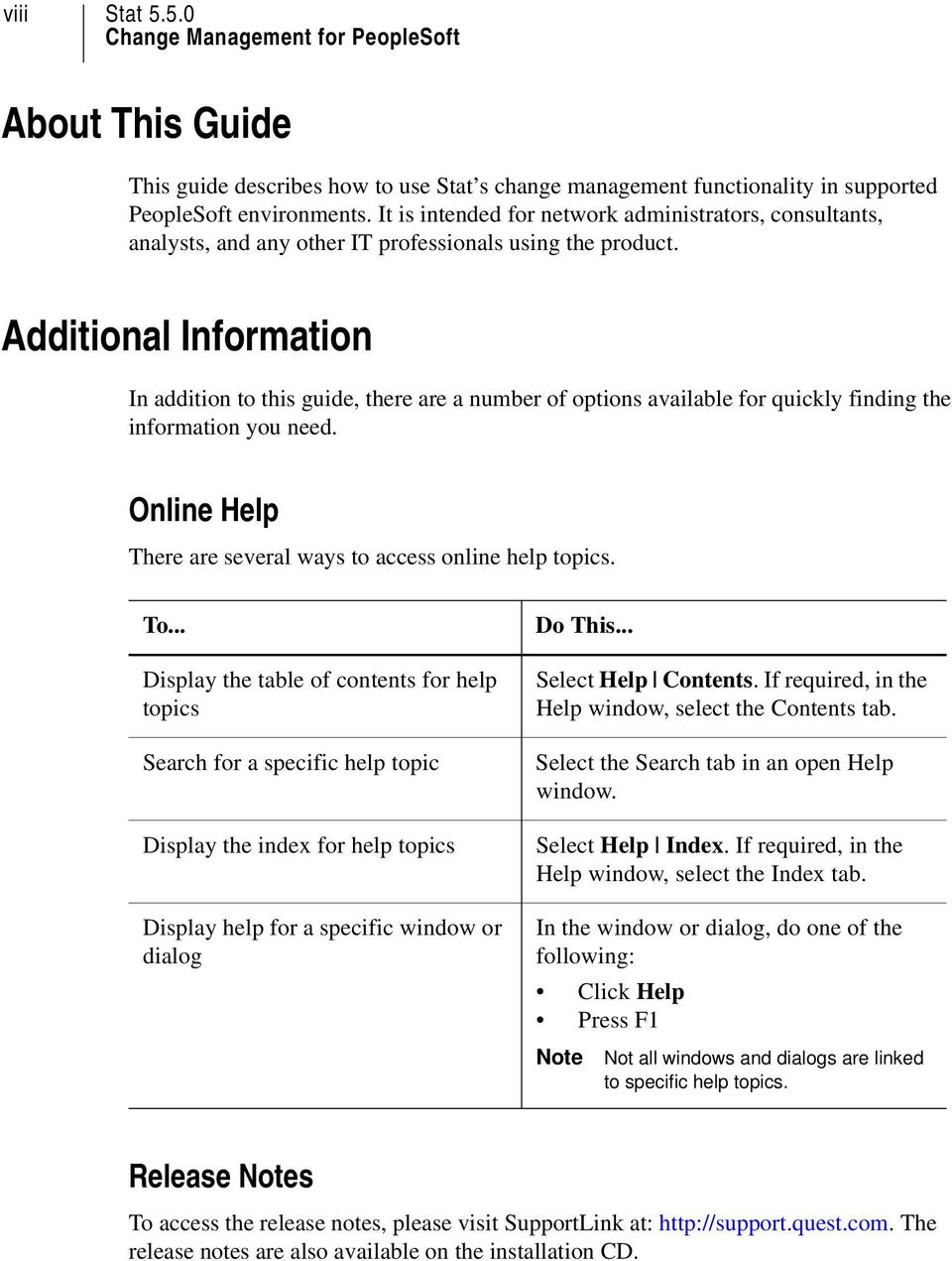
8 viii Stat Change Management for PeopleSoft About This Guide This guide describes how to use Stat s change management functionality in supported PeopleSoft environments. It is intended for network administrators, consultants, analysts, and any other IT professionals using the product. Additional Information In addition to this guide, there are a number of options available for quickly finding the information you need. Online Help There are several ways to access online help topics. To... Display the table of contents for help topics Search for a specific help topic Display the index for help topics Display help for a specific window or dialog Do This... Select Help Contents. If required, in the Help window, select the Contents tab. Select the Search tab in an open Help window. Select Help Index. If required, in the Help window, select the Index tab. In the window or dialog, do one of the following: Click Help Press F1 Note Not all windows and dialogs are linked to specific help topics. Release Notes To access the release notes, please visit SupportLink at: The release notes are also available on the installation CD.
9 Preface ix About Quest Software, Inc. Quest Software, Inc. delivers innovative products that help organizations get more performance and productivity from their applications, databases and infrastructure. Through a deep expertise in IT operations and a continued focus on what works best, Quest helps more than 18,000 customers worldwide meet higher expectations for enterprise IT. Quest Software can be found in offices around the globe and at Accessibility Quest Software is committed to providing products and solutions that are accessible to all people regardless of their capabilities. Section 508 compliance details are available by product in the Voluntary Product Accessibility Templates (VPATs) published on our web site at: Contact Quest Software Phone Mail Web site Stat Community (United States and Canada) [email protected] Quest Software, Inc. World Headquarters 5 Polaris Way Aliso Viejo, CA USA Please refer to our web site for regional and international office information.

10 x Stat Change Management for PeopleSoft Contact Quest Support Quest Support is available to customers who have purchased a commercial version and have a valid maintenance contract or who have a trial version of Quest software. Quest Support provides around the clock coverage with SupportLink, our web self-service. Visit SupportLink at: With SupportLink, you can do the following: Quickly find thousands of solutions (Knowledgebase articles/documents). Download patches and upgrades. Seek help from a Support engineer. Log and update your case, and check its status. View the Global Support Guide for a detailed explanation of support programs, online services, contact information, and policy and procedures. The guide is available at: Support Guide.pdf

11 1 Object Management Contents Setting Up Your PeopleSoft Connections Classification of Supported Objects Object Locking and Reservations Associating Objects with CSRs Comparing and Merging Objects Viewing your Object Environment CSR Object Documentation

12 2 Stat Change Management for PeopleSoft Setting Up Your PeopleSoft Connections Before Stat can interact with the objects in your PeopleSoft environments, it must first connect to those environments. For certain activities, such as editing or auto-migrating objects, it does this using the PeopleSoft Operator ID and password assigned to you for each environment. This allows Stat to access these environments and physically lock the objects you want to work with or open the object you want to edit. Your system administrator can specify your operator ID and password for each environment in the User Maintenance table, or you can do it yourself in the PeopleSoft Options window. The PeopleSoft Options window displays a list of all the PeopleSoft environments defined in Stat that you can connect to. Here you can define a separate PeopleSoft operator ID and password for each environment. In this window, you can also configure Stat to do the following: Open PeopleSoft and automatically log you on to the environment in which you have staged objects during a PeopleSoft migration. This way, you do not have to open the project in PeopleSoft manually to verify the staging of objects. Automatically migrate the objects in your project from the staging database to the target environment during a PeopleSoft migration Automatically migrate the objects out to all the environments included in the distribution list when migrating to a distribution environment If you want to configure Stat to perform any of above mentioned tasks, you must specify both your PS Operator ID and password for the selected environment. Staging databases and PeopleSoft environments are defined by system administrators in the PeopleSoft Database Connection Maintenance table, which is described in the book, Stat 5.5.0:System Administration, Chapter 4, General Maintenance Tables. Migration paths and distribution environments are defined by system administrators in the PeopleSoft Database Migration Path Maintenance table, which is described in the book, Stat 5.5.0:System Administration, Chapter 5, Service Domain-Specific Maintenance.

13 Chapter 1 3 Object Management To set up a PeopleSoft Operator ID and password: 1 Select User Options PeopleSoft Options. This opens the PeopleSoft Options window which displays a list of all the PeopleSoft environments that you can connect to. 2 Select the PeopleSoft environment that you want to connect to. 3 Enter a PS Operator ID in the PS Oprid column. This ID is case-sensitive, must correspond to the PeopleSoft Operator ID for the given environment, and must be no more than 30 characters in length. 4 Click the corresponding Enter Password button in the PS Password column.. 5 In the Change Password dialog box, enter the password in the New Password and Verify Password fields. This password is case-sensitive, must correspond to your PeopleSoft Operator ID s password for the given environment, and must be no more than 32 characters in length. 6 Click OK. A green checkmark icon appears to the right of the Enter Password button indicating that a password has been created. 7 (Optional) Select CLI Open for any designated staging database.

14 4 Stat Change Management for PeopleSoft Selecting this option configures Stat to log automatically into the environment and open the project you just staged. You can then verify the staging of objects and push the project to the target environment. 8 (Optional) Select CLI Auto-Migration for any environment designated in a migration path as either the target environment for staged objects and/or as a distribution environment. For a single target environment, selecting this option automatically migrates objects to the target environment from the staging database. To use CLI functionality for a distribution environment, you must select it for each environment that qualifies for auto-migration within the distribution environment list. For more information Migrating PeopleSoft Projects on page If you selected either CLI Open or CLI Auto-Migration, specify the directory of the user s PS Tools executable in the PS Tools Directory field. This information is required if you plan to use CLI functionality in any PeopleSoft environment. You can specify a directory location either manually or by browsing for the location: If the executable is in the same location as when first installed, keep the default value, PS_HOME\bin\client\winx86, where PS_HOME is the user s PS_HOME variable defined in the PeopleSoft configuration If the executable has been moved to a different location within the %PS_HOME% directory, specify the new subdirectory, for example, PS_HOME\setup If the executable has been moved to a location outside the %PS_HOME% directory, specify the entire location including the drive, for example, G:\software\psft\ps (Optional) After specifying the PS Tools directory location, test the connection to an environment by selecting it and clicking Test Connection. If Stat cannot connect, it displays a PeopleSoft generated error message, for example, Unsuccessful CLI connection to PS database. 11 Save your changes by clicking either Apply or OK.

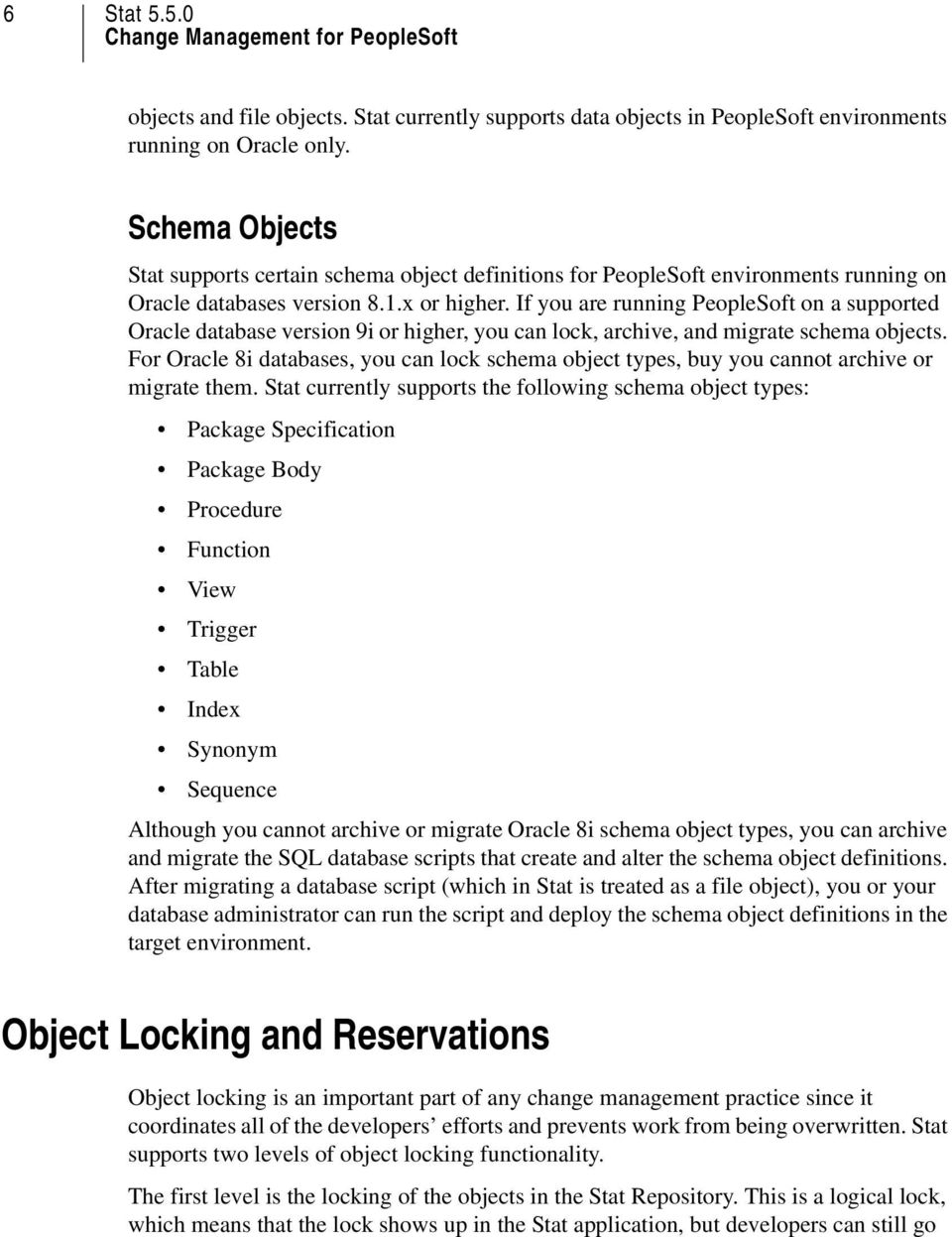
15 Chapter 1 5 Object Management Classification of Supported Objects Whether used in conjunction with PeopleSoft, Oracle Applications, or a generic application, Stat enables developers to work with objects in a more secure, controlled, and well-documented manner. In Stat, any action you take involving an object is handled and recorded on its associated CSR, including editing, archiving, or migrating it to other environments. Also, Stat lets you place a lock on an object once you associate it with a CSR. Object locking promotes coordination between developers by ensuring that they do not overwrite each other s work. There are four classes of objects that you can associate with CSRs: PeopleSoft proprietary objects File objects Data objects Schema objects PeopleSoft Proprietary Objects These are objects native to your PeopleSoft environments, such as Records and Pages. With Stat, you can lock, archive, and migrate PeopleSoft proprietary objects version 7 and higher. For a complete list of objects that Stat supports, see the book, Stat 5.5.0:User Guide, Appendix D: Supported PeopleSoft Proprietary Objects. File Objects Stat supports change management for file type objects (also called flat files). In addition to the COBOL, COBOL CPY, SQR, and SQC file types Stat automatically supports, system administrators can configure Stat to support any other type of file object residing in your PeopleSoft environments. This configuration includes defining working directories where users can modify file objects assigned to them. Data Objects Data objects are user-defined or third party data sets residing in your PeopleSoft environments that your system administrator has configured Stat to support. You can lock, archive, and migrate data objects the same way you do PeopleSoft proprietary

16 6 Stat Change Management for PeopleSoft objects and file objects. Stat currently supports data objects in PeopleSoft environments running on Oracle only. Schema Objects Stat supports certain schema object definitions for PeopleSoft environments running on Oracle databases version 8.1.x or higher. If you are running PeopleSoft on a supported Oracle database version 9i or higher, you can lock, archive, and migrate schema objects. For Oracle 8i databases, you can lock schema object types, buy you cannot archive or migrate them. Stat currently supports the following schema object types: Package Specification Package Body Procedure Function View Trigger Table Index Synonym Sequence Although you cannot archive or migrate Oracle 8i schema object types, you can archive and migrate the SQL database scripts that create and alter the schema object definitions. After migrating a database script (which in Stat is treated as a file object), you or your database administrator can run the script and deploy the schema object definitions in the target environment. Object Locking and Reservations Object locking is an important part of any change management practice since it coordinates all of the developers efforts and prevents work from being overwritten. Stat supports two levels of object locking functionality. The first level is the locking of the objects in the Stat Repository. This is a logical lock, which means that the lock shows up in the Stat application, but developers can still go
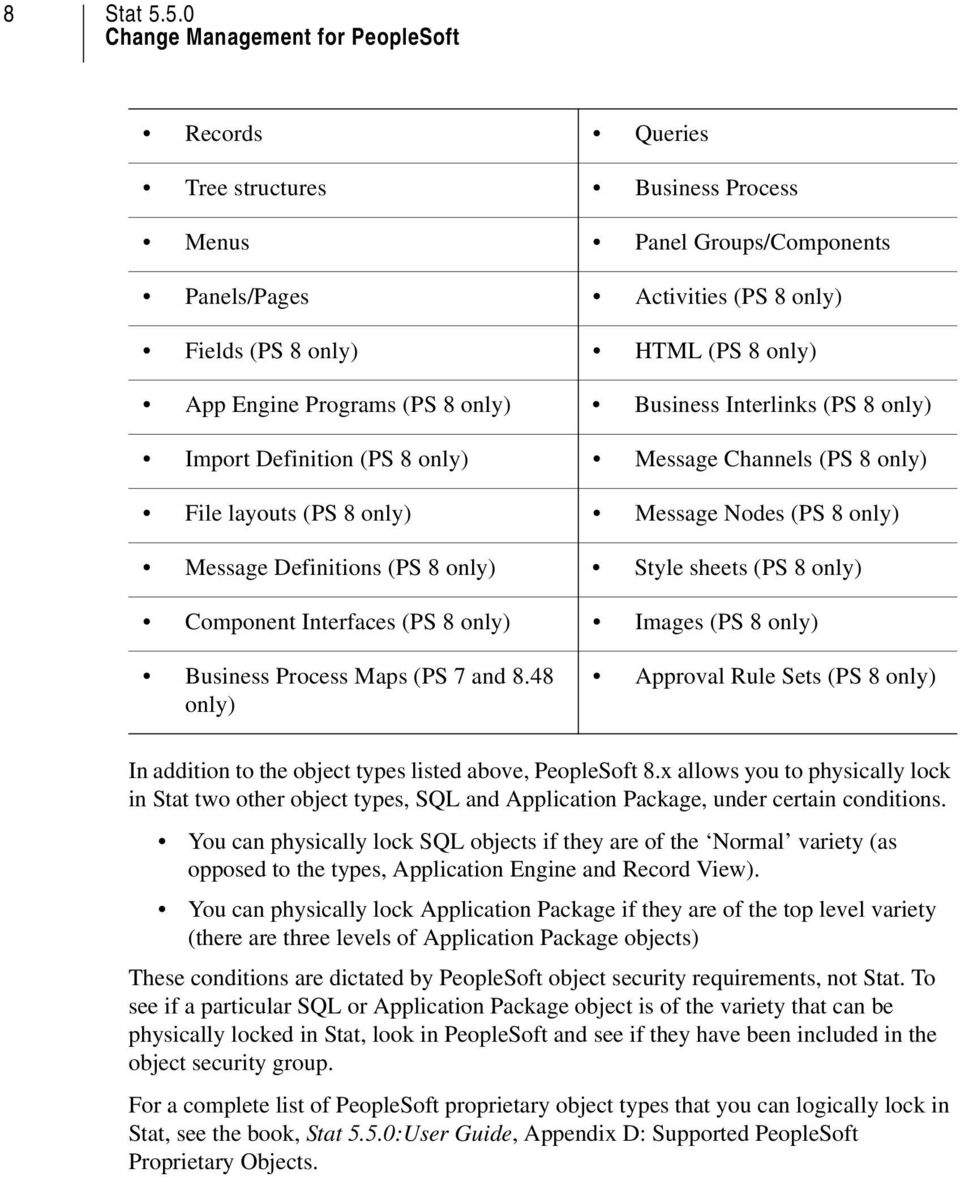
17 Chapter 1 7 Object Management directly into PeopleSoft or a file directory and make changes to the object even if the lock on the object isn t theirs. As long as the developers use a CSR to modify objects, the coordination of development is maintained. The second level is the physical locking of objects in PeopleSoft environments. This second level of locking is optional. It can be turned on for all the environments and file locations in a service domain or a select few. You can also exclude specific PeopleSoft proprietary object types from the physical locking. Your system administrator and file server administrator configure these options. When activated, physical locking works in conjunction with logical locking. The following sections apply to locking in general, whether you are using just one or both levels of locking. Specific information about physical locking is found in the sections, Physical PeopleSoft Locking Option and Physical File Locking Option later in this chapter. Understanding Object Reservations and Locks Locks and reservations are issued to the developer assigned to the object, regardless of who actually requested the lock. That person may or may not be the assigned developer. This is a security measure determined by user class rights. A lock indicates that the assigned developer has exclusive change/edit rights on the object. A reservation indicates that the object is currently locked by another developer and you are waiting for the object to become available. Once the object becomes available, Stat converts the reservation to a lock and notifies the holder of the new lock via . Remember, the holder of the reservation is the developer assigned to the object in the CSR. If you request the lock but are not the assigned developer, you will not receive an when the reservation turns into a lock. All objects can be logically locked in the Stat Repository, but only by one user at a time. Also, you can physically lock file objects and the PeopleSoft proprietary object types governed by PeopleSoft s Object Security, but only if the physical locking options have been configured and activated by your system administrator. Physical locking is not supported for schema objects, data objects, and PeopleSoft proprietary objects that are not governed by PeopleSoft s Object Security. In PeopleSoft versions 7.x and higher, you can physically lock the following object types: Translate values Trees

18 8 Stat Change Management for PeopleSoft Records Queries Tree structures Business Process Menus Panel Groups/Components Panels/Pages Activities (PS 8 only) Fields (PS 8 only) HTML (PS 8 only) App Engine Programs (PS 8 only) Business Interlinks (PS 8 only) Import Definition (PS 8 only) Message Channels (PS 8 only) File layouts (PS 8 only) Message Nodes (PS 8 only) Message Definitions (PS 8 only) Style sheets (PS 8 only) Component Interfaces (PS 8 only) Images (PS 8 only) Business Process Maps (PS 7 and 8.48 only) Approval Rule Sets (PS 8 only) In addition to the object types listed above, PeopleSoft 8.x allows you to physically lock in Stat two other object types, SQL and Application Package, under certain conditions. You can physically lock SQL objects if they are of the Normal variety (as opposed to the types, Application Engine and Record View). You can physically lock Application Package if they are of the top level variety (there are three levels of Application Package objects) These conditions are dictated by PeopleSoft object security requirements, not Stat. To see if a particular SQL or Application Package object is of the variety that can be physically locked in Stat, look in PeopleSoft and see if they have been included in the object security group. For a complete list of PeopleSoft proprietary object types that you can logically lock in Stat, see the book, Stat 5.5.0:User Guide, Appendix D: Supported PeopleSoft Proprietary Objects.
19 Chapter 1 9 Object Management The Object Locking Process The object locking process has up to three phases. Phase 1: Tentative Lock/Reservation When you associate an object with a CSR, Stat automatically requests a lock for that object in the designated environment(s). Stat checks if there are existing locks or reservations on that object. If a lock or reservation exists, Stat issues a tentative reservation. If not, it issues a tentative lock. The lock or reservation remains tentative until you save the CSR. User adds objects to CSR Stat checks for existing full locks or reservations for each environment Lock or reservation found Stat gives CSR tentative reservation on objects No locks or reservations found Stat gives CSR tentative lock on objects Phase 2: Full Lock/Reservation Immediately after associating objects with a CSR, you should save your work. Upon saving, Stat checks for existing locks or reservations. If a lock or reservation exists, Stat issues a full reservation. If not, it issues a full lock. The longer you wait to save your CSR, the greater the likelihood you will lose your place in the queue for that object. For example, while you have a tentative lock on an object, another user could add that same object to a CSR and receive a tentative reservation. If the second user then saves his or her CSR before you do, that user receives the full lock for that object, and when you save your CSR, you receive instead a full reservation.

20 10 Stat Change Management for PeopleSoft When Stat issues a full lock, it automatically archives a pre-change version of the object to the Stat Repository. Archiving objects is discussed in depth in the next chapter. User saves CSR with new locks or reservations Stat re-checks for existing full locks or reservations for each environment Lock or reservation found Stat gives CSR a full reservation on objects No locks or reservations found Stat gives CSR tentative lock on objects Stat archives objects Stat updates CSR to indicate object archives Phase 3: Reservation Conversion to Lock The third phase is the conversion of reservations into locks. Stat releases an object lock when the status of the CSR changes to a closed-type status, or when the developer manually unlocks the object or the object is reassigned to another developer. After unlocking an object, the Stat Agent then determines if there are any pending reservations on the object. If reservations on the object have been given to more than one user, these reservations are handled in chronological order, based on the time each lock was requested. The Stat Agent converts the first reservation in line into a lock and performs any applicable object archiving.

21 Chapter 1 11 Object Management CSR with objects is changed to a closed status Stat checks for reservations on objects Reservation found Stat converts reservation to full lock Stat archives objects Stat updates CSR to indicate object archives Stat sends to assigned user Locking Facts Additional information about locking objects in Stat that you should know: While not all objects can be physically locked in PeopleSoft, all objects can be logically locked in the Stat Repository If an object is locked on a CSR, you cannot lock it on another CSR for the same PeopleSoft environment In order to lock objects physically in PeopleSoft, you must have your PeopleSoft operator ID defined in Stat. This is controlled by your security settings. Stat supports physical locking of file objects, such as SQRs, COBOLs, and Crystal Reports You can logically lock schema objects, data objects, and PeopleSoft proprietary objects that are not governed by PeopleSoft s Object Security, but you cannot physically lock them Physical PeopleSoft Locking Option Physical PeopleSoft locking works in conjunction with Stat logical locking. When your system administrator activates the Physical PeopleSoft Locking option in Stat, any object you lock in Stat is also locked in PeopleSoft. Stat utilizes PeopleSoft Object Security to secure the locked objects in each PeopleSoft environment.
22 12 Stat Change Management for PeopleSoft Your system administrator defines the scope of PeopleSoft physical locking at the service domain level. Depending on the service domain, object types as well as PeopleSoft environments may be excluded from the physical locking option. Even specific PeopleSoft users can be excluded from this functionality. The developer assigned to the physically locked object is the only user that has Write access to the object in PeopleSoft. Other users are restricted to Read Only access. If the object is reassigned to a different user and the CSR is saved, the new user has Write access and the previous user has Read Only access to the object. An object that is not physically locked on any CSR can only be opened in Read Only mode in PeopleSoft. In order to make any changes to PeopleSoft proprietary objects, you must first open a CSR and physically lock the objects in that CSR. This ensures that all object modifications are documented. Note For detailed instructions on setting up physical locking between Stat and PeopleSoft, see the book, Stat 5.5.0:System Administration, Chapter 8, Object Security. Physical File Locking Option Like physical PeopleSoft locking, physical file locking works in conjunction with Stat logical locking. When set up appropriately, physical file locking prevents developers from modifying file objects that have not been locked in a CSR and assigned to them. Stat does this by allowing developers to modify only file objects that are in their working directory. Once a file is locked and assigned to a developer, the developer can only use Stat to migrate the file to their working directory as well as all source directories. This enforces that all changes to the file objects are documented and orchestrated through Stat. System administrators define the scope of the physical file locking. Source file locations, specific users, and environments can be excluded from physical locking. Associating Objects with CSRs If a change request requires modifications to objects, you access and work with these objects in a CSR. The CSR becomes the logical grouping of all the affected objects. Remember that objects are associated with CSRs as opposed to users. In order to lock, archive, or migrate an object, you must first associate it with a CSR. The modifications
23 Chapter 1 13 Object Management that you make to objects are still made in PeopleSoft Stat simply provides tools that manage and track those changes. You can manually associate objects with a CSR, or you can use one of three wizards to associate objects en masse. These include: The PeopleSoft Project Read Wizard, which associates the PeopleSoft proprietary objects in a project The Read File Wizard, which associates the file objects in a folder The CSR Read Wizard, which associates the objects associated with another CSR Objects can also be associated with a CSR using the Impact Analysis Wizard and the Undocumented Object Wizard. For more information, see the book, Stat 5.5.0:User Guide, Chapter 10, Object Tools and Wizards. PeopleSoft Change Management Tab To begin associating objects with a CSR, select the PeopleSoft tab. This tab features tools that connect directly to your PeopleSoft environments. It is also service domainspecific. When defining a service domain, your system administrator determines which service domains display the PeopleSoft change management tab on its CSRs. Access to
24 14 Stat Change Management for PeopleSoft this tab is normally restricted to developers and migrators. For more information on security settings, see the book, Stat 5.5.0:System Administration, Chapter 3, Stat Security. Selecting a Migration Path In order to associate objects with a CSR, you must specify the environment you want to copy them from. This is done first by selecting a migration path. In Stat, migration paths are logical groupings of environments that serve as road maps for object migrations. They are set up by your system administrator. Your system administrator creates migration paths based on your business needs. For different situations you have different paths. To select a migration path: 1 On the PeopleSoft tab, click Advanced... This opens the Change Management/Version Control window.
25 Chapter 1 15 Object Management The first tab of the Change Management/Version Control window, CSR Info, displays in a read-only format the general information fields of the CSR as well as its long description. Note If the Patch tab is activated on the CSR window, the Change Management/Version Control window displays it as well. Both tabs display the same information and function the same way. For more information on PeopleSoft patches and the Patch tab, see the book, Stat 5.5.0: User Guide, Chapter 3, Change Service/Requests. If you want to edit any of the information displayed on the CSR Info tab, click Edit. This opens the CSR window for that CSR. 2 Click the Migration Path tab. 3 Click the Select Migration Path field and select the appropriate migration path. The displayed paths vary, depending on the service domain. Note If a workflow that specifies a migration path is assigned to the CSR, that path is the default path displayed in the Change Management/Version Control window and cannot be changed. For more information on workflows, see the book, Stat 5.5.0: User Guide, Chapter 3, Change Service/Requests. For more information on migration paths, see Migrating Archive Sets on page In the Select Default Developer field select the developer you want assigned to the objects by default.
26 16 Stat Change Management for PeopleSoft You can assign different developers to different objects, but this is the person to which most of the object will be assigned. 5 Click Generate Path. Stat displays a graphical representation of the migration path. Also, the Objects and Object Management tabs appear. Each drum represents a PeopleSoft environment. Your system administrator determines which environments are designated as Base and Development. The original, pre-change archive of the objects in the CSR is taken from the Base environment. The Development environment is where you change the objects.
27 Chapter 1 17 Object Management After selecting a migration path, select the Objects tab. Assigning Developers Before adding the objects to the CSR, you need to decide which Stat user is going to be making the changes to the objects and therefore needs to be assigned the object lock. If the user is the default user in the Assigned To field, then you can just add the objects and the default user will obtain the lock. If another user needs the lock on the objects, select that user from the drop down list in the Assigned To field. When you add the objects, the user in this field is assigned the object locks. See The Object Locking Process on page 9. Selecting Objects You can select the objects you want to add to your CSR manually, or you can use the various wizards to select groups of objects. The procedure for manually selecting the objects you want to associate with your CSR is slightly different depending on the class of objects.
28 18 Stat Change Management for PeopleSoft Note Workflows can contain status rules that do not allow users to add or lock objects while the CSR is in a restricted status. When this is the case, Stat prevents you from adding or locking objects until the CSR changes to a unrestricted status. Any object reservations that were in place before the CSR was transferred to a restricted status, however, are treated the same, meaning they are converted into locks when the objects become available. Selecting PeopleSoft Proprietary, Data, and Schema Objects To select a PeopleSoft proprietary, data, or schema object, first select the PeopleSoft environment, then the object class and the object type. To select a PeopleSoft proprietary, data, or schema object: 1 In the Change Management/Version Control window, select the Objects tab. 2 In the Environment field select the environment that contains the objects. Note that only the active environments on the migration path are listed. If you need to select objects from an inactive environment, see your system administrator. The initial object snapshot, the base archive set, always comes from the Base environment. No matter which environment you select in the Environment field, Stat archives the objects from the Base environment. Even if you add objects later, they still come from the Base environment. Stat gives you this option of environments in order to reduce the number of hits made against your Base, or Production, environment. By selecting another environment, Stat connects to that environment and retrieves the list of objects. Once the objects are selected, the pre-change object snapshot is created from the Base environment. Note Schema objects are only supported for PeopleSoft environments running on Oracle 8.1.x platforms. Also, schema objects are not archived and are not included in base archive sets. When you select an environment, the Object Type field displays a Loading... message. During this time, Stat connects to the selected PeopleSoft environment and checks which object types are available. Note If Stat returns a large number of objects, you can quickly locate the particular object you want by typing the first few letters of the object name in the Quick Filter field. As you type, Stat filters the list of objects so that only objects with matching names are displayed. 3 In the Object Type field, select the type of object you want.
29 Chapter 1 19 Object Management Stat displays object types sorted by object class. When you select an object type, Stat displays a list showing all available objects of that type. 4 In the list of objects, select the object(s) you want. To select multiple objects, hold down the <Shift> or <Ctrl> key as you make your selections. Selecting File Objects You can select file objects residing in either a PeopleSoft environment or the assigned developer s working directory. To select a file object: 1 In the Environment field, do one of the following: Select an environment if you want Stat to look through that environment s source file locations to get the list of file names for a particular file type. Source file locations are the file server directories where file objects reside. You or your system administrator can define multiple source file locations for each environment. Select Working Directory if you want to add files that exist in the assigned developer s working directory but not in any of the environments to which Stat has access Note that any environments on the migration path that have been inactivated are not listed. If you need to select objects from an inactive environment, see your system administrator. 2 In the Object Type field select the type of file you want. Stat displays a list of all the files that have the matching file extension. No file names are returned if there are no source file locations defined for the selected file type and environment, or if no working directory has been defined for the assigned user. 3 (Optional) Select Copy to Working. If selected, Stat copies the files from the Base environment to your working directory after adding them to the CSR. Note This option is selected by default if the Copy Files to Working checkbox is selected in the Stat User Options window. For information on user-defined working directories, see Defining Working Directories for File Objects on page In the list of files, select the file(s) you want.
30 20 Stat Change Management for PeopleSoft Selecting Lock Options After you select the object(s), you should decide which locking options to use. By default, the objects are set to be locked in all the environments on the migration path, but with proper security rights you can select a different lock option. For more information on object locking, see Object Locking and Reservations on page 6. There are four different lock options: All on Migration Path The default setting. Select this option to add and lock/ reserve the object(s) in all environments. Stat searches in each environment to determine if the object is already locked or reserved on another CSR. Current Environment Select this option if you want to add the object from each environment on the migration path but lock/reserve the object(s) only in the current environment. Stat checks for reservations and locks/reserves the object(s) only in the current environment. None This option adds the object(s) to the CSR from each environment on the migration path without issuing a lock on any of them. Although you can archive an object that is not locked in an environment, you cannot migrate the object to an environment in which it is not locked. You should select this option if you are associating the object(s) to a CSR for documentation purposes only, and you are not going to make any changes to the object(s). Caution When you add an object to a CSR without a lock, Stat does not create a base version for the object or mark the object as having been modified. The object is therefore considered Undocumented by the Undocumented Object Wizard. Reserve if locked This option automatically requests a reservation if the object(s) are locked by another CSR. If this box is not checked and the object(s) are locked by another CSR, Stat prompts you for an action. Note It is recommended that you keep the default lock setting, All on Migration Path. Locking only in the current environment could lead to version inconsistencies if another developer modifies the same object in a different environment.
31 Chapter 1 21 Object Management Adding Objects After assigning a developer and selecting the object(s) and lock options you want, you are ready to add the objects to your CSR. To associate objects to a CSR: 1 Click Add Object. Stat adds the selected objects to the Object List. 2 Click the Save button on the Stat toolbar or select File Save. This enables the Stat Agent to finalize your object locks, if any. While the Stat Agent processes the locks, the Object Management tab goes into readonly mode and the following occurs: The Read File, Read CSR and Read Project buttons are temporarily replaced by a message indicating how many objects are left to process. Note If the message does not go away after certain amount of time this may indicate that the agent encountered a problem or timed out. The Workflow tab and certain CSR fields are disabled both in the Stat Windows client and in Stat Web. These include the CSR Type, Application, Status, and Workflow fields. This is done to prevent users from modifying the CSR while the Stat Agent is still processing data. While the Stat Agent processes your object locks, the Objects tab goes into Read Only mode. During this time, if you attempt to perform any actions such as adding more objects or removing existing ones, Stat displays a warning. Once the Stat Agent has completed the locking of your objects, the Objects tab returns to edit mode. For each object, Stat then: Verifies the object is not already on the list of objects associated with the CSR Checks for any existing locks or reservations for the object on other CSRs If a file object, Stat checks for the object s existence by searching in each source file location defined for each environment along the migration path. If no source locations have been defined for the file type in any of the environments on the migration path, Stat cannot add the object to the CSR. If a PeopleSoft proprietary, data, or schema object, Stat checks for the object s existence by searching in each environment on the migration path
32 22 Stat Change Management for PeopleSoft Adds the object to the CSR and, depending on the locking options you select, either locks it or issues a reservation or adds the object without a lock or reservation When adding an object, Stat connects to all environments or source file locations on your migration path to check for existence. If it finds an object that exists in another environment, but not in the environment that you are working in, it displays an advisory message. Clicking Yes adds the object to the Object List table with a modification status of New. For more information on the Object List table and modification statuses, see CSR Object Documentation on page 55. Note You can update the lock status of objects displayed in the Object List table by clicking Refresh. This will show if you any of the reserved objects have since received a lock since the last time you saved the CSR. When Stat adds the object to the CSR, a row for each environment on the migration path is added to the Object List table. Each row displays information concerning the development, archiving, and migration activity that takes place for that object in that environment. Viewing the Lock Status of an Object From the Objects tab of the Change Management/Version Control window, you can identify which objects you have locked and which objects you have reserved. Stat denotes lock and reserve status in the Flags column of the CSR object list with a lock icon and a clock icon, respectively. For example, the PeopleSoft proprietary object ACCESS_GRP_TBL is reserved in the P840DPOR environment but locked in P840DTOR, as indicated by their respective icons.
33 Chapter 1 23 Object Management To view all the locks and reservations placed on an object, right-click on it in the appropriate change management tab of the CSR window or in the Objects tab of the Change Management/Version Control window. Then in the pop-up menu select View Lock Status. Stat opens the lock summary window for the object. Note You can view the status of the Stat Agent responsible for processing object locks by opening the Job Monitor window in Stat Web. This window displays a list of all locks and reservations for the object across all environments. Any reservation or lock for the current CSR is highlighted in yellow. This allows you to see, at a glance, the position of your reservation in the queue. The window lists locks first, followed by reservations, in chronological order. Each reservation icon is followed by a number indicating its position in the queue. If no locks or reservations exist for the object, Stat opens a window indicating this.
34 24 Stat Change Management for PeopleSoft The name listed in the lock summary window is the developer assigned to the object in the CSR, which may not be the person assigned to the CSR. This depends on your business practices. Unlocking or Unreserving an Object To unlock or release a reservation for an object, select it in the Object List, click Unlock, and save the CSR. Do not remove an object after you modify it. If you remove it, it is removed from all archive sets in the CSR and Stat cannot accurately report on changes to the object. Note All objects associated with a CSR are automatically unlocked when the CSR changes to a closed-type status. Also, if you selected the Delete Files From Working Dir option in the Stat User Options window, when the CSR changes to a closed-type status, Stat deletes from your working directory any file objects that were assigned to you and associated with the CSR. You might unlock an object if you want to keep the CSR open but you want to release the lock on a particular object. This may occur when another developer needs that object immediately, or when you have many objects locked and have finished working on some of them.
35 Chapter 1 25 Object Management Until the Stat Agent processes the unlock, the CSR still has the object locked. It appears in the window that you no longer have the lock, but if another user attempts to lock the object, that user will receive a reservation. The lock summary window for the object will show that your CSR still has the lock. If you attempt to save a removal, unlock, or unreserve of an object before the Stat Agent has finished processing the initial lock, Stat opens the Object Processing Results window, which displays a list of processing error messages. When this happens, you need to return to the Object tab, reapply your changes, and save the CSR again. Re-Prioritizing Reservations Stat normally processes reservations on a first in, first out basis, meaning the first CSR to request a reservation on an object is the first CSR to obtain a lock when the object becomes available. However, Stat lets you move your reservation to the head of the queue if necessary. This is called re-prioritizing. Access to this feature is usually limited to users responsible for managing development projects. To re-prioritize object reservations: 1 Select the object(s) and click Reprioritize... Stat displays a message box telling you that the re-prioritization is complete. 2 Click OK in the message box. Stat moves the object(s) to the first reservation position in the selected environment(s).
36 26 Stat Change Management for PeopleSoft Note Stat re-prioritizes the reservation for an object only in the environment in which you selected it. If you want to re-prioritize a reservation in multiple environments, make sure you select the object(s) in each of those environments. Assigning Objects to a Different Developer To assign an object to a different developer: 1 Select the object(s) in the object list. 2 In the Assigned To field, select the developer you want to assign the object(s) to. 3 Click Reassign. If you are reassigning a file object and Copy to Working is selected, Stat displays a message box prompting you to specify if you want to copy the file object to the new developer s working directory, and if so, whether to copy the file either from the original developer s working directory or from the base environment s source file location. Also, if you selected the Delete Files from Working Dir option in the Stat User Options window, the object is removed from your working directory when you reassign it to a different developer. 4 Select the options you want and click OK. 5 Save the CSR. Stat updates the Assigned To field in the object list with the new developer's user ID. The new developer now has the lock on the object(s). Note You must save the CSR before the reassignment can take effect.
37 Chapter 1 27 Object Management Removing Objects from a CSR To remove objects from a CSR, select them and click Remove. The objects are removed from the CSR List and all archive sets. In the case of file objects, the objects are also removed from your working directory if in the Stat User Options window the option Delete Files From Working Dir is selected. Note You should remove an object only if it was added to the CSR in error. Modified objects should remain associated with a CSR for historical purposes. Objects in the Base Environment There are several situations when an object may exist in other PeopleSoft environment or source file locations on the migration path but not in the Base environment. Since the initial archive of objects comes from the Base environment, these objects are not included in the base archive set. Possible reasons an object exists in one environment but not in others are: You create a new object in the Development environment, which means it would not exist in any other environment You work on an object that was previously created in the Development environment but not yet migrated to any other environment You work on a new object that exists in the AUD, Demo, or System environment but not in any other You create a new file object in your working directory, which means it would not exist in any other environment If you want to archive an object that does not exist in the Base environment, there are two different ways to do it for two different types of situations. To add objects that do not exist in the Base environment: 1 On the Objects tab of the Change Management/Version Control window, select the environment in which the object exists. 2 In the Object field select the object. 3 In the Lock in environment field select Current environment.
38 28 Stat Change Management for PeopleSoft To add objects that exist inside and outside the Base environment: 1 On the Objects tab of the Change Management/Version Control window, select the environment in which the object exists. 2 In the Object field select the object. 3 In the Lock in Environment field select All on Migration Path. By choosing the second method, the objects that exist in the Base environment are included in the base archive set. Those that do no exist are not added to the base archive set. You can include these latter objects in any interim or final archive sets taken from the environment where they reside. Stat cannot create a base archive set if the objects in your CSR do not exist in your Base environment. While attempting to locate the objects, Stat permanently displays the value In Process in the Status field of the Archive Set window, and it will be unable to complete the archive set. If this happens, create an interim or final archive set from the environment that contains the objects and use this archive set to update the other environments with the new objects. Defining Working Directories for File Objects When you are assigned a file object, Stat places a copy of that object in one of your predefined working directories. These working directories are defined either by a system administrator in a maintenance table, or you can define them yourself in the User Default Directories tab of the Stat User Options window. The User Default Directories tab displays a list of the active file types defined in Stat for PeopleSoft environments. From here you can define your default working directory and a separate working file directory for each file type. Defining a working directory for a
39 Chapter 1 29 Object Management file type is optional. If a file type working directory is not defined, Stat places copies of the migrated file objects in the your default working directory. To set up a default working directory: 1 Select User Options Stat Options. Then open the User Default Directories tab of the Stat User Options window. 2 Click in the Default Working File Server field and select the server for the default working directory. 3 In the Default Working File Path field, enter the path of the default working file location starting after the file server s root or home path. 4 Click Apply or OK. To set up a file type working directory: 1 Select User Options Stat Options. Then click the User Default Directories tab of the Stat User Options window. 2 In the Module field, select PeopleSoft. 3 In the File Type column, select the file type you want to have a working directory for. This activates the text box in the corresponding Working File Srv column. 4 Click in the Working File Srv column and select the server of the working directory. 5 In the Working File Path column, enter the path of the working file location starting after the file server s root or home path.
40 30 Stat Change Management for PeopleSoft 6 Click either Apply or OK. Associating Related PeopleSoft Proprietary Objects Certain types of PeopleSoft proprietary objects are related to other PeopleSoft proprietary objects. Using default Stat settings, you must add these objects individually to your CSR. However, you can configure Stat to add these related objects automatically. You do this by selecting a user preference that prompts you for related objects whenever you add a supported object type. This feature behaves in a similar manner to the prompt in PeopleSoft when inserting objects into a project. Depending on your version of PeopleSoft, Stat can automatically associate related objects for the following object types: Object PS 7, 8.48 PS 8.11 PS 8.x Record Yes Yes Yes Menu Yes Yes Yes Panel/Page Yes Yes Yes Panel Groups/Components Yes Yes Yes Business Process Yes Yes Yes App Engine Program No Yes Yes App Engine Section No Yes Yes Field No Yes Yes Component Interface No Yes Yes Message Channels No Yes Yes Message Definition No Yes Yes Message Node No Yes Yes Portal Registry Definition No No Yes Portal Registry Structure No No Yes To configure Stat to prompt you to add related objects, select User Options Stat Options. Stat displays the Stat User Options window. Select Prompt for PS Related
41 Chapter 1 31 Object Management Objects. If the option is not selected, Stat will not prompt for related objects and will not add them automatically. Note If you select related pages, Stat identifies all related standard pages as well as secondary pages and subpages. For PeopleSoft 8.x, Stat also supports associating the subobjects of the Field and Record object types. These include the Field subobject, Field Label, and the Record subobject, Record Field. Associating a subobject with a CSR allows you to modify its Upgrade and Action values in a PeopleSoft project separately from the values of its parent object. Subobjects are always archived and migrated with their parent object. Consequently, the only time you should add subobjects to a CSR is when you need to make their Upgrade and Action values different than the values of their parent objects for a migration to a particular environment. For more information, see Modifying Object Upgrade and Action Values on page 46. To associate related PeopleSoft proprietary objects to a CSR: 1 In the Objects tab of the Change Management/Version Control window, associate a supported object with the CSR, as described in Adding Objects on page 21. After you select the object you want, Stat displays the Related Object dialog box, which displays all the object types related to the selected object. If you are associating a Field or Record object, their respective subobjects, Field Label and Record Field, are included in the list of related objects.
42 32 Stat Change Management for PeopleSoft 2 If you want to add one or more objects types, select the object types you want. Note Once you select an object type, the Add button is activated and the Ignore button is deactivated. Also, you can use the Select All and Deselect All icon buttons to select or deselect all the listed object types. 3 (Optionally) Keep the Apply for all objects option selected if you want Stat to apply the same action you are currently specifying (Add or Ignore) to any other affected object being added to the CSR. If you de-select this option Stat will prompt you to specify an action for each affected object. 4 Do one of the following: If you want to add the selected object types, click Add. If you do not want to add the related objects, click Ignore. Associating Objects in PeopleSoft Projects Stat can read a PeopleSoft environment and add all the PeopleSoft proprietary objects associated with a project to your CSR. This is done with the PeopleSoft Project Read Wizard. Use this wizard to associate multiple PeopleSoft proprietary objects to a CSR. For PeopleSoft version 8.x, you can also use the Project Read wizard to read in the objects of a PeopleSoft patch (defined in terms of a maintenance project). This way, Stat automatically populates the Patch tab of the CSR with the information contained in the project, such as incidents and dependencies.
43 Chapter 1 33 Object Management Note If you want to migrate a PeopleSoft project that contains a large number of objects, but you do not necessarily want to spend the time required to archive all these objects, you can use Stat simply as a migrating tool by performing a point-to-point migration. For more information, see Point-to-Point PeopleSoft Project Migrations on page 102. To read in a patch with the Project Read Wizard, the patch must be designated as a Maintenance Project in PeopleSoft, as shown below. In addition, to display this information in Stat, the Patch tab must activated for the CSR. For more information on the Patch tab, see the book, Stat 5.5.0:User Guide, Chapter 3, Change Service/Requests. Note Before running the Wizard, make sure you select your desired lock option. To run the PeopleSoft Project Read Wizard: 1 On the Objects tab, click Read Project...
44 34 Stat Change Management for PeopleSoft You are prompted to select the PeopleSoft environment that contains the project. 2 In the PeopleSoft environments field select the environment containing the project. 3 (Optional) Select the checkbox if you only want environments that are in the current migration path listed. The wizard displays a list of all projects in that database. 4 (Optional) Enter a part or all of a project name in the Project Filter field to filter the list of projects. 5 Select the project you want and click Next>.
45 Chapter 1 35 Object Management The wizard displays a list of the PeopleSoft proprietary object types in that project. 6 Select the object types you want, or select them all by clicking Select All. Note If you select a Field or Record object type, any related subobjects that are listed out in the project are automatically associated with the CSR as well. The existence of subobjects is indicated by the Subobjects flag in the Object List ( ). These subobjects retain their Upgrade and Action values as specified in the project. Also, if you select a subobject (Field Label or Record Field) that does not have its parent object included in the project, Stat automatically adds a parent object to the CSR for these orphaned subobjects. Parent objects added to a CSR automatically by Stat are indicated by the Parent of Orphaned Subobjects flag in the Object List. You have the option of marking or unmarking a Field or Record object as a parent object for orphaned subobjects. For more information on Field and Record subobjects, see the previous section, Associating Related PeopleSoft Proprietary Objects on page 30. For more information on Upgrade and Action values and marking and unmarking parent objects, see Modifying Object Upgrade and Action Values on page (Optional) Select any of the following options: Select Add project definition to CSR if you want to add the PeopleSoft project definition to the CSR, where it can be locked, archived, and migrated along with the other objects. A comment is automatically written for each object saying that it was added by way of the Read Project Wizard and the name of the project used to bring in the object. This allows you to track the project by name throughout the lifecycle of the CSR. For more information, see Archiving PeopleSoft Project Definitions on page 76.
46 36 Stat Change Management for PeopleSoft Select Add only objects with a changed target status if the project contains an especially large number of objects and you want to decrease processing time by adding only the objects that have been modified to your CSR. Select Overwrite properties for existing objects if you want to update the existing CSR objects upgrade and copy properties to reflect the objects upgrade and copy properties in the project. This will also update the subobjects and their properties. Select Make selected project the CSR managed project if you want to keep the project s object list as defined in App Designer synchronized with the project s object list as managed in the CSR. Selecting this option enables you to quickly update the objects associated with a CSR via the Project Read Wizard whenever the project is changed in App Designer. For more information, see the following section Synchronizing Project Definitions on page Click Next>. In the next wizard window, Stat processes your request and displays its progress in a status bar. 9 When the status bar reaches 100%, click Finish. Stat adds all PeopleSoft proprietary objects of the selected types to your CSR. This step may take some time, depending on the number of objects being added. Before the status bar reaches 100% you can interrupt the process by pressing the <Enter> key. Synchronizing Project Definitions If you used the Project Read wizard to add objects to your CSR and selected the option, make the selected proj. the CSR s managed project, you can quickly keep the project definition synchronized between App Designer and your CSR. This way, whenever the project definition is changed in App Designer (either by adding objects, removing objects, or modifying object properties in the project such as delete vs. copy flag), you can update the object list in your CSR to reflect these changes. After adding the objects to your CSR with the Project Read wizard, the project name appears in a drop down list next to the Sync button, which replaces the Read Project button. When you click Sync, Stat obtains the project definition from the development database as defined in the CSR s migration path and updates the CSR s object list in the following ways:
47 Chapter 1 37 Object Management If the project contains an object that is not in the CSR s object list, the object will be added to the CSR. If the CSR contains an App Designer object that is not part of the project definition, you are prompted to remove this object from the CSR s object list. Note that this does not apply to file objects, data objects or Non-App Designer objects. Also, objects are removed only if you have the security right to remove objects from a CSR. If the copy and upgrade properties of an object are different from the properties in the CSR, the object properties in the CSR are updated (same as selecting the Overwrite properties of existing objects checkbox in the Read Project Wizard). If the project definition is not associated with the CSR, it will be added to the CSR. If Stat cannot find the project in the development environment when you click Sync, an error message is displayed. Also, if you want to run the Read Project Wizard again after synchronizing a project in a CSR, delete the name of the project in the Project Name field. This switches the Sync button back to Project Read. If you have multiple projects associated with a CSR, the name of each project appears in the Project Name field dropdown list. Select the one you want to synchronize. Associating Objects in File Folders As with a PeopleSoft project, Stat can read a folder and add all the file objects it contains to a CSR. This is done with the Read File Wizard, which functions much the same way as the PeopleSoft Project Read Wizard. Note Before running the wizard, make sure you select your desired lock option and specify whether or not you want to copy the file objects to your working directory.
48 38 Stat Change Management for PeopleSoft To run the Read File Wizard: 1 On the Objects tab, click Read File... 2 Click the Browse button. Then locate the folder containing the file objects you want to associate with the CSR and click OK. 3 Select the file objects you want to associate with the CSR. To select all the objects, click Select All. To deselect objects, click Select None. Note The Read File Wizard adds only file types defined in the Object Type Maintenance table 4 Click Next>. Stat processes your request and displays its progress in a status bar. 5 When the status bar reaches 100%, click Finish. Stat adds all the file objects to your CSR and associates each file with a file type, as determined by that file s extension. For example, in the figure above, the file extensions are.sql, meaning that Stat will associate these files with the file type defined by your system administrator with the.sql extension. If more than one file type has been defined with the same extension, Stat prompts you to select which file type you want. This final step may take some time, depending on the number of objects being added. A status bar advises you of Stat s progress. Before the status bar reaches 100% you can interrupt the process by pressing the <Enter> key.
49 Chapter 1 39 Object Management Associating Objects from Other CSRs You can use the Read CSR Wizard to add objects to your CSR that are associated with another CSR. To run the Read CSR Wizard: 1 On the Objects tab, click Read CSR... Stat opens the CSR Read Wizard. 2 Click the Lookup button. Stat opens the Search CSR Engine, which locates specific CSRs in the database based on the selected search criteria, including CSR number, customer, open date, department, and tracking number. For more information on the Search CSR Engine, see the book, Stat 5.5.0: User Guide, Chapter 7, Search Engines. 3 Locate the CSR you want in the Search CSR Engine. Then click OK. Stat closes the Search CSR Engine and displays all the objects associated with the CSR in the bottom portion of the Read CSR Wizard. 4 Select the objects you want. Use the <Shift> and <Ctrl> keys to make multiple selections, or click Select All to select all the objects. 5 Click OK.
50 40 Stat Change Management for PeopleSoft Stat adds the selected objects to your CSR. If the objects happened to be locked on the other CSR for the same environments specified in your CSR s migration path, Stat reserves them on your CSR. Note The assigned developer and lock options specified on the Objects tab of the CSR are applied to any objects added to the CSR by way of the Read CSR Wizard. Creating File Objects With proper security rights, you can create a new file object, add it to a CSR, and move it to the assigned developer s working directory. When you create a file object, you can either use a file template, or you can base it on an existing object. In Stat, file templates are associated with particular file types. They help standardize development by defining in a reusable format the basic characteristics and structure of new file objects. This way, when you need to create a file object of a particular type, you can use an associated template as a starting point. This helps enforce adherence to development standards and saves time. To create a file object: 1 On the Objects tab, select an environment and object type. Then click New Object.
51 Chapter 1 41 Object Management Stat opens the New Object window, with the assigned developer and object type that you previously selected displayed as default values. 2 (Optional) In the Assigned To field select a different developer. 3 If you want to base the new file object on an existing object, select Existing Object in the Source field. 4 (Optional) In the File Type field select a different file type. 5 Do one of the following: If basing the new file object on a template and your system administrator has defined more than one template for the selected file type, select the file template you want to use in the Template field. If basing the new file object on a existing object, in the Existing Object field, locate and select the file object you want to use. 6 In the New Object name field, enter a name for the new object. Then click Create. Stat displays a series of warning messages telling you that the object does not exist in each environment in the migration path. For each environment, Stat asks you if you want to add the file object to the CSR.
52 42 Stat Change Management for PeopleSoft Note If source file locations have not been defined for an environment, you cannot add a new file object to a CSR for that environment. 7 Click Yes for each instance of the object that you want to add to the CSR. Click No for each instance of the object that you do not want to add. Stat adds each instance of the new object that you selected to the CSR. At this point, the file object exists only in the working directory of the assigned developer but is not yet archived. For more information on archiving, see About Archive Sets on page 62. Editing Objects You can open PeopleSoft proprietary objects and file objects directly from Stat for editing purposes. Depending on the type of PeopleSoft proprietary object you want to edit, Stat either opens the object directly in the PeopleSoft database that it resides in, or it launches the PeopleSoft module the object is associated with, where you can then open the object yourself and edit it as needed. For file objects, Stat opens the object in whichever program your operating system uses to open files of that type. Remember that when you edit an object, you are editing only the version of the object that exists in the particular environment you selected. The same object may exist in other environments, and these versions are not affected by any changes you make to the edited version. For example, the PeopleSoft proprietary object ACCESS_GRP_TBL exists in three different environment. Because you can edit only one version of the object at a time, the changes you make to the object in the P840DTOR environment do not affect the versions in the other two environments. If you want all your environments to contain the same version of an object, you have to archive the object and then migrate it to each environment. For more information, see Migrating Archive Sets on page 80.
53 Chapter 1 43 Object Management Editing PeopleSoft Proprietary Objects If you want to edit a PeopleSoft proprietary object associated with a CSR, you can launch PeopleSoft automatically from Stat and modify the object as needed. Depending on the type of object you want to edit, Stat either opens it directly in the PeopleSoft environment that you selected, or it opens the appropriate PeopleSoft module in the environment where you can then manually open the object yourself and make your changes. Stat connects to PeopleSoft using the PeopleSoft operator ID and password that you or your system administrator specified in the PeopleSoft Options window. To edit a PeopleSoft proprietary object or data object, right-click on it in any of the object lists in which it is displayed, including the PeopleSoft tab of the CSR window and, in the Change Management/Version Control window, the Objects tab and Object Management tab. Then in the pop-up menu, select Edit Object. If you have a maintenance project associated with the CSR, Stat then opens App Designer and opens the project. If you do not have a maintenance project associated with the CSR, Stat launches PeopleSoft, and depending on the object you selected, logs you on to the appropriate environment and opens the object or opens the appropriate PeopleSoft module.
54 44 Stat Change Management for PeopleSoft Note If you are running PeopleSoft on DB2, Stat launches PeopleSoft as far as the PS Logon screen when you select Edit Object. To continue, click OK. PeopleSoft then opens the appropriate object as it normally would. Caution If you are running on PeopleSoft version 8.48 or lower, do not change focus on your PC while Stat opens the object you want to edit. Stat opens objects in these versions by executing a series of keystroke commands, and pressing any additional keys or opening any other applications during this process could cause it to fail. The same is true when Stat auto-migrates objects, which is discussed later in this chapter. Editing File Objects If you want to edit a file object associated with a CSR, you can open it directly from Stat with whichever program your operating system uses to open files of that type. When selecting a file object to edit, remember that you can choose from different versions of the same object. These include the versions that exist in users working directories as well as all the source file locations defined for any of the environments on the migration path of the CSR. However, because source file locations do not include drive information, Stat cannot open a file object from the same location in which it resides for a selected environment. Instead, Stat copies the file to the download directory specified in the Stat User Options window. By default, this directory is C:\Temp\, but you can specify a different directory. To specify a download directory: 1 Select User Options Stat Options. Stat opens the Stat User Options window. 2 In the File Download Directory field, enter the entire directory where you want Stat to download files, including the drive, for example, C:\My Download Files\. You can type the location manually, or you can click the folder icon and select the location in the Browse for Folder dialog box. 3 Click OK or Apply. When specifying a download directory, be aware of the following issues: Stat can only archive file objects found in source file locations or working directories. For this reason, it is recommended that you use your default working directory as your file download directory. This way, you can still archive a file object after editing it.
55 Chapter 1 45 Object Management If you set your download directory to your working directory, any file object you download to your working directory will be overwritten if you download the same file object from the source locations of a different database/ environment. If you specify a download directory that is not your working directory or a source file location for a environment, any changes you make to the file object cannot be archived and migrated from that location. You must copy the edited file to your working directory or a source file location. For more information, see About Archive Sets on page 62. To edit a file object: 1 In an object list, right-click on the row for the working directory or environment that contains the version of the file object you want to edit. Object lists are displayed in the Change Management tabs of the CSR window and, in the Change Management/Version Control window, the Objects tab and Object Management tab (Environment Info view). Note You can only edit a file object that resides in a user s working directory after an archive set containing that object has been either migrated to the working directory or created from it. Also, to access the Edit Object feature for a file object residing in a user s working directory, you must be in the Environment Info view of the Object Management tab. In this object list, select the row that has the value WORK displayed in the Environment column. For more information, see Migrating Archive Sets on page In the pop-up menu, select Edit Object. Stat opens the file object with whichever program your operating system uses to open files of that type. 3 Edit the file object as needed. Then save your work.
56 46 Stat Change Management for PeopleSoft Modifying Object Upgrade and Action Values After adding PeopleSoft proprietary objects to a CSR, Stat allows you to modify their default Upgrade and Action values. You can change an object s Upgrade value to do not upgrade and its Action value from copy to delete. Then, when you migrate the archive set, you have the option of having Stat create a PeopleSoft project, in which case the project uses the Upgrade and Action values for the objects that you specified in the CSR. Before modifying the Upgrade and Action values of an object, be aware of the following: The Upgrade and Action values for objects specified in the CSR are only used in a migration when a Stat created PeopleSoft project is used. They are not used when you use a PeopleSoft project contained within an archive set to perform the migration. In this case the Upgrade and Action values are set at the time you archived the project definition and the Upgrade and Action flags on the CSR are ignored. For more information, see Migrating Archive Sets on page 80. In addition to modifying Upgrade and Action values, you can view the audit flags and dll settings for any PeopleSoft v8.x project definition that you have archived. For PeopleSoft version 8.4x, you can also view the settings for portal structure permission list references. This way, if you wish to modify the project properties,
57 Chapter 1 47 Object Management you can do so in App Designer and then re-archive the project. For more information, see Creating Archive Sets on page 68. Deleting Objects Stat lets you delete unwanted objects from selected PeopleSoft environments on a migration path. After associating the unwanted objects with a CSR, you can mark them for deletion in one or more environments. When you migrate an archive set containing objects marked for deletion to one of the selected environments, Stat deletes them from that environment. However, you can always recover deleted objects since they remain archived in the Stat Repository. This feature also works in conjunction with the PeopleSoft Project Read Wizard. When using the wizard to associate all the objects included in a PeopleSoft project with a CSR, Stat identifies which objects are marked for deletion in the project. As Stat associates the objects with the CSR, it marks the objects for deletion in each PeopleSoft environment along the migration path. To mark objects for deletion: 1 Add the objects to the CSR, as described in the previous section, Associating Objects with CSRs on page 12. Make sure you associate the object from each environment you want to delete it from. 2 While holding down the <Ctrl> key, select all the objects in the object list that you want to mark for deletion. Then right-click and in the pop-up menu, select Mark for Deletion. A trashcan icon appears in the Flag column signifying that the object will be deleted once it is migrated to the target environment. Be sure to save the CSR before migrating the objects marked for deletion. If you decide that you do not want to delete an object marked for deletion before you migrate it, select it and right-click. Then in the pop-up menu, select Mark for Copy. This removes the object s deletion mark and the trashcan icon from the Flag column. Stat is now configured to migrate the object as it normally would by placing a copy of the object in the target environment rather than deleting it. Note When you migrate an object marked for deletion, the object is deleted from that environment and cannot be included in any later archive sets taken from that environment. Because of this, it is recommended that you create an interim archive set of all of the objects that are marked for deletion before you migrate them. You can then migrate the interim archive set to each environment in which you want to delete the objects.
58 48 Stat Change Management for PeopleSoft Modifying Object Upgrade Values When you first add an object to a CSR, the default value is Upgrade, as indicated by the database icon in the Flags column. Once the object is added to the CSR, you can modify its Upgrade value for a selected environment. When the object is migrated to the selected environment, the PeopleSoft project created by Stat in the staging database includes the object s modified Upgrade value for that database. This feature also works in conjunction with the PeopleSoft Project Read Wizard. When using the wizard to associate all the objects included in a PeopleSoft project with a CSR, Stat identifies which objects in the project are flagged Do not upgrade. As Stat associates the objects with the CSR, it unmarks the objects for upgrade in each PeopleSoft environment along the migration path. To modify the upgrade value of an object: 1 Add the objects to the CSR, as described in the previous section, Associating Objects with CSRs on page 12. Make sure you associate the object from each environment you want to unmark for upgrade. 2 While holding down the <Ctrl> key, select all the objects in the object list that you want to mark or unmark for upgrade. Then right-click and in the pop-up menu, select (Un)Mark for Upgrade. Depending on the option you select, the database icon appears or disappears in the Flag column, signifying that the object will be upgraded or not upgraded once it is migrated to the target environment. 3 Save the CSR. If you do not save, the changed values will not go into effect during a migration. Modifying Subobject Upgrade and Action Values For PeopleSoft version 8.x, Stat supports associating subobjects of the Record and Field object types to CSRs. Associating a subobject to a CSR enables you to modify its values separately from the values of its parent object. For example, in a PeopleSoft patch or upgrade, a Record object definition might have a Copy Action value, while one of its subobjects might have an Action value of Delete. After associating subobjects to your CSR, you can manually modify their Upgrade and Action values much the same you would modify the values of their parent objects. When modifying the values of subobjects, be aware of the following: Unless you need to make the Upgrade and Action values of subobjects different than the values of their parent objects for a migration to a particular environment, there is no need to add the subobjects to a CSR
59 Chapter 1 49 Object Management Subobjects associated with a CSR by means of the Read Project Wizard retain the Upgrade and Action values specified for them in the project PeopleSoft projects may also include orphaned subobjects, meaning that the project does not include parent objects. If this is the case, Stat adds the parent objects automatically to the CSR when you add the orphaned subobjects through the Read Project Wizard. Parent objects added by Stat for orphaned subobjects are indicated by a red folder icon in the Flags column of the Object List. This designation is for informational purposes only. If for any reason you want to change the designation of a parent object in relation to orphaned subobjects, select the parent object, right-click and in the pop-up menu, select either Mark as parent for orphans to flag the object as a parent object for orphaned subobjects or UnMark as parent for orphans to remove the flag. For more information on associating subobjects to CSRs, see Associating Related PeopleSoft Proprietary Objects on page 30. To modify the upgrade and action value of a subobject: 1 Add the subobjects to the CSR, either manually of with the Read Project Wizard. If manually, make sure you associate the subobject from each environment you want. 2 While holding down the <Ctrl> key, select all the parent objects in the object list for a given environment whose subobjects you want to mark or unmark for upgrade. Then right-click and in the pop-up menu, select Edit Subobjects. Stat opens the Edit Subobjects window, which displays a list of all the subobjects associated to that object for the selected environment.
60 50 Stat Change Management for PeopleSoft By default, all subobjects are marked Upgrade with an Action value of Copy (unless associated to the CSR by means of the Read Project Wizard, in which case they retain the values specified in the project). You can modify a subobject either by unmarking it for upgrade or by changing its Action value. 3 For each subobject that you want to unmark for upgrade, deselect its corresponding Upgrade option. 4 For each subobject that you want to change the Action value, click in the Action column and select Delete or Copy depending on the action you want taken on the subobject. 5 Click OK. Note If you have associated the subobjects of Record or Field object to a CSR and then added new subobjects to your object definitions in PeopleSoft, you can associate these later subobjects to the CSR. You can do this either one object and environment at a time in the Edit Subobjects window by selecting the PeopleSoft environment where the new subobjects have been added and clicking Refresh, or you can select multiple Record and Field objects in the Object List of a CSR and click Refresh Subobjects, which prompts you to select the PeopleSoft environment and then associates to the CSR any subobjects it finds for the selected objects in that environment.
61 Chapter 1 51 Object Management Comparing and Merging Objects After adding objects to a CSR, you can use Stat s object comparison tools to compare the definition of two objects or two versions of the same object. The object comparison tools can be used to compare objects in the following ways: Versions residing in two different environments on the migration path, including the assigned developer's working directory Versions archived in two different archive sets on a CSR One version in an archive set and another version residing in an environment on the migration path, including the assigned developer's working directory In the case of PeopleSoft proprietary objects and data objects, you can use the Object Comparison Wizard to compare two different objects as long as they are of the same object type. Also, for PeopleSoft proprietary objects and data objects that do not contain blob data, you can use the Object Merge Wizard to combine the two versions into a new object definition. The merged object definition is then automatically archived on a new Stat-generated archive set. This way, you can keep your PeopleSoft proprietary objects and data objects updated and synchronized across environments. You can also use the Object Comparison Wizard to compare the scripts of PeopleCode objects version 8.x. When comparing PeopleCode scripts, the wizard invokes CLI functionality to launch PeopleSoft, decodes the scripts and then compares the scripts as text-based objects, allowing you to quickly identify differences. Note The Object Compare Wizard is not compatible PeopleCode objects earlier than version 8.4. For file objects, you can use the File Comparison Tool to compare the contents of two file objects and easily identify differences. Like the Object Merge Wizard, this tool also enables you to merge the two objects by overwriting sections of one file with sections of the other file. The newly merged versions can then be saved to the assigned developer s working directory and later included in a new archive set. For detailed instructions on using Stat s object comparison tools, see the book, Stat 5.5.0:User Guide, Chapter 10, Object Tools and Wizards. Viewing your Object Environment The Object Management tab displays information pertaining to object development within PeopleSoft. From here, you can view information regarding all the environments
62 52 Stat Change Management for PeopleSoft in a migration path as well as create and migrate object archives. For more information, see Creating Archive Sets on page 68. This Object Management tab is divided in two sections. The left section is a tree view showing all of the possible groupings of the information that appears on the right section of the tab. The tree allows you to navigate through the objects associated with the CSR as well as all the archives created for the CSR. The buttons located on the top of the tap page, Environment Info and Archive Sets, control what type of information you see in the right section of the tab. When you click Environment Info, the window displays object information. When you click Archive Sets, the window displays object archive information. The Tree Structure The highest-level tree node is the CSR node. When you select this node, all of the objects associated with the CSR appear in the Environment Info table. Second level tree nodes include All Objects, Migration Path, and Developers. For PeopleSoft, the All Objects node sorts objects in the CSR by PeopleSoft proprietary object and file object types. When you select one of these nodes, the Environment Info
63 Chapter 1 53 Object Management table is filtered to show only objects of the selected type. For generic applications, this node includes all the file objects associated with the CSR. The Migration Path node sorts objects by the environments on the migration path. The first node is the Base environment, the second is the Development environment, and the remaining nodes correspond to the additional environments on the migration path. When you select an environment node, the list shows the objects in that environment. The Developers node sorts objects according to their assigned developer. When you select a developer node, the list on the right shows only the objects assigned to that developer. The Archive Sets button becomes activated when you select any object or developer tree node. If the Archive Sets toggle button is active and you select one these nodes, the Environment Info toggle button automatically becomes active. This is because archive set information is not specific to these nodes and therefore cannot be filtered. Click Refresh Tree to refresh the tree view if there are changes to the CSR, such as an object reassigned to a different developer or a newly added object. Environment Info Table When you click Environment Info, the Environment Info table appears in the right section of the tab page. This table displays information concerning versions of each object residing in each environment. Click the column headings to sort the rows of information in the Environment Info table. The Environment Info table displays the following information: Status Indicates if the object is locked or reserved for the particular environment. If the object is exclusively locked by this CSR then the Status column displays a lock icon. If the object is reserved for the particular environment then the column displays a reservation icon. Class Indicates the class of object. Object classes include PeopleSoft proprietary, data, schema, and file. Type Indicates the type of object.
64 54 Stat Change Management for PeopleSoft Object Displays the name of the object. For a PeopleSoft proprietary object, this is usually the common identifier, such as the name of a page. In the case of a file object, such as a COBOL program, this is the file name. Environment The environment in which the object resides. For each file object in the CSR, the Environment Info table displays an additional row to represent the archiving and migrating activities in the user s working directories. For these rows, the Environment column displays the value Work. Mod Indicates whether or not the object has been modified. For more information on this field, see CSR Object Documentation on page 55. Assigned To Displays the user name of the Stat user assigned to the object and therefore has the lock on the object. This does not have to be the same user who owns the CSR, and it can vary by object and environment. Current Archive ID Indicates the current archive of the object in the specified environment. This value can come from the following types of activities: If the most recent archive set activity for the object and environment came from the creation of an archive where the specified environment was the source of the archive, then the Current Archive ID column displays the ID of that archive set. If the most recent archive set activity for the object and environment came from a migration of an archive set where the specified environment was the target, then the Current Archive ID column displays the ID of the migrated archive set If no archive set was created from or migrated to the specified environment for the object, then the Current Archive Set column displays a dash, - Archive Set Source For PeopleSoft proprietary objects, this column displays the name of the PeopleSoft environment that was the source of the object archive. For file objects, the column displays the environment as well as the exact file location from which the archive was taken.
65 Chapter 1 55 Object Management Last Updated The last date and time that changes were made to this object in Stat. CSR Object Documentation Stat is an effective source of information about the changes made to an object, but only if they are properly documented. Many processes are automated by Stat, but it is still the responsibility of developers to document their changes. All information pertinent to a change should be readily available from the CSR. There are several areas in a CSR where you can document your changes. For instance, you can document the reason for the change in the Description tab. The information entered in the Description tab can be standardized through the use of templates. Other places to store pertinent information, such as affected modules and technical specifications, are the Detail Logs tab, the Resolution tab, and the Task/Time tab. You can also add external documents like test scripts to a CSR by inserting hyperlinks. The Object List Table More object-specific information is documented in the Object List table of the Objects tab, which shows all objects associated with a CSR. The Object List table shows such information as the lock status and object type, the environment in which it is locked or reserved, the assigned user, and the date when it was last modified. You can also read any comments attached to an object and access migration paths. To sort information in the Object List, click a column heading to have the rows sorted based on that column, or click Sort. This opens the Specify Sort Columns dialog window, in which you can specify a sort order based on multiple columns.
66 56 Stat Change Management for PeopleSoft Flags The Flag columns display various icons that represent various types of information about an object. OBJECT LOCKED Indicates that the object is exclusively locked by this CSR. As long as this icon is displayed, no other CSR can have a lock on the same object. OBJECT RESERVED Indicates that the current CSR has a reservation for this object. COMMENTS Indicates that the object has comments associated with it. Comments can be accessed by double-clicking on the icon. SINGLE ARCHIVE INDICATOR Indicates that a copy of the object has been stored in an archive set. This snapshot serves as a backup of the object prior to making changes. SUBOBJECT INDICATOR For Record or Field objects, indicates the existence of subobjects associated with the object. STAT-PROVIDED PARENT OBJECT INDICATOR For Record or Field objects, indicates that the object was added to the CSR by Stat automatically to serve as the parent object for orphaned subobjects added to a CSR though the Project Read Wizard. MULTIPLE ARCHIVES INDICATOR Indicates that the object has been archived by multiple archive sets. MARKED FOR DELETION Indicates that the object has been marked for deletion. MARKED FOR UPGRADE Indicates that the object has been marked for upgrade in the PeopleSoft project.
67 Chapter 1 57 Object Management PEOPLESOFT PROPRIETARY OBJECT Indicates that the object is a PeopleSoft proprietary object type. FILE OBJECT Indicates that the object is a file object type. DATA OBJECT Indicates that the object is a data object type. SCHEMA OBJECT Indicates that the object is a schema object type. Class Indicates the object class. Options include PeopleSoft proprietary, data, schema, and file. Type Indicates the object type. Object Indicates the name of the object. This is usually the common identifier for the object in PeopleSoft, such as the name of a page. In the case of a file type object, such as a COBOL program, this is the file name. Environment The PeopleSoft environment in which the object resides. Mod Indicates whether or not a locked object has been modified. Initially, the field displays the value PND prior to the Stat Agent locking the object and determining its modification status. This means that objects with a reservation always display the value PND. If for any reason the agent cannot add the object to the CSR, it returns a value ERR. When a PeopleSoft proprietary object is added to a CSR, the Stat Agent attempts to determine if it has been modified since the last PeopleSoft stamp. The field displays four possible values, including No if the object has not been modified, Yes if it has, New if the object does not exist in one of the environments, and Unk if the agent cannot make a determination.
68 58 Stat Change Management for PeopleSoft A file object has a modified status of Unk for each environment that contains the file objects in at least one of its source locations. For each environment that does not contain the file object in any of its source locations, the file object has a modified status of New. Data objects have the same modified values as file objects, meaning it displays the status Unk if it does exist in an environment and New if it does not exist. Assigned To Indicates the Stat user who has the lock on the object. This can be different from the user who owns the CSR, and it can vary by object and environment. Last Updated The last date and time that changes were made to this object in Stat, followed by the name of the user who made the changes. If the record was last modified by the Stat Agent, the user ID defaults to SYSTEM. Start Version For PeopleSoft proprietary objects, the version number of the object when it was locked on the CSR. For schema objects, the last update date when it was locked on the CSR. Does not apply to data objects and file objects. End Version For PeopleSoft proprietary objects, the version number of the object when it was unlocked on the CSR. For schema objects, the last update date when it was unlocked on the CSR. Does not apply to data objects and file objects. Object Comments Right-clicking on a selected object on the PeopleSoft CSR Object list opens a pop-up menu with additional functions. Select Edit Comments from this pop-up menu. This opens the Object Comments window. In this window you can edit or add comments to an object. You should use this space to document the changes made, why they were made, and any other pertinent information.
69 Chapter 1 59 Object Management You can also cut, copy, and paste into this window. You can add comments up to 2,000 characters in length.
70 60 Stat Change Management for PeopleSoft
71 2 Object Archives Contents About Archive Sets Creating Archive Sets
72 62 Stat Change Management for PeopleSoft About Archive Sets Using Stat, developers can take snapshots of objects as they exist in a particular environment and archive them indefinitely in the Stat Repository. Because archive sets are stored in the Stat Repository and not a PeopleSoft environment, you can archive different versions of objects and rollback to previous versions when necessary. Once a developer locks the objects that he or she wishes to change, Stat automatically takes a snapshot of those objects before any changes occur. This is called a base archive set. The base archive set is the pre-change version of all the objects locked in the CSR. You can use this snapshot, like all archive sets, to restore PeopleSoft proprietary objects, data objects, and file objects to their previous state. Although schema objects cannot be included in an archive set, you can archive data scripts, which contain schema object definitions. Data scripts in Stat are treated as file objects. As you make changes to the objects, you can also create interim archive sets. This is effectively backing up your work as you go along. The ability to the create archive sets that include file objects, data objects, and PeopleSoft proprietary objects is activated at the service domain level by your system administrator. Archive Set Types You use archive sets to recover objects to PeopleSoft environments and migrate completed changes. There are three main types of archive sets: Base, Interim, and Final. There are also two other types called Merged and Point-to-Point which are created automatically by Stat. A Merged archive set is the result of using the Object Merge Wizard to combine the definition of two versions of the same PeopleSoft proprietary or data object, whereas a Point-to-Point archive set is the result of using the Point To Point Wizard to not migrate a PeopleSoft project directly between environments. You can use any archive set type to restore or move objects. Each archive set contains objects that belong to one CSR, while the CSR itself may contain one or more archive sets, including the base, the final, and all the interim or merged archive sets. When you create an interim or final archive set, you tell Stat what environment the archives of the objects should come from. For the PeopleSoft proprietary objects and data objects, the archives come from the selected PeopleSoft environment. For the file objects, the archives come from the source file locations defined for each file type. For each active PeopleSoft environment, your system administrator can define as many possible file locations for each file type as needed. When archiving a file object, Stat
73 Chapter 2 63 Object Archives looks for the file in the first location. If the file is not found, Stat looks in the second location, and so on. Stat archives the first instance of the file that it finds. Source file locations are where the files for that environment reside. In Stat, each user also has a working directory defined for them. This is where users make changes to the file objects assigned to them. File object archives can be taken from either the environment source locations or from the user's working directory. Base Archive Sets The base archive set is the most important because it contains the pre-change version of all the objects in the CSR. Stat automatically creates the base archive set when you save your CSR after locking objects. The base archive set is created from the Base environment in your migration path. Your system administrator defines which environment is the Base environment for each migration path. Your system administrator also defines each file type's source file locations for the Base environment. It is from these locations that Stat takes the pre-change version of the file objects locked in the CSR. Note If objects are removed from a CSR, those objects are also removed from all the archive sets on that CSR. This keeps the base archive set accurate and up-to-date. A CSR can contain only one base archive set, which contains all the locked objects. The base archive set is dynamic, meaning that Stat automatically adds to it objects that are locked in the Base environment after the set is initially created. The base archive set continues to grow as Stat issues more locks on objects in the CSR. Note Schema objects cannot be archived and are not included in base archive sets You should never delete base archive sets from the system, since they contain objects in their original, pre-change state. The moment you request a lock on objects, Stat places a holder in the system for the base set. Before you save the CSR, the status of the base set is In Process. If you do not save the CSR, the objects are not locked and the base archive is not created. Interim Archive Sets As you make changes to objects, you can save the modified objects in interim archive sets. Interim archive sets contain objects that are currently being modified and can be taken from any environment on your migration path, although by default the source environment is Development. If the archive set contains file objects, the archive of the
74 64 Stat Change Management for PeopleSoft file objects is taken either from the first source location defined for the specified environment or the developer s working directory. You can create an unlimited number of interim archive sets. An interim archive set is also dynamic. Stat can add objects to it after it is created. However, you cannot add or delete objects from an interim archive set once it has been migrated. This is to keep referential integrity intact. If you need to archive an object that is not in one of your interim archive sets, just create a new interim archive set for that object. An interim archive set can contain some or all the objects associated with a CSR. You create interim sets to save objects after significant changes have been made throughout the development process. For the Development environment, your system administrator defines source file locations for each file type just like all other environments. Your system administrator also defines working directories for each developer. Working directories are where developers make their changes. When creating an archive set from the Development environment, you can take the file archives either from the source file locations of the Development environment or from the developer s working directory. Final Archive Sets Once your changes are completed and approved, you should create a final archive set. The final archive set is static, and although it is not mandatory that you create one, it is strongly recommended. A CSR can contain only one final archive set, and objects cannot be added to it once it is created. When the final archive set is created, Stat automatically adds to it all objects of the CSR. You can create a final archive set from any environment on the migration path of the CSR. As with interim archive sets, if the final archive set contains file objects, the archive of the file objects is taken either from source locations defined for the particular file types or the developers working directories. Merged Archive Sets Merged archive sets are automatically created by Stat when you use the Object Compare Wizard to combine the definition of two versions of the same PeopleSoft proprietary or data object. Merged archive sets are automatically added to the CSR from which the original versions of the object were selected. A CSR can contain an unlimited number of merged archive sets. For more information on the Object Merge Wizard, see the book, Stat 5.4.0:User Guide, Chapter 10, Object Tools and Wizards.
75 Chapter 2 65 Object Archives Point-to-Point Archive Sets Point-to-point archive sets are created automatically when Stat uses CLI functionality to open PeopleSoft and migrate the objects in a PeopleSoft project directly from a source environment to a target environment. Stat does not stage the objects and does not archive them. This means that point-to-point archive sets are created strictly for reporting purposes and cannot be used to roll back the migration since none of the objects in the project were archived. For more information on point-to-point migrations, see Point-to-Point PeopleSoft Project Migrations on page 102 Archive Sets Table The Archive Sets table shows the archive sets that have been created for a particular CSR. You can create and migrate archive sets whenever this table is displayed. To open the Archive Sets table, click Archive Sets on the Object Management tab of the Change Management/Version Control window. The table appears in the right section of the tab page. The Archive Sets button becomes activated whenever you select the CSR node, the All Objects node, or the Migration Path node in the tree view on the left side of the tab page. If you select any object or developer node in the tree structure while the Archive Set table is displayed, the view switches to the Environment Info table and the Archive Sets button becomes dithered. This is because archive set information is not specific to these nodes and cannot be filtered.
76 66 Stat Change Management for PeopleSoft To view archive set information by environment, select any of the environment nodes under the Migration Path node. This filters the archive set table to show information about only the archive sets created from that environment. To sort rows of information in the archive set table, click on the column headings. The archive set table displays the following information: ID This is the archive set ID, which Stat automatically generates. Archive sets appear in the order you create them. Source This is the source environment for the objects in the archive set. It must be an environment in the migration path defined for the CSR. If the archive set was taken from the Development environment and contains files that were taken from the users' working directories rather than the source file locations of the development environment, this is indicated by a -w appearing on the end of the environment name. Note If the base archive set contains file objects, these are copied from the source file locations of the Base environment. Interim archive sets are copied from the Development environment by default. Type This is the type of archive set. Options include Base, Interim, Final, Merged, and Pointto-Point. Description The description you entered when you created the archive set. Descriptions help distinguish between different interim archive sets. Base archive sets always contain the description: Stat Baseline Set. Objects This indicates how many objects the archive set contains. For a base or final archive set, this number is the total number of objects contained in the CSR. An interim archive set may contain less than that number. Archive Set Status This indicates the current status of the archive set. Possible statuses include:
77 Chapter 2 67 Object Archives In Process Indicates that Stat is currently archiving the objects. When you add objects to a CSR, the archive set is in this initial status until all objects are archived. When the Stat is finished archiving, the status changes to Complete. Complete Indicates that all objects are archived Complete/With Errors Indicates that the archive set is created but errors where detected during the archiving process. For PeopleSoft, this could mean that PeopleSoft SysAudit or PeopleSoft DDDAudit are not clean, or it could mean that Stat could not find the file objects you wanted to archive, or that the file location information was not set up correctly. Some errors are so severe that the archive set is unusable. Refer to the Logs window for further information. Complete/With Warnings Indicates that the archive set is created but warnings were issued during the archiving process. You can still migrate an archive set in this status. Refer to the Logs window and investigate further. Delete Pending Indicates that the archive set is set for deletion. It remains in this status until Stat completes its tasks. Deleted Indicates that Stat deleted the archive set Ready to Migrate If selected, this indicates one or both of the following: The archive set is to be included in a mass migration with other archive sets that target the same environment The migration of the archive set must be approved before it can be moved into the target environment For more information, see Migration Approvals and Mass Migrations on page 107. Migration Status This indicates the status of any archive set that you marked as Ready to Migrate. Before you select the target environment(s) for the archive set, the status is N/A. After you select the target environment(s), the status is In Process. Once the archive set has been migrated to all the selected environment(s), the Ready to Migrate checkbox is unchecked and the status reverts to N/A. Create Date This is the date that the archive set was created. Buttons The archive sets table features the following short cut buttons:
78 68 Stat Change Management for PeopleSoft New Opens the Archive Set window where you can define new archive sets Edit Opens the Archive Set window where you can edit the selected archive set Delete Deletes the selected archive set Refresh Refreshes the window with the most up-to-date information from the environment. You can also press <F5> to refresh. Print Prints the contents of the archive set table Migration Target Opens the Target Environments window for the source environment of the selected archive set. This button is activated when the Ready to Migrate checkbox is selected for the archive set. Creating Archive Sets As you make your changes to objects, you should periodically make interim archive sets. This lets you save your work at that point in time. When all your changes are completed and approved, you should make a final archive set. The procedure for both is the same. To create an archive set: 1 In the Object Management tab of the Change Management/Version Control window, click Archive Sets. Then click New.
79 Chapter 2 69 Object Archives This opens the Archive Set window. In the Archive Set window you enter basic information about an archive set. From here you define the archive type and source environment and add a description and comments. This window also provides you with read only information, such as number of objects and the time and date the archive set was created. 2 In the Type field select the type of archive set you want to create. Your options include Interim and Final. Base sets are automatically created by Stat. Note You can create unlimited number of interim archive sets, but only one final archive set. 3 In the Environment field select the environment containing the objects you want to include in the archive set. This environment should be the one in which you made your changes. The default environment for interim archive sets is Development. Note If the CSR contains a reserved object for the selected environment, you cannot create a final set. If the CSR contains an unlocked object for the selected environment, you can create a final archive set but Stat displays a warning message. 4 In the Description field enter a short description of the changes you made to the objects.
80 70 Stat Change Management for PeopleSoft This entry helps identify the archive set elsewhere in Stat. 5 If the source environment is Development and you are adding file objects to this archive set, in the Files From Working field select Yes if you want to take the file archives from the assigned user s working directories, or select No if you want to take the archives from the source file locations of Development. 6 (Optional) If you intend to include the archive set in a mass migration based on application release label, select the release label you want in the Release field. For more information, see Mass Migrating Objects on page (Optional) Enter comments about the archive set. Comments can include a longer description of the changes or any other helpful information. 8 Click on the Objects tab and. click Add...
81 Chapter 2 71 Object Archives Stat opens the Select Objects window, which displays a list of the objects contained in the base archive set. Note When creating a final archive set, Stat automatically adds all the objects in the base archive set and does not open the Select Objects window. To sort the rows in the Select Objects window, click a column heading to have the rows sorted based on that column. 9 Select the objects you want to add to the archive set. An interim archive set can contain one, some, or all the objects in the CSR. 10 If you have performed previous migrations or deleted objects on the CSR, check the existence of each object by selecting it and clicking Check Existence. Stat goes out to the source environment and looks for the object. If it finds the object it displays the value Yes in the corresponding Exists field. If the object does not exist, Stat displays the value No. Objects that do not exist in the source environment cannot be included in the archive set. 11 Click OK. This returns you to the Object Management tab in the Change Management/ Version Control window, which shows your new archive set at the bottom of the archive set table. The Status column will display the value In Process until the Stat Agent finishes archiving all the objects.
82 72 Stat Change Management for PeopleSoft Archive Set Object Information To see the details of your archive set, double-click on the new row in the archive set table. This re-opens the Archive Set window. The Details tab should look familiar since this is the tab you filled out when you created the archive set. The next tab, Objects, now contains all of the object information for the archive set. The Objects tab displays the following information: Migr Order Indicates the order in which the object will be migrated relative to the other objects in the archive set. Objects assigned a lower number are migrated before objects assigned higher numbers. Note The default migration order is based on object type and is defined in the Object Type Maintenance table. You can override the default order by specifying a higher or lower value for one or more objects. You can change the migration order values manually, or you can use the Default Order and Reorder buttons, which are described below. Class Indicates the class of object. Archivable object classes include PeopleSoft proprietary, data, schema, and file.
83 Chapter 2 73 Object Archives Type The object type. Object The object name. Version A version number internal to Stat. It indicates the number of times the object has been modified/archived in Stat for a given environment. Status Reflects the current status of the object. Possible statuses include: Archived Indicates the Stat Agent finished archiving the object Archive Pending Indicates the Stat Agent is in the process of archiving the object Wait Lock Indicates the Stat Agent is in the process of locking the objects. You can archive only locked objects. Delete Pending Indicates the Stat Agent is in the process of deleting the objects Re-archive Pending Indicates the Stat Agent is in the process of archiving the object again Errors Indicates the number of errors found. See the Logs window for further details. Warning Indicates the number of warnings found. See Logs window for further details. Source Information If the object is a PeopleSoft proprietary object, this field shows the number of tables and rows in Stat used to complete the archive. If it is a file object, the field shows the exact file location of the archive source in the archive set. Object Count This information is displayed at the bottom of the window. It shows the total number of objects in the archive set and how many of these have been archived. Buttons The Objects tab features the following short cut buttons:
84 74 Stat Change Management for PeopleSoft Add Adds selected objects to the archive set. Click this button and Stat displays a list of the objects. Delete Deletes all of the objects in the selected archive set. You cannot delete objects from a base or final archive set. Re-Archive Re-archives the objects Refresh Refreshes the current display Print Prints the contents of the window Export Exports the contents of the window Note Once an archive set has been migrated, you cannot add or delete objects from it. You should create a new archive set instead. Default Order Restores the migration order of selected objects to the default order as defined in the Object Type Maintenance table Reorder Changes the migration order of selected objects starting with the numerical value specified in the field positioned above the button and in the order in which they are listed in the Objects tab. This provides a convenient way to change the migration order of multiple objects simultaneously. For example, assuming 5 as the starting value, the first selected object is assigned the value 5, the next selected object is assigned 6, and so on. View For file or schema object types only, displays the definition of the selected object in a separate window.
85 Chapter 2 75 Object Archives Archive Set Logs The Logs tab of the archive set window displays any messages Stat logged during the archive process. This tab provides you with a complete list of messages logged by Stat. It is a running log of the activities involved with the archive sets. The Logs tab displays the following information: Date and Time The date and time the message was logged. Object Archive sets are created by processes run by different objects in Stat. These object processes each have their own capabilities and tasks. The Object column displays the Stat object that reported the message. These objects include: Mgr The manager object creates, destroys, and instructs all the other objects Trg Indicates the target environment Src Indicates the source environment Type There are three types of messages: Information, Error, and Warning.
86 76 Stat Change Management for PeopleSoft Information The text of the message. Buttons The Objects tab features the following short cut buttons: Next Error Navigates you through your error/warning messages Print Prints the contents of the window. Pressing this button automatically sends a job to the printer. There are no print options. Export Exports the information in this window. Pressing this button opens a Save As window. Several file types are available for selection using the vertical scroll. An Excel format is most useful for evaluating this data. Clear Clears the logs generated for this archive set Re-archiving Objects If for some reason the Stat Agent is unable to create an archive set without errors, rather than creating a second archive set, you can simply re-archive selected objects in the original archive set. When you re-archive objects, the Stat Agent deletes the original archive set and creates a new archive set containing only those objects you selected. Although you can re-archive objects in any archive set, even those that were created without errors, you should only re-archive objects that were not successfully archived the first time. If you want to re-archive objects in an archive set that was created without errors, you should create an interim archive set. Note When re-archiving a Record or Field type object that has already been archived successfully, Stat does not re-archive information in the following tables: PSDBFIELD, PSIDXDDLPARM, PSINDEXDEFN, PSKEYDEFN, PSRECDEFN, PSRECFIELD, PSBUSPITEMIMG, PSBUSPITEMLANG, PSBUSPROCITEM. To re-archive objects, in the Objects tab, select the objects you want to re-archive and click Re-Archive. Archiving PeopleSoft Project Definitions In addition to the objects contained in a PeopleSoft project, you can archive and migrate PeopleSoft project definitions as separate object types. You can associate PeopleSoft project definitions to a CSR in two ways:
87 Chapter 2 77 Object Archives You can associate a project definition manually the same way you would any other PeopleSoft proprietary object type by selecting it in the Objects tab of the Change Management/Version Control window You can use the PeopleSoft Project Read wizard to associate a project definition to a CSR For PeopleSoft versions 8.x, Stat records how certain project definition properties have been set in the archive s source environment, including audit flag and DLL settings. For PeopleSoft version 8.4x, Stat also records the settings for portal structure permission list references. Stat records whether these properties will be copied into the target environment during a migration or whether the settings as defined in the target environment will be retained. After you have archived or migrated a project definition, you can view its property settings as recorded in Stat in the Upgrade Options window. To open the Upgrade Options window, double-click on the project definition in the Objects tab of the Edit Archive Set window. You can also open this window by doubleclicking on a project definition in the Migration History Wizard.
88 78 Stat Change Management for PeopleSoft
89 3 Object Migrations Contents Migrating Archive Sets The Rapid Migration/Recovery Window Migration Approvals and Mass Migrations Documenting Migrations
90 80 Stat Change Management for PeopleSoft Migrating Archive Sets The previous chapter explained how to archive objects by creating archive sets. This chapter explains how to migrate archive sets between your PeopleSoft environments. Migrating objects updates your environments with the most recent version of those objects, or, if necessary, lets you roll back your environments to earlier versions. In Stat, migrating file objects entails moving them to designated source file directories or developers working directories. For PeopleSoft proprietary objects, Stat creates a PeopleSoft project that contains the archived objects. This project is created in a staging database, which is simply a temporary holding bin for objects. Once the objects are staged, you complete the migration in PeopleSoft by pushing the project from the staging database to the target environment. There are two places in a CSR where you can initiate a migration: the Migration Path tab and the Object Management tab. Migrations in Stat are not linear; a migration can go in any direction. For example, in the sample migration path shown below, you could bypass the Development 8.48 Oracle environment and migrate an archive set from QA 8.48 Oracle directly into Production 8.48 Oracle. Note For a comparison of the various migration tools and techniques supported by Stat, see the book, Stat 5.4.0:User Guide, Appendix C: Migration Options.
91 Chapter 3 81 Object Migrations System administrators can set up Stat to support auto-migrating archive sets to multiple environments distributed over a network. This is done by designating particular environments on a migration path as a distribution environments and then associating them with lists of interrelated environments. This way, when you migrate an archive set to a distribution environment, Stat automatically migrates the archive set to all the associated environments as well. This spares you the time-consuming task of migrating an archive set to each environment separately and is especially helpful when a migration path calls for more environments than the limit of nine that can be represented graphically. When you migrate an archive set that contains both PeopleSoft proprietary objects and file objects, with the proper security rights you can choose to migrate just the PeopleSoft proprietary objects in the archive set, just the file objects, or both. System administrators can enforce that certain users only migrate file objects while others only migrate PeopleSoft proprietary objects. Synchronizing Your Development Workspace It is good practice to synchronize your development workspace with your base archive set. This ensures that you are making changes to the correct version of the objects. This is true of all your environments. As you make changes, you should create interim archive sets that document those changes and then migrate them to the appropriate environments. The migration process is virtually the same, regardless of the type of archive set. The development workspace is where you make the changes. For PeopleSoft proprietary objects, this is the Development environment. For file objects, it can be either the Development environment s source file locations or the assigned developers working directories. It is recommended that each developer make changes to file objects in their own working directories so that the changes can be documented and controlled. System administrators can enforce that developers modify objects only in either their working directories or in the source file locations. Migrating PeopleSoft Proprietary Objects When an archive set contains PeopleSoft proprietary objects, Stat first moves copies of the archived objects into a staging database, which is simply a temporary holding bin for objects. Stat then creates a PeopleSoft project (called an Application Designer project), which contains references to the objects in the staging database. At this point, if the CLI Auto-Migration option has been activated for the target environment, Stat logs in to PeopleSoft and completes the migration automatically. If not, you can complete the
92 82 Stat Change Management for PeopleSoft migration yourself by logging in to the PeopleSoft and manually pushing the project into the target environment. Note Stat also provides migration support for PeopleSoft proprietary objects that cannot be included in a project. For more information, see Migrating Non-App Designer PeopleSoft Proprietary Objects on page 106. Migrating Data Objects Data object definitions are archived in the Stat Repository. When you migrate an archive set that contains data objects, Stat copies the data object definitions from the Stat Repository to the target environment. If the data object already exists in the target environment, Stat replaces that object definition with the archived copy using the delete and insert method. Migrating File Objects When an archive set contains file objects, the file archives are stored in the Stat repository. When you migrate the archive set to a PeopleSoft environment, Stat copies the file archives from the Stat Repository to the source file locations defined for the target environment. If the file objects already reside in any of these source file locations, Stat replaces each existing instance with the archive copy. If the files exist in none of the source file locations, Stat either copies the files to all the source locations defined for the target environment or copies the files to the designated default location. These options are set up by system administrators when configuring the target environment. To migrate file objects in an archive set to the developers working directories, you migrate the archive set to the Development environment. Stat gives you the option of migrating the file objects to the Development environment s source file locations, the developers working directories, or to both. To migrate an archive set taken from the Development environment s source file locations to the developer s working directories, or vice versa, the migration must be initiated from the Object Management tab, not the Migration Path tab. If two or more environments on a migration path share the same source file locations for a particular file type, whenever you migrate an archive set that contains file objects of that type to one of the environments, by default the file objects are also migrated to the other environment(s) that share the same source file locations. For example, if the Development environment and Test environment share the same source file locations for COBOL file objects, and you migrate an archive set containing a COBOL file object to Development, Stat documents that the same file object was also migrated to Test. This eliminates the time consuming process of having to perform multiple migrations in
93 Chapter 3 83 Object Migrations order to document the migration of the same file objects to each environment on the migration path. Note Unix and Windows-based file servers have different formats for ASCII type file objects. Accordingly, when you migrate a ASCII type file object via SFTP, the Stat Agent checks its destination file server. If the server is Unix, the agent converts the file to the Unix ASCII format, which means singly occurring carriage returns followed by linefeed characters are converted to linefeed characters. If the destination server is Windows, the agent converts the file to the Windows ASCII format, which means singly occurring linefeed characters are converted to carriage returns followed by linefeed characters. In either case, the size of the migrated file may be smaller or larger than it was before it was migrated. Migrating to Distributed Environments When you migrate objects to a distribution environment, Stat automatically migrates those objects to all the environments on its distribution list. Your system administrator can designate any of the environments on a migration path as the distribution environment. The distribution environment contains a list of environments that will receive the same archive set in one migration step. When defining a migration path, the system administrator determines which environments in a network should be designated as distribution environments and which environments to include in their distribution lists. For example, let s say you have ten production environments and each one physically resides in a different location. All of your development work is done centrally, and when ready, changes are migrated out to all the production environments at the same time. Most likely your system administrator would define the local or in-house production environment as the distribution environment and connect it to the nine other production environments. Although connected to the distribution environment, the other environments are not represented graphically and are not technically part of the migration path. This means that objects cannot be locked in the environments on a distribution list. Also, objects can only be migrated to them, not from them. Note Because objects are not locked when migrated to the environments connected to a distribution environment, it is recommended that your system administrator not include these environments in any other migration path. This eliminates the possibility of two developers accidently overwriting each other s work.
94 84 Stat Change Management for PeopleSoft Graphically, distribution environments are designated by a small icon displayed to the left of the environment graphic, as shown below: If you want to migrate an archive set to a distribution environment but not to the environments connected to it, on the Migration Path tab of the Change Management/ Version Control window, deselect the Migrate to Distributed DBs checkbox. To view a listing of the environments connected to the distribution environment, rightclick on the distribution environment graphic. Then in the pop-up menu, select Display Distributed DBs. Stat opens the Distributed Environments window, which shows a list of all the environments connected to the distribution environment. In this window, you can deactivate any environment you do not want to include in a migration. This way, when you migrate an archive set to a distribution environment, Stat migrates the objects only to the active environments in the distribution list. To
95 Chapter 3 85 Object Migrations deactivate an environment, deselect the corresponding Active checkbox. To deactivate all the environments, click Set All Inactive. If you want to reactivate an environment, you can do so at any time by selecting the Active checkbox, or if you want to reactivate all the environments, click Set All Active. For more information see PeopleSoft Environment Migration Path Maintenance, in the book, Stat 5.4.0:System Administration, Chapter 5, Service Domain- Specific Maintenance. For Stat to migrate PeopleSoft proprietary objects automatically to a distribution environment and its associated environments, the CLI Auto-Migration option must be activated for the distribution environment, as well as each environment on the distribution list. If the CLI Auto-Migration option is activated for just some of the environments in the distribution list, Stat migrates PeopleSoft proprietary objects only to those environments. Also, Stat displays a warning message if it successfully completes a migration to a distribution environment but not to one or more of its associated environments (which would be the case if, for example, the password to one of the environments was incorrect). This information is also displayed in the Environment Status window. For more information, see Documenting Migrations on page 117. The Rapid Migration/Recovery Window The Rapid Migration/Recovery window allows you to conduct a migration quickly from one location. You can use the Rapid Migration/Recovery window to migrate objects during a standard development project, or to restore corrupted or lost environments. In addition to its migration functionality, the Rapid Migration/Recovery window is also used for object recovery purposes. When used in this manner, you can migrate objects in an archive to any environment, not just those environments on the CSR s migration path. You can also recover an archive set from a closed CSR where there are no locks on
96 86 Stat Change Management for PeopleSoft the objects. This functionality is controlled by a separate set of user class rights and is described in the book, Stat 5.4.0:User Guide, Chapter 10, Object Tools and Wizards. Initiating a Migration To initiate a migration, open the Change Management/Version Control window and do one of the following: In the Migration Path tab, click and hold your cursor over the source environment for the archive set and drag and drop it in the target environment. In the Object Management tab, click Archive Sets to display the Archive Sets table. Then drag and drop the archive set you want from the table to the target environment's tree node. Stat opens the Rapid Migration/Recovery window. Note You can migrate the base archive set to any environment. However, when initiating a migration from the Migration Path tab, you can only migrate it from the Base environment. For example, if your base archive set exists in your Development environment and you want to migrate it to Test, it must come from the Base environment, not the Development environment.
97 Chapter 3 87 Object Migrations Selecting Archive Set Options The window displays a list of archive sets that you can migrate from the selected environment. If you initiated the migration from the Object Management tab, the list displays only the archive set that you dragged and dropped onto the target environment s tree node. To select archive set options: 1 Select the archive set you want to migrate. 2 Select the object types you want to migrate. If your archive set contains both file objects and PeopleSoft objects, with the appropriate security rights, you can choose to migrate just one or both types. By default, both types are selected. 3 Select a staging database. This field is dithered if there are no PeopleSoft proprietary objects in the selected archive set. Note When migrating archive sets, bear in mind the following: The base language of the staging database must be the same as the base language of the environment that the archive set came from (i.e., the source). If the staging database you selected is currently in use, Stat displays the Staging Database Locked window, which tells you who is using the environment. With the proper security, you can either retry the environment, select another environment, or kill the current lock. Killing the lock deletes the other developer s objects in the staging database and replaces them with yours. 4 If the archive set contains file objects and the target environment is Development, in the Migrate file objects to? field select one of the following options: Dev Source Select if you want to place the file objects in the source file locations of the Development environment Working Select if you want to place the file objects in the developers working directories. Only the file objects assigned to each developer get copied into their working directories. Both Select if you want to place the file objects in both the source file locations and the working directories. If the archive set does not contain any file objects or the target environment is not Development, this option is dithered with a value of NA. Note If the Development environment is a distribution environment and the archive set has both PeopleSoft proprietary objects and file objects selected for the migration, the option Working cannot be selected. To migrate file objects to Working, deselect the DB Objects checkbox.
98 88 Stat Change Management for PeopleSoft 5 If the archive set contains PeopleSoft proprietary objects and the CLI Auto Migrate function has been enabled for the target environment, deselect the Auto Migration if you do not want Stat to auto-migrate the PeopleSoft proprietary objects. Selecting PeopleSoft Project Options Whenever you migrate an archive set that contains PeopleSoft proprietary objects, Stat creates a unique PeopleSoft project in the staging database. At this point, you need to specify a name for the project and, if you have migrated the archive set more than once, whether you want Stat to regenerate the project or reuse the existing project. If the archive set does not contain PeopleSoft proprietary objects, skip ahead to the section, Specifying Migration Log and Report Options on page 90. Specifying a Project Name When you migrate an archive set that contains PeopleSoft proprietary objects, you need to specify a name for the PeopleSoft project created in the staging database. Depending on the circumstances of the migration, you can have up to four naming options: If you want Stat to assign a name to the project, select Use Stat defined name. Stat-defined project names always use the naming convention, ST######. If you want to assign a name to the PeopleSoft project, select Use user defined name. Then in the Project Name field enter the name you want. If you added a project definition to the archive set and want to re-use the project name, select Use project name in archive set. Then select the project name you want in the Use Project field. If you are migrating an archive set that was previously migrated using the same staging database, and you have not modified the archive set, you can reuse the name of the original project by selecting the option Reuse project. This option is only available if you did not modify the archive set after its original migration. In PeopleSoft 8.x, project definitions are stored in the Stat Repository and the only way to update a project definition is through the App Designer interface, which means that even if you change the archive set in Stat by adding or deleting objects, the project definition remains unchanged in Stat. When selecting a name for your PeopleSoft project, be aware of the following considerations: The first two options, Use Stat defined name and Use user defined name apply when you use a Stat-created PeopleSoft project. In this case, Stat uses default
99 Chapter 3 89 Object Migrations project definition properties, including audit flags and dll settings. If you do not want to use these default properties, you need to create a PeopleSoft project in App Designer with the properties you want, archive the project definition, and then use that project for the migration. This requires that you select the third naming option Use project name in archive set. For more information, see Creating Archive Sets on page 68. The Upgrade and Action values for objects specified in the CSR are used in a migration when a Stat created PeopleSoft project is used. They are not used when you use a PeopleSoft project contained in an archive set to perform the migration. In this case the Upgrade and Action values are set at the time you archived the project definition and the Upgrade and Action flags on the CSR are ignored. The Use project name in archive set option is only available if the archive set and the project definition included in the archive set reference all the same App Designer objects. This is the case for subobjects as well, meaning that the option is not available if the parent objects have been removed from either the archive set or the project definition included in the archive set. The project definition included in the archive set can reference subobjects so long as the subobjects' parents are in the project definition as well as the archive set. For more information on subobjects, see Associating Related PeopleSoft Proprietary Objects on page 30. Specifying Project Generation Options Regenerate Project If you are migrating a project for the first time, the Project Option will be set to Regenerate. If you are migrating a PeopleSoft project more than once, you need to specify whether you or not want to regenerate the project before it is executed again. If you select Use project name you will be given this option. The Regenerate option re-creates the project in the PeopleSoft staging database for the objects in the archive set. It does not restage the objects. If the object list of the project has changed, or other projects have been migrated in the interim, use a new project name. Stat deletes the project from the staging database and re-creates it with the current object references and upgrade/action flags as indicated in the CSR. If you added objects to the archive set since the last time you migrated, you must use a new project name. If you wish to migrate the same Stat created project with different Action/Upgrade flags, select Regenerate. If you wish to migrate a PeopleSoft created project with different Action/Upgrade flags you must be sure that the project definition
100 90 Stat Change Management for PeopleSoft has been rearchived in Stat. In that case you need to delete the project from PSCache for both the staging and target environments before you migrate it again. Execute/Re-execute Project This option is always selected and is always dithered. You always need to execute a project regardless of whether or not you Regenerated it. What happens next depends on whether the CLI auto-migration feature has been activated for the target environment. If the CLI auto-migration feature has been activated, Stat automatically pushes the project into the target environment, and for Non-App Designer objects, it executes the DataMover import script If the CLI auto-migration feature has not been activated, you must perform the migration manually by logging into the staging database and pushing the project into the target environment. If CLI-Open is configured for the staging environment, Stat will open App Designer in the staging db for you. You need to review the project and push it to the target environment manually. If CLI-Open is not configured for the staging environment, you will need to open App Designer in staging on your own, review the project and push the project to the target environment manually. To select PeopleSoft options: 1 In the Project Name Option field select the option you want. 2 If enabled, select the project generation option you want. Specifying Migration Log and Report Options Stat creates a migration log for each migration. This file is usually written to the log destination directory specified in your user profile. This directory may be changed in the Stat User Options window. The log name is your userid_migrid. The migrid is an internal number Stat applies to each migration. If you would rather view the log on your screen, you can deselect the logging to file option. Then the migration log will appear on the last page of the wizard. If you want to save it, you must remember to click on the Print or the Export button. If the project contain PeopleSoft proprietary objects, two other logs are produced. These logs are always written to the log destination directory, which means there is no option to run them on the screen.
101 Chapter 3 91 Object Migrations Projectname.log - this log is produced by PeopleSoft itself for PeopleTools projects starting with 8.0. Note The logs for PeopleTools are more verbose than the logs produced for earlier versions. PeopleTools 8.x just indicates if the project migration was successful or not, where as PeopleTools gives messages on the success of each object type and indicates the environments involved, the objects moved or not moved and error message regarding permissions. Migration.log - this log is created by Stat and resembles the PeopleSoft log. It lists each object and indicates if the migration was successful or not successful based on the Done flags of the project in the staging environment. This log is cumulative and can contain information about several migrations. 1 (Optional) To view the log on your screen, de-select the logging to file option. 2 Click Next>. Note At this point, if pre migration steps have been defined for the target environment or for any of the object types in the archive set, Stat opens the Pre Migration Steps window. This window prompts you to complete one or more actions before completing the migration. For more information, see the section, Pre and Post Migration Steps on page 95. A Stat Agent processing screen is displayed while the agent is processing objects. For PeopleSoft proprietary objects, this is the copy of data from Stat to the staging environment. This window allows you to monitor agent activity. The screen is refreshed every 3 seconds unless you change the cycle at the bottom of
102 92 Stat Change Management for PeopleSoft the screen. For large archive sets, increasing the time between screen refreshes may benefit performance. This window will close automatically when the agent has finished processing the archive set. Clicking Cancel will not stop the migration. It only closes the window. If the agent has been interrupted and is no longer processing, the Cancel button allows you to close the window and return to other processing in Stat. Otherwise, do not click Cancel or on the X control.
103 Chapter 3 93 Object Migrations When the Stat Agent activity window closes the final window of the migration wizard is displayed. Additional processing messages will occur on top of this window. Also, if you deselected logging to file, the migration log will be displayed on this final window. Notice that your project name is listed on this window.. Caution Cancelling the window does not stop the staging process. It simply closes the window, which closes automatically when the agent is finished. However, if the agent is interrupted and is no longer processing, you need to click Cancel to close the window and then close the Rapid Migration/Recovery window. Upon completion, Stat displays a message box informing you that the PeopleSoft proprietary objects were successfully staged. If the archive set contained only file objects, or if you opted to migrate just the file objects in the archive set, Stat displays a message box informing you that the file objects are ready to be migrated. 3 Click OK. 4 If migrating only file objects, click Finish. The remaining steps of the Rapid Migration/Recovery window pertain to PeopleSoft proprietary objects. If migrating only file objects, the migration is complete. Migrating PeopleSoft Projects If you or your system administrator activated the CLI Open option for the staging database or the CLI Auto-Migration option for the target environment, Stat displays the following message as it launches PeopleSoft: If the auto migration option is selected, Stat tells PeopleSoft to copy the project from staging to target via a command line interface. While this is a background process, you may see Application Designer login screens flash on your screen momentarily.
104 94 Stat Change Management for PeopleSoft If the auto migration option is deselected but the staging db has CLI-Open configured, Stat will launch Application Designer in the staging database and open the project for you so that you can review it and run Project Copy. Note If you are running PeopleSoft on DB2, Stat launches PeopleSoft as far as the PS Logon screen when auto-migrating objects. To continue, click OK. Stat then auto-migrates the objects as it normally would. Caution Stat does not execute the CLI Open option for the staging database if the CLI Auto- Migration option has been activated for the target environment as well. If you or your system administrator activated the CLI Auto-Migration option for the target environment, Stat ignores the CLI Open function and automatically migrates the project from the staging database to the target environment. You should use the CLI Auto-Migration feature if you are sure that the versions of the objects in the archive set are the versions you want to migrate to the target environment. As a result, the CLI Auto-Migration option should not be activated for the target environment if your business needs require that you verify object versions in the staging database. If you have not activated the CLI Open option for the staging database or the CLI Auto- Migration option for the target environment, you need to open PeopleSoft manually and push the project to the target environment. If the CLI Auto-Migration option for the target environment has been activated, Stat automatically migrates the project from the staging database to the target environment, in which case the migration is complete. If the CLI Auto-Migration option has not been activated, or if an error or warning occurs during the auto-migration, you need to migrate the project manually. Caution Stat auto-migrates objects to PeopleSoft environments version 7.5 and lower by executing a series of keystroke commands. For this reason, do not press any additional keys or open other applications during the auto-migration process since this could cause it to fail. This also applies to editing PeopleSoft proprietary objects. To migrate a PeopleSoft project manually: 1 Open the project that Stat just created in the staging database and verify that you included all the objects in the archive set that you wanted to migrate. 2 Once verified, select Tools Copy Project to copy the project from the staging database to the target environment. 3 Return to the Rapid Migration/Recovery window and select Project Already Executed.
105 Chapter 3 95 Object Migrations This checkbox is automatically selected if you had the auto-migration feature activated for the target environment and Stat was able to successfully perform the auto-migration. If the checkbox is not selected, the environment graphic is not updated and the migration is not documented. Note If you decide not to migrate the project for any reason, do not select Project already executed. The migration of the PS objects is not documented if the option is not selected. 4 Click Finish. Pre and Post Migration Steps Pre and post migration steps define certain activities you should perform before and after migrating an archive set. Migration steps are performed either manually by the user or automatically by Stat. The steps are meant to promote adherence to development standards and are not mandatory or enforced. Pre migration steps can be associated with object types and with target environments. This means that when you migrate an archive set that includes an associated object type, or when you migrate an archive set to an associated environment, Stat opens the Pre Migration Steps window. This window displays a checklist of recommended actions that should be taken before the archive set is migrated.
106 96 Stat Change Management for PeopleSoft Note System administrators can define pre migration steps that are not associated with either an object type or an environment. In this case, the step is triggered for all migrations. Unlike pre migration steps, post migration steps are always associated with a particular object type. Whenever you successfully migrate an archive set that contains an associated object type, Stat opens the Post Migration Steps window.
107 Chapter 3 97 Object Migrations Note You can also open the Pre and Post Migration Steps window from the Environment Status window and from the search results window of the Migration History Wizard. At the end of a mass migration, the Post Migration Steps window is displayed in read-only format. Running Automatic Migration Steps Automatic steps consist of pre-defined commands executed by Stat. These include running DataMover scripts and any custom commands defined by your system administrator. For post migration steps, two additional automatic steps are compiling COBOL files and creating project build scripts. For more information on automatic steps, see the book, Stat 5.5.0:System Administration, Chapter 5, Service Domain-Specific Maintenance. To execute an automatic step, click Run. Depending on the step, Stat may prompt you to specify additional parameters. Running Data Mover Scripts When this step is triggered, Stat uses your PS operator ID and password to log in to the PeopleSoft environment (by default, the target environment of the migration) and runs the selected.dms file. Before executing the step, however, Stat displays the DataMover Variables dialog box. Here you can specify a different environment, which.dms file you want to run, and the location of the script files. For a default location, Stat appends the subdirectory \script to the PeopleSoft Home Directory (PS_HOME) defined in the PeopleSoft Configuration Manager. The default script location is based on the registry entry for the version of PeopleSoft that you were last working in. If you are working with multiple versions of PeopleSoft, for example, 8.14 and 8.17, the default location is the 'current' entry in the registry. So, if you are migrating across PS 8.17 environments, but the current entry in the registry is for 8.12, then the entry for 8.12 is the default script location.
108 98 Stat Change Management for PeopleSoft After specifying the variables you want, click Run to execute the step. You can run this step for each.dms file included in the migration, or you can run this step for the same file but in a different environment or script location. Running Custom Command Migration Steps Custom commands are operating system commands executed by the client server that Stat is running on. When a custom command step is triggered, Stat opens the Custom Command Variables window. Here you can edit the command by adding or replacing parameters as needed, or you can run the command directly. When defining a command, system administrators can include predefined parameters and user and server-based parameters that have been defined in Stat. This provides a convenient way to specify values commonly invoked by operating system commands, such as server names and download directories. In addition, parameters offer a way to
109 Chapter 3 99 Object Migrations secure sensitive information by encrypting values that you do not want visible to users, such as passwords. Predefined parameters specify values used to login to a target environment during a migration (database name, user name and password), whereas user and server-based parameters generally invoke values specific to the users and file servers defined in Stat. Also, certain parameters may be defined so that their values are different depending on which user or server they are being applied to. For more information on pre and post migration step parameters, see the book, Stat 5.5.0: System Administration, Chapter 4, General Maintenance Tables. To edit a custom command migration step: 1 In the Command with parameters field, enter the command you want Stat to run. If you want to include parameters in the definition of the command, click the location where you want to insert the parameter and then double-click the parameter you want to insert. When included in a command, parameters are enclosed in double % signs, for example, %%GL_PWD%%. Certain users and servers may have parameters that have been defined exclusively for them, or the value of a particular parameter may be different depending on which user or server it is being applied to. When the Stat Command Editor is first opened, the parameters are listed as they have been defined for the local client server and the current user. If you want to include parameters defined for a different server, click the Server field and select the server you want. Although you cannot select a different user in the User field, when a user executes the command when performing a pre or post migration step, they will have the option of inserting their own parameters or overriding default values. 2 If the command you want to execute opens a window, specify if you want the window minimized, maximized, or normal size. This value is saved and used at run time. 3 Click Interpret >>. The Interpreted Command field displays how the command is interpreted by the client server. Null values and encrypted values are enclosed in angle brackets. Encrypted values are not displayed but replaced with asterisks. 4 (Optional) Verify that you defined the command properly by selecting the server you want to use to test the step in the Server field. Note This is for testing purposes only. During execution of the step a user can select a different server.
110 100 Stat Change Management for PeopleSoft 5 Click OK. Creating Project Build Scripts The Create Project Build Script step is a post migration step applicable for PeopleSoft versions 8 and higher only. When this step is triggered, Stat uses your PeopleSoft operator ID and password to log into the PeopleSoft environment that is the target of the migration and creates the build script for the project that was used during the migration. Stat uses the PeopleSoft command line statement to accomplish this and the build settings from the Windows registry to generate the SQL script for Create or Alter. The build script is placed in the location specified for build settings in your PeopleSoft configuration. Compiling Cobol Files When this post migration step is triggered, Stat automatically launches the PeopleSoft COBOL Compile program, either CBLBLD for NT or pscbl.mak for Unix. Your system administrator defines the default server and variables required to run the compiler. For Unix, these variables include the PeopleSoft home directory and the Cobol Compile directory. For Windows servers, these variables also include the drive and directory where the compile is to take place. If you want to specify a different server and variables, you can do so in the Cobol Compile Variables dialog box, which Stat opens when you click Run.
111 Chapter Object Migrations After specifying the variables you want, click Preview to see how the object will be compiled. If satisfied with the results, click Run to execute the step. Viewing Migration Step History To view the history of any automatic step, select it and click History. This opens the Migration Step History window, which displays a record of each time Stat successfully executed the command. These records display the date and time the step was run, the user who ran it, and what parameters were used. To print the history table, click Print. To export it to a file format, click Export. To run pre and post migration steps: 1 In the Pre or Post Migration Steps windows, run each automatic step you want Stat to perform, specifying any additional parameters you want. 2 Select Complete for each step that Stat performs successfully. Note Stat displays an error message if it is unable to execute an automatic step. Also, Stat does not notify you if it completed the step successfully but the external application encountered errors. For example, when running the Compile Command step, Stat only knows if the command was executed properly. It does not know if the compile was successful or not. In this case, you will need to check the compile yourself. 3 Complete any manual steps, or perform them at a later time as required. Then select Complete for each step you perform. Note When defining a pre migration step, system administrators can specify whether the step should be run only once per CSR, migration, or target environment. This prevents Stat from prompting users to run the same step unnecessarily multiple
112 102 Stat Change Management for PeopleSoft times. For this reason, always mark a step Complete after performing it so that later on you or another user won t be prompted to run the step again. 4 Click OK. At this point, Stat does one of the following, depending on the type of migration step: In the case of pre migration steps, Stat initiates the migration to the target environment. In the case of post migration steps, Stat displays the Migration Path tab, which shows the base archive set successfully migrated to the Development environment. You can go into the Development environment in PeopleSoft and begin making changes to the PeopleSoft proprietary objects. The process is the same for migration of all types of archive sets. Point-to-Point PeopleSoft Project Migrations If you want to migrate a PeopleSoft project that contains a large number of objects, but you do not necessarily want to spend the time required to archive all these objects, you can use Stat simply as a migrating tool by performing a point-to-point migration.
113 Chapter Object Migrations During a point-to-point migration, Stat uses CLI functionality to open PeopleSoft and migrate the objects in the project directly from the source environment to the target. Stat does not stage the objects and does not archive them. This means that while a record of the migration is recorded in Stat for reporting purposes, you cannot use Stat to roll back the migration since none of the objects in the project were archived. To execute a point-to-point migration, you must add the project you want to migrate to a CSR and the CLI Auto Migration option must be activated for both the source and target PeopleSoft database. For more information on activating CLI functionality, see the section, Setting Up Your PeopleSoft Connections on page 2. To migrate a PeopleSoft project point-to-point: 1 Open the CSR that contains the project you want to migrate. 2 In the Change Management/Version Control window, select the Object Management tab. 3 Open the Migration Path node in the tree view. 4 Click and drag from the source database to the target database. This opens the Point To Point Migration Wizard. 5 If there are more than one project associated with the CSR, select the project you want to migrate in the Project field.
114 104 Stat Change Management for PeopleSoft The Wizard displays all the objects sorted by object type that are contained in the selected project. 6 Click Next. Stat invokes CLI functionality to open PeopleSoft and migrate the project directly from the source database to the target database. When finished, the wizard reports that the project was migrated successfully. 7 Click Finish.
115 Chapter Object Migrations In the Archive Set table, Stat records that it migrated a Point-to-Point archive set (even though the archive set itself does not contain any objects and cannot be used to roll back the migration). Point-to-Point archive sets are automatically generated by Stat and are used solely for reporting purposes. Double-click the record of a Point-to-Point archive set to view Stat-generated details in the Archive Set window. Point-to-point migrations are also recorded in the Environment Status window, which are described in the section Environment Status Window on page 119.
116 106 Stat Change Management for PeopleSoft Migrating Non-App Designer PeopleSoft Proprietary Objects As explained earlier in this chapter, when Stat migrates PeopleSoft proprietary objects, it first moves copies of the archived objects into a staging database. Stat then creates a PeopleSoft project (called an Application Designer project), which contains references to the objects you just staged. However, there are PeopleSoft proprietary objects that cannot be included in an Application Designer project. For some of these objects, Stat provides an alternative form of migration support. These objects include: Record Groups Mass Change Templates Mass Change Types Mass Change Prompt Records Mass Change Datetime Parms Strings Table Programs Import Definitions nvision Scopes TableSet Control TableSet IDs Object Security Groups Operator Class (PS 7, 7.5 only) Application Engine (PS 7, 7.5 only) You archive non-application Designer objects the same way you do other PeopleSoft proprietary objects. When you migrate them, however, Stat executes the following series of processes after the archived objects are moved to the staging database: 1 Stat dynamically creates DataMover export and import scripts and stores them in the user's Log Directory as defined in the Stat User Options window. 2 Using CLI functionality, Stat runs the export script using DataMover in the staging database. This creates a.dat file that contains the non-application Designer object definitions in the user's Log Directory. Note To migrate non-application Designer objects, you must activate CLI functionality for the staging database and any target environment. 3 Stat uses CLI functionality to run the import script in the target environment. This import script deletes the non-application Designer object definitions contained in the target environment. Then it imports the data from the.dat file created by the export script. This data is then imported into the target environment. If migrating to a distribution environment, Stat uses CLI functionality to execute the import script in each of the distributed environments.
117 Chapter Object Migrations Migration Approvals and Mass Migrations Stat provides advanced version control and change management support in the form of migration approvals and mass migrations: Migration approvals provide a way for system administrators to maintain data integrity in PeopleSoft environments. Before you can migrate an archive set into an environment that requires migration approval, one or more authorized users must approve the migration. Mass migrations allow a user to group multiple archive sets and migrate them as a single unit to the same environment. There are two ways to perform a mass migration, either by flagging individual archive sets as candidates for a mass migration, or by specifying an application release label assigned to certain archive sets within the service domain. Marking Archive Sets for Migration When you want to perform a migration that requires approval, or you want to flag an archive sets as being a candidate for a mass migration, the first step is to mark the archive set for migration. This is done either by individually selecting the Ready to Migrate checkbox on the Object Management tab of the Change Management/Version Control window, and then selecting the environment(s) that you want to target, or by marking multiple archive sets in the Ready to Migrate window. Note The security right, PS Archive Set - Ready to Migrate, allows you to mark an archive for a migration even if you do not have the user class rights to perform migrations. This way, users that have migration rights can migrate your archive set for you. Marking Individual Archive Sets To mark an archive set for a migration: 1 On the CSR the archive set belongs to, open the Object Management tab of the Change Management/Version Control window. Then click Archive Sets. 2 In the Archive Set table, select Ready to Migrate for the archive set. 3 Save the CSR. 4 Click Migration Target.
118 108 Stat Change Management for PeopleSoft This opens the Target Environments window. Here you can specify the environment(s) to which you want to migrate the archive set. 5 In the table on the right side of the window, select Migrate for each environment that you want to designate as a target environment. Note In the table displayed in the right section of the Target Environments window, distribution environments and their associated distributed environments are designated by small blue and yellow icons, respectively. When you select Migrate for a distribution environment, all the environments on its distribution list are selected as well. Also, you cannot select a distributed environment without selecting its distribution environment as well. 6 Click Premigration Steps to view a checklist of any actions you should take before migrating the archive set. For more information on pre migration steps, see the section, Pre and Post Migration Steps on page Click OK or Apply to save your work.
119 Chapter Object Migrations Once you click OK or Apply, the archive set appears in the Mass Migration window for the target environment, and the approval requests, if any, are generated and sent out to each user authorized to approve the migration. Note If you later decide you do not want to migrate to a particular environment, deselect it in the Target Environments window. When you click OK or Apply, any approval requests that were generated the first time are deleted. Marking Multiple Archive Sets The Ready to Migrate window displays all the archive sets that have not yet been individually marked for migration and which share the same release label and environment on the migration paths of their respective CSRs. After you specify the target environment and release label, Stat retrieves all the qualifying archive sets that have not been marked for migration. Retrieved archive sets are marked for migration by default. You can unmark any archive set you do not want marked as Ready to Migrate. To mark multiple archive sets for migration: 1 Select Migration Mgmt Archive Sets - Ready to Migrate. 2 In the Module field select the change management module you are using. 3 In the Service Domain field select the service domain of the archive sets. 4 In the Environment field select the migration target environment of the archive sets.
120 110 Stat Change Management for PeopleSoft Stat retrieves archive sets that share the selected environment in the migration paths of their respective CSRs. 5 In the Release field select a release label. Stat retrieves archive sets that have been assigned to that release. Release labels can be minor or major and are defined by system administrators. Note A Minor release is considered a branch of its parent release. This means that when you select a minor release label, Stat retrieves all the archive sets assigned the parent release labels as well. For example, using a typical version sequence, if you select the release label 2.2.1, Stat also retrieves archive sets assigned its parent release labels, 2.2 and (Optional) Deselect Ready to Migrate for any archive set that you do not want to be marked for migration. 7 Click OK to save the archive sets as Ready to Migrate. Approving Migrations Before you can migrate an archive set into a PeopleSoft environment, you may need to get the migration approved by users authorized to approve migrations into that environment. Conversely, if you have been designated as a migration approver for a particular environment by your system administrator, other users may need your approval before they can migrate archive sets into that environment. Migration approvals are environment-specific. They provide a way for users (typically managers and development leaders) to monitor and control migrations into environments containing sensitive information, such as object definitions that should not be modified or overwritten. Approval lists can include individual users, entire user classes, or a combination of the two. Also, approvals can be either required or optional. Note To check whether migrations into a particular environment require approvals or not, see the Approval Required column in the environment table of the Target Environments window. For more information on migration approvals, see the book, Stat 5.4.0:System Administration, Chapter 4, General Maintenance Tables. To approve a migration: 1 Select Migration Mgmt Migration Approvals.
121 Chapter Object Migrations Stat opens the Migration Approvals window. The first tab, My Open Approvals, shows all the migrations (if any) that are waiting your approval. Your approval can be made either as an individual or as the member of a user class. Also, approvals are either required or optional: If required, Stat cannot perform the migration until you approve it. With a required user class approval, every user in the class must approve the migration. If optional, then you are one out of a number of users authorized to approve the migration. Whenever an approval is marked as optional, the Min Approval column displays the minimum number of optional users who must approve the migration before the archive set can be moved into the target environment. The second tab, All Open Approvals, is for informational purposes only. It shows the same information as the My Open Approvals, but if you have the user class right, PS Migration Approval - Override, it also displays transfer approvals assigned to all other users. 2 Select Approved in the Status column for each migration that you want to approve. If you do not approve the transfer, select Rejected. 3 Click OK or Apply to save your changes. You can also approve the migration of an archive set in the Target Environments window of the CSR.
122 112 Stat Change Management for PeopleSoft To approve a migration in the Target Environments window: 1 Open the CSR to which the archive set belongs. Then follow the instructions for opening the Target Environments window for the archive set as described in the preceding section. 2 In the table on the right side of the window, select the target environment of the archive set. Then click Approval Lists. This opens the Approval List for Target Environments window, which displays all the optional and required approvals that are still pending for the migration of the archive set. 3 Select Approved in your corresponding row. Then click OK or Apply. Note With proper security rights, you can make approvals for other users. You can also unapprove all approvals by clicking Unapprove All. This allows you to deselect the Ready to Migrate checkbox for the target environment. When you override another user s approval, Stat records you as the approver, not the user originally assigned to make the approval. You can view records of migration approvals from the Environment Status Window. For more information, see Documenting Migrations on page 117. Approval Request Notifications If you want to remind users about migrations that are still pending their approval, you can a reminder message predefined by system administrators. When you click
123 Chapter Object Migrations , an job request is sent to the Stat Agent, which processes the request and sends an to each user in the approval list who has not yet approved or rejected the migration. After the Stat Agent sends the reminder message, an envelope icon is displayed for that approver in the Approval List window. System administrators can also configure the Stat Agent to include links in the reminder message that the recipient can click to approve or reject the migration. This sends an back to the Stat Agent, which processes the response and changes the approval status to Approve or Reject, depending on which link the approver selected. Note When an approval status is changed by responding to a reminder message, the Update Date field in the Approval List window will be automatically populated and the Update By field will display the value, Via . Approval notification reminder messages can also be sent for workflow status transfers and Oracle Apps patch applications. For more information, see the book Stat 5.4: System Administration, Chapter 7, Configuration. Mass Migrating Objects If you need to migrate several archive sets to the same environment, rather than migrate them one at a time, you can perform a mass migration. There are two types of mass migration supported by Stat: Using the Ready to Migrate method, you can include as many archive sets from different CSRs in a mass migration as you want, even if the objects are assigned to different developers and come from different source environments. Mass migrating archive sets based on an application release label allows you to quickly update a target environment with the latest version of objects or roll back to earlier versions. Because mass migrations can include objects assigned to different users and belonging to different CSRs, it is recommended that a limited number of users be allowed to perform mass migrations. With proper security, users can perform mass migrations that override workflow rules and approval requirements. In addition, Stat features the Release Recovery window, which allows users to perform application release mass migrations that override workflow rules, approval requirements, and object locks. For more information on the Release Recovery window, see the book, Stat 5.4.0:User Guide, Chapter 10, Object Tools and Wizards.
124 114 Stat Change Management for PeopleSoft To perform a mass migration: 1 Mark each archive set for a migration, as described earlier in this chapter. 2 Select Migration Mgmt Mass Migration. Stat opens the Mass Migration window. 3 In the Select Type field select one of the following: Select Ready to Migrate if you want to mass migrate archive sets that have been individually marked for migration Select Release if you want to mass migrate archive sets that have been assigned the same application release label. When you select this option, the Service Domain and Release fields are displayed. First in the Service Domain field select the service domain that the application release label you want to use has been defined in. Then in the Release field select the release label you want. Release labels can be minor or major and are defined by system administrators. After you select a release label, Stat displays a list of archive sets that have been assigned that label. Note A Minor release is considered a branch of its parent release. This means that when you mass migrate archive sets based on a minor release label, Stat migrates all the archive sets assigned the parent release labels as well. For example, using a typical version sequence, if you mass migrate archive sets labeled release 2.2.1, Stat also migrates archive sets assigned its parent release labels, 2.2 and 2.0. When the
125 Chapter Object Migrations same object is found in archive sets with different release labels, Stat migrates the object with the latest release label. 4 In the Select Module field select PeopleSoft. Note You can set a default value to be displayed in the Module field. To do this, select User Options Stat Options. Then in the Stat User Options window, select the value you want in the Default Module field. 5 In the Select target environment field select the environment to which you want to migrate the archive sets. If using the Ready to Migrate method, Stat displays a list of each archive set that has been marked as Ready to Migrate into the selected environment. 6 (Optional) Deselect Migrate for each archive set that you do not want to include in the mass migration. By default, this checkbox is selected for each archive set that has met migration approval requirements. Note Using the Ready to Migrate method, if the same object exists in two or more archive sets, Stat displays a message box prompting you to select which object you want to migrate. 7 Specify the migration parameters you want in the remaining fields and checkboxes of the Mass Migration window. These parameters are the same as those that you would otherwise specify in the Migration/Recovery Wizard if you were to migrate each archive set separately.
126 116 Stat Change Management for PeopleSoft Note If you opt to use a Stat-defined name for the PeopleSoft project created by Stat during a mass migration, Stat uses the naming convention, SM######, as opposed to ST######. Also, if you opt to define your own name for the project, the name must be uppercase and no longer than 28 characters. Stat appends the letters SM to the beginning of user-defined names to identify mass migration projects. 8 Click Next>. Then complete the remaining steps of the migration. For more information, see Migrating Archive Sets on page When done, click Finish. Mass Migrating to a Distribution Environment The following considerations apply to mass migrating to distribution environments: When you flag a distribution environment for migration, all of the distributed environments are automatically flagged for migration as well. When you mass migrate to a distribution environment, the objects are migrated to all the active environments in the distribution list. This is the case even if you deselected the Migrate to Distributed DBs checkbox in the CSR. You can only mass migrate to a distributed environment by migrating to the distribution environment. Once a migration to a distribution environment is complete, the distribution environment is no longer flagged for migration, and neither are any of distributed environments, even if some of them were not included in the migration. The distribution databases can be on different migration paths The mass migration cannot proceed for the following situations: The selected archive sets have different distribution environment types for their target environments (One is Yes, the other is ). When distribution environments are selected, the distribution environments have different distributed database lists The migration has not received all the necessary approvals. If a distributed environment requires user approvals before a migration can take place, and one or more of the archive sets did not get necessary approvals, none of the archive sets included in the mass migration will be migrated into that environment. Stat only migrates to the distributed environments that either do not require approvals or have received approvals for each archive set included in the mass migration. If you want to make sure that you migrate to all of the distributed environments for each archive Set that is flagged for migration, deselect the archive sets that are causing any of
127 Chapter Object Migrations the above conflicts before starting the mass migration. You can then migrate these other archive sets in another mass migration. Documenting Migrations After creating and migrating a base, interim, and final archive set, your migration path may look like this: The sample migration path in the figure above shows: The migration path has 5 environments At least 3 archive sets have been created: 1 base, 1 final, and at least 1 interim The base archive set was migrated to Development 8.48 Oracle from Production 8.48 Oracle An interim archive was created in Development 8.48 Oracle and migrated to Train 8.48 Ora The final archive was created in Development 8.48 Oracle and migrated to QA 8.48 Oracle
128 118 Stat Change Management for PeopleSoft No archive sets have been migrated to Test 8.48 Oracle or Production 8.48 Oracle Flag Indicators Flags appear to the right of environment graphics and indicate that an archive set was created in that environment. Flags include B for base, I for interim, and F for final. If multiple interim archive sets were created in an environment, only one I flag is shown. Migration Indicators When you migrate an archive set into an environment, the environment graphic displays the set type. For example, in the figure above, the word final appears in the QA 8.48 Oracle environment graphic. This indicates that the final archive set was migrated into that environment. Only one migration indicator can appear in any one environment graphic. If you migrate multiple archive sets into an environment, only the last one appears as a migration indicator. When you migrate an archive set, the target environment graphic appears to fill up. When you migrate an interim archive set, the environment graphic appears half full, and the color changes. When you migrate the final archive set, the environment graphic appears full and the color changes again. Migrating the final archive set fills up both the source and target environments. Also, the graphic for the source environment of the final archive set reads final src. When you migrate an archive set, the line linking the two environment changes color accordingly. When you migrate the base archive set to the Development environment from the Base environment, a curved arc links the two environment graphics.
129 Chapter Object Migrations Environment Status Window The Environment Status window displays information regarding all the archive set migrations into the selected environment. To open the Environment Status window, double-click on an environment graphic in the Migration Path tab, or right-click on an environment tree node in the Object Management tab and select View Migration Status The Migration History Tab The Environment Status window is divided into two sections. The Migration History tab displays information concerning each archive set that has been migrated into the selected environment. When you select an archive set, the Objects tab shows information about each object included in the archive set. From here you can open additional tabs showing information about migration approvals and (if applicable) the migration status of any distributed environments connected to the selected environment. In the Migration History tab, all the archive set migrations into the selected environment appear in descending order with the most recently migrated archive set appearing first. The Migration History tab displays the following information: Project Executed Indicates whether the archive set was migrated successfully or not.
130 120 Stat Change Management for PeopleSoft Migr ID An unique ID number assigned to each migration of the archive set. Migration Date The date and time that the archive set was migrated to the environment. Archive Type The archive set type. Options include base, interim, or final. Archive ID The ID of the archive set in this migration. Archive Source The environment from which the archive set was migrated. If the archive set was taken from the Development environment and it contains files that where taken from the users working directories, the environment has a "-w" appended to the end of its name. Migration Type Indicates the type of migration. Options include: File Only the files of the archive set where migrated Data Object Only the data objects of the archive set where migrated Both Both the files and data objects where migrated Migrated To For file objects only, indicates whether the objects were migrated to the source file locations, the assigned developers working directories, or both. Executed by The user who performed the migration. Staging database The PeopleSoft staging database in which the archive set was staged. This field is blank if the archive set did not include any PeopleSoft proprietary objects or if only the file objects of the archive set were migrated. PS Project The PeopleSoft project that the archive set is associated with. This field is blank if the archive set did not include any PeopleSoft proprietary objects or if only the file objects of the archive set were migrated.
131 Chapter Object Migrations Pre/Post Steps Indicates if any pre or post migration steps have been defined for object types in the archive set. Objects Tab When you select an archive set in the top portion of the Migration History tab, the Objects tab lists all of the objects that were migrated in that particular archive set. The tab displays the object class, object type, the object name, and the date it was last modified. Approvals Tab If migrations into a target environment require approvals, you can view information about these approvals in the Environment Status window. In the Migration History tab, select an archive set and then click the Approvals tab, which shows who approved the migration and when Distributed Environments Tab Sometimes when you migrate an archive set to a distribution environment an error can occur which prevents Stat from completing the migration successfully to all the environments associated with it (if, for example, the password to one of the environments was incorrect). Because Stat only displays an error message if the migration was unsuccessful to the distribution environment and not to any of its associated environments, you may be unaware of the error. To see if the migration was successful to each environment in the distribution list, open the Environment Status window for a distribution environment. Then in the Migration History tab select a migration and then select the Distributed Environments tab. The Distributed Environment column displays the names of each active environment connected to the distribution environment. The PS Obj Executed column and File Obj Executed column indicate whether or not the respective PeopleSoft proprietary objects and file objects contained in the archive set migrated successfully to each environment. If the archive set did not contain PeopleSoft proprietary objects or file objects, the corresponding column appears blank. Pre and Post Migration Step Status If pre or post migration steps have been defined for object types in a migrated archive set, you can view their status from the Environment Status window. In the Migration History tab, select a migration and click PreMigr Steps or PostMigr Steps to open the
132 122 Stat Change Management for PeopleSoft Pre Migration Steps window or Post Migration Steps window, respectively. From here you can mark as complete any step that has been performed since the time of the migration, or you can un-check steps that are marked as complete but need to be repeated. Note You can view the status of pre and post migration steps for distributed environments from the Migration History Wizard. For more information, see the book, Stat 5.5: User Guide, Chapter 10, Object Tools and Wizards. Migration Status Log Files In addition to the Environment Status window, you can view information concerning migrations in Stat-generated log files. These include Migration.log files, which Stat generates whenever it auto-migrates an archive set to a PeopleSoft environment and STxxxxxx.log files, which PeopleSoft generates whenever a CLI auto-migration occurs to a PeopleSoft version 8 or higher environment. By default, Stat writes migration status log files to C:\Temp. However, you can specify a different directory in the Stat User Options window, which you open by selecting User Options Stat Options. You can enter the location manually, or you can click the folder icon and select the location in the Browse for Folder dialog box. Migration.log files tell you if each object in an archive set was successfully automigrated or not. In the case of a distribution environment, it also tells you the migration status of objects to each environment in the distribution list.
133 Chapter Object Migrations STxxxxxx.log files tell you whether or not Stat was able to successfully auto-migrate an archive set to a PeopleSoft v. 8 environment via the CLI. Because you do not physically witness the auto-migration of objects to PeopleSoft v. 8 environments, the generated STxxxxxxx.log file provides useful troubleshooting information if for some reason the migration was unsuccessful.
134 124 Stat Change Management for PeopleSoft
135 Index Miscellaneous 508 compliance ix A about Quest Software ix this guide viii accessibility ix additional information viii Approvals migration approvals 107, 109 Archive sets 62 archive set types 62 Archive Sets table 65 base archive sets 63 creating 68 executing PeopleSoft projects 90 final archive sets 64 from working directories 63 interim archive sets 63 logs 75 merged archive sets 64 migrating 80, 81, 82 regenerating PeopleSoft projects 89 selecting migration options 87 status 66 synchronizing workspace 81 Archive Sets table 65 B Base archive sets 63, 70 Base environment 16 C Change management Archive sets 62 migrating 80 migration paths 14 object documentation 55 object locking 6 CLI functionality 3, 81, 94 contact Quest Software ix Quest support x CSR window Change Management tabs 13 CSRs associating with objects 39 object documentation 55 Read CSR Wizard 39 D Data objects associating with CSRs 5 Databases staging database 87 Default working directories 29 Deleting objects 46
136 126 Stat Change Management for PeopleSoft Developers assigning objects to 26 Distributed environments 81, 84 mass migrating to 116 migration status 121 Documenting objects 55 E Editing objects 42 file download directory 44 Environment Info table 53 Environments base environment 16 distributed environments 81, 84, 121 migrating objects to 14 Executing PeopleSoft projects 90 F File download directory 44 File objects assigning to working directories 19 associating with CSRs 5, 37 creating 40 default working directories 29 deleting 46 editing 42 file templates 40 file type directories 29 locking 6 migrating 82 physical locking option 12 Read File Wizard 37 selecting 19 File type directories 29 Final archive sets 64 Flag indicators 118 Flags 56 H help viii History migrations 119 I Indicators flag indicators 118 migration indicators 118 information, additional viii Interim archive sets 63 L Locking 6 physical file locking 12 physical locking 7 physical PeopleSoft locking 11 re-prioritizing reservations 25 reservations 6 selecting lock options 20 unlocking objects 24 viewing object lock status 51 M Mass Migration window 114 Mass migrations 107, 113 distributed environments 116 Merged archive sets 64 Migrating archive set options 87 Archive sets 80 CLI functionality 81, 94 executing PeopleSoft projects 90 File objects 82 indicators 118 mass migrating 107, 113 migrating without the Migration Wizard 107 migration approvals 107, 109 migration status log files 122
137 Index 127 non-application Designer objects 106 object documentation 55 PeopleSoft proprietary objects 81 Rapid Migration/Recovery window 107 regenerating PeopleSoft projects 89 Status window 119 Migration approvals 107, 109 Migration History table 119 Migration indicators 118 Migration Paths selecting 14 Migration paths 16 Migration status log files 122 Migration Status window 119 distributed environments 121 pre and post migration steps 121 N Non-Application Designer objects migrating 106 O Object Management tab Archive Sets table 65 Environment Info table 53 tree structure 52 Objects adding related objects 31 archiving 10 associating with CSRs 37, 39 comments 58 deleting 46 documentation 55 editing 42 flags 56 locking 20 locking and reservations 6 mass migrating 113 migration paths 14 non-application Designer objects 106 reassigning to developers 26 re-prioritizing reservations 25 unlocking 24 unreserving 24 viewing lock status 51 online help viii P Passwords PeopleSoft 2 PeopleSoft migration paths 14 passwords 2 physical locking option 11 user IDs 2 PeopleSoft Options window 2 PeopleSoft Project Read Wizard 32 PeopleSoft projects associating objects 32 creating 88 executing 90 PeopleSoft Project Read Wizard 32 regenerating 89 re-staging objects in 88 PeopleSoft proprietary objects associating with CSRs 5, 31, 32 deleting 46 editing 42 locking 6 migrating 81 non-application Designer objects 106 physical locking 7 related objects 30 subobjects 35, 48 Upgrade and Action values 35 PeopleSoft tab 13 point-to-point migrations 102 Post migration steps post migration status 121 post migration steps 95
138 128 Stat Change Management for PeopleSoft Pre migration steps pre migration status 121 pre migration steps 95 Projects PeopleSoft Project Read Wizard 32 PeopleSoft projects 32, 88 Q Quest Software about ix contact ix contact support x R Rapid Migration/Recovery window 107 Read CSR Wizard 39 Read File Wizard 37 Regenerating PeopleSoft projects 89 Reservations 6 re-prioritizing 25 S Schema objects associating with CSRs 6 Source file locations Base archive set taken from 70 Staging databases 87 Stat Agent archiving objects 66 Stat User Options window 31 add related objects 31 file download directory 44 migration status log files 122 Subobjects 35 modifying Upgrade and Action values 48 support contact x Synchronizing workspace 81 T Target Databases window 108, 112 Templates file templates 40 U Upgrade and Action values 35 User IDs PeopleSoft 2 Users default working directories 29 Stat User Options window 31 W Windows Mass Migration window 114 Migration Status 119 PeopleSoft Options window 2 Rapid Migration/Recovery window 107 Stat User Options window 31, 122 Target Databases window 108, 112 Wizards PeopleSoft Project Read Wizard 32 Read CSR Wizard 39 Read File Wizard 37 Working directories archiving from 63 assigning file objects to 19 default working directories 29
139 Index 129
4.0. Offline Folder Wizard. User Guide
 4.0 Offline Folder Wizard User Guide Copyright Quest Software, Inc. 2007. All rights reserved. This guide contains proprietary information, which is protected by copyright. The software described in this
2.0. Quick Start Guide
 2.0 Quick Start Guide Copyright Quest Software, Inc. 2007. All rights reserved. This guide contains proprietary information, which is protected by copyright. The software described in this guide is furnished
FOR WINDOWS FILE SERVERS
 Quest ChangeAuditor FOR WINDOWS FILE SERVERS 5.1 User Guide Copyright Quest Software, Inc. 2010. All rights reserved. This guide contains proprietary information protected by copyright. The software described
formerly Help Desk Authority 9.1.3 HDAccess Administrator Guide
 formerly Help Desk Authority 9.1.3 HDAccess Administrator Guide 2 Contacting Quest Software Email: Mail: Web site: [email protected] Quest Software, Inc. World Headquarters 5 Polaris Way Aliso Viejo, CA 92656
Quest ChangeAuditor 4.8
 Quest ChangeAuditor 4.8 Migration Guide Copyright Quest Software, Inc. 2009. All rights reserved. This guide contains proprietary information protected by copyright. The software described in this guide
Quest ChangeAuditor 5.1 FOR ACTIVE DIRECTORY. User Guide
 Quest ChangeAuditor FOR ACTIVE DIRECTORY 5.1 User Guide Copyright Quest Software, Inc. 2010. All rights reserved. This guide contains proprietary information protected by copyright. The software described
Quest SQL Optimizer 6.5. for SQL Server. Installation Guide
 Quest SQL Optimizer for SQL Server 6.5 2008 Quest Software, Inc. ALL RIGHTS RESERVED. This guide contains proprietary information protected by copyright. The software described in this guide is furnished
Dell Spotlight on Active Directory 6.8.3. Server Health Wizard Configuration Guide
 Dell Spotlight on Active Directory 6.8.3 Server Health Wizard Configuration Guide 2013 Dell Software Inc. ALL RIGHTS RESERVED. This guide contains proprietary information protected by copyright. The software
Quick Connect Express for Active Directory
 Quick Connect Express for Active Directory Version 5.2 Quick Start Guide 2012 Dell Inc. ALL RIGHTS RESERVED. This guide contains proprietary information protected by copyright. The software described in
formerly Help Desk Authority 9.1.2 Quest Free Network Tools User Manual
 formerly Help Desk Authority 9.1.2 Quest Free Network Tools User Manual 2 Contacting Quest Software Email: Mail: Web site: [email protected] Quest Software, Inc. World Headquarters 5 Polaris Way Aliso Viejo,
Defender Delegated Administration. User Guide
 Defender Delegated Administration User Guide 2012 Quest Software, Inc. ALL RIGHTS RESERVED. This guide contains proprietary information protected by copyright. The software described in this guide is furnished
Dell Statistica 13.0. Statistica Enterprise Installation Instructions
 Dell Statistica 13.0 2015 Dell Inc. ALL RIGHTS RESERVED. This guide contains proprietary information protected by copyright. The software described in this guide is furnished under a software license or
8.7. Resource Kit User Guide
 8.7 Resource Kit User Guide 2011 Quest Software, Inc. ALL RIGHTS RESERVED. This document contains proprietary information protected by copyright. The software described in this document is furnished under
2007 Quest Software, Inc. ALL RIGHTS RESERVED. TRADEMARKS. Disclaimer
 What s New 6.7 2007 Quest Software, Inc. ALL RIGHTS RESERVED. This guide contains proprietary information protected by copyright. The software described in this guide is furnished under a software license
Foglight. Dashboard Support Guide
 Foglight Dashboard Support Guide 2013 Quest Software, Inc. ALL RIGHTS RESERVED. This guide contains proprietary information protected by copyright. The software described in this guide is furnished under
Gain Control of Space with Quest Capacity Manager for SQL Server. written by Thomas LaRock
 Gain Control of Space with Quest Capacity Manager for SQL Server written by Thomas LaRock Copyright Quest Software, Inc. 2008. All rights reserved. This guide contains proprietary information, which is
ChangeAuditor 6.0 For Windows File Servers. Event Reference Guide
 ChangeAuditor 6.0 For Windows File Servers Event Reference Guide 2013 Quest Software, Inc. ALL RIGHTS RESERVED. This guide contains proprietary information protected by copyright. The software described
ChangeAuditor 5.6. For Windows File Servers Event Reference Guide
 ChangeAuditor 5.6 For Windows File Servers Event Reference Guide 2011 Quest Software, Inc. ALL RIGHTS RESERVED. This guide contains proprietary information protected by copyright. The software described
formerly Help Desk Authority 9.1.3 Upgrade Guide
 formerly Help Desk Authority 9.1.3 Upgrade Guide 2 Contacting Quest Software Email: Mail: Web site: [email protected] Quest Software, Inc. World Headquarters 5 Polaris Way Aliso Viejo, CA 92656 USA www.quest.com
Introduction to Version Control in
 Introduction to Version Control in In you can use Version Control to work with different versions of database objects and to keep the database updated. You can review, manage, compare, and revert to any
Web Portal Installation Guide 5.0
 Web Portal Installation Guide 5.0 2011 Quest Software, Inc. ALL RIGHTS RESERVED. This guide contains proprietary information protected by copyright. The software described in this guide is furnished under
formerly Help Desk Authority 9.1.3 HDAccess User Manual
 formerly Help Desk Authority 9.1.3 HDAccess User Manual 2 Contacting Quest Software Email: Mail: Web site: [email protected] Quest Software, Inc. World Headquarters 5 Polaris Way Aliso Viejo, CA 92656 USA
Dell Statistica Document Management System (SDMS) Installation Instructions
 Dell Statistica Document Management System (SDMS) Installation Instructions 2015 Dell Inc. ALL RIGHTS RESERVED. This guide contains proprietary information protected by copyright. The software described
Foglight 5.6.5.2. Managing SQL Server Database Systems Getting Started Guide. for SQL Server
 Foglight for SQL Server 5.6.5.2 Managing SQL Server Database Systems Getting Started Guide 2013 Quest Software, Inc. ALL RIGHTS RESERVED. This guide contains proprietary information protected by copyright.
Spotlight Management Pack for SCOM
 Spotlight Management Pack for SCOM User Guide January 2015 The is used to display data from alarms raised by Spotlight on SQL Server Enterprise in SCOM (System Center Operations Manager). About System
7.5 7.5. Spotlight on Messaging. Evaluator s Guide
 7.5 Spotlight on Messaging 7.5 Evaluator s Guide 2010 Quest Software, Inc. ALL RIGHTS RESERVED. This guide contains proprietary information protected by copyright. The software described in this guide
Dell InTrust 11.0. Preparing for Auditing Microsoft SQL Server
 2014 Dell Inc. ALL RIGHTS RESERVED. This guide contains proprietary information protected by copyright. The software described in this guide is furnished under a software license or nondisclosure agreement.
Foglight for Oracle. Managing Oracle Database Systems Getting Started Guide
 Foglight for Oracle Managing Oracle Database Systems Getting Started Guide 2014 Quest Software, Inc. ALL RIGHTS RESERVED. This guide contains proprietary information protected by copyright. The software
Object Level Authentication
 Toad Intelligence Central Version 2.5 New in This Release Wednesday, 4 March 2015 New features in this release of Toad Intelligence Central: Object level authentication - Where authentication is required
Foglight 5.6.4. Managing SQL Server Database Systems Getting Started Guide. for SQL Server
 Foglight for SQL Server 5.6.4 Managing SQL Server Database Systems Getting Started Guide 2012 Quest Software, Inc. ALL RIGHTS RESERVED. This guide contains proprietary information protected by copyright.
8.3. Competitive Comparison vs. Microsoft ADMT 3.1
 8.3 Competitive Comparison vs. Microsoft ADMT 3.1 Copyright Quest Software, Inc. 2009. All rights reserved. This guide contains proprietary information, which is protected by copyright. The software described
Foglight 1.0.0.0. Cartridge for Active Directory Installation Guide
 Foglight 1.0.0.0 Cartridge for Active Directory Installation Guide 2010 Quest Software, Inc. ALL RIGHTS RESERVED. This guide contains proprietary information protected by copyright. The software described
Security Analytics Engine 1.0. Help Desk User Guide
 2015 Dell Inc. ALL RIGHTS RESERVED. This guide contains proprietary information protected by copyright. The software described in this guide is furnished under a software license or nondisclosure agreement.
Dell Recovery Manager for Active Directory 8.6. Quick Start Guide
 Dell Recovery Manager for Active Directory 8.6 2014 Dell Inc. ALL RIGHTS RESERVED. This guide contains proprietary information protected by copyright. The software described in this guide is furnished
Quest Collaboration Services 3.6.1. How it Works Guide
 Quest Collaboration Services 3.6.1 How it Works Guide 2011 Quest Software, Inc. ALL RIGHTS RESERVED. This guide contains proprietary information protected by copyright. The software described in this guide
Quest Collaboration Services 3.5. How it Works Guide
 Quest Collaboration Services 3.5 How it Works Guide 2010 Quest Software, Inc. ALL RIGHTS RESERVED. This guide contains proprietary information protected by copyright. The software described in this guide
Foglight. Managing Hyper-V Systems User and Reference Guide
 Foglight Managing Hyper-V Systems User and Reference Guide 2014 Quest Software, Inc. ALL RIGHTS RESERVED. This guide contains proprietary information protected by copyright. The software described in this
Using Self Certified SSL Certificates. Paul Fisher. Quest Software. Systems Consultant. Desktop Virtualisation Group
 Using Self Certified SSL Certificates Paul Fisher Systems Consultant [email protected] Quest Software Desktop Virtualisation Group Quest Software (UK) Limited Ascot House Maidenhead Office Park Westacott
Foglight. Foglight for Virtualization, Free Edition 6.5.2. Installation and Configuration Guide
 Foglight Foglight for Virtualization, Free Edition 6.5.2 Installation and Configuration Guide 2013 Quest Software, Inc. ALL RIGHTS RESERVED. This guide contains proprietary information protected by copyright.
Enterprise Reporter Report Library
 Enterprise Reporter Overview v2.5.0 This document contains a list of the reports in the Enterprise Reporter. Active Directory Reports Change History Reports Computer Reports File Storage Analysis Reports
Security Explorer 9.5. User Guide
 2014 Dell Inc. ALL RIGHTS RESERVED. This guide contains proprietary information protected by copyright. The software described in this guide is furnished under a software license or nondisclosure agreement.
About Recovery Manager for Active
 Dell Recovery Manager for Active Directory 8.6.1 May 30, 2014 These release notes provide information about the Dell Recovery Manager for Active Directory release. About Resolved issues Known issues System
Dell Enterprise Reporter 2.5. Configuration Manager User Guide
 Dell Enterprise Reporter 2.5 2014 Dell Inc. ALL RIGHTS RESERVED. This guide contains proprietary information protected by copyright. The software described in this guide is furnished under a software license
NetVault LiteSpeed for SQL Server version 7.5.0. Integration with TSM
 NetVault LiteSpeed for SQL Server version 7.5.0 Integration with TSM 2013 Quest Software, Inc. ALL RIGHTS RESERVED. This guide contains proprietary information protected by copyright. The software described
Dell One Identity Manager 7.0. Help Desk Module Administration Guide
 Dell 2015 Dell Inc. ALL RIGHTS RESERVED. This guide contains proprietary information protected by copyright. The software described in this guide is furnished under a software license or nondisclosure
Quest SQL Optimizer. for Oracle 8.0. User Guide
 Quest SQL Optimizer for Oracle 8.0 User Guide 2010 Quest Software, Inc. ALL RIGHTS RESERVED. This guide contains proprietary information protected by copyright. The software described in this guide is
Enterprise Single Sign-On 8.0.3
 For Internal Use Only Enterprise Single Sign-On 8.0.3 Additional Dedicated Server Instance Copyright 1998-2009 Quest Software and/or its Licensors ALL RIGHTS RESERVED. This publication contains proprietary
ActiveRoles 6.8. Web Interface User Guide
 ActiveRoles 6.8 Web Interface User Guide 2012 Quest Software, Inc. ALL RIGHTS RESERVED. This guide contains proprietary information protected by copyright. The software described in this guide is furnished
Implementing Database Development Best Practices for Oracle
 Implementing Database Development Best Practices for Oracle Written by, John Pocknell Product Manager, Toad for Oracle & Toad Data Modeler Quest Software, Inc. Technical Brief Copyright Quest Software,
Dell Statistica. Statistica Document Management System (SDMS) Requirements
 Dell Statistica Statistica Document Management System (SDMS) Requirements 2014 Dell Inc. ALL RIGHTS RESERVED. This guide contains proprietary information protected by copyright. The software described
New Features and Enhancements
 Dell Migration Manager for SharePoint 4.7 Build number: 4.7.20141207 December 9, 2014 These release notes provide information about the Dell Migration Manager for SharePoint release. New Features and Enhancements
Dell One Identity Cloud Access Manager 8.0 - How to Configure vworkspace Integration
 Dell One Identity Cloud Access Manager 8.0 - How to Configure vworkspace Integration February 2015 This guide describes how to configure Dell One Identity Cloud Access Manager to communicate with a Dell
Quest Management Agent for Forefront Identity Manager
 Quest Management Agent for Forefront Identity Manager Version 1.0 Administrator Guide 2010 Quest Software, Inc. ALL RIGHTS RESERVED. This guide contains proprietary information protected by copyright.
6.7. Quick Start Guide
 6.7 Quick Start Guide 2010 Quest Software, Inc. ALL RIGHTS RESERVED. This guide contains proprietary information protected by copyright. The software described in this guide is furnished under a software
Quest InTrust for Active Directory. Product Overview Version 2.5
 Quest InTrust for Active Directory Product Overview Version 2.5 Copyright Quest Software, Inc. 2006. All rights reserved. This guide contains proprietary information, which is protected by copyright. The
Defender 5.7. Remote Access User Guide
 Defender 5.7 Remote Access User Guide 2012 Quest Software, Inc. ALL RIGHTS RESERVED. This guide contains proprietary information protected by copyright. The software described in this guide is furnished
Built-in Plug-ins User s Guide
 Quest NetVault Backup version 9.1 Built-in Plug-ins User s Guide Version: Product Number: NVG-129-9.1-EN-01 NVG-129-9.1-EN-01 05/10/13 2013 Quest Software, Inc. ALL RIGHTS RESERVED. This guide contains
FOR SHAREPOINT. Quick Start Guide
 Quick Apps v6.2 FOR SHAREPOINT Quick Start Guide 2013 Quest Software, Inc. ALL RIGHTS RESERVED. This guide contains proprietary information protected by copyright. The software described in this guide
Dell One Identity Cloud Access Manager 8.0.1 - How to Configure Microsoft Office 365
 Dell One Identity Cloud Access Manager 8.0.1 - How to Configure Microsoft Office 365 May 2015 This guide describes how to configure Microsoft Office 365 for use with Dell One Identity Cloud Access Manager
How to Deploy Models using Statistica SVB Nodes
 How to Deploy Models using Statistica SVB Nodes Abstract Dell Statistica is an analytics software package that offers data preparation, statistics, data mining and predictive analytics, machine learning,
DATA GOVERNANCE EDITION
 Quest One Identity Manager DATA GOVERNANCE EDITION 6.1 What s New 2013 Quest Software, Inc. ALL RIGHTS RESERVED. This guide contains proprietary information protected by copyright. The software described
Enterprise Single Sign-On 8.0.3 Installation and Configuration Guide
 Enterprise Single Sign-On 8.0.3 Installation and Configuration Guide Dedicated Directory Replication Copyright 1998-2009 Quest Software and/or its Licensors ALL RIGHTS RESERVED. This publication contains
Quest Privilege Manager Console 1.1.1. Installation and Configuration Guide
 Quest Privilege Manager Console 1.1.1 Installation and Configuration Guide 2008 Quest Software, Inc. ALL RIGHTS RESERVED. This guide contains proprietary information protected by copyright. The software
Spotlight Management Pack for SCOM
 Spotlight Management Pack for SCOM User Guide March 2015 The Spotlight Management Pack for SCOM is used to display data from alarms raised by Spotlight on SQL Server Enterprise in SCOM (System Center Operations
Dell InTrust 11.0. Preparing for Auditing and Monitoring Microsoft IIS
 Preparing for Auditing and Monitoring Microsoft IIS 2014 Dell Inc. ALL RIGHTS RESERVED. This guide contains proprietary information protected by copyright. The software described in this guide is furnished
ChangeAuditor 6.0. Web Client User Guide
 ChangeAuditor 6.0 Web Client User Guide 2013 Quest Software, Inc. ALL RIGHTS RESERVED This guide contains proprietary information protected by copyright. The software described in this guide is furnished
formerly Help Desk Authority 9.1.2 Quick Start Guide
 formerly Help Desk Authority 9.1.2 Quick Start Guide 2 Contacting Quest Software Email: Mail: Web site: [email protected] Quest Software, Inc. World Headquarters 5 Polaris Way Aliso Viejo, CA 92656 USA www.quest.com
8.7. Target Exchange 2010 Environment Preparation
 8.7 Target Exchange 2010 Environment Preparation 2011 Quest Software, Inc. ALL RIGHTS RESERVED. This document contains proprietary information protected by copyright. The software described in this document
Dell NetVault Backup Plug-in for SQL Server 10.0.1
 Dell NetVault Backup Plug-in for SQL Server 10.0.1, Revision 1 February 2015 These release notes provide information about the Dell NetVault Backup Plug-in for SQL Server release. About Dell NetVault Backup
Dell NetVault Backup Plug-in for Hyper-V 10.0.1. User s Guide
 Dell NetVault Backup Plug-in for Hyper-V 10.0.1 2015 Dell Inc. ALL RIGHTS RESERVED. This guide contains proprietary information protected by copyright. The software described in this guide is furnished
Dell InTrust 11.0. Preparing for Auditing Cisco PIX Firewall
 2014 Dell Inc. ALL RIGHTS RESERVED. This guide contains proprietary information protected by copyright. The software described in this guide is furnished under a software license or nondisclosure agreement.
Foglight. Foglight for Virtualization, Enterprise Edition 7.2. Virtual Appliance Installation and Setup Guide
 Foglight Foglight for Virtualization, Enterprise Edition 7.2 Virtual Appliance Installation and Setup Guide 2014 Quest Software, Inc. ALL RIGHTS RESERVED. This guide contains proprietary information protected
Troubleshooting Guide 5.1. Quest Workspace ChangeBASE
 Troubleshooting Guide 5.1 Quest Workspace ChangeBASE [Type text] 2012 Quest Software, Inc. ALL RIGHTS RESERVED. This guide contains proprietary information protected by copyright. The software described
Dell Migration Manager for Enterprise Social What Can and Cannot Be Migrated
 Dell Migration Manager for Enterprise Social What Can and Cannot Be Migrated MMES - What Can and Cannot Be Migrated First Release - April 2015 2015 Dell Inc. ALL RIGHTS RESERVED. This guide contains proprietary
Foglight 5.5.5. Managing Microsoft Active Directory Installation Guide
 Foglight 5.5.5 Managing Microsoft Active Directory 2010 Quest Software, Inc. ALL RIGHTS RESERVED. This guide contains proprietary information protected by copyright. The software described in this guide
Dell NetVault Backup Plug-in for SQL Server 6.1
 Dell NetVault Backup Plug-in for SQL Server 6.1 April 2014 These release notes provide information about the Dell NetVault Backup Plug-in for SQL Server release. About Enhancements Resolved issues Known
Foglight. Managing Java EE Systems Supported Platforms and Servers Guide
 Foglight Managing Java EE Systems Supported Platforms and Servers Guide 2013 Quest Software, Inc. ALL RIGHTS RESERVED. This guide contains proprietary information protected by copyright. The software described
6.9. Administrator Guide
 6.9 Administrator Guide 2011 Quest Software, Inc. ALL RIGHTS RESERVED. This guide contains proprietary information protected by copyright. The software described in this guide is furnished under a software
Dell MessageStats for Lync and the MessageStats Report Pack for Lync & OCS 7.3. User Guide
 Dell MessageStats for Lync and the MessageStats Report Pack for Lync & OCS 7.3 User Guide 2014 Dell Inc. ALL RIGHTS RESERVED. This guide contains proprietary information protected by copyright. The software
Quest vworkspace Virtual Desktop Extensions for Linux
 Quest vworkspace Virtual Desktop Extensions for Linux What s New Version 7.6 2012 Quest Software, Inc. ALL RIGHTS RESERVED. Patents Pending. This guide contains proprietary information protected by copyright.
Foglight for Active Directory 5.6.8. User and Reference Guide
 Foglight for Active Directory 5.6.8 2014 Dell Inc. ALL RIGHTS RESERVED. This guide contains proprietary information protected by copyright. The software described in this guide is furnished under a software
Dell NetVault Backup Plug-in for SharePoint 1.3. User s Guide
 Dell NetVault Backup Plug-in for 1.3 2014 Dell Inc. ALL RIGHTS RESERVED. This guide contains proprietary information protected by copyright. The software described in this guide is furnished under a software
Dell NetVault Backup Plug-in for Advanced Encryption 2.2. User s Guide
 Dell Backup Plug-in for Advanced Encryption 2.2 2014 Dell Inc. ALL RIGHTS RESERVED. This guide contains proprietary information protected by copyright. The software described in this guide is furnished
6.7. Replication: Best Practices and Troubleshooting
 6.7 Replication: Best Practices and Troubleshooting 2010 Quest Software, Inc. ALL RIGHTS RESERVED. This guide contains proprietary information protected by copyright. The software described in this guide
Dell InTrust 11.0. Preparing for Auditing CheckPoint Firewall
 2014 Dell Inc. ALL RIGHTS RESERVED. This guide contains proprietary information protected by copyright. The software described in this guide is furnished under a software license or nondisclosure agreement.
Dell Unified Communications Command Suite - Diagnostics 8.0. Data Recorder User Guide
 Dell Unified Communications Command Suite - Diagnostics 8.0 2014 Dell Inc. ALL RIGHTS RESERVED. This guide contains proprietary information protected by copyright. The software described in this guide
Dell Recovery Manager for Active Directory 8.6.0
 Dell Recovery Manager for Active Directory 8.6.0 April, 2014 These release notes provide information about the Recovery Manager for Active Directory release. About Recovery Manager for Active Directory
Dell One Identity Cloud Access Manager 8.0 - How To Deploy Cloud Access Manager in a Virtual Private Cloud
 Dell One Identity Cloud Access Manager 8.0 - How To Deploy Cloud Access Manager in a Virtual Private Cloud February 2015 This guide describes how to deploy Dell One Identity Cloud Access Manager within
Storage Capacity Management for Oracle Databases Technical Brief
 Storage Capacity Management for Oracle Databases Technical Brief Written by Name Title Quest Software, Inc. Technical Brief Copyright Quest Software, Inc. 2008. All rights reserved. This guide contains
Dell One Identity Cloud Access Manager 8.0.1 - How to Configure for SSO to SAP NetWeaver using SAML 2.0
 Dell One Identity Cloud Access Manager 8.0.1 - How to Configure for SSO to SAP NetWeaver using SAML 2.0 May 2015 About this guide Prerequisites and requirements NetWeaver configuration Legal notices About
Dell One Identity Cloud Access Manager 8.0.1- How to Configure for High Availability
 Dell One Identity Cloud Access Manager 8.0.1- How to Configure for High Availability May 2015 Cloning the database Cloning the STS host Cloning the proxy host This guide describes how to extend a typical
An Introduction to Toad Extension for Visual Studio. Written By Thomas Klughardt Systems Consultant Quest Software, Inc.
 An Introduction to Toad Extension for Visual Studio Written By Thomas Klughardt Systems Consultant Quest Software, Inc. Contents Introduction... 2 Installation... 3 Creating Projects... 4 Working with
10.6. Auditing and Monitoring Quest ActiveRoles Server
 10.6 Auditing and Monitoring Quest ActiveRoles Server 2013 Quest Software, Inc. ALL RIGHTS RESERVED. This guide contains proprietary information protected by copyright. The software described in this guide
Dell Client Profile Updating Utility 5.5.6
 Complete Product Name with Trademarks Version Dell 5.5.6 April 21, 2015 These release notes provide information about the Dell release. Welcome to What's New Known issues Upgrade and Compatibility System
Dell One Identity Quick Connect for Cloud Services 3.6.1
 Dell One Identity Quick Connect for Cloud Services 3.6.1 March 2015 These release notes provide information about the Dell One Identity Quick Connect for Cloud Services release. About New features Resolved
Legal Considerations for E-mail Archiving Why implementing an effective e-mail archiving solution can help reduce legal risk
 Legal Considerations for E-mail Archiving Why implementing an effective e-mail archiving solution can help reduce legal risk Written by: Quest Software, Inc. Executive Summary Copyright Quest Software,