
SYLLABUS. Cambridge O Level For Centres in Mauritius Art and Design. Cambridge Secondary 2
|
|
|
- Conrad Stephens
- 9 years ago
- Views:
Transcription
1 SYLLABUS Cambridge O Level For Centres in Mauritius Art and Design 6005 For examination in November 2015 Cambridge Secondary 2

2 Changes to syllabus for 2015 For syllabuses with substantive changes (black lines included) This syllabus has been updated. Significant changes to the syllabus are indicated by black vertical lines either side of the text. Cambridge International Examinations retains the copyright on all its publications. Registered Centres are permitted to copy material from this booklet for their own internal use. However, we cannot give permission to Centres to photocopy any material that is acknowledged to a third party even for internal use within a Centre. IGCSE is the registered trademark of Cambridge International Examinations Cambridge International Examinations 2013
3 Contents 1. Introduction Why choose Cambridge? 1.2 Why choose Cambridge O Level? 1.3 Why choose Cambridge O Level Art and Design? 1.4 How can I find out more? 2. Syllabus content at a glance Assessment at a glance Syllabus aims and assessment objectives Syllabus aims 4.2 Assessment objectives 4.3 Relationship between assessment objectives and components 4.4 Scheme of assessment 4.5 Grade descriptions 5. Syllabus content Description of components Component 1: Observational assignment 6.2 Component 2: Interpretative assignment 6.3 Component 3: Design assignment 6.4 Component 4: Critical and historical assignment 6.5 Component 5: Coursework assignment (school-based assessment) 7. Coursework assessment Assessment Criteria for Component 5: Coursework assignment 7.2 Marking and moderation of Component 5: Coursework assignment 7.3 Coursework forms 8. Other information Appendix Guide to administering Art and Design (6005) O Level Art and Design Identification labels

4 Introduction 1. Introduction 1.1 Why choose Cambridge? Recognition Cambridge International Examinations is the world s largest provider of international education programmes and qualifications for learners aged 5 to 19. We are part of Cambridge Assessment, a department of the University of Cambridge, trusted for excellence in education. Our qualifications are recognised by the world s universities and employers. Cambridge O Level is internationally recognised by schools, universities and employers as equivalent in demand to Cambridge IGCSE (International General Certificate of Secondary Education). Learn more at Excellence in education Our mission is to deliver world-class international education through the provision of high-quality curricula, assessment and services. More than 9000 schools are part of our Cambridge learning community. We support teachers in over 160 countries who offer their learners an international education based on our curricula and leading to our qualifications. Every year, thousands of learners use Cambridge qualifications to gain places at universities around the world. Our syllabuses are reviewed and updated regularly so that they reflect the latest thinking of international experts and practitioners and take account of the different national contexts in which they are taught. Cambridge programmes and qualifications are designed to support learners in becoming: confident in working with information and ideas their own and those of others responsible for themselves, responsive to and respectful of others reflective as learners, developing their ability to learn innovative and equipped for new and future challenges engaged intellectually and socially, ready to make a difference. Support for teachers A wide range of materials and resources is available to support teachers and learners in Cambridge schools. Resources suit a variety of teaching methods in different international contexts. Through subject discussion forums and training, teachers can access the expert advice they need for teaching our qualifications. More details can be found in Section 2 of this syllabus and at Support for exams officers Exams officers can trust in reliable, efficient administration of exams entries and excellent personal support from our customer services. Learn more at 2 Cambridge O Level Art and Design 6005 (For Centres in Mauritius). Syllabus for examination in 2015.

5 Introduction Not-for-profit, part of the University of Cambridge We are a not-for-profit organisation where the needs of the teachers and learners are at the core of what we do. We continually invest in educational research and respond to feedback from our customers in order to improve our qualifications, products and services. Our systems for managing the provision of international qualifications and education programmes for learners aged 5 to 19 are certified as meeting the internationally recognised standard for quality management, ISO 9001:2008. Learn more at Why choose Cambridge O Level? Cambridge O Levels have been designed for an international audience and are sensitive to the needs of different countries. These qualifications are designed for students whose first language may not be English and this is acknowledged throughout the examination process. The Cambridge O Level syllabus also allows teaching to be placed in a localised context, making it relevant in varying regions. Our aim is to balance knowledge, understanding and skills in our programmes and qualifications to enable candidates to become effective learners and to provide a solid foundation for their continuing educational journey. Through our professional development courses and our support materials for Cambridge O Levels, we provide the tools to enable teachers to prepare students to the best of their ability and work with us in the pursuit of excellence in education. Cambridge O Levels are considered to be an excellent preparation for Cambridge International AS and A Levels, the Cambridge AICE (Advanced International Certificate of Education) Group Award, Cambridge Pre-U, and other education programmes, such as the US Advanced Placement program and the International Baccalaureate Diploma programme. Learn more about Cambridge O Levels at Guided learning hours Cambridge O Level syllabuses are designed on the assumption that candidates have about 130 guided learning hours per subject over the duration of the course, but this is for guidance only. The number of hours required to gain the qualification may vary according to local curricular practice and the learners prior experience of the subject. 1.3 Why choose Cambridge O Level Art and Design? Cambridge O Level Art and Design is accepted by universities, art colleges and employers as evidence of experience and skills in developing and producing a range of artefacts and designs showing visual communication and is a means of expressing ideas and feelings. The Cambridge O Level Art and Design syllabus stimulates and encourages a range of skills, stimulates aesthetic awareness, knowledge and critical understanding of art and provides opportunities for learners to develop a range of skills. Crucially, a personal and independent response is encouraged at all times. The syllabus is designed to accommodates a wide range of abilities, materials and resources, and allows the different skills of the teaching staff to be exploited fully. Cambridge O Level Art and Design 6005 (For Centres in Mauritius). Syllabus for examination in
6 Introduction Successful Art and Design candidates gain lifelong skills including: confidence and enthusiasm as they develop technical skills in two- and three-dimensional form and composition the ability to identify and solve problems in visual and tactile forms the ability to develop ideas from initial attempts to final solutions. Prior learning Candidates beginning this course are not expected to have studied Art and Design previously. Progression Cambridge O Level Certificates are general qualifications that enable candidates to progress either directly to employment, or to proceed to further qualifications. Candidates who are awarded grades C to A* in Cambridge O Level Art and Design are well prepared to follow courses leading to Cambridge International AS and A Level Art and Design, or the equivalent. 1.4 How can I find out more? If you are already a Cambridge school You can make entries for this qualification through your usual channels. If you have any questions, please contact us at [email protected] If you are not yet a Cambridge school Learn about the benefits of becoming a Cambridge school at us at [email protected] to find out how your organisation can register to become a Cambridge school. 4 Cambridge O Level Art and Design 6005 (For Centres in Mauritius). Syllabus for examination in 2015.

7 Syllabus content at a glance 2. Syllabus content at a glance Cambridge O Level Art and Design (Mauritius) This syllabus has been designed to offer a board choice of media and approaches so that candidates can produce a personal response and Centres can play to their strengths in terms of staff expertise and interests. The broad areas of study are: Painting and Related Media Printmaking Three-Dimensional Studies Photography, Digital and Lens-based Media Graphic Communication Textile Design Candidates can choose to respond to any component using any media from the above. Cambridge O Level Art and Design 6005 (For Centres in Mauritius). Syllabus for examination in

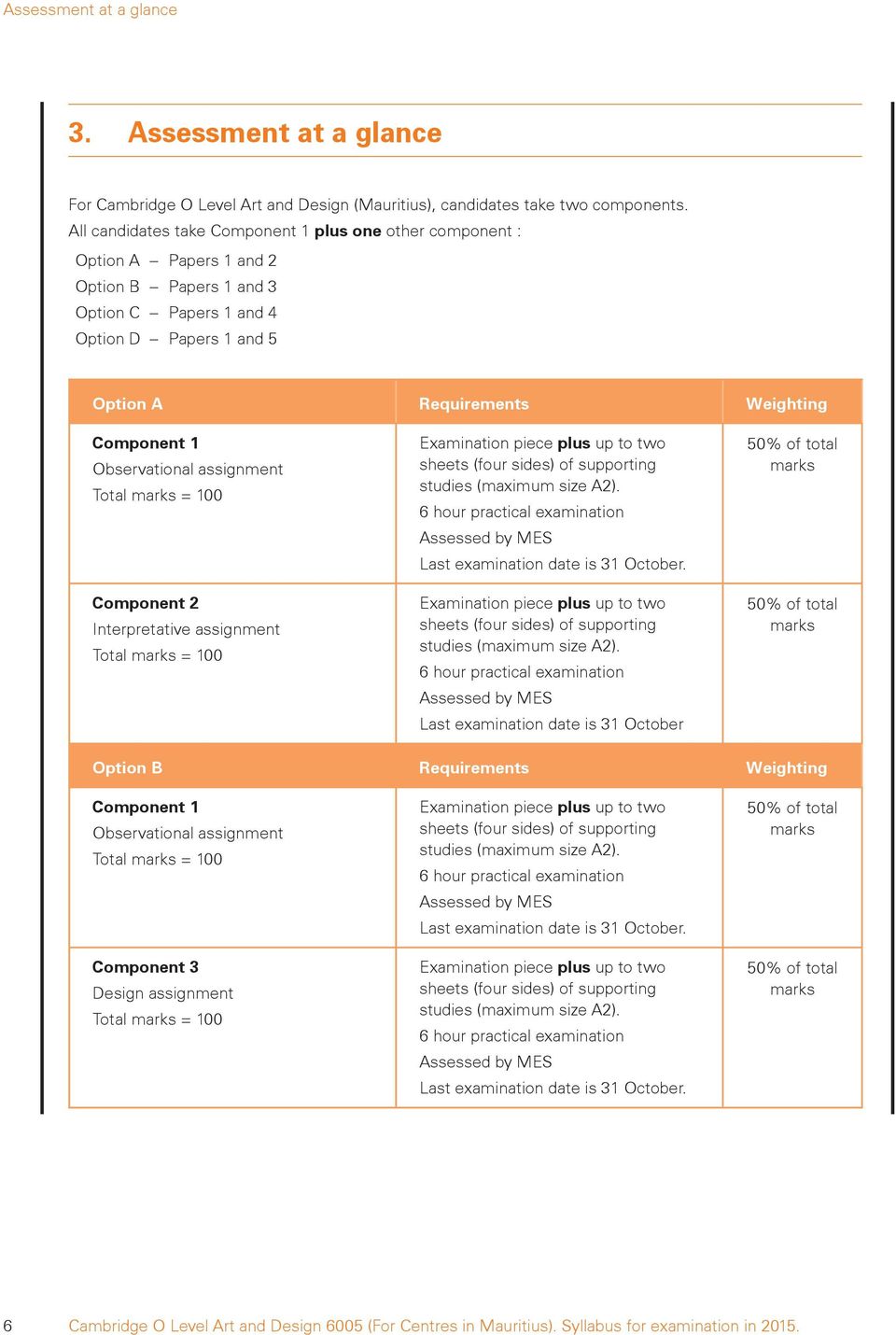
8 Assessment at a glance 3. Assessment at a glance For Cambridge O Level Art and Design (Mauritius), candidates take two components. All candidates take Component 1 plus one other component : Option A Papers 1 and 2 Option B Papers 1 and 3 Option C Papers 1 and 4 Option D Papers 1 and 5 Option A Requirements Weighting Component 1 Observational assignment Total marks = 100 Component 2 Interpretative assignment Total marks = 100 Examination piece plus up to two sheets (four sides) of supporting studies (maximum size A2). 6 hour practical examination Assessed by MES Last examination date is 31 October. Examination piece plus up to two sheets (four sides) of supporting studies (maximum size A2). 6 hour practical examination Assessed by MES Last examination date is 31 October 50% of total marks 50% of total marks Option B Requirements Weighting Component 1 Observational assignment Total marks = 100 Component 3 Design assignment Total marks = 100 Examination piece plus up to two sheets (four sides) of supporting studies (maximum size A2). 6 hour practical examination Assessed by MES Last examination date is 31 October. Examination piece plus up to two sheets (four sides) of supporting studies (maximum size A2). 6 hour practical examination Assessed by MES Last examination date is 31 October. 50% of total marks 50% of total marks 6 Cambridge O Level Art and Design 6005 (For Centres in Mauritius). Syllabus for examination in 2015.
9 Assessment at a glance Option C Requirements Weighting Component 1 Observational assignment Total marks = 100 Component 4 Critical and historical assignment Total marks = 100 Externally Assessed Coursework by MES Examination piece plus up to two sheets (four sides) of supporting studies (maximum size A2). 6 hour practical examination Assessed by MES Last examination date is 31 October. Folder of words with illustrative material (maximum size A2). Submit to MES by 31 October 50% of total marks 50% of total marks Option D Requirement Weighting Component 1 Observational assignment Total marks = 100 Component 5 Coursework assignment * Total marks = 100 Centre based assessment, moderated by MES Examination piece plus up to two sheets (four sides) of supporting studies (maximum size A2). 6 hour practical examination Assessed by MES Last examination date is 31 October One final outcome plus supporting portfolio (maximum size of outcome and portfolio is A2, up to four sheets (eight sides) of work in the portfolio). Submit to MES by 31 October for moderation. 50% of total marks 50% of total marks * MES will issue instructions and guidance to Centres undertaking Component 5: Coursework assignment. Availability This syllabus is examined in the October/November examination series. Detailed timetables are available from It is available in Mauritius only. School candidates can enter for any Option. Private candidates can only enter for Option A or B. Combining this with other syllabuses Candidates can combine this syllabus in an examination series with any other Cambridge syllabus, except: syllabuses with the same title at the same level Please note that Cambridge O Level, Cambridge IGCSE and Cambridge International Level 1/Level 2 Certificate syllabuses are at the same level. Cambridge O Level Art and Design 6005 (For Centres in Mauritius). Syllabus for examination in

10 Syllabus aims and assessment objectives 4. Syllabus aims and assessment objectives 4.1 Syllabus aims This syllabus will appeal to candidates who wish to explore practical work through a range of two- and/or three-dimensional processes. Where Art and Design, as a title or descriptor, is used in the syllabus, it also encompasses new media and technologies. An Art and Design course should encourage personal expression, imagination, sensitivity, conceptual thinking, powers of observation, an analytical ability and practical attitudes. Learners have opportunities to gain a greater understanding of the role of the visual arts in the history of civilisations, thus widening and enriching cultural horizons. In addition, it should combine a breadth and depth of study so that it may accommodate a wide range of abilities and individual resources. Art and Design complements literary, mathematical, scientific and factual subjects. It is especially concerned with the development of visual perception and aesthetics and is a form of communication and a means of expressing ideas and feelings. This syllabus is intended as a broad course exploring practical and critical/contextual work through a range of two-dimensional and/or three-dimensional processes. Where Art and Design as a title or descriptor is used in this syllabus, it also encompasses new media and technologies in addition to traditional media and processes. Cambridge O level Art and Design (Mauritius) aims to develop learners who have: an ability to record from direct observation and personal experience; an ability to identify and solve problems in visual and/or other forms; creativity, visual awareness, critical and cultural understanding; an imaginative, creative and personal response; confidence, enthusiasm and a sense of achievement in the practice of Art and Design; growing independence in the refinement and development of ideas and personal outcomes; engagement and experimentation with a range of media, materials and techniques, including new media where appropriate; experience of working in relevant frameworks and exploration of manipulative skills necessary to form, compose and communicate in two and/or three dimensions; knowledge of a working vocabulary relevant to the subject and an interest in, and a critical awareness of, other practitioners, environments and cultures; investigative, analytical, experimental, interpretative, practical, technical and expressive skills which aid effective and independent learning. 8 Cambridge O Level Art and Design 6005 (For Centres in Mauritius). Syllabus for examination in 2015.

11 Syllabus aims and assessment objectives 4.2 Assessment objectives AO1 Gathering, recording, research and investigation (a) Investigate and research a variety of appropriate sources (b) Record and analyse information from direct observation and/or other sources and personal experience AO2 Exploration and Development of ideas (a) Explore a range of visual ideas by manipulating images (b) Show a development of ideas through appropriate processes AO3 Organisation and relationships of visual forms (a) Organise and use visual forms effectively to express ideas (b) Make informed aesthetic judgements by recognising the effect of relationships between visual forms AO4 Selection and control of materials, media and processes (a) Show exploration and experimentation with appropriate materials (b) Select and control appropriate media and processes, demonstrating practical, technical and expressive skills and intentions AO5 Personal vision and presentation (a) Show personal vision and commitment through and interpretative and creative response (b) Present an informed response through personal evaluation, reflection and critical thinking 4.3 Relationship between assessment objectives and components Relationship between assessment objectives and components The approximate weightings allocated to each of the assessment objectives are summarised below. Assessment objectives Component 1 Component 2 Component 3 Component 4 Component 5 AO1 20% 20% 20% 20% 20% AO2 20% 20% 20% 20% 20% AO3 20% 20% 20% 20% 20% AO4 20% 20% 20% 20% 20% AO5 20% 20% 20% 20% 20% Cambridge O Level Art and Design 6005 (For Centres in Mauritius). Syllabus for examination in

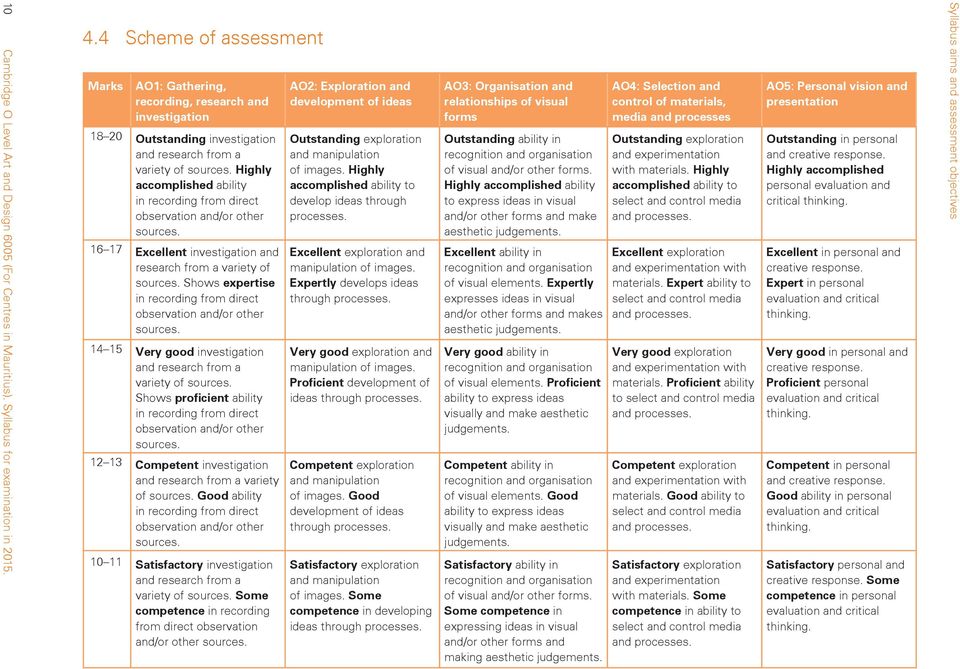
12 10 Cambridge O Level Art and Design 6005 (For Centres in Mauritius). Syllabus for examination in Scheme of assessment Marks AO1: Gathering, recording, research and investigation Outstanding investigation and research from a variety of sources. Highly accomplished ability in recording from direct observation and/or other sources Excellent investigation and research from a variety of sources. Shows expertise in recording from direct observation and/or other sources Very good investigation and research from a variety of sources. Shows proficient ability in recording from direct observation and/or other sources Competent investigation and research from a variety of sources. Good ability in recording from direct observation and/or other sources Satisfactory investigation and research from a variety of sources. Some competence in recording from direct observation and/or other sources. AO2: Exploration and development of ideas Outstanding exploration and manipulation of images. Highly accomplished ability to develop ideas through processes. Excellent exploration and manipulation of images. Expertly develops ideas through processes. Very good exploration and manipulation of images. Proficient development of ideas through processes. Competent exploration and manipulation of images. Good development of ideas through processes. Satisfactory exploration and manipulation of images. Some competence in developing ideas through processes. AO3: Organisation and relationships of visual forms Outstanding ability in recognition and organisation of visual and/or other forms. Highly accomplished ability to express ideas in visual and/or other forms and make aesthetic judgements. Excellent ability in recognition and organisation of visual elements. Expertly expresses ideas in visual and/or other forms and makes aesthetic judgements. Very good ability in recognition and organisation of visual elements. Proficient ability to express ideas visually and make aesthetic judgements. Competent ability in recognition and organisation of visual elements. Good ability to express ideas visually and make aesthetic judgements. Satisfactory ability in recognition and organisation of visual and/or other forms. Some competence in expressing ideas in visual and/or other forms and making aesthetic judgements. AO4: Selection and control of materials, media and processes Outstanding exploration and experimentation with materials. Highly accomplished ability to select and control media and processes. Excellent exploration and experimentation with materials. Expert ability to select and control media and processes. Very good exploration and experimentation with materials. Proficient ability to select and control media and processes. Competent exploration and experimentation with materials. Good ability to select and control media and processes. Satisfactory exploration and experimentation with materials. Some competence in ability to select and control media and processes. AO5: Personal vision and presentation Outstanding in personal and creative response. Highly accomplished personal evaluation and critical thinking. Excellent in personal and creative response. Expert in personal evaluation and critical thinking. Very good in personal and creative response. Proficient personal evaluation and critical thinking. Competent in personal and creative response. Good ability in personal evaluation and critical thinking. Satisfactory personal and creative response. Some competence in personal evaluation and critical thinking. Syllabus aims and assessment objectives
13 Cambridge O Level Art and Design 6005 (For Centres in Mauritius). Syllabus for examination in Marks AO1: Gathering, recording, research and investigation 8 9 Adequate ability in investigation and research from a variety of sources and in recording from direct observation and/or other sources. 6 7 Some evidence of investigation and research from sources. Attempts to record from direct observation and/or other sources are made. 4 5 A little investigation and research from sources. Some limited recording from direct observation and/or other sources. 1 3 Very limited in terms of investigation and research or recording from direct observation and/or other sources. AO2: Exploration and development of ideas Adequate exploration and manipulation of images and in developing ideas through processes. Some evidence of exploration and manipulation of images. Attempts are made to develop ideas through processes. A little exploration and manipulation of images. Some limited development of ideas through processes. Very limited exploration and manipulation of images or development of ideas through processes. AO3: Organisation and relationships of visual forms Adequate ability in recognition and organisation of visual and/or other forms. Adequately expresses ideas in visual and/or other forms and makes aesthetic judgements. Some recognition and organisation of visual elements. Attempts are made to express ideas in visual and/or other forms and make aesthetic judgements. A little ability in recognition and organisation of visual elements. Some limited expression of ideas visually and few aesthetic judgements. Very limited ability in recognition and organisation of visual elements. Slight evidence of expression of ideas visually and few aesthetic judgements. AO4: Selection and control of materials, media and processes Adequate exploration and experimentation with materials and an adequate ability to select and control media and processes. Some ability in exploration and experimentation with materials. Attempts are made to select and control media and processes. A little ability in exploration and experimentation with materials. Some limited ability to select and control media and processes. Very limited ability in exploration and experimentation with materials. Slight evidence of ability to select and control media and processes. AO5: Personal vision and presentation Adequate personal and creative response with adequate personal evaluation and critical thinking. Some ability in personal and creative response. Attempts are made to make personal evaluation and show critical thought. A little personal and creative response. Some limited personal evaluation and critical thinking. Very limited personal and creative response. Slight evidence of personal evaluation and critical thinking. 0 No rewardable work. No rewardable work. No rewardable work. No rewardable work. No rewardable work. Syllabus aims and assessment objectives

14 Syllabus aims and assessment objectives 4.5 Grade descriptions Grade A Candidates awarded Grade A will have met all the Assessment Objectives to a high level. They will have demonstrated a firm grasp of skills and a superior creative ability in the options chosen. Their work will show a high degree of organisation, extensive investigation, and will be characterised by an interpretation which is highly personal and perceptive, reflecting informed and considered judgement. Grade C Candidates awarded Grade C will have met most of the Assessment Objectives. They will have demonstrated competence in their grasp of skills and an appropriate creative ability in the options chosen. Their work will show a degree of organisation, and evidence of research, and will be characterised by selfawareness and straightforward personal response. Grade F Candidates awarded Grade F will have met a few of the Assessment Objectives. They will have demonstrated limited skills and creative ability in the options chosen. While showing evidence of interest and effort, their work will generally be weak in organisation, demonstrating only limited self-awareness. It will be characterised by a heavy reliance on secondary sources. 12 Cambridge O Level Art and Design 6005 (For Centres in Mauritius). Syllabus for examination in 2015.
15 Syllabus aims and assessment objectives 5. Syllabus content The areas listed below provide a broad framework of Art and Design practice, and indicate an approach which encourages exploration within either traditional media or new media or a combination of both, providing all assessment objectives are met. Candidates are encouraged to produce a variety of creative responses through a range of materials, processes and techniques. Candidates are not expected to produce work from all the areas. They are, however, expected to: identify and research a particular aspect of Art and Design; carry out relevant exploration of materials, media and appropriate processes; document and evaluate ideas and concepts against aims and objectives as the work proceeds; develop these into a cohesive outcome. Painting and Related Media Candidates can submit work in any of the media outlined below for any of the components. In response to studies under this heading, candidates are expected to demonstrate skills in either a representational or descriptive manner, or they may be more imaginative and interpretative. In any case, work will evolve through investigation and development by the candidate. Responses may be based upon a directly observed starting point or subject, or they may be the candidate s personal response to a theme. Subjects could include: landscapes artefacts figure studies abstract notions or feelings portraits personal experiences the natural or man-made environment or visual ideas inspired by literary sources still-life Candidates should learn to use a sketchbook to make visual and/or other appropriate research and develop their ideas. They should also show knowledge of Art and Design from other cultures or history and relate it to their own studies. Painting and Drawing Candidates should be encouraged to work from direct observation and to explore the use of tone, colour and composition, materials and context. This can be shown through the use of processes and use of media such as charcoal, pencil, pastels, acrylic, water colour, oil and inks. Graphic Media Candidates should be encouraged to demonstrate the communication of visual ideas through images. Candidates should explore an expressive and personal response in their work. Printmaking Candidates should be encouraged to explore image-making rather than the specific design for industrial design processes such as repeat fabric design. Ideas and development will evolve through investigation, development and experience that could be gained from direct observation or a personal response to a theme (see Printmaking section). Cambridge O Level Art and Design 6005 (For Centres in Mauritius). Syllabus for examination in

16 Syllabus aims and assessment objectives Other Related forms Candidates should be encouraged to explore using traditional or new media or a combination of both. Candidates can also produce work for assessment in any two-dimensional form such as collage or textiles. The use of mixed media or waste materials for collage is acceptable. Printmaking Candidates can submit work in any of the media outlined below for any of the components. This includes all aspects of printmaking that relate to image-making rather than specific design for industrial processes such as repeat fabric design. Ideas and development will need to evolve through investigation, development and experience gained from direct observation or be a personal response to a theme. Candidates should explore a variety of printmaking techniques and produce either a series of related images or one-off prints using methods such as monoprinting, relief printing (such as lino and/or wood cut), etching and screen printing. Monoprinting Candidates should be encouraged to explore a variety of traditional and new media approaches to monoprinting. Candidates should work in a range of different materials, not just glass, metal or plastic. Relief Printing Using traditional or new media or a combination of both, candidates should be encouraged to explore a variety of approaches. Candidates may employ a range of different materials, mixed media or use improvised or waste materials to create work. Etching Candidates should be encouraged to explore the use of line, tone, texture and composition when using this process. Traditional and/or new media approaches should be encouraged when using metal or plastic plates. Screen printing Candidates should be encouraged to explore a variety of traditional and/or new media approaches to screen printing. Using traditional and/or digital processes, candidates should demonstrate an expressive and personal response in their work. Three-Dimensional Studies Candidates can submit work in any of any of the media outlined below for any of the components. Candidates may work in traditional media and/or new materials or a combination of both, but should show an understanding of three-dimensional qualities of volume, form, space appropriate to their chosen specialism. Candidates should create visual ideas through three-dimensional art by expressing functional and/or decorative responses. In sculpture, the work may be figurative or abstract; candidates can employ techniques of carving, modelling or construction. There should be some awareness of the roles sculpture has played in various societies. In ceramics, candidates should study a range of techniques and become familiar with several methods of decoration, understand firing and glazing, and have knowledge of the different uses of ceramics. They should be aware of aesthetic considerations and have some historical or cultural knowledge. Candidates should demonstrate an expressive and personal response in their work, appropriate to the task. 14 Cambridge O Level Art and Design 6005 (For Centres in Mauritius). Syllabus for examination in 2015.

17 Syllabus aims and assessment objectives The supporting portfolio should include designs, notes on materials and processes, etc. Photographs of source material and other work should be included, as should evidence of visits made in connection with the course of study. Sculpture Candidates should explore form, space, mass, volume, surface and materials. They should use a range of processes, techniques and materials such as carving and modelling, casting or constructing, plaster and wax. Ceramics Candidates should show an understanding of the processes involved in making, drying, firing, decorating and glazing. Candidates should also show ability in constructional methods such as slab and coil and hand making and the application of surface treatments and colour and glaze. Theatre design Candidates should demonstrate the use of design for performance through areas such as costume, set design and lighting. Candidates should document their work through photographs or digital media, as well as a sketchbook, three-dimensional models and scale drawings. Environmental/architectural design Candidates should demonstrate their understanding through the use of spatial design in an environmental/ architectural context in either public or private spaces. Candidates should also be familiar with role, function, location and audience as well as environmental/architectural issues. Product design Candidates should demonstrate how they can problem-solve by designing or creating products that have a functional or decorative role. Candidates should work with a range of materials such as wood, metal, plastics and glass. Candidates will need to demonstrate how the design process itself results in a variety of possible design solutions. It is not necessary for candidates to produce full-scale models but they should be aware of the possible constraints that might occur during the manufacturing process. Design software and technology should be explored where available, e.g. three-dimensional digital media and laser cutting. Jewellery Candidates should cover a wide range of techniques, skills and materials. Candidates work should indicate a clear design brief. Candidates should also demonstrate how they can problem-solve by designing and/or creating jewellery that has a functional and/or decorative role. Puppetry Puppetry takes many forms but all involve the animation of inanimate performing objects. Candidates should work with a range of materials such as wood, metal, plastics and resin. Candidates will need to demonstrate a variety of techniques such as shadow puppets, traditional marionettes, stop motion animation or articulated. Photography, Digital and Lens-based Media Candidates can submit work in any of the media outlined below for any of the components. Candidates should use traditional and/or new media processes to produce outcomes such as photomontage, printed photography, digital photography, photographic or digital installation, video and animation, film and digital creation and manipulation. Work may be in colour and/or black and white. Cambridge O Level Art and Design 6005 (For Centres in Mauritius). Syllabus for examination in
18 Syllabus aims and assessment objectives Candidates should demonstrate an expressive and/or interpretative artistic response to the visual world. They should show an understanding of the conventions of photography and genres such as portrait, landscape and movement, and a range of techniques appropriate to their chosen field. Consideration should be given to the following techniques: depth of field view/composition film speed/shutter speed framing lighting/exposure editing tone and/or colour transition Candidates should also show skills in experimenting with media and processes such as: abstracing illustrating documenting developing and printing of films darkroom practice (pin-hole cameras, burning in, masking, photograms, solarisation, multiple exposure, reveral printing) alternative print processes (liquid emulsions, bleaching, resist, toning, use of specialist papers or other photosensitive surfaces) creation and maniuplation of images with computers imaging scanning and manipulation editing, perhaps using sound Photography may be used as a means of recording fragile, large or time-based work (e.g. work in perishable media, installations, mural work and performance) and the photographic record will be considered and assessed as part of the submission. Candidates must provide appropriate evidence of the authenticity of their work such as contact prints, thumbnails of original digital photographs or storyboards. Any moving image work (no longer than three minutes) should be submitted on DVD, or alternatively on CD in a common form of digital format such as Mpeg or WMV. Still imagery Candidates should demonstrate their ability in the production of still images through a lens-based approach. Candidates will demonstrate an understanding and control of equipment in order to produce work that is personal. Using a wide range of methods, techniques and processes candidates will produce imagery that is their own work. Candidates may develop their own work using darkroom facilities, if available; however the use of commercially processed photographs is acceptable. For candidates using digital lens-based media, their work should show evidence of the manipulation and presentation of the imagery using a computer. A variety of approaches and processes can be used together and candidates could present their work in a variety of ways either as printed images or electronically as a slide show using PowerPoint on a CD-ROM or web site, for example. Lighting and sound may be used as appropriate. Moving Imagery Candidates should demonstrate an understanding of recording and presentation of moving images. Sound may also be included as appropriate. Candidates should be familiar with a range of techniques, resources and processes, such as story boards, animation, digital editing, PowerPoint, CD-ROMs and interactive websites. 16 Cambridge O Level Art and Design 6005 (For Centres in Mauritius). Syllabus for examination in 2015.
19 Syllabus aims and assessment objectives Graphic Communication Candidates can submit work in any of the media outlined below for any of the components. Candidates should learn to use appropriate methods, materials and techniques as well as presentational skills. All imagery should be the candidate s original work, although manipulation of secondary sources through various software packages and digital processes is acceptable, as long as it only represents a proportion of the overall work. Supporting portfolios should show ideas, themes and sources used. Technical processes, including computer generated imagery and personal digital media, should be clearly documented. The development of printmaking processes should be included, as should knowledge of both historical and contemporary graphics. Candidates should demonstrate the communication of visual meaning through images while being mindful of problems and opportunities, as well as working towards appropriate solutions. They should analyse design briefs and tackle practical design tasks. They should study other examples of design, or the work of designers relative to their chosen field, preferably including some at first hand, and relate this experience to their own endeavours. Graphic Design with lettering Candidates should demonstrate their understanding of typography and its relationship to images. Candidates are free to work in any medium, including photography and computer manipulated imagery, providing that the majority of images are from the candidate s first hand studies from primary research. Illustration Candidates should demonstrate how the creation of imagery can enhance and allow different interpretations of text. Candidates should produce visual imagery that communicates the role and context of text to a specific audience. The illustrations may be for inclusion in any number of publications such as magazines, books, posters and leaflets. Printmaking Candidates will not be expected to be familiar with all aspects of printmaking. They will have developed ideas and these will have evolved through investigation, development and experience gained from first hand research from direct observation or is a personal response to a chosen theme (see Printmaking section). Advertising Candidates should have an understanding of how graphic communication can sell a product or service, promote brand images and communicate information through, for example, posters, fliers, logos, corporate identities, symbols or signs. Textile Design Candidates can submit work in any of the media outlined below for any of the components. Candidates should demonstrate an expressive, decorative or functional response through the use of fabrics, dyes and fibres. Within this area, candidates should be encouraged to explore a range of techniques, where available, such as traditional or new media or a combination of both. Candidates should develop their own designs and realise their finished work to a high standard. They may produce work in one area but should show knowledge of other areas. They need not produce garments, but function and suitability of design should be considered. Cambridge O Level Art and Design 6005 (For Centres in Mauritius). Syllabus for examination in
20 Syllabus aims and assessment objectives Supporting portfolios may contain sketches, designs, samples and photographs. There should be an awareness of cultural and historical factors appropriate to their chosen area. The maximum size of work for this component is cm, which may be folded. Within this area, candidates may produce work in any of the following specialisms: Printed and/or Dyed Candidates should be aware of the variety of different media, such as commercial fabric paints, fabric painting inks and application methods. For the printed application, candidates are expected to show a range of techniques for transferring image to fabric, such as block, screen and discharge printing. Dyed application requires the candidate to be familiar with a range of processes such as batik, silk painting and tie and dye. Candidates should also be familiar with dipping and spraying. Constructed Candidates should demonstrate an understanding of either natural and/or synthetic yarns, and how they can be used through stitching, knotting and looping. Candidates could use experimentation with alternative media such as plastic, paper and wire, and investigate the properties of these techniques such as folding, cutting and fusing. Candidates could show a variety of constructed techniques such as embroidery, weaving and appliqué. Fashion Candidates should demonstrate how fabric and fibres are used in a fashion context. Candidates should be familiar with a range of processes such as garment construction, accessories and fashion design, and body adornment. Candidates do not have to produce final made garments but should be mindful of the techniques appropriate to this specialism. Candidates should have an awareness of the fashion industry and the relationship between textile design, manufacture and fashion. 18 Cambridge O Level Art and Design 6005 (For Centres in Mauritius). Syllabus for examination in 2015.

21 Description of components 6. Description of components These components have been designed to allow candidates to demonstrate independently their ability to realise ideas and intentions in response to a number of questions. Candidates should use the preparation period to research their chosen question. They will be assessed on their ability to investigate, document and record their work towards a final solution. Experimentation and selection of appropriate media and processes should be resolved prior to the six hour examination. During the preparatory period, candidates are expected to produce up to two sheets of A2 supporting work. This work must be taken into the examination room, where it will inform the six hour examination piece. The supporting work must remain with the examination work. Candidates may seek initial guidance at the beginning of the preparatory period regarding the selection of question and appropriate choice of materials and processes. Candidates should then work independently at school. 6.1 Component 1: Observational assignment The examination lasts 6 hours. This component is compulsory for all candidates. This is an externally set assignment, marked by MES. First hand studies from primary sources must be used as the starting point for the development of ideas. This means that the candidate should make studies from looking directly at objects, models, arrangements of items and so on and not from magazines, books or the internet (secondary sources). The questions act as starting points for the candidate s focus of study and all questions are broad and flexible. Candidates should support the examination piece with investigation, research, evaluation and development. The examination piece may be produced in any two- or three-dimensional medium or combination of media, including printmaking, textiles, and lens-based media and new digital technology. Any three-dimensional outcomes should be submitted through photographic or digital means. Candidates should be able to: Explore basic elements of line and tone Use a variety of wet and dry media, such as pastels, watercolour or inks Work on different surfaces, textures and coloured paper Candidates should be reminded that although the supporting studies and the examination piece are marked together against all the Assessment Objectives, Assessment Objective AO1 is concerned with gathering, recording and research and investigation, and Assessment Objective AO2 is concerned with exploration and development of ideas. Candidates should take this into account when preparing their supporting studies. All candidates must have at least two school weeks of preparation time which they should use to choose the appropriate question, form their ideas and make supporting studies. The last examination date is 31 October for the November series. Cambridge O Level Art and Design 6005 (For Centres in Mauritius). Syllabus for examination in
22 Description of components Supporting studies The supporting studies must consist of not more than two sheets of A2 (this may or may not be double sided i.e. a maximum of four sides). Centres are reminded that this is the maximum and that candidates can submit less work if appropriate. Quality of work is more important than the amount of work: weaker work submitted may have a detrimental effect on the total mark awarded. Candidates may seek initial guidance regarding the selection of question and appropriate choice of materials and processes at the beginning of the preparation time. They should then be advised to work independently at school. The supporting studies must be taken into the examination in order to inform the six-hour examination piece. Candidates are reminded that they may annotate their work but that written commentary, annotations and notes are not rewarded in any of the Assessment Objectives. However, notations may assist with the process of personal evaluation and critical analysis. Examination piece The examination piece and supporting studies must remain at the Centre under secure conditions until the examination has been completed, after which the Centre must send both the supporting studies and the examination work to MES for assessment. Centres should refer to the Appendix and the Cambridge Handbook for further guidance and invigilation instructions. 6.2 Component 2: Interpretative assignment The examination lasts 6 hours. This is an optional component. This is an externally set assignment, marked by MES. Questions will be set to test the candidate s ability to organise a pictorial composition. First hand studies from primary sources must be used as the starting point for the development of ideas. This means that the candidate should make their initial studies by looking directly at objects, models, arrangements of items and so on and not from magazines, books or the internet (secondary sources). Candidates will then develop these ideas into a personal and original interpretation of one theme. The interpretation may be abstract or non-figurative if desired. The questions act as starting points for the candidate s focus of study and all questions are broad and flexible. Candidates should support the examination piece with investigation, research, evaluation and development. The examination piece may be produced in any two- or three-dimensional medium or combination of media, including printmaking, textiles, and lens-based media and new digital technology. Any three-dimensional outcomes should be submitted through photographic or digital means. Candidates should be able to: communicate ideas and feelings inspired by the chosen theme in a personal way create a visually stimulating composition use basic visual elements such as line, tone and colour and texture to create an expressive image. 20 Cambridge O Level Art and Design 6005 (For Centres in Mauritius). Syllabus for examination in 2015.
23 Description of components Candidates should be reminded that although the supporting studies and the examination piece are marked together against all the Assessment Objectives, Assessment Objective AO1 is concerned with gathering, recording and research and investigation, and Assessment Objective AO2 is concerned with exploration and development of ideas. Candidates should take this into account when preparing their supporting studies. All candidates must have at least two school weeks of preparation time which they should use to choose the appropriate question, form their ideas and make supporting studies. The last examination date is 31 October for the November series. Supporting studies The supporting studies must consist of not more than two sheets of A2 (this may or may not be double sided i.e. a maximum of four sides). Centres are reminded that this is the maximum and that candidates can submit less work if appropriate. Quality of work is more important than the amount of work: weaker work submitted may have a detrimental effect on the total mark awarded. Candidates may seek initial guidance regarding the selection of question and appropriate choice of materials and processes at the beginning of the preparation time. They should then be advised to work independently at school. The supporting studies must be taken into the examination in order to inform the six-hour examination piece. Candidates are reminded that they may annotate their work but that written commentary, annotations and notes are not rewarded in any of the Assessment Objectives. However, notations may assist with the process of personal evaluation and critical analysis. Examination piece The examination piece and supporting studies must remain at the Centre under secure conditions until the examination has been completed, after which the Centre must send both the supporting studies and the examination work to MES for assessment. Centres should refer to Appendix and the Cambridge Handbook for further guidance and invigilation instructions. 6.3 Component 3: Design assignment The examination lasts 6 hours. This is an optional component. This is an externally set assignment, marked by MES. The examination tests the candidate s ability to research, analyse and develop ideas to a design brief, and to arrive at an appropriate solution. All questions are for designs initially developed on paper. These can be continued into three-dimensional structures, but any three-dimensional solutions should then be recorded through photographic or digital means. First hand studies from primary sources must be used as the starting point for the development of ideas. This means that the candidate should make their initial studies by looking directly at objects, models, arrangements of items and so on and not from magazines, books or the internet (secondary sources). Cambridge O Level Art and Design 6005 (For Centres in Mauritius). Syllabus for examination in
24 Description of components Questions are based on a selection of the following: graphic design, to include lettering and typography in relation to images, and illustration and calligraphy. Questions will be set to include logos, posters, book, CD and DVD covers, publicity brochures, as well as a focus on selected verse or literary extracts textile design, to include repeat pattern motifs for particular contexts and fashion design based on specific themes interior design, to include murals, mosaics and hangings, stained glass windows and other surface and decorative enhancements within a specific context or theme environmental design, to include architectural drawings, plans, elevations and modelled outcomes together with the use of materials for construction. Candidates should be aware of the design constraints which affect the commercial application of design as well as historical and contemporary practice relevant to their chosen design brief. In their supporting studies, they must show that alternative solutions to the initial brief have been considered. The development of images must be the candidates own work. The recording and manipulation of images through different technical processes, including collage, montage, computer programmes and personal digital photography is encouraged. The design solution for the examination work may also make use of such processes. Teachers should advise their candidates that media and materials should be selected for clarity of graphic communication. Photography may be used within this paper, but must reflect the context; for example fashion or advertising. Basic photographic skills are required, through the use of black and white or colour photos as appropriate. Candidates should demonstrate their understanding through juxtaposition of image and text, cropping of images, selective enlargement and the use of natural or artificial lighting. Some use of secondary or existing sources is acceptable, but needs to be acknowledged or attributed. Secondary sources may be used appropriately but the candidates own work must form the larger proportion of supporting work. This also applies to images downloaded from the internet such as pre-designed clip art. Candidates should be reminded that although the supporting studies and the examination piece are marked together against all the Assessment Objectives, Assessment Objective AO1 is concerned with gathering, recording and research and investigation, and Assessment Objective AO2 is concerned with exploration and development of ideas. Candidates should take this into account when preparing their supporting studies. All candidates must have at least two school weeks of preparation time which they should use to choose the appropriate question, form their ideas and make supporting studies. The last examination date is 31 October for the November series. Supporting studies The supporting studies must consist of not more than two sheets of A2 (this may or may not be double sided i.e. a maximum of four sides). Centres are reminded that this is the maximum and that candidates can submit less work if appropriate. Quality of work is more important than the amount of work: any weaker work submitted may have a detrimental effect on the total mark awarded. Candidates may seek initial guidance regarding the selection of question and appropriate choice of materials and processes at the beginning of the preparation time. They should then be advised to work independently at school. The supporting studies must be taken into the examination in order to inform the six-hour examination piece. 22 Cambridge O Level Art and Design 6005 (For Centres in Mauritius). Syllabus for examination in 2015.
25 Description of components Candidates are reminded that they may annotate their work but that written commentary, annotations and notes are not rewarded in any of the Assessment Objectives. However, notations may assist with the process of personal evaluation and critical analysis. Examination piece The examination piece and supporting studies must remain at the Centre under secure conditions until the examination has been completed, after which the Centre must send both the supporting studies and the examination work to MES for assessment. Centres should refer to Appendix and the Cambridge Handbook for further guidance and invigilation instructions. Candidates should be familiar with the Assessment Objectives by which their work will be assessed 6.4 Component 4: Critical and historical assignment This is an internally set assignment marked by MES. This is an optional component. There is no question paper for this component. The assignment relates to any aspect of Art or Design of interest to the candidate. This should be a critical and visual appraisal or theoretical study undertaken in a written and practical form, including drawings, paintings, photographs and/or video work. Emphasis can be on materials and processes (Materials-based approach) or a written critical Evaluative study. Candidates must demonstrate an understanding of the inter-relationship between an area of practical art and design and the theoretical knowledge which informs such work, through the specific skills of research, critical analysis, visual analysis, written text and practical artwork. There must be a degree of first-hand research undertaken by the candidate, such as viewing paintings, buildings or artefacts or interviewing an artist or designer. The study of techniques or production processes is also appropriate but must be supported by reference to a named practitioner so that work can be viewed at first-hand; candidates are therefore advised to select work that is accessible in their locality. This firsthand observation should be supported with secondary information from sources such as books, slides, videos and web sites which will inform the work. Candidates must give clear details as to their first-hand study and sources. Materials-based approach Candidates should research and analyse the way in which artists, architects and designers work, how materials are used and techniques employed for effective outcomes. This should be a practical process with annotation. Study with a more materials base on how works of art are made could be in any of the following formats: a detailed exploration of a sculptural technique e.g. how artists have used clay or bronze in different ways a practical study of watercolour techniques or brushwork in the work of three artists a comparison of the techniques of fresco and oil painting or modelling and carving in sculpture the contrast of etching, lithography, lino cutting and silkscreen the use of materials in architecture e.g. wood, glass, iron, steel and concrete the techniques and technical development of one practitioner the experience and outcomes of working with an artist in residence the technical innovations and techniques of one chosen movement or style e.g. the Impressionists use of colour and brushwork shadow and light in painting inspired by Caravaggio, for example. Cambridge O Level Art and Design 6005 (For Centres in Mauritius). Syllabus for examination in
26 Description of components Evaluative study Candidates should research works of art, design or architecture and make a written and visual critical analysis which explores theoretical aspects of the subject. Candidates should be able to communicate an understanding of the underlying reasons why works of art appear as they do and the influences and events which affected their manufacture and the way the artist works. This will require candidates to place works of art, individual practitioners, different styles and movements in an appropriate historical, social or cultural context. Candidates work must include written critical evaluation, supported by a mixture of practical work or illustrated material in the form of drawings, paintings, prints, three-dimensional forms, photographs, digital processes or film and must include written critical evaluation. An understanding of subject terminology is expected. This type of study could be in any of the following formats: an evaluative timeline with text, images or three-dimensional works of art based on a selected theme such as still life, the human form, designed objects, a set of buildings a comparative study of two different styles or movements in painting, sculpture, architecture or design a comparison of selected works of art from two different periods, themes or cultures a detailed study of one movement in art or one artist, architect or designer a visual and written evaluation of a gallery or exhibition visit a study of local buildings or a designed environment. Presentation It may be presented in any appropriate format, e.g.: a structured sequence of annotated drawings, paintings, photographs or three-dimensional objects a visual and written analysis of between words (this should be in a form that is easy to transport and handle, and no larger than A2 in size) DVD, digital art or multimedia presentation (please ensure any digitised or multimedia presentation is supported by a hard copy). Whatever format a candidate chooses, must submit an outline proposal (OPF) before work on the study commences. In their outline proposal, candidates should detail their: intentions details of research undertaken sources for first-hand study resource list suggested presentation. Outline proposals can be submitted either electronically or in hard copy and feedback will be received within 28 days. Centres should refer to Appendix and the Cambridge Handbook for further guidance. Candidates should be familiar with the Assessment Objectives by which their work will be assessed. Quality of work is more important than the amount of work: any weaker work submitted may have a detrimental effect on the total mark awarded. 24 Cambridge O Level Art and Design 6005 (For Centres in Mauritius). Syllabus for examination in 2015.
27 Description of components 6.5 Component 5: Coursework assignment (school-based assessment) This is an internally set assignment which is marked by the Centre and moderated by MES. This is an optional component. In a course of at least one year, candidates are expected to have concentrated on one of the areas listed in the syllabus content. From their course of study, they should select, for assessment by the Centre, one final outcome plus a supporting portfolio of work that relates directly to the one final outcome (size A2, up to four sheets eight sides). One final outcome could be a series of photographic prints, a series of sculptures, and a triptych for example, if, from the outset, the intention was always to produce several related items. The one final outcome should offer breadth and depth of exploration and inquiry, stimulated by the content set by the Centre. It must be the candidate s individual response produced from conception to the completion of the final outcome. The supporting portfolio should contain work which shows the research, exploration, development and evaluation relevant to the one final outcome. Candidates should be reminded that the quality of work is more important than the amount of work: any weaker work submitted may have a detrimental effect on the mark awarded. Work submitted should demonstrate evidence of: informed and personal exploration within the chosen area recording, analysis, organisation and collection of observations, expressions and insights relative to ideas and intentions experimentation with ideas, concepts, materials, techniques and processes reflection, review and refinement. Work for this component should also include evidence of study and exploration of the practice of other related practitioners who inform the candidate s own work. The candidate s work should display an understanding of cultural and historical contexts in which the work of others is created. The Centre will assess the one final outcome together with the supporting portfolio and award a single mark out of 100. This will then be externally moderated by MES. Centres will provide a breakdown of the five assessment objectives on the Individual Candidate Record Card. Centres should refer to the Cambridge Handbook for further guidance. Candidates should be familiar with the Assessment Objectives by which their work will be assessed. Cambridge O Level Art and Design 6005 (For Centres in Mauritius). Syllabus for examination in
28 Coursework assessment 7. Coursework assessment 7.1 Assessment Criteria for Component 5: Coursework assignment AO1 AO2 AO3 AO4 AO5 Gathering, recording, research and investigation (a) investigate and research a variety of appropriate sources (b) record and analyse information from direct observation and or/other sources and personal experience Exploration and Development of ideas (a) explore a range of visual ideas by manipulating images (b) show a development of ideas through appropriate processes Organisation and relationships of visual forms (a) organise and use visual forms effectively to express ideas (b) make informed aesthetic judgements by recognising the effect of relationships between visual forms Selection and control of materials, media and processes (a) show exploration and experimentation with appropriate materials (b) select and control appropriate media and processes, demonstrating practical, technical and expressive skills and intentions Personal vision and presentation (a) show personal vision and commitment through an interpretative and creative response (b) present an informed response through personal evaluation, reflection and critical thinking Total marks Cambridge O Level Art and Design 6005 (For Centres in Mauritius). Syllabus for examination in 2015.
29 Coursework assessment 7.2 Marking and moderation of Component 5: Coursework assignment Internal moderation When several teachers in a Centre are involved in internal assessments, arrangements must be made within the Centre for all candidates to be assessed to a common standard. It is essential that within each Centre the marks within different teaching groups (e.g. different classes and different specialisms such as Textiles, Photography etc.) are moderated internally for the whole Centre entry. The Centre assessments will then be subject to external moderation by MES. External Moderation External moderation of internal assessment is carried out by MES. Centres must submit the internally assessed marks for all candidates to MES. Centres also send a selection of coursework samples to MES. The subject teacher should complete the Coursework Summary Form and then work with their exams officer to make sure the total internally moderated mark for each candidate is submitted to MES according to the instructions in the Cambridge Administrative Guide. The marks must be submitted no later than 31 October for the November examiantion. A further sample of Coursework may subsequently be required. All records and supporting written work should be retained until after the publication of the results. Where work is too fragile or bulky or otherwise unsuitable to be sent by post, a photographic record of the work must be sent for moderation purposes. In this instance the Centre will be required to send an additional candidate s work to MES for moderation. The Principal and the Art and Design teacher will be required to sign a statement certifying the work submitted for assessment is the candidate s own unaided work. Each Centre must ensure that each candidate s work is clearly identified by name and candidate number. The Moderator will check that: the marking criteria have been applied the marking is accurate and consistent the marking has been standardised if more than one marker has been used. Each Centre must ensure that all the work submitted for moderation is clearly labelled. 7.3 Coursework forms Cambridge O Level Art and Design 6005 (For Centres in Mauritius). Syllabus for examination in
30 Coursework assessment BLANK PAGE 28 Cambridge O Level Art and Design 6005 (For Centres in Mauritius). Syllabus for examination in 2015.
31 ART AND DESIGN Component 5: Coursework assignment Individual Candidate Record Card Cambridge O Level 6005 Art and Design (Mauritius) 2015 Cambridge O Level Art and Design 6005 (For Centres in Mauritius). Syllabus for examination in Please read the instructions printed overleaf and the General Coursework Regulations before completing this form. Centre Number Centre Name Syllabus Code November Candidate Number Candidate Name Teaching Group/Set Marks to be transferred to Coursework Assessment Summary Form AO1 Gathering, recording, research and investigation (max 20) AO2 Exploration and development of ideas (max 20) AO3 Organisation and relationships of visual forms (max 20) AO4 Selection and control of materials, media and processes (max 20) AO5 Personal vision and presentation (max 20) TOTAL (max 100) WMS /05/CW/I/15 Coursework assessment
32 30 Cambridge O Level Art and Design 6005 (For Centres in Mauritius). Syllabus for examination in A. Instructions for completing Individual Record Cards 1. Complete the information at the head of the form. 2. Mark the Component 5: coursework assignment for each candidate according to instructions given in the syllabus booklet. 3. Enter marks for the separate assessment objectives and the total mark in the appropriate spaces. Complete any other sections of the form as required. 4. Ensure that the addition of marks is independently checked. 5. It is essential that the marks of candidates from different teaching groups within each Centre are moderated internally. This means that the marks awarded to all candidates within a Centre must be brought to a common standard by the teacher responsible for co-ordinating the internal assessment (i.e. the internal moderator), and a single valid and reliable set of marks should be produced which reflects the relative attainment of all the candidates taking Component 5: coursework assignment at the Centre. 6. Transfer the marks to the Coursework Assessment Summary Form in accordance with the instructions given on that document. 7. Retain all Individual Candidate Record Cards and coursework which will be required for external moderation. Further detailed instructions about external moderation will be sent in early October. See also the instructions on the Coursework Assessment Summary Form. Note: These record cards are to be used by teachers only for candidates who have undertaken coursework as part of their Cambridge O Level Art and Design (Mauritius). NOVEMBER /05/CW/I/15 Coursework assessment
33 ART AND DESIGN Component 5: Coursework assignment Coursework Assessment Summary Form Cambridge O Level 6005 Art and Design (Mauritius) 2015 Cambridge O Level Art and Design 6005 (For Centres in Mauritius). Syllabus for examination in Please read the instructions printed overleaf and the General Coursework Regulations before completing this form. Centre Number Centre Name November Syllabus Code Syllabus Candidate Number Candidate Name Group/ Set AO1 Gathering, recording, research and investigation (max 20) AO2 Exploration and development of ideas (max 20) AO3 Organisation and relationships of visual forms (max 20) AO4 Selection and control of materials, media and processes (max 20) AO5 Personal vision and presentation (max 20) Name of teacher completing this form Signature Date Name of internal moderator Signature Date Total Mark (max 100) Internally Moderated Mark (max 100) (for Centres with more than one teaching group) 6005/05/CW/S/15 Coursework assessment
34 32 Cambridge O Level Art and Design 6005 (For Centres in Mauritius). Syllabus for examination in A. Instructions for completing Coursework Assessment Summary Forms 1. Complete the information at the head of the form. 2. List the candidates in candidate number order where this is known. Show the teaching group or set where applicable for each candidate. The initials of a teacher may be used to indicate the group or set. 3. Transfer each candidate s marks from his or her Individual Candidate Record Card to this form as follows: (a) Where there are columns for individual skills or assignments, enter the marks initially awarded (i.e. before internal moderation took place). (b) In the column headed Total Mark, enter the total mark awarded before internal moderation took place. (c) In the column headed Internally Moderated Mark, enter the total mark awarded after internal moderation took place. 4. Both the teacher completing the form and the internal moderator (or moderators) should check the form and complete and sign the bottom portion. Coursework assessment
35 Other information 8. Other information Equality and inclusion Cambridge International Examinations has taken great care in the preparation of this syllabus and assessment materials to avoid bias of any kind. To comply with the UK Equality Act (2010), Cambridge has designed this qualification with the aim of avoiding direct and indirect discrimination. The standard assessment arrangements may present unnecessary barriers for candidates with disabilities or learning difficulties. Arrangements can be put in place for these candidates to enable them to access the assessments and receive recognition of their attainment. Access arrangements will not be agreed if they give candidates an unfair advantage over others or if they compromise the standards being assessed. Candidates who are unable to access the assessment of any component may be eligible to receive an award based on the parts of the assessment they have taken. Information on access arrangements is found in the Cambridge Handbook which can be downloaded from the website Language This syllabus and the associated assessment materials are available in English only. Grading and reporting Cambridge O Level results are shown by one of the grades A*, A, B, C, D or E, indicating the standard achieved, A* being the highest and E the lowest. Ungraded indicates that the candidate s performance fell short of the standard required for grade E. Ungraded will be reported on the statement of results but not on the certificate. The letters Q (result pending); X (no results) and Y (to be issued) may also appear on the statement of results but not on the certificate. Entry codes To ma intain the security of our examinations we produce question papers for different areas of the world, known as administrative zones. Where the component entry code has two digits, the first digit is the component number given in the syllabus. The second digit is the location code, specific to an administrative zone. Information about entry codes, examination timetables and administrative instructions can be found in the Cambridge Guide to Making Entries. Cambridge O Level Art and Design 6005 (For Centres in Mauritius). Syllabus for examination in
36 Other information 9. Appendix 9.1 Guide to administering Art and Design (6005) Art and Design practical examinations often have specific requirements which are usually different from written examinations. In the majority of cases they will be held in the art studio but a significant number of Centres may choose to hold them in standard classrooms. Depending on the media that candidates are using, they may find that they have a considerable amount of equipment and materials on their work space. In addition, some candidates will need to be able to move around the studio because they need to access specific technical equipment and different materials. These guidelines should be consulted by the teacher, prior to, during, and after the examination, and also by the invigilator. You are advised to contact MES where an issue arises that is not covered in these guidelines. Part 1: Prior to starting any supporting work Teacher information Size of work Before candidates begin to plan their examination piece or start their supporting work, they must be aware of the size restrictions. Inappropriate Material Candidates may work in any appropriate media. Cambridge does not wish to restrict the creative process behind works of art, but teachers are reminded that the use of inappropriate media can be potentially dangerous to those handling the work and to the examiners. The following is a list of items presented in the past that are deemed to be inappropriate. Hypodermic needles Syringes Any glass, including mirrors Animal skin Fresh organic matter Barbed wire Plaster Unfired clay Razor blades Plant material with roots attached Centres are advised to contact MES if they are in doubt about the suitability of materials. Any work carried out in an inappropriate medium will not be assessed if health and safety considerations render this impossible. Teachers must be aware that certain materials will create problems with Customs and Excise or are CITES (Convention on International Trade of Endangered Species) listed. Use of Sketchbooks Candidates should be advised they may use a sketchbook for any drawings/other research material. If a candidate wishes to submit any of this as supporting work, then this must be detached from the sketchbook prior to the start of the examination. 34 Cambridge O Level Art and Design 6005 (For Centres in Mauritius). Syllabus for examination in 2015.
37 Other information Part 2: Prior to the examination supporting work Invigilator and teacher information Candidates must have at least two weeks 1 of preparatory time in which to produce their supporting work and this work must be completed at school. During the preparatory time, candidates should produce supporting work in response to one question from the question paper. They must bring this supporting work into the examination as their reference material. Supporting work must be brought into the examination room at the start of the examination and must not leave the examination room until it is sent to MES with the examination piece. Candidates are not allowed access to their supporting work between examination sessions and they cannot replace work or submit additional supporting work once the examination has started. All supporting work must be labelled and must be clearly distinguishable from the examination piece. All supporting work and examination work must be made secure after each session and overnight at the end of each day. Candidates who have not brought any supporting work to the start of the examination will not be allowed to submit any at a later time. They should be instructed to start the examination piece and not attempt to produce supporting work during the allotted examination time. Candidates are not allowed to take books/magazines into the examination room as supporting work. Additional Note for Teachers Teachers are reminded that candidates should select sufficient supporting work to support the examination piece(s). Supporting work comprises work that is the candidate s own work/photographs, and should be selected and organised in a manner that shows research, exploration of ideas, development of theme and experiments with media and materials. Part 3: The examination preparation of materials Invigilator and teacher information The following are not to be included in the time allowance for the examination: arrangement of still life groups mixing of photographic chemicals and washing and drying of prints rest periods for life models casting, mounting and trimming of work stretching of screens/preparation of blocks trimming and mounting of finished piece(s). All ceramic work must be fired before submission. Candidates undertaking any ceramic work should have their examination scheduled as early as possible within the period, as considerable time is needed for drying and firing. It is also advisable to photograph ceramic work at each stage, in case of accidents in the kiln. Any painted work must be carried out in a quick-drying medium and must be completely dry before it is despatched for marking. 1 Two weeks is defined as school weeks in term time. Cambridge O Level Art and Design 6005 (For Centres in Mauritius). Syllabus for examination in
38 Other information Part 4: Invigilation of the examination Invigilator and teacher information The Teacher who has prepared the candidates for the examination must not be the sole invigilator. However, a teacher who has prepared the candidates must be available at the start of each examination session and as required throughout the whole examination to deal with any technical issues that may arise (see the Cambridge Handbook). 1. Familiarise yourself with the Checklist for Invigilators, which applies to Invigilators of both written and practical examinations. Cambridge regulations require that all persons, except members of staff acting as invigilators, or other authorised personnel such as artist s models and the candidates engaged in each examination must be excluded from the examination room. 2. Prior to the arrival of the candidates and the start of the examination, familiarise yourself with the set up of the room. It is unlikely that the room will be free from art work but you should be confident that candidates cannot easily access any work that is not their own, to copy or submit as their own. 3. Where possible candidates should carry out the work in sessions lasting no more than three hours. 4. Centres are provided with a final date by which the examination must be completed and should schedule the examination date/s accordingly within that period. In some cases it may be necessary for Centres to schedule different groups of candidates to take the same examination on different days. For example 6005/01 candidates A to M take the examination on 4 October and candidates N to Z take the same examination on 10 October. 5. In some cases, it may be necessary for examination dates to be rescheduled. Candidates who may qualify for Special Consideration due to missing part of the examination because of recent illness; accident, etc. (see the Cambridge Handbook) may be advised to reschedule their examination later in the period. Centres are advised to refer to the Cambridge Handbook and to seek clarification from MES. Rescheduling within the period should not be used to accommodate candidates who might have failed to turn up for a session without good reason. 6. All candidates must be provided with their own equipment such as scissors, erasers, paint, etc. Candidates should not share basic art equipment. 7. During the examination, it is recognised that some movement by candidates and spoken instructions may be necessary but ensure that these are essential to the examination. All equipment should be arranged in order to minimise movement during the examination. Throughout the examination, a subject specialist should be made available to help you deal with any technical difficulties or safety issues that may arise. Candidates should initially direct questions/issues relating to technical matters and materials to the invigilator, who will in turn refer them to the available technician/teacher. 8. Candidates must not talk to each other or distract each other in any way. 9. The invigilator must be constantly vigilant and observant. 10. You should move around the studio. In the unlikely event that there is a serious breach of examination security (e.g. obvious collusion between candidates), the Head of Centre should be informed and the incident detailed on the Supervisor s Report. MES must be informed immediately of any such incident. If a candidate is disruptive, the Head of Centre should be informed and the candidate should be removed quietly from the examination room. Again, MES must be informed immediately of such an incident. 11. If a candidate appears to be having problems with faulty equipment or if they incur any accidents such as water being spilt and spoiling work, inform the technician/teacher. A note should be made on the Supervisor s Report of any such help given to the candidate and included with the scripts for despatch to MES. 36 Cambridge O Level Art and Design 6005 (For Centres in Mauritius). Syllabus for examination in 2015.
39 Other information 12. Invigilators and technicians/teachers must not comment on any aspect of the work, and should not communicate with candidates except for administrative or safety reasons. It is permissible for teachers to instruct candidates on clearing up and tidying procedures at the end of the session and as appropriate throughout the examination. 13. If a candidate is experiencing difficulties in the examination, communication should be with that candidate only and general announcements should not be made. If there is a problem with the equipment supplied, an announcement may be made but, again, a note must be made in the Supervisor s Report, detailing the announcement and reasons, and included in the scripts for despatch to MES. Part 5: At the end of the examination Teacher information 1. Work carried out using chalk, pastels or charcoal must be fixed before despatch. 2. Candidates work should not be individually wrapped in tissue paper or protective film. If necessary, a single loose sheet of tissue paper could be placed on top of the work. 3. Trimming and mounting of work should be completed after the examination, but the Centre must ensure that the work remains secure and within the size restrictions. Centres are advised not to mount work using heavy card or board. 4. Candidates must be instructed to label their work correctly. The candidate s name, number and Centre number must all be written clearly on the labels provided. The label must be attached to the top righthand corner of the front of each sheet of work. As a precaution, the same information should be written clearly on the back of the work. 5. If a candidate has produced supporting work that they then decide they do not wish to submit for assessment, this work must be handed to the invigilator at the end of the examination. The work should be clearly marked up as not to be submitted and the Centre must ensure that this work is retained securely until after the end of the enquiries about results period. Part 6: Despatch of examination work and supporting work Teacher information 1. Examination work and supporting work must be sent to MES as soon as it is completed. Centres should not wait until the end of the examination period before despatching the work. The work should be packed in the large white plastic envelopes provided. Work for each component must be packed and sent separately. 2. The examination work and the appropriate supporting work must be packed together with the examination work on top. Supporting work must be securely fastened to the examination piece at the top left-hand corner, and it must be packed in candidate number order so that candidate with the lowest candidate number is placed on top of the pile, i.e. the order in which the candidates appear on the attendance register. The attendance register must be placed on the top of the pile. 3. Work should not be folded or rolled. 4. Any three-dimensional work must be packed in durable containers and in such a way as to minimise any movement within the container. Centres are advised to obtain polythene bubble wrap. Newspaper and sawdust are not suitable packing materials. Cambridge O Level Art and Design 6005 (For Centres in Mauritius). Syllabus for examination in
40 Other information O Level Art and Design Identification labels 6005 Component 1: Observational assignment 6005 Component 2: Interpretative assignment Centre Name Centre Name Centre No. Candidate No. Centre No. Candidate No. Candidate Name Question Number Title Title Candidate Name Question Number Supporting Work 6005/01 Supporting Work 6005/02 Centre Name Centre Name Centre No. Candidate No. Centre No. Candidate No. Candidate Name Candidate Name Supporting Work 6005/01 Supporting Work 6005/02 Centre Name Centre Name Centre No. Candidate No. Centre No. Candidate No. Candidate Name Candidate Name 6005 Component 3: Design assignment 6005 Component 4: Critical and historical assignment Centre Name Centre Name Centre No. Candidate No. Centre No. Candidate No. Candidate Name Question Number Title Supporting Work 6005/03 Centre Name Centre No. Candidate Name Candidate No. Candidate Name Supporting Work 6005/03 All work must show the Centre number, candidate name and candidate number. Centre Name Centre No. Candidate No. Candidate Name 6005 Component 5: Coursework assignment One final outcome Centre Name Title 6005 Paper 5: Coursework assignment Supporting portfolio Centre Name Centre No. Candidate No. Centre No. Candidate No. Name Area of Study Candidate Name Area of Study 38 Cambridge O Level Art and Design 6005 (For Centres in Mauritius). Syllabus for examination in 2015.
41 Cambridge International Examinations 1 Hills Road, Cambridge, CB1 2EU, United Kingdom Tel: +44 (0) Fax: +44 (0) [email protected] Cambridge International Examinations 2013 * *
SYLLABUS. Cambridge IGCSE Cambridge International Certificate* Art and Design
 SYLLABUS Cambridge IGCSE Cambridge International Certificate* Art and Design 0400 For examination in June and November 2014 *This syllabus is accredited for use in England, Wales and Northern Ireland as
This syllabus is approved for use in England, Wales and Northern Ireland as a Cambridge International Level 1/Level 2 Certificate (QN: 500/5658/X).
 SYLLABUS Cambridge IGCSE Art and Design 0400 For examination in June and November 2016 This syllabus is approved for use in England, Wales and Northern Ireland as a Cambridge International Level 1/Level
SYLLABUS. Cambridge IGCSE Art and Design. For examination in June and November 2015. Cambridge Secondary 2
 SYLLABUS Cambridge IGCSE Art and Design 0400 For examination in June and November 2015 This syllabus is approved for use in England, Wales and Northern Ireland as a Cambridge International Level 1/Level
SYLLABUS. Cambridge International AS and A Level Art and Design. Cambridge Advanced Version 2
 SYLLABUS Cambridge International AS and A Level Art and Design 9704 For examination in June and November 2016 Cambridge Advanced Version 2 Changes to syllabus for 2016 We have updated this syllabus. The
SYLLABUS. Cambridge O Level. Second Language Urdu. For examination in June and November 2016. Cambridge Secondary 2. www.theallpapers.
 SYLLABUS Cambridge O Level Second Language Urdu 3248 For examination in June and November 2016 Cambridge Secondary 2 Changes to syllabus for 2016 This syllabus has been updated, but there are no significant
GCSE. Art and Design Full Course for exams June 2014 onwards. Specification. and certification June 2014. Short Course for exams June 2014 onwards
 GCSE Specification Art and Design Full Course for exams June 2014 onwards and certification June 2014 onwards Short Course for exams June 2014 onwards and certification June 2014 onwards GCSE Specification
Art and Design. Art and Design. Specifications GCSE 2012
 Art and Design GCSE 2012 Art and Design Specifications J160 Combined Areas of Study J161 Fine Art J162 Graphic Communication J163 Lens and Light-Based Media J164 Textile Design J165 3D Design J166 Critical
AS and A-level Art and Design
 AS and A-level Art and Design A companion guide to our new specifications Find out more at: aqa.org.uk/art-and-design New AS and A-levels What the changes mean for you A-levels are changing across the
ART & DESIGN COURSES
 ART & DESIGN COURSES WJEC GCSE in ART & DESIGN WJEC GCSE in GRAPHIC DESIGN ART AND DESIGN BOARD ACCREDITATION WJEC GCSE COURSE CONTENT The GCSE in Art and Design contains two papers - Paper 1 is Coursework
Level 1 Award, Certificate and Diploma in Creative Techniques [7111] Level 1 2D units
![Level 1 Award, Certificate and Diploma in Creative Techniques [7111] Level 1 2D units](/thumbs/36/17352097.jpg "Level 1 Award, Certificate and Diploma in Creative Techniques [7111] Level 1 2D units") Level 1 Award, Certificate and Diploma in Creative Techniques [7111] Level 1 2D units www.cityandguilds.com October 2009 Version 1.3 About City & Guilds City & Guilds is the UK s leading provider of vocational
Level 1 Award, Certificate and Diploma in Creative Techniques [7111] Level 1 2D units www.cityandguilds.com October 2009 Version 1.3 About City & Guilds City & Guilds is the UK s leading provider of vocational
THE VISUAL ARTS Head of Department: Dawn Clarke
 THE VISUAL ARTS Head of Department: Dawn Clarke Year 7 VISUAL ARTS - Core Subject One Term This is a general art program where students will explore aspects from the following practical areas; painting,
Progression of Skills in Art and Design National Curriculum 2014 Age Related Expectations. Strand Year 1 Year 2 Year 3 Year 4 Year 5 Year 6
 Progression of Skills in Art and Design National Curriculum 2014 Age Related Expectations Strand Year 1 Year 2 Year 3 Year 4 Year 5 Year 6 Generic skills Record and explore ideas from first hand observations
Overview... 2. Basic Design Studio A (MCD1330)... 3. Visual Arts Studio A (MCD1340)... 3. Drawing A (MCD1270)... 4
 Unit guide Diploma of Art & Design Contents Overview... 2 Basic Design Studio A (MCD1330)... 3 Visual Arts Studio A (MCD1340)... 3 Drawing A (MCD1270)... 4 Art and Design Theory A (MCD1280)... 4 Basic
VCE Visual Communication Design: Administrative advice for School-based Assessment in 2015
 VCE Visual Communication Design: Administrative advice for School-based Assessment in 2015 Units 3 and 4 School-assessed Task The School-assessed Task contributes 40 per cent to the study score and is
ART AND DESIGN. Syllabus for Primary Schools. Curriculum Department, Floriana
 ART AND DESIGN Syllabus for Primary Schools Curriculum Department, Floriana YEAR 6 Curriculum Department, Floriana Year 6 51 LEARNING OUTCOMES for YEAR 6 Curriculum Department, Floriana Year 6 52 6.1 AESTHETIC
WWHS Visual Arts Program Tips
 WWHS Visual Arts Program Tips Visualize a school that has a passion for the arts and the academics and you will see Walt Whitman HS. We offer a wide range of visual art experiences and the Art Department
SYLLABUS. Cambridge IGCSE Economics. For examination in June and November 2016. Also for examination in March 2016 for India only.
 SYLLABUS Cambridge IGCSE Economics 0455 For examination in June and November 2016. Also for examination in March 2016 for India only. Cambridge Secondary 2 Changes to syllabus for 2016 This syllabus has
Course Description Graphic Design Department
 Course Description Graphic Design Department Free drawing : 1021705 / 3 Credit Hours This course introduces the student to basic drawing skills and techniques. The emphasis is on traditional approaches
Report on the Examination
 Version 1.0 General Certificate of Education (A-level) June 2012 Art and Design (Photography) ARTF1 (Specification 2200) Unit 1: Coursework Portfolio Report on the Examination Further copies of this Report
ADVANCED PLACEMENT ART HISTORY 1: PREHISTORIC GOTHIC
 ART DEPARTMENT Arts & Business, Management Health Engineering/Manufacturing Human Natural Resources Communications Marketing & Technology Science & Industrial Technology Services & Agriscience VPAA Meets
AS and A-LEVEL ART & PHOTOGRAPHY Edexcel. What do I need to know or be able to do before taking this course?
 G-ART 5/11/23 AS and A-LEVEL ART & PHOTOGRAPHY Edexcel What do I need to know or be able to do before taking this course? The best foundation for success in AS and A-Level Art is a good grade at GCSE.
ART/VCDMA PORTFOLIO TIPS
 ART/VCDMA PORTFOLIO TIPS What is a portfolio? A portfolio represents your skills as an artist, including craftsmanship, technique, creativity, and the ability to communicate visual ideas. High school seniors
The School-assessed Task has three components. They relate to: Unit 3 Outcome 2 Unit 3 Outcome 3 Unit 4 Outcome 1.
 2011 School-assessed Task Report Media GA 2 BACKGROUND INFORMATION 2011 was the final year of accreditation for the Media Study Design 2003 2011. Comments in this report refer to the School-assessed Task
SYLLABUS 0500 0522* Cambridge IGCSE First Language English. For examination in June and November 2015. Cambridge Secondary 2
 SYLLABUS Cambridge IGCSE First Language English 0500 0522* For examination in June and November 2015 *This syllabus is approved for use in England, Wales and Northern Ireland as a Cambridge International
VAPA (Visual Arts) VISUAL ARTS
 VISUAL ARTS VAPA (Visual Arts) ART 1-2 This course will introduce the student to the various ways of producing artistic pieces in the areas of drawing, design, color, painting, three-dimensional, and printmaking.
SYLLABUS. Cambridge International AS Level General Paper. Cambridge Advanced
 SYLLABUS Cambridge International AS Level General Paper 8004 For examination in June and November 2015 Cambridge Advanced Changes to syllabus for 2015 This syllabus has been updated, but there are no significant
THREE-YEAR COURSES VISUAL & MULTIMEDIA DESIGN
 THREE-YEAR COURSES VISUAL & MULTIMEDIA DESIGN undergraduate programmes three-year course visual & multimedia design 02 Brief descriptive summary Over the past 80 years Istituto Marangoni has grown and
Entry Pathways Qualifications in Creative, Media and Performance Arts
 Entry Pathways Qualifications in Creative, Media and Performance Arts UNITS AND GUIDANCE (To be read in conjunction with the Entry Pathways Specification: http://www.wjec.co.uk/uploads/publications/14092.pdf
BACHELORS DEGREE PROGRAMMES
 BACHELORS DEGREE PROGRAMMES Bachelor of Fashion and Textiles Design.The programme focuses on the training and developing a creative fashion and textile mind. High levels of practical experience are gained
Teacher Resource Bank Unit 2 Exemplar Assignments
 Teacher Resource Bank Unit 2 Exemplar Assignments GCSE Media Studies Version 1.2 Contents Assignment 1 - Introduction to the Media Page 2-5 Assignment 2 - Cross-Media Study Page 6-11 Assignment 3 Practical
Prep Art Program. Term 2 2015
 Prep Indonesia This term students will develop a range of skills while manipulating two and three-dimensional materials to create series of artworks based on studies of art in Indonesia. The focus for
VCE Studio Arts: Administrative advice for School-based Assessment in 2015
 VCE Studio Arts: Administrative advice for School-based Assessment in 2015 Unit 3 School-assessed Task 1 School-assessed Task 1 contributes 33 per cent to the study score and is commenced and completed
A-level Art and Design
 A-level Art and Design ARTC3 & ARTC4 Graphic Communication Report on the Examination 2200 June 2013 Version: 1.0 Further copies of this Report are available from aqa.org.uk Copyright 2013 AQA and its licensors.
UAL Photography. Award & Certificate Specifications
 UAL Photography Award & Certificate Specifications UAL Photography Award and Certificate Specifications 1 Frame of Reference 1 1.1 Definition and characteristics 1 1.2 Objectives 1 1.3 Qualification structures
Art Foundation at Kings Oxford
 Art Foundation at Kings Oxford www.kingscolleges.com The fastest route to a creative degree Any student wanting to study an Art and Design-related degree course at a UK university, including British nationals,
FINE ARTS: ART, DRAMA, MUSIC
 FINE ARTS: ART, DRAMA, MUSIC ART F56150 Introduction to 2-Dimensional Art (1 st Semester Only) 9, 10, 11, 12 F56160 Introduction to 2-Dimensional Art (Any Semester) 9, 10, 11, 12 F56000 Ceramics I 9, 10,
Envision Visual Arts (EVA) Classes. Drawing and Design is the foundation course for all other Digital and Fine Art courses,
 Envision Visual Arts (EVA) Classes Drawing and Design is the foundation course for all other Digital and Fine Art courses, and is a wonderful class for those just getting starting in arts classes or for
A GUIDE TO ADMINISTERING ART AND DESIGN
 A GUIDE TO ADMINISTERING ART AND DESIGN Cambridge IGCSE Cambridge International Certificate* Art and Design 0400 For examination in June and November 2016 Cambridge Secondary 2 Version 2 Cambridge International
PART TIME COURSES 2015/2016
 PART TIME COURSES 2015/2016 Student Information and Course Handbook Diploma Certificates Audit Credit Modules Foundation courses Short Courses National College of Art & Design Coláiste Náisiúnta Ealaíne
Art Advanced Placement Studio Art Ceramics 1, 2 & 3 Design 1, 2 & 3 Drawing and Painting 1, 2, 3, & 4 Glass Art 1, 2 & 3 History of Art
 Art Advanced Placement Studio Art Ceramics 1, 2 & 3 Design 1, 2 & 3 Drawing and Painting 1, 2, 3, & 4 Glass Art 1, 2 & 3 History of Art IGSS Art: History, Theory and Practice Photography 1, 2, 3 & 4 Sculpture
Guidance: Secondary KS 3-4
 The National Society for Education in Art and Design The National Curriculum for Art and Design Guidance: Secondary KS 3-4 A Framework for Progression, Planning for Learning, Assessment, Recording and
SYLLABUS Cambridge IGCSE English as a Second Language 0510 (speaking endorsement) 0511* (count-in speaking) Cambridge Secondary 2
 SYLLABUS Cambridge IGCSE English as a Second Language 0510 (speaking endorsement) 0511* (count-in speaking) For examination in June and November 2015 * This syllabus is approved for use in England, Wales
SCHEME OF SYLLABUS FOR GRAPHIC DESIGN CLASSES XI AND XII
 SCHEME OF SYLLABUS FOR GRAPHIC DESIGN CLASSES XI AND XII INTRODUCTION Graphic design is the creative planning and execution of visual communication. One learns to create a combination of shapes and forms,
Terrace Road Primary School
 Terrace Road Primary School Art Policy TERRACE ROAD PRIMARY SCHOOL ART POLICY Introduction Terrace Road is an inner city school in Swansea. At Terrace Road school children are encouraged to develop Art/Craft
These areas will probably overlap to some, or even to a large, extent but we regard the second category as particularly important.
 EDINBURGH COLLEGE OF ART AND THE UNIVERSITY OF EDINBURGH MA FINE ART WITH HONOURS (W150) PORTFOLIO PREPARATION GUIDANCE NOTES The MA Fine Art course forms a unique relationship between two highly prestigious
Supplement to the VISUAL ARTS 8 TO 10 IRP (1995) Required Program Model Content for Visual Arts 10:
 Supplement to the VISUAL ARTS 8 TO 10 IRP (1995) Required Program Model Content for Visual Arts 10: Ceramics and Sculpture Drawing and Painting Media Arts Province of British Columbia Ministry of Education
2010 School-assessed Task Report. Media
 2010 School-assessed Task Report Media GENERAL COMMENTS Task summary This task involves three outcomes, two in Unit 3 and the one in Unit 4. In Unit 3, students undertake Outcome 2 Media Production Skills,
Diploma/BA (Hons) Digital Arts - GI401
 Diploma/BA (Hons) Digital Arts - GI401 1. Specific Title BA (Hons) Digital Arts with Specialisation in Animation / Multimedia 2. Objectives The programme is designed to provide opportunities to students
Graphic Design. www.fetac.ie. Module Descriptor
 The Further Education and Training Awards Council (FETAC) was set up as a statutory body on 11 June 2001 by the Minister for Education and Science. Under the Qualifications (Education & Training) Act,
A-level Art and Design
 A-level Art and Design ARTF1 & ARTF2 Photography: lens and light-based media Report on the Examination 2200 June 2013 Version: 1.0 Further copies of this Report are available from aqa.org.uk Copyright
YOU THINK YOU MIGHT WANT TO STUDY:
 YOU THINK YOU MIGHT WANT TO STUDY: ANIMATION DIGITAL MEDIA DESIGN PRODUCT DESIGN VISUAL COMMUNICATION MOTION GRAPHICS 70 DESIGN & CREATIVE MEDIA Course LISTING Bachelor of Arts in Animation Bachelor of
Art and design. Key Stages 2 3. in the National Curriculum for Wales
 Key Stages 2 3 Art and design in the National Curriculum for Wales Yr Adran Plant, Addysg, Dysgu Gydol Oes a Sgiliau Department for Children, Education, Lifelong Learning and Skills Art and design in the
Study guidelines for students. Study programme: Fine Arts. Degree: Bachelor of Fine Arts (B.F.A.)
 Study guidelines for students Study programme: Fine Arts Degree: Bachelor of Fine Arts (B.F.A.) Contents: 1 Scope of this dossier 2 Requirements for study 3 Aims of study 4 Structure and duration of study
Title Everyday Inventions Year 9 Level. Classwork (Learning Objectives, possible teaching activities, learning outcomes and points to note)
 M a s c a l l s S c h o o l D e p a r t m e n t o f A r t & D e s i g n S B O K S 3 S c h e m e o f W o r k Title Everyday Inventions Year 9 Level Week Classwork (Learning Objectives, possible teaching
2012 VISUAL ART STANDARDS GRADES K-1-2
 COGNITIVE & K Critical and Creative Thinking: Students combine and apply artistic and reasoning skills to imagine, create, realize and refine artworks in conventional and innovative ways. The student will
ONE YEAR COURSES FASHION IMAGE & STYLING INTENSIVE
 ONE YEAR COURSES FASHION IMAGE & STYLING INTENSIVE undergraduate programmes one year course fashion image & styling intensive 02 Brief descriptive summary Over the past 80 years Istituto Marangoni has
BTEC Level 3 Certificate, BTEC Level 3 Subsidiary Diploma, BTEC Level 3 90-credit Diploma, BTEC Level 3 Diploma and BTEC Level 3 Extended Diploma in
 BTEC Level 3 Certificate, BTEC Level 3 Subsidiary Diploma, BTEC Level 3 90-credit Diploma, BTEC Level 3 Diploma and BTEC Level 3 Extended Diploma in Issue 2 Pearson Education Ltd is one of the UK s largest
appalachian state university bfa graphic design Candidacy Portfolio Review
 portfolio materials» intro. to graphic design all projects & process book» typography i all projects & process book» three drawings» two works from non-graphic design courses (one of which must be 3d)»
ST. MICHAEL S CE SCHOOL ART & DESIGN POLICY SUMMER 2015
 ST. MICHAEL S CE SCHOOL ART & DESIGN POLICY SUMMER 2015 A CELEBRATION AND UNDERSTANDING OF THE SCHOOL S AIMS AND OBJECTIVES FOR TEACHING AND LEARNING IN THIS CURRICULUM AREA St Michael's C.E Primary School.
AN ROINN OIDEACHAIS AGUS EOLAÍOCHTA THE JUNIOR CERTIFICATE
 AN ROINN OIDEACHAIS AGUS EOLAÍOCHTA THE JUNIOR CERTIFICATE ART, CRAFT, DESIGN SYLLABUS 1. INTRODUCTION 1.1 Art, Craft and Design are three inter-dependent disciplines. They are fundamental to human existence,
Guidance to Applicants for Portfolio Programmes 2016
 School of Textiles and Design Scottish Borders Campus Guidance to Applicants for Portfolio Programmes 2016 The Application Process: If you make an application to UCAS for one of the following programmes
School Of Architecture. Portfolio Submission Guidance. For Applicants to: BA - Architecture (K100) BA - Architecture & Landscape (KK13)
 School Of Architecture. Portfolio Submission Guidance. For Applicants to: BA - Architecture (K100) BA - Architecture & Landscape (KK13) What is a portfolio? During the degree course the portfolio represents
Edexcel GCSE in Art and Design: Three-Dimensional Design (2TD01) Edexcel GCSE in Art and Design: Textile Design (2TE01)
 Specification Edexcel GCSE in Art and Design (2AD01) Edexcel GCSE in Art and Design: Fine Art (2FA01) Edexcel GCSE in Art and Design: Three-Dimensional Design (2TD01) Edexcel GCSE in Art and Design: Textile
Higher Photography Course Specification (C755 76)
 Higher Photography Course Specification (C755 76) Valid from August 2014 This edition: April 2014, version 1.1 This specification may be reproduced in whole or in part for educational purposes provided
UNDERSTANDING CULTURAL VOCABULARY KNOWLEDGE Children will learn to Children will learn that Children will learn to
 Year 3 - DRAWING Use a sketchbook to record their ideas, observations and imaginative drawings using an increasing range of marks, lines and patterns. Make choices from a range of different tools and surfaces.
ZIMBABWE SCHOOL EXAMINATIONS COUNCIL (ZIMSEC)
 ZIMBABWE SCHOOL EXAMINATIONS COUNCIL (ZIMSEC) ZIMBABWE GENERAL CERTIFICATE OF EDUCATION (ZGCE) For Examination in November 2012 2016 O Level Syllabus ART (6015) 1.0 INTRODUCTION The term Art in this context
ART. Art. Art Computer Graphic Art Photography
 Art Art Computer Graphic Art Photography 93 CERTIFICATE OF ACHIEVEMENT Computer Graphic Art Certificate of Achievement The program is designed to prepare students for entry level positions in various graphic
Programme of Study Year 7 9 Art framework
 Programme of Study Year 7 9 Art framework Time Theme In lessons students will learn: Big ideas/constructs (overview of the key learning questions) YEAR 7 Balance We introduce our Year 7 students to the
Game Design Project. STEP ONE: REVIEW the various Game Templates/Exemplars on the school network K Drive://Mr. Arnett/ASM 3M4M/UNIT 3/Game Templates
 Game Design Project A video game is an electronic game that involves human interaction with a user interface to generate visual feedback on a video device. The word video in video game traditionally referred
Visual and Performing Arts Subject Template (Required Information needed to prepare for course submission)
 Visual and Performing Arts Subject Template (Required Information needed to prepare for course submission) Course Purpose: What is the purpose of this course? Please provide a brief description of the
Portfolio & Interview Guide
 Portfolio & Interview Guide Joanna Birkett, BA (Hons) Illustration Contents 04 Live Make at Plymouth College of Art 06 What is a portfolio? 08 Starting from scratch 10 What we would like to see 12 Content
ART A. PROGRAM RATIONALE AND PHILOSOPHY
 ART A. PROGRAM RATIONALE AND PHILOSOPHY Art education is concerned with the organization of visual material. A primary reliance upon visual experience gives an emphasis that sets it apart from the performing
Syllabus. Cambridge O Level Fashion and Textiles. Cambridge Secondary 2 Version 2
 Syllabus Cambridge O Level Fashion and Textiles 6130 For examination in November 2015 Cambridge Secondary 2 Version 2 Changes to syllabus for 2015 This syllabus has been updated, but there are no significant
Foundation Degree Contemporary Textiles. Foundation Degree Contemporary Fashion. Foundation Degree Design for Interiors
 Foundation Degree Contemporary Textiles Foundation Degree Contemporary Fashion Foundation Degree Design for Interiors Abbreviated Programme Specification Containing Both Core + Supplementary Information
SYLLABUS. Cambridge IGCSE Accounting. Cambridge Secondary 2
 SYLLABUS Cambridge IGCSE Accounting 0452 For examination in June and November 2015 Cambridge Secondary 2 Changes to syllabus for 2015 This syllabus has been updated, but there are no significant changes.
Visual Arts. Stage 6 Syllabus
 Visual Arts Stage 6 Syllabus Original published version updated: November 2000 Board Bulletin/Official Notices Vol 9 No 8 (BOS 55/00) March 2001 Board Bulletin/Official Notices Vol 10 No 1 (BOS 12/01)
Ashton Community Science College Edexcel GCSE Drama Student guide. Is this the right subject for me?
 Ashton Community Science College Edexcel GCSE Drama Student guide Is this the right subject for me? Do you enjoy: Expressing yourself in an active and exciting way? Working in a group? Contributing your
2015 2016 three-year courses fashion styling
 2015 2016 three-year courses fashion styling undergraduate programmes three-year course fashion styling 02 Brief descriptive summary Over the past 78 years this course at Istituto Marangoni has grown and
Master of Arts and Master of Fine Arts Art: M.A., M.F.A.
 Master of Arts and Master of Fine Arts Art: M.A., M.F.A. Program Description The Division of Fine and Performing Arts offers the Master of Arts and Master of Fine Arts degrees in Studio Art. The Master
GD1125 Introduction to Photography: Class Overview
 GD1125 Introduction to Photography: Class Overview This course will introduce the elements of photography and explore its impact and various applications as a vehicle to convey a visual message. Students
Textiles Technology Years 7 10. Advice on Programming and Assessment
 Textiles Technology Years 7 10 Advice on Programming and Assessment 2003 Copyright Board of Studies NSW for and on behalf of the Crown in right of the State of New South Wales. This document contains Material
BA (Hons) Photography course content
 BA (Hons) Photography course content Year One Year One modules Representation and Construction in Photography (80 credits) This first visual practice module presents you with some of the misconceptions
Gedney Church End and Lutton St. Nicholas Federated Primary Schools. Policy for the Teaching of Art and Design
 Gedney Church End and Lutton St. Nicholas Federated Primary Schools Policy for the Teaching of Art and Design Contents: Introduction Expectations in Key Stage 1 Expectations in Key Stage 2 Aims Teaching
Unit purpose and aim. Level: 3 Sub-level: 317 Credit value: 6 Guided learning hours: 50
 Unit Title: Digital Photography Level: 3 Sub-level: 317 Credit value: 6 Guided learning hours: 50 Unit purpose and aim This unit helps learners to familiarise themselves with the more advanced aspects
YOU TOOK STEP NOW TAKE STEP 2 AT MIU
 YOU TOOK STEP 1 AT NOW TAKE STEP 2 AT MIU Start at MIU Miami-Dade County Public School (M-DCPS) students who are enrolled in M-DCPS Career Pathways courses have an edge over other candidates who apply
Explore Mixed Media. QCF Level: BTEC Level 1 Credit value: 4 Guided learning hours: 30. Unit aim. Unit introduction
 Unit 7: Art and Design: Explore Mixed Media Unit code: M/502/3891 QCF Level: BTEC Level 1 Credit value: 4 Guided learning hours: 30 Unit aim This is a practical unit where learners will combine a variety
Art-ART (ART) Courses. Colorado State University 1
 Colorado State University 1 Art-ART (ART) Courses ART 100 Introduction to the Visual Arts (GT-AH1) Credits: Exploration of the development of visual arts. Additional Information: Arts & Humanities 3B,
It is recommended that students have studied Materials Technology in Year 10.
 Y11 MATERIALS TECHNOLOGY 2012 All Materials Technology courses are developed around the three learning strands of the New Zealand Technology Curriculum: Technological Knowledge and Understanding Technological
Portfolio Preparation. What do I include in my portfolio? MIDDLESEX UNIVERSITY LONDON WITH US, YOU CAN
 Portfolio Preparation What do I include in my portfolio? When you re applying for a degree in any area of Art and Design we will want to see a portfolio of your recent work to help us assess your suitability
HIGHER NATIONAL DIPLOMA GRAPHIC DESIGN. Programme Specification
 HIGHER NATIONAL DIPLOMA GRAPHIC DESIGN Programme Specification Awarding Body Teaching Institution and College site Programme Accredited by: Award title[s]: Programme title: Language of study: Edexcel Reigate
Visual Communication Design
 Accreditation period 2013 2017 Visual Communication Design Victorian Certificate of Education Study Design The images shown above represent a cross section of works covering sculpture, textiles, assemblage,
SYLLABUS. Cambridge IGCSE Arabic 0544 For examination in June 2015. Cambridge Secondary 2
 SYLLABUS Cambridge IGCSE Arabic 0544 For examination in June 2015 Cambridge Secondary 2 Changes to syllabus for 2015 This syllabus has been revised. Some changes are significant and are outlined below.
Portfolio Procedures Manual
 CSET California Subject Examinations for Teachers PORTFOLIO REQUIREMENTS Please read carefully Portfolio Procedures Manual ART SUBTEST II IMPORTANT NOTE: Subtest II requires the submission at the test
Technologies Experiences and outcomes
 Technologies Experiences and outcomes The technologies framework provides a range of different contexts for learning that draw on important aspects of everyday life and work. It includes creative, practical