
SCHOOL OF INFORMATION TECHNOLOGY ACADEMIC PERSONNEL... 65
|
|
|
- Kathryn Mosley
- 9 years ago
- Views:
Transcription
1 SCHOOL OF INFORMATION TECHNOLOGY ACADEMIC PERSONNEL GENERAL INFORMATION Admission Selection Statement of symbols National Senior Certificate Medium of instruction Bursaries and loans Accommodation Welcoming day and academic orientation week Prescribed books Amendment of regulations and fees GLOSSARY OF TERMS DEGREES CONFERRED IN THE SCHOOL OF INFORMATION TECHNOLOGY 69 REGULATIONS Admission to undergraduate study Admission requirements (NSC) Requirements for specific modules Registration for a specific year Minimum period of study Promotion requirements Change of field of study Registration for modules Module credits for unregistered students Computer and information literacy Academic literacy Examinations Degree with distinction Module information CURRICULA FOR THE INFORMATION TECHNOLOGY PROGRAMMES Bachelor of Information Technology Master of Information Technology Doctor of Philosophy in Information Technology BCom in Informatics BComHons in Informatics MCom in Informatics (Research) MCom in Informatics (Coursework) BIS in Information Science BIS in Multimedia BIS in Multimedia (Four-year programme) BIS in Publishing BISHons in Information Science BISHons in Multimedia BISHons in Publishing

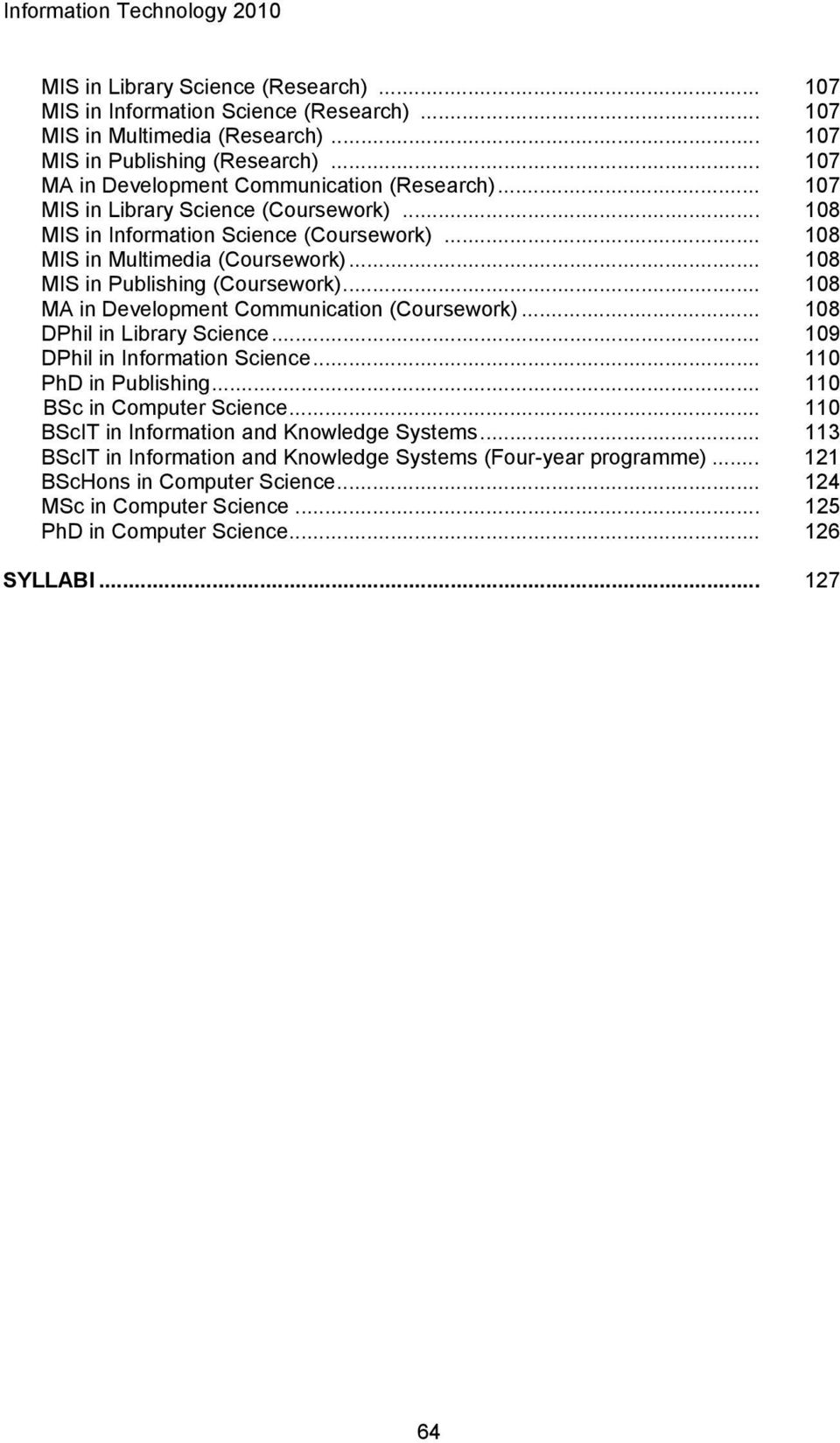
2 MIS in Library Science (Research) MIS in Information Science (Research) MIS in Multimedia (Research) MIS in Publishing (Research) MA in Development Communication (Research) MIS in Library Science (Coursework) MIS in Information Science (Coursework) MIS in Multimedia (Coursework) MIS in Publishing (Coursework) MA in Development Communication (Coursework) DPhil in Library Science DPhil in Information Science PhD in Publishing BSc in Computer Science BScIT in Information and Knowledge Systems BScIT in Information and Knowledge Systems (Four-year programme) BScHons in Computer Science MSc in Computer Science PhD in Computer Science SYLLABI
3 ACADEMIC PERSONNEL AS AT 30 SEPTEMBER 2009 DEAN Prof R.F. Sandenbergh, PrEng MEng DEng(Pretoria) GSAIMM LSAKorrl CHAIRPERSON OF THE SCHOOL Bothma, T.J.D., BA(Pretoria) MA DLitt et Phil(Unisa) Department of Informatics De Villiers, C., BSc(Potchefstroom) BSc(Hons) DCom(Pretoria)...Professor (Head) MEd DTO HED(Unisa) Alexander, P.M., BSc(Hons) MSc(Unisa) PhD(Pretoria)...Associate Professor Leonard, A.C., BSc(Hons)(Potchefstroom) MSc(Unisa)...Associate Professor DCom(Pretoria) Joubert, P., BSc BCom(Hons) MCom(Pretoria)...Senior Lecturer Kruger, C.J., NHD(Technikon Pretoria) MBA MIT PhD(Pretoria)...Senior Lecturer Lotriet, H.H., PrEng BEng(Hons)(Pretoria) MEng...Senior Lecturer PhD(Stellenbosch )Dip Datametrics(Unisa) Matthee, M.C., BSc(Hons) MSc DCom(Pretoria) HED...Senior Lecturer Van Loggerenbergh, J.J., BSc MBA(Potchefstroom)...Senior Lecturer DCom(Pretoria) (Gijima AST chair) Weilbach, E.H. BCom(Hons) MCom(Pretoria) HED...Senior Lecturer Harmse, S.S.A., BCom (UNISA), MIT (Pretoria)...Lecturer Joubert, P., BIT MPhil(Pretoria)...Lecturer Krauss, K.E.M., ND(IT) BTech Ed(Cape Tech) MCom(KwaZulu-Natal)...Lecturer Lutu, P.E.N., BSc(Hons) MSc(Manchester)...Lecturer Pretorius, H.W., BSc(Hons) MSCE MIT(Pretoria)...Lecturer Pretorius, J., BA(Ed) BA(Hons) MPhil(Pretoria)...Lecturer Roodt, S., BCom(Pretoria) DipPM(Cranefield) MBA(CapeTown)...Lecturer Twinomurinzi, H., BSc(Hons)(Math) MIT(Pretoria)...Lecturer Van Deventer, J.P., BA SocSci(Hons)(Psych)...Lecturer BA(Hons)(Information Science) MIS(Pretoria) Asmelash, D.W., BA:MIS(Solusi)...Junior Lecturer Steyn, A.A., BCom(Hons)(Pretoria)...Junior Lecturer Department of Information Science Bothma, T.J.D., BA(Pretoria) MA DLitt et Phil(Unisa)...Professor (Head) Boon, J.A., BA(Potchefstroom) BA(Bibl)(Hons)(Pretoria) MBibl DLitt et Phil(RAU) HD(Bibl)(Pretoria)...Professor Dick, A.L., BBibl(Hons)(Western Cape) MLS(Washington, Seattle) PhD(Cape Town)...Professor Fourie, I., MBibl(Free State) DLitt et Phil(RAU) DTE(Unisa)...Associate Professor Snyman, M.E., BA MA DLitt(Pretoria) HED(Unisa)...Associate Professor Britz, JJ,BA BD BBibl(Hons)DD(Pretoria)...Extraordinary Professor Lor, P.J., BA(Hons)(Bibl)(Stellenbosch) MBibl DPhil(Pretoria)...Extraordinary Professor Snowden, D J,BA(Hons) MBA(Middlesex Business School)...Extraordinary Professor Sturgens, RP, BA(Leicester) MA PhD(Loughborough)...Extraordinary Professor Penzhorn, C.E., BA(Log) BBibl(Hons) MIS(Pretoria) HD(Bibl)(Unisa) DPhil(Pretoria)...Senior Lecturer Franken, C.J., BA BSc(Hons) MSc(Pretoria)...Lecturer 65

4 Holmner, M.A., BA(Hons) MA DPhil(Pretoria)...Lecturer Schutte, M, BBibl BBibl(Hons) MIS(Pretoria)...Lecturer Sewdass, N., BBibl BBibl(Hons)(Unisa) MBA(Buckinghamshire Chilterns Univ College) MInf(Unisa) DPhil(Pretoria)...Lecturer Squier, M.M., BBibl(Unisa) BBibl(Hons) MIS(Pretoria)...Lecturer Thompson, J.E., BA BEd MIS HD(Bibl) HED(Natal)...Lecturer Department of Computer Science Engelbrecht, A.P., BSc(Hons) MSc PhD(Stellenbosch)...Professor (Head) Kourie, D.G., BSc(Hons) MSc(Pretoria) MSc(Unisa) PhD(Lancaster)...Professor Olivier, M.S., BSc(Hons) MSc PhD BA BA(Hons)(RAU)...Professor Venter, H.S., BSc(Hons) MSc PhD(RAU)...Associate Professor Eloff, J.H.P., BSc(Hons) MSc PhD(RAU)...Extraordinary Professor Van den Heever, R.J., BSc(Hons) MSc(Pretoria) MS(Stanford) MEng PhD(California)...Extraordinary Professor Watson, B.W., JB(Math) JB(Math)(Hons)(Waterloo) PhD(Eindhoven)...Extraordinary Professor Gruner, S., MSc PhD (Dr.rer.nat) (Aachen RWTH)...Senior Lecturer Coetzee, S., BSc(Hons) HED MSc PhD(Pretoria)...Lecturer Malan, K., BSc(Hons) MSc(Cape Town)...Lecturer Marshall, L., BSc(Hons) MIT(Pretoria)...Lecturer Pieterse, V., BSc HED(Pretoria) BSc(Hons)(Unisa) MSc(Pretoria)...Lecturer Strauss, M.D., BSc(Hons) MSc(Pretoria)...Lecturer Theunissen, W.H.M., BSc(Hons) MSc(Pretoria)...Lecturer Klazar, R.D., BSc(Univ of Limpopo) BSc(Hons)(Pretoria)...Junior Lecturer Köhn, M.D., BMus BMus(Hons) BSc(Hons)(Pretoria)...Junior Lecturer Langenhoven, L., BIS BSc(Hons)(Pretoria)...Junior Lecturer Morkel, T., BSc(Hons)(Pretoria)...Junior Lecturer Riekert, M., BSc(Hons)(Pretoria)...Junior Lecturer Van Heerden, W.S., BSc(Hons)(Pretoria)...Junior Lecturer Four-year programme Naidoo, S, DSP(TCE) HED(SCE) BEd MEd(RAU)...Lecturer Head: Computer and information literacy Jacobs, E. Head: Student Administration Jones, E. 66

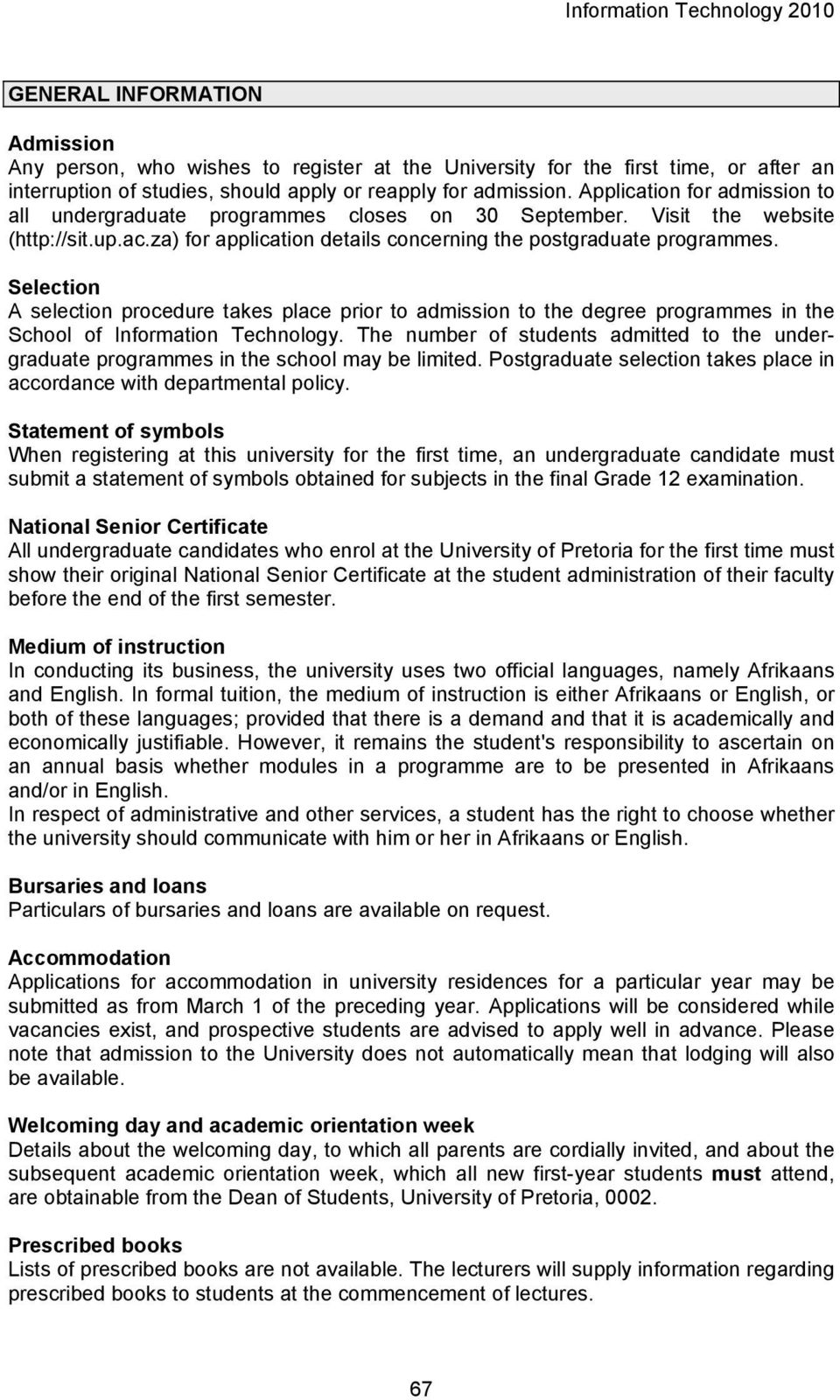
5 GENERAL INFORMATION Admission Any person, who wishes to register at the University for the first time, or after an interruption of studies, should apply or reapply for admission. Application for admission to all undergraduate programmes closes on 30 September. Visit the website ( for application details concerning the postgraduate programmes. Selection A selection procedure takes place prior to admission to the degree programmes in the School of Information Technology. The number of students admitted to the undergraduate programmes in the school may be limited. Postgraduate selection takes place in accordance with departmental policy. Statement of symbols When registering at this university for the first time, an undergraduate candidate must submit a statement of symbols obtained for subjects in the final Grade 12 examination. National Senior Certificate All undergraduate candidates who enrol at the University of Pretoria for the first time must show their original National Senior Certificate at the student administration of their faculty before the end of the first semester. Medium of instruction In conducting its business, the university uses two official languages, namely Afrikaans and English. In formal tuition, the medium of instruction is either Afrikaans or English, or both of these languages; provided that there is a demand and that it is academically and economically justifiable. However, it remains the student's responsibility to ascertain on an annual basis whether modules in a programme are to be presented in Afrikaans and/or in English. In respect of administrative and other services, a student has the right to choose whether the university should communicate with him or her in Afrikaans or English. Bursaries and loans Particulars of bursaries and loans are available on request. Accommodation Applications for accommodation in university residences for a particular year may be submitted as from March 1 of the preceding year. Applications will be considered while vacancies exist, and prospective students are advised to apply well in advance. Please note that admission to the University does not automatically mean that lodging will also be available. Welcoming day and academic orientation week Details about the welcoming day, to which all parents are cordially invited, and about the subsequent academic orientation week, which all new first-year students must attend, are obtainable from the Dean of Students, University of Pretoria, Prescribed books Lists of prescribed books are not available. The lecturers will supply information regarding prescribed books to students at the commencement of lectures. 67
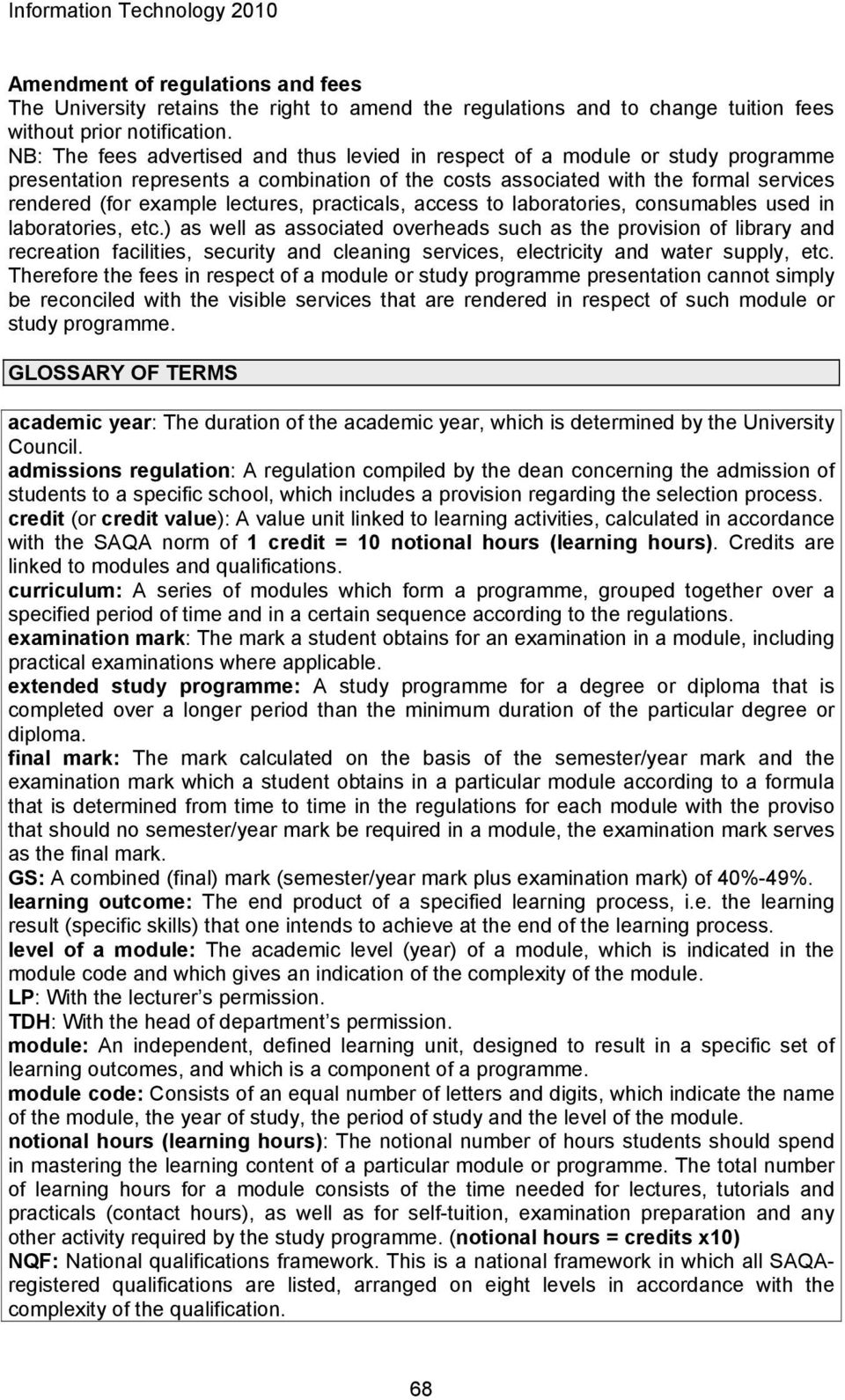
6 Amendment of regulations and fees The University retains the right to amend the regulations and to change tuition fees without prior notification. NB: The fees advertised and thus levied in respect of a module or study programme presentation represents a combination of the costs associated with the formal services rendered (for example lectures, practicals, access to laboratories, consumables used in laboratories, etc.) as well as associated overheads such as the provision of library and recreation facilities, security and cleaning services, electricity and water supply, etc. Therefore the fees in respect of a module or study programme presentation cannot simply be reconciled with the visible services that are rendered in respect of such module or study programme. GLOSSARY OF TERMS academic year: The duration of the academic year, which is determined by the University Council. admissions regulation: A regulation compiled by the dean concerning the admission of students to a specific school, which includes a provision regarding the selection process. credit (or credit value): A value unit linked to learning activities, calculated in accordance with the SAQA norm of 1 credit = 10 notional hours (learning hours). Credits are linked to modules and qualifications. curriculum: A series of modules which form a programme, grouped together over a specified period of time and in a certain sequence according to the regulations. examination mark: The mark a student obtains for an examination in a module, including practical examinations where applicable. extended study programme: A study programme for a degree or diploma that is completed over a longer period than the minimum duration of the particular degree or diploma. final mark: The mark calculated on the basis of the semester/year mark and the examination mark which a student obtains in a particular module according to a formula that is determined from time to time in the regulations for each module with the proviso that should no semester/year mark be required in a module, the examination mark serves as the final mark. GS: A combined (final) mark (semester/year mark plus examination mark) of 40%-49%. learning outcome: The end product of a specified learning process, i.e. the learning result (specific skills) that one intends to achieve at the end of the learning process. level of a module: The academic level (year) of a module, which is indicated in the module code and which gives an indication of the complexity of the module. LP: With the lecturer s permission. TDH: With the head of department s permission. module: An independent, defined learning unit, designed to result in a specific set of learning outcomes, and which is a component of a programme. module code: Consists of an equal number of letters and digits, which indicate the name of the module, the year of study, the period of study and the level of the module. notional hours (learning hours): The notional number of hours students should spend in mastering the learning content of a particular module or programme. The total number of learning hours for a module consists of the time needed for lectures, tutorials and practicals (contact hours), as well as for self-tuition, examination preparation and any other activity required by the study programme. (notional hours = credits x10) NQF: National qualifications framework. This is a national framework in which all SAQAregistered qualifications are listed, arranged on eight levels in accordance with the complexity of the qualification. 68
7 programme: This is a comprehensively planned, structured and coherent set of teaching and learning units (modules), designed to attain a specific set of predetermined learning outcomes at a specific level, which culminates in a student being awarded a particular qualification (diploma, degree). qualification: In outcomes-based education, a qualification is a diploma or a degree which is obtained after attaining the learning outcomes as specified in a coherent learning programme, expressed as an accumulation of credits at specific levels. SAQA: South African qualifications authority. This body has been established by law and has as its purpose the registration of qualifications, programmes and unit standards, in order to ensure that specific national and international criteria are achieved. semester/year mark: The mark a student obtains during the course of a semester or a year for tests, class-work, practical work or any other work in a particular module as approved by regulation. student-centred learning: Teaching and learning methodology, which facilitates the total own responsibility for the learning process. A prerequisite is that lectures, tutorials and practicals be adapted so that active participation by students is always achieved. syllabus: Summary of the contents of a module. weighted average: The weighted average is composed of the marks of the various modules, weighted with the credits of each module as a fraction of the total number of credits for the quarter, semester or year. DEGREES CONFERRED IN THE SCHOOL OF INFORMATION TECHNOLOGY The Faculty of Engineering, Built Environment and Information Technology comprises three schools namely the School of Engineering, the School for the Built Environment and the School of Information Technology. The School of Information Technology has three departments, namely the Department of Informatics, the Department of Information Science and the Department of Computer Science. Two faculties offer the degrees that fall under the School of Information Technology. This implies that although the Department of Informatics falls under the School of Information Technology, the degree BCom (Informatics) is conferred by the Faculty of Economic and Management Sciences (see below for further details). Faculty of Engineering, Built Environment and Information Technology The following degrees are conferred by the faculty: (a) Bachelor of Information Technology [BIT] (b) Master of Information Technology [MIT] (c) Doctor of Philosophy in Information Technology [PhD (Information Technology)] Department of Informatics The following degrees are conferred by the Faculty of Economic and Management Sciences: (a) Bachelor of Commerce in Informatics (b) Bachelor of Commerce Honours in Informatics (c) Master of Commerce in Informatics (d) Master of Philosophy in Informatics (e) Doctor of Commerce in Informatics (f) Doctor of Philosophy in Informatics 69

8 Department of Information Science The following degrees are conferred by the Faculty of Engineering, Built Environment and Information Technology: (a) Bachelor of Information Science [BIS] (i) in Information Science (ii) in Multimedia (iii) in Multimedia (Four-year programme) (iv) in Publishing (b) Bachelor of Information Science Honours [BISHons] (i) in Information Science (ii) in Multimedia (iii) in Publishing (c) Master of Information Science (Research) [MIS] (i) in Library Science (ii) in Information Science (iii) in Multimedia (iv) in Publishing (d) Master of Information Science (Coursework) [MIS] (i) in Library Science (ii) in Information Science (iii) in Multimedia (iv) in Publishing (e) Doctor of Philosophy [DPhil] (i) in Library Science (ii) in Information Science (f) Doctor of Philosophy [PhD] (i) Publishing The following degrees are conferred by the Faculty of Humanities: (a) Master of Arts in Development Communication (Research) (b) Master of Arts in Development Communication (Coursework) Department of Computer Science The following degrees are conferred by the Faculty of Engineering, Built Environment and Information Technology: (a) Bachelor of Science Information Technology in Information and Knowledge Systems (b) Bachelor of Science Information Technology in Information and Knowledge Systems (Four-year programme) (c) Bachelor of Science in Computer Science (d) Bachelor of Science Honours in Computer Science (e) Master of Science in Computer Science (f) Doctor of Philosophy in Computer Science REGULATIONS The rules for degrees here published are subject to change and may be amended prior to the commencement of the academic year in IT.1 Admission to undergraduate study General Regulations G.1 to G.15 are applicable to bachelor s degrees. (i) In order to register for a first bachelor s degree at the university a candidate should 70
![(iii) in Publishing (c) Master of Information Science (Research) [MIS] (i) in Library Science (ii) in Information Science (iii) in Multimedia (iv) in Publishing (d) Master of Information Science](/docs-images/49/18011351/images/page_8.jpg "(Coursework) [MIS] (i) in Library Science (ii) in Information Science (iii) in Multimedia (iv) in Publishing (e) Doctor of Philosophy [DPhil] (i) in Library Science (ii) in Information Science (f)")
9 (ii) (iii) (iv) (a) be in possession of a valid National Senior Certificate with admission to degree purposes; (b) comply with the particular requirements, prescribed in the admission procedures and faculty regulations of the respective faculties and departments, for admission to particular modules and fields of study. A candidate, who does not comply with the requirements in G.1.1(a) above, may also be considered for admission, provided that the candidate (a) is in possession of a certificate deemed by the university to be equivalent to any of the certificates mentioned in G1.1(a); (b) is a graduate from another tertiary institution or has been granted the status of a graduate of such an institution; or (c) passes an admissions examination prescribed by the university. Abovementioned candidates are requested to contact the relevant faculty for more detail regarding admission requirements. The senate may limit the number of students allowed to register for a programme, in which case the dean concerned may, at his or her discretion, select from the students who qualify for admission those who may be admitted. Subject to faculty regulations and the stipulations of General Regulations G.1.3 and G.62, a candidate is admitted to a postgraduate bachelor s degree only if he or she is already in possession of a recognised bachelor s degree. IT.2 Admission requirements for candidates with a National Senior Certificate (NSC) (a) To be able to gain access to the specific programme, the appropriate combinations of recognised NSC subjects as well as certain levels of achievement in the said subjects are required from prospective students. In this regard the determination of an admission point score (APS) is explained and a summary of the specific requirements, i.e. APS and the specific subjects required is provided. (b) Determination of an admission point score (APS) The calculation is simple and based on a candidate s achievement in six 20- credit recognised subjects by using the NSC ratings, that is the 1 to 7 scale of achievement. Thus, the highest APS that can be achieved is 42. Life orientation is excluded from the calculation determining the APS required for admission. Rating code Rating Marks % 7 Outstanding achievement % 6 Meritorious achievement 70-79% 5 Substantial achievement 60-69% 4 Adequate achievement 50-59% 3 Moderate achievement 40-49% 2 Elementary achievement 30-39% 1 Not achieved 0-29% (c) Preliminary admission is based on the results obtained in the final Grade 11 examination. Final admission is based on Grade 12 results. Please note: The final Grade 12 results will be the determining factor with regard to admission. 71

10 (d) (e) Alternative admission channels Candidates with an APS lower than required, could be considered for admission to the faculty if they meet the additional assessment criteria specified by the faculty from time to time. Preference will, however, be given to students who comply with the regular admission requirements of the faculty. Admission requirements for specific degree programmes: (a) A valid National Senior Certificate with admission to degree purposes. (b) The following minimum subject and level requirements for 2010: School of Information Technology minimum requirements Degree APS Group A Two languages Mathematics Life orientation BIT 27 Comply with NSC 5 (60-69%) 4 (50-59%) minimum requirements; (Excluded ADDITION- when ALLY one of these calculating the languages must be APS) Afrikaans OR English at level 5 (60-69%). BSc (Computer Science) BScIT (Information and Knowledge Systems) BScIT (Information and Knowledge Systems) (Four-year programme) BIS (Multimedia) 27 Comply with NSC minimum requirements; ADDITION- ALLY one of these languages must be Afrikaans OR English at level 5 (60-69%). 24 Comply with NSC minimum requirements; ADDITION- ALLY one of these languages must be Afrikaans OR English at level 4 (50-59%). 22 Comply with NSC minimum requirements; ADDITION- ALLY one of these languages must be Afrikaans OR English at level 4 (50-59%) 24 Comply with NSC minimum requirements; ADDITION- ALLY one of these languages must be Afrikaans OR English at level 4 (50-59%). 5 (60-69%) 4 (50-59%) (Excluded when calculating the APS) 4 (50-59%) 4 (50-59%) (Excluded when calculating the APS) 3 (40-49%) 4 (50-59%) (Excluded when calculating the APS) 4 (50-59%) 4 (50-59%) (Excluded when calculating the APS) Group B 3 Other subjects Any three subjects Any three subjects Any three subjects Any three subjects Any three subjects 72

11 BIS (Multimedia) (Four-year programme) 22 Comply with NSC minimum requirements; ADDITION- ALLY one of these languages must be Afrikaans OR English at level 4 (50-59%) Degree APS Group A Group B Two languages Mathematics or Mathematical Literacy BIS (Information Science) BIS (Publishing) 24 Comply with NSC minimum requirements; ADDITIONALLY one of these languages must be Afrikaans OR English at level 4 (50-59%). 3 (40-49%) 4 (50-59%) (Excluded when calculating the APS) Mathematical literacy 3(40-49%) or ** Life orientation 4 (50-59%) (Excluded when calculating the APS) Any three subjects 3 Other subjects Any three subjects ** If Informatics is selected as a subject at first-year level, an achievement rating of 4 (50-59%) must be obtained for Mathematics. 24 Comply with NSC 3 (40-49%) or 4 (50-59%) Any three minimum requirements; Mathematical (Excluded subjects ADDITION- literacy 3(40- when ALLY one of these 49%) calculating languages must be the APS) Afrikaans OR English at level 5 (60-69%). IT.3 Requirements for specific modules A candidate who has: (a) obtained at least 3 (40-49%) for Mathematics in Grade 12, will be admitted to WTW 133 and WTW 143; or 4 (50-59%), will be admitted to WTW 115 and WTW 126 and at least 5 (60-69%) to WTW 114 and WST 111; (b) obtained at least 4 (50-59%) in Mathematics in the Grade 12 examination, or at least 50% in both Statistics 113, 123 will be admitted to Informatics 112; Economics 113, 123 and 120; (c) obtained at least 5 (60-69%) in Accounting in the Grade 12 examination, may enrol immediately for INF 181, a module covering computer applications in accounting and offered for the duration of the first semester (14 weeks). All other students who have obtained at least 40% in FRK 111 must enrol for INF 181 in the second semester (14 weeks); (d) to obtain admission to COS 130, should have obtained the following: (i) at least level 3 (40%-49%) in Mathematics in the final Grade 12 examinations; and (ii) An APS of at least 22. (e) obtained at least 4 (50-59%) in Mathematics, or has passed WTW 133 and WTW 143, will be admitted to Informatics 153, 154, 163, 164. (f) not passed at least three Computer science modules at second-year level, will not be permitted to register for the Computer science modules at thirdyear level, unless special permission has been granted by the head of department. 73

12 Please note: (i) the Grade 12 examination refers to the National Senior Certificate examination. (ii) A student who takes a module presented by another faculty or department must take note of the admission requirements of such module, subminimum required in examination papers and supplementary examinations. IT.4 Registration for a specific year A student registers for all the modules he or she intends taking in that specific year (quarter modules, first and second-semester modules and year modules) at the beginning of an academic year. Changes to a curriculum at the beginning of the second semester may be made only with the approval of the dean. IT.5 Minimum study period The minimum period of study for the degree is indicated at the relevant degree programme. Students registering for a three-year degree, must complete the degree in a maximum of five years. Students registering for a four-year degree, must complete the degree in a maximum of six years. IT.6 Promotion requirements 6.1 General (a) A student must pass all the modules of the first year of study, before he or she is permitted to register for any module of the third year of study. Module prerequisites remain applicable. Exceptions to this rule will be considered by the relevant head of department and the dean. (b) A student must pass all the modules of the second year of study, before he or she is permitted to register for any module of the fourth year of study (in the case of a four-year degree). Module prerequisites remain applicable. Exceptions to this rule will be considered by the relevant head of department and the dean. (c) A new first-year student, who has failed in all the prescribed modules of the programme at the end of the first semester, will not be permitted to proceed to the second semester in the School of Information Technology. (d) A student who has not passed at least 70% of the core credits of the current year of study after the November examinations will not be re-admitted to the School of Information Technology. (e) Students who fail a module for a second time, forfeit the privilege of registering for any modules of an advanced year of study. (f) Students whose academic progress is not acceptable can be suspended from further studies. 6.2 Procedure: Exclusion from and re-admission to further studies (a) A student who is excluded from further studies in terms of the stipulations of the abovementioned regulations, will be notified in writing by the dean or admissions committee of the School of Information Technology at the end of the relevant semester. (b) A student who has been excluded from further studies may apply in writing to the admissions committee of the School of Information Technology on level 6 in the Engineering building I for re-admission. (c) Written applications for re-admission to the second semester must be submitted at least 7 days before lectures resume for the second semester. (d) Written applications for re-admission to the new academic year must be submitted before 11 January. 74

13 (e) (f) (g) (h) (i) (j) Late applications will be accepted only in exceptional circumstances after approval by the dean. Should a student not be re-admitted to further studies by the admissions committee of the School of Information Technology, he/she will be informed in writing. A student who is not re-admitted by the admissions committee of the School of Information Technology, has the right to appeal to the Appeals Committee: Admissions in the Administration building, room Any decision taken by the Appeals Committee: Admissions is final. Should the student be re-admitted by the Admissions Committee, strict conditions will be set which the student must comply with in order to proceed with his/her studies. A student, who is repeating his or her year, may be permitted by the dean, on recommendation of the relevant head(s) of department, to register for modules of the following year of study in addition to the outstanding modules he or she has failed, providing that he or she complies with the prerequisites of these modules and no timetable clashes occur. In no semester may the total credits for which a student registers, exceed the normal number of credits per semester by more than 16 credits, except with special permission from the relevant head of department. IT.7 Change of field of study Transfer from one field of study to another may only take place with the dean s approval, after consultation with the relevant head of department. IT.8 Registration for modules (a) Final dates are set for the change of modules (cancellation or addition) for each academic year. These dates are available from the student administration offices. Students may change the modules they are registered for only with the approval of the dean and within the first two weeks after commencement of the module. (b) A student may not register for a module of a subsequent year if a timetable clash occurs with a module of a previous year which has not yet been passed and which is prescribed for his or her field of study, unless exemption is obtained from class attendance in the latter module. (c) Should a student register for modules of the second semester at the beginning of a year of study, and it becomes evident at the end of the first semester that he or she does not comply with the prerequisites of the second semester modules, the registration of such modules will be cancelled. It is also the student's responsibility to ensure at the beginning of the second semester that the cancellation has been brought about. IT.9 Module credits for unregistered students There are students who attend lectures, write tests and examinations and in this manner earn marks, but who have neither registered for modules nor registered as students. These marks will not be communicated to any student before he/she has provided proof of enrolment. A student cannot obtain any credits in a specific academic year for a module passed in this manner during a previous academic year and for which he/she was not registered. This arrangement applies even where the student is prepared to pay the tuition fees. 75

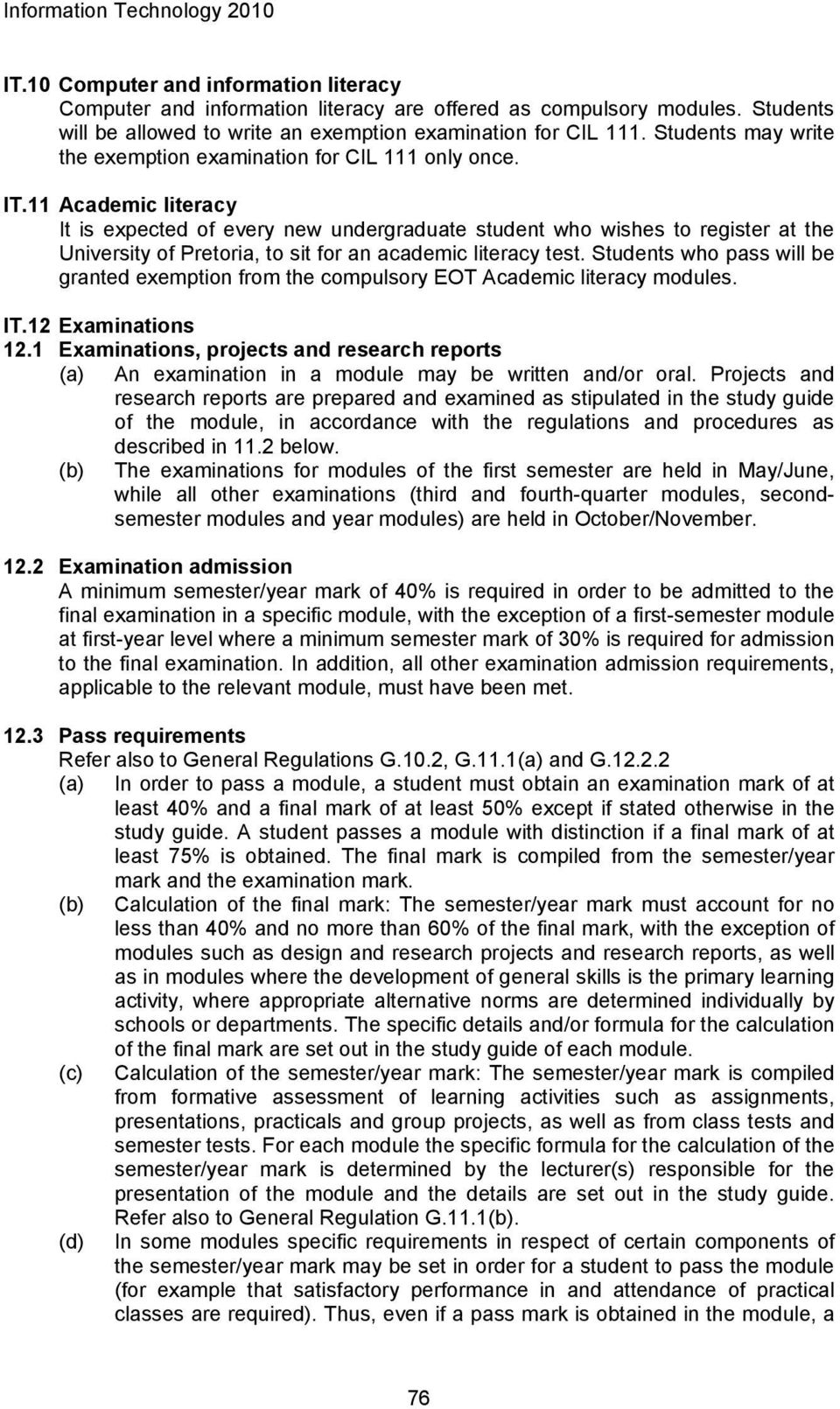
14 IT.10 Computer and information literacy Computer and information literacy are offered as compulsory modules. Students will be allowed to write an exemption examination for CIL 111. Students may write the exemption examination for CIL 111 only once. IT.11 Academic literacy It is expected of every new undergraduate student who wishes to register at the University of Pretoria, to sit for an academic literacy test. Students who pass will be granted exemption from the compulsory EOT Academic literacy modules. IT.12 Examinations 12.1 Examinations, projects and research reports (a) An examination in a module may be written and/or oral. Projects and research reports are prepared and examined as stipulated in the study guide of the module, in accordance with the regulations and procedures as described in 11.2 below. (b) The examinations for modules of the first semester are held in May/June, while all other examinations (third and fourth-quarter modules, secondsemester modules and year modules) are held in October/November Examination admission A minimum semester/year mark of 40% is required in order to be admitted to the final examination in a specific module, with the exception of a first-semester module at first-year level where a minimum semester mark of 30% is required for admission to the final examination. In addition, all other examination admission requirements, applicable to the relevant module, must have been met Pass requirements Refer also to General Regulations G.10.2, G.11.1(a) and G (a) In order to pass a module, a student must obtain an examination mark of at least 40% and a final mark of at least 50% except if stated otherwise in the study guide. A student passes a module with distinction if a final mark of at least 75% is obtained. The final mark is compiled from the semester/year mark and the examination mark. (b) Calculation of the final mark: The semester/year mark must account for no less than 40% and no more than 60% of the final mark, with the exception of modules such as design and research projects and research reports, as well as in modules where the development of general skills is the primary learning activity, where appropriate alternative norms are determined individually by schools or departments. The specific details and/or formula for the calculation of the final mark are set out in the study guide of each module. (c) Calculation of the semester/year mark: The semester/year mark is compiled from formative assessment of learning activities such as assignments, presentations, practicals and group projects, as well as from class tests and semester tests. For each module the specific formula for the calculation of the semester/year mark is determined by the lecturer(s) responsible for the presentation of the module and the details are set out in the study guide. Refer also to General Regulation G.11.1(b). (d) In some modules specific requirements in respect of certain components of the semester/year mark may be set in order for a student to pass the module (for example that satisfactory performance in and attendance of practical classes are required). Thus, even if a pass mark is obtained in the module, a 76
15 (e) (f) pass is not granted unless these requirements are met. For such modules these specific requirements are set out in the study guide. A student must comply with the subminimum requirements in subdivisions of certain modules. For such modules these specific requirements are set out in the study guide of the module. A student may be promoted (exempted from the examination) in certain modules should a specified semester/year mark (minimum 65%) be obtained. For such modules these specific requirements are set out in the study guide of the module. Refer also to General Regulation G Ancillary examinations Refer to General Regulation G Supplementary examinations Refer to General Regulation G In the School of Information Technology all supplementary examinations are considered and granted in accordance with the stipulations of General Regulation G.12.4, except that the semester mark is taken into account when the final mark is calculated and in accordance with the faculty regulations of the faculty in which the module is offered. The only exception to this rule is in the case of first-year modules at first-semester level, where the semester mark is not considered, and where the supplementary examination mark is taken as the final mark, with the provision that the maximum final mark awarded may be no more than 50%. Special supplementary examinations will not be arranged for students who were not able to write the supplementary examinations during scheduled times, as provided in the examinations timetable Special examinations (including the aegrotat) Refer to General Regulation G Other special examinations Refer also to General Regulation G (a) The dean may, on the recommendation of the head of department concerned, grant a special examination in a module to a student who failed that module in the final year of study, and consequently does not comply with degree requirements. A student may at most, be admitted to either one special examination in a year module or two special examinations in semester modules or four special examinations in quarter modules. (b) To be taken into consideration for a special examination, a student should have obtained a minimum final mark of 40% and should also have complied with all other examination admission requirements which are applicable to the relevant module. (c) A student must apply in writing to the dean before consideration will be given to admission to a special examination. The head of department decides when the special examination will take place and may prescribe work that must be satisfactorily completed before a student may write the examination. (d) During calculation of the final mark the semester mark is retained and the final mark is calculated as the weighted average of the special examination mark and the semester mark, in accordance with the formula as published in the study guide of the specific module. The candidate should also comply with the subminimum requirements. The highest final mark that may be awarded is 50%. 77

16 (e) If a test or examination clash occurs between modules within the prescribed curriculum, an adjustment of the test date and/or time will only be considered if the student completes an official application form at the department's administration office and submits a copy and supporting documentation to the relevant lecturer at least seven (7) days prior to the scheduled test. A module from a higher year level receives preference to that of a lower year level within the prescribed curriculum Re-marking of examination scripts Refer to General Regulation G.14. IT.13 Degree with distinction (undergraduate) A degree in the School of IT is conferred with distinction on a student who did not repeat any module of his/her final year, obtained a weighted average of at least 75% in all the prescribed modules for the final year, provided that a subminimum of 65% is obtained in each of these modules and provided that the degree is completed in the prescribed minimum period of time. Ad hoc cases will be considered by the dean, in consultation with the head of the relevant department. IT.13.1 Module information XYZ 151: Prerequisite. Before a student is admitted to a module, XYZ 163, he or she must pass the prerequisite module(s) XYZ 153, unless one of the following indications is used: Minumum requirement () Code in brackets: (XYZ 151) Examination admission GS Code followed by GS: XYZ 151 GS Combined final mark of 40%-49% Deviations from these requirements may be permitted only with the approval of the dean, after consultation with the relevant head(s) of department(s). CURRICULA OF THE INFORMATION TECHNOLOGY PROGRAMMES IT.14 Bachelor of Information Technology [BIT] (Code ) This degree is conferred by the Faculty of Engineering, Built Environment and Information Technology. Programme organiser: Dr M Matthee, Information Technology building, room 5-58, Tel: , [email protected] Admission requirements for candidates with a National Senior Certificate To obtain admission to this degree programme, a candidate should have obtained the following: (a) a valid National Senior Certificate with admission for degree purposes; and (b) (c) a minimum APS of 27 in the final Grade 12 examinations; and compliance with the NSC minimum requirements; additionally one of these languages must be Afrikaans or English at level 5 (60%-69%); and 78
17 (d) (e) at least level 5 (60-69%) in Mathematics; and at least level 4 (50-59%) in Life orientation (excluded when calculating the APS). Curriculum The list of required modules is given below in a proposed study programme. The degree is awarded upon successful completion of a minimum of 708 credits, of which 196 are required at first-year level, 166 at second-year level, 186 at third-year level, and 160 at fourth-year level. Requirements for promotion to the following year of study Also consult General Regulations. (i) A student is promoted to the following year of study after obtaining the required credits as mentioned below: Second year of study after obtaining at least 70% of the credits of the first year of study. Third year of study after obtaining at least 70% of the credits of the second year of study. Fourth year of study after obtaining at least 70% of credits of the third year of study. (ii) The degree is conferred when all prescribed modules have been passed. (a) First year of study (196 credits) Pass an exemption examination in CIL 111 or CIL 111 Computer literacy and 4 S1 CIL 121 Information literacy (^compulsory) 4 S2 Pass an academic literacy test or EOT 110 Academic literacy 6 S1 EOT 120 Academic literacy 6 S2 and EOT 164 Communication in organisations 6 Q3-4 COS 132 Imperative programming 16 S1 COS 110 Program design: Introduction COS 130GS or 16 S2 COS 131GS or COS 132GS and Maths level 4 or WTW 133 COS 121 Software modelling COS 130GS or 16 S2 COS 131GS or COS 132GS COS 151 Introduction to Computer science 8 S1 ERA 284 (previously EOS 284) Computer architecture COS 110 or COS 130 or COS 131 or COS S2 OBS 114 Business management 10 S1 FRK 111 Financial accounting 10 S1 FRK 121 Financial accounting FRK 111GS 12 S2 INF 153 Informatics Par IT.3(e) 5 S1 INF 163 Informatics INF S2 79

18 INL 110 Information science: Introduction 12 S1 to Information science WTW 115 Discrete structures Par 1.2 Natural 8 S1 Sciences(Maths level 4) WTW 114 Calculus Par 1.2 Natural 16 S1 Sciences(Maths level 5) WTW 126 Linear algebra Par 1.2 Natural 8 S2 Sciences (Maths level 4) FIL 120 Philosophy 12 S2 (b) Second year of study (166 credits) COS 212 Data structures and algorithms COS 110 or 16 S1 COS 131 COS 222 Operating systems COS 130 or 16 S2 COS 131 or COS 132 COS 216 Netcentric computer systems COS 110 or 16 S1 (previously COS 140) COS 131 INF 214 Informatics CIL 111 and CIL 14 S1 121 INF 271 Informatics CIL 111, Year INF 163, 164 Reg 1.2(g) INF 272 Informatics CIL 111, Year INF 163, 164 Reg 1.2(g) IMY 210 Multimedia: Advanced mark-up Departmental 16 S1 languages (1) selection IMY 220 Multimedia: Advanced mark-up IMY S2 languages (2) BER 410 Business law 12 S1 WTW 285 Discrete structures WTW S2 At least one of the following: INL 210 Information science: Information CIL S1 or seeking and retrieval INL 240 Information science: Social and ethical impact 20 S1 (c) Third year of study (minimum 186 credits) COS 301 Software engineering COS110 and 27 Year COS 121 or or 80

19 INF 370 or IMY 300 Information systems project or Multimedia project INF 225, 261, 271 and 272 Departmental selection Year Year INF 324 Informatics INF 225, 261, 15 S2 271 and 272 INF 315 Informatics LP 15 S1 INF 354 Informatics INF 225, 261, 15 S1 271 and 272 INL 310 Information science: Information 30 S2 organisation INL 320 Information science: Information 30 S1 and knowledge management At least three of the following: COS 314 Artificial intelligence COS 131 or COS S1 COS 326 Database systems INF 214 or TDH 18 S2 COS 333 Programming languages COS S2 COS 341 Compiler construction COS S1 COS 330 Computer security and ethics COS S2 COS 344 Computer graphics COS 110 and 18 S1 WTW 126 COS 332 Computer networks COS S1 (d) Fourth year of study (160 credits) Code Module Prerequisites Credits SIT 700 Industry-based learning 52 JCP 202 Community-based project 8 Five modules (minimum 100 credits) of the following with a maximum 100 of four modules from one department: Note that a student who wishes to continue with an MSc(Computer Science) or MCom(Informatics) or MIS(Information Science) should take four of the five honours modules from that specific department. Information science Choice of honours modules in consultation with the 20 each programme organiser Informatics Choice of honours modules in consultation with the 20 each programme organiser Computer science Choice of honours modules in consultation with the 20 each programme organiser 81

20 POSTGRADUATE PROGRAMMES IN INFORMATION TECHNOLOGY Consult General Regulations G.30 to G.62 IT.15 Master of Information Technology (Coursework) [MIT] (Code ) Also consult General Regulations G.30-G44 and G.57-G62 Programme organiser: Mrs K Malan, Information Technology building, room 4-31, Tel: , [email protected] This degree programme is presented in English only. (a) (b) (c) Admission (i) Subject to the stipulations of General Regulations G.1.3, G.30 and G.62, an appropriate honours or bachelor s degree is a requirement for admission; and (ii) A pass mark in Mathematics at grade 12 level or another qualification in Mathematics, Statistics or Mathematical statistics, which the chairperson of the School of Information Technology considers to be sufficient; and (iii) Sufficient appropriate practical experience in the technology field in the opinion of the chairperson of the School of Information Technology. (iv) The chairperson of the School of Information technology may set additional requirements for admission. In particular, this will apply to candidates with insufficient academic background in Information technology. (v) Selection of candidates will take place. (vi) The result of the selection is final and no correspondence will be entered into. Duration A minimum of two years part-time study. The MIT degree must be completed in a maximum of three years. A student will have to apply with the Dean of the Faculty of Engineering, Built Environment and Information Technology if he/she needs more than three years to complete the degree. Conferment of the degree The master s degree in Information Technology is conferred on a student who successfully completes 240 credits. Mini-dissertation Core modules 120 credits 120 credits (d) (e) Pass requirements A minimum semester mark of 40% is required in order to be admitted to the final examinations in all the prescribed modules of the degree. A final mark of 50% is required to pass all coursework modules and the mini-dissertation. Degree with distinction The degree is conferred with distinction on students who have obtained at least 75% for the mini-dissertation and a minimum of 75% weighted average final mark for the coursework modules. 82
21 (f) Curriculum The curriculum is determined in consultation with the programme organiser. IT.16 Doctor of Philosophy in Information Technology [PhD (Information Technology)] (Code ) Also consult General Regulations G.45 to G.62. (a) Subject to the stipulations of Regulations G.45 and G.62, no candidate is admitted to doctoral studies unless he/she holds an appropriate master s degree. (b) Unless the dean, on the recommendation of the chairperson of the school, decides otherwise, the PhD degree is conferred on the basis of a thesis and an examination on the thesis. (c) Unless the Senate, on the recommendation of the supervisor, decides otherwise, a student, before or on submission of a thesis, must submit proof of submission of an article to an accredited journal, to the Head: Student Administration. The draft or submitted article, as the case may be, should be based on the research that the student has conducted for the thesis and be approved by the supervisor if the supervisor is not a co-author. The supervisor shall be responsible for ensuring that the paper is taken through all the processes of revision and resubmission, as may be necessary. Conferment of the degree may be made subject to compliance with the stipulations of this regulation. (d) The student must provide proof by means of his or her work, thesis and examination of advanced original research and/or creative work which makes a real and substantial contribution to the relevant field of research. IT.17 BCom in Informatics [BCom (Informatics)] (Code ) The Faculty of Economic and Management Sciences confers this degree. Package coordinator: Prof C de Villiers, IT 5-78, Tel: , [email protected] Total credits required: 419 Admission requirements for candidates with a National Senior Certificate To obtain admission to this degree programme, a candidate should have obtained the following: (a) a valid National Senior Certificate with admission for degree purposes; and (b) a minimum APS of 28 in the final Grade 12 examinations; and (c) compliance with the NSC minimum requirements; additionally one of these languages must be Afrikaans or English at level 4 (50%-59%); and (d) at least level 4 (50-59%) in Mathematics; and (e) at least level 4 (50-59%) in Life orientation (excluded when calculating the APS) This programme is defined as the application of modern information systems in organisations, both private and public. The student will have a graduate-level knowledge of the analysis, design and implementation of information systems, databases, operating systems, networks and information management. In addition, the student will have the 83
22 competence to develop a complete information system to support organisational functions. The holder of this qualification has the skills to advise organisations in empowering and enhancing the quality of work life of the individual workers through the application of information technology. The syllabus of this degree complies with the international accredited syllabus for information systems programmes. Year level 1 Year level 2 Year level 3 Credits Credits Credits Fundamental modules Core modules Elective modules * Total *Only two 14-week modules, or the equivalent thereof, that are not preceded by the 100- and 200-level modules, may be offered (followed) for degree purposes. In other words, at least four 14-week modules must be offered on 300 level that are preceded by the 100 and 200 level except for the modules offered on 200 and 300 level only, for example Financial management (FBS 210, 220, 310 and 320). Learning programme YEAR LEVEL: Fundamental modules (compulsory) CIL Computer and information literacy 111, 121 BPE Business ethics 251 (Q 2) EOT Academic literacy 110, 120 If a student does NOT pass the Academic literacy test at the beginning of the year, he/she must register for and pass EOT 110 and EOT 120 and will then obtain 12 credits for these modules. A student who passes the Academic literacy test, will be exempted from EOT 110 and EOT 120 and has to pass a credit value of 12 from the following modules: EOT English 161, , 164 Core modules (compulsory) INF Informatics (1); (2) , , , , 272 FRK Financial accounting (3) 111, 121 INF Informatics 181 (4) EKN Economics 110, 120 BER Business law 210, 220 STK Statistics 110, 120 OBS Business management 114, 124 KOB Communication management 184 WTW Discrete structures 115 JCP Community-based project 202 Elective modules OBS Business management 210, (6), 320 FRK Financial accounting 211 (5), 221 (5) 311 (5), 321 (5) BEL Taxation 220 (5) STK Statistics 210, , 320 IOK Internal auditing 211, ,
23 KOB Communication management 210, , 320 FBS Financial management 210, , 320 BEM Marketing management (7) 110, 121 (7) 211, , 321 BDO Industrial and organisational psychology (7) 110, 120 (7) 219, , (6), 329 (6) 371, 372 PAD Public administration (7) 110, , , 320 Elective modules can only be taken if they can be accommodated in the class, test and examination timetables. Note: See regulation C.2 in the yearbook of the Faculty of Economic and Management Sciences for prerequisites of all modules. Students may write the exemption examination for CIL 111 only once. (1) Prerequisites for modules: Year level 1: INF 112 (see IT.3(b), INF 153 and INF 154 (see IT.3(c)), INF 163 (INF 153), INF 164 (INF 154); Year level 2: INF 214 and INF 225 (CIL 111, CIL 121), INF 261 (INF 214), INF 271 and INF 272 (CIL 111, CIL 121, INF 163, INF 164), Year level 3: INF 301 (INF 214, 225, 261, 271, 272) (2) In addition to the provisions of the footnote (1) above, a student who does not fulfil the Mathematics requirement for admission but is nevertheless interested in a BCom: (Informatics) degree, should register for the BCom (Code ) and pass Pre-calculus 133 (WTW 133) and Calculus 143 (WTW 143) and the fundamental modules SIT 110 and SIT 120 as extra modules. He or she may then apply for permission to change to the second year of the BCom(Informatics) programme. Students who have passed Informatics 112, may, if their academic performance merits it, be allowed by the dean, on the recommendation of the head of department, to register simultaneously for Informatics 153, 154, 163, 164 and 271, 272. (3) If a student obtained at least 5 (60-69%) in Accounting in the Grade 12 examination, he or she may enrol immediately for INF 181, a module covering computer applications in accounting and offered for the duration of the first semester (14 weeks). All other students who have obtained at least 40% in FRK 111 must enrol for INF 181 in the second semester (14 weeks); (4) INF 181 is a 14-week module that is offered in the first as well as the second semester. (5) Taxation 220 (BEL 220) is compulsory on the 200-level, if Financial accounting 311, 321 (FRK 311, 321) are chosen as a major. (6) OBS 310 and BDO 319, 329 may not be included in the same curriculum for degree purposes. (7) If these modules are chosen as part of the electives in the second and third year, the first-year modules will have to be included as extra modules. Specialisation module: INF 301 II. HONOURS DEGREES See General Regulations G.16 to G
24 IT.18 Bachelor of Commerce Honours [BComHons] (a) (b) (c) (d) (e) General The dean has the right of authorisation regarding matters not provided for in the General Regulations or in the faculty regulations. Requirements for admission (i) Subject to the stipulations of General Regulations G.1.3 and G.62, a candidate is not admitted to the study for the BComHons degree unless he/she is in possession of a BCom degree. (ii) Preparatory work for the honours degree, as determined by each head of department, with an assessment thereof, is compulsory for all candidates. Candidates can be exempted from this requirement if they pass an exemption assessment as determined by the head of the department concerned. (iii) A candidate may be refused admission to an honours degree by the head of department if he or she does not comply with the level of competence required in the subject as determined by the department with the proviso that a candidate, who fails to comply with the level of competence required, may be admitted if additional study assignments, as agreed upon, are completed and/or examinations are written. (iv) A candidate, who is refused admission to an honours degree, may request that the dean reconsider his or her application for admission in terms of the set procedures. (v) The head of department concerned may set additional admission requirements. (vi) In respect of all BComHons fields of specialisation: Mathematics at Grade 12 level or another qualification in mathematics, statistics or mathematical statistics deemed adequate by the head of department. Adequate knowledge of management, financial and economic sciences as well as statistics as determined by the head of the department concerned in consultation with the dean. Field of study BComHons Informatics ( ) Duration of study Subject to the provisions of General Regulation G.18.3, a full-time student must complete his or her studies for an honours degree within two academic years (four semesters) and an after-hours student within three academic years (six semesters) after first registration for the degree. However, the dean may, on the recommendation of the head of department concerned, extend the period of study in both cases by a maximum of two semesters. A student who does not qualify for the degree within three years (six semesters) or four years (eight semesters) respectively after first registration, must repeat the prescribed modules. Curricula (i) A student compiles his/her curriculum in consultation with the head of department concerned. (ii) Details of modules, credit values and syllabi are available, on request, from the relevant head of department. 86
25 (f) Examination (i) The subminimum required in the examination in each module is 50%, except in modules presented by the departments of Accounting, Auditing, Marketing and Communication Management, Business Management, Statistics, Financial Management, Taxation, Tourism Management and School of Public Management and Administration where a subminimum of 40% must be obtained. However, all departments set a final mark of at least 50% as the pass mark for a module. A minimum pass mark of 50% is required for a research report. (ii) Subject to the provisions of General Regulation G.26, a head of a department determines, in consultation with the dean: (aa) when the honours examinations in his/her department will take place, provided that: (1) honours examinations which do not take place before the end of the academic year, must take place not later than 11 January of the following year, and all examination results must be submitted to student administration by 15 January; (2) honours examinations which do not take place before the end of the first semester, may take place not later than 15 July, and all examination results must be submitted to student administration on or before 19 July; (bb) whether a student will be admitted to a supplementary examination: provided that a supplementary examination is granted only once in a maximum of two prescribed semester modules or in one year module. NB: For the purposes or this stipulation, the phrase "may not sit for an examination more than twice in the same subject" as it appears in General Regulation G.18.2, implies that a student may not be admitted to an examination in a module, including a supplementary examination, more than three times. (cc) the manner in which research reports are prepared and examined in his/her department. NB: Full details are published in each department's postgraduate information brochure that is available from the head of the department concerned. The minimum pass mark for an research report is 50%. The stipulations regarding pass requirements for dissertations in General Regulation G apply mutatis mutandis to research reports. (iii) Subject to the provisions of General Regulation G.12.2 (2.1.3), the subminimum required in subdivisions of modules is published in the postgraduate information brochure that is available from the head of department concerned. (iv) To obtain the degree with distinction, a student must obtain an average of at least 75% in the prescribed modules. III. MASTER'S DEGREES See General Regulations G.30 to G.44 and G.57 to G.62. The dean has the right of authorisation regarding matters not provided for in the General Regulations or the faculty regulations. 87
26 IT.19 Master of Commerce [MCom] (a) (b) (c) (d) (e) Requirements for admission (i) Subject to the provisions of General Regulations G.1.3 and G.62, the related BHons degree is a requirement for admission to master's degree study. (ii) The requirement of an exemption assessment on preparatory work, as determined by the head of the department concerned, should be complied with. (iii) Adequate knowledge of management, financial and economic sciences as well as statistics as determined by the head of the department concerned in consultation with the dean. (iv) The head of department concerned may set additional admission requirements. (v) For MCom degree, Mathematics at Grade 12 level or another qualification in Mathematics, Statistics or Mathematical statistics deemed adequate by the head of department. Field of study MCom degree Informatics ( ) Dissertation ( ) Coursework Duration of study The degree programme must be completed within four years after the first registration for the degree, provided that the dean may, in exceptional cases, and on the recommendation of the head of department concerned, approve a fixed limited extension of the period of study. Dissertations, curricula and module credits (i) A dissertation must be submitted on a topic from the field of study chosen for the honours degree. However, the dean may, on the recommendation of the head of department concerned, approve the substitution of the required dissertation by the successful completion of a prescribed number of module credits and a mini-dissertation. (ii) Information regarding modules, credits and syllabi are available, on request, from the head of the department concerned. Pass requirements (i) The minimum pass mark for both a dissertation and a mini-dissertation is at least 50%. The provisions regarding pass requirements for dissertations, contained in General Regulation G (a), apply mutatis mutandis to mini-dissertations. (ii) A pass mark of at least 50% is required in the examination of each module. (iii) In order to obtain the degree with distinction, at least 75% must be obtained for the dissertation or an average of at least 75% in the examinations and for the mini-dissertation. 88
27 DEGREE PROGRAMMES IN INFORMATION SCIENCE IT.20 Bachelor of Information Science [BIS] Programme manager: Prof TJD Bothma, IT 6-73, Tel: , Enquiries: Mrs J Geertsema, [email protected] IT.20.1 BIS in Information Science (Code ) The increasing amount of information available and growing information needs have necessitated the training of information intermediaries to effectively facilitate the bringing together of users and the information they require. This package focuses on the use of information technology and the processing of information products and is designed to train students in the management, retrieval and organisation of information, as well as to teach them how to add value to, package and distribute information. Students will also have the opportunity to develop knowledge and skills in the management of one of the most important resources of enterprises information and knowledge. Two or three specialisation options are available, depending on the electives chosen. Package organiser: Dr N Sewdass, IT 6-52, Tel: , [email protected] Admission requirements for candidates with a National Senior Certificate To obtain admission to this degree programme, a candidate should have obtained the following: (a) a valid National Senior Certificate with admission for degree purposes; and (b) a minimum APS of 24 in the final Grade 12 examinations; and (c) compliance with the NSC minimum requirements; additionally one of these languages must be Afrikaans or English at level 4 (50%-59%); and (d) at least level 3 (40-49%) in Mathematics or Mathematical literacy; and (e) (f) at least level 4 (50-59%) in Life orientation (excluded when calculating the APS) if Informatics is elected as an elective subject on first-year level, a minimum of at least level 4 (50-59%) in Mathematics is required. Minimum credits Year-level 1 Year-level 2 Year-level 3 Total required: * Fundamental modules Core modules Elective modules * 70-90* * Total * * * Note: * Because credits are not calculated in the same way in all faculties, students should ensure note that the total number of credits required for this package at least depending on the choice of elective modules. 89
28 FIRST YEAR OF STUDY Fundamental modules (20 credits) Pass an exemption examination in CIL 111 or CIL 111 Computer literacy 4 S1 CIL 121^ Information literacy 4 S2 (^compulsory) Pass an academic literacy test or EOT Academic literacy 6 S1 110 EOT Academic literacy 6 S2 120 Core modules (68 credits) INL 110 Information science: 12 S1 Introduction to information science INL 120 Information science: Organisation 12 S2 and representation of information INL 130 Information science: Personal 12 S1 information management INL 140 Information science: 12 S2 Information and communication technology OBS Business management 10 S1 114 and OBS Business management (OBS 114) 10 S2 124 Elective modules (30 credits*) Select one group in consultation with the package organiser. Group A* (30 credits) INF 112 Informatics IT.3(b) 10 S1 INF 153 Informatics IT.3(e) 5 S1 INF 154 Informatics IT.3(e) 5 S1 INF 163 Informatics INF S2 INF 164 Informatics INF S2 Note: * Prerequisite for INF is at least level 4 (50-59%) in Mathematics in the Grade 12 examination or passed WTW 133 and WTW 143 as well as the module prerequisites. or Group B (30 credits*) At least 30 credits* from any module(s) at year-level 1. 30* Choose modules in consultation with package organiser. Note: * Because credits are not calculated in the same way in all faculties, students should take note that the total number of credits required for Group B must be at least
29 SECOND YEAR OF STUDY Fundamental module (8 credits) +JCP 202 Community-based project 8 ^ Note: + All students registered as first-year students from 2005 onwards, must complete the above module as part of the requirements for the bachelor's degree. A student may register for the module during the second or third year of study in accordance with departmental requirements. ^ Consult the department at the beginning of the year. Core modules (92 credits) INL 210 Information science: Information CIL S1 seeking and retrieval INL 220 Information science: INL 210 or LP 20 S2 Representation and organisation INL 240 Information science: Social and 20 S1 ethical impact Select one of the following modules in consultation with the package organiser: OBS 210 and OBS 220 Business management Business management or OBS 114 or OBS 124 with admission to examination in the other OBS 114 or OBS 124 with admission to examination in the other 16 S1 16 S2 KOB 210 Communication management 16 S1 and KOB 220 Communication management KOB 210GS 16 S2 Elective modules (60-63 credits*) Select one group in consultation with the package organiser. Note: * Because credits are not calculated in the same way in all faculties, students should take note that the total number of credits required for Group A is at least 63 and for Group B at least 60. Group A^ (63 credits*) INF 214 Informatics CIL 111 and CIL 14 S1 121 INF 261 Informatics INF S2 INF 225 Informatics CIL 111 and CIL 14 S2 121 INF 271 Informatics CIL 111 and CIL Year INF 163, 164 INF 272 Informatics CIL 111 and CIL 14 Year 121 and INF 163 and 164 Note: ^ Prerequisite for INF is at least level 4 (50-59%) in Mathematics in the grade 12 examination or WTW 101 or (WTW 133 and WTW 143) as well as the module prerequisites. 91
30 or Group B (60 credits*) Choose three of the following modules: INL 230 Information science: User 20 S1 studies and dissemination INL 250 Information science: 20 S2 Bibliographic representation INL 260 Information science: Economics 20 S2 and politics of information INL 270 Information science: Indigenous knowledge and communication 20 S2 THIRD YEAR OF STUDY Core modules (75 credits) INL 310 Information science: 30 S2 Information organisation INL 320 Information science: 30 S1 Information and knowledge management INL 370 Information science: 15 Y Experiential learning project Elective modules (minimum of credits*) Select one group in consultation with the package organiser. Note: * Because credits are not calculated in the same way in all faculties, students should take note that the total number of credits required for Group A is at least 70 and 90 for Groups B and C. Group A (70 credits*) INF 315 Informatics LP 15 S1 INF 324 Informatics INF 261, 262, S2 and 272 And at least 40 credits for Business management or 40 Entrepreneurship or Communication management at year-level 3. Or Group B (90 credits*) Choose three of the following modules: INL 330 Information science: INL S1 Subject representation INL 340 Information science: 30 S2 Digital libraries INL 350 Information science: Management of information organisations 30 S2 INL 360 Information science: Socio-political aspects of information in a global context 30 S1 Or Group C (90 credits*) INF 315 Informatics LP 15 S1 92
31 INF 324 Informatics INF 261, 262, S2 and 272 And at least 60 credits from Group B. 60 IT.20.2 BIS in Multimedia (Code ) Modern information technology offers the possibility of information products being designed and created comprising various types of media over and above the traditional text medium. Information technology therefore results in the convergence of various previously separate traditional media. There is not a single discipline that handles the combination of information products. The multimedia qualification in the department of Information science addresses this shortcoming. Any type of institution in all economic spheres, including government, may profit from a multimedia approach to information design, organisation and retrieval. Multimedia documents include text, graphics, sound, video and animation. The purpose of this qualification is to enable students to understand the necessary concepts to build multimedia products and maintain the products. This programme is therefore a combination of theory and practice. The explosion of the web, as well as the exponential growth and power of information technology, requires the introduction of this degree following international trends. Package organiser: Prof TJD Bothma, IT 6-73, Tel: , [email protected] Admission requirements for candidates with a National Senior Certificate To obtain admission to this degree programme, a candidate should have obtained the following: (a) a valid National Senior Certificate with admission for degree purposes; and (a) a minimum APS of 24 in the final Grade 12 examinations; and (b) compliance with the NSC minimum requirements; additionally one of these languages must be Afrikaans or English at level 4 (50%-59%); and (c) at least level 4 (50-59%) in Mathematics; and (d) at least level 4 (50-59%) in Life orientation (excluded when calculating the APS) Minimum credits Year-level 1 Year-level 2 Year-level 3 Total required: 501 Fundamental modules Core modules Other compulsory modules Elective modules Total FIRST YEAR OF STUDY Fundamental modules (20 credits) Pass an exemption examination in CIL 111or CIL 111 Computer literacy 4 S1 93
32 CIL 121^ Information literacy (^compulsory) 4 S2 Students who are at risk in terms of their level of academic literacy after writing the Academic Literacy Test are compelled to take the following two modules: EOT 110 Academic literacy 6 S1 EOT 120 Academic literacy 6 S2 Students who are not at risk in terms of their level of academic literacy after writing the Academic Literacy Test are compelled to take the following two modules: *EOT 162 Academic writing skills 6 Q2 *EOT 164 Communication in organisations 6 Q3-4 Core modules (116 credits) IMY 110 Multimedia: Mark-up languages Departmental 12 S1 selection IMY 120 Multimedia: Multimedia for the IMY S2 web INL 110 Information science: Introduction 12 S1 to Information science INL 120 Information science: Organisation 12 S2 and representation of information INL I40 Information science: Information 12 S2 and communication technology COS 132 Imperative programming 16 S1 COS 110 Program design: Introduction COS 130GS or 16 S2 COS 131GS or COS 132GS and Maths level 4 or WTW 133 COS 151 Introduction to computer science 8 S1 COS 121 Software modelling COS 130GS or 16 S2 COS 131GS or COS 132GS Other compulsory modules (40 credits) ERA 284 Computer architecture COS 110 or 16 S2 (previously EOS 284) COS 130 or COS 131 or COS 132 VIO 102 Visual design Mathematics 4 or WTW 114 or WTW 101 or WTW 133 and Year SECOND YEAR OF STUDY Fundamental module (8 credits) +JCP 202 Community-based project 8 ^ Note: + All students registered as first-year students from 2005 onwards, must complete the above module as part of the requirements for the bachelor's degree. A student may register for the module during the second or third year of study in accordance with departmental requirements. ^ Consult the department at the beginning of the year. 94
33 Core modules (136 credits) IMY 210 Multimedia: Advanced mark-up Departmental 16 S1 languages (1) selection IMY 211 Multimedia: Multimedia and Departmental 20 S1 hypermedia theory selection IMY 220 Multimedia: Advanced mark-up IMY S2 languages (2) PUB 210 Publishing: Copy-editing 20 S1 COS 212 Data structures and algorithms COS 131 or COS 16 S1 110 COS 216 Netcentric computer systems COS 110 or COS 16 S1 (previously COS 140) 131 COS 222 Operating systems COS 130 or COS 16 S2 131 or COS 132 COS 226 Concurrent systems COS 130 or COS 16 S2 131 or COS 132 Other compulsory modules (40 credits) VIO 202 Visual design VIO Year THIRD YEAR OF STUDY Core modules for year-level 3 (105 credits) IMY 300 Multimedia: Project Departmental 45 Year selection IMY 310 Multimedia: Human-computer Departmental 30 S1 interaction selection IMY 320 Multimedia: Trends Departmental 30 S2 selection Elective modules (36 credits*) Select at least two ^ of the following semester modules: COS 301 Software engineering COS 110 and COS 27 Year 121 COS 314 Artificial intelligence COS 131 or COS 18 S1* 110 COS 332 Computer networks COS S1* COS 333 Programming languages COS S2* COS 341 Compiler construction COS S1* COS 330 Computer security and ethics COS S2* COS 326 Database systems INF 214 or TDH 18 S2* COS 344 Computer graphics COS 110 and 18 S1* WTW 126 Note: The semester in which these modules are offered may vary from year to year. Students who wish to continue with a BSc(Hons)(CS) should consult the Computer Science department for the correct admission requirements to the degree. COS 301 and three COS electives are compulsory admission requirements for BSc(Hons) (CS). 95
34 IT.20.3 BIS in Multimedia (Four-year programme) (Code ) Package organiser: Prof TJD Bothma, IT 6-73, Tel: , Enquiries: Mrs J Geertsema, [email protected] If a student does not comply with the admission requirements for the BIS(Multimedia) degree, he or she may be admitted to the Four-year programme if the following admission requirements are met: Admission requirements for candidates with a National Senior Certificate To obtain admission to this degree programme, a candidate should have obtained the following: (a) a valid National Senior Certificate with admission for degree purposes; and (a) a minimum APS of 22 in the final Grade 12 examinations; and (b) compliance with the NSC minimum requirements; additionally one of these languages must be Afrikaans or English at level 4 (50%-59%); and (c) at least level 3 (40-49%) in Mathematics; and (d) at least level 4 (50-59%) in Life orientation (excluded when calculating the APS) Minimum credits Year-level 1 Year-level 2 Year-level 3 Year-level 4 Total required: 565 Fundamental modules Core modules Elective modules Other compulsory modules Total FIRST YEAR OF STUDY Fundamental modules (20 credits) Passing of an exemption examination in CIL 111or CIL 111 Computer literacy 4 S1 CIL 121^ Information literacy (^compulsory) 4 S2 Students who have been identified as being at risk in terms of their level of academic literacy after writing the Academic Literacy Test are compelled to take the following two modules: EOT 110 Academic literacy 6 S1 EOT 120 Academic literacy 6 S2 Students who have been identified as not being at risk in terms of their level of academic literacy after writing the Academic Literacy Test are compelled to take the following two modules: EOT 162 Academic writing skills 6 Q2 EOT 164 Comminication in organisations 6 Q3-4 Core modules (124 credits) COS 151 Introduction to Computer science 8 S1 96
35 COS 130 Introduction to programming APS 22, Maths 16 S1 level 3 COS 110 Program design: Introduction COS 130GS or 16 S2 COS 131GS or COS 132GS and Maths level 4 or WTW 133 INL 110 Information science: Introduction to 12 S1 information science INL 120 Information science: Organisation 12 S2 and representation of information INL I40 Information science: Information 12 S2 and communication technology SIT 110 Information technology orientation 16 S1 SIT 120 Information technology orientation SIT S2 (continuation) WTW 133+ Pre-calculus 8 S1 WTW 143+ Calculus WTW S2 + Students who have at least level 4 (50-59%) in Mathematics are exempted from these modules. Other compulsory modules (16 credits) ERA 284 (previously EOS 284) Computer architecture COS 110 or COS 130 or COS131 or COS S2 SECOND YEAR OF STUDY Core modules (72 credits) IMY 110 Multimedia: Mark-up languages COS 130 and 12 S1 WTW 133 and WTW 143 IMY 120 Multimedia: Multimedia for the web IMY S2 COS 135 Introduction to programmingcontinuation COS 110GS 8 S2 COS 121 Software modelling COS 130GS or 16 S2 COS 131GS or COS 132GS COS 222 Operating systems COS 130 or COS 16 S2 131 or COS 132 WTW Calculus WTW S Students who have obtained at least level 4 (50-59%) in Mathematics in Grade 12 are exempted from this module. Other compulsory module (24 credits) VIO 102 Visual design Mathematics 4 or WTW 114 or WTW 101 or WTW 133 and Year 97
36 THIRD YEAR OF STUDY Fundamental module 2 (8 credits) +JCP 202 Community-based project 8 ^ Note: + Students who register for the first time during 2005 or thereafter will be required to success-fully complete the above module as part of the requirements for the bachelor's degree. A student may register for the module during the second or third year of study in accordance with departmental requirements. ^ Consult the department at the beginning of the year. Core modules (120 credits) IMY 210 Multimedia: Advanced mark-up Departmental 16 S1 languages (1) selection IMY 211 Multimedia: Multimedia and Departmental 20 S1 hypermedia theory selection IMY 220 Multimedia: Advanced mark-up IMY S2 languages (2) PUB 210 Publishing: Copy-editing 20 S1 COS 216 Netcentric computer systems COS 110 or 16 S1 (previously COS 140) COS 131 COS 226 Concurrent systems COS 130 or COS 16 S2 131 or COS 132 COS 212 Data structures and algorithms COS 110 or COS 16 S1 131 Other compulsory module (40 credits) VIO 202 Visual design VIO Year FOURTH YEAR OF STUDY Core modules (105 credits) IMY 300 Multimedia: Project Departmental 45 Year selection IMY 310 Multimedia: Human-computer Departmental 30 S1 interaction selection IMY 320 Multimedia: Trends Departmental 30 S2 selection Elective modules (36 credits*) Select at least two ^ of the following semester modules: COS 301 Software engineering COS 110 and 27 Year COS 121 COS 314 Artificial intelligence COS 131 or COS 18 S1* 110 COS 326 Database systems INF 214 or TDH 18 S2* COS 332 Computer networks COS S1* COS 330 Computer security and ethics COS S2* COS 333 Programming languages COS S2* 98
37 COS 341 Compiler construction COS S1* COS 344 Computer graphics COS 110 and WTW S1* Note: The semester in which these modules are offered may vary from year to year. Students who wish to continue with a BSc(Hons)(CS) should consult the Computer Science department for the correct admission requirements to the degree. COS 301 and three electives are compulsory admission requirements for BSc(Hons) (CS). IT.20.4 BIS in Publishing (Code ) This package contextualises the South African publishing industry, with specific application to book publishing and corporate publishing. The objectives are to equip students with background knowledge on the industry, role players and trends, as well as with specific skills linked to the publishing value chain. These skills include: the commissioning of manuscripts aimed at specific markets; the management of the design, reproduction and printing phase; copy-editing and proofreading; financial and marketing management. Students are empowered to act as responsible information intermediaries who can add value to publications during the various phases of the publishing process. Package organiser: Prof TJD Bothma, IT 6-73, Tel: , [email protected] Admission requirements for candidates with a National Senior Certificate To obtain admission to this degree programme, a candidate should have obtained the following: (a) a valid National Senior Certificate with admission for degree purposes; and (b) a minimum APS of 24 in the final Grade 12 examinations; and (c) compliance with the NSC minimum requirements; additionally one of these languages must be Afrikaans or English at level 5 (60%-69%); and (d) at least level 3 (40-49%) in Mathematics or Mathematical literacy; and (e) at least level 4 (50-59%) in Life orientation (excluded when calculating the APS). Minimum credits Year-level 1 Year-level 2 Year-level 3 Total required: 440 Fundamental modules Core modules Elective modules Total FIRST YEAR OF STUDY Fundamental modules (26 credits) Pass an exemption examination in CIL 111 or CIL 111 Computer literacy 4 S1 CIL 121^ Information literacy (^compulsory) 4 S2 99
38 ENG 158 English for specific purposes 6 Q4 VKK 110 Visual communication 12 S1 Pass an academic literacy test or EOT 110 Academic literacy 6 S1 EOT 120 Academic literacy 6 S2 Core modules (92 credits) INL 110 Information science: 12 S1 Introduction to information science INL 130 Information science: Personal 12 S1 information management INL I40 Information science: Information 12 S2 and communication technology PUB 120 Publishing: The book publishing 12 S2 environment KGK 120 Introduction to design history 12 S2 BEM 110 Fundamentals of marketing 10 S1 management and marketing instruments BEM 121 Consumer behaviour and BEM 110GS 10 S2 services marketing Elective modules (24 credits) Select a language up to year-level 3, from one of the language module groups set out below, e.g. Afrikaans, English, German, French or an African language in consultation with the package organiser. A language for beginners may not be selected. Select modules to the level of 24 credits on year-level 1 of the selected language. * Compulsory for that language group See also the alphabetical list at the back of the yearbook of the Faculty of Humanities when selecting the language modules. Afrikaans Group 2: Afrikaans AFR 110 Afrikaans 12 S1 AFR 120 Afrikaans 12 S2 German Group 3: German DTS 113 Cultural-professional (1) 12 S1 DTS 123 Cultural-professional (2) 12 S2 English Group 4: English ENG 110 English 12 S1 ENG 120 English 12 S2 French Group 5: French FRN 113 Cultural-professional (1) 12 S1 FRN 123 Cultural-professional (2) 12 S2 isindebele NDE 110* Group 9: isindebele Orthography and phonetics and 12 S1 grammar AFT 120 'Ubuntu/Botho' and traditional 12 S2 life TRL 151 Introduction to translation 6 S2 isizulu Group 10: isizulu ZUL 153* Writing system of isizulu 6 Q3 100
39 AFT 120 TRL 151 Sepedi SEP 120* AFT 120 TRL 151 Setswana STW 153* AFT 120 TRL 151 'Ubuntu/Botho' and traditional life Introduction to translation Group 11: Sepedi Writing system of Sepedi 'Ubuntu/Botho' and traditional life Introduction to translation Group 12: Setswana Writing system of Setswana 'Ubuntu/Botho' and traditional life Introduction to translation S2 S2 Q3 S2 S2 Q3 S2 S2 SECOND YEAR OF STUDY Fundamental module (8 credits) +JCP 202 Community-based project 8 ^ Note: + All students registered as first-year students from 2005 onwards, must complete the above module as part of the requirements for the bachelor s degree. A student may register for the module during the second or third year of study in accordance with departmental requirements. ^ Consult the department at the beginning of the year. Core modules (100 credits) INL 240 Information science: Social and 20 S1 ethical impact PUB 210 Publishing: Copy-editing 20 S1 PUB 220 Publishing: The visual and 20 S2 production dimensions of publishing LCC 220 Text design 20 S2 VKK 220 Visual communication: 20 S1 Type, image and applications Elective modules (40 credits) Continue with the same language as selected on year-level 1 up to year-level 3. Select modules to the value of 40 credits on year-level 2 of the selected language. *Compulsory for that language group See also the alphabetical list at the back of the yearbook of the Faculty of Humanities when selecting the language modules. Afrikaans Group 2: Afrikaans AFR 214 Afrikaanse letterkunde (1) 20 S1 AFR 220 Afrikaanse taalkunde (1) 20 S2 LCC 210 The politics of language and 20 S1 language planning German Group 2: German DTS 261 Cultural-professional (3) 10 S1 DTS 262 Cultural-professional (4) 10 S1 DTS 263 Cultural-professional (5) 10 S2 DTS 264 Cultural-professional (6) 10 S2 101
40 English Group 4: English ENG 210 English ENG 110, S1 ENG 220 English ENG 110, S2 French Group 5: French FRN 261 Cultural-professional (3) 10 S1 FRN 262 Cultural-professional (4) 10 S1 FRN 263 Cultural-professional (5) 10 S2 FRN 264 Cultural-professional (6) 10 S2 isindebele Group 9: isindebele NDE 210* AFT 251 AFT 252 TRL 251 isindebele literature and grammar Literary history 'Tsotsitaal' and other varieties Equivalence in translation TRL S1 Q4 Q3 Q2 IsiZulu ZUL 253* AFT 251 AFT 252 TRL 251 Sepedi SEP 253* AFT 251 AFT 252 TRL 251 Setswana STW 253* AFT 251 AFT 252 TRL 251 Group 10: isizulu isizulu speech sounds Literary history 'Tsotsitaal' and other varieties Equivalence in translation TRL 151 Group 11: Sepedi Sepedi speech sounds Literary history 'Tsotsitaal' and other varieties Equivalence in translation TRL 151 Group 12: Setswana Setswana speech sounds Literary history 'Tsotsitaal' and other varieties Equivalence in translation TRL 151 THIRD YEAR OF STUDY Core modules (120 credits) PUB 310 Publishing: Publishing in the digital 30 S1 environment PUB 311 Publishing: Commissioning 30 S1 PUB 320 Publishing: Management in the 30 S2 publishing environment PUB 321 Publishing: Publishing in the 30 S2 magazine and corporate environment Elective modules (30 credits*) Continue with the same language on year-level 3 as selected on year-levels 1 and 2. Select modules to the value of 30 credits on year-level 3 of the selected language. See also the alphabetical list at the back of the yearbook of the Faculty of Humanities when selecting the language module(s). Students who wish to continue with language studies at postgraduate level should consult the specific department for the selection of their modules and may possibly have to select additional modules. Afrikaans Group 2: Afrikaans AFR 311 Afrikaanse letterkunde (2) 30 S1 AFR 312 Afrikaanse drama 30 S Q3 Q4 Q3 Q2 Q3 Q4 Q3 Q2 Q3 Q4 Q3 Q2 102
41 AFR 321 AFR 358 LCC 311 LCC 320 LCC 321 Afrikaanse taalkunde (2) Redigering Key words in media and cultural studies research (to be discontinued in 2011) Language, culture and communication An investigation into selected media topics (to be discontinued in 2011) German Group 3: German DTS 361 Cultural-professional (3) 10 S1 DTS 362 Cultural-professional (4) 10 S1 DTS 363 Cultural-professional (5) 10 S2 DTS 364 Cultural-professional (6) 10 S2 English Group 4: English ENG 310 English ENG 210, S1 ENG 311 English Refer to the yearbook of Humanities 30 S1 ENG 320 English ENG 210, S2 ENG 322 English Refer to the yearbook of Humanities 30 S2 French Group 5: French FRN 361 Cultural-professional (3) 10 S2 FRN 362 Cultural-professional (4) 10 S2 FRN 363 Cultural-professional (5) 10 S1 FRN 364 Cultural-professional (6) 10 S1 African language 30 isindebele NDE 310 AFT 351 AFT 352 AFT 355 AFT 361 TRL 351 IsiZulu ZUL 310 AFT 351 AFT 352 AFT 355 AFT 361 Group 9: isindebele isindebele African languages: Oral literature African languages dictionaries Classification of Nguni languages Copy-editing African languages Intercultural translation Group 10: isizulu IsiZulu African languages: Oral literature African languages dictionaries Classification of Nguni languages Copy-editing African languages NDE 110 or ZUL 153 or SEP 153 or STW 153 and PUB 210 TRL 251 NDE 110 or ZUL 153 or SEP 153 or STW 153 and PUB 210 TRL 351 Intercultural translation TRL Q4 Sepedi Group 11: Sepedi SEP 310 Sepedi 30 S S2 S1 S2 S2 S2 S1 Q3 Q4 Q4 Q4 Q4 S1 Q3 Q4 Q4 Q4 103
42 AFT 351 AFT 352 AFT 355 AFT 361 African languages: Oral literature African languages dictionaries Classification of Nguni languages Copy-editing African languages NDE 110 or ZUL 153 or SEP 153 or STW 153 and PUB 210 TRL 351 Intercultural translation TRL Q4 Setswana Group 12: Setswana STW 310 AFT 351 AFT 352 AFT 355 AFT 361 Setswana African languages: Oral literature African languages dictionaries Classification of Nguni languages Copy-editing African languages S1 Q3 Q4 Q4 Q4 NDE 110 or ZUL 153 or SEP 153 or STW 153 and PUB 210 TRL 351 Intercultural translation TRL Q Q3 Q4 Q4 Q4 POSTGRADUATE PROGRAMMES IN INFORMATION SCIENCE IT.21 Bachelor of Information Science Honours [BISHons] Consult General Regulations G.16 to G.29. Programme manager: Prof TJD Bothma, IT 6-73, Tel: , IT.21.1 BISHons in Information Science [BISHons (Information Science)] (Code ) Package organiser: Dr C Penzhorn, IT 6-61, Tel: , [email protected] Admission requirements: BIS in Information Science, Information and Knowledge Management, Library Science or an equivalent degree. A minimum average of 60% in the undergraduate studies. Minimum credits required: 160 NQF Level 7 Fundamental modules 40 Research 0 Core modules 40 Elective modules 80 Fundamental modules (40 credits) Prerequisites Credits INY 711 Research methodology 20 INY 712 Research report INY Core modules (40 credits) INY 714 Organisation, retrieval and seeking of information 20 INY 713 Information and knowledge management (I)
43 Elective modules (80 credits) Select any four modules of the following in collaboration with the package organiser. (A maximum of two modules may also be selected from the other departments in the School of Information Technology.) INY 715 Information ethics 20 INY 716 Information and knowledge management (II) 20 INY 717 Information retrieval 20 INY 718 Information economy 20 INY 720 Digital libraries 20 INY 721 Information literacy 20 INY 722 Information society 20 INY 726 Competitive intelligence (I) 20 INY 727 Competitive intelligence (II) 20 INY 729 Management of information centres 20 INY 730 Information communication 20 INY 733 Indigenous knowledge and indigenous knowledge systems 20 IT.21.2 BISHons in Multimedia [BISHons (Multimedia)] (Code ) Programme manager: Prof TJD Bothma, IT 6-73, Tel: , Admission requirements BIS in Multimedia. A minimum average of 60% in the undergraduate studies. Minimum credits required: 160 NQF Level 7 Fundamental modules 20 Research Core modules 60 Elective modules 80 Fundamental modules (20 credits) INY 711 Research methodology 20 Core modules (60 credits) IMY 772 Hypermedia and mark-up languages 20 IMY 761 Applied multimedia 40 Elective modules (80 credits) Select any four modules of the following in collaboration with the package organiser. (A maximum of two modules may also be selected from the other departments in the School of Information Technology.) IMY 771 Multimedia trends 20 IMY 773 Multimedia technology 20 IMY 774 Virtual environments 20 IMY 777 Animation theory and practice 20 IMY 779 Human-computer interaction 20 IT.21.3 BISHons in Publishing [BISHons (Publishing)] (Code ) Package organiser: Prof TJD Bothma, IT 6-73, Tel: , [email protected] 105
44 Admission requirements BIS in Publishing or any related package or equivalent degree; A minimum average of 65% in the undergraduate studies. Minimum credits required: 160 NQF Level 7 Fundamental modules 20 Research 0 Core modules 100 Elective modules 40 Fundamental modules (20 credits) INY 711 Research methodology 20 Core modules (100 credits) PUB 722 Publishing management: Management and finances 20 PUB 723 Publishing management: Organisation and processes 20 PUB 724 The publishing environment: Developments and trends in the 20 South African book industry PUB 725 The publishing environment: Global developments and trends in 20 book publishing PUB 728 Editorial Practice: Advanced copy-editing and editorial project 20 management Elective modules (40 credits) Select any two of the following or any other relevant modules in collaboration with the package organiser. PUB 712 Advanced e-publishing 20 PUB 729 Editorial practice: List building and acquisition of rights 20 VIO 701 Design and production (1) 20 VIO 702 Design and production (2) Prerequisite: VIO IT.22 Master of Information Science [MIS] Master of Arts [MA] (Research) Consult General Regulations G.30 to G.44 and G.57 to G.62 Programme managers: Prof TJD Bothma, IT 6-73, Tel: , [email protected] Prof A Dick, IT 6-72, Tel: , [email protected] Admission requirements For IT.22.1 IT.22.4 BIS and BISHons specialising in any of the specific packages for: 1. Library Science 2. Information Science 3. Multimedia 4. Publishing 5. or any equivalent honours degree. For IT.22.5 An appropriate honours degree plus at least two years relevant work experience. In specific cases it may be required of candidates to complete additional preparatory work in order to achieve the required level of competence in the specific discipline. 106
45 IT.22.1 MIS in Library Science (Research) [MIS (Library Science)] (Code: ) BIB 890 Dissertation: Library science IT.22.2 MIS in Information Science (Research) [MIS (Information Science)] (Code ) INL 890 Dissertation: Information science IT.22.3 MIS in Multimedia (Research) [MIS (Multimedia)] (Code ) IMY 890 Dissertation: Multimedia IT.22.4 MIS in Publishing (Research) [MIS (Publishing)] (Code ) PUB 890 Dissertation: Publishing IT.22.5 MA in Development Communication (Research) [MA (Development Communication)] (Code )* OKT 890 Dissertation: Development communication *Registration for this degree is done by the student administration of the Faculty of Humanities in the IT building, ground floor. IT.23 Master of Information Science [MIS] Master of Arts [MA] (Coursework) Consult General Regulations G.30 to G.44 and G57 to G62 Programme managers: Prof TJD Bothma, IT 6-73, Tel: , Prof I Fourie, IT 6-65, Tel: , [email protected] Admission requirements For IT.23.1 (i) Subject to the stipulations of General Regulations G.1.3, G.30 and G.62, an appropriate three-year university bachelor's degree and honours degree in Information or Library science, or a four-year university degree in Information or Library science is a requirement for admission. (ii) Management experience in a library or information centre, appropriate and sufficient in the opinion of the selection committee. (iii) The head of department may set additional requirements for admission. In particular, this will apply to candidates with insufficient academic background in the specific field of study or insufficient management experience. (iv) Selection of candidates will take place. (v) The result of the selection is final and no correspondence will be entered into. 107
46 For IT.23.2 IT.23.4 BIS and BISHons specialising in any of the specific packages: * Information Science * Multimedia * Publishing or any equivalent honours degree. For IT.23.5 An appropriate honours degee plus at least two years' relevant work experience. In specific cases it may be required of candidates to complete additional preparatory work in order to achieve the required level of competence in the specific discipline. IT.23.1 MIS in Library Science (Coursework) [MIS (Library Science)] (Code ) Minimum credits required: 240 NQF Level 7 Fundamental modules 0 Research 120 Core modules 120 Elective modules 0 Research BIB 896 Mini-dissertation and research portfolio: Library science 120 Core module BIB 801 Library science (coursework): Coursework component 120 IT.23.2 IT.23.3 IT.23.4 IT.23.5 MIS in Information Science (Coursework) [MIS (Information Science)] (Code ) MIS in Multimedia (Coursework) [MIS (Multimedia)] (Code ) MIS in Publishing (Coursework) [MIS (Publishing)] (Code ) MA in Development Communication (Coursework) [MA (Development communication)] (Code )* *Registration for this degree is done by the student administration of the Faculty of Humanities in the IT building, ground floor. Minimum credits required: 240 NQF Level 7 Fundamental 0 Research 120 Core modules 120 Elective 0 modules modules The coursework for the curriculum is identified and compiled in consultation with industry, individual students and according to the student's research interest. Information Science Research INL 895 Mini-dissertation: Information science 120 Core modules INL 802 Information and knowledge management 50 INL 812 Organisation and retrieval of information 30 And select any two from the following modules 108
47 INL 803 Information ethics and information law 20 INL 804 Information for development 20 INL 806 Information society 20 INL 809 Informetrics 20 INL 810 Competitive intelligence 20 INL 811 Advanced decision-making theory 20 INL 813 Management of information centres 20 Multimedia Research IMY 895 Mini-dissertation: Multimedia 120 Core module IMY 801 Multimedia (coursework): Coursework component 120 Publishing Research PUB 895 Mini-dissertation: Publishing 120 Core module PUB 801 Publishing (coursework): Coursework component 120 Development Communication Research OKT 895 Mini-dissertation: Development communication 120 Core modules OKT 880 Theory of development communication 30 OKT 881 Management of development communication 30 OKT 882 Practice of development communication 30 OKT 883 Information centres and development communication 30 IT.24 Doctor of Philosophy [DPhil, PhD] (Research) Consult General Regulations G.45 to G.62 Programme managers: Prof TJD Bothma, IT 6-73, Tel: , Prof A Dick, IT 6-72, Tel: , [email protected] Admission requirements 1. MIS (Library Science) 2. MIS (Information Science) 3. MIS (Multimedia) 4. MIS (Publishing) 5. MIS (Development Communication) 6. or an equivalent master s degree IT.24.1 BIB 990 BIB 900 DPhil in Library Science [DPhil Library Science] (Code ) Thesis: Library science Examination/justification of thesis 109
48 IT.24.2 INL 990 INL 900 IT.24.3 PUB 990 PUB 900 DPhil in Information Science [DPhil Information science] (Code ) Thesis: Information science Examination/justification of thesis PhD in Publishing [PhD (Publishing)] (Code ) Thesis: Publishing Examination/justification of thesis DEPARTMENT OF COMPUTER SCIENCE IT.25 Bachelor of Science in Computer Science [BSc (Computer Science)](Code ) Admission requirements for the degree Bachelor of Science (Computer Science) (Code ) Admission requirements for candidates with a National Senior Certificate: To obtain admission to this degree programme, a candidate should have obtained the following: (a) a valid National Senior Certificate with admission for degree purposes; and (b) a minimum APS of 27 in the final Grade 12 examinations; and (c) compliance with the NSC minimum requirements; additionally one of these languages must be Afrikaans or English at level 5(60-69%); and (d) at least level 5 (60-69%) in Mathematics; and (e) at least level 4 (50-59%) in Life orientation (excluded when calculating the APS) Note that additional admission requirements may result from certain elective groups. Candidates who do not comply with these requirements are advised to register for BScIT or BScIT (Four-year programme), depending on whether they comply with the admission requirements for these programmes. Requirements for promotion to the following year of study: Refer to School of Information Technology Regulation IT.5 and IT.2(f). Curriculum The curriculum for the BScCS degree programme comprises of fundamental, core and elective modules in each study year. The degree is awarded after a minimum of 480 credits have been obtained successfully. The following minimum credit requirements apply to the different study year levels: Year-level 1 Year-level 2 Year-level 3 Fundamental modules Core modules Elective modules
49 Curriculum FUNDAMENTAL MODULES Year-level 1 (at least 20 credits) Pass an exemption examination in CIL 111 or CIL 111 Computer literacy and 4 S1 CIL 121 Information literacy 4 S2 Pass an exemption examination in Academic literacy and EOT 162 Academic writing skills 6 Q2 EOT 164 Communication in organisations 6 Q3-4 OR EOT 110 Academic literacy 6 S1 EOT 120 Academic literacy 6 S2 Year-level 2 (8 credits) JCP 202 Community-based project 8 Year CORE MODULES Year-level 1 (120 credits) COS 110 Program design: Introduction COS 130GS or COS 131GS or COS 132GS and Maths 16 S2 level 4 or WTW 133 COS 121 Software modelling COS 130GS or COS 131GS or COS 132GS 16 S2 COS 132 Imperative programming 16 S1 COS 151 Introduction to computer science 8 S1 ERA 284 (previously EOS 284) WTW 114 WTW 115 WTW 126 WTW 128 WTW 152 Computer architecture Calculus Discrete structures Linear algebra Calculus Mathematical modelling Year-level 2 (110 credits) COS 212 Data structures and algorithms COS 110 or COS 130 or COS 131 or COS 132 Par 1.2 Natural sciences (Maths level 5) Par 1.2 Natural sciences (Maths level 4) Par 1.2 Natural sciences (Maths level 4) WTW 114GS or WT W 101GS Par 1.2 Natural sciences (Maths level 4) COS 110 or COS S2 16 S1 8 S1 8 S2 8 S2 8 S1 16 S1 111
50 COS 222 COS 226 COS 216 (previously COS 140) Operating systems Concurrent systems Netcentric computer systems COS 130 or COS 131 or COS 132 COS 130 or COS 131 or COS 132 COS 110 or COS S2 16 S2 16 S1 INF 214 Informatics CIL 111 and CIL S1 INL 240 Information science: social and 20 S1 ethical impact WTW 285 Discrete structures WTW S2 Year-level 3 (81 credits) COS 301 Software engineering COS 110 and COS Year COS 330 Computer security and ethics COS S2 COS 332 Computer networks COS S1 COS 333 Programming languages COS S2 ELECTIVE MODULES Year-level 1 (at least 78 credits) Statistics (at least 26 credits) A choice between Mathematical statistics or Statistics subject to the grade 12 Mathematics level WST 111 Mathematical statistics Maths level 5 16 S1 WST 121 Mathematical statistics WST 111GS 16 S2 OR STK 110 Statistics Maths level 4 13 S1 STK 120 Statistics STK 110GS 13 S2 Science (32 credits) Students with Physical science level 4 in grade 12 can choose between Physics, Chemistry or Biological sciences Physics PHY 171 First course in physics Physical science level 4, Maths level 4 32 Year OR Chemistry CMY 117 General chemistry Physical science level 4, Maths level 4 16 S1 CMY 127 General chemistry CMY 117GS 16 S2 OR Biological sciences MLB 111 Molecular and cell biology Physical science level 4, Maths level 4 16 S1 BOT 161 Plant biology 8 S2 MBY 161 Introduction to microbiology 8 S2 112
51 OR Students without Physical science in grade 12 are required to take Geology Refer to Regulation GLY 151 Introductory geology 8 Q1 1.2 GLY 152 Physical geology GLY 151GS 8 Q2 GLY 151GS and GLY 161 Historical geology 8 Q4 GLY 152GS Refer to Regulation GLY 162 Environmental geology 8 Q3 1.2 Other (at least 20 credits) At least 20 credits from the faculties of Humanities or Economic and Management Sciences for which the student has the prerequisites. Year-level 2 Additional electives from second year modules in order to satisfy third-year module prerequisites Year-level 3 (at least 63 credits) At least 63 credits on third year level from the following modules (students must comply with prerequisites): Computer science including EMK 310 Information science Mathematics Mathematical statistics Physics Chemistry IT.26 Bachelor of Science Information Technology in Information and Knowledge Systems [BScIT (Information and Knowledge Systems)] (Code ) Admission requirements for the degree BScIT (Information and Knowledge Systems): Admission requirements for candidates with a National Senior Certificate: To obtain admission to this degree programme, a candidate should have obtained the following: (a) a valid National Senior Certificate with admission for degree purposes; and (b) a minimum APS of 24 in the final Grade 12 examinations; and (c) compliance with the NSC minimum requirements; additionally one of these languages must be Afrikaans or English at level 4(50-59%); and (d) at least level 4 (50-59%) in Mathematics; and (e) at least level 4 (50-59%) in Life orientation (excluded when calculating the APS). Note that additional admission requirements may result from certain elective groups. Candidates who do not comply with these requirements are advised to register for BScIT (Four-year programme) if they comply with the admission requirements for the programme. Requirements for promotion to the following year of study: Refer to School of Information Technology Regulation IT.5 and IT.2(f). 113
52 Curriculum The curriculum for the BScIT (Information and Knowledge Systems) degree programme comprises of fundamental, core and elective modules in each study year. The degree is awarded after a minimum of 477 credits have been obtained successfully. The following minimum credit requirements apply to the different study year levels: Year-level 1 Year-level 2 Year-level 3 Fundamental modules Core modules Elective modules According to Elective group: min 132 Curriculum FUNDAMENTAL MODULES Code Module Prerequisite Credits Period Year-level 1(at least 20 credits) Pass an exemption examination in CIL 111 or CIL 111 Computer literacy and 4 S1 CIL 121 Information literacy 4 S2 Pass an exemption examination in Academic literacy and EOT 162 Academic writing skills 6 Q2 EOT 164 Communication in organisations 6 Q3-4 OR EOT 110 Academic literacy 6 S1 EOT 120 Academic literacy 6 S2 Year-level 2 (8 credits) JCP 202 Community-based project 8 Year CORE MODULES Year-level 1 (96 credits) COS 110 Program design: Introduction COS 130GS or COS 131GS or COS 132GS and Maths 16 S2 level 4 or WTW 133 COS 121 Software modelling COS 130GS or COS 131GS or COS 132GS 16 S2 COS 132 Imperative programming 16 S1 COS 151 Introduction to computer science 8 S1 ERA 284 (previously EOS 284) WTW 115 Computer architecture Discrete structures COS 110 or COS130 or COS 131 or COS 132 Par 1.2 Natural sciences (Maths level 4) 16 S2 8 S1 Either WTW 114 (Mathematics level 5) or WTW 134 (Mathematics level 4) Students wishing to follow the Applied mathematics, IT and Music or Operational research groups must take WTW
53 WTW 134 OR WTW 114 Calculus Calculus Year-level 2 (110 credits) COS 212 COS 222 COS 226 COS 216 (previously COS 140) Data structures and algorithms Operating systems Concurrent systems Netcentric computer systems Par 1.2 Natural sciences (Maths level 4) Par 1.2 Natural sciences (Maths level 5) COS 110 or COS 131 COS 130 or COS 131 or COS 132 COS 130 or COS 131 or COS 132 COS 110 or COS S1 16 S1 16 S1 16 S2 16 S2 16 S1 INF 214 Informatics CIL 111 and CIL S1 INL 240 Information science: Social and 20 S1 ethical impact WTW 285 Discrete structures WTW S2 Year-level 3 (111 credits) COS 301 Software engineering COS 110 and COS Year COS 330 Computer security and ethics COS S2 COS 332 Computer networks COS S1 COS 333 Programming languages COS S2 IMY 310 Multimedia:Human- computer interaction Requires departmental selection 30 S1 ELECTIVE MODULES Select one of the following elective groups: Applied Mathematics elective group Year-level 1 (56 credits) WST 111 Mathematical statistics Mathematics level 5 16 S1 WST 121 Mathematical statistics WST 111GS 16 S2 WTW 123 Numerical analysis WTW 114GS or WTW 101GS 8 S2 WTW 126 Linear algebra Par Natural sciences (Maths 8 S2 level 4) WTW 128 Calculus WTW 114GS or WTW 101GS 8 S2 Year-level 2 (72 credits) WST 211 Mathematical statistics WST 111, 121; WTW 114GS, 126GS and 24 S1 WTW 128GS WST 221 Mathematical statistics WST 211GS 24 S2 WTW 211 Linear algebra WTW S1 115
54 WTW 218 Calculus WTW 114 or WTW 101 and WTW S1 Year-level 3 (54 credits) WTW 354 Financial engineering WST 211 and WTW 211 and WTW S1 WTW 383 Numerical analysis WTW 114 and WTW 128 and WTW S2 WTW 389 Geometry WTW S2 Bioinformatics elective group Year-level 1 (64 credits) BME 120 Biometry STK 113 and STK 123, Maths level 3 16 S2 BOT 161 Plant biology 8 S2 GTS 161 Introduction to genetics MLB 111GS or TDH 8 S2 MBY 161 Introduction to microbiology 8 S2 MLB 111 Molecular and cell biology Physical science level 4 and Maths 16 S1 level 4 WTW 126 Linear algebra Par 1.2 Natural sciences, Maths 8 S2 level 4 Year-level 2 (48 credits) GTS 251 Organisation of genes and chromosomes GTS 161GS or TDH 12 S1 GTS 261 Genetic analysis and manipulation GTS 161GS or TDH 12 S2 MBY 251 Growth diversity and control of bacteria MBY 161 GS 12 S1 MBY 261 Growth activity and control of fungi MBY S2 Year-level 3 (59 credits) BIF 310 Bioinformatics BME 120 and GTS 251 and [WTW 114GS or WTW 9 S1 134GS] or TDH BIF 320 Bioinformatics BIF S2 Choice of either COS 314 Artificial intelligence COS 110 or COS 18 S1 COS 344 OR GTS 353 Computer graphics Advanced population genetics 131 COS 110 and WTW 126 GTS 251GS and GTS 261GS or TDH GTS 353GS or TDH GTS 363 Evolution and phylo-genetics OR GTS 352 Genomes GTS 251GS andgts 261GS or TDH 18 S S1 S2 18 S1 116
55 GTS 366 Plant genetics and biotechnology GTS 251GS and GTS 261GS or TDH and GTS 351 and GTS 352GS are recommended 18 S2 Geographical Information Systems elective group Year-level 1 (44 credits) GGY 156 Introduction to human geography 6 Q2 GGY 157 Introduction to environmental sciences 6 Q1 GGY 158 Geographical skills 4 S1 GGY 166 Southern African global geomorphology 8 Q3 GMC 110 Cartography 12 S1 WTW 126 Linear algebra Par Natural sciences, Maths 8 S2 level 4 Year-level 2 (36 credits) GGY 283 Introductory GIS 12 S1 GIS 220 Geographical data analysis 12 S2 GMC 210 Cartography GMC S1 Year-level 3 (84 credits) COS 326 Database systems INF 214 or TDH 18 S2 COS 344 Computer graphics COS 110 and WTW S1 GIS 310 Geographical information GGY 283 or GIS systems S1 GIS 320 Spatial analysis GIS 310 or TDH 24 S2 IT and Enterprises elective group Year-level 1 (53 credits) BEM 110 Marketing management 10 S1 BEM 121 Marketing management BEM 110GS 10 S2 OBS 114 Business management 10 S1 OBS 124 Business management OBS S2 STK 110 Statistics Maths level 4 13 S1 Year-level 2 (42 credits) BPE 251 Business ethics 6 Q2-4 OBS 210 Logistics management OBS 114 and OBS 124GS 16 S1 117
56 OBS 220 Project management Year-level 3 (40 credits) One of the following combinations to be taken OBS 114 and OBS S2 OBS 311 Entrepreneurship OBS S1 OBS 321 Entrepreneurship Admission to the examination in 20 S2 OBS 311 OR OBS 315 E-business 20 S1 and OBS 325 OR OBS 359 and OBS 369 OR OBS 310 and OBS 320 and E-commerce International business management and International financial management Human resource management and Business management IT and Law elective group OBS 114 or 124 with admission to the examination in the other OBS 114 or 124 with admission to the examination in the other OBS 114 or 124 with admission to the examination in the other Admission to the examination in OBS 359 OBS 114 or 124 with admission to the examination in the other OBS 114 or 124 with admission to the examination in the other Year-level 1 (44 credits) KRG 110 Commercial law 10 S1 KRG 120 Commercial law KRG S2 KRM 110 Criminology 12 S1 KRM 120 Criminology KRM 110 and RES 151 recommended 12 S S2 S1 S2 S1 S2 118
57 Year-level 2 (72 credits) KRG 200 Commercial law KRG Year KRM 210 Criminology KRM 110, S1 KRM 220 Criminology KRM 110, S2 Year-level 3 (70 credits) KRM 310 KRM 320 KUB 420 Criminology Criminology Cyber law IT and Music elective group KRM 110 and KRM 220 KRM 210, 220 and KRM 310 The head of department may set prerequisites. 30 S1 30 S2 10 S2 Year-level 1 (41 credits) MPE 170 IMG 110 WTW 126 WTW 128 Music education Introduction to history of music Linear algebra Calculus Year-level 2 (58 credits) Closed - requires departmental selection Closed - requires departmental selection Par Natural sciences, Maths level 4 WTW 114GS or WTW 101GS 15 Year 10 Year 8 S2 8 S2 ERS 220 Digital systems 16 S2 IMG 210 Introduction to history of music Closed - requires departmental 15 Year selection MCS 302 Music (Capita selecta) Closed - requires departmental 15 Year selection WTW 218 Calculus WTW 114 or WTW 101 and WTW S1 Year-level 3 (66 credits) EMK 310 Microprocessors ERS 220GS 16 S1 MCS 402 Music (Capita selecta) Closed - requires departmental selection 50 Year Operational research elective group Year-level 1 (64 credits) FRK 111 Financial accounting 10 S1 119
58 FRK 121 Financial accounting FRK 111 GS 12 S2 STK 110 Statistics Maths level 4 16 S1 STK 120 Statistics STK 110GS 16 S2 WTW 126 Linear algebra Par Natural sciences, Maths 8 S2 level 4 WTW 128 Calculus WTW 114GS or WTW 101 GS 8 S2 Year-level 2 (28 credits) BES 220 Engineering statistics WTW 161 and WTW S2 WTW 211 Linear algebra WTW S1 Year-level 3 (60 credits) BAN 313 Industrial analysis BAN S1 BOZ 312 Operational research BES S1 COS 314 Artificial intelligence COS 110 or COS S1 WTW 383 Numerical analysis WTW 114, 128 and WTW S2 Philosophy elective group Year-level 1 (36 credits) FIL 110 Philosophy 12 S1 FIL 120 Philosophy 12 S2 SLK 120 Psychology 12 S2 Year-level 2 (64 credits) FIL 210 Philosophy 12 S1 FIL 220 Philosophy 12 S2 SLK 210 Psychology SLK 110, 120GS and recommended 20 S1 RES 151 SLK 220 Psychology SLK 110, 120GS and recommended 20 S2 RES 261 Year-level 3 (75 credits) FIL 310 Philosophy FIL S1 FIL 320 Philosophy FIL S2 Psychology elective group Year-level 1 (48 credits) KRM 110 Criminology 12 S1 KRM 120 Criminology KRM 110, RES 151 is 12 S2 recommended SLK 110 Psychology 12 S1 SLK 120 Psychology 12 S2 120
59 Year-level 2 (80 credits) KRM 210 Criminology 20 S1 KRM 220 Criminology KRM S2 SLK 210 Psychology SLK 110, 120GS and recommended 20 S1 RES 151 SLK 220 Psychology SLK 110, 120GS and recommended 20 S2 RES 261 Year-level 3 (60 credits) SLK 310 Psychology SLK 210GS, 220GS and recommended 30 S1 RES 361 SLK 320 Psychology SLK 310GS 30 S2 Software development group Year-level 1 (46 credits) INF 153 Informatics IT.3(e) 5 S1 INF 154 Informatics IT.3(e) 5 S1 INF 163 Informatics INF S2 INF 164 Informatics INF S2 STK 110 Statistics Maths level 4 13 S1 STK 120 Statistics STK 110GS 13 S2 Year-level 2 (53 credits) INF 261 Informatics INF S2 INF 272 Informatics CIL 111 and CIL 121 and INF Year IMY 210 IMY 220 Multimedia: Advanced markup languages (1) Multimedia: Advanced markup languages (2) and INF 164 Requires departmental selection Requires departmental selection 16 S1 16 S2 Year-level 3 (33 credits) COS 326 Database systems INF 214 or TDH 18 S2 INF 354 Informatics INF 261 and INF 225 and INF 271 and INF S1 IT.27 Bachelor of Science Information Technology in Information and Knowledge Systems [BScIT (Information and Knowledge Systems](Four-year programme) (Code ) Admission requirements for the Four-year programme of the degree BScIT (Information and Knowledge Systems) 121
60 (i) Admission requirements for candidates with a National Senior Certificate: To obtain admission to this degree programme, a candidate should have obtained the following: (a) a valid National Senior Certificate with admission for degree purposes; and (b) a minimum APS of 22 in the final Grade 12 examinations; and (c) compliance with the NSC minimum requirements; additionally one of these languages must be Afrikaans or English at level 4(50-59%); and (d) at least level 3 (40-49%) in Mathematics; and (e) at least level 4 (50-59%) in Life orientation (excluded when calculating the APS) Requirements for promotion to the following year of study: Refer to School of Information Technology regulation IT.5 and IT.2(f). The curriculum of BScIT (Information and Knowledge Systems) (Four-year programme) consists of fundamental, core and elective modules in each year of study. The degree is awarded upon successful completion of at least 513 credits as specified in the curriculum given below. Curriculum STUDY YEAR 1 (at least 124 credits) Fundamental modules (20 credits) Passing of an exemption examination in CIL 111 or CIL111 Computer literacy and 4 S1 CIL121 Information literacy 4 S2 Passing of an exemption examination in Academic literacy and EOT 162 Academic writing skills 6 Q2 EOT 164 Communications in organisations 6 Q3-4 OR EOT 110 Academic literacy 6 S1 EOT 120 Academic literacy 6 S2 Core modules (104 credits) COS 151 Introduction to computer science 8 S1 COS 130 Introduction to programming APS 22, Maths level 3 16 S1 COS 110 Program design: Introduction COS 130GS or COS 131GS or COS 132GS and Maths level 4 or WTW S2 ERA 284 (previously EOS 284) Computer architecture COS 110 or COS 130 or COS 131 or COS S2 SIT 110 Information technology orientation 16 S1 SIT 120 Information technology orientation (continuation) SIT S2 WTW 133 Pre-calculus 8 S1 WTW 143 Calculus WTW S2 122
61 STUDY YEAR 2 (122 credits) Fundamental modules (8 credits) JCP 202 Community-based project 8 Year Core modules(68 credits) COS 135 Introduction to programming (continuation) COS 110GS 8 S2 COS 121 Software modelling COS 130GS or COS 131GS or 16 S2 COS 132GS COS 222 Operating systems COS 130 or COS 131 or 16 S2 COS 132 INL 240 Information science: Social and ethical impact 20 S1 WTW 153 Calculus WTW S1 Elective modules (46 credits) INF 153 Informatics IT.3(e) 5 S1 INF 154 Informatics IT.3(e) 5 S1 INF 163 Informatics INF S2 INF 164 Informatics INF S2 STK 110 Statistics Maths level 4 13 S1 STK 120 Statistics STK 110GS 13 S2 STUDY YEAR 3 (123 credits) Core modules (70 credits) COS 212 Data structures and algorithms COS 110 or COS 130 or COS S1 COS 216 (previously COS 140) COS 226 INF 214 WTW 115 Netcentric computer systems Concurrent systems Informatics Discrete structures COS 110 or COS 130 or COS 131 COS 130 or COS 131 or COS 132 CIL 111 and CIL 121 Par.1.2 Natural science (Maths level 4) 16 S1 16 S2 14 S1 8 S1 Elective modules (53 credits) INF 261 Informatics INF214 7 S2 INF 272 Informatics CIL 111 and CIL 121 and INF Year and INF 164 IMY 210 Multimedia: Advanced mark-up Departmental languages (1) selection 16 S1 123
62 IMY 220 Multimedia: Advanced mark-up languages (2) Departmental selection 16 S2 STUDY YEAR 4 (144 credits) Core modules (111 credits) COS 301 Software engineering COS 110 and Year COS 330 Computer security and ethics COS S2 COS 332 Computer networks COS S1 COS 333 Programming languages COS S2 IMY 310 Multimedia: Human-computer Departmental 30 S1 interaction selection Elective modules (33 credits) COS 326 Database systems INF 214 or TDH 18 S2 INF 354 Informatics INF 261 and INF 225 and INF 271 and INF S1 POSTGRADUATE PROGRAMMES IN COMPUTER SCIENCE Details regarding postgraduate modules are available at IT.28 Bachelor of Science Honours in Computer Science [BScHons (Computer Science)] (Code ) This degree programme is offered in English only. Consult General Regulations G.16 to G.29 (a) (b) (c) Admission Subject to the stipulations of General Regulations G.1.3, G.16 and G.62, a BSc degree, majoring in computer science from a South African university (or equivalent) with an average of 60% over all third-year computer science modules, is required for admission to this degree programme. Students from outside South Africa need to obtain a certificate from the South Afican Qualifications Authority (SAQA) before admission will be considered. The head of department may prescribe additional conditions for admission. Minimum duration of study A student is required to complete his/her studies within one year (full-time) or within two years (part-time). However, the dean, on the recommendation of the head of department, may approve a stipulated limited extension of this period. Pass requirements In calculating marks, General Regulation G.12.2 is applicable. However, a student is required to obtain at least 50% in an examination in a module where no semester or year mark is required. In those cases where a year mark or semester mark is available, a subminimum of 40% must be obtained in the examination. 124
63 (d) (e) (f) (g) Examinations The dean may, on the recommendation of the admissions committee, cancel the studies of a student who fails more than one module in an academic year. A module may only be repeated once. No supplementary examinations are granted at postgraduate level. Degree with distinction The BScHons degree is awarded with distinction to a candidate who obtains a weighted average of at least 75% in all the prescribed modules and who did not fail any module. Conferment of degree The degree is conferred on a student who successfully completes at least 160 credits of coursework in Computer science at honours level. Curriculum The curriculum is determined in consultation with the head of department. IT.29 Master of Science in Computer Science [MSc (Computer Science)] (Research) (Code ) Consult General Regulations G.30 to G.44 and G.57 to G.62. (a) (b) (c) (d) (e) Admission Subject to the stipulations of General Regulations G.1.3, G.30 and G.62, an appropriate BScHons or equivalent degree is required for admission. In addition, to be considered for admission, an average of 65% should have been obtained for the modules passed for the honours degree. The dean, on the recommendation of the supervisor and the head of department, may approve additional requirements and conditions. Conferment of degree The MSc degree is conferred on grounds of a dissertation and such additional postgraduate coursework as may be prescribed. A student works under the guidance of a supervisor and is expected to identify and complete a research project. The research results are to be fully reported in an MSc dissertation. Degree with distinction The MSc degree is conferred with distinction on candidates who obtain a final average mark of at least 75%. Progress requirements If the supervisor affirms that a candidate has progressed satisfactorily, registration may be renewed for the second year (full-time) or for the second to fourth year (part-time). Re-registration thereafter will only take place if a written motivation from the candidate, supported by the head of department is submitted to the student administration offices. Duration Consult General Regulation G.32.4 regarding the maximum period of registration allowed. 125
64 (f) (g) Curriculum A student is required to demonstrate, by means of a dissertation, the ability to plan, institute and execute a scientific investigation. Article for publication Unless the Senate, on the recommendation of the supervisor, decides otherwise, a student, before or on submission of a dissertation, must submit proof of submission of an article by an accredited journal to the Head: Student administration. The draft or submitted article, as the case may be, should be based on the research that the student has conducted for the dissertation/thesis and be approved by the supervisor if the supervisor is not a co-author. The supervisor shall be responsible for ensuring that the paper is taken through all the processes of revision and resubmission, as may be necessary. Conferment of the degree may be made subject to compliance with the stipulations of this regulation. Also consult General Regulation G.61. IT.30 Doctor of Philosophy in Computer Science [PhD (Computer Science)] (Code ) Consult General Regulations G.45 to G.62 (a) (b) (c) (d) (e) Admission Subject to the stipulations of General Regulations G.1.3, G.45 and G.62, admission to doctoral studies requires that the candidate should have obtained at least 75% for a master s degree in computer science. Curriculum The department offers a research-based PhD degree. The student works under guidance of a supervisor and is expected to identify and complete a research project. The research results are to be fully reported in a PhD thesis. Conferment of degree Unless otherwise decided by the dean, on the recommendation of the supervisor, the PhD(Computer Science) degree is awarded on the basis of a thesis and an examination on the thesis. Article for publication Unless the senate, on the recommendation of the supervisor, decides otherwise, a student, before or on submission of a thesis, must submit proof of submission of an article by an accredited journal to the Head: Student Administration. The draft or submitted article, as the case may be, should be based on the research that the student has conducted for the dissertation/thesis and be approved by the supervisor if the supervisor if the supervisor is not a co-author. The supervisor shall be responsible for ensuring that the paper is taken through all the processes of revision and resubmission, as may be necessary. Conferment of the degree may be made subject to compliance with the stipulations of this regulation. Pass requirements The thesis and examination thereof should prove that the candidate has carried out 126
65 advanced original research and/or creative work, which make a real and substantial contribution to the discipline of computer science. SYLLABI Note: The list of modules and the module descriptions are available at 127
FACULTIES OF THE UNIVERSITY OF PRETORIA
 FACULTIES OF THE UNIVERSITY OF PRETORIA HUMANITIES NATURAL AND AGRICULTURAL SCIENCES LAW THEOLOGY ECONOMIC AND MANAGEMENT SCIENCES VETERINARY SCIENCE EDUCATION HEALTH SCIENCES ENGINEERING, BUILT ENVIRONMENT
FACULTIES OF THE UNIVERSITY OF PRETORIA
 FACULTIES OF THE UNIVERSITY OF PRETORIA HUMANITIES NATURAL AND AGRICULTURAL SCIENCES LAW THEOLOGY ECONOMIC AND MANAGEMENT SCIENCES VETERINARY SCIENCE EDUCATION HEALTH SCIENCES ENGINEERING, BUILT ENVIRONMENT
GENERAL REGULATIONS AND RULES
 GENERAL REGULATIONS AND RULES ISBN 978-1-77592-088-5 General regulations 2015 SECTION A GENERAL REGULATIONS This section contains the General Regulations (G Regulations) that apply to all faculties of
SCHOOL OF LANGUAGES AND COMMUNICATION STUDIES RULES
 SCHOOL OF LANGUAGES AND COMMUNICATION STUDIES RULES SLC1. DEFINITIONS AND EXPLANATIONS (TC\13 " B1 Definitions and Explanations) Discipline: Programme: Qualification: Syllabus: Compulsory ancillary module:
Faculty of Military Science. Dean: Prof MS Tshehla MSc (UL), PhD (Cape Town) CALENDAR 2015 PART 13
 Faculty of Military Science Dean: Prof MS Tshehla MSc (UL), PhD (Cape Town) CALENDAR 2015 PART 13 CALENDAR 1. Amendments, liability and accuracy 1.1. In this publication any expression signifying one of
Information Brochure for BCom Honours/Post Graduate Diploma in Accounting Sciences (07240042) and Certificate in the Theory of Accountancy (07210011)
 Faculty of Economic and Management Sciences CA Programme Department of Accounting 2014 Information Brochure for BCom Honours/Post Graduate Diploma in Accounting Sciences (07240042) and Certificate in the
GENERAL RULES FOR DEGREES, DIPLOMAS AND CERTIFICATES
 GENERAL RULES FOR DEGREES, DIPLOMAS AND CERTIFICATES PART 1: RULES FOR BACHELORS DEGREES, DIPLOMAS AND CERTIFICATES Basic Definitions 1. A Problem: Means lack of knowledge in understanding a particular
FACULTY OF EDUCATION. DEAN: Dr Hirek Kwiatkowski MA MEd PhD Chief Adviser of Studies: Kevin Clancy MA MLitt MEd DATES OF SEMESTERS
 Calendar 2004-05 UNIVERSITY of GLASGOW FACULTY OF EDUCATION DEAN: Dr Hirek Kwiatkowski MA MEd PhD Chief Adviser of Studies: Kevin Clancy MA MLitt MEd DATES OF SEMESTERS Semester 1: 28th September 2004-21st
FACULTIES OF THE UNIVERSITY OF PRETORIA
 FACULTIES OF THE UNIVERSITY OF PRETORIA HUMANITIES NATURAL AND AGRICULTURAL SCIENCES LAW THEOLOGY ECONOMIC AND MANAGEMENT SCIENCES VETERINARY SCIENCE EDUCATION HEALTH SCIENCES ENGINEERING, BUILT ENVIRONMENT
UNIVERSITY OF SOUTH AFRICA
 UNIVERSITY OF SOUTH AFRICA UNISA S NEW APPLICATION AND REGISTRATION PHASES APPLICATION PHASE First-time students at UNISA must apply for admission on the prescribed form which is to be submitted together
FACULTY RULES FACULTY OF COMMERCE
 FACULTY RULES FACULTY OF COMMERCE General Information Bachelor of Business Science The degree of Bachelor of Business Science is a four-year career-focused degree premised on the application of quantitative
POLICIES, ADMINISTRATIVE PROCEDURES AND GUIDELINES ADMISSION POLICY PART ONE: ADMISSION POLICY AS FROM 2009
 POLICIES, ADMINISTRATIVE PROCEDURES AND GUIDELINES 1. INTRODUCTION ADMISSION POLICY PART ONE: ADMISSION POLICY AS FROM 2009 The University of the Western Cape has been at the forefront of South Africa
POSTGRADUATE PROGRAMMES. DEGREES v DIPLOMAS. Faculty of Science
 POSTGRADUATE PROGRAMMES DEGREES v DIPLOMAS Faculty of Science BACCALAUREUS TECHNOLOGIAE (BTech) Name of programme BTech (Biotechnology) 119 BTech (Food Technology) 119 BACCALAUREUS SCIENTIAE CUM HONORIBUS
MASTER OF PUBLIC ADMINISTRATION (MPA)
 MASTER OF PUBLIC ADMINISTRATION (MPA) What is the MPA? The purpose of the course work Master of Public Administration (MPA - 07251151) is to obtain a professional post-graduate degree in public administration
UNIVERSITY OF THE FREE STATE
 UNIVERSITY OF THE FREE STATE POSTGRADUATE CALENDAR FACULTY OF ECONOMIC AND MANAGEMENT SCIENCES 2012 DEAN: Prof. H.J. Kroukamp Room 171 Flippie Groenewoud Building Telephone number: (051) 401-2310 E mail:
Faculty of Economic and Management Sciences. Dean: Prof S du Plessis BCom, BComHons (Stell), MPhil (Cambridge), PhD (Stell) CALENDAR 2016 PART 10
 Faculty of Economic and Management Sciences Dean: Prof S du Plessis BCom, BComHons (Stell), MPhil (Cambridge), PhD (Stell) CALENDAR 2016 PART 10 Calendar Amendments, liability and accuracy In this publication
Faculty of Management
 Faculty of Management POSTGRADUATE PROGRAMMES DEGREES v DIPLOMAS INDEX POSTGRADUATE PROGRAMMES The University reserves the right, at any time, should circumstance dictate, to make changes to, or withdraw
COLLEGE OF SOCIAL SCIENCES
 Calendar 2011-12 COLLEGE OF SOCIAL SCIENCES HEAD OF COLLEGE: Professor Anne Anderson Dean of Graduate Studies: Dr Ralf St Clair Dean of Learning & Teaching: Professor Tom Guthrie DATES OF SEMESTERS Semester
GENERAL RULES FOR DEGREES, DIPLOMAS AND CERTIFICATES
 The conditions under which the University grants degrees, diplomas and certificates are laid down in the Rhodes University Statute, the Higher Education Act (No 101, 1997) and these rules are framed in
Calendar 2014-15 DEGREES, DIPLOMAS AND CERTIFICATES AWARDED IN CONJUNCTION WITH THE GLASGOW SCHOOL OF ART
 Calendar 2014-15 DEGREES, DIPLOMAS AND CERTIFICATES AWARDED IN CONJUNCTION WITH THE GLASGOW SCHOOL OF ART CONTENTS LIST Page Appeals by Students... 4 Introduction... 4 Degrees of Bachelor of Arts in Design,
Information brochure 2014
 Copyright reserved Faculty of Economic and Management Sciences Department of Human Resource Management www.up.ac.za/hrm Information brochure 2014 DCom Human Resource Management (07260142) PhD in Human
my RULES General rules of Unisa Learn without limits. university of south africa
 my RULES General rules of Unisa Learn without limits. university of south africa This brochure contains the rules for students studying through the University of South Africa. Don t wait until everything
GENERAL RULES FOR FIRST QUALIFICATIONS, POSTGRADUATE DIPLOMAS, HONOURS BACHELOR S DEGREES, MASTER S DEGREES, DOCTORAL DEGREES, HIGHER DOCTORAL
 GENERAL RULES FOR FIRST QUALIFICATIONS, POSTGRADUATE DIPLOMAS, HONOURS BACHELOR S DEGREES, MASTER S DEGREES, DOCTORAL DEGREES, HIGHER DOCTORAL DEGREES, HONORARY DEGREES AND CONVOCATION 2014 STATUTORY POWERS
UNIVERSITY OF SOUTH AFRICA
 UNIVERSITY OF SOUTH AFRICA DEPARTMENT OF HEALTH STUDIES INFORMATION CONCERNING THE DEGREES FOR THE HONOURS BACHELOR OF ARTS IN HEALTH STUDIES MASTER OF ARTS IN HEALTH STUDIES MASTER OF PUBLIC HEALTH AND
UNIVERSITY OF THE FREE STATE
 UNIVERSITY OF THE FREE STATE POSTGRADUATE CALENDAR FACULTY OF ECONOMIC AND MANAGEMENT SCIENCES 2011 CONTENTS DEAN: Prof. M.J. (Tienie) Crous Room 171 Flippie Groenewoud Building Telephone number: (051)
PhD IN MARKETING MANAGEMENT (code 07267041) PhD THESIS INFORMATION
 DEPARTMENT OF MARKETING MANAGEMENT PhD IN MARKETING MANAGEMENT (code 07267041) PhD THESIS INFORMATION 1. INTRODUCTION The value-adding advantage of this degree lies in the exposure to independent research
A. GENERAL INFORMATION
 FACULTY OF MEDICINE AND HEALTH SCIENCES STELLENBOSCH UNIVERSITY GUIDELINES FOR THE SELECTION OF OCCUPATIONAL THERAPY STUDENTS IN THE ALLIED HEALTH SCIENCES (2015 for the 2016 intake) A. GENERAL INFORMATION
FACULTY OF SCIENCE RULES FOR DEGREES AND DIPLOMAS. See the General Rules applicable to all Faculties.
 RULES FOR DEGREES AND DIPLOMAS See the General Rules applicable to all Faculties. The following Rules apply to the Faculty of Science only. See the Faculty Web Page (http://www.scifac.ru.ac.za) for further
Ordinance and Regulations for Research Degrees 2012-2013
 Ordinance and Regulations for Research Degrees 2012-2013 Ordinance X Disclaimer In exceptional circumstances the University reserves the right, without notice or liability, to withdraw or alter programmes
Faculty of Military Science. Dean: Prof MS Tshehla MSc (UL), PhD (Cape Town) CALENDAR 2013 PART 13
 Faculty of Military Science Dean: Prof MS Tshehla MSc (UL), PhD (Cape Town) CALENDAR 2013 PART 13 Table of Contents General Information... 3 The Faculty of Military Science... 5 Qualifications Offered
FACULTY OF ENGINEERING
 Calendar 2003-04 UNIVERSITY of GLASGOW FACULTY OF ENGINEERING DEAN: Professor John W Hancock BSc PHD DATES OF SEMESTERS Semester 1: 30th September 2003-23rd January 2004 Christmas Vacation: 22nd December
UNIVERSITY OF SOUTH AFRICA
 UNIVERSITY OF SOUTH AFRICA DEPARTMENT OF PUBLIC ADMINISTRATION AND MANAGEMENT INFORMATION CONCERNING MASTER'S AND DOCTOR'S DEGREES IN PUBLIC ADMINISTRATION UNISA S NEW APPLICATION AND REGISTRATION PHASES
GENERAL RULES FOR FIRST QUALIFICATIONS, POSTGRADUATE DIPLOMAS, BACHELOR HONOURS DEGREES, MASTER S DEGREES, DOCTORAL DEGREES, HIGHER DOCTORATES,
 GENERAL RULES FOR FIRST QUALIFICATIONS, POSTGRADUATE DIPLOMAS, BACHELOR HONOURS DEGREES, MASTER S DEGREES, DOCTORAL DEGREES, HIGHER DOCTORATES, HONORARY DEGREES AND CONVOCATION 2015 Table of Contents STATUTORY
Except where otherwise laid down, expressly or by necessary implication, the General Rules hold good for the individual Faculties.
 GENERAL ACADEMIC RULES OF THE UNIVERSITY The Council of the University in consultation with Senate determines admission and registration requirements for all degrees, diplomas and certificates. The conditions
Calendar 2010-11 DEGREES, DIPLOMAS AND CERTIFICATES AWARDED IN CONJUNCTION WITH THE GLASGOW SCHOOL OF ART
 Calendar 2010-11 DEGREES, DIPLOMAS AND CERTIFICATES AWARDED IN CONJUNCTION WITH THE GLASGOW SCHOOL OF ART Contents Page Appeals 4 Introduction.. 4 Degrees of Bachelor of Arts in Design and Bachelor of
POSTGRADUATE PROGRAMMES. DEGREES v DIPLOMAS. Faculty of Education
 POSTGRADUATE PROGRAMMES DEGREES v DIPLOMAS Faculty of Education FACULTY OF EDUCATION INDEX POSTGRADUATE PROGRAMMES The University reserves the right, at any time, should circumstance dictate, to make changes
Faculty of Economic and Management Sciences. Dean: Prof S du Plessis BCom, BComHons (Stell), MPhil (Cambridge), PhD (Stell) CALENDAR 2015 PART 10
 Faculty of Economic and Management Sciences Dean: Prof S du Plessis BCom, BComHons (Stell), MPhil (Cambridge), PhD (Stell) CALENDAR 2015 PART 10 Calendar 1. Amendments, Liability and Accuracy 1.1. In this
UNIVERSITY OF SOUTH AFRICA
 UNIVERSITY OF SOUTH AFRICA UNISA S NEW APPLICATION AND REGISTRATION PHASES APPLICATION PHASE First-time students at UNISA must apply for admission on the prescribed form which is to be submitted together
Calendar 2012-13 DEGREES, DIPLOMAS AND CERTIFICATES AWARDED IN CONJUNCTION WITH THE GLASGOW SCHOOL OF ART
 Calendar 2012-13 DEGREES, DIPLOMAS AND CERTIFICATES AWARDED IN CONJUNCTION WITH THE GLASGOW SCHOOL OF ART CONTENTS LIST Page Appeals by Students... 4 Introduction... 4 Degrees of Bachelor of Arts in Design,
POSTGRADUATE PROGRAMMES DEGREES. v DIPLOMAS
 POSTGRADUATE PROGRAMMES DEGREES v DIPLOMAS UNIVERSITY OF JOHANNESBURG INDEX FACULTIES The University reserves the right, at any time, should circumstance dictate, to make changes to, or withdraw any of
FACULTY OF MEDICINE: NURSING & HEALTH CARE
 Calendar 2009-10 FACULTY OF MEDICINE: NURSING & HEALTH CARE DATES OF SEMESTERS Semester 1: 21st September 2009-18th December 2009 Christmas Vacation: 1st Year, 2nd Year and 3rd Year: 21st December 2009-8th
What are the Program and Course Regulations
 What are the Program and Course Regulations (GWC) 2 General Program Time Limits The Offer of Admission will define the program term time limits for the Ph.D. programs. The number of terms specified in
CALENDAR. 2. Where do I find the printed versions of the Calendar parts?
 CALENDAR 1. Amendments, Liability and Accuracy 1.1. In this publication any expression signifying one of the genders includes the other gender equally, unless inconsistent with the context. 1.2. The University
UNIVERSITY OF SOUTH AFRICA
 UNIVERSITY OF SOUTH AFRICA DEPARTMENT OF HEALTH STUDIES INFORMATION CONCERNING THE DEGREES FOR THE HONOURS BACHELOR OF ARTS IN HEALTH STUDIES; MASTER OF ARTS IN HEALTH STUDIES; MASTER OF PUBLIC HEALTH
Calendar 2011-12 DEGREES, DIPLOMAS AND CERTIFICATES AWARDED IN CONJUNCTION WITH THE GLASGOW SCHOOL OF ART
 Calendar 2011-12 DEGREES, DIPLOMAS AND CERTIFICATES AWARDED IN CONJUNCTION WITH THE GLASGOW SCHOOL OF ART CONTENTS LIST Page Appeals by Students... 4 Introduction... 4 Degrees of Bachelor of Arts in Design,
UNIVERSITY OF SOUTH AFRICA. HONOURS BA AND HONOURS BSc DEGREES
 UNIVERSITY OF SOUTH AFRICA INFORMATION REGARDING POSTGRADUATE STUDIES DEPARTMENT OF GEOGRAPHY A HONOURS BA AND HONOURS BSc DEGREES 1 ADMINISTRATIVE INFORMATION ON THE HONOURS BA AND HONOURS BSc DEGREES
UNIVERSITY OF SOUTH AFRICA
 UNIVERSITY OF SOUTH AFRICA UNISA S NEW APPLICATION AND REGISTRATION PHASES APPLICATION PHASE First-time students at UNISA must apply for admission on the prescribed form which is to be submitted together
FACULTY OF ENGINEERING
 Calendar 2004-05 UNIVERSITY of GLASGOW FACULTY OF ENGINEERING DEAN: Professor John W Hancock BSc PhD DATES OF SEMESTERS Semester 1: 28th September 2004-21st January 2005 Christmas Vacation: 20th December
Awards of the University of Portsmouth. September 2015
 Awards of the University of Portsmouth September 2015 Document title Awards of the University of Portsmouth September 2015 Document author and department George Allison, Assistant Registrar, Quality Management
WITS. Rules & Syllabuses. Commerce, Law and Management. Commerce, Law and Management 2014. www.wits.ac.za
 T SI Rules & Syllabuses W A ER SR AND Faculty Syllabus & Rules Covers 2014.indd 1-2 THE WIT ER www.wits.ac.za OF T 2014 WITS Y UNIV Commerce, Law and Management 2014 Commerce, Law and Management J O R
COLLEGE OF ECONOMIC AND MANAGEMENT SCIENCES DEPARTMENT OF HUMAN RESOURCE MANAGEMENT
 COLLEGE OF ECONOMIC AND MANAGEMENT SCIENCES DEPARTMENT OF HUMAN RESOURCE MANAGEMENT Information on the new Programme Mix (PQM) to be introduced by the Department of Human Management in 2012 2 CONTENTS
SCHOOL OF ACCOUNTING FREQUENTLY ASKED QUESTIONS
 SCHOOL OF ACCOUNTING FREQUENTLY ASKED QUESTIONS STUDY@SCHOOL OF ACCOUNTING Why do I want to study an Accounting programme? If you have the following skills: numeracy skills; communication skills; an ability
Faculty of Economic and Financial Sciences
 POSTGRADUATE PROGRAMMES DEGREES v DIPLOMAS Faculty of Economic and Financial Sciences FACULTY OF ECONOMIC AND FINANCIAL SCIENCES HONOURS DEGREES Name of programme BCom Hons (Accounting) 10 BCom Hons (Accounting
FACULTY OF LAW & FINANCIAL STUDIES
 Calendar 2003-04 UNIVERSITY of GLASGOW FACULTY OF LAW & FINANCIAL STUDIES DEAN: Professor Noreen Burrows LLB PHD Senior Adviser of Studies (Accountancy): Margaret Milner BA MAcc Senior Adviser of Studies
INFORMATION BROCHURE. Masters and Doctor of Computing. (MComp & DComp) Applications for 2017 academic year
 INFORMATION BROCHURE Masters and Doctor of Computing (MComp & DComp) Applications for 2017 academic year Contents INFORMATION BROCHURE... 1 Masters and PhD... 1 MCom and DCom: Informatics (Business Information
my Registration @ Unisa
 2015 my Registration @ Unisa registration process, rules & qualifications College of Science, Engineering and Technology College of Agriculture & Environmental Sciences Learn without limits. university
NWU-MAFIKENG LEADERS. we grow. Innovation through diversity NORTH-WEST UNIVERSITY YUNIBESITI YA BOKONE-BOPHIRIMA NOORDWES-UNIVERSITEIT MAFIKENG CAMPUS
 NWU-MAFIKENG we grow LEADERS Innovation through diversity NORTH-WEST UNIVERSITY YUNIBESITI YA BOKONE-BOPHIRIMA NOORDWES-UNIVERSITEIT MAFIKENG CAMPUS DISCLAIMER The study information and the minimum admission
REGULATIONS FOR FIRST DEGREE CURRICULA 1
 REGULATIONS FOR FIRST DEGREE CURRICULA 1 (See also General Regulations) UG 1 Definitions: For the purpose of regulations and syllabuses for all first degree curricula unless otherwise defined An academic
my Registration @ Unisa
 2015 my Registration @ Unisa registration process, rules & qualifications College of Accounting Sciences College of Agriculture & Environmental Sciences Learn without limits. university of south africa
It all starts here. Engineering
 It all starts here Engineering INDEMNITY Content The study information and the minimum admission requirements in this guide are subject to change and are only a summary of the general fields of study and
NORTH-WEST UNIVERSITY HUMAN RESOURCE MANAGEMENT AND LABOUR RELATIONS MASTER S PROGRAMMES INFORMATION FORM
 NORTH-WEST UNIVERSITY HUMAN RESOURCE MANAGEMENT AND LABOUR RELATIONS MASTER S PROGRAMMES INFORMATION FORM CONTENT: 1. GENERAL APPLICATION INFORMATION (Pages 2-3) 2. HUMAN RESOURCE MANAGEMENT MASTER S INFORMATION
CHAPTER 6 THE CREDIT SYSTEM
 CHAPTER 6 THE CREDIT SYSTEM Almost all Programmes of Studies at the University are structured on the credit system. A credit is a unit of measure, and programmes are based on the following guidelines.
UNIVERSITY OF PRETORIA FACULTY OF HEALTH SCIENCES SCHOOL OF HEALTH SYSTEMS AND PUBLIC HEALTH INFORMATION PACK FOR PROSPECTIVE STUDENTS (2015)
 UNIVERSITY OF PRETORIA FACULTY OF HEALTH SCIENCES SCHOOL OF HEALTH SYSTEMS AND PUBLIC HEALTH INFORMATION PACK FOR PROSPECTIVE STUDENTS (2015) Physical Address and contact details: Student administration
DEPARTMENT OF HISTORY
 DEPARTMENT OF HISTORY INFORMATION REGARDING POSTGRADUATE STUDIES BA HONOURS MA DLitt et Phil Thank you for your interest in the postgraduate degrees offered by UNISA s Department of History. This booklet
MASTERS PROGRAMME IN MARKETING MANAGEMENT (COURSE WORK: 07250022) MASTERS COURSEWORK INFORMATION
 DEPARTMENT OF MARKETING MANAGEMENT MASTERS PROGRAMME IN MARKETING MANAGEMENT (COURSE WORK: 07250022) MASTERS COURSEWORK INFORMATION 1. BACKGROUND The study of Marketing at postgraduate level is more than
REGULATIONS FOR THE DEGREES OF MPHIL AND PHD. These regulations are approved by Senate. They were most recently updated in July 2014.
 REGULATIONS FOR THE DEGREES OF MPHIL AND PHD These regulations are approved by Senate. They were most recently updated in July 2014. Effective date: July 2014 Institute of Education University of London
Faculty of Economic and Management Sciences Department of Human Resource Management. BCom (Hons) Human Resource Management (HRM)
 Copyright reserved Faculty of Economic and Management Sciences Department of Human Resource Management BCom (Hons) Human Resource Management (HRM) Information brochure 2015 Page 1 of 8: C:/BCom Hons HRM
POSTGRADUATE PROGRAMMES DEGREES DIPLOMAS. Faculty of Education
 POSTGRADUATE PROGRAMMES DEGREES DIPLOMAS Faculty of Education FACULTY OF EDUCATION INDEX POSTGRADUATE PROGRAMMES The University reserves the right, at any time, should circumstance dictate, to make changes
Faculty of Education. Change is progress. Know it. Become one of us. PO Box 339, Bloemfontein, 9300 T: +27(0)51 401 9111 [email protected] www.ufs.ac.
 Faculty of Education 2015 Change is progress. Know it. Become one of us. PO Box 339, Bloemfontein, 9300 T: +27(0)51 401 9111 [email protected] www.ufs.ac.za Faculty The Faculty of Education is located on
UNIVERSITY OF PRETORIA FACULTY OF HEALTH SCIENCES SCHOOL OF HEALTH SYSTEMS AND PUBLIC HEALTH INFORMATION PACK FOR PROSPECTIVE STUDENTS (2015)
 UNIVERSITY OF PRETORIA FACULTY OF HEALTH SCIENCES SCHOOL OF HEALTH SYSTEMS AND PUBLIC HEALTH INFORMATION PACK FOR PROSPECTIVE STUDENTS (2015) Physical Address and contact details: Student administration
FACULTIES OF THE UNIVERSITY OF PRETORIA
 Distance Education 2014 FACULTIES OF THE UNIVERSITY OF PRETORIA HUMANITIES NATURAL AND AGRICULTURAL SCIENCES LAW THEOLOGY ECONOMIC AND MANAGEMENT SCIENCES VETERINARY SCIENCE EDUCATION HEALTH SCIENCES ENGINEERING,
BCom Recreation and Sports Management Code : 07130251
 BCom Recreation and Sports Management Code : 07130251 Duration of study: 3 Year Contact: Prof AE Goslin +27 0124206043 Programme Information The package aims to equip potential managers with specific and
Degree regulations of the School of Electrical Engineering
 Degree regulations of the School of Electrical Engineering Approved by the Academic Committee for Electrical Engineering on 7 June 2011. I General provisions Section 1 Mission As a unit defined in Section
STELLENBOSCH UNIVERSITY DEPARTMENT OF BUSINESS MANAGEMENT
 STELLENBOSCH UNIVERSITY DEPARTMENT OF BUSINESS MANAGEMENT HONOURS PROGRAMMES IN BUSINESS MANAGEMENT: 2015-2016 This information brochure aims to provide prospective post-graduate students who are contemplating
NATIONAL POLICY PERTAINING TO THE PROGRAMME AND PROMOTION REQUIREMENTS OF THE NATIONAL CURRICULUM STATEMENT GRADES R - 12
 NATIONAL POLICY PERTAINING TO THE PROGRAMME AND PROMOTION REQUIREMENTS OF THE NATIONAL CURRICULUM STATEMENT GRADES R - 12 Department of Basic Education Sol Plaatje House 222 Struben Street Private Bag
EDUCATION ACT (CAP. 327) Master in Information Technology - M.IT - Degree Course Regulations, 2005
 EDUCATION ACT (CAP. 327) Master in Information Technology - M.IT - Degree Course Regulations, 2005 IN exercise of the powers conferred upon him by sections 30 (5) and 31 (6) of the Education Act (Cap.
Doctor in Engineering (EngD) Additional Regulations
 UCL Academic Manual 2015-16 Chapter 8: Derogations and Variations Doctor in Engineering (EngD) Additional Regulations Contact: Lizzie Vinton, Assessment Regulations and Governance Manager, Academic Services,
How To Become A Doctor Of Philosophy (Clinical Psychology)
 Doctor of Philosophy (Clinical Psychology) Working Rules THE AUSTRALIAN NATIONAL UNIVERSITY COLLEGE OF MEDICINE, BIOLOGY & ENVIRONMENT DOCTOR OF PHILOSOPHY (CLINICAL PSYCHOLOGY) Definitions WORKING RULES
Calendar 2014-15 DEGREES AWARDED IN CONJUNCTION WITH EDINBURGH THEOLOGICAL SEMINARY
 Calendar 2014-15 DEGREES AWARDED IN CONJUNCTION WITH EDINBURGH THEOLOGICAL SEMINARY CONTENTS LIST Page Appeals... 4 Introduction... 4 Undergraduate Degree of Bachelor of Theology... 4 Postgraduate Degree
PROSPECTUS 2014 STUDENT FEES THE UNIVERSITY OF NAMIBIA
 PROSPECTUS 2014 STUDENT FEES THE UNIVERSITY OF NAMIBIA U N I V E R S I T Y O F N A M I B I A STUDENT FEES PROSPECTUS 2014 This Prospectus has been compiled to reflect all information as accurately as possible.
FACULTIES OF THE UNIVERSITY OF PRETORIA
 FACULTIES OF THE UNIVERSITY OF PRETORIA HUMANITIES NATURAL AND AGRICULTURAL SCIENCES LAW THEOLOGY ECONOMIC AND MANAGEMENT SCIENCES VETERINARY SCIENCE EDUCATION HEALTH SCIENCES ENGINEERING, BUILT ENVIRONMENT
FACULTY OF ENGINEERING
 Calendar 2001^02 FACULTY OF ENGINEERING DEAN: Professor John W Hancock BSc PhD DATES OF TERMS Martinmas: For students in the 5th year of the curriculum for the degree of MEng(European) in Electronics and
INFORMATION BROCHURE. Financial Management Sciences MCom Course Work (07250204) 2016 (applications for the 2017 academic year)
 Department of Financial Management INFORMATION BROCHURE Financial Management Sciences MCom Course Work (07250204) 2016 (applications for the 2017 academic year) INTRODUCTION The Department of Financial
REGULATIONS AND SYLLABUS FOR THE MASTER OF SCIENCE DEGREE IN COMPUTER SYSTEMS JOMO KENYATTA UNIVERSITY OF AGRICULTURE AND TECHNOLOGY
 REGULATIONS AND SYLLABUS FOR THE MASTER OF SCIENCE DEGREE IN COMPUTER SYSTEMS JOMO KENYATTA UNIVERSITY OF AGRICULTURE AND TECHNOLOGY INSTITUTE OF COMPUTER SCIENCE AND INFORMATION TECHNOLOGY DEPARTMENT
Provisions relating to Doctorate Degree PREAMBLE. 17. The University will award the following Doctorate Degrees:
 Provisions relating to Doctorate Degree PREAMBLE 17. The University will award the following Doctorate Degrees: i) D.Litt. in Arts; D.Sc. in Science, Engineering & Technology / Pharmacy ii) Ph.D. (Arts);
UNIVERSITY OF SOUTH AFRICA
 UNIVERSITY OF SOUTH AFRICA DEPARTMENT OF HEALTH STUDIES INFORMATION CONCERNING POST GRADUATE PROGRAMMES HONOURS BACHELOR OF ARTS IN HEALTH STUDIES POSTGRADUATE DIPLOMA IN PUBLIC HEALTH MASTER OF PUBLIC
Calendar 2011-12 DEGREES AWARDED IN CONJUNCTION WITH THE FREE CHURCH OF SCOTLAND COLLEGE
 Calendar 2011-12 DEGREES AWARDED IN CONJUNCTION WITH THE FREE CHURCH OF SCOTLAND COLLEGE CONTENTS LIST Page Appeals... 4 Introduction... 4 Undergraduate Degree of Bachelor of Theology... 4 Postgraduate
UNIVERSITY OF SOUTH AFRICA
 UNIVERSITY OF SOUTH AFRICA UNISA S NEW APPLICATION AND REGISTRATION PHASES APPLICATION PHASE First-time students at UNISA must apply for admission on the prescribed form which is to be submitted together
UNIVERSITI TUNKU ABDUL RAHMAN. Rule XIV MASTER OF INFORMATION SYSTEMS
 UNIVERSITI TUNKU ABDUL RAHMAN Rule XIV MASTER OF INFORMATION SYSTEMS IN exercise of the powers conferred by Part IV of the Constitution of Universiti Tunku Abdul Rahman, the President, on the advice of
Faculty of Information Technology
 Faculty of 71 Faculty of Formal establishment of the Faculty of is subject to Council approval Faculty officers Academic Dean tba Prior to the election of the Academic Dean, contact Dr CB Hallam (Bachelor
Ph.D Regulations. 1. Educational Qualifications
 Ph.D Regulations 1. Educational Qualifications a. Ph.D. in Engineering: Master s degree in Engineering / Technology / Business Administration with a first class or a minimum 60% marks (CGPA 6.5 on a 10
Calendar 2015-16 DEGREES AWARDED IN CONJUNCTION WITH EDINBURGH THEOLOGICAL SEMINARY
 Calendar 2015-16 DEGREES AWARDED IN CONJUNCTION WITH EDINBURGH THEOLOGICAL SEMINARY CONTENTS LIST Page Appeals... 4 Introduction... 4 Undergraduate Degree of Bachelor of Theology... 4 Postgraduate Degree
DEPARTMENT OF BUSINESS MANAGEMENT
 DEPARTMENT OF BUSINESS MANAGEMENT HONOURS PROGRAMME 2014 2 HONOURS PROGRAMME 2014 BUSINESS MANAGEMENT (COURSE CODE 07240072) Academic enquiries: Dr. A.J. Vögel Department of Business Management University
Degree Regulations of the Aalto University School of Engineering
 Degree Regulations of the Aalto University School of Engineering Approved by the Academic Committee for Engineering on 6 June 2011 (Amended 20 August 2012 and 5 November 2012) Chapter 1 General provisions
1.3 The College provides programmes of study for the BEng/BSc and MEng/MSci degrees in branches of engineering as determined by the Senate.
 Regulations for the award of the Degrees of Bachelor of Engineering (BEng), Master of Engineering (MEng), Bachelor of Science (BSc) and Master in Science (MSci) in the Faculty of Engineering 1 1 General
DIE AFRIKAANSE PROTESTANTSE AKADEMIE NPC
 DIE AFRIKAANSE PROTESTANTSE AKADEMIE NPC Registration number: 2002/031756/08 Registered with the Department of Higher Education and Training as a private higher education institution under the Higher Education
Regulation for the degree of Philosophiae doctor (Ph.D.) at Gjøvik University College
 Regulation for the degree of Philosophiae doctor (Ph.D.) at Gjøvik University College Issued by the board at Gjøvik University College on 22 February 2007, pursuant to the Act of 1 April 2005 no. 15 relating
School of Information Technology. Master of Information Technology (MIT) Carnegie: Stream B. Last Revision: July 2015. Copyright reserved
 School of Information Technology Master of Information Technology (MIT) Carnegie: Stream B Last Revision: July 2015 Copyright reserved MASTER OF INFORMATION TECHNOLOGY (CARNEGIE/ STREAM B) 2016 1 Table
Handbook for Master of Commerce in the Fields of: Economics (CC002) (75% Coursework) Economic Science (CC011) (75% Coursework)
 Handbook for Master of Commerce in the Fields of: Economics (CC002) (75% Coursework) Economic Science (CC011) (75% Coursework) With an Appendix containing the SEBS rules for the Graduate Program Completion
UNIVERSITY OF SOUTH AFRICA
 UNIVERSITY OF SOUTH AFRICA UNISA S NEW APPLICATION AND REGISTRATION PHASES APPLICATION PHASE First-time students at UNISA must apply for admission on the prescribed form which is to be submitted together