
UNIVERSITY OF SOUTH AFRICA
|
|
|
- Esmond Charles
- 10 years ago
- Views:
Transcription
1 UNIVERSITY OF SOUTH AFRICA UNISA S NEW APPLICATION AND REGISTRATION PHASES APPLICATION PHASE First-time students at UNISA must apply for admission on the prescribed form which is to be submitted together with the correct application fees, as well as the documents required for registration. Apply on-line: Cmd=ViewContent&ContentID=16832 or contact the UNISA Contact Centre at / Once the data has been recorded the system will allocate a student number which will be confirmed via , sms or mail depending on the contact details indicated on your application form. A registration package containing the relevant information brochure(s) and registration form will be mailed to you. Students who already have a UNISA student number proceed directly to the registration phase. REGISTRATION PHASE Once a student number has been allocated to an individual, this student number will remain his/her student number at UNISA for all formal qualifications Honours students may apply on-line for registration after the registration period for the particular academic year has opened. However, master s and doctoral students cannot apply on-line and are advised to submit their applications directly to UNISA Sunnyside Campus, Postgraduate Qualifications Counter. When mailing the application, please use: P O Box 392, UNISA, Regional offices can only forward master s and doctoral applications to the Muckleneuk Campus.
2 The registration form together with the minimum instalment required for registration must be submitted before the relevant closing date. Students must please take note that certain degrees are by selection and have earlier closing dates than the normal registration closing dates. Any documents required for registration submitted must be included here, if not previously submitted. Kindly note that only certified copies of academic records issued by the Registrar of the University/Institution concerned are accepted for registration purposes. Degree certificates should not be submitted. All applications for master s and doctoral degrees will be referred to the Section: Postgraduate Qualifications where they will be assessed before being referred to the relevant academic department where the Executive Committee will rule on admission. If approved, students who have submitted their complete application (i.e. all required documents and minimum fees) will automatically be registered after admission has been approved. Other students will be informed of any remaining conditions to be complied with in order to finalise their registration. All other students will be informed of the outcome of their applications and, where applicable, the minimum study fees paid will be refunded. The process outlined above may be time consuming in some cases, especially when we approach the various closing dates when most applications are invariably submitted. It is, therefore, essential that prospective students apply well in advance, especially where deadlines set by employers and sponsors have to be met. ii
3 SCHOOL OF COMPUTING POSTGRADUATE STUDIES IN COMPUTING 2011 CONTENTS 1. INTRODUCTION COMPUTER SCIENCE OR INFORMATION SYSTEMS? RESEARCH AREAS THE SOUTH AFRICAN DEGREE STRUCTURE 4 2. THE BSC HONOURS DEGREE IN COMPUTER SCIENCE OR INFORMATION SYSTEMS GOAL AND CURRICULUM ADMISSION REQUIREMENTS Basic Requirements ELABORATING ON THE BASIC REQUIREMENTS Appropriate undergraduate modules Exemptions Articulation UNDERGRADUATE MODULES FOR NON-DEGREE PURPOSES POSTGRADUATE MODULES Modules Offered in the School of Computing for iii

4 2.5.2 Modules NOT offered by the School for 2011: Modules in other UNISA departments and colleges Guidelines for selecting and combining modules THE BCOM HONOURS DEGREE IN BUSINESS INFORMATICS GOAL CURRICULUM ADMISSION REQUIREMENTS Basic requirements Elaborating on the basic requirements Appropriate undergraduate IS3 modules Exemptions ADMINISTRATIVE DETAILS: HONOURS DEGREES THE MSC DEGREE IN COMPUTER SCIENCE OR INFORMATION SYSTEMS GENERAL REGISTRATION PRIOR TO Regular supervision Continuous assessment Curriculum Modules specified by the School of Computing Research dissertation on an approved topic Supervisor first, then your studies REGISTRATIONS IN Regular supervision Continuous assessment Curriculum Completion of module MPCOS Research dissertation on an approved topic Supervisor first, then your studies 28 iv
5 5.4 ADMISSION REQUIREMENTS FIELDS OF STUDY AND SELECTION OF MODULES ADMINISTRATIVE DETAILS THE MTECH DEGREE IN INFORMATION TECHNOLOGY GENERAL REGISTRATION PRIOR TO Regular supervision Continuous assessment Curriculum Modules specified by the School of Computing Research dissertation on an approved topic Supervisor first, then your studies NEW REGISTRATIONS IN Regular supervision Continuous assessment Curriculum Completion of module MPCOS Research dissertation on an approved topic Supervisor first, then your studies ENTRY REQUIREMENTS ARTICULATION FIELDS OF STUDY AND SELECTION OF MODULES ADMINISTRATIVE DETAILS 44 v
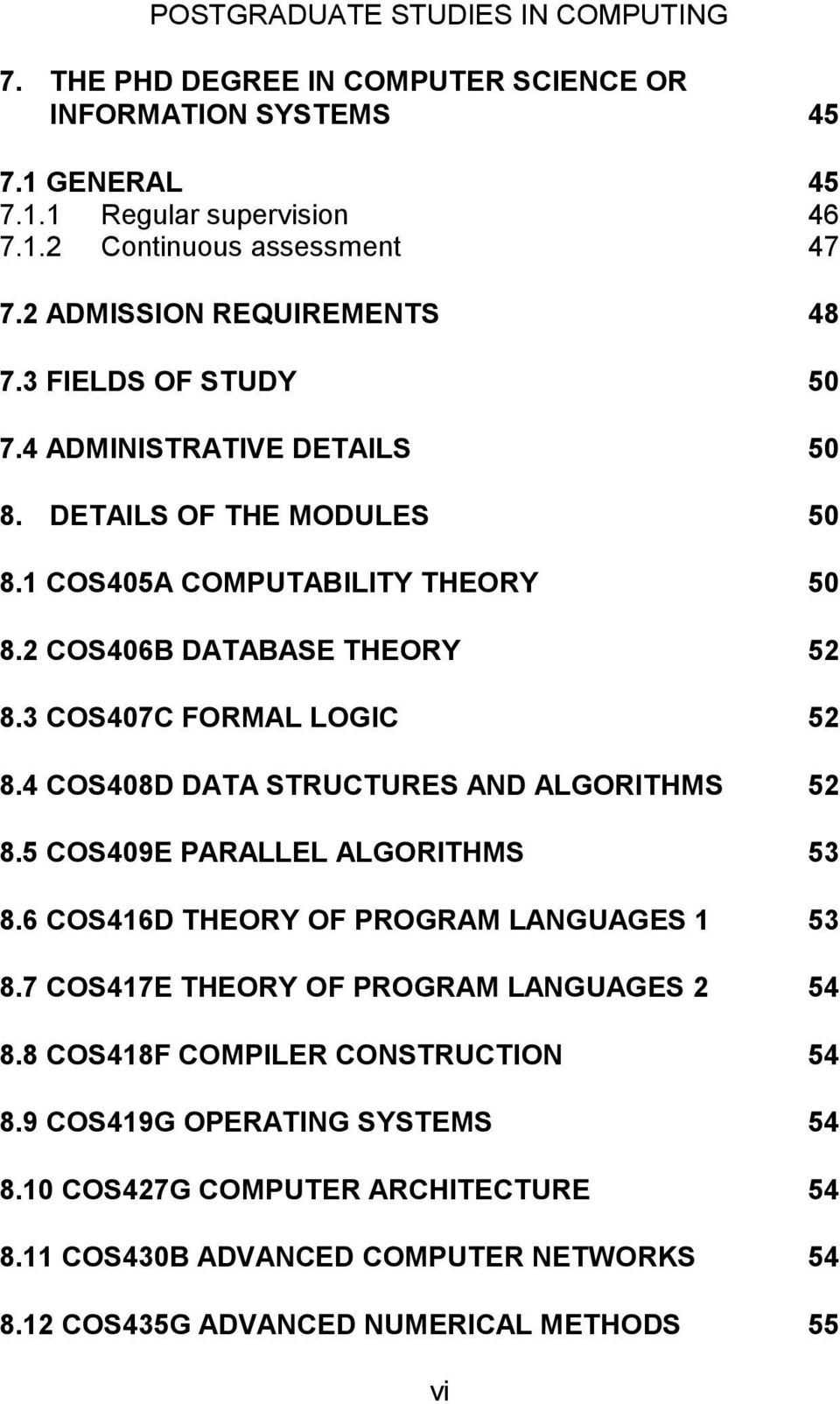
6 7. THE PHD DEGREE IN COMPUTER SCIENCE OR INFORMATION SYSTEMS GENERAL Regular supervision Continuous assessment ADMISSION REQUIREMENTS FIELDS OF STUDY ADMINISTRATIVE DETAILS DETAILS OF THE MODULES COS405A COMPUTABILITY THEORY COS406B DATABASE THEORY COS407C FORMAL LOGIC COS408D DATA STRUCTURES AND ALGORITHMS COS409E PARALLEL ALGORITHMS COS416D THEORY OF PROGRAM LANGUAGES COS417E THEORY OF PROGRAM LANGUAGES COS418F COMPILER CONSTRUCTION COS419G OPERATING SYSTEMS COS427G COMPUTER ARCHITECTURE COS430B ADVANCED COMPUTER NETWORKS COS435G ADVANCED NUMERICAL METHODS 55 vi
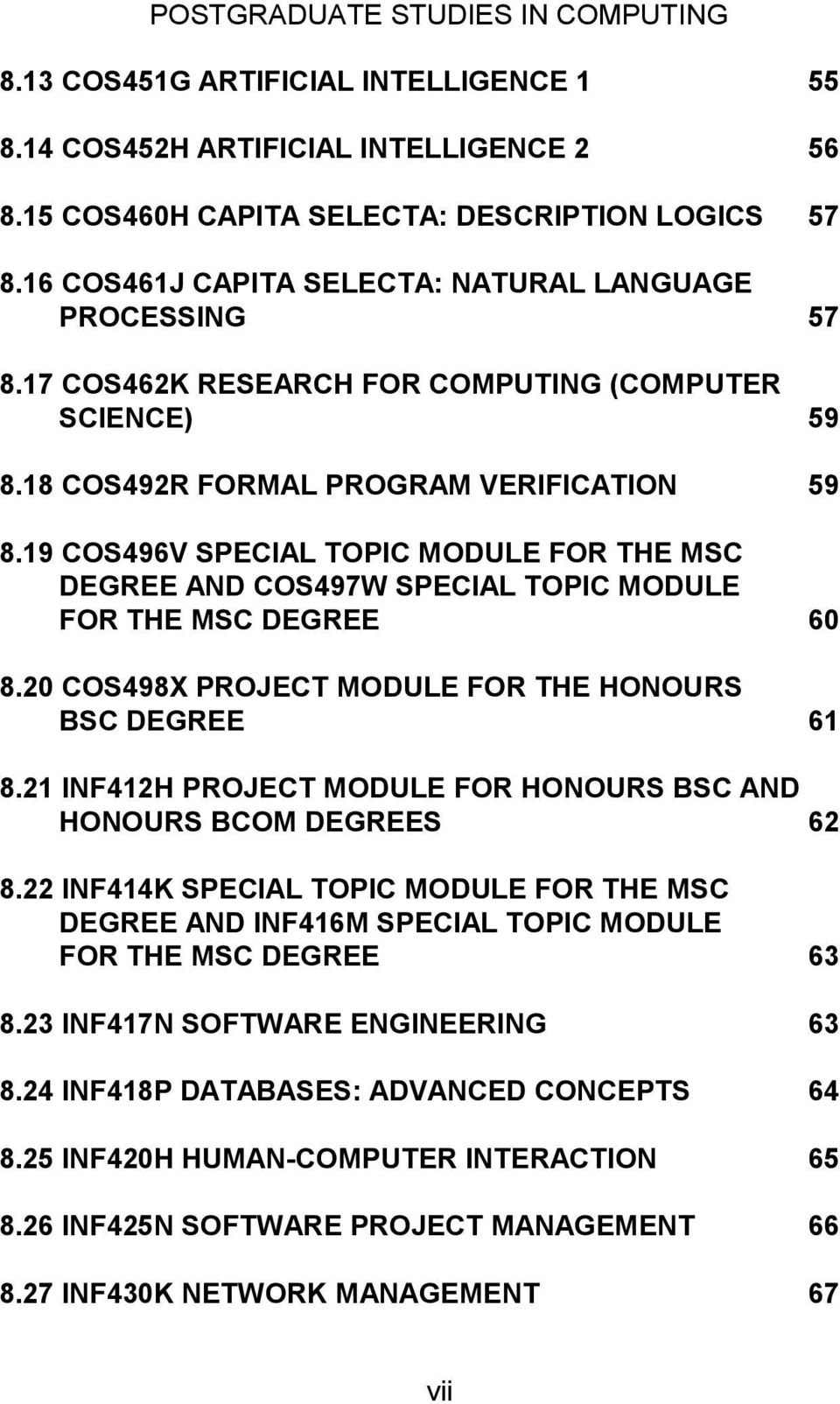
7 8.13 COS451G ARTIFICIAL INTELLIGENCE COS452H ARTIFICIAL INTELLIGENCE COS460H CAPITA SELECTA: DESCRIPTION LOGICS COS461J CAPITA SELECTA: NATURAL LANGUAGE PROCESSING COS462K RESEARCH FOR COMPUTING (COMPUTER SCIENCE) COS492R FORMAL PROGRAM VERIFICATION COS496V SPECIAL TOPIC MODULE FOR THE MSC DEGREE AND COS497W SPECIAL TOPIC MODULE FOR THE MSC DEGREE COS498X PROJECT MODULE FOR THE HONOURS BSC DEGREE INF412H PROJECT MODULE FOR HONOURS BSC AND HONOURS BCOM DEGREES INF414K SPECIAL TOPIC MODULE FOR THE MSC DEGREE AND INF416M SPECIAL TOPIC MODULE FOR THE MSC DEGREE INF417N SOFTWARE ENGINEERING INF418P DATABASES: ADVANCED CONCEPTS INF420H HUMAN-COMPUTER INTERACTION INF425N SOFTWARE PROJECT MANAGEMENT INF430K NETWORK MANAGEMENT 67 vii
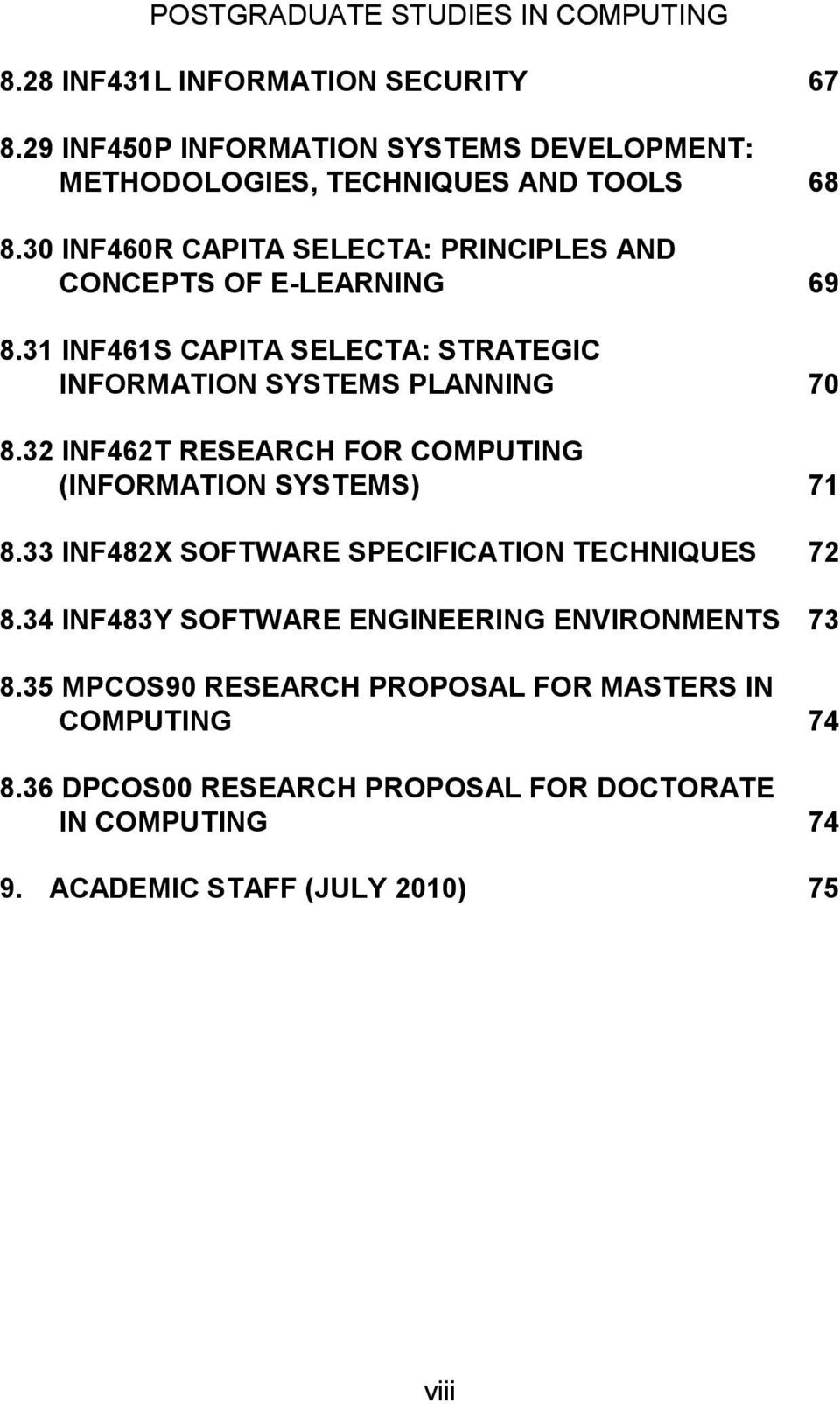
8 8.28 INF431L INFORMATION SECURITY INF450P INFORMATION SYSTEMS DEVELOPMENT: METHODOLOGIES, TECHNIQUES AND TOOLS INF460R CAPITA SELECTA: PRINCIPLES AND CONCEPTS OF E-LEARNING INF461S CAPITA SELECTA: STRATEGIC INFORMATION SYSTEMS PLANNING INF462T RESEARCH FOR COMPUTING (INFORMATION SYSTEMS) INF482X SOFTWARE SPECIFICATION TECHNIQUES INF483Y SOFTWARE ENGINEERING ENVIRONMENTS MPCOS90 RESEARCH PROPOSAL FOR MASTERS IN COMPUTING DPCOS00 RESEARCH PROPOSAL FOR DOCTORATE IN COMPUTING ACADEMIC STAFF (JULY 2010) 75 viii
9 1. INTRODUCTION This brochure contains information on the following degrees: BSc Honours, MSc and PhD in COMPUTER SCIENCE BSc Honours, MSc and PhD in INFORMATION SYSTEMS BCom Honours in BUSINESS INFORMATICS MTech in INFORMATION TECHNOLOGY as presently offered by the School of Computing at the University of South Africa. This information is also available on our School s home page at In order to determine whether you qualify for admission to these postgraduate degrees, and to understand the admission process, please note the following: Step 1: Read this brochure carefully, taking particular notice of the minimum requirements in each case, as well as the focus areas in which we offer postgraduate supervision. Remember that any attempt at registering for a degree for which you do not satisfy the minimum requirements will be unsuccessful and will cost you valuable time. The onus to prove the equivalence of qualifications and courses obtained at other, particularly foreign universities, is on you the student, and will usually require official documentation concerning the abbreviated syllabi of these courses. Step 2: If you satisfy the minimum requirements, you should contact the Department of Student Admissions and Registrations of the University to apply for admission. In the case of the MTech, MSc and PhD degrees, you should then contact the School of Computing for consultation and the appointment of a suitable supervisor or supervisor. Consult the myrules@unisa brochure (also available on the Unisa website regarding administrative details such 1

10 as the general rules for admission to postgraduate studies, documents which must accompany an application for admission, number of modules required for the various degrees, re-registration, duration of study, applications for cancellation and other related details. Step 3: On receiving your registration form from the Department of Student Admissions and Registrations, the School of Computing does a final assessment of your application, and either approves or disallows the final registration based on your study record and the availability of suitable supervision. NOTE: NO REGISTRATION FOR THE MTech, MSc AND PhD DEGREES WILL BE APPROVED WITHOUT CONSULTATION WITH THE SCHOOL OF COMPUTING AND THE APPOINTMENT OF A SUPERVISOR. Step 4: You will be notified in writing by the Department of Student Admissions and Registrations of the University of the decision of the School of Computing. Important note to students with non-south African qualifications: You need to submit your application to the University. The registration section may require you to submit your qualification for evaluation by the South African Qualifications Authority (SAQA) ( SAQA evaluates the level of the qualification; the equivalence as far as subject complexity and content are concerned is determined by the School of Computing. This means that although SAQA may, for example, evaluate a qualification as equivalent to honours or masters level, the qualification may still not meet all the requirements for admission to a particular postgraduate degree in the School of Computing. 1.1 COMPUTER SCIENCE OR INFORMATION SYSTEMS? The School of Computing offers BSc Hons, MSc and PhD tuition in both Computer Science and Information Systems. Computer Science focuses on the theory and practice of computing while Information Systems 2

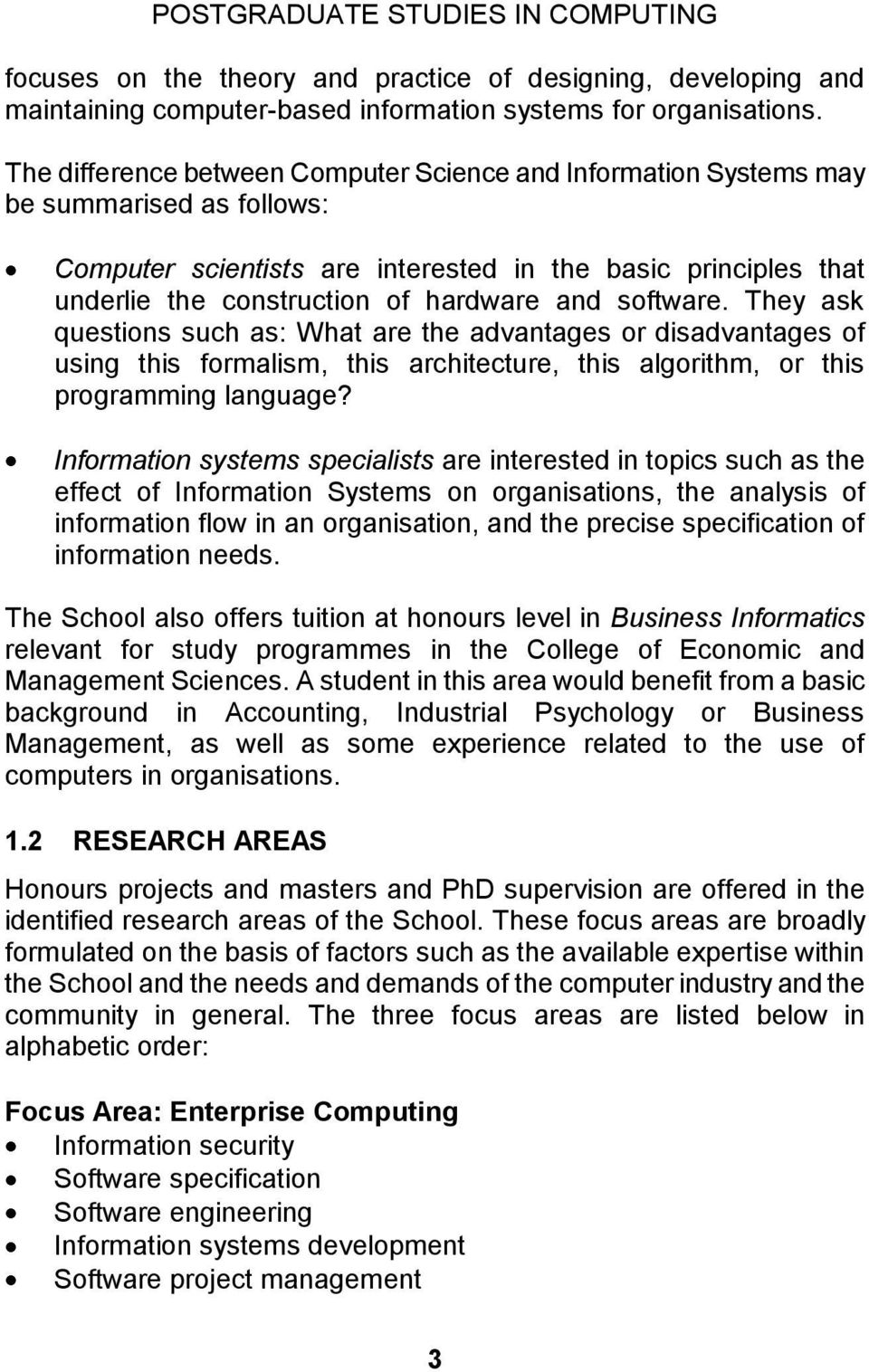
11 focuses on the theory and practice of designing, developing and maintaining computer-based information systems for organisations. The difference between Computer Science and Information Systems may be summarised as follows: Computer scientists are interested in the basic principles that underlie the construction of hardware and software. They ask questions such as: What are the advantages or disadvantages of using this formalism, this architecture, this algorithm, or this programming language? Information systems specialists are interested in topics such as the effect of Information Systems on organisations, the analysis of information flow in an organisation, and the precise specification of information needs. The School also offers tuition at honours level in Business Informatics relevant for study programmes in the College of Economic and Management Sciences. A student in this area would benefit from a basic background in Accounting, Industrial Psychology or Business Management, as well as some experience related to the use of computers in organisations. 1.2 RESEARCH AREAS Honours projects and masters and PhD supervision are offered in the identified research areas of the School. These focus areas are broadly formulated on the basis of factors such as the available expertise within the School and the needs and demands of the computer industry and the community in general. The three focus areas are listed below in alphabetic order: Focus Area: Enterprise Computing Information security Software specification Software engineering Information systems development Software project management 3
12 Focus Area: Human Computer Interaction Human Computer Interaction Electronic education strategies and development (e Learning) ICT for emerging economies Focus Area: Semantic Computing Formal aspects of computing Knowledge systems Natural language processing Research interest areas of supervisors for masters and PhD degrees are also available at THE SOUTH AFRICAN DEGREE STRUCTURE The typical progression of South African research degrees consists of four separate degrees: Bachelor s degree Honours degree Master s degree Doctoral degree Many countries have only three separate degrees: Bachelor s, masters and Doctoral degrees. Some countries refer to a bachelor s degree as a Bachelor s degree with first or second class honours. A Bachelor s degree with first or second class honours is equivalent to a South African Bachelor s degree, not to a South African honours degree, and so puts one in line for admission to a South African honours and not a masters degree. NOTE: In 2012 new degree structures will be introduced for postgraduate degrees offered by the University of South Africa, in accordance with the Higher Education Quality Framework (HEQF) document released by Higher Education and accepted in 2007 (Government Gazette, 2007: 25). 4

13 The new structures of the postgraduate degrees offered in the School of Computing, as well as the conversion from the current (until 2011) to the new structures, will be discussed and explained in detail in the Postgraduate Brochure for Please also take note of the obligatory Research Proposal Modules that will form part of the M and PhD degrees as from 2011 (see Section 2.5). 2. THE BSC HONOURS DEGREE IN COMPUTER SCIENCE OR INFORMATION SYSTEMS BScHons (Computer Science) Degree code: BScHons (Information Systems) Degree code: GOAL AND CURRICULUM Eligible students register for either an Honours BSc degree in Computer Science or an Honours BSc degree in Information Systems, depending on the third level modules that they have passed. In either case, to qualify for the honours degree you need to obtain credit for a minimum of ten postgraduate modules, selected from the list in Section 2.5 in accordance with the guidelines and restrictions given in Section ADMISSION REQUIREMENTS Admission to the Honours BSc degree is subject to the approval of the graduate committee of the School of Computing. The following are the general guidelines for admission Basic Requirements 1. You must hold a Bachelor s degree. 2. You must hold a major in either Computer Science or Information Systems as described below. (UNISA s Diploma or National (University) Certificate in Datametrics with appropriate modules serves as a major provided you also hold a Bachelor s degree.) 5
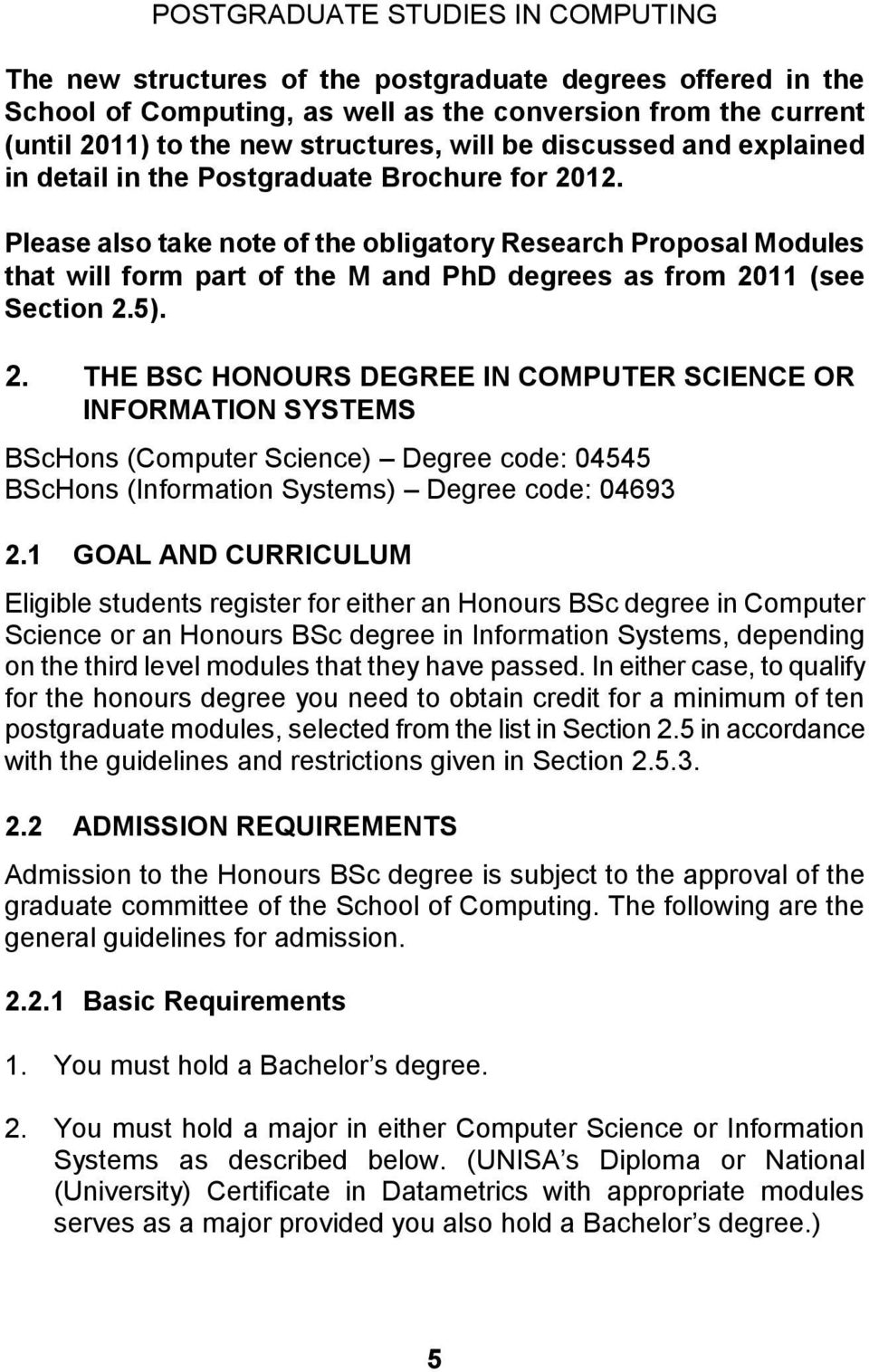
14 For Computer Science at least three of the following third level modules, or equivalents, are required: COS3701 (old code: COS301Y): Theoretical computer science 3 COS3711 (old code: COS3114): Advanced programming COS3721(old code: COS3216): Operating systems and architecture COS3740 (old code: COS340A): Computer graphics COS3751 (old code: COS351D): Techniques of artificial intelligence COS3761 (old code: COS361F): Formal logic For Information Systems the modules INF3703 (old code: INF303D) and INF3705 (old code: INF305F), or equivalent, are required, together with one of the following, or equivalents: INF3706 (old code: INF306G) / COS2626 (old code: COS2269): Computer networks INF3707 (old code: INF307H): Database design and implementation INF3708 (old code: INF308J): Software project management INF3720 (old code: INF320E): Human-computer interaction 2 COS3711 (old code: COS3114): Advanced programming 3. Your academic record must be satisfactory. An average of 60% or more for the final year of the major usually provides direct admission to honours, while an average between 55% and 60% usually provides provisional admission, as elaborated below. 4. Recency: If you completed your major more than five years ago, you should have sufficient professional involvement in computing to ensure that your computing knowledge is current. 5. Internet access: You need to have internet access, for example through work, an internet café or at home. If you do not meet all these academic requirements, you are still welcome to apply for honours admission. UNISA will then specify what preliminary 6
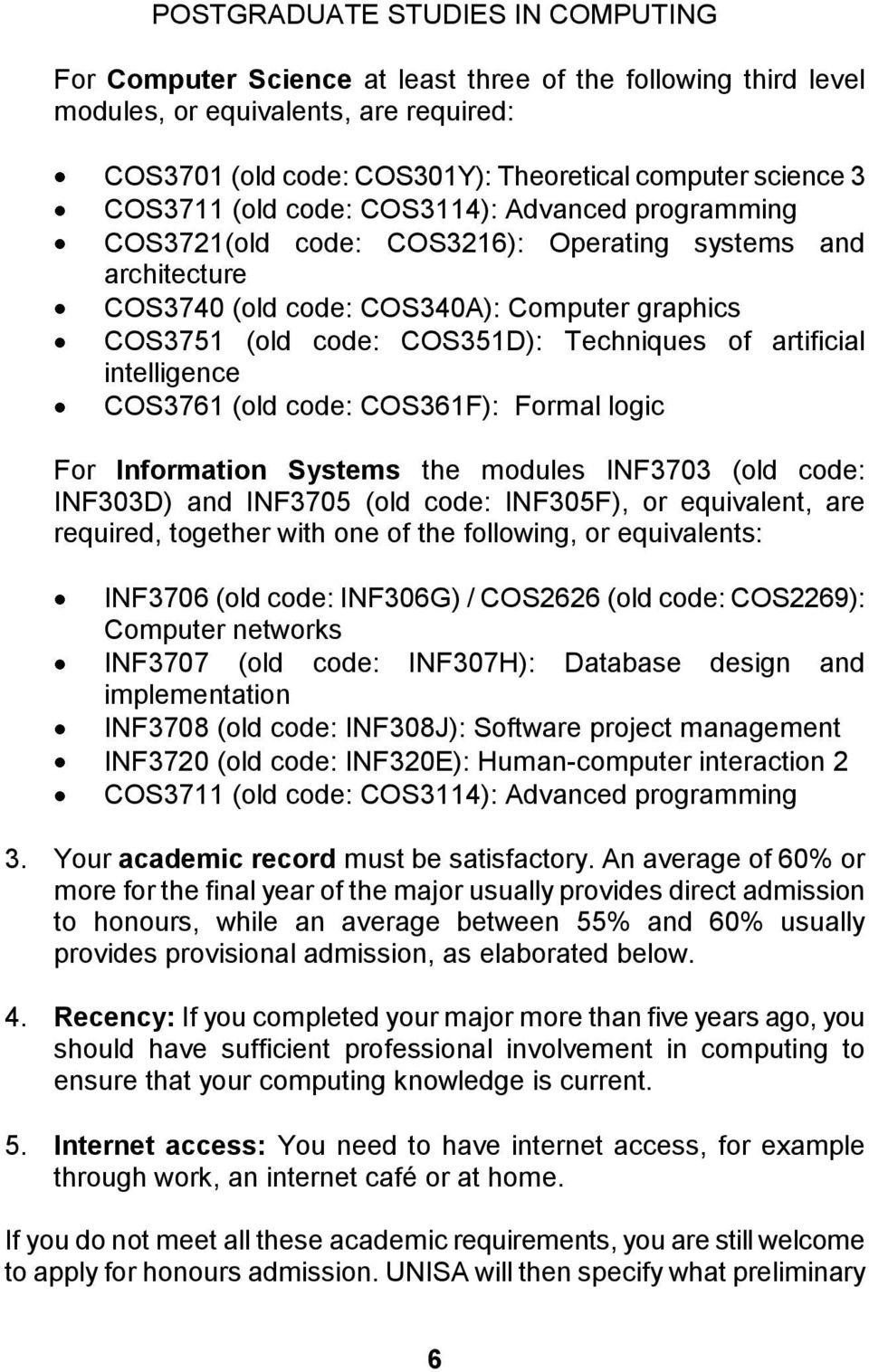
15 study you need to undertake before becoming eligible for admission to the honours programme. Typical requirements for additional study are described below. 2.3 ELABORATING ON THE BASIC REQUIREMENTS 1. Applicants must have a Bachelor s degree and will be admitted according to table 1 below. 2. CS3 denotes a major in Computer Science equivalent to the three module combination in Section above. 3. IS3 denotes a major in Information Systems or Computer Science equivalent to the three module combination in Section above. 4. Admission to Honours in Computer Science requires CS3. 5. Admission to Honours in Information Systems requires IS3. 6. If the major in CS3 or IS3 is older than five years (i.e. dated) then the applicant must have recent relevant experience. 7. Students who satisfy the general honours admission requirements, but who may be missing specific areas in their background, will need to fill in these areas for non-degree purposes as part of their study. Table 1: Admission requirements Standard Provisional admission Admission CS3 or IS3 >=60%) CS3 or IS3 >=55% but <60% CS3 or IS3 <55% "Dated" major, no experience Bachelor s degree without CS or IS major No admission: repeat CS3 or IS3 plus all prerequisite modules 7

16 These guidelines are expressed in table 1 and explained in detail below. 8. Row 1: Recent bachelor s degree with average mark for CS3 or IS3 >=60% with the required relevant subjects: standard admission, with a maximum of five years to complete the honours degree. 9. Row 2: Recent bachelor s degree with average mark for CS3 or IS3 >=55% but < 60% with the required relevant subjects: provisional admission for the first year of honours. Provisional registration means the following: If the student passes at least three honours modules in the first year of registration he or she may continue with the honours programme (with a maximum of five years in total to complete). If the student does not pass at least three honours modules in the first year of registration, the student must first achieve an average of >=60% for three specified CS3/IS3 modules before continuing with the honours. Any credits obtained for the honours are retained for four years. 10. Row 3: Recent bachelor s degree with average mark for CS3 or IS3 < 55% or a dated Bachelor s degree: Appropriate UNISA undergraduate modules, selected in consultation with the School. Subsequent admission to honours is in terms of row 1 or row 2 above. 11. Row 4: Bachelor s degree without CS or IS major: Three UNISA COS3/INF3 modules plus all the prerequisites for these modules, selected in consultation with the School, with an average of >=55%. Subsequent admission to honours is in terms of row 1 or row 2 as indicated above Appropriate undergraduate modules Where needed, UNISA will specify appropriate undergraduate modules to provide the necessary background for honours study and whether these should be taken prior to admission to or concurrently with honours study. 8

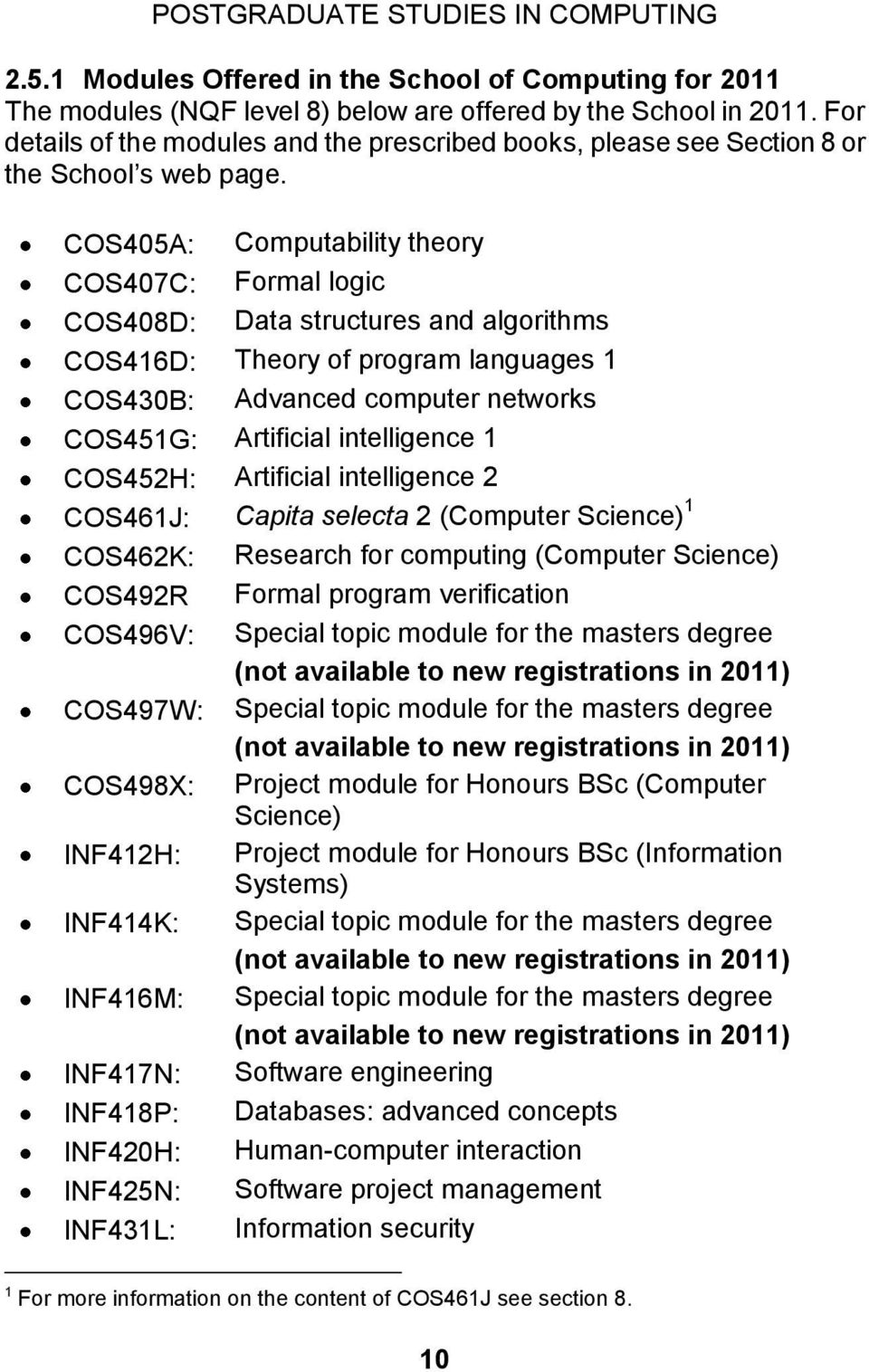
17 2.3.2 Exemptions Exemptions may be considered by the graduate committee of the School of Computing for any of the undergraduate modules on the basis of credits obtained at other tertiary institutions, previous study at UNISA, or knowledge gained through experiential learning Articulation The BSc, BSc Hons, MTech, MSc and PhD degrees in the School of Computing are research-oriented science degrees. However, they do not represent the full spectrum of study in computing. Regularly applicants with other qualifications, for example BEng (Computer Engineering), want to enrol for Hons BSc through UNISA. It is difficult to give hard and fast guidelines for admission in these cases. For example, suitable South African BTech or BEng degrees usually provide admission to honours. However, there are also some foreign BTech and BEng degrees that are comparable to a Hons BSc, and so they could give admission to the MSc programme. UNISA treats each case on its individual merits and will prescribe a suitable course of study for cases in which the background does not match the background needed for direct admission to honours study. 2.4 UNDERGRADUATE MODULES FOR NON-DEGREE PURPOSES There are two reasons why one may wish to do an undergraduate module for non-degree purposes: as preparation for postgraduate study in a subject for which one s background is inadequate, or in order to pursue an interest not catered for by the curriculum one is following. For the official UNISA policy in this regard, please consult Part 1 of the UNISA Calendar. Rule A18 deals specifically with registration for nondegree purposes (NDP). 2.5 POSTGRADUATE MODULES The remaining part of this section consists of the following: 1. A list of the postgraduate modules offered by the School 2. Details on including modules from other departments in your curriculum 9
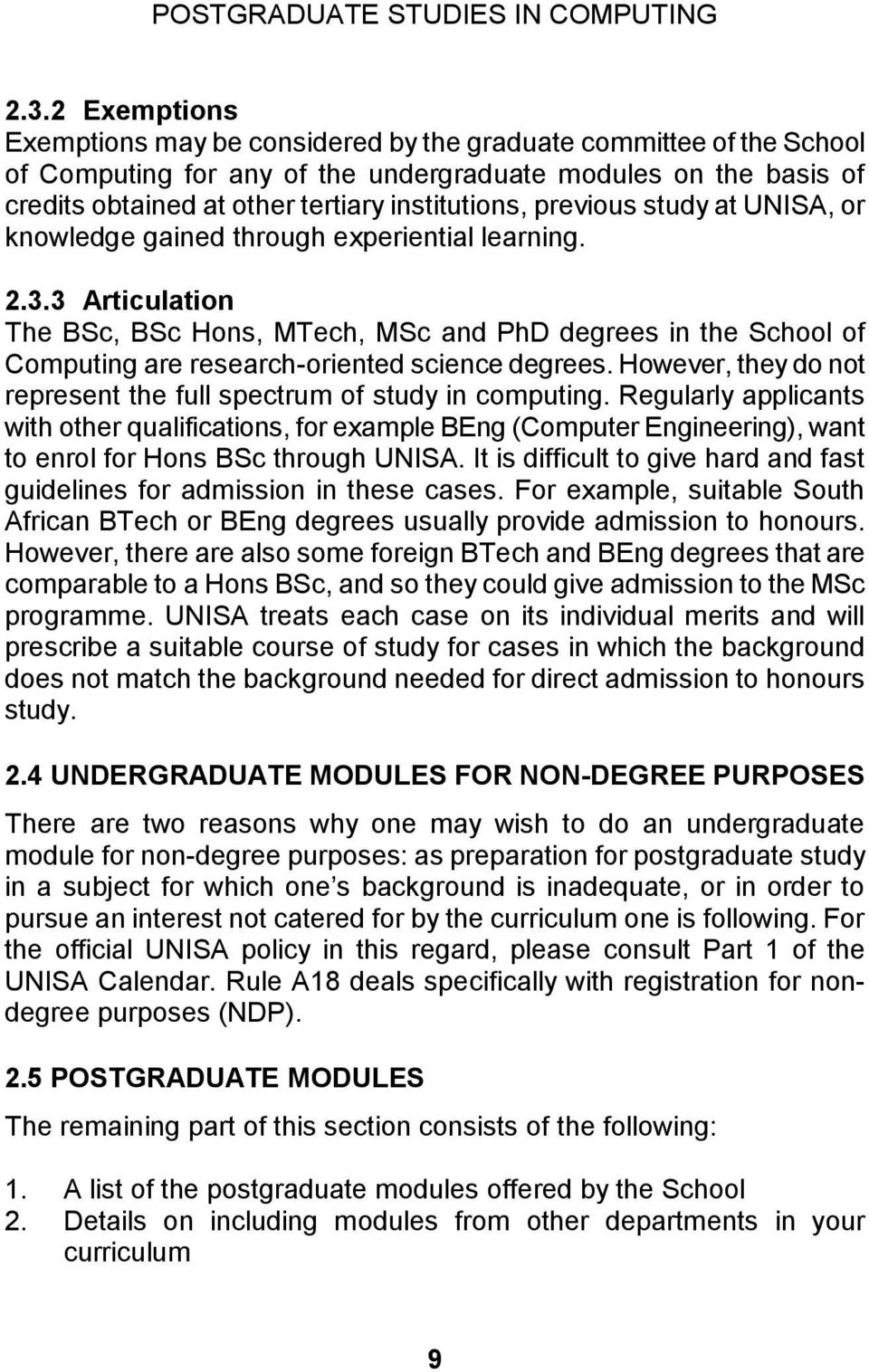
18 2.5.1 Modules Offered in the School of Computing for 2011 The modules (NQF level 8) below are offered by the School in For details of the modules and the prescribed books, please see Section 8 or the School s web page. COS405A: Computability theory COS407C: Formal logic COS408D: Data structures and algorithms COS416D: Theory of program languages 1 COS430B: Advanced computer networks COS451G: Artificial intelligence 1 COS452H: Artificial intelligence 2 COS461J: Capita selecta 2 (Computer Science) 1 COS462K: Research for computing (Computer Science) COS492R Formal program verification COS496V: Special topic module for the masters degree (not available to new registrations in 2011) COS497W: Special topic module for the masters degree (not available to new registrations in 2011) COS498X: Project module for Honours BSc (Computer Science) INF412H: Project module for Honours BSc (Information Systems) INF414K: Special topic module for the masters degree (not available to new registrations in 2011) INF416M: Special topic module for the masters degree (not available to new registrations in 2011) INF417N: Software engineering INF418P: Databases: advanced concepts INF420H: Human-computer interaction INF425N: Software project management INF431L: Information security 1 For more information on the content of COS461J see section 8. 10
19 INF450P: Information systems development: methodologies, techniques and tools (Students who have previously passed INF405J may not register for INF450P.) INF460R: Capita selecta 1 (Information Systems) 2 INF461S: Capita selecta 2 (Information Systems) 3 INF462T: Research for computing (Information Systems) INF482X: Software specification techniques INF483Y: Software engineering environments Registration codes for dissertations and theses: DIS655X: Masters dissertation (Computer Science) DIS695A: Masters dissertation (Information Systems) RPI501I: MTech (Information Technology) Project DIS8524: Doctoral thesis (Information Systems) DIS8535: Doctoral thesis (Computer Science) Obligatory in 2011 for all new registrations New compulsory module for MTech and MSc degrees Module code MPCOS90 NQF level 9 Credits 24 Title Research Proposal for Masters in Computing Obligatory in 2011 for all new registrations New compulsory module for PhD degree Module code DPCOS00 NQF level 10 Credits 24 Title Research Proposal for Doctorate in Computing Modules NOT offered by the School for 2011: COS406B: Database theory COS409E: Parallel algorithms 2 For more information on the content of INF460R see section 8. 3 For more information on the content of INF461S see section 8. 11
20 F POSTGRADUATE STUDIES IN COMPUTING COS417E: Theory of program languages 2 COS418F: Compiler construction COS419G: Operating systems COS427G: Computer architecture COS435G: Advanced numerical methods COS460H: Capita selecta 1 (Computer Science)F INF430K: Network management Modules in other UNISA departments and colleges In the College of Science, Engineering and Technology, a student may include up to two honours papers or four fourth level modules from another subject(s) in his or her honours curriculum, subject to the approval of the graduate committees and/or heads of the departments or schools concerned,. This can only be done if the graduate committees and/or heads of schools or departments consider that the student has sufficient background knowledge to be able to offer such papers/modules and it is in the best interest of the student. Note that a "paper" is usually equivalent to two "modules". If a student takes the maximum of four modules (or two courses) from another subject, he or she may not include any project or capita selecta module (COS460H, COS461J, COS498X, INF412H, INF460R or INF461S) in his or her curriculum Guidelines for selecting and combining modules There are a number of restrictions in composing your curriculum: 1. Students may include a maximum of three of the following modules in their curriculum for the honours degree: (a) COS460H (b) COS461J (c) COS498X or INF412H (d) INF460R (e) INF461S NOTE: None of these modules is compulsory for the honours degree. 4 For more information on the content of COS460H see section
21 2. All students registering for the honours degree for the first time from the 2004 academic year onwards must include a Research for Computing module (either COS462K or INF462T) in their curriculum. This credit must be obtained before registering for a project module unless a student has permission to register for all ten honours modules in a single year (but see point 5 below). 3. Students registering for the honours degree for the first time in the 2011 academic year may not include either COS498X or INF412H in their curriculum. 4. The notional hours needed per module per year are 120 hours. This is the minimum amount of time needed to master the contents of a module. We therefore recommend that part-time students should not enrol for more than 4 modules per year in order for them to spend enough time per module. 5. Based on the modules available within the School of Computing, the following applies: (a) A student must have six or more COS4xx module credits for an honours degree in Computer Science. (b) A student must have six or more INF4xx module credits for the honours degree in Information Systems. (c) Modules with similar codes offered by other schools, for example INFMAN, do not count towards these six credits. 3. THE BCOM HONOURS DEGREE IN BUSINESS INFORMATICS BComHons (Business Informatics) Degree code: GOAL Market research indicates that there is a demand for people who are well trained in general business principles and organisation management, and who are also proficient in information technology (IT). These people are expected to be business analysts, especially on the users side of the 13
22 development of computerised information systems. They should be well informed of the possibilities offered by IT in improving the efficiency of the business. They should understand the impact that computerised systems might have on an enterprise, especially on changes in business processes and how to manage such changes. To support this knowledge, they should also have a thorough understanding of modern development methodologies and the utilisation of computer and telecommunications technology to manage all phases of development, implementation and maintenance of distributed business information systems. By offering the Honours BCom degree in Business Informatics, we are able to accommodate students with a BCom background who do not meet the programming or mathematics prerequisites required for the Honours BSc degree. 3.2 CURRICULUM The curriculum consists of ten module credits made up as follows: 1. Four compulsory modules: INF431L: Information security 5 INF450P: Information systems development: methodologies, techniques and tools 6 INF417N: Software engineering INF418P: Databases: advanced concepts AND 2. Any two approved courses (i.e. the equivalent of four modules, with each course carrying the credit of two modules) at honours level chosen from the following list of subjects in the College of Economic and Management Sciences: 5 6 Students with a credit for INF430K: Network Management may substitute this for INF431L: Information Security on the list of compulsory modules. Students who have previously passed INF405J may not register for INF450P. 14
23 Accounting Accounting (Local government) Auditing Internal auditing Business management Economics Industrial psychology Quantitative management Transport economics Logistics AND 3. Any two modules chosen from the following: INF412H: INF420H: INF425N: INF462T: Project module (Note that INF462T: Research for Computing (Information Systems) is a prerequisite for this module.) Human-computer interaction Software project management Research for computing Notes: 1. Honours modules in Information Systems assume that students have experience in programming. If you lack programming experience, we strongly recommend that you register for either COS1514 (old code: COS114X) or COS1511 (old code: COS111U) and COS1512 (old code: COS112V) for non-degree purposes. 2. You need to have internet access either through your work, an internet café or at home. 3.3 ADMISSION REQUIREMENTS To gain admission to the Honours BCom degree, you have to satisfy certain formal requirements. 15
24 3.3.1 Basic requirements 1. You must hold a BCom (or equivalent) degree. 2. You must hold a major in Information Systems or Informatics as described below. (UNISA s Diploma or National (University) Certificate in Datametrics with appropriate modules serves as a major provided you also hold a non-is BCom degree.) The modules INF3703 (old code: INF303D) and INF3705 (old code: INF305F), or equivalent, are required, together with one of the following, or equivalents: INF3706 (old code: INF306G) / COS2626 (old code: COS2269): Computer networks INF3707 (old code: INF307H): Database design and implementation INF3708 (old code: INF308J): Software project management INF3720 (old code: INF320E): Human-computer interaction 2 3. Your academic record must be satisfactory. An average of 60% or more for the final year of the major usually provides direct admission to honours, while an average between 55% and 60% usually provides provisional admission, as elaborated below. 4. Recency: If you completed your major more than five years ago, you should have sufficient recent professional involvement in computing to ensure that your computing knowledge is current. 5. Internet access: You need to have internet access, for example through work, an internet café or at home. If you do not meet all these requirements, you are still welcome to apply for honours admission. UNISA will then specify what preliminary study you need to undertake before becoming eligible for admission to the honours programme. Typical requirements for additional study are described below Elaborating on the basic requirements 1. Applicants must have a BCom degree, and will be admitted according to table 3 below. 16
25 2. IS3 denotes a major in Information Systems or the three module combination given in section 3.3.1(b) above. 3. If the major in IS3 is older than five years (i.e. dated) then the applicant must have relevant experience. 4. Students who satisfy the honours admission requirements but who may be missing specific areas in their background will need to fill in these areas informally as part of their study. These guidelines are expressed in table 3 and explained below: IS3>=60% IS3>=55% but <60% IS3<55% "Dated" major, no experience No IS major Table 3: Admission requirements Standard admission Provisional admission No admission: repeat IS3 plus all prerequisite modules 1. Row 1: Recent BCom degree with average mark for IS3 >=60% with the relevant required subjects: standard admission, with a maximum of five years to complete the honours degree. 2. Row 2: Recent BCom degree with average mark for IS3 >=55% but <60% with relevant required subjects: provisional admission for the first year of honours. 17
26 Provisional registration means the following: If the student passes at least three honours modules in the first year of registration he/she may continue with the honours programme (with a maximum of five years in total to complete). If the student does not pass at least three honours modules in the first year of registration he/she must first achieve an average of >=60% for three specified undergraduate modules before continuing with the honours. Any credits obtained for the honours are retained for four years. 3. Row 3: Recent BCom degree with average mark for IS3 < 55% or a dated BCom degree: Appropriate UNISA undergraduate modules, selected in consultation with the School. Subsequent admission to honours is in terms of row 1 or row 2 above. 4. Row 4: BCom degree without IS major: Three UNISA INF3 modules plus all the prerequisites, selected in consultation with the School. Subsequent admission to honours is in terms of row 1 or row 2 above Appropriate undergraduate IS3 modules Where needed, UNISA will specify appropriate undergraduate modules to provide the necessary background for honours study. UNISA will also specify whether these should be taken prior to admission to or concurrently with honours study Exemptions Exemptions may be considered by the graduate committee of the School of Computing for any of the undergraduate modules on the basis of credits obtained at other tertiary institutions, previous study at UNISA, or knowledge gained through experiential learning. 4. ADMINISTRATIVE DETAILS: HONOURS DEGREES 1. Concurrent registration for an undergraduate course(s) or module(s) for non-degree purposes: Subject to special permission of Senate students may register for not more than one undergraduate course or two modules on the same level for non- 18
27 degree purposes (NDP) concurrently with an honours course. Such an NDP course/module(s) should have bearing on the honours studies, or a written justification should be submitted that is acceptable to the University. Consult Rule A18 of the UNISA Calendar Part 1 for detailed information regarding registration for NDP. 2. Examinations: With the exception of the project modules (and possibly some of the capita selecta modules), the examinations for fourth level modules each involve a three-hour paper written during the period middle January to the first week in February. For the project modules a project report should be submitted by 15 January for examination, provided that the student has met all the prerequisites set for the project in the preceding year. 3. Requirements for distinction: To be awarded the degree with distinction, you have to obtain an average of at least 75% in the minimum number of prescribed modules (namely ten) on the fourth level. 4. Duration of study and re-registration: Normally students are allowed five years to complete the ten modules required for the degree. Note that you do not qualify automatically for this five year maximum period. Unless your progress is satisfactory every year, you will not be allowed to re-register. Please consult the myrules@unisa brochure for a detailed exposition of the general rules that govern Honours Bachelor s degrees at Unisa. 5. What constitutes satisfactory progress? After the first year, you must have passed at least two modules. After the second year you must have passed at least four modules, and so forth. 6. If things have not worked out too well and you find that after the five year study period you have not managed to pass all ten modules, you may apply for an extension of the study period. Such an extension is not granted automatically, but your application will be considered if you have obtained credit for at least eight modules. 19
28 7. Master s and Doctoral students queries must be directed to: [email protected] 5. THE MSC DEGREE IN COMPUTER SCIENCE OR INFORMATION SYSTEMS MSc (Computer Science) Degree code: MSc (Information Systems) Degree code: MSc (Computer Science) Dissertation Registration code: DIS655X MSc (Information Systems) Dissertation Registration code: DIS695A 5.1 GENERAL The objective of the programme for the MSc in Computer Science or Information Systems is to expose students to more advanced topics in the chosen field of study, as well as providing students with the opportunity of doing supervised research in a specialised area. This area of specialisation should fall within the scope of the mentioned research focus areas of the School of Computing. In order to be HEQF compliant the existing MSc degrees should as from 2011 include a compulsory 24 credit research proposal module under supervision as required by the current HEQF qualification framework. The Masters programme will be a full dissertation programme with the introduction of a compulsory 24 credit research proposal module under supervision. In the following section we differentiate between registrations prior to 2011 and new registrations in REGISTRATION PRIOR TO 2011 For registrations prior to 2011 the curriculum consists of a research dissertation on an approved topic and three to five postgraduate modules specified and approved by the School of Computing. For more details see section
29 The research programme towards an MSc degree includes the completion of advanced postgraduate modules in which important background material is taught. MSc degrees are awarded subsequent to the successful completion of these modules and a period of research which includes the submission of a dissertation based upon a research project, an external examination process and possibly an oral examination, together with a series of progress reports and a seminar governed by School regulations. The dissertation is expected to display a comprehensive specialised knowledge of some part or aspect of the field of study, and to make some contribution to knowledge and understanding in the area of specialisation. Before being awarded an MSc degree, a student must be able to do the following: Demonstrate an in-depth understanding of the scientific body of knowledge relevant to the topic. A student must understand the fundamentals of the relevant subjects be able to identify and discuss the areas of conflict and consensus, as well as the gaps in the existing body of knowledge and what bearing they have on the topic Demonstrate the ability to formulate an appropriate research design and a clear research plan. Discuss the relationship between the relevant body of knowledge and the proposed research. Demonstrate the ability to draw meaningful conclusions. The student must be able to draw conclusions, make generalisations and/or confirm existing research results identify and discuss questions raised and how they could be investigated in future research demonstrate the proficiency in appropriate research methodology and scientific writing Regular supervision Although UNISA is a distance education institution, advanced degrees cannot be obtained through correspondence only. All students must receive regular supervision in one of two ways: 21
30 Regular weekly or monthly supervision meetings in person lasting at least an hour. At these meetings the student s progress and work will be discussed and assessed. OR An annual visit of at least ten working days to the School for the purpose of supervision, to deliver the required seminars, conduct research in the laboratories and/or library, and plan future research. The costs of such visits (including travel and accommodation) must be covered by the student Continuous assessment During the course of working towards a research degree in Computer Science or Information Systems, the work of a student is subjected to a number of assessments. These are to allow the student s progress to be monitored and any problems to be dealt with as early as possible during the study period. At each stage of assessment the student will be expected to reach a standard determined by the supervisor and assessor (an internal or external examiner other than the supervisor) acting on the behalf of the graduate committee of the School of Computing. For MSc students, re-registration for the next year of study depends on reaching the required standard in the assessed work. If the supervisor and assessor are not of the opinion that the student has achieved the required standard at the first attempt, the student will usually be given an opportunity to revise or repeat part or all of the work. This revision will be based on written feedback from the supervisor and assessor, covering those aspects of the work that need to be improved and the time frames allowed. If a student is still not able to meet the requirements, re-registration for the next academic year will not be approved. All work for assessment must be completed and submitted by the published deadlines unless an extension has been granted by the graduate committee of the School of Computing. Such an extension will normally be given solely on academic grounds (that is, personal reasons such as work pressure, overseas trips or not having enough time to spend on studies cannot be taken into consideration). 22
31 The work that is subject to assessment includes (but is not limited to) the following: The formal course work Progress reports A literature review and seminar The research proposal and seminar A draft article to be submitted to a reputable journal or conference A research dissertation, examined by at least two internationally recognised examiners, followed by an oral defence, if required Details with regard to the time frames for these will be provided by the supervisor in consultation with the graduate committee of the School of Computing Curriculum In the case of both Computer Science and Information Systems, the curriculum consists of two components, namely course work in the form of three to five modules and a research dissertation. It should be noted that the finalisation of an MSc curriculum cannot be done without active consultation between the student, the School of Computing and designated supervisor the submission of the dissertation cannot proceed unless the course work has been completed to the satisfaction of the graduate committee of the School of Computing the final mark for the MSc is determined by the dissertation only Modules specified by the School of Computing The sole purpose of the course work is to provide, in a structured and organised way, the subject fundamentals and background material necessary for doing the research dissertation. In other words, the choice of modules will be closely linked to the student s background and basic research area. For this reason the topics of these modules must be chosen in consultation with the student s supervisor and subsequently approved by the graduate committee of the School of Computing. So, once the complete MSc curriculum (that is, the number and contents of modules to 23
32 be included as well as the research topic of the dissertation) has been finalised, the supervisor submits it in writing to the graduate committee for formal and written approval. A maximum of two academic years may be taken to pass these modules. Particulars regarding the available modules appear in sections 2.5 and 8 of this brochure. In exceptional cases the requirement of completing some or all of the modules may be waived, provided that a written justification by the supervisor is submitted to and approved by the graduate committee of the School of Computing Research dissertation on an approved topic Dissertation Registration code: DIS655X (Computer Science) or DIS695A (Information Systems) The student will only be allowed to submit the dissertation for examination once the modules have been completed to the satisfaction of the graduate committee of the School of Computing. Students must register for the dissertation (DIS655X or DIS695A) every year, from the start of their masters studies up to the completion of their degree. Due to the international status of the potential examiners, the preferred language of the dissertation is English. If your dissertation is written in another language you may be requested to provide a complete transcript in English, as well as transcripts of any other documentation submitted in the course of your research. Any costs incurred will be the responsibility of the student Supervisor first, then your studies Since the MSc degree comprises a dissertation and course work to support this dissertation, it is necessary for us to appoint a supervisor for you upon first registration to guide and advise you in choosing your research topic together with the appropriate supporting modules. The 24
33 idea is that these modules should provide the background knowledge for the planned dissertation, and that the dissertation should, in turn, provide evidence that you understand the current research literature in your chosen field. The module selection must therefore be done in consultation with your supervisor. 5.3 REGISTRATIONS IN 2011 For new registrations in 2011 the curriculum will include a compulsory 24 credit research proposal module, (Code: MPCOS90), which will only be offered in English. Completion of MPCOS90 is a prerequisite for registration for the research dissertation The research programme towards an MSc degree includes the completion of (i) a research proposal module (MPCOS90) in which a proposal is developed on which the subsequent research and (ii) the research dissertation will be based. Registration for and execution of the research towards the research dissertation strictly follows the completion, submission and formal acceptance by the graduate committee of the School of Computing of the research proposal. An MSc degree is awarded subsequent to the successful completion of the proposal module and a period of research which includes the submission of a dissertation based upon a research project, an external examination process and possibly an oral examination, together with a series of progress reports and a seminar governed by School regulations. The dissertation is expected to display a comprehensive specialised knowledge of some part or aspect of the field of study, and to make some contribution to knowledge and understanding in the area of specialisation. Before being awarded an MSc degree, a student must be able to do the following: Demonstrate an in-depth understanding of the scientific body of knowledge relevant to the topic. A student must understand the fundamentals of the relevant subjects be able to identify and discuss the areas of conflict and consensus, as well as the gaps in the existing body of knowledge and what bearing they have on the topic 25
34 Demonstrate the ability to formulate an appropriate research design and a clear research plan. Discuss the relationship between the relevant body of knowledge and the proposed research. Demonstrate the ability to draw meaningful conclusions. The student must be able to draw conclusions, make generalisations and/or confirm existing research results identify and discuss questions raised and how they could be investigated in future research demonstrate the proficiency in appropriate research methodology and scientific writing Regular supervision Although UNISA is a distance education institution, advanced degrees cannot be obtained through correspondence only. All students must receive regular supervision in one of two ways: Regular weekly or monthly supervision meetings in person lasting at least an hour. At these meetings the student s progress and work will be discussed and assessed. OR An annual visit of at least ten working days to the School for the purpose of supervision, to deliver the required seminars, conduct research in the laboratories and/or library, and plan future research. The costs of such visits (including travel and accommodation) must be covered by the student Continuous assessment During the course of working towards a research degree in Computer Science or Information Systems, the work of a student is subjected to a number of assessments. These are to allow the student s progress to be monitored and any problems to be dealt with as early as possible during the study period. At each stage of assessment the student may be expected to reach a standard determined by the supervisor and assessor (an internal or external examiner other than the supervisor) acting on the behalf of the graduate committee of the School of Computing. 26
35 For MSc students, re-registration for the next year of study depends on reaching the required standard in the assessed work. If the supervisor and assessor are not of the opinion that the student has achieved the required standard at the first attempt, the student will usually be given an opportunity to revise or repeat part or all of the work. This revision will be based on written feedback from the supervisor and assessor, covering those aspects of the work that need to be improved and the time frames allowed. If a student is still not able to meet the requirements, re-registration for the next academic year will not be approved. All work for assessment must be completed and submitted by the published deadlines unless an extension has been granted by the graduate committee of the School of Computing. Such an extension will normally be given solely on academic grounds (that is, personal reasons such as work pressure, overseas trips or not having enough time to spend on studies cannot be taken into consideration). The work that is subject to assessment includes (but is not limited to) the following: Completing formal course work (for non-degree purposes) if the student s background is found to be lacking in certain aspects Progress reports A literature review and seminar The research proposal and seminar A draft article to be submitted to a reputable journal or conference A research dissertation, examined by at least two internationally recognised examiners, followed by an oral defence, if required Details with regard to the time frames for these will be provided by the supervisor in consultation with the graduate committee of the School of Computing Curriculum In the case of both Computer Science and Information Systems, the curriculum consists of two components, namely the research proposal module MPCOS90, and the research dissertation. It should be noted that: the finalisation of an MSc curriculum cannot be done without active consultation between the student, the School of Computing and 27
36 designated supervisor the registration for the research dissertation cannot proceed before MPCOS90 has been formally completed and the proposal accepted by the graduate committee of the School of Computing the final mark for the MSc is determined by the dissertation only Completion of module MPCOS90 A maximum of one academic year may be used to pass this module, with possible extension to at most eighteen months. Such an extension will be granted in accordance with the recommendation of the graduate committee of the School of Computing Research dissertation on an approved topic Dissertation Registration code: DFCOS91 (Computer Science) or DFINF91 (Information Systems) Students can only register for the dissertation (DIS655X or DIS695A) once the research proposal module MPCOS90 has been formally completed. This module will be only offered in English. Due to the international status of the potential examiners, the preferred language of the dissertation is English. If your dissertation is written in another language you may be requested to provide a complete transcript in English, as well as transcripts of any other documentation submitted in the course of your research. Any costs incurred will be the responsibility of the student Supervisor first, then your studies Since the MSc degree comprises a research proposal under supervision and a research dissertation it is necessary for us to appoint a supervisor for you upon first registration to guide and advise you in choosing your research topic together with appropriate supporting modules/material. The idea is that work towards the research proposal module should include the acquisition of background knowledge and provide structure to the planned dissertation, and that the dissertation should, in turn, provide evidence that you understand the current research literature in your chosen field. The planning of the research and the research proposal development must therefore be done in consultation with your supervisor. 28
37 5.4 ADMISSION REQUIREMENTS Please note that all MSc admissions are subject to the availability of a suitable supervisor within the School of Computing If you wish to register for the MSc degree in either Computer Science or Information Systems you must meet the following minimum requirements: 1. You must be in possession of an Honours BSc degree, which is a postgraduate qualification (see Section 1.3) or an equivalent qualification in the subject concerned. If this degree was not obtained at UNISA, the content and standard of this degree must be equivalent in terms of complexity, content and weight (that is, number of courses or modules) to the BSc Honours degree in Computer Science or Information Systems at UNISA. Please note that Honours BSc degrees in subjects other than Computer Science and Information Systems are not considered equivalent qualifications. BTech degrees obtained at Technikons and Universities of Technology are not equivalent to Honours BSc degrees and typically give admission to honours level study. 2. You must have obtained an average of at least 60% for the honours examination in paragraph 1 above and have an outstanding academic record (i.e. without failed examinations, noshows for examinations, or examination admission refusals). 3. If you meet all these requirements, you must submit an official application for admission to the masters programme via the Department of Student Admissions and Registrations, according to UNISA procedures. This application must be accompanied by documentation including the following: Original transcripts/academic records of all your prior qualifications. Certified copy of your ID/Passport 29
38 F will POSTGRADUATE STUDIES IN COMPUTING Official syllabi descriptions of courses you have completed for your honours degree (not necessary if you received your honours degree through UNISA). A basic research proposal indicating the proposed field/topic of study, and your background expertise in this area. An evaluation certificate by the South African Qualifications Authority (SAQA) for non-south African qualifications may be requested by the registration section. 4. The Department of Student Admissions and Registrations will assess your prior qualifications or refer you to the appropriate authority for such assessment. This could be a lengthy process, so we advise you to start long before the closing date for registration. Only after it has been determined that you meet the minimum requirements for the degree, will the Department of Student Admissions and Registrations forward your file to the School of Computing for admission consideration. 5. The School of Computing will then determine the suitability of your prior qualifications for entry into the masters programme in the School. If the prior qualifications of the candidate are deemed 7 appropriate, the basic research proposalf be matched to the expertise and availability of supervisors. If a suitable supervisor cannot be found, the student may be asked to reconsider or modify his or her research proposal in order to be accommodated. Compliance with the formal requirements does not guarantee admission to the MSc programme. Admission is always subject to the approval of the graduate committee of the School of Computing. This approval in turn depends on your academic record as a whole, and on whether a suitable potential supervisor can be identified amongst the senior academic staff members of the School. Before your admission to studies towards the MSc degree, therefore, you are obliged to discuss your proposed area of specialisation with the graduate committee of the School (or its delegate). Such discussions should preferably be undertaken in person, by appointment, but if it is impossible for you to visit the School the dialogue may be pursued, albeit with diminished efficiency, via telephone, letter, 7 Consult for a document with the research interest of supervisors within the School of Computing. 30
39 facsimile or electronic mail. It cannot be overemphasised that a crucial hurdle to overcome is that of arriving at a mutually satisfactory agreement with a supervisor. For all practical purposes, when you move beyond the honours level in your studies it is no longer only the School of Computing that accepts you as a student, but also an individual in the person of your supervisor. The relationship between the student and the supervisor is usually a reasonably close one, and constructive interaction and collaboration is of utmost importance. As from 2011 there will be a formal agreement between the supervisor and the student, which will have to co-signed at final registration. This agreement supports the following rather widely acceptable international protocol in our field that governs this relationship: 1. A potential supervisor has the prerogative to refuse your request for supervision without being obliged to give reasons for doing so. These reasons may be work-related, or the supervisor may simply not feel comfortable with you as a person or may not feel at ease with your proposed project. Whatever the case, most academics will not easily forfeit the opportunity of postgraduate supervision, so be assured that you will not be refused admission for trivial reasons. 2. However, if your request is accepted, then the supervisor will continue to act in this capacity unless you withdraw and seek someone else, or you do not meet the re-registration criteria. Again, a student has the prerogative to withdraw in the early phases of a research project, perhaps moving on to another supervisor. However, the student does not have the right to migrate work that might relate to a larger research project of one supervisor over to some other supervisor, unless there is a general agreement amongst all parties concerned about the matter. Thus, changing your supervisor may also mean starting with a new research project. NOTE 1: NO REGISTRATION FOR THE MSc DEGREE WILL BE APPROVED WITHOUT CONSULTATION WITH THE SCHOOL OF COMPUTING, AND THE SUBSEQUENT APPOINTMENT OF A SUPERVISOR. MERELY FILLING OUT THE APPLICATION FORM AND 31
40 PAYING THE REGISTRATION FEES DOES NOT MEAN THAT YOU ARE REGISTERED FOR THE DEGREE OR THAT YOU HAVE BEEN ACCEPTED AS A STUDENT. NOTE 2: A student is required to have personal contact with the supervisor, and should spend a period of time at UNISA. Typically this would total two weeks per year, either in the form of regular consultations, or an annual visit. The scheduling of these visits should be done in consultation with and the supervisor and the graduate committee of the School of Computing, and must receive their approval. Subsistence and travel costs and arrangements remain the responsibility of the student. NOTE 3: Access to the internet is a requirement for students registering for a masters degree in Computer Science or Information Systems. Access to the internet can be through internet cafés if a student does not have access to the internet at work or at home. 5.5 FIELDS OF STUDY AND SELECTION OF MODULES Fields of study: Although your degree will be in either Computer Science or Information Systems, your chosen field of specialisation should fall within the mentioned research focus areas of the School, as listed in Section 1.2. For registrations prior to 2011: You should compile your curriculum in consultation with your MSc supervisor. This means that you should not fill in your choice of modules on your registration form until you have been allocated a supervisor and have decided together on a mutually acceptable set of modules for the year. As mentioned in section 5.2, the curriculum comprises three to five modules selected either because they fill gaps in your general background or because they cover topics relevant to your proposed dissertation, and are normally completed before tackling the dissertation. The modules need to be selected from the list in section 2.5 and may include a maximum of three of the four special topic modules with the codes COS496V, COS497W, INF414K and INF416M. The actual contents of these special topic modules are determined in collaboration with your supervisor. 32
41 5.6 ADMINISTRATIVE DETAILS 1. The examinations for fourth level modules take place in January/February and comprise one three-hour paper per module. In the case of a special topic module, a student may be required to write a three-hour paper or submit a report by 15 January which is then examined. In some cases, an additional oral examination may also be arranged. The mode of final assessment of the special topic module is the prerogative of the supervisor. 2. To obtain the degree with distinction, a student must obtain an average of at least 75% in the minimum prescribed requirements. For students who were admitted to MSc studies in 2005 and since, the dissertation is the only requirement. For students who were admitted before 2005, the requirements include the course work and a dissertation of limited scope 3. Re-registration is subject to satisfactory progress in the opinion of the graduate committee of the School of Computing. Credit for a module passed is retained for a maximum of four successive academic years. 4. Deferment of studies may be approved under exceptional circumstances for a maximum of two years. See Part 1 of UNISA's Calendar, rule PG6. 6. THE MTECH DEGREE IN INFORMATION TECHNOLOGY MTech (Information Technology) Degree code: MTINTE MTech (Information Technology) Research Project Registration code: RPI501I 6.1 GENERAL Access to the internet is a requirement for students registering for a MTech degree in Information Technology. Access to the internet can be through internet cafés if a student does not have access to the internet at work or at home. 33
42 The objective of the programme for the MTech in Information Technology is to expose students to more advanced topics, as well as providing students with the opportunity of doing supervised research in a specialised area. This area of specialisation should fall within the scope of the mentioned research focus areas of the School of Computing. In order to be HEQF compliant the existing MTech degree should as from 2011 include a compulsory 24 credit research proposal module under supervision as required by the current HEQF qualification framework. The MTech programme will be a full dissertation research programme with the introduction of a compulsory 24 credit research proposal module under supervision as required by the current HEQF qualification framework. In the following section we differentiate between registrations prior to 2011 and new registrations in REGISTRATION PRIOR TO 2011 For registrations prior to 2011 the curriculum consists of a research dissertation on an approved topic and three to five postgraduate modules specified and approved by the School of Computing. The research programme towards an MTech degree includes the completion of advanced postgraduate modules in which important background material is taught. MTech degrees are awarded subsequent to the successful completion of these modules and a period of research which includes the submission of a dissertation based upon a research project, an external examination process and possibly an oral examination, together with a series of progress reports and a seminar governed by School regulations. The dissertation is expected to display a comprehensive specialised knowledge of some part or aspect of the field of study, and to make some contribution to knowledge and understanding in the area of specialisation. Before being awarded an MTech degree, a student must be able to do the following: 34
43 Demonstrate an in-depth understanding of the scientific body of knowledge relevant to the topic. A student must understand the fundamentals of the relevant subjects be able to identify and discuss the areas of conflict and consensus, as well as the gaps in the existing body of knowledge and what bearing they have on the topic Demonstrate the ability to formulate an appropriate research design and a clear research plan. Discuss the relationship between the relevant body of knowledge and the proposed research. Demonstrate the ability to draw meaningful conclusions. The student must be able to draw conclusions, make generalisations and/or confirm existing research results identify and discuss questions raised and how they could be investigated in future research demonstrate the proficiency in appropriate research methodology and scientific writing Regular supervision Although UNISA is a distance education institution, advanced degrees cannot be obtained through correspondence only. All students must receive regular supervision in one of two ways: Regular weekly or monthly supervision meetings in person lasting at least an hour. At these meetings the student s progress and work will be discussed and assessed. OR An annual visit of at least ten working days to the School for the purpose of supervision, to deliver the required seminars, conduct research in the laboratories and/or library, and plan future research. The costs of such visits (including travel and accommodation) must be covered by the student Continuous assessment During the course of working towards a research degree in Information Technology, the work of a student is subjected to a number of 35
44 assessments. These are to allow the student s progress to be monitored and any problems to be dealt with as early as possible during the study period. At each stage of assessment the student will be expected to reach a standard determined by the supervisor and assessor (an internal or external examiner other than the supervisor) acting on the behalf of the graduate committee of the School of Computing. For MTech students, re-registration for the next year of study depends on reaching the required standard in the assessed work. If the supervisor and assessor are not of the opinion that the student has achieved the required standard at the first attempt, the student will usually be given an opportunity to revise or repeat part or all of the work. This revision will be based on written feedback from the supervisor and assessor, covering those aspects of the work that need to be improved and the time frames allowed. If a student is still not able to meet the requirements, re-registration for the next academic year will not be approved. All work for assessment must be completed and submitted by the published deadlines unless an extension has been granted by the graduate committee of the School of Computing. Such an extension will normally be given solely on academic grounds (that is, personal reasons such as work pressure, overseas trips or not having enough time to spend on studies cannot be taken into consideration). The work that is subject to assessment includes (but is not limited to) the following: The formal course work Progress reports A literature review and seminar The research proposal and seminar A draft article to be submitted to a reputable journal or conference A research dissertation, examined by at least two internationally recognised examiners, followed by an oral defence, if required Details with regard to the time frames for these will be provided by the supervisor in consultation with the graduate committee of the School of Computing. 36
45 6.2.3 Curriculum The curriculum consists of two components, namely course work in the form of three to five modules and a research dissertation. It should be noted that the finalisation of an MTech curriculum cannot be done without active consultation between the student, the School of Computing and designated supervisor the submission of the dissertation cannot proceed unless the course work has been completed to the satisfaction of the graduate committee of the School of Computing the final mark for the MTech is determined by the dissertation only Modules specified by the School of Computing The sole purpose of the course work is to provide, in a structured and organised way, the subject fundamentals and background material necessary for doing the research dissertation. In other words, the choice of modules will be closely linked to the student s background and basic research area. For this reason the topics of these modules must be chosen in consultation with the student s supervisor and subsequently approved by the graduate committee of the School of Computing. So, once the complete MTech curriculum (that is, the number and contents of modules to be included as well as the research topic of the dissertation) has been finalised, the supervisor submits it in writing to the graduate committee for formal and written approval. A maximum of two academic years may be taken to pass these modules. Particulars regarding the available modules appear in sections 2.5 and 8 of this brochure. In exceptional cases the requirement of completing some or all of the modules may be waived, provided that a written justification by the supervisor is submitted to and approved by the graduate committee of the School of Computing. 37
46 6.2.5 Research dissertation on an approved topic Research Dissertation code: RPI501I The student will only be allowed to submit the dissertation for examination once the modules have been completed to the satisfaction of the graduate committee of the School of Computing. Students must register for the dissertation every year, from the start of their masters studies up to the completion of their degree. Due to the international status of the potential examiners, the preferred language of the dissertation is English. If your dissertation is written in another language you may be requested to provide a complete transcript in English, as well as transcripts of any other documentation submitted in the course of your research Supervisor first, then your studies Since the MTech degree comprises a dissertation and course work to support this dissertation, it is necessary for us to appoint a supervisor for you upon first registration to guide and advise you in choosing your research topic together with the appropriate supporting modules. The idea is that these modules should provide the background knowledge for the planned dissertation, and that the dissertation should, in turn, provide evidence that you understand the current research literature in your chosen field. The module selection must therefore be done in consultation with your supervisor. 6.3 NEW REGISTRATIONS IN 2011 For new registrations in 2011 the curriculum will include a compulsory 24 credit research proposal module, (Code: MPCOS90), which will only be offered in English. Completion of MPCOS90 is a prerequisite for registration for the research dissertation (DFINT91). The research programme towards an MTech degree includes the completion of (i) a research proposal module (MPCOS90) in which a proposal is developed on which the subsequent research and (ii) the research dissertation will be based. Registration for and execution of the 38
47 research towards the research dissertation strictly follows the completion, submission and formal acceptance by the graduate committee of the School of Computing of the research proposal. An MTech degree is awarded subsequent to the successful completion of the proposal module and a period of research which includes the submission of a dissertation based upon a research project, an external examination process and possibly an oral examination, together with a series of progress reports and a seminar governed by School regulations. The dissertation is expected to display a comprehensive specialised knowledge of some part or aspect of the field of study, and to make some contribution to knowledge and understanding in the area of specialisation. Before being awarded an MTech degree, a student must be able to do the following: Demonstrate an in-depth understanding of the scientific body of knowledge relevant to the topic. A student must understand the fundamentals of the relevant subjects be able to identify and discuss the areas of conflict and consensus, as well as the gaps in the existing body of knowledge and what bearing they have on the topic Demonstrate the ability to formulate an appropriate research design and a clear research plan. Discuss the relationship between the relevant body of knowledge and the proposed research. Demonstrate the ability to draw meaningful conclusions. The student must be able to draw conclusions, make generalisations and/or confirm existing research results identify and discuss questions raised and how they could be investigated in future research demonstrate the proficiency in appropriate research methodology and scientific writing Regular supervision Although UNISA is a distance education institution, advanced degrees cannot be obtained through correspondence only. All students must receive regular supervision in one of two ways: 39
48 Regular weekly or monthly supervision meetings in person lasting at least an hour. At these meetings the student s progress and work will be discussed and assessed. OR An annual visit of at least ten working days to the School for the purpose of supervision, to deliver the required seminars, conduct research in the laboratories and/or library, and plan future research. The costs of such visits (including travel and accommodation) must be covered by the student Continuous assessment During the course of working towards a research degree in Information Technology, the work of a student is subjected to a number of assessments. These are to allow the student s progress to be monitored and any problems to be dealt with as early as possible during the study period. At each stage of assessment the student may be expected to reach a standard determined by the supervisor and assessor (an internal or external examiner other than the supervisor) acting on the behalf of the graduate committee of the School of Computing. For MTech students, re-registration for the next year of study depends on reaching the required standard in the assessed work. If the supervisor and assessor are not of the opinion that the student has achieved the required standard at the first attempt, the student will usually be given an opportunity to revise or repeat part or all of the work. This revision will be based on written feedback from the supervisor and assessor, covering those aspects of the work that need to be improved and the time frames allowed. If a student is still not able to meet the requirements, re-registration for the next academic year will not be approved. All work for assessment must be completed and submitted by the published deadlines unless an extension has been granted by the graduate committee of the School of Computing. Such an extension will normally be given solely on academic grounds (that is, personal reasons such as work pressure, overseas trips or not having enough time to spend on studies cannot be taken into consideration). 40
49 The work that is subject to assessment includes (but is not limited to) the following: Completing formal course work (for non-degree purposes) if the student s background is found to be lacking in certain aspects Progress reports A literature review and seminar The research proposal and seminar A draft article to be submitted to a reputable journal or conference A research dissertation, examined by at least two internationally recognised examiners, followed by an oral defence, if required Details with regard to the time frames for these will be provided by the supervisor in consultation with the graduate committee of the School of Computing Curriculum The curriculum consists of two components, namely the research proposal module MPCOS90, and the research dissertation. It should be noted that the finalisation of an MTech curriculum cannot be done without active consultation between the student, the School of Computing and designated supervisor the registration for the research dissertation cannot proceed before MPCOS90 has been formally completed and the proposal accepted by the graduate committee of the School of Computing the final mark for the MTech is determined by the dissertation only Completion of module MPCOS90 A maximum of one academic year may be used to pass this module, with possible extension to at most eighteen months. Such an extension will be granted in accordance with the recommendation of the graduate committee of the School of Computing. 41
50 6.3.5 Research dissertation on an approved topic Dissertation Registration code: DFINT91. Students can only register for the dissertation (DFINT91) once the research proposal module MPCOS90 has been formally completed. This module will be only offered in English. Due to the international status of the potential examiners, the preferred language of the dissertation is English. If your dissertation is written in another language you may be requested to provide a complete transcript in English, as well as transcripts of any other documentation submitted in the course of your research Supervisor first, then your studies Since the MTech degree comprises a research proposal under supervision and a research dissertation it is necessary for us to appoint a supervisor for you upon first registration to guide and advise you in choosing your research topic together with appropriate supporting modules/material. The idea is that work towards the research proposal module should include the acquisition of background knowledge and provide structure to the planned dissertation, and that the dissertation should, in turn, provide evidence that you understand the current research literature in your chosen field. The planning of the research and the research proposal development must therefore be done in consultation with your supervisor. 6.4 ENTRY REQUIREMENTS The following are the requirements (and process) for entry to the MTech: 1. You must be in possession of a BTech in Information Technology or equivalent qualification. 2. You must have passed a fourth level instructional offering in Research Methodology. 3. You must have obtained an average of at least 65% for the BTech examination in (1) above and have an outstanding academic record (i.e. without failed examinations, no-shows for examinations, and examination admission refusals). 42
51 4. If you meet all these requirements, you must submit an official application for admission to the MTech programme via the Department of Student Admissions and Registrations. This application must be accompanied by Certified copies of all your prior qualifications Official syllabi descriptions of courses you have completed for your BTech degree (unless you received your BTech through UNISA or the former TSA) A basic research proposal indicating the proposed field/topic of study, and your background expertise in this area 5. The Department of Student Admissions and Registrations will assess your prior qualifications or refer you to the appropriate authority for such assessment. This could be a very lengthy process, so we advise you to start with the process long before the closing date for registration. Only after it has been determined that you meet the minimum requirements for the degree, will the Department of Student Admissions and Registrations forward your file to the School of Computing for admission consideration. 6. The School of Computing will then determine the suitability of your prior qualifications for entry into the masters programme in the School. If the prior qualifications of the candidate are found to be appropriate, the basic research proposal will be matched to the expertise and availability of supervisors. Final admission into this programme is dependent upon an acceptable topic and the availability of a suitable supervisor. If a suitable supervisor cannot be found, the student may be asked to reconsider or modify his or her research proposal in order to be accommodated. 6.5 ARTICULATION Completing an MTech degree does not provide automatic admission to the School s PhD programme. The natural follow-up for the MTech would be a DTech qualification. The School of Computing is currently not authorised to offer a DTech, but the matter will be investigated when the new programme mix for the Comprehensive UNISA is considered. 43
52 6.6 FIELDS OF STUDY AND SELECTION OF MODULES Fields of study: Your chosen field of specialisation within Information Technology should fall within the mentioned research focus areas of the School, as listed in Section 1.2. For registrations prior to 2011: You should compile your curriculum in consultation with your MTech supervisor. This means that you should not fill in your choice of modules on your registration form until you have been allocated a supervisor and have decided together on a mutually acceptable set of modules for the year. As mentioned in section 5.2, the curriculum comprises three to five modules selected either because they fill gaps in your general background or because they cover topics relevant to your proposed dissertation, and are normally completed before tackling the dissertation. The modules need to be selected from the list in section 2.4 and may include a maximum of three of the four special topic modules with the codes COS496V, COS497W, INF414K and INF416M. The actual contents of these special topic modules are determined in collaboration with your supervisor. 6.7 ADMINISTRATIVE DETAILS 1. The examinations for fourth level modules take place in January/February and comprise one three-hour paper per module. In the case of a special topic module, a student may be required to write a three-hour paper or submit a report by 15 January which is then examined. In some cases, an additional oral examination may also be arranged. The mode of final assessment of the special topic module is the prerogative of the supervisor. 2. To obtain the degree with distinction, a student must obtain an average of at least 75% in the minimum prescribed requirements. 3. Re-registration is subject to satisfactory progress in the opinion of the graduate committee of the School of Computing. Credit for a module passed is retained for a maximum of four successive academic years. 44
53 4. Deferment of studies may be approved under exceptional circumstances for a maximum of two years. See Part 1 of Unisa's Calendar, rule PG6. 7. THE PHD DEGREE IN COMPUTER SCIENCE OR INFORMATION SYSTEMS PhD (Computer Science) Degree code: PhD (Information Systems) Degree code: PhD (Computer Science) Thesis registration code: DIS8535 PhD (Information Systems) Thesis registration code: DIS GENERAL PhD degrees are awarded following the successful completion of a period of research, which includes the submission of a thesis based upon a research project, an external examination process and a subsequent oral examination, together with a series of progress reports and structured seminars (as set out below) governed by School regulations. The thesis must contain a substantial original component that is worthy of publication and that constitutes a contribution to the knowledge and understanding of the field of specialisation. In order to be HEQF compliant the existing PhD degree should, as from 2011, include a compulsory 24 credit research proposal module under supervision as required by the current HEQF qualification framework. The PhD programme will be a full thesis programme including a compulsory 24 credit research proposal module under supervision. As from 2011 the PhD degree will, therefore, consist of an obligatory 24 credit research proposal module (code: DPCOS00) and a research thesis (code: TFCOS01 (Computer Science) or TFINF01 (Information Systems)). The research proposal module will only be offered in English and the maximum time allowed for the completion thereof will be one year, with the possibility to extend this period to eighteen months. Such an extension will be granted in accordance with the recommendation of the graduate committee of the School of Computing. The completion of DPCOS00 is a strict prerequisite for the registration for the research thesis (TFCOS01 OR TFINF01). 45
54 Before being awarded a PhD, the student must be able to do the following: 1. Demonstrate a comprehensive understanding of the scientific body of knowledge relevant to the topic. The student must understand and explain the fundamentals of the relevant subjects identify and discuss the areas of conflict and consensus, and the gaps in an existing body of knowledge and what bearing they have on the topic 2. Formulate an appropriate research design and a clear research plan 3. Demonstrate the ability to independently formulate, investigate and resolve research issues 4. Discuss the relationship between the existing relevant body of knowledge and the proposed research 5. Make a distinct (significant and original) contribution to the existing body of knowledge in the area of specialisation 6. Draw meaningful conclusions and make generalisations 7. Validate and contextualise his or her research contribution 8. Identify and discuss questions raised, and how they could be investigated in future research 9. Demonstrate the ability to work independently 10. Demonstrate proficiency in appropriate research methodology and scientific writing Regular supervision Although UNISA is a distance education institution, advanced degrees cannot be obtained through correspondence only. All students must receive regular supervision in one of two ways: Regular weekly or monthly supervision meetings in person lasting at least an hour. At these meetings the student s progress and work will be discussed and assessed. OR An annual visit of at least ten working days to the School for the purpose of supervision, to deliver the required seminars, conduct research in the laboratories and/or library, and plan future research. The costs of such 46
55 visits (including travel and accommodation) must be covered by the student Continuous assessment While working towards a PhD research degree in Computer Science or Information Systems, the work of a student is subjected to a number of assessments, the purpose of which is to allow the student s progress to be monitored and any problems to be dealt with. At each stage of assessment the student will be expected to reach a standard set by the supervisor and assessor acting on behalf of the graduate committee of the School of Computing. For PhD students, re-registration for the next year of study depends on reaching the required standard in the assessed work. If the supervisor or assessor is not convinced that the student has achieved the required standard at the first attempt, the student will usually be given an opportunity to revise or repeat the work or aspects thereof. Such revision will be based on written feedback from the supervisor and assessor, containing those aspects of the work that need to be improved, as well as the time frames allowed for it. If a student is still not able to meet the requirements, re-registration for the next academic year will not be approved. All assessed work must be completed and submitted by the published deadlines unless an extension has been granted by the graduate committee. Such an extension will normally be given solely on academic grounds (i.e. personal reasons such as work pressure, overseas trips or not having enough time to spend on studies cannot be taken into consideration). The work that is subject to assessment includes (but is not limited to) the following: Completing formal course work (for non-degree purposes) if the student s background is found to be lacking in certain aspects Progress reports Literature review and seminar Research proposal and seminar, followed by some oral examination Thesis seminar 47
56 At least one article based on the research toward the PhD submitted to a reputable journal or conference Research thesis, examined by at least two internationally recognised examiners, followed by an oral defence, if required Details with regard to the time frames for these will be provided by the supervisor in consultation with the graduate committee of the School of Computing. 7.2 ADMISSION REQUIREMENTS 1. If you hold an MSc degree in Computer Science or Information Systems, or a qualification that is equivalent to the corresponding MSc degree offered by the School of Computing, and have an exceptionally good undergraduate and postgraduate study record (with an average of over 60%), you may apply for registration for the PhD degree in Computer Science or Information Systems. Please note that your MSc degree or its equivalent should have included a substantial research component (at least one half of the credits), and that course work or conversion masters degrees (where the undergraduate or honours studies was in a different field of specialisation) are not considered acceptable for entry into our PhD programme, and neither are MBA, MBL or most engineering degrees. 2. The PhD study involves an intensive research effort and the writing of a thesis, and you should follow a similar procedure as for MSc study in order to be admitted. Your first step is to submit a formal application, together with all the necessary documentation to the Department of Student Admissions and Registrations. Once it has been determined that you meet the minimum requirements, your file will be forwarded to the School after which a consultation process will start to determine your admission, or not, into the doctoral programme. The topic for your thesis must be chosen from the research focus areas of the School. 3. Because of the international status of the potential examiners, the preferred language of the dissertation is English. If your dissertation is written in another language you may be requested 48
57 to provide a complete transcript in English, as well as such transcripts of any other documentation submitted in the course of your research. 4. For students registered prior to 2011: Final admission is dependent on the availability of a suitable supervisor and the acceptance by the supervisor of a preliminary research proposal. This proposal must describe the proposed research project in enough detail to attract a suitable supervisor, and must be submitted with your initial application. Once your admission has been finalised, you will be required to prepare a detailed thesis proposal under the supervision of your supervisor. Finalisation of your registration for the degree will be dependent on the successful completion of this detailed thesis proposal. For new registrations 2011: Admission is dependent on the availability of a suitable supervisor, under whose supervision the research proposal module (DPCOS00) should be completed. Only after the research proposal has been completed and formally approved by the graduate committee of the School of Computing, will you be allowed to register for the thesis under the supervision of the same supervisor. 5. The relationship between the student and the supervisor is usually a reasonably close one, and constructive interaction and collaboration is of utmost importance. As from 2011 there will be a formal agreement between the supervisor and the student, which will have to co-signed at final registration. Please note the following very important points: NOTE 1: NO REGISTRATION FOR THE PhD DEGREE WILL BE APPROVED WITHOUT CONSULTATION WITH THE SCHOOL OF COMPUTING, AND THE SUBSEQUENT APPOINTMENT OF A SUPER- VISOR. NOTE 2: A student is required to have personal contact with the supervisor and should spend a period of time at UNISA, as described in a previous section. Typically this would total at least two weeks per year, either in the form of regular consultations or an annual visit. The scheduling of these visits should be done in consultation with the 49
58 supervisor and should carry his or her approval. Subsistence and travel costs and arrangements remain the responsibility of the student. NOTE 3: Access to the internet is a requirement for students registering for a doctoral degree in Computer Science or Information Systems. Access to the internet can be cost-effectively obtained through internet cafés if a student does not have access to the internet at work or at home. 7.3 FIELDS OF STUDY As for the MSc degree (see Sections 1.2 and 5.5). 7.4 ADMINISTRATIVE DETAILS 1. Re-registration is subject to satisfactory progress in the opinion of the graduate committee of the School of Computing. 2. Deferment of studies may be approved under exceptional circumstances for a maximum of two years. See Part 1 of Unisa's Calendar, rule PG6. 8. DETAILS OF THE MODULES 8.1 COS405A COMPUTABILITY THEORY About this module: This module will be discontinued as from The content of this module mainly hinges on the question: What is computable? Or in other words: What problems can be solved by algorithms? This basic problem lies at the core of Computer Science and is dealt with by recursion theory. This module builds on the ideas treated in the undergraduate modules COS2601 (old code: COS201V) and COS3701 (old code: COS301Y). Basically, this module provides evidence in support of the so-called Church-Turing thesis, which says (more or less) that all reasonable attempts to say what an algorithm is, will always amount to the same thing, and so the limitations on what one can do with the aid of algorithms must be taken seriously one cannot 50
59 hope to come up with some new definition of algorithm tomorrow which transcends the limitations of known definitions. Computability theory (or recursive function theory) originated in the 1930s in the research of Church, Gödel, Turing, Kleene and others, who formalised the notion of computable (or recursive) function in different ways, for example by Turing machines (as in COS3701 (old code: COS301Y)), lambda calculus, definability by μ-recursive schemes, and definability by sets of equations. Corresponding to each of these formalisms is a Church-Turing thesis which identifies computability by that formalism with intuitive algorithmic computability. In this module we use computability by a simple imperative programming language as our basic notion. Also, we take computability of partial functions (partial recursiveness) as basic. Objective: To provide an introduction to the foundations of Computer Science. This involves surveying the answers, independently given by Church, Gödel, Turing and others to the question: Are there problems that in principle cannot be solved by mechanical step-by-step processes (ie by algorithms)? Assumed background: You are assumed to be familiar with the elementary concepts of discrete mathematics and formal languages, as treated in COS1501 (old code: COS101S), COS2601 (old code: COS201V) and COS3701 (old code: COS301Y). Abbreviated syllabus: The abbreviated syllabus includes mathematical preliminaries; programs which compute functions; primitive recursiveness; Gödel numberings; recursive enumerability; semicomputability; μ-primitive recursive functions and a number of important theoretical results. Prescribed book: Davis, MD, Sigal, R & Weyuker, EJ Computability, Complexity, and Languages. 2nd edition. San Diego, CA: Academic Press. ISBN
60 8.2 COS406B DATABASE THEORY About this module: This module is not offered in 2011 and will be discontinued as from COS407C FORMAL LOGIC About this module: Logic is about reasoning, and in particular about the rules by which one would reason. It is used to formalise the semantics of programming languages and the specification of programs, and to verify the correctness of programs, and is also used in constraint-based reasoning. If you want to devise algorithms that will allow you to automate reasoning, for instance so that a robot can cope flexibly with a range of tasks, then logic is where you need to start. That is, you need a background in logic in order to understand what is going on in artificial intelligence. Logic is also related to work on computability, and to the analysis of the complexity of algorithms. Objective: To provide an introduction to the methods of formal logic used in computing. Assumed background: You are assumed to be familiar with the elementary concepts of discrete mathematics covered in COS1501 (old code: COS101S). The second year logic module COS2661 (old code: COS261C) provides excellent background knowledge. Abbreviated syllabus: Syntax, semantics and proof theory of propositional and predicate logic. Prescribed book: Ben-Ari, M Mathematical logic for computer science. 2nd edition. Springer-Verlag. 8.4 COS408D DATA STRUCTURES AND ALGORITHMS About this module: This module will be discontinued as from In this module the design and analysis of algorithms are studied in depth. These topics lie at the core of Computer Science and are already touched upon at undergraduate level. In any programming environment the efficient use of computing time and space are of key importance. In 52
61 the analysis of algorithms the amount of work done (both the worst case and average case complexity), and space requirements for abstract data structures, for example lists and graphs, are investigated. Various sorting algorithms, polynomial and matrix operations are analysed and compared. An important technique of reducting from algorithms of known complexity classes to form algorithms for problems of unknown complexity is demonstrated. Attention is also paid to NP completeness and so-called intractable problems. Objective: To provide an introduction to the analysis of sequential algorithms that arise frequently in computer applications and to explore the question: Are there problems that cannot in practice be solved by mechanical processes (ie by algorithms), though solvable in principle? Assumed background: You are assumed to be familiar with elementary data structures, as treated in COS2611 (old code: COS211X), as well as first-year calculus. Abbreviated syllabus: Complexity analysis of algorithms; introduction to the classes P and NP. Prescribed book: Sipser, M Introduction to the Theory of Computation. 2nd edition. Thomson Course Technology. 8.5 COS409E PARALLEL ALGORITHMS About this module: This module is not offered in 2011 and will be discontinued as from COS416D THEORY OF PROGRAM LANGUAGES 1 About this module: This module will be discontinued as from Objective: To study the standard constructs of procedural and objectoriented programming languages and to critically evaluate the features of such languages. This module also serves as preparation for a study of the design and construction of compilers. Assumed background: You are assumed to be familiar with Pascal, C++ and/or Java and to have an elementary knowledge of other 53
62 procedural and object-oriented languages. Many examples in the prescribed book are coded in C++ or Java. Information Systems students are advised not to register for this module. Abbreviated syllabus: Comparison of procedural and object-oriented programming languages which includes topics such as variables, expressions, statements, scope, typing, abstraction, data types, binding, parameters, exception handling and concurrency; fundamental design issues of various language constructs; comparing design alternatives; implementation considerations. Prescribed book: Sebesta, RW Concepts of programming languages. 9th edition. CA: Addison-Wesley. 8.7 COS417E THEORY OF PROGRAM LANGUAGES 2 About this module: This module is not offered in 2011 and will be discontinued as from COS418F COMPILER CONSTRUCTION About this module: This module is not offered in 2011 and will be discontinued as from COS419G OPERATING SYSTEMS About this module: This module is not offered in 2011 and will be discontinued as from COS427G COMPUTER ARCHITECTURE About this module: This module is not offered in 2011 and will be discontinued as from COS430B ADVANCED COMPUTER NETWORKS About this module: This module will be discontinued as from This module presents a thorough study of the TCP/IP suite of protocols. 54
63 Objective: The topics of this module include the introduction of principles, protocols and architectures for internetworking through TCP/IP. The objective of this course is to enable students to do the following: Review the basic concepts and underlying technologies that, although independent from the TCP/IP protocols, are needed to support them Understand protocols in the network and transport layer as well as routing protocol, Cover issues and topics relatively new to the internet such as IP over ATM, mobile IP, multimedia, private and virtual private networks, network address translation, and IP next generation Understand network security by first discussing the concepts and issues related to security in general and then showing how they are applied in the internet Assumed background: A background in basic data communications as obtained through an undergraduate Computer Networks module, for example, in INF3706 (old code: INF306G) or COS2626 (old code: COS2269), is required. Abbreviated syllabus: The OSI Model and the TCP/IP Protocol Suite; basic concepts and underlying technologies; routing architectures; protocols in the network and transport layer; application programs; network security and the next generation of TCP/IP. Prescribed book: Forouzan, BA TCP/IP protocol suite. 4th ed. McGraw-Hill COS435G ADVANCED NUMERICAL METHODS About this module: This module is not offered in 2011 and will be discontinued as from COS451G ARTIFICIAL INTELLIGENCE 1 About this module: Artificial Intelligence (AI) is the study of the design of intelligent agents. An intelligent agent is a system that acts intelligently: its 55
64 actions are appropriate for its circumstances and its goal, it is flexible to changing environments and goals and it makes appropriate choices, given certain limitations. In this course the principles of AI are brought to life through the programming language Prolog. Prolog is used to solve various AI problems. Conventional programming languages are procedurally oriented whilst Prolog introduces the descriptive, or declarative, view. Prolog enforces a different programming and problemsolving paradigm. The theory in this course is based on logic and we therefore suggest that you also register for COS407C. Other modules that combine well with COS451G are COS405A, COS408D and COS417E. The third year module COS3751 (old code: COS351D) provides excellent background knowledge. Objective: To provide the student with the skills to solve AI problems using the Prolog programming language. Assumed background: A knowledge of formal logic as treated in COS407C. Abbreviated syllabus: AI problems; problem solving; planning; knowledge representation; theorem proving. Prescribed book: Bratko, I PROLOG Programming for artificial intelligence. 3rd edition. Addison Wesley. Addison-Wesley, ISBN COS452H ARTIFICIAL INTELLIGENCE 2 About this module: Artificial Intelligence as a field of study can roughly be divided into two sections, not necessarily mutually exclusive. There is the formal, symbolic side and the "softer" learning side. When we think of an intelligent agent (such as a human) we assume the agent to have the ability to learn; to learn from its interactions with the world and to learn from its own decisions and the effects thereof, including mistakes. In short, we expect an intelligent agent to have the ability to adapt to its environment. Learning can range from decision making using simple data structures through to complex feedback systems that interrogate the very learning process. 56
65 Objective: To provide an introduction to some of the theoretical and practical aspects of learning techniques in AI and to solve practical AI problems using these learning techniques. Assumed background: Only students who have done a major in Computer Science will be allowed to do this module. We further assume that the student has had exposure to a degree-level course in Artificial Intelligence, such as covered in COS3751 (old code: COS351D). The textbook prescribed for this course (COS452H) is the same as the textbook used for COS3751 (old code: COS351D) and contains all the required AI-related background knowledge which students are assumed to possess. A good mathematical background is also strongly recommended, as it forms the basis for all aspects of formal AI. We assume students to be well acquainted with vectors, matrices and linear algebra. Knowledge of probability distributions is also recommended. Abbreviated syllabus: Inductive learning, decision trees, ensemble learning, learning using prior knowledge, statistical learning, Bayesian learning, instance-based learning, neural networks, kernel machines, reinforcement learning, as well as one or more of the latest learning techniques in AI, which is not covered by the textbook (and may require research by the student). Prescribed book: Russel, SJ & Norvig, P Artificial intelligence: a modern approach. 2nd edition. Prentice Hall. ISBN: This book is also currently prescribed for COS3751 (old code: COS351D) COS460H CAPITA SELECTA: DESCRIPTION LOGICS About this module: This module is discontinued as from Description logics will be available as a research project as from COS461J CAPITA SELECTA: NATURAL LANGUAGE PROCESSING About this module: Linguistics has a hundred-year history as a scientific discipline, while natural language and speech processing has been part of Computer Science for more than fifty years. However, it is 57
66 only in the past ten years that language understanding has emerged as an industry reaching millions of people, with information retrieval and machine translation available on the Internet, and speech recognition becoming popular on desktop computers. This industry has been enabled by theoretical advances in the representation and processing of language information (Norvig & Russell in Jurafsky & Martin 2008). Recent advances in information and communication technology (ICT) have sparked renewed interest in the processing of natural language as a communication medium not only between humans, but also between humans and technological devices. These technological developments emphasise the central role that computing scientists must and will increasingly play in exploring and exploiting the vast potential offered by natural language in ICT, particularly in a multilingual society. The prescribed book by Jurafsky and Martin (2008) is an excellent resource. It succeeds in being introductory, while also being linguistically informed and giving sufficient depth to understand and master both the theoretical computational models and practical applications. This module will be offered in the same spirit focused on the processing of natural language, not on speech. Objective: To provide an introduction to the theoretical and practical aspects of natural language processing. The focus is on fundamental algorithms, whether logical or statistical, on practical applications, and on scientific evaluation related to the processing of words and syntax. Assumed background: Only for students who majored in Computer Science and have a solid working knowledge of automata and formal language theory, in other words, the material covered in COS2601 (old code: COS201V) and COS3701 (old code: COS301Y). A background in formal logic, in particular first order logic, as in COS2661 (old code: COS261C), will also be of value. Abbreviated syllabus: Regarding words: regular expressions and automata; morphology and finite-state transducers; n-grams; part-ofspeech tagging. Regarding syntax: formal grammars; parsing. Regarding semantics: representation of meaning; lexical and computational lexical semantics. Regarding applications: question answering; summarisation. 58
67 Prescribed book: Jurafsky, D & Martin, JH Speech and language processing: an introduction to natural language processing, computational linguistics, and speech recognition. 2nd edition. Upper Saddle River, NJ: Pearson Prentice Hall ISBN-10: or ISBN-13: COS462K RESEARCH FOR COMPUTING (COMPUTER SCIENCE) About this module: This is a compulsory module for all students enrolling for an Honours BSc degree in Computer Science and for students enrolling for an MSc in Computer Science who have not completed a similar module in their honours studies. This module is a prerequisite for COS498X for the Honours BSc and so should be taken early in the Honours BSc studies. For the MSc degree it must be taken in the first year of study. Objective: To acquaint learners with research issues in the field of Computing. Assumed Background: B-degree in Computer Science, Information Systems or related disciplines. Abbreviated syllabus: The research process: its dimensions and tools; research planning and design: identifying the research problem, reviewing and evaluating existing knowledge, identifying a methodology, preparing a proposal; research methodologies appropriate to computing; presenting research results; writing and presentation; support techniques; ethical issues and the relationship with your supervisor. Prescribed book: Oates, BJ Researching information systems and computing. Sage Publications COS492R FORMAL PROGRAM VERIFICATION About this module: This module introduces material that is of great importance to Computer Scientists (or Information Technologists) and especially the practising Software Engineer. In the traditional engineering disciplines (e.g. Electronic, Mechanical, Civil, etc.) every component of a 59
68 large system is verified at each stage of the design before it is integrated into larger components. This module aims to achieve the same precision and reliability for software systems, i.e. to develop highly dependable software that provably achieves a given formal (i.e. mathematical) specification. Objective: To provide an introduction to the design, verification and implementation of a computer program via a formal specification. Verification rules for a number of procedural constructs, namely, the assignment statement, sequential composition, the if-then-else statement, skip and while statements are derived and applied to a wide variety of problems. Assumed background: We assume you possess some level of mathematical maturity and are in command of concepts covered in a good module on discrete mathematics and first order logic (e.g. COS1501 (old code: COS101S)). Knowledge of a block structured programming language is essential. Abbreviated syllabus: A science of computing, calculational proof and implementation issues, The assignment statement, Sequential composition of statements, Conditional statements, Quantifiers, Inductive proofs and constructions, Iteration, A selection of a number of algorithms: Sorting and searching, remainder computation and cyclic codes. Prescribed book: BACKHOUSE, R Program Construction: Calculating Implementations from Specifications. John Wiley and Sons COS496V SPECIAL TOPIC MODULE FOR THE MSC DEGREE AND COS497W SPECIAL TOPIC MODULE FOR THE MSC DEGREE About these modules: These modules will be discontinued as from The codes COS496V and COS497W are used for offering special topics modules to MSc students on an individual basis with the purpose of providing background knowledge for the planned dissertation. The actual 60
69 content of these modules is determined by the lecturer responsible for supervising the dissertation, and is done in consultation with the student COS498X PROJECT MODULE FOR THE HONOURS BSC DEGREE About this module: This module will be discontinued as from The module COS498X is available as a project module in the final year of registration for your Honours BSc degree in Computer Science. This module is for students who wish to apply their knowledge acquired in the research module COS462K or students who want to do a project as part of their honours. Note, however, that your registration for COS498X is subject to the availability of a suitable project leader in the School of Computing. More specifically: If you want to apply the theory of the research module COS462K, then COS498X will take you through the steps of identifying a research question, setting up a research proposal and thereafter conducting the research as set out in your proposal. The purpose of the research option for COS498X is to prepare students for possible MSc studies after the completion of their honours degree. Alternatively, if you plan to do a practical project, then COS498X will give you the opportunity to extend and apply your theoretical knowledge acquired in the other already completed honours modules. You will have the opportunity to integrate theory and practice, and present your results in the form of a project report. The practical project will sharpen your skill at doing a project of which the scope is above average in size and complexity. A list of possible research topics, practical projects and project modules appears in Tutorial Letter 101 for this module. This first tutorial letter will be available towards the end of January Note: COS498X is not compulsory for the Honours BSc degree either in Computer Science or Information Systems. 61
70 8.21 INF412H PROJECT MODULE FOR HONOURS BSC AND HONOURS BCOM DEGREES About this module: This module will be discontinued as from The module INF412H is available as a project module in the final year of your Honours BSc degree in Information Systems or Honours BCom degree in Business Informatics. This module is for students who wish to apply their knowledge acquired in the research module INF462T or students who want to do a project as part of their honours. Note, however, that your registration for INF412H is subject to the availability of a suitable project leader in the school. More specifically: If you want to apply the theory of the research module INF462T, then INF412H will take you through the steps of identifying a research question, setting up a research proposal and thereafter conducting the research as set out in your proposal. The purpose of the research option for INF412H is to prepare students for possible admission to the masters programme after the completion of their honours degree. Alternatively, if you plan to do a practical project, then INF412H will give you the opportunity to extend and apply your theoretical knowledge acquired in the other already completed honours modules. You will have the opportunity to integrate theory and practice, and present your results in the form of a project report. The practical project will sharpen your skill at doing a project of which the scope is above average in size and complexity. A list of possible research topics, practical projects and project modules appears in Tutorial Letter 101 for this module. This first tutorial letter will be available towards the end of January Note: INF412H is not compulsory for the BSc Honours degree in Computer Science or Information Systems, or the Honours BCom degree in Business Informatics. 62
71 8.22 INF414K SPECIAL TOPIC MODULE FOR THE MSC DEGREE AND INF416M SPECIAL TOPIC MODULE FOR THE MSC DEGREE About these modules: These modules will be discontinued as from The codes INF414K and INF416M are used for offering special topic modules to MSc students on an individual basis with the purpose of providing background knowledge for the planned dissertation. The actual content of these modules is determined by the lecturer responsible for supervising the dissertation, and is done in consultation with the student INF417N SOFTWARE ENGINEERING About this module: This module provides a perspective and overview of the most important conceptual, technical and managerial issues related to the development of large software systems. Software engineering deals with the building of software systems that are so large or so complex that they are developed by a team or teams of developers. Various authors have defined software engineering as the "multi person construction of multi version software". This definition captures the essence of software engineering and reveals the difference between programming and software engineering. The student will be exposed to various other modern trends such as open source software development as used in the development of Linux, and the approaches used by large organisations in building their software. The new field of web engineering developing large projects for the internet is also covered. The participants will gain understanding of the individual and collective impacts of Computer Science, management, economics and psychology on the software engineering process. Objective: The module is intended to develop an understanding of the problems associated with the development of significant computing systems; and to critically assess the technical aspects of engineering software relative to the management of the process towards the realization of high quality products that are on time and within budget. 63
72 Assumed background: You are assumed to be familiar with at least one object oriented programming language (eg C++) and to have a good knowledge of systems analysis and design. Abbreviated syllabus: Scope of Software Engineering; The Software Process; Testing; Reusability and Portability; Web Engineering; Open Source Software; Programming Paradigms; Maintenance Issues; Team Organisation; Quality Assurance; Software Risk Management Prescribed book: Schach, SR Classical and object-oriented software engineering. 7th edition. McGraw-Hill INF418P DATABASES: ADVANCED CONCEPTS About this module: This module will be discontinued as from This module provides a perspective and overview of conceptual and technical issues related to the development and implementation of databases. The topics include database implementation concepts, query evaluation, information retrieval and XML data. Objective: To provide a basic overview of some of the advanced concepts in database implementation. The focus is on concepts supporting information retrieval. Assumed background: You should be familiar with database design theory and have a basic knowledge of advanced database concepts as stated in the syllabus for INF3703 (old code: INF303D). Abbreviated syllabus: Database application development, data storage and indexing, query evaluation, transaction management, information retrieval and XML data. Prescribed book: Rob, P. & Coronel, C., Crockett, K Database systems design, implementation and management. International edition. Course Technology: Cengage. ISBN:
73 8.25 INF420H HUMAN-COMPUTER INTERACTION About this module: Human-Computer Interaction (HCI) is the discipline concerned with the design, evaluation and implementation of interactive computing systems for human use, and with the study of major phenomena surrounding them. We perform a study of HCI to determine how we can make computer technology more usable to people. This requires an understanding of four aspects: The computer technology involved The people that interact with the computer technology What is meant by the term more usable (or usability) The work people are trying to perform by using the technology These four aspects form the focus of this module. Firstly, human cognitive and physical capabilities are discussed and how to incorporate knowledge of these into the design of technology. Secondly, technology itself is considered, both in terms of what is available and how its functionality can be specified. Thirdly, principles and paradigms embodying usability are introduced as well as methods for evaluating designs against these. Lastly the user s activities are considered -- both in terms of the tasks to be performed and the contexts in which they occur. Objective: To introduce the subject of human-computer interaction from the point of view of the computer specialist, stressing a principled approach to interactive design which will fit into a software engineering environment. Assumed background: You are assumed to be familiar with the basic concepts of systems analysis and design. Exposure to the fundamental concepts of human-computer interaction and interaction design will be an advantage. Abbreviated syllabus: Usability; models of interaction; interface design; models of the user in design; user support; accessibility; applications. Prescribed book: Lazar, J (ed) Universal usability: designing computer interfaces for diverse users. John Wiley & Sons. 65
74 8.26 INF425N SOFTWARE PROJECT MANAGEMENT About this module: This module focuses on project management in an integrated information management environment. The project manager that needs to be aware of specific information management issues and problems, the information technology expert that needs to have project management skills and the information manager that needs to maintain the project deliverables as part of the integrated information management environment ("system") will benefit from this module. We look at issues related to information management projects and the complexity of the information management "system". We cover the integration of the project with the objectives of the "system", the programme and/or portfolio, the repository, the quality system, the performance management system, the contracting system and the maintenance process. We also focus on related issues such as people management, outsourcing and the classification of information management systems, projects and methodologies. Objective: To equip the student to manage an information management related project as part of the integrated information management "system" and not as a stand-alone project. Assumed background: You are assumed to be familiar with the basic concepts and best practices of project management of a small project. If not, studying chapters 1 to 10 of the prescribed book on your own is strongly recommended. Exposure to a large information management environment will be valuable in the understanding of the complexity of the "system" but is not a requirement. Abbreviated syllabus: Background to software engineering project management; software process improvement, planning, organising, and directing a software engineering project; software cost estimation; visibility and controlling of a software engineering project; risk management; metrics, measurement and visibility of progress, and new software management paradigms. Prescribed book: Hughes, B & Cotterell, M Software project management. 5th edition. McGraw-Hill. (Plus selected papers.) 66
75 8.27 INF430K NETWORK MANAGEMENT About this module: This module is not offered in 2011 and will be discontinued as from INF431L INFORMATION SECURITY About this module: Information technology is used in almost every sector of the business realm across the globe. Computers are linked in large numbers, with the internet and World Wide Web use doubling every year. Consequently, the security threats to computing have increased significantly. It is, therefore, essential that one should learn more about the risks one faces, and how to control these risks. This module focuses on the subject of information security, with specific emphasis on the countermeasures that can be implemented to improve the information security of an enterprise. Objectives: To explain the underlying principles of information security To study and explore the security pitfalls inherent in many important computing applications, such as general programs, operating systems, database management systems and networks To provide the student with the necessary skills and knowledge concerning security controls that can be implemented in different computing applications to step up the security of such applications To introduce and explain the process of managing and administerring security Assumed background: The student is assumed to have an understanding of programming and information systems. Exposure to elementary concepts of computer networking, operating systems and databases will be an advantage. Abbreviated syllabus: Basic concepts regarding security goals, security threats and methods of defence, encryption algorithms and protocols, program security, protection in general-purpose operating systems, designing trusted operating systems, database security, security in networks and distributed systems, administering security and privacy issues in computing. 67
76 Prescribed book: Pfleeger, CP & Pfleeger, SL Security in Computing. 4th edition. Upper Saddle River, NJ: Prentice Hall INF450P INFORMATION SYSTEMS DEVELOPMENT: METHO- DOLOGIES, TECHNIQUES AND TOOLS About this module: This module will be discontinued as from This module focuses on the information explosion in recent years, the many technological and research advances in information systems, the exponential growth of such systems in commerce, industry, research institutions and the academic community. It attempts to integrate technical, social, organisational and economic views of information systems development, with emphasis on major methodologies, techniques and tools, as well as frameworks for assessment of methodologies. Objective: To equip students with knowledge on recent technological and research advances in information systems development processes, and skills to apply the methods and techniques to the development of real-world information systems. Assumed background: You are assumed to possess a basic knowledge of structured and object-oriented (using UML) systems analysis and design as covered in INF2606 (old code: INF206D), INF2607 (old code: INF207E) and INF3705 (old code: INF305F). Abbreviated syllabus: Technological and research advances in information systems; the exponential growth of information systems in commerce, industry, research institutions and the academic community; the integration of technical, social, organisational and economic views of the information systems development process; major methodologies, techniques, and tools; frameworks for the assessment of methodologies. Prescribed book: Avison, D & Fitzgerald, G Information systems development: methodologies, techniques and tools. 4th ed. McGraw-Hill. 68
77 8.30 INF460R CAPITA SELECTA: PRINCIPLES AND CONCEPTS OF E-LEARNING About this module: Some definitions of e-learning equate it solely with use of the internet in instruction and learning, but others are broader, including multiple formats and methodologies such as the internet and Web-based learning (WBL), multimedia CD-ROMs, online instruction, educational software/courseware, traditional computer-assisted learning (CAL), and m-learning. Learning management systems are also increasingly common. This module focuses in particular on the design principles, usability aspects and interactive elements of such applications. As well as being a computing application, an e-learning application is also course material, so the module addresses certain educational aspects and underlying learning theories. No ideal prescribed book is available. Hence the study material comprises a textbook, of which certain chapters are prescribed, and other material in the form of articles and conference papers, which are made available electronically. Students are also expected to do some independent research and access further appropriate academic sources. The following topics are covered: Overview and brief history of e-learning Forms of e-learning Pedagogy of e-learning User-centred design applied to interactive educational software and web-based learning (design of interface and interaction; content design) Usability of educational software and web-based learning environments Evaluation of e-learning systems (including a study of usability evaluation methods and criteria). Objective: To provide a basic knowledge of effective interactive e-learning, and to support students in determining appropriate, contextualised principles for the design or evaluation of usable e-learning applications in specified content domains. The module forms a good background for a subsequent honours project and ultimately for positions as e-learning or e-training practitioners. 69
78 Assumed background: Prospective students should be familiar with the concepts of human-computer interaction (HCI) as covered in INF3720 (old code: INF320E) or INF420H. The module focuses on the application of computing technology in education and training, so it is useful if students have experience of some learning environment or educational workplace. However, this is not essential, since experience with the module has shown that students grasp the educational concepts quickly. Abbreviated syllabus: Basic concepts of e-learning; learning theory; principles of interaction design; usability of interactive e-learning; evaluation of e-learning applications. Prescribed book: Alessi, SM & Trollip, SR Multimedia for learning: methods and development. 3rd edition. MA: Pearson Education Company INF461S CAPITA SELECTA: STRATEGIC INFORMATION SYSTEMS PLANNING About this module: This module will be discontinued as from This module focuses on a relevant topic for people whose aim it is to be in a managerial position in IS/IT at some stage of their career. It includes the following topics: The designing of a strategic plan that supports the business A description of the role of IS in the achievement of sustainable competitive advantage The uses of the techniques associated with different IS strategies An explanation demonstrating how building business intelligence can help with strategic planning Objective: The aim of the course is to equip future practitioners with expertise in strategic planning for the IS/IT departments in general, and in the complexities concerning the implementation of such a plan that it aligns with the overall plans of the organisation. Within an organisation, such people are able to provide sound business advice, guidance and support at strategic planning level to a range of people to ensure that the plan is accepted and communicated to all relevant people. 70
79 Assumed background: B-degree in Computer Science, Information Systems or related disciplines. Abbreviated syllabus: Critical success factors, Porter's model, value chain, strategic plans. Prescribed book: Jessup, L & Valacich, J nd ed. Information systems today why IS matters. Pearson Prentice Hall. ISBN INF462T RESEARCH FOR COMPUTING (INFORMATION SYSTEMS) About this module: This is a compulsory module for all students enrolling for an Honours BSc degree in Information Systems and for students enrolling for an MSc degree in Information Systems who have not completed a similar module in their honours studies. This module is a prerequisite for INF412H for the Honours BSc and so should be taken early in the Honours BSc studies. For the MSc degree it must be taken in the first year of study. Objective: To acquaint students with research issues in the field of computing. Assumed Background: B-degree in Computer Science, Information Systems or related disciplines. Abbreviated syllabus: The research process: its dimensions and tools; research planning and design: identifying the research problem, reviewing and evaluating existing knowledge, identifying a methodology, preparing a proposal; research methodologies appropriate to computing; presenting research results; writing and presentation; support techniques; ethical issues and the relationship with your supervisor. Prescribed book: Oates, BJ Researching information systems and computing. Sage Publications. 71
80 8.33 INF482X SOFTWARE SPECIFICATION TECHNIQUES About this module: This module will be discontinued as from Software specification techniques will be available as a research project as from This module forms part of the course work for the MSc degree in Computer Science or Information Systems. Although honours students may enrol for this module, it is definitively not recommended. The topic of software specification techniques is studied by means of a number of selected articles which review the specification phase, and some semiformal and formal approaches to specification, as well as a prescribed book dealing with the Z specification language. Internet access is compulsory for this module since most of the articles must be downloaded electronically. The purpose of this module is to achieve the following: Review the specification phase of the development cycle Explain how formal specifications provide an interface between requirements analysis and software design Establish a taxonomy of the components of a software system, and relate specification methods to this taxonomy Introduce semi-formal and formal system and software specification techniques, as well as the application of some of these techniques Relate the formal specification methodology to topics such as knowledge representation, validation, verification, transformation of specifications into programs, and re-usability Having completed this module, a student should understand the central role of specifications in the software development process, and the need to take a formal approach to specifications, to partition a system into components, and to use the Z specification method for the specification of the components. Objective: To study the specification phase of the software development life cycle in terms of the role that a formal approach and associated specification technique play in requirements analysis and software design. 72
81 Assumed background: You are assumed to have a basic background in the principles of software engineering (as in INF417N and INF450P) and advanced programming language concepts. Exposure to the concepts and notation of discrete mathematics, and techniques for the construction of provably reliable software will be an advantage. Abbreviated syllabus: Principles of specifications; specification methods; the process of specification by means of a chosen specification language; the relationship of the formal specification methodology to topics such as validation, verification, transformation of specifications into programs, prototyping and re-usability. Prescribed book: Lightfoot, D Formal specification using Z. Palgrave INF483Y SOFTWARE ENGINEERING ENVIRONMENTS About this module: Software engineering environments focus on a set of tools to support software development, usually integrated in a coherent framework. In this module, the focus is on a relatively new approach used within the business application domain, namely Enterprise Architecture (EA). Enterprise Architecture is the organising logic for business processes and IT infrastructure reflecting the integration and standardisation requirements of the firm s operating model. An EA shows the primary components of an enterprise and depicts how these components interact with or relate to each other. An EA is a conceptual framework that describes how an enterprise is constructed by defining its primary components and the relationships among these components. Objective: To acquaint students with the concept of an Enterprise Architecture and how it is used as a strategic approach within a business. Assumed background: Software engineering concepts. Abbreviated syllabus: Enterprise Architecture definition; Enterprise Architecture concepts; Enterprise Architecture frameworks. 73
82 Prescribed book: Ross, JW; Weill, P; Roberson, DC Enterprise Architecture as Strategy. Harvard School Press MPCOS90 RESEARCH PROPOSAL FOR MASTERS IN COMPUTING About this module: This module is offered for the first time in It is a compulsory research proposal module for all new registrations for Masters degrees as from Objectives: To develop a research proposal that would serve as basis for the research dissertation. Assumed background: Research methodology module as offered at Honours level. Abbreviated syllabus: To be provided. Prescribed book or material: To be announced DPCOS00 RESEARCH PROPOSAL FOR DOCTORATE IN COMPUTING About this module: This module is offered for the first time in It is a compulsory research proposal module for all new registrations for the PhD degree as from Objectives: To develop a research proposal that would serve as basis for the research thesis. Assumed background: Research methodology module as offered at Honours level, as well as MPCOS90. Abbreviated syllabus: To be provided. Prescribed book or material: To be announced. 74
83 9. ACADEMIC STAFF (JULY 2010) DIRECTOR OF SCHOOL: L Labuschagne B.Com Hons, M.Com, D.Com [Inf] (RAU) PROFESSORS: MR de Villiers MM Eloff L Pretorius JA van der Poll BSc Hons, MEd (UP), MSc (UNISA), PhD (UP) BSc [Ed], BSc Hons, MSc [Comp Sci], PhD (RAU) BSc Hons [Comp Sci] (Stellenbosch), BSc Hons [Maths] (UNISA), MSc [Appl.Maths] (UP), DSc (PU for CHE) BSc Hons (Stellenbosch), PhD (UNISA) ASSOCIATE PROFESSORS: JH Gelderblom BSc Hons [Comp Sci] (PU for CHE), BSc Hons [Psych], MSc, PhD (UNISA) E Smith MSc (PU for CHE), PhD (RAU) JA van Biljon BEd (PU for CHE), MSc (UOVS), PhD (UNISA) E van der Poel BSc, Hons BSc, MSc [Comp Sci]. PhD (Stellenbosch) SENIOR LECTURERS: D Bisschoff MSc (PU for CHE) S Belabbes Engineering degree [Decision Sciences] (Universite des Sciences et de la Technologie Houari Boumediene, Algeria), MSc [Decision Sciences] (Universite de Paris Dauphine, France), PhD [Computer Science] (Universite Paul Sabatier, France) E Dembskey NDip, BTech [ICT] (TSA), MTech [ICT] (TUT), BA, BA Hons, MA [Ancient History] (UNISA) K Halland BSc Hons (Stellenbosch), HDE (UCT), MSc (UNISA) T Hörne BSc (RAU), MSc (UNISA) E Kritzinger MSc (RAU), PhD (UNISA) M Loock BSc (UP), MSc (UNISA) PL Mkhize BAdmin, PG Dip Marketing, BCom Hons (UDW), MCom (UKZN) 75
84 E Naudé RC Nienaber MA Schoeman S Ssemugabi TM van der Merwe TJ van Dyk LECTURERS: H Abdullah L Aron B Chipangura K Engelbrecht AJ Flanagan PM Gouws P le Roux JC Mentz M Mujinga L Naidoo EO Ochola K Padayachee I D Scholtz C Reyneke S Singh A Thomas P van der Merwe SR Vorster HED, MSc (PU for CHE) BA (UP), Dip Data, MSc, PhD (UNISA) BSc Hons (Stellenbosch), NHOD (Tech Pta), MSc (UNISA) BSc (Ed) (Makerere), BCom Hons (Rhodes), MSc (UNISA) BA Hons [Phys Ed], MA [HMS] (UPE), PhD [MST] (UNISA) BSc Hons [Chem], MBA (UP), Dip Data, MSc (UNISA) BSc, BSc Hons (UNISA), MSc (UP) BSc (UND), BSc Hons (UNISA) BSc Hons, MSc [Comp Sci] (UFH) BCom [Acc], BCom Hons, MCom [Inf] (UP) BEng [Mech Eng] (Univ. College Dublin) BSc Hons [IS] (UNISA), BSc Hons [OR] (UCT), MSc (UNISA) BSc Hons, HED (UP), MSc (UNISA) BTech [IT], (Technikon Pretoria), MTech [IT] (TUT) BCom [General], BSc Hons [Comp Sci], MSc [Comp Sci] (UFH) NDip [Bus. Admin], BTech [Commercial Admin] (MLST) BSc Hons [Comp Sci.] (Egerton, Kenya); MTech [Electrical Eng Telecom] (TUT); MSc [Electronic Eng] (ESIEE-Paris) MSc (UKZN), PhD (UP) NDip [CDP], NHD, BTech [IT], MTech [BIS] (TUT) BA (UP), BSc Hons (UNISA), MSc (UP) BCom (UDW), BTech (MLST), MSc (UNISA) BTech (Cochin University of Science and Technology, India), MSc (UNISA) BSc [Ed] (RAU), BTech [IT] (TSA) NDip [CDP] (Tech OFS), BTech (Wits Tech) 76
85 JUNIOR LECTURERS: D Becker BSc (UP) B Chimbo BEd Hons, (University of Zimbabwe), BSc Hons (UNISA) C Dongmo BSc (Dschang University), BSc. Hons (UNISA). HW du Plessis BSc [Ed] (RAU), BSc Hons [Comp Sci] (UNISA) KT Masombuka BSc Hons (UNISA) ME van Heerden NDip [IT] (Pretoria Tech) PROFESSORS EXTRAORDINARII: P Kotzé HED, MSc (PU for CHE), DTE (UNISA), DPhil (York, UK) T Meyer MSc (RAU), PhD (UNISA) AJ van der Merwe BSc (RAU), MSc (PU for CHE), PhD (UNISA) LM Venter MSc [Maths] (UP), DSc (PU for CHE) ACADEMIC ASSOCIATES: K Britz MSc (Stellenbosch), PhD (UCT) A Gerber MIng [Electron] (UP), MIng (Wits), PhD (UNISA) E Ketcha Ngassam MSc, PhD (UP) UNISA
UNIVERSITY OF SOUTH AFRICA
 UNIVERSITY OF SOUTH AFRICA UNISA S NEW APPLICATION AND REGISTRATION PHASES APPLICATION PHASE First-time students at UNISA must apply for admission on the prescribed form which is to be submitted together
UNIVERSITY OF SOUTH AFRICA
 UNIVERSITY OF SOUTH AFRICA DEPARTMENT OF HEALTH STUDIES INFORMATION CONCERNING THE DEGREES FOR THE HONOURS BACHELOR OF ARTS IN HEALTH STUDIES MASTER OF ARTS IN HEALTH STUDIES MASTER OF PUBLIC HEALTH AND
DEPARTMENT OF HISTORY
 DEPARTMENT OF HISTORY INFORMATION REGARDING POSTGRADUATE STUDIES BA HONOURS MA DLitt et Phil Thank you for your interest in the postgraduate degrees offered by UNISA s Department of History. This booklet
UNIVERSITY OF SOUTH AFRICA
 UNIVERSITY OF SOUTH AFRICA UNISA S NEW APPLICATION AND REGISTRATION PHASES APPLICATION PHASE First-time students at UNISA must apply for admission on the prescribed form which is to be submitted together
UNIVERSITY OF SOUTH AFRICA
 UNIVERSITY OF SOUTH AFRICA UNISA S NEW APPLICATION AND REGISTRATION PHASES APPLICATION PHASE First-time students at UNISA must apply for admission on the prescribed form which is to be submitted together
UNIVERSITY OF SOUTH AFRICA
 UNIVERSITY OF SOUTH AFRICA UNISA S APPLICATION AND REGISTRATION PHASES APPLICATION PHASE First-time students at UNISA must apply for admission on the prescribed form which is to be submitted together with
UNIVERSITY OF SOUTH AFRICA DEPARTMENT OF STATISTICS
 UNIVERSITY OF SOUTH AFRICA DEPARTMENT OF STATISTICS UNISA S NEW APPLICATION AND REGISTRATION PHASES APPLICATION PHASE First-time students at UNISA must apply for admission on the prescribed form which
UNIVERSITY OF SOUTH AFRICA
 UNIVERSITY OF SOUTH AFRICA UNISA S NEW APPLICATION AND REGISTRATION PHASES APPLICATION PHASE First-time students at UNISA must apply for admission on the prescribed form which is to be submitted together
UNIVERSITY OF SOUTH AFRICA
 UNIVERSITY OF SOUTH AFRICA DEPARTMENT OF HEALTH STUDIES INFORMATION CONCERNING THE DEGREES FOR THE HONOURS BACHELOR OF ARTS IN HEALTH STUDIES MASTER OF ARTS IN HEALTH STUDIES MASTER OF PUBLIC HEALTH AND
UNIVERSITY OF SOUTH AFRICA
 UNIVERSITY OF SOUTH AFRICA DEPARTMENT OF HEALTH STUDIES INFORMATION CONCERNING POST GRADUATE PROGRAMMES HONOURS BACHELOR OF ARTS IN HEALTH STUDIES POSTGRADUATE DIPLOMA IN PUBLIC HEALTH MASTER OF PUBLIC
UNIVERSITY OF SOUTH AFRICA
 UNIVERSITY OF SOUTH AFRICA DEPARTMENT OF HEALTH STUDIES INFORMATION CONCERNING THE DEGREES FOR THE HONOURS BACHELOR OF ARTS IN HEALTH STUDIES; MASTER OF ARTS IN HEALTH STUDIES; MASTER OF PUBLIC HEALTH
UNIVERSITY OF SOUTH AFRICA
 UNIVERSITY OF SOUTH AFRICA UNISA S NEW APPLICATION AND REGISTRATION PHASES APPLICATION PHASE First-time students at UNISA must apply for admission on the prescribed form which is to be submitted together
COLLEGE OF ECONOMIC AND MANAGEMENT SCIENCES DEPARTMENT OF HUMAN RESOURCE MANAGEMENT
 COLLEGE OF ECONOMIC AND MANAGEMENT SCIENCES DEPARTMENT OF HUMAN RESOURCE MANAGEMENT Information on the new Programme Mix (PQM) to be introduced by the Department of Human Management in 2012 2 CONTENTS
UNIVERSITY OF SOUTH AFRICA DEPARTMENT OF ART HISTORY, VISUAL ARTS AND MUSICOLOGY POSTGRADUATE DEGREES IN ART HISTORY C O N T E N T S
 UNIVERSITY OF SOUTH AFRICA DEPARTMENT OF ART HISTORY, VISUAL ARTS AND MUSICOLOGY POSTGRADUATE DEGREES IN ART HISTORY C O N T E N T S HONOURS BACHELOR'S DEGREE Page 1. ENTRANCE REQUIREMENTS 1 2. REALITIES
UNIVERSITY OF SOUTH AFRICA
 UNIVERSITY OF SOUTH AFRICA DEPARTMENT OF PUBLIC ADMINISTRATION AND MANAGEMENT INFORMATION CONCERNING MASTER'S AND DOCTOR'S DEGREES IN PUBLIC ADMINISTRATION UNISA S NEW APPLICATION AND REGISTRATION PHASES
PhD IN MARKETING MANAGEMENT (code 07267041) PhD THESIS INFORMATION
 DEPARTMENT OF MARKETING MANAGEMENT PhD IN MARKETING MANAGEMENT (code 07267041) PhD THESIS INFORMATION 1. INTRODUCTION The value-adding advantage of this degree lies in the exposure to independent research
How To Become A Doctor Of Philosophy (Clinical Psychology)
 Doctor of Philosophy (Clinical Psychology) Working Rules THE AUSTRALIAN NATIONAL UNIVERSITY COLLEGE OF MEDICINE, BIOLOGY & ENVIRONMENT DOCTOR OF PHILOSOPHY (CLINICAL PSYCHOLOGY) Definitions WORKING RULES
REGULATIONS FOR THE DEGREES OF MPHIL AND PHD. These regulations are approved by Senate. They were most recently updated in July 2014.
 REGULATIONS FOR THE DEGREES OF MPHIL AND PHD These regulations are approved by Senate. They were most recently updated in July 2014. Effective date: July 2014 Institute of Education University of London
Department of Industrial and Organisational Psychology Master s Degree Programme
 Department of Industrial and Organisational Psychology Master s Degree Programme The Department of Industrial and Organisational Psychology offers prospective master s students two options towards obtaining
RULES ON DOCTORAL STUDIES AT THE REYKJAVÍK UNIVERSITY SCHOOL OF LAW. Article 1 Doctoral studies (Ph.D.)
 RULES ON DOCTORAL STUDIES AT THE REYKJAVÍK UNIVERSITY SCHOOL OF LAW Article 1 Doctoral studies (Ph.D.) The Reykjavik University School of Law offers doctoral studies in law. The name of the degree is Ph.D.
UNIVERSITY OF SOUTH AFRICA
 UNIVERSITY OF SOUTH AFRICA DEPARTMENT OF PRACTICAL THEOLOGY GENERAL INFORMATION: POSTGRADUATE STUDIES 2011 Table of Contents CONTACT DETAILS:... 3 Word of welcome... 4 Degrees offered in the Department...
Degree regulations of the School of Electrical Engineering
 Degree regulations of the School of Electrical Engineering Approved by the Academic Committee for Electrical Engineering on 7 June 2011. I General provisions Section 1 Mission As a unit defined in Section
DEGREES AND QUALIFICATIONS
 DEGREES AND QUALIFICATIONS Entry Requirements 8 Master of Engineering 9 Master of Science 10 Master of Science 11 (Environmental Sciences) Master of Science (Research) 12 Master of Science (Technology)
Regulations for the award of Taught Master s Degrees, Postgraduate Diplomas and Postgraduate Certificates
 Regulations for the award of Taught Master s Degrees, Postgraduate Diplomas and Postgraduate Certificates 1 General Regulations 1.1 Definition 1.1.1 The Master s degree is intended for award on the satisfactory
UNIVERSITY OF SOUTH AFRICA DEPARTMENT OF QUANTITATIVE MANAGEMENT
 UNIVERSITY OF SOUTH AFRICA DEPARTMENT OF QUANTITATIVE MANAGEMENT Contents Page 1 QUANTITATIVE MANAGEMENT... 1 1.1 Operations Research... 1 1.2 Financial modelling... 2 1.3 Research and consulting... 2
Regulation on doctoral studies at the Agricultural University of Iceland
 Regulation on doctoral studies at the Agricultural University of Iceland Art. 1. Terms and scope. This Regulation refers to the doctoral studies at the Agricultural University of Iceland which is carried
GENERAL REGULATIONS AND RULES
 GENERAL REGULATIONS AND RULES ISBN 978-1-77592-088-5 General regulations 2015 SECTION A GENERAL REGULATIONS This section contains the General Regulations (G Regulations) that apply to all faculties of
my RULES General rules of Unisa Learn without limits. university of south africa
 my RULES General rules of Unisa Learn without limits. university of south africa This brochure contains the rules for students studying through the University of South Africa. Don t wait until everything
Degree Regulations of the Aalto University School of Engineering
 Degree Regulations of the Aalto University School of Engineering Approved by the Academic Committee for Engineering on 6 June 2011 (Amended 20 August 2012 and 5 November 2012) Chapter 1 General provisions
STELLENBOSCH UNIVERSITY DEPARTMENT OF BUSINESS MANAGEMENT
 STELLENBOSCH UNIVERSITY DEPARTMENT OF BUSINESS MANAGEMENT HONOURS PROGRAMMES IN BUSINESS MANAGEMENT: 2015-2016 This information brochure aims to provide prospective post-graduate students who are contemplating
UNIVERSITY OF SOUTH AFRICA SCHOOL OF ACCOUNTING SCIENCES
 UNIVERSITY OF SOUTH AFRICA SCHOOL OF ACCOUNTING SCIENCES 1 Concurrent registration for an undergraduate course or module(s) for non-degree purposes. 1 2 General. 2 3 The Honours degree in Accounting (with
UNIVERSITY OF SOUTH AFRICA DEPARTMENT OF CHRISTIAN SPIRITUALITY, CHURCH HISTORY AND MISSIOLOGY POSTGRADUATE STUDIES
 UNIVERSITY OF SOUTH AFRICA DEPARTMENT OF CHRISTIAN SPIRITUALITY, CHURCH HISTORY AND MISSIOLOGY POSTGRADUATE STUDIES 2010 UNISA S NEW APPLICATION AND REGISTRATION PHASES APPLICATION PHASE First-time students
Computer Science and Information Systems for the Colleges of Science, Engineering and Technology and Human Sciences
 Computer Science and Information Systems for the Colleges of Science, Engineering and Technology and Human Sciences (offered by the School of Computing) School telephone number 012 429 6122 1 Introduction
University of Malta. Finance Office. University Fees Policy Guidelines
 University of Malta Finance Office University Fees Policy Guidelines Approved Financial Management Committee Date of Publication 24 th March 2015 1 1 Scope 1.1. This policy relates to all fees and charges
DEPARTMENT OF COMPUTER SCIENCE
 DEPARTMENT OF COMPUTER SCIENCE Faculty of Engineering DEPARTMENT OF COMPUTER SCIENCE MSc REGULATIONS AND PROCEDURES (Revised: September 2013) TABLE OF CONTENTS 1. MSC ADMISSION REQUIREMENTS 1.1 Application
MBL Master of Business Leadership
 MASTER OF BUSINESS LEADERSHIP (MBL) Managers at senior and top level will enhance their global and professional perspective as well as their strategic leadership skills in order to lead and change their
What qualifications do I need before I can register at Unisa?
 decide to start off with an academically oriented degree. Theoretical or academic approach o Preparation for professional occupations o Emphasis on basic scientific methods and theoretical knowledge o
ATILIM UNIVERSITY GRADUATE SCHOOL OF SOCIAL SCIENCES ACADEMIC REGULATIONS CONCERNING GRADUATE STUDY, EXAMINATIONS, AND ASSESSMENT PART ONE Aim,
 ATILIM UNIVERSITY GRADUATE SCHOOL OF SOCIAL SCIENCES ACADEMIC REGULATIONS CONCERNING GRADUATE STUDY, EXAMINATIONS, AND ASSESSMENT PART ONE Aim, Scope, Basis and Definitions Aim ARTICLE 1- (1) The aim of
INFORMATION BROCHURE. Masters and Doctor of Computing. (MComp & DComp) Applications for 2017 academic year
 INFORMATION BROCHURE Masters and Doctor of Computing (MComp & DComp) Applications for 2017 academic year Contents INFORMATION BROCHURE... 1 Masters and PhD... 1 MCom and DCom: Informatics (Business Information
College of Science, Engineering and Technology. School of Computing. college of science, engineering and technology. Learn without limits.
 College of Science, Engineering and Technology School of Computing Learn without limits. college of science, engineering and technology WELCOME TO THE SCHOOL OF COMPUTING The vision of the school is to
Henley Business School at Univ of Reading. Eligible for British Computer Society Professional Certificate in Business Analysis Practice
 MSc in Management Information Systems (Ghana) For students entering in 2014/5 Awarding Institution: Teaching Institution: Relevant QAA subject Benchmarking group(s): Faculty: Programme length: Date of
Policies & procedures for the admission of students to post-graduate degrees
 Policies & procedures for the admission of students to post-graduate degrees Unless expressly noted otherwise, the following policies & procedures will apply with regard to all post-graduate qualifications
POSTGRADUATE PROGRAMMES. DEGREES v DIPLOMAS. Faculty of Science
 POSTGRADUATE PROGRAMMES DEGREES v DIPLOMAS Faculty of Science BACCALAUREUS TECHNOLOGIAE (BTech) Name of programme BTech (Biotechnology) 119 BTech (Food Technology) 119 BACCALAUREUS SCIENTIAE CUM HONORIBUS
SCHOOL OF LANGUAGES AND COMMUNICATION STUDIES RULES
 SCHOOL OF LANGUAGES AND COMMUNICATION STUDIES RULES SLC1. DEFINITIONS AND EXPLANATIONS (TC\13 " B1 Definitions and Explanations) Discipline: Programme: Qualification: Syllabus: Compulsory ancillary module:
Degree regulations of the School of Electrical Engineering
 Degree regulations of the School of Electrical Engineering Approved by the Academic Committee for Electrical Engineering on 17 June 2013. (Amendments up to 4 November 2013 and 18 May 2015 included) I General
GENERAL RULES FOR DEGREES, DIPLOMAS AND CERTIFICATES
 GENERAL RULES FOR DEGREES, DIPLOMAS AND CERTIFICATES PART 1: RULES FOR BACHELORS DEGREES, DIPLOMAS AND CERTIFICATES Basic Definitions 1. A Problem: Means lack of knowledge in understanding a particular
Our Honours Qualifications
 Faculty of Department of industrial psychology and People Our Honours Qualifications Content Page 1. Who are we? 1 2. What is our total offering? 2 3. What is the profile of the graduates we aim to deliver?
INFORMATION ON THE HONOURS DEGREE AND POSTGRADUATE DIPLOMAS IN BUSINESS MANAGEMENT
 INFORMATION ON THE HONOURS DEGREE AND POSTGRADUATE DIPLOMAS IN BUSINESS MANAGEMENT 1 UNIVERSITY OF SOUTH AFRICA INFORMATION ON THE HONOURS DEGREE IN BUSINESS MANAGEMENT AND POSTGRADUATE DIPLOMAS IN BUSINESS
PROGRAMME SPECIFICATION MA/MSc Psychology of Education and the MA Education (Psychology)
 PROGRAMME SPECIFICATION MA/MSc Psychology of Education and the MA Education (Psychology) Awarding Institution: Institute of Education, University of London Teaching Institution: Institute of Education,
Calendar 2010-11 DEGREES, DIPLOMAS AND CERTIFICATES AWARDED IN CONJUNCTION WITH THE GLASGOW SCHOOL OF ART
 Calendar 2010-11 DEGREES, DIPLOMAS AND CERTIFICATES AWARDED IN CONJUNCTION WITH THE GLASGOW SCHOOL OF ART Contents Page Appeals 4 Introduction.. 4 Degrees of Bachelor of Arts in Design and Bachelor of
Calendar 2014-15 DEGREES, DIPLOMAS AND CERTIFICATES AWARDED IN CONJUNCTION WITH THE GLASGOW SCHOOL OF ART
 Calendar 2014-15 DEGREES, DIPLOMAS AND CERTIFICATES AWARDED IN CONJUNCTION WITH THE GLASGOW SCHOOL OF ART CONTENTS LIST Page Appeals by Students... 4 Introduction... 4 Degrees of Bachelor of Arts in Design,
FACULTY OF ENGINEERING
 Calendar 2003-04 UNIVERSITY of GLASGOW FACULTY OF ENGINEERING DEAN: Professor John W Hancock BSc PHD DATES OF SEMESTERS Semester 1: 30th September 2003-23rd January 2004 Christmas Vacation: 22nd December
PhD Degree Programme in Business, Economics and Statistics and Doctoral Degree Programme in Business, Economics and Statistics
 PhD Degree Programme in Business, Economics and Statistics and Doctoral Degree Programme in Business, Economics and Statistics Faculty of Business, Economics and Statistics Brünner Straße 72 A-1210 Vienna
DEPARTMENT OF POLITICAL SCIENCES BA HONOURS IN POLITICS
 DEPARTMENT OF POLITICAL SCIENCES BA HONOURS IN POLITICS I N D E X 1. INFORMATION CONCERNING THE HONOURS DEGREE IN POLITICS 2. CONCURRENT REGISTRATION FOR UNDERGRADUATE MODULE(S) FOR NON-DEGREE PURPOSES
REGISTRATION AND PROGRESSION REGULATIONS FOR THE AWARD OF. DOCTOR OF PROFESSIONAL STUDIES (DProf) MASTER OF PROFESSIONAL STUDIES (MProf)
 RDC-C REGISTRATION AND PROGRESSION REGULATIONS FOR THE AWARD OF DOCTOR OF PROFESSIONAL STUDIES (DProf) MASTER OF PROFESSIONAL STUDIES (MProf) 2015-16 ACADEMIC YEAR TO BE USED IN CONJUNCTION WITH: RDC-A
[Registered Qual & Unit Std Home page] [Search Qualifications] [Search Unit Standards]
![[Registered Qual & Unit Std Home page] [Search Qualifications] [Search Unit Standards]](/thumbs/26/6985108.jpg "[Registered Qual & Unit Std Home page] [Search Qualifications] [Search Unit Standards]") [Registered Qual & Unit Std Home page] [Search Qualifications] [Search Unit Standards] All qualifications and part qualifications registered on the National Qualifications Framework are public property.
[Registered Qual & Unit Std Home page] [Search Qualifications] [Search Unit Standards] All qualifications and part qualifications registered on the National Qualifications Framework are public property.
RESTRICTED. Professional Accreditation Handbook For Computer Science Programmes
 Professional Accreditation Handbook For Computer Science Programmes Revised by authority of the Accreditation Committee for Computer Science Programmes as of August 2014 CONTENTS 1. FRAMEWORK FOR ACCREDITATION
FACULTY OF ENGINEERING
 Calendar 2004-05 UNIVERSITY of GLASGOW FACULTY OF ENGINEERING DEAN: Professor John W Hancock BSc PhD DATES OF SEMESTERS Semester 1: 28th September 2004-21st January 2005 Christmas Vacation: 20th December
UNIVERSITY OF SOUTH AFRICA. HONOURS BA AND HONOURS BSc DEGREES
 UNIVERSITY OF SOUTH AFRICA INFORMATION REGARDING POSTGRADUATE STUDIES DEPARTMENT OF GEOGRAPHY A HONOURS BA AND HONOURS BSc DEGREES 1 ADMINISTRATIVE INFORMATION ON THE HONOURS BA AND HONOURS BSc DEGREES
Doctor in Engineering (EngD) Additional Regulations
 UCL Academic Manual 2015-16 Chapter 8: Derogations and Variations Doctor in Engineering (EngD) Additional Regulations Contact: Lizzie Vinton, Assessment Regulations and Governance Manager, Academic Services,
Graduate Program Handbook M.S. and Ph.D. Degrees
 Graduate Program Handbook M.S. and Ph.D. Degrees Department of Computer Science University of New Hampshire updated: Summer 2012 1 Overview The department offers both an M.S. in Computer Science and a
Faculty of Military Science. Dean: Prof MS Tshehla MSc (UL), PhD (Cape Town) CALENDAR 2015 PART 13
 Faculty of Military Science Dean: Prof MS Tshehla MSc (UL), PhD (Cape Town) CALENDAR 2015 PART 13 CALENDAR 1. Amendments, liability and accuracy 1.1. In this publication any expression signifying one of
S A COUNCIL FOR THE PROPERTY VALUERS PROFESSION
 Policy and Procedures Document : S A COUNCIL FOR THE PROPERTY VALUERS PROFESSION Accreditation of University and University of Technology Programmes, leading to registration as a candidate valuer. The
Graduate Student Handbook Supplement Department of Computer Science Tufts University Fall 2015
 Graduate Student Handbook Supplement Department of Computer Science Tufts University Fall 2015 Details Last Updated: July 13, 2015. If you need any further clarifications please contact the Director of
POSTGRADUATE PROGRAMMES. DEGREES v DIPLOMAS. Faculty of Education
 POSTGRADUATE PROGRAMMES DEGREES v DIPLOMAS Faculty of Education FACULTY OF EDUCATION INDEX POSTGRADUATE PROGRAMMES The University reserves the right, at any time, should circumstance dictate, to make changes
PROVISIONS REGARDING ADMISSION ADMISSIONS CRITERIA MASTERS BY DISSERTATION, MASTER OF PHILOSOPHY AND INTEGRATED PHD DOCTOR OF MEDICINE
 Principal Regulations for Research Degrees 4.1. In the University the following research degrees are conferred: Masters by Dissertation (MA or MSc by Dissertation), Master of Philosophy (MPhil), Doctor
PROGRAMME SPECIFICATION POSTGRADUATE PROGRAMMES. Masters in Management of Information Security and Risk
 PROGRAMME SPECIFICATION POSTGRADUATE PROGRAMMES KEY FACTS Programme name Masters in Management of Information Security and Risk Award MSc School School of Mathematics, Computer Science and Engineering
UNIVERSITY OF CANTERBURY Bachelor of Science with Honours
 1 UNIVERSITY OF CANTERBURY Bachelor of Science with Honours 2005 Calendar, pp 341 344 Section A 1. Purpose of Proposal To replace the existing four-year Bachelor of Science with Honours, (BSc(Hons)), undergraduate
REGULATIONS FOR THE DEGREES OF MPHIL, PHD AND DRPH
 REGULATIONS FOR THE DEGREES OF MPHIL, PHD AND DRPH 1. QUALIFICATIONS FOR ADMISSION 1.1 The normal minimum entrance qualification for registration is: (e) an Upper Second-Class Honours degree of a UK university,
A. GENERAL INFORMATION
 FACULTY OF MEDICINE AND HEALTH SCIENCES STELLENBOSCH UNIVERSITY GUIDELINES FOR THE SELECTION OF OCCUPATIONAL THERAPY STUDENTS IN THE ALLIED HEALTH SCIENCES (2015 for the 2016 intake) A. GENERAL INFORMATION
PROGRAMME SPECIFICATION POSTGRADUATE PROGRAMMES
 PROGRAMME SPECIFICATION POSTGRADUATE PROGRAMMES KEY FACTS Programme name Economic Evaluation in Healthcare Award MSc School School of Arts and Social Sciences Department or equivalent Department of Economics
The MSc programme offers four specialisations: Biodiversity Informatics, Computing Informatics, Construction Informatics, and Health Informatics.
 MSc Applied Informatics For students entering in 2009 Awarding Institution: University of Reading Teaching Institution: University of Reading Faculty: Henley Business School Programme length: 12 months
Faculty of Economic and Financial Sciences
 POSTGRADUATE PROGRAMMES DEGREES v DIPLOMAS Faculty of Economic and Financial Sciences FACULTY OF ECONOMIC AND FINANCIAL SCIENCES HONOURS DEGREES Name of programme BCom Hons (Accounting) 10 BCom Hons (Accounting
UNIVERSITY OF BIRMINGHAM REGULATIONS OF THE UNIVERSITY OF BIRMINGHAM SECTION 6 - PROGRAMMES OF STUDY
 UNIVERSITY OF BIRMINGHAM REGULATIONS OF THE UNIVERSITY OF BIRMINGHAM SECTION 6 - PROGRAMMES OF STUDY Executive Brief Sets out the requirements, such as credit requirements and minimum / maximum duration,
UNIVERSITY OF EDUCATION, WINNEBA
 UNIVERSITY OF EDUCATION, WINNEBA UNIVERSITY OF EDUCATION, WINNEBA DIVISION OF ACADEMIC AFFAIRS PROGRAMMES 2013/2014 ACADEMIC YEAR Applications are invited from qualified applicants for admission into the
UNIVERSITY OF AMSTERDAM FACULTY OF SCIENCE. EDUCATION AND EXAMINATION REGULATIONS Academic Year 2012-2013 PART B THE MASTER S PROGRAMME IN LOGIC
 UNIVERSITY OF AMSTERDAM FACULTY OF SCIENCE EDUCATION AND EXAMINATION REGULATIONS Academic Year 2012-2013 PART B THE MASTER S PROGRAMME IN LOGIC September 1 st 2012 Chapter 1 Article 1.1 Article 1.2 Chapter
ENROLMENT POLICY GUIDELINES FOR ADMISSION
 ENROLMENT POLICY GUIDELINES FOR ADMISSION For undergraduate courses, normal entry is determined on the basis of academic merit a completed Higher School Certificate (HSC) or equivalent and the Australian
ACADEMIC AWARD REGULATIONS Framework and Regulations for Professional Doctorates. Approval for this regulation given by :
 ACADEMIC AWARD REGULATIONS Framework and Regulations for Professional Doctorates Name of regulation : Purpose of regulation : Approval for this regulation given by : Responsibility for its update : Regulation
ELECTRICAL ENGINEERING GRADUATE STUDENT HANDBOOK
 ELECTRICAL ENGINEERING GRADUATE STUDENT HANDBOOK Master of Science Doctor of Philosophy Department of Electrical and Computer Engineering College of Engineering North Carolina A&T State University McNair
CALENDAR 2015. FACULTY OF ARTS POSTGRADUATE Potchefstroom Campus. POSTGRADUATE DIPLOMA IN PUBLIC MANAGEMENT: Public and non-profit Management
 CALENDAR 2015 FACULTY OF ARTS POSTGRADUATE Potchefstroom Campus POSTGRADUATE DIPLOMA IN PUBLIC MANAGEMENT: Public and non-profit Management L.1 RULES FOR THE POSTGRADUATE DIPLOMA IN MANAGEMENT L.1.1 L.1.2
Where these regulations require a member of the School's staff or a body of the School to act, this authority may be delegated where appropriate.
 REGULATIONS FOR RESEARCH DEGREES These Regulations are approved by the Academic Board. Last updated: June 2015 Where these regulations require a member of the School's staff or a body of the School to
Regulations for the Degree of Doctorate in Clinical Psychology (Clin Psy D)
 Regulations for the Degree of Doctorate in Clinical Psychology (Clin Psy D) SCHOOL OF MEDICINE HEALTH POLICY AND PRACTICE Alterations to the programmes of courses and seminars published in these Regulations
Arts, Humanities and Social Science Faculty
 MA in Public Policy (full-time) For students entering in 2014/5 Awarding Institution: Teaching Institution: Relevant QAA subject Benchmarking group(s): Faculty: Programme length: Date of specification:
REGISTRATION AND PROGRESSION REGULATIONS FOR THE AWARD OF. DOCTOR OF PHILOSOPHY (PhD) MASTER OF PHILOSOPHY (MPhil)
 RDC-B REGISTRATION AND PROGRESSION REGULATIONS FOR THE AWARD OF DOCTOR OF PHILOSOPHY (PhD) MASTER OF PHILOSOPHY (MPhil) 2015-16 ACADEMIC YEAR TO BE USED IN CONJUNCTION WITH: RDC-A GENERAL FRAMEWORK AND
NORTH-WEST UNIVERSITY HUMAN RESOURCE MANAGEMENT AND LABOUR RELATIONS MASTER S PROGRAMMES INFORMATION FORM
 NORTH-WEST UNIVERSITY HUMAN RESOURCE MANAGEMENT AND LABOUR RELATIONS MASTER S PROGRAMMES INFORMATION FORM CONTENT: 1. GENERAL APPLICATION INFORMATION (Pages 2-3) 2. HUMAN RESOURCE MANAGEMENT MASTER S INFORMATION
Calendar 2012-13 DEGREES, DIPLOMAS AND CERTIFICATES AWARDED IN CONJUNCTION WITH THE GLASGOW SCHOOL OF ART
 Calendar 2012-13 DEGREES, DIPLOMAS AND CERTIFICATES AWARDED IN CONJUNCTION WITH THE GLASGOW SCHOOL OF ART CONTENTS LIST Page Appeals by Students... 4 Introduction... 4 Degrees of Bachelor of Arts in Design,
How To Write A Degree Degree
 TAUGHT DEGREE REGULATIONS These regulations apply to programmes of study leading to undergraduate awards and taught postgraduate awards at Master s Level except in cases where professional body requirements
UCL IOE Doctor in Educational Psychology (DEdPsy) Regulations 2015-16 (New Students)
 UCL Academic Manual 2015-16 Chapter 8: Derogations and Variations UCL Institute of Education UCL IOE Doctor in Educational Psychology (DEdPsy) Regulations 2015-16 (New Students) Contact: Lizzie Vinton,
IMPERIAL COLLEGE LONDON ORDINANCE B1 DEGREES AND OTHER AWARDS GRANTED BY THE UNIVERSITY
 IMPERIAL COLLEGE LONDON ORDINANCE B1 DEGREES AND OTHER AWARDS GRANTED BY THE UNIVERSITY THE DEGREES 1. The following degrees, listed in alphabetical order with their abbreviated titles, are those which
Identify the category that is applicable to you and complete only those sections of the form as indicated in the table below.
 Application to study at Unisa (Only for first-time applicants who have not previously registered for a formal programme.) Applications Office: PO Box 1, Unisarand, 0148 Website: www.unisa.ac.za See the
UNIVERSITY OF THE FREE STATE
 UNIVERSITY OF THE FREE STATE POSTGRADUATE CALENDAR FACULTY OF ECONOMIC AND MANAGEMENT SCIENCES 2012 DEAN: Prof. H.J. Kroukamp Room 171 Flippie Groenewoud Building Telephone number: (051) 401-2310 E mail:
SECTION ONE: POLICIES RELATING TO TUITION FEES, PAYMENT AND NON- PAYMENT OF FEES
 SENATE REGULATION 10: Student Financial Regulations Introduction The University s general policies relating to the setting and payment of tuition and other fees are set out in Council Ordinance 10 (CO10).
Curriculum for the PhD Program Management at the University of Innsbruck School of Management
 The English version of the curriculum for the PhD Program Management is not legally binding and is for informational purposes only. The legal basis is regulated in the curriculum published in the University
MSc in Physics Research For students entering in 2006
 MSc in Physics Research For students entering in 2006 Awarding Institution: The University of Reading Teaching Institution: The University of Reading Faculty of Science Programme length: 12 or 24 months
Faculty of Management
 Faculty of Management POSTGRADUATE PROGRAMMES DEGREES v DIPLOMAS INDEX POSTGRADUATE PROGRAMMES The University reserves the right, at any time, should circumstance dictate, to make changes to, or withdraw
DIVISION OF ACADEMIC AFFAIRS
 UNIVERSITY OF EDUCATION, WINNEBA DIVISION OF ACADEMIC AFFAIRS PROGRAMMES 2014/2015 ACADEMIC YEAR Applications are invited from qualified applicants for admission into the following Postgraduate programmes
REGULATION 5.1 HIGHER DOCTORATES, THE DEGREE OF DOCTOR OF PHILOSOPHY, PROFESSIONAL DOCTORATES AND MASTERS DEGREES BY RESEARCH
 REGULATION 5.1 HIGHER DOCTORATES, THE DEGREE OF DOCTOR OF PHILOSOPHY, PROFESSIONAL DOCTORATES AND MASTERS DEGREES BY RESEARCH PART A GENERAL PART B HIGHER DOCTORATES PART B THE SCHEDULE PART C THE DEGREE
Calendar 2014-15 DEGREES AWARDED IN CONJUNCTION WITH EDINBURGH THEOLOGICAL SEMINARY
 Calendar 2014-15 DEGREES AWARDED IN CONJUNCTION WITH EDINBURGH THEOLOGICAL SEMINARY CONTENTS LIST Page Appeals... 4 Introduction... 4 Undergraduate Degree of Bachelor of Theology... 4 Postgraduate Degree
Faculty of Military Science. Dean: Prof MS Tshehla MSc (UL), PhD (Cape Town) CALENDAR 2013 PART 13
 Faculty of Military Science Dean: Prof MS Tshehla MSc (UL), PhD (Cape Town) CALENDAR 2013 PART 13 Table of Contents General Information... 3 The Faculty of Military Science... 5 Qualifications Offered
Criteria for the Accreditation of. DBA Programmes
 Criteria for the Accreditation of DBA Programmes 1 1 INTRODUCTION 1.1 This document sets out the criteria for DBA programme accreditation. While setting the standards that accredited provision is expected