
POSTGRADUATE PROGRAMMES DEGREES. v DIPLOMAS
|
|
|
- Millicent Garrison
- 10 years ago
- Views:
Transcription
1 POSTGRADUATE PROGRAMMES DEGREES v DIPLOMAS
2 UNIVERSITY OF JOHANNESBURG INDEX FACULTIES The University reserves the right, at any time, should circumstance dictate, to make changes to, or withdraw any of the opportunities on offer. FACULTY OF ART, DESIGN AND ARCHITECTURE 1 FACULTY OF ECONOMIC AND FINANCIAL SCIENCES 8 FACULTY OF EDUCATION 21 FACULTY OF ENGINEERING AND THE BUILT ENVIRONMENT 28 FACULTY OF HEALTH SCIENCES 51 FACULTY OF HUMANITIES 60 FACULTY OF LAW 88 FACULTY OF MANAGEMENT 92 FACULTY OF SCIENCE i

3 Faculty of Art, Design and Architecture POSTGRADUATE PROGRAMMES DEGREES v DIPLOMAS

4 FACULTY OF ART, DESIGN AND ARCHITECTURE BACHELOR OF TECHNOLOGY DEGREE PROGRAMMES (BTech) Name of programme BTech (Architectural Technology: Applied Design) 3 BTech (Architectural Technology: Management) 3 BTech (Clothing Management) 3 BTech (Fashion) 3 BTech (Fine Art) 4 BTech (Industrial Design) 4 BTech (Interior Design) 4 BTech (Jewellery Design and Manufacture) 4 BTech (Multimedia) 5 HONOURS DEGREE PROGRAMME (BA Hons) Name of programme BA Hons (Design) 5 INDEX POSTGRADUATE PROGRAMMES The University reserves the right, at any time, should circumstance dictate, to make changes to, or withdraw any of the opportunities on offer. MASTER OF TECHNOLOGY DEGREE PROGRAMMES (MTech) Name of programme MTech (Architectural Technology) 5 MTech (Architectural Technology) Professional 5 MTech (Clothing Management) 6 MTech (Fashion) 6 MTech (Fine Art) 6 MTech (Interior Design) 7 MTech (Industrial Design) 7 MASTER S OF ART AND DESIGN (MA) Name of programme MA Hons (Design) 7 2

5 FACULTY OF ART, DESIGN AND ARCHITECTURE BACHELOR OF TECHNOLOGY DEGREES (BTech) BTech (Architectural Technology: Applied Design) 605-1H Admission requirements: A National Diploma: Architectural Technology, or an equivalent qualification at an equivalent standard as determined by the Departmental Committee. Full-time: Minimum of 1 year Name: Dr Finzi Saidi / Tel: / [email protected] Brief description of programme: The Baccalaureus Technologiae Architectural Technology: Applied Design programme aims to produce candidates for registration as Senior Architectural Technologists, an upper mid-level registration category defined by the South African Council for the Architectural Profession (SACAP).The programme carries SACAP, RIBA and CAA Part 1 accreditation. The programme focuses on architectural design, design theory and design development, and is primarily intended for students who, during their diploma studies, have displayed a talent for design and who wish to further develop this ability with a view to register as Professional Senior Achitectural Technologists or continue with studies to qualify as Professional Architects or who wish to practice independently. After two years as a candidate Senior Technologist, as well as passing the SACAP qualifying exam, candidates are eligible to register as Professional Senior Architectural Technologists. BTech (Architectural Technology: Management) 605-1C Admission requirements: A National Diploma: Architectural Technology, or a National Higher Diploma: Architecture, or an equivalent qualification at an equivalent standard as determined by the Departmental Committee. Full-time: 1 year / Part-time: 2 years Name: Dr Finzi Saidi / Tel: / [email protected] Brief description of programme: The Baccalaureus Technologiae Architectural Technology (Management) programme aims to provide an opportunity for Architectural Technologists who wish to continue their studies in order to advance their career opportunities in this capacity. The programme focuses on the administration and management of architectural practices, projects, housing, urban resources and development. BTech (Clothing Management) Admission requirements: A National Diploma in Clothing Management or an equivalent Clothing Management qualification at an equivalent standard, as recommended by a status committee and approved by the Faculty Board. The programme is offered full-time and part-time. Minimum duration: One year full-time and two years part-time. All modules are compulsory. Number of modules: 5 Name: Desiree Smal / Tel: / [email protected] Brief description of programme: The student obtaining this qualification will be able to evaluate clothing production processes and product performance under varying operating conditions, reflect on the influences of global trends, relate these strategically to the productivity and profitability of the industry, and expand personal interests by conducting research in a specialized area within the clothing industry. BTech (Fashion) Admission requirements: A National Diploma in Fashion or an equivalent Fashiont qualification at an equivalent standard, as recommended by a status committee and approved by the Faculty Board. 3

6 The programme is offered full-time and part-time. Minimum duration: One year full-time and two years part-time. Name: Desiree Smal / Tel: / [email protected] Brief description of programme: The student obtaining this qualification will make a contribution, through research, to the application and evaluation of existing knowledge in a specialized area of fashion design or garment technology to further promote professional growth and personal development. BTech (Fine Art) Admission requirements: A National Diploma in Fine Art or an equivalent qualification at an equivalent standard as determined by a Status Committee. The programme is offered full-time and part-time. Minimum duration: One year full-time and two years part-time. Number of modules per year: 2 Name: Elda Majola / Tel: / [email protected] Brief description of programme: The student obtaining this qualification will be able to apply critical competencies and skills in the production of artworks, visual research and the completion of workplace experience, necessary for a professional career in the visual-cultural industries. BTech (Industrial Design) Admission requirements: A National Diploma: Three-dimensional Design; or a National Diploma: Industrial Design; or an equivalent qualification at an equivalent standard as recommended by a Status Committee and approved by the Faculty Board. Minimum duration: One year formal instruction. The programme is only offered full-time. All modules are compulsory. Students undergo experiential learning on an ad hoc basis for a period of at least four weeks with an Industrial Designer, or in an industry involved in experiential learning in aspects related and relevant to the practical aspects of Industrial Design. Name: Chris Bradnum / Tel: / [email protected] Brief description of programme: The student obtaining this qualification will be able to develop the designs of mass-produced products such as kettles, furniture and electronic devices. BTech (Interior Design) BTA01 Admission requirements: One of the following: A National Diploma: Interior Design ( ) with specific requirements in terms of experience as approved by a Status Committee OR A National Diploma: Interior Design (from ) with specific requirements In terms of experience as approved by a Status Committee OR A National Diploma: Interior Design (from 1996 onwards) Minimum duration: One year full-time, two years part-time). Name: Andrew Gill / Tel: / [email protected] Brief description of programme: The student obtaining this qualification will have the competence to apply creativity, problem-solving, specialized knowledge and management principles to the practical implementation of Interior Design, based on appropriate individual research and analysis. BTech (Jewellery Design and Manufacture) Admission requirements: A National Diploma: Jewellery Design and Manufacture, or an equivalent qualification at an equivalent standard as determined by a Status Committee and approved by the Faculty Board. Minimum duration: One year formal instruction. 4

7 One year full-time, two years part-time. All modules are compulsory. Name: Judy Peter / Tel: / [email protected] Brief description of programme: A qualifying student will be competent in the production of creative jewellery. The student will present a cohesive body of work that is a synthesis of technology, problem solving and the application of research methodology. BTech (Multimedia) Admission requirements: A National Diploma: Multimedia, or an equivalent qualification at an equivalent standard as determined by a Status Committee. Minimum duration: One year formal instruction. The programme is offered full-time only. All modules are compulsory. Name: Elda Majola / Tel: / [email protected] Brief description of programme: The student obtaining this qualification will be able to apply critical competencies and skills in a specialized multimedia area as required for a career as a professional in the discipline. HONOURS DEGREE PROGRAMME BA Hons (Design) H8DEIQ Admission requirements: An appropriate Bachelors degree with a recommended minimum of 60% for all final year modules. One year full-time / Two years part-time Name: Dr Deirdre Pretorius Tel: / [email protected] Brief description of the programme: The Bachelor of Arts Honours in Design prepares students for research based postgraduate study and entry into a design career by enabling students to produce creative solutions to complex problems within a specialist area of design and to conduct and report research under supervision. MASTER OF TECHNOLOGY DEGREES (MTech) MTech (Architectural Technology) Admission requirements: A Baccalaureus Technologiae: Architectural Technology with an average mark of at least 65% or an equivalent qualification at an equivalent standard as recommended by a Status Committee and approved by the Faculty Board. The programme is offered both full-time and part-time as a research programme. Minimum number of months for registration: 12 months. Maximum number of months for registration: 24 months full-time, 36 months part-time. Name: Dr Finzi Saidi / Tel: / [email protected] Brief description of programme: The student obtaining this qualification will be a competent architectural technologist/practitioner who can conduct independent research and independently perform professional architectural services in technology, design and management in the public and/or private (formal or informal) sectors or specialized fields in the built environment. MTech (Architectural Technology) Professional M3MAIQ Admission requirements: The following minimum admission requirements must be met: A BTech: Architectural Technology: Applied Design degree that carries SACAP Part 1 accreditation with an average mark of 60% and at least 60% for the modules Applied Design 4 and Theory of Design 4. Students will be required to submit a portfolio of their own design work. OR A BAS or equivalent degree that carries SACAP Part 1 accreditation with a 60% average, and at least 60% for the exit level Design, Design Theory and Construction related modules. Students will be required to submit a portfolio of their own design work. 5

8 OR An equivalent qualification at an equivalent standard as determined by a Status Committee supported by a portfolio of the applicant s own design work. This coursework master s programme is offered on a full-time basis only. Minimum number of months for registration: 24 months Maximum number of months for registration: 36 months. Name: Prof L Lokka / Tel: / [email protected] Brief description of programme: The purpose of this programme is to offer a programme at the Part 2 level as defined by the South African Council for the Architectural Profession (SACAP) in terms of Act 44 of 2000 thereby preparing students for entry into the architectural profession at the Candidate Architect registration category. The student obtaining this qualification will be a competent architectural practitioner who can conduct high level independent research and independently perform professional architectural services in the public and/or private (formal or informal) sectors or specialized fields in the built environment. MTech (Clothing Management) Admission requirements: A Baccalaureus Technologiae: Clothing Management with an average mark of at least 65% or an equivalent qualification at an equivalent standard as recommended by a Status Committee and approved by the Faculty Board. Nature of programme: One year research programme. Minimum number of months for registration: 12 months. Maximum number of months for registration: 24 months full-time, 36 months part-time. Name: Desiree Smal / Tel: / [email protected] Brief description of programme: The student obtaining this qualification will be able to conduct advanced independent research in a highly specialized area of clothing, and demonstrate complex analytical and evaluative skills in order to expand or redefine existing knowledge that will contribute towards the advancement of the clothing industry. MTech (Fashion) Admission requirements: A Baccalaureus Technologiae: Fashion with an average mark of at least 65% or an equivalent qualification at an equivalent standard as recommended by a Status Committee and approved by the Faculty Board. Nature of programme: One year research programme. Minimum number of months for registration: 12 months. Maximum number of months for registration: 24 months full-time, 36 months part-time. Name: Desiree Smal / Tel: / [email protected] Brief description of programme: The student obtaining this qualification will be able to conduct independent research in a specialized field of clothing or fashion and contribute to knowledge production in a selected area. The research problem, its justification, process and outcome are reported in a dissertation which complies with generally accepted norms at this level. MTech (Fine Art) Admission requirements: A Baccalaureus Technologiae: Fine Art, with an average mark of at least 65% or an equivalent qualification at an equivalent standard as recommended by a Status Committee and approved by the Faculty Board. Nature of programme: One year research programme. Minimum number of months for registration: 12 months. Maximum number of months for registration: 24 months full-time, 36 months part-time. Name: Mr Vedant Nanackchand / Tel: / [email protected] 6

9 Brief description of programme: The student obtaining this qualification will be able to conduct advanced independent research in a particular area of visual arts, demonstrating complex analytical and practical skills and knowledge through a dissertation and, where applicable, an exhibition of original work or artefacts appropriate to the research mode undertaken. MTech (Interior Design) Admission requirements: A Baccalaureus Technologiae: Interior Design, with an average mark of at least 65% or an equivalent qualification in Interior Design at an equivalent standard as recommended by a Status Committee and approved by the Faculty Board. Nature of programme: One year research programme. Minimum duration: 12 months. Maximum duration: 24 months full-time, 36 months part-time. Name: Amanda Breytenbach / Tel: / [email protected] Brief description of programme: The student obtaining this qualification will be able to make a significant contribution, through research, to the understanding, application and evaluation of existing knowledge in the specialized field of interior design and to demonstrate a high level of general knowledge in that specialized area, ranging from fundamental concepts to advanced theoretical or applied knowledge. MTech (Industrial Design) Admission requirements: A Baccalaureus Technologiae: Industrial Design, with an average mark of at least 65% or an equivalent qualification in Interior Design at an equivalent standard as recommended by a Status Committee and approved by the Faculty Board. Nature of programme: One year research programme. Minimum number of months for registration: 12 months. Maximum number of months for registration: 24 months full-time, 36 months part-time. Name: Chris Bradnum / Tel: / [email protected] Brief description of programme: The student obtaining this qualification will be able to conduct advanced independent research with minimal guidance in an Industrial Design related field, and contribute to knowledge production in that field. The research problem, its justification, process and outcome are reported in a dissertation and other means which comply with the generally accepted norms for research at this level. MASTER S OF ART AND DESIGN MA (Design) M8DEIQ Admission requirements: A relevant Bachelor Honours Degree. A professional Bachelor s Degree, or a Postgraduate Diploma, with sufficient preparation to conduct research with a recommended minimum of 60% for all final-year modules. Minimum duration: One year full-time / Two years parttime Name: Dr Deirdre Pretorius / Tel: / [email protected] Brief description of the programme: The purpose of the programme is to educate and train researchers who can contribute to the development of knowledge at an advanced level. The Master s degree is earned by completing a single advanced research project, culminating in the production and acceptance of a dissertation. 7
10 Faculty of Economic and Financial Sciences POSTGRADUATE PROGRAMMES DEGREES v DIPLOMAS
11 FACULTY OF ECONOMIC AND FINANCIAL SCIENCES HONOURS DEGREES Name of programme BCom Hons (Accounting) 10 BCom Hons (Internal Auditing) 10 BCom Hons (Taxation) BCom Hons (Accounting with specialisation in Chartered Accountancy) 10 BCom Hons (Economics) 11 BCom Hons (Econometrics) 11 BCom Hons (Financial Management) 12 BCom Hons (Financial Planning) 12 BCom Hons (Investment Management) 12 BCom Hons (Property Valuation and Management) 13 MASTER S DEGREES (COURSEWORK) Name of programme MCom (Computer Auditing) 13 MCom (Development Economics) 14 MCom (Financial Economics) 14 MCom (Finance) 14 MCom (International Accounting) 15 MCom (South African and International Taxation) 15 INDEX POSTGRADUATE PROGRAMMES The University reserves the right, at any time, should circumstance dictate, to make changes to, or withdraw any of the opportunities on offer. MASTER S DEGREES (RESEARCH) Name of programme MCom (Accounting) 15 MCom (Auditing) 15 MCom (Econometrics) 16 MCom (Economics) 16 MCom (Financial Management) 16 MCom (Investment Management) 17 MCom (South African and International Taxation) 17 DOCTORAL DEGREES Name of programme DCom/PhD (Accounting) 17 DCom/PhD (Auditing) 17 DCom/PhD (Econometrics) 18 DCom/PhD (Economics) 18 DCom (Financial Management) 19 PhD (Finance) 19 DCom (Investment Management) 19 DCom/PhD (Taxation) 20 9
12 FACULTY OF ECONOMIC AND FINANCIAL SCIENCES HONOURS DEGREES BCom Hons (Accounting) Admission requirements: A potential student must be in possession of a BCom or an Advanced Diploma and should have appropriate knowledge of Accounting, Taxation and Governance and Control on HEQSF level 7/NQF level 6. The department may require the completion of a bridging programme should students not comply with the rules of access regarding the specific module knowledge in Accounting, Taxation and Governance and Control. Final admission requirements will from time to time be set by the department. Full-time: 1 year Name: Ms Nicolene du Plooy / Tel: / [email protected] Brief description of programme: The student develops intellectual and practical skills in the analysis, interpretation and application of advanced accounting, governance and control and taxation. This programme will prepare students to identify and solve advanced accounting, governance and control and taxation in practice. Lastly this programme will prepare students for further studies in accounting, governance and control and taxation as a science. BCom Hons (Internal Auditing) Admission requirements: A potential student must be in possession of a BCom or an Advanced Diploma and should have appropriate knowledge of Accounting, Taxation and Internal Auditing (HEQSF level 7/NQF level 6). The department may require the completion of a bridging programme should students not comply with the rules of access regarding the specific module knowledge in Accounting, Taxation and Internal Auditing. Final admission requirements will from time to time be set by the department. Full-time: 1 year Name: Ms Nicolene du Plooy / Tel: / [email protected] Brief description of programme: The student develops intellectual and practical skills in the analysis, interpretation and application of advanced accounting, governance and control and internal auditing principles. This programme will prepare students to identify and solve advanced accounting, governance and control and internal auditing in practice. Lastly this programme will prepare students for further studies in accounting, and internal auditing as a science. BCom Hons (Taxation) Admission requirements: A potential student must be in possession of a BCom or an Advanced Diploma and should have appropriate knowledge of Accounting, Taxation and Governance and Control on HESQF level 7/NQF level 6. The department may require the completion of a bridging programme should students not comply with the rules of access regarding the specific module knowledge in Accounting, Taxation and Governance and Control. Final admission requirements will from time to time be set by the department. Full-time: 1 year Name: Ms Nicolene du Plooy / Tel: / [email protected] Brief description of programme: The student develops intellectual and practical skills in the analysis, interpretation and application of advanced accounting, governance and control and taxation principles. This programme will prepare students to identify and solve advanced accounting, governance and control and taxation principles in practice. Lastly this programme will prepare students for further studies in accounting, auditing and taxation as a science. BCom Hons (Accounting with specialisation in Chartered Accountancy) Admission requirements: A potential student must be in possession of a BCom (Accounting) degree accredited by the South African Institute of Chartered Accountants (SAICA) (HESQF level 7/NQF level 6.) with an overall average of 10

13 55% for the third year subjects and a sub-minimum of 55% in Accounting 300. The department may require the completion of a bridging programmeshould students not comply with the rules of access regarding the specific subject knowledge in BCom (Accounting). Final admission requirements will from time to time be set by the department. Students are allowed to repeat the Honours programme once, provided that they obtained a minimum average for the first attempt which is set by the Department. Full-time only: 1 year Name: Ms Nicolene du Plooy / Tel: / [email protected] Brief description of programme: The student should develop intellectual competencies and practical skills in the acquisition, analysis, interpretation and application of accounting, auditing, financial management and taxation principles in accounting and business contexts on a postgraduate level, as well as being prepared for a career in the accounting profession or further learning in this field. The student should be able to reflect on their managerial decision-making processes and applications based on their professional values and foundational knowledge and understanding of accounting, auditing, financial management and taxation principles, to assess the effect thereof in the holistic context of the accounting profession. BCom Hons (Economics) Admission requirements: A potential student must be in possession of a Bachelor s degree or an Advanced Diploma in Economics, with an average of 65% for Economics 3 (HEQSF level 7/NQF level 6) and an average of 65% for either Econometrics 3 (HEQSF level 7/NQF level 6) or Statistics 3 (HEQSF level 7/NQF level 6), to be considered for entrance into the Honours programme. A potential student in possession of a Bachelor s degree or an Advanced Diploma in Economics, with an average of 60-64% for Economics 3 (HEQSF level 7/NQF level 6) and / or without Econometrics 3 (HEQSF level 7/NQF level 6) or Mathematics 3 (HEQSF level 7/NQF level 6) or Statistics 3 (HEQSF level 7/NQF level 6), obtain conditional acceptance into the Bachelor of Commerce Honours in Economics, and must successfully complete an entrance module in Mathematics before registration. The department requires the completion of a bridging programme should students not comply with the rules of access regarding the specific subject knowledge. The Department of Economics and Econometrics reserves the right to alter the entrance requirements. Full-time: 1 year minimum Part-time: 2 years minimum Name: Dr Josine Uwilingiye / Tel: / [email protected] Brief description of programme: The purpose of this qualification is to develop the applied competence of the student on an advanced level in the, analysis, interpretation and application of economic principles and methods. This programme will prepare students to reflect on their own economical applications to assess the effect thereof in the holistic context of Economics as a social science. Lastly it will prepare them for further study in Economics as a science. BCom Hons (Econometrics) Admission requirements: Economics 3 (HEQSF level 7/NQF level 6) and an average of 65% for either Econometrics 3 (HEQSF level 7/NQF level 6) or Mathematics 3 (HEQSF level 7/NQF level 6) or Statistics 3 (HEQSF level 7/NQF level 6), to be considered for entrance into the Honours programme. A potential student in possession of a Bachelor s degree in Economics with an average of 60-64% for Econometrics 3 (HEQSF level 7/NQF level 6) and average of 65% for Economics 3 (HEQSF level 7/NQF level 6), obtain conditional acceptance into the honours programme, and must successfully complete an entrance module in Mathematics before registration. Students that have completed a bridging programme in Economics are not allowed to articulate into the honours programme. Full-time: 1 year minimum Part-time: 2 years minimum Name: Dr Josine Uwilingiye / Tel: / [email protected] 11
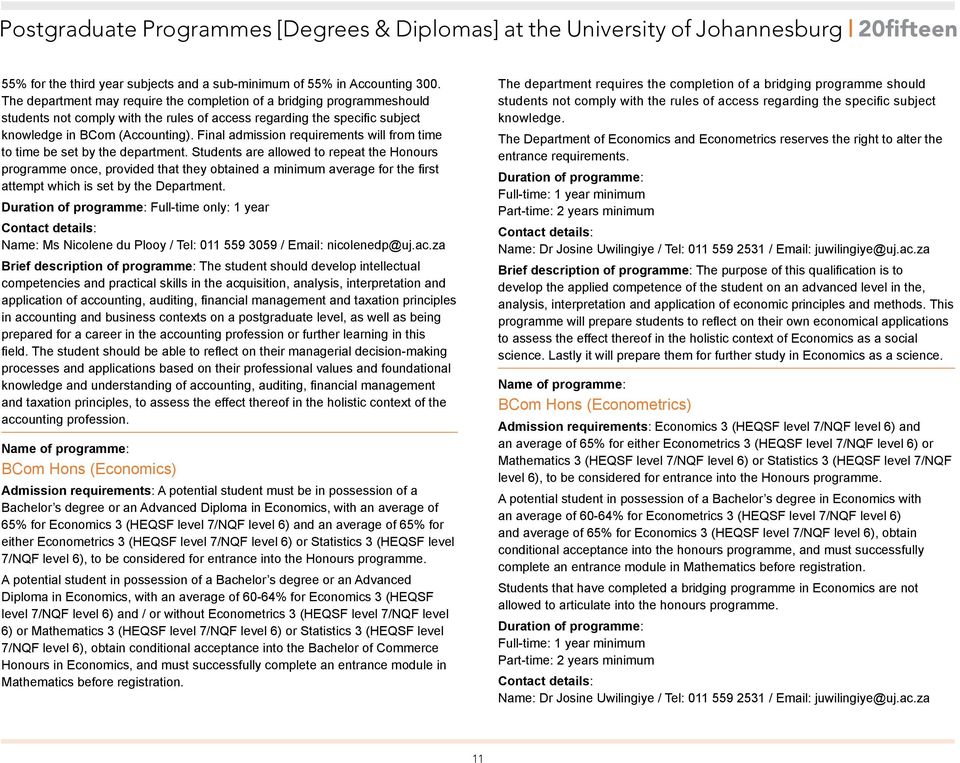
14 Brief description of programme: The purpose of this qualification is to develop the applied competence of the student on an advanced level in the, analysis, interpretation and application of economic principles and methods. This program will prepare students to reflect on their own economic applications to assess the effect thereof in the holistic context of Economics and Econometrics. Lastly it will prepare them for further study in Economics and Econometrics as a science. BCom Hons (Financial Management) Admission requirements: A potential student must be in possession of a Bachelor of Commerce qualification and should have obtained a final mark of at least 70% for both Accounting and Financial Management (Finance as well as Cost and Management Accounting) assessed at an (HEQSF level 7NQF level 6). Should students not comply with the rules of access regarding the specific subject knowledge or meet the selection criteria, the department may require the completion of the bridging programme in Financial Management. Final admission requirements will from time to time be set by the department. Full-time: 1 year Part-time: 2 years Name: Mr Kevin Thomas / Tel: / [email protected] Brief description of programme: The primary purpose of the BComHons (Financial Management) is to strengthen the student s knowledge and comprehension in the disciplines of management accounting and finance. The programme is comprised of a broad-based curriculum to prepare the postgraduate student for a wide range of finance-related specialities. The curriculum includes six topic areas ranging from management accounting strategy to financial strategy to performance & risk strategy. The programme emphasises application, analysis and evaluation within each topic area as well as the application of integrity and ethics in a professional environment. Mastering of the curriculum will provide students with the skills to synthesize complex management, financial, performance and risk principles in order to drive and add value to the entities that employ them. The successful student will gain an overall financial and business perspective which will provide them with a competitive advantage for employment and prepare them for further studies in this field. BCom Hons (Financial Planning) Admission requirements: A potential student must be in possession of a BCom and should have appropriate knowledge of Financial Planning (HEQSF level 7/NQF level 6). The department may require the completion of a bridging programme should students not comply with the rules of access regarding the specific subject knowledge in Financial Planning. Final admission requirements will from time to time be set by the department. Full-time: 1 year Part-time: 2 years Name: Mr Carl Anschutz / Tel: / [email protected] Brief description of programme: The aim of the qualification is to develop applied competence and deepen the student s expertise in the analysis, interpretation and application of financial planning principles and research capacity in the economic environment at an advanced level. Learners are also prepared for a career in the practice of financial planning and further learning in researched based postgraduate study in this field by developing research and reporting skills. The students should be able to reflect on their decisions and applications to assess the effect thereof in the holistic context of financial planning as a practice at an advanced level. BCom Hons (Investment Management) Admission requirements: A potential student must be in possession of a Bachelor s degree and should have appropriate knowledge of Investment Management (HEQSF level 7/NQF level 6). The department may require the completion of a bridging programme should students not comply with the rules of access regarding the specific subject knowledge in Investment Management. Final admission requirements will from time to time be set by the department. Prior to commencement of the honours programme, students will be required to complete a statistics and mathematics workshop. Attendance is deemed compulsory but is not a requisite or prerequisite to acceptance and or completion of the honours programme. Students will also be required to attend compulsory library research training which will be arranged and provided by library services. 12

15 Full-time: 1 year Part-time: 2 years Name: Mr Niël Oberholzer / Tel: / [email protected] Brief description of programme: The primary purpose of the BComHons (Investment Management) is to strengthen the student s knowledge of the discipline of investment valuation and portfolio management. The programme is comprised of a broad-based curriculum to prepare the student for a wide range of investment-related specialities. The curriculum includes eight topic areas ranging from equity investment, interest-bearing investment to portfolio management and retirement finance. Mastering of the curriculum will provide students with the ability to synthesize complex investment principles and apply financial instruments in a professional manner. Fundamental knowledge of global investment principles will be gained enabling the qualifying student to work in today s world of professional investing. The programme emphasizes competence, integrity, and application of ethics in a professional environment. The successful student will gain a global investment perspective and an indepth understanding of the global marketplace which will provide them with a competitive advantage for employment. BCom Hons (Property Valuation and Management) Admission requirements: A potential student must be in possession of a Bachelor of Commerce (Finance) OR another relevant qualification on the same HEQSF/NQF level with Property Valuation and Management (assessed at an HEQSF level 7/NQF level 6). The department may require the completion of a bridging programme should students not comply with the rules of access regarding the specific subject knowledge in Property Valuation and Management. Final admission requirements will from time to time be set by the department. Full-time: 1 year Part-time: 2 years Name: Mr André Kruger / Tel: / [email protected] Brief description of programme: The aim of this programme is to strengthen students knowledge and comprehension in the disciplines of property valuation and management. The programme comprises a broad-based curriculum to prepare the postgraduate student for a wide range of propertyrelated specialities. The curriculum includes topic areas ranging from property valuation and property law, to property finance and property management. The programme emphasises application, analysis and evaluation within each topic area as well as the application of integrity and ethics in a professional environment. Mastering of the curriculum will provide students with the skills to combine complex valuation, management, financial and legal principles in order to add value to the entities that employ them. The successful student will gain an overall property valuation and property management perspective which will provide them with a competitive advantage for employment and prepare them for further studies in this field. MASTER S DEGREES (COURSEWORK) MCom (Computer Auditing) Admission requirements: A potential student should possess an honours qualification or a post-graduate diploma in a related computer auditing field, on HEQSF level 8. Alternatively any other four-year qualification on HEQSF level 8 and related practical auditing experience which is considered relevant and sufficient by the Department of Accountancy. Preparatory study and an entrance examination may be required by the Department of Accountancy. A selection process will be followed. Part-time: 2 years Name: Prof Danie Coetsee / Tel: / [email protected] Brief description of programme: The student should develop applied specialised competencies in the mastering, interpretation, understanding, analysis and application of computer auditing principles in the computer auditing field. A qualifying student should show evidence of independent and original scientific work through a limited scope dissertation. 13

16 MCom (Development Economics) Admission requirements: A potential student should possess a honours qualification in Economics or Econometrics on HEQSF level 8/NQF level 7. Alternatively any other four-year qualification with honours status on HEQSF level 8/NQF level 7 and related Micro- and Macroeconomics and Applied Econometrics experience which is considered relevant and sufficient by the Department of Economics and Econometrics. Preparatory study and an entrance examination may be required by the Department of Economics and Econometrics. Full-time / Part-time: 2 years Name: Mrs Kotie Viljoen / Tel: / [email protected] Brief description of programme: The aim of the qualification is to develop the applied competence of the student on an advanced level in the mastering, analysis, interpretation and understanding of economic principles and methods. This program will prepare students to reflect on their own economic applications to assess the effect thereof in the holistic context of Economics as social science. A qualifying student should show evidence of independent and original work. MCom (Financial Economics) Admission requirements: A potential student should possess a honours qualification in Economics, Econometrics, statistics and/or Mathematics on HEQSF level 8/NQF level 7. Alternatively any other four-year qualification with honours status on HEQSF level 8/NQF level 7 and related Mathematic and/or Statistic and Applied Econometric experiences which is considered relevant and sufficient by the Department of Economics and Econometrics. Preparatory study and an entrance examination may be required by the Department of Economics and Econometrics. Prospective students must prepare a research proposal in consultation with a member of staff of the Department of Economics and Econometrics so allocated to them. This proposal must be presented to a panel convened for this purpose. Once a decision has been made that the proposal has been accepted, the prospective student will be allowed to register for this degree. Full-time / Part-time 2 years Name: Dr John Muteba Mwamba / Tel: / [email protected] Brief description of programme: The student should develop intellectual competencies and practical skills in the mastering, analysis, interpretation and application of advanced financial principles in the context of the international economy, and be able to reflect on the associated managerial decisions, through quantitative analysis and to assess the effect thereof in the holistic financial context. The qualification will provide qualifying students with the opportunity to further study at HEQSF level 10/NQF level 8 on a doctoral degree programme in Economics. MCom (Finance) Admission requirements: A potential student should possess a financially oriented Bachelor of Commerce Honours qualification on HEQSF level 8/ NQF level 7 with at least either Financial Management and/or Investment Management at third year level. Alternatively a student should possess any other four-year qualification with honours status on HEQSF level 8/NQF level 7 and have related financial management and/or investment management financially oriented experience which is considered relevant and sufficient by the department. For acceptance into the programme, preparatory study, an entrance course and examination may be required by the Department of Finance and Investment Management. Successful applicants must prepare a research proposal in consultation with a member of staff of the Department of Finance and Investment Management allocated to them. This proposal must be presented to a panel convened for this purpose. Once a decision has been made that the proposal has been accepted, the student will be allowed to proceed with the research component of the programme. The Department of Finance and Investment Management must specifically approve the field of study, the research topic, methodology and problem statement before the candidate may register for the minor dissertation. Full-time / Part-time: 2 years Name: Prof Ilse Botha / Tel: / [email protected] Brief description of programme: The aim of this qualification is for the student to develop applied competence in the mastering, interpretation, reflecting on and application of principles in the broader field of finance. Through the 14

17 minor dissertation, a qualifying student shows evidence of scientific research, application of scientific research methodologies and an ability to reflect thereon in the holistic context of finance. MCom (International Accounting) Admission requirements: A potential student should possess an honours qualification or a post-graduate diploma in Accounting or a Financial Management related honours degree on HEQSF level 8/NQF 7. Alternatively any other four-year qualification on HEQSF level 8/NQF 7 and related accounting experience, which is considered relevant and sufficient by the Department of Accountancy. Preparatory study and an entrance examination may be required by the Department of Accountancy. A selection process will be followed. Part-time: 2 years Name: Prof Danie Coetsee / Tel: / [email protected] Brief description of programme: The student should develop applied specialised competence in the mastering, interpretation, understanding, analysis and application of accounting principles in the financial accounting field. Through a limited scope dissertation, a qualifying student should show evidence of independent and original scientific work. MCom (South African and International Taxation) Admission requirements: A potential student should possess an honours qualification or a post-graduate diploma in Accounting or a Tax related honours degree on HEQSF level 8/NQF level 7. Alternatively any other four-year qualification with honours status on HEQSF level 8/NQF level 7 and related taxation experience which is considered relevant and sufficient by the Department of Accountancy. Preparatory study and an entrance examination may be required by the Department of Accountancy. A selection process will be followed. Part-time: 2 years Name: Prof Danie Coetsee / Tel: / [email protected] Brief description of programme: The student should develop applied specialised competencies in the mastering, interpretation, understanding, analysis and application of taxation principles in the taxation field. Through a limited scope dissertation, a qualifying student should show evidence of independent and original scientific work. MASTER S DEGREES (RESEARCH) MCom (Accounting) Admission requirements: A potential student must be in possession of an Accounting oriented Bachelor of Commerce honours on HEQSF level 8/NQF level 7, which is deemed applicable by the Department of Accountancy. The Department of Accountancy must specifically approve the field of study, the research topic, methodology and problem statement before the candidate may register. Admission to the master s research programme is subject to the successful defence of a research proposal. Part-time: 2 years Name: Prof Danie Coetsee / Tel: / [email protected] Brief description of programme: The student should develop applied specialised competencies in the mastering, interpretation, understanding, analysis and application of accounting principles in the financial accounting field. A qualifying student should show evidence of independent and original scientific work through the master s dissertation. MCom (Auditing) Admission requirements: A potential student must be in possession of an Accounting oriented Bachelor of Commerce Honours qualification on HEQSF level 8/NQF level 7, which is deemed applicable by the Department of Accountancy. The Department of Accountancy must specifically approve the field of study, the research topic, methodology and problem statement before the candidate may register. Admission to the master s research programme is subject to the successful defence of a research proposal. Part-time: 2 years 15
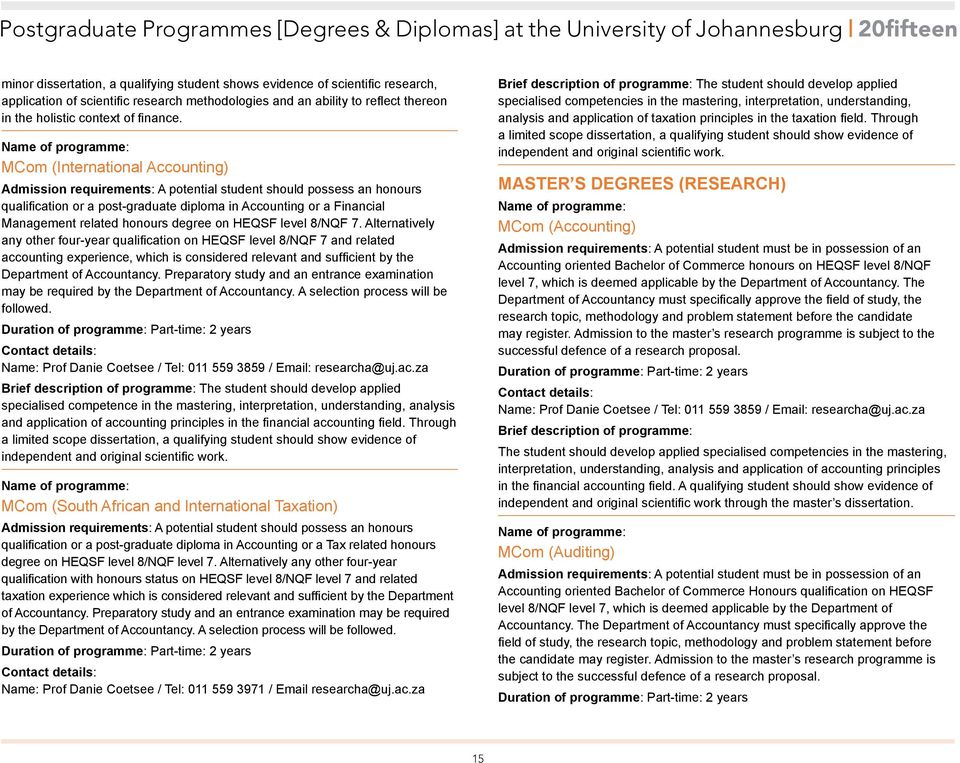
18 Name: Prof Danie Coetsee/ Tel: / [email protected] Brief description of programme: The student should develop applied specialised competencies in the mastering, interpretation, understanding, analysis and application of auditing principles in the auditing field. A qualifying student should show evidence of independent and original scientific work through the master s dissertation. MCom (Econometrics) Admission requirements: A potential student must be in possession of a Bachelor of Commerce Honours qualification on HEQSF level 8/NQF level 7, which is deemed applicable by the Department of Economics and Econometrics. The Department of Economics and Econometrics must specifically approve the field of study, the research topic, methodology and problem statement before the candidate may register. Admission to the master s research programme is subject to the successful defence of a research proposal. Full time/part time 2 years Name: Dr Alain Pholo / Tel: / [email protected] Brief description of programme: The aim of the qualification is to develop the applied competence of the student on an advanced level in the mastering, analysis, interpretation and understanding of econometric methods. This programme will prepare students to reflect on their own economic applications by using econometric techniques either to perform empirical checks on specific economic models, or as tools for forecasting and policy evaluation. A qualifying student should show evidence of independent and original work. MCom (Economics) Admission requirements: A potential student must be in possession of a qualification on HEQSF level 8/NQF level 7, which is deemed applicable by the Department of Economics and Econometrics. The Department of Economics and Econometrics must specifically approve the field of study, the research topic, methodology and problem statement before the candidate may register. Admission to the master s research programme is subject to the successful defence of a research proposal. Full time/ Part time 2 years Name: Dr Alain Pholo / Tel: / [email protected] Brief description of programme: The aim of the qualification is to develop the applied competence of the student on an advanced level in the mastering, analysis, interpretation and understanding of economic principles and methods. This program will prepare students to reflect on their own economical applications to assess the effect thereof in the holistic context of Economics as social science. A qualifying student should show evidence of independent and original work. MCom (Financial Management) Admission requirements: A potential student must be in possession of a financially oriented Bachelor of Commerce Honours qualification or equivalent on HEQSF level 8/NQF level 7, with at least Financial Management and/ or Investment Management at third year level. Alternatively a student should possess any other four-year qualification with honours status on HEQSF level 8/NQF level 7 and have related financially oriented experience which is deemed applicable by the Department of Finance and Investment Management. Admission to the master s research programme is subject to the successful defence of a research proposal. The research proposal should be presented to a panel convened by the Department of Finance and Investment Management for this purpose. The Department of Finance and Investment Management must specifically approve the field of study, the research topic, methodology and problem statement before the candidate may register. Minimum 1 year Maximum 2 years Name: Prof Ilse Botha / Tel: / [email protected] Brief description of programme: The aim of this qualification is for the student to develop applied competence in the mastering, interpretation, reflecting on and application of principles in the broader field of finance. Through the master s dissertation, a qualifying student shows evidence of scientific research, application of scientific research methodologies and an ability to reflect thereon in the holistic context of finance. 16
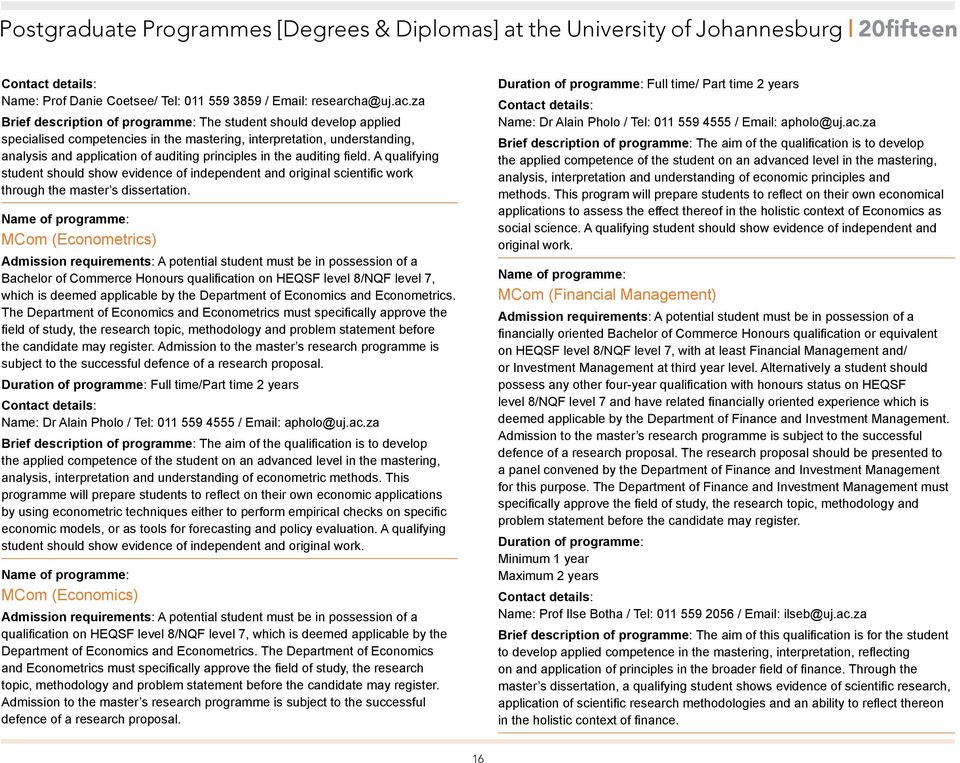
19 MCom (Investment Management) Admission requirements: A potential student must be in possession of an Investment Management oriented Bachelors of Commerce Honours qualification HEQSF level 8/NQF level 7, alternatively a student should possess any other four-year qualification with honours status on HEQSF level 8/NQF level 7 and have related investment management oriented experience which is deemed applicable by the Department of Finance and Investment Management. Admission to the master s research programme is subject to the successful defence of a research proposal. The research proposal should be presented to a panel convened by the Department of Finance and Investment Management for this purpose. The Department of Finance and Investment Management must specifically approve the field of study, the research topic, methodology and problem statement before the candidate may register. Minimum 1 year Maximum 2 years Name: Prof Ilse Botha / Tel: / [email protected] Brief description of programme: The aim of this qualification is for the student to develop applied competence in the mastering, interpretation, reflecting on and application of principles in the broader field of finance. Through the master s dissertation, a qualifying student shows evidence of scientific research, application of scientific research methodologies and an ability to reflect thereon in the holistic context of finance. MCom (South African and International Taxation) Admission requirements: A potential student must be in possession of an Accounting or Financial Management oriented Bachelors of Commerce Honours qualification on HEQSF level 8/NQF level 7, which is deemed applicable by the Department of Accountancy. The Department of Accountancy must specifically approve the field of study, the research topic, methodology and problem statement before the candidate may register. Admission to the master s research programme is subject to the successful defence of a research proposal. Part-time: 2 years Name: Prof Danie Coetsee / Tel: / [email protected] Brief description of programme: The student should develop applied specialised competencies in mastering, interpretation, understanding, analysis and application of taxation principles in the taxation field. A qualifying student should show evidence of independent and original scientific work through the master s dissertation. DOCTORAL DEGREES DCom/PhD (Accounting) Admission requirements: A candidate who is in possession of a universitybased Accounting orientated master s qualification on HEQSF level 9/NQF level 7 may apply for admission to this qualification. Alternatively any other related qualification with a program specific minimum level of competency on HEQSF level 9/NQF level 7, and related experience which is considered relevant and sufficient by the Department Accountancy. The Department of Accountancy must specifically approve of the field of study, the research topic, methodology and problem statement before the candidate may register. Admission to the Doctoral programme is subject to the successful defence of a research proposal. Minimum: 2 years Maximum: 4 years Name: Prof Danie Coetsee / Tel: / r [email protected] Brief description of programme: The candidate should develop applied specialised competencies in the mastering, interpretation, understanding, analysis and application of accounting principles in the financial accounting field. A qualifying candidate should show evidence of original and independent scientific work. DCom/PhD (Auditing) Admission requirements: A candidate who is in possession of a universitybased Auditing or computer Auditing orientated master s qualification on 17

20 HEQSF level 9/NQF level 7 may apply for admission to this qualification. Alternatively any other related qualification with a program specific minimum level of competency on HEQSF level 9/NQF level 7, and related experience which is considered relevant and sufficient by the Department Accountancy. The Department of Accountancy must specifically approve of the field of study, the research topic, methodology and problem statement before the candidate may register. Admission to the Doctoral programme is subject to the successful defence of a research proposal. Minimum: 2 years Maximum: 4 years Name: Prof Danie Coetsee / Tel: / [email protected] Brief description of programme: The candidate should develop applied specialised competencies in the mastering, interpretation, understanding, analysis and application of auditing principles in the auditing field. A qualifying candidate should show evidence of original and independent scientific work. Prospective students must prepare a research proposal in consultation with a member of staff of the Department of Accountancy so allocated to them. This proposal must be presented to a panel convened for this purpose. Once a decision has been made that the proposal has been accepted, the prospective student will be allowed to register for the degree. DCom/PhD (Econometrics) Admission requirements: A candidate who is in possession of a universitybased master s qualification on HEQSF level 9/NQF level 7 may apply for admission to this qualification. Alternatively any other related qualification with a program specific minimum level of competency on HEQSF level 9/NQF level 7, and related experience which is considered relevant and sufficient by the Department Economics and Econometrics. The Department of Economics and Econometrics must specifically approve of the field of study, the research proposal, methodology and problem statement before the candidate may register. Admission to the Doctoral programme is subject to the successful defence of a research proposal. Minimum: 2 years / Maximum: 4 years Name: Dr Alain Pholo / Tel: / [email protected] Brief description of programme: The candidate should develop advanced competencies in the mastering, interpretation, understanding, analysis and application of econometric techniques. A qualifying candidate should show evidence of original and independent scientific work. Prospective students must prepare a research proposal in consultation with a member of staff of the Department of Economics and Econometrics. Once a decision has been made that the proposal has been accepted, the prospective student will be allowed to register for the degree. DCom/PhD (Economics) Admission requirements: A candidate who is in possession of a universitybased master s qualification on HEQSF level 9/NQF level 7 may apply for admission to this qualification. Alternatively any other related qualification with a program specific minimum level of competency on HEQSF level 9/NQF level 7, and related experience which is considered relevant and sufficient by the Department Economics and Econometrics. The Department of Economics and Econometrics must specifically approve of the field of study, the research proposal, methodology and problem statement before the candidate may register. Admission to the Doctoral programme is subject to the successful defence of a research proposal. Minimum: 2 years Maximum: 4 years Name: Dr Alain Pholo / Tel: / [email protected] Brief description of programme: The candidate should develop advanced competencies in the mastering, interpretation, understanding, analysis and application of economic models. A qualifying candidate should show evidence of original and independent scientific work. Prospective students must prepare a research proposal in consultation with a member of staff of the Department of Economics and Econometrics. Once a decision has been made that the proposal has been accepted, the prospective student will be allowed to register for the degree. 18

21 DCom (Financial Management) Admission requirements: A candidate who is in possession of a universitybased financially orientated master s qualification on HEQSF level 9/NQF level 7 may apply for admission to this qualification. Alternatively any other related qualification with a program specific minimum level of competency on HEQSF level 9/NQF level 7, and financial management related experience which is considered relevant and sufficient by the Department of Finance and Investment Management. Admission to the doctoral programme is subject to the successful defence of a research proposal. The research proposal should be presented to a panel convened by the Department of Finance and Investment Management for this purpose. The Department of Finance and Investment Management must specifically approve the field of study, the research topic, methodology and problem statement before the candidate may register. Minimum: 2 years Maximum: 4 years Name: Prof Ilse Botha / Tel: / [email protected] Brief description of programme: The candidate should develop applied specialised competencies in the mastering, interpretation, understanding, analysis and application of management accounting principles in the financial management field. A qualifying candidate should show evidence of original and independent scientific work. The thesis would constitute a decided contribution to knowledge of and insight into the subject discipline as well as the field of research. Qualifying candidates would also display competence in the application of related research methodology, and the proper written and/or oral communication of the research process and findings. PhD (Finance) Admission requirements: A candidate who is in possession of a universitybased financially orientated master s qualification on HEQSF level 9/NQF level 7 may apply for admission to this qualification. Alternatively any other related qualification with a program specific minimum level of competency on HEQSF level 9/NQF level 7, and finance related experience which is considered relevant and sufficient by the Department Finance and Investment Management. Admission to the doctoral programme is subject to the successful defence of a research proposal. The research proposal should be presented to a panel convened by the Department of Finance and Investment Management for this purpose. The Department of Finance and Investment Management must specifically approve the field of study, the research topic, methodology and problem statement before the candidate may register. Minimum: 2 years Maximum: 4 years Name: Prof Ilse Botha / Tel: / [email protected] Brief description of programme: The candidate should develop applied competencies and practical skills in the mastering, interpretation, understanding and application of a topic in the broader field of finance. Through the doctoral thesis, a qualifying student would show evidence of independent and original scientific work. The thesis would constitute a decided contribution to knowledge of and insight into the subject discipline as well as the field of research. Qualifying candidates would also display competence in the application of related research methodology, and the proper written and/or oral communication of the research process and findings. DCom (Investment Management) Admission requirements: A candidate who is in possession of a universitybased investment management orientated master s qualification on HEQSF level 9/NQF level 7 may apply for admission to this qualification. Alternatively any other related qualification with a program specific minimum level of competency on HEQSF level 9/NQF level 7, and investment management related experience which is considered relevant and sufficient by the Department of Finance and Investment Management. Admission to the doctoral programme is subject to the successful defence of a research proposal. The research proposal should be presented to a panel convened by the Department of Finance and Investment Management for this purpose. The Department of Finance and Investment Management must specifically approve the field of study, the research topic, methodology and problem statement before the candidate may register. 19
22 Minimum: 2 years / Maximum: 4 years Name: Prof Ilse Botha / Tel: / [email protected] Brief description of programme: The candidate should develop applied specialised competencies and practical skills in the mastering, interpretation, understanding, analysis and application of investment management principles. Through the doctoral thesis, in which the qualification culminates, a qualifying student would constitute a decided contribution to knowledge of and insight into the subject discipline as well as the field of research. Qualifying candidates would also display competence in the application of related research methodology, and the proper written and/or oral communication of the research process and findings. DCom/PhD (Taxation) Admission requirements: A candidate who is in possession of a universitybased Taxation orientated master s qualification on HEQSF level 9/NQF level 7 may apply for admission to this qualification. Alternatively any other related qualification with a program specific minimum level of competency on HEQSF level 9/NQF level 7, and related experience which is considered relevant and sufficient by the Department of Accountancy. The Department of Accountancy must specifically approve of the field of study, the research topic, methodology and problem statement before the candidate may register. Admission to the Doctoral programme is subject to the successful defence of a research proposal. Minimum: 2 years Maximum: 4 years Name: Prof Danie Coetsee / Tel: / [email protected] Brief description of programme: The candidate should develop applied specialised competencies in the mastering, interpretation, understanding, analysis and application of taxation principles in the financial and commercial sector. A qualifying candidate should show evidence of original and independent scientific work. 20
23 Faculty of Education POSTGRADUATE PROGRAMMES DEGREES v DIPLOMAS
24 FACULTY OF EDUCATION INDEX POSTGRADUATE PROGRAMMES The University reserves the right, at any time, should circumstance dictate, to make changes to, or withdraw any of the opportunities on offer. Name of programme Advanced Diploma in Teaching (PGCE) 23 ACADEMIC RESEARCH PROGRAMMES HONOURS DEGREES (BEd) Name of programme BEd Hons 24 BEd Hons (Educational Psychology) 25 MASTERS DEGREE PROGRAMMES MEd (Degree) 25 MEd (Educational Management) 26 MEd (Educational Psychology) 26 DOCTORAL DEGREE PROGRAMMES (DEd/DPhil in EDUCATION) Name of programme DEd / PhD / DPhil (Educational Psychology) 26 22
25 FACULTY OF EDUCATION ADVANCED DIPLOMA IN TEACHING/ POSTGRADUATE CERTIFICATE IN EDUCATION (PGCE) 1. ADVANCED DIPLOMA IN FET TEACHING: Adv Dip (FET Teaching) To be able gain access to the Advanced Diploma in FET Teaching an applicant must have: a first degree on level 7 with a minimum of 360 credits with two school related subjects, one on second year level and one on third year level. Assessment of prior learning could also lead to entry or an advanced credit standing. NOTE: The Advanced Diploma in FET Teaching consist of three year modules with the following options: Education and Teaching Studies (48 credits) plus specialisation in two Teaching Methodology and Practicum modules in FET Teaching (2 x 36 credits) 2. ADVANCED DIPLOMA IN SENIOR PHASE AND FET TEACHING: Adv Dip (SP & FET Teaching) To be able gain access to the Advanced Diploma in Senior Phase and FET Teaching an applicant must have one of the following: A first degree on level 7 with a minimum of 360 credits with two school related subjects, one on first year level and one on third year level. An approved National Diploma on level 6 with a minimum of 360 credits from an accredited institution with two school related subjects, one on second year level and one on third year level. Students should have sufficient study of the disciplines underpinning the specific teaching specialisations (subjects) to teach that particular school subject in a specific phase. NOTE: The Advanced Diploma in Senior Phase and FET Teaching consists of three year modules and is presented on the Auckland Park Kingsway (APK) Campus: Education and Teaching Studies (48 credits) presented in year 1 for part time students Teaching Methodology and Practicum A in Senior Phase (36 credits) presented in year 2 for part time students Teaching Methodology and Practicum B in FET Phase Teaching (36 credits) presented in year 2 for part time students The latter two modules focus on student s Pedagogical Content Knowledge FULL-TIME VS. PART-TIME REGISTRATION Students may register to complete the qualification either full-time (1 year) or part-time (2 years). Students who are employed on a full-time basis must complete the Advanced Diploma/ PGCE part-time over 2 years. However, full time teachers may complete the programme full-time over 1 year. If a student starts full-time work (excluding teaching) during the year the university must be duly informed in writing in order to change the registration of the student to part-time. SCHOOL BASED PRACTICUM / WORK INTERGRATED LEARNING (WIL) Prescribed periods of school based practicum /WIL must be completed in approved schools during the time of study. Students complete their school based practicum /WIL experience during the year in which they study their methodologies. These school based practicum /WIL is planned as follows: Three consecutive weeks in the first semester. Six consecutive weeks in the second semester. It could be expected of students to complete these periods of practical teaching during university holidays. The university reserves the right to do placement of students in schools in alignment with the training needs. Although students employed as full time teachers are allowed to complete their school experience at the schools where they teach, they MAY BE PLACED AT ANOTHER SCHOOL FOR THE NINE WEEKS OF SCHOOL EXPERIENCE if they are not teaching in the phase they are registered for or not teaching the subject methodology registered for. 23
26 SERVICE LEARNING Students will be required to complete 46 hours of service learning throughout the year at selected schools and community sites, which is a COMPULSORY component of the Education and Teaching Studies. PRE-ACADEMIC YEAR ORIENTATION Please note the following workshops: A two-day COMPULSORY orientation held on a Friday afternoon and Saturday at the end of January. The Faculty of Education of UJ is a caring faculty, and we strive to equip our students to be the best teachers in the field. Thus, all students who register for the first time have the opportunity to experience an excursion to the Achterberg, where, for four days, students get a hands-on experience of what great joy teaching can be. During this excursion we try to show students the FUNdamentals of teaching. WHAT ABOUT BURSARIES? If you need more information about bursaries, please contact the Bursary office at /3906/4035 HOW DO I APPLY? Visit the UJ website and apply online: CONTACT: Michell Struwig /Tel: / [email protected] FACULTY OF EDUCATION CONTACT DETAILS Auckland Park Kingsway Campus Tel: Soweto Campus Tel: Website: The Faculty reserves the right to change information in this brochure. HONOURS DEGREES BEd Honours Admission requirements: a. A bachelor s degree plus a teacher s diploma (at least 480 credits at level 6) including Education 3. OR b. A four-year bachelor s degree, including teacher training (e.g. BA(Ed) or BEd) (at least 480 credits at level 6). OR c. A recognised teacher s diploma or diplomas equivalent to a four year teacher s diploma (at least 480 credits at level 6). OR d. A recognised teacher s diploma and a three-year National Technical Certificate (T3) (at least 480 credits at level 6) or an equivalent thereof. Additional selection criteria: a. Students should provide proof relevant academic competence, namely 65% average in the majors of a prior degree or in the case of a diploma a 65% average for all the subjects/modules. b. Educational Linguistics: At least one modern language on second year level. c. Technology Education: Technical qualifications, 120 credits at level 6. One year full time or two years part time Name: Lawrence Nzama Tel: / [email protected] Brief description of the programme: BACCALAUREUS EDUCATIONIS CUM HONORIBUS (BEd Hons) With specialization in one of the following broad areas: 1. Curriculum 2. Democracy and Policy in Education 3. Education Management and Leadership 4. Inclusive Education 5. Educational Linguistic 6. Foundation Phase Education 7. Higher and Adult Education 8. Information and Communication Technology in Education 9. Life Orientation 24
27 10. Mathematics Education 11. Science Education 12. Technology Education BEd Honours (Educational Psychology) (the closing date for this programme is at the end of July) The same entry requirements for the other BEd Honours programmes apply in the programme but with the following additional selection criteria: In order to be selected for this degree a candidate must have Psychology 3 and Education 3. Candidates who apply for this degree will undergo a selection process. The selection process is based on previous academic achievement, personal skills, interpersonal skills, the ability to work in a team and the potential to learn the necessary skills to become an effective counsellor. The BEd Honours programmes strives to consolidate and deepen the student s expertise in Education as well as their academic and practical competence in the specialisation within Education. It also strives to develop research capacity in the methodology of Education as field of study. The BEd Honours programme in Educational Psychology serves to deepen and consolidate students expertise in Education as well as academic and practical competence in Educational Psychology within Education as a field of practice. It also serves to develop research capacity in methodology and techniques of Education as field of study. The purpose of the practicum is to develop core competencies in the practical field of school counselling. MASTER S DEGREES MEd DEGREE Full dissertation: A dissertation on an approved topic in the field of Education. Topics related to a number of approved broad areas n may be investigated. All students must attend a short learning programme in research methodology. OR Module work and minor-dissertation: All students must attend a short learning programme in research methodology. Students choose one of the following spesialisations in module work and minor dissertation. 1. Curriculum Policy Evaluation 2. Inclusive Education 3. Life and Career Orientation 4. Teacher Education 5. Educational Linguistics 6. Values and Human Rights in Education 7. Adult Education 8. Higher Education 9. Environmental Education 10. Mathematics and Science Education 11. Philosophy of Education 12. Psychology of Learning 13. Information and Communication Technology in Education 14. Language and Literacy in the Foundation Phase 15. Methodology in the Foundation Phase 16. Childhood Education in the Foundation Phase 17. Numeracy in the Foundation Phase 18. Learning Area Methodology 19. Mathematics Education 20. Science Education (Natural-, Physical-, and Life Sciences) 21. Sociology of Education 22. Technology Education 23. Educational Management 24. Educational Psychology* (see description of the qualification to follow) 25
28 Brief description of programme: Master of Education Module work and minor-dissertation. Master of Education (Educational Psychology) Module work and minor-dissertation. INTERNSHIP PREREQUISITES: Students are required to complete the minor-dissertation in the academic programme before commencing with internship. In order to register as an educational psychologist with the Health Professions Council, the candidate must, apart from having obtained the MEd (Educational Psychology) degree, also complete an internship at an institution approved by the said Council. This internship does not, however, form part of the requirements for obtaining the degree. DOCTORAL DEGREES DEd / PhD Admission requirements: Doctor Educationis (Educational Psychology) DEd The DEd (Educational Psychology) requires a candidate to undertake research at an advanced academic level culminating in the production, defence and acceptance of a thesis. The defining characteristic of the qualification is that the candidate is required to demonstrate high-level research capability and make a significant and original academic contribution to the field of Educational Psychology. RULES OF ACCESS a. Prospective candidates will have obtained a MEd (Educational Psychology). b. Academic performance: students need to have attained a minimum of 65% in their previous degree. If 65% was not attained, prior learning and experience in the field may be taken into consideration and students could be allowed to register based on a pre-registration research proposal which is accepted by the Department of Educational Psychology. ADDITIONAL SELECTION CRITERIA Applicants ability to communicate both in oral and written format may be assessed in a screening procedure. Proficiency in a word processing package and internet use is strongly recommended. Philosophiae Doctor (Education) PhD RULES OF ACCESS Prospective candidates will have obtained a MEd. OR Prospective candidates will have obtained a teacher s diploma/teaching qualification, plus an appropriate master s degree as well as work experience in the field of study. The Education knowledge of such candidates will be assessed by the Head of Department and prospective supervisor and a reading programme may be prescribed prior to allowing registration. ADDITIONAL SELECTION CRITERIA Academic performance: students need to have attained a minimum of 65% in their previous degree. If 65% was not attained, prior learning and experience 26
29 in the field may be taken into consideration and students could be allowed to register based on a pre-registration research proposal which is accepted by the Department in which the student will be registering. A thesis on an approved topic in the field of Education. Students must attend a short learning programme in research methodology. Topics related to the following broad areas may be investigated: 1. Adult Education 2. Curriculum Studies 3. Inclusive Education 4. Educational and Learning Support 5. Educational Linguistics 6. Educational Management 7. Environmental Education 8. ICT in Education 9. Inclusive Education 10. Higher Education 11. Learning Area Methodology 12. Life and Career Orientation 13. Mathematics Education 14. Philosophy of Education 15. Psychology of Education 16. Sociology of Education 17. Science Education 18. Teacher Education 19. Technology Education 20. Values and Human Rights Education 21. Foundation Phase Education Brief description of programme: The PhD (Education) requires a candidate to undertake research at an advanced academic level culminating in the production, defence and acceptance of a thesis. The candidate is required to demonstrate high-level research capability and make a significant and original academic contribution to the field of Education. 4 years (part-time) Name: Lawrence Nzama / Tel: / [email protected] FACULTY OF EDUCATION CONTACT DETAILS Auckland Park Kingsway Campus Tel: Soweto Campus Tel: Website: 27
30 Faculty of Engineering and the Built Environment POSTGRADUATE PROGRAMMES DEGREES v DIPLOMAS
31 FACULTY OF ENGINEERING AND THE BUILT ENVIRONMENT MAGISTER TECHNOLOGIAE DEGREE PROGRAMMES (MTech) Name of programme MTech (Engineering: Civil) Research Based 30 MTech (Engineering: Chemical) Research Based 30 MTech (Construction Management) Research Based 30 MTech (Engineering: Electrical) Research Based 31 MTech (Extraction Metallurgy) Research Based 31 MTech (Engineering: Civil) Research Based 31 MTech (Engineering: Chemical) Research Based 31 MTech (Engineering: Industrial) Research Based 32 MTech (Engineering: Mechanical) Research Based 32 MTech (Engineering: Metallurgy) Research Based 32 MTech (Operations Management) Research Based 32 MTech (Quantity Surveying) Research Based 33 ENGINEERING MASTER S DEGREE PROGRAMMES (MEng) Name of programme MEng (Electrical and Electronic Engineering) Research Based 33 MEng (Mechanical Engineering) Research Based 34 MEng (Civil Engineering) Research Based 35 MEng (Engineering Management) Lectured 36 MEng (Engineering Management) Research Based 36 MAGISTER PHILOSOPHIAE DEGREE PROGRAMMES (MPhil) Name of programme MPhil (Electrical and Electronic Engineering) Research Based 37 MPhil (Mechanical Engineering) Research Based 38 MPhil (Civil Engineering) Research Based 39 MPhil (Engineering Management) Lectured 40 MPhil (Engineering Management) Research Based 41 INDEX POSTGRADUATE PROGRAMMES The University reserves the right, at any time, should circumstance dictate, to make changes to, or withdraw any of the opportunities on offer. DOCTORAL TECHNOLOGIAE DEGREE PROGRAMMES (DTech) Name of programme DTech (Engineering: Mechanical) 42 DTech (Extraction Metallurgy) 42 DTech (Engineering Metallurgy) 42 DOCTORAL DEGREE PROGRAMMES (DIng) Name of programme DIng (Electrical and Electronic Engineering) 43 DIng (Mechanical Engineering) 43 DIng (Civil Engineering) 44 DIng (Engineering Management) 45 DOCTOR PHILOSOPHIAE DEGREE PROGRAMMES (DPhil) Name of programme DPhil (Engineering Management) 46 DPhil (Electrical and Electronic Engineering) 47 DPhil (Mechanical Engineering) 48 DPhil (Civil Engineering) 48 DPhil (Engineering Management) 49 29
32 FACULTY OF ENGINEERING AND THE BUILT ENVIRONMENT MAGISTER TECHNOLOGIAE DEGREE PROGRAMMES (MTech) MTech (Engineering: Civil) Research Based Admission requirements: A Baccalaureus Technologiae: Engineering: Chemical, or an equivalent qualification at an equivalent standard. Full-time: 1 year Part-time: 2 years Name: Ms Dudu Kanyi / Tel: / [email protected] Brief description of programme: Purpose of qualification: A learner achieving this qualification will be competent to conduct research under minimal guidance and contribute to knowledge production in the Engineering environment with success. Qualification outcomes: Demonstrate the capability to identify a problem or need in industry, and apply research methodologies to address the need or problem. MTech (Engineering: Chemical) Research Based Admission requirements: A Baccalaureus Technologiae: Engineering: Chemical, or an equivalent qualification at an equivalent standard. Full-time: 1 year Part-time: 2 years Name: Ms Dudu Kanyi / Tel: / [email protected] Brief description of programme: Purpose of qualification: This qualification is intended for chemical engineers or technologists working in process related industries. Learners achieving this qualification have the competence to conduct independent research in chemical engineering, and contribute significantly to knowledge production through the understanding, application and evaluation of existing knowledge. The research problem, its justification, process and outcome is reported in a thesis, which complies with the generally accepted norms at that level. Qualification outcomes: The qualifying learner will have the ability to: collect and organise information in the selected field/area of research. apply research methods and techniques appropriately and correctly. make a significant contribution by recommending improvements to existing Chemical Engineering Science and Technology. MTech (Construction Management) Research Based Admission requirements: A BTech: Construction Management, or an equivalent qualification at an equivalent standard. Students are selected on academic merit and approved field of study. Full-time: 1 year Part-time: 2 years Name: Ms Dudu Kanyi / Tel: / [email protected] Brief description of programme: Purpose of qualification: This qualification is intended to enable graduates to apply integrated technical knowledge or skills and advanced analysis and problem solving to a particular field, specialising in construction management, property and related fields, through involvement in an applied research project. Qualification outcomes: Conduct research and development in a specialised area and engage in the transfer of technology in the field of construction management and property development. 30
33 MTech (Engineering: Electrical) Research Based Admission requirements: A Baccalaureus Technologiae: Engineering: Electrical, or an equivalent qualification at an equivalent standard. Full-time: 1 year Part-time: 2 years Name: Ms Dudu Kanyi / Tel: / [email protected] Brief description of programme: Purpose of the qualification: A qualifying student will be able to conduct independent research, with minimum guidance, in a chosen field of Electrical Engineering, and contribute to knowledge production in that field. Qualification outcomes: 1. Demonstrate knowledge and understanding of the field/area of investigation. 2. Apply research methods and techniques appropriately and correctly. MTech (Extraction Metallurgy) Research Based Admission requirements: A Baccalaureus Technologiae: Extraction Metallurgy, or an equivalent qualification at an equivalent standard. Full-time: 1 year Part-time: 2 years Name: Ms Dudu Kanyi / Tel: / [email protected] Brief description of programme: Purpose of the qualification: A qualifying learner at this level is competent in applying specialist knowledge and research methodology in a metallurgical environment thus contributing to the research and development needs of the metallurgic industry and mining community. The qualified person will be able to register with ECSA as a professional technologist. Qualification outcomes: The qualifying learner should have the capability to: initiate and execute applied research in a range of metallurgical activities to full completion. function at middle to upper management level in a metallurgical environment. MTech (Engineering: Civil) Research Based Admission requirements: A Baccalaureus Technologiae: Engineering: Chemical, or an equivalent qualification of an equivalent standard. Full-time: 1 year Part-time: 2 years Name: Ms Dudu Kanyi / Tel: / [email protected] Brief description of programme: Qualification outcomes Demonstrate the capability to identify a problem or need in industry, and apply research methodologies to address the need or problems. MTech (Engineering: Chemical) Research Based Admission requirements: A Baccalaureus Technologiae: Engineering: Chemical, or an equivalent qualification of an equivalent standard. Full-time: 1 year Part-time: 2 years Name: Ms Dudu Kanyi / Tel: / [email protected] Brief description of programme: Purpose of the qualification This qualification is intended for chemical engineers or technologists working in process-related industries. Students who have obtained this qualification will be competent to conduct independent research in chemical engineering, and contribute significantly to knowledge production through the understanding, application and evaluation of existing knowledge. The research problem, its justification, process and outcome is reported in a thesis, which complies with the generally accepted norms at that level. Qualification outcomes: The qualifying student will have the ability to: 1. Collect and organise information in the selected field/area of research. 2. Apply research methods and techniques appropriately and correctly. 3. Make a significant contribution by recommending improvements to existing Chemical Engineering Science and Technology fields. 31
34 MTech (Engineering: Industrial) Research Based Admission requirements: A Baccalaureus Technologiae: Industrial Engineering, or an equivalent qualification at an equivalent standard. Full-time: 1 year Part-time: 2 years Name: Ms Dudu Kanyi / Tel: / [email protected] Brief description of programme: Purpose of the qualification: This qualification is intended to allow graduates to apply integrated operations techniques, together with advanced analysis and problem-solving, to a particular specialisation in the field of Industrial Engineering/Operations Management, through involvement in an applied research project. Qualification outcomes: Conduct research and development in a specialised area and engage in the transfer of technology in the field of Industrial Engineering or Operations Management. MTech (Engineering: Mechanical) Research Based Admission requirements: A Baccalaureus Technologiae: Engineering: Mechanical, or an equivalent qualification at an equivalent standard. Full-time: 1 year Part-time: 2 years Name: Ms Dudu Kanyi / Tel: / [email protected] Brief description of programme: Purpose of the qualification: This qualification is intended for persons who will make a contribution, through research, to understanding the application and evaluation of existing knowledge in a specialised area of technology. They will also demonstrate a high level of overall knowledge in that area, ranging from fundamental concepts to advanced theoretical or applied knowledge. Qualification outcomes: Complete research successfully in engineering processes, products or systems. MTech (Engineering: Metallurgy) Research Based Admission requirements: A Baccalaureus Technologiae: Engineering: Metallurgy, or an equivalent qualification at an equivalent standard. Full-time: 1 year Part-time: 2 years Name: Ms Dudu Kanyi / Tel: / [email protected] Brief description of programme: Purpose of the qualification: A qualifying learner at this level is competent in applying specialist knowledge and research methodology in a metallurgical environment thus contributing to the research and development needs of the metallurgical industry and mining community. The qualified person will be able to register with ECSA as a Professional Technologist. Qualification outcomes: The qualifying learner should have the capability to: initiate and execute applied research in a range of metallurgical activities to full completion. function at middle to upper management level in a metallurgical environment. Name of Programme: MTech (Operations Management) Research Based Admission Requirements: An applicant must hold a BTech: Operations Management or an equivalent qualification at NQF Level 7 as determined by a Status Committee. For admission to an MTech programme, all applications will be reviewed in terms of academic performance and prior qualifications, and if necessary, the applicants will be interviewed to ascertain, amongst others, interest in the postgraduate study and the department s ability to accommodate the research interest. Duration of Programme: Full-time: 1 year Part-time: 2 years Name: Ms Dudu Kanyi / Tel: / [email protected] Brief description of the programme: Purpose of qualification: The qualification aims to develop intellectual and professional skills, and provides the student with 32
35 the opportunity to show evidence of independent and original scientific work. This qualification will further provide the student with the opportunity to display competence in the application of relevant research methodology, and the proper written and/or oral communication of the research process and findings and to reflect on the research process and findings. Qualification outcomes: Conduct research and development in a specialised area and engage in the transfer of technology in the field of quantity surveying and property development. The MTech: Operations Management will be conferred on students who have completed the research project and dissertation successfully. MTech (Quantity Surveying) Research Based Admission requirements: A BTech: Quantity Surveying, or an equivalent qualification at an equivalent standard. Students are selected on academic merit and approved field of study. Full-time: 1 year Part-time: 2 years Name: Ms Dudu Kanyi / Tel: / [email protected] Brief description of programme: Purpose of the qualification: This qualification is intended to enable graduates to apply integrated technical knowledge or skills and advanced analysis and problem solving to a particular specialisation in quantity surveying, property development and other related fields, through involvement in an applied research project. Qualification outcomes: Conduct research and development in a specialised area and engage in the transfer of technology in the field of quantity surveying and property development ENGINEERING MASTER S DEGREE PROGRAMMES (MEng) MEng (Electrical and Electronic Engineering) Research Based Admission requirements: An approved four-year Bachelor s degree in Engineering or similar approved degree on honours level. Final acceptance into the programme is only given after successful presentation of a research seminar after six months of enrolment. Research topics must also be accepted and approved by the supervisors in the Faculty. Full-time: 1 year Part-time: 2 years Name: Ms Dudu Kanyi / Tel: / [email protected] Brief description of programme: Purpose of the qualification: The aim of the qualification is to develop an engineer with advanced abilities in applying fundamental engineering sciences and design, and synthesis and related principles to specific problems of society at large. One of the main objectives of this process is to develop an advanced capability to do own engineering research in a fundamental manner. It also enforces an approach to lifelong learning. Qualification outcomes: The student is able to: identify, assess, formulate, interpret, analyse and solve engineering research and development problems creatively and innovatively by applying relevant fundamental knowledge of inter alia Mathematics, basic Science and Engineering Sciences in the chosen field of research. plan and manage Engineering research projects demonstrating an underlying fundamental knowledge, understanding and insight into the principles, methodologies and concepts that constitute socially responsible (to local and other communities) research and development in the chosen field of research practice. work effectively individually or with others as a member of a team, group, organisation, community or in multidisciplinary environments in the chosen field of research. organise and manage him/herself and his/her activities responsibly, effectively, professionally and ethically and to take responsibility within his/her own limits 33
36 of competence and to exercise judgement commensurate with knowledge and expertise, pertaining to the field of research. plan and conduct applicable level of investigations, research and/or experiments by applying appropriate theories and methodologies and perform appropriate data analysis and interpretation. communicate effectively, both orally and in writing, with Engineering and specifically research audiences and the community at large in so far as they are affected by the research using appropriate structure, style and graphical support. use and assess appropriate Engineering research methods, skills, tools, technology and information technology effectively and critically in research and development practice and show an understanding and a willingness to accept responsibility for the impact that interdisciplinary research/development activities have on society and the environment. perform synthesis of components, systems, works, products or processes as a set of related systems and assess their social, legal, health, safety and environmental impacts and benefits where applicable in the chosen field of research. employ various learning strategies and skills to master outcomes required in preparing him/herself to engage in continuous learning to keep abreast of knowledge and skills required in interdisciplinary fields. participate as a responsible citizen in the life of local, national and global communities by acting professionally and ethically in the chosen field of research. demonstrate, where applicable, cultural and aesthetic sensitivity across a range of social contexts in the execution of research/development activities. explore where applicable education and career opportunities in Engineering research and development. organise and develop entrepreneurial opportunities through engineering, technical research, development and/or managerial skills. MEng (Mechanical Engineering) Research Based Admission requirements: An approved four-year Bachelor s degree in Engineering or similar approved degree on honours level. Final acceptance into the programme is only given after successful presentation of a research seminar after six months of enrolment. Research topics must also be accepted and approved by the supervisors in the Faculty. Full-time: 1 year / Part-time: 2 years Name: Ms Dudu Kanyi / Tel: / [email protected] Brief description of programme: Purpose of the qualification: The aim of the qualification is to develop an engineer with advanced abilities in applying fundamental Engineering Sciences and design, and synthesis and related principles to specific problems of society at large. One of the main objectives of this process is to develop an advanced capability to do own Engineering research in a fundamental manner. It also enforces an approach to lifelong learning. Qualification outcomes: The student is able to: identify, assess, formulate, interpret, analyse and solve Engineering research and development problems creatively and innovatively by applying relevant fundamental knowledge of inter alia. Mathematics, basic Science and Engineering Sciences in the chosen field of research. plan and manage Engineering research projects demonstrating an underlying fundamental knowledge, understanding and insight into the principles, methodologies and concepts that constitute socially responsible (to local and other communities) Engineering research and development in the chosen field of research practice. work effectively individually or with others as a member of a team, group, organisation, and community or in multidisciplinary environments in the chosen field of research. organise and manage him/herself and his/her activities responsibly, effectively, professionally and ethically and take responsibility within his/her own limits of competence and to exercise judgment commensurate with knowledge and expertise pertaining to the field of research. plan and conduct applicable levels of investigations, research and/or experiments by applying appropriate theories and methodologies and perform data analysis and interpretation. communicate effectively, both orally and in writing, with Engineering and specifically research audiences and the community at large in so far as they are affected by the research using appropriate structure, style and graphical support. use and assess appropriate research methods, skills, tools, technology and information technology effectively and critically in Engineering research and development practice, and show an understanding and a willingness to accept responsibility for the impact that Engineering research and development activities have on society and the environment. perform procedural and non-procedural design and synthesis of components, systems, works, products or processes as a set of related systems and assess 34
37 their social, legal, health, safety and environmental impacts and benefits where applicable in the chosen field of research. employ various learning strategies and skills to master outcomes required preparing him/herself to engage in continuous learning to keep abreast of knowledge and skills required in the Engineering field. Participate as a responsible citizen in the life of local, national and global communities by acting professionally and ethically in the chosen field of research. demonstrate, where applicable, cultural and aesthetic sensitivity across a range of social contexts in the execution of Engineering research and development activities. explore, where applicable, education and career opportunities through Engineering problem solving, design, technical research and managerial skills. organise and develop entrepreneurial opportunities through Engineering, technical research, development and/or managerial skills. MEng (Civil Engineering) Research Based Admission requirements: An approved four-year Bachelor s degree in Engineering or similar approved degree on honours level. Duraon of programme: Full-time: 1 year Part-time: 2 years Name: Ms Dudu Kanyi / Tel: / [email protected] Brief description of programme: Purpose of the qualification: The aim of the qualification is to develop an engineer with advanced abilities in applying fundamental Engineering Sciences and design, and synthesis and related principles to specific problems of society at large. One of the main objectives of this process is to develop an advanced capability to do own Engineering research in a fundamental manner. It also enforces an approach to lifelong learning. Qualification outcomes: The student is able to: identify, assess, formulate, interpret, analyse and solve Engineering research and development problems creatively and innovatively by applying relevant fundamental knowledge of inter alia Mathematics, basic Science and Engineering Sciences in the chosen field of research. plan and manage Engineering research projects demonstrating an underlying fundamental knowledge, understanding and insight into the principles, methodologies and concepts that constitute socially responsible (to local and other communities) Engineering research and development in the chosen field of research practice. work effectively individually or with others as a member of a team, group, organisation, community or in multidisciplinary environments in the chosen field of research. organise and manage him/herself and his/her activities responsibly, effectively, professionally and ethically and to take responsibility within his/her own limits of competence and to exercise judgement commensurate with knowledge and expertise, pertaining to the field of research. plan and conduct applicable levels of investigations, research and/or experiments by applying appropriate theories and methodologies and perform data analysis and interpretation. communicate effectively, both orally and in writing, with Engineering and specifically research audiences and the community at large in so far as they are affected by the research using appropriate structure, style and graphical support. use and assess appropriate Engineering research methods, skills, tools, technology and information technology effectively and critically in Engineering research and development practice and show an understanding and a willingness to accept responsibility for the impact that Engineering research and development activities have on society and the environment. perform procedural and non-procedural design and synthesis of components, systems, works, products or processes as a set of related systems and assess their social, legal, health, safety and environmental impacts and benefits where applicable in the chosen field of research. employ various learning strategies and skills to master outcomes required for preparing him/herself to engage in continuous learning to keep abreast of knowledge and skills required in the Engineering field. participate as a responsible citizen in the life of local, national and global communities by acting professionally and ethically in the chosen field of research. demonstrate, where applicable, cultural and aesthetic sensitivity across a range of social contexts in the execution of Engineering research and development activities. explore, where applicable, education and career opportunities in Engineering research and development. organise and develop entrepreneurial opportunities through Engineering, technical research, development and/or managerial skills. 35
38 MEng (Engineering Management) Lectured Admission requirements: An approved four-year Bachelor s degree in Engineering or similar approved degree on honours level. Full-time: 1 year Part-time: 2 years Name: Prof JHC Pretorius / Tel: / [email protected] Brief description of programme: Purpose of the qualification: The aim of the qualification is to develop an engineer with advanced abilities in applying fundamental Engineering Management Sciences and design, and synthesis and related principles to specific management systems problems of society at large. One of the main objectives in this process is to develop an advanced capability to do independent systems engineering and management research in a fundamental manner. It also enforces an approach to lifelong learning. Qualification outcomes: The student is able to: identify, assess, formulate, interpret, analyse and solve Engineering research and development problems creatively and innovatively by applying relevant fundamental knowledge of inter alia Mathematics, basic Science and/or Engineering and Management Sciences in the chosen field of research. plan and manage Engineering Management research projects, demonstrating an underlying fundamental knowledge, understanding and insight into the principles, methodologies and concepts that constitute socially responsible (to local and other communities) research and development in the chosen field of research practice. work effectively individually or with others as a member of a team, group, organisation, community or in multidisciplinary environments in the chosen field of research. organise and manage him/herself and his/her activities responsibly, effectively, professionally and ethically and take responsibility within his/her own limits of competence and exercise judgement commensurate with knowledge and expertise, pertaining to the field of research. plan and conduct applicable level of investigations, research and/or experiments by applying appropriate theories and methodologies and perform data analysis and interpretation. communicate effectively, both orally and in writing, with engineering and specifically research audiences and the community at large in so far as they are affected by the research using appropriate structure, style and graphical support. use and assess appropriate Engineering Management research methods, skills, tools, technology and information technology effectively and critically in Engineering research and development practice and show an understanding and a willingness to accept responsibility for the impact that research and development activities have on society and the environment. evaluate systems, works, products or processes as a set of related systems and assess their social, legal, health, safety and environmental impacts and benefits where applicable in the chosen field of research. employ various learning strategies and skills to master outcomes required for preparing him/herself to engage in continuous learning to keep abreast of knowledge and skills required in the Engineering Management field. participate as a responsible citizen in the life of local, national and global communities by acting professionally and ethically in the chosen field of research. demonstrate, where applicable, cultural and aesthetic sensitivity across a range of social contexts in the execution of Engineering Management research and development activities. explore, where applicable, education and career opportunities in Engineering Management research and development. organise and develop entrepreneurial opportunities through Engineering, technical research, development and/or managerial skills. MEng (Engineering Management) Research Based Admission requirements: An approved four-year Bachelor s degree in Engineering or similar approved degree on honours level. Final acceptance into the programme is only given after successful presentation of a research seminar after six months of enrolment. Research topics must also be accepted and approved by the supervisors in the Faculty. Full-time: 1 year Part-time: 2 years Name: Prof JHC Pretorius / Tel: / [email protected] 36
39 Brief description of programme: Purpose of the qualification: The aim of the qualification is to develop an engineer with advanced abilities in applying fundamental Engineering Management Sciences and design, and synthesis and related principles to specific management systems problems of society at large. One of the main objectives in this process is to develop an advanced capability to do independent systems engineering and management research in a fundamental manner. It also enforces an approach to lifelong learning. Qualification outcomes: The student is able to: identify, assess, formulate, interpret, analyse and solve Engineering research and development problems creatively and innovatively by applying relevant fundamental knowledge of inter alia Mathematics, basic Science and/or Engineering and Management Sciences in the chosen field of research. plan and manage Engineering Management research projects, demonstrating an underlying fundamental knowledge, understanding and insight into the principles, methodologies and concepts that constitute socially responsible (to local and other communities) research and development in the chosen field of research practice. work effectively individually or with others as a member of a team, group, organisation, community or in multidisciplinary environments in the chosen field of research. organise and manage him/herself and his/her activities responsibly, effectively, professionally and ethically and to take responsibility within his/her own limits of competence and to exercise judgement commensurate with knowledge and expertise, pertaining to the field of research. plan and conduct applicable levels of investigations, research and/or experiments by applying appropriate theories and methodologies and perform data analysis and interpretation. Communicate effectively, both orally and in writing, with Engineering and specifically research audiences and the community at large in so far as they are affected by the research using appropriate structure, style and graphical support. use and assess appropriate Engineering Management research methods, skills, tools, technology and information technology effectively and critically in Engineering research/development practice and show an understanding and a willingness to accept responsibility for the impact that research/development activities have on society and the environment. evaluate systems, works, products or processes as a set of related systems and assess their social, legal, health, safety and environmental impacts and benefits where applicable in the chosen field of research. employ various learning strategies and skills to master outcomes required preparing him/herself to engage in continuous learning to keep abreast of knowledge and skills required in the Engineering Management field. participate as a responsible citizen in the life of local, national and global communities by acting professionally and ethically in the chosen field of research. demonstrate, where applicable, cultural and aesthetic sensitivity across a range of social contexts in the execution of Engineering Management research and development activities. explore, where applicable, education and career opportunities in Engineering Management research and development. organise and develop entrepreneurial opportunities through Engineering, technical research, development and/or managerial skills. MAGISTER PHILOSOPHIAE DEGREE PROGRAMMES (MPhil) MPhil (Electrical and Electronic Engineering) Research based Admission requirements: An approved four-year Bachelor s degree in Engineering or similar approved degree on honours level. Final acceptance into the programme is only given after successful presentation of a research seminar after six months of enrolment. Research topics must also be accepted and approved by the supervisors in the Faculty. Full-time: 1 year Part-time: 2 years Name: Ms Dudu Kanyi / Tel: / [email protected] Brief description of programme: Qualification outcomes: The student is able to: identify, assess, formulate, interpret, analyse and solve research and development problems creatively and innovatively by applying relevant interdisciplinary knowledge in the chosen field of research. plan and manage research projects demonstrating an underlying fundamental knowledge, understanding and insight into the principles, methodologies and concepts that constitute socially responsible (to local and other communities) research and development in the chosen field of research practice. 37
40 work effectively individually or with others as a member of a team, group, organisation, community or in multidisciplinary environments in the chosen field of interdisciplinary research. organise and manage him/herself and his/her activities responsibly, effectively and ethically and to take responsibility within his/her own limits of competence and to exercise judgement commensurate with knowledge and expertise, pertaining to the field of research. plan and conduct applicable level of investigations, research and/or experiments by applying appropriate theories and methodologies and perform appropriate data analysis and interpretation. communicate effectively, both orally and in writing, with specifically research audiences and the community at large in so far as they are affected by the research using appropriate structure, style and graphical support. use and assess appropriate research methods, skills, tools, technology and information technology effectively and critically in research and development practice and show an understanding and a willingness to accept responsibility for the impact that interdisciplinary research and development activities have on society and the environment. perform synthesis of systems, works, products or processes as a set of related systems and assess their social, legal, health, safety and environmental impacts and benefits where applicable in the chosen field of interdisciplinary research. employ various learning strategies and skills to master outcomes required for preparing him/herself to engage in continuous learning to keep abreast of knowledge and skills required in the interdisciplinary field. participate as a responsible citizen in the life of local, national and global communities by acting ethically in the chosen field of research. demonstrate, where applicable, cultural and aesthetic sensitivity across a range of social contexts in the execution of research/development activities. explore, where applicable, education and career opportunities in research/ development. organise and develop entrepreneurial opportunities through technical research, development and/or managerial skills. MPhil (Mechanical Engineering) Research Based Admission requirements: An approved four-year Bachelor s degree in Engineering or similar approved degree on honours level. Final acceptance into the programme is only given after successful presentation of a research seminar after six months of enrolment. Research topics must also be accepted and approved by the supervisors in the Faculty. Full-time: 1 year Part-time: 2 years Name: Ms Dudu Kanyi / Tel: / [email protected] Brief description of programme: Purpose of the qualification: The aim of the qualification is to develop an intellectual with advanced abilities in applying fundamental Engineering Sciences or related interdisciplinary principles to specific problems of the society at large. One of the main objectives in this process is to develop an advanced capability to do own Engineering research of an inter/intra disciplinary nature in a fundamental manner. It also enforces an approach to lifelong learning. Qualification outcomes: The student is able to: identify, assess, formulate, interpret, analyse and solve research and development problems creatively and innovatively by applying relevant interdisciplinary knowledge in the chosen field of research. plan and manage research projects demonstrating an underlying fundamental knowledge, understanding and insight into the principles, methodologies and concepts that constitute socially responsible (to local and other communities) research and development in the chosen field of research practice. work effectively individually or with others as a member of a team, group, organisation, community or in multidisciplinary environments in the chosen field of interdisciplinary research. organise and manage him/herself and his/her activities responsibly, effectively and ethically and to take responsibility within his/her own limits of competence and to exercise judgement commensurate with knowledge and expertise, pertaining to the field of research. plan and conduct applicable levels of investigations, research and/or experiments by applying appropriate theories and methodologies and perform appropriate data analysis and interpretation. 38
41 communicate effectively, both orally and in writing, with specifically research audiences and the community at large in so far as they are affected by the research using appropriate structure, style and graphical support. use and assess appropriate research methods, skills, tools, technology and information technology effectively and critically in research and development practice and show an understanding and a willingness to accept responsibility for the impact that interdisciplinary research and development activities have on society and the environment. perform synthesis of systems, works, products or processes as a set of related systems and assess their social, legal, health, safety and environmental impacts and benefits where applicable in the chosen field of interdisciplinary research. employ various learning strategies and skills to master outcomes required for preparing him/herself to engage in continuous learning to keep abreast of knowledge and skills required in the interdisciplinary field. participate as a responsible citizen in the life of local, national and global communities by acting ethically in the chosen field of research. demonstrate, where applicable, cultural and aesthetic sensitivity across a range of social contexts in the execution of research and development activities. explore, where applicable, education and career opportunities in research and development. organise and develop entrepreneurial opportunities through technical research, development and/or managerial skills. MPhil (Civil Engineering) Research Based Admission requirements: An approved four-year Bachelor s degree in Engineering or similar approved degree on honours level. Final acceptance into the programme is only given after successful presentation of a research seminar after six months of enrolment. Research topics must also be accepted and approved by the supervisors in the Faculty. Full-time: 1 year Part-time: 2 years Cost (2013): Local students R (R dissertation per semester) and international students R (R international levy). Name: Ms Dudu Kanyi / Tel: / [email protected] Brief description of programme: Purpose of the qualification: The aim of the qualification is to develop an intellectual with advanced abilities in applying fundamental Engineering Sciences or related interdisciplinary principles to specific problems of society at large. One of the main objectives in this process is to develop an advanced capability to do own Engineering research of an inter/ intra disciplinary nature in a fundamental manner. It also enforces an approach to lifelong learning. Qualification outcomes: The student is able to: identify, assess, formulate, interpret, analyse and solve research and development problems creatively and innovatively by applying relevant interdisciplinary knowledge in the chosen field of research. plan and manage research projects demonstrating an underlying fundamental knowledge, understanding and insight into the principles, methodologies and concepts that constitute socially responsible (to local and other communities) research and development in the chosen field of research practice. work effectively individually or with others as a member of a team, group, organisation, community or in multidisciplinary environments in the chosen field of interdisciplinary research. organise and manage him/herself and his/her activities responsibly, effectively and ethically and to take responsibility within his/her own limits of competence and to exercise judgement commensurate with knowledge and expertise, pertaining to the field of research. plan and conduct applicable level of investigations, research and/or experiments by applying appropriate theories and methodologies and perform appropriate data analysis and interpretation. communicate effectively, both orally and in writing, with specifically research audiences and the community at large in so far as they are affected by the research using appropriate structure, style and graphical support; use and assess appropriate research methods, skills, tools, technology and information technology effectively and critically in research and development practice and show an understanding and a willingness to accept responsibility for the impact that interdisciplinary research and development activities have on society and the environment. perform synthesis of systems, works, products or processes as a set of related systems and assess their social, legal, health, safety and environmental impacts 39
42 and benefits where applicable in the chosen field of interdisciplinary research. employ various learning strategies and skills to master outcomes required for preparing him/herself to engage in continuous learning to keep abreast of knowledge and skills required in the interdisciplinary field. participate as a responsible citizen in the life of local, national and global communities by acting ethically in the chosen field of research. demonstrate, where applicable, cultural and aesthetic sensitivity across a range of social contexts in the execution of research and development activities. explore, where applicable, education and career opportunities in research and development. organise and develop entrepreneurial opportunities through technical research, development and/or managerial skills. MPhil (Engineering Management) Lectured Admission requirements: An approved four-year Bachelor s degree in Engineering or similar approved degree on honours level. Full-time: 1 year Part-time: 2 years Name: Prof JHC Pretorius / Tel: / [email protected] Brief description of programme: Purpose of the qualification: The aim of the qualification is to develop an intellectual with advanced abilities in applying fundamental Engineering Management Sciences and design, and synthesis and related interdisciplinary principles to specific management systems problems of society at large. One of the main objectives in this process is to develop an advanced capability to do independent systems engineering and management research of inter/intra disciplinary nature. It also enforces an approach to lifelong learning. Qualification outcomes: The student is able to: identify, assess, formulate, interpret, analyse and solve Engineering Management research and development problems creatively and innovatively by applying relevant interdisciplinary knowledge in the chosen field of research. plan and manage Engineering Management research projects demonstrating an underlying interdisciplinary knowledge, understanding and insight into the principles, methodologies and concepts that constitute socially responsible (to local and other communities) research and development in the chosen field of research practice. work effectively individually or with others as a member of a team, group, organisation, community or in multidisciplinary environments in the chosen field of interdisciplinary research. organise and manage him/herself and his/her activities responsibly, effectively and ethically and to take responsibility within his/her own limits of competence and to exercise judgement commensurate with knowledge and expertise, pertaining to the field of research. plan and conduct applicable levels of investigations, research and/or experiments by applying appropriate theories and methodologies and perform appropriate data analysis and interpretation. communicate effectively, both orally and in writing, with specifically research audiences and the community at large in so far as they are affected by the research using appropriate data analysis and interpretation. use and assess appropriate Engineering Management research methods, skills, tools, technology and information technology effectively and critically in research and development practice and show an understanding and a willingness to accept responsibility for the impact that interdisciplinary research and development activities have on society and the environment. perform systems, works, products or processes as a set of related systems and assess their social, legal, health, safety and environmental impacts and benefits where applicable in the chosen field of interdisciplinary research. employ various learning strategies and skills to master outcomes required for preparing him/herself to engage in continuous learning to keep abreast of knowledge and skills required in the interdisciplinary field. participate as a responsible citizen in the life of local, national and global communities by acting ethically in the chosen field of research. demonstrate, where applicable, cultural and aesthetic sensitivity across a range of social contexts in the execution of engineering management research and development activities. explore, where applicable, education and career opportunities in Engineering Management research and development. organise and develop entrepreneurial opportunities through interdisciplinary research, development and/or managerial skills. 40
43 MPhil (Engineering Management) Research Based Admission requirements: Applied competence associated with a relevant honours degree or similar at NQF Level 7. An approved four-year Bachelor s degree in Engineering or similar approved degree on honours level. Final acceptance into the programme is only given after successful presentation of a research seminar after six months of enrolment. Research topics must also be accepted and approved by the supervisors in the Faculty. Full-time: 1 year Part-time: 2 years Name: Prof JHC Pretorius / Tel: / [email protected] Brief description of programme: Purpose of the qualification: The aim of the qualification is to develop an intellectual with advanced abilities in applying fundamental Engineering Management Sciences and design, and synthesis and related interdisciplinary principles to specific management systems problems of society at large. One of the main objectives in this process is to develop an advanced capability to do independent systems engineering and management research of inter/intra disciplinary nature. It also enforces an approach to lifelong learning. Qualification outcomes: The student is able to: identify, assess, formulate, interpret, analyse and solve Engineering Management research and development problems creatively and innovatively by applying relevant interdisciplinary knowledge in the chosen field of research. plan and manage Engineering Management research projects demonstrating an underlying interdisciplinary knowledge, understanding and insight into the principles, methodologies and concepts that constitute socially responsible (to local and other communities) research and development in the chosen field of research practice. work effectively individually or with others as a member of a team, group, organisation, community or in multidisciplinary environments in the chosen field of interdisciplinary research. organise and manage him/herself and his/her activities responsibly, effectively and ethically and to take responsibility within his/her own limits of competence and to exercise judgement commensurate with knowledge and expertise, pertaining to the field of research. plan and conduct applicable level of investigations, research and/or experiments by applying appropriate theories and methodologies and perform appropriate data analysis and interpretation. communicate effectively, both orally and in writing, with specifically research audiences and the community at large in so far as they are affected by the research using appropriate data analysis and interpretation. use and assess appropriate Engineering Management research methods, skills, tools, technology and information technology effectively and critically in research and development practice and show an understanding and a willingness to accept responsibility for the impact that interdisciplinary research and development activities have on society and the environment. perform systems, works, products or processes as a set of related systems and assess their social, legal, health, safety and environmental impacts and benefits where applicable in the chosen field of interdisciplinary research. employ various learning strategies and skills to master outcomes required for preparing him/herself to engage in continuous learning to keep abreast of knowledge and skills required in the interdisciplinary field. participate as a responsible citizen in the life of local, national and global communities by acting ethically in the chosen field of research. demonstrate, where applicable, cultural and aesthetic sensitivity across a range of social contexts in the execution of Engineering Management research and development activities. explore, where applicable, education and career opportunities in Engineering Management research and development. organise and develop entrepreneurial opportunities through interdisciplinary research, development and/or managerial skills. 41
44 DOCTORAL TECHNOLOGY DEGREE PROGRAMMES (DTech) DTech (Engineering: Mechanical) Admission requirements: An appropriate Magister Technologiae or an equivalent qualification at an equivalent standard as determined by a Status Committee. Students are selected on academic merit and approved field of study. Name: Ms Dudu Kanyi / Tel: / [email protected] Brief description of programme: Purpose of the qualification: This qualification is intended for persons who will make a significant and original contribution to knowledge in a specialised area of technology. They will have a high level of overall knowledge in that specialised area ranging from fundamental concepts to advanced theoretical or applied knowledge. Qualification outcomes: The student is able to: identify and solve problems in which responses display that responsible decisions, using critical and creative thinking, have been made. collect, organise, analyse and critically evaluate information. work effectively with others. reflect on and explore a variety of strategies to learn more effectively. communicate effectively using visual, mathematical and/or language skills in the modes of oral and/or written presentation. DTech (Engineering Metallurgy) Admission requirements: An appropriate Magister Technologiae or an equivalent qualification at an equivalent standard. Students are selected on academic merit and approved field of study. Full-time: 2 years Part-time: 3 years Name: Ms Dudu Kanyi / Tel: / [email protected] Brief description of programme: Purpose of the qualification: A qualifying learner at this level is competent in doing original research and development at specialist level in Metallurgical Engineering, thus contributing to the research and development needs and knowledge base of the metallurgical industry and mining community. The qualified person will be able to register with ECSA as Professional Technologist. DTech (Extraction Metallurgy) Admission requirements: An appropriate Magister Technologiae or an equivalent qualification at an equivalent standard. Students are selected on academic merit and approved field of study. Full-time: 2 years Part-time: 3 years Name: Ms Dudu Kanyi / Tel: / [email protected] 42
45 DOCTORAL DEGREE PROGRAMMES (DIng) DIng (Electrical and Electronic Engineering) Admission requirements: An approved master s degree in Engineering or a similar approved degree on a master s level. Final acceptance into the programme is only given after successful presentation of a research seminar after six months of enrolment. Research topics must also be accepted and approved by the supervisors in the Faculty and finally by the Senate or Executive Committee of the Senate of the University. Full-time: 2 years Part-time: 3 years Name: Ms Dudu Kanyi / Tel: / [email protected] Brief description of programme: The aim of the qualification is to develop an engineer with advanced abilities in applying fundamental Engineering Sciences and design, and synthesis and related principles in an original fashion to specific problems of society at large. One of the main objectives in this process is to develop an advanced capability to do own Engineering research of original nature in a fundamental manner. It also enforces an approach to lifelong learning and an aptitude to train other students in similar fields. Qualification outcomes: The student is able to: identify, assess, formulate, interpret, analyse and solve Engineering research and development problems of an original nature creatively and innovatively by applying relevant advanced fundamental knowledge of inter alia Mathematics, basic Science and Engineering Sciences in the chosen field of research. plan and manage advanced Engineering research projects, demonstrating an underlying fundamental knowledge, understanding and insight into the principles, methodologies and concepts that constitute socially responsible (to local and other communities) Engineering research and development in the chosen field of research practice. work effectively individually or with others as a member of a team, group, organisation and community or in multidisciplinary environments in the chosen field of research. organise and manage him/herself and his/her activities responsibly, effectively, professionally and ethically and to take responsibility within his/her own limits of competence and to exercise original judgment commensurate with knowledge and expertise, pertaining to the field of research. plan and conduct advanced investigations, research and/or experiments of an original nature by applying or developing appropriate theories and methodologies and perform data analysis and interpretation. communicate effectively, both orally and in writing, with specifically research audiences and the community at large in so far as they are affected by the research using appropriate structure, style and graphical support. use and assess appropriate advanced Engineering research methods, skills, tools, technology and information technology effectively and critically in research and development practice and show an understanding and a willingness to accept responsibility for the impact that Engineering research and development activities have on society and the environment. perform procedural and non-procedural design and synthesis of components, systems, works, products or processes as a set of related systems and assess their social, legal, health, safety and environmental impacts and benefits where applicable in the chosen field of research. employ various learning strategies and skills to master outcomes required for preparing him/herself to engage in continuous learning to keep abreast of knowledge and skills required in the Engineering research and development field. participate as a responsible citizen in the life of local, national and global communities by acting professionally and ethically in the chosen field of research. demonstrate, where applicable, cultural and aesthetic sensitivity across a range of social contexts in the execution of Engineering research and development activities. explore where applicable education and career opportunities in advanced Engineering research and development. organise and develop, where applicable, entrepreneurial opportunities through Engineering, technical research, development and/or managerial skills. DIng (Mechanical Engineering) Admission requirements: An approved master s degree in Engineering or a similar approved degree on a master s level. Final acceptance into the programme is only given after successful presentation of a research seminar after six months of enrolment. Research topics must also be accepted and approved by the supervisors in the Faculty and finally by the Senate or Executive Committee of the Senate of the University. 43
46 Full-time: 2 years Part-time: 3 years Name: Ms Dudu Kanyi / Tel: / [email protected] Brief description of programme: Purpose of the qualification: The aim of the qualification is to develop an engineer with advanced abilities in applying fundamental Engineering Sciences and design, and synthesis and related principles in an original fashion to specific problems of society at large. One of the main objectives in this process is to develop an advanced capability to do own Engineering research of original nature in a fundamental manner. It also enforces an approach to lifelong learning and an aptitude to train other students in similar fields. Qualification outcomes: The student is able to: identify, assess, formulate, interpret, analyse and solve Engineering research and development problems of original nature creatively and innovatively by applying relevant advanced fundamental knowledge of inter alia Mathematics, basic Science and Engineering Sciences in the chosen field of research. plan and manage advanced research projects, demonstrating an underlying fundamental knowledge, understanding and insight into the principles, methodologies and concepts that constitute socially responsible (to local and other communities) Engineering research and development in the chosen field of research practice. work effectively individually or with others as a member of a team, group, organisation and community or in multidisciplinary environments in the chosen field of research. organise and manage him/herself and his/her activities responsibly, effectively, professionally and ethically and to take responsibility within his/her own limits of competence and to exercise original judgment commensurate with knowledge and expertise, pertaining to the field of research. plan and conduct advanced investigations, research and/or experiments of original nature by applying or developing appropriate theories and methodologies and perform appropriate data analysis and interpretation. communicate effectively, both orally and in writing, with Engineering and specifically research audiences and the community at large in so far as they are affected by the research using appropriate structure, style and graphical support. use and assess appropriate advanced interdisciplinary research methods, skills, tools, technology and information technology effectively and critically in Engineering research and development practice and show a responsibility for the impact that Engineering research and development activities have on society and the environment. perform procedural and non-procedural design and synthesis of components systems, works, products or processes as a set of related systems and assess their social, legal, health, safety and environmental impacts and benefits where applicable in the chosen field of interdisciplinary research. employ various learning and research strategies and skills to master outcomes required preparing him/herself to engage in continuous learning and research to keep abreast of knowledge and skills required in the Engineering Management research and development field. participate as a responsible citizen in the life of local, national and global communities by acting professionally and ethically in the chosen field of research. demonstrate, where applicable, cultural and aesthetic sensitivity across a range of social contexts in the execution of Engineering research and development activities. explore where applicable education and career opportunities in advanced Engineering research and development. organise and develop, where applicable, entrepreneurial opportunities through Engineering, technical research, development and/or managerial skills. DIng (Civil Engineering) Admission requirements: Admission requirements and selection criteria An approved master s degree in Engineering or a similar approved degree on a master s level. Final acceptance into the programme is only given after successful presentation of a research seminar after six months of enrolment. Research topics must also be accepted and approved by the supervisors in the Faculty and finally by the Senate or Executive Committee of the Senate of the University. Full-time: 2 years Part-time: 3 years Name: Ms Dudu Kanyi / Tel: / [email protected] 44
47 Brief description of programme: Purpose of the qualification: The aim of the qualification is to develop an engineer with advanced abilities in applying fundamental Engineering Sciences and design, and synthesis and related principles in an original fashion to specific problems of society at large. One of the main objectives in this process is to develop an advanced capability to do own Engineering research of original nature in a fundamental manner. It also enforces an approach to lifelong learning and an aptitude to train other students in similar fields. Qualification outcomes: The student is able to: identify, assess, formulate, interpret, analyse and solve Engineering research and development problems creatively and innovatively by applying relevant fundamental knowledge of inter alia Mathematics, basic Science and Engineering Sciences in the chosen field of research. plan and manage advanced Engineering research projects, demonstrating an underlying fundamental knowledge, understanding and insight into the principles, methodologies and concepts that constitute socially responsible (to local and other communities) Engineering research and development in the chosen field of research practice. work effectively individually or with others as a member of a team, group, organisation, and community or in multidisciplinary environments in the chosen field of research. organise and manage him/herself and his/her activities responsibly, effectively, professionally and ethically and to take responsibility within his/her own limits of competence and to exercise judgment commensurate with knowledge and expertise, pertaining to the field of research. plan and conduct advanced investigations, research and/or experiments of an original nature by applying or developing appropriate theories and methodologies and perform data analysis and interpretation. communicate effectively, both orally and in writing, with Engineering and specifically research audiences and the community at large in so far as they are affected by the research using appropriate structure, style and graphical support. use and assess appropriate advanced Engineering research methods, skills, tools, technology and information technology effectively and critically in Engineering research and development practice and show an understanding and a willingness to accept responsibility for the impact that Engineering research and development activities have on society and the environment. perform procedural and non-procedural design and synthesis of components, systems, works, products or processes as a set of related systems and assess their social, legal, health, safety and environmental impacts and benefits where applicable in the chosen field of research. employ various learning strategies and skills to master outcomes required for preparing him/herself to engage in continuous learning to keep abreast of knowledge and skills required in the Engineering research and development field. participate as a responsible citizen in the life of local, national and global communities by acting professionally and ethically in the chosen field of research. demonstrate, where applicable, cultural and aesthetic sensitivity across a range of social contexts in the execution of Engineering research and development activities. explore, where applicable, education and career opportunities in advanced Engineering research and development. organise and develop where applicable entrepreneurial opportunities through Engineering, technical research, development and/or managerial skills. DIng (Engineering Management) Admission requirements: An approved master s degree in Engineering or a similar approved degree on a master s level. Final acceptance into the programme is only given after successful presentation of a research seminar after six months of enrolment. Research topics must also be accepted and approved by the supervisors in the Faculty and finally by the Senate or Executive Committee of the Senate of the University. Full-time: 2 years Part-time: 3 years Name: Prof JHC Pretorius / Tel: / [email protected] Brief description of programme: Purpose of the qualification: The aim of the qualification is to develop an engineer with advanced abilities in applying fundamental Engineering Management Sciences and design, and synthesis and related principles in an original fashion to specific management systems problems of society at large. One of the main objectives in this process is to develop an advanced capability to do independent systems engineering and management research of original nature in a fundamental manner. It also enforces an approach to lifelong learning and an aptitude to train other students in similar fields. 45
48 Qualification outcomes: The student is able to: identify, assess, formulate, interpret, analyse and solve Engineering research and development problems of original nature creatively and innovatively by applying relevant advanced of inter alia Engineering and/or Engineering Management Sciences in the chosen field of research. plan and manage advanced Engineering research project(s) demonstrating an underlying fundamental knowledge, understanding and insight into the principles, methodologies and concepts that constitute socially responsible (to local and other communities) Engineering research, development or management in the chosen field of research practice. work effectively individually or with others as a member of a team, group, organisation, and community or in multidisciplinary environments in the chosen field of research. organise and manage him/herself and his/her activities responsibly, effectively, professionally and ethically and to take responsibility within his/her own limits of competence and to exercise original judgment commensurate with knowledge and expertise, pertaining to the field of research. plan and conduct advanced investigations, research and/or experiments of original nature by applying or developing appropriate theories and methodologies and perform data analysis and interpretation. communicate effectively, both orally and in writing, with and specifically research audiences and the community at large in so far as they are affected by the research using appropriate structure, style and graphical support. use and assess appropriate advanced research methods, skills, tools, technology and information technology effectively and critically in Engineering research and development practice and show an understanding and a willingness to accept responsibility for the impact that research and development activities have on society and the environment. perform procedural and non-procedural design and synthesis of components, systems, works, products or processes as a set of related systems and assess their social, legal, health, safety and environmental impacts and benefits where applicable in the chosen field of research. employ various learning and research strategies and skills to master outcomes required preparing him/herself to engage in continuous learning and research to keep abreast of knowledge and skills required in the Engineering Management research and development field. participate as a responsible citizen in the life of local, national and global communities by acting professionally and ethically in the chosen field of research. demonstrate, where applicable, cultural and aesthetic sensitivity across a range of social contexts in the execution of Engineering Management research and development activities. Explore, where applicable, education and career opportunities in advanced Engineering Management research and development. organise and develop, where applicable, entrepreneurial opportunities through Engineering, technical research, development and/or managerial skills. DOCTOR PHILOSOPHIAE DEGREE PROGRAMMES (DPhil) DPhil (Engineering Management) Admission requirements: An approved master s degree in Engineering or a similar approved degree on a master s level. Final acceptance into the programme is only given after successful presentation of a research seminar after six months of enrolment. Research topics must also be accepted and approved by the supervisors in the Faculty and finally by the Senate or Executive Committee of the Senate of the University. Full-time: 2 years Part-time: 3 years Name: Prof JHC Pretorius / Tel: / [email protected] Brief description of programme: Purpose of the qualification: The aim of the qualification is to develop an intellectual with advanced abilities in applying fundamental Engineering Management Sciences and design, and synthesis and related interdisciplinary principles in an original fashion to specific management systems problems of society at large. One of the main objectives in this process is to develop an advanced capability to do own interdisciplinary Engineering research of original nature in a fundamental manner. It also enforces an approach to lifelong learning, as well as an aptitude to train other students in similar fields. Qualification outcomes: The student is able to: identify, assess, formulate, interpret, analyse and solve Engineering research and development problems of an original nature creatively and innovatively by applying relevant advanced fundamental knowledge of inter alia Engineering 46
49 Management Sciences in the chosen field of research. plan and manage research projects, demonstrating an underlying fundamental knowledge, understanding and insight into the principles, methodologies and concepts that constitute social responsibility (to local and other communities). DPhil (Electrical and Electronic Engineering) Admission requirements: An approved master s degree in Engineering or a similar approved degree on a master s level. Final acceptance into the programme is only given after successful presentation of a research seminar after six months of enrolment. Research topics must also be accepted and approved by the supervisors in the Faculty and finally by the Senate or Executive Committee of the Senate of the University. Full-time: 2 years Part-time: 3 years Name: Ms Dudu Kanyi / Tel: / [email protected] Brief description of programme: Purpose of the qualification: The aim of the qualification is to develop an intellectual with advanced abilities in applying fundamental Engineering Sciences or related interdisciplinary principles in an original fashion to specific problems of society at large. One of the main objectives in this process is to develop an advanced capability to do own interdisciplinary Engineering research of an original nature in a fundamental manner. It also enforces an approach to lifelong learning and an aptitude to train other students in similar fields. Qualification outcomes: The student is able to: identify, assess, formulate, interpret, analyse and solve research and development problems of an original nature creatively and innovatively by applying relevant advanced interdisciplinary fundamental knowledge and/or computer engineering in the chosen field of research. plan and manage research project(s), demonstrating an underlying fundamental knowledge, understanding and insight into the principles, methodologies and concepts that constitute socially responsible (to local and other communities) Engineering research/development in the chosen field of research practice. work effectively individually or with others as a member of a team, group, organisation and community or in multidisciplinary environments in the chosen field of interdisciplinary research. organise and manage him/herself and his/her activities responsibly, effectively and ethically and to take responsibility within his/her own limits of competence and to exercise original judgment commensurate with knowledge and expertise, pertaining to the field of interdisciplinary research. plan and conduct advanced interdisciplinary investigations, research and/or experiments of original nature by applying or developing appropriate theories and methodologies and perform appropriate data analysis and interpretation. communicate effectively, both orally and in writing, with specifically research audiences and the community at large in so far as they are affected by the research using appropriate structure, style and graphical support. use and assess appropriate advanced interdisciplinary research methods, skills, tools, technology and information technology effectively and critically in research and development practice and show an understanding and a willingness to accept responsibility for the impact that Engineering research and development activities have on society and the environment. perform synthesis of systems, works, products or processes as a set of related systems and assess their social, legal, health, safety and environmental impacts and benefits where applicable in the chosen field of interdisciplinary research. employ various learning and research strategies and skills to master outcomes required for preparing him/herself to engage in continuous learning to keep abreast of knowledge and skills required in the Engineering research and development field. participate as a responsible citizen in the life of local, national and global communities by acting professionally and ethically in the chosen field of research. demonstrate where applicable cultural and aesthetic sensitivity across a range of social contexts in the execution of interdisciplinary research and development activities. explore, where applicable, education and career opportunities in advanced research and development. organise and develop, where applicable, entrepreneurial opportunities through technical research, development and/or managerial skills. 47
50 DPhil (Mechanical Engineering) Admission requirements: An approved master s degree in Engineering or a similar approved degree on a master s level. Final acceptance into the programme is only given after successful presentation of a research seminar after six months of enrolment. Research topics must also be accepted and approved by the supervisors in the Faculty and finally by the Senate or Executive Committee of the Senate of the University. Full-time: 2 years Part-time: 3 years Name: Ms Dudu Kanyi / Tel: / [email protected] Brief description of programme: The aim of the qualification is to develop an intellectual with advanced abilities in applying fundamental Engineering Sciences or related interdisciplinary principles in an original fashion to specific problems of society at large. One of the main objectives in this process is to develop an advanced capability to do own interdisciplinary Engineering research of original nature in a fundamental manner. It also enforces an approach to lifelong learning and an aptitude to train other students in similar fields. Qualification outcomes: The student is able to: identify, assess, formulate, interpret, analyse and solve Engineering research and development problems of an original nature creatively and innovatively by applying relevant advanced interdisciplinary fundamental knowledge in the chosen field of research. plan and manage research projects, demonstrating an underlying fundamental knowledge, understanding and insight into the principles, methodologies and concepts that constitute socially responsible (to local and other communities) Engineering research and development in the chosen field of research practice. work effectively individually or with others as a member of a team, group, organisation, and community or in multidisciplinary environments in the chosen field of research. organise and manage him/herself and his/her activities responsibly, effectively and ethically and to take responsibility within his/her own limits of competence and to exercise original judgment commensurate with knowledge and expertise, pertaining to the field of research. plan and conduct advanced interdisciplinary investigations, research and/or experiments of original nature by applying or developing appropriate theories and methodologies and perform appropriate data analysis and interpretation. communicate effectively, both orally and in writing, with specifically research audiences and the community at large in so far as they are affected by the research using appropriate structure, style and graphical support. use and assess appropriate advanced interdisciplinary research methods, skills, tools, technology and information technology effectively and critically in research and development practice and show an understanding and a willingness to accept responsibility for the impact that research and development activities have on society and the environment. perform synthesis of systems, works, products or processes as a set of related systems and assess their social, legal, health, safety and environmental impacts and benefits where applicable in the chosen field of interdisciplinary research. employ various learning and research strategies and skills to master outcomes required preparing him/herself to engage in continuous learning and research to keep abreast of knowledge and skills required in the interdisciplinary research and development field. participate as a responsible citizen in the life of local, national and global communities by acting professionally and ethically in the chosen field of research. demonstrate, where applicable, cultural and aesthetic sensitivity across a range of social contexts in the execution of Engineering research and development activities. explore, where applicable, education and career opportunities in advanced research and development. organise and develop, where applicable, entrepreneurial opportunities through technical research, development and/or managerial skills. DPhil (Civil Engineering) Admission requirements: An approved master s degree in Engineering or a similar approved degree on a master s level. Final acceptance into the programme is only given after successful presentation of a research seminar after six months of enrolment. Research topics must also be accepted and approved by the supervisors in the Faculty and finally by the Senate or Executive Committee of the Senate of the University. 48
51 Full-time: 2 years Part-time: 3 years Name: Ms Dudu Kanyi / Tel: / [email protected] Brief description of programme: The aim of the qualification is to develop an intellectual with advanced abilities in applying fundamental Engineering Sciences or related interdisciplinary principles in an original fashion to specific problems of society at large. One of the main objectives in this process is to develop an advanced capability to do own interdisciplinary Engineering research of original nature in a fundamental manner. It also enforces an approach to lifelong learning and an aptitude to train other students in similar fields. Qualification outcomes: The student is able to: identify, assess, formulate, interpret, analyse and solve research and development problems of original nature creatively and innovatively by applying relevant advanced interdisciplinary fundamental knowledge and/or computer engineering sciences in the chosen field of research. plan and manage advanced interdisciplinary research projects, demonstrating an underlying fundamental knowledge, understanding and insight into the principles, methodologies and concepts that constitute socially responsible (to local and other communities) advanced interdisciplinary practice. work effectively individually or with others as a member of a team, group, organisation, and community or in multidisciplinary environments in the chosen field of interdisciplinary research. organise and manage him/herself and his/her activities responsibly, effectively and ethically and to take responsibility within his/her own limits of competence and to exercise original judgment commensurate with knowledge and expertise, pertaining to the field of research. plan and conduct advanced interdisciplinary investigations, research and/ or experiments of an original nature by applying or developing appropriate theories and methodologies and perform appropriate data analysis and interpretation. communicate effectively, both orally and in writing, with specifically research audiences and the community at large in so far as they are affected by the research using appropriate structure, style and graphical support. use and assess appropriate advanced interdisciplinary research methods, skills, tools, technology and information technology effectively and critically in research and development practice and show an understanding and a willingness to accept responsibility for the impact that research and development activities have on society and the environment. perform a synthesis of systems, works, products or processes as a set of related systems and assess their social, legal, health, safety and environmental impacts and benefits where applicable in the chosen field of research. employ various learning and research strategies and skills to master outcomes required for preparing him/herself to engage in continuous learning and research to keep abreast of knowledge and skills required in the Engineering research and development field. participate as a responsible citizen in the life of local, national, and global communities by acting professionally and ethically in the chosen field of research. demonstrate, where applicable, cultural and aesthetic sensitivity across a range of social contexts in the execution of research and development activities. explore, where applicable, education and career opportunities in advanced research and development. organise and develop, where applicable, entrepreneurial opportunities through technical research, development and/or managerial skills. DPhil (Engineering Management) Admission requirements: An approved master s degree in Engineering or a similar approved degree on a master s level. Final acceptance into the programme is only given after successful presentation of a research seminar after six months of enrolment. Research topics must also be accepted and approved by the supervisors in the Faculty and finally by the Senate or Executive Committee of the Senate of the University. Full-time: 2 years Part-time: 3 years Name: Prof JHC Pretorius / Tel: / [email protected] Brief description of programme: Purpose of the qualification: The aim of the qualification is to develop an intellectual with advanced abilities in applying fundamental Engineering Management Sciences and design, and synthesis and related interdisciplinary principles in an original fashion to specific management systems problems of the society at large. One of the main objectives in this 49
52 process is to develop an advanced capability to do own interdisciplinary Engineering research of an original nature in a fundamental manner. It also enforces an approach to lifelong learning as well as an aptitude to train other students in similar fields. Qualification outcomes: The student is able to: identify, assess, formulate, interpret, analyse and solve Engineering research and development problems of an original nature creatively and innovatively by applying relevant advanced fundamental knowledge of inter alia Engineering Management Sciences in the chosen field of research. plan and manage research projects, demonstrating an underlying fundamental knowledge, understanding and insight into the principles, methodologies and concepts that constitute socially responsible (to local and other communities) Engineering research, development and management in the chosen field of research practice. work effectively individually or with others as a member of a team, group, organisation and community or in multidisciplinary environments in the chosen field of research. organise and manage him/herself and his/her activities responsibly, effectively, professionally and ethically and to take responsibility within his/her own limits of competence and to exercise original judgment commensurate with knowledge and expertise, pertaining to the field of research. plan and conduct advanced interdisciplinary investigations, research and/ or experiments of an original nature by applying or developing appropriate theories and methodologies and perform appropriate data analysis and interpretation. communicate effectively, both orally and in writing, with specifically research audiences and the community at large in so far as they are affected by the research using appropriate structure, style and graphical support. use and assess appropriate advanced interdisciplinary research methods, skills, tools, technology and information technology effectively and critically in Engineering research and development practice and show an understanding and a willingness to accept responsibility for the impact that research and development activities have on society and the environment. perform synthesis of components systems, works, products or processes as a set of related systems and assess their social, legal, health, safety and environmental impacts and benefits where applicable in the chosen field of interdisciplinary research. employ various learning and research strategies and skills to master outcomes required for preparing him/herself to engage in continuous learning and research to keep abreast of knowledge and skills required in the Engineering Management research and development field. participate as a responsible citizen in the life of local, national and global communities by acting professionally and ethically in the chosen field of research. demonstrate, where applicable, cultural and aesthetic sensitivity across a range of social contexts in the execution of Engineering Management research and development activities. explore, where applicable, education and career opportunities in advanced Engineering Management research and development. organise and develop, where applicable, entrepreneurial opportunities through technical research, development and/or managerial skills. 50
53 Faculty of Health Sciences POSTGRADUATE PROGRAMMES DEGREES v DIPLOMAS
54 FACULTY OF HEALTH SCIENCES BACHELOR OF TECHNOLOGY DEGREE PROGRAMMES (BTech) Name of programme BTech (Biomedical Technology) 53 BTech (Environmental Health) 53 BTech (Radiography Diagnostic) 53 BTech (Radiation Laboratory Technology) 53 BTech (Radiography Nuclear Medicine) 53 BTech (Radiography Therapy) 53 BTech (Radiography Ultrasound) 54 BTech (Somatology) 54 HONOURS DEGREE PROGRAMMES Name of programme BA Hons (Biokinetics) 54 BA Hons (Sport Management) 54 BCom Hons (Sport Management) 54 BA Hons (Sport Science) 54 BCom Hons (Sport Science) 54 BSc Hons (Sport Science) 55 MASTER S DEGREE PROGRAMMES Name of programme MCur (Nursing) 55 MPhil (Optometry) 55 MPhil (Biokinetics) 56 MPhil / MCom (Sport Management) 56 MPhil (Sport Science) 56 INDEX POSTGRADUATE PROGRAMMES The University reserves the right, at any time, should circumstance dictate, to make changes to, or withdraw any of the opportunities on offer. MASTER S OF TECHNOLOGY DEGREE PROGRAMMES (MTech) Name of programme MTech (Biomedical Technology) 56 MTech (Environmental Health) 56 MTech (Podiatry) 56 MTech (Radiography) 57 MTech (Somatology) 57 DOCTORAL OF TECHNOLOGY DEGREE PROGRAMMES (DTech) Name of programme DTech (Biomedical Technology) 57 DTech (Environmental Health) 57 DTech (Homoeopathy) 57 DTech (Radiography) 57 DOCTORAL DEGREE PROGRAMMES Name of programme DCur (Nursing) 58 DPhil (Biokinetics) 58 DPhil / DCom (Sport Management) 58 DPhil (Optometry) 59 DPhil (Sport Science) 59 52
55 FACULTY OF HEALTH SCIENCES BACHELOR OF TECHNOLOGY DEGREES (BTech) BTech (Biomedical Technology) Admission requirements: A National Diploma in Biomedical Technology. A minimum of 60% is required in the NDip programme. 1 year full-time Name: Ms Ingrid van der Westhuyzen Tel: / [email protected] Brief description of programme: The coursework for the BTech Biomedical Technology comprises Integrated Pathophysiology IV, Molecular Biology IV, Laboratory Management, and Research Methods. BTech (Environmental Health) Admission requirements: A National Diploma in Environmental Health and academic merit. A minimum of 60% is required in the NDip programme. Full-time: 1 year Part-time: 2 years Name: Mrs Martha Chadyiwa / Tel: / [email protected] Brief description of programme: The modules for the BTech Environmental Health programme comprise of Research Methodology IV, Occupational Health and Safety IV, Environmental Waste Management IV, and Management Practice IV. BTech (Radiography Diagnostic) Admission requirements: A National Diploma in Radiography (Diagnostic) or equivalent. A minimum of 60% is required in the NDip programme. Full-time: 1 year / Part-time: 2 years Name: Ms Tracey Pieterse / Tel: / [email protected] Brief description of programme: The programme is designed to build onto knowledge already acquired at diploma level and will equip the student with knowledge in advanced radiographic procedures. Management and research methodology add to the range of skills gained during the programme. BTech (Radiography Nuclear Medicine) Admission requirements: A National Diploma in Radiography (Diagnostic) or equivalent. A minimum of 60% is required in the NDip programme. 2 years full-time Name: Ms Lucky Chipeya / Tel: / [email protected] Brief description of programme: The student will be exposed to the theoretical and practical aspects of the preparation, dispensing and administration of radiopharmaceuticals to patients as well as the utilization of sophisticated and hybrid imaging devices in the diagnosis and treatment of certain diseases. Management and research methodology is included in this programme. BTech (Radiography Therapy) Admission requirements: A National Diploma in Radiography (Therapy) or equivalent. A minimum of 60% is required in the NDip programme. Full-time: 1 year Part-time: 2 years Ms F Bhyat / Tel: / [email protected] Brief description of programme: The programme offers the student an opportunity to learn advanced radiotherapy and oncology procedures and techniques, as well as management and research methodology skills. 53
56 BTech (Radiography Ultrasound) Admission requirements: A National Diploma in Radiography (Diagnostic) or equivalent. A minimum of 60% is required in the NDip programme. 2 years full-time Name: Ms Yasmin Casmod / Tel no: / [email protected] Brief description of programme: The programme teaches the student to produce and interpret images using high frequency sound. Management and research methodology add to the range of skills gained during the programme. BTech (Somatology) Admission requirements: A National Diploma in Somatology or equivalent. A minimum of 60% is required in the NDip programme. 1 year full-time Name: Mrs Debbie Campbell / Tel: / [email protected] Brief description of programme: Modules and Timetable Semester 1 Semester 2 DAY 1 DAY 1 Reflexology Aromatherapy (specialised massage techniques) (specialised massage techniques) Thai Massage Research Methodology Business Practice Camouflage Therapy Somatology Research Project Permanent Make-up DAY 2 DAY 2 Somatechniques IV Business Practice Permanent Make-up TT Socio-Psychology Somatology Research Project Reflexology Case Studies HONOURS DEGREE PROGRAMMES BA Hons (Biokinetics) Admission requirements: A three-year degree in Human Movement Studies. 1 year full-time Name: Dr L Lategan / Tel: / [email protected] Brief description of programme: The course content for the honours programme comprises Research Methodology, Biokinetics Practice, Orthopaedic Rehabilitation, Chronic Conditions, Clinical Exercises, Pathophysiology and Physical Wellness BA Hons / BCom (Sport Management) Admission requirements: A three-year degree, preferably in Human Movement Studies. 1 year full-time Name: Ms Pam Serra / Tel: / [email protected] Brief description of programme: The course content for the honours programme comprises Research Methodology, Sport Management Practice, Facility and Event Management, Sport Marketing, Sport Finance, Human Resource Management in Sport and Strategic Management in Sport. BA Hons / BCom (Sport Science) Admission requirements: A three-year degree in Human Movement Studies. 1 year full-time Name: Mr R Lombard / Tel: / [email protected] Brief description of programme: The course content for the honours programme comprises Research Methodology, Sport Science Practice, Exercise Science Sport Viosion and Sport Psychology. 54
57 BSc Hons (Sport Science) Admission requirements: A BCom (Sport Management) or sport related BA or BSc (Sport Science) or any related qualification with a programme specific minimum level of competency on NQF level 6, generating a minimum of 360 credits. Full-time: 1 year Part-time: 2 years Name: Mr Riaan Lombard / Tel: / [email protected] Brief description of programme: The qualification consists of six modules of which all are compulsory. MASTER S DEGREE PROGRAMMES MCur (Nursing) Admission requirements: The entrance requirements for registration for a master s programme are as follows: The candidate should have a Bachelor s degree in Nursing Science or relevant Further National Higher Diploma. In this preliminary degree the candidate must obtain a minimum of 65% for the final course of the subject in which the master s degree is to be followed. If the candidate does not meet the above requirement, a minimum of 50% in MCur: Research Methodology may qualify him/her to register for a master s programme in Nursing Science. The candidate must hold a post in the field of specialisation associated with the master s programme studies. The student must also have an appropriate certificate of registration with the SA Nursing Council. The candidate who wishes to apply for a master s programme in Psychiatric Nursing Science must also pass the specific selection programme of this course. More information is available from the supervisors concerned. The candidate who aims to study for a master s programme in the Department of Nursing Sciences at the University of Johannesburg must arrange an orientation meeting with the supervisor. This is to ensure that the candidate is familiar with the selection criteria and other aspects of the master s degree. 2 years minimum (part-time) Name: Prof MM Chabeli / Tel: / [email protected] Brief description of programme: The dissertation-based master s programme requires a comprehensive research project which is completed under the guidance of the supervisor. The coursework master s programme comprises a year s seminars pertinent to the field of specialisation. Three examination papers are written at the end of the first year. In the second year of study a minor dissertation, comprising a research project of lesser magnitude, is completed under the guidance of a supervisor. Master s programmes are offered in the following fields of specialisation: Professional Nursing Science: Ethos and Professional Practice Professional Nursing Science: Nursing Management Professional Nursing Science: Nursing Education Medical and Surgical Nursing Science: Critical Care Nursing (General) Medical and Surgical Nursing Science: Operating Theatre Advanced Midwifery and Neonatal Nursing Science Advanced Psychiatric Nursing Primary Health Care Clinical Nursing Science, Diagnosis, Treatment and Care Neonatal Intensive Care Nursing Science Community Health Nursing Occupational Health Nursing MPhil (Optometry) Admission requirements: A Bachelors degree in optometry (or equivalent) Full-time: 2 years Part-time: 3 years Name: Mrs Emil Nel / Tel: / [email protected] Brief description of programme: The primary purpose of this qualification is to provide qualifying students with the ability to: 1. Perform independent scientific research with an original component 2. Contribute to knowledge of and insight into optometry as well as the specific discipline of research 55
58 3. Display skills in related research methodologies and in proper formulation through a Master s dissertation 4. Only a Research Masters can be done. MPhil (Biokinetics) Admission requirements: An Honours degree in Biokinetics. Full-time: 2 years Part-time: 3 years Name: Ms Pam Serra / Tel: / [email protected] Brief description of programme: Students participating in the master s programme will be required to write and present a research dissertation. MPhil / MCom (Sport Management) Admission requirements: An Honours degree in Sport Management. Full-time: 2 years Part-time: 3 years Name: Ms Pam Serra / Tel: / [email protected] Brief description of programme: Students participating in the master s programme will be required to write and present a research dissertation. MPhil (Sport Science) Admission requirements: An Honours degree Sport Science. Full-time: 2 years / Part-time: 3 years Name: Ms Pam Serra / Tel: / [email protected] Brief description of programme: Students participating in the master s programme will be required to write and present a research dissertation. MASTERS OF TECHNOLOGY DEGREES (MTech) MTech (Biomedical Technology) Admission requirements: A BTech Biomedical Technology or an equivalent qualification. 2 years full-time or 3 years part-time Name: Ms Ingrid van der Westhuyzen Tel: / [email protected] Brief description of programme: At the end of this qualification students will have produced a research dissertation. MTech (Environmental Health) Admission requirements: BTech Environmental Health. An average of 65% is required in the BTech programme. 3 years part-time Name: Mrs Martha Chadyiwa / Tel: / [email protected] Brief description of programme: To provide students with the skills to conduct independent research through advanced problem solving skills, and the application of critical and reflective thinking in the field of Environmental Health. MTech (Podiatry) Admission requirements: A BTech Podiatry or an equivalent qualification. 1 year full-time 3 years part-time Name: Ms Fatima Cassim / Tel: / [email protected] Brief description of programme: Master s programme is a full research degree. Students are required to undertake independent research project and write a dissertation. 56
59 MTech (Radiography) Admission requirements: BTech Radiography (diagnostic, nuclear medicine, ultrasound or therapy) Full-time: 1 year Part-time: 3 years Name: Dr Heather Lawrence / Tel: / [email protected] Brief description of programme: The programme is a full research degree. Students are required to undertake a research project and write a dissertation. MTech (Somatology) Admission requirements: A BTech Somatology or an equivalent qualification. 2 years part-time Name: Mrs Debbie Campbell / Tel: / [email protected] Brief description of programme: The purpose of this qualification is to enable students to develop advanced applied research competencies within the Somatology field. Students acquire the ability to find and define topics for research which they find relevant to their professional environment. Students participating in the master s programme will be required to research, write and present a full dissertation under the guidance of a supervisor. DTech PROGRAMMES DTech (Biomedical Technology) Admission requirements: MTech Biomedical Technology or equivalent qualification 3 years full-time or 4 years part-time Name: Ms Ingrid van der Westhuyzen Tel: / [email protected] Brief description of programme: At the end of this qualification students will have produced a research thesis. DTech (Environmental Health) Admission requirements: MTech Environmental Health 3 years part-time Name: Martha Chadyiwa/ Tel: / [email protected] Brief description of programme: To provide students with the skills to apply a high level of problem solving skills, and the application of critical and reflective thinking at the most advanced academic level culminating in the production of a thesis in the field of Environmental Health. DTech (Homoeopathy) Admission requirements: MTech Homoeopathy Full-time: 3 years Part-time: 4 years Name: Dr Radmila Razlog / Tel: / [email protected] Brief description of programme: Brief description of the programme: The purpose of this qualification is to provide the qualifying student with advanced analytical problem-solving and reflective competencies as a homoeopathic practitioner, and to act as a leader within the homoeopathic research field. This will be achieved by making an original contribution to the knowledge content of homoeopathy through independent research. DTech (Radiography) Admission requirements: An MTech Radiography or an equivalent qualification with an average of 65% or at an equivalent standard as determined by the Status Committee and approved by the Faculty Board. Selection is based on approval by the Faculty s Research Committee. Full-time: 3 years Part-time: 4 years 57
60 Dr Heather Lawrence / Tel: / [email protected] Brief description of programme: The student who successfully completes this qualification will be able to apply higher level problem solving skills and critical, reflective thinking at the most advanced academic levels culminating in the production of a thesis which meets the accepted criteria and ethical principles of the academic institution. In this way they will make an original and meaningful contribution to the existing body of knowledge for science and technology and supervise lower level research students. DOCTORAL PROGRAMMES DCur (Nursing) Admission requirements: A master s qualification in Advanced Nursing Science/Professional Practise. Learners intending to enrol for a doctoral degree must have obtained a minimum of 65% in the completed master s programme. The DCur: Research Methodology is a six-day programme that is a prerequisite for doctoral studies in the Department of Nursing. This programme focuses on Research Methodology and Theory Development to enable students to make an original contribution with their theses towards the body of knowledge in Nursing Science. 3 years minimum (part-time) Name: Prof Marie Poggenpoel / Tel: / [email protected] Brief description of programme: Doctoral programmes in Nursing Sciences are offered in the following fields of specialisation: Professional Nursing Science: Nursing Management Professional Nursing Science: Nursing Education Medical and Surgical Nursing Science: Critical Care Nursing (General) Advanced Midwifery and Neonatal Nursing Science Advanced Psychiatric Nursing Primary Health Care Clinical Nursing Science, Diagnosis, Treatment and Care Neonatal Intensive Care Nursing Science Community Health Nursing Occupational Health Nursing Professional Nursing Science: Ethos and Professional Practice DPhil (Biokinetics) Admission requirements: A Master s degree in Biokinetics. Full-time: 3 years Part-time: 4 years Name: Ms Pam Serra / Tel: / [email protected] Brief description of programme: Students participating in the doctoral programme will be required to write and present a research thesis. DCom (Sport Management) Admission requirements: A Master s degree in Sport Management. Full-time: 3 years Part-time: 4 years Name: Ms Pam Serra / Tel: / [email protected] Brief description of programme: Students participating in the doctoral programme will be required to write and present a research thesis. DPhil (Sport Management) Admission requirements: A Master s degree in Sport Management. Full-time: 3 years Part-time: 4 years Name: Ms Pam Serra / Tel: / [email protected] Brief description of programme: Students participating in the doctoral programme will be required to write and present a research thesis. 58
61 DPhil (Sport Science) Admission requirements: A Master s degree in Sport Science. Full-time: 3 years Part-time: 4 years Name: Ms Pam Serra / Tel: / [email protected] Brief description of programme: Students participating in the doctoral programme will be required to write and present a research thesis. DPhil (Optometry) Admission requirements: A relevant Masters degree Full-time: 3 years Part-time: 4 years Name: Mrs Emil Nel / Tel: / [email protected] Brief description of programme: The primary purpose of this qualification is to provide qualifying students with the ability to: 1. Perform independent original and creative scientific research. 2. Contribute significant knowledge to and insight into optometry as well as the specific discipline of research. 3. Display skills in related research methodologies and in proper formulation through a doctoral dissertation. 4. Reflect upon decision-making, self directedness and contributions to optometric science. 5. Only a Research Doctorate can be done. 59
62 Faculty of Humanities POSTGRADUATE PROGRAMMES DEGREES v DIPLOMAS
63 HONOURS DEGREE PROGRAMMES Name of programme BAHons (African Languages) 63 BAHons (African Studies) 63 BAHons (Afrikaans) 63 BAHons (Anthropology) 64 BAHons (Applied Linguistics) 64 BAHons (Classical Culture) 64 BAHons (Communication Theory) 65 BAHons (Development Studies) 65 BAHons (English) 65 BAHons (Film and Television Studies) 66 BAHons (French) 66 BAHons (German) 66 BAHons (Greek) 67 BAHons (Historical Studies) 67 BAHons (Industrial Sociology) 67 BAHons (Journalism) 68 BAHons (Latin) 68 BAHons (Philosophy) 68 BAHons (Politics and International Relations) 69 BAHons (Psychology) 69 BAHons (Religion) 69 BAHons (Sociology) 69 BAHons (Strategic Communication in Corporate Communication) 70 BAHons (Strategic Communication in Marketing Communication) 70 BAHons (Urban Studies) 71 BScHons (Psychology) 71 FACULTY OF HUMANITIES INDEX POSTGRADUATE PROGRAMMES The University reserves the right, at any time, should circumstance dictate, to make changes to, or withdraw any of the opportunities on offer. MASTER S DEGREE PROGRAMMES (MA) Name of programme MA (African Languages) Coursework 71 MA (African Languages) Research Master s 72 MA (Afrikaans) Gedoseer 72 MA (Afrikaans) Verhandeling 72 MA (Anthropology) Research Master s 72 MA (Applied Linguistics) Coursework 72 MA (Applied Linguistics) Research Master s 73 MA (Audiovisual Communication) Research Master s 73 MA (Biblical Studies) Research Master s 73 MA (Clinical Psychology) Coursework 73 MA (Corporate Communication) Research Master s 74 MA (Counselling Psychology) Coursework 74 MA (Development Studies) Coursework 74 MA (Development Studies) Research Master s 75 MA (English) Research Master s 75 MA (French) Research Master s 75 MA (Communication Studies) Coursework 75 MA (Communication Studies) Research Master s 76 MA (German) Research Master s 76 MA (Greek) Coursework 76 MA (Greek) Research Master s 76 MA (Historical Studies) Research Master s 77 MA (Industrial Sociology) Coursework 77 MA (Industrial Sociology) Research Master s 77 MA (Journalism) Research Master s 77 MA (Latin) Coursework 77 MA (Latin) Research Master s 77 61
64 MA (Marketing) Communication Research Master s 78 MA (Philosophy) Research Master s 78 MA (Politics) Research Master s 78 MA (Psychology) Research Master s 78 MA (Semitic Languages and Cultures) Coursework 79 MA (Semitic Languages and Cultures) Research Master s 79 MA (Social Impact Assessment) 79 MA (Social Impact Assessment) Coursework 79 MA (Social Work: Clinical) Coursework 79 MA (Community Development) 80 MA (Social Work) Research Master s 80 MA (Sociology) Coursework and Research Master s 80 MA (Strategic Communication) Coursework 81 MA (Urban Studies) Research Master s 81 MScHons (Psychology) Coursework and Research 81 DOCTORAL DEGREE PROGRAMMES (D Litt et Phil) Name of programme DLitt et Phil (African Languages) 81 DLitt et Phil (Afrikaans) 82 DLitt et Phil (Anthropology) 82 DLitt et Phil (Applied Linguistics) 82 DLitt et Phil (Audiovisual Communication) 82 DLitt et Phil (Biblical Studies) 83 DLitt et Phil (Communication Studies) 83 DLitt et Phil (Corporate Communication) 83 DLitt et Phil (Development Studies) 83 DLitt et Phil (English) 84 DLitt et Phil (French) 84 DLitt et Phil (German) 84 DLitt et Phil (Greek) 84 DLitt et Phil (Historical Studies) 84 DLitt et Phil (Industrial Sociology) 85 DLitt et Phil (Journalism) 85 DLitt et Phil (Latin) 85 DLitt et Phil (Marketing Communication) 85 DLitt et Phil (Philosophy) 86 DLitt et Phil (Politics) 86 DLitt et Phil (Psychology) 86 DLitt et Phil (Semitic Languages) 86 DLitt et Phil (Social Work) 86 DLitt et Phil (Sociology) 87 DLitt et Phil (Urban Studies) 87 62
65 FACULTY OF HUMANITIES HONOURS DEGREES BAHons (African Languages) Admission requirements: Students who have obtained an undergraduate qualification with Northern Sotho (or Sepedi) or Zulu (or isizulu) as a major and who meet the general University entrance requirements for the honours programme may be considered for the programme. Students who do not meet the requirement of one of the specified African languages as a major may in meritorious cases apply to the RPL committee to be admitted. Full-time: 1 year Part-time: 1½ years Name: Prof Lionel Posthumus Tel: / [email protected] Brief description of programme: The course consists of five modules. Modules 1 (Research Essay), 2 (Grammar of the Main Language) and 3 (Literature of the Main Language) are compulsory. The student chooses two other modules from the following possibilities: Literature: Poetry, Prose, Drama, Oral Art Linguistics: Sociolinguistics, Phonology and Morphology, Syntax and Semantics, Translation Studies BAHons (African Studies) Admission requirements: A degree with major in a particular discipline and a final mark of at least 65% in the particular discipline. Full-time: 1 year Part-time: 1½ years Name: Prof D Moore Tel: / [email protected] Brief description of programme: The programme consists of five modules. Compulsory modules: Semester 1: Paper 1: Methodology of the Humanities(offered by the Department of Anthropology and Development Studies Paper 2: Statistics for the Human Sciences (offered by the Department of Mathematics and Statistics) Semester 2: A research project in one of the participating subjects that has been completed successfully by the student as a major subject for degree purposes. Elective modules: Introduction to the Prose and Short Art of an African Language Introduction to the Drama and Poetry Introduction of an African Language or Theory of African Oral Economic Issues in Developing Countries (offered by the Department of Economic) Naam van die program: BAHons (Afrikaans) Toelatingsvereistes: Toelating tot die honneursprogram moet deur die Departementshoof goedgekeur word. Tydsduur van die program: 1 jaar Kontakbesonderhede: Naam: Prof Marné Pienaar / Tel: / Epos: [email protected] Kort beskrywing van die program: In die nagraadse programme in Afrikaans (honneurs, meestersgraad en doktorsgraad) word menslike bestaan ondersoek deur te kyk na die simbole, mites, metafore en tekste wat die menslike bestaan medieer. Soos in al die ander geesteswetenskappe is begrip van die menslike bestaan die doel. In die vak Afrikaans is taal en tekste die middel tot hierdie doel. Om die mens en die manier waarop die mens die wêreld verstaan, te ondersoek, 63
66 word die taal wat die mens gebruik om uitdrukking te gee aan hierdie wêreld, om sin te gee aan sigself en aan die wêreld waarin hy/sy leef, bestudeer. Die honneurskursus bied n inleidende oorsig tot die Afrikaanse taalen letterkunde en n student behoort n oorsig te hê oor Afrikaanse literatuurgeskiedenis, maar ook n agtergrond oor die deeglike ontleding van spesifieke tekste. Die vaardighede om verder onafhanklik te kan navorsing doen, word aangeleer. BAHons (Anthropology) Admission requirements: A degree with a major in Anthropology and a final course mark of at least 65% in the particular discipline. 1 year Name: Prof David Moore / Tel: /2859 / [email protected] Brief description of programme: Students must complete five courses in the Anthropology Studies honours programme. One of these courses is an independent research paper carried out under the supervision of an academic in the Department. The compulsory methodology course, of which a component is an introduction to statistics, is offered in the first semester. With this course as a base, students may choose to specialise in Social and/or Cultural Anthropology, or Paleoanthropology. If students choose the former, they may choose from courses such as Youth, Identity and Language, Anthropology of the Body, and Nature and Society. Electives can be chosen from a wide variety of social science courses. If Paleoanthropology is chosen, a structured programme of Paleoanthropology, Anatomy, and Archaeology is on offer. A course in field research methods in Archaeology and Paleoanthropology is also compulsory in this stream. In both streams, the research paper is based on independent fieldwork. Topics are formulated during the methodology courses. BAHons (Applied Linguistics) Admission requirements: A BA programme or equivalent qualification with Linguistics and/or Literary Theory, at least one language or a relevant specialisation in Communication at third-year level. Students specialising in Translation and Editing must have passed (a) at least one further language at second-year level and (b) a departmental translation and editing test. 1 year Name: Prof AM Beukes / Tel: / [email protected] Brief description of programme: The postgraduate programme in Applied Linguistics and Literary Theory, in drawing on the knowledge fields of both its disciplines, is aimed at the specialised education and training and research needs of language practitioners such as translators, interpreters, text editors, language planners, copywriters, literary reviewers and language teachers. Translation and interpreting are complex linguistic, cognitive and textual processes that, among other things, also entail socio-cultural mediation. Given the complexity of these activities and hence the interdisciplinary nature of language practice, these programmes offer a balance of theoretical, practical and experiential knowledge and skills. BAHons (Classical Culture) Admission requirements: Classical Culture 3A and 3B are strongly recommended. In consultation with the Head of the Department, a BA degree in a related discipline may also grant access to the honours course. Full-time: 1 year Part-time: 2 years Name: Dr A Doyle / Tel: / [email protected] Brief description of programme: The course aims to supply a fairly detailed study of the contribution of our classical heritage to Western civilisation. Areas like Classical Art and Architecture, History, Philosophy, Poetry, Prose, Religion, Rhetoric or Technology are covered. In studying these subjects, fascinating themes like archetypes (e.g. the hero), master narratives, gendered language, 64
67 strategies of communication, world view, and the history of ordinary people are covered. In this way students develop a critical understanding of their own culture, as well as an appreciation of the wealth of knowledge we inherited from the Greeks and Romans. All ancient texts are read in translation. BAHons (Communication Theory) Admission requirements: The admission requirements are specified by the general University entrance requirements, not excluding the discretion of the Postgraduate Admission Committee or the Head of the Department. 1 year Name: Mr Colin Chasi / Tel: / [email protected] Brief description of programme: The purpose of this qualification is to investigate and problematise real-life communication phenomena and issues within various Communication Studies fields. This qualification comprises five modules: Theory; Research; New Media and Culture; Communication Management and Persuasion; and Development Communication. Each module is designed to introduce the learner to a range of pertinent concerns in contemporary society. The New Media and Culture module studies the context within which new media has evolved, the workings of new media and its impact on society. The Communication Management and Persuasion module investigates how information is managed and packaged in a variety of situations, so as to obtain a favourable response from society. The Development Communication module investigates the developed-developing nature of the South African society as it is applied to various communication contexts. The Theory module provides a theoretical backdrop against which these are studied, and also prepares the student for the research component (research essay). BAHons (Development Studies) Admission requirements: A degree with a major in Development Studies and a final course mark of at least 65% in the particular discipline. Due to the interdisciplinary nature of Development Studies applicants (for the honours degree) from other social science degrees with Development studies content are encouraged, and will be processed through the University s Recognition of Prior Learning committee. 1 year Name: Prof David Moore / Tel: /2859 / [email protected] Brief description of programme: Students must complete five courses in the Development Studies honours programme: three are compulsory and two are electives. One of these courses is an independent research paper carried out under the supervision of an academic in the Department. There are five courses in the honours programme: The first course, offered in the first semester, is a compulsory theory course that delves into the under girding of Development Studies by adopting an approach based on what we call historical political economy. It combines classical social theory and political economy with history and policy analysis, tackling the academic and policy discourses that have evolved in this discipline in the last fifty years within their global political and economic context. The second course is also compulsory and offered in the first semester. It consists of two papers, namely Methodology and Statistics. The third compulsory course is an independent research paper completed in the 2nd semester, based on fieldwork confronting a problem or issue in Development Studies. The topics for this course are developed in the methodology course. The other two courses can be taken from a wide variety of other Development Studies courses for example Nature and Society, offered jointly with Anthropology and can include another social science offering related to Development Studies at the honours level. BAHons (English) Admission requirements: Admission to the honours programme must be approved by the Chairperson of the Department. (See also the General Regulations of the University.) 1 year Name: Prof Karen Scherzinger Tel: / [email protected] Brief description of programme: This course comprises the study of literary theory and the literature in English from Britain, America, the Indian subcontinent and Africa. Periods covered range from the Middle Ages until the present day. 65
68 Students may pursue individual interests in the course of writing a research essay. Optional modules in specialist topics such as life-writing, science fiction and text editing may also be available. BAHons (Film and Television Studies) Admission requirements: If a student intends specialising in a specialist field in which an undergraduate module was not offered, extended reading and/or an oral examination will be required. Permission may be granted by the Head of the Department to take an honours module from another subject. 1 year Name: Dr Ylva Rodny-Gumede Tel: / [email protected] Brief description of programme: Full-time students register for five modules. Part-time students register for all the modules except for the specialisation modules and the research essay in the first year. In the second year part-time students register for the specialisation modules and the research essay. All elective modules are not necessarily offered every year. The honours programme consists of five modules, of which four are compulsory and one is an elective module: Compulsory modules: Semester 1 / Semester 2 Communication Theory Research Essay Audiovisual Communication Applied Audiovisual Communication Elective modules: Communication Management and Persuasion Development Communication and Identity New Media and Culture BAHons (French) Admission requirements: Students who wish to enrol for the honours programme in French must have completed at least three years of French, one of which must be the equivalent of a third-year university degree according to the criteria applied by the Senate. The Chairperson of the Department of French must be satisfied that the prospective student s knowledge of French is sufficient to permit the successful completion of the honours programme. Knowledge of Latin is a recommendation. 1 year Name: Prof WA Kabwe-Segatti / Tel: / [email protected] Brief description of programme: Our BA Honours in French promotes the in-depth study of Francophone and French Literature. We specialise in the study of specific genres like autobiography and the experimental novel, and of specific periods, like the twentieth century French theatre. Students can also focus on Translation studies or combine literature interests with translation (French/ English; English/French) interests. BAHons (German) Admission requirements: Prerequisite: BA with German as a major, minimum 65%. 1 year Name: Dr Anne Baker / Tel: / [email protected] Brief description of programme: The honours examination comprises four modules of three hours each and one research essay. The four modules represent 20 credits each and the research essay represents 40 credits. The course provides two options, namely focus on German literature with one component German language study, or German language and linguistics with one literature component. Three modules are compulsory: Compulsory modules: Year modules Module 1: Research essay on a particular genre or on a linguistic topic Module 2: German literature from the second half of the 20th century and contemporary German literature Module 3: German syntax and morphology Elective modules: Students may choose two modules from the following list: Year modules Module 4: German literature from the 17th and 18th century 66
69 Module 5: German literature from the 19th century Module 6: German literature from the first half of the 20th century Module 7: Practical translation Module 8: Translation theory BAHons (Greek) Admission requirements: Greek 3A and 3B or Modern Greek 3A and 3B are required for admission to this programme. A reading knowledge of German and/ or French is recommended. Full-time: 1 year Part-time: 2 years Name: Prof JLP Wolmarans / Tel: / [email protected] Brief description of programme: In this course we work with the Greek language, literature, artefacts, philosophy, history and religion. Not only do students develop their own analytical skills by participating in this course; they also understand the ways in which we as human beings give meaning to our existence through the use of symbols and complexes of symbols which come to us from ancient times. All documents are read in the original language, supplying students with the ability to interpret inscriptions, texts and artefacts in a reasoned manner. Students may focus their programme either on Classical Greek, or Modern Greek. BAHons (Historical Studies) Admission requirements: To gain entrance into this programme a student needs to have Historical Studies 3A and 3B, with an average mark of 65%. 1 year Name: Prof Louis Grundlingh / Tel: / [email protected] Brief description of programme: Research Essay: The research essay covers methodology, theory and the application thereof in an actual research essay. Theory and Historiography: The examination paper covers theory and philosophy of History as well as general and South African historiography African History: Themes covering the historical development of Africa are presented. Themes in the History of Asia: This paper offers a selection of themes in the history of the great divergence between the Asian civilisations and the western civilization, since the fifteenth century; India, South East Asia, Japan and China. South African History: Themes in nineteenth century history before 1865: British rule, debates on urban middle-class formation, Mfecane, Great Trek, Cape Lieralism, leaders in the interior, economic relations. Themes in Economic History: Various themes in theories of economic growth, development, role of business and institutions applied to case studies. History of the USA: Themes in the cultural, social, political and diplomatic history of the USA since the colonial period to the present. Themes to address issues of gender and family, race and the development of the American society since colonial times to the present, civil rights and political rights. Specialization course: Independent study of a specialized theme under academic supervision. Family and Social History: The smallest, yet most significant, unit of society is the family. This course investigates changing notions of what constitutes a family and how it operated within society from the early modern period till postmodernity. Themes covered include: demographic developments; parenthood and childhood; the economics and politics of families; broken and alternative families (particularly the impact of slavery) and the interaction between families, societies and government. Examples are taken from Europe, the Americas and South Africa. BAHons (Industrial Sociology) Admission requirements: Admission will be considered for a student who completed Sociology or Industrial Sociology as a major (up to third year level) in the preceding BA-degree. If a student does not comply with the requirements mentioned above, admission may be granted by the Dean of the Faculty, at the recommendation of the Chairperson of the Department. 1 year Name: Prof Cecilia van Zyl-Schalekamp Tel: / [email protected] Brief description of programme: The BA Honours programmes in Sociology have been designed to provide students with knowledge and skills in the main building blocks of social science: theory, research and substance or data, and the 67
70 relationships between these three. This culminates in a practical research project, which demonstrates integrative ability. There is a general programme, and the other two degree choices focus respectively on industrial and urban sociology. BAHons (Journalism) Admission requirements: Students should have a 65% average for all undergraduate Communication subjects and/or the discretion of the Chairperson of the Department is sought (see General Regulations). 1 year Name: Mrs Elna Rossouw / Tel: / [email protected] Brief description of programme: Full-time students register for five modules. Part-time students register for all the modules except for the specialisation modules and the research essay in the first year. In the second year part-time students register for the specialisation modules and the research essay. All elective modules are not necessarily offered every year. The honours programme consists of five modules, of which four are compulsory and one is an elective module: Compulsory modules: Semester 1 / Semester 2 Communication Theory Research Essay Journalism Applied Journalism Communication Elective modules: Communication Management and Persuasion Development Communication and Identity New Media and Culture If a student intends specialising in a specialist field in which an undergraduate module was not offered, extended reading and/or an oral examination will be required. Permission may be granted by the Head of the Department to take an honours module from another major. BAHons (Latin) Admission requirements: Latin 3A and 3B are required for admission to this programme. A reading knowledge of German and/or French is recommended. Full-time: 1 year Part-time: 2 years Name: Prof WJ Henderson / Tel: / [email protected] Brief description of programme: In this course we work with the Latin language, literature, artefacts, philosophy, history and religion. Not only do students develop their own analytical skills by participating in this course; they also understand the ways in which we as human beings give meaning to our existence through the use of symbols and complexes of symbols which come to us from ancient times. All documents are read in the original language, supplying students with the ability to interpret inscriptions, texts and artefacts in a reasoned manner. An appreciation of the influence of Latin on modern English is also developed. BAHons (Philosophy) Admission requirements: To be admitted to this programme, students must fulfil the Department s admission requirements. These are as follows. You must have done Philosophy as a major subject for your first degree. You must also have an average mark of 65% for all the modules you have done in Philosophy 3. 1 year Name: Prof HPP Lotter / Tel: / [email protected] Brief description of programme: In the coursework part of the honours programme in Philosophy the focus is on four of the major periods in the history of philosophy. Students read original texts or selections thereof. The focus is not only on important philosophical texts of the past, but also on how philosophers in recent times have responded to debates from the past. The course consists of four semester modules and a research essay. For the research essay students choose a topic linked to the expertise of one of the lecturers. Note: Specific course contents are determined on an annual basis according to the availability of staff. 68
71 Full-time students do two semester modules per semester and part-time students one semester module per semester. Classes will be scheduled at times that suit all the students. Examinations are written at the end of each semester in June and November. BAHons (Politics Politics and International Relations) Admission requirements: Students need a 65% pass rate at third-year level. Non-University of Johannesburg students write an entrance test. 1 year Name: Prof Deon Geldenhuys / Tel: / [email protected] Brief description of programme: BA Honours Politics, with a compulsory module in Research Mythology and mini research report, with choices ranging from South African Politics; Gender; Area Studies; Contemporary Issues in International Relations; International Organisations; Political Risk Analysis; Theories and Concepts in Politics and International Relations. BAHons (Psychology) Admission requirements: The closing dates for applications to be enrolled in the programme and the date on which the final list of selected honours candidates is to be announced are determined by the Department each year. Application forms and other relevant information are obtainable from the Department of Psychology, as well as on the University s website. 1 year Name: Prof A Burke / Tel: / [email protected] Brief description of programme: The Honours in Psychology programme is offered on a full-time basis only. The students are required to complete ten modules within a one year period. The research component is the only compulsory module and runs for the full year, as such this module counts as two modules. The students are required to select eight other modules out of the following list: Neuropsychology; Personality Psychology; Social Psychology; Abnormal Psychology; Therapeutic Psychology; Psychological Assessment; Critical Developmental Psychology and Health Psychology. Each of these modules is presented by an expert in the field and classes are interactional and dynamic. The students are also given the opportunity to complete a research project with the aim being to prepare them for further studies. The students are assessed via tests, assignments and exams. BAHons (Religion) Admission requirements: Religion 3 or an equivalent qualification in any of the areas of specialization listed below is a prerequisite. 1 year full time or 2 years part-time Name: Ms Charlene Louw / Tel: / [email protected] Brief description of programme: The honours programme may be taken with a specific focus in the following areas of specialisation or in combination: African Indigenous Religions: African Spirituality; Indigenous Religions and Ecology; The Influence of Modernization on African Indigenous Religion; African Indigenous Religion and other Indigenous Religions of the World. (Not available for 2014) Critical Issues in the Study of Religion: The Divine in Religions; Religions and Science; Method and Theory in the Study of Religion; Liberation Theologies in Religions. Christianity: The Context of Early Christianity; The Bible as Literature; The Christian Tradition; Christianity and Contemporary Issues. Hebrew Aramaic and Judaica Related Themes: Biblical Texts; Mishnah and Talmud; Targums and Interpretative Texts; Judaism and Contemporary Issues. Islam and Arabic: Studies in Hadith; Islam and Gender; Islamic Spiritual Traditions; Selected Arabic Texts (Tafsir); The Qur an and its Major Themes; The Shari ah and Constitutional Democracies; Critical Issues in Contemporary Islam. BAHons (Sociology) Admission requirements: Admission will be considered for a student who completed Sociology or Industrial Sociology as a major (up to third-year level) in the preceding BA degree. If a student does not comply with the requirements 69
72 mentioned above, admission may be granted by the Dean of the Faculty, at the recommendation of the Chairperson of the Department. 1 year Name: Prof Cecilia van Zyl-Schalekamp Tel: / [email protected] Brief description of programme: The BA Honours programmes in Sociology have been designed to provide students with knowledge and skills in the main building blocks of Social Science: theory, research and substance or data, and the relationships between these three. This culminates in a practical research project, which demonstrates integrative ability. There is a general programme, and the other two degree choices focus respectively on industrial and urban sociology. BAHons (Strategic Communication) (Corporate Communication) Admission requirements: If a student intends specialising in a specialist field in which an undergraduate programme was not offered, extended reading and/or an oral examination will be required. Permission may be granted by the Head of the Department to take an honours module from another subject. 1 year Name: Prof Sonja Verwey / Tel: / [email protected] Brief description of programme: Corporate Communication Honours facilitates both theoretical and applied competence in corporate communication. Specialised knowledge of corporate communication theory facilitates the ability to critically review, consolidate and extend corporate communication theory to create appropriate responses and to resolve abstract contextual corporate communication problems. The development of practical skill sets through experiential learning in the form of internships and portfolio based training facilitate the acquisition of applied and reflexive competence which promote the ability to transfer and apply corporate communication skills sets in a range of communication contexts. This course is also instils the moral and ethical sensitivity required for responsible practice of corporate communications. BAHons (Strategic Communication) (Marketing Communication) Admission requirements: Students should have a 65% average for all undergraduate Communication subjects and/or the discretion of the Chairperson of the Department is sought (see General Regulations). If a student intends specialising in a specialist field in which an undergraduate programme was not offered, extended reading and/or an oral examination will be required. Permission may be granted by the Head of the Department to take an honours module from another subject. 1 year Name: Ms Andrea Crystal / Tel: / [email protected] Brief description of programme: Marketing Communication Honours Theory: In the dynamic and continually developing field of Marketing Communication with a contemporary move towards Integrated Brand Communication with an increasing emphasis on strategic conceptualisation, a need has emerged for a course that deals with relevant industry related issues. The aim of this degree is to provide a critical reflexive orientation towards both the theoretical and applied principles of Marketing Communication. Consequently, the learner will be provided with extensive theoretical and practical application within the field of Marketing Communication, which will enable them to pursue an integrated career within the field. The focus is on experiential learning with a strong branding emphasis and incorporates direct exposure to the industry. Furthermore, throughout the year professional presentation skills will be developed. Marketing Communication Theory investigates current and relevant contemporary issues in the field of Marketing Communication and also deals with contemporary contexts of Marketing Communication. The primary objective is to generate understanding with regard to these issues as well as the practice and principles of the Marketing Communication industry in general. Marketing Communication Honours Applied: Marketing Communication Applied investigates current and relevant issues in the applied field of Marketing Communication from both a philosophical approach and a hands-on perspective. The primary objective is to generate understanding with regard to these issues as well as the practice and principles of the Marketing Communication industry in general. As such this course is structured in such a manner as to amplify 70
73 continual industry contact and provide the learner with numerous opportunities to be exposed to and network with experts in the field of Marketing Communication, both formally and through internships. The outcome hereof is that the learner s knowledge of what is happening in leading companies in the industry will be heightened through best practice and case studies, as the state of the industry and specific specialisation fields within the industry will be taught from a point of expertise ensuring up-to-date and relevant content that will enable the learner to discover for themselves their future career paths. Specialisation areas that will be focused on are: Account Management, Strategic Brand Communication, Strategic Channel Planning and Creative Conceptualisation. BAHons (Urban Studies) Admission requirements: A Baccalaureus degree with a minimum of 60% in one of the following major subjects: Sociology, Industrial Sociology, Geography, Philosophy, Historical Studies, Development Studies, Psychology, Industrial Psychology, Politics, Public Governance and Social Work. If a student does not comply with the requirements mentioned above, admission may be granted by the Dean of the Faculty, at the recommendation of the Chairperson of the Department. 1 year Name: Prof Cecilia van Zyl-Schalekamp Tel: / [email protected] Brief description of programme: The BA Honours programmes in Sociology have been designed to provide students with knowledge and skills in the main building blocks of Social Science: theory, research and substance or data, and the relationships between these three. This culminates in a practical research project, which demonstrates integrative ability. There is a general programme, and the other two degree choices focus respectively on industrial and urban sociology. BScHons (Psychology) Admission requirements: The closing dates for applications to be enrolled in the programme and the date on which the final list of selected honours candidates is to be announced are determined by the Department each year. Application forms and other relevant information are obtainable from the Department of Psychology, as well as on the University s website. 1 year Name: Prof T Guse / Tel: / [email protected] Brief description. of programme: The Honours in Psychology programme is offered on a full-time basis only. The students are required to complete ten modules within a one year period. The research component is the only compulsory module and runs for the full year, as such this module counts as two modules. The students are required to select eight other modules out of the following list: Neuropsychology; Personality Psychology; Social Psychology; Abnormal Psychology; Therapeutic Psychology; Psychological Assessment; Critical Developmental Psychology and Health Psychology. Each of these modules is presented by an expert in the field and classes are interactional and dynamic. The students are also given the opportunity to complete a research project with the aim being to prepare them for further studies. The students are assessed via tests, assignments and exams. MASTER S DEGREES (MA) MA (African Languages) Coursework Admission requirements: Students who have obtained a BA Honours with a mark of at least 60% (but preferably higher) in Northern Sotho (Sesotho sa Lebowa/ Sepedi) or isizulu may register. 2 years Name: Prof Lionel Posthumus Tel: / [email protected] Brief description of programme: The programme consists of a coursework section and a minor dissertation. The coursework section consists of two modules: Methodology (which is compulsory) and one other module chosen from the following: Module 2: Advanced Study on Verbal Categories Module 3: Advanced Study on Semantics Module 4: Advanced Study on Sociolinguistics Module 5: Advanced Study on Literary Theory and Narratology Module 6: Advanced Study on Oral Art and Drama Module 7: Advanced Study on Modern and Oral Poetry The minor dissertation is a guided study on a topic in language or literature. This document will be about 60 pages long. 71
74 MA (African Languages) Research Master s Admission requirements: Students who have obtained a BA Honours with a mark of at least 60% (but preferably higher) in Northern Sotho (Sesotho sa Lebowa/ Sepedi) or isizulu may register. 2 years Name: Prof Lionel Posthumus Tel: / [email protected] Brief description of programme: A student writes a dissertation on a topic in linguistics or literature giving evidence of the ability to conduct research. This document will be about 100 pages long. Naam van die program: MA (Afrikaans) Gedoseer Toelatingsvereistes: Toelating tot die magistergraad moet deur die Departementshoof goedgekeur word. Tydsduur van die program: 2 jaar Kontakbesonderhede: Naam: Prof Marné Pienaar / Tel: / Epos: [email protected] Kort beskrywing van die program: In die nagraadse programme in Afrikaans (honneurs, meestersgraad en doktorsgraad) word menslike bestaan ondersoek deur te kyk na die simbole, mites, metafore en tekste wat die menslike bestaan medieer. Soos in al die ander geesteswetenskappe is begrip van die menslike bestaan die doel. In die vak Afrikaans is taal en tekste die middel tot hierdie doel. Om die mens en die manier waarop die mens die wêreld verstaan, te ondersoek, word die taal wat die mens gebruik om uitdrukking te gee aan hierdie wêreld, om sin te gee aan sigself en aan die wêreld waarin hy/sy leef, bestudeer. Die meestersgraad behels n skripsie, onder leiding van een van die dosente in die Departement, oor n tema waarop ooreengekom word. Temas kan uit die taal- of letterkunde gekies word. Naam van die program: MA (Afrikaans) Verhandeling Toelatingsvereistes: Toelating tot die magistergraad moet deur die Departementshoof goedgekeur word. Tydsduur van die program: 2 jaar Kontakbesonderhede: Naam: Prof Marné Pienaar / Tel: / Epos: [email protected] Kort beskrywing van die program: In die nagraadse programme in Afrikaans (honneurs, meestersgraad en doktorsgraad) word menslike bestaan ondersoek deur te kyk na die simbole, mites, metafore en tekste wat die menslike bestaan medieer. Soos in al die ander geesteswetenskappe is begrip van die menslike bestaan die doel. In die vak Afrikaans is taal en tekste die middel tot hierdie doel. Om die mens en die manier waarop die mens die wêreld verstaan, te ondersoek, word die taal wat die mens gebruik om uitdrukking te gee aan hierdie wêreld, om sin te gee aan sigself en aan die wêreld waarin hy/sy leef, bestudeer. Die meestersgraad behels n skripsie, onder leiding van een van die dosente in die Departement, oor n tema waarop ooreengekom word. Temas kan uit die taal- of letterkunde gekies word. MA (Anthropology) Research Admission requirements: An Honours degree in Anthropology and a final course mark of at least 65% in the particular discipline. 2 years Name: Prof David Moore / Tel: /2859 / [email protected] Brief description of programme: The programme offers an MA via research leading to a dissertation of around 120 pages. The dissertation is prepared for examining under the guidance of a supervisor with expertise in your choice of topic. MA (Applied Linguistics) Admission requirements: A BA Honours degree in Applied Linguistics and/or Literary Theory or an equivalent qualification. 2 years Name: Prof AM Beukes / Tel: / [email protected] 72
75 Brief description of programme: The postgraduate programme in Applied Linguistics and Literary Theory, in drawing on the knowledge fields of both its disciplines, is aimed at the specialised education and training and research needs of language practitioners such as translators, interpreters, text editors, language planners, copywriters, literary reviewers and language teachers. Translation and interpreting are complex linguistic, cognitive and textual processes that, among other things, also entail socio-cultural mediation. Given the complexity of these activities and hence the interdisciplinary nature of language practice, these programmes offer a balance of theoretical, practical and experiential knowledge and skills. MA (Applied Linguistics) Research Admission requirements: A BA Honours degree in Applied Linguistics and/or Literary Theory or an equivalent qualification. 2 years Name: Prof AM Beukes / Tel: / [email protected] Brief description of programme: The postgraduate programme in Applied Linguistics and Literary Theory, in drawing on the knowledge fields of both its disciplines, is aimed at the specialised education and training and research needs of language practitioners such as translators, interpreters, text editors, language planners, copywriters, literary reviewers and language teachers. Translation and interpreting are complex linguistic, cognitive and textual processes that, among other things, also entail socio-cultural mediation. Given the complexity of these activities and hence the interdisciplinary nature of language practice, these programmes offer a balance of theoretical, practical and experiential knowledge and skills. MA (Audiovisual Communication) Research Admission requirements: An Honours in Communication is required, with a minimum average of 65%. The general regulation with regard to the duration of the master s programme is also applicable in this instance. The closing date for applications for this degree is 31 October of the preceding year for the first semester and 30 April of the same year for the second semester. 2 years Name: Dr Ylva Rodny-Gumede Tel: / [email protected] Brief description of programme: A dissertation on a theme from Audiovisual Communication that gives evidence of the candidate s critical sense and research capability is required. A research article that is suitable for publication is also required. MA (Biblical Studies) Research Admission requirements: Biblical Studies Honours or an equivalent qualification is a prerequisite as well as the general university entrance requirements for the master s programme. Greek or Hebrew up to second-year level may be required depending on the field of study and research. 2 years Name: Prof L Nortjé-Meyer / Tel: / [email protected] Brief description of programme: This area encompasses a research dissertation on a theme from Old Testament Science or New Testament Science or a combination of themes from the OT and NT. The master s programme is by nature an advanced study in either the OT or NT Sciences building on the knowledge within the fields already obtained on honours level. The programme consists of two components: 1. An oral examination in a prescribed field in the major subject of Old Testament or New Testament Science representing two papers of four modules each. 2. A thesis on a theme from Old Testament or New Testament Science. MA (Clinical Psychology) Coursework Admission requirements: Students should be in possession of an honours degree or an equivalent degree in Psychology. Students are admitted to the programme after they have been evaluated as suitable candidates by the Department through a selection process, which takes place in August. The number of students allowed into the programme is determined by the availability of staff, the availability of internships and market demands. The closing date for applications and the dates for selection are determined annually by the Department. Application forms and information are obtainable from the Department. 73
76 2 years Name: Prof A Burke / Tel: / [email protected] Brief description of programme: The MA (Clinical Psychology) programme leads to registration as Clinical Psychologist with the Professional Board of Psychology of the Health Professions Council of South Africa (HPCSA). This full-time programme encompasses the broad spectrum of Clinical Psychology. The programme consists of a research component (completion of a minor dissertation) as well as attending workshops, contact sessions and practical work. Students are trained together with MA (Counselling Psychology) students with no distinction between registration categories in terms of course content. However, the nature of the internship will determine the category of registration with the HPCSA. After successful completion of the degree, students apply for an internship in Clinical Psychology. In accordance with regulations by the Department of Health, students also have to complete one year of Community Service after completion of the internship. MA (Corporate Communication) Research Admission requirements: An honours degree in Communication is required, with a minimum average of 65%. The closing date for applications for this degree is 31 October of the preceding year for the first semester and 30 April of the same year for the second semester. 2 years Name: Prof Sonja Verwey / Tel: / [email protected] Brief description of programme: This is an advanced study programme that can be completed either as a coursework or as a research based study programme. This programme is designed to facilitate mastery of a complex and specialised knowledge area within the discipline of Corporate Communication. The focus of this qualification is on the development of conceptual knowledge and skills at highly abstract levels that will facilitate highly specialised and advanced technical, professional and research skills in corporate communication. MA (Counselling Psychology) Coursework Admission requirements: Students should be in possession of an honours degree or an equivalent degree in Psychology. Students are admitted to the programme after they have been evaluated as suitable candidates by the department through a selection process. The number of students allowed into the programme is determined by the availability of staff, the availability of internships and market demands. The closing date for applications and the dates for selection are determined annually by the department. Application forms and information are obtainable from the department. 2 years Name: Prof A Burke / Tel: / [email protected] Brief description of programme: The MA (Counselling Psychology) programme leads to registration as Counselling Psychologist with the Professional Board of Psychology of the Health Professions Council of South Africa (HPCSA). This full-time programme encompasses the broad spectrum of Counselling Psychology. The programme consists of a research component (completion of a minor dissertation) as well as attending workshops, contact sessions and practical work. Students are trained together with MA (Clinical Psychology) students with no distinction between registration categories in terms of course content. However, the nature of the internship will determine the category of registration with the HPCSA. After successful completion of the degree, students apply for an internship in Counselling Psychology. MA (Development Studies) Coursework Admission requirements: An Honours degree in Development Studies and a final course mark of at least 65% in the particular discipline. Due to the interdisciplinary nature of Development Studies, applicants (for the MA) from other Social Science degrees with Development Studies content are encouraged, and will be processed through the University s Recognition of Prior Learning committee. 2 years 74
77 Name: Prof David Moore / Tel: /2859 / [email protected] Brief description of programme: An advanced study programme by coursework, plus a minor dissertation are required. Semester 1 Module 1: Critical Development Theories Module 2: Social Policy Module 3: Advanced Research Methodology Semester 2 Module 4: Development Management Module 5: Minor Dissertation Modules 1 to 4 contribute 50% to the final mark and Module 5 contributes 50%. MA (Development Studies) Research Admission requirements: An Honours degree in Development Studies and a final course mark of at least 65% in the particular discipline. Due to the interdisciplinary nature of Development Studies, applicants (for the MA) from other Social Science degrees with Development Studies content are encouraged, and will be processed through the University s Recognition of Prior Learning Committee. 2 years Name: Prof David Moore / Tel: /2859 / [email protected] Brief description of programme: The programme offers an MA via research leading to a dissertation of around 120 pages. The dissertation is prepared for examining under the guidance of a supervisor with expertise in your choice of topic. MA (English) Research OR MA (English) Coursework Admission requirements: Admission to the master s degree must be approved by the Chairperson of the Department. 2 years Name: Prof Karen Scherzinger Tel: / [email protected] Brief description of programme: Students accepted for this course are required to research, write and present a full dissertation (approx 120 pages), under the guidance of a supervisor. The Department is able to supervise topics in most areas under the general ambit of English studies, including South African literary Studies and Post Colonialism; Text Editing; Medieval, Renaissance and Romantic Studies; and Contemporary Fiction. MA (French) Research Admission requirements: The admission requirement for a master s is an Honours degree in French. 2 years Name: Prof WA Kabwe-Segatti Tel: / [email protected] Brief description of programme: On a more advanced level (master s studies) students are encouraged to collaborate with us in our fields of expertise, i.e. the Contemporary French Novel; Autobiography; Contemporary French Theatre and Francophone Literature, in order develop their capacities for research and critical thought. The French Department s Master s is designed for dedicated researchers and mainly consist of a dissertation or a thesis. MA (Communication Studies) Coursework Admission requirements: The admission requirements are specified by the general university entrance requirements, not excluding the discretion of the Postgraduate Admission Committee or the Head of the Department. The closing date for registration for this degree is 31 October of the preceding year for the first semester and 30 April of the same year for the second semester. 2 years Name: Dr Mariekie Burger / Tel: / [email protected] Brief description of programme: The purpose of this qualification is to investigate and problematise on an advanced level various real-life communication phenomena as applied to the field of Communication Studies. This qualification investigates primarily contemporary issues and concerns, and therefore, the latest trends are explored and analysed. Topics for discussion 75
78 may include aspects of the convergence of the various mass media with interpersonal communication media so as to bring forth interactive, personalised new mass media avenues. The first year of study comprises four modules, namely Communication Theory, Research Methodology, and two Contemporary Communication focussed modules. The second year of study focuses mainly on the preparation and completion of a minor research dissertation. MA (Communication Studies) Research Master s Admission requirements: The admission requirements are specified by the general university entrance requirements, not excluding the discretion of the Postgraduate Admission Committee or the Head of the Department. The closing date for registration for this degree is 31 October of the preceding year for the first semester and 30 April of the same year for the second semester. 2 years Cost (2014): Between R and R per year Name: Dr Mariekie Burger / Tel: / [email protected] Brief description of programme: The purpose of this qualification is to investigate and problematise on an advanced level various real-life communication phenomena as applied to a variety of Communication Studies fields. This qualification allows students to identify, explore and research a relevant and pertinent topic, and produce a written research dissertation, under the constructive supervision of a member of staff in Communication. The focus of the dissertation is decided upon jointly by the supervisor(s) and student. MA (German) Research Admission requirements: Prerequisite: A German Honours degree with a minimum of 65%. 2 years Name: Dr Anne Baker / Tel: / [email protected] Brief description of programme: A dissertation on a theme from German literature or linguistics that will attest to a critical ability and research competence. MA (Greek) Coursework Admission requirements: An Honours in Greek or Classical Culture leads to a coursework master s degree. 2 years Name: Dr A Doyle / Tel: / [email protected] Brief description of programme: The coursework MA in Greek is basically aimed at students who would like to do a shorter dissertation together with two examined modules. An intensive course in the Greek language is offered for students enter the course with an Honours degree in Classical Civilisation. The two examined modules would cover an intensive study of Greek history, religion, literature, philosophy, culture or art and architecture. In the short dissertation, students have the option of concentrating on Classical Greek, Hellenistic Greek (New Testament and Church Fathers), Byzantine Greek or Modern Greek. MA (Greek) Research Master s Admission requirements: An Honours degree in Greek leads to a master s degree. 2 years Cost (2014): Between R and R per year Name: Dr A Doyle / Tel: / [email protected] Brief description of programme: The MA in Greek aims to introduce the student to advanced methods of research applicable to Greek Studies, for example in history, literature, philosophy, religion, mythology, culture or art. Students acquire the ability to find and define topics for research which they find relevant to either their modern environment or their own inner journey. The continued life of ancient myths or literature in, for example, modern books or films, is also encouraged. 76
79 MA (Historical Studies) Research Admission requirements: The candidate must submit a proposal on a clearly defined area of textual analysis. The proposal must reveal an understanding of correct research procedure, the possession of relevant knowledge of subject content, and the necessary theoretical and methodological skills. 2 years Name: Prof Louis Grundlingh / Tel: / [email protected] Brief description of programme: The purpose of this qualification is to provide students with the ability to conduct advanced research, to employ analytical insight within a defined area of textual investigation, to record the results of the research in an acceptable format, and to employ these skills in such a way as to promote his/her opportunities for intellectual development, gainful employment and meaningful social activity. A topic is selected in consultation with the Lecturer. MA (Industrial Sociology) Coursework Admission requirements: Student access will be considered for a student who is in possession of a university-based honours qualification in Sociology/ Industrial Sociology on NQF Level 7. If a student does not comply with the requirements mentioned above, admission may be granted by the Dean of the Faculty, at the recommendation of the Chairperson of the Department. 2 years Name: Prof K Naidoo / Tel: / [email protected] Brief description of programme: The candidate should successfully complete the advanced course in Sociological Theory, the advanced course in Social Research Methodology, and complete research and write a minor dissertation on an approved, relevant topic. MA (Industrial Sociology) Research Admission requirements: Student access will be considered for a student who is in possession of a university-based honours qualification in Sociology/ Industrial Sociology on NQF Level 7. If a student does not comply with the requirements mentioned above, admission may be granted by the Dean of the Faculty, at the recommendation of the Chairperson of the Department. 2 years Name: Prof K Naidoo / Tel: / [email protected] Brief description of programme: The candidate should complete research and write a dissertation on an approved, relevant topic. MA (Journalism) Research OR MA (Journalism) Coursework Admission requirements: An Honours degree in Communication is required, with a minimum average of 65%. The closing date for applications for this degree is 31 October of the preceding year for the first semester and 30 April of the same year for the second semester. 2 years Name: Mrs Elna Rossouw / Tel: / [email protected] Brief description of programme: A dissertation on a theme from Journalism that provides evidence of the critical sense and research capability of the candidate is required. A research article that is suitable for publication is also required. MA (Latin) Coursework Admission requirements: An Honours degree in Latin or Classical Culture leads to a coursework master s degree. 2 years Name: Dr A Doyle / Tel: / [email protected] Brief description of programme: The coursework MA in Latin is basically aimed at students who would like to do a shorter dissertation together with two examined modules. An intensive course in the Latin language is offered for students enter the course with an Honours degree in Classical Civilisation. The two examined modules would cover an intensive study of Roman history, religion, literature, philosophy, culture or art and architecture. 77
80 MA (Latin) Research Admission requirements: An Honours degree in Latin leads to a master s degree. 2 years Name: Dr A Doyle / Tel: / [email protected] Brief description of programme: The MA in Latin aims to introduce the student to advanced methods of research applicable to Roman studies, for example in history, literature, philosophy, religion, mythology, culture or art. Students acquire the ability to find and define topics for research which they find relevant to either their modern environment or their own inner journey. The continued life of ancient myths or literature in, for example, modern books or films, is also encouraged. MA (Marketing Communication) Research Admission requirements: An Honours degree in Communication is required, with a minimum average of 65%. The closing date for applications for this degree is 31 October of the preceding year for the first semester and 30 April of the same year for the second semester. 2 years Name: Ms Andrea Crystal / Tel: / [email protected] Brief description of programme: A dissertation on a theme from the field of Marketing Communication providing evidence of the critical sense and research capability of the candidate is required. A research article that is suitable for publication is also required. MA (Philosophy) Research Admission requirements: To be admitted to this degree, students must fulfil the Department s admission requirements (in addition to the University s admission requirements) and prove their knowledge of research methodology and the history of philosophy. Some of the requirements are [i] at least 65% average for the Honours degree in Philosophy and [ii] the submission of written philosophical work done for the Honours degree. Supplementary oral examinations might be required. 2 years Name: Prof HPP Lotter / Tel: / [email protected] Brief description of programme: For this degree students write a dissertation under supervision, on a topic selected in consultation with the Department. The topic must be in line with the expertise of the available lecturers. MA (Politics) Research Admission requirements: Students need a 65% pass rate at honours level. 2 years Cost (2014): Between R and R per year Name: Prof DEon Geldenhuys / Tel: / [email protected] Brief description of programme: The MA Politics Research master s programme covers issues in Politics and International Relations. A student has to write a dissertation on a selected theme from either the fields of Political Science or International Relations, giving evidence of a critical approach and research capability. An article ready for publication has to be submitted along with the dissertation. MA (Psychology) Research Admission requirements: The minimum admission requirement is 65% in an Honours degree in Psychology which normally should have been obtained within the previous five years. 2 years Name: Prof A Burke / Tel: / [email protected] Brief description of programme: Students develop advanced quantitative and qualitative research skills in Psychology. Such skills can lead to a research-based or academic career. Application of research methodology and the competent communication of research findings must be demonstrated; students must thus be able to conduct independent research. The attendance of workshops and/or contact sessions will be required. 78
81 MA (Semitic Languages and Cultures) Coursework Admission requirements: To be admitted to this programme, a BA Honours in Semitic Languages, or equivalent qualification, is required. 2 years Prof F Esack / Tel: / [email protected] Brief description of programme: The programme consists of a minor dissertation and the two modules as listed below. Students, in collaboration with the Department, choose two modules from the list below. Modules are offered over two semesters. Each module is examined by means of an examination with a weighting of 45 credits each. The minor dissertation has a weighting of 90 credits. Students focus on Arabic, Islamic Studies, Hebrew (including Jewish Studies) or a cognate Semitic language. Modules have the following generic content: Compulsory modules Module 1: Methodology of literary research Module 2: Content analysis of a selected field of research Module 3: Minor dissertation MA (Semitic Languages and Cultures) Research Admission requirements: To be admitted to this programme, a BA Honours in Semitic Languages, or equivalent qualification, is required. 2 years Prof F Esack / Tel: / [email protected] Brief description of programme: A dissertation where students focus on a topic from the field of Arabic, Islamic Studies, Hebrew (including Jewish Studies) or a cognate Semitic language selected in consultation with the Department must be written under supervision. MA (Social Impact Assessment) Coursework Admission requirements: An honours degree in one of the following subjects: Sociology, Industrial Sociology, Geography, Philosophy, Historical Studies, Development Studies, Psychology, Industrial Psychology, Politics, Public Governance, Social Work and Economics. If a student does not comply with the requirements mentioned above, admission may be granted by the Dean of the Faculty, at the recommendation of the Chairperson of the Department. 2 years Prof C van Zyl-Schalekamp Tel: / [email protected] Brief description of programme: The candidate should successfully complete the advanced course in Sociological Theory, the advanced course in Social Research Methodology, and complete research and write a minor dissertation on an approved, relevant topic. MA (Social Impact Assessment) Research Admission requirements: An honours degree in one of the following subjects: Sociology, Industrial Sociology, Geography, Philosophy, Historical Studies, Development Studies, Psychology, Industrial Psychology, Politics, Public Governance, Social Work and Economics. If a student does not comply with the requirements mentioned above, admission may be granted by the Dean of the Faculty, at the recommendation of the Chairperson of the Department. 2 years Name: Prof K Naidoo / Tel: / [email protected] Brief description of programme: The candidate should successfully complete the advanced course in Sociological Theory, the advanced course in Social Research Methodology, and complete research and write a minor dissertation on an approved, relevant topic. MA (Social Work: Clinical) Coursework Admission requirements: Also see the relevant General Regulations. An entrance examination is required. A student is admitted to the master s studies after completion of a four-year Bachelor s degree in Social Work or an equivalent qualification or a three-year Bachelor s degree in Social Work and an honours 79
82 degree in Social Work. Confirmation is required from the student s employer that internship and research may be conducted in the work situation. 2 years Prof H Nel / Tel: / [email protected] Brief description of programme: This coursework master s degree assists qualified social workers in advancing their counselling abilities in the field of clinical social work practice. You will acquire these through seven modules, e.g.: Contemporary Theories; Complex Behaviour and Environmental Change; Assessment, Intervention and Evaluation; Mental Health; and the Development of the Therapeutic Self. In addition you will apply this knowledge during a oneyear internship programme, focused on micro and messo interventions. In your second year, you undertake a research project to demonstrate your research competence. This qualification empowers students to work as private or specialist practitioners in their particular work contexts. MA (Social Work: Community Development) Admission requirements: An entrance examination might be required. A fouryear bachelor s degree in Social Work, or its equivalent, or a three-year degree in Social Work together with an honours degree in Social Work considered by the chairperson of the department to be appropriate is required. Confirmation is required from the student s employer that internship and research may be conducted in the work situation. Duration of the programme: The duration of the part-time programme is at least four semesters (two academic years). Name: Prof Hanna Nel / Tel: /4 / [email protected] Brief description of programme: The aim of this qualification is to develop advanced competencies in the facilitation of processes, techniques and principles of sustainable community programmes and projects based of peoplecentred, participatory theoretical approaches, to address inequality, poverty and injustices in a global and African context. Further students will be able to facilitate the establishment and management of community based organisations within the context of community economic development integrating social and community development. MA (Social Work) Research Admission requirements: Candidates with a relevant honours degree in social work are considered for admission. 2 years Name: Prof Hanna Nel / Tel: / [email protected] Brief description of programme: The master s by research entail only a research study larger than the minor dissertation of the coursework master s, but not as large as a doctoral thesis. The principle purpose of the master s by research is developing advanced competencies in research. In addition, you will also develop expert knowledge in your field of study. The master s by research programme is ideal for students who are primarily interested in developing their research competence, do not want to participate in lectures or workshops, are highly self-motivated, independent and self-directed and have a focused, specific field of research interest. MA (Sociology) Coursework OR MA (Sociology) Research Admission requirements: Admission will be considered for a student who is in possession of a university based honours qualification in Sociology/Industrial Sociology on NQF Level 7. If a student does not comply with the requirements mentioned above, admission may be granted by the Dean of the Faculty, at the recommendation of the Chairperson of the Department. 2 years Name: Mrs Liela Groenewald / Tel: / [email protected] Brief description of programme: The candidate should successfully complete the advanced course in Sociological Theory, the advanced course in Social Research Methodology, and complete research and write a minor dissertation on an approved, relevant topic. 80
83 MA (Strategic Communication) Coursework Admission requirements: An honours degree in Corporate or Marketing Communication or related field is required, with a minimum average of 65%. The closing date for applications for this degree is 31 October of the preceding year for the first semester and 30 April of the same year for the second semester. 2 years Name: Prof Sonja Verwey / Tel: / [email protected] Brief description of programme: This is an advanced study programme that can be completed as a coursework based study programme. This programme is designed to facilitate mastery of a complex and specialised knowledge area within the discipline of Strategic Communication. Due to an increasing convergence of the the Marketing Communications, Corporate Communications and Public Relations the programme will address the integration between these communication discipline. MA (Urban Studies) Research Admission requirements: Admission will be considered for a student who is in possession of a university based honours qualification in Urban Studies on NQF Level 7. If a student does not comply with the requirements mentioned above, admission may be granted by the Dean of the Faculty, at the recommendation of the Chairperson of the Department. 2 years Name: Ms Liela Groenewald / Tel: / [email protected] Brief description of programme: The candidate should complete research and write a dissertation on an approved, relevant topic. MSc (Psychology) Coursework and Research Admission requirements: Students should be in possession of an honours degree or an equivalent degree in Psychology. Students are admitted to the programme after they have been evaluated as suitable candidates by the Department through a selection process, which takes place in August. The number of students allowed into the programme is determined by the availability of staff, the availability of internships and market demands. The closing date for applications and the dates for selection are determined annually by the Department. Application forms and information are obtainable from the Department. 2 years Name: Prof T Guse / Tel: / [email protected] Brief description of programme: The MSC (Psychology) programme leads to registration as Clinical Psychologist with the Professional Board of Psychology of the Health Professions Council of South Africa (HPCSA). This full-time programme encompasses the broad spectrum of Clinical Psychology. The programme consists of a research component (completion of a minor dissertation) as well as attending workshops, contact sessions and practical work. Students are trained together with MA (Clinical Psychology) students with no distinction between registration categories in terms of course content. However, the nature of the internship will determine the category of registration with the HPCSA. After successful completion of the degree, students apply for an internship in Clinical Psychology. In accordance with regulations by the Department of Health, students also have to complete one year of Community Service after completion of the internship. DOCTORAL DEGREES DLitt et Phil (African Languages) Admission requirements: Students must have obtained an MA in African Languages. 3 years Name: Prof Lionel Posthumus Tel: / [email protected] Brief description of programme: The doctoral examination is conducted on at least two fields of study. A thesis is presented on a topic in linguistics or in literature as proof of the ability to conduct research and as proof of a unique contribution to science. An article ready for publication is submitted with the thesis. 81
84 Naam van die program: DLitt et Phil (Afrikaans) Toelatingsvereistes: Toelating tot die magistergraad moet deur die Departementshoof goedgekeur word. Tydsduur van die program: 3 jaar Kontakbesonderhede: Naam: Prof Marné Pienaar / Tel: / Epos: [email protected] Kort beskrywing van die program: In die nagraadse programme in Afrikaans (honneurs, meestersgraad en doktorsgraad) word die menslike bestaan ondersoek deur te kyk na die simbole, mites, metafore en tekste wat die menslike bestaan medieer. Soos in al die ander geesteswetenskappe is begrip van die menslike bestaan die doel. In die vak Afrikaans is taal en tekste die middelle tot hierdie doel. Om die mens en die manier waarop die mens die wêreld verstaan, te ondersoek, word die taal wat die mens gebruik om uitdrukking te gee aan hierdie wêreld, om sin te gee aan sigself en aan die wêreld waarin hy/sy leef, bestudeer. Die doktorsgraad behels n proefskrif oor n goekgekeurde tema in die taal- of letterkunde, onder leiding van een van die Departementslede. DLitt et Phil (Anthropology) Admission requirements: A Master s degree in Anthropology and a final course mark of at least 65% in the particular discipline. 3 years Name: Prof David Moore / Tel: /2859 / [email protected] Brief description of programme: The doctoral study programme comprises a thesis written under supervision that makes an original contribution to the field of Anthropology on a topic selected in consultation with the Department of Anthropology and Development Studies. A doctoral defence (of the proposal and the thesis) is required in accordance with the regulations of the Faculty of Humanities. An article ready for publication on the thesis content is also required. DLitt et Phil (Applied Linguistics) Admission requirements: An MA degree in Applied Linguistics and/or Literary Theory or equivalent qualification. 3 years Name: Prof AM Beukes / Tel: / [email protected] Brief description of programme: The postgraduate programme in Applied Linguistics and Literary Theory, in drawing on the knowledge fields of both its disciplines, is aimed at the specialised education and training and research needs of language practitioners such as translators, interpreters, text editors, language planners, copywriters, literary reviewers and language teachers. Translation and interpreting are complex linguistic, cognitive and textual processes that, among other things, also entail socio-cultural mediation. Given the complexity of these activities and hence the interdisciplinary nature of language practice, these programmes offer a balance of theoretical, practical and experiential knowledge and skills. DLitt et Phil (Audiovisual Communication) Admission requirements: A Master s degree in Communication is required, with a minimum average of 65%. The general regulation with regard to the duration of the master s programme is also applicable in this instance. The closing date for applications for this degree is 31 October of the preceding year for the first semester and 30 April of the same year for the second semester. 3 years Name: Dr Ylva Rodny-Gumede Tel: / [email protected] Brief description of programme: The doctoral study programme comprises a thesis that makes an original contribution to the field of Audiovisual Communication on a topic selected in consultation with the Departmental Chairperson. A maximum of four advanced seminars on relevant aspects of the topic of study and an oral examination (the equivalent of two papers each consisting of four modules) as prescribed in the General Regulation book are required. A research article that is suitable for publication in an academic journal is required. 82
85 DLitt et Phil (Biblical Studies) Admission requirements: A Master s degree in Biblical Studies or an equivalent qualification is a prerequisite, as well as the general University entrance requirements for the doctoral programme. Greek or Hebrew up to second-year level may be required depending on the field of study and research. 3 years Name: Prof L Nortjé-Meyer / Tel: / [email protected] Brief description of programme: The DLitt et Phil (Biblical Studies) programme is a research programme, comprising predominantly theoretical work, and normally does not require work-based learning or vocational training. The doctoral programme is by nature an advanced specialisation in either OT or NT Sciences (or both), building on the specialisation level already reached on master s level. The programme design and coordination of a Master s degree in Biblical Studies or an equivalent qualification is a prerequisite. Greek 2 and Hebrew 2 may be required depending on the field of study and research. DLitt et Phil (Communication Studies) Admission requirements: The admission requirements are specified by the general university entrance requirements, not excluding the discretion of the Postgraduate Admission Committee or the Head of the Department. The closing date for applications for this degree is 31 October of the preceding year for the first semester and 30 April of the same year for the second semester. 3 years Name: Dr Ylva Rodny-Gumede Tel: / [email protected] Brief description of programme: The purpose of this qualification is to investigate and problematise on the most advanced level various real-life communication phenomena as applied to a variety of Communication Studies fields. This qualification provides students the opportunity to master the art of independent studies by writing a research thesis under the supervision of a senior researcher. The focus of the dissertation is decided upon jointly by the supervisor(s) and student. DLitt et Phil (Corporate Communication) Admission requirements: A Master s degree in Communication is required, with a minimum average of 65%. The general regulation with regard to the duration of the master s programme is also applicable in this instance. The closing date for applications for this degree is 31 October of the preceding year for the first semester and 30 April of the same year for the second semester. 3 years Name: Prof Sonja Verwey / Tel: / [email protected] Brief description of programme: The doctorate in Corporate Communication is designed to develop highly specialised and in-depth theoretical, professional and research skills within the disciplines of Corporate Communication and Communication. The qualification is designed to facilitate professional role enactment in highly specialised and unpredictable communication contexts, and to acquire the ability to respond to abstract problems that expand and redefine existing corporate communication knowledge. It also facilitates a comprehensive command of advanced communication research methodology, which should result in a significant and original contribution to the discipline of corporate communication as well as the ability to engage in critical dialogue. DLitt et Phil (Development Studies) Admission requirements: A Master s degree in Development Studies and a final course mark of at least 65% in the particular discipline is required. Due to the interdisciplinary nature of Development Studies, applicants (for the Phd) from other social science degrees with Development Studies content are encouraged, and will be processed through the University s Recognition of Prior Learning Committee. 3 years Name: Prof David Moore / Tel: /2859 / [email protected] Brief description of programme: The doctoral study programme comprises a thesis written under supervision that makes an original contribution to the field of Development Studies on a topic selected in consultation with the Department of Anthropology and Development Studies. A doctoral defence (of 83
86 the proposal and the thesis) is required in accordance with the regulations of the Faculty of Humanities. An article ready for publication on the thesis content is also required. DLitt et Phil (English) Admission requirements: A Master s degree in English is required. Admission to the doctoral degree must be approved by the Chairperson of the Department. 3 years Name: Prof Karen Scherzinger Tel: / [email protected] Brief description of programme: Students accepted for this course are required to research, write and present a full thesis (approximately 220 pages), which contributes new knowledge to the field of English Studies. Specialist supervision is available in the following areas of study: South/African Literary Studies and Post Colonialism; Text Editing; Medieval, Renaissance and Romantic Studies; and Contemporary Fiction. DLitt et Phil (French) Admission requirements: The admission requirement for a doctoral degree is a Master s degree in French. 3 years Name: Prof WA Kabwe-Segatti Tel: / [email protected] Brief description of programme: On a more advanced level (doctoral studies) students are encouraged to collaborate with us in our fields of expertise, i.e. the Contemporary French Novel, Autobiography; Contemporary French Theatre and Francophone Literature in order develop their capacities for research and critical thought. The French Department s doctoral degree is designed for dedicated researchers and mainly consists of a dissertation. DLitt et Phil (German) Admission requirements: Prerequisite: A Master s degree in German with a minimum of 65%. 3 years Name: Dr Anne Baker / Tel: / [email protected] Brief description of programme: A thesis on a theme from German literature or linguistics must be submitted and an oral doctoral examination (the equivalent of two papers consisting of four modules each) will be conducted to test the candidate s knowledge of the total subject area and to test his/her theoretical ability regarding research at post-master s level. DLitt et Phil (Greek) Admission requirements: An MA in Greek gives admission to this programme. 3 years Name: Dr A Doyle / Tel: / [email protected] Brief description of programme: In a doctoral degree, students prove their ability to do original research. Ideally, this research should lead to the publication of an article or a book. The formative value of a doctoral degree cannot be overestimated: acquiring and practicing skills of creative and original thinking, problem solving, critical reading, analysis and synthesis. The topic of the degree should contribute to our understanding of Greek civilisation (Ancient, Hellenistic, Byzantine or Modern) and its contribution to Western civilisation (political theory, philosophy, religion, literature, theatre, film, religion, architecture, etc. DLitt et Phil (Historical Studies) Admission requirements: To gain entrance into this programme, the candidate must have an MA in Historical Studies or a closely related discipline. 3 years Name: Prof Louis Grundlingh / Tel: / [email protected] Brief description of programme: The purpose of the thesis is to do thorough research, using both primary and secondary sources in order to make an original contribution to knowledge in Historical Studies. A topic is selected in consultation with the lecturer. 84
87 DLitt et Phil (Industrial Sociology) Admission requirements: Access will be considered for a candidate who is in possession of a university based master s qualification in Industrial Sociology/ Sociology on NQF Level 8. If a student does not comply with the requirements mentioned above, admission may be granted by the Dean of the Faculty, at the recommendation of the Chairperson of the Department. The Department must specifically approve of the field of study, the research topic, methodology and problem statement before the candidate may register. 3 years Name: Prof K Naidoo / Tel: / [email protected] Brief description of programme: DLitt et Phil Industrial Sociology is an advanced level of study in which a candidate has to conduct independent research and produce a thesis that demonstrates a contribution to knowledge in the field. The degree is assessed on the basis of the thesis only and the candidate has to satisfy the Department of Sociology and the Faculty of Humanities that the thesis is his or her own unaided work. Upon submission of the final thesis he or she has to give an undertaking that it has not been submitted to any other institution for examination and the granting of a qualification. DLitt et Phil (Journalism) Admission requirements: A Master s degree in Communication is required, with a minimum average of 65%. The general regulation with regard to the duration of the master s programme is also applicable in this instance. The closing date for applications for this degree is 31 October of the preceding year for the first semester and 30 April of the same year for the second semester. 3 years Name: Mrs Elna Rossouw / Tel: / [email protected] Brief description of programme: The doctoral study programme comprises a thesis that makes an original contribution to the field of Journalism on a topic selected in consultation with the Departmental Chairperson. A maximum of four advanced seminars on relevant aspects of the topic of study and an oral examination (the equivalent of two papers each consisting of four modules) as prescribed in the General Regulation book are required. A research article that is suitable for publication in an academic journal is also required. DLitt et Phil (Latin) Admission requirements: An MA in Latin gives admission to this programme. 3 years Name: Dr A Doyle / Tel: / [email protected] Brief description of programme: In a doctoral degree, students prove their ability to do original research. Ideally, this research should lead to the publication of an article or a book. The formative value of a doctoral degree cannot be overestimated: acquiring and practicing skills of creative and original thinking, problem solving, critical reading, analysis and synthesis. The topic of the degree should contribute to our understanding of Roman civilisation and its contribution to Western civilisation (political theory, philosophy, religion, literature, theatre, film, religion, architecture, etc.). DLitt et Phil (Marketing Communication) Admission requirements: A Master s degree in Communication is required, with a minimum average of 65%. The general regulation with regard to the duration of the master s programme is also applicable in this instance. The closing date for applications for this degree is 31 October of the preceding year for the first semester and 30 April of the same year for the second semester. 3 years Name: Ms Andrea Crystal / Tel: / [email protected] Brief description of programme: The doctoral study programme comprises a thesis that makes an original contribution to Marketing Communication on a topic selected in consultation with the Departmental Chairperson. A maximum of four advanced seminars on relevant aspects of the topic of study, and an oral examination (the equivalent of two papers each consisting of four modules) as prescribed in the General Regulation book. A research article that is suitable for publication in an academic journal is required. 85
88 DLitt et Phil (Philosophy) Admission requirements: To be admitted to this degree, students must fulfil the Department s admission requirements (in addition to the University s admission requirements) and prove their knowledge of research methodology and the history of philosophy. Some of the requirements are [i] at least 65% average for the Master s degree in Philosophy and [ii] the submission of written philosophical work done for the master s degree. Supplementary oral examinations might be required. 3 years Name: Prof HPP Lotter / Tel: / [email protected] Brief description of programme: For this degree students write a thesis under supervision, on a topic selected in consultation with the Department. The topic must be in line with the expertise of the available lecturers. Four seminars and a doctoral defence (of either the proposal or the thesis) are required in accordance with the general regulations of the Faculty of Humanities. DLitt et Phil (Politics) Admission requirements: To gain entrance into this programme a student needs a good pass mark at master s level. 3 years Name: Prof Deon Geldenhuys / Tel: / [email protected] Brief description of programme: A thesis on a theme in Political Science or International Relations, as a unique contribution which also demonstrates the ability to do independent and meaningful research, is required. An article ready for publication has to be submitted along with the thesis. DLitt et Phil (Psychology) Admission requirements: To be eligible for registration, prospective candidates must hold a Master s degree in Psychology or a closely related discipline. The final decision regarding eligibility is a Faculty of Humanities and Senate matter. 3 years Name: Prof A Burke / Tel: / [email protected] Brief description of programme: The DLitt et Phil degree is offered by dissertation only, and registration can be on a full-time or part-time basis. It is the candidate s responsibility to put forward a suitable research proposal but the Department of Psychology will provide significant mentoring and supervisory support during this process. The candidate will be obliged to meet with the supervisor from time to time as and when required by the Department. Although this is a senior research degree, there nevertheless are strict guidelines that must be adhered to, the purpose of which is to promote and support the candidate in obtaining the degree in an efficient and effective fashion. DLitt et Phil (Semitic Languages) Admission requirements: To be admitted to this programme, students must fulfil the Department s admission requirements and prove adequate knowledge of research methodology. Supplementary oral examinations might be required. 3 years Name: Prof F Esack / Tel: / [email protected] Brief description of programme: A thesis is completed on a topic chosen with the Department and written under supervision. Students focus on a topic from the field of Arabic, Islamic Studies, Hebrew (including Jewish Studies) or a cognate Semitic Language. Four seminars and a doctoral defence (of either the proposal or the thesis) are required in accordance with the general regulations of the Faculty of Humanities. DLitt et Phil (Social Work) Admission requirements: In order for a student to gain entrance into the programme, they must have a Master s degree in Social Work and an average mark of at least 60% for their Master s degree. The student must also be registered with the SACSSP and have four years of Social Work experience. 3 years 86
89 Name: Prof Hanna Nel / Tel: / [email protected] Brief description of programme: The doctoral programme entails a substantial piece of independent research that contributes something new to theory or practice in the field of social work. The programme assists you in becoming an expert in a particular facet of social work. We have five doctoral supervisors with a diverse range of expertise, including: anti-discriminatory practice, clinical social work, community development, developmental research, ecometrics, HIV and AIDS, management, occupational social work, poverty, resilience, restorative justice, social development, social indicators, social policy and social security. The supervisors have recognised expertise in both qualitative and quantitative methodologies, and are committed to rigour and excellence. DLitt et Phil (Sociology) Admission requirements: Access will be considered for a candidate who is in possession of a university based master s qualification in Sociology/Industrial Sociology on NQF Level 8. If a student does not comply with the requirements mentioned above, admission may be granted by the Dean of the Faculty, at the recommendation of the Chairperson of the Department. The Department must specifically approve of the field of study, the research topic, methodology and problem statement before the candidate may register. 3 years Name: Prof K Naidoo / Tel: / [email protected] Brief description of programme: D Litt et Phil Sociology is an advanced level of study in which a candidate has to conduct independent research and produce a thesis that demonstrates a contribution to knowledge in the field. The degree is assessed on the basis of the thesis only and the candidate has to satisfy the Department of Sociology and the Faculty of Humanities that the thesis is his or her own unaided work. Upon submission of the final thesis he or she has to give an undertaking that it has not been submitted to any other institution for examination and the granting of a qualification. DLitt et Phil (Urban Studies) Admission requirements: To be admitted for studies at this level a student must be in possession of a Master s degree in Sociology, Industrial Sociology or Urban Studies, or an equivalent qualification approved by the Faculty of Humanities. 3 years Name: Prof K Naidoo / Tel: / [email protected] Brief description of programme: DLitt et Phil (Urban Studies) is an advanced level of study in which a candidate has to conduct independent research and produce a thesis that demonstrates a contribution to knowledge in the field. The degree is assessed on the basis of the thesis only and the candidate has to satisfy the Department of Sociology and the Faculty of Humanities that the thesis is his or her own unaided work. Upon submission of the final thesis he or she has to give an undertaking that it has not been submitted to any other institution for examination and the granting of a qualification. 87
90 Faculty of Law POSTGRADUATE PROGRAMMES DEGREES v DIPLOMAS
91 FACULTY OF LAW INDEX POSTGRADUATE PROGRAMMES The University reserves the right, at any time, should circumstance dictate, to make changes to, or withdraw any of the opportunities on offer. MASTER S DEGREE PROGRAMMES Name of programme LLM (Master of Laws by Dissertation) 90 LLM (Master of Laws by Coursework) 90 DOCTORAL DEGREE PROGRAMME Name of programme LLD (Doctor of Laws 91 89
92 FACULTY OF LAW MASTER S DEGREES LLM: Master of Laws by Dissertation Admission requirements: An LLB with an average mark of at least 65% and an approved title as well as an accepted proposal. The minimum period of study for the LLM by dissertation is one year. The maximum period of study for the LLM by dissertation is three years. Name: Phaladi Magongoa Tel: (08:00 15:00) / [email protected] Brief description of programme content: a Administrative and Municipal Law b Administrative Law c Banking Law d Civil Procedural Law e Constitutional Law f Corporate Law g Criminal Law h Criminal Law, Criminal Procedure and the Law of Evidence i Criminal Procedural Law j Human Rights k Human Rights and Constitutional Practice l Indigenous Law m International Law n Interpretation of Statutes o Jurisprudence p Labour Law q Labour Law and Employment Relations r Law of Evidence s Mercantile Law t Private International Law u Private Law v Roman Law w Social Security Law LLM: Master of Laws by Coursework Admission requirements: An LLB with an average mark of at least 65%. The minimum period of study for some of the coursework LLM degrees in the Faculty of Law is one year. The maximum period of study for the coursework LLM is two years for a full-time and three years for a part-time student, including the finalisation of the minor dissertation. Name: Phaladi Magongoa Tel: (08:00 15:00) / [email protected] Brief description of programme content: The following coursework LLM degrees are offered in the Faculty of Law during 2015: LLM in Banking Law LLM in Commercial Law LLM in Corporate Law LLM in Drafting and Interpretation of Contracts LLM in Human Rights LLM in International Commercial Law LLM in International Law LLM in Labour Law LLM in Tax Law 90
93 DOCTORAL DEGREE LLD: Doctor of Laws Admission requirements: An LLB and an LLM degree with an average mark of at least 65%. The minimum period of study for the LLD degree is two years. The maximum period of study for the LLD degree is four years. Name: Phaladi Magongoa Tel: (08:00 15:00) / [email protected] Brief description of programme content: a Administrative Law b Civil Procedural Law c Constitutional Law d Criminal Law e Criminal Procedural Law f Human Rights g Indigenous Law h International Law i Interpretation of Statutes j Jurisprudence k Law of Evidence l Mercantile Law m Private International Law n Private Law o Roman Law p Social Security Law 91
94 Faculty of Management POSTGRADUATE PROGRAMMES DEGREES v DIPLOMAS
95 INDEX POSTGRADUATE PROGRAMMES The University reserves the right, at any time, should circumstance dictate, to make changes to, or withdraw any of the opportunities on offer. BACCALAUREUS TECHNOLOGIAE (Bachelor of Technology Degrees BTech) Name of programme BTech (Business Administration) 95 BTech (Hospitality Management) 95 BTech (Human Resource Management) 95 BTech (Information Technology) (Information Systems and Technology Management) 96 BTech (Logistics) 96 BTech (Marketing) 96 BTech (Tourism Management) 96 BTech (Transportation Management) 97 BACCALAUREUS ARTIUM CUM HONORIBUS (Bachelor of Arts Honours Degrees) Name of programme BA Hons (Human Resource Management) 97 BA Hons (Industrial Psychology) 97 BA Hons (Information Management) 98 BA Hons (Public Management and Governance) 98 BA Hons (Tourism Development) 98 BACCALAUREUS COMMERCII CUM HONORIBUS (Bachelor of Commerce Honours Degrees) Name of programme BCom Hons (Human Resource Management) 99 BCom Hons (Industrial Psychology) 99 BCom Hons (Information Management) 99 BCom Hons (IT Management) 99 BCom Hons (Logistics Management) 100 FACULTY OF MANAGEMENT BCom Hons (Marketing Management) 100 BCom Hons (Strategic Management) 100 BCom Hons (Transport Economics) 101 POSTGRADUATE DIPLOMA Name of programme PG DIP (Information Systems Auditing) 101 MASTER OF ARTS DEGREES (MA) Name of programme MA (Industrial Psychology) Research Dissertation (RD) 101 MA (Public Management and Governance) Coursework (CW) 101 MA (Public Management and Governance) Research (RD) 102 Master s (Tourism and Hospitality Management) 102 MASTER OF COMMERCE DEGREES (MCom) Name of programme MCom (IT Management) 102 MCom (Marketing Management) 103 MCom (Strategic Management) 103 MASTER OF PHILOSOPHY DEGREES (MPhil) Name of programme MPhil (Human Resource Development) 103 MPhil (Information Management) 104 MPhil (Leadership Coaching) 104 MPhil (Management: Leadership in Emerging Countries) *subject to name change in 2014 for MPhil (Personal and Professional Leadership)
96 MASTER OF COMMERCE / MASTER OF PHILOSOPHY (MCom/MPhil Degrees) Name of programme MCom (Business Management) 105 MPhil (Business Management) 105 MCom (Employment Relations) 105 MPhil (Employment Relations) 105 MCom (Human Resource Management) 106 MPhil (Human Resource Management) 106 MCom (Industrial Psychology) Professional 106 MPhil (Industrial Psychology) Professional 106 MCom (Industrial Psychology) Research Dissertation 106 MCom (Leadership in Performance and Change) 106 MPhil (Leadership in Performance and Change) 106 MCom (Logistics Management) 107 MPhil (Logistics Management) 107 MCom (Transport Economics) 107 MPhil (Transport Economics) 107 DOCTOR COMMERCII DEGREES (DCom) Name of programme DCom (Business Management) 107 DCom (Marketing Management) 108 DCom (Strategic Management) 108 DOCTOR PHILOSOPHIAE DEGREES (DPhil) Name of programme DLitt et Phil (Public Management and Governance) 108 DOCTOR COMMERCII / DOCTOR PHILOSOPHIAE (DCom/DPhil Degrees) Name of programme DCom/DPhil (Business Management) 109 DCom/DPhil (Logistics Management) 109 DCom/DPhil (Transport Economics) 109 PHILOSOPHIAE DOCTOR DEGREES (PhD) Name of programme PhD (Business Management) 109 PhD (Employment Relations) 110 PhD (Human Resource Development) 110 PhD (Human Resource Management) 110 PhD (Industrial Psychology) 111 PhD (Information Management) 111 PhD (Leadership in Performance and Change) 111 PhD (Logistics Management) 112 PhD (Marketing Management) 112 PhD (Personal and Professional Leadership) 112 PhD (Transport Economics)
97 FACULTY OF MANAGEMENT Developing Future-fit Leadership All programmes are in the process of being reviewed for alignment purposes. This may have an impact on the NQF level reflected in the prospectus. Some qualifications are on the old eight level framework, some have been aligned to the new ten level framework. For further information contact the respective Department. All BTech Degrees are classified as a higher level of undergraduate studies, following a National Diploma. BACCALAUREUS TECHNOLOGIAE (Bachelor of Technology BTech Degrees) BTech (Business Administration) Admission requirements: Any business related Diploma or an equivalent qualification at NQF Level 6 as determined by a Status Committee with an average of 60% and at least one year work experience. Part-time: Two years Ms Lillian Ledwaba Tel: +27 (0) (during office hours) / [email protected] Brief description of programme: The aim of the qualification is to develop the student s applied and practical competencies in the acquisition, analysis, interpretation, understanding and application of administrative, management and strategic management principles. The student should be able to analyse and explain strategic decisions in the context of business operations, and to assess and interpret the external impact of decisions, given the holistic context of management as a practice. Students must demonstrate that they can contextualise their learning to their business environment, and describe appropriate improvements and interventions they can affect in their working environments. BTech (Hospitality Management) Admission requirements: A National Diploma in Hospitality Management or a National Diploma (Food and Beverage Management) or an equivalent qualification at NQF Level 6 as determined by a Status Committee with an average of 60%. An aggregate of 60% for the prescribed major modules of their National Diploma or equivalent qualification. Full-time: One year / Part-time: Two years Mrs Pam Kock (Departmental Secretary) Tel: +27 (0) / [email protected] Brief description of programme: The aim of the BTech Hospitality Management qualification is to develop the student s applied and cognitive competencies in the acquisition, interpretation, understanding and applications of hospitality management principles. The student should be able to analyse and explain management decisions in the context of a hospitality unit or company. Persons achieving this qualification will be competent in applying managerial skills, identifying, selecting and applying a range of research methodologies and techniques to research problems in their and social science s area of specialisation. BTech (Human Resource Management) Admission requirements: A National Diploma in Human Resource Management or an equivalent qualification at NQF level 6 as determined by the Status Committee with an average of 65%. Full-time: One year / Part-time: Two years Ms Grace Fumbeza Tel: +27 (0) / [email protected] Brief description of programme: The BTech degree is designed to expose students to strategic issues within the organisation by focusing on Advanced Strategic Management, Advanced Industrial Relations, Advanced Management of Training, Advanced Personnel Management, Organisational Behaviour and Research Methodology. 95
98 BTech (Information Technology: Information Systems and Technology Management) Admission requirements: A National Diploma in Information Technology or an equivalent qualification at NQF level 6 as determined by the Status Committee with an aggregate of 60% for the prescribed major subjects of their National Diploma or equivalent qualification. Part-time: Maximum three years Prof Carl Marnewick Tel: +27 (0) / [email protected] Brief description of programme: The aim of the qualification is to develop the student s applied and cognitive competencies in the acquisition, interpretation, understanding and applications of various fields in IT. The student should be able to analyse and explain various technologies, developments and trends, and operational decisions in the context of the IT function in companies and government. Students must show that they can assess and interpret the external impact of decisions taken in the IT sector, or in the IT function of a company. The student should also be able to reflect on her/his technical and/ or managerial decisions and applications to assess the effect thereof in the holistic context of the business environment. Students should have practical experience in the IT industry, in order to contextualise their learning to their working environment, and to appreciate improvements and interventions they can affect in their working environments. BTech (Logistics) Admission requirements: A National Diploma (Logistics) or a National Diploma (Purchasing Management) or an equivalent qualification at NQF Level 6 as determined by a Status Committee with an average of 60% for all third year models. Full-time/Part-time: One year, maximum two years Mr Hugo van den Berg (Logistics) / Mr S Ndhlovu (Admin) Tel: +27 (0) / [email protected] or [email protected] Brief description of programme: The aim of the qualification is to develop the student s applied and cognitive competencies in the acquisition, interpretation, understanding and applications of logistics principles. The student should be able to analyse and explain strategic decisions in the context of a logistics operations unit or company, and to assess and interpret the external impact of decisions. The student should also be able to reflect on her/his managerial decisions and applications to assess the effect thereof in the holistic context of logistics operations and management. Students must have experience in the logistics industry, in order to contextualise their learning to their business environment, and the appreciate improvements and interventions they can effect in their working environments. BTech (Marketing) Admission requirements: A National Diploma (Marketing) or an equivalent qualification at NQF Level 6 as determined by a Status Committee with an average of 60%. A 60% or higher mark on Marketing 3 would be mandatory plus 60% or higher on any major subject, namely Marketing Research 3, Marketing Communications 3, Consumer Bahaviour or Sales Management 3. Duration of the programme: One year, maximum two years Dr Marius Wait / Tel: +27 (0) Fax: +27 (0) / [email protected] OR Mrs Precious Xaba / Tel: +27 (0) / [email protected] Brief Description of programme: The aim of the qualification is to develop the student s applied and cognitive competencies in the acquisition, interpretation, understanding and applications of marketing principles. The student should be able to analyse and explain marketing and promotion decisions in the context of a marketing operations unit or company, and to assess and interpret the external impact of decisions. The student should also be able to reflect on her/ his managerial decisions and applications to assess the effect thereof in the holistic context of marketing and promotions. Students must have experience in the marketing industry, in order to contextualize their learning to their business environment, and to appreciate improvements and interventions they can affect in their working environments. BTech (Tourism Management) Admission requirements: A National Diploma (Tourism Management) or an equivalent qualification at NQF level 6 as determined by a Status Committee 96
99 with an average of 60% in the third year subjects. Part-time: Two years / Full-time: One year Dr Llewellyn Leonard Tel: +27 (0) / [email protected] Brief description of programme: The aim of the BTech Tourism Management qualification is to develop the student s applied and cognitive competencies in the acquisition, interpretation, understanding and applications of tourism management principles. The student should be able to analyse and explain management decisions in the context of a tourism unit of company. This qualification prepares the graduate for any position in a tourism sector that requires the application of existing tourism practices in new contexts. BTech (Transportation Management) Admission requirements: A National Diploma (Transportation Management) or an equivalent qualification at NQF Level 6 as determined by a Status Committee with an average of 60% in all third year modules. Part-time: One year, maximum two years Mr L Buys (Transportation) / Mr S Ndhlovu (admin) Tel: +27 (0) / [email protected] or [email protected] Brief description of programme: The aim of the qualification is to develop the student s applied and cognitive competencies in the acquisition, interpretation, understanding and applications of logistics and transportation management principles. The student should be able to analyse and explain marketing and promotion decisions in the context of a transportation company and the regulatory environment, and to assess and interpret the external impact of decisions. The student should also be able to reflect on her/his managerial decisions and applications to assess the effect thereof in the holistic context of the transportation industry. Students must have experience in the transport industry, in order to contextualise their learning to their business environment, and to appreciate improvements and interventions they can affect in their working environments. BACCALAUREUS ARTIUM CUM HONORIBUS (Bachelor of Arts Honours Degrees) BA Hons (Human Resource Management) Admission requirements: A potential student should be in possession of a BA qualification on NQF Level 6 with Industrial Psychology or Human Resource Management as major modules on NQF Level 6. A module in analytical techniques or statistical methods on NQF Level 5 is strongly recommended. Access to the Internet and Computer literacy is compulsory. An average of 65% will allow a potential student to apply for the honours course. Part-time: Two years Ms Nelandrie Moodley Tel: +27 (011) / [email protected] Brief description of programme: The programme design and content ensures a combination of theoretical depth and advanced practical application, as well as honing specific performance enhancement skills. The first study year is generic while students in their second study year can specialise in one of the following fields of study: Human Resource Management or Human Resource Development. BA Hons (Industrial Psychology) Admission requirements: A potential student should be in possession of an acceptable Baccalaureus degree qualification on NQF level 6 with Industrial Psychology as a major subject (i.e. Industrial Psychology 1, 2 and 3), or the equivalent thereof. An average of 65% will allow a potential student to apply for the honours course. Exposure to a formal research module at undergraduate level is essential. Exposure to a formal module(s) in Human Resource Management and/or Psychology and/or Business Management will be a recommendation. Full-time: One year / Part-time: Two years Ms Joyce Sitemele Tel: +27 (0) / [email protected] Brief description of programme: The aim of the qualification is to develop the applied competence of the student in analysing, interpreting and understanding 97
100 industrial psychology principles and methods. It further develops the intellectual, research and professional skills of the student. The qualification prepares students to meaningfully contribute to organisations human resource acquisition, utilisation and development interventions. An industrial psychology honours graduate will be able to apply for post-honours training and internship programmes in psychometrics. Completion of such an internship will enable them to register as psychometrics with the Professional Board for Psychology of the Health Professions Council of South Africa (HPCSA). BA Hons (Information Management) Admission requirements: Candidates in possession of any relevant Baccalaureus degree on NQF level 6 with appropriate subject knowledge are considered. It is recommended that Students who are employed full time must register for this program on part-time basis. Full-time: One year / Part-time: Two years Department of Information and Knowledge Management Ms Deidre Wessels / Tel: +27 (0) / [email protected] Brief description of programme: Students develop applied skills in the mastering, analysis, interpreting and applying of the characteristics of Information Management, as used in a career or for further studies in the field of Information Management. Students must be able to assess management decisions or applications through the influence of the holistic framework of management. BA Hons (Public Management and Governance) Admission requirements: Any student with a bachelor s degree with Public Administration or equivalent as a major subject (including a BTech degree, a four-year tertiary Diploma or Advanced Diploma) with an acceptable study record will be admitted to the BA Public Management and Governance Honours programme. For students with a bachelor s degree other than a degree in Public Administration/Public Management/Public Governance/Development Studies with Public Governance/Public Administration as a major, the requirements are: the passing of five NQF Level 6 admission modules in Public Administration, Public Management and/or Development Management (or the equivalent of 120 credits for similar modules at other universities) or meeting the RPL policy requirements of the University according to which the equivalent of 120 credits at NQF Level 6 are assessed and recognised before enrolment for the BA Honours degree in Public Management and Governance at the UJ. The admission modules are: 1. Research Methods and Writing Skills for Public and Development Management; 2. Orientation to Public Management Functions; 3. Orientation to Public Policy; 4. Orientation to Public Human Resource and Financial Management; 5.The Constitutional and Institutional Frameworks for Public Administration and Governance. 1 year Ms M Snyman Tel: / [email protected] Brief description of programme: In the Public Management and Governance Honours degree, the student specialises in five separate sub-disciplines. These sub-disciplines reflect various generic management dimensions including Advanced Public Policy Management, Advanced Human Resource Management, and Advanced Public Financial Management. They are complemented by a compulsory module on the research methodology of public administration and governance. This module aims to develop the candidate s research skills to enable him/her to do research independently. A compulsory research essay of approximately words must be submitted for completion of the degree. The modules that are offered may change from year to year. Students are selected on academic merit. BA Hons (Tourism Development) Admission requirements: Candidates in possession of any relevant Baccalaureus degree on NQF level 6 with an average of 60% appropriate subject knowledge are considered. Full-time: One year Dr Llewellyn Leonard Tel: +27 (0) / [email protected] Brief description of programme: The purpose of this qualification is to develop the ability of the student to question, analyse and interpret tourism development issues within a global context. This purpose is achieved through the delivery of tuition and a research-based project where the student shows evidence of research and the ability to reflect on tourism development issues. 98
101 BACCALAUREUS COMMERCII CUM HONORIBUS (Bachelor of Commerce Honours Degrees) BCom Hons (Human Resource Management) Admission requirements: A potential student should be in possession of a BA qualification on NQF Level 6 with Industrial Psychology or Human Resource Management as major modules on NQF Level 6. A module in analytical techniques or statistical methods on NQF Level 5 is strongly recommended. Access to the Internet and Computer literacy is compulsory. An average of 65% will allow a potential student to apply for the honours course. Part-time: Two years Ms Nelandrie Moodley Tel: +27 (0) / [email protected] Brief description of programme: The programme design and content ensures a combination of theoretical depth and advanced practical application, as well as honing specific performance enhancement skills. The first study year is generic while students in their second study year can specialise in one of the following fields of study: Human Resource Management, Employment Relations or Human Resource Development BCom Hons (Industrial Psychology) Admission requirements: A potential student should be in possession of an acceptable Baccalaureus degree qualification on NQF level 6 with Industrial Psychology as a major subject (i.e. Industrial Psychology 1, 2 and 3), or the equivalent thereof. An average of 65% will allow a potential student to apply for the honours course. Exposure to a formal research module at undergraduate level is essential. Exposure to a formal module(s) in Human Resource Management and/or Psychology and/or Business Management will be a recommendation. Student number constraints necessitate a selection process. Full-time: One year / Part-time: Two years Ms Joyce Sitemele Tel: +27 (0) / [email protected] Brief description of programme: The aim of the qualification is to develop the applied competence of the student in analysing, interpreting and understanding industrial psychology principles and methods. It further develops the intellectual, research and professional skills of the student. The qualification prepares students to meaningfully contribute to organisations human resource acquisition, utilisation and development interventions. An industrial psychology honours graduate will be able to apply for post-honours training and internship programmes in psychometrics. Completion of such an internship will enable them to register as psychometrics with the Professional Board for Psychology of the Health Professions Council of South Africa (HPCSA). BCom Hons (Information Management) Admission requirements: BCom qualification on NQF Level 6 with appropriate subject knowledge Full-time: One year / Part-time: Two years Department of Information and Knowledge Management Ms Deidre Wessels / Tel: +27 (0) / [email protected] Brief description of programme: Students develop applied skills in the mastering, analysis, interpreting and applying of the characteristics of Information Management, as used in a career or for further studies in the field of Information Management. Students must be able to assess management decisions or applications through the influence of the holistic framework of management. BCom Hons (IT Management) Admission requirements: Student access will be provided to the student who is in possession of a baccalaureus qualification on NQF level 6 that include a relevant subject as a major. A graduate student from another university must comply with certain conditions before being admitted to the BCom Hons (IT Management) on NQF level. Full-time: One year / Part-time: Two years Dr Barnabas Gatsheni / Tel: +27 (0) [email protected] Brief description of programme: The student should develop intellectual competencies and practical skills in the acquisition, interpretation, understanding and application of information technology management principles. The student should be able to take strategic decisions in the context of information technology management or the information technology management function within an 99
102 organisation. The student should be able to assess any external and internal decisions impacting information technology management. The student should also be able to reflect on his/her managerial decisions and applications to assess the effect thereof in the holistic context of information technology management. BCom Hons (Logistics Management) Admission requirements: Student access will be provided to the student who is in possession of a baccalaureus qualification on NQF Level 6 that included a relevant subject as major. A graduate student from another university must comply with certain conditions before being admitted to the BCom Hons (Logistics Management) on NQF Level 7. Please be advised that all honours applications are subject to screening process. Applicants will be advised if they have been accepted. The following minimum admission requirements apply for BCom Honours (Logistics Management): (a) BCom (Logistics Management) degree, OR (b) BTech (Logistics Management) degree, OR (c) Any other BCom with a major with comparable content, and as far as is necessary, complemented by an entrance examination, (d) Please be advised that academic performance in past qualifications will be taken into consideration AND (e) Adequate English language proficiency. Full-time: One year / Part-time: Two years Ms Adeela Kasoogee Tel: +27 (0) / [email protected] Brief description of programme: This programme focuses on core aspects of logistics management, logistics decision support systems, supply chain management and business resource planning systems. Students also have a choice of modes to study as well as quantitative logistics and project management. Students are required to take Research Methodology to assist them in conducting research for the assignments in each subject. Industry advisory boards ensure the relevance of the subject matter. Students that have completed this course are often employed in the private sector, shipping companies, forwarding and clearing agents, the manufacturing, retail and wholesale sectors of the economy as well as in imports and exports. BCom Hons (Marketing Management) Admission requirements: Access will be provided to students in possession of a BCom qualification on NQF Level 6 generating 360 credits with Marketing Management and Business Management as majors. A student must have attained a minimum of 60% in his/her majors at NQF Level 6. Students who have a BCom qualification, but who do not have 32 credits in Marketing Management at NQF Level 6, must first complete the level 6 undergraduate modules in Marketing Management and pass it with a final mark of at least 60%. A student who obtained a BA (Marketing Communication) degree with Marketing Management and Marketing Communication as a major must complete the following modules before they can be accepted in the honours program: Economics 1A, 1B, Accounting A, B, Analytical Techniques A, B, Business Management 2A, 2B and Business Management 3A, 3B. Full-time: One year (One Year. Students enroll for at least four theoretical modules per semester per year) / Part-time: Two years (Part-time students enrol for two theoretical modules per semester) Dr Isolde Lubbe Tel: +27 (0) / [email protected] Brief description of programme: The student should develop applied competencies in the mastering, analysis, interpretation and application of marketing management principles in preparation for a career in the marking field, as well as to provide a basis for further learning. Students must be able to reflect on managerial decisions and applications to assess the effect thereof in the holistic context of management in practice. The qualification enable students to enter the marketing field in middle management positions such as brand managers, market researchers, client- and account managers, relationship managers, researchers as well as marketing consultants. BCom Hons (Strategic Management) Admission requirements: A potential student should be in possession of a BCom or equivalent qualification on NQF Level 6 with Business Management as one of the core modules on NQF Level 6. The qualification of a potential student should also include at least 16 credits of Strategic Management on NQF Level 6. Full-time: One year / Part-time: Two years Ms Erika Kurten Tel: +27 (0) / [email protected] Brief description of programme: Students should develop applied competencies and practical skills in the organisation, analysis, interpretation and application of basic and advanced strategic management principles. The student 100
103 should be able to reflect on strategic managerial decisions and be able to assess the effect thereof in the holistic context of management as a practice. BCom Hons (Transport Economics) Admission requirements: Student access will be provided to the student who is in possession of a baccalaureus qualification on NQF Level 6 that included a relevant subject as a major. A graduate student from another university must comply with certain conditions before being admitted to the BCom Hons (Transport Economics) on NQF Level 7. Please be advised that all honours applications are subject to a screening process. Applicants will be advised if they have been accepted. Full-time: One year, maximum two years Ms Adeela Kasoogee Tel: +27 (0) / [email protected] Brief description of programme: The programme has two core subjects: transport planning and transport policy. These subjects, together with a range of modal choices, as well as logistics management are aimed at equipping students with the necessary knowledge and skills to make a meaningful contribution in the field of transportation management. Students are required to take Research Methodology to assist them in conducting research for the assignments in each subject. Industry advisory boards ensure the relevance of the subject matter. Students that have completed this course are often employed in government, parastatals, the private and public sector operators of transport services as well as beginning their own businesses. POSTGRADUATE DIPLOMA PG DIP (Information Systems Auditing) Admission requirements: A potential student should have obtained of a Bachelors degree on NQF level 7 from UJ. Candidates from other universities should have obtained a relevant degree on a NQF level 7 or the equivalent thereof and could apply for admission to the Departmental Academic Board which will evaluate each application individually. RPL will be applied in accordance with the UJ RPL policy. In addition to the minimum admission requirements as outlined above, prospective students must obtain a minimum of 60% average In their final year in any appropriate Bachelors degree in order to do the postgraduate diploma. Part time: two years Prof Carl Marnewick Tel: +27 (0) / [email protected] Brief description of programme: The purpose of the programme is to strengthen and deepen the student s knowledge and to develop applied competence in analysing, interpreting and understanding information systems auditing processes, principles and methods. It further develops that intellectual independence, research and professional skills of the student. The qualification prepares students to meaningfully contribute to organizations information systems auditing as well as acquisition, utilization and development of information systems and technology. Master OF ARTS DegreeS (MA) MA (Public Management and Governance) Coursework Admission requirements: An Honours degree in Public Governance, Public Administration or Public Management and Development or a similar recognised qualification. In certain instances, the General Regulations with reference to the MPhil degree may be applied by the Dean in consultation with the Head of the Department of Public Governance in order to admit a student to the programme. Appropriate administrative and managerial work exposure of three years, preferably in the public sector, as deemed adequate and appropriate by the Head of the Department of Public Governance. Prospective master s students who have a BA Honours degree in Public Management and Governance and who may want to proceed and articulate from the Honours degree in Public Governance, and who lack three years of practical experience in the public sector will have to complete the required four modules and the minor dissertation as well as a six-month internship in a public sector setting (Module 11) during the same year, and complete a prescribed internship programme agreed on between his/her minor dissertation supervisor and the organisation hosting the intern. A complete report will be required that will be presented as an additional requirement for the fulfilment of the degree requirements. Full-time: One year minimum, two years maximum Part-time: Two year minimum, three years maximum 101
104 Prof Christelle Auriacombe Tel: +27 (0) / [email protected] Brief description of programme: This MA coursework master s programme comprises one compulsory and three elective modules to be completed as well as a compulsory minor dissertation. The compulsory module is a Research Methodology module, and is supplemented by three additional elective modules. The compulsory dissertation is in the form of a research project. The coursework master s degree structure makes provision either for two specialised sub-disciplinary foci, or for a general PMG focus through a random choice of three electives out of a possible nine available modules. One specialised focus is on evaluating general public sector policy management and governance and the second focuses on a specialisation in advanced municipal management and governance. MA (Public Management and Governance) Research Master s Admission requirements: A final mark of 65 % for the preceding honours degree programme in Public Management/Public Administration/Public Governance, or an equivalent RPL qualification or compliance is required in order to be admitted to this programme. An application for this programme must be accompanied by a research proposal of approximately eight pages in a prescribed format, which is available on request from the Department, together with guidelines on how to draft the proposal. Full-time: One year minimum, two years maximum Part-time: Two year minimum, three years maximum Prof Christelle Auriacombe Tel: +27 (0) / [email protected] Brief description of programme: The research master s degree requires the student to submit a dissertation on a relevant topic within the academic field of Public Management and Governance. A lecturer within the Department would act as supervisor for the study. Master s (Tourism and Hospitality Management) Admission requirements: The minimum admission requirement is a BTech (Tourism Management) or a BTech (Hospitality Management) or an equivalent qualification at the same level in the field of tourism and hospitality. The selection of Master s students will be done in accordance with rules and regulations of the Higher Degrees Committee of the University of Johannesburg as stipulated for inter-disciplinary programs. The STH Research Committee may prescribe a module or modules, at NQF Level 8 or 9 as a supportive measure to successfully complete the qualification. This applies when the STH Research Committee concludes that the student s knowledge of research needs to be updated or when the research topic extends to issues insufficiently covered at the graduate level. The basic guideline is that students must have obtained the BTech (Tourism Management) or BTech (Hospitality Management) or an equivalent qualification in tourism and hospitality management. In addition, the student must be able to develop a research proposal for the intended research project. The selection and allocation of postgraduate students depends on the availability of supervisors. Full-time: One year minimum, two years maximum Part-time: Two year minimum, three years maximum Dr Hema Kesa Tel: +27 (0) / [email protected] Brief description of programme: The purpose of the Master s of Tourism and Hospitality Management is to develop the ability of the student to question, analyse and interpret tourism and hospitality management issues within a global context with a focus on industry specific sectors. This purpose is achieved through the delivery of a research-based dissertation at the Masters Level where the student will show evidence of scientific research and the ability to reflect in the context of tourism and hospitality management. The programme therefore assists in the continuing professional development of managers and leaders in tourism and hospitality management. MASTER OF COMMERCE DEGREES (MCom) MCom (IT Management) Admission requirements: A BCom Hons (IT Management) degree or equivalent degree from any other university on NQF 8 with an average of at least 60% for the honours degree. Full-time: One year minimum, two years maximum Part-time: Two year minimum, three years maximum 102
105 Dr Barnabas Gatsheni Tel: +27 (0) / [email protected] Brief description of programme: The purpose of the programme is to develop the applied competence of student on an advanced (executive) level in the mastering, analysis, interpretation and understanding of IT Management principles and methods. Through a Master s dissertation, the student will show evidence of scientific research and the ability to reflect thereon in the holistic context of IT Management. The programme will assist in the continuing professional development of experience and senior managers and leaders will be enhanced for both South African delegates and, increasingly, promote the development of IT Management skills for students and executive delegates within both local and international context. On completion of the programme, students will be able to demonstrate competence in: research writing and creative thinking skills in IT Management, display competence in the application of related research methodology, take strategic decisions in the context of IT Management, reflect on managerial decisions and applications to assess the effect thereof in the holistic context of IT Management. MCom (Marketing Management) Admission requirements: A student who is in possession of a BCom Honours qualification in Marketing Management on NQF Level 7 may apply for admission to this qualification. The Dean of the Faculty of Management may refuse a student admission to the master s qualification if of the opinion that the student s academic background is insufficient for the proposed studies. Full-time: One year minimum, two years maximum Part-time: Two year minimum, three years maximum Prof Mornay Roberts-Lombard Tel: +27 (0) / [email protected] Brief description of programme: The student should develop applied competencies and practical skills in the acquisition, interpretation reflecting on and application of marketing management principles. The student should obtain a focused competence depending on the topic of the dissertation. The student should show evidence of independent and original scientific work. Students will also display competence in the application of relevant research methodology and the proper written communication of the research process and findings. The student should be able to reflect on his/her research decisions and applications, and to assess the effect thereof in the holistic context of marketing management. MCom (Strategic Management) Admission requirements: A student who is in possession of a BCom Honours qualification in Strategic Management on NQF Level 7 may apply for admission to this qualification. The Dean of the Faculty of Management may refuse a student admission to the master s qualification if of the opinion that the student s academic background is insufficient for the proposed studies. Part-time: Two years minimum, three years maximum Ms Elelwang Dhlamini Tel: +27 (0) / [email protected] Brief description of programme: The student should develop applied competencies and practical skills in the acquisition, interpretation, under standing and application of strategic and general management principles. The qualification develops the research and conceptional skills of the student in the strategic and general management field. A qualifying student should show evidence of scientific research and the ability to report thereon. The student should be able to reflect his/ her research decisions and applications, and to assess the effect thereof in the holistic context of strategic and general management. MAGISTER OF PHILOSOPHY DEGREES (MPhil) MPhil (Human Resource Development) Admission requirements: An appropriate honours degree in the broader field of Human Resource Management, Industrial Psychology, Human Resource Development or Employment Relations with an average of at least 65% for the honours degree. An honours module in Research Methodology (NQF Level 7). Student number constraints necessitate a selection process consisting of a full day assessment centre and psychometric assessments. Full-time: One year minimum, two years maximum Part-time: Two year minimum, three years maximum 103
106 Ms Amanda Ferreira Tel: +27 (0) / [email protected] Brief description of programme: The student should develop applied competencies and practical skills in the acquisition, interpretation and reflection on related research methodology, and proper written and/or oral communication of the research process and findings. The aim is also to ensure that the student is capable of sound reflection on research findings. The student should show evidence of independent and original scientific work. MPhil (Information Management) Admission requirements: Any relevant honours degree on NQF Level 7. The Dean of the Faculty of Management may refuse a student admission to the master s qualifications if of the opinion that the student s academic background is insufficient for the proposed studies. Full-time: One year minimum, two years maximum Part-time: Two year minimum, three years maximum Department of Information and Knowledge Management Prof Tanya du Plessis / Tel: +27 (0) / [email protected] Brief description of programme: The dissertation will constitute a decided contribution to knowledge of, and insight into, the subject discipline as well as the field of research. Qualifying students would also display competence in the application of related research methodology, and the proper written and/or oral communication of the research process and findings. Students should be able to reflect on their research decisions and applications to assess the effect thereof in the holistic context of the information industry. MPhil (Management: Leadership in Emerging Countries) Admission requirements: A prospective student must be in possession of a relevant Honours degree in any one of the following fields: public governance, political sciences, legal and constitutional studies, education, environmental studies, engineering, health and the creative/ graphic sciences. A student must have attained at least a 65% average across all of his/ her subjects in the Honours degree or any other equivalent qualification to be considered for admission. Having passed a module in Research Methodology in his/ her Honours (NQF Level 8) is essential. A student must have at least 3 years of experience at middle to senior management level. Students must have an adequate English literacy language proficiency demonstrated by having passed a recognised literacy test. Student number constraints necessitate a selection process consisting of psychometric assessments a research exercise and interviews. Full-time: One year minimum, two years maximum Part-time: Two year minimum, three years maximum Ms Elmarie Stapelberg Tel: +27 (0) / [email protected] Brief description of programme: To develop at an advanced level the applied competence of the student in the analysis, interpretation and understanding of leadership within an emerging country context, with a differentiated focus on specific sectors in in these countries. The qualification will enable senior managers and leaders to master the critical leadership skills required by the specific sectors in which they have to manage and lead in emerging countries. MPhil (Personal and Professional Leadership) Admission requirements: An appropriate honours degree or its equivalent with an average of at least 65% for the honours degree. Computer literacy and access to the Internet, as well as a minimum of three years work experience. A module in Research Technology at honours degree level is essential. It is expected of a student to pass a recognised literacy test. Please note: Student number constraints necessitate a selection process. Full-time: One year minimum, two years maximum Part-time: Two year minimum, three years maximum Ms Elmarie Stapelberg Tel: +27 (0) / [email protected] Brief description of programme: Upon successful completion of all the requirements for this degree, the student will acquire a practice-oriented and personally enriching master s qualification within two years, coaching skills and new career opportunities as a personal and professional leader, manager or PPL facilitator. 104
107 MASTER OF COMMERCE / MASTER OF PHILOSOPHY (MCom/MPhil Degrees) MCom (Business Management) Admission requirements: A potential student should be in possession of a BCom Hons qualification, or an equivalent four-year qualification with honours status, (excluding BTech) with a minimum level of competency on NQF level 7. Those candidates who do not possess a qualification in Management are directed to a bridging year before being accepted on the MCom (Business Management) programme. The bridging year comprises of four modules: Economics, Business Management, Accounting and Corporate Law. Students who do not complete the bridging year retain the credits obtained up to that stage. A potential student should have a 60% average for the Honours degree obtained. Individual specialist areas may have different requirements. A potential student should have at least 2 years industry experience. Students must have adequate English language proficiency by passing a literacy test. Full-time: One year minimum, two years maximum Part-time: Two year minimum, three years maximum Dr Adri Drotskie Tel: +27 (0) / [email protected] Brief description of programme: The student should develop intellectual competencies and practical skills in the mastering, analysis, interpretation and application of basic and advanced management principles in the different functional units of the business organisation, and be able to reflect on their managerial decisions and applications and to assess the effect thereof in the holistic context of management as a practice. AND MPhil (Business Management) Admission requirements: A student who is in possession of an Honours qualification on NQF Level 7 or equivalent, in any subfield of Business Management, may apply for admission to this qualification. The Dean of the Faculty of Management may refuse a student admission to the master s qualification if of the opinion that the student s academic background is insufficient for the proposed studies. Full-time: One year minimum, two years maximum Part-time: Two year minimum, three years maximum Dr Geoff Goldman Tel: +27 (0) / [email protected] Brief description of programme: The student should develop applied competence in the mastering, interpretation, reflecting on and application of business management principles. Through the masters dissertation a qualifying student show evidence of scientific research and an ability to reflect thereon in the holistic context of business management. The student should obtain a focused competence depending on the topic of the dissertation. The student should show evidence of independent and original scientific work. Students will also display competence in the application of relevant research methodology and the proper written communication of the research process and findings. The student should be able to reflect on his/her research decisions and applications, and to assess the effect thereof in the holistic context of business management. MCom/MPhil (Employment Relations) Admission requirements: The student who is in posession of a BCom Honours qualification on NQF Level 7/8 may apply. The Dean of the Faculty of Management may refuse a student admission to the Master s qualification, if of the opinion thet the student s academic background in inadequate. Full-time: One year minimum, two years maximum Part-time: Two year minimum, three years maximum Ms Amanda Ferreira Tel: +27 (0) / [email protected] Brief description of programme: Students should develop the intellectual and professional skills that provide them with the opportunity to show evidence of independent and original scientific work. This qualification will further provide the student with the opportunity to display competence in the application of related research methodology and the research process and findings. 105
108 MCom/MPhil (Human Resource Management) Admission requirements: An appropriate honours degree in the broader field of Human Resource Management, Industrial Psychology, Human Resource Development or Employment Relations. Students should previously have distinguished themselves as managers or human resource managers with considerable work experience in organisations (minimum of 3-5 years). Students must be computer literate and have Internet access with an honours module in Research Methodology (NQF Level 7) and an average of at least 65% for the honours degree. Student number constraints necessitate a selection process consisting of a full day assessment centre and psychometric assessments. Full-time: One year minimum, two years maximum Part-time: Two year minimum, three years maximum Ms Amanda Ferreira Tel: +27 (0) / [email protected] Brief description of programme: Students should develop the intellectual and professional skills that provide them with the opportunity to show evidence of independent and original scientific work. This qualification will further provide the student with the opportunity to display competence in the application of related research methodology, the proper written and/or oral communication of the research process and findings, as well as to reflect on the research process and findings. MCom/MPhil (Industrial Psychology) Professional Admission requirements: An honours qualification in Industrial Psychology on NQF Level 7 with a minimum of 65% average. Statistical methods or analytical techniques must have been included in undergraduate curricula. Potential students must have passed a module in research methodology at honours NQF Level 7. Related experience which is considered relevant and sufficient by the Department of Industrial Psychology and People Management will also be assessed. Student number constraints necessitate a selection process. Full-time: One year minimum, two years maximum Part-time: Two year minimum, three years maximum Ms Yvonne Geleta Tel: +27 (0) / [email protected] Brief description of programme: The aim of the qualification is to develop the applied competence of the student on an advanced level in mastering analysis, interpretation and understanding of industrial psychological principles and methods. It puts the student in a position to register as an Industrial Psychologist (with the South African Professional Board of Psychology) to work on an advanced level in the fields of Human Resource Management and Industrial Psychology. MCom/MA (Industrial Psychology) Research Dissertation Admission requirements: An honours qualification in Industrial Psychology on NQF Level 7 with a minimum of 65% average. Statistical methods or analytical techniques must have been included in undergraduate curricula. Potential students must have passed a module in research methodology at honours NQF Level 7. Related experience which is considered relevant and sufficient by the Department of Industrial Psychology and People Management will also be assessed. Student number constraints necessitate a selection process. Full-time: One year minimum, two years maximum Part-time: Two year minimum, three years maximum Ms Yvonne Geleta Tel: +27 (0) / [email protected] Brief description of programme: The student should develop the intellectual and professional skills to provide evidence of the ability to independently produce scientific work at an acceptable level. This will require competence in the application of related research methodology, the ability to conduct and complete an approved research study, the oral and written competence to present results and findings, and the academic and personal maturity to critically reflect on all aspects of the study. MCom/MPhil (Leadership in Performance and Change) Admission requirements: An appropriate honours degree in the broader field of Human Resource Management, Industrial Psychology, Human Resource Development or Employment Relations. Students should previously have 106
109 distinguished themselves as managers or human resource managers with considerable work experience in organisations (minimum of 3-5 years). Students must be computer literate and have Internet access with an honours module in Research Methodology (NQF Level 7) and an average of at least 65% for the honours degree. A module at least of undergraduate level or above, in Statistical Methods or Analytical Techniques. Student number constraints necessitate a selection process consisting of a full day assessment centre and psychometric assessments. Full-time: One year minimum, two years maximum Part-time: Two year minimum, three years maximum Ms Amanda Ferreira Tel: +27 (0) / [email protected] Brief description of programme: The aim of the qualification is to develop the applied competence of the student on an advanced (executive) level in the mastering, analysis, interpretation and understanding of performance, change and organisational development principles and methods. The qualification puts the student in a position to register as Personnel Practitioner with the South African Board of Personnel Practice. It also equips the student to work as a human resource manager or organisational development specialist on an advanced level in organisations. The qualification will further enable students to work as consultants in own businesses as well as consulting business ventures. MCom (Logistics Economics) MCom (Transport Economics) Admission requirements: A relevant honours degree. Applications are subject to a screening and selection process. Full-time: One year minimum, two years maximum Part-time: Two year minimum, three years maximum Ms Adeela Kashoogee Tel: +27 (0) / [email protected] Brief description of programme: This programme is research-based with no coursework. Students and their study leaders decide on a research topic after which the student follows an agreed-upon research programme until the completion of the dissertation. The studies can either be quantitative or qualitative in nature or a combination of both. Students are also supported through the university statistical support services in questionnaire design and data interpretation. Students undertaking the MCom degree must have a BCom (Honours) in the field of study whilst students on the MPhil can come from other disciplines, provided they have the required academic foundation for the field of study. MPhil (Logistics Economics) MPhil (Transport Economics) Admission requirements: A relevant honours degree. Applications are subject to a screening and selection process. Full-time: One year minimum, two years maximum Part-time: Two year minimum, three years maximum Ms Adeela Kashoogee Tel: +27 (0) / [email protected] Brief description of programme: This programme is research-based with no coursework. Students and their study leaders decide on a research topic after which the student follows an agreed-upon research programme until the completion of the dissertation. The studies can either be quantitative or qualitative in nature or a combination of both. Students are also supported through the university statistical support services in questionnaire design and data interpretation. Students undertaking the MCom degree must have a BCom (Honours) in the field of study whilst students on the MPhil can come from other disciplines, provided they have the required academic foundation for the field of study. DOCTOR COMMERCII (DCom) Doctoral Degrees DCom (Business Management) Admission requirements: A student who is in possession of a master s qualification in Business Management on NQF Level 8 may apply for admission to this qualification. An average of 65% in the MCom lectured (or dissertation) for admission to the DCom degree. The Dean of the Faculty of Management may refuse a student admission to the doctoral qualification if of the opinion that the student s academic background is insufficient for the proposed studies. 107
110 Full-time and Part-time: Minimum two years, maximum three years Contact details Dr Geoff Goldman Tel: / [email protected] Brief description of programme: The student should develop applied competencies and practical skills in the mastering, interpretation, understanding and application of Business Management principles, culminating in independent and original scientific work. Qualifying students display competence in the application of related research methodology and the proper written and oral communication of the research process and findings. The thesis would constitute a decided contribution to knowledge of, and insight into, the subject discipline, enabling students to reflect on the field of research. DCom (Marketing Management) Admission requirements: A student who is in possession of a master s qualification in Marketing Management with a minimum of 65% or higher on NQF Level 8 may apply for admission to this qualification. The Dean of the Faculty of Management may refuse a student admission to the doctoral qualification if of the opinion that the student s academic background is insufficient for the proposed studies. Full-time and Part-time: Minimum two years, maximum three years Prof Mornay Roberts-Lombard Tel: / [email protected] Brief description of programme: The student should develop applied and highly specialised competencies and practical skills in the acquisition, interpretation, comprehension and application of marketing management principles. Through the doctoral thesis, in which the qualification culminates, a qualifying student would show evidence of independent and original scientific work. The thesis would constitute a decided contribution to knowledge of, and insight into, the subject discipline as well as the field of research. Qualifying students would also display competence in the application of related research methodology, and the proper written and/or oral communication of the research process and findings. Students should be able to reflect on his/her research decisions and applications in order to assess the effect thereof in the holistic context of marketing, strategic and general management. DCom (Strategic Management) Admission requirements: A student in possession of a master s qualification in Strategic Management on NQF Level 8 may apply for admission to this qualification. An average of 65% in the MCom lectured (or dissertation) for admission to the DCom degree. The Dean of the Faculty of Management may refuse a student admission to the doctoral qualification if of the opinion that the student s academic background is insufficient for the proposed studies. Full-time and Part-time: Minimum two years, maximum three years Dr Geoff Goldman Tel: / [email protected] Brief description of programme: The student should develop applied and highly specialised competencies and practical skills in the acquisition, interpretation, comprehension and application of strategic and general management principles. Through the doctoral thesis, in which the qualification culminates, a qualifying student would show evidence of independent and original scientific work. The thesis would constitute a decided contribution to knowledge of, and insight into, the subject discipline as well as the field of research. Qualifying students would also display competence in the application of related research methodology, and the proper written and/or oral communication of the research process and findings. Students should be able to reflect on their research decisions and applications in order to assess the effect thereof in the holistic context of strategic and general management DOCTOR PHILOSOPHIAE DEGREES (DPhil) DLitt et Phil (Public Management and Governance) Admission requirements: A final mark of 65% on average for the preceding master s degree programme in Public Management/Public Administration/Public Governance (or equivalent RPL compliance), as well as a minimum of 65% for the 50% or more dissertation required for that master s programme. An application for this programme must be accompanied by a research proposal of approximately 10 pages in a prescribed format, which is available on request from the Department together with guidelines on how to draft the proposal. The student must confer in advance with the Head of the Department of Public 108
111 Governance about the feasibility of the intended study. See General Regulations of the University for admission to the doctoral degree. Full-time and Part-time: Minimum two years, maximum three years Prof Christelle Auriacombe Tel: +27 (0) / [email protected] Brief description of programme: The doctoral study programme comprises a thesis written under supervision that makes an original contribution to the field of Public Management and Governance on a topic selected in consultation with the Head of the Department of Public Governance. A doctoral defence (of either the proposal or the thesis) is required in accordance with the regulations of the Faculty of Humanities. An article ready for publication on the thesis content or related field is required. DOCTORAL DEGREES DOCTOR COMMERCII (DCom) / DOCTOR PHILOSOPHIAE (DPhil) DCom/DPhil (Logistics Management) Admission requirements: Student access will be provided to the student who is in possession of a university-based master s qualification in Logistics Management on NQF Level 8. The Dean of the Faculty of Management may refuse a student admission to the doctoral qualification if of the opinion that the student s academic background is insufficient. Full-time and Part-time: Minimum two years, maximum four years Ms Adeela Kashoogee Tel: +27 (0) / [email protected] Brief description of programme: The student should develop intellectual and specialised competencies and practical skills in the acquisition, interpretation, understanding, analysis and application of logistics management principles. The student should develop research, writing and creative thinking skills in the logistic management field. The student should be able to take strategic decisions in the context of a logistics organisation, or the logistics function of a company, and to analyse and assess any internal or external decision impacting the logistics function and/or profession. The student should also be able to reflect on his/her managerial decisions and applications to analyse and assess the effect thereof in the holistic context of logistics management. The thesis should constitute a reflection of knowledge and insight into the logistics management field. DCom/DPhil (Transport Economics) Admission requirements: A relevant master s degree. Applications are subject to a screening and selection process. Full-time and Part-time: Minimum two years, maximum three years Ms Adeela Kashoogee Tel: +27 (0) / [email protected] Brief description of programme: The programme is based on research with no coursework. In their research, students are required to make an original contribution to the field of study. Students and their study leaders decide on a research topic after which the student follows an agreed-upon research programme until the completion of the thesis. The studies can either be quantitative or qualitative in nature or a combination of both. Students are also supported through the university statistical support services in questionnaire design and data interpretation. Students undertaking the DCom degree must have an MCom in the field of study whilst students on the DPhil can come from other disciplines, provided they have the required academic foundation for the field of study. PHILOSOPHIAE DOCTOR (PhD) Doctoral Degrees PhD (Business Management) Admission requirements: A student who is in possession of a master s qualification in Business Management on NQF Level 8 may apply for admission to this qualification. The Dean of the Faculty of Management may refuse a student admission to the doctoral qualification if of the opinion that the student s academic background is insufficient for the proposed studies. Full-time: two years minimum / Part-time: four years maximum 109
112 Dr Geoff Goldman Tel: +27 (0) / [email protected] Brief description of programme: The student should develop applied competencies and practical skills in the mastering, interpretation, understanding and application of Business Management principles, culminating in independent and original scientific work. Qualifying students display competence in the application of related research methodology, and the proper written and oral communication of the research process and findings. The thesis would constitute a decided contribution to knowledge of and insight into the subject discipline, enabling students to reflect on the field of research. PhD (Employment Relations) Admission requirements: An appropriate master s degree in Employment Relations, Labour Law or a related discipline and evidence of a full or mini research component at master s degree level, as well as the completion of a research methodology module at honours and/or master s degree level with an average pass mark of 65% at master s degree level. Three to five years relevant industry/work experience. Student number constraints necessitate a selection process consisting of a full day assessment centre and psychometric assessments. A module in Research Methodology at master s degree level is essential. Part-time: two years minimum / four years maximum Ms Amanda Ferreira Tel: +27 (0) / [email protected] Brief description of programme: The qualification develops the intellectual and professional skills of the student. A qualifying student should show evidence of independent and original scientific work in the thesis. The thesis would constitute a distinctive contribution to the knowledge of, and insight into, the subject discipline as well as the field of research. Qualifying students should also display competence in the application of related research methodology and the proper written and/or oral communication of the research process and findings. Students should also be able to reflect on their research findings. PhD (Human Resource Development) Admission requirements: An appropriate master s degree in the broader field of human resource management as well as the completion of a research methodology module at honours and/or master s degree level with an average pass mark of 65% at master s degree level. Three to five years relevant industry work experience. Student number constraints necessitate a selection process consisting of a full day assessment centre and psychometric assessments. A module at at least undergraduate level or above in Statistical Methods or Analytical Techniques. Full-time and Part-time: Minimum two years, maximum four years Ms Amanda Ferreira Tel: +27 (0) / [email protected] Brief description of programme: The qualification develops the intellectual and professional skills of the student. A qualifying student should show evidence of independent and original scientific work in the thesis. The thesis would constitute a distinctive contribution to the knowledge of, and insight into, the subject discipline as well as the field of research. Qualifying students should also display competence in the application of related research methodology and the proper written and/or oral communication of the research process and findings. Students should also be able to reflect on their research findings. PhD (Human Resource Management) Admission requirements: An appropriate master s degree in the broader field of human resource management as well as the completion of a research methodology module at honours and/or master s degree level with an average pass mark of 65% at master s degree level. Three to five years relevant industry work experience. Student number constraints necessitate a selection process consisting of a full day assessment centre and psychometric assessments. A module at at least undergraduate level or above in Statistical Methods or Analytical Techniques. Full-time and Part-time: Minimum two years, maximum four years 110
113 Ms Amanda Ferreira Tel: +27 (0) / [email protected] Brief description of programme: This qualification develops intellectual and professional skills of the student. Through the doctorate thesis, a qualifying student would show evidence of independent and original scientific work. The thesis would constitute a distinctive contribution to the knowledge of, and insight into, the subject discipline as well as the field of research. Qualifying students would also display competence in the application of related research methodology and the proper written and/or oral communication of the research process and findings. Students should be able to critically reflect on the research process and findings. PhD (Industrial Psychology) Admission requirements: An master s qualification in Industrial Psychology on NQF Level 8 and statistical methods or analytical techniques at undergraduate NQF Level 6, with a course passed in research methodology at master s NQF Level 7. Related experience which is considered relevant and sufficient by the Department of Industrial Psychology and People Management will also be assessed, subject to approval of the Faculty Board. Student number constraints necessitate a selection process. Full-time and Part-time: Minimum two years, maximum four years Cost: Available on request from contact below. Ms Yvonne Geleta Tel: +27 (0) / [email protected] Brief description of programme: This qualification develops the intellectual and professional skills of the student. A relevant, problem-based, unique, original and executable topic on an advanced academic level within this discipline should be researched independently and reported on scientifically, in the form of a doctoral thesis. The thesis would constitute a decided contribution to the knowledge of, and insight into, the subject discipline as well as the field of research. Qualifying students would also display competence in the application of related research methodology and the proper written and/or oral communication of the research process and findings. The qualification can also occur via a combination of independent research and developmental scientific work of original nature on such an advanced topic. This programme will prepare students to reflect on their own economical applications to assess the effect thereof in the holistic context of Industrial Psychology within their everyday lives. PhD (Information Management) Admission requirements: Student access will be provided to the student who is in possession of any relevant master s degree on NQF level 8. The Dean of the Faculty of Management may refuse a student admission to the doctoral qualification if of the opinion that the student s academic background is insufficient for the proposed studies. Full-time and Part-time: Minimum two years, maximum five years Department of Information and Knowledge Management Prof Tanya du Plessis / Tel: +27 (0) / [email protected] Brief description of programme: Through the doctoral thesis, in which the qualification finally culminates, a qualifying student would show evidence of independent and original scientific work. The thesis would constitute a decided contribution to knowledge of and insight into the subject discipline as well as the field of research. Qualifying students would display applied competence in research methodology, and the proper written and/or oral communication in the research process and findings. The student should be able to reflect on his/her research decisions and applications to assess the effect thereof in the holistic context of research in the information industry. PhD (Leadership in Performance and Change) Admission requirements: A master s degree in Human Resource Management, Industrial Psychology or Human Resource Development as well as the completion of a research methodology module at honours and/or master s degree level with an average pass mark of 65% at master s degree level. A module at at least undergraduate level or above in Statistical Methods or Analytical Techniques. Students should have distinguished themselves previously as managers or human resource managers with considerable work experience in organisations (minimum of 3-5 years). Students must be computer literate and have Internet access. Student number constraints necessitate a selection process consisting of a full day assessment centre and psychometric assessments. 111
114 Full-time and Part-time: Minimum two years, maximum four years Ms Amanda Ferreira Tel: +27 (0) / [email protected] Brief description of programme: This is a structured research programme with research-based assignments and the application of research in practice, as the basis for the completion of the thesis. The aim of the qualification is to develop the advanced competence of the student in designing and developing organisational interventions and procedures. The qualification will make it possible for students to fulfil a leadership role and to adopt a critical and scientific approach towards performance and change. PhD (Logistics Management) Admission requirements: Student access will be provided to the student who is in possession of a university-based master s qualification in Logistics Management on NQF Level 8. The Dean of the Faculty of Management may refuse a student admission to the doctoral qualification if of the opinion that the student s academic background is insufficient. Full-time and Part-time: Minimum two years, maximum four years Ms Adeela Kashoogee Tel: +27 (0) / [email protected] Brief description of programme: The student should develop intellectual and specialised competencies and practical skills in the acquisition, interpretation, understanding, analysis and application of logistics management principles. The student should develop research, writing and creative thinking skills in the logistics management field. The student should be able to take strategic decisions in the context of a logistics organisation, or the logistics function of a company, and to analyse and assess any internal or external decision impacting the logistics function and/or profession. The student should also be able to reflect on his/her managerial decisions and applications to analyse and assess the effect thereof in the holistic context of logistics management. The thesis should constitute a reflection of knowledge and insight into the logistics management field. PhD (Marketing Management) Admission requirements: A student who is in possession of a master s qualification in Marketing Management with a minimum of 60% or higher on NQF Level 8 may apply for admission to this qualification. The Dean of the Faculty of Management may refuse a student admission to the doctoral qualification if of the opinion that the student s academic background is insufficient for the proposed studies. Full-time and Part-time: Minimum two years, maximum four years Prof Mornay Roberts-Lombard Tel: +27 (0) / [email protected] Brief description of programme: The student should develop applied and highly specialised competencies and practical skills in the acquisition, interpretation, comprehension and application of marketing management principles. Through the doctoral thesis, in which the qualification culminates, a qualifying student would show evidence of independent and original scientific work. The thesis would constitute a decided contribution to knowledge of and insight into the subject discipline as well as the field of research. Qualifying students would also display competence in the application of related research methodology, and the proper written and/or oral communication of the research process and findings. The student should be able to reflect on his/her research decisions and applications, to assess the effect thereof in the holistic context of marketing management. PhD (Personal and Professional Leadership) Admission requirements: A master s degree for which a mark of at least 65% was obtained. A module in Research Methodology on master s degree level is essential. Please note: Student numbers constraints necessitate a selection process. Students outside the PPL field will have to comply with the MPhil (Human Resource Management), Personal and Professional Leadership knowledge and skills requirements by means of qualifying short courses about PPL content. Full-time and Part-time: Minimum two years, maximum four years 112
115 Ms Elmarie Stapelberg Tel: +27 (0) / [email protected] Brief description of programme: The primary purpose of this qualification is to provide candidates with an in-depth understanding of concepts and theories underpinning the theoretical and practical aspects of PPL, as well as with original and independent scientific research skills to contribute towards the expansion of the PPL knowledge base. PhD (Transport Economics) Admission requirements: Student access will be provided to the student who is in possession of a university-based master s qualification in Transport Economics on NQF Level 8. The Dean of the Faculty of Management may refuse a student admission to the doctoral qualification if of the opinion that the student s academic background is insufficient. Full-time and Part-time: Minimum two years, maximum four years Ms Adeela Kashoogee Tel: +27 (0) / [email protected] Brief description of programme: The student should develop intellectual and specialised competencies and practical skills in the acquisition, interpretation, understanding, analysis and application of transport economic, management and regulatory principles. The student should develop research, writing and creative thinking skills in the transport economics field. The student should be able to take strategic decisions in the context of the transport sector, and to analyse and assess any internal or external decision impacting on this sector. The student should also be able to reflect on his/her managerial decisions and applications to analyse and assess the effect thereof in the holistic context of transport economics, management and regulation. The thesis should constitute a reflection of knowledge and insight into the transport economics field. 113
116 Faculty of Science POSTGRADUATE PROGRAMMES DEGREES v DIPLOMAS
117 BACCALAUREUS TECHNOLOGIAE (BTech) Name of programme BTech (Biotechnology) 117 BTech (Food Technology) 117 BACCALAUREUS SCIENTIAE CUM HONORIBUS DEGREE PROGRAMMES (BSc Honours) Name of programme BSc Hons (Applied Mathematics) 117 BSc Hons (Biochemistry) 117 BSc Hons (Botany) 118 BSc Hons (Chemistry) 118 BSc Hons (Computer Science) 118 BSc Hons (Energy Studies) 118 BSc Hons (Geography) / BA Hons (Geography) 119 BSc Hons (Geology) 119 BSc Hons (Informatics) / BACom Hons (Informatics) 119 BSc Hons (Information Technology) 120 BSc Hons (Mathematical Statistics) 120 BSc Hons (Mathematics) 120 BSc Hons (Physics) 120 BSc Hons (Zoology) 121 MAGISTER TECHNOLOGIAE (MTech) DEGREE ROGRAMMES Name of programme MTech (Biotechnology) 121 MTech (Chemistry) 121 MTech (Food Technology) 121 FACULTY OF SCIENCE INDEX POSTGRADUATE PROGRAMMES The University reserves the right, at any time, should circumstance dictate, to make changes to, or withdraw any of the opportunities on offer. MAGISTER PHILOSOPHIAE DEGREE PROGRAMME (MPhil) Contact the Faculty of Science for more information. Name of programme MPhil (Chemistry) Dissertation MPhil (Energy Studies) Dissertation MPhil (Environmental Management) Lectured MPhil (Mathematics) Dissertation MAGISTER SCIENTIAE DEGREE PROGRAMME (MSc) Name of programme MSc (Applied Mathematics) Dissertation 122 MSc (Aquatic Health) Dissertation and Lectured 122 MSc (Biochemistry) Dissertation 122 MSc (Biodiversity and Conservation) Dissertation 122 MSc (Botany) Dissertation 122 MSc (Chemistry) Dissertation 123 MSc (Computer Science) Dissertation 123 MSc (Environmental Management) Coursework 123 MA (Environmental Management) Coursework 123 MSc (Energy Studies) 123 MSc (Geography) Dissertation / MA (Geography) Dissertation 124 MSc (Geology) Dissertation 124 MSc (Informatics) Dissertation / MCom (Informatics) Dissertation _ 124 MSc (Information Technology) Dissertation 124 MSc (Mathematical Statistics) Dissertation 124 MSc (Mathematics) Dissertation 125 MSc (Nanoscience) Lectured 125 MSc (Physics) Dissertation 125 MSc (Zoology) Dissertation
118 PHILOSOPHIAE DOCTOR DEGREE PROGRAMMES (PhD) Name of programme PhD (Applied Mathematics) 125 PhD (Aquatic Health) 125 PhD (Biochemistry) 126 PhD (Biodiversity and Conservation) 126 PhD (Botany) 126 PhD (Chemistry) 126 PhD (Computer Science) 126 PhD (Energy Studies) 126 PhD (Environmental Management) 127 PhD (Geography) / DLitt et Phil (Geography) 127 PhD (Geology) 127 PhD (Informatics) / DCom (Informatics) 127 PhD (Mathematical Statistics) 127 PhD (Mathematics) 128 PhD (Physics) 128 PhD (Zoology)
119 FACULTY OF SCIENCE BACCALAUREUS TECHNOLOGIAE (BTech) BTech (Biotechnology) Admission requirements: National diploma in relevant field Full-time: 1 year Name: Ms Malie King / Tel: / [email protected] Brief description of programme: Graduates of this programme are able to devise and apply specialized strategies and relevant management principles in quality control (QC) and research and development (R & D). They may work as supervising technicians and technologists in product and process development, and quality control. Employment may be in a laboratory, or production or sales environments. BTech (Food Technology) Admission requirements: National diploma in relevant field Full-time: 1 year Name: Ms Malie King / Tel: / [email protected] Brief description of programme: The Department of Food Technology equips students with skills and knowledge of a wide range of areas related to food science and technology. This will include food production, food chemistry, food quality assurance, food microbiology, food process engineering, food technology and basic research skills. BACCALAUREUS SCIENTIAE CUM HONORIBUS DEGREE PROGRAMMES (BSc Honours) BSc Hons (Applied Mathematics) Admission requirements: A bachelor s degree with Applied Mathematics as major, a minimum average of 60% in the final year of undergraduate Applied Mathematics. Full-time: 1 year Part-time: 2 years Name: Mrs Sandra Geldenhuys Tel: (mornings only) / [email protected] Brief description of programme: The honours curriculum consists of nine semester modules (own choice) and a short written project - APM 0167 (compulsory). Semester modules are examined at the end of the semester in which they are presented. The project is supervised by a lecturer and presented by the student as a lecture at a predetermined time. The project has the weight of one semester module, examined internally. The choice of the semester modules is done in consultation with the Head of the Department. The modules to choose from are listed below. (Approved modules from related study fields up to a maximum of one year programme or two semester modules may be included in the honours curriculum.) BSc Hons (Biochemistry) Admission requirements: A BSc degree in Life and Environmental Sciences/ Physical Sciences (or equivalent thereof) with Biochemistry as one of the major subjects. A minimum mark of 65% at third year level Biochemistry is required. Ad hoc decisions can be made in meritorious cases, as well as for students from disadvantaged backgrounds. 1 year full-time 117
120 Name: Ms Lynette de Kooker Tel: / [email protected] Brief description of programme: The honours programme in Biochemistry consists of eight theory modules: Analytical Biochemistry, Biochemical Separation Techniques, Protein Structure and Folding, Chemistry and Biochemistry of Proteins and Peptides, Enzymology, Enzyme Technology, Molecular Biology and Biotechnology. Advanced theories in Biochemistry are dealt with. Practical work consists of selected advanced experiments as well as a short research project. BSc Hons (Botany) Admission requirements: BSc with Botany as a major subject, or equivalent. A minimum average mark of 60% is required in the final year. 1 year full-time Name: Mrs Maretha Schwim Tel: (mornings only) / [email protected] Brief description of programme: The programme consists of six modules which must be passed individually. The modules for this programme are: Project (BOT0077), Scientific Methods (BOT0087), Post-harvest Physiology (BOT0017), Advanced Plant Taxonomy and Economic Botany (BOT0097), Plant Systematics and Molecular Evolution (BOT0067), Plant Biotechnology (BOT0047). In addition, one or more additional modules may be required by the Head of the Department. Participation in Departmental excursions may also be required. The examination consists of written papers or reports in each section. All sections carry equal weight and must all be passed individually. BSc Hons (Chemistry) Admission requirements: BSc degree with Chemistry as major subject, minimum of 60% for Advanced Physical Chemistry (CEM3A10), Advanced Organic Chemistry (CEM3B20), Instrumental Chemical Analysis (CEM3B10) and Coordination Chemistry (CEM3A20). 1 year full-time Name: Mrs Eureka O Rourke Tel: (mornings only) / [email protected] Brief description of programme: The Head of the Department must approve admission to the honours programme in Chemistry. This programme consists of eight modules. A BSc Degree with a major in Chemistry and at least 60% in third-year chemistry is required. BSc Hons (Computer Science) Admission requirements: An average of at least 60% in the final year of study for Computer Science in a relevant BSc/BCom degree. Full-time: Nine modules in one year Part-time: Four/five modules per year over two years Name: Ms Sima Msibi / Tel: / [email protected] Brief description of programme: The Honours degree in Computer Science consists of seven semester modules and a practical year project, or nine semester modules. The scope of the practical year project is a minimum of 200 hours. The year project spans two consecutive semester modules. The continuation of the project in the second semester is dependent on satisfactory progress during the first semester. The project must be developed strictly according to the project development methodology as prescribed by the IT Academy. The contents of the lectured semester modules are determined annually by the Academy of Computer Science and Software Development. The contents of the modules are not included in the regulation book but may be obtained directly from the Academy of Computer Science and Software Development. BSc Hons (Energy Studies) Admission requirements: Admission to the programme requires the approval of the Head of the Department and is subject to appropriate undergraduate studies and experience in the energy industry. The final date of registration for the programme in Energy Studies for a specific year is the first Monday in February of that year. 118
121 Full-time: 2 semesters / Part-time: 4 semesters Name: Ms Marcel Scott Tel: (mornings only) / [email protected] Brief description of programme: The programme is presented on a full-time basis or on part-time. The programme comprises the following six modules. There is a written final assessment for each module. 1 Energy Economics 2 Energy Technology 3 Energy Modelling 4 The International, Geographical and Political Aspects of Energy 5 Energy Policy Formulation 6 Research Project BSc Hons (Geography) / BA Hons (Geography) Admission requirements: A B degree with Geography as a major subject and an average pass rate of 65%. The Head of the Department approves admission to the honours programme. Full-time: 1 year Part-time: 2 years Name: Ms Marcel Scott Tel: (mornings only) / [email protected] Brief description of programme: For the programme in Geography a minimum of five semester modules are required for the honours degree, of which Module 3 (Philosophy and Methodology) is compulsory. Each module has an equal number of credits. Examination is at the end of the semester of presentation. Module 3 and every other semester module must be passed with 50% in order to continue with study towards the honours degree. A full-time student must pass at least two modules per semester. A part-time student must pass at least one module per semester in year one, and three semester modules in the two semesters of year two of the honours degree study. Semester modules to be presented in a particular year of study are determined annually. One approved semester module from an honours degree other than Geography may also be followed in the Faculty of Science or Faculty of Humanities. BSc Hons (Geology) Admission requirements: BSc (Geology) and a minimum average mark of 60% for all three years BSc core Geology modules Full-time: 1 year Part-time: 2 years Name: Mrs Elaine Minnaar / Tel: / [email protected] Brief description of programme: To earn an Honours degree in Geology, a student must successfully complete nine modules, plus equivalent level modules from other related fields of Earth or Material Sciences (at the discretion of the Head of the Department) to add up to a minimum of 170 credits. The honours degree may be taken over two years. Students from other programs may also take individual modules or parts of modules for credit if approved. Credits are assigned on the basis of four credits per week of instruction. Instruction, reading, learning and practicals are very intensive and require full-time study every working day in the period of each module. BSc Hons (Informatics) / BCom Hons (Informatics) Admission requirements: An average of at least 60% in the final year of study for Computer Science or Information Technology in a relevant BSc/BCom degree. Full-time: Nine modules in one year Part-time: Four/five modules per year over two years Name: Ms Sima Msibi / Tel: / [email protected] Brief description of programme: The Honours degree in Informatics consists of seven semester modules and a practical year project, or nine semester modules. The following core semester module is compulsory: IT00247 Ethical and Legal Aspects of IT. The scope of the practical year project is a minimum of 200 hours. The year project spans two consecutive semester modules. The continuation of the 119
122 project in the second semester is dependent on satisfactory progress during the first semester. The project must be developed strictly according to the project development methodology as prescribed by the Academy of Computer Science and Software Development. The content of the lectured modules is determined annually by the Academy for Information Technology. The content is not included in the regulation book but may be obtained directly from the Academy of Computer Science and Software Development. BSc Hons (Information Technology) Admission requirements: A BSc IT degree and a pass mark of at least 60% in Computer Science or Informatics in the final year. Full-time: Nine modules in one year Part-time: Four/five modules per year over two years Name: Ms Sima Msibi / Tel: / [email protected] Brief description of programme: The Honours degree in Information Technology consists of seven semester modules and a compulsory practical year project. The following core semester module is compulsory: IT00247 Ethical and Legal Aspects of IT. The scope of the compulsory practical year project (IT00230 Project, 3 modules) is a minimum of 200 hours. The year project spans two consecutive semester modules. The continuation of the project in the second semester is dependent on satisfactory progress during the first semester. The project must be developed strictly according to the project development methodology as prescribed by the Academy of Computer Science and Software Development. The project development methodology subscribes to the software engineering systems life cycle as endorsed by the British Computer Society (BCS). The following phases are differentiated: Business Modelling, Requirements Elicitation, Design, Development, Testing, Implementation (Deployment). BSc Hons (Mathematical Statistics) Admission requirements: Mathematical Statistics 3A10 and 3B10 are compulsory prerequisites. Students that do not comply with this requirement may be admitted at the discretion of the Head of the Department. Such students may be required to do additional work as prescribed by the Head of the Department. 1 year full-time Name: Mrs Lettie Bothma Tel: / [email protected] Name: Mrs C Luke / Tel: (afternoons only) / [email protected] Brief description of programme: The honours degree consists of a data analysis project (compulsory) and eight semester modules chosen in consultation with the Head of the Department. BSc Hons (Mathematics) Admission requirements: A student must have a B degree, majored in Mathematics and obtained at least a 60% average in his/her third-year Mathematics modules. 1 year full-time Cost (2013): R R Name: Mrs Ria Uys / Tel: / [email protected] Brief description of programme: The Honours programme consists of nine semester modules and a short written project. The project is done under the supervision of a member of the Department and must be presented as a lecture. It has the weight of one subject module and is examined internally. Modules are selected in consultation with the Department and may be exchanged with modules from another Department. BSc Hons (Physics) Admission requirements: Admission to the honours programme is subject to the permission of the Head of the Department. A minimum summative mark of 60% in Physics on NQF Level 6 (third year) plus 50% in Mathematics on NQF Level 5 (second year) is the standard entrance requirement. 120
123 1 year full-time Cost (2013): R R Name: Ms Matsatsi Mametsa Tel: / [email protected] Brief description of programme: Completion of the Physics Honours programme requires that 10 modules are passed, two of which have to be Physics Projects A and B, offered in each of the two semesters. The remaining eight theoretical modules may be chosen from 11 modules. Not all modules may be offered in any particular year. In the case of modules that are spread across two semesters, the first semester course serves as a prerequisite for the second semester course. As part of the 8 theoretical modules, a student may choose a maximum of two modules from the Mathematical Science Departments other than Physics, with permission from the Head of the Physics Department.. BSc Hons (Zoology) Students can choose between BSc Honours (Zoology), BSc Honours (Aquatic Health) or BSc Honours (Biodiversity and Conservation). Admission requirements: A BSc degree with Zoology as major. Full-time: 1 year Cost (2013): R R Name: Ms Gugu Moyo Tel: / [email protected] Brief description of programme: BSc Honours (Zoology) comprises of 11 modules. The Department annually determines the combination of modules. MAGISTER TECHNOLOGIAE (MTech) MTech (Biotechnology) Admission requirements: BTech (Biotechnology) or equivalent qualification Minimum: 1 year Maximum: 2 years Cost (2013): Masters dissertation: R per year Name: Ms Malie King / Tel: / [email protected] Brief description of programme: A research project and a dissertation in a suitable field in Biotechnology. MTech (Chemistry) Admission requirements: A BTech (Chemistry) or an equivalent qualification as determined by a Status Committee. Enquiries must be made through the Head of Department, who will refer the application to the researcher specialising in the field. Minimum: 1 year Maximum: 2 years Name: Ms Leah Lethlage / Tel: / [email protected] Brief description of programme: The programme is a research-based study in an approved field. Students are expected to submit a dissertation which is examined both internally and externally. MTech (Food Technology) Admission requirements: BTech (Food Technology) or an equivalent qualification at an equivalent standard as determined by a Status Committee and approved by the Faculty Board. Minimum: 1 year Maximum: 2 years Name: Ms Malie King / Tel: / [email protected] Brief description of programme: The MTech is research-based and a dissertation on an approved research topic must be submitted. 121
124 MAGISTER SCIENTIAE DEGREE PROGRAMME (MSc) MSc (Applied Mathematics) Dissertation Admission requirements: An Honours degree in Applied Mathematics Mimimum: 1 year Maximum: 2 years Name: Mrs Sandra Geldenhuys Tel: (mornings only) / [email protected] Brief description of programme: The equivalent of two or three prescribed modules and a short dissertation; OR a dissertation and such additional research work as may be prescribed by the Departmental Head. MSc (Aquatic Health) Dissertation and Lectured Admission requirements: An Honours degree in Zoology Minimum: 1 year Maximum: 2 years Name: Ms Gugu Moyo / Tel: / [email protected] Brief description of programme: The master s examination in Zoology normally consists of a dissertation on an approved topic, a manuscript ready for publication and two seminar presentations. Alternatively, depending on the nature of the topic, three examination papers and a short dissertation (carrying the weight of an exam paper) may be submitted for the degree. To pass, a student must obtain at least 50% for each of the examination papers as well as the short dissertation. In the case of part-time students, the examination may be written in two parts: two papers in the first part and a paper and short dissertation in the final part. The two parts must be passed within the course of one academic year. MSc (Biochemistry) Dissertation Admission requirements: An Honours degree in Biochemistry Minimum: 1 year Maximum: 2 years Name: Ms Lynette de Kooker / Tel: / [email protected] Brief description of programme: Master s degree studies consist of a guided research project that must be submitted in the form of a dissertation at the end of the study period. MSc (Biodiversity and Conservation) Dissertation Admission requirements: An Honours degree in Zoology Minimum: 1 year Maximum: 2 years Name: Ms Gugu Moyo / Tel: / [email protected] Brief description of programme: The master s examination in Zoology normally consists of a dissertation on an approved topic, a manuscript ready for publication and two seminar presentations. Alternatively, depending on the nature of the topic, three examination papers and a short dissertation (carrying the weight of an exam paper) may be submitted for the degree. To pass, a student must obtain at least 50% for each of the examination papers as well as the short dissertation. In the case of part-time students, the examination may be written in two parts: two papers in the first part and a paper and short dissertation in the final part. The two parts must be passed within the course of one academic year. MSc (Botany) Dissertation Admission requirements: An Honours degree in Botany Minimum: 1 year / Maximum: 2 years 122
125 Name: Mrs Maretha Schwim Tel: (mornings only) / [email protected] Brief description of programme: The degree will be awarded following the successful completion of a dissertation based on an approved research topic. In addition to the above, one or more additional modules may be required by the Departmental Head. The general regulations for master s degrees are also applicable. MSc (Chemistry) Dissertation Admission requirements: An Honours degree in Chemistry Minimum: 1 year Maximum: 2 years Name: Mrs Eureka O Rourke / Tel: / [email protected] Brief description of programme: The master s study programme comprises a research project based on an approved topic. A dissertation, which gives evidence of the research capability of the candidate, is required. MSc (Computer Science) Dissertation Admission requirements: An Honours degree in Computer Science Minimum: 1 year Maximum: 2 years Name: Ms Sima Msibi / Tel: / [email protected] Brief description of programme: The master s study programme comprises a dissertation based on an approved topic. In addition, the general rules for master s degrees are applicable. MSc (Environmental Management) Lectured MA (Environmental Management) Lectured Admission requirements: An Honours degree in Environmental Management The duration of the tutored master s is a maximum of 18 months (three semesters) for full-time students and two years (four semesters) for part-time students. Full-time students and part-time students follow Module 1 (ENM 0318) and 2 (ENM 0418) during the first and second semesters of the first study year. Module 3 (ENM 0218) must, in both cases, be completed at the end of the study, as specified above. Name: Ms Marcel Scott / Tel: / [email protected] Brief description of programme: Qualifications that can be obtained for the tutored Master s in Environmental Management are the MA (Faculty of Humanities and Languages), MSc (Faculty of Science) and also MPhil (Interfaculty, because of the interdisciplinary and interfaculty nature of Environmental Management). The tutored Master s in Environmental Management consists of three modules. For admission to the tutored master s programme in Environmental Management, an Honours degree in Geography or any four-year equivalent degree is required. In the latter case, the candidate must successfully complete the following two modules of the honoursprogramme in Geography: Philosophy and Methodology (Module 3), and any other related module of the honoursprogramme in Geography. MSc (Energy Studies) Brief description of programme: Admission to the Master s in Energy Studies preferably requires an Honours Degree in Energy Studies, although a student with Honours in a related subject, together with appropriate experience in the energy industry, may be considered for admission. It may be required of a student in the latter category to register for, and successful complete, one or more of the subjects for the Honours programme In Energy Studies. 123
126 MSc (Geography) Dissertation / MA (Geography) Dissertation Admission requirements: For admission to the Master s degree in Geography, an Honours Baccalaureus degree in Geography is preferred, although an Honours B-degree in a subject other than Geography will also be considered providing that Geography was taken as a major for the B-degree. In the latter case, candidates must successfully complete the following two modules of the honours programme in Geography, over and above applicable additional study that may be required: Philosophy and Methodology (Module 3), and any other related module of the honours programme in Geography. Students with an honours qualification in another Natural Science discipline and who meet the basic requirements and approval, can also enrol for a Master s in Environmental Science (under the banner of Geography). The Head of the Department has to approve admission to the Master s in Geography. Minimum: 1 year Maximum: 2 years Name: Ms Marcel Scott / Tel: / [email protected] Brief description of programme: The master s study programme comprises a dissertation based on an approved topic. In addition, the general rules for master s degrees are applicable. MSc (Geology) Dissertation Admission requirements: An Honours degree in Geology Minimum: 1 year Maximum: 2 years Name: Mrs Elaine Minnaar / Tel: / [email protected] Brief description of programme: A research dissertation dealing with a topic chosen by the candidate under a supervisor of his choice; approved by the Departmental Head and the Faculty of Science. General rules of admission, as set out by the Faculty of Science and the University, apply. MSc (Informatics) Dissertation / MCom (Informatics) Dissertation Admission requirements: An Honours degree in Informatics Minimum: 1 year Maximum: 2 years Name: Ms Sima Msibi / Tel: / [email protected] Brief description of programme: A dissertation on an approved topic. In addition the general rules for master s degrees are applicable. MSc (Information Technology) Dissertation Admission requirements: An Honours degree in Information Technology. Minimum: 1 year Maximum: 2 years Name: Ms Sima Msibi / Tel: / [email protected] Brief description of programme: A dissertation on an approved topic. In addition, the general rules for master s degrees are applicable. MSc (Mathematical Statistics) Dissertation Admission requirements: An Honours degree in Mathematical Statistics Minimum: 1 year / Maximum: 2 years Name: Mrs Lettie Bothma / Tel: / [email protected] Brief description of programme: The curriculum consists of two programmes (containing at most, one from a related field and chosen in consultation with the Head of the Department) and a minor dissertation which has the weight of two modules, (the dissertation and each module must be passed separately), OR a dissertation and such additional work as prescribed by the Head of the Department. 124
127 MSc (Mathematics) Dissertation Admission requirements: An Honours degree in Mathematics Minimum: 1 year / Maximum: 2 years Name: Mrs Ria Uys / Tel: / [email protected] Brief description of programme: The master s programme normally consists of three year modules and a minor dissertation which has the weight of one subject module and which must be presented as a lecture. (Alternatively a dissertation may be done. An oral presentation of the dissertation is required.) In exceptional cases students may register for more modules than prescribed. Modules are chosen in consultation with the Department and may be exchanged with modules from other subjects. MSc (Nanoscience) Lectured Admission requirements: An Honours degree in Chemistry, Physics or a BTech in Biotechnology. Minimum mark of 65. Maximum: 2 years Name: Ms Leah Lathlage / Tel: / [email protected] MSc (Physics) Dissertation Admission requirements: An Honours degree in Physics Minimum: 1 year / Maximum: 2 years Name: Ms Matsatsi Mametsa Tel: / [email protected] Brief description of programme: Awarding of a Master s degree in Physics involves successful examination of a written dissertation, based on experimental and/or theoretical work, depending on the nature and topic of the project selected for the degree, subject to approval by the Head of the Department and the Faculty of Science. MSc (Zoology) Dissertation Admission requirements: An Honours degree in Zoology Minimum: 1 year Maximum: 2 years Name: Ms Gugu Moyo / Tel: / [email protected] Brief description of programme: The master s examination in Zoology normally consists of a dissertation on an approved topic, a manuscript ready for publication and two seminar presentations. Alternatively, depending on the nature of the topic, three examination papers and a short dissertation (carrying the weight of an exam paper) may be submitted for the degree. To pass, a student must obtain at least 50% for each of the examination papers as well as the short dissertation. In the case of part-time students, the examination may be written in two parts: two papers in the first part and a paper and short dissertation in the final part. The two parts must be passed within the course of one academic year. PHILOSOPHIAE DOCTOR DEGREE PROGRAMMES (PhD) PhD (Applied Mathematics) Admission requirements: A master s degree in relevant field Minimum: 2 years Maximum: 4 years Name: Mrs Sandra Geldenhuys Tel: / [email protected] Brief description of programme: A thesis of original research work is required. PhD (Aquatic Health) Admission requirements: A master s degree in a relevant field Minimum: 2 years / Maximum: 4 years 125
128 Name: Ms Gugu Moyo / Tel: / [email protected] Brief description of programme: The general regulations for doctorates are applicable. PhD (Biochemistry) Admission requirements: A master s degree in relevant field Full and part-time: 4 years Name: Ms Lynette de Kooker Tel: / [email protected] Brief description of programme: Doctoral studies consist of an original research project to be submitted in the form of a thesis at the end of the study period. PhD (Biodiversity and Conservation) Admission requirements: A master s degree in a relevant field Minimum: 2 years Maximum: 4 years Name: Ms Gugu Moyo / Tel: / [email protected] Brief description of programme: The general regulations for doctorates are applicable. PhD (Botany) Admission requirements: A master s degree in relevant field Minimum: 2 years Maximum: 4 years Name: Mrs Maretha Schwim / Tel: / [email protected] Brief description of programme: A thesis on an approved topic. The general regulations for doctoral degrees are also applicable. PhD (Chemistry) Admission requirements: A master s degree in the relevant field Minimum: 2 years Maximum: 4 years Name: Ms Eureka O Rourke / Tel: / [email protected] Brief description of programme: The doctoral study programme comprises a thesis which makes an original contribution to the research field approved for the study. PhD (Computer Science) Admission requirements: A master s degree in the relevant field Minimum: 2 years Maximum: 4 years Name: Ms Sima Msibi / Tel: / [email protected] Brief description of programme: The general rules for doctorates are applicable. PhD (Energy Studies) Admission requirements: A master s degree in a relevant field Minimum: 2 years Maximum: 4 years Name: Ms Marcel Scott / Tel: / [email protected] Brief description of programme: Admission to the Doctorate in Energy Studies preferably requires a Master s in Energy Studies, although a student with a Master s Degree in a related subject, and with appropriate experience in the energy industry, may be considered for admission. General rules of admission, as set out by the Faculty of Science and the University, apply. 126
129 PhD (Environmental Management) Admission requirements: For admission to the DPhil in Environmental Management a Master s degree in Environmental Management is required, although as a result of the interfaculty nature of Environmental Management, another relevant and equivalent master s qualification will also be considered. Additional to the general regulations for doctoral study, a residential period of at least two months is also required, unless decided otherwise by the Head of the Department. Minimum: 2 years Maximum: 4 years Name: Ms Marcel Scott / Tel: / [email protected] Brief description of programme: The Head of the Department has to approve admission to the Doctorate in Environmental Management. PhD (Geography) / D Litt et Phil (Geography) Admission requirements: For admission to the Doctorate in Geography a Master s in Geography is required. Additional to the general regulations for doctoral study, a residential period of at least two months is also required, unless decided otherwise by the Head of the Department. Students with a master s qualification in another Natural Science discipline and who meet the basic requirements and approval, can also enrol for a Doctorate in Environmental Science (under the banner of Geography). Minimum: 2 years / Maximum: 4 years Name: Ms Marcel Scott / Tel: / [email protected] Brief description of programme: The Head of the Department has to approve admission to the Doctorate in Geography. PhD (Geology) Admission requirements: A master s degree in relevant field. General rules of admission, as set out by the Faculty of Science and the University, apply. Minimum: 2 years Maximum: 4 years Name: Mrs Elaine Minnaar / Tel: / [email protected] Brief description of programme: A thesis on a basic geological or earth science problem under a promoter of the student s choice; approved by the Departmental Head and the Faculty of Science. General rules of admission, as set out by the Faculty of Science and the University, apply. PhD (Informatics) / DCom (Informatics) Admission requirements: A master s degree in the relevant field Minimum: 2 years Maximum: 4 years Name: Ms Sima Msibi / Tel: / [email protected] Brief description of programme: The general regulations for doctorates are applicable. PhD (Mathematical Statistics) Admission requirements: A master s degree in a relevant field Minimum: 2 years / Maximum: 4 years Name: Ms Lettie Bothma / Tel: / [email protected] Brief description of programme: The general regulations for doctorates are applicable. 127
130 PhD (Mathematics) Admission requirements: A master s degree in a relevant field Minimum: 2 years Maximum: 4 years Name: Ms Ria Uys / Tel: / [email protected] Brief description of programme: The general regulations for doctorates are applicable. PhD (Physics) Admission requirements: A master s degree in a relevant field Minimum: 2 years Maximum: 4 years Name: Ms Matsatsi mametsa Tel: / [email protected] Brief description of programme: The general regulations for doctorates are applicable. PhD (Zoology) Admission requirements: A master s degree in a relevant field Minimum: 2 years Maximum: 4 years Cost (2013): R per year Name: Ms Gugu Moyo / Tel: / [email protected] Brief description of programme: The general regulations for doctorates are applicable. UJ Graphic Design Studio 4 July
Faculty of Art, Design and Architecture
 POSTGRADUATE PROGRAMMES DEGREES v DIPLOMAS Faculty of Art, Design and Architecture FACULTY OF ART, DESIGN AND ARCHITECTURE BACHEL OF TECHNOLOGY DEGREE PROGRAMMES (BTech) BTech (Architectural Technology:
Faculty of Economic and Financial Sciences
 POSTGRADUATE PROGRAMMES DEGREES v DIPLOMAS Faculty of Economic and Financial Sciences FACULTY OF ECONOMIC AND FINANCIAL SCIENCES HONOURS DEGREES Name of programme BCom Hons (Accounting) 10 BCom Hons (Accounting
Undergraduate Programmes Postgraduate Programmes
 CONTENTPAGE Faculty Structure and Contact Details 02 Vision and Mission 02 Admission Requirements Key Information 03 Undergraduate Programmes: Admission Requirements > Diploma Programmes 06 > Advanced
Faculty of Management
 Faculty of Management POSTGRADUATE PROGRAMMES DEGREES v DIPLOMAS INDEX POSTGRADUATE PROGRAMMES The University reserves the right, at any time, should circumstance dictate, to make changes to, or withdraw
Faculty of Engineering and the Built Environment
 Faculty of Engineering and the Built Environment POSTGRADUATE PROGRAMMES DEGREES v DIPLOMAS FACULTY OF ENGINEERING AND THE BUILT ENVIRONMENT MAGISTER TECHNOLOGIAE DEGREE PROGRAMMES (MTech) Name of programme
POSTGRADUATE PROGRAMMES. DEGREES v DIPLOMAS. Faculty of Science
 POSTGRADUATE PROGRAMMES DEGREES v DIPLOMAS Faculty of Science BACCALAUREUS TECHNOLOGIAE (BTech) Name of programme BTech (Biotechnology) 119 BTech (Food Technology) 119 BACCALAUREUS SCIENTIAE CUM HONORIBUS
INFORMATION BROCHURE & APPLICATION FOR 2016/7
 INFORMATION BROCHURE & APPLICATION FOR 2016/7 DOCTORAL DEGREE (PhD/DCom) ACCOUNTING AUDITING TAXATION Department of Accountancy Faculty of Economic and Financial Sciences 1 1. INTRODUCTION The Department
Faculty of Management MCOM BUSINESS MANAGEMENT 2016. Information Brochure
 Faculty of Management MCOM BUSINESS MANAGEMENT 2016 Information Brochure UNIQUE, DYNAMIC & PRACTICE-ORIENTED MASTER S DEGREE 1. INTRODUCTION In contributing to UJ s vision to evolve into an international
POSTGRADUATE PROGRAMMES. DEGREES v DIPLOMAS. Faculty of Education
 POSTGRADUATE PROGRAMMES DEGREES v DIPLOMAS Faculty of Education FACULTY OF EDUCATION INDEX POSTGRADUATE PROGRAMMES The University reserves the right, at any time, should circumstance dictate, to make changes
Faculty of Health Sciences
 Faculty of Health Sciences POSTGRADUATE PROGRAMMES DEGREES v DIPLOMAS FACULTY OF HEALTH SCIENCES BACHELOR OF TECHNOLOGY DEGREE PROGRAMMES (BTech) BTech (Biomedical Technology) 55 BTech (Environmental Health)
INFORMATION BROCHURE 2017
 MASTER OF COMMERCE IN BUSINESS MANAGEMENT (MCOM: Business Management) INFORMATION BROCHURE 2017 Introduction. Purpose of the MCom programme. Admission requirements Composition of the programme Course presentation
PhD IN MARKETING MANAGEMENT (code 07267041) PhD THESIS INFORMATION
 DEPARTMENT OF MARKETING MANAGEMENT PhD IN MARKETING MANAGEMENT (code 07267041) PhD THESIS INFORMATION 1. INTRODUCTION The value-adding advantage of this degree lies in the exposure to independent research
Faculty of health sciences. Postgraduate Programmes
 Faculty of health sciences Postgraduate Programmes 2 POSTGRADUATE PROGRAMMES The University reserves the right, at any time, should circumstance dictate, to make changes to, or withdraw any of the opportunities
MASTERS PROGRAMME IN MARKETING MANAGEMENT (COURSE WORK: 07250022) MASTERS COURSEWORK INFORMATION
 DEPARTMENT OF MARKETING MANAGEMENT MASTERS PROGRAMME IN MARKETING MANAGEMENT (COURSE WORK: 07250022) MASTERS COURSEWORK INFORMATION 1. BACKGROUND The study of Marketing at postgraduate level is more than
Our Honours Qualifications
 Faculty of Department of industrial psychology and People Our Honours Qualifications Content Page 1. Who are we? 1 2. What is our total offering? 2 3. What is the profile of the graduates we aim to deliver?
POSTGRADUATE PROGRAMMES DEGREES DIPLOMAS. Faculty of Education
 POSTGRADUATE PROGRAMMES DEGREES DIPLOMAS Faculty of Education FACULTY OF EDUCATION INDEX POSTGRADUATE PROGRAMMES The University reserves the right, at any time, should circumstance dictate, to make changes
BCOM HONOURS LOGISTICS MANAGEMENT
 EMENT G A N A ment FM e g O a Y n T L a U FAC stics M ent i g o L s r agem onou BCom H d Supply Chain Man rt an Transpo 2016 UJ_BComHONS_LOGISTICS.indd 1 UNIVERSITY OF JOHANNESBURG TRANSPORT AND SUPPLY
Equity. Risk. Return. Analysis. Investment. Markets. Portfolio. Innovation. Estate. Valuation. Costing
 Equity Risk Return Analysis Investment Markets Portfolio Innovation Estate Valuation Costing DEPARTMENT OF FINANCE AND INVESTMENT MANAGEMENT OPPTUNITIES F POSTGRADUATE STUDIES 2014 MCOM (FINANCE) Dear
Information brochure 2014
 Copyright reserved Faculty of Economic and Management Sciences Department of Human Resource Management www.up.ac.za/hrm Information brochure 2014 DCom Human Resource Management (07260142) PhD in Human
UNIVERSITY OF SOUTH AFRICA
 UNIVERSITY OF SOUTH AFRICA UNISA S NEW APPLICATION AND REGISTRATION PHASES APPLICATION PHASE First-time students at UNISA must apply for admission on the prescribed form which is to be submitted together
INFORMATION BROCHURE & APPLICATION FOR. MASTER S DEGREE (MCom) COMPUTER AUDITING. Department of Accountancy Faculty of Economic and Financial Sciences
 INFORMATION BROCHURE & APPLICATION FOR 2017 MASTER S DEGREE (MCom) COMPUTER AUDITING Department of Accountancy Faculty of Economic and Financial Sciences 1 1. Introduction MCom (Computer Auditing) is a
How To Get A Degree In Armenian Higher Education
 Programmes Taught in ENGLISH at Armenian Higher Education Institutions HIGHER EDUCATION INSTITUTION BA Programme(s) Name: Armenian State University of Economics Acronym: ASUE www.asue.am Name: Bachelor
SAQA LOGO: QUALIFICATION TITLE Bachelors Degree in Quantity Surveying (NQF level 7) based on Unit Standards. LEVEL: NQF level 7 CREDITS: 360 FIELD:
 QUALIFICATION TITLE Bachelors Degree in Quantity Surveying (NQF level ) based on Unit Standards SAQA LOGO: LEVEL: NQF level CREDITS: 360 FIELD: NSB 12: Physical Planning and Construction SUB-FIELD: Physical
INFORMATION BROCHURE & APPLICATION FOR. MASTER S DEGREE (MCom) COMPUTER AUDITING. Department of Accountancy
 INFORMATION BROCHURE & APPLICATION FOR 2015 MASTER S DEGREE (MCom) COMPUTER AUDITING Department of Accountancy Faculty of Economic and Financial Sciences 1 1. Introduction MCom Computer Auditing is a two-year
Faculty of Economic and Management Sciences Department of Human Resource Management. BCom (Hons) Human Resource Management (HRM)
 Copyright reserved Faculty of Economic and Management Sciences Department of Human Resource Management BCom (Hons) Human Resource Management (HRM) Information brochure 2015 Page 1 of 8: C:/BCom Hons HRM
INFORMATION BROCHURE & APPLICATION FOR. MASTER S DEGREE (MCom) INTERNATIONAL ACCOUNTING
 INFORMATION BROCHURE & APPLICATION FOR 2017 MASTER S DEGREE (MCom) INTERNATIONAL ACCOUNTING Department of Accountancy Faculty of Economic and Financial Sciences 1 1. Introduction M Com (International Accounting)
UNIVERSITY OF THE FREE STATE
 UNIVERSITY OF THE FREE STATE POSTGRADUATE CALENDAR FACULTY OF ECONOMIC AND MANAGEMENT SCIENCES 2012 DEAN: Prof. H.J. Kroukamp Room 171 Flippie Groenewoud Building Telephone number: (051) 401-2310 E mail:
COLLEGE OF ECONOMIC AND MANAGEMENT SCIENCES DEPARTMENT OF HUMAN RESOURCE MANAGEMENT
 COLLEGE OF ECONOMIC AND MANAGEMENT SCIENCES DEPARTMENT OF HUMAN RESOURCE MANAGEMENT Information on the new Programme Mix (PQM) to be introduced by the Department of Human Management in 2012 2 CONTENTS
Post-graduate Programmes in Construction. Chartered Institute of Building; Royal Institution of Chartered Surveyors
 MSc Construction Management (full-time) For students entering in 2014/5 Awarding Institution: Teaching Institution: Relevant QAA subject Benchmarking group(s): Faculty: Programme length: Date of specification:
It all starts here. Economic and Management Sciences
 It all starts here Economic and Management Sciences INDEMNITY Notice Study information is subject to change and is but a summary of the general fields of study. This information was compiled for introduction
NORTH-WEST UNIVERSITY POTCHEFSTROOM AND VAAL TRIANGLE CAMPUSES MASTER S PROGRAMMES IN INDUSTRIAL PSYCHOLOGY APPLICATION INFORMATION GUIDE
 NORTH-WEST UNIVERSITY POTCHEFSTROOM AND VAAL TRIANGLE CAMPUSES MASTER S PROGRAMMES IN INDUSTRIAL PSYCHOLOGY APPLICATION INFORMATION GUIDE CONTENT: 1 Application detail 2 Concerning the application 3 Qualification
UNIVERSITY OF SOUTH AFRICA
 UNIVERSITY OF SOUTH AFRICA DEPARTMENT OF HEALTH STUDIES INFORMATION CONCERNING THE DEGREES FOR THE HONOURS BACHELOR OF ARTS IN HEALTH STUDIES MASTER OF ARTS IN HEALTH STUDIES MASTER OF PUBLIC HEALTH AND
Curriculum and Module Handbook. Master s Degree Programme. in Finance (Master of Science in Finance) 1 September 2015
 Curriculum and Module Handbook Master s Degree Programme in Finance (Master of Science in Finance) 2015 1 September 2015 1 The curriculum was developed by the following University of Liechtenstein faculty
SA & INTERNATIONAL TAXATION
 INFORMATION BROCHURE & APPLICATION FOR 2015 MASTER S DEGREE (MCom) SA & INTERNATIONAL TAXATION Department of Accountancy Faculty of Economic and Financial Sciences 1 1. Introduction MCom in South African
Change is progress. Faculty Economic and Management Sciences. Know it. Become one of us.
 Faculty Economic and Management Sciences 2015 Change is progress. Know it. Become one of us. PO Box 339, Bloemfontein, 9300 T: +27(0)51 401 9111 [email protected] www.ufs.ac.za Faculty Economic and The faculty,
How To Get A Degree In Australia
 Made by the Academic Board of Monash University Version incorporating amendments as at 21 March 2013 Part 1 - General 1. Masters degrees The masters degrees that may be undertaken in the faculty are specified
INFORMATION BROCHURE & APPLICATION FOR
 INFORMATION BROCHURE & APPLICATION FOR 2015 MASTER S DEGREE (MCom) INTERNATIONAL ACCOUNTING Department of Accountancy Faculty of Economic and Financial Sciences 1 1. Introduction M Com (International Accounting)
Calendar 2010-11 DEGREES, DIPLOMAS AND CERTIFICATES AWARDED IN CONJUNCTION WITH THE GLASGOW SCHOOL OF ART
 Calendar 2010-11 DEGREES, DIPLOMAS AND CERTIFICATES AWARDED IN CONJUNCTION WITH THE GLASGOW SCHOOL OF ART Contents Page Appeals 4 Introduction.. 4 Degrees of Bachelor of Arts in Design and Bachelor of
Arts, Humanities and Social Science Faculty
 MA in Public Policy (full-time) For students entering in 2014/5 Awarding Institution: Teaching Institution: Relevant QAA subject Benchmarking group(s): Faculty: Programme length: Date of specification:
Faculty of Engineering, the Built Environment and Information Technology Technology for tomorrow
 Faculty of Engineering, the Built Environment and Information Technology If you want to be at the forefront of what s happening in engineering, construction or IT, then stick around because NMMU is where
Department Human Resource Management
 Copyright reserved Department Human Resource Management BCom (Honours) Human Resource Management (HRM) Information brochure 2016 Page 2 of 8: 2016_BCom Information Brochure Postgraduate study in Human
FACULTY RULES FACULTY OF COMMERCE
 FACULTY RULES FACULTY OF COMMERCE General Information Bachelor of Business Science The degree of Bachelor of Business Science is a four-year career-focused degree premised on the application of quantitative
REGULATIONS FOR THE DEGREE OF MASTER OF SCIENCE IN LIBRARY AND INFORMATION MANAGEMENT (MSc[LIM])
![REGULATIONS FOR THE DEGREE OF MASTER OF SCIENCE IN LIBRARY AND INFORMATION MANAGEMENT (MSc[LIM])](/thumbs/26/9436627.jpg "REGULATIONS FOR THE DEGREE OF MASTER OF SCIENCE IN LIBRARY AND INFORMATION MANAGEMENT (MSc[LIM])") REGULATIONS FOR THE DEGREE OF MASTER OF SCIENCE IN LIBRARY AND INFORMATION MANAGEMENT (MSc[LIM]) (See also General Regulations) Any publication based on work approved for a higher degree should contain
REGULATIONS FOR THE DEGREE OF MASTER OF SCIENCE IN LIBRARY AND INFORMATION MANAGEMENT (MSc[LIM]) (See also General Regulations) Any publication based on work approved for a higher degree should contain
FACULTY OF EDUCATION. MEd Degree, DEd Degree, PhD (Education) Degree
 FACULTY OF EDUCATION MEd Degree, DEd Degree, PhD (Education) Degree INFMATION F GRADUATE STUDENTS ABOUT THE MEd degree, DEd degree and PhD (Education) degree BECOME PART OF A VIBRANT RESEARCH COMMUNITY
THE TAX PROFESSIONAL LEARNERSHIP
 THE TAX PROFESSIONAL LEARNERSHIP CONTENT 1. What is the Tax Professional Learnership? 2 2. Who should enrol for the Learnsership? 2 3. What is a Learnership? 3 4. How does the Learnership lead to Professional
Faculty of Economic and Management Sciences
 Faculty of Economic and Management Sciences The Unit for Forensic Accounting In The Department of Auditing POSTGRADUATE DIPLOMA IN INVESTIGATIVE AND FORENSIC ACCOUNTING (Web-supported) This programme will
Henley Business School at Univ of Reading. Accreditation from the British Computer Society will be sought
 MSc in Business Technology Consulting For students entering in 2011/2 Awarding Institution: Teaching Institution: Relevant QAA subject Benchmarking group(s): Faculty: Programme length: Date of specification:
MC-MGMTACT Master of Management (Accounting)
 MC-MGMTACT Master of Management (Accounting) Year and Campus: 2016 - Parkville CRICOS Code: Fees Information: Level: Duration & Credit Coordinator: 064499E Subject EFTSL, Level, Discipline & Census Date,
COURSE OR HONOURS SUBJECT TITLE: BSc Hons Information Technologies with/without DPP/DPP(I)/DIAS with CertHE and AB exit awards (FT)
 UNIVERSITY OF ULSTER PROGRAMME SPECIFICATION COURSE OR HONOURS SUBJECT TITLE: BSc Hons Information Technologies with/without DPP/DPP(I)/DIAS with CertHE and AB exit awards (FT) BSc Hons Information Technologies
Henley Business School at Univ of Reading. Eligible for British Computer Society Professional Certificate in Business Analysis Practice
 MSc in Management Information Systems (Ghana) For students entering in 2014/5 Awarding Institution: Teaching Institution: Relevant QAA subject Benchmarking group(s): Faculty: Programme length: Date of
UNIVERSITY OF SOUTH AFRICA
 UNIVERSITY OF SOUTH AFRICA DEPARTMENT OF HEALTH STUDIES INFORMATION CONCERNING THE DEGREES FOR THE HONOURS BACHELOR OF ARTS IN HEALTH STUDIES MASTER OF ARTS IN HEALTH STUDIES MASTER OF PUBLIC HEALTH AND
Economic and Management Sciences
 innovative wide choice career focussed FACULTY OF leadership Economic and Management Sciences excellence UNDERGRADUATE PROGRAMMES FOR 2016 FIRST-YEAR STUDENTS renewal Brief programme guide Broad degree
NORTH-WEST UNIVERSITY HUMAN RESOURCE MANAGEMENT AND LABOUR RELATIONS MASTER S PROGRAMMES INFORMATION FORM
 NORTH-WEST UNIVERSITY HUMAN RESOURCE MANAGEMENT AND LABOUR RELATIONS MASTER S PROGRAMMES INFORMATION FORM CONTENT: 1. GENERAL APPLICATION INFORMATION (Pages 2-3) 2. HUMAN RESOURCE MANAGEMENT MASTER S INFORMATION
[Registered Qual & Unit Std Home page] [Search Qualifications] [Search Unit Standards]
![[Registered Qual & Unit Std Home page] [Search Qualifications] [Search Unit Standards]](/thumbs/26/6985108.jpg "[Registered Qual & Unit Std Home page] [Search Qualifications] [Search Unit Standards]") [Registered Qual & Unit Std Home page] [Search Qualifications] [Search Unit Standards] All qualifications and part qualifications registered on the National Qualifications Framework are public property.
[Registered Qual & Unit Std Home page] [Search Qualifications] [Search Unit Standards] All qualifications and part qualifications registered on the National Qualifications Framework are public property.
Master s degree programme in Architecture
 Study plan Master s degree programme in Architecture (Master of Science in Architecture MSc Arch) 2014 16. May 2014 Curriculum Master of Science in Architecture 2014 1 The Study concept was developed by
(FHEQ) level 7] MA/MSc Postgraduate Diploma Postgraduate Certificate. September 2015
![(FHEQ) level 7] MA/MSc Postgraduate Diploma Postgraduate Certificate. September 2015](/thumbs/27/12226013.jpg "(FHEQ) level 7] MA/MSc Postgraduate Diploma Postgraduate Certificate. September 2015") Faculty of Management and Law, School of Management Programme Specification Programme title: MSc in Finance and Investment Academic Year: 2015-16 Degree Awarding Body: Final and interim award(s): University
Faculty of Management and Law, School of Management Programme Specification Programme title: MSc in Finance and Investment Academic Year: 2015-16 Degree Awarding Body: Final and interim award(s): University
Bachelor of Bachelor of Education (Honours)
 Bachelor of Bachelor of Education (Honours) Detailed Course Requirements The 2016 Monash University Handbook will be available from October 2015. This document contains interim 2016 course requirements
BCom Honours in Financial Planning
 FACULTY OF ECONOMIC AND FINANCIAL SCIENCES Department of Finance and Investment Management BCom Honours in Financial Planning Invest in Yourself Think FINANCE 2 Table of Contents 1. Rules of access 2 2.
Department of Industrial and Organisational Psychology Master s Degree Programme
 Department of Industrial and Organisational Psychology Master s Degree Programme The Department of Industrial and Organisational Psychology offers prospective master s students two options towards obtaining
INFORMATION BROCHURE. Masters and Doctor of Computing. (MComp & DComp) Applications for 2017 academic year
 INFORMATION BROCHURE Masters and Doctor of Computing (MComp & DComp) Applications for 2017 academic year Contents INFORMATION BROCHURE... 1 Masters and PhD... 1 MCom and DCom: Informatics (Business Information
UNIVERSITY OF THE FREE STATE
 UNIVERSITY OF THE FREE STATE POSTGRADUATE CALENDAR FACULTY OF ECONOMIC AND MANAGEMENT SCIENCES 2011 CONTENTS DEAN: Prof. M.J. (Tienie) Crous Room 171 Flippie Groenewoud Building Telephone number: (051)
UNIVERSITY OF SOUTH AFRICA
 UNIVERSITY OF SOUTH AFRICA DEPARTMENT OF HEALTH STUDIES INFORMATION CONCERNING THE DEGREES FOR THE HONOURS BACHELOR OF ARTS IN HEALTH STUDIES; MASTER OF ARTS IN HEALTH STUDIES; MASTER OF PUBLIC HEALTH
DEPARTMENT OF HISTORY
 DEPARTMENT OF HISTORY INFORMATION REGARDING POSTGRADUATE STUDIES BA HONOURS MA DLitt et Phil Thank you for your interest in the postgraduate degrees offered by UNISA s Department of History. This booklet
A. Knowledge and Understanding of:... 3 B. Cognitive (Intellectual or Thinking) Skills, able to:... 4
 [BA (Hons) Human Resource Management (Informatics) Programme Specification Primary Purpose: Course management, monitoring and quality assurance. Secondary Purpose: Detailed information for students, staff
STELLENBOSCH UNIVERSITY DEPARTMENT OF BUSINESS MANAGEMENT
 STELLENBOSCH UNIVERSITY DEPARTMENT OF BUSINESS MANAGEMENT HONOURS PROGRAMMES IN BUSINESS MANAGEMENT: 2015-2016 This information brochure aims to provide prospective post-graduate students who are contemplating
Legal Notice 223 of 2013 Malta Government Gazette 19,114 26 July 2013 Amended by: Legal Notice 239 of 2014 Malta Government Gazette 19,277 9 July 2014
 Legal Notice 223 of 2013 Malta Government Gazette 19,114 26 July 2013 Amended by: Legal Notice 239 of 2014 Malta Government Gazette 19,277 9 July 2014 EDUCATION ACT CAP. 327 Bye-Laws of 2013 in terms of
(FHEQ) level 7] MSc Postgraduate Diploma Postgraduate Certificate. June 2015
![(FHEQ) level 7] MSc Postgraduate Diploma Postgraduate Certificate. June 2015](/thumbs/38/17866546.jpg "(FHEQ) level 7] MSc Postgraduate Diploma Postgraduate Certificate. June 2015") Faculty of Engineering and Informatics Programme Specification Programme title: MSc Big Data Science and Technology (BDST) Academic Year: 2015/16 Degree Awarding Body: Partner(s), delivery organisation
Faculty of Engineering and Informatics Programme Specification Programme title: MSc Big Data Science and Technology (BDST) Academic Year: 2015/16 Degree Awarding Body: Partner(s), delivery organisation
NIELS BROCK. part of Copenhagen Business Academy of Professional Higher Education
 AP degree in Financial Management NIELS BROCK part of Copenhagen Business Academy of Professional Higher Education Diploma Supplement AP degree in Financial Management Curriculum 0709 This Diploma Supplement
BEng Hons Engineering Management
 BEng Hons Engineering Management PROGRAMME SPECIFICATION COURSE TITLES: BEng Hons Engineering Management with DPP (3262) AB Engineering Management with or without DPP (Exit Award) Certificate of Higher
Business Academy Copenhagen North. (Erhvervsakademiet København Nord)
 Bachelor s Degree in Software Development (a top-up programme) Business Academy Copenhagen North (Erhvervsakademiet København Nord) part of Copenhagen Business Academy of Professional Higher Education
Henley Business School at Univ of Reading. Post-Experience Postgraduate Programmes
 MBA (full-time) For students entering in 2014/5 Awarding Institution: Teaching Institution: Relevant QAA subject Benchmarking group(s): Faculty: Programme length: Date of specification: Programme Director:
EDUCATION ACT (CAP. 327)
 Legal Notice 25 of 2006 Malta Government Gazette No. 17,874 3 February 2006 Amended by: Legal Notice 299 of 2006 Malta Government Gazette No. 18,004 1 December 2006 Legal Notice 384 of 2007 Malta Government
Public Comment SOUTH AFRICAN QUALIFICATIONS AUTHORITY. QUALIFICATION: Master of Philosophy in Hospitality and Tourism Management
 SOUTH AFRICAN QUALIFICATIONS AUTHORITY QUALIFICATION: Master of Philosophy in Hospitality and Tourism Management SAQA QUAL ID QUALIFICATION TITLE 91879 Master of Philosophy in Hospitality and Tourism Management
UNIVERSITY OF SOUTH AFRICA
 UNIVERSITY OF SOUTH AFRICA DEPARTMENT OF HEALTH STUDIES INFORMATION CONCERNING POST GRADUATE PROGRAMMES HONOURS BACHELOR OF ARTS IN HEALTH STUDIES POSTGRADUATE DIPLOMA IN PUBLIC HEALTH MASTER OF PUBLIC
PROGRAMME SPECIFICATION
 PROGRAMME SPECIFICATION Bachelor of Science with Honours (SW) in Building Services Engineering Project Management Awarding institution Teaching institution UCAS Code JACS Code Programme Duration Language
Calendar 2011-12 DEGREES, DIPLOMAS AND CERTIFICATES AWARDED IN CONJUNCTION WITH THE GLASGOW SCHOOL OF ART
 Calendar 2011-12 DEGREES, DIPLOMAS AND CERTIFICATES AWARDED IN CONJUNCTION WITH THE GLASGOW SCHOOL OF ART CONTENTS LIST Page Appeals by Students... 4 Introduction... 4 Degrees of Bachelor of Arts in Design,
THE MASTER'S DEGREE IN INFORMATION STUDIES
 Academic Regulations for THE MASTER'S DEGREE IN INFORMATION STUDIES THE FACULTY OF HUMANITIES THE UNIVERSITY OF AARHUS 2007 Revised June 2009 1. Framework Provisions Title Prepared by The Master s degree
PROGRAMME SPECIFICATION MA/MSc Psychology of Education and the MA Education (Psychology)
 PROGRAMME SPECIFICATION MA/MSc Psychology of Education and the MA Education (Psychology) Awarding Institution: Institute of Education, University of London Teaching Institution: Institute of Education,
Doctor Curationis. Full-time or Part-time. With specialisation choices in the following:
 Doctor Curationis Full-time or Part-time With specialisation choices in the following: 1. Community Health Nursing Science (DCU002) 2. Primary Health Care: Clinical Nursing, Diagnosis Treatment and Care
Continuing Education Programmes (CEP)
 Your marks can t get you into UJ? Don t despair the programmes in this booklet can help you bridge the gap between Matric and your next career move. Continuing Education Programmes (CEP) DEPARTMENT OF
Faculty of Economic and Management Sciences
 Faculty of Economic and Management Sciences The Unit for Forensic Accounting In The Department of Auditing MPHIL FRAUD RISK MANAGEMENT (Web-supported) Managing the risks of fraud in organisations Fraud
Calendar 2014-15 DEGREES, DIPLOMAS AND CERTIFICATES AWARDED IN CONJUNCTION WITH THE GLASGOW SCHOOL OF ART
 Calendar 2014-15 DEGREES, DIPLOMAS AND CERTIFICATES AWARDED IN CONJUNCTION WITH THE GLASGOW SCHOOL OF ART CONTENTS LIST Page Appeals by Students... 4 Introduction... 4 Degrees of Bachelor of Arts in Design,
UNIVERSITY OF SOUTH AFRICA SCHOOL OF ACCOUNTING SCIENCES
 UNIVERSITY OF SOUTH AFRICA SCHOOL OF ACCOUNTING SCIENCES 1 Concurrent registration for an undergraduate course or module(s) for non-degree purposes. 1 2 General. 2 3 The Honours degree in Accounting (with
SUMMARY ACCREDITATION REPORT
 SUMMARY ACCREDITATION REPORT HONG KONG INSTITUTE OF TECHNOLOGY LEARNING PROGRAMME RE-ACCREDITATION ASSOCIATE DEGREE OF SCIENCE AND TECHNOLOGY, ASSOCIATE DEGREE OF ARTS AND ASSOCIATE DEGREE OF BUSINESS
N/A. 6. Interim Awards Certificate of Higher Education Diploma of Higher Education
 PRGRAMME SPECIFICAITN BA (Hons) Business Management BA (Hons) Business Management: Finance BA (Hons) Business Management and Human Resource Management BA (Hons) Business Information Technology BA (Hons)
FTMS SCHOOL OF ACCOUNTING AND BUSINESS MANAGEMENT
 FTMS SCHOOL OF ACCOUNTING AND BUSINESS MANAGEMENT Training Tomorrow s Professionals Today Postgraduate Level Master of Business Administration (MBA) Developed to meet the needs of middle/senior managers
NOTICE 127 OF 2014. The HEQSF-compliant qualification attached was developed in order to fill the gap that was identified in the progression from
 STAATSKOERANT, 24 OKTOBER 2014 No. 38120 3 BOARD NOTICE NOTICE 127 OF 2014 Engineering Council of South Africa Invitation to Comment on the Proposed ECSA Whole Qualification Standard ECSA 1. Background
Calendar 2012-13 DEGREES, DIPLOMAS AND CERTIFICATES AWARDED IN CONJUNCTION WITH THE GLASGOW SCHOOL OF ART
 Calendar 2012-13 DEGREES, DIPLOMAS AND CERTIFICATES AWARDED IN CONJUNCTION WITH THE GLASGOW SCHOOL OF ART CONTENTS LIST Page Appeals by Students... 4 Introduction... 4 Degrees of Bachelor of Arts in Design,
Business. HANNE AASEN Norway Master of Business Advanced graduate
 Business HANNE AASEN Norway Master of Business Advanced graduate Studying an Advanced Masters Degree allowed me to specialise solely in my key interest, marketing. The subjects were both creative and practical,
Continuing Education Programmes (CEP)
 Your marks can t get you into UJ? Don t despair the programmes in this booklet can help you bridge the gap between Matric and your next career move. Continuing Education Programmes (CEP) DEPARTMENT OF
UNIVERSITY OF NAIROBI. MSc in Human Resource Management
 UNIVERSITY OF NAIROBI MSc in Human Resource Management SCHOOL OF BUSINESS DEPARTMENT OF BUSINESS ADMINISTRATION LOWER KABETE CAMPUS P.O. BOX 30197 OO1OO NAIROBI Tel: 020 2059162 E-mail: [email protected]
Awarding Institution: Institute of Education, University of London. Teaching Institutions: Institute of Education, University of London
 PROGRAMME SPECIFICATION MSc Psychology of Education Awarding Institution: Institute of Education, University of London Teaching Institutions: Institute of Education, University of London Details of accreditation
Nottingham Trent University Course Specification
 Nottingham Trent University Course Specification Basic Course Information 1. Awarding Institution: Nottingham Trent University 2. School/Campus: School of Social Sciences, City Campus 3. Final Award, Course
[BA (Hons) Business Administration (Informatics)]
![[BA (Hons) Business Administration (Informatics)]](/thumbs/33/16665221.jpg "[BA (Hons) Business Administration (Informatics)]") [BA (Hons) Business Administration (Informatics)] Programme Specification Primary Purpose: Course management, monitoring and quality assurance. Secondary Purpose: Detailed information for students, staff
[BA (Hons) Business Administration (Informatics)] Programme Specification Primary Purpose: Course management, monitoring and quality assurance. Secondary Purpose: Detailed information for students, staff